Monumental remains, casting more or less light directly or by inference
upon Roman history, are numerous. The Romans were great practical
builders, and wherever they went—even into distant Britain—they left
architectural remains, of which traces at least are still in existence. In
Rome itself, such monumental structures as the Colosseum, the Pantheon,
Trajan’s Pillar, and the ruins of the Forum, still bear testimony to the character
of the ancient civilisation.
Even more interesting in some respects is the record brought to light
through the exhumation of the buried cities of Herculaneum and of Pompeii.
At Pompeii, in particular, the visitor of to-day finds himself in the midst
of surroundings that give a most vivid impression of a Roman city of the
golden age. The streets are flanked by the walls of buildings still intact as
to their main structure; the road-beds themselves are paved with stones
which still show deep channels made by the wheels of chariots that conveyed
Romans of the time when Rome was mistress of the world. The broken
pillars of the forums; the terraced seats of the great amphitheatres; the
structure and contents of the private dwellings, unite to tell the story of the
social life of a remote epoch with a vividness which no words can equal.
And turning to details, the supply of interesting implements and utensils of
every-day use which the lava and ashes of Vesuvius have preserved for us is
almost inexhaustible.
Up to this point, the ruins of the buried Roman cities strongly suggest
the ruins of Nineveh and Nippur, and those of the old Greek cities at
Hissarlik. The parallel with the Mesopotamian cities holds even further,
for there are numerous treasures of art preserved at Pompeii. But unfortunately,
no such inexhaustible literary treasures as rewarded the explorer in
Babylonia and Assyria have been discovered in the ruins of the Roman
cities. A few most interesting tablets have been found; such tablets as
both the Grecians and the Romans used constantly, but of which, owing to
their perishable material, no examples whatever have been preserved, except
in these buried cities and in Egypt. Then, too, a single collection of books
was found in the small library of a private dwelling at Herculaneum. This
collection, comprising several hundred papyrus rolls, gave promise of great
things, if only the parched bundles could be unrolled and their contents
deciphered. But when, with infinite patience, this end was effected, in a
large number of instances the result was most disappointing; for contrary to
expectation no important lost works of antiquity—no works throwing new
light on any phase of ancient history—were found. Many of the manuscripts
were injured beyond repair, and others have not yet been unrolled;
but enough has been done to prove the general character of the collection
and to dissipate the hopes of the antiquarian.
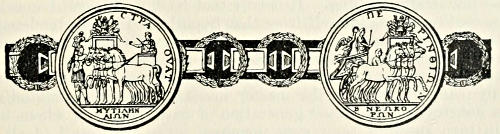
Of inscriptions on various monuments and on coins and medals there
is no dearth. But these are by no means so comprehensive in their scope
as were some of the inscriptions of the early Egyptian and Assyrian monarchs;
and speaking broadly, it may be said that the entire epigraphic and
numismatic testimony as to the history of Rome—particularly for the earlier
period—amounts to no more than incidental references, and would leave
us with but a vague knowledge of the subject, were it unsupported by more
extensive records.
The more extensive records in question are, of course, the manuscripts of
books. From a rather early day there was no dearth of writers in Rome,
and among these the historians, or, as they more generally termed themselves,
the annalists, were fully represented. Indeed, this class of writers appears
to have held almost complete possession of the field in the early day. In the
later Augustan age, though votaries of polite literature had fuller representation,
yet the historians, with Livy at their head, still took front rank among
writers of prose. No original manuscripts of any of these writers have come
down to us; indeed, no manuscripts of the classical period whatever have
been preserved, except a few fragments in Egypt and the collection at Herculaneum
just mentioned. Our copies of the Roman historians date from
the Middle Ages, and few of them are intact. The works of the early annalists
and chroniclers have disappeared almost entirely. Doubtless they were
regarded as having little utility after such great master-builders as Dionysius
and Livy had used them in the construction of their great works. Many of
the writers of a later period fared not much better; and even the greatest of
all have come down to us in a damaged condition. Livy himself is represented
among extant manuscripts by only about one-fifth of his original history—to
say nothing of his other writings, which have perished altogether. Dionysius
has been no more fortunate, as only the earliest portion of his work is preserved.
Dionysius himself has left us a list of the early authorities upon whom he
drew. His comment on his predecessors is interesting; after noting that
“no accurate history of the Romans, written in the Greek language, has
hitherto appeared, but only small accounts and short epitomes,” he criticises
these synopses as follows:
“Hieronymus Cardianus (the first author I know of upon this subject)
has given a cursory account of the Roman antiquities in his history of the
Epigoni. After him, Timæus, the Sicilian, treated of antiquities in his universal
history, and placed in a separate work the wars of the Romans with
Pyrrhus of Epirus. Besides these, Antigonus, Polybius, Silenus, and innumerable
other authors have attempted this same subject, though in a
different manner; each of whom has written some things concerning the
Romans, which they have compiled from common reports without any diligence
or accuracy. Like to these in all respects are the histories, which
some Romans also have published in Greek, concerning the ancient transactions
of their own nation; of whom the most ancient are Quintus Fabius,
and Lucius Cincius, who both flourished during the Punic wars: each of these
has related the actions, at which he himself was present, with great exactness,
as being well acquainted with them, but has given a summary account
of those early events that happened soon after the building of the city.”
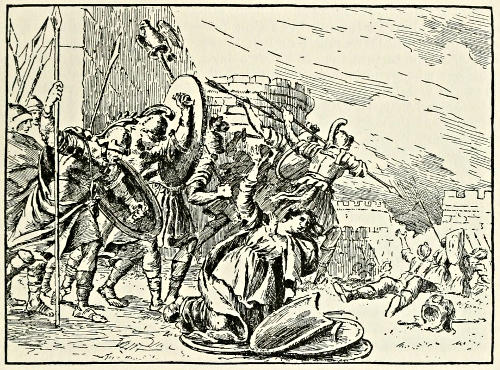
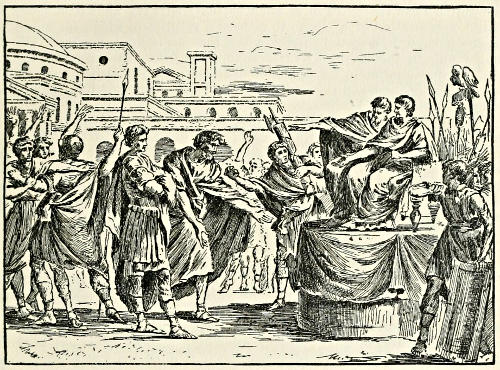
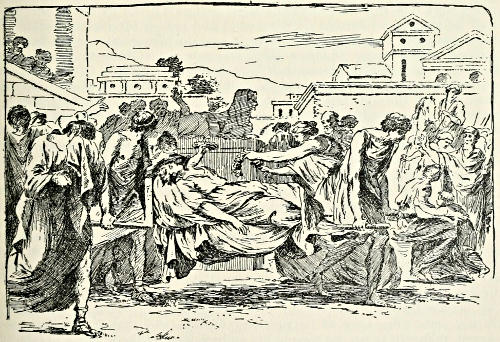
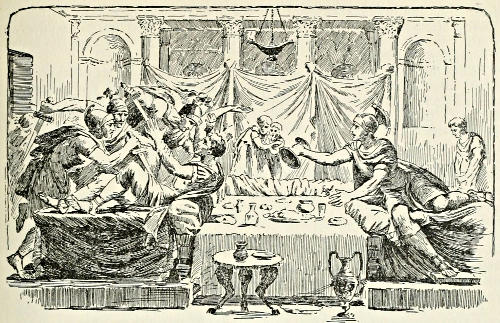
Treachery of Tarpeia (Sixth Year of Rome)
(See p. 65)
It was to supply the deficiency thus noted, Dionysius alleged, that he
undertook his work, being determined, he says, “not to pass over that beautiful
part of the Roman history, which the ancient authors had disregarded.”
But “lest some one should entertain the opinion that in introducing matter
not found in the authors already mentioned, he resorted to invention,” Dionysius
thinks it well to explain how he came by the materials for his history.
He says:
“I came into Italy immediately after Augustus Cæsar had put an end to
the civil war, in the middle of the hundred and eighty-seventh Olympiad;
and having from that time to this present, that is, twenty-two years, lived
at Rome, learned the Roman language and acquainted myself with their writings,
I employed all that interval in preparing materials for this work; and
some things I received from men of the greatest consideration among them
for learning, whose conversation I used; and others I gathered from histories,
written by the most approved Roman authors; such as Porcius Cato, Fabius
Maximus, Valerius Antias, Licinius Macer, the Ælii, Gellii, and Calpurnii,
and several others of good note. Supported, therefore, by the authority of
these histories, which are like the Greek annals, I undertook this work.”
Livy, our other great source for the early traditional history of Rome,
unlike Dionysius, does not specifically enlighten us as to the sources of his
information; but doubtless they were much the same as those employed by
his great contemporary.
There was indeed a large company of early annalists and chroniclers, as
the note of Dionysius indicates. Among others these names have come down
to us: Q. Fabius Pictor and L. Cincius Alimentus, who lived in the time of
the Second Punic War and wrote in Greek; the poet Ennius, who wrote
annals from the earliest time to his own day; and A. Postumius Albinus and
C. Acilius who wrote annals in Greek at about the same period. The original
works of all of these, like those of many later historians, have been lost.
It appears that the Roman historians were accustomed to call their writings
annals if they referred to ancient times, and histories if they described
contemporary events. It will be recalled that Tacitus wrote both annals
and histories. Necessarily, the works dealing with the early history of Rome
were annals. Dionysius, however, termed his work Archæologia instead
of annals. Dionysius lived in the latter half of the first century B.C., but he
did not attempt to bring his historical records further down than the year
264 B.C.; his intention being to bridge the gap in Roman history preceding
the time at which the work of Polybius begins. Livy’s scope was far more
comprehensive, as his work covered the period to his own time. In other
words it was, using the Roman terminology, annals and history combined.
It is curious to note his own estimate of the relative values of these two
portions of his work. He says:
“Whether in tracing the series of the Roman history, from the foundation
of the city, I shall employ my time to good purpose, is a question which
I cannot positively determine; nor, were it possible, would I venture to pronounce
such determination; for I am aware that the matter is of high antiquity,
and has been already treated by many others; the latest writers
always supposing themselves capable, either of throwing some new light on
the subject, or, by the superiority of their talents for composition, of excelling
the more inelegant writers who preceded them. However that may be,
I shall, at all events, derive no small satisfaction from the reflection that my
best endeavours have been exerted in transmitting to posterity the achievements
of the greatest people in the world; and if, amidst such a multitude
of writers, my name should not emerge from obscurity, I shall console myself
by attributing it to the eminent merit of those who stand in my way in
the pursuit of fame. It may be further observed, that such a subject must
require a work of immense extent, as our researches must be carried back
through a space of more than seven hundred years; that the state has, from
very small beginnings, gradually increased to such a magnitude, that it is
now distressed by its own bulk; and that there is every reason to apprehend
that the generality of readers will receive but little pleasure from the accounts
of its first origin, or of the times immediately succeeding, but will be
impatient to arrive at that period, in which the powers of this overgrown
state have been long employed in working their own destruction.”
Obviously then, Livy regarded the portion of his history which dealt with
remote antiquity as relatively unimportant. But posterity did not give suffrage
to this view; for successive generations of copyists preserved the early
portion of the work entire, while allowing the latter part to be lost, except
for occasional fragments.
Livy’s preface continues: “On the other hand, this much will be derived
from my labour, that, so long at least as I shall have my thoughts totally
occupied in investigating the transactions of such distant ages, without being
embarrassed by any of these unpleasing considerations, in respect of later days,
which, though they might not have power to warp a writer’s mind from the
truth, would yet be sufficient to create uneasiness, I shall withdraw myself from
the sight of the many evils to which our eyes have been so long accustomed.
“As to the relations which have been handed down of events prior to the
founding of the city, or to the circumstances that gave occasion to its being
founded, and which bear the semblance rather of poetic fictions than of
authentic records of history—these, I have no intention either to maintain
or refute. Antiquity is always indulged with the privilege of rendering
the origin of cities more venerable, by intermixing divine with human
agency; and if any nation may claim the privilege of being allowed to consider
its original as sacred, and to attribute it to the operations of the gods,
surely the Roman people, who rank so high in military fame, may well
expect, that, while they choose to represent Mars as their own parent, and
that of their founder, the other nations of the world may acquiesce in
this, with the same deference with which they acknowledge their sovereignty.
But what degree of attention or credit may be given to these and such like
matters I shall not consider as very material.”
Particular attention should be called to the remarks of Livy, just quoted;
which seem clearly enough to show that he was by no means so credulous
regarding the traditions of early Rome as his manner of relating these traditions
might lead one to suppose. It is probable that the judgment of
later generations usually goes astray when attempting to estimate the exact
level of credulity of any anterior generation. Doubtless the Romans as a
class gave far more credence to the hero tales than we are disposed to give
them now. We shall have abundant evidence that even in the golden period
of the empire superstitions as to miracles and the like were not altogether
repudiated, even by such writers as Tacitus; but, on the other hand, we
may well believe that writers of such capacity as Livy allowed a desire for
artistic presentation of a theme to conceal a scepticism which he would not
otherwise have hesitated to avow. Be that as it may, posterity has all
along clung to the myths of early Rome, and we of to-day cannot ignore
them, whatever estimate we put upon their authenticity. It is through the
pages of Dionysius and Livy, chiefly, that these fascinating tales have been
preserved to us.
Coming down the centuries we find no great name until we reach the
period when Rome, having firmly established her power in Italy, began to
look out beyond the bounds of the peninsula and dream of foreign conquests.
This great culminating epoch of Roman history found a great transcriber
in Polybius. His work was avowedly written to describe and explain
the events by which Rome “in the short period of fifty-three years,” conquered
the world. Polybius was himself a Greek, born in Megalopolis.
He was a practical statesman, and the personal friend of Aratus, the leader
of the Achæan League. We have noted in a previous volume that Polybius
was one of the thousand Greeks sent as hostages to Rome. He spent the
greater part of the remainder of his life in Italy; became the personal friend
of Scipio the Younger, and was present with that leader when Carthage was
finally destroyed. Belonging thus to the later epoch of Grecian history,
when the spirit of the age was philosophical rather than artistic, Polybius
wrote such a work as might be expected of a man of genius of his time.
His point of view is utterly different from that of his great predecessor
Herodotus, though not altogether dissimilar to that of Thucydides. He
himself tells us over and over—in fact he never tires of repeating—that
his intention is to instruct rather than to entertain; to teach the causes of
Rome’s success; to point the moral of her victories. Being a man of affairs,
he not unnaturally holds that only men of affairs are competent to become
reliable historians. He points out that there are two ways of gaining knowledge:
“one derived from reading books, and the other from interrogating
men;” he inveighs with some asperity against those historians, taking Timæus
as a type, who confine themselves to the former method.
“The knowledge that is acquired by reading,” he says, “is gained without
any danger or any kind of toil. If a man will only fix his residence in
the neighbourhood of a library, or in a city that abounds with written
memoirs, he may make his researches with perfect ease; and, reposing himself
with full tranquillity, may compare the accounts and detect the errors of
former writers. But the knowledge which is drawn from personal examination
and inquiry, is attended with great fatigue and great expense. It is
this, however, which is the most important, and which gives indeed the
chief value to history. Historians themselves are ready to acknowledge this
truth. For Ephorus says, that if it were possible for the writers of history
to be present at all transactions, such knowledge would be preferable to any
other. To the same purpose is that passage of Theopompus: that the experience
which is gained in battles renders a man a consummate general; that
practice in pleading causes forms the perfect orator; and that the same
observation is just with respect to the arts of navigation and of medicine.
“It was said by Plato,” Polybius continues, “that human affairs would
be well administered when philosophers should be kings, or kings philosophers.
In the same manner I would say: that history would be well composed
if those who are engaged in great affairs would undertake to write it;
not in a slight and negligent manner, like some of the present age; but
regarding such a work as one of the noblest and most necessary of their
duties, and pursuing it with unremitted application, as the chief business
of their lives; or if those, on the other hand, who attempt to write, would
think it necessary also to be conversant in the practice of affairs. Till this
shall happen, there will be no end of mistakes in history.”
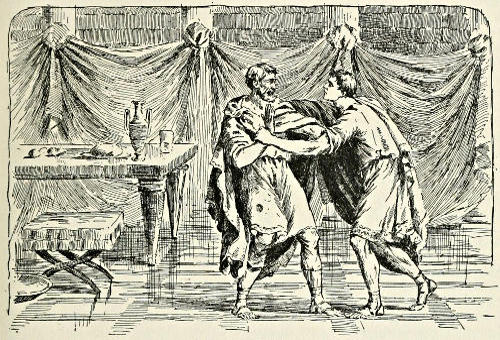
Scipio and Polybius
(From an old print)
But while thus speaking for men of affairs, Polybius has in mind also
philosophers, for he declares that it is impossible to make a clear judgment
of the victorious or vanquished by a bare account of events. We must
know, he says, the laws and customs of the people, and the passions and circumstances
which prevail among them with regard to public and private
ends. With regard to the Romans in particular, he hopes by due attention
to these things to present such a picture that the people of his own age will
be able to discern “whether they ought to shun or choose subjection to the
Romans; and posterity to judge whether the Roman government was worthy
of praise and imitation or should rather be rejected as vicious and blamable;”
for in this, he believes, must consist the utility of his history for his
own and future ages.
All this is highly admirable; nor is it in dispute that Polybius attained
a large measure of success along the lines he had laid down for his work.
Only five of his forty books have come down to us entire, but these sufficiently
illustrate his method and its results. It has been said of them that
no student of the period can ignore them, but that no one else would
willingly read them. This criticism, like most other epigrammatic verdicts,
is unjust. There is much in the work of Polybius that anyone who cares
at all for historical writings may read with full interest. His descriptions
of the major events are by no means so bald and unimaginative as some
critics would contend. They do indeed eschew the marvellous and attempt
to avoid exaggeration; but this surely is no fault; nor do these limitations
exclude picturesqueness. But the really vital fault of Polybius is his
method of construction. He uses virtually the plan which Diodorus adopted
later of attempting to keep the narrative of events in different countries in
the closest chronological sequence. This necessitates a constant interruption
of his narrative, through shifting the scene of action from one country
to another, until all sense of continuity is lost. Add to this an ineradicable
propensity to be forever moralising,—interrupting the narrative of some
startling event to explain in detail how startling events should be treated
by the historian,—and the reasons are sufficiently manifest why Polybius
is hard to read. It is a great pity that he did not, like Trogus Pompeius,
find a Justin to epitomise his work; for by common consent he was one of
the most dependable historians of antiquity; and he is recognised as the
standard source for all periods of which his extant works treat. Indirectly
his influence is even more extensive, since Livy made use of him as his
authority for the events of the Second and Third Punic wars, and since
Appian drew on him freely.
There is no great name among the Roman historians for about a century
and a half after Polybius. Then comes Sallust, the historian of the Jugurthine
War and the Catiline conspiracy; and Julius Cæsar, who has left us
that remarkable record of his own exploits. Contemporary with Cæsar were
Diodorus and Livy, the former of whom lived till about 7 B.C. and the latter
till 17 A.D. Livy’s account of his own time, as has already been mentioned,
has most unfortunately perished. The chief record of these times that has
been preserved, is the work of Appian, an Alexandrian Greek who lived in
the time of Trajan, Hadrian, and Antoninus Pius; that is to say, in the early
part of the second century A.D. His work is the sole authority—overlooking
certain epitomes and fragments—for some periods of the civil wars. It was
written in Greek, and is notable for the plan of its construction; which,
departing radically from the method of Polybius, treated each important
subject by itself. In other words his work is virtually a collection of
monographs; the subject of each being one of the important wars of Rome.
Appian has been charged with the opposite literary vice to that of Polybius;
he is said to have thought more of manner than of matter. Nevertheless, he
necessarily used the older writers for his facts, and if he sometimes used
them carelessly and uncritically, these are faults of his time. In the main he
shows a fair degree of accuracy. Accurate or otherwise, he is, as has been said,
our sole source for certain important periods of the later time of the republic.
If to the writers just named we add Dion Cassius; the general historian
Trogus Pompeius (in Justin’s celebrated epitome); and of the biographers
Plutarch and Cornelius Nepos; and supplement our list with the names of the
so-called epitomators, Eutropius, Velleius, Florus, Aurelius Victor, Zonaras,
Festus Rufus, and Orosius (writers who made brief but more or less valuable
epitomes based on the authorities), we shall have named practically all the
important historians of Rome to the end of the republic whose works are
now available in anything like their original form.
The modern historian gains incidental aid from various other fields: from
the orations of Cicero, and the chance references of poets; from inscriptions
on monuments and medals, and from the débris of ancient structures. Yet
when all these have been examined, it is to the manuscripts that we must turn
for the main incidents of the story.
Of the modern historians of Rome whose works have had much to do with
the earliest period, it is sufficient here to mention the names of Niebuhr,
Arnold, and Mommsen. More detailed notices of both ancient and recent
authorities will be given from time to time as we proceed.
FIRST (LEGENDARY) PERIOD OF THE KINGS (TO ABOUT 510 B.C.)
(All dates for this period are approximate.)
753-716. Romulus, a mythical king. Rape of the Sabine women, and
war with the Sabines. Through the treachery of Tarpeia, the fortress on
the Capitol taken by the Sabellian king Titus Tatius. Formation of the
double state of the Romans and Sabines under the rule of Romulus and
Tatius. Disappearance of Romulus during a thunder storm; he is known
and worshipped from now on as the god Quirinus. 715-673. Numa Pompilius,
of Cures, appointed king by the Romans after a year’s interregnum.
Founds the religion of the Romans. Building of the temple of Janus.
672-641. Tullus Hostilius. War with Alba Longa. After a contest between
the Horatii and Curatii, Alba submits to a decision in favour of Rome.
Alba Longa destroyed and its population transferred to Rome. 641-616.
Ancus Marcius. Formation of the Fetiales. After the conquest of four
Latin cities their inhabitants are transferred and settled on the Aventine
Hill. Fortification of Janiculum. Building of the “pons Sublicius” and
foundation of Ostia. 615-578. Tarquinius Priscus. Building of the temple
of Jupiter on Capitoline Hill begun. The city divided into four districts,
and a new military system introduced. Increase of the senate to three
hundred members and doubling of the number of equites. Successful campaigns
against the Sabines, Latins, and Etruscans. Tarquinius is assassinated
by the sons of Ancus. 578-534. Servius Tullius. The son of a
slave woman, Ocrisia, and a god; he becomes the son-in-law of Tarquinius.
Formation of the four “tribes.” Changes in the army, begun by
Tarquinius, completed; distribution of all landholders into tribes, classes,
and centuries. Wars with Veii. Rome joins the Latin league. Building
of the walls of Rome. Assassination of Servius Tullius by his son-in-law.
534-510. Tarquinius Superbus. The Capitoline temple of Jupiter is completed.
Subjugation of the Latin league. Suessa Pometia is conquered. Through the
treachery of his son Sextus, Tarquinius captures the city of Gabii. Rape of
Lucretia by Sextus the king’s son, whereupon the indignant Romans rise in
revolt. L. Junius Brutus heads the insurrection, and Tarquin is deposed.
Rome besieged by Lars Porsenna, prince of Clusium; he grants honourable
terms of peace and withdraws. Battle of Lake Regillus. Tarquin seeks
revenge at Cumæ. Overthrow of the monarchy.
THE EARLY DAYS OF THE REPUBLIC (510-451 B.C.)
510. Rise of the Republic. 509. Consuls for the first year are L.
Junius Brutus and L. Tarquinius Collatinus. Collatinus, being a descendant
of Tarquin, is compelled by a decree of the senate to give up his
office. He is replaced by P. Valerius Publicola. According to Polybius,
L. Junius Brutus and Marcus Horatius were consuls for the first year.
The first dictator is Titus Lartius. Unsuccessful attempts to restore
the Tarquinians. Execution of Brutus’ son. Commercial treaty between
Rome and Carthage. 508. The Romans are defeated by the Etruscan
king Porsenna of Clusium, are forced to disarm and surrender certain
lands. Alliance of thirty Latin cities under the dictatorship of Octavius
with the object of restoring the Tarquinians to the sovereignty of Rome.
Death of Valerius Publicola. 497. The Latins declare war against Rome.
Aulus Postumius is appointed dictator at Rome. Tradition credits the
Romans with a great victory over the Latins at Lake Regillus. The
Latin cities make peace with Rome, and agree to banish Tarquinius.
494. The plebeians secede to the Sacred Hill, and compel the patricians
to make important concessions, among which is the abrogation of oppressive
debts. Establishment of the tribunate and the plebeian ædileship.
493. The eternal alliance between Rome and the Latin league is renewed
under the consulate of Spurius Cassius on the basis of equality. Rome
gradually regains hegemony over the Latins. The tribunate is the cause
of anarchy, and leads to further disputes between the patricians and
plebeians. Attempts to abolish the tribunate. 491. Marcius Coriolanus.
During a famine he suggests granting, at the expense of the state, grain to
the plebeians, on condition that they relinquish their claim to the tribunate.
He is summoned before the tribal assembly but fails to appear, and according
to Livy is banished, goes over to the Volscians, and leads their troops
against Rome; at the rebuke of Veturia his mother, and the entreaties of
his wife Volumnia, he abandons the war against his native city. 487. The
consul Aquilius defeats the Hernici who invade Roman territory. 486.
Spurius Cassius Viscellinus consul for the third time. He again defeats
the Hernici, after which they join the Latin league. He introduces the
first agrarian law, and proposes that a portion of the public lands be divided
between the needy plebeians and Latins; the remainder to be leased for the
benefit of the state. He is attacked by the patricians and wealthy plebeians
on account of this measure, and the poorer plebeians, being opposed to the
granting of lands to the Latins, abandon him. At the expiration of his
consulship he is condemned and executed. 479. Withdrawal of the Fabian
gens. 477. The Etruscans destroy the Fabian gens at the Cremera. Genucius,
the people’s tribune, assassinated for inquiring into the acts of two consuls.
472. Publilius Volero effects law that the tribal assembly henceforth
shall elect plebeian magistrates. 468. Conquest of Antium from the Volscians;
a Roman colony is sent thither. 463. Rome and all Italy visited
by a terrible plague. Volscians and Æquians ravage the country up to the
walls of Rome. The safety of the city secured by the Latin Hernicans,
not by the Romans. 462. C. Terentilius Harsa introduces a bill to secure
the plebeians a better footing in the state, and to reduce the laws to a written
code. The patricians violently oppose the measure. 460. A band of Sabines
and exiled Romans under Herdonius seize the Capitol; civil strife is
renewed. 457. To meet the desire of the plebeians, the number of the
tribunes of the people is raised from five to ten. 456. Aventine Hill is
divided into building lots and distributed among the poorer citizens. The
dictatorship of L. Quinctius Cincinnatus. 454. Three ambassadors appointed
to visit Greece and secure copies of the Solonian laws to be used
as the groundwork of a new code of laws. 452. The ambassadors return.
Rome free from domestic strife.
FROM THE DECEMVIRS TO THE GALLIC INVASION (451-390 B.C.)
451. The decemvirs or consuls of ten appointed from the patricians with
Appius Claudius and T. Genucius consuls for the first year, at their head.
The code of the ten tables posted in the Forum and becomes law. 450. Appointment
of the decemvirs. Appius Claudius the only one of the old
decemvirs to be re-elected. Three plebeians are also elected. Two new
tables are added to the code of laws. 449. The decemvirs under Appius
Claudius, who have become more despotic than the early kings, remain in
office during this year. Under the Valerii and Horatii an attempt on the
part of the moderate aristocracy to compel the decemvirs to abdicate proves
unsuccessful. Renewal of the border wars. The Sabines on the north and
the Æquians on the northeast invade Roman territory. Two armies are
sent to oppose them and both are defeated. Siccius Dentatus, a former
tribune of the people, is murdered at the instigation of the decemvirs.
Virginia, the betrothed of L. Icilius, the tribune who succeeded in allotting
the Aventine Hill to the plebeians, is outraged by Appius Claudius. Her
father Virginius stabs her in the Forum. These acts bring about a revolt
against the decemvirs who abdicate. Appius Claudius is thrown into prison
and commits suicide. Spurius Oppius, chief of the plebeian decemvirs, is
accused by Numitorius and executed. 448. The new laws of Valerius
Horatius. 445. A law making marriage legal between patricians and plebeians
is passed by C. Canuleius. 444. Formation of military tribunes with
consular authority. Plebeians and patricians both eligible. 443. A new
office is created to which two patricians are elected and known as censors.
439. A wealthy plebeian Spurius Mælius charged with seeking regal power
is assassinated by C. Servilius Ahala. 434. L. Æmilius Mamercus appointed
dictator to conduct the war in lower Etruria. 431. Rome threatened
by a combined attack of the Æquians and Volscians. They are
defeated. 405-396. Siege of Veii. Dictator M. Furius Camillus captures
and destroys Veii. 394. Camillus marches against Falerii, the chief city of
the Falisci, who surrender. 391. Camillus is accused of unfairly dividing
the booty at Veii, is impeached, and goes into exile. 390. The Gauls invade
Rome and the senate accedes to their demand that the three Roman ambassadors
who aided the Etruscans against the Gauls should be delivered to them,
but the citizens reject the measure. Battle of the Allia in which the Romans
are completely routed and their city left defenceless. Rome captured, plundered,
and burned. The Gauls attack the Capitol but are repulsed and
content themselves with a blockade. After a siege of seven months the
Gauls agree to quit Rome on receiving one thousand pounds’ weight of
gold. Rebuilding of the city.
THE CONQUEST OF ITALY (376-264 B.C.)
376. New laws are proposed by C. Licinius and Lucius Sextius. 367. Licinian
laws are passed. 366. L. Sextius Lateranus first plebeian consul.
367-349. Wars with the Gauls in upper Italy. 362-358. War with the
Hernicans and the insurgent Latin cities. A new alliance formed of Latins,
Romans, and Hernicans. 358-351. War with Tarquinii and other Etruscan
cities. Southern Etruria acknowledges Roman supremacy. 350-345. Wars
with the Volscians and Aurunci, who are completely subjugated. 348. Renewal
of the commercial treaty with Carthage. 343. First Samnite War.
340-338. The great Latin War. Subjugation of Latium. 337-326. Revolt
of Cales. Treaty with Alexander of Molossia. Siege and destruction of
Palæopolis. 326. The Second Samnite War begins. 321. The great defeat
of the Roman army at Caudine Forks. 319. L. Papirius Cursor conquers
Luceria. 312. The Etruscans, on the expiration of the forty years’ peace,
join in the war against Rome. 309. L. Papirius Cursor utterly defeats the
Samnites. 305. The Romans capture Bovianum, the Samnite capital.
304. End of the war. 299. The Third Samnite War. 295. The battle of
Sentinum, in which the Romans prove victorious. 294. The allied Romans
dissolve. 293. Defeat of the Samnites at Aquilonia. 290. The conclusion
of peace. 285-282. War against the new league of Italian cities.
282. Opening of the war with Tarentum. 280. Pyrrhus lands in Italy.
Battle of Heraclea. 279. Battle of Asculum. 275. Battle of Beneventum.
Pyrrhus withdraws from Italy. 274-264. Final settlement of Italy.
FIRST PERIOD OF FOREIGN CONQUEST (264-132 B.C.)
264. First Punic War. The Carthaginians besiege Messana. 263. Invasion
of Sicily by the Romans. The Syracusan king Hiero joins the Romans.
262. The Romans defeat Hanno and capture Agrigentum [Acragas].
260. The Romans send a fleet under Cornelius Scipio against Lipara, which
is defeated by the Carthaginians. Battle of Mylæ in which the Roman navy
proves victorious. Sea fight off Ecnomus; defeat of the Carthaginian fleet.
The Romans invade Africa. 255. Carthaginians under Xanthippus defeat
the Romans under Regulus. Loss of the Roman fleet on homeward voyage.
254. Roman victory at Panormus. 251. Hasdrubal defeated at Panormus.
249. Carthaginian victory over the Romans at Drepanum. 248-243. Success
of the Carthaginians under Hamilcar Barca on the Italian coast
and in Sicily. 242. Romans defeat the Carthaginian fleet off Ægatian
islands. 241. Hamilcar Barca concludes peace. The Carthaginians agree
to pay indemnity and leave Sicily. 229-228. War with the Illyrians.
225-222. Annihilation of the Cisalpine Gauls. 218. The Second Punic
War begins. The Roman army sent to Africa. Hasdrubal opposes Scipio
in Spain. Hannibal crosses the Alps. 217. Hannibal defeats the Romans
at Lake Trasimene. 216. The Romans annihilated at Cannæ. 215. First
Macedonian War. Philip of Macedon joins Carthage. Hannibal is defeated
in the battle of Nola. 214. Carthaginians land in Sicily.
212. Romans recover their position in Sicily. Carthaginian success in
Spain. 211. The Romans besiege Capua. Hannibal at the gate of Rome.
Hannibal’s retreat from Rome. Fall of Capua. Defeat of Hasdrubal at
Bæcula. 209. Hasdrubal crosses the Pyrenees and Gaul, and appears in the
north of Italy. 207. Hasdrubal defeated and slain at the battle of Metaurus.
206. Carthaginians expelled from Spain. Macedonian War concluded.
204. Scipio in Africa. 203. Scipio defeats the Carthaginians. Hannibal
recalled to Carthage. 202. Scipio defeats Hannibal in the battle of Zama.
201. Treaty of peace concluded. 200. Second Macedonian War. 200-197.
Subjugation of upper Italy. 197. Second Macedonian War concluded. 192-189.
War with Syria. 190. Battle of Magnesia. 171. Third Macedonian
War. 168. Overthrow of the Macedonian monarchy. 149. Third Punic
War begins. Siege of Carthage. Viriathus successful in Lusitania.
146. Carthage taken and destroyed; her territories become Roman provinces
and are organised as such. Achæan War. Battle of Leucopetra.
Corinth surrenders peacefully. Destruction of Corinth. 143-141. Numantine
War against the rebellious Celtiberians. Viriathus maintains himself
against the Romans, and finally concludes a peace unfavourable to them.
140. The Romans violate the peace and renew the war. 139. Viriathus
is murdered at Roman instigation. The Lusitanians renew the war but are
defeated and disarmed. This is their last rebellion on a formidable scale.
133. Numantia taken and destroyed by Scipio Africanus the younger.
Having resisted successive Roman generals since the year 143 it is now
subdued after fifteen months’ close investment. Its fall signalises the subjection
of northern Spain to Rome. 135-132. First Servile War in Sicily.
The slave Eunus leads an insurrection of the slaves and assumes the title
of King Antiochus. A regular government is established, and in the war
with Rome which follows the rebels are at first successful. When finally
subdued they are punished by numerous executions. The consul Rupilius
reorganises the administration of Sicily.
REFORMS OF THE GRACCHI (138-111 B.C.)
133. Tiberius Sempronius Gracchus elected tribune. He proposes the
resumption of “common lands” held by unauthorised persons and the
revival of the Licinian law limiting the amount of such land to be occupied
by one individual. By this means he hoped to mitigate the evils resulting
from the concentration of these estates in the possession of a few persons.
Tiberius obtains the illegal removal from office of the tribune Caius Octavius,
who had vetoed the passing of the new (Sempronian) law, and that law is
then passed by the popular assembly. Tiberius Gracchus, his brother Caius,
and his father-in-law Appius Claudius appointed to carry out the decree.
Attalus III king of Pergamus dies, making the Romans his heirs. Tiberius
Gracchus proposes that the money shall be employed to start the new settlers
on the resumed lands and that the kingdom of Attalus (the new province of
Asia) shall be governed by the people instead of by the senate, who were
legally entitled to the disposal of both land and money. Tiberius prepares
other reforms, and in order to preserve and continue his work becomes
a candidate for re-election as tribune, in defiance of the law forbidding re-election.
He opposes the aristocratic resistance by force and is killed with
many of his adherents in the ensuing riot. 131. C. Carbo, the tribune,
obtains a law permitting secret voting for the ratification of laws by the
popular vote. Scipio Africanus Minor obtains the defeat of Carbo’s measure
to legalise the re-election of tribunes. 129. Aristonicus, a natural son of
Attalus III of Pergamus, executed for making war against the Romans in
assertion of his rights to his father’s kingdom. C. Carbo, Gracchus, and
Marcus Fulvius Flaccus triumvirs for the execution of the Sempronian law;
Scipio contrives to obtain a limitation of their powers, which virtually suspends
the law. 125. Fulvius Flavius becomes consul. He raises the question
of admitting the Latins to the Roman citizenship, and is then sent to
Transalpine Gaul to aid the Massiliots against the Gauls. Fregellæ revolts
against the Romans and is destroyed. 124. Aquæ Sextiæ (Aix) founded in
Gaul. 123. Caius Gracchus clears himself from the charge of instigating
the revolt of Fregellæ. He succeeds in driving into exile Popilius Lænas,
the survivor of the consuls of 132. Finding himself confronted by a powerful
opposition, Caius endeavours to conciliate the people by means of the
lex frumentarii, a law providing for the regular distribution of corn at the
expense of the state. He originates the idea of provincial colonies. The
lex judiciaria transfers judicial functions from the senate to the order of
equites, the moneyed, as distinguished from the aristocratic class. This
measure weakens the power of the senate but does not render the administration
of justice less corrupt. By the lex de provincia Asia, C. Gracchus
places that province at the disposal of the equites. Caius Gracchus
re-elected tribune for a second year. 122. C. Gracchus goes to establish the
colony of Junonia on the site of Carthage. In his absence M. Livius Drusus
proposes the foundation of twelve colonies in Italy, a popular measure intended
to divert the people’s favour from Gracchus. C. Gracchus attempts
to extend the rights of citizenship to the Latins but is defeated by the united
efforts of the senate and the mob. War with the Allobroges and Arverni
and Roman victory of Vindalum. 121. Death of Caius Gracchus. This
is the result of a riot originating in a murder committed by a partisan of
Gracchus. The latter with his adherents takes possession of the Aventine,
from which they were driven by the aristocratic party. 120. Agrarian law
forbidding the sale of lands allotted to the peasants, repealed. Popilius
Lænas recalled. 118. Common lands secured to those in possession on payment
of a fixed tax. Narbo, afterwards the capital of the Narbonensis,
founded. 113. Invasion of the Cimbrians. They defeat the consul Cn.
Papirius Carbo at Noreia, and pass into Helvetia and Gaul. 111. Common
lands in Italy declared to be the private property of those in possession.
This date marks the final failure of the reforms of the Gracchi.
THE JUGURTHINE AND OTHER WARS (111-100 B.C.)
111. Outbreak of the Jugurthine War. This war was occasioned by the
quarrel between the two kings of Numidia, Jugurtha and Adherbal. The
latter appealed to Rome, and a commission appointed by the senate made
a regular division of the kingdom between the two claimants. War again
broke out between them, and Adherbal was besieged in his capital Cirta. It
was taken and Adherbal put to death. Whereupon Rome declared war
against Jugurtha. The consul Calpurnius concludes a treaty with Jugurtha
which the senate refuses to sanction. 110. Aulus Albinus capitulates to
Jugurtha with his whole army. 109. Battle of the Muthul; Metellus
defeats Jugurtha. M. Junius Silanus defeated by the Cimbri in Gaul.
107. L. Cassius Longinus defeated by the Cimbri on the Garonne. Metellus
defeats Jugurtha, who takes refuge in the desert. Bocchus, king of Mauretania,
makes alliance with Jugurtha. C. Marius succeeds Metellus. He
defeats Jugurtha near Cirta and takes Capsa and other towns. 106. L. Cornelius
Sulla joins Marius. Jugurtha repulsed at Cirta. 105. Sulla induces
Bocchus to betray Jugurtha. Numidia divided between Bocchus and Jugurtha’s
half-brother Gauda. The Cimbri defeat the Romans at Arausio
(Orange). 104. Marius elected consul. Preparations for defence of Italy
against the barbarians. The Cimbri cross into Spain. Marius reorganises
the Roman army. 103. Marius again consul. Second Servile insurrection
in Sicily under Tryphon, who assumes the title of king. 102. The Cimbrians,
Teutones, and Helvetians approach Italy in two bands. Battle of
Aquæ Sextiæ. Marius defeats the Teutones and Ambrones. Catulus
abandons the country north of the Po to the Cimbri. 101. Battle of
Vercellæ (Campi Raudii). Marius destroys the army of the Cimbri and
thus saves Italy from the barbarians. Athenion, the successor of Tryphon,
defeated and slain by the consul Manius Aquilius. The fugitives taken and
killed to the number of thirty thousand.
CIVIL STRIFE: TIME OF MARIUS (100-86 B.C.)
100. Marius chosen consul for the sixth time. Saturninus coerces the
assembly of the tribes into accepting a measure for distributing conquered
lands among the soldiers of Marius, and containing a clause obliging the
senate to confirm the law. Q. Metellus alone refuses to do so and goes into
banishment. The popular party endeavour to secure the consulship for 99
to Glaucia. His supporters kill the rival candidate in the Forum. Marius
interferes in the cause of order, attacks the rioters and captures Saturninus
and Glaucia. While awaiting trial the popular leaders with many of their
adherents are put to death by the aristocratic party. 99. Q. Metellus recalled.
98. Marius retires to Asia. 95. Rutilius Rufus falsely accused
of extortion while legatus in Asia Minor and sent into banishment. This
unjust sentence reveals the abuse of the judicial power in the hands of the
equites. 92. Sulla as prætor in Cilicia restores the king of Cappadocia
who had been expelled at the instigation of Mithridates, king of Pontus.
91. Marcus Livius Drusus tribune. He introduces laws: (a) taking the
judicial power from the equites and restoring it to the senate, and (b) providing
for a redistribution of lands. These laws, passed by the popular
assembly, are declared invalid by the senate. Drusus proceeds to execute
them and to introduce a measure for admitting Italians to the citizenship.
Drusus dies suddenly. 90. Trials and banishment of the supporters of the
Italians. The Social War (90-88). The Italians revolt from Rome and
form a republic with Corfinium as its capital. They attack the Latin
colonies. Venusia and several other cities fall into their hands before the
Romans can take the field. Lucius Julius Cæsar, the consul, twice defeated
by the Italians. Campania and Apulia fall into their hands. The consul
Rutilius defeated and slain on the Tolenus. Marius fails to distinguish
himself. Cn. Pompeius Strabo defeated and besieged in Firmum, from
whence he attacks and routs the Italians. The year closes with the Italians
on the whole successful and with news of disturbances in the provinces.
Rome conciliates the Latins and the loyal Italians by granting them citizen
rights. 89. The Romans repeatedly defeat the Italians. The lex Plautia-Papiria
confers Roman citizenship on all Italians desiring it. They are
enrolled in eight of the tribes. 88. Mithridates, king of Pontus, makes war
on the king of Bithynia and defeats the Roman armies supporting the latter.
The Greek cities of Asia join Mithridates and put to death all Italians found
in them. Sulla appointed to command in the Mithridatic War. P. Sulpicius,
a partisan of Marius, proposes to enrol Italians in all the thirty-five tribes.
Sulla opposes the measure. The popular assembly transfers the command
in the Mithridatic War to Marius. Sulla joins his army in Campania and
marches on Rome. Marius makes a fruitless attempt to defend the city,
but fails and has to flee to Africa. Sulla deprives the popular assembly of
the right to vote on measures not previously sanctioned by the senate.
87. Sulla proceeds to the war against Mithridates, lands in Epirus, drives
Mithridates’ generals from Bœotia, and besieges Athens, which had declared
for the king of Pontus. Meantime the consul L. Cornelius Cinna endeavours
forcibly to revive the laws of Sulpicius. He is expelled by the aristocratic
party. In conjunction with Marius he raises an army in Campania and occupies
Rome. Five days spent in slaughter and pillage. Cinna interferes and
orders the bands of Marius to be cut to pieces. 86. Marius a seventh time
consul. Death of Marius. His colleague Cinna continues his tyrannical
government.
TIME OF SULLA (86-78 B.C.)
86. Athens taken by Sulla. Battle of Chæronea won by Sulla. 85. Battle
of Orchomenos won by Sulla. Sulla proceeds to Asia by way of Macedonia
and Thrace. Another Roman army under the auspices of the democratic
party wins successes against Mithridates, its leader, Fimbria, conducting the
war in a savage fashion. 85. Sulla concludes a peace with Mithridates, by
which the king surrenders all his conquests. Fimbria’s army goes over to
Sulla. 83. Sulla returns and lands at Brundusium with a large force. He
is joined by the young Cn. Pompeius (Pompey the Great). He guarantees
the Italians the rights previously secured them, including that of voting in
the thirty-five tribes. Battle of Mount Tifata. Sulla defeats the consul C.
Norbanus. The army of the consul L. Scipio goes over to Sulla. In this
year the second Mithridatic War began. It lasted till 81, and was carried on
by the proprætor Murena, who invaded Pontus, and was there defeated by
Mithridates. 82. The younger Marius and Papirius Carbo consuls. Battle
of Sacriportus. Marius is defeated by Sulla and retires to Præneste, where
he is besieged. The democratic leaders flee from Rome. Sulla enters Rome
without opposition. Battle of the Colline Gate. The Samnites attack Rome
and are repulsed with great slaughter. Many of the prisoners are massacred.
Præneste falls. Suicide of Marius. Sulla displays great cruelty towards
the conquered cities of Italy. He becomes dictator for an indefinite period,
to reorganise the government. Proscription lists are published, the proscribed
butchered, and their property confiscated. Senate reorganised and
its privileges increased. The power of the tribunes reduced. 80. Sertorius,
a distinguished member of the democratic party who had made himself an
independent ruler in Lusitania, maintains himself against Fufidius and Q.
Metellus. 79. Sulla abdicates his power. 78. Death of Sulla.
TIME OF POMPEY (78-60 B.C.)
78. M. Æmilius Lepidus and Marcus Junius Brutus attempt to overthrow
Sulla’s constitution. Lepidus is twice defeated. 77. Brutus defeated
and put to death by Pompey. 76. Sertorius defeats Pompey in
Spain. 75. Isauria, Pamphylia, and Pisidia occupied for Rome in consequence
of a war against the Mediterranean pirates. 74. Bithynia bequeathed
to Rome by Nicomedes III. Third Mithridatic War. Mithridates
occupies Bithynia. Battle of Chalcedon. Mithridates defeats the Roman
general Cotta. Lucullus relieves Chalcedon and Cyzicus. 73. Lucullus
drives Mithridates from his kingdom. Third Servile War. Gladiators,
who had escaped from a school at Capua, place themselves under the command
of Spartacus, a Thracian captive, and being joined by numbers of
slaves, ravage Italy. 72. Sertorius murdered by Perperna. Pompey defeats
and executes Perperna. 71. Spartacus defeated and slain by M.
Licinius Crassus. Pompey destroys the fugitives. 72-70. Lucullus reduces
the cities on the Pontic coast and invades Armenia. 70. Privileges
of the tribunes restored. 69. Battle of Tigranocerta. Lucullus defeats
Tigranes, king of Armenia, and (68) advances across the Euphrates, but
is compelled to retreat owing to a mutiny. 67. Mithridates defeats the
Roman general Triarius at Zela. Lucullus retreats. Mithridates reconquers
Pontus and invades Bithynia and Cappadocia. Pompey receives
supreme command of the Mediterranean and the disposal of all the resources
of the Roman provinces and dependent states. In three months he succeeds
in completely extirpating piracy, which had scourged the sea for many
years. Pompey supersedes Lucullus and recovers Pontus. 66. Battle on
the Lycus. Pompey defeats Mithridates. 65. Pompey makes an expedition
against the Caucasian tribes. He goes to Syria. 64. Pompey proceeds to
organise the provinces in Asia Minor. Catiline conspiracy. The united
parties of the democrats under M. Crassus and C. Julius Cæsar and the
anarchists under L. Sergius Catilina conspire to secure the consulship for
Catiline and C. Antonius. Antonius and M. Tullius Cicero elected.
Antonius deserts his supporters. 63. Plan of Catiline to murder his rivals
for the consulship of 63 and seize the power by force. Cicero discovers
and defeats the plot. 62. Battle of Pistoria. Catiline defeated and slain.
61. Cæsar proprætor in Farther Spain. Pompey returns to Italy. The senate
refuses to ratify his dispositions in Asia and to fulfil his request
respecting lands for his veterans.
THE FIRST TRIUMVIRATE (60-49 B.C.)
60. First triumvirate: a league between Pompey, Cæsar, and Crassus.
59. Cæsar’s consulship. Pompey’s dispositions in Asia ratified and a decree
for the distribution of lands obtained from the popular assembly. The government
of Gallia Cisalpina, Illyricum, and Gallia Narbonensis conferred on
Cæsar for five years with extraordinary powers. 58. Cato appointed to
take possession of Cyprus. Cicero driven into exile. The Helvetians invade
Gaul and are crushed by Cæsar at Bibracte (Autun). Suevi under Ariovistus
repulsed at Vesontio (Besançon). 57. Belgic tribes subjugated by
Cæsar. Cicero and Cato return to Rome. 56. Veneti in Armorica subdued
by Cæsar and the Aquitani by his lieutenant. Pompey and Crassus
coerce the assembly into electing them as consuls for 55. Cæsar’s command
extended for another five years. 55. Cæsar crosses the Rhine and penetrates
into Germany. Cæsar makes his first expedition to Britain. 54. Pompey
delegates to his representatives the government of Spain, which had been
conferred on him for five years. Crassus takes over the command of Syria.
Cæsar makes a second expedition to Britain and encounters Cassivelaunus.
53. Battle of Carrhæ. Crassus defeated by the Parthians, and subsequently
slain. Cæsar suppresses the revolt of the Eburones and other Gallic tribes.
52. P. Clodius, the partisan of the triumvirate, killed in a quarrel with
T. Annius Milo. Consequent tumults. Pompey appointed sole consul to
restore quiet. Vercingetorix leads a general revolt of the Gauls, which is
suppressed by Cæsar after a hard contest. Breach between Cæsar and
Pompey. 51. Cæsar completes the subjection and pacification of Gaul.
50. Cæsar’s recall decreed by the senate.
DOMINATION OF JULIUS CÆSAR (49-44 B.C.)
49. Cæsar crosses the Rubicon. Pompey flees to Brundusium. Cæsar
marches through Italy, compels Domitius to surrender at Corfinium and
besieges Brundusium. Pompey passes over into Greece with his troops.
Cæsar subdues Pompey’s representatives in Spain. Curio subdues Sicily for
Cæsar, wins the victory of Utica in Africa, and is defeated and slain at the
Bagradas by the king of Numidia. Cæsar is proclaimed dictator at Rome,
but abdicates and is appointed consul for 48. 48. Cæsar goes to Greece and
is defeated by Pompey at Dyrrhachium. Cæsar defeats Pompey in the battle
of Pharsalia, who flees to Egypt, where he is murdered. Cæsar lands in
Egypt and interferes in the disputes for the throne. The people of Alexandria
rise against Cæsar. Egyptian fleet burned by Cæsar’s order. The
great library perishes in the flames. Cæsar defeats the Egyptian army and
establishes Cleopatra and her brother under Roman supremacy. 47. War
with Pharnaces, son of Mithridates. Cæsar victorious in a five days’ campaign.
46. Battle of Thapsus. Cæsar defeats and slaughters Pompey’s
adherents in Africa. Part of Numidia annexed to Africa. Death of Cato.
Cæsar returns to Rome and is made dictator for ten years. Reform of the
calendar. 45. Battle of Munda in Spain. Defeat and subsequent death of
Pompey’s eldest son. Final triumph of Cæsar. Cæsar now proceeds to various
measures for organising public affairs. He extends the franchise, enlarges
the senate, and makes appointments to it himself. He plants new
colonies abroad, arranges for a survey of the empire, and plans a codification
of the law. He makes various schemes for the construction and improvement
of public works. He arrogates to himself the final decision in judicial
cases. He abolishes the system of farming the taxes, institutes military reforms,
and takes measures to curb the abuse of power by the provincial governors.
The extensive powers which he possesses are exercised by right of
the numerous offices and titles conferred on him. 44. Cæsar refuses the
crown offered him at the Lupercalia. Murder of Cæsar by M. Junius
Brutus, Decimus Brutus, Cassius, etc. Mark Antony incites the people
against the conspirators. They take to flight. Mark Antony supreme in
Rome. Mark Antony besieges Decimus Brutus in Mutina.
THE SECOND TRIUMVIRATE (44-30 B.C.)
43. The consuls and Cæsar’s nephew, Caius Julius Cæsar Octavianus,
sent against Antony by the senate. Battle of Mutina. Antony defeated.
Octavian obtains the consulship and the condemnation of the conspirators.
Decimus Brutus taken and put to death. The second triumvirate. Antony,
Octavian, and Lepidus assume the supreme power. Proscriptions and confiscations.
Murder of Cicero. 42. Battle of Philippi. Defeat and death
of Brutus and Cassius. Antony meets Cleopatra at Tarsus. 41. War of
Perusia between Octavian and the brother and wife of Antony respecting
the distribution of lands to the veterans. Octavian makes himself supreme
in Italy. 40. The triumvirs divide the empire between them. 39. Treaty
of Misenum. The triumvirs grant Sicily, Sardinia, and Peloponnesus to
Sextus, the surviving son of Pompey. Antony goes to Egypt. 38. Sicilian
War between the triumvirs and Sextus Pompeius. 36. Battle of Naulochus.
Defeat and flight of Sextus. Unsuccessful campaign of Antony against the
Parthians. 34. Artavasdes, king of Armenia, defeated and captured by
Antony. 31. Battle of Actium. Octavian defeats the fleet of Antony and
Cleopatra. 30. Suicide of Antony and Cleopatra. Egypt made a Roman
province. Octavian sole ruler of the Roman dominions.
The fundamental peculiarity of Roman history is the fact that it is the
history, not of a country or, in the proper sense, of a nation, but of a city.
In Egypt, Thebes was at one time dominant, and Memphis at another; the
supreme centre of Mesopotamia shifted between Babylon and Nineveh; whilst
in Greece, Athens and Sparta long contested the supremacy. But in all these
cases, with the possible exception of the Babylonian, the country as a whole
gave its name to the people, and the city was, at best, only the heart of the
civilisation; whereas Rome came into power as an isolated community within
a little city, the very environs of which were at first hostile territory.
This city chanced to be located in Italy, but for some centuries the names
“Roman” and “Italian” were in no sense synonymous. Indeed at an early
date the main part of Italy was inhabited by people who were not at all under
Roman dominion, and when the legions of Rome issued forth to conquer the
territories and the little peninsula, the wars that led to this result had all
the significance of foreign conquest. And when these conquests had spread
beyond the bounds of Italy proper until, finally, they took in practically all
of the civilised world that was worth conquering, except the Parthian kingdom
in the far East, it was still the single city on the Tiber which was
regarded as constituting the essence of the vast dominion; and the citizen
who had come to share in the full rights and privileges of this vast domain
needed no other specific designation than the single word “Roman.”
From the point of view of the ethnologist, Greeks and Romans had strong
points of difference. The Greeks were dominated by a temperament perhaps
more acute and sensitive than that of any other nation of the ancient
world. They developed the fine arts in all their main branches—pottery,
sculpture, architecture, grammar, and philosophy—to a height which has
never been excelled by any subsequent people. But they paid the penalty
of their sensibility and their versatility by an instability of purpose, a lack of
civic discipline, which speedily worked their downfall.
The Romans developed comparatively little culture. Almost all the
lasting monuments of the Romans were partly inspired by intercourse with
the Greeks. On the other hand, as might have been expected of a people
whose home was within the walls of a city, they were as eminent in the
framing of laws, and in the art of government, as the Greeks were in the fine
arts. The versatility and levity of the Greek, and his undisciplined life of
individual freedom, ruined the nation of the noblest promise in all history.
The virile stability of the Roman, and his conception of freedom as subordinate
to the duties of patriotism, made him master of the civilised world for
many centuries.
To these two nations the world owes, perhaps, an equal debt. The
peoples of modern Europe arose from the ruins of the Roman empire, and
inherited from it the soundest laws and the best examples of government;
which, in some respects, they have been able to improve upon; and, when
they had progressed far enough in civilisation, they discovered the culture
of the Greeks and developed it, each nation in accordance with its genius
and its needs, into the civilisation of the later centuries.
The testimony of language has been accepted as proving that the Romans
were Aryans, but that term itself has come to have a somewhat doubtful
meaning, as we have already seen. The affinity of their language seems to
make it clear that the Romans were more closely allied to the Greeks than
to any other of their known contemporaries, and it has been assumed as
proven that the ancestors of these two peoples remained in contact with
each other long after their separation from the primitive Aryan swarm.
But the problem in its entirety deals with many questions that are obscure
in the extreme: just when or just how these supposititious Aryans migrated
into Italy; what manner of people—what race even—they found there; to
what extent they commingled ethnically with the races which they there
met and conquered; these are all questions to which authentic history
can give but the vaguest answers.a
It is difficult in attempting a geographical sketch for the purpose of
elucidating Roman history, to determine where we ought to begin and where
to end. For during a long period we are hardly carried out of sight of the
Capitol; and at the close of that period we are hurried with startling rapidity
into the heart of every country, from the Atlantic to the mountains of Asia
Minor, from the ridges of the Alps to the plains that lie beneath Mount
Atlas. But since the origin and composition of the people we call Roman
depend upon the early state and population of Italy at large, and since in
course of time all Italians became Romans, it will be well to follow the usual
custom, and begin with a geographical sketch of the Italian peninsula.
This peninsula, the central one of the three which stretch boldly forward
from the southern coasts of Europe, lies nearly between the parallels of north
latitude 38° and 46°. Its length, therefore, measured along a meridian arc,
ought to be about 550 miles. But since, unlike the other two Mediterranean
peninsulas, it runs in a direction nearly diagonal to the lines of latitude and
longitude, its real length, measured from Mont Blanc to Cape Spartivento,
is somewhat more than seven hundred miles.
To estimate the breadth of this long and singularly shaped peninsula, it
may conveniently be divided into two parts by a line drawn across from
the mouths of the Po to the northern point of Etruria. Below this line the
average breadth of the leg of Italy does not much exceed one hundred miles.
Above this line both coasts trend rapidly outwards, so that the upper portion
forms an irregularly shaped figure, which lies across the top of the leg, being
bounded on the north and west by the Alpine range from Illyria to the mouth
of the Var, on the south by the imaginary line before drawn, and on the east
by the head of the Adriatic Sea. The length of this figure from east to west
is not less than 350 miles; while from north to south it measures, on the
average, about 120 miles.
The surface of the whole peninsula, including both the leg of Italy and
the irregular figure at the top, is estimated at about ninety thousand square
miles, or an area nearly equal to the surface of Great Britain and Ireland.
But a very large proportion of this surface is unproductive, and a great part
even incapable of tillage.
The geographical features are simple. No deep gulfs and inlets are to be
expected; for these are only found when mountain chains jut out into the
sea, and maintain themselves as headlands, while the lower land between is
eaten and washed away by the ceaseless action of the waves. Such phenomena
are presented by Greece, and by the western coasts of Scotland,
Wales, and Ireland. But in Italy there is but one uniform mountain chain.
On the northern or Adriatic slope of the Apennines, indeed, a number of
gorges open to the sea in a direction transverse to the main line of the
mountains. But the projecting spurs which form these gorges are not considerable
in height; and on the southern or Mediterranean side the main
range sinks towards the sea in subordinate or secondary ranges, more or less
parallel to the principal chain, and therefore seldom admitting of abrupt
headlands with deep embrasures between. There is, however, one exception.
At the foot of Italy the central range forks off into two great branches, one
running towards the toe of the peninsula, the other forming the heel. The
low lands between these two ranges have been scooped out by the waves, and
here has been formed the great Gulf of Tarentum, a vast expanse of sea,
measuring from point to point no less than eighty miles. But except this
great gulf, the coasts of the peninsula are indented by comparatively gentle
curves. On the northern side the single inequality is presented by the
projecting mass of Mount Garganus, which forms with the lower coast what
is now called the Bay of Manfredonia. On the sole of the foot, below the Gulf
of Tarentum, we find the Bay of Squillace (Sinus Scylacius). After passing
the Straits of Messina, first occurs the Bay of St. Eufemia (Sinus Vibonensis),
which is separated from that of Squillace by a mass of granitic rocks less
than twenty miles in breadth. A little higher up we come to a wide sweep
in the coast, known by the name of the Bay of Policastro.
That part of the southern coast which is most irregular deserves particular
attention from the student of Roman history. Between the point where
ancient Lucania borders on Campania, and that at which Latium begins,
a distance of about 120 miles, the coast-line is broken into three fine bays, the
Bay of Pæstum or Salerno on the south, the Bay of Gaeta on the north, and
between them the smallest but most famous and most beautiful of the three—the
Bay of Cumæ or Naples. From Cape Circello (Circeii), which forms
the northern horn of the Bay of Gaeta, the coast-line runs onward to Genoa,
unbroken save by the headlands of Argentaro and Piombino in Tuscany.
But these do not project far enough to form any recess worthy to be named.
Nor is the little Bay of Spezzia, just north of Tuscany, deserving of mention
as a geographical feature.
The same circumstance which prevents Italy from abounding in deep
bays and bold headlands also prevents its coasts from being studded with
islands, which are but relics of projecting mountain chains. If we omit
Sicily, which is in fact a continuation of the peninsula separated by a channel
of two or three miles broad, and the Lipari islands, which are due to the
volcanic action still at work beneath Etna and Vesuvius, the islands of Italy
are insignificant. Capreæ (Capri) on the one hand, Prochyta (Procida) and
Ischia on the other, are but fragments of the two headlands that form the
Bay of Naples. Igilium (Giglio) and Ilva (Elba) stand in a similar relation
to the headlands of Argentaro and Piombino. Besides these may be named
Pontiæ (Ponza), Pandataria, with a few more barren rocks off the Bay of
Gaeta, and a few even less important on the coast of Tuscany.
Except in northern Italy, which abounds in noble rivers, the narrowness
of the peninsula forbids the existence of really large streams. Yet, the
Apennine range, which forms on its southern side long parallel valleys,
enables numerous torrents and rills which descend towards the south to
swell into rivers of not inconsiderable size. Such especially are the Arno
and the Tiber. Their waters are separated by the hills which terminate in
the headlands of Argentaro and Piombino, so that the Arno flows northward,
and enters the sea on the northern frontier of Tuscany, after a course of
about 120 miles; while the Tiber runs in a southerly direction receiving the
waters of the Clanis from the west, and those of the Nar (Nera) and Velinus
from the east, till its course is abruptly turned by the Sabine hills. The
entire length of its channel is about 180 miles. These two well-known rivers,
with their affluents, drain the whole of Etruria, the Sabine country, and the
Campagna of Rome.
Similar in their course, but on a smaller scale, are the Anio (Teverone)
and the Liris. They both rise in the Æquian hills, the Anio flowing northward
to swell the stream of the Tiber a little above Rome; the Liris, joined
by the Trerus (Sacco) from the west, running southward so as to drain
southern Latium and northern Campania, till it turns abruptly towards the
sea, and enters it about the middle of the Bay of Gaeta, after a course of
about eighty miles.
The Vulturnus and the Calor run down opposite valleys from the north
and south of the Samnite territory, till they join their streams on the frontier
of Campania, and fall into the Bay of Gaeta only a short distance below the
Liris. Both of these streams measure from their sources to their united
mouth not less than one hundred miles.
The only other notable river on the western coast is the Silarus (Sele),
which descends by a channel of about sixty miles from the central Apennines
of Lucania into the Bay of Pæstum or Salerno. In the foot of Italy the
mountains come down so close to the sea that from the mouth of the Silarus
to the lower angle of the Gulf of Tarentum, the streams are but short and
rapid torrents. Of these it is said that no fewer than eighty may be enumerated
between Pæstum and the Straits of Messina. The Gulf of Tarentum
receives some streams of importance. The Bradanus and Casuentus (Basento)
enter the gulf within four miles of each other after a course of about sixty
miles. The Aciris (Agri) is to the south of these. The Siris (Sinno), notable
as the scene of the first battle between Pyrrhus and the Romans, is a
mere torrent, as is the Galesus upon which Tarentum stands.
The northern or Adriatic coast is almost devoid of lateral valleys, such
as are found on the other coast, and therefore has few considerable streams.
The Aufidus (Ofanto) in Apulia, renowned in Roman history from the fact
that the fatal battle of Cannæ took place upon its banks, rises on the opposite
side of the same range from which the Calor flows, and runs a course of
about eighty miles. The Sagrus (Sangro) stands in the same relation to the
Vulturnus as the Aufidus does to the Calor, and conveys the waters of
the Fucine Lake from the Æquian hills through Samnium, by a nearly similar
length of channel. But the largest river of this side is the Aternus,
which finds its way from the Sabine hills into a valley parallel to the main
range, and thus prolongs its course. It is joined by a number of smaller
streams, and attains a considerable volume of water before it reaches the sea
at the point where the Marrucinian coast abuts on that of Picenum.
The whole coast from Mount Garganus northward is ploughed by numberless
torrents which descend in rapid course down steep mountain gorges.
Of these we need but name the Æsis between Picenum and Umbria; the
Metaurus in Umbria, famous for the defeat of Hasdrubal; the Rubicon,
which formed the boundary of
Roman Italy on the northern
side, as did the Macra (Magra)
on the opposite coast.
The limestone mountain tract
that occupies the whole narrow
peninsula from the great valley
of the Po downwards is often
too steep, bare, and rugged to
be capable of cultivation. There
are, however, many rich plains
of limited extent, among which
Campania ranks first; and many
narrow but fertile valleys, in
which nature rewards the smallest
labour with bountiful returns.

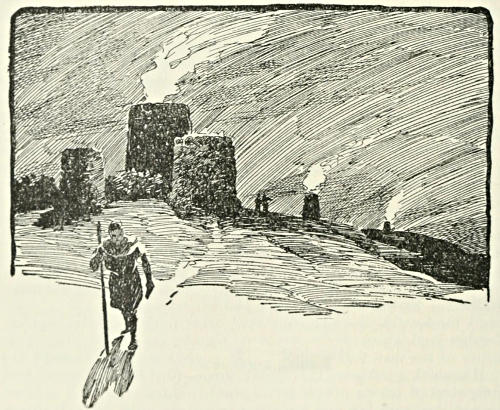
Ancient Roman Tower near Rome
In speaking of lakes, we must
resume our twofold division of
the peninsula. On the Alpine
slopes of the great valley of the
Po, the granitic and ancient
limestone rocks break into vast
chasms at right angles to their
general direction, in which the
waters of the rivers that flow
downwards to join the Po accumulate and form those lakes so well known
to all lovers of natural beauty. Such are Lake Benacus (Lago di Garda)
formed by the waters of the Mincius; Larius (Lago di Como) by those of the
Adda; Verbanus (Lago Maggiore) by those of the Ticino; not to mention
the lakes of Lugano, Orta, and others, smaller, indeed, but hardly less beautiful.
But Apennine Italy, considering the great extent of its mountain districts,
does not present many considerable lakes. Nor are these formed by the
accumulated waters of rivers flowing through them, like the lakes of northern
Italy or Switzerland. For the most part, like the lakes of Greece, they have
no visible outlet, but lose their waters partly by evaporation, partly by underground
fissures and channels. The Fucine Lake in the Æquian hills
feeds the Sangro, and Lake Bradanus in the south feeds the river of the
same name. But the celebrated Lake Trasimene in Etruria, and the lakes
of the volcanic district, as the “great Volsinian Mere,” the lakes of Alba,
Nemi, Amsanctus, and others, have no visible outlet. These, in fact, are the
craters of extinct volcanoes. Roman history contains legends which relate to
the artificial tapping of these cauldrons; and some of the tunnels cut through
their rocky basins still remain.
The abundance of water which is poured over the hills is apt to accumulate
in marshy swamps in the low districts towards the sea. Such is the
case along the lower course of the Po, on the coast lands of Tuscany, and in
the lower part of the Campagna of Rome. Mantua, which stands a little
above the junction of the Mincio with the Po, is surrounded by marshes;
and the whole coast between Venice and Ravenna is a swamp.
To keep the Po and its tributaries within their channels, the Lombards
of the Middle Ages raised embankments on either side of the stream. But
these embankments cause the rivers to deposit the whole of the mud with
which they are charged within their channels, and the quantity thus deposited
is so great that it is necessary to raise the embankments continually.
Hence, in the course of centuries, the bottoms of the rivers have been elevated
considerably above the plains; so that the streams of Lombardy in their
lower course are in fact carried along huge earthen aqueducts. In time,
human industry will not be equal to raise these embankments in sufficient
strength, and a deluge will ensue more fearful than those which the poet of
Mantua seems to have witnessed.
It is a common remark that mountains are the chief boundaries of
countries, and that races of men are found in their purest state when they
are separated by these barriers from admixture with other tribes. Italy
forms an exception to this rule. It was not so much the “fatal gift of
beauty,” of which the poet speaks, as the richness of its northern plain, that
attracted successive tribes of invaders over the Alps. From the earliest
dawn of historic knowledge, we hear of one tribe after another sweeping
like waves over the peninsula, each forcing its predecessor onward, till there
arose a power strong enough to drive back the current, and bar aggression
for many an age. This power was the Roman Empire, which forced the
Gauls to remain on the northern side of the Apennines, and preserved Italy
untouched by the foot of the foreigner for centuries. No sooner was this
power weakened, than the incursions again began.
But if the northern barriers of the peninsula failed to check the lust
of invaders, its long straggling shape, intersected by mountains from top to
bottom, materially assisted in breaking it up into a number of different
nations. Except during the strength of the Roman Empire, Italy has always
been parcelled out into a number of small states. In the earliest times it
was shared among a number of tribes differing in race and language. Great
pains have been taken to investigate the origin and character of these primeval
nations. But the success has not been great, and it is not our purpose
to dwell on intricate questions of this kind. We shall here only give results
so far as they seem to be established.
It is well known that it was not till the close of the republic, or rather
the beginning of the empire, that the name of Italy was employed, as we
now employ it, to designate the whole peninsula, from the Alps to the
Straits of Messina. The term Italia, borrowed from the name of a primeval
tribe which occupied the southern portion of the land, was gradually
adopted as a generic title in the same obscure manner in which most of the
countries of Europe, or (we may say) the continents of the world have
received their appellations. In the remotest times the name only included
lower Calabria; from these narrow limits it gradually spread upwards, till
about the time of the Punic Wars its northern boundary ascended the little
river Rubicon (between Umbria and Cisalpine Gaul), then followed the ridge
of the Apennines westward to the source of the Macra, and was carried down
the bed of that small stream to the Gulf of Genoa.
But under Roman rule even this narrower Italy wanted that unity of
race and language which, in spite of political severance, we are accustomed
to attribute to the name. Within the boundaries just indicated there were
at least six distinct races, some no doubt more widely separated, but all
marked by strong national characteristics. These were the Pelasgians, the
Oscans, the Sabellians, the Umbrians, the Etruscans, and the Greeks.
It is certain that in primitive times the coasts and lower valleys of
Italy were peopled by tribes that had crossed over from the opposite shores
of Greece and Epirus. These tribes belonged to that ancient stock called
the Pelasgian, of which so much has been written and so little is known.
The names that remained in southern Italy were practically all of a half-Hellenic
character. Such were, in the heel of Italy, the Daunians and
Peucetians (reputed to be of Arcadian origin), the Messapians and Salentines;
to the south of the Gulf of Tarentum, the Chaonians (who are also
found in Epirus); and in the toe the Œnotrians, who once gave name to all
southern Italy. Such also were the Siculians and other tribes along the
coast from Etruria to Campania, who were driven out by the invading Oscan
and Sabellian nations.
The Oscan or Opican race was at one time very widely spread over
the south. The Auruncans of lower Latium belonged to this race, as also
the Ausonians, who once gave name to central Italy, and probably also the
Volscians and the Æquians. In Campania the Oscan language was preserved
to a late period in Roman history, and inscriptions still remain
which can be interpreted by those familiar with Latin.
The Umbrians at one time possessed dominion over great part of central
Italy. Inscriptions in their language also remain, and manifestly show that
they spoke a tongue not alien to the Latin. The irruption of the Sabellian
and of the Etruscan nations was probably the cause which broke the power
of the Umbrians, and drove them back to a scanty territory between the
Æsis, the Rubicon, and the Tiber.
The greatest of the Italian nations was the Sabellian. Under this name
we include the Sabines, who are said by tradition to have been the progenitors
of the whole race, the Samnites, the Picenians, Vestinians, Marsians,
Marrucinians, Pelignians, and Frentanians. This race seems to have been
naturally given to a pastoral life, and therefore fixed its early settlements
in the upland valleys of the Apennines. Pushing gradually along this
central range, the mountaineers penetrated downwards towards the Gulf
of Tarentum; and as their population became too dense to find support
in their native hills, bands of warrior youths issued forth to settle in the
richer plains below. Thus they mingled with the Opican and Hellenic races
of the south, and formed new tribes, known by the names of Apulians,
Lucanians, and Campanians. These more recent tribes, in turn, threatened
the great Greek colonies on the coast, of which we shall speak presently.
We now come to the Etruscans, the most singular people of the peninsula.
This people called themselves Rasena, or Rasenna—a name that
reminds us of the Etruscan surnames Porsenna, Vibenna, Sisenna. At one
time they possessed not only the country known to the Romans as Etruria
(that is, the country bounded by the Macra, the central Apennine ridge,
and the Tiber), but also occupied a large portion of Liguria and Cisalpine
Gaul; and perhaps they had settlements in Campania. In early times
they possessed a powerful navy, and in the primitive Greek legends they
are represented as infesting the Mediterranean with their piratical galleys.
They seem to have been driven out of their trans-Apennine possession by
early invasions of the Gauls; and their naval power never recovered the
blow which it received in the year 480 B.C., when Gelo, tyrant of Syracuse,
defeated their navy, combined with that of Carthage, on the same day on
which the battle of Salamis crippled the power of Persia.[2]
But who this people were, or whence they came, baffles conjecture.
It may be assumed as certain, that Hellenic settlers came in by sea from
the western coasts of Epirus, which are distant from Italy less than fifty
miles; and that the Opican, Umbrian, and Sabellian races came in from
the north by land. But with respect to the Etruscans all is doubtful.
One well-known legend represents them as Lydians, who fled by sea from
Asia Minor to avoid the terrible presence of famine. Another indicates
that they came down over the Alps, and the origin of their name Rasena
is traced in Rætia. On the former supposition, Etruria was their earliest
settlement, and, pushing northward, they conquered the plain of the
Po; on the latter, they first took possession of this fertile plain, and then
spread southward over the Apennines.
Their language, if it could be interpreted, might help to solve the riddle.
But though characters in which their inscriptions are written bear close
affinity to the Greek and Roman alphabets, the tongue of this remarkable
people has as yet baffled the deftest efforts of philology.
Of the Greek settlements that studded the coast of lower Italy, and
gave to that district the name of Magna Græcia, little need here be said.
They were not planted till after the foundation of Rome. Many of them,
indeed, attained to great power and splendour; and the native Osco-Pelasgian
population of the south became their subjects or their serfs. Sybaris
alone, in the course of two centuries, is said to have become mistress of
four nations and twenty-five towns, and to have been able to raise a civic
force of 300,000 men. Croton, her rival, was even larger. Greek cities
appear as far north as Campania, where Naples still preserves in a corrupt
form her Hellenic name, Neapolis. The Greek remains discovered at
Canusium (Canosi) in the heart of Apulia, attest the extent of Hellenic
dominion. But the Greeks seem to have held aloof from mixture with the
native Italians, whom they considered as barbarians. Rome is not mentioned
by any Greek writer before the time of Aristotle (about 340 B.C.).
From the foregoing sketch it will appear that Latium formed a kind
of focus, in which all the different races that in past centuries had been
thronging into Italy converged. The Etruscans bordered on Latium to
the west; the Sabines, with the Umbrians behind them, to the north; the
Æquians and Volscians, Oscan tribes, to the northeast and east; while
Hellenic communities are to be traced upon the coast lands. We should
then expect beforehand to meet with a people formed by a commixture
of divers tribes; and this expectation is confirmed.
Tradition tells us that the aborigines of Latium mingled in early times
with a people calling themselves Siculians; that these Siculians, being conquered
and partly expelled from Italy, took refuge in the island, which
was afterwards called Sicily from them, but was at that time peopled by
a tribe named Sicanians; that the conquering people were named Sacranians,
and had themselves been forced down from the Sabine valleys in the
neighbourhood of Reate by Sabellian invaders; and that from this mixture
of aborigines, Siculians, and Sacranians arose the people known afterwards
by the name of Latins. Where all is uncertain, conjecture is easy. But all
conjectures bear witness to the compound nature of the Latin nation.b
About fourteen miles upstream from the mouth of the river Tiber, and
on either bank of the latter, rise gentle slopes, the higher on the right, the
lower on the left; to the latter for at least two and a half thousand years
the name of the Romans has been affixed. It cannot, of course, be positively
declared how and when it arose, it is only certain that in the oldest form of
the name known to us, the inhabitants of the province were not called
Romans but—with a change of pronunciation natural enough in the more
ancient stages of a language but not continued in the Latin known to us—Ramnians
or Ramnes; an eloquent witness to the immemorial antiquity of
this name. The exact derivation cannot be determined; it is possible that
the Ramnes are the people of the stream. But they did not dwell alone on
the bank of the Tiber. In the oldest classification of the Roman citizens, we
find traces showing that the nation derived its origin from the fusion into
a single commonwealth of three once apparently independent tribes, the
Ramnes, the Tities, and the Luceres: that is, from a synoikismos like that
whence Athens arose in Attica.[3]
Again, after the union, each of these three ancient communities, which
had now become demes, owned a third of the common lands, and was similarly
represented in the militia as well as in the council of the elders, whilst
in the religious organisation the numbers of the six vestal virgins, the three
high priests of Jupiter, Mars, and Quirinus, are apparently to be referred to
this threefold division.
The most wanton absurdities have been founded on the existence of the
three elements into which the ancient Roman commonwealth was divided;
the irrational idea that the Roman nation was a mixed race is connected
with it, and its supporters labour in various ways to represent the three
great Italian races as the component elements of ancient Rome, and to transform
the people which developed its speech, its government, and its religion
with a purity and national spirit attained by few others, into a confused
mass of Etruscan, Sabine, Hellenic, and, still worse, even Pelasgic elements.
Setting aside the sometimes contradictory, sometimes groundless hypotheses,
all that can be said concerning the nationality of the various elements of the
ancient Roman commonwealth may be summed up in a few words. That
the Ramnes were of Latin origin cannot be doubted, since they gave their
name to the new Roman commonwealth and maintained the chief place
amongst the three tribes, so that they must have decided the nationality of
the united community.
As to the descent of the Luceres, nothing can be said except that there
is no obstacle to their being regarded as a Latin tribe like the Ramnes. On
the other hand the second of these tribes is unanimously derived from that
of the Sabines, doubtless on the authority of a respectable and authentic
tradition of the “Titian brotherhood” which claimed to have been founded
on the admission of the tribe to the confederacy for the preservation of its
peculiar national ritual. Traces of such an aboriginal Sabine worship are in
fact to be found in Rome; as for instance the honouring of Maurs or Mars
and of Semo Sancus, side by side with the corresponding Latin Dius Fidius.
It was at a very remote period, when the Latin and Sabine tribes were yet
unquestionably far less distinctly unlike in language and customs than were
the Roman and the Samnite later, that a Sabellian community entered into
a Latin tribal union; exactly in the same way that some centuries afterwards
the Sabine clan of Attus Clanzus, or Appius Claudius, and his clients
emigrated to Rome, obtained a grant of land on the right bank of the Anio
and was soon completely absorbed into the Roman community.
Death of Remus
(From a picture by Mirys)
A fusion of various nationalities did of course take place; but we are
not therefore justified in counting the Romans amongst mixed peoples.
With the exception of isolated national institutions transplanted into the
ritual, the existence of Sabellian elements is never manifested in Rome, and
in especial the Latin tongue affords no support to such an hypothesis. It
would indeed be more than surprising if the addition to the Latin nation of
a single tribe from one of the races nearest allied to the Latin, had affected
its nationality in perceptible fashion; and in addition it must by no means
be forgotten that, at the time when the Tities settled near the Romans, the
Latin nationality had its headquarters at Latium, not at Rome. The new
threefold Roman commonwealth was, in spite of its quickly assimilated
Sabellian element, just what the tribe of the Ramnes had been—a part of the
Latin nation.
Long before an urban settlement rose on the Tiber, those Ramnes, Tities,
and Luceres may have had their township on the Roman hills and tilled
their fields from the surrounding villages, at first separately and afterwards
in concert. The festival of the wolf, lupercalia, which the family of Quinctii
celebrated on the Palatine Hill, may be a tradition of this earliest time; it
was a festival of peasants and shepherds which preserves the homely sports
of patriarchal simplicity in a way equalled by none other, and remarkably
enough was the one of all the heathen festivals which survived for a time in
Christian Rome.
From these settlements, then, sprang the later Rome. Of the actual
foundation of the town as the legend relates it, we cannot of course in any
sense speak; Rome was not built in a day. It is, however, well worth considering
by what means Rome could have attained to her eminent political
position in Latium, when the nature of the locality would rather lead us to
an opposite expectation. The site on which Rome stands is less healthy and
less fertile than that of most old Latin towns. The vine and the fig tree
do not thrive in the immediate neighbourhood of Rome, and there is a lack
of bountiful springs—for neither the excellent fount of Camenæ before the
Porta Capena, nor the Capitoline well, afterwards enclosed in the Tullianum,
yields much water. To all this was added the frequent overflowing of the
river, which, owing to its very slight incline, was unable during the rainy
season to carry seaward the copious influx from the mountain streams with
speed enough to prevent its flooding the valleys and low tracts of land which
opened between the hills, and reducing them to a mere marsh. The place is
by no means alluring to the settler and even in ancient times it was said that
it could not have been its fitness for colonisation which attracted the first
immigrant farmers to that unhealthy and infertile spot in a favoured district;
but that necessity, or rather some other very special reason, must have
prompted the building of the town.
The strangeness of the choice is acknowledged even in the legend; the
tale of the foundation of Rome by refugees from Alba, under the leadership of
the Albanian princes Romulus and Remus, is nothing but a naïve attempt of
early quasi-history to explain the strangeness of the establishment of the city
on so unfavourable a site, and at the same time to connect the origin of
Rome with the common metropolis of Latium. It is especially from such
fairy tales which purport to be history and are nothing but inventions made
on the spur of the moment and not particularly clever, that serious history
has to disencumber itself; but perhaps it is permissible to go a step further,
and after considering the special features of the neighbourhood, to advance
a positive theory, not as to the origin of the place, but as to the cause of its
swift and astonishing prosperity and of its peculiar position in Latium.
Let us look first at the ancient boundaries of the Roman territory. To
the east the towns of Antemnæ, Fidenæ, Cænina, Collatia, and Gabii lie in
the near neighbourhood, some of them not five miles distant from the gates
of Servian Rome; the boundary of the province must consequently have
been hard by the city gates. Fourteen miles to the south we come on the
powerful communities of Tusculum and Alba, and here the Roman territory
seems not to have extended farther than to the Fossa Cluilia, five miles from
Rome. Similarly, in the southwesterly direction, the boundary between Rome
and Lavinium was already encountered at the sixth milestone.
Whilst on the land side the Roman province was everywhere confined
to the narrowest possible limits, on the other hand, from the earliest times it
stretched uninterruptedly along both banks of the Tiber in the direction of
the sea; and no place representing an ancient provincial centre nor any sort
of trace of an ancient provincial border is encountered between Rome and
the coast. It is true that legend, which can assign an origin for everything,
is here also able to inform us that the Roman possessions on the right bank
of the Tiber, the “seven hamlets” (septem pagi), and the important salt-works
at its mouth were taken by King Romulus from the Veientes, and
that King Ancus fortified the tête de pont, the “Mount of Janus” (Janiculum),
on the right bank of the Tiber, and on the left laid the foundation of
the Roman Piræus, the harbour town at the “mouth” (ostia) of the river.
But on the other hand the fact that the possessions on the Etruscan bank
must have belonged to the very earliest Roman territory is attested by a better
witness, namely by the grove of the creative goddess (Dea Dia) which stood
in this very place, at the fourth milestone of the road subsequently made
to the harbour, and was the original high place of the Roman Arval festival
and Arval brotherhood. Indeed, from time immemorial, the clan of the
Romilii, probably the most distinguished among all the Roman clans, had its
seat here; the Janiculum was a part of the town itself and Ostia a citizen
colony, that is, a suburb. This cannot have been mere chance. The Tiber
was the natural highway of Latium, and its mouth, on a coast so poorly provided
with harbours, was the necessary place of anchorage for ships.
Moreover, the Tiber formed, from the earliest times, the frontier defence
of the Latin stock against their northern neighbours. No place is better
qualified than Rome to be both the entrepôt of the Latin river and sea commerce
and the frontier fortress of Latium. She combined the advantages of
a strong position and the immediate neighbourhood of the river; she commanded
both banks of the stream down to its mouth; she was equally
convenient for the river-ships descending the Tiber or the Anio or, in those
days of moderate-sized vessels, for those designed for the sea; and she
afforded better protection against pirates than the towns lying immediately
on the coast. That it was to these commercial and strategical advantages that
Rome owed, if not her origin, at least her importance, numerous proofs are
forthcoming, which are of far greater importance than the data furnished by
historical romances. With these are connected her early relations with Cære,
which was to Etruria what Rome was to Latium, and consequently became
the city’s closest neighbour and commercial ally; thence came the extraordinary
importance of the bridges over the Tiber, and of bridge building generally
in the Roman commonwealth, and hence the galley in the city arms.
This was also the origin of the ancient Roman harbour dues, which were
originally imposed only on goods for sale (promercale), and not on those
which passed to and from Ostia for the shipper’s own use, and thus were
really a tax on trade. And hence, to anticipate, arose the relatively early
appearance of coined money in Rome and the commercial treaties with
states over-sea. Thus, from this point of view at any rate, Rome may be
regarded as the legend implies, rather as a created than a gradually developed
town and rather as the youngest than the oldest of the Latin towns.
Doubtless the land had been already to some extent brought under cultivation
and towns planted on the Alban hills as well as many other heights of the
surrounding country when the Latin frontier emporium rose on the Tiber.
Whether it was a decree of the Latin confederacy, or the genius and
insight of some unknown founder, or the natural development of commerce,
which called the city of Rome into existence, we have not even grounds to
conjecture. But there is another point to be observed in connection with
the position of Rome as the emporium of Latium. When history begins to
dawn upon us Rome stands in contrast to the league of the Latin communities
as a single enclosed city. The Latin custom of dwelling in open villages
and only using the common town as a fortress and place of assembly or in
time of need, was, in all probability, far sooner restricted in the Roman
province than anywhere else in Latium. Not that the Roman had ceased to
manage his farm himself, or to regard it as his real home; but already the
unhealthiness of the country air had had the effect of inducing him to fix
his abode on the more airy and healthy heights of the town; and with the
farmers a numerous non-agricultural population of foreigners and natives
must have been established there for a long time. This to some extent
accounts for the dense population of the Roman territory, which at most can
only be reckoned as extending over 115 square miles of soil, part of it
marsh and sand, and yet, according to the city’s oldest constitution, furnished
a city militia of thirty-three hundred freemen, and therefore must
have counted at least ten thousand free inhabitants.
But there is something more. Everyone acquainted with the Romans
and their history is aware that the peculiarity of their public and private
existence lies in their municipal and commercial life, and that the distinction
between them and other Latins, and Italian nations generally, is before all
the distinction between the citizen and the farmer. It is true that Rome
was not a mercantile city like Corinth or Carthage; for Latium is an essentially
agricultural district and Rome was, and remained, above everything a
Latin town. But the distinction of Rome above the crowd of other Latin
towns must still be referred to her commercial position and to the influence
of that position upon the character of her citizens. If Rome was the
emporium of the Latin district, it is easy to understand that here, over
and above the Latin husbandry, a vigorous municipal life quickly developed
itself and so laid the foundation of her pre-eminence. The tracing of the
course of this mercantile and strategic development of the city of Rome
is far more important and far easier than the thankless task of making a
chemical analysis of the insignificant and very similar communities of
antiquity; we can follow this development to some extent in the traditions
concerning these successive walls and fortifications of Rome, whose erection
must have gone hand in hand with the advance of the Roman commonwealth
to importance as a city.
Both in former and recent times many attempts have been made to give
an historical character to the legend that the three different communities
which composed the ancient Roman nation once dwelt within separate walls
on the Seven Hills; but the scientific inquirer is obliged to banish it to the
same regions as the battle of the Palatine and the graceful story of Tarpeia.
There exists, it is true, a real and very decided distinction between the
fortification of the Capitol and the erection of the town walls. The Capitol
is in name and fact the Acra of Rome, the town with one gate and a town
fountain, the carefully fenced “spring house” (tullianum). That this
fortification dates far back to a time when as yet there was no settlement at
all in this neighbourhood, is shown by a custom which was scrupulously
observed down to a late period, and according to which private houses did
not and perhaps were not allowed to stand on the twin peaks of the Capitol.
On the other hand the town contained a treasure chamber with the archives,
the prison, and the oldest place of assembly for the councillors as well as the
citizens. The space between the two peaks of the Capitoline Hill, the
sanctuary of the angry Jupiter (Vediovis) or as it was called in the later
hellenising period, the Asylum, was covered with a wood and evidently
originally intended to shelter the peasants and their flocks when flood or
war drove them from the plain.
In Rome, as everywhere else, the urban settlement must have begun not
within but below the citadel; when it was considerable enough to call for
the protection of a wall and moat, the town proper first came into being
outside the Capitol, and to this, again, suburbs were added, and as these also
prospered and required to be defended, new walls were added and in the
marshes a new dike, until a whole series of such separate circumvallations
surrounded the citadel. It was the memory of this which was preserved
in the “festival of the Seven Hills” (Septimontium), whose celebration was
continued long after the ancient fortifications had ceased to exist.
The “seven circles” are the Palatine; the Cermalus, a branch of the
Palatine extending towards the swamp (Velabrum) which in early days
stretched between it and the Capitol; the Velia, the ridge which connected
the Palatine with the Esquiline and afterwards almost completely disappeared
owing to the constructions erected under the empire; the three
summits of the Esquiline, Oppius, Cispius, and Fagutal; and finally the
Secusa or Subura, an ingenious stronghold on the low ground between
the Capitol, the Esquiline, and the Palatine. It is obvious that these walls
did not spring up all at once. According to credible witnesses the oldest
constructions only embrace the Palatine or the primitive Rome, called at a
later period “the square” (Roma quadrata) from the shape of the Palatine
Hill which was that of an irregular square. The gates and walls of this
ancient urban circle remained visible down to the time of the empire;
the position of two of them, namely the Porta Romana, near S. Giorgio in
Velabro, and the Porta Mugionis at the arch of Titus, are still known to
us, and the wall encircling the Palatine is even described by Tacitus from
his own observation, at least on the side facing the Aventine and the Cælian.
Although, of course, the earliest seat of the trade of the community was not
here but at the citadel, still there are sufficient indications to show that this
was the centre and the original seat of the urban settlers. On the Palatine
was to be found its holy symbol, the so-called “outfit vault” (mundus) in
which they had deposited all the requisites of a household and added a
handful of their beloved native earth. Here too stood the building in which
the curiæ assembled, each at its own altar, for religious and other purposes
(curiæ veteres). Here too was the sanctuary of “the wolves” (lupercal),
the house of assembly for “the leapers” (curia saliorum), and the dwelling
of Jupiter’s priest. It was on and round this hill that the legend of the
founding of the city was principally localised, and the believer was shown
the straw-covered house of Romulus, the shepherd’s hut of his foster-father
Faustulus, the holy fig tree on to which the coffer containing the twins was
driven, and other similar relics.
The Palatine was, and remained, the most aristocratic quarter of the city
and therefore subsequently gave its name to the first Servian district. The
oldest offshoots may have been the settlement on the branch of the Cermalus
and the Velian heights, both of which were immediately connected
with the Palatine and, under the Servian division of the town, were apparently
included in the Palatine quarter. The position of the suburb on
the Cermalus, between the town wall and that of the citadel, as well as the
designation of the principal street by the name of “the Tuscan,” seems to
indicate that this settlement was not voluntary but reserved for the custody
of colonists of foreign race.
Beyond this there was a settlement on the Carinæ, the farthest summit
of the Esquiline, with the fortress for defence against the Sabines in the
valley of the Subura; this afterwards became the second Servian quarter.
At that time the Esquiliæ (which did not properly speaking include the
Carinæ) formed, as the name signifies, a suburb (exquiliæ, the same as inquilinus).
That the town should have extended itself in this direction is
explained by the simple fact that the people remained on the heights, especially
on the Palatine and the Velian, avoiding both the isolated hills and
the swampy and wholly defenceless valleys which lay between. At a later
time the suburb was included in the town, and under the Servian division
it became the third quarter.
The “bridge of piles” (pons sublicius) thrown across that natural pier,
the island in the Tiber, and the tête de pont on the Etruscan shore, the citadel
of the Janiculum, remained outside the fortifications of the “Seven Hills.”
And as, for military reasons, it was necessary to be able to break down or
burn the bridge at the shortest notice, there arose a fixed rule which down
to a very late period was observed as a traditional religious law, that no
iron could be used in the construction of the bridge, but only wood. Thus
a town came into being, but nevertheless the real and complete amalgamation
of the various bodies which formed the settlement was not yet effected.
As there was no common city altar, but the separate altars of the different
curies merely stood side by side in the same neighbourhood, so not only did
the distinction between citadel and town continue, but the seven circles
themselves were rather a collection of urban settlements than a united town
until the gigantic defensive works, ascribed to King Servius Tullius, surrounded
the inner and outer city and the open suburbs with a single great
wall. But before these strong works were set in hand, the position of Rome
in relation to the surrounding district had doubtless entirely changed.
As the primitive uncommercial and inactive epoch of the Latin stock
corresponds to the period in which the husbandman drove the plough on
the Palatine as well as over the other hills of Latium, and the place of
refuge on the Capitol, which in ordinary times stood empty, presented only
the commencement of a fortified settlement; and as later the flourishing
settlement on the Palatine and within the seven circles coincides with the
occupation of the estuary of the Tiber by a Roman community and generally
with the progress of the Latins to a free and active intercourse, and urban
civilisation especially in Rome, and indeed to a firmer political consolidation
both of the separate states and of the confederacy; so does the establishment
of a single great city by means of the Servian rampart belong to
that epoch in which the city of Rome was enabled to contend for the supremacy
of the Latin confederacy and finally to get the upper hand.c
It is not easy to determine between either the facts or the writers,
which of them deserves the preference: I am inclined to think that
history has been much corrupted by means of funeral panegyrics and
false inscriptions on statues; each family striving by false representations
to appropriate to itself the fame of warlike exploits and public
honours. From this cause, certainly, both the actions of individuals
and the public records of events have been confused. Nor is there
extant any writer, contemporary with those events, on whose authority
we can certainly rely.—Livy.
According to the legends immortalised by Virgilf if not by Livy,c Æneas,
escaping from Troy, after its destruction by the Greeks (as narrated in the
Homeric poems), fled to Italy, and there became the progenitor of the people
afterwards to be known as the Romans. So firmly stamped did this
legend become in classical literature that few or no writers share even
Livy’s polite scepticism. For many centuries after the Roman Empire itself
had passed away, the fabulous stories of the foundation of Rome were
repeated by one generation after another of historians, as unequivocal fact.
It was only about a century ago, in an age of scepticism, that an
iconoclastic critic arose to lay rude hands upon the time-honoured stories.
This critic was the German Niebuhr.e He analysed legends not alone of
the foundation, but of the supposed early history of Rome, and reached the
indubitable conclusion that the familiar stories of early Roman kings and
heroes were little better than pure fictions.
The work which Niebuhr began has been carried on by a school of successors,
until it must be said that the entire fabric of once-accepted early
Roman history has been torn into shreds. And in its place has been substituted—practically
nothing. It is true that Niebuhr himself, iconoclast that
he was, could not free himself from that hypothesis-forming tendency which
is the heritage of all active minds, and put forward many prosaic guesses at
the truth as substitutes for the old-time poetical guesses which he had
dethroned. But these latter-day hypotheses, though accepted for the moment
by many disciples of the master historian, have been treated with far
scanter courtesy by the newer generation of critics, many of whom, however,
have in turn supplied their own surmises. The net result of all the researches
of the past century, and of all the surmises with which these
researches have been supplemented, is to leave us practically without any
acceptable hypothesis, except perhaps a meagre though consistent outline of
institutional and civic development.
And scarcely less vague are the outlines of the story of the early growth
of Rome, and of its internal government and external accomplishments
during some centuries of its undoubted existence. That it was ruled in the
early days by kings, has been accepted on the basis of universal tradition,
but it can scarcely be said that any one of these kings is to be regarded to-day
as a known historic personage. We are not even sure as to the time
when the kings were banished and a republican form of government supplanted
the monarchy, though the accepted dates ascribe this transition to
the year 509 B.C.—which, curiously enough, was the time of the banishment
of the Pisistratidæ from Athens. If this date be accepted, it would
seem that the evolution of political ideas in Greece was curiously paralleled
by the growth of the same spirit in Rome, and it would follow that the civilisations
of the two peoples were more closely contemporaneous than they are
usually considered to have been.
But the true fruitage of a nation is found in the permanent works which
it transmits to posterity, and judged by this standard Rome surely did not
come to its prime until Greece was on the path of its decadence. It may be
true that Rome banished her kings and came under republican sway almost
as early as Athens; but the Greek city had had a far longer preparation and
burst at once into its full bloom of civilisation, as evidenced in the “Age
of Pericles,” whereas the Roman civilisation had still to pass through many
generations of development before it began to produce those lasting records
which mark the difference between tradition and history. Even so, however,
the gap in time between the Grecian and the Roman periods was not
very great—there were but three centuries between Alexander and Cæsar.
And in the time of the later emperors the two civilisations were curiously
merged in the East, where the whole aspect of the Roman court became
Grecian, and the Greek language even became the official medium of communication
throughout the remnants of the Roman Empire.
Of these later phases of the development and decay of the Roman Empire,
abundant and secure records are in evidence, as we shall see later on.
Meantime, though the stories of the early or mythical period cannot be called
history, in the narrower sense of the word, they were too long believed, and
have too often been repeated to be suddenly ignored. They are no longer
accepted as sober history, and yet the most sober historian dares not altogether
discard them. As in the case of the Greek mythology, the happiest
compromise seems to be that in which the more interesting tales are retained
and repeated with the explicit qualification that they are to be accepted as
legends only. This applies not merely to the stories of the foundation of
Rome and of the earlier kings, but even, it must freely be admitted, to the
hero tales of Horatius, the elder Brutus, Cincinnatus, Coriolanus, and the
rest; though doubtless, as one comes down the years, the historical element
makes itself more and more felt, and the legendary basis becomes less and less
dominant. We have first to do, however, with a series of citations which,
let it be said once for all, are purely legendary, and which each individual
reader is quite at liberty to interpret as best suits his individual
imagination.a
When the fatal horse was going to be brought within the walls of Troy,
and when Laocoön had been devoured by the two serpents sent by the gods
to punish him because he had tried to save his country against the will of
fate, then Æneas and his father Anchises, with their wives, and many who
followed their fortune, fled from the coming of the evil day. But they
remembered to carry their gods with them, who were to receive their worship
in a happier land. They were guided in their flight from the city by
the god Hermes, and he built for them a ship to carry them over the sea.
When they put to sea the star of Venus, the mother of Æneas, stood over
their heads, and it shone by day as well as by night, till they came to the
shores of the land of the West. But when they landed the star vanished
and was seen no more; and by this sign Æneas knew that he was come to
that country wherein fate had appointed him to dwell.
The Trojans, when they had brought their gods on shore, began to sacrifice,
but the victim, a milk-white sow just ready to farrow, broke from the
priest and his ministers and fled away. Æneas followed her; for an oracle
had told him that a four-footed beast should guide him to the spot where he
was to build his city. So the sow went forward still she came to a certain
hill, about two miles and a half from the shore where they had purposed to
sacrifice, and there she lay down and farrowed, and her litter was of thirty
young ones. But when Æneas saw that the place was sandy and barren,
he doubted what he should do. Just at this time he heard a voice which
said: “The thirty young of the sow are thirty years; when thirty years
are passed, thy children shall remove to a better land; meantime do thou
obey the gods, and build thy city in the place where they bid thee to build.”
So the Trojans built their city on the spot where the sow had farrowed.
Now the land belonged to a people who were the children of the soil,
and their king was called Latinus. He received the strangers kindly, and
granted to them seven hundred jugera of land, seven jugera to each man,
for that was a man’s portion. But soon the children of the soil and the
strangers quarrelled; and the strangers plundered the lands round about
them; and King Latinus called upon Turnus, the king of the Rutulians of
Ardea, to help him against them. The quarrel became a war: and the
strangers took the city of King Latinus, and Latinus was killed; and Æneas
took his daughter Lavinia and married her, and became king over the children
of the soil; and they and the strangers became one people, and they
were called by one name, Latins.
But Turnus called to his aid Mezentius, king of the Etruscans of Cære.
There was then another battle on the banks of the river Numicius, and Turnus
was killed, and Æneas plunged into the river and was seen no more.
However his son Ascanius declared that he was not dead, but that the gods
had taken him to be one of themselves; and his people built an altar to him
on the banks of the Numicius, and worshipped him by the name of Jupiter
Indiges, which means,“the god who was of that very land.”
The war went on between Mezentius and Ascanius, the son of Æneas;
and Mezentius pressed hard upon the Latins, till at last Ascanius met him
man to man, and slew him in single fight. At that time Ascanius was very
young, and there were only the first soft hairs of youth upon his cheeks;
so he was called Iulus, or “the soft-haired,” because, when he was only a
youth, he had vanquished and slain his enemy, who was a grown man.
At length the thirty years came to an end, which were foreshown by the
litter of thirty young ones of the white sow. Ascanius then removed with
his people to a high mountain, which looks over all the land on every side,
and one side of it runs steep down into a lake: there he hewed out a place
for his city on the side of the mountain, above the lake; and as the city
was long and narrow, owing to the steepness of the hill, he called it Alba
Longa, which is, “the white long city,” and he called it white, because of
the sign of the white sow.
Ascanius was succeeded by a son of Æneas and Lavinia named Silvius,
and the eleven kings of Alba who succeeded him all bore the surname of
Silvius.
Numitor was the eldest son of Procas, the last king of Alba Longa, and
he had a younger brother called Amulius. When Procas died, Amulius
seized by force on the kingdom, and left to Numitor only his share of his
father’s private inheritance. After this he caused Numitor’s only son to be
slain, and made his daughter Silvia become one of the virgins who watched
the ever-burning fire of the goddess Vesta. But the god Mamers, who
is called also Mars, beheld the virgin and loved her, and it was found that
she was going to become the mother of children. Then Amulius ordered
that the children, when born, should be thrown into the river. It happened
that the river at that time had flooded the country; when, therefore,
the two children in their basket were thrown into the river, the waters
carried them as far as the foot of the Palatine Hill, and there the basket
was upset, near the roots of a wild fig tree, and the children thrown out
upon the land. At this moment there came a she-wolf down to the water to
drink, and when she saw the children, she carried them to her cave hard by,
and gave them to suck; and whilst they were there, a woodpecker came
backwards and forwards to the cave, and brought them food. At last one
Faustulus, the king’s herdsman, saw the wolf suckling the children; and when
he went up, the wolf left them and fled; so he took them home to his wife
Larentia, and they were bred up along with their own sons on the Palatine
Hill; and they were called Romulus and Remus.
When Romulus and Remus grew up, the herdsmen of the Palatine Hill
chanced to have a quarrel with the herdsmen of Numitor, who stalled their
cattle on the hill Aventinus. Numitor’s herdsmen laid an ambush, and
Remus fell into it, and was taken and carried off to Alba. But when the young
man was brought before Numitor, he was struck with his noble air and bearing,
and asked him who he was. And when Remus told him of his birth, and
how he had been saved from death, together with his brother, Numitor
marvelled, and thought whether this might not be his own daughter’s child.
In the meanwhile, Faustulus and Romulus hastened to Alba to deliver
Remus; and by the help of the young men of the Palatine Hill, who had
been used to follow him and his brother, Romulus took the city, and Amulius
was killed; and Numitor was made king, and owned Romulus and Remus
to be born of his own blood.
[ca. 753-716 B.C.]
The two brothers did not wish to live at Alba, but loved rather the hill
on the banks of the Tiber where they had been brought up. So they said
that they would build a city there; and they inquired of the gods by augury,
to know which of them should give his name to the city. They watched
the heavens from morning till evening, and from evening till morning; and
as the sun was rising, Remus saw six vultures. This was told to Romulus;
but as they were telling him, behold there appeared to him twelve vultures.
Then it was disputed again, which had seen the truest sign of the gods’
favour; but the most part gave their voices for Romulus. So he began to
build his city on the Palatine Hill. This made Remus very angry; and
when he saw the ditch and the rampart which were drawn round the space
where the city was to be, he scornfully leaped over them, saying, “Shall
such defences as these keep your city?” As he did this, Celer, who had
the charge of the building, struck Remus with the spade which he held in
his hand, and slew him; and they buried him on the hill Remuria, by the
banks of the Tiber, on the spot where he had wished to build his city.
Roman Urn
The Sabines with their king dwelt on the hill Saturnius, which is also
called Capitolium, and on the hill Quirinalis; and the people of Romulus
with their king dwelt on the hill Palatinus. But the kings with their counsellors
met in the valley between Saturnius and Palatinus, to consult about
their common matters; and the place where they met was called Comitium,
which means “the place of meeting.”
Soon after this, Tatius was slain by the people of Laurentum, because
some of his kinsmen had wronged them, and he would not do them justice.
So Romulus reigned by himself over both
nations; and his own people were called the
Romans, for Roma was the name of the city
on the hill Palatinus; and the Sabines were
called Quirites, for the name of their city on
the hills Saturnius and Quirinalis was Quirium.
The people were divided into three tribes:
the Ramnes, and the Tities, and the Luceres;
the Ramnes were called from Romulus, and the
Tities from Tatius; and the Luceres were
called from Lucumo, an Etruscan chief, who
had come to help Romulus in his war with the
Sabines, and dwelt on the hill called Cælius.
In each tribe there were ten curiæ, each of
one hundred men; so all the men of the
three tribes were three thousand, and these
fought on foot, and were called a legion.
There were also three hundred horsemen, and
these were called Celerians, because their
chief was that Celer who had slain Remus.
There was besides a council of two hundred men, which was called a senate,
that is, a council of elders.
Romulus was a just king, and gentle to his people; if any were guilty of
crimes he did not put them to death, but made them pay a fine of sheep or
of oxen. In his wars he was very successful, and enriched his people with
the spoils of their enemies. At last, after he had reigned nearly forty years, it
chanced that one day he called his people together in the Field of Mars,
near the Goats’ Pool: when all on a sudden there arose a dreadful storm,
and all was as dark as night; and the rain, and thunder, and lightning were
so terrible, that all the people fled from the field, and ran to their several
homes. At last the storm was over, and they came back to the Field of Mars,
but Romulus was nowhere to be found; for Mars, his father, had carried
him up to heaven in his chariot. The people knew not at first what was
become of him; but when it was night, as one Proculus Julius was coming
from Alba to the city, Romulus appeared to him in more than mortal beauty
and grown to more than mortal stature, and said to him; “Go, and tell my
people that they weep not for me any more; but bid them to be brave and
warlike, and so shall they make my city the greatest in the earth.” Then
the people knew that Romulus was become a god; so they built a temple to
him, and offered sacrifice to him, and worshipped him evermore by the name
of the god Quirinus.b
The Rape of the Sabines
The Roman state was become so powerful, that it was a match for any of
the neighbouring nations in war, but, from the paucity of women, its greatness
could only last for one age of man; for they had no hope of issue at
home, nor had they any intermarriages with their neighbours. Therefore,
by the advice of the fathers, Romulus sent ambassadors to the neighbouring
states to solicit an alliance and the privilege of intermarriage for his new subjects,
saying that cities, like everything else, rose from humble beginnings;
that those which the gods and their own merit aided, gained great power
and high renown; that he knew full well, both that the gods had aided the
origin of Rome, and that merit would not be wanting; wherefore that, as
men, they should feel no reluctance to mix their blood and race with men.
Nowhere did the embassy obtain a favourable hearing: so much did they
at the same time despise and dread, for themselves and their posterity, so
great a power growing up in the midst of them. They were dismissed by
the greater part with the repeated question; whether they had opened any
asylum for women also, for that such a plan only could obtain them suitable
matches. The Roman youth resented this conduct bitterly, and the matter
unquestionably began to point towards violence.
Romulus, in order that he might afford a favourable time and place for
this, dissembling his resentment, purposely prepares games in honour of
Neptunus Equestris; he calls them Consualia. He then orders the spectacle
to be proclaimed amongst their neighbours; and they prepare for the celebration
with all the magnificence they were then acquainted with, or were capable
of doing, that they might render the matter famous, and an object of
expectation. Great numbers assembled, from a desire also of seeing the new
city; especially their nearest neighbours, the Cæninenses, Crustumini, and
Antemnates. Moreover the whole multitude of the Sabines came, with their
wives and children. Having been hospitably invited to the different houses,
when they had seen the situation, and fortifications, and the city crowded
with houses, they became astonished that the Roman power had increased
so rapidly. When the time of the spectacle came on, and while their minds
and eyes were intent upon it, according to concert a tumult began, and upon
a signal given the Roman youth ran different ways to carry off the virgins
by force.
A great number were carried off at haphazard, according as they fell
into their hands. Persons from the common people, who had been charged
with the task, conveyed to their houses some women of surpassing beauty,
destined for the leading senators. They say that one, far distinguished
beyond the others for stature and beauty, was carried off by the party of one
Talassius, and whilst many inquired to whom they were carrying her, they
cried out every now and then, in order that no one might molest her, that
she was being taken to Talassius; that from this circumstance this term
became a nuptial one.
The festival being disturbed by this alarm, the parents of the young
women retired in grief, appealing to the compact of violated hospitality,
and invoking the god, to whose festival and games they had come, deceived
by the pretence of religion and good faith. Neither had the ravished virgins
better hopes of their condition, or less indignation. But Romulus in person
went about and declared that what was done was owing to the pride of
their fathers, who had refused to grant the privilege of marriage to their
neighbours; but notwithstanding, they should be joined in lawful wedlock,
participate in all their possessions and civil privileges, and, than which
nothing can be dearer to the human heart, in their common children. He
begged them only to assuage the fierceness of their anger, and cheerfully
surrender their affections to those to whom fortune had consigned their persons.
He added that from injuries love and friendship often arise; and that
they should find them kinder husbands on this account, because each of them,
besides the performance of his conjugal duty, would endeavour to the utmost
of his power to make up for the want of their parents and native country.
To this the caresses of the husbands were added, excusing what they had
done on the plea of passion and love, arguments that work most successfully
on women’s hearts.
The minds of the ravished virgins were soon much soothed, but their
parents by putting on mourning, and tears, and complaints roused the states.
Nor did they confine their resentment to their own homes, but they flocked
from all quarters to Titus Tatius, king of the Sabines; and because he
bore the greatest character in these parts, embassies were sent to him. The
Cæninenses, Crustumini, and Antemnates were people to whom a considerable
portion of the outrage extended. To them Tatius and the Sabines seemed
to proceed somewhat dilatorily. Nor even do the Crustumini and Antemnates
bestir themselves with sufficient activity to suit the impatience and
rage of the Cæninenses. Accordingly the state of the Cæninenses by itself
makes an irruption into the Roman territory. But Romulus with his army
met them ravaging the country in straggling parties, and by a slight engagement
convinces them that resentment without strength is of no avail. He
defeats and routs their army, pursues it when routed, kills and despoils their
king in battle, and having slain their general takes the city at the first assault.
From thence having led back his victorious army, and being a man highly
distinguished by his exploits, and one who could place them in the best light,
he went to the Capitol, carrying before him, suspended on a frame curiously
wrought for that purpose, the spoils of the enemy’s general, whom he
had slain; and there, after he had laid them down at the foot of an oak held
sacred by the shepherds, together with the offering, he marked out the bounds
for a temple of Jupiter, and gave a surname to the god: “Jupiter Feretrius.”
He says, “I, King Romulus, upon my victory, present to thee these royal
arms, and to thee I dedicate a temple within those regions which I have now
marked out in my mind, as a receptacle for the grand spoils which my successors,
following my example, shall, upon their killing the kings or generals of
the enemy, offer to thee.” This is the origin of that temple, the first consecrated
at Rome. It afterwards so pleased the gods both that the declaration
of the founder of the temple should not be frustrated, by which he announced
that his posterity should offer such spoils, and that the glory of that offering
should not be depreciated by the great number of those who shared it.
During so many years, and amid so many wars since that time, grand spoils
have been only twice gained, so rare has been the successful attainment of
that honour.
Whilst the Romans are achieving these exploits, the army of the Antemnates,
taking advantage of their absence, makes an incursion into the Roman
territories in a hostile manner. A Roman legion being marched out in
haste against these also, surprise them whilst straggling through the fields.
Accordingly the enemy were routed at the very first shout and charge; their
town was taken; and as Romulus was returning, exulting for this double
victory, his consort, Hersilia, importuned by the entreaties of the captured
women, beseeches him to pardon their fathers, and to admit them to the
privilege of citizens; that thus his power might be strengthened by a reconciliation.
Her request was readily granted. After this he marched against
the Crustumini, who were commencing hostilities; but as their spirits were
sunk by the defeat of their neighbours, there was still less resistance there.
Colonies were sent to both places, but more were found to give in their
names for Crustuminus, because of the fertility of the soil. Migrations in
great numbers were also made from thence to Rome, chiefly by the parents
and relatives of the ravished women.
The last war broke out on the part of the Sabines, and proved by far the
most formidable; for they did nothing through anger or cupidity, nor did
they make a show of war, before they actually began it. To prudence
stratagem also was added. Sp. Tarpeius commanded the Roman citadel;
Tatius bribed his maiden daughter with gold, to admit armed soldiers into
the citadel; she had gone by chance outside the walls to fetch water for
sacrifice. Those who were admitted crushed her to death by heaping their
arms upon her; either that the citadel might seem rather to have been
taken by storm, or for the purpose of establishing a precedent, that no faith
should, under any circumstances, be kept with a traitor. A story is added,
that the Sabines commonly wore on their left arm golden bracelets of great
weight, and large rings set with precious stones, and that she bargained
with them for what they had on their left hands; hence that their shields
were thrown upon her instead of the golden presents. There are some who
say that in pursuance of the compact to deliver up what was on their left
hands, she expressly demanded their shields, and that appearing to act with
treachery, she was killed by the reward of her own choosing.
The Sabines, however, kept possession of the citadel, and on the day
after, when the Roman army, drawn up in order of battle, filled up all the
ground lying between the Palatine and Capitoline hills, they did not descend
from thence into the plain, till the Romans, fired with resentment, and with
a desire of retaking the citadel, advanced to attack them. Two chiefs, one
on each side, animated the battle—viz., Mettus Curtius on the part of the
Sabines, Hostus Hostilius on that of the Romans. The latter, in the front
ranks, supported the Roman cause by his courage and bravery, on disadvantageous
ground. As soon as Hostus fell, the Roman line immediately gave
way and was beaten to the old gate of the Palatium. Romulus, himself too
carried away with the general rout, raising his arms to heaven, says, “O
Jupiter, commanded by thy birds, I here laid the first foundation of the city
on the Palatine Hill. The Sabines are in possession of the citadel, purchased
by fraud. From thence they are now advancing hither, sword in hand,
having already passed the middle of the valley. But do thou, father of gods
and men, keep back the enemy at least from hence, dispel the terror of the
Romans, and stop their shameful flight. Here I solemnly vow to build a
temple to thee as Jupiter Stator, as a monument to posterity, that this city
was saved by thy immediate aid.”
Having offered up this prayer, as if he had felt that his prayers were
heard, he cries out, “At this spot, Romans, Jupiter, supremely good and
great, commands you to halt, and renew the fight.” The Romans halted as
if they had been commanded by a voice from heaven; Romulus himself flies
to the foremost ranks. Mettus Curtius, on the part of the Sabines, had
rushed down at the head of his army from the citadel, and driven the Romans
in disorder over the whole ground now occupied by the Forum. He was
already not far from the gate of the Palatium, crying out, “We have defeated
these perfidious strangers, these dastardly enemies. They now feel that
it is one thing to ravish virgins, another far different to fight with men.”
On him, thus vaunting, Romulus makes an attack with a band of the most
courageous youths. It happened that Mettus was then fighting on horseback;
he was on that account the more easily repulsed: the Romans pursued him
when repulsed; and the rest of the Roman army, encouraged by the gallant
behaviour of their king, rout the Sabines. Mettus, his horse taking fright
at the din of his pursuers, threw himself into a lake; and this circumstance
drew the attention of the Sabines to the risk of so important a person. He,
however, his own party beckoning and calling to him, acquired new courage
from the affection of his many friends, and made his escape. The Romans
and Sabines renewed the battle in the valley between the hills; but Roman
prowess had the advantage.
At this juncture the Sabine women, from the outrage on whom the war
originated, with hair dishevelled and garments rent, the timidity of their sex
being overcome by such dreadful scenes, had the courage to throw themselves
amid the flying weapons, and making a rush across, to part the incensed
armies, and assuage their fury; imploring their fathers on the one side, their
husbands on the other, that as fathers-in-law and sons-in-law they would
not contaminate each other with impious blood, nor stain their offspring with
parricide, the one their grandchildren, the other their children. “If you
are dissatisfied with the affinity between you, if with our marriages—turn
your resentment against us; we are the cause of war, of wounds and of bloodshed
to our husbands and parents. It were better that we perish than live
widowed or fatherless without one or other of you.” The circumstance
affected both the multitude and the leaders. Silence and a sudden suspension
ensued.
Upon this the leaders came forward in order to concert a treaty, and
they not only concluded a peace, but formed one state out of two. They associated
the regal power, and transferred the entire sovereignty to Rome. The
city being thus doubled, that some compliment might be paid to the Sabines,
they were called Quirites, from Cures. As a memorial of this battle, they
called the place where the horse, after getting out of the deep marsh, first
set Curtius in shallow water, the Curtian Lake. This happy peace following
suddenly a war so distressing, rendered the Sabine women still dearer to
their husbands and parents, and above all to Romulus himself. Accordingly,
when he divided the people into thirty curiæ, he called the curiæ by their
names. Since, without doubt, the number of the Sabine women was considerably
greater than this, it is not recorded whether those who were to
give their names to the curiæ were selected on account of their age, or their
own or their husbands’ rank, or by lot. At the same time three centuries
of knights were enrolled, called Ramnes from Romulus; Tities, from Titus
Tatius. The reason of the name and origin of the Luceres is uncertain.c
A Critical Study of the Legends
From the bare account of these two famous legends, it is interesting to
turn to their critical consideration. The myth of the Trojan colony is said
to have been handed down from generation to generation, but it nowhere
bears the characteristic features of genuine popular tradition. It is wholly
devoid of poetic feeling, it has every appearance of being a made-up thing,
the result of a dispassionate study of facts, customs, cults, antiquities,
memorials, and names of places, out of which a spurious history has been
spun. If real heroic deeds, performed by Æneas in the home-land of
Latium, had passed from mouth to mouth, in what different and how much
richer colours would the story have been painted. The sow of Lavinium
and her thirty piglings would not play such a prominent part as it does.
Æneas never became the national hero of the Romans: not all the art of
Virgil could accomplish that. None of the numerous Roman festivals, none
of the public games, celebrate his memory. Doubtless the tradition of him
and his settlement in Latium rests upon no real historical tradition. In
considering the Roman tradition of Æneas we must bear in mind the fact
that it is not the only one of its kind.
Altar and Sarcophagi
(After Hope)
A host of Italian towns date their origin from the heroes of Greek legends,
particularly those of the Homeric period. Thus Tusculum was supposed to
have been built by Telegonus, the son of Ulysses and Circe; Præneste by
the same Telegonus, or by a grandson of Ulysses and Circe, named Prænestes;
Lanuvium by Diomedes; Ardea by the son of Circe so named, or by Danaë,
the mother of Perseus; Antium by a son of Ulysses and Circe; Politorium
by Polites son of Priamus; the towns of the Veneti by Antenor; the names
of Diomedes, Ulysses, Philoctetes constantly appear in the myths of the
foundations of the cities.
There is no lack of supposed settlements of fugitive Trojans. Besides the
city of Segesta, and the tribe of the Elymi in Sicily, the town of Siris on
the river Siris was a supposed Trojan settlement; and Cora owed its foundation
to Dardanians. The tradition of the settlement of Æneas in Latium is
to be judged by the same criterion as these sagas, which were no doubt
generally credited in the various towns concerned. It is, however, no better
authenticated or more worthy of belief than the rest, which have no historical
foundation, and only arose from the attempt of many Italian cities
to trace their origin to the figures of Greek mythology, and especially to
connect themselves with the Trojan myth. The analogy therefore forces
us to realise that the connection of the story of the settlement in Latium
with the Æneas myth has no better authority.
The argument that this story became the state religion of the Romans
eight hundred years later rests on a very slight foundation; moreover the
religion of the Roman state taught that Mars was the father of the founder
of the city. There are countless traditions which (albeit at one time officially
recognised) are mere historical fictions.
The test of the historical accuracy of a tradition is the age and the authenticity
of the witness for it, not the universality of its recognition at a time
in which there was neither the demand for, nor the means of, critical examination.
Granted, for example, that Rome had been the city of Tusculum,
which owed its origin to Telegonus, and that Rome was the seat of the
Mamilii, who traced their descent from the same Telegonus, the Telegonus
legend would then no doubt have been invested with the same glory as that
of Æneas, and as much honour would have fallen to the Mamilii as was
reflected on the Julii from Æneas in Rome.
The Swiss national story of Tell shows how easily romances of this kind
grow from popular tales into popular beliefs, and even popular dogma, when
they flatter the self-esteem of a people.
Confidently as we may speak of the want of historical foundation for the
Roman legend of Æneas, we must recollect the many difficulties in the way
of establishing its origin and motive. The Latin legend of Æneas cannot be
satisfactorily explained unless light be thrown upon the relation of Æneas
to Lavinium.
Lavinium was the Lares and Penates of the whole of Latium. According
to Latin religious ideas, every city, every household, every greater community,
every street, every crossway, every quarter of the town, had its
Lares. In like manner public Lares were appointed for the political family
to which all Latium belonged, and we must suppose that at the foundation
of the Latin league a spot was appointed for the cult of the Lares of the
community. Lavinium bore for Latium the same significance as the temple
of Vesta and the temples of the Penates and the Lares bore for Rome. It
was the religious centre, the spiritual capital of the Latin confederation.
The Lares and Penates of Rome, as a member, were naturally represented
in the Lavinium sanctuary of the confederation. Hence solemn
sacrifices were offered annually to the Penates, in the name of the Roman
people, by the Roman augurs and flamens, and other sacred rites were performed
in their honour. The Roman consuls, prætors, and dictators offered
sacrifices to Vesta and the Penates on assuming and resigning office, as did
also the Roman emperors when they visited the provinces. The custom may
have originated at the time when Rome was a co-ordinate member of the
Latin confederation, the members of which alternately appointed the prætor
or general of the confederation, who had of course to sacrifice in his official
capacity.
The miracles which occurred at the foundation of Lavinium likewise arose
from the idea of a city of the Lares and Penates. The first of these prodigies
is the sow which indicated the seat of the Penates at the foundation of the
city. That a four-footed animal should indicate the seat of a colony is not
unprecedented. At Ephesus it was a wild boar; the part is often played by
an ox, a fact which led to the frequent appearance of the sacrificial ox in
Latin legends. The choice of the sow to indicate the site of the city of the
Lares and Penates at the building of Lavinium has its ground in the close
association of swine with the Lares.
The second prodigy is the birth of the thirty pigs. It is evident that
these thirty pigs symbolise the thirty cities of the confederation of which
Lavinium was the religious capital. By ancient writers they are generally
held to refer to the thirty years, which, according to tradition, elapsed between
the foundation of Lavinium and Alba. But this secondary meaning does not
affect the original significance of the symbolical miracle. Timæus (as we see
in Lycophron) rightly associates the thirty pigs with the thirty states of
Latium; and according to another version, the sow did not give birth to
the thirty pigs on the site of the future Lavinium but on the site of the
future Alba Longa. A bronze statue of the Lavinian sow and pigs existed
in the time of Varro, and no doubt in the time of Timæus also, in a public
place at Lavinium. It symbolised the position of Lavinium as the mother
of the thirty states of which Latium was composed, and which had their
Lares represented as their guardian spirits there. According to Cassius
Hemina, a Roman annalist, the prodigy of the thirty pigs was adopted by
Rome. “When the shepherds,” he says, “appointed Romulus and Remus
as kings, a miracle took place: a sow gave birth to thirty pigs and a sanctuary
was erected to the grunting Lares.” These thirty pigs refer apparently
to the political division of the thirty curiæ into which the newly built city
was divided.
The prodigy of the spread table is an outcome of worship of the Penates,
to whom the table was sacred. At every meal it was the custom to leave
some food, doubtless as an offering to the Penates. In their honour a salt-cellar
and a plate of food were always left standing. Dry bread and cakes
were given to the Penates; they were called mensæ panicæ (“tables of
bread”). These no Roman would eat unless in great straits; it was in the
eyes of the Romans a sign of the greatest need or poverty. Therefore the
most ancient and authentic form of the story of Æneas seems to be that in
which the eating of “the tables” (mensæ) was prophesied with ominous
meaning. In Virgil, the harpy Calæno tells the voyagers that it is decreed
that they are not to find a home before they have suffered the extremest misery,
and that their utter homelessness is to be the turning-point of their fate.
Explanation of the Æneas Legend
We will return now to the starting-point of our inquiry, the question of
why the origin of Lavinium is referred to Æneas. The answer must take
us back to the previously mentioned fact that a large number of Italian or
Latin states ascribed their origin to heroes of the Greek and particularly of
the Trojan collection of stories.
This fact cannot be fully explained; psychologically it is nothing really
incomprehensible, and is not without analogy. We can well understand how
the Italian cities and races, as they came into nearer communication with the
Grecian colonies of lower Italy and thus became acquainted with the heroic
legends and the epic cycle of the Greeks, thought it an honour to connect
their remote origin with the brilliant, much-lauded names of Greek heroes.
The epic poems of the Greeks exercised a far greater influence in ancient
Italy than is generally thought. When they were looking for the founder
of the Penates city of the land of Latium, no other hero seemed so fit as
Æneas. The chief deed which shed such glory on his name was the rescue
of the holy images of Troy. The most ancient poets who sang of the fall of
Troy relate it, so does Stesichorus, as one may see on the Ilian tablet where
Anchises carries in his hands or on his shoulders a little chapel-shaped
ædicula. In short nobody seemed better qualified to be the founder of the
city of the Penates than the honoured saviour of the Trojan Penates.
Virgil’s Æneid shows clearly that this is the leading reason for the
introduction of Æneas into the Latin legend and his position as founder of
Lavinium and father of Latin glory. His greatest achievement consists in
bringing the gods and sacred treasures to Latium. As the reputed founder
of Lavinium, he could also be credited with bringing to honour its Latin
name, for Latium as a political community only existed after the establishment
of the Latin league and the founding of Lavinium as the sanctuary of
the league.
One word in conclusion on the Trojan families. The tradition of the settlement
of Æneas gave the vanity of the Roman families the wished-for ground
for glorifying their pedigree. Thus the Cæcilii, Clodii, Gerganii, Memmii,
Sergii, Cluentii, Junii, and Nautii, all traced their line back to Æneas. Dionysius
says that at the foundation of Rome about fifty Trojan families came
from Alba Longa to settle there, a number which is evidently exaggerated, as
it exceeds the sum total of Roman patrician families in the time of Augustus.
But it is evident from the writings of Varro and Hyginus on The Trojan Families,
that a great number of Roman families boasted of Trojan descent.
We cannot of course ascertain what led to this belief among these families,
but with many it was only a similarity of name. This is seen in the case of
the origin of the Nautii. The worship of Minerva was in vogue among them.
From the etymology of the name the founder of the family must have been
a seaman, and so we come to the well-known story of Nautius, the companion
of Æneas, taking away the palladium from Troy, or, according to another
tradition, being intrusted with it by Diomedes.
O. Müller supposes that there was a similar ground in the worship of
Apollo for the descent of the Julii from Æneas. Augustus, at any rate,
refers very explicitly to Apollo as the tutelary god of the Julian family.
Julius Cæsar, on the contrary, always speaks of Venus as the foundress of
his family. So that the worship of Venus or Aphrodite can be attributed to
the Julii with equal reason.
The connection of the Julian family with Æneas could be very simply
established by the fiction that the eponymous founder of the family Iulus
was one and the same person as Ascanius, the son of Æneas, who consequently
had two names. The advantage gained by the Julian race from
this fiction was considerable. The descent from Æneas gave a certain
appearance of legitimacy to the claims of Julius Cæsar upon the sovereignty.
Therefore Cæsar used every opportunity of certifying this origin
of his race. Virgil’s Æneid has also the subordinate political aim of investing
the monarchy of Augustus with the halo of legitimacy by basing it to a
certain extent on the idea of succession.
The Romulus Legend Examined
The deeds and institutions ascribed by the Romans to Romulus are the
outcome of their conception of him. In the first two kings of the Roman
state legend has personified the two fundamental elements of the Roman
state—the warlike spirit of the nation, and its religious character.
Accordingly the first king was made to found the Roman state on the
power of arms, imbuing it with the spirit of conquest and the ambition for
ascendency in arms, whilst the second, founding it on religion and morality,
was made to give it a second birth.
Warlike activity is the chief feature of the influence of Romulus, his last
word to his Romans and his political testament was the call to a zealous following
of the art of war. A truthful conception incontestably lay at the
root of this tradition.
The conditions of every state are in accordance with its origin, nothing
can alter its historical basis; and if it be true that a kingdom must be maintained
by the means by which it was founded, the opposite conclusion—that
the means by which a state is maintained are those upon which its foundation
was based—seems no less to be a truth. Hence a state which is maintained
by the sword must owe its origin to the sword. In the legends of their origin
many nations exhibit a very just knowledge of their national character and
their mission in history. The trade and artifice claimed as the foundation of
Carthage were a happy emblem of the spirit of this commercial race.
Rome was founded by the sword, a warrior hero made it, and no other
founder was worthy of so great a military state. But Romulus, the first
king, was not only credited with the foundation and military organisation
of the rising state, but with the establishment of its fundamental political
institutions. Accordingly he was supposed to have divided the people into
tribes and curiæ, and some writers go so far as to credit him with their division
into the two classes of patricians and plebeians, as well as the institution
of patronage and clientage. Religion and religious law were attributed
to Numa for the most part, though the Rome of Romulus could not have
been quite destitute of religious worship. Some temples (those of Jupiter
Feretrius and of Jupiter Stator) are unanimously reported by tradition to
have been founded by Romulus. He is also said to have erected several
chapels and altars, instituted festivals and services, founded priesthoods, the
sacra of the curiæ, and, in particular, to have instituted the order and manner
of the worship of the gods. But the particular form of worship which
he is supposed to have introduced is not specified more clearly. There is
even some doubt as to whether Romulus or Numa instituted the worship of
Vesta, the primal worship of every colony.
On the other hand it is impossible for the institution of the augurs,
which was wholly religious, to have originated with Numa. For the
foundation—i.e., the existence of the Roman state, no less than that of her
fundamental institutions, must have rested upon divine sanction, and been
consecrated by divine protection, if the Roman nation’s consciousness of
being a chosen people under the protection and guidance of the immortal
gods has any historical foundation. The faith of the Romans in their
divine origin and the institution of their state by providence necessarily
involves the augustum augurium which decided the foundation of Rome
and was the groundwork of Roman faith. Hence Romulus must have built
the city after consulting the augurs, and in settling all the early institutions
he must have been the first and best augur.
The warrior king must moreover have organised the war department of
the young state as well as the political constitution; it is really his principal
achievement. Directly after the foundation of the city he organised all
men capable of bearing arms into a military system. According to Dionysius
they numbered three thousand foot-soldiers and three hundred horsemen—a
fact which clearly shows that this was the strength of the oldest
legion. For it was supposed that the original fighting strength of Rome
was a legion, each of the three tribes contributing a thousand foot-soldiers
and a hundred horsemen. It is clear that these three thousand foot-soldiers
and three hundred horsemen were originally regarded by tradition
as the collective contingent of the three tribes, and it follows from the number
itself, and from Plutarch’s account, that the original colony of Romulus
consisted of three thousand householders—i.e., armed men. But later tradition
has misunderstood that fact, and has falsely reported that the legion
was doubled to six thousand foot-soldiers and six hundred horsemen on the
arrival of the Sabines; hence the original number should have been tripled
at the arrival of the third tribe. Plutarch, contrary to his aforementioned
report, speaks of several legions at the foundation of Rome, every one consisting
of three thousand foot-soldiers and three hundred horsemen.
Dionysius goes further still, and says that the Roman army at the death
of Romulus consisted of forty-six thousand foot-soldiers and not much less
than one thousand horsemen—a stupid and in every respect an unskilfully
calculated number, in which the careless hand of Valerius Antias is clearly
perceptible.
In Dionysius’ account, which represents the cavalry as consisting of not
much less than “a thousand horsemen,” we have the nine hundred horsemen
according to the later tradition, being three hundred for the contingent
of every tribe.
Græco-Roman Lamp Hook
On the other hand the more ancient account only speaks of three hundred
horsemen in the whole of Romulus’ three centuriæ of knights. They
are the three centuriæ, the equites of the Ramnes, Tities, and Luceres. It
is evident that these three hundred knights (centuriæ equitum) could not
have existed before the recognition of the three tribes. If, therefore, the
third tribe was only added after
Romulus (about the time of the
Albans),[4] there could only have
been one centuria equitum (Luceres)
from that time. The oldest
name for these horsemen, or
knights, was celeres. When Livy
and Plutarch take the celeres for
the bodyguard of the king, and
distinguish these three hundred
celeres or bodyguards from the
three hundred horsemen, it is doubtless an error according to the etymological
meaning of the name, as, according to better-informed authorities, the three
hundred celeres and the three centuriæ equitum of Romulus are one and the
same. The story of the bodyguard of Romulus rests partly upon the misconception
of the archaic word “celeres,” and partly on the tradition that
Romulus became a despot in the latter years of his reign, and was therefore
obliged to have a bodyguard like the Greek tyrants. The leader of the three
hundred celeres was called a tribunus celerum.
It is a fiction of later historians to credit Romulus with certain statutes
of civil and sacred law, as, for example, those pertaining to the family and
to marriage, as well as with the political and military system.
All these so-called Romulean laws are nothing more than ancient laws of
custom which were not specified in writing or defined by legal acts. They
may have existed in the Papirian collection, although of this we can only be
absolutely certain in the case of one Romulean law; whilst the comparatively
late origin of this collection itself can be proved to demonstration. The
Tabula Marliani cannot be thought worthy of serious consideration at the
present day.
The wars conducted by Romulus are purely fictitious, like so many supposititious
accounts of the monarchy; they are a garbling of events of the
historical period. The campaign against Fidenæ is evidently an imitation
of the successful campaign of the year 328, in which a cleverly managed
ambuscade was the decisive factor, and Fidenæ was likewise conquered
by the Romans entering the gates on the heels of the fleeing foe. The fall
and conquest of Fidenæ is an event which so constantly recurs in history
that we cannot avoid the suspicion that the annalists purposely multiplied
it to swell the empty chronicles of the years of the monarchy. The tale that
Veii was called to arms by the fall of Fidenæ is also borrowed from later
history, in which Veii appears more than once in league with Fidenæ.
The traditional story of Romulus’ campaign against Veii is moreover
quite devoid of colour and character. The hundred years’ truce is mentioned
at random. Dionysius makes the condition of it the surrender of the Septem
Pagi[5] and Salt plains, another incident borrowed from subsequent history.
And yet these two short and uneventful campaigns are supposed to have
occupied the long reign of a monarch so warlike, restless, and active, a monarch
of whom it was said that he barbarised the Roman nation by his incessant wars.
Not only is it clear that there exists no authentic account of these wars,
but no mention is made of them in ancient tradition, which only records
the entrance of Romulus into the world and his exit from it. The interregnum
is occupied for the most part by literary inventions made to fill up
the gaps in tradition and to present a complete historical account.
The method of Romulus’ departure from the world is the natural consequence
of his earthly existence. He who had come into the world by a
miracle could only leave it by a miracle. To accentuate the singularity of both
events an eclipse celebrates both his arrival and his departure. Hercules is
a parallel instance in Greek mythology. A thundercloud transports him
to heaven, where he is reconciled to his enemy Hera, whose daughter Hebe
he takes to wife.
Either this or a cognate myth in Greek mythology was in the mind
of the Roman poets, because the conception of such an apotheosis was as
foreign to the Italian religions as was the idea of sexual intercourse between
gods and men, and the conception of men by gods. Both ideas are creations
of Greek mythology. It was doubtless Ennius, learned in Greek lore, who
first cast into poetic shape the apotheosis of Romulus and introduced the
idea of it to Rome.
The deified Romulus was called Quirinus. As Romulus was the eponymous
hero of the Palatine Romans, so Quirinus was the chief and most
highly venerated, and perhaps the eponymous divinity of the Quiritian
Sabines; hence the identification. It is a figure of the amalgamation of the
two nations into one, a symbol of their complete unity in constitution and religion.
The wife of Quirinus, the deified Romulus, was called Hora or Horta.
She was presumably a female divinity united in the religion of the Sabines
to Quirinus. The festival of the people’s flight (Poplifugia) or the Caprotinæ
nones, which tradition has confused with the death of Romulus, is an ancient
feast of purification; for, according to the story, Romulus disappeared during a
feast of purification which he had ordained on that day. From other customs
it is evident that the festival was chiefly a festival of female fecundity, to
which purification from every pollution and sin was held to be conducive, by
averting all pernicious influences, by propitiating the fructifying powers,
and in short by purification or lustration. The festival of the Caprotinæ
nones was very like the Lupercalian festival in purpose and significance. The
particular resemblance between them was the part played by the goat, the
symbol of animal fecundity. At the Lupercalia a goat was sacrificed, and
the luperci (the priests who officiated) ran through the streets, clothed in
goatskins, lashing the women with whips made with the skins of the victims.
There is a connection with the same festival in the name of the Caprotinæ
nones. The Goats’ Pool on the Field of Mars was the place where it was
held, the sacrifice was offered under a pine tree (caprificus), the milk of the
tree was used, and under the shade of the pine trees the women and maidens
were solemnly regaled.
Moreover, the symbolical people’s flight which figures in the festival
customs of the Caprotinæ nones is suggestive of a similar rite in the
Lupercalia—i.e., the running away (discurrere) of the luperci after the
offering of the sacrifice. But the ancients say nothing definite concerning
this symbolical flight of the people; they only explained it as due either to
the sudden and fearful disappearance of Romulus, or to panic at the threatened
attack of some neighbouring cities on Rome when she was exhausted and
feeble from the Gallic reverse, or after a defeat at the hands of the Etruscans.
A more exact interpretation is impossible. But if we are forced to assign
the ceremony to the Caprotinan festival, it can only have been a ceremony
of lustration. Probably, when the sin and impurity of the people had been
symbolically laid upon a vicarious victim (like a sacrificial animal) the flight
of the people symbolised their freedom and deliverance from sin. It had
probably the same meaning as the flight of the rex sacrificulus from the
Comitium. In the Greek religion we find the same ceremony of symbolical
flight and there it is certainly a rite of lustration.
We now arrive at the question of how tradition came to celebrate the
disappearance of Romulus at this festival of the Poplifugia or the Caprotinæ
nones. What connection had the name or person of Romulus with this
feast? Unfortunately the darkness which envelops the earliest religion of
the Romans excludes all light on the question. One can only say that the
same reason which conduced to the association of Romulus with the Lupercalian
festival lay at the root of his connection with the kindred ceremony in
the festival of the Caprotina.d
Etruscan Jewelry
(In the British Museum)
Numa Pompilius chosen King
(From a drawing by Mirys)
Egeria! sweet creature of some heart
Which found no mortal resting-place so fair
As thine ideal breast; whate’er thou art
Or wert,—a young Aurora of the air,
The nympholepsy of some fond despair;
Or, it might be, a beauty of the earth,
Who found a more than common votary there
Too much adoring; whatsoe’er thy birth,
Thou wert a beautiful thought, and softly bodied forth.
[ca. 716-673 B.C.]
When Romulus was taken from the earth, there was no one found to
reign in his place. The senators would choose no king, but they divided
themselves into tens; and every ten was to have the power of king for five
days, one after the other. So a year passed away, and the people murmured,
and said that there must be a king chosen.
Now the Romans and the Sabines each wished that the king should be
one of them; but at last it was agreed that the king should be a Sabine, but
that the Romans should choose him. So they chose Numa Pompilius; for
all men said that he was a just man, and wise, and holy.
Some said that he had learned his wisdom from Pythagoras, the famous
philosopher of the Greeks; but others would not believe that he owed it to
any foreign teacher. Before he would consent to be king, he consulted the
gods by augury, to know whether it was their pleasure that he should reign.
And as he feared the gods at first, so did he even to the last. He appointed
many to minister in sacred things, such as the pontifices who were to see that all
things relating to the gods were duly observed by all; and the augurs, who
taught men the pleasure of the gods concerning things to come; and the
flamens, who ministered in the temples; and the virgins of Vesta, who
tended the ever burning fire; and the salii, who honoured the god of arms
with solemn songs and dances through the city on certain days, and who
kept the sacred shield which fell down from heaven. And in all that he
did, he knew that he should please the gods; for he did everything by the
direction of the nymph Egeria, who honoured him so much that she took
him to be her husband, and taught him in her sacred grove, by the spring
that welled out from the rock, all that he was to do towards the gods and
towards men. By her counsel he snared the gods Picus and Faunus in the
grove on the hill Aventinus, and made them tell him how he might learn
from Jupiter the knowledge of his will, and might get him to declare it
either by lightning or by the flight of birds. And when men doubted
whether Egeria had really given him her counsel, she gave him a sign by
which he might prove it to them. He called many of the Romans to supper,
and set before them a homely meal in earthen dishes; and then on a sudden
he said that now Egeria was come to visit him; and straightway the dishes
and the cups became of gold or precious stones, and the couches were covered
with rare and costly coverings, and the meats and drinks were abundant
and most delicious. But though Numa took so much care for the service of
the gods, yet he forbade all costly sacrifices; neither did he suffer blood
to be shed on the altars, nor any images of the gods to be made. But he
taught the people to offer in sacrifice nothing but the fruits of the earth,
meal and cakes of flour, and roasted corn.
For he loved husbandry, and he wished his people to live every man on
his own inheritance in peace and in happiness. So the lands which Romulus
had won in war, he divided out amongst the people, and gave a certain portion
to every man. He then ordered landmarks to be set on every portion;
and Terminus the god of landmarks had them in his keeping, and he who
moved a landmark was accursed. The craftsmen of the city, who had no
land, were divided according to their callings; and there were made of them
nine companies. So all was peaceful and prosperous throughout the reign
of King Numa; the gates of the temple of Janus were never opened, for the
Romans had no wars and no enemies; and Numa built a temple to Faith,
and appointed a solemn worship for her, that men might learn not to lie or to
deceive, but to speak and act in honesty. And when he had lived to the age
of fourscore years, he died at last by a gentle decay, and he was buried under
the hill Janiculum, on the other side of the Tiber; and the books of his
sacred laws and ordinance were buried near him in a separate tomb.
[ca. 673-641 B.C.]
When Numa was dead, the senators again for a while shared the kingly
power amongst themselves. But they soon chose for their king Tullus Hostilius,
whose father’s father had come from Medullia, a city of the Latins, to
Rome, and had fought with Romulus against the Sabines. Tullus loved the
poor, and he divided the lands which came to him as king amongst those
who had no land. He also bade those who had no houses to settle themselves
on the hill Cælius, and there he dwelt himself in the midst of them.
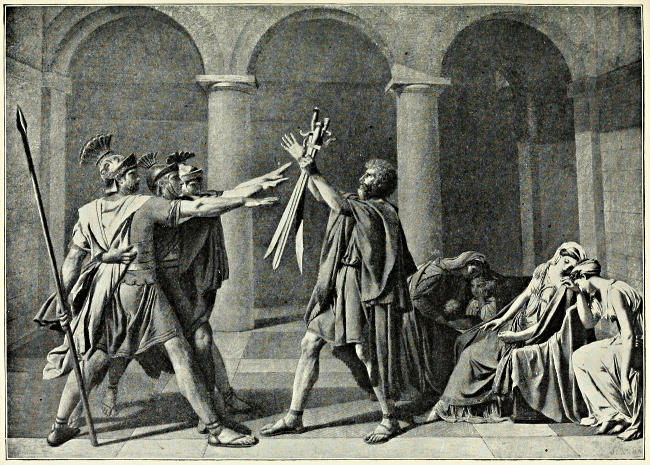
THE HORATII
Tullus was a warlike king, and he soon was called to prove his valour;
for the countrymen of the Alban border and of the Roman border plundered
one another. Now Alba was governed by Caius Cluilius, who was the
dictator; and Cluilius sent to Rome to complain of the wrongs done to his
people, and Tullus sent to Alba for the same purpose. So there was a war
between the two nations, and Cluilius led his people against Rome, and lay
encamped within five miles of the city, and there he died. Mettius Fuffetius
was then chosen dictator in his room; and as the Albans still lay in their
camp, Tullus passed them by, and marched into the land of Alba. But when
Mettius came after him, then, instead of giving battle, the two leaders agreed
that a few in either army should fight in behalf of the rest, and that the
event of this combat should decide the quarrel. So three twin brothers were
chosen out of the Roman army, called the Horatii, and three twin brothers
out of the Alban army, called the Curiatii.b
The Combat of the Horatii and the Curiatii
The treaty being concluded, the twin brothers, as had been agreed, took
arms. Whilst their respective friends exhortingly reminded each party
that their country’s gods, their country and parents, all their countrymen
both at home and in the army, had their eyes then fixed on their arms, on
their hands. Naturally brave, and animated by the exhortations of their
friends, they advanced into the midst between the two lines. The two armies
sat down before their respective camps, free rather from present danger
than from anxiety; for the sovereign power was at stake, depending on the
valour and fortune of so few. Accordingly, therefore, eager and anxious,
they have their attention intensely riveted on a spectacle far from pleasing.
The signal was given; and the three youths on each side, as if in battle
array, rushed to the charge with determined fury, bearing in their breasts the
spirits of mighty armies: nor did the one nor the other regard their personal
danger; the public dominion or slavery is present to their mind, and the
fortune of their country, which was ever after destined to be such as they
should now establish it. As soon as their arms clashed on the first encounter,
and their burnished swords glittered, great horror struck the spectators;
and, hope inclining to neither side, their voice and breath were suspended.
Then having engaged hand to hand, when not only the movements of their
bodies and the rapid brandishings of their arms and weapons, but wounds
also and blood were seen, two of the Romans fell lifeless, one upon the other,
the three Albans being wounded. And when the Alban army raised a shout of
joy at their fall, hope entirely, anxiety however not yet, deserted the Roman
legions, alarmed for the lot of the one whom the three Curiatii surrounded.
He happened to be unhurt, so that, though alone he was by no means a
match for them all together, yet he was confident against each singly.
In order therefore to separate their attack, he took to flight presuming that
they would pursue him with such swiftness as the wounded state of his body
would suffer each. He had now fled a considerable distance from the place
where they had fought, when, looking behind, he perceived them pursuing
him at great intervals from each other; and that one of them was not far
from him. On him he turned round with great fury. And whilst the Alban
army shouted out to the Curiatii to succour their brother, Horatius, victorious
in having slain his antagonist, was now proceeding to a second attack. Then
the Romans encouraged their champion with a shout such as is usually given
by persons cheering in consequence of unexpected success; he also hastened
to put an end to the combat. Wherefore before the other, who was not far
off, could come up, he despatched the second Curiatius also. And now, the
combat being brought to an equality of numbers, one on each side remained,
but they were equal neither in hope nor in strength. The one his body untouched
by a weapon, and by double victory made courageous for a third contest;
the other dragging along his body exhausted from the wound, exhausted
from running, and dispirited by the slaughter of his brethren before his eyes,
presented himself to his victorious antagonist. Nor was that a fight. The
Roman, exulting, said, “Two I have offered to the shades of my brothers: the
third I will offer to the cause of this war, that the Roman may rule over
the Alban.” He thrust his sword down into his throat, whilst faintly sustaining
the weight of his armour, he stripped him as he lay prostrate.
The Romans received Horatius with triumph and congratulation; with so
much the greater joy, as success had followed so close on fear. They then
turned to the burial of their friends with dispositions by no means alike; for
the one side was elated with the acquisition of empire, the other subjected to
foreign jurisdiction: their sepulchres are still extant in the place where each
fell; the two Roman ones in one place nearer to Alba, the three Alban ones
towards Rome; but distant in situation from each other, and just as they
fought.[6]c
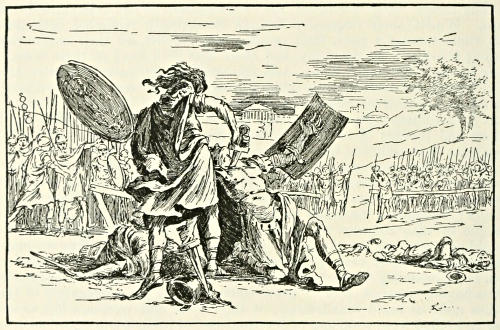
Combat between the Horatii and the Curiatii
(After a drawing by Mirys)
Then the Romans went home to Rome in triumph, and Horatius went at
the head of the army, bearing his triple spoils. But as they were drawing
near to the Capenian Gate, his sister came out to meet him. Now she had
been betrothed in marriage to one of the Curiatii, and his cloak, which she had
wrought with her own hands, was borne on the shoulders of her brother;
and she knew it, and cried out, and wept for him whom she had loved. At
the sight of her tears Horatius was so wroth that he drew his sword, and
stabbed his sister to the heart; and he said, “So perish the Roman maiden
who shall weep for her country’s enemy.” But men said that it was a dreadful
deed, and they dragged him before the two judges who judged when
blood had been shed. For thus said the law:
“The two men shall give judgment on the shedder of blood.
If he shall appeal from their judgment, let the appeal be tried.
If their judgment be confirmed, cover his head.
Hang him with a halter on the accursed tree;
Scourge him either within the sacred limit of the city or without.”
So they gave judgment on Horatius, and were going to give him over to be put
to death. But he appealed, and the appeal was tried before all the Romans,
and they would not condemn him because he had conquered for them their
enemies, and because his father spoke for him, and said that he judged the
maiden to have been lawfully slain. Yet as blood had been shed, which required
to be atoned for, the Romans gave a certain sum of money to offer
sacrifices to atone for the pollution of blood. These sacrifices were duly
performed ever afterwards by the members of the house of the Horatii.
The Albans were now become bound to obey the Romans; and Tullus
called upon them to aid him in a war against the people of Veii and Fidenæ.
But in the battle the Alban leader, Mettius Fuffetius, stood aloof, and gave
no true aid to the Romans. So, when the Romans had won the battle,
Tullus called the Albans together as if he were going to make a speech to
them; and they came to hear him, as was the custom, without their arms;
and the Roman soldiers gathered around them, and they could neither fight
nor escape. Then Tullus took Mettius and bound him between two chariots,
and drove the chariots different ways, and tore him asunder. After
this he sent his people to Alba, and they destroyed the city, and made all
the Albans come and live at Rome; there they had the hill Cælius for their
dwelling-place, and became one people with the Romans.
After this Tullus made war upon the Sabines, and gained a victory over
them. But now, whether it were that Tullus had neglected the worship of
the gods whilst he had been so busy in his wars, the signs of the wrath
of heaven became manifest. A plague broke out among the people, and
Tullus himself was at last stricken with a lingering disease. Then he
bethought him of good and holy Numa, and how, in his time, the gods had
been so gracious to Rome, and had made known their will by signs whenever
Numa inquired of them. So Tullus also tried to inquire of Jupiter, but
the god was angry and would not be inquired of, for Tullus did not consult
him rightly; so he sent his lightnings, and Tullus and all his house were
burned to ashes. This made the Romans know that they wanted a king who
would follow the example of Numa; so they chose his daughter’s son Ancus
Marcius to reign over them in the room of Tullus.
[ca. 642-616 B.C.]
Ancient history does not tell much of Ancus Marcius. He published the
religious ceremonies which Numa had commanded, and had them written
out upon whited boards, and hung up round the Forum, that all might know
and observe them. He had a war with the Latins and conquered them, and
brought the people to Rome, and gave them the hill Aventinus to dwell on.
He divided the lands of the conquered Latins amongst all the Romans, and
he gave up the forests near the sea which he had taken from the Latins, to
be the public property of the Romans. He founded a colony at Ostia, by the
mouth of the Tiber. He built a fortress on the hill Janiculum, and joined
the hill to the city by a wooden bridge over the river. He secured the city
in the low grounds between the hills by a great dyke, which was called the
dyke of the Quirites. And he built a prison under the hill Saturnius, towards
the Forum, because as the people grew in numbers, offenders against the laws
became more numerous also. At last King Ancus died, after a reign of three-and-twenty
years.
[ca. 616-578 B.C.]
In the days of Ancus Marcius there came to Rome from Tarquinii, a city
of Etruria, a wealthy Etruscan and his wife. The father of this stranger
was a Greek, a citizen of Corinth, who left his native land because it was
oppressed by a tyrant, and found a home at Tarquinii. There he married a
noble Etruscan lady, and by her he had two sons. But his son found that
for his father’s sake he was still looked upon as a stranger; so he left Tarquinii,
and went with his wife Tanaquil to Rome, for there, it was said,
strangers were held in more honour. Now as he came near to the gates of
Rome, as he was sitting in his chariot with Tanaquil his wife, an eagle came
and plucked the cap from his head, and bore it aloft into the air; and then
flew down again and placed it upon his head, as it had been before. So Tanaquil
was glad at this sight, and she told her husband, for she was skilled in
augury, that this was a sign of the favour of the gods, and she bade him be
of good cheer, for that he would surely rise to greatness.
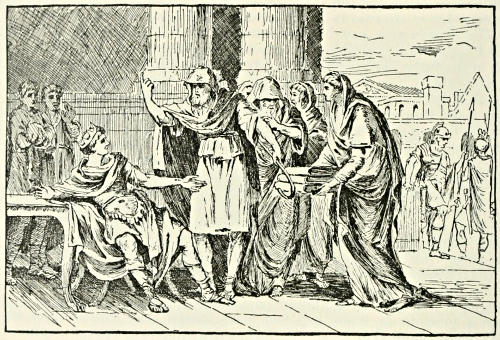
Tarquinius
Now when the stranger came to Rome, they called him Lucius Tarquinius,
and he was a brave man and wise in council; and his riches won the good
word of the multitude; and he became known to the king. He served the
king well in peace and war, so that Ancus held him in great honour, and when
he died he named him by his will to be the guardian of his children.
But Tarquinius was in great favour with the people; and when he desired
to be king, they resolved to choose him rather than the sons of Ancus. So
he began to reign, and he did great works both in war and peace. He made
war on the Latins, and took from them a great spoil. Then he made war on
the Sabines, and he conquered them in two battles, and took from them the
town of Collatia, and gave it to Egerius, his brother’s son, who had come
with him from Tarquinii. Lastly, there was another war with the Latins, and
Tarquinius went round to their cities, and took them one after another; for
none dared to go out to meet him in open battle. These were his acts in war.
He also did great works in peace; for he made vast drains to carry off
the water from between the Palatine and the Aventine, and from between
the Palatine and the Capitoline hills. And in the space between the Palatine
and the Aventine, after he had drained it, he formed the Circus, or great
race-course, for chariot and for horse races. Then in the space between the
Palatine and the Capitoline he made a forum or market-place, and divided
out the ground around it for shops or stalls, and made a covered walk round
it. Next he set about building a wall of stone to go round the city; and he
laid the foundations of a great temple on the Capitoline Hill, which was to
be the temple of the gods of Rome. He also added a hundred new senators
to the senate, and doubled the number of the horsemen in the centuries of
the Ramnes, Tities, and Luceres, for he wanted to strengthen his force of
horsemen; and when he had done so, his horse gained him great victories
over his enemies.
Now he first had it in his mind to make three new centuries of horsemen,
and to call them after his own name. But Attus Navius, who was greatly
skilled in augury, forbade him. Then the king mocked at his art, and said,
“Come now, thou augur, tell me by thy auguries, whether the thing which
I now have in my mind may be done or not.” And Attus Navius asked
counsel of the gods by augury, and he answered, “It may.” Then the king
said, “It was in my mind that thou shouldst cut in two this whetstone with
this razor. Take them, and do it, and fulfil thy augury if thou canst.”
But Attus took the razor and the whetstone, and he cut, and cut the whetstone
asunder. So the king obeyed his counsels, and made no new centuries;
and in all things afterwards he consulted the gods by augury, and
obeyed their bidding.
Tarquinius reigned long and prospered greatly; and there was a young
man brought up in his household, of whose birth some told wonderful tales,
and said that he was the son of a god; but others said that his mother was
a slave, and his father was one of the king’s clients. But he served the king
well, and was in favour with the people, and the king promised him his
daughter in marriage. The young man was called Servius Tullius. But
when the sons of King Ancus saw that Servius was so loved by King Tarquinius,
they resolved to slay the king, lest he should make this stranger his
heir, and so they should lose the crown forever. So they set on two shepherds
to do the deed, and these went to the king’s palace, and pretended to
be quarrelling with each other, and both called on the king to do them right.
The king sent for them to hear their story; and while he was hearing one
of them speak, the other struck him on the head with his hatchet, and then
both of them fled. But Tanaquil, the king’s wife, pretended that he was not
dead, but only stunned by the blow; and she said that he had appointed
Servius Tullius to rule in his name, till he should be well again. So Servius
went forth in royal state, and judged causes amidst the people, and acted
in all things as if he were king, till after a while it was known that the king
was dead, and Servius was suffered to reign in his place. Then the sons of
Ancus saw that there was no hope left for them; and they fled from Rome,
and lived the rest of their days in a foreign land.
[ca. 578-534 B.C.]
Servius Tullius was a just and good king; he loved the commons, and
he divided among them the lands which had been conquered in war,
and he made many wise and good laws, to maintain the cause of the poor,
and to stop the oppression of the rich. He made war with the Etruscans, and
conquered them. He added the Quirinal and the Viminal hills to the city,
and he brought many new citizens to live on the Esquiline; and there he
lived himself amongst them. He also raised a great mound of earth to join
the Esquiline and the Quirinal and the Viminal hills together, and to cover
them from the attacks of an enemy.
He built a temple of Diana on the Aventine, where the Latins, and
the Sabines, and the Romans, should offer their common sacrifices; and the
Romans were the chief in rank amongst all who worshipped at the temple.
He made a new order of things for the whole people; for he divided the
people of the city into four tribes, and the people of the country into six-and-twenty.
Then he divided all the people into classes, according to the value
of their possessions; and the classes he divided into centuries; and the centuries
of the several classes furnished themselves with arms, each according
to their rank and order: the centuries of the rich classes had good and full
armour, the poorer centuries had but darts and slings. And when he had
done all these works, he called all the people together in their centuries,
and asked if they would have him for their king; and the people answered
that he should be their king. But the nobles hated him, because he was
so loved by the commons; for he had made a law that there should be no
king after him, but two men chosen by the people to govern them year
by year. Some even said that it was in his mind to give up his own kingly
power, that so he might see with his own eyes the fruit of all the good
laws that he had made, and might behold the people wealthy and free and
happy.
Now King Servius had no son, but he had two daughters; and he gave
them in marriage to the two sons of King Tarquinius. These daughters were
of very unlike natures, and so were their husbands: for Aruns Tarquinius
was of a meek and gentle spirit, but his brother Lucius was proud and full
of evil; and the younger Tullia, who was the wife of Aruns, was more
full of evil than his brother Lucius; and the elder Tullia, who was the wife
of Lucius, was as good and gentle as his brother Aruns. So the evil could not
bear the good, but longed to be joined to the evil that was like itself: and
Lucius slew his wife secretly, and the younger Tullia slew her husband,
and then they were married to one another, that they might work all the
wickedness of their hearts, according to the will of fate.
Then Lucius plotted with the nobles, who hated the good king; and he
joined himself to the sworn brotherhoods of the young nobles, in which they
bound themselves to stand by each other in their deeds of violence and of
oppression. When all was ready, he waited for the season of the harvest,
when the commons, who loved the king, were in the fields getting in their
corn. Then he went suddenly to the Forum with a band of armed men, and
seated himself on the king’s throne before the doors of the senate house,
where he was wont to judge the people. And they ran to the king, and told
him that Lucius was sitting on his throne. Upon this the old man went in
haste to the Forum, and when he saw Lucius, he asked him wherefore he had
dared to sit on the king’s seat. And Lucius answered that it was his father’s
throne, and that he had more right in it than Servius. Then he seized the
old man, and threw him down the steps of the senate house to the ground;
and he went into the senate house, and called together the senators, as if he
were already king. Servius meanwhile arose, and began to make his way
home to his house; but when he was come near to the Esquiline Hill, some
whom Lucius had sent after him overtook him and slew him, and left him in
his blood in the middle of the way.
Then the wicked Tullia mounted her chariot, and drove into the Forum,
nothing ashamed to go amidst the multitude of men, and she called Lucius
out from the senate house, and said to him, “Hail to thee, King Tarquinius!”
But Lucius bade her to go home; and as she was going home, the body of
her father was lying in the way. The driver of the chariot stopped short,
and showed to Tullia where her father lay in his blood. But she bade him
drive on, for the furies of her wickedness were upon her, and the chariot
rolled over the body; and she went to her home with her father’s blood upon
the wheels of her chariot. Thus Lucius Tarquinius and the wicked Tullia
reigned in the place of the good king Servius.
[ca. 534-510 B.C.]
Lucius Tarquinius gained his power wickedly, and no less wickedly did
he exercise it. He kept a guard of armed men about him, and he ruled all
things at his own will; many were they whom he spoiled of their goods,
many were they whom he banished, and many also whom he slew. He
despised the senate, and made no new senators in the place of those whom
he slew, or who died in the course of nature, wishing that the senators might
become fewer and fewer, till there should be none of them left. And he
made friends of the chief men among the Latins, and gave his daughter in
marriage to Octavius Mamilius of Tusculum; and he became very powerful
amongst the Latins, insomuch that when Turnus Herdonius of Aricia had
dared to speak against him in the great assembly of the Latins, Tarquinius
accused him of plotting his death, and procured false witnesses to confirm
his charge; so that the Latins judged him to be guilty, and ordered him to
be drowned. After this they were so afraid of Tarquinius, that they made
a league with him, and followed him in his wars wherever he chose to lead
them. The Hernicans also joined this league, and so did Ecetra and Antium,
cities of the Volscians.
Then Tarquinius made war upon the rest of the Volscians, and he took
Suessa Pometia, in the lowlands of the Volscians, and the tithe of the spoil
was forty talents of silver. So he set himself to raise mighty works in
Rome; and he finished what his father had begun, the great drains to
drain the low grounds of the city, and the temple on the Capitoline Hill.
Now the ground on which he was going to build his temple was taken up
with many holy places of the gods of the Sabines, which had been founded
in the days of King Tatius. But Tarquinius consulted the gods by augury
whether he might not take away these holy places to make room for his
own new temple. The gods allowed him to take away all the rest, except
only the holy places of the god of youth, and of Terminus the god of
boundaries, which they would not suffer him to move. But the augurs said
that this was a happy omen, for that it showed how the youth of the city
should never pass away, nor its boundaries be moved by the conquest of an
enemy. A human head was also found, as they were digging the foundations
of the temple, and this too was a sign that the Capitoline Hill should be the
head of all the earth.[7] So Tarquinius built a mighty temple, and consecrated
it to Jupiter, and to Juno, and to Minerva, the greatest of the gods of the
Etruscans.
At this time there came a strange woman to the king, and offered him
nine books of the prophecies of the Sibyl for a certain price. When the king
refused them, the woman went and burned three of the books, and came back
and offered the six at the same price which she had asked for the nine; but
they mocked at her and would not take the books. Then she went away,
and burned three more, and came back and asked still the same price for the
remaining three. At this the king was astonished, and asked of the augurs
what he should do. They said that he had done wrong in refusing the gift
of the gods, and bade him by all means to buy the books that were left. So
he bought them; and the woman who sold them was seen no more from that
day forwards. Then the books were put into a chest of stone, and were kept
underground in the Capitol, and two men were appointed to keep them,
and were called the two men of the sacred books.
Now Gabii would not submit to Tarquinius, like the other cities of the
Latins, so he made war against it; and the war was long, and Tarquinius
knew not how to end it. So his son Sextus Tarquinius pretended that his
father hated him, and fled to Gabii; and the people of Gabii believed him and
trusted him, till at last he betrayed them into his father’s power. A treaty
was then made with them, and he gave them the right of becoming citizens
of Rome, and the Romans had the right of becoming citizens of Gabii, and
there was a firm league between the two people.
Thus Tarquinius was a great and mighty king; but he grievously oppressed
the poor, and he took away all the good laws of King Servius, and let
the rich oppress the poor, as they had done before the days of Servius. He
made the people labour at his great works: he made them build his temple
and dig and construct his drains; and he laid such burdens on them, that
many slew themselves for very misery; for in the days of Tarquinius the
tyrant it was happier to die than to live.b
The Execution of Titus and Tiberius
(From a drawing by Mirys)
[ca. 510 B.C.]
While King Tarquinius was at the height of his greatness, it chanced
upon a time that from the altar in the court of his palace there crawled
out a snake, which devoured the offerings laid on the altar. So the king
thought it not enough to consult the soothsayers of the Etruscans whom
he had with him, but he sent two of his own sons to Delphi, to ask counsel
of the oracle of the Greeks; for the oracle of Delphi was famous in all lands.
So his sons Titus and Aruns went to Delphi, and they took with them their
cousin Lucius Junius, whom men called Brutus, that is, the dullard; for he
seemed to be wholly without wit, and he would eat wild figs with honey.
This Lucius was not really dull, but very subtle; and it was for fear of his
uncle’s cruelty, that he made himself as one without sense; for he was very
rich, and he feared lest King Tarquinius should kill him for the sake of his
inheritance. So when he went to Delphi he carried with him a staff of horn,
and the staff was hollow, and it was filled with gold, and he gave the staff
to the oracle as a likeness of himself; for though he seemed dull, and of
no account to look upon, yet he had a golden wit within. When the three
young men had performed the king’s bidding, they asked the oracle for
themselves, and they said, “O Lord Apollo, tell us, which of us shall be king
in Rome?” Then there came a voice from the sanctuary and said, “Whichever
of you shall first kiss his mother.” So the sons of Tarquinius agreed to
draw lots between themselves, which of them should first kiss their mother,
when they should have returned to Rome; and they said they would keep
the oracle secret from their brother Sextus, lest he should be king rather
than they. But Lucius understood the mind of the oracle better; so as
they all went down from the temple, he stumbled as if by chance, and fell
with his face to the earth, and kissed the earth; for he said, “The earth is
the true mother of us all.”
Now when they came back to Rome, King Tarquinius was at war with the
people of Ardea; and as the city was strong, his army lay a long while before
it, till it should be forced to yield through famine. So the Romans had
leisure for feasting and for diverting themselves; and once Titus and Aruns
were supping with their brother Sextus, and their cousin Tarquinius of Collatia
was supping with them. And they disputed about their wives, whose
wife of them all was the worthiest lady. Then said Tarquinius of Collatia,
“Let us go, and see with our own eyes what our wives are doing, so shall we
know which is the worthiest.” Upon this they all mounted their horses, and
rode first to Rome; and there they found the wives of Titus, and of Aruns,
and of Sextus, feasting and making merry. They then rode on to Collatia,
and it was late in the night, but they found Lucretia, the wife of
Tarquinius of Collatia, neither feasting, nor yet sleeping, but she was sitting
with all her handmaids around her, and all were working at the loom. So
when they saw this, they all said, “Lucretia is the worthiest lady.” And
she entertained her husband and his kinsmen, and after that they rode back
to the camp before Ardea.
But a spirit of wicked passion seized upon Sextus, and a few days
afterwards he went alone to Collatia, and Lucretia received him hospitably,
for he was her husband’s kinsman. At midnight he arose and went to her
chamber, and he said that if she yielded not to him, he would slay her and
one of her slaves with her, and would say to her husband that he had slain
her in her adultery. So when Sextus had accomplished his wicked purpose,
he went back again to the camp.
Then Lucretia sent in haste to Rome, to pray that her father Spurius
Lucretius would come to her; and she sent to Ardea to summon her husband.
Her father brought along with him Publius Valerius, and her husband brought
with him Lucius Junius, whom men call Brutus. When they arrived, they
asked earnestly, “Is all well?” Then she told them of the wicked deed of
Sextus, and she said, “If ye be men, avenge it.” And they all swore to her,
that they would avenge it. Then she said again, “I am not guilty; yet
must I too share in the punishment of this deed, lest any should think that
they may be false to their husbands and live.” And she drew a knife from
her bosom, and stabbed herself to the heart.
At that sight her husband and her father cried aloud; but Lucius drew the
knife from the wound, and held it up, and said, “By this blood I swear, that
I will visit this deed upon King Tarquinius, and all his accursed race; neither
shall any man hereafter be king in Rome, lest he do the like wickedness.”
And he gave the knife to her husband, and to her father, and to Publius
Valerius. They marvelled to hear such words from him whom men called
dull; but they swore also, and they took up the body of Lucretia, and carried
it down into the Forum; and they said, “Behold the deeds of the wicked family
of Tarquinius.” All the people of Collatia were moved, and the men took
up arms, and they set a guard at the gates, that none might go out to carry
the tidings to Tarquinius, and they followed Lucius to Rome. There, too,
all the people came together, and the crier summoned them to assemble before
the tribune of the Celeres, for Lucius held that office. And Lucius spoke to
them of all the tyranny of Tarquinius and his sons, and of the wicked deed
of Sextus. And the people in their curiæ took back from Tarquinius the
sovereign power, which they had given him, and they banished him and all
his family. Then the younger men followed Lucius to Ardea, to win over
the army there to join them; and the city was left in the charge of Spurius
Lucretius. But the wicked Tullia fled in haste from her house, and all, both
men and women, cursed her as she passed, and prayed that the furies of her
father’s blood might visit her with vengeance.b
This entire story, which Shakespeare himself put into poetry, has met
with the wholesale scepticism that has visited all the Roman legends. But
the incredulous Niebuhr, for one, accepts it: “It may easily be believed,” he
says, “that Sextus Tarquinius committed the outrage on Lucretia, for similar
things are still of every-day occurrence in Turkey, and were frequently
perpetrated in the Middle Ages by Italian princes down to the time of Pietro
Luigi Farnese (in the sixteenth century); in antiquity similar crimes are
met with in oligarchies and tyrannies, as is well known from the history of
Demetrius Poliorcetes at Athens. Cicero is quite right in saying that it was
a misfortune that Sextus hit upon a woman belonging to one of the most
powerful families. It may readily be believed that the woman tried to avenge
herself, but the whole of the subsequent events, by which the story acquired
individuality and its connection with the campaign against Ardea, are of no
historical value. The king is said to have been encamped before Ardea, and
to have concluded a truce for fifteen years; but Ardea was dependent upon
Rome before that time, since it occurs among the towns on behalf of which
Rome concluded the treaty with Carthage. All therefore that remains and
bears the appearance of probability, is that Lucretia was outraged, and that
her death kindled the spark which had long been smouldering under the ashes.
“We are in the same perplexity in regard to the person of Brutus. He
is said to have feigned stupidity in order to deceive the king, and there
were several traditions as to the manner in which he attempted to accomplish
this object. His mission to Delphi along with the sons of Tarquinius,
although the mission from Agylla at an earlier period cannot be doubted,
seems to betray a later hand, and probably the same as introduced the stories
from Herodotus into Roman history. It is further said that Tarquinius, in
order to render the dignity of tribunus celerum the highest after that of the
king, powerless for mischief, gave the office to Brutus. But there is every
reason for believing that the whole story of Brutus’ idiocy arose solely from
his name. Brutus is undoubtedly an Oscan word connected with the same
root as Bruttii; it signifies ‘a runaway slave,’ a name which the insolent
faction of the king gave to the leader of the rebels because he was a plebeian.
How is it conceivable that a great king, such as Tarquinius really was, should
have raised an idiot whom he might have put to death to the dignity of
tribunus celerum—for the purpose of rendering it contemptible? Tarquinius
was not a tyrant of such a kind as to be under the necessity of weakening
the state in order to govern it; he might have given it power and vigour and
yet ruled over it by his great personal qualities; nor did the Romans think
differently of him, for his statue continued to be preserved in the Capitol.”f
Meanwhile King Tarquinius set out with speed to Rome to put down the
tumult. But Lucius turned aside from the road, that he might not meet him,
and came to the camp; and the soldiers joyfully received him, and they drove
out the sons of Tarquinius. King Tarquinius came to Rome, but the gates
were shut, and they declared to him, from the walls, the sentence of banishment
which had been passed against him and his family. So he yielded to
his fortune, and went to live at Cære with his sons Titus and Aruns. His
other son, Sextus, went to Gabii, and the people there, remembering how he
had betrayed them to his father, slew him. Then the army left the camp
before Ardea, and went back to Rome. And all men said, “Let us follow
the good laws of the good king Servius; and let us meet in our centuries,
according as he directed, and let us choose two men year by year to govern
us, instead of a king.” Then the people met in their centuries in the field of
Mars, and they chose two men to rule over them, Lucius Junius, whom men
called Brutus, and Lucius Tarquinius of Collatia.
But the people were afraid of Lucius Tarquinius for his name’s sake, for
it seemed as though a Tarquinius were still king over them. So they prayed
him to depart from Rome, and he went and took all his goods with him, and
settled himself at Lavinium. Then the senate and the people decreed that
all the house of the Tarquinii should be banished, even though they were
not of the king’s family. And the people met again in their centuries, and
chose Publius Valerius to rule over them together with Brutus, in the room
of Lucius Tarquinius of Collatia.
Now at this time many of the laws of the good king Servius were restored,
which Tarquinius the tyrant had overthrown. For the commons again chose
their own judges, to try all causes between a man and his neighbour; and they
had again their meetings and their sacrifices in the city and in the country,
every man in his own tribe and in his own district. And lest there should
seem to be two kings instead of one, it was ordered that one only of the two
should bear rule at one time, and that the lictors with their rods and axes
should walk before him alone. And the two were to bear rule month by
month.
Then King Tarquinius sent to Rome, to ask for all the goods that had
belonged to him; and the senate after a while decreed that the goods should
be given back. But those whom he had sent to Rome to ask for his goods,
had meetings with many young men of noble birth, and a plot was laid to
bring back King Tarquinius. So the young men wrote letters to Tarquinius,
pledging to him their faith, and among them were Titus and Tiberius, the
sons of Brutus. But a slave happened to overhear them talking together,
and when he knew that the letters were to be given to the messengers of
Tarquinius, he went and told all that he had heard to Brutus and to Publius
Valerius. Then they came and seized the young men and their letters, and
so the plot was broken up.
After this there was a strange and piteous sight to behold. Brutus and
Publius sat on their judgment seats in the Forum, and the young men were
brought before them. Then Brutus bade the lictors to bind his own two
sons, Titus and Tiberius, together with the others, and to scourge them with
rods, according to the law. And after they had been scourged, the lictors
struck off their heads with their axes, before the eyes of their father; and
Brutus neither stirred from his seat nor turned away his eyes from the sight,
yet men saw as they looked on him that his heart was grieving inwardly
over his children. Then they marvelled at him, because he had loved justice
more than his own blood, and had not spared his own children when they had
been false to their country, and had offended against the law.
When King Tarquinius found that the plot was broken up, he persuaded
the people of Veii and the people of Tarquinii, cities of the Etruscans, to try
to bring him back to Rome by force of arms. So they assembled their
armies, and Tarquinius led them within the Roman border. Brutus and
Publius led the Romans out to meet them, and it chanced that Brutus, with the
Roman horsemen, and Aruns, the son of King Tarquinius, with the Etruscan
horse, met each other in advance of the main battles. Aruns, seeing Brutus in
his kingly robe, and with the lictors of a king around him, levelled his spear,
and spurred his horse against him. Brutus met him, and each ran his spear
through the body of the other, and they both fell dead. Then the horsemen
on both parts fought, and afterwards the main battles, and the Veientines
were beaten, but the Tarquinians beat the Romans, and the battle was neither
won nor lost; but in the night there came a voice out of the wood that
was hard by, and it said, “One man more has fallen on the part of the Etruscans
than on the part of the Romans; the Romans are to conquer in the
war.” At this the Etruscans were afraid, and believing the voice, they
immediately marched home to their own country, while the Romans took
up Brutus, and carried him home and buried him; and Publius made an
oration in his praise, and all the matrons of Rome mourned for him for a
whole year, because he had avenged Lucretia well.
When Brutus was dead, Publius ruled over the people himself; and he
began to build a great and strong house on the top of the hill Velia, which
looks down upon the Forum. This made the people say, “Publius wants to
become a king, and is building a house in a strong place, as if for a citadel
where he may live with his guards, and oppress us.” But he called the people
together, and when he went down to them, the lictors who walked before
him lowered the rods and the axes which they bore, to show that he owned
the people to be greater than himself. He complained that they had mistrusted
him, and he said that he would not build his house on the top of the
hill Velia, but at the bottom of it, and his house should be no stronghold.
And he called on them to make a law, that whoever should try to make himself
king should be accursed, and whosoever would might slay him. Also,
that if a magistrate were going to scourge or kill any citizen, he might carry
his cause before the people, and they should judge him. When these laws
were passed, all men said, “Publius is a lover of the people, and seeks their
good”: and he was called Publicola, which means, “the people’s friend,”
from that day forward.
Then Publius called the people together in their centuries, and they
chose Spurius Lucretius, the father of Lucretia, to be their magistrate for
the year, in the room of Brutus. But he was an old man, and his strength
was so much gone, that after a few days he died. They then chose in his
room Marcus Horatius.
Now Publius and Marcus cast lots which should dedicate the temple
to Jupiter on the hill of the Capitol, which King Tarquinius had built; and
the lot fell to Marcus, to the great discontent of the friends of Publius. So
when Marcus was going to begin the dedication, and had his hand on the
doorpost of the temple, and was speaking the set words of prayer, there
came a man running to tell him that his son was dead. But he said, “Then
let them carry him out and bury him”; and he neither wept nor lamented,
for the words of lamentation ought not to be spoken when men are praying
to the blessed gods, and dedicating a temple to their honour. So Marcus
honoured the gods above his son, and dedicated the temple on the hill of
the Capitol; and his name was recorded on the front of the temple.
But when King Tarquinius found that the Veientines and Tarquinians
were not able to restore him to his kingdom, he went to Clusium, a city in
the farthest part of Etruria, beyond the Ciminian forest, and besought Lars
Porsenna, the king of Clusium, to aid him. So Porsenna raised a great
army, and marched against Rome, and attacked the Romans on the hill
Janiculum, the hill on the outside of the city beyond the Tiber.b
When the two armies charged, they both fought bravely and sustained the
shock for a considerable time, the Romans having the advantage of their
enemies both in experience and perseverance, and the Tyrrhenians and Latins
being much superior in number. And, many being killed on both sides,
fear seized the Romans; first, those on the left wing, when they saw their
two commanders, Valerius, and Lucretius, carried out of the field wounded;
after which, those on the right wing, who had already the advantage
over the forces commanded by Tarquinius, seeing the flight of their friends,
were possessed with the same terror. And all of them, hastening to the
city, and endeavouring to force their way in a body over the same bridge,
the enemy made a strong attack upon them; and the city having no walls in
that part next the river, was very near being taken by storm, which had certainly
happened if the pursuers had entered it at the same time with those
who fled. But three men put a stop to the pursuit of the enemy and saved
the whole army; two of these were Spurius Lartius and Titus Herminius
among the elders, who had the command of the right wing; and of the
younger, Publius Horatius, who was called Cocles from the loss of one of his
eyes, which had been struck out in a battle; a person, of all men, the most
remarkable for the fine proportion of his limbs, and for his bravery. This
man was nephew to Marcus Horatius, one of the consuls, but derived his
high birth from Marcus Horatius, one of the three brothers who overcame
the three Albans. These three without other assistance, placing their backs
against the bridge, stopped the passage of the enemy for a considerable time,
and stood their ground while a shower of all sorts of weapons fell upon them,
and numbers also pressed them sword in hand, till the whole army passed the
river.
When they judged their own men to be in safety, two of them, Herminius,
and Lartius, their defensive arms being now rendered useless by continual
strokes, retreated leisurely; while Horatius alone, though not only the consuls,
but the rest of the people, solicitous above all things to preserve such a
man for his country and his parents, called to him from the city to retire,
could not be prevailed on, but remained upon the same spot where he first
stood, and directed Herminius and Lartius to desire the consuls, as from
him, to order that part of the bridge which was next the city immediately
to be cut off (for there was but one bridge at that time, which was built of
wood, and mortised together with timber alone, without iron, which the
Romans preserve even to this day in the same condition) and that, when the
greatest part of the bridge was broken down and little of it remained, they
should give him notice of it by some signals, or by speaking louder than
ordinary; as to the rest, he told them he would take care of it. Having
given these directions to these two persons, he stood upon the bridge itself,
and when the enemy advanced upon him, he struck some of them with his
sword, and beating down others with his shield, he repulsed all who attempted
to pass the bridge; for these looking upon him as a madman, and one who
had devoted himself to destruction, durst no longer approach him; at the
same time, it was not easy for them to come near him, because the river defended
him on the right and left, and before him lay a heap of arms and dead
bodies. But standing all at a distance, they threw spears, darts, and large
stones at him, and those who were not supplied with these, threw the swords
and bucklers of the slain. But he fought still, making use of their own
weapons against them; and throwing these among the crowd, he could not
fail, as may well be supposed, to hit somebody. And now, overwhelmed
with missive weapons, and having a great number of wounds in many parts
of his body, but one particularly, occasioned by a spear, which, passing over
the top of his thigh, pierced the forepart of one of his hips, and putting him
to great pain, impeded his motion. When hearing those behind him call out
that the greatest part of the bridge was broken down, he leaped, with his
arms, into the river, and swimming across the stream with great difficulty
(for the current, being divided by the piles, ran swift, and formed large
eddies), he landed without losing any of his arms.
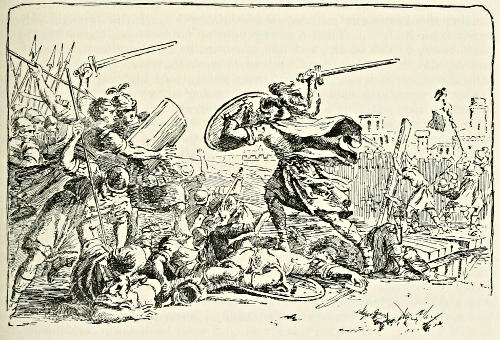
Horatius defending the Bridge over the Tiber
This action gained him immortal glory, for the Romans immediately
crowned him, and conducted him into the city with songs, as one of the
heroes; and all the inhabitants ran out of their houses, desiring to have
the last sight of him before he died, for it was thought he could not long survive
his wounds. And when he was recovered, the people erected a brazen
statue of him all armed, in the most conspicuous part of the Forum, and gave
him as much of the public land as he himself could plough around in one day
with a yoke of oxen. Besides these things bestowed upon him by the public,
every particular man and woman in the city, at a time when they were all
the most oppressed by a dreadful scarcity of necessary provisions, gave him
as much as would maintain each of them one day, the number of people in
the whole amounting to more than three hundred thousand. Thus Horatius,
who had shown so great valour upon that occasion, was looked upon by the
Romans with all possible admiration; but rendered useless by his lameness in
the subsequent affairs of the commonwealth, and by reason of his calamity,
he obtained neither the consulship nor any other military command.g
Caius Mucius and King Porsenna
But the Etruscans still lay before the city, and the Romans suffered
much from hunger. Then a young man of noble blood, Caius Mucius by
name, went to the senate, and offered to go to the camp of the Etruscans,
and to slay King Porsenna. So he crossed the river and made his way
into the camp, and there he saw a man sitting on a high place, and wearing
a scarlet robe, and many coming and going about him; and, saying to
himself, “This must be King Porsenna,” he went up to his seat amidst the
crowd, and when he came near to the man he drew a dagger from under
his garment, and stabbed him. But it was the king’s scribe whom he had
slain, who was the king’s chief officer; so he was seized and brought before
the king, and the guards threatened him with sharp torments, unless he
would answer all their questions. But he said, “See now, how little I care
for your torments”; and he thrust his right hand into the fire that was
burning there on the altar, and he did not move it till it was quite consumed.
Then King Porsenna marvelled at his courage, and said, “Go thy
way, for thou hast harmed thyself more than me; and thou art a brave
man, and I send thee back to Rome unhurt and free.” But Caius answered,
“For this thou shalt get more of my secret than thy tortures could have
forced from me. Three hundred noble youths of Rome have bound themselves
by oath to take thy life. Mine was the first adventure; but the others
will each in his turn lie in wait for thee. I warn thee therefore to look to
thyself well.” Then Caius was let go, and went back again into the city.
But King Porsenna was greatly moved, and made the Romans offers of
peace, to which they listened gladly, and gave up the land beyond the
Tiber which had been won in former times from the Veientines; and he
gave back to them the hill Janiculum. Besides this the Romans gave
hostages to the king, ten youths and ten maidens, children of noble
fathers, as a pledge that they would truly keep the peace which they had
made. But it chanced as the camp of the Etruscans was near the Tiber,
that Clœlia, one of the maidens, escaped with her fellows and fled to the
brink of the river, and as the Etruscans pursued them, Clœlia spoke to
the other maidens, and persuaded them, and they rushed all into the water,
and swam across the river, and got safely over. At this King Porsenna
marvelled more than ever, and when the Romans sent back Clœlia and her
fellows to him, for they kept their faith truly, he bade her go home free,
and he gave her some of the youths also who were hostages, to choose
whom she would; and she chose those who were of tenderest age, and King
Porsenna set them free. Then the Romans gave lands to Caius, and set
up a statue of Clœlia in the highest part of the Sacred Way; and King
Porsenna led away his army home in peace.
After this King Porsenna made war against the Latins, and his army
was beaten, and fled to Rome; and the Romans received them kindly, and
took care of those who were wounded, and sent them back safe to King
Porsenna. For this the king gave back to the Romans all the rest of
their hostages whom he had still with him, and also the land which they had
won from the Veientines. So Tarquinius, seeing that there was no more
hope of aid from King Porsenna, left Clusium and went to Tusculum of
the Latins; for Octavius Mamilius, the chief of the Tusculans, had married
his daughter, and he hoped that the Latins would restore him to Rome, for
their cities were many, and when he had been king he had favoured them
rather than the Romans.
So, after a time, thirty cities of the Latins joined together and made
Octavius Mamilius their general, and declared war against the Romans.
Now Publius Valerius was dead, and the Romans so loved and honoured him
that they buried him within the city, near the hill Velia, and all the matrons
of Rome had mourned for him for a whole year: also because the Romans
had the Sabines for their enemies as well as the Latins, they had made one
man to be their ruler for a time instead of two; and he was called the
master of the people, or the commander, and he had all the power which
the kings of Rome had in times past. So Aulus Postumius was appointed
master of the people at this time, and Titus Æbutius was the chief or master
of the horsemen; and they led out the whole force of the Romans, and
met the Latins by the lake Regillus, in the country of Tusculum: and Tarquinius
himself was with the army of the Latins, and his son and all the
houses of the Tarquinii; for this was their last hope, and fate was now to
determine whether the Romans should be ruled over by King Tarquinius,
or whether they should be free forever.
There were many Romans who had married Latin wives, and many Latins
who had married wives from among the Romans. So before the war began,
it was resolved that the women on both sides might leave their husbands if
they chose, and take their virgin daughters with them, and return to their
own country. And all the Latin women, except two, remained in Rome
with their husbands: but the Roman women loved Rome more than their
husbands, and took their young daughters with them, and came home to the
houses of their fathers.
Then the Romans and the Latins joined battle by the lake Regillus.
There might you see King Tarquinius, though far advanced in years, yet
mounted on his horse and bearing his lance in his hand, as bravely as though
he were still young. There was his son Tarquinius, leading on to battle all the
band of the house of the Tarquinii, whom the Romans had banished for their
name’s sake, and who thought it a proud thing to win back their country by
their swords, and to become again the royal house, to give a king to the
Romans. There was Octavius Mamilius, of Tusculum, the leader of all the
Latins, who said, that he would make Tarquinius, his father, king once more
in Rome, and the Romans should help the Latins in all their wars, and Tusculum
should be the greatest of all the cities whose people went up together
to sacrifice to Jupiter of the Latins at his temple on the high top of the
mountain of Alba. And on the side of the Romans might be seen Aulus
Postumius, the master of the people, and Titus Æbutius, the master of the
horsemen. There also was Titus Herminius, who had fought on the bridge
by the side of Horatius Cocles, on the day when they saved Rome from
King Porsenna. There was Marcus Valerius, the brother of Publius, who
said he would finish by the lake Regillus the glorious work which Publius
had begun in Rome; for Publius had driven out Tarquinius and his house,
and had made them live as banished men, and now they should lose their
lives as they had lost their country. So at the first onset King Tarquinius
levelled his lance, and rode against Aulus; and on the left of the battle,
Titus Æbutius spurred his horse against Octavius Mamilius. But King
Tarquinius, before he reached Aulus, received a wound into his side, and
his followers gathered around him, and bore him out of the battle. And
Titus and Octavius met lance to lance, and Titus struck Octavius on the breast,
and Octavius ran his lance through the arm of Titus. So Titus withdrew
from the battle, for his arm could no longer wield its weapon; but Octavius
heeded not his hurt, but when he saw his Latins giving ground, he called to
the banished Romans of the house of the Tarquinii, and sent them into the
thick of the fight. On they rushed so fiercely that neither man nor horse
could stand before them; for they thought how they had been driven from
their country, and spoiled of their goods, and they said that they would win
back both that day through the blood of their enemies.
Then Marcus Valerius, the brother of Publius, levelled his lance and rode
fiercely against Titus Tarquinius, who was the leader of the band of the
Tarquinii. But Titus drew back, and sheltered himself amidst his band:
and Marcus rode after him in his fury, and plunged into the midst of the
enemy, and a Latin ran his lance into his side as he was rushing on; but his
horse stayed not in his career, till Marcus dropped from him dead upon the
ground. Then the Romans feared yet more, and the Tarquinii charged yet
more vehemently, till Aulus, the leader of the Romans, rode up with his own
chosen band; and he bade them level their lances, and slay all whose faces
were towards them, whether they were friends or foes. So the Romans
turned from their flight, and Aulus and his chosen band fell upon the Tarquinii;
and Aulus prayed, and vowed that he would raise a temple to Castor
and to Pollux, the twin heroes, if they would aid him to win the battle; and
he promised to his soldiers that the two who should be the first to break into
the camp of the enemy should receive a rich reward. When behold there
rode two horsemen at the head of his chosen band, and they were taller and
fairer than after the stature and beauty of men, and they were in the first
bloom of youth, and their horses were white as snow. Then there was
a fierce battle, when Octavius, the leader of the Latins, came up with aid to
rescue the Tarquinii; for Titus Herminius rode against him, and ran his
spear through his body, and slew him at one blow; but as he was spoiling
him of his arms, he himself was struck by a javelin, and he was borne out of
the fight and died. And the two horsemen on white horses rode before the
Romans; and the enemy fled before them, and the Tarquinii were beaten
down and slain, and Titus Tarquinius was slain among them; and the Latins
fled, and the Romans followed them to their camp, and the two horsemen on
white horses were the first who broke into the camp. But when the camp
was taken, and the battle was fully won, Aulus sought for the two horsemen
to give them the rewards which he had promised; and they were not
found either amongst the living or amongst the dead, only there was seen
imprinted on the hard black rock, the mark of a horse’s hoof, which no
earthly horse had ever made; and the mark was there to be seen in after
ages. And the battle was ended, and the sun went down.
Now they knew at Rome that the armies had joined battle, and as the
day wore away all men longed for tidings. And the sun went down, and
suddenly there were seen in the Forum two horsemen, taller and fairer than
the tallest and fairest of men, and they rode on white horses, and they were
as men just come from the battle, and their horses were all bathed in foam.
They alighted by the temple of Vesta, where a spring of water bubbles up
from the ground and fills a small deep pool. There they washed away the
stains of the battle, and when men crowded round them, and asked for tidings,
they told them how the battle had been fought, and how it was won.
And they mounted their horses, and rode from the Forum, and were seen no
more; and men sought for them in every place, but they were not found.
Then Aulus and all the Romans knew how Castor and Pollux, the twin
heroes, had heard his prayer, and had fought for the Romans, and had vanquished
their enemies, and had been the first to break into the enemies’
camp, and had themselves, with more than mortal speed, borne the tidings
of their victory to Rome. So Aulus built a temple according to his vow to
Castor and Pollux, and gave rich offerings, for he said, “These are the
rewards which I promised to the two who should first break into the enemies’
camp; and the twin heroes have won them, and they and no mortal men
have won the battle for Rome this day.”
So perished the house of the Tarquinii, in the great battle by the lake
Regillus, and all the sons of King Tarquinius, and his son-in-law Octavius
Mamilius, were slain on that battle-field. Thus King Tarquinius saw the ruin
of all his family and of all his house, and he was left alone, utterly without
hope. So he went to Cumæ, a city of the Greeks, and there he died. And
thus the deeds of Tarquinius and of the wicked Tullia, and of Sextus their
son, were visited upon their own heads; and the Romans lived in peace, and
none threatened their freedom any more.b
Before leaving the Roman monarchy it is necessary to give a critical discussion
of the myths of the kings as well as an estimate of their historical
value. To do this we draw upon two of the most famous students of this
period, Schweglerc and Otto Gilbert.d
Against Schlegelh we have maintained the position that, in the first place,
the traditional history of primitive Rome was not the work of a Greek but
an indigenous product of Roman national life,[8] in the second, that in its
original form it was not the product of any literary activity whatever;
against Niebuhrf that it is not a creation of popular poetry but a result of
deliberate reflection. The process by which it came into being we may conclude—conjecturally,
of course—to have been as follows.
The genuine and veracious tradition of the foundation and earliest fortunes
of Rome seems to have soon perished—if indeed it ever existed.
This could hardly have been otherwise. It had neither been safeguarded
against destruction or travesty by written records, nor cast into fixed traditional
form, in song at least, by becoming the subject of popular poetry; and
it was therefore in the nature of things that during the course of generations
it should pass into silence and oblivion.
It is possible—it is even probable—that as far back as the decemvirate
the Romans had no trustworthy information concerning the origin of their
city. But they did not rest content in their ignorance. They felt the need
of affirming something definite about that period and those events none the
less strongly for their lack of historical knowledge,
and on the foundation of dim memories
and isolated legends that had survived, of
proper names, monuments, institutions, and
customs, they therefore elaborated a superstructure
of history to supply the gaps of
tradition. There is not the slightest suggestion
of conscious deceit or deliberate falsification
of history in this; on the contrary they
held in good faith that in these tales they had
made successful guesses at the actual facts and
thus reconstructed the original story—a naïve
proceeding characteristic of myth-invention in
general.
It is obvious that a history made up in this
artificial fashion would not start as the connected
whole presented to us in Roman historical
works; this whole, in which the legend
of the settlement of Æneas is brought into
circumstantial relation with the founding and
history of Alba Longa, and the dynasty of
the Alban kings with the founding of Rome,
so that the history of Rome and that of the
antecedent period from the landing of Æneas
to the fall of the younger Tarquin are held
together by an unbroken thread of continuous
historical narrative—this systematised whole
must naturally have come into existence by
a process of linking and welding together,
the result, in part no doubt, of literary effort
and reflection.
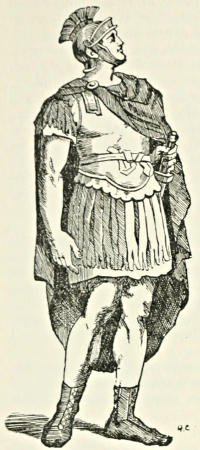
A Roman Officer
(After Vecellio)
If we resolve this history into its component parts and examine each of
these parts separately as to its origin and genetic motive, we perceive that
the Roman legends and traditions take origin from very diverse sources and
demand very diverse explanations.
First of all, we cannot but recognise that certain fundamental facts in
the traditional history of the monarchy are historically true and derived
from historical reminiscence. The memory of the most vital moments in the
development of the Roman constitution survived, though much confused,
down to the age of written records. Hence we cannot refuse a certain
amount of credence to traditions relating to public law. The double state
formed by the union of Romans and Sabines, the three original tribes, the
succession in which they originated, the three centuries of knights, the successive
augmentations of the senate till it reached the number of three
hundred, the rise of a plebeian class,[9] the creation of the inferior gentes, the
introduction of the censorship, the fall of the monarchy, and the establishment
of the republic—these fundamental facts of early constitutional history
are in all likelihood historical in essence, even though the circumstantial
details (more particularly the estimates of numbers) with which they are
adorned and the relation of cause and effect in which they are placed by the
historian may be due to the ingenuity, or construed according to the opinion,
of posterity. Round this stock of fact, however, has twined a luxuriant
growth of fiction, a garland of legend, the origin of which we will forthwith
proceed to examine, and so exhibit it in the germ.
A distinction is generally and rightly drawn between legend and myth.
The legend is a reminiscence of remarkable events transmitted from generation
to generation by oral tradition, especially by means of popular
poetry, tinged with the marvellous by the imaginative faculty, more or less
arbitrarily, though without conscious intention. The myth is the exact
opposite. Where the legend has a kernel of historic fact, merely adorned
and exaggerated by the accompaniment of fiction, the kernel and genetic
motive of the myth is, on the contrary, a particular idea, and the facts of
the story are merely the medium or material used by the poet to set forth
and impress this idea.
If we consider the primitive history of Rome from this point of view we
cannot deny that it contains both legends and myths, according to the definition
just given. To take some examples—the heroic deeds of a Horatius
Cocles, a Mucius Scævola, or a Clœlia, may rank as legends; Brutus is a
legendary figure; the battle of Lake Regillus is coloured with the hues of
legend; as are Coriolanus’ career of conquest, the destruction of the Fabii;
and the march of Cincinnatus to Mount Algidus. On the other hand, we have
a specimen of the myth in the begetting of Servius Tullius by the tutelary
god of the Regia, a myth which expresses the idea that in this king the inmost
spirit of the Roman monarchy was embodied.
A pure myth, again, and one which takes its rise from nature-symbolism,
is the battle of Hercules (i.e., of Sancus the sky-god) with Cacus who
belches forth fire and smoke. We have an instance of the historic myth
in that which refers the disparate elements of Roman national character,
in which military and political capacity were so curiously blended with
religious superstition, to the disparate personality of the two original
founders of Rome, the one a military ruler, regulating the state and military
affairs, the other a prince of peace, regulating the religion and the worship
of the gods.
But the majority of Roman traditions fall neither under the definition
of legend nor of purely notional myth. Most of these traditions are what
we may call ætiological myths, that is to say, they relate events and transactions
which have been devised or worked up to explain genetically some
present fact, the existence or the name of a ceremony, a custom, a cult, an
institution, a locality, a monument, a sanctuary, and so forth. The ætiological
myth is a curious variety of the myth proper. It is a myth in so
far as the actual occurrences which it narrates are pure invention, but it
differs from the genuine myth in this, that its starting-point and motive is
not an idea or mental conception, but some external accident which the
narrative is intended to show cause for and explain.
Ætiological myths are primitive, and for the most part puerile attempts
at historical hypothesis. The early history of Rome is very rich in ætiological
myths of this sort; the settlement of Evander, the presence of Hercules
in Rome, the story concerning the Potitii and Pinarii, the Nautians
taking charge of and rescuing the Palladium, the sow with the litter of
thirty, the rape of the Sabines, the fair one of Talassius, the fable of the
Tarpeian, the foundation of the temple of Jupiter stator, the legends concerning
the origin of the name of Lacus Curtius, the miracle of Attus
Navius, and other legends of the same character may serve as examples, and
will be explained from this point of view in the course of the present inquiry.
Plutarch’se Roman Questions is a rich and instructive collection
of such ætiological myths.
A sub-variety of the ætiological myth is the etymological myth, which
takes as its starting-point a particular proper name and tries to explain the
origin of it by a substructure of actual fact. The primitive history of
Rome is rich in myths of this class also, and a multitude of the fables contained
in it have been spun out of proper names. Such are the fables of
Argos, Evander’s host; of the Argive colony in Rome; of the birth of
Silvius Postumus in the forest; of the relations between the good Evander
and the evil Cacus; the suckling of Romulus; the relation of the sucklings
to the sacred fig-tree (Ficus ruminalis), the pretended origin of the Fossa Cluilia;
the origin of the Tarquins from Tarquinii; the discovery of the head of
Olus; the birth of Servius Tullius from a slave girl; the building of the
Tullianum by the king of that name; the imbecility of Brutus; the burning
of Scævola’s right hand; the conquest of Corioli by Coriolanus; and
so forth.
There is another variety of Roman legend which must be distinguished
from the ætiological and etymological myth: the legend which may be
described as the mythic garb of actual conditions and events, and which
thus stands midway between legend and myth. To this class belong, for
example, the legend of the Sibyl who comes to Rome in the time of the
younger Tarquin, and would have him buy nine books of divine prophecies
for a great price, and who, being mocked by him, burns three books before
his eyes, and yet another three, and finally sells the three remaining books
to the king for the price she had asked at the beginning. There is not the
slightest doubt that this legend is based on a substratum of fact, the fact
that the Sibylline prophecies were probably brought from Cumæ to Rome
under the second Tarquin, but this fact is clothed in a garb of poetical fiction;
it is a cross between legend and myth. The same may hold good of
the number of the Roman kings; these seven kings stand for and figure
forth the seven fundamental facts of the ancient (pre-republican) history
of Rome which have been held in historic remembrance.
Generally speaking, indeed, it is the peculiar and distinguishing characteristic
of Roman myths that they are not, as a rule, pure inventions, not
creations of the fancy, not, above all, like most of the tales of Greek
mythology, myths based on natural philosophy or on nature-symbolism,
but that they are historical myths, that a certain contemplation of actual
conditions and real events lies at the bottom of them, either as the genetic
motive or the raw material of the narrative. For instance, the figures of
Romulus and Tatius are in themselves mythical; they never really existed,
but the twofold sway ascribed to them has nevertheless something of historic
truth in it; it is the mythical expression of actual historic conditions,
the twofold state of the united Latins and Sabines. The same criticism
applies to the conflict of Tarquinius Priscus with the augur Attus Navius;
in the form in which it has been handed down it can hardly be historical;
the story of the whetstone is a manifest fable, but none the less a real
occurrence is imaged in it—namely, the historical conflict between the
pre-Tarquinian hierarchy and the political ideas of the Tarquinian dynasty.
In this way most of the myths and legends of primitive Roman history contain
a deposit of historic memories and views, which can be recovered if
each myth is traced back to the general fundamental conception which forms
its genetic motive.
It should hardly be necessary to vindicate this view of primitive Roman
history, and of the myth in general, against such objections as have recently
been brought forward, as when the objectors profess to find the “frivolity”
and the “vain and idle play of fancy” displayed in such myth-invention incompatible
with the severity of manners and the practical genius of the old
Roman races. These objections would only hit the mark if the myths were
arbitrary and conscious inventions—if they were deliberate falsehoods. But
this is so little their character that we may rather say that they are the only
language in which a race in a certain stage of civilisation could give expression
to its thoughts and ideas. For example, at the stage which the Roman
people had reached when the myth was invented, they had no vocabulary
which could have furnished them with a definite and exhaustive exposition
of the conflict between Tarquinian and pre-Tarquinian ideas in the body
politic; and they therefore had recourse to the expedient of symbolising
that conflict and the course of events connected with it, and presenting them
in a single significant scene, a scene which, regarded empirically, is certainly
non-historic, but which is nevertheless at bottom historically true.
Let us imagine any people feeling, in a particular stage of civilisation,
the need of contemplating its original character, of forming a mental image
of primitive conditions concerning which it has no historical knowledge, of
basing its political and religious traditions upon their first causes—how can
it satisfy this need except by myth-invention? As long as it is not intellectually
mature enough to advance the statements which, on the basis of its
present consciousness, it makes concerning its origin as historical hypotheses,
it must of necessity express these statements in symbolical form, that is, in
the language of myth.
In the foregoing pages we have shown the various motives and modes of
origin of the Roman legends and traditions. The legends which originated
in these ways were then spun out and linked together by rational reflection;
and thus there gradually came into being the whole body of legendary lore
which the Roman historians found ready to their hand and set down in writing.
The legend of Silvius Postumus, the ancestor of the Alban Silvii, may
serve as an example of this spinning-out process. This Silvius, the story
goes, was so-called because he was born in the forest—evidently an etymological
myth. Therefore, the deduction proceeds, at the time of his birth
his mother Lavinia must have been sojourning in the forest; therefore,
she must have fled thither, presumably after the death of her husband
Æneas; therefore, probably in fear of her stepson Ascanius.
It is obvious that all these statements are not founded upon tradition but
are mere sophistries. Similarly, the legend of the reputed origin of Rome
from a mixed rabble, and the tale that for this reason the ambassadors whom
Romulus sent with offers of connubium (the right to intermarry) to the
neighbouring peoples were repulsed with scornful words, is certainly based
on nothing but deductions and conclusions drawn from the (purely mythical)
story of the rape of the Sabines. Again, the despotic power which Romulus
is said to have exercised in the latter years of his reign, and the bodyguard
with which he surrounded himself, seem to be mere inferences drawn
from the legend (likewise mythical in origin) of the tearing of his body
piecemeal, to serve as an explanation for that enigmatical proceeding.
It is self-evident that it would be impossible to clear up every single
point of the traditional history; but the mode of origin of the whole will
have been made sufficiently plain by the foregoing observations.c
The Historical Value of the Myths
Although as we proceed with critical examination we find abundant confirmation
of a general kind for the assumption that the names of the Roman
kings correspond severally to a like number of originally independent communities,
it is nevertheless necessary to note at this stage more precisely a
hypothesis which is of the greatest moment and consequence in the consideration
and investigation of the early history of the city.
In the first place, there can be no doubt that the Tarquins are real historical
personages, and must therefore be conceived of in quite another
fashion than the more ancient figures about which the various genealogical
legends centre, and whose historical existence is due to personification alone.
By adding their names to the older names the pontifices arbitrarily connected
two entirely different elements, which ought in reality to be kept
quite apart. The more ancient figures only—Romulus, Titus Tatius,
Tullus Hostilius, Ancus Marcius, and Servius Tullius—are personifications,
and of them only does the statement hold good that they are the representatives
of diverse and distinct communities and of diverse elements of nationality.
Here as everywhere legend and history meet and mingle, combining
into a single line personifications and genuine historical figures, which were
originally cognate but not equivalent ideas.
As for the actual names of the kings, they, as we shall presently see in
individual cases, are either the real names of the communities personified, or
appellations taken from special conditions which characterised such communities;
they always furnish some pregnant hint concerning the nature of the
people personified. It is easy to understand how these names would ultimately
stand forth as the names of kings: the “king” was the representative
of the community before gods and men, and the nation, if personified, would
naturally appear in the status and dignity of its legal representative.
Accordingly, in the several Roman kings we must recognise a representation
of the several communities under kingly rule which went to make up Rome,
set forth under the figure of separate reigning monarchs.
Firmly as we must now hold to the kernel of historic truth underlying
these regal figures, we must not disregard the possibility that they have
been disguised, overlaid, and distorted, to a very great extent, by a quantity
of extraneous accessories, mythical and fictitious.
The first point which we must bear in mind is that every legend of a
nation, race, or community, is intimately connected with the religion of that
nation or race. In other words, the legends of the ancestral hero, the
eponym, tend to be confounded with the myths of the tribal divinity in
course of time, the latter are set to the credit (in part at least) of the hero
of the former, and the residuum of actual historic fact in the legend becomes
more and more distorted and confused. This holds good in the case of the
Roman kings. In considering them therefore these mythical elements must
be discarded and left out of account.
We are next confronted by a unanimous tendency to make the kings,
i.e. the communities personified in them, appear as Romans from the outset.
The tendency is comprehensible: the name Roman took its rise originally
from one community, but in the course of time it had become an honourable
title common to all, the descriptive cognomen of all citizens of the conjoint
city, and every man desired to pose as a Roman of the old stock, a good
citizen of the Roman commonwealth. This was, however, in direct contravention
of history. The greater number of these kings, i.e. of these
communities, were in reality originally strangers or even enemies, the
destiny of the city had frequently accomplished itself through deadly feuds
and bloody battles, and if it had been thought desirable to insist on these
facts the ancient history of the city would have worn a very different aspect
from that with which we are familiar. But in that case a very questionable
light would have been thrown on most of the elements out of which it had
grown; and hence there was naturally a general endeavour to obliterate the
traces of ancient conflict. The remembrance of those old-world struggles
was intentionally confused, or effaced by fictitious additions, modified by
tradition, or rejected altogether.
In the only, or almost the only version in which it is known to us, the
picture drawn by later hands of the most ancient history of Rome, both of
the monarchy and the early days of the republic, conveys no hint, or at least
only the remotest, of the crises which the city and state must have passed
through before taking the form in which it became the basis of a common
life and activity to all elements of the community alike. The attitude assumed
by this false patriotism is chiefly responsible for the falsification of
the earlier history, especially the records connected with the names of the
kings.
Again, a third force which we must take into consideration as exercising
a dubious influence on the form into which the primitive history of the city
was cast, is the singular love of combination which distinguished the Roman
priests and antiquaries. The true and original meaning of the ancient
traditions, institutions, and antiquated terms in civil and ecclesiastical law,
had passed out of mind in the lapse of years, and yet there was a general
desire for enlightenment and a right understanding of these things.
Whereupon sacerdotal wisdom, which seldom rose above the level of the
schoolboy, combined with an absolute freedom, nay, an amazing boldness
of arbitrary interpretation, and attempted by this means to render the
ancient and extinct legends, institutions, and ideas, clear and comprehensible.
From its confined point of view the most superficial likenesses, the most
trivial relations, were naturally the most highly favoured in the interpretation
of these traditions, ideas, and institutions. Above all, we must lay
stress in this connection upon the incredible passion of these exponents for
etymology. The remotest assonance of words or phrases sufficed to bring
the underlying ideas into connection in their minds and to make them
derive the one circumstantially from the other. These combinations and
interpretations are handed on to us by antiquaries who either made them
out for themselves or borrowed them as authoritative explanations and
definitions from the priestly circles, or the writings of pontifices, augurs, etc.
In every single case the keenest critical acumen is required to separate these
manufactured combinations and deductions from the genuine deposit of
older traditions.
Finally we must mention, as the last force which contributed to the distortion
of primitive Roman history, the unbounded vaingloriousness of later
times. The Romans suffered—the expression is permissible—from the
vastness of the proportions of their state and city at a subsequent period.
Theoretically they could still persuade themselves and believe that Rome
had once been small, but the realisation of the fact in practical detail was
beyond them. Thus, in the idea of the city current in later days, it appears
as a metropolis from the time of its foundation; the peasant fights become
mighty wars skilfully conducted between powerful states and cities, detail
and colour being provided by the observation and technical knowledge of a
later date. Before attempting to explain the conditions of the Roman monarchy
we must therefore always reduce them from the scale on which they
are presented to us in this picture to the scale which really befits their
original proportions. The gradual rise of the city, its inception and growth
step by step from the federal union of villages and settlements, must first be
sought for and studied in such instances as have remained free from the
influence of sacerdotal handling and vainglory.d
Costume of an Etruscan Woman of the Upper Class
(Based on Racinet)
[ca. 753-510 B.C.]
The people or citizens of Rome were divided into the three tribes of the
Ramnes, Tities, and Luceres,[10] to whatever races we may suppose them to
belong, or at whatever time and under whatever circumstances they may
have become united. Each of these tribes was divided into ten smaller
bodies called curiæ; so that the whole people consisted of thirty curiæ:
these same divisions were in war represented by the thirty centuries which
made up the legion, just as the three tribes were represented by the three
centuries of horsemen; but that the soldiers of each century were exactly a
hundred, is apparently an unfounded conclusion.
We have said that each tribe was divided into ten curiæ; it would be more
correct to say that the union of ten curiæ formed the tribe. For the state
grew out of the junction of certain original elements; and these were neither
the tribes, nor even the curiæ, but the gentes[11] or houses which made up the
curiæ. The first element of the whole system was the gens or house, a
union of several families who were bound together by the joint performance
of certain religious rites. Actually, where a system of houses has existed
within historical memory, the several families who composed a house were
not necessarily related to one another; they were not really cousins more or
less distant, all descended from a common ancestor. But there is no reason
to doubt that in the original idea of a house, the bond of union between its
several families was truly sameness of blood: such was likely to be the earliest
acknowledged tie; although afterwards, as names are apt to outlive their
meanings, an artificial bond may have succeeded to the natural one; and a
house, instead of consisting of families of real relations, was made up sometimes
of families of strangers, in the hope that law, and custom, and religion,
might together rival the force of nature.
Thus the state being made up of families, and every family consisting
from the earliest times of members and dependents, the original inhabitants
of Rome belonged all to one of two classes: they were either members of a
family, and, if so, members of a house, of a curia, of a tribe, and so, lastly,
of the state; or they were dependents on a family; and, if so, their relation
went no further than the immediate aggregate of families, that is, the house:
with the curia, with the tribe, and with the state, they had no connection.
These members of families were the original citizens of Rome; these
dependents on families were the original clients.
The idea of clientship is that of a wholly private relation; the clients
were something to their respective patrons, but to the state they were nothing.
But wherever states composed in this manner, of a body of houses with
their clients, had been long established, there grew up amidst, or close beside
them, created in most instances by conquest, a population of a very distinct
kind. Strangers might come to live in the land, or more commonly the inhabitants
of a neighbouring district might be conquered, and united with
their conquerors as a subject people. Now this population had no connection
with the houses separately, but only with a state composed of those houses:
this was wholly a political, not a domestic relation; it united personal and
private liberty with political subjection. This inferior population possessed
property, regulated their own municipal as well as domestic affairs, and as
free men fought in the armies of what was now their common country. But,
strictly, they were not its citizens; they could not intermarry with the
houses; they could not belong to the state, for they belonged to no house,
and therefore to no curia, and no tribe; consequently they had no share in
the state’s government, nor in the state’s property. With whatever belonged
to the state in its aggregate capacity, these, as being its neighbours merely,
and not its members, had no concern.
Such an inferior population, free personally, but subject politically, not
slaves, yet not citizens, was the original plebs, the commons of Rome.[12]
The mass of the Roman commons were conquered Latins. These,
besides receiving grants of a portion of their former lands, to be held by
them as Roman citizens, had also the hill Aventinus assigned as a residence
to those of them who removed to Rome. The Aventine was without
the walls, although so near to them: thus the commons were, even in the
nature of their abode, like the Pfahlbürger of the Middle Ages—men not
admitted to live within the city, but enjoying its protection against foreign
enemies.
It will be understood at once, that whatever is said of the people in these
early times, refers only to the full citizens, that is, to the members of the
houses. The assembly of the people was the assembly of the curiæ; that is,
the great council of the members of the houses; while the senate, consisting
of two hundred senators, chosen in equal numbers from the two higher tribes
of the Ramnes and Tities, was their smaller or ordinary council.
Within the walls every citizen was allowed to appeal from the king, or
his judges, to the sentence of his peers; that is, to the great council of the
curiæ. The king had his demesne lands, and in war would receive his portion
of the conquered land, as well as of the spoil of movables.
The dominion and greatness of the monarchy are attested by two sufficient
witnesses; the great works completed at this period, and still existing;
and the famous treaty with Carthage, concluded under the first consuls of
the commonwealth, and preserved to us by Polybius.f Under the last kings
the city of Rome reached the limits which it retained through the whole
period of the commonwealth, and the most flourishing times of the empire.
What are called the walls of Servius Tullius continued to be the walls of
Rome for nearly eight hundred years, down to the emperor Aurelian. They
enclosed all those well-known Seven Hills, whose fame has so utterly eclipsed
the Seven Hills already described of the smaller and more ancient city.
The line of the mound or rampart may still be distinctly traced, and the
course and extent of the walls can be sufficiently ascertained; but very few
remains are left of the actual building. But the masonry with which the
bank of the Tiber was built up, a work ascribed to the elder Tarquinius, and
resembling the works of the Babylonian kings along the banks of the Euphrates,
is still visible. So also are the massy substructions of the Capitoline
temple, which were made in order to form a level surface for the building
to stand on, upon one of the two summits of the Capitoline Hill. Above all,
enough is still to be seen of the great cloaca or drain, to assure us that the
accounts left us of it are not exaggerated. The foundations of this work
were laid about forty feet under ground, its branches were carried under a
great part of the city, and brought at last into one grand trunk which ran
down into the Tiber exactly to the west of the Palatine Hill. It thus
drained the waters of the low grounds on both sides of the Palatine; of the
Velabrum, between the Palatine and the Aventine; and of the site of the
Forum between the Palatine and the Capitoline. The stone employed in
the cloaca is in itself a mark of the great antiquity of the work; it is not
the peperino of Gabii and the Alban hills, which was the common building
stone in the time of the commonwealth; much less the travertino, or limestone
of the neighbourhood of Tibur, the material used in the great works
of the early emperors; but it is the stone found in Rome itself, a mass of
volcanic materials coarsely cemented together, which afterwards was supplanted
by the finer quality of the peperino. Such a work as the cloaca
proves the greatness of the power which effected it, as well as the character
of its government. It was wrought by task-work, like the great works of
Egypt; and stories were long current of the misery and degradation which
it brought upon the people during its progress. But this task-work for
these vast objects shows a strong and despotic government, which had at
its command the whole resources of the people; and such a government
could hardly have existed, unless it had been based upon some considerable
extent of dominion.
What the cloaca seems to imply, we find conveyed in express terms in
the treaty with Carthage. As this treaty was concluded in the very first
year of the commonwealth, the state of things to which it refers must clearly
be that of the latest period of the monarchy. It appears then that the whole
coast of Latium was at this time subject to the Roman dominion: Ardea,
Antium, Circeii, and Tarracina, are expressly mentioned as the subject allies
(ὑπήκοοι) of Rome. Of these, Circeii is said in the common story to have
been a Roman colony founded by the last Tarquinius; but we read of it no
less than of the others as independent, and making peace or war with Rome,
during the commonwealth down to a much later period. Now it is scarcely
conceivable that the Romans could thus have been masters of the whole coast
of Latium, without some corresponding dominion in the interior; and we
may well believe that Rome was at this time the acknowledged head of the
Latin cities, and exercised a power over them more resembling the sovereignty
of Athens over her allies than the moderate supremacy of Lacedæmon.
On the right bank of the Tiber the Romans seem to have possessed
nothing on the coast; but the stories of Etruscan conquests which we find
in the common accounts of Servius Tullius, are so far justified by better testimony
as to make it probable that in the direction of Veii the Roman dominion
had reached beyond the Tiber, and that the territory thus gained from
the Etruscans formed a very considerable part of the whole territory of
Rome. It is well known that the number of local tribes established by the
later kings was thirty; whereas a few years after the beginning of the
commonwealth we find them reduced to twenty. Now, as even the common
account of the war with Porsenna describes the Romans as giving up to
the Veientines a portion of territory formerly conquered from them, it becomes
a very probable conjecture that the Etruscans, soon after the expulsion
of the kings, recovered all the country which the kings had taken
from them; and that this was so considerable in extent, that by its loss the
actual territory of the Roman people was reduced by one-third from what it
had been before.
It may thus be considered certain that Rome under its last kings was
the seat of a great monarchy, extending over the whole of Latium on the
one side, and possessing some considerable territory in Etruria on the other.
But how this dominion was gained it is vain to inquire. There are
accounts which represent all the three last kings of Rome, Servius Tullius
no less than the two Tarquins, as of Etruscan origin. Without attempting
to make out their history as individuals, it is probable that the later kings
were either by birth or by long intercourse closely connected with Etruria,
inasmuch as at some early period of the Roman history the religion and
usages of the Etruscans gave a deep and lasting colouring to those of Rome;
and yet it could not have been at the very origin of the Roman people,
as the Etruscan language has left no traces of itself in the Latin; whereas
if the Romans had been in part of Etruscan origin, their language, no less
than their institutions, would have contained some Etruscan elements.
The Etruscan influence, however introduced, produced some effects that
were lasting, and others that were only temporary; it affected the religion
of Rome, down to the very final extinction of paganism; and the state of
the Roman magistrates, their lictors, their ivory chairs, and their triumphal
robes, are all said to have been derived from Etruria. A temporary effect
of Etruscan influence may perhaps be traced in the overflow of the free constitution
ascribed to Servius Tullius, in the degradation of the Roman commons
under the last king, and in the endeavours of the patricians to keep
them so degraded during all the first periods of the commonwealth. It is
well known that the government in the cities of Etruria was an exclusive
aristocracy, and that the commons, if in so wretched a condition they may
be called by that honourable name, were like the mass of the people amongst
the Slavonic nations, the mere serfs or slaves of the nobility. This is a
marked distinction between the Etruscans, and the Sabine and Latin nations
of Italy; and, as in the constitution of Servius Tullius a Latin spirit is discernible,
so the tyranny which, whether in the shape of a monarchy or an
aristocracy, suspended that constitution for nearly two centuries, tended
certainly to make Rome resemble the cities of Etruria, and may possibly be
traced originally to that same revolution which expelled the Sabine gods
from the Capitol, and changed forever the simple religion of the infancy of
Rome.
It is a remarkable story that towards the end of the sixth century of
Rome, the religious books of Numa were accidentally brought to light by the
discovery of his tomb under the Janiculum. They were read by A. Petillius,
the prætor urbanus, and by him ordered to be burned in the comitium,
because their contents tended to overthrow the religious rites then observed
in Rome. We cannot but connect with this story what is told of Tarquinius
the elder, how he cleared away the holy places of the Sabine gods
from the Capitoline Hill, to make room for his new temple; and the statement
which Augustine quotes from Varro, and which is found also in Plutarch,
that during the first hundred and seventy years after the foundation
of the city, the Romans had no images of their gods.
All these accounts represent a change effected in the Roman religion;
and the term of one hundred and seventy years, given by Varro and Plutarch,
fixes this change to the reigns of the later kings. It is said also that
Jupiter, Juno, and Minerva, the three deities to whom the Capitoline temple
was dedicated, were the very powers whose worship, according to the Etruscan
religion, was essential to every city; there could be no city without
three gates duly consecrated, and three temples to these divinities. But
here again we gain a glimpse of something real, but cannot make it out
distinctly.
Images of the gods belong rather to the religion of the Greeks than
of the Etruscans; and the Greek mythology, as well as Grecian art, had
been familiar in the southern Etruscan cities from a very early period,
whether derived from the Tyrrhenians, or borrowed directly from Hellas
or the Hellenic colonies. Grecian deities and Greek ceremonies may have
been introduced, in part, along with such as were purely Etruscan. But
the science of the haruspices, and especially the attention to signs in the
sky, to thunder and lightning, seems to have been conducted according to
the Etruscan ritual; perhaps also from the same source came that belief
in the punishment of the wicked after death, to which Polybius ascribes so
strong a moral influence over the minds of the Romans, even in his own
days. And Etruscan rites and ordinances must have been widely prevalent
in the Roman commonwealth, when, as some writers asserted, the Roman
nobility were taught habitually the Etruscan language, and when the senate
provided by a special decree for the perpetual cultivation of the Etruscan
discipline by young men of the highest nobility in Etruria; lest a science
so important to the commonwealth should be corrupted by falling into the
hands of low and mercenary persons.
Nothing is more familiar to our ears than the name of the classes and
centuries of Servius Tullius; nothing is more difficult, even after the
immortal labour of Niebuhr,c than to answer all the questions which naturally
arise connected with this part of the Roman history. But first of all,
in considering the changes effected in the Roman constitution during the
later period of the monarchy, we find another threefold division of them
presenting itself. We have, first, the enlargement of the older constitution,
on the same principles, in the addition to the number of senators and of the
centuries of the knights, commonly ascribed to Tarquinius Priscus. Second,
we have the establishment of a new constitution on different principles, in
the famous classes and centuries of Servius Tullius. And, third, we have the
overthrow, to speak generally, of this new constitution, and the return to
the older state of things, modified by the great increase of the king’s power,
in the revolution effected by Tarquinius Superbus, and in his subsequent
despotism.
The old constitution was enlarged upon the same principles, in the
increase of the number of senators, and of the centuries of the knights. It
has been already shown that the older constitution
was an oligarchy, as far as the clients
and commons were concerned; it is no less
true, that it was democratical, as far as regarded
the relations of the citizens, or members of the
houses, to each other. Both these characters,
with a slight modification, were preserved in
the changes made by Tarquinius Priscus. He
doubled, it is said, the actual number of senators,
or rather of patrician houses; which involved
a corresponding increase in the numbers
of the senate; but the houses thus ennobled,
to use a modern term, were distinguished from
the old by the title of the “lesser houses”;
and their senators did not vote till after the
senators of the greater houses.

A Vestal Virgin
According to the same system, the king
proposed to double the number of the tribes,
that is, to divide his newly created houses into
three tribes, to stand beside the three tribes
of the old houses, the Ramnes, Tities, and Luceres.
Now as the military divisions of the
old commonwealths went along with the civil
divisions, the tribes of the commonwealth were
the centuries of the army; and if three new
tribes were added, it involved also the addition
of three new centuries of knights or horsemen;
and it is in this form that the proposed change
is represented in the common stories. But
here it is said that the interest of the old citizens, taking the shape of a
religious objection, was strong enough to force the king to modify his
project. No new tribes were created, and consequently no new centuries;
but the new houses were enrolled in the three old centuries, so as to form a
second division in each, and thus to continue inferior in dignity to the old
houses in every relation of the commonwealth. It may be fairly supposed,
that these second centuries in the army were also second tribes and second
curiæ in the civil divisions of the state; and that the members of the
new houses voted after those of the old ones no less in the great council,
the comitia of the curiæ, than in the smaller council of the senate.
The causes which led to this enlargement of the old constitution may be
readily conceived. Whether Tarquinius was a Latin or an Etruscan, all the
stories agree in representing him as a foreigner, who gained the throne by
his wealth and personal reputation. The mere growth of the Roman state
would, in the natural course of things, have multiplied new families, which
had risen to wealth, and were in their former country of noble blood; but
which were excluded from the curiæ, that is, from the rights of citizenship
at Rome; the time was come to open to them the doors of the commonwealth;
and a foreign king, ambitious of adding to the strength of his kingdom,
if it were but for the sake of his own greatness, was not likely to refuse
or put off the opportunity. Beyond this we are involved in endless disputes
and difficulties; who the Luceres were, and why Tarquinius raised them to
a level with the old tribes, we never can determine.
That there were only four vestal virgins before, and that Tarquinius
made them six, would certainly seem to show, that a third part of the state
had hitherto been below the other two-thirds, at least in matters of religion;
for it was always acknowledged that the six vestal virgins represented the
three tribes of the Ramnes, Tities, and Luceres, two for each tribe. But
in the additions made to the senate and to the centuries, the new citizens
must have been more than a third of the old ones; and indeed here the story
supposes that in military matters, at any rate, the Luceres were already on
an equality with the Ramnes and Tities. It is enough therefore to say, that
there had arisen at Rome so great a number of distinguished families, of
whatever origin, or from whatever causes, that an extension of the rights
of citizenship became natural and almost necessary: but as these were still
only a small part of the whole population, the change went no further than
to admit them into the aristocracy; leaving the character and privileges of
the aristocracy itself, with regard to the mass of the population, precisely the
same as they had been before.
But a far greater change was effected soon afterwards; no less than the
establishment of a new constitution, on totally different principles. This
constitution is no doubt historical, however uncertain may be the accounts
which relate to its reputed author. “The good king Servius and his just
laws,” were the objects of the same fond regret amongst the Roman commons,
when suffering under the tyranny of the aristocracy, as the laws of
the good king Edward the Confessor amongst the English after the Norman
conquest; and imagination magnified, perhaps, the merit of the one no less
than of the other: yet the constitution of Servius was a great work, and well
deserves to be examined and explained. Servius, like Tarquinius, is represented
as a foreigner, and is said also, like him, to have ascended the throne
to the exclusion of the sons of the late king. According to the account
which Livyd followed, he was acknowledged by the senate, but not by the
people; and this, which seemed contradictory so long as the people, populus,
and the commons, plebs, were confounded together, is in itself consistent and
probable, when it is understood that the people, who would not acknowledge
Servius, were the houses assembled in their great council of the curiæ,
and that these were likely to be far less manageable by the king whom they
disliked, than the smaller council of their representatives assembled in the
senate. Now supposing that the king, whoever he may have been, was
unwelcome to what was then the people, that is, to the only body of men
who enjoyed civil rights, it was absolutely necessary for him, unless he
would maintain his power as a mere tyrant, through the help of a foreign
paid guard, to create a new and different people out of the large mass of
inhabitants of Rome who had no political existence, but who were free, and
in many instances wealthy and of noble origin; who therefore, although now
without rights, were in every respect well fitted to receive them.
The principle of an aristocracy is equality within its own body, ascendency
over all the rest of the community. Opposed to this is the system,
which, rejecting these extremes of equality and inequality, subjects no part
of the community to another, but gives a portion of power to all; not an
equal portion however, but one graduated according to a certain standard,
which standard has generally been property. Accordingly, this system has
both to do away with distinctions and to create them; to do away, as it has
generally happened, with distinctions of birth, and to create distinctions of
property. Thus at Rome, in the first instance, the tribes or divisions of the
people took a different form.
The old three tribes of Ramnes, Tities, and Luceres, had been divisions
of birth, real or supposed; each was made up of the houses of the curiæ,
and no man could belong to the tribe without first belonging to a curia, and
to a house; nor could any stranger become a member of a house except by
the rite of adoption, by which he was made as one of the same race, and
therefore a lawful worshipper of the same gods. Each of these tribes had
its portion of the Ager Romanus, the old territory of Rome. But now, as
many others had become Romans in the course of time, without belonging
to either of these three tribes, that is, had come to live under the Roman
kings, many in Rome itself, and had received grants of land from the kings
beyond the limits of the old Ager Romanus, a new division was made
including all these; and the whole city and territory of Rome, except the
Capitol, were divided into thirty tribes, four for the city, and twenty-six for the
country, containing all the Romans who were not members of the houses,
and classing them according to the local situation of their property. These
thirty tribes corresponded to the thirty curiæ of the houses; for the houses
were used to assemble, not in a threefold division, according to their tribes,
but divided into thirty, according to their curiæ: and the commons were to
meet and settle all their own affairs in the assembly of their tribes, as the
houses met and settled theirs in the assembly of their curiæ.
Thus then there were two bodies existing alongside of each other, analogous
to the House of Lords and the House of Commons of England’s ancient
constitution, two estates distinct from and independent of each other, but
with no means as yet provided for converting them into states-general or a
parliament. Nor could they have acted together as jointly legislating for
the whole nation; for the curiæ still regarded themselves as forming exclusively
the Roman people, and would not allow the commons, as such, to
claim any part in the highest acts of national sovereignty.[13] There was one
relation, however, in which the people and the commons felt that they
belonged to one common country, in which they were accustomed to act
together, and in which therefore it was practicable to unite them into one
great body. This was when they marched out to war; then, if not equally
citizens of Rome, they felt that they were alike Romans.
It has ever been the case, that the distinctions of peace vanish amidst
the dangers of war; arms and courage, and brotherhood in perils, confer of
necessity power and dignity. Thus we hear of armies on their return home
from war stopping before they entered the city walls to try, in their military
character, all offences or cases of misconduct which had occurred since
they had taken the field: whereas when once they had entered the walls, civil
relations were reassumed, and all trials were conducted according to other
forms, and before other judges. This will explain the peculiar constitution
of the comitia of centuries, which was a device for uniting the people and the
commons into a national and sovereign assembly in their capacity of soldiers,
without shocking those prejudices which as yet placed a barrier between
them as soon as they returned to the relations of peace.
But in order to do this with effect, and to secure in this great assembly a
preponderance to the commons, a change in the military organisation and
tactics of the army became indispensable. In all aristocracies in an early
stage of society, the ruling order or class has fought on horseback or in
chariots and their subjects or dependents have fought on foot. The cavalry
service under these circumstances has been cultivated, that of the infantry
neglected; the mounted noble has been well armed and carefully trained
in warlike exercises, whilst his followers on foot have been ill armed and
ill disciplined, and quite incapable of acting with equal effect. The first
great step then towards raising the importance of the infantry, or in other
words, of the commons of a state, was to train them to resist cavalry, to
form them into thick masses instead of a thin extended line, to arm them
with the pike instead of the sword or the javelin. Thus the phalanx
order of battle was one of the earliest improvements in the art of war;
and at the time we are now speaking of, this order was in general use
in Greece, and must have been well known, if only through the Greek
colonies, in Italy also. Its introduction into the Roman army would be
sure to make the infantry from henceforward more important than the
cavalry; that is, it would enable the commons to assert a greater right
in Rome than could be claimed by the houses, inasmuch as they could
render better service. Again, the phalanx order of battle furnished a
ready means for giving importance to a great number of the less wealthy
commons, who could not supply themselves with complete armour; while
on the other hand it suggested a natural distinction between them and
their richer fellows, and thus established property as the standard of
political power, the only one which can in the outset compete effectually
with the more aristocratical standard of birth; although in a later stage
of society it becomes itself aristocratical, unless it be duly tempered by
the mixture of a third standard, education and intelligence. In a deep
phalanx, the foremost ranks needed to be completely armed, but those in
the rear could neither reach or be reached by the enemy, and only served to
add weight to the charge of the whole body. These points being remembered,
we may now proceed to the details of the great comitia of Servius.
The traditional reformer, Servius Tullius, found the knights of Rome
divided into three centuries of horsemen, each of which, in consequence of
the accession to its numbers made by the last king, contained within itself
two centuries, a first and a second. The old citizens, anxious in all things to
keep up the old form of the state, had then prevented what were really six
centuries from being acknowledged as such in name; but the present change
extended to the name as well as the reality; and the three double centuries of
the Ramnes, Tities, and Luceres, became now the six votes (sex suffragia)
of the new united assembly. To these, which contained all the members of
the houses, there were now added twelve new centuries of knights,[14] formed,
as usual in the Greek states, from the richest members of the community,
continuing, like the centuries below them, to belong to the thirty tribes of
the commons.
Classes of Foot-soldiers
It remained to organise the foot-soldiers of the state. Accordingly, all
those of the commons whose property was sufficient to qualify them for serving
even in the hindmost ranks of the phalanx, were divided into four classes.
Of these the first class contained all whose property amounted to one hundred
and fifty thousand pounds’ weight of copper. The soldiers of this
class were required to provide themselves with the complete arms used in
the front ranks of the phalanx; the greaves, the coat of mail, the helmet, and
the round shield, all of brass; the sword, and the peculiar weapon of the
heavy-armed infantry, the long pike. And as these were to bear the brunt of
every battle, and were the flower of the state’s soldiers, so their weight in the
great military assembly was to be in proportion; they formed eighty centuries;
forty of younger men, between the ages of fifteen and forty-five years complete;
and forty of elders, between forty-five and sixty: the first to serve in
the field, the second to defend the city. The second class contained those
whose property fell short of 100,000 pounds of copper, and exceeded or
amounted to 75,000 pounds. They formed twenty centuries, ten of younger
men, and ten of elders; and they were allowed to dispense with the coat of
mail, and to bear the large oblong wooden shield called scutum, instead of
the round brazen shield, clipeus, of the first ranks of the phalanx. The third
class contained a like number of centuries, equally divided into those of the
younger men and elders; its qualification was property between 50,000 pounds
of copper, and 75,000 pounds; and the soldiers of this class were allowed to
lay aside the greaves as well as the coat of mail. The fourth class again
contained twenty centuries; the lowest point of its qualification was 25,000
pounds of copper, and its soldiers were required to provide no defensive
armour, but to go to battle merely with the pike and a javelin. These four
classes composed the phalanx; but a fifth class divided into thirty centuries,
and consisting of those whose property was between 25,000 pounds of copper
and 12,500, formed the regular light-armed infantry of the army, and were
required to provide themselves with darts and slings.[15]
The poorest citizens, whose property fell short of 12,500 pounds, were
considered in a manner as supernumeraries in this division. Those who
had more than 1,500 pounds of copper, were still reckoned amongst the taxpayers
(assidui), and were formed into two centuries, called the accensi and
velati. They followed the army, but without bearing arms, being only
required to step into the places of those who fell; and in the meantime
acting as orderlies to the centurions and decurions. Below these came one
century of the proletarii, whose property was between 1,500 pounds and 375
pounds. These paid no taxes, and in ordinary times had no military duty;
but on great emergencies arms were furnished them by the government, and
they were called out as an extraordinary levy. One century more included
all whose property was less than 375 pounds, and who were called capite
censi; and from these last no military service was at any time required, as
we are told, till a late period of the republic.
Three centuries of a different character from all the rest remain to be
described, centuries defined not by the amount of their property, but by
the nature of their occupation; those of carpenters and smiths (fabrorum);
of hornblowers (cornicines); and of trumpeters (tubicines), or, as Cicero
calls them (liticines). The first of these was attached to the centuries of the
first class, the other two to the fourth. The nature of their callings so connected
them with the service of the army, that this peculiar distinction was
granted to them.[16]
The position held in the comitia by the patricians’ clients is involved in
great obscurity. We know that they had votes, and probably they must
have been enrolled in the classes according to the amount of their property,
without reference to its nature: at the same time Niebuhrc thinks that they
did not serve in the regular infantry along with the plebeians. It would
seem from the story of the three hundred Fabii, and from the adventures
related of Caius Marcius, that the clients followed their lords to the field at
their bidding, and formed a sort of feudal force quite distinct from the
national army of the commons, like the retainers of the nobles in the Middle
Ages, as distinguished from the free burghers of the cities.
Such is the account transmitted to us of the constitution of the comitia
of centuries. As their whole organisation was military, so they were accustomed
to meet without the city, in the Field of Mars; they were called
together, not by lictors, like the comitia of the curiæ, but by the blast of the
horn: and their very name was “the Army of the City,” Exercitus Urbanus.
It is quite plain that this constitution tended to give the chief power in
the state to the body of the commons, and especially to the richer class among
them, who fought in the first ranks of the phalanx. For wherever there is
a well-armed and well-disciplined infantry, it constitutes the main force of
an army; and it is a true observation of Aristotle, that in the ancient commonwealths
the chief power was apt to be possessed by that class of the
people whose military services were most important: thus when the navy
of Athens became its great support and strength, the government became
democratical; because the ships were manned by the poorer classes.
Other good and popular institutions were ascribed to the reign of Servius.
As he had made the commons an order in the state, so he gave them
judges out of their own body to try all civil causes; whereas before they
had no jurisdiction, but referred all their suits either to the king or to the
houses. These judges were, as Niebuhrc thinks, the centumviri, the hundred
men of a later period, elected three from each tribe, so that in the time of
Servius their number would probably have been ninety.
To give a further organisation to the commons, he is said also to have
instituted the festivals called Paganalia and Compitalia. In the tribes in
the country, many strongholds on high ground, pagi, had been fixed upon as
general refuges for the inhabitants and their cattle in case of invasion.
Here they all met once a year to keep festival, and every man, woman, and
child paid on these occasions a certain sum, which being collected by the
priests gave the amount of the whole population. And for the same purpose,
every one living in the city paid a certain sum at the temple of Juno
Lucina for every birth in his family, another sum at the temple of Venus
Libitina for every death, and a third at the temple of Youth for every son
who came to the age of military service. The Compitalia in the city answered
to the Paganalia in the country, and were yearly festivals in honour of the
Lares or guardian spirits, celebrated at all the compita, or places where several
streets met.
Other laws and measures are ascribed to Servius, which seem to be the
fond invention of a later period, when the commons, suffering under a cruel
and unjust system, and wishing its
overthrow, gladly believed that the
deliverance which they longed for had
been once given them by their good
king, and that they were only reclaiming
old rights, not demanding new
ones. Servius, it is said, drove out
the patricians from their unjust occupation
of the public land, and ordered
that the property only, and not the
person, of a debtor should be liable
for the payment of his debt.
Further, to complete the notion of
a patriot king, it was said that he had
drawn out a scheme of popular government,
by which two magistrates,
chosen every year, were to exercise
the supreme power, and that he himself
proposed to lay down his kingly
rule to make way for them. It can
hardly be doubted that these two magistrates
were intended to be chosen
the one from the houses and the other
from the commons, to be the representatives
of their respective orders.
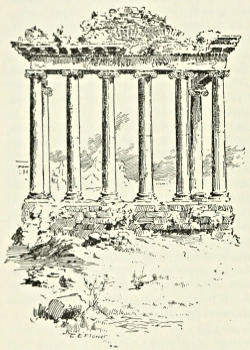
Ruins of a Temple of Saturn, Rome
But the following tyranny swept
away the institutions of Servius, and
much more prevented the growth of that society for which alone his institutions
were fitted. No man can tell how much of the story of the murder of
the old king and of the impiety of the wicked Tullia is historical; but it is
certain that the houses, or rather a strong faction among them, supported
Tarquinius in his usurpation: nor can we doubt the statement that the aristocratical
brotherhoods or societies served him more zealously than the legal
assembly of the curiæ; because these societies are ever to be met with in the
history of the ancient commonwealths, as pledged to one another for the
interests of their order, and ready to support those interests by any crime.
Like Sulla in after-times, he crushed the liberties of the commons, doing away
with the laws of Servius, and, as we are told, destroying the tables on which
they were written; abolishing the whole system of the census, and consequently
the arrangement of the classes, and with them the organisation of the
phalanx; and forbidding even the religious meetings of the Paganalia and
Compitalia, in order to undo all that had been done to give the commons
strength and union.
Further it is expressly said by Dionysiuse that he formed his military force
out of a small portion of the people, and employed the great bulk of them
in servile works, in the building of the circus and the Capitoline temple,
and the completion of the great drain or cloaca; so that in his wars, his army
consisted of his allies, the Latins and Hernicans, in a much greater proportion
than of Romans. His enmity to the commons was all in the spirit of
Sulla; and the members of the aristocratical societies, who were his ready
tools in every act of confiscation, or legal murder, or mere assassination, were
faithfully represented by the agents of Sulla’s proscription, by L. Catilina
and his patrician associates. But in what followed, Tarquinius showed himself,
like Critias or Appius Claudius, a mere vulgar tyrant, who preferred
himself to his order, when the two came into competition, and far inferior to
Sulla, the most sincere of aristocrats, who, having secured the ascendency of
his order, was content to resign his own personal power, who was followed
therefore by the noblest as well as by the vilest of his countrymen, by Pompey
and Catulus no less than by Catiline.
Thus Tarquinius became hated by all that was good and noble amongst
the houses, as well as by the commons; and both orders cordially joined to
effect his overthrow. But the evil of his tyranny survived him; it was not
so easy to restore what he had destroyed as to expel him and his family; the
commons no longer stood beside the patricians as an equal order, free, wealthy,
well armed, and well organised; they were now poor, ill armed, and with no
bonds of union; they therefore naturally sank beneath the power of the
nobility, and the revolution which drove out the Tarquins established at
Rome not a free commonwealth, but on the other hand an exclusive and
tyrannical aristocracy.
Niebuhrc has almost exhausted the subject of the Roman copper money.
He has shown its originally low value, owing to the great abundance of
the metal; that as it afterwards became scarce, a reduction in the weight
of the coin followed naturally, not as a fraudulent depreciation of it, but
because a small portion of it was now as valuable as a large mass had been
before. The plenty of copper in early times is owing to this, that where it
is found, it exists often in immense quantities, and even in large masses of
pure metal on the surface of the soil. Thus the Copper Indians of North
America found it in such abundance on their hills that they used it for all domestic
purposes; but the supply thus easily obtained soon became exhausted.
The small value of copper at Rome is shown not only by the size of the
coins, they having been at first a full pound in weight, but also by the price
of the war-horse, according to the regulation of Servius Tullius, namely ten
thousand pounds of copper.[17] This statement, connected as it is with the
other details of the census, seems original and authentic; nor considering
the great abundance of cattle, and other circumstances, is it inconsistent with
the account in Plutarch’s life of Publicola, that an ox in the beginning of the
commonwealth, was worth one hundred oboli, and a sheep worth ten; nor
with the provisions of the Aternian law, which fixed the price of the one at
one hundred asses and the other at ten.
The sources of wealth amongst the Romans, under their later kings, were
agriculture, and also, in a large proportion, foreign commerce. Agriculture,
indeed, strictly speaking, could scarcely be called a source of wealth; for the
portions of land assigned to each man, even if from the beginning they were
as much as seven jugera, were not large enough to allow of the growth of
much superfluous produce. The ager publicus, or undivided public land, was
indeed of considerable extent, and this as being enjoyed exclusively by the
patricians might have been a source of great profit. But in the earliest times
it seems probable that the greatest part of this land was kept as pasture;
and only the small portions of two jugera, allotted by the houses to their
clients, to be held during pleasure, were appropriated to tillage.[18] The low
prices of sheep and oxen show that cattle must have been abundant; the
earliest revenue according to Plinyg was derived from pasture; that is, the
patricians paid so much to the state for their enjoyment of the ager publicus,
which was left unenclosed as pasture ground; and all accounts speak of the
great quantities of cattle reared in Italy from time immemorial. Cattle then
may have been a source of wealth; but commerce must have been so in a
still greater degree.
The early foundation of Ostia at the mouth of the Tiber, ascribed to
Ancus Marcius, could have had no object, unless the Romans had been
engaged in foreign trade; and the treaty with Carthage, already alluded to,
proves the same thing directly and undeniably. In this treaty the Romans
are allowed to trade with Sardinia, with Sicily, and with Africa westward of
the Fair Headland, that is, with Carthage itself, and all the coast westward
to the Pillars of Hercules; and it is much more according to the common
course of things that this treaty should have been made to regulate a trade
already in activity, than to call it for the first time into existence. By this
commerce great fortunes were sure to be made, because there were as yet so
many new markets open to the enterprising trader, and none perhaps where
the demand for his goods had been so steadily and abundantly supplied as to
destroy the profit of his traffic.
But although much wealth must thus have been brought into Rome, it is
another question how widely it was distributed. Was foreign trade open to
every Roman, or was it confined to the patricians and their clients, and in a
still larger proportion to the king? The king had large domains of his own,
partly arable, partly pasture, and partly planted with vines and olives;
hence he was in a condition to traffic with foreign countries, and much of the
Roman commerce was probably carried on by the government for its own
direct benefit, as was the case in Judea in the reign of Solomon. The
patricians also, we may be sure, exported, like the Russian nobility, the skins
and wool of the numerous herds and flocks which they fed upon their public
land, and were the owners of trading ships, as it was not till three centuries
afterwards that a law was passed with the avowed object of restraining
senators, a term then become equivalent with patricians, from possessing
ships of large burden.
All these classes then might, and probably did, become wealthy; but it
may be doubted whether the plebeian landholders had the same opportunities
open to them. Agriculture was to them the business of their lives; if
their estates were ill cultivated, they were liable to be degraded from their
order.
Beyond this we have scarcely the means of proceeding. Setting aside
the tyranny ascribed to Tarquinius, and remembering that it was his policy
to deprive the commons of their lately acquired citizenship, and to treat them
like subjects rather than members of the state, the picture given of the wealth
and greatness of Judea under Solomon may convey some idea of the state of
Rome under its later kings. Powerful amongst surrounding nations, exposed
to no hostile invasions, with a flourishing agriculture and an active commerce,
the country was great and prosperous; and the king was enabled to
execute public works of the highest magnificence, and to invest himself with
a splendour unknown in the earlier times of the monarchy. The last
Tarquinius was guilty of individual acts of oppression, we may be sure,
towards the patricians no less than the plebeians; but it was these last whom
he laboured on system to depress and degrade, and whom he employed, as
Solomon did the Canaanites, in all the servile and laborious part of his
undertakings. Still the citizens or patricians themselves found that the
splendour of his government had its burdens for them also; as the great
majority of the Israelites, amid all the peace and prosperity of Solomon’s
reign, and although exempted from all servile labour, and serving only in
honourable offices, yet complained that they had endured a grievous yoke,
and took the first opportunity to relieve themselves from it by banishing the
house of Solomon from among them forever.b
The aim of education in the family and in public life was to repress the
freedom of the individual in the interest of the state, to make a nation of
brave warriors and of dutiful citizens. The highest results of this stern
training were reached in the Samnite wars,—a period known thereafter as
the golden age of virtue and of heroism. A citizen of this time was, in the
highest degree, obedient to authority, pious, frugal, and generally honest.
But though he was willing to sacrifice his life for the good of the state, he
was equally ready to enrich himself at the expense of his neighbours; the
wealthy did not hesitate to sell the poor into slavery for debt, till they were
forbidden to do so by law. Their hard, stern souls knew neither generosity
nor mercy. Severe toward the members of their family, cruel in the treatment
of slaves, and in their business transactions shrewd and grasping, the
Romans of the time, however admirable for their heroic virtues, were narrow,
harsh, and unlovable. Greed was one of their strongest motives for conquest.
Not for glory,—much less for the good of their neighbours,—did they
extend their power over Italy; it was rather that more of the peasants might
be supplied with farms and that the nobles might be given larger tracts of
the public land and a greater number of places of honour and of profit to use
and to enjoy.
As long as they remained poor and under strict discipline, they were
moral. In the following period they were to gain greater freedom from the
control of their magistrates and, at the same time, power and wealth. These
new conditions were to put their virtue and even their government to the
severest test.i
It is difficult to form a clear idea of the moral character of the Roman
people under its kings, because we cannot be sure that the pictures handed
down to us of that period were not copied from the manners of a later time,
and thus represent in fact the state of the Commonwealth rather than that
of the Monarchy. Thus the simple habits of Lucretia seem copied from the
matrons of the republic in the time of its early poverty, and cannot safely
be ascribed to the princesses of the magnificent
house of the Tarquinii. Again, we can
scarcely tell how far we may carry back the
origin of those characteristic points in the later
Roman manners, the absolute authority possessed
by the head of a family over his wife
and children. But it is probable that they
are of great antiquity; for the absolute power
of a father over his sons extended only to those
who were born in that peculiar form of marriage
called connubium, a connection which
anciently could only subsist between persons
of the same order, and which was solemnised
by a peculiar ceremony called confarreatio; a
ceremony so sacred, that a marriage thus contracted
could only be dissolved by certain unwonted
and horrible rites, purposely ordered
as it seems to discourage the practice of
divorce.
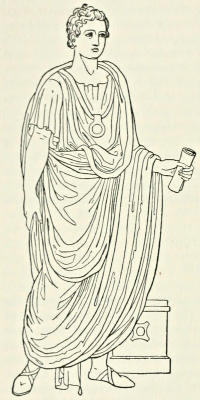
Roman Youth
(From a statue)
All these usages point to a very great antiquity,
and indicate the early severity of the
Roman domestic manners, and the habits of
obedience which every citizen learned under
his father’s roof. This severity, however, did
not imply an equal purity; connubium could
only be contracted with one wife, but the practice
of concubinage was tolerated, although the
condition of a concubine is marked as disreputable
by a law so old as to be ascribed to
Numa. And the indecency of some parts of
the ancient religious worship, and the licence
allowed at particular festivals, at marriages, and in the festal meetings of
men amongst themselves, belong so much to an agricultural people, as well
as to human nature in general, that these too may be safely presumed to be
co-eval with the very origin of the Roman nation.
But the most striking point in the character of the Romans, and that
which has so permanently influenced the condition of mankind, was their
love of institutions and of order, their reverence for law, their habit of considering
the individual as living only for that society of which he was a
member. This character, the very opposite to that of the barbarian and the
savage, belongs apparently to that race to which the Greeks and Romans
both belong, by whatever name, Pelasgian, Tyrrhenian, or Sicelian, we choose
to distinguish it. It has indeed marked the Teutonic race, but in a less
degree: the Celts have been strangers to it, nor do we find it developed
amongst the nations of Asia: but it strongly characterises the Dorians in
Greece, and the Romans; nor is it wanting among the Ionians, although in
these last it was modified by that individual freedom which arose naturally
from the surpassing vigour of their intellect, the destined well-spring of
wisdom to the whole world. But in Rome, as at Lacedæmon, as there was
much less activity of reason, so the tendency to regulate and to organise
was much more predominant.
Accordingly we find traces of this character in the very earliest traditions
of Roman story. Even in Romulus, his institutions go hand in hand
with his deeds in arms; and the wrath of the gods darkened the last years
of the warlike Tullus, because he had neglected the rites and ordinances
established by Numa. Numa and Servius, whose memory was cherished
most fondly, were known only as lawgivers; Ancus, like Romulus, is the
founder of institutions as well as the conqueror, and one particular branch
of law is ascribed to him as its author, the ceremonial to be observed before
going to war. The two Tarquinii are represented as of foreign origin,
and the character of their reigns is foreign also. They are great warriors
and great kings; they extend the dominion of Rome; they enlarge the
city and embellish it with great and magnificent works; but they add
nothing to its institutions; and it was the crime of the last Tarquinius
to undo those good regulations which his predecessor had appointed.
It is allowed, on all hands, that the works of art executed in Rome
under the later kings, whether architecture or sculpture, were of Etruscan
origin; but what is meant by “Etruscan,” and how far Etruscan art was
itself derived from Greece, are questions which have been warmly disputed.
The statue of Jupiter in the Capitol, and the four-horsed chariot on the
summit of the temple, together with most of the statues of the gods, were
at this period wrought in clay; bronze was not generally employed till a
later age. There is no mention of any paintings in Rome itself earlier
than the time of the commonwealth; but Plinyg speaks of some frescoes
at Ardea and at Cære, which he considered to be older than the very
foundation of the city, and which in his own age preserved the freshness
of their colouring, and in his judgment were works of remarkable merit.
The Capitoline temple itself was built nearly in the form of a square, each
side being about two hundred feet in length; its front faced southwards,
towards the Forum and the Palatine, and had a triple row of pillars before
it, while a double row enclosed the sides of the temple. These, it is probable,
were not of marble, but made either of the stone of Rome itself, like the
cloaca, or possibly from the quarries of Gabii or Alba.
Of the Roman mind under the kings, Cicero knew no more than we
do. He had seen no works of that period, whether of historians or of
poets; he had never heard the name of a single individual whose genius
had made it famous, and had preserved its memory together with his own.
A certain number of laws ascribed to the kings, and preserved, whether
on tables of wood or brass in the Capitol, or in the collection of the jurist
Papirius, were almost the sole monuments which could illustrate the spirit
of the early ages of the Roman people. But even these, to judge from
the few extracts with which we are acquainted, must have been modernised
in their language; for the Latin of a law ascribed to Servius Tullius is
perfectly intelligible, and not more ancient in its forms than that of the
fifth century of Rome; whereas the few genuine monuments of the earliest
times, the hymns of the Salii, and of the Brotherhood of Husbandry,
Fratres Arvales, required to be interpreted to the Romans of Cicero’s
time like a foreign language; and of the hymn of the Fratres Arvales
we can ourselves judge, for it has been accidentally preserved to our days,
and the meaning of nearly half of it is only to be guessed at. This agrees
with what Polybius says of the language of the treaty between Rome and
Carthage, concluded in the first year of the commonwealth; it was so unlike
the Latin of his own time, the end of the sixth and beginning of the seventh
century of Rome, that even those who understood it best found some things
in it which with their best attention they could scarcely explain. Thus,
although verses were undoubtedly made and sung in the times of the kings,
at funerals and at feasts, in commemoration of the worthy deeds of the
noblest of the Romans and although some of the actual stories of the kings
may perhaps have come down from this source, yet it does not appear that
they were ever written; and thus they were altered from one generation to
another, nor can any one tell at what time they attained to their present
shape. Traces of a period much later than that of the kings may be discerned
in them; and we see no reason to differ from the opinion of Niebuhr,c
who thinks that as we now have them they are not earlier than the restoration
of the city after the invasion of the Gauls.
If this be so, there rests a veil not to be removed, not only on the
particular history of the early Romans, but on that which we should much
more desire to know—and which in the case of the Greeks stands out in such
full light—the nature and power of their genius, what they thought, what
they hated, and what they loved.b
Roman Writing Implements
(In the British Museum)
[510-451 B.C.]
The next task of the Romans was to regain the old position of Servius
Tullius in Latium. Aided by the pressure constantly brought to bear on
the Latins by the Volscians, the Romans also succeeded, in the year 493, in
renewing with the former people their earlier alliance—an alliance based on
perfect equality and reciprocity.[19] Highly important, moreover, from a military
point of view was the treaty concluded in 486 between the Romans and
the Latins on the one side and the Hernicans on the other.
About this time began the lingering feuds between the Romans and their
allies and the neighbouring populations on the line that reached from the
Etruscan cities Veii and Fidenæ, through the country of the Sabines and the
Æquians to the scattered colonies of the Volscians on the southern borders
of Latium. These conflicts rarely bore the character of actual warfare, being
confined for the most part to carrying on or repelling burning and marauding
expeditions. Yet there was no lack, especially with the Etruscans, of more
serious engagements which, as we shall see, had great influence in determining
the future of Italy and the Romans. Meanwhile these struggles served
the Romans as an excellent school of war; but their political importance was
not nearly so great as that of the internal conflicts that marked the development
of republican Rome.
The conditions in Rome after the expulsion of the Tarquins were similar
to those which prevailed in Greece under what was called the Eupatridian
rule. The supreme power which was formerly vested in the king, now passed
into the hands of a magisterial body whose members were to be appointed by
vote. These republican officials, now commonly called consuls, were then
given the title of prætors; a title that since the time of the decemvirs fell
into disuse as designating the head of the state, but was later applied to the
incumbents of a newly created office. The weight of the high civil, military,
and judicial authority that passed from the hands of the king into those of
the head of the republic, became considerably lessened by the action of causes
that were, from their very nature, bound to make themselves more and more
strongly felt. From the beginning of the republic, the Romans always placed
two consuls at the head in order that the actions of the one might be under
the restraining influence of the other’s veto. The term of the highest office
was never longer than one year. At the expiration of the year the consul
returned to the class of citizens to which he belonged, but could at any time
be called to account for his official acts.
This system of one-year tenure of office was later found to have grave
defects: but so much a part was it of the patrician as well as the democratic
republicanism of that day that it never occurred to any one to change it. To
the eminently practical Roman mind, however, the disadvantages connected
with a yearly change of officials must have been apparent in many ways.
As the life of Rome developed in fulness and freedom, the “scribes,” those
lower officials who were permanently appointed to their posts, came to be of
great importance in the actual conduct of public affairs. In time of war
when naturally every head of the republic did not show equal qualifications
for military leadership, the command of the army was given to some experienced
general who was specially appointed by the proper authorities. When
a consul was confronted by great and unexpected difficulties, he was empowered
by the senate to appoint the best man of the state as dictator, and this
dictator was in his turn to select as his assistant a master of horse—magister
equitum. The dictatorship, which was for the term of but six months, had
control over all minor offices, and as the dictator could not be held accountable,
and as there was no appeal from his decisions, the patricians frequently
had recourse, during the course of internal struggles, to the appointment of
one, in order effectually to quell the plebeian opposition.
The consuls were preceded by but twelve lictors bearing the axe and fasces,
while to the dictators were given twenty-four, like the kings in earlier
days. Owing to the constant increase in the volume of public affairs the
consuls frequently appointed, for the performance of certain duties, deputies,
whose term of office expired with their own. Associated with the consuls
in the keeping of the state archives and treasure were the two quæstors,
probably the same officials to whom was also entrusted the prosecution of
criminals. Two commissioners were appointed by the consuls to judge cases
of sedition and high treason; the consuls had further to select and instruct
two private personages who were to decide all civil suits. The consuls had
unlimited power to impose fines; and as punishment for disobedience to certain
laws, notably those governing the recruiting service, could even pronounce
sentence of death. In cases requiring corporal or capital punishment
the consuls and their aids had jurisdiction in the first instance; but save in
cases that came under martial law, delinquents whom they had condemned
could after the foundation of the republic (by virtue of the Valerian law,
509 B.C.) appeal to the higher tribunal of the general assembly, this body
having also, even before 451, entire jurisdiction in regard to heavy fines.
The most marked limitation of the consuls’ power arose from the altered
position of the senate towards them. According to formal law the senators
stood in the same relation to the consuls as they did to the kings, being not
above but under the head of the republic: who every four years, on the
occasion of assessment for taxes, revised the list of senators and appointed
new ones to fill whatever vacancies had occurred. Now, however, little by
little, but ever more sensibly, began to be felt the enormous predominance
held in all ages by any large aristocratic corporation whose members, all men
of great political experience, have a life-long tenure of office, over functionaries
who are appointed to their responsible positions for but the term of a
single year. The senate represented the unity, and the firmly established
traditions of Roman politics and rule. Not all the proud self-consciousness
of a few powerful consuls could prevent the office as a whole from coming to
be considered as merely the executive organ of the senate.
Since the foundation of the republic the people’s assemblies had also
assumed an entirely different character and position. The necessity felt by
the governing power at the overthrow of the Tarquins, to make sure of the
sympathy of the lower classes had brought the centuriate assembly—in
which both patricians and plebeians were bound together for the rendering of
important decisions—into great prominence. The function of this body
extended to the election of consuls, to the ratification or rejection of measures
proposed by the higher government, to the declaration of wars of
aggression, and lastly to the exercise of jurisdiction in criminal cases where
appeal, now the privilege of the plebeian as well as of the noblest patrician,
was permitted from the sentence of the quæstors.
The plebeians were soon forced to see, however, that under the new order
all the advantages of public life fell to the patricians. If this class had at
that time so far risen above its prejudices as to take into its own circles the
more nearly related plebeian families, to admit them to equal marriage rights,
to rights in the senate, and to eligibility for the various public offices; and
if it had further opened the state’s domains to the mass of plebeians, and
striven by a just apportionment of the land to found a new and more contented
peasant order, there would be no need now to write the account of a
hundred and fifty years’ struggle between these two classes. But instead of
doing these things the Roman patricians displayed the most tenacious selfishness
and greed—qualities manifested, it is true, in equal degree by all their
plebeian kindred.
In matters pertaining to legal marriage, as well as in higher affairs of
state, religious superstition played a very prominent part. It remained for
some decades the honest belief of the patricians that they alone had the right
of holding communications with the gods or of taking correct auspices, maintaining
further that any intermingling by marriage with plebeian blood would
impair if not destroy this power of reading signs. According to them,
auspices taken by plebeians, being of no value, always failed in their effect;
hence there could be no question of appointing plebeians to offices which were
so indissolubly connected with the taking of public auspices.
Thus it came about that not long after the foundation of the republic, the
populus, i.e., the patrician body, and the plebeian stood arrayed against each
other like two entirely unrelated races—between whom there cannot possibly
be any unity of feeling or equality of rights. Through absorption of the
Sabellian clan of Appius Claudius—who, at variance with his own people,
had gone over to the side of the Romans and at the head of five thousand
followers had settled on the opposite shore of the Anio—the patrician party
was much the stronger and more numerous, and having alone the right to
make appointments to civil office and to the priesthood, was the true guardian
and promoter of the legal traditions and spiritual knowledge of the
state.
The election of consuls was by no means carried on by free vote; rather,
it appears, a list of nominees was made out beforehand by the presiding
consul and the senate, from which the voters must choose, having the right
at most to reject the candidates offered without that of substituting others
in their places. Should the majority of votes fall to an opposition candidate,
however, the presiding consul was neither obliged to recognise the votes
nor to proclaim the candidate elected. The curiate assembly of the patricians
alone had the right to confer by the passage of a lex curiata de
imperio, the supreme power or imperium upon the successful candidate.
In the beginning of the republic the system of allowing colleges of the
priesthood to appoint their own members was introduced, as was also that of
appointing isolated priests and vestals through the pontifical college—an
institution modelled doubtless on that of the pontifex maximus.
It was not those plebeians who enjoyed greater material advantages who
gave the first signs of dissatisfaction at the existing condition of things;
neither was it in the domain of politics, using the word in a narrow sense,
that the first reactionary movements were observed: the first epoch-making
uprising of the plebs had its origin in the social condition of the poorer
peasants and leaseholders.
This class had suffered long under the judicial system of the patricians,
who decided all causes according to a code of laws unknown to the inferior
orders; but still greater was the oppression felt from another source. It is
undoubtedly true that there existed a scale of social importance among the
patrician landholders themselves, and that the possessions of many of them
did not exceed those of the better situated among the plebeians; yet in other
directions there were open to them opportunities from which the plebeians
were debarred. Many of the larger property owners among the patricians
could be reckoned—there having as yet arisen in Rome no great and independent
commercial class—as capitalists. The trade in products of the soil
was entirely in the hands of these rich proprietors, who in common with
the other patricians besides realised all the profits resulting from the
exploitation of the public lands. A considerable portion of these lands could,
with the consent of the government, be “temporarily” occupied and cultivated
by patrician landowners on payment of a yearly rental—such domains
never to lose their character as state property, nor the government to
release the right of remanding them at any time.
As a matter of fact, however, these terms were rarely kept, and the state
domains were given away, sold, bequeathed or hypothecated exactly as
though they had been private property. Apart from the illegality of such
proceedings, they worked considerable harm to the plebeians, who deeply and
bitterly resented the injustice shown by the authorities in exempting these
estates from payment of rent and taxation. Whenever the situation of the
state made it necessary to tax the patricians, it was their private property
only that was assessed, and this made their condition, by reason of their
large tax-free domains, greatly superior to that of the plebeians, who possessed
only assessable lands. There was further the extreme severity shown in
leaving free from impost the money capital of the patricians, while in the
case of the plebeians no allowance was made for mortgages on their property.
We touch now upon the darkest spot in the situation of the poorer
plebeians. The conflicts that had repeatedly broken out since the fall of
the Tarquins, between the Roman populations and the neighbouring peoples,
had pressed hard upon the plebeians. The successive calls to arms, the
devastation of their lands, the plundering of their belongings, together with
the heavy war-tax, formed an almost unsupportable burden, which was but
little lightened by the declaration that the increase in impost would be
looked upon by the government as a mere temporary advance and would
be returned at a later period.
The pressure of these conditions plunged the greater part of the poorer
leaseholders heavily in debt. The legal rate of interest was enormously
high, considering the pecuniary shortage that prevailed—so high that it was
welcomed by the plebeians as a great relief when later (probably 357 B.C.)
the maximum was reduced to 8⅓ or 10 per cent. In case of failure to pay
the interest on a debt, the accumulated interest was added to the original
debt until the amount owed was increased to an overwhelming figure. It was
a menace to the internal peace of the country that the creditors of the peasants
were usually their patrician neighbours who, as capitalists, were the
only ones in a position to lend. Analogous to the course pursued in Attica
a century before, the Roman manor lords were now about to make the situation
of the plebs one of economic dependence upon themselves. Hence in
Rome, as in Attica, the first attack of the common people on the patrician
classes was made on the ground
of the extreme harshness of
the Roman laws governing
debt, framed, as they were,
by a race which knew no
mercy where its material interests
were concerned. Sometimes
the creditor, into whose
hands the law gave complete
possession of the person and
property of the debtor, left
this latter in nominal control
and occupation of his land
only to oppress him still further
by demands for rent. To
this arrangement the debtor
frequently preferred taking
advantage of the nexum, or
usual form of loan contract
under which he could place
himself in bondage to the
creditor to serve him as many
years as were required to
liquidate the debt, or until
the creditor actually sold him
as a slave in a foreign land.
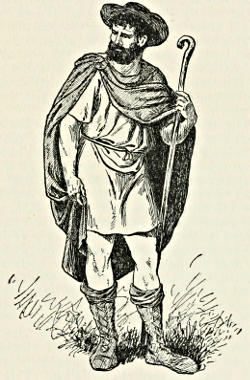
Roman Peasant
(After Racinet)
It is no wonder that out
of conditions so one-sided and
oppressive, the deepest aversion
should have arisen among
the plebeians against the patrician
rule. There were, indeed, some among the noble families who sought
to establish better and more conciliatory relations between themselves and
the lower people, notably the Valerii and the Horatii; but for the most part
the patricians of those days were characterised by the harshest egotism and
imperiousness. These qualities were particularly conspicuous in the Sabine
Fabii, in the newly settled family of Appius Claudius,—who later displayed
a certain eccentricity in good as well as evil that belied the usual conservative
traits of the aristocracy,—and in the Quinctii and Manlii, who were the
acknowledged supporters of a sort of iron military discipline to be applied
in their relations with the lower classes. From all this it will be seen that
only by a movement bordering on a general revolution could a new political
adjustment be brought about that would insure an amendment in the social
condition of the plebeians.
[495-457 B.C.]
According to the chronology, often faulty, of tradition, the distress of the
plebeians and their consequent dissatisfaction had already, in the year 495
B.C., reached a momentous pitch. In 494 the plebs consented to serve only
under the dictator Manius Valerius, beloved of the people, who conducted the
first enlistments and met later with success in the field. But when his proposals
looking to a modification of the laws against debtors fell through in
the senate, the patience of the plebeians was at an end. Valerius, who was
rightfully incensed, resigned his office; and the consuls of that year wishing
to continue the war, the plebeian portion of the army withdrew from the
main body and the patrician city, and under the conduct of their officers
retired to the so-called “Sacred Mount” on the peninsula formed three
Roman miles from Rome by the junction of the Anio and the Tiber.
This move was actuated by a desire on the part of the plebeians to cut
themselves completely off from the rest of the people and establish themselves
as an independent body at an entirely new point. The seriousness of
the situation finally obliged the patricians and the senate to yield; and
negotiations ensued, the effects of which were felt even as late as the imperial
epoch.
The new compact between the two branches of the Roman population, to
which was given an international form, provided that the plebeians residing
in the state should be organised into an independent body, having their own
official representatives that were to rival in power those of the patricians.
In opposition to the consuls were placed two plebeian tribunes (usually
called “people’s tribunes”) who were later increased in number to four, and
after 457 to ten; who were appointed, according to all probability, by the
state assemblies of the plebeians. Guardians of the community in the true
sense of the word, their ædiles being ever at the service of the plebeians as
police and general administration agents, these chosen tribunes had the right
and duty to protect their fellow plebeians against injustice and maladministration
on the part of the consuls, to resolutely uphold the right of
appeal—in a word, to interfere whenever the interests of the plebeians
seemed to be endangered. They were powerless only against the dictator
and the military jurisdiction or imperium of the consuls outside the city. In
Rome they had the right to prevent, by making prompt and personal protest,
the execution of any patrician order whereat a citizen might take offence;
and also to block or veto any patrician measure recommended to the citizen
body, which was found to be unjust. This was called the right of intercession,
or the veto of the plebeian tribunes.
From these circumstances it ensued that no tribune could, after the 10th
of December, the date of accession to office, pass a single night outside the
city during the whole official year;[20] his house, moreover, having to stand
open night and day as a refuge for any who might need protection. To
insure them perfect security in the performance of their duties the persons
of the plebeian tribunes were declared “doubly sacred” and as such unassailable
and inviolable. Whoever committed an attack on these personages
was said to fall under the malediction of the gods and was, even according
to earthly laws, adjudged guilty of a crime punishable with death. Hence
every patrician, consuls included, who in any way infringed the tribunes’
rights, or offered them personal indignity could be held to strict account;
in serious cases even arrested and brought before the tribunes themselves,
who had power to inflict a penalty of fines or death. From their judgment
however it was possible to appeal to the plebeian assemblies.
[457-390 B.C.]
Up to the time of the great wars with the Veientines and the Celts, the
civil dissensions with which Rome was torn constantly grew in importance
and menace, until shortly after the so-called decemviral period the class conflicts
had assumed a character entirely different from that borne by them
during the first half of the fifth century B.C. Before the great crisis ushered
in by the decemvirate the work of the plebeian party leaders had been limited
to bringing their state within a state to completer organisation, widening the
breach that existed between the plebeians and the populus, or patrician body,
and endeavouring by every means in their power to lessen the authority
exercised by patrician officials over the plebeians. This period during which
the two divisions of the Roman people met in a conflict of unexampled
ferocity and hate, presents little that can be dwelt on with pleasure. Incidents
of the most revolting nature arose from the extreme arrogance of the
patrician youth; even the word assassination has frequently to be employed,
while the internal strife had a serious effect on the fortunes of the nation in
the wars it was constantly waging abroad. Yet even in those troubled times
the foreign foe would singularly misreckon who counted on the connivance
of either patricians or plebeians to open to him the city’s door, since when an
external common danger threatened, the divided factions united as a rule to
present a front solid and impenetrable as a wall of brass.
Fortunately for the future of Rome the bent towards a constantly widening
separation between the plebeians and the patricians received, in the decemvir
period, an entirely different turn. From that time the plebeian leaders were
chiefly occupied in winning for their constituents their proper social and
political position in the Roman state, with the balance leaning strongly,
up to the decisive battle for the hegemony on the Apennine peninsula, to the
side of the purely political questions of dispute. The sympathy of modern
observers is almost entirely with the plebeians. The demands were moderate
and the political views of the energetic honourable Roman peasants were
immeasurably higher than those of the Greek democrats.[21]
In spite of all the heat and passion evinced on both sides, revolution was
the last thing the parties thought of up to the very time of the Gracchi.
Whereas in Hellas the triumphant party rarely receded from a position once
taken or abandoned any pretensions however lofty, the Roman peasant assemblies
contented themselves with claiming merely what, according to our
modern ideas, was their just due. Attacked as they frequently were in their
deepest interests, the only revenge dreamed of by the plebeians was secession—the
voluntary cutting of themselves adrift from the patrician state;
and their end at last attained, in good qualities as in bad they manifested precisely
the same robust qualities that characterised their patrician adversaries.
Their subsequent acts fully justified their course, since in their public affairs
they revealed a vigour and capacity well-nigh inexhaustible.
But we must not judge the patrician class too harshly; revolting as their
laws against debtors appear to us, we are not justified in attributing their
adroitly maintained policy of resistance purely to the arrogance and selfishness
of a privileged class, nor their refusal to admit plebeians to equal marriage
laws and municipal offices entirely to base hypocrisy. We must,
moreover, take into account the natural hesitation of an old, experienced
governing body to give the leadership in public affairs into the hands of new
and untried elements; and the plebeians themselves, far from despising the
adversaries they so deeply hated, never failed to recognise those sterling
qualities by which in peace and war they had achieved such signal service
to the state, and elevated them to the position of models for their own
character and conduct. And finally, at the decisive turning points in the
evolution of Rome’s ancient constitution, it was not before superior might that
the patricians lowered their banner and reached out the hand of friendship
to their foe; it was solely in obedience to their own patriotic perception of
what was best for the state and to the force of inner necessity.
[510-452 B.C.]
The wonderful tenacity displayed by both the divisions of the people in
their conflicts with each other, proclaims them to be of one blood, and to
have in actual fact but one cause, that of their agricultural interests. This
kinship further explains the conservative character of these struggles, and
the aristocratic tendencies constantly to be observed in the Roman administration
from the time of the complete triumph of the plebeians down to that
of the elder Cato. It was these class struggles and the manner in which
they were carried on that gave the Roman constitution, as it gradually
developed through succeeding generations, that stability and elasticity that
later excited in more than one Greek statesman feelings of envy.
One failure, however, was not spared this people, in spite of that practical
sense that led them on only tried political ground, and caused them to advance
by successive cautious steps rather than by means of dangerous innovations.
It was precisely this conservative character maintained throughout by the
Roman constitution that prevented the problems that confronted it from
ever finding complete solution, that cumbered it with a number of empty,
useless forms, and gave new life to certain dangerous elements—notably that
of dualism—that were later, when the creative power of the people was on
the wane and the national character for ability and skill about to disappear,
to unfold in disastrous might.
The first period of inner dissensions, that extending to the middle of the
fifth century B.C., has not completely been made known to us; historical
accounts being so intermingled with myths and the chronicles and traditions
of noble families as to be wholly unreliable. The period was certainly characterised,
however, by incessant feuds with the neighbouring populations,
and in the interior by the phase of the conflict between the patricians and
the plebeians which revealed the two factions under their least favourable
aspect.
The resentment shown by the burghers and higher officials at the institution
of the plebeian tribunes caused for a number of years the most common
use of the latter’s authority to be the protection from encroachment by the
patricians and from the consequences of their own acts, such plebeians as
had resisted unlawful taxation, or refused to render military service. The
tribunes also, after 476 repeatedly upheld the rights of the plebeians in cases
of breach of the compact with the patricians, and had the power to condemn
any individual patrician who was guilty of such a breach to a heavy fine or
even exile. Gradually the personal sanctity and inviolability of the tribunes
had come to serve them as a means of aggression rather than of mere defence.
Wherever they chose to interpose, all hindrances disappeared from their
path; it was only when they contemplated some decided step that their fellow
tribunes had the right to interfere, all important measures being adopted
by a council of the tribunes.
This right of intercession soon assumed a high significance. Without
actual legal right to resist the laws passed by patrician rulers the tribunes
yet could, by simply declaring their readiness to support the plebeians in their
passive stand against the demands of senate and consuls for troops of war,
offer effectual opposition to the enforcement of the state’s decrees. In this
way they came to have a widely extended power of intervention, and at an
early date they claimed the right of being present at all meetings of the senate.
Unquestionably the mass of the citizens would gladly have seen the
plebeian tribunes driven from office, and on both sides party hatred ran high.
In this period tradition, untrustworthy as history, places the murder (473) of
Genucius, the tribune, and the legend of Coriolanus.
[494-466 B.C.]
The taxation abuses and the tyranny of the laws regulating debt, as well
as the monopoly by patricians of state domains, had been allowed to go
uncorrected until 494. In this year a high-minded citizen, Spurius Cassius
Viscellinus, who was appointed consul for the third time in 486 and who
then brought about the alliance with the Hernicans, as he had earlier, in
493, brought about that with the Latins, took an important conciliatory step
in agrarian matters by proposing that the public lands be surveyed and given
out in grants to the poorer plebeians, the remaining portions to be rented to
patricians under much stricter conditions of payment than formerly. His
law, it appears, was passed, but was never actually enforced.[22] Out of revenge
his compeers hurled at him the accusation, fatal in republican Rome, of having
aspired to mount the throne; and in the following year at the expiration
of his term of office he was sentenced to death.
From this time until 466, when it was again driven into oblivion by the
pressure of outside wars, the tribunes demanded the full enforcement of
the Lex Cassia. Important advance in the development of the constitution
was meanwhile made in another direction. With the institution of the tribunes,
the informal, irregularly held meetings of the peasant assemblies were
organised into the officially recognised diet of the whole plebeian body, which
excluding the patricians and their clients (the latter now casting in their
votes with the plebeians in the centuriata, thus considerably strengthening
the position of the patricians in this assembly) broke up into smaller assemblies
presided over by their tribunes and called the comitia tributa (or
assembly of the tribes) from the twenty-one district tribes into which the
new organisation had divided the plebeians. These assemblies or comitia
offered an opportunity to the tribunes gradually to educate the commonalty
up to the high political standard set by the ablest of the plebeians.
In this manner alone could the plebeians develop their full strength and
importance as a class, since all the advantages conferred by ancient tradition
and political routine, by a clear insight into their own needs, and a firmly
established social, religious, and political position, were on the side of the
patricians, the plebeians having further to contend against the disadvantage
of being widely scattered over a great extent of territory and of having
received no preparatory political training or instruction. It was precisely
these hindrances to the advancement of their people that the more active
among the tribunes set about to overcome. A series of truly notable plebeian
statesmen now came to the fore, the most prominent among them
being the Icilii, the Virginii, and later the Duilii.
[492-452 B.C.]
As early as 492 an Icilius had passed a law making it a punishable crime
to interrupt or in any way disturb the tribunes when in the act of laying
their criminal decisions before the plebeians in the assembly of the tribes.
Furthermore the tribunes, preventing as they did any violent interruption of
the process of development by holding the plebeians, in all their upward
strivings, strictly to the line of legal right, came to be the most powerful
factor in the gradual development and formation of the Roman constitution.
In domestic legislation they also constantly took the initiative, being chiefly
concerned in gaining for the tribal assembly and their proceedings—which
latter as merely “legislative monologues” had hitherto remained without
result—a recognised position in the magistracy of the state. The centuriate
assembly was at that time of comparatively little service to the plebeians.
The plebeians eligible to vote greatly outnumbered the patricians of the
same class; yet the arrangement of “voices” in the centuriata was such that
the patricians largely predominated. The first census class consisted of eighty
centuries, the mass of the members possessing the least means being united
into one, while the second, third, fourth, and fifth census classes—those
formed of the peasantry of the middle class—were divided up into ninety
centuries.
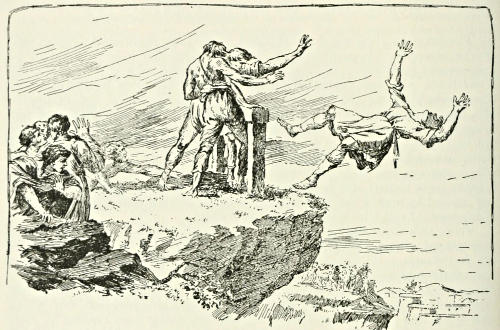
Punishment of Cassius[23]
[482-452 B.C.]
It was long, however, before the tribunes gained for their tribal assembly
the recognition of the state. It was as late as 482, that the commonalty
was entirely bound to the choice of the consuls and senate in consular elections,
and it was only in 473—when the uprising provoked by the murder
of the tribune Genucius, brought an able and energetic plebeian, Volero
Publilius, forward as leader of the plebs—that any important step was made
in advance. In the year 471 this tribune, by securing the passage of a law
providing that the election of the tribunes and ædiles should be ratified by
the tribal assembly, raised this body to a position beside that of the national
assembly as an organ of the state with a special function in state legislation.
The right of the plebs to deliberate and render decisions in their separate
assemblies was thus recognised, and their hope of one day taking “legislative
initiative” made an actual fact. All measures proposed by them, drawn
up in the form of petitions to the senate, must pass through the hands of the
tribunes, and the senate had no longer the right to reject such proposals
straightway, but must first take counsel upon them with the tribunes. In
case of approval by the senate the rogations (where they did not relate exclusively
to the affairs of the plebeians) were laid before the curiate assembly
as the last step preliminary to their passage as laws.[24]
According to the fragmentary accounts that have been handed down
there was a long cessation of the civil strife in consequence of the heavy
burden of wars and pestilence under which Rome at one time laboured: but
the old struggle was finally renewed under conditions that made possible an
entire change of tactics on the part of the plebeian leaders. In the year 462
the tribune Caius Terentilius Harsa proposed a measure—adopted the following
year by the united college of tribunes—that empowered the commonalty
to appoint a committee of five plebeians who should frame certain
laws for the limiting and regulating of the arbitrary power of punishment
exercised by the consuls in suits against plebeians; just so much judicial
power as the plebeian allowed him should the consul wield, but he was not
to rule according to his own whim and pleasure. The aim of this measure
was to complete the organisation of the plebs as an independent organ of the
state, and to restrict as far as possible the functions of patrician magistrates
in the administration of justice. It naturally met with the most determined
opposition on the part of the older citizens; and even the most liberal
and clear sighted among the patrician statesmen were alarmed at this incursion
of the plebeians into a new field, since the greatest sufferers from
any increase in the rights and independence of the plebs that would inevitably
widen the gulf already existing between governing power and people,
would be themselves. Bitter and prolonged were the party struggles that
ensued, the same tribunes being appointed year after year by the people’s
assemblies, while the senate and the older citizens, with equal obstinacy,
rejected again and again the same old measures. The senate tried to conciliate
the plebs by making other concessions, but in vain; finally in the
year 457 it gave its consent to the number of the tribunes being increased
to ten—a doubtful victory for the plebs, since among so many one or
another could surely be found who could be induced by patrician influence
to use his right of intercession against any plans of his colleagues that might
be troublesome.[25]
[454-449 B.C.]
In one of the following years the consuls, A. Aternius and Sp. Tarpeius,
passed a law limiting the hitherto unrestricted right of the consuls to impose
property fines; according to its terms no man (except in cases of appeal)
could be sentenced to a heavier fine than two sheep or thirty head of cattle
in one day. In spite of all this the obstinacy of the people’s party remained
unshaken until the senate finally succeeded in effecting a compromise,
whereby the power of the consuls to inflict punishment was considerably
lessened, while the dangerous power of initial rogation by the tribunes was
completely done away with. Between 454-452 an agreement with the tribunes
was reached that both divisions of the Roman people should have a
common civil and criminal code, and the codification of the new statute book
was intrusted to a commission of ten men appointed by the comitia centuriata.
The choice was made in 452, and the commissioners—decemvirs,
so-called, including none but patricians—entered upon their functions May
15th, 451. A complete reorganisation of the old system being the work in
hand, the magistrates, particularly consuls and tribunes, were, according to
an ancient custom, suspended from office under a proviso that safeguarded
the sworn rights and liberties of the commonalty, while it bound the tribunes
not to make appeal to the people, and their full power was given into
the hands of the new governing body.
The manner in which the decemvirs at first discharged their duties is
well known; so great was the legislative ability they displayed that during
their first year of office, 451, they brought to completion the main object
of their work. A code was shortly after approved by the senate, and
accepted by the comitia centuriata, and affixed in the form of ten copper tablets
to the speaker’s pulpit in the Forum. Ten new decemvirs were appointed for
the year 450, and among these were several plebeians, the first non-aristocratic
office holders to act as representatives for the entire Roman people.
Whatever may have been the plan of the politicians of that day, it never
reached fulfilment; as shortly after the completion of the new code, which
comprised in all Twelve Tables, the decemvirate, headed by the brutally
arrogant Appius Claudius,[26] began to assume the character of the most intolerable
despotism. Dissatisfaction reached its height when Appius Claudius
and his associates attempted, against all legal right, to retain their office
after the 15th of May, 449, and undertook war against the Sabines and the
Æquians.b
[449 B.C.]
A plebeian, whose name was Lucius Virginius, a man inferior to none in
military accomplishments, had the command of a century in one of the five
legions that were employed against the Æqui; this person had a daughter,
called from her father, Virginia, who far surpassed all the Roman virgins in
beauty, and was promised in marriage to Lucius, formerly a tribune, the
grandson of that Icilius who first instituted, and was first invested with,
the tribunitian power. Appius Claudius, the chief of the decemvirs, having
seen this virgin, who was now marriageable, as she was reading in a school
(for the schools stood at that time near the Forum) he was presently captivated
with her beauty, and the violence of his passion forcing him often to
return to the school, his frenzy was, by this time, increased. But, finding it
impossible for him to marry her, both because she was promised to another,
and because he himself was married; and looking upon it, at the same time,
to be below him to marry into a plebeian family, and contrary to the law,
which he himself had inserted among those of the Twelve Tables, he first
endeavoured to corrupt her with money; and, for that purpose, was continually
sending some women to her governesses (for Virginia had lost her mother)
and gave them much, and promised more. The women he sent to tempt the
governesses had orders not to acquaint them with the name of the man who
was in love with Virginia, but only that he was a person who had it in his
power to do good and bad offices to those he thought fit. When he found
himself unable to gain the governesses, and saw the virgin guarded even with
greater care than before, his passion was inflamed, and he resolved upon
more audacious measures. Then, sending for Marcus Claudius, who was one
of his clients, a daring man, and ready for any service, he acquainted him
with his passion; and, having instructed him what he would have him do
and say, he sent him away, accompanied with a band of the most profligate
men. Claudius, going to the school, seized the virgin, and attempted to lead
her away publicly through the Forum; but there being an outcry, and a great
concourse of people, he was hindered from carrying the virgin to the place
he had designed, and addressed himself to a magistrate. This was Appius,
who was then sitting alone in the tribunal to hear causes, and administer
justice to those who applied for it. But, when Claudius was going to speak,
the people, who stood round the tribunal cried out and expressed their
indignation, and all desired he might stay till the relations of the virgin
were present. And Appius ordered it should be so. In a short time, Publius
Numitorius, uncle to Virginia by her mother, a man of distinction among the
plebeians, appeared with many of his friends and relations; and, not long
after, came Lucius, to whom she had been promised by her father, accompanied
with a strong body of young plebeians. He came to the tribunal
out of breath, and labouring for respiration, and desired to know who it was
had dared to lay hands upon a virgin, who was a Roman citizen, and what
he meant by it.
All being silent, Marcus Claudius, who had laid hold on Virginia, spoke
as follows: “I have committed neither a rash nor a violent action in relation
to this virgin, Appius Claudius; but, as I am her master, I take her
according to law. I shall now inform you by what means she is become
mine. I have a female slave, who belonged to my father, and has served a
great many years. This slave, being with child, was engaged by the wife of
Virginius, whom she was acquainted with, and used to visit, to give her the
child she should be brought to bed of; and, in performance of this promise,
when delivered of this daughter, she pretended to us that she was brought to
bed of a dead child, and gave the girl to Numitoria; who, having no children,
either male, or female, took the child; and, supposing it, brought it
up. For a long time, I was ignorant of all this; but now being informed
of it, and provided with many credible witnesses, and having also examined
the slave, I fly to that law, which is common to all, and determines that the
children shall belong to their mothers, not to those who suppose them; that,
if the mothers are free, the children shall be free; if those are slaves, the
children shall be slaves also; and that both the children and the mothers
shall have the same masters. In virtue of this law, I desire that I may take
the daughter of my slave, and I am ready to submit my pretensions to a
trial; and, if any one claims her, to give sufficient sureties to produce her at
the time appointed; but if they desire to have this affair speedily determined,
I am willing this minute to plead my cause before you, and shall neither give
security for her appearance, nor offer anything that may create a delay.
Let them choose which of these conditions they like best.”
After Claudius had said this, and added many entreaties that his claim
might not be less regarded than that of his adversaries, because he was his
client, and of mean birth, the uncle of Virginia answered in few words, and
those such as were proper to be addressed to a magistrate, saying, that
Virginius, a plebeian, was the father of this girl, and then abroad in the
service of his country; that Numitoria, his own sister, a woman of virtue
and worth, was her mother, who died not many years before; that the virgin
herself had been educated in such a manner as became a person of free condition,
and a citizen of Rome; that she had been solemnly betrothed to
Icilius, and that the marriage had taken effect, if the war with the Æqui had
not intervened; that, during no less than fifteen years, Claudius had never
attempted to aver anything of this kind to the relations of Virginia, but
that now the virgin was marriageable, and of distinguished beauty, he was
charmed with it, and published an infamous calumny, contrived not indeed
by himself, but by a man who thought he had a right to gratify all his passions
by all the methods he could invent. He added that, as to the trial, the
father himself would defend the cause of his daughter when he returned
from the campaign; and that, in the meantime, as he was her uncle, and
ready to support her right, he himself claimed her person, to which he was
entitled by the laws; and in this, he insisted upon nothing that was either
new, or not allowed to every Roman, if not to every other man, which is, that
if it is pretended that any person is a slave, not the man who maintains that
he is so, but he who asserts his liberty, shall have the custody of that person,
till the decision of the contest. And he said that Appius was obliged, on
many accounts, to observe this institution; first, because he had inserted this
very law with the rest in the Twelve Tables; and, in the next place, because
he was chief of the decemvirate; and, besides, that he was invested not only
with the consular, but also with the tribunitian, power, the principal function
of which was to relieve such of the citizens as were weak and destitute of
all other help. He then desired him to compassionate a virgin, who fled to
him for assistance, and who had long since lost her mother, and was then
deprived of her father, and in danger of losing not only her paternal fortunes,
but also her husband, her country, and, the greatest of all human blessings,
her liberty. And, having lamented the abuse to which the virgin would be
delivered up, and by that means raised great compassion in all present, he
at last spoke of the time to be appointed for the decision of this cause. [He
urged that he be given custody of the girl until the return of her father.
Appius however refused this request. Icilius, the virgin’s betrothed lover,
protested that the outrage should never be consummated while he lived.]
Icilius was going on, when the lictors, by order of the magistrate, kept
him off from the tribunal, and commanded him to obey the sentence. Upon
which Claudius laid hold on the virgin, and was going to take her away,
while she hung upon her uncle, and her spouse. The people, who stood
round the tribunal, seeing her in so moving an agony, cried out all at once,
and, without regarding the authority of the magistrate, fell upon those who
were endeavouring to force her away. So that Claudius, fearing the violence,
quitted Virginia, and fled for refuge under the feet of the decemvir. Appius,
seeing all the people in a rage, was at first greatly disordered, and in doubt
for a considerable time what measures to take; then calling Claudius to the
tribunal, and speaking a few words to him, as it seemed, he made a sign for
the audience to be silent, and said: “Since I find you are exasperated at the
sentence I have pronounced, citizens, I shall waive the exactness of that part
of it which relates to the giving sureties by Claudius for the appearance of
Virginia; and, in order to gratify you, I have prevailed upon my client to
consent that the relations of the virgin shall bail her till the arrival of her
father. Take away the virgin, therefore, Numitorius, and acknowledge yourself
bound for her appearance to-morrow. For this time is sufficient for you
both to give Virginius notice to-day, and to bring him hither in three or four
hours from the camp to-morrow.” And they desiring further time, he gave
no answer, but rose up, and ordered his seat to be taken away.
He left the Forum full of anguish, distracted with love, and determined
not to relinquish the virgin any more to her relations; but when she was
produced by her surety, to take her away by force; to place a stronger guard
about his person, in order to prevent any violence from the multitude, and
early to post a great number of his friends and clients round the tribunal.
That he might execute this resolution with a show of justice under the pretence
of the non-appearance of the father, he sent some horsemen, whom he
chiefly confided in, to the camp with letters for Antonius, who commanded
the legion in which Virginius served, to desire he would detain the man in
safe custody, lest, when he was informed of the situation of his daughter, he
might escape out of the camp. But his design was prevented by the son of
Numitorius, and the brother of Icilius, who being sent away by the rest
of her relations upon the first motion of this affair, as they were young, and
full of spirit, rode full speed; and, arriving at the camp before the men sent
by Appius, informed Virginius of everything which had passed; who, going
to Antonius, and concealing the true cause of his request, pretended that he
had received an account of the death of some near relation, whose funeral
and burial he was obliged by the law to perform; and, by that means obtained
his dismission; and, setting out in the evening with the youths, he
took a byroad for fear of being pursued both from the camp, and the city;
which really happened; for Antonius, having received the letters about
the first watch, detached a party of horse after him, and others, sent from the
city, patrolled all night in the road that led from the camp to Rome. When
Appius was informed of the unexpected arrival of Virginius, he was in a
fury; and, going to the tribunal with a great number of attendants, ordered
the relations of Virginia to appear. When they were come, Claudius repeated
what he had said before, and desired Appius to decide the contest
without delay, saying that both his informer and his witnesses were present,
and that he was ready to deliver up the slave herself to be examined. He
ended all with a feigned lamentation, grounded on a supposed fear of not
obtaining the same justice with others, as he had said before, because he was
his client; and also with desiring that Appius would not relieve those whose
complaints were the most affecting, but whose demands were the most
equitable.
On the other side, the father of the virgin, and the rest of her relations,
brought many just and well-grounded proofs to show the child could not
have been supposed; alleging that the sister of Numitorius, and wife of Virginius,
could have no probable reason to suppose a child, since she was then
young, and married to a young man, and had brought forth a child no very
considerable time after her marriage; neither, if she had been ever so desirous
to introduce a foreign offspring into her own family, would she have
taken the child of another person’s slave, rather than that of a free woman
united to her by consanguinity, or friendship, whose fidelity might have secured
to her the possession of the child she had taken; and, when she had it
in her power to take either a male or a female child, she would have certainly
chosen the former. For, after a woman is brought to bed, if she wants children,
she must necessarily be contented with, and bring up, whatever nature
produces; whereas, a woman who supposes a child will, in all probability,
choose one of that sex which excels the other. As to the informer, and the
credible witnesses which Claudius said he would produce in great numbers,
they disproved their testimony by this reason, drawn from probability, that
Numitoria would never have done a thing openly, and in conjunction with
witnesses of free condition, which required secrecy, and might have been
transacted by one person, and, by that means, have exposed herself to have
the girl taken from her by the master of the mother, after she had brought
her up.
While they were alleging these reasons, and many others of equal weight,
and such as could admit of no reply, and at the same time representing the
calamities of the virgin in a very affecting manner, all who heard them, when
they cast their eyes upon her, compassionated the distresses in which her
beauty had involved her (for, being dressed in mourning, her looks fixed
on the ground, and the lustre of her eyes drowned in tears, she attracted the
regard of all the spectators; such was her beauty, and such her grace, that she
appeared more than mortal), and all bewailed this unexpected turn of fortune,
when they considered from what prosperity she was fallen, and to what abuses
and insults she was going to be exposed. They also reflected that, since the
law which had secured their liberty was violated, nothing could hinder their
own wives and daughters also from suffering the same treatment. While they
were making these, and the like reflections, and communicating them to one
another, they could not refrain from tears. But Appius, who was not in his
nature a man of sense, being then corrupted with the greatness of his power,
his mind distempered, and his heart inflamed with the love of Virginia, paid
no regard to the reasons alleged in her favour, nor was moved with her tears,
but even resented the compassion shown to her by the audience; since he
looked upon himself to deserve greater compassion and to suffer greater torments
from that beauty which had enslaved him. Wrought up to madness,
therefore, by all these incentives, he had the confidence both to make a shameless
speech, by which he plainly confirmed the suspicion that he himself had
contrived the calumny against the virgin, and to commit a tyrannical and
cruel action.
For, while they were going on to plead in her favour, he commanded silence;
and all being silent, and the people in the Forum flocking to the tribunal
from a desire to hear what he would say, he often turned his eyes here
and there to observe the number of his friends, who by his orders had posted
themselves in different parts of the Forum, and then spoke as follows: “This
is not the first time, Virginius, and you who attend with him, that I have
heard of this affair; I was informed of it long ago, even before I was invested
with this magistracy. Hear now by what means it came to my knowledge:
The father of this Marcus Claudius, when he was dying, desired me to be
trustee for his son, whom he was leaving an infant; for the Claudii are hereditary
clients to our family. During the time of this trust, I had information
given me that Numitoria had supposed this girl, whom she had received
from the slave of Claudius; and, upon examining into the matter, I found
it was so. As it did not become me to stir in this affair myself, I thought it
best to leave it to this man, when he grew up, either to take away the girl
if he thought fit, or to come up to an accommodation with those who had
brought her up, for a sum of money, or to gratify them with the possession
of her. Since that time, being engaged in public affairs I gave myself no
further concern about those of Claudius. But it is probable that when he was
taking an account of his own fortunes he also received the same information
concerning this girl which had before been given to me; neither does he
claim anything unwarranted by law, in desiring to take the daughter of his
own slave. If they would have accommodated this matter, it had been well;
but, since it is brought into litigation, I give this testimony in his favour,
and decree him to be the master of the girl.”
When those who were uncorrupted and friends of justice heard this sentence,
they held up their hands to heaven, and raised an outcry mixed with
lamentation and resentment; while the flatterers of the oligarchy gave
acclamations capable of inspiring the men in power with confidence. And
the assembly being inflamed and full of various expressions and agitations,
Appius commanded silence, and said: “Disturbers of the public tranquillity,
and useless both in peace and war, if you cease not to divide the city and to
oppose us in the execution of our office, necessity shall teach you to submit.
Think not that these guards in the Capitol and the fortress are placed there
by us only to secure the city against a foreign enemy, and that we shall
suffer you to sit here and taint the administration of the government. Be
more prudent for the future than you are now; depart all of you who have
nothing to do here, and mind your own affairs, if you are wise. And do you,
Claudius, take the girl, and lead her through the Forum without fearing anyone,
for the twelve axes of Appius shall attend you.” After he had said
this, the people withdrew from the Forum, sighing, beating their foreheads,
and unable to refrain from tears; while Claudius was taking away the
virgin, who hung round her father, kissing him, and calling upon him with
the most endearing expressions. In this distress Virginius resolved upon an
action, deplorable indeed, and afflicting for a father, but at the same time
becoming a lover of liberty and a man of great spirit; for, having desired
leave to embrace his daughter for the last time without molestation, and to
say what he thought fit to her in private before she was taken from the
Forum, he obtained it from the magistrate; and his enemies retiring a little,
he held her in his arms, while she was fainting, sinking to the ground, and
scarce able to support herself, and for some time called upon her, kissed her,
and wiped off her tears that flowed without ceasing; then, drawing her on
by degrees, when he came to a cook’s shop, he snatched up a knife from the
table and plunged it in her breast, saying only this, “I send thee, child, to
the manes of thy ancestors with liberty and innocence, for if thou hadst
lived, that tyrant would not have suffered thee to enjoy either.”[27] An
outcry being raised, he held the bloody knife in his hand, and, covered as
he was with the blood of his daughter, he ran like a madman through the
city and called the citizens to liberty. Then, forcing his way through
the gates, he mounted a horse that stood ready for him, and rode to the
camp accompanied by Numitorius, who had attended him from thence to the
city. He was followed by about four hundred other plebeians.e
[449-445 B.C.]
The plebeian legions, infuriated by the story of the outrage, as related
by Virginius, advanced on the city and invested the Aventine. Icilius in
concert with the liberal patricians, L. Valerius Potitus and M. Horatius
Barbatus, had already organised a party in Rome; and as the decemvirs,
supported by a contingent of the old citizens, persisted in their refusal
to relinquish their office, the plebeians, on the advice of M. Duilius,
again withdrew in a body to the Sacred Mount on the Anio. This new
secession forced the decemvirs to resign; and by means of negotiations with
the senate carried on by Valerius and Horatius in the summer of 449, important
concessions were gained, which assured—the old order of things having
meanwhile been resumed—the future position of the plebs in the Roman
state. As before there were appointed two magistrates (Valerius and Horatius
being the first to fill this office) elected by the free choice of the citizens,
to whom the name consul was now for the first time properly applied, and
the plebs were again represented by their tribunes. The only legacy of the
decemvirs to be taken up was the new system of laws, the complete revision
and codification of all the legal forms and processes that had hitherto been
current in Rome. In the “Twelve Tables” the whole Roman people had
now a just and uniform code of marriage, property, civil, and criminal laws.[28]
Apparently an attempt was made to mitigate their severity in certain respects;
but the law of debtor and creditor still remained extremely harsh,
and the maintenance of the prohibition against marriage between patricians
and plebeians, with the denial of all legal rights to the issue of such marriages,
kept alive the most intense phase of the animosity felt toward each
other by the divided classes. On the other hand the new statutes sought
to overthrow the former evil practices in consequence of which patricians
and plebeians accused of capital political crimes were certain to receive severe
sentence, the first from the tribal assembly, the
second from the curiata. Hereafter the centuriate
assembly was to be the sole organ of the people’s
will in the trial and judgment of criminal
offences. It was apparently at this epoch also
that the Romans first caused their raw supplies
of copper ore to be minted in copper coins.
Under the conduct of the consuls Horatius
and Valerius, and of the able and energetic tribune
of the plebs, M. Duilius, the affairs of Rome
were soon brought into a condition of order and
peace. A series of laws were set in operation
which may be looked upon as the Magna Charta
of the plebs, and on the proposition of the consuls
the right of appeal was confirmed by the
centuriate assembly, and given the most solemn
and binding form, so that no magistrate (the
dictator himself, who had retained all his former
power, not excepted) who had pronounced sentence
of death without admitting the right of
appeal to the people could be a second time
elected to office. The inviolability of the people’s
tribunes was again declared, and safeguarded
anew by a special enactment of the
citizens under the sanction of the gods; and,
representatives of the entire people as they were
henceforth, their official organisation underwent
important changes.
Roman Arms and Standard
This was the beginning of the period during
which patricians were driven by various causes
to seek the protection of the tribunes, and the senate frequently availed
itself of their support to break the opposition of the consuls. Their share
in the transactions of the senate was now formally recognised; but they
could still impose only money penalties on patrician opponents summoned
before the tribal assembly, and when they contemplated bringing a capital
charge they were obliged to apply first to the patrician magistrate, who
would himself lay the charge before the centuriata. With the increase in
importance of their position the tribunes received the right to take auspices.
The election of quæstors, who as yet acted only in matters of finance, was
also given over, in 447, to the tribunes under supervision by the consuls.
The great advance made by the plebs during the crisis the state had
passed through was best evidenced by the altered position of the tribal assembly
which, in obedience to the Valerio-Horatian law that declared the
decisions of the plebs as uttered in the tribal assembly to be binding on
the entire people, was given equal rights with the centuriata and elevated
beside it to the importance of a second national assembly. Widely different
interpretations have been given of the actual functions and position of the
tribal assembly up to the time of the Tarentine War; but the views which
seem most acceptable state that in order to become laws the decisions of
the tributa in general matters, as well as those of the centuriata, needed the
sanction of the senate, merely as a form, perhaps, and without any special
proviso attached. The position of the senate appears to have remained unchanged
in so far as that the tribunes were obliged to take counsel with that
body and obtain its consent or authority before undertaking the passage of
any measures that might require in their carrying out the full executive
machinery of the state. This was the more necessary in that the senate,
under the republic, had gradually assumed entire control of the state’s
finances; and neither the consuls nor the dictator himself, with all his unlimited
power, could touch any of the public funds without the senate’s
express consent.
The tribal assembly, unhampered as it was by the complicated business
routine that marked the proceedings of the centuriate assembly, offered the
best field for the further development of the Roman state. Here the popular
assemblies under the tribunes took a leading part in legislation, and the
plebeians carried into the camp of the old citizens an active political war
that was as ever directed towards levelling the distinctions that still separated
them from the aristocratic classes, and gaining for themselves the rights
and privileges that should be theirs under an impartial state rule.
Thus we see that from the close of the great crisis the plebs continued
to gain ground slowly but surely. Aside from the rustic population,
that lived widely scattered in villages or on country estates and were seldom
brought into the current of political agitation unless great interests were at
stake; there was still another class of plebeians who took no part in the general
strife but bent their energies solely towards securing and making permanent
their newly won advantage, and establishing peaceful relations with the
aristocratic families. These designs were greatly aided by the fact that
the leadership in all the upward movements of the plebs fell naturally into the
hands of the richest and most able, politically, among them. It was only at
a later period, when the issue at stake was the winning of a great political
and agricultural victory for the benefit of the entire community, that the
lesser and poorer peasant landholders, whose interests were more deeply
involved than those of any other class, rose in union and brought to bear on
the higher rank that mighty, irresistible pressure which is in their power to
exert. Under these conditions the political conflict took on the character
of a “class war,” with all the statesmanship, shrewdness, and craft, usual to
such contests.
[445-421 B.C.]
The first successful assault made since the great crisis on the position of
the aristocracy in the state was that of the tribune Caius Canuleius, who
in 445 B.C. caused the passage of a rogation which raised the prohibition
against marriages between patricians and plebeians, and declared the full
legality of such contracts. The chief object of this reform was to assure
the rank and position of the patrician father to the children of plebeian
women, the old law having declared all children of mixed marriages to belong
to the order of plebs. This victory was particularly important from
a political point of view, since it paved the way for the final coalescence
of the two parties of the state. Encouraged by their success the tribunes
prepared to push a new measure which, brought forward simultaneously
with the rogation of Canuleius, had for design to facilitate the appointment
of plebeians to the consulate, by leaving it open to the citizens to select for
the office either plebeians or patricians. After a prolonged contest the old
citizens yielded in so far as to effect a compromise agreeing to admit to
consular power such plebeians as had distinguished themselves in a military
career. The centuriate assembly appointed in place of consuls and to the
same term of office military tribunes, invested with full consular authority,
and to this position, which was decidedly inferior to that of consul in dignity
and rank, plebeians were now eligible. For long this victory was one in
theory only to the plebeians, the question constantly arising whether at the
next election consuls or consular tribunes were to be appointed. Finally,
in 444, the old-citizen party forced the newly elected military tribunes,
among whom were doubtless two plebeians, to resign after only a few
months, by pretexting errors made in taking the auspices at their election;
and for the remainder of that year and the whole of the year following
patrician consuls were appointed. As a result of such chicanery the consulship
was filled by none but patricians up to the year 401 B.C.
Simultaneously with the establishment of consular tribunes the patricians
introduced a new system of tactics to defend their political position, being
led thereto partly by the constantly increasing mass of public affairs that
passed under their hands. They withdrew one after the other from the
consulship several important functions which they placed in the hands of
officials newly created for that purpose, and thus secured to themselves the
conduct of some of the weightiest of the state’s affairs. As the plebeian
consular tribunes were persistently denied all share in the administration of
justice, two new patrician officers of state were appointed called censors, to
whom was entrusted the estimate and establishment every five years of the
budget, the framing of the list of citizens, the assessment for taxation,
the holding of the census, and the right of filling vacancies in the senate
and of striking undesirable names off the lists of senators, knights, and
citizens.
The office of censor as originally instituted was to last for the period of
a lustrum, or five years; but in 434 the term was limited to one year and a
half. Usually filled by former consuls or military tribunes, the position of
censor gradually rose in dignity and power until it came to be the highest
office in the Roman state. The later censors also had the right of punishing
such citizens as had been guilty of dishonourable or immoral conduct, without
laying themselves directly open to the action of the law, by means of a
so-called censorial “note.” All senators who had fallen under their censure
must resign their seat, all knights must forego performing their duties on
horseback, and all citizens must withdraw from the associations of their tribe
and submit to an increased tax.
Meanwhile the slow but steady onward march of the plebeians was not
to be withstood. In the year 421 a proposal was made and adopted declaring
them eligible to the quæstorship, and in 409 three out of four positions
of quæstor were awarded to plebeian candidates. From the fact that after
400 one or more plebeians were regularly appointed to the military tribunate[29]
it would appear that the road to political equality between the two great
Roman orders at last lay open. And indeed the nation would have progressed
to full and peaceful development both at home and abroad had not
the orderly course of events been suddenly and disastrously broken in upon
by a terrible storm of war.
[483-449 B.C.]
Since the conclusion of the alliance with the Latins and the Hernicans
scarcely a year had passed that was not marked by conflicts between the
Romans, aided by their new allies, and one or another of their foes in central
Italy—the attitude of the Romans during these hostilities, as late as the
middle of the fifth century, being for the most part one of defence. At
the time of the institution of the people’s tribunate Rome’s most dangerous
enemy were the Etruscans of Veii, a people with whom she had waged,
since 483, a bitter and disastrous frontier war. After a defeat suffered by
the Veientines in 475, a truce to last four hundred months was concluded,
which was not broken until 437.
During this time the feuds with other adversaries raged all the fiercer,
that with the Sabines, which had commenced in 505, lasting until the great
victory won by the consul, M. Horatius, in 449. Since then Rome’s peace
had not been menaced from that quarter, all the vigorous young men of true
Sabine blood having, as it appears, deserted their native cantons to follow
the fortunes of their Sabellian kindred in the conquest of southern Italy.
Hence the more prolonged and obstinately fought were the heavy wars
carried on by the Romans against the brave Æquians, and those ancient foes
of Latium, the mighty, warlike Volscians.b
While Rome in her early wars was for the most part triumphing over
her enemies, and laying the foundations of her future power and glory,
the daring enterprise of a handful of adventurers achieved what even the
Gauls failed to accomplish, and struck a blow at her very heart. A band
of slaves and exiles, amounting to about 4000, or not much more, and led
by Herdonius, a Sabine, having descended the Tiber in boats in the dead of
night, landed near the Capitoline Hill, apparently just beyond the wall
which ran from the hill to the river, and where, as we have seen, its bank was
unprotected. Hence Herdonius led his men towards the Forum and up the
ascent of the Capitoline, without meeting with any resistance till he arrived
at the Porta Pandana, and here only from the guard; for we have already
mentioned that this gate was always left open. The guard being forced,
the invaders proceeded up the hill, took possession of the Capitol and Arx,
and invoked the slaves of Rome to strike for freedom. The origin of this
daring attempt is involved in mystery. It may possibly have been organised
by Cæso Quinctius, son of Cincinnatus, who was an exile; but that he
took a personal share and perished in the enterprise, as Niebuhr, and after
him Dr. Arnold, have assumed, there is not a tittle of evidence to show. It
was not possible that the attempt should be permanently successful, yet,
from the dissensions then prevailing at Rome, it caused great embarrassment
and was only put down with the aid of the Tusculans. The Capitol was
retaken by storm; Herdonius and many of his band were slain in the affray;
the rest were captured and put to death.g
In these wars all the efforts of the Volscians were directed towards
acquiring the territory to the north, and that on the seacoast and on the
river Trerus, while the Æquians strove to extend their dominions westward
and southwestward as far as the Latin-Roman domains.
[487-425 B.C.]
The Romans, on their side, sought to check the growth of the Volscians
by spreading out parallel with them; and they immediately planted settlements
or rather military posts all through the mountain regions between
the Trerus and the Pomptine marsh, to separate the eastern tribes of
the Volscians from those of the western. At times very serious in character,
this war was carried on for a long period without any advantage to the
Latins or the Romans, until at last, after 487, the struggle was brought
almost to the very doors of Rome.[30] Step by step the Æquians pushed on
until they gained possession of the Latin marshes as far as Mount Algidus,
on the eastern wall of the Alban hills; and it was this chain of mountains
that the latter made the starting-point of all their marauding expeditions
into the Roman territory. It was 459 before a change came that was favourable
to the Romans. In this year the western branch of the Volscians
which for seventy years had not taken up arms against Rome, concluded
a formal peace with the Romans, doubtless sacrificing thereto their capital,
Antium, which had so frequently been the object of dispute. Relieved on
that side, the Romans could now direct all their power against the Æquians
and the eastern Volscians and in 431 there came a decidedly favourable
turn in their affairs.
Probably the Volscians had been considerably weakened by incursions
from the constantly expanding Sabellian tribes in their rear, and the Romans
now took the offensive against them with growing success until piece by
piece they regained all the territory that had formerly been taken from the
Latins. The Æquians were driven back to their highlands, and the country
of the eastern Volscians, turned into a seat of war, was traversed in 408
by the Romans who plundered on all sides. So weakened were Rome’s
adversaries in 404 that they looked on passively at the siege and capture of
Veii. In 400 Tarracina was taken, and in 393 Circeii was freshly colonised,
so that even in the later period when it had attained its greatest size all
of Latium was either subject or allied to Rome. Moreover as a result of
these struggles, and during their course, the compact between the Romans
and their Latin allies grew into a sort of hegemony, the Romans claiming the
sole right to decide in all matters relating to wars and contracts, while
the Latin prætors ceased to alternate with the Roman generals as commanders-in-chief
of the army, and the positions of staff officers in the allied
troops, at first open only to men appointed by the Romans, soon came to
be filled almost exclusively by the Romans themselves.
The close of the fifth century was also marked by new conflicts between
the Roman-Latin nations and the Veientines. The peace with this people
which had lasted so many years came to an end in 438, when the Roman city
Fidenæ, on the Tiber, fell into the possession of Veii. In 437 a war broke
out that was interrupted in 434 by the conclusion of an eight years’ truce,
then resumed until the total overthrow of Fidenæ in 425, after which it terminated
in a second truce of twenty years. During all this period of truce
the political situation of the Rasena, the race that had for long been powerful
in Italy, was so adverse that the Romans were led to entertain the project
of entirely destroying Veii and then proceeding northward from the Tiber
on a grand conquering expedition against Etruria. The power of the
Rasena had attained its height in the beginning of the fifth century when,
firmly established on their three mainland districts, in alliance with the
Carthaginians they made Greeks and Italians feel their supremacy on the
Tyrrhenian Sea. Etruria had also owned for many decades—as Carthage
had, since 500, owned the island of Sardinia—the coast lands of Corsica;
but these possessions were seriously threatened by the rise in power of the
Hellenes.
[425-395 B.C.]
Since the crushing defeat suffered by the Etruscans in 474 at the hands
of Hiero I of Syracuse and the Greeks of Cyme, in a sea battle near that
town, Syracuse, Tarentum, and Massilia had further impaired their predominance
on the Italian seas. The Campanian province of Etruria and
northern Italy were also about that time menaced simultaneously by different
but equally powerful enemies. The danger on the Campanian side was
from the Sabellian populations. At the time of Tarquinius’ departure the
Samnites had probably been long in possession of the mountainous regions
extending between the lowlands of the Apulian and Campanian coasts, and
since the middle of the fifth century had sent out successive conquering
expeditions which, penetrating further and further southward and seaward,
threatened equal danger to the Italians and the Etruscans. Simultaneously
with the uprising of the Lucanian Sabellians in Magna Græcia, in the third
decade before the close of the fifth century, Campanian Sabellians invaded
the beautiful regions on the Gulf of Naples. In 420 the Greeks lost Cyme—henceforth
Italian Cumæ—but continued to have dominion in and around
Naples for several centuries, and in 424, when Etruscan Capua fell, the
Rasena were driven forever from that part of Italy.
More disastrous still to the Rasena of northern Italy were the conquests
of the Celts, a people destined to play the gloomy rôle of destroyer, who had
lately made violent irruption among the Italian races.
Their irresistible onward sweep against the Etruscans seems to have taken
place in the early part of the fifth century, some time after the first migratory
tribes had wandered out of Gaul. During the last three decades of the century
the Celtic swarms also crossed the Padus and extended their conquests
into the lowlands as far as the Adriatic Sea. So engrossed were the Etruscans
of the regions between the Arno and the Tiber in their efforts to repel
these invading hordes, that they had neither time nor thought to give to Veii
which had been harassed by the Romans since 405. This war, during the
course of which Veii was first blockaded in 404, then regularly invested in
403, marks a threefold epoch in the history of Rome. With it the Romans
took the first step in the perilous path of foreign conquest, and departed
from their old-time custom of short summer campaigns, the troops remaining
the whole winter through in the lines and camps with which Veii was surrounded.
This innovation was made possible by a resolution adopted by the
senate that foot soldiers should be paid wages by the state; and a great
amelioration was brought in the condition of the peasants and their grown
sons, who were obliged to leave their farms in charge of their wives and servants
while serving in the army, though they were under the same necessity
of raising tribute as before. The perseverance of the Romans, coupled with
the ability of their first true military leader, M. Furius Camillus, at last
gained for them a victory over the stubbornly defended town. The list of
Rome’s great generals opens with the name of the conqueror of Veii. A
man possessing in the highest degree all the qualities of a commander, he
first came into prominence in 401; and it was as dictator, in 396, that he
took Veii by storm and completely destroyed it as a political commonwealth,
thereby achieving the greatest victory, from a political, military, and territorial
point of view, that had fallen to the Roman arms since the expulsion
of the Tarquinians.
[395-391 B.C.]
The warlike spirit of the Romans and their thirst for conquest were raised
to a high pitch by this success. Soon their might extended unbroken from
the limits of the Ciminian forest, then an impenetrable wilderness, which
they conquered between 395 and 391, to the southern frontiers of Latium.
But their difficult apprenticeship was not yet at an end, for just then the
Celts subjected them to a test which their political and military ability could
not withstand; and both in its inner and outer development the Roman state
received a check from which it could not readily recover.b
There are some famous legends connected with these threefold wars, which
cannot be omitted by any writer of Roman history. These are the legends
of Coriolanus, of Cincinnatus, and of the Fabian gens. The exact time to
which they refer is uncertain; nor is it material to determine. They fall,
however, within the period now under consideration.
CORIOLANUS AND THE VOLSCIANS
Caius Marcius was a youth of high patrician family, descended from
the Sabine king, Ancus Marcius; and he was brought up by his mother
Volumnia,[31] a true Roman matron, noble and generous, proud and stern, implacable
towards enemies, unforgiving towards the faults of friends. Caius
grew up with all the faults and virtues of his mother, and was soon found
among the chief opponents of the plebeians. He won a civic crown of
oak for saving a fellow-citizen at the battle of Lake Regillus, when he was
seventeen years of age. But he gained his chief fame in the Volscian Wars.
For the Romans, being at war with this people, attacked Corioli, a Latin city
which then had fallen into the hands of the Volscians. But the assailants
were driven back by the garrison; when Caius Marcius rallied the fugitives,
turned upon his pursuers, and, driving them back in turn, entered the gates
along with them; and the city fell into the hands of the Romans. For this
brave conduct he was named after the city which he had taken, Caius
Marcius Coriolanus.
Now it happened, after this, that the Roman people being much distressed
by having their lands ravaged in war, and tillage being neglected, a
great dearth ensued. Then Gelo, the Greek king of Syracuse, sent them
ships laden with corn, to relieve the distress. It was debated in the senate
how this corn should be distributed. Some were for giving it away to the
poorer sort; some were for selling it at a low price; but Coriolanus, who
was greatly enraged at the concessions that had been made to the plebeians,
and hated to see them protected by their new officers, the tribunes, spoke
vehemently against these proposals, and said: “Why do they ask us for
corn? They have got their tribunes. Let them go back to the Sacred Hill,
and leave us to rule alone. Or let them give up their tribunes and then
they shall have the corn.” This insolent language wrought up the plebeians
to a height of fury against Caius Marcius, and they would have torn him in
pieces; but their tribunes persuaded them to keep their hands off; and then
cited him before the assembly to give account of his conduct. The main
body of the patricians were not inclined to assist Coriolanus; so, after some
violent struggles, he declined to stand his trial, but left Rome, shaking the
dust from his feet against his thankless countrymen (for so he deemed them),
and vowing that they should bitterly repent of having driven Caius Marcius
Coriolanus into exile.
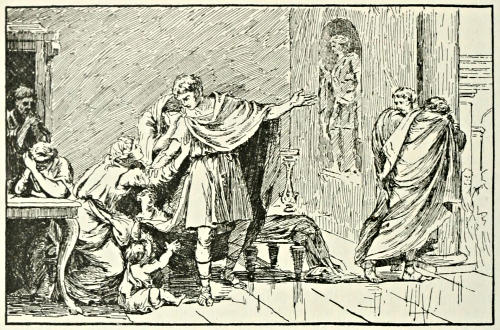
Banishment of Coriolanus
He went straight to Antium, another Latin city which had become the
capital of the Volscians, and going to the house of Attius Tullius, one of
the chief men of the nation, he seated himself near the hearth by the household
gods, a place which among the Italian nations was held sacred. When
Tullius entered, the Roman rose and greeted his former enemy: “My
name,” he said, “is Caius Marcius; my surname, Coriolanus—the only
reward now remaining for all my services. I am an exile from Rome,
my country; I seek refuge in the house of my enemy. If ye will use my
services, I will serve you well; if you would rather take vengeance on me,
strike, I am ready.”
Tullius at once accepted the offer of the “banished lord”; and determined
to break the treaty which there then was between his people and the Romans.
But the Volscians were afraid to go to war. So Tullius had recourse to fraud.
It happened that one Titus Atinius, a plebeian of Rome, was warned in a
dream to go to the consuls, and order them to celebrate the great games over
again, because they had not been rightly performed the first time. But he
was afraid and would not go. Then his son fell sick and died; and again
he dreamed the same dream; but still he would not go. Then he was
himself stricken with palsy; and so he delayed no longer, but made his
friends carry him on a litter to the consuls. And they believed his words,
and the great games were begun again with increased pomp; and many of
the Volscians, being at peace with Rome, came to see them. Upon this
Tullius went secretly to the consuls, and told them that his countrymen
were thronging to Rome, and he feared they had mischief in their thoughts.
Then the consuls laid this secret information before the senate; and the
senate decreed that all Volscians should depart from Rome before sunset.
This decree seemed to the Volscians to be a wanton insult, and they
went home in a rage. Tullius met them on their way home at the fountain
of Ferentina, where the Latins had been wont to hold their councils of old;
and he spoke to them and increased their anger, and persuaded them to break
off their treaty with the Romans. So the Volscians made war against Rome,
and chose Attius Tullius and Caius Marcius the Roman to be their commanders.
The army advanced against Rome, ravaging and laying waste all the
lands of the plebeians, but letting those of the patricians remain untouched.
This increased the jealousy between the orders, and the consuls found it
impossible to raise an army to go out against the enemy. Coriolanus took
one Latin town after another, and even the Volscians deserted their own
general to serve under his banners. He now advanced and encamped at the
Cluilian Fossa, within five miles of the city.
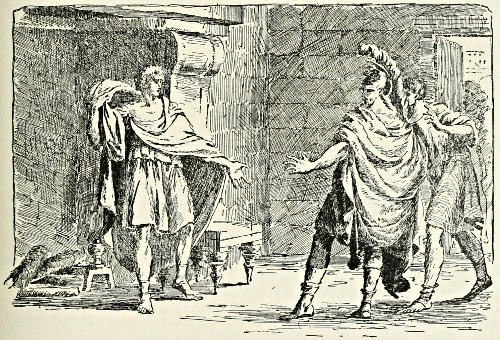
Coriolanus received by the Volscians
(From a picture by Mirys)
Nothing was now to be seen within the walls but consternation and
despair. The temples of the gods were filled with suppliants; the plebeians
themselves pressed the senate to make peace with the terrible Coriolanus.
Meantime the enemy advanced to the very gates of the city, and at length
the senate agreed to send five men, chiefs among the patricians, to turn
away the anger of their countryman. He received them with the utmost
sternness; said that he was now general of the Volscians, and must do what
was best for his new friends; that if they wished for peace they must restore
all the lands and places that had been taken from the Volscians, and must admit
these people to an equal league, and put them on an equal footing with
the Latins. The deputies could not accept these terms, so they returned
to Rome. The senate sent them back, to ask for milder terms; but the
haughty exile would not suffer them to enter his camp.
Then went forth another deputation, graver and more solemn than the
former—the pontiffs, flamens, and augurs, all attired in their priestly robes,
who besought him, by all that he held sacred, by the respect he owed to
his country’s gods, to give them assurance of peace and safety. He treated
them with grave respect, but sent them away without relaxing any of his
demands.
It seemed as if the glory of Rome were departing, as if the crown were
about to be transferred to the cities of the Volscians. But not so was it
destined to be. It chanced that as all the women were weeping and praying
in the temples, the thought arose among them that they might effect what
patricians and priests had alike failed to do. It was Valeria, the sister of
the great Valerius Publicola, who first started the thought, and she prevailed
on Volumnia, the stern mother of the exile, to accompany the mournful
train. With them also went Virgilia, his wife, leading her two boys by
the hand, and a crowd of other women. Coriolanus beheld them from afar,
as he was sitting on a raised seat among the Volscian chiefs, and resolved
to send back them also with a denial. But when they came near, and he
saw his mother at the head of the sad procession, he sprang from his seat,
and was about to kiss her. But she drew back with all the loftiness of a
Roman matron, and said: “Art thou Caius Marcius, and am I thy mother?
or art thou the general of the Volscian foe, and I a prisoner in his camp?
Before thou kissest me, answer me that question.” Caius stood silent, and
his mother went on: “Shall it be said that it is to me, to me alone, that
Rome owes her conqueror and oppressor? Had I never been a mother, my
country had still been free. But I am too old to feel this misery long.
Look to thy wife and little ones; thou art enslaving thy country, and with
it thou enslavest them.” The fierce Roman’s heart sank before the indignant
words of her whom he had feared and respected from his childhood;
and when his wife and children hanging about him added their soft prayers
to the lofty supplications of his mother, he turned to her with bitterness of
soul, and said: “O my mother, thou hast saved Rome, but lost thy son!”
So he drew off his army, and the women went back to Rome and were
hailed as the saviours of their country. And the senate ordered a temple
to be built and dedicated to “Woman’s Fortune” (Fortuna Muliebris); and
Valeria was the first priestess of the temple.
But Coriolanus returned to dwell among the Volscians; and Tullius,
who had before become jealous of his superiority, excited the people against
him, saying that he had purposely spared their great enemy the city of
Rome, even when it was within their grasp. So he lost favour, and was
slain in a tumult;[32] and the words he had spoken to his mother were truly
fulfilled.c
Critical Examination of the Story of Coriolanus
“If we examine the particulars of the foregoing narrative,” says Wilhelm
Ihne, “we find that no single feature of it can be considered historical, and
that it consists altogether of baseless fictions of a later period, which betray
a great want of skill in the invention of a probable narrative, and even ignorance
of the institutions and manners of the Roman people. The conquest of
Corioli is evidently invented to account for the name Coriolanus. For the
whole of the alleged history of the campaign in which Corioli is reported to
have been conquered, the annalists, as Livy himself admits, had no positive
testimony. And so thoughtless and ignorant were the Roman annalists, that
they mentioned as the benefactor of the distressed Romans the tyrant
Dionysius of Syracuse. This chronological error was discovered by the
learned archæologist Dionysius, who was too well acquainted with the history
of his disreputable namesake of Syracuse to suppose that he could have
sent corn to Rome about half a century before he was born. He therefore
substitutes Gelo as the Greek tyrant who is said to have sent the corn. It
is evident that the removal of a gross blunder does not amount to positive
evidence, and the learning and ingenuity of Dionysius are therefore
thrown away.
“The accusation and sentence of Coriolanus by the plebs, almost immediately
after the first election of tribunes, was impossible. According to Livy,
the Volscians conquered, in the course of one summer, twelve—and, according
to Dionysius, fourteen—Latin towns, overran the whole of Latium, and penetrated
into the immediate neighbourhood of Rome. When we consider what
a small measure of success usually followed a campaign, how difficult, even
in the time of their undisputed supremacy, the Romans found it to reduce a
single town, it may well be looked upon as a miracle that the Volscians took
seven towns, as Dionysius says, in thirty days. But what is still more
wonderful than the rapid conquest of so many Latin towns by the Volscians,
is the ready restoration of them to the Latins.
“As a punishment for this treachery, which the Volscians, as it appears,
were obliged to submit to, they were reported to have cruelly murdered
Coriolanus at the end of the campaign. Yet another, and probably older,
form of the legend says nothing of this revenge, but allows him to attain a
great age among the Volscians, and to lament his banishment from his fatherland.
The simple-minded old annalist saw nothing unnatural in the fact
that a Roman exile should restore to the Romans towns conquered by the
military strength of the Volscians.
“The germ from which the whole legend sprang is the story of the filial
love of Coriolanus, and of the great authority exercised in olden times by
Roman matrons over their sons and husbands. Now it is not beyond the
range of possibility that, at one time or other, a Roman party leader, expelled
in one of the numerous civil broils, may have joined the national
enemies, and may have been induced by the tears of his mother and wife to
desist from hostilities against his native city; but the story of Coriolanus, as
given by Livy and Dionysius, relates things utterly impossible in Rome.
The Roman senate could at no time have dreamed of sending an embassy of
priests to ask for peace from a public enemy; still less can we reconcile a
deputation of matrons with what we know of Roman manners and law, granting
even that such a deputation was self-appointed, and not formally commissioned
by the senate to act for the Roman people.”d
CINCINNATUS AND THE ÆQUIANS
In the course of these wars, Minucius, one of the consuls, suffered himself
to be cut off from Rome in a narrow valley of Mount Algidus, and it
seemed as if hope of delivery there was none. However, five horsemen
found means to escape and report at Rome the perilous condition of the consul
and his army. Then the other consul consulted the senate, and it was
agreed that the only man who could deliver the army was L. Quinctius
Cincinnatus. Therefore this man was named dictator, and deputies were
sent to acquaint him with his high dignity.
Now this Lucius Quinctius was called Cincinnatus, because he wore his
hair in long curling locks (cincinni); and, though he was a patrician, he
lived on his own small farm, like any plebeian yeoman. This farm was
beyond the Tiber, and here he lived contentedly with his wife Racilia.
Two years before he had been consul, and had been brought into great
distress by the conduct of his son Cæso, a wild and insolent young man,
who despised the plebeians and hated their tribunes, like Coriolanus. Like
Coriolanus, he was impeached by the tribunes, but on very different grounds.
One Volscius Fictor alleged that he and his brother, an old and sickly man,
had been attacked by Cæso and a party of young patricians by night in the
Subura; his brother had died of the treatment then received. The indignation
of the people rose high; and Cæso, again like Coriolanus, was forced
to go into exile. After this the young patricians became more insolent than
ever, but they courted the poorest of the people, hoping to engage them on
their side against the more respectable plebeians. Next year all Rome was
alarmed by finding that the Capitol had been seized by an enemy during
the night. This enemy was Appius Herdonius, a Sabine, and with him was
associated a band of desperate men, exiles and runaway slaves. The first
demand he made was that all Roman exiles should be restored. The consul,
P. Valerius, collected a force, and took the Capitol. But he was himself
killed in the assault, and L. Quinctius Cincinnatus, father of the banished
Cæso, was chosen to succeed him. When he heard the news of his elevation,
he turned to his wife and said, “I fear, Racilia, our little field must
remain this year unsown.” Then he assumed the robe of state, and went
to Rome. Now it was believed that Cæso had been concerned in the desperate
enterprise that had just been defeated. What had become of him
was unknown, but that he was already dead is pretty certain; and his
father was very bitter against the tribunes and their party, to whom he
attributed his son’s disgrace and death. P. Valerius, the consul, had persuaded
the plebeians to join in the assault of the Capitol, by promising to
gain them further privileges: this promise Cincinnatus refused to keep, and
used all his power to frustrate the attempts of the tribunes to gain its fulfilment.
At the end of his year of office, however, when the patricians wished
to continue him in the consulship, he positively declined the offer, and returned
to his rustic life as if he had never left it.
It was two years after these events that the deputies of the senate, who
came to invest him with the ensigns of dictatorial power, found him working
on his little farm. He was clad in his tunic only; and as the deputies
advanced, they bade him put on his toga, that he might receive the commands
of the senate in seemly guise. So he wiped off the dust and sweat,
the signs of labour, and bade his wife fetch his toga, and asked anxiously
whether all was right or not. Then the deputies told him how the army
was beset by the Æquian foe, and how the senate looked to him as the saviour
of the state. A boat was provided to carry him over the Tiber; and
when he reached the other bank he was greeted by the senate, who followed
him to the city, while he himself walked in state, with his four-and-twenty
lictors. Cincinnatus then chose L. Tarquitius as his master of the horse.
This man was a patrician, but, like the dictator himself, was poor—so poor
that he could not afford to keep a horse, but was obliged to serve among the
foot-soldiers.
That same day the dictator and his master of the horse came down into
the Forum, ordered all shops to be shut, and all business to be suspended.
All men of the military age were to meet them in the Field of Mars before
sunset, each man with five days’ provisions and twelve stakes; the older
men were to get the provisions ready, while the soldiers were preparing the
stakes. Thus all was got ready in time; the dictator led them forth, and
they marched so rapidly that by midnight they had reached Mount Algidus,
where the army of the consul was hemmed in.
Then the dictator, when he had discovered the place of the enemy’s army,
ordered his men to put all their baggage down in one place, and then to
surround the enemy’s camp. They obeyed, and each one raising a shout,
began digging the trench and fixing his stakes, so as to form a palisade
round the enemy. The consul’s army, which was hemmed in, heard the
shout of their brethren, and flew to arms; and so hotly did they fight all
night, that the Æquians had no time to attend to the new foe, and next
morning they found themselves hemmed in on all sides by the trench and
palisade, so that they were now between two Roman armies. They were
thus forced to surrender. The dictator required them to give up their
chiefs, and made their whole army pass under the yoke, which was formed
by two spears fixed upright in the ground, and a third bound across them at
the top.
Cincinnatus returned to Rome amid the shouts and exultation of his
soldiers; they gave him a golden crown, in token that he had saved the
lives of many citizens; and the senate decreed that he should enter the city
in triumph.
So Cincinnatus accomplished the purpose for which he had been made
dictator in twenty-four hours. One evening he marched forth to deliver the
consul, and the next evening he returned victorious. But he would not lay
down his high office till he had avenged his son Cæso. Accordingly he
summoned Volscius Fictor, the accuser, and had him tried for perjury.
The man was condemned and banished; and then Cincinnatus once more
returned to his wife and farm.c
Critical Examination of the Story of Cincinnatus
“That this story belongs less to the region of history than to that of
fancy,” says Ihne, “is evident from the physical impossibilities it contains.
The distance between Rome and the hill Algidus is more than twenty miles.
This distance the Roman army under Cincinnatus is said to have accomplished
between nightfall and midnight, though the soldiers were burthened
with three or four times the usual number of stakes for intrenchments.
Then, after such a march, the men were set to work to make a circumvallation
round the whole Æquian army, which itself enclosed the army of Minucius,
and must, therefore, have occupied a considerable extent of ground.
The work of circumvallation was accomplished in the same night, uninterrupted
by the Æquians, though the Romans at the very commencement had
raised a shout to announce their arrival to the blockaded army of Minucius.
With these details the story is, of course, mere nonsense. But if, following
the example of Dionysius, we strip off from the popular legend all that is
fanciful, exaggerated, or impossible, and place the heroic deed of Cincinnatus
on such a footing that it assumes an air of probability, we shall gain nothing,
because by such a rationalising process we shall not be able to convert a
legend into genuine history.”
“We arrive at the same conclusion by observing the fact that the story of
Cincinnatus, in its general and characteristic features, is related no less than
five times.”d
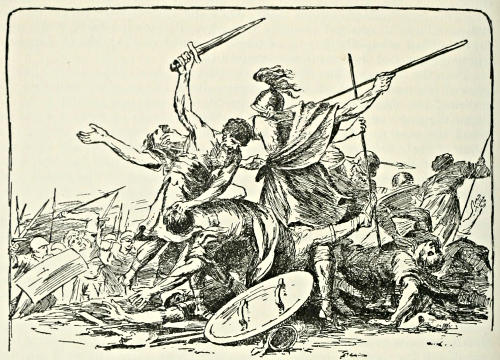
Defeat of the Fabii
THE FABIAN GENS AND THE VEIENTINES
It has already been related that, after the final expulsion of the Tarquins,
the patricians withdrew from the plebeians those rights which they had
originally obtained from King Servius, and which had been renewed and
confirmed to them during the time that the Tarquins were endeavouring to
return. And for a number of years it appears that the Fabii engrossed a
great share of this power to themselves. For we find in the lists of consuls
that for seven years running (from 485 to 479 B.C.), one of the two consuls
was always a Fabius. Now these Fabii were the chief opponents of the
Agrarian law; and Cæso Fabius, who was three times consul in the said
seven years, was the person who procured the condemnation of Sp. Cassius,
the great friend of the plebeians. This Cæso, in his second consulship, found
himself as unpopular as Appius Claudius. His soldiers refused to fight
against the enemy. But in his third consulship, which fell in the last of
the seven years, he showed an altered spirit, he and all his house. For the
Fabii saw the injustice they had been guilty of towards the plebeians, and
the injury they had been doing to the state; and Cæso himself came forward,
and proposed that the Agrarian law of Sp. Cassius should be carried
into full effect. But the patricians rejected the proposal with scorn; and
so the whole Fabian gens determined to leave Rome altogether. They
thought they could serve their country better by warring against the Veientines
than by remaining at home. So they assembled together on the
Quirinal Hill, in all 306 men, besides their clients and followers, and they
passed under the Capitol, and went out of the city by the right-hand arch
of the Carmental gate. They then crossed the Tiber, and marked out a
place on the little river Cremera, which flows into the Tiber below Veii.
Here they fortified a camp, and sallied forth to ravage the lands of the
Veientines and drive their cattle.
So they stood between Rome and Veii for more than a year’s time, and
the Romans had peace on that side, whereas the Veientines suffered greatly.
But there was a certain day, the Ides of February, which was always held
sacred by the Fabii, when they offered solemn sacrifices on the Quirinal Hill,
to the gods of their gens. On this day, Cæso their chief led them forth for
Rome; and the Veientines, hearing of it, laid an ambush for them, and they
were all cut off. And the plebeians greatly mourned the loss of their patrician
friends, and Menenius, the consul, who was encamped near at hand, but
did not assist them, was accused by the tribunes of treacherously betraying
them, as has been above recorded.
But one young Fabius, who was then a boy, was left behind at Rome
when the rest of his gens went forth to settle on the Cremera. And he (so
it was said) was the father of the Fabii who were afterwards so famous in
the history of Rome. After this, it is said, the men of Veii asked and
obtained a peace of forty years.c
The Body of Virginia Carried through the Streets of Rome
We come now to a period in which Roman courage and fortitude were
put to a severe test—when one of the unknown peoples of the north, henceforth
to be familiar as Gauls, invaded Italy, and came, at last, to the walls of
Rome itself. They were hardy warriors, as full of courage seemingly as the
Romans themselves, and accustomed to carry all before them.
The exact details of their conflict with the Romans have been so mingled
with tradition that no one, nowadays, pretends to know just what they
really were. A full story of their alleged doings is given by Livy,c and may
well be reproduced here as showing what has passed for history during all
these centuries, and what is, perhaps, as near to history as we can hope to
attain in this matter. If for no other reason we must turn to this account
because it contains incidents that have become proverbial. It is here, for
example, that one finds the tale of the cackling geese which awakened Marcus
Manlius, and through him saved the city from the Gauls, who were surreptitiously
scaling the heights. Here, again, is the story that the Romans, forced
finally to capitulate through famine and pestilence, made complaint of unfair
weights used by the Gauls, and that Brennus, the conquering leader, threw
his sword into the scale, crying insolently, “Woe to the conquered!” The
dramatic climax, with true theatrical precision, makes the once exiled Camillus,
now dictator of the Romans, appear just at this moment to offer the insolent
Brennus the sword instead of gold, and in the final outcome to conquer him
and his hosts, destroying them to the last man.
This is the completion of the story which Livy and his successors have
made famous for all time. It matters little now as to just how much of this
is true, and how much fable; and even if it did matter, the facts can never
be known. We must be content, despite all the bickerings of specialists as
to this or that feature of the transaction, to believe that the Gauls actually
did invade Italy at this period; that they actually did conquer and ravish
Rome, destroying most of its precious records, and that finally, for some
reason unknown to us, the conquerors retired, leaving the Romans to rebuild
their city and to take up anew the interrupted course of their progress.
The lasting importance of the invasion was, perhaps, due more to the
destruction of the Roman records, thus shutting us out from the true history
of early Roman times, than to any other direct evils which the Gauls inflicted
upon their enemies.a
[391-390 B.C.]
The course of Roman history, hitherto disturbed only by petty border wars,
now suffers a great convulsion. Over her neighbours on the east and north
the republic was in the ascendant; on the west the frail oligarchies of Etruria
had sunk before Camillus and his hardy soldiers; when, by an untoward union
of events, Rome saw her best general banished, and heard of the barbarian
host which was wasting the fair land of Italy. The Gauls burst upon Latium
and the adjoining lands with the suddenness of a thunderstorm. It swept
over the face of Italy, crushing and destroying. The Etruscans were
weakened by it; and if Rome herself was laid prostrate, the Latins also
suffered greatly, the Volscians trembled, and the Æquians were irrecoverably
weakened.
The Gauls were a tribe of that large race of mankind who are known under
the name of Celts, and who at the time in question peopled nearly the whole
of western Europe, from the heart of Germany to the ocean. The northern
and central parts of the continents were already in the hands of various
nations, called by the common name of Germans or Teutons, to whom
belonged the Goths, Saxons, Danes, Normans, Lombards, Franks, and Alamanni,
while the Celts possessed France, a great part of Germany, most of
Spain and Portugal, together with the British Isles. Of these Celts there
were two great divisions, commonly called Gael and Cymri, differing in
habits and language. The ancient inhabitants of France were Gael, those
of Britain and Belgica were Cymri; and the Druidical religion, though sometimes
adopted by the Gael, was properly and originally Cymric. Gael are
still found in Ireland and in the Highlands of Scotland; Cymri in Wales and
Low Brittany; and they have left traces of their name in Cumberland.
Before the time we are now speaking of, there had been a great movement
in the Celtic nations. Two great swarms went out from Gaul. Of these,
one crossed the Alps into Italy; the other, moving eastward, in the course
of time penetrated into Greece, and then passed into Asia Minor, where they
were known under the name of Galatians.
It is supposed that the Gael who dwelt in the eastern parts of Gaul,
being oppressed by Cymric tribes of the west and north, went forth to seek
new homes in distant lands, as in later times the Gothic and German nations
were driven in the contrary direction by the Huns and other Asiatic hordes,
who were thronging into Europe from the east. At all events, it is certain
that large bodies of Celts passed over the Alps before and after this time,
and having once tasted the wines and eaten the fruits of Italy, were in no
hurry to return from that fair land into their own less hospitable regions.
The course taken by these adventurers was probably over divers passes of
the Alps, from the Mount Cenis and the Little St. Bernard to the Simplon.
Pouring from these outlets, they overran the rich plains of northern Italy,
and so occupied the territory which lies between the Alps, the Apennines, and
the Adriatic, that the Romans called this territory Gallia Cisalpina, or Hither
Gaul. The northern Etruscans gave way before these fierce barbarians, and
their name is heard of no more in those parts. Then the Gauls crossed the
Apennines into southern Etruria, and while they were ravaging that country
they first came in contact with the sons of Rome.
The common date for this event is 390 B.C. How long before this time
the Gallic hordes had been pouring into Italy we know not. But whenever
it was that they first passed over the Alps, it is certain that now they first
crossed the Apennines.
The tribe which took this course were of the Senones, as all authors say,
and therefore we may suppose they were Gaelic; but it has been thought
they were mixed with Cymri, since the name of their king or chief was
Brennus, and brenhin is Cymric for “a king.” They are described as large-limbed,
with fair skins, yellow hair, and blue eyes, in all respects contrasted
with the natives of southern Italy. Their courage was high, but their
tempers fickle. They were more fitted for action than endurance; able to
conquer, but not steady enough to maintain and secure their conquests.
Brennus and his barbarians (it was said or sung) passed into Etruria at
the invitation of Aruns, a citizen of Clusium (Chiusi), whose daughter had
been dishonoured by a young Lucumo or noble of the same place. To
avenge his private wrongs this Etruscan called in the Gauls, as Count Julian
in the Spanish romance called in the Moors to avenge the seduction of his
daughter by Roderic the Goth. The Gauls, nothing loath, crossed the mountains,
and laid siege to Clusium; on which the Etruscans of the city,
terrified and helpless, despairing of effectual succour from their own countrymen,
sent to seek aid from the city of the Tiber, which had conquered so
many old Etruscan cities. Common danger makes friends of foes; and the
senate determined to support the Etruscans against the barbarians. However,
all they did was to send three ambassadors, sons of Fabius Ambustus,
the pontifex maximus, to warn the Gauls not to meddle further with the
men of Clusium, for Clusium was the ally of Rome. The barbarians took
slight notice of the message, and continued the war. Now it chanced that
there was a battle fought while the three Fabii were still at Clusium; and
they, forgetting their peaceful character of envoys, took part with the Clusians
against the Gauls, and one of them was seen stripping the arms off a Gallic
champion whom he had slain. The barbarians, in high wrath, demanded to
be led straight against the city whose sons were so faithless; but their chiefs
restrained them, and sent an embassy to Rome demanding that the envoys
should be given up. Then the senate, not caring to decide so weighty a
matter, referred it to the people; and so far was the people from listening
to the demands of the Gaul, that at the comitia next ensuing, these very
envoys were all three elected military tribunes. On hearing of this gross and
open insult, Brennus broke up his camp at Clusium, and marched southward
for Rome. The river Clanis, upon which stood Clusium, led them down to
the Tiber beneath Volsinii. Having crossed that river, and pouring down
its left bank, they found themselves confronted by the Romans on the banks
of the Allia, a little stream that rises in the Sabine hills and empties itself
into the Tiber at a point nearly opposite the Cremera. Their left rested
on the Tiber, the Allia was in their front, and their right occupied some hilly
ground. Brennus attempted not to attack in front, but threw himself with
an overpowering force upon the right flank of the enemy; and the Romans,
finding their position turned, were seized with panic fear and fled. The
greater part plunged into the Tiber in the hope of escaping across the river
to Veii, and many made their escape good; but many were drowned, and
many pierced by Gallic javelins. A small number reached Rome.b
[390 B.C.]
The miraculous attainment of so sudden a victory held even the Gauls in
a state of stupefaction. And at first they stood motionless with panic, as if
not knowing what had happened; then they apprehended a stratagem; at
length they began to collect the spoils of the slain, and to pile up the arms
in heaps, as is their custom. Then, at length, when no appearance of anything
hostile was anywhere observed, having proceeded on their journey,
they reach the city of Rome not long before sunset: where, when some horsemen,
who had advanced before, brought back word that the gates were not
shut, that no guard was posted before the gates, no armed troops on the
walls, another cause of amazement similar to the former made them halt;
and dreading the night and ignorance of the situation of the city, they posted
themselves between Rome and the Anio, after sending scouts about the walls
and the several gates to ascertain what plans the enemy would adopt in their
desperate circumstances.
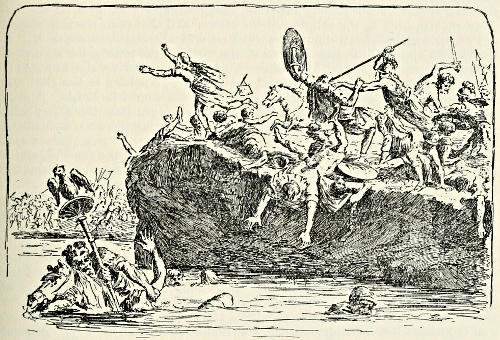
Battle between Romans and Gauls at the River Allia
With respect to the Romans, as the greater part had gone to Veii from
the field of battle, and no one supposed that any survived except those
who had fled back to Rome—being all lamented as lost, both those living and
those dead—they caused the entire city to be filled with wailings. The alarm
for the public interest stifled private sorrow, as soon as it was announced
that the enemy were at hand. Presently the barbarians patrolling around the
walls in troops, they heard their yells and the dissonant clangour of their
arms. All the interval up to the next day kept their minds in such a state
of suspense that an assault seemed every moment about to be made on the
city: on their first approach, when they arrived at the city (it was expected);
for if this were not their design, that they would have remained at
the Allia; then towards sunset, because there was not much of the day
remaining, they imagined that they would attack them before night; then
that the design was deferred until night, in order to strike the greater terror.
At length the approach of light struck them with dismay; and the calamity
itself followed closely upon their continued apprehension of it, when the
troops entered the gates in hostile array. During that night, however, and
the following day, the state by no means bore any resemblance to that which
had fled in so dastardly a manner at the Allia. For as there was not a
hope that the city could be defended, so small a number of troops now
remaining, it was determined that the youth fit for military service, and the
abler part of the senate with their wives and children, should retire into the
citadel and Capitol, having collected stores of arms and corn; and thence
from a fortified post, that they should defend the deities, and the inhabitants,
and the Roman name: that the flamen (Quirinalis) and the vestal
priestesses should carry away far from slaughter and conflagration the objects
appertaining to the religion of the state; and that their worship should
not be intermitted, until there remained no one who could continue it. If
the citadel and Capitol, the mansion of the gods, if the senate, the source of
public counsel, if the youth of military age, should survive the impending
ruin of the city, the loss of the aged, the crowd left behind in the city, and
who were sure to perish[33] under any circumstances would be light. And in
order that the plebeian portion of the multitude might bear the thing with
greater resignation, the aged men, who had enjoyed triumphs and consulships,
openly declared that they would die along with them, and that they would
not burden the scanty stores of the armed men with those bodies, with which
they were now unable to bear arms, or to defend their country. Such was the
consolation addressed to each other by the aged now destined to death.
Their exhortations were then turned to the band of young men, whom
they escorted to the Capitol and citadel, commending to their valour and
youth whatever might be the remaining fortune of a city which for 360 years
had been victorious in all its wars. When those who carried with them
all their hope and resources parted with the others, who had determined not
to survive the ruin of their captured city, both the circumstance itself and the
appearance (it exhibited) was really distressing, and also the weeping of
the women and their undecided running together, following now these, now
those, and asking their husbands and children what was to become of them,
(all together) left nothing that could be added to human misery. A great
many of them, however, escorted their friends into the citadel, no one either
preventing or inviting them; because the measure which was advantageous
to the besieged, that of reducing the number of useless persons, was but
little in accordance with humanity.
The rest of the crowd, chiefly plebeians, whom so small a hill could not
contain, nor could they be supported amid such scarcity of corn, pouring
out of the city as if in one continued train, repaired to the Janiculum.
From thence some were dispersed through the country, some made for the
neighbouring cities, without any leader or concert, following each his own
hopes, his own plans, those of the public being given up as lost. In the
meantime the flamen Quirinalis and the vestal virgins, laying aside all concern
for their own affairs, consulting which of the sacred deposits should be carried
with them, which should be left behind, for they had not strength to carry
them all, or what place would best preserve them in safe custody, considered
it best to put them into casks and to bury them in the chapel adjoining to
the residence of the flamen Quirinalis, where then it was profane to spit out.
The rest they carried away with them, after dividing the burden among themselves,
by the road which led by the Sublician bridge to the Janiculum.
Meanwhile at Rome, all arrangements being now made, as far as was
possible in such an emergency, for the defence of the citadel, the crowd
of aged persons having returned to their houses, awaited the enemy’s coming
with minds firmly prepared for death. Such of them as had borne curule
offices, in order that they might die in the insignia of their former station,
honours, and merit, arraying themselves in the most magnificent garments
worn by those drawing the chariots of the gods in procession, or by persons
riding in triumph, seated themselves in their ivory chairs, in the middle of
their halls. Some say that they devoted themselves for their country and
the citizens of Rome, Marcus Fabius, the chief pontiff, dictating the form of
words.
The Gauls, both because by the intervention of the night they had abated
all angry feelings arising from the irritation of battle, and because they had
on no occasion fought a well-disputed fight, and were then not taking the
city by storm or violence, entering the city the next day, free from resentment
or heat of passion, through the Colline Gate which lay open, advance
into the Forum, casting their eyes around on the temples of gods, and on
the citadel, which alone exhibited any appearance of war. From thence,
after leaving a small guard, lest any attack should be made on them whilst
scattered, from the citadel or Capitol, they dispersed in quest of plunder;
the streets being entirely desolate, some of them rushed in a body into the
houses that were nearest; some repair to those which were most distant,
considering these to be untouched and abounding with spoil.
Afterwards being terrified by the very solitude, lest any stratagem of
the enemy should surprise them whilst being dispersed, they returned in
bodies into the Forum and the parts adjoining to the Forum, where the
houses of the commons being shut, and the halls of the leading men lying
open, almost greater backwardness was felt to attack the open than the
shut houses; so completely did they behold with a sort of veneration men
sitting in the porches of the palaces, who besides their ornaments and
apparel more august than human, bore a striking resemblance to gods, in
the majesty which their looks and the gravity of their countenance displayed.
Whilst they stood gazing on these as on statues, it is said that
Marcus Papirius, one of them, roused the anger of a Gaul by striking him
on the head with the ivory, while he was stroking his beard, which was
then universally worn long; and that the commencement of the bloodshed
began with him, that the rest were slain in their seats. After the slaughter
of the nobles, no person whatever was spared; the houses were plundered,
and when emptied were set on fire.
But whether it was that all were not possessed with a desire of destroying
the city, or it had been so determined by the leading men of the Gauls,
both that some fires should be presented to their view (to see) if the
besieged could be forced into a surrender through affection for their dwellings,
and that all the houses should not be burned down, so that whatever
portion should remain of the city, they might hold as a pledge to work
upon the minds of the enemy; the fire by no means spread either indiscriminately
or extensively on the first day, as is usual in a captured city.
The Romans beholding from the citadel the city filled with the enemy,
and their running to and fro through all the streets, some new calamity
presenting itself in every different quarter, were neither able to preserve
their presence of mind, nor even to have perfect command of their ears
and eyes. To whatever direction the shouts of the enemy, the cries of
women and children, the crackling of the flames, and the crash of falling
houses, had called their attention, thither, terrified at every incident, they
turned their thoughts, faces, and eyes, as if placed by fortune to be spectators
of their falling country, and as if left as protectors of no other of
their effects, except their own persons: so much more to be commiserated
than any others who were ever besieged, because, shut out from their country,
they were besieged, beholding all their effects in the power of the enemy.
Nor was the night, which succeeded so shockingly spent a day, more tranquil;
daylight then followed a restless night; nor was there any time
which failed to produce the sight of some new disaster. Loaded and
overwhelmed by so many evils, they did not at all abate their determination
(resolved) though they should see everything in flames and levelled
to the dust, to defend by their bravery the hill which they occupied, small
and ill-provided as it was, being left (as a refuge) for liberty. And now,
as the same events recurred every day, as if habituated to misfortunes,
they abstracted their thoughts from all feeling of their circumstances,
regarding their arms only, and the swords in their right hands, as the sole
remnants of their hopes.
The Gauls also, after having for several days waged an ineffectual war
against the buildings of the city, when they saw that among the fires and
ruins of the captured city nothing now remained except armed enemies,
neither terrified by so many disasters nor likely to turn their thoughts to a
surrender, unless force were employed, determined to have recourse to extremities,
and to make an attack on the citadel. A signal being given at
break of day, their entire multitude was marshalled in the Forum; thence,
after raising the shout and forming a testudo, they advanced to the attack.
Against whom the Romans, acting neither rashly nor precipitately, having
strengthened the guards at every approach, and opposing the main strength
of their men in that quarter where they saw the battalions advancing, suffered
the enemy to ascend, judging that the higher they ascended, the more easily
would they be driven back down the steep. About the middle of the ascent
they met them; and making a charge thence from the higher ground, which
of itself bore them against the enemy, they routed the Gauls with slaughter
and destruction, so that never after, either in parties or with their whole
force, did they try that kind of fighting.
Laying aside all hope of succeeding by force of arms, they prepare for a
blockade; of which having had no idea up to that time, they had, whilst
burning the city, destroyed whatever corn had been therein, and during
those very days all the provisions had been carried off from the land to Veii.
Accordingly, dividing their army, they resolved that one part should plunder
through the neighbouring states, that the other part should carry on the
siege of the citadel, so that the ravagers of the country might supply the
besiegers with corn.
The Gauls, who marched from the city, were led by fortune herself, to
make trial of Roman valour, to Ardea, where Camillus was in exile: who,
more distressed by the fortune of the public than his own, whilst he now
pined away arraigning gods and men, fired with indignation, and wondering
where were now those men who with him had taken Veii and Falerii, who
had conducted other wars rather by their own valour than by the favour of
fortune, heard on a sudden that the army of the Gauls was approaching,
and that the people of Ardea in consternation were met in council on the
subject.
Both friends and enemies were satisfied that there existed nowhere at
that time a man of equal military talent. The assembly being dismissed,
they refreshed themselves, carefully watching for the moment the signal
should be given; which being given, during the silence of the beginning of
the night they attended Camillus at the gates. Having gone forth to no
great distance from the city, they found the camp of the Gauls, as had been
foretold, unprotected and neglected on every side, and attacked it with a
shout. No fight anywhere, but slaughter everywhere; their bodies, naked
and relaxed with sleep, were cut to pieces. Those most remote, however,
being roused from their beds, not knowing what the tumult was, or whence
it came, were directed to flight, and some of them, without perceiving it,
into the midst of the enemy. A great number flying into the territory of
Antium, an attack being made on them in their straggling march by the
townspeople, were surrounded and cut off.
A like carnage was made of the Tuscans in the Veientian territory; who
were so far from compassionating the city which had now been its neighbour
for nearly four hundred years, overpowered as it now was by a strange and
unheard-of enemy, that at that very time they made incursions on the Roman
territory; and laden with plunder, had it in contemplation to lay siege to
Veii, the bulwark and last hope of the Roman race. The Roman soldiers
had seen them straggling over the country, and collected in a body, driving
the spoil before them, and they perceived their camp pitched at no great distance
from Veii. Upon this, first self-commiseration, then indignation, and
after that resentment, took possession of their minds: “Were their calamities
to be a subject of mockery to the Etrurians, from whom they had turned off
the Gallic war on themselves?” Scarce could they curb their passions, so
as to refrain from attacking them at the moment; and being restrained by
Quintus Cædicius, the centurion, whom they had appointed their commander,
they deferred the matter until night. A leader equal to Camillus was all
that was wanted; in other respects matters were conducted in the same
order and with the same fortunate result. And further, under the guidance
of some prisoners, who had survived the nightly slaughter, they set out to
Salinæ against another body of Tuscans; they suddenly made on the following
night still greater havoc, and returned to Veii exulting in their double
victory.
Meanwhile, at Rome, the siege, in general, was slow, and there was quiet
on both sides, the Gauls being intent only on this, that none of the enemy
should escape from between their posts; when, on a sudden, a Roman youth
drew on himself the admiration both of his countrymen and the enemy. There
was a sacrifice solemnised at stated times by the Fabian family on the Quirinal
Hill. To perform this Caius Fabius Dorso having descended from the Capitol,
in the Gabine cincture, carrying in his hands the sacred utensils, passed
out through the midst of the enemy’s post, without being at all moved by
the calls or threats of any of them, and reached the Quirinal Hill; and after
duly performing there the solemn rites, coming back by the same way with
the same firm countenance and gait, confident that the gods were propitious,
whose worship he had not even neglected when prohibited by the fear of
death, he returned to the Capitol to his friends, the Gauls being either
astounded at such an extraordinary manifestation of boldness, or moved even
by religious considerations, of which the nation is by no means regardless.
In the meantime, not only the courage, but the strength of those at Veii
increased daily, not only those Romans repairing thither from the country
who had strayed away after the unsuccessful battle, or the disaster of the
city being taken, but volunteers also flowing in from Latium, to come in for
share of the spoil. It now seemed high time that their country should be
recovered and rescued from the hands of the enemy. But a head was wanting
to this strong body. The very spot put them in mind of Camillus, and
a considerable part consisted of soldiers who had fought successfully under
his guidance and auspices, and Cædicius declared that he would not give
occasion that any one, whether god or man, should terminate his command
rather than that, mindful of his own rank, he would himself call (for the
appointment of) a general. With universal consent it was resolved that
Camillus should be sent for from Ardea, but not until the senate at Rome
were first consulted; so far did a sense of propriety regulate every proceeding,
and so carefully did they observe the distinctions of things in their
almost desperate circumstances. They had to pass at
great risk through the enemy’s guards. For this purpose
a spirited youth, Pontius Cominius, offered his services,
and supporting himself on cork was carried down the
Tiber to the city. From thence, where the distance
from the bank was shortest, he makes his way into the
Capitol over a portion of the rock that was craggy, and
therefore neglected by the enemy’s guard: and being
conducted to the magistrates, he delivers the instructions
received from the army. Then having received a decree
of the senate, both that Camillus should be recalled from
exile at the comitia curiata, and be forthwith appointed
dictator by order of the people, and that the soldiers
should have the general whom they wished, he passed
out the same way and proceeded with his despatches to
Veii; and deputies being sent to Camillus to Ardea,
conducted him to Veii: or else the law was passed by
the curiæ, and he was nominated dictator in his absence;
for I am more inclined to believe that he did not set out
from Ardea until he found that the law was passed;
because he could neither change his residence without
an order of the people, nor hold the privilege of the
auspices in the army until he was nominated dictator.
Whilst these things were going on at Veii, in the
meanwhile the citadel and Capitol of Rome were in
great danger. For the Gauls either having perceived
the track of a human foot where the messenger from
Veii had passed, or having of themselves remarked the
easy ascent by the rock at the temple of Carmentis, on a
moonlight night, after they had at first sent forward an
unarmed person, to make trial of the way, delivering
their arms, whenever any difficulty occurred, alternately supported and supporting
each other, and drawing each other up, according as the ground
required, they reached the summit in such silence that they not only escaped
the notice of the sentinels, but of the dogs also, an animal extremely wakeful
with respect to noises by night.
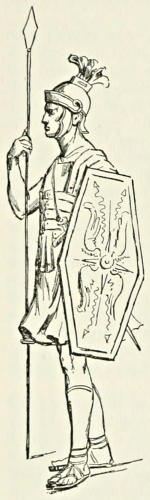
A Roman Soldier
The notice of the geese they did not escape, which, as being sacred to
Juno, were spared though they were in the greatest scarcity of food. Which
circumstance was the cause of their preservation. For Marcus Manlius, who
three years before had been consul, a man distinguished in war, being
aroused from sleep by their cackling and the clapping of their wings, snatched
up his arms, and at the same time calling the others to do the same, proceeded
to the spot; and whilst the others were thrown into confusion, he struck with
the boss of his shield and tumbled down a Gaul, who had already got footing
on the summit; and when the fall of this man as he tumbled threw down
those who were next him, he slew others, who in their consternation had
thrown away their arms, and caught hold of the rocks to which they clung.
And now the others also having assembled, beat down the enemy by javelins
and stones, and the entire band, having lost their footing, were hurled down
the precipice in promiscuous ruin. The alarm then subsiding, the remainder
of the night was given up to repose (as far as could be done considering the
disturbed state of their minds), when the danger, even though past, still
kept them in a state of anxiety.
Day having appeared, the soldiers were summoned by sound of trumpet
to attend the tribunes in assembly, when recompense was to be made both to
merit and to demerit; Manlius was first of all commended for his bravery
and presented with gifts, not only by the military tribunes, but with the
consent of the soldiers, for they all carried to his house, which was in the
citadel, a contribution of half a pound of corn and half a pint of wine: a
matter trifling in the relation, but the prevailing scarcity had rendered it
a strong proof of esteem, when each man, depriving himself of his own food,
contributed in honour of one man a portion subtracted from his body and
from his necessary requirements. Then the guards of that place where the
enemy had climbed up unobserved, were summoned; and when Quintus
Sulpicius declared openly that he would punish all according to the usage of
military discipline, being deterred by the consentient shout of the soldiers
who threw the blame on one sentinel, he spared the rest. The man, who was
manifestly guilty of the crime, he threw down from the rock, with the approbation
of all. From this time forth the guards on both sides became more
vigilant; on the part of the Gauls, because a rumour spread that messengers
passed between Veii and Rome, and on that of the Romans, from the recollection
of the danger which occurred during the night.
But beyond all the evils of siege and war, famine distressed both armies;
pestilence, moreover, oppressed the Gauls, both as being encamped in a
place lying between hills, as well as heated by the burning of the houses,
and full of exhalations, and sending up not only ashes but embers also,
whenever the wind rose to any degree; and as the nation, accustomed to
moisture and cold, is most intolerant of these annoyances, and, suffering
severely from the heat and suffocation, they were dying, the diseases spreading
as among cattle, now becoming weary of burying separately, they heaped
up the bodies promiscuously and burned them; and rendered the place
remarkable by the name of Gallic piles.
A truce was now made with the Romans, and conferences were held with
the permission of the commanders; in which when the Gauls frequently
alluded to the famine, and referred to the urgency of that as a further
motive for their surrendering, for the purpose of removing that opinion,
bread is said to have been thrown in many places from the Capitol, into the
advanced posts of the enemy. But the famine could neither be dissembled
nor endured any longer. Accordingly, whilst the dictator is engaged in person
in holding a levy, in ordering his master of the horse, Lucius Valerius, to
bring up the troops from Veii, in making preparations and arrangements, so
that he may attack the enemy on equal terms, in the meantime the army of
the Capitol, wearied out with keeping guard and with watches, having surmounted
all human sufferings, whilst nature would not suffer famine alone
to be overcome, looking forward from day to day, to see whether any succour
would come from the dictator, at length not only food but hope also
failing, and their arms weighing down their debilitated bodies, whilst the
guards were being relieved, insisted that there should be either a surrender,
or that they should be bought off, on whatever terms were possible, the
Gauls intimating in rather plain terms, that they could be induced for no
very great compensation to relinquish the siege. Then the senate was held
and instructions were given to the military tribunes to capitulate.
Upon this the matter was settled between Quintus Sulpicius, a military
tribune, and Brennus, the chieftain of the Gauls, and one thousand pounds
weight of gold was agreed on as the ransom of a people, who were soon after
to be the rulers of the world. To a transaction very humiliating in itself, insult
was added. False weights were brought by the Gauls, and on the tribune
objecting, his sword was thrown in in addition to the weight by the insolent
Gaul, and an expression was heard intolerable to the Romans, “Woe to the
vanquished!”
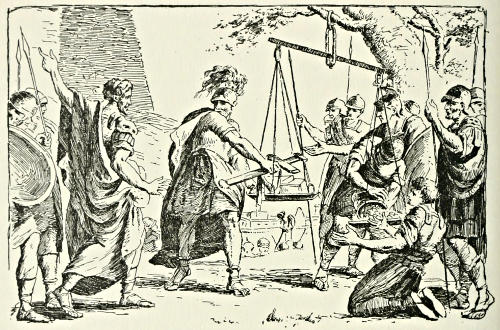
The Romans’ Treaty with the Gauls
(After Mirys)
But both gods and men interfered to prevent the Romans from living on
the condition of being ransomed; for by some chance, before the execrable
price was completed, all the gold being not yet weighed in consequence of
the altercation, the dictator comes up, and orders the gold to be removed,
and the Gauls to clear away. When they, holding out against him,
affirmed that they had concluded a bargain, he denied that the agreement
was a valid one, which had been entered into with a magistrate of inferior
authority without his orders, after he had been nominated dictator; and he
gives notice to the Gauls to get ready for battle. He orders his men to
throw their baggage in a heap, and to get ready their arms, and to recover
their country with steel, not with gold, having before their eyes the temples
of the gods, and their wives and children, and the soil of their country
disfigured by the calamities of war, and all those objects which they were
solemnly bound to defend, to recover, and to revenge. He then draws up
his army, as the nature of the place admitted, on the site of the half-demolished
city, and which was uneven by nature, and he secured all those
advantages for his own men, which could be prepared or selected by military
skill.
The Gauls, thrown into confusion by the unexpected event, take up
arms, and with rage, rather than good judgment, rushed upon the Romans.
Fortune had now changed; now the aid of the gods and human prudence
assisted the Roman cause. At the first encounter, therefore, the Gauls were
routed with no greater difficulty than they had found in gaining the victory
at Allia. They were afterwards beaten under the conduct and auspices of
the same Camillus, in a more regular engagement, at the eighth stone on
the Gabine road, whither they had betaken themselves after their defeat.
There the slaughter was universal: their camp was taken, and not even one
person was left to carry news of the defeat.
The dictator, after having recovered his country from the enemy, returns
into the city in triumph; and among the rough military jests which they
throw out on such occasions he is styled, with praises by no means undeserved,
Romulus, and parent of his country, and a second founder of the
city. His country, thus preserved by arms, he unquestionably saved a
second time in peace, when he hindered the people from removing to Veii,
both the tribunes pressing the matter with greater earnestness after the
burning of the city, and the commons of themselves being more inclined
to that measure; and that was the cause of his not resigning his dictatorship
after the triumph, the senate entreating him not to leave the commonwealth
in so unsettled a state.c
[390-349 B.C.]
Such was the conclusion of the legend. But, unfortunately for Roman
pride, here also, as in the tale of Porsenna, traces of true history are preserved
which show how little the Roman annalists regarded truth. Polybius
tells us, as if he knew no other story, that the departure of the Gauls was
caused by the intelligence that the Venetians, an Illyrian tribe, had invaded
their settlements in northern Italy, and that they actually received the gold
and marched off unmolested to their homes. It is added by a later historian,
that Drusus, the elder brother of the emperor Tiberius, recovered this very
gold from the Gauls of his own day.
The Gauls left the city in ruins, in whatever way they were compelled to
retire, whether by the sword of Camillus, or by the softer persuasion of gold.
Two later inroads of the Gauls are distinguished by two famous legends: the
last, or nearly the last, which occur in the pages of Roman history.
In the Manlian house there was a family which bore the name of Torquatus.
This name was said to have been won by T. Manlius, who fought
with a gigantic Gallic champion on the bridge over the Anio in 361 B.C., and
slew him. From the neck of the slain enemy he took the massy chain
(torques) which the Gallic chiefs were in the habit of wearing. He put
it round his own neck, and returning in triumph to his friends, was
ever after known by the name of T. Manlius Torquatus. Of him we shall
hear more.
Again, when L. Camillus, a nephew of the great Camillus, was pursuing
the Gauls through the Volscian plains in 349 B.C., a champion challenged
any one of the Roman youth to single combat. The challenge was readily
accepted by M. Valerius, who, by the side of the huge Gaul, looked like a
mere stripling. At the beginning of the combat (wonderful to tell) a crow
lighted upon his helmet; and as they fought, the bird confounded the Gaul
by flying in his face and striking him with his beak, and flapping its wings
before his eyes; so that he fell an easy conquest to the young Roman.
Hence M. Valerius was ever after known by the name of Corvus, and his
descendants after him. Him also we shall hear of hereafter; for he lived
to be a great general, and more than once delivered his country from great
danger.b
Thus runs the legend of the first great event in Roman history—an event
so important that the echo reached even to Greece. “The capture of Rome
by the Gauls,” says George Cornewall Lewis,f “is the first event in Roman
history which, so far as we know, attracted the notice of the contemporary
Greeks. Plutarch says that Heraclides of Pontus spoke of a report from
the far West, which described an Hellenic city called Rome, situated somewhere
near the great sea, as having been taken by an army from the distant
land of the Hyperboræans.”
Ihneg is very incredulous of most of the legends, even suggesting that the
legend of the geese had an ætiological origin and was merely invented to
explain a religious ceremony in which a dog was impaled and a goose decorated
with gold, instead of being actually the origin of that annual ceremony.
Lewis, however, finds the older story amply substantiated.[34] Among the
chief sceptics are Mommsen,h Schwegler,i and Paisj the most radical of all.
Niebuhr’se story of the whole event is worth quoting, beginning with his
comments on the story that Aruns of Clusium brought in the Gauls.a
Though history rejects the incident as demonstrably false, it is well
suited to the legend; and every legend which was current among the people
long before the rise of literature among them, is itself a living memorial of
ancient times,—even though its contents may not be so,—and deserves a
place in a history of Rome written with a due love for the subject.
The determination to sacrifice the old men certainly cannot be called inconceivable
in a people of antiquity. This however is inconceivable, that they
should have been so far influenced by the example of the patricians, as to await
their doom like devoted victims. Could they be sure that a wished-for death
would speedily release them? that wanton cruelty would not protract it by
torture? that they should not be driven along as slaves, without regard to their
strength, at the mere caprice of the barbarians? They might have defended
the walls and the gates, might have maintained a resistance with all sorts of
missiles in the interior of the city, might have made many of their enemies
share their fate; had the quarters that held out been set fire to, the victor
would have been deprived of his spoil. But in fact Livy is the only writer
who speaks of this torpid resignation. Others related that, while all the rest
of the people quitted their homes, eighty priests and aged patricians of the
highest rank sat down in the Forum on their curule thrones in festal robes
awaiting death. That such a resolution should have been freely taken by
men of the same class, who deemed it intolerable to outlive the republic and
the worship of the gods, is by no means improbable; least of all if, after resolving
to face death, they solemnly devoted themselves by the hands of the
chief pontiff for the republic and for the destruction of her foes. On the other
hand it is utterly inconceivable that the chief part of the women and children
should not have retired from the city, where every kind of insult and outrage
inevitably awaited them, when it was yet possible for them to be saved by
flight. It is said that a great number pressed forward at the last moment and
gained admittance into the Capitol and the citadel; as if, had this been feasible,
they would not all have forced their way in; as if that small place could
have held more than the men requisite to defend it, with provisions for them.
Finally, the story that the Romans in their despair did not close the gates of
the city, and that nothing but the fear of some stratagem withheld the conquerors
from marching in, sounds very incredible. On this point, however, we
do not want any internal reasons; since the authentic account in Diodorus
states that the Gauls, on finding the walls entirely deserted, burst open the
gates.
It would be extremely unjust to impute what has here been said about
Livy’s narrative to a design of detracting from his merits. Such criticisms
cannot impair his imperishable fame. As soon as we cease to call for what
it was Livy’s least care to supply, nothing remains to disturb the pleasure
which his description must yield to every unprejudiced mind. If there be
one so distempered as to forego that pleasure, because his account has been
proved to be historically untenable, we may pity, but we must not indulge
its perverseness.
A writer who adopts a dry and neglected report in preference to a well-known
and masterly narrative, must justify himself, and show that it is not
from the love of paradox, that he has discarded the more beautiful story.
[Niebuhr reminds his readers of his previously expressed admiration for
Livy with renewed assurances of his entire sincerity. He then concludes
thus eloquently]: And in his own peculiar excellencies, in that richness
and that warmth of colouring which many centuries after were the characteristics
of the Venetian painters born under the same sky, Livy never
shone more brilliantly than in this very description; a more vivid one is
not to be found in any Latin or Greek historian.e
[390-384 B.C.]
We can imagine better than describe the blank dismay with which the
Romans, on the departure of the Gauls, must have looked upon their ancient
homes. Not only was the country ravaged, as had often happened in days
of yore, but the city itself, except the Capitol, was a heap of ruins. It is not
strange that once again the plebeians should have thought of quitting Rome
forever. Not long before they had wished to migrate to Veii; now, they
had actually been living there for many months. Rome no longer existed;
patriotism, they said, no longer required them to stand by their ancient
home; why should not all depart—patricians with their clients and freedmen,
as well as plebeians—and make a new Rome at Veii? In vain Camillus
opposed these arguments with all the influence which his late services
had given him. Standing in the Forum, under shadow of the Capitol,
with the citadel defended by Manlius over their heads, in the sight of
their country’s gods, now brought back from Cære, the plebeians were
ready to agree to a general migration of the whole people, when (so runs
the story) a sudden omen changed their hearts. A certain centurion
was leading a party of soldiers through the city, and, halting them in the
Forum while the question was in hot debate, he used these memorable
words: “Standard-bearer, pitch the standard here; here it will be best for
us to stay!”
It was therefore resolved to rebuild the city, and the senate did all in
their power to hasten on the work. They took care to retrace, as far as
might be, the ancient sites of the temples; but it was impossible to prescribe
any rules for marking out the streets and fixing the habitations of the citizens.
All they did was to supply tiling for the houses at the public expense.
So men built their houses where they could, where the ground was most
clear of rubbish, or where old materials were most easy to be got. Hence,
when these houses came to be joined together by others, so as to form streets,
these streets were narrow and crooked, and, what was still worse, were often
built across the lines of the ancient sewers, so that there was now no good
and effectual drainage. The irregularity continued till Rome was again
rebuilt after the great fire in the time of the emperor Nero.
Great were the evils that were caused by this hurry. The healthiness of
the city must have been impaired, order and decency must have suffered,
but there was one particular evil at the moment which threatened very great
mischief. The mass of the people, having little or nothing of their own, or
having lost all in the late destruction, were obliged to borrow money in order
to complete their dwellings: and as tillage had for the last season been nearly
suspended, the want and misery that prevailed were great. Now again, as
after the wars against the Tarquins, many of the poorer sort were reduced to
bondage in the houses of the wealthy.
Then it was that M. Manlius, the defender of the Capitol, stood forth as
the patron of the poor. He saw a debtor being taken to prison, whom he
recognised as a brave centurion that had formerly served with him in the
wars. He instantly paid the man’s debt, and set him free. Then, selling
the best part of his landed property, he declared that, while he could prevent
it, he would never see a fellow-citizen imprisoned for debt. His popularity
rose high, and with the poorer sort the name of M. Manlius was more in
esteem than that of the great Camillus. Nor did he content himself with
relieving want; he also stepped forward as an accuser of the patricians and
senators: they had divided among themselves, he said, part of the gold
which had been raised to pay the Gauls. On the other hand, the patricians
asserted that Manlius was endeavouring to make himself tyrant of Rome,
and that this was the real purpose of all his generosity. The senate ordered
a dictator to be named, and A. Cornelius Cossus was chosen. He summoned
Manlius before him, and required him to prove the charge which he had
maliciously brought against the ruling body. He failed to do so and was
cast into prison, but claimed to be regularly tried before the whole people
assembled in their centuries; and his claim was allowed. On the appointed
day he appeared in the Campus Martius, surrounded by a crowd of debtors,
every one of whom he had redeemed from bondage. Then he exhibited
spoils taken from thirty enemies slain by himself in single combat; eight
civic crowns, bestowed each of them for the life of a citizen saved in battle,
with many other badges given him in token of bravery. He laid bare his
breast and showed it all scarred with wounds, and then, turning to the
Capitol, he called those gods to aid whom he had saved from the sacrilegious
hands of the barbarians. The appeal was felt, and if the centuries had then
given their votes, he would certainly have been acquitted of high treason. So
his enemies contrived to break up that assembly; and shortly after he was
put on his trial in another place, the Peteline grove, whence (it is said) the
Capitol could not be seen. Here he was at once found guilty, and condemned
to be thrown down the Tarpeian rock. A bill was then brought in and
passed, enacting that his house on the Capitol should be destroyed, and that
no one of his gens should hereafter bear the forename of Marcus.[35]
[384-376 B.C.]
But something was done to relieve the poor. The lands which had been
taken from the Veientines on the right bank of the Tiber were now incorporated
into the Roman territory and
divided into four tribes, so that all
free men settled in these districts
became burgesses of Rome, and had
votes in the comitia both of the centuries
and tribes. This politic
measure, however, served no less
to conciliate the affections of their
new Etrurian subjects than to benefit
their own poor citizens. Moreover
an attempt was made to plant
a number of poor citizens in the
Pontine district. Yet these measures
were insufficient to heal the
breach which still subsisted between
the patricians and plebeians.
Nothing could be effectual to this
end but the admission of the plebeians
to the chief magistracy; and
a struggle now commenced for that
purpose.
A Roman Artisan
It has been said that all difference
between the patrician and
plebeian orders was rapidly disappearing,
or rather that the patrician
families were gradually becoming
fewer, while many plebeian families
were rising to wealth and power.
Already we have seen the plebeians
obtain a footing in the senate;
they were allowed to fill the
offices of quæstor and ædile, and, as
military tribunes, could command
the armies of the state; but to the highest curule offices, as the censorship and
consulship, they were not admissible, the reason given being, that for these
offices the auguries must be taken and no religious rites could be performed
save by persons of pure patrician blood. This now began to be felt to be a
mockery. Men saw with their own eyes and judged with their own understanding
that patricians and plebeians were men of like natures, were called
on alike to share burdens and danger in the service of the state, and therefore
ought to share alike the honours and dignities which she conferred.
So Canuleius argued many years before, so the plebeians thought now; and
two resolute tribunes arose, who at length carried the celebrated laws by
which plebeians were admitted to the highest honours. These were C.
Licinius Stolo and L. Sextius, his kinsman.
There is a well-known story of the manner in which they were first
roused to the undertaking. It runs thus: M. Fabius Ambustus, a patrician,
had two daughters, the elder married to Ser. Sulpicius, a patrician,
the younger to C. Licinius, a plebeian. It happened that Sulpicius was
consular tribune in the same year that Licinius was tribune of the plebs;
and as the younger Fabia was on a visit to her sister, Sulpicius, returning
home from the Forum with his lictors, alarmed the plebeian’s wife by the
noise he made in entering the house. The elder sister laughed at this
ignorance; and the younger Fabia, stung to the quick, besought her husband
to place her on a level with her proud sister. But the story must be
an invention—because Licinius’ wife could not have been ignorant of the
dignities of the office; and because there was nothing to prevent Licinius
himself from being consular tribune, and thus equal to his brother-in-law.[36]
[376 B.C.]
However this might be, Licinius and Sextius, being tribunes of the plebs
together in the year 376 B.C., promulgated the three bills which have ever
since borne the name of the Licinian Rogations. These were:
I. That of all debts on which interest had been paid, the sum of the interest
paid should be deducted from the principal, and the remainder paid off in
three successive years.
II. That no citizen should hold more than five hundred jugera (nearly
320 acres) of the public land, nor should feed on the public pastures more
than one hundred head of larger cattle and five hundred of smaller, under
penalty of a heavy fine.
III. That henceforth consuls, not consular tribunes, should always be
elected, and that one of the two consuls must be a plebeian.
Of these laws, the first is of a kind not very uncommon in rude states of
society. If persons lend and borrow money they enter into a legal contract,
and the state is bound to maintain this contract. Cases will occur when the
borrower is unable to pay his debts, and that from no fault or neglect of his
own; and the laws provide for cases of insolvency in which the insolvent
is not guilty of fraud. But if the state were to cancel all legal debts,
persons would be very slow to lend money at all, and thus credit and commerce
would be destroyed. At Rome, after the Gallic War, as at Athens in
the time of Solon (when a similar ordinance was passed), all things were
in such confusion that it might be necessary to resort to arbitrary measures;
and we may well believe that Licinius, himself a wealthy man, would not
have interfered but for necessity. But the precedent was bad; and in later
times one of the worst means used by demagogues was a promise of novæ
tabulæ, or an abolition of all debts.
The second law was a general agrarian law. Former agrarian laws had
merely divided certain portions of public land among the needy citizens;
but this laid down a general rule, by which the holding (possessio) of all
such lands was to be limited. The purpose of Licinius was good. He wished to
maintain that hardy race of yeomen who were the best soldiers in the state-militia;
whereas if all these lands were absorbed by the rich, they would be
cultivated by hired labourers or slaves. The subsequent history will show
how unfortunate it was for Rome that this law was not more fully executed.
[376-368 B.C.]
At first the patricians were equally opposed to all these laws; they
were the chief creditors, and therefore would lose by the first law; they held
the bulk of the public lands on easy terms, and therefore would lose by the
second; they alone could be consuls, and therefore they could not brook
the third. We need not therefore wonder at a violent resistance; nor is it
wonderful that they should enlist many rich plebeians on their side, for these
persons would suffer as much as themselves from the first two laws. Accordingly
we find that some tribunes were found to put a veto on the bills. But
Licinius and Sextius would not be thus thwarted, and themselves turned the
powerful engine of the veto against their opponents. When the time of
the elections arrived they interdicted all proceedings in the comitia of the
centuries; consequently no consuls, consular tribunes, censors, or quæstors
could be elected. The tribunes and ædiles, who were chosen at the comitia
of tribes, were the only officers of state for the ensuing year.
This state of things (as the Roman annalists say) lasted for five years,[37]
Licinius and Sextius being re-elected to the tribunate every year. But in
the fifth year, when the people of Tusculum, old allies of Rome, applied for
aid against the Latins, the tribunes permitted consular tribunes to be elected
to lead the army, and among them was M. Fabius Ambustus, the father-in-law
and friend of Licinius. The latter, far from relaxing his claims, now
proposed a fourth bill, providing that, instead of two keepers of the Sibylline
books (duumviri), both patricians, there should be ten (decemviri), to be
chosen alike from both orders—so scornfully did he treat the pretensions
of the patricians to be sole ministers of religion.
The latter felt that the ground was slipping from under them, and that
the popular cause was daily gaining strength. In vain did the senate order
a dictator to be named for the purpose of settling the matter in their favour.
The great Camillus assumed the office for the fourth time, but resigned; and
P. Manlius Capitolinus, who was named presently after, effected nothing.
Once more, as when the patricians were in opposition to the tribunes,
Terentilius and Canuleius, so now did the more moderate party propose a compromise.
The law respecting the keepers of the Sibylline books was allowed
to pass, and it was suggested that the two former of the Licinian rogations,
the two social laws, might be conceded, if the plebeians would not press the
political law, and claim admission to the highest curule rank. But this the
tribunes refused. They could not, they said, effectually remedy the social
evils of their poor brethren unless they had access to the highest political
power; and they declared they would not allow the first two bills to become
law unless the third was passed together with them. “If the people will
not eat,” said Licinius, “neither shall they drink.” In vain the patricians
endeavoured to turn this declaration against them; in vain they represented
the tribunes as ambitious men who cared not really for the wants of the
poor in comparison of their own honour and dignity; in vain the mass of
the plebeians avowed themselves ready to accept the compromise. The tribunes
set their faces like iron against the threats of the higher sort and the
supplications of the lower. For another five years the grim conflict lasted,
till at length their resolution prevailed, and in the year 367 B.C. all the three
Licinian rogations became law.
This great triumph was achieved with little tumult (so far as we
hear) and no bloodshed. Who can refuse his admiration to a people which
could carry through their most violent changes with such calmness and
moderation?
But the patricians, worsted as they were, had not yet shot away all their
arrows. At the first election after these laws were passed, L. Sextius was
chosen the first plebeian consul. Now the consuls, though elected at the
comitia of the centuries, were invested with the imperium or sovereign power
by a law of the curies. This law the patricians, who alone composed the
curies, refused to grant; and to support this refusal the senate had ordered
Camillus, who was now some eighty years old, to be named dictator for the
fifth time. The old soldier, always ready to fight at an advantage, perceived
that nothing now was practicable but an honourable capitulation.
The tribunes advised the people to submit to the dictator, but declared that
they would indict him at the close of his office; and he, taking a calm view
of the state of things, resolved to act as mediator.
[368-367 B.C.]
The matter was finally adjusted by a further compromise. The plebeian
consul was invested with the imperium; but the judicial power was now
taken from the consuls and put into the hands of a supreme patrician judge,
called the Prætor of the City (Prætor Urbanus), and Sp. Camillus, son of
the dictator, was the first prætor. A hundred men (centumviri) were named,
to whom he might delegate all difficult cases not of a criminal nature. At
the same time also another magistracy, the curule ædileship, was created, to
be filled by patricians and plebeians in alternate years. These curule ædiles
shared the duties of the plebeian ædiles, and besides this, had to superintend
the great games, for which they were allowed a certain sum from the treasury.
At the same time a fourth day was added to these games in honour of the
plebeians.
Thus the patricians lost one of the consulships, but retained part of the
consular functions under other titles. And when Camillus had thus effected
peace between the orders, he vowed a temple to Concord; but before he
could dedicate it, the old hero died. The temple, however, was built according
to his design; its site, now one of the best known among those of
ancient Rome, can still be traced with great certainty at the northwestern
angle of the Forum, immediately under the Capitoline. The building was
restored with great magnificence by the emperor Tiberius; and it deserved
to be so, for it commemorated one of the greatest events of Roman history,—the
final union of the two orders, from which point we must date that
splendid period on which we now enter. By this event was a single city
enabled to conquer, first of all Italy, and then all the civilised countries of
the known world, that is, all the peoples bordering on the Mediterranean Sea.
Various causes were for some time interposed to prevent the due execution
of the Licinian laws. Indeed the first two of these measures, which
aimed at social improvements, may be said to have failed. Social abuses are
always difficult to correct. The evils are, in these cases, of slow growth;
their roots strike deep; they can only be abated by altering the habits and
feelings of the people, which cannot be effected in the existing generation;
they will not give way at once to the will of a law-giver, however good his
judgment, however pure his motives, however just his objects. But the
common difficulty of removing social evils was increased in Rome at this time
by circumstances.
[367-343 B.C.]
For two years a pestilence raged in the city, which swept away great
numbers of citizens and paralysed the industry of all. The most illustrious
of its victims was Camillus, who died even more gloriously than he had lived,
while discharging the office of peacemaker. About the same time the region
of the city was shaken by earthquakes; the Tiber overflowed its bed and
flooded the Great Circus, so that the games then going on were broken
off. Not long after a vast gulf opened in the Forum, as if to say that the
meeting-place of the Roman people was to be used no more. The seers said
that the gods forbade this gulf to close till that which Rome held most valuable
were thrown into it. Then, when men were asking what this might be, a
noble youth, named M. Curtius, said aloud that Rome’s true riches were brave
men, that nothing else so worthy could be devoted to the gods. Thus saying,
he put on his armour, and mounting his horse, leaped into the gulf; and
straightway, says the legend, the earth closed and became solid as before;
and the place was called the Lacus Curtius forever after.
To these direct visitations of God, the pestilence and the earthquake,
was added a still more terrible scourge in the continued inroads of the Gauls.
It has been noticed above that in the years 361 and 350 B.C. hordes of these
barbarians again burst into Latium and again ravaged the Roman territory.
These combined causes increased the distress of the poor, and we read
without surprise that in the year 357 B.C., ten years after the passing of the
Licinian laws, a bill was brought forward by Duilius and Mænius, tribunes
of the plebs, to restore the rate of interest fixed by the Twelve Tables, which
in the late troubles had fallen into neglect; and five years later (in 352) the
consuls brought forward a measure to assist the operation of the Licinian
law of debt. They appointed five commissioners (quinqueviri), with power
to make estimates of all debts and of the property of the debtors. This
done, the commissioners advanced money to discharge the debt, as far as it
was covered by the property of the debtor. The measure was wise and
useful, but could only be partial in its effects. It could not help those
debtors who had no property, or not enough property to pay their debts
withal. Hence we find that in another five years (347 B.C.) the rate of
interest was reduced to 5 per cent.; and some years afterwards it was tried
to abolish interest altogether. But, laws to limit interest proved then, as
they have proved ever since, ineffectual to restrain the practices of grasping
and dishonest usurers.
There were, then, great difficulties in the way of a law for relieving
debtors. These were increased, as has been seen, by circumstances, and we
must now add the selfishness and dishonesty of the rich patricians and
plebeians, who held the bulk of the public land in their own hands, and
contrived to evade the Licinian law in the following way. If a man held
more than five hundred jugera, he emancipated his son and made over a
portion of the land nominally to him, or, if he had no son, to some other
trusty person. With sorrow we hear of these practices, and with still
greater sorrow we learn that in the year 354 B.C. C. Licinius himself was
indicted by the curule ædile, M. Popilius Lænas, for fraudulently making
over five hundred jugera to his son, while he held another five hundred
in his own name. Thus this remedy for pauperism was set aside and
neglected, till the Gracchi arose, and vainly endeavoured, after more than
two centuries of abuse, to correct that which at first might have been
prevented.
The law for equalising political power was more effective. For eleven
years after the Licinian law one consul was always a plebeian. Then the
patricians made one last struggle to recover their exclusive privilege; and
in the year 355 B.C. we have a Sulpicius and a Valerius as consuls, both
of them patricians; and in the course of the next dozen years we find the
law violated in like manner no
less than seven times. After
that it is regularly observed,
one consul being patrician and
the other plebeian, till at
length in the year 172 B.C.,
when the patrician families
had greatly decreased, both
consulships were opened to
the plebeians, and from that
time forth the offices were held
by men of either order without
distinction.
These violations of the law
above mentioned were effected
by the power by which the
senate ordered the patrician
consul to name a dictator. At
least in the space twenty-five
years after the Licinian laws
we have no fewer than fifteen
dictators. Now several of
these were appointed for sudden
emergencies of war, such
as the Gallic invasions of 361
and 350. But often we find
dictators when there is no mention
of foreign war. In the
year 360 we find that both
the consuls enjoyed a triumph,
and not the dictator. These
and other reasons have led to the belief that these dictators were appointed
to hold the consular comitia, and brought the overbearing weight of their
political power to secure the election of two patrician consuls.

Etruscan Woman of Quality
But if this were the plan of the patricians, it availed not. After the
year 343 B.C. the law was regularly observed, by which one consul was
necessarily a plebeian. The plebeians also forced their way to other offices.
C. Marcius Rutilus, the most distinguished plebeian of his time, who was
four times elected consul, was named dictator in the year 356 B.C., no doubt,
by the plebeian consul Popilius Lænas; and five years later (351) we find
the same Marcius elected to the censorship.
Practically, therefore, the political reform of Licinius and Sextius had
been effectual so far as the admission of plebeians to the highest offices
of state was concerned. It must be remarked, however, that these privileges,
though no longer engrossed by patricians, seem to have been open
only to a few wealthy plebeian families. C. Marcius Rutilus, as we have
just remarked, held the consulship four times in sixteen years (357-342).
M. Popilius Lænas and C. Pœtelius Libo enjoyed a similar monopoly of
honours.
As the exclusive privileges of the patricians thus gradually and quietly
gave way, instead of being maintained (as in modern France) till swept
away by the violent tide of revolution, so did the power of the senate
rise. It was by the wisdom or policy of this famous assembly that the
city of Rome became mistress of Italy and of the world. Hitherto the
contest has been internal, of citizen against citizen, in order to gain an
equality of rights. Henceforth, for two hundred years, we shall have to
relate contests with foreign peoples, and to give an account of the conquest
of Italy, for which the Roman senate and people, now at length politically
united, were prepared.
[390-342 B.C.]
Abroad, after the burning of the city, Rome had once more to struggle
for very existence. Before the city was so far restored as to be habitable,
it was announced that the Æquians and Volscians were in arms. The
Æquians seem to have shared in the general disaster caused by the Gallic
inroad; henceforth at least the part they play is insignificant. But
the Volscians boldly advanced to Lanuvium, and once more encamped at
the foot of the Alban hills. The city was in great alarm; and Camillus
was named dictator for the exigency. He defeated them with great loss,
and pursued them into their own territory. He then marched rapidly to
Bola, to which place the Æquians had advanced and gained another victory.
But in the moment of triumph news came that Etruria was in arms.
The Etruscans hoped by a brave effort to recover the territory which the
Romans had for the second time appropriated. A force was sent against
them; but so completely was it routed on the nones of July, that this day
was noted in the Calendar as the Poplifugia. Siege was then laid to
Sutrium by the victors, and it fell. But the prompt dictator, on the first
alarm, marched his troops straight from Bola to the point of danger;
and on the very day on which Sutrium had yielded to the foe, it was again
taken by the Roman general. Thus Camillus again appears as the saviour
of Rome. He enjoyed a threefold triumph over the Volscians, the Æquians,
and the Etrurians.
It was two years after, that the Etruscan territory, now effectually conquered,
was formed into four tribes. By the addition of these new tribes,
the first that had been added since this very territory had been wrested from
Rome by Porsenna, the whole number was raised to twenty-five. The
late assault of the Etruscans, perhaps, suggested the wisdom of making the
free inhabitants of this district citizens of Rome. Men who had lately been
subject to the oppressive government of a civic oligarchy, being now mingled
with Roman plebeians who had received allotments in the district, and seeing
the comparative freedom of all Roman burgesses, were sure to fight for Rome
rather than join in an insurrection against her. Here was the beginning of
that sagacious policy, which for a time led political enfranchisement hand in
hand with conquest. Thirty years later (358 B.C.) the senate pursued the
same course with respect to the Pontine district and other lowlands which
had been recovered from the grasp of the Volscians. A settlement of poor
plebeians, which was attempted in 387 B.C., failed; the emigrants were cut
off by the Volscian hills-men. But the territory being now formed into two
tribes, so as to make the whole number twenty-seven, the inhabitants had an
interest in repressing predatory inroads.
[387-354 B.C.]
Soon after followed the struggle for the Licinian laws; and during this
period the annals are altogether silent on the subject of wars.
But before the promulgation of the Licinian laws, there were threatenings
of greater danger than was to be feared either from Etruscans or Volscians.
The Latins and Hernicans, who since the time of Sp. Cassius had fought by
the side of Rome in all her border wars, no longer appeared in this position.
The inroad of the Gauls had broken up the league. Rome had been reduced
to ashes, and was left in miserable weakness. Many of the thirty
Latin towns, the names of which occur in the league of Cassius, were so
utterly destroyed, that the antiquary in vain seeks for their site in the desolation
of the Campagna. But the two important cities of Tibur and Præneste
(Tivoli and Palestrina), perched on steep-scarped rocks, defying the
rude arts of the invader, had gained strength by the ruin of their neighbours,
and appear as independent communities, standing apart from the rest of
Latium and from Rome. It was believed that the Prænestines encouraged
the Volscians in their inroads, and in 382 B.C. war was declared against
them. Some of the Latin cities joined Præneste; others sought protection
against her from Rome. In this war even the Tusculans deserted Rome.
But after a struggle of five years, the dictator, T. Quinctius, took nine
insurgent cities, and blockaded Præneste itself, which capitulated on terms
of which we are not informed. Soon after Tusculum also was recovered;
and for the present all fear of the Latins subsided.
But a few years after the temple of Concord had been erected by old
Camillus, fresh alarms arose. The Hernicans gave signs of disquietude.
War was declared against them in 362 B.C. Next year came the second
inroad of the Gauls, and it was observed with consternation, that this terrible
foe occupied the valley of the Anio, and was not molested either by the
Latins of Tibur or by the Hernicans. In the year 360 B.C. the Fasti record
a triumph of the consul Fabius over this last-named people, and another of
his colleague Pœtelius over the men of Tibur and the Gauls—an ominous
conjunction.
But this new inroad of the barbarians, which threatened Rome with a
second ruin, really proved a blessing; for the remaining Latin cities, which
in the late conflicts had stood aloof, terrified by the presence of the Gauls,
and seeing safety only in union, now renewed their league with Rome, and
the Hernicans soon after followed their example. The glory of concluding
this second league belongs to C. Plautius, the plebeian consul of the year
358 B.C. The Gauls now quitted Latium; and Privernum and Tibur, the
only Latin cities which rejected the alliance, were both compelled to yield
(357, 354 B.C.).
While these dangers were successfully averted on the northeastern
frontier, war had been declared against Rome by the powerful Etruscan city
of Tarquinii, which lies beyond the Ciminian hills. This was in the very
year in which the new league was formed with the Latins and Hernicans.
But for this, it is hard to imagine that Rome, exhausted as she was, could
have resisted the united assaults of Gauls, Volscians, Latins, Hernicans, and
Etruscans. As it was, she found it hard to repel the Tarquinians. This
people made a sudden descent from the hills, defeated the consul C. Fabius,
and sacrificed 307 Roman prisoners to their gods (358 B.C.). Two years later
they were joined by the Faliscans. Bearing torches in their hands, and
having their hair wreathed into snake-like tresses, they attacked the Romans
with savage cries, and drove them before them. They overran the four new
tribes, and threatened Rome itself. Then M. Popilius Lænas, the plebeian
consul, being ordered by the senate to name a dictator, named another plebeian,
C. Marcius Rutilus, the first of his order who was advanced to this
high office; and his conduct justified the appointment. The enemy was defeated.
The senate refused a triumph to the plebeian, but the people in
their tribes voted that he should enjoy the well-earned honour.
[356-351 B.C.]
For a moment the people of Cære, the old allies of the Roman people,
who had given shelter to their sacred things, their women, and children, in
the panic of the Gallic invasion, joined the war; but almost immediately
after sued for peace. The Romans, however, remembered this defection.
The Tarquinians were again defeated in a great battle. Three hundred and
fifty-eight prisoners were scourged and beheaded in the Forum to retaliate
for former barbarity. In the year 351 B.C. a peace of forty years was concluded,
after a struggle of eight years’ duration.
It was in the very next year after the conclusion of this war that the
third inroad of the Gauls took place, of which we have above spoken, when
M. Valerius gained his name of Corvus. Thus remarkably was Rome carried
through the dangers of intestine strife and surrounding wars. When she
was at strife within, her enemies were quiet. Before each new assault commenced,
a former foe had retired from the field, and Rome rose stronger
from every fall. She had now recovered all the Latin coast land from the
Tibur to Circeii; and her increasing importance is shown by a renewed treaty
with the great commercial city of Carthage. But a more formidable enemy
was now to be encountered than had as yet challenged Rome to conflict,
and a larger area opened to her ambition. In the course of a very few years
after the last event of which we have spoken the First Samnite War began.b
The destruction of Rome by the Gauls is the dividing point between
historical and ante-historical Rome, as Ihneg justly notes; for the conflagration
wiped out not only the records but most of the monuments as well.
He complains, however, that it is long after the conflagration before the
chronicles become really trustworthy. He doubts equally the story of how
Valerius won the name of Corvus and the achievements of L. Furius
Camillus. He says in conclusion:
“The result of our investigations is that the whole of the six wars with
the Gauls, as Livyc relates them, are not much more than stop-gaps, marking
points of time at which the annals of the old time have been filled up with
edifying and patriotic matter. We can, therefore, infer that a considerable
part of the other wars is equally apocryphal, and we may perhaps have the
satisfaction of thinking that there were no wars to relate and that the
Romans had now and then a little breathing-place.” So extreme an erasure
of tradition with all its details will not, however, win the approval of many
students of these times.a
The fifth century is the most beautiful century of Rome. The plebeians
had conquered the consulship and are succeeding in conquering their admission
to other magistracies which the patricians wished to reserve; they free
themselves from the servitude which, under the name of Nexus, weighed on
the debtors. They arrive at political equality and individual independence;
at the same time the old aristocracy still dominates in the senate and maintains
there the inflexibility of its resolves and the persistence of its designs.
It was thanks to this interior condition that the Roman people was able to
survive the strongest tests from without over which it had triumphed, and
to make that progress which cost it most dear. We see the peoples fight,
one by one, and often all together; the Latin people, the Etruscans, the
Goths, the Samnites, the other Sabellic peoples of the Apennines; and the
end is always victory. The beginnings of this history were sombre. Rome
was afflicted by one of those pestilences which one finds in all the epochs of
the history of this unsanitary city. Thence was the origin of those scenic
pieces imported by the Etruscans and giving origin to comedy—a means
devised to appease the gods; so that Roman comedy had an origin religious
and dismal. The fifth century is for Rome the age of great devotions and
of grand sacrifices.d
We must now carry our eyes beyond the plain of Latium, and penetrate
into Campania and the valleys of the Apennines.
The Sabines are a people connected with the earliest legends of Rome.
But the Sabines of Cures and the country between the Anio and the Tiber
are those who have hitherto engaged our attention. It is in the highlands
of Reate and Amiternum that we must search for the cradle of the race.
The valleys of this high district afford but scanty subsistence; and the hardy
mountaineers ever and anon cast off swarms of emigrants, who sought other
homes, and made good their claim by arms. It was a custom of the Sabellian
tribes, when famine threatened and population became dense, to devote
the whole produce of one spring-time to the gods. Among other produce,
the youth born in that year were dedicated to the god Mamers (Mars),
and went forth to seek their fortunes abroad. On one such occasion the
emigrants, pressing southward from the Sabine highlands, occupied the broad
mountainous district which lies northward of Campania, and took the name
of Samnites. The Picenians and Frentanians, on the north coast, with the
four allied cantons of the Vestinians, Marrucinians, Pelignians, and Marsians,
who were interposed between the Samnites and their ancestral Sabines,
claimed kin with both nations. The Samnites themselves also formed four
cantons—the Caracenians, Pentrians, Caudinians, and Hirpinians. Of these
the Pentrians were far the most considerable; they occupied the rugged
mountain district between the upper valleys of the Vulturnus and the Calor.
Here a great mass of mountains, now known by the name of Mount Matese,
rises boldly from the central chain to the height of more than six thousand
feet; and its steep defiles offer defences of great natural strength. But the
remains of massive polygonal masonry, which are still seen on the rocky
heights occupied by their towns of Æsernia and Bovianum (Isernia and
Bojano), showed that the Samnites used art to strengthen their natural
defences. Below Mount Matese, in the valley of the Calor, lay the canton
of the Caudinians, whose town of Beneventum (anciently called Maleventum
or Maliessa) was also made strong by art. It is within these limits, from
Æsernia to Beneventum, that the scenes of the chief campaigns of the
Samnite wars were laid.
[423-354 B.C.]
From the nature of their country the Samnites were a pastoral people.
Their mountains break into numberless valleys, sloping both north and south,
well watered, and fresh even in the summer heats. Into these valleys, as is
still the practice of the country, the flocks were driven from the lower lands,
ascending higher as the heats increased, and descending towards the plain as
autumn inclined towards winter.
But the Samnites were not contented with these mountain homes. As
they had themselves been sent forth from a central hive, so in time they cast
forth new swarms of emigrants. In early times a Samnite tribe, under the
name of Frentanians, had taken possession of the coast lands north of Apulia.
Other bands of adventurous settlers pushed down the Vulturnus and Calor
into the rich plain that lay beneath their mountains, to which they gave the
name of Campania, or the champagne land. In earlier times this fair plain
had attracted Etruscan conquerors; and its chief city, anciently called Vulturnum,
is said from them to have received the lasting name of Capua. But
about the year 423 B.C., nearly a century before the time of which we are
presently to speak, a band of Samnites seized the famous city, and reduced
the ancient Oscan inhabitants to the condition of clients. Soon after, the
great Greek city of Cumæ, which then gave name to the Bay of Naples, was
conquered by the new lords of Capua, who from this time forth, under the
name of Campanians, became the dominant power of the country. In course
of time, however, the Samnites of Capua, or the Campanians, adopted the
language and customs of their Oscan subjects. Hence the Campanian Samnites
broke off their connection with the old Samnites of the mountains, just
as the Roman Sabines lost all sympathy with the old Sabines of Cures,
and as in England the Anglo-Normans became the national enemies of the
French.
It may be added that the Lucanians and Apulians, who stretched across
the breadth of Italy below Campania, were formed by a mixture of Samnite
invaders with the ancient population, themselves a compound of Oscan and
Pelasgian races; while the Bruttians, who occupied the mountainous district
south of the Gulf of Tarentum, were a similar offcast from the Lucanians.
But these half-Sabellian tribes, like the old races from whom the Samnites
came, lent uncertain aid to their kinsmen in the struggle with Rome.
[354-343 B.C.]
These remarks will prepare us for the great conflict which in fact determined
the sovereignty of Italy to be the right of the Roman, and not of the
Samnite people.[38] The first war arose out of a quarrel such as we have just
alluded to between the Campanians and the old Samnites of the Matese. In
the year 354 B.C. a league had been concluded with the Romans and the
Samnites. Since that time, Samnite adventurers had been pressing down
the valley of the Liris, and had taken the Volscian cities of Sora and Fregellæ,
while the Romans, combined with the Latins again since the year
358 B.C., were forcing back the Volscians from the west. In 343 B.C., the
Samnites pursued their encroachments so far as to assail Teanum, the chief
city of the Sidicines, an Oscan tribe, who occupied the lower hills in the
north of Campania. The Sidicines demanded the aid of Capua against their
assailants; and the Campanians, venturing to give this aid, drew upon their
own heads the wrath of the mountaineers. The Samnites took possession of
Mount Tifata, a bare hill which overhangs Capua on the north, and plundered
at will the rich plain below. Unable to meet the enemy in the field,
the degenerate Campanians entreated the assistance of the Roman and Latin
league. There was some difficulty in listening to this application; for a
treaty of peace had been concluded eleven years before, and no aggression
against Rome was chargeable upon the Samnites. But it is probable that
their progress in the valleys of the Liris and Vulturnus had alarmed the
senate; and all scruples were removed when the Campanians offered to surrender
their city absolutely, so that in defending them Rome would be
defending her own subjects. This quibbling bargain was struck, and war
was declared against the Samnites.b
[343-342 B.C.]
The consuls were ordered to take the field. The consul M. Valerius
Corvus led his legions into Campania, where, probably in consequence of
some reverses of which we are not informed, he encamped on the side of
Mount Gaurus over Cumæ. The Samnite army came full of confidence;
the consul led out his troops, and a battle commenced, highly important
in the history of the world, as the prelude of those which were to decide
whether the empire of Italy and of the world was reserved for Rome or for
Samnium.
The two armies were equal in courage, and similarly armed and arrayed;
that of the Samnites consisted entirely of infantry, and the cavalry, which
the consul sent first into action, could make no impression on its firm ranks.
He then ordered the cavalry to fall aside to the wings, and led on the legions
in person. The fight was most obstinate: each seemed resolved to die rather
than yield: at length, a desperate effort of despair on the part of the Romans
drove the Samnites back; they wavered, broke, and fled to their entrenched
camp, which they abandoned in the night, and fell back to Suessula. They
declared to those who asked why they had fled, that the eyes of the Romans
seemed to be on fire and their gestures those of madmen, so that they could
not stand before them.
The other consul, A. Cornelius Cossus, having been directed to invade
Samnium, led his army to Saticula, the nearest Samnite town to Capua. The
Apennines in this part run from north to south, in parallel ranges, enclosing
fertile valleys, and the road to Beneventum passes over them. The consul,
advancing carelessly, had crossed the first range, and his line of march had
reached the valley, when on looking back the Romans saw the wooded
heights behind them occupied by a Samnite army. To advance was dangerous,
retreat seemed impossible. In this perplexity a tribune named P. Decius
proposed to occupy with the hastats and principes of one legion (that is, sixteen
hundred men,) an eminence over the way along which the Samnites
were coming. The consul gave permission; Decius seized the height, which
he maintained against all the efforts of the enemy till the favourable moment
was lost, and the consul had led back his army and gained the ridge. When
night came, the Samnites remained about the hill and went to sleep; in the
second watch Decius led down his men in silence, and they took their way
through the midst of the slumbering foes. They had got halfway through,
when one of the Romans in stepping over the Samnites struck against a
shield; the noise awoke those at hand; the alarm spread; the Romans then
raised a shout, fell on all they met, and got off without loss. They reached
their own camp while it was yet night, but they halted outside of it till the
day was come. At dawn, when their presence was announced, all poured
forth to greet them, and Decius was led in triumph through the camp to the
consul, who began to extol his deeds; but Decius interrupted him, saying
that now was the time to take the enemy by surprise. The army was then
led out, and the scattered Samnites were fallen on and routed with great
slaughter. After the victory the consul gave Decius a golden crown and a
hundred oxen, one of which was white with gilded horns; this Decius offered
in sacrifice to Father Mars, the rest he gave to his comrades in peril, and each
soldier presented them with a pound of corn and a pint (sextarius) of wine,
while the consul, giving them each an ox and two garments, assured them of
a double allowance of corn in future. The army further wove the obsidional
crown of grass and placed it on the brows of Decius, and a similar crown was
bestowed on him by his own men. Such were the generous arts by which
Rome fostered the heroic spirit in her sons!
Meantime the Samnites at Suessula had been largely reinforced, and they
spread their ravages over Campania. The two consular armies being united
under Valerius, came and encamped hard by them, and as Valerius had left
all the baggage and camp-followers behind, the Roman army occupied a
much smaller camp than was usual to their numbers. Deceived by the size
of their camp the Samnites clamoured to storm it, but the caution of their
leaders withheld them. Necessity soon compelled them to scour the country
in quest of provisions, and emboldened by the consul’s inactivity they went
to greater and greater distances. This was what Valerius waited for; he
suddenly assailed and took their camp, which was but slightly guarded;
then leaving two legions to keep it, he divided the rest of the army, and
falling on the scattered Samnites cut them everywhere to pieces. The shields
of the slain and fugitives amounted, we are told, to forty thousand, the captured
standards to one hundred and seventy. Both consuls triumphed.
While the Roman arms were thus engaged in Campania, the Latins invaded
the territory of the Pelignians, the kinsmen and allies of the Samnites.
No military events are recorded of the year 342, but a strange tale of an
insurrection of the Roman army has been handed down. The tale runs thus:
The Roman soldiers, who at the end of the last campaign, had been left to
winter in Capua, corrupted by the luxury which they there witnessed and
enjoyed, formed the nefarious plan of massacring the inhabitants and seizing
the town. Their projects had not ripened, when C. Marcius Rutilus, the
consul for 342, came to take the command. He first, to keep them quiet,
gave out that the troops were to be quartered in Capua the following winter
also; then noting the ringleaders, he sent them home under various pretexts
and gave furloughs to any that asked for them; his colleague, Q. Servilius
Ahala, meantime taking care to detain all who came to Rome. The stratagem
succeeded for some time; but at length the soldiers perceived that none
of their comrades came back; and a cohort that was going home on furlough
halted at Lautulæ, a narrow pass between the sea and the mountains
east of Tarracina; it was there joined by all who were going home singly on
leave, and the whole number soon equalled that of an army. They soon
after broke up, and marching for Rome encamped under Alba Longa. Feeling
their want of a leader, and learning that T. Quinctius, a distinguished
patrician, who being lame of one leg from a wound had retired from the city,
was living on his farm in the Tusculan district, they sent a party by night,
who seized him in his bed, and gave him the option of death or becoming
their commander. He therefore came to the camp, where he was saluted as
general, and desired to lead them to Rome. Eight miles from the city they
were met by an army led by the dictator M. Valerius Corvus. Each side
shuddered at the thought of civil war, and readily agreed to a conference.
The mutineers consented to entrust their cause to the dictator, whose name
was a sufficient security. He rode back to the city, and at his desire the
senate and curies decreed that none should be punished for, or even reproached
with, their share in the mutiny, that no soldier’s name should be
struck out of the roll without his own consent, that no one who had been a
tribune should be made a centurion, and that the pay of the knights (as they
had refused to join in the mutiny) should be reduced. And thus this formidable
mutiny commenced in crime and ended in—nothing!
Another and a far more probable account says that the insurrection broke
out in the city, where the plebeians took arms, and having seized C. Manlius
in the night, and forced him to be their leader, went out and encamped four
miles from the city, where, as it would seem, they were joined by the army
from Campania. The consuls raised an army and advanced against them;
but when the two armies met, that of the consuls saluted the insurgents, and
the soldiers embraced one another. The consuls then advised the senate to
comply with the desires of the people, and peace was effected.
The still existing weight of debt seems to have been the cause of this
secession also, and a cancel of debts to have been a condition of the peace.
Lending on interest at all is said to have been prohibited at this time by a
plebiscitum, or decree of the tribes; and others were passed forbidding any
one to hold the same office till after an interval of ten years, or to hold two
offices at the same time. It was also decreed that both the consuls might be
plebeians. The name of the tribune L. Genucius being mentioned, it is probable
that he was the author of the new laws.
[341-340 B.C.]
The following year (341) peace was made with the Samnites on the light
condition of their giving a year’s pay and three months’ provisions to the
Roman army; and they were allowed to make war on the Sidicinians. This
moderation on the side of the Romans might cause surprise, were it not that
we know they now apprehended a conflict with their ancient allies the Latins;
for the original terms of their federation could not remain in force, and one
or other must become the dominant state.
The Sidicinians and Campanians, on being thus abandoned, put themselves
under the protection of the Latins, with whom the Volscians also
formed an alliance. The Hernicans adhered to the Romans, and the Samnites
also became their allies. As war between Rome and Latium seemed
inevitable, T. Manlius Torquatus, and P. Decius Mus were made consuls
for the ensuing year with a view to it. But the Latins would first try the
path of peace and accommodation; and at the call, it is said, of the Roman
senate, their two prætors and ten principal senators repaired to Rome.
Audience was given to them on the Capitol, and nothing could be more
reasonable than their demands. Though the Latins were now the more
numerous people of the two, they only required a union of perfect equality,—one
of the consuls and one-half of the senate to be Latins, while Rome
should be the seat of government, and Romans the name of the united
nation.[39] But the senate exclaimed against the unheard-of extravagance of
these demands, the gods were invoked as witnesses of this scandalous
breach of faith, and the consul Manlius vowed that if they consented to be
thus dictated to, he would come girt with his sword into the senate-house
and slay the first Latin he saw there. Tradition said, that when the gods
were appealed to, and the Latin prætor L. Annius spoke with contempt of
the Roman Jupiter, loud claps of thunder and a sudden storm of wind and
rain told the anger of the deity, and that as Annius went off full of rage,
he tumbled down the flight of steps and lay lifeless at the bottom. It was
with difficulty that the magistrates saved the other envoys from the fury
of the people. War was forthwith declared, and the consular armies were
levied.
[340 B.C.]
As the Latin legions were now in Campania (340), the Romans, instead
of taking the direct route through Latium, made a circuit through the
country of the Sabines, Marsians, and Pelignians, and being joined by the
Samnites, and probably the Hernicans, came and encamped before the Latins
near Capua. Here a dream presented itself to the consuls: the form of a
man, of size more than human, appeared to each, and announced that the
general on one side, the army on the other, was due to the Manes and
Mother Earth; of whichever people the general should devote himself and
the adverse legions, theirs would be the victory. The victims when slain portending
the same, the consuls announced, in presence of their officers, that he
of them whose forces first began to yield would devote himself for Rome.
To restore strict discipline and to prevent any treachery, the consuls
forbade, under pain of death, any single combats with the enemy. One
day the son of the consul Manlius chanced with his troop of horse to come
near to where the Tusculan horse was stationed, whose commander, Geminus
Metius, knowing young Manlius, challenged him to a single combat.
Shame and indignation overpowered the sense of duty in the mind of the
Roman; they ran against each other, and the Tusculan fell; the victor,
bearing the bloody spoils, returned to the camp and came with them to his
father. The consul said nothing, but forthwith called an assembly of the
army; then reproaching his son with his breach of discipline, he ordered
the lictor to lay hold of him and bind him to the stake. The assembly
stood mute with horror; but when the axe fell, and the blood of the gallant
youth gushed forth, bitter lamentation, mingled with curses on the ruthless
sire, arose. They took up the body of the slain, and buried it without the
camp, covered with the spoils he had won; and when after the war Manlius
entered Rome in triumph, the young men would not go forth to receive
him, and throughout life he was to them an object of hatred and aversion.
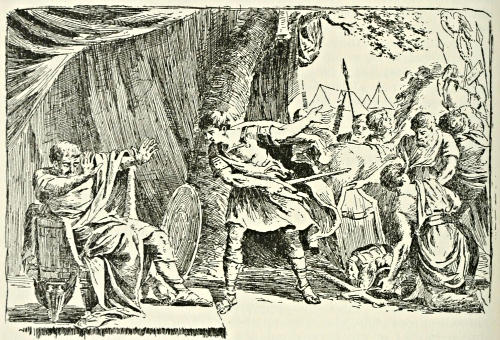
Manlius condemning his Son to Death
The war between Rome and Latium was little less than civil; the soldiers
and officers had for years served together in the same companies and
they were all acquainted. They now stood in battle-array opposite each
other at the foot of Mount Vesuvius, the Samnites and Hernicans being
opposed to the Oscan allies of the Latins. Both the consuls sacrificed before
the battle; the entrails of the victim offered by Decius portended misfortune,
but hearing that the signs boded well to Manlius, “’Tis well,” said he,
“if my colleague has good signs.” In the battle, the left wing, led by
Decius, was giving way; the consul saw that his hour was come; he called
aloud for M. Valerius, the pontifex maximus, and standing on a naked
weapon, clad in his consular robe, his head veiled, and his hand on his chin,
he repeated after the pontiff the form of devotion. He then sent the lictors
to announce to Manlius what he had done, and girding his robe tightly
round him, and mounting his horse, he rushed into the midst of the enemies.
He seemed a destructive spirit sent from heaven; wherever he came he carried
dismay and death; at length he fell covered with wounds. The ardour
of the Roman soldiers revived, and the skill of Manlius secured the victory.
When the front ranks (antesignani) of both armies were wearied, he ordered
the accensi to advance; the Latins then sent forward their triarians; and
when these were wearied, the consul ordered the Roman triarians to rise
and advance. The Latins having no fresh troops to oppose to them were
speedily defeated, and so great was the slaughter that but one-fourth of
their army escaped. Next day the body of the consul Decius was found
amidst heaps of slain, and magnificently interred.
[340-338 B.C.]
The Latins fled to the town of Vescia, and by the advice of their prætor
Numisius a general levy was made in Latium, with which, in reliance on the
reduced state of the Roman army, he ventured to give the consul battle at a
place named Trifanum, between Sinuessa and Minturnæ, on the other side
of the Liris. The rout of the Latins, however, was so complete, that few of
the towns even thought of resistance when the consul entered Latium. The
Latin public land, two-thirds of that of Privernum, and the Falernian district
of Campania, were seized for the Roman people, and assignments of 2¾
jugera on this side, 3¼ on the other side of the Liris, were made to the poor
plebeians, who murmured greatly at the large quantity that was reserved as
domain. As the Campanian knights (sixteen hundred in number) had
remained faithful to Rome, they were given the Roman municipium, and each
assigned a rent charge of 350 denarii a year on the state of Capua.
The Latin and Volscian towns continued singly to resist, and the conquest
was not completed till the year 338. Prudence and some moderation
were requisite on the part of Rome, in order not to have rebellious subjects
in the Latins. Citizenship therefore, in different degrees, was conferred on
them; but they were forbidden to hold national diets, and commerce and
intermarriage between the people of their different towns were prohibited.
The principal families of Velitræ were forced to go and live beyond the
Tiber, and their lands were given to Roman colonists. Their ships of war
were taken from the Antiates, who were forbidden to possess any in future.
Some of them were brought to Rome; the beaks (rostra) of others were
cut off, and the pulpit (suggestum) in the Forum was adorned with them,
whence it was named the “rostra.” The municipium, such as the Latins had
formerly had, was given to the people of Capua, Cumæ, Suessula, Fundi,
and Formiæ. The Latin contingents in war were henceforth to serve under
their own officers apart from the legions.
While the Roman dominion was thus extended without, wise and patriotic
men of both orders saw the necessity of internal concord, and of abolishing
antiquated and now mischievous claims and pretensions. In 339,
therefore, the patrician consul Tib. Æmilius named his plebeian colleague
Q. Publilius Philo dictator, who then brought forward the following laws to
complete the constitution. (1) The patricians should give a previous consent
to any law that was to be brought before the centuries; for as such
a law must previously have passed the senate, and the centuries could make
no alteration in it, their opposition, it would seem, could hardly have any
ground but prejudice and spite. (2) The Plebiscita should be binding on
all Quirites. (3) One of the censors should of necessity be a plebeian.
The curies were induced, we know not how, to give their assent to these
laws.[40] Internal discord was now at an end, and the golden age of Roman
heroism and virtue began.
[338-325 B.C.]
The affairs for the ten succeeding years are of comparative unimportance.
The Romans and Samnites both knew that another war was inevitable, and
they made the necessary preparations for it. In the year 327 the people of
the Greek town of Palæopolis (Old Town) being in alliance with the Samnites,
began to exercise hostilities against the Roman colonists in Campania. As
they refused to give satisfaction, the consul Q. Publilius Philo was sent
against them, while his colleague, L. Cornelius Lentulus, watched the
motions of the Samnites. Publilius encamped between Palæopolis and its
kindred town of Neapolis (New Town), and on his sending word home that
there was a large body of Samnite and Nolan troops in them, envoys were
sent to Samnium to complain of this breach of treaty. The Samnites replied
that those were volunteers, over whom the state had no control; that moreover
they had not, as the Romans had alleged, excited the people of Fundi
and Formiæ to revolt, while the Romans had sent a colony to Fregellæ, in a
district which of right was theirs; that, in fine, there was no use in arguing
or complaining when the plain between Capua and Suessula offered a space
on which they might decide whose should be the empire of Italy. The
Roman fetial then veiled his head, and with hands raised to heaven prayed
the gods to prosper the arms and counsels of Rome if right was on her side;
if not, to blast and confound them. Right certainly was not on the side of
Rome, for she had first violated the treaty; but war was not to be averted,
and it was now to begin.
A Roman army entered Samnium on the Volscian side, ravaged the
country, and took some towns. Publilius’ year having expired, his command
was continued to him (326) under the new title of proconsul; and
soon a party in Neapolis, weary of the insolence of the foreign soldiers, began
to plot a surrender. While Nymphius, one of the leading men, induced the
Samnites to go out of the town, to embark in the ships in the port, and make
a descent on the coast of Latium, Charilaus, another of the party, closed the
gate after them, and admitted the Romans at another. The Samnites instantly
dispersed and fled home; the Nolans retired from the town unmolested.
A chief ally of the Samnites were the people of the Greek city of
Tarentum; on the other hand, their kinsmen, the Apulians and Lucanians,
were in alliance with Rome. But in this year, a revolution took place in
Lucania, in consequence of which the country became subject to Samnium. A
similar fate menaced the Apulians, if not aided; but to reach Apulia it was
necessary to pass through the Vestinian country, the people of which (one of
the Marsian confederacy) refused a passage. It was apprehended at Rome,
that if the Vestinians were attacked, the other three states, who were now neutral,
would take arms, and throw their weight into the Samnite scale, and their
valour was well known; but, on the other hand, the importance of Apulia,
in a military point of view, was too great to allow it to be lost. The consul
D. Junius Brutus accordingly led his army (325) into the Vestinian country: a
hard-fought victory, and the capture of two of their towns, reduced the Vestinians
to submission, and the other members of the league remained at peace.
The other consul, L. Camillus, fell sick as he was about to invade Samnium
and L. Papirius Cursor was made dictator;[41] but as there was said to have
been some error in the auspices, he was obliged to return to Rome to renew
them. As he was departing, he strictly charged Q. Fabius Rullianus, the
master of the horse, whom he left in command, not to risk an action on any
account during his absence. But, heedless of his orders, Fabius seized the
first occasion of engaging the enemy, over whom he gained a complete victory.
As soon as the dictator learned what had occurred, he hastened to the
camp, breathing fury. Fabius, warned of his approach, besought the soldiers
to protect him. Papirius came, ascended his tribunal, summoned the master
of the horse before him, and demanded why he had disobeyed orders, and
thus weakened the military discipline. His defence but irritated his judge
the more; the lictors approached and began to strip him for death; he
broke from them, and sought refuge among the triarians: confusion arose;
those nearest the tribunal prayed, the more remote menaced, the dictator:
the legates came round him, entreating him to defer his judgment till the
next day; but he would not hear them. Night at length ended the contest.
[325-322 B.C.]
During the night Fabius fled to Rome, and by his father’s advice made
his complaint of the dictator to the assembled senate; but while he was
speaking, Papirius, who had followed him from the camp with the utmost
rapidity, entered, and ordered his lictors to seize him. The senate implored;
but he was inexorable: the elder Fabius then appealed to the people, before
whom he enlarged on the cruelty of the dictator. Every heart beat in unison
with that of the time-honoured father; but when Papirius showed the rigorous
necessity of upholding military discipline, by which the state was maintained,
all were silent, from conviction. At length the people and their
tribunes united with Fabius and the senate in supplication, and the dictator,
deeming his authority sufficiently vindicated, granted life to his master of
the horse.
Papirius, when he returned to his army, gave the Samnites a decisive
defeat; and having divided the spoil among his soldiers to regain their
favour, and granted a truce for a year to the enemy, on condition of their
giving each soldier a garment and a year’s pay, he returned to Rome and
triumphed.
The events of the next year (323) are dubious; but in 322 the camp of
the dictator, A. Cornelius Arvina, who had entered Samnium without sufficient
caution, was surprised by a superior force of the enemy. The day
closed before an attack could be made, and in the night the dictator, leaving
a number of fires burning in the camp, led away his legions in silence. But
the enemy were on the alert, and their cavalry hung on the retiring army, to
slacken its pace. With daybreak the Samnite infantry came up, and the
dictator, finding further retreat impossible, drew his forces up in order of
battle. A desperate conflict commenced; during five hours neither side
gave way an inch; the Samnite horse, seeing the baggage of the Romans but
slightly guarded, made for it, and began to plunder: while thus engaged,
they were fallen on and cut to pieces by the Roman horse, who then turned
and assailed the now unprotected rear of the Samnite infantry. The dictator
urged his legions to new exertions; the Samnites wavered, broke, and
fled; their general and thousands fell, and thousands were made captives.
[322-321 B.C.]
Meantime, on the side of Apulia an equally glorious victory was
gained by the consul Q. Fabius; and the spirit of the Samnites being now
quite broken, they were anxious for peace on almost any terms. As it is
usual with a people, when measures to which they have given their full and
eager consent have failed, to throw the entire blame on their leaders, so now
the Samnites cast all their misfortunes on Papius Brutulus, one of their
principal men, and resolved to deliver him up to the Romans as the cause
of the war. The noble Samnite saved himself from disgrace by a voluntary
death; his lifeless corpse was carried to Rome; the Roman prisoners, of
whom there was a large number, were released, and gold was sent to ransom
the Samnites. The utmost readiness to yield to all reasonable terms was
evinced; but nothing would content the haughty senate but the supremacy,
and sooner than thus resign their national independence the Samnites resolved
to dare and endure the uttermost.
In the spring (321) the Roman legions, led by the consuls T. Veturius
and Sp. Postumius, encamped at Calatia in Campania, with the intention of
directing their entire force against central Samnium. But the Samnite general,
C. Pontius, having spread a false report that Luceria, in Apulia, was
hard pressed by a Samnite army, and on the point of surrender, the consuls
resolved to attempt its relief without delay. They entered the Samnite
country, and advanced heedlessly and incautiously. In the vicinity of the
town of Caudium they reached the Caudine Forks, as a pass was named consisting
of a deep valley between two wooded mountains; a hollow way led
into it at one end, and a narrow path over a mountain, which closed it up,
led out of it at the other end. Into these toils the consuls conducted their
army; they saw nothing to alarm them till the head of the column came to
the further end, and found the passage stopped with rocks and trunks of
trees, and on looking round they beheld the hills occupied by soldiery. To
advance or to retreat was now equally impossible; they therefore threw up
entrenchments in the valley, and remained there, the Samnites not attacking
them, in reliance on the aid of famine. At length, when their food was
spent and hunger began to be felt, they sent deputies to learn the will of the
Samnite leaders. It is said that Pontius, on this occasion, sent for his father
to advise him: this venerable old man, who, in high repute for wisdom,
dwelt at Caudium, was conveyed to the camp in a wain, and his advice was
either to let the Romans go free and uninjured, or totally to destroy the
army. Pontius preferred a middle course, and the old man retired, shedding
tears at the misery he saw thence to come on his country. The terms
accorded by Pontius were the restoration of the ancient alliance between
Rome and Samnium, the withdrawal of Roman colonies from places belonging
to the Samnites, and the giving back of all places to which they had a
right. The arms and baggage of the vanquished army, were, as a matter of
course, to be given up to the conquerors. How rarely has Rome ever
granted a vanquished enemy terms so mild as these! Yet the Roman historians
had the audacity to talk of the insolence of the victorious Samnites,
and the Roman senate and people the baseness and barbarity to put to an
ignominous death the noble Pontius twenty-seven years after!
These terms were sworn to by the consuls and their principal officers, and
six hundred knights were given as hostages till they should have been ratified
by the senate and people. A passage wide enough for one person to pass
was made in the paling with which the Samnites had enclosed them, and one
of the pales laid across it, and through this door the consuls, followed by
their officers and men, each in a single garment, came forth. Pontius gave
beasts of burden to convey the sick and wounded, and provisions enough to
take the army to Rome. They then departed and reached Capua before
nightfall; but shame, or doubt of the reception they might meet with, kept
them from entering. Next morning, however, all the people came out to
meet and console them. Refreshments and aid of every kind were given
them, and they thence pursued their way to Rome.
When the news of their calamity had first reached Rome, a total cessation
of business (justitium) had taken place, and a general levy, either to attempt
their relief or to defend the city, had been made, and all orders of people
went into mourning. In this state of things the disgraced army reached
the gates. It there dispersed; those who lived in the country went away;
those who dwelt in the city slank with night to their houses. The consuls,
having named a dictator for the consular elections, laid down their office;
and Q. Publilius Philo and L. Papirius Cursor were appointed to be their
successors.c
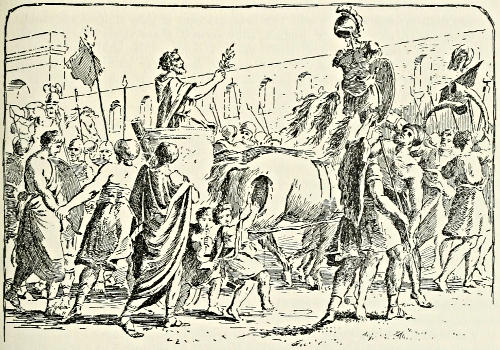
Triumph of Papirius
“If other nations delight in remembering the days of national triumphs,”
says Wilhelm Ihne, “and in celebrating the memory of victories by which
they feel their strength was increased and their pride gratified, the greatness
of the Roman people is shown much more by their keeping continually before
their eyes the evil days when the god of battles was unfavourable to them, and
by celebrating the anniversaries of their defeats, in a certain degree, as days
of national humiliation. The day of the Allia and the day of Cannæ stood
before the eye of the Roman in more burning colours than the day of the victory
of Zama. But by the side of those names there was yet a third in the
list of evil days—a name which was more painful than any other to the proud
Roman, because the feeling of national disgrace and humiliation could not be
separated from it; it was the name of the Caudine Pass. At the Allia and at
Cannæ thousands fell in open battle; at Caudium four legions agreed to purchase
life and freedom by the sacrifice of military honour, and the Roman
people, when they refused to ratify the agreement, covered themselves with
a load of infamy, from which no sophistry could free them, even in their own
conscience.”f
[321-315 B.C.]
The senate having met to consider of the peace, the consul Publilius called
on Sp. Postumius to give his opinion. He rose with downcast looks, and
advised that himself and all who had sworn to the treaty should be delivered
up to the Samnites, as having deceived them, by making a treaty without
the consent of the Roman people, and a fresh army be levied, and the war
renewed; and though there was hardly a senator who had not a son or
some other relative among the hostages, it was resolved to do as he advised.
Postumius and his companions were taken bound to Caudium; the fetial led
them before the tribunal of Pontius, and made the surrender of them in the
solemn form. Postumius, as he concluded, struck his knee against the fetial’s
thigh, and drove him off, crying, “I am now a Samnite, thou an ambassador:
I thus violate the law of nations; ye may justly now resume the war.”
Pontius replied with dignity: he treated this act of religious hypocrisy
as a childish manœuvre; he told the Romans that if they wished to renounce
the treaty with any show of justice, they should place their legions as they
were when it was made; but their present conduct he said was base and
unworthy, and he would not accept such a surrender as this, or let them
thus hope to avert the anger of the gods. He then ordered Postumius and
the other Romans to be unbound and dismissed.
The war therefore was renewed, and the Romans returning to their
original plan of carrying it on simultaneously in Apulia and on the western
frontier of Samnium, sent (319) the consul Papirius to lay siege to Luceria,
which was now in the hands of the Samnites, while his colleague Publilius
led his army into Samnium. Papirius sat down before Luceria; but a
Samnite army came and encamped at hand, and rendered his communication
with Arpi, whence he drew his supplies, so difficult, that it was only by the
knights’ going and fetching corn in little bags on their horses that any food
could be had in the camp. They were at length relieved by the arrival of
Publilius, who having defeated a Samnite army marched to their aid; and
after a fruitless attempt of the Tarentines to mediate a peace, the Romans
attacked and stormed the Samnite camp with great slaughter, which, though
they were unable to retain it, had the effect of making the Samnite army
retire, and leave Luceria to its fate. Its garrison of seven thousand men
then capitulated, on condition of a free passage, without arms or baggage.
The two following years were years of truce, in consequence of exhaustion
on both sides; and during the truce the Romans so extended and consolidated
their dominion in Apulia that no attempt was ever after made to shake it
off. The war was resumed in 316, and the Romans laid siege to Saticula,
an Oscan town not far from Capua and in alliance with the Samnites. Meantime
the Samnites reduced the colonial town of Plistia; and the Volscians
of Sora, having slain their Roman garrison, revolted to them. They then
made an attack on the Roman army before Saticula, but were defeated with
great loss, and the town immediately surrendered. The Roman armies forthwith
entered and ravaged Samnium, and the seat of war was transferred to
Apulia. While the consular armies were thus distant, the Samnites made a
general levy, and came and took a position at Lautulæ, in order to cut off
the communication between Rome and Campania. The dictator, Q. Fabius,
instantly levied an army, and hastened to give them battle. The Romans
were utterly defeated, and fled from the field; the master of the horse,
Q. Aulius, unable to outlive the disgrace of flight, maintained his ground, and
fell fighting bravely. Revolt spread far and wide among the Roman subjects
in the vicinity; the danger was great and imminent, but the fortune
of Rome prevailed, and the menacing storm dispersed.
[314-311 B.C.]
In 314 the Samnites sustained a great defeat near a town named Cinna,
whose site is unknown. The Campanians, who were in the act of revolting
at this time, submitted on the appearance of the dictator, C. Mænius, and
the most guilty withdrew themselves from punishment by a voluntary death.
The Ausonian towns, Ausona, Minturnæ, and Vescia, were taken by treachery
and stratagem, and their population massacred or enslaved, as a fearful
lesson to the subjects of Rome against wavering in their allegiance.
The united armies of the consuls, M. Pœtelius and C. Sulpicius, entered
Samnium on the side of Caudium; but while they were advancing timidly
and cautiously through that formidable region, they learned that the Samnite
army was wasting the plain of Campania. They immediately led back
their forces, and ere long the two armies encountered. The tactics of the
Romans were new on this occasion; the left wing, under Pœtelius, was made
dense and deep, while the right was expanded more than usual. Pœtelius,
adding the reserve to his wing, made a steady charge with the whole mass:
the Samnites gave way; their horse hastened to their aid, but Sulpicius
coming up with his body of horse, and charging them with the whole Roman
cavalry, put them to the rout. He then hastened to his own wing, which
now was yielding; the timely reinforcement turned the scale, and the Samnites
were routed on all sides with great slaughter.
The following year (313) was marked by the capture of Nola and some
other towns, and by the founding of colonies, to secure the dominion which
had been acquired. In 312 Sora was taken in the following manner: A
deserter came to the consuls, and offered to lead some Roman soldiers by a
secret path up to the Arx, or citadel, which was a precipitous eminence over
the town. His offer was accepted; the legions were withdrawn to a distance
of six miles from the town; some cohorts were concealed in a wood at
hand, and ten men accompanied the Soran traitor. They clambered in the
night up through the stones and bushes, and at length reached the area
of the citadel. Their guide, showing them the narrow, steep path that led
thence to the town, desired them to guard it while he went down and gave
the alarm. He then ran through the town crying that the enemy was
on the citadel; and when the truth of his report was ascertained, the people
prepared to fly from the town; but in the confusion, the Roman cohorts
broke in and commenced a massacre. At daybreak the consuls came; they
granted their lives to the surviving inhabitants, with the exception of 225,
who, as the authors of the revolt, were brought bound to Rome, and scourged
and beheaded in the Forum.
[311-310 B.C.]
The tide of war had turned so decidedly against the Samnites, that one
or two campaigns more of the whole force of Rome would have sufficed for
their subjugation. But just now a new enemy was about to appear, who
was likely to give ample employment to the Roman arms for some time.
The Etruscans, who, probably owing to their contests with and fears of the
Gauls, had for many years abstained from war with the Romans, either moved
by the instances of the Samnites or aware of the danger of suffering Rome
to grow too powerful, began to make such hostile manifestations that great
alarm prevailed at Rome. Various circumstances, however, kept off the war
for nearly two years longer; at length in 311 all the peoples of Etruria,
except the Arretines, having sent their troops, a Tuscan army prepared to
lay siege to the frontier town of Sutrium. The consul Q. Æmilius came
to cover it, and the two armies met before it. At daybreak of the second
day, the Tuscans drew out in order of battle; the consul, having made his
men take their breakfast, led them out also. The armies stood opposite each
other, each hesitating to begin, till after noon; the Tuscans then fell on:
night terminated a bloody and indecisive action, each retired to their camp,
and neither felt themselves strong enough to renew the conflict next day.
The next year (310) a Tuscan army having laid siege to Sutrium, the
consul Q. Fabius hastened from Rome to its relief. As his troops were far
inferior to the Etruscans in number, he led them cautiously along the hills.
The enemy drew out his forces in the plain to give him battle; but the
consul, fearing to descend, formed his array on the hillside in a part covered
with loose stones. Relying on their numbers the Tuscans charged up hill;
the Romans hurled stones and missile weapons on them, and then charging,
with the advantage of the ground, drove them back, and the horse getting
between them and their camp forced them to take refuge in the adjacent
Ciminian wood. Their camp became the prize of the victors.
Like so many others in the early Roman history, this battle has probably
been given a magnitude and an importance which does not belong to it, and
the truth would seem to be, that the consul only repulsed the advanced
guard of the enemy, and not feeling himself strong enough to engage their
main army, resolved to create a diversion by invading their country.
To the north of Sutrium, between it and the modern city of Viterbo,
extends a range of high ground, which at that time formed the boundary
between Roman and independent Etruria. It was covered with natural
wood, and was thence named the Ciminian wood. Over this barrier Fabius
resolved to lead his troops. He sent to inform the senate of his plan, in
order that measures might be taken for the defence of the country during
his absence. Meantime he directed one of his brothers, who spoke the
Tuscan language, to penetrate in disguise to the Umbrians, and to form
alliances with any of them that were hostile to the Etruscans. The only
people however whom the envoy found so disposed were the Camertes,
who agreed to join the Romans if they penetrated to their country.
The senate, daunted at the boldness of Fabius’ plan, sent five deputies
accompanied by two tribunes of the people to forbid him to enter the wood,
perhaps to arrest him if he should hesitate to obey. But they came too
late: in the first watch of the night Fabius sent forward his baggage, the
infantry followed; he himself a little before sunrise led the horse up to
the enemy’s camp, as it were to reconnoitre. In the evening he returned
to his own camp, and then set out and came up with his infantry before
night. At daybreak they reached the summit of the mountain, and beheld
the cultured vales and plains of Etruria stretched out before them. They
hastened to seize the offered prey: the Etruscan nobles assembled their
vassals to oppose them, but they could offer no effectual resistance to the
disciplined troops of Rome. The Roman army spread their ravages as far
as Perusia, where they encountered and totally defeated a combined army
of Etruscans and Umbrians; and Perusia, Cortona, and Arretium, three of
the leading cities of Etruria, sent forthwith to sue for peace, which was
granted for a term of thirty years. As the Romans were returning to the
relief of Sutrium they encountered at the lake of Vadimo another Etruscan
army, of select troops bound by a solemn oath (lege sacrata) to fight to their
uttermost. The two armies engaged hand to hand at once; the first ranks
fought till they were exhausted; the reserve then advanced, and the victory
was only decided by the Roman knights dismounting and taking their place
in the front of the line.
While Fabius was conducting the war in Etruria, his colleague C. Marcius
had entered Samnium and taken Allifæ and some other strongholds.
The Samnites collected their forces and gave him battle, and the Romans
were defeated; several of their officers slain, the consul himself wounded,
and their communication with Rome cut off. When the news reached
Rome, the senate at once resolved to create a dictator, and to send him off to
the relief of Marcius with the reserve which had been levied on account
of the Etruscan War. Their hopes lay in L. Papirius Cursor; but the
dictator could only be named by the consul; there was no way of reaching
Marcius, and Fabius had not yet forgiven the man who had thirsted
after his blood. The resolve of the senate was borne to Fabius by consulars;
they urged him to sacrifice his private feelings to the good of
his country: he heard them in silence, his eyes fixed on the ground, and
they retired in uncertainty. In the stillness of the night he arose, and, as
was the usage, named L. Papirius dictator, and in the morning he again
listened in silence to the thanks and praises of the deputies. The dictator
immediately set forth and relieved the army of Marcius, but, impetuous as
he was, he contented himself for some time with merely observing the
enemy.
[310-304 B.C.]
At length the time arrived for a decisive action. The Samnite army
was divided into two corps, the one clad in purple, the other in white linen
tunics, the former having their brazen shields adorned with gold, the latter
with silver: the shields were broad above, narrow below. Each soldier
wore a crested helmet, a large sponge to protect his breast, and a greave on
his left leg. In the battle the Roman dictator led the right wing against
the gold-shielded, the master of the horse, C. Junius, the left against the
silver-shielded Samnites. Junius made the first impression on the enemy;
the dictator urged his men to emulation, and the Roman horse by a charge
on both flanks completed the victory. The Samnites fled to their camp,
but were unable to retain it, and ere night it was sacked and burned. The
golden shields adorned the dictator’s triumph, and they were then given to
the money dealers to ornament their shops in the Forum.
Q. Fabius was continued in the consulate for 309 and P. Decius given
to him as his colleague; the former had the Samnite, the latter the Etruscan
War. Fabius routed the Marsians and Pelignians, who had now joined
against Rome, and he then led his legions into Umbria, whose people had
taken arms, and with little difficulty reduced them to submission. Decius
meantime had forced the Etruscans to sue for peace, and a year’s truce was
granted them on their giving each soldier two tunics, and a year’s pay for
the army.
In the remaining years of the war, the exhausted powers of the Samnites
could offer but a feeble resistance to the legions of Rome. On the occasion
of a defeat which they sustained in 308, the proconsul, Q. Fabius, adopted
the novel course of dismissing the Samnite prisoners, and selling for slaves
those of their allies. Among these there were several Hernicans, whom he
sent to Rome; the senate having instituted an inquiry into the conduct of
the Hernican people in this affair, those who had urged them to give aid to
the Samnites now engaged them to take arms openly. All the Hernican
peoples but three shared in the war; but they made a stand little worthy of
their old renown; one short campaign sufficed for their reduction, and they
were placed (307) on nearly the same footing as the Latins had been thirty
years before.
The Samnites at length (304) sued for peace, and obtained it on the
condition they had so often spurned, that of acknowledging Rome’s supremacy,
in other words, of yielding up their independence; but peace on any
terms was now necessary, that they might recruit their strength for future
efforts. The Romans then turned their arms against the Æquians who had
joined the Hernicans in aiding the Samnites, and in fifty days the consuls
reduced and destroyed forty-one of their Cyclopean-walled towns. The
Marsian league sought and obtained peace from Rome.
[304-297 B.C.]
A few years passed away in tolerable tranquillity; in 298 Lucanian
envoys appeared at Rome, praying for aid against the Samnites who had
entered their country in arms, given them various defeats, and taken several
of their towns. The Romans, in right of their supremacy, sent orders to
the Samnites to withdraw their troops from Lucania: the pride of the Samnites
was roused at being thus reminded
of their subjection; they
ordered the fetials off their territory,
and war was once more declared
against them by the Romans. As
the Etruscans were now also in arms,
the consul L. Cornelius Scipio went
against them, while his colleague
Cn. Fulvius invaded Samnium.
Scipio engaged a numerous Etruscan
army near Volaterræ. Night
ended a hard-fought battle, leaving
it undecided. The morn however
revealed that the advantage was on
the side of the Romans, as the enemy
had abandoned their camp during
the night. Having placed his baggage
and stores at Falerii, Scipio
spread his ravages over the country,
burning the villages and hamlets;
and no army appeared to oppose him.
Fulvius meantime carried on the
war with credit in Samnium. Near
Bovianum he defeated a Samnite
army, and took that town and
another named Aufidena.
Etruscan Warrior
(From a statuette)
[297-295 B.C.]
The rumour of the great preparations
which the Samnites and
the Etruscans were said to be making
caused the people to elect Q. Fabius
to the consulate, against his will; and
at his own request they joined with
him P. Decius. As the Etruscans remained quiet, both the consuls invaded
Samnium (297), Fabius entering from Sora, Decius from Sidicinum. The
Samnites gave Fabius battle near Tifernum, their infantry stood firm against
that of the Romans, and the charge of the Roman cavalry had as little effect.
At length, when the reserve had come to the front, and the contest was most
obstinate, the legate Scipio, whom the consul had sent away during the
action with the hastats of the first legion, appeared on the neighbouring
hills. Both armies took them for the legions of Decius; the Samnites’
courage fell, that of the Romans rose, and evening closed on their victory.
Decius had meantime defeated the Apulians at Maleventum. During five
months both armies ravaged Samnium with impunity; the traces of five-and-forty
camps of Decius, of eighty-six of Fabius, bore witness to the
sufferings of the ill-fated country.
The next year (296) the Samnites put into execution a daring plan which
they had formed in the preceding war, namely, sending an army, to be paid
and supported out of their own funds, into Etruria, leaving Samnium meantime
at the mercy of the enemy. The Samnite army, under Gellius Egnatius,
on arriving there, was joined by the troops of most of the Tuscan states;
the Umbrians also shared in the war, and it was proposed to take Gallic
mercenaries into pay. The consul App. Claudius entered Etruria with his
two legions and twelve thousand of the allies, but he did not feel himself
strong enough to give the confederates battle. His colleague L. Volumnius,
probably by command of the senate, led his army to join him; but Appius
gave him so ungracious a reception that he was preparing to retire, when
the officers of the other army implored him not to abandon them for their
general’s fault. Volumnius then agreed to remain and fight: a victory was
speedily gained over the Etruscans and Samnites, whose general Egnatius
was unfortunately absent; 7300 were slain, 2120 taken, and their camp was
stormed and plundered.
As Volumnius was returning by rapid marches to Samnium, he learned
that the Samnites had taken advantage of his absence to make a descent on
Campania, where they had collected an immense booty. He forthwith directed
his course thither: at Cales he heard that they were encamped on
the Vulturnus, with the intention of carrying their prey into Samnium to
secure it. He came and encamped near them, but out of view; and when
the Samnites had before day sent forward their captives and booty under
an escort, and were getting out of their camp to follow them, they were
suddenly fallen on by the Romans: the camp was stormed with great
slaughter; the captives, hearing the tumult, unbound themselves, and fell
on their escort; the Samnites were routed on all sides—six thousand were
slain, twenty-five hundred were taken, seventy-four hundred captives, with
all their property, were recovered.
The union of the Samnites, Etruscans, Umbrians, and Gauls, which had
now been formed, caused the greatest apprehension at Rome, and the people
insisted on again electing Q. Fabius consul, to which he would only consent
on condition of his approved mate in arms P. Decius being given him for
colleague. His wish was complied with. The four legions of the former
year were kept on foot and completed, two new ones were raised, and two
armies of reserve formed. The number of troops furnished by the allies
was considerable: among them were one thousand Campanian horse; for
as the Gauls were strong in this arm, it was necessary to augment its
force.
[295-293 B.C.]
During the winter, Fabius set out, with four thousand foot and six
hundred horse, to take the command in Etruria. As he drew nigh to the
camp of App. Claudius he met a party sent out for firewood; he ordered
them to go back and use the palisades of their camp for the purpose. This
gave confidence to the soldiers; and to keep up their spirits, he never let
them remain stationary, but moved about from place to place. In the spring
(295) he returned to Rome to arrange the campaign, leaving the command
in Etruria with L. Scipio.
The consuls led their main force to join the troops left with Scipio; one
army of reserve, under the proprætor Cn. Fulvius, was stationed in the
Faliscan; another, under the proprætor L. Postumius, in the Vatican district.
But the Gauls, pouring in by the pass of Camerinum, had annihilated
a Roman legion left to defend it; their numerous cavalry spread over Umbria
and got between Scipio and Rome; and as they rode up to the consular
army, the heads of the slain Romans which they carried on spears and hung
at their horses’ breasts, made the Romans believe that Scipio’s whole army
had been destroyed. A junction however was formed with him, and the
proconsul L. Volumnius, who commanded in Samnium, was directed to lead
his legions to reinforce those of the consuls. The three united armies then
crossed the Apennines, and took a position in the Sentine country to menace
the possessions of the Senonian Gauls; and the two armies of reserve advanced
in proportion, the one to Clusium, the other to the Faliscan country.
The confederates came and encamped before the Romans; but they avoided
an action, probably waiting for reinforcements. The consuls, learning by
deserters that the plan of the enemy was for the Gauls and Samnites to give
them battle, and the Etruscans and Umbrians to fall on their camp during
the action, sent orders to Fulvius to ravage Etruria: this called a large part
of the Etruscans home, and the consuls endeavoured to bring on an engagement
during their absence. For two entire days they sought in vain to draw
the confederates to the field; on the third their challenge was accepted.
Fabius commanded on the right, opposed to the Samnites and the remaining
Etruscans and Umbrians; Decius led the left wing against the
Gauls. Ere the fight began, a wolf chased a hind from the mountains down
between the two armies; the hind sought refuge among the Gauls, by whom
she was killed; the wolf ran among the Romans, who made way for him to
pass; and this appearance of the favourite of Mars was regarded as an omen
of victory.
In the hope of tiring the Samnites, Fabius made his men act rather on the
defensive, and he refrained from bringing his reserve into action. Decius,
on the other hand, knowing how impetuous the first attack of the Gauls
always was, resolved not to await it; he therefore charged with both foot and
horse, and twice drove back the numerous Gallic cavalry; but when his
horse charged a third time, the Gauls sent forward their war-chariots, which
spread confusion and dismay among them; they fled back among their infantry;
the victorious Gauls followed hard upon them. The battle, and with it
possibly the hopes of Rome, was on the point of being lost, when Decius, who
had resolved, if defeat impended, to devote himself like his father at Vesuvius,
desired the pontiff M. Livius, whom he had kept near him for the purpose, to
repeat the form of devotion; then adding to it these words, “I drive before
me dismay and flight, slaughter and blood, the anger of the powers above and
below; with funereal terrors I touch the arms, weapons, and ensigns of the
foe; the same place shall be that of my end and of the Gauls and Samnites,” he
spurred his horse, rushed into the thick of the enemies, and fell covered with
wounds.
The pontiff to whom Decius had given his lictors, encouraged the
Romans; a part of Fabius’ reserve came to their support: the Gauls stood
in a dense mass covered with their shields; the Romans, collecting the pila
that lay on the ground, hurled them on them; but the Gauls stood unmoved,
till Fabius, who by bringing forward his reserve, and causing his cavalry to fall
on their flank, had driven the Samnites to their camp, sent five hundred of
the Campanian horse, followed by the principes of the third legion, to attack
them in the rear; they then at length broke and fled. Fabius again assailed
the Samnites under their rampart; their general, Gellius Egnatius, fell, and
the camp was taken. The confederates lost twenty-five thousand men slain
and eight thousand taken; seven thousand was the loss in the wing led
by Decius, twelve hundred in that of Fabius. Such was the victory at
Sentinum, one of the most important ever achieved by the arms of Rome.
The following year (294) the war was continued in Etruria and Samnium,
and a bloody but indecisive battle was fought at Nuceria. The next year
(293) the consuls, L. Papirius Cursor and Sp. Carvilius, took the field
against a Samnite army, which all the aids of superstition had been employed
to render formidable.
All the fighting men of Samnium were ordered to appear at the town of
Aquilonia. A tabernacle, two hundred feet square, and covered with linen,
was erected in the midst of the camp. Within it a venerable man named
Ovius Pacctius offered sacrifice after an ancient ritual contained in an old
linen book. The imperator or general then ordered the nobles to be called
in separately: each as he entered beheld through the gloom of the tabernacle
the altar in the centre, about which lay the bodies of the victims, and around
which stood centurions with drawn swords. He was required to swear, imprecating
curses on himself, his family, and his race, if he did not in the
battle go whithersoever the imperator ordered him; if he fled himself, or
did not slay any one whom he saw flying. Some of the first summoned, refusing
to swear, were slain, and their bodies lying among those of the victims
served as a warning to others. The general selected ten of those who had
thus sworn, each of whom was directed to choose a man till the number of
sixteen thousand was completed, which was named from the tabernacle the
Linen legion. Crested helmets and superior arms were given them for distinction.
The rest of the army, upwards of twenty thousand men, was little
inferior in any respect to the Linen legion.
The Roman armies entered Samnium; and while Papirius advanced to
Aquilonia, Carvilius sat down before a fortress named Cominium, about
twenty miles from that place. The ardour for battle is said to have been
shared to such an extent by all the Roman army, that the pullarius, or
keeper of the sacred fowl, made a false report of favourable signs. The
truth was told to the consul as he was going into battle; but he said the
signs reported to him were good, and only ordered the pullarii to be placed
in the front rank; and when the guilty one fell by the chance blow of a pilum,
he cried that the gods were present, the guilty was punished. A crow was
heard to give a loud cry as he spoke; the gods, he then declared, had never
shown themselves more propitious, and he ordered the trumpets to sound and
the war-cry to be raised.
The Samnites had sent off twenty cohorts to the relief of Cominium;
their spirits were depressed, but they kept their ground, till a great cloud of
dust, as if raised by an army, was seen on one side. For the consul had sent
off before the action Sp. Nautius, with the mules and their drivers, and some
cohorts of the allies, with directions to advance during the engagement, raising
all the dust they could. Nautius now came in view, the horseboys having
boughs in their hands, which they dragged along the ground; and the
arms and banners appearing through the dust, made both Romans and Samnites
think that an army was approaching. The consul then gave the sign
for the horse to charge; the Samnites broke and fled, some to Aquilonia,
some to Bovianum. The number of their slain is said to have been 30,340,
and 3870 men and 97 banners were captured. Aquilonia and Cominium
were both taken on the same day. Carvilius then led his army into Etruria;
his colleague remained in Samnium, ravaging the country, till the falling of
the snow obliged him to leave it for the winter.
[293-290 B.C.]
In the next campaign (292), the Samnite general C. Pontius gave the
Roman consul Q. Fabius Gurges, son of the great Fabius, a complete defeat.
A strong party in the senate, the enemies of the Fabian house, were for depriving
the consul of his command; but the people yielded to the prayers
of his father, who implored them to spare him this disgrace in his old age;
and he himself went into Samnium as legate to his son. At a place whose
name is unknown the battle was fought, which decided the fate of Samnium.
Fabius gained the victory by his usual tactics, of keeping his reserve for the
proper time. The Samnites had twenty thousand slain and four thousand
taken, among whom was their great general C. Pontius. In the triumph of
Fabius Gurges, his renowned father humbly followed his car on horseback;
and C. Pontius was led in bonds, and then, to Rome’s disgrace, beheaded.
Q. Fabius Maximus, one of the greatest men that Rome ever produced, died,
it is probable, shortly afterwards.
The Samnite War, which had lasted with little intermission for nine-and-forty
years, was now terminated by a peace, of the exact terms of which we
are not informed (290). The Sabines, who, after a cessation of 150 years,
foolishly took up arms against Rome, were easily reduced by the consul M.
Curius Dentatus, and a large quantity of their land was taken from them.
Much larger assignments than the usual seven jugera might now be made,
but Curius deemed it unwise to pass that limit; and when the people murmured,
he replied that he was a pernicious citizen whom the land which
sufficed to support him did not satisfy. He refused for himself five hundred
jugera and a house at Tifata which the senate offered him, and contented
himself with a farm of seven jugera in the Sabine country.
The Samnite War caused considerable distress at Rome, and it even
came to a secession. The people posted themselves on the Janiculum; but
the dictator, Q. Hortensius, induced them to submit, either by an abolition
or a considerable reduction of the amount of their debts. This is the last
secession we read of in Roman history.
On this occasion the Hortensian law, which made the plebiscits binding
on the whole nation, was passed;[42] a measure probably caused by the obstinacy
and caprice of the patricians, but pregnant with evil, from which however
the good fortune of Rome long preserved her. It was as if in England
a measure which had passed the Commons were to become at once the law of
the land.
Among the events of this period, the introduction of the worship of the
Grecian god Æsculapius deserves to be noticed. In the year 293 an epidemic
prevailed at Rome, and the Sibylline books being consulted, it was directed
to fetch Æsculapius to Rome. A trireme with ten deputies was sent to
Epidaurus for that purpose. The legend relates, that the senate of that
place agreed that the Romans should take whatever the god should give
them; and that as they were praying at the temple, a huge snake came out
of the sanctuary, went on to the town five miles off, through the streets,
to the harbour, thence on board the Roman trireme, and into the cabin of
Q. Ogulnius. The envoys having been instructed in the worship of the god,
departed, and a prosperous wind brought them to Antium. Here they took
shelter from a storm; the snake swam ashore, and remained twined round a
palm-tree at the temple of Apollo while they stayed. When they reached
Rome he left the ship again, and swimming to the island, disappeared in the
spot where the temple of the god was afterwards built.
[290-282 B.C.]
Rome now rested from war for some years. At length (284) the
Tarentines, who had been the chief agents in exciting the last Samnite War,
succeeded in inducing the Etruscans, Umbrians, and Gauls in the north, and
the Lucanians, Bruttians, and Samnites in the south, to take arms simultaneously
against her. The commencement was the hostility exercised by the
Lucanians against the people of the Greek town of Thurii, who, despairing
of aid from any other quarter, applied to the Romans.
[282-280 B.C.]
In 282, a Roman army under C. Fabricius Luscinus came to the relief of
Thurii. The spirits of the Romans sank as they viewed their own inferiority
of force; when, lo! a youth of gigantic stature, wearing a double-crested
helm, like those on the statues of Mars, was seen to seize a scaling-ladder,
and mount the rampart of the enemies’ camp. The courage of the Romans
rose, that of the foes declined, and a signal victory crowned the arms of
Rome. When next day the consul sought that valiant youth, to bestow on
him the suitable meed, he was nowhere to be found. Fabricius then directed
a thanksgiving to Father Mars (as it must have been he) to be held throughout
the army. Many other victories succeeded; and no Roman general had
as yet acquired so much booty as Fabricius did in this campaign.
When the Roman army retired, a garrison was left for the defence of
Thurii. As it was only by sea that a communication could be conveniently
kept up with it, a squadron of ten triremes, under the duumvir L. Valerius,
was now in these waters. Some years before, it had been an article in a
treaty with the Tarentines, that no Roman ship of war should sail to the
north of the Lacinian Cape; but as they had taken no notice of it now, and
there was as yet no open hostility between them and the Romans, Valerius
appeared off the port of Tarentum. The people unluckily happened at that
moment to be assembled in the theatre, which commanded a view of the sea;
a demagogue named Philocharis, a man of the vilest character,[43] pointing to
the Roman ships, reminded them of the treaty; the infuriated populace
rushed on shipboard, attacked and sank four, and took one of the Roman
vessels. The Tarentines then sent a force against Thurii, where they plundered
the town and banished the principal citizens: the Roman garrison was
dismissed unmolested.
The Romans, as they had an Etruscan war on their hands, were anxious
to accommodate matters amicably in the south. Their demands were therefore
very moderate: they only required the release of those taken in the
trireme; the restoration of the Thurians, and restitution of their property;
and the surrender of the authors of the outrage. Audience was given to
the envoys in the theatre. When they entered, the people laughed at the
sight of their purple-bordered prætextæ, and the faults of language committed
by L. Postumius, the chief of the embassy, redoubled their merriment.
As the envoys were leaving the theatre, a drunken buffoon came and befouled
the robe of Postumius in the most abominable manner: the peals of laughter
were redoubled; but Postumius, holding up his robe, cried out, “Ay, laugh,
laugh while ye may; ye will weep long enough when ye have to wash this
out in blood.” He displayed at Rome his unwashed garment; and the
senate, after anxious deliberation, declared war against Tarentum (281).
The consul L. Æmilius Barbula was ordered to lead his army thither, to
offer anew the former terms, and if they were refused, to carry on the war
with vigour. The Tarentines, however, would listen to no terms; they
resorted to their usual system of seeking aid from the mother country, and
sent an embassy to invite over Pyrrhus, the renowned king of Epirus.
Meantime Æmilius laid waste their country, took several strong places, and
defeated them in the field.
We will now turn our view northwards. In 283 a combined army of
Etruscans and Senonian Gauls having laid siege to Arretium, the prætor
L. Metellus hastened to its relief; but his army was totally defeated,
thirteen thousand men being slain, and nearly all the remainder made
prisoners. When an embassy was sent to the Gauls to complain of breach
of treaty, and to redeem the prisoners, the Gallic prince Britomaris, to
avenge his father, who had fallen at Arretium, caused the fetiales to be murdered.
The consul P. Cornelius Dolabella instantly marched through the
Sabine and Picentian country into that of the Senonians, whom he defeated
when they met him in the field: he then wasted the lands, burned the open
villages, put all the men to death, and reduced the women and children to
slavery. Britomaris, who was taken alive, was reserved to grace the consul’s
triumph.
The Boians, who dwelt between the Senonians and the Po, were filled
with rage and apprehension at the fate of their brethren, and assembling all
their forces they entered Etruria, where being joined by the Etruscans and
the remnant of the Senonians, they pressed on for Rome; but at the Lake
Vadimo the consular armies met and nearly annihilated their whole army;
the Senonians, it is said, in frenzy of despair put an end to themselves when
they saw the battle lost. The Gauls appeared again the next year (284) in
Etruria; but a signal defeat near Populonia (282) forced them to sue for
peace, which on account of the war in the south, the Romans readily granted.
The war with the Etruscans continued till the year 280, when, in consequence
of that with Pyrrhus, the Romans concluded a peace with them on
most favourable terms. This peace terminated the conflict, which had now
lasted for thirty years, and converted Etruria into Rome’s steadiest and most
faithful ally.c
Through a long series of struggles, Rome had now become mistress of
central Italy, with growing power in the north, and almost complete subjugation
of the Greek cities of the south. There were a few of the latter,
however, that still held out against the Roman influence. Pre-eminent
among these was Tarentum, and it was through a conflict with this city that
the Romans were threatened by the first important invasion of an armed
force from the east. This force came under the guidance of Pyrrhus, king
of Epirus, a relative of Alexander the Great, who sought to emulate the
deeds of that great hero.
Pyrrhus was not precisely another Alexander, but he was quite the foremost
warrior of his time. Doubtless he had the aspiration to make Epirus
the centre, and himself the master, of the world. His ambition was not to
be realised; but he was able, for a time, to challenge the power of Rome,
and more cogently to threaten its overthrow than any one before him had
done, since the invasion of the Gauls, or than any one after him was able to do,
with the single exception of Hannibal, until a late period of imperial history.
The invasion of Pyrrhus, quite aside from the personal ambitions of the invader,
had the widest and most world-historic importance, for it was a struggle
of the old East against the new West—a repetition in some sense of that
earlier struggle in which the Persians had sought to overthrow the growing
power of Greece. Pyrrhus brought with him the famed Macedonian phalanx.
He was met by the Roman legion, which, in its time, was to become even more
famous, and with even better reason. Whether for the moment phalanx or
legion would have proved the more formidable it is difficult to say, but in
addition Pyrrhus brought with him a troop of war elephants, and it was this
factor, largely, which turned the scale at first in his favour. Up to this
time no elephant, probably, had ever been landed on the peninsula of Italy,
and the sight of these beasts advancing in line of battle was enough to bring
terror to the heart of the most hardened veterans.
It is true that fifty years earlier the Macedonians had met an oriental
enemy aided by this, to them, new arm of warfare, and had easily found a
means of overcoming their adversary, and nullifying the advantage which
these great beasts were supposed to give them. Whether it was the lack
of an Alexander, or that the Romans were of less staunch fibre than the
Macedonians, or that the soldiers of Pyrrhus were more competent to
meet the Romans hand to hand than were the Persians to oppose the hosts
of Alexander—whatever the explanation, the fact remains that the elephants
of Pyrrhus turned the scale clearly in his favour in the first two
great battles in which he met the Romans on their soil. But the Romans, if
defeated, were by no means dishonoured. The classical saying of Pyrrhus
that another such victory would mean his ruin, shows that the battles of
Heraclea and Asculum were very different affairs from most of the battles
of an earlier day, in which Greek had met Persian, or even those in which
Greek met Greek. In those Grecian battles, as we have seen, the courageous
front of the one side, and the timidity of the other, often decided the day
with scarcely more than the clashing of arms, or the chance wounding of
here and there a fugitive. But here, the arbitrament of arms in its sternest
phase was necessary to decide the victory. The Macedonians, with the
fame of Alexander fresh in their minds, might scorn at first, but soon
learned to respect these new foemen of the West, finding them, indeed, foemen
worthy of their steel, and the conqueror who remained on the field after
the battle had almost as much cause for regret over his losses as for rejoicing
over his victory.
But the strangest thing of all was the way in which the vanquished
Romans met their fate and rallied from defeat, refusing to recognise their
disasters as more than momentary checks. Herein it was that the Roman
proved himself a very different person from the typical Greek, of, for example,
the best day of Athens. Instead of acknowledging defeat and
accepting or offering terms of surrender, the Romans indignantly rejected
all overtures from Pyrrhus, and set desperately to work to rehabilitate
an army and win back their laurels, declaring that they would never rest
content while the enemy remained on Italian soil; and in due time they
made their word good. Pyrrhus, indeed, for a period of two years left
Italian soil, not to return to Greece, but to go to Sicily, there to aid the
Syracusans who were beset by the Carthaginians. Recognising in Pyrrhus
a common enemy, the Carthaginians and the Romans for the first and last
time in their history formed an alliance, and the Carthaginians did good service
for the cause in defeating the fleet of Pyrrhus when on its way back
from Sicily. Beyond this, however, the land-forces of Rome—and up to
this time it was solely as a land power that Rome could lay claim to great
importance—were left to their own resources in dealing with the Epirot
enemy. This resource, however, proved in the end quite sufficient, for
in the great battle of Beneventum, in the year 275 B.C., the tables were
turned on Pyrrhus and his forces were unequivocally routed. Nothing
remained for him but to return to Epirus, where local wars also claimed his
attention.
It is more than likely that in thus retreating from Italy, Pyrrhus intended
some day to return and revenge himself for his losses, but if so the
intention never became a reality, for three years later the greatest warrior of
his time was killed at Argos after a victorious siege of that city. Meantime
Rome had proved herself able to cope with the Epirot invasion, and she was
never again to be seriously threatened from that direction.
It would probably be difficult to overestimate the value to the Roman
commonwealth of this test of skill with Pyrrhus and his famed Macedonian
phalanx in giving them confidence in themselves and in their own prowess
which should stand them in good stead in meeting those other enemies who
must needs be put down before Rome could become what she was now
aspiring to be, Mistress of the World.a
Pyrrhus was now in his thirty-eighth year. His whole life had been
a course of adventure and peril. His father, Æacides, had been king of
Epirus; and the young prince, being left an orphan at the age of five amid
the troubles which followed the death of Alexander the Great, led a wandering
and uncertain life, till, at about seventeen years of age, he sought refuge
at the court of Antigonus, the Macedonian king of Syria. Here he formed a
friendship with the king’s son, the celebrated Demetrius Poliorcetes, and
was present on the bloody field of Ipsus (301 B.C.), which deprived Antigonus
of his life, and Demetrius of his succession. After this defeat, he was
received at the magnificent court of Ptolemy Soter, the first Macedonian king
of Egypt, as a hostage for his friend Demetrius. Here Pyrrhus found favour
with Queen Berenice, who gave him in marriage Antigone, her daughter by
a former marriage, and persuaded Ptolemy to assist him in recovering his
Epirot sovereignty, where he established himself so firmly that on the
death of Cassander, he disputed with his former friend Demetrius the succession
to the throne of Macedon. For a time he was master of the eastern
provinces; but, after a seven months’ reign, Pyrrhus was again driven across
the mountains into Epirus (287 B.C.). For the next few years he lived at
peace; built Ambracia as a new capital of his dominions, and reigned there
in security and magnificence. He was in the prime of life, handsome in
person, happy in temper, popular from his frankness and generosity, and reputed
to be a skilful soldier. But neither his nature nor his restless youth
had fitted him for the enjoyment of happy tranquillity. He had married as
his second wife the daughter of Agathocles of Syracuse; the exploits of that
remarkable man fired his soul; he remembered that Alcibiades, that Alexander,
that every Greek conqueror had looked to the West as a new scene
for enterprise and triumph; and he lent a ready ear to the solicitations of the
Italian envoys. After defeating the Romans and Carthaginians, he might
return as king of southern Italy and Sicily, and dictate terms to the exhausted
monarchs of Macedon and Asia. These had been the dreams of less
romantic persons than himself.[44]
[281-280 B.C.]
It was at the end of the year 281 B.C. that he left Epirus with a force of
about twenty thousand foot, and four thousand or five thousand horse,
together with a squadron of twenty elephants, held by the Greeks at that
time to be a necessary part of a complete armament. On the passage his
ships were scattered by a storm, but eventually they all reached Tarentum
in safety. His infantry was in part supplied by Ptolemy Ceraunus, now
king of Macedon. His cavalry were Thessalian, the best in Greece. It was
a small army for the execution of designs so vast. But he trusted to the
promises of the Lucanians and Samnites; and he also intended to make
the Tarentines into soldiers. No sooner had he landed, than this people
found how true were the words of their fellow-citizen. They had meant
Pyrrhus to fight their battles, like his kinsman, Alexander of Molossus;
but he resolved that they also should fight his battles. He shut up the
theatres and other places of public amusement; closed the democratic clubs;
put some demagogues to death, and banished others; and ordered all citizens
of military age to be drilled for the phalanx. The indolent populace
murmured, but in vain. The horse had taken a rider on his back to avenge
him on the stag, and it was no longer possible to shake him off.
With the early spring the Romans took the field. Ti. Coruncanius,
plebeian consul for the year 280, commanded against the Etrurians, with
orders to make a peace if possible. P. Valerius Lævinus, his patrician
colleague, was to march through Lucania, so as to prevent the Lucanians
from joining the king; while Æmilius, consul of the former year, was
stationed at Venusia, to hold the Samnites and Apulians in check. A
Campanian legion, composed of Mamertines, commanded by one Decius
Jubellius, an officer of their own choosing, occupied Rhegium, in order
(we may suppose) to intercept communications from Sicily.
As the king moved along the coast from Heraclea he came in view of the
Roman army, encamped on the right bank of the little river Siris. His
practised eye was at once struck by the military order of the enemy’s camp.
And when he saw them cross the broad but shallow stream in the face of his
own army, and form their line before he could close with them, he remarked,
“In war, at least, these barbarians are no way barbarous.”
And now for the first time the Roman legions had to stand the shock of
the Greek phalanx. The tactics of the two armies were wholly different.
The free order of the legions, which now fought with pila and swords, has
been described above. On the other hand, the Epirots formed two great
columns, called the phalanxes, in which each man stood close to his fellow,
so that half his body was covered by his right-hand man’s shield. They
were drawn up sixteen deep, and their long pikes, called sarissæ, bristled so
thickly in front, that the line was impenetrable unless a gap could be made
in the front ranks. They acted mechanically, by weight. If they were
once broken they were almost defenceless. Level ground, therefore, was
necessary to their effective action.
Pyrrhus had secured this last-named advantage: the plain of Heraclea
was well adapted for the regular movement of the phalanxes, as well as for
that of his cavalry and elephants. The action began by the Roman cavalry
crossing the Siris, and driving back a squadron of the Thessalian horse, the
remainder of which, with the elephants, were yet in the rear. The main body
of the Romans, inspirited by this success, followed across the bed of the river
to assail the phalanxes. But they could make no impression on these solid
masses; the principes took the place of the hastati, and the triarii succeeded
to the principes, in vain. Lævinus then ordered up his cavalry to attack the
phalanxes in flank. But they were met by the whole body of Thessalian
horse, supported by the elephants. The Romans had never before seen these
monstrous animals, which in their ignorance they called “Lucanian oxen”:
their horses would not face them, and galloped back affrighted among the
infantry. Pyrrhus now led his whole line forward, and the rout was general.
The Romans were driven back across the Siris, and did not attempt
to defend their camp. Yet they soon rallied, and retired in good order into
Apulia, where Venusia was ready to receive them. It was now seen with
what judgment the senate had occupied that place with a large colony.
The victory of Heraclea was gained at a very heavy loss. Pyrrhus now
rightly estimated the task he had undertaken. He had a soldier’s eye.
When he visited the field of battle next day, and saw every Roman corpse
with its wounds in front, he exclaimed: “If these were my soldiers, or if I
were their general, we should conquer the world.” When he offered in the
temple of Jove at Tarentum a portion of the spoils taken after the battle, he
placed on them the following inscription:
“Those who had ne’er been vanquished yet, great Father of Olympus,
Those have I vanquished in the fight, and they have vanquished me.”
And when he was asked why he spoke thus, he answered: “Another victory
like this will send me without a man back to Epirus.”
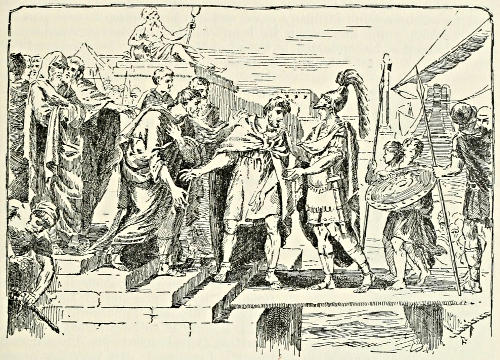
Arrival of Pyrrhus at Tarentum
The battle of Heraclea, however, encouraged the Greek cities of Locri
and Rhegium to throw off the Roman yoke. Locri joined Pyrrhus; but
Decius Jubellius, with his Campanian soldiers, declared themselves independent,
and seized Rhegium for themselves. But, above all, the battle of
Heraclea left the ground open for the Lucanians and Samnites to join the
king; and he advanced into Samnium to claim the fulfilment of their promises.
But as he advanced he was struck by the desolate condition of the
country; and he reproached the Italians with deceiving him. The battle
which had just been fought taught him how formidable was the foe he
had to deal with, and what he now saw, that he must trust to his own
resources. He resolved therefore to end the war at once by negotiating an
advantageous peace.
The person employed in this negotiation was Cineas, a name only less
remarkable than that of Pyrrhus himself. He was a Thessalian Greek,
famous for his eloquence, but still more famous for his diplomatic skill. He
served Pyrrhus as minister at home and ambassador abroad. “The tongue
of Cineas,” Pyrrhus used to say, “had won him more battles than his own
sword.” So quick was his perception, and so excellent his memory, that he
had hardly arrived in Rome when he could call every senator by his name,
and address every one according to his character. The terms he had to offer
were stringent; for Pyrrhus required that all Greek cities should be left
free, and that all the places that had been taken from the Samnites, Apulians,
and his other allies, should be restored. Yet the skill of Cineas would have
persuaded the senate to submit to these terms if it had not been for one
man. This was Appius Claudius the censor. He was now in extreme old
age; he had been blind for many years, and had long ceased to take part in
public affairs. But now, when he heard of the proposed surrender, he
caused himself to be conducted to the senate-house by his four sons and his
five sons-in-law, and there, with the authoritative
eloquence of an oracle, he confirmed
the wavering spirits of the fathers, and dictated
the only answer worthy of Rome—that
she would not treat of peace with Pyrrhus
till he had quitted the shores of Italy.
The dying patriotism of Appius covers the
multitude of arbitrary acts of which he was
guilty in his censorship.
Cineas returned to Pyrrhus, baffled and
without hope. He told his master, that
“to fight with the Roman people was like
fighting with the hydra”; he declared that
“the city was as a temple of the gods, and
the senate an assembly of kings.” But the
king resolved to try what effect might be
produced by the presence of his army in
Latium. He passed rapidly through Campania,
leaving it to be plundered by the
Samnites, and advanced upon Rome by the
upper or Latin road. He took the colony
of Fregellæ by storm; he received the willing
submission of Anagnia, the capital of
the Hernicans, and was admitted into the
impregnable citadel of Præneste, for both
the Hernicans and the Prænestines were
only half Roman citizens; they bore the
burdens without enjoying the privileges, and were therefore glad to welcome
a chance of liberty. He then advanced six miles beyond Præneste, within
eighteen miles of Rome. But here his course was stayed. There were no
signs of defection among the bulk of the Latins, or Volscians, or Campanians,
who had been admitted into the tribes and enjoyed the full honours of
Roman citizenship. Ti. Coruncanius, afterwards chief pontiff, and now consul,
was himself a Latin of Tusculum. What he had gained all might hope
for.
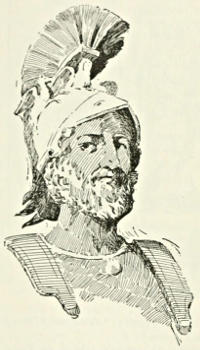
Pyrrhus
This winter is famous for the embassy of C. Fabricius, who was sent by
the senate with two other consulars to propose to Pyrrhus an interchange of
prisoners. The character and habits of Fabricius resembled those of Curius.
He lived in frugal simplicity upon his own farm, and was honoured by his
countrymen for his inflexible uprightness. He was somewhat younger than
Curius, and seems to have been less rough in manners and more gentle in
disposition. The stories are well known which tell how Pyrrhus practised
upon his cupidity by offering him gold, and upon his fears by concealing an
elephant behind the curtains of the royal tent, which, upon a given signal,
waved its trunk over his head; and how Fabricius calmly refused the bribe,
and looked with unmoved eye upon the threatening monster. Pyrrhus, it is
said, so admired the bearing of the Roman that he wished him to enter into
his service like Cineas, an offer which, to a Roman ear, could convey nothing
but insult. The king refused to give up any Roman citizens whom he had
taken, unless the senate would make peace upon the terms proposed through
Cineas: but he gave his prisoners leave to return home in the month of
December to partake in the joviality of the Saturnalia, if they would pledge
their word of honour to return. His confidence was not misplaced. The
prisoners used every effort to procure peace; but the senate remained firm,
and ordered every man, under penalty of death, to return to Tarentum by
the appointed day.
[280-278 B.C.]
Hostilities were renewed next year. The new consuls were P. Sulpicius
for the Patricians, and P. Decius Mus, son and grandson of those illustrious
plebeians who had devoted themselves to death beneath Vesuvius and at
Sentinum. We are ignorant of the details of the campaign till we find the
consuls strongly encamped on the hills which command the plain of Apulian
Asculum. Here Pyrrhus encountered them. After some skilful manœuvring
he drew the Romans down into the plain, where his phalanx and cavalry
could act freely. He placed the Tarentines in the centre, the Italian allies
on his left wing, and his Epirots and Macedonians in phalanx on the right;
his cavalry and elephants he kept in reserve. A second time the Roman
legions wasted their strength upon the phalanxes. Again and again they
charged that iron wall with unavailing bravery, till Pyrrhus brought up his
cavalry and elephants, as at Heraclea, and the Romans were broken. But
this time they made good their retreat to their entrenched camp, and
Pyrrhus did not think it prudent to pursue them. He had little confidence
in his Italian allies, who hated the Greeks even more than they hated the
Romans, and gave signal proof of their perfidy by plundering the king’s
camp while he was in action. The loss on both sides was heavy. The
second victory was now won; but the king’s saying was fast being fulfilled.
In these two battles he had lost many of his chief officers and a great number of
the Epirots, the only troops on whom he could rely. He dared not advance;
and when he returned to Tarentum news awaited him which dispirited him
still more. The Romans, he heard, had concluded a defensive alliance with
Carthage, so that the superiority of Tarentum at sea would be lost; Ptolemy
Ceraunus, who had promised him fresh troops from Macedon, had been slain
by the Gauls, and these barbarians were threatening to overrun Greece.
Under these circumstances he seized the first occasion of making peace
with Rome. This was afforded early in the next year by a communication
he received from the new consuls Q. Æmilius and C. Fabricius. They sent
to give him notice that his physician or cup-bearer (the accounts vary) had
offered to take him off by poison. Pyrrhus returned his warmest thanks,
sent back all his prisoners fresh-clothed and without ransom, and told his
allies he should accept an invitation he had just received to take the command
of a Sicilian-Greek army against the Carthaginians and Mamertines.
Accordingly he sailed from Locri to Sicily, evading the Carthaginian fleet
which had been lying in wait for him. He left the Italians to the mercy of
the Romans, but Milo still kept hold of the citadel of Tarentum, and Alexander,
the king’s son, remained in garrison at Locri.
He had been a little more than two years in Italy, for he came at the
end of the year 281 B.C. and departed early in 278: he returned towards
the close of 276, so that his stay in Sicily was about two years and a half.
The events of this period may be very briefly summed up.
[278-275 B.C.]
The Samnites and Lucanians continued a sort of partisan warfare against
Rome, in which, though the consuls were honoured with triumphs, no very
signal advantages seem to have been gained. The Romans no doubt took
back the places on the Latin road which had submitted to the king; they
also made themselves masters of Locri, and utterly destroyed the ancient
city of Croton, but they failed to take Rhegium, which was stoutly maintained
by Decius Jubellius and his Campanians against Pyrrhus and
Romans alike. Meanwhile Pyrrhus was pursuing a career of brilliant success
in Sicily. He confined the Mamertines within the walls of Messana,
and in a brilliant campaign drove the Carthaginians to the extreme west of
the island. But in an evil hour he undertook the siege of Lilybæum, a place
which the Carthaginians had made almost impregnable. He was obliged to
raise the siege and lost the confidence of his fickle Greek allies. Before this
also death had deprived him of the services of Cineas. Left to himself, he
was guilty of many harsh and arbitrary acts, which proceeded rather from
impatience and disappointment than from a cruel or tyrannical temper. It
now became clear that he could hold Sicily no longer, and he gladly accepted
a new invitation to return to Italy.
Accordingly, late in the year 276 B.C., he set sail for Tarentum. On the
passage he was intercepted by a Carthaginian fleet, and lost the larger number
of his ships; and, on landing between Rhegium and Locri, he suffered
further loss by an assault from the Campanians, who still held the former
city. Yet, once in Italy, he found himself at the head of a large army, composed
partly of his veteran Epirots, and partly of soldiers of fortune who
had followed him from Sicily. His first act was to recover possession of
Locri; and here, in extreme want of money, he listened to evil counsellors,
and plundered the rich temple of Proserpine. The ships that were conveying
the plunder were wrecked, and Pyrrhus, conscience-stricken, restored
all that was saved. But the memory of the deed haunted him: he has
recorded his belief that this sacrilegious act was the cause of all his future
misfortunes.
The consuls of the next year were L. Cornelius Lentulus and M. Curius
Dentatus. On Curius depended the fortunes of Rome. The people were
much disheartened, for pestilence was raging. The statue of Capitoline
Jupiter had been struck by lightning, and men’s hearts were filled with
ominous forebodings. When the consuls held their levy, the citizens summoned
for service did not answer to their names. Then Curius ordered the
goods of the first recusant to be sold, a sentence which was followed by
the loss of all political rights. This severe measure had its effect, and the
required legions were made up.
Lentulus marched into Lucania, Curius into Samnium. Pyrrhus chose
the latter country for the seat of war. He found Curius encamped above
Beneventum, and he resolved on a night attack, so as to surprise him before
he could be joined by his colleague. But night attacks seldom succeed:
part of the army missed its way, and it was broad daylight before the Epirot
army appeared before the camp of the consul. Curius immediately drew
out his legions, and assaulted the enemy while they were entangled in the
mountains. He had instructed his archers to shoot arrows wrapped in burning
tow at the elephants, and to this device is attributed the victory he won.
One of the females, hearing the cries of her young one, which had been
wounded in this way, rushed furiously into the ranks of her own men.
Curius now brought up the main body of his foot and attacked the disordered
phalanxes; they were broken and became helpless. The defeat was
complete: Pyrrhus fell back at once upon Tarentum, and resolved to quit
the shores of Italy, leaving Milo to hold the citadel.
But the glory of his life was ended; the two or three years that remained
of it were passed in hopeless enterprises. In storming Argos he was killed
by a tile thrown by a woman from the roof of a house. Such was the end
of this remarkable man. Like Richard I of England or Charles XII of
Sweden, he passed his life in winning battles without securing any fruits of
victory; and, like them, a life passed in the thick of danger was ended in a
petty war and by an unknown hand. His chivalric disposition won him the
admiration even of his enemies; his impetuous temper and impatience of misfortune
prevented him from securing the confidence of his friends. Yet he
left a name worthy of his great ancestry; and we part with regret from the
history of his Italian wars, for it is the most frank and generous conflict in
which Rome was ever engaged.
[273-272 B.C.]
The departure of Pyrrhus left Italy at the mercy of Rome. Yet Milo,
the king’s lieutenant, still held the citadel of Tarentum, and none of the
nations who had lately joined the Epirot standard submitted without a
final struggle. The Samnites, Lucanians, Bruttians, and other tribes continued
a kind of guerrilla warfare, for which their mountains afforded great
facilities. To put an end to this, in the year 272 B.C., L. Papirius Cursor
the younger, and Sp. Carvilius, who had crushed the Samnites at the close
of the third war, were again elected consuls. Papirius invested Tarentum;
and while the lines were being formed, he received the submission of the
Lucanians and Bruttians.
Meanwhile Carvilius attacked the Samnites, and the scattered remnants
of that brave people saw themselves compelled to submit finally to Rome,
after a struggle of about seventy years. Thus ended what is sometimes
called the Fourth Samnite War.
The same summer witnessed the reduction of Tarentum. Papirius
entered into a secret treaty with Milo, by which the latter was to evacuate
the city and leave it to the will of the Romans. He sailed for Epirus with
all his men and stores, and Tarentum was left to itself. The aristocratical
party instantly seized the government, and made submission to Rome. They
were allowed to continue independent, on condition of paying an annual
tribute to the conqueror; but their fortifications were razed, their arsenal
dismantled, the fleet surrendered to Rome, and a Roman garrison placed in
their citadel.
The attention excited by the failure of Pyrrhus is attested by the fact
that in the year 273 B.C. Ptolemy Philadelphus, sovereign of Egypt, sent
ambassadors to Rome, and entered into alliance with Rome. Thus began a
connection with Egypt which continued unbroken to the time of Cæsar.
[271-265 B.C.]
In 271 B.C. the plebeian consul C. Genucius was sent to reduce Decius
Jubellius and the Campanian soldiers, who had made themselves lords of
Rhegium, and formed a military oligarchy in that city. The senate formed
a treaty with the Mamertine soldiery, who had occupied Messana in the same
manner, and thus detached them from alliance with their compatriots; they
also secured supplies of corn from Hiero, the new sovereign of Syracuse.
The Campanians of Rhegium being thus forsaken, the city was taken by
assault and all the soldiery put to the sword, except the original legionaries
of Jubellius, who as burgesses of Capua possessed some of the rights of
Roman citizens, and were therefore reserved for trial before the people of
Rome. Not more than three hundred still survived out of several thousands;
but they met with no mercy. Every tribe voted that they should be first
scourged and then beheaded as traitors to the republic. Rhegium was
restored to the condition of a Greek community.
A few years later, the Salentines and Messapians in the heel of Italy
submitted to the joint forces of both consuls. Brundusium and its lands
were ceded to Rome; and about twenty years afterwards (244 B.C.) a colony
was planted there. Brundusium became the Dover of Italy, as Dyrrhachium,
on the opposite Epirot coast, became the Calais of Greece.
In the year 268 B.C. both consuls undertook the reduction of the Picenians,
who occupied the coast land between Umbria and the Marrucinians.
Their chief city, Asculum, was taken by storm. A portion of the people was
transferred to that beautiful coast between Naples and the Silarus, where
they took the name of Picentines. Soon after (266 B.C.) Sarsina, the chief
city of the Umbrians, was taken, and all Umbria submitted to Rome.
It remains to speak of Etruria. No community here was strong enough,
so far as we hear, to maintain active war against Rome; even Volsinii was
now compelled to sue for succour. The ruling aristocracy had ventured to
arm their serfs, probably for the purpose of a Roman war; but these men had
turned upon their late masters, and were now exercising a still direr oppression
than they had suffered. The senate readily gave ear to a call for assistance
from the Volsinian lords; and (in the year 265 B.C.) Q. Fabius Gurges, son
of old Fabius Maximus, invested the city. He was slain in a sally made by
the Etruscan serfs, who were, however, obliged to surrender soon after.
The Romans treated the city as lawfully gotten booty. The old Etruscan
town on the hill-top, with its polygonal walls, was destroyed; its two thousand
statues and other works of art were transferred to Rome; a new town
was founded on the low ground, which in the modernised name of Bolsena
still preserves the memory of its ancient fame. After the fall of Volsinii,
all the Etruscan communities made formal submission; and all Italy awaited
the will of the conquering city of the Tiber.
[265 B.C.]
To conceive of ancient Rome as the capital of Italy in the same sense that
London is the capital of England, or Paris of France, would be a great mistake.
London and Paris are the chief cities of their respective countries only
because they are the seat of government. But the city of ancient Rome was
a great corporate body or community, holding sovereignty over the whole of
Italy, from the Macra and Rubicon southwards. The Roman territory itself,
in the first days of the Republic, consisted (as we have seen) of twenty-one
tribes or wards. Before the point at which we have arrived, these tribes had
been successively increased to three-and-thirty. These tribes included a
district beyond the Tiber stretching somewhat farther than Veii; a portion
of the Sabine and Æquian territory beyond the Anio; with part of Latium,
part of the Volscian country, and the coast land as far as the Liris, southwards.
None but persons enrolled on the lists of these tribes had a vote in the popular
assemblies or any share in the government and legislation of the city.
The Latin cities not included in the tribes, and all the Italian communities,
were subject to Rome, but had no share in her political franchise.
The principles on which the Italian nations were so settled as to remain
the peaceable subjects of Rome were these: first, they were broken up and
divided as much as possible; secondly, they were allowed, with little exception,
to manage their own affairs. The isolation enforced by Rome prevented
them from combining against her. The self-government granted by
Rome made them bear her supremacy with contentment.
Prefectures; Municipalities
The arts by which isolation was produced were put in practice at the
settlement of Latium fifty years before. The same plan was pursued with
the different Italian nations. Those which submitted with a good grace
were treated leniently. Those which resisted stubbornly were weakened
by the confiscation of their lands and by the settlement of colonies in their
principal towns. The Frentanians are the best examples of the milder treatment;
the Samnites afford the most notable instance of the more harsh.
The work of isolation was promoted partly by the long and narrow shape
of Italy and the mountain range by which it is traversed, which make a
central government difficult, and still break it up into many states, but
partly also by a sentiment common to most of the Italian nations, as well
as to those of Greece. They regarded a man, not as one of a nation, but as
the member of a civic community. Every one regarded his first duties as
owed to his own city, and not to his nation. Their city was their country.
They addressed one another not as fellow-countrymen, but as fellow-citizens.
Rome herself was the noblest specimen of this form of society. And the
settlement which she adopted throughout Italy took advantage of this prevailing
rule, and perpetuated it.
Not only were the Italians split up into civic communities, but these communities
were themselves placed in very different conditions. The division
of the Italian communities, as established by the Roman government, was
threefold—prefectures, municipal towns, and colonies.
The prefectures did not enjoy the right of self-government, but were
under the rule of prefects or Roman governors, annually appointed; and the
inhabitants of the prefecture were registered by the Roman censor, so as to
be liable to all the burdens of Roman citizens, without enjoying any of
their privileges. This condition was called the Cærite franchise, because
the town of Cære was the first community placed in this dependent position.
Amid the terror of the Gallic invasion, Cære had afforded a place of refuge
to the sacred things, to the women and children of the Romans, and had
been rewarded by a treaty of equal alliance. But at a later period she
joined other Etruscan communities in war against Rome, and for this reason
she was reduced to the condition of a prefecture. Capua afterwards became
a notable instance of a similar change. After the Samnite Wars she
enjoyed a state of perfect equality in respect to Rome. The troops which
she supplied in virtue of the alliance between her and Rome formed a
separate legion, and were commanded by her own officers, as in the case
of Decius Jubellius. But in the Hannibalic War she joined Hannibal; and
to punish her she was degraded to the condition of a prefecture.
At the period of which we write, the municipal towns were communities
bound to Rome by treaties of alliance, framed on a general principle
with respect to burdens and privileges. Their burdens consisted in furnishing
certain contingents of troops, which they were obliged to provide with
pay and equipments while on service. Their privileges consisted in freedom
from all other taxes, and in possessing the right of self-government.
This condition was secured by a treaty of alliance, which, nominally at least,
placed the municipal community on a footing of equality with Rome; though
sometimes this treaty was imposed by Rome without consulting the will of
the other community.[45] Thus there was, no doubt, a considerable diversity
of condition among the municipia. Some regarded their alliance as a boon,
others looked upon it as a mark of subjection. In the former condition
were Cære and Capua before they were made prefectures; in the latter condition
was Volsinii and the Etruscan cities. The municipal towns enjoyed
the civil or private rights of Roman citizens; but none, without special
grant, had any power of obtaining the political or public rights. In some
cases even the private rights were withheld, as from the greater part of the
Latin communities after the war of 338 B.C., when the citizens of each community
were for a time forbidden to form contracts of marriage or commerce
with Roman citizens or with their neighbours. They stood to Rome and to
the rest of Italy much in the same condition as the plebeians to the patricians
before the Canuleian law. But these prohibitions were gradually and
silently removed. Municipal towns were often rewarded by a gift of the
Roman franchise, more or less completely, while those which offended were
depressed to the condition of prefectures. At length, by the Julian and
other laws (B.C. 90), all the municipal towns of Italy, as well as the colonies,
received the full Roman franchise; and hence arose the common conception
of a municipal town—that is, a community of which the citizens are
members of the whole nation, all possessing the same rights, and subject to
the same burdens, but retaining the administration of law and government
in all local matters which concern not the nation at large.
Colonies; Free and Confederate States
It is in the colonial towns that we must look for the chief instruments of
Roman supremacy in Italy. Directly dependent upon Rome for existence,
they served more than anything to promote that division of interests which
rendered it so difficult for any part of Italy to combine against Rome.
When we speak or think of Roman colonies, we must dismiss all those
conceptions of colonisation which are familiar to our minds from the practice
pursued in the familiar cases of the maritime states of modern Europe.[46]
Roman colonies were not planted in new countries by adventurers who
found their old homes too narrow for their wants or their ambition. When
the Romans planted a colony (at the time we speak of and for more than a
century later), it was always within the limits of the Italian peninsula, and
within the walls of ancient cities whose obstinate resistance made it imprudent
to restore them to independence, and whose reduced condition rendered it
possible to place them in the condition of subjects. But these colonies were
not all of the same character. They must be distinguished into two classes:
the colonies of Roman citizens, and the Latin colonies.
The colonies of Roman citizens consisted usually of three hundred men
of approved military experience, who went forth with their families to
occupy conquered cities of no great magnitude, but which were important
as military positions, being usually on the seacoast. These three hundred
families formed a sort of patrician caste, while the old inhabitants sank into
the condition formerly occupied by the plebeians at Rome. The heads of
these families retained all their rights as Roman citizens, and might repair
to Rome to vote in the popular assemblies. When in early Roman history
we hear of the revolt of a colony, the meaning seems to be that the natives
rose against the colonists and expelled them. Hence it is that we hear of
colonists being sent more than once to the same place, as to Antium.
Prow of a Roman War Galley
(After De Montfaucon)
But more numerous and more important than these were the Latin colonies,
of which there were thirty in existence when Hannibal crossed the
Alps. Of these thirty no fewer than twenty-six had been founded before
the close of the year 263 B.C. The reason for the name they bore was this:
We have seen that a close connection had subsisted between Rome and the
Latin communities from the earliest times. Under the later kings Rome
was the head of Latium; and by Spurius Cassius a league was formed between
Rome and Latium, which continued with a slight interruption till the
great Latin war of 338 B.C. So long as this league lasted, Latins enjoyed
all the private rights of Roman citizens in Rome; and Romans enjoyed all
the private rights of the Latin citizens in any of the cities of Latium. During
the period of the league many colonies were sent forth, in which the settlers
consisted jointly of Romans and Latins, and were not confined to the
small number of three hundred, but usually amounted to some thousands.
But the citizens of these Latin colonies seem to have had no rights at Rome,
except such as were possessed by the allied municipal towns. They were
therefore regarded politically as communities in alliance with Rome. After
the Latin war, similar colonies still continued to be sent forth. Indeed, these
were the colonies which chiefly relieved the poor of the Roman territory.
The rights and privileges of these Latin colonies are only known to us
as they are found at a later period of the republic under the name Latinitas,
or the Right of Latium (Jus Latii). This right, at the later time we
speak of, we know to have consisted in the power of obtaining the full rights
of a Roman burgess, but in a limited and peculiar manner. Any citizen of
a Latin community, whether one of the free cities of Latium or a Latin
colony, was allowed to emigrate to Rome and be enrolled in one of the
Roman tribes, on two conditions: first, that he had held a magistracy in
his native town: secondly, that he left a representative of his family in that
native town. Thus was formed that large body of half-Roman citizens
throughout Italy, who are so well known to readers of Livy under the
appellation of “the Latin name.” Socii et nomen Latinum—the allies and
the Latin name—was the technical expression for all those Italian communities
who were bound to supply soldiers for her armies.
Besides the mass of the Italian communities which were in a condition
of greater or less dependence upon Rome,—the prefectures in a state of
absolute subjection, the colonies bound by ties of national feeling and interest,
the municipal towns by articles of alliance,—there remain to be noticed,
fourthly, the cities which remained wholly independent of Rome, but bound
to her by treaties of equal alliance. Of the Latin cities, Tibur and Præneste
alone were in this condition; in Campania, most of the cities, till, after the
Hannibalic War, Capua and others were reduced to the condition of prefectures;
of the Hellenic cities in the south, Neapolis, Rhegium, and others;
in Umbria, Camerium; in Etruria, Iguvium; with all the cities of the
Frentanians. But as Roman power increased, most of these communities
were reduced to the condition of simple municipal towns.
Whatever is known of the internal constitution of these various communities
belongs to later times, when by the Julian law they all obtained
the Roman franchise, and became part and parcel of the Roman state.
There can, however, be little doubt that in the colonies a constitution was
adopted similar to that of Rome herself. The colonists formed a kind of
patriciate or aristocracy, and the heads of their leading families constituted
a senate. There were two chief magistrates, called duumviri, representing
the consuls, to whom (in the more important towns) were added one or two
men to fulfil the duties of censor and quæstor. In course of time similar
constitutions were introduced into the municipal towns also.
Thus, by placing the Italian cities in every possible relation to herself,
from real independence to complete subjection, and by planting colonies,
some with full Roman rights, some with a limited power of obtaining these
rights, Rome wove her net of sovereignty over the peninsula, and covered
every part with its entangling meshes. The policy of Rome, as has been
said, may be summed up in the two words—isolation and self-government.c
Carthage clears the Alps, Rome traverses the seas, the two peoples,
personified in two men Hannibal and Scipio, wrestle and are desperate
to terminate the struggle. ’Tis a duel à outrance, a fight to the death.
Rome totters, she utters a cry of anguish: Hannibal ad portas! But
she rises again, uses the limits of her strength in a last blow, throws
herself on Carthage and effaces her from the world.—Victor Hugo.
A taste of blood whets the appetite of a nation no less than of an animal.
It is notorious that the love of power grows with its acquisition. It
was inevitable then that the Romans, after beating off their eastern enemy,
should turn their eyes more and more jealously towards their one remaining
rival in the west—namely, Carthage. A certain amount of antagonism
there had doubtless been all along between Rome and Carthage, but there
was a long time during which the Italian city had hardly achieved strength
enough to excite a real jealousy on the part of a community of such recognised
power as Carthage. And even now there was no possibility that
Rome could claim to compete with her rival on the sea. Inheriting the
traditions of her mother city, Tyre, Carthage was pre-eminently a commercial
city. She occupied that pre-eminence of the western Mediterranean
that Tyre so long held in the East, and she was little disposed to accept
without a struggle the rivalry of a people of another land and race. It was
inevitable then that a war to the death must sooner or later determine the
question of mastery so soon as Rome had achieved a degree of power
which enforced her recognition as an actual rival of Carthage. The contest
was precipitated—as might have been expected—by the condition of
things in Sicily, an island which lay intermediate between the territories
of the two powers, and thus almost of necessity became a bone of contention
between them. In the early days, indeed, it was the Greeks and Carthaginians
who disputed over Sicily, and perpetually quarrelled there, but now
after the death of Agathocles, the powerful tyrant of Syracuse, and the defeat
of Pyrrhus, it became clear that Syracuse and the other Greek cities
of Sicily must look for aid in future to Rome rather than to Greece.
But the acceptance of such an alliance on the part of Rome virtually implied
war with Carthage, and such a war broke out actively only a few
years after the expulsion of Pyrrhus from Italy. It required indeed a
series of three most memorable wars, extending over a period of more than
a century, finally to decide the fate of Carthage.
The first of these wars—in some sense perhaps the most important, yet
as regards its results by far the least striking in itself—lasted some twenty-three
years. It was fought out largely in Sicily itself by the Romans who
were, for the most part, successful and in the end entirely victorious; and
on the sea, where the fleets of the Romans were for a long time quite unable
to compete with their rivals; the same dogged pertinacity, however, that had
made Rome mistress of Italy and that had brought about the final triumph
over Pyrrhus, stood them in good stead in the new effort to create a powerful
navy—an effort which was at last crowned with such complete success
that in the final decisive battle at the Ægatian Islands, the fleet of Carthage
was entirely destroyed and dispersed. At last Carthage sued for peace,
acknowledging the supremacy of Rome in Sicily and giving up all claim to
that island.
The events that followed illustrate not merely the inertia of long-established
institutions in the way in which Carthage rallied from her defeat and
returned again and again to the contest, but they illustrate even more
strikingly the influence which individual great men have in history. There
have been philosophers who have contended that great statesmen and
great warriors are rather the result of the opportunity of their times than
a directing influence; but it is hard for any one who attentively considers the
course of history to overlook the fact that the great man, even though in
some sense called forth by the necessities of the time, yet may put his stamp
in a most definitive way upon the trend of future events. So it was, for
example, with Alexander; so it was with Pyrrhus; and so it was now
with a group of great Carthaginians including Hamilcar Barca, his son-in-law
Hasdrubal, and most notably of all, the son of Hamilcar, the famous but ill-fated
warrior Hannibal.
These men, fired with loyalty to their native city, were imbued with a
bitter hatred of Rome, and swore to devote their lives to the work of gaining
back prestige for Carthage and to the destruction of her enemy. In
the end their effort was not successful; yet the struggle in which they
participated was one of the most wonderful and picturesque episodes in all
history, and it has bequeathed us the name of Hannibal as that of one of the
three or four greatest generals of all time. The story of how he precipitated
the Second Punic War through the destruction of Saguntum; how he
crossed the Alps with his army, invading the territory of Italy itself, and
there defeating the Romans again and again until their very national existence
seemed threatened; and of how, finally, recalled from Italy to protect
Carthage herself against the invasion of the Roman Scipio Africanus, Hannibal
was defeated before Carthage, all his labour of years coming to nought—must
be told in detail. Suffice it here to say that this story, fascinating
in itself, is of double interest, because it relates not merely to the prowess of
individual warriors, of individual hosts, but to the evolution of that world-power
through which Rome was to stamp her influence for all time on
European history.
Yet a Third Punic War was necessary before Carthage was finally removed
for all time from the stage of important history. Another Scipio,
called Africanus Minor, the adopted son of his great predecessor, was the
leader of the Roman arms in that final assault upon Carthage, and the somewhat
unwilling officer who carried out the mandate of the Roman senate,
which declared that Carthage should be absolutely destroyed. That mandate
was put into effect. No rival remained to Rome in the West, and, as
we shall see, steps had been taken which resulted almost simultaneously in
the final subjugation of those powers that hitherto had disputed the influence
of Rome in the East.a
[326-289 B.C.]
Nothing is more remarkable in the history of Rome than the manner in
which she was brought into contact with only one enemy at a time. During
the heat of her contest with the Samnites, Alexander of Macedon was terminating
his career. The Second Samnite War broke out in 326 B.C.; and
in the following year the great king died at the untimely age of thirty-two.
The possibility that he might have turned his course westward occurred to
Roman minds. Livyc broaches the question, whether Rome would have
risen superior to the contest or not, and decides it in the affirmative. But
his judgment is that of a patriot, rather than of a historian. Scarcely
did Rome prevail over the unassisted prowess of the Samnites. Scarcely did
she drive the adventurous Pyrrhus from her shores. If a stronger than
Pyrrhus—a man of rarest ability both for war and peace—had joined his
power to that of C. Pontius the Samnite, it can hardly be doubted that the
history of the world would have been changed.
The same good fortune attended Rome in her collision with Carthage.
The adventurous temper of Pyrrhus led him from Italy to Sicily, and threw
the Carthaginians into alliance with the Romans. What might have been the
result of the Tarentine War, if the diplomacy of Cineas had been employed
to engage the great African city against Rome? Now that Italy was prostrate,
it was plain that a collision between the two governments was inevitable.
As Pyrrhus left the soil of Italy forever, he said regretfully: “How fair
a battle-field we are leaving for the Romans and Carthaginians!”
It was by means of her fleets that Carthage was brought into connection
and collision with other countries. In early days she had established commercial
settlements in the south of Spain and in Sicily. It was in the latter
country that she came in contact first with the Greeks, and afterwards with
the Romans. In early times the Carthaginians contented themselves with
obtaining possession of three factories or trading marts on the coast of Sicily—Panormus,
Motya, and Lilybæum, which they fortified very strongly.
But after the great overthrow of the Athenian power by the Syracusans
(413 B.C.), the Carthaginian government formed the design of becoming
masters of this fertile and coveted island. But their successes were checked
by Dionysius the tyrant of Syracuse, whose long reign of thirty-eight years
(405-367 B.C.) comprises the time of Rome’s great depression by the Gallic
invasion, while the year of his death is coincident with that of the Licinian
laws, the era from which dates the constant advance of the great Italian city.
After many vicissitudes he was obliged to conclude a peace by which the
river Halycus was settled as the boundary between Grecian and Carthaginian
Sicily, and the territory of Agrigentum was added to Syracusan rule
(383 B.C.).
In 317 B.C. Agathocles made himself king of Syracuse, and in 310 B.C. the
Carthaginians declared war against him. Reduced to great straits, he took
the bold step of transporting the troops which remained for the defence of
the capital into Africa, so as to avail himself of the known disaffection of the
Libyan subjects of Carthage. His successes were marvellous. One of the
suffets fell in battle, the other acted as a traitor. All the Libyan subjects
of Carthage supported the Sicilian monarch, but he was obliged to return to
Sicily by an insurrection there. The remainder of his life was spent in vain
attempts in Sicily, in Corcyra, and in southern Italy. He died in 289 B.C.,
less than ten years before the appearance of that other fearless adventurer
Pyrrhus in Italy.
[289-264 B.C.]
After the death of Agathocles, the Carthaginians and Greeks of Sicily
rested quiet till Pyrrhus undertook to expel the former from the island.
The appearance of Carthaginian fleets off Ostia, and in the Gulf of Tarentum,
roused the jealousy of the Italian republic, and an opportunity only was
wanting to give rise to open war between the two states.
The occupation of Messana by the Campanian mercenaries of Agathocles,
calling themselves Mamertines, has been noticed. From this place they became
dangerous neighbours of Syracuse. A young man named Hiero, who
had won distinction in the Sicilian campaigns of Pyrrhus, defeated these
marauders at Centuripæ, and was by his grateful compatriots proclaimed king
about the year 270 B.C. In 265 B.C. the new king resolved to destroy this
nest of robbers, and advanced against Messana with a force superior to any
they could bring into the field against him. The Mamertines, in this peril,
were divided; one party wished to call in the Carthaginians, another preferred
alliance with Rome. The latter prevailed, and envoys were despatched to
demand immediate aid. The senate were well inclined to grant what was
asked; for that Messana, a town with a good harbour, and separated from
Italy by a narrow strait, should pass into the hands of Carthage, might have
given alarm to a less watchful government. Yet shame restrained them. It
was barely six years since Hiero had assisted them in punishing the Campanian
legion which had seized Italian Rhegium, as the Mamertines had seized
Sicilian Messana, and the senate declined to entertain the question. But the
consuls, eager for military glory, brought the matter before the centuriate
assembly, which straightway voted that support should be given to the
Mamertines, or in other words, that the Carthaginians should not be allowed
to gain possession of Messana. The consul Appius Claudius, son of the old
censor, was to command the army.
During this delay, however, the Carthaginian party among the Mamertines
had prevailed, and Hanno, with a party of Carthaginian soldiers, had
been admitted into the town. But Appius succeeded in landing his troops
to the south of the town,[47] and defeated Hiero with such loss that the prudent
king retired to Syracuse. Next day the Romans fell upon Hanno, and also
defeated him. The consul pursued his successes by plundering the Syracusan
dominions up to the very gates of the city.
The Romans, having now set foot in Sicily, determined to declare war
against Carthage. It is probable that the senate, recollecting the rapid
success of Pyrrhus, who in two years almost swept the Carthaginians out of
the island, reckoned on a speedy conquest; else, after their late exhausting
wars, they would hardly have engaged in this new and terrible conflict.
But they were much deceived. The First Punic War, which began in 264 B.C.,
did not end till 241, having dragged out its tedious length for three-and-twenty
years. The general history of it is most uninteresting. All the
great men of Rome, who had waged her Italian wars with so much vigour
and ability, were in their graves; we hear no more of Decius, or Curius, or
Fabricius, and no worthy successors had arisen. The only men of note who
appear on the Roman side are Duilius and Regulus. But the generals of
Carthage are no less obscure, except the great Hamilcar.[48]
[264-262 B.C.]
To make the dreary length of this war more intelligible, it may conveniently
be divided into three periods. The first comprises its first
seven years (264-257), during which the Romans were uniformly successful,
and at the close of which they had driven the Carthaginians to the south and
west coasts of Sicily. The second is an anxious period of mingled success
and failure, also lasting for seven years (256-250): it begins with the invasion
of Africa by Regulus, and ends with his embassy and death. The third
is a long and listless period of nine years (249-241), in which the Romans
slowly retrieve their losses, and at length conclude the war by a great victory
at sea.
The ill success of Hanno
at Messana so displeased
the Carthaginian government
that they ordered the
unfortunate general to be
crucified. The Romans
pursued their first success
with vigour. In the year
264 B.C. both the consuls
crossed over into Sicily
with an army of nearly fifty
thousand men. A number
of the Sicilian towns declared
in favour of the new
power, which might (they
hoped) secure their independence
against both Syracuse
and Carthage; for at
present no one dreamed of
a permanent occupation of
the island by the Romans.
Hiero, a prudent man, was
struck by the energy of the
new invaders. “They had
conquered him,” he said,
“before he had had time to
see them.” He shrewdly
calculated that the
Carthaginians would
prove inferior in the
struggle, and forthwith
concluded a
treaty of alliance
with Rome, by which he was left in undisturbed possession of a small but
fertile region lying round Syracuse; some more remote towns, as Tauromenium,
being also subject to his sceptre.

A Roman Consul
From this time forth to the time of his death, a period of forty-seven
years, he remained a useful ally of the Roman people. In 262 B.C. both
consuls laid siege to the city of Agrigentum, which, though fallen from
her ancient splendour, was still the second of the Hellenic communities
in Sicily. Another Hanno was sent from Carthage to raise the siege,
and for some time fortune favoured him. He drew a second circle of
entrenchments round the Roman lines, so as to intercept all supplies;
and thus the besiegers, being themselves besieged, were reduced to the
greatest straits. But the consul at length forced Hanno to give him battle,
and gained a complete victory. Upon this the commandant of the garrison,
finding further defence useless, slipped out of Agrigentum by night,
and deserted the hapless city after a siege of seven months. The Romans
repaid themselves for the miseries they had undergone by indulging in
all those excesses which soldiers are wont to commit when they take a
town by storm after a long and obstinate defence. It is said that twenty-five
thousand men were slain.
[262-260 B.C.]
This great success raised the spirits of the Romans. And now the
senate conceived the hope and formed the plan of expelling the Carthaginians
entirely from Sicily: but after a short experience, that sagacious
council became aware that a fleet was indispensable for success. Nothing
shows the courage and resolution of the Romans more than their manner
of acting in this matter. It is no light matter for landsmen to become
seamen; but for unpractised landsmen to think of encountering the most
skilful seamen then known might have been deemed a piece of romantic
absurdity, if the men of Rome had not undertaken and accomplished it.
What they wanted first was a set of ships, which, in size at least and
weight, should be a match for those of the enemy. It is a mistake to
suppose that the Romans had no fleet before this time. The treaties with
Carthage sufficiently prove the contrary; and on several occasions we
hear of ships being employed by them. But these ships were of the
trireme kind, formerly employed by the Greeks. The Carthaginians, like
the Greeks after Alexander, used quinqueremes; and it would have been
as absurd for the small Roman ships to have encountered those heavier
vessels, as for a frigate to cope with a three-decker. The Romans therefore
determined to build quinqueremes. A Carthaginian ship cast ashore
on the coast of Bruttium served as a model; the forest of Sila, in that
district, supplied timber. In sixty days from the time the trees were
felled they had completed, probably by the help of Greek artisans, a fleet
of one hundred quinqueremes, and twenty triremes; and while it was
building, they trained men to row in a manner which to us seems laughable,
by placing them on scaffolds ranged on land in the same way as
the benches in the ships (262 B.C.).
[260-256 B.C.]
The consul Cn. Cornelius put to sea first with seventeen ships, leaving
the rest of the fleet to follow; but he was surprised near Lipara
and captured, with the whole of his little squadron, by the Carthaginian
admiral. His plebeian colleague, C. Duilius, was in command of the
army in Sicily; but as soon as he heard of this disaster, he hastened to
take charge of the main body of the fleet, and sailed slowly along the
north coast of Sicily (260 B.C.).
Meantime, the Roman shipwrights had contrived certain engines, by
means of which their seamen might grapple with the enemy’s ships, so as
to bring them to close quarters and deprive them of the superiority
derived from their better construction and the greater skill of their crews.
These engines were called crows (corvi). They consisted of a gangway
thirty-six feet long and four broad, pierced with an oblong hole towards
one end, so as to play freely round a strong pole twenty-four feet high,
which was fixed near the ship’s prow. At the other end was attached
a strong rope, which passed over a sheaf at the head of the pole. By this
rope the gangway was kept hauled up till within reach of the enemy’s
ship; it was then suddenly let go, and as it fell with all its weight, a
strong spike on its under side (shaped like a crow’s beak) was driven
into the enemy’s deck. Then the Roman men-at-arms poured along the
gangway, and a stand-up fight followed, in which the best soldiers must
prevail.
Thus prepared, Duilius encountered the enemy’s fleet. He found
them ravaging the coast at Mylæ, a little to the west of Palermo. The
admiral was the same person who had commanded the garrison of Agrigentum,
and was carried in an enormous septireme, which had formerly
belonged to Pyrrhus. Nothing daunted, Duilius attacked without
delay. By his rude assault the skilful tactics of the Carthaginian seamen
were confounded. The Roman fighting-men were very numerous,
and when they had once boarded an enemy’s ship, easily made themselves
masters of her. Duilius took thirty-one Carthaginian ships and sunk
fourteen. For a season, no Roman name stood so high as that of Duilius.
Public honours were awarded him; he was to be escorted home at night
from banquets and festivals by the light of torches and the music of the
flute; a pillar was set up in the Forum, ornamented with the beaks of
the captured ships, and therefore called the Columna Rostrata, to commemorate
the great event; fragments of the inscription still remain in
the Capitoline Museum at Rome. And no doubt the triumph was signal.
The honours conferred upon the conqueror cannot but give a pleasing
impression of the simple manners then prevailing at Rome, especially
when we contrast them with the cruelty of the Carthaginian government,
who crucified their unfortunate admiral. To have defeated the Mistress
of the Sea upon her own element in the first trial of strength was indeed
remarkable.
The sea fight of Duilius was fought in the year 260 B.C. In the following
years the Carthaginians were only able to act upon the defensive. Not
only Agrigentum, but Camarina, Gela, Enna, Segesta, and many other cities
had surrendered to the Romans. The Carthaginians were confined to their
great trading marts, Drepana, Lilybæum, Eryx, and Panormus. They did
not dare to meet the Romans in the field; yet these places were very strong,
especially Lilybæum. Against its iron fortifications all the strength of Pyrrhus
had been broken. It was not time yet for Carthage to despair.
But in the eighth year of the war the senate determined on more
decisive measures. They knew the weakness of the Carthaginians at
home; they had a victorious fleet, and they determined not to let their
fortune slumber.
[256-255 B.C.]
Duilius appears for a brief time as the hero of the first part of the war;
but its second period is marked by the name of a man who has become
famous as a patriot—M. Atilius Regulus. It was in the year 256, the eighth
of the war, that the consuls, M. Regulus and L. Manlius, sailed from Italy
and doubled Cape Pachynus with a fleet of 330 quinqueremes. The Carthaginian
fleet, even larger in number, had been stationed at Lilybæum to
meet the enemy, whether they should approach from the north or from the
east. They now put to sea, and sailed westwards along the southern coast
of Sicily. They met the Roman fleet at a place called Ecnomus, a little more
than halfway along that coast. The battle that ensued was the greatest
that, up to that time, had ever been fought at sea; it is calculated that not
fewer than 300,000 men were engaged. It was desperately contested on both
sides; but at Ecnomus, again, we are astonished to find the Roman fleet
victorious (256 B.C.).
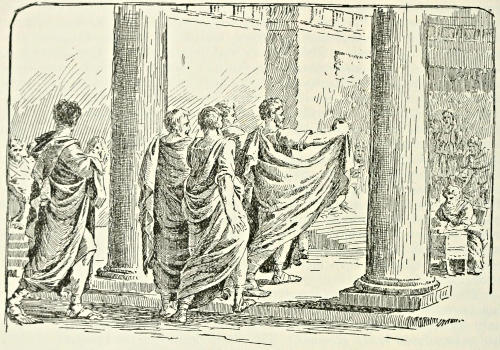
Roman Embassy at Carthage
(After Mirys)
The way was now open to Africa. The consuls, after refitting and provisioning
their fleet, sailed straight across to the Hermæan promontory,
which is distant from the nearest point of Sicily not more than eighty miles.
But the omens were not auspicious; the Roman soldiery went on board with
gloomy forebodings of their fate; one of the tribunes refused to lead his
legionaries into the ships, till Regulus ordered the lictors to seize him. The
passage, however, was favoured by the wind. The consuls landed their men,
drew up the fleet on shore, and fortified it in a naval camp; and then, marching
southwards, they took the city of Aspis or Clupea by assault. No
Carthaginian army met them; every place they came near, except Utica,
surrendered at discretion, for they were unfortified and defenceless. Carthage,
being of old mistress of the sea, feared no invaders, and, like England,
trusted for defence to her wooden walls. Yet she had not been unwarned.
Sixty years before the adventurous Agathocles had landed like Regulus.
Then, as now, the whole country lay like a garden before him, covered with
wealthy towns and the luxurious villas of the Carthaginian merchants.
Then two hundred towns or more had surrendered almost without stroke of
sword. It appeared as if the same easy success now awaited Regulus and
the Romans.
The consuls were advancing along the coast of the gulf towards Carthage,
when Manlius was recalled with the greater part of the army, and
Regulus was left in Africa with only fifteen thousand foot and five hundred
horse. Yet even with this small force he remained master of the country.
He had gone round the whole Gulf of Tunis as far as Utica, and now he
turned upon his steps with the intention of marching upon the capital itself.
On his way he was obliged to cross the river Bagradas, and here (so ran the
legend) the army was stopped by a huge serpent, so strong and tough of
skin that they were unable to destroy it, till they brought up their artillery
of catapults and balists; he then continued his route southwards to the
Bay of Carthage. He was allowed to take Tunis, which stood within twenty
miles of Carthage. The great city was now reduced to the utmost straits.
A Roman army was encamped within sight; famine stared the townsmen in
the face; the government trembled. In this abject condition the council
sent an embassy to ask what terms of peace Regulus would grant.
The consul was so elated by success, that he demanded the most extravagant
concessions. The Carthaginians were to give up their fleet, pay all the
expenses of the war, and cede all Sicily, with Sardinia, Corsica, and the
Balearic Isles, to Rome. When these terms were reported, the government
took care to publish them, and public indignation rose against the arrogant
invaders. The civic force was not untrained to arms, and they had now to
fight for their hearths and altars. A good general was sought for. At that
time there happened to be at Carthage a soldier of fortune, by name Xanthippus,
a Lacedæmonian.[49] This man had been heard to censure the native
generals, and to declare that the victories of the Romans were due, not to
their own superior skill, but to the faults of their opponents. He was summoned
before the council and desired to give reasons for his remarks. He
did so; and, for a moment, the government, dismissing all jealousy, appointed
this obscure foreigner general-in-chief. Xanthippus immediately
drew together all the mercenaries he could find, and united them with the
armed citizens; then, supported by a large body of elephants, he boldly took
the field. The Romans were astonished; but they were too much accustomed
to victory to hesitate about accepting battle. But they were both
outnumbered and outgeneralled. Xanthippus gained a victory as easy as it
was complete. Regulus himself was taken prisoner; only two thousand of
his men succeeded in making good their retreat to Clupea.
Thus was Carthage delivered by the ability of one man, and that man a
foreigner. The government did not improve in wisdom or generosity; their
incapable generals resumed the command, and Xanthippus, loaded with
honours and presents, prudently withdrew from the jealous city.
The Roman senate did their best to repair this great calamity. The new
consuls were ordered to put to sea, and bring off the garrison and fugitives
from Clupea. Near the Hermæan promontory they encountered the enemy’s
fleet, and again defeated it; and then, having taken up the ships and men
at Clupea, they sailed for Syracuse. But a still greater disaster was in store
for Rome than the destruction of her African army. This was the loss of
that fleet of which she was justly proud. The time of year was about the
beginning of the dog-days, when the Mediterranean is apt to be visited by
sudden storms. The consuls, upon their passage, were warned that such a
storm was at hand; but they were ignorant and rash, and continued their
course. Before they could double Cape Pachynus they were caught by the
tempest; almost the whole fleet was wrecked or foundered; the coast of
Sicily from Camarina to Pachynus was strewed with fragments of ships and
bodies of men. Such was the end of the first Roman fleet (255 B.C.).
[255-250 B.C.]
These successive disasters might well raise the hopes of Carthage, and
they sent a considerable force into Sicily, with 140 elephants. Agrigentum
is said to have been recovered, and no doubt it was expected that the whole
island would once more become their own. But the Romans showed a spirit
equal to the need. In three months’ time (so wonderful was their energy)
a new fleet of 220 sail was ready for sea. The consuls of the year 254 B.C.,
having touched at Messana to take up the remnants of the old fleet, passed
onwards to Drepana. They could not take this strong place, but they
were more successful at Panormus, the modern Palermo, which yielded after
a short siege to the Roman arms. This was an important conquest.
Next year the fleet touched at several places on the African coast, but
without making any impression on the country. Among the shoals and
currents of the Lesser Syrtis it ran great danger of being lost; but having
escaped this peril, the consuls returned to Panormus and thence stood
straight across for the mouth of the Tiber. On the passage they were overtaken
by another of those terrible storms, and again nearly the whole fleet
was lost. Thus, within three years, the Romans lost two great fleets. This
was enough to damp even their courage; and the senate determined to try
whether it were not possible to keep their ground in Sicily without a navy.
For the present they gave up all claim to the command of the sea, and
limited themselves to a small fleet of sixty ships.
Matters continued in this state for two years. Neither party seemed
willing to hazard a battle by land; but in 250 B.C. Hasdrubal, the Carthaginian
general, was induced to march secretly from Lilybæum to Panormus,
in the hope of surprising and recovering that important town. The Roman
commandant was the proconsul L. Cæcilius Metellus. He allowed the
enemy to approach the walls, and then suddenly sallied forth, covering his
attack by a cloud of light troops, slingers, and javelin-men. Some of the
elephants being wounded, carried confusion into their own ranks, and
Metellus, seizing the occasion, charged the enemy and defeated them utterly.
Besides thirteen Carthaginian generals, 120 elephants were taken and carried
across the sea on strong rafts to adorn the triumph of the proconsul.
The battle of Panormus was the greatest battle that was fought on land in
the course of the war, and it was the last. In memory of this victory we
find the elephant as a frequent device on the coins of the great family of the
Metelli.b We may well quote here Polybius’ account both of the loss of
the fleet in 255 and of this victory at Panormus or Palermo.
[255-251 B.C.]
The Romans had made ready, early in the Spring, a Fleet of Three
Hundred and Fifty Sail; and Embarking their Army under the Command
of their new Consuls, M. Æmilius, and Servius Fulvius, and standing along
the Coast of Sicily towards Africa, they met, and fought off of Cape Mercury
with the Carthaginian Fleet, which was not able to sustain the first shock,
but being entirely beaten, lost in the Ingagement, an Hundred and Fourteen
of their Vessels, and all that was in them, to the Romans; who afterwards
prosecuting their course, arriv’d at Aspis; where taking their Men on
Board that remain’d in Africa, they shap’d their Course back to Sicily. And
being well advanc’d on their way, they were surpriz’d off of Camarina with
so dreadful a Tempest, that the losses and hardships they sustain’d were
without Example, and beyond Expression: So terrible it was, that of Three
Hundred and Seventy odd Vessels that compos’d their Fleet, Fourscore only
escap’d Shipwreck, the rest being either founder’d in the Sea, or were lost
and broken against the Rocks, that whole Coast being cover’d with dead
bodies, and strew’d with the Ruines and Fragments of their Ships, insomuch
as History affords no Example of the like dreadful disaster. And yet it
may be said, that this Calamity was not owing so much to Fortune, as to the
obstinacy of the Consuls: For the Pilots endeavour’d to obviate the hazard
they should be expos’d to by Navigating on that Coast of Sicily, which
borders on the African Sea, there being there not only no Harbours to
succour vessels in distress; but the Season too of the Year was now improper;
for by observation of the rising and setting of Orion and the Dog
Star, they compute and know the safe Seasons for Navigation. But the
Consuls, contemning their Counsel, stood boldly out to Sea, in hopes that
after this signal Victory, their appearing suddenly on the Coast, might
terrify many Towns, and awe them to submission: But their folly was
chastis’d by this memorable loss, which they sustain’d upon a motive much
too little for the hazard. The Romans have indeed this inflexibility of
Mind peculiar to them, believing that whatsoever they have resolv’d and
determin’d to undertake, ought to be indispensably perform’d; and they
have establish’d it into a Principle, that what they once have decreed to
execute, cannot be impossible to bring to pass: The effect, indeed, of a
generous obstinacy, but the cause oftentimes of their falling into pernicious
Errors and Misfortunes, and their sustaining unspeakable losses, especially
in their Naval Expeditions. As to their Exploits by Land, where the
Encounter is only Man to Man, their Courage frequently conducts them to
the Success they propose, by reason their adventures are with Men like
themselves; and yet there want not Examples wherein their Measures and
Forces have fail’d, and they have sunk and miscarry’d under the weight
of their Enterprises. But whenever, by a temerarious Audacity, they act
against these raging Elements, and attempt to vanquish the Sea and Wind,
they are sure to reap no other fruit of their Obstinacy, than Loss and
Calamity. This we have now mentioned, is an instance, and they have
heretofore smarted by the like Errors; and they shall always stand liable to
the same disasters, till they appear better advis’d and instructed in the weakness
of that overweening Presumption, which they are apt to entertain in
all their Designs, vainly imagining, that both Sea and Land should on all
occasions consent and open their way to Success in all their Enterprises.
The Carthaginians, upon advice of this Misfortune of the Romans at Sea,
were of Opinion, that they should now be a match for them by Land, whereunto
they were perswaded through the late Victory they had gain’d. That
they should be equal to them likewise by Sea, they had no doubt, by reason
of their late great loss by Tempest; howbeit they omitted not to reinforce
their Strength both by Sea and Land. They dispatch’d Hasdrubal into Sicily,
to whom, besides the Forces already there, they order’d a farther supply of
Troops out of those that were lately drawn out of Heraclea, together with
an Hundred and Forty Elephants: He was no sooner departed, but they sent
after him Two Hundred Vessels laden with all things necessary for the Service
of the War. Hasdrubal, being safely arriv’d at Lilybæum, apply’d himself
with diligence to Exercise and Discipline his Troops and his Elephants,
intending to spread his Army all over the Country, and to make himself
entire Master of the Field. As for the Romans, they were not without a very
sensible sorrow, when by those who had escap’d Shipwreck, they receiv’d an
account of the mighty loss they had sustain’d at Sea; nevertheless, being
determin’d not to yield the Advantage to the Enemy, they order’d a new
Fleet to be speedily built, to consist of Two Hundred and Twenty Sail;
which Fleet (a wonderful and incredible thing to relate) was compleatly
built and finish’d in the space of three Months; on which the new Consuls,
Aulus Atilius, and C. Cornelius speedily Embark’d; who, after having pass’d
the Streight, and touch’d at Messina, to take with them the Vessels that had
been sav’d in the late Storm, shap’d their Course for Palermo with a Naval
Army consisting of Three Hundred Sail, and forthwith sat down and besieg’d
that place, which then was the Capital City of the Carthaginians in Sicily.
They made their Attacks in two several places, and when their Works were
advanc’d to their Minds, they approach’d with their Engines of Battery, by
which, a Tower or Work standing near the Sea, was quickly, and without
much trouble, demolish’d; at which breach the Souldiers enter’d, and took
by Assault, and kept Possession of that quarter of the City call’d the New
Town, whereby the place it self was put into manifest danger; but the Inhabitants
coming seasonably in to the Relief, they advanc’d no farther; so the
Consuls, after they had put a good Garrison into the place they had taken,
return’d back to Rome. Early the next Summer the new Consuls, C. Servilius,
and C. Sempronius, sail’d over to Sicily with all their Naval Power,
and from thence, soon after, stood for the Coast of Africk, where they made
several Descents, but perform’d nothing of moment; at length arriving at
the Island of the Lotophagy, which is likewise call’d Meninx, not far distant
from the lesser Syrtis, or Flatts; here being unacquainted with the Coast,
their Fleet fell among the Sands, where their Vessels grounded, and stuck
fast, as if they had been a-shoar, and there remain’d till the Flood fetch’d
them off; when with great difficulty and hazard, throwing their Lumber
over-board, they made a shift to escape. From thence, like People flying
from an Enemy, they stood away for the Coast of Sicily; and after they had
doubl’d the Cape of Lilybæum they got into the Port of Palermo. But from
thence steering their Course homeward, a Storm took them in the Phare of
Messina, where, by a blind Obstinacy they were imbay’d, which Storm attack’d
them with such violence, that above an Hundred and Fifty of their
Ships miscarry’d. Things happening thus adverse to them by Sea, tho’ the
Senate and People could not subdue their Thirst of Glory and Empire, nevertheless
their Losses and Calamities, and the straits to which they were now
reduc’d, prevail’d with them to quit all farther attempts of trying their
Fortune by Sea; so they now totally abandon’d all thoughts of Naval Preparations.
And determining to rely solely on their Land Armies, they dispatch’d
the Consuls, L. Cæcilius, and Cn. Furius to Sicily with the Legions,
alotting them only about Threescore Vessels whereon securely to Embark
and waft over the Army, their Baggage and Amunition. These Misfortunes
of the Romans much augmented the Carthaginian Glory and Fame in the
World, and gave a new Face to their Affairs. In a word, as the Romans
had now yielded them up the Dominion of the Sea, it was no difficulty for
them to be entirely Masters there; nor were they without hopes of succeeding
in their Affairs by Land; nor did they reckon very wide of the matter,
for from the time of the defeat of the Roman Army, by the assistance of the
Elephants, which discompos’d and broke their Ranks in the Battel fought in
Africk, where those Animals made such destruction of their People, the
Souldiers became so terribly aw’d, that tho’ they had been on several occasions
drawn up in Battalia to ingage within five or six Furlongs of the Carthaginian
Army; sometimes in the Territory of Selinunce, sometimes about
Lilybæum, yet for the space of two Years together they wanted Resolution to
ingage them, or to adventure to abide in the Champain Country, so great a
dread they had conceiv’d of the Fury and Shock of those stupendious beasts:
So that little or no Progress was made in their Affairs during all that space,
saving the taking of Lipary and Thermes, the Army continuing Coopt up in
the Mountains, and Inaccessible Places. Wherefore the Romans, observing
this Terrour among their Legions, took a Resolution once more, to tempt their
Fortune by Sea: Accordingly upon the Creation of C. Atilius and L. Manlius
Consuls, they Order’d the Building of Fifty Vessels, and Levies of men for
that Service; and now they had a Navy once again establish’d.
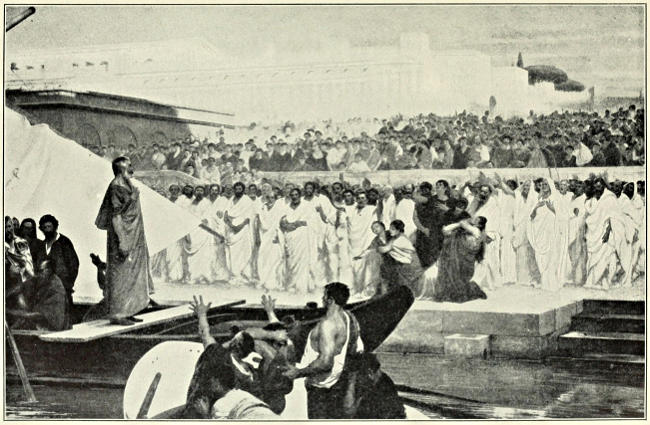
REGULUS’ DEPARTURE FOR CARTHAGE
[251-250 B.C.]
Hasdrubal having observ’d this dread that possess’d the Roman Army,
when ever he presented them Battel, and having Intelligence that one of the
Consuls was now return’d back to Rome, and one half of the Army with him;
and that Cæcilius with the rest of the Troops was at Palermo, Assisting their
Allies in gathering in their Harvest, their Corn being now Ripe; he March’d
out of Lilybæum with his Troops, and came and Incamp’d on the Borders of
the Territory of Palermo. Cæcilius observing this weak Proceeding of the
Carthaginian, kept his People within the Walls of the Town, thereby to ingage
him to Advance nearer, which Hasdrubal accordingly did, perswaded
thereto by the shew of fear the Romans were under, and imagining that
Cæcilius had not the Resolution to appear in the Field, he rashly adventur’d
his Army into a narrow Straight: and albeit he wasted the Country to the
very Walls of Palermo, Cæcilius nevertheless held his first determination,
not to move till the Enemy had pass’d the River that runs close by the Town.
When, in short, after the Elephants and the whole Army had got over, he
Order’d some of his light Arm’d Souldiers, to advance out against them to
Pickeer, and draw them the more boldly on. And observing all things to
Succeed as he had projected, he Posted a Body of select and skilful Souldiers
upon the Counterscarp of the Town, with Orders that if the Elephants advanc’d
upon them, to Attack them with Darts and Missive Weapons, and in
case they should be press’d by those Animals, that they should then retire
into the Ditch; and from thence gall and molest them all they could. He
Order’d the Towns People at the same time to furnish themselves with great
quantities of Darts, and Post themselves without the Town at the Foot of
the Walls, and there abide in a Posture of Defence. Cæcilius himself with
all his troops remain’d in readiness at a certain Gate of the Town, that was
oppos’d to the Right Wing of the Enemy, from whence he sustain’d the
Troops with fresh Supplies of men, who were already Ingaged. In a Word,
the Battel began now to grow warm, and the Leaders of the Elephants being
resolv’d to be sharers with Hasdrubal in the Honour of the day, proceeding
as if they design’d the Victory should be wholly owing to them, advanc’d all
in Order upon the Romans, whom they soon forc’d to give Ground and retire
into the Ditch. But now the Elephants, smarting with the Wounds they
had receiv’d, and vex’d with the Darts wherewith they were gall’d both from
the Ditch and the Walls of the Town, began to grow unruly, fell upon their
own People, and destroy’d many, and put their Troops in disorder. This
being observ’d by Cæcilius he forthwith Salli’d out with his Troops fresh
and in good Order, and attacking the Enemy in Flank, who were already
in Confusion, slew many, and put the rest of the Army to Flight. Ten
Elephants were then taken with the Indians their Guides, and others who
had lost their Leaders fell likewise into their Hands after the Battel. The
happy Issue of this Action got Cæcilius the Reputation every where of having
Restor’d the Roman Courage by Land, to Attempt Incamping in the open
and plain Country, and to know how to behave themselves well again out of
their Retrenchments. There was great joy at Rome upon the Arrival of the
News of this Defeat, not so much on account of the Elephants which had been
taken, tho’ it was a very sensible blow to the Enemy, but because the taking
of those Animals, and the Victory obtain’d against them, had restor’d the
Souldiers Resolution. Wherefore they determin’d once again, as had been
propos’d (to the end they might at any rate put a Period to this War) to
Dispatch the Consuls away with a new Navy. And when all things were
in readiness for the Expedition, they departed for Sicily with a Fleet of Two
Hundred Sail, it being now the Fourteenth Year of the First Punic War.d
[250-249 B.C.]
After the battle of Panormus, the hopes of the Romans rose again, and
the senate gave orders to build a third fleet of two hundred sail. But the
Carthaginians, weary of the expenses of the war, and suffering greatly in
their commerce, thought that a fair opportunity for making peace was now
offered. The Romans had not so entirely recovered from their late disasters,
but that they might be glad to listen to fair terms. Accordingly an embassy
was despatched to offer an exchange of prisoners and to propose terms on
which a peace might be concluded. Regulus (according to the well-known
story) accompanied this embassy, under promise to return to Carthage if
the purposes of the embassy should fail. When he arrived at Rome he
refused to enter the walls and take his place in the senate, as being no longer
a citizen or a senator. Then the senate sent certain of their own number
to confer with him in presence of the ambassadors, and the counsel which he
gave confirmed the wavering minds of the fathers. “Useless it was,” he
said, “to ransom prisoners who had ignobly yielded with arms in their hands:
let them be left to perish unheeded; let war go on till Carthage be subdued.”
His counsel prevailed, and the embassy returned without effect. Regulus
also returned to suffer the vengeance of the Carthaginians. Every one knows
the horrid tortures by which it is said that life was taken from him; how
his eyelids were cut off; how he was placed in a barrel stuck full of nails,
with one end knocked out; and how he was exposed to the unmitigated
glare of an African sun, to die by the slow agonies of pain, and thirst, and
fever.
Regulus was a man of the old Roman kind, like Curius and Fabricius,
devoted to his country, eager for glory, frugal, bold, resolute or (call it)
stubborn. He has been censured for excessive presumptuousness in his
African campaign, and for the extravagance by which he lost all the advantages
which he might have secured. But it must be allowed that he had
some grounds even for overweening confidence. Ever since the two nations
had met in arms, the star of Carthage had grown dim before that of Rome.
Even on the sea, where her navies had long ridden triumphant, the Queen of
the Mediterranean had twice been beaten by her unskilled rival. There was
enough to make more sagacious men than Regulus believe that Carthage
was well-nigh powerless against Rome. The Romans had yet to learn that
when the jealous government of Carthage allowed great generals to command
their armies, such as Xanthippus, and Hamilcar, and Hannibal, then the
well-trained mercenaries might gain easy victories over their own brave but
less practised citizens.
The whole story of the embassy and death of Regulus has been doubted,
chiefly because of the silence of Polybius, the most authentic historian of
the time; and from the certainty that at least one mythical marvel has been
introduced into the narrative. But if allowance be made for some patriotic
exaggeration, there is nothing improbable in the story. Those who crucified
their own unlucky generals would not be slow to wreak any measure
of vengeance on a recusant prisoner. We read also that the Romans
retaliated by torturing some Carthaginian prisoners, and this fact can hardly
be an invention. At all events, the personal qualities of Regulus rest too
firmly on old tradition to be questioned. While we read the beautiful passage
in which Cicero describes his disinterested patriotism; while we repeat
the noble ode, in which Horace paints him as putting aside all who would
have persuaded him to stay—people, friends, and family—and going forth
to torture and death with the same serene indifference as if he were leaving
the busy life of Rome for the calm retirement of his country house, so long
will the blood flow more quickly and the heart beat higher at mention of the
name of Regulus.b
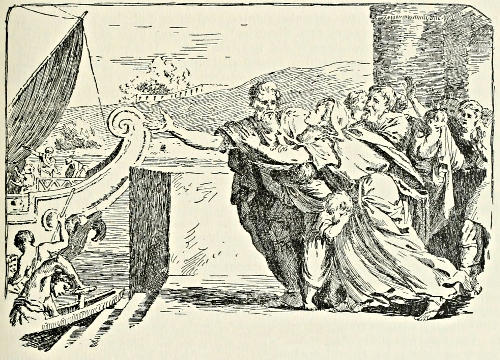
Regulus Returns To Carthage
(After Mirys)
Of Regulus, Niebuhr writes rather sharply: Few events in Roman history
are more celebrated than this embassy and the martyrdom of Regulus,
which have been sung by Roman poets and extolled by orators. Who does
not know that Regulus, as a slave of the Carthaginians, refused to enter the
city; that he attended the deliberations of the senate with their sanction,
and rejected the exchange no less vehemently than the peace; that he confirmed
the wavering fathers in their resolution; that he preferred his honour
and his oath to all the enticements to remain behind; and that, in order to
remove the temptation, he pretended that a slow poison had been administered
him by Punic faithlessness, which would soon end his days, even if the
senate, less mindful of the country than of the individual, should wish to
retain him by exchange or protection; how he withdrew from the embraces
of his friends as a dishonoured man, and after his return to Carthage was
put to death by diabolical tortures?
Palmeriusg was the first who attacked this account after the Valesian
extracts from Diodorush had become known, and his reasons have been
strengthened by Beauforti with very appropriate arguments besides. But
Beaufort has perhaps carried his scepticism too far in doubting, and in
reality rejecting, the truth of the embassy on account of the silence of
Polybius.
Neither of these writers has mentioned, which is of great importance,
that Dion Cassiusj declared the martyrdom of Regulus to be a mere fable,
although he repeated it. He also related that after Regulus had fallen into
captivity, his sleep was at first disturbed, as he was kept shut up with an
elephant, but that this cruelty did not last long. It may be accounted for,
and even pardoned, as Regulus forgot all human feelings towards Carthage
when it had fallen and implored his compassion; and it is not unlikely that
this account may have given rise to the more widely extended one respecting
the mode of his death.
It is most probable that the death of Regulus happened in the course of
nature; and it is very possible that the cruel maltreatment of the Punic
prisoners, respecting whom it is certain, even according to Roman testimonies,
that they were surrendered to the family as hostages or for revenge, has
become the occasion of the prevailing narrative through that unpardonable
calumny which the Romans constantly indulged in against Carthage. It
seems most credible that Hasdrubal and Bostar were given as hostages,
because Regulus actually believed, and the Romans shared his opinion, that
he was secretly poisoned. But with an unbiassed judgment we must regard
the narrative of Diodorus respecting the perfectly inhuman fury of the
family of Regulus against these innocent prisoners to be no less doubtful
than the Roman one; since it is quite certain that no Roman recorded this
disgrace to his nation, and here, as well as elsewhere, Philinus must be
regarded as the source of Diodorus, whose hatred against Rome is very pardonable,
but always renders his testimony highly suspicious.
For the rest, if this deed of Regulus had not been praised to us in early
years as heroic, we should without prejudice find it less brilliant. That he
went back because he had sworn, was an act which, if he had not done it,
would have been branded with infamy. If he had reason to fear, it was a
consequence of the shameful abuse which he himself had made of his victory,
inasmuch as he only knew how to use it as a mere child of fortune, and in a
way inferior to most of the generals who were his contemporaries.e
[249-244 B.C.]
It has been said that the senate, encouraged by the victory of Panormus,
resolved once more to attempt the sea. In the year 249 B.C. the third fleet
was ready, and its purpose soon became evident. The consuls were ordered
to invest Lilybæum, the queen of Carthaginian fortresses, both by sea and
land. If this strong place fell, the Carthaginians would have no firm hold
on Sicily: but it could not be taken unless it were blockaded by sea, for by
sea supplies could be poured into it from Carthage. The Romans began
the siege with activity; they constructed enormous works, they endeavoured
to throw a dam across the harbour, but in vain. The skilful seamen of
Carthage contrived to carry provision ships into the harbour through the
midst of the Roman fleet. Their navy lay at hand in the Bay of Drepana,
ready to take advantage of any remissness on the part of the Romans.
Yet the invincible perseverance of the Romans would have prevailed
but for the headstrong folly of the patrician consul for the year 249 B.C.
This was P. Claudius, a younger son of the old censor, brother of him who
had relieved Messana. As he lay before Lilybæum, he formed a plan for
surprising the enemy’s fleet at Drepana, and left his station for this purpose.
In vain he was warned by the pullarii, that the sacred chickens
would not feed. “Then let them drink,” said the irreverent commander,
and threw them into the sea. But the men were much dispirited by the
omen and the contempt of the omen. And the consul had managed matters
with so little secrecy and skill that the enemy were informed of his intended
attack. As the Romans sailed in column into the harbour, the Carthaginian
fleet was seen sailing outward. But on a sudden they tacked and bore
down upon the side of the Roman column. Of Claudius’ 220 ships, only
thirty escaped.
The reckless consul was recalled to Rome by the senate, and ordered to
supersede himself by naming a dictator. With the old insolence of his
family, he named the son of one of his own freedmen, by name Claudius
Glycias. But the senate set aside the nomination, and themselves appointed
A. Atilius Calatinus, also called Serranus. What became of Claudius we
know not. But he was dead three years after; for a story is preserved, that
at that time his sister insolently expressed a wish that he were still alive,
that he might lose more men, and make the streets less crowded. She was
heavily fined for this speech; and if words deserve punishment, none deserved
it more than hers.
The loss of the fleet of Claudius was not the only disaster of the year.
L. Junius, his plebeian colleague, was less guilty, but even more unfortunate.
He was convoying a large fleet of ships, freighted with supplies for
the forces at Lilybæum, when, near Camarina, he was overtaken by a tremendous
hurricane, and both the convoy and the convoying squadron
perished. The destruction was so complete, that every single ship was
broken up, and not a plank (says Polybius) was fit to be used again.
Thus by the folly of one consul and the misfortune of the other, the
Romans lost their entire fleet for the third time. It seemed to them as if
the god of the sea was jealous of these new pretenders to his favour.
These disasters left the Carthaginians once more masters of the sea.
And at the same time a really great man was appointed to a command in
Sicily. This was Hamilcar, the father of Hannibal. He seems not to have
had many ships or troops at his command; but the skill with which he used
his means abundantly shows what might have been done if the government
had trusted him more completely. He made continual descents on the coast
of Italy, plundering and alarming. Before long he landed suddenly near
Panormus, and in the face of the Roman commandant seized a hill called
Hercta, which overhung the town (the same with the modern Monte Pelegrino).
Here he fortified himself; and hence he carried on a continual
predatory warfare against the Romans for the space of three years. After
this, by an equally sudden movement, he made a descent on Eryx, which
had been taken by the Romans not long before, and surprised it. To this
place he now shifted his quarters, and continued the same harassing attacks.
[243-241 B.C.]
Except for this, matters were at a standstill. The whole strength of the
Romans was concentrated in the lines of Lilybæum; but they had no fleet
now, and therefore the place was fully supplied from the sea. On the other
hand the activity of Hamilcar kept the enemy always in alarm. Slight
actions constantly took place; and an anecdote is told by Diodorus, which
sets the character of Hamilcar in a pleasing light. In a skirmish with the
Roman consul, C. Fundanius, he had suffered some loss, and sent (according
to custom) to demand a truce, that he might bury his dead. But the consul
insolently replied that he ought to concern himself about the living rather
than the dead, and save further bloodshed by surrendering at once. Soon
after it was Hamilcar’s turn to defeat the Romans, and when their commander
sent for leave to bury their dead, the Carthaginian general at once
granted it, saying that he “warred not with the dead, but with the living.”
These interminable hostilities convinced the senate that they must once
more build a fleet, or give up all hopes of driving the Carthaginians out of
Sicily. Lilybæum would foil all their efforts, as it had foiled the efforts of
Pyrrhus. The siege had now lasted eight years, from 250 to 241 B.C., and
it appeared no nearer its conclusion than at first. All sacrifices must be
made. A fleet must be built. And it was built. At the beginning of the
year 241 B.C., the patrician consul, C. Lutatius Catulus, put to sea with
more than two hundred sail. This was the fourth navy which the Romans
had created. It is impossible not to admire this iron determination; impossible
not to feel satisfaction at seeing it rewarded.
The consul, with his new fleet, sailed early in the year, and blockaded
Drepana by sea and land, hoping to deprive the Carthaginians of the harbour
in which their fleet lay to watch the Romans at Lilybæum. He also
took great pains to train his seamen in naval tactics. In an action which
took place at Drepana he was severely wounded.
On the other hand the Carthaginians had of late neglected their navy;
and it was not till early in the following year (241) that a fleet was
despatched to the relief of Drepana. It was heavily freighted with provisions
and stores. Hanno, its commander, touched at Hiera, a small island,
about twenty or twenty-five miles from the port of Drepana. Of this (it
appears) Catulus was informed, and, though still suffering from his wound,
he at once put to sea, hoping to intercept the enemy before they unloaded
their ships. On the evening of the 9th of March he lay to at Ægusa,
another small island, not above ten miles distant from Hiera. Next morning
the Carthaginians put to sea and endeavoured to run into Drepana.
But they were intercepted by the Roman fleet, and obliged to give battle.
They fought under great disadvantages, and the Romans gained an easy
victory. Fifty of the enemy’s ships were sunk, seventy taken; the rest
escaped to Hiera.
This battle, called the battle of the Ægatian Islands (for that was the
general name of the group), decided the war. It was plain that Lilybæum
must now surrender; and that though Hamilcar might yet stand at bay, he
could not recover Sicily for the present. The merchants of Carthage were
eager for the conclusion of the war; and the government sent orders to
Hamilcar to make a peace on the best terms he could obtain. Catulus at
first required, as a preliminary to all negotiations, that Hamilcar should lay
down his arms, and give up all Roman deserters in his service. But when
the Carthaginians disdainfully refused this condition, the consul prudently
waived it, and a treaty was finally agreed on by the two commanders to the
following effect—that the Carthaginians should evacuate Sicily; should
give up all Roman prisoners without ransom; and should pay twenty-two
hundred talents in twenty years towards the expenses of the war. But
the Roman tribes refused to ratify the treaty without inquiry. Accordingly
the senate sent over ten envoys, who confirmed the treaty of Catulus, except
that they raised the sum to thirty-two hundred talents, and required this
larger sum to be paid in ten years, instead of twenty. They also insisted
on the cession of all the small islands between Italy and Sicily.
Thus ended the First Punic War. The issue of this long struggle was
altogether in favour of Rome. She had performed few brilliant exploits;
she had sent few eminent men to conduct the war; but she had done great
things. She had beaten the Mistress of the Sea upon her own element.
She had gained possession of an island nearly twice as large as Yorkshire,
and fertile beyond the example of other lands. Her losses, indeed, had been
enormous; for she had lost seven hundred ships, a vast number of men, and
large sums of money. But Carthage had suffered still more. For though
she had lost not more than five hundred ships, yet the interruption to her
trade, and the loss of her great commercial emporiums of Lilybæum and
Drepana, not only crippled the resources of the state, but largely diminished
the fortunes of every individual citizen. The Romans and Italians,
who fought in this war, were mostly agricultural; and the losses of such
a people are small, and soon repaired, while those suffered by a great commercial
state are often irreparable.
This war was only the prelude to a more fierce and deadly contest.
Carthage had withdrawn discomfited from Sicily, and her empty treasury
and ruined trade forbade her to continue the conflict at that time. But it
was not yet decided whether Rome or Carthage was to rule the coasts of the
Mediterranean. The great Hamilcar left Eryx without despair. He foresaw
that by patience and prudence he might shake off the control of his
jealous government, and train up an army in his own interest, with which
he might defy the Roman legions.
[241-218 B.C.]
The First Punic War lasted three-and-twenty years; and the interval
between the end of this war and the beginning of the next was of nearly the
same duration. In the course of this period (from 240 to 218 B.C.) both
Rome and Carthage, notwithstanding their exhausted condition, were involved
in perilous wars. In the next three years Carthage was brought to
the very brink of destruction by a general mutiny of her mercenary troops,
which had been employed in Sicily, and were now to be disbanded. Their
leaders were Spendius, a runaway Campanian slave, who feared to be given
up to the Romans, and Matho, a Libyan, who had been too forward in urging
the demands of the army for their pay, to hope for forgiveness from the
Carthaginian government. Led on by these desperadoes, the soldiers gave
full vent to their ferocity; they seized Gisco, who had been sent to treat
with them, as a hostage; plundered the country round about; raised the
subject Africans in rebellion; besieged the fortified towns of Utica and
Hippo; and cut off all communication by land with the promontory upon
which Carthage stands. At the end of the second year, however, Hamilcar,
being invested with the command of the civic forces, reduced Spendius to
such extremities that he surrendered at discretion, and compelled Matho
to shut himself up in Tunis.
[240-235 B.C.]
The spirit of the insurgents was now quite broken, and they would fain
have given in. But Matho and his officers were fighting with halters round
their necks, and whenever any one attempted to persuade peaceful measures,
a knot of the more violent cried him down; and thus, as usually happens in
popular commotions, the real wishes of the greater part were drowned in
the loud vociferations of a few bold and resolute desperadoes. What made
the task of these men easier was that the army was composed of a great
many different nations; and the soldiers, not being able to understand one
another, could not so readily combine against their leaders. Almost the
only word which was understood by all, was the terrible cry of “Stone him,
stone him!” which was raised by the leading insurgents, whenever any one
rose to advocate peace, and was re-echoed by the mass in ignorance or fear.
But Hamilcar maintained a strict blockade, and the insurgents in Tunis
were reduced to such extremities of famine that Matho was obliged to risk
a battle. He was utterly defeated, taken prisoner, and put to death. Thus
terminated this terrible war, which had lasted more than three years and
four months, and at one time threatened the very existence of Carthage.
It was known by the name of the War without Truce, or the Inexpiable War.
The forbearance shown by the Romans to Carthage during this fearful
war makes their conduct at its close the more surprising. The mercenary
troops in Sardinia had mutinied after the example of their brethren, and
had taken possession of the island. After the close of the war in Africa
these insurgents, fearing that their turn was come, put themselves under
Roman protection; and their prayer for aid, like that of the Mamertines,
was granted. The senate had the effrontery not only to demand the cession
of Sardinia and Corsica, but also the payment of a further sum of twelve
hundred talents. The Carthaginians were too weak to refuse; not even
Hamilcar could have counselled them to do so. But this ungenerous conduct
strengthened Hamilcar’s grim resolve, to take full vengeance on the
grasping Italian republic.
To execute this resolve it was necessary for him to obtain an independent
authority, so as to form armies and carry on campaigns, without being
fettered by the orders of the narrow-minded government. And now seemed
the time to obtain this authority. Hanno and the leading members of the
council had long been jealous of the family of Barca, of which Hamilcar
was the chief. Hamilcar’s fame and popularity were now so high that it was
possible he might overthrow the power of the council of One Hundred. It
was, therefore, with pleasure that they received his proposal to reduce Spain
under the Carthaginian power. Carthage already had settlements in the
south of Spain, and the old trading city of Gades was in alliance with her.
But the rest of the country was peopled by wild and savage tribes, who
could not be conquered in a day. But, before we trace the consequences
of this extension of Carthaginian power in Spain, the affairs of Rome and
Italy claim our attention.
During the Mercenary War in Africa, the Romans had remained at
peace; and so profound was the general tranquillity in the year 235 B.C.,
that the temple of Janus was closed by the consul Manlius Torquatus, for
the first time (say the annals) since the reign of Numa. In the last year
of the First Punic War, the lower Sabine country had been formed into two
tribes—the Veline and the Quirine. Thus the number of thirty-five was
completed, and no addition was hereafter made to the Roman territory.
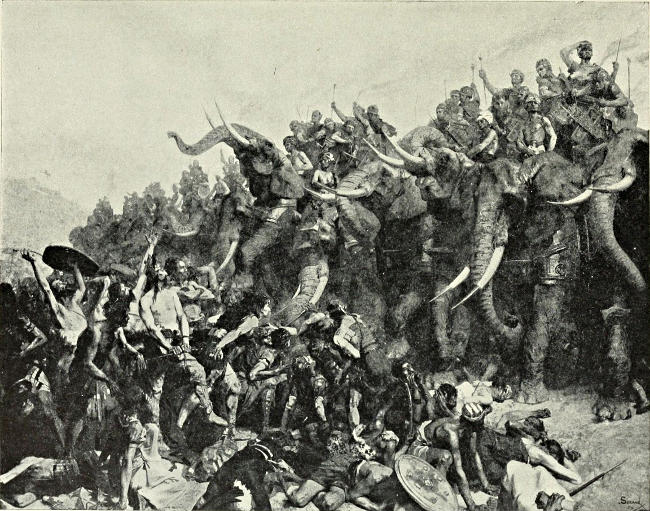
THE MASSACRE OF THE INSURGENTS BY HAMILCAR
This tranquillity was of no long duration. The success of their arms in
Sicily, and their newly acquired maritime power, encouraged the Romans
to cross the Adriatic, not so much for the purpose of advancing their own
dominion as to render a service to all who frequented these seas for the purposes
of traffic. The far side of the Adriatic, then called Illyricum, consists
of a narrow ledge of coast land flanked by parallel mountain chains. Many
islands appear off the shore, and several large creeks afford safe anchorage
for ships. These natural advantages made the Illyrians of the coast skilful
seamen. Their light barks (lembi) issued from behind the islands or out of
the creeks, and practised piracy on their neighbours.
Their main stronghold was Scodra (Scutari). In 231
B.C., Teuta, a woman of bold and masculine spirit, became
chief of this piratical race during the infancy of
her son Pinnes, and in 230 B.C. had made herself supreme
over all the islands except Issa, which she blockaded in
person in that year. The senate had not hitherto found
leisure to check the progress of these pirates. But in
the year just named, they sent C. and L. Coruncanius
as envoys to remonstrate with Teuta. But Teuta was
little disposed to listen to remonstrance. It was not,
she said, customary for the chiefs of Illyricum to prevent
their subjects from making use of the sea. The
younger Coruncanius, indignant at this avowal of national
piracy, replied that if such were the institutions of
the Illyrians, the Romans would lose no time in helping
her to mend them. Exasperated by this sarcasm, Teuta
ordered the envoys to be pursued and the younger one
to be put to death. The Romans at once declared war
against the Illyrians.
[235-229 B.C.]
After the surrender of Issa, the Illyrian queen
pursued her success by the capture not only of
Dyrrhachium, but also of Corcyra; and Demetrius,
a clever and unscrupulous Greek of Pharos
(a place on the coast of upper Illyricum), the
chief counsellor of Teuta, was made governor of
this famous island. The Epirots now sent ambassadors
to crave protection from Rome; and the
senate gladly took advantage of this opening.
Early in the next spring both consuls appeared
at Corcyra with a powerful fleet and army. Demetrius
quickly discerned to which side fortune
would incline, and surrendered Corcyra to the
Romans without a blow. This treachery paralysed
Teuta’s spirit; and Demetrius enabled the Roman commanders to overpower
her forces with little trouble. She was obliged to surrender the greater
part of her dominions to the traitor, who now became chief of Corcyra and
southern Illyricum, under the protection of Rome. The Illyrians were not to
appear south of Lissus with more than two barks at a time.
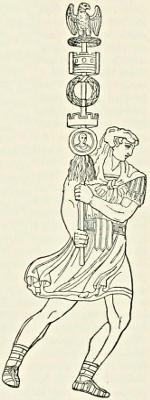
Standard Bearer
The suppression of Illyrian piracy was even more advantageous to the
commerce of Greece than that of Rome. The leading men of the senate
began, even at this time, to show a strong disposition to win the good
opinion of the Greeks, who, degenerate as they were, were still held to
be the centre of civilisation and the dispensers of fame. Postumius the
consul, therefore, sent envoys to various Greek states to explain the appearance
of a Roman force in those quarters. They were received with high
distinction. The Athenians and Corinthians, especially, paid honour to
Rome; and the latter people recognised her Greek descent by voting that
her citizens should be admitted to the Isthmian games (228 B.C.). This
short war was scarcely ended, when Rome saw a conflict impending, which
filled her with alarm.
It will be remembered that just before the war with Pyrrhus, the
Senonian Gauls had been extirpated, and the Boians defeated with great
slaughter in two battles near Lake Vadimo in Etruria (283 B.C.). From
that time the Gauls had remained quiet within their own boundaries. But
in 232 B.C., the tribune C. Flaminius, a man who will hereafter claim
more special notice, proposed to distribute all the public land held by Rome
on the Picenian and Umbrian coasts to a number of poor citizens; a law
which was put into effect four years afterwards. When the colonies of
Sena Gallica and Ariminum had been planted on that same coast, the Boians
were too much weakened by their late defeats to offer any opposition. But
in two generations their strength was recruited, and they were encouraged
to rise against Rome by the promised support of the Insubrians, a powerful
tribe who occupied the trans-Padane district about Milan. The arrival
of large bodies of Gauls from beyond the Alps completed their determination,
and increased the terror which the recollections of the Allia still
wrought upon the Roman mind. Report exaggerated the truth, and the
Romans made larger preparations for this Gallic war than they had made
against Pyrrhus or the Carthaginians. Active preparations were seconded
by superstitious rites. The Sibylline books were consulted, and in them
it was found written that the soil of Rome must be twice occupied by
a foreign foe. To fulfil this prediction, the government barbarously ordered
a Gaulish man and woman, together with a Greek woman, to be buried
alive in the Forum.
[229-223 B.C.]
The campaign opened in northern Etruria. The Gauls crossed the
Apennines into the vale of the Arno and fell suddenly upon the prætor
stationed with an army at Fæsulæ. Him they overpowered, and defeated
with great slaughter. The consul Æmilius now, with great promptitude,
crossed the Umbrian hills into Etruria; and on his approach the Gauls
retired northwards along the coast, wishing to secure their booty; while
Æmilius hung upon their rear, without venturing to engage in a general
action. But near Pisa they found that the other consul, Atilius, had landed
from Sardinia; and thus hemmed in by two consular armies, they were
obliged to give battle at a place called Telamon. The conflict was desperate;
but the Romans were better armed and better disciplined than of
old, while the Gauls had remained stationary. Their large heavy broadswords,
forged of ill-tempered iron, bent at the first blow, and while they
stooped to straighten them with the foot, they were full exposed to the
thrust of the short Roman sword. The victory of Telamon was as signal
as that of Sentinum or of Vadimo (225 B.C.).
The consuls of the next year (224 B.C.) again invaded the Boian country,
and received the complete submission of all the tribes on the left bank of the
Po. In the following year C. Flaminius, the reputed cause of the war,
was consul, and pushed across the Po, with the resolution of punishing
the Insubrians (Milanese) for the part they had taken in the invasion of
Etruria. The place at which he crossed the great river was somewhere
above Mantua; and here he formed a league with the Cenomani, who
were at deadly feud with the Insubrians. Assisted by these auxiliaries,
he moved westward across the Adda, the boundary of the Insubrian
district. At this moment Flaminius received despatches from the senate,
forbidding him to invade the Insubrian country. But he laid them aside
unopened, and at once gave battle to the enemy. He gained a signal
victory; and then, opening the despatches, he laughed at the caution of
the senate.
During the winter the Insubrians sued for peace; but the new consuls,
Cn. Cornelius Scipio and M. Claudius Marcellus, afterwards so celebrated,
persuaded the senate to undertake a fourth campaign. The consuls
both marched north, and entered the Insubrian territory. But Marcellus,
hearing that Viridomarus, the Insubrian chief, had crossed the Po to ravage
the country lately occupied by the Romans, left his colleague to reduce the
principal towns of the Insubrians, while he pursued the chief with his army.
He came up with him near Clastidium, and attacked him with his cavalry
alone. A smart action ensued, in which Marcellus encountered Viridomarus,
and slew him with his own hand; and the Gauls fled in disorder. Thus
were won the third and last spolia opima. Meanwhile Scipio had taken
Mediolanum (Milan), the chief city of the Insubrian Gauls, and the war
was concluded (221 B.C.).
Soon after this it was resolved, probably at the instance of Flaminius, to
plant two colonies, Cremona and Placentia, on opposite sides of the Po, so as
to secure the territory lately won in the Boian and Insubrian territories.
But the execution of this project did not take place till three years later,
when Hannibal was on his march. Some years afterwards we hear this
district spoken of as the province of Ariminum. Communication was secured
between Rome and Ariminum by a road constructed in the censorship of
Flaminius, which bore his name (220 B.C.).
During this great disturbance in Italy, Demetrius of Pharos proved as
false to his new patrons as he had been to Teuta. Relying on the support
of Philip, king of Macedon, he assumed the air of an independent chief,
and encouraged his subjects in their old piratical practices. In 219 B.C.
L. Æmilius Paulus, the patrician consul, received orders from the senate
to put a stop to these proceedings. In one short campaign he reduced
Corcyra, took Pharos, and forced Demetrius to take refuge at the court of
Philip, where we shall find him at a later time active in promoting hostilities
against Rome. Illyricum again fell into the hands of native chiefs; the
Romans, however, kept possession of the island of Corcyra, together with
the strong towns of Oricum and Apollonia—positions of great service in
the Macedonian Wars.
Thus triumphant on all sides and on all sides apparently secure, the Roman
government had no presentiment of the storm that had long been gathering
in the west. We must now return to Hamilcar.
[235-219 B.C.]
He crossed the straits of Gibraltar in 235 B.C. With him went his son-in-law
Hasdrubal, and his son Hannibal, then a boy of nine years old, but
even then giving promise of those qualities which afterwards made him
the terror of Rome. Hamilcar had not intended to take him to Spain;
but the boy pleaded so earnestly, that the father yielded on condition that
he should swear eternal enmity to Rome and the Romans. Hannibal himself,
in his old age, told the tale to Antiochus, king of Syria, how he was
led to the altar of his country’s gods, and took this direful oath. Nothing
can more strongly show the feelings with which Hamilcar left his country.
He went, not as the servant of Carthage but as the enemy of Rome, with
feelings of personal hostility, not to be appeased save by the degradation
of his antagonist.
His first object was to conquer Spain, and thus put Carthage in possession
of a province which might itself become a great kingdom, and was worth
many Sicilies and Sardinias. One of the chief advantages he proposed to
himself in this conquest was the supply of hardy soldiers, which would be
given by the possession of Spain. But he was well aware that for this
purpose conquest was not sufficient; he must enlist the feelings of the Spaniards
in his cause, he must teach them to look up to himself and his family
as their friends and benefactors. Accordingly he married a Spanish lady
of Castulo; he lived among the natives like one of themselves; he taught
them to work their rich silver mines; and in all ways opened out the resources
of the country. Meanwhile he collected and disciplined an excellent
army, with which he reduced many of the ruder tribes to the northward
of the modern Andalusia and Murcia. Thus he reigned (this is the best
word to express his power) with vigour and wisdom for eight years; and
in the ninth he fell in battle, admired and regretted by all southern Spain.
Hannibal was yet only in his eighteenth year, too young to take up the
work which his father had left unfinished. But Hasdrubal, the son-in-law
of the great commander, proved his worthy successor. He at once assumed
supreme authority. By the gentler arts of conciliation he won over a great
number of tribes; and in order to give a capital to this new realm, he
founded the city of New Carthage, now Carthagena, on the coast of Murcia.
The successes of Hamilcar had already attracted the notice of the senate;
and in the year 227 B.C., presently after his death, they concluded a league
with Hasdrubal, whereby the river Ebro was fixed as the northern boundary
of the Carthaginian empire in Spain. Hasdrubal fell by the knife of an
assassin in the year 221 B.C., the seventh of his command.
Hannibal was now in his twenty-fourth year. He was at once elected
by the acclamations of the army to stand in his great father’s place. Nor
did the government venture to brave the anger of a young general at the
head of an army devoted to his cause. Hannibal remained as ruler of Carthaginian
Spain. The office was becoming hereditary in his family.
Hamilcar had enlarged the Carthaginian rule in Spain from a few trading
settlements to a great province. Hasdrubal had carried the limits of
this province as far as the sierra of Toledo. Hannibal immediately crossed
this range into the valley of the Tagus, and reduced the Celtiberian tribes
which then occupied Castille. He even passed the Castilian Mountains
which form the upper edge of the basin of the Tagus, and made the name of
Carthage feared among the Vaccæans of the Douro, by taking their chief
town, Helmantica (Salamanca). At the close of the year 220 B.C., all Spain
south of the Ebro was in subjection to Carthage, or in alliance with her.
The great qualities of the three men through whom they knew her made
them not unwilling vassals.
[219-218 B.C.]
But there was one city south of the Ebro which still maintained independence.
This was Saguntum, an ancient colony from the Greek island of
Zacynthus. Its site on the coast of modern Valencia is marked by the present
town of Murviedro (Muri Veteres), rather more than halfway between
New Carthage and the mouth of the Ebro. Saguntum had been for some
time in alliance with Rome; and therefore, though it was on the Carthaginian
side of the Ebro, was by Roman custom entitled to support. In the
year 219 B.C. this city was at war with a neighbouring tribe, and Hannibal
eagerly accepted an invitation to destroy the ally of his enemy. He surrounded
Saguntum with a large army; but the people held out for eight
months with that heroic obstinacy which seems to distinguish all dwellers
on Spanish ground, when engaged in defensive warfare. In many respects
the siege of Saguntum brings that of Saragossa to mind.
While the siege yet lasted, the Roman senate had sent envoys to Hannibal,
requiring him to desist from attacking their ally. He replied coldly,
that “he could not answer for their safety in his camp; they had better
seek redress at Carthage.” They went on their way; but meantime the
news of the fall of Saguntum reached Rome, and an embassy was sent to
Carthage to demand that Hannibal, the author of the mischief, should be
given up. There was a large party, that of Hanno and the government,
which would probably have complied with this demand. But Rome was
hated at Carthage, and the government did not dare to oppose the general
feeling. They replied that Saguntum was not mentioned in the treaty
of Hasdrubal; even if it were, that treaty had never been ratified by the
government, and therefore was of no authority. Then Q. Fabius Buteo,
chief of the Roman envoys, doubling his toga in his hand, held it up and
said: “In this fold I carry peace and war: choose ye which ye will have.”
“Give us which you will,” replied the suffet. “Then take war,” said the
Roman, letting his toga fall loose. “We accept the gift,” cried the senators
of Carthage, “and welcome.”
Thus war was formally declared against Rome. But before we pass on
to the narrative of this war, it will be well to form some idea of the extraordinary
man who, by his sole genius, undertook and supported it with success
for so many years.
Hannibal was now in his twenty-eighth year, nearly of the same age at
which Napoleon Bonaparte led the army of the French republic into Italy.
And when we have named Napoleon, we have named, perhaps, the only man,
ancient or modern, who can claim to be superior, or even equal, to Hannibal
as a general. Bred in the camp, he possessed every quality necessary to
gain the confidence of his men. His personal strength and activity were
such that he could handle their arms and perform their exercises, on foot
or on horseback, more skilfully than themselves. His endurance of heat and
cold, of fatigue and hunger, excelled that of the hardiest soldier in the camp.
He never required others to do what he could not and would not do himself.
To these bodily powers he added an address as winning as that of
Hasdrubal his brother-in-law, talents for command fully as great as those
of his father Hamilcar. His frank manners and genial temper endeared him
to the soldiery; his strong will swayed them like one man. The different
nations who made up his motley arms—Africans and Spaniards, Gauls
and Italians—looked upon him each as their own chief.
Amid the hardships which his mixed army underwent for sixteen years
in a foreign land, there never was a mutiny in his camp. This admirable
versatility of the man was seconded by qualities required to make the general.
His quick perception and great sagacity led him to marvellously correct
judgment of future events and distant countries—which in those days,
when travellers were few and countries unknown, must have been a task of
extraordinary difficulty. He formed his plans after patient inquiry, and
kept them profoundly secret till it was necessary to make them known. But
with this caution in designing was united marvellous promptness in executing.
“He was never deceived himself,” says Polybius, “but never failed
to take advantage of the errors of his opponent.” Nor was he a mere soldier.
In leisure hours he delighted to converse with Greeks on topics of
intellectual cultivation. As a statesman, he displayed ability hardly inferior
to that which he displayed as a general.
Against these great qualities, he is said to have been cruel even to
ferocity, and treacherous beyond the common measure of his country. As
to perfidy, we hear of no single occasion on which Hannibal broke faith with
Rome. As to cruelty, there can be no doubt that he was indifferent to
human life; and on several occasions we shall find him, under the influence
of passion, treating his prisoners with great barbarity. But though he had
been trained to consider the Romans as his natural enemies, to be hunted
down like wolves, we shall find him treating worthy foemen, such as Marcellus,
with the magnanimity of a noble nature.
But whatever might be the ability, whatever the hardihood of the young
general, he required it all. To penetrate from the Ebro to the Po—with
chains of giant mountains to bar his progress, through barbarous and hostile
countries, without roads or maps or accurate knowledge of his route, without
certain provision for the food and clothing of his army, without the
hearty concurrence of his own government—was an undertaking from
which the boldest might shrink, and to have accomplished this march with
triumphant success would alone justify the homage which is still paid to
the genius of Hannibal.b
War was resolved upon and declared on both sides—a war which
stands forth in the annals of the ancient world without a parallel. It was
not a war about a disputed boundary, about the possession of a province,
or some partial advantage; it was a struggle for existence, for supremacy
or destruction. It was to decide whether the Greco-Roman civilisation
of the West or the Semitic civilisation of the East was to be
established in Europe, and to determine its history for all future time.
The war was one of those in which Asia struggled with Europe, like
the war of the Greeks and Persians, the conquests of Alexander the
Great, the wars of the Arabs, the Huns and the Tatars. Whatever
may be our admiration of Hannibal, and our sympathy with heroic and
yet defeated Carthage, we shall nevertheless be obliged to acknowledge
that the victory of Rome—the issue of this trial by battle—was the
most essential condition for the healthy development of the human
race.—Ihne.b
The war which began with the invasion of Italy by Hannibal lasted for
seventeen years. The periods of the war are four. The first comprehends
the victorious career of Hannibal, from the passage of the Alps to Capua.
Each year is marked by a great battle—Trebia, Trasimene, Cannæ (218-215
B.C.). The second is of five years, in which the Romans succeed in
recovering Capua, while they lose Tarentum (215-211 B.C.). The third, of
four years, in which Hannibal, left without support from home, is obliged
more and more to confine himself to the mountain regions of Calabria. It
ends with the disastrous battle of the Metaurus (211-207 B.C.). The fourth,
of four years, in which Hannibal stands at bay in the extremity of Italy, while
the main scene of the war shifts to Spain, Sicily, and Africa. It terminates
with the great battle of Zama, and peace (206-202 B.C.).
But during the former periods of the great war, the Roman arms were
also engaged in Spain, in Sicily, and in Epirus. From the very beginning of
the war they maintained the conflict in Spain. After 215 B.C. they were
obliged to besiege Syracuse and reconquer Sicily, as well as Sardinia. In
212 B.C. they declared war against Philip of Macedon, in order to prevent
him from sending aid to Hannibal in Italy.
The winter of 219 was passed by Hannibal in active preparation. His
soldiers received leave of absence, with orders to be present at New Carthage
at the very beginning of the next spring. He sent envoys into the south of
Gaul and north of Italy, to inform the Celts on both sides of the Alps of his
expedition to win the Transalpine Gauls with hopes of the plunder of Italy,
to rouse the Cisalpine by promises of delivery from the Roman yoke.
Thus assured, Hannibal reviewed his troops at New Carthage. The army
of invasion amounted to ninety thousand foot and twelve thousand horse,
with some fifty elephants. The infantry were mostly Spanish, the veteran
soldiers of Hamilcar and Hasdrubal, recruited by new levies of his own.
The Spaniards, however, were kept in balance by a large body of Libyan
mercenaries. The light infantry, slingers and archers, were from the Balearic
Isles. Of the cavalry, the heavy troopers were Spanish, while the light
horse were furnished by Numidia; and the whole of this arm was placed
under the command of the fiery Maharbal.
Hasdrubal, the brother of Hannibal, was left at New Carthage, to rule
the lately conquered province of Spain, and to raise an army of reserve for
the Italian war. Mago, his youngest brother, accompanied the general.
Having left New Carthage about the end of May, Hannibal marched
with no interruption to the Ebro; but as soon as he had crossed that river,
the whole country up to the Pyrenees was hostile. By great rapidity of
movement, though with the loss of many men, he reduced all the tribes to
submission in a few weeks, and, leaving an officer, with eleven thousand
men, in charge of this district, he pushed forwards to the Pyrenees. Here
his Spanish soldiers first discovered that they were to be led into strange
and unknown lands; discontent appeared in the camp; three thousand
Carpetanians, a tribe which had not been long conquered, seized their arms
and set off homewards. Upon this, Hannibal, with prudent frankness, called
the troops together, told them his whole design, and gave all who were
unwilling to go on, free leave to return. Nearly eight thousand more
availed themselves of this permission.
He passed round the eastern end of the Pyrenees, where the mountains
sink gently towards the sea, and halted his army for a few days at Ruscino
(Roussillon). On a review, it appeared that the losses he had sustained,
together with the twenty-two thousand men whom he had left in Catalonia
or who had gone home, had reduced his foot to fifty thousand, and his horse
to nine thousand. With this force he advanced almost unopposed to the
banks of the Rhone.
It is now time to inquire what the Romans were doing to meet the coming
danger. The senate had not been idle. But they had acted on the
supposition that the Second Punic War, like the First, would be fought on
foreign soil. It is almost amusing to contrast their expectations with the
result. The plebeian consul, Ti. Sempronius Longus, was sent to Lilybæum
with a large fleet, with orders to invade Africa: the other consul, P.
Cornelius Scipio, was to land in Spain and take the field against Hannibal.
And it is plain that the senate thought this service the least important of the
two, because they detained Scipio’s army rather than that of Sempronius, to
quell a rebellion which broke out in Cisalpine Gaul, in consequence of the
proceedings of the triumviri, who had been sent to distribute the confiscated
lands of the Boians and Insubrians among the colonists of Placentia and
Cremona. Just at this time the envoys of Hannibal arrived, and the Gauls
rushed to arms. To repress this outbreak, one of Scipio’s legions was sent
off in all haste, and the consul could not set sail for Spain till he had raised
a new legion. His troops met at Pisa, and he was just weighing anchor for
Spain when he heard that Hannibal had already crossed the Pyrenees.
On receiving this news, he put in at the allied city of Massilia (Marseilles),
and disembarked there, intending to arrest Hannibal’s march upon the
Rhone. He did not expect him there for some time yet, and therefore he
gave his army some days’ rest, while he despatched a reconnoitring party of
three hundred picked horse up the left bank of the river, under the trusty
guidance of the Massaliots.
But Hannibal had crossed the Rhone while these horsemen were on their
way up the river. The point at which he reached it was not far above
Avignon, about fifty miles from the coast. The river itself is large, and
the rapidity of its stream proverbial. But, besides these natural difficulties,
he found the left bank occupied by a large host of Gauls. Upon this, he
immediately made preparations for forcing the passage. After two days
spent in seizing boats and constructing rafts, he sent Hanno, son of
Bomilcar, with a strong detachment of cavalry, to cross the river about
twenty miles higher up, so as to come round upon the rear of the Gauls. On the
morning of the third day after his departure, Hanno signalled his arrival to
Hannibal by a column of smoke; and the Carthaginians immediately pushed
their boats and rafts into the stream. The Gauls flocked down to the
water’s edge, brandishing their arms and uttering wild yells of defiance.
But while the boats were in midstream, a cry arose from the rear; and,
looking round, the barbarians beheld their tents in flames. They hastened
back, and were charged by Hanno with his cavalry. Meanwhile, the first
divisions of the army, forming under the general’s eye, completed the defeat
of the Gauls; and for the remainder of
the day the Carthaginians lay encamped
in the enemy’s late quarters. All the
army, except the elephants, had effected
the passage. It was on this very day
that Scipio sent off his three hundred
horse from Marseilles.
On the next morning (the sixth after
his arrival on the Rhone) news reached
Hannibal that the Romans had landed.
Upon this he instantly despatched a body
of five hundred Numidian horse to reconnoitre,
while he himself spent the day
in preparations for bringing over the
elephants. At this moment, some Boian
and Insubrian chieftains arrived from
Italy to inform him of what their people
were doing and had done against the
Romans, and to describe in glowing colours
the richness and beauty of the land
which would welcome him after the toils
of the Alpine pass. This news had a
great effect upon the army, which was
somewhat dispirited by the opposition
offered by the Gauls upon the Rhone.
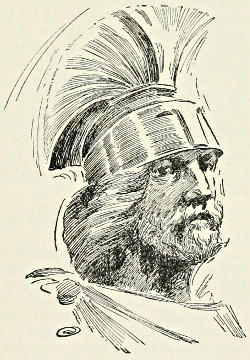
Hannibal
In the evening the Numidian horse galloped into camp in great disorder,
having lost half their number. At some distance a body of cavalry appeared
in pursuit, who reined in their horses on coming in view of the Carthaginian
camp, and then turned about and rode off down the river. This was Scipio’s
reconnoitring party, which had encountered the Numidians and defeated
them.
Hannibal, finding the enemy so near at hand, sent off the whole of his
infantry next morning to march up the left bank of the Rhone. He himself
only stayed till he saw his elephants, now about thirty in number, safely
across the stream; and then, with the elephants and cavalry, he followed
the army.
Scipio, on his part, so soon as he heard that the Carthaginians had already
crossed the Rhone, proceeded by forced marches up the river. But it was
three or four days after Hannibal’s departure that he arrived at the point
where the Carthaginians had crossed. It was in vain to pursue the enemy
into unknown regions, peopled by barbarous tribes; and Scipio had the
mortification to reflect that, if he had marched at once from Marseilles, he
might have come in time to assist the Gauls in barring Hannibal’s passage.
Not able to undo the past, he provided wisely for the future. He despatched
his brother Cneius to Spain with the fleet and the consular army, deeming
it of high importance to cut off communication between Hannibal and that
country; and himself returned to Pisa, to take command of the army which
had been left to suppress the Gallic insurrection. He expected to meet
Hannibal’s army shattered by the passage of the Alps, and to gain an easy
victory.
Meanwhile, Hannibal continued his march up the Rhone, and crossing
the Isère found himself in the plains of Dauphiné, then inhabited by the
Allobrogian Gauls. He marched thus far north, about one hundred miles
beyond the place where he had crossed the Rhone, at the invitation of a
chieftain who was contending for the dominion of the tribe with his younger
brother. Hannibal’s veterans put the elder brother in possession; and the
grateful chief furnished the army with arms and clothing, entertained them
hospitably for some days, and guided them to the verge of his own dominions.
This must have brought them to the point at which the Isère issues from
the lower range of the Alps into the plain, near the present fortress of
Grenoble. To this point there is little doubt as to the route taken by Hannibal;
but after this all is doubtful.c
Besides the fact that no modern historian can offer any better authority
than Polybius for this portion of history, no more brilliant and dramatic
account of the crossing of the Alps exists than his. We may then quote it
at length.a
Some Authors, who have writ of Hannibal’s passage over the Alpes, entertain
us with astonishing and incredible Tales of that Voyage, without heeding
that they have thereby committed two Errors, which History of all things
will not permit, for they are constrain’d thereby to coin Falsehoods of their
own, and often become liable to contradict themselves. For as they give to
Hannibal all the Encomiums of a great and valiant Leader; so at the same
time they make him act with the greatest Imprudence imaginable. Then
when they are taken in their own fabulous Snares, they are forc’d to bring
down the Gods and Demi-Gods to their Aid, who should not be nam’d
but in matters of Truth. Furthermore, they feign that the Alpes are so desart
and inaccessible, that far from being passable by Armies, Horses, and
Elephants, Men cannot without unspeakable travel pass them on foot. They
tell us farther, that some parts thereof are so waste and destitute of all Succour,
that without the Aid of some Divinity, who led Hannibal, as it were
by the Hand, through those wild labyrinths, he and his Army had inevitably
perish’d; these, I say, are two Faults in an Historian, which Men of common
Sense easily discover and dislike. For these Authors make Hannibal in the
spring of his Hopes at the head of a flourishing victorious Army, perform
such things as are not likely would be acted by a People already vanquish’d
and undone, and reduc’d to the last extremity; namely, to ingage their
Troops in Countries and Places totally unknown. For while they tell us all
was waste and desart, and the Country no where passable, do they not plainly
accuse their own Forgeries? But they knew not that the Gauls, who inhabit
about the Rhosne, had often pass’d the Alpes with numerous Armies,
long before Hannibal’s time; and not only heretofore, but of late days, they
had march’d to the relief of those Gauls who dwell about the Po, during
their Wars with the Romans. Furthermore, they were to learn that even
the Alpes themselves are inhabited by numerous Nations; but it was their
Ignorance indeed that brought the Demi-God down to show Hannibal his
way. Wherein they follow the Poets, who in their Tragedies, having for
the most part nothing but Fiction and extravagant Adventures for the subject
of their Plays, are able to bring nothing handsomely to pass without a
God or a Machine.
Most certain it is that Hannibal did not conduct his Affairs at the rate
these Authors would persuade, but like a wise and able Captain. And there
is no doubt, but he well knew that the Country, into which he was leading
his Army, was fertile and abounding in all things, and the Inhabitants alien’d
in their Inclinations to the Romans; that he had with him for Guides the
very People of the Country, who had engag’d to partake with him in all his
Fortunes. For my own particular, I speak of these things with so much
the more assurance, by how much I have not only been instructed therein by
those who liv’d in those Days, but that I might be less liable to errour, I
made my self a Journey into the Alpes for my better information.
Hannibal having march’d near an hundred Miles in ten days along the
River Rhosne, met with mighty difficulties after his Army had enter’d on
the Mountains; and in truth the Allobroges had no purpose to attack them,
while they held their March in the Plains, fearing both their Horse, and the
Gauls that accompany’d the Army. But these were no sooner gone, and
that Hannibal began to ascend the Mountains, when they drew together in
great numbers, and possess’d themselves of the Posts where Hannibal must
unavoidably March; and most assuredly, had they but kept themselves longer
conceal’d, the Carthaginian Army had run a mighty hazard; but being discover’d
by Hannibal, tho’ they did him some Mischief, they were requited
with equal loss. For Hannibal was no sooner inform’d, that the Barbarians
were Masters of the Passes, when he made his Army halt, and take their
Quarters that night among the Rocks and Fastnesses. In the mean while,
he dispatch’d a Party of Gauls, who serv’d him for Guides, to discover the
Posture of the Enemy, and learn what they could of their purpose. And
having understood that they kept Guard in those Places only by day, but
that in the night they retir’d to a Town not far off; he found this Expedient
to obviate the present Inconvenience: He decamp’d in broad day, and
by slow motions advanc’d with his Army; till arriving not far from the
Streights, he then encamp’d not far from the Enemy; and causing Fires to
be made in the Camp about the first Watch of the Night, where he left the
greatest part of his Troops, himself, in the mean while, with a Detachment
of his best Men, pass’d the Streights in the Night; and while the Enemy
was retir’d to the Town according to their Custom, took possession of those
Posts, where they were wont before to keep their Guard.
When day discover’d to the Enemy what had pass’d, they did not presently
determine what to do; but when they observ’d the great quantity of
Baggage that appear’d, and perceiv’d that the Horse could afford them no
succour, which by reason of the narrow, stony, and broken ways, could not
march but in defiles, they then resolv’d on the Attack. And now as the Barbarians
thus fell on them from all Quarters at once, the Way it self being
almost as terrible as the Enemy, the Carthaginians receiv’d great loss, especially
in their Horses and Beasts of Carriage; for the Way being streight,
stony, and broken, the Beasts of Burden were easily thrown down, and disorder’d,
falling into Precipices. But the Horses that were wounded gave
them the greatest trouble; for falling by their Wounds among the other
Beasts, and labouring to rise and recover their feet in so narrow a way, so
crowded, they cast down others by their striving to save themselves; which
was the occasion of great labour and tumult.
This being observ’d and consider’d by Hannibal, who well knew the Army
could not subsist without their Beasts of Burthen which carry’d their Necessaries,
he immediately left the Posts he had taken, and came to the relief
of those who were thus hard press’d in their passage; when falling on the
Enemy from higher ground, he did not fail of doing them great damage:
But the evil was, that his own People were thereby equal Sufferers; for the
fear encreasing everywhere by this new Tumult, many miscarry’d and were
lost in the Crowd; but, in the end, most of the Allobroges were slain on the
place, and the rest sav’d themselves by flight. And now their Horses and
other Beasts, after some time of rest, were led with great trouble and difficulty
through the Streight; but Hannibal, after he had escap’d this Danger,
march’d himself with a good Detachment against the Town, that had harbour’d
the Enemy, which he took without resistance, finding it almost quite
deserted, the Inhabitants being all gone out in hopes of Booty. This adventure
prov’d very useful to his Affairs, both with respect to the present and
the future: For he here recover’d many, both Men and Horses and other
Beasts, which had fallen into the Enemy’s hands, and Cattel and Corn sufficient
to sustain the Army for three Days.
But, above all, the terrour he had given by this success to the circumjacent
places was such, that none of the Gauls inhabiting the Towns near which he
was to pass, gave him the least molestation in his passage. In this Town
Hannibal took up his Quarters, where he remain’d a Day to rest and refresh
his Army, and then prosecuted his Journey. For three days together he
march’d without trouble or alarm; but the fourth he fell into much danger.
The People inhabiting in the Towns on the way he was to pass having secretly
conspir’d against him, met him however, with Olive-branches and Garlands
of Flowers, Signs among the Barbarians of Peace and Friendship, as the Caduceus
is among the Greeks. Hannibal, who had now learn’d how far he was
to trust these People, endeavour’d by Questions to inform himself of their
Purposes.
They told him, That they had receiv’d notice of his success against the
Town, and of the loss and defeat of those who had attack’d him in his
march; but as to themselves, they came to give him assurance, That they
were resolv’d to do him no injury, nor suffer any to be done to him by others:
And that they were ready to give him Hostages for their Fidelity. Hannibal
remain’d long undetermin’d what to do, having no great Opinion of their
Sincerity; but, in the end, weighing that to make a show of believing them,
might work on their Good-nature, and by degrees win them to his Friendship,
if he seem’d to accept their Tenders, and that in case of refusal, they
might presently become his Enemies, he feign’d to consent to their proposal,
and seem’d, as they did, dispos’d to enter into terms of Friendship with them.
In short, after these Barbarians had given him security for their peaceable
Behaviour, supply’d his Army with Provisions, and that they convers’d among
the Carthaginians with all manner of freedom and Confidence, Hannibal began
to have a better Opinion of their Sincerity, and accepted their Service for
his Guides through the many remaining difficult ways by which they were
to pass. Howbeit, after they had thus conducted the Army for two Days
together, they assembled at length all into one Body, and attack’d the Rear
at a Defile, or streight Passage, as they were marching in a Valley full of
Rocks and broken Ground.
Great likelihood there was that the Carthaginian Army had here run the
hazard of being entirely destroy’d, had not their General, who reserv’d a
secret doubt of the well-meaning of this People, obviated the mischief of this
treasonable Purpose of theirs, by ordering his Horse and Baggage to march
in the Van of the Army, and his choicest Foot to sustain the Reer. But having
dispos’d matters after this manner, his loss became less grievous; for his
Foot in the Arreer-guard prov’d sufficient to put a stop to the violence of the
Attempt. Nevertheless, they were not without great loss both of Men and
Horses; and the Enemy, who was possess’d of the Ground above them,
brought such terrour into the Army, by rowling down mighty Stones and
Rocks from the Precipices upon them, and showring Vollies of Stones on
their heads, that Hannibal was compell’d to take up his Quarters for that
Night on the top of an Eminence, expos’d to the open Sky, with that part of
the Army that was with him, remote from the Horse, and the rest of the
Troops, and the Baggage, the better to cover and defend them from danger;
who were hardly able, in all that Night, with great labour to compass their
passage through the Valley.
In the morning, the Enemy being now retir’d, Hannibal join’d his Army
and Baggage, and advanc’d towards the top of the Alpes. After this the
Gauls attempted no more to attack them in Bodies, but in smaller Parties,
and with less ardour than before; nevertheless, falling sometimes on the Van,
sometimes on the Reer of the Army, they seldom fail’d of making some spoil
of the Baggage. The Elephants happen’d to be of great use to the Carthaginians
in these Conflicts; for wheresoever they chanc’d to appear, they so
terrify’d the Enemy, that the Army march’d by that means with much less
molestation. In nine Days after this, Hannibal gain’d the top of the Mountains,
where he halted two Days, being willing to give some repose to such
of his Army as were come thus far without wound or sickness, and to attend
the coming of the rest of his Troops that were yet behind. During this stay,
many Horses and Beasts of Carriage, which had fallen and stray’d out of the
way, came in of their own accord, following the Track of the Army to
the great wonder of the Beholders.
But whereas the Snows were yet great in the Mountains (Winter not
being there quite over), Hannibal perceiving his Souldiers to be somewhat
discourag’d by reason of the Sufferings they had already felt, and out of
apprehension of what yet threatned them, caus’d the Army to be assembled,
to the end he might speak to them, and inspire them with new Resolution;
which he could no way better effect, than by giving them a view and prospect
of Italy; which, in a word, lies so fairly to the eye, spreading and extending
it self at the foot of those Mountains, that Nature seems to have
design’d them as a Rampart to cover and defend it. So he gave them a survey
of the Champaign Country that spreads it self all about the River Po;
and gave them to understand how welcome they should be to the People
that inhabited it. He pointed out likewise to them whereabout the City of
Rome stood; and by this Artifice animated his harass’d Army.
The Day following he decamp’d, and began to descend the Mountains;
and now saw no more of the Enemy to molest them in their march, saving
some small scatter’d Parties, who rather awaited occasions how to steal than
to fight. Howbeit, Hannibal’s Losses were not lessen’d, by reason of the great
Snows and the exceeding bad march they had had, which much weaken’d the
Army. Nor was their passage much better in the descent; for what with
the streight, steep, and slippery ways, and the depth of the Snow, the Soldier
knew not where to set his foot with safety; for whenever they slipp’d, they
were in danger of being lost and swallow’d up in the depths and precipices
which lay hid and cover’d by the Snow. Nevertheless, the long practice in
those Hardships and Dangers, taught them to suffer all with constancy: But
at length coming to a place where neither their Elephants nor Horses could
pass, the Way, which was very steep before, being now, by the falling away
of some of the Earth, become more difficult, renew’d their Fears; which was
manifest over the whole Army. Upon this accident, Hannibal took a resolution
to attempt another way, by taking a compass about those Mountains,
tho’ there was no appearance of any passage; but forasmuch as the great
Snows render’d that Resolution too hazardous, all places being cover’d and
hid from the view, he therefore chang’d his purpose.
In the interim, there having fallen much new Snow on that which remain’d
of the Winter before; this last being loose, and not yet deep, yielded
firm footing enough to the Soldiers; but this was no sooner trampled on,
but it dissolv’d into dirt and mire; whereby the Snow of last Year being
frozen under it, it became impossible to march thereon any more than on Ice
it self, none being able to keep their Feet; and when they endeavour’d to
sustain themselves on their Hands and Knees, they often slid and were lost
in Pits and Precipices. When their Horses at any time slip’d, they by their
weight and labouring broke the Ice under them, and so became buried and
frozen to death.
Whereupon Hannibal now desperate of obtaining his passage that way,
encamp’d his Army at the entrance of this Pass, after he had first order’d
the Snow to be remov’d which cover’d all the ground; and then by the
labour of his Soldiers he wrought into the Hill it self, and by unspeakable
pains made his passage at length through it: So in one Day he made way
for his Horses and other Beasts to pass, which immediately march’d on.
And now decamping the Army, he sent his Horse and other Beasts to forrage
and recruit themselves, as they could come at Pasture, where the Ground
was not cover’d with Snow. In the mean time he order’d the Numidians to
make a passage for the Elephants, which cost them three Days labour with
great difficulty to effect; but at length they made way for those Animals,
which had suffer’d much, and were almost dead with hunger. For there
was neither Forrage nor Tree to be found on that part of the Alpes, nor in
the neighbourhood; the Ground lying ever cover’d with Snow Winter and
Summer, but the lower Grounds on all sides produce Woods and Covert,
and there is no place thereabout that is not habitable.
After Hannibal had united his Troops, he prosecuted his march, and in
the space of three Days got past these difficult and incommodius Places,
whereof we have given an account, and recover’d the Plains, howbeit
with the loss of great numbers of his People; for many fell by the Enemy,
many were drown’d in passing the Rivers, and many of Sickness and the
Hardships of their march to and over the Alpes. And as he lost many
Men, so his loss of Horses and other Beasts of burthen, was yet much
greater.
In a word, after a march of five Months from his departure from New-Carthage,
and fifteen Days passage over the Alpes, he boldly advanc’d into
the Champaign Country, lying about the River Po, and the Frontiers of the
Insubrians. Of the Troops that march’d out with him, there now remain’d;
of Africans about twelve thousand; eight thousand Spaniards, and six thousand
Horse, according to his own Register, left by him, engrav’d on the
Column at Lacinium, which specify’d that number. About this time Publius
Cornelius, who had left his Troops with Cneius his Brother, to prosecute
the War against Asdrubal in Spain, embark’d for Pisa.d
[218-217 B.C.]
Hannibal descended among the mountains of the Salassians, and pushed
on into the friendly country of the Insubrians (Milanese), where he rested
his troops for some time, and procured fresh horses for many of his cavalry.
He rewarded the services of the Insubrians by marching against the hostile
tribe of the Taurini, whose capital city (Turin) he took by assault.
It was now December. He was moving down the left bank of the Po,
above its junction with the Ticinus, on the Piedmontese side of the latter
river, when his cavalry came in conflict with the Roman horse, commanded
by the consul Scipio himself.
Scipio had returned to Pisa, whence he moved northward to encounter
Hannibal on his descent from the Alps. He crossed the Po near Pavia,
made a bridge over the Ticinus to secure his retreat, and, crossing the latter
river, he began to march up the left bank of the Po, just as Hannibal was
coming down it. Both generals were in advance with their cavalry, and
came unexpectedly in sight of each other. A smart action followed, in which
the Romans had the worst. The consul was severely wounded, his life being
saved by the devotion of a Ligurian slave, or, as others said, by his son Publius,
afterwards the great Africanus, then a youth only seventeen years old.
He fell back upon his main body and recrossed the Ticinus so rapidly that,
in breaking up the bridge, he left six hundred men behind, who fell into the
hands of Hannibal. This was the skirmish of the Ticinus, which proved
Hannibal’s superiority in cavalry. It had the effect of making the Boian
Gauls on the south of the Po declare in his favour.
Hannibal, continuing his march down the Po, crossed somewhere below
Placentia; and Scipio, not finding his position near that town secure, fell
back westward so as to place the Trebia between himself and Hannibal. On
the left bank of this river he fortified a strong camp, with the purpose of
awaiting the arrival of his colleague Sempronius, whom the senate had
ordered to hasten from Sicily into the north of Italy. Hannibal followed
the Romans, and encamped in view of them on the right bank of the Trebia.
Here he received offers from a Brundusian, who was in charge of the Roman
magazine at Clastidium, a town in Scipio’s rear, to betray the place; and it
must have been while he was absent in this quarter that Sempronius joined
Scipio. Sempronius, not daring to sail direct from Sicily to Pisa at that
time of year, had sent his army over the Straits of Messana, with orders to
rendezvous at Ariminum; and so expeditious were they that they performed
the whole march from Lilybæum to Scipio’s camp in forty days. Scipio
endeavoured to dissuade Sempronius from venturing a general action, but
in vain; and being still confined by the consequences of his wound, he
was obliged to leave the whole army under the direction of his colleague.
Hannibal, for his part, was anxious for a battle. The Gauls began to complain
of the burden of two armies in their country, and victory was necessary
to secure them in his interest.
The Trebia is a mountain stream, which in summer runs babbling over a
broad gravelly bed, so shallow that the foot-traveller walks over it unheeding;
but in winter, or after heavy rains, it rises to a deep and rapid torrent.
It was now nearly the end of December, and Hannibal resolved that he
would not cross the water to attack the Romans, but would make them cross
it to attack him. He executed his purpose with great skill. On his left
there was a sort of gully, thickly grown with reeds and brushwood, in which
he concealed his brother Mago with one thousand foot and as many horse.
Then, early in the morning, he sent his Numidian riders across the river, and
ordered the whole army to prepare for the cold of the day by rubbing themselves
with oil and making a hearty meal.
As soon as Sempronius saw the Numidians cross the water, he sent his cavalry,
about four thousand strong, to meet them, and then drew out his whole
army, amounting to about thirty-six thousand men, to support the attack.
The Numidians feigned to be beaten and fled across the river. The Romans
pursued, but the water was running breast high and was deadly cold; sleet
was falling, which was driven in their faces by the east wind; and when
they reached the other side, they were half dead with cold and wet and
hunger. Their treacherous foes now opened on both sides and displayed
Hannibal’s infantry in battle order with the rest of the cavalry and the
elephants on either wing. The Roman cavalry, which was also on the
wings, was greatly outnumbered and soon put to flight; but the legions and
allies kept their ground bravely under all disadvantages till Mago rose from
ambush and attacked them in rear. Then the rout became general. A
body of ten thousand men, however, cut their way through the Carthaginian
lines to Placentia; the rest were driven back with great slaughter to the
Trebia, in which many were drowned, but a large number, with the consul
Sempronius himself, recrossed in safety.
The battle of the Trebia ended Hannibal’s first campaign. The two consuls,
with the relics of their armies, contrived to throw themselves into
Placentia and Cremona, and afterwards made good their retreat to Ariminum.
Sempronius had sent home a varnished account of the battle, but
the fatal truth soon betrayed itself. Two consular armies had been defeated;
Cisalpine Gaul was abandoned to the Carthaginians.
The senate, 217 B.C., made great preparations for the next campaign.
Sicily, Sardinia, and Tarentum were garrisoned against the Carthaginian
fleets; the new consuls were to keep Hannibal out of Roman Italy. The
patrician consul for the year was Cn. Servilius; C. Flaminius was the plebeian.
Flaminius, it will be remembered, had held this high office in 223
B.C., and had won a great battle over the Insubrian Gauls, in contempt of
the orders of the senate. As censor, he still dwells in memory for having
made the Flaminian way, the great high road from Rome through the Sabine
country to Ariminum. He had won extraordinary popularity by a sweeping
agrarian law to divide the coast lands of Umbria and Picenum among a number
of poor citizens. This was the man elected by popular favour to oppose
Hannibal—brave and generous, but adventurous and reckless. Fearing that
the senate might even yet bar his consulship by an appeal to the omens, he
left the city before the ides of March,[51] which was at that time the day for
the consuls to enter upon office. But no such attempt was made. Servilius
was sent to Ariminum to guard the Flaminian road; Flaminius himself took
post at Arretium to watch the passes of the Apennines.
As the spring approached, Hannibal was anxious to leave Cisalpine Gaul.
His friends the Insubrians and Boians, however much they wished to be relieved
from the Roman yoke, did not relish entertaining a large army. They
were proverbially fickle; and so much did Hannibal mistrust them, that, to
prevent attempts upon his life, he continually wore disguises, and assumed
false hair. Leaving the Roman colonies of Placentia and Cremona unassailed,
he passed the Apennines early in the year by an unfrequented route, which
brought him down into the neighbourhood of Pistoria and Lucca. From this
point eastward he had to march through the Val d’Arno, which was at that
time an unwholesome swamp. Here his men and horses suffered much;
he himself, being attacked by ophthalmia, lost the sight of one eye, and was
obliged to have recourse to the single elephant which survived the cold
of the Alps and a winter in the north of Italy. In the neighbourhood of
Fæsulæ he rested his army, now much increased by Gallic recruits, and
rewarded his men with the plunder of Etruria. Flaminius now found that
his dexterous enemy had stolen a march upon him, and Hannibal, on his part,
heard with delight the rash and adventurous character of the new consul.
Trusting to this, he led his army past Arretium, where Flaminius lay encamped,
and leaving Cortona on the left, passed on towards Perusia along
the northern side of Lake Trasimene. As soon as Flaminius found that the
Carthaginian had passed him in this disdainful way, he immediately marched
in pursuit.
As the traveller comes upon the northwestern corner of Lake Trasimene,
the road ascends a low ridge, now called Monte Gualandro. The broad lake
lies to his right and the road descends into a crescent-shaped plain, skirted
on the left by hills of some height, while between the road and the lake the
ground undulates considerably. After traversing this open space the road
passes the modern village of Passignano, and ascends a hill. This was the
ground Hannibal chose for awaiting Flaminius. He placed his Balearians
and light troops in ambush along the hills on the left; he himself, with his
infantry, lay in front somewhere near Passignano, while his cavalry were
ensconced in the uneven ground next the lake, ready to close upon the rear
of the Romans so soon as they were fairly in the plain. While the Carthaginians
were thus disposed, Flaminius was encamping for the night on the
Tuscan side of Monte Gualandro. In the morning a thick mist hung over
the lake and low lands, so that, as the consul advanced, he could see nothing.
Hannibal suffered the Roman vanguard, consisting of six thousand men, to
pass Passignano before he gave the signal for attack. Hearing the cries of
battle behind, the vanguard halted anxiously on the hill which they were
then ascending, but could see nothing for the mist.
Meantime the consul, with the main army, was assailed on all sides.
Charged in front by the Spanish and African infantry, on his right and rear
by the Gauls and cavalry, exposed on his left flank to the ceaseless fires of
the slingers and javelin-men, Flaminius and his men did all that brave men
could. They fought valiantly and died fighting. Not less than fifteen
thousand Italians fell on that fatal field. Such was the scene disclosed to
the soldiers of the vanguard when the mist cleared off. Hannibal now sent
Maharbal to pursue this division, which surrendered at discretion. Such of
them as were Romans or Latins were all thrown into chains; the Italian
allies were dismissed without ransom. Thus did Hannibal’s plan for the
conquest of Rome begin to show itself; he had no hope of subduing Rome
and Italy with a handful of Spanish and African veterans. These were to
be the core of a great army, to be made up of Italians, who (as he hoped)
would join his victorious standard, as the Gauls had already done. He had
come, he said, “into Italy, not to fight against the Italians, but to fight for
the liberty of the Italians against Rome.”
Such was the battle of Lake Trasimene. So hot was the conflict that
the combatants did not feel the shock of an earthquake, which overthrew
many cities of Italy.
Stragglers escaping from the slaughter carried the evil tidings to Rome,
and the prætor, unable to extenuate the loss, came into the Forum, where
the people were assembled, and ascending the rostra uttered the brief but
significant words: “We have been defeated in a great battle.” Dreadful
was the terror. The gates were thronged with mothers and children, eagerly
questioning the fugitives about the fate of their sons, and fathers, and kinsfolk.
Every hour Hannibal was expected. Three days passed and he
came not; but the news of a fresh disaster came. Cn. Servilius, the other
consul, as soon as he heard of Hannibal’s presence in Etruria, resolved to join
his colleague immediately, and sent on his horse, four thousand strong, as an
earnest of his own arrival. Hannibal, informed of their approach, detached
Maharbal with a division of cavalry and some light-armed troops to intercept
them, and half of the Romans were cut in pieces.
Amid the terror which prevailed the senate alone maintained their calmness.
They sat, without adjournment, to receive intelligence and deliberate
on measures of safety. It was resolved (an extraordinary measure) to call
upon the people to elect a dictator, the person recommended being Q. Fabius
Maximus, a man of known discretion; M. Minucius Rufus was also elected
as his master of the horse. Fabius consulted the Sibylline books, and
advised the senate to decree a “sacred spring,” according to the ancient
custom of the Sabines. Then, collecting the troops that had escaped, and
filling up their ranks by a new levy, he sent for the army of Servilius,
and thus with four legions and their auxiliary troops he prepared to take
the field.
Meanwhile the movements of Hannibal had relieved the Romans of all
immediate fear. It seems that he had little hopes of the Etruscans, for he
straightway passed northwards by the Flaminian road into Picenum, collecting
plunder from all the Roman settlements as he went. Here he lay quiet
during the heat of summer. As the weather became cooler, he advanced
along the coast of the Adriatic into Apulia, still plundering as he went.
The soldiers revelled in the abundance of Italy: it is said they bathed their
horses in wine. But the colonies of Luceria and Venusia, as of old, refused
entrance to the invader, and Hannibal passed the Apennines again
into lower Samnium, where Beneventum, also a colony, defied him like
the rest.
By this time Fabius had taken the field. He had made up his mind not
to risk a battle. His plan of campaign was to move along the heights, so as
to keep Hannibal in view, cutting off his supplies, intercepting his communications,
and harassing him in all ways without a general action. This
was not for Hannibal’s interest. He wished to fight another great battle
and win another great victory (the things were synonymous with him), in
order that the Samnites and Italians lately conquered might rise and join
him. It was no doubt with the purpose of provoking Fabius to a battle, or
of showing the Italians that the Romans dared not fight him, that Hannibal
descended from Beneventum down the Vulturnus into the rich Falernian
plain.[52]
Here dwelt Roman citizens; this was the garden of Italy: would not
the dictator fight to defend them and their country from the spoiler? No:
Fabius persisted in his cautious policy. He closed all the passes leading
from the plain, where Hannibal’s soldiers were now luxuriating, and waited
patiently, thinking he had caught the invader in a trap. But the wily
Carthaginian eluded him by a simple stratagem. Collecting the oxen of
this favoured region, he ordered fagots to be tied to their horns and lighted
as soon as it was night; and thus the animals were driven, tossing their heads
with fright and waving the flames, up the pass which leads from Teanum to
Allifæ. The troops who guarded this pass fled panic-stricken to the heights
of Mount Callicula, and
left free passage for
the Carthaginian army.
When morning broke
Hannibal was lying
safely encamped near
Allifæ. Thence he pursued
his devastating
course through the Pelignian
and Frentanian
lands, till he again
reached Apulia, and
there fixed on a strong
position near Geronium
for his winter quarters.
The place was warm and
sunny; corn and provisions
were abundant.
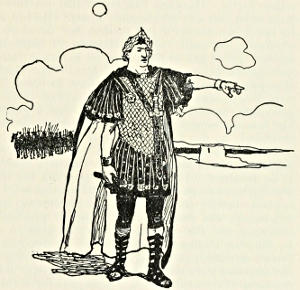
A Roman General
Fabius, however discomfited
by Hannibal’s
escape from Campania,
persisted in earning his
name of “The lingerer”;
and following
Hannibal as before, took post at Larinum, within five or six miles of the
enemy’s camp.
He was now recalled to Rome, ostensibly to preside over certain sacred
offices, but really to give an account of his conduct. He found the people
much discontented. He had been in command of two consular armies for
several months, and had done worse than nothing; he had allowed the
lands of the Roman colonists in Apulia and Samnium, the lands of Roman
citizens in Campania, to be wasted and spoiled before his eyes.
These discontents were fomented by Minucius, the master of the horse,
who had been left in command at Larinum. Though charged by the
dictator not to risk an action, he pushed his camp forward within two miles
of Hannibal, gained some advantages in skirmishing with the Carthaginian
foraging parties, and sent home highly coloured despatches describing his
successes. Popular feeling rose to its height, and Terentius Varro became
its mouthpiece. This man was a petty merchant by trade, the son of a butcher;
but he had been prætor the year before, and was now candidate for the consulship.
His eloquence was great; and he forced the senate to consent to a
law which gave Minucius an equal command with the dictator. Fabius
quietly gave up half the army to his late subordinate, and was soon repaid for
his moderation. Hannibal discovered the rash character of the new commander,
and drew him out to battle. Minucius would have been defeated as
utterly as Flaminius at Lake Trasimene, had not the watchful Fabius come
up; upon which Hannibal drew off his men and Minucius, acknowledging
Fabius as his deliverer, craved his pardon and resumed his post of master
of the horse. The whole army returned to its old quarters at Larinum.
[217-216 B.C.]
Thus ended the second campaign, not greatly to the satisfaction of
either party. Hannibal had hoped that ere this all southern Italy would
have risen like one man against Rome. He had shown himself her master
in the field; wherever her soldiers had dared to meet his, they had been
grievously defeated. He had shown all indulgence for Italian prisoners,
though he had put to the sword all Roman citizens. But not one city had
yet opened its gates to receive him. The Gauls of the north were the
only people who had joined him since he crossed the Alps. The Romans,
indeed, continued to suffer cruelly, and their ordinary revenues were
grievously curtailed. It was agreed that a great effort must be made in
the ensuing campaign; an overpowering force was to be brought against
Hannibal; he was to be crushed, if not by skill, by numbers.
When the day of electing the consuls came, out of six candidates C.
Terentius Varro alone obtained a sufficient number of votes in any tribe
to be returned. It is difficult to ascertain the true character of this man.
His vigorous eloquence had won the confidence of the people; but so much
is plain, that he was no general, and his election was esteemed a public misfortune
by the senate. Varro himself presided at the election of his
colleague, and the senate, anxious to provide an able general, put forward
L. Æmilius Paulus as a candidate. Paulus had shown his ability in his
former consulship, when he concluded the Illyrian War in a single campaign.
His manners were unpopular; but so earnestly did the senate represent the
necessity of the case, that he was returned without opposition.
These were the consuls elected to fight Hannibal. Their four legions were
to be added to the four which Fabius commanded just before; and these eight
legions were raised to more than their usual complement, so that the whole
army to be commanded by the consuls must, with the allied force, have
amounted to at least eighty thousand foot and more than six thousand horse.
In 216, the late consuls (Atilius had succeeded Flaminius), now serving as
proconsuls, moving from Larinum southwards towards Venusia, had busied
themselves with forming magazines at Canusium and Cannæ; and on the plain
near the latter place their camp was formed. Hannibal, as the spring advanced,
exhausted his supplies; and having by this time received recruits from Cisalpine
Gaul, he made a rapid movement and seized the Roman magazine at
Cannæ, encamping not far from that place, on the left bank of the Aufidus.
The proconsuls sent home word of this disaster, but received strict orders to
continue on the defensive till the consuls arrived to take the command. Yet
it was some time before this took place, certainly not till near the end of July,
for the great battle, which is now to be described, was fought on the second
of August,[53] and it was fought soon after the arrival of the consuls.
The consuls immediately moved the army to the neighbourhood of Hannibal,
with the intention of offering battle. But when Paulus observed the
open plain, he was desirous to put off an engagement, and manœuvre so as
to draw the enemy into ground less favourable for the action of cavalry.
Varro, however, thought otherwise; and now appeared the evil of both consuls
being joined in command of the same army. It was a repetition of the
arrangement which had answered so ill in the last years with Fabius and
Minucius; with this additional evil, that the consuls, instead of dividing
the army between them, took the command of the whole on alternate days.
The consuls were, by the constitution, equal, and Varro was far too confident
of success to give way to his more experienced colleague. Æmilius felt bitterly
the truth of Fabius’ parting injunction: “Remember that you will
have to oppose not only Hannibal, but also Varro.”
On the first day of his sole command, Varro moved the whole army to
the right bank of the Aufidus, between Cannæ and the sea, so that only the
river separated the Roman camp from that of the Carthaginians. Next day
Æmilius fortified a smaller camp on the left side of the river, fronting
Hannibal, so as to secure the passage of the river, but resolutely declined
battle. On the third day, however, when morning broke, the red standard,
which was the Roman signal for battle, was seen flying from Varro’s tent.
The men rejoiced at this; they were weary of their long inactivity; they
were confident in their numbers, and the resolution of their favourite Varro
was highly applauded.
When Æmilius found that a battle must be fought on the plain of Cannæ,
he did his best to support his colleague. The whole army was drawn up
facing nearly south, with the right resting on the river Aufidus. The
Roman cavalry, only twenty-four hundred strong, were on this right flank;
the left was covered in like manner by the cavalry of the allies. Æmilius
commanded on the right, Varro on the left; the centre was under the
orders of Servilius and Atilius, the proconsuls. It must be especially
observed that the legionaries and allied infantry were not drawn up, as
usual, in an open line, but with the ranks made deep and closed up almost
like the phalanx. It has been above observed how serviceable the phalanx
was on plain ground; and probably the consuls imagined that by these compact
masses of infantry they might offer a more complete resistance to the
formidable cavalry of Hannibal.
But Hannibal skilfully availed himself of this close array, and formed
his line accordingly. He had crossed the river early, as soon as he saw the
Romans in motion. The Spanish and Gallic infantry, much inferior in number
to the Romans, he drew out in an extended line, equal in length to that
of the enemy, but much less deep and massive. This line advanced in a
convex form, and at each end he placed his Africans, so as to form two flanking
columns of narrow front but great depth. He himself, with his brother
Mago, commanded the infantry. On his left flank, next the river, were the
heavy cavalry of Spain and Gaul, commanded by an officer named Hasdrubal,
not the brother of the general. On the right were the Numidian light horse,
under the orders of Maharbal.
After some indecisive skirmishing between the light troops, the real
battle began with a conflict on the river side between the Roman cavalry
and the horse of Hasdrubal. The latter were greatly superior in force, and
charged with such effect as to drive the Roman horse across the river.
Meantime the Roman legions, and their allied infantry, advanced steadily
against Hannibal’s centre. The long crescent-shaped line above described
was unable to withstand the shock. Nor had the general expected it. On
the contrary, he had instructed the centre so to fall back as to form a concave
figure, and then the whole line retired slowly, so as to draw on the
Roman masses between the African flanking columns. The Romans pressed
eagerly on the retiring foe; but as they advanced, the Africans attacked the
Romans on both flanks. The latter, jammed together, and assailed on both
sides, fell into great disorder, very few of their vast army being able to use
their weapons. But the consul, Æmilius, who had been wounded by a sling
in an early part of the action, contrived to restore some sort of order, and it
seemed as if the battle was not lost; when Hasdrubal fell upon the rear of
the legions and the rout became complete.
This able officer, after destroying the Roman cavalry, had led his heavy
horse round to the other wing, where he found the Numidians engaged with
the allied cavalry. The latter fled in confusion; and Hasdrubal, leaving
Maharbal to pursue them, made that decisive charge upon the rear of the
legions which completed the defeat of the Roman army.
Then the battle became a mere massacre. The Romans and allies, mingled
in a disorderly mass, were cut down on all sides. The consul, Æmilius,
fell. Varro, with but seventy horsemen, escaped to Venusia. Other parties
of fugitives made good their retreat to Canusium; some thousands took
refuge in the camps. But on the bloody field that evening, there lay dead,
at the lowest computation, more than forty thousand Roman foot and three
thousand horse. The loss in the cavalry involved the death of some of the
wealthiest and most distinguished men at Rome. With them had fallen one
consul, two proconsuls, two quæstors, one-and-twenty out of eight-and-forty
tribunes, and not less than eighty senators. All who had taken refuge
in the camp surrendered at discretion next day. Hannibal’s loss is variously
stated at from six to eight thousand.
This, then, was the battle of Cannæ. History does not record any defeat
more complete, and very few more murderous. The great army levied to
conquer Hannibal had been annihilated. The feverish anxiety with which
all men at Rome followed the consuls in thought may be imagined; those
who stayed behind in horrible suspense, flocked to the temples, offered vows,
consulted the auguries, raked up omens and prophecies, left no means untried
to divine the issue of the coming battle. What must have been the dismay,
what the amazement, with which they received the first uncertain tidings of
defeat! What the despair, what the stupor, which the dreadful reality
produced!
Among the fugitives who came in with the tidings, was a tribune of the
legions, Cn. Lentulus by name. As he rode off the field he had seen
Æmilius the consul sitting on a stone, mortally wounded. He had dismounted
and offered him his horse. But the consul replied, “No, my hours
are numbered: go thou to Rome, seek out Q. Fabius, and bid him prepare
to defend the city; tell him that Æmilius dies, as he lived, mindful of his
precepts and example.” To Fabius, indeed, all eyes were now turned. The
senate instantly met; and at his motion each senator was invested with the
power of a magistrate; they were to prevent all public lamentations; to
hinder the people from meeting in the Forum, lest they should pass resolutions
in favour of peace; to keep the gates well guarded, suffering no one to
pass in or out without a special order. Every one feared to see the army of
Hannibal defiling through the Apennines upon the plain of Latium.
What the Romans feared the Carthaginians desired. “Only send me
on,” said Maharbal to the general, “with the cavalry, and within five days
thou shalt sup in the Capitol.” But Hannibal thought otherwise. His army
was small; he was totally unprovided with materials for a siege; Rome was
strongly fortified. He felt that the mere appearance of his army before the
walls would rather rouse to action than terrify into submission; and meanwhile
the golden time for raising the Samnites and other nations of Italy
might be lost. Already he was in negotiation with the leading men at
Capua, a city second only to Rome in point of size, superior in wealth. To
this place he resolved to march as soon as his men were rested. When their
allies had deserted, Rome must agree to his terms, without giving him the
trouble of a siege.
He resolved, however, to try the temper of the Romans, and accordingly
sent ten of the chief men among his prisoners, with offers to hold all whom
he had taken to ransom. The senate, on the motion of T. Manlius Torquatus,
a man who had inherited the stern decision of his ancestor, refused
to admit the messengers to an audience, and ordered all to return, as they
had bound themselves, to Hannibal’s camp. Hannibal, greatly provoked at
this almost contemptuous reply to his advances, sold the greater part of his
prisoners into slavery. This was but the common custom of the times. But
besides this, he reserved the bravest and noblest youths to fight as gladiators
for the amusement of his army; and on their refusal he put them to death
by torture. The fact shows that in moments of passion Hannibal was too
justly liable to the accusation of barbarous cruelty.
The senate were now busily occupied in taking all steps possible for the
safety of Rome. The public horror was increased by a discovery that two
vestal virgins had been guilty of unchastity. One was, as the law directed,
buried alive; the other put herself to death. To avert the wrath of the
gods, Fabius Pictor was sent to consult the Greek oracle at Delphi; and by
the orders of the Sibylline books, a Greek man and woman and a Gallic
man and woman were buried alive in the Forum, according to the same horrid
practice used in the last Gallic War. But to these superstitious rites
were added wiser precautions. Fabius, with the coolness of age and experience,
continued to direct their measures. M. Claudius Marcellus, now
prætor, was sent to take the command of the fugitives in Apulia; for despatches
had arrived from Varro, stating that he had been joined by about
four thousand men at Venusia, and that about the same number had assembled
at Canusium under Appius Claudius, young P. Scipio (now about nineteen
years of age), and other tribunes. It was added that some of the
young nobles at Canusium, headed by a Metellus, had formed a plan to fly
from Italy and offer their services to some foreign prince, despairing of the
republic; that young Scipio had gone instantly to the lodgings of Metellus,
and standing over him with a drawn sword, had made him swear that neither
would he desert the republic, nor allow others to do so; that, to support the
noble conduct of Scipio, Varro had himself transferred his headquarters to
Canusium, and was using all his efforts to collect the remains of the defeated
army.
Having given up his command to Marcellus, Varro set out for Rome.
With what feelings he approached the city may be imagined. But as he
drew near, the senate and people went out to meet him, and publicly
thanked him, “for that he had not despaired of the republic.” History presents
no nobler spectacle than this. Had he been a Carthaginian general, he
would have been crucified.
The dictator ordered levies in Rome and Latium. But the immense
losses sustained in the three past years had thinned the ranks of those who
were on the military list. From the action on the Ticinus to Cannæ, the
loss of the Romans and their allies, in battle alone, could not have been less
than eighty thousand men. The dictator, therefore, proposed to buy eight
thousand slaves to serve as light troops; and also to enrol debtors, prisoners,
and other persons by law incapable of serving in the Roman legions.
Marcellus, with the remains of the army of Cannæ, took his post at Casilinum.
All commanders were instructed to keep to the defensive system of
Fabius, and on no account to risk another battle.
Meanwhile Hannibal had advanced through Samnium to Capua, where he
found all prepared to receive him. The senate, being in the interest of
Rome, was dismissed, and the chief power committed to a popular leader,
named Pacuvius Calavius. His first act was to seize on Roman residents
and put them to death; he then made an agreement with Hannibal that no
Carthaginian officer should exercise authority in Capua; and demanded that
three hundred Roman prisoners should be put into his hands as hostages for
the safety of three hundred Capuan knights who were serving in the Roman
army in Sicily. Hannibal agreed to these demands, and entered Capua in
triumph. One man only, by name Decius Magius, ventured to oppose these
measures. Hannibal treated him with magnanimous clemency, and contented
himself with sending him off to Africa.
All southern Italy had by this time declared in Hannibal’s favour.
Most of the Apulians, the Hirpinian and Caudinian Samnites, the Surrentines,
most of the Lucanians, the Bruttians, and all the Greek cities of the
south which were not held by Roman garrisons, welcomed him as their
deliverer. It seemed as if he were now about to realise his great project of
raising Italy in insurrection against Rome.
He was obliged to send detachments of his army into these several
districts; and he employed what small force he still retained in attempting
to gain possession of the cities in the plains of Campania. Nuceria, Acerræ,
and others submitted, as Capua had done. But Neapolis and Cumæ closed
their gates; and the senate of Nola, fearing that the people might rise
against them, as at Capua, sent for Marcellus to Casilinum. This bold
officer threw himself into the city, and by a successful sally repulsed Hannibal
from the gates. He then seized and executed seventy persons who were
suspected of treason, and entrenched himself strongly in a fixed camp near
the city. Hannibal, thus repulsed from Nola, determined to invest Casilinum,
which from its proximity to Capua was likely to prove a troublesome
neighbour.[54] The garrison held out obstinately, but were at length obliged
to yield. This was almost the only town in Italy which Hannibal took by
a regular siege.
Hannibal now went into winter quarters at Capua, in expectation of
receiving succours from home. Soon after the battle he had sent off his
brother Mago to carry home the tidings of his great success. For three
years he had pursued a career of victory unassisted by the government;
Rome was at his feet; he only wanted force enough to crush her. In proof
of the greatness of the victory of Cannæ, Mago poured out on the floor of
the senate-house a bushel of gold rings, which had been worn by Roman
knights who had fallen on that fatal field. But the jealous government,
headed by a Hanno, the mortal enemy of the Barcine family, listened coldly
to Mago’s words; they asked “whether one Roman or Latin citizen had
joined Hannibal? He wanted men and money; what more could he want,
had he lost the battle instead of winning it?” At length, however, it was
agreed that Mago should carry reinforcements to Hannibal. But the war in
Spain assumed so threatening an aspect, that these succours were diverted
to this nearer danger, and Mago was ordered to the support of his brother
Hasdrubal in that country. All that reached Hannibal was a paltry force
of four thousand Numidian horse, with about forty elephants, and a stinted
supply of money.
[216-215 B.C.]
Perhaps the general had not expected much from this quarter. No
doubt the person to whom he looked for chief support was his brother
Hasdrubal in Spain. But here he was doomed to disappointment. It will
be remembered that P. Scipio, the consul of the year 218, when he returned
from Marseilles to Pisa, had sent on his brother Cneius into Spain, according
to the original orders of the senate. The wisdom of this step was proved
by the event. Cn. Scipio landed at Emporiæ (Ampurias), an old Greek
colony. Within the year he had driven Hanno across the Ebro. In the
next year, the year of Trasimene, he defeated Hasdrubal by sea, ravaged
the coast up to the suburbs of New Carthage, and made large booty in one
of the Balearic Isles. P. Scipio joined his brother towards the close of
the same year; and when the battle of Cannæ made Hannibal master of
southern Italy, the two brothers had subdued all northern Spain.
Hannibal’s hopes, therefore, of reinforcements for the next campaign
rested with his new Italian allies. The additional cavalry and elephants
from Carthage would still give him the command of the open country. But
the Romans had learned wisdom by sore experience, and Hannibal could not
expect to win great victories, such as had marked his first three campaigns.
What he wanted was a good engineer corps and siege apparatus, to take the
Latin colonies and other free towns, which even in the districts that had
joined him still maintained the cause of Rome. Why he did not employ his
winter at Capua in organising a force of this nature we know not. But,
whatever was the cause, he was never able to take towns by force; and the
Romans never gave him an opportunity of winning another great battle.
Consequently all the Latin colonies and free towns remained faithful to
Rome, and Hannibal was only half master even of southern Italy.
The Romans, for their part, passed the winter[55] in the most active preparations.
The first step necessary was to fill up the numerous vacancies caused
in the senate by the late disastrous battles. It appeared, on calling over the
list, that not fewer than 177 members were missing. Sp. Carvilius proposed
to recruit the ranks of the senate by admitting the chief citizens of the Latin
towns. But this liberal proposal was not listened to, and it was resolved
to commit the whole business to the care of a dictator, specially appointed
for the purpose. The person chosen was M. Fabius Buteo, the same who
had been sent as chief ambassador to Carthage in the year 219 B.C. He
was an old man, universally respected, and the way he discharged the
duty laid upon him gave great satisfaction. The bravest and the worthiest
men were named as the new members. The consuls elected for the ensuing
year were Ti. Sempronius Gracchus, and L. Postumius, now prætor commanding
in Cisalpine Gaul. But before the ides of March came the sad
intelligence that Postumius, with all his army, had been cut off by the
Gauls. Fabius Maximus himself was elected consul for the third time, to
supply his place. Marcellus and Varro were to remain in command as proconsuls.
To add to the difficulties of the Romans, means were scanty to support
the vast expenses of the war; for the revenues of the whole of southern
Italy were cut off.
It must have been a further discouragement to find that Hannibal had
entered into negotiations with Philip, king of Macedon. The messengers
of the king were taken on their way to Capua. For the present, therefore,
the danger to be expected from this quarter was averted; but for the future
the prospect was made more gloomy.
Few things, probably, could mark the public feeling more than a law
which was passed in the next year at the instance of the tribune, Oppius,
by which it was forbidden that any woman should wear a gay-coloured dress,
or have more than half an ounce of gold to ornament her person, and that
none should approach within a mile of any city or town in a car drawn by
horses. Public need must be very urgent before it is possible to restrain
private expense by enactments so rigid as those of the Oppian law.
[215 B.C.]
The first period of this great war closed with the revolt of Capua. That
which now claims our attention ends with the recovery of that important city
by the Romans.
After the battle of Cannæ, Q. Fabius Maximus, great-grandson of that
Q. Fabius who won so high a name in the Second Samnite War, became for
some years the virtual chief of senate and people. He was already an old
man; more than seventy summers had passed over his head. His disposition
was so mild or so apathetic that he was known by the popular name of
Ovicula, or the lamb. His abilities seem not to have been great. His merit
was that he had the hardihood to avow that the Roman militia were no match
for Hannibal’s veterans, and the courage to act on his belief. The cautious
system which he had practised after the battle of Lake Trasimene had excited
discontent; but the great defeat of Cannæ had most unhappily vindicated
it. For some years it was rigorously carried out by commanders more skilful
in war than Fabius himself.
Of these coadjutors the ablest was unquestionably M. Claudius Marcellus,
who was called the Sword of Rome, as Fabius was called the Shield.
He also was past the middle age, being at this time more than fifty. In his
first consulship he had distinguished himself by a brilliant victory over the
Insubrian Gauls; and his name now stood very high, for having given the
first check to Hannibal in his career of victory. Marcellus was a true
Roman soldier—prompt and bold in action, resolute in adversity, stern and
unyielding in disposition, blunt and illiterate, yet not without touches of finer
feeling, as was proved at the siege of Syracuse. With him must be mentioned
Ti. Sempronius Gracchus, a man of humane and kindly temper,
and possessing high talents for command. Had he not been cut off so early,
he might have rivalled the fame of Marcellus.
Q. Fulvius Flaccus, who, like Marcellus, had already been twice consul,
disdained not for the two following years to act as prætor of the city. He
enjoyed the confidence of Fabius and the senate, and this office gave him, in
the continued absence of the consuls, the whole management of the home
government. He was not less than sixty
years of age, discreet and cautious as Fabius
himself, but more active, energetic, and relentless.
To carry out the defensive system of war
now adopted, the two consuls and a proconsul
were stationed in Campania, each with two
legions and their auxiliary cohorts. In the
present year Fabius took post on the Latin
road, between Cales and Casilinum; Gracchus
occupied the entrenched camp, which had
been formed by Marcellus near Sinuessa;
and Marcellus himself occupied a similar
camp near Nola. Thus these commanders
were always ready to harass Capua, and were
also able to make forays into Samnium,
Apulia, and Lucania whenever Hannibal was
absent. Their connection with the sea was
maintained by the great seaports of Naples
and Cumæ.
Hannibal, on the other hand, formed a
strong camp on the ridge of Mount Tifata
above Capua. But he was often obliged to
move his forces into the south, leaving the
Capuans to defend themselves. We have no
means of estimating the amount of Hannibal’s
army, but it may be inferred that it was
small; we never find him able to act in force
both in Campania and in the south.
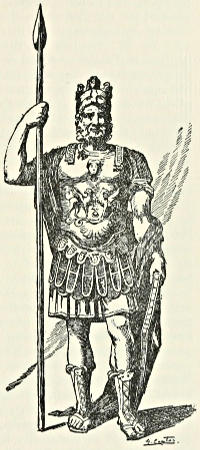
A Roman General
(Based on De Montfaucon)
He soon came in collision with the consul
Gracchus. This general was in his camp at
Sinuessa, busily employed in training two
legions of slaves, who, by the name of volones
or volunteers, served under his command.
Here he received information from the people of Cumæ that the Capuans
were coming to hold a festival near their city, and he was enabled to fall
upon the Capuans by night, and slaughter a great number. The news soon
reached Hannibal, who descended from his camp, only to find Gracchus safe
behind the walls of Cumæ.
While Gracchus was thus engaged at Cumæ, Fabius had occupied his
camp at Sinuessa, and Marcellus was making forays in the Samnite country.
The sufferers sent earnest appeals for defence to Hannibal, who now appeared
a second time before the walls of Nola, being induced by some of the popular
party, which in all the cities was hostile to Rome, to hope that the place
might be betrayed. But Marcellus made a well-timed sally, in which he cut
off a large body of the Carthaginian army; and Hannibal, again retiring in
disappointment, went into winter quarters at Arpi in Apulia.
[214-212 B.C.]
Returning spring (214 B.C.) found Hannibal again in his camp on Tifata,
and the same Roman commanders opposed to him. Fabius was still consul,
with Marcellus for his colleague; while Gracchus had taken the place of the
latter as proconsul. The circumstance of the election of these consuls deserves
noting, because it shows that the people had completely surrendered
their right of free choice into the hands of Fabius. The old consul purposely
halted in the Campus Martius, and held the election without having
entered the city, by which means he retained his imperium. The prerogative
century, which happened to be the juniors of the Aniene tribe, gave their
vote for M. Æmilius Regillus and T. Otacilius Crassus. Otacilius was a
nephew of Fabius, and had served as prætor in command of the fleet during
the current year, but without much credit. Upon this vote being given, the
old consul stopped the proceedings. “The republic,” he said, “was struggling
for existence; she was maintaining nearly twenty legions; and that
with revenues diminished and citizens thinned: what was the use of all her
exertions if she committed her armies to untried men? Therefore,” he concluded,
“go, lictor, call back the juniors of the Aniene tribe to give their
vote anew.” All men felt that the old man had not only power, but reason
on his side. The same century, which had voted for other men, now gave
their voices for Fabius himself and Marcellus.
At the same time the senate gave an earnest of their stern determination
by passing a decree that the soldiers of Cannæ should be sent to serve in
Sicily, without hope of honour and glory, till the end of the war. And the
censors, in the course of this year, summoned before them Metellus and
the others who had wished to desert the republic after the defeat of Cannæ,
and deprived them of their civic rights.
Early in this campaign, Hannibal was enticed from Campania by a message
sent from certain friends whom he had made within the walls of Tarentum,
and left Hanno to cover Samnium and Campania. Hanno seems to
have had hopes of surprising the Roman colony of Beneventum. But the
proconsul Gracchus threw himself into the town; “And now,” he told his
slave-soldiers, “now the time was come when they might win their liberty.
Every one who brought in an enemy’s head should be made free.” In the
battle which followed, victory was long undetermined; till Gracchus proclaimed
that without victory none should be enfranchised, but if they conquered,
none should remain a slave. Thus the desperate conflict was
determined in favour of the Romans, and Hanno, after great loss, made good
his retreat back into the Bruttian territory. Then Gracchus fulfilled the
promise made to his volones, and celebrated their enfranchisement by a
public festival, in which they all appeared wearing white caps in token of
liberty. So pleased was their commander with the scene, that he had a
picture painted to commemorate it on the walls of the temple of Liberty on
the Aventine Hill.
Hannibal, therefore, had the mortification to hear of this reverse, without
the satisfaction of succeeding in his own expedition. For M. Valerius
Lævinus, the Roman prætor stationed at Brundusium, being informed of the
plot to betray Tarentum, threw a strong garrison into the place under the
command of M. Livius, and the conspirators could not fulfil their promises.
The next year (213 B.C.) was still less fruitful in decisive events than
the two foregoing. That is, it was favourable to the Romans; for to Hannibal’s
cause inaction was fatal. And there are not wanting indications to
show that the Italians who had joined him began even now to falter in their
resolution, and to look with fearful eyes on the little progress he had made
since the battle of Cannæ, and on the tenacity with which the Romans kept
hold of every city. Arpi in Apulia, Hannibal’s late winter quarters, was
betrayed to Fabius the Younger, who was now consul, assisted by his father
as legate. The three hundred Capuan knights, who were in the service of
Rome at the time when their city threw itself into Hannibal’s arms, had
shown their disapprobation of this step by enrolling themselves as citizens
of Rome; and about this time one hundred and twelve more of the same
order came in to the Roman camp at Suessula. But out of Italy, Hannibal’s
skilful negotiations had raised up enemies to Rome wherever his envoys
could find an opening—in Macedonia, in Sardinia, in Sicily.
It has been mentioned that the first letters of Philip of Macedon to Hannibal
had been intercepted by the Romans; and through fear of an attack
from this quarter they had stationed Lævinus with a fleet at Brundusium.
A second embassy was more successful, and an alliance was concluded by
Hannibal with the king, by which the latter bound himself to send an auxiliary
force to support the Carthaginians in Italy. But Lævinus and his
successors carried the war into Epirus, and Philip was unable to send the
promised succours.
In Sardinia an insurrection broke out in the year after Cannæ. Q. Fulvius,
the city prætor, was ordered to provide for its suppression, with leave
to appoint any commander whom he thought fit. He straightway made
choice of T. Manlius Torquatus, a man as stern and uncompromising as himself,
who in his consulship twenty years before had first conquered the island.
The old general landed with little delay, and in one decisive battle completely
restored Sardinia to subjection.
Affairs in Sicily gave much more trouble. Indeed in the years 211 and
212 this island became the chief seat of the war. Hiero, the old king of
Syracuse, who for fifty years had never faltered in his alliance with Rome,
died soon after the fatal day of Cannæ. He was succeeded by his grandson
Hieronymus, a youth of fifteen years of age, whose imagination was captivated
by the brilliant career of Hannibal. The able Carthaginian soon
availed himself of the opportunity which thus presented itself to send over
agents, into whose hands the young prince completely surrendered himself.
These were two brothers named Hippocrates and Epicydes, Syracusan Greeks
by descent, but natives of Carthage. The young king, however, after little
more than a year’s reign, was assassinated by a gang of obscure conspirators;
a republic was proclaimed at Syracuse; and shortly after, all the remaining
members of the royal family were massacred with circumstances of singular
atrocity. The question now was whether the new government should side
with Rome or Carthage. The brothers, Hippocrates and Epicydes, at first
resolved to return to Hannibal; but they changed their plan, and pretending
to fall in with the views of the conspirators, were elected generals-in-chief
with several others. Yet the popular feeling seems to have inclined
towards Rome, and Hippocrates, unable to control it, contrived to leave
Syracuse with a body of troops, and repaired to Leontini, where he was
joined by his brother Epicydes. They then threw off the mask, and the
Leontines declared themselves independent of Syracuse.
This was probably late in the year 214 B.C. And about that time the
consul Marcellus arrived to take the command of the army in Sicily.
Marcellus, without delay, laid siege to Leontini, and took the town by
assault. He did what he could to spare the inhabitants; but he was guilty
of a piece of most imprudent severity in scourging and putting to death as
deserters two thousand of the garrison, who had once been in the service of
Rome. It appears that there were many soldiers of like condition now in
the Syracusan army. When they heard of the cruel death of their comrades
at Leontini, they lent a ready ear to the persuasion of Hippocrates and
Epicydes, who had escaped from Leontini, and turned the severity of Marcellus
to good account. These two adventurers were elected sole generals,
and Syracuse closed her gates against Rome. Marcellus made some fruitless
attempts at negotiation and finally commenced the siege of Syracuse.
The city of Syracuse had been greatly enlarged since the Athenian expedition.
The island of Ortygia had become the citadel, and the suburb along
the seacoast, called Achradina, was now part of the town. The rugged
triangular surface called Epipolæ was well fortified, and its northern
approaches, especially, were strongly defended by a fort called Hexapylum.
Marcellus at first attempted to take the city by assault. He himself
attacked the sea wall of Achradina, while his officers attempted to force
Hexapylum. The Romans were always famous for their skill in the attack
and defence of fortifications, and Marcellus was well provided with engines
of all kinds. But within the walls was an engineer more skilful than any
the Romans possessed. Archimedes, the most celebrated mathematician of
ancient times, was now seventy-five years old, but age had not quenched the
inventive vigour of his mind. He was so devoted to abstruse calculations
that sometimes he forgot even to take his meals; yet speculation had not
unfitted him for practical pursuits. Marvellous are the stories told of the
engines which he invented to thwart the assaults of the Romans, both by sea
and land. The whole wall was armed with ballists and catapults of immense
power, so that the ships dared not come within shot. If they ventured to
get close under the walls, favoured by the darkness of night, they were
galled by a fire from myriads of loopholes, and nearly crushed by enormous
stones let drop from the battlements; or one end of the ship was grasped by
an “iron hand” let down from a projecting crane, which suddenly lifted it
up, and as suddenly let it go, so that first one end and then the other was
plunged in the water. It is said also that burning-glasses of great power
were so placed as to set on fire ships which approached within their reach.
This is probably a fiction. But this much is certain, that Marcellus was
compelled to desist from his assault, and began to blockade it by regular
lines of circumvallation. After many months the Romans were as far from
taking Syracuse as ever.
Meantime, the Roman cause was daily losing ground in Sicily. Even
Morgantium, the headquarters of the fleet, surrendered to Carthage; and
Enna, a strong fortress, was only saved by the prompt cruelty of the commandant,
who massacred the whole of its inhabitants. But this barbarous
act, though efficacious on the spot, served still more to alienate the Sicilians
from Rome. Agrigentum surrendered, and numerous other towns threw off
the yoke.
[212 B.C.]
But there was treason within the walls of Syracuse. Marcellus at
length succeeded in scaling the walls of Hexapylum by night, when by
reason of a festival they were left unguarded. He soon gained possession
of the whole upper city; and as he gazed from the heights of Epipolæ on
the fair view beneath him, even his rude nature was so affected by the
beauty of the scene and the greatness of his success, that he burst into
a flood of tears. The southern quarters of the town surrendered; but
Epicydes, within Achradina, prepared for a desperate defence; and Hippocrates,
who had gone to obtain succours from Carthage, soon returned
with a considerable force. But Marcellus lay safe within the upper city,
and the army of Hippocrates, encamped on the marshy ground at the mouth
of the Anapus, was thinned by disease as the hot weather came on: among
the dead was Hippocrates himself. Still the sea was open, and a fleet was
daily expected from Carthage. At length it came in view; but the Roman
squadron put out to meet it, and great was the disappointment of Epicydes,
when he saw the Carthaginians bear away towards Italy. He left the city
secretly and fled to Agrigentum.
Many of the garrison were deserters from the Romans, who could expect
little mercy from the severe Marcellus. But the rest, when they found
themselves deserted by their general, slew their officers, and admitted
Marcellus by night within the walls of Achradina. Next morning, the
city was given up to plunder; and in the massacre which followed, Archimedes
was slain by a soldier, whose question he did not answer, being
absorbed in a geometrical problem. For the honour of Marcellus, it should
be recorded that he was deeply grieved by this mischance, that he gave
honourable burial to the corpse of the philosopher, and showed great kindness
to his relations. The royal treasure was reserved for the state; and
the exquisite works of the Grecian chisel which adorned the splendid city
were sent to Rome—a beginning of that system of plunder which enriched
Rome at the expense of Greece.
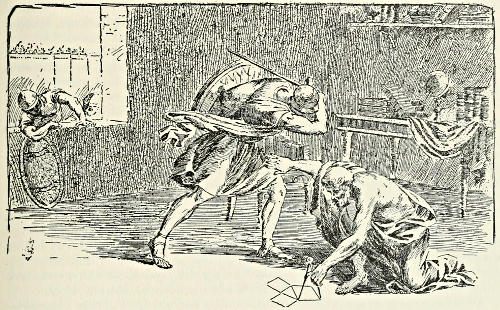
Death of Archimedes
(After Mirys)
Thus fell Syracuse, in the summer of 212 B.C., after a siege of nearly
two years. But though Syracuse was taken, Sicily was not conquered. It
will be well to anticipate events a little, so as to finish our narrative of this
war in this place.
[212-210 B.C.]
Epicydes, who had escaped to Agrigentum, continued his ceaseless activity,
and persuaded the Carthaginian government to send out another large
force to his aid. Hannibal also sent over an officer named Mutin or Mutton,
who henceforth became the soul of the war in Sicily. This man was a
half-bred Carthaginian; and the African blood in his veins degraded him as
much in the eyes of pure Carthaginians, as the taint of black blood degrades
a man in the United States. But his abilities as a soldier made Hannibal
overlook vain distinctions, and Mutin took the command of the Numidian
horse in the army of Hanno and Epicydes. With such skill did he use this
formidable cavalry, that Marcellus rather lost ground than gained it. But
the Carthaginian officers, jealous of the upstart commander, took occasion
to give battle to the Romans during his absence. Marcellus accepted the
challenge, and gained a signal victory (211 B.C.).
In the next year (210 B.C.) Valerius Lævinus took the command in
Sicily, where Mutin still continued to defy the Romans. But the jealousy
of the Carthaginians so provoked the hot-blooded African, that he put himself
at the head of his faithful Numidians, and threw open the gates of
Agrigentum to the Roman consul. Epicydes escaped to Carthage, leaving
the army an easy prey to the Roman legions. The town was sacked and
plundered, and the inhabitants reduced to slavery. And in a short time
Lævinus was able to send despatches to the senate, reporting the entire submission
of all Sicily. Mutin was made a Roman citizen, and received five
hundred jugera of state land. His Numidian horse took service with Rome.
It is now time to return to Italy, where also the war had resumed a more
active form. Early in 212 B.C. Hannibal once more marched southward to
Tarentum, and this time with better success than before. He encamped
at a distance of about three miles, and was constantly visited by two young
Greeks, who left the city under pretence of hunting. It was by the landward
side that the conspirators proposed to admit Hannibal; and the time
they chose was a night on which it was well known that M. Livius, the commandant,
would be engaged in a drinking bout. The Romans went to bed
in drunken security, and at daybreak found the city in the hands of the
Carthaginians. A great part of the garrison were put to the sword, but Livius
made good his escape to the citadel. Hannibal immediately took measures
for besieging it; and the Tarentines, having dragged their ships overland
from the harbour into the open sea, blockaded it both by sea and land.
Meanwhile the consuls—Appius Claudius and old Q. Fulvius Flaccus—were
preparing to besiege Capua. Gracchus, with his volones, was stationed
in Lucania; one prætor, Claudius Nero, occupied the old camp at Suessula;
another, Cn. Fulvius, brother of the consul, lay in Apulia. The Capuans,
fearing they should be cut off from all supplies, sent a hasty message to
Hannibal at Tarentum: and he straightway sent orders to provision the town,
in case it should be besieged. Hanno executed his difficult task with success;
but near Beneventum, the consuls fell upon him, and captured the supplies.
He was obliged to retire into Bruttium, and leave Capua to its fate.
The Roman armies now began to close round that devoted city. But
they were destined to suffer heavy losses before they were able to invest it.
First, Gracchus, who was coming northwards from Lucania, to reinforce the
consuls, was slain in an ambuscade, and his volones, so long faithful to their
favourite leader, dispersed and fled, each man to his own home. Next, Hannibal
himself once more appeared in Campania. He had already sent Mago
with a division of cavalry to encourage the Capuans; and now he entered
the city in person without the knowledge of the consuls. He was in high
spirits at his successes in the south. Not only Tarentum, but also Metapontum
and Thurii, had joined him; and though Syracuse had fallen, the war
was raging fiercely in Sicily. But the Roman commanders were cautious;
and Hannibal, finding he could not bring on a battle, was anxious to return
to press the siege of the citadel of Tarentum. He went by way of Lucania,
and on his route met a Roman army, commanded by M. Centenius, an old
centurion, who had collected an army, and with equal courage and folly
attempted to bar Hannibal’s march. He fell as a valiant soldier should fall;
and many thousand brave men paid the penalty of trusting to his promises.
Hannibal now passed the mountains into Apulia; and here, near Herdonea,
he surprised the prætor, Cn. Fulvius. He was like Centenius in rashness,
but unlike him in being a profligate and a coward. In this action also many
thousand Romans were cut to pieces.
But notwithstanding these thick-coming losses, the consuls held to their
resolution of blockading Capua. No sooner was Hannibal’s back turned
than they again appeared before the city; and before the expiration of the
year the lines of circumvallation were completed. The armies of Rome
always contained good workmen; their common agricultural habits accustomed
them to the use of the spade; the great works that had for some time
been going on, roads and aqueducts, had trained a number of men for military
work. Yet the rapidity with which the vast extent of lines necessary
to enclose a great city like Capua was completed, cannot but surprise us.
These lines were secured by a double wall, and care was taken to supply
the besiegers with provisions.
The consuls for the next year (211 B.C.) were not allowed to supersede
Appius and Fulvius: to them was left the glory of completing well what
they had well begun.
When the Capuans found themselves blockaded, their spirits fell, and
they again sent an urgent message to Hannibal. In an assault upon the
Roman lines, he was beaten off with loss. And now only one hope remained.
It was possible that, if he threatened Rome itself, the besieging army might
be recalled to defend the capital. Accordingly, he sent the Capuans notice
of his purpose by means of a pretended deserter, and the next morning the
proconsuls saw his camp on Mount Tifata empty. They thought, probably,
that he had returned to the south. But they soon discovered the truth from
country people, who came in full of horror to tell that Hannibal’s wild Numidians
and monstrous elephants were in full route for Rome. Fulvius sent
word to the senate of this fearful visitation; and the opinion of Fabius was
unanimously adopted, that one of the proconsuls should be recalled to defend
the city with part of his army and the city legions, while the other was left
to maintain the blockade of Capua. Accordingly, Fulvius marched straight
to Rome by the Appian road, while Hannibal took a circuitous route by the
north, to avoid the thick-studded cities which might have barred his passage.
Fulvius, therefore, arrived at Rome before Hannibal, and encamped within
a mile or two of the city. The consternation at Rome was in some measure
quelled by the arrival of Fulvius; and still more, when Hannibal himself,
after riding up to the Colline gate, and then skirting the walls, was attacked
by the old proconsul, and obliged to fall back upon his camp. It is said
that, while he lay there, the land occupied by his camp was put up to sale
and bought at a price not at all below its value. Hannibal laughed, and bade
an auctioneer put up the silversmiths’ shops in the Forum for sale. But
though he put a bold face upon the matter, he felt in his heart that he had
failed. Rome was able to defend herself, and yet had left a sufficient force
at Capua to continue the blockade.
The line of his retreat is as uncertain as that of his advance. It is known,
however, that he conducted his army through Apulia into Bruttium, which
became thenceforth his headquarters in Italy.
Meanwhile, Fulvius had returned to the lines round Capua, full of
exultation. Time wore on, and famine began to oppress the wretched
inhabitants. How long the desperate resistance was prolonged we know
not. But at length it appeared manifest that surrender must ensue within a
few hours; upon which Vibius Virrius, one of the insurgent chiefs, gave
a splendid banquet to all senators who would partake of it. Twenty-seven
came, and when the feast was over, a poisoned cup went round, in which the
guests pledged their host. They went home to die; and next morning the
city was surrendered. The savage old Fulvius determined to wreak a bloody
vengeance upon the leaders of the insurgents. Five-and-twenty were sent
to Cales, to Teanum eight-and-twenty, there to await their doom. In vain
Appius pleaded for milder measures. Fulvius heeded no intercession. On
the morning after the capture, he rode in person to Teanum, and saw all the
prisoners beheaded. He then galloped off to Cales; but when the prisoners
there were being bound, a messenger from Rome brought him letters from the
senate. He put them into his bosom, and ordered the executions to proceed;
nor till all the heads had fallen, did he open the letters, which contained
orders to reserve the prisoners for the judgment of the senate. Others of
the chief men were imprisoned, and all the commoner sort were sold into
slavery. The city itself was confiscated to Rome.
The fall of Syracuse and Capua had given a decided superiority to the
Roman arms. Yet, though Hannibal was at present so weak that he could
not leave the south, nor give effectual succour to his Campanian allies, there
were many causes to give him hopes of retrieving his fortunes. The diversions
made by Mutin in Sicily had proved most successful, and it was not till
a year later that the cause of Carthage in that island was betrayed. Though
the citadel of Tarentum still held out, that great city itself, with all Magna
Græcia, except Rhegium, had joined Hannibal: and he lived in hope that at
length Philip of Macedon would come over to oppose the common enemy.
Now also he looked with confidence to Spain. For a long time the
successes of the Scipios had cut off all hope of succour from his brother
Hasdrubal. The successes continued, notwithstanding the arrival of Mago
with reinforcements from Carthage; many of the Celtiberian tribes enlisted
under their banners, eager to try a change of masters; Syphax, a prince of
the Numidians, formed an alliance with them, and they seemed thus early to
have formed the design of carrying the war into Africa. In the year 212
B.C., the same which witnessed the fall of Syracuse and the investment of
Capua, the two brothers entertained high hopes of a successful campaign.
Cn. Scipio marched against Hasdrubal, the brother of Hannibal; Publius
directed his course against a second Carthaginian army, under Mago. But
the Celtiberians in the army of Cneius deserted: and the Roman proconsul
was in full retreat, when he heard that his brother Publius had been surprised
and slain with a great portion of his army. The united Carthaginian armies
now threw themselves on the retreating army of Cn. Scipio. He fell fighting
bravely, with most of his officers. The remains of the Roman armies were
collected by a brave knight, by name L. Marcius. But for the time the
defeat and death of the two Scipios gave back to the Carthaginians all that
they had lost in Spain since the departure of Hannibal.
The road now lay open for Hasdrubal to lead a large force to the assistance
of his brother in Italy. Notwithstanding his losses, no Roman general
had dared to meet him in a fair field of battle since Cannæ. What might
he not hope when largely reinforced? It belongs to the history of the next
period to show how irremediably these hopes were blighted.c
[210-209 B.C.]
The last year’s campaign was full of heavy discouragement to the Romans.
Syracuse had been taken; but Sicily remained in full revolt. Capua had
fallen; but Tarentum, all except the citadel, was lost. The unmolested
march of Hannibal to the walls of Rome showed that no part of Italy save
the fortified towns and entrenched camps could be called their own, so long
as the Carthaginian general could lead his wild and lawless mercenaries
whithersoever he pleased. The loss of Spain had placed before them the
dreadful possibility that their great enemy might soon be reinforced by
numbers so large as to make him stronger than he had been since he crossed
the Alps.
It is evident that mutterings of discontent were beginning to arise against
Fabius and his friends. The bitter lesson of Cannæ had taught the Romans
the necessity of caution, and proved that, to act with success against Hannibal,
they must act on the defensive. But was this system to last forever?
Were they never to meet Hannibal in the field? Thoughts like these, no
doubt, suggested the experiment of electing a popular consul for the year
210 B.C. When the votes of the prerogative century were taken, it appeared
that the men of their choice were old T. Manlius Torquatus, the conqueror
of Sardinia, and that same T. Otacilius who had been ousted from his consulship
five years before by his uncle Fabius. But Manlius immediately rose
and declined the consulship; he was, he said, “old and nearly blind: a
general should be able to use his own eyes. They must choose other and
better men.” The century, after some hesitation, obeyed, and gave one of
their votes for Marcellus, as no doubt Fabius and the senate wished, while
they bestowed the other upon M. Valerius Lævinus, who had served the
state well in Epirus.
Valerius probably owed his choice to the fact that he was not disposed
to submit to Fabius and Fulvius. An opportunity soon arose for showing
this. As he passed through Capua on his way to Rome, the Campanians,
smarting under the rule of Fulvius, besought him to let them follow in his
train, that they might lay their grievances before the senate; and when he
arrived at Rome, he was greeted by a deputation of Sicilians, who had heard
with alarm that the imperious Marcellus was about to return to their
island with consular authority. The affairs of both peoples were brought
before the senate. As to the Campanians, the fathers confirmed in all
respects the stern edicts of Fulvius; and not unjustly, for of all cities
Capua had been most generously treated by Rome: her rebellion had been
prompted, not by love of liberty (for she was already free) but by lust for
power. Capua, therefore, now became a prefecture. On the other hand,
Marcellus at once gave up his Sicilian province to his colleague Lævinus,
and agreed to take the command in Italy against Hannibal; and the senate,
though they ratified the previous measures of Marcellus, now recommended
the Sicilians to the special care of Lævinus. Upon this, the Sicilian envoys,
fearing the future anger of Marcellus, fell at his feet and entreated him to
take them as his clients. For many years the Marcelli, his descendants, are
found as patrons and protectors of the island.
Before the consuls took the field, they were called upon to meet the financial
difficulties under which the state was labouring. The force which had
been maintained by Rome now for many years was very large, and the cost
enormous. The number of legions kept on foot since the battle of Cannæ
had averaged about twenty; so that the number of soldiers, legionaries and
allies, amounted to nearly two hundred thousand men. While the expenditure
was thus prodigiously increased, the revenues were greatly diminished;
and it is a recorded fact that about this time corn had risen to many times
its ordinary price. Although the imposts had been doubled early in the
war, the state was obliged to contract loans in various ways. An extraordinary
measure was now taken for manning the fleets. All citizens, except
the poor, were required to furnish one or more seamen, with six months’
pay and their full accoutrements. Senators were called upon to equip
eight, and the rest in proportion to their rated property. Such was the
Roman “ship-money.”
The necessities of the present year (210 B.C.) were greater than ever.
Every resource seemed to be exhausted. Among other means, the coinage
had been gradually lowered in value. The as, which had originally been a
pound weight of copper, had now been diminished to one-sixth of that
weight; and all payments for the treasury were no doubt made in this depreciated
coinage. The usual results of such measures had followed. A
temporary relief was gained. But the prices of all articles were raised to
meet the change, and public credit was shaken.
In these difficulties, the senate proposed again to levy ship-money. But
the people were in no mood to bear it. They had been much impoverished
in the last four years—continued increase of taxation had drained their
resources; continued service in the army had prevented the proper cultivation
of their lands; the marauding march of Hannibal in the year before
had ruined many. The ferment caused by this new impost assumed a
formidable appearance. The senate met to deliberate, and the consul Lævinus
proposed that the great council should set an example of patriotic devotion.
“Let us,” said he, “contribute all our treasure for the service of the
state. Let us reserve—of gold, only our rings, the bullæ worn by our
sons, and for the ornaments of our wives and daughters one ounce apiece:
of silver, the trappings of our horses, the family salt-cellar, and a small
vessel, for the service of the gods, of copper, five thousand pounds for the
necessities of each family.” The proposal was carried by acclamation, and
the noble example followed emulously by all the people. So eager was the
throng which pressed to the treasury that the clerks were unable to make a
full register of the names. This patriotic loan (for it was intended that it
should be repaid hereafter) saved the state; and it was even more valuable
in the spirit which it called forth, than for the actual relief which it afforded
to the treasury.
The consuls now took the field. Marcellus arrived in Samnium only to
hear that Cn. Fulvius Centumalus, the last year’s consul, had shared the
fate of his namesake and predecessor, Cn. Fulvius Flaccus, and had been
cut off with the greater part of his army. The relics of this force were
sent to be added to the remains of the army of Cannæ, which the relentless
senate still kept in banishment in Sicily. Marcellus cautiously advanced
to Venusia, and so dogged Hannibal’s footsteps that he was unable
to strike another blow. The town of Salapia in Apulia—where lived a
lady whom Hannibal loved too well and who is said to have more than
once detained him from the field—was betrayed to Marcellus, as Arpi
had been to Fulvius, and was another example of the altered feeling of the
Italians.
Lævinus, as has above been mentioned, was enabled by a stroke of good
luck to finish the war in Sicily with ease and credit; and he returned to
Rome accompanied by the redoubtable Mutin. Before he left Sicily he had
sent over his fleet to examine the coasts of Africa. The officer despatched
on this service learnt that the Carthaginian government were actively engaged
in collecting troops to be placed under Hasdrubal’s command for a
second invasion of Italy from the north; he immediately forwarded this
intelligence to the consul at Rome. The senate in alarm ordered Lævinus
to return instantly to his province without waiting to preside at the comitia.
He was to name a dictator for that purpose, and the person submitted to
him for nomination was old Q. Fulvius, the governor of Capua. Lævinus,
however, refused to name his personal enemy, upon which the ruling party
referred the matter to the people, who peremptorily ordered the consul to
name Fulvius, and no one else. But Lævinus, to avoid this necessity, had
already left Rome, and the fathers were obliged to send for Marcellus to
execute their orders. When the old dictator held the comitia, the prerogative
tribe gave its vote for Fulvius himself and Fabius. An objection was
taken by two of the tribunes, that a presiding magistrate could not allow
himself to be elected. But this, like many other ordinances was overruled
at this critical season by the senate, and the election proceeded. The next
year was to see Hannibal confronted with the three men reputed to be the
ablest commanders in Rome—Fabius and Fulvius the consuls, and Marcellus
as proconsul. It was hoped that by their united efforts the enemy might
be crushed before the arrival of Hasdrubal and his Spaniards.
But the result was not equal to expectation. In the very outset of this
year (209 B.C.) the levies were delayed by a circumstance which looked even
more threatening than the financial difficulties of the previous year. The
Latin colonies, now thirty in number, have been mentioned as the chief stays
of Roman power in the subject districts of Italy. They had hitherto borne
the toils and expenses of the war unrepiningly. What then was the alarm
of the consuls and the senate, when twelve of the thirty openly declined to
comply with the requisition to furnish their contingents for the armies of
this year. The refusal was due in part no doubt to exhaustion and
poverty; but it was partly caused by anger at the fact that most of the
defeated soldiers of Centumalus lately banished to Sicily were citizens of
their towns. The consuls endeavoured to reason with them, but in vain;
and when the deputies of the other eighteen colonies, which comprised all
the largest and most important places, declared their steadfast and unaltered
allegiance, they determined to pass the matter over for the present, saying
that they would not deign to ask assistance from those who would not give
it willingly.
[209-208 B.C.]
To provide for the current expenses a large treasure of gold, which had
been reserved for the emergency of another Gallic war, was now first invaded.
Fulvius resumed his station at Capua, Marcellus was to engage Hannibal’s
attention in Apulia, while old Fabius made an attempt to recover Tarentum.
Marcellus found his enemy at Canusium, and a series of indecisive
actions followed, in which (although the Roman annalists claim the advantage
for their hero) it is plain that he must have suffered greatly, for he
remained inactive during the rest of the campaign. But fortunately for
Fabius’ attempt upon Tarentum, Hannibal’s presence was required in Bruttium
to defend his allies from a band of free mercenaries, who, formerly in
the service of the Carthaginians in Sicily, had now been engaged by Lævinus,
and sent to Rhegium to harass their old masters. The appearance of the
great general was enough to scare these marauders into submission, but
scarcely was this done, than he heard the news that Fabius had invested
Tarentum. Instantly he put his army in motion, and marched day and
night to relieve this important city. But he was too late. By treachery he
had won the place, and by treachery he lost it. The officer in command at
Tarentum was a Bruttian. This man had a mistress, sister to an Italian
serving in the army of Fabius; she it was who persuaded him to open the
gates to the consul, and Hannibal, while yet upon his march, heard this disastrous
news. The old consul gave up the despised city of the Greeks to be
plundered by his soldiers, reserving the public treasure for the service of
the state. But when he was asked whether he would have the statues and
works of art taken to Rome, after the example set by Marcellus at Syracuse,
“No,” he said, “let the Tarentines keep their angry gods.” The capture of
Tarentum was the greatest exploit of Fabius, and it was his last—an honourable
close to an honourable career.
Besides the recovery of Tarentum, the Samnites and Lucanians, long
wavering, again returned to their allegiance, and were restored by Fulvius
to their position as allies, without any notice being taken of their revolt.
Notwithstanding this, men were dissatisfied with the result of the campaign.
Three consular armies had not sufficed to defeat Hannibal; Marcellus,
reputed their best general, had done nothing. But the party who
murmured against Fabius and his friends were as yet feeble. Very lately
Lævinus had been compelled to relinquish his opposition; and when Marcellus
appeared to give a narrative of his services, all men’s hearts were
turned, and not only was he forgiven freely, but was even elected consul for
the ensuing year (208 B.C.). His colleague was T. Quinctius Crispinus,
who had served under him in Sicily.
The defection of the Italians had no doubt weakened Hannibal, and the
two consuls determined to throw themselves upon him with their conjoint
force. They found him near Venusia, and every day they drew out their
forces before his camp and offered him battle. But the odds were too great
even for Hannibal, and he kept close within his entrenchments. It happened
that between his camp and that of the consuls there was a hill, which
Marcellus thought it desirable to occupy. Accordingly he rode up to the
top, accompanied by his colleague and a small detachment of cavalry, unconscious
that a large body of Numidian horse were lurking in the woods below.
In a moment the consuls were surrounded. Marcellus was run through by
the spear of one of these wild horsemen, and fell dead from his horse; Crispinus
escaped mortally wounded to his camp. As soon as Hannibal heard
of this great stroke of good luck he hastened to the scene of conflict, and
saw with his own eyes his ablest antagonist lying dead before him. His
conduct proved the true nobility of his nature. He showed no triumph;
but simply drew the gold ring from the dead man’s finger, saying: “There
lies a good soldier, but a bad general.” He then ordered the corpse to receive
a soldier’s burial. Like his father Hamilcar, he warred not with the
dead, but with the living.
Great was the consternation at Rome when intelligence of this untoward
event arrived. The consul Crispinus lived just long enough to be carried in
a litter to Capua, where he was on Roman ground, and could therefore execute
the command of the senate to name a dictator. He named old Manlius
Torquatus. But no attempt was made to molest Hannibal again this year.
Torquatus only exercised his office in holding comitia for the election of new
consuls. The occasion was a grave one. Never before, since the beginning
of the republic, had she been bereft of both her consuls at one blow. But
in order to understand the full importance of the choice now to be made, it
must be mentioned that Hasdrubal, the brother of Hannibal, had already set
out upon his march from Spain, and in a short time might be expected to
arrive in Italy.
[211-208 B.C.]
All notice of the Spanish War since the death of the two Scipios has purposely
been deferred. Here it will be enough to say, that soon after that
event, the senate, well understanding the importance of maintaining the war
in Spain, had endeavoured to retrieve their losses in that quarter; and in
211 B.C. young P. Scipio, the hero of the latter part of the war, had accepted
the dangerous command left vacant by his father and uncle. In the next
chapter notice will be taken of his splendid successes during the three years
which had passed. But these successes had not served to divert Hasdrubal
from his purpose. This general had collected an army of tried soldiers,
which he skilfully carried through the heart of Spain, and, crossing the
Pyrenees near Bayonne, entered Gaul by the pass which is now threaded
by the high-road from Paris to Madrid. By this dexterous movement he
eluded the vigilance of the Romans, who knew not whither he was gone.
But towards the close of the present year news came from the friendly
people of Marseilles, to the effect that Hasdrubal had arrived in Aquitania,
and intended wintering in Gaul, as the season was too far advanced for the
safe passage of the Alps.
[208-207 B.C.]
Such were the grave circumstances under which Torquatus summoned
the people to elect consuls for the year 207 B.C.
It might have been thought that the ablest patrician to be found was
M. Valerius Lævinus, who was still in Sicily. Not only had he restored
that province to order, but had laid in large stores of provisions for the
Italian armies, and had assisted in other ways in lightening the expenses of
the war. But the senate distrusted him: they had not forgotten the contumacious
way in which he had quitted Rome, rather than name a dictator
at their bidding. They therefore turned their eyes on C. Claudius Nero,
a man of known energy, who had served now for many years under Fulvius
and Marcellus. He had been sent to Spain at the first news of the disasters
there, and remained in command till the appointment of young Scipio. All
men agreed that Nero should be the patrician consul. But who was to be his
plebeian colleague? Marcellus was dead, and Gracchus was dead; and Fulvius
was nearly as old as Fabius.
At length it was resolved to choose M. Livius Salinator, a man who was
also well stricken in years, for he had been consul with Æmilius Paulus in
the year before Hannibal’s invasion, and had triumphed with him over the
Illyrians. But he had been accused of unfair division of the spoil taken in
that Illyrian War, and had been condemned to pay a fine by the vote of all
the tribes save one. Indignant at an unjust sentence, he had withdrawn to
his estate in the country, and had only lately reappeared in the senate at the
command of the censors, but when there, he sat in moody silence, till at
length he started up to speak in defence of his kinsman Livius, the commandant
of Tarentum, who was accused of having lost that city. On this
occasion Fabius’ conduct had not been conciliatory. For when it was
urged in defence of the accused that he had mainly assisted in recovering
the city, Fabius dryly remarked that
he did not wish to condemn Livius:
certainly he had assisted in recovering
Tarentum, for if he had not lost it, it
would not have been recovered at all.
These recollections rankled in the
heart of the old senator; and he refused
the proffered consulship. Here,
however, he yielded to the command,
rather than the entreaty of the Fathers.
But one difficulty remained. The
cross-grained old man was at feud with
his colleague Nero; and when friends
tried to reconcile them, he replied that
he saw no occasion for it: if they
remained enemies, they would keep a
keener watch for each other’s faults.
At last he gave way, and before they
took the field the consuls were in perfect
agreement.
A Roman Helmet
They hastened early in the year to
their respective stations, Nero to take
the command in southern Italy, against
the feeble army of Hannibal; Livius to Ariminum on the frontier of Cisalpine
Gaul, to await the arrival of Hasdrubal.
As soon as the season permitted, Hasdrubal advanced from his winter
quarters to the passage of the Alps. He avoided the coast-road taken by
his brother, and passed through the country of the Arvernians (who have
left their name in French Auvergne), and thus came straight to the point
where the Rhone and Isère meet, so as to take the same route over the
mountains which had been pursued by his brother eleven years before. The
time of year was favourable: in the period which had elapsed the Gauls had
become better acquainted with the Carthaginians; and Hasdrubal achieved
his passage into Italy with little loss or difficulty. He straightway marched
through the plains of Cisalpine Gaul to the banks of the Po, where the
Roman colony of Placentia, one of the eighteen lately found faithful, had
before defied the arms of Hannibal. Hannibal had not wasted time in assailing
this town; but Hasdrubal probably wished to oblige the Gauls, whom
he expected to swell the numbers of his army. For hitherto they had not
given Hannibal much assistance. In the eventful year of Cannæ they had
cut off the consul-elect Postumius, and still drank mead out of his skull.
But since then they had remained quiet; and Varro, with a single legion at
Ariminum, had sufficed to watch them. And now they seem to have given
Hasdrubal indifferent support, so that the time he spent at Placentia must
have been nearly thrown away.
Before he left his lines at Placentia, he sent off six couriers, four Gauls
and two Numidians, to inform his brother of his intended route. Hannibal,
meantime, had been constantly on the move—marching from Bruttium into
Lucania, from Lucania into Apulia, from Apulia again into Bruttium, and
then once more back into Apulia. We cannot but admire the skill with which
he eluded Nero, who pursued him with a double army of four legions. Yet it
was one of these marches that accidentally proved the ruin of his cause. The
couriers despatched by Hasdrubal from Placentia made their way into Apulia,
but unfortunately arrived just when Hannibal was absent in Bruttium.
They attempted to follow him, but missed their way, and fell into the hands
of the prætor stationed on the Tarentine frontier. That officer immediately
sent off the despatches found upon them to Nero at Canusium. An interpreter
was procured, and the whole plan of the enemy’s campaign was
revealed to the consul. Hasdrubal told his brother that he intended to
advance along the Adriatic, by way of Ariminum, and proposed that they
should join forces in Umbria, in order to march upon Rome. Nero’s determination
was soon taken. Legally, he had no power to quit his district in
southern Italy, but in this emergency he resolved to set all forms at defiance.
He picked out six thousand foot and one thousand horse, the flower of his
army, and gave out that he would march at nightfall on a secret expedition
into Lucania. As soon as it was dark, he set out; but the soldiers soon discovered
that Lucania was not their destination. They were marching northwards
towards Picenum, and they found that provisions and beasts of burden
were ready for them all along the road, by the consul’s orders. As soon as
he was well advanced upon his march, he addressed his men, and told them
that in a few days they would join their countrymen under Livius in his
camp at Sena Gallica in Umbria; that combined they would intercept Hasdrubal
and his invading army; that victory was certain; that the chief share
of the glory would be theirs. The men answered such an address as soldiers
should; and everywhere, as they passed, the inhabitants came out to meet
them, pressing upon them clothes, victuals, horses—all, and more than all,
that they could want. In a week’s time they accomplished a distance of
about 250 miles, and found themselves within a short distance of Sena. Nero
halted till it was dark, that he might enter his colleague’s camp unperceived
by Hasdrubal.
Nero had previously written to the senate, informing them of his march,
and urging them to throw forward a strong force to defend the defile through
which the Flaminian road passes at Narnia, in case the consuls should be beaten
by Hasdrubal. Answers had reached him, fully approving his bold design,
and promising all support. It was, therefore, with full confidence that he
entered his colleague’s camp, and beheld the watch-fires of Hasdrubal at not
more than half a mile’s distance in front. His men were warmly greeted by
their comrades, and received within the camp of Livius, that Hasdrubal might
not observe the increase of the army. After one day’s rest, Nero urged immediate
action, lest his absence from Apulia might be discovered by Hannibal,
or his presence in Umbria by Hasdrubal. Accordingly, the two legions of
Livius, the two commanded by the prætor Porcius, together with Nero’s
troops, drew out before Hasdrubal’s camp and offered battle. The experienced
eye of the Carthaginian was struck by an apparent increase of numbers;
and his suspicions were confirmed, when he heard the trumpet sound
twice in the consuls’ lines. This convinced him that Nero had joined his
colleague, and full of anxious fear as to the fate of his brother, he determined
to retreat under cover of night; and when the next day broke, they
found Hasdrubal’s camp deserted. Orders were given to pursue. The
Romans came up with the Carthaginian army on the banks of the Metaurus,
about twelve or fourteen miles north of their former position. The river
was swollen by rains, so that the Carthaginians could not pass it except at
certain places; and, their guides having deserted them, they could not find
the fords. Hasdrubal, therefore, was obliged to give battle with the river in
his rear.b
[207 B.C.]
Hasdrubal was in all respects dissatisfied with the state in which things
appeared. But as it was now too late to take other measures, because the
Romans were already formed, and beginning to advance towards him, he
was constrained to draw up the Spaniards, and the Gauls that were with
him, in order of battle. He placed the elephants, which were ten in number,
in front; increased the depth of his files; and ranged his whole army upon
a very narrow ground. He then took his post in the centre of the line,
behind the elephants; and moved to attack the left of the enemy; having
before determined that in this battle he would either conquer or die.
Livius, leading on his troops with a slow and haughty pace, began the
combat with great vigour. But Claudius [Nero] who commanded on the
right, was unable to advance so as to surround the enemy; being utterly
obstructed by those difficulties of the ground which have before been mentioned,
and which had determined Hasdrubal to make his whole attack upon
the left. Anxious therefore, and not willing to remain inactive, he had
recourse to the measure which the occasion itself suggested to him. For
having drawn away his troops from the right, he led them round the field
of battle; and, passing beyond the left of the Roman army, attacked the
Carthaginians in flank behind the elephants. To this moment the success
of the battle had remained doubtful. For both the Carthaginians and the
Romans, well knowing that they had no hopes of safety but in victory,
maintained the fight with equal bravery. The service also, which the
elephants performed, had been the same to both. For these beasts, being
enclosed between the two armies, and wounded by the darts, spread no less
disorder among the ranks of the Spaniards, than among those of the Romans.
But when Claudius [Nero] fell upon the enemy from behind, the engagement
was no longer equal. The Spaniards, pressed at once both in front
and rear, were almost all slaughtered in their ranks. Six of the elephants
were killed, together with the men that conducted them; and four, which
had forced their way through the disordered ranks, were afterwards taken,
but without their leaders. Hasdrubal, who had so often distinguished
himself upon former occasions, displayed no less courage in this last action,
and fell in the battle.
The Romans, as soon as they had gained the victory, pillaged the camp
of the enemy. Finding many of the Gauls drunk, and sleeping upon their
straw, they slaughtered them as victims without resistance. The prisoners
were then collected together; and from this part of the booty more than
three hundred talents were brought into the public treasury. Not fewer
than ten thousand Gauls and Carthaginians fell in the engagement; and
about two thousand of the Romans. Some of the Carthaginians that were
of eminent rank were taken alive; the rest were destroyed in the action.c
At Rome, as may be well imagined, the news of Nero’s march had filled
all hearts with hope and fear. And now, after some ten days of intense
anxiety, vague rumours came that a battle had been fought and won. Still,
men feared to believe what they wished; and the anxiety rose higher and
higher, till the officer in command at Narnia sent home despatches to say
that two horsemen had arrived at that place from the field of battle with
certain news of a great victory. So eager were the people, that the prætor
had great difficulty in preventing the despatches from being seized and torn
open before they had been read in the senate. And when he brought them
out from the senate house, and read them publicly from the rostra, a burst
of exultation broke from every tongue; and men, women, and children
thronged to the temples to bless the gods for their great deliverance.
Thanks were decreed to the consuls and their armies; three days were
appointed for a public thanksgiving to the gods. Never was public joy and
gratitude more deserved. The battle of the Metaurus was the salvation of
Italy; and Horace spoke with as much historic truth as poetic fervour when
he said that “then, by the death of Hasdrubal, then fell all the hope and
fortune of Carthage.”
The news was conveyed to Hannibal in a barbarous fashion. Nero had
returned to his camp at Canusium as speedily as possible, and his lieutenants
had kept the secret so well that Hannibal had remained ignorant of his
absence; when one morning a grisly head was thrown into his camp, and
Hannibal knew the features of his brother. Two prisoners sent in, and a
large body paraded before the Roman camp, confirmed the dismal forebodings
of the general, and he said with a heavy heart that “the doom of Carthage
was spoken.” This treatment of his brother’s remains was an ill return for
the generosity shown by Hannibal to the corpses of his opponents; and
Nero, by this act, forfeited all claim to admiration, except such as must be
bestowed on a skilful general and a resolute man.
Hannibal now retreated into Bruttium. The people of this wild country,
still nearly as wild as it was then, clung to his fallen fortunes with unshaken
fidelity. Here he maintained himself for four years longer, almost more
admirable in adversity than in prosperity. Even now no Roman general
was able to gain a victory over him; even now every veteran soldier
remained faithful to his great leader. But he was driven into a corner, and
stood like a lion at bay—still terrible, but without hope. The war in Italy
may now be considered at an end.
The victory of the Metaurus was held to be an occasion for allowing a
triumph to the victorious generals. No triumphal procession had passed
down the Sacred Way and ascended to the Capitol since Æmilius Paulus
and Livius Salinator had led up the captive Illyrians in the year before
Hannibal’s invasion. All former successes in the war had been but the
recoveries of losses, all except the capture of Syracuse; and Marcellus was
refused a full triumph then, because he left the Sicilian War unfinished.
But now there was no drawback. The two consuls met at Præneste, and
advanced with the army of Livius and the captives in long procession to the
temple of Bellona, in the Campus Martius. Here they were received by
the senate and people in festal array. Livius appeared in the triumphal
car drawn by four white horses, attended by his army; Nero rode on horseback
beside him unattended: for the battle had been fought in Livius’
district. Yet all men turned their eyes on the patrician consul, and the
acclamations of the crowd showed to whom belonged the true honours of
the triumph.
Notwithstanding these honours, Nero (strange to say) was never again
employed during the war; and it was not till the Neros became heirs of the
empire of Augustus that poets sang of the debt which Rome owed to that
name. A star was appearing in the west which soon eclipsed the brightness
of Nero’s fame. The remaining period of the war will be little more than a
history of the deeds of Scipio.
[210-207 B.C.]
The history of the war in Spain has been left almost unnoticed, since the
death of the two Scipios in 212 or 211 B.C. It is now time to return to that
country; for the issue of the war between Rome and Hannibal was in reality
determined on Spanish soil.
After the disasters of that campaign, the senate determined to despatch
reinforcements without delay; and the officer appointed to take the temporary
command was C. Claudius Nero, the future hero of the Metaurus.
But the senate resolved to take the unusual course of calling upon the
people to elect a proconsul for Spain at the great comitia. The policy of
continuing the Spanish War was manifest; but the risk of failure was so
great, that the senate thought fit to throw the responsibility upon the people.
But when the day came that candidates for the proconsulate should
present themselves in the Campus Martius, no candidate appeared. Men
looked at one another in blank dismay. It seemed that none of the soldiers
of the republic dared to undertake so great and hazardous an enterprise;
when, to the surprise and admiration of all, P. Cornelius Scipio, son and
nephew of the slain proconsuls, arose and offered himself to the suffrages of
the people. He was barely twenty-six years of age; but his name and
character were well known, and though he had hitherto held no office higher
than that of ædile, he was elected by acclamation.
Scipio presents in almost all respects a striking contrast to the men who
had hitherto conducted the affairs of Rome in the Second Punic War. They
were far advanced in years, cautious and distrustful; he was in the prime
of youth, enterprising and self-confident. They had been trained in the
severity of the old Roman discipline; he is said to have been dissolute in
early years, and was still thought to affect too much the easy laxity of Grecian
manners. They were strictly obedient to the letter of the law; he was accustomed
from his very youth to put himself above the laws and customs
of Rome. They always acted as the faithful ministers of the senate; he
very soon showed that the senate must be content to follow his policy,
rather than guide it. They, however, gentle to their countrymen, were to
foreigners harsh, arrogant, and cruel; he treated foreigners with a humanity
and courteousness that made his name better loved in Spain than in Italy.
Yet in some respects he was a true Roman. Notwithstanding the excesses
charged upon his youth, he had long learned to control his passions absolutely,
and to submit every desire to his own views of duty. Notwithstanding
the grace and affability of his manner, he preserved a loftiness of
deportment which kept men at a certain distance from him. Few shared
his intimacy; but where he gave his confidence, as to his friend C. Lælius,
that confidence was complete and unreserved.
One point in his character calls for particular attention—the religiousness
of his life. Never, from his first appearance in public, had he been
known to undertake any enterprise without first resorting to the great
temple on the Capitol, and remaining there for hours absorbed in devotion.
The religion of Scipio might not be consistent; yet, on the whole, it would
be unjust to doubt that he acted in reliance on the support of higher powers.
In this lies the secret of his character. That self-confidence, which prompted
him to shrink from no responsibility, led him also to neglect the laws, when
they seemed to oppose what he thought necessary. Every incident in his
youth shows this confidence. Not to insist on the doubtful story of his
saving his father’s life, when he was yet a boy, we have seen him a tribune
of the legions at the age of twenty, assisting to rally the broken remains of
the army of Cannæ, and barring the secession of the young nobles after that
disastrous day. Three years after, we find him offering himself as candidate
for the curule ædileship; and, when it was objected that he was yet too
young for the office, promptly answering, “If the people vote for me, that
will make me old enough.” And now, after the death of his father and
uncle in Spain, we see him modestly waiting till it was clear that no experienced
commander would claim the dangerous honour of succeeding them,
and then bravely offering himself to the acceptance of the people.
[210-209 B.C.]
Scipio arrived in Spain late in the summer of 210, or perhaps not till the
spring of 209 B.C. He landed at Emporiæ, with his friend Lælius and his
elder brother Lucius, who accompanied him as legates. He found that the
three generals commanding the Carthaginians in Spain—Hasdrubal and
Mago, brothers of Hannibal, and Hasdrubal, son of Gisco—were at discord
one with another. Their forces lay scattered over a wide extent of country
from Gades to Celtiberia; and there seems to have been no disposition to act
on the offensive against the Romans. Scipio, taking advantage of these
circumstances, determined to strike a blow which would confirm the enthusiastic
feelings of the Roman people towards him, and would mark that a
general had arisen who would not rest content with the timid discretion of
the Fabian policy. By a bold stroke it might be possible to surprise New
Carthage itself. His purpose was revealed to none save Lælius, who sailed
in command of the fleet, while Scipio himself led his army across the Ebro,
and arrived in an incredibly short time under the walls of the city.
New Carthage lay on a hilly peninsula jutting out into a fine bay, which
forms the harbour. On the land side its walls were covered by a marsh or
lagoon, which was overflowed by the sea, so that the place was only approachable
by a narrow neck of land between the lagoon and the harbour. On this
neck of land Scipio took up his position, entrenching himself in rear, but
leaving the front of his camp open towards the city. No time was to be
lost; and next morning he gave orders to assault the walls. He addressed
his soldiers and assured them of success; Neptune, he said, had appeared to
him in a dream, and promised to fight with the Romans. The men advanced
gallantly to the escalade, confident in their young general. But the walls
were high and strong; the garrison made a stout defence; and before noon
Scipio called off his soldiers. But he did not give up his enterprise. In the
afternoon, he was informed, the water in the lagoon would be very low, in
consequence of a fall in the tide assisted by a strong wind. He therefore
picked out five hundred men, who were ordered to take a number of scaling-ladders
and dash through the water so as to mount the walls unobserved,
while the main body of the army made a feigned
attack by the neck of land. Thus Neptune would
fulfil his promise.
The device succeeded completely. The garrison
had retired to their noonday’s sleep, and while they
were hurrying to repel the feigned attack, the five
hundred got into the town unopposed, and rushing
to the main entrance threw open the gates. Scipio,
with a chosen detachment, pushed on to the citadel,
into which the garrison had fled; and the commandant
surrendered at discretion. All pillaging
and slaughter were now stopped; and at the close of
the day the young general found himself master of
this important city, with a very large treasure and
an immense supply of stores.
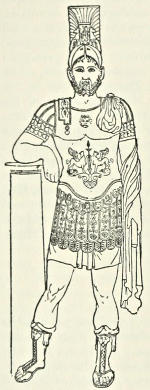
A Roman General
(From a statue)
The Carthaginian rule was no longer beloved in
Spain, and Scipio turned this disposition to his own
advantage with admirable dexterity. He set free all
the hostages retained by the Carthaginians, as well as
all of Spanish blood who had been taken prisoners in
the city. Among these hostages was the wife of
Mandonius, brother of Indibilis, a powerful chief
who had formerly been the friend of Carthage, and
the daughters of Indibilis himself. He sent them
home with as much care as if they had been his own
kinswomen, although Indibilis and Mandonius had
been actively engaged against his unfortunate father
and uncle. Then the soldiers brought him a
beautiful girl, whom they had reserved as a special
gift for their youthful commander. But Scipio
observing her tears, inquired into her condition; and finding she was the betrothed
of Allucius, a young Celtiberian chief, he sent for the youth, and
restored his bride unharmed, without ransom or condition. This generous
conduct was not without its reward. The Spaniards, quick in feeling and
romantic in disposition, regarded the young conqueror as a hero sent to deliver
them from the yoke of Carthage. His noble bearing, his personal beauty,
confirmed the favourable impressions caused by his conduct to the hostages;
and when he advanced next year into Celtiberia, he was welcomed by Indibilis
and Mandonius at the head of their vassals. Soon after, a deputation of
Spaniards came to him with entreaties to become their king. But Scipio
courteously declined the offer, informing them that he was but the general of
the Roman people, in whose ears the name of king was a by-word and a
reproach.
[209-206 B.C.]
The Carthaginian generals were quite unable to make head against the
well-earned popularity of the youthful Roman. Hasdrubal Barca attempted
to retake New Carthage by surprise, but in vain; and the year 208 B.C. found
him too busily engaged in preparing for his Italian expedition to act with
energy against the Romans. All Spain north of the Bætis (Guadalquivir)
was relinquished; but at length Hasdrubal found himself obliged to give
battle at a place called Bæcula, near that river. The Romans won the day;
but the Carthaginian commander made a skilful retreat, leaving his camp
and baggage in the hands of the enemy. Hasdrubal now drew back into
Lusitania, leaving his brother Mago and Hasdrubal, son of Gisco, to cover
the borders of that district, which with the province now called Andalusia
were the only parts of Spain left to the Carthaginians. Meanwhile he himself
crossed the Tagus, and marching northwards (as we have seen) by ways
unknown to the Romans, crossed the Pyrenees near the shores of the Bay of
Biscay. Scipio was informed of his intentions to pass into Italy, and had
expected him to follow the course of his brother Hannibal. But in the
beginning of 207 B.C., while he was lying upon the Ebro, he heard that
his able opponent had eluded him, and was already in the heart of Gaul.
In that year the Carthaginians made great efforts to retrieve their falling
fortunes. Fresh forces were sent from Africa, and young Masinissa, son of
Gala, a powerful Numidian chief, also took the field with a large body of his
formidable horsemen. Scipio himself did not appear in the south till late in
the season, when he found that his brother Lucius, with his legate Silanus,
had kept the Carthaginians in check. But the news of the Metaurus had
reached him, and he burned with eagerness to eclipse the glory of Nero.
Late in this year, therefore, or early in 206, Scipio with his whole force
prepared to pass the Bætis and bring the enemy to action. The Carthaginians,
confident in their numbers, were equally ready, and their united
forces boldly faced the enemy. The place of the battle is unknown; its
name is variously given as Silpia or Elinga. But the result is certain.
Scipio’s victory was complete; the whole Carthaginian army was broken and
destroyed; its scattered remains took refuge behind the walls of Gades, with
Hasdrubal Gisco and Mago; while the wily Masinissa entered into secret
negotiations with the Romans. The senate, therefore, at the commencement
of the year 206, had to congratulate the people not only on seeing Italy almost
delivered from the army of Hannibal, but also on the important fact that all
Spain, except the town of Gades, was in the hands of the Roman armies.
But Scipio regarded Spain as a mere stepping-stone to Africa. Here,
and here only, he felt convinced, could the war be concluded. Already Valerius
Lævinus had made descents upon the African coast, and found the
country nearly as defenceless as in the days of Agathocles and of Regulus.
Scipio determined not to return to Rome till he had laid the train for an
invasion of Africa; and then, with the confidence that marked his whole
career, he would offer himself for the consulship, and force the senate to
allow him his own way.
At that time the country to the west of the Carthaginian territory, from
Bona to Oran, was known by the name of Numidia; and the Numidians
themselves were divided into two great tribes, the eastern Numidians or
Masæsylians, and the western or Massylians. Of the Masæsylians, Syphax
was king; his capital being Cirta, now well known under the name of Constantine
as the chief fortress of Algeria. Gala, father of Masinissa, was
ruler of the Massylians; and Scipio had already entered into negotiations
with Masinissa. But Masinissa had not yet any power of his own; while
the position of Syphax on the Carthaginian frontier necessarily made him
the most dangerous enemy of Carthage. It was therefore of the greatest
importance to secure the friendship of this powerful but unstable chieftain.
Scipio resolved, with a boldness almost romantic, to pay a visit to the Numidian
capital; and, to show his confidence in Syphax, he sailed from New
Carthage to Africa with two ships only. It happened that Hasdrubal Gisco,
who had before this left Spain in despair, appeared at the court of Syphax at
the self-same time, with the self-same purposes. Both the rivals were entertained
by the Numidian; but the winning manners and personal grace of
Scipio prevailed for the present, and Syphax formed an alliance with the
Romans.
When Scipio returned to Spain, he found that his short absence had produced
a serious change. Three important cities in the vale of the Bætis,
Illiturgi, Castulo, and Astapa, had closed their gates and declared their
independence. Without delay, he laid siege to Illiturgi. The town was
taken after an obstinate defence, and given up to massacre and pillage.
This dreadful fate of their countrymen produced immediate, but opposite,
effects on Castulo and Astapa. The men of Castulo, stricken with fear, surrendered
at discretion. The men of Astapa collected all their property into
a huge funeral pile in the market-place, and placed their wives and daughters
under a guard, who had orders to slay them and fire the pile as soon as the
gates should be forced. The rest of the citizens fell fighting bravely, and
the Romans were left masters of a heap of ashes.
Another circumstance showed that the Roman power in Spain rested on
a precarious tenure. Scipio fell ill at New Carthage, and a report was spread
that he was dead. Upon this, Indibilis and Mandonius, believed to be his
most faithful friends, raised the standard of revolt and advanced into Celtiberia.
A division of Italian troops, eight thousand strong, stationed upon
the Sucro, broke into open mutiny, driving away their Roman officers, and
choosing two Italians as their chiefs. The prompt and decisive way in which
Scipio quelled this dangerous mutiny recalls the conduct of Clive in Bengal
on a similar occasion. He sent messengers to the mutineers, desiring them
to come to New Carthage and state their grievances; and as they approached
the town, he ordered the division of the army in that place to prepare for
marching against the revolted Spaniards. The Italians, therefore, met the
army leaving New Carthage as they entered it, and fondly deemed that the
general would now be completely at their mercy. But when they appeared
next morning before Scipio, they found that thirty-five persons, the ringleaders
of the mutiny, had been arrested during the night; and the clash of
arms in the streets leading to the Forum apprised them that the army had
returned from its pretended march. Scipio reproved the mutineers with
much severity. He ordered the ringleaders for execution, and pardoned the
rest on their taking the oath of allegiance anew. Indibilis and Mandonius
hastened to make full submission. But no sooner had Scipio left Spain, than
these discontented chiefs again took arms. Indibilis fell in battle; Mandonius
was taken prisoner and put to death.
It was now apparent that the Carthaginians had no longer any hope of
recovering their ground in Spain. Hasdrubal Gisco had returned to Africa.
Masinissa obtained an interview with Scipio, and renewed his promises of
friendship. Mago, the last remaining brother of Hannibal, after a vain
attempt to surprise New Carthage, returned to Gades, and found that the
inhabitants shut their gates against him. He enticed the chief magistrates,
called suffets (as at Carthage), into a negotiation, and seizing their persons,
crucified them in sight of the town. This brutal and treacherous act forfeited
his last claim on the sympathies of the people of Gades. They surrendered to
the Romans, while Mago sailed off to the Balearic Isles, and occupied himself
in preparing a descent upon the coast of Italy, as a last chance of relieving
his illustrious brother.
The soil of the Spanish peninsula was now completely cleared of the Carthaginians,
and Scipio prepared to return to Rome. Three years before, he
had left his country amid the hopes and expectations of all men. He now
returned, having more than fulfilled those hopes and expectations. His friend
Lælius had been sent home to announce his first great success; his brother
Lucius had lately arrived to prepare the senate and people for the speedy
arrival of the hero; and no one doubted that at the approaching elections
Scipio would be raised to the consulship by the unanimous voice of the people.
[206-204 B.C.]
It was towards the close of the year 206 B.C. that he returned. The
senate met him at the temple of Bellona; but refused him a triumph on the
ground that he had not held any regular magistracy during his absence. He
therefore entered the city, and offered himself candidate for the consulship.
Every tribe united in giving him their suffrages, though he was not yet thirty
years old. But the common rules of election had been neglected throughout
the war, and no difficulty seems to have been raised on the score of age.
His colleague was P. Licinius Crassus, who was pontifex maximus, and therefore
unable to leave Italy. Whatever foreign enterprise was undertaken
must fall to the lot of Scipio. He himself was at no pains to conceal his
intention of carrying the war into Africa; and it was generally understood
that, if the senate refused leave, he would bring a special bill for the purpose
before the people. Fabius, with Fulvius and the old senatorial party, vehemently
opposed these bold projects. But the time was gone by when they
could use the votes of the people against an enterprising consul, as they had
done some years before against Lævinus. The senate was fain to compromise
the matter by naming Sicily as his province, with permission to cross over
into Africa if he deemed it expedient. They refused him, however, the
additional levies and supplies which he required. But the Etruscans and
other Italians enthusiastically volunteered to give all he wanted. Yet he
was unable during the year of his consulate to make any attempt on Africa,
and was continued in his command as proconsul.
The enemies of Scipio made one more attempt to thwart his African
enterprise. Hearing that the citadel of Locri had been taken by Q. Pleminius,
who commanded as proprætor in Bruttium, but that Hannibal had come
to the relief of the place, he left his province without hesitation, and sailing
into the harbour of Locri obliged the Carthaginian to retire. Pleminius was
no sooner left in command there than he indulged in gross and brutal outrages,
not only against the people of Locri, but against such Romans as
ventured to oppose his will. Scipio was appealed to, but declined to interfere,
desiring the Locrians to lay their complaints before the senate at Rome.
These complaints arrived early in the year 204 B.C., and old Fabius again
loudly inveighed against the presumptuous audacity of his young rival.
He ended his speech by proposing that he should be deprived of his command.
Other complaints were made against Scipio—that by going to Locri he had
transgressed the limits of his province, as he had done before by visiting
Syphax in Numidia; moreover, that he spent his time in pursuits unfit for
a Roman soldier, frequenting the schools and gymnasia of the Greek cities,
and wearing a Greek dress; while his men were daily becoming corrupted
by licentious living and want of discipline. The senate ventured not to act
on these vague accusations without previous inquiry; and it was therefore
resolved to send a commission into Sicily to examine into the truth of the
charges. The result was highly favourable to the general. It was reported
that he was guiltless of the excesses of Pleminius, who was arrested, and left
to die in prison; that his troops, instead of being neglected or undisciplined,
were in the highest order; and that arms, engines, and supplies of every kind
were provided for the invasion of Africa. It was universally resolved that
Scipio should retain his command till he should bring the war to a close.
The confidence which the senate felt in the altered state of affairs is fully
shown by two decrees passed in this same year. The first respected the
twelve Latin colonies, which five years before had refused to furnish soldiers.
At the time, it had been thought prudent to pass over this contumacious conduct.
But now they were required to furnish twice their proper contingent
till the end of the war. They murmured, but submitted. The other decree
was moved by Lævinus for the repayment of the patriotic loan advanced
during his consulship in the year 210 B.C. It was apparent, therefore, that
the battle of the Metaurus, backed by the great successes of Scipio in Spain,
had raised the republic above all fear of disaffection in her colonies, or of
bankruptcy at home. Other signs of confidence appear. A huge stone,
supposed to represent the Great Mother of the gods, was brought in state to
Rome from Pessinus in Sicily. The Sibylline books directed that the care
of this precious relic should be given to “the best man” at Rome; and the
senate adjudged the title to P. Scipio Nasica, son of Cn. Scipio, who had
died in Spain, and first cousin to the great man who was now making the
name illustrious.
[204-203 B.C.]
All obstacles being now removed, Scipio prepared to cross over into
Africa. His army and fleet were assembled at Lilybæum under his own
eye. His brother Lucius and his friend Lælius still attended him as legates;
and his quæstor was a young man destined hereafter to become famous, M.
Porcius Cato. It was towards the close of 204 B.C. that he set sail. His
army was not so numerous as it was well appointed and well disciplined,
composed of men who had grown old in service, skilful in sieges, prepared
for all dangers; for the greater part knew that in the successful termination
of the war lay their only chance of returning home to end their days in
peace. As the ships left the harbour at daybreak, Scipio prayed aloud to
all the gods, that his enterprise might be blessed by their favour; that the
evils which Carthage had wrought against Rome might now be visited upon
her own head. When the second morning broke, they were in sight of land;
and Scipio, when he heard that they were off the Fair Promontory, said that
the omen was good, and there should be their landing-place.
Masinissa joined him with only two hundred of his Numidian horse; but
his knowledge of the country, and his ceaseless activity, would have made
him welcome, even if he had come alone.
Scipio immediately laid siege to Utica. Terror at Carthage rose to its
highest pitch. For a time he was left to carry on his operations unmolested.
But as winter advanced, Hasdrubal Gisco succeeded in collecting a considerable
force, and persuaded Syphax, his son-in-law, to lend his aid in relieving
Utica. Scipio was encamped on a headland to the eastward of this town,
on a spot which long retained the name of “the Cornelian camp,” where the
ruins of his entrenchments are still to be traced; and the Carthaginians
hoped that they might blockade him here both by land and sea. Scipio remained
quiet the whole winter, except that he amused Syphax by entering
into negotiations for peace. But these negotiations were carried on to mask
a design, which, as spring came on, he was enabled to put in practice. He
observed that Hasdrubal occupied one
camp, and Syphax another. The huts
occupied by the Numidians were formed
of stakes wattled and thatched with reeds;
and the quarters of the Carthaginians,
though somewhat more substantial, consisted
solely of timber. Scipio contrived
to obtain an accurate knowledge of the
plan and disposition of these camps; and
when the time for the execution of his
design was arrived, he suddenly broke off
the negotiations, and told Syphax that all
thoughts of peace must be deferred till a
later time.
On the first dark night that followed,
he sent Lælius and Masinissa against the
camp of Syphax, while he moved himself
towards that of Hasdrubal. Masinissa
obtained an easy entrance into the lines of
his countrymen, and straightway set fire
to their inflammable habitations. The
unfortunate men rose from their beds or
from their wine-cups, and endeavoured
to extinguish the flames. But the work
had been too well done; and as they
attempted to escape, they found that
every avenue of the camp was beset by
enemies. Fire was behind them, death
by the sword before; and though Syphax
escaped, his army was destroyed. The
same fate befell Hasdrubal. On the first
alarm, he conjectured the truth, and made
off, leaving his men a prey to Scipio.
When morning broke, the Romans pursued
the fugitives; and it is not too much to say that the whole force on
which Carthage depended for safety was cut off in this horrible way. The
recital makes the blood run cold. Yet neither the act itself, nor the duplicity
by which it was carried into execution, were ever thought to cast any
slur on the fair fame of Scipio.
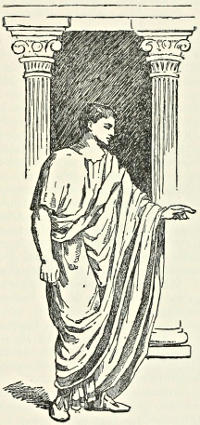
A Roman Citizen
The Carthaginian senate were ready to give up matters as lost. But at
this juncture ten thousand Celtiberians landed in Africa and offered their
services to Syphax; and this prince was persuaded by the entreaties of his
wife Sophonisba, daughter of Hasdrubal Gisco, to renew the struggle.
Hasdrubal also exerted himself to collect a new army; and in the course of
thirty days the two allied generals appeared on the great plains, which lie
about seventy or eighty miles to the southwest of Utica and Carthage.
Scipio, leaving his fleet and a division of his army to continue the blockade
of Utica, advanced to give them battle without delay. The Celtiberians
made a stout resistance; but, being deserted by the rest of the army, they
were entirely cut to pieces. Hasdrubal fled to Carthage, Syphax to his own
kingdom; so that the whole country was left to the mercy of the Romans.
Scipio advanced towards Carthage, receiving the submission of the different
towns by which he passed. Encamping at Tunis, within sight of the capital,
he awaited the submission of the government.
Meanwhile Lælius and Masinissa, with the Italian and Numidian cavalry,
pursued Syphax to Cirta. The unlucky king made a faint show of
resistance; but he was defeated, and his capital surrendered at discretion.
Masinissa now received his reward, and was proclaimed king of all Numidia.
When he entered Cirta, he was met by Sophonisba, formerly his betrothed,
and now the wife of his rival. Her charms melted his heart; and fearing
lest Scipio might claim her as his captive, to lead her in triumph by the side
of Syphax, he took the bold step of marrying her at once. Scipio sent for
the young chief and rebuked him sternly for venturing to take possession of
a Roman captive. Masinissa felt that he was unable to protect his unhappy
bride; but, resolved that at least she should have the option of escaping
from the degradation of a Roman triumph, he sent her a cup of poison, telling
her that herein lay her only possible deliverance. She took the potion,
saying that she accepted the nuptial gift, and drained it to the dregs.
When the tragical fate of Sophonisba reached the ears of Scipio, he feared
that he had dealt too harshly with his Numidian ally. He sent for him, and,
gently reproving him for his haste, he publicly presented him with the most
honourable testimonies to his bravery and fidelity which a Roman general
could bestow. In the delights of satisfied ambition and the acquisition of a
powerful sovereignty, Masinissa soon forgot the sorrows of Sophonisba.
While Scipio remained at Tunis, the Carthaginian fleet made an attack
on the Roman ships in the harbour of Utica, and gained some advantage.
Intelligence also reached the government that Mago, on landing in Italy,
had been welcomed by the Ligurians and a portion of the Gauls, and had
lately taken position on the Po with a considerable force. Here, however,
he was encountered by a Roman army and defeated after a severe struggle.
Mago, himself wounded, took refuge among the Ligurians, who still remained
faithful to his cause.
Ambassadors were now despatched by the Carthaginians to Rome to
treat for peace, while orders were sent to Hannibal and Mago to return with
such forces as they could bring. Mago obeyed the orders immediately, but
died of his wound upon the passage. Hannibal also with bitter feelings
prepared to obey. For sixteen years had the indomitable man maintained
himself on foreign ground; and even now the remains of his veteran army
clung to him with desperate fidelity. He felt that, so far as he was concerned,
he had been more than successful; if he had failed, it had been the
fault of that ungrateful country, which had left him long years unsupported,
and now was recalling him to defend her from the enemy. What Scipio
was now to Carthage, that might Hannibal have been to Rome. Still he
saw that no advantage could be gained by remaining longer in Italy: he
therefore bade farewell to the foreign shores, so long his own, and set sail
for that native land which had not seen him for nearly forty years.
[203-202 B.C.]
Great was the joy at Rome when the news came that their dire enemy
had been at length compelled to leave the shores of Italy. A public thanksgiving
was decreed; sacrifices offered to all the great gods of Rome, and
the Roman games, which had been vowed by Marcellus in his last consulship,
were now at length performed. It was at this moment of triumph that
the Carthaginian ambassadors arrived. The senate received them (inauspicious
omen!) in the Temple of Bellona. Lævinus moved that they should
be at once dismissed, and that orders should be sent to Scipio to push on the
war with vigour. After some debate, his proposition was adopted. The
close of the year 203 B.C. therefore rendered it certain that the war must be
decided by a trial of strength between the two great generals, who, each
triumphant in his own career, had never yet encountered each other in
arms. About the same time old Fabius died in extreme old age. He has
the merit of first successfully opposing Hannibal; but his somewhat narrow
mind, and the jealous obstinacy which often accompanies increasing years,
prevented him from seeing that there is a time for all things; that his own
policy was excellent for retrieving the fortunes of the republic, but that the
weakness of Hannibal left the field open for the bolder measures of Scipio.
Hannibal landed at Leptis, to the south of Carthage, with his veterans;
and thence marching northwards, took up his position on the plain of Zama,
within five days’ march of Carthage. Scipio, early in the year (202 B.C.),
advanced from Tunis to meet him; and finding that the Carthaginian
general had sent spies to ascertain his strength, he ordered them to be led
through his camp, and bade them make a full report of what they had seen.
Hannibal felt that he had to deal with a superior force, led by a general
only second in ability to himself. His own veterans were few in number;
the remainder of his army were raw levies or allies little to be trusted; the
Numidian horse, his main arm in Italy, were now arrayed against him under
the enterprising Masinissa. He therefore proposed a personal conference,
in the faint hope that he might effect a treaty with Scipio. But it was too
late. The generals parted from their conference with feelings of mutual
esteem, and prepared to decide the fate of the civilised world by battle.b
[202 B.C.]
On the following day, as soon as the dawn appeared, they drew out their
forces on both sides and prepared to engage; the Carthaginians, for their
own safety and the possession of Africa; the Romans, for the sovereignty of
the whole, and for universal empire. Is there any one that can forbear
to pause at this part of the story or remain unmoved by the relation?
Never were there seen more warlike nations; never more able generals, or
more completely exercised in all the art and discipline of war; never was a
greater prize proposed by fortune than that which was now laid before the
combatants. For it was not Africa alone, nor Italy, that waited to award the
conquerors, but the entire dominion of the whole known world. And this,
indeed, was not long afterwards the event.
Scipio drew up his army in battle in the following manner: He placed
in the first line the Hastati, leaving intervals between the cohorts. In the
second, the Principes; but posted their cohorts, not, as the Roman custom
was, opposite to the intervals, but behind the cohorts of the former line and
at a considerable distance from them, on account of the great number of
elephants that were in the Carthaginian army. Last of all, in the third line,
he drew up the Triarii. Upon the left wing he stationed Caius Lælius,
with the cavalry of Italy; and Masinissa and the Numidians upon the
right. The intervals of the first line he filled with companies of the light-armed
troops, who were ordered to begin the action, and if they should find
themselves too violently pressed by the elephants, that the swiftest of them
should retire through the strait intervals to the rear of all the army, and
the rest, if they should be intercepted on their way, direct their course to
the right or left along the open distances that were between the lines.
When his disposition was thus completed, he went round to all the troops and
harangued them in a few words, but such as the occasion seemed to require.
“Remember,” said he, “your former victories, and show now a courage
worthy of yourselves and of your country. Let it ever be present to your
view that by gaining the victory in this battle, you not only will become the
masters of all Africa, but secure to Rome the undisputed sovereignty of the
rest of the world. If, on the other hand, you should be conquered, they who
fall bravely in the action will obtain an honour far more glorious than any
rights of sepulchre, the honour of dying for their country; while those that
shall escape must be condemned to pass the remainder of their lives in the
extremity of disgrace and misery. For Africa will afford no place of safety,
and if you fall into the hands of the Carthaginians, what your condition
must be your own reason will easily instruct you to foresee. But may none
of you ever know it by experience. When fortune, then,” continued he,
“has offered to us upon either side so noble a prize, universal empire or
glorious death, how lost must we be both to honour and to sense, if we
should reject these, the greatest of goods, and choose, through a desire of
life, the most insupportable of evils. When you advance, therefore, against
the enemy, carry that resolution with you into action, which is sure always
to surmount the strongest resistance. Be determined either to conquer or
to die. Retain not so much as a thought of life. With such sentiments,
the victory cannot fail to be your own.”
Such was the harangue of Scipio. Hannibal, on his part, having placed
the elephants, more than eighty in number, at the head of all the army,
formed his first line of the mercenaries, who were a mixed multitude of
Gauls, Ligurians, Balearics, and Maurusians, and amounted together to
about twelve thousand men. Behind these were the Carthaginians and the
subject Africans. The third line was composed of the troops which he had
brought with him from Italy, and was placed at the distance of more than a
stadium from the second line. The cavalry was posted upon the wings;
that of the Numidian auxiliaries upon the left, and the Carthaginian cavalry
upon the right. He ordered the officers who commanded the different
bodies of the mercenaries to exhort severally their own soldiers, and to
encourage them to be assured of victory, since they were now joined by
Hannibal and his veteran forces. The leaders of the Carthaginians were
instructed, on the other hand, to lay before their view the fatal consequences
of a defeat, and to enumerate all evils to which their wives and children
would be exposed. And while these orders were obeyed, he himself, going
round to his own troops, addressed them with the greatest earnestness, and
in words like these:
“Remember, soldiers, that we have now borne arms together during the
course of seventeen years. Remember in how many battles we have been
engaged against the Romans. Conquerors in them all, we have not left
to the Romans even the smallest hope that they ever should be able to defeat
us. But beside the other innumerable actions in which we always obtained
the victory, remember also, above all the rest, the battle of Trebia, which
we sustained against the father of that very general who now commands the
Roman army; the battle of Thrasymene, against Flaminius, and that of
Cannæ, against Æmilius. The action in which we are now ready to engage
is not to be compared with those great battles, with respect either to the
number or the courage of the troops. For, turn now your eyes upon the
forces of the enemy. Not only they are fewer; they scarcely make even a
diminutive part of the numbers against which we were then engaged. Nor is
the difference less with respect to courage. The former were troops whose
strength was entire, and who had never been disheartened by any defeat.
But these before us are either the children of the former or the wretched
remains of those very men whom we subdued in Italy, and who have so often
fled before us. Lose not then upon this occasion the glory of your general
and your own. Preserve the name which you have acquired, and confirm the
opinion which has hitherto prevailed, that you are never to be conquered.”
When the generals had thus on both sides harangued their troops, and the
Numidian cavalry for some time had been engaged in skirmishing against each
other, all things being now ready, Hannibal ordered the elephants to be led
against the enemy. But the noise of the horns and trumpets, sounding together
on every side, so affrighted some of these beasts that they turned back
with violence against their own Numidians, and threw them into such disorder
that Masinissa dispersed without much difficulty that whole body of
cavalry which was on the left of the Carthaginian army. The rest of the
elephants, encountering with the light-armed forces of the Romans in the
space that was between the armies, suffered much in the conflict, and made
great havoc also among the enemy; till at last, having lost all courage, some
of them took their way through the intervals of the Roman army, which
afforded an open and safe passage for them, as Scipio wisely had foreseen;
and the rest, directing their course to the right, were chased by darts from
the cavalry, till they were driven quite out of the field. But as they occasioned
likewise some disorder upon their own right wing in their flight,
Lælius also seized that moment to fall upon the Carthaginian cavalry; and
having forced them to turn their backs, he followed closely after them, while
Masinissa, on his side, was pursuing the Numidian cavalry with no less ardour.
And now the heavy-armed forces on both sides advanced to action with a
slow and steady pace, those troops alone excepted which had returned with
Hannibal from Italy, and which remained still in the station in which they
at first were placed. As soon as they were near, the Romans, shouting all
together, according to their custom, and rattling their swords against their
bucklers, threw themselves upon the enemy. On the other side, the Carthaginian
mercenaries advanced to the charge with confused and undistinguishable
cries. For as they had been drawn together, as we have said, from
different countries, there was not among them, as the poet expresses it (Iliad,
IV, 437):
“One voice, one language found;
But sounds discordant as their various tribes.”
In this first onset, as the combatants were so closely joined that they were
unable to make use of their spears, or even of their swords, and maintained
the action hand to hand and man to man, the mercenaries, by their boldness
and dexterity, obtained at first the advantage, and wounded many of the
Romans; but the latter, assisted by the excellence of their disposition and
the nature of their arms, pressed forward and still gained ground, being
supported by the rest of their own army, who followed and encouraged them
from behind.
The mercenaries, on the other hand, were neither followed nor supported.
For the Carthaginians that were behind them came not near to assist them in
the action, but stood like men who had lost all courage. At last, therefore,
the strangers turned their backs; and, thinking themselves manifestly to
have been deserted by their own friends, they fell, as they retired, upon the
Carthaginians that were behind, and killed them. The latter, however, fell
not without a brave and vigorous defence; for, being thus unexpectedly
attacked, and compelled to fight both with their own mercenaries and the
Romans, they exerted their utmost efforts; and engaging with a frantic and
disordered rage, made a promiscuous slaughter of friends and enemies.
Amidst this confusion, the Hastati also were so pressed that they were
forced to break their ranks. But the leaders of the principes, perceiving
the disorder, brought up their troops close behind to support them; so that,
in the end, the greatest part of the Carthaginians and the mercenaries were
destroyed in the place, partly by themselves and partly by the Hastati.
Hannibal would not suffer the rest that escaped to be received into the third
line towards which they fled, but ordered the foremost ranks to point their
spears against them as they approached. They were forced, therefore, to
retire along the wings into the open plain.
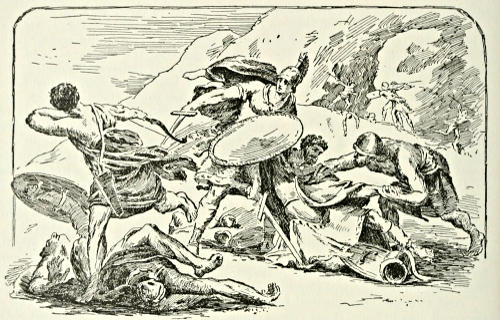
Battle between the Soldiers of Scipio and Hannibal
(After Mirys)
As the whole ground that was between the forces that now remained was
covered with blood and slaughter and dead bodies, the Roman general was in
no small degree perplexed, being apprehensive that this obstacle would prevent
him from obtaining a complete and perfect victory. For it seemed to
be no easy thing to lead on the troops, without breaking their ranks, over
bleeding and slippery carcasses, thrown one upon another, and over arms which
were scattered in confusion, and preposterously intermingled with the heaps
of the dead. Having ordered the wounded, however, to be carried into the
rear of the army, he called back the Hastati from the pursuit, and drew them
up in order, as they returned, in the forepart of the ground upon which the
action had passed, and the opposite to the centre of the enemy. He then
commanded the principes and the Triarii to close their ranks, to form a wing
on either side, and to advance over the dead. And when these troops, having
surmounted all the intermediate obstacles, were come into the same line,
with the Hastati, the action was then begun on both sides with the greatest
eagerness and ardour. As the numbers were nearly equal, as the sentiments,
the courage, and the arms on both sides were the same, the battle
remained for a long time doubtful; for so obstinate was the contention that
the men all fell in the place in which they fought. But Lælius and Masinissa,
returning back from the pursuit of the routed cavalry, arrived most providentially
in the very moment in which their assistance was chiefly wanted,
and fell upon the rear of Hannibal. The greatest part, therefore, of his
troops were now slaughtered in their ranks; and among those that fled, a
very small number only were able to escape, as they were followed closely by
the cavalry through an open country. Above fifteen hundred of the Romans
fell in the action; but on the side of the Carthaginians, more than twenty
thousand were killed, and almost an equal number taken prisoners. Such
was the battle between Hannibal and Scipio,—the battle which gave to the
Romans the sovereignty of the world.
When the action was ended, Publius, after he had for some time pursued
those that fled, and pillaged the camp of the Carthaginians, returned back to
his own camp. Hannibal, with a small number of horsemen, continued his
retreat without stopping, and arrived safe at Adrumetum, having performed,
upon this occasion, all that was possible to be done by a brave and experienced
general. For first, he entered into a conference with his enemy, and
endeavoured by himself alone to terminate the dispute. Nor was this any dishonour
to his former victories, but showed only that he was diffident of fortune
and willing to secure himself against the strange and unexpected accidents
which happen in war. In the battle afterwards, so well had he disposed
things for the action, that no general, using even the same arms and the same
order of battle as the Romans, could have engaged them with greater advantage.
The order of the Romans in battle is very difficult to be broken, because
the whole army in general, as well as each particular body, is ready always
to present a front to their enemies on which side soever they appear. For
the cohorts by a single movement turn themselves together as the occasion
requires towards the side from whence the attack is made. Add to
this that their arms also are well contrived both for protection and offence,
their bucklers being large in size, and their swords strong, and not easily injured
by the stroke. Upon these accounts, they are very terrible in action,
and are not to be conquered without great difficulty. But Hannibal opposed
to each of these advantages the most effectual obstacles that it was possible
for reason to contrive. He had collected together a great number of elephants,
and stationed them in the front of his army, that they might disturb
the order of the enemy and disperse their ranks. By posting the mercenaries
in the first line, and the Carthaginians afterwards in a line behind them, he
hoped to disable the Romans by fatigue before the battle should be brought
to the last decision, and render their swords useless by continual slaughter.
As he had thus placed the Carthaginians also between two lines, he compelled
them to stand, and, as the poet has said (Iliad, IV, 430):
“Forced them by strong necessity to fight,
However loth.”
In the last place he drew up the bravest and the firmest of his troops at
a distance from the rest; that, observing from afar the progress of the action,
and possessing their whole strength as well as their courage entire, they
might seize the most favorable moment, and fall with vigour upon the
enemy. If therefore, when he had thus employed all possible precautions
to secure the victory, he was now for the first time conquered, he may very
well be pardoned. For fortune sometimes counteracts the designs of valiant
men. Sometimes again, according to the proverb,
“A brave man by a braver is subdued.”
And this indeed it was which must be allowed to have happened upon the
present occasion.
When men, in lamenting the wretchedness of their fortunes, exceed in
their actions all the customary forms of grief, if their behaviour seems to be
the effect of genuine passion, and to arise only from the greatness of their
calamities, we are all ready to be moved by the strangeness of the sight, and
can neither see nor hear them without commiserating their condition. But
if these appearances are feigned, and assumed only with an intention to deceive,
instead of compassion, they excite indignation and disgust. And this
was now what happened with respect to the Carthaginian ambassadors.
Publius told them in few words: That with regard to themselves, they
had clearly no pretensions to be treated with gentleness or favour, since by
their own acknowledgment they had at first begun the war against the
Romans, by attacking Saguntum in contempt of treaty; and now lately
again had violated the articles of a convention which they had ratified in
writing, and bound themselves by oaths to observe. That the Romans, however,
as well upon their own account as in consideration also of the common
condition and fortune of humanity, had resolved to display towards them
upon this occasion a generous clemency. That such indeed it must appear
to themselves to be, if they would view all circumstances in a proper light,
for since fortune having first precluded them by the means of their own
perfidious conduct, from every claim to mercy or to pardon, had now thrown
them wholly into the power of their enemies, no hardships which they should
be forced to suffer, no conditions which should be imposed, no concessions
which should be exacted from them, could be considered as rigorous or
severe; but rather it must appear to be a matter of astonishment if any
article of favour should be yielded to them. After this discourse he recited
first the conditions of indulgence which he was willing to grant, and afterwards
those of rigour, to which they were required to submit. The terms
which he proposed to them were these:
That they should retain all the cities which they held in Africa before
the beginning of the last war which they had made against the Romans;
and all the lands likewise which they had anciently possessed, together
with the cattle, the men, and the goods that were upon them. That from
the present day all hostilities should cease. That they should be governed
by their own laws and customs, and not receive any garrison from the
Romans. Such were the articles of favour; the others, of a contrary kind,
were these:
That the Carthaginians should restore all that they had taken unjustly
from the Romans during the continuance of the truce. That they should
send back all the prisoners and deserters, that had at any time fallen into
their hands. That they should deliver up all their long vessels, ten triremes
only excepted; and likewise their elephants. That they should not make
war at any time upon any state out of Africa, nor upon any in Africa, without
the consent of the Romans. That they should restore to King Masinissa
the houses, lands, and cities, and everything besides that had belonged
to him, or to his ancestors within the limits which should hereafter be declared.
That they should furnish the Roman army with corn sufficient for
three months, and pay also the stipends of the troops, till an answer should
be received from Rome confirming the conditions of the treaty. That they
should pay ten thousand talents of silver in the course of fifty years, bringing
two hundred Euboic talents every year. That, as a security for their
fidelity, they should give a hundred hostages which should be chosen by the
Roman general out of all their youth, between the ages of fourteen and of
thirty years.
As soon as Publius had finished the recital of these articles, the ambassadors
returned in haste to Carthage, and reported the terms that were proposed.
Upon this occasion, when one of the senators was going to object
to the conditions and had begun to speak, Hannibal, it is said, stepped forward,
and taking hold of the man, dragged him down from his seat. And,
when the rest of the senate appeared to be much displeased at an action so
injurious to the customs of that assembly, he again stood up and said, That
he might well be excused, if his ignorance had led him to offend against any
of their established forms. That they knew that he had left his country
when he was only nine years old and had now returned to it again at the age
of more than forty-five. He entreated them, therefore, not so much to consider
whether he had violated any custom, as whether he had been moved
by a real concern for the distressed condition of his country. That what he
had felt upon that account was indeed the true cause of his offence. For
that it appeared to him to be a most astonishing thing, and altogether preposterous,
that any Carthaginian, not ignorant of all which their state in
general, as well as particular men, had designed against the Romans, should
not be ready to worship his good fortune, when, having fallen into their
power, he now found himself treated by them with so great clemency. That
if the Carthaginians had been asked but a few days before what their country
must expect to suffer if they should be conquered by the Romans, they
would not have been able to make any answer, so great, so extensive were
the calamities which were then in prospect. He begged therefore that they
would not now bring the conditions into any debate, but admit them with
unanimous consent; offering sacrifices at the same time to the gods, and
joining all together in their prayers, that the treaty might be ratified by the
Roman people. This advice appeared to be so sensible and so well suited
to the present exigency, that the senate resolved to consent to a peace upon
the terms which have been mentioned, and immediately sent away some
ambassadors to conclude the treaty.
[201 B.C.]
Not long after this time [in the beginning of the year 201 B.C.], Publius
Scipio returned to Rome from Africa. As the greatness of his actions
had raised in men a very high and general expectation, he was surrounded
by vast crowds upon his entrance and received by the people with the
greatest marks of favour. Nor was this only reasonable, but an act also of
necessary duty. For they who not long before had not so much as dared
to hope that Hannibal ever could be driven out of Italy, or the danger be
removed from their own persons and their families, now saw themselves not
only freed from apprehension of any present evils, but established also in a
lasting and firm security by the entire conquest of their enemies. Upon this
occasion, therefore, they set no bounds to their joy. On the day likewise in
which he entered the city in triumph, as the objects that were viewed in the
procession represented most clearly to the senses of the people the dangers
from which they had escaped, they stood as in an ecstasy of passion, pouring
out thanks to the gods, and acknowledgments to the author of so great a
deliverance. Among the rest of the prisoners Syphax also, the Masæsylian
king, was led along a captive in the procession; and after some time he died
in prison. When the solemnity of the triumph was finished, there was afterwards
in Rome, during many days a continual succession of games and spectacles,
the expense of which was defrayed by Scipio with a generosity which
was worthy of him.c
[201-202 B.C.]
Scipio’s great antagonist lived a good many years after the battle of Zama,
finally dying in exile, as we shall see. But his career as the foremost man
of his time practically terminated with his defeat at Zama, and we may fitly
pause for a moment here to attempt an estimate of his character and influence.
One of the most recent historians of the Punic Wars, Dr. Fuchs, thus characterises
the greatest of Carthaginians:
Hannibal doubtless stands in the first rank of warrior heroes. Many
indeed would, and not without justice, give him the first place. Certainly
Alexander conquered the enormous kingdom which overspread the whole of
Asia Major and once stretched its arm over Europe and Africa; but the feet
of this colossus were of clay and it was long known to the world that its
power was not in proportion to its size. Seventy years before, a prince of the
reigning house conceived the valiant idea of attacking it with ten thousand
Greek heavy-armed soldiers, and Agesilaus had the bold design of piercing
the heart of the giant with eight thousand men. Alexander’s father not only
bequeathed him the means of carrying out this great plan, but left him a
powerful peasant class, a nobility ready for service, well-ordered finances, and
the majesty of the royal name.
Cæsar and Napoleon also excited the admiration of their times. The
former traversed three parts of the world with his victorious legions, and
the latter shook to the foundation the whole of Europe and her constitutions.
Less fortunate than the royal heir, Agesilaus, they were not only the leaders
but the creators of their armies. But the supremacy of the might environing
the Roman government, and the power of the French consulate and
imperialism were due to their being founded on law. Thus having full and
free scope, it cheerfully sacrificed the prevalent enthusiasm for young liberty,
and enthusiasm never weighs what it gives. The strength of the enemy in
the first case was weak in that it was founded on a decadent system, the unity
of leadership had been destroyed by the arrogance of the high-born Romans
who reaped but did not sow; and in the latter case, the art of war was divorced
from nature and made as pedantic as the whole trend of the time.
It was not so easy for Hannibal. He also had an inheritance—the inheritance
of a resemblance to his great father, which gained him the commander’s
staff. Hannibal had made too great an impression upon the minds
of the Carthaginian mercenaries for them to withhold the leadership from
the son on the threshold of manhood, who bore the features of his father.
But flattering as this choice was to the father, it was fraught with danger to
the son. It certainly put him at the head of the army, but it did not endow
him with the authority which hedges a royal heir or one empowered by government
to hold a high position in the state; he was placed in the difficult
situation of either compensating for this drawback by his own personality or
gradually becoming the tool of a licentious soldiery.
This danger was increased by the character of the troops which chose
him, whose will was undirected by the moral force of patriotism, and uninspired
with the desire for freedom; they were brought together only by a
common desire for loot. But Hannibal succeeded by his own force of character
in giving a moral turn to this mass, in disciplining them, and imbuing
them with the spirit of military honour. He not only dared to impose the
greatest fatigue upon the troops, but always remained their master; and
even in the supreme effort of crossing the Alps not a sound of complaint or
cowardice is recorded in history—and such a difficult march is an infallible
test of military discipline. Hannibal, therefore, proved himself to be an
incomparable leader of men and performed a task which neither Alexander,
Cæsar, nor Napoleon could have accomplished. He surpasses them in this
deed, high as they may stand in the estimation of history.[56]
And Hannibal was not favoured by fate in death. Alexander was right
in envying the heroes of antiquity because they had in Homer a recorder of
their greatness. For every heroic deed lies dead and is belittled and made
of no account if there be no clever pen inspired by enthusiasm to raise it to
its fitting place of greatness. Alexander has found grateful pens which have
acquainted the astonished world with his deeds; Cæsar himself gave to posterity
an account of his campaigns with incomparable clearness and remarkable
simplicity; and our own military era calls Napoleon the professor of
the field of war. But Hannibal’s portrait has been given only by his enemies.
However, try as they may to call wisdom cunning, and strong measures,
necessitated by war, cruelty, they cannot cast down this colossal figure,
deface as they may the regularity of its features. Clouds may envelop
the contour of a great mountain, but its summit shows its height.d
From the time of Pyrrhus, Macedonia, and all Greece as well, had abundant
causes to look with jealousy upon the growing power of Rome. For
the most part Greece was in too shattered a condition—though doubtless
most contemporary citizens did not realise the fact—to enter into active
dispute with the new Mistress of the West. There were times, however,
when Macedonia, not yet able to forget the brief period of her recent supremacy,
strove to become a factor in the contest that was going on between
Rome and Carthage.
And so it happened that Philip V of Macedon, an unworthy successor of
his great namesake, made an alliance with Hannibal, and even promised
to send troops to the active assistance of the Carthaginian general. The
promise was never kept, thanks to the indecisive nature of Philip. But the
intention brought upon Philip the wrath of Rome, and led, among other
causes, to a series of contests between Macedonia and Rome, in which the
latter always had the advantage; and in which, finally, all Greece was involved,
partly on one side and partly on the other—with that suicidal lack
of unity which was always the bane of the Greek character. The ultimate
result was that all Greece, including Macedonia, became at last a Roman
province. The destruction of Corinth followed close upon the destruction
of Carthage, and for some generations after these events there was no maritime
city left to dispute in any sense the position of Rome as mistress both
by sea and land. The commonwealth of Rome thus stood at the apex of its
power, little knowing that even in the day of its prime the period of decline
was being ushered in.a
[200-192 B.C.]
The victory of Zama gave the Romans the dominion of the west; the
ambitious senate then aspired to that of the east, and the king of Macedonia
was selected as the first object of attack. The people, wearied out with service
and contributions, were with some difficulty induced to give their consent;
and war was declared against Philip under the pretext of his having
injured the allies of Rome, namely, the Athenians, and the kings of Egypt
and Pergamus.
Philip after the late peace had been assiduous in augmenting his fleet and
army; but instead of joining Hannibal when he was in Italy, he employed
himself, in conjunction with Antiochus, king of Syria, in seizing the islands
and the towns on the coast of the Ægean, which were under the protection
of Egypt, whose king was now a minor. This engaged him in hostilities
with the king of Pergamus and the Rhodians. A Roman army, under the
consul P. Sulpicius, passed over to Greece (200); the Ætolians declared
against Philip, and gradually the Bœotians and Achæans were induced to
follow their example.
Philip, thus threatened, made a gallant resistance against this formidable
confederacy; but the consul T. Quinctius Flamininus gave him at length
(197) a complete defeat at Cynoscephalæ in Thessaly, and he was forced
to sue for peace, which, however, he obtained on much easier terms than
might have been expected, as the Romans were on the eve of a war with
the king of Syria. The peace with Philip was followed by the celebrated
proclamation at the Isthmian games of the independence of those states of
Greece which had been under the Macedonian dominion; for the Romans
well knew that this was the infallible way to establish their own supremacy,
as the Greeks would be sure never to unite for the common good of their
country.
After an interval of a few years, the long-expected war with Antiochus
the Great of Syria broke out. The immediate occasion of it was the discontent
of the Ætolians, who, being mortally offended with the Romans, sent to
invite him into Greece. He had been for three years making preparations
for the war, and he had now at his service the greatest general of the age, if
he had known how to make use of him. For Hannibal having been appointed
one of the suffets at Carthage, and finding the power of the judges enormous
in consequence of their holding their office for life, had a law passed
reducing it to one year. This naturally raised him a host of enemies, whose
number was augmented by his financial reforms; for discovering that the
public revenues had been diverted into the coffers of the magistrates and
persons of influence, while the people were directly taxed to pay the tribute
to the Romans, he instituted an inquiry, and proved that the ordinary revenues
of the state were abundantly sufficient for all purposes. Those who felt
their incomes thus reduced sought to rouse the enmity of the Romans against
Hannibal, whom they charged with a secret correspondence with Antiochus;
and though Scipio strongly urged the indignity of the Roman senate becoming
the instrument of a faction in Carthage, hatred of Hannibal prevailed,
and three senators were sent to Carthage, ostensibly to settle some disputes
between the Carthaginians and Masinissa. Hannibal, who knew their real
object, left the city secretly in the night, and getting on board a ship sailed
to Tyre. He thence went to Antioch, and finding that Antiochus was at
Ephesus he proceeded to that city, where he met with a most flattering
reception from the monarch (195).
[192-191 B.C.]
Hannibal, true to his maxim that the Romans were only to be conquered
in Italy, proposed to the king to let him have a good fleet and ten thousand
men, with which he would sail over to Africa, when he hoped to be able to
induce the Carthaginians to take arms again; and if he did not succeed
he would land somewhere in Italy. He would have the king meanwhile to
pass with a large army into Greece, and to remain there ready to invade
Italy, if necessary. Antiochus at first assented to this plan of the war; but
he afterwards lent an ear to the suggestions of Thoas the Ætolian, who was
jealous of the great Carthaginian, and gave it up. He himself at length
(192) passed over to Greece with a small army of ten thousand men; but
instead of acting immediately with vigour, he loitered in Eubœa, where he
espoused a beautiful maiden, wasted his time in petty negotiations in Thessaly
and the adjoining country, by which he highly offended King Philip, whom
it was his first duty to conciliate, and thus gave the consul M. Acilius Glabrio
time to land his army and enter Thessaly. Antiochus hastened from
Eubœa to defend the pass of Thermopylæ against him; but he was totally
defeated, and forced to fly to Asia (191).
[191-189 B.C.]
Antiochus flattered himself at first that the Romans would not follow
him into Asia; but Hannibal soon proved to him that such an expectation
was a vain one, and that he must prepare for war. At Rome the invasion of
Asia was at once resolved on. The two new consuls, C. Lælius and L.
Scipio (190), were both equally anxious to have the conducting of this war;
the senate were mostly in favour of Lælius, an officer of skill and experience,
while L. Scipio was a man of very moderate abilities. But Scipio Africanus
offering, if his brother was appointed, to go as his legate, Greece was assigned
to him as his province without any further hesitation. The Scipios
then, having raised what troops were requisite, among which five thousand
of those who had served under Africanus came as volunteers, passed over to
Epirus with a force of about thirteen thousand men. In Thessaly Acilius
delivered up to them two legions which he had under his command, and being
supplied with provisions and everything else they required they marched
through Macedonia and Thrace for the Hellespont. A Roman fleet was in the
Ægean, which, united with those of Eumenes of Pergamus and the Rhodians,
proved an overmatch for that of Antiochus, even though commanded by
Hannibal. When the Scipios reached the Hellespont they found everything
prepared for the passage by Eumenes. They crossed without any opposition;
and as this was the time for moving the Ancilia at Rome, P. Scipio,
who was one of the salii, caused the army to make a halt of a few days on
that account.
While they remained there an envoy came from Antiochus proposing
peace, on condition of his giving up all claim to the Grecian cities in Asia and
paying one-half of the expenses of the war. The Scipios insisted on his paying
all the expenses of the war, as he had been the cause of it, and evacuating
Asia on this side of Mount Taurus. The envoy then applied privately to
P. Scipio, telling him that the king would release without ransom his son,
who had lately fallen into his hands, and give him a large quantity of gold
and every honour he could bestow, if through his means he could obtain more
equitable terms. Scipio expressed his gratitude, as a private person, to the
king for the offer to release his son; and, as a friend, advised him to accept
any terms he could get, as his case was hopeless. The envoy retired; the
Romans advanced to Ilium, where the consul ascended and offered sacrifice
to Minerva, to the great joy of the Ilienses, who asserted themselves to be
the progenitors of the Romans. They thence advanced to the head of the
river Caicus. Antiochus, who was at Thyatira, hearing that P. Scipio was
lying sick at Elæa, sent his son to him, and received in return his thanks,
and his advice not to engage till he had rejoined the army. As in case of
defeat his only hopes lay in P. Scipio, he took his counsel, and retiring to
the foot of Mount Sipylus formed a strong camp near Magnesia.
The consul advanced, and encamped about four miles off; and as the
king seemed not inclined to fight, and the Roman soldiers were full of contempt
for the enemy, and clamorous for action, it was resolved, if he did not
accept the proffer of battle, to storm his camp. But Antiochus, fearing that
the spirit of his men would sink if he declined fighting, led them out when
he saw the Romans in array.
The Roman army, consisting of four legions, each of fifty-four hundred
men, was drawn up in the usual manner, its left resting on a river; three
thousand Achæan and Pergamenian foot were placed on the right, and beyond
them the horse, about three thousand in number; sixteen African elephants
were stationed in the rear. The army of Antiochus consisted of sixty-two
thousand foot, twelve thousand horse, and fifty-four elephants. His phalanx
of sixteen thousand men was drawn up in ten divisions, each of fifty men in
rank and thirty-two in file, with two elephants in each of the intervals. On
the left and right of the phalanx were placed the cavalry, the light troops
and the remainder of the elephants, the scythed chariots, and Arab archers,
mounted on dromedaries.
When the armies were arrayed, there came on a fog, with a slight kind
of rain, which relaxed the bowstrings, slings, and dart thongs of the numerous
light troops of the king, and the darkness caused confusion in his long
and various line. Eumenes, also, by a proper use of the light troops, frightened
the horses of the scythed chariots, and drove them off the field. The
Roman horse then charged that of the enemy and put it to flight; the confusion
of the left wing extended to the phalangites, who, by their own men
rushing from the left among them, were prevented from using their long
sarissæ (or spears), and were easily broken and slaughtered by the Romans,
who now also knew from experience how to deal with the elephants. Antiochus,
who commanded in person on the right, drove the four turms or troops
of horse opposed to him, and a part of the foot, back to their camp; but
M. Æmilius, who commanded there, rallied them. Eumenes’ brother, Attalus,
came from the right with some horse; the king turned and fled; the
rout became general; the slaughter, as usual, was enormous; the camp was
taken and pillaged. The loss of the Syrians is stated at fifty-three thousand
slain and fourteen hundred taken; that of the Romans and their ally
Eumenes at only three hundred and fifty men (190).
All the cities of the coast sent in their submission to the consul, who
advanced to Sardis. Antiochus was at this time at Apamea; and when he
learned that P. Scipio, who had not been in the battle, was arrived, he sent
envoys to treat of peace on any terms. The Romans had already arranged
the conditions of peace, and P. Scipio announced them as follows: Antiochus
should abstain from Europe, and give up all Asia this side of Taurus; pay
fifteen thousand Euboic talents for the expenses of the war, five hundred
down, fifteen hundred when the senate and people ratified the peace, the
remainder in twelve years, at one thousand talents a year; give Eumenes
four hundred talents and a quantity of corn; give twenty hostages; and,
above all, deliver up Hannibal, Thoas the Ætolian, and three other Greeks.
The king’s envoys went direct to Rome, whither also went Eumenes in
person, and embassies from Rhodes and other places; the consul put his
troops into winter quarters at Magnesia, Tralles, and Ephesus.
At Rome the peace was confirmed with Antiochus. The greater part of
the ceded territory was granted to Eumenes, Lycia and a part of Caria to
the Rhodians (whose usually prudent aristocracy committed a great error
in seeking this aggrandisement of their dominion), and such towns as had
taken part with the Romans were freed from tribute. L. Scipio triumphed
on his return to Rome, and assumed the surname of Asiaticus, to be in this
respect on an equality with his illustrious brother.
[189-183 B.C.]
Cn. Manlius Vulso succeeded Scipio in Asia (189), and as the Roman
consuls now began to regard it as discreditable and unprofitable to pass their
year without a war, he looked round him for an enemy from whom he might
derive fame and wealth. He fixed on the Gallo-Grecians, as the descendants
of those Gauls were called who had passed over into Asia in the time
of Pyrrhus, and won a territory for themselves, named from them in after-times
Galatia. He stormed their fortified camp on Mount Olympus in
Mysia, gave them a great defeat on the plains of Ancyra, and forced them
to sue for peace. The booty gained, the produce of their plunder for many
years, was immense. Manlius then led his army back to the coast for the
winter. The next year (188) ten commissioners came out to ratify the peace
with Antiochus; they added some more conditions, such as the surrender of
his elephants; the peace was then sworn to, and the Romans evacuated Asia.
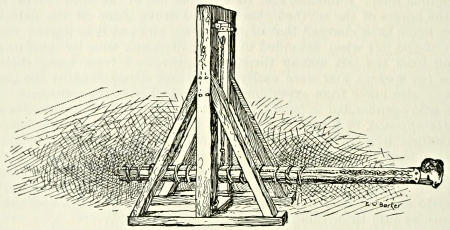
Roman Battering Ram
Hannibal, when he found that the Romans demanded him, retired to
Crete; not thinking himself, however, safe in that island, he left it soon
after and repaired to the court of Prusias, king of Bithynia, who felt flattered
by the presence of so great a man. But the vengeance of Rome did
not sleep, and no less a person than T. Flamininus was sent (183) to demand
his death or his surrender. The mean-spirited Prusias, immediately after
a conference with the Roman envoy, sent soldiers to seize his illustrious
guest.c Cornelius Nepos thus describes the tragic result:
Hannibal constantly confined himself to one place, being a castle with
which the king had presented him as a reward for his services, which he
so contrived, that he had sallies on all sides through which he might escape
if he should have occasion; for he always suspected that that would befall
him, which at last did really happen. The Roman ambassadors, accompanied
with a great number of men, having at length surrounded this castle on all
parts, his servant perceiving them from the gate, runs to his master and
acquaints him that there appeared a more than usual company of armed men;
upon which he commanded him to go round all the doors of the house and
speedily bring him word whether there was any way to escape. When the boy
had immediately acquainted him how the case stood, and had farther assured
him that all the passages were stopped, he was soon satisfied that this could
not happen by accident, but that they came to seize his person; and that
consequently he could not long enjoy his life, which he was resolved should
not be in another man’s disposal: upon which he immediately swallowed a
dose of poison, which he was always accustomed to carry with him. Thus,
this our most valiant hero, harassed with numerous and various labours,
reposed himself in death.h
It is said that Scipio Africanus died in the same year with his illustrious
rival, an instance also of the mutability of fortune, for the conqueror of
Carthage breathed his last in exile. In the year 193 he had had a specimen
of the instability of popular favour; for while at the consular elections he
and all the Cornelian gens exerted their influence in favour of his cousin
P. Cornelius Scipio, the son of Cneius who had been killed in Spain,—and
who was himself of so exemplary a character that, when the statue of the
Idæan mother Cybele was, by the direction of the Sibylline books, brought
to Rome from Pergamus, it was committed to his charge, as being the best
man in the city—they were forced to yield to that of the vainglorious
T. Quinctius Flamininus, who sued for his brother, the profligate L. Quinctius.
But, as the historian observes, the glory of Flamininus was fresher;
he had triumphed that very year; whereas Africanus had been now ten
years in the public view, and since his victory over Hannibal he had been
consul a second time, and censor—very sufficient reasons for the decline
of his favour with the unstable people.
[187-183 B.C.]
The year after the conclusion of the peace with Antiochus (187) the
Q. Petillii, tribunes of the people, at the instigation it is said of M. Porcius
Cato, cited Scipio Africanus before the tribes, to answer various charges on
old and new grounds, of which the chief was that of having taken bribes
from Antiochus, and not having accounted for the spoil. Scipio was attended
to the Forum by an immense concourse of people; he disdained to
notice the charges against him; in a long speech he enumerated the various
actions he had performed, and taking a book from his bosom, “In this,”
said he, “is an account of all you want to know.” “Read it,” said the tribunes,
“and let it then be deposited in the treasury.” “No,” said Scipio,
“I will not offer myself such an insult”; and he tore up the book before
their faces.
The night came on; the cause was deferred till the next day: at dawn the
tribunes took their seat on the rostra; the accused, on being cited, came before
it, attended by a crowd of his friends and clients. “This day, ye tribunes and
quirites,” said he, “I defeated Hannibal in Africa. As, therefore, it should
be free from strife and litigation, I will go to the Capitol and give thanks to
Jupiter and the other gods who inspired me on this and other days to do good
service to the state. Let whoso will, come with me and pray to the gods that
ye may always have leaders like unto me.” He ascended the Capitol; all
followed him, and the tribunes were left sitting alone. He then went round
to all the other temples, still followed by the people; and this last day of his
glory nearly equalled that of his triumph for conquered Africa. His cause
was put off for some days longer; but in the interval, disgusted with the
prospect of contests with the tribunes which his proud spirit could ill brook,
he retired to Liternum in Campania. On his not appearing, the tribunes
spoke of sending and dragging him before the tribunal; but their colleagues
interposed, especially Ti. Sempronius Gracchus, from whom it was least expected,
as he was at enmity with the Scipios. The senate thanked Gracchus
for his noble conduct,[57] the matter dropped, and Scipio spent the remainder
of his days at Liternum. He was buried there, it is said, at his own desire,
that his ungrateful country might not even possess his ashes.
The actions of the two great men who were now removed from the scene
sufficiently declare their characters. As a general Hannibal is almost without
an equal; not a single military error can be charged to him, and the address
with which he managed to keep an army composed of such discordant elements
as his in obedience, even when obliged to act on the defensive, is
astonishing. The charges of perfidy, cruelty, and such like, made against
him by the Roman writers, are quite unfounded, and are belied by facts.
Nowhere does Hannibal’s character appear so great as when, after the defeat
of Zama, he, with unbroken spirit, applied the powers of his mighty mind to
the reform of political abuses and the restoration of the finances, in the hopes
of once more raising his country to independence. Here he shone the true
patriot.
The character of his rival has come down to us under the garb of panegyric;
but even after making all due deductions, much remains to be admired.
His military talents were doubtless considerable; of his civil virtues we hear
but little, and we cannot therefore judge of him accurately as a statesman.
Though a high aristocrat, we have, however, seen that he would not hesitate to
lower the authority of the senate by appealing to the people in the gratification
of his ambition; and we certainly cannot approve of the conduct of
the public man who disdained to produce his accounts when demanded. Of
his vaunted magnanimity and generosity we have already had occasion to
speak, and not in very exalted terms. Still Rome has but one name in her
annals to place in comparison with that of Africanus; that name, Julius Cæsar,
is a greater than his—perhaps than any other.
[201-171 B.C.]
To return to our narrative. In the period which had elapsed since the
peace with Carthage, there had been annual occupation for the Roman arms
in Cisalpine Gaul, Liguria, and Spain. The Gauls, whose inaction all the
time Hannibal was in Italy seems hard to account for, resumed arms in the
year 201, at the instigation of one Hasdrubal, who had remained behind
from the army of Mago; they took the colony of Placentia, and met several
consular and prætorian armies in the field, and, after sustaining many great
defeats, were completely reduced; the Ligurians, owing to their mountains,
made a longer resistance, but they also were brought under the yoke
of Rome. In Spain the various portions of its warlike population, ill brooking
the dominion of strangers, rose continually in arms, but failed before the
discipline of the Roman legions and the skill of their commanders. The
celebrated M. Porcius Cato when consul (195) acquired great fame by his
conduct in that country.
Philip of Macedonia, who with all his vices was an able prince, had long
been making preparations for a renewed war with Rome, which he saw to be
inevitable. He died however (179) before matters came to an extremity.
His son and successor Perseus was a man of a very different character; for
while he was free from his father’s love of wine and women, he did not possess
his redeeming qualities, and was deeply infected by a mean spirit of
avarice. It was reserved for him to make the final trial of strength with
the Romans. Eumenes of Pergamus went himself to Rome, to represent
how formidable he was become, and the necessity of crushing him; the
envoys of Perseus tried in vain to justify him in the eyes of the jealous
senate; war was declared (172) against him on the usual pretext of his
injuring the allies of Rome, and the conduct of it was committed to P.
Licinius Crassus, one of the consuls for the ensuing year.
[171-168 B.C.]
The Macedonian army amounted to thirty-nine thousand foot, one-half
of whom were phalangites, and four thousand horse, the largest that Macedonia
had sent to the field since the time of Alexander the Great. Perseus
advanced into Thessaly at the head of this army (171), and at the same
time the Roman legions entered it from Epirus. An engagement of cavalry
took place not far from the river Peneus, in which the advantage was
decidedly on the side of the king. In another encounter success was on
that of the Romans; after which Perseus led his troops home for the winter
and Licinius quartered his in Thessaly and Bœotia.
Nothing deserving of note occurred in the following year. In the spring
of 169 the consul Q. Marcius Philippus led his army over the Cambunian
mountains into Macedonia, and Perseus, instead of occupying the passes in
the rear and cutting off his supplies from Thessaly, cravenly retired before
him, and allowed him to ravage all the south of Macedonia. Marcius returned
to Thessaly for the winter, and in the ensuing spring (168) the new
consul, L. Æmilius Paulus (son of the consul who fell at Cannæ), a man of
high consideration, of great talent, and who had in a former consulate gained
much fame in Spain, came out to take the command.
Meantime the wretched avarice of Perseus was putting an end to every
chance he had of success. Eumenes had offered, for the sum of fifteen hundred
talents, to abstain from taking part in the war, and to endeavour to
negotiate a peace for him: Perseus gladly embraced the offer, and was ready
enough to arrange about the hostages which Eumenes agreed to give; but
he hesitated to part with the money before he had had the value for it, and
he proposed that it should be deposited in the temple at Samothrace till the
war was ended. As Samothrace belonged to Perseus, Eumenes saw that he
was not to be trusted, and he broke off the negotiation. Again, a body of
Gauls, with ten thousand horse and an equal number of foot, from beyond
the Ister, to whom he had promised large pay, were now at hand; Perseus
sought to circumvent them and save his money, and the offended barbarians
ravaged Thrace and returned home. It is the opinion of the historian, that
if he had kept his word with these Gauls, and sent them into Thessaly, the
situation of the Roman army, placed thus between two armies, might have
been very perilous. Lastly, he agreed to give Gentius, king of Illyricum,
three hundred talents if he went to war with the Romans: he sent ten of
them at once, and directed those who bore the remainder to go very slowly;
meantime his ambassador kept urging Gentius, who, to please him, seized two
Roman envoys who arrived just then, and imprisoned them. Perseus, thinking
him fully committed with the Romans by this act, sent to recall the rest
of his money.
Paulus led his army without delay into Macedonia, and in the neighbourhood
of Pydna he forced the crafty Perseus to come to an engagement.
The victory was speedy and decisive on the side of the Romans; the Macedonian
horse fled, the king setting the example, and the phalanx thus left
exposed was cut to pieces. Perseus fled with his treasures to Amphipolis,
and thence to the sacred isle of Samothrace. All Macedonia submitted to
the consul, who then advanced to Amphipolis after Perseus, who in vain
sent letters suing for favour (168).
Meantime the prætor Cn. Octavius was come with his fleet to Samothrace.
He sought ineffectually to induce Perseus to surrender, and then so
wrought on the people of the island, that the unhappy prince, considering
himself no longer safe, resolved to try to escape to Cotys, king of Thrace, his
only remaining ally. A Cretan ship-master undertook to convey him away
secretly; provisions, and as much money as could be carried thither unobserved,
were put on board his bark in the evening, and at midnight the
king left the temple secretly and proceeded to the appointed spot. But no
bark was there; the Cretan, false as any of his countrymen, had set sail for
Crete as soon as it was dark. Perseus having wandered about the shore
till near daylight, slunk back and concealed himself in a corner of the
temple. He was soon obliged to surrender to Octavius, by whom he was
conveyed to the consul. Macedonia was, by the direction of the senate,
divided into four republics, between which there was to be neither intermarriage
nor purchase of immovable property (connubium or commercium);
each was to defray the expenses of its own government, and pay to Rome
one-half of the tribute it had paid to the kings; the silver and gold mines
were not to be wrought, no ship-timber was to be felled, no troops to be
kept except on the frontiers; all who had held any office, civil or military,
under Perseus were ordered to quit Macedonia and go and live in Italy, lest
if they remained at home they should raise disturbances. In Greece the
lovers of their country were put to death or removed to Italy, under pretext
of their having favoured the cause of Perseus, and the administration of
affairs was placed in the hands of the tools of Rome.
Paulus on his return to Rome celebrated his triumph with great magnificence.
His soldiers—because he had maintained rigid discipline and had
given them less of the booty than they had expected—instigated by Ser.
Sulpicius Galba, one of their tribunes, a personal enemy to the consul, had
tried to prevent it; but the eloquence of M. Servilius and others prevailed.
Perseus and his children, examples of the mutability of fortune, preceded
the car of the victor. After the triumph, Perseus was confined at Alba in
the Marsian land,[58] where he died a few years after.
Octavius was allowed to celebrate a naval triumph; and the prætor L.
Anicius Gallus, who had in thirty days reduced Illyricum and made Gentius
and all his family captives, also triumphed for that country.
[201-149 B.C.]
After the conclusion of the Hannibalian War, the Carthaginians seemed
disposed to remain at peace; but the ambition of their neighbour Masinissa,
whose life, to their misfortune, was extended to beyond ninety years, would
not allow them to rest. He was continually encroaching on their territory
and seizing their subject towns. The Roman senate, when appealed to as
the common superior, sent out commissioners, who almost invariably decided
in favour of Masinissa, and he gradually extended his dominion from the
ocean inlands to the Syrtes.
On one of these occasions M. Porcius Cato was one of those sent out;
and when he saw the fertility of the Carthaginian territory and its high
state of culture, and the strength, wealth, and population of the city, he
became apprehensive of its yet endangering the power of Rome; his vanity
also, of which he had a large share, was wounded, because the Carthaginians,
who were manifestly in the right, would not acquiesce at once in the decision
of himself and his colleagues; and he returned to Rome full of bitterness
against them. Henceforth he concluded all his speeches in the senate with
these words, “I also think that Carthage should be destroyed.” On the
other side, P. Scipio Nasica, either from a regard to justice, or, as it is said,
persuaded that the only mode of saving Rome from the corruption to which
she was tending was to keep up a formidable rival to her, strenuously
opposed this course. The majority, however, inclined to the opinion of
Cato; it was resolved to lay hold on the first plausible pretext for declaring
war, and to those who were so disposed a pretext was not long wanting.
At Carthage there were three parties; the Roman, the Numidian, and
the popular party. This last, which, with all its faults, alone was patriotic,
drove out of the city about forty of the principal of the Numidian party, and
made the people swear never to re-admit them nor listen to any proposals for
their return. The exiles repaired to Masinissa, who sent his sons Micipsa
and Gulussa to Carthage on their behalf. But Carthalo, a leader of the
popular party, shut the gates against them, and Hamilcar, the other popular
leader, fell on Gulussa as he was coming again, and killed some of those who
attended him. This gave occasion to a war; a battle was fought between
Masinissa and the Punic troops led by Hasdrubal, which lasted from morning
to night without being completely decided. But Masinissa having
enclosed the Punic army on a hill, starved them into a surrender; and
Gulussa, as they were departing unarmed, fell on and slaughtered them all.
The Carthaginians lost no time in sending to Rome to justify themselves,
having previously passed sentence of death on Hasdrubal, Carthalo, and the
other authors of the war. The senate, however, would accept of no excuse;
and after various efforts on the part of the Carthaginians to avert it, war
was proclaimed against them (149), and the conduct of it committed to the
consuls L. Marcius Censorinus and M’. Manilius Nepos, with secret orders
not to desist till Carthage was destroyed. Their army is said to have consisted
of eighty thousand foot and four thousand horse, which had been
previously prepared for this war.
[149 B.C.]
The Carthaginians were informed almost at the same moment of the
declaration of war and of the sailing of the Roman army. They saw themselves
without ships (for they had been prohibited to build any), without an
ally (even Utica, not eight miles from their city, having joined the Romans),
without mercenaries, or even supplies of corn, and the flower of their youth
had been lately cut off by Masinissa. They again sent an embassy to Rome,
to make a formal surrender of their city. The senate replied that if within
thirty days they sent three hundred children of the noblest families as hostages
to the consuls in Sicily, and did whatever the consuls commanded them,
they should be allowed to be free and governed by their own laws, and to
retain all the territory they possessed in Africa. At the same time secret
orders were sent to the consuls to abide by their original instructions.
The Carthaginians became somewhat suspicious at no mention of their
city having been made by the senate. They however resolved to obey, and
leave no pretext for attacking them; the hostages accordingly were sent to
Lilybæum, amidst the tears and lamentations of their parents and relatives.
The consuls straightway transmitted them to Rome, and then told the Carthaginians
that they would settle the remaining matters at Utica, to which
place they lost no time in passing over, and when the Punic envoys came to
learn their will, they said that as the Carthaginians had declared their wish
and resolution to live at peace they could have no need for arms and weapons;
they therefore required them to deliver up all that they had. This mandate
also was obeyed; two hundred thousand sets of armour, with weapons of all
kinds in proportion, were brought on wagons into the Roman camp, accompanied
by the priests, the senators, and the chief persons of the city. Censorinus
then, having praised their diligence and ready obedience, announced
to them the further will of the senate, which was that they should quit Carthage,
which the Romans intended to level, and build another town in any
part of the territory they pleased, but not within less than ten miles of the
sea. The moment they heard this ruthless command they abandoned themselves
to every extravagance of grief and despair; they rolled themselves
on the ground, they tore their garments and their hair, they beat their
breasts and faces, they called on the gods, they abused the Romans for their
treachery and deceit. When they recovered from their paroxysm they spoke
again, requesting to be allowed to send an embassy to Rome. The consul
said this would be to no purpose, for the will of the senate must be carried
into effect. They then departed, with melancholy forebodings of the reception
they might meet with at home, and some of them ran away on the road,
fearing to face the enraged populace. Censorinus forthwith sent twenty
ships to cast anchor before Carthage.
Car for carrying a Battering Ram
The people, who were anxiously waiting their return, when they saw their
downcast melancholy looks, abandoned themselves to despair and lamented
aloud. The envoys passed on in silence to the senate house, and there
made known the inexorable resolve of Rome. When the senators heard
it they groaned and wept; the people without joined in their lamentations;
then giving way to rage, they rushed in and tore to pieces the principal
advisers of the delivery of the hostages and arms; they stoned the ambassadors
and dragged them about the city; and then fell on and abused in
various ways such Italians as happened to be still there. The senate that
very day resolved on war; they proclaimed liberty to the slaves, they chose
Hasdrubal—whom they had condemned to death, and who was at a place
called Nepheris at the head of a force of twenty thousand men—general for
the exterior, and another Hasdrubal, the grandson of Masinissa, for the city;
and having again applied in vain to the consuls for a truce that they might
send envoys to Rome, they prepared vigorously for defence, resolved to
endure the last rather than abandon their city. The temples and other
sacred places were turned into workshops, men and women laboured day
and night in the manufacture of arms, and the women cut off their long hair
that it might be twisted into bowstrings. The consuls meantime, though
urged by Masinissa, did not advance against the city, either through dislike
of the unpleasant task, or because they thought that they could take it
whenever they pleased. At length they led their troops to the attack of
the town.
The city of Carthage lay on a peninsula at the bottom of a large bay; at
its neck, which was nearly three miles in width, stood the citadel, Byrsa, on
a rock whose summit was occupied by the temple of Esmun or Æsculapius;
from the neck on the east ran a narrow belt or tongue of land between the
lake of Tunis and the sea; at a little distance inlands extended a rocky
ridge, through which narrow passes had been hewn. The harbour was on
the east side of the peninsula; it was double, consisting of an outer and an
inner one, and its mouth, which was seventy feet wide, was secured with
iron chains; the outer harbour was surrounded by a quay for the landing of
goods. The inner one, named the Cothon, was for the ships of war; its
only entrance was through the outer one, and it was defended by a double
wall; in its centre was an elevated island, on which stood the admiral’s
house, whence there was a view out over the open sea. The Cothon was
able to contain 220 ships, and was provided with all the requisite magazines.
A single wall environed the whole city; that of Byrsa was triple, each wall
being thirty ells high exclusive of the battlements, and at intervals of two
hundred feet were towers four stories high. A double row of vaults ran
round each wall, the lower one containing stalls for three hundred elephants
and four thousand horses, with granaries for their fodder; the upper barracks,
for twenty thousand foot and four thousand horse. Three streets led from
Byrsa to the market, which was near the Cothon, which harbour gave name
to this quarter of the town. That part of the town which lay to the west and
north was named Megara; it was more thinly inhabited, and full of gardens
divided by walls and hedges. The city was in compass twenty-three miles,
and is said to have contained at this time seven hundred thousand inhabitants.
The consuls divided their forces; Censorinus attacked from his ships the
wall where it was weakest, at the angle of the isthmus, while Manilius
attempted to fill the ditch and carry the outer works of the great wall.
They reckoned on no resistance; but their expectations were deceived, and
they were forced to retire. Censorinus then constructed two large battering-rams,
with which he threw down a part of the wall near the belt; the Carthaginians
partly rebuilt it during the night, and next day they drove out
with loss such of the Romans as had entered by the breach. They had also
in the night made a sally and burned the engines of the besiegers. It being
now the dog days, Censorinus finding the situation of his camp, close to a
lake of standing water, unwholesome, removed to the sea-shore. The Carthaginians
then, watching when the wind blew strong from the sea on the
Roman station, used to fill small vessels with combustibles, to which they
set fire, and spreading their sails let the wind drive them on the Roman
ships, many of which were thus destroyed.
Censorinus having gone to Rome for the elections, the Carthaginians
became more daring, and they ventured a nocturnal attack on the camp of
Manilius, in which they would have succeeded but for the presence of mind
of Scipio, one of the tribunes, who led out the horse at the rear of the camp
and fell on them unexpectedly. A second nocturnal attack was frustrated
by the same Scipio, who was now the life and soul of the army. Manilius
then, contrary to the advice of Scipio, led his troops to Nepheris against
Hasdrubal; but he was forced to retire with loss, and four entire cohorts
would have been cut off had it not been for the valour and the skill of
Scipio. Shortly after, when commissioners came out from Rome to inquire
into the causes of the want of success, Manilius and his officers, laying aside
all jealousy, bore testimony to the merits of Scipio; the affection of the army
for him was also manifest; of all which the commissioners informed the senate
and people on their return.
[149-147 B.C.]
Masinissa dying at this time, left the regulation of his kingdom to Scipio,
who divided the regal office among the three legitimate sons of the deceased
monarch; giving the capital and the chief dignity to Micipsa, the eldest, the
management of the foreign relations to Gulussa, and the administration of
justice to Mastanabal. Scipio also induced Himilco Phamæas, a Punic commander,
who had hitherto done the Romans much mischief, to desert to them,
bringing over with him twenty-two hundred horses.
In the spring (148) the new consul L. Calpurnius Piso came out to take
the command of the army, and the prætor L. Hostilius Mancinus to take that
of the fleet. They attacked the town of Clupea by sea and land, but were
repulsed; and Calpurnius then spent the whole summer to no purpose in the
siege of a strong town named Hippagreta. The Carthaginians, elevated by
their unexpected good fortune, were now masters of the country; they insulted
the Romans, and endeavoured to detach the Numidians. Hasdrubal, proud
of his successes over Manilius, aspired to the command in the city; he accused
the other Hasdrubal of having intelligence with his uncle Gulussa, who was
in the Roman camp; and when this last, on being charged with it in the
senate, hesitated from surprise, the senators fell on and killed him with the
seats; and his rival thus gained his object.
The elections now came on at Rome; Scipio was there as a candidate for
the ædileship; all eyes were turned on him, his friends doubtless were not
idle, and the letters from the soldiers in Africa represented him as the only
man able to take Carthage. The tribes therefore resolved to make him consul,
though he was not of the proper age.[60] The presiding consul opposed in
vain; he was elected, and the people further assumed the power of assigning
him Africa for his province.
This celebrated man was son to Æmilius Paulus, the conqueror of Macedonia.
He had been adopted by Scipio the son of Africanus; the Greek
historian Polybius and the philosopher Panætius were his instructors and
friends; and he had already distinguished himself as a soldier both in Spain
and Africa.
[147 B.C.]
The very evening that Scipio arrived at Utica (147) he had again an
opportunity of saving a part of the Roman army; for Mancinus, a vain rash
man, having brought the fleet close to Carthage, and observing a part of the
wall over the cliffs left unguarded, landed some of his men, who mounted to
the wall. The Carthaginians opened a gate and came to attack them; the
Romans drove them back and entered the town. Mancinus landed more men,
and as it was now evening he sent off to Utica, requiring provisions and a
reinforcement to be forwarded without delay, or else they would never be
able to keep their position. Scipio, who arrived that evening, received about
midnight the letters of Mancinus; he ordered the soldiers he had brought
with him and the serviceable Uticans to get on board at once, and he set
forth in the last watch, directing his men to stand erect on the decks and let
themselves be seen; he also released a prisoner, and sent him to tell at
Carthage that Scipio was coming. Mancinus meantime was hard pressed
by the enemies, who attacked him at dawn; he placed five hundred men
with armour around the remainder (three thousand men), who had none; but
this availed them not; they were on the point of being forced down the cliffs
when Scipio appeared. The Carthaginians, who expected him, fell back a
little, and he lost no time in taking off Mancinus and his companions in peril.
Scipio, on taking the command, finding extreme laxity of discipline and
disorder in the army, in consequence of the negligence of Piso, called an
assembly, and having upbraided the soldiers with their conduct, declared his
resolution of maintaining strict discipline; he then ordered all sutlers, camp-followers,
and other useless and pernicious people to quit the camp, which
he now moved to within a little distance of Carthage. The Carthaginians
also formed a camp about half a mile from their walls, which Hasdrubal
entered at the head of six thousand
foot and one thousand horse,—all
seasoned troops.

A Roman Standard
When Scipio thought the discipline
of his men sufficiently revived,
he resolved to attempt a
night attack on the Megara; but
being perceived by the defenders,
the Romans could not scale the
walls. Scipio then observing a turret
(probably a garden one) which
belonged to some private person,
and was close to the wall, and of
the same height with it, made some
of his men ascend it. These drove
down with their missiles those on
the walls opposite them, and then
laying planks and boards across
got on the wall, and jumping down
opened a gate to admit Scipio, who entered with four thousand men. The
Punic soldiers fled to the Byrsa, thinking that the rest of the town was
taken, and those in the camp hearing the tumult ran thither also; but Scipio,
finding the Megara full of gardens with trees and hedges and ditches filled
with water, and therefore unsafe for an invader, withdrew his men and went
back to his camp. In the morning Hasdrubal, to satiate his rage, took what
Roman prisoners he had, and placing them on the walls in sight of the Roman
camp, mutilated them in a most horrible manner, and then flung them down
from the lofty battlements. When the senators blamed him, he put some
of them to death, and he made himself in effect the tyrant of the city.
Scipio having taken and burned the deserted camp of the enemy, formed
a camp within a dart’s cast of their wall, running from sea to sea across the
isthmus, and strongly fortified on all sides. By this means he cut them off
from the land; and as the only way in which provisions could now be
brought into the city was by sea, when vessels, taking advantage of winds
that drove off the Roman ships, ran into the harbour, he resolved to stop up
its mouth by a mole. He commenced from the belt, forming the mole of
great breadth and with huge stones. The besieged at first mocked at the
efforts of the Romans; but when they saw how rapidly the work advanced
they became alarmed, and instantly set about digging another passage out
of the port into the open sea; they at the same time built ships out of the
old materials; and they wrought so constantly and so secretly, that the
Romans at length saw all their plans frustrated, a new entrance opened to
the harbour, and a fleet of fifty ships of war and a great number of smaller
vessels issue from it. Had their evil destiny now allowed the Carthaginians
to take advantage of the consternation of the Romans, and fall at once on
their fleet, which was utterly unprepared, they might have destroyed it;
but they contented themselves with a bravado and then returned to port.
On the third day the two fleets engaged from morn till eve with various
success. The small vessels of the enemy annoyed the Romans very much
in the action; but in the retreat they got ahead of their own ships, and
blocking up the mouth of the harbour, obliged them to range themselves
along a quay which had been made without the walls for the landing of
goods, whither the Roman ships followed them and did them much mischief.
During the night they got into port, but in the morning Scipio resolved to
try to effect a lodgment on the quay which was so close to the harbour.
He assailed the works that were on it with rams, and threw down a part of
them; but in the night the Carthaginians came, some swimming, some wading
through the water, having combustibles with them, to which they set
fire when near the machines, and thus burned them. They then repaired the
works; but Scipio finally succeeded in fixing a corps of four thousand men
on the quay.
During the winter Scipio took by storm the Punic camp before Nepheris,
and that town surrendered after a siege of twenty-two days. As it was
from Nepheris that Carthage received almost the whole of its supplies, they
now failed, and famine was severely felt.c
[146 B.C.]
As soon as spring came on, Scipio assaulted the citadel called Byrsa and
the gate called Cothon at the same time, which caused Hasdrubal to set on
fire that part of the gate which was square; but whilst he expected Scipio
should make a new attempt on that side, and stood firm with the inhabitants,
Lælius mounted privately by the other side of the gate which was of a round
figure, and making himself master of it, the shouts of those that were already
got up so dismayed the enemies that the other soldiers now contemning the
besieged, and having filled all the places difficult to pass with beams, engines,
and planks, they leaped in on all sides in spite of all the resistance
of the guards oppressed with hunger and lost to all courage; Scipio thus
possessed of the wall that encompassed the gate called Cothon, got thence
into the great place of the city which was nigh unto it, where night coming
on, and not suffering him to go farther, he kept there in arms with those
soldiers he had with him, and as soon as day broke, caused four thousand
fresh men to come thither, who being got into Apollo’s temple, plundered
his statue which was all of gold, and all the inside of the temple, which was
covered with plates of gold of a thousand talents’ weight. They cut in
pieces the plates with their swords, do what their captains could to hinder
them, till such time as having got what they could they pursued their
enterprise.
Meanwhile Scipio’s chief design was against the place called Byrsa, for
that was the strongest of all the city, and a world of people were retreated
thither. The way from the great place thither was up hill through three
streets, on each side of which there was a continuance of very high houses,
whose upper stories, jetting somewhat over into the street, whole showers of
darts flew from thence upon the Romans, who were constrained before they
passed farther to force the first houses and there post themselves, that from
thence they might drive out those that fought in the neighbouring houses,
and after they had driven them out, they laid beams and planks from one
side of the street to the other, on which, as on bridges, they passed across the
streets; thus they maintained war in the chambers whilst as fast as they met
they fought more cruelly below in the streets.
All places were filled with cries and groans, people dying a thousand
different sorts of deaths, some at sword’s point, some thrown headlong down
from the tops of the houses upon the pavement, others falling upon javelins,
pikes, and swords presented against them, however none durst yet set fire
because of those who maintained the fight in the lofts; but when Scipio had
gained the foot of the fortress all the three streets were immediately in a
flame, and the soldiers had charge to hinder the ruins of the houses caused
by the fire from falling into the street, that the whole army might have the
more convenient passage; and now were new spectacles of calamity to be
seen, the fire devouring and overturning the houses, and the Roman soldiers
all about so far from hindering it, that they endeavoured to involve the rest
in the same ruin. The miserable Carthaginians in despair falling confusedly
with the stones and bricks on the pavement, dead bodies, nay, people yet
living, and especially old men, women, and children, who had hidden themselves
in the most secret places of the houses, some laden with wounds,
others half burnt, and all crying out in a deplorable manner, others tumbling
headlong from the upper stories of the houses among the mass of stones and
wood were in their falls torn in pieces.
Nor was this the end of their miseries, for the pioneers, who to make
way for the soldiers, removed the rubbish out of the middle of the streets,
tossed with their hooks and forks the bodies, as well of the dead as living,
into the vaults, turning them with their iron instruments as if they had
been pieces of wood or stones, so that there might be seen holes full of heaps
of men, of which some having been headlong thrown in, yet breathed a long
time and lay with their legs above ground, and others interred up to the
neck were exposed to the cruelty of the masons and pioneers, who took
pleasure to see their heads and brains crushed under the horses’ feet, for
these sort of people placed not those wretches so by chance but of set
purpose.
As for the men of war, their being engaged in the fight, with the hopes
of approaching victory, the eagerness of the soldiers heightened by the
sounds of the trumpets, the noise made by the majors and captains in giving
their orders, made them even like furies and hindered them from amusing
themselves at these spectacles. In this bloody toil they continued six days
and six nights without respite, save only that the soldiers were from time
to time relieved by other fresh ones, lest the continual watchings, labour,
slaughter and horror should make their hearts fail them. Scipio only bore
out all this time without sleeping; he was continually in action, continually
running from one place to another, and taking no food but what offered
itself by chance as he was passing, till such time as quite tired out he sat
down in an eminent place, that he might see what passed. Meanwhile
strange havoc was made on all sides and this calamity seemed likely to
continue much longer, when on the seventh day they had recourse to his
clemency, and came to him bringing in their hand the Vervein of Æsculapius
whose temple is the most considerable in all the fortress, desiring no other
composition but that he would please to give their lives to all that would
come forth, which he granted to them, except only to the runaways. There
came forth fifty thousand as well men as women, who he caused to pass
out of the little gate towards the fields with a good guard.
The runaways, who were about nine hundred, seeing there was no mercy
for them, withdrew into the temple with Hasdrubal, his wife and children,
where, though they were a small number, they might defend themselves,
because of the height of the place situated upon rocks, and to which in time
of peace they ascended by sixty steps, but at length oppressed with famine,
watchings, and fear, and seeing their destruction so nigh, impatience seized
them, and quitting the lower part of the temple they fled to the highest
story. Hasdrubal meanwhile privately withdrew himself and went to Scipio
with a branch of olive in his hand; Scipio having commanded him to come
up and prostrate himself at his feet, showed him to the runaways, who seeing
him demanded silence, which being granted, after having vomited forth an
infinite number of revilings and reproaches against Hasdrubal, they set fire to
the temple, and buried themselves in the flame. It is said that whilst the
fire was kindling, Hasdrubal’s wife, decking herself in the best manner she
could, and placing herself in the sight of Scipio, spoke to him with a loud
voice in this manner.
The Oration of Hasdrubal’s Wife; Scipio’s Moralising
“I wish nothing to thee, O Roman, but all prosperity, for thou dost act
only according to the rights of war. But I beseech the gods of Carthage,
and thou thyself to punish, as he deserves, that Hasdrubal, who has betrayed
his country, his gods, his wife, and children,” and then addressing her speech
to Hasdrubal: “Perfidious wretch,” said she, “thou most wicked of all
mankind! This fire is about to devour me and my children; but thou, great
captain of Carthage, for what triumph are not thou reserved, or what punishment
will not he make thee suffer, at whose feet I now see thee.”[61]
After these reproaches she cut her children’s throats and cast them into
the fire, and then threw herself headlong in; such, as is reported, was the end
of this woman, but this death had certainly better become her husband.
As for Scipio, seeing that city which had flourished for seven hundred
years since it was first built, comparable to any empire whatsoever for extent
of dominion by sea and land, for its arms, for its fleets, for its elephants, for
its riches, and preferable even to all nations on the earth for generosity and
resolution, since after their arms and ships were taken away, they had supported
themselves against famine and war for three years together,—seeing
it, I say, now absolutely ruined, it is said that he shed tears and publicly
deplored the hard fortune of his enemies. He considered that cities,
peoples, and empires are subject to revolutions, as well as the conditions of
private men, that the same disgrace had happened to Troy, that powerful
city, and afterwards to the Assyrians, Medes, and Persians, whose dominion
extended so far, and lately to the Macedonians, whose empire was so great
and flourishing, which was the reason that unawares, and as it were without
thinking of it, that distich of Homer’s escaped him,—
“Priam’s and Troy’s time come, they Fates obey,
And must to fire and sword be made a prey.”
And Polybius who had been his tutor, demanding of him in familiar discourse
what he meant by those words, he ingeniously answered, that the consideration
of the vicissitude of human affairs had put him in mind of his
country, whose fate he likewise feared; as the same Polybius reports in his
histories.
Plundering the City
Carthage thus taken, Scipio gave the plunder to the soldiers for some
days, except only the gold and silver, and offerings, which were found in the
temple. After which he distributed several military recompenses to all his
soldiers, except only those who had pillaged Apollo’s temple. And having
caused a very light ship to be laden with the spoil of the enemy, he sent
it to Rome to carry the news of victory, and caused it to be signified
throughout all Sicily that those who would come and claim the offerings made
to their temples, which had been carried away by the Carthaginians when
they had made war in that island, should have them restored. Thus giving
testimonies of his goodness in all that he could, he gained the good will of all
the people. And, at last, having sold what remained of the spoil, he caused
all the bucklers, engines, and useless ships to be piled together, and being girt
after the manner of the Romans, set fire to them as a sacrifice to Mars and
Minerva.
The ship that went from Carthage happened to arrive at Rome in an
evening, where as soon as the news was known of the taking of that city, all
the people flocked to the public places, and the night was spent in rejoicings
and embracing each other, as if this victory (the greatest that ever the Romans
had gained) had confirmed the public repose, which they before thought
insecure. They knew well, that they and their predecessors had done great
things against the Macedonians, the Spaniards, and lately against the great
Antiochus, as likewise in Italy; but they confessed they never had a war so
much to be feared as this, by reason of the generosity, prudence, and hardiness
of their enemies; nor so perilous, by reason of their infidelity. They
likewise remembered the miseries they had suffered by the Carthaginians in
Sicily, in Spain, and likewise in Italy, for sixteen whole years together, during
which Hannibal had sacked four hundred cities, and destroyed in divers
encounters three hundred thousand men, and being several times come to the
very gates of their city, had reduced them to the last extremities. These
things considered, made them with difficulty believe what was told of the
victory, and they often demanded of one another if it were certain that
Carthage was destroyed.
Thus they passed the night in recounting one to another how, after
having disarmed the Carthaginians, they had presently made themselves
new arms beyond judgment of all the world. How having taken away
their ships, they had built others of old stuff; and how having stopped the
entrance of their port, they had in a few days dug a new one on the other
side. They spoke likewise of the unmeasurable height of their walls, the
vast stones they were built with, the fire which they had several times put
to the engines. In short they represented to the eyes of the auditors the
whole figure of this war; insomuch that giving life to their discourse by
their gesture they seemed to see Scipio on the ladders, on the ships, in the
gates, and in the streets, running from one side to the other.
Sacrifices and the Triumph
The people having thus spent the night, on the morrow solemn sacrifices
were made to the gods, and public prayers, wherein every tribe assisted
separately; after which plays and spectacles were exhibited to public view,
and then the senate sent ten commissioners, of the number of the Fathers,
to settle jointly with Scipio such orders as were most necessary for that
province and for the Romans’ best advantage. As soon as they were arrived
they ordered Scipio to demolish what remained of Carthage; henceforth
forbidding any to inhabit there, with horrible imprecations against those
who in prejudice of this interdict should attempt to rebuild anything, especially
the fort called Byrsa, and the place called Megara, to the rest they
defended no man’s entrance. They decreed likewise that all the cities which
in that war had held on the enemy’s party should be razed, and gave their
territories, conquered by the Roman arms, to the Roman allies, particularly
gratifying those of Utica with all the country extending from Carthage to
Hippone; they made all the rest of the province tributary, from which
neither men or women were exempt, resolving that every year there should
be a prætor sent from the city, and having given these orders they returned
to Rome. Scipio having executed them, and beholding himself at the height
of his wishes, made sacrifices, and set forth plays in honour of the gods, and
after settling all things in a good condition returned to Rome, whither he
entered in triumph. Never was anything beheld more glorious, for there
was nothing to be seen but statues and rarities, and curious pieces of an inestimable
price which the Carthaginians had for so long a time been bringing
into Africa from all parts of the world, where they had gained an infinite
of victories.g
[151-147 B.C.]
In the same year in which Lucullus and Galba took command in Spain,
the senate was induced to perform an act of tardy justice in the release of
the Achæan captives. The abduction of the best men in every state of
Greece gave free scope, as has been said, to the oppressions of the tyrants
favoured by Rome. In the Achæan assembly alone there was still spirit
enough to check Callicrates, who never ventured to assail the persons and
property of his fellow-citizens. Meantime years rolled on; the captives
still languished in Etruscan prisons; hope deferred and sickness were
fast thinning their numbers; the assembly asked only that Polybius and
Stratius might return, but the request was met by a peremptory negative.
At last, when Scipio returned from Spain, he induced Cato to intercede
for these unhappy men. The manner of the old censor’s intercession is
characteristic.
The debate had lasted long and the issue was somewhat doubtful, when
Cato rose, and, without a word about justice or humanity, simply said:
“Have we really nothing to do but to sit here all day, debating whether a
parcel of old Greeks are to have their coffins made here or at home?” The
question was decided by this unfeeling argument, and the prisoners, who in
sixteen years had dwindled from one thousand to three hundred, were set
free. But when Polybius prayed that his comrades might be restored to
their former rank and honours, the old senator smiled, and told him “he was
acting like Ulysses, when he ventured back into the cave of the Cyclops to
recover his cap and belt.”
The men released in this ungracious way had passed the best part of
their lives in captivity. The elder and more experienced among them
were dead. The survivors returned with feelings embittered against
Rome; they were rash and ignorant, and, what was worse, they had lost
all sense of honour and all principle, and were ready to expose their country
to any danger in order to gratify their own passions. The chief name that
has reached us is that of Diæus. Polybius did not return at first, and
when he reached Greece he found his countrymen acting with such reckless
violence that he gladly accepted Scipio’s invitation to accompany him to
the siege of Carthage. Callicrates, by a strange reverse, was now the
leader of the moderate party. Diæus advocated every violent and unprincipled
measure. On an embassy to Rome the former died, and Diæus
returned as chief of the Achæan League.
Not long after (in 148 B.C.) a pretender to the throne of Macedon
appeared. He was a young man named Andriscus, a native of Adramyttium,
who gave himself out as Philip, a younger son of that luckless monarch.
The state of Macedonia, divided into four republics, each in a state
of compulsory excommunication, was so distracted, that, in the year 151,
the people sent an embassy to Rome, praying that Scipio might be sent to
settle their affairs, and he had only been prevented from undertaking the
task by the self-imposed duty of accompanying the army of Lucullus into
Spain. The pretender, however, met with so little success in his first
attempt that he fled to the court of Demetrius at Antioch, and this prince
sent him to Rome. The war with Carthage was then at its height. The
senate treated the matter lightly, and the adventurer was allowed to escape.
Some Thracian chiefs received him, and with troops furnished by them he
penetrated into Thessaly. The Roman prætor, Juventius Thalna, was
defeated and slain by the pretender.
The temporary success of Pseudo-Philippus (as the Romans called him)
encouraged Diæus to drive the Achæans into a rupture with Rome. The
haughty republic, he said, was at war with Carthage and with Macedon;
now was the time to break their bonds. Q. Metellus, who had just landed
in Greece with a considerable army, gave the Achæans a friendly warning,
but in vain.
Metellus soon finished the Macedonian War. At his approach the pretender
hastily retired from Thessaly, and was given up to the Roman prætor
by a Thracian chief whose protection he had sought.
Meanwhile, a commission had already arrived at Corinth, headed by
M. Aurelius Orestes, who summoned the chiefs of the League to hear the
sentence of the senate upon their recent conduct. He informed them that
they must relinquish all claims of sovereignty over Corinth, Argos, and
Lacedæmon—a doom which reduced the Achæan League nearly to the condition
from which Aratus first raised it. The chiefs reported what they had
heard to the assembly. A furious burst of passion rose, which Diæus did
not attempt to restrain. Orestes and the Romans hardly escaped personal
violence.
[147-146 B.C.]
Orestes instantly returned to Rome; and the senate, preferring diplomacy
to force, sent a second commission headed by Sext. Julius Cæsar, with instructions
to use gentle language, and merely to demand the surrender of
those who had instigated the violent scenes lately enacted at Corinth. A
contemptuous answer was returned, upon which Cæsar returned to Rome,
and the senate, roused at the Grecian insolence, declared war against the
Achæans (147).
Metellus hoped to win the glory of pacifying Greece, as well as of conquering
Macedonia. He sent some of his chief officers to endeavour to
bring the Achæans to their senses. But their leaders were too far committed;
and at the beginning of 146 B.C. Critolaus, a friend of Diæus, who
was general for the year, advanced into Thessaly, and was joined by the
Thebans, always the inveterate enemies of Rome. Metellus had already
heard that the Achæan War was to be conducted by L. Mummius, one of
the new consuls; and, anxious to bring it to a close before he was superseded,
he advanced rapidly with his army. On this the braggart chiefs of
the Achæans retreated in all haste, not endeavouring to make a stand even
at Thermopylæ. Their army dispersed almost without a blow. Metellus
pushed on straight towards the isthmus. Thebes he found deserted by her
inhabitants; misery and desolation appeared everywhere.
Diæus prepared to defend Corinth. But popular terror had succeeded
to popular passion; few citizens would enlist under his banner: though he
emancipated a number of slaves, he could not muster more than fifteen
thousand men.
When Metellus was almost within sight of Corinth, Mummius landed on
the isthmus with his legions, and assumed the command. The Romans
treated the enemy with so much contempt that one of their outposts was
surprised; and Diæus, flushed with this small success, drew out his forces
before the city. Mummius eagerly accepted the challenge, and the battle
began. The Achæan cavalry fled at the first onset; the infantry was soon
broken, and Diæus fled into one gate of Corinth and out of another without
attempting further resistance. The Romans might have entered the city
that same day; but seeing the strength of the Acropolis, and suspecting
treachery, Mummius held back, and twenty-four hours elapsed before he
took possession of his unresisting prey. But the city was treated as if it
had been taken by assault; the men were put to the sword, the women
and children reserved to be sold by auction. All treasures, all pictures,
all the works of the famous artists who had moulded Corinthian brass into
effigies of living force and symmetry, were seized by the consul on behalf
of the state; then, at a given signal, fire was applied, and Corinth was
reduced to a heap of ashes.
Mummius, a new man, was distinguished by the rudeness rather than by
the simplicity of an Italian boor. He was not greedy, for he reserved little
for himself; and when he died, his daughter found not enough left for her
dowry; but his abstinence seems to have proceeded from indifference rather
than self-denial. He cared not for the works of Grecian art. He suffered
his soldiers to use one of the choicest works of the painter Aristides as a
draught-board; but when Attalus offered him a large sum for the painting, he
imagined it must be a talisman, and ordered it to be sent to Rome. Every
one knows his speech to the seamen who contracted to carry the statues and
pictures of Corinth to Rome. “If they lost or damaged them,” he said,
“they must replace them with others of equal value.”
In the autumn ten commissioners arrived, as usual, with draughts of
decrees for settling the future condition of Macedon and Greece. Polybius,
who had returned from witnessing the conflagration of Carthage just in
time to behold that of Corinth, had the melancholy satisfaction of being
called to their counsels—a favour which he owed to the influence of Scipio.
A wretched sycophant proposed to the commissioners to destroy the statues
of Aratus and Philopœmen; but Polybius prevented this dishonour by
showing that these eminent men had always endeavoured to keep peace
with Rome. At the same time he declined to accept any part of the confiscated
property of Diæus. Politically he was able to render important services.
All Greece south of Macedonia and Epirus was formed into a Roman
province under the name of Achaia.[62] The old republican governments of
the various communities were abolished, and the constitution of each assimilated
to that of the municipal cities of Italy. Polybius was left in Greece
to settle these new constitutions, and to adjust them to the circumstances
and wants of each place. His grateful countrymen raised a statue to
his honour by the side of their old heroes, and placed an inscription on the
pedestal, which declared that, if Greece had followed his advice, she would
not have fallen.
Such was the issue of the last struggle for Grecian liberty. It was conducted
by unworthy men, and was unworthy of the name it bore. Polybius
had always opposed attempts at useless and destructive insurrection. He
considered it happy for Greece that one battle and the ruin of one city consummated
her fall. Indeed it was a proverb of the day that “Greece was
saved by her speedy fall.”
The ten commissioners passed northwards into Macedonia, and formed
that country, in conjunction with Epirus, into another province. Illyricum
was so constituted soon after Cæsar’s conquest of Gaul.
Metellus and Mummius both returned to Rome before the close of
146 B.C., and were honoured with triumphs not long after Scipio had
carried the spoils of Carthage in procession to the Capitol. In memory of
their respective services, Metellus was afterwards known by the name of
Macedonicus, while Mummius, who appears to have had no third name
of his own, was not ashamed to assume the title of Achaicus.
[150-141 B.C.]
While Rome was engaged in war with Carthage, the Lusitanians resumed
their inroads under the conduct of the gallant Viriathus, who had
escaped from the massacre of Galba. No Roman general could gain any
positive advantage over this indefatigable enemy, and in the year 143 B.C.
the war assumed a much more serious aspect. The brave Celtiberian tribes
of Numantia and its adjacent districts again appeared in the field. For
several years we find two Roman commanders engaged in Spain, as before
the treaty of Gracchus: one opposed to the Numantians and their Celtiberian
allies in the north, the other carrying on an irregular warfare against Viriathus
and the Lusitanians in the south.
The conduct of the Celtiberian War was committed to Q. Metellus
Macedonicus, who had been elected consul for the year 143. He remained
in command for two years, and was so successful in his measures that by
the close of the second campaign he had compelled the enemy to shut
themselves up in their strong cities. But he was disappointed, as in Greece,
by finding anticipated triumph snatched from his grasp by Q. Pompeius,
consul for the year 141 B.C.
Pompeius and his successors could make no impression upon the Numantians.
Nay, C. Hostilius Mancinus, consul for the year 137, suffered a
memorable reverse. Mancinus set out for his province amid general alarm,
excited by the unfavourable omens at his inaugural sacrifices. He was
attended as quæstor by young Ti. Gracchus, who had already distinguished
himself at the siege of Carthage. Mancinus found the army before Numantia
in a state of complete disorganisation, and deemed it prudent to retreat
from his position in front of that city. The Numantians pursued and
pressed him so hard that he was obliged to entrench himself in an old
camp, and sent a herald with offers to treat on condition that his army
should be spared. The enemy consented, but only on the understanding
that young Gracchus was to make
himself responsible for the execution
of the treaty. Articles of peace were
accordingly signed by Mancinus himself,
with Gracchus and all the chief
officers of the army.
[141-140 B.C.]
Before we notice the sequel of the
famous Treaty of Mancinus, it will
be well to follow the Lusitanian War
to its conclusion.

Juno
(From a statue in the Vatican)
Here also the fortune of Rome
was on the decline. Q. Fabius Servilianus
was surprised by Viriathus
in a narrow defile, and so shut up
that escape was impossible. The
Lusitanian captain offered liberal
terms, which were gladly accepted
by the proconsul. This peace was
approved by the senate, and Viriathus
was acknowledged as the ally
of Rome.
But Q. Servilius Cæpio, brother
by blood of Servilianus, was little
satisfied by the prospect of an inactive
command. By importunity he
wrung from the senate permission to
break the peace so lately concluded
by his brother, and ratified by themselves—a
permission basely given
and more basely used. Cæpio assailed
Viriathus, when he little expected an attack, with so much vigour
that the chief was fain to seek refuge in Gallæcia, and sent envoys to ask
Cæpio on what ground the late treaty was no longer observed. Cæpio sent
back the messengers with fair words, but privily bribed them to assassinate
their master. They were too successful in their purpose, and returned to
claim their blood-money from the consul. But he, with double treachery,
disowned the act, and referred them to the senate for their reward.
The death of Viriathus was the real end of the Lusitanian War. He was
(as even the Roman writers allow) brave, generous, active, vigilant, patient,
faithful to his word; and the manner in which he baffled all fair and open
assault of the disciplined armies of Rome gives a high conception of his qualities
as a guerilla chief. His countrymen, sensible of their loss, honoured
him with a splendid military funeral. The senate, with a wise moderation
which might have been adopted years before, assigned lands to a portion of
the mountaineers within the province, thus at length making good the
broken promises of Galba. Such was the discreditable termination of the
Lusitanian War. We must now return to Mancinus and his treaty.
[140-138 B.C.]
He returned to defend his conduct before the senate. He pleaded that
the army was so demoralised that no man could wield it with effect, and
admitted that he had concluded a treaty with Numantia without the
authority of the senate and the people; as that treaty was not approved,
he declared himself ready to support a bill for delivering up the persons
of himself and all who had signed it to the Numantians. Such a bill
was accordingly brought before the tribes. But young Gracchus upheld
the treaty, and Scipio, his brother-in-law, made an eloquent speech in his
behalf. But the people, always jealous of defeat, voted for delivering up
Mancinus alone as an expiatory offering. Accordingly a person, consecrated
for this special purpose, carried him to Numantia. But the Spaniards,
like the Samnites of old, refused to accept such a compensation; one man’s
body, they said was no equivalent for the advantage they had lost. Mancinus,
therefore, returned to Rome. But when he took his place in the senate,
the tribune Rutilius ordered him to leave the curia, because, he said, one
who had been delivered over to the enemy with religious ceremony was no
longer a citizen of Rome, and could not recover his rights by simply returning
to his country. A special law was introduced to restore Mancinus to
his former position.
Dec. Junius Brutus, consul for 138, an able officer, was entrusted with the
pacification of Lusitania; the town of Valentia owes its origin to a colony of
this people planted there by him. After finishing this business, he carried
his arms northward across the Tagus, the Douro, and the Minho, and
received homage from the tribes of the western Pyrenees. He was the first
Roman who reached the shores of the Bay of Biscay, and saw the sun set in
the waters of the Atlantic; and he was not unjustly honoured with the
name of Callaicus for his successes.
But Numantia still defied the arms of Rome. Men began to clamour for
a consul fit to command; and all eyes fell upon Scipio. His qualities as a
general had been tested by success at Carthage, and circumstances had since
occurred which raised him to great popularity.
After his triumph in 146 B.C., Scipio had continued to lead the simple
life in which he had been bred, and which not all the wealth he inherited
from his adoptive father induced him to abandon. He affected an austerity
of manners which almost emulated that of Cato, though he was free from
the censorious dogmatism and rude eccentricities of that celebrated man. In
142 B.C. he was elected censor in conjunction with Mummius, who so
thwarted all the efforts of his colleague to promote reforms that the latter
publicly exclaimed, “I should have been able to do my duty, either with a
colleague or without one.” Scipio had gained a clear conception of the unsound
state of things, which long-continued wars and senatorial government
had produced. In the prayer, which he offered on entering upon the censor’s
office, he altered the usual form; and instead of asking that “the
gods would increase and magnify the power of Rome,” he said, “I pray that
they may preserve it; it is great enough already.”
[138-133 B.C.]
His frugal life carried with it a guarantee of honesty and devotion to
public interests, which would alone have secured him public favour. But
several acts gained him more direct popularity. The son of his kinsman
Nasica, nicknamed Serapio, had joined the high oligarchical party. But
the son of Æmilius Paulus, on the few occasions on which he appeared in
public, took the popular side. In 137 the tribune Cassius proposed the first
law for taking votes by secret ballot,[63] with the intention of neutralising the
undue influence of the senators. Scipio came forward and addressed the
people in favour of this law. As his popularity was increased, his favour
with the senate proportionately fell. Six years before, when he was canvassing
for the censorship, App. Claudius, seeing the motley crowd which followed
him, exclaimed: “Ah, Æmilius, it would trouble thy spirit to see thy
son followed by such a crew.”
Yet he courted not popularity; he seldom even visited the Forum,
though he spoke with force and eloquence when he chose. When the same
Appius boasted that he knew all who frequented the Forum by name, Scipio
replied: “True, I do not know many of my fellow-citizens by name, but I
have taken care that all should know me.” Popularity came unasked, and
the people cast their eyes upon him to retrieve the dishonour of the Roman
arms in Spain. Legally he could not hold the consulship, for a law had
been lately passed forbidding a second election in any case. But Scipio
received the votes of every century, though he was not a candidate.
He was now fifty-one years of age, and he proceeded to execute his commission
with the same steady vigour which distinguished him on other
occasions. He found the demoralisation of the army not less than it had
been described, and he applied himself to correct it with the same severity
that his father had used in Macedonia, and he himself had used before
Carthage. All courtesans and hucksters, together with fortune-tellers who
drove a lucrative trade in the dispirited army, he commanded to quit
the camp. All carriages, horses, and mules he ordered to be sold, except
those that were needed for actual service. No cooking utensils were allowed
except a spit, a camp bottle, and a drinking-cup. Down beds were forbidden;
the general himself slept upon a straw pallet.
After some time spent in training his army, he led it to Numantia by a
difficult and circuitous route, in order to avoid a battle. As he approached
the place he was joined by young Jugurtha, bastard son of Micipsa, who
came from Numidia with twelve elephants and a large body of light cavalry.
By this time the season for war was nearly over, and he ordered two strong
camps to be formed for winter quarters. In one he fixed himself, the other
he put under the command of his brother Fabius.
With the beginning of spring (133 B.C.) he began to draw lines of
circumvallation round the city, and declined all attempts made by the
Numantians to provoke a general action—a circumstance which is rather
surprising, if it be true that the available troops of the Spanish city
amounted to no more than eight thousand men.
Numantia lay on both sides of the Douro, not far from its source. The
blockade was so strict, and the inhabitants were so ill provided, that in no
long time they were reduced to feed on boiled leather, and at length (horrible
to tell) on the bodies of the dead. In vain those who retained sufficient
strength attempted sallies by day and night; Scipio had established so complete
a system, that additional troops were always ready to strengthen any
weak point which might be assailed. In vain did the young men of Lubia
endeavour to relieve their brave neighbours. Scipio promptly marched to
that place with a division of light troops, and, having compelled the government
to surrender four hundred of the most active sympathisers, he cut off
their right hands and returned. Such was the cruelty which the most
enlightened men of Rome permitted themselves to use towards barbarians.
Nor does any ancient historian whisper a word of reproach.
The wretched Numantians now inquired on what terms they might be
admitted to surrender. The reply was, that on that very day they must lay
down their arms, and on the next appear at a given place. They prayed for
time to deliberate. In the interval a certain number of brave men, resolved
not to submit on any terms, put themselves to death; the remnant came
forth from the gates. Their matted hair, squalid apparel, and wasted forms
made even the Romans turn away in horror from their own work. Scipio
selected fifty to walk in his triumphal procession, and sold the rest. The
town was so effectually destroyed that its very site cannot be discovered.b
The Roman historian Florus gives a slightly different but very vivid account.
[133 B.C.]
But when famine pressed hard upon them, (as they were surrounded with
a trench and breastwork, and camps,) they entreated of Scipio to be allowed
the privilege of engaging with him, desiring that he would kill them as men,
and, when this was not granted, they resolved upon making a sally. A
battle being the consequence, great numbers of them were slain, and, as the
famine was still sore upon them, the survivors lived for some time on their
bodies. At last they determined to flee; but this their wives prevented,
by cutting with great treachery, yet out of affection, the girths of their
saddles. Despairing, therefore, of escape, and being driven to the utmost
rage and fury, they resolved to die in the following manner. They first
destroyed their captains, and then themselves and their native city, with
sword and poison and a general conflagration. Peace be to the ashes of the
most brave of all cities; a city, in my opinion, most happy in its very
sufferings; a city which protected its allies with honour, and withstood,
with its own force, and for so long a period, a people supported by the
strength of the whole world. Being overpowered at length by the greatest
of generals, it left no cause for the enemy to rejoice over it. Its plunder, as
that of a poor people, was valueless; their arms they had themselves burnt;
and the triumph of its conquerors was only over its name.
Hitherto the Roman people had been noble, honourable, pious, upright,
and illustrious. Their subsequent actions in this age, as they were equally
grand, so were they more turbulent and dishonourable, their vices increasing
with the very greatness of their empire. So that if any one divides this
third age, which was occupied in conquest beyond the sea, and which we
have made to consist of two hundred years, into two equal parts, he will
allow, with reason and justice, that the first hundred years, in which they
subdued Africa, Macedonia, Sicily, and Spain, were (as the poets sing) golden
years; and that the other hundred, which to the Jugurthine, Cimbrian, Mithridatic,
and Parthian wars, as well as those of Gaul and Germany, (in which
the glory of the Romans ascended to heaven,) united the murders of the
Gracchi and Drusus, the Servile War and (that nothing might be wanting in
their infamy) the war with the gladiators, were iron, blood-stained, and whatever
more severe can be said of them. Turning at last upon themselves, the
Romans, as if in a spirit of madness, and fury, and impiety, tore themselves
in pieces by the dissensions of Marius and Sulla, and afterwards by those of
Pompey and Cæsar.e Such was the destructive, but not glorious work, which
earned for Scipio the name of Numantinus, as the ruin of Carthage had given
him a better title than adoption to that of Africanus.
Commissioners were sent, according to custom, to reorganise the Spanish
provinces. The conquests of Scipio and of Dec. Brutus were comprehended
in the limits of the hither province, and for some years Spain remained in
tranquillity.
There was no enemy now left on the coast lands of the Mediterranean to
dispute the sovereignty of Rome. Nine provinces, each fit to be a kingdom,
owned her sway, and poured yearly taxes into her revenue. The kings of
Asia Minor, of Syria, of Egypt, were her obedient vassals.
[134-133 B.C.]
While Numantia was yet defying the Roman generals, a war broke out
near home of a more dreadful kind than any distant contest with foreigners
could be—the insurrection of the slaves in Sicily. Some remarks have
already been made on the rapid increase in the number of slaves which
attended the career of Roman conquest; and it was observed that, while
domestic slaves usually were well treated, the agricultural slaves were thrust
down to a condition worse than that of the oxen which laboured on the
land. The evils which such oppression might engender were now proved
by terrible experience.
Every one knows that in the early times of Rome the work of the farm
was the only kind of manual labour deemed worthy of a free citizen. This
feeling long survived, as may be seen from the praise bestowed on agriculture
by Cicero, whose enthusiasm was caught from one of his favourite
heroes, old Cato the censor, whose Treatise on Agriculture has been noticed.
The taste for books on farming continued. Varro the antiquarian, a friend
of Cicero, has left an excellent treatise on the subject. A little later came
the famous Georgics of Virgil, followed at no long interval by Pliny’s
notices, and then by the elaborate Dissertations of Columella, who refers to
a great number of Roman writers on the same subject. It is manifest that
the subject of agriculture possessed a strong and enduring charm for the
Roman mind.
But, from the times of the Hannibalic War, agriculture lost ground in
Italy. When Cato was asked what was the most profitable kind of farming,
he said, “Good grazing.” What next? “Tolerable grazing.” What next?
“Bad grazing.” What next? “Corn-growing.” Later writers, with one
accord, deplore the diminished productiveness of land.
This result was due in part, no doubt, to war, but much more to other
causes. Corn could be imported with facility from the southern lands of
Sicily, from Egypt, and from Numidia, while a great part of Italy was little
suited for the production of grain-crops. These causes found a powerful
assistant in the growth of large estates, and the profitable employment of
slaves as shepherds and herdsmen.
A few examples will show the prodigious number of slaves that must
have been thrown into the market after the Second Punic War. To punish
the Bruttians for the fidelity with which they adhered to the cause of
Hannibal, the whole nation were made slaves; 150,000 Epirots were sold by
Æmilius Paulus; fifty thousand captives were sent home from Carthage.
These numbers are accidentally preserved; and if, according to this scale,
we calculate the hosts of unhappy men sold into slavery during the Syrian,
Macedonian, Illyrian, Grecian, and Spanish wars, we shall be prepared to
hear that slaves fit only for unskilled labour were plentiful and cheap.
There was also a slave trade regularly carried on in the East. The
barbarous tribes on the coasts of the Black Sea were always ready to sell
their own flesh and blood; Thrace and Sarmatia were the Guinea Coast of
the Romans. The entrepôt of this trade was Delos, which had been made a
free port by Rome after the conquest of Macedonia. Strabo tells us that in
one day ten thousand slaves were sold there in open market. Such were
the vile uses to which was put the Sacred Island, once the treasury of
Greece, when her states were banded together to secure their freedom
against the Persian.
It is evident that hosts of slaves, lately free men, and many of them
soldiers, must become dangerous to the owners. Nor was their treatment
such as to conciliate. They were turned out upon the hills, made responsible
for the safety of the cattle put under their charge, and compelled to provide
themselves with the common necessaries of life. A body of these wretched
men asked their master for clothing: “What,” he asked, “are there no
travellers with clothes on?” The atrocious hint was soon taken; the shepherd
slaves of lower Italy became banditti, and to travel through Apulia
without an armed retinue was a perilous adventure. From assailing travellers,
the marauders began to plunder the smaller country houses; and all
but the rich were obliged to desert the country and flock into the towns. So
early as the year 185 B.C., seven thousand slaves in Apulia were condemned
for brigandage by a prætor sent specially to restore order in that land of
pasturage. When they were not employed upon the hills, they were shut
up in large prison-like buildings (ergastula), where they could talk together
of their wrongs, and form schemes of vengeance.
The Sicilian landowners emulated their Italian brethren; and it was their
tyrannical conduct that led to the frightful insurrection which reveals to us
somewhat of the real state of society which existed under the rule of Rome.
In Sicily, as in lower Italy, the herds are driven up into the mountain
pastures during the summer months, and about October return towards the
plains. The same causes which were at work in Italy were at work, on a
smaller scale, in Sicily. The city of Enna, once famous for the worship of
Demeter, had become the centre of a pastoral district; and of the neighbouring
landowners, Damophilus was the wealthiest. He was famous for the
multitude of his slave herdsmen, and for his cruel treatment of them, and
his wife Megallis emulated her lord in the barbarities which she practised on
the female slaves. At length the cup was full, and four hundred of his
bondsmen, meeting at Enna, took counsels of vengeance against Damophilus.
At Enna there lived another rich proprietor, named Antigenes; and
among his slaves was a Syrian, known by the Greek name of Eunus. This
man was a kind of wizard, who pretended to have revelations of the future,
and practised a mode of breathing fire, which passed for a supernatural
power. At length he gave out that his Syrian gods had declared to him
that he should be king hereafter. His master treated him as a jester, and at
banquets used to call him in to make sport for his guests; and they, entering
into his humour, used to beg him to remember them when he gained his
sceptre. But to the confederate slaves of Damophilus, Eunus seemed in
truth a prophet and a king sent to deliver them. They prayed him to become
their leader, he accepted their offer; and the whole body entered the city of
Enna, with Eunus at their head breathing fire.
The wretched city now felt the vengeance of men brutalised by oppression.
Clad in skins, armed with stakes burned at the end, with reaping
hooks, spits, or whatever arms rage supplied, they broke into the houses, and
massacred all persons of free condition, from the old man and matron to the
infant at the breast. Crowds of slaves joined them; every man’s foes were
those of his own household. Damophilus was dragged to the theatre and
slain. Megallis was given over to the female slaves, who first tortured her,
and then cast her down the crag on which the
city stands.
Eunus thus saw the wildest of his dreams fulfilled.
He assumed the diadem, took the royal
name of Antiochus, and called his followers Syrians.
The ergastula were broken open, and numbers
of slaves sallied out to join him. Soon he
was at the head of ten thousand men. He
showed no little discretion in the choice of officers.
Achæus, a Greek, was made general of the
army, and he exerted himself to preserve order
and moderate excesses.
A few days after the massacre at Enna, Cleon,
a Cilician slave, raised a similar insurrection near
Agrigentum. He also was soon at the head of
several thousand men.
The Romans in Sicily, who had looked on in
blank dismay, now formed hopes that the two
leaders might quarrel—hopes soon disappointed
by the tidings that Cleon had acknowledged the
sovereign authority of King Antiochus. There
was no Roman magistrate present in Sicily when
the insurrection broke out. The prætor of the
last year had returned to Italy; and his successor
now arrived, ignorant of all that was passing. He
contrived to collect eight thousand men in the
island, and took the field against the slaves, who
by this time numbered twenty thousand. He was
utterly defeated, and the insurrection spread over
the whole island.
Æsculapius
The consternation at Rome was great. No one could tell where the evil
would stop. Movements broke out in various parts of the empire; but the
magistrates were on the alert, and all attempts were crushed forcibly. At
Rome itself 150 slaves, detected in organising an outbreak, were put to death
without mercy.
The insurrection seemed to the senate so serious that they despatched the
consul, C. Fulvius Flaccus, colleague of Scipio in the year 134 B.C., to crush
it. But Flaccus obtained no advantage over the insurgents. In the next
year L. Calpurnius Piso succeeded in wresting Messana from the enemy, and
advanced to Enna, a place strongly defended by nature, which he was unable
to take. His successor, P. Rupilius, a friend of Scipio, began his campaign
with the siege of Tauromenium. The slaves offered a desperate resistance.
Reduced to straits for want of food, they devoured the children, the women,
and at length began to prey upon each other. Even then the place was only
taken by treachery. All the slaves taken alive were put to the torture and
thrown down a precipice. The consul now advanced to Enna, the last stronghold
of Eunus. The fate of the insurgents was inevitable. Cleon of Agrigentum
chose a soldier’s death, and, sallying forth with all who breathed the
same spirit as himself, he died fighting valiantly. Of the end of Achæus we
are not informed. Eunus, with a bodyguard of six hundred men, fled to
the neighbouring hills; but, despairing of escape, the greater part of the
wretched men slew one another. The mock king himself was taken in a
cave, with his cook, baker, bathing-man, and jester. He showed a pusillanimity
far unlike the desperate courage of the rest, and died eaten by vermin
in a dungeon at Morgantium.c
To show how horrible the thought of fighting slaves was to the Roman
mind, it may be well to quote Florus upon this first war, the quelling of
which he credits to Perperna.a
[133 B.C.]
Though, in the preceding war, we fought with our allies (which was bad
enough), yet we contended with free men, and men of good birth; but who
can with patience hear of a war against slaves on the part of a people at the
head of all nations! The first war with slaves occurred in the infancy of
Rome, in the heart of the city, when Herdonius Sabinus was their leader,
and when, while the state was distracted with the seditions of the tribunes,
the Capitol was besieged and wrested by the consul from the servile multitude.
But this was an insurrection rather than a war. At a subsequent
period, when the forces of the empire were engaged in different parts of the
world, who would believe that Sicily was much more cruelly devastated by a
war with slaves than in that with the Carthaginians? This country, fruitful
in corn, and, in a manner, a suburban province, was covered with large
estates of many Roman citizens; and the numerous slave houses and fettered
tillers of the ground supplied force enough for a war. A certain Syrian, by
name Eunus (the greatness of our defeats from him makes us remember it),
counterfeiting a fanatical inspiration, and tossing his hair in honour of the
Syrian goddess, excited the slaves by command of heaven as it were, to claim
their liberty and take up arms. And that he might prove this to be done by
supernatural direction, he concealed a nut in his mouth, which he had filled
with brimstone and fire, and, breathing gently, sent forth flame together with
his words. This prodigy at first attracted two thousand of such as came in
his way; but in a short time, by breaking open the slave houses, he collected
a force of above sixty thousand; and, being adorned with ensigns of royalty,
that nothing might be wanting to his audacity, he laid waste, with lamentable
desolation, fortresses, towns, and villages. The camps even of prætors
(the utmost disgrace of war) were taken by him; nor will I shrink from
giving their names; they were the camps of Manilius, Lentulus, Piso, and
Hypsæus. Thus those, who ought to have been dragged home by slave-takers,
pursued prætorian generals routed in battle. At last vengeance
was taken on them by our general, Perperna; for having conquered
them, and at last besieged them in Enna, and reduced them with famine
as with a pestilence, he threw the remainder of the marauders into chains,
and then crucified them. But over such enemies he was content with an
ovation, that he might not sully the dignity of a triumph with the name
of slaves.e
[133-131 B.C.]
Thus was crushed for a time this perilous insurrection, the result of the
slave system established by Roman conquest. The well-being of Sicily had
even now been so seriously impaired that extraordinary measures were
deemed necessary for restoring order. The Sibylline books were consulted.
The oracular page ordered the propitiation of “Ceres the most ancient”;
and a solemn deputation of priests proceeded to the august temple of the
goddess in the city of Enna. This circumstance, seemingly unimportant,
becomes significant, when it is considered that the war really originated in
the neglect of agricultural labours, and was at its height during the notable
year in which Ti. Gracchus was bringing to all men’s knowledge the reduced
condition of the farmers of Italy.
Ten commissioners were sent to assist Rupilius in drawing up laws for
the better regulation of the agricultural districts. The code formerly established
by Hiero at Syracuse was taken as the basis of their legislation, a
measure which gave great satisfaction to all the Greek communities. The
whole land was required to pay a tithe of its produce to the Romans except
the five free cities and some others which were allowed to pay a fixed annual
sum. The collection of these tithes was to be let to Roman contractors.
But to prevent extortion, courts of appeal were provided. All disputes between
citizens of the same town were left to be decided in the town courts;
those between citizens of different towns, by judges drawn by lot under the
eye of the prætor; those between a town community and an individual, by
the senate of some other city; those between a Roman citizen and a Sicilian,
by a judge belonging to the same nation as the defendant. There can be no
doubt that the general condition of the Sicilian landholders was considerably
improved by this system; and agriculture again flourished in Sicily as it
had done in former times.b
Ancient Tomb, hewn from Solid Rock
Now that we have seen Rome first become mistress of Italy, and then,
after a life and death struggle, rise superior to Carthage; now that we shall
have to follow her in her conquest of all the countries bordering on the
Mediterranean, so that this sea became what in modern phrase may be called
a Roman lake, we naturally inquire, what was the form of government, what
the treatment of the subject foreigners, what the condition of the people?
About the time of the Punic Wars the framework of the Roman constitution
was complete. The only trace remaining of ancient severance was the
regulation by which, of the two consuls and the two censors, one must be a
patrician, one a plebeian. In a few years even this partition of offices fell
into disuse, and no political distinction remained, save that persons of patrician
pedigree were excluded from the tribunate of the plebs.[64]
In correspondence with the advance of plebeian and the decay of patrician
families, a silent revolution had been wrought in most parts of the constitution.
The assembly of the curies had become a mere form. They
continued to meet even to Cicero’s time; but their business had dwindled
away to the regulation of the religious observances proper to the patrician
gentes. A few lictors, who were present as the attendants of the presiding
magistrates, alone appeared to represent the descendants of the Valerii, the
Claudii, and the Postumii.[65]
With regard to the executive government, the chief officers of state
employed in the administration of Roman affairs remained as they had been
settled after the Licinian laws. In Cicero’s time it is well known that every
Roman who aspired to the highest offices was obliged to ascend through a
regular scale of honours. An age was fixed before which each was unattainable.
The first office so held was the quæstorship, and the earliest age at
which this could then be gained appears to have been about twenty-seven.
Several years were then to elapse before a Roman could hold the first curule
office, that is, the ædileship. But between this and each of the highest
honours, the prætorship and the consulship, only two complete years were
interposed. To be chosen ædile a man must be at least thirty-seven, to be
prætor at least forty, to be consul at least forty-three. But no settled regulations
had yet been made. Many cases occur, both before and after the
Second Punic War, in which men were elected to the consulship at a very
early age, and before they had held any other curule office.
There can be little doubt that the ædileship was the least acceptable to
an active and ambitious man. The chief duties of the ædiles related to the
care of the public buildings (whence their name), the celebration of the
games and festivals, the order of the streets, and other matters belonging to
the department of police. But the quæstors were charged with business
of a more important character. They were attached to the consuls and
prætors as treasurers and paymasters. The tax-gatherers (publicani) paid
into their hands all moneys received on account of the state, and out of
these funds they disbursed all sums required for the use of the army, the
fleet, or the civil administration. They were originally two in number, one
for each consul; but very soon they were doubled, and at the conquest of
Italy they were increased to eight. Two always remained at home to conduct
the business of the treasury, the rest accompanied the consuls, and
prætors, and proconsuls to the most important provinces.
The office of prætor was supplementary to that of the consuls, and was
at first chiefly judicial. The original prætor was called “prætor urbanus,”
or president of the city courts. A second was added about the time when
Sicily became subject to Rome, and a new court was erected for the decision
of cases in which foreigners were concerned: hence the new magistrate was
called “prætor peregrinus.” For the government of the two first provinces,
Sicily and Sardinia, two more prætors were created, and when Spain was
constituted as a double province, two more, so that the whole number
amounted to six. In the absence of the consuls the prætors presided in
the senate and at the great assembly of the centuries. They often commanded
reserve armies in the field, but they were always subordinate to the
consuls; and to mark this subordinate position they were allowed only six
lictors, whereas each consul was attended by twelve. Of the consuls it is
needless to speak in this place. Their position as the supreme executive
officers of the state is sufficiently indicated in every page of the history.
To obtain any of these high offices the Roman was obliged to seek the
suffrages of his fellow-citizens. They were open to the ambition of every
one whose name had been entered by the censors on the register of citizens,
provided he had reached the required age. No office, except the censorship,
was held for a longer period than twelve months: no officer received any
pay or salary for his services. To defray expenses certain allowances were
made from the treasury by order of the senate. To discharge routine duties
and to conduct their correspondence, each magistrate had a certain number
of clerks (scribæ) who formed what we should call the civil service.
But though the highest offices seemed thus absolutely open to every candidate,
they were not so in practice. About the time of the First Punic
War an alteration was made which, in effect, confined the curule offices to
the wealthy families. The ædiles, for the expenses of the public games, had
an allowance made them from the treasury. But at the time just mentioned
this allowance was withdrawn. Yet the curule ædiles were still expected to
maintain the honour of Rome by costly spectacles at the great Roman games,
the Megalesian festival, and others of less consequence. Thus the choice of
the people was limited to those who could buy their favour.
The Romans had no standing army. Every Roman citizen between the
complete ages of seventeen and forty-five, possessing property worth at least
four thousand pounds of copper, was placed on the military roll. From this
roll four legions, two for each consul, were enlisted every year, and in cases
of necessity additional legions were raised. But at the close of the year’s
campaign these legionary soldiers had a right to be relieved. Nor were
there any fixed officers. Each legion had six tribunes and sixty centurions;
but these were chosen, like the consuls and soldiers, fresh every year. The
majority of the tribunes were elected at the comitia of the tribes, and the
remainder were nominated by the consuls of the year, the only limitation to
such choice being that those appointed should have served in the legions at
least five campaigns. The centurions were then nominated by the tribunes,
subject to the approval of the consuls.
Hence it appears that the Roman system, both in army and state, was
strictly republican, that is, calculated to distribute public offices to as many
citizens as possible, and to prevent power being absorbed by any single man
or classes of men. There were no professed statesmen or officers, but there
was a large number of men who had served for a time in each capacity.
There was no standing army, but there was a good militia. There was no
regularly trained soldiery, but every citizen had served in his time several
campaigns, and every one was something of a soldier.
But no republic, however jealous, can rigidly carry out such a system;
necessity will modify it in practice. During the Samnite Wars we find the
same eminent men repeatedly elected to the consulship, notwithstanding a
provision that no man should hold this high office except at intervals of ten
years. Valerius Corvus was chosen consul at three-and-twenty; he held
the office four times in fourteen years. So also Papirius Cursor, Fabius
Maximus, and others held the same sovereign office repeatedly at short intervals.
In the year 326 B.C. another plan was adopted to secure permanency.
From this time it became common to continue a consul or prætor in his command
for several successive years, with the title of proconsul or proprætor.
The proconsul also was allowed to keep part of his old army, with his tribunes
and centurions. The hope of booty and the desire to serve out his campaigns
(for after a certain number of campaigns served the legionary was exempt,
even though he was much under forty-five years) kept many soldiers in the
field; and thus the nucleus of a regular army was formed by each commander.
In the Punic Wars the ten years’ law was suspended altogether, and proconsuls
were ordered to remain in office for years together.b
No more vivid picture of the Roman army could be given than that of
Polybius, who contrasts the Greek phalanx with the Roman arrangement as
follows:
Pyrrhus employed not only the arms but the troops of Italy; and ranged
in alternate order a company of those troops and a cohort disposed in the
manner of the phalanx, in all his battles with the Romans. And yet, even
with the advantage of this precaution, he was never able to obtain any clear
or decisive victory against them. It was necessary to premise these observations
for the sake of preventing any objection that might be made to the
truth of what we shall hereafter say.
It is easy to demonstrate, by many reasons, that while the phalanx retains
its proper form and full power of action, no force is able to stand against it
in front or support the violence of its attack. When the ranks are closed in
order to engage, each soldier, as he stands with his arms, occupies a space
of three feet. The spears, in their most ancient form, contained seventeen
cubits in length. But, for the sake of rendering them more commodious in
action, they have since been reduced to fourteen. Of these, four cubits are
contained between the part which the soldier grasps in his hands and the
lower end of the spear behind, which serves as a counterpoise to the part
that is extended before him; and the length of this last part from the body
of the soldier, when the spear is pushed forwards with both hands against the
enemy, is, by consequence, ten cubits. From hence it follows that when the
phalanx is closed in its proper form, and every soldier pressed within the necessary
distance with respect to the man that is before him and upon his side,
the spears of the fifth rank are extended to the length of two cubits, and
those of the second, third, and fourth to a still greater length, beyond the
foremost rank. The manner in which the men are crowded together in this
method is marked by Homer in the following lines:
“Shield stuck to shield, to helmet helmet joined,
And man to man; and at each nod that bowed
High waving on their heads the glittering cones,
Rattled the hair-crowned casques: so thick they stood.”
This description is not less exact than beautiful. It is manifest, then, that
five several spears, differing each from the other in the length of two cubits,
are extended before every man in the foremost rank. And when it is considered,
likewise, that the phalanx is formed by sixteen in depth, it will be
easy to conceive what must be the weight and violence of the entire body,
and how great the force of its attack. In the ranks, indeed, that are behind
the fifth, the spears cannot reach so far as to be employed against the enemy.
In these ranks, therefore, the soldiers instead of extending their spears forward,
rest them upon the shoulders of the men that are before them, with
their points slanting upwards; and in this manner they form a kind of rampart
which covers their heads, and secures them against those darts which
may be carried in their flight beyond the first ranks, and fall upon those that
are behind. But when the whole body advances to charge the enemy, even
these hindmost ranks are of no small use and moment. For as they press
continually upon those that are before them, they add, by their weight alone,
great force to the attack, and deprive also the foremost ranks of the power
of drawing themselves backwards or retreating. Such then is the disposition
of the phalanx, with regard both to the whole and the several parts.
Let us now consider the arms, and the order of battle, of the Romans, that
we may see by the comparison in what respects they are different from those
of the Macedonians.
To each of the Roman soldiers, as he stands in arms, is allotted the same
space, likewise, of three feet. But as every soldier in the time of action is
constantly in motion, being forced to shift his shield continually that he
may cover any part of his body against which a stroke is aimed; and to vary
the position of his sword, so as either to push, or to make a falling stroke;
there must also be a distance of three feet, the least that can be allowed for
performing these motions to advantage, between each soldier and the man
that stands next to him, both upon his side and behind him. In charging,
therefore, against the phalanx, every single Roman, as he has two Macedonians
opposite to him, has also ten spears, which he is forced to encounter.
But it is not possible for a single man to cut down these spears with his
sword, before they can take their effect against him. Nor is it easy, on the
other hand, to force his way through them. For the men that are behind add
no weight to the pressure, nor any strength to the swords, of those that are in
the foremost rank. It will be easy, therefore, to conceive that while the phalanx
retains its own proper position and strength, no troops, as I before observed,
can ever support the attack of it in front. To what cause, then, is it
to be ascribed, that the Roman armies are victorious, and those defeated that
employ the phalanx? The cause is this. In war, the times and the places of
action are various and indefinite. But there is only one time and place, one
fixed and determinate manner of action, that is suited to the phalanx. In the
case, then, of a general action, if an enemy be forced to encounter with the
phalanx in the very time and place which the latter requires, it is probable,
in the highest degree, from the reasons that have been mentioned, that the
phalanx always must obtain the victory. But if it be possible to avoid an
engagement in such circumstances, and indeed it is easy to do it, there is
then nothing to be dreaded from this order of battle. It is a well-known
and acknowledged truth, that the phalanx requires a ground that is plain
and naked, and free likewise from obstacles of every kind, such as trenches,
breaks, obliquities, the brows of hills, or the channels of rivers; and that
any of these are sufficient to impede it, and to dissolve the order in which it
is formed. On the other hand again, it must be as readily allowed that, if it
be not altogether impossible, it is at least extremely rare, to find a ground
containing twenty stadia, or more, in its extent, and free from all these obstacles.
But let it, however, be supposed that such a ground may perhaps
be found. If the enemy, instead of coming down upon it, should lead their
army through the country, plundering the cities, and ravaging the lands, of
what use then will be the phalanx? As long as it remains in this convenient
post, it not only has no power to succour its friends, but cannot even preserve
itself from ruin. For the troops that are masters of the whole country without
resistance will cut off from it all supplies. And if, on the other hand, it
should relinquish its own proper ground, and endeavour to engage in action,
the advantage is then so great against it that it soon becomes an easy prey
to the enemy.
But, further, let it be supposed that the enemy will come down into this
plain. Yet, if he brings not his whole army at once to receive the attack of
the phalanx; or if, in the instant of the charge, he withdraws himself a little
from the action, it is easy to determine what will be the consequence from
the present practice of the Romans. For we now draw not our discourse
from bare reasoning only, but from facts which have lately happened. When
the Romans attack the phalanx in front, they never employ all their forces,
so as to make their line equal to that of the enemy; but lead on a part only
of their troops, and keep the rest of the army in reserve. Now, whether the
troops of the phalanx break the line that is opposed to them, or whether
themselves are broken, the order peculiar to the phalanx is alike dissolved.
For if they pursue the fugitives, or if, on the other hand, they retreat and
are pursued, in either case they are separated from the rest of their own
body. And thus there is left some interval or space, which the reserve of
the Roman army takes care to seize, and then charges the remaining part
of the phalanx, not in front, but in flank, or in the rear. As it is easy then
to avoid the times and circumstances that are advantageous to the phalanx,
and as those, on the contrary, that are disadvantageous to it can never be
avoided, it is certain that this difference alone must carry with it a decisive
weight in the time of action.
To this it may be added, that the troops of the phalanx also are, like
others, forced to march and to encamp in every kind of place; to be the first
to seize the advantageous posts; to invest an enemy, or be invested; and to
engage also in sudden actions, without knowing that the enemy was near.
These things all happen in war, and either tend greatly to promote, or sometimes
wholly determine the victory. But, at all such times, the Macedonian
order of battle either cannot be employed, or is employed in a manner that
is altogether useless.
For the troops of the phalanx, as must be evident, lose their strength
when they engage in separate companies, or man with man. The Roman
order, on the contrary, is never attended, even upon such occasions, with
any disadvantage. Among the Romans every single soldier, when he is
once armed and ready for service, is alike fitted to engage in any time and
place, or upon any appearance of the enemy; and preserves always the same
power, and the same capacity of action, whether he engages with the whole
of the army, or only with a part; whether in separate companies, or singly
man against man. As the parts, therefore, in the Roman order of battle,
are so much better contrived for use than those in the other, so the success
also in action must be greater in the one than the other.
If I have been rather long in examining this subject, it was because many
of the Greeks, at the time when the Macedonians were defeated, regarded
that event as a thing surpassing all belief; and because many others also may
hereafter wish to know in what particular respects the order of phalanx is
excelled by the arms and the order of battle of the Romans.f

Roman Trophies
The chief officers both in state and army were continually liable to
change, but there was a mighty power behind them, which did not change.
This was the senate. The importance of this body can hardly be overstated.
All the acts of the Roman republic ran in the name of the senate and people,
as if the senate were half the state, though its number was but three hundred.
The senate of Rome was perhaps the most remarkable assembly that the
world has ever seen. Its members held their seats for life; once senators
always senators, unless they were degraded for some dishonourable cause.
But the senatorial peerage was not hereditary. No father could transmit
the honour to his son. Each man must win it for himself.[66]
The manner in which seats in the senate were obtained is tolerably well
ascertained. The members of this august body, all—or nearly all—owed
their places to the votes of the people. In theory, indeed, the censors still
possessed the power really exercised by the kings and early consuls, of
choosing the senators at their own will and pleasure. But official powers,
however arbitrary, are always limited in practice. The censors followed
rules established by ancient precedent, and chose the senate from those who
had held the quæstorship and higher magistracies. In the interval between
two censorships, that is in the course of five years, the number of exquæstors
alone must have amounted to at least forty, and this was more than sufficient
to fill the number of vacancies which would have occurred in ordinary times.
The first qualification then for a seat in the senate was that of office. It is
probable that to the qualification of office there was added a second, of
property. Such was certainly the case in later times. A third limitation,
that of age, followed from the rule that the senate was recruited from the
lists of official persons. No one could be a senator till he was about
thirty.
Such was the composition of this great council during the best times of
the republic. It formed a true aristocracy. Its members, almost all, possessed
the knowledge derived from the discharge of public office and from
mature age. They were recommended to their places by popular election,
and yet secured from subserviency to popular will by the amount of their
property. It was not by a mere figure of speech that the minister of Pyrrhus
called the Roman senate “an assembly of kings.” Many of its members had
exercised what was in effect sovereign power; many were preparing to exercise
it. The power of the senate was equal to its dignity.
In regard to legislation, it exercised an absolute control over the centuriate
assembly, because no law could be submitted to its votes which had not
originated in the senate; and thus the vote of the centuries could not do
more than place a veto on a senatorial decree.[67]
In respect to foreign affairs, the power of the senate was absolute, except
in declaring war or concluding treaties of peace,—matters which were submitted
to the votes of the people. They assigned to the consuls and prætors
their respective provinces of administration and command; they fixed the
amount of the troops to be levied every year from the list of Roman citizens,
and of the contingents to be furnished by the Italian allies. They prolonged
the command of a general or superseded him at pleasure. They estimated
the sums necessary for the military chest; nor could a sesterce be paid to the
general without their order. If a consul proved refractory, they could
transfer his power for the time to a dictator; even if his success had been
great, they could refuse him the honour of a triumph. Ambassadors to
foreign states were chosen by them and from them; all disputes in Italy or
beyond seas were referred to their sovereign arbitrament.
In the administration of home affairs the regulation of religious matters
was in their hands; they exercised superintendence over the pontiffs and other
ministers of public worship. They appointed days for extraordinary festivals,
for thanksgiving after victory, for humiliation after defeat. But, which
was of highest importance, all the financial arrangements of the state were
left to their discretion. The censors, at periods usually not exceeding five
years in duration, formed estimates of annual outlay, and provided ways and
means for meeting these estimates; but always under the direction of the
senators. In all these matters, both of home and foreign administration, their
decrees had the power of law. In times of difficulty they had the power of
suspending all rules of law, by the appointment of a dictator.
Besides these administrative functions, they might resolve themselves
into a high court of justice for the trial of extraordinary offences. But in
this matter they obtained far more definite authority by the Calpurnian
law, which about fifty years later established high courts of justice, in which
prætors acted as presiding judges, and senators were jurymen.
At some time between the decemvirate and the Second Punic War, a
complete reform had been made in the centuriate assembly, as organised by
Servius. When this was we know not. Nor do we know the precise nature
of the reform. This only is certain, that the distribution of the whole people
into tribes was taken as the basis of division in the centuriate assembly as
well as in the assembly of the tribes, and yet that the division into classes
and centuries was retained, as well as into seniores and juniores.
It may be assumed that the whole people was convened according to its
division into thirty-five tribes; that in each tribe account was taken of the
five classes, arranged according to an ascending scale of property, which,
however, had been greatly altered from that attributed to Servius; and that
in each tribe each of the five classes was subdivided into two centuries, one
of seniores, or men between forty-five and sixty, one of juniores, or men
between eighteen and forty-five. On the whole, then, with the addition of
eighteen centuries of knights, there would be 368 centuries. This plan,
though it allowed far less influence to wealth than the plan of Servius, would
yet leave a considerable advantage to the richer classes. For it is plain that
the two centuries of the first class in each tribe would contain far fewer
members than the two centuries of the second class, those of the second
fewer than those of the third, and all those of the first four together, probably,
fewer than those of the fifth. Yet these four classes, having in all 280
or (with the knights) 298 centuries, would command an absolute majority;
for the question was still decided by the majority of centuries.
While the centuriate assembly was becoming more popular in its constitution,
a still more democratic body had come into existence.[68]
There can be no doubt that when the centuriate assembly was restored by
the patricians after the expulsion of Tarquinius,[69] it was intended to be the
sole legislative body. The more recent legislative assembly of the tribes was
a spontaneous growth of popular will, not contemplated by statesmen. The
tribe assembly, originally intended to conduct the business of the plebeian
order, gradually extended its power over the whole body politic; and its
ordinances (plebiscita) became laws.
The tribunes were originally invested with political authority for the
purpose of protecting the persons of the plebeians from the arbitrary punishments
inflicted by the patrician magistrates. It was no doubt intended that
this authority should be only
suspensive, so as to prevent
sudden acts of violence. But
the tribunes soon assumed the
license of standing between
plebeians and the law. Thus
they established the celebrated
right of intercession, which in
course of time they extended
to all matters. They forbade
trials, stopped elections, put a
veto on the passing of laws. So
far, however, their power was
only negative. But when the
tribe assembly obtained legislative
rights, the tribunes obtained
a positive authority.
The power of the tribunes and
of the tribes implied each other.
The plebeian assembly was dead
without able and resolute tribunes;
the tribunes were impotent
without the democracy.

Roman Statesman
This relation was at once
established when the election of
the tribunes was committed to
the tribes themselves. The tribunes
soon began to summon
the tribes to discuss political
questions; and the formidable
authority which they now
wielded appeared in the overthrow
of the decemvirate and
the recognition of the tribe assembly as a legislative body. The political
powers then gained by the Valerio-Horatian laws were confirmed and extended
by the popular dictators, Q. Publilius Philo and Q. Hortensius.
Thus the Roman constitution presents us with the apparent anomaly of
two distinct legislative assemblies, each independent of the other. Nor were
any distinct provinces of action assigned to each. This being so, we should
expect to find the one clashing with the other; to hear of popular laws
emanating from the one body met with a counter-project from the other.
But no such struggles are recorded. The only way in which it can be known
that a particular law is due to the more popular or to the more aristocratic
assembly is by looking to the name of the mover, by which every law was
designated. If the name be that of a tribune, the law must be referred to
the tribe assembly. If the name be that of a consul, prætor, or dictator, the
law must be referred to the centuriate assembly.[70] What, then, were the
causes which prevented collisions which appear inevitable?
First, it must be remembered that, though the centuriate assembly had
been made more democratic, yet the tribe assembly was very far indeed from
a purely democratic body. In the latter, the suffrages were taken by the
head in each of the thirty-five tribes, and if eighteen tribes voted one way,
and seventeen another, the question was decided by the votes of the eighteen.
But the eighteen rarely, if ever, contained an absolute majority of citizens.
For the whole population of Rome, with all the freedmen, were thrown into
four tribes only, and if these four tribes were in the minority, there can be
no doubt that the minority of tribes represented a majority of voters. Thus,
even in the more popular assembly, there was not wanting a counterpoise to
the will of the mere majority.
A still more effective check to collision is to be found in the fact that all
measures proposed to the tribe assembly by the tribunes, as well as the centuriate
laws proposed by the consuls or other ministers of the senate, must
first receive the sanction of the senate itself. The few exceptions which occur
are where tribunes propose a resolution granting to a popular consul the
triumph refused by the senate. But these exceptions only serve to prove
the rule.[71]
Our surprise that no collision is heard of between the two assemblies now
takes another form, and we are led to ask how it came that, if all measures
must be first approved by the senate, any substantial power at all could
belong to the tribes? It would seem that they also, like the centuriate
assembly, could at most exercise only a veto on measures emanating from
the great council.
That this result did not follow, is due to the rude but formidable counter-check
provided by the tribunate. The persons of the tribunes were inviolable;
but the tribunes had power to place even consuls under arrest. By
the advance of their intercessory prerogative they gradually built up an
authority capable of over-riding all other powers in the state.
We are now better able to appreciate the position of the two assemblies
as legislative bodies. The tribe assembly was presided over by officers
of its own choice, invested with authority generally sufficient to extort from
the senate leave to bring in laws of a popular character. No such power
resided in the presidents of the centuriate assembly; for the consuls were
little more than ministers of the senate. The centuriate assembly more and
more became a passive instrument in the hands of the senate. The tribe
assembly rose to be the organ of popular opinion.
In elections, the centuriate assembly always retained the right of choosing
the chief officers of state, the consuls, prætors, and censors. The tribe
assembly, originally, elected only their own tribunes and the plebeian ædiles.
But in no long time they obtained the right of choosing also the curule
ædiles, the quæstors, the great majority of the legionary tribunes, and all
inferior officers of state. But as the centuries were, generally, obliged to
elect their prætors and consuls out of those who had already been elected
quæstors and ædiles by the tribes, it is manifest that the elective power of
the former was controlled and overridden by the latter. In conferring
extraordinary commands, such as that of Scipio in Spain, the tribes were
always consulted, not the centuries.
In regard to jurisdiction, it has before been noticed that Rome was tender
of the personal liberties of her citizens. Various laws of appeal provided
for an open trial before his peers of anyone charged with grave offences,
such as would subject him to stripes, imprisonment, or death. Now the
centuries alone formed a high court of justice for the trial of citizens; the
tribe assembly never achieved this dangerous privilege. But the tribunician
power offered to the chief officers of the tribes a ready means of interference;
for they could use their right of intercession to prevent a trial, and
thus screen real offenders from justice. But more frequently they acted on
the offensive. There was a merciful provision of the law of Rome, by which
a person liable to a state prosecution might withdraw from Italian soil at
any time before his trial, and become the citizen of some allied city, such as
Syracuse or Pergamus. But the tribunes sometimes threw culprits into
prison before trial, as in the case of App. Claudius the decemvir and his
father. Or, after a culprit had sought safety in voluntary exile, they proposed
a bill of outlawry, by which he was “interdicted from fire and water”
on Italian soil, and all his goods were confiscated. Offending magistrates
were also fined heavily, without trial, by special plebiscita, which resembled
the bills of attainder familiar to the reader of English history.
These encroachments of the tribunes were met by other unconstitutional
measures on the part of the senate. To bar the action of the tribunes and
to suspend the laws of appeal, they at one time had constant recourse to
dictatorial appointments. These appointments ceased after the Second
Punic War; but after this, in critical times, the senate assumed the right
of investing the consuls with dictatorial power.
It must not here be forgotten that of late years circumstances had greatly
exalted the power of the senate and proportionally diminished the power of
the tribunes. In great wars, especially such as threaten the existence of a
community, the voice of popular leaders is little heard. Reforms are forgotten.
Agitation ceases. Each man applies his energies to avert present
danger, rather than to achieve future improvements. The senate under the
leading of old Fabius Cunctator ruled absolutely for several years. Even
elections to the consulate, which he deemed inopportune, were set aside—a
thing almost without example, before and after, in Roman constitutional
history. Fabius was at length superseded by young Scipio, who in his turn
became absolute, and at the close of the war might have made himself dictator,
had he been so pleased. At present, popular spirit had fallen asleep.
Constitutional opposition there was none. The senate seemed likely to retain
in peace the power which war had necessarily thrown into their hands.
At the close of the Hannibalic War, Rome was in possession, nominally,
of five provinces, which were Sicily, Sardinia, the Gallic coast of Umbria,
with Hither and Farther Spain. But of these provincial possessions Sardinia
and the Spains were almost to be conquered again; and Gallic Umbria
was shortly after absorbed into Italy, while the magnificent district between
the Alps and the Gulf of Genoa became the province of Gaul. Sicily was
the only province as yet constituted on a solid foundation. To Sicily, therefore,
we will confine our remarks; a course which is further recommended
by the fact that we are better informed with regard to Sicily than with
regard to any other of the foreign possessions of the republic.
We must call to mind that, in speaking of Sicily as of Italy, we are not
to think of the country as a whole, but as broken up into a number of civic
communities, each being more or less isolated from the rest. At the close
of the First Punic War, when the Romans had expelled the Carthaginians
from the island, the greater part of it was formed into a province; while the
kingdom of Hiero, consisting of Syracuse with six dependent communities,
was received into free alliance with Rome. But in the Second Punic War,
Syracuse and all Sicily were reconquered by Marcellus and Lævinus, and the
form of the provincial communities was altered. The cities of Sicily were
now divided into three classes. First, there were those cities which had been
taken by siege: these, twenty-six in number, were mulcted of their territory,
which became part of the public land of Rome; their former citizens had
perished in war, or had been sold as slaves, or were living as serfs on the soil
which they had formerly owned. Secondly, there was a large number of
communities, thirty-four in all, which retained the fee-simple of their land,
but were burdened with payment of a tithe of corn, wine, oil, and other
produce, according to a rule established by Hiero, in the district subject to
Syracuse. Thirdly, there were eight communities left independent, which
were, like the Italians, free from all imposts.
These states were all left in possession of municipal institutions; they
had the right of self-government in all local matters, with popular assemblies
and councils, such as were common in Greek communities. But all were
subject to the authority of a governor, sent from Rome, with the title of
prætor, whose business it was to adjudicate in all matters where the interests
of Rome or of Roman citizens were concerned, and, above all, to provide for
the regular payment of the imposts. In Sicily, which in those days was a
well-cultivated and productive country, this department was so important
that the prætor was assisted by two quæstors, one stationed at Syracuse, the
other at Lilybæum.
Communities which, during the wars of conquest, had joined the invaders
at once or at a critical point in the war, were left free from all ordinary
and annual imposts. Cities that were taken by force became, with their territory,
the absolute property of Rome. Between these extremes there was a
large class, which retained full possession of their lands, and complete local
independence, but were subject to the payment of yearly imposts to the imperial
treasury, which were levied on the produce of their land. All alike
were obliged to contribute towards the expenses of the prætor’s court and
government.
The most important distinction between the Italian and provincial
dominions of Rome consisted in taxation. It was a general rule that all
Italian land was tax-free; and that all provincial land, except such as was
specified in treaties or in decrees of the senate, was subject to tax. Hence
the exemption of land from taxation was known by the technical name of
Jus Italicum or the Right of Italy.
This last distinction implies that the imperial revenues were raised chiefly
from the provinces. We will take this opportunity of giving a brief account
of the different sources from which the revenues of Rome were raised in the
early period.
The imperial treasury was in the ancient temple of Saturn, situated at
the end of the Forum beneath the Capitol. Here the two quæstors of the city
deposited all the moneys received on account of the state, and no disbursements
could be made without an order from an officer authorised by the
senate. The sources of receipt were twofold, ordinary and extraordinary.
The ordinary revenues consisted of the proceeds and rent of public property,
custom duties, tolls, and the like, and the tax levied on provincial lands.
The property of the state was, as has often been noticed, very large.
Much of the public land, however, had been distributed to colonies, and the
rent received for the rest seems to have been small. Yet the quantity of
undistributed land in Italy and Sicily was so great that it must have yielded
a considerable revenue. Besides this, the fisheries, with all mines and quarries,
were considered public property. Even the manufacture of salt was a
state monopoly from the censorship of M. Livius, who thenceforth bore the
name of Salinator, or the salt-maker.
Besides these rents and monopolies, custom duties were levied on certain
kinds of goods, both exports and imports, and tolls (called portoria) were
demanded for passengers and goods carried by canals or across bridges and
ferries.
There was also an ad valorem duty of five per cent imposed on the manumission
of slaves. This was not carried to the account of the year, but laid
by as a reserve fund, not to be used except in great emergencies.
The revenue derived from the provincial land tax was only beginning to be
productive, but in a few years it formed the chief income of the republic.
It appears that for the civil government of the republic the ordinary
revenues were found sufficient. The current expenses, indeed, were small.
The Italian and provincial communities defrayed the expenses of their own
administration. Rome herself, as we have said, claimed the services of her
statesmen and administrators without paying them any public salaries.
In time of war, however, the ordinary revenues failed, and to meet the
expenses of each year’s campaign an extraordinary tax was levied as required.
This was the tributum, or property tax. Its mode of assessment
marks its close association with war expenses. We have seen above that
the whole arrangement of the centuriate assembly was military. Not the
least important of these was the census or register of all citizens, arranged
according to their age and property. It was made out by the censors at
intervals of five years, and served during the succeeding period as the basis
of taxation. The necessities of each year determined the amount to be
levied. It was usually one in a thousand, or one-tenth per cent; but once,
in the Second Punic War, the rate was doubled. The senate had the power
of calling for this payment.
At length it became necessary to call on wealthy individuals to furnish
seamen, and to advance money by way of loan; and contracts were formed
with commercial companies to furnish stores and clothing for the army, in
return for which they received orders on the treasury payable at some future
time. The obligations thus contracted were not left as a national debt.
The first instalment of repayment was made in the year 204 B.C., immediately
after the submission of Carthage; the second and third at successive
intervals of four years.
At length, in the year 167 B.C., the payments exacted from the provincials
became so large that the senate was enabled to dispense with extraordinary
taxes altogether; and thus the ordinary revenues sufficed for the
expenses of all future wars, as well as for the civil administration.
The allied communities of Italy, the municipia and colonies, were free
from all direct burdens, except in time of war. Then each community was
required, according to a scale furnished by its own censor, to supply contingents
of soldiery to the Roman army, such contingents bearing a proportion
to the number of legions levied by the Romans themselves in any given year.
The Italian soldiery were fed by Rome; but their equipments and pay were
provided at the expense of their own states; and therefore it is plain that
every Italian community was indirectly subject to a war tax. But though
these communities suffered the burdens of war like Rome, they did not like
Rome profit by war. The Roman treasury repaid taxes raised for the conduct
of war. But such repayment was confined to Romans. The soldiers
of the Latin and Italian towns obtained their share of booty; but their citizens
at home had no hope of repayment. Moneys paid into the Roman
treasury were applicable to Roman purposes only. The Italians, though
they shared the danger and the expense, were not allowed to share the profit.
Here was a fertile field for discontent, which afterwards bore fatal fruits.
In the provinces, on the other hand, little military service was required,
but direct imposts were levied instead.
This system was itself galling and onerous. It was as if England were
to defray the expenses of her own administration from the proceeds of a tax
levied upon her Indian empire. But the system was made much worse by
the way in which the taxes were collected. This was done by contract.
Every five years the taxes of the provinces were put up to public auction;
and that company of contractors which outbid the rest would receive the
contract. The farmers of the taxes, therefore, offered to pay a certain sum
to the imperial treasury for the right of collecting the taxes and imposts
of Sicily, gave security for payment, and then made what profit they could
out of the taxes collected. The members of these companies were called
publicani, and the farmers-general, or chiefs of the companies, bore the name
of mancipes. It is manifest that this system offered a premium on extortion:
for the more the tax collectors could wring from the provincials, the
more they would have for themselves. The extortions incident to this system
form a principal topic in the provincial history of Rome.b
Since the year 366 distinctions between the patricians and plebeians had
been legally waived, but the importance of the patrician class still continued.
The victory of the plebeians led to no democracy. The patrician families
who had stood alone in the highest dignities in the state retained their
prominent position; but a number of plebeian families came forward who
shared with them the state offices and joined in their labours for the greatness
of the country. Thus in the course of years a new aristocracy was
evolved, a kind of official nobility (nobilitas) of the families whose forefathers
had occupied such high positions in the state as those of curule magistrates,
ædiles, prætors, and consuls, and whose distinctions descended from father
to son.
For a long time there had been this sort of aristocracy of merit; elevation
being due to neither birth nor name, but to the merits and brilliant achievements
of ancestors, the sons zealously treading in the footprints of their fathers.
In Rome the power of the family life was great. It exercised the same
potent influence upon the young men as public life did in Greece. The sons
conformed to the standard furnished by the life and teaching of their fathers
and elder relatives, and in their life at home and abroad they acquired the
knowledge and capacity which fitted them for the government of the state
and the leadership of armies. A youth of moderate gifts could thus make
himself a capable statesman and general, and could easily attain to the same
official rank as his father. But a man of the lower class seldom succeeded.
It was only by the greatest talent that a new man (homo novus) could rise to
any high office, unless his rise was due to the democratic opposition, which
from a feeling of spite to the upper
class insisted on seeing equality of
power prevail.
It was under the government of
this new aristocracy that Rome laid
the foundation of her new world-wide
power. The subjection of
Italy was completed and the Roman
dominion had been extended over
the majority of the countries of the
Mediterranean Sea. But it was
just this ever increasing extension
of the empire which forcibly impelled
the nobilitas to unite themselves
in an exclusive community
and so to get the reins of government
into their own hands. Continual
wars gave rise to the necessity of
having a group of men of more than
ordinary reliability who could devote
themselves exclusively to state
affairs.
Before the Punic Wars the aristocracy
had to a certain extent
formed itself into a party against
which the people soon gathered in
opposition.
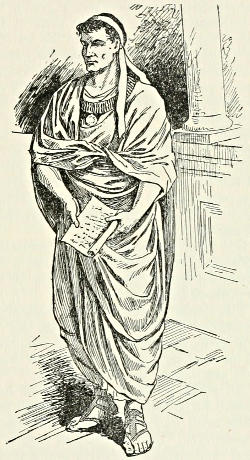
A Roman Noble
The nobility used their influential
position to appropriate the
whole administration of the state.
In the senate the exclusive circle of
noble families ruled, and the highest official positions were given only
to men of their party. The censorship, a position of the greatest power
and consideration, was an important office in their hands; it was regarded
as the chief of all state dignities. Hence the aristocracy used every means
to prevent a man of the plebeian order from acquiring that position. The
duty of the censors was to keep the senate as free as possible from all
unaristocratic elements, for they were empowered to nominate the members of
the senate and to disqualify for admission to it. There was another way
of entering the senate besides that of nomination by the censor; anyone
who had occupied a curule chair was entitled to a seat and a voice in the
senate. But the choice of the higher officials was in a certain degree in
the hands of the consul, who generally belonged to the aristocracy; and as
president of the centuriate assembly he could reject any candidate of whom
he did not approve.
The censors also appointed the knights and therefore formed them into
a purely aristocratic body. As long as they cast the earliest vote in the
centuriate assembly, the nobility had a considerable advantage there. Even
after this ceased, the knights formed in the assembly a distinct and distinguished
party, and as the flower of the nobility they likewise formed in the
army a brilliant cavalry corps. As in this corporation the nobility regarded
itself as something quite distinct from the rest of the people, the ruling class
tried by other external signs to distinguish themselves from the masses and
to represent themselves as a superior caste.
So from the year 194 the seats of the senatorial class were kept separate
from those of other people at the public festivals.
When the nobility got the government into their hands, they moulded it
in conformity with their own interests. In order to raise the position of the
officials as high as possible they only increased the number when absolutely
necessary, and never in proportion to the increase of business consequent on
the extension of the territories of the republic. It was only from the most
pressing necessity that in the year 242 the work of a single prætor, the
director of judicial business, was divided between two, so that the town
prætor (prætor urbanus) had the judicial business of the Roman citizens,
and the foreign prætor (prætor peregrinus) settled questions between aliens
or between aliens and Roman citizens. After the conquest of Sicily, Sardinia,
and the two Spains, four more prætors were added for the management
of those provinces.
But after the year 149 they remained as a rule in Rome during their year
of office to preside at the commission of inquiry respecting criminal matters
introduced during that time, and then they went in the following year as
pro-prætors to the provinces.
The choice of officials was, moreover, limited by the avoidance as much
as possible of the re-election to the consulate. From 265 the censor was
never twice the same, and the custom was made a law whereby the curule
(lex annalis of year 180) officials were appointed in a certain degree by
grade and after a certain interval.
An ædile, as we have seen, must be at least thirty-seven, a prætor forty,
a consul forty-three. The right was therefore withdrawn from the voters, in
case of need, to take the most competent and serviceable man without regard
to seniority. The measure of worth for the selection of officials was no
longer competence but birth and seigniority, and the nobility regarded office
as its due right, not disdaining, however, to get from the people all they
could by the arts of flattery.
The government of this official nobility exhibited in foreign policy all its
time-worn energy, which was only too often united with unworthy cunning
and untrustworthiness, but the administration of internal affairs became
torpid and bad. The majority belied the claims of their office, mostly careful
on the one hand not to forfeit by any inconsiderate or stern measure the
favour of the people to whom they were indebted for their posts and from
whom they expected future favours, while on the other hand they did not
hesitate to run counter to such of their colleagues as might occasionally wish
to render the people reciprocal service.
The late wars had shown the weakness of the generals and the consequent
lack of military discipline. In the wars of this period so much leave and
furlough had been granted for money that the forces were not ready for
any undertaking. Instead of fighting the enemy, generals and soldiers laid
their allies and friends under contribution.
When Scipio Africanus took the command against Numantia he sent away
from the camp not less than two thousand women, a number of sorcerers and
priests, and a whole tribe of traders, cooks, and other servants, so sunk was
the army in debauchery and effeminacy. Cowardice and idleness were so
deep-seated that it required many months and the most stringent measures
to make the army fit to take the field. The change in the spirit of the government
was also evident in the treatment of the Roman subjects in Italy and
beyond Italy. The Italian communities which had not the full rights of
Roman citizens—and they were the majority—were in a bad plight. The
communities which had joined Hannibal were almost all condemned to
slavery, and the rest were forced to render military service whilst the Roman
citizens profited by their labours and kept themselves as distinct from them
as the nobility did from the citizens and the rest of the people. The Italian
allies were almost excluded from the rights of Roman citizens.
The foreign provinces which at first were treated with a certain consideration
were soon in a worse position than the Italians. The governors,
who had a royal position in their provinces, and were almost uncontrolled
by the senate, allowed themselves the greatest licence, and used the short
time of their office to enrich themselves. They indemnified themselves
for the expense they had been put to in Rome in order to obtain their
posts, and amassed the means for life-long enjoyment.
As the governors were not paid, they had a claim upon all kinds of services
and supplies from the provinces, and this they abused in every way.
They robbed shamelessly when there was anything to get, and what the
governors did on a large scale their numberless subordinates did on a small
one. When a province had to support an army it had much to suffer.
Requisitions and levies were endless, and the people were often attacked
and plundered by the general and soldiers as if they had been the enemy.
To these evils were added the tax collectors and money changers who came
like a plague into the country, and plied their bloodsucking callings at
will under the protection of the governor. But the persecuted districts
revenged themselves on their oppressors. The great wealth taken by the
nobility from the provinces to Rome, the luxury and immorality of the officials
and the armies, which had such a pernicious influence on the morality
of high and low, became known in the uncivilised lands of the East, in
Greece, and in Asia. The rich nobility was steeped in debauchery and
love of pleasure, and displayed a boundless luxury against which the laws
repeatedly enacted strove in vain. And the people also, since there was
no country of which Rome stood in awe, began to lose its old energy and to
be gradually depraved by the love of enjoyment, recklessness, and idleness.
Certainly there was always a party of honourable, independent citizens;
but a sunken, impoverished populace who pandered to the nobility gradually
gathered about them. The nobles took care to gain the favour of the
mob by flattery, festivities, donations of corn, and even by general
bribery, so as to rule in the comitium through them, and secure the official
posts. It was almost impossible now for a man who was not rich to
obtain office.c
The age of which we have been treating, from the Samnite War to the
close of the Punic Wars, was always considered by the Romans, and is still
considered by their admirers, to have been the golden age of the republic.
A people which handed down the legends of Cincinnatus, Curius, Fabricius,
Regulus, can hardly have failed to practise the thrift and honesty which they
admired. The characters are no doubt idealised; but they may be taken as
types of their times. In the Roman country districts, and still more in the
Apennine valleys, the habits of life were no doubt simple, honest, and
perhaps rude, of Sabine rather than of Hellenic character, the life of countrymen
rather than of dwellers in the town.
It has been remarked that the Italians, like the Greeks, must be regarded
as members of cities or civic communities. But the walled towns which were
the centres of each community were mostly the residence of the chief men
and their dependents and slaves, while the mass of the free citizens were
dispersed over the adjoining country district, dwelling on their own farms,
and resorting to the town only to bring their produce to market or to take
their part in the political business transacted at the general assemblies. Such
was the case at Rome in early times. The great patrician lords with their
families dwelt in strong houses or castles on the Capitoline, Palatine, and
Quirinal hills, while their clients thronged the lower parts adjacent. As the
plebeians increased in wealth and power, their great men established themselves
at first upon the Cælian and Aventine, and afterwards indiscriminately
on all the hills.
In the country districts of Rome the greater part of the land was still in
the hands of small proprietors, who tilled their own lands by the aid of their
sons and sons-in-law. In the earliest times the dimensions of these plebeian
holdings were incredibly small, an allotment being computed at not more
than two jugera (about 1¼ acres). Even with very fertile soil and unremitting
labour, such a piece of land could barely maintain a family. But to eke
out the produce of their tilled lands, every free citizen had a right to feed a
certain number of cattle on the common pastures at the expense of a small
payment to the state; and in this way even a large family might live in rude
abundance. In no long time, however, the plebeian allotments were increased
to seven jugera (about 4½ acres); and this increase of tilled lands indicates
a corresponding improvement in the habits and comforts of the people—an
improvement attributed, as all benefits conferred on the plebeians in early
times were attributed, to King Servius. And this long remained the normal
size of the small properties then so common in the Roman district. The farm
and public pasture produced all that the family required—not only food,
but flax and wool, which the matron and her daughters dressed and spun and
wove, wood and stone for building and farm implements, everything except
metals and salt, which were (as we have seen) state monopolies.
But a golden age generally comes to an end with increase of population.
Mouths to be fed multiply; the yeomen sell their little farms and emigrate,
or become satisfied with a lower scale of living as hired labourers. The
Romans had a remedy for these evils in a home colonisation. The immense
quantity of public land in the hands of the state, with the necessity of securing
newly-conquered districts of Italy, led to the foundation of numerous
colonies between the Samnite and Punic wars, and extended the means of
material well-being to every one who was willing and able to work; and this
not only for Romans, but for Latins and others, who were invited to become
citizens of the colony.
If, however, the superfluous sons of families settled on lands in Samnium,
or Apulia, or Cisalpine Gaul, others must have lost these lands; and
the question naturally occurs: What had become of these people? This
question brings us to the worst point in ancient society—that is, slavery.
It was the practice of ancient nations to regard all conquered persons as
completely in the light of booty, as cattle or lifeless goods. If indeed the
enemy surrendered without a blow, they became subjects. But those who
were taken after a struggle were for the most part sold into slavery. In
early times this evil was small. Nor was it to be expected that the small
proprietors could afford either to buy or to maintain slaves. They were
acquired by the rich patricians and plebeians, who held large tracts of public
land, or who had acquired large estates of their own. Before the decemvirate,
their debtors were their slaves. But this custom had been long
abolished, and it was conquest which supplied slaves to the rich. After the
conquest of Samnium, thirty-six thousand persons are said to have been
sold. After the reduction of Cisalpine Gaul and Sicily, still larger numbers
were brought to the hammer. These were the wretches on whose lands the
poorer sort of Roman citizens settled. The slaves may generally be divided
into two great classes, the urban or city slaves, and those of the country.
They had no civil rights; they could not contract legal marriage; they had
no power over their children; they could hold no property in their own
name; their very savings were not their own, but held by consent of their
master; all law proceedings ran in the name of their masters. For crimes
committed, they were tried by the public courts; and the masters were held
liable for the damage done, but only to the extent of the slave’s value. To
kill, maim, or maltreat a slave was considered as damage to his master, and
could only be treated as such. No pain or suffering inflicted on a slave was
punishable, unless loss had thereby accrued to the owner.
But human nature is too strong always to fulfil conditions so cruel.
There is no doubt that the slaves of the household were often treated with
kindness; often they became the confidential advisers of their masters.
The steward or bailiff of a rich man’s estate, his villicus, was a person of
considerable power. Still the mass of the slaves, especially the agricultural
slaves, were treated as mere cattle. Some poor drudges were the slaves of
other slaves, such ownership being allowed by the masters. Cato recommends
to sell off old and infirm slaves, so as to save the expense of keeping
live lumber. Englishmen feel a pang at seeing a fine horse consigned in his old
age to the drivers of public carriages; but Romans wasted no such sympathy
on slaves who had spent their lives and strength in cultivating their lands.
Notwithstanding the better treatment of the house slaves, the humane Cicero
reproached himself with feeling too much sorrow for one who had been for
years his tried and faithful servant. It was in the next half-century, however,
that slaves increased so much in Italy as to produce great effect
upon the social condition of the people. At present the evil was only in
its beginning.
Here it must be remarked that the practice of giving liberty to slaves
was very common. The prospect of freedom as a reward for good conduct
must have done much to prevent Roman bondsmen from sinking into that
state of animal contentment and listless indifference which marked the negro
slaves of later times.
The freedmen filled no mean space in Roman society. Among them
were to be found able and well-educated men, who had held a high station
in their native country, and often obtained great influence over the minds
of their masters. Freedmen exercised most branches of retail trade, and
formed the shopkeepers and petty traders and artisans of Rome; for Roman
citizens, however poor, could in early times condescend to no business except
that of agriculture. Rich men carried on trades by means of their slaves
and freedmen; in later times freedmen often worked as artists under some
patrician roof, and many of the early poets were freedmen.
Here, then, we trace the beginning of a great distinction, that afterwards
was more strongly marked, between the population of the city and the population
of the country—between the rustic and the civic tribes.b
The Roman woman independent of the marriage
tie was placed under the authority of her father or
of a guardian.
The father’s authority was absolute. All
the members of an ancient Roman family—father,
mother, children, and daughters-in-law—made
up a close association under one ruler
or head. All the wealth which came to a family
was thrown into a kind of common stock and
formed but one patrimony. The sole head of
this association, the one master of the common resources,
was the father. Until now we have seen
no difference made between the children of the two
sexes; paternal power presses with equal weight on
the son and on the daughter, and holds them both
down to the same level. Besides, the daughter like
the son can sign a legal contract; like him she has
her share of the family patrimony, a guaranteed share
that only a formal disinheritance can take from her.
More liberal than the oriental or Greek law, Roman
law granted equal rights in the paternal inheritance.
But as soon as the paternal power has disappeared,
the legal differences between the two sexes begin to
show themselves; the son, if he is of age, becomes
independent and master of his actions, the daughter,
on the contrary, whatever her age, remains under the
power of a guardian.
A Roman Woman
(From a Statue)
What was that perpetual guardianship of women
which the Romans themselves considered as one of the
most fundamental institutions of their law? Was it
a protecting guardianship like that of minors? Was it a despotic power like
that of the father of a family? Neither one nor the other. To grasp its real
character, we must go back to the causes which led to its establishment.
In the almost patriarchal constitution of ancient Rome, the preservation of
families was of great public importance and the laws were always made to
benefit it. The domestic ties, always so close whilst the head of the family
lived, were not broken at his death; the hereditary possessions, whilst they
were divided amongst the children, did not the less remain the patrimony of
the family; the perpetual worship due to the spirit of the ancestors and to the
household gods remained a common debt. But supposing that amongst
the children there was a daughter, the hereditary share she was to receive
would not be safe in her hands; it was to be feared that one day she would
try to enrich the family she had entered at the expense of her own. It was
to guard against this danger, it was to perpetuate in each family, together
with the preservation of hereditary possessions, the memory of its ancestors
and the glory or dignity of the house, that the Romans deprived woman of
the free possession of her property and placed her under the perpetual
guardianship of her agnates. This guardianship was not, then, established in
the interest of woman, on account of her weakness and natural incapacity;
it was established against her and in the interests of the guardians themselves.
This view, we must admit, has received many contradictions even in antiquity.
Cicero, Ulpian, Isidorus de Sevilla, are unanimous in saying if the
law has placed women under guardianship, it is on account of the weakness
of their sex, their ignorance, their inexperience, their frivolity.
But listen to Gaius, the only writer amongst the ancients who discusses
and sifts the question: “The vulgar opinion,” he says, “is that women must
be directed by guardians, because their minds are too shallow to govern
themselves. This guardianship has been established in the interest of the
guardians, so that the women, whose presumptive heirs they are, can neither
deprive them of their inheritance by a will, nor cripple it by gifts or by
debts.”
Is it necessary to add another proof to the authority of Gaius? Here is
one which seems irrefutable. Woman was placed under the paternal power,
and, as has been already said, could make a legal contract. Once placed under
a guardian, on the contrary, she can no longer contract debts without her
guardian’s permission. Why this strange contradiction? Why should
woman, capable of acting whilst she is under a father’s authority, become
incapable as soon as she is freed from that authority? In the two cases, her
frivolity, her weakness are evidently the same; here is the only difference:
the daughter under paternal authority has no wants, and in indulging herself
she only pledges herself; but the orphan or emancipated girl has a patrimony;
if she pleased herself she would engage her patrimony and in this
way compromise the inheritance of her family, of her future heirs. This
reveals to us the spirit of the law. Woman is placed under a guardian
because she has a fortune to leave behind her; it is done to protect her heirs
and not to insure her own protection.
It will now be guessed to whom the law gave the guardianship; perhaps
only to her next heirs, that is to say to her agnates, her nearest relatives; if
she were a freed slave, to her masters. For natural guardians it was not an
office, but a right—a family possession. They had no accounts to render;
if they were infirm, in a state of infancy, idiocy, or insanity, they would still
retain their rights to this guardianship, except that in that case it would be
executed by deputy. But if they could not be deprived of this right they
could resign it, and give it to some one in their place; the legitimate guardian
could dispose of his ward by an in jure cessio, as he could dispose of his
house or field.
The guardian’s authority was not quite similar to the parental authority.
Its limits were rigorously determined by the very purpose of guardianship.
The guardian had all the power necessary to safeguard the woman’s patrimony,
nothing less—but nothing more.
Thus in the first case, his authority only extends to the fortune of the
woman, not to her person. He has no control over the conduct of his ward,
nor is it his prerogative to watch over her behaviour, or inquire into those of
her acts which only affect her personally, and do not touch her fortune. For
example, in the matter of marriage, all the pecuniary agreements which
so often accompany it have to be authorised by the guardian; his consent
is necessary, either to fix the dowry, or for the conventio in manum, which
involves, as will be seen, a kind of general community of interest. But as
for the marriage itself, how can it concern or prejudice the interests of the
guardian, since the agnates, and not the children of the marriage, will inherit
at the woman’s death? Thus the guardian’s authority is not necessary,
either for the celebration of the marriage or in the choice of a husband.
The woman herself chooses her husband, assisted sometimes, according
to her age, by the advice of her mother and of her near relatives. Nor
do all pecuniary transactions need the intervention of the guardian.
Ulpian has given us the list, and we can separate the different proceedings
that he enumerates, into two classes, the informal and the formal. In the
first class we only find the alienations of res mancipi, either by direct or indirect
covenants. Res mancipi were houses, lands, rustic servitude, slaves,
beasts of burden—in a word, the soil and what was necessary to cultivate it;
these were patrimonial property, and as the mainstay of the family, were
placed under the vigilance and care of the guardian, so that their preservation
was guaranteed. But besides this inalienable patrimony which she could not
touch, the woman still had a large field of administration; she could acquire
all sorts of property, dispose of the products of her fields and farm them out,
dispose of her money—and thus pay her debts, recover her credit, lend, sell,
bargain, and make free gifts.
For the formal proceedings, on the contrary, the law makes no distinctions
and the guardian’s authority is always necessary. This will, at first
sight, seem so little in harmony with the preceding that an explanation has
been sought in considerations foreign to the principles of wardship. It
has been said that the formal proceedings which usually took place before the
magistrate, or before the witnesses who represented the Roman people, had
too much resemblance to political proceedings to be permitted to others than
citizens, and since woman was excluded from the comitia, she ought to be
excluded from the Forum as well. But it is not true that the law courts
were always closed to women, even at the time when all processes were under
the form of a legis-actio; not only could she appear before the judges accompanied
by her guardian, but she could even appear alone, either as a witness
or as a representative of some one else—that is to say, whenever her personal
interest was not at stake. She could also execute certain formal acts alone,
as, for instance, emancipation, when she was under paternal authority; here
again, the act could not touch her patrimony, as she had none. These are
the cases in which the guardian’s authority was not necessary, although the
proceeding was formal and these acts are just those which cannot touch or
diminish the patrimony. Is it not, then, permissible to conclude that where
the guardian can intervene in such cases, it is not on account of the formalities
which surround them, it is because of the alienation they involve?
So far we have only spoken of natural guardians. But there are other
kinds of guardians, and the Roman lawyers place the testamentary guardians
first.
The father of the family, supreme in his own household, could, as we
have already seen, dispose as he liked of the domestic patrimony; a strong
reason, if he left a son and a daughter, for depriving the son of all rights
of control and of the care of his sister’s hereditary portion, by taking the
daughter away from his guardianship. How was this to be accomplished?
By making over in his will the guardianship of his daughter to a stranger;
this is testamentary guardianship. This guardianship almost amounted to
independence for the woman, the testamentary guardian being a stranger
to the family and having no right of succession to his ward’s property. What
interest would he have in preventing her from disposing of her fortune as
she pleased? To allow the father to choose a guardian for his daughter
was really to allow his daughter to be free of all real and efficacious tutelage.
We stop here, and will not tell how testamentary guardianship served as
a model to the other kinds of wardships, how by the usurpation of these
different nominal guardians the real guardianship, that of the family, was
little by little restricted and undermined. We should be no longer describing
this institution—we should be telling of its decay and downfall.
No legislators have better defined marriage than have those of ancient
Rome. “It is the union of two lives, the blending of two inheritances, a
common interest in everything religious and temporal.” In this ancient
notion of marriage we find the two principles which are the foundation
of Christian and modern marriage—the indissolubility of the bond and
monogamy.
We found in Greece something of oriental polygamy. In Italy, on the
contrary, monogamy is as ancient as the foundation of Rome. It entered so
deeply into the habits of the Romans that when later they introduced into
the constitution a freer form of conjugal union, concubinage, they considered
it, like legitimate marriage, under the law of monogamy. And this law
could not be eluded, as at Athens, by the legitimisation of natural children.
The ancient Roman law always excluded the natural children from the family
circle. It admitted no legitimisation nor recognition; and that illegitimacy
might not be hidden under the mask of adoption, such adoption was itself
subject to an investigation by the pontiffs and the ratification of the entire
people.
The principle of monogamy had its natural complement in the indissolubility
of marriage, for marriage with a possible divorce is, as has been said,
but a progressive polygamy. Marriage in ancient Rome was indissoluble.
Doubtless this indissolubility is not written in the law. Roman legislation
would not, as we have seen, touch family independence, nor tighten by legal
constraint ties that natural affection had formed. But if divorce is authorised
by the law, it is forbidden by religion and custom; the man who repudiates
his wife is branded by the censor, he is excommunicated by the priest,
and can only atone for his fault by sacrificing a portion of his worldly wealth
at the altar of the divinities that presided at his union. This moral sanction
was much more efficacious than the laws ever were. Divorce was not illegal,
but morally it was impossible; and all the writers of antiquity agree in saying
that they have only heard of one during five centuries.
It is sufficient to remember these two fundamental principles, which are
as old as Rome—namely, monogamy and the indissolubility of marriage—to
show the value of the vulgar opinion which represents marital power in
ancient Rome as the most odious of all tyrannies. It is difficult to believe
that the husband was a despot and the wife a slave, where an inviolable fidelity
was the reciprocal duty of the two; and a closer study will convince us
that a Roman marriage was a real union in which the husband’s authority
did not exclude the independence of the wife. But to be certain in what
this independence consisted, two kinds of marriage must be distinguished.
Sometimes the wife, though married, lived at home under the authority of
her father, or the guardianship of her agnates; sometimes these ties were
broken by marriage and the wife went, according to the technical expression,
in manum mariti, and had no other family than her husband’s. This last kind
of marriage is without doubt the more ancient. The antiquity of its origin
is revealed in the particular customs that went with it, and which are found,
almost identically the same, in the most ancient legislations. It is then most
probable that during the first centuries of Rome, the manus mariti was the
inevitable result of marriage. From the day the newly married couple had
offered a joint sacrifice to the divinities in the nuptial chamber, the wife had
no other family agnates or heirs than her husband and his relatives. What
became of the wife’s former family ties, the rights of the agnates to her
guardianship and to her inheritance? Marriage had destroyed them forever.
But in this there was a danger to which the legislators had soon to give their
attention. The guardians of the wife cannot have been very ready to consent
to a marriage which deprived them of all their rights, and without their consent
marriage was impossible. Could they have been compelled to give up
their rights? But these rights were sacred to the guardians of the family
interest; for them it was a duty to prevent the patrimony of their ancestors
from passing into the hands of strangers. To satisfy all conflicting claims,
the ancient principle had to be entirely altered. Two things had to be separated
which until then had seemed inseparable—marriage and the manus,
that is to say, the change of family. Side by side with the ancient marriage
accompanied by the regular formalities, a new marriage was devised which
was contracted simply by consent and left the wife in her family under the
guardianship of her agnates. The consent of the guardians was always necessary
for the ancient marriage with manus; but it was not required for the
marriage pure and simple, which left the rights of the agnates intact. This
revolution in the family usage was already accomplished, or nearly so, at the
time of the laws of the Twelve Tables.
For the rest, the introduction of a new form of marriage did not insure
the abandonment of the old, for both could in diverse cases in turn satisfy
the same need. If the wife, at the time of her marriage, was not under a
guardian, but under the parental authority, that is to say without patrimony,
the conventio in manum could only benefit the agnates; for it was equivalent
to the compact of renunciation, which, in ancient French law, so often
accompanied marriage contracts. Thus, the same interest, that of preserving
the patrimonial wealth, caused the introduction for the heiress of the
marriage without manus, and maintained the marriage with manus for
the daughter who had not already inherited.d
The religion of Rome was, as the legends show, of Sabine origin. Much
of its ceremonial, the names of many of its gods, were Etruscan; and
Hellenic mythology began, at an early time, to mingle itself in the simple
religious faith of the Sabine countrymen. The important question in the
history of all religions is, how far they exert power over the lives of their
professors. That the old faith of Rome was not without such power in the
times of which we speak is unquestionable. The simple Roman husbandman
lived and died, like his Sabine ancestors, in the fear of the gods; he believed
that there was something in the universe higher and better than himself;
that by these higher powers his life and actions were watched; that to these
powers good deeds and an honest life were pleasing, evil deeds and bad faith
hateful. The principles thus established remained, as is confirmed by the
weighty testimony of Polybius, delivered in a later and more corrupt age.
“If,” says he, “you lend a single talent to a Greek, binding him by all
possible securities, yet he will break faith. But Roman magistrates, accustomed
to have immense sums of money pass through their hands, are restrained
from fraud simply by respect for the sanctity of an oath.”b
The primitive religion of the Italians, in its essential or fundamental
beliefs resembled that of other Indo-European nations. They adored the
forces of nature, favourable or otherwise, and imagined them animated living
beings, of different sexes, their rivality producing the struggles of the elements,
and their union explaining the external fecundity of the world.
This was also the basis of the Greek religion, but the Italian religion bore
the impression of the nations who had made it. These nations were as a
rule grave, sensible, prudent, and much absorbed by the miseries of this life
and the dangers of the future. As they were inclined rather more towards
fear than hope, they respected their gods a great deal, but feared them more,
and their worship consisted more especially of humble petitions and rigorous
mortifications.
Their imaginations wanted in richness and brilliance, they never therefore
created anything like the rich development of the poetic legends so much
admired in the Greeks. Their legends are poor and simple; springing from
the hard life of agricultural labour, their character is often strangely prosaic;
they are especially wanting in variety; in different times the same stories
are found applied to different gods. The hero who founded or was the
benefactor of the town was as a rule a child of marvellous birth, son of the
god Lar, and begotten near the family hearth, sometimes by a spark from
the fire. When he is young a miracle reveals his future greatness. This
miracle is everywhere the same; it is a flame which burns around his head
without consuming him. During his life he is wise, pious, and good; he
makes good laws and teaches men to respect the gods and justice. After a
few useful deeds he disappears suddenly, “he ceases to be seen,” without it
being possible to say how he vanished. Doubtless he has gone to lose himself
in the bosom of the great divinity from which everything emanates here
below, he becomes part of this divinity, he loses his mortal name and from
henceforth takes the one of the god with which he is absorbed. Thus
Æneas, after his disappearance, was honoured under the name of Jupiter
Indiges and Latinus as Jupiter Latinus.
Italy was thus not very rich in religious stories; the mixture of Italian
races, that gave birth to Rome, was poorer still. Rome was content to
accept the beliefs of the different nations which composed her by trying
to unite them and making them agree; it did not seem necessary to create
new ones. The only innovation which was made was inscribing on kinds of
registers, called Indigitamenta, the list of gods that are affected by each event
in a man’s life, from his conception until his death, and those that look after
his most indispensable needs, such as food, dwelling, and clothing. They
were placed in regular order, with a few explanations as to their names and
the prayers which had to be offered up to them. The gods of the Indigitamenta
have an exclusive and entire Roman character. Without doubt in
other countries the need has been felt of placing the principal acts of life
under divine protection, but as a rule gods are chosen for this purpose who
are known, powerful, and tried, in order to be sure that their help will be
efficacious. In Greece, the great Athene, or the wise Hermes, is invoked in
order that a child may be clever and learned. In Rome, special gods were
preferred, created for that purpose and for no other use; there is one who
makes a child utter his first cry, and one who makes him speak his first
word, neither have another use, and are only invoked for this occasion.
They seldom have another name but the one their special functions give
them, as if to show that they had no real existence besides the act over which
they preside.
Their competency is very limited; the simplest action gives birth to
several divinities. When a child is weaned there is one who teaches him how
to eat, another to teach him to drink, a third makes him lie still in his little
bed. When he commences to walk, four goddesses protect his first steps,
two accompany him when he leaves his home, and two bring him back when
he returns. The lists were thus endless and the names became indefinitely
multiplied.
The fathers of the Catholic Church were much amused at “this population
of little gods condemned to such small uses,” and compare them to
workmen who divide the work amongst themselves in order that it may be
more quickly done. For all this it is curious to study them; they are, after
all, the original gods of Rome. Rome had not yet undergone the sovereign
influence of Greece when the pontiffs drew up the Indigitamenta, and the
remains that are left to us of the sacred registers can alone teach us what idea
the Romans had of divinity and how they understood religious sentiment.
What is most striking at first is how all these gods seem without life.
They have no history attached to them and not even a legend has been
given them. All that is known of them is that at a certain crisis they must
be prayed to and they can then render service. Once that moment passes,
they are forgotten. They do not possess real names; those given to them
do not distinguish them individually, but only indicate the function they
fulfil. As a rule this name is in the form of an epithet; from this it is
probable that it was not always employed alone, and that at first it was a
simple emblem. It can be concluded with a great deal of apparent truth
that originally the name described a powerful divinity, or even the divinity
in general, the father all-powerful, as he was called so long as he limited his
action to a special purpose. Thus the two gods Vaticanus and Fabulinas
would be no other than the divinity itself, even when it watches over the
first cries and first steps of the child.
The gods were not quite so numerous in the first ages, and it was then
necessary to give each of them many more functions. These attributes
were expressed, as in Christian litanies, by epithets, the list of which, more
or less lengthy according to the importance of the god, followed after his
name. As each invocation appealed to one of the faculties, and not to the
power of the god, the epithet was practically much more important than the
name and was employed alone. Soon the relationship between the name
and the qualifications which existed primitively was forgotten or lost and
then the epithets became divine. Thus the different functions of one god
ended by being attached to independent gods. It was at the time of these
changes that the Indigitamenta were drawn up. They are interesting to us, as
they make us grasp Roman polytheism just when it is being formed, but they
also show us that it is an unfinished polytheism. After creating all these
gods, Rome did not know how to make them life-like. They remained vague,
undecided, floating; they never attained, as the Greek gods, precise forms
with distinct features. This, besides, is the general character of the Roman
religion, and the gods of Rome always resembled those of the Indigitamenta.
The Italian religion was always more respectful and timid than the Greek.
The Roman remained at a farther distance from his gods, he dared not
approach them, he would have been afraid to look at them. If the Roman
veiled his face when accomplishing religious duties, it was not, as Virgil says,
because he was afraid of having his attention taken off what he was doing,
but in order not to risk seeing the god he is praying to. He solicits his
presence, he likes to know that he is near him, listening to his vows in order
to grant them, but he would have been frightened if he had seen him.
“Deliver us,” says Ovid in his prayer to Pallas, “from seeing the dryads or
Diana’s bath, or Faunus when he runs across the fields in the daytime”; and
until the end of paganism the Roman peasant was very afraid, when returning
home in the evening, of meeting a Faun in his path. The result of this
timidity of the Italians, who did not dare look at the gods in the face, is that
they saw them vaguely. They have not got clear outlines, and are represented
rather by symbols than by images; here Mars is adored under the
form of a lance struck in the ground, in another place a simple stone represents
the great Jupiter.
According to Varro, Rome remained 170 years without statues; the idea
of placing them in the temples came from abroad. It was to imitate Etruria
that a painted wooden Jupiter was placed in the Capitol; on the eve of festivals
they gave him a coat of paint for him to appear in all his glory. These
ancient customs were never quite lost, they were preserved in the country,
where the peasants honoured the gods by covering old trunks of trees with
bands, and in piously pouring oil on blocks of stone. At Rome, even whilst
all the temples were being filled by Grecian masterpieces the antique Vesta
would not allow a single statue in her sanctuary; she was only represented
by the sacred flame which was never put out.
It is probable, then, that if Rome had not known Greece, anthropomorphism
would have stopped short. The Roman has an instinctive repugnance
to making his gods beings too much like us; to him they are not real persons,
having an individual existence, but only divine manifestations, numina;
and this name by which he calls them indicates perfectly the idea he has of
them. Every time the divinity seems to reveal itself to the world in some
manner (and as he is very religious, he believes he sees him everywhere), he
notes with care this new revelation, gives it a name and worships it. These
gods he creates every minute are nothing else but divine acts, and that is
why they are so numerous.
No other nation has ever possessed such a vast Pantheon; and these
words can be applied to the whole of Italy, that a writer of the imperial
epoch lends to a woman of the Campania: “Our country is so peopled with
divinities that it is much easier to meet a god than a man.” This is also the
reason why the Romans more than any other nation had a taste for divinised
abstractions. As in reality all their gods, even the greatest, are only divine
qualities or attributes and as they always preserve to some extent their
abstract character, it is not surprising that the habit was soon formed of introducing
simple abstractions in their company. This is a custom as a rule
only introduced into religions when they become old, but in Rome we notice
it from the most ancient times. Tullus Hostilius built a temple to Fear and
to Pallidness; and Salvation or Prosperity of the Roman nation was early a
divinity much worshipped.
Later many exaggerations were made in this manner. During the empire
all the ventures of the emperors were worshipped and statues were raised to
the Security of the Century and to the Indulgence of the Master. These
strange personifications, which would never have entered the mind of a Greek,
were the result of the manner in which the Romans of all times conceived
divinity. Polytheism was formed by them by way of an abstract analysis
and not, as in Greece, by a kind of outburst of imagination and enthusiasm.
They always remained faithful to this method, and to the end placed in the
sky abstractions rather than living beings.
This nation, so timid, scrupulous, scared, that to protect a man one felt
the need of surrounding him by gods from his birth to his death, that had
such a deep respect for divinity, thinking to meet it everywhere, seemed to
be the prey of every superstition.
The fathers of the Catholic Church have compared the institutions of
Numa, with their minute and multiplied proscriptions, to Mosaic law. The
Romans, who prided themselves on following them to the letter, could be
exposed to becoming absolutely like the Jews; and one asks how it is that,
amongst such a devoted people, religious authority did not end by dominating
over all others. What preserved them from this fate was their great political
instinct.
No other nation has ever been so taken up as have the Romans with
the importance of the rights of the state, and everything was sacrificed to
that—their oldest customs and their dearest prejudices. It was a general
belief amongst them that dead persons became gods and protected those
nearest to them, and were as close as possible to those they should save; they
were buried in the house and thus became good spirits. One day, however,
the law ordained, by reason of hygiene, that nobody should be buried within
the precincts of the towns, and everybody obeyed this law. This example
shows that in Rome nothing could resist civil power; paternal authority, in
spite of the extent of its rights, gave way before it.
The father of the family is the absolute master of his children; he can
sell or kill his child, but if his son is in public office the father has to obey
him like the others, and when he meets him on his path he must get off his
horse to let him pass.
Roman religion, so powerful, so respected as it was, had to submit to the
same yoke. It was thus subject to the state, or rather was blended to it.
What most aided religion to attain this result was the manner in which it
recruited its priests. “Our ancestors,” says Cicero, “were never wiser nor
more surprised by the gods than when they decided that the same persons
would preside over religion and govern the republic. It was by this means
that the magistrates and pontiffs fulfilling their duties with wisdom, agreed
together to save the state.” In Rome, religious functions were not separated
from political ones, and there was nothing incompatible between them.
Any one could act as pontiff in the same time as consul and for the same
motives. Those who wished to become such were never required to possess
any special knowledge; it was sufficient for attaining these duties to have
served his country in the deliberating assemblies or the battle-field. Those
that obtained them did not, whilst exercising them, take a narrow and exclusive
attitude, so common to sacerdotal castes; they continued to mix with
the world, they sat in the senate in the same time as in the great colleges of
priests of which they formed a member; their new functions, far from taking
them away from the government of their countries, gave them more right to
take part in it.
These soldiers, politicians, men of business in Rome, gave to religious
things that cold, practical sense which they gave to everything else. It is
thanks to them that a laic undercurrent always circulated in Roman religion,
that during the whole duration of the republic and of the empire no
conflict ever broke out between it and the state; and that the government
of Rome, in spite of all the demonstrations of piety which it lavished, never
threatened to become a theocracy.g
But while morality, good faith, and self-denial prevailed among themselves,
it is clear that the Romans laid no such restrictions upon their dealings
with other nations. This great defect is common to Rome with all
antiquity. The calmest Greek philosopher, Aristotle, regarded barbarians
as naturally the slaves of the Greeks. International law was unknown,
except in certain formalities observed in declaring war and making peace,
and in the respect paid to the persons of ambassadors. This absence of common
humanity and generosity to foreigners appears in many pages of this
history, in none more strongly than in that which records the treatment
of the Samnite leader C. Pontius. Gleams of better feeling appear in the
war with Pyrrhus; the chivalric character of the king awakened something
of a kindred spirit in the stern and rigid Romans. But nothing could be
more ungenerous than the conduct of Rome to Carthage, after the Mercenary
War; and still baser pieces of diplomacy occur in the subsequent dealings
of the senate with the Achæans and with Carthage.
If Hellenic forms of thought and speech invaded the domain of literature,
much more was this the case with the arts of design. There are not wanting
examples to show that before this time sculpture and painting were held in
honour at Rome. The consul Carvilius (in 293 B.C.) employed part of
the spoils taken from the Samnites in setting up a colossal bronze statue on
the Capitoline. A quadriga, executed in terra-cotta by an Etruscan artist, is
ascribed to the same date. Statues were erected in the Forum to honour
divers great men of olden time. Many temples were built in thanksgiving
for victories, most of which were adorned by Etruscan or Greek artists.
The temple of Salus was ornamented about 305 B.C. by paintings from the
hand of that C. Fabius who adopted the name of Pictor and transmitted it
as an honour to his family. The Ogulnii, in their ædileship (296 B.C.), set
up in the Capitol a bronze group representing the wolf suckling the twins.
A painting of the battle in which the Romans defeated Hiero in 263 adorned
the walls of the senate house.
Of these works, and others not recorded by history, no trace remains except
the famous wolf now preserved in the Capitoline Museum. The twins
are a later addition, but the animal is probably the original work noticed
by Cicero and Livy. It bears the well-known marks of the archaic Greek
art in the sharp, rigid forms of the limbs and muscles, the peculiar expression
of the face, and the regular knots of hair about the neck and head. Here,
then, we trace Hellenic artists at Rome. Others of the works mentioned are
expressly assigned to Etruscan artists; and it may be remarked that Fabius,
the only native artist of whom we hear, belonged to a family always associated
in history with Etruscans.
But when Rome had conquered southern Italy, she was brought at once
in contact with works of the finest Greek art. No coins of old Greece are so
beautiful as those of her colonial settlements in the west; and it is in the
coins of Rome, strange to remark, that we first trace the indisputable effect
of Greek art.
Up to the time when Italy was conquered, the Romans had used only copper
money of a most clumsy and inconvenient kind. A pound of this metal
by weight was stamped with the rude effigy of a ship’s prow, and this was
the original as or libra. Gradually the as was reduced in weight till, in the
necessities of the Second Punic War, it became
only one-sixth of the libra by weight; yet it retained
its ancient name, just as the pound sterling
of silver, originally equivalent to a pound Troy-weight,
is now not more than one-third, or as the
French livre is a much smaller fraction of that
weight.[72] But even this diminished coin was
clumsy for use, as trade increased with increasing
empire. After the conquest of southern Italy
the precious metals became more plentiful, and the
coinage of the conquered cities supplied beautiful
models. The first denarius, or silver piece of ten
asses, was struck in the year 269 B.C., and is evidently
imitated from the coins of Magna Græcia.
The Roman generals who commanded in these
districts stamped money for the use of their armies
with the old insignia of the conquered cities. The
workmanship is, indeed, inferior to the best specimens
of Hellenic coins, but far superior to anything
Roman, before or after. Gold coins of similar model
were not struck till near the close of the Hannibalic
War (205 B.C.). The great mass of Roman coins
which we possess belongs to the last century of the
republic. They usually bear the family emblems of
the person who presided over the mint, or of the
consuls for whose use they were struck; but the execution
always remained rude and unattractive.
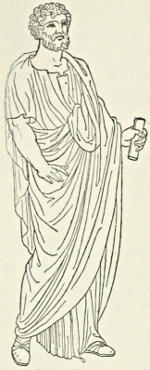
A Roman Orator
(After Hope)
Afterwards, Roman conquest gave the means
of supplying works of art by the easier mode of
appropriation. In the conquest of Etruria, years
before, the practice had been begun; from Volsinii
alone we read that two thousand statues were brought to Rome. In following
years Agrigentum, Syracuse, Corinth, and other famous cities, sent the finest
works of Hellenic art to decorate the public buildings and public places of the
barbarous city of the Tiber, or in many cases to ornament the villas of
the rapacious generals.
In the more intellectual even of the useful arts the Romans made no
great progress. The contrivances of Archimedes for the defence of Syracuse
struck them with amazement. In Cicero’s time they usually carried
the sciences of quantity and magnitude no further than was necessary for
practical arithmetic and mensuration. In 293 B.C. L. Papirius Cursor the
younger set up a sun-dial at Rome, and thirty years later another was
brought from Sicily by the consul M. Valerius Messalla; but no one knew
how to place them, so as to make the shadow of the gnomon an index
of time. A water-clock, resembling our sand-glass, was not introduced
till 159 B.C.
Nor were the common conveniences of life in an advanced state. Up
to the year 264 the houses were commonly roofed with shingles of wood,
like the Alpine cottages of our days; then first earthen tiles began to
supersede this rude material. Agriculture must have been roughly carried
on by men who were as much soldiers as countrymen. The wine of Latium
was so bad that Cineas, when he tasted it, said—and the witticism was remembered—“he
did not wonder that the mother of such wine was hung
so high”; alluding to the Italian custom, still retained, of training the vine
up elms and poplars, while in Greece it was trained (as in France and Germany)
on short poles and exposed to all the heat of the sun.
A form of architecture called the Tuscan was mostly used, which bore
an imperfect resemblance to that early Greek style usually called the Doric.
But the existing remains of the republican period are too scanty to allow of
any precise statements. The true arts of Rome were, then and always, the
arts of the builder and engineer. It would not be wrong to call the Romans
the greatest builders in the world. Some of their mighty works, works combining
solidity of structure with beauty of form and utility of purpose, still
remain for our admiration, having survived the decay of ages and the more
destructive hands of barbarian conquerors. In every country subject to
their sway, roads and bridges and aqueducts remain in sufficient number
and perfection to justify all praise. We class the roads among the buildings,
according to their own phraseology,[73] and their construction deserves
the name as justly as the works upon our own railways. The first great
military road and the first aqueduct are due to the old censor Appius
Cæcus, and they both remain to preserve the memory of the man, often self-willed
and presumptuous, but resolute, firm of purpose, noble in conception,
and audacious in execution. Other aqueducts and other roads rapidly followed;
the spade and trowel were as much the instruments of Roman
dominion as the sword and spear. By the close of the Punic Wars solid
roads, carried by the engineer’s art over broad and rapid streams, through
difficult mountain passes, across quaking morasses, had already linked Rome
with Capua in the south, with Placentia and Cremona in the north. Such
were the proud monuments of the Appii, the Æmilii, the Flaminii.
It may be said that these magnificent works, as well as the vast amphitheatres
and baths which afterwards decorated Rome and every petty city
in her provinces, were due to the invention of the arch. This simple piece
of mechanism, so wonderful in its results, first appears in the Great Cloaca.
It was unknown to the Greeks, or at least not used by them. It may be that
the Romans borrowed it from the Etruscans; the Cloaca is attributed to an
Etruscan king, and similar works are discovered in ruined cities of Etruria.
But if they borrowed the principle they used it nobly, as witness the noble
bridges still remaining, the copious streams carried over the plain for miles
at the height of sixty or seventy feet from the level of the soil. If they had
little feeling for beauty and delicacy in the use of the pencil or the chisel,
their buildings are stamped with a greatness which exalted the power of the
state while it disregarded the pleasure of the individual.
Their attention to practical utility in draining and watering their city is
especially noted by Strabo in contrast with the indifference shown by the
Greeks to these matters. To the facts already stated may be added their
rule, established so early as the year 260 B.C., that no one should be buried
within the city—a rule scarcely yet adopted in London. From this time
dates the beginning of those rows of sepulchral monuments which the
traveller beheld on either side of the road as he entered the Eternal City.
It was a gloomy custom, but better at least than leaving graveyards in the
heart of crowded cities.
A striking proof of engineering skill is shown in the tunnels cut through
solid rock for the purpose of draining off volcanic lakes; this art we may
also believe to have been originally borrowed from the Etruscans. The first
tunnel of which we hear was that by which the Alban Lake was partially let
off during the siege of Veii, a work which was suggested by an Etruscan
soothsayer. Other works of like kind still remain, though the time of their
execution is not always known. Here shall be added the notice of one work
of kindred sort, which happens by a rare coincidence to combine great utility
with rarest beauty. The famous M. Curius Dentatus, when censor in 272,
cut a passage through the rock, by which the waters of Lake Velinus were
precipitated into the Nar. By this means he recovered for his newly conquered
Sabine clients a large portion of fertile land, and left behind the
most lovely, if not the most sublime, of all waterfalls. The Falls of Terni,
such is the famous name they now bear, were wrought by the hand of man.
“Thousands of travellers visit them,” says Niebuhr; “how few know that they
are not the work of Nature!”b
Rome during this period began to form the literature which has come
down to us; but unfortunately, instead of being national and original, it was
imitative and borrowed, consisting chiefly of translations from the Greek.
In the year after the end of the First Punic War (240), L. Livius Andronicus,
an Italian Greek by birth, represented his first play at Rome. His
pieces were taken from the Greek; and he also translated the Odyssey out
of that language into Latin. Cn. Nævius, a native of Campania, also made
plays from the Greek, and he wrote an original poem on the First Punic
War, in which he had himself borne arms. These poets used the Latin
measures in their verse; but Q. Ennius, from Rudiæ in Calabria, who is
usually called the father of Roman poetry, was the first who introduced the
Greek metres into the Latin language. His works were numerous tragedies
and comedies from the Greek, satires, and his celebrated Annals, or poetic
history of Rome, in hexameters, the loss of which (at least of the early
books) is much to be lamented. Maccius Plautus, an Umbrian, and
Cæcilius Statius, an Insubrian Gaul, composed numerous comedies, freely
imitated from the Greek. M. Pacuvius of Brundusium, the nephew of
Ennius, made tragedies from the Greek; L. Afranius was regarded as the
Menander of Rome; and P. Terentius (Terence), a Carthaginian by birth,
gave some beautiful translations (as we may perhaps best term his pieces) of
the comedies of Menander and Apollodorus. None of these poets but Plautus
and Terence has reached us, except in fragments; the former amuses us
with his humour, and gives us occasional views of Roman manners, while we
are charmed with the graceful elegance of the latter. It is remarkable that
not one of these poets was a Roman. In fact Rome has never produced a poet.
Q. Fabius Pictor, L. Cincius Alimentus, A. Postumius Albinus, M. Porcius
Cato, and L. Cassius Hemina wrote histories (the first three in Greek)
in a brief, dry, unattractive style. Cincius also wrote on constitutional
antiquities, and seems to have been a man of research; and a work of Cato’s
on husbandry has come down to us which we could well spare for his Origines,
or early history of Italy.e
It appears that before the time of Scipio’s election to conduct the Numantian
War, it had become a prevalent opinion that some measures were
necessary to arrest the prevailing social evils. The frightful excesses of
the Servile War called attention still more strongly to the subject; and in the
year that Scipio achieved the conquest of Numantia a leader appeared who
was endowed with courage, firmness, self-confidence, ability, eloquence, and
every requisite for political success, except a larger experience and a larger
share of patience and self-control.b A. H. Beesley thus vividly paints the
crying evils of the Roman state:
“Everywhere Rome was failing in her duties as mistress of the civilised
world. Her own internal degeneracy was faithfully reflected in the abnegation
of her imperial duties. When in any country the small farmer class
is being squeezed off the land; when its labourers are slaves or serfs; when
huge tracts are kept waste to minister to pleasure; when the shibboleth of
art is on every man’s lips, but ideas of true beauty in very few men’s souls;
when the business sharper is the greatest man in the city, and lords it even
in the law courts; when class magistrates, bidding for high office, deal out
justice according to the rank of the criminal; when exchanges are turned
into great gambling-houses, and senators and men of title are the chief gamblers;
when, in short, ‘corruption is universal, when there is increasing
audacity, increasing greed, increasing fraud, increasing impurity, and these
are fed by increasing indulgence and ostentation; when a considerable number
of trials in the courts of law bring out the fact that the country in general
is now regarded as a prey, upon which any number of vultures, scenting it
from afar, may safely light and securely gorge themselves; when the foul
tribe is amply replenished by its congeners at home, and foreign invaders
find any number of men, bearing good names, ready to assist them in robberies
far more cruel and sweeping than those of the footpad or burglar’—when
such is the tone of society, and such the idols before which it bends, a
nation must be fast going down hill.
“A more repulsive picture can hardly be imagined. A mob, a moneyed
class, and an aristocracy almost equally worthless, hating each other, and
hated by the rest of the world; Italians bitterly jealous of Romans, and only
in better plight than the provinces beyond the sea; more miserable than either,
swarms of slaves beginning to brood revenge as a solace to their sufferings;
the land going out of cultivation; native industry swamped by slave-grown
imports; the population decreasing; the army degenerating; wars waged
as a speculation, but only against the weak; provinces subjected to organised
pillage; in the metropolis childish superstition, wholesale luxury, and
monstrous vice. The hour for reform had surely come. Who was to be
the man?”c
Ti. Sempronius Gracchus was son of one of the few Romans in whom
public spirit prevailed over the spirit of party. Though personally hostile
to the great Scipio, we saw him interfere between him and his foes. After
the death of Africanus, the chiefs of the party offered him the hand of Cornelia,
the only surviving daughter of the hero; and from this marriage
twelve sons and one daughter were born in rapid succession. The eldest, Tiberius,
saw the light about 166 B.C., but the father died before his eldest son
reached man’s estate, and Cornelia was left a widow with her children.
The daughter lived; but of all the twelve sons only two grew up—Tiberius,
and Caius who was nine years younger. To the education of these precious
relics Cornelia devoted all the energies of her masculine mind. She even
refused an offer to share the throne of the king of Egypt. Her dearest task
was to watch the opening capacities of her boys. Such was her hope of their
greatness that she used to say she would be known not as the daughter of
Scipio, but as the mother of the Gracchi.
According to the fashion of the day, Greek teachers were called in to
educate the boys. Blossius of Cumæ, and Diophanes a Mytilenean exile, are
mentioned as the instructors, and in later life as the friends, of Tiberius.
Scarcely had Tiberius assumed the garb of manhood when he was elected
into the college of augurs. At the banquet given to celebrate his installation,
App. Claudius, the chief of the senate, offered him his daughter’s hand
in marriage.
When the proud senator returned home, he told his wife that he had that
day betrothed their daughter. “Ah!” she cried, “she is too young; it
had been well to wait a while—unless, indeed, young Gracchus is the man.”
Soon after his marriage he accompanied Scipio to Carthage, where he was
the first to scale the walls.
The personal importance of Gracchus was strengthened by the marriage
of Scipio with his only sister. But this marriage proved unhappy. Sempronia
had no charms of person, and her temper was not good; Scipio’s
austere manners were little pleasing to a bride; nor were children born to
form a bond of union between them.
[137-133 B.C.]
It was when Gracchus was about thirty years old (137 B.C.) that he
served as quæstor in Spain. Before this, when he travelled through Etruria
to join the army, he had noted her broad lands tilled not by free yeomen as
of old, but by slaves. Soon after this the Slave War broke out. He spoke
his sentiments freely, and public opinion designated him as the man who was
to undertake the thankless office of reformer. In all places of public resort
the walls were covered with inscriptions calling on Gracchus to vindicate the
rights of all Roman citizens to a share in the state lands. He presented
himself as a candidate for the tribunate, and was elected.
On December 10th, 134 B.C., he entered upon office. He had already
prepared men for his projected legislation by eloquent speeches, in which he
compared the present state of Italy with her olden time, deplored the decay
of her yeomen and farmers, and the lack of freemen to serve in the legions.
All his arguments pointed towards some measures for restoring the class of
small landed proprietors who were dwindling fast away.
[133 B.C.]
In a short time his plan was matured and his bill brought forward. He
proposed to revise the Licinian law of 364 B.C., by which it was enacted that
no head of a family should hold more than five hundred jugera (nearly 320
acres) of the public land; but to render the rule less stringent, he added
that every son of the family might, on becoming his own master, hold half
that quantity in addition.[74] Whoever was in possession of more was to give
up the excess at once to the state; but to obviate complaints of injustice, he
proposed that those who gave up possession should be entitled to a fair compensation
for any improvements they had made during the term of their
possession. All public lands were to be vested in three commissioners
(triumviri), who were to be elected by the tribes. Their business was to
distribute the public lands to all citizens in needy circumstances, and to prevent
lands so distributed being again absorbed into the estates of the rich
land owners; the sale of the new allotments was altogether prohibited.
The greater part of these public lands had fallen into the hands of the
rich land owners. They had held them, on payment of a small yearly rent,
for generations; and many of these persons had forgotten perhaps that their
possession could be disturbed. After the first surprise was over, the voices
of these land holders began to be heard; but as yet the majority of the
senate showed no disfavour to the law of Gracchus. The persons interested
alleged that the measure, though it pretended only to interfere with state
lands, did in fact interfere with the rights of private property; for these
lands were held on public lease and had been made matters of purchase and
sale, moneys were secured on them for the benefit of widows and orphans,
tombs had been erected on them: if this law passed, no man’s land could be
called his own.
If Gracchus had proposed a forcible and immediate resumption of all
state lands, without compensation for moneys spent on them, these arguments
would have had more weight. Rights arise by prescription; and if
the state had for a long course of time tacitly recognised a right of private
property in these lands, it would have been a manifest injustice thus
abruptly to resume possession. But the Licinian law was evidence that the
state claimed a right to interfere with the tenure of the public lands. That
the Romans felt no doubt about the right is shown by the fact that in framing
his law Tiberius was assisted by his father-in-law App. Claudius, the
chief of the senate, and by P. Mucius Scævola, consul of the year.
It was certain that the law would be carried in all the country tribes,
because it was precisely in these tribes that the strength of Gracchus lay,
and all his arguments show that he knew it. It was to the country people,
who had lost or were afraid of losing their little farms, that he spoke.b A
few specimens of the fervent eloquence of Tiberius still remain in the fragments[75]
quoted in Plutarche and Appian.g Plutarch describes the present
event as follows:
“Tiberius defending the matter, which of itself was good and just, with
such eloquence as might have justified an evil cause, was invincible; and no
man was able to argue against him to confute him, when, speaking in the
behalf of the poor citizens of Rome (the people being gathered round about
the pulpit for orations), he told them, that the wild beasts through Italy
had their dens and caves of abode, and the men that fought, and were slain
for their country, had nothing else but air and light, and so were compelled
to wander up and down with their wives and children, having no resting-place
nor house to put their heads in. And that the captains do but mock
their soldiers, when they encourage them in battle to fight valiantly for the
graves, the temples, their own houses, and their predecessors. For, said he,
of such a number of poor citizens as there be, there cannot a man of them
show any ancient house or tomb of their ancestors, because the poor men
go to the wars, and are slain for the rich men’s pleasures and wealth;
besides, they falsely call them lords of the earth, where they have not
a handful of ground that is theirs. These and such other like words
being uttered before all the people with such vehemency and truth, so
moved the common people withal, and put them in such a rage, that there
was no adversary of his able to withstand him. Therefore, leaving to contradict
and deny the law by argument, the rich men put all their trust in
Marcus Octavius, colleague and fellow-tribune with Tiberius in office, who
was a grave and wise young man, and Tiberius’ very familiar friend. That
the first time they came to him, to oppose him against the confirmation of
this law, he prayed them to hold him excused, because Tiberius was his
very friend. But in the end, being compelled to it through the great
number of the rich men that were importunate with him, he withstood Tiberius’
law, which was enough to overthrow it.”e
The morning came. The Forum was crowded with people expecting
the completion of the great measure which was to restore some share in the
broad lands of Italy to the sons of those who had won them. Strange faces
were seen everywhere: vine-dressers from Campania and the Auruncan
hills, peasants from the Sabine and Æquian valleys, farmers of valley and
plain from the Clanis to the Vulturnus.
Gracchus rose. His speech was received with loud applause by the
eager multitude. When he had ended, he turned to the clerk, and bade
him read over the words of the law before it was put to the vote. Then
Octavius stood up and forbade the man to read. Gracchus was taken by
surprise. After much debate he broke up the assembly, declaring that he
would again bring on his defeated bill upon the next regular day of
meeting.
The intervening time was spent in preparing for the contest. Gracchus
retaliated upon the veto of Octavius by laying an interdict on all public
functionaries, shut up the courts of justice and the offices of police, and put
a seal upon the doors of the treasury. Further, he struck the compensation
clauses out of his bill, and now simply proposed that the state should
resume possession of all lands held by individuals in contravention of the
Licinian law.
On the day of the second assembly Gracchus appeared in the Forum
escorted by a bodyguard. Again he ordered the clerk to read the bill;
again Octavius stood forth, and barred all proceedings. A violent scene
followed, and a riot seemed inevitable, when two senators, friends of
Gracchus—one named Fulvius Flaccus—earnestly besought him to refer
the whole matter to the senate. Gracchus consented. But his late impatient
conduct had weakened whatever influence his name possessed in the
great council, and his appearance was the signal for a burst of reproaches.
He hastily left the house, and returning to the Forum gave out that on the
next day of assembly he would for the third time propose his measure; and
that, if Octavius persisted in opposition, he would move the people to
depose their unfaithful tribune.
As the day approached, Gracchus made every effort to avoid this
desperate necessity; but Octavius repelled every advance, and on the morning
of the third assembly, Gracchus rose at once and moved that Octavius
should be deprived of the trust which he had betrayed.
The country tribe, which obtained by lot the prerogative of voting first,
was called, and its suffrage was unanimous for the deposition of Octavius;
sixteen tribes followed in the same sense; the eighteenth would give a
majority of the thirty-five, and its vote would determine the question. As
this tribe came up to vote, Gracchus stopped the proceedings, and besought
Octavius not to force on the irrevocable step. The tribune wavered; but
he caught the eye of one of his rich friends, and turned coldly from
Tiberius. Then the eighteenth tribe was called, and by its vote Octavius
was in a moment stripped of his sacred office.b
“These acts of Tiberius Gracchus,” says Beesly, “are commonly said to
have been the beginning of revolution at Rome; and the guilt of it is accordingly
laid at his door. And there can be no doubt that he was guilty in
the sense that a man is guilty who introduces a light into some chamber
filled with explosive vapour, which the stupidity or malice of others has
suffered to accumulate. But, after all, too much is made of this violation
of constitutional forms and the sanctity of the tribunate. The first were
effete, and all regular means of renovating the republic seemed to be closed
to the despairing patriot, by stolid obstinacy sheltering itself under the garb
of law and order. The second was no longer what it had been—the recognised
refuge and defence of the poor. The rich, as Tiberius in effect argued,
had found out how to use it also. If all men who set the example of forcible
infringement of law are criminals, Gracchus was a criminal. But in the
world’s annals he sins in good company; and when men condemn him, they
should condemn Washington also. Perhaps his failure has had most to do
with his condemnation. Success justifies, failure condemns, most revolutions
in most men’s eyes. But if ever a revolution was excusable this was; for it
was carried not by a small party for small aims, but by national acclamation,
by the voices of Italians who flocked to Rome to vote. How far Gracchus
saw the inevitable effects of his acts is open to dispute. But probably he
saw it as clearly as any man can see the future. Because he was generous
and enthusiastic, it is assumed that he was sentimental and weak, and that
his policy was guided by impulse rather than reason. There seems little to
sustain such a judgment other than the desire of writers to emphasise a
comparison between him and his brother.”c
The bill itself was then passed by acclamation, and three commissioners
destined to execute its provisions were elected—Tiberius himself, his
father-in-law App. Claudius, his brother Caius, then a youth of twenty,
serving under Scipio in Spain. The law was not deemed safe unless it was
intrusted for execution to Tiberius and his kinsmen.
In a few weeks Gracchus had risen to the summit of power. He seldom
stirred from home without being followed by a crowd. The Numantian
War and the Servile War still lingered, and the government of the senate
was not in a condition to defy attack. That body now was thoroughly
alarmed, and Gracchus soon proceeded to measures which touched them in
their tenderest point. Attalus Philometor, king of Pergamus, the last of
the line of Eumenes, was just dead, and had bequeathed his kingdom with
all his lands and treasure to the Roman people. In ordinary times the
senate would at once have assumed the disposition of this bequest; but
Gracchus gave notice that he would propose a bill to enact that the moneys
should be distributed to those who were to receive allotments of public land,
in order to assist them in purchasing stock, in erecting farm buildings, and
the like; and he added that he would bring the subject of its future government
before the people without allowing the senate to interfere. He thus
openly announced a revolution.
When Gracchus next appeared in the senate house, he was accused of
receiving a purple robe and diadem from the envoy of the late king of Pergamus.
T. Annius, an old senator, who had been consul twenty years before,
openly taxed the tribune with violating the constitution. Gracchus, stung
to the quick by this last assault, indicted the old consular for treason against
the majesty of the people. Annius appeared; but before Gracchus could
speak, he said: “I suppose, if one of your brother tribunes offers to protect
me, you will fly into a passion and depose him also.” Gracchus saw the
effect produced, and broke up the assembly.
Moreover, many of his well-wishers had been alarmed by a law, by which
he had made the triumviri absolute judges, without appeal, on disputed
questions with regard to property in land. Many allotments of public land
had been granted, whose titles had been lost; and every person holding
under such condition saw his property at the mercy of irresponsible
judges.
Gracchus felt that his popularity was shaken, and at the next assembly he
thought it necessary to make a set speech to vindicate his conduct in deposing
Octavius. The sum of his arguments amounts to a plea of necessity. It
is true that the constitution of Rome provided no remedy against the abuse
of power by an officer, except the shortness of time during which he held
office and his liability to indictment at the close of that time. The tribunician
authority, originally demanded to protect the people, might have turned
against the people. But was it not open to Gracchus to propose a law by
which the veto of a single tribune might be limited in its effect? Or might
he not have waited for the election of new tribunes, and taken care that all
were tried friends of his law? Instead of this he preferred a coup-d’état,
and thus set an example which was sure to be turned against himself.[76]
The violent language of Nasica and his party made it plain that in the
next year, when his person was no longer protected by the sanctity of the
tribunician office, he would be vigorously assailed. He therefore determined
to offer himself for re-election at the approaching assembly of the tribes.
But his election was far from secure. Harvest-work occupied the country
voters; many had grown cold; the mass of those who resided in the city
were clients and dependents of the nobility. It was to regain and extend
his popularity that he now brought forward three measures calculated to
please all classes except the senatorial families. First, he proposed to
diminish the necessary period of military service. Secondly, he announced
a reform of the superior law courts, by which the juries were to be taken not
from the senators only, but from all persons possessing a certain amount of
property. Thirdly, he provided an appeal in all cases from the law courts
to the assembly of the people.
These measures, which in altered forms were afterwards carried by his
brother Caius, were only brought forward by Tiberius. But this was
enough. His popularity returned in full tide.
When the day of the election came, the prerogative tribe gave its vote
for Gracchus and his friends; so also the next. But it was objected that
the same man could not be chosen in two successive years; and after a hot
debate the assembly was adjourned till next day.
It wanted yet some hours of nightfall. Gracchus came forth into the
Forum, clad in black, and leading his young son by the hand. In anticipation
of his untimely end, he committed his precious charge to his fellow-citizens.
All hearts were touched. The people surrounded him with eager
gesticulations, and escorted him home, bidding him be of good cheer for
the morrow. Many of his warmest adherents kept guard at his doors all
night.b
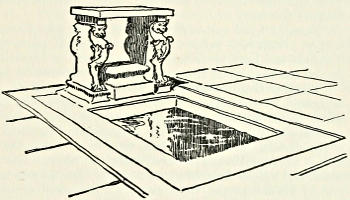
Roman Courtyard Fountain
“The father’s affection and the statesman’s bitter dismay,” says Beesly,
“at finding the dearest object of his life about to be snatched from him
by violence need not have been tinged with one particle of personal fear.
A man of tried bravery,
like Gracchus,
might guard his own
life indeed, but only
as he regarded it as
indispensable to a
great cause. That
evening he told his
partisans he would
give them a sign next
day if he should
think it necessary to
use force at his election.
It has been assumed
that this proves
he was meditating
treason. But it proves no more than that he meant to repel force forcibly
if, as was only too certain, force should be used, and this is not treason.
No other course was open to him. The one weak spot in his policy
was that he had no material strength at his back. Even Sulla would have
been a lost man at a later time, if he had not had an army at hand to which
he could flee for refuge, just as without the army Cromwell would have been
powerless. But it was harvest-time now, and the Italian allies of Gracchus
were away from home in the fields. The next day dawned, and with it
occurred omens full of meaning to the superstitious Romans.”c
The adjourned assembly met that morning upon the Capitol, and the
area in front of the temple of Jupiter was filled chiefly by the adherents of
Gracchus, among whom the tribune was himself conspicuous, in company
with his Greek friend and preceptor Blossius of Cumæ. The senate also
assembled hard by in the temple of Faith. Nasica rose and urged the presiding
consul to stop the re-election. But Scævola declined.[77]
On this, Fulvius Flaccus left the senate, informed Gracchus of the speech
of Nasica, and told him that his death was resolved upon. Then the friends
of Gracchus girded up their gowns and armed themselves with staves, for the
purpose of repelling force by force. In the midst of the uproar Gracchus
raised his hand to his head. His enemies cried that he was asking for a
crown. Exaggerated reports were carried into the senate house, and Nasica
exclaimed, “The consul is betraying the republic: those who would save
their country, follow me!” So saying, he drew the skirt of his gown over
his head, after the manner used by the pontifex maximus in solemn acts of
worship. A number of senators followed, and the people respectfully made
way. But the nobles and their partisans broke up the benches that had been
set out for the assembly, and began an assault upon the adherents of Gracchus,
who fled in disorder. Gracchus abandoned all thoughts of resistance; he
left his gown in the hands of a friend who sought to detain him, and made
towards the temple of Jupiter. But the priests had closed the doors; and
in his haste he stumbled over a bench and fell. As he was rising, one of his
own colleagues struck him on the head with a stool; another claimed the
honour of repeating the blow; and before the statues of the old kings at
the portico of the temple the tribune lay dead. Many of his adherents were
slain with him; many were forced over the wall at the edge of the Tarpeian
rock, and were killed by their fall. Not fewer than three hundred lost their
lives in the fray.
Caius had just returned from Spain,[78] and asked leave to bury his brother’s
corpse. This was refused. The triumphant party ordered the bodies of
Tiberius and his friends to be thrown into the Tiber before morning. Thus
flowed the first blood that was shed in civil strife at Rome.
Tiberius Gracchus must be allowed the name of Great, if greatness be
measured by the effects produced upon society by the action of a single
mind, rather than by the length of time during which power is held, or the
success that follows upon bold enterprises. He held office not more than
seven months; and in that short time he so shook the power of the senate,
that it never entirely recovered from the blow. His nature was noble; his
views and wishes those of a true patriot. But he was impatient of opposition,
and by his abrupt and violent conduct provoked a resistance which he might
have avoided. When the moment of action came, his temper was too gentle,
or his will too irresolute, to take the bold course which his own conduct and
that of the senate had rendered necessary.
When Scipio, in the camp before Numantia, heard of his kinsman’s end,
he exclaimed in the words of Homer:
“So perish all and every one who dares such deeds as he!”
But the sequel will show that it was not so much of the political measures of
Gracchus that Scipio disapproved, as of the impatience which he had shown
and the violence which he had used in carrying them. Such defects of character
were of all most displeasing to a soldier and a stoic.
[133-132 B.C.]
The struggle had now commenced between the oligarchy and the democracy.
This struggle was to last till the dictator Sulla for a time restored the
senate to sovereignty, which was wrested from them again by a dictator
yet more potent than Sulla. But we should be wrong to assume that the
senate and the oligarchy were always identical. At times they were so, for
at times the violent party among the nobles were in command of a majority
in the senate; but a moderate party always existed, who stood between the
nobility and the democracy. It was the violent party, headed by Nasica,
not the body itself, which was responsible for the death of Gracchus. The
senate did not support them.
The people were allowed to proceed quietly to the election of a new commissioner
in the place of Gracchus, and their choice fell on P. Licinius
Crassus, brother by blood of the consul Scævola, who had been adopted into the
family of the Crassi. His daughter had lately been married to young Caius
Gracchus, and he now became the acknowledged leader of the party.
Nor did the senate attempt to shield Nasica from popular indignation.
He was branded as the murderer of Gracchus, and his friends advised him to
quit Italy, though, as chief pontifex, he was prohibited from doing so. No
long time after he died at Pergamus, and Crassus succeeded him in the pontificate.
But in the course of the next year (132 B.C.) the senate was induced to
give the new consuls a commission to inquire into the conduct of those who
had abetted Gracchus. They began their proceedings by associating with
themselves C. Lælius, a man of known moderation. Before the inquiry
commenced, Lælius sent for Blossius, and questioned him privately as to his
part in the late disturbances. He excused himself on the ground that he
had only followed the tribune’s orders.
“That,” said Lælius, “is no excuse. What would you have done if he
had ordered you to set the Capitol on fire?”
“Gracchus,” replied Blossius, “could never have given such an order.”
“But if he had?” insisted Lælius.
“Then,” said Blossius, “I would have done it.”
This bold partisan, however, was suffered to escape. Diophanes of Mytilene,
another of the preceptors of Gracchus, was arrested by the consuls and
put to death. Others also lost their lives, and some escaped death by exile.
These whole proceedings were in violation of the laws of appeal; for the
consuls had no legal power to try and condemn within the city.
It was not probably till the autumn of this year that Scipio celebrated his
Numantian triumph. It was not gorgeous with spoils and a long train of
captives, for the Numantians had buried themselves and their possessions
beneath the ruins of their city. But the presence of Scipio, at this moment,
was or might be pregnant with results; and as he passed in procession to the
Capitol, many eyes turned to him with expectation. It might be thought
that his approval of the death of Gracchus sufficiently indicated what part
he intended to take. But it was possible for him to disapprove of the conduct
of Gracchus without disapproving of his purpose. The countrymen of
Latium and Italy had fought under him at Carthage and at Numantia. It
was known that among the rest he had shown especial honour to a young
soldier of Arpinum, of humble birth and rude manners. On one occasion
he had invited this youth to supper, and placed him by his side; and when
some flatterer asked where a general could be found to succeed him, “Perhaps
here,” he said, laying his hand on the young soldier’s arm. This
youth was C. Marius.
Whatever doubt might rest on Scipio’s intentions, he soon made it clear
that he had no intention of holding out a hand to the civic populace. One
of the partisans of Gracchus, by name C. Papirius Carbo, a man of ready wit,
but in character turbulent, reckless, and unprincipled, hoped to raise himself
to importance by means of this rabble. He was tribune for the year, and
had carried a law for extending the use of the ballot into the legislative
assemblies of the people. He now brought forward another bill, making it
legal to re-elect a tribune to a second year of office. Scipio and Lælius
opposed the measure, and the former spoke so warmly against it, that it was
rejected by the tribes, though young C. Gracchus made his first public speech
in its favour. It was then that Carbo publicly demanded of Scipio what he
thought of the death of Gracchus. “That he was rightly put to death,”
Scipio promptly replied. At these words an angry shout was raised. Scipio
turned sternly to the quarter from which it came. “Peace,” he said, “ye
stepsons of Italy; remember who it was that brought you in chains to
Rome.”
[131-130 B.C.]
Early in the same year, however (131 B.C.), an incident occurred which
also parted Scipio from Crassus. The consuls for the year were Crassus
himself and L. Valerius Flaccus. The former was pontifex maximus, the
latter was flamen of Mars. It happened that one Aristonicus, a bastard son
of the last Eumenes, had raised an insurrection in the mountain districts near
Pergamus, and matters had become so serious that a consular army was required.
Both consuls were eager for command; but by reason of their
sacred offices they were both legally unable to leave Italy, and Scipio’s tried
skill in war pointed him out as the fittest man for command. Yet such was
the popularity of Crassus, that out of thirty-five tribes, two only voted for
Scipio and the rest for him. Considering a vote of the people as superior to
the law, he completed his levies and set out for Pergamus, never to return.
Scipio retired from Rome in disgust.
In this same year the censorship was held by Q. Metellus and Q. Pompeius—an
event noted by all the historians as memorable, since now for the
first time two men of plebeian blood were elected to the most august magistracy
of the state. It is rather matter of wonder that an artificial distinction,
which for all practical purposes was obsolete, should have been so long
retained in the censorship, than that it should now have ceased.
If Crassus had returned, he might have taken more active steps to diminish
the violence which the democratic leaders were beginning to encourage.
But early in the year 130 B.C. he was defeated by Aristonicus in a pitched
battle, and taken prisoner. The Roman statesman and jurist, deeming slavery
intolerable, purposely struck the barbarian who had captured him in the
face with his sword-belt, and was instantly cut down. His head was carried
to Aristonicus, his body interred at Smyrna.
About the same time died App. Claudius. The natural leader of the
Gracchan party would now have been C. Gracchus. But this young man
had withdrawn from public life at the advice of his mother Cornelia. Consequently
fresh power fell into the hands of the reckless Carbo, who was
supported by Fulvius Flaccus; and the whole character of the party became
more positively democratic.
These leaders sought to recover their popularity with the country tribes
by calling the Agrarian law into fresh life. Of the three commissioners
elected for the year C. Gracchus still appeared on the list; the vacancies
made by the deaths of Crassus and App. Claudius were filled by Carbo and
Flaccus.
The rich landholders had endeavoured to baffle the law by passive resistance.
To foil this policy, Carbo and his colleagues issued a proclamation, calling
for information against all who had not duly registered themselves as
holders of public land. The call was readily obeyed, and the triumvirs were
soon overburdened with names. The next step was to decide on the rights
of the present holders, and to determine the boundaries between the private
and the public lands in each estate. This was a task of extreme delicacy,
and here the loss of Crassus was sensibly felt. The ignorant and reckless
Carbo raised up a host of formidable opponents.
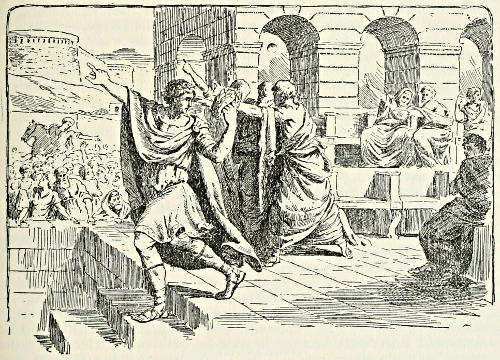
Scipio leaving Rome
[130-129 B.C.]
Portions of the public land had often been alienated by grant or sale.
The holders were now, in consequence of Carbo’s proclamation, suddenly
called upon to produce their title deeds, which in many cases were missing;
so that a vast number of these holders were liable to be stripped of lands
which were undoubtedly their own. Further, in cases where persons held
property partly public and partly private, there were often no documents
to show which part was public and which private. The commissioners acted
in the most arbitrary way, and exasperated a vast number of persons throughout
all Italy; and thus a new popular party was called forth, which exercised
a most important influence on the events of the next fifty years. In
Carbo’s rash haste to win the Roman countrymen he recked not of the hostility
of Latins and Italians; and those who had lately worshipped Gracchus
now rose like one man to oppose those who now pretended to represent
Gracchus.
These new opponents of the Agrarian law had no mind to join the
Roman oligarchs, but turned to Scipio and supplicated him to undertake
their cause. They had claims upon him, for they had volunteered to fill his
army when the senate had no money to give him, and he had always manifested
sympathy with them. Averse as he was from party politics, he did
not shrink from the task, and the moderate party in the senate welcomed his
return. He began by moving that a decree should issue for withdrawing
from the triumvirs the judicial power with which they had been invested by
Gracchus, and transferring the jurisdiction to the consuls. The decree passed,
and the task was committed to C. Sempronius Tuditanus, a man of refined
taste, fonder of art and literature than of business. But news came of a
movement among the Iapydes, a people on the Illyrian frontier; and Tuditanus
eagerly seized this excuse for hastening to Aquileia, feeling confident
that he could better cope with barbarous enemies than with the more barbarous
perplexities of the law.
[129 B.C.]
All proceedings were thus cut short. The senate had taken away
jurisdiction from the triumvirs; the consul to whom it was committed
had fled. General discontent arose. Scipio was accused of having betrayed
Roman interests to the Italians. His enemies spread reports that
he had sold himself to the oligarchy, that he intended to repeal the
Sempronian law by force, and let loose his Italian soldiery upon the
people of Rome.
Scipio felt that it was necessary to explain his motives, and announced
his purpose of delivering set speeches, one day in the senate, and the day
after in the Forum. The first only of these purposes was fulfilled. By
his speech in the senate he pledged himself to maintain the rights of the
Latins and Italians against the triumvirs, and to prevent the unjust resumption
of the lands that had been granted to them. The senate loudly applauded;
and Scipio was escorted home by the mass of the senators with a
jubilant crowd of Italians. Many thought this the most glorious day of his
life. He retired to rest early, in good health. In the morning he was
found dead in his bed. By his side lay the tablets on which he had
been noting down the heads of the oration which he had intended to
make next day.
The death of Scipio struck consternation into the hearts of the senators.
Metullus exclaimed that he had been murdered. It is said that on the neck
marks as of strangulation appeared; and when he was carried out to burial
the head was covered, contrary to custom. At the moment suspicion attached
to C. Gracchus, and to his sister Sempronia, the wife of Scipio. But
these unfounded rumours soon passed over; and it was confidently affirmed
that Carbo was the murderer. Cicero speaks of it as an undoubted fact;
the character, as well as the subsequent history, of the man justifies the
belief.b Appian,g on the other hand, is non-committal, mentioning rumours
against Cornelia as well as Sempronia, and adding that “some believe he
gave himself this death, because he saw he could not perform what he
promised”; while others assert “that Scipio’s slaves under torment confessed
that some unknown men they had let in at the back door had strangled
him, and that they dared not disclose the murder, because they knew
that the people, hating Scipio, rejoiced at his death.” Of modern authorities,
George Longd thinks “the circumstances of Scipio’s death were suspicious.”
But he doubts even that Cicero believed his own charge against
Carbo; and adds “the conclusion should be that Scipio died a natural
death.” Ihnef says: “After a minute and careful examination of the circumstances,
there appears to be no reason to doubt that Scipio’s death was
natural.” This, however, is perhaps stating the case a little too strongly.
Whatever the balance of probability, it can never be proven conclusively
whether Scipio died naturally or by violence: in the minds of some investigators,
the question will always hold a place in the long list of historical
uncertainties.a
Thus died the younger Africanus. No public honours attested his public
services. The funeral feast was furnished in the most thrifty manner by
his nephew Q. Tubero, a rigid stoic, who was glad thus to remind the people
of their ingratitude.
Scipio possessed no lofty genius like the great man whose name he bore;
yet there was at Rome no one of his own time to be compared with him.
To say that he was the best general of the day is little praise, for military
talent was at that time scarce; but no doubt his abilities for war would have
won him glory in the best times of the republic. His disinterested generosity
has been already noticed; at his death he was found to be no richer
than when he succeeded to the inheritance of the great Scipio. His love
of the country and his habitual reserve led him to shun public life. But
the austere manner and severe gravity which he commonly affected gave way
among his friends; and there is nothing that more raises our esteem for
Scipio than the warm attachment borne to him by such men as Polybius,
as well as Lælius, Rupilius, and others, whom Cicero has introduced into his
beautiful dialogues. Scipio has usually been represented as a stiff adherent
of the oligarchy, but the facts of history disprove this opinion. He might
have lived some years to moderate the fury of party strife, to awe the factious,
and to support just claims; for at his death he numbered no more than
six-and-fifty years. His death at this moment was perhaps the greatest loss
that the republic could have suffered.b
The general verdict on Scipio is laudatory. Even George Long,d who
ridicules the usual historical summing-up of great men, finds Scipio worthy
of much praise, but Beesly is of such contrary mind that he may well be
quoted:
“He is usually extolled as a patriot who would not stir to humour a
Roman rabble, but who, when downtrodden honest farmers, his comrades
in the wars, appealed to him, at once stepped into the arena as their champion.
In reality he was a reactionist who, when the inevitable results of
those liberal ideas which had been broached in his own circle stared him
in the face, seized the first available means of stifling them. The world
had moved too fast for him. As censor, instead of beseeching the gods to
increase the glory of the State, he begged them to preserve it. Brave as a
man, he was a pusillanimous statesman. It was well for his reputation that
he died just then. Without Sulla’s personal vices he might have played
Sulla’s part as a politician, and his atrocities in Spain as well as his remark
on the death of Tiberius Gracchus—words breathing the very essence of a
narrow swordman’s nature—showed that from bloodshed at all events he
would not have shrunk. It is hard to respect such a man in spite of all his
good qualities. Fortune gave him the opportunity of playing a great part,
and he shrank from it. When the crop sprang up which he had himself
helped to sow, he blighted it. But because he was personally respectable,
and because he held a middle course between contemporary parties, he has
found favour with historians, who are too apt to forget that there is in politics,
as in other things, a right course and a wrong, and that to attempt to
walk along both at once proves a man to be a weak statesman, and does not
prove him to be a great or good man.”c
[129-126 B.C.]
The sudden death of Scipio was followed by a calm. The turbulent
Carbo vanishes from the scene, till nine years later he reappears as a
champion of the violent oligarchical party. C. Gracchus was still living in
retirement. Fulvius Flaccus was content to let the Agrarian law sleep in
face of the portentous difficulties created by the measures of the triumvirs.
Nor was there anything in foreign affairs to ruffle the general calm. But
under this external tranquillity a leaven of agitation was at work. It was
not to be expected that the new-born jealousy which had sprung up between
the Romans on the one side and the Latins and Italians on the other, would
fall asleep. Proposals, however, were set afloat for reconciling these two
opposing interests. The Italians were led to hope that they might be made
citizens of Rome, on condition that they should not resist the execution of
the Agrarian law.
But the burgesses of Rome soon perceived that the admission of the
Latins and Italians to the Roman franchise would reduce them to comparative
insignificance. All the benefits now derived from the provinces by Romans
exclusively must then be shared with a vastly increased number of citizens,
and the profits as well as the power of a Roman must be materially diminished.
In the year 126 B.C. a large number of Italian strangers flocked to Rome,
eager for the promised boon. But by this time public opinion at Rome was
so far changed that M. Junius Pennus, one of the tribunes, brought forward
what we may call a severe alien-act, by which all strangers were compelled
to quit Rome. The successors of Gracchus, however, remained constant to
their new policy, and Caius himself was induced to speak in public for the
second time. But he was unsuccessful. The law of Pennus was passed;
and from this time may be dated that angry contest of feeling between the
Romans and the Italians which after thirty-eight years found vent in a
bloody war.
When Caius delivered this speech he was quæstor-elect for the next year.
He was appointed to serve under the consul L. Aurelius Orestes, when this
officer undertook to reduce the Sardinian mountaineers, who had been subjugated
by the father of young Gracchus fifty years before. After the first
year’s operations Orestes was at a loss for supplies and clothing; and
from this difficulty he was relieved by his quæstor, who by the memory
of his father and his own persuasive eloquence induced the Sardinian
colonists to give voluntarily what the soldiers wanted. Shortly after,
envoys arrived at Rome from Micipsa, son of Masinissa, offering, from
respect (as they said) for the name of Gracchus, to send supplies of corn to
Sardinia. The senate angrily dismissed the embassy. Orestes was directed
to remain as proconsul in his province, and his quæstor was ordered to
continue in office for a second year.
[126-123 B.C.]
Meanwhile the country party had succeeded in carrying the election of
their present chief, Fulvius Flaccus, to the consulship for 125 B.C. He was
a man with little force of oratory, but his activity and audacity gave him
power, and his unchangeable attachment to the memory of Ti. Gracchus
made him respectable. No sooner was he in the consul’s chair than he gave
full proof of his headlong temerity by giving notice of a bill for extending
the franchise to all the Latin and Italian allies. It was a reform bill sweeping
beyond all example. No addition had been made to the Roman territory
or the number of tribes since 241 B.C., a period of 116 years, and now at one
stroke it was proposed to add to the register a population much more numerous
than the whole existing number of Roman burgesses. The tribes
felt their interests to be at stake, and the measure of Flaccus was highly
unpopular at Rome.
At this moment, the senate adroitly contrived to detach Flaccus upon
foreign service. The people of Massilia, old allies of Rome, sent to demand
protection against the Salluvians, a Ligurian tribe of the Maritime Alps, and
Flaccus was ordered to take command of the army destined to relieve them.
He remained in Gaul for more than two years, and was honoured with a
triumph in the year 123 B.C. Meantime his great measure for extending the
franchise fell to the ground.
But the hopes excited by the impetuous consul were not easily relinquished.
The excitement was great throughout Italy, and in one of the
Latin colonies the smouldering fire burst into flame.
Fregellæ was a large and flourishing city on the Latin road. It was one
of the eighteen colonies which had remained faithful to Rome in the Hannibalic
War. It had seen the full franchise conferred on its neighbours at
Formiæ, Fundi, and Arpinum at the close of that war. And now the cup
was dashed from the very lip. Fregellæ flew to arms, without concert with
any other towns; and L. Opimius, one of the prætors, a man of prompt
resolution and devoid of pity, was ordered by the senate to crush the insurrection.
The gates were opened to him by treachery. Opimius took his
seat in the Forum, and exercised a fearful vengeance on the inhabitants, for
which he was rewarded by the senate with a triumph. The walls were
pulled down, and the colony, stripped of all its rights, was reduced to the
condition of a mere market-town (conciliabulum). The example of Fregellæ
for a time silenced the claims of the Italians.
Thus triumphant, the senate determined to keep the chiefs of the
Gracchan party absent from Rome. Flaccus had not yet finished his Gallic
wars; and an order was sent to detain C. Gracchus for a third year in
Sardinia. But the young quæstor perceived the drift of this order, and
returned to Rome about the middle of the year 124 B.C., to the no small
consternation of the senate. He was instantly summoned before the censors
then in office to account for his conduct, in order that he might be branded
with a public stigma, and thus disqualified from taking his seat in the senate
house. He made his defence to the people in a set speech, in which he
declared that the senate had no right to keep him employed as quæstor for
more than one year. “No one,” he added, “can say that I have received a
penny in presents, or have put any one to charges on my own account. The
purse which I took out full I have brought back empty; though I could
name persons who took out casks filled with wine and brought them home
charged with money.” He was triumphantly acquitted, and at once came
forward as candidate for the tribunate. The senate exerted all their influence
to prevent his election, and succeeded so far that his name stood only
fourth on the list. But as soon as he entered office, no one disputed his title
to be first.
[123 B.C.]
The die was now cast. For ten years he had held back from public life;
but the vexatious course pursued by the senate roused him to action; the
pent-up energy of his passionate nature burst forth, and he threw aside all
restraints both of fear and of prudence.
Hitherto there had been no proof of the young speaker’s powers. Twice
only had he spoken in public, and both times he had been on the losing side.
But years of diligent study had passed, and he became the greatest orator
that Rome had yet seen. Much as Cicero disliked Gracchus, he speaks with
lively admiration of his genius, and laments the loss which Latin literature
had sustained by his early death. The care which the young orator bestowed
on preparation was extraordinary; he was the first to use regular gesticulation,
and in his most fiery outbursts his voice was so modulated as never to
offend the ear.
His first measures are marked by that which was the ruling passion
of his life—a burning desire to avenge his brother’s death. Nasica was
beyond his reach. But others, who had persecuted the friends and followers
of Tiberius, were yet alive, and he inveighed against their cruel severity on
all occasions. “Your ancestors,” he exclaimed, “suffered not their tribunes
to be trampled down. But you—you let these men beat Tiberius to death,
and murder his friends without a trial!”
Accordingly he brought a bill aimed at Popilius, who had been the head
of the special commission appointed after the death of Tiberius. It declared
any magistrate guilty of treason who had punished a citizen capitally without
the consent of the people. Before it passed, Popilius left Rome; and the
tribes, on the motion of Caius, banished him.
The young tribune next moved that any one who should have been
deprived of office by a vote of the people should be incapable of holding
any other office—an enactment evidently pointed at his brother’s old
opponent Octavius. Fortunately for the honour of Gracchus, he was
stopped in his career of vengeance by the intercession of his mother.
He now turned his thoughts to measures of a public nature, and brought
forward a series of important bills, long known as the Sempronian laws,
so sweeping in their design, as to show that he meditated no less than a
revolution in the government of Rome. They may be divided into two
classes: first, those which were intended to ameliorate the condition of the
people; secondly, those which aimed at diminishing the power of the senate.
(1) Foremost in the first class we may place a bill for renewing and
extending the agrarian law of his brother, which was coupled with a measure
for planting new colonies in divers parts of Italy, and even in the provinces.
The execution of this law was deferred till the next year.
(2) The second Sempronian law was the famous measure by which the
state undertook to furnish corn at a low price to all Roman citizens. It
provided that any one possessing the Roman franchise should be allowed to
purchase grain from public stores at 6⅓ asses the modius, or about twenty-five
asses the bushel; the losses being borne by the treasury.
Public measures for distributing corn in times of scarcity had long been
familiar to Roman statesmen, and individuals had more than once sought
popularity by doles to the poor. But now, for the first time, was a right
established by law. The necessary results of such a measure must have
been, and were, very fatal. Fifty years later, it was found necessary to limit
the quantity sold to five modii (1¼ bushels) a month for each person; and
forty thousand citizens were habitual purchasers. Successively demagogues
reduced the price, till the profligate Clodius enacted that these 1¼ bushels
should be given away without any payment. The dictator Cæsar found
no fewer than 320,000 citizens in the monthly receipt of this dole. He
reduced the number to 150,000, and Augustus fixed it at a maximum of
200,000 souls. Such was the mass of paupers saddled upon the imperial
government by the unwise law of Gracchus.[79]
We now pass on to the measures which aimed at depriving the senate
of the great administrative power which of late years it had engrossed.
(1) The first of these touched their judicial power. It has been mentioned
that by the famous Calpurnian law (149 B.C.) all provincial magistrates
accused of corrupt dealings in their government were to be tried before
the prætor peregrinus as presiding judge, and a jury of senators. This was
the first regular and permanent court of justice established at Rome. The
principle of the Calpurnian law was gradually extended to other grave offences,
and in all the superior courts the juries were composed of senators.
These courts had given little satisfaction. In all important cases of
corruption, especially such as occurred in the provinces, the offenders were
themselves senators. Some of the judges had been guilty of like offences,
others hoped for opportunities of committing like offences; extortion was
looked upon as a venial crime; prosecutions became a trial of party strength,
and the culprit was usually absolved.
Gracchus now took the judicial power altogether out of the hands of
the senate, and transferred it to a body of three hundred persons, to be
chosen periodically from all citizens who possessed the equestrian rate of
property. By this measure he smote the senate with a two-edged sword.
For not only did he deprive it of the means of shielding its own members,
but he also gave a political constitution to a rival order. The equestrian
order, as a political body, entirely distinct from a mere military class, now
first received distinct recognition.
It is doubtful whether this measure of reform was followed by the good
effects intended by Gracchus. If the governors of provinces were senators,
the farmers of the taxes were equites. The new juries had their personal
reasons for acquitting corrupt magistrates; for without the countenance
of these magistrates they could not demand money from the provincials
beyond what was strictly legal. The constitution of these juries formed
a chief ground of political contest for the next fifty years.
(2) Another measure which fettered the power and patronage of the
senate was the Sempronian law for the assignment of the consular provinces.
Hitherto the senate had refrained from determining these provinces till
after the elections, and they thus had a ready way of marking displeasure
by allotting unprofitable governments to consuls whom they disliked. But
Gracchus now ordained that the two consular provinces should be fixed
before the elections, and that the new consuls, immediately upon their
election, should settle between themselves what provinces each was to
administer, either by lot or by agreement (sortitio or comparatio). It was
a wise and equitable provision, which remained in force as long as the
republic lasted.
(3) A great blow was given to senatorial power by a measure for improving
the roads of Italy. Public works of all kinds had hitherto been
left to the censors, subject to the approval of the senate. Gracchus now
transferred the business to the tribunes.
This account of the chief Sempronian laws shows the spirit which
animated Gracchus. It is plain that his main purpose was to diminish the
increased and increasing power of the senate. It was no doubt a confusion
between the purposes and the results of the Sempronian legislation that
swelled the cry against Gracchus in after-times. It is clear, however, that
he had no chance of amending the corrupt government of the senatorial
oligarchy, unless he first weakened their power; and if he fancied that
administrative functions might safely be controlled by a large and fluctuating
popular assembly, something may be forgiven to political inexperience.
Representative bodies are a modern invention, and the wisest of the ancients
found no halting-place between aristocracy and democracy. Gracchus was
not without misgivings as to the effects of his legislation. But it was too
late to draw back, and his zeal was quickened by the return of Fulvius
Flaccus from Gaul. By his measures Gracchus had so won all suffrages,
that he and his friend Flaccus were absolute masters of the comitia. Gracchus
told the people he had a favour to ask; he proposed as candidate for
the consulship C. Fannius, an old comrade of his brother. Fannius was
elected as a matter of course, to the rejection of L. Opimius, the senatorial
candidate.
[123-121 B.C.]
The tribunician elections followed. Flaccus, though he had been consul,
appeared as candidate for an office that had been raised by the Gracchi
to sovereign power. But Gracchus was not
by his side; for it had been made illegal
that the same man should be re-elected
tribune. However, there were not candidates
enough for the ten places; and the people,
exercising the absolute right of choice
which in this contingency was allowed, re-elected
Gracchus by a unanimous vote.[80] Not
more than seven months of his first year’s
tribunate were over, and he was secure of
power for the next seventeen months at
least. He now put forth all the tremendous
power of the office. The senate sat powerless,
and Caius Gracchus became for a time
the virtual sovereign of the empire.
Immediately on re-election, Gracchus
came forward with a bill for extending the
Roman franchise, certainly to the citizens
of all Latin colonies, probably to all free
Italian communities. Here we recognise
the hand of Flaccus, who had in his consulship
raised this momentous question, and
resumed the project on the first opportunity
after his return.
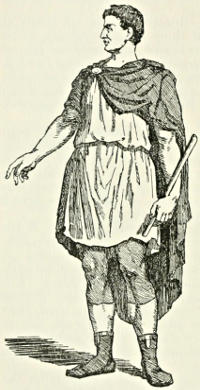
A Tribune of the People
There can be no doubt that some change
in this direction was necessary. The admission
of the Latins and Italians to full citizenship
would infuse a quantity of new blood
into the decaying frame of the Roman
people; and, by extending to all Italians
the benefits of the agrarian law, there
was really a good hope of reviving that hardy race of yeomen who were
regretted by all Roman statesmen. Scipio had induced the senate for a
moment to take up this cause; but after the revolt of Fregellæ, all thoughts
of an extension of the franchise had been dropped. The difficulty was how
to favour the Italians without provoking the Roman tribesmen. It is
manifest that the project was still unpopular in the Forum, for Gracchus
laboured to show that the Roman people and the Italians had one grievance
in common—namely, the tyranny of the senatorial oligarchy. “The other
day,” he told them, “the magistrates of Teanum had been stripped naked
and scourged, because the consul’s lady complained that the public baths
there had not been properly cleaned for her use. How great is the insolence
of the young nobles, a single example would show. One of them
was travelling through Apulia in a litter, and a countryman, meeting the
bearers, asked whether they had got a dead man inside. For this word, the
young lord ordered the poor man to be beaten to death with the cords of
the litter.”
The chiefs of the senate perceived that the proposal to enfranchise the
Italians had sapped his popularity at Rome. The consul Fannius, notwithstanding
the part Gracchus had taken in his election, vehemently
opposed the measure. He declared that he would again bring forward the
alien act of Pennus, and expel all foreigners from Rome. The senate soon
after ventured a step farther. One of the new tribunes, M. Livius Drusus
by name, a young man of high birth, rich, eloquent, ambitious and determined,
undertook to thwart the progress of his great colleague, and he
put a veto on the law for enfranchising the Latins.
We must now return to the agrarian law. In furtherance of this law,
Caius proposed to plant colonies in divers parts of Italy; Capua and Tarentum
were fixed upon as the first of these new settlements: but here he
showed no democratic tendencies; for no allotments were given to citizens,
however poor, unless their character was respectable; and only a small
number of colonists were to be sent to each place.
Drusus was not slow to take advantage of these unpopular provisions.
He resolved to outbid Gracchus, and the agent of the nobility became a
demagogue. He proposed to found no fewer than twelve colonies at once,
each to consist of three thousand families, to be chosen without respect to
character. All these colonists were to hold their allotments rent-free. Drusus
openly avowed that he made these propositions in favour of the poor on
the part of the senate, and declared in significant terms that he would not
himself accept any part in the honour or emolument to be derived from the
office of founding these colonies; whereas Gracchus had himself superintended
all the public works which he had originated.
At this time, plans were on foot for extending the Italian system of colonisation
to the provinces. In this very year, C. Sextius Calvinus, who had
succeeded Flaccus as proconsul in Gaul, founded the town of Aquæ Sextiæ,
still called Aix, in southern Gaul; four years later Narbo Martius, or Narbonne,
was planted farther westward in the same country. But Gracchus
himself was the first who had proposed to plant a colony beyond the Italian
peninsula; and the place he fixed upon was Carthage. The plan was taken
up by the senate. The new colony was to be called Junonia, and it was
dexterously contrived that Gracchus himself, with Flaccus and another,
should be the commissioners for distributing the lands and marking the
limits of the settlement. In this way the formidable tribune and his most
active supporter were obliged to quit Rome just when their presence was
most needed to revive their drooping popularity.
The commissioners applied themselves to their task with so much assiduity
that they returned to Rome in time for the consular elections. The
ruthless Opimius was again candidate, and Gracchus exerted himself to the
utmost to reorganise his party, but in vain. Popular feeling was strongly
marked by the triumphant election of Opimius to the consulship, in company
with Q. Fabius, son of Scipio’s elder brother, a man personally hostile to
Gracchus.
The tribunician elections followed, and were equally significant of the
temper of the people. Neither Gracchus nor Flaccus was re-elected. The
remainder of the year indeed passed by quietly. But at the beginning of
the year 121 B.C. Opimius became consul, and it was evident that danger was
at hand.
[121 B.C.]
Gracchus and his friends prudently refrained from all offensive steps;
but as he would give no grounds for proceeding against him, Opimius
resolved to make them. News arrived from the new colony at Carthage to
the effect that it had been planted on the ground cursed by Scipio; the
wrath of the gods had been shown by the fact that wolves had torn down
the boundary-posts. The senate met, and on the motion of Opimius ordered
the tribunes to call a meeting of the tribes upon the Capitol, to rescind the
law for colonising Carthage. The place was ominous, for there Ti. Gracchus
had been slain.
On the appointed morning the impetuous Flaccus appeared with a large
retinue armed with daggers. Gracchus followed with a considerable suite.
Flaccus spoke vehemently to the tribes, while Gracchus stood aloof in the
portico of the temple, in which Opimius was offering sacrifice. Here he was
encountered by a retainer of the consul, who insolently pushed Gracchus
aside, crying, “Make way for honest men!” Gracchus cast an angry look
upon the man, who presently fell stabbed to the heart by an unknown hand.
A cry of murder was raised, and the crowd fled in alarm to the Forum.
Gracchus retired to his house, regretting the rash imprudence of his followers.
Meantime the body of the slain man was paraded before the eyes of
the terrified people. The senate armed the consuls with a decree, by which
Gracchus was proclaimed a public enemy, and Opimius took station during
the night in the temple of Castor, by the side of the Forum. He summoned
the senate to a special sitting early next morning, and also sent to all on
whom he could rely, desiring them to come armed to the Forum, and each
man to bring two armed slaves. With this force he occupied the Capitol at
daybreak, and prepared to execute the will of the senate.
Gracchus was irresolute; but Flaccus summoned to his house all who
were ready to resist senatorial authority. Here he armed them with the
Celtic weapons which he had brought home from his Gallic campaigns, and
kept up their courage by deep potations of wine. Early in the morning he
occupied a strong position on the Aventine, where he was joined by Gracchus,
who sighed over the necessity of using force.
When the senate met, the popular leaders were summoned to attend in
their places, and explain the proceedings of the previous day. They answered
by proclaiming liberty to all slaves who should join them. Nothing
could more show the desperate aspect which the struggle had assumed.
Yet before blood flowed, Gracchus insisted on trying negotiation, and
Q. Flaccus, a handsome youth of eighteen, son of the ex-tribune, was sent.
But already the senate had invested Opimius with dictatorial power. The
only answer the consul returned was that the leaders must appear before
the senate, and explain their conduct; and when young Quintus came back
with a fresh message, Opimius arrested him. He now set a price on the
heads of Gracchus and Fulvius Flaccus, and ordered an immediate attack
upon the Aventine. Under arms appeared the noblest men at Rome, P.
Lentulus, chief of the senate, old Metellus Macedonicus, and many others.
For their leader they chose not the consul, but L. Junius Brutus, the Spanish
conqueror. The attack was opened under cover of a shower of arrows
from a body of Cretan bowmen. Little or no resistance was offered.
Flaccus fled with his eldest son. Gracchus retired into the temple of Diana,
where he was hardly prevented from putting an end to his own life by two
faithful friends, the knights Pomponius and Lætorius. Urged by them to
flee, he threw himself on his knees, and prayed the goddess to punish the
unworthy people of Rome by everlasting slavery. All three then took their
way down to the Porta Trigemina, hotly pursued. Pomponius made a
stand in the gateway to cover his friend’s escape across the Sublician bridge,
and fell pierced with many wounds. Lætorius showed no less devotion by
gallantly turning to bay upon the bridge till he knew that Gracchus was
safe over, when he sprang into the river and perished. Gracchus with a
single slave reached the Grove of the Furies, and here both were found
dead. The faithful slave had first held the sword to his master’s heart, and
then fallen upon it himself. One Septimuleius cut off the head of Gracchus,
and was rewarded by the fierce Opimius with its weight in gold.[81]
Flaccus and his eldest son had found shelter in the bath-house of a
friend. The consul’s myrmidons tracked them, and threatened to set fire to
the house. The owner, alarmed for his property, allowed another to disclose
the secret, though he did not choose to speak the word himself. They
were dragged forth and slain with every mark of indignity. The handsome
youth who had been arrested before the assault commenced was allowed to
put himself to death.
Great numbers of the partisans of Gracchus were thrown into prison, and
put to death without trial. The stream of Tiber flowed thick with corpses.
The inconstant mob plundered their houses without molestation. The
widows and friends of the slain were forbidden by consular edict to wear
mourning. When the bloody work was done, the city was purged by a
formal lustration; and the consul, by order of the senate, laid the foundations
of a temple of Concord. Under the inscription placed on it by Opimius
was found next morning another to this effect:
“Workers of Discord raise a shrine to Concord.”
But none dared openly to avow themselves friends of the Gracchi. The
son of Caius died soon after; and except Sempronia, the widow of Scipio,
none of the race remained. Cornelia retired to Misenum, where she lived
for many years, not so much sorrowing for the loss of her sons as dwelling
with delight on the memory of their acts. Many visited her in retirement,
chiefly learned Greeks, to hear the story of the bold reformers. Calmly
and loftily she told the tale, declaring that her sons had found worthy
graves in the temples of the gods. In after days her statue in bronze was
set up in the Forum, with the Greek sandals on her feet which had been
made a reproach to her illustrious father. Beneath it were placed these
words only: To Cornelia, the Mother of the Gracchi.b
To quote again from Beesly’sc acute summing-up of Caius Gracchus.
“The man who originates is always so far greater than the man who
imitates, and Caius only followed where his brother led. The very dream
which Caius told to the people shows that his brother’s spell was still on
him, and his telling it, together with his impetuous oratory and his avowed
fatalism, militates against the theory that Tiberius was swayed by impulse
and sentiment, and he by calculation and reason. But no doubt he profited
by experience of the past. He had learned how to bide his time, and to
think generosity wasted on the murderous crew whom he had sworn to punish.
Pure in life, perfectly prepared for a death to which he considered
himself foredoomed, glowing with one fervent passion, he took up his
brother’s cause with a double portion of his brother’s spirit, because he had
thought more before action, because he had greater natural eloquence, and
because being forewarned he was forearmed.
“In spite of the labours of recent historians, the legislation of Caius
Gracchus is still hard to understand. Where the original authorities contradict
each other, as they often do, probable conjecture is the most which
can be attained, and no attempt will be made here to specify what were the
measures of the first tribunate of Caius and what of the second. The
general scope and tendency of his legislation is clear enough. It was to
overthrow the senatorial government, and in the new government to give
the chief share of the executive power to the mercantile class, and the chief
share of the legislative power to Italians. These were his immediate aims.
Probably he meant to keep all the strings he thus set in motion in his own
hands, so as to be practically monarch of Rome. But whether he definitely
conceived the idea of monarchy, and, looking beyond his own requirements,
pictured to himself a successor at some future time inheriting the authority
which he had established, no one can say. In such vast schemes there must
have been much that was merely tentative. But had he lived and retained
his influence we may be sure that the Empire would have been established a
century earlier than it was.”c
George Longd says: “We may acquit the Gracchi of the Roman vice of
greediness, but not of ill-directed ambition. Their object was not to enrich
themselves, but to destroy the power of the Optimates by rousing against
them the people, and using their votes to make a revolution. But this
popular agitation increased an evil which already existed. The Gracchi
used the popular vote for their purpose, as the nobles had long used it
for their ends. Under the name of the public interest men on both sides
sought their own.”
Roman Tweezers
(In the British Museum)
[123-112 B.C.]
The cruel times which followed made the best men of both parties regret
the untimely end of those who had sacrificed wealth, rank, tranquillity, in the
hope of reforming the state by peaceful methods. But Marius was not the
worst of the successors of the Gracchi. So savage were the party quarrels
which followed, that good men shrank in despair from the cause of reform,
and the conduct of the popular party was abandoned to needy demagogues.
Such is the common course of revolutions. They begin with noble aspirations;
they end in reckless violence. At length public spirit is lost, and all
men, sighing for tranquillity, seek it in the strong rule of an armed soldier.
It is a thrice-told tale.
As the murder of Tiberius had been avenged upon Nasica, so there was
even now found a tribune bold enough to indict Opimius. The accuser bore
the time-honoured name of Decius; the defender was that Carbo who was
more than suspected of Scipio’s murder, and who was now consul (120 B.C.);
his eloquence and the terror that prevailed procured an acquittal. But Carbo,
though he earned the gratitude of the nobility by defending their champion,
did not find his eloquence equally effectual in defending himself. It was at
that time the practice of young Romans who aspired to distinction to attract
public notice by indicting some great offender before the people. L. Licinius
Crassus, son of Crassus the pontifex, and brother-in-law of C. Gracchus,
though only one-and-twenty years of age, felt within him that power of
speech which in later days gained him the appellation of the orator; and
he singled out Carbo for attack. So fierce was the invective of the young
accuser that Carbo put an end to his own life by poison.
The nobility probably cared little for the life of a worthless renegade.
The best men in the senate, indeed, regretted what they considered the necessity
of taking up arms against Gracchus. First among these was old
Metellus Macedonicus, who died full of honours and years seven years after
the death of C. Gracchus. He left four sons. Before his death three of
them had been consuls; the fourth was candidate for the consulship at his
father’s death; but his two nephews, sons of his brother Calvus, were more
distinguished than his own offspring. Quintus the younger, under the title of
Numidicus, shortly afterwards became the most eminent man in the ranks
of the nobility. In the course of twenty years the Metelli enjoyed six consulships
and four censorships, besides five triumphs. Such an aggregation
of honours in one family was without example. The worst fault of the
Metelli was pride; but if they were not beloved, they were at least respected
by the people.
A person who plays a large part in the events of the next years was M.
Æmilius Scaurus, a man of more dubious character. Horace names him with
some of the greatest men of olden time; Sallust represents him as disgracing
high qualities by an inordinate love for money. The facts we shall have
to record will show that in his earlier days he was infected by the corruption
of his compeers, while in later life his prudence was so great as to stand
for principle. He was born in 163 B.C., so that at the fall of C. Gracchus he
had reached that ripe age which was required for the consulship. Though
he belonged to a great patrician gens, his family was so obscure that he was
accounted a new man. His father had been a charcoal merchant, and left
his son so poor that the future ruler of the empire had at one time contemplated
following the trade of a money-changer. But he was encouraged to
try the chances of political life, and in 115 B.C. he reached the consulate.
By his ability and discretion he so won the confidence of the senate that at
the first vacancy he was named princeps. He was a man less seen than felt.
His oratory wanted fire; but his talents for business, and his dexterity in
the management of parties, made him the most important person in the field
of politics from the fall of Gracchus to the rise of Sulla.
The more prudent or more severe among the senators believed that
reform in the state might be averted by a reformation of manners. But in
vain. The business of Jugurtha brought into full light the venality and
corruption of the dominant statesmen.
We have said little of the wars of Rome since the fall of Numantia and
the termination of the Servile War. They were not considerable. The
kingdom of Pergamus had formed the tenth province. The eldest son of
old Metellus earned the title of Balearicus for subduing the Balearic Isles
(121 B.C.); his eldest nephew that of Dalmaticus for putting down an
outbreak of the Dalmatians (117 B.C.).
More attention was excited by wars in the south of Gaul, and more
permanent effects followed. The success of Fulvius Flaccus, the friend of
the Gracchi, in defending Marseilles, has been already noticed. C. Sextius,
who succeeded Flaccus in 123 B.C., secured his conquests by founding the
colony of Aquæ Sextiæ, which under the name of Aix still attracts visitors
for the sake of its hot springs. These conquests brought the Romans in
contact with the Allobrogians, between the Rhone and the Isère; and this
people threw themselves on the protection of Bituitus, chief of the
Arvernians (Auvergne). Q. Fabius, while Opimius was crushing C.
Gracchus, crossed the Isère. A desperate battle ensued, in which the
proconsul, with 30,000 men, is said to have so completely routed 200,000
Gauls that in the battle and pursuit no less than 130,000 fell. Fabius was
suffering from a quartan ague, but in the heat of conflict shook off his
disease. He assumed the title of Allobrogicus with better right than many
who were decorated with these national surnames. The war was now
carried into the Arvernian country, and the great triumphs of Cæsar might
have been anticipated by some senatorial commander, when it was brought
to a sudden end. An enemy, formidable alike to Romans and Gauls, well
known a few years later under the dreaded names of Cimbrians and Teutones,
had appeared on the northeastern frontier of Gaul, and threatened to overrun
all southern Europe. But circumstances deferred for a time the conflict
between Italy and those barbarous hordes, and for the present the dominion
of Rome was firmly established in the southern angle of Gaul, between the
Alps and Pyrenees, a district which still preserves its Roman name, “the
province,” in the French Provence. The whole northern coast of the Mediterranean,
from the Pillars of Hercules to Syria, now owned the sovereignty
of Rome.b
The miserable inefficiency and complete worthlessness of the Roman
government was especially noticeable in the Jugurthine War, which on
that account, and not because of its magnitude or dangerous character, is of
interest.
Masinissa, known to us as king of Numidia, died in the year 148 and
left the government of his kingdom to be shared in common by his three
sons, Micipsa, Gulussa, and Mastanabal. The death of the last two following
soon after, Micipsa, the eldest, was left to reign alone. He was a feeble,
peacefully inclined old man, who preferred devoting himself to Greek
philosophy; and, as his two sons, Adherbal and Hiempsal, were not yet
of age, he abandoned the administration to his nephew Jugurtha, an illegitimate
son of Mastanabal. Jugurtha was a magnificent type of man, bold
and full of talent, well versed in all the arts of war, and held in high esteem
by the Numidians.
As leader of the Numidian auxiliary forces in the Numantian War, he
had distinguished himself in Scipio’s army by his bravery, and had won
many friends among the Romans of name. When he returned home he
brought Micipsa a letter from Scipio, in which the latter congratulates
Micipsa on his gallant nephew, who, he declares, has endeared himself to
every Roman by his services. Micipsa now began to fear lest this youth,
standing so high in the favour of both Romans and Numidians, might
become dangerous to his own two sons. He therefore thought it best to
propitiate him by benefits; he adopted him, and in his will provided that
Jugurtha should share his kingdom with his sons.
[118-112 B.C.]
Micipsa died in the year 118. His eyes were scarcely closed when his
two sons, grudging Jugurtha his share in the kingdom, fell out with him so
that the idea of mutual government seemed no longer feasible.
But before a division of kingdom and treasure could be arranged,
Jugurtha, who had been infuriated by irritating words which Hiempsal had
uttered in a rage, caused Hiempsal to be set upon in his house and murdered.
He then began war against Adherbal, intending to obtain mastery over the
entire kingdom. Adherbal, driven from the kingdom, fled to Rome, where
he laid his complaint before the senate, which had taken upon itself to carry
out the provisions of Micipsa’s will. Jugurtha had taken the measure of
the Romans before Numantia; he now sent an embassy with a quantity
of money to Rome, and this soon convinced those who had just been pleading
Adherbal’s cause of the injustice of his complaint.
Jugurtha was now pronounced blameless; Adherbal had himself commenced
the war, and his brother had been murdered by his own followers
because of his cruelties towards them. The Roman senate was quite willing
to hand over the whole kingdom to the open-handed Jugurtha, but the evidence
of bribery was somewhat too strong. So in order that the scandal
might not become too flagrant, the leaders of the senate decided to send a
commission of ten men to Numidia, who should divide that kingdom equally
between the two pretenders. L. Opimius, the conqueror of C. Gracchus,
was placed at the head of the commission, and neither he nor the others let
slip the opportunity of turning the occasion to their own profits.
In exchange for Jugurtha’s money, it was arranged that the western half
of Numidia, which was fertile and well populated, should be his portion;
whilst to Adherbal was assigned the eastern part, chiefly consisting of sandy
deserts. Jugurtha was not content with the half. Emboldened by his previous
successes, he made inroads into Adherbal’s territory, seeking plunder
and hoping that Adherbal by way of revenge would make an attack on him
on his own ground, and so give him a pretext for taking his lands from him.
As, however, Adherbal contented himself with making complaints to
Rome, he began the war without pretext. He invaded Adherbal’s territory
at the head of a large force, and taking him by surprise in a night attack
near Cirta (now Constantine) defeated him utterly. Adherbal with a few
horsemen sought refuge in the capital. Whilst this was besieged by Jugurtha,
and defended by the numerous Italians resident in the town, there
appeared envoys from Rome who had been appointed to receive Adherbal’s
first complaints. These demanded that Jugurtha should discontinue the
war, and accept their mediation. The envoys were young men who made
little impression on the king; he refused their demand and the siege was
continued with redoubled vigour, without the Roman senate appearing to
take any further interest in the matter.
It was only after five months of siege—when Adherbal had sent a fresh
appeal to Rome imploring help in the most urgent manner, pointing out that
Jugurtha’s aggression affected not only him but the Roman people also—that
a decision was arrived at. They did not decide, however, as the honour
of the state required, and the minority urged a declaration of war; but they
sent a fresh embassy consisting of men of the highest consideration. At
the head they sent M. Æmilius Scaurus, at that time the most honoured
and influential man in Rome, but no better than the others, only possessed
of more charm and experienced in the art of disguising his inward viciousness
under the cloak of worth and dignity.
Jugurtha appeared in Utica at the summons of Scaurus; there were long
consultations, and finally the embassy took its departure without gaining
anything and without declaring war. The honourable Scaurus and his
worthy companions had also permitted themselves to be bribed. The siege
of Cirta was continued till Adherbal, urged by the Italian merchants who
were settled in the town, and who believed their lives to be safe, surrendered
on condition that his life and the lives of the garrison should be spared.
Scarcely was the surrender accomplished, when Jugurtha had Adherbal
tortured to death, and the inhabitants, Africans and Italians, slaughtered.
This monstrous crime of the barbarian king, which would not have been
possible but for the laxity and infamous venality of the Roman government,
raised a storm of indignation throughout Italy. In Rome the people
clamoured for war, and were loud in their denunciation of the senate, which
had so shamefully sacrificed the honour of the state and the lives of so many
Italian citizens. Still the senate hesitated to yield to the anger of the populace
and declare war against Jugurtha. It was only when C. Memmius—a
man of action and eloquence, who was elected for the next year to the
tribuneship of the people—threatened publicly that as tribune he would
call the guilty to account, that the senate became frightened, yielded, and
declared war (112).
[112-111 B.C.]
The consul L. Calpurnius Bestia undertook the direction of the war, and
preparations were made with great ardour; Scaurus himself going with the
force as legate. Bestia pressed forward into Numidia, and fortune favoured
him, so that Jugurtha lost courage and asked for a suspension of hostilities.
During the conference Jugurtha bribed Scaurus and through him the consul,
so that the matter was arranged. Jugurtha was to throw himself on his
conqueror’s mercy, and the Roman renegade, in exchange for an insignificant
sum of money and some elephants, was to give him his freedom and to leave
him in unrestricted possession of his kingdom.
When this bargain became known in Rome, C. Memmius, now tribune,
insisted on a judicial inquiry and on Jugurtha being summoned before
the assembly of the Roman people that he might give information as to the
share taken by each of the different parties in the peace conference. “If
the king really surrendered unconditionally,” said he, “he will not refuse to
appear; if he refuses, you may learn from that fact the nature of this peace
and this surrender, which has brought to Jugurtha amnesty for his crimes,
to a small number of our nobles exceeding riches, and to our fatherland
shame and disgrace.”c For this picturesque incident we may turn to
Sallust, the original authority.
[111-110 B.C.]
During the course of these proceedings at Rome, those whom Bestia had
left in Numidia in command of the army, following the example of their
general, had been guilty of many scandalous transactions. Some, seduced
by gold, had restored Jugurtha his elephants; others had sold him his deserters;
others had ravaged the lands of those at peace with us; so strong a
spirit of rapacity, like the contagion of a pestilence, had pervaded the breasts
of all.
Cassius, when the measure proposed by Memmius had been carried, and
whilst all the nobility were in consternation, set out on his mission to
Jugurtha, whom, alarmed as he was, and despairing of his fortune, from a
sense of guilt, he admonished “that, since he had surrendered himself to the
Romans, he had better make trial of their mercy than their power.” He
also pledged his own word, which Jugurtha valued not less than that of the
public, for his safety. Such at that period, was the reputation of Cassius.
Jugurtha, accordingly, accompanied Cassius to Rome, but without any
mark of royalty, and in the garb, as much as possible, of a suppliant; and,
though he felt great confidence on his own part, and was supported by all
those through whose power or villainy he had accomplished his projects, he
purchased, by a vast bribe, the aid of Caius Bæbius, a tribune of the people,
by whose audacity he hoped to be protected against the law, and against
all harm.
An assembly of the people being convoked, Memmius, although they
were violently exasperated against Jugurtha (some demanding that he should
be cast into prison, others that, unless he should name his accomplices in
guilt, he should be put to death, according to the usage of their ancestors, as
a public enemy), yet, regarding rather their character than their resentment,
endeavoured to calm their turbulence and mitigate their rage; and assured
them that, as far as depended on him, the public faith should not be broken.
At length, when silence was obtained, he brought forward Jugurtha, and
addressed them. He detailed the misdeeds of Jugurtha at Rome and in
Numidia, and set forth his crimes towards his father and brothers; and
admonished the prince, “that the Roman people, though they were well
aware by whose support and agency he had acted, yet desired further testimony
from himself; that, if he disclosed the truth, there was great hope for
him in the honour and clemency of the Romans; but if he concealed it, he
would certainly not save his accomplices, but ruin himself and his hopes
forever.”
But when Memmius had concluded his speech, and Jugurtha was expected
to give his answer, Caius Bæbius, the tribune of the people, whom I have just
noticed as having been bribed, enjoined the prince to hold his peace; and
though the multitude who formed the assembly were desperately enraged,
and endeavoured to terrify the tribune by outcries, by angry looks, by violent
gestures, and by every other act to which anger
prompts, his audacity was at last triumphant. The
people, mocked and set at naught, withdrew from
the place of assembly; and the confidence of Jugurtha,
Bestia, and the others whom this investigation
had alarmed, was greatly augmented.
There was at this period in Rome a certain Numidian
named Massiva, a son of Gulussa and grandson
of Masinissa, who, from having been, in the
dissensions among princes, opposed to Jugurtha,
had been obliged, after the surrender of Cirta and
the murder of Adherbal, to make his escape out of
Africa. Spurius Albinus, who was consul with
Quintus Minucius Rufus the year after Bestia, prevailed
upon this man, as he was of the family of
Masinissa, and as odium and terror hung over Jugurtha
for his crimes, to petition the senate for the
kingdom of Numidia. Albinus, being eager for the
conduct of a war, was desirous that affairs should
be disturbed, rather than sink into tranquillity;
especially as, in the division of the provinces, Numidia
had fallen to himself, and Macedonia to
Minucius.
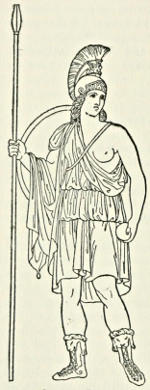
Goddess Roma
(After Hope)
When Massiva proceeded to carry these suggestions
into execution, Jugurtha, finding that he had
no sufficient support in his friends, as a sense of
guilt deterred some and evil report or timidity
others from coming forward in his behalf, directed
Bomilcar, his most attached and faithful adherent,
to procure by the aid of money, by which he had
already effected so much, assassins to kill Massiva;
and to do it secretly if he could, but if secrecy should be impossible, to cut
him off in any way whatsoever. This commission Bomilcar soon found means
to execute; and, by the agency of men versed in such service, ascertained the
direction of his journeys, his hours of leaving home, and the times at which
he resorted to particular places, and, when all was ready, placed his assassins
in ambush. One of their number sprang upon Massiva, though with too little
caution, and killed him; but being himself caught, he made at the instigation
of many, and especially of Albinus the consul, a full confession. Bomilcar
was accordingly committed for trial, though rather on the principles of reason
and justice than in accordance with the law of nations, as he was in the retinue
of one who had come to Rome on a pledge of the public faith for his safety.
But Jugurtha, though clearly guilty of the crime, did not cease to struggle
against the truth, until he perceived that the infamy of the deed was too
strong for his interest or his money. For which reason, although at the commencement
of the proceedings he had given fifty of his friends as bail for
Bomilcar, yet thinking more of his kingdom than of the sureties, he sent
him off privately into Numidia, for he feared that if such a man should be
executed, his other subjects would be deterred from obeying him. A few
days after, he himself departed, having been ordered by the senate to quit
Italy. But, as he was going from Rome, he is said, after frequently looking
back on it in silence, to have at last exclaimed that “it was a venal city,
and would soon perish, if it could but find a purchaser!”[82]d
The war accordingly recommenced. Spurius Postumius Albinus took
the command. But the African force was so demoralised that nothing was
to be done with it, and moreover Albinus also allowed himself to be bribed.
Nothing was done during the whole summer. When, however, the consul
went to Rome, where the election of consuls for the ensuing year demanded
his presence, and gave the command into the hands of his brother Aulus
Postumius—the latter, a foolhardy and incompetent man, endeavoured to
make use of this short interval for his own glory and enrichment. In the
middle of winter he marched to the interior of Numidia, bent on surprising
and overthrowing the inaccessible fortress of Suthul, where Jugurtha kept
his treasures. All went well till he came in front of the town; but as he
was not able to take it, he pursued Jugurtha, who drew him into unknown
parts of the country, and suddenly, one stormy night, having won over some
of the Roman officers and men by bribes, attacked him in his camp. The
Romans fled, mostly unarmed, and took refuge on a neighbouring hill, where
they were surrounded. Nothing remained to their leader but surrender, and
under conditions dictated by Jugurtha as follows: “The Roman army to
withdraw under the yoke, and to quit Numidia; the treaty of peace annulled
by the senate to be again in force.”
The disgrace could not have been greater. In Rome the displeasure of
the people could no longer be kept within bounds. In accordance with the
proposal of the people’s tribune, C. Mamilius Limetamus, there was instituted
a judicial examination of all those through whose fault Jugurtha had been
able to defy the senate, and those generals and envoys who had taken money
from him. An extraordinary commission of inquiry was convened, and
Calpurnius Bestia, Spurius Albinus, L. Opimius—who was especially odious
to the people—as well as several less celebrated men, were sentenced to
exile.
That cunning scoundrel, Æmilius Scaurus, got off clear; he had indeed
so managed that he was one of those chosen to act on the board of the commission
of inquiry. The treaty of peace of Aulus Postumius was naturally
declared inoperative, and the war was renewed. In order completely to put
an end to the disgrace, the command was given to Q. Cæcilius Metellus, consul
for the year 109, another, certainly, of the rigid and callous patricians,
but one of the few men in the government inaccessible to bribes, and known
to be an experienced and prudent general.
[109 B.C.]
Accompanied by capable lieutenants such as C. Marius and P. Rutilius
Rufus, he arrived in Africa in the year 109; but he found the army in such
a state of demoralisation and confusion that he needed more time to restore
it to discipline, and by dint of severe measures render it fit for service.
When he entered Numidia, Jugurtha quickly recognised that the condition
of affairs was changed, and he repeatedly proffered Metellus his submission,
merely demanding a guarantee for his life. But Metellus intended the war
to end in one way only—with the execution of Jugurtha, and he did not
scruple during the negotiations to endeavour to induce the servants of the
king to deliver their master dead or living into his hands. When Jugurtha
realised the intentions of the Romans, he broke off negotiations and prepared
himself for a desperate resistance.
During his march to the interior of Numidia, Metellus crossed a range of
barren mountains, on the other side of which flowed the river Muthul, in a
wide plain, a few miles distant from the mountains; from the mountains to
the river a low chain of partly wooded hills traversed the plain obliquely.
On these hills Jugurtha had stationed his troops, in two divisions, in order to
surprise the Romans. One under Bomilcar waited near the river, but the
larger division, under Jugurtha himself, was ambushed nearer the mountains.
The choice of the place and the way in which he drew up his forces
proved the king’s military talent. Metellus could not remain stationary on
the mountains; he must try to reach the river across the waterless plain.
He therefore sent a portion of his force under the legate Rufus in a straight
line to the river, there to pitch their camp; he himself marched with the
remainder of his army across the plain toward the line of hills on the right,
intending to drive the foe from their position. But he had scarcely descended
to the plain, when he was attacked on all sides by Jugurtha’s men
and prevented from advancing. At the same time Bomilcar threw himself
upon the force under Rufus. In both places the Romans were sorely harassed,
and the event long remained doubtful; at last the ability and endurance of
the Roman foot soldiers conquered. When Metellus and Marius with part
of their force reached the foot of the chain of hills and set themselves to
storm the heights held by the enemy, the latter fled, making scarcely any
resistance. Meanwhile Rufus likewise came off conqueror; and so, late that
evening, the two divisions of the Roman army met in the glory of victory.
After this encounter at Muthul, Jugurtha dismissed the greater part of
his troops, and confined himself to guerilla warfare. Skirmishing round
Numidia, wherever the Romans were devastating the country and destroying
towns, he harassed and annoyed them in every possible way. As winter
approached, and Metellus, in order to facilitate the collection of supplies,
withdrew his troops into the Roman provinces, Jugurtha again made overtures
of peace. Metellus declared himself inclined to come to terms. First
of all he demanded the surrender of the elephants, some of the horses and
weapons and three hundred hostages; also that of the Roman deserters, three
thousand in number, who were to be executed. Next he demanded two
hundred thousand pounds of silver, and his demand was agreed to by the
king; but when finally Metellus demanded that the king himself should
become his prisoner, Jugurtha broke off the negotiations.
At the same time Bomilcar, Jugurtha’s most trusted friend, who took an
active part in the negotiations, was secretly suborned by Metellus to deliver
the king into his hands dead or alive. Bomilcar might have feared that, in
the case of peace being again concluded, Jugurtha would denounce him to
the Romans as the murderer of Massiva; and was therefore ready to betray
his master, if Metellus guaranteed him his own safety. But Jugurtha discovered
the plot and had Bomilcar executed. The war still continued.
[109-108 B.C.]
Jugurtha, though weakened, was not at the end of his resources. In that
country—furrowed with deserts, as well as surrounded by them—he could
long maintain the war, more particularly as not only his own subjects but
the free neighbouring races were his enthusiastic followers, adoring the hero
who so bravely and with such success had defended his native country
against its hated enemies.
When in the year 108 Metellus again opened the campaign and engaged
Jugurtha in a pitched battle, Jugurtha fled far to the south, to the confines
of the great desert, where in an oasis was a fortified town called Thala.
Here he retired with his children, his treasure, and his best troops; an arid
desert, ten miles broad, was between him and the pursuing enemy. Still
Metellus marched through the desert, taking water for his men in skins, and
after forty days’ siege he took Thala. But he failed to catch Jugurtha; at
the critical moment he had escaped with his children and his treasure. He
fled through the district south of Mount Atlas—to the Belidulgerid of to-day—and
called on the hordes that dwelt there to take arms against the national
enemy.
He returned to his kingdom with a force composed of Gætulians, and still
further strengthened by a new ally—King Bocchus of Mauretania, his father-in-law,
who, after long hesitation, had finally decided to make common cause
with him against the Romans. The two monarchs led their troops to the
neighbourhood of Cirta, then in the hands of the Romans, and Metellus
advanced to meet them. But nothing decisive happened; for meanwhile
Metellus had heard from Rome that Marius, his former lieutenant, had been
chosen consul for the year 107, and had been given the chief command in
Africa by the people, and so all operations were suspended.
[108-107 B.C.]
Caius Marius, who in the next few years was to play so conspicuous a
part in Roman history, was a man of low birth, the son of a Latin peasant
from the village of Cereatæ, near Arpinum. He was lacking in all higher
culture. He was essentially a soldier, with the inborn faculty for war.
When only twenty-two, he distinguished himself in the army of Scipio
Æmilianus in Numantia by his bravery and by his soldierly bearing. Ambition
drove him into the service of the state. In 119, supported by the
powerful Metellus, he became a tribune of the people, and at that time, with
much determination and military impetuosity, he carried through a law
directed against the nobles, dealing with bribery and the fraudulent acquisition
of office. When the consul Cotta prevailed upon the senate to oppose
the law and to call Marius to account, the latter appeared in the senate and
threatened to imprison Cotta by force, if he did not abandon his resolve.
Cotta appealed to his fellow consul, L. Cæcilius Metellus; and when the
latter agreed with Cotta, Marius ordered his servant to conduct Metellus
to prison. As no tribune would intercede on Metellus’ behalf, the senate
gave way and the law took its course.
From that time Marius was established in the favour of the people; but
the nobility worked against the ambitious aspirant where they could, and
they succeeded in defeating him when he stood for the curule chair, and
again when he sought the plebeian ædileship. The prætorship he succeeded
in obtaining in the year 115, but with the greatest difficulty.
Marius remained legate to Q. Metellus in the Jugurthine War because of
the opportunities offered for showing military activity. He helped Metellus
to re-establish military discipline and to win victory for the Roman standard.
His courage and knowledge of warfare, his cunning and intrepidity, and
strict military discipline, were everywhere celebrated; he gained the affections
of the common soldiers by sharing with them all their hardships and
privations. After the battle of Muthul, where he especially distinguished
himself, his praise was in every mouth; and the soldiers wrote home that
there would be no end to the war unless Marius was made consul and commander-in-chief.
This was vexatious to Metellus, and there seems to have
been considerable friction between these two proud men. When Marius
asked for furlough from the commander-in-chief that he might go to Rome
and make application for the consulship, Metellus with the pride of rank
annoyed him with the question, “Will you not be content if you become
consul with my son?” Metellus’ son was then twenty-two years old.
Metellus only granted Marius leave of absence twelve days before the election
to the consulship took place; but Marius travelled the whole way from
the camp to Utica in two days and one night, and from Utica he arrived in
Rome within four days. On his application for the consulship he did not
scruple to disparage Metellus’ conduct of the war, and hinted that he was
purposely protracting the struggle so as to remain longer in command; and
he promised that with even half the troops he would in a short time deliver
Jugurtha, dead or alive, into the hands of the Romans. The people treated
the election as a party question, and Marius as one of themselves was chosen
consul by unanimous acclamation, and the conduct of the African War transferred
into his hands. This was, after a long interval, another case in which
a homo novus attained to the consulate—naturally to the great annoyance of
the nobility, who however could do nothing against the will of the people,
excited as they were at the idea that after long oppression they had found
in Marius a chief and a leader of their own.
[107-104 B.C.]
Marius made use of the time before his departure for the seat of war to
irritate the people in every way against the rule of the nobility. “The
haughty nobles,” said he, “passed their youth in luxury and revelling; then,
when elected to the post of general, they would hasten to glean from Greek
books some information on the subject of the art of war. Let the people
leave them to their revels, and choose their generals from men who are
inured to heat and cold, and every hardship, who, instead of pictures of
ancestors, have honourable wounds and marks of conflict to display.”
When levying the troops he was to lead to Africa, he chose his men contrary
to the prevailing system—from the lowest orders of the people, the
so-called proletariat. Through this innovation he gained at any rate a
number of devoted adherents; but he degraded the tone of the army by
putting swords into the hands of people without homes or property, who
would seek profit in warfare and be more eager to serve their general than
their country.
When Marius came to Africa, he received his army from the hands of
the legate Rufus; Metellus, infuriated, had already left, in order to avoid
the rival who was to supplant him. He continued the war and was favoured
by fortune, though he did not end it immediately, as he had pledged himself
to do.
He plundered and devastated the whole Numidian country, and those
towns not yet garrisoned he forced to submission; he overshadowed the
expedition Metellus had led against Thala by a still bolder and more skilfully
conducted campaign against Capsa, a fortified town further south;
took a rocky fortress on the river, Mulucha on the borders of Numidia and
Mauretania and conquered the two kings opposed to him one after the other
in sanguinary battles. But the end of the war was not to be thought of
till the person of Jugurtha should be in the hands of the Romans. That
was at last compassed in the early part of the year 106.
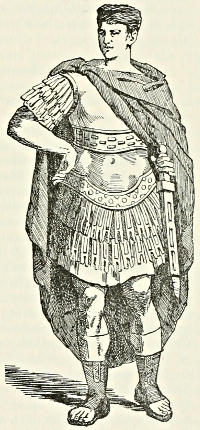
Roman General
King Bocchus, discouraged by the defeats he had suffered, had visions of
peace and friendship with Rome, and in secret negotiations he treacherously
promised to deliver his son-in-law Jugurtha to
Marius. He desired that L. Sulla, the quæstor
of Marius, and a favourite with him, should be
deputed to work with him and capture Jugurtha;
and Sulla had courage and determination
enough to trust himself with this unknown person,
whose intentions were not yet understood.
Accompanied by a son of Bocchus, he undertook
the dangerous journey and rode boldly
right through the camp of Jugurtha. He had
to persuade Bocchus by definite and detailed
proposals to decide upon a treaty with Rome.
Jugurtha was enticed by Bocchus into ambush
and taken prisoner, under the pretext of taking
him out of the way of Sulla. “So fell the great
traitor by the treachery of those nearest to
him.” He was carried with his children to
the camp of Marius; and thus the war came
to an end.
Marius remained till the following year in
Africa, to inaugurate the new order of things
there. Numidia was still reckoned a kingdom;
but the new king Gauda, a half brother of Jugurtha,
and the last descendant of Masinissa,
was compelled to relinquish the western portion
to Bocchus. Numidia was not converted
into a Roman province, because the protection
of the border against the hordes of the deserts
would always have required a considerable
standing army of Roman soldiers.c
Ihnee says that the Romans were “as ungenerous
and as unjust to him as to Hannibal and Perseus and all their great
foes. On the whole he inspires less abhorrence than Metellus or Marius or
Sulla, or the wretches who took his bribes.”
Plutarch describes the last days of Jugurtha with terrible vigour.
“Marius, bringing home his army again out of Libya into Italy, took
possession of his consulship the first day of January (on which day the Romans
begin their [second] year) 104, and therewithal made his triumph into
the city of Rome, shewing that to the Romans, which they thought never to
have seen: and that was, King Jugurtha prisoner, who was so subtile a man,
and could so well frame himself unto his fortune, and with his craft and
subtlety was of so great courage besides, that none of his enemies ever hoped
to have had him alive. But it is said, that after he was led in triumph, he
fell mad straight upon it. And the pomp of triumph being ended, he was
carried into prison, where the sergeants for haste to have the spoil of him, tore
his apparel by force from off his back: and because they would take away
his rich gold earrings that hung at his ears, they pulled away with them the
tip of his ear, and then cast him naked to the bottom of a deep dungeon, his
wits being altogether troubled. Yet when they did throw him down, laughing
he said: O Hercules, how cold are your stoves! He lived there yet six
days, fighting with hunger, and desiring always to prolong his miserable life
unto the last hour: the which was a just deserved punishment for his wicked
life.”f
[113-105 B.C.]
Whilst in distant Africa the Romans were engaged in making war upon
the various savage hordes of the desert, from the forests of Germany a new
danger threatened them on the borders of their empire. For reasons
unknown, the Cimbrians (i.e., “the combatants”), a Teutonic tribe, had
forsaken their home by the Baltic, and withdrawn to the northern Alpine
countries to seek new abiding places. Here they adopted a nomadic form
of existence, wandering hither and thither, taking their wives and children
and all their possessions with them wherever they went. That they and the
other Teutonic tribes afterwards united to them are to be classed as Germans,
and not, as the Romans formerly thought, as Celts, is proved by their names,
their stature, and others of their characteristics, and further by the fact that
still later we find mention of the Cimbrians in the Danish or Cimbrian peninsula,
and the Teutons in northeast Germany in the vicinity of the Baltic,
together no doubt constituting the last remains of this tribe. But in the
course of its long wandering there had been added to this German nucleus
not only other German-speaking rovers in search of booty, but also numerous
Celtic hordes, so that we even find leaders with Celtic names at the head
of the Cimbrians. The Cimbrians and Teutons are described as tall and
slightly built men with blue eyes and auburn hair—strong, wild, warlike
figures. In battle they fought with impetuous bravery. After a victory
they gave themselves up to the lust of cruelty; there was a general destruction
and the prisoners were either hanged or butchered to make sacrifices for
their gods. From the blood which flowed from the sacrifices, the priestesses,
old gray-haired women in white linen garments, foretold the future.
We have no means of ascertaining for how long the Cimbrians wandered
through the north and east of Europe, nor do we know which roads they
traversed. From what is now Bohemia they wandered southward to Noricum—the
Carinthia and Carniola of to-day. Here, on the borders of the
Roman Empire, they appeared in the year 113. On being informed of this,
the Romans sent out the consul Cn. Papirius Carbo, the son of that Carbo
who was a marked figure of the Gracchian period, with an army to guard
the Alpine passes of that neighbourhood. When Carbo, approaching from
Aquileia, entered Noricum, the Cimbrians, who had heard of the great power
of the Romans, sent them envoys, who explained that they, the Cimbrians,
desired to be allowed to settle amongst the Noricans, and had no desire to
go to war with them. Carbo replied that the Roman people were bound to
the Noricans by bonds of hereditary hospitality, and that he had not the
right to grant the Cimbrians permission to settle in Noricum. The Cimbrians
decided to proceed farther. Carbo gave them guides who were to
lead them out of the country; but by his instructions these guides brought
them to a place in the neighbourhood of Noreia (now Görz), near which he
and his men were ambushed, and as the Cimbrians passed they attacked
them. But this piece of treachery recoiled upon the perpetrator. Carbo’s
force was beaten and would have been completely destroyed had not a
tremendous storm hindered the Cimbrians from pursuit. It was now in the
power of the Cimbrians to enter Italy by these Alpine passes, but they preferred
to cross the northern Alps and wander westward towards Gaul. In
this direction they persuaded two tribes of Helvetia, the Tigurini and
Tugeni, to join them, or at any rate to travel the same route. Since the
conquests made in western Gaul in the year 125 by Fulvius Flaccus, the friend
of C. Gracchus, the Romans had founded a new province between the Alps
and the Pyrenees, bounded by the Cevennes and the Mediterranean, with
a principal town, Narbo. This was now threatened by the Cimbrians and
other wandering tribes, and so in 109 the Romans sent the consul M. Junius
Silanus there at the head of an army.
The Cimbrians appealed to him to show them in what part of the country
they might be allowed to settle; but instead of answering, he attacked them.
He suffered a terrible defeat. Instead of following up their victory, the
Cimbrians despatched an embassy to Rome with an appeal to be allowed to
settle in that country, and turned to do battle with the neighbouring Celtic
tribes. Meanwhile in the year 107 the above-mentioned Helvetian tribes
invaded the Roman province under the leadership of Divico, and springing
upon the consul, Cassius Longinus, from an ambush, utterly defeated him.
The consul himself was killed, and his legate C. Popilius, who had fled into
camp with the remainder of the force, could only save his men by a disgraceful
treaty. He gave hostages, resigned half his baggage, and withdrew
under the yoke.
The position of the Romans in Gaul was so shaken by these numerous
defeats that the town of Tolosa (Toulouse) revolted and took the Roman
garrison prisoners. As, however, neither the Cimbrians nor the Helvetians
troubled the province further, Q. Servilius Cæpio, who was the consul there
in the year 106, was able to regain possession of the town by a trick. He
took advantage of this opportunity to rifle completely the temple of the
Gallic god of healing, called by the Romans Apollo; but when the booty—alleged
to be about 100,000 pounds of gold and 110,000 pounds of silver—was
sent to Massilia, the convoy was attacked on the road by bandits, who
overpowered a weak resistance, and took away gold and silver, at the instigation,
it is said, of Cæpio and his officers, who took their share of the plunder.
[105-103 B.C.]
In the next year, 105, the Cimbrians again appeared in the province,
under their king, Boiorix, this time with the serious intention of going on
into Italy. In the province, besides the troops under the proconsul Cæpio,
there was now a second force under the consul Cn. Mallius Maximus; this
occupied the right bank of the Rhone, the other force the left bank, both
being drawn up to await the enemy, without either section paying much
attention to the movements of the other. When, however, a corps under
the legate M. Aurelius Scaurus was attacked and completely defeated by the
Cimbrians, the consul ordered the proconsul to lead his force over the Rhone
and unite with his own men. Cæpio, who had a personal enmity against
Mallius, and plumed himself on his superior birth, obeyed with reluctance,
but could not bring himself to make common cause with Mallius against the
enemy and discuss operations with him.
Meantime, the imposing forces of the Romans had induced the Cimbrians
to enter into negotiations. Cæpio, seeing the consul in negotiation with the
delegates of the barbarians, and thinking that he was desirous of keeping all
the honours of victory for himself, attacked them without delay. As a result
his troops were entirely destroyed and his camp was taken. After this
the Cimbrians engaged in battle with the troop under Mallius and utterly
defeated them. The Romans suffered this terrible reverse near the town
of Arausio (Orange). On the Roman side eighty thousand soldiers and
forty thousand men belonging to the commissariat are said to have been
killed, only ten men being saved, amongst whom was Cæpio.
The earlier defeats had already so terrified the Italians that the raising
of fresh soldiers presented difficulties; but now, after the defeat of Arausio
the “Cimbrian panic” reached its height. Besides panic, the people also
felt a burning rage, particularly against the corrupt government of the
nobility which had jeopardised the state. Against certain individuals their
indignation was extreme, particularly against Cæpio, whose insubordination
had been the main cause of the defeat. By decision of the people he was
now deposed from the proconsulate, and his property was confiscated; by
a second decision of the people he was driven from the senate, and when,
long after, in consequence of the malversation and high treason practised in
Gaul, a court of judicial inquiry was convened, on the instigation of several
of the people’s tribunes, Cæpio narrowly escaped the death sentence. He
was banished, and went to Smyrna. Mallius Maximus and several other
men of distinction were tried at the same time. The senate and their generals
had lost all confidence; only one man seemed to be able to save the
state in these perilous times—C. Marius, he who at the end of the
Jugurthine War was regarded as the greatest general of his time. Whilst
he was still in Africa he was chosen consul for the year 104, although it was
against the rule to elect any one who was absent, or any one who had already
been a consul at any time during the previous ten years. On the same day—January
1—on which Marius celebrated his triumph over Jugurtha, he
entered upon his second consulate; and the same office was conferred upon
him every succeeding year until the Cimbrian danger was over.
[103-102 B.C.]
When Marius with his force reached the Rhone, the Cimbrians, always
hasty in their movements, had wandered off through southern Gaul towards
the west and had entered Spain. Marius accordingly spent some time restoring
the disorganised and disintegrated Gallic peoples to a sense of their duty;
he raised auxiliary troops from the allied states and by dint of unswerving
severity and unremitting exertions made his troops once more fit for action.
Once let a soldier under Marius be accustomed to his severity of mien, his
rough voice and wild looks, once let him learn never to fail in his duty, never
to be insubordinate, and his fear of Marius would be changed into confidence;
the man of terror would seem formidable only to his enemies. But his chief
attraction for his men was his strict justice and impartiality. It was probably
in the year 103, that the Cimbrians returned to Gaul from Spain, where
they had encountered a stout resistance from the Celtiberians. They marched
through the country along the Atlantic coast to the Seine on the borders of
Belgium. Here they were joined by Teuton tribes of the same family under
their king Teutobodus, tribes which, driven like the Cimbrians from their
home on the Baltic, were moving aimlessly about the world. Notwithstanding
their united forces they met with such resistance from the brave Belgians
that they gave way, and finally decided to go to Italy. They again
divided, perhaps for convenience in obtaining supplies, into two hosts. The
Cimbrians, with the Helvetian Tigurini, who seem only recently to have
joined them, went back to Noricum in order to enter Italy at the same point
as before. The Teutones with the Ambrones, probably a Celtic people, proceeded
towards the Rhone, in order to go from thence over the western Alps.
In the summer of 102 the Teutones crossed the Rhone and proceeded
down the left bank to meet the army of Marius, which was encamped in a
strong position at the junction of the Isère and the Rhone and was well provisioned.
Here he was barring both the highroads which at that time led
to Italy, the route over the Little St. Bernard, and the route along the coast.
The barbarians encamped in countless numbers on the wide plain in front
of Marius’ camp and challenged him to battle. He, however, following
the plan of remaining strictly on the defensive, stayed quietly in camp and
let them spend their strength in daily attempts to storm the Roman fortifications.
In vain; their impetuosity was wrecked by the arts of war as practised
by the Romans and by the prudence of Marius. At last they drew off
in the direction of the south, in order to march into Italy by the road along
the coast. They were six days marching past the Roman camp in enormous
crowds with numberless heavily-laden carts. The Romans from their walls
jeered at them as they passed, asking if they had no commands for
their wives. When the procession had gone by, Marius followed with his
force, and camped always close beside them, but behind strong entrenchments
and in favourable positions, so that he was protected against night
surprises and could not be forced into an engagement against his will. In
this way they travelled until they came to Aquæ Sextiæ (now Aix in
Provence); from here it was only a little way to the Alps, and Marius was
compelled to consider the question of a decisive battle. He pitched his
camp at a place where there was no spring of water, and when his soldiers
grumbled and asked him where they could get it, he pointed downwards to
the river Canus (now the Arc) which flowed near the enemy’s camp. They
demanded that he should at once lead them against the enemy, whilst they
had still blood to spend. He answered coolly: “First we must fortify the
camp.”
Whilst the soldiers were fortifying the camp Marius sent his camp-followers
to the river to fetch water. For their defence they carried hatchets
and axes, swords and lances. Soon a scuffle arose on the banks with the
roving bands of the Ambrones who, separated from the Teutones, covered
the rear of the whole army on the march. As new combatants constantly
hurried to the assistance of both sides, the Ambrones at last played their
full strength, thirty thousand men, and Marius was no longer able to restrain
his men. In crossing the river, the Ambrones fell into disorder and the
Romans, in a rush down from the heights attacked them in the rear with
such force, that having suffered great loss, they fled back to their camp and
barricade of wagons. Here the fight was renewed after a strange fashion,
for the wives of the Ambrones, armed with swords and hatchets, rushed with
wild cries to meet them as they fled, forcing them back towards the enemy,
and those who saw that all was lost, fell into a frenzy and threw themselves
into the midst of the combat, letting themselves be cut and hacked to pieces.
The Romans felt encouraged by this victory, but dared not give themselves
over to the joy of triumph, for by far the greater number of the
enemy had not yet been engaged. The great plain was still covered with
myriads of Teutones, who filled the air all night with threatening cries and
occupied themselves all the following day preparing for a further encounter.
It was not till three days later that the fight recommenced. By break of
day, Marius and his men had ranged themselves on the hill in front of the
camp in order for battle. As soon as the barbarians saw them they attacked
the hill with fury. The Romans waited quietly till they came within range,
then threw their lances and seized their swords. There was a long and
obstinate fight lasting till midday; then the Germans, weakened by their
own impetuosity and the heat of the southern sun, began to give way: as
they reached the plain and were in the act of reorganising their front ranks
which had fallen into disarray three thousand men under Claudius Marcellus
fell on them from an ambush in the rear. That decided the issue;
startled at the double attack the barbarians broke up their lines and fled in
wild confusion.
[102-101 B.C.]
According to Plutarch,f over one hundred thousand men were either
killed or taken prisoner. Livyh gives the numbers in the two battles as two
hundred thousand dead and ninety thousand prisoners. Among the prisoners
was the gigantic King Teutobodus, among the slain a number of women, some
of whom met their death on the wagons in a desperate resistance, others killed
themselves to avoid slavery and a life of shame. The battle-field of Aquæ
Sextiæ is said to have been so fertilised by the amount of blood and corpses,
that in the following summer it bore an utterly disproportionate crop of
fruit; the neighbouring Massiliots fenced their vineyards with the enormous
bones of the slain.
Meanwhile the Cimbrians had arrived in Noricum without hindrance and
crossed into Italy through the Alpine passes. Q. Lutatius Catulus, the
second consul of the year 102, had at first held the Alpine passes, but when
the enemy appeared in great numbers he withdrew to the Adige and entrenched
himself there on the west bank which the enemy was approaching,
at the same time securing a retreat to the other side by means of a bridge.
Here, too, he was not able to hold his position long. When the Roman soldiers
saw these giant barbarians hurling rocks and trunks of trees into the
river to make a dam, whilst others amused themselves by sliding down the
glacier on their shields as if they were sleighs, when they saw some using
great trees as battering-rams against the supports of the bridges whilst others
threw themselves into the river and swam across, they were seized with such
a panic of terror, that heedless of their general, they fled, abandoning their
camp. In order to avoid what was becoming a shameful flight, Catulus
raised the standard, and hurrying to the front himself led the men over the
bridge. He was, however, obliged to leave a contingent behind in the camp
on the left bank. The barbarians seized the camp, but with great generosity
they permitted the garrison who had fought for their native country to
depart unharmed.
Catulus retreated along the southern bank of the river Po, and left the
Cimbrians to plunder and devastate the country north of the river. No
actual battle took place; for Catulus was waiting for the approach of
Marius, the Cimbrians for the approach of the Teutones.
After Marius, named consul for the fifth time in the year 101, had waited
a short time in Rome, whither he had been summoned from Aquæ Sextiæ by
the senate, he betook himself to Catulus in upper Italy, and left his own
troops to follow him there from Gaul in the spring of 101. After their
arrival, he and Catulus together led their troops over the Po and drew near
to the enemy. The Cimbrians desired to postpone further fighting till the
arrival of the Teutones, and sent envoys to Marius with the demand that he
should grant them and their brothers the country and towns they might
ask for. Marius asked who their “brothers” might be, and when they
named the Teutones, all present laughed, and Marius replied with scorn:
“Have no care for your brothers, we have already given them land to dwell
in, and they shall keep it forever.”
The envoys, not understanding the jest, threatened him with instant
revenge from the Cimbrians, and from the Teutones as soon as they arrived.
“They are already here,” answered Marius, “and it would not be proper
that you should go without having greeted your brothers.” And with these
words he commanded
that King Teutobodus
and the other captive
leaders of the Teutones
should be brought
before him.
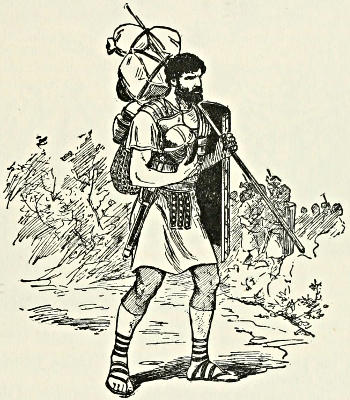
Heavy Marching Order of Roman Infantry
The Cimbrians
now knew the fate
of their brothers and
they at once attacked
Marius, but he merely
defended his camp.
Then Boiorix, king of
the Cimbrians, with a
few attendants came
and demanded that
Marius should fix a
day and hour for battle.
Marius chose the
third day from then
(it was the 30th of
July, 101), and named
for the place of battle
the fields near Vercellæ
where the superior
horsemanship of the
Romans would have
free play. Early in
the morning of the day appointed the Cimbrian foot-soldiers drew up in a
square that was over three miles in breadth and depth. In the front rank the
combatants were linked together by chains fastened to their belts that their
ranks might not be broken.[83] Their riders, fifteen thousand in number, were,
according to Plutarch’s description, armed in most striking fashion. Their
helmets were made in the likeness of the jaws of animals or the heads of monsters;
and their great height was still further increased by feathers, which
were made to soar upwards like enormous wings. They were besides decorated
with iron coats of mail and carried shields which dazzled by their whiteness.
As missiles, each carried a spear with two barbs, and in fighting
hand-to-hand they used great heavy swords. The Roman force, fifty thousand
men in all, was so placed by Marius that the sun and the dust came full
in the faces of the enemy. Marius’ troops formed the two wings, those
under Catulus took the centre.
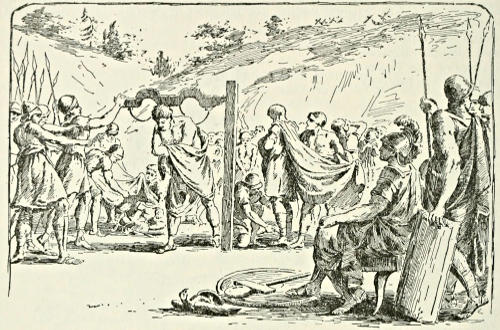
Captives passing under the Yoke
The Cimbrians sent their cavalry in advance of their foot-soldiers; in the
thick fog of the early morning they suddenly fell upon the Roman cavalry and
drew them away from their foot. The battle was carried on in some cases
with great bravery, but in spite of the numbers and strength of the barbarians
the superior knowledge and endurance of the Romans conquered. The
greater part of the Cimbrians were killed on the field, Boiorix among the
number. Several put an end to their own lives. The scenes of Aquæ
Sextiæ were repeated, the women rushed with swords and axes into the
midst of the enemy and let themselves be hewn down; they killed those
they saw flying, their children and at last themselves. The Cimbrians were
destroyed, root and branch; those who were not killed, in number over sixty
thousand, were sold as slaves. The Tigurini, who had accompanied the
Cimbrians, had remained waiting on the spurs of the Alps; when they saw
their friends defeated they fled towards their own homes.
After the battle the two parties in Rome quarrelled as to which of the
two leaders could really claim the honours of the victory of Vercellæ. The
aristocrats maintained that Catulus, the man of their party, had decided the
battle in the centre, he had captured thirty-one standards, whilst Marius had
only brought away two; to him therefore the wreath of victory. On the
other hand, the people claimed for Marius the great man who had risen from
their ranks, that he was the one and only subduer of the Cimbrians and
Teutones, and called him the third founder of the city, for the danger which
he had averted had been as great as the Gallic peril which Camillus, the
“second founder of Rome,” had stamped out. The people judged aright, for
Marius fought the battle of Vercellæ as consul, whilst Catulus was only proconsul,
and so Marius was the commander-in-chief; and further it is certain
that he greatly excelled Catulus in military ability. But most of all it must
not be forgotten that but for the victory of Aquæ Sextiæ the victory of
Vercellæ could never have been.
On his return to Rome, Marius was accorded a well-deserved triumph,
in which he nevertheless insisted that Catulus should share.c
[102-101 B.C.]
While the arms of the republic were thus triumphant in averting external
peril, the fertile province of Sicily was again a prey to the desolating horrors
of a slave war.
After the former war had been happily concluded by Piso and Rupilius,
several indications of similar troubles appeared in Italy itself. At Capua, a
spendthrift knight armed four thousand slaves and assumed the diadem.
But by prompt measures the insurrection was put down.
The rising in Sicily might have been checked with no less ease. It
originated thus: Marius had been commissioned by the senate to raise
troops in foreign countries to meet the difficulties of the Cimbrian War. He
applied to the king of Bithynia, among other persons; but the king answered
that he had no soldiers, the Roman tax-gatherers had made slaves of them
all. The senate, glad to have an opportunity of censuring the equites,
passed a decree that all persons unduly detained in slavery should be set
free. In Sicily the number of such persons was so large that the prætor suspended
the execution of the decree. Great disappointment followed. A
body of slaves rose in insurrection near Agrigentum, and beat off the prætor.
Their numbers swelled to twenty thousand, and they chose one Salvius, a
soothsayer, to be their king. This man showed himself fit to command.
He divided his followers into three bodies, regularly officered. He enforced
strict discipline. To restrain his men from wine and debauchery, he kept
them in the field. He contrived to provide two thousand with horses.
When his men seemed sufficiently trained, he laid siege to the city of Murgantia.
But the slave-masters of Morgantium offered freedom to all slaves
who would remain faithful, and Salvius saw himself compelled to retire.
The promise, however, was not kept, and numbers of the deceived men
flocked to the insurgent camp.
This success in the east of Sicily gave birth to a similar rising in the west,
which was headed by a Cilician slave named Athenion, who pretended to read
the future in the stars. He soon found himself at the head of ten thousand
soldiers, well found with arms and provisions. He gave out that the stars
declared his sovereignty: he therefore forbade all robbery; for, said he,
“the property of our masters is now ours.” He now rashly laid siege to
the impregnable fortress of Lilybæum; but finding its capture impossible,
he drew off, alleging that an impending danger had been revealed to him.
Meanwhile Salvius, who had assumed the name of Tryphon, fixed the
seat of his sovereignty at the fortress of Triocala, which had fallen into his
hands, and sent orders to Athenion to repair in person to that place. Athenion
obeyed the orders of King Tryphon, and appeared at Triocala with three
thousand men. The king now occupied himself with adding to the strength
of his new capital. He chose a senate out of his followers. On public occasions
he wore the toga prætexta of a Roman magistrate, and was attended
by the due number of lictors.
The Romans seemed unable to make head against the insurgents, till, in
101 B.C., M. Aquillius, the colleague of Marius in his fifth consulship, took
the command. Meanwhile, Tryphon had died, and Athenion had become
chief of the insurgents. Aquillius brought them to an engagement, in which
he encountered the brave Athenion hand to hand. The consul was severely
wounded, but the slave leader was killed. Aquillius remained as proconsul
in Sicily for another year, in the course of which time he crushed the last
embers of the war. After the fall of Athenion, the insurgents dwindled
away to a band of one thousand desperate men commanded by one Satyrus,
who at length surrendered to Aquillius, and were by him sent to Rome to
serve as gladiators. The story of their end is very touching. Being brought
out into the arena to fight with wild beasts, they slew one another at the foot
of the altars which stood there; and Satyrus, being left alone, fell upon his
own sword.
It is manifest, from the humanity and discipline observed by these unhappy
men in their power, that their chiefs must have been originally men
of station and education, reduced to slavery by the horrid practice of ancient
warfare. The story of their death presents a picture not flattering to Roman
civilisation.
Strict measures were adopted in Sicily to prevent a recurrence of these
perils. It was made a standing order, confirmed by every successive prætor,
that no slave should have a weapon in his possession. Nor was the ordinance
suffered to remain a dead letter. Soon after, the prætor L. Domitius
received a fine boar as a present. He inquired who had killed it. Finding
that it was a slave employed as a shepherd, he summoned the man to his
presence. The poor fellow came with alacrity, expecting a reward. The
prætor asked him with what he had killed the animal; and finding that it
was with a hunting-spear, he ordered the unfortunate wretch to be crucified.
Such were the laws by which the masters of the world were obliged to maintain
their power.b
“When Caius Gracchus fell,” said Mirabeau, “he seized a handful of
dust tinged with his blood and flung it toward the sky; from that dust was
born Marius.” This phrase of Mirabeau’s, though a whit rhetorical, is historically
true. The patricians were willing to cede nothing to the Gracchi,
and they were decimated by Marius. The struggle changed its methods:
one fought no more with laws as the only weapons, but yet more with proscriptions.
Marius was the incarnated pleb; as ignorant, pitiless, formidable,
he had something of Danton, except that Danton was no soldier.b
Marius had taken no part hitherto in the old contentions of classes at
Rome. But his plebeian origin, the attitude of defiance he had assumed
towards the nobles on the occasion of his first election to the consulship, the
outrage he had done to establish usage in the enlistment of proletarians,
above all, perhaps, the arrogance with which he had extorted so many successive
consulships from the hands of the most illustrious competitors, all
combined to mark him as the champion of the “movement party,” whatever
its immediate objects or popular cry might be.
Under the shadow of his anti-oligarchical aggressions, the people and
their tribunes renewed the demands of the era of the Gracchi. The knights
were irritated by the loss of their monopoly of the judicia, and a cry for a
new agrarian distribution was always sure to interest a portion at least of
the multitude. But envy and spite against unpopular individuals among
the nobles were still more effective instruments to work with. Q. Servilius
Cæpio, who had been defeated by the Cimbrians, was selected as an object of
popular persecution. A few years before he had captured Tolosa in Gaul by
an act of signal treachery, such, however, as the Romans seldom animadverted
severely upon as long as they were successful. But Cæpio had forfeited their
forbearance by his recent disaster, and the hoards of gold which he had
rifled from the temples of the Gallic deities were supposed to have brought
the vengeance of Heaven upon him, and the country whose armies were entrusted
to him. The people, at the instigation of their demagogues, proposed
to deprive him of his imperium, confiscate his property, and declare him
incapable of serving the state in future. The senate defended its luckless
proconsul, who had helped to restore to it a share in the judicia; but the
tribune Vibius Norbanus drove the nobles from the comitium, together with
two of his own colleagues who sided with them. In the tumult by which
this act of violence was consummated Æmilius Scaurus, the prince of the
senate, was wounded on the head by a stone. Cæpio was deprived, cast into
prison and subsequently banished, unless indeed, according to another account,
he was strangled in his dungeon. The retribution of his crime did not stop
here. His noble family was further dishonoured by the licentious conduct of
his two daughters, and the gold of Tolosa passed into a proverb, for the unlawful
gain which precipitates its possessor into misery and disgrace.
[102-100 B.C.]
In the year 102 the tribune Domitius, transferred to the people the
election of the chief pontiff, which had formerly been invested in the appointment
of the pontifical college. The head of the national religion was an
important political personage. He held in his hands the threads of the state
policy, which opened or shut the oracular books of the Sibyls, appointed
sacrifices and ceremonials, interpreted the will of the gods from portents, and
placed the seal of the divine approbation upon every public act, or withheld
it from it. This engine of government had been long firmly grasped by the
nobles; it could still be handled only by patricians; but the patricians had
ceased to be identified in interest and feeling with the ruling oligarchy, and
from the hands of patricians the traditions of the old republic were destined
to receive their rudest shocks. The appointment of the chief pontiff by the
people became eventually an important agent in the overthrow of the Roman
constitution. In the year of the battle of Aquæ Sextiæ, Marcius Philippus
proposed an agrarian law, which, however, was rejected. But at the same
time another tribune, Servilius Glaucia, carried a resolution of the people
for wresting the judicia once more from the senators, and conferring them
again upon the knights exclusively. He increased the stringency of an existing
law against extortion in the provinces; and to the holder of the Latin
franchise, who should convict a senator of its violation, he assured the
superior privileges of full Roman citizenship.
[100 B.C.]
When Marius returned to Rome (101) he was already for the fifth time
consul. But he was not satisfied with this extraordinary series of honours,
and was not the less anxious to obtain a further renewal of his long lease of
office. The nobles, he felt, were his natural opponents. He hastened therefore
to connect himself with the leaders of the people, to whom the chief of
the aristocracy was personally hostile. Allying himself with the tribunes
Servilius Glaucia and Appuleius Saturninus, he mingled his disbanded
legionaries with the dissolute mob of the Forum, and by threats, promises,
and largesses easily overpowered the votes of the honest citizens.[84] Marius
was raised to a sixth consulship: yet he was neither popular in his manners
nor eloquent in his address (100). On the contrary, in all civil matters, it
is said, and amid the noise of popular assemblies, the conqueror of the
Cimbrians was utterly devoid of courage and presence of mind. The undaunted
spirit he showed in the field entirely failed him in the Forum,
where he was disconcerted by the most ordinary praise or censure.
In his policy also Marius was unfixed and wavering; and instead of
steadily courting the prejudices of the Roman rabble, he favoured and rewarded
the Italians, of whom the Roman commons now entertained a deep
jealousy. After his late victories he ventured to stretch the prerogative of
the consulship to confer the citizenship on a thousand soldiers of the state of
Camerinum, who had served him well in the field. The act was illegal as
well as unpopular, and Marius did not, perhaps, make it more palatable by
the excuse he gave for it: “Amid the din of arms,” he said, “I could not
hear the voice of the laws.”[85]
The tribunes, however, who wished to strengthen their position by a new
alliance, bestowed their countenance upon the Italians also. They caused a
measure to be enacted, by which Marius was allowed to create three Roman
citizens in every colony which enjoyed the Latin franchise, thus enabling
him to bestow the boon they chiefly coveted upon many of the soldiers who
had distinguished themselves in his service. With the same view Saturninus
carried another measure, by which the unfortunate inhabitants of the trans-Alpine
provinces were deprived of their estates, and forced to make room for
the victors of Aquæ Sextiæ and Vercellæ. The nobles resented these concessions
to the conquered Italians, and even the commons regarded them with
uneasiness and distrust. They sought to interrupt the proceedings on the
occurrence of rain or thunder. “Be still,” cried Saturninus, “or it shall
presently hail.” His adherents armed themselves with stones. Tumults
arose in the Forum; the senators and their partisans among the populace were
driven away by the fury of the veterans, and Saturninus carried his rogation
with open violence. Marius kept warily aloof, and affected great horror at
the illegal disturbance. He excited the nobles underhand to protest against
the execution of a law carried in a manner so irregular, which the tribunes
insisted on their accepting under specified penalties. As soon, however, as
they had committed themselves, Marius withdrew his countenance from
them, and left them the choice of submitting with dishonour, or enduring
the punishment of refusal. The senators, entrapped and cowed, took the oath
required, till it came to the turn of Metellus; but the haughtiest of the
nobles, though urged and entreated by his friends to yield to necessity,
disdained to swerve from the principles he had avowed. Saturninus demanded
that he should be outlawed, and fire and water forbidden him.
His friends were numerous and strong enough to have defended him with
arms, but he forbade them to draw their swords, and went proudly into
banishment.
Saturninus obtained the renewal of his tribunate. He had carried matters
with a high hand: on the occasion of his first election he had daringly
murdered an opponent; he had thwarted the nobles, and even risked his
popularity with the commons by proclaiming himself the patron of the
Italians. It was now requisite, perhaps, to recover his ground with his supporters
in the city; and for this purpose he imposed one of his freedmen
upon the citizens, as a son of their favourite Tiberius Gracchus. This intrigue,
indeed, seems to have had little success; Sempronia, the widow of
Scipio Æmilianus, and sister of the murdered tribunes, vehemently denounced
it, and the people laughed at the imposture, if they did not resent
it. But force, after all, was more familiar to Saturninus than fraud. When
C. Memmius, one of his adversaries, was about to be elected consul, he
caused him to be poniarded in the Forum by the bandits who surrounded his
own person.[86] But he had now gone too far. To save himself he rushed
into open revolt. He climbed the Capitol, with his companion Glaucia and
his band of ruffians and assassins, seized the citadel, in virtue perhaps of his
official dignity, and defied the republic to arms. The nobles retorted upon
him with the fatal cry, that he aspired to royalty; and the people, already
perplexed at his leaning to the Italians, and shocked, perhaps, at the frantic
violence of his proceedings, were not indisposed to listen to it. They acquiesced
without a murmur in the decree of the senate, by which the state was
declared in danger and Marius charged as consul to provide for its safety.
The city was placed in what in modern times is called a state of siege;
that is, the consul, whose ordinary functions within the walls were purely
judicial and administrative, received the power of the sword as fully
as if he were in the camp. He proceeded to invest the fortress, which was
considered impregnable to an attack, and could only be reduced by blockade.
By cutting some leaden pipes, upon which, in the security of the times, the
citadel of the republic had been allowed to become dependent for water,
the insurgents were deprived of the first necessary of life. Saturninus offered
to capitulate on the promise of personal safety. Marius guaranteed his life;
and in order to preserve him from the fury of the populace, placed him, in
the first instance, with his followers, in the Curia Hostilia, a large public
building at the foot of the hill. But when the people scaled the walls, tore
off the roof, and poured missiles upon the wretched captives, the consul made
no effort to save them, and they all perished miserably—a deed of blood
which was long remembered, and afforded at a later period the handle for a
persecution of the nobles themselves.
No event, perhaps, in Roman history is so sudden, so unconnected, and
accordingly so obscure in its origin and causes, as this revolt or conspiracy
of Saturninus. The facility with which a favourite champion of the people
is abandoned and slain by his own clients, seems to point to some unseen
motive, with which history has forgotten to acquaint us. The Roman demagogues
were well aware of the inveterate horror with which the people
regarded the name of king; and none of them, it may be safely said, notwithstanding
the oft-repeated calumnies of their opponents, ever ventured to
aspire to it. If it be true then (as the historians represent) that Saturninus
was hailed as king by his adherents, and accepted the invidious designation
with joy, it is highly probable that his adherents were foreigners and Italians
rather than citizens. We have already seen the use which leaders of all
parties were making at this time of the claims of the Italians to emancipation
from the state of conquered subjects in which they were still held. All
in turn pressed these claims, when it suited their particular purpose, nor did
most of them scruple to abandon them when their convenience required it.
Sometimes the nobles, sometimes the commons, were cajoled into supporting
them, as a counterpoise to the aggressions of their immediate opponents; but
both the one class and the other were at heart bitterly opposed to them, and
the hope of obtaining favour or justice from the republic seems to have gradually
disappeared from the minds of the claimants themselves. They hated
Rome, and with Rome they identified, perhaps, republican government itself.
They could only hope for redress of their grievances from a revolution which
should overthrow the supremacy of the senate house and the Forum. This
was the menace from which even the licentious rabble of the city recoiled,
and which determined Marius to allow the violation of his plighted faith, and
the sacrifice of his friend and ally.[87] Even if entirely devoid of patriotic
feeling, which we may well believe, Marius was deeply interested in preventing
any demagogue from attaining a monarchical ascendency superior to his
own.
[100-90 B.C.]
The citizen of Rome, in complete possession of that illustrious title, combined
the enjoyment of two classes of rights, civil and political. The civil
law regulated the forms and effects of marriage, the exercise of paternal
authority, the holding of property, the capacity of willing and inheriting; it
secured, further, the inviolability of the citizen’s person. The political law,
on the other hand, gave the right of suffrage in the election of magistrates,
and in voting upon projects of law; it conferred eligibility to public office;
it permitted initiation in certain religious rites, and, finally, it conceded the
honour and advantage of military service in the legions. The combination
of these rights and capacities constituted the complete title to the Roman
franchise. It was sometimes thus conferred upon individuals, in reward for
special services; in a few cases the inhabitants of a favoured city were
invested with it in the mass.
The admission, however, of a foreign city, in alliance with the republic,
to the full right of citizenship, required it, in the first place, to renounce its
own ancient institutions. The favoured community adopted at once the
civil law of Rome, and organised itself internally upon the Roman model,
with an assembly of the people, a curia, representing the senate, and superior
elective magistrates, generally two in number, corresponding with the consuls.
A city thus constituted took the name of a municipium, that is, an
office-bearing community. The inhabitants, when they presented themselves
in Rome, might exercise the right of suffrage there, and were rendered capable
of filling any of its magistracies.
It seems, however, that the petty states of Italy, attached to their own
domestic institutions, were frequently unwilling to sacrifice them for these
advantages, and rejected the concession of political rights, contenting themselves
with the acquisition of the civil; which, while they placed them upon
a footing of equality with the inhabitants of the city in respect to marriage,
family authority, property, and person, did not require the surrender of their
own political customs. Rome herself was not unwilling to recognise this
distinction, and was wont to dispense the favour of her franchise with
affected coyness, conferring her civil rights upon various states in succession,
but reserving her political franchise as a special boon for the most
meritorious.
Thus were formed within the bosom of the great Roman Empire various
classes of communities, of different grades of civil and political condition;
but every one among them, which acquired any portion of Roman rights,
obtained the common designation of a municipium. Each municipium retained
entire authority over everything relating to (1) the exercise of its
religion; (2) the administration of its local finances, the election of its magistrates,
the maintenance of its edifices and public works; (3) its internal
police. The regulation of these matters appertained generally to the curies
or governing bodies, sometimes to the mass of the people. Accordingly, the
municipes, or citizens of such a community, possessed, as Cicero proclaims,
two countries, the one natural, the other political—the one actual, the other
privilegial. Thus, he continues, we regard as our fatherland both the spot
where we were born, and that which has adopted us; but that one of the
two has the strongest claims upon our affection which, under the name of
“commonwealth,” constitutes our own country pre-eminently; it is for that
fatherland that we ought to be ready to die. “I shall never deny,” he says,
“Arpinum, as my country; but Rome will be always more peculiarly such;
for Rome comprehends Arpinum.”
While such were the distinctions introduced by the republic among those
whom she adopted as her own citizens, she did not omit to classify also the
condition and privileges of the various nations of Latium and Italy which
fell successively under her sway.
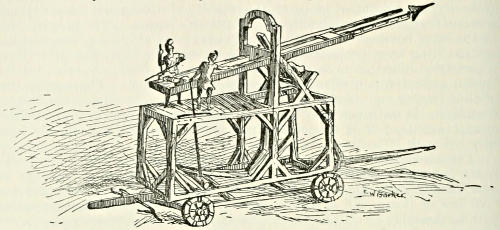
Roman Catapult
The first rank among the allies of Rome belonged to the tribes of the Latin
confederation; their treaties with the republic contained generally more favourable
conditions than were acquired by the other Italian communities.
Thus, for instance, the Latins preserved their territory, their laws, their alliances,
under the paramount control of Rome; they were placed, as regarded
the payment of tribute, upon a footing of almost complete equality
with the citizens of the republic; nor could they justly complain of being
required to furnish a military contingent to fight side by side with the legions
themselves. They could acquire the rights of Roman citizenship by the exercise
of certain magistracies in their own state, or by the transfer of their
domicile to Rome, provided they left children behind them in their native
place, or by the successful impeachment of a Roman officer for political offences.
In respect of property they enjoyed a portion of the Roman privileges.
But they were excluded from the rights of Roman matrimony, and of
paternal authority; from the faculty of willing in favour of a Roman citizen,
or inheriting from one; nor could they claim the immunity from stripes and
capital punishment, which was counted the most precious of all privileges
by a people who invested their highest magistrate with the terrors of the axe
and the rod. The condition of the Latin was far better than that of any other
subjects of the republic, but it was decidedly inferior to that of the citizen;
its most engaging feature was the capacity it conferred of acquiring completer
rights, and changing the first foretaste of freedom into its full enjoyment.
This mass of privileges, peculiar, in the first instance, to the Latin cities,
and flowing from the rights conceded to them by treaty, became extended
in due time, under the general name of jus Latii, or Latinitas, both to individuals
and to communities which had no connection with Latium at all.
As the Roman law admitted, by a fiction, the existence of Romans without
the city itself, so it allowed the name and rights of Latium to be claimed by
more distant foreigners. These foreign Latins, under the name of New
Latins, became, in process of time, a distinct class of citizens, a special subdivision
of the second rank of the republic’s favoured children.
Among the allies of the republic, the Italians occupied a rank next to the
Latins. The name of Italy was confined at this period to the peninsula,
extending from the rivers Isère and Rubicon on the north to the promontories
of Rhegium and Iapygia. The Etruscans, the Umbrians, the Samnites, the
Marsians, the Greek communities of Campania and Apulia, in submitting to
the Roman arms, had generally made treaties with the republic, but had failed
to secure for themselves the advantageous terms extorted by the Latins in
the period of her greater weakness or moderation. Yet in transferring their
swords to the service of their conquerors, they had merited on many a battle-field
the amelioration of their political lot. Accordingly the Italians were
allowed, for the most part, to preserve their domestic independence, their
laws, magistracies, and tribunals, while they were forbidden to form political
alliances among one another; and, though free in outward appearance, they
received the commands of Rome, which claimed to decide upon their mutual
disputes. Together with domestic liberty they enjoyed, like the Latins,
immunity from personal and territorial tribute, and shared with them the
same guarantees for the acquisition and enjoyment of property. The chief
point in which the Italian was inferior to the Latin was his not possessing
the same capacity of becoming a Roman. In the natural order of things, it
was requisite for the Italian to pass through the stage of Latinitas, or Latium,
to obtain Roman civitas; nevertheless the privileges peculiarly his own were
justly regarded as a boon in comparison with mere provinciality; for even
within the barrier of the Alps the Gauls and Ligurians hardly escaped the
character of enemies of the republic, and were subjected to military control
and the severest exactions under the plenary authority of imperators and
proconsuls. Accordingly these privileges became an object of desire to the
less fortunate subjects of the empire, and, as in the case of the jus Latii, so
also the jus Italicum became extended, in many instances, to individuals and
communities beyond the limits of Italy.
The development of this political organisation, logical and methodical as
it appears, was in fact the result of no theoretical legislation, but the gradual
and almost fortuitous effect of a series of revolutions. Up to the moment of
its complete accomplishment, even the wisest of the Roman statesmen neither
counselled nor foresaw it. But thereupon Italy presented, under the supremacy
of the metropolitan city, a hierarchy of communities, of which one was
already completely Roman; the others more or less nearly prepared to become
so; the whole machine, in all its parts and subordinations, seemed to gravitate
with a slow and regular movement towards the central point—the
franchise of the republic. But this movement was arrested by domestic
jealousies and selfish prejudices. The same spirit of isolation and monopoly
which had striven, in the time of the kings, to shut the gates of the city
against the Latins and Etruscans, which had conceded so slowly and reluctantly
the inferior grades of privilege to the Italians themselves, still arrayed
itself against the natural tendency of the principle of assimilation. The
jealousy of the Roman commons was blind and ignorant; that of the nobles,
who came forward to marshal and direct it, was more consciously selfish and
interested. All classes, with few and honourable exceptions of individual
statesmen, wished to hinder, as far as they could, the Latins from becoming
Romans, the Italians from becoming Latins.
The struggle for these privileges had commenced almost from the period
of the first conquest of Latium and Italy; but it was not till after the overthrow
of Carthage, and the commencement of a brief period of domestic
repose, that it attained force and consistency, and succeeded in enlisting in
its favour the leaders of Roman parties. With the extension of her conquests
in the rich provinces of the East, the citizenship of Rome became
more precious; and amidst the degradation of so many subject nations, the
allies who had fought and bled for the republic felt themselves entitled to
rise to a higher level. The Latins claimed with urgency and vehemence a
perfect equality with the Romans, the Italians pretended to succeed, at
least, to the privileges of the Latins; but to make the first concession was
clearly no less than to open the door to the abolition of all existing distinctions.
The Romans were not unnaturally alarmed at the shape in which
the question now presented itself to them. The idea of sacrificing to the
conquered the nationality of the conquerors was so new in the history of
antiquity that we cannot wonder at the reluctance, the pious horror, with
which it was generally regarded. Moreover, practical statesmen, who might
soar above the scruples of a mere sentiment, were still perplexed and terrified
at the prospect of the administrative difficulties which such a change
would introduce. They beheld in their imagination the roads of the peninsula
crowded with troops of foreigners hastening to Rome at every recurring
election, to swamp the votes of the urban population; or taking up their
abode within its walls, and conquering, as it were, the citadel of their conquerors.
In the amalgamation of Rome with Italy they could only foresee
the annihilation of Rome itself.
Meanwhile the allies, repulsed in every overt attempt to scale the fortress
of the constitution, contrived to glide surreptitiously within the sacred pale.
As early as the year 286 the censors discovered no less than twelve thousand
Latins settled in the city, and pretending to the rank of genuine citizens.
The intruders were indignantly expelled. Ten years later a new fraud was
exposed. The foreigners sold their children to actual citizens, with the
understanding that they should be immediately enfranchised. The stroke
of the prætor’s wand conferred upon them the full franchise of the city.
The precautions and prohibitions of the senate would have been of little
avail, had they not been seconded, in a great measure, by the magistrates of
the Italian cities themselves, who regarded with jealousy the flight of their
own people to Rome, whereby the burden of their domestic dues were
enhanced. The Samnites and Pelignians reclaimed four thousand of their
own countrymen who had thus established themselves in the Latin town of
Fregellæ, there acquiring the Latin privileges and preparing to sue for the
Roman. For half a century, however, these fraudulent acquisitions of
the Roman franchise were only partial or individual. The agitation of the
Sempronian reforms raised a general ferment in the minds of the Italians,
and gave force and volume to the tide of their ambition.
It would seem that while the great Roman nobles pretended to detain
vast tracts of public domain, they cultivated and even occupied only small
portions. The conquered communities, though nominally dispossessed of
their lands, were allowed, by abuse and connivance, to enjoy the use of a
large part of them. But when the state should resume her rights over these
estates, and actually redistribute them among her poorer citizens, the claims
of the intruding natives would meet with no consideration; they would be
dispossessed of them a second time, and absolutely excluded from their enjoyment.
Accordingly, upon the first mooting of the Agrarian laws of
Tiberius, all the Italians found themselves united by the same pressing
interest, and they had no other alternative than either to defeat the passing
of these laws by combining with the faction opposed to them in Rome itself,
or, by obtaining the rights of the city, to acquire a legal title to share with the
actual citizens. They hesitated and balanced as to their course; but upon
the whole the wish to obtain Roman privileges and Roman exemptions, to
escape the tyranny of Roman magistrates and enjoy the fruits of Roman
conquest, combined with the legitimate ambition of their soldiers and statesmen
to enter upon the noble field of Roman employments, determined them
to press their claims to admission. For a hundred and fifty years the various
races inhabiting the peninsula, distinct as they were in origin and language,
had been arrayed together under the same discipline and a common yoke.
The Romans had unconsciously formed their subjects into one nation, and
the time was arrived when a common sentiment could arm the whole mighty
mass in a combination against them. Italy had at last become a cry and a
sentiment not less powerful than Rome herself.
The senate and the nobles, who retained the national feelings in all their
strength, girded themselves to resist the threatened innovation; but in the
time of the Gracchi, the mass of the commons was already adulterated by
foreign admixtures, and felt far less keenly the old prejudices of race and
country. Accordingly, when their favourite leaders, overlooking every
ulterior consequence rather than justly estimating them, called the Latins
and Italians to their standards, the Roman populace were easily persuaded
to admit them to a share in their own struggle, and pledged themselves to
advance together the respective interests of both. The allies themselves,
under the able direction of the Gracchi, turned all their indignation against
the aristocracy of the city, which they sought to make their own. They
ascribed to the peculiar constitution of Rome the jealous and selfish opposition
they encountered, and denounced republican government itself, on
account of prejudices incident, in fact, to all conquering races. Monarchy
indeed, it may be allowed, is generally more favourable than aristocracy to
the surrender of national prejudices; and the Italians acted upon a genuine
instinct in invoking kingly rule, and, while the tribunes allured them with
the hope of citizenship, seducing the tribunes themselves with the prospect
of the regal diadem. It was said that Saturninus was actually saluted
king by his seditious followers; and nothing, perhaps, but the deep impression,
so sedulously fostered by the nobles, of the traditional tyranny of the
Tarquins, prevented the Roman commons from joining generally in the
same cry. But the title of king was destined still to remain the popular
bugbear for many centuries; and no man had yet arisen with genius to
disguise a monarchy under the republican names of dictator or imperator.
The nobles attacked the tribunes with brute violence; the Roman commons
and the Italian confederates they managed by craft and intrigue. At
one time they sought to sow dissension between them, at another to outbid
their own demagogues in the liberality of their offers, which they took care
never to fulfil. They debauched the populace by largesses and amusements,
and detached them from the cause of the allies. Alarmed at the progress
Marius had made in opening the franchise to his Italian veterans, they contrived,
at last, to throw a cloud over the brilliancy of his reputation, and
availing themselves of the venal voices of the tribes, to recall Metellus from
banishment and consummate another aristocratic reaction. In the insolence
of their triumph they enjoined the consuls of the year 95 to expel from the
city all the Italians who had domiciled themselves within the walls; and
the law of Crassus and Scævola, which repeated the harsh enactments of
eighty and ninety years before, convinced the injured subjects of the republic
that their mistress had learned neither wisdom nor justice by the triumph
of her arms and the extension of her empire.
[95-91 B.C.]
But though conquered, the Italians had not ceased to be formidable. The
free constitution of the generality of their cities had nourished a race of able
speakers and statesmen, and the Cimbrian War had trained many thousands
of brave veterans, who had been disbanded after the battle of Vercellæ, and
not yet recalled to their standards by the urgency of any other foreign contest.
With these resources among themselves, they had still, moreover, a
powerful friend in the Roman tribunate. M. Livius Drusus, a son of the
opponent of the Gracchi, whom the senate had commissioned to promise
still ampler concessions to their assailants than the Gracchi themselves, had
devoted himself in earnest to the policy which his father only pretended to
advocate. But in assuming the patronage of the reformers, the younger
Drusus did not abandon the party of the nobles with which he was hereditarily
connected. He sought, with every appearance, it may be allowed, of
honest zeal,[88] to conciliate the interests of all parties. He restored the judicia
to the senators, while, at the same time, he introduced three hundred knights
into the senate. He coupled these measures with a promise of lands to
the needy citizens, and of the franchise to the Italians and Latins. Of all the
Roman demagogues Drusus may justly be esteemed the ablest and the wisest.
Full of confidence in himself, his views were large, and his frank and bold
demeanour corresponded with them. He affected the generous virtues of
the ancient republic. When his architect offered him the plan of a house so
disposed as to exclude his neighbours’ supervision, “Build me rather,” he
exclaimed, “a dwelling in which all my countrymen may behold everything
I do.” His principles however were less rigorous than his pretensions.
The necessities of his position, which required him to make friends of all
parties, demanded an exorbitant outlay, and the means by which he supplied it
were reprobated as dishonourable. His profusion surpassed that of all his
predecessors in the arts of popular flattery; and he ventured to vaunt that
his successors would have nothing left to give but the skies above and the
dust beneath them. His manners were overbearing, and might suggest
the idea that he aimed at regal domination. He spoke of the commonwealth
as “his own”; and when the senators invited him to attend at their ordinary
place of meeting, he replied that he would await their coming in the curia of
Hostilius, which happened to be most convenient to himself. Such was
the man whom the Italians gladly invoked as their leader. In his sickness
all the cities of the peninsula offered vows for his safety. It seemed
as if the salvation of the country depended upon his recovery.
Drusus required indeed strong support in that quarter to enable him to
bear up against the odium excited by his measures among the privileged orders
at home. Even in his own house he was surrounded by timid and murmuring
friends; his own family were imbued with hostility to his avowed
policy. Among them was his nephew, M. Porcius Cato, at that time about
four years old. A chief of the Marsians, admitted to the uncle’s hospitality,
amused himself by asking the child to support the cause of the Italians.
Cato, so ran the story, frowardly refused; he was offered playthings and
sweetmeats; still he refused. At last the Marsian, piqued at his obstinacy,
held him from the window by the leg, and again demanded his assent,
threatening to cast him headlong unless he yielded. But caresses and
menaces were equally fruitless, and the Marsian sighed to think of the
resistance he must expect to encounter from the men, if a mere child could
display such dogged inflexibility.
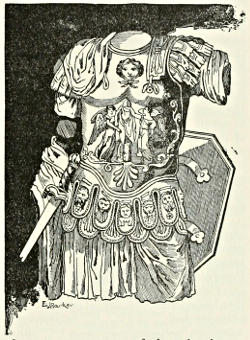
Roman Cuirass
[91 B.C.]
During the progress of the tribune’s intrigues, the indisposition of both
the senate and the knights to his measures became more strongly marked;
and notwithstanding the adherence of some of the principal nobles, he was
compelled to draw closer the bands
of alliance between himself and the
Italians. The impatience of his
foreign associates was not easily
restrained, and he was obliged himself
to denounce a plot they formed
for murdering the consuls at the
great festival of the Latin feriæ.
But his influence waxed more and
more powerful with them, and the
oath they took to promote the common
interests of the confederacy
expressed their entire devotion to
the person of their generous leader.
They swore that they would have
no other friends than his friends,
that they would count his foes their
foes, that they would spare nothing,
neither their parents, nor their
children, nor their own lives, for
his advantage together with that
of the common cause. “If I become
a Roman citizen,” the oath
continued, “I will esteem Rome my
country and Drusus my benefactor.”
The senate heard with indignation of the progress of these intrigues,
at the moment when it was called upon to ratify by a vote the proposal for
conferring the franchise upon its mutinous subjects. It was informed that
Pompædius Silo, the chief of the Marsians, was marching at the head of ten
thousand men, along by-roads and with arms concealed, towards the city, to
intimidate the nobles. A force was despatched to intercept his progress,
and a parley ensued, in which the leader of the Romans assured his adversary
that the senate was actually prepared to concede the boon required.
For the moment blows were averted; but in the curia the discussion was
still animated and the decision dubious. The classes opposed to the concession
had gained some of the Italians to their side, and with the support of
the Umbrians and Etruscans, alarmed at the projected foundation of new
colonies in their territories, ventured still to withhold the concession. When
the day for voting arrived, the consul Marcius Philippus attempted to break
up the meeting. One of the tribune’s officers seized and throttled him till
the blood sprang from his mouth and eyes. The city was now thrown into
a state of the fiercest excitement. Tribunes were arrayed against tribunes,
nobles against nobles, Romans against Romans, Italians against Italians.
The streets were traversed by armed bands on either side. Everything
seemed to portend a bloody solution of the crisis. At this juncture Drusus,
attended by a number of his adherents, was returning one evening to his
house. Passing along an obscure corridor he was heard suddenly to cry out
that he was struck, and fell to the ground with a poniard planted in his
groin. In a few hours he expired, exclaiming with his dying breath, “When
will Rome again find so good a citizen as myself?” The assassin had escaped
in the crowd (91).
The murder was generally imputed to the senatorial party, and especially
to the consul Philippus. The magistrates omitted to make inquiry
into the circumstances, while the murdered man’s opponents hastened to
abrogate such of his measures as had already passed into laws; and his
adherents were too stupefied to resist. Severe decrees were speedily issued
against the Italians, and they were peremptorily forbidden to interfere in
the affairs of the republic. An obscure tribune of foreign extraction, named
Varius, was put forward by the knights to impeach some of the principal
nobles, as reputed favourers of the movement. A Bestia, a Cotta, a Mummius,
a Pompeius and a Memmius were condemned and banished. Among
the accused was the illustrious Æmilius Scaurus. The only reply he deigned
to make to the charge was this: “Varius the Iberian accuses Scaurus prince
of the senate, of exciting the Italians to revolt. Scaurus denies it. Romans!
which of the two do you believe?” The people absolved him with acclamations.
But the knights still thirsted for vengeance upon their hereditary
enemies, and the actual outbreak of the threatened insurrection alone prevented
them from effecting a wider proscription of the most unpopular of
the nobles.
The allies flew desperately to arms. The death of Drusus and the prostration
of his adherents within the city reduced them to their own national
resources; but their last scruples vanished with the loss of their Roman
associates. The Marsians were summoned to take the lead, and their chief
Pompædius Silo was the soul of the confederacy. Eight or more nations,
the Picentines, the Vestines, the Marrucines, the Pelignians, the Samnites,
the Lucanians and the Apulians, together with the Marsians, gave mutual
hostages and concerted a simultaneous rising. Now for the first time they
vowed to unite together in a permanent association. They proposed to constitute
a great federal republic, organised on the model of Rome herself, with
a senate of five hundred, two consuls, twelve prætors, and for their capital the
central stronghold of Corfinium in the Apennines, to which they gave the
name of Italia. They struck medals bearing the impress of the Sabellian
bull trampling under foot the Roman she-wolf. This alliance indeed was
confined for the most part to the nations of Sabellian origin, and its decrees
were issued in the Oscan language, the common root of the idioms then in
use among the central tribes of the peninsula. The Etruscans, the Latins,
and the Umbrians held aloof from it, and together with Campania, which was
already thoroughly Romanised, adhered to the fortunes of Rome. The
Bruttians no longer existed as a nation, and the cities of Magna Græcia had
ceased to have any political importance. The Gauls beyond the Rubicon,
who had joined Hannibal against the Romans, long since exhausted by their
struggles, made no effort now to recover their independence.
What was the relative strength of the combatants now arrayed against
each other? Three centuries earlier, at the date of the great Gaulish invasion,
the nations of Sabellia, together with the Apulians, could arm, it is
said, 200,000 men, while the Etruscans, Latins, and Umbrians vaunted
120,000 warriors. Supposing, therefore, the proportions to remain the same
at the later period, the allies alone who still remained to the republic may
have balanced in numbers three-fifths of the whole force opposed to her.
At the same time the census of Rome herself gave a total of at least four
hundred thousand warriors; and she could draw vast numbers of auxiliaries
from her provinces and dependencies beyond the limits of Italy. The forces,
therefore, of Rome trebled or quadrupled those of her adversaries. She
occupied, moreover, the chief places of strength throughout their territories,
securely fortified against sudden attacks, and communicating with one another
and the capital by the great military roads. But from this formidable enumeration
of her resources great deductions have on the other hand to be
made. It was necessary to maintain powerful garrisons at every point of
her vast empire. Greece and Spain, Asia and Africa, drew off her life-blood
from the heart to the extremities. The disposition of her allies was doubtful
and precarious; her own citizens were capricious, and might easily be
seduced by the arts of the demagogues, while her internal dissensions had
made her suspicious of many of her ablest statesmen. The mass of the commons
of Rome took no vital interest in the political question for which the
Italians contended, and served in the legions with no other feeling than that
of mercenaries.
[90 B.C.]
The Social or Marsic War commenced in the year 90. The republic was
taken by surprise, while her adversaries had already completed their preparations
and hastened to assume the offensive. The Italian consuls, the Marsian
Pompædius and Papius Mutilus, a Samnite, commanded two different
branches of the confederacy—the one acting in the north between the Adriatic
and the frontiers of Etruria, whence he sought to penetrate by the
valley of the Tiber to Rome; the other directing himself against Campania
and Latium on the south. While such was the disposition of their principal
armies, various detachments, led by Judacilius, Lamponius, Afranius, Præsenteius,
Vettius Scato, Marius Egnatius, Herius Asinius, and others, were
charged with the reduction of the strong places occupied by the Romans in
the heart of their own country. The whole confederacy was in a moment
in arms, and the final embassy which it despatched to Rome announced the
defection of three-fourths of Italy. The senate boldly refused to listen to
demands extorted by the sword, and required the allies to lay down their
arms before presuming to ask a favour. The consuls summoned the citizens
to their standards, and while Alba in the country of the Marsians, Æsernia
in Samnium, and Pinna in the Vestinian territory, kept the confederates in
check, they drafted a hundred thousand men into the legions, and went forth
to confront the enemy. Lucius Julius Cæsar undertook the defence of Campania,
Publius Rutilius placed himself on the line of the Liris and Tolenus,
which cover Rome in the direction of the Marsians and Pelignians. Perperna,
with a smaller detachment, maintained the communications between
the consular armies, and guarded the approach to Latium through the frontier
of the Volscians. The great Marius himself, of whose fidelity the senate
might entertain suspicion, was entrusted with a small force on the flanks of
Rutilius, while Cæpio and Pompeius, Sulpicius and Crassus were directed to
harass the operation of the enemy by making incursions within their territories,
and menacing their armies in the rear. A considerable reserve was
kept at the same time in Rome itself, and the gates and walls duly repaired
and guarded against a sudden attack. Since the flight of Hannibal the city
had forgotten the possibility of being again exposed to a siege.
But the Romans had scarcely time to make these dispositions before the
Italians rushed impetuously upon them, and broke their lines in various
quarters. The consul Cæsar was routed by Vettius Scato in Samnium, and
driven from the gates of Æsernia and Venafrum, which he was anxious to
support. While the first of these places continued to hold out against a
rigorous blockade, the other was surrendered by treachery and its garrison
put to the sword. Mutilus defeated Perperna, turned to the left and threw
himself into Campania. Disregarding or masking the fortresses on his flanks
and rear, he traversed the country with
his troops, received the submission of
Nola, Pæstum, Stabiæ, Salernum, massacring
some of their defenders, and
pressing others into his own ranks.
But the hearts of the Campanians were
still with Rome. Naples, Nuceria,
Capua, and Acerræ remained firm,
even while their territories were overrun
by the Samnite, their slaves liberated
and enlisted by thousands among
the soldiers of the confederacy.
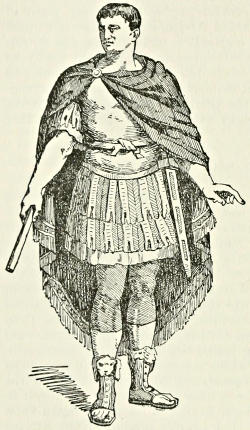
Tribune in the Dress of a Warrior
The losses and disgraces of the Romans
still crowded upon one another.
Lamponius defeated Crassus and recovered
Grumentum, the strongest place in
Lucania; while Canusium and Venusia
in the same quarter were taken by Judacilius.
Cæsar sustained a second defeat
from Egnatius in attempting to relieve
Acerræ, Pompeius received a check on
the frontiers of Umbria, and lastly the
consul Rutilius, drawn into an ambuscade
by Vettius Scato, was routed and
slain on the Tolenus with a large part
of his forces. Marius, who was posted
lower down the stream, was advertised
of his general’s disaster by the corpses
wafted past him by the descending current.
He promptly crossed the river,
and took possession of the enemy’s camp in their rear, while they were still
occupied in gathering the trophies of their victory. But the success of this
brilliant manœuvre failed to compensate even one of the many discomfitures
the arms of the republic had received.
The spirits of the victors of so many encounters were elated to the
highest pitch. The Etruscans and Umbrians began to falter in their allegiance
to Rome, while the envoys of the Italians were seeking a more distant
and still more formidable alliance at the court of Mithridates, king of
Pontus, a chieftain whose power and resources the republic had not yet
learned to measure. The Romans on their part, though neither dismayed
nor disconcerted, began to feel the imminence of their danger. The sense of
peril restored, perhaps, their national feelings of pride and mutual confidence.
The bodies of the consul and the brave officers who had fallen had been
carried into the city, and had excited the deepest sensations of distress. The
senate was compelled to decree that henceforth the dead should be buried
on the spot where they fell. As in the days of the Gallic tumults, all the
citizens arrayed themselves in arms, and swords were placed in the hands of
the freedmen, of whom several corps were formed for the defence of the city
and its environs. In this attitude of grave resolution they awaited the arrival
of succours from the provinces. Sicily signalised its fidelity by the zeal
with which it furnished the necessaries of war. The Cisalpine Gaul sent ten
thousand soldiers to the army of Cæsar at Teanum; and he was further
reinforced by numerous bodies of Moors and Numidians. Enabled now to
reassume the offensive he advanced once more to the relief of Acerræ, defeated
Mutilus with great slaughter, and threw succours into the place. The citizens
were reassured by this gleam of victory, and resumed within their walls
the garb and occupations of peace.
With this victory of Cæsar fortune began to turn to the side of the Romans,
but still with faltering and uncertain steps. After the defeat of Rutilius
the senate had united his shattered forces with the divisions of Marius and
Cæpio, but so deep was its jealousy of its veteran general that it combined
his inexperienced colleague in the command with him with equal authority.
Cæpio, dazzled by a trifling success, allowed himself to fall into the snares of
Pompædius. The Marsian, pretending to deliver himself up to the republic,
came with two young slaves, to personate his own sons, as hostages, with
ingots of gilt lead to represent gold, and offered to surrender to the Roman
the army confided to him. Cæpio put himself under his guidance, and was
led into an ambuscade. Pompædius galloped to an eminence under pretence
of reconnoitring, and gave the signal to his troops. The Romans were surrounded,
attacked, and cut to pieces, and Cæpio the proconsul with them.
This disaster, followed by the surrender of Æsernia, which had suffered the
extremity of famine, compelled the senate to transfer to Marius the undivided
command of all its forces in that quarter. He commenced his operations
with the same circumspection which he had manifested in his campaign against
the Teutones. By the able choice of his positions he secured the frontier
against the inroads of the victorious Marsians, whom he refused to encounter
in the open field with his own beaten and dispirited soldiers. “If you are
so great a general,” exclaimed his opponent, “why come you not to the
combat?” “So powerful and so victorious, why do you not compel me?”
replied Marius.
But when the proper moment arrived, the conqueror of the Cimbri knew
how to profit by it. He engaged the enemy and defeated them with great
slaughter, including the loss of Herius Asinius, chief of the Marrucinians.
But the peasant of Arpinum, the accomplice of Saturninus, the man who
had defied the nobles of Rome, who had armed the proletaries, and enfranchised
the Italian veterans, could not fail to cherish sympathy with the
nations now opposed to him. To Marius at least the war was a civil war,
and many of his legionaries appear to have entertained a similar feeling.
When his troops found themselves arranged in front of the forces of Pompædius,
they recognised in the opposite ranks many of their own guests and
kinsmen. They called one another by their names, and made kindly gestures
with their hands. The two chiefs came forth from the ranks and
entered into conversation together, deploring the unnatural contest which
had so long divided them. Encouraged by the familiarity of their leaders
the soldiers themselves broke from their lines, and mingled with one another
in the plain, like citizens in their common forum. We may believe that
Marius would have been well pleased to put an end to the war by the concession
upon the spot of demands to which he at least was indifferent or favourable.
But he commanded a portion only of the forces of the republic, and
besides the army of Cæsar in the south, he was checked by the jealous
observation of his own lieutenant Sulla, who had already more than once
snatched the laurels from his hand. He was forced to engage the enemy
once more; but he fought without spirit, and refused to complete his victory.
The honour of the day fell again to his youthful rival, who attacked the
Italians in their retreat, and thoroughly routed them. It was the first time,
according to the boast of the vanquished Marsians, that the Romans had
ever won a battle either against them, or without them.
Marius might plead the languor and ill-training of his raw soldiers for
the want of spirit he had himself manifested; but the easy success which
followed upon the more decisive blows of his subordinate were sufficient to
refute him. The same vacillating and inconsistent politician, who as tribune
had repudiated a popular measure, who as consul had launched himself
against the senate, who had seconded Saturninus and presently reduced him
to submission, who had favoured the Italians and finally had led the legions
against them, had now once more abandoned his post, and grounded his
arms in the moment of victory. After the affair of Saturninus, suspicious
and suspected on all sides, he had retired moodily into voluntary exile. He
now renounced the command by which he had made the Italians his enemies
without securing the gratitude of the Romans, and pretended that age and
infirmities unfitted him for the duties of the camp. He retired to his villa
at Misenum, formerly the residence of the mother of the Gracchi, while
Sulla sprang into his place at the head of the legions and at the summit of
popular favour.
Meanwhile the Roman arms had been crowned with success in other
partial encounters. The Umbrians and Etruscans, who had threatened for
a moment to join the general defection, were chastised and checked. But
fresh dangers were accumulating in the remoter distance. The trans-Alpine
province was harassed by an insurrection of the Salyes, which required to be
promptly repressed, and the king of Pontus was preparing to take up arms
and wrest from the republic her possessions in the East. At such a conjuncture
policy might dictate the concessions which pride had so resolutely refused,
and in the moment of victory they could be accorded with a better grace.
The consul Cæsar was empowered to carry a law for imparting the franchise
to all the Italian states which had held aloof from the general insurrection,
together with those already in the enjoyment of Latin rights. The lex Julia,
both in its principle and its immediate effects one of the most important
enactments of the republic, required the citizens of such states, including
Umbria, Etruria, and the southern extremities of the peninsula, to come in
person to Rome, and demand the freedom of the city within sixty days.
The time allowed for deliberation was not long, and the hardships and dangers
of the journey might deter many even of those who could resolve at
once to renounce their own laws and institutions for the charges and immunities
of the metropolis. It is probable therefore that the concession was after
all more specious than real; and that the numbers who actually availed
themselves of it were but limited. Nevertheless, it served to impart new
hopes to the Italians, to distract their councils, and to relax the sinews of
resistance.
[90-88 B.C.]
With the commencement of the second year of war (89), the Romans were
enabled to assume the offensive in every quarter. Cn. Pompeius and Porcius
Cato, the consuls of the year, assailed the confederates in the north;
the one in Picenum, the other on the banks of the lake Fucinus. Sulla and
Cæsar turned their legions against Mutilus in Campania, while the cities of
Apulia and Lucania were attacked and recovered by officers of inferior note.
Porcius himself was slain in battle with the Marsians, but his death was speedily
avenged by his colleague. Judacilius, who commanded in Asculum, unable
to repel his besiegers, constructed a pyre in the principal temple of the
place, and laid his couch on the summit. He then caused a repast to be
served, took poison, and applied the torch. The Romans entered the undefended
walls, massacred the inhabitants, and reduced the city to ashes.
Asculum was the bulwark of the Italian confederacy in the north, and
its fall opened the heart of their territories to the Romans. Another great
defeat, with the loss of Vettius Scato, crushed the spirit of the Marsians,
the Pelignians, and the Marrucinians, who hastened to lay down their arms.
Pompeius, the victorious general, obtained a triumph, and among the captives
who were led in chains before his chariot was a child, carried at his
mother’s breast, who lived to become a consul at Rome and to gain the honour
of a triumph himself. This was a native of Asculum, by name Ventidius,
whose strange reverse of fortune deserved to become the theme of public
admiration. The laurelled car was followed by the Roman legionaries, and
among them we may suppose was a youth, who gained in after times a far
nobler reputation, Cicero, the chief of Roman orators, who earned under the
auspices of Pompeius his first and only stipend.
In the south, the death of the late consul Cæsar had thrown upon Sulla
the conduct of the war. The cities of Campania fell successively before his
prowess and good fortune. Stabiæ was overthrown, Herculaneum and
Pompeii capitulated. His progress was checked for a moment by a mutiny
in a division of his forces, in which his lieutenant, Postumius, lost his life.
Sulla recalled the men to obedience, and required them to expiate the
slaughter of a citizen by torrents of hostile blood. Assured of their ardour
and devotion to his ascendant genius, he led them against the Samnite general,
Cluentius, and gained a sanguinary victory under the walls of Nola.
Leaving this impregnable fortress behind him, he next entered the territory
of the Hirpinians, and sacked their capital, Æculanum. Meanwhile a Roman
officer, named Cosconius, penetrated into Lucania, and defeated Egnatius by
treachery. The shattered remnant of the confederate armies, reduced to
thirty thousand men, were enclosed in the defiles of the Apennines. Pompædius,
the last survivor of the gallant band of Italian generals, sought to
envelop the Romans, as his last resource, in the flames of a servile insurrection.
He summoned the slaves to rise throughout Italy, and put arms into
their hands; at the same time he continued to press Mithridates for succours,
and his emissaries solicited the subjects of the republics in Greece,
Asia, and Africa. The final struggle of the expiring confederacy was not uncheered
by a gleam of sunshine. Pompædius gained a victory, and entered
Bovianum with the imitation of a Roman triumph. But his success was transient,
and his laurels quickly faded. He was slain in the third year of the
war in an encounter with the prætor Metellus, near Teanum in Apulia (88).
Nevertheless the exultation of the Romans at the gradual change in their
fortunes had been repressed by the alarming accounts they continued to
receive from Asia, where the king of Pontus, the ablest and most powerful
opponent they had yet encountered in the East, was shaking the edifice
of their dominion to its centre. They hastened to send their best general and
their choicest armies to meet him; and they were disposed in the moment
of victory to make further concessions, in order to disengage themselves
from the hostility of the crushed and broken Italians. The lex Plautia-Papiria
extended to all their Italian allies the privilege which had been
accorded to Umbria and Etruria by the lex Julia. The franchise, that is, of
the city was offered generally to such of the Italians as chose to claim it in
person within sixty days. The Romans followed up this specious concession
by great moderation in the use of their final victory. Very few, at least,
of the captive chiefs of the confederacy were punished with death. The
territory of the subjected cities was not confiscated to the state, although
the condition of its finances compelled the senate to sell the lands appropriated
to the pontiffs and augurs beneath the shadow of the Capitol itself.
The Italians, weary of the war, were easily appeased by this politic treatment.
Corfinium, the presumptive rival of Rome, dwindled once more into
a petty provincial town. The political combination of the states of the peninsula,
the offspring of a moment of enthusiasm, fell in pieces, never to be
reunited again; and even their common language, proscribed by the Romans
in the public instruments of their cities, fell into disuse, and was speedily
forgotten. But the results of the war still lingered after the war itself had
died away. Bands of armed marauders continued to prowl about the country,
exciting partial movements in various quarters. The mountains of Samnium,
and the great forests of Sila, continued to harbour the enemies of
peace and order rather than the enemies of Rome. There, for more than
half a century, the materials of insurrection were never wanting; political
outlaws and fugitive slaves still maintained themselves against the regular
forces of the republic; life and property were rendered insecure; the rustic
labourer and the wayfaring man were kidnapped on the public roads; even
in the cities men began to accustom themselves to the wearing of weapons,
nor did the dignified and noble venture to travel abroad without an armed
retinue of clients and retainers.
[88 B.C.]
The lex Plautia-Papiria, so called from the tribunes who effected its
enactment, offered, as we have seen, the franchise to all the allies of Rome in
Italy. The boon, however, was far from universally accepted. The richest
and the poorest classes were those to which alone it proved seductive—to the
former, for the sake of sharing the fruits of distant conquest; to the latter,
on account of the largess it offered to the dissolute and idle. Of these classes
many, we may suppose, flocked to Rome, and took up their residence within
reach of the Forum. The names of the chiefs of the Italian confederacy, of
Papius and Egnatius, of Asinius and Cluentius, of Vettius and Afranius,
rank from henceforth among the aristocracy of Rome; while her orators and
historians might plausibly attribute the increasing degeneracy of the inferior
populace to the foreign elements which now began so deeply to tinge it.
But the middle classes of the Italians, to whom these advantages were less
accessible, and to whom constant attendance at assemblies and elections was
impossible, found themselves amply compensated for the loss at home, where,
content with their own municipal privileges and honours, they could enjoy
without rivalry or disturbance the comfort and dignity of self-government.
The number of new citizens thus enrolled on the list of the censors was not
disproportioned, perhaps, to the new tribes, eight, or as some say ten, which
were now added to the existing thirty-five. The citizen was still compelled
to present himself in person at the polling-booths; the distance of his actual
residence could not plead against inveterate usage and the sanction of the
national religion. For the Roman Forum was a holy place, elections and assemblies
were holy ordinances, sanctified by auspices and ritual ceremonies; the
devices of modern governments, by which the votes of federal communities
can be taken on the spot, or their voices represented by local delegates, were
inadmissible on the principles of Roman, and indeed generally of all ancient
polity.
The theory that the same individual could not be at the same time a citizen
of two states, and that in accepting the prerogative of Roman civitas, he
forfeited the franchise of his native country, might cause many devoted
patriots to hesitate in accepting the proffered boon. Several cities, especially
those of Greek origin, to whom the institutions of Hellenic civilisation were
justly dear, such as Naples, Heraclea, and Puteoli, continued steadfastly to
reject it. Brundusium did not at once accept it, but received the Roman
privilege of immunity from the land tax at a later period from Sulla. We
are at a loss to ascertain the regulations under which the municipal governments
were conducted, where the inhabitants were nearly equally divided
between Romans and Italians. It is probable, however, that the concession
became speedily accepted almost throughout the peninsula. The right of suffrage
might be justly disregarded, but citizenship conferred rights of property,
marriage, and immunity from taxation, which were felt to be substantial
benefits. The inviolability of the person, and exemption from official caprice
and tyranny, were advantages also which could not fail to be highly prized.
From henceforth the admissibility of the provincials to the privileges of the
capital became more generally recognised as a fundamental principle of policy.
The full franchise was conceded in special instances to various states in Spain,
Africa, and Gaul, and it became necessary to declare what nations, from their
barbarism and inveterate hostility, as for instance the Germans and certain
Gaulish tribes, should be formally pronounced ineligible.
The enrolment of the Italians among her own citizens deserves to be
regarded as the gravest stroke of policy in the whole history of the republic.
In modern times it has been frequently condemned as an unqualified error,
and the general approbation it met with from the Roman writers may, doubtless,
be explained by the fact that the masters of Roman literature were in
almost every case Italians or provincials themselves; but in fact they require
no such excuse for the opinions they have so generally expressed. They
judged correctly in pronouncing the policy of comprehension upon which
the republic now boldly entered, and from which she never long departed
till the whole mass of her subjects were incorporated with her own children,
both just and salutary. Doubtless it helped in some measure to accelerate
the destruction of the old national sentiments; but these were already mortally
stricken, and were destined quickly to perish in the general corruption
of society. It reduced the legions more directly to instruments of their
general’s personal ambition; but the strongest check to that fatal tendency
had been already removed by the enlistments of Marius, and these the necessities
of the state, as we have seen, had both justified and approved.c
The personal rivalry of her two most fortunate generals becomes now
the main channel of the history of Rome herself. In the year which closed
the contest of the republic with her dependent allies (88), Sulla was forty-nine
years old, Marius about seventy. The former was enjoying the full
breeze of popularity and renown, while the latter, wearied but not sated
with accumulated honours, was moodily throwing away the advantages he had
earned in his earlier career. From campaign to campaign Sulla, as we have
seen, had dogged the steps of the elder warrior, always ready to step in and
seize the opportunities which the other cast recklessly in his way. Not that
Marius in his exalted station was even from the first indifferent to this incipient
rivalry. He was deeply jealous of his subordinate. He felt chagrin
at the contrast presented by their respective birth and origin; for Sulla,
though needy in point of fortune, was a scion of the illustrious house of the
Cornelii, and plumed himself on the distinction and advantage such a lineage
conferred. Sulla, moreover, was trained in the accomplishments of
Hellenic education, which Marius, conscious of his want of them, vainly
affected to despise. Sulla wrote and spoke Greek; his memoirs of his own
life became the text-book of the Greek historians of Rome, from whom we
principally derive our acquaintance with him. But this varnish of superior
culture seems to have failed in softening a rough plebeian nature. Sulla was
one of many noble Romans who combined with pretensions to literary taste
the love of gross debauchery, and pleasure in the society of mimes and vulgar
jesters. He was a coarse sensualist and by his disregard of the nuptial
tie offended even the lax morality of his age. His eyes, we are told, were
of a pure and piercing blue, and their sinister expression was heightened by
the coarseness of his complexion and a countenance disfigured by pimples
and blotches, compared by the raillery of the Greeks to a mulberry sprinkled
with meal. His manners, except when he unbent in the society of his inferiors,
were haughty and morose; nor is there any act of kindliness or generosity
recorded of him. The nobles who accepted him as their champion
had no personal liking for him. But selfish and ambitious though he was,
the aggrandisement of his party and order was with Sulla a species of fanaticism.
He despised the isolated ascendency of a Marius, and aspired to
rule in Rome at the head of a dominant oligarchy.
Marius had quitted the camp at the most critical moment of the war,
and while he buried himself in a distant retreat, Sulla brought the contest
to a close, having obtained his election to the consulship for the year 88.
The imminence of a new war with Mithridates had hastened the arrangements
for the peace, and Sulla was still consul when it became necessary to
select a general to command in the East. For this important service both
his merits and his position gave Sulla the highest claim; but Marius was
mortified and jealous, and cursed his own folly in having at such a moment
withdrawn himself from the public eye. He returned impatiently to Rome,
and showed himself once more among the young soldiers who trained and
exercised themselves in the Field of Mars, running, wrestling, and climbing
poles in rivalry with the most vigorous and active among them, to prove
that, though old in years, he possessed the energy requisite for command.
But the nobles had no wish to gratify the man they feared and distrusted,
while they had found one of their own order, on whose fidelity they could
rely as implicitly as on his valour. They mocked the clumsy feats of the
veteran candidate, and persuaded the people to follow their example, and
send their old favourite with jeers to his retreat in Campania.
The enterprise demanded a man of the maturest powers and the highest
abilities. Pontus, on the eastern shores of the Euxine Sea, the region from
which Mithridates derived his title, constituted but a small part of the
dominions over which he ruled. His patrimonial kingdom he inherited
from a succession of princes of high Persian extraction, and he was himself
the sixth sovereign of his own name. To the north he had extended his
sway over the tribes of the Cimbric Bosporus as far as the banks of the
Borysthenes or Dnieper, while to the south he had received from his father
the sovereignty of Phrygia, which the republic had sold for a sum of money.
This country, indeed, the Romans had again wrested from him at an early
period of his reign; but he had taken advantage of their dissensions to
interfere in the affairs of Cappadocia, to murder, it is said, its sovereign,
and at last to place upon its throne an infant child of his own. The armies
of Mithridates were recruited from the hardy barbarians of the Caucasus and
the Taurus; but his generals were mostly perhaps of Greek extraction,
skilled in military science hardly less than the Romans themselves. Nor
had he failed to enlist in his service many able citizens of the republic, for
the allegiance of the Romans sat but loosely upon them in the provinces,
and they were easily swayed from their principles by the seductions of eastern
civilisation. His own genius was conspicuous both in war and peace.
He was robust in bodily frame, and expert in martial exercises. The story
that he had fortified his system against poison by the constant use of antidotes
is a mere romance which modern science has pronounced impossible;
nor is it much more credible that he could converse, as has been asserted,
with the various tribes of which his kingdom was composed, in twenty-five
different languages or dialects. Our accounts of the great king of Pontus
are derived entirely from Roman sources, and we cannot rely implicitly
upon the particular instances of ferocity and perfidy recorded of him. As
an Oriental, however, it is but too probable that he maintained himself in
power by the usual arts of oriental conquerors, by shameless fraud and
remorseless cruelty.
[92-88 B.C.]
In the year 92, the Romans interfered to overturn the appointment Mithridates
had made to the throne of Cappadocia. Mithridates did not venture
to resist, but he secretly instigated Tigranes, king of Armenia, to invade the
country and expel the nominee of the republic. Ariobarzanes fled to Rome,
and there obtained assurance of support. Sulla, at this time prætor in Cilicia,
was ordered to reinstate him, while the king of Pontus still remained tranquil.
But the state of the republic’s affairs in Italy soon emboldened him. The
death of a king of Bithynia gave him an opportunity; and he dared to defy
the western conquerors by setting up a pretender to the throne of which
they claimed the disposal. At the same time he made a descent upon Cappadocia
in person, and expelled the luckless Ariobarzanes a second time.
The disasters of the Social War were now carrying dismay and consternation
to the heart of the republic. Sulla had been recalled to aid the efforts
of her best commanders in her defence. Nevertheless, when the fugitive
appeared once more before the senate with entreaties for its support, he did
not appeal in vain to the old Roman constancy. An army was despatched
to restore him, and once more Mithridates bowed to the storm, and retired
from the disputed territory. But the Roman officers in the East were not
satisfied with this act of submission. They incited their allies to harass and
invade his dominions, and when appealed to by him, refused to check their
aggressions. Then at last did Mithridates arm in his own defence. With
an immense force he burst upon the territories both of the republic and its
allies. He chased Ariobarzanes a third time from his dominions, defeated
the king of Bithynia, supported by the legions of Rome, in a great battle on
the river Amnias in Paphlagonia, routed the Roman commander in a second
engagement, overran Phrygia and Galatia, and proclaimed himself a deliverer
to the subjects of the republic in the East. His advent was hailed by
the provincials with acclamations. The insolence of the conquerors and the
tyranny of their fiscal agents had excited deep discontent among them. On
the mainland almost every city joyfully opened its gates to Mithridates,
and when in the intoxication of his triumph he issued, as we are told, a
decree for the massacre of all the Roman residents in Asia, it was promptly
obeyed, if indeed, as we may fairly conjecture, it had not been spontaneously
anticipated. Eighty thousand citizens—some say 150 thousand, though
even the lesser number is probably a gross exaggeration—are stated to have
fallen by this bloody act of retribution.
[88-87 B.C.]
Meanwhile the senate was preparing to encounter this formidable assailant
with adequate forces, and had pitched, as we have seen, upon Sulla to
take the command. Marius was disgusted at the inactivity to which he found
himself condemned amidst the derision of the populace. In his retirement
at Misenum he meditated revenge. The new citizens of Latium and Italy
were already mortified at finding the inefficiency of their votes, confined to
a small minority of the tribes, and the slender importance attached to their
favour. Their nobles complained of their want of influence, their proletaries
of the paltry price their votes commanded. Marius conceived the idea of
turning their discontent to his own advantage. Between him and them there
was an ancient sympathy, and this it was easy to improve into strict alliance.
He offered to repair the injustice of the senate towards them, and to diffuse
them among the old tribes of the city, in which their voices would be more
powerful than when cooped within the narrow limits of a few separate divisions.
Marius recommenced his old game of popular agitation.
Among the tribunes was Sulpicius Galba, whose eloquence and learning
and high aristocratic connections had raised him to eminence in the state, but
who under the pressure of debt was ready to sell his services to a patron
who could hold out to him at least a distant prospect of sharing the spoils of
Mithridates. With this guerdon in view, he paused at no excess. Taking
Saturninus as his model, he studied only to surpass him in audacity. He
marshalled a body of six hundred knights around his person, and gave them
the name of his opposition senate. He attacked the consuls in the public
assembly with a band of armed men, and seized and massacred the son of
Pompeius Rufus. Sulla, the other consul, being pursued, made his escape
into the house of Marius, where he was least likely to be sought for, and so
baffled the pursuers who ran past him. Marius himself received the credit
of concealing and letting him out by another door, but Sulla, we are told,
made no acknowledgment of such a service in his memoirs. Marius indeed
was for the moment triumphant. Sulpicius, having cleared the Forum of his
chief opponents, prevailed on the populace to nominate his patron to the
command in Asia; and the new proconsul, while preparing to set out on his
mission, despatched two tribunes to receive the army of Sulla. But Sulla,
escaping from the Forum, had repaired directly to his camp. He had inflamed
the fury of his devoted soldiers by the recital of his double injury. While
the officers, men of birth and national feeling, refused to listen to his solicitations,
the men responded to them without scruple, and carried his banners
towards Rome, killing the emissaries of Marius on the way. Joined by
Pompeius Rufus with the ensigns of the consulship, these tumultuous bands
resumed the appearance of a regular army; and Sulla could avow himself
with some show of legality the defender of the state and avenger of the
insults she had sustained in the person of her chief magistrates.
This daring movement was entirely unexpected. Six legions advanced
upon the city, and the men who had just seized the government were totally
unprovided with arms to resist them. Marius sent two prætors to meet the
enemy, and command them to desist; but the soldiers neither listened to
them, nor paused in their march. They were stripped of their togas, their
fasces were broken, and themselves ordered to return with every mark of
indignity. Such violence betokened worse to follow. The citizens were
dismayed, and without regard either to Marius or Sulpicius, sent envoys to
entreat the advancing generals to halt, while they promised to do full justice
to their cause by legal and peaceful measures. Sulla himself, it is said, had
faltered in his daring design; but he was reassured by a dream, in which a
strange divinity, whom the Romans had learned to worship in the East, placed
a thunderbolt in his hand, and directed him to launch it against his enemies.
He advanced, and Marius, having vainly attempted to raise troops to oppose
him, fled with precipitation. As he entered the city tiles and stones were
hurled on his soldiers from the house-tops; but a threat of burning the city
soon reduced every opponent to submission. Sulla had conquered Rome.[89]
But the conqueror was moderate in the use of his victory. He caused
his troops to observe the strictest discipline, and limited his personal vengeance
to exacting the death of twelve of his enemies. Sulpicius was betrayed
by one of his own slaves, and put to the sword. Sulla enfranchised
the betrayer for his obedience to the edict, and then cast him from the Tarpeian
Rock for his treachery to his master. Marius himself escaped out of
the city, while a price was set upon his head, and upon that of his son also.
On the morrow Sulla summoned the people to assemble in the Forum. He
explained to them that factious foes had compelled him to resort to force;
but having once taken up arms he was determined not to lay them down till
he had secured the power of the insulted nobles against the future aggressions
of the tribunes. Sulpicius, during his brief tenure of power, had recalled
the exiles of the Varian law, and increased the influence of the Italians in
the comitia. Sulla abrogated all these enactments,
and to insure the permanence of his
own, repealed the solemn statute which gave
the force of law to the plebiscita, or resolutions
of the people. The violence of Marius
drove his rival to the opposite extreme, and
established a counter-revolution upon the
ruins of tribunician ambition. But Sulla
was not yet prepared to enforce an oligarchical
tyranny against every constitutional
prescription. He left the people the free
exercise of their suffrages, and professed
himself not dissatisfied with their boldness
in rejecting a nephew of his own as a candidate
for the consulship.
Cn. Octavius, a firm but independent
supporter of the senate, obtained one place;
but the people gave him for a colleague
L. Cornelius Cinna, well known as a partisan
of Marius. Sulla pretended, perhaps, to
guide them in this latter choice; he claimed
the right of binding the new consul to
favour his own measures by a solemn vow.
At his direction Cinna ascended the Capitol,
with a stone in his hand, which, when he
had taken the oath, he hurled to the ground,
imprecating upon himself that he might be
cast as violently out of the city, if he failed to observe it. The Romans were
deeply impressed by such religious formalities; and the peculiar horror with
which they regarded Cinna’s later atrocities was coloured, perhaps, by indignation
at his perjury. For, no sooner had he entered upon his office than
he proceeded at once to disturb the settlement he had pledged himself to
respect, and caused a process to be instituted against Sulla himself. But
Sulla was eager to commence operations against Mithridates, and neither
stayed to meet the charge nor to punish the accuser. The victory he
anticipated would be a sufficient answer to the people, and give him the
means of completing the policy of which he had hitherto laid only the
foundations.
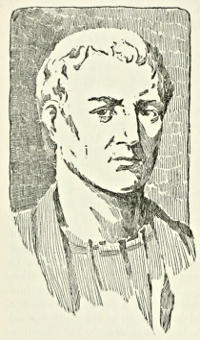
Caius Marius
Meanwhile Marius was flying for his life, and hiding the head upon which
a price had been set. His romantic adventures are narrated with great animation
by his biographer Plutarch. On quitting Rome he was separated
in the darkness of the night from the partisans who aided his escape. Retiring
to a farm he possessed at Solonium he despatched his son to get provisions
from a kinsman in the neighbourhood; but during his absence, fearful of a
surprise, or suspicious, perhaps, of his nearest friends, he abandoned this
retreat and hurried to Ostia, where he knew that a vessel was in waiting
for him. The son reached the place to which he had been sent, but the
house was immediately invested by the enemy’s scouts, and he was with difficulty
saved from their pursuit, being conveyed in a wagon, hidden under a
load of beans, to the house of his wife in Rome. The next night he made
his way to the sea, and embarking in a vessel bound for Libya, arrived there
in safety.
The elder Marius was wafted along the coast of Italy by a favourable
wind, but fearing to fall into the hands of Geminius, a personal enemy, one
of the chief people of Tarracina, he charged the mariners to avoid touching at
that place. Unfortunately the wind changed, and a strong gale setting
in shore, they were unable to keep out at sea. The old man himself, alarmed
at his danger, and tormented with sea-sickness, bade them run to land, which
they reached near Circeii. They were now also in want of provisions, in
search of which they descended from the bark, and wandered along the shore.
Some herdsmen to whom they applied, but who had nothing to give them,
recognised Marius, and warned him that horsemen had been just seen riding
about in quest of him. Weary and famishing, his life at the mercy of companions
hardly less harassed than himself, he turned from the road and
plunged into a deep forest, where he passed the night in extreme suffering.
The next day, compelled by hunger, and wishing to make use of his remaining
strength before he was completely exhausted, he once more sought the
highways in quest of some hospitable retreat. He kept up his spirits and
those of his followers by repeating to them the prodigies which had foretold his
greatness in youth, and assured them that he was destined to enjoy the highest
magistracy yet a seventh time. He had arrived within two or three
miles of Minturnæ, when they perceived a troop of horse advancing towards
them, and at the same moment two barks sailing along the coast. Running
down to the sea as fast as their strength would allow, and casting themselves
into the water, they swam towards the vessels. Marius, corpulent and heavy,
and quite overcome with fatigue, was carried or hurried along by the exertions
of his slaves, and with difficulty lifted on board, while the horsemen, following
closely in pursuit, shouted to the sailors to abandon him in the waves.
The sailors touched with pity at first refused to surrender him, and the
horsemen rode off in anger; but they presently changed their minds,
brought their bark to shore, and induced Marius to quit it, and take food
and rest on land, while they waited, as they pretended, for the evening
breeze. As soon as he was lifted out of the vessel and laid on the grass his
bearers rejoined the ship; the sails were hoisted, and he found himself betrayed
and abandoned. For some time he lay in despair; at last he rose,
and made another effort to save himself.
The coast near the mouth of the Liris, at which he had been put on shore,
was a desolate swamp, through which the wretched Marius waded with pain
and difficulty, till he reached an old man’s lonely cottage. Falling at his
feet he begged him to save a man who, if he escaped from his present
dangers, would reward him beyond all his hopes. The man, who either
knew Marius of old, or perceived in the expression of his countenance the
greatness of his rank, offered him shelter in his hut, if shelter was all he
needed, but promised to conceal him in the marshes, if he was flying from
the pursuit of enemies. With the old man’s assistance Marius hid himself
in a hole by the river’s side, and covered himself with reeds and sedge.
But Geminius of Tarracina was in hot pursuit. After ransacking every
place of refuge far and near, he reached the hut in the morass, and loudly
questioned the occupant. Marius, who overheard what was passing, seized
with a paroxysm of terror, drew himself out of his hiding-place, and buried
himself up to the chin in the water. In this position he was discovered,
dragged out, and led naked to Minturnæ. The magistrates here and elsewhere
had received orders to make search for the fugitive, and to put him
to death when taken. The decurions of Minturnæ met to deliberate, and
resolved to execute the sentence and claim the reward. But none of their
citizens would undertake the ungracious office. Marius was placed in custody,
in a private house; a Cimbrian slave, a captive of Vercellæ, was sent
with a sword to despatch him. Marius was crouching in the darkest corner
of the chamber, and the man, so ran the legend, declared that a bright flame
glared from his eyes, and a voice issued from the gloom, “Wretch, dare you
to slay Caius Marius?” The barbarian immediately took to flight, and
throwing his sword down rushed through the door, exclaiming, “I cannot
kill Caius Marius.” The Minturnians were shocked and penetrated with
remorse: “Let him go,” they said, “where he pleases, as an exile, and suffer
in some other place whatever fate is reserved for him. And let us pray that
the gods visit us not with their anger, for ejecting Marius from our city in
poverty and rags.” Thereupon all the chief people of the place presented
themselves before him in a body, and offered to conduct him with honour to
the seacoast, furnishing him at the same time with everything requisite for
his comfort. There was need of expedition, and their nearest way lay
through the sacred grove of Marica, into which whatever was once carried
was never permitted to be again carried out. But when an old man
exclaimed that no road was impassable to Marius, his voice was hailed as a
divine monition, and superstition herself fell before the champion of Italy.
Marius thus effected his escape from his nearest pursuers. He set sail
for Africa, but landing for water on the coast of Sicily, was very nearly
taken and slain. On the shores of Africa he hoped to find allies among
the chieftains of Numidia, with whom he had formed relations of amity at the
period of his war against Jugurtha. He landed to await the result of his
negotiations. While he sat in silent meditation among the ruins of Carthage,
himself a livelier image of ruin hardly less appalling, the Roman governor
of the province sent to warn him to be gone. The Numidians could
not venture to shelter him, and he was compelled to take refuge on an island
off the coast, where he continued for a time unmolested.
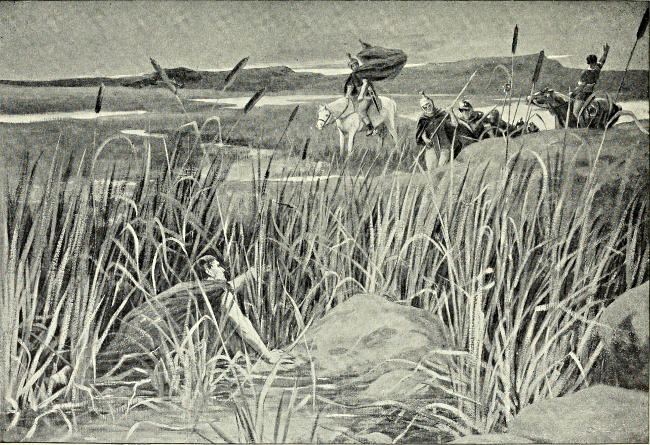
MARIUS HIDING IN THE MARSHES
While the conqueror of the Cimbrians was thus flying before the face of
his own countrymen, and his triumphant rival prosecuting the war against
Mithridates in the East, affairs were hurrying on to a new and unexpected
revolution at Rome. The Samnites had never entirely laid down their arms
at the general pacification of Italy; they rose under their leader, Pontius
Telesinus, excited fresh movements among the slaves and bandits in the
south of the peninsula, and at one moment threatened a descent upon Sicily.
Metellus Pius, to whom the repression of this new Social War was entrusted,
was unable to bring the enemy to a decisive engagement, but continued to
make head against them with various alternations of success. The army of
the north was still arrayed in Picenum, under the banners of Pompeius Strabo,
who showed no disposition to relinquish his command at the conclusion of
hostilities in that quarter. The senate despatched the late consul Pompeius
Rufus to receive its legions from his hands. But it had no means of satisfying
the soldiers’ demands for pay or largesses, and its emissary met with a
cold reception from these disappointed mercenaries. Their discontent soon
broke out in open mutiny, instigated, as has been generally suspected, by
Pompeius Strabo himself. Rufus was massacred before the altar at which
he was sacrificing. Strabo presently appeared among the mutineers, and restored
order, without instituting inquiry or inflicting punishment. Such
were the dispositions of the army and the general upon whom Rome was
now compelled to rely, both for the pacification of Italy and the maintenance
of the established government.
As soon as Sulla had withdrawn to Asia, Cinna made no further concealment
of his designs. Avowing himself the restorer of the late order of
things, he demanded the recall of the exiles of his party, and the restoration
of the laws of Sulpicius, that is to say, the full and final emancipation of
Italy. In the actual temper of the public mind, such demands could not
fail to produce a sedition in the Forum. Such, in fact, was the result. A
disturbance ensued, and blood was shed. But Cinna had miscalculated his
strength. The new citizens, upon whose efforts he relied, were few in number.
The senate, his colleague Octavius, and even a majority of the tribunes
of the plebs, together with the mass of the original citizens, united themselves
against him. They flew to arms, and drove his partisans out of
the city. Cinna, we may suppose, counted in this abortive attempt upon the
support of Pompeius Strabo, while that general, reserved and perhaps undecided,
contented himself with observing it from a distance, and leaving the
two factions to weaken and exhaust each other.
The victorious party proceeded to deprive Cinna of the consulship, and
elected L. Merula, a flamen of Jupiter, a man respectable for his birth and
reputed integrity, in his room. Cinna, proscribed and outlawed, betook
himself to the new citizens of Campania, and declaimed to them on the persecution
to which he was exposed for his devotion to their interests. The
Campanians discovered more zeal for the defence of their newly acquired
rights than they had evinced in the struggle to obtain them. Cinna succeeded
in collecting an armed following. Many exiles of his party flocked
to his standard, and among them was Q. Sertorius, an officer of distinction.
Nor did he scruple to unite himself with the Samnites and Lucanians, the
avowed enemies of the republic. Clothed in black, with disordered hair and
beard, he ventured to enter the camp of the Roman general commanding in
Campania, and moved the soldiers to compassion at the sight of a consul
kneeling to them in supplication. They insisted on placing themselves
under his orders. At the head of a Roman army he demanded the restitution
of his rights, and vowed the destruction of his opponents.
Wandering from coast to coast, and threading the ambuscades of a
thousand enemies, Marius was not unapprised of the events that were passing.
He found means of communicating with his friends, and when he
suddenly threw himself on the coast of Etruria, he was joined by several
adherents with a band of five hundred fugitive slaves. Etruria was crowded,
as we have seen, with a population of serfs, whose native masters kept them in
a state of degradation and misery. Unconscious of the political questions in
agitation, these men flocked to the adventurer’s banner as the symbol of
vengeance and plunder. While Marius advanced upon the city from the
west, Cinna was slowly approaching in the opposite direction.
At the same time Sertorius and Carbo threatened her from other quarters,
and Rome found herself encircled by four armies of her own rebellious
citizens, backed by the resources of the Samnite insurrection. To resist
these accumulating dangers, the senate hastily recalled Metellus, bidding
him make peace with the Samnites on any terms. But the conditions they
exacted in the insolence of this triumph—admission to the franchise, compensation
for their losses, the surrender without return or reciprocity of
their fugitive slaves—were intolerable to the pride of the Roman general.
Metellus ventured to disobey his orders, and broke off the negotiation.
He left a small detachment under his lieutenant Plautius to check the
advance of the enemy, while he hastened in person to Rome. Plautius
was speedily overpowered, and the rebel Romans were reinforced by the
whole strength of the Samnite confederacy, which devoted Rome itself to
destruction. There can be no peace, they exclaimed, for Italy until the
forest shall be extirpated in which the Roman wolves have made themselves
a den. The senate was reduced to extremity. Envoys were despatched
to the quarters of Pompeius Strabo in Picenum; his command was acknowledged,
his services were invoked, his return to the defence of the city
earnestly entreated. At this moment Strabo might feel himself the arbiter
of his country’s destinies; but he still vacillated as to his course, and
continued apparently to treat with both parties, until the advancing successes
of the Marians diminished the value of his adhesion.
Treason was at work within the city. For a moment Rome was opened
to Marius, and he well-nigh succeeded in effecting his entrance by a gate
on the side of the Janiculum, from which he was repulsed after a sharp
engagement. Mutiny broke out in Strabo’s camp, which he had advanced
almost to the walls. His soldiers seem to have personally detested him;
a conspiracy was formed against his life, and defeated only by the devotion
of his son, who threw himself on the ground and declared that the mutineers
should pass over his body before they reached the object of their fury.
The young Pompey was already beloved by the soldiers, and this spirited
defiance saved the life of the father. But famine and pestilence quickly
followed. The populace of the city were swept off in great numbers, nor
were the soldiers, on either side, exempt from the contagion. The consuls,
abandoning the unwholesome districts round the walls, withdrew their
legions to the Alban mount. Strabo himself fell a victim to the disease,
or, as some accounts relate, was killed by lightning. It is not improbable
that he was actually assassinated.
This last blow paralysed the resistance of the senate. A first deputation
was sent to Cinna, to arrange terms of accommodation. When these
were refused, a second was only charged to solicit an amnesty. Cinna
received it seated in his curule chair, with the ensigns of the consular
office which he claimed to bear. Marius stood by his side, squalid and
unshorn, and clothed in the black rags of an exile and an outlaw, and his
gloomy silence interpreted, in the worst sense, the ambiguous reply which
Cinna vouchsafed the deputation. But no further time was allowed for
parley. The senate hastened to invite her conquerors within the walls.
Then, at last, Marius opened his mouth with bitter words: “An exile,”
he exclaimed, “must not enter the city.” The restoration of Cinna to
his consulship, of his associate to his dignities and privileges, may have
saved Rome from being delivered to the Samnites for destruction; but
the victorious generals had still their own soldiers to satisfy, and they did
not shrink from surrendering the city to plunder and massacre. They
had pledged their words for the safety of the consul Octavius, and the
augurs whom he had consulted had ventured to assure him of his security.
Fortified by these assurances he had repelled the entreaties of his friends
to effect his escape, and had declared that as consul he would never desert
his country. He had betaken himself with a small retinue to the Janiculum,
and there seated himself in his curule chair, with the ensigns of his
office around him. Here he soon learned that neither the dignity of his office
nor the promises of the victors would command respect. But he refused
to rise from his place, and when a band of assassins approached him, calmly
offered himself to the sword.[90] His head was severed from his body, and
carried to Cinna, by whose order it was suspended before the rostra. This,
it is said, was the first instance of the public exhibition of these horrid
trophies of civil war, and the custom, which became but too frequent
in the subsequent contests of the Roman factions, was thus inaugurated in
the person of the highest magistrate of the city. As the massacre proceeded,
the bodies of the knights and meaner citizens were cast out for
burial, but the mangled heads of the senators were reserved for exhibition
in the Forum. The thirst for vengeance or plunder was succeeded by a
savage delight in the horrors which accompanied it, and the populace itself,
debauched and degraded, learned to gloat upon the blood of the victims.
In the list of slain are included many of the noblest names of Rome. P.
Crassus, who had been both consul and censor, either slew himself or was
killed by the assassins. M. Antonius, celebrated at the time, and long
afterwards remembered as one of the greatest of Roman orators, was murdered
by the leader of a body of soldiers, whom he had almost moved by
his eloquence to spare him. Two of the Julii, kinsmen of Julius Cæsar,
the future dictator, suffered. Some were caught and murdered in the act
of flying; others, who ventured to throw themselves upon the mercy of
Marius, were coldly repulsed and cruelly slaughtered.
Marius himself seldom condescended to answer their entreaties; but his
followers were instructed to spare those only to whom he held out his hand
to kiss. The swords of the hired assassins were directed, in the first
instance, against the adherents of Sulla and the aristocratic faction, the
special objects of the conqueror’s vengeance; but their numbers were
speedily swelled by slaves and Italians, who sacrificed men of every party to
their indiscriminate fury.
For a few days Cinna and Marius allowed these ruffians to riot unchecked.
At last they deemed it necessary to arrest their career of systematic
murder and pillage. Sertorius was charged with the task of
repressing them with a military force, and the assassins themselves were
made to feel the edge of the sword they had so long wielded with impunity.
But the new rulers of the city continued to destroy by the forms of judicial
process the victims who had escaped tumultuary violence. Cinna could not
pardon the illustrious Merula the crime of having succeeded to the consulship
of which he had been himself deprived. The flamen of Jupiter opened
his own veins, after a solemn declaration in writing that he had previously
laid aside his tufted cap of office, that he might not involve his country in
the guilt of sacrilege. Catulus, the noble colleague of Marius in the last
battle against the Cimbri, threw himself on his knees, and vainly begged for
life. “You must die,” was the only response vouchsafed him; and he was
compelled to suffocate himself with charcoal in a newly plastered chamber.
[87-86 B.C.]
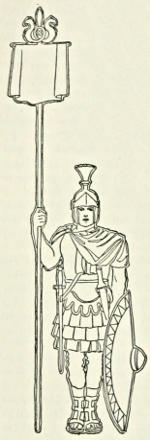
Standard Bearer
Cinna and Marius now began to reorganise the government of the state.
Not deigning even to summon the assembly of the tribes, they nominated
themselves by their own authority to the highest magistracy. Marius
became consul for the seventh time. At the age of seventy, with his health
broken and strength failing, which had borne him through so many fatigues,
he reached the summit of his aspirations and accomplished the prediction,
the assurance of which had nerved his courage in such dire vicissitudes.
Nevertheless, while Cinna reserved for himself the administration of affairs
in Italy, the old general was destined to resume the command
of the legions, and wrest from Sulla the conduct of the war
against Mithridates.
Sulla, indeed, it was already reported, had driven the king
of Pontus to sue for peace, and was about to return and measure
himself once more with the usurpers of the commonwealth.
Marius, upon whom the auguries of his young rival’s ultimate
success had made no less impression than the prognostications
of his own triumphs, shuddered at the approaching
contest, in which he felt himself doomed to be worsted.
Harassed by terrific dreams, or worn out by nightly
watchings, he sought escape from his own thoughts by
constant intoxication.[91] Wearied with life, he could
hardly wish to protract the existence which had become
so intolerable a burden to him. One evening, it was
related, while walking with some friends after supper,
he fell to talking of the incidents of his life,
beginning with his boyhood; and after enumerating
his triumphs and his perils, no man of sense, he said,
ought to trust fortune again after such alternations;
upon which he took leave of his friends, and keeping
his bed for seven days successively, thus died. We
are tempted to suspect that, impelled by disgust and
despair, he shortened his last days by suicide. The
deceased consul’s obsequies were celebrated with
pomp, and accompanied, if we may believe the story
told us, with a frightful ceremony. In ancient times,
according to tradition, it had been customary to
slaughter slaves or captives on the tomb of the
departed hero; but if any such usage had actually
prevailed among the Romans, it had been long softened
at least into an exhibition of gladiatorial combats.
On this occasion, however, the tribune Flavius
Fimbria determined to immolate a noble victim
to the manes of the dead. He therefore caused
the venerable Mucius Scævola, the chief of Roman jurists, to be led before the
pyre, and bade the sacrificer plunge a sword into his bosom. The wounded
old man was allowed to be carried off and tended by his friends, under
whose care he recovered. But when Fimbria heard that he still lived, he
brought him to the bar of judgment, and being asked what charge he had
against him, coldly replied, “Having escaped with life.” The story thus
told by Valerius Maximus is founded, perhaps, on a misapprehension of a
passage in Cicero, who only says that Fimbria required Scævola to be
wounded.[92] If the tribune had intended to make a sacrifice, he would hardly
have suffered it to remain incomplete. Only eleven years before, human
sacrifices had been abolished by a decree of the senate. But in many expiatory
and lustral rites, the shedding of a drop of blood was retained as a
type of the ancient usage with which it has been frequently confounded.
It may be added, that the historians have passed over this shocking occurrence
in total silence; and the actual death of Scævola will be related at a
later period.b
“The judgment pronounced on Marius by posterity is not, like that on
many other eminent men, wavering and contradictory. He is not one of
those who to some have appeared heroes, to others malefactors, nor has he
had to wait for ages, like Tiberius, before his true character became known.
Disregarding the conscious misrepresentations of his personal enemies, we
may say that he has always been taken for a good specimen of the genuine
old Roman, uniting in his person in an exceptional degree the virtues and the
faults of the rude illiterate peasant and the intrepid soldier. No one has ever
ventured to deny that by his eminent military ability he rendered essential
service to his country. Nobody has doubted his austere virtues, his simplicity
and honesty, qualities by which, no less than by his genius for war, he gained
for himself the veneration of the people. On the other hand, it is universally
admitted that as a politician he was incompetent, and that he was only a tool
in the hands of those with whom he acted. But morbid ambition and revengeful
passion urged him at last to deeds which make it doubtful whether
it would not have been better for Rome if he had never been born. He has,
therefore, neither deserved nor obtained unmixed admiration; but as his
darkest deeds were committed in moments when he was half mad from
sufferings and indignities he had endured, and when perhaps he hardly
knew what he was doing, he may, in the opinion of humane judges, gain by
comparison with Sulla, who acted from reflection and in cool blood when
he consigned thousands to death and enacted the horrid spectacle of the
proscriptions.”e
Cinna now chose for his colleague Valerius Flaccus, the same who, as
consul fourteen years before, had aided Marius to crush the conspiracy of
Saturninus; an appointment which seems to betoken considerable respect
for the usages of the state; for Flaccus, though formerly both consul and
censor, had taken much less part in the recent contest than either Carbo
or Sertorius, whose inferior rank counterbalanced their higher services.
Cinna was now actively engaged in fulfilling his pledges to his allies. Censors
were elected on purpose to effect the complete emancipation of Italy by
suppressing the ten Italian tribes, and enrolling the new citizens of the
Plautian law among the thirty-five tribes of the city. Whether this inscription
was based upon a principle of numerical equalisation, or of geographical
distribution, or whether it was attempted to combine the two, we have,
perhaps, no means of determining; but thus the last remaining distinction
between the Romans and Italians was effaced, for as many at least of the
latter class as chose to avail themselves of the proffered privilege. The
Samnites, Lucanians, and others still scorned to accept it. Another measure,
undertaken by Flaccus, was more delicate, and more generally interesting.
The consul ventured to enact an adjustment of debts, and relieve the accumulating
distress of the poorer citizens, by enabling all obligations to be
cancelled by the payment of one-fourth of the principal. He exchanged,
as the Romans phrased it, silver for coppers; for the copper coin called the
as was made equivalent for the purpose to the silver sesterce, which at this
time was of four times its intrinsic value. After so long a series of wars
and revolutions, and the fatal changes which had long been operating in the
possession of property, it is possible that this measure was adopted as a
necessary expedient. But whatever the urgency of the occasion may have
been, the stroke was of fearful augury for the future, and did not fail to
kindle criminal hopes in the dissolute and discontended for more than one
succeeding generation. Having accomplished this important measure, Flaccus
placed himself at the head of the legions destined for the Pontic War,
and proceeded to the East to watch the movements of Sulla.
While yet unchecked by the best troops and most accomplished generals
of the republic, Mithridates had obtained the most astounding successes.
The kingdoms of Bithynia and Cappadocia had fallen without resistance
into his hands. The Roman province of Asia had succumbed, and even
received its new master with acclamations. From thence he had crossed
the Ægean Sea, accepting the submission of its rich and flourishing islands,
and his admiral Archelaus had captured Athens itself, with its harbour in
the Piræus and all its naval stores and equipments. The Greek cities were,
for the most part, favourably disposed towards the liberator, who promised
to break the rod of proconsular oppression. It was impossible to foresee
how far the contagion of provincial disaffection might spread; and when
Sulla landed on the eastern shores of the Adriatic, his task had swelled to
the reconquest of one hemisphere of the empire.
Nor had he now, like his predecessors in the career of eastern conquest,
the undivided resources of the commonwealth to sustain him. Sulla was
conscious that he was only the general of a party which, though for the
moment triumphant, was, he well knew, insecure, and every express that
arrived to him from Rome brought him alarming accounts of the fears
and perils of the friends he had left behind him. He reached Greece at the
commencement of the year 87 with a force of five legions, which he had no
means of recruiting, and he might apprehend that in the course of another
year he would be superseded by another commander, the nominee, perhaps,
of his enemies. He had not a moment to lose. Instead of checking the
licentiousness of his soldiers, and drawing tighter the long relaxed bands
of discipline, which must have been a work of time and leisure, he was compelled
to stimulate their ardour and secure their obedience by additional
indulgence and license more complete. The course of his march he allowed
to be marked by plunder, devastation, and sacrilege. He traversed Greece and
Asia to gorge his men with booty before he turned their arms against the
invader from the East. The sacred treasures of the temples at Epidaurus,
Ephesus, and Olympia fell successively into his hands. When the spirits of
his soldiers were elated to the utmost, he led them under the walls of Athens,
which he speedily reduced, and devoted to pillage. In Bœotia he encountered
the enemy in the open field, and routed them in the great battle of
Chæronea (86). Flaccus was now advancing upon his steps, and summoning
him to surrender his command to his legitimate successor.
[86-84 B.C.]
He was about to turn boldly upon the intruders, confident of his soldiers’
devotion, when Mithridates placed a second army within his reach. A second
great battle at Orchomenos broke the power of the king of Pontus, reducing
him to act on the defensive beyond the waters of the Ægean. Greece remained
as a clear stage for the Roman armies to contend upon. At the close of the
year 86 Sulla had taken up his quarters in Thessaly, while Flaccus, not
venturing to engage him, had moved in a lateral direction, and watched
him from the neighbourhood of Byzantium. Among the new consul’s
officers was Flavius Fimbria, the tribune whose ferocity has already been
signalised. Beloved by the soldiers whose licentiousness he encouraged,
while his general strove fruitlessly to repress it, Fimbria conceived the idea
of making himself independent of the government at home, and acting the
part of a Strabo or a Sulla himself. Flaccus was assassinated in his camp,
and Fimbria, who may be supposed to have instigated the deed, was proclaimed
general in his room by the soldiers themselves. But neither they
nor their new leader chose to measure themselves with the rival imperator
in Thessaly. Passing over into Asia (85) they ravaged every fertile plain
and wealthy city, attacked the forces of Mithridates wherever they could
reach them, and defeated a son of the great king himself. Mithridates was
driven out of Pergamus, and reduced to shelter himself in Pitane, where he
must have been captured, had not Lucullus, a lieutenant of Sulla, removed
the fleet with which he co-operated to a distance, in order to prevent the
upstart Fimbria from snatching the honour of such a triumph from his own
superior. Mithridates escaped by sea, and Sulla opened negotiations with
him. Upon his surrendering Bithynia to Nicomedes, and Cappadocia to
Ariobarzanes, renouncing his pretensions to the province of Asia, and delivering
up a large portion of his fleets and treasures, he was solemnly
admitted to the alliance and amity of Rome. Sulla thus confined the
enemy of the republic to the limits of his dominions, such as they existed
before the war; but, doubtless, had his own resources been more abundant
and his position more secure, he would not have been content with a barren
victory, nor have returned from the frontiers of the empire without an
effort to advance them.
Sulla had entered Asia to conduct his negotiations at the sword’s point.
As soon as they were concluded he turned abruptly upon Fimbria. The two
Roman armies met near Thyatira; but Fimbria’s soldiers, plied with gold,
rapidly deserted, and even those who still kept to their standards, refused to
engage their brethren in the field. Having failed in an attempt to procure
his rival’s assassination, Fimbria found himself deprived of his last resource.
In this extremity Sulla promised him his life, on condition that he should
resign his command, and withdraw from Asia. When Rutilius, on the part
of his general, offered him a safe conduct to retire by sea, he replied proudly
that he knew a shorter and a better way, and pierced himself with his
sword.
Fimbria might well despair when he saw the forces with which his own
victory over Mithridates had armed the champion of the party he had outraged.
Sulla could leave in the East the legions which his rivals had
brought to share or contest his laurels, while he took himself the route of
Italy with a force of thirty thousand veterans, who had served three years
under his standard, and had learned in a rapid career of glory and plunder to
regard him as the founder and the pledge of their fortunes. The treasures of
Mithridates, swelled by the ransom of an hundred Greek and Asiatic cities,
furnished him with ample means for securing their fidelity. The vast fleets
of Asia, delivered into his hands, might be used to abridge the long march
through Thrace and Macedonia. The news of the surrender and death of
Fimbria was accompanied by the announcement of Sulla’s speedy return;
and the moderation he had professed while his successes were still incomplete
was already exchanged for bitter complaints of the injuries he had
received, the confiscation of his estates, the banishment of his family, the
proscription of his own person, and persecution of his party. But his
foes and those of the republic, whom he classed together, were now, he
declared, about to suffer due chastisement; in proclaiming an amnesty for
honest men of all parties, he announced that he would respect the privileges
of the Italians, and leave them no excuse for devoting themselves to his
adversaries.
[84-83 B.C.]
The senate, no less than the populace, was terrified by this manifesto.
So many of the Marian party had become incorporated among the thinned
ranks of the ancient aristocracy, that the counter-revolution now impending
seemed not only to menace the safety of the particular faction which had
aspired to rule the state, but to threaten the great mass of the nobility with
indiscriminate massacre. Both in Rome and throughout the states of the
peninsula, the vicissitudes of war and conflicts of special interests had gone
far to efface the old distinctions of parties, and both Cinna and Sulla relied
rather upon personal than political attachments. The senate, as an order in
the state, could only pretend to mediate between rival chieftains.
It now ventured to send a deputation to mollify the ferocity of the conqueror;
on the other hand, it forbade the consuls to make preparations for
their own defence. Cinna and Carbo, who had now succeeded to Flaccus,
disregarded this feeble interference. They made new levies throughout
Italy, and solicited the Samnites and Lucanians to wreak their vengeance
upon Rome by arming once more against her victorious champion. The
Italians promised their succours; but the troops they levied for the purpose
could not be induced to embark, and the expedition which Cinna rashly
undertook to lead against Sulla in the East was reluctantly abandoned.
Cinna himself was soon afterwards massacred in his camp by his own mutinous
soldiers. Carbo took advantage of the disturbed state of affairs to withhold
the election of another colleague, and remained through the rest of the
year 84 in sole occupation of the consulship. He strengthened himself by
a further extension of the franchise, and enrolled large numbers of emancipated
slaves in the thirty-five tribes of the city. His brief usurpation was
a career of unbridled violence. He hurled his enemies from the Tarpeian
Rock and expelled the tribunes from the city. He caused the terrified senate
to decree that all the legions then in arms should be disbanded, hoping to
fix upon Sulla a charge of disloyalty in refusing, as he of course expected,
obedience to the command. Sulla had, by this time, assembled his troops at
Dyrrhachium, and this decree was the signal for his crossing the sea with five
legions of veterans. The invader was aware that he should have armies far
more numerous than his own to encounter, but these he knew were for the
most part new levies; while the old soldiers they had among them were
dispersed in petty detachments and under unknown leaders: nor did he
apprehend that any confidence or concert would exist among the host of
generals, Carbo himself, the young Marius, Cælius, Carrinas, Brutus, Sertorius,
and others, under whom they were arrayed. The Italians ranged
themselves on the side of Carbo and Marius, but many tribes were at least
lukewarm in the cause, the promises and bribes which Sulla could administer
might be expected to find their way into the camp of the enemy. The
north of Italy, the Cisalpines, the Picentines, and the Marsians were jealous
of the Samnite confederacy in the south; and even the Samnites, in their
implacable hostility to the Roman power, seem to have negotiated secretly
with the assailant, in whom they, for their part, recognised only the enemy
of the republic. Sulla’s address was equal to his valour. He was enabled
to penetrate into the heart of Italy without striking a blow. One by one
the most illustrious officers of the government brought over their troops to
him. Metellus Pius raised his standard in Liguria; the young Pompey,
already the idol of his own soldiery, levied three legions for him in Picenum,
and defeated the Marians in various encounters. Crassus, the son of a victim
of the late proscriptions, who had been compelled to conceal himself for
the last eight months in a cave, Cethegus, Dolabella, and M. Lucullus,
brother to Sulla’s lieutenant in Asia, gave to his cause the lustre of their
noble names. The persecution which the young Marius presently renewed
against the most distinguished senators, effected the complete identification
of the interests of Sulla with those of the highest aristocracy of the city.
[83-82 B.C.]
At this crisis, an event, the origin or authors of which were never
discovered, threw the city into consternation. On the sixth of July 83,
the Capitol was consumed by fire; even the Sibylline volumes, stored
away in its most secret recesses, were devoured by the flames. This
destruction of the sanctuary of the republic, the site of its wealthiest
and most august temples, and of the oracles which guided the most
solemn decisions of the senate, seemed to many an announcement of a
great change in the destinies of the state. It was the closing of the
first volume of the fortunes of Rome.
From Apulia, Sulla had passed, as we have seen, without an obstacle
into Campania. He was there met by the consul Norbanus, whom he
defeated in the neighbourhood of Capua. Scipio, the other consul, commanded
a second force at Teanum, a few leagues in the rear of his colleague.
Sulla demanded a truce and employed the interval in tampering
with the fidelity of the soldiers opposed to him, who speedily passed
under his colours. At the commencement of the year 82, Carbo and the
young Marius took possession of the consulate: the one undertook to
close the passes of the Apennines, and check the threatened attack of
Metellus and Pompey on the north; the other to cover the approach
to Latium against the advancing legions of Sulla. The former gained
some successes against Metellus, and was only reduced to the necessity
of retreating by the critical position of his colleague. Marius had selected
Præneste, an impregnable position on the frontiers of Latium, for his
headquarters. There he assembled his military forces, and collected all
the treasures he had amassed at leisure, including the plunder of many
temples in the city, and a large mass of gold and silver drawn from the
vaults under the Capitol. Confiding, perhaps, in the strength of this
citadel, he had not attempted to prevent Sulla from seizing the passes
of the Apennines, nor did he come forth to encounter his assailant till
he had arrived at Sacriportus, four leagues in advance of Præneste. The
complete defeat which Marius sustained at this spot opened the road to
Rome; for Sulla could venture to leave his beaten enemy behind their
impregnable walls, and push on towards the city which was ready, as he
well knew, to open its gates. He arrived indeed too late to prevent the
crowning massacre in which Marius caused the most illustrious of his remaining
enemies to be slaughtered in the curia itself. Among the victims
was Mucius Scævola, the grand pontiff, who had so narrowly escaped on
more than one previous occasion, and who was now sacrificed before the
altar of Vesta, whose eternal fires were not extinguished by the scanty drops
of blood the old man’s veins could supply.
[82 B.C.]
Sulla masked Præneste with a detachment under Lucretius Ofella,
while he swiftly traversed Rome, and threw himself into Etruria, where
Carbo was advancing to the rescue of his colleague Marius, being himself
unable to maintain his position in the
Cisalpine against Metellus and Pompey.
Carbo stationed himself near Clusium,
behind the Clanis, with his Italian allies
and some Gallic and Iberian troops. Of
the Iberians, however, a portion passed
over to the enemy, and the general in
a fit of despair caused the remainder to
be massacred. Engaging the enemy he
obtained two trifling successes, and
fought a bloody battle without a decisive
result. But fortune became more
favourable to Sulla, who cut off one
large division of his adversaries, and
now eagerly expected the arrival of
Metellus and Pompey to surround
Carbo with irresistible numbers. In
this strait Carbo, instead of dashing
forwards to relieve Præneste, returned
on his steps to arrest the assailants from
the north.

An Incense Burner
He contented himself with detaching
a division of his army to effect a junction
with the Samnites, now advancing, and
thus create a diversion on the right of
Sulla’s position. Sulla took measures
to guard the defiles which lead towards
Præneste, while Pompey, by a lateral movement, surprised and routed
the detached division. The ground, however, was cleared around Carbo’s
entrenchments. He had only a single enemy, Metellus, before him, and
upon him he threw himself with desperate resolution. But a great battle
fought at Faventia near Ravenna resulted in his total defeat, with the
loss of ten thousand slain, and several thousands of deserters. His officers
hastened to pillage and betray him. His quæstor Verres plundered
his military chest, while Albinovanus massacred several chiefs of the army,
whom he had invited to a banquet. Norbanus took ship and fled to Rhodes.
Carbo, after raising another army in Etruria, and conducting for some time
a war of guerillas in the mountains, abandoned his colleague to the fate
which awaited him, and made the best of his way into Africa. Sertorius
had already withdrawn from a contest which he judged to be hopeless,
and was engaged in forming a new confederation in Spain. The Marian
chieftains surrendered Italy to the senate, and sought to raise the provinces
against it (82).
Sulla and his colleagues now directed their victorious legions upon the
last of the Marian armies in their last stronghold, Præneste. But Pontius
Telesinus, at the head of a combined force of Samnites, Lucanians, and
Campanians, to whom the destruction or humiliation of Rome was a dearer
object than the success of either party among the Romans, seized the
opportunity to wreak the vengeance of their countrymen upon the capital
of their common enemies. Adroitly evading the lines of the numerous
legions which were now concentrating upon Præneste, they penetrated by
night within ten or twelve miles of the city, which they hoped to surprise,
and give to the flames. But they spent one day in the preparations for
the assault, and in the interval the slender garrison within the city was
enabled to communicate with Sulla. On the first of November the Samnites
advanced, but Sulla was already at their back. At the Colline Gate he
came up with them, and engaged them in a long and desperate encounter.
Since the invasion of the Gauls Rome had never struggled against an enemy
so near to her own walls, nor been brought so nigh to destruction.
The combat lasted a day and a night. The left wing commanded by
Sulla himself was put to rout, and the fugitives running to the lines
before Præneste, exclaimed that the battle was lost and their imperator
himself slain. But Crassus meanwhile, with the right wing, had broken
the enemy’s ranks, and pursued them as far as Antemnæ. Eight thousand
of the Italians were made prisoners, and the Roman officers captured in
their ranks were devoted to the sword. Pontius Telesinus, grievously
wounded in the fight, was despatched by the conqueror on the field of
battle. His whole life had been devoted to the hatred of Rome, and at
the moment when she finally escaped from his murderous grasp he could
no longer wish to live. He was the last Italian enemy of Rome. As the
adversary of the Decii and Fabii he might have been the destroyer of
the Roman name, and have changed the face of history. But in the age
of Marius and Sulla he could only hope for one day of plunder and conflagration,
and when this momentary triumph was snatched from him, what
sweeter satisfaction could he covet than to fall among fifty thousand
corpses, one-half of which were Roman?[93]
As soon as the Prænestines learned the result of this bloody day, and
saw the heads of the Italians and Marians borne in triumph beneath their
walls, they opened their gates to the victors. The young Marius had
retired into a subterraneous apartment with the brother of Pontius Telesinus.
Determined not to fall into the enemy’s hands, they challenged
each other to the combat, and Marius, having slain his friend and confederate,
caused himself to be despatched by the hands of a slave. A
few cities still held out. At Norba in Latium, the inhabitants chose to
consume themselves together with their city, rather than submit to the
conqueror. Nola opened its gates after a long defence; Volaterræ resisted
for two years. But the struggle in Italy was hopeless. Spain and Africa
rose indeed against the Roman government; but the gates of the peninsula
were securely closed against these foreign auxiliaries.
Events and circumstances had now fulfilled their part in developing
Sulla’s policy, and moulding his character. Fond of literature, vain of his
accomplishments, attached to frivolous pleasures and frivolous people, a
man, it is said, of soft and even tender feelings, and easily moved to tears
by a tale of sorrow, Sulla in his early years had surprised his countrymen,
rather than alarmed them, by the success of his military career and
his influence with the soldiers. The haughty jealousy of Marius had
disposed him to take an opposite part in public life. The rivalry of the
two great captains had been enhanced by the contrast of their manners,
origin, and connections. In brooding over his personal resentments Sulla
had insensibly come to identify himself with the cause of the oligarchy.
The sanguinary violence of Cinna and Marius had irritated the champion
of the persecuted faction, and he had vowed a bloody vengeance against
the authors of the proscriptions. But the opposition he experienced in
Italy expanded his views beyond the limits of party warfare. The
Etrurians and the Samnites transformed him from the chief of a Roman
faction into the head of the Roman nation. The vows of extermination
they breathed against the sacred city of Quirinus sank deeply into his
mind. He had displayed in the East his contempt for the just claims
of the provincials. The cries of the miserable Greeks and Asiatics he
had mocked with pitiless scorn, and had reimposed upon their necks, in
its full weight and irksomeness, the yoke from which they had in vain
invoked Mithridates to relieve them. The man who had reconquered the
East had now reconquered Italy, and he determined to restore the supremacy
of his countrymen at their own gates, which he had vindicated with
triumphant success at the farthest limits of their empire.
The morning after the battle of the Colline Gate, Sulla was haranguing
the senate in the temple of Bellona. As an imperator commanding a military
force, the law forbade him to enter the city, and the senators attended
his summons beyond the walls. Cries of horror and despair were suddenly
heard outside the place of assembly. “Be not alarmed,” he calmly remarked
to the affrighted senators, “it is only some rascals whom I have ordered
to be chastised.” They were the death cries of the eight thousand Samnite
prisoners, whom he had delivered to be cut to pieces by his legions in the
Field of Mars. The first of his blows fell upon the Italian confederates;
but he speedily launched his vengeance upon the Romans themselves. On
his return from Præneste he mounted the rostra, and addressed the people.
He vaunted his own greatness and irresistible power, and graciously assured
them that he would do them good if they obeyed him well; but to his foes
he would give no quarter, but prosecute them to the death, high as well
as low, prætors, quæstors, tribunes, and whosoever had provoked his just
indignation.
These words were a signal to his adherents, and before the names of the
destined citizens were publicly announced many a private vengeance was
wreaked, and many a claim advanced upon the conqueror’s gratitude. The
family of Marius were among the first attacked. One of his relatives named
Marius Gratidianus, who had signalised his prætorship by checking the debasement
of the coinage, was pursued by Catiline, a brutal young officer, and
murdered with the most horrible tortures. The assassin placed the bloody
head upon Sulla’s banquet-table, and coolly washed his hands in the lustral
waters of a neighbouring temple. The corpse of the great Marius himself,
which had been buried and not burned, was torn from its sepulchre on the
banks of the Anio, and cast into the stream. This desecration of the funeral
rites was an impiety of which the contests of the Romans had hitherto furnished
no example. It was never forgotten by a shocked and offended people.
The troubled ghost, says the poet of the civil wars, continued to haunt
the spot, and scared the husbandmen from their labours on the eve of
impending calamity.
A great number of victims had already perished, when Catulus demanded
of Sulla in the senate, “Whom then shall we keep to enjoy our victory with,
if blood continues to flow in our cities as abundantly as on the battle-field?”
A young Metellus had the boldness to ask when there would be an end to
these miseries, and how far he would proceed before they might hope to see
them stayed. “Spare not,” he added, “whomsoever it is expedient to remove;
only relieve from uncertainty those whom you mean to save.” Sulla
coldly replied that he had not yet determined whom he would spare. “Tell
us then,” exclaimed Metellus, “whom you intend to punish.” Thereupon a
list of proscriptions appeared containing eighty names. This caused a general
murmur; nevertheless, two days after, 230, and the next day as many
more, were added to the list. And this proscription, in which Sulla had
consulted no magistrate, was accompanied with a speech in which he said
that he had proscribed all he could think of for the present; by and by he
might perhaps remember more. Rewards were offered for slaying the proscribed;
it was rendered capital to harbour them. Their descendants were
declared incapable of public office, and their fortunes were confiscated to the
use of the state, though in most cases they were actually seized and retained
by private hands. Nor were the proscriptions confined to Rome; they were
extended to every city in Italy, and throughout the length and breadth of
the peninsula neither temple nor domestic hearth offered security to the fugitives.
From the first of December 82 to the first of June in the following
year, this authorised system of murder was allowed to continue. Catiline,
who had previously assassinated a brother, now got his victim’s name placed
on the fatal list, in order to secure his estate. The favourites of Sulla, his
slaves and freedmen, drove a lucrative trade in selling the right to inscribe
the names of persons whom any one wished to make away with. The dignity
of public vengeance was prostituted to mere private pique and cupidity.[94]
One man was killed for his house, another for his gardens, another for his
baths.[95] One unfortunate wretch, who had never meddled with affairs, examined
the lists out of mere curiosity. Horror-struck on seeing his own
inscribed, “My Alban farm,” he exclaimed, “has ruined me”; and hardly
had he spoken the words before the pursuers smote him.
Sulla might smile to see the number of accomplices he had associated in
his crimes, and he sought perhaps to render their share in these horrors more
conspicuous by the rewards with which he loaded them. Upon Catiline,
the boldest and readiest of his partisans, a man of blasted character and
ruined fortunes, he heaped golden favours. The young Crassus, who had so
narrowly escaped the sword of Marius, now laid the foundation of the wealth
which earned him the renown of the richest of the Romans. Pompey
had executed without remorse his master’s vengeance upon captives taken
in arms; at his command he had consented to divorce his wife Antistia,
and take in her stead Sulla’s step-daughter Metella; but he withheld his
hand from the stain of the proscriptions, and scorned perhaps to enrich himself
with the spoils of judicial massacre. Among the kinsmen of Marius
was one whom Sulla himself vouchsafed to spare. Caius Julius Cæsar, then
eighteen years of age, was connected by blood with Marius,[96] and by marriage
with Cinna. Sulla contented himself with requiring him to repudiate his
wife. Cæsar refused, and fled into the Sabine mountains. The assassins
were on his track, while his friends at Rome exerted themselves to the
utmost to obtain his pardon. The vestals interceded for him.
Some of Sulla’s own adherents raised their voices in his favour, and
pleaded his youth, his reckless temper and dissipated habits, in proof of
his innocence or harmlessness. “I spare him,” exclaimed Sulla, “but beware!
in that young trifler there is more than one Marius.” Cæsar was
saved; but he prudently repaired to the siege of Mytilene.
The proscriptions were lists of selected victims, and though hundreds
undoubtedly perished whose names had never been publicly devoted to
slaughter, yet the number of the original citizens who fell in the massacres
were not beyond the reach of computation. The accounts we have received
vary indeed in this particular; but of senators there were slain perhaps from
one to two hundred, of knights between two and three thousand. The victims
of a lower class were, we may suppose, proportionally more numerous.
But the destruction of the Italians was far more sweeping and indiscriminate.
Cities were dismantled, and even razed to the ground; their lands
were seized and distributed among the veterans of the Sullan armies, of
whom 120,000 were located in colonies from one end of the peninsula to the
other. The natives driven from their houses and estates were massacred in
crowds; according to popular tradition the Samnite people were utterly
annihilated, and of all their cities Beneventum alone remained standing.
The inhabitants of the wretched Præneste were slaughtered wholesale. The
Etrurians expiated with the direst persecution the tardy aid they had given
to the common cause of the Italians. The great centres of their ancient
civilisation had long fallen into decay, but a new class of cities had risen
upon their ruins, and attained riches and celebrity. Of these Spoletium,
Volaterræ, Interamna, and Fæsulæ were delivered to Roman colonists; the
latter city was dismantled, and the new town of Florentia erected with
the fragments of its ruins. Throughout large districts the population became
almost entirely changed; everywhere the chief people perished from
the face of the land, and with them all that was distinctive in the manners
and institutions, even in the language of the country. The civilisation of
Etruria disappeared from the sight of men, to be rediscovered at the end
of twenty centuries, among the buried tombs of forgotten lucumons.
The same exterminating policy extended also to the provinces, wherever
the temper of the native races seemed to resent the uncontrolled domination
of the Roman conquerors. Sulla had chastised Greece and Asia with a rod of
iron. He now commissioned his lieutenants to chase his enemies from the
retreats to which they had been invited in Sicily, Africa, Gaul, and Spain.
Metellus fell upon the Cisalpine province, Valerius Flaccus devastated the
Narbonensis, Pompey was despatched to punish the provinces of the south,
and Annius was deputed to follow Sertorius into Spain and recover the vast
regions which he had armed against the new government of Rome, and even
against Rome herself. At the same time the republic was threatened with a
renewal of her foreign warfare. The Thracians, never yet subdued, troubled
the frontiers of Macedonia; Mithridates was commencing a new movement
in Asia; the distressed and indignant population of the eastern coasts had
betaken themselves in vast numbers to the sea, and infested the waters of
Greece and even Italy itself with fleets of pirate vessels. The mountains
of Etruria and Sabellia, of Samnium and Lucania, swarmed with the miserable
fugitives from spoliation and massacre, and armed bands roamed beneath
the walls of populous cities ready to carry off any booty that fell in their way,
and rendering both life and property everywhere insecure. Even the proprietors
of estates leagued themselves with these wretched outcasts, and
employed them to kidnap free citizens of the republic, to be buried as slaves
in their forests, or chained in their factories.
Sulla had returned to Rome laden with the spoils of war; his troops
had been gorged with plunder, and he could not plead for his proscriptions
the demands of an insatiate soldiery. But the accumulating troubles of the
empire, and the increasing armaments required in every quarter, demanded
the opening of new sources of revenue. The provinces, harassed by war,
were now crushed by imposts. Treaties and promises were alike disregarded.
All were forced to contribute—not only the tributary states, but even those
which had acquired by their services immunity and independence. To satisfy
the requisitions made upon them, many cities were forced to pledge
their public lands, their temples, their ports, and even the stones of their
walls. Sulla took upon himself to sell the sovereignty of the independent
kingdom of Egypt to Alexander II. Donatives were demanded of foreign
kings and potentates.b
“Zachariæ,k” says Ihne,e “in his book on L. Cornelius Sulla (i. 145), has
hit the truth in saying: ‘We must not imagine that these horrors and cruelties
were caused by the passions so powerfully excited by the civil war, nor
that they are to be attributed to Sulla’s implacability and vindictiveness,
nor that Sulla simply connived at them, or ordered deeds which he could not
prevent, surrounded as he was by an army drunk with victory and greedy for
plunder. It is true some dark passions were at work, and in several instances
Sulla acted from momentary whims or was influenced by angry passions. It is
true that Sulla was obliged to be indulgent and forgiving to his soldiers because
he was himself in want of indulgence and forgiveness. Nevertheless
we have good reason to believe that on the whole Sulla acted on a deep and
coolly meditated plan.… He intended that out of the work of destruction
a new and vigorous Italy was to come forth with a population from whose
gratitude or satisfaction he could confidently expect security for peace, and
for that constitution of the republic which he was about to establish.’”
With this Freemanl agrees, when he says that Sulla “was not cruel in the
sense of delighting in human suffering. Through the whole of Sulla’s
tyranny there is nothing passionate; it is not so much cruelty as recklessness
of human life; it is the cold, deliberating, exterminating policy of a
man who has an object to fulfill, and who will let nothing stand in the way
of that object.”a
[81-79 B.C.]
The reign of violence and revolution dated from the victory of the Colline
Gate, the first of November, 82. While the young Marius and his colleague
still occupied the consular office, the master of Rome, omnipotent
as he really was, could not legitimately be invested with any civil authority.
The weapon which he wielded with such terrible effect was the
unsheathed sword of his proconsular imperium. The tribunal, before which
he cited the wretched victims of his policy or vengeance, was the military
suggestum of the prætorian tent. The death of Marius a few days later rendered
vacant one of the consuls’ chairs. Carbo, who occupied the other, did
not long survive, being taken in Sicily and executed by Pompey without
respect to his rank or office. Before the close of the year the republic was
left without a chief magistrate. The senate appointed L. Flaccus, one of
Sulla’s officers, interrex to hold the assembly for the election of consuls for
the term which was about to commence. But Flaccus, prompted by his
imperator, proceeded to recommend the creation of a dictator.
The senate obeyed, the people acquiesced, and after an interval of 120
years, which had elapsed since Q. Fabius Maximus, the citizens beheld once
more the four-and-twenty lictors, who invested with invidious splendour that
union of civil and military pre-eminence of which their feelings and institutions
were equally jealous. The dictatorship, they might remember, had
been the rare resource of the patricians in ancient times, when they roused
themselves to defend their hateful privileges against the just claims of the
plebeians; but since the rights of either class had been happily blended
together, the office itself had ceased to have any significance. To revive it
now, when no enemy was at the gates, was only to threaten the commons of
Rome with a new aristocratical revolution, to menace rights and liberties
acquired in a struggle of two hundred years, and on which the greatness and
glory of Rome were confessedly founded. But all these misgivings were
hushed in silence.b
In the vivid words of Plutarch in North’s old translation, Sulla in the
beginning, was very modest and civil in all his prosperity, and gave great
good hope that if he came to the authority of a prince, he would favour
nobility well, and yet love, notwithstanding, the benefit of the people. And
being moreover a man in his youth given all to pleasure, delighting to laugh,
ready to pity, and weep for tender heart; in that he became after so cruel
and bloody, the great alteration gave manifest cause to condemn the increase
of honour and authority, as the only means whereby men’s manners continue
not such as they were at the first, but still do change and vary, making some
fools, others vain and fantastical, and others extremely cruel and unnatural.
But whether that alteration of nature came by changing his state and condition,
or that it was otherwise a violent breaking out of hidden malice, which
then came to show itself, when the way of liberty was laid open; this matter
is to be decided in some other treatise. So it came to pass, that Sulla fell
to shedding of blood and filled all Rome with infinite and unspeakable murders;
for divers were killed for private quarrels, that had nothing to do with
Sulla at any time, who suffered his friends and those about him to work their
wicked wills.
But the most wicked and unjust act of all was that, he deprived the sons,
and son’s sons of them whom he had killed, of all credit and good name, and
besides that had taken all their goods as confiscate. And this was not only
done in Rome, but also in all the cities of Italy throughout; and there was
no temple of any god whatsoever, no altar in anybody’s house, no liberty of
hospital, nor father’s house, that was not imbrued with blood and horrible
murder. For the husbands were slain in their wives’ arms, and the children
on their mothers’ laps: and yet they which were slain for private hatred and
malice, were nothing in respect of those that were murdered only for their
goods. And they that killed them might well say, his goodly great house made
that man die, his goodly fair garden the other; and his hot baths another.
But besides so many murders committed, yet were there other things also
that grieved the people marvellously. For he proclaimed himself dictator,
which office had not been of six score years before in use, and made the
senate discharge him of all that was past, giving him free liberty afterwards
to kill whom he would, and to confiscate their goods; to destroy cities, and
to build up new as he listed; to take away kingdoms, and to give them where
he thought good. And furthermore, he openly sold the goods confiscate,
by the crier, sitting so proudly and stately in his chair of state, that it grieved
the people more to see those goods packed up by them, to whom he gave and
disposed them, than to see them taken from those that had forfeited them.
For sometimes he would give a whole country, or the whole revenues of
certain cities, unto women for their beauty, or unto pleasant jesters, minstrels,
or wicked slaves made free; and unto some, he would give other men’s
wives by force, and make them to be married against their wills.c
The people crouched beneath the brandished sword of the conqueror,
and the acclamations of the nobles, who relied upon his stern resolution to
crush the insolence of the tribunes and repel the advance of democracy.
Even the narrow limit of six months which the law had been wont to assign
to the duration of this extraordinary despotism was now disregarded.
Sulla was required to reform and reconstitute the commonwealth; he
was allowed to determine for himself the period so arduous an enterprise
would demand, nor less the principles and the means he should think fit to
adopt. The Romans solemnly divested themselves of all their political
rights, so long as the great reformer should deem it expedient to exercise
autocratic control over them. To Sulla they committed without limit or
question the power of life and death over citizens and subjects, of amercing
his enemies and rewarding his friends, of building cities or destroying them,
of giving away kingdoms or incorporating them in the empire. In order
perhaps to mark more conspicuously the pre-eminence of this sovereign power
above the legitimate dictatorship of ancient times, Sulla required that the
consulship should coexist with it in a state of degrading subordination. He
allowed the centuriate assembly to elect M. Tullius Decula and Cneius
Dolabella for the year 81. In the following year he assumed the consular
fasces himself in conjunction with Metellus Pius, while still retaining the
ensigns of the dictatorship. He was elected a second time for the year 79;
but his ambition was by this time satisfied and he declined the proffered title.
Proscription and massacre had cleared the ground for the social edifice
which Sulla proposed to construct. With a blind and arrogant predilection
for the traditionary forms of the ancient Roman municipality, he resolved
to restore, as far as circumstances could be moulded thereto, by the harshest
exercise of his prerogative, the civil ascendency of the old Roman families.
To re-enact indeed the letter of the old oligarchical constitution, as it had
existed before the days of plebeian encroachment, was impossible; but he
hoped at least to reanimate its spirit. The temper however of the dictator
was too impetuous and vehement for an undertaking requiring the most
delicate management. His reforms were bold and decisive, they were conceived
on a single great idea, and executed with consistency and vigour;
but they were not adopted with any consideration for the genuine tendencies
of society, and accordingly they struck no root in the mind of the people.
Sulla, we have seen, had cut off two hundred senators with the sword of
the proscriptions; Marius had probably slaughtered an equal number. The
remnant had been decimated on the field of battle. To replenish this frightful
void the dictator selected three hundred from the equestrian order; but
however respectable in birth and rank these new senators may have been,
they could hardly restore the lustre of the great council of the state, which
had formerly owed its chief authority to the personal distinction of its
members. We may conjecture that the numbers of the body thus reconstructed
amounted to about six hundred. The vacancies which thenceforth
occurred were probably more than supplied by the regular succession to the
benches of the senate of the men who had filled certain high offices. Twenty
quæstors were elected annually, and passed into it in due rotation.
The principle of hereditary succession to the senate was never recognised
under the Roman Republic, but the practical restriction of the great offices
from which it was replenished to one or two hundred families, allowed none
of the chief Roman houses to remain unrepresented in the great council of
the nation. To these houses Sulla wished to confine the entire legislation
of the commonwealth. He repealed the lex Hortensia, by which the resolutions
of the tribes were invested with the force of law, and gave to the senate
alone the initiation of all legal enactments. To the senate he transferred
once more the exclusive possession of the judicia, while he extended the
authority of the quæstiones perpetuæ, or standing commissions for the trial of
political offences, to a large class of criminal cases, which had hitherto fallen
under the cognisance of the popular assemblies. Nothing however so much
advanced the influence of the senate as the limitations Sulla placed upon
the functions of the tribunate. He deprived the champions of the people
of the right of proposing measures in the assembly of the tribes,[97] forbade
them to exercise their arbitrary veto upon the legislation of the curia, and
restricted their protectorate of the plebs to the relief of individuals in a few
trifling cases of civil or criminal process. Whatever shadow of authority
the office of tribune might still retain, a stigma was cast upon it by the
decree which declared its holder incapable of succeeding to any of the chief
magistracies of the state. Ambitious men disdained an office condemned to
silence and obscurity. By the disparagement of its leaders the assembly of
the tribes lost all its real power [though it could make laws with the senate’s
consent and elect certain inferior magistrates]. As for the assembly by centuries,
Sulla seems to have felt the impossibility of restoring the complicated
machinery by which the citizens were enrolled in classes, according to their
means, and the numbers of the lower ranks balanced by an artificial adjustment.
If he could not restore in this popular assembly the preponderance
which the Servian constitution had secured to property, the superiority he
conferred upon the senate in the matter of legislation might suffice to keep
the comitia in due subordination. The assembly of the centuries retained
the election to the higher magistracies; the dictator relied on the influence
of wealth, rank, and dignity, in breaking down the independence of the
electors, already sapped by the prevalent dissolution of manners and degeneracy
of public feeling. Nevertheless, he took from the people the appointment
to the college of pontiffs, and placed the great political engine of the
state religion in the hands of a self-elective corporation of the noblest members
of the aristocracy.
The senate thus planted one foot on the neck of the knights, the other
on that of the commons. Having, as we have seen, almost re-created it by
one enormous draft from an inferior order, Sulla wished to insure the permanence
of its constitution, and he would have looked, we may suppose, with
jealousy on the independent action of the censorship, which ought to have
called all its members to account every fifth year, and summarily ejected the
unworthy. Accordingly he allowed no censors to execute their functions
during his retention of power, nor was their venerable office revived for several
years afterwards. The slaughter of the civil wars had caused a frightful
reduction in the old Roman population. It was necessary to take measures
for recruiting it, and on this account, perhaps, more than from any regard
for the promises he had made at an earlier period, the dictator abstained from
closing the franchise against the Italians.[98] He showed his contempt for the
needy and venal populace by the enfranchisement at one blow of ten thousand
slaves, the miserable remnant of the families of proscribed and murdered
citizens. Left without masters they would have endangered the tranquillity
of the commonwealth, but enrolled among the citizens they might become
themselves masters in their turn, and help to keep the oppressed and discontented
in subjection, both at home and abroad. They might at least devote
themselves to the policy of the dictator.
The establishment of military colonies was one of the most important
measures of the dictator. Besides satisfying claims he dared not disregard,
he might hope to make these establishments the bulwark of his reforms. If
so, we shall presently see how much he miscalculated their effect. But the
change they produced in the social and political aspect of Italy was neither
light nor transient. One hundred and twenty thousand legionaries, as has
been said, received lands in the most fertile parts of the peninsula, and with
them, of course, the franchise of the city, if they did not already possess it.
This was carrying out an Agrarian law more sweeping and far more arbitrary
than the Gracchi had even ventured to conceive. But these same
legionaries, thus pampered and enriched, became the most restless and dangerous
members of the body politic. Scattered broadcast over the face of the
land, they became the prolific seed of disturbance and revolution.
Sulla’s legislation, besides its grand political bearings, descended to many
minute particulars of social and civil economy. His enemies had revelled
in the enjoyment of many successive consulships; he forbade any magistrate
to fill the same office twice within a period of ten years. Casting a jealous
eye on the proconsular imperium, the foundation of his own extraordinary
power, he enacted a law of treason (maiestas), which defined the crimes of
leaving the province, leading forth the legions, and attacking a foreign
potentate without express command of the senate and people. Like other
statesmen of antiquity, he was fully possessed with the notion that the moral
character of a nation can be reformed and maintained by sumptuary laws.
Accordingly, he sought to restrict the luxuries of the wealthy, in which the
imitation of foreign tastes caused, perhaps, more scandal than the actual
excess. He fixed the precise sums which might be expended on the pleasures
of the table, and assigned three hundred sesterces, about sixty shillings,
for suppers on the Calends, Ides, and Nones, and certain of the most solemn
festivals of the year. He went even further in the same delusive path, in
fixing the prices of articles by arbitrary enactment. Such laws could not
outlast even the brief rule of the imposer himself, and Sulla seems, indeed,
to have set the example of disregarding them in person. Nevertheless the
same ineffective legislation continued to be frequently repeated at later
periods.
Among other precautions for guarding the morality of the people, Sulla
had denounced the vengeance of the law against the crimes of murder and
adultery. But he lived himself in a course of notorious profligacy, and
besides the guilt of the proscriptions, he showed that no law could deter him
from shedding blood to gratify a momentary passion, or, at least, to confirm
his enactments by terror. Lucretius Ofella, the officer who had so long
blockaded Præneste, ventured to disregard the dictator’s provision for confining
the suit for the consulship to persons who had been already prætors.
Sulla admonished him to desist; nevertheless he persisted in his claim. A
centurion poniarded him in the middle of the Forum. When the people
dragged the assassin to the dictator’s tribunal, he commanded them to let
the man go, avowing that he had acted by his own orders; and he proceeded,
with the rude humour which he affected, to relate a story, how a labourer,
being annoyed by vermin, twice stopped from his work to pluck them off;
the third time he cast them without mercy into the fire. “Twice,” said Sulla,
“I have conquered and spared you; take care lest, a third time, I consume
you utterly.”
[79-78 B.C.]
Such acts and such language were, however, rather ebullitions of a spoiled
and vicious temper than any deliberate expression of contempt for law, or the
assertion of an unlimited despotism. The reigning principle of Sulla’s actions
was still an affectation of legality. He pretended, at least, to consider
the oligarchical constitution of the early republic the only legitimate model
for its renovation. The success of his schemes of ambition, the overthrow
of all his opponents, the complete restoration, as he imagined, of the principles
to which he had devoted himself, all combined to work upon a mind
prone to superstition and addicted to fatalism, and changed him from a
jealous partizan into an arrogant fanatic. Sulla claimed to be the favourite
of fortune, the only divinity in whom he really believed. His reforms were
complete, his work accomplished, his part performed; he feared to tempt his
patroness by trespassing another moment on her kindness. By resigning
his power he sought to escape the Nemesis which haunted his dreams.
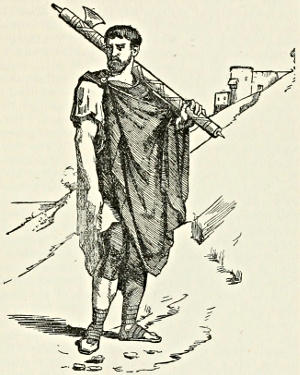
A Lictor
In the year 79 Sulla abdicated the dictatorship. He could say that it had
been conferred upon him for the reconstitution of the commonwealth, and
having done what he was appointed to do, it was no longer his to enjoy. But
if the Romans were amazed at this act of sublime self-sacrifice, it was with a
feeling akin to awe that
they beheld the tyrant
descend from his blood-stained
tribunal and retire
with unmoved composure
to the privacy of a suburban
villa. Aged and
infirm,[99] and sated perhaps
with pleasure as well as
ambition, it is not too
much to believe that such
a man as Sulla was indifferent
to life, and little
troubled by the risk to
which he might thus expose
himself from the
daggers of his enemies.
But in truth, while his
veteran colonists were
sworn to maintain his
policy, his person was not
unprotected, by bands of
armed attendants. When
the magistrate of a neighbouring
town, in the expectation
of the old man’s
death, delayed paying the
local contribution to the
restoration of the Capitol,
for the completion of
which Sulla was anxious, as the only thing wanting to complete his career of
prosperity, he could send men to seize the defaulter and even inflict death
upon him. Sulla was evidently secure against the vengeance of his victim’s
relatives. It may also be remarked that such vengeance would have been
foreign to the habits of the Romans. However little they scruple to use the
dagger to cut off a political enemy in the midst of his career, there is no
instance perhaps in their history of exacting personal retribution from one
who had ceased to possess the power of injuring.
There was, moreover, in Sulla a haughty contempt for mankind, and
consequently for its highest aims and pleasures. Even while devoting his
utmost energies to the pursuit of political eminence and the achievement of
a national revolution, he could smile with grim moroseness at the vanity
of his own exploits, and the hollowness of his triumphs. He paused in the
midst of his career to break the toy with which he had so long amused himself.
He had commenced life as a frivolous sensualist; he wished for nothing
better than to finish it as a decrepit débauché. At the moment of
laying down his office he made an offering of the tenth of his substance to
Hercules, and feasted the people magnificently; so much, indeed, did the
preparations made exceed what was required, that vast heaps of the superfluous
supplies were thrown with ostentatious prodigality into the river.
In the midst of these entertainments, lasting several days, Metella, the
consort to whom he was most permanently attached, fell sick and died. As
the favourite and perhaps the priest of Venus, his house might not be polluted
by the presence of death, and he was required to send her a divorce,
and cause her to be removed while still breathing. The custom he observed
strictly, through superstition; but the law which limited the cost of funerals,
though enacted by himself, he violated in the magnificence of her obsequies.
Retiring to his villa at Cumæ he finally relinquished the reins of government.
Surrounded by buffoons and dancers, he indulged to the last in every sensual
excess which his advancing years and growing infirmities permitted. Nevertheless
he did not wholly abandon literature. He amused himself with reading
Aristotle and Theophrastus, and dictating memoirs of his own life, upon
which he was employed, it is said, only two days before his decease. In
those pages he recorded how astrologers had assured him that it was his fate
to die after a happy life, at the very height of his prosperity. Stained with
the blood of so many thousand victims, and tormented with a loathsome disease—for
his bowels corrupted and bred vermin, and neither medicines nor
ablutions could mitigate the noisome stench of his putrefaction—in this faith
he persisted to the last, and quitted the world without a symptom either of
remorse or repining. He believed that a deceased son appeared to him in a
dream, and entreated him to rest from his troubles, and go with him to rejoin
his lost Metella and dwell with her in eternal peace and tranquillity. Fearful
perhaps of the fate of Marius, he directed that his body should be burned;
whereas it had ever been the custom of his house to inter the remains of
their dead. A monument was erected to him in the Campus Martius, which
was standing in the time of Plutarch, after the lapse of two centuries and
the events of several revolutions. It bore an inscription, ascribed to Sulla
himself, which said that none of his friends ever did him a kindness and none
of his foes a wrong without being largely requited. Sulla survived his
abdication about twelve months, and died in the year 78, at the age of sixty.
[81-79 B.C.]
Slowly and with many a painful struggle the Roman commonwealth had
outgrown the narrow limits of a rustic municipality. The few hundred
families which formed the original nucleus of her citizenship, and which in
her earliest and simplest days had sufficed to execute all the functions of her
government, had been compelled to incorporate allies and rivals in their own
body, to enlarge their views, and to expand their institutions. The main
object of Sulla’s policy was to revive at least the spirit of the old restrictions.
The old families themselves had perished almost to a man; he
replaced them by a newer growth; but he strove to pare away the accretions
of ages, and restore the government of the vast empire of Rome to a
small section of her children. The attempt was blind and bigoted; it was
not less futile than unjust. It contravened the essential principle of national
growth; while the career of conquest, to which the Romans devoted themselves,
required the fullest expansion and the most perfect freedom of
development.
Nevertheless the legislation of Sulla was undoubtedly supported by a vast
mass of existing prejudice. He threw himself into the ideas of his time, as
far as they were interpreted by history, by tradition, and by religious usage.
The attempt to enlarge the limits of the constitution was in fact opposed to
every acknowledged principle of polity. It was regarded equally by its
opponents and its promoters as anomalous and revolutionary. It had as
yet no foundation in argument, or in any sense of right, as right was then
understood. Society at Rome was in a highly artificial state; and Sulla
with many of his ablest contemporaries, mistook for the laws of nature the
institutions of an obsolete and forgotten expediency. But nature was carrying
on a great work, and proved too strong for art. Ten years sufficed to
overthrow the whole structure of this reactionary legislation, and to launch
the republic once more upon the career of growth and development. The
champions of a more liberal policy sprang up in constant succession, and
contributed, perhaps unconsciously, to the great work of union and comprehension,
which was now rapidly in progress. The spirit of isolation which
had split Greece and Italy into hundreds of separate communities was about
to give way to a general yearning for social and moral unity. The nations
were to be trained by the steady development of the Roman administration.
But though Sulla’s main policy was thus speedily overthrown, he had
not lived in vain. As dictator he wasted his strength in attempting what,
if successful, would have destroyed his country; but as proconsul he had
saved her. The tyranny of the Roman domination had set the provinces in
a blaze. Mithridates had fanned the flame. Greece and Asia had revolted.
The genius of the king of Pontus might have consolidated an empire, such
as Xerxes might have envied, on either shore of the Ægean Sea. But at this
crisis of her fate, hardly less imminent than when Hannibal was wresting
from her allies and subjects within the Alps, Rome had confided her fortunes
to the prowess of Sulla. The great victory of Chæronea checked the dissolution
of her empire. The invader was hurled back across the Ægean; the
cities of Greece returned reluctantly to their obedience, never more to be
tempted to renounce it. Sulla followed Mithridates into Asia; one by one
he recovered the provinces of the republic. He bound his foe by treaties
to abstain from fomenting their discontents. He left his officers to enforce
submission to his decrees, and quartered the armies of Rome upon the
wretched populations of the East. The pressing danger of the moment was
averted, though it took twenty years more to subdue the power of Mithridates,
and reduce Asia to passive submission. Rome was relieved from the
last of her foreign invaders; and this was the great work of Sulla, which
deserved to immortalise his name in her annals.[100]
Nevertheless this rolling back of the tide of aggression, and the return of
the legions of the republic to the limits of her former conquests, had no effect
in healing the internal sickness of which the irritation of the provinces was
only symptomatic. The triumph of her arms and the sense of security it
engendered only served to redouble her oppressions and to aggravate the
misery of her subjects. The course of events will lead us on some future
occasion to trace the remains of resentment and hatred towards Rome,
which lingered long in some regions of Italy itself: but for the most part
the Italians were now satisfied; they were content to regard the city of
Romulus as their own metropolis; and while they enjoyed the fruits of her
wide-wasting domination, gradually learned to take a pride in her name. But
beyond the Ionian and the Tyrrhenian seas the same ardent vows were formed
for enfranchisement which had precipitated upon Rome the Marsians and the
Samnites; in more than one quarter the old struggle of the Social Wars was
about to be renewed on wider and more distant theatres: but the elements
of strife were now more complicated than before; the parties engaged were
more thoroughly alien from each other; the hostility of Rome’s new enemies
was the more inveterate as they had less sympathy with her institutions, and
were ambitious of overthrowing rather than of sharing them. The second
period of the civil wars of Rome opens with the revolt of the Iberians in the
west, and the maritime devastations of the pirates in the east.
Italia, the region to which the privileges of the city had been conceded
by the Plautian law, was bounded, as we have seen, by a line drawn across
the neck of the peninsula from the Rubicon on the Adriatic, to the Isère
on the Tyrrhenian Sea. To the north and south lay two provinces which
held the first rank in political importance: on the one hand Gallia, or Gaul
within the Alps; on the other the island of Sicily. The Gaulish province
was divided into two districts by the Padus, or the Po, from whence they
derived their denominations respectively, according as they lay within or
beyond that river.
But the whole of this rich and extensive territory was placed under
the command of a single proconsul, and the citizens soon learned to regard
with jealousy a military force which menaced their own liberties at the same
time that it maintained the obedience of their subjects. Sicily, on the other
hand, though tranquil and generally contented, and requiring but a slender
force to control it, was important to the republic from the abundance of its
harvests, to which the city could most confidently look for its necessary supplies
of grain. Next among the provinces in proximity to Rome were the
islands of Sardinia and Corsica, of which the former also furnished Italy with
grain; but both were rudely and imperfectly cultivated, and the unhealthiness
of the larger island especially continued to keep it below many far
remoter regions in wealth, population, and intelligence. The first province
the Romans had acquired beyond their own seas was Spain, where their arms
had made slow but steady progress from the period of their earliest contests
with the Carthaginians, although the legions had never yet penetrated into
its wildest and most distant fastnesses. The connection between Rome and
her Iberian dependencies was long maintained principally by sea, while the
wide territory intervening between the Alps and Pyrenees was still occupied
by numerous free and jealous communities. But in the course of the last
half-century the republic had acquired the command of the coast of the Gulf
of Lyons; her roads were prolonged from Ariminum to Barcino and Valentia,
while the communications of her armies were maintained by numerous fortified
positions in the Further Gaul, and a secure and wealthy province
extending from the Var to the Garonne.
The Adriatic and the Ionian straits separated Italy from her eastern
acquisitions. The great provinces of Illyricum and Macedonia comprised
the whole expanse of territory from the Adriatic to the Ægean Sea, and were
divided from one another by the long mountain ridges of Boion and Scardus.
Ancient Greece, from Thermopylæ to Cape Malea, constituted a single command
under the title of Achaia. With Asia, Rome communicated principally
by sea, the route of the Hellespont being insecure, and the barbarous
tribes of Thrace but imperfectly subjected. The province of Asia, recovered
by Sulla, was held by an imperator with a numerous army, destined to control
the dependent potentates of Bithynia, Cilicia, and Cappadocia. The eastern
proconsul watched the movements of Mithridates, and unravelled his intrigues
with every court from the Halys to the Tigris. He intruded himself into
the affairs of Cyprus, Palestine, and Egypt, hunted down the mountaineers
of Crete, and menaced with the vengeance of the republic the buccaneers
who swarmed in every harbour of the eastern Mediterranean. On the
southern coasts of the great inland sea the domain which once belonged to
Carthage, limited on either side by the lesser Syrtis and the river Bagradas,
formed the proconsular province of Africa; while the five cities of the Pentapolis
acknowledged their entire dependence on the will of the republic.
The extent of her empire under Sulla was hardly one-half of that which it
attained under Augustus and Trajan.
The various relations in which the different classes of the provincial
population stood to the ruling city, have been compared with the constitution
of a Roman household. The colonies of Roman citizens planted in
the provinces, enjoying the full exercise of their national rights, and presenting
a miniature of the metropolis herself, held the position of the son
towards the paterfamilias. The conquered races, which had thrown themselves
on the victor’s mercy, were subjected to his dominion as unreservedly
as the slave to that of his master. Those among them to whom the state
had restored their lands and institutions, occupied a place analogous to
that of freedmen. Some cities or nations had voluntarily sought a connection
with Rome on terms of alliance, but with acknowledged inferiority.
Others again stood on a more independent footing, offering a mutual interchange
of good offices and citizenship; and lastly, there were some which
entered into confederacy with the republic with perfect equality of rights on
either side. All these had their prototypes respectively in the clients, the
guests and the friends of the Roman noble. Within the limits of each
Roman province there were generally some states which stood in these
several relations to the republic; and the strictness of the military and
civil administration was maintained or relaxed towards them according to
their respective claims. But after all the mass of the provincial population
belonged to the class of dediticii, that is, of those who had originally submitted
without conditions, the slaves, as they may be termed, of the great
Roman family. These were subjected to the severest fiscal and other burdens,
enhanced by the rapacity of their rulers, who, from the consul or
prætor to the lowest of their officers, preyed upon them without remorse
and without satiety.
The appointment to the provincial commands was left ordinarily in the
hands of the senate; nevertheless, the people had always regarded it as
their own indefeasible prerogative, and sometimes, at the instigation of their
demagogues, had not hesitated to resume it. It was the general rule that
the consuls and prætors, after serving their year of office in the city, should
proceed to administer for one, or sometimes for three years, the affairs of a
province. The state placed large standing armies at their disposal, and threw
enormous patronage into their hands; while their ambition, avarice, or mutual
rivalry, far more than any sense of the public interests, impelled them to
exert themselves, during their brief career, in reducing frontier tribes, in
quelling insurrections which their own injustice excited, and, whenever they
could find an excuse for it, in annihilating the ancient liberties and privileges
still retained by the more favoured classes of the provincials. Surrounded
by an army of officials, all creatures of their own, all engaged in the same
work of carving fortunes for themselves and abetting their colleagues, the
proconsuls had little sense of responsibility to the central government, and
glutted their cupidity without restraint. Of all the provinces the Cisalpine
and Macedonia, and latterly Asia, were the richest and most amply furnished
with military armaments, and on both these accounts they were generally
coveted by the consuls, and distributed between them by lot. The tithes,
tolls, and other imposts, from which the public revenue was drawn, were
farmed by Roman contractors, belonging generally to the order of knights,
who had few opportunities of rising to the highest political offices at home.
The connivance of their superiors in the province, backed by the corrupt
state of public feeling in Rome, shielded, to a great extent, the sordid arts
by which they were accustomed to defraud both the government and its
subjects.
The means of enrichment which the provinces afforded to the nobility
became the ultimate object of the deepest political intrigues. A man of
ruined fortune looked to the office of proconsul as the sole means of retrieving
his affairs. To obtain it, he allied himself with the chief or the party by
whose influence he might hope to rise successively through the various steps
which led to the consulship. He first sued for the post of quæstor; after
a due interval he might hope to be elected ædile, next prætor, and ultimately
consul. His grand object was then obtained; for upon the expiration
of his term of office he departed as governor to a consular province,
from the emoluments of which he calculated on repaying the expenses of
his numerous contests, on liquidating the debt of gratitude to his adherents,
and accumulating a vast fortune for his own gratification or the advancement
of his party.
The cupidity which animated individuals was in fact the mainspring of
the political factions of the time. The spoil of the provinces was the bait
with which the popular leaders had lured the Italians to their standards.
All the legal rights of citizenship had been conceded, but the old oligarchic
families, dignified by historic associations, and revelling in the wealth accumulated
by centuries of conquest, still hoped to maintain their grasp of
the larger share of honours and emoluments, which they contrived to make
generally accessible only to the richest. They still looked with scorn themselves,
and infused the same sentiment into their inferiors, on the “new
men,” the men of talents and education, but of moderate origin and fortune,
who were striving on all sides to thrust themselves into public notice. The
judicia was the great instrument by which they protected their monopoly;
for by keeping this in their own hands, they could quash every attempt at
revealing, by legal process, the enormities of the provincial administration.
But as far as each party succeeded in retaining or extorting a share in the
plunder, the same system was carried on by both. It would be unfair to
point to either as exceeding the other in rapacity and tyranny. The distress
and alienation of the provinces became the pressing evil and danger of the
times. Adventurers sprang up in every quarter, and found a floating mass
of discontent around them, from which they were certain of deriving direct
assistance, or meeting at least with sullen approbation.
The original vice of the provincial administration of the republic consisted
in the principle, openly avowed, that the native races were to be
regarded as conquered subjects. The whole personnel of the civil and military
government of the provinces was literally quartered upon the inhabitants;
houses and establishments were provided for it at the cost of the
provincials; the proconsul’s outfit, or vasarium, was perhaps generally defrayed
by a grant from the public treasury, but the sums required for his
maintenance, and that of his retinue, known by the name of salarium, was
more commonly charged upon the local revenues. The proconsul himself
indeed was supposed, in strictness, to serve the commonwealth gratuitously
for the honour of the office; but practically he was left to remunerate himself
by any indirect means of extortion
he chose to adopt. As the supreme
judicial as well as military authority
there was no appeal against either the
edicts he issued, or the interpretation
he put upon them. The legions in occupation
of the province were maintained
at free quarters, and their daily pay
supplied by the contributions of the inhabitants.
The landowners were burdened
with a tithe or other proportion
of their produce, as a tribute to the
conquering city. This payment was
in most cases made by a composition, in
which the proconsul was instructed to
drive the hardest bargain he could for
his employers. The local revenues were
raised for the most part by direct taxes
and customs’ dues; and these were generally
farmed by Roman contractors,
who made large fortunes from the transaction.
Public opinion at home was
such as rather to stimulate than to check
their extortions. For it was a settled
maxim of Roman policy that every talent
extracted from the coffers of the provincial
for the enrichment of the ruling
caste was the transfer of so much of the
sinews of war to the state from its enemies. But the rulers of the world
were not content with the extortion of money from their subjects. An era of
taste in art had recently dawned upon the rude conquerors of the East, and
every proconsul, quæstor, and legatus was smitten with the desire to bring
home trophies of Greek and Asiatic civilisation.
Punishment of a Traitor
Those among them ambitious of ingratiating themselves with their
fellow-citizens sought out the most celebrated statues and pictures, and even
the marble columns of edifices, for the decoration of public places in the
city. They did not scruple to violate the shrines of the gods, and ransomed
rebellious cities for the plunder of their favourite divinities. This thirst for
spoil led to acts of abominable cruelty: where persuasion failed, punishments
and tortures were unsparingly resorted to; the proconsul and his
officials were all bound together in a common cause, and the impunity of
the subordinates was repaid by zeal for the interests of the chief. Of those
who could refrain from open violence, and withhold their hands from the
plunder of temples and palaces, few could deny themselves the sordid gains
of money-lending usury. The demands of the government were enforced
without compunction, and the provincial communities were repeatedly
driven to pledge their sources of revenue to Roman capitalists. The law
permitted the usurer to recover his dues by the severest process. In a
celebrated instance the agent of one of the most honourable men at Rome
could shut up the senators of a provincial town in their curia, till five of
them actually died of starvation, to recover the debts due to his principal.
When indeed this intolerable tyranny reached its height, the provinces
might sometimes enjoy the sweets of revenge, though with little prospect of
redress, or of any alleviation of their lot. In a government by parties, the
misdeeds of one set of men could not fail to rouse the pretended indignation
of another; and while the factions of Rome contended for the prerogatives
of conquest, they tried to brand each other with the iniquity of their abuse.
The domination of the senators, as established by Sulla, soon provoked the
jealous animadversions of their excluded rivals. Their administration of the
provinces, protected as it was by the tribunals in which they reigned themselves
supreme, presented a vulnerable point of attack, and against the crimes
of the senatorial proconsuls the deadliest shafts of the popular orators were
directed. The remains of Roman eloquence have preserved to us more than
one full-length portrait of a proconsular tyrant. It is impossible indeed to
rely upon the fidelity of the colouring, or the correctness even of the lines;
nevertheless the general impression they leave upon us is amply borne out by
numerous independent testimonies. There is a limit in the possible and the
probable even to the rhetorical exaggerations of the Roman demagogues. A
slight sketch from one of these pictures may suffice to give us an idea of the
frightful originals.
About the period of Sulla’s abdication, a young noble named Caius Verres
accompanied the prætor Dolabella to his government of Cilicia (80). At
Sicyon in Achaia, he chose to demand a sum of money of the chief magistrate
of the city, and being refused, shut him up in a close chamber with a fire of
green wood, to extort the gratuity he required. From the same place he carried
off several of the finest statues and paintings. At Athens he shared with
his chief the plunder of the temple of Minerva, at Delos that of Apollo; at
Chios, Erythræ, Halicarnassus, and elsewhere on the line of his route, he perpetrated
similar acts of rapine. Samos possessed a temple venerated throughout
Asia; Verres rifled both the temple and the city itself. The Samians
complained to the governor of Asia; they were recommended to carry their
complaints to Rome. Perga boasted a statue of Diana, coated with gold;
Verres scraped off the gilding. Miletus offered him the escort of one of her
finest ships; he detained it for his own use and sold it. At Lampsacus he
sought to dishonour the daughter of the first citizen of the place; her father
and brother ventured to defend her: one of his attendants was slain. Verres
seized the pretext to accuse them both of an attempt on his life, and the
Roman governor of the province obliged him by cutting off the heads of
both. Such were the atrocities of the young ruffian, while yet a mere
dependent of the proconsul, with no charge or office of his own. Being
appointed quæstor he extended his exactions over every district of the
province, and speedily amassed, by the avowal of his own principal, from two
to three million sesterces [about £24,000, or $120,000] beyond the requisitions
of the public service.
[75-72 B.C.]
Verres could now pay for his election to the prætorship in the city. For
one year he dispensed his favourable judgments to wealthy suitors at home,
and on its termination sailed for the province of Sicily. Here his conduct
on the tribunal was marked by the most glaring venality. He sold everything,
both his patronage and his decisions, making sport of the laws of the
country and of his own edicts, of the religion, the fortunes, and the lives of
the provincials. During the three years of his government, not a single
senator of the sixty-five cities of the island was elected without a gratuity
to the proprætor. He imposed arbitrary requisitions of many hundred thousand
bushels of grain upon the communities already overburdened with
their authorised tithes. He distributed cities among his favourites with the
air of a Persian despot; Lipara he gave to a boon companion, Segesta to an
actress, Herbita to a courtesan. These exactions rapidly depopulated the
country. At the period of his arrival, the territory of Leontium possessed
eighty-three farms; in the third year of the Verrine administration only
thirty-two remained in occupation. At Motya the number of tenanted
estates had fallen from 188 to 101, at Herbita from 257 to 120, at Argyrona
from 250 to 80. Throughout the province more than one-half of the cultivated
lands were abandoned by their miserable owners, as if the scourge
of war or pestilence had passed over the island.
But Verres was an amateur and an antiquary, and had a taste for art as
well as a thirst for lucre. At every city where he stopped on his progresses
he extorted gems, vases, and trinkets from his hosts, or from any
inhabitant whom he understood to possess them. No one ventured to complain;
there was no redress even for a potentate in alliance with the republic,
such as Antiochus, king of Syria, who was thus robbed of a splendid
candelabrum enriched with jewels, which he was about to dedicate in the
Capitol of Rome. All these objects of art were sent off to Italy to decorate
the villa of the proprætor; nor were the antiques and curiosities he amassed
less valuable than the ornaments of gold and silver. Finally Verres laid his
hands on certain statues of Ceres and Diana, the special objects of worship
among the natives, who were only allowed the consolation of coming to
offer them their sacrifices in his gardens.
Nor did the extortions of Verres fall upon the Sicilians alone. He
cheated the treasury at Rome of the sums advanced to him in payment of
corn for the consumption of the city. He withheld the necessary equipments
from the fleet which he was directed to send against the pirates, and
applied them to his own use. The fleet was worsted by the enemy, and the
proprætor caused its officers to be executed for cowardice. His lictors sold
to the victims’ relatives the miserable favour of despatching them at one
blow. He crowned his enormities by punishing one of the ruling caste
with death. Gavius, a Roman trader, he confined in the quarries of Syracuse;
the man escaped, was retaken, and fastened to a cross on the beach
within sight of Italy, that he might address to his native shores his plaintive
but ineffectual exclamation, “I am a Roman citizen!”
Such is a specimen of the charges which could be plausibly advanced
against a Roman officer, and which the criminal, though backed by the
united influence of his party, and defended by the most experienced and
successful advocate of his times, shrank from rebutting. In most cases
however the governor accused of tyranny or malversation could screen himself
by bribing his judges, who besides their natural anxiety to absolve one
of their own order of crimes which might in turn be imputed to themselves,
had been bred in the same school of corruption and venality as himself.
The prosecution of these charges became indeed a ready means of acquiring
notoriety, and the people, stimulated by their demagogues, encouraged, it
was said, the young orators in their attacks, as whelps are trained to hunt
down beasts of prey. But the assailants were in almost every case repulsed,
and even if successful the provinces themselves reaped no benefit from their
efforts. The proconsuls only exerted themselves the more strenuously to
grasp the means of securing their acquittal. They could boast that the
fruits of three years’ occupation of office would suffice—the first to make
their own fortunes, the second to reward their advocates and partisans, the
third and most abundant to buy the suffrages of their judges. The provinces,
it might be anticipated, would soon come forward of their own accord
and pray for the repeal of the laws against malversation, since they only
served to redouble the extortions of their oppressors.
[72-69 B.C.]
These frightful iniquities which rendered the dominion of Rome as formidable
to the nations in peace as her hostility had been in war, had grown
with the progress of luxury and corruption. Her provincial governors had
ever wielded their public authority with arrogance and harshness; but in
purer and simpler ages they had at least refrained from the sordid exactions
and selfish rapacity for which they had now become infamous. The tribunals
also had degenerated both in corruption and shamelessness. The
knights could venture to assert that during the forty years they had participated
in the dispensation of the laws, the justice of Rome had been
unstained even by the breath of suspicion. To the notorious venality of
the tribunals under the administration of the senate they pointed as a proof
of their own superior purity. It was indeed true that the increasing vices of
the provincial government were symptomatic of the growing relaxation
of morality at home. On the one hand the extension of foreign conquest
and the opening in every quarter of new sources of wealth, had inflamed
the passions of cupidity and ambition. On the other, half a century of
domestic contentions had loosened the bonds of society, overbearing the
ancient principles of justice, of respect for law and order, of reverence for
things divine. But in fact this greater development of vice was accompanied
at the same time by more general publicity, and a more jealous
exposure of the faults of political parties. The knights, deterred from the
use of force for the recovery of their lost privileges, affected a zeal for
justice, to undermine their more fortunate rivals. The constitution of Sulla
was assailed and eventually overthrown, not on the field of battle, but on
the floor of the law courts.b
We now enter upon the last stage in the decline and fall of the republic.
By a violent effort Sulla had restored the government to the senatorial
nobility. But symptoms intimating the insecurity of the fabric which he
had hastily reared on blood-bathed foundations showed themselves even before
his death. After his secession, Q. Catulus became the chief of the senatorial
party. He was son of the Catulus who shared the Cimbrian triumph
with Marius, and in the year 79 B.C. he appeared among the candidates for
the consulship with the certainty of election. The person who aspired to be
his colleague was M. Æmilius Lepidus, a man of illustrious family, but of
vain and petulant character. He was supported by many friends, among
others by young Pompey. Sulla knew the man, and warned Pompey against
entrusting him with power. But Pompey, who already began to talk of
“the setting and the rising sun,” disregarded the warning, and Lepidus was
elected.
Scarcely was Sulla dead when his words were fulfilled. Lepidus declared
himself the chief of the Italian party, and promised to restore all that Sulla
had taken away. To prevent a renewal of civil war, the senate bound him
and Catulus alike by oath not to take up arms during their consulate. But
Lepidus retired to his province of Transalpine Gaul, and, pretending that
his oath did not bind him there, began to levy troops. The senate summoned
him to return to Rome. He obeyed, but it was at the head of an
army. To oppose him, Catulus took post before the Milvian bridge, with
Pompey for his lieutenant. Here they were attacked by Lepidus, who was
easily defeated. After this failure, he fled to Sardinia, where he died shortly
after. But his lieutenants, M. Perperna and M. Junius Brutus, father of
Cæsar’s murderer, kept the troops together, and waited for the course of
events. A war was raging in Spain, which might well encourage the hopes
of discontented persons.
[78-75 B.C.]
It has been mentioned that Q. Sertorius had assumed the government of
Spain. But after a vain struggle against superior forces, he was obliged to
take refuge in Mauretania. The news from Italy was dispiriting. It seemed
as if the Marian cause was lost forever. Sertorius lent ear to the tales of
seamen who had lately made a voyage to the Fortunate Islands (so the
ancients called the Azores), and seemed to recognise the happy regions
which Greek legends assigned as the abode of the blessed. But while
the active soldier was indulging in day-dreams of indolent tranquillity, he
received an invitation from the Lusitanians to head them in rising against
the senatorial governors, and obeyed without a moment’s hesitation. Viriathus
himself did not use with better effect the energies of the brave mountaineers.
The south of Spain was soon too hot to hold the Sullan leaders;
the proscribed Marians came out of their hiding places and joined the new
chief. His progress, in the course of two years’ time, became so serious that,
when Metellus Pius laid down his consulship, he was sent into Spain to
crush Sertorius.
But to crush Sertorius was no easy task. He was no mere soldier, but
possessed political qualities of a high order. Like Hamilcar and Hasdrubal of
old, he flattered the Spaniards with the hope of rising to independence
under his rule. The government which he formed indicated a disposition
to dispute empire with Rome. He formed a senate of three hundred,
consisting partly of proscribed Romans, partly of Spanish chiefs—a step
unparalleled in the provincial government of Rome. All cities in his power
he organised after the Italian model; and at Osca (now Huesca in Catalonia)
he established a school for the noble youth of Spain. The boys wore
the Roman garb, and were taught the tongues of Rome and Athens. Sertorius
is almost the only statesman of antiquity who tried to use education as an
engine of government. It cannot indeed be pretended that his views were
merely philanthropic; no doubt he held the boys as hostages for the fidelity
of their sires.
His great talents, above all his acknowledgment of equality between
provincials and Romans, won him golden opinions. Everywhere the Spaniards
crowded to see him, and loudly protested their readiness to die for him.
Their enthusiastic reverence for his person was increased by the presence
of a white doe, which continually followed him, and was regarded by the
simple people as a familiar spirit, by means of which he held communication
with heaven.
Metellus in two campaigns found himself unequal to cope with the new
ruler of Spain. In the second of these years (77 B.C.) Perperna, who had
retired to Gaul with the best troops of Lepidus, entered Spain, and joined
the popular leader; and the senate hastily despatched Pompey to reinforce
Metellus. On his march through Gaul, the young general encountered the
other remnant of the army of Lepidus under Brutus; and Brutus, who fell
into his hands, was put to death in cold blood.
[75-72 B.C.]
Pompey’s aid, however, did not change the face of affairs. In the first
battle the young general was saved by the approach of Metellus, on which
Sertorius said: “If the old woman had not come up, I should have given
the boy a sound drubbing and sent him back to Rome.” At the end of
75 B.C. Pompey wrote a letter to the senate, representing the insufficiency
of his forces, and two more legions were at once sent to reinforce him.
Meantime Sertorius himself had reasons for apprehension. Some of his
Roman friends, disliking his policy of favouring the provincials, made overtures
to the senatorial commanders; and Sertorius, severe by nature, still
further exasperated the Romans of his party by forming his bodyguard
exclusively of Spaniards. But he still maintained his superiority in the
field. Nor was it encouraging to learn that he had received envoys from
Mithridates, who was about to renew war with Rome. Sertorius agreed
to furnish Roman officers to train the soldiers of Asia, while the king was to
repay the loan in ships and money.
The despotic power exercised by Sertorius had corrupted his nature. He
indulged in the immoderate use of wine, was impatient of the slightest contradiction,
and was guilty of many acts of tyranny. Even the Spaniards
began to fall away; and Sertorius in a moment of irritation ordered all the
boys at Osca to be put to death. This cruel and impolitic act would probably
have cost him his power and his life, even if it had not been terminated
by treachery. Perperna, who had at first joined him against his own inclination,
thought that a favourable opportunity had arrived for grasping power.
He invited Sertorius to a banquet at Osca; and the general, having drunk
freely according to his custom, fell an easy prey to the dagger of the assassin
(72 B.C.).
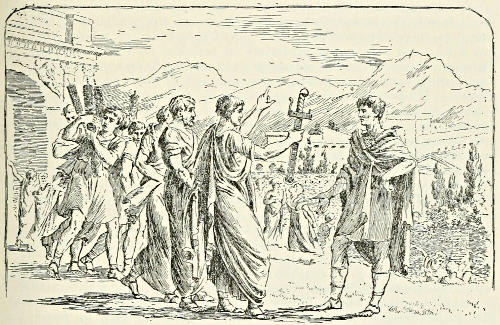
The Romans urge Pompey to aid Metellus
But when Perperna had wrought this shameful deed, he found that the
name of Sertorius was still powerful among the Spaniards. Many of them,
now that their great leader was no more, forgot his faults, and with the
devoted enthusiasm of their nation threw themselves into the flames of his
funeral pyre. A few days after the death of Sertorius, Perperna attempted
to lead the soldiery against Pompey, but he sustained an ignominious defeat.
His men were dispersed, and he was taken prisoner. When brought before
Pompey, he endeavoured to gain favour by handing him letters which had
been interchanged by Sertorius with some of the chief men at Rome. But
Pompey, with prudent magnanimity, threw the letters into the fire and refused
to hear him. In the course of a year the last relics of the Marian
party in Spain were extinguished.
Before this was effected, Rome was engaged in conflict with Mithridates.
[The history of this war will be given later in the chapter.] But here must
be noticed a formidable outbreak that took place in Italy, and threatened the
very existence of the state. This was:
[73-72 B.C.]
For the purpose of the barbarous shows which were so much enjoyed at
Rome, it was the custom to keep schools for training gladiators, who were
let out by their owners to the ædiles. At Capua there was a large school of
this kind; and among the gladiators in training there was Spartacus, a
Thracian, who had once led his countrymen against Roman commanders, but
now, having been taken prisoner, was destined to make sport for his conquerors.
He persuaded about seventy of his fellow-bondsmen to join him
in breaking loose; better it was, he argued, to die in battle on the open field,
than on the sand of the amphitheatre. This handful of brave men took
up a strong position upon Mount Vesuvius, where Spartacus was presently
joined by slaves and outlaws of all descriptions. The gladiators, old soldiers
like himself, supplied him with officers. Œnomaus and Crixus, the former
a Greek, the latter a Gaul, acted as his lieutenants. He enforced strict discipline;
and, so long as he was able, obliged his followers to abstain from
acts of rapine. Two Roman prætors attacked him, but they were beaten
with loss, and the numbers of his army swelled every day. All this happened
in 73 B.C., after the Mithridatic War had broken out, and before the
Sertorian War was ended.
In the next year (72 B.C.), the same which witnessed the murder of Sertorius,
Spartacus had become strong enough to take the offensive. He had
to face a formidable power, for both consuls were ordered to take the field.
But, at the head of more than one hundred thousand men, he forced the
passes of the Apennines and entered Picenum. His subordinates, however,
proved unmanageable; and Spartacus, aware that the power of Rome must
prevail, bent all his energies towards forcing his way across the Alps, in the
hope of reaching some remote region inaccessible to Rome. As he pressed
northwards, he was assaulted by both the consuls, but defeated them both,
and made his way to Cisalpine Gaul; but here he was repulsed by the prætor
Cassius, and obliged by the impatience of his followers to retrace his
steps. Still, every other Roman officer who dared to meet him was defeated;
at one time the brave gladiator is said to have meditated a descent upon
Rome itself. But he relinquished his desperate plan, and spent the remainder
of the year in collecting treasure and arms. Little discipline was now
observed. The extent of the ravages committed by the bands under his
command may be guessed from the well-known line of Horace, in which he
promised his friend a jar of wine made in the Social War, “if he could find
one that had escaped the clutches of roaming Spartacus.”
The management of the war was now committed to Crassus, who had
really won the battle of the Colline Gate. Ever since the triumph of Sulla
he had lived quietly at Rome, profiting by the proscription to buy up
property cheap; and after that period he had been busied in making the
most profitable use of the large fortune which he had amassed.
[72-71 B.C.]
Crassus took the field with six new legions, to be added to the remains
of the consular armies. The disorganised battalions of these armies he punished
by the unjust and terrible penalty of decimation; but his rigour was
successful in restoring discipline. He found Spartacus besieging Rhegium,
with the view of establishing a connection with Sicily, and rekindling the
Servile War in that island. The gladiator had even agreed with a squadron
of Cilician pirates to convey two thousand of his men across the straits;
but the faithless marauders took the money and sailed without the men.
Crassus determined to shut up the enemy by drawing entrenchments across
the narrowest part of the Calabrian peninsula. Twice in one day did Spartacus
endeavour to break through the lines; twice he was thrown back with
great slaughter. But he continued to defend himself with dauntless pertinacity;
and the senate, hearing that Pompey was on his way back from
Spain, joined him in the command with Crassus, and urged him to accelerate
his march.
Crassus, afraid of losing his laurels, determined to assault Spartacus; but
the brave gladiator anticipated him by forcing a passage through the lines,
and marching upon Brundusium, where he hoped to seize shipping and make
his escape from Italy. But M. Lucullus, brother of Lucius, the commander
against Mithridates, had just returned with a force of veteran soldiers from
Macedonia to Brundusium. Spartacus, foiled in his intention, turned like a
wolf at bay to meet Crassus. A fearful conflict ensued, which remained
doubtful till Spartacus was wounded by a dart through the thigh. Supported
on his knee, he still fought heroically, till he fell overpowered by numbers.
Most of his followers were cut to pieces; but a strong body of the insurgents
drew off in good order to the mountains. A division of five thousand made
their way to the north of Italy, where Pompey fell in with them on his way
home from Spain, and slew them to a man. About six thousand more were
taken prisoners by Crassus, who hung them along the road from Rome to
Capua.
To Crassus belongs the credit of bringing this dreadful war to a close.
In six months he had finished his work. But Pompey claimed the honour of
concluding not only the Sertorian War, but also the war with Spartacus. In
fact he had not much cause for boasting in either case. The daggers of
Perperna really brought the Spanish contest to an end; and as to the gladiatorial
conflict, the lucky chance by which Pompey intercepted five thousand
fugitives was his only claim to credit. But the young general was a favourite
with the soldiery and with the people, while Crassus from his greedy love
of money enjoyed little popularity. Public opinion, therefore, seconded
claims which were put forward without modesty or justice.
Neither Pompey nor Crassus would enter the city; for both desired a
triumph, and their armies lay at the gates to share the honours. The wish
of Pompey was at once granted; but to Crassus only an ovation was conceded.
[71-70 B.C.]
Before they entered the city, they had both asked permission to offer
themselves as candidates for the consulship. Both were excluded by the
laws of Sulla. Crassus was still prætor, and at least two years ought to
elapse before his consulship. Pompey was only in his thirty-fifth year, and
had not even been quæstor. The senate, however, dared not refuse Pompey;
for he would not disband his army, and his tone brooked no refusal. And
what was granted to Pompey could not be denied to Crassus, who also kept
his soldiers under arms. Thus, at the demand of two chiefs, each backed by
an army, the senate were, within eight years after Sulla’s death, obliged to
break his laws. Pompey was elected by acclamation. Crassus might have
been less successful, had there not been a secret understanding between him
and Pompey. On the calends of January, 70 B.C., Pompey and Crassus
entered on their memorable consulship.
On that day Pompey gave intimation of his intention to pursue a popular
course of policy. In a set speech he declared his intention of releasing the
tribunes from the trammels imposed upon them by Sulla, and of attempting
a reform of the judicial system. Both of Pompey’s announcements were
received with shouts of applause. To the former the senate offered but a
feeble opposition. The tribunes were restored to the exercise of their power,
and with their restoration it may be said that the keystone of the arch
erected by Sulla fell. With the resuscitation of this popular power revived
also the independence of the tribe assembly, and hence followed by necessity
a struggle between that body and the senate.
But the other measure broached by Pompey was one which the senate
determined to oppose to the uttermost. They could not tamely abandon
their absolute power over the law courts. Yet in the last ten years,
scandal had been great. Among other persons Cæsar had reason to complain.
After his escape from Sulla’s vengeance, he also, like Cicero, resorted
to the schools of Greek philosophy. On his return, though only in his
twenty-third year, he indicted Cn. Dolabella for misgovernment in Macedonia.
Dolabella was defended by Q. Hortensius, the first advocate of the
day, a determined adherent of the senatorial party, and as a matter of
course he was acquitted. It had, however, been remarked that the knights
were little less corrupt than the senators; and the law proposed under
Pompey’s authority by the city prætor, L. Aurelius Cotta, was so devised
as to establish a court composed of three elements, each of which might serve
as a check upon the other two. In each jury one-third of the jurymen was
to be furnished by the senate, one-third by the knights, and the remaining
third by the tribunes of the treasury. Catulus endeavoured to promote a
compromise; but Pompey was resolute, and the nobles prepared to maintain
their privilege by arms.
An event, however, occurred which smoothed the way for Cotta’s law.
Cicero, after the great credit he had won by his bold defence of Sext. Roscius,
had quitted Rome for two years. He returned in 77 B.C., and immediately
began to dispute with Hortensius the sway which he exercised in the
law courts. Except during the year 75 B.C., when he was serving as quæstor
in Sicily, he was employed as an advocate at Rome. His polished eloquence
excited universal admiration; his defence of many wealthy clients brought
him in much money and connected him with many powerful families. He
was of the same age as Pompey; and, being now a candidate for the ædileship,
he began to be eager for political distinction. To obtain this by military
commands was not suited to his tastes or talents. But it was possible
to achieve it by the public impeachment of some powerful offender. C.
Cornelius Verres, a man connected with some of the highest senatorial
families, had for three years been prætor of Sicily, from which province he
had returned after practising extortions and iniquities unexampled even
in those days. The Sicilians, remembering the industry and equity with
which Cicero had lately executed the functions of quæstor in their island,
begged him to come forward as the accuser of this man; and the orator, who
saw how he might at once strengthen the hands of Pompey and share the
popular triumph of the consul, readily undertook the cause.
The first attempt which the dexterous advocate of Verres made to elude
Cicero’s attack was to put forward Q. Cæcilius Niger, who had been quæstor
under Verres, to contend that to him belonged the task of accusation. But
Cicero exposed the intended fraud so unanswerably that even the senatorial
jurymen named Cicero as prosecutor. He demanded ninety days for the purpose
of collecting evidence in Sicily. But he only used fifty of them, and
on the fifth of August he opened this famous
impeachment. He had in the meantime been
elected ædile. But Hortensius had also become
consul-elect; and one of the Metelli, a warm
friend of the accused, was designated to succeed
Glabrio, who now presided in the court as prætor
peregrinus. It was therefore a great object
for Verres to get the trial postponed to the next
year, when his great senatorial friends would
fill the most important offices in the state. To
baffle this design, Cicero contented himself with
a brief statement of his case, and at once proceeded
to call witnesses. So overpowering was
the evidence that Hortensius threw up his brief,
and Verres sought impunity in a voluntary exile.
To show what he could have done, Cicero
published the five great pleadings in which he
intended to have set forth the crimes of Verres;
and they remain to us as a notable picture of
the misery which it was in the power of a Roman
proconsul to inflict.
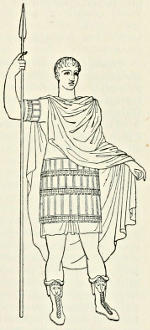
Roman General
(From Trajan’s Column)
Soon after the trial came to this abrupt issue,
the law was passed, seemingly with little opposition;
and thus a second great breach was made
in the Sullan constitution.
The corrupt state of the senate itself was
made manifest by a step now taken by Catulus
and his friends. They restored the censorial
office, which had been suspended for sixteen
years. The censors of the year 70 B.C. discharged
their duties with severe integrity, and sixty-four senators were
degraded. For Catulus they revived the high rank of princeps, and he was
the last independent senator who held that rank. When it was next called
into existence, it served to give a title to the despotic authority of Augustus.
The review of the knights was made remarkable by the fact that the consul
Pompey appeared in the procession, leading his horse through the Forum, and
submitting himself to the censorial scrutiny.
The jealousy of Crassus increased with Pompey’s popularity. Both the
consuls continued to maintain an armed force near the city; and, though
the liberal measures of Pompey had won the Forum, yet the gold of Crassus
commanded many followers. The senate dreaded that the days of Marius
or Cinna might return. But Crassus calculated the risks of a conflict, and
prudently resolved to give a pledge of peace. At the close of the year he
publicly offered his hand to Pompey, which the latter deigned to accept
after the manner of a prince. It did not suit Crassus to disturb credit and
imperil his vast fortune by a civil war; Pompey was satisfied so long as no
other disputed his claim to be the first citizen of the republic.
Thus ended by far the most remarkable year that had passed since the
time of Sulla. Two generals, backed by an armed force, had trampled on
the great dictator’s laws; and one of them had rudely shaken the political
edifice reared in so much blood. Behind them appeared the form of one
who sought to gain by eloquence and civil arts what had lately been arrogated
by the sword. But it was some years yet before Cæsar descended
into the political arena.b
[84-67 B.C.]
During the party struggles in Italy, Sicily, Africa, and Spain, during
the dictatorship of Sulla and its sanguinary effects, felt long afterwards in the
Sertorian and Slave wars, the sufferings of Rome and her provinces were
increased by a scourge of a peculiar character which had gradually attained
alarming proportions.
The coasts of the western part of that district of Asia Minor known as
Cilicia, where the wild mountains of the Taurus, which intersect the country,
afford a safe refuge to the robber and his prey, had been from ancient times
the home of piracy. The hopeless confusion of the Syrian kingdom, of which
Cilicia formed a part, set order at defiance and for a long time allowed full
play to the lucrative trade which flourished under the protection of the
states of Rhodes, Cyprus, and Egypt, all of them at enmity with the Syrian
monarchy.
We know how in the year 228 Rome had punished the Illyrian pirates,
but it was only about the year 103 that Marcus Antonius was sent against
those of Cilicia and after some time celebrated a hard-earned triumph. The
torpor of the Roman government and the civil disturbances were more inimical
to the safety of the seas than to that of the land; and in the war against
Mithridates, in which civil disturbances played such a disastrous part, the
ships of the Cilicians offered the same refuge to the vanquished—whether he
were of Pontus, Greece, or Rome, whether Mithridates or Sulla had made him
homeless—as they afforded to escaped convicts, runaway slaves, and the outcasts
of every nation and every country. Their pirate sails were soon to be
found all over the Mediterranean Sea. After the collapse of the Grecian
states and the decay of the Roman sea power there was soon no safety for any
merchant ship, or coast district.
When the captured men could not ransom themselves by large sums of
money, they were taken to the great slave markets of which the island of
Delos was the chief depot, and in the secure and unassailable mountain castles
of Cilicia the corsairs deposited the money and other property which their
boats and fleets had seized throughout the whole district of the Mediterranean.
The excellent organisation of this roving power added tenfold to its danger.
Any one who belonged to the great association could claim assistance
from any ship that carried the pirate flag. There was no fear of treachery;
a common interest, common foes, a similar life had created a kind of national
cohesion and national feeling among these freebooters of the sea.
The repeated efforts of the Romans to stem the danger had been without
avail. L. Murena (84-81) accomplished nothing, neither was anything of a
decisive nature effected by P. Servilius Vatia (78-75), although he conducted
the war with much will and energy. He did his best; and by his capture of the
city of Isaura, in Taurus, he won for himself the surname of Isauricus and
a triumph at which he was able to produce rich booty and, to the especial
delight of the people, some pirate captains as prisoners. Cilicia was formed
into a Roman province, but this left the evil practically untouched. The
selection in the year 74 of Marcus Antonius, a son of the Marcus Antonius
mentioned above, as proprætor against the Cilician corsairs, with considerable
means at his disposal, was also a failure, for the chiefs of the Cretan pirate
horde annihilated the greater portion of his fleet. Emboldened by success,
the corsairs of the Syrian coasts ventured as far as the Pillars of Hercules;
they mocked at the power and sapped the vitality of the Roman state.
Notable men like P. Clodius and Julius Cæsar fell into their hands. Ambassadors
of foreign powers on their way to Rome were captured, and Roman
ambassadors and curule magistrates had to be ransomed. Twelve axes,
Cicero moaned, fell into the hands of the pirates, who with these insignia in
their possession mocked at the supremacy of Rome. Italian cities such as
Caieta, and Misenum, to say nothing of Greek ones like Cnidus, Colophon,
and Samos were plundered, and the pirate squadron—the nimble little myoparones—even
appeared at Ostia, at the mouth of the Tiber. Trade and
the free supply of provisions were everywhere seriously obstructed and this
was particularly felt at Rome; the high price of corn, and the emptiness of the
treasury, whose source of replenishment was cut off, pressed heavily on
the nation and at last became unendurable.
The half-measures adopted so far having accomplished nothing, it was
evident that the pirates must either be destroyed by one great blow or left
to do as they pleased.
[67 B.C.]
In these circumstances Gabinius, one of the tribunes of the people for the
year 67, a favourite of Pompey and in the pay of the latter, came forward
with the momentous proposal that a general invested with extensive powers
should be entrusted with the extermination of the pirates. He should be an
imperator for three years with proconsular and irresponsible power extending
from the Pillars of Hercules to the farthest east. He should have
unlimited command throughout the sea and four hundred stadia inland in
all countries, including Italy. Fifteen senatorial legati with a prætor’s
privileges, and appointed by himself; two hundred ships, six thousand Attic
talents and whatever land forces he might require, should be placed at the
disposal of this imperator. In making this proposal no name was given, but
everybody knew that it pointed to Pompey. This rogation was received
with great applause. Pompey had been successful in all his preceding
efforts and had just re-established the tribunician power; he was the idol of
every Roman citizen, and the people reposed in him that unlimited confidence
which the multitude are wont to accord to those whom they have
once chosen for their favourites. Naturally the senate did not receive the
appointment in the same spirit. To give one man such boundless power was
the same, it was said, as to give it to him forever; it was to exchange freedom
for the government of one; to turn, as the punsters said, a navarch into
a monarch. Q. Catulus tried to throw the weight of his esteemed name,
and Q. Hortensius that of his eloquence, into the scale against the dangerous
measure. They sought to obtain the veto of the rest of the tribunes against
the rogation which would place all the power of the republic at the disposal
of one man, and might thus create a regular tyranny, a new Romulus;
and here and there party bitterness may have vented itself in angry words,
saying that the new Romulus should be treated like the old, whose mangled
remains were carried away from the Field of Mars under the togas of the
senators. But when the measure was put to the vote of the assembly, all
opposition was futile against the unanimous and clamorous voice of the
people and of the most renowned leaders of the popular party whose interests,
like those of Julius Cæsar, were intimately connected with those of
Pompey. The tribune Trebellius ventured to interpose his veto and maintained
it until seventeen tribes voted for his removal from office when his
firmness forsook him. It was in vain that Q. Catulus counselled that the
deputies should be appointed by the people and not by Pompey; all resistance
was useless. One hundred and twenty thousand infantry, five thousand
cavalry, twenty-four deputies and five hundred ships, which exceeded the
first commission, were placed at the service of Pompey, who with assumed
modesty begged to be spared the difficult task. And so high were the hopes
centred in him that the price of corn fell immediately on his appointment
and before he had done anything.
Pompey justified the hopes of Rome. He turned to the best account the
means placed at his disposal. He divided his command into thirteen areas
under his deputies, and moved with his main forces from west to east. The
corsairs were chased from one lurking-place to another, from retreat to
retreat, and one admiral drove them into another’s net. Before forty days
had elapsed the western Mediterranean was free, and the corn ships from
Africa, Sardinia, and Sicily now had free course into the Roman harbours, as
had not been the case for years. After a short stay at Rome, Pompey again
set sail for Brundusium, and the chase commenced afresh. Treachery and
submission decreased the number of the pirates who could no longer hold
out and who were wisely spared by Pompey when they submitted. In less
than three months he was on the western coast of wild Cilicia and arrived
at the promontory of Coracesium, where a final battle put an end to the war.
The remaining corsairs were there assembled and were defeated. The seas
were now free, and the mountain castles opened and disgorged their plunder,
their arms, their treasure, and their prisoners. Thirteen hundred ships were
burned, seventy-two taken, and 306 surrendered. One hundred and twenty
strongholds and towns were destroyed, ten thousand pirates were killed, and
twenty thousand taken prisoners.
The liberated prisoners who now returned to their homes, the soldiers
enriched by the chase, the Roman people saved from hunger, the merchants
of the wide Roman dominions whose commerce was reinstated—all lauded
the name of the great proconsul who had accomplished in three months
what had been vainly desired for seventeen years. In fact, this extermination
of the corsairs of the Mediterranean was probably the most brilliant and in
any case the most meritorious achievement in the life of Pompey, although
it must also be noted that this swift conquest was as illustrative of the power
of Rome when it assembled and united its forces, as it was of the capacity of
Pompey. The pirates themselves moreover had no cause to complain of undue
severity. The better sort were allowed to settle in the town of Soli in Cilicia,
whose name, Pompeiopolis, immortalised the memory of its conqueror; others
found shelter in different inland places and towns, whilst some were even bestowed
in southern Italy. The temperate way in which Pompey treated the
conquered led the Cretans, who had been conquered in 68 by Q. Metellus
and treated with great cruelty, to send their submission by an embassy.
Pompey accepted it and sent them his deputy L. Octavius; Metellus
protested loudly against this invasion of his province, and took up arms
against him, but his protest was unjustifiable in face of the Gabinian law.
Thus a regular civil war arose in the island, which was of little importance
in itself but greatly increased the very unsettled condition of the republic
and its government.
[84-73 B.C.]
In the meanwhile Pompey was by no means inclined to be contented with
this triumph. He expected that the command in the Pirate War would lead
to a greater and more important one. The war in Asia had always been
the object of his desires, and now, after crushing the corsairs, the people
could not refuse him anything. L. Licinius Murena, left by Sulla in Asia
in the year 84 with the two Fimbrian legions, had recommenced the war
directly after his general’s departure, but without success, and at Sulla’s command
he abandoned it; these military operations, which ended in the year
81 with the triumph of the proprætor Murena, were distinguished by the
name of the Second Mithridatic War. Mithridates knew that the peace
with Sulla was only a truce, and he saw himself threatened anew when the
Romans made Bithynia a province in the year 75, its last king, Nicomedes
III, having died and bequeathed his kingdom to the Roman people. We
know that through the Marians who had taken refuge at his court, Mithridates
entered into negotiations with Sertorius, and therefore in the year 74
the consuls, L. Licinius Lucullus and M. Aurelius Cotta, accepted the king’s
challenge to the Third Mithridatic War.
The king found that the corsairs were allies not to be despised on the
sea; and the Roman outlaws at his court, as well as the officers sent him
by Sertorius, helped him to drill his army in the Roman fashion. Lucullus
and Cotta were entrusted with the direction of the war. The former, a
man belonging to the aristocratic class had exhibited great capacity in the
eastern seat of war, and in all the appointments since filled by him, he
had proved himself a skilful and intelligent officer, while his moderation
and gentleness united with unusual cultivation had won Sulla’s highest
approval.
In the year 74 the war commenced. Mithridates began operations by
calling many districts in Asia Minor to arms and by making himself master
in Bithynia by means of his fleet and army. The Romans had retired
to Chalcedon; and here Cotta, who refused to wait for his advancing colleague,
was beaten by land and water, and the king proceeded in a southwesterly
direction, towards the town of Cyzicus, and laid siege to it. The
Hellenic inhabitants offered a firm resistance, for they knew the fate that
awaited conquered cities at the hands of the Pontian king. Lucullus was
therefore able to move to a spot east of the camp of Mithridates. By
this stroke he cut off the king’s communication with his Pontian territory
and closing the way on the land side left Mithridates only the sea
open to him. At the river Rhyndacus (east of Cyzicus) Lucullus defeated
a portion of the enemy’s army which was attempting to break through the
Roman lines. The sufferings from the winter season and want of care consequent
on the stoppage of the transports had naturally thinned the ranks of
the three hundred thousand men who were besieging the city. So in the
spring of 73 the king was finally forced to raise the siege and escape with
the rest of his fleet; and the failure would have been fatal to him, had not
the Roman ships been burned in the harbour the previous year.
[73-70 B.C.]
Thus the Pontian fleet, which swept the Black Sea and the Propontis, met
with no opposition in its expedition to the Ægean Sea, and it was said that
the Roman exiles who commanded it had decided to attempt a landing in
Italy. However, Lucullus himself, who had turned westward from Cyzicus,
commanded the little fleet, which had been collected in the Ægean waters
and defeated the enemy’s squadron in a battle between Lemnos and Scyros
in which most of the Roman exiles lost their lives.
In the meanwhile, Lucullus’ deputies Voconius, Barba, and Triarius, united
against Mithridates, who was stationed with his troops at Nicomedia (Bithynia).
The king avoided a battle and fled on a pirate ship, besieged Heraclea
on the way, where he assembled the rest of his fleet which the storm had
almost entirely scattered, and then proceeded past Sinope to Amisus. The
foes being now driven back to their own domains, the Romans took the
offensive.
Aurelius Cotta stationed himself at Heraclea. Lucullus himself passed
in the autumn of the year 73 into the Pontian district. Mithridates avoided
a battle and retired inland where the pursuing enemy would find it difficult
to obtain supplies. Lucullus followed, leaving parties to besiege or watch
Amisus and Eupatoria, the most important cities of Pontus; and deaf to
the murmurs of his soldiers, quickly pursued the king and arrived in the
spring of 72 at Cabira (on the Lycus in Pontus).
Roman Galley
The king had looked in vain for allies in the winter; neither the great
ruler of Armenia, his son-in-law Tigranes, nor the Parthians would support
him. But a powerful army of forty thousand infantry and four thousand
cavalry was meanwhile levied in his own states under the command of Diophantus
and Taxiles, whilst Lucullus only mustered three legions. Mithridates’
cavalry, his best support, was completely defeated by Lucullus’ deputy,
M. Fabius Hadrianus, and when the king ordered a further retreat, the camp
became the scene of blind fear and confusion which was turned into a
complete rout by a timely onslaught from Lucullus. The king fled with
two thousand cavalry over the border of his kingdom to Armenia, where his
son-in-law Tigranes received him. The rich booty of the camp fell into
the hands of the Roman soldiers; by the king’s command an eunuch forced
the women of the harem to drink of a flagon of poison to save them from
falling into the hands of the enemy—the greatest of all disgraces for an
oriental ruler.
There was now a pause in the war. The flat country submitted everywhere
to the Romans; only Amisus on the Pontian coast, Sinope and
Amastris on the Paphlagonian, and Heraclea on the Bithynian coast, made
an obstinate resistance, supported by the troops of the king and his allies,
the corsairs, with their ships.
While the deputies were occupied with these sieges, from 72-70, the
commander-in-chief organised the internal affairs of the Asiatic province,
where there was a pressing need for the attention of an upright man like
Lucullus. Sulla’s peace had left the inhabitants of these beautiful countries
to their hopeless misery under Roman tax gatherers. The twenty thousand
talents which Sulla had imposed on them had grown to a debt of 120,000
talents under the usurious interest of the Roman capitalists, who advanced
the community the money for the indemnity; and to satisfy the creditors the
sacred vessels in the temples of the gods had to be melted down, freemen
sold their sons and daughters into slavery, and where payment was delayed
or impossible every torture was resorted to which inventive avarice could
devise; so that according to Plutarch’s expression “slavery seemed like peace
and seisachtheia[101] in comparison.”
To mitigate this disgraceful state of things, Lucullus issued a decree
at Ephesus forbidding more than twelve per cent. interest, releasing debtors
from the obligation to pay interest whose total exceeded the original capital,
and prohibiting the creditor from claiming more than a quarter of
the debtor’s property.
The provincials congratulated themselves on having such a just and
humane proconsul, but his policy aroused the deadly hatred of the Roman
capitalists as it injured their business, and they spared no efforts in Rome to
accomplish his fall as soon as possible. In this they received great assistance
from the increasing discontent of the soldiers who were as much
opposed to the justice and moderation of Lucullus as they were to the long
continuation of the war, which had just taken a fresh start.
Mithridates had worked the whole winter trying to draw Tigranes into
the Roman war which he must sooner or later be unable to avoid. His
own power had broken down, his son Machares, the satrap of his kingdom
of the Bosporus had made peace with Lucullus on his own account and his
ships returning from Crete and Spain had been destroyed by Lucullus’
deputy at Tenedos.
[70-68 B.C.]
Tigranes’ kingdom of Armenia had previously been, like so many
others, a province of the Syrian kingdom, and its governor had asserted
his independence under Antiochus the Great. Tigranes had extended it
on every side and had increased it by fragments taken from the Syrian
kingdom which was now falling into ruins, whilst princes of the house
of the Seleucidæ quarrelled over its remains. From the year 83 Syria
and Cilicia appear as Armenian provinces under Armenian governors.
But the great king Tigranes himself held his gorgeous court in eastern
fashion at Tigranocerta near the borders of Mesopotamia. It was one of
those gigantic cities rapidly built and filled at the bidding of a despot,
the ruins of which are to be found in the East scattered here and there
as witnesses to the evanescent character of despotic creations.
In earlier times the Roman government would not have so long delayed
showing this despot his proper place. Lucullus, contrary to the will
of the government now carried the war into Tigranes’ territory, demanding
from the great ruler that he should deliver up Mithridates. This was suggested
by Appius Claudius, whose bold speech filled the barbarian ruler
with astonishment. He was furious and enraged that Lucullus did not
give him his title of “King of Kings,” but only addressed him as king,
and avenged himself by refusing the title of “imperator” to the Roman,
and making common cause with Mithridates whom he had not previously
admitted to his presence.
Lucullus led his unwilling army, of which the Fimbrian legions after
thirteen campaigns were now with some reason demanding to be disbanded,
over the Cappadocian Mountains and then across the Euphrates.
This was an ill-advised course considering the nature of the Armenian
territory and the small numbers and ill-humour of his soldiers who were
in no way pleased to be leaving the Pontian district behind them.
Whilst King Tigranes was still rocking himself in the ignorance of
an eastern prince and listening to his courtiers’ assurances that the Roman
army would never venture to face the hosts of the King of Kings, a
messenger arrived to acquaint him with its approach. The messenger
who brought the unpleasant news was rewarded by death, but it was
none the less true. Mithrobarzanes was given the command of the band
now sent against the Romans as punishment for not having joined the
flatteries of the courtiers, but he was easily beaten. Tigranes left his
capital just before the arrival of the Romans, and reinforcements gradually
arrived from the different nations of his kingdom. Their appearance
and their numbers—there were Arabians, Syrians, Medes, Adiabenians,
Armenians, Iberians, and Albanians from the heights and valleys of the
Caucasus—inspired him with confidence. He rejected the counsel of
Mithridates, who, from his own experience of the Romans, advised him
to avoid a battle and to employ his own superior cavalry to cut off the
enemy’s supplies, and the heights around Tigranocerta were soon covered
with the king’s army of 150,000 heavy infantry, 20,000 light infantry,
and 55,000 mounted men, 17,000 being in coat of mail. Lucullus left
6000 men before the city, and the remainder, who seemed to the king
to be too many for an embassy and too few for an army went up the
river to find a ford. “There they fly, these invincible Roman hoplites!”
exclaimed the king, with confidence. However, he soon afterwards saw
to his horror, how the eagle of the first legion wheeled round and then
one cohort after another crossed the river in the proud and confident
manner of Roman troops. Quickly the king sought to array his followers
but it was another barbarian battle, in which the stampede commenced
before the troops were ranged in order. Driven back by the first attack
and thrown into confusion the masses of men offered a wide target and
an easy prey for the swords of the enemy.
The Romans were almost ashamed at their easy victory, for it cost them
only five dead and 105 wounded. The enemy’s loss was incalculable. The
tiara and diadem of the Armenian king fell into Roman hands; and the city
of Tigranocerta had to surrender. It was taken and given over to the
soldiers to plunder; some of the heterogeneous population were sent back to
their native districts.
Lucullus wished to follow up the victory so as to give the enemy no time
to assemble for a fresh resistance. Submission was made to him by many of
the subjects of Tigranes, and an embassy of the Parthians appeared with an
offering of friendship. Only one more blow was needed to finally drive the
Armenian from his throne. But it was some time before the general could
appease his discontented, unwilling soldiers and the allied kings made use of
the opportunity to reassemble an army of seventy thousand infantry and thirty-five
thousand cavalry. This time they followed Mithridates’ advice to avoid
a battle. However, when Artaxata (on the Araxes) the second city of the
kingdom was threatened, a battle ensued on the river Arsanias in the neighbourhood.
The conflict lasted somewhat longer this time and the victory
was bought more dearly, the loss of the enemy was somewhat slighter, but
the result was the same. No Asiatic army, albeit large and well chosen,
could be victorious over a well-commanded Roman army.
[68-67 B.C.]
But Lucullus had not yet accomplished his purpose. His military
capacity was indisputable, but he was wanting in the power of attaching the
soldiers to himself by that personal charm which was almost a more important
gift in those times.
They murmured that the richest towns had been past by, none had been
taken by storm, so that they had come in for no plunder; but they maintained
that the imperator looked out for himself though he gave them nothing,
and it cannot be denied that Lucullus enriched himself. In his cold, severe
manner the general ignored their desire for loot, and they hated him not
only because he was an aristocrat but because he treated the inhabitants of
the cities with consideration, whilst they, as savage soldiery, regarded them
as profitable booty. The snow-covered mountains and the endless precipitous
roads filled them with aversion; never had they wintered in a friendly
Hellenic city, and the officers concurred in these complaints, particularly P.
Clodius, the brother-in-law of the general, who actively fostered the feeling
against Lucullus in the camp as well as the capital.
The proconsul could not induce his soldiers to help him to take Artaxata,
the second city of the Armenian kingdom. Half ceding to their pressure he
turned southward to Mesopotamia, whose capital Nisibis surrendered to him.
But here the unwilling machine denied him further service. The troops
insisted on winter quarters in Nisibis and its environs where they wished to
wait for the successor of Lucullus. This was advantageous to the enemy as
it delayed the final blow.
However Tigranes gained nothing, as L. Fannius came opportunely to
the aid of Lucullus’ soldiers whom Tigranes had surprised. Nevertheless
Mithridates strove to benefit by the discontent in the Roman army and regain
his kingdom.
He arrived at Pontus and attacked the Romans, who had excited universal
hatred in the country, with a small force, and not unsuccessfully for
he had learned somewhat in the long war, and in the following year (67)
he defeated the deputy Triarius at Zela on the river Iris (southwest of
Pontus) when the Romans lost seven thousand killed, amongst them a
great number of officers.
Lucullus, hearing the bad news, withdrew to Mesopotamia and returned
to Pontus, and Mithridates carried the war from thence to Cappadocia.
When Lucullus wished to follow him thither, the Fimbrian soldiers declined
to obey him as he was no longer their general and they declared they would
only remain under arms with the other legions, until the autumn.
Mithridates profited by these occurrences. Acilius Glabrio, the governor
of Bithynia who was to have been replaced by Lucullus, and Q. Marcius
Rex, the governor of Cilicia, were inactive in their provinces, and when the
ten commissioners of the Roman senate arrived to join with Lucullus in
organising the conquered district of Pontus as a province, Mithridates had
reconquered the greater part of it. In the meanwhile, the mine laid at
Rome against the general of the aristocracy by his active enemies, namely,
Pompey and his friends, the embittered members of the equestrian order,
the offended officers and the misguided people, was finally sprung and the
inevitable Pompey, who reaped everywhere where he had not sown, was
appointed commander-in-chief in the East and this time with full powers
more comprehensive and extravagant
than those conferred in the previous
year by the Gabinian law.c
[67-66 B.C.]

Pompey
(From a coin)
During the year of inaction that had
preceded Pompey’s appointment, Mithridates
had collected a fresh army, with
which he occupied the frontier of Pontus.
Pompey received his new commission
in the summer of 66 B.C., and he
at once pushed forward towards Cabira,
through a country wasted by previous
campaigns. Mithridates, anxious
to avoid a battle, retired towards the
sources of the Halys, but he was overtaken
by the Roman general, and obliged
to give battle on a spot afterwards
marked by the city of Nicopolis, founded
by Pompey in memory of the battle.
Here Mithridates was entirely defeated,
and with only a few stragglers succeeded
in crossing the Euphrates. But Tigranes
refused to harbour him in Armenia, and
he made his way northward, with great
difficulty, through the wild mountain
tribes of Caucasus to Dioscurias (Iskuria)
on the coast of Circassia. Banished
from the regions south of Caucasus, his
adventurous genius formed the conception
of uniting the Sarmatian tribes
northward of the Black Sea, and making
a descent upon Italy. Panic-stricken at
his father’s approach, Machares, viceroy of the Crimea, sought death by his
own hand; and the Crimea again became subject to Mithridates.
So great was the terror caused by the victories of the Roman general,
that Tigranes would have prostrated himself at his feet, had not Pompey
prevented the humiliation; and Phraates of Parthia, who had assumed the
proud title of “King of Kings,” lately arrogated by Tigranes, sent to make
an alliance with the victorious Roman, who turned his steps northward in
pursuit of Mithridates. At midwinter he celebrated the Saturnalia on the
river Cyrus (Kur), and in the spring advanced along the coast to the
Phasis. But learning that Mithridates was safe in the Crimea, he turned back
to his old quarters on the Cyrus, and spent the summer in reducing the
tribes which occupied the southern slopes of Caucasus. One of his victories
was celebrated by the foundation of another Nicopolis. But he was obliged
to return to Pontus for winter quarters. Here he received ambassadors
from the neighbouring potentates, and busied himself in reducing Pontus to
the form of a Roman province. For the next two years he occupied himself
by campaigns in the famous countries to the south of Asia Minor.b
[66-63 B.C.]
Mithridates spent part of his youth away from his father’s court; he had
been put on the wildest horses, which he had learned to master; he retired
into the most impenetrable hunting districts, so that half the time no one
knew where he was. He differed from all kings with whom the Romans
had fought because he had pure Persian and true Asiatic blood flowing
through his veins; for he was descended from Persian satraps.
The aim of his life was to make the throne of Pontus the centre of the
national Asiatic opposition to Rome. Thereby he enjoyed great momentary
success: but he was defeated by the great power of the Romans in their
union with the Greek element. He was then robbed of his father’s lands.
Nothing but the life of an adventurous fugitive remained for him. His
brave wife Hypsicratia, who had to look after him and his horse, accompanied
him to the citadel, where the royal treasure was kept. Mithridates
divided it among the loyal followers who were still around him. He is said
to have entertained the same thoughts attributed to Philip III of Macedonia
of advancing on Italy through the lands of the Danube, and from the east of
seeking the Romans in their home, as did Hannibal. But these daring chimeras
were joined to a feeling of immediate danger.
Among his followers he divided equal shares of poison, so as to insure
them against the danger of falling into the hands of the Romans. He himself
did not die from poison; he sought support in his Bosporus possessions.
But as there his son rebelled against him, he had the death-blow given him
by a true Gaul. The son, Pharnaces, joined the Romans.
After Mithridates had been driven out, Pompey turned against Tigranes
in Armenia, who at this time was waging war with the Parthian king Phraates
whom the younger Tigranes had joined. In the midst of all these dissensions
in Armenia, Pompey stepped in, not precisely as an enemy, but as
arbitrator. There are many accounts of the submissiveness which Tigranes
expressed towards Pompey. The main point is that he praised Pompey as
the man into whose hands the fate of the world had now been laid.
Tigranes had to give up all acquisitions which he had made in war with
the Seleucians; he kept Armenia. The son was led away into captivity.
Armenia had more or less already been drawn into the circle of universal
history. But Pompey can be added to the men who have carried on the
historical movement of the world in provinces which up till this time had
remained undisturbed by it. At the election he met the Albanians, who
still continued in the primitive simplicity of a pastoral people. With their
cavalcades they tried to prevent the Romans from reaching the Black Sea,
or at least, if this was unsuccessful, to make their return impossible. In the
year 65 a battle took place in which the Roman manœuvres had the upper
hand. Albanians, Iberians, and a few other independent nations sealed a
compact with them. Pompey is said to have had the desire, like Alexander,
to seek the Caucasian Rock, to which, according to Greek tradition, Prometheus
was chained. But the Roman leader was not the man to let himself
be led by an illusion of this kind; it was sufficient for him to have subjected
Pontus and Armenia. Already he felt himself strong enough to deprive
the king of the Parthians of the title of “King of Kings.” He took up
the interests of Armenia against the Parthians. As Tigranes had lost his
acquisitions, so Phraates was to lose his. Phraates did not dare take up
arms against the victorious Roman army. The ambassadors of Elymais and
Media appeared at the winter camp of Pompey at Amisus.
Through the victory in Armenia the Romans at the same time became
masters in Syria, which it was impossible to give back to the Seleucians, as
they did not know how to defend themselves. The survivors of this battle
had to content themselves with the grant of a small province, and acknowledge
the supremacy of Rome. After the example of the Syrian kings,
Pompey could not think of introducing the Greek worship of the gods into
Jerusalem; he occupied himself only with the political interests.d
As he advanced southward, his authority was called in to settle a quarrel
between two brothers of that royal family, which had inherited the Jewish
sceptre and high priesthood from the brave Maccabees. Aristobulus was
the reigning king of Judea, but his title was disputed by his brother Hyrcanus.
It was the latter who applied for aid to the Roman general. Pompey
accepted the appeal. But the Jews, attached to the reigning prince, refused
obedience, and Pompey was obliged to undertake the siege of Jerusalem.
For three months the Jews defended themselves with their wonted obstinacy;
but their submission was enforced by famine, and Pompey entered
the Holy City. Pillage he forbade: but, excited by the curiosity which even
then the spiritual worship of Jehovah created in the minds of Roman idolaters,
he entered the sacred precincts of the Temple, and ventured even to
intrude into the Holy of Holies, and to stand behind that solemn veil which
had hitherto been lifted but once a year, and that by the high priest alone.
We know little of the impression produced upon Pompey’s mind by finding
the shrine untenanted by any object of worship. But it is interesting to
compare the irreverent curiosity of the Roman with the conduct attributed
to the Great Alexander upon a similar occasion. Hyrcanus was established
in the sovereignty, on condition of paying a tribute to Rome: Aristobulus
followed the conqueror as his prisoner.
Aretas, king of the Nabatæan Arabs, defied the arms of Pompey; and
the conqueror was preparing to enter the rocky deserts of Idumæa, so as to
penetrate to Petra, when he received news which suddenly recalled him
to Asia Minor. Mithridates was no more. Pompey hastened to Sinope, to
which place the body of the old king had been sent by his son. It was
honoured with a royal funeral, and placed in the sepulchre of his fathers.
The remainder of the year 63 B.C. was spent by the general in regulating
the new provinces of Bithynia, Pontus, and Syria, and in settling the kingdoms
which he allowed to remain under Roman protection on the frontiers
of these provinces. Pharnaces, son of Mithridates, was left in the possession
of the Crimea and its dependencies; Deiotarus, chief of Galatia, received an
increase of territory; Ariobarzanes was restored for the fourth time to the
principality of Cappadocia. All this was done by Pompey’s sole authority,
without advice from the senate.
[62-61 B.C.]
Early in 62 B.C. he left Asia, and proceeded slowly through Macedonia
and Greece—so slowly, that on the 1st of January, 61 B.C., he had not yet
appeared before the walls of Rome to claim his triumph. He had been
absent from Italy for nearly seven years. His intentions were known to
none. But the power given him by the devotion of his soldiers was absolute;
and the senatorial chiefs might well feel anxiety till he disclosed his
will. But before we speak of his arrival in Rome, we must relate the
important events that had occurred during his absence.b
Pompey, in quitting the centre of affairs, could not fail to augur that his
removal would be the signal for the revival of party passions, and that a few
more years’ experience of the miseries of anarchy would demand his recall
with fuller powers for the settlement of affairs. The nobles, on their part,
having been compelled to submit to his extraordinary appointment, now
cast about for the means of turning his absence to their advantage. They
had placed him at their head, and he had betrayed them; they now looked
for a stouter and more faithful champion, and prepared themselves, when
the time should serve, to strike a blow for ascendency, the shock of which
should be felt on the Euphrates, and daunt the conqueror of Syria and
Pontus.
The chiefs whom they had hitherto consulted had mortified them by their
conciliatory temper, their timidity or their languor. Catulus they respected,
but they distrusted his firmness: Lucullus, whose aid they next invoked,
disregarded their solicitations. Hortensius was sunk in pride and indolence.
There were among them many personages of inferior fame and influence, the
Silani, the Scribonii, the Marcii, the Domitii, the Scipios and Marcelli, who
might make good officers, but wanted the genius for command. But there
was one man, still in their ranks, young in years, a plebeian by extraction,
unknown in civil or military affairs, in whose unflinching zeal and dauntless
courage they felt they could securely confide. Judgment, indeed, and tact
he sorely needed; but these were qualities which the nobles held in little
regard, and neither he nor they were sensible of this grievous deficiency.
This man was Marcus Porcius Cato, the heir of the venerable name of
the censor Cato, his great-grandfather, a name long revered by the Romans
for probity and simplicity. The slave of national prejudices Cato believed,
like his illustrious ancestor, in the mission of a superior caste to govern the
Roman state, in the natural right of the lords of the human race to hold
the world in bondage, in the absolute authority of the husband over the wife,
the parent over the child, the master over the servant. In his principles Cato
was the most bigoted of tyrants. Yet never were these awful dogmas held by
a man whose natural temper was more averse to the violence and cruelty by
which alone they can be maintained, and in vain did Cato strive to fortify
himself against the instincts of humanity within him by abstract speculation
and severe self-discipline. Born in the year 95, he had witnessed the termination
of the Social War, and resented, as a mere boy, the compromise in
which that mighty struggle resulted. Nevertheless his feelings had revolted
from the atrocious measures with which Sulla had avenged it, and alone of
his party, he sighed over their most brilliant victories and lamented the
bloody execution they did upon their enemies.
From the early days of his boyhood Cato had unremittingly trained
himself in the austere pattern of the ancient manners, already becoming
obsolete in the time of the censor. Inured to frugality and the simplest
tastes, he raised himself above the temptations of his class to rapine and
extortion. Enrolling himself in the priesthood of the god Apollo, he
acknowledged perhaps a divine call to the practice of bodily self-denial, in
which, in the view of the ancients, the religious life mainly consisted. He
imbibed the doctrines of the stoic philosophy, the rigidity of which was congenial
to his temper, and strove under their guidance to square his public
conduct by the strictest rules of private integrity. If he failed, it was
through the infirmity of nature, not the inconsistency of vanity or caprice;
but, doubtless, the exigencies of public affairs drove him, as well as
other men of less eminent pretensions, to many a sordid compromise with
his own principles, while in private life the strength to which he aspired
became the source of manifold weakness. It made him proud of his own
virtues, confident in his judgments, inaccessible to generous impulses, caustic
in his remarks on others, a blind observer of forms, and a slave to prejudices.
A party composed of such men as Cato would have been ill-matched with
the ranks of crafty intriguers opposed to them on every side; but when the
selfish, indolent, and unprincipled chose themselves a champion of a character
so alien from their own, the hollowness of the alliance and the hopelessness
of the cause became sufficiently manifest.
[67 B.C.]
During the progress of the intrigues for the appointment of Pompey to
his maritime command, his creatures had not ceased to worry the senate by
the advocacy of fresh measures for the reformation of administrative abuses.
In the year 67, a certain C. Cornelius, formerly quæstor to the great imperator,
proposed, being at the time tribune, an enactment to limit the usury
which the wealthy nobles demanded for the loans negotiated with them at
Rome by the agents of the provinces. Laws indeed already existed for regulating
this practice, but the wants of the needy and the cupidity of the capitalists
had combined to disregard them, and the senate had ventured to
assume the prerogative of the people in dispensing with their provisions in
favour of personages of its own order. This daring encroachment Cornelius
offered at the same time to repress. His measure was both popular and just.
The senators could not oppose it by argument, but they gained one of the
tribunes to intercede against it. But Cornelius was supported by the people,
who encouraged him to persist in reading the terms of his rogation in spite
of the official veto. A tumult ensued in the comitium, and, terrified by the
sound of blows, Pompey, we may presume, engaged his instrument to desist
from the direct attack, and allow the matter to be compromised. The senate
acquiesced, but the offence was deeply resented, and speedily punished. No
sooner had Cornelius quitted his functions as tribune, than he was accused
of majestas for having disregarded the veto of a colleague. The crime
was manifest, and the culprit might despair of defending himself against
the powerful influences arrayed against him, when Manilius, the same who
had devoted himself to the service of Pompey, caused the tribunal to be
surrounded by bands of armed ruffians, and the accusers to be threatened with
violence unless they desisted from their suit. The consuls interfered with a
military force and gave them the means of escaping over the roofs of the
neighbouring houses. In the following year the process was renewed, and
Cicero, as the mouthpiece of Pompey, was retained to defend the criminal.
The advocate pleaded the favour with which his client was regarded by
Pompey himself, and either this consideration or the fear of further violence,
or perhaps the cooling down of men’s passions after so long an interval,
gained him an acquittal. But the attempt, only too successful, of Manilius
to overawe by force the administration of justice, deserves to be remarked
for its fatal significance. From henceforth we shall find it repeated day by
day with aggravated violence. Consuls and tribunes will vie with one
another to destroy the foundation of all social confidence. Already the
senate and the people are committed to a struggle, which must eventually
involve the interference of a power paramount to both. Far-sighted men see
already the shadows of monarchy advancing upon them, which the mission
of Pompey to the East, long, distant, and perilous, seems the readiest means
of retarding, and possibly of averting.
Cicero’s speech for Cornelius was a triumph of artifice and ingenuity.
But the fame of his eloquence was already established by his harangue in
favour of the bill of Manilius, and the favour of the people had already
raised him to the prætorship for the year 66 by the unanimous suffrages of
the centuries. After the failure of the attack upon the refractory tribune,
faction slept for a short season, or prepared itself in silence for a fiercer outburst
of animosity.b
Though the restoration of the tribunate and the withdrawal of the judicial
power had given a rude shock to the senatorial oligarchy, they still
remained masters of Rome. But a chief was growing up who was destined
to restore life to the Marian party, to become master of the Roman world,
and to be acknowledged as the greatest man whom Rome ever produced.
C. Julius Cæsar was born of an old patrician family in the year 100 B.C.
He was therefore six years younger than Pompey and Cicero. His father,
C. Cæsar, did not live to reach the consulship. His uncle Sextus held that
high dignity in 91 B.C., just before the outbreak of the Social War. But
the connection on which the young patrician most prided himself was the
marriage of his aunt Julia with C. Marius; and at the early age of seventeen
he declared his adhesion to the popular party by espousing Cornelia,
the daughter of Cinna, who was at that time absolute master of Rome. We
have already noticed his bold refusal to repudiate his wife, and his narrow
escape from Sulla’s assassins. His first military service was performed
under M. Minucius Thermus, who was left by Sulla to take Mytilene. In
the siege of that place he won a civic crown for saving a citizen. On the
death of Sulla he returned to Rome, and, after the custom of ambitious
young Romans, he indicted Cn. Dolabella, for extortion in Macedonia. The
senatorial jury acquitted Dolabella as a matter of course; but the credit
gained by the young orator was great; and he went to Rhodes to study
rhetoric under Molo, in whose school Cicero had lately been taking lessons.
It was on his way to Rhodes that he fell into the hands of Cilician pirates.
Redeemed by a heavy ransom, he collected some ships, attacked his captors,
took them prisoners, and crucified them at Pergamus, according to a threat
which he had made while he was their prisoner. About the year 74 B.C. he
heard that he had been chosen as one of the pontifices, and he instantly
returned to Rome, where he remained for some years, leading a life of pleasure,
taking little part in politics, but yet, by his winning manners and
open-handed generosity, laying in a large store of popularity, and perhaps
exercising an unseen influence over the events of the time.
[74-64 B.C.]
It was in 67 B.C., as we have seen, that Pompey left the city to take
the command against the pirates. At the same time, Cæsar, being in his
thirty-third year, was elected quæstor, and signalised his year of office by
a panegyric over his aunt Julia, the widow of Marius. His wife Cornelia
died in the same year, and gave occasion to another funeral harangue. In
both of these speeches the political allusions were evident; and he ventured
to have the bust of Marius carried among his family images for the first
time since the dictatorship of Sulla.c Cæsar had in 65 obtained the ædileship,
in conjunction with Bibulus, the candidate of the nobles. That office,
which had properly the care of the public edifices, was charged also with providing
for the amusements of the people. It required an enormous outlay of
money, and men ambitious of higher honours spared no expense to eclipse one
another in the splendour they lavished upon it. The ædiles defrayed the
charge of the gladiatorial shows, and on this occasion Cæsar gained immense
applause by the profusion of silver bullion with which he decorated the furniture
and implements of the arena. Already deeply plunged in debt, he continued
to borrow on the credit of his genius and rising fortunes. If his
wealthy colleague equalled him in munificence, there seemed more merit in
the generosity of the penniless adventurer, and Bibulus was obliged to liken
himself to Pollux, who though he possessed a temple at Rome in conjunction
with his twin-brother, heard it always designated by the name of Castor, and
never by his own. Cæsar could rely on the clamorous support of the populace
thus attuned to his most stirring appeals. The display of the bust of Marius
had already irritated the faction of Sulla, but now a greater insult was inflicted
upon them.
Among his conspicuous acts of munificence as ædile, Cæsar had adorned
the Forum and the Capitol with pictures and statues: he had erected halls
and porticoes for the gratification of the people, and these too he had
adorned with monuments of taste and luxury. One morning there suddenly
appeared among the new ornaments of the Capitol the statue of Marius, surrounded
by the trophies of his Cimbrian and Jugurthine victories. The people
shouted with delight; the nobles scowled with indignation. The author of
the deed did not proclaim himself, but neither friends nor foes could err in
ascribing it to the daring ædile. Catulus determined to bring the offender
to punishment for this direct breach of law. The remembrance of the murder
of his father, the noblest victim of the Marian proscriptions, inflamed
the bitterness of his animosity. He accused Cæsar of throwing off the mask
from his ulterior designs; of no longer subverting the republic with mines,
but of assailing it with the battering-ram. Cæsar defended himself before
the senate, and succeeded in foiling his accuser; but he owed his triumph
neither to the favour nor the justice of his audience, but to the temper of the
people, on which the nobles dared not make an experiment. It would appear
from the historians that the trophies of Marius retained possession of their
place in front of the Capitol, an indication of the popular strength which
must have shaken the nerves even of Cato himself.
The nobles could at least retaliate. On quitting the ædileship, Cæsar
demanded a public mission to reduce Egypt to the form of a province, in
virtue of the will of the king Ptolemy Alexander. This country, through
which all the commerce of the East already passed into Europe, was reputed
the wealthiest in the world. Pouring into the royal treasury an annual
tribute of 14,800 talents, it offered a magnificent prey to the rapacious republic,
and to the fortunate proconsul through whose hands these golden
harvests should pass. Crassus and Cæsar disputed this rich booty; but
neither the one nor the other succeeded in obtaining it. The senate mustered
all its forces to baffle both claimants, and was enabled, perhaps by their
division, to succeed. It employed a tribune named
Papius to enact that all foreigners, and especially
Cæsar’s clients, the Transpadane Gauls, should
be removed from the city, and thus boldly cleared
the Forum of the tumultuary partisans, by whose
hands, if not by whose votes, the reckless demagogue
might hope to extort the prize.
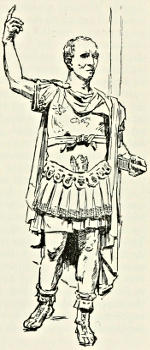
Julius Cæsar
(From a statue)
[64 B.C.]
Instead of this brilliant mission Cæsar was
invited (64) to preside in the tribunal, to which
was committed the inquisition into cases of murder.
Hitherto he had done no more than protest
against the dictatorship of Sulla; he now determined
to brand it with legal stigma. Among
the cases which he caused to be cited before him
were those of two political offenders, men who
had imbrued their hands in the blood of the victims
of the proscription. One of these named
Bellienus was the centurion who had stabbed
Ofella, the other was a more obscure assassin.
He condemned these wretched ruffians, only to
strike terror into higher quarters. He induced
a tribune named Labienus to accuse an aged senator,
Rabirius, of the slaughter of the tribune Saturninus;
and by making it a criminal, and not a
political, charge, he forbade the accused to withdraw
himself from the process by voluntary exile.
Cicero and Hortensius defended the culprit, but
failed to move the judges. Rabirius appealed to
the people. Labienus attacked, and Cicero again
defended him, while the senators used every effort
to excite the compassion of the populace. But
the people exulted in the audacious injustice of the
whole proceeding: for it was well known, first, that Rabirius had not killed
Saturninus; secondly, that the real slayer had been rewarded, and the deed
solemnly justified by competent authority; and, thirdly, that the transaction
had occurred not less than thirty-six years before, and deserved to be buried
in oblivion with the birth of a new generation. The appeal of Rabirius
would inevitably have been rejected but for the adroitness of the prætor,
Metellus Celer, who suddenly struck the flag which floated from the Janiculum
while the tribes were assembled for public business. In ancient times
the striking of the flag was the signal that the Etrurians were advancing
to attack the city. Immediately all business was suspended, the comitia
dissolved, and the citizens rushed to man the walls. The formality still
remained in force among a people singularly retentive of traditional usages;
and now the multitude which had just shouted clamorously for innocent
blood, laughed at the trick by which its fury was baffled, and acquiesced in
the suspension of the proceedings. Cæsar had gained his point in alarming
and mortifying the senate, and allowed the matter to drop, which he never
perhaps seriously intended to push to extremity.
[63 B.C.]
The same Labienus, devoting himself with zeal to the service of the patron
he had chosen, induced the people in the next place to demand the abolition
of Sulla’s law, by which they had been deprived of the election of
pontiffs. On recovering this prerogative they acquitted their debt to Cæsar
by nominating him chief of the college, thereby placing him at the head of
a great political engine, and rendering his person inviolable. Neither the
notorious laxity of his moral principles, nor his contempt, of which few could
be ignorant, for the religious belief of his countrymen, hindered Cæsar’s
advancement to the highest office of the national worship. It was enough
that he should perform the stated functions of his post, and maintain the
traditional usages upon which the safety of the state was popularly deemed
to depend. Cæsar’s triumph was the more complete, as it was a victory
over Catulus, who had competed with him for this dignity, and who, knowing
his pecuniary embarrassments, had offered to buy off his opposition by a
loan. Cæsar rejected the bribe with scorn, and declared that he would borrow
still more largely to gain the prize. The nobles were straining every
nerve to implicate him in a charge of conspiracy against the state, and the
chief pontificate was necessary to insure his safety. When the hour of election
arrived he addressed his mother, as he left his house, with the words,
“This day your son will be either supreme pontiff, or else an exile.”
The crime which it had been sought to fasten upon Cæsar was of the
deepest dye and most alarming character. For some years past the city had
been kept in feverish anxiety by rumours of a plot, not against any particular
interest or party, but against the very constitution of the social fabric.
The nobles had sounded the alarm, and their agents had insinuated complicity
in some wild and treasonable enterprise against Cæsar, Crassus, and
many other august citizens, objects of dislike and fear to the existing government.
The fact of such a conspiracy was indeed speedily revealed, and
it discovers to us in the most striking manner the frightful corruption of
the times. Into its actual connections and ramifications we shall presently
inquire; but first it will be well to trace its origin and motives, in order to
explain the way in which the senate proposed to take advantage of it.
[65-63 B.C.]
The generation of statesmen which had grown up at the feet of the
Scipios and the Gracchi, though it had exchanged much of the simple dignity
of the old Roman character for a tasteless affectation of Hellenic culture,
was still for the most part imbued with sentiments of honour and probity,
devoted to the welfare of the state, and only ambitious to shine at the head
of a commonwealth of freemen. But its children, born and bred under the
relaxation of all principle induced by the civil dissensions, were fearfully
devoid of every moral principle. The vast accession of wealth and power
which accompanied the conquest of the East overthrew whatever barriers
poverty and simplicity of manners might still have set against the torrent
of selfish indulgence. The acquisition of wealth, moreover, had only served
to precipitate expense and prodigality. A few crafty usurers swept into
their coffers the plunder won by a multitude of spendthrifts.
Political and private gambling had reduced thousands of the well born
to the condition of mere needy adventurers, while the advantages of birth
and station served only to make them more dangerous and their manners
more seductive. Among these restless and accomplished bravos none was
so conspicuous or so able as L. Sergius Catilina. His descent was one
of the most ancient in Rome, and he had served with distinction among the
nobles ranged under Sulla’s banner. His valour indeed from the first had
been tinged with brutal ferocity, and the stories currently reported of him,
believed as they undoubtedly were by his own contemporaries, may give us
at least an idea of the crimes which were possible at the period. It has
been already mentioned that he was accused of assassinating his brother
from private malice, and of getting his name inscribed on the list of proscription
for the sake of obtaining his confiscated estate. All Rome had
seen him waving on the top of a pike the head of the murdered Gratidianus.
It was rumoured that, wanting to marry the fair but profligate Orestilla,
who waived his suit through jealousy of his son by a former consort, the
father had sacrificed the youth without scruple to his passion.
Though loaded with the infamy of such crimes, Catiline had entered on
the career of public honours, had obtained the prætorship for the year 68, had
succeeded from thence to the government of Africa, and upon his return in
66 was about to offer himself for the consulship. Publius Clodius, a stripling,
not less profligate, but as yet less notorious, crossed his path with a
charge of malversation in his province. Presently the rumour ran that Catiline,
thus disconcerted, formed a plot with Autronius Pætus, just deprived of
the consulship for bribery, with Calpurnius Piso and other dissolute nobles,
to murder the successful candidates, and to seize the powers of the state.
The names both of Crassus and Cæsar were whispered in connection with
this bloody enterprise. The former, it was said, was to be created dictator,
the latter his master of the horse. When it was asked upon what military
resources the rash intriguers relied, it was answered that Piso, who had
acquired the command of one of the Iberian provinces, was charged to
organise an armed force in that quarter, with which to balance the legions
of the senate under Pompey. The scheme, it was alleged, was opportunely
detected, the chief conspirators discovered and marked. Piso shortly afterwards
was cut off in his province by banditti, or possibly by assassins; but
the proceedings with which the culprits were menaced were stayed by the
intervention of a tribune, and the circumstances of the plot were never formally
revealed.
Such however was the influence of Catiline, or such the interest which
his presumed machinations could excite among the lawless and ambitious
even in the heart of the commonwealth, that not only was the government
unable to convict him upon this flagrant charge, but he did not shrink from
suing for the consulship itself for the following year, and that too while
yet unabsolved from the accusation of Clodius. The man and the times
must be more particularly described to make the story of Catiline credible
to any other age than his own. For passing strange must it appear that,
notwithstanding the atrocities by which he was disgraced, Catiline had been
able to connect himself with many eminent public men, by whom his suits
had been openly supported. Cicero himself, a man of unsullied personal
purity, was prepared, for the sake of his alliance in their common competition
for the consulship, to defend his cause against Clodius, and only escaped
the disgrace of appearing as his advocate by the charges themselves being
dropped, as it would seem, by the venal accuser. But it was over the
corrupt patrician youth that he exercised the most extraordinary ascendency.
Through dissipation he led them into the darkest crimes. He taught them
to depend upon him as a trusty associate in every wickedness, and whether
in bilking a creditor or negotiating a loan, in planning a seduction or compassing
a murder, his boldness and invention were never found to fail them.
Catiline was their friend, their champion, and their idol. They vaunted his
bodily strength and vigour, his address in bodily exercises, his iron frame
which could endure alike the excesses of debauch and the rudest toils of
war. He became the model of the youthful aspirants to fashionable distinction,
which then demanded not only splendour in dress and furniture, but
skill in the use of the sword and eminence in all martial accomplishments.
But these exercises could not fail to have a brutalising effect; for they connected
such as sought distinction in them with the slaves, criminals, and
hired ruffians who fought in the arena. Such men, admired as consummate
masters of their art, became the friends and companions of the young nobility,
who drank with them one day in the wineshop, and shouted over their
agonies in the theatre on the morrow.
The long career of conquest which Rome had enjoyed had tended to
throw all her noblest energies into the sole profession of arms, which is
naturally inclined above all others to measure excellence by success, and to
confound virtue with valour. When the Roman returned from the wars for
a short breathing time to his own country, he beheld few objects around
him which were calculated to allay the fever of his excited imagination. His
pride was fed by trophies and triumphs, by the retinue of captive slaves
which attended him, by the spoils of conquered palaces which decorated
his home. In the intervals of danger and rapine few cared to yield themselves
to the vapid enjoyments of taste and literature, or could refrain from
ridiculing the arts which had failed to save Greece from subjugation. The
poets, historians, and philosophers of Rome were few in number, and exercised
but a transient influence on a small circle of admirers. Nor were the
habits of civil life such as to soften the brutal manners of the camp. The
Romans knew nothing of the relations of modern society, in which the sexes
mutually encourage each other in the virtues appropriate to each, and where
ranks and classes mingle unaffectedly together under the shelter of a common
civilisation. The Romans lived at first in castes, afterwards in parties;
even in the public places there was little fusion or intercourse of ranks,
while at home they domineered over their clients as patrons, their slaves as
masters, their wives and children as husbands and fathers.
The instruction of boyhood was general in the upper ranks, but it was
imparted by slaves, who corrupted the temper of their pupils far more than
they improved their understanding; and when, already exhausted by premature
indulgence, they were married while young from motives of convenience,
they were found incapable of guiding and elevating their still more
neglected consorts. The women were never associated in their husbands’
occupations, knew little of their affairs, and were less closely attached to
their interests than even their bondmen. They seldom partook of their
recreations, which accordingly degenerated for the most part into debauches.
Systematically deprived of instruction, the Roman matron was taught indeed
to vaunt her ignorance as a virtue. If in the first century B.C., those
Sabine housewives were no longer to be found who shut themselves up in
their apartments and spun wool among their handmaids, yet to exercise their
intellects or cultivate their tastes passed almost for a crime. To know Greek
and Latin books, to sing and dance, to make verses, to please with
conversation,—these, in the opinion of the historian Sallust, were no better than seductive
fascinations, such as formed the charm and fixed the price of the
courtesan. Rarely therefore did any woman break through this mental bondage,
without losing in character what she gained in intellect and attraction.
In either case she was almost equally despised. The men’s indifference to the
conduct of their spouses is a frightful feature in the social aspect of the times.
Their language, it has been observed, had no word to express the sentiment
of jealousy. The laws which gave them such facility of divorce show how
little regard they had for the dearest interests of the married state; just
as their common practice of adoption proves the weakness among them of
the paternal sentiment.
Thus did the morose and haughty Roman stand isolated and alone in the
centre of his family and of society around him; nor did he strive to exalt
his moral nature by sympathy with the divinity above him. A century
indeed had scarcely elapsed since Polybius had lauded the character of the
Romans for the earnestness of its religious sentiment. Undoubtedly the
moral sanctions of religion had at that time been strongly felt; the gods
were actually regarded as the avengers of crime and the patrons of virtue.
Even then however the principle of setting up the deity as a model for imitation,
which alone is efficacious for elevating and purifying the soul, was
unknown or disregarded. The coarse and sensuous pagans of Greece and
Rome gloated over the wretched stories of lust and violence ascribed to the
objects of their worship, and if they feared their power never dreamed of
adoring their goodness or their justice. Their religious practices therefore
were not moral actions, but merely adopted as charms to preserve them from
the caprice or ill-nature of their divinities. From this debasing superstition
even their strongest intellects could not wholly release themselves, while in
the seventh century the vulgar at least were as devoutly addicted to it as at
any former period. Indeed the general relaxation of positive belief in the
minds of the educated class was accompanied, as is not unfrequently the case
in the history of nations, by still more grovelling prostration on the part of
the ignorant multitude.
[63 B.C.]
Such a state of society already trembled on the verge of dissolution, and
reflecting men must have shuddered at the frailness of the bands which still
held it together, and the manifold energies at work for its destruction.
Catiline’s designs, suspended for a moment, were ripening to another crisis;
and the citizens pointed with horror to the victim of a guilty conscience,
stalking through the streets with abrupt and agitated gait, his eyes bloodshot,
his visage ashy pale, revolving in his restless soul the direst schemes of
murder and conflagration. Involved in ruinous debt, his last hope of extrication
had been the plunder of a province. The spoils of the prætorship had
been wrested from him by the rapacity of his judges or his accuser, and
access to the consulship was denied him. But his recent escape confirmed
him in the assurance that he was too noble a culprit to be convicted; he
scarcely deigned to veil his intrigues, while he solicited the aid of men of the
highest families in the city. The young Roman prodigals invoked “new
tables,” or a clear balance sheet; and it cannot be doubted that their aims
were rather personal than political—that they yearned for the extinction of
their debts first, and the division of public offices afterwards.
Among these conspirators were two nephews of Sulla. Autronius and
Cassius had been candidates for the consulship; Bestia was a tribune elect;
Lentulus and Cethegus, both members of the Cornelian house, were nobles of
high distinction, though lost in character; even the consul Antonius was suspected
of privity to their designs, and a secret inclination in their favour.
They counted upon the support of the men who had been disgraced or
impoverished by Sulla, and hoped to inflame the turbulence and lust of
rapine which animated the dregs of the populace. They expected moreover
the armed assistance of many of the disbanded veterans, who had already
squandered, with the recklessness of fortunate adventurers, the possessions
they had so suddenly acquired. They proposed to solicit and excite the
hostile feelings towards their conquerors, still prevalent among the Italian
races. Finally they resolved to seize the gladiators’ schools at Capua; and
some of them would not have scrupled to arm a new insurrection of slaves
and criminals. This last measure was the only enormity to which Catiline
would not consent. He was urged to it more especially by Lentulus; and
when a proposal so base was discovered in the handwriting of one of the
Cornelii, it crowned the horror and indignation of the Roman people.
Meanwhile among the senatorial faction there were not wanting statesmen
who watched the coming storm with secret satisfaction. Too much of
their power, they felt, had been surrendered to their military patron, and
they longed for an opportunity to resume it in his absence. They fretted
at the contempt into which they had fallen; the consulship and pontificate
had become the prey of any daring adventurers, the example of usurpation
had now descended to mere cut-throats and robbers: they would check it
once and forever by a single retribution: they would give the great
Pompey himself to understand that they could save and rule the state without
him. The marked progress of Cicero in general esteem formed an important
element in their calculations. By placing him in the consul’s chair
they hoped to secure him for their instrument, and to employ his zeal, his
abilities, and his honest intentions in the great work they contemplated—the
restoration of their own ascendency. At the instigation of these crafty
advisers the nobles now joined with the people in promoting Cicero’s elevation.
He had been prætor in the year 65, but he had refused to quit
the glories of the Forum and the tribunals for the sordid emolument of a
province. In the following year he was designated for the consulship by
the general voice of the citizens, and the insignificance of Antonius, the colleague
assigned to him, showed that to him alone all parties looked for the
salvation of the state. During the early part of his career the new consul
proposed various salutary measures, and devoted himself assiduously to the
interests of the oligarchy with which he now first began to feel himself connected.
As the year 63 advanced the presumed schemes of Catiline withdrew
attention from every other business, the conspirator only waiting for the
issue of the consular comitia, at which he still pretended to seek a legitimate
election. When his suit was once more rejected and Silanus and
Murena chosen, he no longer meditated delay. One of his accomplices
named Curius had betrayed the secret, if such it could still be called, to
his mistress Fulvia; she had already communicated it to Cicero, and by his
instructions obtained from her paramour every particular of the intended
outbreak. The information was laid before the senate, and a decree was
immediately passed, enjoining the consuls “to provide for the safety of the
state!” But in the suppression of so formidable a conspiracy every step
was hazardous. We have seen how illustrious were the names enlisted in
it. The time had passed when the consul could venture, after the manner of
an Ahala or an Opimius, to draw his sword, call the citizens to follow him,
and rush boldly upon the men whom the senate had denounced as its foes.
Though the nobles still claimed this power for their chief magistrate in the
last resort, it contravened a principle which the people would never consent
to surrender, which gave to every citizen accused of a capital crime the
right of appealing to the tribes. Cæsar and Crassus, if not themselves connected
with the conspirators, were doubtless on the watch to thwart the
slightest stretch of prerogative against them. On the other hand the danger
was becoming imminent. The conspirators had almost completed their
preparations, and collected their magazines of arms. They had fixed the
day for the intended outbreak, and assigned to each man his proper post
and office. The veterans of Etruria, of Samnium, and Umbria, long since
solicited by their emissaries, were flocking to their appointed rendezvous.
The fleet in the port of Ostia was supposed to be gained, and insurrections
were promised both in Africa and Spain. All the legions of the republic
were with Pompey in the East, or dispersed in other provinces; the city
itself was not defensible for a day, and even the fortresses on the Capitoline
and Janiculum retained only the tradition of their ancient strength. Rome
had neither a garrison nor a police; all her citizens were soldiers, and with
no foreign enemy to fear she had neglected to provide against the dangerous
ambition of her own children. At the moment concerted the various
bodies of insurgents were to advance against her, and their accomplices
within the city were to fire it in a hundred places.
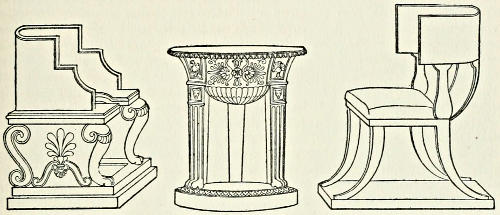
Roman Chairs and Table
Fortunately for the state, two proconsuls, Marcius Rex and Metellus
Creticus, arrived at this moment from the East with some legionary forces,
and awaited at the gates of the city the triumph which they demanded of
the Senate. Marcius was immediately directed against Mallius, Catiline’s
lieutenant in Etruria; Metellus was ordered to make head against the insurgents
in Apulia. Some hasty levies were despatched at the same time to check
the advance of the men of Picenum. Measures were promptly taken for removing
the gladiators from Capua, and distributing them in small numbers
among the neighbouring towns. Rome was placed, according to the modern
phrase, in a state of siege. Citizens were enrolled and armed guards posted
at the gates, the walls and streets patrolled; Cicero assumed command.
Both parties were equally ready for the encounter when the consul
boldly summoned the arch conspirator to discover himself. On the 7th of
November he had convened the senators in the temple of Jupiter Stator.
Catiline appeared in his place: his fellow senators shrank from contact with
him, and left a vacant space on the benches around him. Suddenly the
consul rose, and poured forth the torrent of his indignant eloquence:
“How long then, Catiline, how long will you abuse our patience? What,
are you quite unmoved by the guard which keeps night-watch on the Palatine,
by the patrols of the city, by the consternation of the people, by the
rushing of all good citizens together, by this fortress-temple in which the
senate is assembled, by the fear and horror of the senators themselves?
Think you that all your schemes are not open to us as the day? Alas for our
times! alas for our principles! The senate knows the plot; the consul sees
it—and the man still lives! Lives! did I say? Aye, and comes into
the midst of us, partakes of our public councils, observes and marks us, one
by one, for slaughter. And yet we, the consuls, who have received the senators’
last decree for the preservation of the state—we into whose hands has
been thrust the sword of Scipio, of Opimius, of Ahala, still suffer it to sleep
in its scabbard! Yes, I still wait, I still delay; for I wish you not to perish
till you cease to find a citizen so perverse as to excuse or defend you. Then,
and not till then, the sword shall descend upon you. Meanwhile live, as you
now live, tracked by enemies, surrounded by guards; all our eyes and ears
shall be fixed upon you as they long have been, and watch you when you
think not of it. Renounce then your designs; they are discovered and frustrated.
Shall I tell you what they were? Remember how on the 20th of
October I announced that Manlius was to rise on the 27th; was I wrong?
That the 28th was fixed for the massacre; was it not averted only by my
vigilance? On the 1st of November would you not have seized Præneste,
and did you not find it apprised and guarded? I track your deeds, I follow
your steps, I know your very thoughts.
“Let me tell you whither you repaired last night. Was it not to the
house of Læca? There you met your accomplices, you assigned them each
their places—who should remain at Rome, who with yourself should quit
it; you marked out the quarters to be fired: you only lingered still a moment
because I still lived. Then two Roman knights offered to rid you of that
anxiety, and to kill me in my bed before the dawn of the morrow. All this
I discovered, almost ere your meeting was dissolved: I doubled my guards,
I shut the door against the wretches whom you sent so early to salute me;
aye, the same wretches whom I had already designated to many as the men
who were coming to murder me. You call upon me to impeach you; you
say you will submit to the judgment of the senators; you will go into exile
if it be their pleasure. No, I will not impeach you; I will not subject myself
to the odium of driving you into banishment; though if you wait only for
their judgment, does not their silence sufficiently declare their sentiments?
But I invite, I exhort you to go forth from the city! Go where your armed
bands await you! join Manlius, raise your ruffians, leave the company of
honest citizens, make war against your country! Yet why do I invite you
to do that which you have already determined to do; for which the day is
fixed, and every disposition made?”
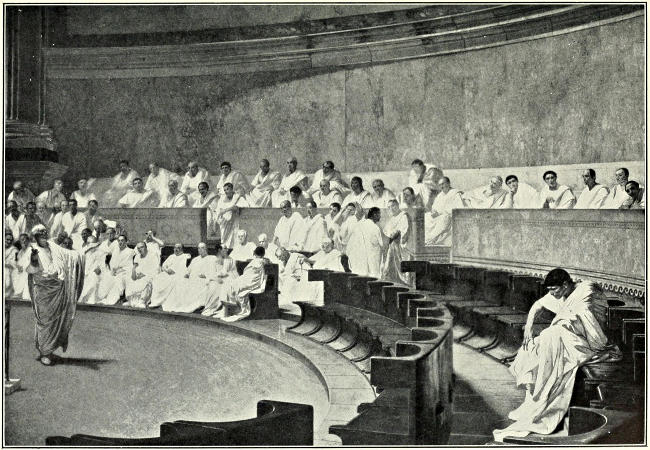
CICERO UPBRAIDING CATILINE IN THE SENATE
And then turning to the senators the orator explained the meaning of
this strange address. He dared not bring the criminal to justice: he had
too many friends even in the senate itself; too many timid people would
declare his guilt unproved; too many jealous people would object to rigorous
measures, and call them tyrannical and regal. But as soon as he should
actually repair to Mallius’ camp, there would no longer be room for doubt.
The consul pledged his word from that moment to lay the proof of the conspiracy
before them, to crush the movement, and to chastise the guilty.
And in order to assure them that he could do so, he pointed to the knights,
who at his bidding were crowding the area and steps of the temple, and
listening in violent agitation at the door, ready at his word to dart upon his
victim, and tear him in pieces before the eyes of the senate.
Catiline had kept his seat throughout this terrible infliction, agitated by
rage and apprehension, yet trusting to the favour of his numerous connections,
and relying on the stolid incredulity of the mass of the audience; for
the habitual use of exaggerated invective had blunted the force of truth, and
rendered the senators callous for the most part even to the most impassioned
oratory. The appearance perhaps of the consul’s myrmidons, and the fear,
not of any legal sentence, but of popular violence, at last made him start to
his feet. He muttered a few broken sentences, in a tone of deprecation,
appealing to his birth, rank, and aristocratic sentiments, in gage of his
loyalty, and in contrast to the specious pretensions of the base-born foreigner,
his accuser. But the senators, encouraged or awed by the presence of the
knights, murmured and groaned around him, calling him an enemy and a
parricide. Then at last losing all self-command, Catiline, rushed wildly out
of the chamber, exclaiming: “Driven to destruction by my enemies, I will
smother the conflagration of my own house in the ruin of the city.”
Catiline fled to his house, shut himself up alone, and for a moment deliberated.
At nightfall he quitted the city and threw himself into the quarters
of his armed adherents in Etruria. He left behind him instructions for
his accomplices in the city, in which he charged them not to quit their
posts, but watch their opportunity to assassinate the consul if possible, at all
events to make all ready for a domestic outbreak as soon as his preparations
should be complete for attacking the city from without. To Catulus, whom
he regarded as a personal friend, or on whom he wished perhaps to throw
the suspicions of the senators, he addressed a letter of exculpation, while he
secured, as he said, his own personal safety in the ranks of a hostile army,
recommending to his fidelity and friendship the care of his dearest interests.
Cicero had reason to exult in the success of his first harangue, which cleared
the way before him. Catiline had openly avowed himself a public enemy;
but his associates still refused to disclose themselves; and the consul’s next
step was to drive them, by similar threats and sarcasms, to an overt act of
rebellion. But for the most part they remained firmly at their posts, as
their leader had enjoined them. One youth, the son of a senator, quitted
the city to join Catiline. His father, informed of his treason, pursued and
arrested him, and caused his slaves to slay him upon the spot. But Lentulus,
Cethegus, and Bestia continued still in Rome, sometimes threatening to
impeach Cicero for the exile of a citizen without judgment pronounced, and
meanwhile planning a general massacre of the magistrates during the approaching
confusion of the Saturnalia. Cicero, served by a legion of spies,
tracked all their movements; but he dared not strike, while still devoid of
written proofs against them. The imprudence of the conspirators at last
placed such documents in his hands.
There happened to be at the time in Rome certain envoys of the Allobroges,
a Gallic people, who had long vainly sued for justice from the republic,
under the cruel exactions to which they had been subjected by the
government in the province. The wild mountaineers whose cause they
pleaded had risen more than once to extort their claims by arms; their discontent,
swelling under repeated disappointment, was ready once more to
explode at any favourable opportunity, while the senate, full of more important
and more alarming affairs, still treated them with contemptuous
neglect. So favourable was the moment that the conspirators addressed the
envoys through a citizen well known to them, named Umbrenus, disclosing
their contemplated plan for the overthrow of the government, and offering
them a dire revenge as the price of their nation’s assistance. They at once
embraced the proposal and promised the aid of their countrymen. But
presently, awed by their deep impression of the invincibility of the consuls
and imperators, they sought the counsel of Fabius Sanga, the patron of their
tribe in Rome. By him they were persuaded to reveal the negotiation to
Cicero, who caused them to affect the deepest interest in the conspiracy,
and to extract from the traitors a written engagement for the price of their
alliance. Lentulus, Cethegus, and Statilius affixed both their names and
seals to the document required. On receiving it the envoys quitted the
city in company with Volturcius, one of the conspirators, deputed to conclude
the negotiation with the Allobroges in their own country. The consul,
kept duly informed of all their proceedings, caused them to be waylaid
at the foot of the Milvian bridge, three miles beyond the gates, and they
immediately surrendered their despatches. While this was in progress the
consul summoned the chief conspirators into his presence. They came without
mistrust; surrounding them with his lictors and archers, he led them
directly to the senate. In the face of the assembled Fathers he produced
the fatal letters; and the culprits, overwhelmed with confusion, acknowledged
their guilt by their silence. Lentulus, who had fondly flattered himself
on the strength of a reputed oracle of the Sibyls that, after Cinna and
Sulla he should be the third Cornelius to reign in Rome, was compelled to
abdicate the prætorship on the spot, and, placed with his associates in the
custody of the most dignified senators, to await the decision of their fate.
Meanwhile, the examination being closed, Cicero addressed the people,
who crowded in agitation and alarm around the doors of the curia, upon
the rumour of the awful disclosures going on within. To the multitude the
wary consul submitted no judicial proof of the culprit’s designs. He contented
himself with declaring the evidence upon which they had been
convicted to be their correspondence with Catiline, a public enemy, and
their detected intercourse with the hostile Allobroges. This sufficed to
brand them as pledged to succour an invader, to harbour him within the
city, to deliver Rome to the fury of Etrurians and Gauls. But to prove
their ulterior designs would have involved the discovery of the consul’s
secret sources of information, it would have been unbecoming the dignity
of the government, and inconsistent with the politic reserve of an aristocratic
assembly.
[63-62 B.C.]
The conspiracy thus critically arrested has been represented, in accordance
with the evidence before us, as the work of mere private cupidity or
ambition. But the ruling party sought to incriminate in it their public
adversaries. They had already studied to implicate both Cæsar and Crassus
in the presumed machinations of Catiline at an earlier period. They now
repeated the effort with increased virulence, and Catulus himself was foremost
in urging Cicero to produce testimony against Cæsar. Such testimony
might doubtless have been suborned; loose surmises might at least have
been construed into grave presumptions. But to such a project the consul
steadily refused to lend himself. He was sensible perhaps that Cæsar’s
popularity would in fact screen from justice every culprit associated with
him, and in giving him the charge of Statilius, one of the criminals, Cicero
openly declared himself convinced of his innocence. Indeed the great difficulty
was still to be overcome, and the consul would not permit himself
recklessly to enhance it. Nine of the conspirators had been denounced, five
were convicted and confined; but the nature of their punishment yet
remained for decision. The law of the republic, as interpreted at least by
the patricians, invested the chief magistrate with power of life and death, on the
senate issuing its ultimate decree. On this authority alone bold men had
slain presumed criminals, and the senate had loudly applauded them.
But against such a stretch of prerogative the commons had always protested.
They had resented such daring deeds, and retaliated them with violence.
They had constantly appealed to the principle of Roman law, which
forbade any citizen to be put to death except by a vote of the tribes. Nor could
the tribes themselves, however sternly disposed, deprive a citizen, as long as he
retained his rights as such, of liberty to evade sentence by voluntary exile.
To the people, accordingly, Cicero could not venture to appeal, nor would
he assume on the other hand the responsibility of acting on the mere decree
of his own order. Hitherto, even while defying the spirit of the laws, he
had scrupulously adhered to their forms. He had abstained from arresting
the conspirators in their own houses, to avoid the violation of a citizen’s
domicile. He had not given Lentulus in charge to his lictors; but had led
him before the senate with his own hand, because none but a consul might
put a prætor under restraint. Finally, he had caused the criminals to be declared
perduelles, or public enemies, in order to strip them of the prerogatives
of citizenship, before proceeding to their punishment. He now threw himself
once more on the senate itself. He restored to the assembly the sword
which it had thrust into his hands. The fathers met in the temple of Concord,
the ground-plan of which may yet be traced under the brow of the
Capitoline, and from the memorials still preserved to us, we may picture to
ourselves a vivid representation of the debate which followed. While strong
patrols traversed the streets, and the knights armed and in great multitudes
surrounded the place of assembly, the consul-designate, Silanus, invited first
to deliver his opinion, pronounced boldly for death. All the consulars, successively,
followed on the same side. It seemed as if the meeting would
have been unanimous, for Crassus had absented himself, and Cæsar, it might
be thought, conscious of his own complicity or at least of the suspicions to
which he was subjected, would desire to efface the stigma in the blood of
the convicted traitors. But he, taking counsel only of his own boldness and
spirit, of the claims of his party, and indeed of his own natural clemency,
declared in a speech of remarkable power, for perpetual imprisonment, and
with confiscation. He allowed indeed that the culprits were justly liable
to the extreme penalty; but to free and high-minded men, degradation, he
contended, was worse than death, which he dared to characterise as mere
oblivion. This speech made a great impression upon the assembly. Those
who were next asked their opinion voted one after the other with Cæsar.
Among them was Quintus Cicero, the consul’s own brother; Silanus
himself thought fit to explain away the sentiments he had just delivered in
accordance with the last speaker. Cicero then rose to stem the current, and
demonstrated with all his eloquence the impossibility of stopping at the point
recommended by Cæsar after having gone so far, and both offended and
alarmed so many dangerous enemies. But this appeal to the fears of
the assembly rather increased than allayed their anxiety to escape from the
immediate responsibility. Cicero’s real influence with them was never great.
A master in the Forum, he was only a minister in the senate. There he was
too generally regarded as a mere bustling politician, who used the means
put into his hands by others for his own glory or
advancement. The senators would have little
heeded his counsel, had it not been reinforced
by an energetic speech from Cato, who pronounced
for the execution of the criminals in a tone of
deep conviction and unflinching courage. Once
more the audience was swayed round to the side
of severity, and Cato’s influence was openly
avowed by the language of the fatal decree itself,
which was expressed in his own words. The
knights, who waited impatiently for the result,
were furious at the obstruction Cæsar had thrown
in the way of justice, and when he appeared on
the steps of the temple could hardly be restrained
from assassinating him. Some of the younger
senators carried him off in their arms, and among
them C. Scribonius Curio was conspicuous for his
spirit and courage.
The knights, it was said, had looked to Cicero
for the signal to consummate their vengeance;
but the consul had turned away. He was giving
orders for the immediate execution of the senate’s
decree, in order to prevent the interference of the
tribunes, or a rescue by main force. He went in
person to the house where Lentulus was detained
on the Palatine, and brought him to the Tullianum,
the prison under the Capitol, whither the
prætors at the same time conducted the other
criminals. The executioners were at hand. Lentulus
was strangled first, and Cethegus, Gabinius,
Statilius, and Ceparius suffered the same fate successively.
When the consul, who had attended to the last, traversed the
Forum on his route homeward, he exclaimed to the crowds through which
he made his way, “They have lived,” and the people shuddered in silence.
Base of a Roman Column
Cicero had performed, as he well knew, an action, the fame of which must
resound through all ages, and for the moment the head of the aspiring Arpinate
swam with the conviction that his name was now linked indissolubly with
the greatest crisis in the history of Rome. The execution took place on
the 5th of December [Feb. 7th, 62] and he had yet another month of office
before him, and Catiline was in arms in Etruria. While he turned from the
contemplation of his own glory to finish his work, the nobles could dwell
with grim satisfaction on an exploit, which proved, as they conceived, to them
that they could defend themselves henceforth without the aid of a military
chief. The patron they suspected and feared had withdrawn from their
presence to collect his forces and assail their prerogative from a distance.
He had left them exposed to the attacks of the Marians, whose courage had
revived in his absence. But, trusting in themselves alone, they had checked
opposition, crushed sedition, and strangled revolution. Should the survivors
appeal, on his return to Pompey, they at once threw down the gauntlet and
defied the commander of their own legions. We shall see how rash their
hot-brained courage was, and how soon they cooled in the presence of the
avenger whom they had evoked. But those among them who already apprehended
his calling them to account, were prepared at least to make a sacrifice
of Cicero, assured that he would accept the victim and pardon the offence.
The successes of the generals of the senate had doubtless inspired
Cicero with confidence to accomplish the act, which he regarded as the
eternal glory of his consulate, and the salvation of his country. The presence
of the troops of the republic had repressed the movements of insurrection
in every quarter. In Etruria alone was the resistance serious and
obstinate. Cicero had purchased the co-operation of his colleague Antonius,
whose vacillation had given confidence to the conspirators, by ceding to him
the province of Macedonia. He had placed him at the head of the troops
destined to act against Catiline in person; but he had furnished him with
firmer and more faithful lieutenants in Sextius and Petreius. While this army
covered Rome, another under Metellus occupied the Cisalpine, and cut off the
rebel’s communications with his Gallic allies. Catiline had assembled twenty
thousand men, but only one-quarter of this number were regularly equipped.
Menaced both in front and rear he turned alternately from the one opponent
to the other, and was trying to shake the loyalty of Antonius, when the
news of the death of his associates threw him into despair. He was now
assured that the senate would never retreat from its position, and even the
gaining of Antonius could only postpone by a few days the ruin which must
eventually overwhelm him. His men too deserted from him by whole
cohorts, and he soon found himself at the head of no more than four thousand
followers. He attempted to penetrate the Apennines, and evading the
forces of Metellus, gain the Alps and excite an insurrection in Gaul. But
the defiles were closed against him, and again he threw himself on Antonius.
The consul himself affected sickness and entrusted his legions to
Petreius. The armies met not far from Pistoria.b
Catiline, when he saw that he was surrounded by mountains and by hostile
forces, that his schemes in the city had been unsuccessful, and that there
was no hope either of escape or of succour, thinking it best, in such circumstances,
to try the fortune of a battle, resolved upon engaging as speedily
as possible with Antonius. Having, therefore, assembled his troops, he
addressed them in the following manner:
“I am well aware, soldiers, that words cannot inspire courage; and that
a spiritless army cannot be rendered active, or a timid army valiant, by the
speech of its commander. Whatever courage is in the heart of a man,
whether from nature or from habit, so much will be shown by him in the
field; and on him whom neither glory nor danger can move, exhortation is
bestowed in vain; for the terror in his breast stops his ears.
“I have called you together, however, to give you a few instructions, and
to explain to you at the same time my reasons for the course which I have
adopted. You all know, soldiers, how severe a penalty the inactivity and
cowardice of Lentulus has brought upon himself and us; and how, while
waiting for reinforcements from the city, I was unable to march into Gaul.
In what situation our affairs now are, you all understand as well as myself.
Two armies of the enemy, one on the side of Rome, and the other on that of
Gaul, oppose our progress; while the want of corn and of other necessaries
prevents us from remaining, however strongly we may desire to remain, in
our present position. Whithersoever we would go, we must open a passage
with our swords. I conjure you, therefore, to maintain a brave and resolute
spirit; and to remember, when you advance to battle, that on your own right
hands depend riches, honour, and glory, with the enjoyment of your liberty
and of your country. If we conquer, all will be safe; we shall have provisions
in abundance; and the colonies and corporate towns will open their
gates to us. But if we lose the victory through want of courage, those same
places will turn against us; for neither place nor friend will protect him
whom his arms have not protected. Besides, soldiers, the same exigency
does not press upon our adversaries, as presses upon us; we fight for our
country, for our liberty, for our life; they contend for what but little concerns
them, the power of a small party.
“We might, with the utmost ignominy, have passed the rest of our days
in exile. Some of you, after losing your property, might have waited at
Rome for assistance from others. But because such a life to men of spirit
was disgusting and unendurable, you resolved upon your present course. If
you wish to quit it you must exert all your resolution, for none but conquerors
have exchanged war for peace. To hope for safety in flight, when you
have turned away from the enemy the arms by which the body is defended,
is indeed madness. In battle, those who are most afraid are always in most
danger; but courage is equivalent to a rampart.
“When I contemplate you, soldiers, and when I consider your past exploits,
a strong hope of victory animates me. Your spirit, your age, your
valour, give me confidence—to say nothing of necessity, which makes even
cowards brave. To prevent the numbers of the enemy from surrounding us,
our confined situation is sufficient. But should Fortune be unjust to your
valour, take care not to lose your lives unavenged; take care not to be taken
and butchered like cattle, rather than, fighting like men, to leave to your
enemies a bloody and mournful victory.”[102]
When he had thus spoken, he ordered, after a short delay, the signal for
battle to be sounded, and led down his troops, in regular order, to the level
ground. Having then sent away the horses of all the cavalry, in order to
increase the men’s courage by making their danger equal, he himself on foot,
drew up his troops suitably to their numbers and the nature of the ground.
As a plain stretched between the mountains on the left, with a rugged rock
on the right, he placed eight cohorts in front, and stationed the rest of his
force, in close order, in the rear. From among these he removed all the
ablest centurions, the veterans, and the stoutest of the common soldiers that
were regularly armed, into the foremost ranks.
On the other side, Caius Antonius, who, being lame, was unable to be
present in the engagement, gave the command of the army to Marcus Petreius,
his lieutenant-general. Petreius ranged the cohorts of veterans, which he
had raised to meet the present insurrection, in front, and behind them the
rest of his force in lines. Then, riding round among his troops, and addressing
his men by name, he encouraged them, and bade them remember that
they were to fight against unarmed marauders, in defence of their country,
their children, their temples, and their homes. Being a military man, and
having served with great reputation, for more than thirty years, as tribune,
prefect, lieutenant, or prætor, he knew most of the soldiers and their
honourable actions, and, by calling these to their remembrance, roused the
spirits of the men.
When he had made a complete survey, he gave the signal with the trumpet,
and ordered the cohorts to advance slowly. The army of the enemy
followed his example; and when they approached so near that the action
could be commenced by the light-armed troops, both sides, with a loud shout,
rushed together in a furious charge. They threw aside their missiles, and
fought only with their swords. The veterans, calling to mind their deeds
of old, engaged fiercely in the closest combat. The enemy made an obstinate
resistance; and both sides contended with the utmost fury. Catiline,
during this time, was exerting himself with his light troops in the front,
sustaining such as were pressed, substituting fresh men for the wounded,
attending to every exigency, charging in person, wounding many an enemy,
and performing at once the duties of a valiant soldier and a skilful general.
When Petreius, contrary to his expectation, found Catiline attacking him
with such impetuosity, he led his prætorian cohort against the centre of the
enemy, amongst whom, being thus thrown into confusion, and offering but
partial resistance, he made great slaughter, and ordered, at the same time,
an assault on both flanks. Manlius and the Fæsulan, sword in hand, were
among the first that fell; and Catiline, when he saw his army routed, and
himself left with but few supporters, remembering his birth and former dignity,
rushed into the thickest of the enemy, where he was slain, fighting to
the last.
When the battle was over, it was plainly seen what boldness, and what
energy of spirit, had prevailed throughout the army of Catiline; for, almost
everywhere, every soldier, after yielding up his breath, covered with his
corpse the spot which he had occupied when alive. A few, indeed, whom
the prætorian cohort had dispersed, had fallen somewhat differently, but all
with wounds in front. Catiline himself was found, far in advance of his
men, among the dead bodies of the enemy; he was not quite breathless, and
still expressed in his countenance the fierceness of spirit which he had shown
during his life. Of his whole army, neither in the battle, nor in flight, was
any free-born citizen made prisoner, for they had spared their own lives no
more than those of the enemy.
Nor did the army of the Roman people obtain a joyful or bloodless victory;
for all their bravest men were either killed in the battle, or left the
field severely wounded.
Of many who went from the camp to view the ground, or plunder the
slain, some, in turning over the bodies of the enemy, discovered a friend,
others an acquaintance, others a relative; some, too, recognised their enemies.
Thus, gladness and sorrow, grief and joy, were variously felt throughout the
whole army.d
While the generals of the republic were still hunting the common enemy
in the Apennines, and even before the execution of Lentulus, the leaders of
the senate had been quarrelling among themselves, as if they had no one to
fear either within or without the city. The election of consuls for the ensuing
year had fallen upon D. Junius Silanus and L. Licinius Murena. We
have seen that Catiline had presumed to offer himself; but a worthier candidate,
the great jurist Sulpicius, was also disappointed, and resenting the
notorious bribery employed by his rivals, had rushed to prosecute Murena.
Bribery there had been probably on all sides, and Rome could ill afford at
such a moment to waste her energies in a private squabble. Cicero, intent
upon his schemes for the frustration of the conspiracy, could not endure that
the public attention should be withdrawn to the miserable intrigues of the
rival candidates, and stepped forward to defend Murena. But Cato, insensible
to every argument from expediency, and unable to see two sides of any
question, supported the suit of the accuser with headlong pertinacity. A
part of Cicero’s speech was directed to undermine the influence of so virtuous
an advocate. “Would you know, judges, what sort of person a sage of the
Porch is? He concedes nothing to favour, he never pardons. Compassion,
he says, is frivolousness and folly; the wise only are beautiful, though crooked
and deformed; he only is rich though a beggar, a lord though a slave; but
we, he declares, who are no sages, are no better than runaways, outlaws,
enemies, and madmen. All faults, he affirms, are equal; every error is a
heinous sin; to wring a fowl’s neck without just reason is as bad as to
strangle one’s father. The wise man never doubts, never repents, is never
deceived, can never change his mind.” And in this strain he continued to
the infinite amusement of his audience, who were well pleased to hear the
philosopher bantered. Cato joined good-humouredly in the laugh. “How
witty a consul we possess,” was the only remark he made. Nor did he afterwards
retain any feeling of displeasure against the orator who both defeated
his prosecution and turned him into ridicule.[103]
[62 B.C.]
In the midst of their contentions amongst themselves for the highest
magistracy, the nobles had allowed Cæsar to obtain the prætorship, the
second rank in the scale of office. Pompey had despatched one of his creatures,
Metellus Nepos, from Asia to secure one place in his interest on the
bench of tribunes. Cato had refused to be nominated to another; and he
was journeying into Lucania to avoid the turmoil of the elections, in which
he declined to take a part, when he met the Pompeian candidate on the road,
and learned the object of his return. He now felt it incumbent upon him, as
a true patriot, to watch and check the intrigues of the dangerous proconsul.
Hastily retracing his steps, he presented himself to the people for election,
and obtained a seat in the tribunate in conjunction with Metellus and others.
Jealousies, suspicions, and preparations for violence were rife on all sides. The
people were alarmed for the safety of their favourite Cæsar, and after the execution
of Lentulus, when he was once detained longer than usual in the senate,
surrounded the curia with hostile cries, insisting on his being produced to
satisfy them of his safety. The Marian chief indeed was himself far from
daunted. He laughed to scorn the new-born courage of the nobles. On the
1st of January the chief men and dignitaries of the state were wont to ascend
the Capitol, and there offer their greetings to the new consuls. Cæsar, however,
instead of assisting in this act of official courtesy, took advantage of the
absence of his colleagues and rivals to address the people in the Forum, and
to propose that Catulus should be deprived by their vote of the honours due
to him as restorer of the temple of Jupiter Capitolinus. Since its destruction
by fire in the time of Sulla, it had taken twenty years to rebuild that
august edifice, the glory of the city and the empire; and the work had now
been brought to completion by Catulus, to whom, as prince of the senate,
the most dignified of all the citizens, that honourable duty had been assigned.
Catulus might now expect that his name, as the restorer of the structure,
should be engraved upon its front; and no noble Roman would fail to prize
such a commemoration of his services as dearly as a consulship or a triumph.
Cæsar now charged him with peculation, and insisted on the production of
his accounts; meanwhile, he urged the people to resolve that the final consummation
of the work should be transferred to Pompey. But the nobles,
on hearing what was passing, rushed from the presence of the consuls with
all their friends and adherents into the Forum, and succeeded in averting the
blow. The name of Lutatius Catulus was duly inscribed upon the proudest
monument of the national pride, and bore witness to the glory of the most
blameless hero of the later commonwealth, till the temple was again destroyed
in the wars of Vitellius and Vespasian.
Nor was this the only defiance hurled against the senate on that memorable
day. Nepos, the tribune, had put himself in communication with
Cæsar, and combined with him to insult the dominant faction, even in the
moment of its victory. The execution of the conspirators had already been
denounced as a murder, ere the echoes had died away of the shouts amidst
which it had been perpetrated. Cicero, on resigning the fasces, presented
himself to harangue the people, and detail the events of his consulship. It
was a proud day for him, and he was prepared to enjoy it. But Nepos
abruptly interposed: “The man,” he said, “who condemned our fellow-citizens
unheard, shall not be listened to himself”; and he required him to
confine himself to the customary oath, that he had done nothing contrary
to the laws. “I swear,” exclaimed Cicero, “that I have saved the state.”
The nobles shouted applause: Cato hailed him as “the father of his country”;
and the general acclamations of the people overwhelmed every opposing
whisper. The nobles were elated by the unaccustomed sounds of popular
applause; but Nepos threatened the recall of Pompey, ostensibly to oppose
Catiline, who was still in arms, but really to bear down the free act of the
senate. Cato vowed that while he lived no such rogation should pass. A
scuffle ensued in which Cato proceeded to actual violence; his colleague
declared his sanctity violated, and fled to his patron’s camp. The senate
declared his office vacant (for the tribune was forbidden by law to quit the
city); and at the same time suspended Cæsar from his functions.
The prætor refused to quit his tribunal till compelled by a military force,
whereupon he dismissed his lictors, divested himself of the ensigns of office,
and retired with dignity to his pontifical dwelling. The populace now
assembled to avenge the insult cast upon their favourite. A riot ensued,
which compelled the consuls to retrace their steps, not without obsequious
expressions of respect and deference towards him. Cicero had become
already sobered from the intoxication of his recent triumph. The cold distance
Pompey observed towards his party mortified and alarmed him.
Crassus loudly accused him of having calumniated him, and the enmity
of Crassus was not to be despised. Finally a tribune had just seemed to
menace him with impeachment, notwithstanding the decree of the senate
which had forbidden any action to be brought against those who had aided
in the punishment of the conspirators. These resentments the discreet consular
now studied to allay. He sought to appease Crassus; he proclaimed
aloud the zeal which Cæsar had displayed in being the first, as he attested, to
disclose to him Catiline’s machinations; and he who had lately exclaimed,
“Let arms give place to the gown,” now prostrated himself before Pompey,
whom he exalted above Scipio, begging only for himself the humble place
of a Lælius. He even sought allies for himself among the accomplices of
Catiline. P. Sulla, one of the conspirators, was defended by Cicero, and
acquitted in the face of manifest proofs. The orator struggled to maintain
that union between the two privileged orders of the commonwealth, the
senators and knights, the cherished aim of his policy, which seemed at last
to be accomplished on the steps of the temple of Concord. But when the
nobles spurned the knights haughtily from them; when Cato, reckless of the
misery of the provincials, repulsed the prayer of the publicans of Asia, who
sought relief from their contract with the treasury, on account of the deep
impoverishment of the revenues they
had undertaken to farm, insisting
that they should be held to the strict
letter of their bargain; when the
chasm between the two orders seemed
once more to open before his eyes,
having now to choose between the
class to which he belonged by birth
and natural sympathies and that to
which his genius had exalted him,
Cicero weakly threw himself upon
the former, and proclaimed himself
the creature of the aristocracy which
despised him. The concessions he
had made came too late to save either
himself or them. The friends of Catiline
still devoted him to their direst
revenge; the demagogues lashed the
people into fury against him; Cæsar
smiled at his mistakes, while Crassus
scarcely disguised the rancour of his
hate under the veil of frigid courtesy.

Ruins of the Palace of the Cæsars, Rome
The nobles committed indeed no
greater error than when they inflamed
the enmity of Crassus by divulging
their suspicions of him, and at the
same time shrank from disarming it
by force. Assuredly they should
have made him their friend, and this
they might have done perhaps at a
trifling sacrifice of their vanity. Crassus was liked by none, but few could
afford to despise him; while his ambition might have been kept within bounds
by the concession of legitimate honours and dignities, and the show of listening
to his counsels. At the moment when Pompey was passing over to the
people, Crassus might have been retained on the side of the oligarchy from
which he had never wholly estranged himself. His immense riches, the sources
of which lay close at hand, gave him clients in the senate as well as among the
knights: his slaves, his freedmen, his debtors and his tenants constituted an
army in the heart of the city, to sway the debates of the Forum and overawe
its seditions. But when the nobles refused to support him in his suit for
the consulship, they drove him to league himself with his popular competitor
Pompey: when they denounced him as a confederate of Catiline, they threw
him into the arms of Cæsar. By lending money to the Marian spendthrift,
Crassus thought that he made him his own; but in fact he bound himself to
the fortunes of his rival, from whose entire success he could alone hope to be
repaid.
Cæsar’s suspension from his prætorship had only served to attach his
party more closely to him; an incident soon occurred by which it was hoped
to sow discord between them. P. Clodius, the corrupt accuser of Catiline, a
turbulent intriguer like so many members of his house, had ingratiated himself
with the people by his popular manners. This beardless youth, already
alike notorious for his debts and his gallantries, had introduced himself into
Cæsar’s house in female attire during the celebration of the rites of the Bona
Dea, which should have been studiously guarded from male intrusion. A
servant-maid discovered him and uttered a cry of alarm; the mysteries were
hastily veiled and the intruder expelled; but the assembled matrons rushing
hastily home revealed each to her husband the scandal and the sin. The
nobles affected grave alarm; the pontiffs were summoned and consulted, and
the people duly informed of the insult offered to the deity. As chief of the
sacred college, Cæsar could not refrain from lending himself to the general
clamour; but his position was delicate. On the one hand the presumed
delinquent was an instrument of his own policy, while on the other his own
honour and that of his wife Pompeia were compromised by the offence.[104]
He disappointed everybody. He divorced his wife, not because she was
guilty, but because “the wife of Cæsar,” as he said, “should be above
suspicion.” But he refused to countenance the measures which the consuls
took, by direction of the senate, for the conviction of the reputed culprit;
and it may be suspected that the money with which Clodius bribed his
judges was a loan negotiated with Crassus by Cæsar himself. Cicero for
his part had been lukewarm in an affair, the barefaced hypocrisy of which he
was perhaps too honourable to countenance; but, urged by his wife Terentia,
a violent woman who meddled much in his affairs, and was jealous at the
moment of a sister of the culprit, he clearly disproved his allegation of
absence from the city, and thus embroiled himself, to no purpose, with an
able and unscrupulous enemy. The senate believed their cause gained; the
proofs indeed were decisive, and they had assigned at their own request a
military guard to the judges to protect them from the anticipated violence
of a Clodian mob; but to their consternation, on opening the urns, the votes
for an acquittal were found to be thirty-one opposed to twenty-five. “You
only demanded a guard, then,” exclaimed Catulus with bitter irony, “to
secure the money you were to receive.” Cicero attributed to Crassus the
scandal of this perversion of justice; the nobles sneered at the corruption of
the knights, and the gulf which separated the two orders yawned more
widely than ever.
[62-61 B.C.]
The profanation of the mysteries had occurred in December of the year
62, but the Clodian process, retarded by various intrigues, did not take place
for some months. Meanwhile, before the end of January, Pompey had returned
from the East, and reached the gates of the city. He appeared there
as an imperator, to solicit a triumph, at the head of a small detachment of
his legionaries; but no sooner had he touched land at Brundusium than he
had dismissed the mass of his victorious army, with the promise of estates
which he made no doubt of obtaining for them from the senate. All parties
were in anxious expectation of the use he would make of his power in quelling
the feuds of the city, and some perhaps apprehended that he would extinguish
the legitimate powers themselves from the perversion of which they
sprang. All were amazed at the generosity or arrogance with which he divested
himself of the support of his soldiers, and trusted to the glory of his
name for maintaining his ascendency in the commonwealth. The senators
indeed regarded it as a weakness, and presumed that their adversary cowered
under the imposing attitude they had assumed. The laws forbade him to
enter the city while he yet retained the military command, but both the
senate and the people held meetings in the Field of Mars to hear him recount
his exploits, and to collect from his own mouth the policy he proposed to
adopt. Of his own actions he spoke magniloquently; but when he touched
on domestic affairs his language was studiously moderate and conciliatory.
He declared his deep respect for the great council of the nation; but withheld
a word of approval of their recent or their pending measures. In order
to draw him out Crassus was induced to utter an encomium on Cicero’s conduct
in his consulship; and upon that hint, Cicero himself rose to improve
the occasion, and enlarged with his usual copious rhetoric on the dangers
from which he had saved the state. He spoke, as he alone could speak, of
the dignity of the senate, the loyalty of the knights, the favour of the Italians,
the paralysis of every element of disaffection, the cheapness of provisions,
the security of the commonwealth. The senate responded to the
speaker’s satisfaction; it was the crowning day of Cicero’s vanity, yet one
triumph was wanting to it—Pompey would not be drawn into any indication
of his views.
Pompey seems to have held himself aloof from the proceedings relative
to Clodius. Cæsar was also anxious to extricate himself from them, and the
expiration of his prætorship had opened to him an honourable retreat in
the province of the Further Spain. But there were two impediments in his
way; the one lay in the deep embarrassment of his debts; the other was a
decree of the senate, passed on purpose to retain him at home, by which the
magistrates were forbidden to go to their provinces before the decision of the
Clodian process. Cæsar’s private means had been long exhausted. The
friends who had continued to supply his necessities had seemed to pour their
treasures into a bottomless gulf; so vast was his expenditure in shows, canvasses,
and bribes; so long and barren the career of public service through
which this ceaseless profusion had to be maintained. At this period when the
bold gamester was about to throw his last die, he could avow, that he wanted
250,000,000 sesterces (above £2,000,000 or $10,000,000) to be “worth nothing.”
Before he could enter on the administration of his province he had
pressing creditors to satisfy, and expensive preparations to make. Every
other resource had been drained, but Cæsar could apply to Crassus for a loan.
The wealthiest of the Romans hated the Great Captain who had just returned
to the city, and he saw in Cæsar the readiest instrument for lowering his
estimation. He held in pawn the treasures of Iberia. The sum required was
830 talents (£200,000) and this was placed at once in Cæsar’s hands. With
the other impediment the proprietor ventured to deal in a more summary
manner. He had reason to apprehend that a scheme was in contemplation to
retain him at home by a political impeachment; but he knew that once at
the head of his legions his foes would not dare recall him, and he trusted to
reap such a harvest both of treasure and reputation as would screen him
from the effects of their malice on his return.
The evasion of Cæsar and the escape of Clodius mortified the senate,
which wreaked its sullen humour on Pompey by delaying the official ratification
of his acts, and the satisfaction of his veterans. It had conceded
the honour of a triumph to Lucullus in spite of the impediments opposed
thereto by his successor in the eastern command, and still more recently, by
conferring a similar distinction on Metellus, together with the surname of
Creticus, it had expressed its approbation of the conduct of the very general
against whom Pompey had made war for disobedience to his orders. Now
that the conqueror of Mithridates had himself returned to claim the last
reward of military prowess, it seems to have harassed him with mortifying
delays, for it was not till the end of September, nine months after his return
to Rome, that his triumph was actually celebrated. Meanwhile he had been
compelled to intrigue for the election of a creature of his own to the consulship;
and while he thus bought the interest of Afranius, a weak and frivolous
friend, he was mortified by the appointment of Metellus Celer, a decided
enemy, as his colleague. His vanity was perhaps in some measure indemnified
by the glories of his triumph, which lasted two days, amidst a display of
spoils and trophies such as Rome had never before witnessed. The proconsul
boasted that he had conquered twenty-one kings, and that Asia, which he had
found the farthest province of the empire, he had left its centre. Banners borne
in the procession announced that he had taken 800 vessels, 1000 fortresses
and 900 towns; thirty-nine cities he had either founded or restored; he had
poured 20,000 talents (about £5,000,000 sterling) into the treasury, and nearly
doubled the national revenues. Above all he plumed himself, says Plutarch,
on having celebrated his third triumph over a third continent. For though
others before him had triumphed three times, Pompey by having gained his
first over Libya, his second over Europe, and this the last over Asia, seemed
in a manner to have brought the whole world within the sphere of his conquests.
But on descending from his chariot the hero found himself alone in
the city in which he had once been attended by such crowds of flatterers
and admirers. Lucullus, stimulated beyond his wont by the presence of
his rival, attacked his conduct in every particular; the senate was cold
or hostile; even Cicero discovered that his idol was formed of ordinary clay.
When the new consuls entered on their office Afranius was no match for
his far abler colleague, and the ratification of the proconsul’s acts was
still petulantly withheld. Pompey had disposed of crowns, he had made
and unmade kingdoms, he had founded municipal commonwealths, in short
he had regulated everything at his sovereign pleasure, from the Ægean
to the Red Sea. It concerned his honour to show to his friends and foes
throughout the East, that he was not less powerful in the city than he
had pretended to be in the camp. He demanded a public ratification, full,
prompt, and unquestioning. But Lucullus, supported by Cato, demanded
that each separate act should be separately discussed. Such a method of
proceeding could not fail to result in numerous checks and mortifications
to him; even the delay would suffice to show that he had fallen from his
vaunted supremacy. Pompey chose rather to forego altogether the formal
ratification of arrangements which he knew were not likely to be in fact
disturbed. At the same time he instructed a tribune named Flavius to
demand lands for his veterans. Cato and Metellus again opposed him;
then violence ensued, and the tribune complaining that his sanctity was
profaned, dragged the consul to prison. The senate insisted upon sharing
the insult offered to its chief, and Pompey, ashamed of the insolence of
his own creature, gave way once more, and withdrew his demands for a
more favourable opportunity. But he was deeply chagrined at the treatment
he had experienced, which dishonoured him in the eyes of his soldiers
and of all Asia. Then, too late, he began perhaps to regret the disbanding
of his legions. Repulsed by the nobles he betook himself once more to
the people, and sought by popular arts to revive the prestige of his arms.
But the first place in their regards was no longer vacant. Cæsar was
securely lodged in their hearts, and with him the newcomer must be content
to share a divided empire.b
[60-59 B.C.]
Cæsar had taken his departure for Spain before Pompey’s return. In
that province he availed himself of some disturbances on the Lusitanian
border to declare war against that gallant people. He overran their country,
and turned his arms against the Gallæcians, who seem to have been unmolested
since the days of Dec. Brutus. In two campaigns he became master
of spoils sufficient not only to pay off a great portion of his debts, but also
to enrich his soldiery. There can be no doubt that he must have acted
with great severity to wring these large sums from the native Spaniards;
indeed he never took thought for the sufferings of people not subject to
Roman sway. But he was careful not to be guilty of oppression towards the
provincials; and his rule in the Spanish provinces was long remarked for
its equitable adjustment of debts due to Roman tax-collectors.b
Cæsar, who by expeditions against the Lusitanians had, as he considered,
gained sufficient materials for a triumph, and was anxious to obtain the consulate,
hastened home when the time of the elections was at hand (60). As
there was no room for delay, he applied to the senate for permission to enter
the city before his triumph in order to canvass the people; but Cato and
his friends opposing, it was refused. Cæsar, who was not a man to sacrifice
the substance for the show, gave up the triumph; and entering the city
formed a coalition with L. Lucceius, a man of wealth who was also a candidate,
of which the terms were that Lucceius should distribute money in his
own and Cæsar’s name conjointly, and Cæsar in like manner give him a
share in his influence. The nobles, when they saw this coalition, resolved
to exert all their interest in favour of M. Calpurnius Bibulus, the other
candidate, and, with even Cato’s consent, authorised him to offer as high as
Lucceius, engaging to raise the money among them. Bibulus therefore
was elected with Cæsar, whose daring projects the senate thus hoped to
restrain.
Cæsar, who well knew the character of Pompey, resolved to make him
and Crassus the ladder of his ambition. He represented to them how
absurd their jealousy and enmity was, which only gave importance to such
people as Cato and Cicero; whereas if they three were united they might
command the state. They saw the truth of what he said, and each blinded
by his vanity and ambition, expecting to derive the greatest advantage from
it, agreed to the coalition; and thus was formed a triumvirate, as it is
termed, or confederacy, bound by a secret pledge that no measure displeasing
to any one of the parties should be allowed to pass.
Cæsar, as soon as he entered on his office (59), introduced an agrarian
law for dividing the public land among Pompey’s soldiers and the poorer
citizens; purchasing it however from the present possessors, and appointing
twenty commissioners to carry the law into effect, among whom were to be
Pompey and Crassus. This law, to which they could make no objection, was
highly displeasing to the adverse party in the senate, who suspected Cæsar’s
ulterior designs, and Cato declared strongly against any change. Cæsar
ordered a lictor to drag him off to prison; he professed himself ready to go
that instant, and several rose to follow him. Cæsar then grew ashamed
and desisted, but he dismissed the senate, telling them he would bring the
matter at once before the people; and he very rarely called the senate
together during his consulate.
He then laid before the people his bill for dividing the lands of Campania,
in lots of ten jugera, among twenty thousand poor citizens with three
or more children;[105] and being desirous to have some of the principal persons
to express their approbation of it, he first addressed his colleague, but
Bibulus declared himself adverse to innovation; he then affected to entreat
him, asking the people to join with him, as if Bibulus wished they might
have it; “Then,” cried Bibulus, “you shall not have it this year even if
you all will it,” and went away; Cæsar, expecting a similar refusal from
the other magistrates, made no application to them, but bringing forward
Pompey and Crassus desired them to say what they thought of the law.
Pompey then spoke highly in favour of it, and on Cæsar and the people asking
him if he would support them against those who opposed it, he cried,
elate with this proof of his importance, “If any man dares to draw a sword
I will raise a buckler!” Crassus also expressed his approbation, and as the
coalition was a secret, the example of these two leading men induced many
others to give their consent and support to the law. Bibulus however was
still firm, and he was supported by three of the tribunes; and, as a means
of impeding the law, he declared all the remaining days of the year nefasti,
or holy days. When Cæsar, regardless of his proclamations, fixed a day
for passing the law, Bibulus and his friends came to the temple of Castor,
whence he was haranguing the people, and attempted to oppose him; but
he was pushed down, a basket of dung was flung upon him, his lictors’ fasces
were broken, his friends (among whom were Cato and the tribunes) were
beaten and wounded, and so the law was passed. Bibulus henceforth did
not quit his house, whence he continually issued edicts declaring all that
was done on the nefast days to be unlawful. The tribune P. Vatinius, one
of Cæsar’s creatures, had even attempted to drag him to prison, but he was
opposed by his colleagues.
The senate was required to swear to this law, as formerly to that of
Saturninus. Metellus Celer, Cato, and Cato’s imitator Favonius at first declared
loudly that they would not do so; but having the fate of Numidicus
before their eyes, and knowing the inutility of opposition, they yielded to
the remonstrances of their friends.
Having thus gained the people, Cæsar proceeded to secure the knights,
and here Cato’s Utopian policy aided him. This most influential body
thinking, or pretending, that they had taken the tolls at too high a rate, had
applied to the senate for a reduction, but Cato insisted on keeping them to
their bargain. Cæsar without heeding him or the senate reduced them at
once a third, and thus this self-interested body was detached from the party
of the aristocracy, and all Cicero’s work undone. Cæsar now found himself
strong enough to keep his promise to Pompey, all whose acts in Asia were
confirmed by the people.
[59-58 B.C.]
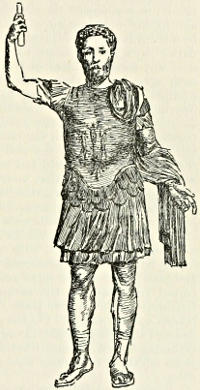
Clodius
(From a statue)
The triumvirate, or rather Cæsar, was extremely anxious to gain Cicero
over to their side, on account of the influence which he possessed. But
though he had a great personal regard for Pompey he rejected all their
overtures. Cæsar then resolved to make
him feel his resentment, and the best mode
seemed to be to let Clodius loose at him.
This profligate had long been trying to become
a tribune of the people, but for that
purpose it was necessary he should be a
plebeian, which could only be effected by
adoption. His first efforts were unavailing;
but when Cicero, in defending his former
colleague Antonius, took occasion to make
some reflections on the present condition of
the commonwealth, Cæsar to punish him
had the law for Clodius’ adoption passed at
once, Pompey degrading himself by acting
as augur on this occasion, in which all the
laws and rules on the subject were violated.
This affair is said to have been done with
such rapidity, that Cicero’s words which
gave the offence were only uttered at noon
and three hours after Clodius was a plebeian!
Some time after, a knight named L. Vettius,
who had been one of Cicero’s informers
in the affair of Catiline, being suborned,
it is said, by Cæsar, declared that several
young noblemen had entered into a plot, in
which he himself partook, to murder Pompey;
the senate ordered him to prison;
next day Cæsar produced him on the rostra,
when he omitted some whom he had named
to the senate, and added others, among whom
were Lucullus and Cicero’s son-in-law Piso,
and hinted at Cicero himself. Vettius was taken back to prison, where he
was privately murdered by his accomplices, as Cæsar said,—by Cæsar himself,
according to others.
The senate, to render Cæsar as innocuous as possible, had, in right of
the Sempronian law, assigned the woods and roads as the provinces of the
consuls on the expiration of their office. But Cæsar had no idea of being
foiled thus; and his creature, the tribune Vatinius, had a law passed by
the people, giving him the province of Cisalpine Gaul and Illyricum, with
three legions, for five years; and when on the death of Metellus Celer he
expressed a wish to have Transalpine Gaul added, the senate, as he would
otherwise have applied to the people, granted it to him with another legion.
In order to draw the ties more closely between himself and Pompey, he had
given him in marriage his lovely and amiable daughter Julia, and he himself
married the daughter of L. Calpurnius Piso, whom, with A. Gabinius, a
creature of Pompey, the triumvirs had destined for the consulate of the
following year. They also secured the tribunate for Clodius; and thus
terminated the memorable consulate of Cæsar and Bibulus.
[58-57 B.C.]
Clodius lost no time (58) in preparing for his attack on Cicero. To win
the people, he proposed a law for distributing corn to them gratis; by another
law he re-established the clubs and unions, which the senate had suppressed,
and formed new ones out of the dregs of the populace and even of the slaves;
by a third law he prohibited any one from watching the heavens on assembly
days;[106] by a fourth, to gain the profligate nobility, he forbade the censors to
note any senator unless he was openly accused before them, and that they
both agreed. He then made sure of the consuls, who were distressed and
profligate men, by engaging to get Macedonia and Achaia for Piso as his
province, and Syria for Gabinius. Having thus, as he thought, secured the
favour of the consuls, the nobility, and the people, and having a sufficient
number of ruffians from the clubs and unions at his devotion, he proposed a
bill interdicting from fire and water any person who, without sentence of
the people, had or should put any citizen to death. Cicero, who, though he
was not named, knew that he was aimed at, was so foolish and cowardly as
to change his raiment (a thing he afterwards justly regretted), and go about
supplicating the people according to custom, as if he were actually accused;
but Clodius and his followers met him in all the streets, threw dirt and
stones at him, and impeded his supplications. The knights, the young men,
and numbers of others, with young Crassus at their head, changed their
habits with him and protected him. They also assembled on the Capitol,
and sent some of the most respectable of their body on his behalf to the
consul Gabinius and the senate, who were in the temple of Concord; but
Gabinius would not let them come near the senate, and Clodius had them
beaten by his ruffians. On the proposal of the tribune L. Ninnius, the senate
decreed that they should change their raiment as in a public calamity; but
Gabinius forbade it, and Clodius was at hand with his cut-throats, so that
many of them tore their clothes, and rushed out of the temple with loud
cries.
Pompey had told Cicero not to fear, and repeatedly promised him his
aid; and Cæsar, whose design was only to humble him, had offered to
appoint him his legate, to give him an excuse for absenting himself from the
city; but Cicero suspecting his object in so doing, and thinking it derogatory
to him, had refused it. He now found that Pompey had been deceiving
him, for he kept out of the way lest he should be called on to perform his
promises. Sooner, as he says, than be the cause of civil tumult and bloodshed,
he retired by night from the city, which but five years before he had
saved from the associates of those who now expelled him. Cæsar, who
had remained in the suburbs waiting for the effect of Clodius’ measures, then
set out for his province. When Clodius found that Cicero was gone, he had
a bill passed interdicting him from fire and water, and outlawing any person
living within four hundred miles of Rome who should entertain him. He
burned and destroyed his different villas and his house on the Palatine, the
site of which he consecrated to Liberty! His goods were put up to auction,
but no one would bid for them; the consuls, however, had taken possession
of the more valuable portions of them for themselves.
Cicero, it is much to be lamented, bore his exile with far less equanimity
than could have been wished for by the admirers of his really estimable character;
his extant letters are filled with the most unmanly complaints, and he
justly drew on himself the derision of his enemies. But his was not one of
those characters which, based on the high consciousness of worth, derive all
their support and consolation from within; it could only unfold its bloom
and display its strength beneath the fostering sun of public favour and applause,
and Cicero was great nowhere but at Rome. It was his first intention
to go to Sicily, but the prætor of that island, C. Virgilius, who had been his
intimate friend, wrote desiring him not to enter it. He then passed over to
Greece, where he was received with the most distinguished honours, and
finally fixed his residence in Macedonia, where the quæstor Cn. Plancius
showed him every attention.
Having driven Cicero away, Clodius next proceeded to remove Cato, that
he might not be on the spot to impede his measures. He proposed at the
same time to gratify an old grudge against the king of Cyprus, the brother
of the king of Egypt; for when Clodius was in Asia he chanced to be taken
by the pirates, and having no money he applied to the king of Cyprus, who
being a miser, sent him only two talents, and the pirates sent the paltry sum
back, and set Clodius at liberty without ransom. Clodius kept this conduct
in his mind; and just as he entered on his tribunate, the Cypriots happening
to send to Rome to complain of their king, he caused a bill to be passed for
reducing Cyprus to the form of a province, and for selling the king’s private
property; he added in the bill, that this province should be committed to
Cato as quæstor, with prætorian power, who (to keep him the longer away
from Rome) was also directed to go to Byzantium, and restore the exiles
who had been driven thence for their crimes. Cato, we are assured, undertook
this most iniquitous commission against his will; he executed it, however,
most punctually. He went to Rhodes, whence he sent one of his friends
named M. Canidius to Cyprus, to desire the king to resign quietly, offering
him the priesthood of the Paphian goddess. Ptolemy however preferred
death to degradation, and he took poison. Cato then, not trusting Canidius,
sent his nephew, M. Junius Brutus, to look after the property, and went
himself to Byzantium, where he effected his object without any difficulty. He
then proceeded to Cyprus to sell the late king’s property; and being resolved
to make this a model sale, he attended the auction constantly himself,
saw that every article was sold to the best advantage, and even offended his
friends by not allowing them to get bargains. He thus brought together a
sum of seven thousand talents, which he made up in vessels containing two
talents five hundred drachmæ each, to which he attached a cord and cork,
that they might float in case of shipwreck. He also had two separate accounts
of the sale drawn out, one of which he kept, and the other he committed to
one of his freedmen, but both happened to be lost, and he had not the gratification
of proving his ability of making the most of a property.
When the news that Cato had entered the Tiber with the money reached
Rome, priests and magistrates, senate and people, poured out to receive him;
but though the consuls and prætors were among them, Cato would not quit
his charge till he had brought his vessel into the docks. The people were
amazed at the quantity of the wealth, and the senate voted a prætorship to
Cato, though he was under the legal age, and permission to appear at the
games in a prætexta, of which however he took no advantage. No one thought
of the iniquity of the whole proceeding; and when Cicero, after his return,
wished to annul all the acts of Clodius’ tribunate, Cato opposed him, and this
caused a coolness between them for some time.
Cicero had been only two months gone when his friend Ninnius the tribune,
supported by seven of his colleagues, made a motion in the senate for his
recall. The whole house agreed to it, but one of the other tribunes interposed.
Pompey himself was, however, now disposed to join in restoring
him, for Clodius’ insolence was gone past his endurance. This ruffian had
by stratagem got into his hands the young Tigranes, whom Pompey had
given in charge to the prætor L. Flavius. He had promised him his liberty
for a large sum of money; and when Pompey demanded him, he put him on
board a ship bound for Asia. A storm having driven the vessel into Antium,
Flavius went with an armed force to seize the prince, but Sex. Clodius, one
of the tribune’s bravos, met him on the Appian road, and, after an engagement
in which several were slain on both sides, drove him off. While Pompey
was brooding over this insult, one of Clodius’ slaves was seized at the door
of the senate-house with a dagger, which he said his master had given him
that he might kill Pompey; Clodius’ mob also made frequent attacks on him,
so that out of real or pretended fear he resolved to keep his house till the
end of the year; indeed he had been actually pursued to and besieged in it
one day by a mob, headed by Clodius’ freedman Damio, and the consul
Gabinius had to fight in his defence. Pompey therefore now resolved to
befriend Cicero; and P. Sextius, one of the tribunes-elect, took a journey
into Gaul to obtain Cæsar’s consent. About the end of October the eight
tribunes again proposed a law for his recall, and P. Lentulus Spinther, the
consul-elect, spoke strongly in favour of it. Lentulus’ colleague, Q. Metellus
Nepos, though he had been Cicero’s enemy, seeing how Cæsar and Pompey
were inclined, promised his aid, as also did all the tribunes-elect: Clodius,
however, soon managed to purchase two of them, namely, Num. Quinctius
and Sex. Serranus.
[57-56 B.C.]
On the 1st of January (57) Lentulus moved the senate for Cicero’s recall.
L. Cotta said that as he had been expelled without law, he did not require
a law for his restoration. Pompey agreed, but said that for Cicero’s sake
it would be better if the people had a share in restoring him. The senate
were unanimously of this opinion, but the tribune Sex. Serranus interposed.
The senate then appointed the 22nd for laying the matter before the people.
When that day came, the tribune Q. Fabricius set out before it was light
with a party to occupy the rostra; but Clodius had already taken possession
of the Forum with his own gladiators, and a band he had borrowed
from his brother Appius, and his ordinary troop of ruffians. Fabricius’ party
was driven off with the loss of several lives, another tribune, M. Cispius, was
treated in a similar manner, and Q. Cicero only saved himself by the aid
of his slaves and freedmen. In the picture which Cicero draws in his orations
of this scene, the Tiber and the sewers are filled with dead bodies,
and the Forum covered with blood as in the time of the contest of Cinna and
Octavius.
The contest was renewed with daylight, and the tribune Sextius was
pierced with twenty wounds and left for dead. Clodius then, elate with his
victory, burned the temple of the Nymphs, where the books of the censors
were kept; and he attacked the houses of the prætor L. Cæcilius, and the
tribune T. Annius Milo. The latter impeached Clodius, de vi, but his
brother Appius the prætor, and the consul Metellus, screened him, and
meantime aided his suit for the ædileship, which would protect him for
another year. Milo then, to repel force by force, also purchased a band of
gladiators, and daily conflicts occurred in the streets.
The senate, resolved not to be thus bullied, directed the magistrates to
summon well-affected voters from all parts of Italy. They came in great
numbers from every town and district. Pompey, who was then at Capua,
exerted himself greatly in the affair. Encouraged by their presence the
senate passed a decree in proper form for Cicero’s restoration; but Clodius
still was able to prevent its ratification by the people. The senate then
met on the Capitol; Pompey spoke highly in praise of Cicero; others followed
him; Metellus, who had been playing a double part all through,
ceased to oppose, and a decree was passed, Clodius alone dissenting. The
senate met again the next day; and Pompey and the other leading men
having previously addressed the people, and told them all that had been
said, the law was made ready to be laid before the centuries; on the 4th
of August the centuries met on the Field of Mars and by a unanimous vote
Cicero was recalled.
That very day Cicero sailed from Dyrrhachium, and the following day
he landed at Brundusium. He advanced leisurely towards Rome, the people
poured out from every town and village as he passed to congratulate him,
and all ranks and orders at Rome received him at the Capena Gate (Sept. 4).
Next day he returned thanks to the senate; and to prove his gratitude to
Pompey, he was the proposer of a law giving him the superintendence of
the corn trade for a term of five years, and Pompey in return made him his
first legate. The senate decreed that Cicero’s house and villas should be
rebuilt at the public expense. Cicero then asserted that as Clodius had
become a plebeian in an illegal manner, all the acts of his tribunate were
equally so, and should be annulled. But here he was opposed by Cato,
whose vanity took alarm, and who feared lest he should lose the fame of the
ability with which he had conducted the robbery of the king of Cyprus; and
this produced a coolness between him and Cicero, who also was disgusted,
and with reason, with the conduct of several of the other leaders of the aristocratic
party, at which we need not be surprised when we find them, purely
to annoy Pompey, aiding Clodius so effectually that he was chosen ædile
without opposition (56). This pest of Rome immediately accused Milo of
the very crime (de vi) of which he had been accused himself. Pompey
appeared and spoke for Milo, and it came to a regular engagement between
their respective partisans, in which the Clodians were worsted and driven
off the Forum. Pompey now saw that Crassus was at the bottom of all the
insults offered him, and that Bibulus and others of the nobles were anxious
to destroy his influence, and he resolved to unite himself more closely than
ever with Cæsar in order to counteract their intrigues.
Cicero at this time abstained as much as he could from public affairs,
attending entirely to the bar. To understand his conduct we must keep
his known character in view, in which vanity and timidity were prominent;
but he was also grateful, placable, and humane. He had all his life had a
strong personal affection for Pompey, and he was now full of admiration
for the exploits of Cæsar in Gaul, by whom he was moreover treated with
the utmost consideration, while he was disgusted with the paltry conduct of
the leading aristocrats. Hence we find him, at the request of Cæsar or
Pompey, employing his eloquence in the defence of even his personal enemies,
and doing things for which we sometimes must pity, sometimes despise
him. It is pleasing, however, to behold the triumph of his eloquence in the
defence of his friend Sextius, whom the Clodians had the audacity to prosecute
de vi, for not having died, we may suppose, of his wounds. Cicero also
carried a motion in the senate, that as there was not money in the treasury
to purchase the Campanian lands, which by Cæsar’s law were to be divided,
the act itself should be reconsidered. Finding, however, that this was
highly displeasing to Cæsar and Pompey, and that those who applauded
him for it did it because they expected it would produce a breach between
the latter and him, he thought it best to consult his interest, and
therefore dropped it.[107]
[56-55 B.C.]
It was Cæsar’s custom to return, after his summer campaigns in Gaul,
to pass the winter in his Cisalpine province, in order to keep up his intercourse
with Rome. He came in the present winter to Lucca, on the verge
of his province, whither, in the month of April, 56, Pompey, Crassus,
and such a number of the Roman magistrates repaired to him, that 120
lictors have been seen at a time at his gates. It was there privately
agreed by the triumvirate that Pompey and Crassus should stand for the
consulate, and that if successful, they should obtain a renewal of Cæsar’s
government for five years longer. As the actual consuls, Cn. Cornelius
Lentulus Marcellinus, and L. Marcius Philippus, were adverse to the triumvirate,
the tribune C. Cato was directed to impede all elections for the rest
of the year; and in consequence of his opposition, the consular elections
were held by an interrex in the beginning of the next year (55). Pompey
and Crassus were chosen without opposition, for M. Cato’s brother-in-law,
L. Domitius Ahenobarbus, who alone ventured to stand, was, we are told,
attacked by their party as he was going before day to the Field of Mars,
where the election was to be held; the slave who carried the torch before
him was killed; others were wounded, as was Cato himself; Domitius fled
home, and gave up the contest. Cato then stood for the prætorship, but the
consuls, aware of the trouble he would give them if elected, made every
effort to prevent him from succeeding. They bribed extensively for his
opponent P. Vatinius, and procured a decree of the senate that the prætors
should enter on their office at once, instead of remaining private men
for sixty days, as was the usual course, to give an opportunity of accusing
them if they were suspected of bribery. The first century however, when
the election came, voted for Cato. Pompey, who presided, pretended that
he heard thunder, and put off the election; and the consuls took care to have
Vatinius chosen on the following one. The tribune C. Trebonius then by
their directions proposed a bill, giving them when out of office the provinces
of Syria and the Spains for five years, with authority to raise what troops
they pleased; this law, though strongly opposed in the senate, was carried,
and then Pompey proposed and carried the one he had promised Cæsar.
[55-53 B.C.]
The consuls having drawn lots for their provinces, or more probably
arranged them by a private agreement, Syria, as he coveted, fell to Crassus;
and Pompey was equally well pleased to have the Spains, which, as being at
hand, he could govern by his lieutenants, while he himself, under the pretext of
his office of inspector of the corn-market, might remain at Rome and enjoy
the domestic happiness in which he so much delighted. The triumvirs not
thinking it necessary to interfere, L. Domitius and App. Claudius were elected
consuls, and Cato one of the prætors, for the following year.
Crassus, though nothing was said in the law about the Parthians, made
little secret of his design to make war on them; and Cæsar, it is said, wrote
encouraging him to it. Many, however, were, or affected to be, shocked at
the injustice of waging war against a people who had given no just cause of
offence, and the tribune C. Ateius Capito was resolved to prevent his departure.
Crassus begged of Pompey to see him out of the city, as he knew he
should be opposed. Pompey complied with his request, and the people
made way in silence; but Ateius meeting them, called to Crassus to stop,
and when he did not heed him, sent a beadle to seize him; the other tribunes
however interposed. Ateius then ran on to the gate, and kindling a fire on a
portable altar, poured wine and incense on it, and pronounced direful curses
on Crassus, invoking strange and terrible deities (54).
[53 B.C.]
Heedless of the tribune’s imprecations, Crassus proceeded to Brundusium
and embarked, though the sea was rough and stormy. He reached Epirus
with the loss of several of his ships, and thence took the usual route overland
to Syria. He immediately crossed the Euphrates, and began to ravage
Mesopotamia. Several of the Greek towns there cheerfully submitted; but
instead of pushing on, he returned to Syria to winter, thus giving the Parthians
time to collect their forces. He spent the winter busily engaged in
amassing treasures; to a Parthian embassy which came to complain of his
acts of aggression he made a boastful reply, saying that he would give an
answer in Seleucia;[108] the eldest of the envoys laughed, and showing the
palm of his hand said, “Crassus, hairs will grow there before you see
Seleucia.”
The Roman soldiers, when they heard of the numbers of the Parthians
and their mode of fighting, were dispirited; the soothsayers announced evil
signs in the victims; C. Cassius Longinus, the quæstor, and his other officers,
advised Crassus to pause, but in vain. To as little effect did the Armenian
prince Artavasdes, who came with six thousand horse, and promised
many more, counsel him to march through Armenia, which was a hilly country,
and adverse to cavalry, in which the Parthian strength lay: he replied
that he would go through Mesopotamia, where he had left many brave Romans
in garrison. The Armenian then retired, and Crassus passed the river at
Zeugma (53); thunder roared, lightning flashed and other ominous signs,
it is said, appeared; but they did not stop him. He marched along its left
bank, his army consisting of seven legions, with nearly one thousand horse,
and an equal number of light troops.
As no enemy appeared, Cassius advised to keep along the river till they
should reach the nearest point to Seleucia; but an Arab emir named Abgarus,
who had been on friendly terms with the Romans when Pompey was there,
now came and joined Crassus, and assuring him that the Parthians were collecting
their most valuable property with the intention of flying to Hyrcania
and Scythia, urged him to push on without delay. But all he said was false;
he was come to lead the Romans to their ruin: the Parthian king Orodes had
himself invaded Armenia, and his general Surenas[109] was at hand with a large
army. Crassus, however, giving credit to the Arab, left the river and entered
on the extensive plain of Mesopotamia. Cassius gave over his remonstrances;
the Arab led them on, and when he had brought them to the place arranged
with the Parthians, he rode off, assuring Crassus that it was for his advantage.
That very day a party of horse, sent to reconnoitre, fell in with the
enemy, and were nearly all killed. This intelligence perplexed Crassus, but
he resolved to proceed; he drew up his infantry in a square, with the horse
on the flanks, and moved on. They reached a stream, where his officers
wished him to halt for the night, and try to gain further intelligence; but
he would go on, and at length they came in sight of the enemy.
Surenas however kept the greater part of his troops out of view, and those
who appeared had their armour covered to deceive the Romans. At a signal
the Parthians began to beat their numerous kettledrums; and when they
thought this unusual sound had thrilled the hearts of the Romans, they
flung off their coverings and appeared glittering in helms and corslets of
steel, and pouring round the solid mass of the Romans, showered their
arrows on them, numerous camels being at hand laden with arrows to give
them fresh supplies of their missiles. The light troops vainly essayed to
drive them off; Crassus then desired his son to charge with his horse and
light troops. The Parthians feigning flight drew them on, and when they
were at a sufficient distance from the main army turned and assailed them,
riding round and round so as to raise such a dust that the Romans could not
see to defend themselves. When numbers had been slain, P. Crassus broke
through with a part of the horse, and reached an eminence, but the persevering
foe gave them no rest. Two Greeks of that country proposed to P.
Crassus to escape with them in the night, but he generously refused to
quit his comrades. Being wounded, he made his shield-bearer kill him; the
Parthians slew all that were with him but five hundred, and cutting off his
head set it on a spear.
Crassus was advancing to the relief of his son when the rolling of the
Parthians’ drums was heard, and they came exhibiting the head of that
unfortunate youth. The spirits of the Romans were now quite depressed;
Crassus vainly tried to rouse them, crying that the loss was his not theirs,
and urging them to renewed exertions. The Parthians after harassing them
through the day retired for the night. Cassius and the legate Octavius,
having tried, but in vain, to rouse their general, who was now sunk in
despair, called a council of the officers, and it was resolved to attempt a
retreat that night. The wailing of the sick and wounded who were left
behind informed the Parthians, but it not being their custom to fight at
night they remained quiet till morning. They then took the deserted camp,
and slaughtered four thousand men whom they found in it, and pursuing
after the army cut off the stragglers. The Romans reached the town of
Carrhæ, in which they had a garrison. Surenas to keep them from retreat,
made feigned proposals of peace; but finding that he was only deceiving
them, they set out in the night under the guidance of a Greek: their guide
however proved treacherous, and led them into a place full of marshes and
ditches. Cassius, who suspected him, turned back and made his escape with
five hundred horse; Octavius with five thousand men, having had faithful
guides, reached a secure position among the hills, and he brought off Crassus,
who was assailed in the marshes by the Parthians. Surenas fearing lest
they should get away in the night, let go some of his prisoners, in whose
hearing he had caused to be said that the king did not wish to carry things
to extremities; and he himself and his officers rode to the hill with unbent
bows, and holding out his hand he called on Crassus to come down and meet
him. The soldiers were overjoyed, but Crassus put no faith in him; at
length when his men, having urged and pressed, began to abuse and threaten
him, he took his officers to witness of the force that was put on him, and
went down accompanied by Octavius and some of his other officers. The
Parthians at first affected to receive him with respect, and a horse was
brought for him to mount; but they soon contrived to pick a quarrel, and
killed him and all who were with him. The head and right hand of Crassus
were cut off; quarter was then offered to the troops, and most of them surrendered.
The loss of the Romans in this unjust and ill-fated expedition
was twenty thousand men slain and ten thousand captured. The Parthians,
it is said, poured molten gold down the throat of Crassus, in reproach of
his insatiable avarice. They afterwards made irruptions into Syria, which
Cassius gallantly defended against them.
When the news of Crassus’ defeat and death reached Rome, the concern
felt for the loss of the army was considerable, that of himself was thought
nothing of; yet this was in reality the greater loss of the two, for he alone
had the power to keep Cæsar and Pompey at unity, as Julia, whom they
both agreed in loving as she deserved, and who was a bond of union between
them, had lately died in childbirth, to the grief not merely of her father and
husband, but of the whole Roman people (54).
[54-52 B.C.]
Affairs at Rome were now indeed in a state of perfect anarchy; violence
and bribery were the only modes of obtaining office. In 54 all the candidates
for the consulate were prosecuted for bribery; and C. Memmius, one
of them, actually read in the senate a written agreement between himself
and a fellow-candidate Cn. Domitius Calvinus on one part, and the actual
consuls L. Domitius Ahenobarbus and App. Claudius on the other, by which
the two former bound themselves, if elected through the consul’s influence, to
pay them each forty thousand sesterces unless they produced three augurs
to declare that they were present when the curiate law was passed, and two
consulars to aver that they were present when the consular provinces were
arranged, which would give the ex-consuls the provinces they desired—all
utterly false. By these and other delays the elections were kept off for
seven months, Pompey looking quietly on in hopes that they would be
obliged to create him dictator. Many spoke of it as the only remedy; and
though they did not name, they described him very exactly as the fittest
person; but Sulla had made the name of dictator too odious; others talked
of consular military tribunes. Cn. Domitius Calvinus and M. Valerius
Messalla were, however, chosen consuls at the end of the seven months.
The next year (52) T. Annius Milo, P. Plautius Hypsæus, and Q. Metellus
Scipio were the candidates, and they all bribed to a most enormous
extent. Clodius stood for the prætorship, and between his retainers and
those of Milo and the other candidates, scenes of tumult and bloodshed
occurred in the streets almost daily. Pompey and the tribune T. Munatius
Plancus purposely kept the patricians from meeting to appoint an interrex
to hold the elections. On the 20th of January, Milo, who was dictator of his
native place Lanuvium, had occasion to go thither to appoint a chief priest of
Juno Sospita, the patron deity of the place; Clodius, who had been to harangue
the magistrates at Aricia, where he had a great deal of influence, happened
to be returning just at this time, and he met Milo near Bovillæ. Milo
was in his carriage with his wife, the daughter of Sulla, and a friend, and he
was attended by a numerous train, among which were some of his gladiators;
Clodius was on horseback, with thirty armed bravos, who always accompanied
him. Two of Milo’s people followed those of Clodius and began to
quarrel with them, and when he turned round to menace them, one of them
ran a long sword through his shoulder. The tumult then became general;
Clodius had been conveyed into an adjoining tavern, but Milo forced it,
dragged him out, and killed him outright; his dead body was thrown on
the highway, where it lay till a senator, who was returning to the city from
his country-seat, took it up and brought it with him in his litter. It was
laid in the hall of Clodius’ own house, and his wife Fulvia with floods of
tears showed his bleeding wounds to the rabble who repaired thither, and
excited them to vengeance. Next morning Clodius’ friends, the tribunes
Q. Pompeius Rufus and T. Munatius Plancus, exposed it on the rostra, and
harangued the populace over it. The mob snatched it up, carried it into the
senate house, and making a pyre of the seats burned it and the house together.
They then ran to Milo’s house intending to burn it also, but they
were beaten off by his slaves.
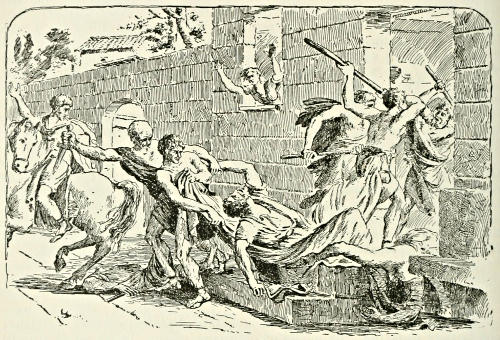
Death of Clodius
(After Mirys)
The excesses committed by the mob having injured the Clodian cause,
Milo ventured to return to the city, and to go on bribing and canvassing for
the consulate. The tribune M. Cælius, whom he had gained, having filled
the Forum with a purchased mob, led Milo thither to defend himself, in
hopes of having him acquitted by them as by the people; but the adverse
tribunes armed their partisans and fell on and scattered them.[110] Milo and
Cælius were forced to fly in the dress of slaves; the rabble killed, wounded,
and robbed without distinction; houses were broken open, plundered, and
burned, under the pretext of seeking for the friends of Milo. These excesses
lasted for several days, and the senate at length decreed that the interrex,
the tribunes of the people, and Pompey, should see that the republic sustained
no injury; and finally, as there seemed an absolute necessity for some extraordinary
power, to avoid a dictatorship and to exclude Cæsar (who was
spoken of) from the consulate, it was resolved, on the motion of Bibulus,
with the assent of Cato, to make Pompey sole consul.
[52 B.C.]
Pompey (who was resolved to crush Milo) as soon as he entered on his
office (February 25), had two laws passed, one against violence, the other
against bribery. He ordained that trials should last only four days, the first
three to be devoted to the hearing of evidence, the last to the pleadings of
the parties; he assigned the number of pleaders in a cause, giving two hours
to the prosecutor to speak, three to the accused to reply, and forbidding
any one to come forward to praise the accused. To insure prosecutions for
bribery, he promised a pardon to any one found guilty of it if he convicted
two others of an equal or lesser degree or one of a greater. He directed
that a consular chosen by the people, and not the prætor as in ordinary cases,
should preside in the trials for violence.
These preparations being made, the prosecution of Milo commenced. L.
Domitius Ahenobarbus, the consul of the year 54, was chosen president by
the people, and a jury, one of the most respectable we are assured that Rome
ever beheld, was appointed. Milo and Cælius had recourse to every means
to prevent a conviction. The former was charged with having seized five
persons who had witnessed the murder of Clodius, and kept them in close
custody for two months at his country-seat; the latter with taking by force
one of Milo’s slaves out of the house of one of the triumviri capitales. Cicero
was to plead Milo’s cause. On the first day the tumult was so great that
the lives of Pompey and his lictors were endangered; soldiers were therefore
placed in various parts of the city and Forum, with orders to strike with the
flat of their swords any that were making a noise; but this not sufficing, they
were obliged to wound and even kill several persons. When Cicero rose to
speak on the fourth day, he was received with a loud shout of defiance by the
Clodian faction; and the sight of Pompey sitting surrounded by his officers,
and the view of the temples and places around the Forum filled with armed
men, so daunted him, that he pleaded with far less than his usual ability.
Milo was found guilty, and he went into exile at Massilia.
Other offenders were then prosecuted. P. Plautius Hypsæus was found
guilty of bribery, as also were P. Sextius, M. Scaurus, and C. Memmius. This
last then accused, under the late law, Pompey’s own father-in-law, Q. Metellus
Scipio.[111] Pompey was weak enough to become a suppliant for him, and
he sent for the three hundred and sixty persons who were on the jury panel,
and besought them to aid him. When Memmius saw Scipio come into the
Forum surrounded by those who would have to try him, he gave over the prosecution,
lamenting the ruin of the constitution. Rufus and Plancus when
out of office were prosecuted for the burning of the senate house, and Pompey
again was weak enough to break his own law by sending a written eulogy of
Plancus into the court. Cato, who was one of the jury, said that Pompey
must not be allowed to violate his own law. Plancus then challenged Cato;
but it did not avail him, as the others found him guilty.
Pompey, having acted for some time as sole consul, made his father-in-law
his colleague for the remaining five months of his consulate. He caused
his own command in Spain to be extended for another term of five years, but
he governed his province, as before, by legates; and to soothe Cæsar, he had
a law passed to enable him to sue for the consulate without coming to Rome
in person. To strengthen the laws against bribery, it was enacted that no
consul or prætor should obtain a province till he had been five years out of
office; and to provide for the next five years, it was decreed that the consulars
and prætorians who had not had provinces should now take them.
Cicero, therefore, much against his will, was obliged to go as proconsul to
Cilicia; his government of it was a model of justice and disinterestedness,
and proves how he would have acted had he been free at all times to follow
his own inclinations, and we may add, if less under the influence of vain
glory and ambition. We must now turn our regards to Cæsar and his
exploits in Gaul.
While such was the condition of affairs at Rome, this great man was
acquiring the wealth and forming the army by means of which he hoped to
become master of his country. He has himself left a narrative of his Gallic
campaigns, which, though of course partial, is almost our only authority for
this part of the Roman history.
[58-52 B.C.]
Fortune favoured Cæsar by furnishing him with an early occasion of war,
though his province was tranquil when he received it (58).[112] The Helvetii,
a people of Gallic race, who dwelt from Mount Jura far into the Alps, resolved
to leave their mountains and seek new seats in Gaul; and having burned all
their towns and villages, they set forth with wives and children to the number
of 368,000 souls. As their easier way lay through the Roman province,
they sent, on hearing that Cæsar [who marched from Rome in eight days]
had broken down the bridge over the Rhone at Geneva, and was making
preparations to oppose them, to ask a free passage, promising to do no injury.
Cæsar, who had not all his troops with him, gave an evasive answer, and
meantime ran a ditch and rampart from the Lake of Geneva to Mount Jura.
The Helvetii then turned, and going by Mount Jura entered the country of
the Sequani and Ædui; but Cæsar fell on them as they were passing the Arar
(Saone), and defeated them; he afterwards routed them again, and finally
compelled them to return to their own country, lest the Germans should
occupy it.
The Ædui, who were ancient allies of Rome, then complained to Cæsar
that their neighbours, the Arverni and Sequani, having in their disputes
with them invited a German chief named Ariovistus (Heer-fürst, ‘Army-prince’?)
to their aid, he had been joined by large bodies of his countrymen,
and had occupied a great part of the land of the Sequani, and now
menaced the freedom of all the surrounding peoples; their only hopes, they
added, lay in the Romans. This invitation was, as they knew, precisely
what Cæsar desired; he promised aid, and as in his consulate he had been
the means of having Ariovistus acknowledged as a king and friend of the
Roman people, and he now wished to put him in the wrong, he sent to require
him to meet him at a certain place. The German haughtily replied, that if
Cæsar wanted to speak with him he should come to him.[113] Cæsar, further to
irritate him, desired him to give back the hostages of the allies of Rome, and
not to enter their lands or to bring over any more auxiliaries from Germany.
Ariovistus replied by seizing on the Sequanian town of Vesontio (Besançon).
On learning that the powerful nation of the Suevi was sending troops to
Ariovistus, Cæsar resolved to march against him at once. But his soldiers
were daunted at what they heard of the strength and ferocity of the Germans,
till he made a speech to reassure them, in which he declared that with
the tenth legion alone he would prosecute the war. At the desire of Ariovistus
a conference was held, at which however nothing could be arranged;
and while it was going on, news (true or false) was brought to Cæsar that
the Germans had attacked the Romans: this broke off the conference; Cæsar
refused to renew it; and a battle taking place, Ariovistus was defeated and
forced to recross the Rhine.
Cæsar then retired for the winter to Cisalpine Gaul under the pretext of
regulating the province, but in reality to keep up his communication with
Rome and acquire new friends there. As he had left his troops in the
country of the Sequani, the Belgæ, a powerful people, who were a mixture
of Germans and Gauls, and dwelt in the northeast of Gaul, fearing for
their independence, resolved to take up arms. The Germans on this side
of the Rhine joined them, and they invaded (57) the states in alliance with
the Romans. Cæsar lost no time in repairing to the defence of his allies;
and the Belgæ finding that the Ædui had invaded their country, and moreover
being in want of supplies, returned home; but they were fallen on and
defeated with great loss by a division of Cæsar’s troops, and he himself
entering their country took the town of Noviodunum (Noyon), and obliged
the Suessiones (Soissons), Bellovaci (Beauvais), and Ambiani (Amiens) to
sue for peace. He then entered the territory of the Nervians (Hainault).
This people, the bravest of the Belgæ, attacked him by surprise, routed his
cavalry, and killed all the centurions of two legions; the camps on both sides
were taken, and Cæsar himself was for some time surrounded with his guards
on a hill; but victory was finally won by the Romans.c
[57 B.C.]
Here is Cæsar’s own account of this famous battle; the narrator, as
always, speaking of himself in the third person:
Upon the territories of the Ambiani bordered the Nervii, concerning
whose character and customs when Cæsar inquired he received the following
information: that “there was no access for merchants to them; that they
suffered no wine and other things tending to luxury to be imported; because
they thought that by their use the mind is enervated and the courage impaired:
that they were a savage people and of great bravery; that they
upbraided and condemned the rest of the Belgæ who had surrendered themselves
to the Roman people; that they openly declared they would neither
send ambassadors, nor accept any condition of peace.”
After he had made three days’ march through their territories, he discovered
from some prisoners that the river Sambre was not more than ten miles
from his camp; that all the Nervii had stationed themselves on the other
side of that river, and together with the Atrebates and the Veromandui,
their neighbours, were there awaiting the arrival of the Romans—for they
had persuaded both these nations to try the same fortune of war (as themselves);
that the forces of the Aduatuci were also expected by them, and
were on their march; that they had put their women, and those who through
age appeared useless for war, in a place to which there was no approach for
an army, on account of the marshes.
Having learned these things, he sent forward scouts and centurions to
choose a convenient place for the camp. And as a great many of the surrounding
Belgæ and other Gauls, following Cæsar, marched with him, some
of these, as was afterwards learned from the prisoners, having accurately
observed, during those days, the army’s method of marching, went by night
to the Nervii, and informed them that a great number of baggage trains
passed between the several legions, and that there would be no difficulty,
when the first legion had come into the camp, and the other legions were at
a great distance, to attack that legion while under baggage, which being
routed, and the baggage train seized, it would come to pass that the other
legions would not dare to stand their ground. It added weight also to the
advice of those who reported that circumstance, that the Nervii, from early
times, because they were weak in cavalry—for not even at this time do they
attend to it, but accomplish by their infantry whatever they can—in order
that they might the more easily obstruct the cavalry of their neighbours if
they came upon them for the purpose of plundering, having cut young trees,
and bent them, by means of their numerous branches (extending) on to the
sides, and the quick-briers and thorns springing up between them, had made
these hedges present a fortification like a wall, through which it was not
only impossible to enter, but even to penetrate with the eye. Since (therefore)
the march of our army would be obstructed by these things, the Nervii
thought that the advice ought not to be neglected by them.
The nature of the ground which our men had chosen for the camp was
this: a hill, declining evenly from the top, extended to the river Sambre,
which we have mentioned above; from this river there arose a (second) hill
of like ascent, on the other side and opposite to the former, and open for
about two hundred paces at the lower part; but in the upper part woody
(so much so) that it was not easy to see through it into the interior. Within
those woods the enemy kept themselves in concealment; a few troops of
horse-soldiers appeared on the open ground, along the river.
Cæsar, having sent his cavalry on before, followed close after them with
all his forces; but the plan and order of the march were different from that
which the Belgæ had reported to the Nervii. For as he was approaching
the enemy, Cæsar, according to his custom, led on as the van six legions
unencumbered by baggage; behind them he had placed the baggage trains
of the whole army; then the two legions which had been last raised closed
the rear, and were a guard for the baggage train. Our horse, with the slingers
and archers, having passed the river, commenced action with the cavalry of the
enemy. While they from time to time betook themselves into the woods to
their companions, and again made an assault out of the wood upon
our men, who did not dare to follow them in their retreat further
than the limit to which the plain and open parts extended,
in the meantime the six legions which had
arrived first, having measured out the work, began to
fortify the camp. When the first part of the baggage
train of our army was seen by those who
lay hid in the woods, which had been agreed
on among them as the time for commencing
action, as soon as they had arranged their line
of battle and formed their ranks within the
woods, and had encouraged one another, they
rushed out suddenly with all their forces and
made an attack upon our horse. The latter
being easily routed and thrown into confusion,
the Nervii ran down to the river with
such incredible speed that they seemed to be
in the woods, the river, and close upon us
almost at the same time. And with the same
speed they hastened up the hill to our
camp and to those who were employed
in the works.
A Gallic Chief
Cæsar had everything to do at one
time: the standard to be displayed,
which was the sign when it was necessary to
run to arms; the signal to be given by the
trumpet; the soldiers to be called off from
the works; those who had proceeded some
distance for the purpose of seeking materials
for the rampart to be summoned; the
order of battle to be formed; the soldiers
to be encouraged; the watchword to be given. A great part of these
arrangements was prevented by the shortness of time and the sudden
approach and charge of the enemy. Under these difficulties two things
proved of advantage: first, the skill and experience of the soldiers, because,
having been trained by former engagements, they could suggest to themselves
what ought to be done, as conveniently as receive information from
others; and, secondly, that Cæsar had forbidden his several lieutenants to
depart from the works and their respective legions, before the camp was
fortified. These, on account of the near approach and the speed of the
enemy, did not then wait for any command from Cæsar, but of themselves
executed whatever appeared proper.
Cæsar, having given the necessary orders, hastened to and fro into whatever
quarter fortune carried him, to animate the troops, and came to the
tenth legion. Having encouraged the soldiers with no further speech than
that “they should keep up the remembrance of their wonted valour, and not
be confused in mind, but valiantly sustain the assault of the enemy”; as the
latter were not farther from them than the distance to which a dart could be
cast, he gave the signal for commencing battle. And having gone to another
quarter for the purpose of encouraging (the soldiers) he finds them fighting.
Such was the shortness of the time, and so determined was the mind of
the enemy on fighting, that time was wanting not only for affixing the military
insignia, but even for putting on the helmets and drawing off the
covers from the shields. To whatever part any one by chance came from
the works (in which he had been employed), and whatever standards he saw
first, at these he stood, lest in seeking his own company he should lose the
time for fighting.
The army having been marshalled, rather as the nature of the ground
and the declivity of the hill and the exigency of the time, than as the method
and order of military matters required; whilst the legions in the different
places were withstanding the enemy, some in one quarter, some in another,
and the view was obstructed by the very thick hedges intervening, as we
have before remarked, neither could proper reserves be posted, nor could the
necessary measures be taken in each part, nor could all the commands be
issued by one person. Therefore, in such an unfavourable state of affairs,
various events of fortune followed.
The soldiers of the ninth and tenth legions, as they had been stationed
on the left part of the army, casting their weapons, speedily drove the Atrebates,
for that division had been opposed to them, who were breathless
with running and fatigue, and worn out with wounds, from the higher
ground into the river; and following them as they were endeavouring to
pass it, slew with their swords a great part of them while impeded (therein).
They themselves did not hesitate to pass the river; and having advanced to
a disadvantageous place, when the battle was renewed, they (nevertheless)
again put to flight the enemy, who had returned and were opposing them.
In like manner, in another quarter two different legions, the eleventh and
the eighth, having routed the Veromandui, with whom they had engaged,
were fighting from the higher ground upon the very banks of the river.
But, almost the whole camp on the front and on the left side being then exposed,
since the twelfth legion was posted in the right wing, and the seventh
at no great distance from it, all the Nervii, in a very close body, with Boduognatus,
who held the chief command, as their leader, hastened towards
that place; and part of them began to surround the legions on their unprotected
flank, part to make for the highest point of the encampment.
At the same time our horsemen, and light-armed infantry, who had been
with those, who, as I have related, were routed by the first assault of the
enemy, as they were betaking themselves into the camp, met the enemy face
to face, and again sought flight into another quarter; and the camp followers
who from the Decuman Gate, and from the highest ridge of the hill had
seen our men pass the river as victors, when, after going out for the purposes
of plundering, they looked back and saw the enemy parading in our camp,
committed themselves precipitately to flight; at the same time there arose
the cry and shout of those who came with the baggage train; and they,
(affrighted), were carried some one way, some another. By all these circumstances
the cavalry of the Treviri were much alarmed, (whose reputation
for courage is extraordinary among the Gauls, and who had come to Cæsar,
being sent by their state as auxiliaries) and, when they saw our camp filled
with a large number of the enemy, the legions hard pressed and almost held
surrounded, the camp retainers, horsemen, slingers, and Numidians fleeing
on all sides divided and scattered, they, despairing of our affairs, hastened
home, and related to their state that the Romans were routed and conquered,
(and) that the enemy were in possession of their camp and baggage train.
Cæsar proceeded, after encouraging the tenth legion, to the right wing;
where he perceived that his men were hard pressed, and that in consequence
of the standards of the twelfth legion being collected together in one place,
the crowded soldiers were a hindrance to themselves in the fight; that all
the centurions of the fourth cohort were slain, and the standard-bearer
killed, the standard itself lost, almost all the centurions of the other cohorts
either wounded or slain, and among them the chief centurion of the
legion. P. Sextius Baculus, a very valiant man, who was so exhausted
by many and severe wounds, that he was already unable to support himself,
he likewise perceived that the rest were slackening their efforts, and
that some, deserted by those in the rear, were retiring from the battle and
avoiding the weapons; that the enemy (on the other hand) though advancing
from the lower ground, were not relaxing in front, and were (at the
same time) pressing hard on both flanks; he also perceived that the affair
was at a crisis, and that there was not any reserve which could be brought
up; having therefore snatched a shield from one of the soldiers in the rear,
for he himself had come without a shield, he advanced to the front of the
line, and addressing the centurions by name, and encouraging the rest of
the soldiers, he ordered them to carry forward the standards, and extend the
companies, that they might the more easily use their swords. On his arrival,
as hope was brought to the soldiers and their courage restored, whilst every
one for his own part, in the sight of his general, desired to exert his utmost
energy, the impetuosity of the enemy was a little checked.
Cæsar, when he perceived that the seventh legion, which stood close
by him, was also hard pressed by the enemy, directed the tribunes of the
soldiers to effect a junction of the legions gradually, and make their charge
upon the enemy with a double front; which having been done, since they
brought assistance the one to the other, nor feared lest their rear should
be surrounded by the enemy, they began to stand their ground more boldly,
and to fight more courageously. In the mean time, the soldiers of the two
legions which had been in the rear of the army, as a guard for the baggage
train, upon the battle being reported to them, quickened their pace, and
were seen by the enemy on the top of the hill; and Titus Labienus, having
gained possession of the camp of the enemy, and observed from the
higher ground what was going on in our camp, sent the tenth legion as
a relief to our men, who, when they had learned from the flight of the horse
and the sutlers in what position the affair was, and in how great danger
the camp and the legion and the commander were involved, left undone
nothing (which tended) to despatch.
By their arrival, so great a change of matters was made, that our men,
even those who had fallen down exhausted with wounds, leaned on their
shields, and renewed the fight: then the camp retainers, though unarmed,
seeing the enemy completely dismayed, attacked (them though) armed; the
horsemen too, that they might by their valour blot out the disgrace of
their flight, thrust themselves before the legionary soldiers in all parts of
the battle. But the enemy, even in the last hope of safety, displayed
such great courage that when the foremost of them had fallen, the next
stood upon them prostrate, and fought from their bodies; when these were
overthrown, and their corpses heaped up together, those who survived cast
their weapons against our men (thence) as from a mound, and returned
our darts which had fallen short between (the armies); so that it ought
not to be concluded that men of such great courage had injudiciously
dared to pass a very broad river, ascend very high banks, and come up to
a very disadvantageous place; since their greatness of spirit had rendered
these actions easy, although in themselves very difficult.
[57-56 B.C.]
This battle being ended, and the nation and name of the Nervii being
almost reduced to annihilation, their old men, whom together with the boys
and women we have stated to have been collected together in the fenny
places and marshes, on this battle having been reported to them, since
they were convinced that nothing was an obstacle to the conquerors, and
nothing safe to the conquered, sent ambassadors to Cæsar by the consent
of all who remained, and surrendered themselves to him; and in recounting
the calamity of their state, said that their senators were reduced from
six hundred to three; that from sixty thousand men they (were reduced)
to scarcely five hundred who could bear arms; whom Cæsar, that he might
appear to use compassion towards the wretched and the suppliant, most
carefully spared; and ordered them to enjoy their own territories and towns,
and commanded their neighbours that they should restrain themselves and
their dependents from offering injury or outrage (to them).d
The Aduatici, when they saw the military machines advanced against
their walls, submitted; but they soon resumed their arms, and Cæsar
took and plundered the town, and sold fifty-three thousand of the inhabitants.
Cæsar’s legate, P. Crassus, who (we are not told why) had led
a legion against the Veneti (Vannes) and other neighbouring peoples on
the ocean, now sent to say that they had submitted. The legions were
then placed for the winter in the country of the Carnutes (Chartres), Andecavi
(Anjou), and Turones (Touraine), and Cæsar returned to Italy. On
the motion of Cicero the senate decreed a supplication of fifteen days for
these victories—the longest ever as yet decreed.
During the winter, P. Crassus, who was quartered with the seventh
legion in the country of the Andecavi, being in want of corn, sent some of
his officers in quest of supplies to the Veneti and the adjoining peoples.
The Veneti however detained the envoys in order to get back their hostages
in exchange, and the rest followed their example. Cæsar, when he heard of
this, sent directions to have ships of war built on the Liger (Loire), and
ordered sailors and pilots to repair thither from the province, and in the
spring (56) he set out to take the command in person. The Veneti were a
seafaring people, their towns mostly lay on capes where they could not easily
be attacked, and their navy was numerous.c
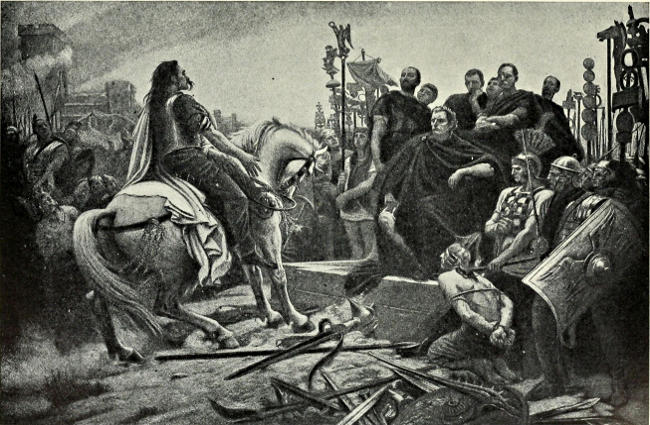
VERCINGETORIX BEFORE CÆSAR
Cæsar, after taking many of their towns, perceiving that so much
labour was spent in vain and that the flight of the enemy could not be prevented
on the capture of their towns, and that injury could not be done
them, he determined to wait for his fleet. As soon as it came up and
was first seen by the enemy, about 220 of their ships, fully equipped and
appointed with every kind of (naval) implement, sailed forth from the
harbour, and drew up opposite to ours; nor did it appear clear to Brutus,
who commanded the fleet, or to the tribunes of the soldiers and the centurions,
to whom the several ships were assigned, what to do, or what system
of tactics to adopt; for they knew that damage could not be done by their
beaks; and that, although turrets were built (on their decks), yet the height
of the stems of the barbarian ships exceeded these; so that weapons could
not be cast up from (our) lower position with sufficient effect, and those
cast by the Gauls fell the more forcibly upon us. One thing provided by
our men was of great service, viz., sharp hooks inserted into and fastened
upon poles, of a form not unlike the hooks used in attacking town walls.
When the ropes which fastened the sail yards to the masts were caught by
them and pulled, and our vessel vigorously impelled with the oars, they
(the ropes) were severed; and when they were cut away, the yards necessarily
fell down; so that as all the hope of the Gallic vessels depended on their
sails and rigging, upon these being cut away, the entire management of the
ships was taken from them at the same time. The rest of the contest depended
on courage; in which our men decidedly had the advantage; and
the more so, because the whole action was carried on in the sight of Cæsar
and the entire army; so that no act, a little more valiant than ordinary,
could pass unobserved, for all the hills and higher grounds, from which there
was a near prospect of the sea, were occupied by our army.
The sail yards (of the enemy) as we have said, being brought down,
although two and (in some cases) three ships (of theirs) surrounded each
one (of ours), the soldiers strove with the greatest energy to board the ships
of the enemy; and, after the barbarians observed this taking place, as a great
many of their ships were beaten, and as no relief for that evil could be discovered,
they hastened to seek safety in flight. And, having now turned
their vessels to that quarter in which the wind blew, so great a calm and lull
suddenly arose, that they could not move out of their place, which circumstance,
truly, was exceedingly opportune for finishing the business; for our
men gave chase and took them one by one, so that very few out of all the
number, (and those) by the intervention of night, arrived at the land, after
the battle had lasted almost from the fourth hour till sunset.d
The Veneti were forced to sue for peace, and as they had only detained
his agents, Cæsar was mercifully content with putting their whole senate to
death, and selling the people for slaves,—a characteristic exhibition of
Roman clemency towards conquered “barbarians.”
[56-55 B.C.]
As the Morini and Menapii of the north coast (Picardy) had been in
league with the Veneti, Cæsar invaded their country, which abounded in
woods and marshes, but the approach of the wet season obliged him to retire.
Having put his troops into winter quarters, he set out to look after his
affairs in Italy. During this summer P. Crassus, who had been sent into
Aquitaine to keep it quiet, or rather, as it would appear, to raise a war, routed
the people named the Sotitates (Sos), forced their chief town to surrender,
and defeated a large army of the adjoining peoples, and the Spaniards who
had joined them. Shortly after he left Gaul to join his father in Syria, taking
with him one thousand Gallic horse.
Tribes of Germans named Usipetes and Tencteri having crossed the
Rhine and entered the Menapian country, Cæsar, fearing lest their presence
might induce the Gauls to rise, hastened (55) to oppose them. Some negotiations
took place between them, during which a body of eight hundred
German horse fell on, and even put to flight, with a loss of seventy-four men,
five thousand of Cæsar’s Gallic cavalry; and they then had the audacity, as
Cæsar represents it, to send an embassy, in which were all their principal
men, to the Roman camp to justify themselves and to seek a truce.c
[55 B.C.]
After this engagement, Cæsar considered that neither ought ambassadors
to be received to audience, nor conditions be accepted by him from those
who, after having sued for peace by way of stratagem and treachery, had
made war without provocation. And to wait till the enemy’s forces were
augmented and their cavalry had returned, he concluded, would be the greatest
madness; and knowing the fickleness of the Gauls, he felt how much influence
the enemy had already acquired among them by this one skirmish.
He (therefore) deemed that no time for concerting measures ought to be
afforded them. After having resolved on these things and communicated
his plans to his lieutenants and quæstor in order that he might not suffer any
opportunity for engaging to escape him, a very seasonable event occurred,
namely, that on the morning of the next day a large body of Germans, consisting
of their princes and old men, came to
the camp to him to practise the same treachery
and dissimulation; but, as they asserted,
for the purpose of acquitting themselves for
having engaged in a skirmish the day before,
contrary to what had been agreed and to what,
indeed, they themselves had requested; and
also if they could by any means obtain a truce
by deceiving him. Cæsar, rejoicing that they
had fallen into his power, ordered them to be
detained. He then drew all his forces out
of the camp, and commanded the cavalry, because
he thought they were intimidated by
the late skirmish, to follow in the rear.

Roman Helmet
Having marshalled his army in three lines,
and in a short time performed a march of eight
miles, he arrived at the camp of the enemy
before the Germans could perceive what was
going on; who being suddenly alarmed by
all the circumstances, both by the speediness
of our arrival and the absence of their own
officers, as time was afforded neither for concerting
measures nor for seizing their arms, are perplexed as to whether it
would be better to lead out their forces against the enemy, or to defend their
camp, or seek their safety by flight. Their consternation being made apparent
by their noise and tumult, our soldiers, excited by the treachery of the preceding
day, rushed into the camp; such of them as could readily get their
arms for a short time withstood our men, and gave battle among their carts
and baggage waggons; but the rest of the people, (consisting) of boys and
women (for they had left their country and crossed the Rhine with all their
families) began to fly in all directions; in pursuit of whom Cæsar sent the
cavalry.
The Germans, when upon hearing a noise behind them (they looked and)
saw that their families were being slain, throwing away their arms and abandoning
their standards, fled out of the camp, and when they had arrived at
the confluence of the Meuse and the Rhine, the survivors despairing of further
escape, as a great number of their countrymen had been killed, threw
themselves into the river and there perished, overcome by fear, fatigue, and
the violence of the stream. Our soldiers, after the alarm of so great a war,
for the number of the enemy amounted to 430,000 [including women and children],
returned to their camp, all safe to a man, very few being even wounded.
Cæsar granted those whom he had detained in the camp liberty of departing.
They however, dreading revenge and torture from the Gauls, whose lands
they had harassed, said that they desired to remain with him. Cæsar
granted them permission.d
Being resolved that Gaul should be all his own, Cæsar thought it would
be well to show the Germans that their country too might be invaded. Accordingly,
under the pretext of aiding the Ubii who had placed themselves
under the protection of Rome against the Suevi, he threw a bridge over
the Rhine, and having ravaged the lands of the Sugambri, who had retired
to their woods, he entered the country of the Ubii; then hearing that the
Suevi had collected all their forces in the centre of their territory, and
waited there to give him battle, he returned to the Rhine, having, as he says,
accomplished all he had proposed. This run (as we may term it) into Germany
had occupied only eighteen days; and as there was a part of the summer
remaining, he resolved to employ it in a similar inroad into the isle of
Britain, whose people he asserts, but untruly, had been so audacious as to
send aid to the Gauls when fighting for their independence against him:
moreover, the invasion of unknown countries like Germany and Britain
would tell to his advantage at Rome. He accordingly had ships brought
round from the Loire to the Morinian coast (Boulogne), and putting two
legions on board he set sail at midnight. At nine next morning he reached
the coast of Britain; but as the cliffs (Dover) were covered with armed men,
he cast anchor, and in the evening sailed eight miles further down (Deal),
and there effected a landing, though vigorously opposed by the natives. The
Britons soon sent to sue for peace; and they had given some of the hostages
demanded of them, when a spring tide having greatly damaged the Roman
fleet, they resolved to try again the fate of war.c
On discovering these things the chiefs of Britain, who had come up after
the battle was fought to perform those conditions which Cæsar had imposed,
held a conference, when they perceived that cavalry, and ships, and corn
were wanting to the Romans, and discovered the small number of our
soldiers from the small extent of the camp (which, too, was on this account
more limited than ordinary, because Cæsar had conveyed over his legions
without baggage), and thought that the best plan was to renew the war,
and cut off our men from corn and provisions and protract the affair till
winter; because they felt confident that, if they were vanquished or cut off
from a return, no one would afterwards pass over into Britain for the purpose
of making war. Therefore, again entering into a conspiracy, they began
to depart from the camp by degrees and secretly bring up their people from
the country parts.
But Cæsar, although he had not as yet discovered their measures, yet,
both from what had occurred to his ships, and from the circumstance that
they had neglected to give the promised hostages, suspected that the thing
would come to pass which really did happen. He therefore provided remedies
against all contingencies; for he daily conveyed corn from the country parts
into the camp, used the timber and brass of such ships as were most seriously
damaged for repairing the rest, and ordered whatever things besides were
necessary for this object to be brought to him from the continent. And
thus, since that business was executed by the soldiers with the greatest
energy, he effected that, after the loss of twelve ships, a voyage could be
made well enough in the rest.
While these things are being transacted, one legion had been sent to
forage, according to custom, and no suspicion of war had arisen as yet, and
some of the people remained in the country parts, others went backwards
and forwards to the camp, they who were on duty at the gates of the camp
reported to Cæsar that a greater dust than was usual was seen in that direction
in which the legion had marched. Cæsar, suspecting that which was
really the case, that some new enterprise was undertaken by the barbarians,
ordered the two cohorts which were on duty to march into that
quarter with him, and two other cohorts to relieve them on duty; the rest
to be armed and follow him immediately. When he had advanced some
little way from the camp, he saw that his men were overpowered by the
enemy and scarcely able to stand their ground, and that, the legion being
crowded together, weapons were being cast on them from all sides. For as
all the corn was reaped in every part with the exception of one, the enemy,
suspecting that our men would repair to that, had concealed themselves in
the woods during the night.
Then attacking them suddenly, scattered as they were, and when they
had laid aside their arms and were engaged in reaping, they killed a small
number, threw the rest into confusion, and surrounded them with their
cavalry and chariots.
Their mode of fighting with their chariots is this: firstly, they drive
about in all directions and throw their weapons and generally break the
ranks of the enemy with the very dread of their horses and the noise of their
wheels; and when they have worked themselves in between the troops of
horse, leap from their chariots and engage on foot. The charioteers in the
meantime withdraw some little distance from the battle, and so place themselves
with the chariots that, if their masters are overpowered by the number
of the enemy, they may have a ready retreat to their own troops. Thus they
display in battle the speed of horse, (together with) the firmness of infantry;
and by daily practice and exercise attain to such expertness that they are
accustomed, even on a declining and steep place, to check their horses at
full speed, and manage and turn them in an instant and run along the pole,
and stand on the yoke, and thence betake themselves with the greatest
celerity to their chariots again.
Under these circumstances, our men being dismayed by the novelty of
this mode of battle, Cæsar most seasonably brought assistance; for upon his
arrival the enemy paused, and our men recovered from their fear; upon
which, thinking the time unfavourable for provoking the enemy and coming
to an action, he kept himself in his own quarter, and, a short time having
intervened, drew back the legions into the camp. While these things are
going on and all our men engaged, the rest of the Britons who were in the
fields departed. Storms then set in for several successive days, which both
confined our men to camp and hindered the enemy from attacking us. In
the meantime the barbarians despatched messengers to all parts, and reported
to their people the small number of our soldiers, and how good an opportunity
was given for obtaining spoil and for liberating themselves forever,
if they should only drive the Romans from their camp. Having by these
means speedily got together a large force of infantry and of cavalry, they
came up to the camp.
[55-54 B.C.]
Although Cæsar anticipated that the same thing which had happened on
former occasions would then occur—that, if the enemy were routed, they
would escape from danger by their speed; still, having got about thirty
horse, which Commius the Atrebatian [whom Cæsar had made a chief], had
brought over with him from Gaul, he drew up the legions in order of
battle before the camp. When the action commenced, the enemy were
unable to sustain the attack of our men long, and turned their backs; our
men pursued them as far as their speed and strength permitted, and slew a
great number of them; then, having destroyed and burned everything far
and wide, they retreated to their camp.
The same day, ambassadors sent by the enemy came to Cæsar to negotiate
a peace. Cæsar doubled the number of hostages which he had before
demanded; and ordered that they should be brought over to the continent,
because, since the time of the equinox was near, he did not consider that,
with his ships out of repair, the voyage ought to be deferred till winter.
Having met with favourable weather, he set sail a little after midnight, and
all his fleet arrived safe at the continent, except two of the ships of burden
which could not make the same port which the other ships did, and were
carried a little lower down.
When our soldiers, about three hundred in number, had been drawn out
of these two ships, and were marching to the camp, the Morini, whom Cæsar,
when setting forth for Britain, had left in a state of peace, excited by the
hope of spoil, at first surrounded them with a small number of men, and
ordered them to lay down their arms, if they did not wish to be slain; afterwards
however, when they, forming a circle, stood on their defence, a shout
was raised and about six thousand of the enemy soon assembled; which
being reported, Cæsar sent all the cavalry in the camp as a relief to his men.
In the meantime our soldiers sustained the attack of the enemy, and fought
most valiantly for more than four hours, and, receiving but few wounds
themselves, slew several of them. But after our cavalry came in sight, the
enemy, throwing away their arms, turned their backs, and a great number
of them were killed.
The day following Cæsar sent Labienus, his lieutenant, with those
legions which he had brought back from Britain, against the Morini, who
had revolted; who, as they had no place to which they might retreat, on
account of the drying up of their marshes (which they had availed themselves
of as a place of refuge the preceding year), almost all fell into the
power of Labienus. In the meantime Cæsar’s lieutenants, Q. Titurius and
L. Cotta, who had led the legions into the territories of the Menapii, having
laid waste all their lands, cut down their corn and burned their houses,
returned to Cæsar because the Menapii had all concealed themselves in their
thickest woods. Cæsar fixed the winter quarters of all the legions amongst
the Belgæ. Thither only two British states sent hostages; the rest omitted
to do so. For these successes, a thanksgiving of twenty days was decreed
by the senate upon receiving Cæsar’s letter.d
As only two of the British states sent the hostages, Cæsar resolved to
make this a pretext for a second invasion of their island. When, therefore,
he was setting out as usual for Italy, he directed his legates to repair the old
and build new ships; and on his return in the summer (54) he found a fleet
of twenty-eight long ships and six hundred transports ready. He embarked
with five legions and two thousand Gallic horse, and landed at the same
place as before. The Britons retired to the hills; and Cæsar, having left
some troops to guard his camp, advanced in quest of them. He found them
posted on the banks of a river (the Stour) about twelve miles inland. He
attacked and drove them off; but next day, as he was preparing to advance
into the country, he was recalled to the coast by tidings of the damage his
fleet had sustained from a storm during the night. Having given the needful
directions, he resumed his pursuit of the Britons, who laying aside their
jealousies had given the supreme command to Cassivelaunus, king of the
Trinobantes (Essex and Middlesex); but the Roman cavalry cut them up so
dreadfully when they attacked the foragers, that they dispersed, and most of
them went to their homes. Cæsar then advanced, and forcing the passage
of the Thames invaded Cassivelaunus’ kingdom, and took his chief town.
Having received the submissions and hostages of various states, and regulated
the tributes they should (but never did) pay, he then returned to
Gaul, where it being now late in autumn, he put his troops into winter
quarters. The Gauls however, who did not comprehend the right of Rome
and Cæsar to a dominion over them, resolved to fall on the several Roman
camps, and thus to free their country. The eighth legion and five cohorts
that were quartered in the country of the Eburones (Liège) were cut to pieces
by that people, led by their prince Ambiorix; the camp of the legate Q.
Cicero was assailed by them and the Nervii, and only saved by the arrival
of Cæsar in person, who gave the Gauls a total defeat. The country became
now tolerably tranquil; but Cæsar, knowing that he should have a war in
the spring, had three new legions raised in Italy, and he prevailed on
Pompey to lend him one which he had just formed.
[54-52 B.C.]
The most remarkable event of the following year (53) was Cæsar’s
second passage of the Rhine to punish the Germans for giving aid to their
oppressed neighbours. He threw a bridge over the Rhine a little higher up
the river than the former one, and advanced to attack the Suevi; but
learning that they had assembled all their forces at the edge of a forest and
there awaited him, he thought it advisable to retire, fearing, as he tells us,
the want of corn in a country where there was so little tillage as in Germany.
Having broken down the bridge on the German side, and left some cohorts
to guard what remained standing, he then proceeded with all humanity to
extirpate the Eburones, on account, he says, of their perfidy. He hunted
them down everywhere; he burned their towns and villages, consumed or
destroyed all their corn, and then left their country with the agreeable assurance
that those who had escaped the sword would perish of famine. Then
having executed more majorum a prince of the Senones, and thus tranquillised
Gaul, as he terms it, he set out for Italy to look after his interests
there.
The next year (52) there was a general rising of nearly all Gaul against
the Roman dominion. The chief command was given to Vercingetorix,
prince of the Arverni (Auvergne), a young man of great talent and
valour.[114] Cæsar immediately left Italy, and crossing Mount Cebenna (Cevennes),
though the snow lay six feet deep on it, at the head of his raw
levies entered and ravaged the country of the Arverni, who sent to recall
Vercingetorix to their aid. Then leaving M. Brutus in command, Cæsar
departed, and putting himself at the head of his cavalry, went with all
speed to the country of the Lingones (Langres), and there assembled
his legions. Vercingetorix then laid siege to Gergovia, the capital of the
Boii: Cæsar hastened to its relief; on his way he took the towns of
Vellaunodunum (Beaune) and Genabum (Orleans), and having crossed the
Loire, laid siege to Noviodunum (Nouan), in the territory of the Bituriges
(Berri), and on its surrender advanced against Avaricum (Bourges), the
capital of the country and one of the finest cities in Gaul. Vercingetorix,
who had raised the siege of Gergovia, held a council, in which he proposed,
as the surest mode of distressing the Romans, to destroy all the towns and
villages in the country. This advice being approved of, upwards of twenty
towns were levelled; but, at the earnest entreaty of the Bituriges, Avaricum
was exempted. A garrison was put into that town, and the Gallic army
encamped at a moderate distance from it in order to impede the besiegers.
It nevertheless was taken after a gallant defence; the Romans spared neither
man, woman, nor child, and of forty thousand inhabitants eight hundred only
escaped. Cæsar then prepared to lay siege to a town of the Arverni also
named Gergovia; but though he defeated the Gallic armies, he was obliged
to give up his design on account of the revolt of the Ædui. Some
time after, Vercingetorix, having attacked Cæsar on his march, and being
repulsed, threw himself into Alesia (Alise), a strong town in modern Burgundy,
built on a hill at the confluence of two rivers. The Gauls collected
a large army and came to its relief; but their forces were defeated and the
town was compelled to surrender. Vercingetorix was reserved to grace the
conqueror’s triumph, to whom a supplication of twenty days was decreed at
Rome.
[52-50 B.C.]
In the next campaign (51) Cæsar and his legates subdued such states
as still maintained their independence. As the people of Uxellodunum (in
Querci) made an obstinate defence, Cæsar (his lenity being, as we are assured,
so well known that none could charge him with cruelty), in order to deter
the rest of the Gauls from insurrection and resistance, cut off the hands of
all the men and then let them go that all might see them. The following
year (50), as all Gaul was reduced to peace, he regulated its affairs, laying
on an annual tribute; and having thus established his dominion over it, he
prepared to impose his yoke on his own country.
The military talent displayed by Cæsar in the conquest of Gaul is not
to be disputed, and it alone would suffice to place him in the first rank of
generals. We are told that he took or received the submission of eight
hundred towns, subdued three hundred nations; defeated in battle three
millions of men, of whom one million was slain, and another taken and sold
for slaves.c
[133-60 B.C.]
At this point the Roman historian Florus casts a backward look over the
history of his people. Giving the point of view of the first century of the
empire, it shows no little acumen and is well worth quoting.
“This,” he says, “is the third age of the Roman people, with reference
to its transactions beyond the sea; an age in which, when they had once
ventured beyond Italy, they carried their arms through the whole world.
Of which age, the first hundred years were pure and pious, and, as I have
called them, ‘golden’; free from vice and immorality, as there yet remained
the sincere and harmless integrity of the pastoral life, and the imminent
dread of a Carthaginian enemy supported the ancient discipline.[115]
“The succeeding hundred, reckoned from the fall of Carthage, Corinth,
and Numantia, and from the inheritance bequeathed us by King Attalus in
Asia, to the times of Cæsar and Pompey, and those of Augustus who succeeded
them, and of whom we shall speak hereafter, were as lamentable
and disgraceful for the domestic calamities, as they were honourable for
the lustre of the warlike exploits that distinguished them. For, as it was
glorious and praiseworthy to have acquired the rich and powerful provinces
of Gaul, Thrace, Cilicia, and Cappadocia, as well as those of the
Armenians and Britons, so it was disgraceful and lamentable at the same
time, to have fought at home with our own citizens, with our allies, our
slaves, and gladiators.
“I know not whether it would have been better for the Romans to have
been content with Sicily and Africa, or even to have been without them,
while still enjoying the dominion of Italy, than to grow to such greatness as
to be ruined by their own strength. For what else produced those intestine
distractions but excessive good fortune? It was the conquest of Syria that
first corrupted us, and the succession afterwards in Asia, to the estate of the
king of Pergamus. Such wealth and riches ruined the manners of the age,
and overwhelmed the republic, which was sunk in its own vices as in a common
sewer. For how did it happen that the Roman people demanded from
the tribunes lands and subsistence, unless through the scarcity which they had
by their luxury produced? Hence there arose the first and second sedition of
the Gracchi, and a third, that of Apuleius Saturninus. From what cause did
the equestrian order, being divided from the senate, domineer by virtue of the
judiciary laws, if it was not from avarice, in order that the revenues of the
state and trials of causes might be made a means of gain? Hence again it was
that the privilege of citizenship was promised to the Latins, and hence were
the arms of our allies raised against us. And what shall we say as to the
wars with the slaves? How did they come upon us, but from the excessive
number of slaves? Whence arose such armies of gladiators against their
masters, if it was not that a profuse liberality, by granting shows to gain the
favour of the populace, made that an art which was once but a punishment
of enemies? And to touch upon more specious vices, did not the ambition
for honours take its rise from the same excess of riches? Hence also proceeded
the outrages of Marius, hence those of Sulla. The extravagant sumptuousness
of banquets, too, and profuse largesses, were not they the effects
of wealth, which must in time lead to want? This also stirred up Catiline
against his country. Finally, whence did that insatiable desire of power and
rule proceed, but from a superabundance of riches? This it was that armed
Cæsar and Pompey with fatal weapons for the destruction of the state.”
“Almost the whole world being now subdued,” Florus continues, “the
Roman empire was grown too great to be overthrown by any foreign power.
Fortune, in consequence, envying the sovereign people of the earth, armed
it to its own destruction. The outrages of Marius and Cinna had already
made a sort of prelude within the city. The storm of Sulla had thundered
even farther, but still within the bounds of Italy. The fury of Cæsar
and Pompey, as with a general deluge or conflagration, overran the city,
Italy, other countries and nations, and finally the whole empire wherever it
extended; so that it cannot properly be called a civil war, or war with allies;
neither can it be termed a foreign war; but it was rather a war consisting of
all these, or even something more than a war. If we look at the leaders in
it, the whole of the senators were on one side or the other; if we consider the
armies, there were on one side eleven legions, and on the other eighteen;
the entire flower and strength of the manhood of Italy. If we contemplate
the auxiliary forces of the allies, there were on one side levies of Gauls and
Germans, on the other Deiotarus, Ariobarzanes, Tarcondimotus, Cotys, and
all the force of Thrace, Cappadocia, Cilicia, Macedonia, Greece, Ætolia, and
all the East; if we regard the duration of the war, it was four years, a time
short in proportion to the havoc made in it, if we attend to the space and
ground on which it was conducted, it arose within Italy, whence it spread
into Gaul and Spain, and returning from the West, settled with its whole
force on Epirus and Thessaly; hence it suddenly passed into Egypt, then
turned towards Asia, next fell upon Africa, and at last wheeled back into
Spain, where it at length found its termination. But the animosities of
parties did not end with the war, nor subsided till the hatred of those who
had been defeated satiated itself with the murder of the conqueror in the
midst of the city and the senate.
“The cause of this calamity was the same with that of all others, excessive
good fortune. For in the consulship of Quintus Metellus and Lucius Afranius,
when the majesty of Rome predominated throughout the world and Rome
herself was celebrating, in the theatres of Pompey, her recent victories and
triumphs over Pontus and Armenia, the overgrown power of Pompey, as is
usual in similar cases, excited among the idle citizens a feeling of envy
towards him. Metellus, discontented at the diminution of his triumph over
Crete, Cato, ever an enemy to those in power, calumniated Pompey, and
raised a clamour against his acts. Resentment at such conduct drove Pompey
to harsh measures, and impelled him to provide some support for his
authority. Crassus happened at that time to be distinguished for family,
wealth, and honour, but was desirous to have his power still greater. Caius
Cæsar had become eminent by his eloquence and spirit, and by his promotion
to the consulate. Yet Pompey rose above them both. Cæsar, therefore,
being eager to acquire distinction, Crassus to increase what he had got,
and Pompey to add to his, and all being equally covetous of power, they
readily formed a compact to seize the government. Striving, accordingly, with
their common forces each for his own advancement, Cæsar took the province
of Gaul, Crassus that of Asia, Pompey that of Spain; they had three vast
armies and thus the empire of the world was now held by these three leading
personages. Their government extended through ten years, at the expiration
of this period (for they had previously been kept in restraint by dread
of one another) a rivalry broke forth between Cæsar and Pompey, consequent
on the death of Crassus among the Parthians, and that of Julia, who,
being married to Pompey, maintained a good understanding between the
son-in-law and father-in-law by means of this matrimonial bond. But now
the power of Cæsar was an object of jealousy to Pompey and the eminence
of Pompey was offensive to Cæsar. The one could not bear an equal nor the
other a superior. Sad to relate, they struggled for mastery, as if the resources
of so great an empire would not suffice for two.”d
[60-50 B.C.]
It was particularly fortunate for Cæsar that the conquest of Gaul was
completed before his enemies at Rome combined against him, and that Vercingetorix
was vanquished before Pompey took up arms against him. The
meeting at Lucca and the decisions thereof had again put a great deal of
power in the hands of Pompey.
At Lucca, Cæsar had been promised the consulate for the year 48.
This aim attained and supported by his victorious army, with the prestige
of his deeds and his superior intellect he could easily have overreached
Pompey, who was no statesman. Cæsar would have organised the popular
party, and completed in some form or other the work of a democratic monarchy
which had been commenced by Gracchus and had failed in the unskilful
hands of Marius; the achievement would have been more glorious
for him if it had been accomplished without the aid of military force.
But the most enthusiastic of Pompey’s partisans now adopted a high
tone. They declined to concur in any compromise or compact which involved
danger to the republic; and at the beginning of the year 51 they
threw down the gauntlet to Cæsar. M. Claudius motioned for the newly
appointed consuls to be sent on the 1st of March in the year 49 to Cæsar’s
two vicegerencies of Cisalpine and Transalpine Gaul. The party also demanded
Cæsar’s disbandment of his army and maintained that his grant
of citizen rights to the colonies which he had founded, was not legal. An
inhabitant of Novum Comum, a town to which Cæsar had granted the Latin
privilege, was struck with rods.
Cæsar’s followers showed the unreasonableness of these views and courses
by references to Pompey’s position, and Pompey delayed doing anything or
declaring himself. The debate on the business of the nomination was fixed
for the 1st of March in the year 50. The union between Pompey and the
aristocrats became closer and closer, and the time they lost was to the advantage
of Cæsar.
[50-49 B.C.]
In the mean time he suppressed the rebellion of Vercingetorix, and Gaul
began to calm down. To show his desire for peace, Cæsar followed the
senate’s command to disband two legions, the one he had borrowed some
years before from Pompey and the other which he had raised himself. He
recompensed both before he dismissed them. However, the government did
not keep to the agreement of sending them to the Euphrates, but retained
them in the Campania for any emergency closer at hand. Cæsar also gained
increasing ground at Rome, where clever agents worked for him, and he
won an important victory through Curio, the plebeian tribune, a dissolute
but talented and wide-awake man, whom he gained over to his side by paying
his debts.[116] This ally maintained that what was due from Cæsar was
also due from Pompey, and threatened to put his veto upon all one-sided
courses against Cæsar.
The aristocrats hesitated, and in the meantime Cæsar arrived but without
his army, at Ravenna, the most southern point of his province. Then
Curio formulated his measure that Cæsar and Pompey should simultaneously
resign their provinces and thus allay the fears of the Roman people. The
plan was very well laid, and as the event showed, very cleverly arranged.
The measure was put to the vote of the senate and to the astonishment of
all concerned it resulted in 370 voting for the motion and twenty against it.
It therefore seemed that there were only twenty in the senate upon whom
Pompey could implicitly rely. “Then take Cæsar as your chief!” exclaimed
the consul Marcellus in a rage as he closed the sitting.
Pompey’s party was in fact in a great strait; and Cæsar (probably at a
high price) had attained what he wished. He had forced his adversaries to
enter the list as insurrectionists. Pompey began raising troops without the
necessary authority, whilst Cæsar, who was with a legion at Ravenna, sent
the order to his assembled troops to disband without delay. He also despatched
a letter to the senate, in which he offered to resign the governorship
of Cisalpine Gaul, to reduce his ten legions to two, if he were allowed
to retain these and the governorship of Cisalpine Gaul until the election of
the consul for 48. This document was delivered to the senate by Curio.
The tribunes Mark Antony and C. Cassius insisted on its being read aloud.
The sitting was stormy, and the two consuls C. Claudius Marcellus, and
L. Cornelius Lentulus made a point of Cæsar’s appearing as a private individual
before the judicature.
In accordance with their views, the motion was carried for Cæsar to
resign his province and to disband his army within a fixed time; his neglect
to concur with this decree was to be considered high treason. In that
case L. Domitius was nominated as his successor. This motion was passed
on the 1st of January, 49, but the tribunes put their veto on it, and a great
excitement prevailed in the city, into which Pompey had brought two legions.
With this support the terrified senate, after expelling the dissentient tribunes
from the curia, issued the decree which involved the declaration of war.
The senate solemnly conjured the leaders, the officials supported by a military
force in the city and its neighbourhood, to watch over the safety of the
endangered state. The tribunes renewed their veto, but threatened by
the soldiers of Pompey, against whom they were powerless, they fled from
Rome and repaired to Cæsar’s headquarters. The decisive step was taken,
the swords were unsheathed. Cæsar still remained with his single legion at
Ravenna when the tribunes arrived in the character of fugitives. He had
already carefully weighed the matter, and had conceived a clear decided
course. He had his own army which had served him for ten years in
danger and in victory. He knew every cohort, almost every soldier in his
command; and every single man was devoted to the general who shared
danger and honour with them all, and who had never deserted them in any
strait. Moreover he had the Transpadian, or Romanised Gauls of the Po
district, to whom he had granted full civic rights on his own authority; this
however was the end of his resources.
[49 B.C.]
On the other side all the other forces of Rome, the legions in Spain, the
state treasure, the fleet, the tribute of the dominions, the contingents and
the money of the whole of the East, and the respected name of the republic
were at the disposal of Pompey, who boasted, and not without cause, that
he had only to stamp upon the ground for armies to appear. Perhaps the
charm of the old fame of Pompey exceeded the attraction of the more
recent victories of Cæsar. But Cæsar did not hesitate. On the other
side of the little river Rubicon which separated the Cisalpine province from
Italy, lay his native land, and the civil war which could only end with his
overthrow or his complete victory.b
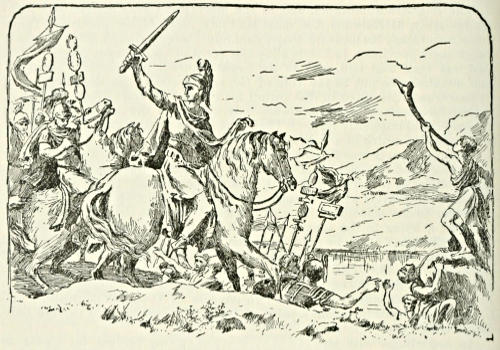
Cæsar crossing the Rubicon
“Cæsar had sent people to bring his army,” says Appian, “but being accustomed
to succeed more by diligence, striking a terror and hardiness, than
any mighty preparations, he resolved to begin this great war with his five
thousand men, and to seize some places of Italy that were commodious for
him. First he sent before to Ariminum some centurions and men who were
to enter the city as passengers, and then all of a sudden to seize on that city
(the first that offers itself coming from Gaul); and himself, in the evening,
going out as if he had found himself ill after a feast, leaves his friends, and
mounting in a chariot drove himself the same way, followed at a distance by
his cavalry. When he came to the banks of Rubicon he stopped some time,
looking upon the water, and thinking of the calamities he was about to be
the cause of, if he passed that river in arms.
“At length turning to those of his train, ‘My friends,’ said he, ‘if I pass
not this river immediately, it will be to me the beginning of all misfortunes;
and if I do pass it, I go to make a world of people miserable’; and there
withal, as if he had been pressed forward by some divinity, he drove into the
stream, and crossing it, cries with a loud voice, ‘The lot is cast.’ From
whence, continuing on his way with speed, he seized Ariminum by break of
day, and all in an instant places garrisons in all the good places of that country,
which he reduced either by force or favour.
“Meanwhile, as it happens in these unexpected alarms, the whole country
was filled with people flying, the countrymen forsaking their habitations, and
nothing was to be heard but cries, and lamentations, and groans, yet no man
knew from whence this disorder came, but all imagined that Cæsar was upon
them with all his forces. The consuls receiving the news, gave not Pompey,
who perfectly understood war, leisure to prepare himself, and take his own
time; they began to press him to be gone out of the city, and make levies
of forces in Italy, as if Rome had been in immediate danger of being taken
and plundered. And the senate surprised with so unlooked for an irruption,
were terrified, and began to repent they had not accepted those reasonable
conditions offered by Cæsar; but this was not till fear had opened their eyes,
and led them back from partiality to reason; for now men talked of a great
many prodigies and extraordinary signs which had appeared in the heavens,
that it had rained blood in many places, that in others the statues of the gods
had sweat, that many temples had been struck with thunderbolts, that a mule
had engendered, besides an infinite of other things which seemed to foretell
the change of the present state, and the ruin of the commonwealth, so as it
should never be re-established; wherefore they made vows and prayers as in
a public consternation. And the people, remembering again the miseries
they had suffered because of the dissensions of Sulla and Marius, cried out
that they ought to take away the command as well from Cæsar as from
Pompey, since that was the only means to prevent a war. Cicero himself
was of opinion that deputies should be sent to Cæsar to treat an accommodation,
but the consuls absolutely opposed it.
“Favonius, quipping at Pompey because of a word he had once said with
too much arrogance, bade him stamp on the ground with his foot, and see if
any armed men would rise. To which Pompey answered: ‘You will want
none so you will follow me, and are not troubled to leave the city, and Italy,
itself, if there be occasion; for people of courage,’ said he, ‘do not make
liberty consist in the possession of lands and houses; they cannot want in
any place they come to; and if they lose not their courage, will soon recover
their houses and lands.’
“After having said these words, and protested he would hold him for an
enemy, who out of fear to lose what he possessed, deserted the commonwealth
in extreme danger, he went out of the palace, and soon after out of the city,
to join the army that was at Capua. The consuls followed him presently,
but the other senators weighed it a little longer, and spent all the night in
the palace, without resolving anything; and at length as soon as it was break
of day, the greater part followed the same way after Pompey. Meantime,
Cæsar having reached at Corfinium, L. Domitius, whom they had sent for his
successor with four thousand men (of which he had already lost a part), he
besieged him in the city, from whence, endeavouring to escape, the inhabitants
stopped him at the gate, and brought him to Cæsar, to whom the
remainder of his forces yielded themselves; he received them kindly, that
he might draw others by their example, and without doing any wrong to
Domitius, he suffered him to go whither he pleased, with all his equipage,
hoping by this courtesy to oblige him to take his party, yet without hindering
him from going to find out Pompey. Pompey on the other side marched
from Capua to Brundusium, that he might thence pass to Epirus, where he
designed to establish the seat of war; he sent to all provinces and to kings
themselves that they should send him what forces they could supply.”c
Pompey having accordingly decided that the most prudent course to
adopt was to quit Italy and retire across the sea, had assembled all the
available troops at Brundusium, though the greater half had already happily
crossed to Greece. Cæsar reached the city accompanied by his legions.
But Pompey, until the return of the fleet, succeeded in baffling his efforts to
close the mouth of the harbour. He now barricaded the city and the two
roads leading to the harbour; the rest of the army embarked, and the retreat
was made on the ships, which they carried across the sea.[117] Cæsar
being left with the empty town, found his hope had failed of ending the war
as quickly as he had commenced it.
This success was great, but the seriousness and danger of Cæsar’s position
were now evident. He could not follow Pompey as long as the general’s
seven powerful Spanish legions under their legates M. Petreius and
L. Afranius were behind him; and if he went to Spain against them, where
was he, who had no fleet, to get the means to oppose the return to Italy of
Pompey, who ruled the seas? Moreover, Italy was more surprised than
conquered. He had not been able in two months to gain the influence
which Pompey had spent ten years to win. What would happen if insurrection
broke out against him, and if Pompey’s fleet stopped supplies? The
one mode of contravening these dangers was to double his force by the
swiftness of his movements. But the difficulties of his position did not end
here. If he plundered like Marius and Sulla, he would arouse the diverse
elements of resistance against him; if he protected life and property, he
would estrange such men of his own force as Mark Antony and P. Cornelius
Dolabella, who expected to pay their debts by Cæsarian proscription lists.
In the hope of subsequently disbanding Pompey’s Spanish army, Cæsar
repaired first to Rome, untiring in his efforts to win over to his side the
peaceful burgesses who formed the party of order. The feared proscription
lists did not appear, and pardons were bruited from all sides. Perhaps this
was the reason Cæsar found that the assembly of the remaining senators
which he summoned were not very willing to endow him with all-embracing
legal authority. Pompey was still considered the stronger; Cæsar’s success
seemed only transient, and his moderation was put down to a sense of weakness.
Hence Cicero, who played a pitiful part in these days and stood
undecided between both parties, did not appear in the Cæsarian senate. He
like many other weaklings cast longing glances to the other camp beyond
the sea without mustering courage to join either party. There was at least
an attempt at resistance in Rome. The plebeian tribune L. Metellus covered
with his body the door leading to the public treasure. Cæsar calmly gave
the necessary commands regardless of the senate, and the obstinate tribune
was quietly carried from the door, which Cæsar then forced open. The gold
discovered proved a powerful ally. The Pompeian party left behind in the
haste of their flight not less than £3,500,000.
Cæsar then took measures and did all that was necessary to create a fleet.
He gave the prætor M. Æmilius Lepidus the appointment of city prefect,
and despatched his officers. The legate Valerius was sent with a legion
against Sardinia, and M. Cotta, Pompey’s follower who was there in command.
C. Curio was commissioned to go with three legions to Sicily against
M. Porcius Cato and thence to Africa. To others he deputed the organisation
of the fleet, and with the remaining nine legions he repaired to Spain.
[49-48 B.C.]
The seven Pompeian legions were stationed on the Ebro under Afranius
and Petreius. The important city of Massilia (Marseilles) had gone over to
Pompey through the L. Domitius whom Cæsar had released after he fell into
his hands at Corfinium. Cæsar was moreover prevented from taking the
Pyrenean passes by the legates of his foe who now took up a position somewhat
north of the Iberus at Ilerda (Lerida) on the Sicoris (the left tributary
of the Ebro). Cæsar took up a position opposite, whilst he left Decimus
Brutus at Massilia.
During the month of June the strength of both armies was tested in numerous
battles and difficult movements, until finally Cæsar, whose knowledge of
war was quite different from that of his enemies, succeeded in getting the army
on to the left bank of the Sicoris and cutting his enemy off from the Ebro.
Having put the enemy into this position his men began to fraternise with
the Pompeians. Further bloodshed seemed superfluous. At the beginning
of August, 49, the Pompeians capitulated, part of the army disbanding and
part joining Cæsar. The capitulation of the army on this side led to that
of Further Spain also. The province was under the command of Terentius
Varro, a celebrated scholar and a zealous republican, and Massilia surrendered
at the same time and escaped further condemnation by resigning its
arms and fleet, a part of its territory and its garrison.
Things did not go so well in places where Cæsar could not himself be
present. During his absence in Spain, M. Æmilius Lepidus, whom he had
left as prefect of the city to govern Italy, had named him dictator. He assumed
the great dignity thus conferred upon him, but held it only eleven
days. In that period he presided at the comitia and was elected consul,
together with P. Servilius Isauricus, one of his old competitors for the chief
pontificate. He also passed several laws. One of these restored all exiles to
the city, except Milo, thus undoing one of the last remnants of Sulla’s dictatorship.
A second provided for the payment of debts, so as to lighten the
burdens of the debtors without satisfying the democratic cry for an abolition
of all contracts. A third conferred the franchise on the citizens of
Transpadane Gaul, who had since the Social War enjoyed the Latin right
only. Certainly Sardinia and Sicily were held by Cæsarian lieutenant-generals
who kept the Pompeian force in check; and Curio, who here again
gave evidence of his great talent, was at first victorious over the soldiers of
Pompey when he was transferred from Sicily to Africa. He was victorious
at Utica, and commenced the siege of the city. But a false report which
led him to believe he had only to deal with a small force of the foe drew
him into the Bagradas plain. He began the battle boldly, but it ended in
his entire defeat when King Juba of Numidia, the ally of the Pompeians
appeared in the vicinity with his ready prepared army. Curio himself fell.
The rest of his troops surrendered the following day to P. Atius Varus, the
Pompeian governor of Africa. Cæsar met with another reverse in Illyricum.
The ships under P. Dolabella, and the land forces under C. Antonius were
seized and destroyed by superior Pompeian forces in the attempt to avoid
an attack of Pompey on this side.
Pompey himself had done nothing all the summer but make preparations
on a colossal scale. He was probably hampered in doing what he knew
would be advisable by the brainlessness, the inaccuracy, and the pride of the
aristocrats about him, which, from all we know, we cannot overestimate.
But it certainly gives us a very poor idea of his talent as a general when we
see that whilst he was engaged, during the whole of the important summer of
48, in these fruitless preparations, he let his enemy gain possession of Spain,
Italy, Sardinia, the cities of Sicily and as far as he was concerned, Africa too,
without making any resistance, and even allowing the foe time to collect a
naval force.
The place of assembly of the aristocrats and Pompeians was Macedonia.
Their senate was held at Thessalonica where its members numbered two
hundred. To their remarkable incapacity for politics the aristocrats added
a deplorable want of judgment; the useless rage of this class expended
itself in wild talk and revengeful plans. Defeated through their own fault,
they avenged themselves with fine words for Cæsar’s energetic deeds. Their
obstinate pride rejected every peace negotiation offered by Cæsar, and regaled
itself in vengeance-breathing declamations. “They are,” writes Cicero, who
had finally decided which party to join, “devastating in war and in their
speech so wild, that I shudder at their success. They are an exalted people, but
deeply in debt—but what would you have? They have nothing good about
them but the cause.” Yet even the cause was bad if it had no other supporters.
It was natural for Pompey to feel crippled with these generals of
high rank, these incompetent officers. But he at least knew how to use the
rich supplies which came to him from the East, over which he still exercised
unconditional control. Eleven legions, seven thousand horsemen, Celts, Thracians,
Commagenian archers, Armenians, Numidian cavalry, a fleet of 500 sail,
and a well-filled treasure chest were placed at his disposal. He assembled
his forces on the coast of Epirus.
[49 or 48 B.C.]
In the meanwhile Cæsar had returned from Spain, and after a short dictatorship,
he was elected in Rome consul for the year 48, and at the beginning
of the year [or by the rectified calendar in November 49] collected his
troops at Brundusium. He had succeeded with great trouble in collecting
a fleet which, to the great surprise of the crews, brought him and his six
legions safely to the Acroceraunian coast. But the bold venture might
have been fatal. The fleet of the foe commanded the sea and the second
fleet of transports did not appear. Cæsar found himself cut off from Italy
with scarcely twenty-five thousand men. He would have been lost if Pompey
had promptly advanced against him from Dyrrhachium.b
[48 B.C.]
“Cæsar pitched his camp directly against him, on the other side of the
river Alora, which parted the two armies, where yet there happened some
horse skirmishes, now one party and then another passing the river, but neither
would engage with all their forces, because Pompey thought good first
to exercise his forces that were newly levied, and Cæsar expected those that
were to come from Brundusium. He thought if they stayed till spring, and
then should come over with ships of burden (and he had no other) they
could no way be secured, Pompey having such a number of galleys to defend
the passage; but if they embarked during winter, they might slip by
their enemies, who now lay harboured in the islands, or if they were engaged,
might open themselves a passage by the violence of the winds, and the bulk
of their vessels; wherefore he did all he could to hasten their coming.
“And therefore out of impatience that the rest of his army came not
from Brundusium, he resolved himself to go privately over, thinking they
would sooner follow him than any other; wherefore without discovering his
design to any one, he sent three of his slaves to a river not above twelve
furlongs distant, to secure some very light boat, and a good pilot, as if he
had an intention to send him upon some design, and feigning himself ill,
rose from the table where he desired his friends to continue, and taking the
habit of a private man, mounting his chariot, came to the boat as Cæsar’s
messenger.
“He had given orders to his slaves to command the mariners what they
had to do, whilst he kept himself concealed under coverlids and the darkness
of the night. Though the wind were contrary, and very raging, the
slaves made the pilot put off, bidding him be of courage, and make use of
his time to escape the enemy, who were not far from them, they laboured
so hard, that by force of oars they got the mouth of the river, where the
waves of the sea beating against the stream of the river, the pilot (who on
the other side was afraid of falling into the enemies hands) did all that was
possible for man to do, till seeing they gained nothing, and the seamen not
able to pull any longer, he left the helm. Then the consul discovering his
head, cried out, ‘Courage, pilot, fear no storm, for thou carriest Cæsar and
his fortune.’ Whereupon the pilot and his crew astonished at these words,
redoubling their force, passed the mouth of the river; got out to sea; but
because the winds and the waves still drove them towards the lee shore in
spite of all their endeavours, and day approaching, the mariners fearing to
be discovered by the enemy, Cæsar angry at fortune that envied him, suffered
the pilot to regain the river, and the boat presently running afore
the wind, came to the place from whence they set out: Cæsar’s friends
admired at his boldness, others blamed him for having done an action more
proper for a private soldier than a general; and he seeing his design had
not succeeded, and that it was impossible for him to pass over without being
known, sent Postumius in his place. He first had charge to tell Gabinius
that he should presently embark the army, and bring it to him; and if he
refused, then to address himself to Antony, and at last to Calenus, and if
none of these three had spirit enough to execute these orders, he had a letter
for the army in general, by which the soldiers were exhorted to come over
and follow Postumius, landing at any place they could, without regarding
the ships; for he had more need of men than ships, so much confidence had
he in fortune, indeed more than in prudence.
“Pompeius then judging he ought no longer to delay, drew out his army
in battalia, and caused them to advance against Cæsar; but two of his
soldiers being entered into the river to sound the ford, and one of Cæsar’s men
having slain them both, he took this as an ill presage, and led back his
forces into the camp, though many lamented the loss of so fair an occasion.
“As for the forces at Brundusium, Gabinius, refusing to follow the
orders brought by Postumius, with all that would follow him, went the way
of Illyricum by land, taking such long marches that his men being quite
tired the inhabitants of the country cut them all in pieces, for which Cæsar
could not yet be revenged, being engaged in affairs of more importance.
Antony shipped away the rest, and having the wind right aft, passed in sight
of Apollonia with a merry gale; but about noon the wind beginning to
slacken, they were discovered by twenty of Pompey’s galleys, who made up
towards them; they were fearful lest the stems of the long ships running on
board them should pierce through and sink them. However, they were
preparing to fight, every man laying hold of his sling, his javelin, or arms of
the like nature; when on a sudden there sprung up a fresher gale than the
former; so that Antony, setting his low sails, went spooning away before,
whilst the others, not able to bear sail, were tossed to and fro where the
winds and waves pleased, and at length driven into the narrows and cast
upon lee shores where there was neither port nor harbour. Thus Antony
safely recovered the port of Nymphæum without losing more than two ships,
which unfortunately running upon the flats were taken by the enemies.
“Cæsar having now with him all his forces as well as Pompey, they
pitched their camps in sight of each other upon eminences where each
entrenched themselves, raising out forts, which were often attacked by one
party and the other, one general still striving to block up the other’s army
and cut them off from provisions, so that there happened many skirmishes.
In this new mode of making war, as Cæsar’s men one day proved the weaker
in a fort assailed by the enemy, a centurion called Scæva, famous before for
many gallant actions, being wounded in an eye, leaped from the rampart,
and making a sign with his hand for silence, as if he had something to say,
he called to one of the centurions of the contrary party, a man of reputation,
to whom he said, ‘Save the life of one of thy own quality, save the life of
thy friend; send somebody to lead me by the hand, thus wounded as I am.’
Whereupon two soldiers stepping in to receive him as a runaway, he slew
one before he suspected the deceit, and knocked the other down. He did
this action out of the pure despair he was in of being able to defend the
place; but it succeeded better than he imagined, for this happy success so
raised the courage of his companions that they repulsed the enemy and
remained masters of the fort. Minucius, who commanded, had a great share
in the glory as well as in the danger of this assault, for ’tis said that his
buckler was six and twenty times pierced through, and he was wounded in
the eye as well as Scæva; so Cæsar honoured them both with many military
recompenses.
“Meantime he had formed intelligence in Dyrrhachium, and upon hopes
the place would be delivered to him, he came with a small company to the
gate which is near the temple of Diana; but his design being discovered,
came off again without doing anything. The same winter Scipio, father-in-law
to Pompey, bringing him another army out of Syria, was set upon in
Macedon by C. Calvisius, whom he defeated, and slew him a whole legion,
fourscore soldiers only escaping. There came now no more provisions to
Cæsar by sea, Pompeius being the stronger, wherefore the soldiers were forced
to make bread of a certain kind of herb, pieces of which being by some runaways
brought to Pompey, thinking it would be to him a joyful present.
Instead of rejoicing at it, ‘What sort of beasts,’ said he, ‘have we to deal
with?’ Cæsar now pinched with necessity drew together his forces, resolving
to engage Pompey whether he would or no; but Pompey being now
possessed of several good forts, kept close in his trenches, which so much
troubled Cæsar that he undertook a work almost impossible, and scarcely
credible, which was to enclose all the forts Pompey had with a trench drawn
from the sea, judging that though his design took not effect, he should gain
the reputation of a man capable of great things; for this trench must have
been twelve hundred furlongs in length. Pompey on his part, drew lines
and trenches directly opposite to Cæsar’s works; thus one eluded the enterprises
of the other.
“At length there happened a great fight between them, wherein Pompey
bravely repulsing Cæsar’s men and having put them to flight, pursued them
to their very camp. Many colours they took and had taken the eagle of a
legion, if the standard-bearer who carried it had not thrown it with all his
force into the trenches, that he might preserve it for Cæsar; for the Roman
soldiery have a great respect for their standards. Cæsar with other companies
came to the relief of those that fled, but so terrified were these too, that as
soon as they beheld Pompey at a distance, though they were near the camp,
it was not possible for Cæsar to stop them, nor to make them go in again,
nor so much as to hearken to him; the soldiers fled away in disorder without
shame, without reason, or without anything to oblige them to it; Cæsar
might well run up and down, and with reproaches show them that Pompey
was yet a great way off. This hindered them not from throwing down their
arms and flying, or else standing still, silent and immovable, fixing their
eyes upon the ground with shame and confusion, so great was that panic fear
that possessed them. There was an ensign who, as his general would have
stopped him, presented him the point of his javelin, but he was upon the spot
punished by the gods as he deserved. Those who escaped into the camp
were so cast down that they kept no guard at the gates nor lined the
rampire, but the trenches were left without any to defend them. All men
believed that Pompey might have thrown himself into the camp with the
flyers, and so have made an end of the war, if Labienus (for God would have
it so) had not persuaded him rather to pursue those he had routed, then
march up to the trenches; him therefore he believed, whether it were that
he was not in such haste as to make an end of all at once, or that seeing the
camp defenceless, he feared some ambuscade, or else being victorious, scorned
that little advantage. Going therefore to charge those that were still
abroad, he made yet a great slaughter, so that in two engagements in one day
he gained twenty-eight colours, and twice lost the opportunity of ruining
his enemy beyond redress. And Cæsar himself stuck not to say that that
day the war had been ended, had his enemy known how to make use of his
victory.
“Pompey after this glorious success wrote largely of it to the kings and
commonalties; and conceived hopes that in a short time Cæsar’s army, either
oppressed by famine or terrified with disgrace, would yield themselves to
him; especially the tribunes, fearful of being punished for a fault they knew
themselves guilty of. But they and all the soldiers touched with repentance
as by divine inspiration, confessed themselves criminals; and afflicted themselves
the more, that their general spoke kindly to them, and granted them
pardon before they asked it: they would not forgive themselves; but with
a wonderful change desired, as a punishment of their fault, they might be
decimated according to the custom of their ancestors, but he would by no
means admit it; which increased their shame the more that they should be
guilty of such cowardice in prejudice of the best man of the world, and who
most deserved their faith and their services.
“They besought him that at least he would punish the ensigns, who had
been the cause of this rout; for in flying they had only followed their colours;
and seeing Cæsar could not resolve to do that, but with much ado
would consent to the punishment of a few, his moderation begot in the
mind of the soldiers a general joy.
“They began all with one voice to cry out that he should lead them
against the enemy, that by gaining a new victory they might wipe away their
infamy; and in the sight of their general they swore by whole companies
one to the other, never to return from the fight but victorious. Wherefore
his friends advised him to take the army at their words, and make trial of
them upon this height of repentance before their zeal grew cooler; but he
answered them before all the multitude that he would choose a time more
proper to show them the enemy; exhorting them then to remember the good
will they now protested, and in private he told his confidants that it was convenient
to let that fear which so late a loss had imprinted be worn a little out
of the minds of the soldiery; and by temporising, let the fierceness of his
enemies heightened by their late victory, be likewise a little cooled: He confessed
withal he had committed a great fault in coming to a camp so near
Dyrrhachium, where Pompey had all things in abundance; whereas if he
had drawn himself farther off, they might have met with equal difficulties.
“After having discoursed in this manner, he came to Apollonia, and from
thence privately by night took his march towards Thessaly; and on the way,
coming to a little city called Gomphi, that refused to open their gates, he
took it by storm and gave the plunder to his soldiers; who having long
endured scarcity, fed now beyond measure, and filled themselves with wine,
especially the Alamanni, whose drunkenness made them ridiculous to all the
rest: so that here again in all appearance Pompey lost a fair occasion of
victory by not pursuing an enemy he despised; but lying still, whilst in seven
days’ march he got into Thessaly, and encamped near Pharsalia.”c
The pride of the victorious party after the success of Dyrrhachium knew
no bounds. They were in no hurry to follow the advice of prudent men
and to get possession of Italy again. The danger, if it had ever existed,
now seemed past. The rest of the campaign would be nothing more than
a safe march; the wild plans of revenge with which they had hoped to
exceed the Sullanian restoration and its terrors seemed quite near their
fulfilment.
Such was the mood of the army, especially of the conceited young aristocracy,
when Pompey’s army joined with Scipio’s corps at Larissa, whilst
Cato remained with eighteen cohorts at Dyrrhachium, and the Pompeian
fleet of three hundred ships dropped anchor at Corcyra.
Cæsar had stationed himself by the town of Pharsalia on the left bank
of the river Enipeus, which traverses the plain between the line of hills of
Cynoscephalæ in the north and the mountains of Othrys in the south, and
Pompey took up his stand on the right bank, at the foot of the Cynoscephalæ
hills. Pompey could have conquered his foe by prolonging the war, and he,
with his own experience of war, was himself conscious of the fact. But he
had long ceased to be master in his camp. It was ruled by a hydra-headed
regiment of high-born people, and the hot-blooded noble youth were already,
as if victory was assured, disputing the division of the honours of Cæsar and
the property of his allies. They pressed for a decisive blow, and they gave
Pompey to understand that he was too fond of playing the part of Agamemnon,
the king of kings, the commander-in-chief of so many prætors and consuls,
the king of vassals and the prince of clients.[118] Confident of success they
pointed to the forty-seven thousand foot-soldiers, and the seven thousand
horsemen of their own army, which far exceeded the twenty thousand of
Cæsar’s beaten force.
Pompey could not resist the pressure. He had put himself into this
position, so he ceased to delay; and on the fateful 9th of August 48 [6th of
June by the rectified calendar] he led his army over the river Enipeus.
Success seemed to favour the aristocrats when their numerous superior
cavalry surrounded Cæsar’s right wing, which faced the plain, whilst the
fighting by Cæsar’s left wing was resultless, and the weak cavalry of Cæsar
could not long withstand the masses of Pompeian horsemen. T. Labienus
commanded the corps against his former imperator, but as he pressed forward
victoriously he was opposed by the two thousand picked legionaries which
Cæsar, foreseeing the enemy’s attack, had placed there. “Strike the pretty
young dancers on the face,” cried their general to them, and the determined,
unexpected method in which they, contrary to custom, used the pila as lances
threw the enemy’s cavalry into disorder and forced it to flight.
Cæsar profited by this movement to make his reserve line advance for a
general attack. Pompey’s legions, greatly inferior to Cæsar’s veterans in
military prowess, began to retreat across the Enipeus. All was not yet lost,
but Pompey, too spoiled by success to bear a moment’s reverse, neglected his
duty, and throwing up the sponge he rode back to the camp. The vanquished
legions gradually followed suit, as it became known in their ranks that mercy
and consideration would be shown them by the enemy. They were driven
from the camp by fresh onslaughts, and at midday it was stormed by the
Cæsarians.
But Pompey had already mounted his horse and fled. His soldiers, in
increasing disorder, destitute of command albeit fighting continuously, withdrew
to the hills in the attempt to reach Larissa by that route.
But the dissolution was at hand; a number cast down their arms trusting
to the victors’ promised mercy, and those who reached the heights were disappointed
in their hope of getting to Larissa, for they were surrounded in
the evening by Cæsar’s lines. The next morning twenty thousand men, a
whole army, laid down their arms; fifteen thousand capitulated the previous
day, whilst not more than six thousand lost their lives.
The victory did not cost Cæsar more than one thousand men. The enemy’s
army was destroyed, but the results of the battle were not foreseen. They
depended upon the course Pompey would take. Of him nothing was known
but that he had taken the road to the sea and had escaped.
It is evident that this battle was mainly lost from want of command.
But why did Pompey so quickly give it up for lost without any attempt to
arrest the course of fate? We have no record from his headquarters which
can throw light upon these facts, but it seems that the party of which he was
the chief had grown too much for him; that a deep discontent and ill-humour
took possession of him, and both the party and the cause for which he had
sacrificed himself had become loathsome to him before the battle took place.
This is the only explanation of his conduct at the battle. How could it be
otherwise? His aim and object were quite opposed to those of the party to
which he was chained, and he was so entirely in its power that even complete
victory would have only benefited them, not him. Perhaps the shame of
appearing before his own party drove him to this hasty flight; perhaps he
was afraid of personal danger at the hands of his colleagues, for this Pompeian
camp was torn with every passion. Suffice it to say he escaped, and this
flight made the defeat dangerous, for his person was the rallying point for
the resistance of his party.
He hastened to Larissa; then disguised, and with a few companions, he
proceeded to the mouth of the Peneus, the celebrated Vale of Tempe, and
from thence by ship to Amphipolis.
At Mytilene he took his wife Cornelia and his son Sextus on board, but
he did not stop there, as the news of the disastrous battle and the unexpected
consequence had spread all over Asia Minor. It did not seem advisable to
attempt anything here. But he conceived the plan of putting himself at
the head of his large fleet and joining the victorious land force in Africa.
Choosing another course and another country, he might, perhaps, hope to be
more independent. So he decided to turn to Egypt and start fresh undertakings,
with this excellent position as a basis. But they were undertakings
in which he had no real confidence, through having once been crossed by
fortune.
Whilst the princes and powers of the East hastened to lay down their
arms and cast themselves upon the mercy of the conqueror after the battle
of Pharsalia, Pompey pursued the lonely course in which he met his fate.
From the coast of Asia Minor he sailed to Cyprus and from thence to the
Egyptian shore after announcing his intended arrival to the king who was
still a minor. The eunuch Pothinus persuaded Ptolemy, a thirteen year old
boy, to secure as he thought, by a bloody deed, the favour of the victor
whose support he would need against the claims of his sister, Cleopatra, who
disputed his claim to the throne.
The ships of Pompey came in sight east of Pelusium by the Cassian
Mountains. Egyptian troops were assembled on the shore, and in their midst
stood the king. Then there pushed off from the shore a little boat, in which
were Achillas, the commander-in-chief of the Egyptian army, and two Roman
officers. One of them greeted the imperator and invited him to board the
boat as the shallow water of the shore prevented a large ship being sent.
His party was suspicious. But Pompey, deaf to their warning and adjurations,
embarked in the boat with two companions. Before he left he was
heard to repeat to Cornelia the lines of Sophocles:
“Who to the tyrant turns his step
Becomes his slave altho’ he went as a liberator.”
The boat approached the shore. “Do I see in thee one of the dangers of
war?” said Pompey to one of the officers who bowed his head in silence,
whereupon Pompey without further parley took a leaf in his hand and wrote
a message to the king in the Greek language. The boat arrived, Pompey
arose to disembark. At that moment he received a blow from behind and
the two other men straightway fell upon him. Resistance was impossible.
Pompey resigned himself to his fate without making a sound, he covered his
face and fell dying to the ground. He was in the fifty-eighth year of his
life and he died in the thirty-fifth of his career as a general. The body was
left upon the beach, a prey to animals, but perhaps some faithful followers
may have secretly saved it; the head, the witness of their scandalous deed,
was taken off by the Egyptians.
Such was the sad end of a man whom the freaks of fortune and the great
confusion of the Roman state raised to a height beyond his natural power.
He, like Marius, was above all, a great soldier, clever enough to accomplish
deeds when favoured by fortune but not independent enough to attain them
against odds. He was unequalled in warlike courage, military skill, and personal
bravery, and his moderate life in spite of his great wealth put the aristocrats
of his time to shame. But he was utterly wanting in the higher
qualities which secure lasting success, overthrow effete state organisations
and construct new ones in their places. He was hard, selfish, and cruel.
“As oppressor,” as a Roman subsequently said of him, “not better than
Marius or Sulla.” Neither did he retain his position as a great general when
the time came to prove his real worth, and his utter want of independence
and capacity as a statesman was the rock upon which his life was wrecked;
whilst Cæsar’s success was due to his capacity as a general as well as a statesman,
and the power of bringing both these qualities to bear upon his course.b
The nobles betrayed their own cause at Pharsalia by their want of
courage and self-devotion. It is in vain that Lucan rounds a poetical period
with the names of the Lepidi, the Metelli, the Corvini, and the Torquati,
whom he supposes to have fallen in the last agony of the defence; of all
the great chiefs whom we know as leaders in the Pompeian camp, Domitius
alone perished on that day, and even he was killed in flight.
The fragments of the mighty ruin were scattered far away from the scene
of disaster. Pompey and a few adherents fled, as we have seen, in one
direction to Larissa; a larger number escaped by the road to Illyricum,
and met again within the walls of Dyrrhachium. The principal reserve
of the Pompeian forces was there commanded by M. Cato, and there also
was the common resort of the wavering and dissatisfied, such as Varro and
Cicero, who wished to secure their own safety in either event. The fleets
of the republic, under Octavius and C. Cassius, still swept the seas triumphantly;
the latter had recently burnt thirty-five Cæsarian vessels in the
harbour of Messana. But the naval commanders were well aware that their
exploits could have little influence on the event of a contest which was about
to be decided by the whole military force of the Roman world; and forming
their own plans, and acting for the most part independently, they began
more and more to waver in their fidelity to the common cause. As soon
as the event of the great battle became known, the squadrons of the allies
made the best of their way home, while some, such as the Rhodians, attached
themselves to the conqueror.
Then the soldiers in garrison at Dyrrhachium became turbulent. They
plundered the magazines and burnt the transports on which they were
destined to be conveyed to some distant theatre of protracted warfare. The
desertion of the allies, the mutinous spirit of the troops, and the report of
the numerous adhesions which Cæsar was daily receiving from the most
conspicuous of the nobles, convinced Cato that the last hope of keeping the
party together, and maintaining the struggle effectually, depended upon the
fate of Pompey himself. In the event of the destruction of the acknowledged
chief of the senate, he only contemplated restoring to the shores
of Italy the troops confided to him, and then betaking himself to retirement
from public affairs in some remote province. While the fatal catastrophe
was yet unknown he withdrew from Dyrrhachium to Corcyra, where the
headquarters of the naval force were established; and there he offered to
surrender his command to Cicero as his superior in rank. But the consular
declined the perilous honour, and refused to take any further part in a contest
which, from the first, had inspired him with distrust and remorse. The
young Cneius Pompey had urged the exercise of summary vengeance upon
whomsoever should threaten defection at such a crisis, and it was with difficulty
he was restrained from using personal violence against Cicero, when
he declared his intention of embarking at once for Italy. The recreant consular’s
life was barely saved by Cato’s vigorous interference. At Corcyra
many of the fugitives from the field of battle rejoined their confederates.
Among them were Scipio and Afranius, the former of whom now assumed
the command of their combined forces, and it was upon him, as soon as the
fact of Pompey’s death was ascertained, that the leadership of the party
most naturally devolved.
Meanwhile, Cæsar followed up his success with unabated activity. He
allowed his soldiers at the most only two days’ repose on the scene of their
triumph, and amidst the spoils they had acquired. His care was divided
between improving the victory he had gained in the East, and securing his
acquisitions in the West. With the latter view he ordered Antony to
return to Italy with a large part of his forces, and watch over his interests
in that quarter, where he apprehended that some of the beaten faction might
hazard a descent upon the centre of his resources. He also required his
lieutenant Calenus to complete, without delay, the subjugation of southern
Greece. Athens had not yet opened her gates to him, but the event of the
great battle determined her to obey his summons. The long resistance this
city had made exposed it, by the laws of ancient warfare, to the vengeance
of the conqueror; but Cæsar ordered it to be spared, for the sake, as he
said, of its illustrious dead. The Peloponnesus was now speedily evacuated
by the forces of the republic, and Calenus occupied the points on the coast
where he anticipated the possibility of fresh intrusion. Scipio had landed
at Patræ, probably to receive the remnant of the Pompeian garrisons in that
province, but straightway abandoned it, and stretched his sails for Africa.
Cæsar devoted himself to the pursuit of Pompey with the utmost energy
and impatience, being anxious not merely to prevent his assembling a new
armament, but if possible to secure his person. He pushed forward with
a squadron of cavalry, and was followed by a single legion. He reached
Amphipolis just after the fugitive’s departure, and, taking the route of Asia
by land, crossed the Hellespont with a few small vessels. In the passage
he fell in with the squadron of C. Cassius, who had been despatched to the
Euxine to stimulate or co-operate with Pharnaces, king of Pontus, whose
promised succours were urgently demanded. It was remarked as an extraordinary
instance of the good fortune ever supposed to wait upon the mighty
conqueror, that the mere terror of his name induced Cassius to surrender
his galleys to a few fishing-boats. There can be little doubt that the republican
commander had already made up his mind to change his side, when
accident threw this favourable opportunity in his way. As a man of influence
and authority, as well as an able soldier, he was well received by his
adopted leader, and the good offices attributed to Brutus could hardly have
been required to conciliate to him the favour of Cæsar.
Having now arrived on the Asiatic coast, Cæsar advanced more leisurely.
He had received information of Pompey’s flight to Egypt, and was aware
that, if the suppliant were received there, he could not be dislodged except
by regular military operations. He was content therefore to await the
arrival of ampler succours, and employed himself in the meanwhile with
repairing the injuries which Scipio was accused of having inflicted upon the
unfortunate provincials. He earned their favourable opinion by the remission
of taxes, and by restraining the exactions of the farmers of the revenue.
He saved a second time from spoliation the treasures of the Ephesian Diana,
which Ampius, an adherent of the opposite party, had been on the point of
seizing. These benefits he accompanied with further favours and distinctions,
and then handed over the government of the province to Calvinus,
to whom he entrusted three legions, to defend it against Pharnaces and
the other oriental allies of the senate. Cæsar retained only two legions
about his own person, and those so much reduced in number as to contain
much less, than half their proper complements. The whole of this
force consisted of only 3200 infantry, and eight hundred cavalry, and
with these he sailed without hesitation for Egypt. It was only a few
days after the death of Pompey that he appeared thus attended off the port
of Alexandria. No sooner was his arrival known than Theodotus hastened
to meet him on board his vessel, and brought to him the head and ring of his
murdered rival. The latter might be of important service to assure the
wavering of the event which had occurred, and Cæsar took and preserved it
for that purpose; but from the mangled head he turned away with horror,
and gave orders, with tears in his eyes, that it should be consumed with the
costliest spices. The ashes he caused to be deposited in a shrine which he
erected to the avenging Nemesis. The murderers were confounded and
alarmed at the feeling he exhibited, nor were they less astonished, perhaps,
at the perfect confidence with which he disembarked upon their coast, and
claimed with his handful of followers to settle the concerns of a powerful
kingdom.
It had been Cæsar’s policy to spare the wealth of the provinces which he
wished to attach to his side, and his system was directly opposed to the confiscation
of his enemies’ estates; but his want of money was urgent, and it
was in arranging the quarrels of a dependent kingdom that the best opportunity
might be found for exacting it. This undoubtedly was the urgent
motive which impelled him to intrude upon the affairs of a jealous people, in
which his principal designs were in no way implicated. When Auletes came
to Rome to negotiate his restoration to the throne, he had purchased the
support of the leaders of the senate by the most lavish bribes. Cæsar himself
had received the promise of seventeen millions and a half of drachmæ;
an obligation which had never yet been discharged. He now confined his
demand to ten millions, but sternly rejected the representations of Pothinus,
who pleaded for a longer time for the payment of so large a sum. But even
at the moment of landing Cæsar was warned of the difficulties into which
he was rushing. His military force was contemptible; it was upon the
dignity of his title as consul of the republic that he could alone rely.
Accordingly, he entered the streets of Alexandria with all the insignia of his
office, thereby offending the populace, who were easily persuaded that he
offered an intentional insult to their independence. A riot ensued, in
which many of the Cæsarian soldiers lost their lives. Cæsar felt that he had
mistaken the character of the nation, and underrated their jealousy of
foreigners.
But policy would not allow him to give way. He summoned the rival
sovereigns before him, and offered to decide their disputes in the name of the
republic. Ptolemy left his camp at Pelusium, and gave Cæsar a meeting in
the palace of Alexandria, where he soon found himself watched and detained
as a hostage. Cleopatra had already implored the consul’s mediation, and
now, when her brother or his ministers obstructed her approach to his presence,
she caused herself to be carried by stratagem into his chamber. The
fame of Cleopatra’s beauty, which was destined to become second only to
Helen’s in renown, was already bruited widely abroad. She had been seen
by Mark Antony during the brief inroad of Gabinius into Egypt; and
grave legates of the republic had brought back to Rome glowing reports of
the girlish charms of the Lagid princess. She was indeed, at the time of her
introduction to Cæsar, not twenty years old, and her wit and genius in the
arts of female conquest were yet unknown. Perhaps it was fortunate for
their celebrity that the man upon whom she was first to prove their power
was already predisposed to submit. Cæsar forthwith undertook the championship
of the distressed beauty, for it suited his purpose to play off her
claims against the haughty minions of her rival. In devoting himself to her
cause he did not deny himself the reward of his gallantry; but while he
indulged in the luxuries and dissipations of the most sensual of capitals, he
kept his eye steadily fixed on his main object, and at the same time carefully
guarded his own person from the machinations of his unscrupulous enemies.
The ministers of the young king were well assured that the reconciliation
of the brother and sister would be the signal for their own disgrace. They
employed every artifice to rouse the passions of a jealous mob, and alarmed
the fanaticism of priests and people against a foreigner, whom they
accused of desecrating their holy places, of eating accursed meats, and
violating their most cherished usages. Cæsar had despatched an urgent
message to Calvinus to hasten to his succour with all the forces he could
muster. But while waiting for the arrival of reinforcements, the necessity
of which he now keenly felt, he dissembled every appearance of apprehension,
and occupied himself in public with the society of Cleopatra, or in
conversation with the Egyptian sages, and inquiry into their mysterious
lore. His judgment was no more mastered by a woman’s charms than by
the fascinations of science; but the occupation of Alexandria was essential
to his plans, and he assumed the air of curiosity or dissipation to veil his
ulterior designs. With this view he visited with affected interest all the
vaunted wonders of the city of the Ptolemies, and even proposed, it was
said, to relinquish his schemes of ambition to discover the sources of the
Nile. At the first outset of his career of glory, his imagination had been
fired at Gades by the sight of Alexander’s statue; now that the highest
summit of power was within his reach, he descended to the tomb of the
illustrious conqueror, and mused perhaps on the vanity of vanities beside
his shrouded remains.
The young king, though kept in hardly disguised captivity within the
walls of his palace, had found means to communicate to his adherents
the alarm and indignation with which he viewed the apparent influence of
his sister over the Roman commander. The Macedonian dynasty which had
reigned for three centuries in Alexandria was not unpopular with its Egyptian
subjects. Though the descendants of Lagus had degenerated from the
genius and virtues of the first sovereigns of their line, their sway had ever
been mild and tolerant, and both conquerors and conquered reposed in equal
security under the shadow of their paternal throne. Achillas, the general of
the king’s armies, had a force of twenty thousand men, consisting principally
of the troops which Gabinius had employed in the restoration of Auletes, and
which had been left behind for his protection. These men had for the
most part formed connections with the natives, and had imbibed their sentiments
at the same time that they adopted their manners. The camp was
filled, moreover, with a crowd of deserters and fugitive slaves from all parts
of the Roman Empire, for Alexandria was the common resort of the desperate
and abandoned, who purchased impunity for their crimes by enlisting in the
king’s service. These were the men who had placed Auletes on his throne,
who had murdered the sons of the Roman legate Gabinius, and expelled
Cleopatra from her royal inheritance. They were the reckless agents of the
populace of Alexandria in each capricious mood of turbulence or loyalty.
They were now prepared to join in the general outcry against the intrusion
of the Romans, and encouraged by their leader and Arsinoe, the younger
sister of their sovereign, they entered
the city, and imparted vigour and concentration
to the hostile ebullitions of
the multitude.
[48-47 B.C.]
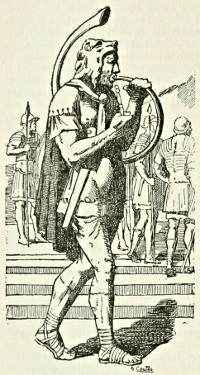
Roman Trumpeter
(After De Montfaucon)
Cæsar awaited anxiously the expected
succours; in the meantime he
sought to avert the danger by concession,
and while he proposed that Ptolemy
and Cleopatra should resume their
joint sovereignty, he was prepared to
satisfy the claims of Arsinoe by surrendering
to her, together with another
younger brother, the province of Cyprus.
But before these arrangements
were completed, the discontent of the
Alexandrians revived with more alarming
violence. A skirmish which occurred
in the streets between the Roman
soldiers and the Egyptians determined
Cæsar to take the bold step of seizing
and burning the royal fleet. It was
thus only that he could hope to keep
the coasts open for the approach of his
reinforcements. The city of Alexandria
stretched along the sea-shore, and its
port was formed by an island named
Pharos, which lay over against it, and
was connected with the mainland in
the middle by a narrow causeway and
bridge. The island was occupied by
the villas of the Alexandrians and the
suburbs of the great city. Its position
enabled it to command the entrances of
the double port which were apparently
much narrower than at the present day.
As a military position therefore it was invaluable, and while the tumult was
raging in the streets Cæsar transported into it a portion of his troops, and
seized the tower or fortress which secured its possession. At the same time
he continued to occupy a portion of the palace on the mainland, which held
the keys of communication with Pharos by the causeway. He strengthened
the defences with additional works, destroying in every direction the private
houses of the citizens, which being built entirely of stone, even to the floors
and roofs, furnished him with abundant materials for his massive constructions.
The Egyptian troops set to work with no less energy in forming
triple barricades of hewn stone at the entrance of every street, and thus
entrenching themselves in a fortress in the heart of their city. They looked
forward already to the arrival of winter, and were convinced that the enemy
must fall eventually into their hands, when he could no longer derive supplies
from beyond the sea.
But in the meanwhile the shade of Pompey began to be avenged on
his murderers. At the commencement of the outbreak Cæsar had seized
the person of Pothinus, who was in attendance upon the young king, and
detecting him in correspondence with Achillas he put him summarily to
death. Soon after, Arsinoe, who hoped to make use of the Egyptian
general to elevate herself into the royal seat, having reason to be dissatisfied
with his conduct, induced her confidant Ganymedes to assassinate
him. The adhesion of the army she secured by a munificent largess, appointed
Ganymedes her minister and general, and, assuming the diadem
of her ancestors, caused herself to be proclaimed sole queen of Egypt.
The Alexandrians pressed the blockade with pertinacity. They could
not hope to dislodge the enemy by force, but they expected to reduce
him by cutting off his means of subsistence. A contemporary writer
describes the artificial contrivances by which the population of Alexandria
obtained their water, an abundance of which is of such primary necessity
in the climate of Egypt. It is well known that rain rarely falls there,
nor were there living springs for the supply of fountains. The common
people, indeed, were content with the water of the Nile in the turbid state
in which it flows through their slimy plain; but the houses of the wealthier
classes were supplied by means of subterranean channels, with which the
whole city was mined, and through which the stream of the river was
carried into reservoirs, where the noxious sediment was gradually deposited.
Such of these channels as led to the parts of the city occupied by the
Romans the Alexandrians obstructed, so as to prevent the river from flowing
into them, while on the other hand they filled them with sea-water, raised
by hydraulic machinery, in the construction of which they were eminently
expert. This operation caused at first great consternation among the
Romans, and still more among the native population shut up within their
defences. But its effect was defeated by Cæsar’s sagacity. He caused
his soldiers to dig pits on the sandy beach, and the brackish water which
oozed up in them furnished a sufficient supply, not altogether unfit for
drinking. At the same time the arrival of a legion from Asia, with a
convoy of provisions and military stores, at a point a little to the west
of Alexandria, revived the courage of the besieged, and restored the fortunes
of their commander.
The Rhodian vessels which had betaken themselves to Cæsar’s side were
now of great service to him in establishing a communication with these
reinforcements. The islanders of Rhodes had succeeded to the nautical
skill of Athens and Corinth, and were among the expert mariners of the
time. Combined with the small flotilla which Cæsar had brought with
him, and the ships which had lately arrived, these new allies presented a
formidable force. The Egyptians, however, though the royal fleet had
been destroyed, possessed considerable resources for the equipment of a
naval armament. They collected from every quarter all the vessels they
could muster, and hastily constructed others, till they found themselves
in a condition to dispute once more the approach to the harbour. Nor
were they less vigorous in the attack they made upon the enemy’s defences
by land. The crisis of danger called forth all Cæsar’s energies; he never
exposed his person more boldly, or encountered more imminent peril. At
one moment he was so hard pressed as to be forced to leap from his vessel
into the sea, and swim for his life, carrying his most valuable papers
in his hand above the water, and leaving his cloak in the possession of
the assailants, who retained it as a trophy, as the Arverni had preserved
his sword.
The Egyptians indeed were ultimately worsted in every encounter, but
they could still return to the attack with increased numbers; and Cæsar’s
resources were so straitened that he was not disinclined to listen to terms
of accommodation, the insincerity of which was transparent. The Alexandrian
populace declared themselves weary of the rule of their young
princess, and disgusted with the tyranny of Ganymedes. Their rightful
sovereign once restored to them, they would unite heartily with the republic,
and defy the fury of the upstart and the usurper. It cannot be
supposed that the Roman general was deceived by these protestations;
the bad faith of the Alexandrians was already proverbial in the West. But
he expected perhaps that the rivalry of Ptolemy and Arsinoe would create
dissension in their camps; he may have preferred coping with the young
king in open war, to keeping a guard over him, and watching the intrigues
with which he beguiled his captivity; possibly the surrender was made
in concession to a pressure he could not resist, and was adopted as a means
of gaining time. But when Ptolemy was restored to his subjects, and
immediately led them to another attack upon the Roman position, the soldiers
are said to have felt no little satisfaction at the reward of what they
deemed their general’s weak compliance.
Cleopatra, whose blandishments were still the solace of the Roman general
throughout his desperate adventure, rejoiced to see her brother thus treacherously
array himself in rash hostility to her protector. The toils were beginning
to close around the young king. Mithridates of Pergamus, an adherent
in whose fidelity and conduct Cæsar placed great reliance, was advancing
with the reinforcements he had been commissioned to collect in Syria and
the adjacent provinces. He reduced Pelusium, the key of Egypt by land as
Pharos was by sea, and crossed the Nile at the head of the Delta, routing a
division of the king’s troops which attempted to check his progress. Ptolemy
led forth his army to give battle to the new invader, and was followed
by Cæsar. The Romans came up with the Egyptians, crossed the river in
the face of their superior numbers, and attacked them in their entrenchments,
which, from their knowledge both of the Macedonian and the Roman
art of war, were probably not deficient in scientific construction. But the
shock of the veterans was irresistible. The Egyptians fled, leaving great
numbers slaughtered within the lines, and falling into their own ditches in
confused and mangled heaps. The fugitives rushed to the channel of the
Nile, where their vessels were stationed, and crowded into them without
order or measure. One of them in which Ptolemy had taken refuge was
thus overladen and sank.
This signal defeat, and still more the death of their unfortunate sovereign,
reduced the defenders of the monarchy to despair. The populace of Alexandria
issued from their gates to meet the conqueror in the attitude of suppliants
and with the religious ceremonies by which they were wont to
deprecate the wrath of their legitimate rulers. He entered the city, and
directed his course through the principal streets, where the hostile barricades
were levelled at his approach, till he reached the quarters in which his own
garrison was stationed. He now reconstituted the government by appointing
Cleopatra to the sovereignty, in conjunction with another younger
brother, while he sent Arsinoe under custody to await his future triumph at
Rome. The throne of his favourite he pretended to secure by leaving a
Roman force in Alexandria. The pride of the republic was gratified by
thus advancing another step towards the complete subjugation of a country
it had long coveted. Cæsar was anxious that so much Roman blood as had
been shed in his recent campaigns should not appear to have sunk into
the earth, and borne no fruit of glory and advantage to the state. The
whole of this episode in his eventful history, his arrogant dictation to the
rulers of a foreign people, his seizing and keeping in captivity the person of
the sovereign, his discharging him on purpose that he might compromise
himself by engaging in direct hostilities, and his taking advantage of his
death to settle the succession and intrude a foreign army upon the new
monarch, form altogether a pregnant example of the craft and unscrupulousness
of Roman ambition.b
The ancients have given us no satisfactory solution of Cæsar’s object in
allowing himself to be entangled in this war. We cannot believe that he
was really intoxicated by a passion for Cleopatra, and surrendered his judgment
and policy to her fascinations. It is more probable that he had fixed his
eyes upon the treasures of Alexandria, to furnish himself with the resources
of which he stood greatly in need; for he still firmly abstained from the
expedients of plunder and confiscation within the limits of the empire, and
the great victory of Pharsalia though rich in laurels had proved barren of
emolument. He had yet another campaign to undertake against the beaten
party, and his troops, so often balked of their prize, might require an instalment
of the rewards of their final triumph. But when once engaged in a
contest with the Egyptians, it was no longer politic, indeed it was hardly
possible to withdraw. Cæsar threw himself, as was his wont, heart and soul
into the struggle, and risked everything in a warfare which he felt to be
ignoble. But when at last fortune favoured his arms, he still allowed himself
to remain three months longer to consolidate the advantage he had
gained. He had acquired a footing in the wealthiest kingdom in the world;
he had placed there a sovereign of his own choice, whose throne he secured
by means of a guard of Romans, thus preparing the way for the reduction of
the country at no distant period to the form of a Roman province. As long
as the remnant of the Pompeians were still scattered and unprepared, he lost
little by neglecting to prosecute the war against them. He might wish them
to gather head again, that he might again strike them down in a single blow.
Indeed he now found leisure for a campaign against Pharnaces, the son of
Mithridates.
[47 B.C.]
Though professing himself an ally of Pompey, the king of the Bosporus
had failed to bring his contingent to the republican camp. After the battle
of Pharsalia he hoped to profit by the ruin of his father’s foe, and the confusion
of the republic. He mustered his forces and drove Deiotarus and Ariobarzanes
from Armenia the lesser and Cappadocia. These princes sought
the succour of Cæsar’s lieutenant Calvinus, and though they had just fought
on the Pompeian side, he received instructions to restore them. Calvinus
however was routed by Pharnaces, who recovered his father’s dominions in
Asia Minor, and proceeded to expel from them the Roman settlers. Cæsar
quitted Alexandria in April (47), landed at Tarsus, traversed Cilicia and
Cappadocia, and reached the barbarian host at Zela in Pontus. A bloody
battle ensued in which the Roman was completely victorious. The undisciplined
hordes of the eastern sovereign once routed never rallied again.
Pharnaces escaped from the field, but he was stripped of his possessions, and
perished soon afterwards in an obscure adventure. The war was finished in
five days, and the terms in which Cæsar is said to have announced it to the
senate can hardly be called extravagant: “I came, I saw, I conquered.”
When he compared this eastern “promenade” with the eight years’ struggle
in which he had conquered Gaul by inches, he might exclaim on the good fortune
of Pompey who had acquired at so little cost the reputation of a hero.
After regulating with all despatch the affairs of the province, he hastened
back to Italy, where his protracted absence had given occasion to serious
disorders.
The measures which the dictator had enacted for the adjustment of debts
were not received with equal satisfaction in every quarter. As soon as he
was removed from the centre of affairs, the passions of the discontented found
vent, and a prætor named Cælius fanned the flame for objects of personal
ambition. Cælius was a clever, restless intriguer, and shrewd observer of
other men, as appears in his amusing letters to Cicero, but altogether deficient
in knowledge of himself, and much deceived in the estimate he formed
of his own powers. He raised the criminal hopes of the worst and neediest
citizens by proposing an abolition of debts; but he was unable to direct
the passions he had excited, or to cope with the firmness of Servilius and the
Cæsarian senate. He was declared incapable of holding any magistracy,
expelled from the curia, and finally repulsed from the tribunate. He quitted
Rome in disgust and fury, and had the temerity to plunge into an insurrection.
Joining himself with Milo, who had left his place of exile and armed
his gladiators in the south of Italy, he traversed Campania and Magna Græcia,
soliciting the aid of outlaws and banditti. But the authorities of the
capital had hardly time to take measures against the rebels, before they were
reassured by the destruction of the one before Cosa, the other at Thurii.
Cæsar’s protracted absence from the capital strongly marked the confidence
he felt in the stability of his arrangements there. Notwithstanding
these symptoms of transient and partial disaffection the great mass of the
citizens was firmly attached to him, and to this result the ferocious menaces
of the Pompeians had in no slight degree contributed. We may imagine with
what anxious suspense the upper classes at Rome had awaited the event of
the campaign in Illyricum; nor were they altogether relieved by the report
of the victory of Pharsalia. For this welcome news was accompanied or
closely followed by the assurance that the victor was plunging still farther
into the distant East, while the forces of his enemy, supported by their innumerable
navies, were gathering once more in his rear. Nevertheless, his
adherents insisted on the statues of Pompey and Sulla being ignominiously
removed from the Forum, and his secret enemies were controlled by spies,
and compelled to join in the public demonstrations of satisfaction. Much of
the anxiety which still prevailed was removed by the account of the death
of Pompey, confirmed by the transmission of his signet to Rome. None could
now distrust the genius and the fortune of the irresistible conqueror. There
was no longer any hesitation in paying court to him. His flatterers multiplied
in the senate and the Forum, and only vied with one another in suggesting
new honours for his gratification. Decrees were issued investing him
with unbounded authority over the lives and fortunes of the vanquished.
He was armed with full powers for suppressing the republican party which
was again making head in Africa. In October, 48, Cæsar was created dictator
for a second time; and the powers of the tribunate were decreed to him
for the term of his life. He appointed Antony his master of the horse, and
commandant of the city. Brave, but violent and dissolute, Antony possessed
neither the vigour nor the prudence which circumstances demanded.
The rumours which soon began to circulate at Rome of the perils which
Cæsar was incurring at Alexandria, rendered his conduct uncertain; he hesitated
to put down, with a firm hand, the disturbers of the republic, whom
the death of his master might make more powerful than himself. The son-in-law
of Cicero, Cornelius Dolabella, overwhelmed with debt, had followed
the example of Clodius in getting himself adopted by a plebeian, and had
thus acquired the tribunate. In this position he had recommended himself,
like Cælius, to the worst classes of the citizens, by urging an abolition of
debts. One of his colleagues resisted, and both betook themselves to violence.
For some time Antony looked on as if uncertain which party to
espouse; but a domestic affront from Dolabella, who had intrigued with his
wife, roused his passion; he attacked the turbulent mob with arms, and
filled the streets with the indiscriminate slaughter of eight hundred citizens.
He did not venture, however, to punish the author of the disturbance, but
contented himself with menaces and precautions till the fortunate arrival of
the dictator himself in September, 47.
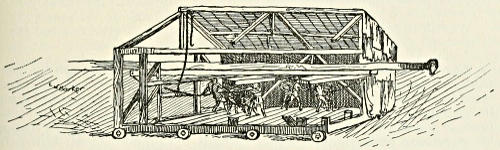
Roman Battering-ram with Testudo
Contrary to the apprehensions of many of the citizens Cæsar’s return was
marked by no proscription. He confined himself to the confiscation of the
estates of the men who still remained in arms against him; and that of Pompey
himself, whose sons were in the hostile camp, he set up to public auction.
A portion of them was bought by Antony, who ventured to evade the due
payment of the price. He conceived that his services might command the
trifling indulgence of release from a paltry debt. He found, however, that
his patron was in earnest, and prudently submitted to the affront. The dictator
remained only three months in Rome. Every moment was fully occupied
in the vast work of reconstructing the government; but we know not
what were the special measures enacted at this period, and Cæsar’s legislation
may fitly be reserved to be contemplated hereafter at a single view. Two
consuls were appointed for the remaining three months of the year, and for
the next ensuing Cæsar nominated himself for the third time, together with
Lepidus. He caused himself also to be again created dictator. His partisans
he loaded with places and honours, and sated the populace with largesses.
The soldiers demanded the fulfilment of his repeated promises. Those of the
tenth legion broke out into open revolt, and ran from Campania to Rome to
extort their claims. Cæsar convoked them in the Field of Mars, approached
them unattended, mounted his tribunal, and demanded the statement of their
grievance. At the sight of their redoubted general their voices faltered,
their murmurs died away; they could only ask for their discharge. “I discharge
you, citizens,” replied the imperator; and they cowered under this
disparaging appellation, abashed and humiliated. To the fierce and haughty
soldier the peaceful name of citizen seemed a degradation. They entreated
to be restored to their ensigns, and submitted to severe punishment in expiation
of their fault. This simple incident is a key to the history of the times.
This application of the title of citizen, and the effect it produced, show plainly
that the basis of Cæsar’s force was purely military, and that Cæsar himself
knew it. This was the point at which every party leader in turn had tried
for years to arrive, and Cæsar had succeeded.
As soon as this sedition was repressed Cæsar departed to crush the remnant
of his enemies assembled in Africa. The defeated host had been scattered
in various directions, but the largest division of the fugitives had made
its way to Dyrrhachium, and there deliberated on its further movements.
Cato, to whom the command was offered, waived it in favour of Cicero, as
his superior in rank; but the orator declined to associate himself further in
the honours and perils of a fruitless struggle, and departed mournfully for
Italy. His life was with difficulty preserved from the fury of Cneius, the
elder son of the great Pompey, a man of ungovernable passions and slender
capacity. Shortly afterwards Scipio assumed the command of the main body,
and carried it to Utica in the province of Africa. Cato at the head of another
division skirted the coasts of Greece and Asia, and picked up some
scattered adherents of the cause. He followed in the track of Pompey, but
when the news of his chief’s assassination reached him, he landed on the
shore of Libya, and demanded admission within the walls of Cyrene. The
natives shut their gates; but Cato, always loath to exercise any unprofitable
severity, generously abstained from chastising them. Anxious now to effect
a junction with the remainder of his friends, he coasted westward as far as
the lesser Syrtis, and then plunged with his little army into the sandy
desert. The seven days’ march through this inhospitable region, torrid with
heat and infested with serpents, was justly considered one of the noblest exploits
of the Roman legionaries. The poet of the Pharsalia exalts it above
the three triumphs of Pompey and the victories of Marius over the tyrant
of Numidia. He turns with pardonable enthusiasm from the deified monsters,
the Caligulas and Neros of his own day, to hail its achiever as the true
Father of his Country, the only worthy object of a free man’s idolatry.
The arrival of Cato at the headquarters of the republicans in Utica was
quickly followed by that of Cneius Pompey, and in the course of the year
47 the remains of the great host of Pharsalia were assembled with many
reinforcements under the banners of Scipio. These forces amounted to not
less than ten complete legions, and Juba, who could bring one hundred and
twenty elephants into the field, besides innumerable squadrons of light
cavalry, had promised his assistance. The officers began to brag of their
future triumphs almost as loudly as before their recent disasters. Their
defiance was re-echoed to the opposite shores of Italy, and caused fresh dismay
to the time-servers, who had abandoned the Pompeian cause on the
event of its first discomfiture. But this force, numerous as it was, was not
in a condition, it would seem, to choose a distant field of operations. The
want of money may have compelled its chief still to act on the defensive,
and await through a whole year the expected attack of the enemy. Nor
were these chiefs themselves unaffected by personal jealousies. Scipio and
Varus contended for the command, the one as the foremost in rank and
dignity, the other as the legitimate proconsul of the province; while Juba,
conscious of his own importance to the cause, affected to lord it over both.
Cato alone continued still to act with his usual simplicity of purpose and
patriotic devotion. But his noble demeanour rebuked the selfishness of his
associates, and they contrived to remove him from their counsels by charging
him with the defence of Utica, while they shifted their own quarters to the
neighbourhood of Hadrumetum. The brave philosopher rejoiced that he was
not compelled to draw his sword in civil strife, while he busied himself not
the less earnestly in the collection of stores and preparation of defence. Of
all the professed asserters of Roman liberty he alone really lamented the
necessity of arming in her cause; from the first outbreak of the war he had
refused to trim his venerable locks or shave his grizzled beard, and from
the fatal day of Pharsalia he had persisted in sitting at his frugal meals, and
denied himself the indulgence of a couch.
[47-46 B.C.]
A whole year had now passed, while the republicans contemplated with
folded arms the perils Cæsar had surmounted in Alexandria, the victory he
had gained over Pharnaces, and the brilliant reception he had met with in
Rome. Cæsar assembled six legions and two thousand horse at Lilybæum
in Sicily, and in the middle of October 47, he appeared off the African coast
with the first division of his forces, and summoned the republicans in their
camp at Hadrumetum to surrender to “Cæsar the imperator.” “There is no
imperator here but Scipio,” they replied, and inflicted death upon his envoy
as a deserter. The dictator sailed on to Leptis, and was there invited to take
shelter, while he awaited the arrival of the rest of his armament.
While these reinforcements were coming slowly in he was attacked by
Scipio, and subjected to annoyance and peril from the movements of the
enemy’s cavalry. Labienus, who frequently charged him at the head of
the Roman horse, distinguished himself by the bitter taunts with which he
addressed the veterans whom he had so often led to victory. But Cæsar
maintained himself in a fortified position till he could move forward with a
force of five legions. At the same time the alliance he had formed with the
Mauretanian kings, Bogudes and Bocchus, the jealous rivals of the Numidians,
enabled him to draw off Juba to the defence of his own capital Cirta.
He pushed on, offering battle, which Scipio, though with double his numbers,
steadily refused, until Juba returned with his vaunted elephants and
cavalry. The necessities of the Roman chiefs compelled them to submit to
revolting indignities at the hands of this barbarian ally. He forbade Scipio
the use of the imperator’s purple cloak, which he declared to belong only to
kings. When he issued his royal mandates to the Roman officers, they were
observed to be even more punctually obeyed than the orders of the general
himself.
At last on the 4th of April the armies met on the field of Thapsus. On
this occasion many of Cæsar’s men were fresh recruits, and he was not
without some misgivings about their steadiness. But they were not less
impatient for the onset than the veterans, whom their general recommended
to their imitation, and loudly demanded the signal to engage. While he
still hesitated, checking with hand and voice the impatient swaying of the
lines, suddenly the blast of a single trumpet burst forth on the right wing.
The impetuous ferocity of the tenth legion could no longer brook restraint;
they had raised the signal unbidden; and now the whole army rushed forward
in one unbroken body, overpowering their officers’ efforts to detain
them. Cæsar, when he beheld rank after rank pouring by him, without the
possibility of recall, gave the word “Good luck” to his attendants, and
spurred his horse to the head of his battalions. The combat was speedily
decided. The elephants, thrown into confusion by the first discharge of
stones and arrows, turned upon the ranks they were placed to cover, and
broke in pieces their array. The native cavalry, dismayed at losing their
accustomed support, were the first to abandon the field. Scipio’s legions
made little resistance; they sought shelter behind their entrenchments.
But their officers had fled, and the men, left without a commander, rushed
in quest of their discomfited allies. They found the Numidian camp in the
hands of the enemy; they begged for quarter, but little mercy was shown
them, and Cæsar himself beheld with horror a frightful massacre which he
was powerless to control. Scipio escaped to the coast, and embarked with
others for Spain, but was intercepted and slain.[119] Juba and Petreius fled
together, and sought refuge within the walls of Zama. But the Numidians
rejoiced in the defeat of their tyrants and refused them solace or shelter.
The fugitives, repulsed in every quarter, and disdaining to solicit the victor’s
clemency, placed themselves at a banquet together, drank their fill of wine,
and challenged each other to mortal combat. Petreius, the elder of the two,
was despatched by his opponent, who then threw himself upon his own
sword.[120]
The rout of Thapsus was known at Utica on the same evening. On the
morrow Cato convened the Roman officers and residents, and laid before
them the state of their affairs. Calmly and cheerfully he enumerated his
means of defence, and desired them to decide for themselves whether they
would resist the conqueror, or seek safety in flight or capitulation. The
knights and senators, despairing of pardon, would have held out to the uttermost;
but the traders and men of peace, who had long settled in Utica, and
were conscious that they had done nothing hitherto to provoke the wrath of
the assailant, insisted on a timely surrender. When it was known that Cæsar
was approaching, Cato caused all the gates to be closed except that which led
to the sea, and urged all that would to betake themselves to the ships. He
dismissed his personal friends, of whom a few only, and among them his own
son, insisted on remaining with him; for he had plainly intimated that for
his own part he would not quit his post. With these cherished associates he
sat down to supper, and discoursed with more than his usual fervour on the
highest themes of philosophy, especially on the famous paradox of the stoics,
that the good man alone is free, and all the bad are slaves. His companions
could not fail to guess the secret purpose over which he was brooding. They
betrayed their anxiety only by silent gestures; but Cato, observing the depression
of their spirits, strove to reanimate them, and divert their thoughts
by turning the conversation to topics of present interest.
[46 B.C.]
The embarkation was at this moment proceeding, and Cato repeatedly
inquired who had already put out to sea, and what were the prospects of the
voyage. Retiring to his chamber he took up the Dialogue on the Soul, in
which Plato recorded his dying master’s last aspirations after immortality.
After reading for some time he looked up and observed that his sword had
been removed. In the irritation of the moment he gave way to a burst of
violence, such as often marked the behaviour of the Roman master to his
slave; calling his attendant to his presence he struck him on the mouth,
bruising his own hand with the blow. He then sent for his son and friends,
and rebuked them sharply for their unworthy precaution; “as if,” he said,
“I needed a sword to kill myself, and might not, if I chose, put an end to
my existence by dashing my head against the wall, or merely by holding my
breath.” Reassured perhaps for the moment by the calmness of his demeanour,
they restored him his weapon, and at his earnest desire once more left
him alone. At midnight, still anxious about those who were departing, he
sent once again to inquire if the embarkation were completed. The messenger
returned with the assurance that the last vessel was now on the point of
leaving the quay. Thereupon Cato threw himself on his bed, as if about to
take his rest for the night; but when all was quiet he seized his sword and
thrust it into his stomach. The wound was not immediately mortal, and the
victim rolled groaning on the floor. The noise at once summoned his anxious
attendants. A surgeon was at hand, and the sufferer was unconscious while
the protruding intestines were replaced, and the gash sewn up. But on
coming to himself he repulsed his disconsolate friends, and tearing open the
fatal wound, expired with the same dogged resolution which had distinguished
every action of his life.
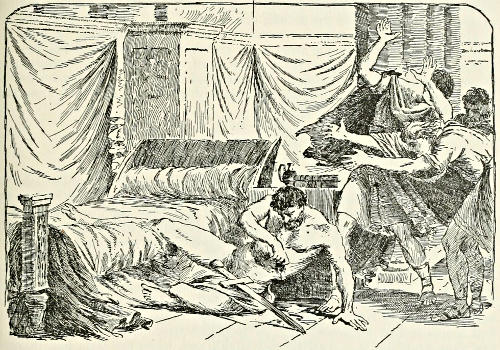
Death of Cato
(From a drawing by Mirys)
Cato had no cause to despair of retaining life under the new tyranny.
At an earlier period he had meditated, in such a contingency, seeking refuge
in retirement and philosophy. But his views of the highest good had
deepened and saddened with the fall of the men and things he most admired.
He now calmly persuaded himself that with the loss of free action the end of
his being had failed of its accomplishment. He regarded his career as prematurely
closed, and deemed it his duty to extinguish an abortive existence.[121]
Cæsar, when he heard of his self-destruction, lamented that he had been
robbed of the pleasure of pardoning him, and to his comrades in arms he
exhibited, according to the most credible accounts, the same clemency by
which he had so long distinguished himself. But the same man who could
now speak and act thus generously, did not scruple, at a later period, to
reply to Cicero’s panegyric with a book which he called the Anti-Cato, in
which he ridiculed the sage’s vain pretensions, and scoffed at him for raking
in his brother’s ashes for the golden ornaments of his pyre, for transferring
to Hortensius the wife who had borne him as many children as he desired,
and taking the widow to his arms again enriched with a magnificent dowry.
Could the proud philosopher have anticipated a time when the wantonness
of power might sport unchecked with the good fame of its victims, he would
have shrunk from such moral degradation with greater horror than from the
servitude of the body.c
“After hearing and reading of the many glorious achievements which the
Roman people had performed at home and in the field, by sea as well as by
land, I happened to be led to consider what had been the great foundation
of such illustrious deeds. I knew that the Romans had frequently, with
small bodies of men, encountered vast armies of the enemy; I was aware
that they had carried on wars with limited forces against powerful sovereigns;
that they had often sustained, too, the violence of adverse fortune;
yet that, while the Greeks excelled them in eloquence, the Gauls surpassed
them in military glory. After much reflection, I felt convinced that the
eminent virtue of a few citizens had been the cause of all these successes;
and hence it had happened that poverty had triumphed over riches, and a
few over a multitude. And even in later times, when the state had become
corrupted by luxury and indolence, the republic still supported itself, by its
own strength, under the misconduct of its generals and magistrates; when,
as if the parent stock were exhausted, there was certainly not produced at
Rome, for many years, a single citizen of eminent ability. Within my recollection,
however, there arose two men of remarkable powers, though of very
different character, Marcus Cato and Caius Cæsar, whom, since the subject
has brought them before me, it is not my intention to pass in silence, but to
describe, to the best of my ability, the disposition and manners of each.
“Their birth, age, and eloquence, were nearly on an equality; their greatness
of mind similar, as was also their reputation, though attained by different
means. Cæsar grew eminent by generosity and munificence; Cato by
the integrity of his life. Cæsar was esteemed for his humanity and benevolence;
austereness had given dignity to Cato. Cæsar acquired renown by
giving, relieving, and pardoning; Cato by bestowing nothing. In Cæsar
there was a refuge for the unfortunate; in Cato, destruction for the bad.
In Cæsar, his easiness of temper was admired; in Cato, his firmness. Cæsar,
in fine, had applied himself to a life of energy and activity; intent upon the
interests of his friends, he was neglectful of his own; he refused nothing to
others that was worthy of acceptance, while for himself he desired great
power, the command of an army, and a new war in which his talents might
be displayed. But Cato’s ambition was that of temperance, discretion, and,
above all, of austerity; he did not contend in splendour with the rich, or in
faction with the seditious, but with the brave in fortitude, with the modest
in simplicity, with the temperate in abstinency; he was more desirous to be,
than to appear, virtuous; and thus, the less he courted popularity, the more
it pursued him.”e[122]
The suicide of Cato was the consistent act of a heathen philosopher, determined
at least to maintain the purity of his soul uncontaminated by base
compliances. Assuredly the calm dignity of its execution demands our
respect and compassion, if not the principle on which it was based. Far
different was the manner in which the rude barbarian Juba and the coarse
soldier Petreius ran forward to meet their ends. They had escaped together
from the field of battle, and the Numidian offered to provide shelter for his
companion in one of his own strongholds. The Roman province was so ill-disposed
towards the barbarian chief that he was obliged to hide himself by
day in the most secluded villages, and roam the country on his homeward
flight during the hours of darkness. In this way he reached Zama, his
second capital, where his wives and children, together with his most valuable
treasures, were deposited. This place he had taken pains to fortify at the
commencement of the war, with works of great extent and magnitude. But
on his appearance before the walls, the inhabitants deliberately shut their
gates against him and refused to admit the enemy of the victorious Roman.
Before setting out on his last expedition, Juba had constructed an immense
pyre in the centre of the city, declaring his intention, if fortune went ill
with him, of heaping upon it everything he held most dear and precious,
together with the murdered bodies of the principal citizens, and then taking
his own place on the summit, and consuming the whole in one solemn conflagration.
But the Numidians had no sympathy with this demonstration of
their sovereign’s despair, and resolved not to admit him within their walls.
Juba having tried in vain every kind of menace and entreaty, to which no
reply was vouchsafed, at last retired, but only to experience a similar reception
in every other quarter to which he resorted. He at least had little to
hope from the clemency which the victor had extended to his conquered
countrymen. His companion, hard as his own iron corslet, scorned to accept
it. The fugitives supped together, and, flushed with the fumes of the banquet,
challenged each other to mutual slaughter. They were but unequally
matched; the old veteran was soon despatched by his more active antagonist,
but Juba was constant in his resolution, and only demanded the assistance
of an attendant to give himself the last fatal stroke.
Nor was the fate of Considius, of Afranius, and Faustus Sulla less disastrous.
The first of these had abandoned the defence of Thysdrus at the
approach of the forces which Cæsar despatched against it, and attempted to
make his escape with the treasures he had amassed into the territories, until
now friendly, of the Numidian chieftains. He was destroyed, for the sake
of his hoarded booty, by the Gætulians who accompanied him in his flight.
The others had retained the command of a squadron of Scipio’s cavalry, and
after burning one town which had shut its gates against them had made a
desperate attack on the military post which Cato maintained outside the
walls of Utica, to wreak an unworthy vengeance on the Cæsarian partisans
there kept in custody. Baffled in this object they had made their way into
Utica, while Cato still commanded there, and had added bitterness to his
last days by the violence and ferocity of their behaviour. From thence they
led their ruffians along the coast in the hope of finding means of transporting
them into Spain. But on their way they fell in with Sittius, who was
advancing to join Cæsar; their men were routed and themselves taken.
The bands of the Roman adventurer carried on war with the same brutality
as the barbarians among whom they practised it. The captors quarrelled
among themselves; their passions were inflamed, perhaps, in the distribution
of the prisoners and the booty; and both Afranius and Faustus were killed
in the fray which ensued. But the massacre of the son of the dictator Sulla,
accidental as it was, or at least unauthorized, could hardly fail of being
charged as a deliberate act upon the representative of Marius.
While his foes were thus flying and falling, Cæsar advanced triumphantly
from the scene of his last exploit, receiving the submission of the towns on
his way, carrying off the stores and treasure collected for his enemies’ use,
and leaving garrisons to retain them in fidelity. As he drew near to Utica
he was met by L. Cæsar, whose petition for mercy seems to have been confined
to his own person, and to whom, as well as to a long list of distinguished
nobles, the conqueror extended the promise of his protection. He
lamented with every appearance of sincerity that Cato had robbed him of
the pleasure of pardoning one who, of all his antagonists, had been the most
obstinate in his opposition, and the most inveterate in his hatred. The fatal
compliance of the Utican senators, who, not content with obeying his enemies’
commands, had contributed money to their cause, furnished him with
a specious pretence for rifling their coffers of the treasures he now most
urgently needed. His requisitions amounted to two hundred millions of
sesterces. At the same time the city of Thapsus was mulcted in two millions,
and the company of Roman traders in three. Hadrumetum paid down
three millions, and its Roman capitalists five. Leptis and Thysdrus also
suffered in due proportion. A grand auction was held at Zama for the sale
of all the objects of Juba’s royal state, and of the goods of the Roman citizens
who had borne arms under the tyrant’s orders. Upon the people who
had so boldly defied their sovereign, and refused him admittance within
their walls, honours and largesses were munificently showered, and the taxes
heretofore demanded for the royal treasury were partially remitted by the
collectors of the republic. But the country of Numidia was deprived of
its independence, and definitely reduced to the form of a province, under
the proconsulate of Sallust. The rewarded and the punished acquiesced
equally in the conqueror’s dispositions; the submission of Africa to his
authority was from thenceforth complete. The Uticans were allowed to
commemorate with a funeral and a statue the humane and noble conduct of
their late governor.
Cæsar settled the affairs of Africa with his usual despatch, and sailed
from Utica on the fourteenth day of April, 46 B.C. On his way to Italy,
he stopped at Caralis, in Sardinia. The aid which the island had afforded to
his adversaries furnished him with a decent pretext for extorting from the
inhabitants large sums of money. At the end of the same month he again
weighed anchor; but the prevalence of easterly winds drove him repeatedly
to shore, and he at last reached Rome on the twenty-eighth day after his
departure from the Sardinian capital. The reports he received at this time
of the revival of the republican cause in Spain did not give him much
uneasiness. Cneius had been detained by sickness in the Baleares, and the
fugitives from the field of Thapsus had been almost all cut off in their
attempts to reach the point to which their last hopes were directed. The
legionaries who had mutinied against Cassius Longinus were still either
unsatisfied with their treatment under the commander who had superseded
him, or fearful of their general’s vengeance when a fitting opportunity should
arrive. It was from Cæsar’s own soldiers that the invitation had gone forth
to the republican chiefs to renew the struggle on the soil of Spain. The
spirit of the old commonwealth still survived in many of the towns of
Bætica; promises of support were freely given; but the remnant of the
African armament was contemptible both in numbers and ability. Of all
the haughty nobles who had thronged the tent of Pompey at Luceria or
Thessalonica, not one with a name known to history remained in arms, except
Labienus alone. He indeed had succeeded in making his escape from
Africa, in company with Varus; but the insurgents had already placed themselves
under the command of Scapula and Aponius, officers of their own, nor
would they suffer themselves to be transferred from them to any other
except the son of the great Pompey. The extent to which the flame of insurrection
had spread was probably unknown at this time to Cæsar. He was
impatient to reap at last the fruit of so much bloodshed, to assume the post
of honour he had won, and to work out the principles and objects of so many
years of anticipation. A distant and contemptible outbreak might be subdued
without meeting it in person. Accordingly, C. Didius, an officer of no
eminent reputation, was sent with a naval and military force to the succour
of Trebonius, whom, however, he found already expelled from his government
by the growing force of the new movement.
Meanwhile Rome had sunk, during the conqueror’s absence, into a state
of torpid tranquillity. The universal conviction that the dictator’s power
was irresistible had quelled all further heavings of the spirit of discontent.
Dolabella had been gratified with a command in the late campaign; while
others, in whose fidelity and military skill he could rely, had been left behind
to overawe disaffection. The most illustrious of the nobility having now no
occasion to remain at Rome for the sake of paying court to a jealous ruler,
had retired generally to their country seats; but Cicero seems to have feared
giving occasion for distrust if he withdrew himself from the broad eye of
public observation. He occupied himself, however, in his philosophical
studies, and could rejoice that he had never, like so many of his contemporaries
when plunging into the excitements of political life, abandoned the
literary pursuits common to them in youth. While he still regarded the contest
in Africa with the sentiments of a true republican, he confessed with
a sigh that though the one cause was assuredly the more just, yet the victory
of either would be equally disastrous. He probably held aloof from the
proceedings of the servile senate, which occupied itself during the months
of Cæsar’s absence in devising new honours for his acceptance. First of all
it decreed the religious ceremony of a thanksgiving of forty days, being
twice the term to which the compliance of popular gratitude had ever previously
extended, and it was by the length of the observance that the honour
was estimated. Next it appointed that the victor’s triumphal car should be
drawn by horses of white, the sacred colour, and that the number of his
attendant lictors should be doubled. He was to be requested to undertake
the office of censor for three years, under a new title, which should not
remind the citizens too closely of the times of republican liberty, that of
præfectus morum, or regulator of manners. The changes which the revolutionary
storm had effected in the condition of so many of the citizens justified
a resort to the old constitutional resource for purging the senate of scandalous
or impoverished members, and infusing new blood into its veins.
The most substantial of all these tributes to Cæsar’s ascendency was
the decree by which he was appointed dictator for a period of ten years;
for thus the initiative of legal measures was united in his hands with the
command of the legions both at home and abroad. Other specious honours,
in the taste of the times, were accumulated upon him. His chair was to be
placed between those of the consuls in the assembly of the senate; he was
to preside and give the signal in the games of the circus; and his figure in
ivory was to be borne in procession among the images of the gods, and laid
up in the Capitol, opposite the seat of Jupiter himself. A statue was to be
erected to him in bronze, standing upon a globe, with the inscription, “Cæsar
the demi-god.” His name was to be engraved on the entablature of the
Capitol, in the place of that of Catulus, its true restorer. The historian who
recounts these honours assures us that many others besides these were
offered; he has only omitted to specify them because Cæsar did not think
fit to accept them. It is difficult to imagine to what lower depth of obsequiousness
the senate could have descended, or what higher dignities the
conqueror would have rejected.
The time had now arrived for the celebration of the Gallic triumph, which
had been so long postponed. In the interval, the imperator’s victories had
been multiplied, and the ranks of his veterans had been recruited by fresh
enlistments; so that every soldier who had shared in his later perils and
successes demanded the reward of participating in his honours. Cæsar
claimed not one, but four triumphs: the first, for his conquest of the Gauls;
the second for his defeat of Ptolemy; another, for his victory over Pharnaces;
and the last, for the overthrow of Juba. But he carefully avoided all reference
to what were in reality the most brilliant of his achievements. In Spain
and Thessaly he had routed the disciplined legions of his own countrymen;
but their defeat brought no accession of honour or territory to the republic.
The glory it reflected on the victor was dubious and barren. The four
triumphs were celebrated, with intervals of a few days between each, that
the interests of the public might not pall with satiety. The first procession
formed in the Campus Martius, outside the walls of the city. It defiled
through the triumphal gate at the foot of the Capitoline Hill, and crossed the
deep hollow of the Velabrum and Forum Boarium, on its way to the Circus
Maximus, which occupied the valley between the Palatine and Aventine.
In passing through the Velabrum, the chariot in which the imperator stood,
happened to break down; a mischance which so affected him that he never
afterwards, it is said, ascended a vehicle without repeating a charm.
The long procession wound round the base of the Palatine, skirting the
Aventine and Cælian hills, to the point where the arch of Constantine now
stands. There it began the ascent of the gentle slope which separates the
basin of the Colosseum from that of the Roman Forum.
It followed the same track which now leads under the
arch of Titus, paved at this day with solid masses of hewn
stone, which may possibly have re-echoed to the tramp of
Cæsar’s legions. Inclining a little to the right at the
point where it gained the summit of the ridge
and looked down upon the comitium and rostra,
in the direction of the Capitol, it passed before
the spot where the temple of Julius was afterwards
built; thence it skirted the right side of the
Forum, under the arch of Fabius, till it reached a
point just beyond the existing arch of Severus, where
the two roads branched off, the one to the Capitoline
temple, the other to the Mamertine prison. Here it was
that Cæsar took the route of triumph to the left, while
Vercingetorix was led away to the right, and strangled
in the subterranean dungeon. The Gallic hero doubtless
met with firmness and dignity the fate to which he had
so long been doomed, while his conqueror was exhibiting
a melancholy spectacle of human infirmity, crawling up
the steps of the Capitol on his knees, to avert, by an act
of childish humiliation, the wrath of the avenging Nemesis.
The next instance of similar degradation recorded
is that of the emperor Claudius, who being corpulent
and clumsy performed the ungraceful feat with the
support of an arm on either side. The practice was
probably of no unusual occurrence, and was deeply
rooted, we may believe, in ancient and popular prejudices. A remnant of it
still exists, and may be witnessed by the curious, even at the present day,
on the steps of the Ara Cœli and at the Santa Scala of the Lateran.
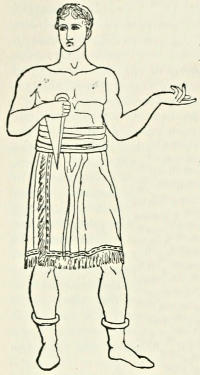
A Sacrificator
The days of triumph which succeeded passed over with uninterrupted
good fortune. The populace were gratified with the sight of the Egyptian
princess Arsinoe led as a captive at the conqueror’s wheels; but she was
spared the fate of the Gallic chieftain out of favour to her sister, or perhaps
out of pity to her sex. The son of the king of Numidia who followed the
triumphal car was also spared, and lived to receive back his father’s crown
from Augustus. Though Cæsar abstained from claiming the title of a
triumph over his countrymen, he did not scruple to parade their effigies
among the shows of the procession. The figures or pictures of the vanquished
chiefs were carried on litters, and represented the manner of their deaths.
Scipio was seen leaping desperately into the sea; Cato plunging the sword
into his own bowels; Juba and Petreius engaged in mortal duel; Lentulus
stabbed by the Egyptian assassin; Domitius pierced perhaps in the back, in
token of his flight. The figure of Pompey alone was withheld for fear of
the commiseration it might excite among the people whose favourite he had
so lately been. Nor, as it was, were the spectators unmoved. Upon the
unfeeling display of Roman defeat and disaster they reflected with becoming
sensibility. But the pictures of Achillas and Pothinus were received with
unmingled acclamations, and loud was the cry of scorn at the exhibition of
Pharnaces flying in confusion from the field. After all, the most impressive
part of the ceremony must have been the appearance of the rude veterans
whose long files closed the procession. With what ignorant wonder must
the children of Gaul and Iberia, of Epirus and Africa, have gazed at the
splendour of the city, of which the fame resounded in their native cabins!
What contempt must they have felt for the unarmed multitudes grinning
around them! How reckless must they have been of the dignity of the
consuls and senators, they who claimed the license of shouting derisive songs
in the ears of their own commander! Little did they think that grave
historians would sum up their coarse camp jokes in evidence against the fame
of their illustrious leader; still less did they dream of the new power which
the military class was thenceforth to constitute in the state. Rome in fact
was their own; but it was a secret they were not yet to discover.
The satisfaction of his armed supporters, however, was the first condition
on which the supreme power of the dictator must henceforth be maintained
in the city. It was a matter, indeed, of hardly less importance to secure
the good humour of the urban population. While the soldiers receive each
a donative of twenty thousand sesterces, the claims of the much larger multitude
of the free citizens were not undervalued severally at four hundred;
especially as they received the additional gratification of one year’s remission
of house rent. It does not appear how this indulgence differed from
that for which Cælius and Dolabella had raised their commotions; but the
dictator had so strenuously resisted every attempt to set aside the just claims
of creditors on all previous occasions, that it can hardly be doubted that in
this case he gave the landlords compensation from the public treasury. The
mass of the citizens was feasted at a magnificent banquet, at which the Chian
and Falernian wines, the choicest produce of Greece and Italy, flowed freely
from the hogshead, and towards which six thousand lampreys, the most exquisite
delicacy of the Roman epicure, were furnished by a single breeder.
The mighty multitude reclined before twenty-two thousand tables; each
table having its three couches, and each couch, we may suppose, its three
guests; so that the whole number feasted may have amounted to nearly two
hundred thousand. When Cæsar undertook the functions of his censorship,
the number of recipients of the public distributions of corn was estimated at
320,000. Upon a scrutiny into their claims as genuine and resident citizens,
he was enabled to strike off as many as 150,000 from this list. Adding to
the remainder the senators and knights, and the few wealthy individuals
who might have scorned to partake of a state provision, the sum will
correspond pretty accurately with the number of the imperial guests as
above computed.
The public shows with which these gratifications were accompanied were
carried out on a scale of greater magnificence than even those recently
exhibited by Pompey. There was nothing in which the magistrates of the
republic vied more ostentatiously with one another than in the number of wild
beasts and gladiators which they brought into the arena. The natural taste
of the Italian people for shows and mummery degenerated more and more
into an appetite for blood; but in this, as in every other respect, it was
Cæsar’s ambition to outdo his predecessors, and the extraordinary ferocity
and carnage of the exhibitions which he complacently witnessed excited a
shudder even in the brutal multitude. The combatants in the games of the
Circus were either professional gladiators, who sold their services for a certain
term of years, or captives taken in war, or lastly public criminals. But
Cæsar was, perhaps, the first to encourage private citizens to make an exhibition
of their skill and valour in these mortal combats. He allowed several
men of equestrian rank, and one the son of a prætor, to demean themselves
in the eyes of their countrymen by this exposure to the public gaze. It was
only when a senator named Fulvius Setinus asked permission thus to prostitute
his dignity, that the dictator was at last roused to restrain the growing
degradation.
If the people of Rome were shocked at the bloodshed which they were
invited to applaud, it seems that they were offended also at the vast sums
which were lavished on these ostentatious spectacles. They would have
preferred, perhaps, that the donative to themselves should have been greater,
and the soldiers even exhibited symptoms of discontent and mutiny in consequence.
No instance of Cæsar’s profuse expenditure excited greater
admiration than his stretching a silken awning over the heads of the spectators
in the Circus. This beautiful material was brought only from the
farthest extremity of India, and was extremely rare and precious at Rome
at that time. Three centuries later it was still so costly that a Roman
emperor forbade his wife the luxury of a dress of the finest silk unmixed
with a baser fabric. But a more permanent and worthy object of imperial
expenditure was the gorgeous Forum of which Cæsar had long since laid the
foundation with the spoils of his Gallic Wars. Between the old Roman
Forum and the foot of the Quirinal, he caused a large space to be enclosed
with rows of marble corridors, connecting in one suite halls of justice, chambers
of commerce, and arcades for public recreation. In the centre was
erected a temple to Venus the ancestress, the patroness for whom Cæsar had
woven a breastplate of British pearls, and whose name he had used as his
watchword on the days of his greatest victories. He now completed the
series of his triumphal shows by the dedication of this favourite work. It
remained for centuries a conspicuous monument of the fame and magnificence
of the first of the Cæsars. His successors were proud to cluster new
arches and columns by its side, and bestowed their names upon the edifices
they erected in connection with it. Finally, Trajan cut through the elevated
ridge which united the Capitoline with the Quirinal, and impeded the
further extension of the imperial forums. He filled the hollow with a new
range of buildings, occupying as much ground as the united works of his
predecessors in this quarter. The depth of his excavation is indicated, it is
said, by the height of the pillar which bears his name.
[46-45 B.C.]
Our review of the dictator’s proceedings in the discharge of his civil
functions must be postponed, but only for a moment, to relate the short episode
of his last military exploit. The despatches of his lieutenants in Spain
represented that province as rapidly falling into the hands of the republican
faction. Varus and Labienus had escaped from Africa, and joined the
standard under which Scapula marshalled the disaffected legions in Spain.
Cneius Pompeius had also issued from his retreat in the Balearic Isles, and
as soon as he appeared in their camp every chief of the oligarchy waived his
own pretensions to the command in deference to the man who represented
the fame and fortunes of their late leader. Yet Scapula had the confidence
of the soldiers, Labienus was an officer of tried ability and reputation, and
Varus had at least held the highest military commands, while Cneius himself
was personally unknown to the legions in Spain, and his only achievement
in war had been a dashing naval exploit. So cowed by its repeated
reverses was the spirit of the old Roman party, which had revived for a
moment in Africa with vain exultation at finding itself relieved from the
ascendency of its own military champion. Cneius, on his part, seems to
have regarded the renewed contest in the light of a private quarrel. His
war-cry was not “Rome,” “Liberty,” or “The Senate,” but “Pietas,”
“Filial Duty.”
The disaffection among Cæsar’s soldiers had become widely spread; a
large body of them had enrolled themselves under their new leaders; their
numbers had been augmented by provincial enlistments; even slaves had
been drafted into the ranks; while the cities and states of the peninsula lent
their aid more or less openly to the cause. It was not in the remoter parts
of the province or among the half-subdued native principalities, but in the
centre of Roman influence and civilisation, in Corduba itself, that the standard
of the adventurers was unfurled. Cæsar had completed the ceremonies
of his quadruple triumph, and was deeply engaged in the arduous task of
legislation for the new system of government which he had undertaken to
raise, when he found it necessary to postpone every other occupation to meet
his enemies once more in arms. So uncertain and tedious was the navigation
of those days that he may have chosen the land route across the Alps and
Pyrenees, for the sake of reaching his destination with greater speed.[123]
The details of the campaign into which he immediately plunged are given,
but very obscurely, in the last of the series of contemporary memoirs which
have hitherto been our guides throughout the military history of the period.
In point of composition it betrays less literary accomplishment than any of
its kindred works. The rude soldier who seems to have been its author
had no hesitation in recording in their undisguised enormity the cruelties
which disgraced the conduct of both parties. Cæsar’s character for humanity
suffers more in this than in any other contemporary narrative of his actions.
The campaign was, indeed, a series of butcheries on either side, but Cneius
was, perhaps, the most savagely ferocious of all the captains of the civil wars.
The scene of the last act of Roman liberty was laid in the valley of the
Guadalquivir and the defiles of the Sierra de Tolar. After a variety of
desultory movements, of which we obtain from the narrative only an indistinct
notion, we find the rival armies at last drawn up in hostile array on
the field of Munda. Cæsar was this time superior in numbers, and especially
in cavalry; but the enemy was well posted, and fought well: never, it is
said, was the great conqueror brought so near to defeat and destruction.b
“When the armies were going to close, Cæsar, seeing his men go on but
coldly and seem to be afraid, invoked all the gods, beseeching them with
hands lifted up to heaven, not to let the lustre of so many glorious actions
be darkened in one day, and running through the ranks, encouraged his
soldiers, taking off his head-piece that he might be better known. But do
what he could, he could not raise their spirits, till snatching a buckler out of
a soldier’s hand, he said to the tribunes who were about him, ‘This shall be
the last day of my life, and of your engagement in the war.’ And at the same
time made furiously towards the enemy; he had scarce advanced ten feet
but he had above two hundred darts thrown at him, some of which he
avoided by bending his body, and others received on his buckler, when the
tribunes ran with emulation to get about him, and the whole army thereupon
charging with all their fury, they fought all day with divers advantage, and
at length towards the evening the victory fell to Cæsar, and it is reported
that hereupon he was heard to say these words, ‘that he had often fought
for victory, but that now he had fought for life.’
“After the defeat, Pompeius’ men flying into Corduba, Cæsar, to prevent
their escape thither, lest they should rally and renew the fight, caused the
place to be invested by the army, where the soldiers being so tired that they
could not work in the circumvallation, heaped up together the bodies and
armour of the slain, which they kept piled up with their javelins stuck into
the ground, and lay all night under that kind of rampire. Next morning
the city was taken. Of Pompeius’ captains, Scapula setting up on a pile
of wood burned himself; the heads of Varus, Labienus, and other persons of
quality were brought to Cæsar. As for Pompeius, he fled from the battle
with a hundred and fifty horse, bending his course towards Carteia where
his fleet lay; he entered the port in a litter, and in the habit of a private man.
But seeing the seamen had likewise lost all hopes, he threw himself in a little
boat, in which as he was going out to sea, his foot tangling in the cordage,
one of his people going to cut the rope, by mischance cut his heel, so that to
cure his wound he was forced to go ashore at a small village, where hearing
that Cæsar’s horsemen were coming, he took his flight through a country
covered with thorns and briers, which added to his wound, so that being
tired and sitting down at last under a tree, he was found by those who gave
him chase, and slain, generously defending himself; his head was carried to
Cæsar, who caused it to be buried. Thus [says Appian] was this war ended
by one only fight and contrary to the opinion of all the world.”g
Of all the leaders of the senatorial party, Sextus Pompeius was now the
only survivor. He had made his escape from the field of Munda, and had
an asylum in the wildest districts of the Hither Province. He had nothing
to hope from the clemency of the conqueror, who had shown unusual bitterness
against his family by the confiscation of their patrimonial estates, and
was now preparing to celebrate his triumph over them as foreigners and
enemies of the state. Thus driven to despair, he infused new spirit into the
predatory habits among the tribes among whom he had taken refuge, and
continued to defy the power of the provincial authorities. Cæsar occupied
himself for some months in reconstituting the government of Spain, taking
precautions for the entire subjugation of the party which had shown such
vitality in that quarter. The battle of Munda was fought on the seventeenth
of March, but the dictator was not at liberty to return to Italy till September,
after an absence of ten months.
The hostile attitude of the last of the Pompeians in Spain was not the only
exception to the tranquillity which prevailed generally throughout the empire.
In Gaul the Bellovaci had risen in arms; but this movement was expeditiously
repressed by Decimus Brutus, the proconsul of the newly conquered province.
In the extreme East, however, the republican party still continued to make
head, under the leadership of Cæcilius Bassus. Their champion was an
obscure knight, and their forces were insignificant, consisting principally of
two legions which Bassus had seduced from their allegiance to Sextus Cæsar,
the commander to whose care Syria had been entrusted by his kinsman.
But the proximity of the Parthians, ever on the watch for an opportunity to
wound the sides of their great rivals, rendered any movement in this quarter
formidable. Sextus Cæsar was murdered by his soldiers, and Bassus took
possession of the city of Apamea, which, with the assistance of the national
enemies, he continued to keep against the petty attempts which were made
to dislodge him. The dictator kept his eye upon him, and already meditated
his destruction; but for the present he was content to leave his temerity
unpunished, while he applied himself to the consolidation of his power by
bold and comprehensive legislation at home.b
[45 B.C.]
On the 13th of September, 45, the dictator appeared once more at the gates
of Rome, but he did not triumph till the commencement of October. His
victory was represented as gained over the Iberians; the miserable outcasts
whom Cneius had banded together were all confounded together under the
common title of strangers and enemies. Two of the dictator’s lieutenants,
Fabius, and Pedius who was also his kinsman, were allowed the honour of
separate triumphs. These ceremonies were followed as usual with games
and festivals, which kept the populace in a fever of delight and admiration.
They had complained that among the numerous spectacles offered to their
view each citizen could witness only a portion, while to the foreigners who
flocked to this great feast of nations, the dramatic entertainments had been
unintelligible. The games were now multiplied in various quarters of the
city, while plays were represented in different languages for the benefit of
every people. The subjects of the empire had entered Rome as conquerors
in Cæsar’s train, and thus he inaugurated the union of the capital with the
provinces. Kings and commonwealths sent their ambassadors to this mighty
congress of nations. Among them were the Moors and the Numidians, the
Gauls and the Iberians, the Britons and the Armenians, the Germans and
the Syrians. The Jews, insulted by Pompey and rifled by Crassus, offered
their willing homage to the champion who alone of all the Romans had
spoken to them in the language of kindliness and respect. Cleopatra the
queen of Egypt came, her crown in her hand, offering her treasures and her
favours to her admirer and preserver. All in turn had trembled at the
official caprices of the Roman knights, and Cæsar could afford them perhaps
no sweeter revenge, nor represent to them more vividly the extent of his
power, than in degrading before their faces these petty tyrants of the provinces.
He compelled one of them, named Laberius, who was also a dramatic
composer, to enact one of his own comic pieces, that is, to dance and sing
upon the stage before the concourse of citizens and strangers. “Alas!”
said the wretched man in his prologue, “after sixty years of honour I have
left my house a knight, to return to it a mime. I have lived one day too
long.” Cæsar restored to him the golden ring of knighthood, forfeited by
this base but compulsory compliance. He presented him also with a large
sum of money, to show perhaps more completely the prostration of his
order.
Such trifling persecutions, whether personal or political in their objects,
are undoubtedly pitiable enough. But it is Cæsar’s glory that his arm fell
heavily upon none of his fellow-citizens. The nephew of Marius forgot the
banishment of his uncle, the ruins of Carthage, and the marshes of Minturnæ;
the avenger of the Sullan revolution scorned to retaliate the proscriptions;
the advocate of Cethegus and Lentulus refrained from demanding blood
for blood. It is worth remarking that Cicero, the most humane perhaps of
his own party, the most moderate in sentiments, the fairest estimater of men
and measures, could hardly persuade himself of the possibility of Cæsar
abstaining from massacre. Such was the wise man’s reading of the history
of his countrymen; and when at last he found that the conqueror meditated
no such use of his victory, his heart, we fear, still remained untouched, and
he never, perhaps, renounced the secret hope that Cæsar’s opponents would
prove less merciful than himself.
Nor was the conqueror’s clemency confined to sparing the lives of his
opponents. He refrained from confiscation which had been wont to accompany
the edicts of his predecessors. The wealth indeed which was poured into Rome
from the tribute of so many new subjects, and the plunder of so many temples,
rendered it more easy to practise this unusual liberality. It was ungenerous
perhaps to make the estates of his great rival the chief exception
to this rule of moderation. But Cæsar intended to brand as rebels to constituted
authority the men who renewed the strife after Thapsus, and this
confiscation was meant, not as an insult to the dead, but as a punishment of
the living opponent. The name of the Great Pompey had already passed
into the shrine of history, and the victor was proud of closing the fasti of
the republic with so illustrious a title. Far from approving the precipitation
of his flatterers in removing the statues of Pompey and Sulla, he caused
them to be restored to their places in front of the rostra, among the effigies
of the noblest champions of the free state. Towards the institutions of the
commonwealth he evinced a similar spirit of deference. He sought no new
forms under which to develop his new policy. Sulla had attempted to
revive the aristocratic spirit of the ancient constitution by overthrowing the
existing framework of the laws; but the popular dictator, in laying the
foundation of a more extensive revolution, studied to preserve it intact.
While making himself an autocrat in every essential exercise of power, he
maintained, at least in outward seeming, all the institutions most opposed to
autocracy, the senate, the comitia, and the magistracies. But he had long
before said that the republic was no more than a shadow, and these very
institutions had long been merely the instruments by which tyrants had
worked out the ends of their selfish ambition.
Cæsar now was fully aware that he could sway the Roman world unchecked
by the interference of a senate, two-thirds of which perhaps were
nominees of his own. Under the sanction of an organic law he had raised
the number of the assembly to nine hundred, thus degrading the honour by
making it cheap; and he still more degraded it in the eyes of the proudest
of the citizens by pouring into it his allies from the provinces, his soldiers,
and even, if we may believe their bitter sarcasms, the captives who had
just followed his car of triumph. The Romans exercised their wits on
these upstart strangers losing themselves amidst the forests of columns which
thronged the public places, and placards were posted recommending no good
citizen to guide them to the senate house. This servile council, with less
respect for appearances than its chief, would have given him the right
of nominating to all curule and plebeian offices, to the entire abrogation of
the electoral prerogatives of the people. But Cæsar declined to destroy the
last shadow of liberty, assured that no man would venture to sue for a
magistracy without his consent. He contented himself with recommending
certain candidates to the suffrages of the people, and these recommendations
were equivalent to commands. Moreover the senate had imposed upon the
elected the obligation to swear before entering on their office, that they
would undertake nothing against the acts of the dictator, for every act of
his was invested with the force of law. The consuls, prætors, and other
officers thus continued to exercise their ordinary functions under the dictator’s
superintendence; the prætors were increased in number, while the
consuls, though never exceeding two at the same time, were rapidly supplanted,
sometimes month by month, by fresh aspirants whom it was expedient
to gratify. As the avowed champion of the people Cæsar retained
the appropriate distinction of the tribunitian power, which also rendered his
person inviolable;[124] while both the senators and the knights offered to surround
him with a guard of honour of their own members to secure this inviolability
by a stronger instrument than the law. To the reality of power
he added its outward signs. In the senate, the theatre, the circus, and the
hall of justice he might seat himself on his golden chair in a robe of regal
magnificence, while his effigy was impressed upon the public coinage.[125] Apart
from the title of king there is no outward symbol of royalty more appropriate
than that of the hereditary transmission of offices and distinctions.
The imperium, or military supremacy, which had been granted to Cæsar for
his life, was rendered transmissible to his children, and with it the august
distinction of the sovereign pontificate.
In fine, the dictatorship for life and the consulship for five years, with the
right of drawing at pleasure upon the public treasury, secured to Cæsar
the executive power of the state; the imperium gave him the command of
its forces; the tribunate invested him with a veto upon its legislation. As
prince, or first man of the senate, he guided the debates of that assembly;
as controller of manners even its personal composition depended upon his
will. As chief pontiff he interpreted the religion of the state, and made
omens and auguries declare themselves at his bidding. Thus the finances,
the army, the religious system, the executive with a portion of the judicial
power, and indirectly almost the whole functions of the legislature were
combined in the hands of the autocrat of the Roman commonwealth. Nevertheless
he had assumed no title inconsistent with the principles of the republic,
and the precedents of constitutional history.
[46-44 B.C.]
What then were the objects to which Cæsar proposed to direct this enormous
accumulation of powers? His cherished scheme for the amalgamation
of the various elements of the empire was necessarily slow in progress. He
did not seek to precipitate it by violent measures.c
From his last triumph to his death was somewhat more than five months
(October, 45 B.C.-March, 44 B.C.): from his quadruple triumph to the
Spanish campaign was little more than four months (June-September, 46
B.C.). Into these two brief periods were compressed most of the laws which
bear his name, and of which we will now give a brief account. The evils
which he endeavoured to remedy were of old standing. His long residence
at Rome, and busy engagement in all political matters from early youth to
the close of his consulship, made him familiar with every sore place and
with all the proposed remedies. His own clear judgment, his habits of
rapid decision, and the unlimited power which he held, made it easier for
him to legislate than for others to advise.
The long wars, and the liberality with which he had rewarded his soldiers
and the people at his triumphs, had reduced the treasury to a low
ebb. He began by revising the register of citizens, principally for the purpose
of abridging the list of those who were receiving monthly donations of
grain from the treasury. Numbers of foreigners had been irregularly placed
on the list, and he was able to reduce the list of state paupers resident in or
near Rome from 320,000 to less than half that number. The treasury felt
an immediate and a permanent relief.
But though, for this purpose, Cæsar made severe distinctions between
Roman citizens and the foreign subjects of the republic, no ruler ever showed
himself so much alive to the claims of all classes of her subjects. Other
popular leaders had advocated the cause of the Italians, and all free people
of the peninsula had in the last thirty years been made Romans: but no one
had as yet shown interest in the claims of the provincial subjects of Rome,
except Sertorius, and his object was rather a transference of power from
Italians to Spaniards, than an incorporation of Spain with Italy. Cæsar was
the first acknowledged ruler of the Roman state who extended his view
beyond the politics of the city and took a really imperial survey of the vast
dominions subject to her sway. Towards those who were at war with Rome
he was as relentless as the sternest Roman of them all; but no one so well
as he knew how “to spare the submissive”; hardly any one except himself
felt pleasure in sparing. All the cities of Transpadane Gaul, already Latin,
were raised to the Roman franchise. The same high privilege was bestowed
on many communities of Transalpine Gaul and Spain. The Gallic legion
which he had raised, called Alauda from the lark which was the emblem on
their arms, was rewarded for its services by the same gift. All scientific
men, of whatever origin, were to be allowed to claim the Roman franchise.
After his death a plan was found among his papers for raising the Sicilian
communities to the rank of Latin citizens.
The imperial character of the great dictator’s government is strongly
shown by his unfulfilled projects. Among these was the draining of the
Pontine marshes, the opening of lakes Lucrinus and Avernus to form a
harbour, a complete survey and map of the whole empire—plans afterwards
executed by Agrippa, the minister of Augustus. Another and more memorable
design was that of a code of laws embodying and organising the scattered
judgments and precedents which at that time regulated the courts.
It was several centuries before this great work was accomplished, by which
Roman law became the law of civilised Europe.
The liberal tendency of the dictator’s mind was shown by the manner in
which he supplied the great gaps which the Civil War had made in the
benches of the senate. Of late years the number of that assembly had
been increased from its original three hundred.[126] Cicero on one occasion
mentions 415 members taking part in the votes, and many of course were
absent. But Cæsar raised it to nine hundred, thus greatly exceeding the
largest number that had ever been counted in its ranks. Many of the new
senators were fortunate soldiers who had served him well. In raising such
men to senatorial rank he followed the example of Sulla. Many also were
enfranchised citizens of the towns of Cisalpine Gaul. The old citizens were
indignant at this invasion of barbarians. “The Gauls,” said one wit, “had
exchanged the trews [trousers] for the toga, and had followed the conqueror’s
triumphal car into the senate.” “It were a good deed,” said another,
“if no one would show the new senators the way to the house.”
The curule offices, however, were still conferred on men of Italian birth.
The first foreigner who reached the consulship was Balbus, a Spaniard of
Gades, the friend of Cæsar; this was four years after the dictator’s death.
To revive a military population in Italy was not so much the object of
Cæsar as that of former leaders of the people. His veterans received few
assignments of land in Italy. The principal settlements by which he enriched
them were in the provinces. Corinth and Carthage were made military
colonies, and regained somewhat of their ancient splendour and renown.
He endeavoured to restore the wasted population of Italy by more peaceful
methods. The marriage tie, which had become exceedingly lax in these
profligate times, was encouraged by somewhat singular means. A married
matron was allowed to use more ornaments and more costly carriages than
the sumptuary laws of Rome permitted to women generally. A married
man who had three children born in lawful wedlock at Rome, or four born
in Italy, or five born in the provinces, enjoyed freedom from certain duties.
The great abuse of slave labour was difficult to correct. It was attempted
to apply remedies familiar to despotic governments. An ordinance
was issued that no citizens between twenty and forty years of age should be
absent from Italy for more than three years. An ancient enactment was
revived that on all estates at least one-third of the labourers should be free
men. No doubt these measures were of little effect.d
Viewing the dominions over which he presided as a whole, endowed, or
speedily to be endowed with a general equality of rights, and Rome herself
no longer as an isolated municipium and a mistress-city, but the centre and
capital of the Roman world, he proceeded to lay the groundwork of a comprehensive
scheme of universal legislation. His first care was to develop
the material unity of the vast regions before him, by an elaborate survey of
their local features. A commission of geographers and mathematicians was
appointed, as we have just said, to construct the map of the Roman Empire,
a work so novel and so full of detail, as to require the labour, as it afterwards
proved, of no less than thirty-two years. Another effort, not less
gigantic, was required to impress a moral unity upon this vast machine.
Cæsar prepared to collect and combine in a single code the fragments of
Roman law, dispersed in thousands of precedents, the edicts of the prætors,
the replies of the learned, the decisions of pontiffs, and the traditions of
patrician houses. Such a mighty work had already been contemplated by
Cicero, as the hopeless vision of the philanthropist and philosopher; but
Cæsar’s practical sagacity saw that it not only ought to be done, but could
be done, and doubtless had he but lived ten or twenty years longer, he
would have anticipated by six centuries the glory of the imperial legislator
Justinian.
Another work of equal utility but fortunately of much smaller compass
was the reformation of the calendar, and this it was given to the great Julius
to effect, and to call after his own name. The Roman year, even before the
time of Cæsar, ought to have equalled on the average 365 days and six
hours; so near had the astronomers of the period of Numa already arrived
to the real length of the earth’s revolution round the sun. This year had
been calculated on a basis of 354 days, with the intercalation every second
year of a month of twenty-two and twenty-three days alternately; but another
day had been added to the 354 to make an odd or fortunate number,
and to compensate for this superfluous insertion the number of intercalations
was proportionally diminished by a very intricate process. The simplicity
of the original arrangement being thus violated, great carelessness
had soon prevailed in making the requisite corrections. In course of time
the pontiffs, to whose superior skill the guardianship of the calendar had
been entrusted, had shrouded their science in a veil of religious mystery,
and turned it to political or private ends. They commanded the intercalation
of a month arbitrarily, when it suited them to favour a partisan who
desired the extension of his year of office, or the postponement of the day on
which his debts should become due. They abstained from the requisite insertion
at the instance of some provincial governor, who was anxious to hasten
his return to the enjoyments of the capital. This control over the length of
the civil year, as well as the power of proclaiming the days on which business
might or might not be transacted, had become an engine of state in the
hands of the oligarchical government, with which the pontiffs were for the
most part politically connected. The grievance had lately become intolerable.
In the distracted state of public affairs and amidst conflicting personal
interests, the pontiffs had abstained from intercalating since the year 52, and
had even then left the civil calendar some weeks in advance of the real time.
Since then each year had reckoned only 355 days, and the civil equinox had
got eighty days in advance of the astronomical. The consuls accordingly,
who entered on their office the 1st of January, 47, really commenced their
functions on the 13th of October. The confusion hence resulting may be
easily imagined. The Roman seasons were marked by appropriate festivals
assigned to certain fixed days, and associated with the religious worship of
the people. At the period of harvest and of vintage, for instance, seasonable
offerings were to be made, which it was no longer possible to offer on the
days specifically assigned for them. The husbandman rejected the use of
the calendar altogether, and depended on his own rude observations of the
rising and setting of the constellations.
Cæsar had acquired a competent knowledge of astronomy, in which his
duties as chief of the pontiffs gave him a particular interest. He composed
himself a treatise on the subject, which had long retained its value as a
technical exposition. With the help of the astronomer Sosigenes, he
recurred again to the simple calculations of Numa, and was content to disregard
the discrepancy, which he conceived perhaps with Hipparchus to be
more trifling than it really is, between the length thus assigned to the year
and the true period of the earth’s revolution. In the course of centuries
this error has grown into importance, and in the year A.D. 1582, when the
Julian calendar was corrected by Pope Gregory XIII, the civil year had
got forward no less than ten days. The requisite correction was not made,
as is well known, in England till the middle of the eighteenth century. The
basis of Cæsar’s reform was that the commencement of the new era should
coincide with the first new moon after the shortest day. In order to make
the year 46 thus begin, ninety days required to be added to the current
year. In the first place an intercalary month of twenty-three days was
inserted between the twenty-third and twenty-fourth of February, and at
the end of November two new months were added comprehending sixty
days, together with a supplemental addition of seven more. The period
which was marked by this series of alterations received vulgarly the appellation
of “the year of confusion”; but “the last year of confusion,” it has
been justly remarked, would be its more appropriate title.
Besides these noble efforts of social organisation, Cæsar, like almost
every other great man of his nation, had an intense passion for material
construction. He had already distinguished himself by the Forum, which he
called by his own name in the heart of the city; a work which was loudly
demanded on account of the inconvenient narrowness of the spot on which
the public business of the republic had been transacted from the period of
its infancy. But among the honours now showered upon him was one
which had been granted only once or twice before to conquerors who had
furthest enlarged the limits of the empire, and which, it has been remarked,
was alone wanting to complete the “good fortune” of Sulla. This was the
permission to extend the pomœrium, the space left open about the walls of
the city, partly within and partly without them, originally perhaps for the
convenience of defence; but which was consecrated by solemn ceremonies,
and traversed by religious processions. Cæsar proposed, it is said, to remove
this line, and with it probably the walls themselves, so as to embrace
the Campus Martius, which he would have enlarged by turning the Tiber
westward with a bold sweep from the Milvian to the Vatican bridge. This
grand project was never destined to be accomplished, and though in later
times the emperor Augustus and others were allowed to extend the pomœrium,
the walls of Rome were not removed beyond the lines traced by Servius
till the time of Aurelian, three centuries after Cæsar. Nor was the
dictator more fortunate in completing the many other works of public interest
and utility which he was already meditating. He planned, it is said, the
emptying of the lake Fucinus, the draining of the Pomptine marshes, the
construction of a canal from Rome to Tarracina, of a new road across
the Apennines, and of a magnificent harbour at Ostia, the erection of a
superb temple to Mars, and the cutting of the Isthmus of Corinth. Of all
these designs the temple and the harbour were alone accomplished by his
successor; it is probable that Cæsar himself had commenced them. [Under
his patronage the first public library was opened at Rome, and for the transaction
of public business he erected the magnificent building called the
Basilica Julia.]
Such were the subjects of meditation which engrossed Cæsar’s mind during
the days and nights he devoted to public affairs. But he had also his
hours of recreation, and he shone in private life among the most cultivated
men of his time, the most refined in habits, the most fascinating in manners.
There is no feature of Roman life perhaps which we can regard with so
much satisfaction as the tone of habitual intercourse among public men at
this period. The daily conflicts at the bar or in the Forum to which they
were trained, would have only embittered their feelings towards one
another, had they not been accompanied by the humanising influence of
social discussion on topics of literature and philosophy. The combination
of these two habits seems indeed to form the best discipline of society,
imparting to it earnestness without violence, and a masculine courtesy far
removed from servility and adulation. The records of Roman debate present
us with hardly a single scene of personal altercation, while the private
reunions of the most eminent statesmen are described to us as full of modest
dignity and kindly forbearance. To this pleasing result every school of
philosophy contributed; but none of them perhaps studied so well as the
Epicurean the science of making society agreeable. To this school both
Cæsar himself and most of his personal friends professed their adherence.
The circle of his intimates comprised: Cornelius Balbus, an acute man of
business; Asinius Pollio, a devoted student; A. Hirtius, who like his master
both fought, wrote, and talked well; C. Oppius, full of gentleness and
affection; C. Matius, thoughtful, generous, and disinterested. To these
may be added Vibius Pansa, a lounger and a good liver, yet neither incapable
of office, nor inexperienced in action. Antony, the gayest of boon
companions, has already been mentioned; but under the garb of good
fellowship, he hardly concealed the most intense selfishness, and of all
Cæsar’s friends he alone stands open to the suspicion of intriguing against
the life of his patron. Among these men and others of similar stamp Cæsar
unbent from the cares of empire, and often abandoned himself without
restraint to the enjoyments of festive mirth. With little wit of his own
he was amused by the witticisms of others, even when directed against
himself, and treasured up every caustic remark which fell from the lips
of Cicero, whose patriotism, relieved from the fear of impending proscription,
now exhaled itself in malicious pleasantries against the policy of
the dictator. At table indeed, surrounded by companions addicted to
the grossest self-indulgence, Cæsar was distinguished for his moderation.
Cato had said of him long before, that of all the revolutionists of the day
he alone had come sober to the task of destruction. But his amours were
numerous, and their character peculiarly scandalous; for his countrymen
still professed to regard the corruption of a Roman matron as a public
wrong, while his attachment to a foreigner, such as Cleopatra, was
denounced as a flagrant violation of religious and social principles.
In religion the Epicureans were sceptics, and Cæsar went farther and
openly professed his unbelief. The supreme pontiff of the commonwealth, the
head of the college whence issued the decrees which declared the will of
the gods, as inferred from the signs of the heavens, the flight of birds, and
the entrails of victims, he made no scruple in asserting before the assembled
fathers that the dogma of a future state, the foundation of all religion, was
a vain chimera. Nor did he hesitate to defy the omens which the priests
were especially appointed to observe. He gave battle at Munda in despite
of the most adverse auspices, when the sacrifices assured him that no heart
was found in the victim. “I will have better omens,” he said, “when I
choose.” Yet Cæsar, freethinker as he was, could not escape the general
thraldom of superstition. We have seen him crawling on his knees up the
steps of the temple to appease an indignant Nemesis. Before the battle of
Pharsalia he addressed a prayer to the gods whom he denied in the senate,
and derided among his associates. He appealed to the omens before passing
the Rubicon. He carried about with him in Africa a certain Cornelius,
a man of no personal distinction, but whose name might be deemed auspicious
on the battlefields of Scipio and Sulla.
The queen of Egypt had followed her august admirer to Italy, and
scrupling perhaps to exhibit her publicly in the city, he had installed her in
his house and gardens on the other side of the river.[127] There she had her
levees for the reception of the noblest Romans, and her blandishments were
not perhaps ineffectual in soothing the asperity of their resentments. Cicero
himself condescended to solicit an interview with her. She rewarded him
with the promise of some Greek volumes from Alexandria, rendered perhaps
doubly precious by the recent conflagration. But the populace were shocked
at the report that Cæsar meditated
raising this barbarian mistress to the
dignity of a Roman wife. He was
married indeed already to the noble
daughter of Calpurnius Piso; but
divorce was easy, and might be resorted
to without public scandal;
Cicero himself had lately dismissed
Terentia for alleged incompatibility
of temper, and allied himself in her
place with a youthful heiress. Besides,
one of his creatures was prepared,
it was said, with a measure
to remove all restrictions upon the
dictator’s passions, and allow him to
marry as many wives as he pleased,
of whatever race or station.
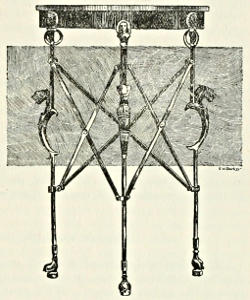
Roman Brazier
Though arrived, as we have seen,
at the summit of real power, it was
manifest that Cæsar still chafed under
the restraints imposed upon him
by opinion and prejudice. His firm
and well-poised mind seems at last to
have lost its equilibrium, and given
way to fretful impatience, and a capricious longing for some unattainable
object. The Roman nobles, accustomed to the most perfect equality
in their intercourse with one another, were mortified at the haughtiness
assumed by the chief of the republic, surrounded by a crowd of flatterers
through whom the independent patrician could with difficulty force his way.
Once when the senators came in a body to communicate to him their
decrees in his honour, he omitted to rise from his seat to receive them.
Balbus, it was said, the upstart foreigner, had plucked him by the sleeve
and bade him remember that he was their master. It was reported that
he had called Sulla a fool for resigning the dictatorship. But while the
lines of his domestic policy were yet hardly laid, and every institution in
Rome still demanded the pressure of his moulding hand, Cæsar himself
was dreaming of foreign conquests, and sighing for his accustomed place
at the head of his legions. The disaster of Carrhæ, yet unavenged, might
furnish a pretext for war, and the influence of Mithridates, it might be remembered,
had extended from the Caspian and the Euxine to the head of the
Adriatic. He conceived, we are assured, the gigantic project of first crushing
the Parthians, and then returning across the Tanaïs and Borysthenes,
subduing the barbarians between the Caucasus and the Carpathian Mountains,
and assailing the Germans in the rear. Cleopatra, who felt herself more
secure of her admirer in the provinces than in Rome, would doubtless lend
her influence to urge him on. The republicans in the city were not perhaps
less anxious to remove him to a distance, and launch him on a long and dangerous
enterprise. At the close of the year 45 he directed his legions to
cross the Adriatic, and assemble in Illyricum, there to await his own speedy
arrival. He contemplated an absence of considerable duration. He provided
beforehand for the succession of consuls and prætors for the two
following years. On the 1st of January, 44, he entered upon his fifth consulship,
in which he associated himself with Antony. At the same time he
obtained the designation of Hirtius and Pansa for 43, of Decimus Brutus and
Munatius Plancus for 42. The prætors appointed for the year 44 were
sixteen in number, and among them were M. Brutus and Cassius.
[45-44 B.C.]
The destined heir of Cæsar’s imperium was already in the camp at
Apollonia, taking lessons at the same time both in arts and arms under the
care of the ablest teachers. This young man was Caius Octavius, the son of
Cæsar’s sister’s daughter, who, now beginning his nineteenth year, gave
splendid promise of future excellence, marred only by the extreme delicacy
of his health, which had hitherto prevented him from seeking distinction in
the field. The favour with which his great-uncle regarded him had induced
him to demand the mastership of the horse, but this had been refused him as
a distinction beyond his years. Cæsar, however, had promoted his family
from the plebeian to the patrician class, an honour which he had accorded to
a few gentes, whose names were of great antiquity, among which was the
Tullian, to which the character of Cicero had imparted so much new lustre.
He had allowed it, moreover, to be understood that he was about to make
the young Octavius his own son by adoption, to bequeath to him the bulk of
his patrimony, and the dignities which the senate had declared hereditary in
his family. These dignities indeed were not associated in the mind of the
Romans with any ideas of succession. It was difficult for them to conceive
the descent of the dictatorship from the hands of mature experience to those
of untried youth, or the establishment in the sphere of a particular family of
the tribunitian power, the free gift of the sovereign people. It was natural
for them to conclude that their hero was intent on securing a title, the only
recognised title, on which according to their notions a dynasty could be
founded. Cæsar, it was reported, desired to be hailed as king. His flatterers
suggested it, his enemies readily believed it, and hoped to make him
unpopular by urging him to claim it. One morning a laurel garland, with
a diadem attached, was found affixed to his statue before the rostra. The
tribunes, Flavius and Cæsetius, indignantly tore it down; the populace
expressing great satisfaction at their conduct, and saluting them with the
title of the new Bruti. Cæsar affected at least to applaud them. Shortly
afterwards a second experiment was tried. As the dictator returned from the
Latin festival, celebrated on the Alban Mount, officious voices were hired to
salute him as king. A low and stifled murmur again indicated the disapprobation
of the people. “I am no king, but Cæsar,” he hastily exclaimed; but
when the tribunes punished some persons who had joined in the cry, he
rebuked them for their superfluous or invidious zeal, in which he detected
a scheme for bringing him under unjust suspicions.
Cæsar’s friends, however, if such were the real promoters of the intrigue,
were not yet satisfied that the prize was beyond his reach. They might
familiarise the people with the idea of royalty by bringing it repeatedly
before them. Perchance the sight of the white linen band, the simple badge
of oriental sovereignty, might disabuse them of their horror at an empty
name. On the 15th of February, the day of the Lupercalia, Cæsar was
seated on his golden chair before the rostra, to preside over the solemn ceremonies
of that popular festival. The Julian flamens were elevated to the
same rank as the priests of the god Lupercus or Pan. Antony, the consul,
was at their head, and next to the dictator occupied the most conspicuous
place in the eyes of the multitude. Possibly the novelty of the sight of the
one consul stripped to his skin, with only a narrow girdle round his loins,
waving in his hand the thong of goat’s hide, and striking with it, as he ran
rapidly through the principal streets, the women who presented themselves
to the blow which was supposed to avert sterility, was still more attractive
than that of the other in the laurel crown and triumphal robes which use
had already rendered familiar. When Antony had run his course he broke
through the admiring multitude and approached the seat of the dictator.
Drawing from beneath his girdle a diadem, he made as if he would offer it to
him, exclaiming that it was the gift of the Roman people. The action was
hailed by some clapping of hands; but it was faint and brief and manifestly
preconcerted. When, however, Cæsar put away from him the proffered gift,
a much louder burst of genuine applause succeeded. Antony offered it a
second time; again there was a slight murmur of applause, and again on
Cæsar’s rejection of it a vehement cry of satisfaction. “I am not king,”
repeated Cæsar; “the only king of the Romans is Jupiter.” He ordered
the diadem to be carried to the Capitol and suspended in the temple of the
god, to commemorate the gracious offer of the people and his own modest
refusal.
[44 B.C.]
The tact with which Cæsar withdrew the claims which were thus prematurely
advanced for him baffled every attempt of the republican leaders to excite
a popular feeling against him. But in the upper ranks of the nobility there
were many who cherished such sentiments of hostility towards him, nor were
his personal enemies confined to the ranks of his political adversaries. A plot
was formed for his destruction, which embraced sixty or even eighty conspirators,
many of whom had been most conspicuous in their devotion to him, and
seemed most to merit his confidence. Among them were doubtless some whose
hopes of preferment he had disappointed. But such was not the case with
Decimus Brutus, who had received from him the government of the Cisalpine,
and was already designated as the consul of a future year. Such was not the case
with Trebonius, who had just quitted the consulship for the administration
of Asia. Basilus, Casca, and Cimber had all received greater or less marks of
the dictator’s favour. Yet all these men now joined in the intrigue against
his life. Had they really loved the republic better than their imperator,
and regarded him as a tyrant and a traitor, they should not have accepted
the highest offices at his hands. But even the chiefs of the opposite party
betrayed no reluctance to profit by his generosity. It was not the needy or
disappointed among them, but those whom he had honoured and promoted,
who now raised their hands against him. The most active conspirator, and
perhaps the author of the design, was C. Cassius, who had recently been
appointed prætor. The cry of liberty and the republic, which was in the
mouths of all his associates, could have little real influence on the sentiments
of Cassius, whose avowed Epicurean principles, no less than his late political
conduct, might vouch for his indifference to party. “I prefer,” he had
written to Cicero, “our old and clement master Cæsar to the ferocious upstart,
the son of Pompey.” But he was by nature vain and vindictive; his temper
fluctuated between mean subservience and rude independence. His sharp
and acrid humour had not escaped the observation of Cæsar, by whom the pale
and lean were accounted dangerous, and who loved, as he said, the company
of the sleek and light-hearted.
The conspirators required the charm of a popular name to sanction their
projected tyrannicide. M. Junius Brutus, the nephew of Cato, pretended to
trace his descent from a third son of the founder of the republic, whose elder
brothers had perished, as was well known, childless by the axe of the lictor.
His mother Servilia derived her lineage from the renowned Ahala, the slayer
of Spurius Mælius. But far from inheriting the zeal of his progenitors,
the Brutus of the expiring republic had acquiesced in Cæsar’s usurpation
with less apparent reluctance than perhaps any other member of the Pompeian
party. Despondent in her hour of distress, he had been the last
to join, the earliest to desert the unfurled banner of the republic. After
Pharsalia, he was the first to seek refuge in the camp of the victor; in the
city he was the foremost to court the friendship and claim the confidence of
the dictator.
He zealously served his interests by the discharge of important offices;
nor did he blush to govern Cisalpine Gaul for Cæsar, while his uncle still
held Utica against him. A feeble panegyric of the sturdy sage whom he had
abandoned while he affected to adopt his principles and emulate his practice,
seemed to Brutus a sufficient tribute to his virtues. He had divorced his
consort Claudia to espouse the philosopher’s daughter Porcia, a woman of
more masculine spirit than his own. But thus doubly connected with
strength and virtue, Brutus had failed nevertheless to acquire the firmness
which nature had denied him. While professing the character of a student
he still courted public life for the sake of its emoluments. The countenance
of Cæsar raised him to an eminence which pleased and dazzled him, while his
uncle’s renown seemed also to shed a light upon him, and his vanity was
excited by a saying, possibly a jest, ascribed to Cæsar, implying that of all
the Romans he was the worthiest to succeed to supreme power. The weakness
of his character may be estimated from the means employed to work
upon him. A bit of paper affixed to the statue of the ancient Brutus with
the words, “Would thou wert alive”; billets thrust into his hand inscribed,
“Brutus, thou sleepest, thou art no longer Brutus,” shook the soul of the
philosopher to its centre. Under the influence of Cassius, who had married
his sister, he was led to embrace the schemes of the conspirators, and assumed
the place of chief adviser, which they pretended at least to offer him.
His renowned name became at once a charm of magic potency. It
raised the sick Ligarius from his bed. A pardoned partisan of Pompey,
the clemency of Cæsar rankled in his bosom. “How sad for Ligarius,”
said Brutus to him, “to be disabled at such a moment.” The sick man
raised himself on his elbow, and replied, “If thou hast any project worthy
of the name of Brutus, behold, I am well again.” Ligarius was admitted to
the secret, and took an active part in the deed which followed. We learn
with pleasure that the conspirators did not venture even to sound Cicero.
The fatal intrigue was now ripening to its execution. As long as Cæsar
remained at Rome his fearless demeanour exposed him to the daggers of
assassins, for he had dismissed the guard which had at first surrounded
him, and appeared daily in public with no other attendance than that of
his unarmed companions.
His legions had been despatched to Illyricum. To the remonstrances
of his friends, from whom perhaps the rumours of his peril were not altogether
concealed, he had replied that it was better at once to die than to live always
in fear of dying. But from the moment he should assume the command of
his armies, his safety would be assured by the fidelity of his troops. Once
intoxicated with the splendour of royalty in the provinces, he would never
consent to return a citizen to Rome. He had promised, it was said, to restore
the towers of Ilium, the cradle of the people of Æneas and Romulus.
Possibly he might transfer thither the throne which the pride of the Romans
forbade him to establish in the Capitol. Or if the charms of Cleopatra
should still retain their power, he might take up his abode in Alexandria,
and remove the seat of empire to the shrine of the Macedonian conqueror.
Such considerations as these forbade delay. The preparations for Cæsar’s
departure were almost complete. The senate was convened for the ides of
March, the 15th day of the month, and the royal name and power, it was
said, were then to be conferred upon him in the provinces. On this day, as
soon as he should enter the curia, it was determined to strike the blow. The
prediction was already current that the ides of March should be fatal to him.
Still Cæsar refused to take any precautions. He had lived, he said, enough
either for nature or glory; his ambition was satisfied, or perhaps disappointed,
and he was proudly indifferent to longer existence.c
On the evening of the 14th of March, Cæsar was supping with M. Lepidus,
his master of the horse, who was now at the head of a body of troops without
the walls, and was preparing shortly to march with them into Transalpine
Gaul, which had been assigned to him by Cæsar as his province. It happened
that Cæsar was engaged in writing, when the rest of the party began to discuss
the question, “What kind of death is most to be desired?” The subject
on which they were talking caught his attention, and he cried out, before
any one else had expressed an opinion, that the best death was a sudden one.
A coincidence so remarkable was likely to be remembered afterwards by
all who had been present; but it is said, also, that he had been often warned
by the augurs to beware of the ides of March; and these predictions had,
probably, wrought on the mind of his wife, Calpurnia, so that, on the night
that preceded that dreaded day, her rest was broken by feverish dreams, and
in the morning her impression of fear was so strong, that she earnestly besought
her husband not to stir from home. He himself, we are told, felt
himself a little unwell; and being thus more ready to be infected by superstitious
fears, he was inclined to comply with Calpurnia’s wishes, and allowed
some part of the morning to pass away, and the senate to be already assembled,
without having as yet quitted his house.
At such a critical moment as this the conspirators were naturally wide
awake to every suspicion; and becoming uneasy at his delay, Decimus
Brutus was sent to call on him, and to persuade him to attend the senate
by urging to him the offence that he would naturally give if he appeared
to slight that body at the very moment when they were preparing to
confer on him the title of king. Decimus Brutus visited Cæsar, and being
entirely in his confidence, his arguments were listened to, and Cæsar set out
about eleven o’clock to go to the senate house. When he was on his way
thither, Artemidorus of Cnidus, a Greek sophist, who was admitted into the
houses of some of the conspirators, and had there become acquainted with
some facts that had excited his suspicions, approached him with a written
statement of the information which he had obtained, and putting it into his
hand, begged him to read it instantly, as it was of the last importance.
Cæsar, it is said, tried to look at it, but he was prevented by the crowd
which pressed around him, and by the numerous writings of various sorts
that were presented to him as he passed along. Still, however, he held it in
his hand, and continued to keep it there when he entered the senate house.
Mark Antony, who was at this time Cæsar’s colleague in the consulship,
was on the point of following him into the senate, when C. Trebonius called
him aside, and detained him without, by professing to desire some conversation
with him. It is said that some of the conspirators had wished to include
him in the fate of Cæsar; but Brutus had objected to it as a piece of unnecessary
bloodshed; and when it was remembered that he himself, not long
ago, had proposed to Trebonius the very act which they were now about to
perform, they consented that his life should not be endangered. Meantime,
as Cæsar entered the senate house, all the senators rose to receive him. The
conspirators had contrived to surround his person in the street, and they now
formed his immediate train as he passed on to the curule chair, which had
been prepared, as usual, for his reception. That chair had been placed near
the pedestal of a statue of Pompey the Great; for the building in which the
senate was assembled had been one of Pompey’s public works; and it is said,
that Cassius, labouring under the strong feeling of the moment, turned himself
to the image, and seemed to implore its assistance in the deed which was to
be perpetrated.
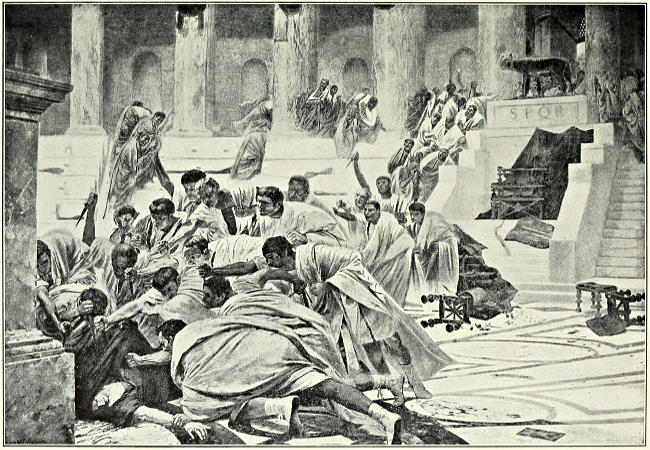
DEATH OF CÆSAR
When Cæsar had taken his seat, the conspirators gathered more closely
around him, and L. Tillius Cimber approached him as if to offer some petition,
which he continued to press with vehemence when Cæsar seemed
unwilling to grant it, and the other conspirators joined in supporting his
request. At last, when Cæsar appeared impatient of further importunity,
Cimber took hold of his robe and pulled it down from his shoulders; an
action which was the signal agreed upon with his associates for commencing
their attack. It is said that the dagger of P. Casca took the lead in the
work of blood, and that Cæsar, in the first instant of surprise, attempted
to resist and to force his way through the circle which surrounded him.
But when the conspirators rushed upon him, and were so eager to have a
share in his death, that they wounded one another in the confusion, he drew
his robe closely around him, and having covered his face, fell without a
struggle or a groan. He received three and twenty wounds, and it was
observed that the blood, as it streamed from them, bathed the pedestal of
Pompey’s statue.[128] No sooner was the murder finished, than M. Brutus,
raising his gory dagger in his hand, turned round towards the assembled
senators, and called on Cicero by name, congratulating him on the recovery
of their country’s liberty. But to preserve order at such a moment was
hopeless; the senators fled in dismay. Antony made haste to escape to
his house. A universal consternation was spread through the city, till
the conspirators, going in a body to the Forum, addressed the people, and
by assuring them that no violence was intended to any one, but that their
only object had been to assert the liberty of Rome, they succeeded in restoring
comparative tranquillity. Still, however, distrusting the state of the
popular feeling, they withdrew into the Capitol, which Decimus Brutus had
secured with a band of gladiators whom he retained in his service; and
there, having been joined by several of the nobility, they passed the first
night after the murder. Meanwhile, the body of Cæsar was left for some
hours, amidst the general confusion, on the spot where it fell; till at last
three of his slaves placed it on a litter, and carried it home, one of the
arms hanging down on the outside of the litter, and presenting a ghastly
spectacle. It was asserted by the surgeon, who examined the wounds, that
out of so many, one alone was mortal; that, namely, which he had received
in the breast when he first attempted to break through the circle of his
assassins.e
Such was the untimely ending of Cæsar’s dramatic and history-making
career. Appian has left us a minute account of his last deeds and of the
plot against him. Let us look to him for certain familiar details, beginning
with Cæsar’s last military project.
“At length, whether he lost all hopes, or else for the better preservation of
his health, never more afflicted with the falling sickness and sudden convulsions
than when he lay idle, he resolved upon a far distant expedition against
the Getæ and the Parthians. A rumour was spread that there was an oracle
of the Sibyls which declared that the Parthians could not be subdued by the
Romans, unless they were commanded by a king. This made some talk
publicly that in regard of other nations taxed under the Roman Empire,
there needed no scruple be made at the giving Cæsar that title. He having
still refused it, hastened all he could to get out of the city where many
envied him. But four days before the day appointed for his departure he
was slain by his enemies in the palace, either out of malice to see him
raised to such supreme felicity and height of command, or else (as themselves
said) out of a desire to restore the commonwealth to its first estate;
for they feared that, after having overcome these other nations, nothing
could hinder him from making himself king; yet as it appears to me it
was only for the name’s sake they attempted all things; for in the thing itself
there is no difference between dictator and king.
“There were two chiefs of this conspiracy, the son of that Brutus whom
Sulla put to death, M. Brutus Cæpio, who came for refuge to Cæsar himself
after the battle of Pharsalia, and C. Cassius who yielded to him the
galleys in the Hellespont, both of Pompey’s party, and with them was
joined one of Cæsar’s most intimate friends, Decimus Brutus Albinus. He
had always treated them honourably, and with great confidence, and when
he was going to the war in Africa, he had given them armies, and the
government of the Gauls, to Decimus Brutus of the Transalpine, and to
M. Brutus of the Cisalpine. Brutus and Cassius were at this time designed
prætors, and were in difference for a jurisdiction which among the citizens
is accounted the most honourable of all others, whether they contended
out of ambition, or only feigned to do it, lest their conspiracy should be
perceived. Cæsar was arbitrator between them, and, as it is said, he acknowledged
to his friends that Cassius had reason, but yet he would favour
Brutus, so much he loved and honoured him, for all men believed he was
his son, because he visited Servilia Cato’s sister at the time she grew with
child of Brutus, wherefore it is likewise said, that in the battle of Pharsalia
he ordered his captains to have a great care of Brutus’ life.
“However, whether he was ungrateful, or knew nothing of it, or did
not believe it, or that he thought his mother’s incontinence of dishonour,
whether love of liberty made him prefer his country before his own father,
or being of the ancient race of the Bruti who had expelled the kings, and
now pricked forward by the reproaches of the people, who on the statues
of the old Brutus, and on his prætor’s tribunal had secretly written such
words as these, ‘Brutus thou sufferest thyself to be corrupted with gifts.
Brutus thou art dead, would to God thou wert now alive; either thy successors
degenerate, or thou hast not begot them.’ He, I say, young as
he was, chafed by these and such like things, engaged himself in this enterprise
as an act worthy his predecessors.
“The discourses concerning the royalty were not then quite extinct, when
just as they were going to the senate Cassius took Brutus by the hand, and
said, ‘What shall we do if Cæsar’s flatterers propose to make him king?’
To which Brutus answered, that he would not be at the senate. Whereupon,
the other again demanded, ‘What if they summon us as prætors, what shall
we do then, my friend?’ ‘I will,’ he said, ‘defend my country, even till
death.’ Whereupon, Cassius embracing him said, ‘And what persons of
quality will you take for companions in so brave an attempt? Do you
think there are none but tavern-people and artificers that put writings on
your tribunal? Know that they are the prime men of the city, who expect
from other prætors only plays and shows; but require their liberty from
you as the work of your predecessors.’ Thus they discovered to each other
what they had long had in their thoughts; and began to try their own
friends, and some of Cæsar’s, according as they knew them capable of good
things. They engaged in their design the two brothers, Cæcilius and Bucolianus,
Rubrius Rex, Q. Ligarius, M. Spurius, Servilius Galba, Sextius Naso,
Pontius Aquila: and of Cæsar’s friends they drew to their conspiracy Decimus,
of whom I have already spoken; Caius Casca, Trebonius, Attilius
Cimber, Minucius, and Basilus. When they thought they had companions
enough, for it was not convenient to communicate this design to all the
world, they gave their words one to another without either oath or sacrifice,
and yet no one changed his mind or ever discovered the plot.
“There was nothing now wanting but choice of time and place. The
time urged, for within four days Cæsar was to depart and take guards.
For the place they thought the palace most convenient; for they concluded
that all the senators, though they were not made privy to it, yet, seeing the
action, would joyfully join with them; which, as it is said, happened at the
death of Romulus, after having changed the regal power into tyranny.
Wherefore this attempt would have the same success with that; especially
being not privily executed, but in the palace, and for the good of the commonwealth.
That they needed not to fear anything from Cæsar’s army,
being all composed of Roman people; in conclusion, that the authors of this
great action doing it publicly, could expect nothing but reward.
“Having all decreed the palace for the place of execution, there were
divers opinions concerning the manner of doing it; some being of opinion
that they should likewise make away Antony, Cæsar’s colleague, the most
powerful of his friends, and well beloved of the soldiery. But Brutus opposed
that, saying, that it was only by killing Cæsar, who was as a king,
that they ought to seek for the glory of destroying tyrants; and that if they
killed his friends too, men would impute the action to private enmity, and
the faction of Pompey. This advice prevailing, they only expected the
assembling of the senate. Now the day before Cæsar being invited to sup
with Lepidus, carried along with him Decimus Brutus Albinus; and during
supper the question being proposed what death was best for man; some
desiring one kind, and some another; he alone preferred the suddenest and
most unexpected. Thus divining for himself they fell to discourse of the
morrow’s affairs. In the morning finding himself somewhat out of order
with the night’s debauch, and his wife Calpurnia having been frightened
with dismal dreams, she advised him not to go abroad and in many sacrifices
he made there were none but affrightful tokens; he therefore gave
order to Antony to dismiss the senate. But Decimus Brutus persuading
him that it was more convenient, he went himself, to avoid the opinion that
might be conceived, that he did it out of pride or scorn, he went to dismiss
them himself, coming to the palace in his litter.
“There were at that time plays in Pompey’s theatre, and almost all the
senators were at the windows of the neighbouring houses, as is the custom
in the time of spectacles. The same morning the prætors, Brutus and
Cassius, gave audience to those who made suit for it, with great tranquillity,
in a gallery before the theatre. But when they had heard what happened to
Cæsar in the sacrifices, and that therefore they deferred the senate, they were
much troubled. One of those that stood there having taken Casca by the
hand, told him: ‘You kept it close from me that am your friend, but Brutus
has told me all.’ Whereupon Casca pricked in conscience, began to tremble;
but the other continuing with a smile: ‘Where then will you raise the
money to come to the ædility?’ Casca gave him an account. Brutus and
Cassius themselves being talking together, one of the senators, called Popilius
Lænas, drawing them aside said: ‘I pray God what you have in your hearts
may succeed happily, but it is fit you make haste.’ At which they were so
surprised that they gave him no answer.
“At the same time that Cæsar went to the palace in his litter, one of his
domestics, who had understood something of the conspiracy came to find
Calpurnia; but without saying anything else to her but that he must speak
with Cæsar about affairs of importance, he stayed expecting his return from
the senate, because he did not know all the particulars; his host of Cnidus
called Artemidorus running to the palace to give him notice of it came just at
the moment of his being killed; another, as he sacrificed before the gate of the
senate house, gave him a note of all the conspiracy; but he going in without
reading it, it was after his death found in his hands. As he came out of his
litter, Lænas, the same who before had spoken to Cassius, came to him, and
entertained him a long time in private; which struck a damp into the chiefs
of the conspiracy, the more because their conference was long; they already
began to make signs to one another that they must now kill him before he
arrested them; but in the sequel of the discourse, observing Lænas to use
rather the gesture of suppliant than accuser, they deferred it; till in the end,
seeing him return thanks to Cæsar, they took courage.
“It is the custom of the chief magistrates entering the palace, first to
consult the divine: and here as well as in the former sacrifices, Cæsar’s first
victim was found without a heart, or as some say without the chief of the
entrails. The divine hereupon telling him it was a mortal sign, he replied
laughing, that when he went to fight against Pompeius in Spain he had seen
the like; and the other having replied, that then likewise he had run hazard
of losing his life; but that at present the entrails threatened him with greater
danger. He commanded they should sacrifice another victim, which foreboding
nothing but ill, he feared to seem tedious to the senate; and being
pressed by his enemies, whom he thought to be his friends, without considering
the danger, entered the palace; for it was of necessity that the misfortune
to befall him should befall.
“They left Trebonius at the gate to stop Antony under pretence of discoursing
some business with him; and as soon as Cæsar was seated, the other
conspirators surrounded him according to custom, as friends, having each his
dagger concealed. At the same time Attilius Cimber standing before him
began to entreat him to grant the return of his brother who was an exile;
and upon his refusal, under pretence of begging it with more humility, he took
him by the robe and drawing it to him, hung about his neck, crying out, ‘Why
do you delay, my friends?’ Thereupon Casca first of all reaching over his head,
thought to strike his dagger into his throat, but wounded him only in the
breast. Cæsar having disengaged himself from Cimber, and caught hold of
Casca’s hand, leaped from his seat, and threw himself upon Casca with a
wonderful force; but being at handy grips with him, another struck his dagger
into his side, Cassius gave him a wound in the face, Brutus struck him
quite through the thigh, Bucolianus wounded him behind the head, and he,
like one enraged, and roaring like a savage beast, turned sometimes to one
and sometimes to another; till strength failing him after the wound received
from Brutus, he threw the skirt of his robe over his face and suffered
himself gently to fall before Pompey’s statue. They forebore not to give
him many stabs after he was down; so that there were three and twenty
wounds found in his body. And those that slew him were so eager that some
of them through vehemence, without thinking of it, wounded each other.
“After this murder committed in a hallowed place, and on a sacred person,
all the assembly took their flight, both within the palace and without in the
city. In the crowd there were several senators wounded, and some killed:
there were slain likewise other citizens and strangers; not with design, but
without knowing the authors, as happens in a public tumult; for the gladiators,
who were armed in the morning to give divertisement to the people,
ran from the theatre to the senators’ houses; the spectators affrighted, dispersed
as fast as their legs would carry them, the commodities exposed to
sale were made plunder of, the gates were shut, and many got upon the roofs
of their houses to secure themselves from violence. Antony fortified himself
in his house, judging that they had a design upon his life as well as upon
Cæsar’s; and Lepidus, general of the horse, hearing upon the place what
had passed, made haste to the island in the river, where he had a legion;
which he drew into the Field of Mars, that he might be in readiness to execute
the orders of Antony; for he yielded to him, both in the quality of
Cæsar’s friend and consul.
“The soldiers would very willingly have revenged Cæsar’s death so
basely murdered, but that they feared the senate, who favoured the murderers,
and expected the issue of things. Cæsar had no soldiery with him,
for he loved not guards, but contented himself with ushers; besides, he
was accompanied by a great number of people of the robe, and whole
troops of as well citizens as strangers, with freedmen and slaves, followed
him from his house to the palace; but in a moment all these crowds were
vanished, there remained with him only three unhappy slaves; who putting
him in his litter, and taking it upon their shoulders, carried him, who but a
little before was master of both sea and land. The conspirators after the
execution had a mind to have said something to the senate; but nobody
staying to hear them, they twisted their robes about their left arms instead
of bucklers, and with their bloody daggers in their hands ran through the
streets, crying out, that they had slain the king and the tyrant; causing
to march before them a man carrying a cap on the head of a pike, which is
the badge of liberty; they exhorted likewise the people to the restoring of
the commonwealth; putting them in mind of the first Brutus, and the oath
wherein he had engaged the citizens, and with them their posterity.”g
But yesterday the word of Cæsar might
Have stood against the world; now lies he there,
And none so poor to do him reverence.
Cæsar was assassinated in his fifty-sixth year. He fell pierced with
twenty-three wounds, only one of which, as the physician who examined his
body affirmed, was in itself mortal. In early life his health had been delicate,
and at a later period he was subject to fits of epilepsy, which attacked him
in the campaign of Africa, and again before the battle of Munda. Yet the
energy and habitual rapidity of all his movements seem to prove the robustness
of his constitution, at least in middle life. It may be presumed that
if he had escaped the dagger of the assassin, he might, in the course of
nature, have attained old age; and against any open attack his position was
impregnable. He might have lived to carry out himself the liberal schemes
which he was enabled only to project. But it was ordained, for inscrutable
reasons, that their first originator should perish, and leave them to be
eventually effected by a successor, within a quarter of a century.
The judgment of the ancients upon this famous deed varied according to
their interests and predilections. If, indeed, the republic had been permanently
re-established, its saviour would have been hailed, perhaps, with
unmingled applause, and commanded the favour of the Romans to a late
posterity. Cicero, though he might have shrunk from participating in the
deed, deemed it expedient to justify it, and saluted its authors in exulting
accents, as tyrannicides and deliverers. But the courtiers of the later
Cæsars branded it as a murder, or passed it over in significant silence.
Virgil, who ventures to pay a noble compliment to Cato, and glories in the
eternal punishment of Catiline, bestows not a word on the exploit of Brutus.
Even Lucan, who beholds in it a stately sacrifice to the gods, admits the
detestation with which it was generally regarded. Augustus, indeed, wisely
tolerant, allowed Messalla to speak in praise of Cassius; but Tiberius would
not suffer Cremutius to call him with impunity the last of the Romans.
Velleius, Seneca, and, above all, Valerius Maximus, express their abhorrence
of the murder in energetic and manly tones. It was the mortification, they
said, of the conspirators at their victim’s superiority, their disappointment
at the slowness with which the stream of honours flowed to them, their envy,
their vanity, anything rather than their patriotism, that impelled them to
it. The Greek writers, who had less of prejudice to urge them to extenuate
the deed, speak of it without reserve as a monstrous and abominable crime.
Again, while Tacitus casts a philosophic glance on the opinions of others,
and abstains from passing any judgment of his own, Suetonius allows that
Cæsar was, indeed, justly slain, but makes no attempt to absolve his assassins.
From Livy and Florus, and the epitomiser of Trogus, we may infer
that the sentiments expressed by Plutarch were the same which the most
reasonable of the Romans generally adopted; he declared that the disorders
of the body politic required the establishment of monarchy, and that Cæsar
was sent by providence, as the mildest physician, for its conservation. On
the whole, when we consider the vices of the times and the general laxity of
principle justly ascribed to the later ages of Greek and Roman heathenism,
it is interesting to observe how little sympathy was extended by antiquity
to an exploit which appealed so boldly to it.b
The following extract from Suetonius’ Lives of the Cæsars is our chief
source of knowledge as to Cæsar’s personality.
He is said to have been tall, of a fair complexion, round limbed, rather
full faced, with eyes black and lively, very healthful, except that, towards
the end of his life, he would suddenly fall into fainting-fits, and be frightened
in his sleep. He was likewise twice seized with the falling sickness in
the time of battle. He was so nice in the care of his person that he had
not only the hair of his head cut and his face shaved with great exactness,
but likewise had the hair on other parts of the body plucked out by the
roots, a practice with which some persons upbraidingly charged him. His
baldness gave him much uneasiness, having often found himself upon that
account exposed to the ridicule of his enemies. He therefore used to bring
forward his hair from the crown of his head; and of all the honours conferred
upon him by the senate and people, there was none which he either
accepted or used with greater pleasure than the right of wearing constantly
a laurel crown. It is said that he was particular in his dress. For he used
the latus clavus[129] with fringes about the wrists, and always had it girded
about him but loosely. This circumstance gave origin to the expression of
Sulla, who often advised the nobility to beware of “the loose-coated boy.”
He first lived in Subura in a small house; but, after his advancement
to the pontificate, in a house belonging to the state in the Sacred way.
Many writers say that he affected neatness in his person, and niceness in his
entertainments: that he entirely took down again a country-seat, near the
grove of Aricia, which he erected from the foundation, and finished at a
vast expense, because it had not exactly suited his fancy, though he was at
that time poor and in debt; and that he carried about in his expeditions
marble pavement for his tent.
They likewise report that he invaded Britain in hopes of finding pearls,
the bigness of which he would compare together, and examine the weight by
poising them in his hand; that he would purchase at any cost gems, carved
works, and pictures, executed by the eminent masters of antiquity; and
that he would give for handsome young slaves a price so extravagant that
he was ashamed to have it entered in the diary of his expenses.
The same authors inform us that he constantly kept two tables in the
provinces, one for the officers of the army, or the gentlemen of the provinces,
and the other for such of the Roman gentry as had no commission in
the troops, and provincials of the first distinction. He was so very exact in
the management of his domestic affairs, both small and great, that he once
put a baker in fetters, for serving him with a finer sort of bread than his
guests; and put to death a freedman, and a particular favourite, for
debauching the lady of a Roman knight, though no complaint had been
made to him of the affair.
It is admitted by all that he was much addicted to women, as well as
very expensive in his intrigues with them, and that he debauched many
ladies of the highest quality; among whom were Postumia the wife of
Servius Sulpicius, Lollia the wife of Aulus Gabinius, Tertulla the wife of M.
Crassus, and likewise Mucia the wife of Cn. Pompeius. For it is certain
that the Curios, father and son, and many others, objected to Pompey in
reproach, “that to gratify his ambition, he married the daughter of a man
upon whose account he had divorced his wife, after having had three children
by her, and whom he used, with a heavy sigh, to call Ægisthus.” But
the mistress whom of all he most loved was Servilia, the mother of M.
Brutus; for whom he purchased in his consulship, next after the commencement
of their intrigue, a pearl which cost him six millions of sesterces; and
in the Civil War, besides other presents, consigned to her, for a trifling consideration,
some valuable estates in land, which were exposed to public
auction. When many persons wondered at the lowness of the price, Cicero
facetiously observed, “To let you know how much better a purchase this is
than ye imagine, Tertia is deducted”; for Servilia was supposed to have
prostituted her daughter Tertia to Cæsar.
That he had intrigues likewise with married women in the provinces
appears from a distich, which was much repeated in the Gallic triumph.
In the number of his mistresses were also some queens, such as Eunoe, a
Moor, the wife of Bogudes, to whom and her husband he made, as Naso reports,
many large presents. But his greatest favourite was Cleopatra, with
whom he often revelled all night till daybreak, and would have gone with
her through Egypt in a pleasure-boat, as far as Ethiopia, had not the army
refused to follow him. He afterwards invited her to Rome, whence he sent
her back loaded with honours and presents, and gave her permission to call
by his name a son, who, according to the testimony of some Greek historians,
resembled Cæsar both in person and gait. Mark Antony declared in the
senate that Cæsar had acknowledged the child as his own; and that C.
Matius, C. Oppius, and the rest of Cæsar’s friends knew it to be true. On
which occasion Oppius, as if it had been an imputation which he was called
upon to refute, published a book to show that the child which Cleopatra
fathered upon Cæsar was not his. Helvius Cinna, tribune of the commons,
told several persons as a fact that he had a bill ready drawn up, which
Cæsar had ordered him to get enacted in his absence, that, with the view of
procuring issue, he might contract marriage with any one female, or as many
as he pleased.
It is acknowledged even by his enemies that in respect of wine he was
abstemious. A remark is ascribed to M. Cato, “that he was the only sober
man amongst all those who were engaged in a design to subvert the government.”
For in regard to diet, C. Oppius informs us, he was so indifferent
for his own part, that when a person in whose house he was entertained had
served him, instead of fresh oil, with oil which had some sort of seasoning
in it, and which the rest of the company would not touch, he alone ate very
heartily of it, that he might not seem to tax the master of the house with
inelegance or want of attention.
He never discovered any great regard to moderation, either in his command
of the army, or civil offices; for we have the testimony of some writers
that he requested money of the proconsul his predecessor in Spain, and the
Roman allies in that quarter, for the discharge of his debts; and some
towns of the Lusitanians, notwithstanding they attempted no resistance to
his arms and opened to him their gates, upon his arrival before them he
plundered in a hostile manner. In Gaul, he rifled the chapels and temples
of the gods, which were filled with rich presents; and demolished cities
oftener for the sake of plunder than for any offence they had given him.
By this means gold became so plentiful with him that he exchanged it
through Italy and the provinces of the empire for three thousand sesterces
the pound. In his first consulship he stole out of the Capitol three thousand
pounds’ weight of gold, and placed in the room of it the same weight of gilt
brass. He bartered likewise to foreign nations and princes, for gold, the
titles of allies and kings; and squeezed out of Ptolemy alone near six thousand
talents, in the name of himself and Pompey. He afterwards supported
the expense of the Civil Wars and of his triumphs and public shows, by the
most flagrant rapine and sacrilege.
In point of eloquence and military achievements, he equalled at least, if
he did not surpass, the greatest men. After his prosecution of Dolabella, he
was indisputably esteemed among the most distinguished pleaders. Cicero,
in recounting to Brutus the famous orators, declares “he does not see that
Cæsar was inferior to any one of them; that he had an elegant, splendid, noble,
and magnificent vein of eloquence.” And in a letter to C. Nepos, he writes
of him in the following terms: “What! which of all the orators, who, during
the whole course of their lives, have done nothing else, can you prefer
before him? Which of them is ever more pointed in expression, or more
often commands your applause?” In his youth he seems to have chosen
Strabo Cæsar as his model; out of whose oration for the Sardinians he has
transcribed some passages literally into his Divinatio. He is said to have
delivered himself with a shrill voice, and an animated action which was
graceful. He has left behind him some speeches, among which are a few
not genuine; as that for Q. Metellus. These Augustus supposes, and
with reason, to be the production of blundering writers of shorthand, who
were not able to follow him in the delivery, rather than anything published
by himself. For I find in some copies the title is not “for Metellus,” but
“what he wrote to Metellus”; whereas the speech is delivered in the name
of Cæsar, vindicating Metellus and himself from the aspersions cast upon
them by their common defamers. The speech addressed “to his soldiers
in Spain,” Augustus considers likewise as spurious. Under this title we
meet with two; one made, as is pretended, in the first battle, and the other
in the last; at which time Asinius Pollio says, he had not leisure to address
the soldiers, on account of the sudden assault of the enemy.
He has likewise left commentaries of his own transactions both in the
Gallic and the civil war with Pompey; for the author of the Alexandrian,
African, and Spanish wars is not known with any certainty. Some think
they are the production of Oppius, and some of Hirtius; the latter of whom
composed the last book, but an imperfect one, of the Gallic War. Of those
memoirs of Cæsar, Cicero in his Brutus speaks thus: “He wrote his memoirs
in a manner that greatly deserves approbation; they are plain, precise, and
elegant, without any affectation of ornament. In having thus prepared
materials for such as might be inclined to compose his history, he may
perhaps have encouraged some silly creatures to enter upon such a work,
who will needs be dressing up his actions in all the extravagance of bombast;
but he has discouraged wise men from ever attempting the subject.” Hirtius
delivers his opinion of the same memoirs in the following terms: “So great
is the approbation with which they are universally perused, that, instead of
exciting, he seems to have precluded the efforts of any future historian.
Yet with regard to this subject, we have more reason to admire him than
others; for they only know how well and correctly he has written, but we
know likewise how easily and quickly he did it.” Pollio Asinius thinks
that they were not drawn up with much care, or with a due regard to
truth: for he insinuates that Cæsar was too hasty of belief with respect
to what was performed by others under him; and that, in respect of what
he transacted in person, he has not given a very faithful account—either
with design, or through a defect of memory; expressing at the same
time an opinion that Cæsar intended a new and more correct production
on the subject.
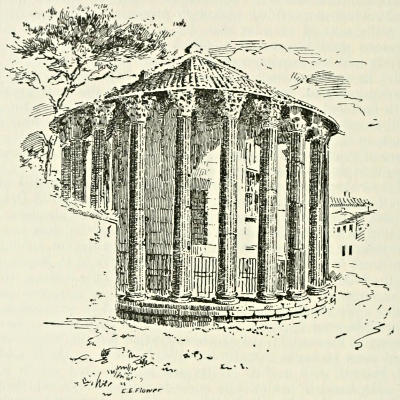
Temple of Vesta, Rome
He has left behind him likewise two books of analogy, with the same
number under the title of Anti-Cato, and a poem entitled The Journey.
Of these books he composed the first two in his passage over the Alps, as
he was returning to his army from holding the assizes in Hither Gaul; the
second work about the time of the battle of Munda; and the last during the
four-and-twenty days he was upon his expedition from Rome to Further
Spain. There are extant some letters of his to the senate, written in a
manner never practised by any before him, for they are divided into
pages in the form of a pocket-book; whereas the consuls and generals, till
then, used constantly in their letters to continue the line quite across the
sheet, without any folding or distinction of pages. There are extant likewise
some letters from him to Cicero, and others to his friends concerning
his domestic affairs; in which, if there was occasion for secrecy, he used
the alphabet in such a manner that not a single word could be made out.
The way to decipher those epistles was to substitute “d” for “a” and so of
the other letters respectively. Some things likewise pass under his name,
said to have been written by him when a boy or a very young man; as the
Encomium of Hercules, a tragedy entitled Œdipus, and a collection of apophthegms;
all which Augustus forbid to be published, in a short and plain
letter to Pompeius Macer, whom he had appointed to direct the arrangement
of his libraries.
He was a perfect master of his weapons, a complete horseman, and able
to endure fatigue beyond all belief. Upon a march, he used to go at the
head of his troops, sometimes on horseback, but oftener on foot, with his head
bare in all kinds of weather. He would travel in a post-chaise at the
rate of a hundred miles a day, and pass rivers in his way by swimming, or
supported with leathern bags filled with wind, so that he often prevented all
intelligence of his approach.
In his expeditions, it is difficult to say whether his caution or boldness
was most conspicuous. He never marched his army by a route which was
liable to any ambush of the enemy, without having previously examined the
situation of the places by his scouts. Nor did he pass over into Britain, before
he had made due inquiry respecting the navigation, the harbours, and
the most convenient access to the island. But when advice was brought to
him of the siege of a camp of his in Germany, he made his way to his
men, through the enemy’s guards, in a Gallic habit. He crossed the sea
from Brundusium and Dyrrhachium, in the winter, through the midst of the
enemy’s fleets; and the troops which he had ordered to follow him not making
that haste which he expected, after he had several times sent messengers to
expedite them, in vain, he at last went privately, and alone, aboard a small
vessel in the night-time, with his head muffled up; nor did he discover who
he was, or suffer the master to desist from prosecuting the voyage, though
the wind blew strong against them, until they were ready to sink.
He was never discouraged from any enterprise, nor retarded in the prosecution
of it, by any ill omens. When a victim which he was about to
offer in sacrifice had made its escape, he did not therefore defer his expedition
against Scipio and Juba. And happening to fall, upon stepping out of
the ship, he gave a lucky turn to the omen, by exclaiming, “I hold thee
fast, Africa.” In ridicule of the prophecies which were spread abroad, as
if the name of the Scipios was, by the decrees of fate, fortunate and invincible
in that province, he retained in the camp a profligate wretch, of the
family of the Cornelii, who, on account of his scandalous life, was surnamed
Salutio.
He engaged in battle not only upon previous deliberation, but upon the
sudden when an occasion presented itself; often immediately after a march,
and sometimes during the most dismal weather, when nobody could imagine
he would stir. Nor was he ever backward in fighting, until towards the end
of his life. He then was of opinion that the oftener he had come off with
success, the less he ought to expose himself to new hazards; and that he
could never acquire so much by any victory as he might lose by a miscarriage.
He never defeated an enemy whom he did not at the same time
drive out of their camp; so warmly did he pursue his advantage that he
gave them no time to rally their force. When the issue of a battle was doubtful,
he sent away all the officers’ horses, and in the first place his own, that
being deprived of that convenience for flight they might be under the
greater necessity of standing their ground.
He rode a very remarkable horse, with feet almost like those of a man,
his hoofs being divided in such a manner as to have some resemblance to
toes. This horse he had bred himself, and took particular care of, because
the soothsayers interpreted those circumstances into an omen that the possessor
of him would be master of the world. He backed him too himself,
for the horse would suffer no other rider; and he afterwards erected a statue
of him before the temple of Venus Genitrix.
He often alone, by his courage and activity, restored the fortune of a
battle; opposing and stopping such of his troops as fled, and turning them
by the jaws upon the enemy; though many of them were so terrified that
a standard bearer, upon his stopping him, made a pass at him; and another,
upon a similar occasion, left his standard in his hand.
The following instances of his resolution are equally, and even more
remarkable. After the battle of Pharsalia, having sent his troops before
him into Asia, as he was passing the Hellespont in a ferry boat, he met with
L. Cassius, one of the opposite party, with ten ships of war; whom he was
so far from avoiding, that he advanced close up to him; when, advising
him to surrender, and the other complying, he took him into the boat.
At Alexandria, in the attack of a bridge, being forced by a sudden sally
of the enemy into a boat, and several hurrying in with him, he leaped into
the sea, and saved himself by swimming to the next ship, which lay at the
distance of two hundred paces; holding up his left hand out of the water,
for fear of wetting some papers which he held in it; and pulling his general’s
cloak after him with his teeth, lest it should fall into the hands of the
enemy.
He never estimated a soldier by his manners or fortune, but by his
strength alone; and treated them with equal severity and indulgence; for
he did not always keep a strict hand over them, except when an enemy was
near. Then indeed he was so rigorous an exactor of discipline, that he
would give no notice of march or battle until the moment he was to enter
upon them; that the troops might hold themselves in readiness for any sudden
movement; and he would frequently draw them out of the camp, without
any necessity for it, especially in rainy weather, and upon holy days.
Sometimes, giving them warning to watch him, he would suddenly withdraw
himself by day or night, and would oblige them to long marches, on purpose
to tire them, if they were tardy.
When at any time his soldiers were discouraged by reports of the great
force of the enemy, he recovered them, not by denying the truth of what was
said, or by diminishing the fact, but on the contrary by exaggerating every
particular. Accordingly, when his troops were under great apprehensions
of the arrival of King Juba, he called them together, and said, “I have to
inform you that in a very few days the king will be here, with ten legions,
thirty thousand horse, a hundred thousand light-armed foot, and three hundred
elephants. Let none therefore presume to make any further inquiry,
or to give their opinion upon the subject, but take my word for what I
tell you, which I have from undoubted intelligence; otherwise I shall put
them aboard a crazy old vessel, and leave them exposed to the mercy of the
winds.”
He neither took notice of all their faults, nor proportioned his punishments
to the nature of them. But after deserters and mutineers he made
the most diligent inquiry, and punished them severely; other delinquencies
he would connive at. Sometimes, after a successful battle, he would grant
them a relaxation from all kinds of duty, and leave them to revel at pleasure;
being used to boast that his soldiers fought nothing the worse for being
perfumed. In his speeches, he never addressed them by the title of
“soldiers,” but by the softer appellation of “fellow-soldiers”; and kept
them in such fine condition that their arms were ornamented with silver
and gold, not only for the purpose of making the better appearance, but to
render the soldiers more tenacious of them in battle, from their value. He
loved his troops to such a degree that, when he heard of the disaster of those
under Titurius, he neither cut his hair nor shaved his beard until he had
revenged it upon the enemy; by which means he engaged extremely their
affection, and rendered them to the last degree brave.
Upon his entering into the Civil War, the centurions of every legion offered
each of them to maintain a horseman at his own expense, and the whole army
agreed to serve gratis, without either corn or pay; those amongst them who
were rich charging themselves with the maintenance of the poor. No one of
them, during the whole course of the war, went over to the enemy; and most
of those who were made prisoners, though they were offered their lives upon
the condition of bearing arms against him, refused to accept the terms.
They endured want, and other hardships, not only when themselves were
besieged, but when they besieged others, to such a degree that Pompey,
when blocked up in the neighbourhood of Dyrrhachium, upon seeing a sort
of bread, made of an herb, which they lived upon, said, “I have to do with wild
beasts,” and ordered it immediately to be taken away; because, if his troops
should see it, they might be impressed with a dangerous apprehension of the
hardiness and desperate resolution of the enemy. With what bravery they
fought, one instance affords sufficient proof; which is, that after an unsuccessful
engagement at Dyrrhachium, they desired him to punish them; insomuch
that their general found it more necessary to comfort than punish them.
In other battles, in different parts, they defeated with ease immense
armies of the enemy, though they were much inferior to them in number.
To conclude, one battalion of the sixth legion held out a fort against four
legions belonging to Pompey, during several hours; being almost every one
of them wounded, by the vast number of arrows discharged against them, and
of which there were found within the ramparts a hundred and thirty thousand.
This is no way surprising, when we consider the behaviour of some
individuals amongst them; such as that of Cassius Scæva, or C. Acilius a
common soldier. Scæva, after he had an eye struck out, was run through
the thigh and the shoulder, and had his shield pierced in a hundred and
twenty places, maintained obstinately the guard of a gate in a fort, with the
command of which he was intrusted. Acilius, in the sea fight at Marseilles,
having seized a ship of the enemy with his right hand, and that being cut
off, in imitation of that memorable instance of resolution in Cynægirus
amongst the Greeks leaped into the ship, bearing down all before him with
the boss of his shield.
They never once mutinied during all the ten years of the Gallic War, but
were sometimes a little refractory in the course of the Civil War. They
always however returned quickly to their duty, and that not through the compliance
but the authority of their general; for he never gave ground, but
constantly opposed them on such occasions. The whole ninth legion he dismissed
with ignominy at Placentia, though Pompey was at that time in arms;
and would not receive them again into his service, until not only they had
made the most humble submission and entreaty, but that the ringleaders in
the mutiny were punished.
When the soldiers of the tenth legion at Rome demanded their discharge
and rewards for their service, with great threats, and no small danger to the
city, though at that time the war was warmly carried on against him in
Africa, he immediately, notwithstanding all the efforts of his friends, who endeavoured
to prevent him from taking such a measure, came up to the legion
and disbanded it. But addressing them by the title of “quirites,” instead
of “soldiers,” he by this single word so thoroughly regained their affections
that they immediately cried out they were his “soldiers,” and followed him
into Africa, though he had refused their service. He nevertheless punished
the most seditious amongst them, with the loss of a third of their share in the
plunder and the land which had been intended for them.
In the service of his clients, while yet a young man, he evinced great
zeal and fidelity. He defended the cause of a noble youth, Masintha, against
King Hiempsal, so strenuously that in a wrangle which happened upon the
occasion he seized by the beard the son of King Juba; and upon Masintha
being declared tributary to Hiempsal, while the friends of the adverse party
were violently carrying him off, he immediately rescued him by force, kept
him concealed in his house a long time, and when, at the expiration of his
prætorship, he went to Spain, he carried him with him in his litter, amidst
his sergeants, and others who had come to attend and take leave of him.
He always treated his friends with that good nature and kindness, that
when C. Oppius, in travelling with him through a forest, was suddenly
taken ill, he resigned to him the only place there was to lodge in at night,
and lay himself upon the ground, and in the open air. When he had come
to have in his own hands the whole power of the commonwealth, he advanced
some of his faithful adherents, though of mean extraction, to the highest
posts in the government. And when he was censured for this partiality, he
openly said, “Had I been assisted by robbers and cut-throats in the defence
of my honour, I should have made them the same recompense.”
He never in any quarrel conceived so implacable a resentment as not
very willingly to renounce it when an opportunity occurred. Though C.
Memmius had published some extremely virulent speeches against him, and
he had answered him with equal acrimony, yet he afterwards assisted him
with his vote and interest, when he stood candidate for the consulship.
When C. Calvus, after publishing some scandalous epigrams against him,
endeavoured to effect a reconciliation by the intercession of friends, he wrote
of his own accord the first letter. And when Valerius Catullus, who had,
as he himself observed, in his verses upon Mamurra put such a stain upon
his character as never could be obliterated, begged his pardon, he invited
him to supper the same day; and continued to take up his lodging with his
father occasionally, as he had been accustomed to do.
His disposition was naturally averse to severity in retaliation. After he
had made the pirates, by whom he had been taken, prisoners, because he
had sworn he would crucify them, he did so indeed; but previously to
the execution of that sentence, ordered their throats to be cut. He could
never bear the thought of doing any harm to Cornelius Phagita, who had
kidnapped him in the night, with the design of carrying him to Sulla; and
from whose custody, not without much difficulty and a large bribe likewise,
he had been able to extricate himself. Philemon, his secretary, who had
made a promise to his enemies to poison him, he put to death only, without
torture. When he was summoned as a witness against P. Clodius, his wife
Pompeia’s gallant, who was prosecuted for a pollution of religious ceremonies,
he declared he knew nothing of the affair, though his mother Aurelia and
his sister Julia gave the court an exact and full account of the transaction.
And being asked why then he had divorced his wife: “Because,” said he,“I
would have those of my family untainted, not only with guilt, but with the
suspicion of it likewise.”
Both in the administration of government and his behaviour towards the
vanquished party in the Civil War, he showed a wonderful moderation and
clemency. And whilst Pompey declared that he would consider all those as
enemies who did not take arms in defence of the republic, he desired it to
be understood that he should regard all those who remained neuter as his
friends. In respect of all those to whom he had, on Pompey’s recommendation,
given any command in the army, he left them at perfect liberty to go over
to him, if they pleased. When some proposals were made at Ilerda for a
surrender, which gave rise to a free communication between the two camps,
and Afranius and Petreius, upon a sudden change of resolution, had put to
the sword all Cæsar’s men that were found in the camp, he scorned to imitate
the base treachery which they had practised against himself. In the field
of Pharsalia, he called out to the soldiers “to spare their fellow-citizens,” and
afterwards gave liberty to every man in his army to save an enemy. None
of them, so far as appears, lost their lives but in battle, excepting only
Afranius, Faustus, and young Lucius Cæsar; and it is thought that even
they were put to death without his consent. Afranius and Faustus had
borne arms against him, after their pardon had been granted them; and L.
Cæsar had not only in the most cruel manner destroyed with fire and sword
his freedmen and slaves, but cut to pieces the wild beasts which he had prepared
for the entertainment of the people. And finally, a little before his
death, he granted liberty to all whom he had not before pardoned, to return
into Italy, and admitted them to a capacity of bearing offices both civil and
military.
He even erected again the statues of Sulla and Pompey, which had been
thrown down by the populace. And any machinations against him, or reflections
upon him, he chose rather to put a stop to than punish. Accordingly,
with regard to any conspiracies against him which were discovered, or nightly
cabals, he went no further than to intimate by a proclamation that he knew
of them; and as to those who indulged themselves in the liberty of reflecting
severely upon him, he only warned them in a public speech not to persist in
their obloquy. He bore with great moderation a virulent libel written against
him by Aulus Cæcina, and the abusive lampoons of Pitholaus, most highly
reflecting on his reputation.
His other actions and declarations, however, with regard to the public, so
far outweigh all his good qualities, that it is thought he abused his power
and was justly cut off. For he not only accepted of excessive honours, as the
consulship every year successively, the dictatorship for life, and the superintendency
of the public manners, but likewise the titles of “imperator,” and
“father of his country,” besides a statue amongst the kings, and a throne
in the place allotted to the senators in the theatre. He even suffered some
things to be decreed for him that were unsuitable to the greatest of human
kind; such as a golden chair in the senate house and upon the bench when
he sat for the trial of causes, a stately chariot in the Circensian procession,
temples, altars, images near the gods, a bed of state in the temples, a peculiar
priest, and a college of priests, like those appointed in honour of Pan, and that
one of the months should be called by his name. He indeed both assumed
to himself, and granted to others, every kind of distinction at pleasure. In
his third and fourth consulship he had only the title of the office, being content
with the power of dictator, which was conferred upon him at the same
time; and in both years he substituted other consuls in his room, during the
three last months; so that in the intervals he held no assemblies of the
people for the election of magistrates, excepting only tribunes and ædiles of
the commons; and appointed officers, under the name of prefects, instead
of the prætors, to administer the affairs of the city during his absence. The
honour of the consulship, which had just become vacant by the sudden death
of one of the consuls, he instantly conferred, the day before the 1st of
January, upon a person who requested it of him, for a few hours.
With the same unwarrantable freedom, regardless of the constant usage
of his country, he nominated the magistrates for several years to come. He
granted the insignia of the consular dignity to ten persons of prætorian rank.
He called up into the senate some who had been made free of the city, and
even natives of Gaul, who were little better than barbarians. He likewise
appointed to the management of the mint and the public revenue of the
state some of his own servants; and entrusted the command of three legions,
which he left at Alexandria, to an old catamite of his, the son of his freedman
Rufinus.
He gave way to the same extravagance in his public conversation, as T.
Ampius informs us; according to whom he said: “The commonwealth is
nothing but a name, without substance, or so much as the appearance of any.
Sulla was an illiterate fellow to lay down the dictatorship. Men ought to be
more cautious in their converse with me, and look upon what I say as a law.”
To such a pitch of arrogance did he proceed that, when a soothsayer brought
him word that the entrails of a victim opened for sacrifice were without a
heart, he said: “The entrails will be more favourable when I please; and it
ought not to be regarded as any ill omen if a beast should be destitute of a
heart.”
But what brought upon him the greatest and most invincible odium was
his receiving the whole body of the senate sitting, when they came to wait
upon him before the temple of Venus Genitrix, with many honourable decrees
in his favour. Some say, as he attempted to rise, he was held down by C.
Balbus. Others say he did not attempt it at all, but looked somewhat displeased
at C. Trebatius, who put him in mind of standing up. This behaviour
appeared the more intolerable in him because, when one of the tribunes
of the commons, Pontius Aquila, would not rise up to him, as in his triumph
he passed by the place where they sat, he was so much offended, that he cried
out, “Well then, master tribune, take the government out of my hands.”
And for some days after, he never promised a favour to any person, without
this proviso, “if Pontius Aquila will allow of it.”
To this extraordinary affront upon the senate, he added an action yet
more outrageous. For when, after the sacrifice of the Latin festival, he was
returning home, amidst the incessant and unusual acclamations of the people,
one of the crowd put upon a statue of him a laurel crown, with a white ribbon
tied round it, and the tribunes of the commons, Epidius Marullus and
Cæsetius Flavus, ordered the ribbon to be taken away and the man to be
carried to prison; being much concerned either that the mention of his
advancement to regal power had been so unluckily made, or, as he pretended,
that the glory of refusing it had been thus taken from him, he
reprimanded the tribunes very severely, and dismissed them both from their
office. From that day forward, he was never able to wipe off the scandal of
affecting the name of king; though he replied to the people, when they
saluted him by that title, “My name is Cæsar, not King.” And at the feast
of the Lupercalia, when the consul Antony in the rostra put a crown upon
his head several times, he as often put it away, and sent it into the Capitol
to Jupiter. A report was extremely current that he had a design of removing
to Alexandria or Ilium, whither he proposed to transfer the strength of
the empire, and to leave the city to be administered by his friends. To this
report it was added that L. Cotta, one of the fifteen commissioners entrusted
with the care of the Sibyl’s books, would make a motion in the house that,
as there was in those books a prophecy that the Parthians should never be
subdued but by a king, Cæsar should have that title.[130] This was why the
conspirators precipitated the execution of their design.c
“Happy in all things, magnificent; and with just reason comparable to
Alexander; for they were both beyond measure ambitious, warlike, ready in
the execution of what they had resolved and hardy in dangers; they spared
not their bodies; and in war relied not so much upon their conduct, as
upon their bravery and good fortune. The one went a long journey in a
country without water to go to Ammon, happily crossed over the bottom
of the Pamphylian Gulf, the sea being retired as if his genius had locked up
the waters; as another time marching in the champian, it caused it to cease
from raining. He navigated an unknown sea; being in the Indies, he first
scaled the walls of a city, and leaped down alone into the midst of his enemies,
receiving thirteen wounds; was always victorious; and whatever war
he was engaged in, he ended it in one or two battles.
“In Europe he subdued many barbarous people, and reduced them under
his obedience, together with the Grecians, a fierce people, and lovers of liberty,
who never before obeyed any person but Philip; who commanded them
for some time under the honourable title of general of the Greeks. He carried
his arms almost through all Asia with an incredible celerity. And to
comprise in a word the happiness and power of Alexander, all the countries
he saw he conquered; and as he was designing to conquer the rest, he died.
“As for Cæsar, passing the Ionian Sea in the midst of winter, he found it
calm, as well as the British Ocean, which he passed without any knowledge
of it in a time when his pilots, driven by storm against the English rocks,
lost their ships; another time embarking alone by night in a little boat, and
rowing against the waves, he commanded the pilot to hoist sail and rather to
consider the fortune of Cæsar than the sea. He threw himself more than
once all alone into the midst of his enemies, when his men were all struck
with panic fear; and is the only general of the Romans that ever fought
thirty times in pitched battle against the Gauls, and subdued in Gaul forty
nations, before so dreadful to the Romans, that in the law dispensing with
priests and old men from going to war, the wars against the Gauls are excepted,
and the priests and all men obliged to bear arms. Before Alexandria,
seeing himself alone enclosed upon a bridge, he laid down his purple,
threw himself into the sea, and pursued by his enemies, swam a long time
under water, only by intervals lifting up his head to take breath; till coming
near his ships, he held up his hands, was known, and so saved.
“For the civil wars, which he neither undertook out of fear (as he himself
says), or out of ambition, he had to deal with the greatest generals of
the age, fighting at the head of many great armies; not barbarian, but
Romans, encouraged by their former actions, and by their good fortune, yet
he defeated them all; and not one of them but he ruined in a fight or two.
But we cannot say of him as of Alexander, that he was never overcome; for
he suffered once a great loss against the Gauls, under the conduct of Titurius
and Cotta, his lieutenants. In Spain his army was so near blocked up by
Petreius and Afranius, that he wanted but little of being besieged. At Dyrrhachium
and in Africa they turned their backs; and in Spain, against the
young Pompeius they fled. But for Cæsar himself, he was always undaunted;
and whatever war he engaged in, came off in the end victorious; and the
Roman Empire, which now extends itself by sea and land, from the Euphrates
to the Atlantic Ocean, was brought under his power, partly by his
valour, and partly by his clemency. He settled himself much better than
Sulla, and governed himself with more moderation; for being king in effect,
in spite of all the world, he took not that name.
“At last, making his preparations for other wars, he was surprised by
death as well as Alexander. Their armies were also alike; for the soldiers
of both were cheerful in fight and hardy, but stubborn and mutinous when
over-wrought with labour. The deaths of both of them were equally
mourned and lamented by their armies, who attributed to them divine
honours. They were both well made in body and of noble aspect; both
descended from Jupiter; one by Eacus and Hercules, and the other by
Anchises and Venus. Though they were inflexible when resisted, they
were easier to pardon and be reconciled, and likewise to do good to such
as they had vanquished; contented themselves with the victory.
“Hitherto the comparison is just, save only that their beginnings were
not equal; for Alexander began with the quality of a king, in which he had
been before instructed by his father Philip; but Cæsar was only a private
man; and though he were of an illustrious race, yet his fortunes were much
encumbered. They both despised the presages that threatened them, without
injuring those divines who foretold their death; and almost the same
signs happened to them, and a like event; for in the sacrifices made by one
and the other twice, they found not the chief of the entrails of the victims;
the first time they were only threatened with great danger. Alexander’s
happened when besieging the Oxydracæ, being mounted first upon the wall,
and the too great weight breaking the ladders behind him, he beheld himself
deserted by his men, and threw himself into the midst of his enemies,
where having received many wounds on his breast and a great blow on the
neck, he was ready to die, when the Macedonians, touched with shame,
broke open the gates and relieved him.
“The like happened to Cæsar in Spain in the fight between him and
young Pompeius; where, seeing his men went on trembling, he advanced
betwixt the two armies, received two hundred darts on his buckler, till
such time as fear having given place to shame, all the army ran in and
secured him from the danger. Thus the first entrails without the chief
threatened only danger of death, but the second were certain presage of
death itself. Pythagoras the divine, after having sacrificed, said to Apollodorus,
who feared Alexander and Hephæstion, that he need fear nothing, for
they both should shortly die. Hephæstion, dying some time after, Apollodorus,
doubting lest there might be some conspiracy formed against the king, gave
him notice of the prediction; he only laughed at it; and informing himself
of Pythagoras what those presages meant, he told him it was a sign of
death; whereupon he again laughed, praising Apollodorus’ love and the
divine’s freedom.
“As for Cæsar, the last time he went to the senate, as we have said a
little before, the same presage presenting, he said, smiling, he had seen the
like in Spain, to which the augur answering that he was then in danger, but
now the sign was mortal, he yielded in some measure to that advice, and
offered another sacrifice; but tired with the length of the ceremony, entered
the palace and perished. There happened to Alexander the same thing; for
when he returned from the Indies to Babylon with his army, being come
nigh the city, the Chaldeans counselled him to defer his entry; to whom
having given this verse for answer,
‘Who promises most good’s the best divine,’
they besought him at last that he would not let his army enter with their
faces to the west; but would fetch a compass, that in entering they might
see the rising sun and the city. It is said he would have obeyed them in
this; but in marching about he met with a marshy ground, which made
him slight the second as well as the first advice, so that he entered the city
with his face to the west. Some time after embarking upon the Euphrates,
and going down to the river Pallakopas, which receives the Euphrates and
carries its waters into marshes and pools which might happen to drown all
Assyria, he resolved to make a dam; and it is said that going down the
river he laughed at the Chaldeans because he had gone into Babylon and
come out of it again in a boat without any harm; but death attended him at
his return from this voyage.
“Cæsar’s raillery with the augur, who told him the ides of March were
fatal to him, was much alike; he answered him jeering, the ides were come,
and yet he was killed the same day. So that herein there was great agreement
between them, both in the presages they received from the divines
without being offended, their raillery, and the event of the prediction.
They were likewise great lovers of the sciences, as well of their own country
as strangers’. Alexander conferred with the Brachmanes, who were esteemed
the most subtile and sagacious of the Indians, as the Magi are of the Persians.
Cæsar did the like with the Egyptians when he re-established Cleopatra in
her kingdom, which occasioned him when the peace was made to reform
many things amongst the Romans; and that after the example of the
Egyptians he regulated the year by the course of the sun, which before was
governed by the moon; and so till then were unequal, by reason of the intercalary
days. It happened to him likewise that one of those who conspired
his death escaped, but were all punished as they deserved by his son, and as
the murderers of Philip were by Alexander.”e
From this we turn to what is probably the most masterly estimate of
Cæsar’s character and abilities ever penned by a student of Roman history.
It is the estimate of one who is an enthusiastic admirer of Cæsar’s genius,
but also a keen historical critic.
The new monarch of Rome, the first ruler over the whole extent of Roman
and Hellenic civilisation, Caius Julius Cæsar was in his fifty-sixth year—he
was born the 12th of July, 100 B.C.—when the battle of Thapsus, the last of
the long chain of victories which led to such important consequences, gave the
decision of the world’s future into his hands. Few men’s quality has been
so severely tested as that of this creative genius, the only one that Rome and
the last that the ancient world produced—that world which was to continue
to march in the paths he had marked out for it, till the time of its own
downfall.
A scion of one of the oldest of the noble families of Latium, which traced
its genealogy back to the heroes of the Iliad and the kings of Rome, and even
as far as Venus Aphrodite, a goddess common to both nations, the years of
his boyhood and young manhood had gone by as those of the noble youths of
that epoch were wont to pass. He too had tasted both the froth and the lees
of the cup of fashionable life, had recited and declaimed, had occupied his
leisure with the pursuit of literature and the making of verses, had dallied
with every species of love-making, and had been initiated into all the mysteries
of shaving, hair-curling, and ruffles, which belonged to the science of
dress as understood at that period, besides the far more difficult art of always
borrowing and never paying. But the pliant steel of that nature resisted
even these shallow and ruinous courses; Cæsar’s bodily vigour remained
unimpaired, as did the temper of his mind and heart. In fencing and riding
he was a match for any of his soldiers, and his swimming saved his life at
Alexandria; the incredible speed with which he travelled, generally by night
so as to gain time,—a direct contrast to the procession-like slowness with
which Pompey moved from one place to another,—was the astonishment of
his contemporaries and not the least important factor in his success.
As his body, so was his spirit. His marvellous insight revealed itself in
the sureness and practical character of all his arrangements even when he
gave orders without personal investigation. His memory was incomparable
and it was easy for him to carry on several affairs concurrently and with
equal precision. Gentleman, genius, and monarch, he still had a heart. As
long as he lived he preserved the purest reverence for his excellent mother
Aurelia, his father having died early; on his wife, and more especially on
his daughter Julia, he bestowed a worthy affection which was not without
its effect on politics. In their several ways the ablest and worthiest men of
his time both of higher and lower rank stood to him in relations of mutual
trust. As he never abandoned his adherents in Pompey’s ungenerous and
heartless fashion, but stood by his friends unshaken in good and evil days,
and this not merely from calculation, so also many of them, like Aulus Hirtius
and Caius Matius, gave noble witness of their attachment to him even
after his death.
If in a nature so harmoniously organised one particular side may be dwelt
upon as characteristic, it is this that anything of an ideological or visionary
character was far removed from it. It is needless to say that Cæsar was a
passionate man, for there is no genius without passion; but his passions were
never stronger than he. He had been young, and song, love, and wine had
played their part in his joyous existence; but they did not penetrate the
inmost heart of his being. Literature attracted his long and earnest attention;
but if the Homeric Achilles kept Alexander awake, Cæsar in his sleepless
hours prepared considerations on the inflections of Latin nouns and verbs.
He made verses, as every one did at that time, but they were feeble; on
the other hand he was interested in astronomical subjects and in those of
physical science.
If for Alexander wine was and remained the dispeller of care, the temperate
Roman entirely avoided it after the period of his youthful revels. Like
all those who have been surrounded in youth by the full glow of the love of
women, its imperishable glamour still rested on him; even in later years love
adventures and successes with women still came in his way, and he still retained
a certain dandyism in his outward bearing, or, more correctly, a joyous
consciousness of the masculine beauty of his own appearance. The laurel
wreaths with which he appeared in public in later years were carefully disposed
so as to cover the baldness of which he was painfully sensible, and he
would doubtless have given many of his victories if that could have brought
back his youthful locks.
But however gladly he may have played the monarch amongst the women,
he was only amusing himself with them and allowed them no influence over
him; even his much-talked-of relations with Queen Cleopatra were only
entered into for the purpose of masking a weak point in his political position.
Cæsar was thoroughly matter-of-fact and a true realist; and what he
attempted and performed was carried through and effected by that coolness
which was his most essential quality and itself a manifestation of genius. To
it he owed the power of living actively in the present and undisturbed by
memory and expectation, as well as the ability to act at each moment with
all his force and to apply his full genius to the smallest and most casual
beginnings. He owed to it also the versatility with which he grasped and
mastered whatever the understanding can seize and the will compel, the confident
carelessness with which he commanded his words and sketched his
plans of campaign, the “marvellous joyousness” which remained faithful to
him in good and evil days, and the complete self-dependence which allowed
no favourite nor mistress, nor even a friend to exercise power over him.
But it is to this perspicacity that we may also trace the fact that Cæsar
never deluded himself concerning the power of fate and human capabilities;
for him the kindly veil was lifted which hides from man the insufficiency of
his toil. However cleverly he might lay his plans and weigh all the possibilities,
there was always present with him a feeling that in all things
fortune, that is chance, must contribute the largest part; and with this may
be connected the fact that he so often gave odds to fate, and in particular
again and again hazarded his person with foolhardy indifference. As men
of unusual intelligence have betaken themselves to games of pure chance, so
too there was in Cæsar’s rationalism a point where in a certain sense he came
in touch with mysticism.
From such materials a statesman could not fail to be produced. Cæsar
was a statesman from his earliest youth and in the deepest sense of the word,
and his aim was the highest which a man may set before himself—the political,
military, intellectual, and moral revival of his own deeply fallen nation
and that still more deeply fallen Hellenic people which was so closely allied
with his own. The hard school of thirty years’ experience had changed his
views concerning the means by which this goal was to be attained; his aim
remained the same in the days of hopeless depression as in the fullness of
unlimited power, in the days when as a demagogue and conspirator he
glided to it by obscure paths and in those in which as participant of the
highest power and then as monarch, he created his works in the full sunshine
before the eyes of a world. All the measures of a permanent character
which originated with him at the most various times ranged themselves in
their appropriate places in the great scheme. Strictly, therefore, we should
not speak of solitary performances of Cæsar; he created nothing solitary.
Cæsar the orator has been justly praised for his virile eloquence, which
made a mock of all the advocate’s art and like the clear flame gave light and
warmth at the same time. Cæsar the writer has been justly admired for the
inimitable simplicity of his composition, the singular purity and beauty of
his language. The greatest masters in the military art in all periods have
justly praised Cæsar the general who, emancipated as no other has been from
the entanglements of routine and tradition, always managed to find that
method of warfare by which in a particular case the enemy might be vanquished
and which is consequently the right one in that case. With the
certainty of a diviner he found the right means for every purpose, after
defeat stood like William of Orange ready for battle, and ended every campaign
without exception with victory. He applied in unsurpassed perfection
that principle of warfare whose employment distinguishes military genius
from the ability of an ordinary officer—namely, the principle of the swift
movement of masses; and found security for victory not in great numbers
but in swift movement, not in long preparations but in swift and even rash
action even with inadequate resources.
But with Cæsar all this is only subsidiary; he was indeed a great orator,
writer, and general, but he only became each of these because he was an
accomplished statesman. The soldier in him, in particular, plays an entirely
incidental rôle, and one of the most remarkable peculiarities which distinguishes
him from Alexander, Hannibal, and Napoleon is that in him not
the commander but the demagogue was the starting-point of his political
activity. According to his original plan he had intended to attain his goal
as Pericles and Caius Gracchus had done, without having recourse to arms;
and as leader of the popular party he had moved for the space of eighteen
years exclusively in the sphere of political plans and intrigues, before, unwillingly
convinced of the necessity of military support, he placed himself at
the head of an army at a time when he was already forty years old. It was
explicable enough that at a later period he should have still remained more
statesman than general; as Cromwell also transformed himself from leader
of the opposition into a military chief and democratic king and, on the
whole, little as the puritan prince may seem to resemble the dissolute
Roman, he is of all statesmen perhaps the one who is most closely allied to
Cæsar both in his development and in his aims and achievements.
Even in Cæsar’s manner of warfare his impromptu generalship is still
clearly recognisable; the lieutenant of artillery who had risen to be general
is not more distinctly apparent in Napoleon’s enterprises against England
and Egypt than is the demagogue metamorphosed into a general in the like
undertakings of Cæsar. A trained officer would hardly have laid aside the
most important military considerations for political reasons of a not very
imperative nature, as Cæsar frequently did, the most astonishing instance
being the occasion of his landing in Epirus. Individual proceedings of his
are consequently blameworthy in a military sense. But the general loses
only what the statesman gains.
The statesman’s task, like Cæsar’s genius, is of a universal character;
though he turns his attention to the most complex and diverse affairs, yet they
all without exception have their bearing on the one great goal which he serves
with boundless fidelity and consistency; and of all the numerous phases and
directions of his great activity he never gave the preference to one above
another. Although a master of the military art, he nevertheless, with a
statesman’s foresight, did his utmost to avoid civil war, and even when he
began it to earn no bloody laurels. Although the founder of a military
monarchy, he exerted an energy unexampled in history to prevent the formation
of either a hierarchy of marshals or a prætorian government. He
preferred the sciences of arts and peace to those of war.
The most noteworthy characteristic of his work as a statesman is its perfect
harmony. In fact all the necessary qualifications for this most difficult
of all human tasks were united in Cæsar. Realist through and through, he
never allowed consecrated tradition and the images of the past to trouble
him; nothing was of any importance to him in politics save the living present
and intelligent law, as in the character of a grammarian he set aside historical
and antiquarian inquiry and only recognised, on the one hand the usages
of the living language, on the other the laws of conformity. A born ruler,
he swayed the minds of men as the wind drives the clouds, and compelled
the most diverse characters to abandon themselves to him—the simple citizen
and the rough soldier, the noble ladies of
Rome and the fair princesses of Egypt and
Mauretania, the brilliant cavalry leader and
the calculating banker.
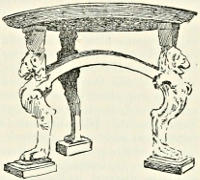
Roman Tripod
His talent for organisation was wonderful;
Cæsar forced his coalition and his
legions into close union and held them
firmly together as no other statesman ever
did with his allies, nor any general with an
army composed of unruly and conflicting
elements; never did ruler judge his instruments
with so keen an eye and put each in
its appropriate place. He was a monarch,
but he never played the king. Even as
absolute master of Rome he retained the
bearing of a party leader; perfectly pliant and complaisant, easy and
agreeable in conversation and courteous to all, he appeared to desire to be
nothing more than the first among his equals. Cæsar entirely avoided
the mistake of so many men otherwise as great as he—that of carrying
the spirit of the military commander into politics; however great the temptation
arising from his vexatious relations with the senate, he never had
recourse to such acts of brute force as that of the 18th Brumaire. Cæsar
was a monarch, but he was never caught by the glamour of tyranny. He is
perhaps the only one among the Lord’s mighty ones, who in great things as
in small never acted in response to fancy or caprice but in all cases in accordance
with his duty as a ruler, and who, when he looked back on his life,
might indeed deplore miscalculations but could repent of none of the errors
of passion. There is nothing in the story of Cæsar’s life which can compare
even in a small degree with those ebullitions of poetic sensuality, with the
murder of Clitus or the burning of Persepolis, of which the history of his
great predecessor in the East has to tell. Finally he is perhaps the only one of
those mighty ones who preserved to the very end of his career a statesman-like
sense of the possible and impossible and who did not shipwreck on the great
problem which is the hardest of all for natures of the grand order, the problem
of recognising the natural limits of success even at its very pinnacle.
What was practicable he performed, and never neglected the attainable
good for the sake of the impossible better; never disdained at least to
mitigate an incurable evil by some palliative. But where he perceived that
fate had spoken he always listened. Alexander at the Hypanis, Napoleon in
Moscow turned back because they were compelled to do so, and reproached
fate because she granted only limited success. Cæsar at the Thames and
the Rhine retired of his own free will, and at the Danube and Euphrates laid
no extravagant schemes for the conquest of the world, but merely planned
the execution of some carefully considered frontier regulations.
Such was this singular man whom it seems so easy and is so hopelessly
difficult to describe. His whole nature is pellucidly clear, and concerning
him tradition has preserved more abundant and vivid details than of any
of his peers in the ancient world. Such a personality might indeed be
conceived as shallower or more profound but not really in different ways;
to every not wholly perverse inquirer this lofty figure has appeared with
the same essential traits, and yet none has succeeded in restoring it in clear
outline. The secret lies in its completeness. Humanly and historically
speaking Cæsar stands at that point of the equation at which the great conflicting
principles of life neutralise one another. Possessing the greatest
creative force and yet at the same time the most penetrating intelligence,
no longer a youth but not yet an old man, highest in will and highest in
achievement, filled with republican ideals and yet a born king, a Roman
to the deepest core of his being and again destined to reconcile and unite
Roman and Hellenic civilisations both externally and in their inward relations—Cæsar
is the complete and perfect man. This is why in him more
than in any other historical personality we miss the so-called characteristic
traits, which are really nothing else than deviations from the natural human
development. What are taken for these at the first superficial glance reveal
themselves on closer inspection, not as individual qualities, but as the peculiarities
of the period of civilisation or of the nation; thus as his youthful
adventures are common to him and to all his gifted contemporaries who were
similarly situated, so his unpoetic but energetic and logical nature is mainly
Roman.
Besides this it is in accordance with Cæsar’s perfectly human character
that he was in the highest degree dependent on time and place; for there
is no such thing as humanity pure and simple; the living man can but
exhibit the qualities of a given nation and a particular stamp of civilisation.
Cæsar was a perfect man only because he had placed himself, as none other
had done, in the central stream of the tendencies of his day, and because
more than any other he possessed the essential characteristic of the Roman
nation, the true citizen quality in its perfection; while his Hellenism also
was only that which had long since become closely intertwined with the
national spirit of the Italians.
But herein lies the difficulty, we might perhaps say the impossibility,
of giving a distinct portrait of Cæsar. As the artist can paint anything
save perfect beauty, so also the historian, where once in a thousand years
he encounters perfection, can only be silent before it. For the rule may
indeed be laid down, but we have only a negative idea of the absence of
defect; nature’s secret, of uniting the normal and the individual in their
fullest manifestations, cannot be expressed. Nothing is left us but to
duly appreciate those who saw this perfection and to obtain a dim idea
of the imperishable reflection which rests on the works created by this
great nature. It is true that these also show the mark of his age. The
Roman himself might be compared with his young Greek predecessor not
merely as an equal but as a superior; but the world had grown old since
then and its youthful lustre had grown dim. Cæsar’s work was no longer,
like that of Alexander, a joyous effort to advance towards the immeasurable
distance; he was engaged in construction, and that from ruins, and
was satisfied to work as profitably and securely as possible in the wide but
defined sphere already indicated. The fine poetic sense of the nations is
therefore justified in paying no heed to the unpoetic Roman, while it has
surrounded the son of Philip with all the golden splendour of poetry and
all the rainbow colours of legend. But with equal justice the political
life of nations has for thousands of years returned again and again to the
lines which Cæsar traced, and if the peoples to whom the world belongs still
apply his name to the chiefest of their monarchs, there is in this a profound
warning and one, unfortunately, also calculated to rouse feelings of shame.
Cæsar had been a leader of the popular party from a very early period
and as it were by hereditary right, and for thirty years he had upheld its
shield without ever changing or even hiding his colours; even as monarch he
was still a democrat. As he entered into the entire inheritance of his party,
of course with the exception of the wrong-headed notions of Catiline and
Clodius, cherished the bitterest and even a personal hatred towards the
aristocracy and the true aristocrats, and retained unaltered the principal
watchwords of the Roman democracy—namely, the amelioration of the
position of debtors, foreign colonization, the gradual abolition of the existing
differences of privilege between the various classes in the state and the
emancipation of the executive power from the senate; so his monarchy
also was so little in conflict with the democracy that, on the contrary, it was
through it that the latter first attained completion and fulfilment. For this
monarchy was no oriental despotism by the grace of God, but a monarchy
such as Caius Gracchus wished to found, such as Pericles and Cromwell
founded—the representation of the people by the man who possessed its
supreme and unlimited trust. Thus the ideas which underlie Cæsar’s work
were not exactly new; but their development, in the last instance always the
main thing, belongs to him, and to him the grandeur of the realisation which
might have surprised even the originating genius could he have seen it, and
which has inspired and will ever inspire all who have encountered it in actual
operation or in the mirror of history, whatever the historical period or political
complexion to which they may belong, with deeper and deeper emotion
and wonder according to the measure of their capacity for comprehending
human and historical greatness.
This is perhaps the right place to expressly declare what the historian
always tacitly assumes and to enter a protest against the custom common
alike to simplicity and dishonesty, the custom of employing the praise and
blame of history independent of the special conditions, as phrases of general
application, in this case of transforming the verdict on Cæsar into a judgment
on so-called Cæsarism. In truth the history of past centuries should
be the teacher of that in progress, but not in the common sense, as though
men could read the junctures of the present in the records of the past
and in those on the art of political diagnosis and prescriptions could read
up the symptoms and their remedies; but history is only instructive in
so far as the study of ancient civilisations reveals the general organic conditions
of civilisation itself, with those primary forces which are everywhere
the same and those combinations which are everywhere different, and in
so far as, instead of producing unthinking imitation, it guides and inspires
independent creations on old lines. In this sense the history of Cæsar
and the Roman Cæsarship, with all the unsurpassed greatness of the master
workman and all the historical necessity of the work, is verily a keener
criticism of modern autocracy than the hand of man could write.
By the same law of nature in accordance with which the most insignificant
organism is infinitely superior to the most cunning machine,
any constitution, however defective, which allows free play for the spontaneous
action of a majority of citizens is infinitely superior to absolutism,
even though conducted with the greatest amount of humanity and genius;
for the former is capable of development, and is therefore living, the latter
remains what it is, that is it is dead. This law of nature also asserted
itself in the case of the absolute military monarchy of Rome, and only
the more completely because under the inspired guidance of its creator
and in the absence of any real complications with foreign countries the
development of that monarchy was less hampered and limited than any
similar government. From the time of Cæsar, as Gibbon long ago pointed
out, the Roman Empire had only an external cohesion and was only extended
in mechanical fashion, whilst inwardly it wholly withered and expired
with himself. If at the commencement of the autocracy and especially
in Cæsar’s own mind there still prevailed a sanguine hope of a union of
free popular development with absolute rule, even the government of the
highly gifted emperors of the Julian line soon taught in terrible fashion
how far it is possible to mingle fire and water in one vessel.
Cæsar’s work was necessary and beneficial, not because it did or could of
itself bring blessing, but because an absolute military monarchy was the least
of evils and the logical and necessary conclusion determined by the ancient
organisation, founded as it was on slavery and entirely alien to republican
and constitutional representation, and by the legal constitution of the city,
which in the course of five hundred years had ripened into an oligarchical
absolutism. But history will not consent to diminish the honour of the true
Cæsar because where there are spurious Cæsars a similar device may bewilder
simplicity and furnish evil with an opportunity for lying and fraud. History
too is a bible, and if it no more than the latter can defend itself from
being misunderstood by the fool or quoted by the devil, it too will be in a
position to endure and render his due to each.d
Mark Antony
(From a bust at Rome)
The noble Brutus
Hath told you Cæsar was ambitious:
If it were so, it was a grievous fault;
And grievously hath Cæsar answered it.
While the conspirators were at their bloody work, the mass of the
senators rushed in confused terror to the doors; and when Brutus turned
to address his peers in defence of the deed, the hall was well-nigh empty.
Cicero, who had been present, answered not, though he was called by name;
Antony had hurried away to exchange his consular robes for the garb of a
slave. Disappointed of obtaining the sanction of the senate, the conspirators
sallied out into the Forum to win the ear of the people. But here too they
were disappointed. Not knowing what massacre might be in store, every
man had fled to his own house; and in vain the conspirators paraded the
Forum, holding up their blood-stained weapons and proclaiming themselves
the liberators of Rome. Disappointment was not their only feeling; they
were not without fear. They knew that Lepidus, being on the eve of departure
for his province of Narbonese Gaul, had a legion encamped on the island
of the Tiber; and if he were to unite with Antony against them, Cæsar
would quickly be avenged. In all haste, therefore, they retired to the
Capitol. Meanwhile three of Cæsar’s slaves placed their master’s body
upon a stretcher, and carried it to his house on the south side of the Forum
with one arm dangling from the unsupported corner. In this condition the
widowed Calpurnia received the lifeless clay of him who had lately been
sovereign of the world.
Lepidus moved his troops to the Campus Martius. But Antony had no
thoughts of using force; for in that case probably Lepidus would have become
master of Rome. During the night he took possession of the treasure
which Cæsar had collected to defray the expenses of his Parthian campaign,
and persuaded Calpurnia to put into his hands all the dictator’s papers.
Possessed of these securities, he barricaded his house on the Carinæ, and
determined to watch the course of events.
In the evening Cicero, with other senators, visited the self-styled liberators
in the Capitol. They had not communicated their plot to the orator,
through fear (they said) of his irresolute counsels; but now that the deed
was done, he extolled it as a godlike act. Next morning, Dolabella, Cicero’s
son-in-law, whom Cæsar had promised to make his successor in the consulship,
assumed the consular fasces and joined the liberators; while Cinna, son
of the old Marian leader, and therefore brother-in-law to Cæsar, threw
aside his prætorian robes, declaring he would no longer wear the tyrant’s
livery. Dec. Brutus, a good soldier, had taken a band of gladiators
into pay, to serve as a bodyguard of the liberators. Thus strengthened,
they ventured again to descend into the Forum. Brutus mounted the
tribune, and addressed the people in a dispassionate speech, which produced
little effect. But when Cinna assailed the memory of the dictator,
the crowd broke out into menacing cries, and the liberators again retired to
the Capitol.
That same night they entered into negotiations with Antony, and the
result appeared next morning, the second after the murder. The senate,
summoned to meet, obeyed the call in large numbers. Antony and Dolabella
attended in their consular robes, and Cinna resumed his prætorian
garb. It was soon apparent that a reconciliation had been effected; for
Antony moved that a general amnesty should be granted, and Cicero
seconded the motion in an animated speech. It was carried; and Antony
next moved that all the acts of the dictator should be recognised as law.
He had his own purposes here, but the liberators also saw in the motion an
advantage to themselves; for they were actually in possession of some of the
chief magistracies, and had received appointments to some of the richest
provinces of the empire. This proposal, therefore, was favourably received;
but it was adjourned to the next day, together with the important question
of Cæsar’s funeral.
On the next day, Cæsar’s acts were formally confirmed, and among them
his will was declared valid, though its provisions were yet unknown. After
this, it was difficult to reject the proposal that the dictator should have a public
burial. Old senators remembered the riots that attended the funeral of
Clodius, and shook their heads. Cassius opposed it. But Brutus, with imprudent
magnanimity, decided in favour of allowing it. To seal the reconciliation,
Lepidus entertained Brutus at dinner, and Cassius was feasted
by Mark Antony.
The will was immediately made public. Cleopatra was still in Rome,
and entertained hopes that the boy Cæsarion would be declared the dictator’s
heir, for though he had been married thrice there was no one of his lineage
surviving. But Cæsar was too much a Roman, and knew the Romans too well,
to be guilty of this folly. Young C. Octavius was declared his heir. C. Octavius
was the son of his niece Atia, and therefore his grand-nephew. He was
born, as we have noted, in the memorable year of Catiline’s conspiracy, and
was now in his nineteenth year. From the time that he had assumed the
garb of manhood his health had been too delicate for military service. Notwithstanding
this, he had ventured to demand the mastership of the horse
from his uncle. But he was quietly refused, and sent to take his first lessons
in the art of war at Apollonia, where a large and well-equipped army
had been assembled.
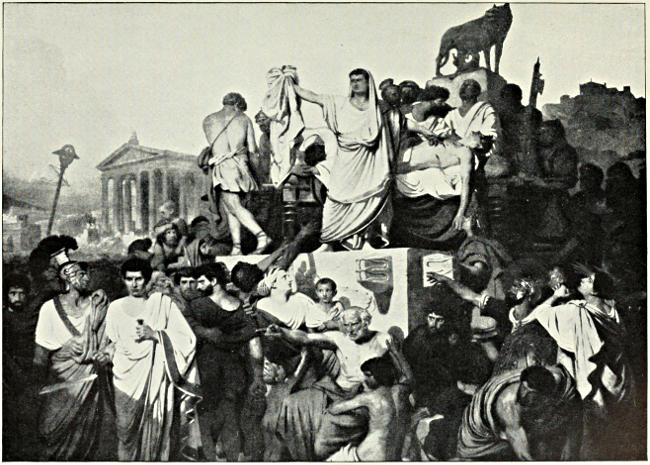
SPEECH OF ANTONY OVER CÆSAR’S BODY
Legacies were left to all Cæsar’s supposed friends, among whom were
several of those who had assassinated him. His noble gardens beyond the
Tiber were devised to the use of the public, and every Roman citizen was to
receive a donation of three hundred sesterces (between £2 and £3). The
effect of this recital was electric. Devotion to the memory of the dictator
and hatred for his murderers at once filled every breast.
Two or three days after this followed the funeral. The body was to be
burned and the ashes deposited in the Campus Martius near the tomb of his
daughter Julia. But it was first brought into the Forum upon a bier inlaid
with ivory and covered with rich tapestries, which was carried by men high
in rank and office. There Antony, as consul, rose to pronounce the funeral
oration. He ran through the chief acts of Cæsar’s life, recited his will, and
then spoke of the death which had rewarded him. To make this more vividly
present to the excitable Italians, he displayed a waxen image marked with
the three-and-twenty wounds, and produced the very robe which he had worn,
all rent and blood-stained. Soul-stirring dirges added to the solemn horror
of the scene. But to us the memorable speech which Shakespeare puts into
Antony’s mouth will give the liveliest notion of the art used and the impression
produced. That impression was instantaneous. The senator friends of
the liberators who had attended the ceremony looked on in moody silence.
Soon the menacing gestures of the crowd made them look to their safety.
They fled; and the multitude insisted on burning the body, as they had
burned the body of Clodius, in the sacred precincts of the Forum. Some of
the veterans who attended the funeral set fire to the bier; benches and firewood
heaped round it soon made a sufficient pile.
From the blazing pyre the crowd rushed, eager for vengeance, to the
houses of the conspirators. But all had fled betimes. One poor wretch fell
a victim to the fury of the mob—Helvius Cinna, a poet who had devoted
his art to the service of the dictator. He was mistaken for L. Cornelius
Cinna the prætor, and torn to pieces before the mistake could be explained.[131]
Antony was now the real master of Rome. The treasure which he had
seized gave him the means of purchasing good will, and of securing the
attachment of the veterans stationed in various parts of Italy. He did
not, however, proceed in the course which, from the tone of his funeral
harangue, might have been expected. He renewed friendly intercourse
with Brutus and Cassius, who were encouraged to visit Rome once at least,
if not oftener, after that day; and Dec. Brutus, with his gladiators, was
suffered to remain in the city. Antony went still further. He gratified
the senate by passing a law to abolish the dictatorship forever. He then
left Rome, to win the favour of the Italian communities and try the temper
of the veterans.
Meanwhile another actor appeared upon the scene. This was young
Octavius.b
[44-43 B.C.]
Julius Cæsar had in truth determined to take his great-nephew with him
to the war against the Parthians, for which he was already eagerly preparing.
As his legions were collected in Macedonia he sent on Caius Octavius in
October of 45 B.C. to Apollonia to complete there his education in the science
of warfare and rhetoric. As companions Cæsar gave him two of his contemporaries,
Marcus Vipsanius Agrippa and Quintus Salvidienus, members
of no distinguished family it must be admitted, but men who by their
military services had done credit to Cæsar’s penetration in judging men.
During the preparations for the Parthian War Roman troops were constantly
in Apollonia, single detachments from time to time were ordered off from
the army in Macedonia to enable the young Octavius to take part in their
manœuvres and gain closer access to their leaders; in short, no effort was
spared to make him popular with the army.
While the soldiers were making strenuous preparations for the Parthian
War and eagerly looking forward to the arrival of their leader as soon as
the favourable time of the year should be upon them, they were suddenly
confronted with the news of his assassination. It was evening when the
intelligence of the ides of March was delivered in Apollonia. An immediate
resolution was imperative, as it was impossible as yet to know
whether the lives of Cæsar’s friends and relatives were not also in jeopardy.
Some one even hazarded the wild suggestion that the Macedonian legions
should be led against Rome; such a plan, that admitted of no preparations
and at once exposed its originator to the danger of failing at its inception,
and so making it wholly impracticable if the legions remained faithful to
their sworn duty, was in direct antagonism to the character of Octavius, and
was duly rejected.
Taking leave of the leaders of the army he returned home to Italy, as a
private man. He did not dare land at a great port like Brundusium; on
the contrary, he took care to select a harbour as little known as that of
Lupiæ. Here he received more direct intelligence from Rome, particularly
on the subject of his adoption. With the firm determination to claim his
inheritance he turned to Brundusium, where he was immediately hailed
as Cæsar by Cæsar’s adherents and veterans. Many joined his side, it
would seem, there and then, accompanying him to Naples. Cicero, who
was taking a journey into lower Italy at the time, wrote to Atticus on
the 11th of April, full of curiosity and dread anticipation: “But I would
fain know what the arrival of Octavius portends? Does the multitude flock
to him? Is there danger of a revolution? I don’t think so myself; but
whatever is the case I should like to know it.” Arrived at his villa at
Puteoli he writes to the same friend, apparently quite as an after-thought,
that Octavius too came to Naples on the 18th of April; but the next day
he again recurs to this subject: “Octavius, too, has come here, and occupies
the villa of my neighbour Philippus. He is quite my humble servant.”
Close upon this he writes on the 22nd of April: “Octavius treated me with
great consideration and friendliness at his visit. His household, it is true,
are accustomed to address him as Cæsar, but his stepfather does not follow
suit, nor do I. I cannot allow that he is a good citizen. There are too
many in his neighbourhood who threaten our party with death. He describes
the present position of affairs as not to be endured. Yes, but what
think you will happen when this boy comes to Rome?”
The boy was not in such a hurry to come to Rome. He was in the very
neighbourhood of Italy in which Cæsar had most endeared himself to his
veterans. These negotiations were entered into even at this time with
the object of ascertaining the colour of their minds. Young Cæsar then
conducted his journey slowly to Tarracina and thence to Rome which he
entered in the opening days of May before Antony had had time to return.
We still possess to-day in the Museo Chiaramonti a marble bust in a fit condition
to bring before our present eye the impression made by the man who
was to be so mighty a ruler. The features are distinguished and fine, but
energetic too; almost even disquieting.
His first steps in Rome concerned the will of Cæsar. Although
his family, and notably his stepfather, strongly dissuaded him, he declared
fearlessly, with a premature confidence in his determination that is striking,
that his intention was to bid for Cæsar’s inheritance, and this in the presence
of Caius Antonius who had taken over the affairs of a town prætor since
the flight of Brutus; shortly after this, in about the middle of May, he
was presented to the people as Cæsar by the people’s tribune, Lucius Antonius,
a brother of Caius. The young Cæsar hereby pledged himself to the
Roman people to exclude his adoptive father’s legates, nor could he hope
that Mark Antony would be prepared to deliver up to him that adoptive
father’s treasure.
Mark Antony indeed after his return did everything in his power to load
young Cæsar’s position with difficulty. His conduct to the son of his friend
was loveless it is true, yet we can hardly deny that it is explicable. Two
things there were especially which separated their interests: Antony would
not and could not pay back Cæsar’s treasure to the legitimate heir—equally
impossible was it for him to divide the conduct of his party with a boy of
nineteen. At the very first personal encounter between the two in the gardens
of Pompey, which were then occupied by Antony, the incompatibility
of aims which separated them came clearly to light, and the attempts of
friends common to them both to bring the two rivals closer to each other
could not avail to avert an open breach.
Rightly did Antony oppose the illegal bid of his rival for the tribunate
of the people, but nothing but petty spite was the source of his refusal to
allow the confirmation by the curiæ of the perfectly valid adoption by Cæsar.
Moreover, the young Cæsar, in order to curry favour with the people, had
declared his readiness to fulfil a vow of the dictator and to grant games
in honour of the victory of Cæsar. Caius Matius and other friends of the
dictator gave him every support at these games, from the 20th to the 30th
of July; but Mark Antony, who had no power to prohibit games, succeeded
in preventing a golden chair with a coronal from being publicly set up
in honour of Julius Cæsar. To the friend of Cæsar this Cæsar worship
appeared at once of doubtful taste, a worship which his youthful rival
sought to organise with all the outward show of an agitator; and before
the decisive sentence of the consul the private man had at last to yield.
But the later Augustus tells with peculiar satisfaction in his memoirs that,
suddenly, in the course of the games, a mighty comet with a long tail was
seen, and that it was greeted by the multitude as the star of Cæsar. The
star of the Julii was again in the ascendant; and the son who had reared
a brazen statue, surmounted with a star of gold, to his father in the temple
of Venus, the mother of his stock, secretly hoped to attract the rays from
this auspicious talisman upon his own future. A comet always stirs up the
imagination of the people mightily, it signifies war; so a contemporary poet
mourns: Comets full of foreboding never shone so frequent. This time the
people were right; the figure of Nemesis for the murder of Cæsar stood in
the doorway.
The nearer things came to a crisis the blacker grew Cæsar’s situation.
Antony had contemptuously rejected a confederacy with him; an apparent
reconciliation on the Capitol had no enduring consequences. By the outbreak
of a civil war, in which a Cæsar could not (even if he would) remain
neutral, the young man could only rank himself as a bond fellow of the
senate, of the very men who had murdered Cæsar. The thought was so
intolerable to him that he did not shrink from an attempt to free himself of
his opponent by assassination. Luckily for Cæsar’s cause the attempt failed,
and Antony was free a few days later to make away to his legions at
Brundusium. Had the attempted assassination succeeded, the young Cæsar,
whose security grew more and more perilous would, in all probability, not
have been in a position to reap the benefit of this bloody deed. When we
take into account the prudence of Cæsar’s conduct on every other occasion
but this, we can only explain this folly by the light of that systematic opposition
with which Antony had met all his aspirations. To the murderers of
Cæsar and the senate he behaved with somewhat greater caution.f
Still Antony remained in possession of all actual power. The senate
voted, on his demand, that the provinces of Macedonia and Syria, though
granted to Brutus and Cassius by the act of Cæsar, should be given to C.
Antonius and Dolabella, and that the coveted province of Cisalpine Gaul
should be transferred from Dec. Brutus to Antony himself. The news of
these arbitrary acts convinced the liberators that they had nothing to hope
at Rome. Dec. Brutus immediately left the city and took possession of his
province by force. But M. Brutus and Cassius still dallied. Their vacillating
conduct during this time gives us an unfavourable impression of their
fitness for any enterprise of mark. Cicero, not himself remarkable for political
firmness, in this crisis displayed a vigour worthy of his earlier days, and
was scandalised by the unworthy bickerings of his friends. At length they
set sail from Velia for Greece. This was in the month of September.
Cicero also had at one moment made up his mind to retire from public life
and end his days at Athens, in learned leisure. In the course of this summer
he continued to employ himself on some of his most elaborate treatises.
His works on The Nature of the Gods and on Divination, his Offices, his
Dialogue on Old Age, and several other essays belong to this period and
mark the restless activity of his mind. But though he twice set sail from
Italy, he was twice driven back to port at Velia, where he found Brutus and
Cassius. Here he received letters from A. Hirtius, and other friends of
Cæsar, which gave him hopes that, in the name of Octavius, they might
successfully oppose Antony, and restore constitutional government. He
determined to return, and announced his purpose to Brutus and Cassius, who
commended him, and went their way to the East to raise armies against
Antony; he repaired to Rome to fight the battles of his party in the senate.
Meanwhile Antony had been running riot. In possession of Cæsar’s
papers, with no one to check him, he produced ready warrant for every
measure which he wished to carry, and pleaded the vote of the senate which
confirmed all the acts of Cæsar. When he could not produce a genuine
paper, he interpolated or forged what was needful.
On the day after Cicero’s return (September 1st) there was a meeting of
the senate. But the orator did not attend, and Antony threatened to send
men to drag him from his house. Next day Cicero was in his place, but now
Antony was absent. The orator rose and addressed the senate in what is
called his First Philippic. This was a measured attack upon the government
and policy of Antony, but personalities were carefully eschewed. But
Antony, enraged at his boldness, summoned a meeting for the 19th of
September, which Cicero did not think it prudent to attend. He then
attacked the absent orator in the strongest language of personal abuse and
menace. Cicero sat down and composed his famous Second Philippic, which
is written as if it were delivered on the same day, in reply to Antony’s
invective. At present, however, he contented himself with sending a copy
of it to Atticus, enjoining secrecy.
Matters quickly drew to a head between Antony and Octavius. The
latter had succeeded in securing a thousand men of his uncle’s veterans who
had settled at Campania, and by great exertions in the different towns of
Italy had levied a considerable force. Meantime four of the Epirot legions
had just landed at Brundusium, and Antony hastened to attach them to his
cause. But the largess which he offered them was only a hundred denarii
a man, and the soldiers laughed in his face. Antony, enraged at their conduct,
seized the ringleaders, and decimated them. But this severity only
served to change their open insolence to sullen anger, and emissaries from
Octavius were ready to draw them over to the side of their young master.
They had so far obeyed Antony as to march
northwards to Ariminum, while he repaired to
Rome. But as he entered the senate house, he
heard that two of the four legions had deserted
to his rival, and in great alarm he hastened to
the camp just in time to keep the remainder of
the troops under his standard by distributing
to every man five hundred denarii.

Bust of Octavius
(In the British Museum)
The persons to hold the consulship for the
next year had been designated by Cæsar.
They were both old officers of the Gallic army,
C. Vibius Pansa and A. Hirtius, the reputed
author of the eighth book of the History of the
Gallic War. Cicero was ready to believe that
they had become patriots, because, disgusted
with the arrogance of Antony, they had declared
for Octavius and the senate. Antony
began to fear that all parties might combine
to crush him. He determined, therefore, no
longer to remain inactive; and about the end
of November, having collected all his troops
at Ariminum, he marched along the Æmilian
road to drive Dec. Brutus out of Cisalpine
Gaul. Decimus was obliged to throw himself
into Mutina (Modena), and Antony blockaded
the place. As soon as his back was turned,
Cicero published the famous Second Philippic,
in which he lashed the consul with the most
unsparing hand, going through the history of his past life, exaggerating the
debaucheries, which were common to Antony with a great part of the Roman
youth, and painting in the strongest colours the profligate use he had made
of Cæsar’s papers. Its effect was great, and Cicero followed up the blow
by the following twelve Philippics, which were speeches delivered in the
senate house and Forum, at intervals from December, 44 B.C., to April in
the next year.
Cicero was anxious to break with Antony at once, by declaring him a
public enemy. But the latter was still regarded by many senators as the
head of the Cæsarian party, and it was resolved to treat with him. But the
demands of Antony were so extravagant that negotiations were at once
broken off, and nothing remained but to try the fortune of arms. The
consuls proceeded to levy troops; but so exhausted was the treasury that
now, for the first time since the triumph of Æmilius Paulus, it was found
necessary to levy a property tax on the citizens of Rome.
[43 B.C.]
Octavius and the consuls assembled their forces at Alba. On the first
day of the new year (43 B.C.) Hirtius marched for Mutina, with Octavius
under his command. The other consul, Pansa, remained at Rome to raise
new levies; but by the end of March he also marched to form a junction
with Hirtius. Both parties pretended to be acting in Cæsar’s name.
Antony left his brother Lucius in the trenches before Mutina, and took
the field against Hirtius and Octavius. For three months the opponents lay
watching each other. But when Antony learned that Pansa was coming up,
he made a rapid movement southward with two of his veteran legions, and
attacked him. A sharp conflict followed, in which Pansa’s troops were
defeated, and the consul himself was carried, mortally wounded, off the
field. But Hirtius was on the alert, and assaulted Antony’s wearied troops
on their way back to their camp, with some advantage. This was on the
15th of April, and on the 27th, Hirtius drew Antony from his entrenchments
before Mutina. A fierce battle followed, which ended in the troops
of Antony being driven back into their lines. Hirtius followed close upon
the flying enemy; the camp was carried by storm, and a complete victory
would have been won had not Hirtius himself fallen. Upon this disaster
Octavius drew off the troops. The news of the first battle had been reported
at Rome as a victory, and gave rise to extravagant rejoicings. The second
battle was really a victory, but all rejoicing was damped by the news that
one consul was dead and the other dying. No such fatal mischance had
happened since the Second Punic War, when Marcellus and Crispinus
fell in one day.
After his defeat Antony felt it impossible to maintain the siege of Mutina.
With Dec. Brutus in the town behind him, and the victorious legions of Octavius
before him, his position was critical. He therefore prepared to retreat,
and effected this purpose like a good soldier. His destination was the province
of Narbonese Gaul, where Lepidus had assumed the government, and
had promised him support. But the senate also had hopes in the same quarter.
L. Munatius Plancus commanded in northern Gaul, and C. Asinius
Pollio in southern Spain. Sext. Pompeius had made good his ground in the
latter country, and had almost expelled Pollio from Bætica. Plancus and
Pollio, both friends and favourites of Cæsar, had as yet declared neither for
Antony nor Octavius. If they would declare for the senate, Lepidus, a feeble
and fickle man, might desert Antony; or, if Octavius would join with Dec.
Brutus, and pursue him, Antony might not be able to escape from Italy at
all. But these political combinations failed. Plancus and Pollio stood
aloof, waiting for the course of events. Dec. Brutus was not strong enough
to pursue Antony by himself, and Octavius was unwilling, perhaps unable, to
unite the veterans of Cæsar with troops commanded by one of Cæsar’s murderers.
And so it happened that Antony effected his retreat across the Alps,
but not without extreme hardships, which he bore in common with the
meanest soldier. It was at such times that his good qualities always showed
themselves, and his gallant endurance of misery endeared him to every man
under his command. On his arrival in Narbonese Gaul he met Lepidus
at Forum Julii (Fréjus), and here the two commanders agreed on a plan of
operations.
The conduct of Octavius gave rise to grave suspicions. It was even said
that the consuls had been killed by his agents. Cicero, who had hitherto
maintained his cause, was silent. He had delivered his fourteenth and last
Philippic on the news of the first victory gained by Hirtius. But now he
talked in private of “removing” the boy of whom he had hoped to make a
tool. Octavius, however, had taken his part and was not to be removed.
Secretly he entered into negotiations with Antony. After some vain efforts
on the part of the senate to thwart him, he appeared in the Campus Martius
with his legions. Cicero and most of the senators disappeared, and the fickle
populace greeted the young heir of Cæsar with applause. Though he was
not yet twenty he demanded the consulship, having been previously relieved
from the provisions of the Lex Annalis by a decree of the senate, and he
was elected to the first office in the state, with his cousin Q. Pedius.[132]
A curiate law passed, by which Octavius was adopted into the patrician
gens of the Julii, and was put into legal possession of the name which he
had already assumed—C. Julius Cæsar Octavianus. We shall henceforth
call him Octavian.
The change in his policy was soon indicated by a law in which he formally
separated himself from the senate. Pedius brought it forward. By its
provisions all Cæsar’s murderers were summoned to take their trial. Of
course none of them appeared, and they were condemned by default.
By the end of September Octavian was again in Cisalpine Gaul, and in
close negotiation with Antony and Lepidus. The fruits of his conduct soon
appeared. Plancus and Pollio declared against Cæsar’s murderers. Dec.
Brutus, deserted by his soldiery, attempted to escape into Macedonia
through Illyricum; but he was overtaken near Aquileia, and slain by order
of Antony.
Italy and Gaul being now clear of the senatorial party, Lepidus as mediator
arranged a meeting between Octavian and Antony, upon an island in
a small river near Bononia (Bologna). Here the three potentates agreed
that they should assume a joint and co-ordinate authority under the name of
“triumvirs for settling the affairs of the commonwealth.” Antony was to
have the two Gauls, except the Narbonese district, which, with Spain, was
assigned to Lepidus; Octavian received Sicily, Sardinia, and Africa. Italy
was for the present to be left to the consuls of the year, and for the ensuing
year Lepidus, with Plancus, received promise of this high office. In return
Lepidus gave up his military force, while Octavian and Antony, each at the
head of ten legions, prepared to conquer the eastern part of the empire,
which could not yet be divided like the western provinces, because it was
in possession of Brutus and Cassius.
But before they began war the triumvirs agreed to follow the example
set by Sulla—to extirpate their opponents by a proscription, and to raise
money by confiscation. They framed a list of all men’s names whose death
could be regarded as advantageous to any of the three, and on this list each in
turn pricked a name. Antony had made many personal enemies by his proceedings
at Rome, and was at no loss for victims. Octavian had few direct
enemies; but the boy despot discerned with precocious sagacity those who
were likely to impede his ambitious projects, and chose his victims with little
hesitation. Lepidus would not be left behind in the bloody work. The
author of the Philippics was one of Antony’s first victims; Octavian gave
him up, and took as an equivalent for his late friend the life of L. Cæsar,
uncle of Antony. Lepidus surrendered his brother Paulus for some similar
favour. So the work went on. The description already given of Sulla’s
proscription may be repeated here literally, except that every horror was
increased, and the number of victims multiplied. Not fewer than three
hundred senators and two thousand knights were on the list. Q. Pedius,
an honest and upright man, died in his consulship, overcome by vexation
and shame at being implicated in these transactions.
As soon as their secret business was ended, the triumvirs determined to
enter Rome publicly. Hitherto they had not published more than seventeen
names of the proscribed. They made their entrance severally on three successive
days, each attended by a legion. A law was immediately brought
in to invest them formally with the supreme authority, which they had assumed.
This was followed by the promulgation of successive lists, each
larger than its predecessor.b
Appian gives a multitude of instances of the terrors of this proscription.
“The proscription being published,” he says, “guards were forthwith
placed at the gates and all the avenues of the city, at the seaports, and in
the marshes, and in all places where there was any likelihood an unhappy
man might shelter himself; besides, centurions were commanded abroad, to
make search in the country, which was done all at an instant; so that both
within and without the city many persons died suddenly several kinds of
deaths. The streets were filled with the sad spectacle of heads carrying to
the triumvirs, to receive the reward; and every step some person of quality
endeavouring to save himself, was met shamefully disguised; some running
down into wells, and others into privies; some hiding themselves in the tops
of the chimneys, or under the tiles, where they durst not utter a sigh or a
groan; for they stood in more fear of their wives, or children, or freedmen, or
slaves, or debtors, or neighbours that coveted some of their goods, than of
the murderers themselves.
“All private grudges were now discovered; and it was a strange change
to see the prime men of the senate, consulars, prætors, tribunes, or pretenders
to these dignities cast themselves at the feet of their slaves with tears in
their eyes, begging and caressing them, calling them their saviours and
patrons; and, which is most deplorable, not to be able with all these submissions
to obtain the least favour. The most pernicious seditions and cruellest
of wars never had anything in them so terrible as the calamities wherewith
the city was now affrighted; for in war and tumult none but enemies were
feared, and domestics were confided in; whereas now domestics were more
dreadful than enemies, because having no cause to fear for themselves, as in
war or tumult, from familiars they became of a sudden persecutors; either
out of a dissembled hate, or out of hope of recompense publicly proposed, or
because of some silver or gold hid in the house; so that no person found
himself secure in his house, servants being ordinarily more sensible of profit
than of the affection they owe to their masters; and though some might be
found faithful and kind, yet they durst not assist a proscript, nor conceal
him, nor so much as stay with him, for fear of falling into the same
misfortune.
“There was now much more danger than when the seventeen first proscribed
were fallen upon; for then no person being publicly proscribed, when
on a sudden they saw some killed, one man defended another, for fear lest
the same should happen to him. But after the proscription was published,
those comprised in it were presently forsaken by all the world; some that
thought themselves secure, having their minds bent on profit, sought them
to deliver them to the murderers, that they might have the reward; others
pillaged the houses of those that had been killed, and with the present gain
comforted themselves against the public misery.
“The most prudent and moderate surprised at a thing so extraordinary,
stood like men astonished, considering that other cities turmoiled with divisions
were re-established by the concord of their citizens; whereas the
Romans, already afflicted with civil dissensions, completed their ruin by this
reconciliation. Some were killed defending themselves; others, who thought
themselves not condemned, without any defence; some let themselves die
with hunger, or hanged, or drowned themselves, or threw themselves headlong
from the tops of houses, or cast themselves into the fire, or ran to meet
their murderers; others again sought to protract the time; and either hid
themselves, or begged shamefully, or fled, or offered money to save their
lives. Many likewise were slain contrary to the intention of the triumvirs,
either by mistake, or out of some particular grudge; but the bodies of the
proscripts might be known from the others, because they wanted the head,
which was cut off, and carried before the tribunal for orations, where they
paid the reward. On the other side, wonderful examples were to be seen
of the affection of wives, children, brethren and slaves; who found out a
thousand inventions to save their husbands, fathers, brethren, or masters;
died with them when they were discovered, or killed themselves upon those
bodies they were not able to defend.
“Of those that escaped the proscription, some pursued by their ill fortune,
perished by shipwreck; others saved beyond all probability, came
afterwards to exercise dignities in the city, to have command of armies, and
arrive at the honour of triumph. Such wonderful things were to be seen in
those days which do not happen in an ordinary city, or in a small kingdom;
but in the mistress of the world, as well by sea as land; Providence disposing
it so to reduce things to that excellent order wherein you now see them.
Not but that Rome felt the same miseries under Sulla, and before him under
Marius; and we have in writing of them reported many actions of cruelty,
even to the depriving their enemies of burial; but what passed under the
triumvirs made much more noise, because of the height of their reputation;
and particularly the valour and good fortune of him, who having fixed the
foundations of this empire, has left it to those of his race and name, even to
this present.”c
Among the victims far the most conspicuous was Cicero. With his
brother Quintus the old orator had retired to his Tusculan villa after the
battle of Mutina; and now they endeavoured to escape in the hope of joining
Brutus in Macedonia: for the orator’s only son was serving as a tribune
in the liberator’s army. After many changes of domicile, they reached
Astura, a little island near Antium, where they found themselves short of
money, and Quintus ventured to Rome to procure the necessary supply.
Here he was recognised and seized, together with his son. Each desired to
die first, and the mournful claim to precedence was settled by the soldiers
killing both at the same moment.
Meantime Cicero had put to sea. But even in this extremity he could
not make up his mind to leave Italy, and put to land at Circeii. After
further hesitation, he again embarked, and again sought the Italian shore
near Formiæ (Mola di Gaëta). For the night he stayed at his villa near that
place; and next morning would not move, exclaiming, “Let me die in
my own country,—that country which I have so often saved.” But his
faithful slaves forced him into a litter, and carried him again towards the
coast. Scarcely were they gone when a band of Antony’s bloodhounds
reached his villa, and were put upon the track of their victim by a young
man who owed everything to the Cicerones. The old orator from his litter
saw the pursuers coming up. His own followers were strong enough to
have made resistance; but he desired them to set the litter down. Then,
raising himself on his elbow, he calmly waited for the ruffians, and offered
his neck to the sword. He was soon despatched.
The chief of the band, by Antony’s express orders, hewed off the head
and hands and carried them to Rome. Fulvia, the widow of Clodius and
now the wife of Antony, drove her hair pin through the tongue which had
denounced the iniquities of both her husbands. The head which had given
birth to the Second Philippic, and the hands which had written it, were
nailed to the rostra, the home of their eloquence. The sight and the associations
raised feelings of horror and pity in every heart.
Cicero died in his sixty-fourth year. He had fallen on evil times; and
being eminently a man of peace was constantly called upon to mingle in
counsels of civil war. From his first appearance in public during the dictatorship
of Sulla to the great triumph of his consulship, he rose with a vigorous
and unflagging energy, which gave promise of a man fit to cope with
the dangers that were then closing round the constitution. But the performance
was not equal to the promise. When once Cicero had joined the
ranks of the senatorial nobility, his political conduct is marked by an almost
peevish vacillation. His advances were coldly rejected by Pompey. He
could not make up his mind to break entirely with Cæsar. His new senatorial
associates never heartily welcomed the new man, whose laborious
habits contrasted disadvantageously with their own. As the first orator of
the day, he thought he had a claim to be considered as equal to the first
statesman; and the rejection of this claim even by his own party threw him
still more out of harmony with that party.
If we turn from his public to his private character, our commendations
need less reserve. None but must admire the vigorous industry with which
from early youth he prepared for his chosen profession of advocate, full
of the generous belief that every branch of liberal studies must be serviceable
to one who is expected to bring out of his treasure things new and
old. To mould his multifarious knowledge he possessed a readiness of
speech which sometimes betrayed him into verbosity. The advocate with
an eye only to his verdict is sometimes forgotten in the orator who desires
to display his own powers. When the Forum and the senate house were
closed to him, he poured the overflowing abundance of his acquirements
into those dialogues and treatises which we still read with delight. He
wrote rapidly and fluently as he spoke, rather to amuse and employ his
mind in times of enforced idleness than as one who feels a call to instruct
or benefit mankind.
His disposition was extremely amiable. He felt no jealousy for rivals;
Hortensius was among his intimate friends, and is chiefly known to us by
Cicero’s generous praise. No man had more friends. In his family relations
he shines brightly amid the darkness of that age. His wife Terentia
was one with whom he had little sympathy; her masculine energy was
oppressive to his less resolute character. It was a relief, doubtless, to find
an excuse for divorcing her in the troubles of the Civil War. But divorces
were matters of course in these times. Nor did public opinion condemn him
when to mend his broken fortunes he married Publilia, a girl of large property,
who was his ward. To his affection for his brother Quintus and for
his children there is no drawback. On the whole his character displays
much weakness, but very little evil; while the perfect integrity and justice
of his life, in an age when such qualities were rare, if they do not compensate
for his defects in a political point of view, yet entitle him to the regard and
admiration of all good men.
Many of the proscribed escaped their fate, and found refuge, some with
Brutus in the East, some in Africa, more still with Sext. Pompeius. This
adventurer took advantage of the troubles in Italy to extend his power.
He occupied Sicily, and his fleets swept the coasts of Italy to afford assistance
to the proscribed. Next year, while Antony was intrusted with the
task of levying troops against Brutus and Cassius, Octavian undertook to
wrest Sicily from the hands of Sextus. But his fleet was encountered and
beaten off by the skilful captains of the enemy; and Octavian was compelled
to depart for the East without accomplishing his purpose.
[44-42 B.C.]
Brutus and Cassius, when they left Italy in the autumn of 44 B.C., at
once repaired to the provinces allotted to them, though by Antony’s influence
the senate had transferred Macedonia from Brutus to his own brother
Caius, and Syria from Cassius to Dolabella. C. Antonius was already in
possession of parts of Macedonia; but Brutus succeeded in dislodging him.
Meanwhile Cassius, already well known in Syria for his successful conduct
of the Parthian War, had established himself in that province, before he
heard of the approach of Dolabella. This worthless man left Italy about
the same time as Brutus and Cassius, and at the head of several legions
marched without opposition through Macedonia into Asia Minor. Here C.
Trebonius had already arrived. But he was unable to cope with Dolabella;
and the latter surprised him and took him prisoner at Smyrna. He was put
to death with unseemly contumely in Dolabella’s presence. This was in
February 43 B.C.; and thus two of Cæsar’s murderers, in less than a year’s
time, felt the blow of retributive justice.
When the news of this piece of butchery reached Rome, Cicero, believing
that Octavian was a puppet in his hands, was ruling Rome by the eloquence
of his Philippics. On his motion, Dolabella was declared a public enemy.[133]
Cassius lost no time in marching his legions into Asia, to execute the behest of
the senate, though he had been dispossessed of his province by the senate itself.
Dolabella threw himself into Laodicea, where he sought a voluntary death.
By the end of 43 B.C., therefore, the whole of the East was in the hands
of Brutus and Cassius. But instead of making preparations for war with
Antony, the two commanders spent the early part of the year 42 B.C. in
plundering the miserable cities of Asia Minor. Brutus demanded men and
money of the Lycians; and, when they refused, he laid siege to Xanthus,
their principal city. The Xanthians made the same brave resistance which
they had offered five hundred years before to the Persian invaders. They
burned their city, and put themselves to death rather than submit. Brutus
wept over their fate, and abstained from further exactions. But Cassius
showed less moderation; from the Rhodians alone, though they were allies
of Rome, he demanded all their precious metals. After this campaign of
plunder, the two chiefs met at Sardis and renewed the altercations which
Cicero had deplored in Italy. It is probable that war might have broken
out between them, had not the preparations of the triumvirs waked them
from their dream of security. It was as he was passing over into Europe
that Brutus, who continued his studious habits amid all disquietudes, and
limited his time of sleep to a period too small for the requirements of health,
was dispirited by the vision which Shakespeare, after Plutarch, has made
famous. It was no doubt the result of a diseased frame, though it was
universally held to be a divine visitation. As he sat in his tent in the dead
of the night, he thought a huge and shadowy form stood by him; and when
he calmly asked, “What and whence art thou?” it answered, or seemed to
answer, “I am thine evil genius, Brutus; we shall meet again at Philippi.”
[42 B.C.]
Meantime Antony’s lieutenants had crossed the Ionian Sea, and penetrated
without opposition into Thrace. The republican leaders found them
at Philippi. The army of Brutus and Cassius amounted to at least eighty
thousand infantry, supported by twenty thousand horse; but they were ill
supplied with experienced officers. For M. Valerius Messalla, a young man
of twenty-eight, held the chief command after Brutus and Cassius; and
Horace, who was but three-and-twenty, the son of a freedman, and a youth
of feeble constitution, was appointed a legionary tribune. The forces
opposed to them would have been at once overpowered, had not Antony
himself opportunely arrived with the second corps of the triumviral army.
Octavian was detained by illness at Dyrrhachium, but he ordered himself
to be carried on a litter to join his legions. The army of the triumvirs
was now superior to the enemy; but their cavalry, counting only thirteen
thousand, was considerably weaker than the force opposed to it. The
republicans were strongly posted upon two hills, with entrenchments
between; the camp of Cassius upon the left next the sea, that of Brutus
inland on the right. The triumviral army lay upon the open plain before
them in a position rendered unhealthy by marshes; Antony, on the right, was
opposed to Cassius; Octavian, on the left, fronted Brutus. But they were
ill supplied with provisions, and anxious for a decisive battle. The republicans,
however, kept to their entrenchments, and the other party began
to suffer severely from famine.
Determined to bring on an action, Antony began works for the purpose
of cutting off Cassius from the sea. Cassius had always opposed a general
action, but Brutus insisted on putting an end to the suspense, and his colleague
yielded. The day of the attack was probably in October. Brutus
attacked Octavian’s army, while Cassius assaulted the working parties of
Antony. Cassius’ assault was beaten back with loss, but he succeeded in
regaining his camp in safety. Meanwhile, Messalla, who commanded the
right wing of Brutus’ army, had defeated the host of Octavian, who was still
too ill to appear on the field, and the republican soldiers penetrated into the
triumvir’s camp. Presently, his litter was brought in stained with blood, and
the corpse of a young man found near it was supposed to be Octavian. But
Brutus, not receiving any tidings of the movements of Cassius, became so
anxious for his fate that he sent off a party of horse to make inquiries, and
neglected to support the successful assault of Messalla.
Cassius, on his part, discouraged at his ill success, was unable to ascertain
the progress of Brutus. When he saw the party of horse, he hastily concluded
that they belonged to the enemy, and retired into his tent with his
freedman, Pindarus. What passed there we know not for certain. Cassius
was found dead, with the head severed from the body. Pindarus was never
seen again. It was generally believed that Pindarus slew his master in obedience
to orders; but many thought that he had dealt a felon blow. The
intelligence of Cassius’ death was a heavy blow to Brutus. He forgot his
own success, and pronounced the eulogy of Cassius in the well-known words,
“There lies the last of the Romans.” The praise was ill-deserved. Except
in his conduct of war against the Parthians, Cassius had never played a
worthy part.
After the first battle of Philippi, it would still have been politic in Brutus
to abstain from battle. The triumviral armies were in great distress, and
every day increased their losses. Reinforcements coming to their aid by sea
were intercepted—a proof of the neglect of the republican leaders in not
sooner bringing their fleet into action. Nor did Brutus ever hear of this
success. He was ill fitted for the life of the camp, and after the death of
Cassius he only kept his men together by largesses and promises of plunder.
Twenty days after the first battle he led them out again. Both armies
faced each other. There was little manœuvring. The second battle was
decided by numbers and force, not by skill; and it was decided in favour of
the triumvirs.

Roman Sarcophagus
Brutus retired with four legions to a strong position in the rear, while
the rest of his broken army sought refuge in the camp. Octavian remained
to watch them, while Antony pursued the republican chief. Next day
Brutus endeavoured to rouse his men to another effort, but they sullenly
refused to fight, and Brutus withdrew with a few friends into a neighbouring
wood. Here he took them aside one by one, and prayed each to do him
the last service that a Roman could render to his friend. All refused with
horror; till at nightfall a trusty Greek freedman, named Strato, held the
sword, and his master threw himself upon it.[134] Most of his friends followed
the sad example. The body of Brutus was sent by Antony to his mother.
His wife Porcia, the daughter of Cato, refused all comfort; and being too
closely watched to be able to slay herself by ordinary means, she suffocated
herself by thrusting burning charcoal into her mouth. Messalla, with a
number of other fugitives, sought safety in the island of Thasos, and soon
after made submission to Antony.
[42-41 B.C.]
The name of Brutus has, by Plutarch’s beautiful narrative, sublimed by
Shakespeare, become a by-word for self-devoted patriotism. This exalted
opinion is now generally confessed to be unjust. Brutus was not a patriot,
unless devotion to the party of the senate be patriotism. Towards the provincials
he was a true Roman, harsh and oppressive. He was free from the
sensuality and profligacy of his age, but for public life he was unfit. His
habits were those of a student. His application was great, his memory remarkable.
But he possessed little power of turning his acquirements to
account; and to the last he was rather a learned man than a man improved
by learning. In comparison with Cassius, he was humane and generous;
but in all respects his character is contrasted for the worse with that of the
great man, from whom he accepted favours, and whose murderer he then
became.
The battle of Philippi was in reality the closing scene of the republican
drama. But the rivalship of the triumvirs prolonged for several years the
divided state of the Roman world; and it was not till after the crowning
victory of Actium that the imperial government was established in its
unity.
The hopeless state of the republican, or rather the senatorial party was
such that almost all hastened to make submission to the conquerors; those
whose sturdy spirit still disdained submission resorted to Sext. Pompeius in
Sicily. Octavian, still suffering from ill health, was anxious to return to
Italy; but before he parted from Antony, they agreed to a second distribution
of the provinces of the empire. Antony was to have the eastern
world; Octavian the western provinces. To Lepidus, who was not consulted
in this second division, Africa alone was left. Sext. Pompeius remained
in possession of Sicily.
Antony at once proceeded to make a tour through western Asia, in
order to exact money from its unfortunate people. About midsummer
(41 B.C.) he arrived at Tarsus, and here he received a visit which determined
the future course of his life and influenced Roman history for the
next ten years.
[41 B.C.]
Antony had visited Alexandria fourteen years before, and had been
smitten by the charms of Cleopatra, then a girl of fifteen. She became
Cæsar’s paramour, and from the time of the dictator’s death Antony had
never seen her. She now came to meet him in Cilicia. The galley which
carried her up the Cydnus was of more than oriental gorgeousness; the
sails of purple; oars of silver, moving to the sound of music; the raised poop
burnished with gold. There she lay upon a splendid couch, shaded by a
spangled canopy; her attire was that of Venus, around her flitted attendant
Cupids and Graces. At the news of her approach to Tarsus, the triumvir
found his tribunal deserted by the people. She invited him to her
ship, and he complied. From that moment he was her slave. He accompanied
her to Alexandria, exchanged the Roman garb for the Græco-Egyptian
costume of the court, and lent his power to the queen to execute
all her caprices.
Meanwhile, Octavian was not without his difficulties. He was so ill at
Brundusium that his death was reported at Rome. The veterans, eager for
their promised rewards, were on the eve of mutiny. In a short time Octavian
was sufficiently recovered to show himself. But he could find no other
means of satisfying the greedy soldiery than by a confiscation of lands more
sweeping than that which followed the proscription of Sulla. The towns of
Cisalpine Gaul were accused of favouring Dec. Brutus, and saw nearly all
their lands handed over to new possessors. The young poet Virgil lost
his little patrimony, but was reinstated at the instance of Pollio and Mæcenas,
and showed his gratitude in his first Eclogue. Other parts of Italy
also suffered—Apulia, for example, as we learn from Horace’s friend Ofella,
who became the tenant of the estate which had formerly been his own.
But these violent measures deferred rather than obviated the difficulty.
The expulsion of so many persons threw thousands loose upon society, ripe
for any crime. Many of the veterans were ready to join any new leader
who promised them booty. Such a leader was at hand.
Fulvia, wife of Antony, was a woman of fierce passions and ambitious
spirit. She had not been invited to follow her husband to the East. She
saw that in his absence imperial power would fall into the hands of Octavian.
Lucius, brother of Mark Antony, was consul for the year, and at her
instigation he raised his standard at Præneste. But L. Antonius knew not
how to use his strength; and young Agrippa, to whom Octavian intrusted
the command, obliged Antonius and Fulvia to retire northwards and shut
themselves up in Perusia. Their store of provisions was so small that it
sufficed only for the soldiery. Early in the next year Perusia surrendered,
on condition that the lives of the leaders should be spared. The town was
sacked; the conduct of L. Antonius alienated all Italy from his brother.
While his wife, his brother, and his friends were quitting Italy in confusion,
the arms of Antony suffered a still heavier blow in the eastern
provinces which were under his special government. After the battle of
Philippi, Q. Labienus, son of Cæsar’s old lieutenant Titus, sought refuge at
the court of Orodes, king of Parthia. Encouraged by the proffered aid of a
Roman officer, Pacorus the king’s son led a formidable army into Syria.
Antony’s lieutenant was entirely routed; and while Pacorus with one army
poured into Palestine and Phœnicia, Q. Labienus with another broke into
Cilicia. Here he found no opposition; and, overrunning all Asia Minor
even to the Ionian Sea, he assumed the name of Parthicus, as if he had been
a Roman conqueror of the people whom he served.
These complicated disasters roused Antony from his lethargy. He
sailed to Tyre, intending to take the field against the Parthians; but the
season was too far advanced, and he therefore crossed the Ægean to Athens,
where he found Fulvia and his brother, accompanied by Pollio, Plancus, and
others, all discontented with Octavian’s government. Octavian was absent
in Gaul, and their representation of the state of Italy encouraged him to
make another attempt. Late in the year (41 B.C.) Antony formed a league
with Sext. Pompeius; and while that chief blockaded Thurii and Consentia,
Antony assailed Brundusium. Agrippa was preparing to meet this new
combination; and a fresh civil war was imminent. But the soldiery was
weary of war; both armies compelled their leaders to make pacific overtures,
and the new year was ushered in by a general peace, which was
rendered easier by the death of Fulvia. Antony and Octavian renewed
their professions of amity, and entered Rome together in joint ovation to
celebrate the restoration of peace. They now made a third division of the
provinces, by which Scodra (Scutari) in Illyricum was fixed as the boundary
of the west and east. Lepidus
was still left in possession of
Africa. It was further agreed that
Octavian was to drive Sext. Pompeius,
lately the ally of Antony, out
of Sicily; while Antony renewed his
pledges to recover the standards of
Crassus from the Parthians. The
new compact was sealed by the marriage
of Antony with Octavia, his
colleague’s sister, a virtuous and
beautiful lady, worthy of a better
consort. These auspicious events
were celebrated by the lofty verse of
Virgil’s Fourth Eclogue, styled The
Pollio.
[41-39 B.C.]
Sext. Pompeius had reason to
complain. By the Peace of Brundusium
he was abandoned by his
late friend to Octavian. He was
not a man to brook ungenerous
treatment. Of late years his possession
of Sicily had given him command
of the Roman corn market.
During the winter which followed
the Peace of Brundusium (40-39
B.C.), Sextus blockaded Italy so
closely that Rome was threatened
with a positive dearth. Riots arose;
the triumvirs were pelted with
stones in the Forum; and they
deemed it prudent to temporise by inviting Pompeius to enter their league.
He met them at Misenum, and the two chiefs went on board his ship to settle
the terms of alliance. It is said that one of his chief officers, a Greek named
Menas or Menodorus, suggested to him the expediency of putting to sea with
the great prize, and then making his own terms. Sextus rejected the advice
with the characteristic words: “You should have done it without asking
me.” It was agreed that Sicily, Sardinia, and Corsica should be given up
to his absolute rule, and that Achaia should be added to his portion; so
that the Roman world was now partitioned amongst four—Octavian, Antony,
Lepidus, and Sext. Pompeius. On their return the triumvirs were
received with vociferous applause.
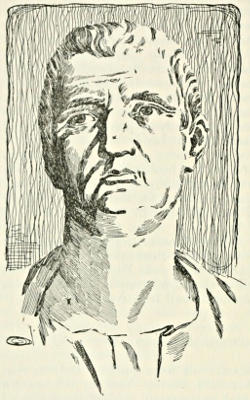
Agrippa
(From a bust in the Capitol)
Before winter, Antony sailed for Athens in company with Octavia, and
for the time seems to have banished Cleopatra from his thoughts. But he
disgusted all true Romans by assuming the attributes of Grecian gods, and
indulging in Grecian orgies.
[39-36 B.C.]
He found the state of things in the East greatly changed since his departure.
He had commissioned P. Ventidius Bassus, an officer who had
followed Fulvia from Italy, to hold the Parthians in check till his return.
Ventidius was son of a Picenian nobleman of Asculum, who had been
brought to Rome as a captive in the Social War. In his youth he had been
a contractor to supply mules for the use of the Roman commissariat. But
in the civil wars which followed, men of military talent easily rose to command;
and such was the lot of Ventidius. While Antony was absent in
Italy, he drove Q. Labienus into the defiles of Taurus, and here that
adventurer was defeated and slain. The conqueror then marched rapidly
into Syria, and forced Pacorus also to withdraw to the eastern bank of the
Euphrates.
In the following year (38 B.C.) he repelled a fresh invasion of the Parthians,
and defeated them in three battles. In the last of these engagements
Pacorus himself was slain on the fifteenth anniversary of the death of
Crassus. Antony found Ventidius laying siege to Samosata, and displaced
him, only to abandon the siege and return to Athens. Ventidius repaired
to Rome, where he was honoured with a well-deserved triumph. He had left
it as a mule jobber; he returned with the laurel round his brows. He was
the first, and almost the last, Roman general who could claim such a distinction
for victory over the Parthians.
The alliance with Sext. Pompeius was not intended to last, and it did
not last. Antony refused to put him in possession of Achaia; and to
avenge himself for this breach of faith Pompeius again began to intercept
the Italian corn fleets. Fresh discontent appeared at Rome; and Octavian
equipped a second fleet to sail against the naval chief; but after two battles
of doubtful result the fleet was destroyed by a storm, and Sextus was again
left in undisputed mastery of the sea. Octavian, however, was never
daunted by reverses, and he gave his favourite Agrippa full powers to conduct
the war against Pompeius. This able commander set about his work
with that resolution that marked a man determined not to fail. As a harbour
for his fleet he executed a plan of the great Cæsar—namely, to make
a good and secure harbour on the coast of Latium, which then, as now,
offered no shelter to ships. For this purpose he cut a passage through the
narrow necks of land which separated Lake Lucrinus from the sea and Lake
Avernus from Lake Lucrinus, and faced the outer barrier with stone. This
was the famous Julian Port. In the whole of the two years 38 and 37 B.C.,
Agrippa was occupied in this work and in preparing a sufficient force of
ships. Every dockyard in Italy was called into requisition. A large body
of slaves were set free that they might be trained to serve as rowers.
On the 1st of July, 36 B.C., the fleet put to sea. Octavian himself, with
one division, purposed to attack the northern coast of Sicily, while a second
squadron was assembled at Tarentum for the purpose of assailing the
eastern side. Lepidus, with a third fleet from Africa, was to assault Lilybæum.
But the winds were again adverse; and, though Lepidus effected a
landing on the southern coast, Octavian’s two fleets were driven back to
Italy with great damage. But the injured ships were refitted, and Agrippa
was sent westward towards Panormus, while Octavian himself kept guard
near Messana. Off Mylæ, a place famous for having witnessed the first
naval victory of the Romans, Agrippa encountered the fleet of Sext. Pompeius;
but Sextus, with the larger portion of his ships, gave Agrippa the
slip, and sailing eastward fell suddenly upon Octavian’s squadron off Tauromenium.
A desperate conflict followed, which ended in the complete
triumph of Sextus, and Octavian escaped to Italy with a few ships only.
But Agrippa was soon upon the traces of the enemy. On the 3d of September,
Sextus was obliged once more to accept battle near the Straits of
Messana, and suffered an irretrievable defeat. His troops on land were
attacked and dispersed by an army which had been landed on the eastern
coast by the indefatigable Octavian; and Sextus sailed off to Lesbos, where
he had found refuge as a boy during the campaign of Pharsalia, to seek
protection from the jealousy of Antony.
Lepidus had assisted in the campaign; but after the departure of Sextus
he openly declared himself independent of his brother triumvirs. Octavian,
with prompt and prudent boldness, entered the camp of Lepidus in person with
a few attendants. The soldiers deserted in crowds, and in a few hours
Lepidus was fain to sue for pardon, where he had hoped to rule. He was
treated with contemptuous indifference. Africa was taken from him; but
he was allowed to live and die at Rome in quiet enjoyment of the chief
pontificate.
It was fortunate for Octavian that during this campaign Antony was on
friendly terms with him. In 37 B.C. the ruler of the East again visited
Italy, and a meeting between the two chiefs was arranged at Tarentum.
The five years for which the triumvirs were originally appointed were now
fast expiring; and it was settled that their authority should be renewed by
the subservient senate and people for a second period of the same duration.
They parted good friends; and Octavian undertook his campaign against
Sext. Pompeius without fear from Antony. This was proved by the fate
of the fugitive. From Lesbos Sextus passed over to Asia, where he was
taken prisoner by Antony’s lieutenants, and put to death.
Hitherto Octavia had retained her influence over Antony. But presently,
after his last interview with her brother, the fickle triumvir abruptly
quitted a wife who was too good for him, and returned to the fascinating
presence of the Egyptian queen, whom he had not seen for three years.
From this time forth he made no attempt to break the silken chain of her
enchantments. During the next summer, indeed, he attempted a new
Parthian campaign.b It has been described by Florus as follows:
“Such was the excessive vanity of the man, that being desirous from a love
of distinction, to have Araxes and Euphrates read under his statues, he suddenly
quitted Syria and made an inroad on the Parthians, and that without
any cause or reason, or even pretended proclamation of war, as if it were
among a general’s accomplishments to surprise people by stealth. The
Parthians, who, besides having confidence in their arms, are crafty and subtle,
pretended to be alarmed, and to retreat across the plains. Antony, as if
already victorious, instantly pursued, when a body of the enemy, not very
numerous, rushed suddenly forth like a storm of rain upon the Romans, who,
as it was evening, were tired with the day’s march. Discharging their
arrows from all sides, they overwhelmed two legions.
“But this was nothing in comparison with the destruction that would
have met them on the following day, had not the mercy of the gods interposed.
One of the Romans who had survived the overthrow of Crassus, rode
up to the camp in a Parthian dress, and having saluted the soldiers in Latin,
and thus gained credit with them, told them of the danger which threatened
them; saying that the king would soon come up with all his forces; that
they ought therefore to retreat and take shelter in the mountains; and that
possibly, even if they did so, enemies would not be wanting. In consequence,
a smaller number of enemies overtook them than had been intended.
Overtake them, however, they did; and the rest of the army would have
been destroyed, had not the soldiers, while the arrows were falling on them
like hail, fortunately sunk down, as if they had been taught, upon their
knees, holding up their shields above their heads, and making it appear as if
they were killed. The Parthians then refrained from shooting.
“When the Romans afterwards rose up, the proceeding appeared so like
a miracle, that one of the barbarians exclaimed: ‘Go! and fare ye well,
Romans; fame deservedly speaks of you as the conquerors of nations, since
you have escaped death from the arrows of the Parthians.’ After this,
there was no less endured from want of water, than at the hands of the
enemy. The country, in the first place, was deadly from its drought; the
river, too, with its brackish and bitter water, was more deadly to some; and
besides, even good water was pernicious to many, being drunk greedily when
they were in a weak condition. Subsequently the heat of Armenia, the
snows of Cappadocia, and the sudden change in climate from one to the other,
was as destructive as a pestilence. Scarce the third part, therefore, of sixteen
legions being left, the excellent general, begging death from time to time, at
the hands of a gladiator of his, escaped at last into Syria, where, by some
unaccountable perversion of mind, he grew considerably more presuming
than before, as if he had conquered because he had escaped.”e
[36-35 B.C.]
In the next year he contented himself with a campaign in Armenia, to
punish the king of that country for alleged treachery in the last campaign.
The king fell into his hands; and with this trophy Antony returned to
Alexandria, where the Romans were disgusted to see the streets of a Græco-Egyptian
town honoured by a mimicry of a Roman triumph. For the next
three years he surrendered himself absolutely to the will of the enchantress.[135]
To this period belong those tales of luxurious indulgence which are known
to every reader. The brave soldier who in the perils of war could shake off
all luxurious habits, and could rival the commonest man in the cheerfulness
with which he underwent every hardship, was seen no more. He sank into
an indolent voluptuary, pleased by childish amusements. At one time he
would lounge in a boat at a fishing party, and laugh when he drew up pieces
of salt fish, which by the queen’s order had been attached to his hook by
divers. At another time she wagered that she would consume ten million
sesterces at one meal, and won her wager by dissolving in vinegar a pearl of
unknown value. While Cleopatra bore the character of the goddess Isis, her
lover appeared as Osiris. Her head was placed conjointly with his own on
the coins which he issued as a Roman magistrate. He disposed of the kingdoms
and principalities of the East by his sole word. By his influence Herod,
son of Antipater, the Idumæan minister of Hyrcanus, the late sovereign of
Judea, was made king to the exclusion of the rightful heir. Polemon, his
own son by Cleopatra, was invested with the sceptre of Armenia. Encouraged
by the absolute submission of her lover, Cleopatra fixed her eye upon
the Capitol, and dreamed of winning by means of Antony that imperial crown
which she had vainly sought from Cæsar.
[35-32 B.C.]
While Antony was engaged in voluptuous dalliance, Octavian was resolutely
pursuing the work of consolidating his power in the west. His
patience, his industry, his attention to business, his affability, were winning
golden opinions and rapidly obliterating all memory of the bloody work by
which he had risen to power. He had won little glory in war; but so long
as the corn fleets arrived duly from Sicily and Africa, the populace cared
little whether the victory had been won by Octavian or by his generals. In
Agrippa he possessed a consummate captain, in Mæcenas a wise and temperate
minister. It is much to his credit that he never showed any jealousy
of the men to whom he owed so much. He flattered the people with the
hope that he would, when Antony had fulfilled his mission of recovering
the standards of Crassus, engage him to join in putting an end to their sovereign
power and restoring constitutional liberty. In point of fidelity to
his marriage vows Octavian was little better than Antony. He renounced
his marriage with Clodia, the daughter of Fulvia, when her mother attempted
to raise Italy against him. He divorced Scribonia, when it no longer suited
him to court the favour of her kinsman. To replace this second wife, he
forcibly took away Livia from her husband, Ti. Claudius Nero, though she
was at that time pregnant of her second son. But in this and other less
pardonable immoralities there was nothing to shock the feelings of Romans.
But Octavian never suffered pleasure to divert him from business. If
he could not be a successful general, he resolved at least to show that he
could be a hardy soldier. While Antony in his Egyptian palace was neglecting
the Parthian War, his rival led his legions in more than one dangerous
campaign against the barbarous Dalmatians and Pannonians, who had been
for some time infesting the province of Illyricum. In the year 33 B.C. he
announced that the limits of the empire had been extended northward to the
banks of the Savus.
Octavian now began to feel that any appearance of friendship with
Antony was a source of weakness rather than of strength at Rome. Misunderstandings
had already broken out. Antony complained that Octavian
had given him no share in the provinces wrested from Sext. Pompeius and
Lepidus. Octavian retorted by accusing his colleague of appropriating
Egypt and Armenia, and of increasing Cleopatra’s power at the expense of
the Roman Empire. Popular indignation rose to its height when Plancus
and Titius, who had been admitted to Antony’s confidence, passed over to
Octavian, and disclosed the contents of their master’s will. In that document
Antony ordered that his body should be buried at Alexandria, in the
mausoleum of Cleopatra. Men began to fancy that Cleopatra had already
planted her throne upon the Capitol. These suspicions were sedulously
encouraged by Octavian.
Before the close of 32 B.C., Octavian, by the authority of the senate,
declared war nominally against Cleopatra. Antony, roused from his sleep
by reports from Rome, passed over to Athens, issuing orders everywhere to
levy men and collect ships for the impending struggle. At Athens he
received news of the declaration of war, and replied by divorcing Octavia.
His fleet was ordered to assemble at Corcyra; and his legions in the early
spring prepared to pour into Epirus. He established his headquarters at
Patræ on the Corinthian Gulf.
But Antony, though his fleet was superior to that of Octavian, allowed
Agrippa to sweep the Ionian Sea, and to take possession of Methone, in
Messenia, as a station for a flying squadron to intercept Antony’s communications
with the East, nay even to occupy Corcyra, which had been destined
for his own place of rendezvous. Antony’s fleet now anchored in the waters
of the Ambracian Gulf, while his legions encamped on a spot of land which
forms the northern horn of that spacious inlet. But the place chosen for the
camp was unhealthful; and in the heats of early summer his army suffered
greatly from disease. Agrippa lay close at hand watching his opportunity.
In the course of the spring Octavian joined him in person.
[31-30 B.C.]
Early in the season Antony had repaired from Patræ to his army, so as
to be ready either to cross over into Italy or to meet the enemy if they
attempted to land in Epirus. At first he showed something of his old military
spirit, and the soldiers, who always loved his military frankness, warmed
into enthusiasm; but his chief officers, won by Octavian or disgusted by the
influence of Cleopatra, deserted him in such numbers that he knew not
whom to trust, and gave up all thoughts of maintaining the contest with
energy. Urged by Cleopatra, he resolved to carry off his fleet and abandon
the army. All preparations were made in secret, and the great fleet put to
sea on the 28th of August. For the four following days there was a strong
gale from the south. Neither could Antony escape, nor could Octavian put
to sea against him from Corcyra. On the 2nd of September, however, the
wind fell, and Octavian’s light vessels, by using their oars, easily came up
with the unwieldy galleys of the eastern fleet. A battle was now seen to be
inevitable.
Antony’s ships were like impregnable fortresses to the assault of the
slight vessels of Octavian; and, though they lay nearly motionless in the
calm sea, little impression was made upon them. But about noon a breeze
sprang up from the west; and Cleopatra, followed by sixty Egyptian ships,
made sail in a southerly direction. Antony immediately sprang from his
ship of war into a light galley and followed. Deserted by their commander,
the captains of Antony’s ships continued to resist desperately; nor was it
till the greater part of them were set on fire that the contest was decided.
Before evening closed the whole fleet was destroyed; most of the men and
all the treasure on board perished. A few days after, when the shameful
flight of Antony was made known to his army, all his legions went over to
the conqueror.
[30-29 B.C.]
It was not for eleven months after the battle of Actium that Octavian
entered the open gates of Alexandria. He had been employed in the
interval in founding the city of Nicopolis to celebrate his victory on the
northern horn of the Ambracian Gulf, in rewarding his soldiers, and settling
the affairs of the provinces of the East. In the winter he returned to Italy,
and it was midsummer, 30 B.C., before he arrived in Egypt.
When Antony and Cleopatra arrived off Alexandria they put a bold face
upon the matter. Some time passed before the real state of the case was
known; but it soon became plain that Egypt was at the mercy of the
conqueror. The queen formed all kinds of wild designs. One was to
transport the ships that she had saved across the Isthmus of Suez and seek
refuge in some distant land where the name of Rome was yet unknown.
Some ships were actually drawn across, but they were destroyed by the
Arabs, and the plan was abandoned. She now flattered herself that her
powers of fascination, proved so potent over Cæsar and Antony, might subdue
Octavian. Secret messages passed between the conqueror and the
queen; nor were Octavian’s answers such as to banish hope.
Antony, full of repentance and despair, shut himself up in Pharos, and
there remained in gloomy isolation.
In July, 30 B.C., Octavian appeared before Pelusium. The place was
surrendered without a blow. Yet, at the approach of the conqueror, Antony
put himself at the head of a division of cavalry, and gained some advantage.
But on his return to Alexandria he found that Cleopatra had given up all
her ships; and no more opposition was offered. On the 1st of August
(Sextilis as it was then called) Octavian entered the open gates of Alexandria.
Both Antony and Cleopatra sought to win him. Antony’s messengers
the conqueror refused to see; but he still used fair words to Cleopatra. The
queen had shut herself up in a sort of mausoleum built to receive her body
after death, which was not approachable by any door; and it was given out
that she was really dead. All the tenderness of old times revived in
Antony’s heart. He stabbed himself, and in a dying state ordered himself
to be laid by the side of Cleopatra.
The queen touched by pity, ordered her expiring lover to be drawn up
by cords into her retreat, and bathed his temples with her tears. After he
had breathed his last, she consented to see Octavian. Her penetration soon
told her that she had nothing to hope from him. She saw that his fair words
were only intended to prevent her from desperate acts, and reserve her for
the degradation of his triumph. This impression was confirmed when all
instruments by which death could be inflicted were found to have been
removed from her apartments. But she was not to be so baffled. She pretended
all submission; but when the ministers of Octavian came to carry
her away, they found her lying dead upon her couch, attended by her faithful
waiting-women, Iras and Charmion. The manner of her death was never
ascertained; popular belief ascribed it to the bite of an asp, which had been
conveyed to her in a basket of fruit.
Cleopatra was an extraordinary person. At her death she was but thirty-eight
years of age. Her power rested not so much on actual beauty as on
her fascinating manners and her extreme readiness of wit. In her follies
there was a certain magnificence, which excites even a dull imagination.
We may estimate the real power of her mental qualities by observing the
impression her character made upon the Roman poets of the time. No meditated
praises could have borne such testimony to her greatness as the lofty
strain in which Horace celebrates her fall, and congratulates the Roman
world on its escape from the ruin which she was threatening to the Capitol.
Octavian dated the years of his imperial monarchy from the day of the
battle of Actium. But it was not till two years after (the summer of 29
B.C.) that he established himself in Rome as ruler of the Roman world.
Then he celebrated three magnificent triumphs, after the example of his
uncle the great dictator, for his victories in Dalmatia, at Actium, and in
Egypt. At the same time the temple of Janus was closed (notwithstanding
that border wars still continued in Gaul and Spain) for the first time since
the year 235 B.C. All men drew breath more freely, and all except the soldiery
looked forward to a time of tranquillity. Liberty and independence
were forgotten words. After the terrible disorders of the last century, the
general cry was for quiet at any price. Octavian was a person admirably
fitted to fulfil these aspirations. His uncle Julius was too fond of active
exertion to play such a part well. Octavian never shone in war, while his
vigilant and patient mind was well fitted for the discharge of business. He
avoided shocking popular feeling by assuming any title savouring of royalty;
but he enjoyed by universal consent an authority more than regal.b
We cannot well take leave of the fallen Antony without a few words of
characterisation: “He was,” says Liddell, “by nature a genial, open-hearted
Roman, a good soldier, quick, resolute, and vigorous, but reckless and self-indulgent,
devoid alike of prudence and of principle. The corruptions of
the age, the seductions of power, and the evil influence of Cleopatra, paralysed
a nature capable of better things. We know him chiefly through the
exaggerated assaults of Cicero in his Philippics, and the narratives of writers
devoted to Octavian. But after all deductions for partial representation,
enough remains to show that Antony had all the faults of Cæsar, with little
of his redeeming greatness.”b This is scant praise. A more sympathetic
estimate is that of Gardthausen who, eloquently summarising the heroic
qualities of Antony’s character, sees in him a type of man rare in antiquity.
Here is his characterisation:
Antony’s chivalrous bearing and the chivalrous bent of his mind contributed
to his success in a manner highly impressive in a character of the
antique ages. These can boast of few characters that may be called chivalrous,
at the most an occasional Homeric hero, the princely leader of a
national army, such as Alexander the Great, Pyrrhus, and Demetrius, the
counterfeit presentment to Plutarch’s Antonius; possibly chivalrous standards
of life may have been spread among the Greek mercenaries. The
chivalrous warrior was a man who was ready at any moment to pledge his
person and mindful of the ups and downs of battle to treat his opponent as
he himself would be treated were their situations reversed. The small
republics of antiquity were not fit soil to nourish such a character as this.
The ancients were not soldiers before everything else, their ideals were
sought in another region.
Chivalrous as he was, he was ready to credit others with a similar disposition;
and his confidence was seldom misplaced. At the head of five ships
he defied the warnings of those about him and sailed against the whole fleet
of Domitius Ahenobarbus with chivalrous recklessness; he accepted an
invitation from Sextus Pompeius the admiral to eat with him on board his
vessel; a word would have sufficed to effect his imprisonment or his murder;
but this word was never spoken, for his unquestioning reliance on the
pledged honour of his foe had disarmed that foe. Where he was deceived,
however, as for example later on by that same Domitius Ahenobarbus who
went over to the enemy before the battle of Actium, Antony had enough
generosity of mind to send over to him into the enemy’s camp his possessions
and his slaves. To Sextus Pompeius later on he showed admirable
forbearance in Asia Minor and shrank as long as it was possible from believing
in the treachery of a man who had stood by his side first as ally and
then as supplicant for protection. Even when fate was against him, he
assumed the same chivalrous spirit in his foe that he himself would have
manifested had the circumstances been reversed. So for instance after the
battle of Actium he challenged Cæsar to personal combat although the
acceptance of the challenge by his opponent, who was everything rather
than chivalrous, was on the face of it very improbable.
As the knight for his lady so Antony in an official despatch declared his
constant readiness to die for Cleopatra, and on receiving news of her death he
said again that now his last reason for living had fallen away. Even in death
he was consoled with the thought that it was as a Roman of Romans that he
had been subdued.
In conclusion “chivalrous” is the term that I would apply to that
exaggerated sensibility of honour which could not reconcile itself to giving
the command for an absolutely indispensable retreat after the Median
campaign and so charged a field officer under him with the burden of
issuing that command.
To talk of the personal bravery of Antony, which his foes too recognised,
were superfluous; like his Herculean frame, it was part of his birthright,
not a thing acquired with years through the steady energy of his will. He
was equally at home with his men whether on the field of battle or in the
young men’s wrestling ring. He was most in his element however at the
head of his trusty horsemen, when after a mad ride he could flash unexpected
upon the enemy like lightning, reduce them to nothing or take them
captive. As an instance of this, take the brilliant cavalry engagement with
Servilius in lower Italy and the last victory he won over Cæsar’s horsemen
at the hippodrome before Alexandria. His pride was then at the height of
its ascension when he could come before Cleopatra as the knight before his
lady to demand as the reward of victory, a kiss for himself, for the bravest
of his horsemen a golden suit of armour.
Perhaps the foreign trait of faithlessness in him was just a symptom of
that sultanic nature which very quickly developed itself in Antony as in
many other Romans who ruled the East. Bountiful he had always been
even before he possessed anything to give away, but in the East this bounty
soon acquired a far more splendid play. In public he felt himself king of
kings, bestowing on Monæses the Parthian refugee as the king of the Persians
once bestowed on Themistocles, three towns, constantly making a new
map of the East and giving provinces to his Egyptian queen, granting
Polemon little Armenia as the reward for an embassy, giving his actors the
town of Priene, in return for a good luncheon, making his cook as rich as a
wealthy Magnesian. We can best see what sort of task he set his cook from
a story that was whispered in Plutarch’s circle. At every time in the day
the cook had to be in a position to serve a complete luncheon immediately.
Eight wild boars were turning on the spit at the same time, because at a
given moment one had to be ready roasted to be set instantly upon the table,
and in this way all the preparations necessary for a luncheon for not more
than twelve persons were conducted. Plutarch’s characteristic anecdote is
a proof at once of the costliness of Antony’s court and the irregularity of his
mode of life. If the preparation of one daily meal involved such expenditure
we hardly need to reckon the crazy wagers with Cleopatra to arrive at
an explanation of the immense sums raised and squandered by Antony in
the East. His example set the standard for his own people; his eldest son
Antyllus was yet a boy when he gave a doctor such a sum for a paradox in
medical language that the man did not believe his ears.
But this extravagant expenditure was not all; it belonged to some extent
to the maintenance of a sultan, and impressed the eastern imagination. The
effect of the East upon the character of Antony was damaging in that it
robbed him of requisite elasticity. There are characters that only reach their
full altitude under circumstances of prosperity, and in the absence of these
wither and fall away as the flower that lacks sunlight; others again will nowhere
prove so defective as when exposed to a succession of good fortune;
their better self slides out of sight until it is again summoned into activity
by dire need which alone can spur them to heroical endeavour. Antony’s
was of the latter kind; he required pressure from outside to recover his
elasticity and bring out his resources to the full. In the noise and pother of
battle, in the dire need of retreat after the defeat of Mutina and the Median
campaign he did great deeds, but with the termination of the danger, the
activity which it had called forth came also to an end; he sank into Eastern
torpidity from which nothing could rouse him. Political questions ceased to
exist for him, whole months passed in which not even the current business of
administration was despatched.
Labienus might overwhelm Syria and Asia with Parthian horsemen and
drive back the Romans upon the islands; at the same time one ugly despatch
after another might come from Italy whither he was urged to go and lend
succour by his wife, his brother, his legates who struggled vainly with Cæsar’s
power; but nothing availed to tear him away from his idle indulgences at
Alexandria. At the very crisis of the rupture when all the peoples of the
ancient world were arming themselves either for or against him, he withdrew
to Samos to live a life of pleasure undisturbed by the clash of arms.
Here are examples enough to prove how he regarded his high place in
the world, to what use he in reality put it for the pursuit of his private love
affairs, how he accepted the privileges without recognising the responsibilities
of his position.
He entirely lacked a sense of responsibility as a prince—the reproach
weighs only too heavily upon him—and in a similar way, so little patriotic
spirit for Rome survived in him during his life in the East, that he did not
want even to leave his ashes to his fatherland. We miss in his indolent
nature all joy in business and in those creative strokes that he still made
every few years; he followed the impulses of the moment without reflecting
what would be their ultimate consequences; this habit grew so natural to
him that he followed it at Actium and plunged himself and his followers in
ruin.
Paradoxical as it may sound, Antony was no more a genuine commander
than a genuine statesman. As a subordinate officer of the dictator he won
well-earned encomium. Once in the position of dictator himself and the
difference, the great difference, is evident.
Certainly the victory at Philippi was exclusively due to him, but Cæsar’s
party owed Philippi to the tactics, not to the strategy of Antony. He had
to take battle upon ground chosen by the enemy, and had to thank his own
bravery and his legions for victory. From this time forward, as the ancients
have already contended, Antony only conquered through his subordinate
officers, while, by himself, he was beaten. The honour of a triumph to which
the subordinate officers could, strictly speaking, make no claims, was accorded
to them, although with a less generous spirit than his colleague Cæsar showed;
only in cases of immoderate success was his suspicion aroused and then he
was led to thrust aside officers of too conspicuous good fortune like Ventidius.
He alone must be made responsible for the disastrous issue of the Medo-Parthian
campaign. The conception was wrong, the execution defective, in
as much as the best time was over before he commenced operations. Before
the last crisis of the war he again let the auspicious moment slip past him.
Instead of making rapid use of the advantage assured to him by the well-filled
condition of his military exchequer and the forward condition of his
armaments, instead of hurling his force upon Italy which could well have
been overpowered in view of the scarcity of money and the deep disaffection
that prevailed, he again frittered away the best time with Cleopatra in Samos
and at last was compelled to postpone the decisive action, much to his own
disadvantage, until the next year, thus losing the advantage in readiness of
equipment which he had had over his opponent. Finally one may ask, did ever
a general, who deserved the name of general, prematurely pronounce a battle
to be lost, in which not only supremacy and life but the destiny of a whole
world was at stake? But Antony loved to treat serious issues lightly and
trifles as if they were of supreme importance.
In his relations to women his sensual sultanic nature and his chivalrous
character unite. We need not here concern ourselves with the foul love
stories of his youth. His enemy Cicero speaks frequently of Antony’s men
and women friends and also of others about whom it is uncertain whether
they should be classed with the former or with the latter. Antony was always
regardless of his reputation; he well knew that in this direction he had
nothing left to spoil. We will not here intrude upon his innumerable liaisons
with beautiful dancers, distinguished Roman ladies and eastern princesses.
Cleopatra alone could claim, at all events in their last years, to exercise her
dominion over him undivided with any other wife or mistress. This dominion
was so absolute and so enduring that in the days of the ancients it
was thought impossible to explain it by natural means and recourse was had
to the superstition of a magic potion.
Could we have seen Antony on foot with a bevy of eunuchs following
the litter of his mistress at the entry into some Egyptian town, we might
have concluded him to be a knight doing homage to his lady’s honour.
Mediæval worship of women is absolutely foreign to antiquity; but Antony
based his descent on Hercules, who after his twelve Labours became a slave
of Omphale, and laid aside club and crossbow to help his lady at the spinning-wheel.
Antony followed the example of his great ancestor and paid obedience
in effeminate sloth where it was within his power and his duty to be
sovereign. The sacrifices he made to his lady are without a parallel in the
history of the world; and Cleopatra’s thanks were, to betray him first at
Actium and then at his death in Alexandria. In a word one may sum up the
verdict in the language of the ancients: Nature had intended Mark Antony
for a Deuteragonist, chance and misfortune made him Protagonist. But
Shakespeare says: “His taints and honours waged equal with him.”f
Roman Surgical Instruments
(In the British Museum)
Shortly before the year 500 B.C. the change was accomplished which
transformed the Roman State from a monarchy or military dictatorship (in
which the dictator was confronted by the influence of a powerful council
drawn from the ranks of the original burgher families, and by the legal necessity
of the concurrence of the whole people, and therefore moved within
the limits of a system developed in harmony with customary usages and
closely analogous to the organisation of other Latin cities) into an aristocratic-oligarchic
republic, with a strong executive authority in the hands of
a magistracy annually elected by the people; the substructure of political
life keeping in general outline the form into which it had developed and in
which it had to a great extent become fixed by the end of the monarchical
period.
This constitution was not formulated from the first in any general and
fundamental law (any more than the older system had been), nor was it
determinately fixed by such a law at any subsequent period, while, by means
of particular statutes, some more or less important innovations were by degrees
adopted as supplementary to the organisation handed down from primitive
times and to the traditional code. Many things were gradually and
silently modified by the mere force of altered circumstances. The will of
the people was the foundation of all law and all authority in the state, and
every man who enjoyed the full rights of citizenship contributed directly,
by his vote in the legislative and elective assemblies, to the expression of the
popular will; though with varying degrees of influence in individual cases
and within the limits of set form and inherited opinion.
The freedom of republican Rome presupposed the existence of a servile
population to do the most menial work, a population from which in earlier
times the burgher class received only a small accession, invariably unwelcome
and regarded with contempt in the first generation of citizenship. At the
same time, the ancient usages mos majorum were held by the freemen in high
honour, enhanced by a kind of religious reverence, as having come into being
by the favour and help of the gods, and having continued to exist under
their constant control and in virtue of their intervention (religio).
Among these ancient usages was the classification of burghers according
to their wealth and economic independence or their poverty and precarious
means of subsistence; a classification which found expression in early times
in class divisions and in the application of the same standard to the citizen
army, and was even more strikingly manifested in the exclusive employment
of wealthy burghers for the special duties of cavalry, with its complement,
the formation of an order of knighthood, on the basis of which there arose
another class numerically small and a governing body of citizens, to wit, the
senate. The majesty of the people (maiestas populi) was recognised by the
highest executive power (by the lowering of the symbols of consular authority,
fasces submissi, traced back by tradition to Valerius Publicola in the first
year of the consulate) and from the people all authority in the state was derived;
nemo potestatem habet nisi a populo (Cic. de Leg. Agr. II, 11). In them
was vested the right of enacting laws and the right of making war or peace
(Polyb. VI, 14); by the popular election of the magistrates they also indirectly
determined the composition of the senate and they originally exercised
the highest jurisdiction. But their effective action in popular assemblies
was dependent on the initiative of the magistrates, which in turn was partly
under the control of the senate.
This body (which consisted of life members, and was consequently subject
only to gradual change by the infusion of fresh blood, and which maintained
its honourable character by the expulsion of unworthy members), as
the centre of rule and administration, preserved continuity and balance in
the policy of the state by means of special regulations and injunctions set
forth within the bounds permitted by express law and ancient custom; but
the senate itself could not transact business or pass resolutions except
under the presidency and direction of competent magistrates. Moreover,
the execution of all decrees and the maintenance of law and order were
(like the initiative in legislation and the superintendence of the transactions
of the council) in the hands of two or more co-ordinate magistrates elected
annually. But these magistrates were chosen solely from among the economically
independent burgesses, regard being had to age and to promotion
through a fixed course of preliminary steps—requirements which were
enforced with more minuteness and exactitude as time went on. From the
consulate, that is from the two colleagues invested with the highest authority
in matters civil and military (imperium), which they wielded at first with
but a limited amount of assistance (from the quæstors), the magisterial
authority was gradually split up among a series of officials armed with special
powers (potestas) for special functions and departments of the public
service. The citizens obeyed the orders of these magistrates with strict
subordination and discipline, especially in time of war.
In the records of the first century and a half of the republic the development
of the state system and administration from this primary and general
basis and the modifications it underwent during the growth (slow at first
and then more rapid) of the power and greatness of Rome, are obscured by
the fact that a struggle for higher political employment—i.e., over the
question whether it should be extended from a close corporation of burgesses
(the patricians) to the whole body of citizens—is intermingled with
a struggle between aristocracy and democracy for changes in the character
of the system and administration itself. This twofold aspect has not been
clearly perceived by later writers,[136] and was probably not adequately
brought out in the brief historical records of remote antiquity. We shall
probably not be wrong in assuming that the patricians, though gradually
forced to resign their class privileges, and the institutions and ordinances
associated with them, such as the comitia curiata, continued to maintain
aristocratic interests and institutions by assuming more and more the position
of nobles and allying themselves with the most prominent plebeian
families; while the plebeians, as long as they were engaged in the struggle
for equal rights, asserted the interests of democracy and extended democratic
principles to the whole working of the state.
The first step in the change and development of the older system which
had survived the abolition of monarchy, a step which decided the whole subsequent
course of the movement, was the creation of an office for the benefit
of the less privileged citizens, the tribunate of the plebs (tribunatus plebis),
an office which had originally no executive functions but was charged with
the protection of the individual citizen and the control of the action of the
magistracy. By degrees the tribunate acquired an initiative, first as the
medium of the demand of the less privileged citizens for equal rights, and
then as the promoter of the interests of the common people and of a general
democratic tendency in legislation and administration. The latter function
came more decidedly into the foreground when the struggle between patricians
and plebeians had been fought out (after 366-300 or 286), though for
a considerable time it manifested itself only in constitutional opposition to
everything that bore the semblance of encroachment on the part of the
senate or of magisterial authority.
But although a twofold initiative had thus come into being in the legislature,
that of the consulate in the comitia curiata, relying mainly on the support
of the senate, and that of the tribunate in the comitia tributa, legalised
by the lex Publilia in 339, the government preserved its aristocratic character
during the period between the formation of a confederated state (340-338)
and the end of the Punic War, the senate retaining a strong executive
authority and an undisturbed supremacy in all affairs, general and particular,
without any signal interference on the part of the people beyond what was
sanctioned by ancient usage; the reason for this being that only in exceptional
cases did the tribunes advance legislative proposals in direct opposition
to the will of the senate.
It was not till after the destruction of Carthage, when on the one hand
the commons had greatly increased in numbers (in the municipal towns and
colonies as well as in Rome) as compared with the ruling or senatorial class,
and the poorer portion of the former class had congregated in the capital,
and when, on the other hand, discontent was rife in the Italian confederacy;
when the senate was falling more and more under the control of a limited
number of noble families, who appropriated the major part of the advantages
accruing from the enforced exertions of subject provinces, leaving a share in
the profits to such members of the knightly class only as came forward in
the character of publicani or negotiatores, and to them not enough to satisfy
their cupidity—that the tribunate of the plebs assumed the character of an
opposition pure and simple, a character which became more strongly marked
after the time of the Gracchi. It developed a legislative activity which,
however we may judge of the objects that individual statesmen had in view—as
to ameliorate the condition of the poorer citizens by the allotment of arable
land or the distribution of corn at reduced prices, to limit the arbitrary
power of the magistrates or of the senate, to prevent the excessive concentration
of government influence and authority, to promote the movement
in favour of equal rights among the members of the confederacy, to appoint
particular persons for the conduct of public affairs especially in the case of
military command—could not but have a pernicious effect, because, forcibly
dissociated from the senate, it was by its very nature in the hands of individuals
distinguished by the accident of an official tenure liable to annual
change and dependent on popular favour.
After a series of conflicts and violent political measures (inaugurated by
the Gracchi, Saturninus, and others) and a short-lived victory of the democratic
party under Marius and Cinna, a reaction in favour of aristocracy
combined with the military dictatorship of an individual set in under Sulla,
the ancient boundary lines of state and people having been swept away by
the outcome of the Social War. The cardinal points of this reaction were the
abolition of the initiative of the tribunate, and the strengthening of senatorial
influence by appointing none but senators to magisterial office.
But this reaction, though carried through with ruthless severity, was the
less capable of holding its ground from the fact that the old forms in which
it was embodied were absolutely unsuited to the dimensions of the state and
the geographical distribution of the people under the radical change of conditions
brought about by the Social War. After the lapse of ten years the
rights of the tribunate were restored. But from that time forth it placed
itself at the head of the democratic and turbulent elements in the capital and
its immediate neighbourhood, and so became a mere instrument in the hands
of individual despots who attempted (sometimes by wealth, but more generally
by deeds of arms and popularity with the soldiery) to build up a personal
sway before which the tottering authority of the senate was forced to bow,
in spite of the resistance offered by the aristocrats who (like Catulus and
Hortensius) maintained the principles of Sulla, and of men who (like Cicero)
based their influence on services of a peaceful character.
At length, having endured a civil war between the leaders of opposing
factions, weary of discord and of struggles in which all political institutions
had sunk to the level of empty and impotent forms liable to perpetual violation
and abuse, the state found under an autocracy the repose and external
order which the vast majority of the inhabitants of Italy were not unwilling
to accept in exchange for a political life from participation in which they
must have been virtually excluded, to a great extent, by the inadequacy of
the forms in which it was embodied.b
We have now traced the progress and decline of the Roman constitution
through its several stages. We have seen it pass from a monarchy into a
patrician oligarchy, from a patrician oligarchy into a limited republic, from
a limited republic into an oligarchy of wealth; and now, after a century of
civil war, in which the state swayed from one extreme to the other, we close
with the contemplation of an absolute despotism.[137] Every page of the latter
portion of our narrative shows how inevitably events were tending to this
issue. The Roman world had long been preparing for it. At no time had
such authority been altogether alien from the minds of the people of Rome.
Dictatorships were frequent in their earlier history. In later times the
consuls were, by the will of the senate, raised to dictatorial power to meet
emergencies, military or civil. The despotic commands conferred upon Sulla
and Pompey, the powers seized first by Cæsar, and after him by the triumvirate,
were all of the same form as the authority conferred upon Octavian—that
is, all were, in form at least, temporary and provisional. The disorders
of the state required the intervention of one or more persons of absolute
authority. And whether power was vested in a dictator, such as Sulla and
Cæsar; in a sole consul, such as Pompey; in a commission of three, such as
the triumvirate of Antony, Octavian, and Lepidus; or in an imperator, such
as Octavian alone, the constitutional principle was the same. These despotic
powers were in every case, except in the cases of Sulla and Cæsar, granted
for a definite term; even Cæsar’s first dictatorships were conferred for limited
periods. The triumvirate was renewed at intervals of five years, the
imperial rule of Octavian at intervals of ten. In theory these powers were
conferred exceptionally, for a temporary purpose; and when the purpose
was served, the exception was to yield to the rule. Even in the reign of
Octavian there were some persons credulous enough to expect a restoration
of the republic.
Octavian’s adroitness has often been commended. But he had many examples
to warn and to guide him. Above all, the precedent of his uncle,
the great dictator, proved that the Romans were not prepared to accept
even order and good government at the price of royalty; and he dexterously
avoided the danger. The cruelties of the triumviral proscription he
was able to throw chiefly upon Antony. But these very cruelties stood him
in stead; for they induced men to estimate at more than its real worth the
clemency which distinguished his sole government. He avoided jealousy by
assuming a power professedly only temporary.
The title by which he liked to be known was that of “prince”; for he revived
in his own person the title princeps senatus, which had slept since the
death of Catulus. But in fact he absorbed all the powers of the state. As
imperator he exercised absolute control over the lives of all Roman citizens
not within the limits of the city. As pontifex maximus, an office for which
he waited patiently till the death of Lepidus, he controlled the religion of the
state. He assumed the censorial power without a colleague to impede his
action; thus he was able to revise at pleasure the register of the citizens
and the list of the senate, promoting or degrading whom he pleased. He
appropriated also the tribunician power; and thus the popular assembly
was by a side blow deprived of vitality, for without its tribunes it was
naught. Consuls were still elected to give name to the year; and the
assembly of the centuries still met for the empty purpose of electing those
whom the prince named. Often, indeed, several pairs were elected for one
year, after a practice begun by the great dictator.
The name of Italy now at length assumed the significance which it
still bears; for all free inhabitants of Cisalpine Gaul obtained the rights
of Roman citizens. But little was done to repair the losses and decays of
which we have spoken in former chapters. The military colonies planted
by Sulla and Octavian had lowered its condition even beyond its former
misery. Ancient and respectable citizens made way for reckless and profligate
soldiery—such as the centurion who would have slain the poet Virgil.
Our pity for the ejected inhabitants is somewhat lessened by the thought
that all the civilised world was open to them, for all the world was Roman.
Gaul, and Spain, and Sicily, and the provinces of the East, depopulated by
long wars, gratefully received families of Italian citizens, who brought them
their habits of civilised life, industry, and such property as they had saved
from the ruin of their homes. Great as was the injustice of expelling these
persons, the actual loss and suffering, after the pain of leaving home was
over, must have been incalculably less than we, in the present condition
of Europe, are apt to imagine. After the settlement of these colonies, it is
probable that what could be done for the welfare of Italy was done by
Augustus and his able ministers, Agrippa and Mæcenas. But the evils were
too great and too recent to admit of palliation; and Italy probably never
recovered from the effects of the Roman wars of conquest, till she received a
new population from the north.
The provinces were gainers by the transference of power from the senate
to a single man. The most important provinces were governed by deputies
appointed by the prince himself;[138] the rest were left to the rule of senatorial
proconsuls. The condition of the imperial provinces was preferred; for the
taxes exacted were lighter, and the government was under severer control.
Instances occur of senatorial provinces requesting as a favour to be transferred
to the rule of the emperor. But even the senatorial government was
more equitable than of old. The salaries of the proconsuls were fixed;
greedy men were no longer left to pay themselves by extortion; and the
governors held power for several years, so that they had more temptation to
win the good opinion of their subjects. The examples of Pilate and Felix
show, indeed, that glaring injustice was still perpetrated; but these very
cases show that the governors stood in awe of those whom they governed—for
in both cases the iniquity was committed through fear of the Jews, whom
these men had misgoverned and whose accusations they feared. It may be
added that both these men were severely punished by the Romans for their
misgovernment.
The world, therefore, on the whole, was a gainer by the substitution of
the imperial rule for the constitution falsely named republican. For nearly
two centuries the government was, with two intervals, administered by rulers
of great abilities and great energy; and though, no doubt, there was enough
of oppression and to spare, yet there was much less than had been common
in the times of senatorial dominion.
But if the provinces—that is, the empire at large—continued to be
content with a central despotism, in comparison with the old senatorial
rule of “every man for himself,” this was not the case at Rome. The
educated classes at least, and the senatorial nobility, soon began to regret
even the turbulent days of Marius and Pompey. The practice of oratory,
in which Romans excelled and took chief delight, was confined to mere
forensic pleadings, and lost all that excitement which attached to it when
an orator could sway the will of the senate, and calm or rouse the seething
passions of the Forum. We cannot wonder at Cicero, notwithstanding his
hatred for commotion, throwing himself into the conflict against Antony
with the fervid energy which is revealed in the Philippics. He felt that
this was the last chance of supporting the old freedom of the Forum,
which, with all its turbulence, he loved, partly as the scene of his own
glories, partly as a barrier against the crushing force of military despotism.
And though the slaughter of the proscription and of the Civil War removed
many of the leading senators, men of independent will revolted against the
deadening weight of despotic government, as is revealed in the pages of
Tacitus.
For a time, however, there was a general disposition, even at Rome, to
welcome the tranquillity ensured by the rule of Octavian, and nothing can
more strongly show the security that men experienced, even before the battle
of Actium, than the sudden burst with which literature and the polite arts
rose from their slumbers.
Since the close of the period of conquest literary pursuits had languished—the
natural effect of political excitement and perilous times.
Oratory indeed had flourished, as every page of our history indicates; and
oratory may be called the popular literature of Rome, as truly as journalism
may be called the popular literature of
to-day. Cicero, a master of his art
both in theory and practice, has left us
an account of a host of orators whom
he thought worthy of being placed in
a national catalogue. Of the Gracchi,
of Antonius, of Crassus, of Sulpicius,
we have spoken. After their time
Cotta was the chief favourite, and then
Hortensius rose to be “king of the
courts.” He was what we may call an
advocate by profession, taking little
part in politics till he had made a large
fortune by the presents which at that
time stood in the place of regular fees;
and even in the hot conflicts that distinguished
the rise of Pompey’s popularity
he took but a languid part.
His style of speaking was what Cicero
styles Asiatic—that is, florid and decorated
beyond what even the liberal
judgment of his critic could approve.
Cicero considered his own youthful
manner to partake of this character,
and refers to the brave speech in which
he defended Sext. Roscius of Ameria
as an example of this style. But that
elaborate phraseology and copious flow
of language remained with him to the
last. It was only when his feelings
were strongly excited, or when his
time was limited, as when he defended old Rabirius or assailed Catiline in
the senate, that he displayed anything of that terrible concentration of speech
with which Demosthenes smote his antagonists. So far as we can judge
from the scanty remnants preserved, C. Gracchus, more than any other
Roman, possessed this fierce earnestness.

A Roman Urn
The example and criticism of Cicero lead to the conclusion that Roman
oratory generally had a tendency to be redundant, if not wordy. This
tendency may be ascribed to the prevailing mode in which the young orators
of the day sought to acquire skill in speaking. The schools of the rhetorical
teachers were thronged by them; and here they were taught to declaim
fluently on any subject, without reference to passion or feeling or earnestness
of purpose. The Romans of a former generation endeavoured to crush
such schools; and it was not at Rome that the most celebrated teachers were
to be found. Athens and Rhodes were the fashionable universities, as we
may call them, to which the young Romans resorted, when they had finished
their schooling at Rome. After learning grammar and reading Latin and
Greek poets in their boyhood, they repaired to the more famous haunts of
Grecian learning to study a little geometry and a little philosophy; but it
was to rhetoric or the acquirement of a facile power of speaking on any
given subject that the ambitious youth devoted their chief efforts.
Education in Greek literature led many persons in this period to compose
Greek memoirs of the stirring scenes in which they had lived or
acted. Examples of this kind had been set as early as the Second Punic
War by Cincius and Fabius. It now became very common; but many
began to employ the vernacular language. C. Fannius Strabo, who mounted
the walls of Carthage by the side of Ti. Gracchus, and his contemporary
L. Cælius Antipater, wrote Latin histories famous in their time. Both
were thought worthy of abridgment by Brutus. The former is commended
by Sallust, the latter was preferred to Sallust by the emperor Hadrian.
Even Cicero commended Antipater as an improver of Latin composition;
his follower Asellio, says the orator, returned to the meagre dullness of
the ancient annalists. Then came L. Cornelius Sisenna, who witnessed the
bloody scenes of the Social and First Civil wars and wrote their history.
Cicero commends his style; Sallust speaks with praise of his diligence, but
hints at his subserviency to Sulla and the senate. But the great men who
made history at this epoch also took up the pen to write history. Q. Lutatius
Catulus, the colleague of Marius, left an account of the Cimbrian War.
The good Rutilius Rufus employed his leisure in penning an historical work.
Sulla composed a memoir of his own political life, to which Plutarch often
refers; but from the specimens which he gives the dictator seems not to
have been scrupulously impartial in his narrative. Lucullus composed
similar memoirs. Cicero drew up a Greek notice of his consulate with his
own ready pen, and endeavoured to persuade L. Lucceius to undertake a
similar task. Even the grim Marius wishes his deeds commemorated.
The Commentaries of Cæsar have been already quoted as illustrating one
characteristic of the great dictator’s mind. His pen was taken up by several
of his officers—A. Hirtius, who completed the narrative of the Gallic War,
C. Oppius, to whom the memoirs of the dictator’s wars in Egypt, Africa, and
Spain are often attributed, L. Cornelius Balbus, and others. But the most
remarkable prose writer of the late republican era is C. Sallustius Crispus,
familiarly known to us as Sallust. The two works that remain to us from
the pen of this vigorous writer, the account of the Catilinarian conspiracy
and the Jugurthine War, are rather to be styled political pamphlets than
histories. Sallust was, as we have mentioned, an ardent partisan of the
Marian and Cæsarian party. He had been expelled from the senate. Dislike
of the reigning oligarchy appears at every turn, notwithstanding the semblance
of impartiality assumed by a man who practised the profligacy which
he indignantly denounces. But Sallust’s writings are valuable in a literary
point of view, because they disclose the terse and concentrated energy of
which the Latin language was capable, qualities little favoured by the oratorical
tendencies of the day, but used with marvellous effect in a later age by
Tacitus.
Other writers now first endeavoured to hand down in Latin a history of
Rome from her foundation, or from early periods of her existence. Such
were C. Licinius Macer, Q. Claudius Quadrigarius, and Q. Valerius Antias,
all born about the beginning of the last century before the Christian era.
The works of these and other annalists were used and swallowed up by the
history of Livy, who was born, probably at Padua, in the year 59 B.C., and
belongs to the imperial era of Augustus.
Some few writers in this same period began to cultivate grammatical and
philological studies. The founder of these pursuits at Rome is reputed to
be L. Ælius Stilo, the friend of Q. Metellus Numidicus and his companion
in exile. He was closely followed by Aurelius Opilius, a freedman, who
attended Rutilius Rufus into exile, as Stilo had attended Metellus. But the
man whose name is in this department most conspicuous is M. Terentius
Varro of Reate. He was born in 116 B.C., ten years later than Cicero, whose
friendship he cultivated to the close of the great orator’s life. Varro was a
laborious student, and earned by his successful pursuit of all kinds of knowledge
a reputation not deserved by his public life. From the first he adhered
to the cause of Pompey. After Pharsalia, Cæsar received him with the same
clemency that he had shown to all his foes, and employed him in promoting
the plans which he had formed of establishing a public library at Rome.
After the death of Cæsar he retired to the country, and confined himself to
literary pursuits; but this did not save him from being placed on the proscription
list. He escaped, however, to be received into favour by Octavian,
and continued his studies in grammar, philology, and agriculture, till he
reached the great age of eighty-eight, when he died in peace. Of his great
work on the Latin language, originally consisting of twenty-four books, six
remain to attest the industry of the man and the infantine state of philological
science at the time. His work on agriculture in three books, written
when he was eighty years old, is still in our hands, and forms the most
accurate account we possess from the Romans of the subject. Fragments of
many other writers on all kinds of topics have been handed down to justify
the title given to Varro—“the most learned of the Romans.”
We will close this sketch of the prose literature of the last age of the
republic with a notice of Cicero’s writings. Of his oratory and of his epistles
something has been said in former pages; and it is to these productions
that we must attribute the great orator’s place in the commonwealth of letters.
Of his poems it were better to say nothing. Of his memoirs and historical
writings little is known, unless we count the fragments of The Republic
in this class. But his rhetorical and philosophical essays each fill a goodly
volume; and the writings have been the theme of warm admiration for ages
past. Yet it is to be doubted whether the praises lavished upon them
are not chiefly due to the magic influence of the language in which they are
expressed. The Brutus doubtless is extremely interesting as containing the
judgment of Rome’s greatest orator on all the speakers of his own generation
and of foregoing times. The dialogues on The Orator are yet more interesting
as furnishing a record of his own professional experience. But the
philosophical works of Cicero are of little philosophical value. They were
written not so much to teach mankind as to employ his time at moments
when he was banished from the city. Their highest merit consists in that
lucid and graceful style which seduced the great Italian Latinists at the end
of the fifteenth century to abjure all words and phrases which did not rest
on Ciceronian authority, and which led Erasmus himself, who resisted this
pedantry, to “spend ten years in reading Cicero.”

Roman Terra-cotta Statuette of a Comedian
The dramatic art fell more and more into dishonour. We hear, indeed,
of two illustrious actors, Æsopus and Roscius, who were highly honoured at
Rome, and died in possession of large fortunes. But it was from the great
families that their honours and the means of making money came. The
theatres, as we have before observed, remained mere temporary buildings
till the second consulship of Pompey, when the first stone theatre at Rome
was erected by one of his wealthy freedmen. The pieces represented were
more of the nature of spectacles. Those in which Roscius and Æsopus acted
must have been old plays revived. In this period hardly one name of a
dramatic author occurs. It was not in theatres, but in amphitheatres, that
Rome and Roman towns sought amusement. Not only is the Flavian amphitheatre
the most gorgeous of the remains of imperial Rome, but at all places
where Roman remains are preserved, at Verona in Transpadane Gaul, at Arles
and Nismes in “the Province,” at Treves on the distant Moselle, it is the
amphitheatre that characterises the Roman city, as it
is the theatre that marks the Greek.
During this period, indeed, a new kind of dramatic
representation was introduced, which enjoyed a short-lived
popularity. This was the mime. The name at
least was borrowed from the Greeks of Sicily. The
Greek mime was a kind of comic dialogue in prose,
adapted to the purposes afterwards pursued by the
Roman satire. But while the Greek mime in the hands
of Sophron assumed a grave and dignified character,
so that Aristotle classes him among poets though he
wrote in prose, the Roman mime was generally coarse
and licentious. Sulla was particularly fond of these
productions and their authors. After his time, Dec.
Laberius, a knight, strove to give them greater dignity.
His mimes, as the fragments show, were in iambic
verse, and differed from comedy chiefly in their absence
of plot and their relation to the topics of the
day. The fame of Laberius was rivalled by Publilius
Syrus, a freedman who acted in his own mimes, whereas
the knighthood of Laberius forbade this degradation.
Cæsar, however, on the occasion of his quadruple triumph, thought fit to order
Laberius to enter into a contest with Syrus; and the knight, though a man
of sixty years, dared not refuse. His sense of the indignity was strongly
marked by a fine passage in the prologue, still preserved:
“The Gods themselves cannot gainsay his might;
And how can I, a man, think to gainsay it?
So then, albeit I’ve lived twice thirty years
Free from all taint of blame, I left my house
At morn a Roman knight and shall return
At eve a sorry player. ’Faith, my life
Is one day longer than it should have been.”
In the course of the dialogue he expressed himself with freedom against the
arbitrary power of the great dictator:
“And then, good people, we’ve outlived our freedom.”
And in another line almost ventured to threaten:
“It needs must be
That he fears many, whom so many fear.”
Cæsar, however, took no further notice of these caustic sallies than to assign
the prize to Syrus.
In poetry, the long period from the death of Lucilius to the appearance
of Virgil and Horace—a period of about sixty years—is broken only by
two names worthy of mention. But it must be admitted that these names
take a place in the first ranks of Roman literature. It is sufficient to mention
Lucretius and Catullus.
T. Lucretius Carus was a Roman of good descent, as his name shows.
All we know of him is that he was born about 95 B.C., and died by his own
hand in the forty-fourth year of his age. But if little is related of his life,
his great poem on The Nature of the Universe is known by name at least to
all. It is dedicated to C. Memmius Gemellus, a profligate
man and an unscrupulous politician, who sided
now with the senatorial party, now with Cæsar, and
ended his days in exile at Mytilene. But Memmius
had a fine sense in literature, as is evinced by his patronage
of Lucretius and of Catullus.
The poem of Lucretius seems to have been published
about the time when Clodius was lord of misrule
in the Roman Forum, that is, about 58 B.C. Memmius
took part against the demagogue, and to this the poet
probably alludes in the introduction to the first book,
where he regrets the necessity which involved his friend
in political struggles.

Roman Terra-cotta Statuette of a Comedian
The attempt of Lucretius in his great poem is to
show that all creation took place and that all nature is
sustained, without the agency of a creating and sustaining
God, by the self-operation of the elemental
atoms of which all matter is composed and into which
all matter may be resolved. The doctrine is the doctrine
of Epicurus; but his arguments are in great part
borrowed from the early Greek philosophers, who delivered their doctrines
in heroic verse of the same majestic kind that extorts admiration from the
reader of Lucretius. He professes unbounded reverence for the name of
Empedocles; and doubtless if the works of this philosopher, of Anaxagoras,
and others were in our hands, we should see, what their fragments indicate,
the sources from which Lucretius drew. Mingled with the philosophic
argument are passages of noble verse; but here also it may be doubted how
far we can believe in his originality. One of the most magnificent passages—the
sacrifice of Iphigenia—is taken in every detail from the famous
chorus in the Agamemnon of Æschylus. When we see this, and know that
the almost universal habit of Latin poets was not to create but to adapt and
borrow, we must pause before we give Lucretius credit for originality.
Yet none can rise from the perusal of Lucretius without feeling that he
was a true poet. The ingenuity with which he employs Latin, a language
unused to philosophical speculation, to express in the trammels of metre the
most technical details of natural phenomena, is itself admirable. But more
admirable are those majestic outbursts of song with which the philosophical
speculations are diversified. The indignant and melancholy passion with
which he attacks the superstitious religion of his time cannot but touch us,
though we feel that his censure falls not upon superstition only, but upon the
sacred form of religion herself. But he was little appreciated at Rome.
Cicero speaks of him with that cold praise which is almost worse than
censure. Horace never makes mention of his name. Virgil alone showed the
true feeling of a poet by his value for Lucretius. He scrupled not to borrow
whole lines from his poem; many passages in the Georgics bear witness to
the faithful study which he had bestowed on the works of his great predecessor,
and in one often-quoted place he confesses his inferiority to the
great didactic poet. On the whole, it may be affirmed that Lucretius possessed
the greatest genius of all Roman poets.
In striking contrast to the majestic gravity of Lucretius appears the
second poet whom we have named. C. or Q. Valerius Catullus (for his first
name is variously given) was a native of Verona, or its neighbourhood. He
was born about 97 B.C., and is known to have been alive in the consulship of
Vatinius (47 B.C.). He was then fifty years of age, and we hear of him no
more. His father was a friend of Cæsar, and left his son in the possession
of some property. He had a house on the lovely peninsula of Sirmio, at the
foot of Lake Benacus, well known from his own description; he had a villa
near Tibur, and many of his poems indicate the licentiousness of the life
which he led at Rome. He endeavoured to mend his broken fortunes by
attending Memmius, the friend of Lucretius, when he went as prætor into
Bithynia, but was little satisfied with the result, and bitterly complained of
the stinginess of his patron. When he was in Asia, his brother died, and he
addressed to Hortalus, son of the orator Hortensius, that beautiful and
affecting elegy which alone would entitle him to a foremost place among
Roman poets. Fearless of consequences, he libelled Cæsar in language too
coarse for modern ears. The great man laughed when he heard the libel,
and asked the poet to dinner the same day.
The poems of Catullus range from gross impurity to lofty flights of inspiration.
The fine poem called the Atys is the only Latin specimen which we
possess of that dithyrambic spirit which Horace repudiated for himself. The
elegy to Hortalus is perhaps the most touching piece of poetry that has been
left us by the ancients. The imitation of Callimachus is a masterpiece in its
way. The little poems on passing events—pièces de circonstance, as the
French call them—are the most lively, natural, and graceful products of
the Latin muse. To those who agree in this estimate it seems strange that
Horace should only notice Catullus in a passing sneer. It is difficult to acquit
the judge of jealousy. For Catullus cannot be ranked with the old poets,
such as Livius, Ennius, and others, against the extravagant admiration of
whom Horace not unjustly protested. His lyric compositions are as finished
and perfect as the productions of Horace, who never wrote anything so touching
as the elegy to Hortalus, or so full of poetic fire as the Atys.
With Catullus may be mentioned his friend C. Licinius Macer, commonly
called Calvus, whom Horace honours by comprehending him in the same
condemnation. He was some fifteen years younger, and was probably son of
Licinius Macer the historian. He was a good speaker, and a poet (if we
believe other authors, rather than Horace) not unworthy to be coupled with
Catullus. He died at the early age of thirty-five or thirty-six.
Another poet highly praised by Catullus was C. Helvius Cinna, supposed
to be the unlucky man torn to pieces by the rabble after Cæsar’s funeral by
mistake for L. Cornelius Cinna.
At the time that the battles of Philippi secured to Italy somewhat of
tranquillity, many others began to devote themselves to poetry. Among
these were L. Varius Rufus, celebrated by Horace as the epic poet of his
time, and the few fragments from his pen which remain do much to justify
the praise. He was the intimate friend both of Horace and Virgil.
Furius Bibaculus also may be mentioned here as an epic poet, who
attempted to commit to verse the campaign of Cæsar in Gaul. Horace ridicules
his pretensions in two well-known passages; but there is reason to
think that in the case of Furius also the satirist was influenced by some
personal feeling.
But the fame of all other poets was obscured by the brightness which
encircled the names of Virgil and Horace. Properly their history belongs
to the Augustan or imperial era. But as they both published some of their
best works before the battle of Actium, a slight notice of them may be permitted
here.
P. Virgilius (or Vergilius) Maro was born at Andes, a village near Mantua,
in the famous year 70 B.C., so that he was entering manhood about the time
when Lucretius put an end to his own life. From his father he inherited
a small estate. After the battle of Philippi, he was among those whose lands
were handed over to the soldiery of the victorious triumvirs. But what
seemed his ruin brought him into earlier notice than otherwise might have
been his lot. He was introduced to Mæcenas by Asinius Pollio, himself a
poet, who had been made governor of Cisalpine Gaul, and was reinstated in
his property. This happy event, as everyone knows, he celebrates in his
first Eclogue. But it appears that when he tried to resume possession he
was nearly slain by the rude soldier who had received a grant of the land,
and it was some months before he was securely restored. In company with
Horace, Varius, and others, he attended Mæcenas in the famous journey to
Brundusium (probably in 37 B.C.). He had already (in the year 40 B.C.)
written the famous eclogue on the consulship of Pollio, of which we have
before spoken; and soon after this he began the Georgics, at the special
desire of Mæcenas. They seem to have been published in their complete
form soon after the battle of Actium. For the rest of his life, which he
closed at Brundusium in the fifty-first year of his age (19 B.C.), he was
occupied with his Æneid, which with modest self-depreciation he ordered to
be destroyed. But it was revised by his friends Varius and Plotius, and
published by order of the emperor, whom he had accompanied in a tour
through Greece just before his death.
The character of Virgil was gentle and amiable, his manners simple and
unobtrusive, and we hear little from himself of the great men with whom he
was associated in friendship. His health was feeble, and his life passed
away in uneventful study, of which his poems were the fruit and are the
evidence. Nothing can be more finished than the style and versification of
Virgil. His phraseology is so idiomatic as often to defy translation; his
learning so great, that each page requires a commentary. He bestowed the
greatest labour in polishing his writings; his habit being, as is said, to pour
forth a vast quantity of verses in the morning, which he reduced to a small
number by continual elaboration, after the manner (as he said) of a bear
licking her cubs into shape.
It may be said that Cicero, Horace, and Virgil himself, completed the
hellenising tendency which had begun with Ennius. Lucretius, though he
borrowed his matter from the old Greek philosophers, is much more Roman
in his style. Catullus is more Roman still. But Virgil, except in idiom,
is Greek everywhere. His Eclogues are feeble echoes of the Doric grace of
Theocritus. His Georgics are elaborately constructed from the works of Hellenic
writers, tempered in some of the noblest poetic passages with the
grave majesty of Lucretius. In his Æneid almost every comparison and
description is borrowed from Homer, Apollonius, and other Greek poets.
In strength of character his epic fails entirely. No one person in the Æneid
excites awe, love, sympathy, or any other strong feeling, unless we except
the untimely end of Nisus and Euryalus, the fates of young Lausus and
young Pallas, and the death of the heroine Camilla. But, notwithstanding
all this, such is the tender grace of his style, such the elaborate beauty of his
descriptions, that we read again and yet again with renewed delight.
To give any adequate account of the gay Horace in a page is impossible.
Q. Horatius Flaccus was born in the colony of Venusia in the year 65 B.C.,
two years before the consulship of Cicero. He was therefore nearly six years
younger than Virgil, and two years older than Octavian. He died in the
fifty-seventh year of his age (8 B.C.), following his friend and patron
Mæcenas, who died a month or two before, according to his own prophetic
promise. His father was a freedman by birth, and by profession a tax-collector,
a good and tender parent, caring above all things for the education
of his son. He was at the expense of taking the promising boy to Rome,
probably when he was about twelve years old, where he attended the school
of Orbilius, known to others besides Horace for his belief in the maxim that
the “sparing of the rod spoils the child.” There he learned Greek as well
as Latin, by reading Homer and the old Roman poets. About the age of
eighteen he went to complete his education at Athens, where Q. Cicero was
his fellow-student. He was at Athens when Cæsar was murdered, and
became an officer in the army of Brutus. After the battle of Philippi he
returned to Rome, and was thrown entirely upon the world. He obtained,
we know not how, a clerkship in the treasury, on the proceeds of which he
contrived to live in the most frugal manner; vegetables and water formed
his truly poetic diet.
But he was not left to languish in poverty. He became acquainted with
Varius and Virgil, and was by them introduced to Mæcenas; and we have
from his own pen a pleasing narrative of the introduction. For several
months, however, he received no sign of the great man’s favour; but before
the journey to Brundusium he was evidently established in intimacy as great
as Virgil’s. Soon after this he published the first book of the Satires. The
second book and the Epodes followed; but in the interval he had received
a substantial reward from his patron in the present of the Sabine farm, so
prettily described by himself. At a latter period he became master of a
cottage at Tibur, distant about fifteen miles from his Sabine villa. But it
must be said that, notwithstanding his dependence upon patrons, Horace
always maintained a steady determination not to be subservient to any one,
emperor or minister. The Epistle to Mæcenas deserves especial notice; for
it is written in a tone equally creditable to the poet who would not condescend
to flatter the patron, and to the patron who tolerated such freedom in
the poet.
Hitherto he had declined the name of poet. But the publication of the
three books of his Odes in rapid succession indicated his title to this name,
though still he declined to approach subjects of epic grandeur. Before this
he had been introduced to Agrippa, and somewhat later to Octavia. The
first book of his Epistles seems to have been completed in 21 B.C., when
the poet was beginning his forty-fifth year. Then followed the Carmen
Seculare, which may be fixed, by the occasion to which it belongs, to the
year 17 B.C. After this came the fourth book of Odes and the second book
of Epistles, works in great part due to the express request of Augustus.
The popularity of the Odes of Horace has ever been great. He disclaims
the title of poet for his other writings; and of the odes he says that he wrote
poetry only under the sharp compulsion of poverty. Much is borrowed
from the Greek, as we know; and if the works of the Greek lyric poets
remained to us in a less fragmentary form, we should doubtless find far more
numerous examples of imitation. But the style of Horace is so finished, his
sentiments expressed with so much lively precision, and in words so happily
chosen, that he deserves the title which he claims of “Rome’s lyric minstrel.”
No doubt his poetry was the result of great labour, and every
perusal of his odes strengthens the belief that he spoke literally when he
compared himself to “the matine bee,” rifling the sweets of many flowers,
and finishing his work with assiduous labour. It is in the first book of the
Epistles that we must seek the true genius of Horace—the easy man of
the world, popular with his great patrons, the sworn friend of his brother
poets, good-natured to every one, except the old poets of Rome, whom he
undervalued partly (as in the case of Livius) from dislike for a rude and
imperfect style, partly (as we must suspect in the case of Catullus and Calvus)
from an irrepressible emotion of jealousy.
The elegiac poets, Tibullus and Propertius, with their younger and
more famous compeer Ovid, and many writers of lesser note, belong to the
imperial era of Augustus.
A few words may be added on the subject of art generally. With the great
fortunes that had been amassed first by senatorial rulers and afterwards by
the favourites of the triumvirs, it is natural that art in some shape should be
cultivated. But Greek masters still ruled at Rome; and a taste began for
collecting ancient works, such as resembles the eagerness with which the
pictures of the old masters are sought in modern Europe. In the oration of
Cicero against Verres we have an elaborate exposure of the base and greedy
arts by which that wholesale plunderer robbed the Sicilians of their finest
works of art. It was, no doubt, an extreme case; but Verres would not
have dared to proceed to extremities so audacious, unless he had been encouraged
by many precedents.
The arts also of the builder and engineer grew with the growing wealth
of Rome. It was one of the chief and favourite occupations of C. Gracchus,
during his brief reign, to improve the roads and the bridges. The great
dictator Cæsar had many projects in view when he was cut off—as, for instance,
the draining of the mountain lakes by tunnels, of the Pontine marshes
by canal. Many of these works were afterwards executed by Agrippa, who
also (as we have said) constructed the Julian harbour, by uniting the Lucrine
and Avernian lakes with the sea. In the year 33 B.C. he condescended to
act as ædile, and signalised his magistracy by a complete repair of the
aqueducts and sewers.
Before this time, also, had begun the adornment of the city with noble
buildings of public use. A vast basilica was laid out and begun by M.
Æmilius Paulus, consul in 50 B.C. This magnificent work was said to
have been erected with money received from Cæsar as the price of the
consul’s good services. But the Basilica Æmilia was eclipsed by the splendid
plans of the dictator Cæsar. A great space had lately been cleared by
the fire kindled at the funeral of Clodius. Other buildings were pulled
down, and the Basilica Julia extended on the south of the Forum along the
frontage formerly occupied by the Tabernæ Veteres. The great work was
completed by Octavian. Still more magnificent edifices were the Thermæ
or hot-baths of Agrippa, and the noble temple erected by the same great
builder, which still remains under the name of the Pantheon. In this
structure the arch, that instrument by which Rome was enabled to give that
combination of stability and magnitude which distinguishes all her works,
achieved its greatest triumph; and here was seen the first of those great
vaulted domes which became the distinctive attribute of the Christian architecture
of modern Italy. By these and many other works—politic both
because they increased the magnificence and the health of the capital, and
also gave constant employment to workmen who might otherwise have been
turbulent—the emperor Augustus was enabled to boast that he had “found
Rome of brick, and left it of marble.”
But it was not to Rome alone that Augustus, Agrippa, and others confined
their labours. Nothing more excites our wonder than to stumble upon costly
works, built with a solidity that seems to imply immortality, in the mountain
districts of Italy or in remote valleys of Gaul or Asia Minor or Africa.
Wherever the Roman went he carried with him his art of building. The
aqueduct which was constructed by Agrippa to supply Nemausus (Nismes), a
colony of no great note, with water, is a proof of this assertion. The largest
modern cities can hardly show a work of public utility so magnificent as the
structure which is known to thousands of modern travellers under the name
of the Pont du Gard.
It is needless here to repeat the dismal tale of corruption and vice which
was presented in the life of most of the eminent Romans of the time. Even
the rich who were not vicious in their pleasures, such as Lucullus and Hortensius,
showed less of taste and good sense in their expenditure than a desire
of astonishing by display. The old religion had lost its hold upon the public
mind, though superstitious practices lingered among the uneducated classes.
Philosophy did little to supply the void. The practical tendencies of the
Roman mind attached it to the most practical doctrines of the Hellenic
teachers. The moral philosophy of Zeno and Epicurus divided the Roman
world; for here were to be found broad and positive principles of action,
comprehensible by all. The finer speculations of the academic and peripatetic
schools found few votaries among men who were equally downright in their
purposes of virtuous or vicious living. In earlier times the stoic doctrines
had found a response in the hearts of men who revived the stern simplicity
of the old Roman life.
Some of the best men, in the times that followed the Punic Wars, were
stoics by practice as well as in profession. Such were Æmilius Paulus
and his son the younger Scipio. Notwithstanding the pride and self-sufficiency
which was the common result of Zeno’s discipline, there was something
ennobling in the principle that a man’s business in life is to do his duty,
regardless of pleasure or pain, riches or poverty, honour or disgrace. But
nature is too strong for such a system to prevail for many years or over many
men. The popular philosophy of the later times was borrowed from the school
of Epicurus, but it was an easy and fashionable modification of the morality
of that philosopher. Epicurus taught that human happiness could not exist
without pleasure, but he added that without the practice of virtue real pleasure
could not exist. The former precept was adopted by the sensualists of
Rome; the latter was set aside.
Nothing more strongly proves the vicious state of society than the neglect
of the marriage tie and the unblushing immorality of the female sex. Cæsar
and Octavian, though their own practice was not such as to set example to
society, both saw the danger of this state of things, and both exerted themselves
to restore at least outward decency. Lawful marriage they endeavoured
to encourage or even to enforce by law.
But if religion had given way, superstition was busy at work. Men in
general cannot entirely throw aside those sentiments which are unfolded with
more or less of strength in every mind and in every state of social existence.
There will still be cravings after spiritual things and the invisible world.
The ancient oracles had fallen into disrepute, and soon after the fall of
the republic (as is well known to Christian students) shrank into ignoble
silence. But behind the Hellenic, a new world was now opened to Rome.
She became familiar with the mystic speculation and the more spiritual creeds
of the East. The fanatical worship of the Egyptian divinities, Isis and
Serapis, became common even in Rome, notwithstanding the old feeling
against Cleopatra, and notwithstanding many attempts to crush this worship.
It became a common practice to seek for revelations of the future by means
of the stars. The grim Marius carried about with him a Syrian soothsayer.
To consult Babylonian star readers was familiar to the friends of Horace.
Magi were the companions of Roman magistrates. One of Juvenal’s most
striking pictures is that of the gloomy voluptuary Tiberius sitting in his island
palace surrounded by a host of Chaldean astrologers. Nor could the purer
and sublimer images of the Hebrew scriptures be unknown. Jews abounded
in every populous city of the empire long before they were scattered by the fall
of their Holy City, and wherever they went they must soon have made their
influence felt. Others sought the presence of God in nature, and confounded
the divinity with his works. Man seemed to them such a mass of contradictory
meannesses, that they tried to solve the riddle of evil by supposing
that he, like the animals and the whole creation, was but a machine animated
by the universal and pervading spirit of the deity. Such was the idea of the
elder Pliny, who forfeited a life spent in the study of nature to the curiosity
which led him to brave the fires of Vesuvius.
Out of this seething mass of doubts and fears, uncertain belief and
troubling disbelief, rose an eagerness to find and a readiness to receive the
principles of that religion which took root a few years later in Galilee and
Judea, and which extended itself with marvellous rapidity over every province
of the empire. The purity of its morality attracted those whose hearts were
still craving for something better than could be found in the religions
or philosophies of the day. Its aspirations offered great attractions
to those who were looking with doubt and fear upon all that lay before or
behind. The breaking up of national distinctions, the union of all the
Mediterranean shore under one strong and central government, the roads
and canals which connected countries and provinces under the magnificent
rule of the first Cæsars, were potent instruments in assisting the rapid march
of the new religion. All things, moral and physical, internal and external,
concurred to promote the greatest, but most silent, revolution that has ever
passed over the mind of the civilised portion of the world.c