THE HISTORY OF GREECE
BASED CHIEFLY UPON THE FOLLOWING AUTHORITIES
ARRIAN, JULIUS BELOCH, A. BŒCKH, JOHN B. BURY, GEORG BUSOLT,
H. F. CLINTON, GEORGE W. COX, ERNST CURTIUS, HERMANN
DIELS, DIODORUS SICULUS, JOHANN G. DROYSEN,
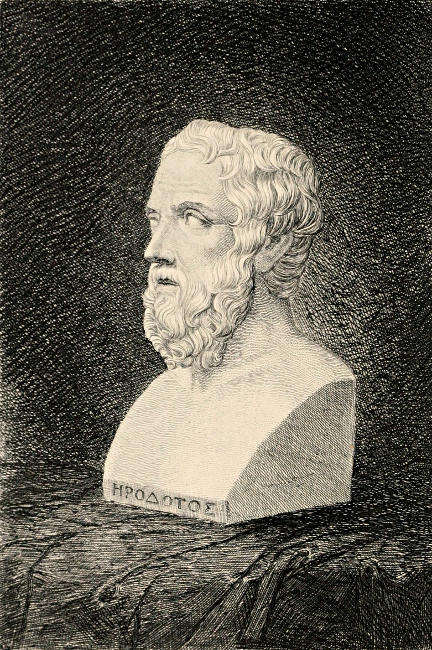
GEORGE GROTE, HERODOTUS, GUSTAV F.
HERTZBERG, ADOLF HOLM,
JUSTIN, JOHN P. MAHAFFY, EDUARD MEYER, WILLIAM MITFORD, ULRICH VON
WILAMOWITZ-MÖLLENDORFF, KARL O. MÜLLER, CORNELIUS NEPOS,
PAUSANIAS, PLATO, PLUTARCH, QUINTUS CURTIUS,
HEINRICH SCHLIEMANN, STRABO, CONNOP
THIRLWALL, THUCYDIDES, XENOPHON
TOGETHER WITH AN INTRODUCTORY ESSAY ON
THE SCOPE AND DEVELOPMENT OF GREEK HISTORY
BY
EDUARD MEYER
A STUDY OF
THE EVOLUTION OF GREEK PHILOSOPHY
BY
HERMANN DIELS
AND A CHARACTERISATION OF
THE DEVELOPMENT OF THE HELLENIC SPIRIT
BY
ULRICH VON WILAMOWITZ-MÖLLENDORFF
WITH ADDITIONAL CITATIONS FROM
CLAUDIUS ÆLIANUS, ANAXIMENES, APPIANUS ALEXANDRINUS, ARISTOBULUS,
ARISTOPHANES, ARISTOTLE, W. ASSMANN, W. BELOE, E. G. E. L. BULWER-LYTTON,
CALLISTHENES, CICERO, E. S. CREASY, CONSTANTINE VII
(PORYPHYROGENITUS), DEMOSTHENES, W. DRUMANN, VICTOR DURUY,
ENCYCLOPÆDIA BRITANNICA, EUGAMON, EURIPIDES, EUTROPIUS, G. H. A.
EWALD, J. L. F. F. FLATHE, E. A. FREEMAN, A. FURTWÄNGLER AND
LÖSCHKE, P. GARDNER, J. GILLIES, W. E. GLADSTONE, O. GOLDSMITH, H.
GOLL, J. DE LA GRAVIÈRE, G. B. GRUNDY, H. R. HALL, G. W. F. HEGEL, W.
HELBIG, D. G. HOGARTH, ISOCRATES, R. C. JEBB, JOSEPHUS, F. C. R. KRUSE,
P. H. LARCHER, W. M. LEAKE, E. LERMINIER, LIVY, LYSIAS, J. C. F. MANSO,
L. MÉNARD, H. H. MILMAN, J. A. R. MUNRO, B. G. NIEBUHR, W. ONCKEN,
L. A. PRÉVOST-PARADOL, GEORGE PERROT AND CHARLES CHIPIEZ, PHILOSTEPHANUS,
PIGORINI, PHOTIUS, R. POHLMAN, POLYBIUS, J. POTTER,
PTOLEMY LAGI, JAMES RENNEL, W. RIDGEWAY, K. RITTER, C. ROLLIN,
J. RUSKIN, F. C. SCHLOSSER, W. SCHORN, C. SCHUCHARDT, S. SHARPE,
G. SMITH, W. SMYTH, E. VON STERN, THEOGNIS, THEOPOMPUS, L. A. THIERS,
C. TSOUNTAS AND J. IRVING MANATT, TYRTÆUS, W. H. WADDINGTON,
G. WEBER, B. I. WHEELER, F. A. WOLF, XANTHUS
Copyright, 1904,
By HENRY SMITH WILLIAMS
All rights reserved
Written Specially for the Present Work
By Dr. EDUARD MEYER
Professor of Ancient History in the University of Berlin
The history of Greek civilisation forms the centre of the history of antiquity.
In the East, advanced civilisations with settled states had existed for
thousands of years; and as the populations of Western Asia and of Egypt
gradually came into closer political relations, these civilisations, in spite of
all local differences in customs, religion, and habits of thought, gradually
grew together into a uniform sphere of culture. This development reached
its culmination in the rise of the great Persian universal monarchy, the
“kingdom of the lands,” i.e. “of the world.” But from the very beginning
these oriental civilisations are so completely dominated by the effort to
maintain what has been won that all progress beyond this point is prevented.
And although we can distinguish an individual, active, and progressive intellectual
movement among many nations,—as in Egypt, among the Iranians
and Indians, while among the Babylonians and Phœnicians nothing of
the sort is thus far known,—nevertheless the forces that represent tradition
are in the end everywhere victorious over it and force it to bow to their
yoke. Hence, all oriental civilisations culminate in the creation of a theological
system which governs all the relations and the whole field of thought
of man, and is everywhere recognised as having existed from all eternity and
as being inviolable to all future time.
With the cessation of political life and the establishment of the universal
monarchy, the nationality and the distinctive civilisation of the separate
districts are restricted to religion, which has become theology. The development
of oriental civilisation then subsides in the competition of these religions
and the unavoidable coalescence consequent thereupon. This is true
even of that nation which experienced the richest intellectual development,
and did the most important work of all oriental peoples—the Israelites.
When the great political storms from which the universal monarchy arose
have spent their rage, Israel, the nation, has developed into Judaism; and
under the Persian rule and with the help of the kingdom it organises itself
as a church which seeks to put an end to all free individual movement, upon
which the greatness of ancient Israel rests.
It was just the same with the ruling nation, the Persians, however vigorous
their entrance into history under Cyrus. The Persian kingdom is,
indeed, a civilised state, but the civilisations that it includes lack the highest
that a civilisation can offer: an energetic, independent life, a combination
of the firm institutions and permanent attainments of the past with the
free, progressive, and creative movement of individuality. So the East,
after the Persian period, was unable of its own force to create anything new.
It stagnated, and, had it not received new elements from without, had it
been left permanently to itself, would perhaps in the course of centuries
have altered its external form again and again, but would hardly have produced
anything new or have progressed a step beyond what had already
been attained.
But when Cyrus and Darius founded the Persian kingdom, the East no
longer stood alone. The nations and kingdoms of the East came into communication
with the coast of the Mediterranean very early—not later than
the beginning of the second millennium B.C.; and under their influence, about
1500 B.C., a civilisation arose among the Greeks bordering the Ægean. We
call it the Mycenæan, and in spite of its formal dependence upon the East
it could, in the field of art (where alone we have an exact knowledge of it),
take an independent and equal place beside the great civilisations of the
East.
How Greek civilisation continued to advance from step to step for many
centuries in the field of politics and society as well as in that of the intellect;
how it spread simultaneously over all the islands and coasts of the Mediterranean,
from Massalia on the coast of the Ligurians and Cumæ in the land of
the Oscans to the Crimea and the eastern coast of the Black Sea, and in the
south as far as Cyprus and Cilicia; how Greek culture at the same time took
root in much more remote districts, especially in Asia Minor; and how under
its influence an energetic civilisation arose among the tribes of Italy, cannot
be depicted here.
When the Persian kingdom was founded the Hellenes had developed from
a group of linguistically related tribes into a nation possessing a completely
independent culture whose equal the world had never yet seen, a culture
whose mainspring was that very political and intellectual freedom of the
individual which was completely lacking in the East.
Hence its character was purely human, its aim the complete and harmonious
development of man; and if for that very reason it always strove to
be moderate and to adapt itself to the moral and cosmical forces that govern
human life, nevertheless it could accomplish this only in free subordination,
by absorbing the moral commandment into its own will. Therefore it
did not permit the opposing theological tendencies to gain control, strong
as was their development in considerable districts of Greece in the sixth
century. At that very period, on the other hand, it was stretching out to
grasp the apples on the tree of knowledge; in the most advanced regions of
Hellas science and philosophy were opposing theology. National as it was,
this culture lacked but one thing: the political unity of the nation, the
co-ordination of all its powers in the vigorous organism of a great state.
The instinct of freedom itself, upon which the greatness of this civilisation
rested, favoured by the geographical conformation of the Greek soil,
had caused a constantly increasing political disunion, which saw in the
complete and unlimited autonomy of every individual community, even of
the tiniest of the hundreds of city states into which Hellas was divided, the
highest ideal of liberty, the only fit existence for a Hellene. And, internally,
every one of these dwarf states was eaten by the canker of political
and social contrasts which could not be permanently suppressed by any
attempt to introduce a just political order founded upon a codified law and a
written constitution—whether the ideal were the rule of the “best,” the rule
of the whole, i.e. of the actual masses, or that of a mixed constitution. The
smaller the city and its territory, the more apt were these attempts to become
bloody revolutions. Lively as was the public spirit, clearly as the
justice of the demand for subordination to law was recognised, every individual
and every party interpreted it according to its own conception and
its own judgment, and at all times there were not a few who were ready to
seize for themselves all that the moment offered.
To be sure, manifold and successful attempts to found a greater political
power were brought about by the advancing growth of industry and culture,
as well as by the development of the citizen army of hoplites, which had a
firm tactical structure and was well schooled in the art of war. In the Peloponnesus
Sparta brought the whole south under the rule of its citizens and
not only effected the union of almost the whole peninsula into a league,
but established its right, as the first military power of Hellas, to leadership
in all common affairs.
In middle Greece, Thebes succeeded in uniting Bœotia into a federal
state, while its neighbour Athens, which had maintained the unity of the
Attic district since the beginning of history, began to annex the neighbouring
districts of Megara, Bœotia, and Eubœa, and laid the foundation of a
colonial power, as Corinth had formerly done. In the north the Thessalians
acquired leadership over all surrounding tribes. In the west, in Sicily,
usurpers had founded larger monarchical unified states, especially in
Syracuse and Agrigentum.
But all these combinations were after all only of very limited extent and
by no means firmly united; on the contrary, the weaker communities felt
even the loosest kind of federation, to say nothing of dependence, as an oppressive
fetter which impaired the ideal of the individual destiny of the
autonomous state, and which at least one party,—generally the one that happened
to be out of power,—felt justified in bursting at the first opportunity.
However, as things lay, the nation found itself forced, with this sort of
constitution, to take up the struggle for its political independence. The
Greeks of Asia Minor, formerly subjects of the kings of Sardis, had become
subjects of the Persian kingdom under Cyrus; the free Hellenes had the
most varied relations with the latter, and more than once gave him occasion
to intervene in their affairs. The Persian kingdom, which under Darius no
longer attempted conquests that were not necessary for the maintenance of
its own existence, took no advantage of these provocations until the revolt
of the Greeks of Asia Minor, supported by Athens, made war inevitable.
After the first attempt had failed Xerxes repeated it on the greatest scale.
Against the Hellenic nation, whose alien character was everywhere a hindrance
in its path, the Orient arose in the east and the west for a decisive
struggle; the Phœnician city of Carthage, the great sea power of the west,
was in alliance with the Persian kingdom. Only the minority of the Hellenes
joined in the defence; in the west the princes of Syracuse and Agrigentum,
in the east Sparta and the Peloponnesian league, Athens, the cities
of Eubœa and a few smaller powers. But in both fields of operation the
Hellenes won a complete victory; the Carthaginians were defeated on the
Himera, in the east Themistocles broke the base of the Persian position by
destroying their sea power with the Athenian fleet that he had created, and
on the battle-field of Platæa the Persian land forces were defeated by the
superiority of the Greek armies of hoplites.
Thus the Hellenes had won the leading position in the world. For the
moment there was no other power that could oppose them by land or sea; the
Asiatic king never again ventured an attack on Greece. Her absolute military
superiority was founded upon the national character, the energetic public
spirit, the voluntary subordination to law and discipline and the capacity for
conceiving and realising great political ideas. The Hellenes could gain and
assert permanently the ascendency over the entire Mediterranean world,
and impress upon it for all time the stamp of their nationality, provided only
that they were united and saw the way to gather together all their resources
into a single firmly knit great power.
But the Greeks were not able to meet this first and most urgent demand;
though the days of particularism were irrevocably past, the idea which was
so inseparably bound up with the very nature of Hellenism still exerted a
powerful influence. As the individual communities were no longer able to
maintain an independent existence, they gathered about the two powers that
had gained the leadership, and each of which was striving for supremacy:
the patriarchal military state of Sparta and the new progressive great power
of Athens.
With the victory over the East it had been decided that the individuality
of Hellenic culture, the intellectual liberty which gives free play to
all vigorous powers in both material and intellectual life, had asserted itself;
the future lay only along this way. Mighty was the advance that in all
fields carried Greece along with gigantic strides; after only a few decades
the time before the Persian wars seemed like a remote and long past antiquity.
But mighty as were the advancing strides of the nation in trade and
industry, in wealth and all the luxury of civilisation, in art and science, all
these attainments finally became factors of political disintegration. They
furthered the unlimited development of individualism, which in custom
and law and political life recognises no other rule than its own ego and its
claims. The ideal world of the time of the sophists and the politics of an
Alcibiades and a Lysander are the results of this development.
Athens perceived the political tasks that were set for the Hellenic people
and ventured an attempt to perform them. They could be accomplished
only by admitting the new ideas into the programme of democracy, by the
foundation and extension of sea power, by an aggressive policy which aimed
more and more at the subjection of the Greek world under the hegemony
of one city. In consequence all opposing elements were forced under the
banner of Sparta, which adopted the programme of conservatism and particularism,
in order to strengthen its resistance, and restrict and, if possible,
overcome its rival.
The conflict was inevitable, though both sides were reluctant to enter
upon it; twenty years after the battle of Salamis it broke out. The fact
that Athens was trying at the same time to continue the war against Persia
and wrest Cyprus and Egypt from it gave her opponents the advantage;
she had far overestimated her strength. After a struggle of eleven years
(460-449 B.C.) Athens found herself compelled to make peace with Persia
and free the Greek mainland, only retaining absolute control over the
sea.
Under the rule of Pericles she consolidated her power, and the ideals that
lived in her were embodied in splendid creations. She proved herself equal,
in spite of all internal instability and crises, to a second attack of her Greek
opponents (431-421 B.C.). But it again became evident that the radical
democracy, which was now at the helm, had no grasp of the realities of the
political situation; for the second time it stretched out its hand for
the hegemony over all Hellas, in unnatural alliance with Alcibiades, the
conscienceless, ambitious man who was aiming at the crown of Athens
and Hellas.
Mighty indeed was the plan to subdue the Western world, Sicily first of
all; then with doubled power first to crush the opponents at home and then
gain the supremacy over the whole Mediterranean world. But what a
united Hellas might have accomplished was far beyond the resources of
Athens, even if the democrats had not overthrown their dangerous ally at
the first opportunity, and thus lamed the undertaking at the outset.
The catastrophe of the Athenians before Syracuse (413 B.C.) is the turning-point
of Greek history. All the opponents of Athens united, and the
Persian king, who saw that the hour had come to regain his former power
without a struggle, made an alliance with them. Only through his subsidies
was it possible for Sparta and her allies to reduce Athens—until she
lay prostrate. And the gain fell to Persia alone, however feeble the kingdom
had meanwhile become internally. Sparta, after overthrowing the
despotism of Lysander, made an honest attempt to reorganise the Greek
world after the conservative programme, and to fulfil the task laid upon the
nation in the contest with Persia. But she only furnished her opponents at
home, and particularism, which now immediately turned against its former
ally, an occasion for a fresh uprising, which Sparta could master only by
forming a new alliance with Persia. After the peace of 386 the king of
Asia utters the decisive word even in the affairs of the Greek mother-country.
Here dissolution is going rapidly forward. Every power that has once
more for a short time possessed some importance in Greece succumbs to it
in turn; first Sparta, then Thebes and Athens. The attempts to establish
permanent and assured conditions by local unions in small districts, as in
Chalcidice under Olynthus, in Bœotia and Arcadia, were never able to hold
out more than a short time. It was useless to look longer for the fulfilment
of the national destiny. Feeble as the Persian kingdom was internally,
every revolt against it, to say nothing of an attempt to make conquests
and acquire a new field of colonisation in Asia,—the programme that Isocrates
repeatedly urged upon the nation,—was made impossible by internal
strife. Prosperity was ruined, the energy of the nation was exhausted in the
wild feuds of brigands, the most desolate conditions prevailed in all communities.
Greek history ends in chaos, in a hopeless struggle of all against all.
In this same period, to be sure, the positive, constructive criticism
of Socrates and his school rose in opposition to the negative tendencies of
sophistry; and made the attempt to put an end to the political misery, to
create by a proper education the true citizen who looks only to the common
welfare in place of the ignorant citizen of the existing states, who was governed
only by self-interest. These efforts resulted in the development of
science and the preservation for all future time of the highest achievements
of the intellectual life of Hellas, but they could not produce an internal transformation
of men and states, whose earthly life does not lie within the sphere
of the problems of theoretical perception, but in that of the problems of will
and power. So at the same time that Greek culture has reached the highest
point of its development, prepared to become the culture of the world, the
Greek nation is condemned to complete impotence.
For the development in the West, different as was its course, led to no
other result. In the fifth century Greece controlled almost all Sicily
except the western point, the whole south of Italy up to Tarentum, Elea and
Posidonia and the coast of Campania. Nowhere was an enemy to be seen
that might have become dangerous. The Carthaginians were repulsed,
and the power of the Etruscans, who in the sixth century had striven for
the hegemony in Italy, decayed, partly from internal weakness, partly in
consequence of the revolt of their subjects, especially the Romans and the
Sabines. The Cumæans under Aristodemus with the Sabines as their allies
defeated Aruns, the son of Porsena of Clusium, at Aricia about 500 B.C.,
and in the year 474 the Etruscan sea power suffered defeat at Cumæ from
the fleet of Hiero of Syracuse.
The cities of western Greece stood then as if founded for all eternity;
they were adorned with splendid buildings, the gayest and most luxurious
life developed in their streets; and they had leisure enough, after the Greek
manner, to dissipate their energies, which were not claimed by external
enemies, in internal strife and in struggles for the hegemony. Only the
bold attempts which Phocæa made in the sixth century to turn the western
basin of the Mediterranean likewise into a Greek sea, to get a firm footing
in Corsica and southern Spain, had succumbed to the resistance of the Carthaginians,
who were in alliance with the Etruscans. Only in the north, on
the coast of Liguria from the Alps to the Pyrenees, Massalia maintained its
independence. Southern Spain, Gades, and the coast of the land of Tarshish
(Tartessus) were occupied by the Carthaginians about the middle of the fifth
century; and the Greeks and all foreign mariners in general were cut off
from the navigation of the ocean, as well as from the coasts of North Africa
and Sardinia.
In the fourth century the political situation is totally changed in both
east and west. The Greeks are reduced to the defensive and lose one position
after the other. A few years after the destruction of the Athenian
expedition the Carthaginians stretched out their hands for Sicily; in the
years 409 and 406 they take and destroy Selinus, Himera, and Agrigentum;
in the wars of the following years every other Greek city of the island
except Syracuse was temporarily occupied and plundered by them.
In Italy after the middle of the fifth century a new people made their
entrance into history, the Sabellian (Oscan) mountain tribes. From the
valleys of the Abruzzi and the Samnitic Apennines they pressed forward
towards the rich plains of the coast, and the land of civilisation with its
inhabitants succumbed to them almost everywhere. To be sure, the Sabines
under Rome defended themselves against the Æquians and Volscians, and
so did the Apulians in the east against the Frentanians and Pentrians of
Samnium. But the Etruscans of Capua and Nola and the Greeks of Cumæ
were overcome (438 and 421 B.C.) by the Sabellian Campanians, and Naples
alone in this district was able to preserve its independence. In the south
the Lucanians advanced farther and farther, took Posidonia (Pæstum) in
400 B.C., Pyxus, Laos, and harassed the Greek cities of the east coast and
the south.
From between these hostile powers, the Carthaginians and the Sabellians,
an energetic ruler, Dionysius of Syracuse (405-367 B.C.), once more rescued
Hellenism. In great battles, with heavy losses to be sure, and only by the
employment of the military power of the Oscans, of Campanian mercenary
troops and of the Lucanians, he succeeded in setting up once more a powerful
Greek kingdom, including two-thirds of Sicily, the south of Italy as far as
Crotona and Terina; he held Carthage in restraint, scourged the Etruscans
in the western sea, and at the same time occupied a number of important
points on the Adriatic, Lissus and Pharos in Illyria, several Apulian towns,
Ancona, and Hadria at the mouth of the Po in Italy. Dionysius had covered
his rear by a close alliance with Sparta, which not only insured him
against any republican uprising, but made possible an uninterrupted recruiting
of mercenaries from the Peloponnesus. In return Dionysius supported
the Spartans in carrying through the Kings’ Peace and against their
enemies elsewhere.
The kingdom of Dionysius seemed to rest on a firm and permanent foundation.
Had it continued to exist the whole course of the world’s history would
have been different; Hellenism could have maintained its position in the
West, which might even have received again a Greek impress instead of
becoming Italic and Roman.
But the kingdom of Dionysius was in the most direct opposition to all
that Greek political theory demanded; it was a despotic state which made
the free self-government of communities an empty form in the capital Syracuse,
and in the subject territories, for the most part, simply abolished the
city-state, the polis. The necessity of a strong government that would protect
Hellenism in the West against its external enemies was indeed recognised
by the discerning, but internally it seemed possible to relax and to effect a
more ideal political formation.
Under the successor of the old despot, Dionysius II, Plato’s pupil, Dion,
and Plato himself, made an attempt at reform, first with the ruler’s support,
and then in opposition to him. The result was, that the west Grecian kingdom
was shattered (357-353 B.C.), while the establishment of the ideal state
was not successful; instead anarchy appeared again, and the struggle of all
against all. Only the enemies of the nation gained. In Sicily, to be sure,
Timoleon (345-337) was able to establish a certain degree of order; he overthrew
the tyrants, repulsed the Carthaginians, restored the cities and gave
them a modified democratic constitution. But the federation of these
republics had no permanence. On the death of Timoleon the internal and
external strife began anew, and the final verdict was uttered by the governor
of the Carthaginian province.
In Italy, on the other hand, the majority of the Greek cities were conquered
by the Lucanians or the newly risen Bruttians. On the west coast
only Naples and Elea were left, in the south Rhegium; in the east Locri,
Crotona, and Thurii had great difficulty in defending themselves against the
Bruttians. Tarentum alone (upon which Heraclea and Metapontum were
dependent) possessed a considerable power, owing to its incomparable situation
on a sea-girt peninsula and to the trade and wealth which furnished
it the means again and again to enlist Greek chieftains and mercenaries in
its service for the struggle against its enemies.
It was as Plato wrote to the Syracusans in the year 352 B.C. If matters
go on in this way, no end can be foreseen “until the whole population, supporters
of tyrants and democrats, alike, has been destroyed, the Greek
language has disappeared from Sicily and the island fallen under the power
and rule of the Phœnicians or Oscans” (Epist. 8, 353 e). In a century the
prophecy was fulfilled. But its range extends a great deal farther than
Plato dreamed; it is the fate not only of the western Greeks, but of the
whole Hellenic nation, that he foretells here.
The Greek states were not equal to the task of maintaining the position
of their nation as a world-power and gaining control of the world for their
civilisation. When they had completely failed, a half-Greek neighbouring
people, the Macedonians, attempted to carry out this mission. The impotence
of the Greek world gave King Philip (359-336) the opportunity, which
he seized with the greatest skill and energy, of establishing a strong Macedonian
kingdom, including all Thrace as far as the Danube, extending on
the west to the Ionian Sea, and finally, on the basis of a general peace, of
uniting the Hellenic world of the mother-country in a firm league under
Macedonian hegemony (337 B.C.).
Philip adopted the national programme of the Hellenes proposed by
Isocrates and began war in Asia against the Persians (336 B.C.). His youthful
son Alexander then carried it out on a far greater scale than his father
had ever intended. His aim was to subdue the whole known world, the
οικουμένη, simultaneously to Macedonian rule and Hellenic civilisation.
Moreover, as the descendant of Hercules and Achilles, as king of Macedonia
and leader of the Hellenic league, imbued by education with Hellenic culture,
the triumphs of which he had enthusiastically absorbed, he felt himself called
as none other to this work. Darius III, after the victory of Issus (November
333 B.C.), offered him the surrender of Western Asia as far as the Euphrates;
and the interests of his native state and also,—we must not fail to note,—the
true interests of Hellenic culture would have been far better served by such
self-restraint than by the ways that Alexander followed.
But he would go farther, out into the immeasurable; the attraction to
the infinite, to the comprehension and mastery of the universe, both intellectual
and material, that lies in the nature of the yet inchoate uniform
world-culture, finds its most vivid expression in its champion. When,
indeed, he would advance farther and farther, from the Punjab to the Ganges
and to the ends of the world, his instrument, his army, failed him; he
had to turn back. But the Persian kingdom, Asia as far as the Indus,
he conquered, brought permanently under Macedonian rule, and laid the
foundation for its Hellenisation. With this, however, only the smaller portion
of his mission was fulfilled. The East everywhere offered further tasks
which had in part been undertaken by the Persian kingdom at the height
of its power under Darius I—the exploration of Arabia, of the Indian
Ocean, and of the Caspian Sea, the subjugation of the predatory nomads of
the great steppe that extends from the Danube through southern Russia
and Turania as far as the Jaxartes.
It was of far more importance that Hellenism had a task in the West like
that in the East; to save the Greeks of Italy and Sicily, to overcome the
Carthaginians and the tribes of Italy, to turn the whole Mediterranean into
a Greek sea, was just as urgently necessary as the conquest of Western Asia.
It was the aim that Alcibiades had set himself and on which Athens had
gone to wreck.
In the same years in which the Macedonian king was conquering the
Persians, his brother-in-law, Alexander of Epirus, at the request of Tarentum,
had devoted himself to this task. After some success at the beginning
he had been overcome by the Lucanians and Bruttians and the opposition
of Hellenic particularism (334-331 B.C.).
Now the Macedonian king made preparations to take up this work also
and thus complete his conquest of the world. That the resources of Macedonia
were inadequate for this purpose was perfectly clear to him. Since
he had rejected the proposals of Darius he had employed the conquered
Asiatics in the government of his empire, and above all had endeavoured to
form an auxiliary force to his army out of the people that had previously
ruled Asia. In his naïve overvaluation of education, due to the Socratic
belief in the omnipotence of the intellect, he thought he could make Macedonians
out of the young Persians. But as ruler of the world he must no
longer bear the fetters which the usage of his people and the terms of the
Hellenic league put upon him. He must stand above all men and peoples,
his will must be law to them, like the commandment of the gods. The
march to Ammon (331 B.C.), which at the time enjoyed the highest regard
in the Greek world, inaugurated this departure. This elevation of the kingship
to divinity was not an outgrowth of oriental views, although it
resembles them, but of political necessity and of the loftiest ideas of Greek
culture—of the teaching of Greek philosophy, common to all Socratic
schools, of the unlimited sovereignty of the true sage, whose judgment no
commandment can fetter; he is no other than the true king.
Henceforth this view is inseparable from the idea of kingship among
all occidental nations down to our own times. It returns in the absolute
monarchy that Cæsar wished to found at Rome and which then gradually
develops out of the principate of Augustus, until Diocletian and Constantine
bring it to perfection; it returns, only apparently modified by Christian
views, in the absolute monarchy of modern times, in kingship by the grace
of God as well as in the universal monarchy of Napoleon, and in the divine
foundation of the autocracy of the Czar.
But Alexander was not able to bring his state to completion. In the
midst of his plans, in the full vigour of youth, just as a boundless future
seemed to lie before him, he was carried off by death at Babylon, on the
thirteenth of June, 323 B.C., in the thirty-third year of his age.
With the death of Alexander his plans were buried. He left no heir who
could have held the empire together; his generals fought for the spoils. The
result of the mighty struggles of the period of the Diadochi, which covers
almost fifty years (323-277 B.C.), is, that the Macedonian empire is divided
into three great powers; the kingdom of the Lagidæ, who from the seaport
of Alexandria on the extreme western border of Egypt control the eastern
Mediterranean with all its coasts, and the valley of the Nile; the kingdom
of the Seleucidæ, who strive in continual wars to hold Asia together; and
the kingdom of the Antigonidæ, who obtained possession of Macedonia,
depopulated by the conquest of the world and again by the fearful Celtic
invasion (280), and who, when they wish to assert themselves as a great
power, must attempt to acquire an ascendency in some form or other over
Greece and the Ægean Sea.
Of these three powers the kingdom of the Lagidæ is most firmly welded
together, being in full possession of all the resources that trade and sea
power, money and politics, afford. To re-establish the universal monarchy
was never its aim, even when circumstances seemed to tempt to it. But as
long as strong rulers wear the crown it always stands on the offensive
against the other two; it harasses them continually, hinders them at every
step from consolidating, wrests from the Seleucidæ almost all the coast
towns of Palestine and Phœnicia as far as Thrace, temporarily gains control
of the islands of the Ægean, and supports every hostile movement that is
made in Greece against Macedonia. The Greek mother-country is thus continually
forced anew into the struggle, the play of intrigue between the court
of Alexandria and the Macedonian state never gives it an opportunity to
become settled. All revolts of the Greek world received the support of
Alexandria; the uprising of Athens and Sparta in the war of Chremonides
(264), the attempt of Aratus to give the Peloponnesus an independent
organisation by means of the Achæan league (beginning in 252), and finally
the uprising of Sparta under Cleomenes. The aim of giving the Greek
world an independent form was never attained; finally, when at the end of
the reign of Ptolemy III Euergetes (221) the kingdom of the Lagidæ withdraws
and lets Cleomenes fall, the peninsula comes anew under the supremacy
of the Macedonians, whom Aratus the “liberator” had himself brought back to
the citadel of Corinth. But neither can the Macedonian king attain the full
power that Philip and Alexander had possessed a century earlier; in particular,
its resources are insufficient, even in alliance with the Achæans, to
overthrow the warlike, piratical Ætolian state, which is constantly increasing
in power. So Greece never gets out of these hopeless conditions; on
the contrary, indeed, through the emigration of the population to the
Asiatic colonies, through the decay of a vigorous peasant population which
began as early as in the fourth century, through the economic decline of
commerce and industry caused by the shifting of the centre of gravity to
the east, its situation becomes more and more wretched and the population
constantly diminishes. It can never attain peace of itself, but only through
an energetic and ruthlessly despotic foreign rule.
In the East, on the contrary, an active and hopeful life developed. The
great kings of the Lagidæan kingdom, the first three Ptolemies, fully appreciated
the importance of intellectual life to the position of their kingdom in
the world. All that Greek culture offered they tried to attract to Alexandria,
and they managed to win for their capital the leading position in
literature and science. But in other respects the kingdom of the Lagidæ is
by no means the state in which the life of the new time reaches its full
development. However much, in opposition to the Greek world, in conflict
with Macedonia, they coquette with the Hellenic idea of liberty, within their
own jurisdiction they cannot endure the independence and the free constitution
of the Greek polis, and their subjects are by no means initiated into
the new world-culture, but are kept in complete subjugation, sharply distinguished
from the ruling classes, the Macedonians and Greeks, to whom
also no freedom of political movement whatever is granted.[1]
The development in Asia follows a very different course. Here, through
the activity of the great founders of cities, Antigonus, Lysimachus, Seleucus
I, and Antiochus I, one Greek city arises after another, from the Hellespont
through Asia Minor, Syria, Mesopotamia, Babylonia, Media, as far as Bactria
and India; and from them grow the great centres of culture, full of independent
life, by which the Asiatic population is introduced to the modern
world-civilisation and becomes Hellenised. Antigonus deliberately supported
the independence of the cities within the great organic body of the
kingdom, thus following on the lines of the Hellenic league under Philip
and Alexander. By the pressure of political necessity and the fact that they
could maintain their power only by winning the attachment and fidelity of
their subjects, the Seleucidæ were forced into the same ways. And side by
side with the great kingdom the political struggle creates a great number of
powers of the second rank, in part pure Greek communities, like Rhodes,
Chios, Cyzicus, Byzantium, Heraclea, in part newly formed states of Greek
origin, like the kingdom of Pergamus and later the Bactrian kingdom, in
part fragments of the old Persian kingdom, like Bithynia, Pontus, Cappadocia,
Armenia, Atropatene, and not much later the Parthian kingdom.
Among these states the eastern retain their oriental character, while the
western are forced to pass more and more into the culture of Hellenism.
Destructive as were the effects of the continual wars, and especially of
the raids of the Celtic hordes in Asia Minor, nevertheless there pulsates
here a fresh, progressive life, to which the future seems to belong. To be
sure, there is no lack of counter disturbance; beneath the surface of Hellenism,
the native population that is absorbed into the Greek life everywhere
preserves its own character, not through active resistance, but through the
passivity of its nature. When the orientals become Hellenised, Hellenism
itself begins at the same time to take on an oriental impress.
But in this there lies no danger as yet. Hellenism everywhere retains
the upper hand and seems to come nearer and nearer to the goal of its
mission for the world. In all fields of intellectual life the cultured classes
have undisputed control and can look down with absolute contempt on
the currents that move the masses far beneath them; the exponents of philosophical
enlightenment may imagine they have completely dominated them.
When the great ideas upon which Hellenism is based have been created by
the classical period and new ones can no longer be placed beside them, the
new time sets to work to perfect what it has inherited. The third century
is the culmination of ancient science.
However, this whole civilisation lacks one thing, and that is a state of
natural growth. Of all the states that developed out of Alexander’s empire,
the kingdom of the Antigonidæ in Macedonia was the only one that had a
national basis; and therefore, in spite of the scantiness of its resources, it
was also the most capable of resistance of them all. All others, on the
contrary, were purely artificial political combinations, lacking that innate
necessity vital to the full power of a state. They might have been altogether
different, or they might not have been at all. The separation of state and
nationality, which is the result of the development of the ancient East,
exists in them also; they are not supported by the population, which, by
the contingencies of political development, is for the moment included in
them, and their subjects, so far as the individual man or community is not
bound to them by personal advantage, have no further interest in their
existence. To be sure, had they maintained their existence for centuries,
the power of custom might have sufficed to give them a firmer constitution,
such as many later similar political formations have acquired and such as
the Austrian monarchy possesses to-day; and as a matter of fact we find the
loyalty of subjects to the reigning dynasty already quite strongly developed
in the kingdom of the Seleucidæ. But a national state can never arise on
the basis of a universal, denationalised civilisation, and the unity is consequently
only political, based only upon the dynasty and its political successes.
Therefore, except in Macedonia, none of these states can, even in
the struggle for existence, set in motion the full national force supplied by
internal unity.
The resources at the command of the Macedonio-Hellenic states were
consumed in the struggle with one another; nothing was left for the great
task that was set them in the West. The remains of Greek nationality, still
maintaining their existence here, looked in vain for a deliverer to come from
the East. An attempt made by the Spartan prince Cleonymus, in response
to the appeal of Tarentum, to take up the struggle in Italy against the
Lucanians and Romans, failed miserably through the incapacity of its leader
(303-302 B.C.). In Sicily, to be sure, the gifted general and statesman
Agathocles (317-289) had once more established, amid streams of blood,
and by mighty and ruthless battles against both internal enemies and rivals
and against Carthage, a strong Greek kingdom that reached even to Italy and
the Ionian Sea. But he was never able to attain the position taken by
Dionysius, and at his death his kingdom goes to pieces. At this point also
the rôle of the Sicilian Greeks in the history of the world is played out; they
disappear from the number of independent powers capable of maintaining
themselves by their own resources.
It is unnecessary in the summary of a country whose chief events are so
accurately dated and so fully understood as in the case of Greece, to amplify
the chronology. A synoptical view of these events will, however, prove
useful. Questions of origins and of earliest history are obscure here as
elsewhere. As to the earliest dates, it may be well to quote the dictum
of Prof. Flinders Petrie, who, after commenting on the discovery in Greece, of
pottery marked with the names of early Egyptian kings, states that “the
grand age of prehistoric Greece, which can well compare with the art of
classical Greece, began about 1600 B.C., was at its highest point about 1400
B.C. and became decadent about 1200 B.C., before its overthrow by the
Dorian invasion.” The earlier phase of civilisation in the Ægean may
therefore date from the third millennium B.C.
2000-1000. Later phase of civilisation in the Ægean (the Mycenæan
Age). The Achæans and other Greeks spread themselves over Greece.
Ionians settle in Asia Minor. The Pelopidæ reign at Mycenæ. Agamemnon,
king of Mycenæ, commands the Greek forces at Troy. 1184. Fall of
Troy (traditional date). 1124. First migration. Northern warriors drive
out the population of Thessaly and occupy the country, causing many Achæans
to migrate to the Peloponnesus. 1104. Dorian invasion. The Peloponnesus
gradually brought under the Dorian sway. Dorian colonies sent
out to Crete, Rhodes, and Asia Minor. Argos head of a Dorian hexapolis.
885. Lycurgus said to have given laws to Sparta. About this time (perhaps
much earlier) Phœnician alphabet imported into Greece. 776. The first
Olympic year. 750. First Messenian war.
683. Athens ruled by nine archons. 632. Attempt of Cylon to make
himself supreme at Athens. 621. Draconian code drawn up. 611. Anaximander
of Miletus, the constructor of the first map, born. End of seventh
century. Second Messenian war. Spartans conquer the country. The
Ephors win almost all the kingly power. Cypselus and his son Periander
tyrants of Corinth. 600. The poets Alcæus and Sappho flourish at Lesbos.
594-593. Solon archon at Athens. 590-589. Sacred war of the Amphictyonic
league against Crissa. Clisthenes tyrant of Sicyon. 585. Pythian games
reorganised. Date of first Pythiad. 570. Pisistratus polemarch at Athens.
Athenians conquer Salamis and Nisæa. 561. Pisistratus makes himself
supreme in Athens. He is twice exiled. 559-556. Miltiades tyrant of the
Thracian Chersonesus. 556. Chilon’s reforms in Sparta. 549-548. Mycenæ
and Tiryns go over to Sparta.
540. Pisistratus tyrant of Athens. 530. Pythagoras goes to Croton.
527. Pisistratus dies and is succeeded by his sons, Hippias and Hipparchus.
Homeric poems collected. 514. Hipparchus slain by Harmodius and Aristogiton.
510. A Spartan army under Cleomenes blockades Hippias and forces
him to quit Athens.
Clisthenes and Isagoras contend for the chief power in Athens. 507. Isagoras
calls in Cleomenes who invades Attica. The Athenians overcome the
Spartans, and Clisthenes, who had left Athens, returns. Clisthenes reforms
the Athenian democracy. 506. Spartans, Bœotians, and Chalcidians allied
against Athens. The Athenians allied with Platæa. Chalcidian territory
annexed by Athens. Nearly the whole Peloponnesus forms a league under
the hegemony of Sparta. Rivalry between Athens and Ægina. 504. The
Athenians refuse to restore Hippias on the Persian demand. 498. Athens
and Eretria send ships to aid the Milesians against the Persians. 496. Sophocles
born at Athens. 494. Naval battle off Lade, the decisive struggle of the
Ionian war, won by the Persians. Battle of Sepeia. The Spartans defeat
the Argives. 493. Themistocles, archon at Athens, fortifies the Piræus.
492. Quarrel between the Spartan kings. King Demaratus flees to the
Persian court, and King Cleomenes seizes hostages from Ægina. Thrace
and Macedonia subdued by the Persians. 490. The Persians subdue Naxos
and other islands, and destroy Eretria before landing in Attica. Battle of
Marathon; the Greeks under Miltiades defeat the Persians, the latter losing
six thousand men; the Persian fleet sets sail for Asia. 489. Miltiades’ expedition
against Paros. Miltiades tried, and fined. His death. 487. War
between Athens and Ægina. Themistocles begins to equip an Athenian
fleet. 483. Aristides ostracised. 481. Xerxes musters an army to invade
Greece. Greek congress at Corinth. 480. Xerxes at the Hellespont. The
northern Greeks submit to Xerxes. The Greek army is defeated at the pass
of Thermopylæ and Leonidas, the Spartan king, is slain. Battle of Artemisium.
The Greek fleet retreats. Athens being evacuated, Xerxes occupies
it. Battle of Salamis and complete victory of the Greeks. Retreat of
Xerxes. The Greeks fail to follow up their victory. 479. Mardonius invades
Bœotia; occupies Athens. Retreat of Mardonius. Battle of Platæa.
Mardonius defeated and slain. Retreat of the Persian army. Battle of
Mycale and defeat of the Persian fleet.
478. Athenians under Xanthippus capture Sestus in the Chersonesus.
Confederacy of Delos. 477. Athenian walls rebuilt. Piræus fortified.
Themistocles’ law providing for the annual increase of the navy. Pausanias
conquers Byzantium. He enters into treacherous relations with the Persians.
476. The Spartans endeavour to reorganise the Amphictyonic league.
Their attempts defeated by Themistocles. 474. The poet Pindar flourishes.
473. Scyros conquered by the Athenian, Cimon. Argos defeated by the
Spartans at the battle of Tegea. 472. Themistocles ostracised. Persæ of
Æschylus performed. 471. The Arcadian league against Sparta crushed
at the battle of Dipæa. 470-469. Naxos secedes from the confederacy of
Delos, and is compelled to return. 470. Socrates born. 468. Cimon defeats
the Persians at the Eurymedon. Argos recovers Tiryns. 465-463. Thasos
revolts and is reduced by the fleet under Cimon. 464. Sparta stirred by
terrible earthquake and a revolt of the helots. The Third Messenian war.
463-462. Cimon persuades Athens to send help to the Spartans, but the
latter refuse the assistance. They are afraid of Athens’ revolutionary spirit.
This incident puts an end to Cimon’s Laconian policy. It is the triumph
of Ephialtes and his party.
463-461. Triumph of democracy at Athens under Ephialtes and Pericles.
The Areopagus deprived of its powers. Cimon protests against the changes
effected in his absence. He is ostracised, and Athens forms a connection
with Argos, which captures and destroys Mycenæ. 460-459. Megara secedes
from the Peloponnesian league to Athens. A fleet, sent by Athens to aid
the Egyptian revolt against Persia, captures Memphis. 459. Ithome captured
by the Spartans. 459-458. Athens at war with the northern states of the
Peloponnesus. Athenian victories of Halieis, Cecryphalea, and Ægina.
458. Long walls of Athens completed. 457. Spartan expedition to Bœotia.
Victory of Tanagra over the Athenians. Truce between Athens and
Sparta. Battle of Œnophyta and conquest of Bœotia by the Athenians.
The Phocians and Locrians make alliance with Athens. 456. Ægina surrenders
to the Athenians. 454. Greek contingent in Egypt capitulates
to the Persians; the Athenian fleet destroyed at the mouth of the Nile.
454-453. Treasury of the confederacy of Delos transferred from the island
to Athens. 453. Pericles besieges Sicyon and Œniadæ without success.
Achaia passes under the Athenian dominion. 452-451. Five years’ truce
between Athens and the Peloponnesus. 450-449. Cimon leads an expedition
against Cyprus. Death of Cimon. The fleet on its way home wins the
battle of Salamis in Cyprus. 448. Peace of Callias concluded with Persia.
Sacred war. The Phocians withdraw from the Athenian alliance. 447.
Bœotia lost to Athens by the battle of Coronea. 447-446. Revolt of
Eubœa and Megara from the Delian confederacy. Eubœa is subdued and
annexed. Pericles plants colonies in the Thracian Chersonesus, Eubœa,
Naxos, etc. 446-445. Thirty Years’ Peace between Athens and Sparta.
444. Aristophanes born. 442. Thucydides opposes Pericles; is ostracised,
leaving Pericles without a rival in Athens, where he governs for fifteen years
with absolute power. Sophocles’ Antigone produced. 440-439. Pericles
subdues Samos. Corcyræans defeat Corinthians in a sea-fight. 433. Corcyra
concludes alliance with Athens. Battle of Sybota between Corcyra and
Corinth. King Perdiccas of Macedonia incites the revolt of Chalcidice
against Athens. 432. “Megarian decree,” passed at Athens, excludes
Megarians from all Athenian markets. Battle of Potidæa. Athenians
defeat the Corinthians.
431. Sparta decides on war with Athens on the grounds of her having
broken the Thirty Years’ Peace. Peloponnesian War. First period called
the “Attic War.” Platæa surprised by Thebans. Thebans taken and executed
in spite of a promise for their release. King Archidamus of Sparta
invades Attica. The population crowd into Athens. Athens annexes Ægina.
The fleet takes several important places. 430. The plague in Athens. Trial
of Pericles for misappropriation of public money. Potidæa taken by the
Athenians and the inhabitants expelled. 429. Archidamus besieges Platæa.
Phormion, the Athenian, wins the victory of Naupactus. Death of Pericles.
Rivalry between contending parties under Nicias and Cleon. 428. Archidamus
invades Attica. Mytilene revolts and is blockaded by the Athenians.
427. Fourth invasion of Attica by the Spartans. Surrender of Mytilene.
The Mytilenæan ringleaders executed. Surrender of Platæa to the Peloponnesians.
Oligarchs in Corcyra conspire to overthrow the democrats. Civil
war and naval engagement. Terrible slaughter. Athenian expedition to
Sicily under Laches. Birth of Plato. 426. Athenians under Demosthenes
defeated in Ætolia. Battle of Olpæ. Peloponnesians and Ambracians defeated
by Demosthenes. Purification of Delos by the Athenians. The Delian festival
revived under Athenian superintendence. 425. Athens increases the
amount of tribute to be paid by the confederacy. The episode of Pylos,
leading, after a long struggle, to the capture of Lacedæmonian forces in
Sphacteria. 424. Defeat of Hippocrates at Delium. Thucydides, the historian,
banished for not succouring Amphipolis in time. Brasidas takes
towns of Chalcidice. 423. Truce between Athens and Sparta. Scione in
Chalcidice revolts to Sparta and an Athenian expedition under Cleon is sent
against it, notwithstanding the truce. 422. Battle of Amphipolis won by
Brasidas, but both he and Cleon are slain. 421. Peace of Nicias ends the
first period of the Peloponnesian War. Mutual restoration of conquests.
Scione is taken and all the male inhabitants put to death. 420. Second
period of the Peloponnesian War. Alcibiades becomes the chief opponent of
Nicias. Expedition against Epidaurus. 418. Nicias recovers his power in
Athens. The Spartans invade Argolis. Athenians take Orchomenus, but
are defeated by the Spartans. Battle of Mantinea. Hyperbolus attempts
to obtain the ostracism of Nicias. The decree is passed against himself,
being the last instance of ostracism. Argive oligarchy overthrows the democratic
government. A counter revolution restores the democrats. Athens
concludes alliance with Argos. 416. Melos conquered by the Athenians.
The Sicilian city of Segesta appeals to Athens for help against Selinus.
Nicias opposes the sending of assistance, but is overruled and sent with
Alcibiades in command of a Sicilian expedition. 415. Mysterious mutilation
of the Hermæ statues regarded as an evil omen. Alcibiades accused
of a plot. His trial postponed. The expedition sails. Fall of Alcibiades;
his escape. 414. Siege of Syracuse. The Spartan Gylippus arrives
with ships. 413. Nicias appeals for help to Athens and a second expedition
is voted. Syracusans worsted in a sea battle. Syracusans capture an Athenian
treasure fleet, and win a battle in the harbour of Syracuse. Arrival of
the second Athenian expedition and its total defeat. The Athenians retreat
by land. The rear guard is forced to surrender and the relics of the main
body are captured after the defeat of the Asinarus. Tribute of the confederacy
abolished and replaced by an import and export duty. 412. Third
period of the Peloponnesian War, called the Decelean or Ionian War. The
allies of Athens take advantage of her misfortunes to revolt. Sparta makes
a treaty with Persia. Athens wins several naval successes. 411. “Revolution
of the Four Hundred.” The fleet and army at Samos place themselves
under the leadership of Alcibiades. Spartans defeat the Athenian fleet at
Eretria. Fall of the Four Hundred and partial restoration of Athenian
democracy. Battle of Cynossema won by the Athenians. Alcibiades defeats
the Peloponnesians at Abydos. 410. Battle of Cyzicus won by Alcibiades.
Complete restoration of Athenian democracy. 408. Alcibiades conquers
Byzantium. 407. Cyrus, viceroy of Sardis, furnishes the Spartan Lysander
with money to raise the pay of the Spartan navy. Lysander begins to set
up the oligarchical government of the decarchies in the cities conquered
by him. Battle of Notium. Athenians defeated. Alcibiades’ downfall.
406. Battle of Arginusæ. Peloponnesians defeated by the Athenians. The
victorious generals are blamed for not rescuing their wounded, and are illegally
condemned and executed. The Spartans make overtures for peace,
which are rejected. 405. Battle of Ægospotami. Most of the Athenian
ships are taken and all the prisoners are put to death. The Athenian empire
passes to Sparta. Lysander subdues the Hellespont and Thrace, and
lays siege to Athens. 404. Surrender of Athens.
Return to Athens of exiles of the oligarchical party. Athens under the
Thirty. Thrasybulus and other exiles gain Phyle. Theramenes opposes
the violent rule of the Thirty and is put to death. 403. Battle of Munychia.
Thrasybulus defeats the army of the Thirty. Death of Critias. The Thirty
are deposed and replaced by the Ten. The Spartans under Lysander come
to the aid of the Ten, but the intervention of the Spartan king, Pausanias,
brings about the restoration of the Attic democracy. 401. Cyrus’ campaign
and the battle of Cunaxa. Retreat of the Ten Thousand Greeks under
Xenophon. 400. Spartan invasion of the Persian dominions. 399. Spartans
under Dercyllidas occupy the Troad. Elis conquered and dismembered by
the Spartans. Socrates put to death for denying the Athenian gods.
398. Agesilaus becomes king of Sparta. 397. Cinadon’s conspiracy.
396. Agesilaus invades Phrygia. 395. Agesilaus wins the victory of Sardis.
Revolt of Rhodes. The Spartans invade Bœotia and are repelled with the
assistance of the Athenians. Thebes, Athens, Argos, and Corinth allied
against Sparta. 394. Agesilaus returns from Asia Minor. Battle of Nemea
won by the Spartans. Battle of Cnidus. The Persian fleet under Conon
destroys the Spartan fleet. Agesilaus wins the battle of Coronea and retreats
from Bœotia. 393. Pharnabazus destroys the Spartan dominion in
the eastern Ægean, and supplies Conon with funds to restore the long
walls of Athens. Beginning of the “Corinthian War.” 392. Federation of
Corinth and Argos. Fighting between the Spartans and the allies on the
Isthmus of Corinth. Both sides send embassies to the Persians. 391. The
Spartans begin fresh wars in Asia. 389. Successes of Thrasybulus in
the northern Ægean. 388. Spartans dispute the supremacy of Athens on
the Hellespont and are defeated at Cremaste. 387. Peace of Antalcidas between
Persia and Sparta. Athens is compelled to accede. 386. Dissolution
of the union of Corinth and Argos. Sparta compels the Mantineans to
break down their city walls and separate into small villages. 384-382. The
city of Olynthus, having united the Chalcidian towns under her hegemony
and increased her territory at the expense of Macedonia, makes alliance with
Athens and Thebes. Sparta sends help to the towns which refuse to join.
384. Aristotle born. 382. Spartans seize the citadel of Thebes. 380. Panegyric
of Isocrates, a plea for Greek unity. 381-379. Sparta forces Phlius to
submit to her dictation. 379. Chalcidian league compelled by Sparta to dissolve.
The power of Sparta at its height. Rising of Thebes under Pelopidas
against Sparta. Sphodrias, the Spartan, invades Athenian territory. The
Spartans decline to punish the aggression.
378. Athens makes alliance with Thebes. 378-377. Formation by the
Athenians of a new maritime confederacy. 378-376. Three unsuccessful
Spartan expeditions into Bœotia. 376. Great maritime victory of the Athenian
Chabrias at Naxos. Successes of Timotheus of Athens in the Ionian
Sea. 374. Brief peace between Sparta and Athens. 374-373. Corcyra unsuccessfully
invested by the Spartans. 371. Peace of Callias, guaranteeing
the independence of each individual Greek city. Thebes not included in
the Peace. Jason of Pheræ, despot of Thessaly. Battle of Leuctra. Epaminondas
of Thebes defeats the Spartans. Revolutionary outbreaks in Peloponnesus.
370. Arcadian union and restoration of Mantinea. Foundation
of Megalopolis. Epaminondas and Pelopidas invade Laconia. 369. Messene
restored by the Thebans as a menace to Sparta. Alliance between Sparta
and Athens. The Thebans conquer Sicyon. Pelopidas sent to deliver the
Thessalian cities from the rivals, Alexander of Macedon and Alexander of
Pheræ. 368. The Spartans win the “tearless victory” of Midea over the
Arcadians. Death of Alexander II of Macedon. Succession of his brother
Perdiccas secured by Athenian intervention. Pelopidas captured by Alexander
of Pheræ. 367. Epaminondas rescues him. Pelopidas obtains a
Persian decree settling disputed questions in Peloponnesus. The decree
disregarded in Greece. 366. The Thebans conquer Achaia, but fail to
keep it. Athens makes alliance with Arcadia. 365. Athenians conquer
and colonise Samos, and acquire Sestus and Crithote. Perdiccas III of
Macedon assassinates the regent. Timotheus takes Potidæa and Torone
for Athens. Elis invaded by the Arcadians. 364. Creation of a Bœotian
navy encourages the allies of Athens to revolt. Battle of Cynoscephalæ.
Alexander of Pheræ, defeated by the Bœotians and their Thessalian allies.
Pelopidas falls in the battle. Orchomenus destroyed by the Thebans.
Elis invaded by the Arcadians. Spartan operations fail. Battle in the
Altis during the Olympic games. The Arcadians appropriate the sacred
Olympian treasure. Praxiteles, the sculptor, flourished. 362. Unsuccessful
attack on Sparta by Epaminondas. Battle of Mantinea and death of
Epaminondas. 361. Agesilaus of Sparta goes to Egypt as a leader of mercenaries.
Battle of Peparethus. Alexander of Pheræ defeats the Athenian
fleet. He attacks the Piræus. 360. The Thracian Chersonesus lost to
Athens.
359. Death of Perdiccas III of Macedon. Philip seizes the government
as guardian for his nephew, Amyntas. 358. Brilliant victories of Philip
over the Pæonians and Illyrians. 357. Thracian Chersonesus and Eubœa
recovered by Athens. Philip takes Amphipolis. Revolt of Athenian allies,
Chios, Cos, and Rhodes. 356. Battle of Embata lost by the Athenians.
Philip founds Philippi, takes Pydna and Potidæa, defeats the Illyrians and
sets to work to organise his kingdom on a military basis. Birth of Alexander
the Great. 355. Peace between Athens and her revolted allies. The
Athenians abandon their schemes of a naval empire. Outbreak of the
“Sacred war” against the Phocians who had seized the Delphic temple.
354. Battle of Neon. The Phocians defeated. Demosthenes begins his
political activity. Phocian successes under Onomarchus. 353. Methone
taken by Philip of Macedon. Philip and the Thessalian league opposed to
Onomarchus and the tyrants of Pheræ. Onomarchus drives Philip from
Thessaly. Philip crushes the Phocians in Magnesia and makes himself
master of Thessaly. Phocis saved from him by help from Athens.
352. War in the Peloponnesus. Spartan schemes of aggression frustrated.
Thrace subdued by Philip. 351. Demosthenes delivers his First Philippic.
349. Philip begins war against Olynthus which makes alliance with Athens.
Athenian attempt to recover Eubœa fails. 348. Philip destroys Olynthus
and the Chalcidian towns. 347. Death of Plato. 346. Peace of Philocrates
between Philip and Athens. Phocis subdued by Philip. Philip
presides at the Pythian games. Philip becomes archon of Thessaly. Demosthenes
accuses Æschines of accepting bribes from Philip. 344. Demosthenes
delivers The Second Philippic. 343. Megara, Chalcis, Ambracia, Acarnania,
Achaia, and Corcyra ally themselves with Athens. 342-341. Philip annexes
Thrace. He founds Philippopolis. 341. Demosthenes’ Third Philippic.
340. Diplomatic breach between Athens and Philip. 339. Perinthus and
Byzantium unsuccessfully besieged by Philip. Philip’s campaign on the
Danube. 338. The Amphictyonic league declares a “holy war” against
Amphissa, and requests the aid of Philip. Philip destroys Amphissa and
conquers Naupactus. Philip occupies Elatea. Athens makes alliance
with Thebes. Battle of Chæronea. Philip defeats the Athenians and
Thebans. The hegemony of Greece passes to Macedon. Philip invades
the Peloponnesus which, with the exception of Sparta, acknowledges his
supremacy. Philip establishes a Greek confederacy under the Macedonian
hegemony. Lycurgus appointed to control the public revenues in Athens.
336. Attalus and Parmenion open the Macedonian war in Æolis.
Murder of Philip and succession of Alexander the Great. Alexander
compels the Hellenes to recognise his hegemony. 335. Alexander conducts
a successful campaign on the Danube and defeats the Illyrians at Pelium.
Thebes revolts against him and is destroyed. 334. Alexander sets out for
Asia. Battle of the Granicus. Alexander defeats the Persians. Lydia,
Miletus, Caria, Halicarnassus, Lycia, Pamphylia, and Pisidia subdued.
333. Alexander goes to Gordium and cuts the Gordian knot. Death of his
chief opponent, the Persian general, Memnon. Submission of Paphlagonia
and Cilicia. Battle of Issus. Alexander puts the army of Darius to flight.
Sidon and Byblos submit. 332. Tyre besieged and taken. He slaughters
the inhabitants and marches southward, storming Gaza. Egypt conquered.
He founds Alexandria. 331. Battle of Arbela and defeat of the
Great King. Babylon opens its gates to Alexander. He enters Susa. The
Spartans rise and are defeated at Megalopolis. 330. Alexander occupies
Persepolis. Alexander in Ecbatana, in Parthia, and on the Caspian. Philotas
is accused of conspiring against Alexander’s life and is executed. His father,
the general Parmenion, put to death on suspicion. Judicial contest between
Demosthenes and Æschines ends in the latter’s quitting Athens. Part of
Gedrosia (Beluchistan) submits to Alexander. 329. Arachosia conquered.
328. Alexander conquers Bactria and Sogdiana. 327. Alexander quells the
rebellion of Sogdiana and Bactria. Clitus killed by Alexander at a banquet.
Alexander marries the Sogdian Roxane. Callisthenes, the historian, is put
to death under pretext of complicity in the conspiracy of the pages to assassinate
Alexander. Beginning of the Indian war. 326. Alexander in the
Punjab; he crosses the Indus, and is victorious at the Hydaspes. At the
Hyphasis the army refuses to advance further. Alexander builds a fleet
and sails to the mouth of the Indus. 325. Conquest of the Lower Punjab.
March through Gedrosia (Mekran in Beluchistan) and Carmania. Nearchus
makes a voyage of discovery in the Indian Ocean. 324. Alexander in Susa.
He punishes treasonable conduct of officials during his absence. Alexander’s
veterans discharged at Opis. Harpalus deposits at Athens the money stolen
from Alexander. The trial respecting misappropriation of this money ends
in Demosthenes being forced to quit Athens. Alexander’s last campaign
against the Kossæans. 323. Alexander returns to Babylon and reorganises
his army for the conquest of Arabia. Death of Alexander.
323. At Alexander’s death his young half-brother, Philip Arrhidæus, succeeded
to his empire, while there are expectations of a posthumous heir by
Roxane. The young Alexander is born. Perdiccas is made regent over the
Asiatic dominions, while Antipater and Craterus take the joint regency of
the West. The Greeks, with Athens at their head, attempt to throw off the
Macedonian yoke as soon as Alexander is dead, and the Lamian war breaks
out (323-322). But one by one the states yield to Antipater and Craterus.
The direct government of the dominions in Europe, Africa, and Western Asia
is divided among Alexander’s generals. Thirty-four shared in the allotment;
the most important are: Ptolemy Lagus, in Egypt and Cyrenaica; Antigonus,
in Phrygia, Pamphylia, and Lycia; Eumenes, the secretary of Alexander, in
Paphlagonia and Cappadocia; Cassander, in Caria; Leonnatus, in Hellespontine
Phrygia; Menander, in Lydia; and Lysimachus, in Thrace and the Euxine
districts. Perdiccas aims to marry Alexander’s sister, Cleopatra, as a means
of becoming absolute master of the empire. The other generals league themselves
against him, and (321) Perdiccas is murdered by his soldiers while
proceeding against Ptolemy. Antipater replaces him as regent, and redivides
the empire; Seleucus is given Babylonia to rule over. Antipater dies 319,
and the son Cassander and Polysperchon become regents. In 317 and 316,
Cassander conquers Greece and Macedonia. Antigonus, with the help of Cassander,
attacks and defeats Eumenes, who is betrayed by his own forces in
316. Antigonus now has ambitions to control the whole empire, and in 315
the terrible war of the Diadochi, between him and the other generals, begins.
Antigonus and his son, Demetrius Poliorcetes, call themselves kings. Seleucus,
Lysimachus, Cassander, and others do the same. Demetrius seizes Athens in
307. At the end of the struggle every member of Alexander’s family is dead,
the majority put to death. In 301, at the battle of Ipsus, Antigonus falls,
and Demetrius takes to flight. Cassander dies 296, and the succession is
contested by his two sons, Philip IV and Antipater. Demetrius takes the
opportunity of this quarrel to seize the European dominions. He prepares
to invade Asia, and the other successors of the empire, together with King
Pyrrhus of Epirus, league against him. In 287 Pyrrhus invades Macedonia,
and Demetrius’ army deserts him. Pyrrhus is welcomed as king, and he
gives Lysimachus the eastern part of Macedonia to rule over. Demetrius
renews the struggle with Pyrrhus, and at his death, in 283, his son, Antigonus
Gonatas, carries it on. In 282 Lysimachus is attacked by Seleucus Nicator,
and is defeated and killed on the plain of Corus in 281. Ptolemy Ceraunus
murders Seleucus, and seizes the European kingdom of Lysimachus. In 280
Pyrrhus goes to Tarentum to make war on the Romans.
The Achæan towns of Patræ, Dyme, Tritæa, and Pharæ expel their
Macedonian garrisons and join in a confederacy. 279. The Celts descend
on the Balkan countries and on Macedonia. Death of Ptolemy Ceraunus.
278. Celts under Brennus approach Greece. Struggle between Celts and
Hellenes round Thermopylæ. Brennus defeated at Delphi. Celts driven
back. Ætolian Confederacy becomes the most important representative of
Greek independence. 277. Antigonus king of Macedonia. He founds the
dynasty of the Antigonids. Pyrrhus conquers Sicily. 276. The Achæan
town Ægium expels its garrison and joins Patræ, etc., in the Achæan
Confederacy. 274. Pyrrhus returns to Epirus. 273. Pyrrhus expels
Antigonus from Macedon. 272. Pyrrhus besieges Sparta, which successfully
resists him. He turns against Argos, where he is killed. Antigonus
recovers his supremacy in Greece. The Greek cities fight for their independence.
265. The Macedonians defeat the Egyptian fleet at Cos.
Antigonus recovers his position in the Peloponnesus. 263. Chremonidean
war. 263-262. Antigonus takes Athens. End of the independent political
importance of Athens. 255. The Long Walls of Athens broken down.
249. Aratus frees Sicyon from its tyrant Nicocles, and brings the town over
to the Achæan League. 245. Aratus becomes president of the Achæan
League. Agis IV becomes king of Sparta and attempts to introduce reforms.
242. Aratus conquers Corinth. Megara, Trœzen, and Epidaurus join the
Achæans. 241. Agis IV executed. 239. Demetrius, king of Macedon.
Alliance between the Achæans and Ætolians. 238-5. Extinction of the
Epirote Æacids; federative republic in Epirus. 235. Cleomenes III, king of
Sparta. 234. Lydiades abdicates from his tyranny and brings Megalopolis
over to the Achæan League. 231. Illyrian corsairs ravage the western coasts
of Greece and defy the Achæan and Ætolian fleets. 229. The greater part
of Argolis included in the Achæan League. Antigonus Doson, regent of
Macedon. Athens frees herself from the Macedonian dominion. The
Romans defeat the Illyrian corsairs. 228. Athens makes alliance with
Rome. The Achæan League at the height of its power. 227. Beginning
of the Spartan war against the Achæan League. 226. Cleomenes III effects
fundamental reforms in Sparta. 224. Battle at Dyme. Cleomenes defeats
the Achæan League. 223. Aratus calls in the aid of Macedon. Egypt
deserts the Achæans and becomes the ally of Sparta. Achæans, Bœotians,
Phocians, Thessalians, Epirotes, and Acarnanians form, under the leadership
of Macedon, an alliance against Sparta. 222. Battle of Sellasia. Defeat of
the Spartans. Antigonus Doson restores the Spartan oligarchy. 220. Philip V
king of Macedon. War of Philip and his Greek allies, including the Achæan
League, against the Ætolians supported by Sparta. 219. Lycurgus (last king
of Sparta). 217. Peace of Naupactus. The destructive war against the
Ætolians ended in dread of a Carthaginian invasion. Philip V becomes
protector of all the Hellenes.
216. Philip concludes an alliance with Hannibal and provokes the first
Macedonian war with Rome. 214. Battle near the mouth of the Aous. The
Romans surprise Philip and defeat him. Ætolians, Eleans, Messenians, and
Illyrians accept Roman protection. 213. Aratus poisoned at Philip’s instigation.
211. Sparta goes over to Rome. Savage wars of the Grecian cities
against one another. 208. Philopœmen becomes general of the Achæan
League, and revives its military power. 205. Philip makes peace with Rome,
ceding the country of the Parthenians and several Illyrian districts to Rome.
Philip carries on war in Rhodes, Thrace, and Mysia, and sends auxiliaries to
Carthage. 200. Second Macedonian war declared by Rome. Romans under
Sulpicius invade Macedonia. 199. Romans kept inactive by mutiny in the
army. 198. Defeat of Philip by Flamininus. Achæans and Spartans join
the Romans. 197. Battle of Cynoscephalæ and destruction of the Macedonian
phalanx. Philip accepts humiliating terms and renounces his supremacy
over the Greeks. 194. Flamininus returns to Rome. The Ætolians,
dissatisfied, pillage Sparta, which joins the Achæan League. Antiochus III
of Syria comes to the aid of the Ætolians. 191. Battle of Thermopylæ.
Antiochus defeated by the Romans. 190. Battle of Magnesia. Romans
defeat Antiochus. Submission of the Ætolians. 183. Messene revolts from
the Achæan League. 179. Callicrates succeeds Philopœmen as general of
the Achæan League. Death of Philip V and accession of Perseus, who conciliates
the Greeks, and makes alliances with Syria, Rhodes, etc. 169. Attempted
assassination of Eumenes of Pergamum on his return from Rome.
168. Third Macedonian war declared by the Romans. Romans are unsuccessful
at first, but the battle of Pydna is won by Paulus Æmilius, the
Macedonians losing twenty thousand men. Flight and subsequent surrender
of Perseus. 150. Death of Callicrates. 152. Andriscus lays claim to the
throne of Macedon. 148. Andriscus defeated at Pydna and taken to Rome.
146. Macedon made a Roman province. Romans support Sparta in her attempt
to withdraw from the Achæan League. Corinthians take up arms, and
are joined by the Bœotians and by Chalcis. Battle of Scarphe and victory
of the Romans under Metellus. Corinth is taken by Mummius; its art
treasures are sent to Rome, and the city delivered up to pillage. Achæan
and Bœotian leagues dissolved.
In 323 Ptolemy I, son of Lagus, receives the government of Egypt and
Cyrenaica in the division of Alexander’s Empire. He rules at Alexandria.
In 321 he allies himself with Antipater against the ambitious Perdiccas. He
joins the alliance against Antigonus in 315. 306. He assumes the title of
king. 304. He assists the Rhodians to repel Demetrius, and wins the surname
of Soter (Saviour). 285. He abdicates in favour of his son, Ptolemy
(II) Philadelphus, and dies two years later. Ptolemy II reigns almost in
undisturbed peace. About 266 he annexes Phœnicia and Cœle-Syria. He
is famous as a great patron of commerce, science, literature, and art, and
raises the Alexandrian Museum and Library to importance. On his death
in 247, his son, Ptolemy (III) Euergetes, reunites Cyrenaica, of which his
father’s half-brother, Magas, had declared himself king on the death of Ptolemy
I. In 245 he invades Syria, to avenge his sister Berenice, the wife of
Antiochus II, slain by Laodice. He also marches to and captures Babylon,
but is recalled to Egypt by a revolt in 243. In 222 he is succeeded by his
son, Ptolemy (IV) Philopator. In 217 this king defeats Antiochus the Great
at Raphia, recovering Phœnicia and Cœle-Syria, which has been wrested from
him. Ptolemy (V) Epiphanes began his reign in 205 or 204. Antiochus the
Great invades Egypt, and the Romans intervene. Ptolemy marries Cleopatra,
daughter of Antiochus. He dies by poison in 181. His son, Ptolemy (VI)
Philometor, succeeds, with Cleopatra as regent until her death in 174. Then
the ministers make war on Antiochus Epiphanes, who captures Ptolemy in 170.
The king’s brother, Ptolemy (VII) Euergetes or Physcon, then proclaims himself
king, and reigns jointly with his brother after the latter’s release. In
164 Ptolemy VII expels Ptolemy VI, but is compelled to recall him at the
demand of Rome. Ptolemy VII returns to Cyrenaica, which he holds as a
separate kingdom until his brother’s death, 146, when he returns to Egypt,
slays the legitimate heir, and rules as sole king. The people of Alexandria
expel him in 130, but he manages to get back in 127. Dies 117. His son,
Ptolemy (VIII) Philometor or Lathyrus, shares the throne with his mother,
Cleopatra III. In 107 his mother expels him, and puts her favourite son,
Ptolemy (IX) Alexander, on the throne. Ptolemy VIII keeps his power in
Cyprus, and on his mother’s death the Egyptians recall him and banish his
brother. The wars with the Seleucid princes are kept up. Berenice III, the
daughter of Ptolemy VIII, succeeds him in 81. Her stepson, Ptolemy X or
Alexander II, son of Ptolemy Alexander, comes from Rome as Sulla’s candidate,
and marries her. The queen is at once murdered, by her husband’s
order, and the people put him to death, 80. The legitimate line is now
extinct. An illegitimate son of Ptolemy Lathyrus, Ptolemy (XI) Neus Dionysus
or Auletes, takes Egypt; and a younger brother, Cyprus. Weary of
taxation, the Alexandrians expel Auletes in 58, but the Romans restore him
in 55. His son, Ptolemy XII, and his daughter, Cleopatra, succeed him in
joint reign in 51. In 48 Ptolemy expels his sister, who flees to Syria, and
attempts to recover Egypt by force of arms. Cæsar effects her restoration in
48, and the civil war with Pompey results. Ptolemy is defeated on the Nile,
and drowned. Cleopatra’s career after this belongs to Roman history, q.v.
Unwilling to appear in Octavian’s triumph after Actium, she kills herself in
some unknown way, 30 B.C.
Seleucus (I) Nicator receives the satrapy of Babylon from Antipater.
He founds his kingdom in 312. He extends his conquests into Central Asia
and India, assuming the title of king about 306. He takes part against
Antigonus in the battle of Ipsus, 301. After this a part of Asia Minor is
added to his dominions, and the Syrian kingdom is formed. He defeats
Lysimachus on the plain of Corus in 281 and is assassinated by Ptolemy
Ceraunus in 280. He is the builder of the capital cities of Seleucia and
Antioch. His son Antiochus (I) Soter succeeds. He gives up all claim to
Macedonia on the marriage of Seleucus’ daughter, Phila, to Antigonus Gonatas.
Dies 261, his son Antiochus (II) Theos succeeding. In this reign the
kingdom is greatly weakened by the revolt of Parthia and Bactria, leading
to the establishment of the Parthian empire by Arsaces about 250. He also
involves himself in a ruinous war with Ptolemy Philadelphus, concluding with
the peace of 250. He is killed, 246, and succeeded by his son Seleucus (II)
Callinicus who wars with the Parthians and Egyptians until his death in
226. Seleucus (III) Ceraunus after a short reign of three years is succeeded
by his brother Antiochus (III) the Great, the most famous of the Seleucidæ.
223. Alexander and Molon the rebellious brothers of the king are subdued.
Antiochus goes to war with Ptolemy Philopator and is beaten at Raphia, 217,
losing Cœle-Syria and Phœnicia. 214. Achæus the governor of Asia Minor
rebels, and is defeated and killed. 212. Antiochus begins an attempt to
regain Parthia and Bactria, but in 205 is compelled to acknowledge their
independence. Continued warfare with Egypt. Phœnicia and Cœle-Syria
regained by battle of Paneas in 198, but these territories are given back to
Egypt when Ptolemy Epiphanes marries Cleopatra, daughter of Antiochus.
196. The Thracian Chersonesus taken from Macedonia. 192-189. War
with the Romans, who demand restoration of the Thracian and Egyptian
provinces. 190. Battle of Magnesia; great defeat of Antiochus by the
Romans. 187. Antiochus killed by his subjects as he attempts to rob the
temple of Elymais to pay the Romans. His son Seleucus (IV) Philopator
succeeds. Before his death, in 175, Seleucus satisfies the Roman claims.
His successor is his brother Antiochus (IV) Epiphanes. Armenia, lost by
Antiochus III, is reconquered, also Phœnicia and Cœle-Syria, 171-168. Antiochus
attempts to stamp out the Jewish religion, giving rise to the Maccabæan
rebellion in 167. Antiochus (V) Eupator succeeds his father in 164.
Lysias is regent, as the king is only nine years old. A peace with the Jews
is concluded and then Antiochus is killed, 162, by Demetrius (I) Soter, son of
Seleucus Philopator, who seizes the throne. The Maccabæans hold their
own against this king. Alexander Balas, a pretended son of Antiochus
Epiphanes, organises an insurrection. He invades Syria, and Demetrius is
killed, 150, in battle. Alexander Balas usurps the throne. Demetrius (II)
Nicator, son of Demetrius I, contests the throne but not with much success.
Balas wars with Ptolemy Philopator and is killed, 145. A war of succession
begins between Demetrius Nicator and Balas’ young son Antiochus VI.
The latter is supported by the Jews. Antiochus VI is slain by Tryphon, the
general of Alexander Balas, in 142. Tryphon rules until 139, when he is put
to death by Antiochus (VII) Sidetes. Meanwhile one faction recognises
Demetrius Nicator as king. He marries Cleopatra, an Egyptian princess,
goes to war with the Parthians, is captured, and Antiochus Sidetes takes his
place for ten years. Sidetes wages war with the Parthians, and is killed in
battle, 128. Demetrius Nicator now resumes his rule, but owing to his
misgovernment is assassinated at the instigation of Cleopatra, in 125. The
eldest son, Seleucus V, is put to death the same year by Cleopatra, and the
second son, Antiochus (VII) Grypus, takes the throne. He expels Alexander
Zabina, a usurper. Civil war breaks out between Antiochus and his half-brother,
Antiochus (IX) Cyzicenus, who in 112 compels a division of the
kingdom, taking Phœnicia and Cœle-Syria as his share. Antiochus VIII is
assassinated, 96. Antiochus IX is killed in 95 by Seleucus (VI) Epiphanes,
son of Grypus, who rules only one year. Antiochus (X) Eusebes, son of
Antiochus IX, follows. His claims are contested by the sons of Grypus,
Philip, Demetrius (III) Eucærus, and Antiochus (XI) Epiphanes. The latter
is drowned fleeing from Eusebes and the other two rule over the whole
of Syria. In 88 Demetrius is captured by the Parthians and another
brother Antiochus (XII) Dionysius, shares the rule with Philip. He is killed
in a war with the Arabians. Civil strife has now reached such a state that
the Syrians invite Tigranes of Armenia to put an end to it. He conquers
Syria in 83, and rules it until 69, when, after his defeat by Lucullus,
Antiochus (XIII) Asiaticus, son of Antiochus Eusebes, regains the throne.
He is deposed, 65, by Pompey, and Syria becomes a Roman province.
The government of the Greek colonies in Sicily is originally oligarchical,
but the rule soon gets into the hands of despots or tyrants, who hold uncontrolled
power. 570-554. Phalaris, tyrant of Agrigentum or Acrargas, brings
that city to be the most powerful in the island. About 500, Cleander obtains
possession of Gela. His brother Hippocrates succeeds, and is followed by Gelo,
who makes himself master of Syracuse. 488. Theron is tyrant of Agrigentum,
and, 481, expels Terillus from Himera. Terillus appeals to the Carthaginians
who besiege Himera, 480. Gelo aids Theron and defeats Hamilcar. 478. Gelo
succeeded by his brother Hiero I, an oppressive ruler. 472. Thrasydæus succeeds
Theron in Agrigentum, but is expelled by Hiero. 467. Thrasybulus
succeeds Hiero, but is driven from Sicily by the people, 466. The fall
of Thrasybulus is the signal for great internal dissensions, settled, 461, by
a congress, which restores peace and prosperity for half a century, interrupted
only by a quickly suppressed revolt of the Sicels in 451. 409. Hannibal,
grandson of Hamilcar, attempts the conquest of Sicily. 405. Dionysius
attains to despotic power in Syracuse. 383. After constant war the limits
of Greek and Carthaginian power in Sicily are fixed. 367. Dion succeeds
Dionysius; after an oppressive rule he is murdered, 353. A period of confusion
follows. The younger Dionysius and Hicetas hold power against each
other. The latter calls in the Carthaginians, and Timoleon comes from
Corinth, defeats Hicetas, and restores Greek liberty in 343. Democratic
government is also reinstated in other parts of Sicily. 340. Defeat of Hasdrubal
and Hamilcar at the Crimisus puts an end to all fear from Carthage.
317. Agathocles establishes a despotism in Syracuse. His reign is oppressive
and disastrous for Sicily. 310. Defeat of Agathocles by Hamilcar at Ecnomus.
Agathocles goes to Africa to carry on the war; meanwhile Hamilcar
gets possession of a large part of Sicily. Agathocles makes peace with Carthage,
and perpetrates a fearful massacre of his opponents. 289. Death of
Agathocles. Hicetas becomes tyrant of Syracuse. Agrigentum, under Phintias,
attains to great power. The Carthaginians now begin to be predominant
in the island. 278. Pyrrhus lands in Sicily to aid the Greeks, but returns to
Italy, 276. Hiero II is chosen general by the Syracusans. He fights the
Mamertines. 270. Hiero assumes title of king. He allies with Carthage to
expel the Mamertines. The Romans espouse the latter’s cause, and the First
Punic War is begun, 264. 263. Hiero makes peace with Rome. 241. Battle
off the Ægetan Islands. The whole island, except the territory of Hiero,
becomes a Roman province. 215. Hieronymus, grandson and successor of
Hiero, breaks the treaty with Rome in the Second Punic War, and is assassinated.
Marcellus is sent to Syracuse. 212. Syracuse falls into his hands.
210. Agrigentum captured. Roman conquest completed.
The character of every people is more or less closely connected with that
of its land. The station which the Greeks filled among nations, the part
which they acted, and the works which they accomplished, depended in a
great measure on the position which they occupied on the face of the globe.
The manner and degree in which the nature of the country affected the
bodily and mental frame, and the social institutions of its inhabitants, may
not be so easily determined; but its physical aspect is certainly not less
important in a historical point of view, than it is striking and interesting in
itself. An attentive survey of the geographical site of Greece, of its general
divisions, and of the most prominent points on its surface, is an indispensable
preparation for the study of its history. In the following sketch nothing
more will be attempted, than to guide the reader’s eye over an accurate map
of the country, and to direct his attention to some of those indelible features,
which have survived all the revolutions by which it has been desolated.
The land which its sons called Hellas, and for which we have adopted
the Roman name Greece,[2] lies on the southeast verge of Europe, and in
length extends no further than from the thirty-sixth to the fortieth degree of
latitude. It is distinguished among European countries by the same character
which distinguishes Europe itself from the other continents—the great
range of its coast compared with the extent of its surface; so that while in
the latter respect it is considerably less than Portugal, in the former it
exceeds the whole Pyrenean peninsula. The great eastern limb which projects
from the main trunk of the continent of Europe grows more and more
finely articulated as it advances towards the south, and terminates in the
peninsula of Peloponnesus, the smaller half of Greece, which bears some
resemblance to an outspread palm. Its southern extremity is at a nearly
equal distance from the two neighbouring continents: it fronts one of the
most beautiful and fertile regions of Africa, and is separated from the nearest
point of Asia by the southern outlet of the Ægean Sea—the sea, by the
Greeks familiarly called their own, which, after being contracted into a
narrow stream by the approach of the opposite shores at the Hellespont,
suddenly finds its liberty in an ample basin as they recede towards the east and
the west, and at length, escaping between Cape Malea and Crete, confounds
its waters with the broader main of the Mediterranean. Over that part of
this sea which washes the coast of Greece, a chain of islands, beginning from
the southern headland of Attica, Cape Sunium, first girds Delos with an
irregular belt, the Cyclades, and then, in a waving line, links itself to a
scattered group (the Sporades) which borders the Asiatic coast. Southward
of these the interval between the two continents is broken by the
larger islands Crete and Rhodes. The sea which divides Greece from Italy
is contracted, between the Iapygian peninsula and the coast of Epirus, into
a channel only thirty geographical miles in breadth; and the Italian coast
may be seen not only from the mountains of Corcyra, but from the low
headland of the Ceraunian hills.
Thus on two sides Greece is bounded by a narrow sea; but towards the
north its limits were never precisely defined. The word Hellas did not convey
to the Greeks the notion of a certain geographical surface, determined
by natural or conventional boundaries: it denoted the country of the Hellenes,
and was variously applied according to the different views entertained
of the people which was entitled to that name. The original Hellas was
included in the territory of a little tribe in the south of Thessaly. When
these Hellenes had imparted their name to other tribes, with which they
were allied by a community of language and manners, Hellas might properly
be said to extend as far as these national features prevailed. On the east,
Greece was commonly held to terminate with Mount Homole at the mouth
of the Peneus; the more scrupulous, however, excluded even Thessaly from
the honour of the Hellenic name, while Strabo,f with consistent laxity, admitted
Macedonia. But from Ambracia to the mouth of the Peneus, when
these were taken as the extreme northern points, it was still impossible to
draw a precise line of demarcation; for the same reason which justified the
exclusion of Epirus applied, perhaps much more forcibly, to the mountaineers
in the interior of Ætolia, whose barbarous origin, or utter degeneracy, was
proved by their savage manners, and a language which Thucydidesg describes
as unintelligible. When the Ætolians bade the last Philip withdraw from
Hellas, the Macedonian king could justly retort, by asking where they
would fix its boundaries, and by reminding them that of their own body a
very small part was within the pale from which they wished to exclude him.
The northern part of Greece is traversed in its whole length by a range
of mountains, the Greek Apennines. This ridge first takes the name of
Pindus, where it intersects the northern boundary of Greece, at a point
where an ancient route still affords the least difficult passage from Epirus
into Thessaly. From Pindus two huge arms stretch towards the eastern sea,
and enclose the vale of Thessaly, the largest and richest plain in Greece:
on the north the Cambunian hills, after making a bend towards the south,
terminate in the loftier heights of Olympus, which are scarcely ever entirely
free from snow; the opposite and lower chain of Othrys parting, with its
eastern extremity, the Malian from the Pagasæan Gulf, sinks gently towards
the coast. A fourth rampart, which runs parallel to Pindus, is formed by
the range which includes the celebrated heights of Pelion and Ossa; the
first a broad and nearly even ridge, the other towering into a steep conical
peak, the neighbour and rival of Olympus, with which, in the songs of the
country, it is said to dispute the pre-eminence in the depth and duration of its
snows. The mountain barrier with which Thessaly is thus encompassed
is broken only at the northeast corner, by a deep and narrow cleft, which
parts Ossa from Olympus: the defile so renowned in poetry as the vale, in
history as the pass, of Tempe. The imagination of the ancient poets and
declaimers delighted to dwell on the natural beauties of this romantic glen,
and on the sanctity of the site, from which Apollo had transplanted his
laurel to Delphi.
From other points of view, the same spot no less forcibly claims the attention
of the historian. It is the only pass through which an army can invade
Thessaly from the north, without scaling the high and rugged ridges of its
northern frontier. The whole glen is something less than five miles long,
and opens gradually to the east into a spacious plain, stretching to the shore
of the Thermaic Gulf. On each side the rocks rise precipitously from the
bed of the Peneus, and in some places only leave room between them for the
stream; and the road, which at the narrowest point is cut in the rock, might
in the opinion of the ancients be defended by ten men against a host.
On the eastern side of the ridge which stretches from Tempe to the Gulf
of Pagasæ, a narrow strip of land, called Magnesia, is intercepted between
the mountains and the sea, broken by lofty headlands and the beds of torrents,
and exposed without a harbour to the fury of the northeast gales.
South of this gulf the coast is again deeply indented by that of Malis,
into which the Sperchius, rising from Mount Tymphrestus, a continuation
of Pindus, winds through a long narrow vale, which, though considered as a
part of Thessaly, forms a separate region, widely distinguished from the rest
by its physical features. It is intercepted between Othrys and Œta, a huge
rugged pile, which, stretching from Pindus to the sea at Thermopylæ, forms
the inner barrier of Greece, as the Cambunian range is the outer, to which
it corresponds in direction, and is nearly equal in height. To the south of
Thessaly and between it and Bœotia lie the countries of Doris and Phocis.
Doris is small and obscure, but interesting as the foster-mother of a race of
conquerors who became the masters of Greece. Phocis is somewhat larger
than Doris, and separates it from Bœotia.
The peculiar conformation of the principal Bœotian valleys, the barriers
opposed to the escape of the streams, and the consequent accumulation of
the rich deposits brought down from the surrounding mountains, may be
considered as a main cause of the extraordinary fertility of the land. The
vale of the Cephissus especially, with its periodical inundations, exhibits a
resemblance, on a small scale, to the banks of the Nile—a resemblance which
some of the ancients observed in the peculiar character of its vegetation.
The profusion in which the ordinary gifts of nature were spread over the
face of Bœotia, the abundant returns of its grain, the richness of its pastures,
the materials of luxury furnished by its woods and waters, are chiefly remarkable,
in a historical point of view, from the unfavourable effect they
produced on the character of the race, which finally established itself in this
envied territory. It was this cause, more than the dampness and thickness
of their atmosphere, that depressed the intellectual and moral energies of
the Bœotians, and justified the ridicule which their temperate and witty
neighbours so freely poured on their proverbial failing.
Eubœa, that large and important island, which at a very early period attracted
the Phœnicians by its copper mines, and in later times became almost
indispensable to the subsistence of Athens, though it covers the whole eastern
coast of Locris and Bœotia, is more closely connected with the latter of
these countries. The channel of the Euripus which parts it from the mainland,
between Aulis and Chalcis, is but a few paces in width, and is broken
by a rocky islet, which now forms the middle pier of a bridge.
A wild and rugged, though not a lofty, range of mountains, bearing the
name of Cithæron on the west, of Parnes towards the east, divides Bœotia
from Attica. Lower ridges, branching off to the south, and sending out
arms towards the east, mark the limits of the principal districts which compose
this little country, the least proportioned in extent of any on the face
of the earth to its fame and its importance in the history of mankind. The
most extensive of the Attic plains, though it is by no means a uniform level,
but is broken by a number of low hills, is that in which Athens itself lies at
the foot of a precipitous rock, and in which, according to the Attic legend,
the olive, still its most valuable production, first sprang up.
Attica is, on the whole, a meagre land, wanting the fatness of the Bœotian
plains, and the freshness of the Bœotian streams. The waters of its
principal river, the Cephisus, are expended in irrigating a part of the plain
of Athens, and the Ilissus, though no less renowned, is a mere brook, which
is sometimes swollen into a torrent. It could scarcely boast of more than
two or three fertile tracts, and its principal riches lay in the heart of its
mountains, in the silver of Laurium, and the marble of Pentelicus. It might
also reckon among its peculiar advantages the purity of its air, the fragrance
of its shrubs, and the fineness of its fruits. But in its most flourishing period
its produce was never sufficient to supply the wants of its inhabitants, and
their industry was constantly urged to improve their ground to the utmost.
Traces are still visible of the laborious cultivation which was carried by
means of artificial terraces, up the sides of their barest mountains. After
all, they were compelled to look to the sea even for subsistence. Attica
would have been little but for the position which it occupied, as the southeast
foreland of Greece, with valleys opening on the coast, and ports inviting
the commerce of Asia. From the top of its hills the eye surveys the whole
circle of the islands, which form its maritime suburbs, and seem to point out
its historical destination.
The isthmus connecting Attica with the Peloponnesus is not level. The
roots of the Onean Mountains are continued along the eastern coast in a line
of low cliffs, till they meet another range, which seems to have borne the
same name, at the opposite extremity of the isthmus. This is an important
feature in the face of the country: the isthmus at its narrowest part, between
the inlets of Schœnus and Lechæum, is only between three and four miles
broad; and along this line, hence called the Diolcus, or Draughtway, vessels
were often transported from sea to sea, to avoid the delay and danger which
attended the circumnavigation of the Peloponnesus. Yet it seems not to have
been before the Macedonian period, that the narrowness of the intervening
space suggested the project of uniting the two seas by means of a canal. It
was entertained for a time by Demetrius Poliorcetes; but he is said to have
been deterred by the reports of his engineers, who were persuaded that the
surface of the Corinthian Gulf was so much higher than the Saronic, that a
channel cut between them would be useless from the rapidity of the current,
and might even endanger the safety of Ægina and the neighbouring isles.
Three centuries later, the dictator Cæsar formed the same plan, and was
perhaps only prevented from accomplishing it by his untimely death. The
above-mentioned inequality of the ground would always render this undertaking
very laborious and expensive. But the work was of a nature rather
to shock than to interest genuine Greek feelings: it seems to have been
viewed as an audacious Titanian effort of barbarian power; and when Nero
actually began it, having opened the trench with his own hands, the belief
of the country people may probably have concurred with the aversion of the
Prætorian workmen, to raise the rumour of howling spectres, and springs of
blood, by which they are said to have been interrupted.
The face of the Peloponnesus presents outlines somewhat more intricate
than those of northern Greece. At first sight the whole land appears one
pile of mountains, which, toward the northwest, where it reaches its greatest
height, forms a compact mass, pressing close upon the Gulf of Corinth. On
the western coast it recedes farther from the sea; towards the centre is pierced
more and more by little hollows; and on the south and east is broken by
three great gulfs, and the valleys opening into them, which suggested to the
ancients the form of a plane leaf, to illustrate that of the peninsula. On
closer inspection, the highest summits of this pile, with their connecting
ridges, may be observed to form an irregular ring, which separates the
central region, Arcadia, from the rest.
The other great divisions of the Peloponnesus are Argolis, Laconia, Messenia,
Elis, and Achaia. Argolis, when the name is taken in its largest sense,
as the part of the Peloponnesus which is bounded on the land side by Arcadia,
Achaia, and Laconia, comprehends several districts, which, during the period
of the independence of Greece, were never united under one government,
but were considered, for the purpose of description, as one region by the
later geographers. It begins on the western side with the little territory of
Sicyon, which, beside some inland valleys, shared with Corinth a small maritime
plain, which was proverbial among the ancients for its luxuriant fertility.
The dominions of Corinth, which also extended beyond the isthmus, meeting
those of Megara a little south of the Scironian rocks, occupied a considerable
portion of Argolis. The two cities, Sicyon and Corinth, were similarly situated—both
commanding important passes into the interior of the peninsula.
The lofty and precipitous rock, called the Acrocorinthus, on which stood the
citadel of Corinth, though, being commanded by a neighbouring height, it is
of no great value for the purposes of modern warfare, was in ancient times an
impregnable fortress, and a point of the highest importance.
The plain of Argos, which is bounded on three sides by lofty mountains,
but open to the sea, is, for Greece, and especially for the Peloponnesus, of
considerable extent, being ten or twelve miles in length, and four or five in
width. But the western side is lower than the eastern, and is watered by a
number of streams, in which the upper side is singularly deficient. In very
ancient times the lower level was injured by excess of moisture, as it is at
this day: and hence, perhaps, Argos, which lay on the western side, notwithstanding
its advantageous position, and the strength of its citadel, flourished
less, for a time, than Mycenæ and Tiryns, which were situate to the
east, where the plain is now barren through drought.
A long valley, running southward to the sea, and the mountains which
border it on three sides, composed the territory of Laconia. It is to the
middle region, the heart of Laconia, that most of the ancient epithets and
descriptions relating to the general character of the country properly apply.
The vale of Sparta is Homer’s “hollow Lacedæmon,” which Euripides
further described as girt with mountains, rugged, and difficult of entrance
for a hostile power. The epithet “hollow” fitly represents the aspect of a valley
enclosed by the lofty cliffs in which the mountains here abruptly terminate
on each side of the Eurotas. The character which the poet ascribes to
Laconia,—that it is a country difficult of access to an enemy,—is one which
most properly belongs to it, and is of great historical importance. On the
northern and the eastern sides there are only two natural passes by which
the plain of Sparta can be invaded.
At the northern foot of the Taygetus Mountains begins the Messenian
plain, which, like the basin of the Eurotas below Sparta, is divided into two
distinct districts, by a ridge which crosses nearly its whole width from the
eastern side. The upper of these districts, which is separated from Arcadia
by a part of the Lycæan chain, and is bounded towards the west by the ridge
of Ithome, the scene of ever memorable struggles, was the plain of Stenyclarus,
a tract not peculiarly rich, but very important for the protection and
command of the country, as the principal passes, not only from the north,
but from the east and west fall into it. The lower part of the Messenian
plain, which spreads round the head of the gulf, was a region celebrated in
poetry and history for its exuberant fertility; sometimes designated by the
title of Macaria, or the Blessed, watered by many streams, among the rest by
the clear and full Pamisus. It was, no doubt, of this delightful vale, that
Euripides meant to be understood, when, contrasting Messenia with Laconia,
he described the excellence of the Messenian soil as too great for words to
reach.
The rich pastures on the banks of the Elean Peneus were celebrated in
the earliest legends; and an ancient channel, which is still seen stretching
across them to the sea, may be the same into which Hercules was believed to
have turned the river, to cleanse the stable of Augeas.
When the necessary deduction has been made for the inequalities of its
surface, Greece may perhaps be properly considered as a land, on the whole,
not less rich than beautiful. And it probably had a better claim to this
character in the days of its youthful freshness and vigour. Its productions
were various as its aspect: and if other regions were more fertile in grain,
and more favourable to the cultivation of the vine, few surpassed it in the
growth of the olive, and of other valuable fruits. Its hills afforded abundant
pastures: its waters and forests teemed with life. In the precious
metals it was perhaps fortunately poor; the silver mines of Laurium were a
singular exception; but the Peloponnesian Mountains, especially in Laconia
and Argolis, as well as those of Eubœa, contained rich veins of iron and
copper, as well as precious quarries. The marble of Pentelicus was nearly
equalled in fineness by that of the isle of Paros, and that of Carystus in
Eubœa. The Grecian woods still excite the admiration of travellers, as they
did in the days of Pausanias,h by trees of extraordinary size. Even the hills
of Attica are said to have been once clothed with forests; and the present
scantiness of its streams may be owed in a great measure to the loss of the
shade which once sheltered them. Herodotusi observes, that, of all countries
in the world, Greece enjoyed the most happily tempered seasons. But it
seems difficult to speak generally of the climate of a country, in which each
district has its own, determined by an infinite variety of local circumstances.
Both in northern Greece and the Peloponnesus the snow remains long on
the higher ridges; and even in Attica the winters are often severe. On the
other hand, the heat of the summer is tempered, in exposed situations, by
the strong breezes from the northwest (the etesian winds), which prevail
during that season in the Grecian seas; and it is possible that Herodotus may
have had their refreshing influence chiefly in view.
Though no traces of volcanic eruptions appear to have been discovered in
Greece, history is full of the effects produced there by volcanic agency; and
permanent indications of its physical character were scattered over its surface,
in the hot springs of Thermopylæ, Trœzen, Ædepsus, and other places.
The sea between the Peloponnesus and Crete has been, down to modern times,
the scene of surprising changes wrought by the same forces; and not long
before the Christian era, a new hill was thrown up on the coast near Trœzen,
no less suddenly than the islands near Thera were raised out of the sea.
Earthquakes, accompanied by the rending of mountains, the sinking of land
into the sea, by temporary inundations, and other disasters, have in all ages
been familiar to Greece, more especially to the Peloponnesus. And hence
some attention seems to be due to the numerous legends and traditions which
describe convulsions of the same kind as occurring still more frequently, and
with still more important consequences, in a period preceding connected history;
and which may be thought to point to a state of elemental warfare,
which must have subsided before the region which was its theatre could have
been fitted for the habitation of man. Such an origin we might be inclined
to assign to that class of legends which related to struggles between Poseidon
and other deities for the possession of several districts; as his contests
with Athene (Minerva) for Athens and Trœzen; with the same goddess, or
with Hera (Juno) for Argos—where he was said, according to one account,
to have dried up the springs, and according to another, to have laid the plain
under water; with Apollo for the isthmus of Corinth.b
It is a singular anomaly that a people who habitually called themselves
Hellenes should be known to all the world beside as Greeks. This name was
derived from the Graians, a small and obscure group. The Romans, chancing
to come first in contact with this tribe, gave the name Greek to the whole
people. In the course of time it became so fixed in the usage of other nations
that it could never be shaken off. Such a change of a proper name was very
unusual in antiquity. The almost invariable custom was, when it became
necessary to use a proper name from a foreign language, to transcribe it as
literally as might be with only such minor changes as a difference in the
genius of the language made necessary. Thus the Greeks in speaking of
their Persian enemies pronounced and wrote such words as “Cyrus” and
“Darius” in as close imitation as possible of the native pronunciation of those
names, and the Egyptians in turn, in accepting the domination of the Macedonian
Ptolemies, spelled and no doubt pronounced the names of their conquerors
with as little alteration as was possible in a language which made
scant use of vowels. It was indeed this fact of transliteration rather than
translation of foreign proper names which, as we have seen, furnished the
clew to the nineteenth century scholars in their investigations of the hieroglyphics
of Egypt and the cuneiform writing of Asia. Had not the engraver
of the Rosetta stone spelled the word Ptolemy closely as the Greeks spelled
it, Dr. Young, perhaps, never would have found the key to the interpretation
of the hieroglyphics. And had not the eighty or ninety proper names of the
great inscription at Behistun been interpreted by the same signs in the
three different forms of writing that make up that inscription, it may well
be doubted whether we should even now have any clear knowledge of the
cuneiform character of the Babylonians and Assyrians. Indeed, so universal
was this custom of retaining proper names in their original form that the
failure of the Romans to apply to the Greeks the name which they themselves
employed seems very extraordinary indeed. The custom which they thus
inaugurated, however, has not been without imitators in modern times, as
witness the translation “Angleterre” by which the French designate England,
and the even stranger use by the same nation of the word “Allemagne”
to designate the land which its residents term “Deutschland” and which in
English is spoken of as Germany.
Had the classical writings of Greece been more extensively read throughout
Europe in the Middle Ages it is probable that the Roman name Greece
would have been discarded in modern usage, and the name Hellas restored
to its proper position. An effort to effect this change has indeed been made
more recently by many classical scholars, and it is by no means unusual to
meet the terms “Hellas” and “Hellenes” in modern books of almost every
European language; but to make the substitution in the popular mind after
the word Greece has been so closely linked with so wide a chain of associate
ideas for so many generations would be utterly impossible, at least in our
generation.
But whether known as Hellas or as Greece, the tiny peninsula designated by
these names was inhabited by a people which by common consent
was by far the most interesting of antiquity. It has been said that
they constituted a race rather than a nation, for the most patent fact about
them, to any one who gives even casual attention to their history, was that
they lacked the political unity which lies at the foundation of true national
existence. Yet the pride of race to a certain extent made up for this deficiency,
and if the Greeks recognised no single ruler and were never bound
together into a single state, they felt more keenly perhaps than any other
nation that has lived at any other period of the world’s history—unless
perhaps an exception be made of the modern Frenchman—the binding force
of racial affinities and the full meaning of the old adage that blood is thicker
than water.
All this of course implies that the Greeks were one race in the narrow
sense of the term, sprung in relatively recent time from a single stock.
Such was undoubtedly the fact, and the division into Ionians, Dorians, and
various lesser branches, on which the historian naturally lays much stress,
must be understood always as implying only a minor and later differentiation.
One will hear much of the various dialects of the different Greek
states, but one must not forget that these dialects represent only minor
variations of speech which as compared with the fundamental unity of the
language as a whole might almost be disregarded. To be a Greek was to
be born of Greek parents, to the use of the Greek language as a mother
tongue; for the most part, following the national custom, it was to eschew
every other language and to look out upon all peoples who spoke another
tongue as “barbarians”—people of an alien birth and an alien genius.
But whence came this people of the parent stock whose descendants
made up the historic Greek race? No one knows. The Greeks themselves
hardly dared to ask the question, and we are utterly without data for
answering it if asked. Their traditions implied a migration from some
unknown land to Greece, since those traditions told of a non-Hellenic people
who inhabited the land before them. Yet in contradiction of this idea
the Greek mind clung always to autocthony. Like most other nations, and
in far greater measure than perhaps any other, the Hellenes loved their
home—almost worshipped it. To be a Greek and yet to have no association
with the mountains and valleys and estuaries and islands of Greece
seems a contradiction of terms. True, a major part of the population at
a later day lived in distant colonies as widely separated as Asia Minor and
Italy, but even here they thought of themselves only as more or less temporary
invaders from the parent seat, and even kept up their association with
it by considering all lands which Greeks colonised as a part of “Greater
Greece.”
That the Greeks are of Aryan stock is of course made perfectly clear by
their language. Some interesting conclusions as to the time when they
branched from the parent stock are gained by philologists through observation
of words which manifestly have the same root and meaning in the different
Aryan languages. Thus, for example, the fact that such words as
Father, Mother, Sister, Brother, Son, Daughter, and the like, are clearly of
the same root in Sanskrit and Greek as well as in Latin and the Germanic
speech, shows that a certain relatively advanced stage of family life had
been attained while the primitive Aryans still formed but a single race.
Again the resemblance between the Greek and the Latin languages goes to
show that the people whose descendants became Greeks and Romans clung
together till a relatively late period, after the splitting up of the primitive
race had begun. Yet on the other hand the differences between the Greek
and the Latin prove that the two races using these languages had been separated
long before either of them is ushered into history.
From which direction the parent stock of the Greeks came into the land
that was to be their future abiding place has long been a moot point with
scholars, and is yet undetermined. So long as the original cradle of the
Aryans was held to be central Asia, it was the unavoidable conclusion that
the Aryans of Europe, including the Greeks, had come originally from the
East. But when the theory was introduced that the real cradle of the
primitive Aryan was not Asia but northwestern Europe all certainty from
a priori considerations vanished, for it seemed at least as plausible that the
parent Greeks might have dropped aside from the main swarm on its eastern
journey to invade Asia as that they should have oscillated back to Greece
after that invasion had been established. And more recently the question is
still further complicated by the “Mediterranean Race” theory, which includes
the Greeks as descendants of a hypothetical stock whose cradle was
neither Asia nor Europe, but equatorial Africa.a
Some of the latest accounts of Greek origin are stated by Professor Bury
who says:
“It is in the lands of Thessaly and Epirus that we first dimly descry the
Greeks busy at the task for which destiny had chosen them, of creating and
shaping the thought and civilisation of Europe. The oak wood of Dodona
in Epirus is the earliest sanctuary, whereof we have any knowledge, of their
supreme god, Zeus, the dweller of the sky. Thessaly has associations which
still appeal intimately to men of European birth. The first Greek settlers
in Thessaly were the Achæans; and in the plain of Argos, and in the
mountains which gird it about, they fashioned legends which were to sink
deeply into the imagination of Europe. We know that when the Greek
conquerors came down to the coast of the Ægean they found a material civilisation
more advanced than their own; and it was so chanced that we know
more of this civilisation than we know of the conquerors before they came
under its influence.
“In Greece as in the other two great peninsulas of the Mediterranean,
we find, before the invader of Aryan speech entered in and took possession,
a white folk not speaking an Aryan tongue. Corresponding to the Iberians
in Spain and Gaul, to the Ligurians in Italy, we find in Greece a race which
was also spread over the islands of the Ægean and along the coast of Asia
Minor. The men of this primeval race gave to many a hill and rock the
name which was to abide with it forever. Corinth and Tiryns, Parnassus
and Olympus, Arne and Larissa, are names which the Greeks received from
the peoples whom they dispossessed. But this Ægean race, as we may call it
for want of a common name, had developed, before the coming of the Greek,
a civilisation of which we have only very lately come to know. This civilisation
went hand in hand with an active trade, which in the third millennium
spread its influence far beyond the borders of the Ægean, as far at least as
the Danube and the Nile, and received in return gifts from all quarters of
the world. The Ægean peoples therefore plied a busy trade by sea, and their
maritime intercourse with the African continent can be traced back to even
earlier times, since at the very beginning of Egyptian history we find in
Egypt obsidian, which can have come only from the Ægean isles. The most
notable remains of this civilisation have been found at Troy, in the little
island of Amorgos, and in the great island of Crete.
“The conquest of the Greek peninsula by the Greeks lies a long way
behind recorded history, and the Greeks themselves, when they began to
reflect on their own past, had completely forgotten what their remote
ancestors had done ages and ages before.
“The invaders spoke an Aryan speech, but it does not follow that they
all came of Aryan stock. There was, indeed, an Aryan element among them,
and some of them were descendants of men of Aryan race who had originally
taught them their language and brought them some Aryan institutions and
Aryan deities. But the infusion of the Aryan blood was probably small;
and in describing the Greeks, as well as any other of the races who speak
sister tongues, we must be careful to call them men of Aryan speech, and not
men of Aryan stock.c”
Perhaps the very latest view of sterling authority is that of Professor
William Ridgeway,d who, after marshalling a vast amount of argument and
induction based upon the extant and newly discovered relics of early Grecian
civilisations, sums up his theories briefly and definitely. He accepts the
existence of a “Pelasgian” race, which many have scouted, and credits it
with the art-work and commerce revealed at Mycenæ and elsewhere and
called “Mycenæan.” This was a dark-skinned (or melanochroöus) race which
“had dwelt in Greece from a remote antiquity and had at all times, in spite
of conquests, remained a chief element in the population of all Greece,
whilst in Arcadia and Attica it had never been subjugated.” The Mycenæan
civilisation had its origin, he believes, in the mainland of Greece and
spread thence outwards to the isles of the Ægean, Crete, Egypt, and north
to the Euxine. This Mycenæan era differs widely from the Homeric,—as
in the treatment of the dead, and in the use of metals,—and preceded the
Homeric by a great distance, the Mycenæan period belonging to the Bronze
Age, the Homeric to the Iron Age.
The Homeric people were not melanochroöus, but xanthochroöus (fair
and blond), and were evidently a conquering race—the Achæans. These
Achæans, according to Greek tradition, came from Epirus, and indeed a
study of the relics and “the culture of the early Iron Age of Bosnia, Carniola,
Styria, Salzburg, and upper Italy revealed armour, weapons, and ornaments
exactly corresponding to those described in Homer. Moreover we
found that a fair-haired race greater in stature than the melanochroöus Ægean
people had there been domiciled for long ages, and that fresh bodies of tall,
fair-haired people from the shores of the northern ocean continually through
the ages had kept pressing down into the southern peninsulas. From this
it followed that the Achæans of Homer were one of these bodies of Celts,
who had made their way down into Greece and had become masters of the
indigenous race.”
The history of the round shield, the use of buckles and brooches, the
custom of cremating the dead, and the distribution of iron in Europe, Asia,
and Africa, seem to Professor Ridgeway to point still more sharply to a
theory that these features of Greek civilisation previously existed in central
Europe and were brought thence into Greece. A study of the dialect in
which the Homeric poems are written indicates that the language and metre
belonged to the earlier race, the Pelasgians, whom the Achæans conquered.
The earliest Greeks spoke an Aryan or Indo-Germanic language of which
the Arcadian dialect was the purest remnant, since the Achæans and Dorians
never conquered Arcadia. The introduction of labialism into the Greek,
Ridgeway believes to be a proof of the Celtic origin of the invaders who
accepted, as conquerors usually do, the language of the conquered and yet
modified it. “Labialism” is the changing of a hard consonant as “k” into
a lip-consonant as “p”—as the older Greek word for horse was “hikkos,”
which became “hippos.” The result, then, of Ridgeway’s erudite research
is his belief that “the Achæans were a Celtic tribe who made their way into
Greece,” and for this theory he asserts that “archæology, tradition, and language
are all in harmony.”
The original source of this migration,—for it was rather migration than
an invasion,—seems to have been in the northwest of the Balkan peninsula.
Some extraordinary pressure must have been brought to bear on the Greeks
by the Illyrians who may themselves have been forced out of their own
homes by some unrecorded power. At the same time the people then living
in Macedonia and Thrace were dispossessed and shoved into Phrygia and
the regions of Troy in Asia Minor. The possession of Greece by the Greeks
was doubtless very gradual and the Peloponnesus was the last to be visited,
possibly by boat across the Corinthian Gulf. In some places the new-comers
were doubtless compelled to fight, elsewhere they drifted in almost unnoticed
and gradually asserted a sway. The new-comers imposed their speech
eventually on the older people, but as usual they must have been themselves
largely influenced by the older civilisation in the matter of customs and
conditions.a
In the Pelasgic period we find the ancient Greeks in a primitive, but not
really barbaric condition. There are settled peoples engaged in agriculture,
as well as half nomadic pastoral tribes. The latter form, for a long time, a
very unstable element of the population, ever ready under pressure of circumstances
to leave their old homes and fight for new ones, bearing disturbance
and anarchy into the civilised districts.
The life of these peasants and shepherds was very simple and patriarchal.
The ox and the horse were known to them, and drew their wagons and their
ploughs; the principal source of their wealth consisted in great herds of
swine, sheep, and cattle. Fishermen already navigated the numerous arms
of the seas that indented the land. Public life had perfectly patriarchal
forms. “Kings” were to be found everywhere as ruling heads of the
numerous small tribes. Religion appeared essentially as a cult of the mighty
forces of nature. The deities were worshipped without temples and images,
and were appealed to with prayers, with both bloody and bloodless sacrifices,—at
the head Zeus, the god of the sky; at his side Dione, the goddess of
earth, who, however, was early replaced by the figure of Hera; Demeter, the
earth mother, the patron of agriculture and of settled life; Hestia, the patron
of the hearth fire and the altar fire; Hermes, the swift messenger of heaven,
driver of the clouds and guardian of the herds; Poseidon, the god of the
waters; and the chthonic [i.e. subterranean] divinity Aidoneus or Hades.
The art of prophecy was developed early; the oracle of Dodona in Epirus
was universally known.
We know not how long the ancient Greeks remained in the quiet Pelasgic
conditions. But we can distinguish the causes that produced the internal
movement and mighty ferment, from which the chivalrous nation of the
Achæans finally came. Most important were the influences of the highly
developed civilisation of the Orient upon the youthful, gifted Greek nation.
The Phœnicians were the principal bearers of this influence. They had
occupied many of the islands of the Ægean, and had planted colonies even on
the mainland, as at Thebes and Acrocorinthus. The merchants exchanged
the products of Phœnician and Babylonian industry for wool, hides, and
slaves. They worked the copper mines of Cyprus and Argolis and the gold
mines of Thasos and Thrace, but obtained even greater wealth from the
purple shellfish of the Grecian waters.
For about a century the Phœnicians exerted a strong pressure on the
coasts of Greece, and they left considerable traces in Grecian mythology
and civilisation. The gifted Greeks, who in all periods of their history were
quick to profit by foreign example, were deeply impressed by the superior
civilisation of the Phœnicians. The activity and skill of the men of Sidon in
navigation and fortification had a very permanent effect. For a long time
the Greeks made the Phœnicians their masters in architecture, mining, and
engineering; later they received from them the alphabet and the Babylonian
system of weights and measures. The industry and the artistic skill of
the Greeks also began to practice on the models brought into the land by the
Sidonians.
Internal dissensions, raids of the rude pastoral tribes upon the settled
peoples of the lowlands and the coast, and feuds between the nomads themselves,
were, doubtless, also a powerful factor in the transition from the peaceful
patriarchism of Pelasgic times to the more stirring and warlike period
that followed. The necessity of protecting person and property from bold
raiders by sea and land led to the erection of fortresses, massive walls of rough
stones piled upon one another and held together only by the law of gravity.
The best example of such “Cyclopean” remains is the well-preserved citadel
of Tiryns in Argolis. Here on a hill only fifty feet high, the top of which
is nine hundred feet long and three hundred feet wide, a wall without towers
follows the edge of the rock. With an apparent thickness of twenty-five
feet the real wall, as it appears to-day, cannot be estimated at more than
fifteen feet. On each side of this run covered passages or galleries. By
degrees the Greeks learned from Phœnician models to construct these fortresses
better and finally to make real citadels of them. Little city communities
were gradually formed at the foot of the hill, but until far into the
Hellenic period the upper city, the “acropolis” remained the more important.
Here were the sanctuaries and the council chamber, the residence of the king
and often also the houses of the nobility.
The military nobility, the ancient Greek chivalry, also originated in
pre-historic times. In the storms of the new time the patriarchal chieftains
developed into powerful military princes who everywhere forced the
“Pelasgian” peasant to keep his sling or his sword, his lance or his javelin,
always at hand. A class of lords also arose, consisting of families that supported
themselves rather by the trade of arms than by the pursuit of agriculture.
This new nobility, which gradually grew to great numerical strength,
held a very important position down to the days of democracy.
This transition period was subsequently called by the Hellenes the Heroic
Age. The myths and legends which the memory of the Greek tribes and
their poets preserved of this period have a varied character. On the one
hand, heroic figures are repeatedly developed from the local names or
the surnames of divinities, or the mythical history of a god is transferred to
a human being. On the other hand, this imaginative people loved to concentrate
its historical recollections and to load the deeds and experiences of
whole tribes and epochs upon one or another heroic personality, whose cycle
of legends in the course of further development underwent new colourings
and extensions through the mixture of fresh elements. This is the way in
which the legends of Hercules and Theseus, of the Argonauts and the “Seven
against Thebes” grew up. The most glorious poetical illumination is cast
upon the alleged greatest deed of pre-Hellenic times, the ten years’ war
waged by nearly the whole body of Achæan heroes against the Teucrian
Troy or Ilion.
The warlike, chivalrous-romantic nation of poetry and legendary history
at the close of the pre-Hellenic period we are accustomed to call the Achæans.
It seems to us safe to accept the theory that the name Achæans means “the
noble, excellent,” and belongs to the entire “hero-nation,” not to a single
tribe after which the Greeks as a whole were afterwards called.
At least a few important remains of the tribal and state relations of this
age passed over into the Hellenic period. The Dorians were at this time an
insignificant mountain race in the mountains on the northern edge of the
beautiful basin of northeastern Greece, which had not yet received the name
of Thessaly, while the principal part was played there by the Lapithæ on
Mount Ossa and the lower Peneus, the Bœotians in the southwest of the
Peneus district, and especially the Minyæ, with one branch at Iolcus on
the gulf of Pagasæ and another in the western part of the basin of the
Copaïs, where they were in constant rivalry with the Cadmeans of Thebes.
The Ionic race was spread over the northern coast of the Peloponnesus on
the Gulf of Corinth, over a portion of the eastern coast of this peninsula
on the Gulf of Saron, and over Megaris and Attica. Among the Ionic
cantons Attica had already attained considerable importance. Here the
so-called Theseus, or rather a family of warlike chieftains descended from
the Ionic tribal hero Theseus, had succeeded in uniting the four different
portions of this district.
Of greater importance than any of these in the pre-Doric period were
the feudal states of the Peloponnesus. The strongest among these was the
royal house of the Atridæ, upon whose glory terrible legends cast a dark and
bloody shadow. From their capital at Mycenæ they ruled over the whole
of Argolis; chieftains in Tiryns, in Argos and on the coast of the peninsula
of Parnon acknowledged their authority. The remains of the citadel of this
royal family are still preserved. The hill on which this citadel stood is surmounted
by a small circular wall, and lower down is surrounded by a mighty
wall which everywhere follows the edge of the cliff, and which in some
places is built of rough layers of massive stones, elsewhere of carefully fitted
polygonal blocks, but also for considerable stretches of rectangular blocks,
in horizontal courses.
On the southwestern side is the principal gate, the famous Gate of the Lions,
which takes its name from the oldest extant remains of sculpture in Greece.
In the triangular gap in the wall above the lintel an enormous slab of yellow
limestone is fitted; it is divided in the middle by a perpendicular column,
on either side of which stands a lioness. In this acropolis Schliemann found
graves with human remains, with vessels of clay, alabaster, and gold, ornaments
of rock-crystal, copper, silver, gold, and ivory.
Near the Gate of the Lions begin the walls of the lower city, which stood
on the ridge extending from the western declivity of the citadel to the south.
In this lower city are a number of remarkable subterranean buildings,
sepulchres and treasure houses of the ancient monarchs. The best preserved
and largest of these is the noteworthy round building known as the
“treasure house of Atreus” (also as the “grave of Agamemnon”), which is
especially interesting on account of its tholos, or interior circular vault.
So in a large part of the Greek world a not inconsiderable degree of
civilisation had already begun to flourish. War, to be sure, was governed,
even down to the period of the highest culture, by a “martial law” that recognised
no right of the vanquished, delivered conquered cities to the flames, and
gave the person and the family of the captured enemy to the victor as booty.
The battle itself however, was conducted according to certain mutually recognised
chivalrous forms. The Greek knights, rushing into battle in their
chariots, hurled their terrible javelins at the enemy, but made less use of the
sword, and still less of the bow, sought single combat with a foe of equal
birth, and as a rule avoided slaughtering the common soldier. The development
of a class of slaves in consequence of the incessant feuds was of great
influence in determining the whole future character of the later Hellenic
states. On the other hand, it is worthy of note that the ancient cruelty and
bloodthirsty savagery disappeared more and more, although breaking out
frightfully on occasion when the heat of Greek passion burst through all restraint.
But murder and even simple homicide, as they are recorded with
traces of blood in the older legendary history, ceased to be daily occurrences.
Tradition shows traces of a beautiful moral idealism. The tenderest
friendship, respect of the Greek youth for age, conjugal loyalty of the women,
ardent love of family, and the highest degree of receptivity for the good
and the noble shine forth from the traditions of the Achæans with a charm
that warms the heart.
The beginnings of common religious assemblages, or Amphictyons, also
appear to belong to this time. So Greek life had already a quite complex
structure when a last echo of the ancient movement of peoples on the Illyrian-Greek
peninsula once more produced a general upheaval in all the lands
between Olympus and Malea, between the Ionian Sea and the mountains of
the coast of Asia Minor, after which Greece on either side of the Ægean Sea
had acquired the ethnographic physiognomy that it retained until the invasion
of the Slavs and Bulgarians.e
At Mycenæ in 1876 Dr. Schliemann lifted the corner of the veil which had so long enshrouded
the elder age of Hellas. Year by year ever since that veil has been further withdrawn, and now
we are privileged to gaze on more than the shadowy outline of a far-back age. The picture is
still incomplete, but it is already possible to trace the salient features.… The name “Mycenæan”
is now applied to a whole class of monuments—buildings, sepulchres, ornaments, weapons,
pottery, engraved stones—which resemble more or less closely those found at Mycenæ. I think
I am right when I say that archæologists are unanimous in considering them the outcome of one
and the same civilisation, and the product of one and the same race.—William Ridgeway.
“Mycenæan” is a convenient
epithet for a certain phase of a
prehistoric civilisation, which, as
a whole, is often called “Ægean.”
It owes its vogue to the fame of
Henry Schliemann’sc discovery at
Mycenæ in 1876, but is not intended
to beg the open question
as to the origin or principal seat
of the Bronze Age culture of the
Greek lands.
The Gate of the Lions, Mycenæ
The site of Mycenæ itself was
notorious for the singular and massive
character of its ruins, long before
Schliemann’s time. The great
curtain wall and towers of the citadel,
of mixed Cyclopean, polygonal,
and ashlar construction, and unbroken
except on the south cliff,
and the main gate, crowned with
a heraldic relief of lionesses, have
never been hidden; and though much blocked with their own ruin, the larger
dome-tombs outside the citadel have always been visible, and remarked by travellers.
But since these remains were always referred vaguely to a “Heroic”
or “proto-Hellenic” period, even Schliemann’s preliminary clearing of the
gateway and two dome-tombs in 1876, which exposed the engaged columns
of the façades, and suggested certain inferences as to external revetment and
internal decoration, would not by itself have led any one to associate Mycenæ
with an individual civilisation. It was his simultaneous attack on the
unsearched area which was enclosed by the citadel walls, and in 1876 showed
no remains above ground, that led to the recognition of a “Mycenæan civilisation.”
Schliemann had published in 1868 his belief that the Heroic graves
mentioned by Pausanias lay within the citadel of Mycenæ, and now he chose
the deeply silted space just within the gate for his first sounding. About 10
feet below the surface his diggers exposed a double ring of upright slabs,
once capped with cross slabs, and nearly 90 feet in diameter. Continuing
downwards through earth full of sherds and other débris, whose singularity
was not then recognised, the men found several sculptured limestone slabs
showing subjects of war or the chase, and scroll and spiral ornament rudely
treated in relief. When, after some delay, the work was resumed, some
skeletons were uncovered lying loose, and at last, 30 feet from the original
surface, an oblong pit-grave was found, paved with pebbles, and once roofed,
which contained three female skeletons, according to Schliemann, “smothered
in jewels.” A few feet to the west were presently revealed a circular altar,
and beneath it another grave with five corpses, two probably female, and an
even richer treasure of gold. Three more pits came to light to the northward,
each adding its quota to the hoard, and then Schliemann, proclaiming
that he had found Atreus and all his house, departed for Athens. But his
Greek ephor, clearing out the rest of the precinct, came on yet another grave
and some gold objects lying loose. Altogether there were nineteen corpses
in six pits, buried, as the grave furniture showed, at different times, but all
eventually included in a holy ring.
[ca. 1600-1000 B.C.]
These sepulchres were richer in gold than any found elsewhere in the
world, a fact which led to an absurd attempt to establish their kinship with
the later and only less golden burials of Scythians or Celts. The metal was
worked up into heavy death-masks and lighter breastplates, diadems, baldrics,
pendants, and armlets, often made of mere foil, and also into goblets, hairpins,
engraved with combats of men and beasts, miniature balances,
and an immense number of thin circular plaques and buttons with bone,
clay, or wooden cores. Special mention is due to the inlays of gold and
niello on bronze dagger-blades, showing spiral ornament or scenes of the
chase, Egyptian in motive, but non-Egyptian in style; and to little flat
models of shrine-façades analogous to those devoted to Semitic pillar-worship.
The ornament on these objects displayed a highly developed spiraliform
system, and advanced adaptation of organic forms, especially octopods
and butterflies, to decorative uses. The shrines, certain silhouette figurines,
and one cup bear moulded doves, and plant forms appear inlaid in a silver
vessel. The last-named metal was much rarer than gold, and used only in
a few conspicuous objects, notably a great hollow ox-head with gilded horns
and frontal rosette, a roughly modelled stag, and a cup, of which only small
part remains, chased with a scene of nude warriors attacking a fort. Bronze
swords and daggers and many great cauldrons were found, with arrow-heads
of obsidian, and also a few stone vases, beads of amber, intaglio gems, sceptre
heads of crystal, certain fittings and other fragments made of porcelain and
paste, and remains of carved wood. Along with this went much pottery,
mostly broken by the collapse of the roofs. It begins with a dull painted
ware, which we now know as late “proto-Mycenæan”; and it develops into
a highly glazed fabric, decorated with spiraliform and marine schemes in
lustrous paint, and showing the typical forms, false-mouthed amphoræ and
long-footed vases, now known as essentially Mycenæan. The loose objects
found outside the circle include the best intaglio ring from this site, admirably
engraved with a cult scene, in which women clad in flounced skirts are
chiefly concerned, and the worship seems to be of a sacred tree.
This treasure as a whole was admitted at once to be far too highly developed
in technique and ornament, and too individual in character, to
belong, as the lionesses over the gate used to be said to belong, merely to a
first stage in Hellenic art. It preceded in time the classical culture of the
same area; but, whether foreign or native, it was allowed to represent a
civilisation that was at its acme and practically incapable of further development.
So the bare fact of a great prehistoric art-production, not strictly
Greek, in Greece came to be accepted without much difficulty. But before
describing how its true relations were unfolded thereafter, it may be mentioned
that the site of Mycenæ had yet much to reveal after Schliemann left
it. Ten years later the Greek Archæological Society resumed exploration
there, and M. Tsountas, probing the summit of the citadel, hit upon and
opened out a fragment of a palace with hearth of stucco, painted with
geometric design, and walls adorned with frescoes of figure subjects, armed
men, and horses. An early Doric temple was found to have been built over
this palace, a circumstance which disposed forever of the later dates proposed
for Mycenæan objects. Subsequently many lesser structures were
cleared in the east and southwest of the citadel area, which yielded commoner
vessels of domestic use, in pottery, stone, and bronze, and some more painted
objects, including a remarkable fragment of stucco, which shows human ass-headed
figures in procession, a tattooed head, and a plaque apparently showing
the worship of an aniconic deity. From the immense variety of these
domestic objects more perhaps has been learned as to the affinities of Mycenæan
civilisation than from the citadel graves. Lastly, a most important
discovery was made of a cemetery west of the citadel. Its tombs are mostly
rock-cut chambers, approached by sloping dromoi; but there are also pits,
from one of which came a remarkable ivory mirror handle of oriental design.
The chamber graves were found to be rich in trinkets of gold, engraved
stones, usually opaque, vases in pottery and stone, bronze mirrors and
weapons, terra-cottas and carved ivory; but neither they nor the houses
have yielded iron except in very small quantity, and that not fashioned into
articles of utility. The presence of fibulæ and razors supplied fresh evidence
as to Mycenæan fashions of dress and wearing of the hair, and a
silver bowl, with male profiles inlaid in gold, proved that the upper lip was
sometimes shaved. All the great dome-tombs known have been cleared, but
the process has added only to our architectural knowledge. The tomb
furniture had been rifled long ago. Part of the circuit of a lower town has
been traced, and narrow embanked roadways conducted over streams on
Cyclopean bridges lead to it from various quarters.
The abundance and magnificence of the circle treasure had been needed
to rivet the attention and convince the judgment of scholars, slow to reconstruct
ex pede Herculem. But there had been a good deal of evidence available
previous to 1876, which, had it been collated and seriously studied,
might have greatly discounted the sensation that the Citadel graves eventually
made. Although it was recognised that certain tributaries, represented,
e.g., in the XVIIIth Dynasty tomb of Rekh-ma-Ra at Egyptian Thebes, as
bearing vases of peculiar form, were of Mediterranean race, neither their
precise habitat nor the degree of their civilisation could be determined while
so few actual prehistoric remains were known in the Mediterranean lands.
Nor did the Mycenæan objects which were lying obscurely in museums in
1870 or thereabouts provide a sufficient test of the real basis underlying the
Hellenic myths of the Argolid, the Troad, and Crete, to cause these to be
taken seriously.
Even Schliemann’s first excavations at Hissarlik in the Troad did not
surprise those familiar equally with Neolithic settlements and Hellenistic
remains. But the “Burnt City” of the second stratum, revealed in 1873,
with its fortifications and vases, and the hoard of gold, silver, and bronze
objects, which the discoverer connected with it (though its relation to the
stratification is doubtful still), made a stir, which was destined to spread
far outside the narrow circle of scholars when in 1876 Schliemann lighted on
the Mycenæ graves.
Like the “letting in of water,” light at once poured in from all sides
on the prehistoric period of Greece. It was established that the character
of both the fabric and the decoration of the Mycenæan objects was not that of
any well-known art. A wide range in space was proved by the identification
of the inselsteine and the Ialysos vases with the new style, and a wide
range in time by collation of the earlier Theræan and Hissarlik discoveries.
A relation between objects of art described by Homer and the Mycenæan
treasure was generally recognised, and a correct opinion prevailed that,
while certainly posterior, the civilisation of the Iliad was reminiscent of the
great Mycenæan period. Schliemann got to work again at Hissarlik in
1878, and greatly increased knowledge of the lower strata, but did not
recognise the Mycenæan remains in his “Lydian” city of the sixth stratum;
but by laying bare in 1884 the upper remains on the rock of Tiryns, he made
a contribution to the science of domestic life in the Mycenæan period, which
was amplified two years later by Tsountas’ discovery of the Mycenæ palace.
From 1886 dates the finding of Mycenæan sepulchres outside the Argolid,
from which, and from the continuation of Tsountas’ exploration of the
buildings and lesser graves at Mycenæ, a large treasure, independent of
Schliemann’s princely gift, has been gathered into the National Museum at
Athens. In that year were excavated dome-tombs, most already rifled, in
Attica, in Thessaly, in Cephalonia, and Laconia. In 1890 and 1893 Stæs
cleared out more homely dome-tombs at Thoricus in Attica; and other graves,
either rock-cut “beehives” or chambers, were found at Spata and Aphidnæ in
Attica, in Ægina and Salamis, at the Heræum and Nauplia in the Argolid,
near Thebes and Delphi, and lastly not far from the Thessalian Larissa.
But discovery was far from being confined to the Greek mainland and
its immediate dependencies. The limits of the prehistoric area were pushed
out to the central Ægean islands, all of which are singularly rich in evidence
of the pre-Mycenæan period. The series of Syran built graves, containing
crouching corpses, is the best and most representative that is known in the
Ægean. Melos, long marked as containing early objects, but not systematically
excavated until taken in hand by the British School at Athens in 1896,
shows remains of all the Ægean periods.
Crete has been proved by the tombs of Anoja and Egarnos, by the excavations
on the site of Knossos begun in 1878 by M. Minos Kalokairinos and
resumed with startling success in 1900 by Messrs. Evans and Hogarth, and
by those in the Dictæan cave and at Phæstos, Gournia, Zakro, and Palæokastro,
to be prolific of remains of the prehistoric periods out of all proportion
to remains of classical Hellenic culture. A map of Cyprus in the later
Bronze Age now shows more than five-and-twenty settlements in and about
the Mesaorea district alone, of which one, that at Enkomi, near the site of
later Salamis, has yielded the richest gold treasure found outside Mycenæ.
Half round the outermost circle to which Greek influence attained in the
classical period remains of the same prehistoric civilisation have been happened
on. M. Chantre, in 1894, picked up lustreless ware, like that of
Hissarlik, in central Phrygia, and the English archæological expeditions
sent subsequently into northwestern Anatolia have never failed to bring
back “Ægean” specimens from the valleys of the Rhyndacus and Sangarius,
and even of the Halys.
In Egypt, Mr. Petrie found painted sherds of Cretan style at Kahun in the
Fayum in 1887, and farther up the Nile, at Tel-el-Amarna, chanced on bits
of not less than eight hundred Ægean vases in 1889. There have now been
recognised in the collections at Gizeh, Florence, London, Paris, and Bologna
several Egyptian or Phœnician imitations of the Mycenæan style to set off
against the many debts which the centres of Mycenæan culture owed to
Egypt. Two Mycenæan vases were found at Sidon in 1885, and many fragments
of Ægean, and especially Cypriote, pottery have been turned up
during the recent excavation of sites in Philistia by the Palestine Fund.
Southeastern Sicily has proved, ever since Orsi excavated the Sicel cemetery
near Lentini in 1877, a
mine of early remains, among
which appear in regular succession
Ægean fabrics and
motives of decoration from the
period of the second stratum
at Hissarlik down to the latest
Mycenæan. Sardinia has Mycenæan
sites, e.g., at Abini near
Teti, and Spain has yielded objects
recognised as Mycenæan
from tombs near Cadiz, and
from Saragossa.
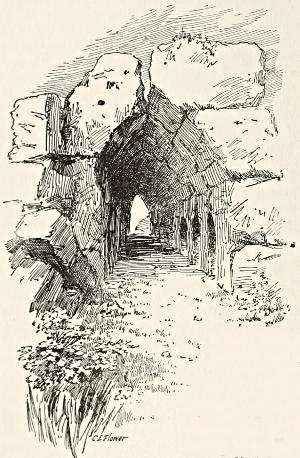
Arched Passage Way, Mycenæ
The results of three excavations
will especially serve as
rallying points and supply a
standard of comparison. After
Schliemann’s death, Dörpfeld
returned to Hissarlik, and recognised
in the huge remains of
the sixth stratum, on the southern
skirts of the citadel mound,
a city of the same period as
Mycenæ at its acme. Thus we can study
there remains of a later stage, in one process
of development superposed on earlier
remains, after an intervening period. The
links there missing are, however, apparent at
Phylakopi in Melos, excavated systematically
from 1896 to 1899. Here buildings of three
main periods appear one on another. The earliest
overlie in one spot a deposit of sherds of the
most primitive type known in the Ægean and
found in the earliest cist-graves. The second and third cities rise one out of
the other without evidence of long interval. A third and more important site
than either, Knossos in Crete, awaits fuller publication. Here are ruins of
a great palace, mainly of two periods. Originally constructed about 2000
B.C., it was almost entirely rebuilt at the acme of the Mycenæan Age, but
substructures and other remains of the earlier palace underlie the later.
Since recent researches, some of whose results are not yet published, have
demonstrated that in certain localities, for instance, Cyprus, Crete, and most
of the Ægean islands where Mycenæan remains were not long ago supposed
to be merely sporadic, they form in fact a stratum to be expected on the site
of almost every ancient Ægean settlement, we may safely assume that
Mycenæan civilisation was a phase in the history of all the insular and
peninsular territories of the east Mediterranean basin. Into the continents
on the east and south we have no reason to suppose that its influence
penetrated either very widely or very strongly.
The remains that especially concern us here belong to the later period
illustrated by these discoveries, and have everywhere a certain uniformity.
Some common influence spread at a certain era over the Ægean area and
reduced almost to identity a number of local civilisations of similar origin
but diverse development. Surviving influences of these, however, combined
with the constant geographical conditions to reintroduce some local differentiation
into the Mycenæan products.
The Neolithic Age in the Ægean has now been abundantly illustrated
from the yellow bottom clay at Knossos, and its products do not differ
materially from those implements and vessels with which man has everywhere
sought to satisfy his first needs. The mass of the stone tools and
weapons, and the coarse hand-made and burnished pottery, might well proceed
from the spontaneous invention of each locality that possessed suitable
stone and clay; but the common presence of flaked blades, arrow-heads, and
blunt choppers of an obsidian, native, so far as is known, to Melos only,
speaks of inter-communication even at this early period between many distant
localities and the city whose remains have been unearthed at Phylakopi.
The wide range of the peculiar cist-grave strengthens the belief that late
Stone Age culture in the Ægean was not of sporadic development, and prepares
us for the universality of a certain fiddle-shaped type of stone idol.
Local divergence is, however, already apparent in the relative prevalence of
certain forms: for example, a shallow bowl is common in Crete, but not in
the Cyclades, while the pyxis, so common in the graves of Amorgos and
Melos, has left little sign of itself in Crete; and from this point the further
development of civilisation in the Ægean area results in increasing differentiation.
The Greek mainland has produced as yet very little of the earlier
periods (the excavators of the Heræum promise additions); but the primitive
remains in the rest of the area may be divided into four classes of strong
family likeness, but distinct development.
The pottery supplies the best criterion, and will suffice for our end. We
have no such comprehensive and certain evidence from other classes of remains.
Except for the Great Treasure of Hissarlik, and the weapons in Cycladic
graves, there have been found as yet hardly any metal products of the period.
Of the few stone products, one class, the “island idols,” already referred
to, was obviously exported widely, and supplies an ill test either of place
or date. There have not been discovered sufficiently numerous structures or
graves to afford a basis of classification. Fortified towns have been explored
in Melos, Siphnos, and the Troad, and a few houses in Ægina and Thera;
but neither unaltered houses nor tombs of undoubted primitive character
have appeared in Crete as yet, nor elsewhere than in the Cyclad isles.
Above the strata, however, which contain these remains of local divergent
development, there lies in all districts of the Ægean area a rich layer of
deposit, whose contents show a rapid and marked advance in civilisation, are
essentially uniform, and have only subsidiary characteristics due to local
influence or tradition. The civilisation there represented is not of an origin
foreign to the area. The germs of all its characteristic fabrics, forms, and
motives of decoration exist in the underlying strata, though not equally in all
districts, and the change which Mycenæan art occasions is not always equally
abrupt. It is most reasonable to see in these remains the result of the action
of some accidental influence which greatly increased the wealth and capacity
of one locality in the area, and caused it to impose its rapidly developing
culture on all the rest. The measure of the reaction that took place in divers
localities thereafter depended naturally on the point to which local civilisations
had respectively advanced in the pre-Mycenæan period.
As to the decorative motives in vogue, there is less uniformity. The
earlier Mycenæan vessels have curvilinear and generally spiraliform geometric
schemes. These pass into naturalistic vegetable forms, and finally become
in the finest typical vases almost exclusively marine—algæ, octopods, molluscs,
shells, in many combinations. Everywhere animal, bird, and human
forms are but seldom found. Man certainly appears very late, and in company
with the oriental motives which characterise the Spata objects. Insects,
especially butterflies, become common, and
when their antennæ terminate in exquisite
spirals, decorative art is at the end of its
progress.
Silver Ox-head from Mycenæ
Not only in the continuous and universal
commentary of painted earthenware,
but in many other media, we have evidence
of “Mycenæan” art, but varying in character
according to the local abundance or
variety of particular materials. We have
reached an age when the artist had at his
disposal not only terra-cotta, hard and soft
stone, and wood, but much metal, gold, silver,
lead, copper, bronze containing about
twelve per cent. of tin alloy, as well as bone
and ivory, and various compositions from
soft lime plaster up to opaque glass. If it
were not for the magnificent stone utensils,
in the guise of lioness heads, triton shells,
palm and lotus capitals, with spirals in relief, miniature shields for handles,
which have come to light at Knossos, we should have supposed stone to be a
material used (except architecturally) only for such rude metallic-seeming
reliefs as stood over the Mycenæ gate and circle graves, or for heavy commonplace
vases and lamps.
We have discovered no large free statuary in the round in any material
as yet, though part of a hand at Knossos speaks to its existence; but figurines
in metal, painted terra-cotta, and ivory, replacing the earlier stone
idols, are fairly abundant. For these bronze is by far the commonest
medium, and two types prevail; a female with bell-like or flounced divided
skirt, and hair coiled or hanging in tails, and a male, nude but for a loin-cloth.
The position of the hands and legs varies with the skill of the artist,
as in all archaic statuary. Knossos has revealed for the first time the
Mycenæan artist’s skill in painted plaster-relief (gesso duro). The life-size
bull’s head from the northern entrance of the palace and fragments of human
busts challenge comparison triumphantly with the finest Egyptian work.
And from the same site comes the fullest assurance of a high development
of fresco-painting.
Tiryns had already shown us a galloping bull on its palace wall, Mycenæ
smaller figures and patterns, and Phylakopi its panel of flying-fish; but
Knossos is in advance of all with its processions of richly dressed vase-carriers,
stiff in general pose and incorrect in outline, but admirably painted
in detail and noble in type; and its yet more novel scenes of small figures,
in animated act of dance or ritual or war, irresistibly suggestive of early
Attic vase-painting. Precious fragments of painted transparencies in rock-crystal
have also survived, and both Mycenæ and Knossos have yielded stone
with traces of painted design. Moulded glass of a cloudy blue-green texture
seems to belong to the later period, at which carved ivory, previously rare,
though found even in pre-Mycenæan strata, becomes common. The Spata
tomb in Attica alone yielded 730 pieces of the latter material, helmeted
heads in profile, mirror handles and sides of coffers of orientalising design,
plaques with outlines of heraldic animals, and so forth. Articles in paste
and porcelain of native manufacture, though often of exotic design, have been
found most commonly where Eastern influence is to be expected; for instance,
at Enkomi in Cyprus. But the glassy blue composition, known to
Homer as κύανος, an imitation of lapis-lazuli, was used in architectural ornament
at Tiryns.
But it is in precious metals, and in the kindred technique of gem-cutting,
that Mycenæan art effects its most distinctive achievements. This is, as we
have said, an age of metal. That stone implements had not entirely passed
out of use is attested by the obsidian arrow-heads found in the circle graves,
and the flint knives and basalt axes which lay beside vases of the full “Mycenæan”
style at Cozzo del Pantano in Sicily. But they are survivals, unimportant
beside the objects in copper, bronze, and precious metals. Iron has
been found with remains of the period only as a great rarity. Some five
rings, a shield boss, and formless lumps alone represent it at Mycenæ. In
the fourth circle grave occurred thirty-four vessels of nearly pure copper.
Silver makes its appearance before gold, and is found moulded into bracelets
and bowls, and very rarely into figurines. Gold is more plentiful.
Beaten, it makes face-masks, armlets, pendants, diadems, and all kinds of
small votive objects; drawn, it makes rings whose bezels are engraved with
the burin; riveted, it makes cups; and overlaid as leaf on bone, clay, wood,
or bronze cores, it adorns hundreds of discs, buttons, and blades.
Next to Mycenæ in wealth of this metal ranks Enkomi in Cyprus, and
pretty nearly all the tombs of the later period have yielded gold, conspicuously
that of Vaphio. From the town sites, e.g., Phylakopi in Melos, and
Knossos, it has disappeared almost entirely. Detached from the mass of
golden objects which show primitive or tentative technique, are a few of such
elaborate finish and fineness of handiwork, that it is hard to credit them
to the same period and the same craftsmen. The Mycenæ inlaid dagger-blades
are famous examples, and the technical skill, which beat out each of
the Vaphio goblets in a single unriveted plate, has never been excelled.
We are fortunate in possessing very considerable remains of all kinds of
construction and structural ornament of the Mycenæan period. The great
walls of Mycenæ, of Tiryns (though perhaps due to an earlier epoch), and
of the sixth layer at Hissarlik, show us the simple scheme of fortification—massive
walls with short returns and corner towers, but no flank defences,
approached by ramps or stairs from within and furnished with one great
gate and a few small sally-ports. Chambers in the thickness of the wall
seem to have served for the protection of stores rather than of men. The
great palaces at Knossos and Phæstos, however, are of much more complicated
plan. Remains of much architectural decoration have been found
in these palaces—at Mycenæ, frescoes of men and animals; at Knossos,
frescoes of men, fish, and sphinxes, vegetable designs, painted reliefs, and rich
conventional ornament, such as an admirably carved frieze in hard limestone;
at Tiryns, traces of a frieze inlaid with lapis-lazuli glass, and also
frescoes. The rough inner walls, that appear now on these sites, must once
have looked very different.
Certain chambers at Knossos, paved and lined with gypsum, and two in
Melos, have square central piers. These seem to have had a religious significance,
and are possibly shrines devoted to pillar-worship. The houses of the
great dead were hardly less elaborate. The “Treasury of Atreus” had a
moulded façade with engaged columns in a sort of proto-Doric order and
marble facing; and there is good reason to suppose that its magnificent vault
was lined within with metal ornament or hanging draperies. The construction
itself of this and the other masonry domes bespeaks skill of a high order.
For lesser folk beehive excavations were made in the rock, and at the latest
period a return was made apparently to the tetragonal chamber; but now it
has a pitched or vaulted roof, and generally a short passage of approach whose
walls converge overhead towards a pointed arch but do not actually meet.
The corpses are laid on the floor, neither mummified nor cremated; but in
certain cases they were possibly mutilated and “scarified,” and the limbs were
then enclosed in chest urns. There is evidence for this both in Crete and
Sicily. But the order of burial, which first made Mycenæan civilisation known
to the modern world, continues singular. Similar shaft graves, whether contained
within a circle of slabs or not, have never been found again.
The latest excavation has at last established beyond all cavil that the
civilisation which was capable of such splendid artistic achievement was not
without a system of written communication. Thousands of clay tablets
(many being evidently labels) and a few inscriptions on pottery from the
palace at Knossos have confirmed Mr. A. J. Evans’ previous deduction,
based on gems, masons’ and potters’ marks, and one short inscription on
stone found in the Dictæan cave, that more than one script was in use in
the period. Most of the Knossos tablets are written in an upright linear
alphabetic or syllabic character, often with the addition of ideographs, and
showing an intelligible system of decimal numeration. Since many of the
same characters have been found in use as potters’ marks on sherds in Melos,
which are of earlier date than the Mycenæan period, the later civilisation
cannot be credited with their invention. Other clay objects found at
Knossos, as well as gems from the east of Crete, show a different system
more strictly pictographic. This seems native to the island, and to have survived
almost to historic times; but the origin of the linear system is
more doubtful. No such tablets or sealings have yet been found outside
Crete, and their writing remains undeciphered. The affinities of the
linear script seem to be with the Asianic systems, Cypriote and Hittite, and
perhaps with later Greek. The characters are obviously not derived from
the Phœnician.
This Mycenæan civilisation, as we know it from its remains, belongs to
the Ægean area (i.e., roughly the Greek), and to no other area with which
we are at present acquainted. It is apparently not the product of any of
the elder races which developed culture in the civilised areas to the east or
southeast, much as it owed to those races. It would be easy to add to the
singular vase-forms, script, lustrous paint, idols, gems, types of house and
tomb, and so forth, already mentioned, a long list of Mycenæan decorative
schemes which, even if their remote source lies in Egypt, Babylonia, or inner
Anatolia, are absolutely peculiar in their treatment. But style is conclusive.
From first to last the persistent influence of a true artistic ideal differentiates
Mycenæan objects from the hieratic or stylised products of Egypt or
Phœnicia. A constant effort to attain symmetry and decorative effect for
its own sake inspires the geometric designs. Those taken from organic life
show continual reference to the model and a “naturalistic grasp of the whole
situation,” which resists convention and often ignores decorative propriety.
The human form is fearlessly subjected to experiment, the better to attain
lightness, life, and movement in its portrayal. A foreign motive is handled
with a breadth and vitality which renders its new expression practically
independent. The conventional bull of an Assyrian relief was referred to
the image of a living bull by the Knossian artist, and made to express his
emotions of fear or wrath by the Vaphio
goldsmith, the Cypriote worker in ivory
mirror handles, or the “island-gem”
cutter.
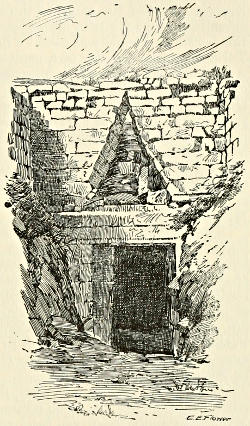
Exterior View of the Treasury of Atreus
Since we have a continuous series
of links by which the development of
the characteristic Mycenæan products
can be traced within the area back to
very primitive forms, we can fearlessly
assert that not only did the full flower
of the Mycenæan civilisation proper
belong to the Ægean area, but also its
essential origin. That it came to have
intimate relations with other contemporary
civilisations, Egyptian, Mesopotamian,
perhaps “Hittite,” and early
began to contract a huge debt, especially
to Egypt, is equally certain. Not to
mention the certainly imported Nilotic
objects found on Mycenæan sites, and
bearing hieroglyphic inscriptions and
cartouches of Pharaonic personages, the
later Ægean culture is deeply indebted
to the Nile for forms and decorative
motives.
At what epoch did Ægean civilisation
reach its full development? It is
little use to ask when it arose. A terminus
a quo in the Neolithic Age can
be dated only less vaguely than a geological stratum. But it is known within
fairly definite limits when it ceased to be a dominant civilisation. Nothing
but derived products of sub-Mycenæan style falls within the full Iron Age
in the Ægean. Bronze, among useful metals, accompanies almost alone the
genuine Mycenæan objects, at Enkomi in Cyprus, as at Mycenæ. This fact
supplies a terminus ad quem, to which a date may be assigned at least as precise
as scholars assign to the Homeric lays. For these represent a civilisation
spread over the same area and in process of transition from bronze to iron,
and if they fall in the ninth century B.C., then the Mycenæan period proper
ends a little earlier, at any rate in the West. It is possible, indeed probable,
that in Asia Minor and Cyprus, where the descent of northern tribes about
1000 B.C., remembered by the Greeks as the “Dorian Invasion,” did not
have any direct effect, the Mycenæan culture survived longer in something
like purity, and passed by an uninterrupted process of development into the
Hellenic; and even in Crete, where there was certainly a cataclysm, and in
the Argolid, where art was temporarily eclipsed about the tenth century,
earlier influence survived and came once more to the surface when peace was
restored. Persistence of artistic influence under a new order, and differences
in the artistic history of different districts widely sundered, have to be taken
into account. The appearance, e.g., of late Mycenæan objects in Cyprus, does
not necessarily falsify the received Mycenæan dates in mainland Greece.
For the main fact, however, viz., the age of greatest florescence all over
the area, a singular coincidence of testimony points to the period of the
XVIIIth Pharaonic Dynasty in Egypt. To this dynasty refer all the scarabs
or other objects inscribed with royal cartouches (except an alabaster lid from
Knossos, bearing the name of the earlier “Shepherd King,” Khyan), as yet
actually found with true Mycenæan objects, even in Cyprus. In a tomb of
this period at Thebes was found a bronze patera of fine Mycenæan style. At
Tel-el-Amarna, the site of a capital city which existed only in the reign of
Amenhotep IV, have been unearthed by far the most numerous fragments
of true “Ægean” pottery found in Egypt; and of that singular style which
characterises Tel-el-Amarna art, the art of the Knossian frescoes is irresistibly
suggestive. To the XVIIIth and two succeeding dynasties belong the tomb-paintings
which represent vases of Ægean form; and to these same dynasties
Mr. Petrie’s latest comparisons between the fabrics, forms, and decorative
motives of Egypt and Mycenæ have led him. The lapse of time between
the eighteenth and the tenth centuries is by no means too long, in the opinion
of most competent authorities, to account for the changes which take place in
Mycenæan art.
The question of race, which derives a special interest from the possibility
of a family relation between the Mycenæan and the subsequent Hellenic
stocks, is a controversial matter as yet. The light recently thrown
on Mycenæan cult does not go far to settle the racial problem. The aniconic
ritual, involving tree and pillar symbols of divinity, which prevailed
at one period, also prevailed widely elsewhere than in the Ægean, and we
are not sure of the divinity symbolised. Even if sure that it was the
Father God, whose symbol alike in Crete and Caria is the labrys or double
axe, we could not say if Caria or Crete were prior, and whether the Father
be Aryan or Semitic or neither.
When it is remembered that, firstly, knowing not a word of the Mycenæan
language, we are quite ignorant of its affinities; secondly, not enough
Mycenæan skulls have yet been recovered to establish more than the bare
fact that the race was mixed and not wholly Asiatic; and thirdly, since
identity of civilisation in no sense necessarily entails identity of race, we may
have to do not with one or two, but with many races—it will be conceded
that it is more useful at present to attempt to narrow the issue by excluding
certain claimants than to pronounce in favour of any one. The facial types
represented not only on the Knossian frescoes, but by statuettes and gems,
are distinctly non-Asiatic, and recall strongly the high-crowned brachycephalic
type of the modern northern Albanians and Cretan hillmen. Of the
elder civilised races about the Levantine area the Egyptians, Assyrians, and
Babylonians may be dismissed at once. We know their art from beginning
to end, and its character is not at any period the same as that of Ægean art.
As for the Phœnicians, for whom on the strength of Homeric tradition a
strong claim has been put forward, it cannot be said to be impossible that
some objects thought to be Mycenæan are of Sidonian origin, since we
know little or nothing of Sidonian art. But the presumption against this
Semitic people having had any serious share in Mycenæan development is
strong, since facial types apart, the only scripts known to have been used
in the Mycenæan area and period are in no way affiliated to the Phœnician
alphabet, and neither the characteristic forms nor the characteristic style of
Phœnician art, as we know it, appear in Mycenæan products. The one
thing, of which recent research has assured us in this matter, is this, that
the Keftiu, represented in XVIIIth Dynasty tombs at Thebes, were a
“Mycenæan” folk, an island people of the northern sea. They came into
intimate contact, both peaceful and warlike, with Egypt, and to them no
doubt are owed the Ægean styles and products found on Nile sites. Exact
parallels to their dress and products, as represented by Egyptian artists,
appear in the work of Cretan artists; and it is now generally accepted that
the Keftiu were “Mycenæans” of Crete at any rate, whatever other habitat
they may have possessed.
As to place of origin, Central Europe or any western or northern part of
the continent is out of the question. Mycenæan art is shown by various
remains to have moved westwards and northwards, not vice versa. It arose
within the Ægean area, in the Argolid as some, e.g., the Heræum excavators,
seem to propose, or the Cyclades, or Rhodes; or, if outside, then the
issue is narrowed for practical purposes to a region about which we know
next to nothing as yet, northern Libya, and to Asia Minor. So far as the
Mycenæan objects themselves testify, they point to a progress not from south
or west, but from east. In the western localities, notably Crete and Mycenæ,
we have more remains of highly developed Mycenæan civilisation, but less of
its early stages than elsewhere. Nothing in the Argolid, but much in the
Troad, prepares us for the Mycenæan metallurgy. The appearance of
Mycenæan forms and patterns is abrupt in Crete, but graduated in other
islands, especially Thera and Melos. The Cretan linear script seems to
be of “Asianic” family, and to be inscribed in Melos on sherds of earlier
date than its appearance at Knossos. Following Mycenæan development
backwards in this manner, we seem to tend towards the Anatolian coasts
of the Ægean, and especially the rich and little-known areas of Rhodes
and Caria.
It does not advance seriously the solution of the racial problem to turn to
Greek literary tradition. Now that we are assured of the wide range and
the long continuance of the influence of Mycenæan civilisation, overlapping
the rise of Hellenic art, we can hardly question that the early peoples
whom the Greeks knew as Pelasgi, Minyæ, Leleges, Danai, Carians, and so
forth, shared in it. But were they its authors? and who, after all, were
they themselves? The Greeks believed them their own kin, but what value
are we to attach to the belief of an age to which scientific ethnology and
archæology were unknown? Nor is it useful to select traditions, e.g., to
accept those about the Pelasgi, and to override those which connect the
Achæans equally closely with Mycenæan centres. We are gradually learning
that the classical Hellene was of no pure race, but the result of a blend
of several racial stocks, into which those pre-existing in his land can hardly
fail to have entered; and if we have been able to determine that Mycenæan
art was distinguished by just that singular quality of idealism which is of the
essence of the art which succeeded it in the same area (whatever be the
racial connection), it can scarcely be doubted in reason that Mycenæan
civilisation was in some sense the parent of the later civilisation of Hellas.
In fact, now that the Mycenæan remains are no longer to be regarded as
isolated phenomena on Greek soil, but are seen to be intimately connected on
the one hand with a large class of objects which carry the evolution of civilisation
in the Ægean area itself back to the Stone Age, and on the other
with the earlier products of Hellenic development, the problem is no longer
purely one of antiquarian ethnology. We ask less what race was so greatly
gifted, than what geographical or other circumstances will account for the
persistence of a certain peculiar quality of civilisation in the Ægean area.b
An eloquent summary of our Mycenæan knowledge and a lively description
of life such as it may have been in Mycenæ has been drawn by Chrestos
Tsountas and J. Irving Manatt in their work, The Mycenæan Age, from
which we quote at length.
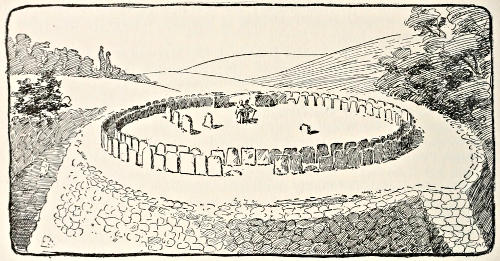
Sepulchral Enclosure, Mycenæ
Whether or not the authors of this distinct and stately civilisation
included among their achievements a knowledge of letters, their monuments
thus far address us only in the universal language of form and action. Of
their speech we have yet to read the first syllable. The vase handles of
Mycenæ may have some message for us, if no more than a pair of heroic
names; and the nine consecutive characters from the cave of Cretan Zeus
must have still more to say when we find the key. We may hope, at least,
if this ancient culture ever recovers its voice, to find it not altogether unfamiliar:
we need not be startled if we catch the first lisping accent of what
has grown full and strong in the Achæan epic.
But for the present we have to do with a dumb age, with a race whose
artistic expression amazes us all the more in the dead silence of their history.
So far as we yet know from their monuments, they have recorded not
one fixed point in their career, they have never even written down their
name as a people.
Now, a dateless era and a nameless race—particularly in the immediate
background of the stage on which we see the forces of the world’s golden
age deploying—are facts to be accepted only in the last resort. The student
of human culture cannot look upon the massive walls, the solemn
domes, the exquisite creations of what we call Mycenæan art, without
asking—When? By whom? In default of direct and positive evidence, he
will make the most of the indirect and probable.
We have taken a provisional and approximate date for the meridian age
of Mycenæan culture—namely, from the sixteenth to the twelfth century B.C.
We have also assumed that the Island culture was already somewhat advanced
as far back as the earlier centuries of the second millennium before
our era. This latter datum is based immediately on geological calculations:
M. Fouqué, namely, has computed a date circa 2000 B.C. for the upheaval
which buried Thera, and thus preserved for us the primitive monuments of
Ægean civilisation. Whatever be the value of Fouqué’s combinations—and
they have been vigorously, if not victoriously, assailed—we may reach a
like result by another way round. The Island culture is demonstrably older
than the Mycenæan—it must have attained the stage upon which we find it
at Thera a century or two at least before the bloom-time came in Argolis.
If, then, we can date that bloom-time, we can control within limits the geologists’
results.
Here we call in the aid of Egyptology. In Greece we find datable Egyptian
products in Mycenæan deposits, and conversely in datable Egyptian deposits
we find Mycenæan products.
To take the first Mycenæan finds in Egypt. In a tomb of 1100 B.C.,
or within fifty years of that either way, at Kahun, Flinders Petrie found
along with some dozens of bodies, “a great quantity of pottery, Egyptian,
Phœnician, Cypriote, and Ægean”—notably an Ægean vase with an ivy
leaf and stalk on each side, which he regards as the beginning of natural
design. Further, at Gurob and elsewhere, the same untiring explorer has
traced the Mycenæan false-necked vase or Bügelkanne through a series of
dated stages, “a chain of examples in sequence showing that the earliest
geometrical pottery of Mycenæ begins about 1400 B.C., and is succeeded by
the beginning of natural designs about 1100 B.C.”
But long before these actual Mycenæan products came to light in Egypt,
Egyptian art had told its story of relations with the Ægean folk. On the
tomb-frescoes of Thebes we see pictured in four groups the tributaries of
Tehutimes III (about 1500 B.C.), bringing their gifts to that great conqueror;
among them, as we are told by the hieroglyphic text that runs with the painting,
are “the princes of the land of Keftu [or Kefa] (Phœnicia) and of the
islands in the great sea.” And the tribute in their hands includes vases of
distinct Mycenæan style.
On the other hand, we find datable Egyptian products in Mycenæan
deposits in Greece. From Mycenæ itself and from Ialysos in Rhodes we
have scarabs bearing the cartouches of Amenhotep III and of his queen
Thi; and fragments of Egyptian porcelain, also from Mycenæ, bear the
cartouches of the same king, whose reign is dated to the latter half of the
fifteenth century.
We have already noted the recurrence at Gurob, Kahun, and Tel-el-Amarna
of the characters which were first found on the vase handles of Mycenæ; and
this seemed at one time to have an important bearing on Mycenæan chronology.
But in the wider view of the subject which has been opened up by
Evans’ researches, this can no longer be insisted upon as an independent datum.
However, the occurrence of these signs in a town demonstrably occupied by
Ægean peoples at a given date has corroborative value.
While it can hardly be claimed that any or all of these facts amount to
final proof, they certainly establish a strong probability that at least from the
fifteenth century B.C. there was traffic between Egypt and the Mycenæan
world. Whatever be said for the tomb-frescoes of Tehutimes’ foreign
tribute-bearers and the scarabs from Mycenæ and Rhodes, we cannot explain
away Mr. Petrie’s finds in the Fayum. The revelations of Tel-Gurob can
leave no doubt that the brief career of the ancient city on that spot—say
from 1450 to 1200 B.C.—was contemporaneous with the bloom-time of
Mycenæan civilisation.
Now most, if not all, of the “Ægean” pottery from Gurob, like that
pictured in the tomb-frescoes, belongs to the later Mycenæan styles as we
find them in the chamber-tombs and ruined houses—in the same deposits,
in fact, with the scarabs and broken porcelain which carry the cartouches
of Amenhotep and Queen Thi. The earlier period of Mycenæan art is thus
shown to be anterior to the reign of Tehutimes III; and as that period cannot
conceivably be limited to a few short generations, the sixteenth century
is none too early for the upper limit of the Mycenæan Age. We should,
perhaps, date it at least a century farther back. Thus we approximate the
chronology to which M. Fouqué has been led by geological considerations;
while, on the other hand, more recent inquirers are inclined to reduce by a
century or two the antiquity of the convulsion in which Thera perished, and
thus approximate our own datum.
For the lower limit of the Mycenæan Age we have taken the twelfth
century, though certain archæologists and historians are inclined to a much
more recent date—some even bringing it three or four centuries further
down.
This is not only improbable on its face, but at variance with the facts.
To take but one test, the Mycenæan Age hardly knew the use of iron; at
Mycenæ itself it was so rare that we find it only in an occasional ornament
such as a ring. No iron was found in the prehistoric settlements at Hissarlik
until 1890, when Dr. Schliemann came across two lumps of the metal, one of
which had possibly served as the handle of a staff. “It is therefore certain,”
he says, “that iron was already known in the second or ‘burnt city’; but it
was probably at that time rarer and more precious than gold.” In Egypt,
on the other hand, iron was known as early as the middle of the second
millennium B.C., and if the beehive and chamber-tombs at Mycenæ are to
be assigned to a period as late as the ninth century, the rare occurrence of
iron in them becomes quite inexplicable.
The Testimony of Art
From the seventeenth or sixteenth to the twelfth century B.C., then, we
may regard as the bloom-time of Mycenæan culture, and of the race or
races who wrought it out. But we need not assume that their arts perished
with their political decline. Even when that gifted people succumbed to or
blended with another conquering race, their art, especially in its minor
phases, lived on, though under less favouring conditions. There were no
more patrons like the rich and munificent princes of Tiryns and Mycenæ;
and domed tombs with their wealth of decoration were no longer built.
Still, certain types of architecture, definitively wrought out by the Mycenæans,
became an enduring possession of Hellenic art, and so of the art of the
civilised world; while from other Mycenæan types were derived new forms
of equally far-reaching significance.
The correspondence of the gateways at Tiryns with the later Greek
propylæa, and that of the Homeric with the prehistoric palaces, is noteworthy;
so, too, is the obvious derivation of the typical form of the Greek
temple, consisting of vestibule and cella, from the Mycenæan magaron.
That the Doric column is of the same lineage is a fact long ago recognised
by the ablest authorities. In fact, the Mycenæan pillars known to us,
whether in actual examples as embedded in the façades of the two beehive
tombs or in art representations, as in the lion relief and certain ivory models,
while varying in important details, exhibit now one, now another of the
features of the Doric column. Thus, all have in common abacus, echinus,
and cymatium—the last member adorned with ascending leaves just as in the
earliest capitals of the Doric order. Again, the Doric fluting is anticipated
in the actual pilasters of “Clytemnestra’s tomb,” and in an ivory model.
And as the Doric column has no base, but rests directly on the stylobate, so
the wooden pillars in the Mycenæan halls appear to rise directly from the
ground in which their stone bases are almost entirely embedded.
That Mycenæan art outlasted the social régime under which it had attained
its splendid bloom is sufficiently attested by the Homeric poems.
Doubtless, the Achæan system, when it fell before the aggressive Dorian,
must have left many an heirloom above ground, as well as those which its
tombs and ruins had hidden down to our own day. And, again, the poems
in their primitive strata undoubtedly reflect the older order, and offer us
many a picture at first hand of a contemporary age. Thus the dove-cup
of Mycenæ, or another from the same hand, may have been actually known
to the poet who described old Nestor’s goblet in our eleventh Iliad; and
the cyanos frieze of Tiryns may well have inspired the singer of the
Phæacian tale, or at least helped out his fancy in decorating Alcinous’
palace. Still, it is in the more recent strata of the poems that we find the
great transcripts of art-creations and the clearest indications of the very
processes met with in the monuments. To take but one instance, there is
the shield of Achilles forged at Thetis’ intercession by Hephæstus and
emblazoned with a series of scenes from actual mundane life. (Iliad, XVIII.
468-613.) The subjects are at once Mycenæan and Homeric. On the
central boss, for example, the Olympian smith “wrought the earth and the
heavens and the sea and the unwearying sun,” very much as the Mycenæan
artist sets sun, moon, and sky in the upper field of his great signet. Again,
the city under siege, while “on the walls to guard it, stand their dear
wives and infant children, and with these the old men,” appears to be almost
a transcript of the scene which still stirs our blood as we gaze upon the
beleaguered town on the silver cup. But it is less the subject than
the technique that reveals artistic heredity, and when we find Homer’s
Olympian craftsman employing the selfsame process in the forging of
the shield which we can now see for ourselves in the inlaid swords of
Mycenæ, we can hardly doubt that that process was still employed in the
poet’s time.
In this sense of an aftermath of art, Mycenæan influence outlasted by
centuries the overthrow of Mycenæan power; and the fact is one to be
considered in establishing a chronology. We have taken as our lower
limit the catastrophe in which the old order at Mycenæ and elsewhere
obviously came to an end. But the old stock survived,—“scattered and
peeled” though it must have been,—and carried on, if it did not teach the
conqueror, their old arts. If we are to comprehend within the Mycenæan
Age all the centuries through which we can trace this Mycenæan influence,
then we shall bring that age down to the very dawn of historical Greece.
In this view it is no misnomer to speak of the Æginetan gold find recently
acquired by the British Museum as a Mycenæan treasure.
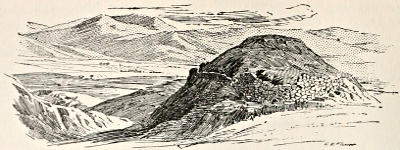
Acropolis of Mycenæ
We have seen that Mycenæan art was no exotic, transplanted full grown into
Greece, but rather a native growth—influenced though it was by the earlier
civilisations of the Cyclades and the East. This indigenous art, distinct and
homogeneous in character, no matter whence came its germs and rudiments,
must have been wrought out by a strong and gifted race. That it was of
Hellenic stock we have assumed to be self-evident. But, as this premise is
still in controversy, we have to inquire whether (aside from art) there are
other considerations which make against the Hellenic origin of the Mycenæan
peoples, and compel us to regard them as immigrants from the islands or the
Orient.
In the first place, recalling the results of our discussion of domestic and
sepulchral architecture, we observe that neither in the Ægean nor in Syria
do we find the gable-roof which prevails at Mycenæ. Nor would the people
of these warm and dry climates have occasion to winter their herds in their
own huts—an ancestral custom to which we have traced the origin of the
avenues to the beehive tombs.
Again, we have seen reason to refer the shaft-graves to a race or tribe
other than that whose original dwelling we have recognised in the sunken
hut. To this pit-burying stock we have assigned the upper-story habitations
at Mycenæ. If we are right, now, in explaining this type of dwelling as a
reminiscence of the pile-hut, it would follow that this stock, too, was of
northern origin. The lake-dwelling habit, we know, prevailed throughout
Northern Europe, an instance occurring, as we have seen, even in the Illyrian
peninsula; while we have no reason to look for its origin to the Orient or
the Ægean. It is indeed true that the island-folk were no strangers to the
pile-dwelling, but this rather goes to show that they were colonists from the
mainland.
But, apart from the evidence of the upper-story abodes, are there other
indications of an element among the Mycenæan people which had once
actually dwelt in lakes or marshes?
Monuments like the stone models from Melos and Amorgos have not
indeed been found in the Peloponnesus, or on the mainland, but in default of
such indirect testimony we have the immediate witness of actual settlements.
Of the four most famous cities of the age, Mycenæ, Tiryns, Orchomenos, and
Amyclæ, it is a singular fact that but one has a mountain-site, while the
other three were once surrounded by marshes. The rock on which Tiryns
is built, though it rises to a maximum elevation of some sixty feet above the
plain, yet sinks so low on the north that the lower citadel is only a few feet
above the level of the sea. Now this plain, as Aristotle asserts, and as the
nature of the ground still bears witness, was originally an extensive morass.
The founders, therefore, must have chosen this rock for their settlement,
not because it was a stronghold in itself, but because it was protected by
the swamp out of which it rose.
What is true of Tiryns holds for Orchomenos as well. The original site
was down in the plain until the periodic inundations of the lake forced the
inhabitants to rebuild on the slopes of Mount Acontion; and Orchomenos was
not the only primitive settlement in this great marsh. Tradition tells us
also of Athenæ, Eleusis, Arne, Midea—cities which had long perished, and
were but dimly remembered in historic times. To one of these, or to some
other whose name has not come down to us, belong the remarkable remains on
the Island of Goulas or Gha, which is connected with the shore by an ancient
mole. During the Greek Revolution this island-fort was the refuge of the neighbouring
population who found greater security there than in the mountains.
It is usually held that, when these Copaïc cities were founded, the region
was in the main drained and arable, whereas afterwards, the natural outlets
being choked up, the imprisoned waters flooded the plain, turned it into a
lake, and so overwhelmed the towns. But, obviously, this is reversing the
order of events. To have transformed the lake into a plain and kept it such
would have demanded the co-operation of populous communities in the construction
of costly embankments and perpetual vigilance in keeping them
intact. Where were such organised forces to be found at a time anterior to
the foundation of the cities themselves? Is it not more reasonable to
believe that the builders of these cities—instead of finding Copaïs an arable
plain, and failing to provide against its inundation—were induced by the
very fact of its being a lake to establish themselves in it upon natural
islands like the rock of Goulas, on artificial elevations, or even in pile-settlements?
It is possible, indeed, that on some unusual rise of the waters, towns
were submerged, but it is quite as probable that without any such catastrophe
the inhabitants finally abandoned these of their own accord to settle in
higher, healthier, and more convenient regions.
The case of Amyclæ is no exception. The prehistoric as well as the
historic site is probably to be identified with that of the present village of
Mahmud Bey, some five miles south of Sparta. The ground is low and
wet, and in early times was undoubtedly a marsh.
In the plain of Thessaly, again, we may trace the same early order.
There, where tradition (backed by the conclusions of modern science) tells
us that the inflowing waters used to form stagnant lakes, we find low artificial
mounds strewn with primitive potsherds. On these mounds, Lolling
holds, the people pitched their settlements to secure them against overflow.
The choice of these marshy or insulated sites is all the more singular
from the environment. Around Lake Copaïs, about Tiryns and Amyclæ,
as well as in Thessaly, rise mountains which are nature’s own fastnesses and
which would seem to invite primitive man to their shelter. The preference
for these lowland or island settlements then, can only be explained in the
first instance by immemorial custom, and, secondly, by consequent inexperience
in military architecture. Naturally, a lake-dwelling people will be
backward in learning to build stone walls strong enough to keep off a hostile
force. And in default of such skill, instead of settling on the mountain
slopes, they would in their migrations choose sites affording the best natural
fortifications akin to their ancient environment of marsh or lake—reinforcing
this on occasion by a moat, an embankment, or a pile-platform.
That the people in question once actually followed this way of living is
beyond a doubt. Amyclæ shows no trace of wall, and probably never had
any beyond a mere earthwork. The Cyclopean wall of Tiryns, as it now
stands, does not belong to the earliest settlement, nor is it of uniform date.
Adler holds that the first fortress must have been built of wood and sun-dried
bricks. This construction may possibly account for those remarkable
galleries whose origin and function are not yet altogether clear. The mere
utility of the chambers for storage—a purpose they did unquestionably
serve—hardly answers to the enormous outlay involved in contriving them.
May we not, then, recognise in them a reminiscence of the primitive palisade-earthwork?
In the so-called Lower Citadel of Tiryns we find no such
passages, possibly because its Cyclopean wall was built at a later date.
Likewise no proper galleries have yet been found at Mycenæ, and it is
highly improbable that any such ever existed there. What had long been
taken for a gallery in the north wall proves to be nothing but a little chamber
measuring less than seven by twelve feet. Obviously, then, the gallery
was not an established thing in fortress-architecture, and this fact shows
that it did not originate with the builders of stone walls, but came to them
as a heritage from earlier times and a more primitive art.
In fact, we find in the terramare of Italy palisade and earthwork fortifications
so constructed that they may be regarded as a first stage in the development
which culminates in the Tiryns galleries. The construction of
the wall at Casione near Parma is thus described:[4] “Piles arranged in two
parallel rows are driven in the ground with an inward slant so as to meet at
the top, and this Δ-shaped gallery is then covered with earth. Along the
inside of this embankment is carried a continuous series of square pens, built
of beams laid one upon another, filled with earth and brushwood, and finally
covered with a close-packed layer of sand and pebbles. This arrangement
not only strengthens the wall but provides a level platform for its defenders.”
Thus the space between these palisades would closely resemble the “arched”
corridors of Tiryns, while the square pens (if covered over without being
filled up) would correspond to the chambers.
These facts strengthen the inferences to which we have been led by our
study of the stone models and the upper-story dwellings. And they point
to the region beyond Mount Olympus as the earlier seat of this lake-dwelling
contingent of the Mycenæan people as well as of their kinsmen of the earth-huts.
And we have other evidence that the Mycenæan cities, at least the
four of chief importance, were founded by a people who were not dependent
on the sea and in whose life the pursuits of the sea were originally of little
moment. Mycenæ and Orchomenos are at a considerable remove from the
coast, while Amyclæ is a whole day’s journey from the nearest salt-water.
Tiryns alone lies close to the sea-board; and, indeed, the waves of the Argolic
Gulf must have washed yet nearer when its walls were reared. But,
obviously, it was not the nearness of the sea that drew the founders to this
low rock. For it is a harbourless shore that neighbours it, while a little
farther down lies the secure haven of Nauplia guarded by the impregnable
height of Palamedes; and it is yet to be explained why the Tirynthians, if
they were a sea-faring people, did not build their city there. Again, the
principal entrance to Tiryns is not on the side towards the sea, but on the
east or landward side. This goes to show that even when the Cyclopean
wall was built, certainly long after the first settlement, the people must have
been still devoted mainly to tilling the soil and tending flocks, occupations
to which the fertile plain and marshy feeding grounds would invite them.
So in historic times, also, the town appears to have lain to the east of the
citadel, not between it and the sea.
Even if it be granted that these Mycenæan cities were settled by immigrants
who came by sea, it does not follow that they were originally a sea-faring
folk. The primitive Dorians were hardly a maritime people, yet Grote has
shown that their conquest of the Peloponnesus was in part effected by means
of a fleet which launched from the Malian Gulf; and their kinsmen, who
settled in Melos, Thera, and Crete, in all probability, sailed straight from the
same northern port.
The Minyæ, who founded Orchomenos, Curtius regards as pre-eminently
a seafaring race; and he seeks to account for their inland settlement by assuming
that they were quick to realise the wealth to be won by draining and
tilling the swamp. But this is hardly tenable. Whatever our estimate of
Minyan shrewdness, they must have had their experience in reclaiming
swamp land yet to acquire and on this ground. It was the outcome of age-long
effort in winning new fields from the waters and guarding them when
won. The region invited settlement because it offered the kind of security
to which they were wonted; the winning of wealth was not the motive but
the fortunate result.
Again, if the Mycenæans had been from the outset a maritime race we
should expect to find the ship figuring freely in their art-representations.
But this is far from being the case. We have, at last, one apparent instance
of the kind on a terra-cotta fragment found in the acropolis at Mycenæ in
1892. On this we seem to have a boat, with oars and rudder, and curved
fore and aft like the Homeric νῆες ἀμφιέλισσαι. Below appear what we may
take to be dolphins. But this unique example can hardly establish the maritime
character of the Mycenæans.
Along with this unfamiliarity with ships, we have to remark also their
abstinence from fish. In the remains of Tiryns and Mycenæ we have found
neither a fish-hook nor a fish-bone, though we do find oysters and other
shellfish such as no doubt could be had in abundance along the adjacent
shores. In the primitive remains of the Italian terramare there is the
same absence of anything that would suggest fishing or fish-eating; and,
indeed, linguistic evidence confirms these observations. Greek and Latin
have no common term for fish; and we may fairly conclude that the Græco-Italic
stock before the separation were neither fishermen or fish-eaters. That
they were slow to acquire a taste for fish, even after the separation, is attested
not only by the negative evidence of their remains in the Argolid and on the
Po but by the curious reticence of Homer. His heroes never go fishing but
once and then only in the last pinch of famine—“when the bread was all
spent from out the ship and hunger gnawed at their belly.”
Now that we find in Greece, five or six centuries earlier than the poems,
a people in all probability hailing from the same region whence came the
ancestors of the Homeric Greeks, with the same ignorance of, or contempt
for, a fish diet, and building their huts on piles like the primitive Italians
whose earthworks further appear to have set the copy for the Tirynthian
galleries—can we doubt that this people sprung from the same root with
the historic Greeks and their kinsmen of Italy? The conclusion appears so
natural and so logical, that it must require very serious and solid objections
to shake it. But, instead of that, our study of Mycenæan manners and institutions—both
civil and religious—affords strong confirmation. In the
matter of dress we find the historical Greeks the heirs of the Mycenæans,
and the armour of the Homeric heroes—when we get behind the epic glamour
of it—differs little from what we know in the Mycenæan monuments.
While our knowledge of Mycenæan religion is vague at the best, and we
must recognise in the dove-idols and dove-temples the insignia of an imported
Aphrodite-cult, we have beyond a reasonable doubt also to recognise a genuine
Hellenic divinity with her historical attributes clearly foreshadowed in
Artemis. Again, while the Homeric Greeks themselves are not presented to
us as worshippers of the dead after the custom avouched by the altar-pits of
Mycenæ and Tiryns, we do find in the poems an echo at least of this cult,
and among the later Hellenes it resumes the power of a living belief. So,
though Homer seems to know cremation only, and this has been taken
for full proof that the Mycenæans were not Greeks, the traces of embalming
in the poems clearly point to an earlier custom of simple burial as we find it
uniformly attested by the Mycenæan tombs. And, here, again, historical
Greece reverts to the earlier way. In Greece proper, at least in Attica, the
dead were not burned,—not even in the age of the Dipylon vases,—and yet
the Athenians of that day were Greeks. So, among the earlier Italians, burial
was the only mode of dealing with the dead, and the usage was so rooted in
their habits that even after cremation was introduced some member of the
body (e.g., a finger) was always cut off and buried intact. We need not
repeat what we have elsewhere said of the funeral banquet, the immolation
of victims, the burning of raiment—all bearing on the same conclusion and
cumulating the evidence that the Greeks of Homer, and so of the historic age,
are the lineal heirs of Mycenæan culture.
If the proof of descent on these lines is strong, it is strengthened yet
more by all we can make out regarding the political and social organisation.
That monarchy was the Mycenæan form of government is sufficiently attested
by the strong castles, each taken up in large part by a single princely
mansion. But “the rule of one man” is too universal in early times to be
a criterion of race. Far more significant is the evidence we have for a
clan-system such as we afterwards find in full bloom among the Hellenes.
The clan, as we know it in historic times, and especially in Attica, was
a factor of prime importance in civil, social, and religious life. It was composed
of families which claim to be, and for the most part actually were,
descended from a common ancestor. These originally lived together in
clan-villages—of which we have clear reminiscences in the clan-names of
certain Attic demes, as Boutadai, Perithoidai, Skanbonidai. Not only did
the clan form a village by itself, but it held and cultivated its land in common.
It built the clan-village on the clan-estate; and as the clansmen
dwelt together in life, so in death they were not divided. Each clan had
its burial-place in its own little territory, and there at the tomb it kept up
the worship of its dead, and especially of its hero-founder.
That the Mycenæans lived under a like clan-system, the excavation of
the tombs of the lower town has shown conclusively. The town was composed
of villages more or less removed from one another, each the seat of
a clan. We have no means of determining whether the land was held and
tilled in common, but we do know that by each village lay the common clan-cemetery—a
group of eight, ten, or more tombs, obviously answering to
the number of families or branches of the clan. In the construction of the
tombs, and in the offerings contained, we note at once differences between
different cemeteries and uniformity in the tombs of the same group. The
richest cemeteries lie nearer the acropolis, as the stronger clans would naturally
dwell nearer the king. Thus, for its population, Mycenæ covered a
large area, but its limits were not sharply defined, and the transition from
the citadel centre to the open country was not abrupt. The villages were
linked together by graveyards, gardens and fields, highways and squares;
thus the open settlement was indeed a πόλις εὐρυάγυια—a town of broad
ways.
Somewhat such must have been the aspect in primitive days of Sparta
and Athens, not to mention many other famous cities. Indeed, even in
historic times, as we know from the ruins, Sparta was still made up of detached
villages spread over a large territory for so small a population. So,
primitive Athens was composed of the central settlement on the Acropolis,
with the villages encircling it from Pnyx to Lycabettus and back again.
When the city was subsequently walled in, some of these villages were included
in the circuit, others were left outside, while still others (as the Ceramicus)
were cut in two by the wall. The same thing happened at Mycenæ;
the town wall was built simply because the fortress was an insufficient shelter
for the populace as times grew threatening; but it could not, and did
not, take in all the villages.
Such, briefly, is the objective evidence—the palpable facts—pointing
to a race connection between the Mycenæans and the Greeks of history. We
have, finally, to consider the testimony of the Homeric poems. Homer
avowedly sings of heroes and peoples who had flourished in Greece long before
his own day. Now it may be denied that these represent the civilisation
known to us as Mycenæan; but it is certainly a marvellous coincidence
(as Schuchhardth observes) that “excavations invariably confirm the former
power and splendour of every city which is mentioned by Homer as conspicuous
for its wealth or sovereignty.”
Of all the cities of Hellas, it is the now established centres of Mycenæan
culture which the poet knows best and characterises with the surest hand.
Mycenæ “rich in gold” is Agamemnon’s seat, and Agamemnon is lord of
all Argos and many isles, and leader of the host at Troy. In Laconia, in
the immediate neighbourhood of the tomb which has given us the famous
Vaphio cups, is the royal seat of Menelaus, which is likened to the court of
Olympian Zeus. Bœotian Orchomenos, whose wealth still speaks for itself
in the Treasury of Minyas, is taken by the poet as a twin type of affluence
with Egyptian Thebes, “where the treasure-houses are stored fullest.”
Assuredly, no one can regard all this and many another true touch as mere
coincidence. The poet knows whereof he affirms. He has exact knowledge
of the greatness and bloom of certain peoples and cities at an epoch long
anterior to his own, with which the poems have to do. And there is not
one hint in either poem that these races and heroes were not of the poet’s
own kin.
It might be assumed that there had once ruled in those cities an alien
people, and that the monuments of Mycenæan culture were their legacy to
us, but that the Achæans who came after them have entered into the inheritance
of their fame. Such usurpations there have been in history; but
the hypothesis is out of the question here. At Mycenæ, where exploration
has been unusually thorough, the genuine Mycenæan Age is seen to have
come to a sharp and sudden end—a catastrophe so overwhelming that we
cannot conceive of any lingering bloom. Had the place passed to a people
worthy to succeed to the glory of the race who reared its mighty walls and
vaulted tombs, then we should look for remains of a different but not a contemptible
civilisation. But, in fact, we find built directly on the ruins of
the Mycenæan palace mean and shabby huts which tell us how the once
golden city was succeeded by a paltry village. Centuries were to pass
before the Doric temple rose on the accumulated ruins of palace and hovels,
and generations more before the brave little remnant returned with the laurels
of Platæa and enough of the spoil (we may conjecture) to put the walls of
the Atreidæ in repair.
If the structures peculiar to the Mycenæan age are the work of foreigners,
what have we left for Agamemnon and his Achæans? Simply the hovels.
Of the Dipylon pottery, with which it is proposed to endow them, there is
none worth mentioning at Mycenæ, very little at Tiryns, hardly a trace at
Amyclæ, or Orchomenos. In the Mycenæan acropolis, particularly, very
few fragments of this pottery have been found, and that mainly in the huts
already mentioned. Can these be the sole traces of the power and pride of
the Atreidæ?
For us at least the larger problem of nationality is solved; but there is
a further question. Can we determine the race or races among the Greeks
known to history to whom the achievements of Mycenæan civilisation are to
be ascribed? In this inquiry we may set aside the Dorians, although many
scholars (especially among the Germans) still claim for them the marvellous
remains of the Argolid. The Homeric poems, they say, describe a state of
things subsequent to the Dorian migration into the Peloponnesus and consequent
upon the revolution thereby effected. As the Dorians themselves
hold sway at Mycenæ and Sparta, they must be the subjects of the poet’s
song—the stately fabric of Mycenæan culture must be the work of their
hands.
On the other hand, Beloch,i while accepting the Dorian theory of this
civilisation, dismisses the traditional Dorian migration as a myth, and maintains
that Dorian settlement in the Peloponnesus was as immemorial as the
Arcadian. Just as the original advent of the Arcadians in the district which
bears their name had faded out of memory and left no trace of a tradition,
so the actual migration of the Dorians belonged to an immemorial past.
The first of these views which attributes the Mycenæan culture to the
Dorians of the traditional migration, cannot stand the test of chronology.
For tradition refers that migration to the end of the twelfth century B.C.,
whereas the Mycenæan people were established in the Argolid before the
sixteenth, probably even before the twentieth century. While Beloch’s
hypothesis is not beset with this chronological difficulty, it is otherwise
quite untenable. For, as the excavations at Tiryns and Mycenæ abundantly
prove, the Mycenæan civilisation perished in a great catastrophe. The palaces
of both were destroyed by fire after being so thoroughly pillaged that
scarcely a single bit of metal was left in the ruins. Further, they were
never rebuilt; and the sumptuous halls of Mycenæ were succeeded by the
shabby hovels of which we have spoken. The larger domes at Mycenæ,
whose sites were known, were likewise plundered—in all probability by
the same hands that fired the palace. This is evidenced by the pottery
found in the hovels and before the doorways of two of the beehive tombs.
A similar catastrophe appears to have cut short the career of this civilisation
in the other centres where it had flourished.
How are we to account for this sudden and final overthrow otherwise
than by assuming a great historic crisis, which left these mighty cities with
their magnificent palaces only heaps of smoking ruins? And what other
crisis can this have been than the irruption of the Dorians? And their
descent into the Peloponnesus is traditionally dated at the very time which
other considerations have led us to fix as the lower limit of the Mycenæan
Age. Had that migration never been recorded by the ancients nor attested
by the state of the Peloponnesus in historic times, we should still be led to
infer it from the facts now put in evidence by the archæologist’s spade.
Setting aside the Dorian claim as preposterous, we have nothing to do
but follow the epic tradition. The Homeric poems consistently assume that
prior to any Dorian occupation
Argolis was inhabited by other
peoples, and notably by Achæans
whose position is so commanding
that the whole body of Greeks
before Troy usually go by their
name. Their capital is Mycenæ,
and their monarch Agamemnon,
King of Men; although we find
them also in Laconia under the
rule of Menelaus. But the poet
has other names, hardly less famous,
applied now to the people
of Argolis and now to the Greeks
at large. One of these names
(Ἀργεῖοι) is purely geographical,
whether it be restricted to the
narrow Argolid district or extended
to the wider Argos, and
has no special ethnological significance.
But the other (Δαναοί)
belonged to a people distinct from
and, according to uniform tradition,
more ancient than the Achæans.
We find, then, two races in
Argolis before the Dorian migration,
each famous in song and story,
and each so powerful that its name
may stand for all the inhabitants
of Greece. The Achæans occupy
Mycenæ, that is to say, the northern
mountain region of the district, while legend represents the Danaans as
inseparably connected with Argos and the sea-board, and ascribes to them
certain works of irrigation.
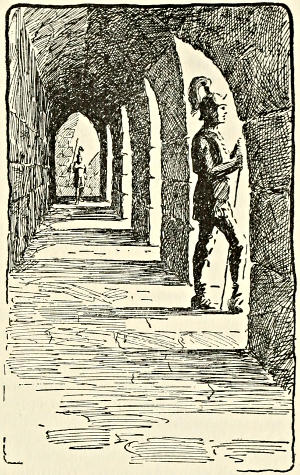
Gallery in the Wall around the Citadel of
Tiryns
Whatever interpretation be put upon the myth, it seems clear that Argos
could not feed its great cities without artificial irrigation, and this it owed
to Danaus and his fifty daughters, “who were condemned perpetually to pour
water in a tub full of holes,”—that is to say, into irrigation ditches which
the thirsty soil kept draining dry.
Now our study of the Mycenæan remains has already constrained us to
distinguish in the Argolid two strata of Mycenæan peoples, one of them
originally dwelling on dry land in sunken huts, the other occupying pile
settlements in lakes and swamps. And since tradition squares so remarkably
with the facts in evidence, may we not venture to identify the marsh-folk
with the Danaans and the landsmen with the Achæans?
But Achæans and Dorians were not alone in shaping and sharing Mycenæan culture;
they had their congeners in other regions. Foremost among
these were the Minyan founders of Orchomenos. As lake-dwellers and
hydraulic engineers they are assimilated to the Danaans, whose near kinsmen
they may have been, as the primitive islanders, whose abode we have
found copied in the stone vases, must have been related to them both. Tradition
has, in fact, preserved an account of the colonisation of Thera by a
people coming from Bœotia, although it is uncertain whether it refers to the
original occupation or to a settlement subsequent to the great catastrophe.
From the Danao-Minyan stock, it would appear that the Achæans parted
company at an early date and continuing for a time in a different—most
probably a mountainous—country, there took on ways of living proper to
such environment. Later than the Danaans, according to the consistent
testimony of tradition, they came down into the Peloponnesus and by their
superior vigour and prowess prevailed over the older stock.
To these two branches of the race we may refer the two classes of
tombs. The beehive and chamber tombs, as we have seen, have their prototype
in the sunken huts: they belong to the Achæans coming down from
the colder north. The shaft-graves are proper to the Danaan marsh-men.
At Tiryns we find a shaft-grave, but no beehive or chamber tomb. At
Orchomenos the Treasury of Minyas stands alone in its kind against at least
eight tholoi and sixty chamber-tombs at Mycenæ. Hence, wherever this
type of tombs abounds we may infer that an Achæan stock had its seat, as
at Pronoia, in Attica, Thessaly, and Crete. Against this it may be urged
that precisely at the Achæan capital, and within its acropolis at that, we find
the famous group of shaft-graves with their precious offerings, as well as
humbler graves of the same type outside the circle. But this, in fact, confirms
our view when we remember it was the Danaid Perseus who founded
Mycenæ and that his posterity bore rule there until the sceptre passed to
Achæan hands in the persons of the Pelopidæ.[5] We have noted the close
correspondence of the original fortress at Mycenæ with that of Tiryns, and
its subsequent enlargement. Coincident with this extension of the citadel,
the new type of tomb makes its appearance in the great domes,—some of
them certainly royal sepulchres,—although the grave-circle of the acropolis
is but half occupied. That circle, however, ceases thenceforth to be used as
a place of burial, while the humbler graves adjacent to it are abandoned and
built over with dwellings. With the new type of tomb we note changes of
burial customs, not to be accounted for on chronological grounds: in the
beehive tombs the dead are never embalmed, nor do they wear masks, nor
are they laid on pebble beds—a practice which may have owed its origin to
the wet ground about Tiryns.
There is but one theory on which these facts can be fully explained. It
is that of a change in the ruling race and dynasty, and it clears up the whole
history of Mycenæ and the Argive Plain. The first Greek settlers occupied
the marshy sea-board, where they established themselves at Tiryns and other
points; later on, when they had learned to rear impregnable walls, many of
them migrated to the mountains which dominated the plain and thus were
founded the strongholds of Larissa, Midea, and Mycenæ.
But while the Danaans were thus making their slow march to the north
the Achæans were advancing southward from Corinth—a base of great
importance to them then and always, as we may infer from the network of
Cyclopean highways between it and their new centre. At Mycenæ, already
a strong Perseid outpost, the two columns meet—when, we cannot say.
But about 1500 B.C., or a little later, the Achæans had made themselves
masters of the place and imposed upon it their own kings.
We have no tradition of any struggle in connection with this dynastic
revolution, and it appears probable that the Achæans did not expel the older
stock. On the contrary, they scrupulously respected the tombs of the
Danaid dynasty—it may be, because they felt the claim of kindred blood.
In manners and culture there could have been but little difference between
them, for the Achæans had already entered the strong current of Mycenæan
civilisation.
Indeed, we discern a reciprocal influence of the two peoples. Within
certain of the Achæan tombs (as we may now term the beehives and rock
chambers) we find separate shaft-graves, obviously recalling the Danaid
mode of burial. On the other hand, it would appear that the typical
Achæan tomb was adopted by the ruling classes among other Mycenæan
peoples. Otherwise we cannot explain the existence of isolated tombs of
this kind as at Amyclæ (Vaphio), Orchomenos, and Menidi—obviously the
sepulchres of regal or opulent families; while the common people of these
places—of non-Achæan stock—buried their dead in the ordinary oblong
pits.
Achæan ascendency is so marked that the Achæan name prevails even
where that stock forms but an inconsiderable element of the population.
Notably this is true of Laconia, where the rare occurrence of the beehive
tomb goes to show that the pre-Dorian inhabitants were mostly descended
from the older stock, which we have encountered at Tiryns and at Orchomenos.d
Restoration of a Mycenæan Palace
[ca. 1400-1200 B.C.]
In thinking of the mythical period with its citations of fables about gods
and goddesses galore and heroes unnumbered, one is apt to become the victim
of a mental mirage. One can hardly escape imagining the period in question
thus veiled in mystery and peopled with half mythical and altogether mystical
figures as really having been a time when men and women lived an idyllic
life. As one contemplates the period he intuitively falls into a day-dream
in which there dance before him light-robed artistic figures moving in arcadian
bowers, tenanted by nymphs and satyrs and centaurs. But when one
awakes to a practical view he recognises of course that all this is an illusion.
Reason tells him that this was a mythical age, simply because the people
were not sufficiently civilised to make permanent historical records. They
were half barbarians, living as pastoral peoples everywhere live, striving
for food against wild beasts, protecting their herds, cultivating the soil, fighting
their enemies. And yet, in a sense, their life was idyllic. Heroic elements
were not altogether lacking; the men were trained athletes, whose
developed muscles were a joy to look upon, and no doubt the women, despite
a certain coarseness, shared something of that figure. Then the people themselves
believed in the gods and nymphs and satyrs and centaurs of which
we dream, and so in a sense their world was peopled with them: in a sense
they did dwell in Arcady. Still one cannot disguise the fact that it was an
Arcady which no modern, placed under similar restrictions, would care to
enter.
In that early day writing was an unknown art in Hellas, and so the people
as they emerged from their time of semi-civilisation brought with them no
specific tangible records of the life of that period, but only fables and traditions
to take the place of sober historical records. To the people themselves
these fables and traditions bore, for a long time at any rate, a stamp of veritable
truth. Even the most extravagant of their narratives of gods and
godlike heroes were believed as implicitly, no doubt, by the major part of the
people even at a comparatively late historical period, as we to-day believe the
stories of an Alexander, a Cæsar, or a Napoleon. As time went on these
fables became even more intimately fixed in the minds of the people through
becoming embalmed in the verses of the poet and the lines of the tragedian.
Here and there, to be sure, there was a man who questioned the authenticity
of these tales as recitals of fact, but we may well believe that the generality
of people, even of the most cultured class, preferred throughout the entire
period of antiquity to accept the myths at their face value. Not only so,
but for many generations later, throughout the period sometimes spoken of
as the “Age of Faith” of the western world, a somewhat similar estimate
was put upon the Greek myths as recited by the classical authors. Even
after the growth of scepticism and the development of the scientific spirit
rendered the acceptance of the myths as recitals of fact impossible, for a long
time it seemed little less than a sacrilege to think of severing them altogether
from the realm of fact.
That, considered as historical narratives, they had been elaborated and
their bald facts distorted by the creative imagination of a marvellous people,
was clearly evident. No one, for example, in recent days would be expected
to believe that the hero Achilles had been plunged into the river Styx by his
mother and rendered thereby invulnerable except as to the heel by which he
was held. But to doubt that the hero Achilles lived and accomplished such
feats as were narrated in the Iliad would seem almost a blow at the existence
of the most fascinating people of antiquity. There came a time, however,
in comparatively recent generations when scepticism no longer hesitated to
invade the ranks of the most time-honoured and best-beloved traditions, and
when a warfare of words began between a set of critics, who would wipe the
whole mass of Greek myths from the pages of history, and the champions of
those myths who were but little disposed to give them up. Thus scepticism
found an obvious measure of support in the clear fact that the mythical narratives
could not possibly be received as authentic in their entirety. Further
support was given to the sceptical party a little later by the study of comparative
mythology, which showed to the surprise of many scholars that the
Greek myths were by no means so unique in their character as had been supposed.
It was shown that in the main they are closely paralleled by myths
of other nations, and a theory was developed and advocated with much plausibility
that they had been developed out of a superstitious regard of the sun
and moon and elements, that most of them were, in short, what came to be
called solar myths, and that they had no association whatever with the deeds
of human historic personages.
Looking at the subject in the broadest way it, perhaps, does not greatly
matter which view, as to the status of myths, is the true one. After all, the
main purport of history in all its phases has value, not for what it tells us of
the deeds of individual men or the conflicts of individual nations, but for
what it can reveal of the process of the evolution of civilisation. Weighed
by this standard, the beautiful myths of the Greeks are of value chiefly as
revealing to us the essential status of the Greek mind in the early historical
period, and the stage of evolution of that mind.
The beautiful myths of Greece cannot and must not be given up, and
fortunately they need not. The view which Grote and the host of his
followers maintained, practically solves the problem for the historian. He
may retain the legend and gain from it the fullest measure of imaginative
satisfaction; he may draw from it inferences of the greatest value as to the
mental status of the Greek people at the time when the legends were crystallised
into their final form; he may even believe that, in the main, the legends
have been built upon a substructure of historical fact, and he may leave to
specialists the controversy as to the exact relations which this substructure
bears to the finished whole, content to accept the decision of the greatest
critical historians of Greece that this question is insoluble.
From the period of myth pure and simple when the gods and goddesses
themselves roved the earth achieving miracles, taking various shapes, slaying
pythons, titans, and other monsters, and exercising their amorous fancies
among the men and women of earth—from this period we come to the
semi-historical time of the activity of the demi-gods and the men who,
superior to the ordinary clay, were called Heroes.
The term “Heroic Age” has passed into general use with the historian as
applying to the period of Grecian history immediately preceding and including
the Trojan wars. As there are very few reliable documents at hand relating
to this period—there were none at all until recently—it is clear that
this age is in reality only the latter part of that mythical period to which we
have just referred. Recent historians tend to treat it much more sceptically
than did the historians of an earlier epoch; some are even disposed practically
to ignore it. But the term has passed far too generally into use to be altogether
abandoned; and, indeed, it is not desirable that it should be quite
given up, for, however vague the details of the history it connotes, it is after
all the shadowy record of a real epoch of history. We shall, perhaps, do best,
therefore, to view it through the eyes of a distinguished historian of an earlier
generation, remembering only that what is here narrated is still only half
history—that is to say, history only half emerged from the realm of legend.a
The real limits of this period cannot be exactly defined; but still, so far
as its traditions admit of anything like a chronological connection, its duration
may be estimated at six generations, or about two hundred years.[6] The
history of the heroic age is the history of the most celebrated persons belonging
to this class, who, in the language of poetry, are called heroes. The
term “hero” is of doubtful origin, though it was clearly a title of honour;
but in the poems of Homer, it is applied not only to the chiefs, but also to
their followers. In later times its use was narrowed, and in some degree
altered; it was restricted to persons, whether of the Heroic or of after ages,
who were believed to be endowed with a superhuman, though not a divine,
nature, and who were honoured with sacred rites, and were imagined to
have the power of dispensing good or evil to their worshippers; and it was
gradually combined with the notion of prodigious strength and gigantic
stature. Here however we have only to do with the heroes as men. The
history of their age is filled with their wars, expeditions, and adventures;
and this is the great mine from which the materials of the Greek poetry
were almost entirely drawn. But the richer a period is in poetical materials,
the more difficult it usually is to extract from it any that are fit for
the use of the historian; and this is especially true in the present instance.
We must content ourselves with touching on some which appear most
worthy of notice, either from their celebrity, or for the light they throw on
the general character of the period, or their connection, real or supposed,
with subsequent historical events.
We must pass very hastily over the exploits of Bellerophon and Perseus,
and we mention them only for the sake of one remark. The scene of their
principal adventures is laid out of Greece, in the East. The former, whose
father Glaucus is the son of Sisyphus, having chanced to stain his hands with
the blood of a kinsman, flies to Argos, where he excites the jealousy of Prœtus,
and is sent by him to Lycia, the country where Prœtus himself had been
hospitably entertained in his exile. It is in the adjacent regions of Asia
that the Corinthian hero proves his valour by vanquishing ferocious tribes
and terrible monsters. Perseus too has been sent over the sea by his grandfather
Acrisius, and his achievements follow the same direction, but take a
wider range; he is carried along the coasts of Syria to Egypt, where Herodotus
heard of him from the priests, and into the unknown lands of the
South. There can be no doubt that these fables owed many of their leading
features to the Argive colonies which were planted at a later period in
Rhodes, and on the southwest coast of Asia. But still it is not improbable
that the connection implied by them between Argolis and the nearest parts
of Asia may not be wholly without foundation. We proceed however to a
much more celebrated name, on which we must dwell a little longer—that of
Hercules.
It has been a subject of long dispute, whether Hercules was a real or a
purely fictitious personage; but it seems clear that the question, according
to the sense in which it is understood, may admit of two contrary answers,
both equally true. When we survey the whole mass of the actions ascribed
to him, we find that they fall under two classes. The one carries us back
into the infancy of society, when it is engaged in its first struggles with
nature for existence and security: we see him cleaving rocks, turning the
course of rivers, opening or stopping the subterraneous outlets of lakes, clearing
the earth of noxious animals, and, in a word, by his single arm effecting
works which properly belong to the united labours of a young community.
The other class exhibits a state of things comparatively settled and mature,
when the first victory has been gained, and the contest is now between one
tribe and another, for possession or dominion; we see him maintaining the
cause of the weak against the strong, of the innocent against the oppressor,
punishing wrong, and robbery, and sacrilege, subduing tyrants, exterminating
his enemies, and bestowing kingdoms on his friends. It would be futile
to inquire, who the person was to whom deeds of the former kind were
attributed; but it is an interesting question, whether the first conception of
such a being was formed in the mind of the Greeks by their own unassisted
imagination, or was suggested to them by a different people.
It is sufficient to throw a single glance at the fabulous adventures called
the “labours” of Hercules, to be convinced that a part of them at least belongs
to the Phœnicians, and their wandering god, in whose honour they built
temples in all their principal settlements along the coast of the Mediterranean.
To him must be attributed all the journeys of Hercules round the
shores of western Europe, which did not become known to the Greeks for
many centuries after they had been explored by the Phœnician navigators.
The number to which those labours are confined by the legend, is evidently
an astronomical period, and thus itself points to the course of the sun which
the Phœnician god represented. The event which closes the career of the
Greek hero, who rises to immortality from the flames of the pile on which he
lays himself, is a prominent feature in the same Eastern mythology, and may
therefore be safely considered as borrowed from it. All these tales may
indeed be regarded as additions made at a late period to the Greek legend,
after it had sprung up independently at home. But it is at least a remarkable
coincidence, that the birth of Hercules is assigned to the city of
Cadmus; and the great works ascribed to him, so far as they were really
accomplished by human labour, may seem to correspond better with the art
and industry of the Phœnicians, than with the skill and power of a less civilised
race. But in whatever way the origin of the name and idea of Hercules
may be explained, he appears, without any ambiguity, as a Greek hero; and
here it may reasonably be asked, whether all or any part of the adventures
they describe, really happened to a single person, who either properly bore
the name of Hercules, or received it as a title of honour.
We must briefly mention the manner in which these adventures are linked
together in the common story. Amphitryon, the reputed father of Hercules,
was the son of Alcæus, who is named first among the children born to Perseus
at Mycenæ. The hero’s mother, Alcmene, was the daughter of Electryon,
another son of Perseus, who had succeeded to the kingdom. In his reign, the
Taphians, a piratical people who inhabited the islands called Echinades, near
the mouth of the Achelous, landed in Argolis, and carried off the king’s herds.
While Electryon was preparing to avenge himself by invading their land,
after he had committed his kingdom and his daughter to the charge of
Amphitryon, a chance like that which caused the death of Acrisius stained
the hands of the nephew with his uncle’s blood. Sthenelus, a third son of
Perseus, laid hold of this pretext to force Amphitryon and Alcmene to quit
the country, and they took refuge in Thebes: thus it happened that Hercules,
though an Argive by descent, and, by his mortal parentage, legitimate heir
to the throne of Mycenæ, was, as to his birthplace, a Theban. Hence Bœotia
is the scene of his youthful exploits: bred up among the herdsmen of
Cithæron, like Cyrus and Romulus, he delivers Thespiæ from the lion which
made havoc among its cattle. He then frees Thebes from the yoke of its
more powerful neighbour, Orchomenos: and here we find something which
has more the look of a historical tradition, though it is no less poetical in its
form. The king of Orchomenos had been killed, in the sanctuary of Poseidon
at Onchestus, by a Theban. His successor, Erginus, imposes a tribute on
Thebes; but Hercules mutilates his heralds when they come to exact it, and
then marching against Orchomenos, slays Erginus, and forces the Minyans to
pay twice the tribute which they had hitherto received. According to a
Theban legend, it was on this occasion that he stopped the subterraneous
outlet of the Cephisus, and thus formed the lake which covered the greater
part of the plain of Orchomenos. In the meanwhile Sthenelus had been
succeeded by his son Eurystheus, the destined enemy of Hercules and his
race, at whose command the hero undertakes his labours. This voluntary
subjection of the rightful prince to the weak and timid usurper is represented
as an expiation, ordained by the Delphic oracle, for a fit of frenzy, in which
Hercules had destroyed his wife and children.
This, as a poetical or religious fiction, is very happily conceived; but
when we are seeking for a historical thread to connect the Bœotian legends
of Hercules with those of the Peloponnesus, it must be set entirely aside; and
yet it is not only the oldest form of the story, but no other has hitherto been
found or devised to fill its place with a greater appearance of probability.
The supposed right of Hercules to the throne of Mycenæ was, as we shall see,
the ground on which the Dorians, some generations later, claimed the dominion
of Peloponnesus. Yet, in any other than a poetical view, his enmity to Eurystheus
is utterly inconsistent with the exploits ascribed to him in the peninsula.
It is also remarkable, that while the adventures which he undertakes at the
bidding of his rival are prodigious and supernatural, belonging to the first
of the two classes above distinguished, he is described as during the same
period engaged in expeditions which are only accidentally connected with
these marvellous labours, and which, if they stood alone, might be taken for
traditional facts. In these he appears in the light of an independent prince,
and a powerful conqueror. He leads an army against Augeas, king of Elis,
and having slain him, bestows his kingdom on one of his sons, who had condemned
his father’s injustice. So he invades Pylus to avenge an insult which
he had received from Neleus, and puts him to death, with all his children,
except Nestor, who was absent, or had escaped to Gerenia. Again he carries
his conquering arms into Laconia, where he exterminates the family of the
king Hippocoön, and places Tyndareus on the throne. Here, if anywhere
in the legend of Hercules, we might seem to be reading an account of real
events. Yet who can believe, that while he was overthrowing these hostile
dynasties, and giving away sceptres, he suffered himself to be excluded from
his own kingdom?
It was the fate of Hercules to be incessantly forced into dangerous and
arduous enterprises; and hence every part of Greece is in its turn the scene
of his achievements. Thus we have already seen him, in Thessaly, the ally of
the Dorians, laying the foundation of a perpetual union between the people
and his own descendants, as if he had either abandoned all hope of recovering
the crown of Mycenæ, or had foreseen that his posterity would require the
aid of the Dorians for that purpose. In Ætolia too he appears as a friend
and a protector of the royal house, and fights its battles against the Thesprotians
of Epirus. These perpetual wanderings, these successive alliances with
so many different races, excite no surprise, so long as we view them in a
poetical light, as issuing out of one source, the implacable hate with which
Juno persecutes the son of Jove. They may also be understood as real
events, if they are supposed to have been perfectly independent of each other,
and connected only by being referred to one fabulous name. But when the
poetical motive is rejected, it seems impossible to frame any rational scheme
according to which they may be regarded as incidents in the life of one man,
unless we imagine Hercules, in the purest spirit of knight-errantry, sallying
forth in quest of adventures, without any definite object, or any impulse but
that of disinterested benevolence. It will be safer, after rejecting those
features in the legend which manifestly belong to Eastern religions, to distinguish
the Theban Hercules from the Dorian, and the Peloponnesian hero.
In the story of each some historical fragments have most probably been preserved,
and perhaps least disfigured in the Theban and Dorian legends. In
those of Peloponnesus it is difficult to say to what extent their original form
may not have been distorted from political motives. If we might place any
reliance on them, we should be inclined to conjecture that they contain
traces of the struggles by which the kingdom of Mycenæ attained to that
influence over the rest of the peninsula, which is attributed to it by Homer,
and which we shall have occasion to notice when we come to speak of the
Trojan war.
The name of Hercules immediately suggests that of Theseus, according
to the mythical chronology his younger contemporary, and only second to
him in renown. It was not without reason that Theseus was said to have
given rise to the proverb, another Hercules; for not only is there a strong
resemblance between them in many particular features, but it also seems
clear that Theseus was to Attica what Hercules was to the rest of Greece,
and that his career likewise represents the events of a period which cannot
have been exactly measured by any human life, and probably includes many
centuries. His legend is chiefly interesting to us, so far as it may be regarded
as a poetical outline of the early history of Attica [where it will be recounted
in detail].
The legend of his Cretan expedition most probably preserves some
genuine historical recollections. But the only fact which appears to be
plainly indicated by it, is a temporary connection between Crete and Attica.
Whether this intercourse was grounded solely on religion, or was the result
of a partial dominion exercised by Crete over Athens, it would be useless
to inquire; and still less can we pretend to determine the nature of the
Athenian tribute, or that of the Cretan worship to which it related. That
part of the legend which belongs to Naxos and Delos was probably introduced
after these islands were occupied by the Ionians. A part is assigned
in these traditions to Minos, who is represented by the general voice of
antiquity as having raised Crete to a higher degree of prosperity and power
than it ever reached at any subsequent period [and whom we shall also discuss
later in connection with Cretan history].
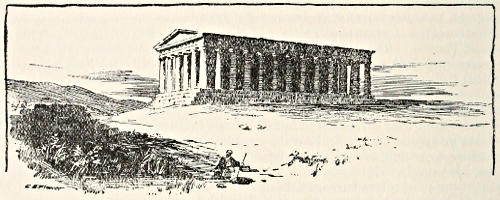
Temple of Theseus, Athens
Our plan obliges us to pass over a great number of wars, expeditions,
and achievements of these ages, which were highly celebrated in heroic song,
not because we deem them to contain less of historical reality than others
which we mention, but because they appear not to have been attended with
any important or lasting consequences. We might otherwise have been
induced to notice the quarrel which divided the royal house of Thebes, and
led to a series of wars between Thebes and Argos, which terminated in the
destruction of the former city, and the temporary expulsion of the Cadmeans,
its ancient inhabitants. Hercules and Theseus undertook their adventures
either alone, or with the aid of a single comrade; but in these Theban wars
we find a union of seven chiefs; and such confederacies appear to have
become frequent in the latter part of the heroic age. So a numerous band
of heroes was combined in the enterprise, which, whatever may have been
its real nature, became renowned as the chase of the Calydonian boar.
Plassmanf suspects that this was in reality a military expedition against
some of the savage Ætolian tribes, and that the name of one of them (the
Aperantii) suggested the legend. We proceed to speak of two expeditions
much more celebrated, conducted like these by a league of independent
chieftains, but directed, not to any part of Greece, but against distant lands;
we mean the voyage of the Argonauts, and the siege of Troy, which will
conclude our review of the mythical period of Grecian history.
The Argonautic expedition, when viewed in the light in which it has
usually been considered, is an event which a critical historian, if he feels
himself compelled to believe it, may think it his duty to notice, but which
he is glad to pass rapidly over as a perplexing and unprofitable riddle. For
even when the ancient legend has been pared down into a historical form,
and its marvellous and poetical features have been all effaced, so that nothing
is left but what may appear to belong to its pith and substance, it becomes
indeed dry and meagre enough, but not much more intelligible than
before. It relates an adventure, incomprehensible in its design, astonishing
in its execution, connected with no conceivable cause, and with no
sensible effect. The narrative, reduced to the shape in which it has often
been thought worthy of a place in history, runs as follows:
In the generation before the Trojan war, Jason, a young Thessalian
prince, had incurred the jealousy of his kinsman Pelias, who reigned at
Iolcus. The crafty king encouraged the adventurous youth to embark in a
maritime expedition full of difficulty and danger. It was to be directed to
a point far beyond the most remote which Greek navigation had hitherto
reached in the same quarter; to the eastern corner of the sea, so celebrated
in ancient times for the ferocity of the barbarians inhabiting its coasts, that
it was commonly supposed to have derived from them the name of “Axenus,”
the inhospitable, before it acquired the opposite name of the “Euxine,” from
the civilisation which was at length introduced by Greek settlers. Here,
in the land of the Colchians, lay the goal, because this contained the prize,
from which the voyage has been frequently called the adventure of the
golden fleece. Jason having built a vessel of uncommon size,—in more
precise terms, the first 50-oared galley his countrymen had ever launched,—and
having manned it with a band of heroes, who assembled from various
parts of Greece to share the glory of the enterprise, sailed to Colchis, where
he not only succeeded in the principal object of his expedition, whatever
this may have been, but carried off Medea, the daughter of the Colchian
king, Æetes.
Though this is an artificial statement, framed to reconcile the main incidents
of a wonderful story with nature and probability, it still contains many
points which can scarcely be explained or believed. It carries us back to a
period when navigation was in its infancy among the Greeks; yet their first
essay at maritime discovery is supposed at once to have reached the extreme
limit, which was long after attained by the adventurers who gradually explored
the same formidable sea, and gained a footing on its coasts. The
success of the undertaking however is not so surprising as the project itself;
for this implies a previous knowledge of the country to be explored, which
it is very difficult to account for. But the end proposed is still more mysterious;
and indeed can only be explained with the aid of a conjecture.
Such an explanation was attempted by some of the later writers among
the ancients, who perceived that the whole story turned on the Golden
Fleece, the supposed motive of the voyage, and that this feature had not a
sufficiently historical appearance. But the mountain torrents of Colchis
were said to sweep down particles of gold, which the natives used to detain
by fleeces dipped in the streams.
This report suggested a mode of translating the fable into historical language.
It was conjectured that the Argonauts had been attracted by the
metallic treasures of the country, and that the Golden Fleece was a poetical
description of the process which they had observed, or perhaps had practised:
an interpretation certainly more ingenious, or at least less absurd,
than those by which Diodorus transforms the fire-breathing bulls which
Jason was said to have yoked at the bidding of Æetes, into a band of Taurians,
who guarded the fleece, and the sleepless dragon which watched over
it, into their commander Draco; but yet not more satisfactory; for it explains
a casual, immaterial circumstance, while it leaves the essential point
in the legend wholly untouched. The epithet “golden,” to which it relates, is
merely poetical and ornamental, and signified nothing more as to the nature
of the fleece than the epithets white or purple, which were also applied to
it by early poets. According to the original and genuine tradition, the
fleece was a sacred relic, and its importance arose entirely out of its connection
with the tragical story of Phrixus, the main feature of which is the
human sacrifice which the gods had required from the house of Athamas.
His son Phrixus either offered himself, or was selected through the artifices
of his stepmother Ino, as the victim; but at the critical moment, as he
stood before the altar, the marvellous ram was sent for his deliverance, and
transported him over the sea, according to the received account, to Colchis,
where Phrixus, on his arrival, sacrificed the ram to Jupiter, as the god who
had favoured his escape; the fleece was nailed to an oak in the grove of
Mars, where it was kept by Æetes as a sacred treasure, or palladium.
But the tradition must have had a historical foundation in some real
voyages and adventures, without which it could scarcely have arisen at all,
and could never have become so generally current as to be little inferior in
celebrity to the tale of Troy itself. If however the fleece had no existence
but in popular belief, the land where it was to be sought was a circumstance
of no moment. In the earlier form of the legend, it might not have been
named at all, but only have been described as the distant, the unknown, land;
and after it had been named, it might have been made to vary with the
gradual enlargement of geographical information. But in this case the voyage
of the Argonauts can no longer be considered as an isolated adventure,
for which no adequate motive is left; but must be regarded, like the expedition
of the Tyrian Hercules, as representing a succession of enterprises,
which may have been the employment of several generations. And this is
perfectly consistent with the manner in which the adventurers are most
properly described. They are Minyans; a branch of the Greek nation,
whose attention was very early drawn by their situation, not perhaps without
some influence from the example and intercourse of the Phœnicians, to
maritime pursuits. The form which the legend assumed was probably determined
by the course of their earliest naval expeditions. They were naturally
attracted towards the northeast, first by the islands that lay before the
entrance of the Hellespont, and then by the shores of the Propontis and its
two straits. Their successive colonies, or spots signalised either by hostilities
or peaceful transactions with the natives, would become the landing-places of
the Argonauts. That such a colony existed at Lemnos, seems unquestionable;
though it does not follow that Euneus, the son of Jason, who is described in
the Iliad as reigning there during the siege of Troy, was a historical personage.
If however it should be asked, in what light the hero and heroine of the
legend are to be viewed on this hypothesis, it must be answered that both
are most probably purely ideal personages, connected with the religion of the
people to whose poetry they belong. Jason was perhaps no other than the
Samothracian god or hero Jasion, whose name was sometimes written in
the same manner, the favourite of Demeter, as his namesake was of Hera,
and the protector of mariners as the Thessalian hero was the chief of the
Argonauts. Medea seems to have been originally another form of Hera herself,
and to have descended, by a common transition, from the rank of a goddess
into that of a heroine, when an epithet had been mistaken for a distinct
name. We have already seen that the Corinthian tradition claimed her as
belonging properly to Corinth, one of the principal seats of the Minyan race.
The tragical scenes which rendered her stay there so celebrated were commemorated
by religious rites, which continued to be observed until the city
was destroyed by the Romans. According to the local legend, she had not
murdered her children; they had been killed by the Corinthians; and the
public guilt was expiated by annual sacrifices offered to Hera, in whose temple
fourteen boys, chosen every twelve-month from noble families, were appointed
to spend a year in all the ceremonies of solemn mourning. But we
cannot here pursue this part of the subject any further. The historical side
of the legend seems to exhibit an opening intercourse between the opposite
shores of the Ægean. If however it was begun by the northern Greeks, it
was probably not long confined to them, but was early shared by those of
the Peloponnesus. It would be inconsistent with the piratical habits of the
early navigators, to suppose that this intercourse was always of a friendly
nature; and it may therefore not have been without a real ground, that
the Argonautic expedition was sometimes represented as the occasion of
the first conflict between the Greeks and Trojans. We therefore pass
by a natural transition out of the mythical circle we have just been tracing,
into that of the Trojan war, and the light in which we have viewed the one
may serve to guide us in forming a judgment on the historical import of the
other.
We have already seen in what manner Eurystheus, the son of Sthenelus,
had usurped the inheritance which belonged of right to Hercules, as the
legitimate representative of Perseus. Sthenelus had reserved Mycenæ and
Tiryns for himself; but he had bestowed the neighbouring town of Midea
on Atreus and Thyestes, the sons of Pelops, and uncles of Eurystheus. On
the death of Hercules, Eurystheus pursued his orphan children from one
place of refuge to another, until they found an asylum in Attica. Theseus
refused to surrender them, and Eurystheus then invaded Attica in person;
but his army was routed, and he himself slain by Hyllus, the eldest son of
Hercules, in his flight through the isthmus. Atreus succeeded to the throne
of his nephew, whose children had been all cut off in this disastrous expedition;
and thus, when his sceptre descended to his son Agamemnon, it conveyed
the sovereignty of an ample realm. While the house of Pelops was
here enriched with the spoils of Hercules, it enjoyed the fruits of his triumphant
valour in another quarter. He had bestowed Laconia on Tyndareus,
the father of Helen; and when Agamemnon’s brother, Menelaus, had
been preferred to all the other suitors of this beautiful princess, Tyndareus
resigned his dominions to his son-in-law. In the meanwhile a flourishing
state had risen up on the eastern side of the Hellespont. Its capital, Troy,
had been taken by Hercules, with the assistance of Telamon, son of Æacus,
but had been restored to Priam, the son of its conquered king, Laomedon,
who reigned there in peace and prosperity over a number of little tribes,
until his son Paris, attracted to Laconia by the fame of Helen’s beauty, abused
the hospitality of Menelaus by carrying off his queen in his absence. All
the chiefs of Greece combined their forces, under the command of Agamemnon,
to avenge this outrage, and sailed with a great armament to Troy.c
Their enterprise, famous for all time as the Trojan War, stands quite by
itself in interest and importance among the traditions of the Heroic Age,
and demands exceptional treatment here.
Historic criticism is almost a pendulum in its motion. Nowhere has
this been more vividly seen than in the attitude of prominent historians
toward the Trojan War and the poetical chronicle of it known as Homer’s
Iliad. Scholarly belief has passed through all imaginable grades of opinion
ranging between a flat denial that there was ever such a place as Troy,
such a war as the Trojan, or such a man as Homer, to an acceptance of them
all with an unquestioning credulity matching that of the early Greeks.
It was textual criticism, the deadly work of the critical scalpel in the
verbal form of the poems that first destroyed the good standing of the Homeric
legend. It is the revivifying work of the pickaxe and shovel in the
actual ground as wielded by the excavator and archæologist that have
brought back the repute of Homer. A few years ago and a Gladstone arguing
for the reality of a Homer and of an Homeric epic was dismissed by the
professor as an old-fashioned ignoramus. To-day almost the same terms
are applied to those who cling to the fashion of yesterday and claim that the
Trojan War and Homer himself are myths. In the new swing of the pendulum,
however, the cautious will still avoid extremes.
What has already been said about the status of Greek myth applies in
the main to the Homeric poems. They are legends doubtless with some
measure of historical foundation, but they cannot be accepted by the critical
student of to-day as historical narratives in the narrow sense. But the
Homeric poems have an interest of quite another kind which gives them a
place apart among the legends of antiquity. This interest centres about
the personality of the author of the Iliad and the Odyssey. From the earliest
historic periods of Grecian life the authorship of the Iliad and Odyssey
was unquestionably ascribed to a poet named Homer. If doubts ever arose
in the mind of any sceptical or critical person as to the reality of Homer,
such doubts were quite submerged by the popular verdict. It was not generally
claimed that Homer himself had written the works ascribed to him,—it
was long held, indeed, that he must have lived at a period prior to the
introduction of writing into Greece,—but that the person whom tradition
loved to speak of as the blind bard had invented and recited his narratives
in toto, and that these, memorised by others, had been brought down through
succeeding generations until they were finally given permanence in writing,
were accepted as the most unequivocal of historical facts.
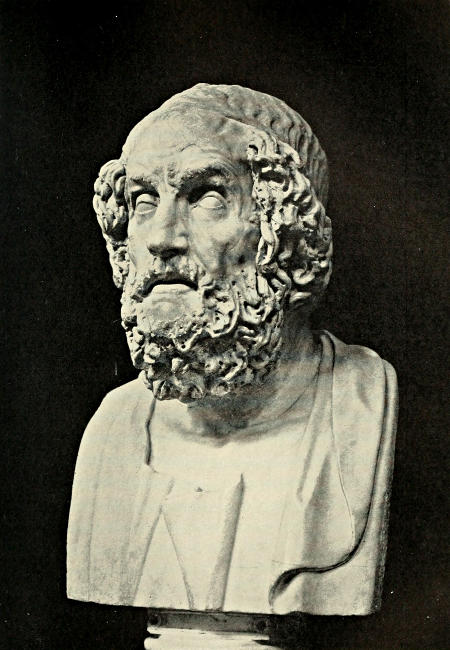
HOMER
But in the latter half of the 18th century, these supposed historical facts
began to be called in question, Wolfk leading the van and holding all
scholarship in terror of his name for nearly a century. Critical students of
Homer were struck with numerous anomalies in his writings that seemed to
them inconsistent with the idea that the Iliad and Odyssey had been composed
at one time and by one person. To cite but a single illustration, it
was noted that the various parts of these poems were not all written in the
same dialect, and it seemed highly improbable that any one person should
have employed different dialects in a single composition. Such a suggestion
as this naturally led to bitter controversies—controversies which have
by no means altogether subsided after the lapse of a century.a Later scholarship
denies the “stratification of language” in the poems.b But the controversy
did not confine itself to the mere question whether such a person as
Homer had lived and written, it came presently to involve also the subject of
the Homeric poems, in particular, of the Iliad.
Certain details aside, the Trojan War had been looked upon as an historical
event, quite as fully credited by the modern historian as it had been by
Alexander when he stopped to offer sacrifices at the site of Troy. But now
the iconoclastic movement being under way there was a school of students
who openly maintained that the whole recital, by whomsoever written, was
nothing but a fable which the historian must utterly discard. It was even
questioned whether such a place as Troy had ever existed. Such a scepticism
as this seemed, naturally enough, a clear sacrilege to a large body of
scholars, but for several generations no successful efforts were made to meet
it with any weapons more tangible than words. Then came a champion of
the historical verity of the Homeric narrative who set to work to prove his
case in the most practical way. Curiously enough the man who thus championed
the cause of the closet scholars and poets and visionaries was himself
a practical man of affairs, no less experienced and no less successful in
dealing with the affairs of an everyday business than had been the man from
whom the iconoclastic movement had gained its chief support. This man
was also a German, Heinrich Schliemann.l
Having amassed a fortune, the income from which was more than sufficient
for all his needs, he retired from active business and devoted the
remainder of his life to a self-imposed task, which had been an ambition
with him all his life, the search, namely, for the site of Ancient Troy. How
well he succeeded all the world knows. But in opposition to the opinions
of many scholars he selected the hill of Hissarlik as the site of ancient
Ilium, and his excavations there soon demonstrated that at least it had been
the site not of one alone but of at least seven different cities in antiquity—one
being built above the ruins of another at long intervals of time. One
of these cities, the sixth from the top,—or to put it otherwise, the most
ancient but one,—was, he became firmly convinced, Ilium itself.
The story of his achievements cannot be told here in detail, and it is
necessary to point the warning that Dr. Schliemann’s excavations—wonderful
as are their results—do not, perhaps, when critically viewed, demonstrate
quite so much as might at first sight appear. There is, indeed, a high
degree of probability that the city which he excavated was really the one
intended in the Homeric descriptions, but it must be clear to any one who
scrutinises the matter somewhat closely, that this fact goes but a little way
towards substantiating the Homeric narrative as a whole. The city of
Ilium may have existed without giving rise to any such series of events as
that narrated in the Iliad. Dr. Schliemann himself was led to realise this
fact, and to modify somewhat in later years the exact tenor of some of his
more enthusiastic earlier views, yet the fact remains that the excavations at
Hissarlik must be reckoned with by whoever in future discusses the status
of the Homeric story.
This is not the place to enter into a statement of the multitudinous
phases scepticism has taken in dealing with the Trojan legend. The story,
whether pure fancy, as some have thought it, or a dramatised and romantic
version of actual history, is indispensable to any chronicle of Greece or of
Grecian influence.a Taking Homer as a basis, it may be outlined as follows:
The Town of Troy
The origin of Dardanus, founder of the Trojan state, has been very variously
related; but the testimony of Homer to the utter uncertainty of his
birth and native country, delivered in the terms that he was the son of
Jupiter, may seem best entitled to belief. Thus however it appears that the
Greeks not unwillingly acknowledged consanguinity with the Trojans; for
many, indeed most, of the Grecian heroes also claimed their descent from
Jupiter. It is moreover remarkable that, among the many genealogies which
Homer has transmitted, none is traced so far into antiquity as that of the
royal family of Troy. Dardanus was ancestor in the sixth degree to Hector,
and may thus have lived from a hundred and fifty to two hundred years
before that hero. On one of the many ridges projecting from the foot of
the lofty mountain of Ida in the northwestern part of Asia Minor, he
founded a town, or perhaps rather a castle, which from his own name was
called Dardania.
The situation commanded the narrow but highly fruitful plain, watered
by the streams of Simois and Scamander, and stretching from the roots of
Ida to the Hellespont northward, and the Ægean Sea westward. His son
Erichthonius, who succeeded him in the sovereignty of this territory, had
the reputation of being the richest man of his age. Much of his wealth
seems to have been derived from a large stock of brood mares, to the number,
according to the poet, of three thousand, which the fertility of his soil
enabled him to maintain, and which by his care and judgment in the choice
of stallions produced a breed of horses superior to any of the surrounding
countries. Tros, son of Erichthonius, probably extended, or in some other
way improved, the territory of Dardania; since the appellation by which it
was known to posterity was derived from his name. With the riches the
population of the state of course increased. Ilus, son of Tros, therefore, venturing
to move his residence from the mountain, founded, on a rising ground
beneath, that celebrated city called from his name Ilion [or Ilium], but more
familiarly known in modern languages by the name of Troy, derived from
his father.
Twice before that war which Homer has made so famous Troy is said to
have been taken and plundered: and for its second capture by Hercules, in
the reign of Laomedon, son of Ilus, we have Homer’s authority. The government
however revived, and still advanced in power and splendour.
Laomedon after his misfortune fortified the city in a manner so superior to
what was common in his age that the walls of Troy were said to be a work
of the gods. Under his son Priam, the Trojan state was very flourishing and
of considerable extent; containing, under the name of Phrygia, the country
afterwards called Troas, together with both shores of the Hellespont and the
large and fertile island of Lesbos.
A frequent communication, sometimes friendly, but oftener hostile, was
maintained between the eastern and western coasts of the Ægean Sea; each
being an object of piracy more than of commerce to the inhabitants of the
opposite country. Cattle and slaves constituting the principal riches of the
times, men, women, and children, together with swine, sheep, goats, oxen,
and horses, were principal objects of plunder. But scarcely was any crime
more common than rapes; and it seems to have been a kind of fashion, in
consequence of which the leaders of piratical expeditions gratified their vanity
in the highest degree when they could carry off a lady of superior rank.
How usual these outrages were among the Greeks, may be gathered from
the condition said to have been exacted by Tyndareus, king of Sparta, father
of the celebrated Helen, from the chieftains who came to ask his daughter
in marriage; he required of all, as a preliminary, to bind themselves by solemn
oaths that, should she be stolen, they would assist with their utmost
power to recover her. This tradition, with many other stories of Grecian
rapes, on whatsoever founded, indicates with certainty the opinion of the
later Greeks, among whom they were popular, concerning the manners of
their ancestors. But it does not follow that the Greeks were more vicious
than other people equally unhabituated to constant, vigorous, and well-regulated
exertions of law and government. Equal licentiousness but a few
centuries ago prevailed throughout western Europe. Hence those gloomy
habitations of the ancient nobility, which excite the wonder of the traveller,
particularly in the southern parts, where, in the midst of the finest countries,
he often finds them in situations so very inconvenient and uncomfortable,
except for what was then the one great object, security, that now the houseless
peasant will scarcely go to them for shelter. From the licentiousness
were derived the manners, and even the virtues, of the times; and hence
knight-errantry with its whimsical consequences.
Paris and Helen
The expedition of Paris, son of Priam king of Troy, into Greece, appears
to have been a marauding adventure, such as was then usual. It is said
indeed that he was received very hospitably, and entertained very kindly, by
Menelaus king of Sparta. But this also was consonant to the spirit of the
times; for hospitality has always been the virtue of barbarous ages: it is at
this day no less characteristical of the wild Arabs than their spirit of robbery;
and in the Scottish highlands we know robbery and hospitality flourished
together till very lately. Hospitality indeed will be generally found in different
ages and countries very nearly in proportion to the need of it; that is, in proportion
to the deficiency of jurisprudence, and the weakness of government.
Paris concluded his visit at Sparta with carrying off Helen, wife of Menelaus,
together with a considerable treasure: and whether this was effected by
fraud, or as some have supposed, by open violence, it is probable enough
that as Herodotus relates, it was first concerted, and afterward supported, in
revenge for some similar injury done by the Greeks to the Trojans.
An outrage however so grossly injurious to one of the greatest princes of
Greece, especially if attended with a breach of the rights of hospitality,
might not unreasonably be urged as a cause requiring the united revenge of
all the Grecian chieftains. But there were other motives to engage them
in the quarrel. The hope of returning laden with the spoil of the richer
provinces of Asia was a strong incentive to leaders poor at home, and bred
to rapine. The authority and influence of Agamemnon, king of Argos,
brother of Menelaus, were also weighty. The spirit of the age, his own
temper, the extent of his power, the natural desire of exerting it on a
splendid occasion, would all incite this prince eagerly to adopt his brother’s
quarrel. He is besides represented by character qualified to create and
command a powerful league; ambitious, active, brave, generous, humane;
vain indeed and haughty, sometimes to his own injury; yet commonly repressing
those hurtful qualities, and watchful to cultivate popularity. Under this
leader all the Grecian chieftains from the end of Peloponnesus to the end of
Thessaly, together with Idomeneus from Crete, and other commanders
from some of the smaller islands, assembled at Aulis, a seaport of Bœotia.
The Acarnanians alone, separated from the rest of Greece by lofty mountains
and a sea at that time little navigated, had no share in the expedition.
The Siege of Troy
A story acquired celebrity in aftertimes, that, the fleet being long detained
at Aulis by contrary winds, Agamemnon sacrificed his daughter
Iphigenia as a propitiatory offering to obtain from the gods a safe and speedy
passage to the Trojan coast. To the credit of his character however it is
added that he submitted to this abominable cruelty with extreme reluctance,
compelled by the clamours of the army, who were persuaded that the gods
required the victim; nor were there wanting those who asserted that by a
humane fraud the princess was at last saved, under favour of a report that a
fawn was miraculously sent by the goddess Diana to be sacrificed in her
stead. Indeed the story, though of such fame, and so warranted by early
authorities, that some notice of it seemed requisite, wants, it must be confessed,
wholly the best authentication for matters of that very early age; for
neither Homer, though he enumerates Agamemnon’s daughters, nor Hesiod,
who not only mentions the assembling of the Grecian forces under his command
at Aulis, but specifies their detentions by bad weather, has left one
word about so remarkable an event as this sacrifice.
The fleet at length had a prosperous voyage. It consisted of about
twelve hundred open vessels, each carrying from fifty to a hundred and
twenty men. The number of men in the whole armament, computed from
the mean of those two numbers mentioned by Homer as the complement of
different ships, would be something more than a hundred thousand; and
Thucydides, whose opinion is of the highest authority, has reckoned this
within the bounds of probability; though a poet, he adds, would go to the
utmost of current reports. The army, landing on the Trojan coast, was immediately
so superior to the enemy as to oblige them to seek shelter within
the city walls: but here the operations were at a stand. The hazards to
which unfortified and solitary dwellings were exposed from pirates and freebooters
had driven the more peaceable of mankind to assemble in towns for
mutual security. To erect lofty walls around those towns for defence was
then an obvious resource, requiring little more than labour for the execution.
More thought, more art, more experience were necessary for forcing the
rudest fortification, if defended with vigilance and courage. But the Trojan
walls were singularly strong: Agamemnon’s army could make no impression
upon them. He was therefore reduced to the method most common for ages
after, of turning the siege into a blockade, and patiently waiting till want of
necessaries should force the enemy to quit their shelter. But neither did
the policy of the times amount by many degrees to the art of subsisting so
numerous an army for any length of time, nor would the revenues of Greece
have been equal to it with more knowledge, nor indeed would the state of
things have admitted it, scarcely with any wealth, or by any means. For in
countries without commerce, the people providing for their own wants only,
supplies cannot be found equal to the maintenance of a superadded army.
No sooner therefore did the Trojans shut themselves within their walls than
the Greeks were obliged to give their principal attention to the means of
subsisting their numerous forces. The common method of the times was to
ravage the adjacent countries; and this was immediately put in practice.
But such a resource soon destroys itself. To have therefore a more permanent
and certain supply, a part of their army was sent to cultivate the
vales of the Thracian Chersonesus, then abandoned by the inhabitants on
account of the frequent and destructive incursions of the wild people who
occupied the interior of that continent.
Large bodies being thus detached from the army, the remainder scarcely
sufficed to deter the Trojans from taking the field again, and could not prevent
succour and supplies from being carried into the town. Thus the siege
was protracted to the enormous length of ten years. It was probably their
success in marauding marches and pirating voyages that induced the Greeks
to persevere so long. Achilles is said to have plundered no less than twelve
maritime and eleven inland towns. Lesbos, then under the dominion of the
monarch of Troy, was among his conquests; and the women of that island
were apportioned to the victorious army as a part of the booty. But these
circumstances alarming all neighbouring people contributed to procure
numerous and powerful allies to the Trojans. Not only the Asiatic states,
to a great extent eastward and southward, sent auxiliary troops, but also
the European, westward, as far as the Pæonians of that country about the
river Axius, which afterwards became Macedonia.
At length, in the tenth year of the war, after great exertions of valour
and the slaughter of numbers on both sides, among whom were many of the
highest rank, Troy yielded to its fate. Yet was it not then overcome by
open force; stratagem is reported by Homer; fraud and treachery have been
supposed by later writers. It was, however, taken and plundered: the venerable
monarch was slain: the queen and her daughters, together with only one
son remaining of a very numerous male progeny, were led into captivity.
According to some, the city was totally destroyed, and the survivors of the
people so dispersed that their very name was from that time lost. But the
tradition supported by better authority, and in no small degree by that of
Homer himself, whose words upon the occasion seem indeed scarcely doubtful,
is, that Æneas and his posterity reigned over the Trojan country and
people for some generations; the seat of government however being removed
from Troy to Scepsis: and Xenophon has marked his respect for this tradition,
ascribing the final ruin of the Trojan state and name to that following
inundation of Greeks called the Æolic emigration.
Agamemnon’s Sad Home-coming
Agamemnon, we are told, triumphed over Troy; and the historical evidence
to the fact is large. But the Grecian poets themselves universally
acknowledge that it was a dear-bought, a mournful triumph. Few of the
princes, who survived to partake of it, had any enjoyment of their hard-earned
glory in their native country. None expecting that the war would
detain them so long from home, had made due provision for the regular
administration of their affairs during such an absence. It is indeed probable
that the utmost wisdom and forethought would have been unequal to the
purpose. For, in the half-formed governments of those days, the constant
presence of the prince as supreme regulator was necessary towards keeping
the whole from running presently into utter confusion. Seditions and revolutions
accordingly remain recorded almost as numerous as the cities of
Greece. Many of the princes on their return were compelled to embark
again with their adherents, to seek settlements in distant countries. A more
tragical fate awaited Agamemnon. His queen, Clytemnestra, having given
her affection to his kinsman Ægisthus, concurred in a plot against her husband,
and the unfortunate monarch on his return to Argos was assassinated;
those of his friends who escaped the massacre were compelled to fly with his
son Orestes; and, so strong was the party which their long possession of the
government had enabled the conspirators to form, the usurper obtained complete
possession of the throne. Orestes found refuge at Athens; where alone
among the Grecian states there seems to have been then a constitution capable
of bearing both the absence and the return of the army and its commander
without any essential derangement.
Such were the Trojan war and its consequences, according to the best of
the unconnected and defective accounts remaining, among which those of
Homer have always held the first rank. In modern times, as we have seen,
the authority of the great poet as an historian has been more questioned. It
is of highest importance to the history of the early ages that it should have
its due weight; and it may therefore be proper to mention here some of the
circumstances which principally establish its authority; others will occur
hereafter. It should be observed then that in Homer’s age poets were the
only historians; whence, though it does not at all follow that poets would so
adhere to certain truth as not to introduce ornament, yet it necessarily follows
that veracity in historical narration would make a large share of a
poet’s merit in public opinion, a circumstance which the common use of
written records and prose histories instantly and totally altered. The probability
and the very remarkable consistency of Homer’s historical anecdotes,
variously dispersed as they are among his poetical details and embellishments,
form a second and powerful testimony. Indeed, the connection and
the clearness of Grecian history, through the very early times of which
Homer has treated, appear very extraordinary when compared with the darkness
and uncertainty that begin in the instant of our losing his guidance,
and continue through ages.h
In the tales of Grecian mythology a great difference is apparent between
the earlier and later centuries of the heroic age. They show us a considerable
progress in culture during the course of the period. The legends
of Perseus, Hercules, and Theseus, or of the battle of the Lapithæ and
Centauri, depict the early Greeks as a half wild race tormented by fierce
animals, robbers, and tyrants. Giants, fearful snakes, and other monsters,
also adventures in the nether world, often appear in these legends, and the
Grecians seem to be engaged in a battle with the wildness of nature and
with their own crudity. The same land appears utterly different in the
legends and poems of the Trojan war and the other events of the later
heroic age. In these legends the manners of the Greeks are represented as
friendlier and more peaceful, and, with a few exceptions, we find no more
real miracles, but everything points to a quieter time and a more orderly
state of affairs.
We have a poetical, yet essentially faithful, description of these last
centuries in the Iliad and Odyssey, the two oldest extant Grecian literary
works. Both poems are, besides the recital of a part of the heroic legends,
a true picture of the customs, the conquering spirit, and the domestic as
well as public life of the Greeks at the time of the Trojan war and immediately
after it. The Grecians at that time do not seem to have been a very
numerous people. They lived in small states, with central cities in active
intercourse with one another, not differing much in their ways of life,
customs, and language. They were a rustic, warlike race, who rejoiced in
simple customs and led a happy existence under a friendly sky. The similarity
of religion, language, and customs made the Greeks of that time, as it
were, members of a great organism, holding together although divided into
many tribes and states. At the end of the heroic age some of the tribes
were brought even closer together by near relationship and by means of
temples and feasts in common. But the link that held them all together
had not as yet become a clear conviction; therefore, so far there was no
joint name for the Greek nation.
Agriculture and cattle raising were the principal occupations of the
people. Besides this they had few industries. Other sources of wealth
were the chase, fishing, and war. The agriculture consisted of corn and
wine-growing and horticulture. The ox was the draught animal, donkeys
and mules were used for transport, horses were but seldom used for riding,
but they drew the chariots in time of war. The herds consisted principally
of cattle, sheep, goats, and pigs. Slaves were used for the lower work.
These were purchased from sea-robbers, obtained in victorious wars, or born
in the house. They had a knowledge of navigation, although their ships
generally had no decks, and were worked more by means of oars than sails.
There was no commerce on a large scale; war and piracy served instead as a
means of obtaining riches. Many metals were known; they used iron, the
working of which was still difficult. Coinage was not used at all, or, at all
events, very little. Weaving was the work of women; the best woven
stuffs, however, were obtained from the Phœnicians, who were the reigning
commercial people of the Grecian seas. They made various kinds of arms,
which were in part of artistic workmanship, ornaments and vessels of metal,
ivory, clay, and wood. The descriptions of these objects show that the taste
for plastic art, that is, the representation of beautiful forms, was already
awakened among them. They possessed further a knowledge of architecture;
towns and villages are mentioned, also walls with towers and gates.
The houses of princes were built of stone; they contained large and lofty
rooms, as well as gardens and halls.
Caste was unknown to the Grecians. The people in the heroic age, to be
sure, consisted of nobles and commons, but the latter took part in all public
affairs of importance, and the privileges of the former did not rest upon
their birth alone; an acquisition of great strength, bravery, and adroitness
was also necessary—virtues which are accessible to all. The difference between
the two classes was, therefore, not grounded, like the oriental establishment
of caste, on superstition and deception, but on the belief that certain
families possessed bodily strength and warlike abilities, and were therefore
appointed by the gods as protectors of the country; that their only right to
superiority over others lay in their actual greater capacity for ruling and
fighting.
The system of government was aristocratic monarchy, supported by the
personal feelings and co-operative opinions of all free men. The state was
thus merely a warlike assembly of vigorous men, consisting of nobles and
freemen, having a leader at their head. The latter was bound to follow the
decisions of the nobility, and in important affairs had to ask the consent of
the people.
The king was only the first of the nobility, and the only rights he possessed
which were not shared by them was that of commander in battle and
high priest. Therefore, if he wished to excel others as real ruler, everything
depended on his personality; he had to surpass others in riches, bodily
strength, bravery, discernment, and experience. The king brought the
sacrifice to the gods for the totality and directed the religious ceremonies.
He also sat in judgment, but mostly in company with experienced old men
from the nobility, being really arbitrator and protector of the weak against
the strong; for if no plaintiff appeared there was no trial at the public
judgment-seat. It was the king’s duty to offer hospitality to the ambassadors
of other states and to be hospitable to strangers generally. His revenues
consisted only of the voluntary donations of his subjects, of a larger
share in the spoils of war, and of the produce of certain lands assigned to
him. The only signs of his royalty were the sceptre and the herald that
went before him. He took the first place at all assemblies and feasts, and
at the sacrificial repasts he received a double helping of food and drink.
He was addressed in terms of veneration, but otherwise one associated with
him as with any other noble, and there was no trace of the oriental forms
of homage towards kings among the ancient Greeks.
The nobility was composed of men of certain families to whom especial
strength and dexterity were attributed as hereditary prerogatives; they
sought to keep these up by means of knightly practices and to prove them
on the battle-field. As has already been said, they took part in the government
of the country. The common people or free citizens of the second
class were assembled on all important occasions, to give their votes for peace
or war, or any other matter of importance. The assemblies of the people
described in the Iliad and Odyssey show the same general participation in
public affairs and that lively activity which later reached such a high development
in the Grecian republics. Beside this, at that time bravery and
strength showed what every man was worth, and still more than mere bodily
strength, experience, eloquence, and a judicious insight into life and its circumstances
brought to any one honour and importance.
In time of war the decision depended more upon the bravery of the kings
and nobles than upon the fighting of the people, who arranged themselves in
close masses on the battle-field. The chiefs were not trained to be generals
or leaders, but rather brave and skilled fighters. Swiftness in running,
strength and certainty in throw, and skill in wrestling as in the use of arms,
of the lance and the sword, were the most important items. Every leader
had his own chariot, with a young companion by his side to hold the reins,
while he himself fought with a javelin. The fortifications of the towns consisted
of a trench and a wall with towers. As yet they had no knowledge
of how to conduct a siege. They knew of no implement which would serve
in the taking of a town.
Music and poetry played an important part in the lives of these warlike
people. These were inseparable from their meals, their feasts, and military
expeditions. The lyre, the flute, and the pipe were the musical instruments
in the heroic age; the trumpet was not used until the end of that time.
Flute and pipe were the instruments of shepherds and peasants. The lyre,
on the other hand, was played by poets and singers and even by many of
the kings and nobles, and always served as the accompaniment of songs.
The subjects of their songs were the deeds of living or past heroes. There
were singers or bards who composed these songs and sang them while men
stood round to listen and these bards were held in great esteem.
Religion and politics were closely connected; but there was no trace of
a priesthood with predominant influence. The king was the director of
sacrifices, the presence of a priest not being required. There already existed,
to be sure, besides the ancient oracle of Dodona, the oracle of Delphi in
Phocis, which became so celebrated at a later period; but neither had any
great influence in the heroic age. On the other hand, there were so-called
soothsayers, who were supposed to possess much wisdom and at the same
time a kind of association with the gods. For this reason they were consulted,
so as to foretell the results of important undertakings, and to discover
the cause of general misfortunes as well as a means of removing them.
The most renowned of these men were Orpheus, who played the part of
prophet in the expedition of the Argonauts; Amphiaraus, who joined the
expedition of the Seven against Thebes in the same character; Tiresias,
who was the prophet of the Thebans both at that time and in
the war of the Epigoni; and lastly Calchas, the soothsayer
of the Greeks in the Trojan war. Even these
men had no influence to be compared
with the oriental priesthood.
They were really only looked upon
as pacifiers of the outraged godhead
and as advisers; their soothsayings
were not always respected,
and when their prophecies were
unsatisfactory they had to face
the anger of those in power.
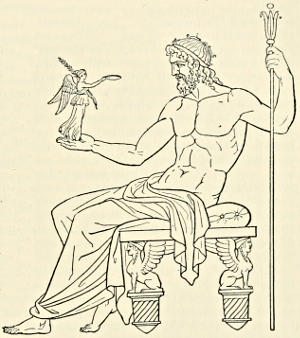
Zeus
(From a Greek Statue)
The religious belief of the heroic
age was the origin of the later
national religion. It sprang probably
from various sources. Therefore
it cannot be distinguished by
any special belief like that of the
Indians and Egyptians. The religion
of the Greeks was never a
perfected system and therefore
not free from contradictions,
especially as oriental
conceptions were introduced
into it from ancient
times. The Grecians of
this time believed heaven,
or rather the summit of the towering Mount Olympus, to be inhabited
by beings, like the earth; they imagined that these beings resembled human
beings in appearance and inner nature, but with the difference that they
ascribed to them invisibility, greater strength, freedom from the barriers of
mortality, and a powerful influence over earthly things. The life of the
gods, according to the representation of the heroic age, only differed from
that of men in the fact that it had a more beautiful colouring and higher
pleasures. They therefore looked upon the gods as personal beings and had
that form of religion known as anthropomorphism, the essential characteristic
of which is the belief that the gods resemble men. But joined in an inexplicable
manner with this view, was the idea that the gods were at the same
time natural phenomena and powers of nature. For instance Zeus, the king
and ruler in the kingdom of the gods, was also regarded as the god of the
atmosphere; Apollo of the sun; Poseidon the god of the sea; and the woods,
wells, valleys, and hills were believed to be inhabited by divine beings called
nymphs.
The king offered sacrifice for the people and every father for his house and
family. The religious ceremonies consisted chiefly of sacrifices and prayers.
There were but few temples, but on the other hand every town had a piece of
land set apart, on which there was an altar. They did not feel bound to these
holy places for the worship of the gods, but often built an altar on some spot
in the open field for prayer and sacrifice. The sacrifice consisted in burning
some pieces of flesh to the gods and the pouring of wine into the fire; while
the rest was consumed at a general and merry feast. Even the appointed
religious feast days had quite a festive colouring: they feasted, drank, joked,
held tournaments, and listened while bards sang of the deeds of heroes. There
was no trace to be found among the religious ceremonies of the heroic Greeks
of that wild, intoxicating character which generally existed at the feasts of
the oriental people.
This was how the character of the later Grecian heroic age was formed.
They were a vigorous people, with warlike tastes and simple customs, living
under a mild heaven. All took part in public affairs, all were free, and, in
spite of a certain inequality among them, they were all connected; and
divided by no great contrasts in education, the community felt no kind of
oppression. The limited population of the country and the possession of
slaves permitted a careless and merry way of life. Rough work was unknown
to the greater part of the populace. They exercised their bodies
and steeled their strength with warlike undertakings, hunting, practice with
arms, and wrestling. Their mental intelligence was directed to higher
things through religious customs and soothsayers, and developed rapidly by
means of the merry association of the nobility, frequent consultations about
public affairs, and mutual military expeditions; and, above all, by means of
the poetical stories related by the bards, who put into pleasant form what all
felt, and were the real teachers of a higher mental culture; and lastly by
means of the elevating power of music.
The Greek, under his bright heaven, looked upon life in the kind sunlight
of the upper world as a real life; but that of the lower regions seemed to him,
even if he obtained the greatest honours, and reigned like Achilles “over the
entire dead as king,” only a sombre picture as compared with the upper world:
he loved life and did not throw it ostentatiously away, where there was no
necessity. He did not look upon flying from a stronger foe as disgrace;
swiftness of foot was regarded by him as a heroic merit, like cunning and a
mighty arm.d
If we endeavour to ascertain the extent of Homer’s geographical knowledge,
we find ourselves almost confined to Greece and the Ægean. Beyond
this circle all is foreign and obscure: and the looseness with which he describes
the more distant regions, especially when contrasted with his accurate delineation
of those which were familiar to him, indicates that as to the others he
was mostly left to depend on vague rumours, which he might mould at his
pleasure. In the catalogue indeed of the Trojan auxiliaries, which probably
comprises all the information which the Greeks had acquired concerning that
part of the world at the time it was composed, the names of several nations
in the interior of Asia Minor are enumerated. The remotest are probably
the Halizonians of Alyba, whose country may, as Strabo supposes, be that of
the Chaldeans on the Euxine. On the southern side of the peninsula the
Lycians appear as a very distant race, whose land is therefore a fit scene for
fabulous adventures: on its confines are the haunts of the monstrous Chimæra,
and the territory of the Amazons: farther eastward the mountains of the
fierce Solymi, from which Poseidon, on his return from the Ethiopians,
descries the bark of Ulysses sailing on the western sea. These Ethiopians
are placed by the poet at the extremity of the earth; but as they are visited
by Menelaus in the course of his wanderings, they must be supposed to
reach across to the shores of the inner sea, and to border on the Phœnicians.
Ulysses describes a voyage which he performed in five days, from Crete to
Egypt: and the Taphians, though they inhabit the western side of Greece,
are represented as engaged in piratical adventures on the coast of Phœnicia.
But as to Egypt, it seems clear that the poet’s information was confined to
what he had heard of a river Ægyptus, and a great city called Thebes.
On the western side of Europe, the compass of his knowledge seems to be
bounded by a few points not very far distant from the coast of Greece. The
northern part of the Adriatic he appears to have considered as a vast open
sea. Farther westward, Sicily and the southern extremity of Italy are represented
as the limits of all ordinary navigation. Beyond lies a vast sea,
which spreads to the very confines of nature and space. Sicily itself, at least
its more remote parts, is inhabited by various races of gigantic cannibals:
whether, at the same time, any of the tribes who really preceded the Greeks
in the occupation of the island were known to be settled on the eastern side,
is not certain, though the Sicels and Sicania are mentioned in the Odyssey.
Italy, as well as Greece, appears, according to the poet’s notions, to be
bounded on the north by a formidable waste of waters.
When we proceed to inquire how the imagination of the people filled up
the void of its experience, and determined the form of the unknown world,
we find that the rudeness of its conceptions corresponds to the scantiness of
its information. The part of the earth exposed to the beams of the sun was
undoubtedly considered, not as a spherical, but as a plane surface, only varied by
its heights and hollows; and, as little can it be doubted, that the form of this
surface was determined by that of the visible horizon. The whole orb is girt
by the ocean, not a larger sea, but a deep river, which, circulating with constant
but gentle flux, separates the world of light and life from the realms
of darkness, dreams, and death. No feature in the Homeric chart is more
distinctly prominent than this: hence the divine artist terminates the shield of
Achilles with a circular stripe, representing “the mighty strength of the river
Ocean,” and all the epithets which the poet applies to it are such as belong
exclusively to a river. Homer describes all the other rivers, all springs and
wells, and the salt main itself, as issuing from the ocean stream, which might
be supposed to feed them by subterraneous channels. Still it is very difficult
to form a clear conception of this river, or to say how the poet supposed
it to be bounded. Ulysses passes into it from the western sea; but whether
the point at which he enters is a mouth or opening, or the two waters are
only separated by an invisible line, admits of much doubt. On the farther
side however is land: but a land of darkness, which the sun cannot pierce,
a land of Cimmerians, the realm of Hades, inhabited by the shades of the
departed, and by the family of dreams. As to the other dimensions of
the earth, the poet affords us no information, and it would be difficult to decide
whether a cylinder or a cone approaches nearest to the figure which
he may have assigned to it: and as little does he intimate in what manner
he conceives it to be supported. But within it was hollowed another vast
receptacle for departed spirits, perhaps the proper abode of Hades. Beneath
this, and as far below the earth as heaven was above it, lay the still more
murky pit of Tartarus, secured by its iron gates and brazen floor, the
dungeon reserved by Jupiter for his implacable enemies.
Some of the epithets which Homer applies to the heaven, seem to imply
that he considered it as a solid vault of metal. But it is not necessary to
construe these epithets so literally, nor to draw any such inference from
his description of Atlas, who “holds the lofty pillars which keep earth and
heaven asunder.” Yet it would seem, from the manner in which the height
of heaven is compared with the depth of Tartarus, that the region of light
was thought to have certain bounds. The summit of the Thessalian Olympus
was regarded as the highest point on the earth, and it is not always carefully
distinguished from the aerian regions above. The idea of a seat of the
gods,—perhaps derived from a more ancient tradition, in which it was not
attached to any geographical site,—seems to be indistinctly blended in the
poet’s mind with that of a real mountain. Hence Hephæstus, when hurled
from the threshold of Jupiter’s palace, falls “from morn to noon, from noon
to dewy eve,” before he drops on Lemnos; and Jupiter speaks of suspending
the earth by a chain from the top of Olympus.
A wider compass of geographical knowledge, and more enlarged views
of nature, would scarcely have been consistent with the state of navigation
and commerce which the Homeric poems represent. The poet expresses the
common feelings of an age when the voyages of the Greeks were mostly confined
to the Ægean. The vessels of the heroes, and probably of the poet’s
contemporaries, were slender half-decked boats: according to the calculation
of Thucydides, who seems to suspect exaggeration, the largest contained
one hundred and twenty men, the greatest number of rowers mentioned in
the catalogue: but we find twenty rowers spoken of as a usual complement of
a good ship. The mast was movable, and was only hoisted to take advantage
of a fair wind, and at the end of a day’s voyage was again deposited in its
appropriate receptacle. In the day-time, the Greek mariner commonly followed
the windings of the coasts, or shot across from headland to headland,
or from isle to isle: at night his vessel was usually put into port, or hauled
up on the beach; for though on clear nights he might prosecute his voyage
as well as by day, yet should the sky be overcast his course was inevitably
lost. Engagements at sea are never mentioned by Homer, though he so frequently
alludes to piratical excursions. They were probably of rare occurrence:
but as they must sometimes have been inevitable, the galleys were
provided with long poles for such occasions. The approach of winter put a
stop to all ordinary navigation. Hesiod fixes the time for laying up the merchant
ship, covering it with stones, taking out the rigging, and hanging the
rudder up by the fire. According to him, the fair season lasts only fifty days:
some indeed venture earlier to sea, but a prudent man will not then trust his
substance to the waves.
The practical astronomy of the early Greeks consisted of a few observations
on the heavenly bodies, the appearances of which were most conspicuously
connected with the common occupations of life. The succession of light
and darkness, the recurring phases of the moon, and the vicissitude of the
seasons, presented three regular periods of time, which, though all equally
forced on the attention, were not all marked with equal distinctness by sensible
limits. From the first, and down to the age of Solon, the Greeks seem
to have measured their months in the natural way, by the interval between
one appearance of the new moon and the next. Hence, their months were
of unequal duration; yet they might be described in round numbers as consisting
of thirty days. It was soon observed that the revolutions of the
moon were far from affording an exact measure of the apparent annual
revolution of the sun, and that if this were taken to be equal to twelve of
the former, the seasons would pass in succession through all the months of
the year. This in itself would have been no evil, and would have occasioned
no disturbance in the business of life. Seen under the Greek sky, the stars
were scarcely less conspicuous objects than the moon itself: some of
the most striking groups were early observed and named, and served, by
their risings and settings, to regulate the labours of the husbandman and
the adventures of the seaman.
Commerce appears in Homer’s descriptions to be familiar enough to the
Greeks of the heroic age, but not to be held in great esteem. Yet in the
Odyssey we find the goddess, who assumes the person of a Taphian chief,
professing that she is on her way to Temesa with a cargo of iron to be
exchanged for copper: and in the Iliad, Jason’s son, the prince of Lemnos,
appears to carry on an active traffic with the Greeks before Troy. He
sends a number of ships freighted with wine, for which the purchasers pay,
some in copper, some in iron, some in hides, some in cattle, some in slaves.
Of the use of money the poet gives no hint, either in this description or
elsewhere. He speaks of the precious metals only as commodities, the value
of which was in all cases determined by weight. The Odyssey represents
Phœnician traders as regularly frequenting the Greek ports; but as Phœnician
slaves are sometimes brought to Greece, so the Phœnicians do not
scruple, even where they are received as friendly merchants, to carry away
Greek children into slavery.
The general impression which the Homeric pictures of society leave on
the reader is, that many of the useful arts,—that is, those subservient to
the animal wants or enjoyments of life,—had already reached such a stage
of refinement as enabled the affluent to live, not merely in rude plenty, but
in a considerable degree of luxury and splendour. The dwellings, furniture,
clothing, armour, and other such property of the chiefs, are commonly described
as magnificent, costly, and elegant, both as to the materials and
workmanship. We are struck, not only by the apparent profusion of the
precious metals and other rare and dazzling objects in the houses of the
great, but by the skill and ingenuity which seem to be exerted in working
them up into convenient and graceful forms. Great caution, however, is
evidently necessary in drawing inferences from these descriptions as to the
state of the arts in the heroic ages. The poet has treasures at his disposal
which, as they cost him nothing, he may scatter with an unsparing hand.
The shield made by Hephæstus for Achilles cannot be considered as a specimen
of the progress of art, since it is not only the work of a god, but is
fabricated on an extraordinary occasion, to excite the admiration of men. It
is clear that the poet attributes a superiority to several Eastern nations, more
especially to the Phœnicians, not only in wealth, but in knowledge and skill,
that, compared with their progress, the arts of Greece seem to be in their
infancy. The description of a Phœnician vessel, which comes to a Greek
island freighted with trinkets, and of the manner in which a lady of the
highest rank, and her servants, handle and gaze on one of the foreign ornaments,
present the image of such a commerce as Europeans carry on with
the islanders of the South Sea. It looks as if articles of this kind, at least,
were eagerly coveted, and that there were no means of procuring them
at home.
It is possible that Homer’s pictures of the heroic style of living may be
too highly coloured, but there is reason to believe that they were drawn
from the life. He may have been somewhat too lavish of the precious
metals; but some of the others, particularly copper, were perhaps more
abundant than in later times; beside copper and iron, we find steel and tin,
which the Phœnicians appear already to have brought from the west of
Europe, frequently mentioned. There can be no doubt that the industry
of the Greeks had long been employed on these materials. We may therefore
readily believe that, even in the heroic times, the works of Greek
artisans already bore the stamp of the national genius. In some important
points, the truth of Homer’s descriptions has been confirmed by monuments,
brought to light within our own memory, of an architecture which was
most probably contemporary with the events which he celebrated. The
remains of Mycenæ and other ancient cities seem sufficiently to attest the
fidelity with which he has represented the general character of that magnificence
which the heroic chieftains loved to display. On the other hand, the
same poems afford several strong indications that, though in the age which
they describe such arts were, perhaps, rapidly advancing, they cannot then
have been so long familiar to the Greeks as to be very commonly practised;
and that a skilful artificer was rarely found, and was consequently viewed
with great admiration, and occupied a high rank in society. Thus, the craft
of the carpenter appears to be exceedingly honourable. He is classed with
the soothsayer, the physician, and the bard, and like them is frequently sent
for from a distance. The son of a person eminent in this craft is not mixed
with the crowd on the field of battle, but comes forward among the most
distinguished warriors. And as in itself it seems to confer a sort of nobility,
so it is practised by the most illustrious chiefs. Ulysses is represented
as a very skilful carpenter. He not only builds the boat in which he leaves
the island of Calypso, but in his own palace carves a singular bedstead out
of the trunk of a tree, which he inlays with gold, silver, and ivory. Another
chief, Epeus, was celebrated as the builder of the wooden horse in which the
heroes were concealed at the taking of Troy. The goddess Athene was held
to preside over this, as over all manual arts, and to favour those who excelled
in it with her inspiring counsels.
The chances of war give occasion, as might be expected, for frequent
allusions to the healing art. The Greek army contains two chiefs who have
inherited consummate skill in this art from their father Æsculapius; and
Achilles has been so well instructed in it by Chiron, that Patroclus, to whom
he has imparted his knowledge, is able to supply their place. But the processes
described in this and other cases show that these might often be the
least danger from the treatment of the most unpractised hands. The operation
of extracting a weapon from the wound, with a knife, seems not to have
been considered as one which demanded peculiar skill; the science of the
physician was chiefly displayed in the application of medicinal herbs, by
which he stanched the blood, and eased the pain. When Ulysses has been
gored by a wild boar, his friends first bind up the hurt, and then use a charm
for stopping the flow of blood. The healing art, such as it was, was frequently
and successfully practised by the women.
We have already seen that several of the arts which originally ministered
only to physical wants, had been so far refined before the time of Homer, that
their productions gratified the sense of beauty, and served for ornament as
well as for use. Hence our curiosity is awakened to inquire to what extent
those arts, which became in later times the highest glory of Greece, in which
she yet stands unrivalled, were cultivated in the same period. Unfortunately,
the information which the poet affords on this subject is so scanty and obscure,
as to leave room on many points for a wide difference of opinion. If we begin
with his own art, of which his own poetry is the most ancient specimen extant,
we find several hints of its earlier condition. It was held in the highest
honour among the heroes. The bard is one of those persons whom men send
for to very distant parts; his presence is welcome at every feast; it seems
as if one was attached to the service of every great family, and treated with an
almost religious respect; Agamemnon, when he sets out on the expedition
to Troy, reposes the most important of all trusts in the bard whom he leaves
at home. It would even seem as if poetry and music were thought fit to
form part of a princely education; for Achilles is found amusing himself
with singing, while he touches the same instrument with which the bards
constantly accompany their strains. The general character of this heroic
poetry is also distinctly marked; it is of the narrative kind, and its subjects
are drawn from the exploits or adventures of renowned men. Each song is
described as a short extemporaneous effusion, but yet seems to have been
rounded into a little whole, such as to satisfy the hearer’s immediate curiosity.
The Graphic Arts
An interesting and difficult question presents itself, as to the degree
in which Homer and his contemporaries were conversant with the imitative
arts, and particularly with representations of the human form. We find
such representations, on a small scale, frequently described. The garment
woven by Helen contained a number of battle scenes; as one presented by
Penelope to Ulysses was embroidered with a picture of a chase, wrought
with gold threads. The shield of Achilles was divided into compartments
exhibiting many complicated groups of figures: and though this was a
masterpiece of Hephæstus, it would lead us to believe that the poet must
have seen many less elaborate and difficult works of a like nature. But
throughout the Homeric poems there occurs only one distinct allusion to
a statue, as a work of human art. The robe which the Trojan queen
offers to Athene in her temple, is placed by the priestess on the knees of
the goddess, who was therefore represented in a sitting posture. Even
this, it may be said, proves nothing as to the Greeks. They can only be
admitted as additional indications that the poet was not a stranger to such
objects.
To pictures, or the art of painting, properly so called, the poet makes
no allusion, though he speaks of the colouring of ivory, as an art in which
the Carian and Mæonian women excelled. It must, however, be considered
that there is only one passage in which he expressly mentions any kind of
delineation, and there in a very obscure manner, though he has described so
many works which imply a previous design.c
Pavement of Southwest Ramparts of
the Walls of Troy
The art of war is among the arts of
necessity, which all people, the rudest
equally and the most polished, must cultivate,
or ruin will follow the neglect.
The circumstances of Greece were in some
respects peculiarly favourable to the improvement
of this art. Divided into little
states, the capital of each, with the greater
part of the territory, generally within a
day’s march of several neighbouring states
which might be enemies and seldom were
thoroughly to be trusted as friends, while
from the establishment of slavery arose
everywhere perpetual danger of a domestic
foe, it was of peculiar necessity both for
every individual to be a soldier, and for the
community to pay unremitting attention to
military affairs. Accordingly we find that
so early as Homer’s time the Greeks had
improved considerably upon that tumultuary
warfare alone known to many barbarous
nations, who yet have prided themselves in
the practice of war for successive centuries.
Several terms used by the poet, together
with his descriptions of marches, indicate
that orders of battle were in his time regularly
formed in rank and file. Steadiness
in the soldier, that foundation of all those
powers which distinguish an army from a
mob, and which to this day forms the highest
praise of the best troops, we find in great perfection in the Iliad. “The
Grecian phalanges,” says the poet, “marched in close order, the leaders directing
each his own band. The rest were mute: insomuch that you would say
in so great a multitude there was no voice. Such was the silence with which
they respectfully watched for the word of command from their officers.”
Considering the deficiency of iron, the Grecian troops appear to have
been very well armed both for offence and defence. Their defensive armour
consisted of a helmet, a breastplate, and greaves, all of brass, and a shield,
commonly of bull’s hide, but often strengthened with brass. The breastplate
appears to have met the belt, which was a considerable defence to the
belly and groin, and with an appendant skirt guarded also the thighs. All
together covered the forepart of the soldier from the throat to the ankle;
and the shield was a superadded protection for every part. The bulk of the
Grecian troops were infantry thus heavily armed, and formed in close order
many ranks deep. Any body formed in ranks and files, close and deep, without
regard to a specific number of either ranks or files, was generally termed
a phalanx. But the Locrians, under Oïlean Ajax, were all light-armed: bows
were their principal weapons; and they never engaged in close fight.
Riding on horseback was yet little practised, though it appears to have
been not unknown. Some centuries, however, passed before it was generally
applied in Greece to military purposes; the mountainous ruggedness of the
country preventing any extensive use of cavalry, except among the Thessalians,
whose territory was a large plain. But in the Homeric armies no
chief was without his chariot, drawn generally by two, sometimes by three
horses; and these chariots of war make a principal figure in Homer’s
battles. Nestor, forming the army for action, composes the first line of
chariots only. In the second he places that part of the infantry in which
he has least confidence; and then forms a third line, or reserve, of the most
approved troops. It seems extraordinary that chariots should have been so
extensively used in war as we find they were in the early ages. In the wide
plains of Asia, indeed, we may account for their introduction, as we may give
them credit for utility: but how they should become so general among the
inhabitants of rocky, mountainous Greece, how the distant Britons should
arrive at that surprising perfection in the use of them which they possessed
when the Roman legions first invaded this island, especially as the same
mode of fighting was little if at all practised among the Gauls and Germans,
is less obvious to conjecture.
The combat of the chiefs, so repeatedly described by Homer, advancing
to engage singly in front of their line of battle, is apt to strike a modern
reader with an appearance of absurdity perhaps much beyond the reality.
Before the use of fire-arms, that practice was not uncommon when the art
of war was at its greatest perfection. In Cæsar’s Commentaries we have a
very particular account of an advanced combat, in which, not generals indeed,
but two centurions of his army engaged. The Grecian chiefs of the
heroic age, like the knights of the times of chivalry, had armour apparently
very superior to that of the common soldiers; which, with the skill acquired
by assiduous practice amid unbounded leisure, might enable them to obviate
much of the seeming danger of such skirmishes. Nor might the effect be
unimportant. Like the sharp-shooters of modern days, a few men of superior
strength, activity, and skill, superior also by the excellence of their defensive
armour, might prepare a victory by creating disorder in the close array of
the enemy’s phalanx. They threw their weighty javelins from a distance,
while none dared advance to meet them but chiefs equally well-armed with
themselves: and from the soldiers in the ranks they had little to fear; because,
in that close order, the dart could not be thrown with any advantage.
Occasionally, indeed, we find some person of inferior name advancing to throw
his javelin at a chief occupied against some other, but retreating again immediately
into the ranks: a resource not disdained by the greatest heroes
when danger pressed. Hector himself, having thrown his javelin ineffectually
at Ajax, retires toward his phalanx, but is overtaken by a stone of
enormous weight, which brings him to the ground. If from the death or
wounds of chiefs, or slaughter in the foremost rank of soldiers, any confusion
arose in the phalanx, the shock of the enemy’s phalanx, advancing
in perfect order, must be irresistible.
Another practice common in Homer’s time is by no means equally defensible,
but on the contrary marks great barbarism; that of stopping in the
heat of action to strip the slain. Often this paltry passion for possessing
the spoil of the enemy superseded all other, even the most important and most
deeply interesting objects of battle. The poet himself was not unaware of
the danger and inconveniency of the practice, and seems even to have aimed
at a reformation of it. We find indeed in Homer’s warfare a remarkable
mixture of barbarism with regularity. Though the art of forming an army
in phalanx was known and commonly practised, yet the business of a general,
in directing its operations, was lost in the passion, or we may call it fashion,
of the great men to signalise themselves by acts of personal courage and
skill in arms. Achilles and Hector, the first heroes of the Iliad, excel only
in the character of fighting soldiers: as generals and directors of the war,
they are inferior to many. Excepting indeed in the single circumstance of
forming the army in order of battle, so far from the general, we scarcely ever
discover even the officer among Homer’s heroes. It is not till most of the
principal Grecian leaders are disabled for the duty of soldiers that at length
they so far take upon themselves that of officers as to endeavour to restore
order among their broken phalanges.
We might, however, yet more wonder at another deficiency in Homer’s art
of war, were it not still universal throughout those rich and populous countries
where mankind was first civilised. Even among the Turks, who, far as they
have spread over the finest part of Europe, retain pertinaciously every defect
of their ancient Asiatic customs, the easy and apparently obvious precaution
of posting and relieving sentries, so essential to the safety of armies,
has never obtained. When, in the ill turn of the Grecian affairs, constant
readiness for defence became more especially necessary, it is mentioned as an
instance of soldiership in the active Diomedes, that he slept on his arms without
his tent: but no kind of watch was kept; all his men were at the same
time asleep around him: and the other leaders were yet less prepared against
surprise. A guard indeed selected from the army was set, in the manner of
a modern grand-guard or out-post; but though commanded by two officers
high both in rank and reputation, yet the commander-in-chief expresses his
fear that, overcome with fatigue, the whole might fall asleep and totally forget
their duty. The Trojans, who at the same time, after their success,
slept on the field of battle, had no guard appointed by authority, but depended
wholly upon the interest which every one had in preventing a surprise;
“They exhorted one another to be watchful,” says the poet. But the
allies all slept; and he subjoins the reason, “For they had no children or wives
at hand.” However, though Homer does not expressly blame the defect, or
propose a remedy, yet he gives, in the surprise of Rhesus, an instance of the
disasters to which armies are exposed by intermission of watching, that might
admonish his fellow-countrymen to improve their practice.
The Greeks, and equally the Trojans and their allies, encamped with
great regularity; and fortified, if in danger of an attack from a superior
enemy. Indeed Homer ascribes no superiority in the art of war, or even in
personal courage, to his fellow-countrymen. Even those inland Asiatics,
afterwards so unwarlike, are put by him upon a level with the bravest people.
Tents, like those now in use, seem to have been a late invention. The
ancients, on desultory expeditions, and in marching through a country, slept
with no shelter but their cloaks; as our light troops often carry none but a
blanket—a practice which Bonaparte extended to his whole army, thereby
providing a speedy and miserable death for thousands in his retreat from
Russia. When the ancients remained long on a spot they hutted. Achilles’
tent or hut was built of fir, and thatched with reeds; and it seems to have
had several apartments.h
There are two special veins of estimable sentiment, on which it may be interesting
to contrast heroic and historical Greece, and which exhibit the latter
as an improvement on the former, not less in the affections than in the intellect.
The law of Athens was peculiarly watchful and provident with respect
both to the persons and the property of orphan minors; but the description
given in the Iliad of the utter and hopeless destitution of the orphan boy,
despoiled of his paternal inheritance and abandoned by all the friends of his
father, whom he urgently supplicates, and who all harshly cast him off, is
one of the most pathetic morsels in the whole poem. In reference again to
the treatment of the dead body of an enemy, we find all the Greek chiefs
who come near (not to mention the conduct of Achilles himself) piercing with
their spears the corpse of the slain Hector, while some of them even pass disgusting
taunts upon it. We may add, from the lost epics, the mutilation of
the dead bodies of Paris and Deiphobus by the hand of Menelaus. But at
the time of the Persian invasion, it was regarded as unworthy of a right-minded
Greek to maltreat in any way the dead body of an enemy, even
where such a deed might seem to be justified on the plea of retaliation.
The different manner of dealing with homicide presents a third test,
perhaps more striking yet, of the change in Grecian feelings and manners
during the three centuries preceding the Persian invasion. That which the
murderer in the Homeric times had to dread, was, not public prosecution
and punishment, but the personal vengeance of the kinsmen and friends of
the deceased, who were stimulated by the keenest impulses of honour and
obligation to avenge the deed, and were considered by the public as specially
privileged to do so. To escape from this danger, he is obliged to flee the
country, unless he can prevail upon the incensed kinsmen to accept of a
valuable payment (we must not speak of coined money, in the days of
Homer) as satisfaction for their slain comrade. They may, if they please,
decline the offer, and persist in their right of revenge; but if they accept,
they are bound to leave the offender unmolested, and he accordingly remains
at home without further consequences. The chiefs in agora do not seem to
interfere, except to insure payment of the stipulated sum.
In historical Athens, this right of private revenge was discountenanced
and put out of sight, even so early as the Draconian legislation, and at last
restricted to a few extreme and special cases; while the murderer came
to be considered, first as having sinned against the gods, next as having
deeply injured the society, and thus at once as requiring absolution and
deserving punishment. On the first of these two grounds, he is interdicted
from the agora and from all holy places, as well as from public functions,
even while yet untried and simply a suspected person; for if this were
not done, the wrath of the gods would manifest itself in bad crops and other
national calamities. On the second ground, he is tried before the council
of Areopagus, and if found guilty, is condemned to death, or perhaps
to disfranchisement and banishment. The idea of a propitiatory payment to
the relatives of the deceased has ceased altogether to be admitted: it is the
protection of society which dictates, and the force of society which inflicts,
a measure of punishment calculated to deter for the future.
The society of legendary Greece includes, besides the chiefs, the general
mass of freemen (λαοὶ), among whom stand out by special names certain professional
men, such as the carpenter, the smith, the leather-dresser, the leech,
the prophet, the bard, and the fisherman. We have no means of appreciating
their condition. Though lots of arable land were assigned in special property
to individuals, with boundaries both carefully marked and jealously watched,
yet the larger proportion of surface was devoted to pasture. Cattle formed
both the chief item in the substance of a wealthy man, the chief means of
making payments, and the common ground of quarrels—bread and meat, in
large quantities, being the constant food of every one. The estates of the
owners were tilled, and their cattle tended, mostly by bought slaves, but to
a certain degree also by poor freemen called thetes, working for hire and
for stated periods. The principal slaves, who were entrusted with the care
of large herds of oxen, swine, or goats, were of necessity men worthy of confidence,
their duties placing them away from their master’s immediate eye.
They had other slaves subordinate to them, and appear to have been well-treated:
the deep and unshaken attachment of Eumæus the swineherd and
Philœtius the neatherd to the family and affairs of the absent Ulysses, is
among the most interesting points in the ancient epic. Slavery was a calamity,
which in that period of insecurity might befall any one: the chief who
conducted a freebooting expedition, if he succeeded, brought back with him
a numerous troop of slaves, as many as he could seize—if he failed, became
very likely a slave himself: so that the slave was often by birth of equal
dignity with his master—Eumæus was himself the son of a chief, conveyed
away when a child by his nurse, and sold by Phœnician kidnappers to Laertes.
A slave of this character, if he conducted himself well, might often expect to
be enfranchised by his master and placed in an independent holding.
On the whole, the slavery of legendary Greece does not present itself as
existing under a peculiarly harsh form, especially if we consider that all the
classes of society were then very much upon a level in point of taste, sentiment,
and instruction. In the absence of legal security or an effective social
sanction, it is probable that the condition of a slave under an average master,
may have been as good as that of the free Thete. The class of slaves whose
lot appears to have been the most pitiable were the females—more numerous
than the males, and performing the principal work in the interior of the
house. Not only do they seem to have been more harshly treated than the
males, but they were charged with the hardest and most exhausting labour
which the establishment of a Greek chief required; they brought in water
from the spring, and turned by hand the house-mills, which ground the large
quantity of flour consumed in his family. This oppressive task was performed
generally by female slaves, in historical as well as in legendary
Greece. Spinning and weaving was the constant occupation of women,
whether free or slave, of every rank and station; all the garments worn
both by men and women were fashioned at home, and Helen as well as
Penelope is expert and assiduous at the occupation. The daughters of
Celeus at Eleusis go to the well with their basins for water, and Nausicaa,
daughter of Alcinous, joins her female slaves in the business of washing her
garments in the river. If we are obliged to point out the fierceness and insecurity
of an early society, we may at the same time note with pleasure its
characteristic simplicity of manners: Rebecca, Rachel, and the daughters of
Jethro, in the early Mosaic narrative, as well as the wife of the native Macedonian
chief (with whom the Temenid Perdiccas, ancestor of Philip and
Alexander, first took service on retiring from Argos), baking her own cakes
on the hearth, exhibit a parallel in this respect to the Homeric pictures.
We obtain no particulars respecting either the common freemen generally,
or the particular class of them called thetes. These latter, engaged for
special jobs, or at the harvest and other busy seasons of field labour, seem
to have given their labour in exchange for board and clothing: they are
mentioned in the same line with the slaves, and were (as has been just observed)
probably on the whole little better off. The condition of a poor freeman
in those days, without a lot of land of his own, going about from one
temporary job to another, and having no powerful family and no social
authority to look up to for protection, must have been sufficiently miserable.
When Eumæus indulged his expectation of being manumitted by his masters,
he thought at the same time that they would give him a wife, a house,
and a lot of land near to themselves; without which collateral advantages
simple manumission might perhaps have been no improvement in his condition.
To be thete in the service of a very poor farmer is selected by
Achilles as the maximum of human hardship.b
The Trojan war gives a great shock to Greece and hurls it for the first
time against Asia. Herodotus saw very well in this war, still mixed with
fables, but certain in its principal events and in its issue, the first act of this
long struggle between Greece and Asia, which will have for end the expedition
of Alexander.
The Eastern armies are richer, the habits more slack, the spirit less active
and less enterprising. Greece already lived its own life, it was conscious
of itself and practised in its own centre that military and intellectual activity
of which the Trojan War was the first development.
Marriage is no longer, as in the East, a sale, where the woman is considered
as a thing; an exchange of presents between the two families seems
to indicate a certain equality between the husband and wife. The legitimate
wife, in this society where the scourge of polygamy has not passed,
has a dignity and influence unknown in Greece. Penelope is the companion
of Ulysses. The nobleness of her sorrow, her authority, are signs of the
new destiny of women. The wife of Alcinous rules the domestic affairs.
Helen herself, after her return to family life, will come and sit down, free
and respected by the hearth of her spouse. Lastly, Andromache is the true
companion of Hector, and seems worthy of sharing in all his fortune. But
the woman is still far from being the equal of man. Favourite slaves frequently
take from her her influence, and slavery, which the chances of war
can bring down on the noblest, vilifies her at every instant. That tripod,
given to a victor in a contest, is worth twelve oxen. We see the princes
Iphitus and Ulysses, labourers and shepherds, Anchises, who is shepherd and
hunter. The shield of Achilles shows us a king harvesting. Neleus gives
his daughter in marriage for a flock; Andromache herself takes care of
Hector’s horses; and Nausicaa, at a later and more civilised period than
the Odyssey, is depicted to us washing the linen of the royal family.
The guest almost makes part of the family; it is the gods who send him,
a touching and wholesome belief in that time of brigandage and of difficult
communications. You are going to spurn this guest; take care! perhaps
it is Jupiter himself. How many times have the gods not come thus to try
mortals? Also hospitality formed a sacred link which united, in the most
distant tribes, those who had received it to those who had given it. This
gave rise to duties of gratitude and friendship that nothing could efface, and
which kept their sway even to the encounters on the battle-field. Glaucus
and Diomedes met in the midst of the conflict and exchanged weapons, which
they would have a horror of staining with the blood of a guest. It is not in
vain that Hercules and Theseus travelled over Greece, punishing the violators
of hospitality. There were no castes in the Grecian society, but slavery
from the most ancient times, with the right of life and death for sanction.
War was the most ordinary cause of servitude. The enemy spared became
the slave of the victor; it is thus that Briseis fell to the power of Achilles.
There was no town taken without slaves, and the inhabitants formed part of
the booty. Hector predicted slavery for his wife and his sons, and depicts
Andromache as fetching water from the fountain, and spinning wool in the
house of a Greek. The carrying off of children by pirates, who made a
regular trade of them, already maintained slavery; it is thus that Eumæus
was sold at Ithaca. This custom of taking away children from the inhabitants
of the coasts, lasted as long as the ancient world. The Greek comedy,
and after it Roman comedy, made of this carrying off the most ordinary
source of their intrigues. But if servitude was already rooted in Greek
civilisation, it was at least then singularly softened by the simplicity of the
customs, and above all by the rural and agricultural life, which brought together
in common works master and slave.
Poetry was already a fashion in these rising societies, and in the middle
of these hard wars the pleasures of the mind had their place. The warriors,
seated in circles, listened with an eagerness, full of patience, to the interminable
recitals of the ædes or singers. Competitions of music and religious
poetry are already instituted in the small towns, which call the rising art to
their ceremonies. These poetries were sung with the accompaniment of the
lyre, and there was no king who had not his singer. Agamemnon treated
his with honour, and in leaving, entrusted to him his wife and his treasures.
This religious and heroic poetry preceded Homer, who found established
rules and fixed types. As to the beauty of this primitive poetry, it must be
judged by the immortal creations of its most illustrious representative.
Certainly there were not many Homers, but he was not the only poet, and
the imposing simplicity of his poetry could not be a unique fact in this age
of chanted legends. Art and sciences were in infancy, but the curiosity and
admiration that the poets testify for the still imperfect work of the artists,
and for the fabulous tales of travellers, remind us that we see at its beginning
the most industrious and the most inventive race of antiquity.i
[ca. 1200-800 B.C.]
The singers of the epic poems as well as their hearers were as yet wholly
unconscious of the gap separating mythology from history. To them the
Trojan War, the march of the Seven against Thebes, the wanderings of
Ulysses and Menelaus, were historical realities and they believed just as
firmly that Achilles, Diomedes, Agamemnon, and all the other heroes once
really lived, as the Swiss until recently believed in the reality of their Tell
and Winkelried. Indeed until the fourth century hardly any one in Greece
dared to question the truth of these things. Even so critical a person as
Thucydides is still wholly under the influence of epic tradition, so much so
that he gives a statistical report of the strength of Agamemnon’s army and
tries to answer the question as to how such masses of people could have been
supported during the ten years’ siege of Troy.
But the world which the epic described belonged to an immeasurably distant
past. The people of that time were much stronger than those “who live
to-day”; the gods still used to descend upon the earth and did not consider
it beneath them to generate sons with mortal women. In comparison with
that great by-gone age, the present and that which oral tradition told of the
immediate past seemed wholly without interest; and if the epic did occasionally
seize upon historical recollections, the events were put back into the
heroic age and became inseparably mingled with mythical occurrences. As
to how the present had grown out of this heroic past, the poets and their
contemporaries had not yet begun to ask.
The time came, however, when this question was put. People wanted to
know why the Greece of historical times looked so different from Homer’s
Greece; why for example Homer knows of no Thessaly; why he has Achæans
instead of Dorians living in Argolis; why, according to him, descendants of
Pelops instead of those of Hercules sit upon the thrones of Argos and Sparta.
It is the first awakening of the historical sense which finds expression in such
questions. The answer, however, was already given with the question. It
was clear that the Grecian tribes must have changed their abodes to a great
extent after the Trojan War; Hellas must have been shaken by a real migration
of peoples. But this single fact was not sufficient. People wanted to
know the impelling cause of the migrations, and the particular circumstances
under which they took place. The answer was not difficult for a people
endowed with such a facility for speculation.
The very lack of colour in such accounts would be a sufficient proof
for the fact that we are not dealing here with pure speculation, not with
real tradition. Thus hardly anything more is told of the immigration of the
Thessalians into the river basin of the Peneus beyond the bald fact, and that
was sufficient to explain why Homer’s “Pelasgian Argos” was called Thessaly
in historic times. Of course the incomers must have had a leader, consequently
Thessalus, the eponymic hero of the people, was placed at their
head, a point in the story which of itself is sufficient to stamp the whole narrative
as a late invention. The Thessalians also must have come from somewhere;
but since Homer already places the races south of Thermopylæ in the
homes they actually occupied in history, and since they could not make a
Grecian tribe immigrate from Thrace or Illyria, there was nothing else to do
but to place the original home of the conquerors in Epirus. This was all the
more plausible as the name Thessaly is really closely connected with Thessaliotis,
the region about Pharsalia and Cierium on the borders of Epirus, and
first spread from here to other parts of the country.
Even more characteristic perhaps is the account of the migration of the
Bœotians. According to Homer, Cadmeans lived in Thebes, Minyæ in
Orchomenos. Hence it followed that the Bœotians must have immigrated
after the Trojan War, like the Thessalians. But a great many Thessalian
names of places and religious practices occur in Bœotia. Hence nothing was
more simple than to make the Bœotians immigrate from Thessaly, thus at the
same time explaining what had become of the original inhabitants of Thessaly
after the influx of Thessalians. To be sure this original population, as
represented by the serfs (penestai) of the Thessalian nobles, presented a very
different appearance; still these two views could very well be combined:
one needed only to suppose that one part of the former population of the
region had fallen into bondage, and that the other had emigrated. Moreover,
Homer already mentions Bœotians in the region which they occupied in
historic times. That made the further supposition necessary that a part of
the people had already settled in Bœotia before the Trojan War; or else the
opposite hypothesis was made, that the Bœotians had been driven out of
Bœotia after the Trojan War by the Pelasgians and Thracians, and had
returned thither after several generations. We see plainly from this example
how all such suppositions were dependent on the epic poems.
The migration of the Eleans is a similar case. Elis is an old district name,
consequently no Eleans can ever have existed outside of Elis. But Homer
mentions the Epeans as being inhabitants of the country; consequently it was
stated that the Eleans did not enter the Peloponnesus until after the Trojan
War, and that they came from Ætolia, where Oxylus, the mythical ancestor
of the Elean royal house, was also worshipped as a hero. According to an
opposite version Ætolia was settled by emigrants from Elis; and these two
views were then combined, and the Eleans were made first to move to Ætolia
and then, after ten generations, to move back again. As a matter of fact the
Homeric Epeans are nothing else than the inhabitants of Epea in Triphylia,
whose name was extended to include the inhabitants of the surrounding districts,
like the name of the neighbouring Pylians, since the knowledge of the
Ionic rhapsodists concerning the western part of the Peloponnesus is very
scanty.
Further, since Homer knows of no Dorians in the Peloponnesus, it was
clear that the peoples inhabiting Argolis and Laconia in historic times could
have come in only after the Trojan War; it remained only to discover from
whence. This was not difficult; there was in the middle part of Greece,
between Œta and Parnassus, a small mountainous district whose inhabitants
were called Dorians, quite like the Grecian colonists on the Carian coast.
This is not at all remarkable, since in a widely extended linguistic territory
the same local names must necessarily recur in different places, as may be
seen from any topographical dictionary. Such homonyms by no means
prove an especially close relationship between the inhabitants of such localities;
in the formation of Greek racial tradition, however, they have played
an important part.
The home of the Dorians was in this way established. People now
wanted to know the reason which had led them to seek new abodes so far
away. In close connection with this was the question as to how the
descendants of Hercules had come to reign over Argos, Sparta, and Messene.
The answer was given by the tradition of the return of the Heraclidæ.
Hercules, it was related, had belonged to the royal family of Argos, but had
been robbed of his rights to the throne and had died in exile; his sons, or
grandsons as was stated later for chronological reasons, had made good their
rights with the aid of the Dorians and had also established the claims which
Hercules had to dominion over Laconia and Messenia. The regained lands
were divided under the three brothers Temenus, Cresphontes, and Aristodemus,
or between the twin sons of the latter, Procles and Eurysthenes.
This was a tradition which could be put to admirable political use. Supported
by this title, Argos could claim the hegemony over the whole of
Argolis; Sparta could justify the subjection of the small cities of Laconia
and Messenia. That was why this tradition, once come into existence, was
quickly circulated and officially recognised.
But the mention of Messenia shows that we are here dealing with a comparatively
recent stage in the growth of tradition, since this region could
not be claimed as a heritage by the Heraclidæ until after the Spartan
conquest between the eighth and seventh centuries.
Also the eponymi of the Spartan royal dynasties of Agis and Eurypon
have no place in the tradition of the Doric migrations; a sure sign that they
were first connected with Hercules artificially. And Temenus, from whom
the Argive kings traced their descent, was, according to the Arcadian myth,—no
doubt taken from Argos,—the son of Pelasgus, of Phegeus, or of the
Argolian hero Phoroneus. It was also related that Temenus had been
brought up by Hera—the goddess of the Argolian land. He was thus an
old Argive hero who originally had nothing whatever to do with Hercules.
Just as little was known about the Doric migration on the island of Cos at
the time when the genealogy of its ruling dynasty was written, since the
latter is not traced back to Temenus, but directly to Hercules through his
son Thessalus. And anyway Hercules, as we have seen, is not a “Doric”
divinity at all, but a Bœotian, whose cult was extended to the neighbouring
countries of Bœotia, only after the colonisation of Asia Minor. The tradition
concerning the return of the Heraclidæ is thus seen to have come into
existence long after the immigration of the Dorians into the Peloponnesus,
with which it is inseparably connected. This tradition is first mentioned by
Tyrtæus towards the end of the seventh century and in the epic poem
Ægimios, ascribed to Hesiod, which may have been written at the same
time, or a little later. That was the period when the Homeric poems became
popular in European Greece; both Tyrtæus and Hesiod are wholly under
their influence. Moreover it is clear that an immigration of Dorians from
middle Greece into the Peloponnesus could be talked of only after the Doric
name had been carried from the colonies of Asia Minor to the west coast of
the Ægean Sea, which did not happen until post-Homeric times. In the
same way the legend of the Thessalian migration could have grown up only
after the inhabitants of the Peneus river basin had become conscious of
their racial unity and had begun to designate themselves by the common
name of Thessalians. This must have taken place early in the eighth or
seventh centuries, since, as has already been stated, Homer is not as yet
acquainted with this name, whereas the latest part of the Iliad, the catalogue
of ships, mentions the eponymic hero of the people. Finally, the
dependence of all these legendary migrations upon the epic poems is shown
by the fact that they are connected only with regions which in Homer had
a different population than in historic times. The Arcadians and Athenians,
on the other hand, who already in Homer are found in the same districts
they occupied in later times, considered themselves autochthonous.
Thus we see that Homer had not only given the Greeks their gods, as Herodotus
says, but their ancient history also. We, however, do not need to be
told that traditions which did not grow up until the eighth or seventh century
are entirely worthless as helping to an understanding of conditions in
Greece at a time preceding the colonisation of Asia Minor.
After all this the question as to the internal evidence of the truth of
these traditions is really superfluous. Even a well-invented myth is yet by
no means history. Here, however, we are asked to believe the most improbable
things. The Doris on the Œta is a wild mountain valley, measuring
scarcely two hundred square kilometers in area, which could not have contained
more than a few thousand inhabitants, since farming and grazing formed
their sole means of support. In Homer’s time the eastern Locrians were
still so lightly armed that they were wholly unfitted for fighting with the
hoplites at close range; the Dorians who lived farther inland than these
Locrians cannot have been much further advanced several centuries earlier.
And a few hundreds or even thousands of such poorly armed soldiers are to
have conquered the old highly civilised districts of the Peloponnesus with
their numerous strongholds, and the superior armour of their inhabitants?
The very idea is an absurdity. No more can we understand why the Dorians
should have migrated precisely to Argolis, and Laconia, and even to Messenia—places
situated so far from their home. The legend does indeed give
a satisfactory answer to this question, but anyone who cannot recognise
Hercules, with his sons and grandsons, as historical characters, is obliged to
find some other motive for the migration of the Dorians.
In other respects, also, there is absolutely no proof to support the supposition
of a migration of peoples upon the Grecian peninsula. The “Mycenæan”
civilisation was not, as has been supposed, suddenly destroyed by an
incursion of uncivilised tribes, but was gradually merged into the civilisation
of the classic period. Even Attica, in connection with which there is no
tradition of a migration, had its period of Mycenæan culture. The so-called
“Doric” institutions are limited to Crete and Laconia, and in the latter
country they are not older than the Spartan conquest in the eighth century;
hence they have nothing whatever to do with the Doric migration. In the
same way the serfdom of the Thessalian peasants may very well have been
the result of an economic development, like the colonia during the Roman
empire or serfdom in Germany after the end of the Middle Ages. Also the
differentiation of the Grecian dialects came about, as we saw, after the colonisation
of Asia Minor, and hence should not be traced back to the migrations
which took place within the Grecian peninsula at some time preceding
this period. And, in any case, after the Dorians settled in the Peloponnesus
they must have adopted the dialect of the original inhabitants of the country,
who were so far superior to them in numbers and civilisation; just as no one
doubts that the Thessalians did the same after their immigration into the
Peneus river basin. A “religion of the Doric race,” however, exists only in
the imagination of modern scholars; Hercules himself, the ancestral god
of the Dorians, is of Bœotian origin. Finally, it is extremely doubtful if the
Argives and Laconians were any more closely related to each other than
to the other Grecian tribes—the so-called Doric Phyleans, at least, have
until now been traced only in Argolis and in the Argolian colonies. But
even if a closer relationship did exist between the two neighbouring tribes,
it would by no means necessarily follow that the Argo-Laconian people first
immigrated into the Peloponnesus at a time when the eastern part of the
peninsula had already reached a comparatively high grade of civilisation.
There is indeed no question but that the Peloponnesus got its Hellenic
population from the north, that is directly from middle Greece; and it is
very probable that, even after the Peloponnesus was already in the possession
of the Greeks, tribal displacements still took place in Greece. But they
occurred in so remote a period that they have left no distinguishable trace,
even in tradition. If the Greeks of Asia Minor remembered only the bare
fact of their immigration, how could a tradition have been maintained
of tribal wanderings which took place long before this colonisation? It is
an idle task to try to discover the direction of these migrations or the more
particular circumstances under which they took place.
Hence it is a picture of the imagination which, since Herodotus,e has been
accepted as primitive Grecian history. But the problem which gave rise to
the traditions of mythical migrations still remains for us to solve—the question
as to why the epics present us with a different picture of the distribution
of Grecian tribes, from that found in historic times. The answer to-day will
naturally be different from the one given two thousand years ago.
The epic poem designates Agamemnon’s followers, and indeed all the
Greeks before Troy, as Argives, Achæans, or Danaans—terms which are
used wholly synonymously even in the oldest parts of the Iliad. Now we
know that not only in Homeric times, but already centuries earlier, before
the colonisation of Crete and Asia Minor, Argolis was inhabited by the same
people that we find there in historic times. It would not of itself be impossible
to suppose that this people, who afterwards had no common tribal name,
should have called themselves Achæans or Danaans, in prehistoric times,
although it would be difficult to understand how this tribal name could have
been lost. But as a matter of fact a tribe called Danaan never did exist.
Danaus is an old Argive hero who is said to have transformed the waterless
Argos into a well-watered country; his daughters, the Danaides, are water
nymphs; Danæ also, the mother of the solar hero Perseus, and herself
a goddess, cannot be separated from Danaus. The Danaans, accordingly,
are the “people of Danaus”; they belong like him to tradition, and have
been transposed from heaven to earth like the Cadmeans and Minyæ to
whom we shall return later on. The name Achæan, however, was applied
in historic times to the inhabitants of the northern coast of the Peloponnesus
and of the south of Thessaly, and it is hardly probable that it should have
been more widely spread in historic times. Agamemnon seems rather,
according to the oldest tradition, to have been a Thessalian prince, like
Achilles, who continued to be regarded as such. At the time, however, when
the epic was being formed in Ionia, the Peloponnesian Argos outshone all
other parts of the Grecian peninsula, and the poets in consequence were
obliged to transpose the governmental seat of the powerful ruler from
Thessaly to the Peloponnesus. His Achæans of course migrated with him.
Since, now, in Homer the name Achæan includes all the Grecian tribes
under Agamemnon’s command, it could no longer be used to designate the
inhabitants of one single region. Consequently in the epic the name Achaia
is not used for the northern coast of the Peloponnesus, but this region is
simply called “coast-land,” or Ægialea. This then gave rise to the tradition—if
we still call such combinations tradition—that the Achæans who
were driven out of Laconia by the Dorians had settled in Ægialea and given
their name to the country. Ionians were said to have lived there previously,
a theory which was supported by the existence of a sanctuary of the Heliconian
Poseidon on the promontory of Mycale.
Furthermore Homer mentions various peoples upon the Grecian peninsula
and the surrounding islands, which in historic times no longer existed there;
for example, the Abantes, who appear in the catalogue of ships as inhabitants
of Eubœa, whereas in the rest of the Iliad they are not localised. It
is possible that there has here been a preservation of the old tribal name of
the Eubœans, which later must have been lost; but it is also just as possible,
and more probable, that the Abantes had originally nothing whatever to do
with Eubœa, but that they were the inhabitants of Abæ in Phocis, whose
name then, for the sake of some theory, was transferred to the neighbouring
island. The Caucones according to the Telemachus must have dwelt in the
western part of the Peloponnesus, not far from Pylus, whereas the Iliad calls
them allies of the Trojans; and in reality even in historic times Caucones
are said to have been found on the Paphlagonian coast. The name was thus
evidently transferred from Asia Minor to the Peloponnesus, for which the
river Caucon near Dyme in Achaia may have given a reason. A comparatively
late part of the Iliad tells of a war between the Curetes and the inhabitants
of Calydon in Ætolia. In Hesiod, on the other hand, the Curetes
are divine beings, related to the nymphs and satyrs. They appear also as
beneficent dæmons in the Cretan folk-lore; they are said to have taught
mankind all sorts of useful arts and also to have brought up the infant Zeus.
They belong thus to mythology, not to history. They were probably located
in Ætolia only because there was a mountain there called Curion; and as a
matter of course it was said that they had immigrated from Crete. Since
on the Ætolian coast at the foot of the Curion there was a city called Chalcis,
they were further transferred to the Eubœan Chalcis.
There are also other cases in pre-Homeric times of mythical people having
been transposed from heaven to earth—thus the Danaans of whom we have
already spoken; furthermore, the Lapithæ, who are said to have lived in
the northern part of Thessaly at the foot of Olympus and Ossa. Their close
association with the centaurs leaves no doubt that they, like the latter, belong
to the realm of mythology. Closely related to them are the Phlegyæ. The
Iliad gives us a picture of Ares, as he advances to battle in their ranks, but
leaves their dwelling-place indefinite; later authorities placed it in Thessaly
or in the valley of the Bœotian Cephisus. Coronis, the mother of Æsculapius,
belonged to this tribe; also Ixion, who laid violent hands on Hera.
Finally, the Phlegyæ are said to have burned the Delphic temple and in
punishment therefor were destroyed by Apollo by lightning and an earthquake.
The Minyæ also belong to this circle. They compose the crew of
the ship Argo, which goes into the distant sun-land of the east to bring back
from thence the Golden Fleece; the daughter of their tribal hero, Minyas,
is Persephone, and no further proof is necessary to show that he himself is a
god and his people mythical. Afterwards when the starting-point of the
Argonauts was localised in the Pagasæan Gulf, the Minyæ also became a
Thessalian race; from there, like their relatives the Phlegyæ, they were
brought over to Bœotia, where Orchomenos in Homer is called “Minyean.”
And since the Iliad furthermore mentions a river Minyos in the later Triphylia,
the Minyæ were placed there also.
The Pelasgians play a much more important part in the conventional
primitive history of Greece than the last-mentioned peoples. Throughout
antiquity their name is connected with the western part of the great Thessalian
plain, the “Pelasgic Argos” of Homer, the Pelasgiotis of historic
times. The Iliad speaks of the Pelasgians, famed for their spears, who lived
far from Troy in broad-furrowed Larissa, and probably intends thereby the
Thessalian capital. Thessalian Achilles prays to the Pelasgian Zeus of
Dodona before the departure of his friend Patroclus. But the Iliad as yet
knows nothing of Pelasgian inhabitants of Dodona; on the contrary the catalogue
of ships reckons this sacred city as belonging to the territory of the
Ænianes and Perrhæbi, and it is Hesiod who first makes the temple to have
been founded by Pelasgians. Elsewhere Pelasgians are mentioned by Homer
only in Crete.
Otherwise the later accounts. Wherever within the circle of the Ægean
Sea the name of Larissa occurs, there Pelasgians are said to have lived—in
the Peloponnesian Argos, in Æolis of Asia Minor, on the island of Lesbos,
on the Cayster near Ephesus. It is possibly for this reason that the Odyssey
places Pelasgians in Crete, since there, also, there was a Larissæan field near
Hierapytna, and Gortyn is said to have been called Larissa in ancient times.
From Argos the Pelasgians also became woven into the myths of the neighbouring
Arcadia, the ancestral hero of which, Lycaon, is called by Hesiod a
son of Pelasgus.
Pelasgians were said to have lived once in Attica also. The wall which
defended the approach to the citadel of Athens bore the name Pelargicon,
and as no one knew what that meant, it was said that it had been corrupted
out of Pelasgicon and that the citadel had been built by Pelasgians. These
Pelasgians were then said to have been driven out by the Athenians and to
have migrated to Lemnos. Why they went precisely to this place we do not
know, nor why these Lemnian Pelasgians were called Tyrrhenians. Homer
places the Sinties, that is a Thracian tribe, in Lemnos. Remnants of the
original inhabitants of the island, who were driven out by the Athenians in
about the year 500 B.C., were, a hundred years later, still living on the
peninsula of Athos and on the Propontis near Placia and Scylace; they had
preserved their old language, which was different from the Greek.
In consequence of this and similar traditions, the theory was brought forward
in the sixth century that the Hellenes had been preceded in Greece by
a Pelasgic race. Since, however, some of the Grecian tribes, as the Arcadians
and Athenians, considered themselves to be autochthonous, there was
nothing for it but to call the Pelasgians the ancestors of the later Hellenes,
and so the whole change was reduced to one of name only. This to be sure
was in contradiction of the statements of Homer, who names the Pelasgians
among the allies of Troy, and hence evidently considered them to be racially
antagonistic to the Greeks. The genealogists and historians of antiquity
never got around this contradiction, which was indeed inexplicable with the
means at their command.
Moreover, even if a Pelasgian people ever had existed in the wide extent
attributed to them by tradition, the Greeks of antiquity would no more have
conceived of them as being a single nation, than they themselves became
conscious of their national unity before the eighth century; they would have
designated the several Pelasgian tribes by different names. This alone
shows that we are not dealing here with real historical tradition, quite apart
from the fact that there is no historical tradition from the time preceding
the colonisation of Asia Minor. Here also it is a question of mere theorising,
and the theories already presuppose the existence of the Iliad and
Odyssey, even to their later songs, so that they cannot be older than the
seventh or sixth century. Historically the Pelasgians can be traced only in
Thessaly. Pelasgiotis is thus equivalent to Pelasgia, just as Thessaliotis is
equivalent to Thessalia and Elimiotis to Elimea. The Pelasgiots, however,
of historic times were of Grecian origin and we have not the slightest reason
to suppose that the same was not true of prehistoric times. Indeed the
Thessalian plain in all probability is the place in which the Hellenes first
made permanent settlements.
A similar position to that of the Pelasgians is occupied by the Leleges
in tradition. Homer speaks of them as inhabiting Pedasus in southern
Troy and even Alcæus calls Antandrus, situated in this region, a Lelegean
town. Later comers regarded the Leleges as the original inhabitants of
Caria, where there was also a Pedasus; even in the Hellenistic period they
were said to have formed a clan of serfs in this region, like the Heliots in
Sparta. Old fortresses and tombstones, concerning the origin of which
nothing was known, were ascribed to the Leleges, just as we speak of
“Pelasgian” walls. It was also supposed that the whole Ionian coast and
the islands near it were once inhabited by these people. It was natural to
suppose a similar relationship for European Greece and here also to let a
Lelegean population precede the Hellenic. Supports for this theory were
found in a number of local names, such as Physcus and Larymna in Locris,
Abæ in Phocis, Pedasus in Messenia, which occur in an identical or similar
form in Caria. One of the two citadels of Megara was called Caria; and
Zeus Carios was worshipped in various parts of Greece. Accordingly,
Leleges or Carians were said to have lived in all these places. The supposition
that the southern part of the Hellenic peninsula was occupied by a
Carian population in a pre-Grecian period has, as we have seen, a great deal
in its favour; only we should avoid trying to discover historical tradition in
late suppositions, since Homer still knows nothing of all these myths and
Hesiod is the first to make Locrus rule over the Leleges.
Nor does Homer know anything of Thracians outside of their historic
abodes to the north of the Ægean Sea. Later tradition places them in Phocian
Daulis and in Bœotia on the Helicon. The most direct cause for this
was probably furnished by the race of Thracidæ, which attained a prominent
position in Delphi and which had probably spread into other Phocian cities
as well; another reason was the name of the Daulian king, Tereus, which
had a Thracian sound, and lastly, the cult of the Muses which had a home
on the Helicon, as also on Olympus in Thracian Pieria. Mysteries were
connected with this cult even at a comparatively early period, as is shown
by the legends of Orpheus and Musæus. Hence Eumolpus, the mythical
founder of the Eleusinian mysteries, was held to be a Thracian; his very
name shows that he is connected with the worship of the Muses, even if he
were not expressly said to be the son of Musæus. The historic value of this
tradition is thus sufficiently demonstrated.
There were also traditions of immigrations from the Orient into Greece.
These were based in part upon solar myths, which have given rise to similar
legends among the most widely separated peoples; they also reflect the consciousness
that the rudiments of a higher civilisation were brought to the
Greeks from the East. In the form in which we have them, these myths
are without exception late formations, which presuppose close relations
between Greece and the old civilisations of Asia and Egypt. In Homer,
accordingly, there is no trace of them.
Thus Pelops is said to have come from Lydia or Phrygia to the peninsula
which has since borne his name. One might be tempted to regard him
as the eponymic hero of the Peloponnesus; but Pelopia was also the name
of a daughter of Pelias or of Niobe, and of the mother of Cycnus, a son of
Ares. Pelops’ mother also is Euryanassa, a daughter of Dione; his paternal
grandfather is Xanthus (the “shining one”); two of his sons are called
Chrysippus and Alcathous. These names leave no doubt as to the fact that
Pelops was originally a solar hero; hence also the story of his contest with
Œnomaus for the possession of Hippodamia. The name Peloponnesus,
which is also unknown to Homer, means accordingly “Island of the sun-god”;
Helios, as is well known, had a celebrated temple at the most
extreme southern point of the peninsula, on the promontory of Tænarum.
Thus Pelops, originally, was not materially different from Hercules, who for
the most part has crowded him out of cult and tradition; just as the genealogy
of the Peloponnesian dynasties was traced back to Pelops in ancient
times and to Hercules at a later period. Nevertheless Pelops has at least
kept the first place in Olympia.
The tradition of the immigration of Danaus from Egypt is closely connected
with the legend of the wanderings of Io, which could not have
taken on its present form until after Egypt was opened up to the Hellenes,
that is not before the end of the seventh century. The legend concerning
the Egyptian origin of the old Attic national hero Cecrops grew up much
later in the fourth or third century, and never attained general recognition.
We have already seen how Phœnix and his brother Cadmus became Phœnicians.
Accordingly Phœnix’s daughter, or according to a later myth his sister,
Europa, was carried off by Zeus from Phœnicia to Crete, where she gave
birth to Minos. This alone makes it clear that Minos had nothing whatever
to do with the Phœnicians, but is a good Grecian god, as are also Phœnix,
Cadmus, Europa, his wife Pasiphaë (the “all enlightening”), his daughter
Phædra (the “beaming”), and Ariadne the wife of Dionysus. Minos, also,
afterwards fell to the rank of a hero; already in Homer he appears as the king
of Knossos, and later the Cretans trace their laws back to him. The name
Minoa occurs frequently in the islands and on the coast of the Ægean Sea;
also in Crete itself, and in Amorgos, Siphnos, and on the coast of Megaris.
Hence the conclusion was drawn that Minos had ruled in all these places and
must therefore have been a great sea-king, whose dominion extended over
the whole of the Cyclades and in fact over the whole Ægean Sea. But in
Sicily there was also a Minoa, a daughter city of the Megarian colony of
Selinus, and doubtless named after the small island of Minoa near the
Nisæan Megara. Thus the tradition arose that Minos had proceeded to
Sicily and there found his death. Since Selinus was founded in the year
650 B.C., this myth cannot have come into existence before the sixth century.
At the beginning of the fifth century all these traditions were combined,
and connected; on the one hand, with the myths which formed the substance
of the epic poems; on the other, with the oldest historic recollections. The
genealogies of the heroes as given in part by Homer and more completely
by Hesiod served as a chronological basis. At the beginning were placed
the Pelasgians, then the immigrations from the east, of Danaus, Pelops,
Cadmus, and others. Then followed the expedition of the Argonauts, the
march of the Seven against Thebes, the Trojan War, and whatever else of
similar nature was related in the epics. Next came the age of the great migrations;
first the incursion of the Thessalians into the plains of the Peneus,
and the Bœotian migration caused thereby, then the march of the Dorians and
their allies, the Eleans, into the Peloponnesus, which was followed by the
colonisation of the islands and of the western coast of Asia Minor.
Thus was gained the misleading appearance of a pragmatic history of
Grecian antiquity; and although even in ancient times occasional critical
doubts were not wanting, this system as a whole was accepted by the Greeks
as historical truth.c
Land of the lordly mien and iron frame!
Where wealth was held dishonour, Luxury’s smile
Worse than a demon’s soul-destroying wile!
Where every youth that hailed the Day-God’s beam,
Wielded the sword, and dreamt the patriot’s dream;
Where childhood lisped of war with eager soul,
And woman’s hand waved on to glory’s goal.
From the earliest period there were two peoples of Greece who seem, at
least in the eye of later generations, to have been pre-eminent—the Dorians
and the Ionians. Of the former the leaders are the Spartans; of the
latter, the Athenians. In the main, so preponderant are these two cities
that, viewed retrospectively, Greek history comes to seem the history of
Athens and Sparta. This appears a curious anomaly when one considers
that these cities were not great world emporiums like Babylon and Nineveh
and Rome, but at best only moderate-sized towns. Yet they influenced
humanity for all time to come; and our study of Greek history perforce
resolves itself largely into the doings of the citizens of these two little communities.
We shall first consider the history of the Dorians, who, though
in the long run the less important of the two, were the earlier to appear
prominently on the stage of history.a
The Dorians derived their origin from those districts in which the
Grecian nation bordered towards the north upon numerous and dissimilar
races of barbarians. As to the tribes which dwelt beyond these boundaries
we are indeed wholly destitute of information; nor is there the slightest
trace of any memorial or tradition that the Greeks originally came from
those quarters. On these frontiers, however, the events took place which
effected an entire alteration in the internal condition of the whole Grecian
nation, and here were given many of those impulses, of which the effects
were so long and generally experienced. The prevailing character of the
events alluded to, was a perpetual pressing forward of the barbarous races,
particularly of the Illyrians, into more southern districts.
To begin then by laying down a boundary line, which may be afterwards
modified for the sake of greater accuracy, we shall suppose this to be
the mountain ridge, which stretches from Mount Olympus to the west as far
as the Acroceraunian Mountains (comprehending the Cambunian ridge and
Mount Lacmon), and in the middle comes in contact with the Pindus chain,
which stretches in a direction from north to south. The western part of
this chain separates the farthest Grecian tribes from the great Illyrian nation,
which extended back as far as the Celts in the south of Germany.
In the fashion of wearing the mantle and dressing the hair, and also in
their dialect, the Macedonians bore a great resemblance to the Illyrians,
whence it is evident that the Macedonians belonged to the Illyrian nation.
Notwithstanding which, there can be no doubt that the Greeks were aboriginal
inhabitants of this district. The plains of Emathia, the most beautiful
district of the country, were occupied by the Pelasgi, who, according to
Herodotus, also possessed Creston above Chalcidice, to which place they
had come from Thessaliotis. Hence the Macedonian dialect was full of
primitive Greek words. And that these had not been introduced by the
royal family (which was Hellenic by descent or adoption of manners) is evident
from the fact, that many signs of the most simple ideas (which no language
ever borrows from another) were the same in both, as well as from
the circumstance that these words do not appear in their Greek form, but
have been modified according to a native dialect. In the Macedonian dialect
there occur grammatical forms which are commonly called Æolic, together
with many Arcadian and Thessalian words: and what perhaps is still more
decisive, several words, which, though not to be found in the Greek, have
been preserved in the Latin language. There does not appear to be any
peculiar connection with the Doric dialect: hence we do not give much credit
to the otherwise unsupported assertion of Herodotus, of an original identity
of the Dorian and Macednian (Macedonian) nations. In other authors
Macednus is called the son of Lycaon, from whom the Arcadians were
descended, or Macedon is the brother of Magnes, or a son of Æolus, according
to Hesiod and Hellanicus, which are merely various attempts to form a
genealogical connection between this semi-barbarian race and the rest of the
Greek nation.
The Thessalians as well as the Macedonians were, as it appears, an
Illyrian race, who subdued a native Greek population; but in this case the
body of the interlopers was smaller, while the numbers and civilisation of
the aboriginal inhabitants were considerable. Hence the Thessalians resembled
the Greeks more than any of the northern races with which they
were connected: hence their language in particular was almost purely
Grecian, and indeed bore perhaps a greater affinity to the language of the
ancient epic poets than any other dialect. But the chief peculiarities of
this nation with which we are acquainted were not of a Grecian character.
Of this their national dress, which consisted in part of the flat and broad-brimmed
hat καυσία and the mantle (which last was common to both nations,
but was unknown to the Greeks of Homer’s time, and indeed long afterwards,
until adopted as the costume of the equestrian order at Athens), is
a sufficient example. The Thessalians moreover were beyond a doubt the
first to introduce into Greece the use of cavalry. More important distinctions
however than that first alleged are perhaps to be found in their impetuous
and passionate character, and the low and degraded state of their mental
faculties. The taste for the arts shown by the rich family of the Scopadæ
proves no more that such was the disposition of the whole people, than the
existence of the same qualities in Archelaus argues their prevalence in Macedonia.
This is sufficient to distinguish them from the race of the Greeks,
so highly endowed by nature. We are therefore induced to conjecture that
this nation, which a short time before the expedition of the Heraclidæ, migrated
from Thesprotia, and indeed from the territory of Ephyra (Cichyrus)
into the plain of the Peneus, had originally come from Illyria. On the other
hand indeed, many points of similarity in the customs of the Thessalians
and Dorians might be brought forward. Thus, for example, the love for the
male sex (that usage peculiar to the Dorians) was also common among the
Illyrians, and the objects of affection were, as at Sparta, called ἀΐται; the
women also, as amongst the Dorians, were addressed by the title of ladies
(δέσποιναι), a title uncommon in Greece, and expressive of the estimation in
which they were held. A great freedom in the manners of the female sex
was nevertheless customary among the Illyrians, who in this respect bore a
nearer resemblance to the northern nations. Upon the whole, however,
these migrations from the north had the effect of disseminating among the
Greeks manners and institutions which were entirely unknown to their
ancestors, as represented by Homer.
We will now proceed to inquire what was the extent of territory
gained by the Illyrians in the west of Greece. A great part of Epirus had
in early times been inhabited by Pelasgi, to which race the inhabitants of
Dodona are likewise affirmed by the best authorities to have belonged, as
well as the whole nation of Thesprotians; also the Chaonians at the foot of
the Acroceraunian Mountains, and the Chones, Œnotri, and Peucetii on the
opposite coast of Italy, are said to have been of this race. The ancient
buildings, institutions, and religious worship of the Epirotes are also manifestly
of Pelasgic origin. We suppose always that the Pelasgi were Greeks,
and spoke the Grecian language, an opinion however in support of which
we will on this occasion only adduce a few arguments. It must then be
borne in mind, that all the races whose migrations took place at a late
period, such as the Achæans, Ionians, Dorians, were not (the last in particular)
sufficiently powerful or numerous to effect a complete change in
the customs of a barbarous population; that many districts, Arcadia and
Perrhæbia for instance, remained entirely Pelasgic, without being inhabited
by any nation not of Grecian origin; that the most ancient names, either of
Grecian places or mentioned in their traditions, belonged indeed to a different
era of the dialect, but not to another language; that finally, the great
similarity between the Latin and Greek can only be explained by supposing
the Pelasgic language to have formed the connecting link. Now the nations
of Epirus were almost reduced to a complete state of barbarism by the
operation of causes, which could only have had their origin in Illyria; and
in the historic age, the Ambracian Bay was the boundary of Greece. In
later times more than half of Ætolia ceased to be Grecian, and without doubt
adopted the manners and language of the Illyrians, from which point the
Athamanes, an Epirote and Illyrian nation, pressed into the south of Thessaly.
Migrations and predatory expeditions, such as the Encheleans had undertaken
in the fabulous times, continued without intermission to repress and
keep down the genuine population of Greece.
The Illyrians were in these ancient times also bounded on the east by
the Phrygians and Thracians, as well as by the Pelasgi. The Phrygians
were at this time the immediate neighbours of the Macedonians in Lebæa,
by whom they were called Brygians (Βρύγες, Βρύγοι, Βρίγες); they dwelt at
the foot of the snowy Bermius, where the fabulous rose-gardens of King
Midas were situated, while walking in which the wise Silenus was fabled to
have been taken prisoner. They also fought from this place (as the Telegonia
of Eugamon related) with the Thesprotians of Epirus. At no great
distance from hence were the Mygdonians, the people nearest related to the
Phrygians. According to Xanthus, this nation did not migrate to Asia until
after the Trojan War. But, in the first place, the Cretan traditions begin
with religious ceremonies and fables, which appear from the most ancient
testimonies to have been derived from Phrygians of Asia; and secondly the
Armenians, who were beyond a doubt of a kindred race to the Phrygians,
were considered as an aboriginal nation in their own territory. It will
therefore be sufficient to recognise the same race of men in Armenia, Asia
Minor, and at the foot of Mount Bermius, without supposing that all the
Armenians and Phrygians emigrated from the latter settlement on the Macedonian
coast. The intermediate space between Illyria and Asia, a district
across which numerous nations migrated in ancient times, was peopled irregularly
from so many sides, that the national uniformity which seems to have
once existed in those parts was speedily deranged. The most important
documents respecting the connection between the Phrygian and other nations
are the traces that remain of its dialect. It was well known in Plato’s time
that many primitive words of the Grecian language were to be recognised
with a slight alteration in the Phrygian, such as πῦρ, ὕδωρ, κύων; and the
great similarity of grammatical structure which the Armenian now displays
with the Greek, must be referred to this original connection. The Phrygians
in Asia have, however, been without doubt intermixed with Syrians, who
not only established themselves on the right bank of the Halys, but on the
left also in Lycaonia, and as far as Lycia, and accordingly adopted much of
the Syrian language and religion. Their enthusiastic and frantic ceremonies,
however, had doubtless always formed part of their religion; these
they had in common with their immediate neighbours, the Thracians: but
the ancient Greeks appear to have been almost entirely unacquainted with
such rites.
The Thracians, who settled in Pieria at the foot of Mount Olympus,
and from thence came down to Mount Helicon, as being the originators of
the worship of Bacchus and the Muses, and the fathers of Grecian poetry,
are a nation of the highest importance in the history of civilisation. We
cannot but suppose that they spoke a dialect very similar to the Greek,
since otherwise they could not have had any considerable influence upon the
latter people. They were in all probability derived originally from the
country called Thrace in later times, where the Bessi, a tribe of the nation
of the Satræ, at the foot of Mount Pangæum, presided over the oracle of
Bacchus. Whether the whole of the populous races of Edones, Odomantes,
Odrysi, Treres, etc., are to be considered as identical with the Thracians in
Pieria, or whether it is not more probable that these barbarous nations
received from the Greeks their general name of Thracians, with which
they had been familiar from early times, are questions which we shall not
attempt to determine. Into these nations, however, a large number of Pæonians
subsequently penetrated, who had passed over at the time of a very
ancient migration of the Teucrians together with the Mysians. To this
Pæonian race the Pelagonians, on the banks of the Axius, belonged; who
also advanced into Thessaly, as will be shown hereafter. Of the Teucrians,
however, we know nothing excepting that, in concert with (Pelasgic) Dardanians,
they founded the city of Troy—where the language in use was
probably allied to the Grecian, and distinct from the Phrygian.
Now it is within the mountainous barriers above described that we
must look for the origin of the nations which in the heroic mythology are
always represented as possessing dominion and power, and are always contrasted
with an aboriginal population. These, in our opinion, were northern
branches of the Grecian nation, which had overrun and subdued the Greeks
who dwelt farther south. The most ancient abode of the Hellenes proper
(who in mythology are merely a small nation in Phthia) was situated,
according to Aristotle, in Epirus, near Dodona, to whose god Achilles prays,
as being the ancient protector of his family. In all probability the Achæans,
the ruling nation both of Thessaly and of the Peloponnesus in fabulous times,
were of the same race and origin as the Hellenes. The Minyans, Phlegyans,
Lapithæ, and Æolians of Corinth and Salmone, came originally from the
districts above Pieria, on the frontiers of Macedonia, where the very ancient
Orchomenus, Minya, and Salmonia or Halmopia were situated. Nor is there
less obscurity with regard to the northern settlements of the Ionians; they appear,
as it were, to have fallen from heaven into Attica and Ægialea; they
were not, however, by any means identical with the aboriginal inhabitants
of these districts, and had perhaps detached themselves from some northern,
probably Achæan, race. Lastly, the Dorians are mentioned in ancient
legends and poems as established in one extremity of the great mountain
chain of Upper Greece, viz. at the foot of Mount Olympus: there are, however,
reasons for supposing that at an earlier period they had dwelt at its
other northern extremity, at the farthest limit of the Grecian nation.
We now turn our attention to the singular nation of the Hylleans
(Ὑλλεῖς, Ὕλλοι), which is supposed to have dwelt in Illyria, but is in many
respects connected in a remarkable manner with the Dorians. The real
place of its abode can hardly be laid down; as the Hylleans are never mentioned
in any historical narrative, but always in mythological legends; and
they appear to have been known to the geographers only from mythological
writers. Yet they are generally placed in the islands of Melita and Black-Corcyra,
to the south of Liburnia. Now the name of the Hylleans agrees
strikingly with that of the first and most noble tribe of the Dorians. Besides
which, it is stated, that though dwelling among Illyrian races, these Hylleans
were nevertheless genuine Greeks. Moreover they, as well as the Doric
Hylleans, were supposed to have sprung from Hyllus, a son of Hercules,
whom that hero begot upon Melite, the daughter of Ægæus: here the name
Ægæus refers to a river in Corcyra, Melite to the island just mentioned.
Apollo was the chief god of the Dorians; and so likewise these Hylleans
were said to have concealed under the earth, as the sign of inviolable sanctity,
that instrument of such importance in the religion of Apollo, a tripod.
The country of the Hylleans is described as a large peninsula, and compared
to the Peloponnesus: it is said to have contained fifteen cities; which however
had not a more real existence, than the peninsula as large as the Peloponnesus
on the Illyrian coast. How all these statements are to be understood
is hard to say. It appears however that they can only be reconciled as follows:
the Doric Hylleans had a tradition, that they came originally from
these northern districts, which then bordered on the Illyrians, and were
afterwards occupied by that people; and there still remained in those parts
some members of their tribe, some other Hylleans. This notion of Greek
Hylleans in the very north of Greece, who also were descended from Hercules,
and also worshipped Apollo, was taken up and embellished by the
poets: although it is not likely that any one had really ever seen these
Hylleans and visited their country. Like the Hyperboreans, they existed
merely in tradition and imagination. It is possible also that the Corcyræans,
in whose island there was an “Hyllæan” harbour, may have contributed to
the formation of these legends, as is shown by some circumstances pointed
out above; but it cannot be supposed that the whole tradition arose from
Corcyræan colonies.
Here we might conclude our remarks on this subject, did not the following
question (one indeed of great importance) deserve some consideration.
What relation can we suppose to have existed between the races
which migrated into those northern districts, and the native tribes, and what
between the different races of Greece itself? All inquiries on this subject
lead us back to the Pelasgi, who although not found in every part of ancient
Greece (for tradition makes so wide a distinction between them and many
other nations, that no confusion ever takes place), yet occur almost universally
wherever early civilisation, ancient settlements, and worships of peculiar
sanctity and importance existed. And in fact there is no doubt that most
of the ancient religions of Greece owed their origin to this race. The Jupiter
and Dione of Dodona; Jupiter and Juno of Argos; Vulcan and Minerva
of Athens; Ceres and Proserpine of Eleusis; Mercury and Diana of Arcadia,
together with Cadmus and the Cabiri of Thebes, cannot, if properly
examined, be referred to any other origin. We must therefore attribute to
that nation an excessive readiness in creating and metamorphosing objects
of religious worship, so that the same fundamental conceptions were variously
developed in different places, a variety which was chiefly caused by the arbitrary
neglect of, or adherence to, particular parts of the same legend. In
many places also we may recognise the sameness of character which pervaded
the different worships of the above gods; everywhere we see manifested
in symbols, names, rites, and legends, an uniform character of ideas
and feelings. The religions introduced from Phrygia and Thrace, such as
that of the Cretan Jupiter and Dionysus or Bacchus, may be easily distinguished
by their more enthusiastic character from the native Pelasgic worship.
The Phœnician and Egyptian religions lay at a great distance from
the early Greeks, were almost unknown even where they existed in the
immediate neighbourhood, were almost unintelligible when the Greeks attempted
to learn them, and repugnant to their nature when understood. On
the whole, the Pelasgic worship appears to form part of a simple elementary
religion, which easily represented the various forms produced by the
changes of nature in different climates and seasons, and which abounded
in expressive signs for all the shades of feeling which these phenomena
awakened.
On the other hand, the religion of the northern races (who as being
of Hellenic descent are put in contrast with the Pelasgi) had in early times
taken a more moral turn, to which their political relations had doubtless
contributed. The heroic life (which is no fable of the poets), the fondness
for vigorous and active exertion, the disinclination to the harmless occupations
of husbandry, which is so remarkably seen in the conquering race of
the Hellenes, necessarily awakened and cherished an entirely different train
of religious feeling. Hence the Jupiter Hellanius of Æacus, the Jupiter
Laphystius of Athamas, and, finally, the Doric Jupiter, whose son is Apollo,
the prophet and warrior, are rather representations of the moral order and
harmony of the universe, after the ancient method, than of the creative
powers of nature. We do not however deny, that there was a time when
these different views had not as yet taken a separate direction. Thus it
may be shown, that the Apollo Lyceus of the Dorians conveyed nearly the
same notions as the Jupiter Lycæus of the Arcadians, although the worship
of either deity was developed independently of that of the other. Thus also
certain ancient Arcadian and Doric usages had, in their main features, a
considerable affinity. The points of resemblance in these different worships
can be only perceived by comparison: tradition presents, at the very first
outset, an innumerable collection of discordant forms of worship belonging
to the several races, but without explaining to us how they came to be thus
separated. For these different rites were not united into a whole until they
had been first divided; and both by the connection of worships and by the
influence of poetry new combinations were introduced, which differed essentially
from those of an earlier date.
The language of the ancient Grecian race (which, together with its religion,
forms the most ancient record of its history) must, if we may judge
from the varieties of dialect and from a comparison with the Latin language,
have been very perfect in its structure, and rich and expressive in its flexions
and formations; though much of this was polished off by the Greeks of
later ages: in early times, distinctness and precision in marking the primitive
words and the inflections being more attended to than facility of utterance.
Wherever the ancient forms had been preserved, they sounded
foreign and uncouth to more modern ears; and the language of later times
was greatly softened, in comparison with the Latin. But the peculiarities
of the pure Doric dialect are (wherever they were not owing to a faithful
preservation of archaic forms) actual deviations from the original dialect,
and consequently they do not occur in Latin; they bear a northern character.
The use of the article, which did not exist in the Latin language or in
that of epic poetry, can be ascribed to no other cause than to immigrations
of new tribes, and especially to that of the Dorians. Its introduction must,
nearly as in the Roman languages, be considered as the sign of a great revolution.
The peculiarities of the Doric dialect must have existed before the
period of the migrations; since thus only can it be explained how peculiar
forms of the Doric dialect were common to Crete, Argos, and Sparta: the
same is also true of the dialects which are generally considered as subdivisions
of the Æolic; the only reason for the resemblance of the language of
Lesbos to that of Bœotia being, that Bœotians migrated at that period to
Lesbos. The peculiarities of the Ionic dialect may, on the other hand, be
viewed in great part as deviations caused by the genial climate of Asia; for
the language of the Attic race, to which the latter were most nearly related,
could hardly have differed so widely from that of the colonies of Athens, if
the latter had not been greatly changed.b
[ca. 1100 B.C.]
It is with the advance of the Dorians that the power of the mountain
peoples makes its appearance from the north to take its share in the history
of nations. For centuries they had lagged behind the coast and maritime
races, but now they stepped in with all the greater impress of sheer natural
force, and all that was transformed and reformed as a consequence of their
conquering march, had a durability which lasted throughout the whole period
of Greek history. This is the reason that in contradistinction to the “Heroic
Age” ancient historians begin the historical period with the first deeds of the
Dorians.
But, for all that, the information concerning these deeds is none the less
scanty. On the contrary: as this epoch approaches, the old sources dry up,
and new ones are not opened. Homer knows nothing of the march of the
Heraclidæ [i.e., descendants of Heracles or Hercules]. The Achæan emigrants
lived entirely in the memory of past days, and cherished it beyond the
sea in the faithful memorials of song. For those who remained behind, who
had to submit themselves to a strange and powerful rule, it was no time for
poetry. The Dorians themselves have always been sparing in the matter of
tradition; it was not their way to use many words about what they had done;
they had not the soaring enthusiasm of the Achæan race, and still less were
they capable of spinning out their experiences at a pleasing length, in the
fashion of the Ionians. Their inclination and ability were directed to practical
existence, to the fulfilment of definite tasks, to earnest occupations.
Thus, then, the great incidents of the Dorian emigration were left to chance
tradition, of which all but a few faint traces have been lost, and this is why
our whole information on the conquest of the peninsula is as poor in names
as in facts. For it was only at a later date, when the national epos itself had
long died out, that an attempt was made to recover the beginnings of Peloponnesian
history.
But these later poets could no longer find any fresh and living fountain of
tradition; nor is theirs that pure and unrestrained delight in the images
of the olden time, which constitutes the very breath of life in the Homeric
poem; but there is a conscious effort to fill out the gaps in tradition, and to
join the torn threads connecting the Achæan and the Dorian period. They
sought to unify the legends of various places, to restore the missing links,
to reconcile contradictions; and thus arose a history of the march of the
Heraclidæ, in which things that had come about gradually and in the course
of centuries, were related together with dogmatic brevity.
The Dorians crossed over from the mainland in successive troops, accompanied
by their wives and children; they spread slowly over the country;
but wherever they gained a footing the result was a complete transformation
of the conditions of life by their agency. They brought with them their household
and tribal institutions; they clung with tenacious obstinacy to their
peculiarities of speech and custom; proud and shy, they held aloof from the
other Greeks, and instead of becoming absorbed, as the Ionians did, into
the older population, they impressed on the new home the character of their
own race. The peninsula became Dorian.
But this transmutation came about in a very varied fashion; it did not
start from one point, but had three chief centres. The legend of the
Peloponnesus has expressed it in this wise: three brothers, Temenus, Aristodemus,
and Cresphontes, who were of the race of Heracles [Hercules],
the old rightful heir to the dominion of Argos, asserted the claims of their
ancestor. They offered common sacrifices on the three altars of Zeus Patrous
and cast lots among themselves for the various lordships in the country.
Argos was the principal lot, and it fell to Temenus; Lacedæmon, the second,
came to the children of Aristodemus, who were minors, whilst the beautiful
Messenia passed, by craft, into the third brother’s possession.
This tale of the drawing of lots by the Heraclidæ, arose in the Peloponnesus
after the states had assumed their peculiar constitution. It contains the
reasons, derived from the old heroic past, for the erection of the three metropolitan
towns; the mythical authority for the Peloponnesian claims of the
Heraclidæ, and for the new state organisation. The historical kernel of
the legend is that, from the very beginning, the Dorians represented, not the
interests of their own race, but the interests of their leaders, who were
not Dorians, but Achæans; this is why the god, under whose authority the
division of the land was made, was none other than the ancient god of
the race of Æacidæ. Further, the foundation of the legend lies in the fact
that the Dorians, in order to gain possession of the three chief plains of
the peninsula, divided, soon after their arrival into three hosts.
Each had its Heraclid as leader of the people. Each was composed of
three races, the Hylleans, Dymanes, and Pamphylians. Each host was an
image of the entire race. Thus the whole subsequent development of Peloponnesian
history depended on the manner in which the different hosts now
established themselves in the new regions; on the extent to which, in the midst
of the ancient people of the country and in spite of the subservience of their
forces to foreign leadership, they remained faithful to themselves and their
native customs; and on the method by which mutual relations were established.
[ca. 1100-1000 B.C.]
The new states were in part, also new territories, as was, for instance,
Messenia. For in the Homeric Peloponnesus there is no country of this
name: its eastern portion where the waters of the Pamisus connect a higher
and lower plain with one another, belongs to the lordship of Menelaus, and the
western half to the kingdom of the Neleïdes which has its centre on the coast.
The Dorians came from the north into the upper plain, and there obtained
a footing in Stenyclarus. Thence they spread farther and drove the Thessalian
Neleïdes towards the sea. The high, island-like ocean citadel of old
Navarino, seems to have been the last spot on the coast where the latter
maintained themselves, till finally, being more and more closely pressed, they
forsook the land for the sea. The island-plain of Stenyclarus now became
the kernel of the newly-formed district, and could thence be called Messene—that
is, the middle or inner country.
With the exception of this great supplanting of one nation by another
the change was effected more peacefully than in most other quarters. At
least the native legend knows nothing of forcible conquest. A certain portion
of arable land and pasture was to be given up to the Dorians; the
remainder was to be left to the inhabitants in undisturbed possession. The victorious
visitors laid claim to no special and favoured position; the new princes
were by no means regarded as foreign conquerors, but were received with
friendliness by the nation as relatives of the ancient Æolian kings, and on
account of the dislike to the house of the Pelopidæ. With full confidence
they and their following settled among the Messenians, and evidently with
the idea that under their protection the old and new inhabitants might peacefully
amalgamate into one community.
But after this their relations did not develop in the same harmless manner.
The Dorians believed themselves betrayed by their leaders, and in
consequence of a Dorian reaction Cresphontes found himself compelled
to overthrow the old order of things; to abolish equality before the law; to
unite the Dorians in one close society in Stenyclarus, and to make this place
the capital of the country, while the rest of Messenia was reduced to the
position of a conquered district. The disturbances went on. Cresphontes
himself became the victim of a bloody insurrection; his family were overthrown
and no Cresphontidæ followed. Æpytus succeeded. He is by name
and race an Arcadian, brought up in Arcadia whence he penetrated into
Messenia, then on the verge of dissolution. He gave order and direction
to the development of the country, and hence its subsequent kings are called
Æpytidæ. But the whole direction henceforth taken by the history of
the country is different, non-Dorian, unwarlike. The Æpytidæ are no
soldier-princes, but creators of order, and founders of forms of religious
worship. And these forms are not those of the Dorians, but decidedly
non-Dorian, old Peloponnesian, like those of Demeter, Æsculapius, the
Æsculapidæ. The high festival of the country was a mystery-service of the
so-called “great deities” and unknown to the Dorian race, while at Ithome,
the lofty citadel of the country, which raises its commanding height between
the two plains of the district, ruled the Pelasgic Zeus, whose worship was
considered the distinctive mark of the Messenian people.
Scanty as are the relics preserved of the history of the Messenian country,
some very important facts undoubtedly underlie them. From the first
a remarkable insecurity reigned in this Dorian foundation; a deep gulf
between the commander of the army and the people, which had its origin in
the king’s connection with the ancient pre-Achæan population. He did not
succeed in founding a dynasty, for it is only in subsequent legend, which
here, as in the case of all Greek pedigrees, seeks to disguise a violent break,
that Æpytus is made to be the son of Cresphontes. But the warlike Dorian
nation must have become so weakened by internal conflicts, that it was not
in a position to assert itself; the transformation of Messenia into a Dorian
country was not carried into effect, and thus the main lines of its history
were determined. For rich though the district was in natural resources,
uniting as it did two of the finest watersheds with a coast stretching between
two seas and well provided with harbours; yet the development of
the State was from the first unfortunate. There was here no complete
renewal, no powerful Hellenic revival in the district.
It was with far different success that a second host of Dorian warriors
pressed down the long valley of the Eurotas, which from a narrow gorge
gradually widens to the smiling plain of cornfields at the foot of Taygetus,
the “Hollow Lacedæmon.” There is no Greek territory in which one plain
is so decidedly the very kernel of the whole as it is here. Sunk deep between
rugged mountains and severed from the surrounding country by high
passes, it holds in its lap all the means of comfort and well-being. Here on
the hillocks on the Eurotas above Amyclæ the Dorians pitched their camp,
from which grew up the town of Sparta, the youngest city of the plain.
If the Dorian Sparta and the Achæan Amyclæ existed for centuries side
by side, it is manifest that no uninterrupted state of war continued during
this period. Here, no more than in Messenia, can a thorough occupation
of the whole district have taken place, but the relations between the old and
new inhabitants must have been arranged by agreement. Here, too, the
Dorians dispersed through different places and mingled with the foreign
nation.
The third state has its kernel in the plain of the Inachus, which was
regarded as the portion of the first-born of the Heraclidæ. For the fame of
Atrides’ might, though it was chiefly fixed at Mycenæ, also extended over
the state which was founded on the ruins of the Mycenæan kingdom. The
nucleus of the Dorian Argos was on the coast, where between the sandy
estuary of the Inachus, and that of the copious stream of the Erasinus, a tract
of firm land rises in the swampy soil. Here the Dorians had their camp and
their sanctuaries; here their commander Temenus had died and had been
buried before he had seen his people in secure possession of the upper plain;
and after him this coast town preserved the name of Temenium. Its situation
shows that the citadels and passes farther inland were maintained by the
Achæans with a more steadfast resistance, so that the Dorians were for a
long time compelled to content themselves with a thoroughly disadvantageous
situation. For it was only by degrees that the whole strip of shore was
rendered habitable, and the swampy character of the soil was, according to
Aristotle, the main reason why the sovereign town of the Pelopidæ was placed
so far back in the upper plain. Now by the advance of the Dorian might,
the high rock citadel of Larissa also became the political centre of the district,
and the Pelasgian Argos at its foot, which had been the oldest place
of assembly for the population, was once more the capital. It came to be the
seat of the reigning family of the line of Temenus, and the starting-point for
the further extension of their power.
This extension did not result from the uniform conquest of the district
and the annihilation of the earlier settlements, but from the despatch of Dorian
bands which established themselves at the chief points between the Ionian
and Achæan populations. This was also effected in different ways, more or
less violent, and radiating in two directions, on the one side towards the
Corinthian, on the other towards the Saronic Sea.
Low passes lead from Argos into the Asopus Valley. Rhegnidas the Temenid
led Dorian armies into the upper valley, where, under the blessing of Dionysus,
flourished the old Ionian Phlius, while Phalces chose the lower vale at
whose entrance, Sicyon, the ancient capital of the coast district of Ægialea,
spread itself over a stately plateau. At both places a peaceful division of
the soil appears to have taken place; and the same was the case in the neighbourhood
of the Phliasians, at Cleonæ.
It must be confessed that it is incredible that, in this narrow and thickly
populated territory, lordless acres were to be found with which to satisfy
the strangers’ desire for territory, and even more so that the former land-owners
willingly vacated their hereditary possessions; but the sense of the
tradition is that only certain wealthy families were compelled to give place
in consequence of the Dorian immigration, whilst the rest of the population
continued in their former situation and were exempted from political change.
The passion for emigration which had taken possession of the Ionian
families throughout the north of the peninsula softened the effects of the
transfer. The hope of finding fairer homes and a wider future beyond the
sea, drove them to a distance. Thus Hippasus the ancestor of Pythagoras,
left the narrow valley of Phlius to find in Samos a new home for him and
his.
In this way it came about that good arable lands were left unoccupied in
all the coast districts, so that the governments of the small states, which
either retained their power or entered upon it in the place of the emigrants,
were able to portion out fields and hand them over to the members of the warrior
race of Dorians. For the latter were not anxious to overthrow the
ancient order and to assert new principles of government, but only required
a sufficiency of landed property for themselves and their belongings, together
with the civil rights that belonged to it. Therefore the similarities between
their worship of gods and heroes were utilised as a means of forming
peaceful bonds of union. Thus it is expressly declared of Sicyon that from
ancient times the Heraclidæ had ruled in this very place: therefore Phalces,
when he penetrated thither with his Dorians, had allowed the ruling family
to retain its offices and titles and had come to an understanding with it by
peaceful agreement.
Towards the coast of the Saronic Gulf marched two hosts from Argos,
under Deïphontes and Agaios, who transformed the old Ionian Epidaurus
and Trœzen into Dorian towns; but from Epidaurus the march was continued
to the isthmus, where, in the strong and important city of Corinth,
whose citadel was the key of the whole peninsula, the series of Temenid
settlements found its limit.
These settlements unquestionably form the most brilliant part of the warlike
march of the Dorians through the Peloponnesus. By the energy of
these Dorians and their leaders of the race of Hercules, who must have
joined in these undertakings in specially large numbers, all parts of the
many sections into which the country was split up were successfully occupied,
and the new Argos, stretching from the island of Cythera as far as the Attic
frontiers, far exceeded the bounds of the modest settlements on the Pamisus
and Eurotas. For even if the leaders of the armies had not everywhere
founded new states, still those existing had all become homogeneous by the
acceptance of a Dorian element, which formed the military and preponderating
section of the population.
This transformation had started from Argos, and consequently all these
settlements stood in a filial relation to the mother city, so that we may
regard Argos, Phlius, Sicyon, Trœzen, Epidaurus, and Corinth as a Dorian
hexapolis forming a confederation like that in Caria.
Moreover this organisation was not an entirely new one. In Achæan
times Mycenæ had formed with Heræum the centre of the country; in
the Heræum Agamemnon had received the oath of fealty from his vassals.
This was why the goddess Hera [Juno] is said to have preceded the Temenidæ
to Sicyon, when they sought to revive the union between the towns
which had become estranged from one another. Thus here also the remodelling
was connected with the ancient tradition.
But now a central point for the confederacy was found in the worship of
Apollo, which the Dorians had found established in Argos and had merely
reconstituted, in the guise of the Delphic or Pythian god, through whose
influence they had become an active people and under whose auspices they
had hitherto been led. The towns sent their yearly offerings to the temple
of Apollo Pythæus, which stood in Argos at the foot of the Larissa, but the
mother city possessed the rights of a chief town as well as the government
of the sanctuary.
In the meantime the size of Argos and the splendour of her new foundations,
constituted a dangerous superiority. For the extension of power
implied its division, and this was in the highest degree increased by the
natural peculiarities of the Argive territory, which is more broken than any
other Peloponnesian country.
In regard to the internal relations of the different states, great complications
prevailed from the time that the older and younger population had
mutually arranged themselves. For where the victory of the Dorians had
been decided by force of arms, the old occupants had been driven from rights
and possessions; an Achæo-Dorian town was formed and none were citizens
save those belonging to the three tribes.
But in most cases it was otherwise. For example where, as in Phlius
and Sicyon, a prosperity founded on agriculture, industrial activity, and
commerce already existed; there the population did not, at least for any
length of time, submit to be oppressed and thrust on one side. They
remained no nameless and insignificant mass, but were recognised as forming
one or several tribes, side by side with the three Dorian divisions, though
not with the same rights. Where, therefore, more than three phylæ or
tribes are met with; where, besides the Hylleans, Dymanes and Pamphylians,
there are also mentioned “Hyrnethians” as in Argos, or “Ægialæans”
(shore people) as in Sicyon, or a “Chthonophyle” (which was
perhaps the tribal name of the natives in Phlius), it may be concluded that
the immigrants had not left the older people entirely outside the newly-founded
commonwealth, but had sooner or later given them a certain recognised
standing. However insignificant the latter might be, it was still the
germ of important developments, and the existence of such co-tribes suffices to
indicate a peculiar history for those states in which they occur.
Originally the various tribes also occupied different localities. As the
diverse sections of the army had been separated in the camp, so the Pamphylians,
the Dymanes and the Hylleans had their special quarters in Argos,
and these long subsisted as such; when the Hyrnethians were admitted into
the municipal commonwealth, they formed a fourth quarter. How long a
period generally elapsed before the various elements of the population
became amalgamated, is most clearly shown by the fact that places like
Mycenæ continued their quiet existence as Achæan communities. Here
the ancient traditions of the age of the Pelopidæ lived on undisturbed on
the very spot where they had been enacted; here the anniversary of Agamemnon’s
death was celebrated year after year at the place of his burial, and
even during the Persian War, we see the men of Mycenæ and Tiryns, mindful
of their old hero kings, as they take their part in the national quarrel
against Asia.
Thus under the Dorian influence three new states were founded in the
south and east of the peninsula, namely Messenia, Laconia, and Argos,
which differed greatly even at the outset, and early diverged upon separate
lines.
At the same time great changes were taking place on the remote west
coast. The states north and south of the Alpheus with which Homer is
acquainted, were overthrown and Ætolian families, who honoured Oxylus as
their ancestor, founded new lordships on the territory of the Epeans and
Pylæans. These foundations had no apparent connection with the marches
of the Dorian armies, and it is only a legendary poem of later date which
speaks of Oxylus as having stipulated for the western land as his share in
reward for services rendered to the Dorians. This betrays that it was a
subsequent invention, by the fact that the new settlements on the peninsula
are represented in this and similar fables as a result of a great and carefully
planned undertaking; a representation which stands in complete contradiction
to the facts of history. And when it is further related that the Dorians
were conducted by their crafty leader, not along the flat coast road but
across country through Arcadia, so that they might not be roused to envy or
tempted to break their compact altogether, by the sight of the tracts of land
conceded to Oxylus; this is but a tale invented with the object of explaining
the erection of a state in Elis independently of the Dorian immigration, and
the grounds for it are to be sought in the circumstance that the whole west
coast, from the straits by Rhium down to Navarino, is distinguished by easy
tracts of level country, such as are scarcely found elsewhere in Greek territory.
The best cornland lies at the foot of the Erymanthus Mountains, a broad
plain through which the Peneus flows and which is surrounded by vine-clad
hills stretching towards the neighbouring groups of islands. At the spot
where the Peneus issues from the Arcadian mountains and flows into the
coast-plain there rises on the left bank a stately height which looks clear
over land and island sea and on this account was called in the Middle Ages,
Calascope, or Belvidere. This height was selected by the Ætolian immigrants
as their chief citadel; it became the royal fortress of the Oxylidæ
and their following, into whose hands fell the best estates.
From here the Ætolian state, under the territorial name of Elis spread
southward over the whole low country, where on the banks of the Alpheus
the Epeans and Pylæans had once fought out those petty feuds of which
Nestor was so fond of telling. On the decay of that maritime kingdom of
the Neleidæ which was attacked on the south by the Messenian Dorians and
on the north by the Epeans, Ætolian tribes pressed forward from the interior
of the island; these were the Minyans who being expelled from Taygetus took
possession of the mountains which run farthest in the direction of the Sicilian
Sea from Arcadia. Here they settled themselves in six fortified towns,
united by a common worship of Poseidon; Macistus and Lapreus, were the
most distinguished. Thus between the Alpheus and the Neda, in what was
afterwards the so-called Triphylia, or “country of three tribes,” a new
Minyan state was formed.
Finally the nucleus of a new state was also planted in the valley of the
Alpheus, where scattered families of Achæans under Agorius of Helice allied
themselves with Ætolian houses, and founded the state of Pisa.
[ca. 1000 B.C.]
Thus on the western coast, partly through conquest by the northern
tribes and partly by arrivals from other parts of the peninsula, three new
states arose, namely Elis, Pisa, and Triphylia; and in this way the whole
coast district of the Peloponnesus was gradually newly populated and partitioned
out afresh. Only in the district in the heart of the peninsula, did the
country remain undisturbed in its existing state.
Arcadia was regarded by the ancients as a pre-eminently Pelasgian
country, and here it was thought the autochthonic condition of the aboriginal
inhabitants had been longest preserved and had suffered the least disturbance.
Nevertheless the native legends themselves distinctly indicate
that here also immigrations took place, interrupting the uniform condition
of Pelasgian life, and occasioning a fusion of races, of different character and
origin. Here too there is no mistaking the epoch at which, as in all other
Greek states, the historical movement began.
After Pelasgus and his sons, Arcas, as ancestor of the Arcadians, stands
at the beginning of a new era in the prehistoric life of the country. But
Arcadians were to be found in Phrygia and Bithynia as well as in Crete and
Cyprus, and the fact that colonists from the islands and shores of the eastern
sea ascended into the highlands of the Peloponnesus that they might settle
there in the beautiful valleys, is manifested by many tokens. The Cretan
myths about Zeus are repeated in the closest manner of the Arcadian
Lycæum; Tegea and Gortys are Cretan as well as Arcadian towns, with
identical forms of worship, ancient legends connect Tegea and Paphos
and the Cyprian dialect, which has only very recently been learnt from the
native monuments, shows a great likeness to the Arcadian. Arcadians were
known as navigators both in the western and in the eastern sea, and Nauplius,
the hero of the oldest Peloponnesian seaport town appears as the servant of
the Tegeatic kings, to whose house Argonauts like Ancæus also belong.
There are remains of old traditions, which show that even the interior of
the Peloponnesus was not so remote or isolated as is commonly supposed;
that here too there were immigrations and that in consequence in the rural
districts, and particularly in the fruitful ravines of the eastern side, a series
of towns grew up, which, on account of the natural barriers of their frontiers,
early formed isolated city domains; such as those of Pheneus, Stynphalus,
Orchomenus, Cleitor and afterwards the towns of Mantinea, Alea, Caphyæ,
and Gortys. In the southwest portion of Arcadia, in the forest range of
Lycæum, and in the valley of the Alpheus were also to be found ancient
fortress towns, such as Lycosura; but these fortresses never became political
centres of the districts. The mass of the people remained scattered and
were only connected with the community by very slight bonds.
Thus the whole of Arcadia consisted of a numerous group of municipal
and rural cantons. It was only the former which could attain historical
importance, and among them especially Tegea, which lying as it did in the
most fertile part of the great Arcadian plateau, must from the earliest times
have assumed something of the position of a capital city. Thus it was a
Tegeatic king, Echemus, the “steadfast,” who is said to have prevented the
Dorians from entering the peninsula. Yet the Tegeatæ never succeeded in
giving a unity to the whole island. Its natural conformation was too multi-form,
too diversified, and too much cut up by high mountain ridges into
numerous and sharply defined portions for it to be able to attain to a common
territorial history. It was only certain forms of worship, with which customs
and institutions were bound up, that were universal among the whole Arcadian
people. These were, in the north country the worship of Artemis
Hymnia, and in the south that of Zeus Lycæus, on the Lycæum, whose
summit had been honoured as the holy mountain of Arcadia from primeval
Pelasgian times.
The country was in this condition when the Pelopidæ founded their
states; and so it still remained when the Dorians invaded the peninsula.
A wild, impracticable mountain country, thickly populated by a sturdy
people, Arcadia offered little prospect of easy success to races in search of
territory, and could not detain them from their attempts on the river plains
of the southern and western districts. According to the legend they were
granted a free passage through the Arcadian fields. Nothing was changed
except that the Arcadians were pushed farther and farther back from the
sea, and therefore driven farther and farther from the advance Hellenic
civilisation.
If we take a glance at the peninsula as a whole, and the political government
which, in consequence of the immigration, it acquired for all time, we
shall find, first, the interior persisting in its former condition unshaken,
secondly, three districts, Lacedæmon, Messenia, and Argos, which had undergone
a thorough metamorphosis directly due to the immigrating races;
and finally the two strips of land along the north and west coasts, which had
been left untouched by the Dorians, but in part were resettled by the
ancient tribes whom the Dorians displaced, as was the case with Triphylia
and Achæa, and in part transformed by arrivals of another kind, as happened
at Elis.
Thus complicated were the results which followed the Dorian migration.
They show sufficiently how little we have here to do with a transformation
effected at one blow, like the result of a fortunate campaign. After the
races had long wandered up and down in a varying series of territorial disputes
and mutual agreements, the fate of the peninsula was gradually
decided. Only when men had forgotten the tedious period of unrest and
ferment, which memory can adorn with no incidents, could the reconstitution
of the peninsula be regarded as a sudden turn of events by which the
Peloponnesus had become Dorian.
Even in those districts which the invaders especially contended for and
occupied, the transformation of the people into a Dorian population was
only effected very gradually and in a very imperfect fashion. How could it
have been otherwise? Even the conquering hosts themselves were not of
purely Dorian blood, but intermixed with people of all sorts of races. Nor
was it as Dorians but as relatives of the Achæan princes that the leaders of
their armies laid claim to power and rule. Thus Plato saw in the march of
the Heraclids a union between Dorians and Achæans, dating from the times
of the movement of the Greek peoples, and how little unity originally existed
between the commander and his men is shown by a series of undoubted facts.
For no sooner had the force of the warriors won a firm footing in the districts,
than the interests of Heraclids and Dorians diverged and such dissensions
broke out as either endangered or nullified the whole success of the
colony.
The leaders sought to effect amalgamation of the old and new populations,
that they might thus attain a broader foundation for their power and
place themselves in a position independent of the influence of the Dorian
warriors. Everywhere do we find the same phenomena, and most distinctly
in Messenia. But in Laconia also, the Heraclids made themselves detested
by their warriors, by trying to assimilate the non-Dorian to the Dorian
people, and in Argolis we see the Heraclid Deïphontes, whose name is thoroughly
Ionic, allied with Hyrnetho, who is the representative of the original
population of the coast district. It is this same Deïphontes who helps to
establish the throne of the Temenids in Argos, to the indignation of the
other Heraclids and of the Dorians: here, therefore, their new kingdom
undoubtedly rests on the support of the pre-Dorian population.
Thus the bonds between the Heraclids and the Dorians were loosened
in all three countries, soon after their occupation. The political institutions
were established in spite of the Dorians, and if the newly imported popular
force was to have a fruitful and beneficial effect on the soil of the country,
it required the art of a wise legislation to conciliate opposition and regulate
the forces which threatened to destroy it. The first example of such legislation
was given, as far as we know, on the island of Crete.
Dorians in considerable numbers had passed over into Crete from Argos
and Laconia, and if in other cases islands and seacoast were not a soil on
which the Dorian races felt at home, here it was otherwise.
Crete is rather a continent than an island. With the wealth of resources
of every kind which distinguishes the country, the Cretan towns were able
to preserve themselves from the restlessness belonging to the life of a seaport,
and quietly to unfold the new germs of life which the Dorians brought
to the island. Here, too, they came as invaders: massed in great hosts they
overpowered the island people, whom no bonds of union held together. We
find Dorian tribes in Cydonia, the first place in which the new arrivals from
Cythera established themselves. Then Knossos, and especially Lyctus, whose
Dorian people hailed from Laconia, became the chief towns of the new settlement.
The Dorians had here reached the land of an ancient civilisation, whose
fertility was not yet exhausted. They found towns with definite constitutions
and families well versed in the art of rule. State government and
religious worship had here, under quieter conditions, retained their original
connection and in especial the religion of Apollo, administered by the old
priestly families, displayed its organising, civilising, and intellectual influence
in entirety. The Dorians brought nothing but their tempestuous
courage and the strength of their spears; compared with the Cretan nobility
they were the merest children in all that concerns the art of government
and legislation. They demanded land and left it to others to find out the
ways and means of satisfying their requirements, for the overthrow of the
ancient government signified nothing to them. But that the Dorians nevertheless
did not behave as reckless conquerors; that they did not overturn
the ancient state and found new ones, is manifest from the mere fact that
the organisation of Dorian Crete is nowhere referred to a Dorian originator.
On the contrary, Aristotle testifies that the inhabitants of the Cretan
town of Lyctus, where the Dorian institutions were most completely developed,
preserved the existing institutions of the country; according to unanimous
tradition, there was no break, no gap between the Dorian and the
pre-Dorian period; so that the name of Minos, the representative of Cretan
civilisation, could be associated both with the old and the new.
Patrician houses whose rights had come down to them from the royal
period, remained in possession of the government. Now as formerly it was
from them that the ten chief rulers of the state, “the Kosmoi,” were taken
in the different towns; from them that the senate was chosen, whose members
retained their dignity for life and were answerable to none. These
families held rule in the towns when the Dorians invaded them. They concluded
treaties with them, which took account of the interests of both sides,
they made themselves subservient to the foreign power, by assigning the
immigrants a sufficient share of the land which the state had to dispose of,
not without the accompanying obligation of military service and the right,
as the fighting portion of the community, to a voice in all important decisions
but especially when it was a question of war and peace.
The Dorians took their place as the fighting element in the state. For
this reason, the boys as they grew up, were placed under state discipline;
united in troops; trained according to regulation, in the public gymnasia, and
schooled in the use of weapons; they were inured to hard living and prepared
by warlike games for real combats. Thus, remote from all effeminate
influences, the military qualities peculiar to the Dorian race were to be imparted;
there was also, however, some intermixture of Cretan customs, as
for instance, the use of the bow, which was previously unknown to the
Dorian. The grown youths and men, even if they possessed households of
their own, were expected to be sensible first of all of the fact that they were
comrades in arms, and prepared to march at any moment as though in a
camp. Accordingly at the men’s daily meal they sat together by troops, as
they served in the army, and in the same way they slept in common dormitories.
The costs were met through the state from a common chest, but this
chest was supplied by each delivering the tenth part of the fruit of his possession
to the fraternity to which he belonged, and this tithe was then handed
over to the state chest. In return, the state undertook to support the warriors,
as well as the women who had charge of the house with the children
and servants, in times both of peace and war. I believe it is plain that we
have here an arrangement agreed on by treaty between the older and newer
members of the state.
In order, however, that the Dorian fighting element might be able to
devote itself wholly to its calling, its members had to be entirely exempt
from the necessity of personally cultivating their share of the soil; otherwise
they would not only have been impoverished by its neglect in war-time,
but in peace they would have been detained from military exercises, and the
equally valuable hunting excursions after the plentiful game of the Ida
Mountains. Consequently the work of agriculture was imposed on a special
class of men, who, by the chance of war, had fallen into the condition of
servitude and were deprived of civil rights. When and how this element
of serfdom was formed, is not indicated; but there were two classes of them.
The one tilled those fields which had been preserved by the state as public
property; these were the so-called Mnoetæ; the others, the Clarotæ dwelt on
the lands which had passed by donation into the hereditary possession of the
immigrants. The Dorian landowners were their masters and had the right
to demand of them the fruit of the field at a fixed date, while it was their
duty to see that the soil was properly improved, so that nothing might be lost
to the state. Otherwise the military class lived without care, unconcerned
for the maintenance of existence, and could say, as the proverbial lines of
the Cretan Hybrias have it, “Here are my sword, spear and shield; my
whole treasure; herewith I plough and gather the harvest.”
What they learned was the use of weapons and self-command; their art,
discipline, and obedience, obedience of the younger to the older, of the soldier
to his superior, of all to the state. Higher and more liberal culture appeared
unnecessary and even dangerous, and we may suppose that the ruling families
of Crete had intentionally laid down a one-sided and narrow education
for the Dorian community, in order that they might not feel tempted to outstep
their soldierly calling, and contest the guidance of the state with the
native races.
Beside these however there remained on the peninsula a considerable part
of the older population, whose position was entirely unaffected by the Dorian
immigration; the people on the mountains and in the rural towns, who were
dependent on the larger cities of the island and paid according to an ancient
usage a yearly tax to their governments; and rural peasants and cattle-breeders,
tradesmen, fishers, and sailors who had nothing to do with the State
except willingly to submit to its ordinances, and to pursue their occupations
in a peaceful fashion.
It is on the whole, an unmistakable fact that a Greek state organisation
of a very remarkable character was here called into being, and formed a combination
in which old and new, foreign and native, were amalgamated; an
organization which Plato judged worthy to form the groundwork for the
plan of his ideal state. For here we actually have the latter’s three classes:
the class equipped with the wise foresight becoming the rulers of the state;
the class of “guards,” in which the virtue of courage, with exclusion from a
more liberal development by means of art and science, was the object to be
attained; and, finally, the industrial class, the element which provided the
necessaries of life, and to which a disproportionately larger amount of arbitrary
freedom was permitted; it had but to provide for the physical support
of itself and the community generally. The first and third classes might
have formed the state by themselves, inasmuch as they sufficiently represented
the mutual relations of governing and governed. Between the two
the guards, or armed element, had thrust itself in, to the increase of stability
and durability. On this wise it came to pass that Crete was the first country
to succeed in assigning to the Dorian race a share in the ancient community,
and thus for the second time the island of Minos became a typical starting-point
for the Hellenic state organisation.
The later Crete is also better known to us by the effects which proceeded
from it, than in its internal condition like a heavenly body the abundance of
whose light is measured by its reflection on other objects. Crete became for
the Hellenes the cradle of a complicated civilisation. Thence sprang a series
of men who founded the art of sculpture in the peculiar Hellenic form, and
strewed its seeds in all Greek countries—for Dipœnus and Scyllis, the
earliest masters in marble sculptures, derived their origin from Crete, the
home of Dædalus. Other Cretans distinguished themselves as masters in
the art of divination, and as singers and musicians who, educated in the
service of Apollo, obtained such power over the human soul, that they were
summoned by foreign states to interpose their aid in a disordered condition
of the community and lay the foundations of a sound system of government.
These Cretan masters, such as Thaletas and Epimenides, are not, however,
sprung from the Dorian race any more than are the sculptors; the new
shoots had sprouted from the old root of native culture, even if the admixture
of various Greek races had essentially contributed to the impulse of
new vital activity.
In spite of the fact that the population of Crete received such a reinforcement
and that she had so well understood how to employ it to strengthen her
states, none the less, after the time of Minos, she never again attained to a
political influence extending over all her shores. The chief cause lies in the
condition of the island which made the formation of a great state an impossibility.
The territories of the various towns among which the Dorians were
divided, Cydonia in the west, Knossos and Lyctus in the north and Gortys
in the south of the island, held suspiciously aloof from one another, or were
at open feud; thus the Dorian strength was squandered in the interests of
petty towns. Added to this that the Dorians, when they immigrated across
the sea, of course came only in small bands, and for the most part, unaccompanied
by women, so that for this reason alone they could not retain their
racial characteristics to the same extent as on the mainland. Finally, even
in the seats of Dorian habitation across the sea, we sometimes find, that not
all three races, but only one of them had settled in the same town; thus
in Halicarnassus there were only Dymanes; in Cydonia, as it seems, only
Hylleans. Thus a fresh dispersal and weakening of the Dorian strength
must have supervened, and it is easy to understand why the continental
settlements of the Dorians, especially those of the Peloponnesus, still remained
the most important and the ones fraught with most consequence
for history.
In the Peloponnesus, however, it was, once again, at a single point that a
Dorian history of independent and far-reaching importance developed itself.
And that point was Sparta.c
What! are these stones, yon column’s broken shaft,
Where moss-crowned Ruin long hath sat and laughed,
These shattered steps, these walls that earthward bow,
All Sparta’s Royal Square can boast of now?
[ca. 885 B.C.]
The characteristic development of Sparta depends partly on the nature
of the land and partly on the relations formed there by strange conquerors.
Sparta is a peninsular land, enclosed by an almost uninterrupted line of
mountains, a hundred miles square in area, which opens itself out southwards
towards the sea between two necks of land. On the west side are the steep
walls of Taygetus, which before entering into the Tænarian promontory
are penetrated by a pass which leads into Messenia; to the east on the
coast is the chain of Parnon. Between these mountains, which enclose
many cultivable valleys, the valley of the Eurotas runs from north to south
and is narrow in its upper part to below the defile in which Sparta lies;
south of this it extends itself in the shape of a trough into a fertile plain
which again narrows itself towards the sea; there are no good ports.
Therefore on all sides Sparta was not easily accessible to the enemy, or
even to friends; and had produce enough for its inhabitants.
Sparta had three classes of inhabitants. They were:
(1) the Helots, those old inhabitants of the land who in consequence
of their obstinate resistance were made slaves; and were not so much
oppressed as hated and despised; they had to pay a “fixed and moderate
rent” for the land on which they (bound to the soil) dwelt, nevertheless
they were partly public and partly private slaves and could only go
about in a special slave costume; the so-called crypteia[8] was a yearly
campaign against them when they showed themselves refractory; it served
as military exercise or manœuvres to the youthful conquerors.
(2) The Laconians stood under far more favourable relations; they
were the populations of the hundred towns of the province; a portion of
them were strangers who had joined the Dorians at the conquest, but, for
the greater part, they were old inhabitants who early enough subjected
themselves to the conquerors. They stood in the relation of subjects, and
had no political rights, but were in no way oppressed; they had landed property
for which they paid rent to the state; and they carried on trade and art.
(3) The Dorian conquerors, the real Spartans, dwelt in the capital,
which remained an “open camp,” all the more so as they formed only a
small part of the whole population and could keep the land in subjection
only by arms. They were the ruling citizens, possessed the best lands
which were in the vicinity of the capital, and had these cultivated by slaves
(helots) whilst they dedicated themselves to war and the affairs of state.
These relations certainly existed in the beginnings of the Dorian conquest,
but they were only brought about by circumstances, without being
regulated by law. Many errors must have arisen through this, and they
seem to have given rise to the “Legislation of Lycurgus.”b
While modern criticism makes few inroads upon the accepted stories of
the Spartan régime it assails the very existence of Lycurgus, the so-called
creator of it. The earliest accounts of his legislation are three centuries
later than the time of his alleged career. The old Spartan poet Tyrtæus
does not seem to have mentioned him. Pindar credits his edicts to Ægimius
the mythical ancestor of the Dorians. Hellanicus and Thucydides do not
credit them to Lycurgus, and the “argument from silence” is strong against
him. His name means “wolf-repeller,” and it is thought that from being
originally a god of protection worshipped by the predecessors of the Dorians,
he came to be accepted finally as a man and a lawgiver. But historical
cities have denied the existence of other heroes of tradition only to restore
them later to their old glory, and it is necessary to present here the Lycurgus
of venerable story, as all the traditions of early Spartan communal life centre
about his name; and their alleged ancient lawgiver becomes, therefore, one
of the most important personages in Grecian history. As to his personality—accepting
him for the nonce as a reality—opinions differ according to
the bias of the individual historian. We shall perhaps be in best position
to gain a judicious idea of the subject by first following the biography of
Lycurgus by Plutarch, and afterward turning to modern investigators for an
estimate of the man and his laws. Whatever our individual opinion as
to the personality of the hero himself, we shall at least gain an insight into
the actual customs of the Spartans; and it perhaps does not greatly matter
if we are left in doubt as to the share which any single man—be his name
Lycurgus or what not—had in shaping them.a
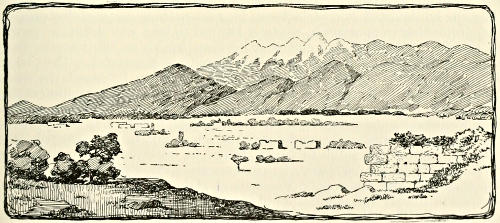
The Valley of Sparta
Of Lycurgus, the lawgiver, says Plutarch, we have nothing to relate that
is certain and uncontroverted. For there are different accounts of his birth,
his travels, his death, and especially of the laws and form of government
which he established. But least of all are the times agreed upon in which
this great man lived. For some say he flourished at the same time with
Iphitus, and joined with him in settling the cessation of arms during the
Olympic Games. Among these is Aristotle the philosopher, who alleges
for proof an Olympic quoit, on which was preserved the inscription of
Lycurgus’ name. But others who, with Eratosthenes and Apollodorus,
compute the time by the succession of the Spartan kings, place him
much earlier than the first Olympiad. Timæus, however, supposes, that,
as there were two Lycurguses in Sparta at different times, the actions
of both are ascribed to one, on account of his particular renown; and
that the more ancient of them lived not long after Homer: Nay, some say
he had seen him. Xenophon, too, confirms the opinion of his antiquity,
when he makes him contemporary with the Heraclidæ. It is true, the latest
of the Lacedæmonian kings were of the lineage of the Heraclidæ; but
Xenophon there seems to speak of the first and more immediate descendants
of Hercules. As the history of those times is thus involved, in relating the
circumstances of Lycurgus’ life, we shall endeavour to select such as are
least controverted, and follow authors of the greatest credit.
For a long time anarchy and confusion prevailed in Sparta, by which
one of its kings, the father of Lycurgus, lost his life. For while he was
endeavouring to part some persons who were concerned in a fray, he
received a wound by a kitchen knife, of which he died, leaving the kingdom
to his eldest son Polydectes.
But he, too, dying soon after, the general voice gave it for Lycurgus to
ascend the throne; and he actually did so, till it appeared that his brother’s
widow was pregnant. As soon as he perceived this, he declared that the
kingdom belonged to her issue, provided it were male, and he kept the
administration in his hands only as his guardian. This he did with the title
of Prodicos, which the Lacedæmonians give to the guardians of infant kings.
Soon after, the queen made him a private overture, that she would destroy
her child, upon condition that he would marry her when king of Sparta.
Though he detested her wickedness, he said nothing against the proposal,
but pretending to approve it, charged her not to take any drugs to procure
an abortion, lest she should endanger her own health or life; for he would
take care that the child, as soon as born, should be destroyed. Thus he artfully
drew on the woman to her full time, and, when he heard she was in
labour, he sent persons to attend and watch her delivery, with orders, if it
were a girl, to give it to the women, but if a boy, to bring it to him, in whatever
business he might be engaged. It happened that he was at supper with
the magistrates when she was delivered of a boy, and his servants, who were
present, carried the child to him. When he received it, he is reported
to have said to the company, “Spartans, see here your new-born king.”
He then laid him down upon the chair of state, and named him Charilaus,
because of the joy and admiration of his magnanimity and justice testified by
all present. Thus the reign of Lycurgus lasted only eight months. But the
citizens had a great veneration for him on other accounts, and there were
more that paid him their attentions, and were ready to execute his commands,
out of regard to his virtues, than those that obeyed him as a guardian
to the King, and director of the administration. There were not, however,
wanting those that envied him, and opposed his advancement, as too high
for so young a man; particularly the relations and friends of the queen-mother,
who seemed to have been treated with contempt. Her brother
Leonidas one day boldly attacked him with virulent language, and scrupled
not to tell him, that he was well assured he would soon be king. Insinuations
of the same kind were likewise spread by the queen-mother. Moved
with this ill treatment, and fearing some dark design, he determined to get
clear of all suspicion, by travelling into other countries, till his nephew
should be grown up, and have a son to succeed him in the kingdom.
He set sail, therefore, and landed in Crete. There having observed the
forms of government, and conversed with the most illustrious personages,
he was struck with admiration of some of their laws, and resolved at his
return to make use of them in Sparta. Some others he rejected. From
Crete Lycurgus passed to Asia, desirous, as is said, to compare the Ionian
expense and luxury with the Cretan frugality and hard diet, so as to judge
what effect each had on their several manners and governments. The
Egyptians likewise suppose that he visited them; and as of all their institutions
he was most pleased with their distinguishing the military men from
the rest of the people, he took the same method at Sparta, and, by separating
from these the mechanics and artificers, he rendered the constitution more
noble and more of a piece.
Returning, he immediately applied himself to alter the whole frame of the
constitution; sensible that a partial change, and the introducing of some
new laws, would be of no sort of advantage, he applied to the nobility,
and desired them to put their hands to the work; addressing himself privately
at first to his friends, and afterwards, by degrees, trying the disposition of
others, and preparing them to concur in the business. When matters were
ripe, he ordered thirty of the principal citizens to appear armed in the market-place
by break of day, to strike terror into such as might desire to oppose
him. Upon the first alarm, King Charilaus, apprehending it to be a design
against his person, took refuge in the Chalcioicos [brazen temple]. But he
was soon satisfied, and accepted their oath, and joined in the undertaking.
The Institutions of Lycurgus
Among the many new institutions of Lycurgus, the first and most important
was that of a senate; which sharing, as Plato says, in the power of
the kings, too imperious and unrestrained before, and having equal authority
with them, was the means of keeping them within the bounds of moderation,
and highly contributed to the preservation of the state. For before, it had
been veering and unsettled, sometimes inclining to arbitrary power, and
sometimes towards a pure democracy; but this establishment of a senate, an
intermediate body, like ballast, kept in it a just equilibrium, and put it in a
safe posture: the twenty-eight senators adhering to the kings, whenever
they saw the people too encroaching, and, on the other hand, supporting the
people, when the kings attempted to make themselves absolute. This,
according to Aristotle, was the number of senators fixed upon, because two
of the thirty associates of Lycurgus deserted the business through fear.
He had this institution so much at heart, that he obtained from Delphi
an oracle in its behalf called rhetra, or the decree.
Though the government was thus tempered by Lycurgus, yet soon after
it degenerated into an oligarchy, whose power was exercised with such wantonness
and violence, that it wanted indeed a bridle, as Plato expresses it.
This curb they found in the authority of the ephori, about one hundred
and thirty years after Lycurgus.
A second and bolder political enterprise of Lycurgus, was a new division
of the lands. For he found a prodigious inequality, the city over-charged
with many indigent persons, who had no land, and the wealth centred in the
hands of a few. Determined, therefore, to root out the evils of insolence,
envy, avarice, and luxury, and those distempers of a state still more inveterate
and fatal, I mean poverty and riches, he persuaded them to cancel all
former divisions of land, and to make new ones, in such a manner that they
might be perfectly equal in their possessions and way of living. Hence, if
they were ambitious of distinction they might seek it in virtue, as no other
difference was left between them, but that which arises from the dishonour
of base actions and the praise of good ones. His proposal was put in practice.
After this, he attempted to divide also the movables, in order to take
away all appearance of inequality; but he soon perceived that they could
not bear to have their goods directly taken from them, and therefore took
another method, counterworking their avarice by a stratagem. First he
stopped the currency of the gold and silver coin, and ordered that they
should make use of iron money only: then to a great quantity and weight
of this he assigned but a small value; so that to lay up ten minæ [£30 or
$150] a whole room was required, and to remove it nothing less than a yoke
of oxen. When this became current, many kinds of injustice ceased in
Lacedæmon. Who would steal or take a bribe, who would defraud or rob,
when he could not conceal the booty? Their iron coin would not pass in
the rest of Greece, but was ridiculed and despised; so that the Spartans had
no means of purchasing any foreign or curious wares; nor did any merchant-ship
unlade in their harbours. There were not even to be found in all their
country either sophists, wandering fortune-tellers, keepers of infamous houses,
or dealers in gold and silver trinkets, because there was no money. Thus
luxury, losing by degrees the means that cherished and supported it, died
away of itself: even they who had great possessions, had no advantage from
them, since they could not be displayed in public, but must lie useless, in
unregarded repositories.
Desirous to complete the conquest of luxury, and exterminate the love of
riches, he introduced a third institution, which was wisely enough and
ingeniously contrived. This was the use of public tables, where all were to
eat in common of the same meat, and such kinds of it as were appointed by
law. At the same time, they were forbidden to eat at home, upon expensive
couches and tables, to call in the assistance of butchers and cooks, or to fatten
like voracious animals in private. For so not only their manners would be
corrupted, but their bodies disordered; abandoned to all manner of sensuality
and dissoluteness, they would require long sleep, warm baths, and the
same indulgence as in perpetual sickness. To effect this was certainly very
great; but it was greater still, to secure riches from rapine and from envy,
as Theophrastus expresses it, or rather by their eating in common, and by the
frugality of their table, to take from riches their very being. For what
use or enjoyment of them, what peculiar display of magnificence could there
be, where the poor man went to the same refreshment with the rich?
The rich, therefore (we are told), were more offended with this regulation
than with any other, and, rising in a body, they loudly expressed their
indignation: nay, they proceeded so far as to assault Lycurgus with stones,
so that he was forced to fly from the assembly and take refuge in a temple.
The public repasts were called by the Cretans andria; but the Lacedæmonians
styled them phiditia, either from their tendency to friendship and
mutual benevolence, phiditia being used instead of philitia; or else from
their teaching frugality and parsimony, which the word pheido signifies.
But it is not at all impossible, that the first letter might by some means or
other be added, and so phiditia take place of editia, which barely signifies
eating. There were fifteen persons to a table, or a few more or less. Each
of them was obliged to bring in monthly a bushel of meal, eight gallons of
wine, five pounds of cheese, two pounds and a half of figs, and a little money
to buy flesh and fish. If any of them happened to offer a sacrifice of first
fruits, or to kill venison, he sent a part of it to the public table: for after a
sacrifice or hunting, he was at liberty to sup at home: but the rest were to
appear at the usual place. For a long time this eating in common was
observed with great exactness: so that when King Agis returned from a
successful expedition against the Athenians, and from a desire to sup with
his wife, requested to have his portion at home, the polemarchs refused to
send it: nay, when, through resentment, he neglected the day following to
offer the sacrifice usual on occasion of victory, they set a fine upon him.
Children were also introduced at these public tables, as so many schools of
sobriety. There they heard discourses concerning government, and were
instructed in the most liberal breeding. There they were allowed to jest
without scurrility, and were not to take it ill when the raillery was returned.
For it was reckoned worthy of a Lacedæmonian to bear a jest: but if any one’s
patience failed, he had only to desire them to be quiet, and they left off immediately.
After they had drunk moderately, they went home without lights.
Indeed, they were forbidden to walk with a light either on this or any other
occasion, that they might accustom themselves to march in the darkest night
boldly and resolutely. Such was the order of their public repasts.
Lycurgus left none of his laws in writing; it was ordered in one of the
rhetræ that none should be written. For what he thought most conducive
to the virtue and happiness of a city, was principles interwoven with the
manners and breeding of the people. As for smaller matters, it was better
not to reduce these to a written form and unalterable method, but to suffer
them to change with the times, and to admit of additions or retrenchments
at the pleasure of persons so well educated. For he resolved the whole business
of legislation into the bringing up of youth. And this, as we have
observed, was the reason why one of his ordinances forbade them to have
any written laws.
Another ordinance levelled against magnificence and expense, directed
that the ceilings of houses should be wrought with no tool but the axe, and
the doors with nothing but the saw.
Regulations Regarding Marriage and the Conduct of Women
As for the education of youth, which he looked upon as the greatest and
most glorious work of a lawgiver, he began with it at the very source, taking
into consideration their conception and birth, by regulating the marriages.
For he did not (as Aristotle says) desist from his attempt to bring the
women under sober rules. They had, indeed, assumed great liberty and
power on account of the frequent expeditions of their husbands, during which
they were left sole mistresses at home, and so gained an undue deference and
improper titles; but notwithstanding this he took all possible care of them.
He ordered the virgins to exercise themselves in running, wrestling, and
throwing quoits and darts; that their bodies being strong and vigorous, the
children afterwards produced from them might be the same; and that, thus
fortified by exercise, they might the better support the pangs of childbirth,
and be delivered with safety. In order to take away the excessive tenderness
and delicacy of the sex, the consequence of a recluse life, he accustomed
the virgins occasionally to be seen naked as well as the young men, and to
dance and sing in their presence on certain festivals. There they sometimes
indulged in a little raillery upon those that had misbehaved themselves, and
sometimes they sung encomiums on such as deserved them, thus exciting in
the young men a useful emulation and love of glory. For he who was
praised for his bravery and celebrated among the virgins, went away perfectly
happy: while their satirical glances thrown out in sport, were no less cutting
than serious admonitions; especially as the kings and senate went with the
other citizens to see all that passed. As for the virgins appearing naked,
there was nothing disgraceful in it, because everything was conducted with
modesty, and without one indecent word or action. Nay, it caused a simplicity
of manners and an emulation for the best habit of body; their ideas,
too, were naturally enlarged, while they were not excluded from their share
of bravery and honour. Hence they were furnished with sentiments and
language, such as Gorgo the wife of Leonidas is said to have made use of.
When a woman of another country said to her, “You of Lacedæmon are the
only women in the world that rule the men:” she answered, “We are the
only women that bring forth men.”
These public dances and other exercises of the young maidens naked, in
sight of the young men, were, moreover, incentives to marriage; and, to use
Plato’s expression, drew them almost as necessarily by the attractions of love,
as a geometrical conclusion follows from the premises. To encourage it
still more, some marks of infamy were set upon those that continued bachelors.
For they were not permitted to see these exercises of the naked virgins;
and the magistrates commanded them to march naked round the market-place
in the winter, and to sing a song composed against themselves, which expressed
how justly they were punished for their disobedience to the laws.
They were also deprived of that honour and respect which the younger
people paid to the old; so that nobody found fault with what was said to
Dercyllidas, though an eminent commander. It seems, when he came one
day into company, a young man, instead of rising up and giving place, told
him, “You have no child to give place to me, when I am old.”
In their marriages the bridegroom carried off the bride by violence; and
she was never chosen in a tender age, but when she had arrived at full maturity.
Then the woman that had the direction of the wedding, cut the
bride’s hair close to the skin, dressed her in man’s clothes, laid her upon a
mattress, and left her in the dark. The bridegroom, neither oppressed with
wine nor enervated with luxury, but perfectly sober, as having always supped
at the common table, went in privately, untied her girdle, and carried her to
another bed. Having stayed there a short time, he modestly retired to his
usual apartment, to sleep with the other young men: and observed the same
conduct afterwards, spending the day with his companions, and reposing
himself with them in the night, nor even visiting his bride but with great
caution and apprehensions of being discovered by the rest of the family;
the bride at the same time exerted all her art to contrive convenient opportunities
for their private meetings. And this they did not for a short time
only, but some of them even had children before they had an interview with
their wives in the day-time. This kind of commerce not only exercised their
temperance and chastity, but kept their bodies fruitful, and the first ardour
of their love fresh and unabated; for as they were not satiated like those
that are always with their wives, there still was place for unextinguished desire.
When he had thus established a proper regard to modesty and decorum
with respect to marriage, he was equally studious to drive from that state
the vain and womanish passion of jealousy; by making it quite as reputable
to have children in common with persons of merit, as to avoid all offensive
freedom in their own behaviour to their wives. He laughed at those who
revenge with wars and bloodshed the communication of a married woman’s
favours; and allowed, that if a man in years should have a young wife, he
might introduce to her some handsome and honest young man, whom he most
approved of, and when she had a child of this generous race, bring it up as
his own. On the other hand, he allowed, if a man of character should entertain
a passion for a married woman on account of her modesty and the beauty
of her children, he might treat with her husband for admission to her company,
that so planting in a beauty-bearing soil, he might produce excellent
children, the congenial offspring of excellent parents.
For in the first place, Lycurgus considered children, not so much the
property of their parents, as of the state; and therefore he would not have
them begot by ordinary persons, but by the best men in it. In the next
place, he observed the vanity and absurdity of other nations, where people
study to have their horses and dogs of the finest breed they can procure,
either by interest or money; and yet keep their wives shut up, that they
may have children by none but themselves, though they may happen to be
doting, decrepit, or infirm. As if children, when sprung from a bad stock,
and consequently good for nothing, were no detriment to those whom they
belong to, and who have the trouble of bringing them up, nor any advantage,
when well descended and of a generous disposition. These regulations
tending to secure a healthy offspring, and consequently beneficial to the state,
were so far from encouraging that licentiousness of the women which prevailed
afterwards, that adultery was not known amongst them.
The Rearing of Children
It was not left to the father to rear what children he pleased, but he was
obliged to carry the child to a place called Lesche, to be examined by the
most ancient men of the tribe, who were assembled there. If it was strong
and well proportioned, they gave orders for its education, and assigned it
one of the nine thousand shares of land; but if it was weakly and deformed,
they ordered it to be thrown into the place called Apothetæ, which is a deep
cavern near the mountain Taygetus: concluding that its life could be no
advantage either to itself or to the public, since nature had not given it at
first any strength or goodness of constitution. For the same reason the
women did not wash their new-born infants with water, but with wine, thus
making some trial of their habit of body; imagining that sickly and epileptic
children sink and die under the experiment, while healthy became more
vigorous and hardy. Great care and art was also exerted by the nurses; for,
as they never swathed the infants, their limbs had a freer turn, and their
countenances a more liberal air; besides, they used them to any sort of
meat, to have no terrors in the dark, nor to be afraid of being alone, and
to leave all ill humour and unmanly crying. Hence people of other countries
purchased Lacedæmonian nurses for their children.
The Spartan children were not in that manner, under tutors purchased
or hired with money, nor were the parents at liberty to educate them as
they pleased: but as soon as they were seven years old, Lycurgus ordered
them to be enrolled in companies, where they were all kept under the same
order and discipline, and had their exercises and recreations in common.
He who showed the most conduct and courage amongst them, was made
captain of the company. The rest kept their eyes upon him, obeyed his
orders, and bore with patience the punishment he inflicted: so that their
whole education was an exercise of obedience. The old men were present
at their diversions, and often suggested some occasion of dispute or quarrel,
that they might observe with exactness the spirit of each, and their firmness
in battle.
As for learning, they had just what was absolutely necessary. All the
rest of their education was calculated to make them subject to command,
to endure labour, to fight and conquer. They added, therefore, to their discipline,
as they advanced in age; cutting their hair very close, making them
go barefoot, and play, for the most part, quite naked. At twelve years of
age, their under garment was taken away, and but one upper one a year
allowed them. Hence they were necessarily dirty in their persons, and not
indulged the great favour of baths and oils, except on some particular days
of the year. They slept in companies, on beds made of the tops of reeds,
which they gathered with their own hands, without knives, and brought
from the banks of the Eurotas. In winter they were permitted to add a
little thistle-down, as that seemed to have some warmth in it.
They steal, too, whatever victuals they possibly can, ingeniously contriving
to do it when persons are asleep, or keep but indifferent watch. If they
are discovered, they are punished not only with whipping, but with hunger.
Indeed, their supper is but slender at all times, that, to fence against want,
they may be forced to exercise their courage and address. This is the first
intention of their spare diet: a subordinate one is, to make them grow tall.
For when the animal spirits are not too much oppressed by a great quantity
of food, which stretches itself out in breadth and thickness, they mount upwards
by their natural lightness, and the body easily and freely shoots up in
height. This also contributes to make them handsome: for thin and slender
habits yield more freely to nature, which then gives a fine proportion to the
limbs; whilst the heavy and gross resist her by their weight.
The boys steal with so much caution, that one of them, having conveyed
a young fox under his garment, suffered the creature to tear out his bowels
with his teeth and claws, choosing rather to die than to be detected. Nor
does this appear incredible, if we consider what their young men can endure
to this day; for we have seen many of them expire under the lash at the
altar of Diana Orthia.
The Famed Laconic Discourse; Spartan Discipline
The boys were also taught to use sharp repartee, seasoned with humour,
and whatever they said was to be concise and pithy. For Lycurgus, as we
have observed, fixed but a small value on a considerable quantity of his iron
money; but on the contrary, the worth of speech was to consist in its being
comprised in a few plain words, pregnant with a great deal of sense: and
he contrived that by long silence they might learn to be sententious and
acute in their replies. As debauchery often causes weakness and sterility in
the body, so the intemperance of the tongue makes conversation empty and
insipid. King Agis, therefore, when a certain Athenian laughed at the
Lacedæmonian short swords and said, “The jugglers would swallow them
with ease upon the stage,” answered in his laconic way, “And yet we can
reach our enemies’ hearts with them.” Indeed, to me there seems to be
something in this concise manner of speaking which immediately reaches the
object aimed at, and forcibly strikes the mind of the hearer.
Lycurgus himself was short and sententious in his discourse, if we may
judge by some of his answers which are recorded: that, for instance, concerning
the constitution. When one advised him to establish a popular
government in Lacedæmon, “Go,” said he, “and first make a trial of it in
thy own family.” That again, concerning sacrifices to the deity, when he
was asked why he appointed them so trifling and of so little value, “That
we may never be in want,” said he, “of something to offer him.” Once
more, when they inquired of him, what sort of martial exercises he allowed
of, he answered, “All, except those in which you stretch out your palms.”
Several such like replies of his are said to be taken from the letters which
he wrote to his countrymen: as to their question, “How shall we best guard
against the invasion of an enemy?” “By continuing poor, and not desiring
in your possessions to be one above another.” And to the question, whether
they should enclose Sparta with walls, “That city is well fortified which has
a wall of men instead of brick.” Whether these and some other letters
ascribed to him are genuine or not, is no easy matter to determine.
Even when they indulged a vein of pleasantry, one might perceive, that
they would not use one unnecessary word, nor let an expression escape them
that had not some sense worth attending to. For one being asked to go and
hear a person who imitated the nightingale to perfection, answered, “I have
heard the nightingale herself.”
Nor were poetry and music less cultivated among them, than a concise
dignity of expression. Their songs had a spirit, which could rouse the soul,
and impel it in an enthusiastic manner to action. The language was plain and
manly, the subject serious and moral. For they consisted chiefly of the
praises of heroes that had died for Sparta, or else of expressions of detestation
for such wretches as had declined the glorious opportunity, and rather
chose to drag on life in misery and contempt. Nor did they forget to express
an ambition for glory suitable to their respective ages.
Hippias the sophist tells us, that Lycurgus himself was a man of great
personal valour, and an experienced commander. Philostephanus also
ascribes to him the first division of cavalry into troops of fifty, who were
drawn up in a square body. But Demetrius the Phalerean says, that he
never had any military employment, and that there was the profoundest
peace imaginable when he established the Constitution of Sparta. His providing
for a cessation of arms during the Olympic Games is likewise a mark
of the humane and peaceable man.
The discipline of the Lacedæmonians continued after they were arrived
at years of maturity. For no man was at liberty to live as he pleased; the
city being like one great camp, where all had their stated allowance, and
knew their public charge, each man concluding that he was born, not for
himself, but for his country. Hence, if they had no particular orders, they
employed themselves in inspecting the boys, and teaching them something
useful, or in learning of those that were older than themselves. One of the
greatest privileges that Lycurgus procured his countrymen, was the enjoyment
of leisure, the consequence of his forbidding them to exercise any
mechanic trade. It was not worth their while to take great pains to raise a
fortune, since riches there were of no account: and the helots, who tilled
the ground, were answerable for the produce above-mentioned.
Lawsuits were banished from Lacedæmon with money. The Spartans
knew neither riches nor poverty, but possessed an equal competency, and
had a cheap and easy way of supplying their few wants. Hence, when they
were not engaged in war, their time was taken up with dancing, feasting,
hunting, or meeting to exercise or converse. They went not to market
under thirty years of age, all their necessary concerns being managed by
their relations and adopters. Nor was it reckoned a credit to the old to be
seen sauntering in the market-place; it was deemed more suitable for them
to pass great part of the day in the schools of exercise, or places of conversation.
Their discourse seldom turned upon money, or business, or trade, but
upon the praise of the excellent, or the contempt of the worthless; and the
last was expressed with that pleasantry and humour, which conveyed instruction
and correction without seeming to intend it. Nor was Lycurgus himself
immoderately severe in his manner; but, as Sosibius tells us, he
dedicated a little statue to the god of laughter in each hall. He considered
facetiousness as a seasoning of their hard exercise and diet, and therefore
ordered it to take place on all proper occasions, in their common entertainments
and parties of pleasures. Upon the whole, he taught his citizens to
think nothing more disagreeable than to live by (or for) themselves.
The Senate; Burial Customs; Home-Staying; The Ambuscade
The Senate, as said before, consisted at first of those that were assistants
to Lycurgus in his great enterprise. Afterwards, to fill up any vacancy
that might happen, he ordered the most worthy men to be selected, of those
that were full threescore years old. This was the most respectable dispute
in the world, and the contest was truly glorious: for it was not who should
be swiftest among the swift, or strongest of the strong, but who was the
wisest and best among the good and wise. He who had the preference was
to bear this mark of superior excellence through life, this great authority,
which put into his hands the lives and honour of the citizens, and every
other important affair. The manner of the election was this: When the
people were assembled, some persons appointed for the purpose were shut up
in a room near the place; where they could neither see nor be seen, and only
hear the shouts of the constituents: for by them they decided this and most
other affairs. Each candidate walked silently through the assembly, one
after another according to lot. Those that were shut up had writing tables,
in which they set down in different columns the number and loudness of the
shouts, without knowing whom they were for; only they marked them as
first, second, third, and so on, according to the number of the competitors.
He that had the most and loudest acclamations, was declared duly elected.
Then he was crowned with a garland, and went round to give thanks to the
gods: a number of young men followed, striving which should extol him
most, and the women celebrated his virtues in their songs, and blessed his
worthy life and conduct. Each of his relations offered him a repast, and
their address on the occasion was, “Sparta honours you with this collation.”
When he had finished the procession, he went to the common table, and lived
as before. Only two portions were set before him, one of which he carried
away: and as all the women related to him attended at the gates of the
public hall, he called her for whom he had the greatest esteem, and presented
her with the portion, saying at the same time, “That which I received as a
mark of honour, I give to you.” Then she was conducted home with great
applause by the rest of the women.
Lycurgus likewise made good regulations with respect to burials. In
the first place, to take away all superstition, he ordered the dead to be buried
in the city, and even permitted their monuments to be erected near the
temples; accustoming the youth to such sights from their infancy, that they
might have no uneasiness from them nor any horror for death, as if people
were polluted with the touch of a dead body, or with treading upon a grave.
In the next place, he suffered nothing to be buried with the corpse, except
the red cloth and the olive leaves in which it was wrapped. Nor would he
suffer the relations to inscribe any names upon the tombs, except of those
men that fell in battle, or those women who died in some sacred office. He
fixed eleven days for the time of mourning: on the twelfth they were to
put an end to it, after offering sacrifice to Ceres. No part of life was left
vacant and unimproved, but even with their necessary actions he interwove
the praise of virtue and the contempt of vice: and he so filled the city
with living examples, that it was next to impossible for persons who had
these from their infancy before their eyes, not to be drawn and formed to
honour.
For the same reason he would not permit all that desired to go abroad
and see other countries, lest they should contract foreign manners, gain
traces of a life of little discipline, and of a different form of government.
He forbade strangers, too, to resort to Sparta, who could not assign a good
reason for their coming; not, as Thucydides says, out of fear they should
imitate the constitution of that city, and make improvements in virtue, but
lest they should teach his own people some evil. For along with foreigners
come new subjects of discourse; new discourse produces new opinions; and
from these there necessarily spring new passions and desires, which, like
discords in music, would disturb the established government. He, therefore,
thought it more expedient for the city, to keep out of it corrupt customs and
manners, than even to prevent the introduction of a pestilence.
Thus far, then, we can perceive no vestiges of a disregard to right and
wrong, which is the fault some people find with the laws of Lycurgus, allowing
them well enough calculated to produce valour, but not to promote
justice. Perhaps it was the crypteia, as they called it, or ambuscade, if that
was really one of this lawgiver’s institutions, as Aristotle says it was, which
gave Plato so bad an impression both of Lycurgus and his laws. The
governors of the youth ordered the shrewdest of them from time to time to
disperse themselves in the country, provided only with daggers and some
necessary provisions. In the day-time they hid themselves, and rested in the
most private places they could find, but at night they sallied out into the
roads, and killed all the helots they could meet with. Nay, sometimes by
day, they fell upon them in the fields, and murdered the ablest and strongest
of them. Thucydides relates, in his history of the Peloponnesian War, that
the Spartans selected such of them as were distinguished for their courage,
to the number of two thousand or more, declared them free, crowned them
with garlands, and conducted them to the temples of the gods; but soon
after they all disappeared; and no one could, either then or since, give
account in what manner they were destroyed. Aristotle particularly says,
that the ephori, as soon as they were invested in their office, declared war
against the helots, that they might be massacred under pretence of law. In
other respects they treated them with great inhumanity: sometimes they
made them drink till they were intoxicated, and in that condition led them
into the public halls, to show the young men what drunkenness was. They
ordered them, too, to sing mean songs, and to dance ridiculous dances, but
not to meddle with any that were genteel and graceful. Thus they tell us,
that when the Thebans afterwards invaded Laconia, and took a great number
of the helots prisoners, they ordered them to sing the odes of Terpander,
Alcman, or Spendon the Lacedæmonian, but they excused themselves, alleging
that it was forbidden by their masters. Those who say, that a freeman
in Sparta was most a freeman, and a slave most a slave, seem well to have
considered the difference of states. But in my opinion, it was in aftertimes
that these cruelties took place among the Lacedæmonians; chiefly after
the great earthquake, when, as history informs us, the helots, joining the
Messenians, attacked them, did infinite damage to the country, and brought
the city to the greatest extremity. I can never ascribe to Lycurgus so
abominable an act as that of the ambuscade. I would judge in this case by
the mildness and justice which appeared in the rest of his conduct.
Lycurgus’ Subterfuge to Perpetuate His Laws
When his principal institutions had taken root in the manners of the
people, and the government was come to such maturity as to be able to support
and preserve itself, then, as Plato says of the Deity, that he rejoiced
when he had created the world, and given it its first motion; so Lycurgus
was charmed with the beauty and greatness of his political establishment,
when he saw it exemplified in fact, and move on in due order. He was next
desirous to make it immortal, so far as human wisdom could effect it, and
to deliver it down unchanged to the latest times. For this purpose he
assembled all the people, and told them, the provisions he had already made
for the state were indeed sufficient for virtue and happiness, but the greatest
and most important matter was still behind, which he could not disclose to
them till he had consulted the oracle; that they must therefore inviolably
observe his laws, without altering anything in them, till he returned from
Delphi; and then he would acquaint them with the pleasure of Apollo.
When they had promised to do so, he took an oath of the kings and senators,
and afterwards of all the citizens, that they would abide by the present
establishment till Lycurgus came back. He then took his journey to Delphi.
When he arrived there, he offered sacrifice to the gods, and consulted the
oracle, whether his laws were sufficient to promote virtue, and secure the
happiness of the state. Apollo answered, that the laws were excellent, and
that the city which kept to the constitution he had established, would be the
most glorious in the world. This oracle Lycurgus took down in writing, and
sent it to Sparta. He then offered another sacrifice, and embraced his friends
and his son, determined never to release his citizens from their oath, but
voluntarily there to put a period to his life; while he was yet of an age
when life was not a burden, when death was not desirable, and while he was
not unhappy in any one circumstance. He, therefore, destroyed himself by
abstaining from food, persuaded that the very death of lawgivers, should
have its use, and their exit, so far from being insignificant, have its share of
virtue, and be considered as a great action. To him, indeed, whose performances
were so illustrious, the conclusion of life was the crown of happiness,
and his death was left guardian of those invaluable blessings he had procured
his countrymen through life, as they had taken an oath not to depart from
his establishment till his return. Nor was he deceived in his expectations.
Sparta continued superior to the rest of Greece, both in its government at
home and reputation abroad, so long as it retained the institution of Lycurgus;
and this it did during the space of five hundred years, and the reign of
fourteen successive kings, down to Agis the son of Archidamus. As for the
appointment of the ephors, it was so far from weakening the constitution,
that it gave it additional vigour, and though it seemed to be established in
favour of the people, it strengthened the aristocracy.c
Thus far we have followed Plutarch; now let us see what modern
authority will say of the influence of Lycurgus.
The best commentary on the laws of Lycurgus is the history of Sparta;
let us read it and judge the tree by its fruits.
Lycurgus, if we unite under his name all the laws mentioned, without
pausing to make sure that they are rightfully attributed, had operated with
rare sagacity to render Sparta immutable and its constitution immortal. But
there exists an arch-enemy to the things of this world that call themselves
eternal—the old man with the white beard and denuded scalp that antiquity
armed with a scythe. Legislators like, no better than poets, to take him
into account; they are ready enough to declare that they have erected an
edifice more solid than brass. Time advances and the whole structure
crumbles to the earth. Sparta braved him through several centuries, by
sacrificing the liberty of her citizens whom she kept bowed under the severest
discipline. She lasted long, but never truly lived. As soon as her inflexible,
and in some respects immoral, constitution, established outside the usual conditions
under which society exists, was shaken, her decadence was rapid and
irrevocable.
Lycurgus had desired to make fixed, population, lands, and the number
and fortune of citizens; as it turned out never was there a city where property
changed hands more frequently, where the condition of citizens was more
unstable, or their number subject to more steady diminution. He had singularly
restricted individual property rights to strengthen the power of the
state; and Aristotle says: “In Sparta the state is poor, the individual rich
and avaricious.” He had failed to recognise the laws of nature in the education
and destiny of women; and Aristotle, charging the Spartan women
with immorality, with greed, and even calling into question their courage,
sees in the license they allowed themselves one of the causes of Lacedæmon’s
downfall.
He made the helots tremble under his rule, and finally sent them back
to their masters. He prohibited long wars; but he had made war attractive
by freeing the soldiers from the heavy rules laid upon the citizen, and
it was by war and victory that his republic perished. He withdrew from
his fellow-citizens all power of initiative, assigning to each moment of their
lives its particular duty; in a word, to speak with Rousseau, who was also a
master of political paradox, “His laws completely changed the nature of
man to make of him a citizen.” Yet Sparta, become a revolutionary city, perished
for want of men. He proscribed gold and silver that there might be no
corruption, and nowhere since the Median wars, was venality so pronounced
and shameless.
He banished the arts, except for the adornment of his temple of Apollo
at Amyclæ; and in this he succeeded. Pausanias makes note of some fifty
temples in Lacedæmonia, but not a stone of them remains. Rustic piety
and not art erected them. Save for a certain taste in music, the dance, and
a severe style of poetry, Sparta stands alone as a barbarian city in the middle
of Greece, a spot of darkness where all else is light; she did not even know
thoroughly the only art she practised, that of war; at least she always remained
ignorant of certain features of it.
As Aristotle says: “Trained for war, Lacedæmonia, like a sword in its
scabbard, rests in peace.” All her institutions taught her to fight, not one
to live the life of the spirit. Savage and egotistical, she satisfied the pride
of her children, and won the praise of those who admire power and success,
but what did she do for the world? A war machine perfectly fitted to
destroy but incapable of production, what has she left behind her? Not an
artist nor a man of genius, not even a ruin that bears her name; she is
dead in every part as Thucydides predicted, while Athens, calumniated by
rhetoricians of all ages, still has to show the majestic ruins of her temples,
source of inspiration to modern art in two worlds, as her poets and philosophers
are the source of eternal beauty.
To sum up, and this is the lesson taught by this history: rigidly as Lycurgus
might decree for Sparta equality of possessions, an end contrary to
natural as to social conditions, nowhere in Greece was social inequality so
marked. Something of her discipline subsisted longer, and it was this strange
social ordonnance that won for Lacedæmon her power and renown, striking
as it did all other populations with astonishment.
The Spartans have further set a noble example of sobriety, and of contempt
for passion, pain, and death. They could obey and they could die.
Law was for them, according to the felicitous expression of Pindarus and of
Montaigne: “Queen and Empress of the World.” Let us accord to them
one more virtue which does them honour, respect for those upon whose
head Time has placed the crown of whitened locks.
The aristocratic poet of Bœotia who like another Dorian, Theognis of
Megara hated the masses, admired the city where reigned under a line of
hereditary kings, “The wisdom of old men, and the lances of young, the
choirs of the Muse and sweet harmony.” Simonides more clearly recognises
the true reason of Sparta’s greatness; he called Lacedæmon “the city
which tames men.” Empire over oneself usually gives empire over others,
and for a long time the Spartan possessed both.d
[ca. 764 B.C.]
That there were two long contests between the Lacedæmonians and
Messenians, and that in both the former were completely victorious, is a
fact sufficiently attested. And if we could trust the statements in Pausanias,—our
chief and almost only authority on the subject,—we should be in a
situation to recount the history of both these wars in considerable detail.
But unfortunately, the incidents narrated in that writer have been gathered
from sources which are, even by his own admission, undeserving of credit,
from Rhianus, the poet of Bene in Crete, who had composed an epic poem
on Aristomenes and the Second Messenian War, about B.C. 220, and from
Myron of Priene, a prose author whose date is not exactly known, but belonging
to the Alexandrine age, and not earlier than the third century
before the Christian era.
The poet Tyrtæus was himself engaged on the side of the Spartans in the
second war, and it is from him that we learn the few indisputable facts respecting
both the first and the second. If the Messenians had never been
re-established in Peloponnesus, we should probably never have heard any
further details respecting these early contests. That re-establishment, and
the first foundation of the city called Messene on Mount Ithome, was among
the capital wounds inflicted on Sparta by Epaminondas, in the year B.C.
369,—between three hundred and two hundred and fifty years after the
conclusion of the Second Messenian War. The descendants of the old Messenians,
who had remained for so long a period without any fixed position
in Greece, were incorporated in the new city, together with various helots
and miscellaneous settlers who had no claim to a similar genealogy. The
gods and heroes of the Messenian race were reverentially invoked at this
great ceremony, especially the great hero Aristomenes; and the site of
Mount Ithome, the ardour of the newly established citizens, the hatred and
apprehension of Sparta, operating as a powerful stimulus to the creation
and multiplication of what are called traditions, sufficed to expand the few
facts known respecting the struggles of the old Messenians into a variety of
details. In almost all these stories we discover a colouring unfavourable
to Sparta, contrasting forcibly with the account given by Isocrates in his
discourse called Archidamus, wherein we read the view which a Spartan
might take of the ancient conquests of his forefathers. But a clear proof
that these Messenian stories had no real basis of tradition, is shown in
the contradictory statements respecting the prime hero Aristomenes. Wesseling
thinks that there were two persons named Aristomenes, one in the
first and one in the second war. This inextricable confusion respecting
the greatest name in Messenian antiquity, shows how little any genuine
stream of tradition can here be recognised.
Pausanias states the First Messenian War as beginning in B.C. 743 and
lasting till B.C. 724,—the Second, as beginning in B.C. 685 and lasting till
B.C. 668. Neither of these dates rest upon any assignable positive authority;
but the time assigned to the first war seems probable, that of the
second is apparently too early. Tyrtæus authenticates both the duration of
the first war, twenty years, and the eminent services rendered in it by the
Spartan king Theopompus. He says, moreover, speaking during the second
war, “the fathers of our fathers conquered Messene;” thus loosely indicating
the relative dates of the two.
The Spartans (as we learn from Isocrates, whose words date from a
time when the city of Messene was only a recent foundation) professed
to have seized the territory, partly in revenge for the impiety of the
Messenians in killing their king, the Heraclid Cresphontes, whose relative
had appealed to them for aid,—partly by sentence of the Delphian oracle.
Such were the causes which had induced them first to invade the country,
and they had conquered it after a struggle of twenty years. The Lacedæmonian
explanations, as given in Pausanias, seem for the most part to
be counter-statements arranged after the time when the Messenian version,
evidently the interesting and popular account, had become circulated.b
Within the limits of Messenia there was a temple of Diana Limnatis,
which was alone common to the Messenians among the Dorians, and to the
Lacedæmonians. The Lacedæmonians asserted, that the virgins whom they
sent to the festival were violated by the Messenians; that their king, Teleclus,
was slain through endeavouring to prevent the injury, and that the
violated virgins slew themselves through shame.
The Messenians, however, relate this affair differently; that stratagems
were raised by Teleclus against those persons of quality that came to
the temple in Messene. For when the Lacedæmonians, on account of the
goodness of the land desired to possess Messenia, Teleclus adorned the
beardless youths after the manner of virgins, and so disposed them, that
they might suddenly attack the Lacedæmonians with their daggers as they
were sitting. The Messenians, however, running to their assistance, slew
both Teleclus and all the beardless youths. But the Lacedæmonians, as
they were conscious that this action was perpetrated by public consent, never
attempted to revenge the death of their king. And such are the reports of each
party, which every one believes, just as he is influenced by his attachment to
each. After this event had taken place, and when one generation had passed
away, a hatred commenced between the Lacedæmonians and Messenians.c
In spite of the death of Teleclus, however, the war did not actually break
out until some little time after, when Alcamenes and Theopompus were kings
at Sparta, and Antiochus and Androcles, sons of Pintas, kings of Messenia.
The immediate cause of it was a private altercation between the Messenian
Polychares (victor at the fourth Olympiad, B.C. 764) and the Spartan Euæphnus.
Polychares having been grossly injured by Euæphnus, and his claim
for redress having been rejected at Sparta, took revenge by aggressions upon
other Lacedæmonians; the Messenians refused to give him up, though one
of the two kings, Androcles, strongly insisted upon doing so, and maintained
his opinion so earnestly against the opposite sense of the majority and of his
brother, Antiochus, that a tumult arose, and he was slain.
[ca. 750 B.C.]
The Lacedæmonians, now resolving upon war, struck the first blow
without any formal declaration, by surprising the border town of Amphea,
and putting its defenders to the sword. They further overran the Messenian
territory, and attacked some other towns, but without success. Euphaes, who
had now succeeded his father Antiochus as king of Messenia, summoned the
forces of the country and carried on the war against them with energy and
boldness. For the first four years of the war, the Lacedæmonians made no
progress, and even incurred the ridicule of the old men of their nation as
faint-hearted warriors: in the fifth year, they made a more vigorous invasion,
under their two kings, Theopompus and Polydorus, who were met by
Euphaes with the full force of the Messenians. A desperate battle ensued,
in which it does not seem that either side gained much advantage: nevertheless
the Messenians found themselves so much enfeebled by it, that they were
forced to take refuge on the fortified mountain of Ithome, and to abandon
the rest of the country.b
After this battle the affairs of the Messenians were in a calamitous situation.
For, in the first place, through the great sums of money which they
had expended in fortifying their cities, they had no longer the means of supplying
their army. In the next place, their slaves had fled to the Lacedæmonians.
And lastly, a disease resembling a pestilence, though it did not
infest all their country, greatly embarrassed their affairs. In consequence,
therefore, of consulting about their present situation, they thought proper
to abandon all those cities which had the most inland situation, and to
betake themselves to the mountain Ithome. In this mountain there was
a city of no great magnitude, which, they say, is mentioned by Homer in
his catalogue:
“And those that in the steep Ithome dwell.”
In this city, therefore, fixing their residence, they enlarged the ancient enclosure,
so that it might be sufficient to defend the whole of its inhabitants.
This place was in other respects well fortified: for Ithome is not inferior to
any of the mountains within the isthmus in magnitude; and besides this, is
most difficult of access.
When they were settled in this mountain, they determined to send to Delphos,
and consult the oracle concerning the event of the war. Tisis, therefore,
the son of Alcis, was employed on this errand; a man who, in nobility of
birth, was not inferior to any one, and who was particularly given to divination.
This Tisis, on his return from Delphos, was attacked by a band of
Lacedæmonians belonging to the guard of Amphea, but defended himself so
valiantly that they were not able to take him. It is certain, however, that
they did not desist from wounding him, till a voice was heard, from an
invisible cause, “Dismiss the bearer of the oracle.” And Tisis, indeed, as
soon as he returned to his own people, repeated the oracle to the king, and
not long after died of his wounds. But Euphaes, collecting the Messenians
together, recited the oracle, which was as follows: “Sacrifice a pure virgin,
who is allotted a descent from the blood of the Æpytidæ, to the infernal
demons, by cutting her throat in the night: but if the virgin who is led to
the altar descends from any other family, let her voluntarily offer herself to
be sacrificed.” Such then being the declaration of the god, immediately all
the virgins descended from the Æpytidæ awaited the decision of lots:
when the lot fell upon the daughter of Lyciscus, the prophet Epebolus told
them that it was not proper that she should be sacrificed, because she was
not the genuine daughter of Lyciscus: but that the wife of Lyciscus, in
consequence of her barrenness, had falsely pretended that this was her
daughter.
The Futile Sacrifice of the Daughter of Aristodemus
[ca. 750-725 B.C.]
In the meantime, while the prophet was thus dissuading the people,
Lyciscus privately took away the virgin and fled to Sparta. But the Messenians
being greatly dejected as soon as they perceived that Lyciscus had
fled, Aristodemus, a man descended from the Æpytidæ, and who was most
illustrious in warlike concerns and other respects, offered his own daughter
as a voluntary sacrifice. Destiny, however, no less absorbs the alacrity of
mankind, than the mud of a river the pebbles which it contains. For the
following circumstance became a hindrance to Aristodemus, who was then
desirous of saving Messene by sacrificing his daughter: A Messenian citizen
whose name is not transmitted to us happened to be in love with the daughter
of Aristodemus, and was just on the point of making her his wife. This
man from the first entered into a dispute with Aristodemus, asserting that
the virgin was no longer in the power of her father, as she had been promised
to him in marriage, but that all authority over her belonged to him as
her intended husband. However, finding that this plea was ineffectual, he
made use of a shameful lie in order to accomplish his purpose, and affirmed
that he had lain with the girl, and that she was now with child by him.
But in the end, Aristodemus was so exasperated by this lie, that he slew his
daughter, and having cut open her womb, plainly evinced that she was not
with child.
Upon this, Epebolus, who was present, exhorted them to sacrifice the
daughter of some other person, because the daughter of Aristodemus, in
consequence of having been slain by her father in a rage, could not be the
sacrifice to those dæmons which the oracle commanded. In consequence of
the prophet thus addressing the people, they immediately rushed forth in
order to slay the suitor of the dead virgin, as he had been the means of
Aristodemus becoming defiled with the blood of his offspring, and had rendered
the hope of their preservation dubious. But this man was a particular
friend of Euphaes; and in consequence of this, Euphaes persuaded the Messenians
that the oracle was accomplished in the death of the virgin, and that
they ought to be satisfied with what Aristodemus had accomplished. All
the Æpytidæ, therefore, were of the opinion of Euphaes, because each was
anxious to be liberated from the fear of sacrificing his daughter. In consequence
of this, the advice of the king was generally received, and the assembly
dissolved. And after this they turned their attentions to the sacrifices
and festival of the gods.c
The war still continued, and in the thirteenth year of it another hard-fought
battle took place, in which the brave Euphaes was slain, but the result
was again indecisive. Aristodemus, being elected king in his place,
prosecuted the war strenuously: the fifth year of his reign is signalised by a
third general battle, wherein the Corinthians assist the Spartans, and the
Arcadians and Sicyonians are on the side of Messenia; the victory is here
decisive on the side of Aristodemus, and the Lacedæmonians are driven
back into their own territory. It was now their turn to send envoys and
ask advice from the Delphian oracle; and the remaining events of the war
exhibit a series, partly of stratagems to fulfil the injunctions of the priestess,
partly of prodigies in which the divine wrath is manifested against
the Messenians. The king Aristodemus, agonised with the thought that he
has slain his own daughter without saving his country, puts an end to his
own life. In the twentieth year of the war, the Messenians abandoned
Ithome, which the Lacedæmonians razed to the ground: the rest of the
country was speedily conquered, and such of the inhabitants as did not flee
either to Arcadia or to Eleusis, were reduced to complete submission.
Such is the abridgement of what Pausanias gives as the narrative of the
First Messenian War. Most of his details bear the evident stamp of mere
late romance: and it will easily be seen that the sequence of events presents
no plausible explanation of that which is really indubitable—the result.
The twenty years’ war, and the final abandonment of Ithome, are attested by
Tyrtæus, and beyond all doubt, as well as the harsh treatment of the conquered.
“Like asses worn down by heavy burthens” (says the Spartan
poet) “they were compelled to make over to their masters an entire half of
the produce of their fields, and to come in the garb of woe to Sparta, themselves
and their wives, as mourners at the decease of the kings and principal
persons.” The revolt of their descendants, against a yoke so oppressive,
goes by the name of the Second Messenian War.
The Hero Aristomenes and the Second Messenian War
[ca. 750-668 B.C.]
Had we possessed the account of the First Messenian War as given by
Myron and Diodorus, it would evidently have been very different from the
above, because they included Aristomenes in it, and to him the leading parts
would be assigned. As the narrative now stands in Pausanias, we are not
introduced to that great Messenian hero,—the Achilles of the epic of Rhianus,—until
the second war, in which his gigantic proportions stand prominently
forward. He is the great champion of his country in the three
battles which are represented as taking place during this war: the first, with
indecisive result, at Deræ; the second, a signal victory on the part of the
Messenians, at the Boar’s Grave; the third, an equally signal defeat, in consequence
of the traitorous flight of Aristocrates, king of the Arcadian Orchomenus,
who, ostensibly embracing the alliance of the Messenians, had received
bribes from Sparta. Thrice did Aristomenes sacrifice to Zeus Ithomates the
sacrifice called Hecatomphonia, reserved for those who had slain with their
own hands a hundred enemies in battle. At the head of a chosen band he
carried his incursions more than once into the heart of the Lacedæmonian territory,
surprised Amyclæ and Pharis, and even penetrated by night into the
unfortified precinct of Sparta itself, where he suspended his shield, as a token
of defiance, in the temple of Athene Chalciœcus. Thrice was he taken
prisoner, but on two occasions marvellously escaped before he could be conveyed
to Sparta.b Pausanias thus describes one of his escapes:
“Aristomenes continued to plunder the Spartan land, nor did he cease his
hostilities till, happening to meet with more than half of the Lacedæmonian
forces, together with both the kings, among other wounds which he received
in defending himself, he was struck so violently on the head with a stone, that
his eyes were covered with darkness, and he fell to the ground. The Lacedæmonians,
on seeing this, rushed in a collected body upon him, and took him
alive, together with fifty of his men. They likewise determined to throw all
of them into the Ceadas, or a deep chasm, into which the most criminal offenders
were hurled. Indeed, the other Messenians perished after this manner;
but some god who had so often preserved Aristomenes, delivered him at that
time from the fury of the Spartans. And some who entertain the most magnificent
idea of his character, say, that an eagle flying to him bore him on its
wings to the bottom of the chasm, so that he sustained no injury by the fall.
“Indeed, he had not long reached the bottom before a dæmon shewed him
a passage, by which he might make his escape; for as he lay in this profound
chasm wrapped in a robe, expecting nothing but death, he heard a
noise on the third day, and uncovering his face (for he was now able to look
through the darkness) he saw a fox touching one of the dead bodies. Considering,
therefore, where the passage could be through which the beast had
entered, he waited till the fox came nearer to him, and when this happened
seized it with one of his hands, and with the other, as often as it turned to
him, exposed his robe for the animal to seize. At length, the fox beginning
to run away, he suffered himself to be drawn along by her, through places
almost impervious, till he saw an opening just sufficient for the fox to pass
through, and a light streaming through the hole. And the animal, indeed,
as soon as she was freed from Aristomenes, betook herself to her usual place
of retreat. But Aristomenes, as the opening was not large enough for him to
pass through, enlarged it with his hands, and escaped safe to Ira. The fortune,
indeed by which Aristomenes was taken, was wonderful, for his spirit and
courage were so great, that no one could hope to take him; but his preservation
at Ceadas is far more wonderful, and at the same time it is evident to all
men that it did not take place without the interference of a divine power.”c
[ca. 668 B.C.]
The fortified mountain of Ira on the banks of the river Nedon, and near
the Ionian Sea, had been occupied by the Messenians, after the battle in
which they had been betrayed by Aristocrates the Arcadian; it was there
that they had concentrated their whole force, as in the former war at Ithome,
abandoning the rest of the country. Under the conduct of Aristomenes, assisted
by the prophet Theoclus, they maintained this strong position for eleven
years. At length, they were compelled to abandon it; but, as in the case of
Ithome, the final determining circumstances are represented to have been, not
any superiority of bravery or organisation on the part of the Lacedæmonians,
but treacherous betrayal and stratagem, seconding the fatal decree of the
gods. Unable to maintain Ira longer, Aristomenes, with his sons, and a body
of his countrymen, forced his way through the assailants, and quitted the
country—some of them retiring to Arcadia and Elis, and finally migrating to
Rhegium. He himself passed the remainder of his days in Rhodes, where he
dwelt along with his son-in-law, Damagetus, the ancestor of the noble Rhodian
family, called the Diagorids, celebrated for its numerous Olympic victories.
Such are the main features of what Pausanias calls the Second Messenian
War, or of what ought rather to be called the Aristomeneïs of the poet Rhianus.
That after the foundation of Messene, and the recall of the exiles by Epaminondas,
favour and credence was found for many tales respecting the
prowess of the ancient hero whom they invoked in their libations,—tales
well-calculated to interest the fancy, to vivify the patriotism, and to inflame
the anti-Spartan antipathies, of the new inhabitants,—there can be little
doubt. And the Messenian maidens of that day may well have sung, in
their public processional sacrifices, how “Aristomenes pursued the flying
Lacedæmonians down to the mid-plain of Stenyclarus, and up to the very
summit of the mountain.” From such stories, traditions they ought not to
be denominated, Rhianus may doubtless have borrowed; but if proof were
wanting to show how completely he looked at his materials from the point
of view of the poet, and not from that of the historian, we should find it in
the remarkable fact noticed by Pausanias: Rhianus represented Leotychides
as having been king of Sparta during the Second Messenian War; now Leotychides,
as Pausanias observes, did not reign until near a century and a half
afterwards, during the Persian invasion.
[ca. 668-648 B.C.]
To the great champion of Messenia, during this war, we may oppose, on
the side of Sparta, another remarkable person, less striking as a character
of romance, but more interesting, in many ways, to the historian—the
poet Tyrtæus, a native of Aphidnæ in Attica, an inestimable ally of the
Lacedæmonians during most part of this second struggle. According to a
story—which however has the air partly of a boast of the later Attic
orators—the Spartans, disheartened at the first successes of the Messenians,
consulted the Delphian oracle, and were directed to ask for a leader from
Athens.b “At the same time,” Pausanias writes, “the Lacedæmonians
received an oracle from Delphos, which commanded them to make use of
an Athenian for their counsellor. Hence, when by ambassadors they had
informed the Athenians of the oracle, and at the same time required an
Athenian as their adviser, the Athenians were by no means willing to comply:
for they considered, that the Lacedæmonians could not without great
danger to the Athenians take possession of the best part of Peloponnesus; and
at the same time, they were unwilling to disobey the commands of the god.
View of Delphi, Seat of the Delphian Oracle
“At last they adopted the following expedient: There was at Athens a certain
teacher of grammar, whose name was Tyrtæus, who appeared to possess
the smallest degree of intellect, and who was lame in one of his feet. This
man they sent to Sparta, who at one time instructed the principal persons in
what was necessary for them to do, and at another time instructed the common
people by singing elegies to them, in which the praise of valour was
contained, and verses called anapæsti.”c
[ca. 660-610 B.C.]
This seems to be a colouring put upon the story by later writers, and the
intervention of the Athenians in the matter in any way deserves little credit.
It seems more probable that the legendary connection of the Dioscuri with
Aphidnæ, celebrated at or near that time by the poet Alcman, brought
about, through the Delphian oracle, the presence of the Aphidnæan poet at
Sparta. Respecting the lameness of Tyrtæus, we can say nothing: but
that he was a schoolmaster (if we are constrained to employ an unsuitable
term) is highly probable, for in that day, minstrels, who composed and
sung poems, were the only persons from whom the youth received any mental
training. Moreover, his sway over the youthful mind is particularly
noted in the compliment paid to him, in after-days, by king Leonidas:
“Tyrtæus was an adept in tickling the souls of youth.” We see enough to
satisfy us that he was by birth a stranger, though he became a Spartan by
the subsequent recompense of citizenship conferred upon him; that he was
sent through the Delphian oracle; that he was an impressive and efficacious
minstrel, and that he had, moreover, sagacity enough to employ his talents
for present purposes and diverse needs; being able, not merely to reanimate
the languishing courage of the baffled warrior, but also to soothe the
discontents of the mutinous. That his strains, which long maintained
undiminished popularity among the Spartans, contributed much to determine
the ultimate issue of this war, there is no reason to doubt; nor is his
name the only one to attest the susceptibility of the Spartan mind in that
day towards music and poetry. The first establishment of the Carneian
festival, with its musical competition, at Sparta, falls during the period
assigned by Pausanias to the Second Messenian War: the Lesbian harper,
Terpander, who gained the first recorded prize at this solemnity, is affirmed
to have been sent for by the Spartans pursuant to a mandate from the Delphian
oracle, and to have been the means of appeasing a sedition. In like
manner, the Cretan Thaletas was invited thither during a pestilence, which
his art, as it is pretended, contributed to heal (about 620 B.C.); and Aleman,
Xenocritus, Polymnastus, and Sacadas, all foreigners by birth, found
favourable reception, and acquired popularity, by their music and poetry.
With the exception of Sacadas, who is a little later, all these names fall in
the same century as Tyrtæus, between 660 B.C.-610 B.C. The fashion which
the Spartan music continued for a long time to maintain, is ascribed chiefly
to the genius of Terpander.
That the impression produced by Tyrtæus at Sparta, therefore, with his
martial music, and emphatic exhortations to bravery in the field, as well
as union at home, should have been very considerable, is perfectly consistent
with the character both of the age and of the people; especially
as he is represented to have appeared pursuant to the injunction of the Delphian
oracle. From the scanty fragments remaining to us of his elegies and
anapæsts, however, we can satisfy ourselves only of two facts: first, that
the war was long, obstinately contested, and dangerous to Sparta as well as
to the Messenians; next, that other parties in Peloponnesus took part on
both sides, especially on the side of the Messenians. So frequent and harassing
were the aggressions of the latter upon the Spartan territory, that
a large portion of the border-land was left uncultivated: scarcity ensued,
and the proprietors of the deserted farms, driven to despair, pressed for
a redivision of the landed property in the state. It was in appeasing these
discontents that the poem of Tyrtæus, called Eunomia, “Legal Order,” was
found signally beneficial. It seems certain that a considerable portion of
the Arcadians, together with the Pisatæ and the Triphylians, took part with
the Messenians; there are also some statements numbering the Eleans
among their allies, but this appears not probable. The state of the case
rather seems to have been, that the old quarrel between the Eleans and the
Pisatæ, respecting the right to preside at the Olympic games, which had
already burst forth during the preceding century, in the reign of the Argeian
Pheidon, still continued. The Second Messenian War will thus stand
as beginning somewhere about the 33rd Olympiad, or 648 B.C., between
seventy and eighty years after the close of the first, and lasting, according
to Pausanias, seventeen years; according to Plutarch, more than twenty
years.
[ca. 660-580 B.C.]
Many of the Messenians who abandoned their country after this second
conquest are said to have found shelter and sympathy among the Arcadians,
who admitted them to a new home and gave them their daughters in marriage;
and who, moreover, punished severely the treason of Aristocrates,
king of Orchomenos, in abandoning the Messenians at the battle of the
Trench.
The Second Messenian War was thus terminated by the complete subjugation
of the Messenians. Such of them as remained in the country were
reduced to a servitude probably not less hard than that which Tyrtæus
described them as having endured between the first war and the second. In
after-times, the whole territory which figures on the map as Messenia,—south
of the river Nedon, and westward of the summit of Taygetus,—appears as
subject to Sparta, and as forming the western portion of Laconia. Nor do
we hear of any serious revolt from Sparta in this territory until a hundred
and fifty years afterwards, subsequent to the Persian invasion—a revolt
which Sparta, after serious efforts, succeeded in crushing. So that the territory
remained in her power until her defeat at Leuctra, which led to the
foundation of Messene by Epaminondas.
Imperfectly as these two Messenian wars are known to us, we may see
enough to warrant us in saying that both were tedious, protracted, and
painful, showing how slowly the results of war were then gathered, and
adding one additional illustration to prove how much the rapid and instantaneous
conquest of Laconia and Messenia by the Dorians, which the Heraclid
legend sets forth, is contradicted by historical analogy.
The relations of Pisa and Elis form a suitable counterpart and sequel
to those of Messenia and Sparta. Unwilling subjects themselves, the
Pisatæ had lent their aid to the Messenians, and their king Pantaleon, one
of the leaders of this combined force, had gained so great a temporary
success, as to dispossess the Eleans of the agonothesia or administration
of the games for one Olympic ceremony, in the 34th Olympiad. Though
again reduced to their condition of subjects, they manifested dispositions
to renew their revolt. These incidents seem to have occurred about the
50th Olympiad, or B.C. 580; and the dominion of Elis over her Periœcid
territory was thus as well assured as that of Sparta. The Lacedæmonians,
after the close of the Peloponnesian War had left them undisputed heads
of Greece, formally upheld the independence of the Triphylian towns
against Elis, and seem to have countenanced their endeavours to attach
themselves to the Arcadian aggregate, which, however, was never fully
accomplished. Their dependence on Elis became loose and uncertain,
but was never wholly shaken off.b
Athens, the eye of Greece, mother of arts and eloquence.
The complete change in the map of Greece at the close of the Achæan
period and the origin of the ethnographic system with which the history of
Hellenic times begins, were always referred by Greek tradition to a last
wandering of north Grecian tribes. The customary chronology places the
beginning of this shifting at 1133 or 1124 B.C., i.e., less than three generations
after the so-called conquest of Troy. Recent chronological investigations,
however, have made it seem probable that a period at least a hundred years
later should be chosen.
The first impulse was probably given by new movements of tribes in the
north. The advance of the Illyrians caused the Thessalians, a part of the
Epirot tribe of the Thesproti, to withdraw across Pindus into the valley of
the Peneus, which was afterwards called Thessaly. While the preservation
of the Greek character in Epirus was henceforth left to the brave Molossi, the
Thessalians east of Pindus fell upon the settled Greeks of the lowlands and
destroyed their states. The proudest and most vigorous elements of the old
population that survived the war, determined to emigrate and found a new
home. Thus, the Arnæ migrated to middle Greece, destroyed the old states
of Thebes and Orchomenus in the basin of the Copaïs and united this whole
district, which henceforth appears in history as Bœotia, under their rule.
While the Thessalians were making preparations to subjugate the warlike
tribes of the highlands about the valley of the Peneus, one of these mountain
races, the Dorians, carried the mighty movement on to the extreme
south of the Peloponnesus. Within twenty years, according to tradition,
they had crossed the narrow strait of Rhium and begun the conquest of the
Peloponnesus. They ascended the valley of the Alpheus into southern Arcadia.
From here one body of them descended into the Messenian valley of
the Pamisus and overwhelmed the old kingdom of the Melidæ of Pylos.
The other branch invaded the principal districts of the Achæans in the
east and southeast of the Peloponnesus. In open battle the rude Dorian
foot-soldiers easily defeated the Achæan knights. But they could not
destroy the colossal walls of the Achæan fortresses or cities, and were themselves
finally forced to build fortifications from which they could watch or
invest the Achæan strongholds until the opportunity was presented of storming
them or forcing their capitulation. It was in such a fortified camp that
the Dorian capital Sparta had its origin.
It was probably the tenacious resistance of the Achæans in Laconia that
determined a large body of the Dorians to leave that district and turn to
the east, where they completely subjugated Argolis and made Argos the centre
of Dorian power in the eastern part of the Peloponnesus.
At the close of the Achæan period Attica was the canton which appeared
to have the most settled and uniform structure. It now became a favourite
refuge of migrant Greeks of many different tribes. This movement seems
to have strengthened little Attica in a considerable degree, for tradition
ascribes to these immigrants the successful resistance that Attica was able
to make when the hordes of the conquerors finally approached her borders.
But Attica was far too small and unproductive to retain the mass of fugitives
as permanent settlers. So the movement was finally turned towards
the islands of the Ægean and the coast of Asia Minor. According to tradition
there had already been an Archæan (or Æolian) migration to Lesbos
and Tenedos, from whence the Mysian coast and Troas were later colonised.
The most important Ionian colonies in the east were in the Cyclades, at
Miletus, and at Ephesus. As their power continued to grow, the Ionians
gradually Hellenised a broad strip of coast and in the river valleys pushed
out a considerable distance to the eastward.
The Dorians also followed the movement of the other Greeks to the
islands and to Asia. Their most important occupations were Crete, Rhodes,
and a small portion of the southern coast of Caria, including the cities of
Cnidus and Halicarnassus.
By the first half of the eighth century B.C., the Greek world had acquired
the aspect which it retained for several centuries. The nation had greatly
increased its territory by colonisation. But the district now called Thessaly
was in possession of a race that showed little capacity to develop beyond
a vigorous and pleasure-loving feudalism; and the Greeks of Epirus and
the valley of the Achelous had been for several centuries shut out from
the evolution into Hellenism. So apart from the newly risen power of the
Bœotians, the future of Greece rested upon the two races that had been but
little named in the Achæan period. The Dorians had become a great
people. Argos had at first been the leading power of the Peloponnesus,
both in religion and in politics. The Doric canton in the valley of the
Upper Eurotas had made but slow and difficult progress, until, at the close
of the ninth and beginning of the eighth century, that remarkable military
and political consolidation was completed which is connected with the name
of Lycurgus. This was the starting-point of a growth of Spartan power in
consequence of which before the end of the eighth century the balance
of Doric power was to pass from Argos to the south of the Peloponnesus.
Among the Ionians the Asiatic branch long remained the more important.
The Ionian Greeks of the Ægean and of the Lydio-Carian coast, through
their direct contact with the Orient, introduced to the Greek world new elements
of culture of a varied character. Of a friendly and adaptable nature,
they were specially fitted to be the traders and mariners of Greek nationality.
Politically they became pre-eminently the democratic element of the
nation, although there were powerful aristocratic groups among them. But
with them the tendency appears stronger than among the other Greeks to
allow full scope to personality, individual right, individual liberty, and individual
activity beside, and even in opposition to the common interest.
The Asiatic Achæans appear in the historical period only under the name
of Æolians. This name also came to be applied to those members of the Greek
nation in Europe that could not be counted among either Dorians or Ionians.
The common name borne by the Greeks after the completion of the
migrations is that of Hellenes. All the members of the various branches
exhibit the Hellenic character, though only a few communities developed it
in so ideal a form as the Athenians at the height of their historical greatness.
A beautiful heritage of all Hellenes was their appreciation and enjoyment of
art—of poetry and music as well as the plastic arts. A warm feeling not
only for the beautiful, but for the ideal and the noble,—among the best
elements also for right and harmoniously developed life,—and a fine taste
in art and in ethical perception have never been denied the Greeks.
They were, moreover, at all periods characterised by a quick intellectual
receptivity and an incomparable union of glowing fancy, brilliant intelligence,
and sharp understanding. But mighty passion was coupled with all
this. Party spirit and furious party hatred ran through all Greek history.
The proud Greek self-assertion often degenerates into boundless presumption.
Cruelty in war, even towards Greeks themselves, cunning and treachery,
harsh self-interest and reckless greed are traits that mar the brilliant
figure of Hellenism long before the Roman and Byzantine times.b
In that part of earth termed by the Greeks Hellas, and by the Romans
Græcia, a small tract of land known by the name of Attica extends into the
Ægean Sea—the southeast peninsula of Greece. In its greatest length it is
about sixty, in its greatest breadth about twenty-four, geographical miles.
In shape it is a rude triangle,—on two sides flows the sea—on the third,
the mountain range of Parnes and Cithæron, divides the Attic from the Bœotian
territory. It is intersected by frequent but not lofty hills, and compared
with the rest of Greece, its soil, though propitious to the growth of
the olive, is not fertile or abundant. In spite of painful and elaborate culture,
the traces of which are yet visible, it never produced a sufficiency of
corn to supply its population; and this, the comparative sterility of the land,
may be ranked among the causes which conduced to the greatness of the
people. The principal mountains of Attica are, the Cape of Sunium, Hymettus
renowned for its honey, and Pentelicus for its marble; the principal
streams which water the valleys are the capricious and uncertain rivulets of
Cephisus and Ilissus—streams breaking into lesser brooks, deliciously pure
and clear. The air is serene, the climate healthful, the seasons temperate.
Along the hills yet breathe the wild thyme and the odorous plants which,
everywhere prodigal in Greece, are more especially fragrant in that lucid
sky—and still the atmosphere colours with peculiar and various tints the
marble of the existent temples and the face of the mountain landscapes.
Even so early as the traditional appearance of Cecrops amongst the savages
of Attica, the Pelasgians in Arcadia had probably advanced from the
pastoral to the civil life; and this, indeed, is the date assigned by Pausanias
to the foundation of that ancestral Lycosura, in whose rude remains (by the living
fountain and the waving oaks of the modern Diaphorte) the antiquary
yet traces the fortifications of “the first city which the sun beheld.” It is
in their buildings that the Pelasgi have left the most indisputable record of
their name. Their handwriting is yet upon their walls! A restless and
various people—overrunning the whole of Greece, found northward in
Dacia, Illyria, and the country of the Getæ, colonising the coasts of Ionia,
and long the master-race of the fairest lands of Italy—they have passed
away amidst the revolutions of the elder earth, their ancestry and their
descendants alike unknown.
The proofs upon which rest the reputed arrival of Egyptian colonisers,
under Cecrops, in Attica, have been shown to be slender, the authorities
for the assertion to be comparatively modern, the arguments against the
probability of such an immigration in such an age, to be at least plausible
and important. The traditions speak of them with gratitude as civilisers,
not with hatred as conquerors. Assisting to civilise the Greeks, they then
became Greeks; their posterity merged and lost amidst the native population.
Perhaps in all countries, the first step to social improvement is in the institution
of marriage, and the second is the formation of cities. As Menes
in Egypt, as Fohi in China, so Cecrops at Athens is said first to have reduced
into sacred limits the irregular intercourse of the sexes, and reclaimed his
barbarous subjects from a wandering and unprovidential life, subsisting on the
spontaneous produce of no abundant soil. High above the plain, and fronting
the sea, which, about three miles distant on that side, sweeps into a bay peculiarly
adapted for the maritime enterprises of an earlier age, we still behold
a cragged and nearly perpendicular rock. In length its superficies is about
eight hundred, in breadth about four hundred, feet. Below, on either side,
flow the immortal streams of the Ilissus and Cephisus. From its summit
you may survey here the mountains of Hymettus, Pentelicus, and, far away,
“the silver bearing Laurium”; below, the wide plain of Attica, broken by
rocky hills—there, the islands of Salamis and Ægina, with the opposite
shores of Argolis, rising above the waters of the Saronic Bay. On this rock
the supposed Egyptian is said to have built a fortress, and founded a city; the
fortress was in later times styled the Acropolis, and the place itself, when
the buildings of Athens spread far and wide beneath its base, was still
designated πόλις, or the City. By degrees we are told that he extended,
from this impregnable castle and its adjacent plain, the limit of his realm,
until it included the whole of Attica, and perhaps Bœotia. It is also related
that he established eleven other towns or hamlets, and divided his people into
twelve tribes, to each of which one of the towns was apportioned—a fortress
against foreign invasion, and a court of justice in civil disputes.
If we may trust to the glimmering light which, resting for a moment,
uncertain and confused, upon the reign of Cecrops, is swallowed up in all the
darkness of fable during those of his reputed successors, it is to this apocryphal
personage that we must refer the elements both of agriculture and law.
He is said to have instructed the Athenians to till the land, and to watch the
produce of the seasons; to have imported from Egypt the olive tree, for
which the Attic soil was afterwards so celebrated, and even to have navigated
to Sicily and to Africa for supplies of corn. That such advances, from a
primitive and savage state, were not made in a single generation, is sufficiently
clear. With more probability, Cecrops is reputed to have imposed
upon the ignorance of his subjects and the license of his followers, the curb
of impartial law, and to have founded a tribunal of justice (doubtless the
sole one for all disputes), in which after-times imagined to trace the origin
of the solemn Areopagus.c
The fortress, which Cecrops made his residence, was from his own name
called Cecropia, and was peculiarly recommended to the patronage of the
Egyptian goddess whom the Greeks worshipped by the name of Athene, and
the Latins of Minerva. Many, induced by the neighbourhood of the port,
and expecting security both from the fortress and from its tutelary deity,
erected their habitations around the foot of the rock; and thus arose early
a considerable town, which, from the name of the goddess, was called Athenai,
or, as we after the French have corrupted it, Athens.
This account of the rise of Athens, and of the origin of its government,
though possibly a village and even a fortress may have existed there before
Cecrops, is supported by a more general concurrence of traditional testimony,
and more complete consonancy to the rest of history, than is often
found for that remote age. The subsequent Attic annals are far less satisfactory.
Strabo declines the endeavour to reconcile their inconsistencies;
and Plutarch gives a strong picture of the uncertainties and voids which
occurred to him in attempting to form a history from them. “As geographers,”
he says, “in the outer parts of their maps distinguish those countries
which lie beyond their knowledge with such remarks as these, All here
is dry and desert sand, or marsh darkened with perpetual fog, or Scythian cold,
or frozen sea; so of the earliest history we may say, All here is monstrous and
tragical land, occupied only by poets and fabulists.” If such apology was
reckoned necessary by Plutarch for such an account as could in his time be
collected of the life of Theseus, none can now be wanting for omitting all
disquisition concerning the four or seven kings, for even their number is not
ascertained, who are said to have governed Attica from Cecrops to Ægeus,
father of that hero. The name of Amphictyon, indeed, whose name is in the
list, excites a reasonable curiosity: but as it is not in his government of
Athens that he is particularly an object of history, farther mention of him
may best be reserved for future opportunity.
Various, uncertain, and imperfect, then, as the accounts were which passed
to posterity concerning the early Attic princes, yet the assurance of Thucydides
may deserve respect, that Attica was the province of Greece in which
population first became settled, and where the earliest progress was made
toward civilisation. Being nearly peninsular, it lay out of the road of emigrants
and wandering freebooters by land; and its rocky soil, supporting
few cattle, afforded small temptation to either. The produce of tillage was
of less easy removal; and the gains of commerce were secured within fortifications.
Attica therefore grew populous, not only through the safety
which the natives thus enjoyed, but by a confluence of strangers from other
parts of Greece; for when either foreign invasion or intestine broil occasioned
anywhere the necessity of emigration, Athens was the resort in highest
estimation not only as a place of the most permanent security, but also as
strangers of character, able by their wealth or their ingenuity to support
themselves and benefit the community, were easily admitted to the privilege
of citizens.
But, as population increased, the simple forms of government and jurisprudence
established by Cecrops were no longer equal to their purpose.
Civil wars arose; the country was invaded by sea: Erechtheus, called by
later authors Erichthonius, and by the poets Son of the Earth, acquired the
sovereignty, bringing, according to some not improbable reports, a second
colony from Egypt.[9] Eumolpus, with a body of Thracians, about the same
time established himself in Eleusis. When, a generation or two later,
Ægeus, contemporary with Minos, succeeded his father Pandion in the
throne, the country seems to have been well peopled, but the government
ill constituted and weak. Concerning this prince, however, and his immediate
successor, tradition is more ample; and though abundantly mixed
with fable, yet in many instances apparently more authentic than concerning
any other persons of their remote age. Plutarch has thought a history of
Theseus, son of Ægeus, not unfit to hold a place among his parallel lives of the
great men of Greece and Rome; and his account appears warranted in many
points by strong corresponding testimony from other ancient authors of various
ages. The period also is so important in the annals of Attica, and the
reports remaining altogether go so far to illustrate the manners and circumstances
of the times, that it may be proper to allow them some scope in
narration.
Ægeus, king of Athens, though an able and spirited prince, yet, in the
divided and disorderly state of his country, with difficulty maintained his
situation. When past the prime of life he had the misfortune to remain childless,
though twice married; and a faction headed by his presumptive heirs, the
numerous sons of Pallas his younger brother, gave him unceasing disturbance.
Thus urged, he went to Delphi to implore information from the oracle how
the blessing of children might be obtained. Receiving an answer which, like
most of the oracular responses, was unintelligible, his next concern was to
find some person capable of explaining to him the will of the deity thus
mysteriously declared. Among the many establishments which Pelops had
procured for his family throughout Peloponnesus was the small town and
territory of Trœzen on the coast opposite to Athens, which he placed under
the government of his son Pittheus. Ægeus applied to that prince; who
was not only in his own age eminent for wisdom, but of reputation remaining
even in the most flourishing period of Grecian philosophy; yet so little
was he superior to the ridiculous, and often detestable superstition of his
time that, in consequence of some fancied meaning in the oracle, which even
the superstitious Plutarch confesses himself unable to comprehend, he introduced
his own daughter Æthra to an illicit commerce with Ægeus. Perhaps
it may be allowed to conjecture that the commerce was unknown to the
Trœzenian prince till the consequence became evident, and that the interpretation
of the oracle was an ensuing resource to obviate disgrace.
The affairs of Attica being in great confusion required the return of
Ægeus. His departure from Trœzen is marked by an action which, to persons
accustomed to consider modern manners only, may appear unfit to be
related but in a fable, yet is so consonant to the manners of the times,
and so characteristical of them, as to demand the notice of the historian.
He led Æthra to a sequestered spot where was a small cavity in a rock.
Depositing there a hunting-knife and a pair of sandals, he covered them with
a marble fragment of enormous weight; and then addressing Æthra, “If,”
said he, “the child you now bear should prove a boy, let the removal of this
stone be one day the proof of his strength; when he can effect it, send him
with the tokens underneath to Athens.”
Pittheus, well knowing the genius and the degree of information of his
subjects and fellow-countrymen, thought it not too gross an imposition to
report that his daughter was pregnant by the god Poseidon, or, as we
usually call him with the Latins, Neptune, esteemed the tutelary deity of
the Trœzenians. A similar expedient seems indeed to have been often successfully
used to cover the disgrace which, even in those days, would otherwise
attend such irregular amours in a lady of high rank, though women of
lower degree appear to have derived no dishonour from concubinage with
their superiors. Theseus was the produce of the singular connection of
Æthra with Ægeus. He is said to have been carefully educated under the
inspection of his grandfather, and to have given early proofs of uncommon
vigour both of body and mind. On his attaining manhood, his mother, in
pursuance of the injunction of Ægeus, unfolded to him the reality of his
parentage, and conducted him to the rock where his father’s tokens were
deposited. He removed the stone which covered them, with a facility indicating
that superior bodily strength so necessary in those days to support
the pretensions of high birth; and thus encouraged she recommended to
him to carry them to Ægeus at Athens. This proposal perfectly suited the
temper and inclination of Theseus; but when he was farther advised to go
by sea on account of the shortness and safety of the passage, piracy being
about this time suppressed by the naval power of Minos, king of Crete, he
positively refused.
The age of Theseus was the great era of those heroes, to whom the
knights errant of the Gothic kingdoms afterwards bore a close resemblance.
Hercules was his near kinsman. The actions of that extraordinary personage
are reported to have been for some years the subject of universal conversation,
and both an incentive and a direction to young Theseus in the
road to fame. After having destroyed the most powerful and atrocious freebooters
throughout Greece, Hercules, according to Plutarch, was gone into
Asia; and those disturbers of civil order, whom his irresistible might and
severe justice had driven to conceal themselves, took advantage of his absence
to renew their violences. Being not obscure and vagabond thieves, but
powerful chieftains, who openly defied law and government, the dangers to
be expected from them were well known at Trœzen. Theseus however persevered
in his resolution to go by land; alleging that it would be shameful,
if, while Hercules was traversing earth and sea to repress the common disturbers
of mankind, he should avoid those at his door, disgracing his reputed
father by an ignominious flight over his own element, and carrying
to his real father, for tokens, a bloodless weapon and sandals untrodden,
instead of giving proofs of his high birth by actions worthy of it.
Proceeding in his journey he found every fastness occupied by men who,
like many of the old barons of the Western European kingdoms, gave protection
to their dependants, and disturbance to all beside within their reach,
making booty of whatever they could master. His valour, however, and his
good fortune procuring him the advantage in every contest carried him safe
through all dangers; though he found nothing friendly till he arrived on the
bank of the river Cephisus in the middle of Attica. Some people of the country
meeting him there saluted him in the usual terms of friendship to strangers.
Judging himself then past the perils of his journey, he requested to have the
accustomed ceremony of purification from blood performed, that he might
properly join in sacrifices and other religious rites. The courteous Atticans
readily complied, and then entertained him at their houses. An ancient altar,
said to have been erected in commemoration of this meeting, dedicated to Jupiter
with the epithet of Meilichius, the friendly or kind, remained to the time
of Pausanias.
When Theseus arrived at Athens, Ægeus, already approaching dotage,
was governed by the Colchian princess Medea, so famous in poetry, who flying
from Corinth had prevailed on him to afford her protection. Theseus,
as an illustrious stranger invited to a feast, on drawing his hunting-knife, as
it seems was usual, to carve the meat before him, was recognised by Ægeus.
The old king immediately rising embraced him, acknowledged him before the
company for his son, and afterward summoning an assembly of the people presented
Theseus as their prince. The fame of exploits suited, as those of Theseus,
to acquire popularity in that age had already prepossessed the people in his
favour; strong marks of general satisfaction followed. But the party of the
sons of Pallas was powerful: their disappointment was equally great and unexpected;
and no hope remaining to accomplish their wishes by other means,
they withdrew from the city, collected their adherents, and returned in arms.
The tide of popular inclination, however, now ran so strongly in favour of
Theseus that some even of their confidants gave way to it. A design to surprise
the city was discovered; part of their troops were in consequence cut
off, the rest dispersed; and the faction was completely quelled.
Quiet being thus restored to Athens, Theseus was diligent to increase the
popularity he had acquired. Military fame was the means to which his active
spirit chiefly inclined him; but, as the state had now no enemies, he exercised
his valour in the destruction of wild beasts, and, it is said, added not a little
to his reputation by delivering the country from a savage bull, which had
done great mischief in the neighbourhood of Marathon.
An opportunity however soon offered for Theseus to do his country more
essential service, and to acquire more illustrious fame. The Athenians, in a
war with Minos, king of Crete, had been reduced to purchase peace of that
powerful monarch by a yearly tribute of seven youths and as many virgins.
Coined money was not common till some centuries after his age; and slaves
and cattle were not only the principal riches, but the most commodious
and usual standards by which the value of other things was determined. A
tribute of slaves therefore was perhaps the most convenient that Minos could
impose; Attica maintaining few cattle, and those being less easily transported.
The burden however could not but cause much uneasiness among
the Athenians; so that the return of the Cretan ship at the usual time to
demand the tribute excited fresh and loud murmurs against the government
of Ægeus. Theseus took an extraordinary step, but perfectly suited to the
heroic character which he affected, for appeasing the popular discontent.
The tributary youths and virgins had been hitherto drawn by lot from the
body of the people; who might however apparently send slaves, if they had
or could procure them, instead of persons of their own family. But Theseus
offered himself. Report went that those unfortunate victims were thrown
into the famous labyrinth built by Dædalus, and there devoured by the
Minotaur, a monster, half-man and half-bull. This fable was probably
no invention of the poets who embellished it in more polished ages:
it may have been devised at the time, and even have found credit among a
people of an imagination so lively, and a judgment so uninformed, as were
then the Athenians. The offer of Theseus therefore, really magnanimous,
appeared an unparalleled effort of patriotic heroism.
Ancient writers, who have endeavoured to investigate truth among the
intricacies of fabulous tradition, tell us that the labyrinth was a fortress
where prisoners were usually kept, and that a Cretan general, its governor,
named Taurus, which in Greek signifies a bull, gave rise to the fiction of
the Minotaur. The better testimony from antiquity however asserts that
Theseus was received by Minos more agreeably to the character of a great
and generous prince than of a tyrant who gave his captives to be devoured
by monsters. But during this, the flourishing age of Crete, letters were, if
at all known, little used in Greece. In after-times, when the Athenians bore
the sway in literature, their tragedians, flattering vulgar prejudices, exhibited
Minos in odious colours; and through the popularity of their ingenious
works their calumnious misrepresentations, as Plutarch has observed, overbore
the eulogies of the elder poets, even of Hesiod and Homer. Thus the
particulars of the adventures of Theseus in Crete, and of his return to Athens,
have been so disguised that even to guess at the truth is difficult. For these
early ages Homer is our best guide; but he has mixed mythology with his
short notice of the adventure of Theseus in Crete.
A rational interpretation nevertheless is obvious. Minos, surprised
probably at the arrival of the Athenian prince among the tributary slaves,
received him honourably, became partial to his merit, and after some experience
of it gave him his daughter Ariadne in marriage. In the voyage
toward Athens the princess being taken with sudden sickness was landed in
the island of Naxos, where Bacchus was esteemed the tutelary deity; and
she died there. If we add the supposition that Theseus, eager to communicate
the news of his extraordinary success, or urged by public duty, proceeded
on his voyage while the princess was yet living, no further foundation
would be wanting for the fables which have made these names so familiar.
Theseus however, according to what with most certainty may be gathered
from Athenian tradition, freed his country from further payment of the
ignominious and cruel tribute.
This achievement, by whatsoever means effected, was so bold in the
undertaking, so complete in the success, so important and so interesting in
the consequences, that it deservedly raised Theseus to the highest popularity
among the Athenians. Sacrifices and processions were instituted in honour
of it, and were continued while the Pagan religion had existence in Athens.
The vessel in which he made his voyage was yearly sent in solemn pomp
to the sacred island of Delos, where rites of thanksgiving were performed to
Apollo. Through the extreme veneration in which it was held, it was so
anxiously preserved that in Plato’s time it was said to be still the same
vessel; though at length its frequent repairs gave occasion to the dispute,
which became famous among the sophists, whether it was or was not still
the same. On his father’s death the common voice supported his claim to
the succession, and he showed himself not less capable of improving the state
by his wisdom than of defending it by his valour.
The twelve districts into which Cecrops had divided Attica were become
so many nearly independent commonwealths, with scarcely any bond of
union but their acknowledgment of one chief, whose authority was not
always sufficient to keep them from mutual hostilities. The inconveniences
of such a constitution were great and obvious, but the remedy full of difficulty.
Theseus, however, undertook it; and effected that change which
laid the foundation of the following glory of Athens, while it ranks him among
the most illustrious patriots that adorn the annals of mankind. Going
through every district, with that judicial authority which in the early state
of all monarchical governments has been attached to the kingly office, and
with those powers of persuasion which he is said largely to have possessed,
he put an end to civil contest. He proposed then the abolition of all the
independent magistracies, councils, and courts of justice, and the substitution
of one common council of legislation, and one common system of judicature.
The lower people readily acceded to his measures. The rich and powerful,
who shared among them the independent magistracies, were more inclined
to opposition. To satisfy these, therefore, he offered, with a disinterestedness
of which history affords few examples, to give up much of his own
power; and, appropriating to himself only the cares and dangers of royalty,
to share with his people authority, honour, wealth, all that is commonly most
valued in it. Few were inclined to resist so equitable and generous a proposal:
the most selfish and most obstinate dared not. Theseus therefore
proceeded quietly to new-model the commonwealth.[10]
The dissolution of all the independent councils and jurisdictions in the
several towns and districts, and the removal of all the more important
civil business to Athens, was his first measure. He wisely judged that the
civil union, so happily effected, would be incomplete, or at least unstable, if
he did not cement it by union in religion. He avoided however to shock
rooted prejudices by any abolition of established religious ceremonies.
Leaving those peculiar to each district as they stood, he instituted, or improved
and laid open for all in common, one feast and sacrifice, in honour
of the goddess Athene, or Minerva, for all inhabitants of Attica. This feast
he called Panathenæa, the feast of all the Athenians or people of Minerva;
and thenceforward apparently all the inhabitants of Attica, esteeming themselves
unitedly under the particular protection of that goddess, uniformly
distinguished themselves by a name formed from hers; for they were before
variously called from their race, Ionians; from their country, Atticans; or
from their princes, Cranaans, Cecropians, or Erechtidæ. To this scheme of
union, conceived with a depth of judgment, and executed with a moderation
of temper, rarely found in that age, the Athenians may well be said to owe
all their after greatness. Otherwise Attica, like Bœotia and other provinces,
whose circumstances will come hereafter under notice, would probably have
contained several little republics, united only in name; each too weak to
preserve dignity, or even to secure independency to its separate government;
and possessing nothing so much in common as occasions for perpetual disagreement.
A share in the legislature, extended to all, insured civil freedom to all;
and no distinction prevailed, as in other Grecian provinces, between the
people of the capital and those of the inferior towns; but all were united
under the Athenian name in the enjoyment of every privilege of Athenian
citizens. When his improvements were completed, Theseus, according to
the policy which became usual for giving authority to great innovations and
all uncommon undertakings, is said to have procured a declaration of divine
approbation from the prophetical shrine of Delphi.
Thus the province of Attica, containing a triangular tract of land with
two sides about fifty miles long, and the third forty, was moulded into a
well-united and well-regulated commonwealth, whose chief magistrate was
yet hereditary, and retained the title of king. In consequence of so improved
a state of things, the Athenians began the first of all the Greeks to acquire
more civilised manners. Thucydides remarks that they were the first who
dropped the practice, formerly general among the Greeks, of going constantly
armed; and who introduced a civil dress in contradistinction to the
military. This particularity, if not introduced by Theseus, appears to have
been not less early, since it struck Homer, who marks the Athenians by
the appellation of long-robed Ionians. If we may credit Plutarch, Theseus
coined money; which was certainly rare in Greece two centuries after.
The rest of the history of Theseus affords little worthy of notice. It is
composed of a number of the wildest adventures, many of them consistent
enough with the character of the times, but very little so with what is related
of the former part of his life. It seems indeed as if historians had inverted
the order of things; giving to his riper years the extravagance of youth,
after having attributed to his earliest manhood what the maturest age seldom
has equalled. Whether this should be attributed altogether, or in any
part, to the fancy which afterward prevailed among philosophical writers to
mix mythology with history, will be rather for the dissertator than the historian
to inquire. Theseus however, it may be proper to observe, is said to
have lost in the end all favour and all authority among the Athenians; and
though his institutions remained in vigour, to have died in exile. After
him, Menestheus, a person of the royal family, acquired the sovereignty, and
commanded the Athenian troops in the Trojan War.d
According to some historians, Theseus, however explained, deserves no
credit for the Athenian union, since at the time this union took place, Theseus
was not even a national hero but only a local and minor god worshipped
about Marathon.
We may perhaps safely conclude from analogy, that, even while the
power of the nobles was most absolute, a popular assembly was not unknown
at Athens; and the example of Sparta may suggest a notion of the limitations
which might prevent it from endangering the privileges of the ruling
body. So long as the latter reserved to itself the office of making, or declaring,
of interpreting, and administering the laws, as well as the ordinary
functions of government, it might securely entrust many subjects to the decision
of the popular voice. Its first contests were waged, not with the people,
but with the kings.
Even in the reign of Theseus himself the legend exhibits the royal power
as on the decline. Menestheus, a descendant of the ancient kings, is said to
have engaged his brother nobles in a conspiracy against Theseus, which
finally compelled him and his family to go into exile, and placed Menestheus
on the throne. After the death of this usurper indeed the crown is restored
to the line of Theseus for some generations. But his descendant Thymœtes
is compelled to abdicate in favour of Melanthus, a stranger, who has no
claim but his superior merit. After the death of Codrus, the nobles, taking
advantage perhaps of the opportunity afforded by the dispute between his sons,
are said to have abolished the title of king, and to have substituted for
it that of archon. This change however seems to have been important,
rather as it indicated the new, precarious tenure by which the royal power
was held, than as it immediately affected the nature of the office. It was
indeed still held for life; and Medon, the son of Codrus, transmitted it to
his posterity, though it would appear that, within the house of the Medontids,
the succession was determined by the choice of the nobles. It is added
however, that the archon was deemed a responsible magistrate, which implies
that those who elected had the power of deposing him; and consequently,
though the range of his functions may not have been narrower than that of
the king’s, he was more subject to control in the exercise of them. This indirect
kind of sway, however, did not satisfy the more ambitious spirits; and we
find them steadily, though gradually, advancing towards the accomplishment
of their final object—a complete and equal participation of the sovereignty.
After twelve reigns, ending with that of Alcmæon,[11] the duration of the
office was limited to ten years; and through the guilt or calamity of Hippomenes,
the fourth decennial archon,[12] the house of Medon was deprived of
its privilege, and the supreme magistracy was thrown open to the whole
body of the nobles. This change was speedily followed by one much more
important. When Tlesias, the successor of Eryxias, had completed the
term which his predecessor had left unfinished, the duration of the archonship
was again reduced to a single year; and at the same time its branches
were severed, and distributed among nine new magistrates.
Among these, the first in rank retained the distinguishing title of The
Archon, and the year was marked by his name. He represented the majesty
of the state, and exercised a peculiar jurisdiction—that which had belonged
to the king as the common parent of his people, the protector of families,
the guardian of orphans and heiresses, and of the general rights of inheritance.
For the second archon the title of king, if it had been laid aside,
was revived, as the functions assigned to him were those most associated
with ancient recollections. He represented the king as the high priest of
his people; he regulated the celebration of the mysteries and the most
solemn festivals; decided all causes which affected the interests of religion,
and was charged with the care of protecting the state from the pollution it
might incur through the heedlessness or impiety of individuals. The third
archon bore the title of polemarch, and filled the place of the king, as the
leader of his people in war, and the guardian who watched over its security
in time of peace. Connected with this character of his office was the jurisdiction
he possessed over strangers who had settled in Attica under the
protection of the state, and over freedmen. The remaining six archons received
the common title of thesmothetes, which literally signifies legislators,
and was probably applied to them, as the judges who determined the great
variety of causes which did not fall under the cognisance of their colleagues;
because, in the absence of a written code, those who declare and interpret
the laws may be properly said to make them.
These successive encroachments on the royal prerogatives, and the final
triumph of the nobles, are almost the only events that fill the meagre annals
of Attica for several centuries. Here, as elsewhere, a wonderful stillness
suddenly follows the varied stir of enterprise and adventure, and the throng
of interesting characters, that present themselves to our view in the heroic
age. Life seems no longer to offer anything for poetry to celebrate, or for
history to record. Are we to consider this long period of apparent tranquillity,
as one of public happiness, of pure and simple manners, of general
harmony and content, which has only been rendered obscure by the absence
of the crimes and the calamities which usually leave the deepest traces in
the page of history? We should willingly believe this, if it were not that,
so far as the veil is withdrawn which conceals the occurrences of this period
from our sight, it affords us glimpses of a very different state of things.
In the list of the magistrates who held the undivided sovereignty of the state,
the only name with which any events are connected is that of Hippomenes,
the last archon of the line of Codrus. It was made memorable by the shame
of his daughter, and by the extraordinary punishment which he inflicted on
her and her paramour. Tradition long continued to point out as accursed
ground the place where she was shut up to perish from hunger, or from the
fury of a wild horse, the companion of her confinement. The nobles, glad
perhaps to seize an opportunity so favourable to their views, deposed Hippomenes,
and razed his house to the ground.
This story would seem indeed to indicate the austerity, as well as the
hardness, of the ancient manners: but on the other hand we are informed,
that the father had been urged to this excess of rigour by the reproach that
had fallen upon his family from the effeminacy and dissoluteness of its members.
Without however drawing any inference from this isolated story, we
may proceed to observe, that the accounts transmitted to us of the legislation
of Draco, the next epoch when a gleam of light breaks through the
obscurity of the Attic history, do not lead us to suppose that the people
had enjoyed any extraordinary measure of happiness under the aristocratical
government, or that their manners were peculiarly innocent and mild.
[ca. 650-600 B.C.]
The immediate occasion which led to Draco’s legislation is not recorded,
and even the motives which induced him to impress it with that character
of severity to which it owes its chief celebrity, are not clearly ascertained.
We know however that he was the author of the first written laws of
Athens: and as this measure tended to limit the authority of the nobles, to
which a customary law, of which they were the sole expounders, opposed
a much feebler check, we may reasonably conclude that the innovation did
not proceed from their wish, but was extorted from them by the growing
discontent of the people. On the other hand, Draco undoubtedly framed
his code as much as possible in conformity to the spirit and the interests of
the ruling class, to which he himself belonged; and hence we may fairly
infer that the extreme rigour of its penal enactments was designed to overawe
and repress the popular movement which had produced it.
Aristotle observes that Draco made no change in the constitution; and
that there was nothing remarkable in his laws, except the severity of the
penalties by which they were enforced. It must however be remembered
that the substitution of law for custom, of a written code for a fluctuating
and flexible tradition, was itself a step of great importance; and we also
learn that he introduced some changes in the administration of criminal
justice, by transferring causes of murder, or of accidental homicide, from the
cognisance of the archons to the magistrates called ephetes; though it was
not clear whether he instituted, or only modified or enlarged, their jurisdiction.
Demades was thought to have described the character of his laws very
happily, when he said that they were written not in ink, but in blood. He
himself is reported to have justified their severity, by observing that the least
offences deserved death, and that he could devise no greater punishment
for the worst. This sounds like the language of a man who proceeded on
higher grounds than those of expediency, and who felt himself bound by
his own convictions to disregard the opinions of his contemporaries. Yet it
is difficult to believe, that Draco can have been led by any principles of
abstract justice, to confound all gradations of guilt, or, as has been conjectured
with somewhat greater probability, that, viewing them under a religious
rather than a political aspect, he conceived that in every case alike they
drew down the anger of the gods, which could only be appeased by the
blood of the criminal.
It seems much easier to understand how the ruling class, which adopted
his enactments, might imagine that such a code was likely to be a convenient
instrument in their hands, for striking terror into their subjects,
and stifling the rising spirit of discontent, which their cupidity and oppression
had provoked. We are however unable to form a well-grounded
judgment on the degree in which equity may have been violated by his
indiscriminate vigour; for though we read that he enacted the same capital
punishment for petty thefts as for sacrilege and murder, still as there were
some offences for which he provided a milder sentence, he must have
framed a kind of scale, the wisdom and justice of which we have no means
of estimating.
[ca. 630 B.C.]
The danger which threatened the nobles at length showed itself from a
side on which they probably deemed themselves most secure. Twelve years
after Draco’s legislation, a conspiracy was formed by one of their own number
for overthrowing the government. Cylon, the author of this plot, was
eminent both in birth and riches. His reputation, and still more his confidence
in his own fortune, had been greatly raised by a victory at the
Olympic games; and he had further increased the lustre and influence of
his family by an alliance with Theagenes, the tyrant of Megara, whose
daughter he married. This extraordinary prosperity elated his presumption,
and inflamed his ambition with hopes of a greatness, which could only be
attained by a dangerous enterprise. He conceived the design of becoming
master of Athens. He could reckon on the cordial assistance of his father-in-law,
who, independently of their affinity, was deeply interested in establishing
at Athens a form of government similar to that which he himself had
founded at Megara; and he had also, by his personal influence, insured the
support of numerous friends and adherents. Yet it is probable that he
would not have relied on these resources, and that his scheme would never have
suggested itself to his mind, if the general disaffection of the people toward
their rulers, the impatience produced by the evils for which Draco had provided
so inadequate a remedy, and by the irritating nature of the remedy
itself, and the ordinary signs of an approaching change, the need of which
began to be universally felt, had not appeared to favour his aims.
At this period scarcely any great enterprise was undertaken in Greece
without the sanction of an oracle; yet we cannot but feel some surprise,
when we are informed by Thucydides, that Cylon consulted the Delphic god
on the means by which he might overthrow the government of his country,
and still more at the answer he is said to have received: that he must seize
the citadel of Athens during the principal festival of Zeus. Cylon naturally
interpreted the oracle to mean the Olympic games, the scene of his glory;
and Thucydides thinks it worth observing, that the great Attic festival in
honour of the same god occurred at a different season. At the time however
which appeared to be prescribed by his infallible counsellor, Cylon proceeded
to carry his plan into effect. With the aid of a body of troops furnished
by Theagenes, and of his partisans, he made himself master of the citadel.
Cylon and his friends soon found themselves besieged by the forces which
the government called in from all parts of the country. When the provisions
were all spent, and some had died of hunger, the remainder abandoned
the defence of the walls, and took refuge in the temple of Athene.
The archon Megacles and his colleagues, seeing them reduced to the last
extremity of weakness, began to be alarmed lest the sanctuary should be
profaned by their death. To avoid this danger, they induced them to surrender
on condition that their lives should be spared. Thucydides simply
relates that the archons broke their promise, and put their prisoners
to death when they had quitted their asylum, and that some were even
killed at the altars of the “dread goddesses,” as the Eumenides, or Furies,
were called, to which they had fled in the tumult. Plutarch adds a feature
to the story, which seems too characteristic of the age to be considered as
a later invention. More effectually to insure their safety, the suppliants,
before they descended from the citadel, fastened a line to the statue of Minerva,
and held it in their hands, as they passed through the midst of their
enemies. But the line chancing to break as they were passing by the sanctuary
of the Eumenides, Megacles, with the approbation of his colleagues, declared
that they were no longer under the safeguard of the goddess, who had thus
visibly rejected their supplication, and immediately proceeded to arrest them.
His words were the signal of a general massacre, from which even the awful
sanctity of the neighbouring altars did not screen the fugitives: none
escaped but those who found means of imploring female compassion.
If the conduct of the principal actors in this bloody scene had been
marked only by treachery and cruelty, it would never have exposed them
to punishment, perhaps not even to reproach. But they had been guilty of
a flagrant violation of religion; and Megacles and his whole house were
viewed with horror, as men polluted with the stain of sacrilege. All public
disasters and calamities were henceforth construed into signs of the divine
displeasure: and the surviving partisans of Cylon did not fail to urge that
the gods would never be appeased until vengeance should have been taken
on the offenders. Yet if this had been the only question which agitated the
public mind, it might have been hushed without producing any important
consequences. But it was only one ingredient in the ferment which the
conflict of parties, the grievances of the many, and the ambition of the few,
now carried to a height that called for some extraordinary remedy. Hence
Cylon’s conspiracy and its issue exercised an influence on the history of
Athens, which has rendered it forever memorable, as the event which led
the way to the legislation of Solon.e
Perpetual warfare, pushed to the last extremity of hostile rage, would
in no long time have consumed or ruined the little tribes whose territories
occupied only a few adjacent valleys, always open to invasion: the
necessity of mutual forbearance for general safety would naturally suggest
the prudence of entering into friendly associations, without any ulterior
views, either of aggrandisement, or of protection against a common enemy.
Such an association, formed among independent neighbouring tribes for
the regulation of their mutual intercourse, and thus distinguished on the
one hand from confederations for purposes offensive or defensive, and on
the other, from the continued friendly relations subsisting among independent
members of the same race, is the one properly described by the
Greek term amphictyony.
This Greek word, which we shall be obliged to borrow, has been supposed
by some ancient and modern writers to have been derived from the name
of Amphictyon, the son of Deucalion, who is said to have founded the most
celebrated of the Amphictyonic associations, that which is always to be
understood under the title of the Amphictyonic Confederacy. There can,
however, be scarcely any reasonable doubt that this Amphictyon is a merely
fictitious person, invented to account for the institution attributed to him,
the author of which, if it was the work of any individual, was probably no
better known than those of the other amphictyonies, which did not happen
to become so famous.
The term “amphictyony,” which has probably been adapted to the legend,
and would be more properly written “amphictiony,” denotes a body referred
to a local centre of union, and in itself does not imply any national
affinity: and, in fact, the associations bearing this name include several
tribes, which were but very remotely connected together by descent. But
the local centre of union appears to have been always a religious one—a
common sanctuary, the scene of periodical meetings for the celebration of
a common worship. It is probable that many amphictyonies once existed in
Greece, all trace of which has been lost: and even with regard to those
which happen to have been rescued from total oblivion, our information is
for the most part extremely defective.
Of all such institutions the most celebrated and important was the one
known, without any other local distinction, as the Amphictyonic League or
council. This last appellation refers to the fact that the affairs of the
whole Amphictyonic body were transacted by a congress, composed of
deputies sent by the several states according to rules established from time
immemorial. One peculiar feature of this congress was, that its meetings
were held at two different places. There were two regularly convened
every year; one in the spring, at Delphi, the other in the autumn, near the
little town of Anthela, within the pass of Thermopylæ, at a temple of
Demeter.
The confederate tribes are variously enumerated by different authors.
A comparison of their lists enables us to ascertain the greater part of the
names, and to form a probable conjecture as to the rest; but it also leads us
to conclude that some changes took place at a remote period in the constitution
of the council, as to which tradition is silent. The most authentic
list of the Amphictyonic tribes contains the following names: Thessalians,
Bœotians, Dorians, Ionians, Perrhæbians, Magnetes, Locrians, Œtæans or
Enianians, Phthiots or Achæans of Phthia, Malians or Melians, and Phocians.
The orator Æschines, who furnishes this list, shows, by mentioning
the number twelve, that one name is wanting. The other lists supply two
names to fill up the vacant place; the Dolopes, and the Delphians. It seems
not improbable that the former were finally supplanted by the Delphians,
who appear to have been a distinct race from the Phocians.
The mere inspection of this list is sufficient to prove at once the high
antiquity of the institution and the imperfection of our knowledge with
regard to its early history. It is clear that the Dorians must have become
members of the Amphictyonic body before the conquest, which divided them
into several states, each incomparably more powerful than most of the petty
northern tribes, which possessed an equal number of votes in the council.
It may however be doubted, whether they were among the original members,
and did not rather take the place of one of the tribes which they had dislodged
from their seats in the neighbourhood of Delphi, perhaps the Dryopes.
On the other hand the Thessalians were probably not received into the
league, before they made their appearance in Thessaly, which is commonly
believed to have taken place only twenty years before the Dorian invasion
of the Peloponnesus. It is therefore highly probable that they were admitted
in the room of some other tribe, which had lost its independence through the
convulsions of this eventful period.
The constitution of the council rested on the supposition, once perhaps
not very inconsistent with the fact, of a perfect equality among the tribes
represented by it. Each tribe, however feeble, had two votes in the deliberation
of the congress: none, however powerful, had more. The order in
which the right of sending representatives to the council was exercised by
the various states included in one Amphictyonic tribe was perhaps regulated
by private agreement; but, unless one state usurped the whole right of its
tribe, it is manifest that a petty tribe, which formed but one community, had
greatly the advantage over Sparta, or Argos, which could only be represented
in their turn, the more rarely in proportion to the magnitude of the
tribe to which they belonged. Besides the council which held its sessions
either in the temple, or in some adjacent building, there was an Amphictyonic
assembly, which met in the open air, and was composed of persons residing
in the place where the congress was held, and of the numerous strangers
who were drawn to it by curiosity, business, or devotion.
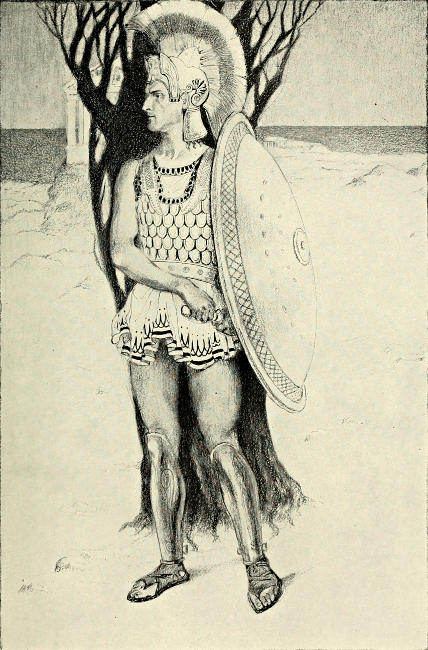
A GREEK WARRIOR
It is evident that a constitution such as we have described could not have
been suffered to last, if it had been supposed that any important political
interests depended on the decision of the council. But, in fact, it was not
commonly viewed as a national congress for such purposes; its ordinary
functions were chiefly, if not altogether, connected with religion, and it was
only by accident that it was ever made subservient to political ends. The
original objects, or at least the essential character, of the institution, seem to
be faithfully expressed in the terms of the oath, preserved by Æschines,
which bound the members of the league to refrain from utterly destroying
any Amphictyonic city, and from cutting off its supply of water, even in war,
and to defend the sanctuary and the treasures of the Delphic god from sacrilege.
In this ancient and half-symbolical form we perceive two main functions
assigned to the council; to guard the temple, and to restrain the
violence of hostility among Amphictyonic states. There is no intimation
of any confederacy against foreign enemies, except for the protection of the
temple; nor of any right of interposing between members of the league,
unless where one threatens the existence of another.
A review of the history of the council shows that it was almost powerless
for good, except perhaps as a passive instrument, and that it was only active
for purposes which were either unimportant or pernicious. In the great
national struggles it lent no strength to the common cause; but it now and
then threw a shade of sanctity over plans of ambition or revenge. It sometimes
assumed a jurisdiction uncertain in its limits, over its members; but
it seldom had the power of executing its sentences, and commonly committed
them to the party most interested in exacting the penalty. Thus it punished
the Dolopes of Scyros for piracy, by the hands of the Athenians, who coveted
their island. But its most legitimate sphere of action lay in cases where
the honour and safety of the Delphic sanctuary were concerned; and in these
it might safely reckon on general co-operation from all the Greeks. Thus it
could act with dignity and energy in a case where a procession, passing
through the territory of Megara towards Delphi, was insulted by some Megarians,
and could not obtain redress from the government; the Amphictyonic
tribunal punished the offenders with death or banishment.
[590 B.C.]
A much more celebrated and important instance of a similar intervention,
was that which gave occasion to the war above alluded to, which is commonly
called the Crissæan, or the First Sacred War. Crissa appears to be
the same town which is sometimes named Cirrha. Situate on that part of the
Corinthian Gulf which was called from it the Gulf of Crissa, it commanded a
harbour, much frequented by pilgrims from the West, who came to Delphi by
sea, and was also mistress of a fruitful tract, called the Cirrhæan Plain. It
is possible that there may have been real ground for the charge which was
brought against the Crissæans, of extortion and violence used towards the
strangers who landed at their port, or passed through their territory: one
ancient author, who however wrote nearly three centuries later, assigned as
the immediate occasion of the war an outrage committed on some female
pilgrims as they were returning from the oracle. It is however at least equally
probable, that their neighbours of Delphi had long cast a jealous and a wishful
eye on the customs by which Crissa was enriched, and considered all that
was there exacted from the pilgrims as taken from the Delphic god, who
might otherwise have received it as an offering.
A complaint, however founded, was in the end preferred against Crissa
before the Amphictyons, who decreed a war against the refractory city.
They called in the aid of the Thessalians, who sent a body of forces under
Eurylochus; and their cause was also actively espoused by Clisthenes, tyrant
of Sicyon: and, according to the Athenian tradition, Solon assisted them
with important advice. They consulted the offended god, who enjoined, as
the condition of success in the war, that they should cause the sea to beat
upon his domain. In compliance with this oracle, at the suggestion of Solon,
they vowed to dedicate the Crissæans and their territory to the god, by
enslaving them, and making their land a waste forever. If the prospect of
such signal vengeance animated the assailants, the besieged were no doubt
goaded to a more obstinate defence by the threat of extermination. The
war is said to have lasted ten years, and at length to have been brought to a
close by a stratagem, which we could wish not to have found imputed to
Solon. He is reported to have poisoned the waters of the Plistus, from
which the city was supplied, and thus to have reduced the garrison to a state
in which they were easily overpowered. When the town had fallen, the
vow of the conquerors was literally fulfilled. Crissa was razed to the ground,
its harbour choked up, its fruitful plain turned into a wilderness. This
triumph was commemorated by the institution of gymnastic games, called
the Pythian, in the room of a more ancient and simple festival. The Amphictyons,
who celebrated the new games with the spoils of Crissa, were appointed
perpetual presidents.
[589-585 B.C.]
As the Delphic oracle was the object to which the principal duties of the
Amphictyons related, it might have been imagined to have been under their
control, and thus to have afforded them an engine by which they might, at
least secretly, exert a very powerful influence over the affairs of Greece.
But though this engine was not unfrequently wielded for political purposes,
it appears not to have been under the management of the council, but of the
leading citizens of Delphi, who had opportunity of constant and more efficacious
access to the persons employed in revealing the supposed will of the
god. In early times the oracle was often consulted, not merely for the sake
of learning the unknown future, but for advice and direction, which, as it
was implicitly followed, really determined the destiny of those who received
it. The power conferred by such an instrument was unbounded; and it
appears, on the whole, not to have been ill applied: but the honour of its
beneficial effects must be ascribed almost entirely to the wisdom and patriotism
of the ruling Delphians or of the foreigners who concerted with them
in the use of the sacred machinery. But the authority of the oracle itself
was gradually weakened, partly by the progress of new opinions, and partly
by the abuse which was too frequently made of it. The organ of the prophetic
god was a woman, of an age more open to bribery than to any other
kind of seduction;[13] and, even before the Persian wars, several instances
occurred in which she had notoriously sold her answers. The credulity of
individuals might notwithstanding be little shaken: but a few such disclosures
would be sufficient to deprive the oracle of the greater part of its
political influence.
The character of a national institution, which the Amphictyonic council
affected, but never really acquired, more truly belonged to the public festivals,
which, though celebrated within certain districts, were not peculiar to
any tribe, but were open to all who could prove their Hellenic blood.b
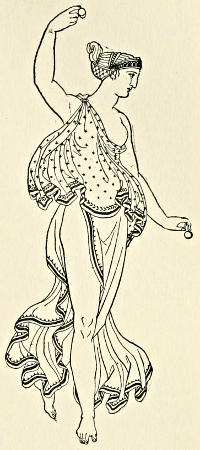
Greek Dancing Girl
(After Hope)
From very early times, it had been customary among the Greeks to hold
numerous meetings for purposes of festivity and social amusement. A foot-race,
a wrestling match, or some other rude trial of bodily strength and
activity, formed originally the principal entertainment, which seems to have
been very similar in character to our country wakes. The almost ceaseless
warfare among the little Grecian states gave especial value to military exercises,
which were accordingly ordinary in those
games. The connection of these games with
the warlike character may have occasioned their
introduction at funerals in honour of the dead;
a custom which, we learn from Homer, was in
his time ancient. But all the violence of the
early ages was unable to repress that elegance
of imagination which seems congenial to Greece.
Very anciently a contention for a prize in poetry
and music was a favourite entertainment of the
Grecian people; and when connected, as it often
was, with some ceremony of religion, drew together
large assemblies of both sexes. A festival
of this kind in the little island of Delos, at which
Homer assisted, brought a numerous concourse
from different parts by sea: and Hesiod informs
us of a splendid meeting for the celebration of
various games at Chalcis in Eubœa, where himself
obtained the prize for poetry and song. The
contest in music and poetry seems early to have
been particularly connected with the worship of
Apollo. When this was carried from the islands
of the Ægean to Delphi, a prize for poetry was
instituted; and thence appear to have arisen the
Pythian games. But Homer shows that games,
in which athletic exercises and music and dancing
were alternately introduced, made a common
amusement of the courts of princes; and before
his time the manner of conducting them was so
far reduced to a system that public judges of the
games were of the established magistracy. Thus
improved, the games greatly resembled the tilts and tournaments of the ages
of chivalry. Only men of high rank presumed to engage in them; but a
large concourse of all orders attended as spectators; and to keep regularity
among these was perhaps the most necessary office of the judges. But the
most solemn meetings, drawing together people of distinguished rank and
character, often from distant parts, were at the funerals of eminent men.
The paramount sovereigns of the Peloponnesus did not disdain to attend
these, which were celebrated with every circumstance of magnificence and
splendour that the age could afford. The funeral of Patroclus, described
in the Iliad, may be considered as an example of what the poet could imagine
in its kind most complete. The games, in which prizes were there
contended for, were the chariot-race, the foot-race, boxing, wrestling, throwing
the quoit and the javelin, shooting with the bow, and fencing with the
spear. And in times when none could be rich or powerful but the strong
and active, the expert at martial exercises, all those trials of skill appear to
have been esteemed equally becoming men of the highest rank; though it may
seem, from the prizes offered and the persons contending at the funeral of
Patroclus, the poet himself saw, in the game of the cestus, some incongruity
with exalted characters.
[ca. 884 B.C.]
Traditions are preserved of games celebrated in Elis, upon several great
occasions, in very early times, with more than ordinary pomp, by assemblies
of chiefs from different parts of Greece. Homer mentions such at Elis under
King Augeas, contemporary with Hercules, and grandfather of one of the
chiefs who commanded the Elean troops in the Trojan War; and again at
Buprasium in Elis, for the funeral of Amarynceus, while Nestor was yet in
the vigour of youth. But it does not at all appear from Homer that in his
time, or ever before him, any periodical festival was established like that
which afterward became so famous under the title of the Olympiad or the
Olympian contest, or, as our writers, translating the Latin phrase, have
commonly termed it, the Olympian Games. On the contrary, every mention
of such games, in his extant works, shows them to have been only occasional
solemnities; and Strabo has remarked that they were distinguished
by a characteristical difference from the Olympian. In these the honour
derived from receiving publicly a crown or chaplet, formed of a branch of
oleaster, was the only reward of the victor; but in Homer’s games the
prizes, not merely honorary, were intrinsically valuable, and the value was
often very considerable.
After Homer’s age, through the long troubles ensuing from the Dorian
conquest, and the great change made in the population of the country, the
customs and institutions of the Peloponnesians were so altered that even
memory of the ancient games was nearly lost.
In this season of turbulence and returning barbarism, Iphitus, a descendant,
probably grandson, of Oxylus (though so deficient were the means of
transmitting information to posterity that we have no assurance even of his
father’s name), succeeded to the throne of Elis. This prince was of a
genius that might have produced a more brilliant character in a more
enlightened age, but which was perhaps more beneficial to mankind in the
rough times in which he lived. Active and enterprising, but not by inclination
a warrior, he was anxious to find a remedy for the disorderly situation
of his country. He sent a solemn embassy to Delphi to supplicate information
from the deity of the place, “How the anger of the gods, which threatened
total destruction to the Peloponnesus through endless hostilities among
its people, might be averted.” He received for answer, what himself, as a
judicious critic has observed, had probably suggested, “That the Olympic
festival must be restored; for the neglect of that solemnity had brought on
the Greeks the indignation of the god Jupiter, to whom it was dedicated,
and of the hero Hercules, by whom it had been instituted: and that a
cessation of arms must therefore immediately be proclaimed for all cities
desirous of partaking in it.” This response of the god was promulgated
throughout Greece; and Iphitus, in obedience to it, caused the armistice to be
proclaimed. But the other Peloponnesians, full of respect for the authority
of the oracle, yet uneasy at the ascendancy thus assumed by the Eleans,
sent a common deputation to Delphi, to inquire concerning the authenticity
of the divine mandate reported to them. The Pythoness however, seldom
averse to authorise the schemes of kings and legislators, adhered to her
former answer and commanded the Peloponnesians “to submit to the direction
and authority of the Eleans, in ordering and establishing the ancient
laws and customs of their forefathers.”
Supported thus by the oracle, and encouraged by the ready acquiescence of
all the Peloponnesians, Iphitus proceeded to model his institution. Jupiter,
the chief of the gods, being now the acknowledged patron of the plan, and
the prince himself, under Apollo, the promulgator of his will, it was ordained
that a festival should be held at the temple of Jupiter at Olympia, near the
town of Pisa in Elis, open to the whole Greek nation; and that it should be
repeated at the termination of every fourth year: that this festival should
consist in solemn sacrifices to Jupiter and Hercules, and in games celebrated
to their honour; and as wars might often prevent not only individuals, but
whole states, from partaking in the benefits with which the gods would reward
those who properly shared in the solemnity, it was ordained under the same
authority, that an armistice should take place throughout Greece for some
time before the commencement of the festival, and continue for some time
after its conclusion. For his own people, the Eleans, Iphitus procured an
advantage never perhaps enjoyed in equal extent by any other people. A
tradition was current that the Heraclidæ, on appointing Oxylus at the same
time to the throne of Elis and to the guardianship of the temple of Olympian
Jupiter, had consecrated all Elis to the god under sanction of an oath,
and denounced the severest curses, not only on any who should invade it, but
also on all who should not defend it against invaders. Iphitus procured universal
acquiescence to the authority of this tradition; and the deference of the
Grecian people towards it, during many ages, is not among the least remarkable
circumstances of Grecian history. A reputation of sacredness became
attached to the whole Elean people as the hereditary priesthood of Jupiter,
and a pointed difference in character and pursuits arose between them and
the other Greeks. Little disposed to ambition, and regardless even of the
pleasures of a town-life, their general turn was to rural business and rural
amusements. Elsewhere the country was left to hinds and herdsmen, who
were mostly slaves; men of property, for security as well as for pursuits of
ambition and pleasure, resided in fortified towns. But the towns of Elis,
Elis itself the capital, remained unfortified. In republican governments however
civil contention would arise. Within a narrow territory the implication
of domestic party-politics with foreign interests could not be entirely obviated;
and thus foreign wars would ensue. But to the time of Polybius,
who saw the liberty of Greece expire, the Eleans maintained their general
character, and in a great degree their ancient privileges; whence they were
then the wealthiest people of the Peloponnesus, and yet the richest of them
mostly resided upon their estates, and many, as that historian avers, without
ever visiting Elis.
Character of the Games
At the Olympian festival, as established by Iphitus, the foot-race, distinguished
by the name of stadion, is said to have been the only game exhibited;
whether the various other exercises familiar in Homer’s age had
fallen into oblivion, or the barbarism and poverty, superinduced by the
violent and lasting troubles which followed the return of the Heraclidæ, forbade
those of greater splendour.
Afterwards, as the growing importance of the meeting occasioned inquiry
concerning what had been practised of old, or excited invention concerning
what might be advantageously added new, the games were multiplied. The
diaulos, a more complicated foot-race, was added at the fourteenth Olympiad;
wrestling, and the pentathlon or game of five exercises, at the eighteenth;
boxing at the twenty-third; the chariot-race was not restored till the twenty-fifth,
of course not till a hundred years after the institution of the festival;
the pancration and the horse-race were added in the thirty-third.
So much Pausanias has asserted; apparently from the Olympian register,
which on other occasions he has quoted. Originally the sacrifices, processions,
and various religious ceremonies apparently formed the principal
pageantry of the meeting. Afterwards perhaps the games became the
greater inducement for the extraordinary resort of company to Olympia;
though the religious ceremonies continued still to increase in magnificence
as the festival gained importance. The temple, like that of Delphi, became
an advantageous repository for treasure. A mart or fair was a natural
consequence of a periodical assembly of multitudes in one place; and
whatever required extensive publicity, whatever was important for all the
scattered members of the Greek nation to know, would be most readily
communicated, and most solemnly, by proclamation at the Olympian festival.
Hence treaties by mutual agreement were often proclaimed at Olympia; and
sometimes columns were erected there at the joint expense of the contracting
parties, with the treaties engraved.
Thus the Olympian meeting to a not inconsiderable degree supplied
the want of a common capital for the Greek nation; and, with a success
far beyond what the worthy founder’s imagination, urged by his warmest
wishes, could reach, contributed to the advancement of arts, particularly of
the fine arts, of commerce, of science, of civilised manners, of liberal sentiments,
and of friendly communication among all the Grecian people. Such
was the common feeling of these various advantages, it became established
as a divine law that, whatever wars were going forward among the republics,
there should be a truce, not only during the festival, but also for some
days before and after; so that persons from all parts of Greece might safely
attend it.
The advantages and gratifications in which the whole nation thus became
interested, and the particular benefits accruing to the Eleans, excited attempts
to establish or improve other similar meetings in different parts of
Greece. Three of these, the Delphian, Isthmian, and Nemean, though they
never equalled the celebrity and splendour of the Olympian, acquired considerable
fame and importance. Each was consecrated to a different deity.
In the Delphic, next in consideration to the Olympic, Apollo was honoured;
the Delphian people were esteemed his ministers; the Amphictyonic council
were the allowed protectors and regulators of the institution. The Isthmian
had its name from the Corinthian Isthmus, near the middle of which,
overlooking the scene of the solemnity, stood a temple of the god Neptune,
venerated by the Corinthian people, administrators of the ceremonies, as
their patron.
At the Nemean, sacred to Juno, the Argives (who esteemed her the
tutelary deity of their state) presided. All these meetings, like the Olympian,
were, in war as in peace, open to all Grecian people; the faith of gods
as well as of men being considered as plighted for protection of all, under
certain rules, going to, staying at, and returning from them. All were also,
like the Olympian, held at intervals of four years; so that, taking their years
in turn, it was provided that in every summer, in the midst of the military
season, there should be a respite of those hostilities among the republics which
were otherwise so continually desolating Greece; and though this beneficial
regulation was under some pretences occasionally overborne by powerful
states, yet the sequel of history shows it to have been of very advantageous
efficacy.c
The enterprises of the heroic age, as we see from the example of the
Trojan War itself, often led to the extinction, or expulsion, of a royal family,
or of its principal members; and no principle appears to have been generally
recognised which rendered it necessary, in such cases, to fill a vacant throne
or to establish a new dynasty, while every such calamity inevitably weakened
the authority of the kings, and made them more dependent on the nobles,
who, as an order, were not affected by any disasters to individuals. But the
great convulsions which attended the Thessalian, Bœotian, and Dorian
migrations, contributed still more effectually to the same end. In most
parts of Greece they destroyed or dislodged the line of the ancient kings,
who, when they were able to seek new seats, left behind them the treasures
and the strongholds which formed the main supports of their power: and,
though the conquerors were generally accustomed to a kingly government, it
must commonly have lost something of its vigour when transplanted to a
new country, where it was subject to new conditions, and where the prince
was constantly reminded, by new dangers, of the obligations which he owed
to his companions in arms. Yet, even this must be considered rather as the
occasion which led to the abolition of the heroic monarchy, than as the cause:
that undoubtedly lay much deeper, and is to be sought in the character of
the people—in that same energy and versatility which prevented it from
ever stiffening, even in its infancy, in the mould of oriental institutions, and
from stopping short, in any career which it had once opened, before it had
passed through every stage.
It seems to have been seldom, if ever, that royalty was abolished by a
sudden and violent revolution; the title often long survived the substance,
and this was extinguished only by slow successive steps. These consisted
in dividing it among several persons, in destroying its inheritable quality,
and making it elective, first in one family, then in more; first for life, then
for a certain term; in separating its functions, and distributing them into
several hands. In the course of these changes it became more and more
responsible to the nobles, and frequently, at a very early stage, the name
itself was exchanged for one simply equivalent to ruler, or chief magistrate.
The form of government which thus ensued might, with equal propriety,
be termed either aristocracy or oligarchy, but, in the use of the terms to
which these correspond, the Greek political writers made a distinction,
which may at first sight appear more arbitrary than it really is. They
taught—not a very recondite truth—that the three forms of government,
that of one, that of a few, and that of the many, are all alike right and
good, so long as they are rightly administered, with a view, that is, to
the welfare of the state, and not to the interest of an individual or of a
particular class. But, when any of the three loses sight of its legitimate
object, it degenerates into a vicious species, which requires to be marked by
a peculiar name. Thus a monarchy, in which selfish aims predominate
becomes a tyranny. The government of a few, conducted on like principles,
is properly called an oligarchy. But to constitute an aristocracy, it
is not sufficient that the ruling few should be animated by a desire to promote
the public good: they must also be distinguished by a certain character;
for aristocracy signifies the rule of the best men.
More distinctly to understand the peculiar nature of the Greek oligarchies,
it is necessary to consider the variety of circumstances under which they
arose. By the migrations which took place in the century following the
Trojan War, most parts of Greece were occupied by a new race of conquerors.
Everywhere their first object was to secure a large portion of the conquered
land; but the footing on which they placed themselves, with regard to the
ancient inhabitants, was not everywhere the same; it varied according to
the temper of the invaders, or of their chiefs, to their relative strength,
means, and opportunities. In Sparta, and in most of the Dorian states, the
invaders shunned all intermixture with the conquered, and deprived them,
if not of personal freedom, of all political rights. But elsewhere, as in Elis,
and probably in Bœotia, no such distinction appears to have been made;
the old and the new people gradually melted into one.
An oligarchy, in the sense which we have assigned to the word, could
only exist where there was an inferior body which felt itself aggrieved by
being excluded from the political rights which were reserved to the privileged
few. Such a feeling of discontent might be roused by the rapacity or
insolence of the dominant order, as we shall find to have happened at Athens,
and as was the case at Mytilene, where some members of the ruling house
of the Penthilids went about with clubs, committing outrages like those
which Nero practised for a short time in the streets of Rome. But, without
any such provocation, disaffection might arise from the cause which we shall
see producing a revolution at Corinth, where the aristocracy was originally
established on a basis too narrow to be durable: as Aristotle relates of the
Basilids at Erythræ, that, though they exercised their power well, they could
not retain it, because the people would no longer endure that it should be
lodged in so few hands. In general however it was a gradual, inevitable
change in the relative position of the higher and lower orders, which converted
the aristocracy into an oligarchical faction, and awakened an opposition
which usually ended in its overthrow.
The precautions which were used by the ruling class, when it began to
perceive its danger, were of various kinds, and it was more frequently found
necessary to widen the oligarchy itself, by the admission of new families, and
to change the principle of its constitution by substituting wealth for birth as
the qualification of its members. The form of government in which the
possession of a certain amount of property was the condition of all, or at
least of the highest, political privileges, was sometimes called a timocracy,
and its character varied according to the standard adopted. When this was
high, and especially if it was fixed in the produce of land, the constitution
differed little in effect from the aristocratical oligarchy, except as it opened
a prospect to those who were excluded of raising themselves to a higher rank.
But, when the standard was placed within reach of the middling class, the
form of government was commonly termed a polity, and was considered
as one of the best tempered and most durable modifications of democracy.
The first stage however often afforded the means of an easy transition to the
second, or might be reduced to it by a change in the value of the standard.
Another expedient, which seems to have been tried not unfrequently in
early times, for preserving or restoring tranquillity, was to invest an individual
with absolute power, under a peculiar title, which soon became obsolete:
that of æsymnete. At Cumæ indeed, and in other cities, this was the title
of an ordinary magistracy, probably of that which succeeded the hereditary
monarchy; but, when applied to an extraordinary office, it was equivalent
to the title of protector or dictator. It did not indicate any disposition to
revive the heroic royalty, but only the need which was felt, either by the
commonalty of protection against the nobles, or by all parties of a temporary
compromise, which induced the adverse factions to acquiesce in a neutral government.
The office was conferred sometimes for life, sometimes only for a
limited term, or for the accomplishment of a specific object, as the sage Pittacus
was chosen by universal consent at Mytilene, when the city was threatened
by a band of exiles, headed by the poet Alcæus and his brother Antimenidas
[about 612 B.C.].
The fall of an oligarchy was sometimes accelerated by accidental and inevitable
disasters, as by a protracted war, which at once exhausted its wealth
and reduced its numbers, or by the loss of a battle, in which the flower of
its youth might sometimes be cut off at one blow, and leave it to the mercy
of its subjects; a case of which we shall find a signal instance in the history
of Argos. But much more frequently the revolutions which overthrew the
oligarchical governments arose out of the imprudence or misconduct, or the
internal dissensions, of the ruling body, or out of the ambition of some of
its members. The commonalty, even when really superior in strength,
could not, all at once, shake off the awe with which it was impressed by
ages of subjection. It needed a leader to animate, unite, and direct it.
Such was the origin of most of the governments which the Greeks described
by the term “tyranny”—a term to which a notion has been attached,
in modern languages, which did not enter into its original definition. A
tyranny, in the Greek sense of the word, was the irresponsible dominion of
a single person, not founded on hereditary right, like the monarchies of the
heroic ages and of many barbarian nations; nor on a free election, like that
of a dictator or æsymnete; but on force. It did not change its character
when transmitted through several generations, nor was any other name invented
to describe it when power which had been acquired by violence was
used for the public good; though Aristotle makes it an element in the definition
of tyranny, that it is exercised for selfish ends. But, according to the
ordinary Greek notions, and the usage of the Greek historians, a mild and
beneficent tyranny is an expression which involves no contradiction. On
the other hand, a government, legitimate in its origin, might be converted
into a tyranny, by an illegal forcible extension of its powers, or of its duration;
and we are informed by Aristotle that this was frequently the case in
early times, before the regal title was abolished, or while the chief magistrate,
who succeeded under a different name to the functions of royalty, was
still invested with prerogatives dangerous to liberty. Such was the basis
on which one of the ancient tyrants, most infamous for his cruelty, Phalaris
of Agrigentum [or Acragas], established his despotism.
But most of the tyrannies which sprang up before the Persian wars owed
their existence to the cause above described, and derived their peculiar character
from the occasion which gave them birth. It was usually by a mixture
of violence and artifice that the demagogue accomplished his ends. A
hackneyed stratagem, which however seems always to have been successful,
was, to feign that his life was threatened, or had even been attacked by the
fury of the nobles, and on this pretext to procure a guard for his person
from the people. This band, though composed of citizens, he found it easy
to attach to his interests, and with its aid made the first step towards absolute
power by seizing the citadel: an act which might be considered as a
formal assumption of the tyranny, and as declaring a resolution to maintain
it by force. But in other respects the more politic tyrants set an example
which Augustus might have studied with advantage. Like him, they as
carefully avoided the ostentation of power as they guarded its substance.
They suffered the ancient forms of the government to remain in apparent
vigour, and even in real operation, so far as they did not come into conflict
with their own authority. They assumed no title, and were not distinguished
from private citizens by any ensigns of superior rank. But they did not
the less keep a jealous eye on all whom wealth, or character, or influence
might render dangerous rivals; and commonly either forced them into exile
or removed them by the stroke of an assassin. They exerted still greater
vigilance in suppressing every kind of combination which might cover the
germ of a conspiracy. The lowest class of the commonalty they restrained
from license, and provided with employment. For this purpose, no less
than to gratify their taste or display their magnificence, they frequently
adorned their cities with costly buildings, which required years of labour
from numerous hands: and, where this expedient did not suffice, they scrupled
not to force a part of the population to quit the capital, and seek
subsistence in rural occupations. On the same ground they were not reluctant
to engage in wars, which afforded them opportunities of relieving
themselves, in a less invidious manner, both from troublesome friends and
from dangerous foes, as well as of strengthening and extending their dominion
by conquest.
Such was the ordinary policy of the best tyrants; and by these arts they
were frequently able to reign in peace, and to transmit their power to their
children. But the maxims and character of the tyranny generally underwent
a change under their successors, and scarcely an instance was known
of a tyrannical dynasty that lasted beyond the third generation. But, even
where the tyrant did not make himself universally odious, or provoke the
vengeance of individuals by his wantonness or cruelty, he was constantly
threatened by dangers, both from within and from without, which it required
the utmost vigour and prudence to avert. The party which his usurpation
had supplanted, though depressed, was still powerful, more exasperated than
humbled by its defeat, and ever ready to take advantage of any opportunity
of overthrowing him, either by private conspiracy, or by affecting to make
common cause with the lower classes, or by calling in foreign aid. And in
Greece itself such aid was always at hand: the tyrants indeed were partially
leagued together for mutual support. But Sparta threw all her might into
the opposite scale. She not only dreaded the contagion of an example which
might endanger her own institutions, but was glad to extend her influence
by taking an active part in revolutions, which would cause the states restored,
by her intervention, to their old government to look up to her with gratitude
and dependence as their natural protectress. And accordingly Thucydides
ascribes the overthrow of most of the tyrannies which flourished in Greece
before the Persian War to the exertions of Sparta.
The immediate effect produced by the fall of the tyrants depended on the
hands by which it was accomplished. Where it was the work of Sparta, she
would aim at introducing a constitution most in conformity to her own.
But the example of Athens will show, that she was sometimes instrumental
in promoting the triumph of principles more adverse to her views than those
of the tyranny itself. When, however, the struggle which had been interrupted
by the temporary usurpation was revived, the parties were no longer
in exactly the same posture as at its outset. In general the commonalty
was found to have gained, in strength and spirit, even more than the oligarchy
had lost; and the prevalent leaning of the ensuing period was on the
side of democracy. Indeed the decisive step was that by which the oligarchy
of wealth was substituted for the oligarchy of birth. This opened the door
for all the subsequent innovations, by which the scale of the timocracy was
gradually lowered, until it was wholly abolished.
The term “democracy” is used by Aristotle sometimes in a larger sense,
so as to include several forms of government, which, notwithstanding their
common character, were distinguished from each other by peculiar features;
at other times in a narrower, to denote a form essentially vicious, which
stands in the same relation to the happy temperament to which he gives the
name of polity, as oligarchy to aristocracy, or tyranny to royalty. We shall
not confine ourselves to the technical language of his system, but will endeavour
to define the notion of democracy, as the word was commonly understood
by the Greeks, so as to separate the essence of the thing from the
various accidents which have sometimes been confounded with it by writers
who have treated Greek history as a vehicle for conveying their views on
questions of modern politics, which never arose in the Greek republics.
It must not be forgotten, that the body to which the terms oligarchy and
democracy refer formed a comparatively small part of the population in most
Greek states, since it did not include either slaves or resident free foreigners.
The sovereign power resided wholly in the native freemen; and whether it
was exercised by a part or by all of them, was the question which determined
the nature of the government. When the barrier had been thrown down,
by which all political rights were made the inheritance of certain families,—since
every freeman, even when actually excluded from them by the want
of sufficient property, was by law capable of acquiring them,—democracy
might be said to have begun. It was advancing, as the legal condition of
their enjoyment was brought within the reach of a more numerous class;
but it could not be considered as complete, so long as any freeman was
debarred from them by poverty. Since, however, the sovereignty included
several attributes which might be separated, the character of the constitution
depended on the way in which these were distributed. It was considered
as partaking more of democracy than of oligarchy, when the most important
of them were shared by all freemen without distinction, though a part was
still appropriated to a number limited either by birth or fortune. Thus
where the legislative, or, as it was anciently termed, the deliberative, branch
of the sovereignty was lodged in an assembly open to every freeman, and
where no other qualification than free birth was required for judicial functions,
and for the election of magistrates, there the government was called
democratical, though the highest offices of the state might be reserved to
a privileged class. But a finished democracy, that which fully satisfied
the Greek notion, was one in which every attribute of sovereignty might be
shared, without respect to rank or property, by every freeman.
More than this was not implied in democracy; and little less than this
was required, according to the views of the philosophers, to constitute the
character of a citizen, which, in the opinion of Aristotle, could not exist
without a voice in the legislative assembly, and such a share in the administration
of justice as was necessary to secure the responsibility of the magistrates.
But this equality of rights left room for a great diversity in the
modes of exercising them, which determined the real nature of a democratical
constitution. There were, indeed, certain rights, those which Aristotle
considers as essential to a citizen, which, according to the received Greek
notions, could, in a democracy, only be exercised in person. The thought of
delegating them to accountable representatives seems never to have occurred
either to practical or speculative statesmen, except in the formation of confederacies,
which rendered such an expedient necessary.
But the principle of legal equality, which was the basis of democracy,
was gradually construed in a manner which inverted the wholesome order
of nature, and led to a long train of pernicious consequences. The administration
of the commonwealth came to be regarded, not as a service, in which
all were interested, but for which some might be qualified better than others,
but as a property, in which each was entitled to an equal share. The practical
application of this view was the introduction of an expedient for levelling,
as far as possible, the inequality of nature, by enabling the poorest to
devote his time, without loss, or even with profit, to public affairs. This
was done by giving him wages for his attendance on all occasions of exercising
his franchise; and, as the sum which could be afforded for this purpose
was necessarily small, it attracted precisely the persons whose presence was
least desirable.
A further application of the same principle was, as much as possible, to
increase the number, and abridge the duration and authority of public offices,
and to transfer their power to the people in a mass. On the same ground,
chance was substituted for election in the creation of all magistrates, whose
duties did not actually demand either the security of a large fortune or
peculiar abilities and experience. In proportion as the popular assembly, or
large portions detached from it for the exercise of judicial functions, drew
all the branches of the sovereignty more and more into their sphere, the
character of their proceedings became more and more subject to the influence
of the lower class of the citizens, which constituted a permanent majority.
And thus the democracy, instead of the equality which was its supposed
basis, in fact established the ascendancy of a faction, which, although greatly
preponderant in numbers, no more represented the whole state than the oligarchy
itself; and which, though not equally liable to fall into the mechanism
of a vicious system, was more prone to yield to the impulse of the moment,
more easily misled by blind or treacherous guides, and might thus, as frequently,
though not so deliberately and methodically, trample, not only on
law and custom, but on justice and humanity. This disease of a democracy
was sometimes designated by the term “ochlocracy,” or the dominion of the
rabble.
A democracy thus corrupted exhibited many features of a tyranny. It
was jealous of all who were eminently distinguished by birth, fortune, or
reputation; it encouraged flatterers and sycophants; was insatiable in its
demands on the property of the rich, and readily listened to charges which
exposed them to death or confiscation. The class which suffered such oppression,
commonly ill satisfied with the principle of the constitution itself, was
inflamed with the most furious animosity by the mode in which it was
applied, and regarded the great mass of its fellow-citizens as its mortal
enemies.b
Ruins of the Temple of Apollo Epicurius, Arcadia
Aristotle’s survey of the Greek forms of government was founded on
a vast store of information which he had collected on the history and constitution
of more than a hundred and fifty states, in the mother country and the
colonies, and which he had consigned to a great work now unfortunately lost.
Our knowledge of the internal conditions and vicissitudes of almost all these
states is very scanty and fragmentary: but some of the main facts concerning
them, which have been saved from oblivion, will serve to throw
light on several parts of the ensuing history.
We have scarcely anything to say, during this period, of the state of
parties, or even the forms of government, in Arcadia, Elis, and Achaia. If
Arcadia was ever subject to a single king, which seems to be intimated by
some accounts of its early history, it was probably only, as in Thessaly,
by an occasional election, or a temporary usurpation. The title of king
however appears not to have been everywhere abolished down to a much
later time, as we find a hint that it was retained at Orchomenos even in the
fifth century before our era. That the republican constitutions were long
aristocratical can scarcely be doubted, as the two principal Arcadian cities,
Tegea and Mantinea, were at first only the chief among several small hamlets,
which were at length united in one capital. This, whenever it happened, was
a step towards the subversion of aristocratical privileges; and it was no doubt
with this view that the five Mantinean villages were incorporated by the
Argives, as Strabo mentions without assigning the date of the event. But
it is not probable that Argos thus interfered before her own institutions had
undergone a like change, which, as we shall see, did not take place before a
later period than our history has yet reached. Whether the union of the
nine villages, which included Tegea as their chief, was effected earlier or
later, does not appear. But, after she had once acknowledged the supremacy
of Sparta, Tegea was sheltered by Spartan influence from popular innovations,
and was always the less inclined to adopt them when they prevailed at
Mantinea: for as the position of the two Arcadian neighbours tended to connect
the one with Sparta, and the other with Argos, so it supplied occasion for
interminable feuds between them. But, in general, the history of the western
states of Arcadia is wrapt in deep obscurity, which was only broken, in
the fourth century B.C., by the foundation of a new Arcadian capital.
In Elis the monarchical form of government continued for some generations
in the line of Oxylus, but appears to have ceased there earlier than at
Pisa, which, at the time when it was conquered and destroyed by the Eleans,
was ruled by chiefs, who were probably legitimate kings. Immediately after
the conquest, in the fiftieth Olympiad, the dignity of hellanodicæ, which had
been held by the kings of Elis, or shared by them with those of Pisa, was
assigned to two Elean officers by lot, a proof that royalty was then extinct.
The constitution by which it was replaced seems to have been rigidly aristocratical,
perhaps no other than the narrow oligarchy described by Aristotle,—who
observes that the whole number of citizens exercising any political
functions was small—confined, perhaps to the six hundred mentioned by
Thucydides; and that the senate, originally composed of ninety members,
who held their office for life, and filled up vacancies at their pleasure, had
been gradually reduced to a very few. Elis, the capital, remained in a condition
like that of the above-mentioned Arcadian towns until the Persian
War, when the inhabitants of many villages were collected in its precincts.
This was probably attended by other changes of a democratical nature—perhaps
by the limitation which one Phormis is said to have effected in
the power of the senate—and henceforth the number of the hellanodicæ
corresponded to that of the tribes or regions into which the Elean territory
was divided; so that, whenever any of these regions was lost by the chance
of war, the number of the hellanodicæ was proportionately reduced. So too
the matrons who presided at the games in honour of Hera, in which the
Elean virgins contended at Olympia, were chosen in equal number from each
of the tribes.
In Achaia, the royal dignity was transmitted in the line of Tisamenus
down to Ogyges, whose sons, affecting despotic power, were deposed, and
the government was changed to a democracy, which is said to have possessed
a high reputation. From Pausanias it would rather seem as if the title of
king had been held by a number of petty chiefs at once. If so, the revolution
must have had its origin in causes more general than those assigned to
it by Polybius. It was probably accelerated by the number of Achæan emigrants
who sought refuge in Achaia from other parts of the Peloponnesus, and
who soon crowded the country, till it was relieved by its Italian colonies.
What Polybius and Strabo term a democracy may however have been a
polity, or a very liberal and well-tempered form of oligarchy. Of its details
we know nothing; nor are we informed in what relation the twelve principal
Achaian towns—a division adopted from the Ionians—stood to the hamlets,
of which each had seven or eight in its territory, like those of Tegea and
Mantinea. As little are we able to describe the constitution of the confederacy
in which the twelve states were now united.
More light has been thrown by ancient authors on the history of the
states in the northeast quarter of Peloponnesus, those of Argolis in the
largest sense of the word. At Argos itself, regal government subsisted
down to the Persian wars, although the line of the Heraclid princes appears
to have become extinct toward the middle of the preceding century. Pausanias
remarks, that, from a very early period, the Argives were led by their
peculiarly independent spirit to limit the prerogatives of their kings so
narrowly as to leave them little more than the name. We cannot however
place much reliance on such a general reflection of a late writer. But
we have seen that Phidon, who, about the year 750 B.C., extended the
power of Argos farther than any of his predecessors, also stretched the royal
authority so much beyond its legitimate bounds, that he is sometimes called
a tyrant, though he was rightful heir of Temenus. After his death, as his
conquests appear to have been speedily lost, so it is probable that his
successors were unable to maintain the ascendancy which he had gained over
his Dorian subjects, and the royal dignity may henceforth have been, as
Pausanias describes it, little more than a title. Hence, too, on the failure
of the ancient line, about B.C. 560, Ægon, though of a different family, may
have met with the less opposition in mounting the throne. The substance
of power rested with the Dorian freemen: in what manner it was distributed
among them we can only conjecture from analogy. Their lands were cultivated
by a class of serfs, corresponding to the Spartan helots, who served in
war as light-armed troops, whence they derived their peculiar name, “gymnesii.”
They were also sovereigns of a few towns, the inhabitants of which,
like the Laconians subject to Sparta, though personally free, were excluded
from all share in their political privileges. The events which put an end to
this state of things, and produced an entire change in the form of government
at Argos, will be hereafter related.
Among the states of the Argolic acte, Epidaurus deserves notice, not so
much for the few facts which are known of its internal history, as on account
of its relation to Ægina. This island, destined to take no inconsiderable
part in the affairs of Greece, was long subject to Epidaurus, which was so
jealous of her sovereignty as to compel the Æginetans to resort to her tribunals
for the trial of their causes. It seems to have been as a dependency of
Epidaurus that Ægina fell under the dominion of the Argive Phidon.
After recovering her own independence, Epidaurus still continued mistress
of the island. Whether she had any subjects on the main land standing on
the same footing, we are not expressly informed. But here likewise the
ruling class was supported by the services of a population of bondsmen,
distinguished by a peculiar name (conipodes, the dusty-footed), designating
indeed their rural occupations, but certainly expressive of contempt.
Towards the end of the seventh century B.C., and the beginning of the
next, Epidaurus was subject to a ruler named Procles, who is styled a
tyrant, and was allied with Periander the tyrant of Corinth. But nothing
is known as to the origin and nature of his usurpation. He incurred the
resentment of his son-in-law Periander, who made himself master of Procles
and of Epidaurus. It was perhaps this event which afforded Ægina an
opportunity of shaking off the Epidaurian yoke. But, had it been otherwise,
the old relation between the two states could not have subsisted much
longer. Ægina was rapidly outgrowing the mother country, was engaged in
a flourishing commerce, strong in an enterprising and industrious population,
enriched and adorned by the arts of peace, and skilled in those of war.
The separation which soon after took place was embittered by mutual resentment;
and the Æginetans, whose navy soon became the most powerful in
Greece, retaliated on Epidaurus for the degradation they had suffered by a
series of insults. But the same causes to which they owed their national
independence seem to have deprived the class which had been hitherto predominant
in Ægina of its political privileges. The island was torn by the
opposite claims and interests arising out of the old and the new order of
things, and became the scene of a bloody struggle.
The history of Sicyon presents a series of revolutions, in many points
resembling those of Corinth. At what time, or in whose person, royalty was
there extinguished, and what form of government succeeded it, we are not
expressly informed; but, as we know that there was a class of bondsmen at
Sicyon, answering to the helots, and distinguished by peculiar names, derived
from their rustic dress or occupation, there can be little doubt that other
parts of the Dorian system were also introduced there, and subsisted until a
fortunate adventurer, named Orthagoras, or Andreas, overthrew the old aristocracy,
and founded a dynasty, which lasted a century: the longest period,
Aristotle observes, of a Greek tyranny. Orthagoras is said to have risen
from a very low station—that of a cook—and was, therefore, probably
indebted for his elevation to the commonalty. The long duration of his
dynasty is ascribed by Aristotle to the mildness and moderation with which
he and his descendants exercised their power, submitting to the laws and
taking pains to secure the good will of the people.
His successor, Myron, having gained a victory in the Olympic chariot-race
in the thirty-third Olympiad, erected a treasury at Olympia, which was
remarkable for its material, brass of Tartessus, which had not long been
introduced into Greece; for its architecture, in which the Doric and Ionic
orders were combined; and for its inscription, in which the name of Myron
was coupled with that of the people of Sicyon. It may be collected, from an
expression of Aristotle’s, that, though Myron was succeeded, either immediately
or after a short interval, by his grandson Clisthenes, son of Aristonymus,
this transmission of the tyranny did not take place without interruption or
impediment; and, if this arose from the Dorian nobles, it would explain
some points in which the government of Clisthenes differed from that of
his predecessors.
He seems to have been the most able and enterprising prince of his house,
and to have conducted many wars, beside that in which we have seen him
engaged on the side of the Amphictyons, with skill and success: he was of
a munificent temper, and displayed his love of splendour and of the arts both
in the national games and in his native city, where, out of the spoils of
Crissa, he built a colonnade, which long retained the name of the Clisthenean.
The magnificence with which he entertained the suitors who came
from all parts of Greece, and even from foreign lands, to vie with one another,
after the ancient fashion, in manly exercises, for his daughter’s hand, was
long so celebrated, that Herodotus gives a list of the competitors. It proves
how much his alliance was coveted by the most distinguished families; and it
is particularly remarkable, that one of the suitors was a son of Phidon, king
of Argos, whom Herodotus seems to have confounded with the more ancient
tyrant of the same name. Still Clisthenes appears not to have departed
from the maxims by which his predecessors had regulated their government
with regard to the commonalty, but, in the midst of his royal state, to have
carefully preserved the appearance, at least, of equity and respect for the
laws. On the other hand, towards his Dorian subjects he displayed a spirit
of hostility which seems to have been peculiar to himself, and to have been
excited by some personal provocation. It was probably connected with a
war in which he was engaged with Argos, and it impelled him to various
political and religious innovations, the real nature of which can now be but
very imperfectly understood.
One of the most celebrated was the change which he made in the names of
the Dorian tribes, for which he substituted others, derived from the lowest
kinds of domestic animals; while a fourth tribe, to which he himself belonged,
was distinguished by the majestic title of the archelai (the princely).
Herodotus supposes that he only meant to insult the Dorians; and we could
sooner adopt this opinion than believe, with a modern author, that he took
so strange a method of directing their attention to rural pursuits. But
Herodotus adds, that the new names were retained for sixty years after the
death of Clisthenes and the fall of his dynasty, when those of the Dorian
tribes were restored, and, in the room of the fourth, a new one was created,
called from a son of the Argive hero, Adrastus, the Ægialeans. When
the Dorians resumed their old division, the commonalty was thrown into the
single tribe (called not from the hero, but from the land), the Ægialeans.
We do not know how this dynasty ended, and can only pronounce it
probable that it was overthrown at about the same time with that of the
Cypselids (B.C. 580), by the intervention of Sparta, which must have been
more alarmed and provoked by the innovations of Clisthenes than by the
tyranny of Periander. It would seem, from the history of the tribes, that
the Dorians recovered their predominance; but gradually, and not so completely
as to deprive the commonalty of all share in political rights.
On the other side of the isthmus, the little state of Megara passed
through vicissitudes similar to those of Corinth and Sicyon, but attended
with more violent struggles. Before the Dorian conquest royalty is said to
have been abolished there after the last king, Hyperion, son of Agamemnon,
had fallen by the hand of an enemy, whom he had provoked by insolence
and wrong: and a Megarian legend seems to indicate that the elective
magistrates, who took the place of the kings, bore the title of æsymnetes.
The Dorians of Corinth kept those of Megara, for a time, in the same kind
of subjection to which Ægina was reduced by Epidaurus; and the Megarian
peasantry were compelled to solemnise the obsequies of every Bacchiad
with marks of respect, such as were exacted from the subjects of Sparta on
the death of the king. This yoke however was cast off at an early period;
and Argos assisted the Megarians in recovering their independence. Henceforth
it is probable Megara assumed a more decided superiority over the
hamlets of her territory, which had once been her rivals; and she must have
made rapid progress in population and in power, as is proved by her flourishing
colonies in the east and west, and by the wars which she carried on in
defence of them. One of her most illustrious citizens, Orsippus, who, in the
fifteenth Olympiad, set the example of dropping all incumbrances of dress in
the Olympic foot-race, also conducted her arms with brilliant success against
her neighbours—probably the Corinthians—and enlarged her territory to
the utmost extent of her claims. But the government still remained in the
hands of the great Dorian land-owners, who, when freed from the dominion
of Corinth, became sovereigns at home; and they appear not to have administered
it mildly or wisely. For they were not only deprived of their power
by an insurrection of the commonalty, as at Corinth and Sicyon, but were
evidently the objects of a bitter enmity, which cannot have been wholly
unprovoked.
Theagenes, a bold and ambitious man, who put himself at the head of the
popular cause, is said to have won the confidence of the people by an attack
on the property of the wealthy citizens, whose cattle he destroyed in their
pastures. The animosity provoked by such an outrage, which was probably
not a solitary one, rendered it necessary to invest the demagogue with
supreme authority. Theagenes, who assumed the tyranny about 620 B.C.,
followed the example of the other usurpers of his time. He adorned his
city with splendid and useful buildings, and no doubt in other ways cherished
industry and the arts, while he made them contribute to the lustre of
his reign. He allied himself to one of the most eminent families of Athens,
and aided his son-in-law, Cylon, in his enterprise, which, if it had succeeded,
would have lent increased stability to his own power.
The victories which deprived the Athenians of Salamis, and made them
at last despair of recovering it, were probably gained by Theagenes. Yet
he was at length expelled from Megara; whether through the discontent of
the commonalty, or by the efforts of the aristocratical party, which may
have been encouraged by the failure of Cylon’s plot, we are not distinctly
informed. Only it is said that, after his overthrow, a more moderate and
peaceful spirit prevailed for a short time, until some turbulent leaders, who
apparently wished to tread in his steps, but wanted his ability or his fortune,
instigated the populace to new outrages against the wealthy, who were
forced to throw open their houses, and to set luxurious entertainments before
the rabble, or were exposed to personal insult and violence. But a much
harder blow was aimed at their property by a measure called the palintocia,—which
carried the principles of Solon’s seisachtheia to an iniquitous excess,—by
which creditors were required to refund the interest which they had
received from their debtors.
This transaction at the same time discloses one, at least, of the causes
which had exasperated the commonalty against the nobles, who probably
had exacted their debts no less harshly than the Athenian Eupatrids. But,
in this period of anarchy, neither justice nor religion was held sacred: even
temples were plundered; and a company of pilgrims, passing through the
territory of Megara, on their way to Delphi, was grossly insulted; many
lives even were lost, and the Amphictyonic council was compelled to interpose,
to procure the punishment of the ringleaders. It is unquestionably of
this period that Aristotle speaks, when he says that the Megarian demagogues
procured the banishment of many of the notable citizens for the sake of confiscating
their estates; and he adds, that these outrages and disorders ruined
the democracy, for the exiles became so strong a body, that they were able
to reinstate themselves by force, and to establish a very narrow oligarchy,
including those only who had taken an active part in the revolution.
Unfortunately we have no means of ascertaining the dates of these events,
though the last-mentioned reaction cannot have taken place very long after
600 B.C.
During the following century, our information on the state of Megara is
chiefly collected from the writings of the Megarian poet, Theognis, which
however are interesting not so much for the historical facts contained in
them, as for the light they throw on the character and feelings of the parties
which divided his native city and so many others. Theognis appears to have
been born about the fifty-fifth Olympiad, not long before the death of Solon;
and to have lived down to the beginning of the Persian wars. He left some
poems, of which considerable fragments remain, filled with moral and political
maxims and reflections. We gather from them, that the oligarchy,
which followed the period of anarchy, had been unable to keep its ground;
and that a new revolution had taken place, by which the poet, with others of
the aristocratical party, had been stript of his fortune and driven into exile.
But his complaints betray a fact which throws some doubt on the purity of
his patriotism, and abates our sympathy for his misfortunes.
The peculiar circumstances under which Bœotia was conquered, by a
people who had quitted their native land to avoid slavery or subjection,
would be sufficient to account for the fact that royalty was very early abolished
there. It may indeed be doubted whether the chief named Xanthus,
who is called king, sometimes of the Bœotians, sometimes of the Thebans,
and who was slain by the Attic king Melanthus, was anything more than a
temporary leader. The most sacred functions of the Theban kings seem to
have been transferred to a magistrate, who bore the title of archon, and, like
the archon-king at Athens, was invested rather with a priestly than a civil
character.
From the death of Xanthus, down to about 500 B.C., the constitution of
Thebes continued rigidly aristocratical, having probably been guarded from
innovation as well by the inland position of the city as by the jealousy of
the rulers; and the first change, of which we have any account, was one
which threw the government into still fewer hands. But, about the thirteenth
Olympiad, it seems as if discontent had arisen, among the members of
the ruling caste itself, from the inequality in the division of property, which
had perhaps been increased by lapse of time, until some of them were reduced
to indigence. Not long after that Olympiad, Philolaus, one of the Corinthian
Bacchiads, having been led by a private occurrence to take up his residence
at Thebes, was invited to frame a new code of laws; and one of the main
objects of his institutions was to prevent the accumulation of estates, and to
fix forever the number of those into which the Theban territory, or at least
the part of it occupied by the nobles, was divided. He too was perhaps
the author of the law which excluded every Theban from public offices
who had exercised any trade within the space of ten years. It is probable
enough that his code also embraced regulations for the education of the
higher class of citizens; and it may have been he who, with the view, as
Plutarch supposes, of softening the harshness of the Bœotian character,
or to counterbalance an excessive fondness for gymnastic exercises, to which
the Thebans were prone, made music an essential part of the instruction
of youth.
Our information on the other Bœotian towns is still scantier as to their
internal condition; but we may safely presume that it did not differ very
widely from that of Thebes, especially as we happen to know that at Thespiæ
every kind of industrious occupation was deemed degrading to a freeman:
an indication of aristocratical rigour which undoubtedly belongs to this
period, and may be taken as a sample of the spirit prevailing in Bœotia.
The Bœotian states were united in a confederacy which was represented by
a congress of deputies, who met at the festival of the Pambœotia, in the
temple of the Itonian Athene, near Coronea, more perhaps for religious than
for political purposes. There were also other national councils, which deliberated
on peace and war, and were perhaps of nearly equal antiquity, though
they were first mentioned at a later period, when there were four of them.
It does not appear how they were constituted, or whether with reference
to as many divisions of the country, of which we have no other trace. The
chief magistrates of the league, called Bœotarchs, presided in these councils,
and commanded the national forces. They were, in later times at least,
elected annually, and rigidly restricted to their term of office.
As to the institutions of the Locrian tribes in Greece, very little is
known, and they never took a prominent part in Greek history. Down to a
late period the use of slaves was almost wholly unknown among them, as
well as among the Phocians. This fact, which indicates a people of simple
habits, strangers to luxury and commerce, and attached to ancient usages,
may lead us to the further conclusion that their institutions were mostly aristocratical;
and this conclusion is confirmed by all that we hear of them. Opus
is celebrated, in the fifth century B.C., as a seat of law and order by Pindar.
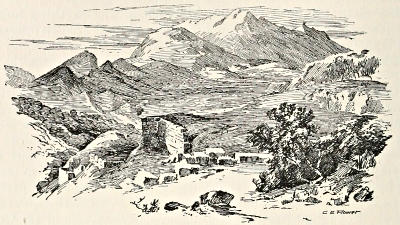
Mt. Parnassus, in Phocis
Equally scanty is our information as to the general condition of the
Phocians. Their land, though neither extensive nor fertile, was divided
among between twenty and thirty little commonwealths, which were united
like the Achæans and the Bœotians, and sent deputies at stated times to a
congress which was held in a large building, called the Phocicum, on the
road between Daulis and Delphi. But Delphi, though lying in Phocis, disclaimed
all connection with the rest of the nation. Its government, as was to
be expected under its peculiar circumstances, was strictly aristocratical, and
was in the hands of the same families which had the management of the temple,
on which the prosperity of the city and the subsistence of a great part of the
inhabitants depended. In early times the chief magistrate bore the title of
king, afterwards that of prytanis. But a council of five, who were dignified
with a title marking their sanctity, and were chosen from families which
traced their origin—possibly through Dorus—to Deucalion, and held their
offices for life, conducted the affairs of the oracle.
In Eubœa an aristocracy or oligarchy of wealthy land-owners, who, from
the cavalry which they maintained, were called hippobotæ, long prevailed
in the two principal cities, Chalcis and Eretria. The great number of
colonies which Chalcis sent out, and which attests its early importance,
was probably the result of an oligarchical policy. Its constitution appears
to have been, in proper terms, a timocracy: a certain amount of property
was requisite for a share in the government. Eretria, once similarly
governed, seems not to have been at all inferior in strength. She was
mistress of several islands, among the rest of Andros, Tenos, and Ceos;
and, in the days of her prosperity, could exhibit 600 horsemen, 3000 heavy-armed
infantry, and 60 chariots in a sacred procession. Chalcis and Eretria
were long rivals, and a tract called the Lelantian plain, which contained
valuable copper mines, afforded constant occasion for hostilities. These
hostilities were distinguished from the ordinary wars between neighbouring
cities by two peculiar features—the singular mode in which they were
conducted, and the general interest which they excited throughout Greece.
They were regulated, at least in early times, by a compact between the
belligerents, which was recorded by a monument in a temple, to abstain
from the use of missile weapons. But, while this agreement suggests the
idea of a feud like those which we have seen carried on, in an equally mild
spirit, between the Megarian townships, we learn with surprise from
Thucydides that the war between Eretria and Chalcis divided the whole
nation, and that all the Greek states took part with one or the other of
the rivals.
It has been suspected that the cause which drew this universal attention
to an object apparently of very slight moment was, that the quarrel
turned upon political principles; that the oligarchy at Eretria had very
early given way to democracy, while that of Chalcis, threatened by this new
danger, engaged many states to espouse its cause. We are informed indeed
that the Eretrian oligarchy was overthrown by a person named Diagoras,
of whom we also hear that he died at Corinth while on his way to Sparta,
and that he was honoured with a statue by his countrymen. It is also certain
that the oligarchy at Chalcis, though more than once interrupted by a
tyranny, was standing till within a few years of the Persian wars. But we
do not know when Diagoras lived, and, without stronger evidence, it is
difficult to believe that the revolution which he effected took place before
the fall of the Athenian aristocracy, an epoch which appears to be too late
for the war mentioned by Thucydides.
Thessaly seems, for some time after the conquest, to have been governed
by kings of the race of Hercules, who however may have been only chiefs
invested with a permanent military command, which ceased when it was
no longer required by the state of the country. Under one of these
princes, named Aleuas, it was divided into the four districts, Thessaliotis,
Pelasgiotis, Pthiotis, and Hestiæotis. And, as this division was retained
to the latest period of its political existence, we may conclude that it was
not a merely nominal one, but that each district was united in itself, as
well as distinct from the rest. As the four Bœotian councils seem to imply
that a like division existed in Bœotia, so we may reasonably conjecture that
each of the Thessalian districts regulated its internal affairs by some kind of
provincial council. But all that we know with certainty is, that the principal
cities exercised a dominion over several smaller towns, and that they
were themselves the seat of noble families, sprung from the line of the
ancient kings, which were generally able to draw the government of
the whole nation into their hands. Thus Larissa was subject to the great
house of the Aleuadæ, who were considered as descendants of the ancient
Aleuas; Crannon and Pharsalus to the Scopadæ and the Creondæ, who
were branches of the same stock. The vast estates of these nobles were
cultivated, and their countless flocks and herds fed, by their serfs, the
Penests, who at their call were ready to follow them into the field on foot
or on horseback. They maintained a princely state, drew poets and artists
to their courts, and shone in the public games of Greece by their wealth
and liberality.
We are not anywhere informed whether there were any institutions
which provided for the union of the four districts, and afforded regular
opportunities for consultation on their common interests. But, as often
as an occasion appeared to require it, the great families were able to bring
about the election of a chief magistrate, always of course taken from their
own body, whose proper title was that of tagus, but who is sometimes
called a king. We know little of the nature of his authority, except that
it was probably rather military than civil; nor of its constitutional extent,
which perhaps was never precisely ascertained, and depended on the personal
character and the circumstances of the individual.
The population of Thessaly, beside the penests, whose condition was
nearly that of the Laconian helots, included a large class of free subjects,
in the districts not immediately occupied by the Thessalian invaders, who
paid a certain tribute for their lands, but, though not admitted to the
rights of citizens, preserved their personal liberty unmolested. But above
this class stood a third, of the common Thessalians, who, though they
could not boast, like the Aleuadæ and the Scopadæ, of a heroic descent,
and had therefore received a much smaller portion of the conquered land,
still, as the partners of their conquest, might think themselves entitled to
some share in the administration of public affairs. Contests seem early
to have arisen between this commonalty and the ruling families, and at
Larissa the aristocracy of the Aleuadæ was tempered by some institutions
of a popular tendency. We do not know indeed to what period Aristotle
refers, when he speaks of certain magistrates at Larissa who bore the title
of guardians of the freemen, and exercised a superintendence over the
admission of citizens, but were themselves elected by the whole body of
the people, out of the privileged order, and hence were led to pay their
court to the multitude in a manner which proved dangerous to the interests
of the oligarchy. It seems not improbable that the election of a tagus,
like that of a dictator at Rome, was sometimes used as an expedient for
keeping the commonalty under. But the power of the oligarchs was also
shaken by intestine feuds; and, under the government of the Aleuadæ,
such was the state of parties at Larissa, that, by common agreement, the
city was committed to the care of an officer, who was chosen, perhaps from
the commonalty, to mediate between the opposite factions; but, being
entrusted with a body of troops, made himself master of both. This
event took place two generations before the Persian War; but the usurpation
appears to have been transitory, and not to have left any durable
traces, while the factions of Larissa continue to appear from time to time
throughout the whole course of Grecian history.
The western states of Greece are, during this period, shrouded in so
complete obscurity, that we cannot pretend to give any account of their
condition. With respect to the Ætolians indeed it is uncertain how far
they are entitled to the name of Greeks. The Acarnanians, as soon as they
begin to take a part in the affairs of Greece, distinguish themselves as a
finer and more civilised people; and it is probable that the Corinthian
colonies on the Ambracian Gulf may have exerted a beneficial influence on
their social progress.b
In the Isthmus of Corinth there is a pillar with a double inscription.
On the side facing Peloponnesus is written “Here is Peloponnesus and not
Ionia.” On the opposite side, which faced the territory of Megaris, was
written, “This is not Peloponnesus but Ionia.” Between the hostile worlds
of the Dorians and Ionians, Corinth was as between two stools. Originally,
however, the Corinthians favoured the Dorians because they had been conquered
by them when Peloponnesus was subjugated under the Heraclids.
Corinth took the side of Lacedæmon in the internal quarrels of Greece.
The aristocratic genius of the Dorians without abolishing the ancient
royalty, subordinated Corinth. One of the Heraclids was called king.
He commanded the army and presided over the debates of this military
aristocracy. Later, the oligarchy made this not very powerful king disappear,
and kept for itself all the rights of sovereignty. This was at the time
of the descendants of Bacchis, the Heraclid.
The Bacchiadæ numbered over two hundred, amongst them being other
families with whom they were connected and who governed Corinth together.
Each year, one of them, elected by his fellows, exercised under the name
Prytanis, a power very much resembling royalty. One day this annual
authority fell into the hands of an ambitious man Cypselus, who was not
satisfied with his power, and became master, not only of the people but
of his equals. This tyranny was followed by that of Periander, son of Cypselus.
Periander’s first acts were popular, but a sad occurrence weighed
upon his brain and made him cruel. This was found out in Corinth, and
from that time Periander, thinking he had nothing more to hope for, gave
way to all the bad traits of his character. He banished the most powerful
citizens. He killed his wife, Melissa, by a kick in the stomach and then
wishing by way of atonement to give her a splendid funeral, he assembled
all the women of Corinth in Juno’s Temple, where his guards stripped
them of their jewels and clothes which were burnt in honour of Melissa.
However, Periander kept down luxury. He forbade the citizens to keep
many slaves, he ordered land-owners to live on their estates in order to cultivate
them, he allowed no one to spend more than his income, and he established
no new taxes. Last of all, he increased the Corinthian navy and he
conceived the idea of piercing the isthmus. These acts were worthy of a
statesman. He wrote and composed over two thousand verses with morals.
He praised democratic government and said that he himself was a tyrant
because he thought it too dangerous to give up being so. He recommended
moderation in happiness and that friendship should not change with fortune.
Man’s heart is large enough to have good as well as bad qualities. Besides,
to have supreme power over equals was a double spur exciting good
as well as bad actions. If the intoxication of power inflamed the senses and
passions of the usurper, and defiance had to be met by cruelty, it was in
Periander’s interest to give his town all the advantages of good government.
Also, as he was clever, he knew how to conciliate the people. Force is
always admired and worshipped when it comes from the highest, and protects
and spares the weak.
After Periander, who died in his bed, Corinth had an aristocratic government
and knew no more the tyranny of a single ruler. The people had an
assembly but the direction of the important affairs of state was in the hands
of a senate. The aristocracy of Corinth which was rich and prudent in
governing, watched with jealous care over maintaining its power and it is
due to the energy of one of its number that Corinth escaped from a new
tyranny.
Of an illustrious family, Timophanes had become the idol of the people.
His audacity, his prowess in warfare, his familiarity with the humblest citizens
delighted the multitude and seemed to invite him to take the reins of
government into his hands. But Timophanes had near him a severe judge
in his brother. This brother, though loving him very much and having for
a long time screened or excused his faults, ended by killing him in order
that Corinth should not be reduced to servitude. The verses Virgil dedicated
to the first of the Brutuses might be applied to Timoleon.
This republican fratricide had the misfortune of being cursed by his
mother. He lived twenty years, not in repentance but in solitude, and we
shall find him again at Syracuse. Corinth had not only founded that celebrated
city in Sicily, she had founded other colonies besides, amongst them
Corcyra, with which she was a long time at war, accusing the inhabitants
of not paying the respect due to a capital. “Our other colonies love and
respect us whilst the Corcyreans are arrogant and unjust, to such a point
that they have seized Epidamnus, which belongs to us and which they intend
to keep.” These were the complaints Corinth made through her deputies,
at Athens, against her colonies. However, in spite of the complaints, the
Athenians received the alliance of Epidamnus, which had a powerful navy,
and which, in their eyes, had the great advantage of being situated on the
way to Italy and Sicily.
This determination not to help Corinth, irritated the Corinthians, whose
Dorian origin already made them Athens’ natural enemy, and was one of
the decisive causes of the Peloponnesian War. It was at the instigation of
Corinth that the Peloponnesians held a kind of congress at Sparta, in which
they denounced the ambition and audacity of the Athenians who were born,
they said, never to have rest and never to allow anybody else to have any.
Before Athens shone by her eloquence, poetry, and art, Corinth was the
centre of Hellenic trade and was the sojourn of pleasure. All the merchandise
of Europe and of Asia was imported on payment of duty, and all
foreigners flocked there more than they did to any other town of Greece.
People came from everywhere, from Egypt as well as from Sicily; but
Corinth was a town essentially for rich men—it was the town of Venus.
The courtesans were honoured. They had the privilege of offering the
public vows to Venus, when the goddess was appealed to in a case of great
danger. They it was who asked her to grant the salvation of Greece when
that country was invaded by Xerxes. When private people had their prayers
granted by the goddess they showed their gratitude by offering her a number
of courtesans for her temple. All the countries which traded with Corinth
provided these charming priestesses.
At Sparta the glory of women was their patriotism, at Athens their
intellect, and at Corinth their beauty. Laïs was the queen of the courtesans
and received homage from the most important and serious personages of
Greece, from philosophers as well as from politicians. She was in reality a
Sicilian, captured when a child by the Athenians and sold to Corinth. But
the Corinthians idolised her, and always swore she was born amongst them.
Riches and pleasure! It was to the interest of the Corinthians not to
get rid of these women, in order to enjoy life, and this was in itself a
guarantee against the rule of a demagogue in the city of Periander and of
Timoleon. Pindar can say with great truth in one of his Olympics,
“Harmony and good legislation are found in Corinth, also justice and peace.
The daughters of the prudent Themis dispense happiness to mankind and
watch over their cities.”
This prosperity had a tragic ending. When the Romans triumphed over
the Achæan League, Corinth perished miserably. Such lamentable ruin
was like the last day of Ilium. Everything condemned the town before the
Roman tribunals: its admirable position, the key to the whole of Greece;
its riches and works of art, which were placed in the Capitol at Rome.c
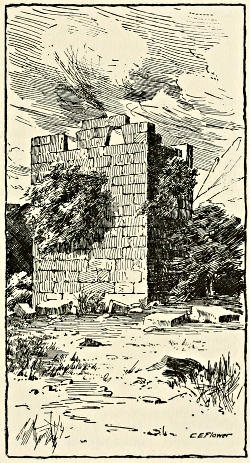
Ruins of a Tower of Tithorea, in Phocis
(Near Mt. Parnassus)
Crete was an island, which, from its position, should have dominated
over the whole of Greece, as it had for its neighbours the coasts of the Peloponnesus
and of Asia. The Cretans were remarkable amongst the Hellenic
nations for their institutions, which bore a singular physiognomy. Diodorus
describes all the legends relating to the Greek divinities of whom Crete
boasted to be the cradle; he then adds that during the generations succeeding
the birth of the gods, many heroes lived in the island, the most illustrious
of whom were Minos, Rhadamanthus and Sarpedon. These heroes are not
truly historic, and an exact place cannot be given to their genius and passions,
but at any rate they indicate deeds and customs which have left strong impressions
on the lives of men. Antiquity believed that Crete, even from the
most ancient period, had good laws which were imitated by many of the peoples
of Greece, and above all by the Lacedæmonians.
Before teaching Greece, Crete, for a short time, dominated over her. The
Cretans, who were an insular and warlike nation made up chiefly of Pelasgians
and Dorians, at an epoch made great by the name of Minos, had a navy
with which they were able to take possession of the greater number of the
islands belonging to Greece. They also reigned over part of the coast of
Asia Minor. They were the guardians of the sea, suppressed the Athenian
pirates and made them pay tribute. These pirates had their revenge according
to the fable of the Minotaur. The Cretans pushed on as far as Sicily, and
it was there, so goes the legend, that Minos was killed by the daughters of
King Cocalus, who suffocated their father’s guest in a bath. A few generations
later, Crete sent a fleet of eighty vessels against Priam, a new proof
of maritime greatness. About the time when the Odyssey was written, this
is how Greece imagined the island of Minos: “In the middle of the vast
ocean is glorious Crete, a fertile island, where countless men live; there are
eighty-six towns,[14] which have each a different language; they are inhabited
by the Achæans, the autochthonous Cretans, high-minded heroes, the Cydonians,
the Dorians, who are divided into three tribes, and the divine Pelasgi.
In the midst of all these people is the beautiful town of Knossos, where
Minos reigned, and every nine years had an audience with Jupiter.” Thus
is the divine or religious type of legislator formed in the mind of the
Greeks and with the double help of time and poetry the name of Minos
becomes great.
Crete was as little spared from the revolutions which Thucydides foretold
would be one of the results of the Trojan War, as the peculiar state of her
soil and customs warranted. The inhabitants, living in a mountainous and
divided country, were separated into many cantons, jealous of one another’s
independence. In Crete, as in Switzerland, nature prepared republics. For
a long time royal power succeeded in preventing the germs of discord from
bursting forth; this was in the time of Minos, of Rhadamanthus, and of
Sarpedon, when the Cretans were conquerors and masters of the sea and possessed
of a legislation inspired by the first of all the gods. Later, everything
which had helped to make a sovereign authority gave way, the towns
of Crete quarrelled internally and with one another for individual government.
This spirit of independence was doubtless encouraged by the presence
of the Greeks, who, on their return from Troy, founded colonies on
the island. Little by little, royal power, weakened by the absence of the
chiefs, who had joined the princes of the Peloponnesus in order to attack
Asia, disappeared.
Through what shocks, compromises or transitions, Crete passed from
government by kings, to an aristocratic federation, with Knossos, Gortyna,
Cydonia, and Lyctus at the head, we know not. All we know is that several
generations after the Trojan War the new government had entirely taken
the place of the old, though still invoked in the sacred name of Minos.
The Cretans thus began the great practice we so often find in ancient days,
that of placing the young generations under the protection and genius of the
ancients. Man, even with a long line of centuries behind him, is a weak
creature, and when he separates from the ancients he adds to his nothingness.
In representing Crete with a federal and aristocratic government, these
words must not be taken in their full meaning. It was not the entire
establishment of a nation, but attempts at peace and order frequently interrupted
by revolutions. This point has often escaped modern writers, especially
Montesquieu.
Crete was a fertile chaos, from which Sparta took various principles.
But Crete itself could not benefit from them. The reason for the outbreaks
was the rivalry between the different towns. When one of them conquered
the other, the result was despotism; when they strove one against the other
without either getting a decisive advantage, the result was anarchy.
At the head of each town were ten magistrates called cosmes (or cosmoi),
taking their name from order itself, and from the necessity of seeing it
carried out, for in every town there was always an incorrigible inclination
for plotting. The cosmes, who were the forerunners of the Spartan ephori,
were chosen, not from all the citizens, but from a small number of families.
As they succeeded royal authority they had its powers, they commanded the
troops, concluded treaties, and ruled over people and things alike, with an
arbitrary power. The Cretan customs were a strange contrast to this despotism,
which was the unmistakable remains of sovereignty. When by their
conduct the cosmes offended some of their colleagues, they were driven away.
When they chose they could also abdicate. Law did not rule, but the will
of man, which is not a sure rule. The Cretans had the habit, when they
reached the highest point in their quarrels, of returning to a provisional
monarchy, in order to facilitate war between them. They lived in the
midst of periodical disputes which prevented them from ever forming a great
nation.
When the cosmes came to the end of their term of office, which lasted a
year, they took a place in the assembly or senate formed of the old men of
the city. This was always the custom in antiquity, as in all youthful nations.
Thus, experience in life is called in to help govern. The old men who had
been cosmes, or had been destined to be so, exercised an irresponsible and
life-long authority, deciding all things, not according to written laws but
according to their opinions. The decisions of the cosmes and senators were
presented to a general assembly where all the citizens met; the assembly only
confirmed by vote what was proposed. There were no discussions, a mute
acquiescence was alone allowed. The senators and cosmes were the chiefs
of that army which had warriors and labourers as body and force. This
division into soldiers and labourers was common to the Egyptians and Cretans,
according to Aristotle, who traces it back, for the former, to Sesostris
and for the latter to Minos, and the ancient discipline, adds Alexander’s
tutor, remained especially strong amongst the peasants. Like all ancient
nations, the Cretans had slaves, those serving in the country were called chrysonetes
and those in the towns amphamiotes. Their usual name was clarotes,
because they were divided equally by lot, as they were prisoners of war.
At Cydonia, one of the towns of Crete, the slaves had festivals during which
they were free and powerful, and could even fight the citizens. Servitude
has always provoked orgies.
All the instincts of civilisation began to develop in Crete with great
energy. The Cretans did not like inaction, they liked hunting, wrestling,
and every kind of exercise. They lived in common and divided the fruits of
the earth. These customs and habits were at the bottom of Cretan institutions.
The legislators confirmed these customs in certain cases and in others
trained or suppressed them. The laws, called the laws of Minos, were never
written down, and changed in the course of years.
Let us enter into Lyctus, a town of Crete, and see the everyday life of
the people. Each person gave up the tenth of his productions or possessions
to help support the society of which he was a member. These contributions
were divided amongst all the families of the city by the magistrates.
The citizens were divided into little societies; the care of the meals being in
the hands of one of the women who directed the work of three or four of
the public slaves, each of whom had a water-carrier. In each city there
were two public edifices; one devoted to the serving of meals, the other to
the shelter of foreigners and strangers. In the building for the meals were
two tables, called hospitable tables, where strangers sat. The other tables
were for the use of the citizens. An equal portion was given to each, except
to the young people, who had only half a portion of meat and touched no
other food. A pitcher of wine and water was on each table, from which
everybody drank; after the meal another pitcher was placed on the table.
The children had one pitcher in which the wine was measured, the old people
and men had unlimited wine. The women who presided at the meals chose
the choicest pieces for those who had distinguished themselves by their
valour or their prudence. After the repast, public affairs were discussed,
then great actions were related and those who had been courageous were
praised and set up as models to the young.
Warfare was the object of all the institutions. On this point Plato and
Aristotle agree. Clinias the Cretan, one of Plato’s interrogators, wished
everything to be arranged for warfare; he took trouble to have it understood
that without supremacy in battle, riches and culture in art will be
of no use, since all the treasures of the defeated pass into the hands of the
conqueror. Aristotle remarked that in Crete as in Sparta, and among the
Scythians, Persians, Thracians, and Celts, everything led up to warfare—education,
laws, customs. In Crete, the men were soldiers living under the
same discipline, eating the same food, sharing perils and pleasure, and
always ready to march or to fight. They were respected only when they
were hardy, vigorous, agile, and quick. Prudence and repose were for old
age.
As soon as the children could read, they were taught poems in which the
laws were explained, and the elements of music. They were very strictly
treated, with a severity which was never changed, no matter what the season.
Clothed in rough clothes, they ate on the ground, helping one another
and waiting upon the men. When they became older, they formed part of
different companies, each one being presided over by a youth chosen from
the highest or most powerful families. These young chiefs led the companies
out hunting and racing; they had an almost parental authority over
their companions and punished the disobedient. On certain days the companies
fought against each other; to the sound of the flute and lyre, they
attacked each other with their hands or weapons. This drilled them in the
art of warfare. The Cretan towns, like other Grecian cities, had public
buildings and gymnasiums for corporal exercises, gymnasiums for the mind
were added later.
There was a time when the disputes between the different towns were
judged by a kind of federal arbitration, but it is doubtful whether the decisions
of this tribunal were respected. However, after some civil wars
between the towns, arrangements were made, and we find some curious remains
in the principal clauses of a treaty between two towns, Hierapolis
and Priansus. Each had rights of isopolity and of marriage, of acquiring
possessions in each other’s territory, and of having an equal share in all
things, divine and human. Those who wanted to reside in the other town
could do so and could buy and sell there, lend or borrow money and make
any kind of contract according to the laws of both.
Thus without unity and always at war with one another, the Cretans
never left their island and took no part in the general affairs of Greece.
They refused to enter into the league formed against Darius, giving the
excuse that their assisting Menelaus had cost them misfortune, and recalling
the conduct of the Greeks who had not hastened to avenge the death of
Minos. These were pretexts, but the real cause was the feebleness of the
Cretans, too weak and too few to take part in any great enterprise, a weakness
which kept Crete always isolated, obscure and selfish. Polybius was
indignant at Crete being compared to Lacedæmonia; he compared the equality
of wealth and contempt of riches which reigned at Sparta to the avarice of
the Cretans who were quite unscrupulous as to their means of becoming rich.
With the exception of the fact that the cosmes were elected yearly, we
believe Polybius is wrong in esteeming Crete a democratic state. Power
was in the hands of the senate, which was a regular oligarchy. As for the
natural faults of the Cretans, which their government rather encouraged
than corrected, time succeeded only in making them increase, and it is not
astonishing that, at the time that Polybius wrote, they deserved the severe
opinion of the historian. It would be unjust not to state with what disfavour
the Greeks looked upon them. This insular race that helped no one
and was ready to accept the pay of any nation, was hated by the Greeks. The
Cretans were called treacherous liars, and it was proverbial that it was permitted
to “cretise” with a Cretan.
Crete was renowned for two causes; it was looked upon first as the cradle
of the gods, then as the nest of sea-robbers and mercenaries. After having
shone at the beginning of Greek civilisation, its development was interrupted
before its time. Anarchy unnerved it. The bad reputation of the Cretans
at Athens was also due to the jealousy of the Athenians who could never
forgive Crete a short supremacy on the sea. When the poets wished to
please the Athenians they abused Minos and the Cretans. Nothing is more
dangerous to good fame with posterity than to have for enemy a witty
nation.b
The scene of Grecian primitive history is practically limited to the countries
bordering the Ægean Sea. But in the period which gave rise to the
great epic poems the geographical horizon had already begun to expand. In
one of the later songs of the Iliad, Egyptian Thebes is mentioned; the songs
relating the wanderings of Ulysses speak of the Cimmerians, the original
inhabitants of the north coast of the Pontus, and the clear summer nights of
the north, of which the Greeks could learn only on this coast. The Telemachus
speaks of Libya, beside Egypt, and the latest songs of the Odyssey
show an acquaintance with the Siculi and the land of the Sicani. No tradition
has preserved the names of the bold explorers who first ventured out
into the open sea which phantasy had peopled with all kinds of monsters and
fabulous beings, and which, in reality, concealed countless terrors and dangers.
Their deeds however lived on in the songs relating the expedition of
the Argo and the home-coming of the heroes from Troy.
The settler soon followed the explorer. The need of land had once
in a dim antiquity led the Hellenes to the islands of the Ægean Sea and
to the western coast of Asia Minor; these regions were now occupied, and
whoever found his home too narrow was obliged to seek out more distant
lands. Commercial interests played no part in these migrations at first,
because there was no industry in Greece to furnish articles for export.
People were in search of fertile districts; whether or not good harbours were
close at hand was wholly a question of secondary importance. The division
of farm lands was consequently the first business of the new settlers; at the
beginning of the fifth century the ancient citizens of Syracuse already style
themselves “land owners” (γαμόροι). Herein lies the fundamental difference
between Grecian and Phœnician colonisation. Every Phœnician settlement
was primarily a commercial establishment, which under favourable circumstances
might develop into an agricultural colony; the Grecian settlements
were originally agricultural colonies out of which, however, in the course of
time extensive commercial centres were developed.
The oldest colonial foundations of this time were like those unorganised
expeditions which once poured out upon the islands and the shores of Asia
Minor. Such were the settlements of the Achæans and Locrians in southern
Italy. As the Greeks, however, were continually being forced out to more
distant coasts, their colonisation had to take on a different character. The
navigation of the islandless sea in the west, or even the journey to Libya and
the stormy Pontus, necessitated a degree of seamanship greater than that
possessed by the inhabitants of the agricultural coast districts of the Grecian
peninsula, from among whom the settlers of the lands across the sea had
until then gone forth. Hence Africa, Bœotia, and Argolis ceased to take an
independent part in the colonisation movement. In their place arose cities,
hardly or not at all mentioned by Homer, which by their advantageous
location had come to be centres of navigation; Chalcis and Eretria on
the Euripus, the strait which furnishes the most convenient connection
between southern Greece and Thessaly; Megara and Corinth on the isthmus,
where the two seas which wash the shores of Greece come within a few
miles of each other; Rhodes, Lesbos, and other islands of the Ægean Sea;
finally the Ionian coast towns, especially Miletus. Not that all the colonists,
who went out from here to seek new homes on distant shores were actually
at home in these cities. On the contrary, these cities were only gathering
places whither streamed the emigrants from the surrounding regions—all
those who found no chance to advance in their old homes or who were driven
abroad by love of adventure or by dissatisfaction with political conditions.
But the cities, from which the colonising expeditions went out, organised
the undertaking; they provided leaders and ships and their institutions
served as models for the colonies.
Once founded, however, the colonies were, as a rule, wholly independent
of the mother-city. The relation between them was like that between
a father and his grown son in Grecian law. The citizen of the mother-city
was always respected in the colony; and the colony, on the other hand, could
always count on finding support with the mother-city in case of a difficult crisis.
That the colony, moreover, remained in especially active intercourse with its
mother-city lay in the nature of this colonial relationship; and in the course of
time the colonies became the surest supports for the commerce of the mother-city
and the best markets for the productions of its industrial activity.
In consequence the recollection of this relationship was kept alive for
a long time. But the circumstances which gave rise to the foundation of
all the colonies earlier than the sixth century, remain veiled in the darkness
of tradition. Historical records were as yet far removed from this period,
and the dates of foundations which have been handed down to us are based
wholly upon calculations according to generations or upon suppositions
of even less value. Such accounts can at the most give us only approximate
clews and must in each single instance be compared with other traditions.
Only so much is certain that in the first half of the seventh century the settlement
of the southern coast of Thrace was in full progress and the Hellenes
had already established themselves upon the gulf of Tarentum.
No other field offered the Grecian colonists such favourable conditions as
the coasts of Italy and Sicily, beyond the Ionic Sea. Situated in the same
latitude as the mother-land, these countries have a climate very similar to
that of Greece.
Intercourse between the two shores existed at an early date. Fragments
of vases in the Mycenæan style have been found in Messapia, and the pre-Hellenic
necropolis in eastern Sicily shows traces of a civilisation which is
partially under Mycenæan influence. It even appears that in pre-historic
times immigrations from the Balkan peninsula into Italy already took place
by way of Otranto. At least it is related that the Chones once dwelt on the
western coast of the gulf of Tarentum; and the similarity of names between
these people and the Epirot Chaones, the inhabitants of the region about the
Acroceraunian promontory, can hardly be accidental. Perhaps this is connected
with the fact that the Italici designate the Hellenes as Græci, since
the Græci are said to have been an Epirot tribe, which in historic times had
wholly disappeared.
Be that as it may, the Hellenes had at all events taken possession of the
eastern coast of the present Calabria, during the course of the eighth, or at
latest at the beginning of the seventh century. The new settlers called
themselves Achæans and thought they were descended from the Achæans in
the Peloponnesus. As a matter of fact their dialect is closely related to the
Argolian. The Chones of Italy have since disappeared from history, and
have probably been merged into one people with the Achæans.
The new home was called Italia, after a branch of the original population
which disappeared at an early date, and this name was gradually extended
over the whole peninsula clear to the Alps. The land offered a boundless
field for Hellenic activity, and the realisation of that fact found expression
in the name Greater Hellas, which arose in the colonial territory across the
Ionian Sea in about the sixth century, in contrast to the crowded condition
of the too thickly populated mother-land. This may have been hyperbole,
but it was in a sense justified by the brilliant development of the Achæan
settlements. The coasts of the gulf of Tarentum became covered with a
circle of flourishing cities. In the north at the mouth of the Bradanus was
Metapontum, which bore on its armour the speaking device of an ear of corn;
then came Siris in the fruitful plain at the mouth of the river of the same
name, which, to the poet Archilochus appeared an ideal place for a colony;
further south where Crathis empties into the sea, was Sybaris, whose wealth
and luxury soon became proverbial. In close rivalry with Sybaris stood
Croton, situated near the promontory of Lacinium, on the top of which the
new settlers founded the temple of Hera, the queen of heaven, which became
the chief sanctuary for the Greeks of Italy. One column of the building is
still standing, a signal for ships, and can be seen from afar over the blue
waters of the Ionian Sea. Finally, far to the south at Cape Stilo was
Caulonia, the last of the Achæan settlements.
The Achæans soon penetrated also into the interior and through the
narrow peninsula to the shores of the Tyrrhenian Sea. Sybaris founded
here the colonies of Scidrus and Laos, and, further north, on the lower Silarus,
Posidonia [afterwards Pæstum], whose temple to-day arises in solemn
majesty from out its desolate surroundings, the most beautiful monument of
Grecian architecture which has been preserved on the western side of the
Ionian Sea. Pyxus [afterwards Buxentum], between Posidonia and Laos, is
probably a colony from Siris, which was directly opposite it on the Ionian
Sea, and was later closely associated with it. Croton founded Pandosia in
the upper valley of the Crathis, and Terina and Scylletium (Scylacium) on
the isthmus of Catanzaro where the Ionian and Tyrrhenian seas approach to
within a few miles of each other. The Achæans now controlled the whole
region from the Bradanus and Silarus southward to the gulf of Terina and
the gulf of Scylletium, an area of fifteen thousand square kilometres.
The Achæans were soon followed by the Locrians, who lived opposite
them on the gulf of Corinth. They founded a new Locri, south of the
Achæan settlements not far from the Zephyrian promontory. This city
also soon became rich and powerful, so that its territory was extended to
the west coast of the peninsula, where it established the colonies Hipponium
and Medma.
In the meantime the inhabitants of eastern Greece had begun to direct
their gaze to the newly discovered lands in the west—first of all the Chalcidians,
the bravest men in Hellas, as they are called in an old proverb.
Since the coast of the gulf of Tarentum was already occupied, they sailed
further, to Sicily the land famed in fable as the home of the Cyclops and
Læstrygones. These were no longer to be found there, but instead a people
of Italic race, the Siceli, or the Sicani, as they were called in the western
part of the island, a brave and warlike people, but with no national unity so
that they were unable successfully to oppose the invaders. Here, at the foot
of the lofty snow pyramid of Ætna, the Chalcidians founded Naxos, their
first settlement and the first Hellenic town on Sicilian soil. In gratitude
to the god, Apollo Archegetes, who had brought them over the sea in safety,
the settlers erected an altar. Later on, when Sicily had become an Hellenic
land, all those who were setting sail to attend the festivals in the mother-land
used to sacrifice at this place.
From Naxos the Chalcidians soon took possession of the surrounding
region. In the south they founded Catane, Leontini, Callipolis, Eubœa; in
the north, on the strait which separates Sicily from Italy, they built Zancle, the
later Messana, or Messina, and opposite this on the mainland Rhegium was
established. Here the wide Tyrrhenian Sea was open to the Hellenes. The
precipitous western coast of the Calabria of to-day and the waterless Liparæan
Islands were not indeed attractive to settlers, but on the small island
Pithecusa (Ischia), off the coast of the Osci, was the most favourable spot a
colonist could wish—the soil being luxuriantly fertile and at the same time
secure from hostile attacks. Thus the Calcidians established themselves
here at an early date, perhaps in the eighth century. Soon they ventured
over to the near-lying continent, and on the steep trachyte cliff, upon the
flat, wave-beaten shore of the gulf of Gæta, they founded Cumæ, so called
from a place [Cyme] in the old Eubœan home-land.
Neapolis, the “new city” was colonised from here in about the year 600,
while Samian fugitives settled at Dicæarchia [afterwards Puteoli], in close
proximity to Cumæ (in 527). The second large island of the Neapolitan
Bay, Capreæ must also have been settled by Chalcidians, since we find a
Hellenic population there even in the period of the empire.
Cumæ is the most extreme westerly point of Italy which the Chalcidians,
and indeed the Hellenes as a whole, ever possessed. It has always remained,
as it was first established, the most advanced frontier post, and the continuous
territory of Grecian colonisation in Italy ends at the Silarus. A similar
position was occupied on the southern shore of the Tyrrhenian Sea by
Himera, which was colonised from Messana in about the year 650, and was
the only Grecian city on the northern coast of Sicily. Chalcidian colonisation
in the west came to an end with this settlement.
The example given by Chalcis was soon imitated. The Corinthians in
the eighth century still occupied the rich island of Corcyra and likewise
turned their steps to Sicily. Since the region around Ætna and the strait
was already occupied by Chalcidians, they went further south and established
the colony of Syracuse upon the small island of Ortygia, in the most
beautiful harbour on the eastern coast of Sicily. This colony was destined
to become the metropolis of the Grecian west. The real colonising activity
of Corinth, however, was directed chiefly towards the northwestern part of
the Grecian peninsula. In the course of the eighth century a dense circle
of Corinthian and Corintho-Corcyræan settlements grew up here: among
them Chalcis and Molycrium in Ætolia at the entrance to the bay of Corinth.
Like Corinth, its neighbour city Megara began at an early date to take
part in the colonisation of Sicily. A new Megara arose here, between Syracuse
and the Chalcidian Leontini, professedly in the eighth century, at any
rate before Syracuse had acquired much importance and had begun to found
colonies of its own. Its powerful neighbours made it impossible for the city
to expand towards the interior and thus the Megarians were obliged to go
further west, when their territory became too cramped for them at home.
They founded Selinus, not far from the most western point of the island on
the coast of the Libyan Sea, at about the same time that the Chalcidians laid
out Himera on the opposite coast (about 650). On account of the fertility
of the district the new colony soon reached a high grade of prosperity and
established on its own account a number of settlements, such as Minoa, near
the mouth of the Halycus (Platani) so called from the little island of like
name in the old Grecian home.
Of the other states of the Grecian mother-land only Sparta took part in
the settlement of the west. Inner disturbances which broke out after the
conquest of Messenia are said to have caused a portion of the conquered party
to leave their home. The emigrants set sail for Iapygia and established there,
upon the only good harbour on the southeast coast of Italy, the colony of
Tarentum (700 B.C.). Two centuries later, shortly before the Persian wars,
the Spartans made an attempt to establish themselves in the west.
Sicily and Italy were too far out of the way for the Asiatic Greeks, and
they consequently held almost entirely aloof from any colonising expeditions
thither. Rhodes was an exception. At the beginning of the seventh century
its citizens, together with the Cretans, established the colony of Gela, on the
fertile depression at the mouth of the Gela, which was the first Grecian city on
the south coast of Sicily. About a century later (in 580) this city colonised
Agrigentum, which is situated farther to the west on a steep height commanding
a broad outlook, not far from the sea. This filled the gap which had been
left in the row of Grecian cities between Gela and Selinus. At about the same
time Rhodians and Cnidians under the leadership of the Heraclid Pentathlus,
tried to find a footing on the most extreme west point of Sicily, on the
promontory of Lilybæum. But the Hellenes were here successfully opposed
by the Elymi, the original inhabitants of this part of the island, and by the
citizens of the neighbouring Phœnician colony of Motya. The new settlers
and their Selinuntine allies were beaten; Pentathlus himself fell, and the
remainder of his people were forced to take refuge on the barren Liparæan
Islands, which were thus won for the Grecians.
The distant west had been opened up to Grecian commerce even before
this. It is said to have been a Samian sailor, Colœus by name, who, on a journey
to Egypt, being carried out of his way by a storm off the Libyan coast, was
the first to reach Tartessus, the rich silver-land, lying near the Pillars of Hercules
(600 B.C.) At about the same time Ionic Phocæans founded the colony
of Massalia not far from the mouth of the Rhodanus. This soon became a
centre for the commerce of these regions and extended its influence far into
the Celtic interior. From here the Phocæans advanced along the Iberian
coast to Tartessus, where they entered into friendly relations with the
natives and established the colony of Mænaca, which was the most westerly
point the Hellenes ever held. The Phocæans settled also on Cyrnus (Corsica).
In 565 they founded Alalia on the east coast of the island. When Ionia was
forced to succumb to the Persians after the fall of Sardis (545) a large portion
of the citizens of Phocæa left their homes and turned to their tribal kinsmen
in Alalia, which thus grew from a mere mercantile settlement into a
powerful city.
These results, however, were for the most part of short duration. The
Phœnicians reached the western Mediterranean at the same time with the
Hellenes, perhaps somewhat earlier even. The northern coast of Libya
from Syrtis Major to the Pillars of Hercules was covered with a line of their
settlements, among which Carthage attained the first place in the course of
time, owing to the advantage of its incomparable location. It was not long
before they crossed over to the islands lying opposite Africa. They occupied
Melita (Malta) and Gaulos (Gozzo), and founded Motya, Panormus, and
Solus in west Sicily, probably during the seventh century. Here the Greeks
formed a barrier preventing their further expansion. The Phœnicians, however,
could spread themselves upon Sardinia without hindrance, since the
Greeks, although they may have planned to settle there, never went seriously
about it. In this way a succession of Phœnician settlements grew up along
the south and west coast of the island—Caralis, Nora, Sulci, Tharrus and
others. The Pityusæ are said to have been colonised from Carthage in the
year 654-653 B.C. The Phœnicians had already reached the silver-land of
Tartessus in the eighth century. Their chief point of support in this region
was Gades, situated on a small island beyond the Pillars of Hercules on the
edge of the ocean.
A hostile encounter with the Hellenes could now no longer be avoided and
it seems to have been the danger which threatened the Phœnicians from this
side which led their scattered settlements to unite into a single state with
Carthage as its centre, or at any rate materially assisted Carthage in her
work of unification. Above all it was necessary to drive out the Phœnicians
from their newly won position on Corsica. The Phœnicians were aided in
their attempt by the Etruscans, who, as bold pirates, had long beforehand
made themselves feared by the Greeks, and regarded the Phocæan settlements
so near their coasts with no less anxiety than the Phœnicians themselves.
The Phocæans could not withstand the attack of the two peoples,
who were the most skilful navigators in the western Mediterranean.
They were indeed victorious in an open sea fight, but they endured such severe
losses that they were obliged to give up Alalia. They next turned to south
Italy and established there the colony of Hyele, between Pyxus and Posidonia.
Massalia was now isolated and thrown upon its own resources. The distant
Mænaca could consequently be maintained no longer, and Carthage won
undisputed possession of Tartessus. But within its narrow range of power
Massalia victoriously resisted all attacks of the Phœnicians, and the final
result was that a sort of dividing line was established between the two cities.
Massaliot influence was preponderant north of the promontory of Artemisium
(cape of Nao); Carthaginian, south of it, on the east coast of Iberia.
Cyrnus came under Etruscan influence after the withdrawal of the Phocæans.
The Etruscans, it appears, had already taken possession of the
fertile plain on the lower Vulturnus and had established there a number of
settlements, whose centre was at Capua. They now proceeded to attack
Hellenic Cumæ (presumably in 524). Here, however, the superior military
skill of the Greeks won the victory, and the latter were able to defend the
Latin cities, which were friendly to them, from being brought into subjection
by the Etruscans. The strength of Cumæ, however, was not sufficient
to keep up the unequal fight for long and it was due only to the intervention
of the Syracusans that Hellenism maintained itself here until the end
of the fifth century.
Nearly contemporaneously with the beginnings of colonisation in the
west the Hellenes began to spread toward the north and southeast. The
Chalcidians again took the first place. Opposite Eubœa a long peninsula
projects from the north into the Ægean Sea, which, on account of the numerous
indentations of its coast, as well as the fertility of its soil, invited
settlement. A long succession of Grecian colonial towns grew up here, the
most of which were founded from Chalcis; hence the name Chalcidice, which
the peninsula bore in later times. The Corinthians followed the Chalcidians
here, just as they had done in the west. On the narrow isthmus joining the
peninsula of Pallene with the main body of Chalcidice they founded the colony
of Potidæa (in 600) which remained the most important city of this region
until the time of the Peloponnesian War. The original Thracian population
maintained itself only on the rugged slopes of Athos.
Further east, in the first half of the seventh century, the Parians took
possession of the mountainous island of Thasos, which at that time was still
covered with a thick primeval forest. The new settlers soon crossed over
to the near-lying mainland, where they established a number of commercial
stations, as Œsyma and Galepsus, which had to maintain themselves through
long struggles with the warlike Thracian tribes. Opposite Thasos, on the
fruitful plain between Nestus and Lake Bistonis, the Clazomenæans founded
Abdera in 651, but they could not long maintain themselves against the
attacks of the Thracians. Colonists from Teos, who emigrated after the
conquest of Ionia by the Persians (545) and took possession of the deserted
place, were more successful; Abdera now became the most important city
on this whole coast and also took an active part in the intellectual life of
the nation.
Lesbos and Tenedos were for a long time the most advanced posts of
the Hellenic world toward the northeast. Not until the eighth century
do the inhabitants of these islands appear to have succeeded in taking possession
of the south of Troas, from the wooded slopes of Ida to the entrance to
the Hellespont. None of the numerous settlements founded here, however,
became very important. The Lesbians then went further and crossed over
to the European shore of the Hellespont, where they built Sestus at the
narrowest point of the strait and Alopeconnesus on the northern coast of
the Thracian Chersonesus. Ænus, at the mouth of the mighty Hebrus, the
principal river of Thrace, was also colonised by Mytileneans. The further
expansion of the Greeks on this coast was arrested by the warlike tribes of
Thrace.
The Lesbians were soon followed by the Milesians. In 670 they established Abydos,
opposite Sestus, and at about the same time (675) founded
Cyzicus on the isthmus connecting the mountainous peninsula of Arcotonnesus
with the Asiatic mainland. Other Ionian cities also took part in the
colonisation of these regions. Lampsacus was colonised from Phocæa (651);
Elæus from Teos; Myrlea from Colophon; Perinthus from Samos (600).
The Milesians also advanced into the Pontus at an early date. It was
due to them that this sea, which, with its inhospitable shores peopled by
wild barbarians, had been the terror of Grecian mariners, became known as
“the hospitable sea” (Pontos Euxinos), with which few other regions could
compare in importance for Grecian commerce. Miletus is said to have
founded in all no less than ninety colonies on the coasts of the Hellespont
and Pontus. In 630 Milesians built Sinope not far from the mouth of the
Halys, which soon grew to be the most important emporium in this region,
and founded in its turn a number of colonies, as Cotyora, Trapezus, and
Cerasus. The Milesians, however, turned their attention especially to the
northwest and north coasts of the Pontus, which were to become the principal
granaries of Greece. After the middle of the seventh century a large
number of Milesian colonies grew up here. The first was Istrus south of
the mouth of the Danube, said to have been founded in 656; a few years
later (644) Olbia, at the mouth of the Borysthenes near its junction with
the Hypanis (Bug); then in the first half of the sixth century on the east
coast of Thrace, Apollonia, Odessus, and Tomis; further on Tyras at the
mouth of the river of like name (Dniester) and Theodosia on the south
coast of the Crimea. The Hellenic settlements were especially frequent
in the Cimmerian Bosporus, the highway uniting the Pontus with the sea of
Mæotis. Nymphæum and the Milesian colony of Panticapæum, the later
capital of the Bosporian kingdom, arose here on the western shore; opposite,
on the Asiatic shore, was Phanagorea, founded from Teos. Finally, Tanais
was founded at the mouth of the Don, the most northerly point ever occupied
by the Greeks.
The Megarians had begun to establish themselves on the Propontis at
about the same time with the Milesians. In 675 they founded Chalcedon at
the entrance to the Thracian Bosporus, and seventeen years later, Byzantium,
on the opposite European shore. Selymbria, neighbouring Byzantium on the
west, and Astacus, at the most easterly point of the Propontis, not far from
the site of the later Nicomedia, were Megarian colonies. The Megarians, however,
penetrated into the Pontus itself, at a comparatively late date. Their
first colony here was Heraclea, founded in association with Bœotian settlers
in the year 550, in the land of the Mariandyni, about two hundred kilometres
from the outlet of the Bosporus. From there Mesembria and Callatis were
colonised on the east coast of Thrace, and Chersonesus, on the southern
point of the Tauric peninsula, near the present Sebastopol.
All of these Grecian towns, however, remained with few exceptions
isolated points in the midst of the original population of barbarians. An
actual hellenising of the country as in Sicily and lower Italy was never
accomplished. This was largely due to the configuration of the Pontine
coast, which with the exception of the Crimea has no indentations, so that the
Grecian colonies had no way to protect themselves against the attacks of
the tribes from the interior. Besides, the winter climate of the regions north
of the Pontus was very raw. The Greeks could not feel happy in a land
where the vine and olive tree grew only in sheltered places, and only the
bitterest necessity or the prospect of great commercial gain could cause
them to leave their sunny home-land for such a country. Thus the Grecian
cities on the Pontus never became very populous; there was not one among
them to compare with Sybaris, Taras, Acragas, to say nothing of Syracuse.
Condemned to a continual struggle for existence, the Greeks here had no
leisure for the cultivation of higher interests. It is remarkable how poor
the Pontine colonies have been in intellectual greatness. Their rôle in
history has practically been confined to providing the mother-land with
grain, salted fish, and other such raw products. Only once, when the rest
of the nation had already fallen under foreign dominion, did they take an
active part in great political events. The last battle for Grecian liberty was
fought with their forces, but he who led the fight was a hellenised barbarian
king.
Although the Hellenes had been able to expand on the Italian, Sicilian,
and Pontine coasts with almost no hindrance, Grecian colonisation met an
insurmountable obstacle in the old civilised lands on the southeastern shores
of the Mediterranean, with their dense populations. In Syria the Hellenes
did not attempt a settlement; they were not even able to drive the Phœnicians
out of Cyprus. Indeed, when the Assyrian king Sargon conquered
Syria at the end of the eighth century, the Greeks on Cyprus thought it
advisable to recognise his supremacy, at least nominally, and this relation
continued under his successors until Asshurbanapal. Later, after the fall of
the Assyrian Empire, the island came under Egyptian rule. Sargon’s son
Sennacherib (705-681) repulsed an attempt of the Greeks to settle on the
Cilician plain. The warlike tribes of rough Cilicia and Lycia also succeeded
in keeping the Greeks at a distance from their coasts, or at least prevented
their further expansion. Phaselis, founded by the Rhodians on the western
shore of the gulf of Pamphylia in 700, remained the last Grecian colony in
the south of Asia Minor.
The rich valley of the Nile attracted Grecian pirates at an early period,
the more so as the political divisions of the country in the eighth and first
half of the seventh century rendered an effective resistance impossible. The
superior military ability of these pirates finally caused Psamthek, the ruler
of Saïs, to hire them as mercenaries. With their aid he got the upper hand
over the other sectional princes and freed Egypt from the Assyrian yoke
(about 660-645). From that time forward, Greeks formed the kernel of the
Egyptian army, and although the Nile valley was now closed to piracy, it
was, on the other hand, open to Greek commerce. The Milesians founded
a colony on the Bolbitinic mouth of the Nile, below Saïs; somewhat later a
number of Greek mercantile settlements grew up at Naucratis, not far from the
Canopic mouth of the Nile, to which King Aahmes granted rights of corporation.
The city soon grew to be the chief commercial emporium of Egypt
and in the sixth century occupied, on a small scale, a position like that of the
later Alexandria. In the course of time the Greeks would without doubt
have become rulers of the country, but the Persian conquest retarded their
development for fully a century and put a limit to the further expansion of
Hellenism.
The route from Greece to Egypt was usually by way of Crete in a southerly
direction to the coast of Libya. This is the narrowest part of the eastern
Mediterranean, and the stretch of open sea to be crossed measures hardly three
hundred kilometers, about the same as the width of the Ægean Sea. The need
soon began to be felt of having a station at the place where land was first
touched again. Thus in 630 Greeks from Thera settled upon the small
island of Platea, which is situated off the Libyan shore at precisely this point.
After a few years the colonists felt strong enough to cross over to the mainland.
At a short distance from the coast, where the high tableland of the interior
slopes down to the sea, they founded the city of Cyrene. The fertility of the
soil and the trade in the aromatic plant silphion, which is here indigenous
and was highly prized by the Greeks, assured prosperity to the newcomers.
The Libyan tribes living in the neighbourhood were subdued and an attack
of the Egyptian king Apries [Uah-ab-Ra] was successfully repulsed (570).
A short time later Barca was founded (550) on the heights of the plateau
west of Cyrene, and Teuchira and Hesperides on the coast. Carthage prevented
a further extension toward the west, and Egypt toward the east, and
consequently Cerenaica remained the only district on the south coast of the
Mediterranean, which was colonised by Hellenes.
Thus in the course of two centuries the Ionian Sea, the Propontis, and
the Pontus had become Grecian seas, and Grecian colonies had arisen in
Egypt as well as in Libya, on the west coast of Italy, and in the land of the
Celts as far as distant Iberia. The nation had grown out of the narrow
limits in which till then its history had been enacted. Greek influence was
henceforth predominant within the entire circumference of the Mediterranean.
The reaction of this on Grecian life was manifest in all its phases.c
[594-593 B.C.]
It is on the occasion of Solon’s legislation that we obtain our first glimpse—only
a glimpse, unfortunately—of the actual state of Attica and its inhabitants.
It is a sad and repulsive picture, presenting to us political
discord and private suffering combined.
Violent dissensions prevailed among the inhabitants of Attica, who were
separated into three factions—the pedicis, or men of the plain, comprising
Athens, Eleusis, and the neighbouring territory, among whom the greatest
number of rich families were included; the mountaineers in the east and
north of Attica, called diacrii, who were on the whole the poorest party;
and the paralii in the southern portion of Attica from sea to sea, whose
means and social position were intermediate between the two. Upon what
particular points these intestine disputes turned we are not distinctly informed;
they were not however peculiar to the period immediately preceding
the archontate of Solon; they had prevailed before, and they reappear
afterwards prior to the despotism of Pisistratus, the latter standing forward
as the leader of the diacrii, and as champion, real or pretended, of the poorer
population.
But in the time of Solon these intestine quarrels were aggravated by
something much more difficult to deal with—a general mutiny of the poorer
population against the rich, resulting from misery combined with oppression.
The Thetes, whose condition we have already contemplated in the poems of
Homer and Hesiod, are now presented to us as forming the bulk of the
population of Attica—the cultivating tenants, metayers, and small proprietors
of the country. They are exhibited as weighed down by debts
and dependence, and driven in large numbers out of a state of freedom into
slavery—the whole mass of them (we are told) being in debt to the rich,
who were proprietors of the greater part of the soil. They had either
borrowed money for their own necessities, or they tilled the lands of the
rich as dependent tenants, paying a stipulated portion of the produce, and
in this capacity they were largely in arrear.
All the calamitous effects were here seen of the old harsh law of debtor
and creditor,—once prevalent in Greece, Italy, Asia, and a large portion of
the world,—combined with the recognition of slavery as a legitimate status,
and of the right of one man to sell himself as well as that of another man to
buy him. Every debtor unable to fulfil his contract was liable to be adjudged
as the slave of his creditor until he could find means either of paying or
working it out; and not only he himself, but his minor sons and unmarried
daughters and sisters also, whom the law gave him the power of selling.
The poor man thus borrowed upon the security of his body, to translate
literally the Greek phrase, and upon that of the persons in his family;
and so severely had these oppressive contracts been enforced, that many debtors
had been reduced from freedom to slavery in Attica itself, many others
had been sold for exportation, and some had only hitherto preserved their own
freedom by selling their children. Moreover, a great number of the smaller
properties in Attica were under mortgage, signified, according to the formality
usual in the Attic law, and continued down throughout the historical
times, by a stone pillar erected on the land, inscribed with the name of
the lender and the amount of the loan. The proprietors of these mortgaged
lands, in case of an unfavourable turn of events, had no other prospect
except that of irremediable slavery for themselves and their families, either
in their own native country, robbed of all its delights, or in some barbarian
region where the Attic accent would never meet their ears. Some had
fled the country to escape legal adjudication of their persons, and earned a
miserable subsistence in foreign parts by degrading occupations. Upon
several, too, this deplorable lot had fallen by unjust condemnation and corrupt
judges; the conduct of the rich, in regard to money sacred and profane,
in regard to matters public as well as private, being thoroughly unprincipled
and rapacious.
The manifold and long-continued suffering of the poor under this system,
plunged into a state of debasement not more tolerable than that of the Gallic
plebs—and the injustices of the rich in whom all political power was then
vested—are facts well attested by the poems of Solon himself, even in the
short fragments preserved to us, and it appears that immediately preceding
the time of his archonship, the evils had ripened to such a point and the
determination of the mass of sufferers, to extort for themselves some mode
of relief, had become so pronounced that the existing laws could no longer
be enforced. According to the profound remark of Aristotle, that seditions
are generated by great causes but out of small incidents, we may
conceive that some recent events had occurred as immediate stimulants to
the outbreak of the debtors—like those which lend so striking an interest
to the early Roman annals, as the inflaming sparks of violent popular movements
for which the train had long before been laid. Condemnations by
the archons of insolvent debtors may have been unusually numerous, or the
maltreatment of some particular debtor, once a respected freeman, in his
condition of slavery, may have been brought to act vividly upon the public
sympathies—like the case of the old plebeian centurion at Rome (first impoverished
by the plunder of the enemy, then reduced to borrow, and lastly
adjudged to his creditor as an insolvent), who claimed the protection of the
people in the forum, rousing their feelings to the highest pitch by the marks
of the slave-whip visible on his person. Some such incidents had probably
happened, though we have no historians to recount them; moreover it is not
unreasonable to imagine, that that public mental affliction which the purifier
Epimenides had been invoked to appease, as it sprung in part from pestilence,
so it had its cause partly in years of sterility, which must of course have
aggravated the distress of the small cultivators. However this may be,
such was the condition of things in 594 B.C., through mutiny of the poor
freemen and Thetes, and uneasiness of the middling citizens, that the governing
oligarchy, unable either to enforce their private debts or to maintain
their political power, were obliged to invoke the well-known wisdom and
integrity of Solon. Though his vigorous protest (which doubtless rendered
him acceptable to the mass of the people) against the iniquity of the existing
system, had already been proclaimed in his poems, they still hoped
that he would serve as an auxiliary to help them over their difficulties, and
they therefore chose him, nominally as archon along with Philombrotus, but
with power in substance dictatorial.b
For the life of Solon we can do no better than turn to Plutarch, keeping
the very translation, by North, that Shakespeare read, but modernising the
spelling.
[ca. 638-558 B.C.]
He was of the noblest and most ancient house of the city of Athens.
For of his father’s side, he was descended of King Codrus: and for his
mother, Heraclides Ponticus writeth, she was cousin-german unto Pisistratus’
mother. For this cause even from the beginning there was great
friendship between them, partly for their kindred, and partly also for the
courtesy and beauty of Pisistratus, with whom it is reported Solon on a
time was in love. But Solon’s father (as Hermippus writeth) having spent
his goods in liberality, and deeds of courtesy, though he might easily have
been relieved at divers men’s hands with money, he was yet ashamed to
take any, because he came of a house which was wont rather to give and
relieve others, than to take themselves: so being yet a young man, he devised
to trade merchandise. Howbeit others say, that Solon travelled
countries, rather to see the world, and to learn, than to traffic, or gain.
For sure he was very desirous of knowledge, as appeareth manifestly: for
that being now old, he commonly used to say this verse:
“I grow old learning still.”
Also he was not covetously bent, nor loved riches too much: for he said in
one place:
“Whoso hath goods, and gold enough at call,
Great herds of beasts, and flocks in many a fold;
Both horse and mule, yea, store of corn and all
That may content each man above the mould:
No richer is, for all those heaps and hoards,
Than he which hath sufficiently to feed
And clothe his corpse with such as God affords.
But if his joy and chief delight do breed,
For to behold the fair and heavenly face
Of some sweet wife, which is adorned with grace:
Or else some child, of beauty fair and bright,
Then hath he cause (indeed) of deep delight.”
And in another place also he saith:
“Indeed I do desire some wealth to have at will:
But not unless the same be got by faithful dealing still.
For sure who so desires by wickedness to thrive,
Shall find that justice from such goods will justly him deprive.”
Solon learned to be lavish in expense, to fare delicately, and to speak wantonly
of pleasures in his poems, somewhat more licentiously than became
the gravity of a philosopher: only because he was brought up in the trade
of merchandise, wherein for that men are marvellous subject to great losses
and dangers, they seek other whiles good cheer to drive these cares away,
and liberty to make much of themselves. Poetry at the beginning he
used but for pleasure, and when he had leisure, writing no matter of importance
in his verses. Afterwards he set out many grave matters of
philosophy, and the most part of such things as he had devised before, in
the government of a commonweal, which he did not for history or memory’s
sake, but only of a pleasure to discourse: for he showeth the reasons of that
he did, and in some places he exhorteth, chideth, and reproveth the Athenians.
And some affirm also he went about to write his laws and ordinances
in verse, and do recite his preface, which was this:
“Vouchsafe, O mighty Jove, of heaven and earth high king:
To grant good fortune to my laws and hests in everything.
And that their glory grow in such triumphant wise,
As may remain in fame for aye, which lives and never dies.”
[594-590 B.C.]
He chiefly delighted in moral philosophy, which treated of government
and commonweals: as the most part of the wise men did of those times.
But for natural philosophy, he was very gross and simple. So in effect
there was none but Thales alone of all the seven wise men of Greece, who
searched further the contemplation of things in common use among men,
than he. For setting him apart, all the others got the name of wisdom,
only for their understanding in matters of State and government. It is
reported that they met on a day all seven together in the city of Delphes,
and another time in the city of Corinth, where Periander got them together
at a feast that he made to the other six.
Anacharsis being arrived at Athens, went to knock at Solon’s gate, saying
that he was a stranger which came of purpose to see him, and to desire
his acquaintance and friendship. Solon answered him, that it was better
to seek friendship in his own country. Anacharsis replied again: “Thou
then that art at home, and in thine own country, begin to show me friendship.”
Then Solon wondering at his bold ready wit, entertained him very
courteously: and kept him a certain time in his house, and made him very
good cheer, at the self-same time wherein he was most busy in governing
the commonweal, and making laws for the state thereof. Which when
Anacharsis understood, he laughed at it, to see that Solon imagined with
written laws, to bridle men’s covetousness and injustice. “For such laws,”
said he, “do rightly resemble the spider’s cobwebs: because they take hold
of little flies and gnats which fall into them, but the rich and mighty will
break and run through them at their will.” Solon answered him, that men
do justly keep all covenants and bargains which one makes with another,
because it is to the hindrance of either party to break them: and even
so, he did so temper his laws, that he made his citizens know, it was more
for their profit to obey law and justice, than to break it. Nevertheless
afterwards, matters proved rather according to Anacharsis’ comparison,
than agreeable to the hope that Solon had conceived. Anacharsis being
by hap one day in a common assembly of the people at Athens, said that
he marvelled much, why in the consultations and meetings of the Grecians,
wise men propounded matters, and fools did decide them.
The Athenians, having sustained a long and troublesome war against
the Megarians, for the possession of the isle of Salamis, were in the end
weary of it, and made proclamation straightly commanding upon pain of
death, that no man should presume to prefer any more to the counsel of the
city, the title or question of the possession of the isle of Salamis. Solon
could not bear this open shame, and seeing the most part of the lustiest
youths desirous still of war, though their tongues were tied for fear of the
proclamation; he feigned himself to be out of his wits, and caused it to be
given out that Solon was become a fool; and secretly he had made certain
lamentable verses, which he had conned without book, to sing abroad the
city. So one day he ran suddenly out of his house with a garland on his
head, and got him to the market-place, where the people straight swarmed
like bees about him: and getting him up upon the stone where all proclamations
are usually made out he singeth the elegies he had made.
This elegy is entitled Salamis, and containeth an hundred verses, which
are excellently well written. And these being sung openly by Solon at
that time, his friends incontinently praised them beyond measure, and especially
Pisistratus: and they went about persuading the people that were
present, to credit that he spake. Hereupon the matter was so handled
amongst them, that by and by the proclamation was revoked, and they
began to follow the wars with greater fury than before, appointing Solon
to be general in the same.
But the common tale and report is, that he went by sea with Pisistratus
unto the temple of Venus, surnamed Colias: where he found all the women
at a solemn feast and sacrifice, which they made of custom to the goddess.
He taking occasion thereby, sent from thence a trusty man of his own unto
the Megarians, which then had Salamis: whom he instructed to feign himself
a revolted traitor, and that he came of purpose to tell them, that if they
would but go with him, they might take all the chief ladies and gentlewomen
of Athens on a sudden. The Megarians easily believed him, and shipped
forthwith certain soldiers to go with him. But when Solon perceived the
ship under sail coming from Salamis, he commanded the women to depart,
and instead of them he put lusty beardless springalls into their apparel, and
gave them little short daggers to convey under their clothes, commanding them
to play and dance together upon the seaside, until their enemies were landed,
and their ship at anchor; and so it came to pass. For the Megarians being
deceived by that they saw afar off, as soon as ever they came to the shore
side did land in heaps, one in another’s neck, even for greediness, to take
these women: but not a man of them escaped, for they were slain every
mother’s son. This stratagem being finely handled, and to good effect, the
Athenians took sea straight, and coasted over to the isle of Salamis: which
they took upon the sudden, and won it without much resistance.
Others say that it was not taken after this sort: By order of the oracle,
Solon one night passed over to Salamis, and did sacrifice to Periphemus, and
to Cychreus, demi-gods of the country. Which done, the Athenians delivered
him five hundred men, who willingly offered themselves: and the city made
an accord with them: that if they took the isle of Salamis, they should
bear greatest authority in the commonweal. Solon embarked his soldiers
into divers fisher boats, and appointed a galliot of thirty oars to come after
him, and he anchored hard by the city of Salamis, under the point which
looketh towards the isle of Negropont. The Megarians which were within
Salamis, having by chance heard some inkling of it, but yet knew nothing
of certainty: ran presently in hurly-burly to arm them, and manned out a
ship to descry what it was. But they fondly coming within danger, were
taken by Solon, who clapped the Megarians under hatches fast bound, and
in their rooms put aboard in their ship the choicest soldiers he had of the
Athenians, commanding them to set their course direct upon the city, and
to keep themselves as close out of sight as could be. And he himself with
all the rest of his soldiers landed presently, and marched to encounter with
the Megarians, which were come out into the field. Now whilst they were
fighting together, Solon’s men whom he had sent in the Megarians’ ship
entered the haven and won the town. This is certainly true, and testified
by that which is showed yet at this day. For to keep a memorial hereof,
a ship of Athens arriveth quietly at the first, and by and by those that are
in the ship make a great shout, and a man armed leaping out of the ship,
runneth shouting towards the rock called Sciradion, which is as they come
from the firm land: and hard by the same is the temple of Mars, which
Solon built there after he had overcome the Megarians in battle, from whence
he sent back again those prisoners that he had taken (which were saved
from the slaughter of the battle) without any ransom paying. Nevertheless,
the Megarians were sharply bent still, to recover Salamis again. Much
hurt being done and suffered on both sides: both parties in the end made
the Lacedæmonians judges of the quarrel.
Solon undoubtedly won great glory and honour by this exploit, yet was
he much more honoured and esteemed, for the oration he made in defence of
the temple of Apollo, in the city of Delphes: declaring that it was not meet
to be suffered, that the Cyrrhæans should at their pleasure abuse the sanctuary
of the oracle, and that they should aid the Delphians in honour and
reverence of Apollo. Whereupon the counsel of the Amphictyons, being
moved with his words and persuasions, proclaimed wars against the Cyrrhæans.
Now that this sedition was utterly appeased in Athens, for that the excommunicates
were banished the country, the city fell again into their old troubles
and dissensions about the government of the commonweal: and they were
divided into so diverse parties and factions, as there were people of sundry
places and territories within the country of Attica. For there were the
people of the mountains, the people of the valleys, and the people of the seacoast.
Those of the mountains, took the common people’s part for their lives.
Those of the valley, would a few of the best citizens should carry the sway.
The coastmen would that neither of them should prevail, because they would
have had a mean government and mingled of them both. Furthermore, the
faction between the poor and rich, proceeding of their unequality, was
at that time very great. By reason whereof the city was in great danger,
and it seemed there was no way to pacify or take up these controversies,
unless some tyrant happened to rise, that would take upon him to rule the
whole. For all the common people were so sore indebted to the rich, that
either they ploughed their lands, and yielded them the sixth part of their crop
(for which cause they were called hectemorii and servants), or else they borrowed
money of them at usury, upon gauge of their bodies to serve it out.
And if they were not able to pay them, then were they by the law delivered
to their creditors, who kept them as bondsmen and slaves in their houses, or
else they sent them into strange countries to be sold: and many even for
very poverty were forced to sell their own children (for there was no law to
forbid the contrary) or else to forsake their city and country, for the extreme
cruelty and hard dealings of these abominable usurers, their creditors. Insomuch
that many of the lustiest and stoutest of them, banded together in
companies, and encouraged one another, not to suffer and bear any longer
such extremity, but to choose them a stout and trusty captain, that might
set them at liberty, and redeem those out of captivity, which were judged to
be bondsmen and servants, for lack of paying of their debts at their days
appointed: and so to make again a new division of all lands and tenements,
and wholly to change and turn up the whole state and government.
Then the wisest men of the city, who saw Solon only neither partner
with the rich in their oppression, neither partaker with the poor in their
necessity: made suit to him, that it would please him to take the matter in
hand, and to appease and pacify all these broils and sedition. Yet Phanias
Lesbian writeth, that he used a subtilty, whereby he deceived both the one
and the other side, concerning the commonweal. For he secretly promised
the poor to divide the lands again: and the rich also, to confirm their covenants
and bargains. Howsoever it fell out, it is very certain that Solon from
the beginning made it a great matter, and was very scrupulous to deal
between them, fearing the covetousness of the one, and arrogancy of the
other. Howbeit in the end he was chosen governor after Philombrotus, and
was made reformer of the rigour of the laws, and the temperer of the state
and commonweal, by consent and agreement of both parties.
The rich accepted him, because he was no beggar: the poor did also like
him, because he was an honest man. They say, moreover, that one word
and sentence which he spake (which at that present was rife in every man’s
mouth) that equality did breed no strife: did as well please the rich and
wealthy, as the poor and needy. For the one sort conceived of this word
equality, that he would measure all things according to the quality of the
man: and the other took it for their purpose, that he would measure all
things by the number, and by the poll only. Thus the captains of both
sections persuaded and prayed him, boldly to take upon him that sovereign
authority, since he had the whole city now at his commandment. The
neuters also of every part, when they saw it very hard to pacify these things
with law and reason, were well content that the wisest, and honestest man,
should alone have the royal power in his hands. But his familiar friends
above all rebuked him, saying he was to be accounted no better than
a beast, if for fear of the name of tyrant, he would refuse to take upon him
a kingdom: which is the most just and honourable state, if one take it
upon him that is an honest man.
Now, notwithstanding he had refused the kingdom, yet he waxed nothing
the more remiss or soft therefor in governing, neither would he bow for fear
of the great, nor yet would frame his laws to their liking, that had chosen
him their reformer. For where the mischief was tolerable, he did not
straight pluck it up by the roots: neither did he so change the state, as he
might have done, lest if he should have attempted to turn upside down the
whole government, he might afterwards have been never able to settle and
establish the same again. Therefore he only altered that which he thought
by reason he could persuade his citizens unto, or else by force he ought to
compel them to accept, mingling as he said, sour with sweet, and force with
justice. And herewith agreeth his answer that he made afterwards unto
one that asked him, if he had made the best laws he could for the Athenians?
“Yea, sure,” saith he, “such as they were able to receive.” And this that
followeth also, they have ever since observed in the Athenian tongue: to
make certain things pleasant, that be hateful, finely conveying them under
colour of pleasing names. As calling taxes, contributions: garrisons, guards:
prisons, houses. And all this came up first by Solon’s invention, who called
clearing of debts seisachtheia: in English, discharge.
The Law Concerning Debts
For the first change and reformation he made in government was this: he
ordained that all manner of debts past should be clear, and nobody should
ask his debtor anything for the time passed. That no man should thenceforth
lend money out to usury upon covenants for the body to be bound, if
it were not repaid. Howbeit some write (as Androtion among other) that
the poor were contented that the interest only for usury should be moderated,
without taking away the whole debt: and that Solon called this easy
and gentle discharge, seisachtheia, with crying up the value of money. For
he raised the pound of silver, being before but threescore and thirteen
drachmas, full up to an hundred: so they which were to pay great sums of
money, paid by tale as much as they ought, but with less number of pieces
than the debt could have been paid when it was borrowed. And so the
debtors gained much, and the creditors lost nothing. Nevertheless the
greater part of them which have written the same, say, that this crying up of
money, was a general discharge of all debts, conditions, and covenants upon
the same: whereto the very poems themselves, which Solon wrote, do seem
to agree. For he glorieth, and breaketh forth in his verses, that he had
taken away all marks that separated men’s lands through the country of
Attica, and that now he had set at liberty, that which before was in bondage.
And that of the citizens of Athens, which for lack of payment of their debts
had been condemned for slaves to their creditors, he had brought many home
again out of strange countries, where they had been so long, that they had
forgotten to speak their natural tongue, and others which remained at home
in captivity, he had now set them all at good liberty.
But while he was in doing this, men say a thing thwarted him, that
troubled him marvellously. For having framed an edict for clearing of all
debts, and lacking only a little to grace it with words, and to give it some
pretty preface, that otherwise was ready to be proclaimed: he opened himself
somewhat to certain of his familiars whom he trusted (as Conon, Clinias,
and Hipponicus) and told them how he would not meddle with lands and
possessions, but would only clear and cut off all manner of debts. These
men, before the proclamation came out, went presently to the money-men,
and borrowed great sums of money of them, and laid it out straight upon
land. So when the proclamation came out, they kept the lands they had
purchased, but restored not the money they had borrowed. This foul part
of theirs made Solon very ill spoken of, and wrongfully blamed: as if he had
not only suffered it, but had been partaker of this wrong and injustice.
Notwithstanding he cleared himself of this slanderous report, losing five
talents by his own law. For it was well known that so much was due unto
him, and he was the first that, following his own proclamation, did clearly
release his debtors of the same. Notwithstanding, they ever after called
Solon’s friends Chreocopides, cutters of debts. This law neither liked the
one nor the other sort. For it greatly offended the rich, for cancelling their
bonds: and it much more misliked the poor, because all lands and possessions
they gaped for, were not made again common, and everybody alike rich and
wealthy, as Lycurgus had made the Lacedæmonians.
But Lycurgus was the eleventh descended of the right line from Hercules,
and had many years been king of Lacedæmon, where he had gotten
great authority, and made himself many friends: all which things together,
did greatly help him to execute that, which he wisely had imagined for the
order of his commonweal. Yet also, he used more persuasion than force,
a good witness thereof the loss of his eye: preferring a law before his
private injury, which hath power to preserve a city long in union and concord,
and to make citizens to be neither poor nor rich.
Solon could not attain to this. Howbeit he did what he could possible,
with the power he had, as one seeking to win no credit with his citizens, but
only by his counsel. To begin withal, he first took away all Draco’s bloody
laws, saving for murder and manslaughter.
Class Legislation
Then Solon being desirous to have the chief offices of the city to remain
in rich men’s hands, as already they did, and yet to mingle the authority of
government in such sort, as the meaner people might bear a little sway,
which they never could before: he made an estimate of the goods of every
private citizen. And those which he found yearly worth five hundred
bushels of corn, and other liquid fruits and upwards, he called pentacosiomedimni:
as to say, five-hundred-bushel-men of revenue. And those that
had three hundred bushels a year, and were able to keep a horse of service,
he put in the second degree, and called them knights. They that might
dispend but two hundred bushels a year, were put in the third place, and
called zeugitæ. All other under those, were called thetes, as you would
say, hirelings, or craftsmen living of their labour: whom he did not admit
to bear any office in the city, neither were they taken as free citizens, saving
they had voices in elections, and assemblies of the city, and in judgments,
where the people wholly judged.
Furthermore because his laws were written somewhat obscurely, and
might be diversely taken and interpreted, this did give a great deal more
authority and power to the judges. For, considering all their controversies
could not be ended, and judged by express law: they were driven of necessity
always to run to the judges and debated their matters before them. Insomuch
as the judges by this means came to be somewhat above the law:
for they did even expound it as they would themselves.
Yet considering it was meet to provide for the poverty of the common
sort of people: he suffered any man that would, to take upon him the
defence of any poor man’s case that had the wrong. For if a man were
hurt, beaten, forced, or otherwise wronged: any other man that would,
might lawfully sue the offender, and prosecute law against him. And this
was a wise law ordained of him, to accustom his citizens to be sorry for
another’s hurt, and so to feel it, as if any part of his own body had been
injured. And they say he made an answer on a time agreeable to this law.
For, being asked what city he thought best governed, he answered: “That
city where such as receive no wrong, do as earnestly defend wrong offered
to others, as the very wrong and injury had been done unto themselves.”
He erected also the council of the Areopagites, of those magistrates of the
city, out of which they did yearly choose their governor: and he himself
had been of that number, for that he had been governor for a year.
Wherefore perceiving now the people were grown to a stomach and
haughtiness of mind because they were clear discharged of their debts: he
set one up for matters of state, another council of an hundred chosen out of
every tribe, whereof four hundred of them were to consult and debate of all
matters, before they were propounded to the people: that when the great
council of the people at large should be assembled, no matters should be put
forth, unless it had been before well considered of, and digested, by the
council of the four hundred. Moreover, he ordained the higher court should
have the chief authority and power over all things, and chiefly to see the
law executed and maintained: supposing that the commonweal being settled,
and stayed with these two courts (as with two strong anchor-holds), it
should be the less turmoiled and troubled, and the people also better pacified
and quieted. The most part of writers hold this opinion, that it was Solon
which erected the council of the Areopagites, as we have said, and it is very
likely to be true, for that Draco in all his laws and ordinances made no
manner of mention of the Areopagites, but always speaketh to the ephetes
(which were judges of life and death) when he spake of murder, or of any
man’s death.
Notwithstanding, the eighth law of the thirteenth table of Solon saith thus,
in these very words: All such as have been banished or detected of naughty
life, before Solon made his laws, shall be restored again to their goods and
good name, except those which were condemned by order of the council of
the Areopagites, or by the ephetes, or by the kings in open court, for murder,
and death of any man, or for aspiring to usurp tyranny. These words
to the contrary seem to prove and testify, that the council of the Areopagites
was, before Solon was chosen reformer of the laws. For how could
offenders and wicked men be condemned by order of the council of the Areopagites
before Solon, if Solon was the first that gave it authority to judge?
Miscellaneous Laws; the Rights of Women
Furthermore amongst the rest of his laws, one of them indeed was of his
own device: for the like was never stablished elsewhere. And it is that law,
that pronounceth him defamed, and dishonest, who in a civil uproar among the
citizens, sitteth still a looker-on, and a neuter, and taketh part with neither
side. Whereby his mind was as it should appear, that private men should
not be only careful to put themselves and their causes in safety, nor yet
should be careless for other men’s matters, or think it a virtue not to meddle
with the miseries and misfortunes of their country, but from the beginning
of every sedition that they should join with those that take the justest cause in
hand, and rather to hazard themselves with such, than to tarry looking (without
putting themselves in danger) which of the two should have the victory.
There is another law also, which at the first sight methinketh is very
unhonest and fond. That if any man according to the law hath matched
with a rich heir and inheritor, and of himself is impotent, and unable to do
the office of a husband, she may lawfully lie with any whom she liketh, of
her husband’s nearest kinsmen. Howbeit some affirm, that it is a wise
made law for those, which knowing themselves unmeet to entertain wedlock,
will for covetousness of lands, marry with rich heirs and possessioners,
and mind to abuse poor gentlewomen under the colour of law: and will
think to force and restrain nature. This also confirmeth the same, that such
a new-married wife should be shut up with her husband, and eat a quince
with him: and that he also which marrieth such an inheritor, should of duty
see her thrice a month at the least. For although he get no children of
her, yet it is an honour the husband doth to his wife, arguing that he taketh
her for an honest woman, that he loveth her, and that he esteemeth of her.
Besides, it taketh away many mislikings and displeasures which oftentimes
happen in such cases, and keepeth love and good will waking, that it die not
utterly between them.
Furthermore, he took away all jointures and dowries in other marriages,
and willed that the wives should bring their husbands but three gowns only,
with some other little movables of small value, and without any other thing
as it were: utterly forbidding that they should buy their husbands, or that
they should make merchandise of marriages, as of other trades to gain, but
would that man and woman should marry together for issue, for pleasure,
and for love, but in no case for money.
They greatly commend another law of Solon’s, which forbiddeth to speak
ill of the dead. For it is a good and godly thing to think, that they ought
not to touch the dead, no more than to touch holy things; and men should
take great heed to offend those that are departed out of this world; besides
it is a token of wisdom and civility, to beware of immortal enemies. He
commanded also in the self-same law, that no man should speak ill of the
living, specially in churches, during divine service, or in council chamber of
the city, nor in the theatres whilst games were a-playing: upon pain of
three silver drachmæ to be paid to him that was injured, and two to the
common treasury.
So he was marvellously well thought of, for the law that he made touching
wills and testaments. For before, men might not lawfully make their
heirs whom they would, but the goods came to the children or kindred of
the testator. But he leaving it at liberty, to dispose their goods where they
thought good, so they had no children of their own: did therein prefer
friendship before kindred, and good will and favour before necessity and
constraint, and so made every one lord and master of his own goods. Yet
he did not simply and alike allow all sorts of gifts howsoever they were
made: but those only which were made by men of sound memory, or by
those whose wits failed them not by extreme sickness, or through drinks,
medicines, poisonings, charms, or other such violence and extraordinary
means, neither yet through the enticements and persuasions of women. As
thinking very wisely, there was no difference at all between those that were
evidently forced by constraint, and those that were compassed and wrought
by subornation at length to do a thing against their will, taking fraud in
this case equal with violence, and pleasure with sorrow, as passions with
madness, which commonly have as much force the one as the other, to draw
and drive men from reason.
He made another law also, in which he appointed women their times to
go abroad into the fields, their mourning, their feasts and sacrifices, plucking
from them all disorder and wilful liberty, which they used before. For he
did forbid that they should carry out of the city with them above three
gowns, and to take victuals with them above the value of a half-penny,
neither basket nor pannier above a cubit high: and especially he did forbid
them to go in the night other than in their coach, and that a torch should be
carried before them. He did forbid them also at the burial of the dead, to
tear and spoil themselves with blows, to make lamentations in verses, to weep
at the funeral of a stranger not being their kinsman, to sacrifice an ox on
the grave of the dead, to bury above three gowns with the corpse, to go to
other men’s graves, but at the very time of burying the corpse.
Results of Solon’s Legislation
And perceiving that the city of Athens began to replenish daily more
and more, by men’s repairing thither from all parts, and by reason of the
great assured safety and liberty that they found there: and also considering
how the greatest part of the realm became in manner heathy, and was very
barren, and that men trafficking the seas, are not wont to bring any merchandise
to those, which can give them nothing again in exchange: he began to
practise that his citizens should give themselves unto crafts and occupations,
and made a law, that the son should not be bound to relieve his father being
old, unless he had set him in his youth to some occupation.
It was a wise part of Lycurgus (who dwelt in a city where was no resort
for strangers, and had so great a territory, as could have furnished twice as
many people, as Euripides saith, and moreover on all sides was environed
with a great number of slaves of the helots, whom it was needful to keep
still in labour and work continually) to have his citizens always occupied in
exercises of feats of arms, without making them to learn any other science,
but discharge them of all other miserable occupations and handicrafts.
But Solon framing his laws unto things, and not things unto laws, when
he saw the country of Attica so lean and barren, that it could hardly bring
forth to sustain those that tilled the ground only, and therefore much more
impossible to keep so great a multitude of idle people as were in Athens:
thought it very requisite to set up occupations, and to give them countenance
and estimation. Therefore he ordered, that the council of the Areopagites,
should have full power and authority to inquire how every man lived
in the city, and also to punish such as they found idle people, and did not
labour. Yet to say truly, in Solon’s laws touching women, there are many
absurdities, as they fall out ill-favouredly. For he maketh it lawful for any
man to kill an adulterer taking him with the fact. But he that ravisheth or
forcibly taketh away a free woman, is only condemned to pay a hundred
silver drachmæ.
Of the fruits of the earth, he was contented they should transport and
sell only oil out of the realm to strangers, but no other fruit or grain. He
ordained that the governor of the city should yearly proclaim open curses
against those that should do to the contrary, or else he himself making default
therein, should be fined at a hundred drachmæ. This ordinance is in
the first table of Solon’s laws, and therefore we may not altogether discredit
those which say, they did forbid in the old time that men should carry figs
out of the country of Attica, and that from hence it came that these pick-thanks,
which bewray and accuse them that transported figs, were called
sycophants. He made another law also against the hurt that beasts might
do unto men. Wherein he ordained, that if a dog did bite any man, he that
owned him should deliver to him that was bitten, his dog tied to a log of
timber of four cubits long: and this was a very good device, to make men
safe from dogs. But he was very straight in one law he made, that no
stranger might be made denizen and free man of the city of Athens, unless
he were a banished man forever out of his country, or else that he should
come and dwell there with all his family, to exercise some craft or science.
Notwithstanding, they say he made not this law so much to put strangers
from their freedom there, as to draw them thither, assuring them by this
ordinance, they might come and be free of the city: and he thought moreover,
that both the one and the other would be more faithful to the commonweal
of Athens.
This also was another of Solon’s laws, which he ordained for those that
should feast certain days at the townhouse of the city, at other men’s cost.
For he would not allow, that one man should come often to feasts there. And
if any man were invited thither to the feast, and did refuse to come: he did
set a fine on his head, as reproving the miserable niggardliness of the one
and the presumptuous arrogancy of the other, to contemn and despise common
order.
After he had made his laws, he did stablish them to continue for the space
of one hundred years, and they were written in tables of wood called axones.
So all the councils and magistrates together did swear, that they would keep
Solon’s laws themselves, and also cause them to be observed of others thoroughly
and particularly. Then every one of the thesmothetes (which were
certain officers attendant on the council, and had special charge to see the
laws observed) did solemnly swear in the open market-place, near the stone
where the proclamations are proclaimed: and every one of them both promised,
and vowed openly to keep the same laws, and that if any of them did
in any one point break the said ordinances, then they were content that such
offender should pay to the temple of Apollo, at the city of Delphi, an image
of fine gold, that should weigh as much as himself.
Now after his laws were proclaimed, there came some daily unto him,
which either praised them, or misliked them: and prayed him either to take
away, or to add something unto them. Many again came and asked him
how he understood some sentence of his laws: and requested him to declare
his meaning, and how it should be taken. Wherefore considering how it
were to no purpose to refuse to do it, and again how it would get him much
envy and ill will to yield thereunto: he determined (happen what would) to
wind himself out of these briers, and to fly the groanings, complaints, and
quarrels of his citizens. So, to convey himself awhile out of the way, he
took upon him to be master of a ship in a certain voyage, and asked license
for ten years of the Athenians to go beyond sea, hoping by that time the
Athenians would be very well acquainted with his laws.
[590-580 B.C.]
So went he to the seas, and the first place of his arrival was in Egypt,
where he remained awhile. And as for the meeting and talk betwixt him
and King Crœsus, I know there are that by distance of time will prove it but
a fable, and devised of pleasure: but for my part I will not reject, nor condemn
so famous a history, received and approved by so many grave testimonies.
Moreover it is very agreeable to Solon’s manners and nature, and also not
unlike to his wisdom and magnanimity: although in all points it agreeth
not with certain tables (which they call Chronicles) where they have busily
noted the order and course of times which even to this day, many have curiously
sought to correct.[15]
But during the time of his absence, great seditions rose at Athens amongst
the inhabitants, who had gotten them several heads amongst them: as those
of the valley had made Lycurgus their head. The coast-men Megacles, the
son of Alcmæon. And those of the mountains, Pisistratus; with whom all
artificers and craftsmen living of their handy labour were joined, which were
the stoutest against the rich. So that notwithstanding the city kept Solon’s
laws and ordinances, yet was there not a man but gaped for a change, and
desired to see things in another state.
[580-558 B.C.]
The whole commonweal broiling thus with troubles, Solon arrived at
Athens, where every man did honour and reverence him: howbeit he was no
more able to speak aloud in open assembly to the people, nor to deal in matters
as he had done before, because his age would not suffer him: and therefore
he spake with every one of the heads of the several factions apart, trying
if he could agree and reconcile them together again.
Whereupon Pisistratus seemed to be more willing than any of the rest,
for he was courteous, and marvellous fair spoken, and showed himself besides
very good and pitiful to the poor, and temperate also to his enemies: further,
if any good quality were lacking in him, he did so finely counterfeit it, that
men imagined it was more in him, than in those that naturally had it in them
indeed. By this art and fine manner of his, he deceived the poor common
people. Howbeit Solon found him straight, and saw the mark he shot at:
but yet hated him not at that time, and sought still to win him, and bring
him to reason.
Shortly after Pisistratus having wounded himself, and bloodied all his
body over, caused his men to carry him in his couch into the market-place,
where he put the people in an uproar, and told them that they were his enemies
that thus traitorously had handled and arrayed him, for that he stood
with them about the governing of the commonweal: insomuch as many of
them were marvellously offended, and mutinied by and by, crying out it was
shamefully done. Then Solon drawing near said unto him: “O thou son of
Hippocrates, thou dost ill-favouredly counterfeit the person of Homer’s Ulysses:
for thou hast whipped thyself to deceive thy citizens, as he did tear and
scratch himself, to deceive his enemies.” Notwithstanding this, the common
people were still in uproar, being ready to take arms for Pisistratus: and
there was a general council assembled, in the which one Ariston spake, that
they should grant fifty men, to carry halberds and maces before Pisistratus
for guard of his person.
But Solon going up into the pulpit for orations, stoutly inveighed against
it. But in the end, seeing the poor people did tumult still, taking Pisistratus’
part, and that the rich fled here and there, he went his way also.
Wherefore he hied him home again, and took his weapons out of his
house, and laid them before his gate in the midst of the street, saying: “For
my part, I have done what I can possible, to help and defend the laws and
liberties of my country.”
So from that time he betook himself unto his ease, and never after dealt
any more in matters of state, or commonweal. His friends did counsel him
to fly: but all they could not persuade him to it. For he kept his house,
and gave himself to make verses, in which he sore reproved the Athenians’
faults. His friends hereupon did warn him to beware of such speeches, and
to take heed what he said, lest if it came unto the tyrant’s ears, he might put
him to death for it. And further, they asked him wherein he trusted, that
he spake so boldly. He answered them, “In my age.”
Howbeit Pisistratus, after he had obtained his purpose, sending for him
upon his word and faith, did honour and entertain him so well, that Solon in
the end became one of his council, and approved many things which he did.
Solon lived a long time after Pisistratus had usurped the tyranny,
as Heraclides Ponticus writeth. Howbeit Phanias Ephesian writeth, that he
lived not above two years after.d
As a recent summing up of Solon, we may quote Professor Bury:
“He was a poet, not because he was poetically inspired, like the Parian
Archilochus of an earlier, or the Lesbian Sappho of his own, generation;
but because at that time every man of letters was a poet; there was no
prose literature. A hundred years later Solon would have used prose as the
vehicle of his thought. We are fortunate enough to possess portions of
poems—political pamphlets—which he published for the purpose of guiding
public opinion; and thus we have his view of the situation in his own
words.
“The character of the remedial measures of Solon is imperfectly known.
His title to fame as one of the great statesmen of Europe rests upon his
reform of the constitution. He discovered a secret of democracy, and he
used his discovery to build up the constitution on democratic foundations.
The Athenian commonwealth did not actually become a democracy till
many years later. The radical measure of Solon, which was the very
corner-stone of the Athenian democracy, was his constitution of the courts
of justice. He composed the law courts out of all the citizens, including
the Thetes; and as the panels of judges were enrolled by lot, the poorest
burgher might have his turn. The constitution of the judicial courts out of
the whole people was the secret of democracy which Solon discovered.
“It was the fate of Solon to live long enough to see the establishment of
the tyranny which he dreaded. We know not what part he had taken in
the troubled world of politics since his return to Athens. The story was
invented that he called upon the citizens to arm themselves against the
tyrant, but called in vain; and that then, laying his arms outside the threshold
of his house, he cried, ‘I have aided, so far as I could, my country and
the constitution, and I appeal to others to do likewise.’ Nor has the story
that he refused to live under a tyranny and sought refuge with his Cyprian
friend the king of Soli, any good foundation. We know only that in his
later years he enjoyed the pleasures of wine and love, and that he survived
but a short time the seizure of the tyranny by Pisistratus, who at least
treated the old man with respect.”e
Pisistratus directed with admirable moderation the courses of the
revolution he had produced. Many causes of success were combined in his
favour. His enemies had been the supposed enemies of the people, and the
multitude doubtless beheld the flight of the Alcmæonidæ (still odious in their
eyes by the massacre of Cylon) as the defeat of a foe, while the triumph of
the popular chief was recognised as the victory of the people. In all revolutions
the man who has sided with the people is permitted by the people the
greatest extent of license. It is easy to perceive, by the general desire which
the Athenians had expressed for the elevation of Solon to the supreme
authority, that the notion of regal authority was not yet hateful to them, and
that they were scarcely prepared for the liberties with which they were entrusted.
But although they submitted thus patiently to the ascendency of
Pisistratus, it is evident that a less benevolent, or less artful tyrant would
not have been equally successful. Raised above the law, that subtle genius
governed only by the law; nay, he affected to consider its authority greater
than his own. He assumed no title—no attribute of sovereignty. He was
accused of murder, and he humbly appeared before the tribunal of the Areopagus—a
proof not more of the moderation of the usurper than of the
influence of public opinion. He enforced the laws of Solon, and compelled
the unruly tempers of his faction to subscribe to their wholesome rigour.
The one revolution did not, therefore, supplant, it confirmed, the other.
“By these means,” says Herodotus, “Pisistratus mastered Athens, and yet
his situation was far from secure.”
Although the heads of the more moderate party, under Megacles, had
been expelled from Athens, yet the faction, equally powerful, and equally
hostile, headed by Lycurgus, and embraced by the bulk of the nobles, still
remained. For a time, extending perhaps to five or six years, Pisistratus
retained his power; but at length, Lycurgus, uniting with the exiled Alcmæonidæ,
succeeded in expelling him from the city. But the union that
had led to his expulsion, ceased with that event. The contests between the
lowlanders and the coastmen were only more inflamed by the defeat of the
third party which had operated as a balance of power, and the broils of their
several leaders were fed by personal ambition as by hereditary animosities.
Megacles, therefore, unable to maintain equal ground with Lycurgus, turned
his thoughts towards the enemy he had subdued, and sent proposals to Pisistratus,
offering to unite their forces, and to support him in his pretensions to
the tyranny, upon condition that the exiled chief should marry his daughter
Cœsyra. Pisistratus readily acceded to the terms, and it was resolved by a
theatrical pageant to reconcile his return to the people.b
[550-540 B.C.]
This was, according to Herodotus, “the most ridiculous project that was
ever imagined.” “In the Pæanean tribe was a woman named Phya,” he
says, “four cubits high, wanting three fingers, and in other respects handsome;
having dressed this woman in a complete suit of armour, and placed
her on a chariot, and having shown her beforehand how to assume the most
becoming demeanour, they drove her to the city, having sent heralds before,
who, on their arrival in the city, proclaimed what was ordered in these
terms: ‘O Athenians, receive with kind wishes Pisistratus, whom Minerva
herself, honouring above all men, now conducts back to her own citadel.’
They then went about proclaiming this; and a report was presently spread
among the people that Minerva was bringing back Pisistratus; and the
people in the city, believing this woman to be the goddess, both adored a
human being, and received Pisistratus.”c
The sagacity of the Athenians was already so acute, and the artifice
appeared to Herodotus so gross, that the simple Halicarnassian could
scarcely credit the authenticity of this tale. But it is possible that the
people viewed the procession as an ingenious allegory, to the adaptation of
which they were already disposed; and that like the populace of a later and
yet more civilised people, they hailed the goddess while they recognised the
prostitute.[16] Be that as it may, the son of Hippocrates recovered his authority
and fulfilled his treaty with Megacles by a marriage with his daughter.
Between the commencement of his first tyranny and the date of his second
return, there was probably an interval of twelve years. His sons were
already adults. Partly from a desire not to increase his family, partly from
some superstitious disinclination to the blood of the Alcmæonidæ, which the
massacre of Cylon still stigmatised with contamination, Pisistratus conducted
himself towards the fair Cœsyra with a chastity either unwelcome to
her affection, or afflicting to her pride. The unwedded wife communicated
the mortifying secret to her mother, from whose lips it soon travelled to the
father. He did not view the purity of Pisistratus with charitable eyes. He
thought it an affront to his own person that that of his daughter should be
so tranquilly regarded. He entered into a league with his former opponents
against the usurper, and so great was the danger, that Pisistratus (despite
his habitual courage) betook himself hastily to flight—a strange instance
of the caprice of human events, that a man could with a greater impunity
subdue the freedom of his country, than affront the vanity of his wife!
Pisistratus, his sons and partisans, retired to Eretria in Eubœa: there
they deliberated as to their future proceedings—should they submit to their
exile, or attempt to retrieve their power? The counsels of his son Hippias,
prevailed with Pisistratus; it was resolved once more to attempt the
sovereignty of Athens. The neighbouring tribes assisted the exiles with
forage and shelter. Many cities accorded the celebrated noble large sums of
money, and the Thebans outdid the rest in pernicious liberality. A troop of
Argive adventurers came from the Peloponnesus to tender to the baffled
usurper the assistance of their swords, and Lygdamis, an individual of Naxos,
himself ambitious of the government of his native state, increased his
resources both by money and military force. At length, though after a long
and tedious period of no less than eleven years, Pisistratus resolved to
hazard the issue of open war. At the head of a foreign force he advanced
to Marathon, and pitched his tents upon its immortal plain. Troops of the
factious, or discontented, thronged from Athens to his camp, while the bulk
of the citizens, unaffected by such desertions, viewed his preparations with
indifference. At length, when they heard that Pisistratus had broken up
his encampment, and was on his march to the city, the Athenians awoke
from their apathy, and collected their forces to oppose him. He continued
to advance his troops, halted at the temple of Minerva, whose earthly
representative had once so benignly assisted him, and pitched his tents
opposite the fane. He took advantage of that time in which the Athenians,
during the heat of the day, were at their entertainments, or indulging the
noontide repose, still so grateful to the inhabitants of a warmer climate, to
commence his attack. He soon scattered the foe, and ordered his sons to
overtake them in their flight, to bid them return peaceably to their employments,
and fear nothing from his vengeance. His clemency assisted the
effect of his valour, and once more the son of Hippocrates became the
master of the Athenian commonwealth.
[540 B.C.]
Pisistratus lost no time in strengthening himself by formidable alliances.
He retained many auxiliary troops, and provided large pecuniary
resources. He spared the persons of his opponents, but sent their children
as hostages to Naxos, which he first reduced and consigned to the tyranny
of his auxiliary, Lygdamis. Many of his inveterate enemies had perished
on the field—many fled from the fear of his revenge. He was undisturbed
in the renewal of his sway, and having no motive for violence, pursued the
natural bent of a mild and generous disposition, ruling as one who wishes
men to forget the means by which his power has been attained.
It was in harmony with this part of his character that Pisistratus refined
the taste and socialised the habits of the citizens, by the erection of buildings
dedicated to the public worship, or the public uses, and laid out the stately
gardens of the Lyceum—(in after-times the favourite haunt of Philosophy)—by
the banks of the river dedicated to Song. Pisistratus thus did more than
continue the laws of Solon—he inculcated the intellectual habits which the
laws were designed to create. And as in the circle of human events the
faults of one man often confirm what was begun by the virtues of another,
so perhaps the usurpation of Pisistratus was necessary to establish the institutions
of Solon. It is clear that the great lawgiver was not appreciated at
the close of his life as his personal authority had ceased to have influence,
so possibly might have soon ceased the authority of his code. The citizens
required repose, to examine, to feel, to estimate the blessings of his laws—that
repose they possessed under Pisistratus. Amidst the tumult of fierce
and equipoised factions it might be fortunate that a single individual was
raised above the rest, who, having the wisdom to appreciate the institutions
of Solon, had the authority to enforce them. Silently they grew up under
his usurped but benignant sway, pervading, penetrating, exalting the people,
and fitting them by degrees to the liberty those institutions were intended
to confer. If the disorders of the republic led to the ascendency of
Pisistratus so the ascendency of Pisistratus paved the way for the renewal
of the republic. As Cromwell was the representative of the very sentiments
he appeared to subvert—as Napoleon in his own person incorporated
the principles of the revolution of France, so the tyranny of Pisistratus concentrated
and embodied the elements of that democracy he rather wielded
than overthrew.
At home, time and tranquillity cemented the new laws; poetry set before
the emulation of the Athenians its noblest monument in the epics of
Homer; and tragedy put forth its first unmellowed fruits in the rude recitations
of Thespis. Pisistratus sought also to counterbalance the growing
passion for commerce by peculiar attention to agriculture, in which it is
not unlikely that he was considerably influenced by early prepossessions, for
his party had been the mountaineers attached to rural pursuits, and his
adversaries the coastmen engaged in traffic. We learn from Aristotle
that his policy consisted much in subjecting and humbling the Pedieis, or
wealthy nobles of the lowlands. But his very affection to agriculture must
have tended to strengthen an aristocracy, and his humility to the Areopagus
was a proof of his desire to conciliate the least democratic of the Athenian
courts. He probably, therefore, acted only against such individual chiefs as
had incurred his resentment, or as menaced his power; nor can we perceive
in his measures the systematic and deliberate policy, common with other
Greek tyrants, to break up an aristocracy and create a middle class.
[540-527 B.C.]
Abroad, the ambition of Pisistratus, though not extensive, was successful.
There was a town on the Hellespont, called Sigeum, which had long
been a subject of contest between the Athenians and the Mytileneans.
Some years before the legislation of Solon, the Athenian general, Phrynon,
had been slain in single combat by Pittacus, one of the Seven Wise Men,
who had come into the field armed like the Roman retiarius, with a net, a
trident, and a dagger. This feud was terminated by the arbitration of
Periander, tyrant of Corinth, who awarded Sigeum to the Athenians, which
was then in their possession, by a wise and plausible decree, that each
party should keep what it had got. This war was chiefly remarkable for
an incident that introduces us somewhat unfavourably to the most animated
of the lyric poets. Alcæus, an eminent citizen of Mytilene, and, according
to ancient scandal, the unsuccessful lover of Sappho, conceived a passion
for military fame: in his first engagement he seems to have discovered that
his proper vocation was rather to sing of battles than to share them. He
fled from the field, leaving his arms behind him, which the Athenians
obtained, and suspended at Sigeum in the temple of Minerva. Although
this single action, which Alcæus himself recorded, cannot be fairly held a
sufficient proof of the poet’s cowardice, yet his character and patriotism
are more equivocal than his genius. Of the last we have ample testimony,—though
few remains save in the frigid grace of the imitations of Horace.
The subsequent weakness and civil dissensions of Athens, were not favourable
to the maintenance of this distant conquest—the Mytileneans regained
Sigeum. Against this town Pisistratus now directed his arms—wrested it
from the Mytileneans—and instead of annexing it to the republic of
Athens, assigned its government to the tyranny of his natural son, Hegesistratus—a
stormy dominion, which the valour of the bastard defended
against repeated assaults.
But one incident, the full importance of which the reader must wait
awhile to perceive, we shall in this place relate. Among the most powerful
of the Athenians was a noble named Miltiades, son of Cypselus. By
original descent, he was from the neighbouring island of Ægina, and of
the heroic race of Æacus; but he dated the establishment of his house
in Athens from no less distant a founder than the son of Ajax. Miltiades
had added new lustre to his name by a victory at the Olympic Games.
It was probably during the first tyranny of Pisistratus that an adventure,
attended with vast results to Greece, befell this noble. His family were
among the enemies of Pisistratus, and were regarded by that sagacious
usurper with a jealous apprehension, which almost appears prophetic.
Miltiades was, therefore, uneasy under the government of Pisistratus, and
discontented with his position in Athens.
In that narrow territory which, skirting the Hellespont, was called the
Chersonesus, or Peninsula, dwelt the Doloncians, a Thracian tribe. Engaged
in an obstinate war with the neighbouring Absinthians, the Doloncians
had sent to the oracle of Delphi to learn the result of the contest.b
The Pythian answered them, “that they should take that man with them
to their country to found a colony, who after their departure from the temple
should first offer them hospitality.” Accordingly the Doloncians, going by
the sacred way, went through the territories of the Phocians and Bœotians,
and when no one invited them, turned out of the road towards Athens.
Miltiades, being seated in his own portico, and seeing the Doloncians passing
by, wearing a dress not belonging to the country, and carrying javelins, called
out to them; and upon their coming to him, he offered them shelter and
hospitality. They having accepted his invitation, and having been entertained
by him, made known to him the whole oracle, and entreated him to
obey his duty. Their words persuaded Miltiades as soon as he heard them,
for he was troubled with the government of Pisistratus, and desired to get
out of his way. He therefore immediately set out to Delphi to consult the
oracle, whether he should do that which the Doloncians requested of him.
The Pythian having bid him do so, thereupon Miltiades, taking with him all
such Athenians as were willing to join in the expedition, set sail with the
Doloncians, and took possession of the country; and they who introduced
him appointed him tyrant.c
Miltiades (probably B.C. 559) first of all fortified a great part of the
isthmus, as a barrier to the attacks of the Absinthians; but shortly afterwards,
in a feud with the people of Lampsacus, he was taken prisoner by the
enemy. Miltiades, however, had already secured the esteem and protection
of Crœsus; and the Lydian monarch remonstrated with the Lampsacenes in
so formidable a tone of menace, that the Athenian obtained his release, and
regained his new principality. In the meanwhile, his brother Cimon, (who
was chiefly remarkable for his success at the Olympic Games,) sharing the
political sentiments of his house, had been driven into exile by Pisistratus.
By a transfer to the brilliant tyrant of a victory in the Olympic chariot-race,
he, however, propitiated Pisistratus, and returned to Athens.
Full of years, and in the serene enjoyment of power, Pisistratus died
(B.C. 527). His character may already be gathered from his actions: crafty
in the pursuit of power, but magnanimous in its possession, we have only, with
some qualification, to repeat the eulogium on him ascribed to his greater kinsman
Solon—“That he was the best of tyrants, and without a vice save that of
ambition.”b
Pisistratus was far from overturning the constitution of Athens; rather
did Solon’s ordinances remain in full force under him. The reasonable and
necessary progress of development in the state which lay at the root of the
movement which produced Greek tyrannies, had been in every way provided
for by Solon, and consequently wise and temperate tyrants might govern in
accordance with the Solonian laws. Pisistratus honoured the memory of his
relative, with whose ideas their former intercourse had made him familiar,
and he therefore fostered and forwarded his instructions, so far as they were
consistent with his own supremacy. He himself submitted to the laws, and
is said to have appeared in person before the Areopagus, to justify himself
against a complaint, so that on the whole his government greatly contributed
to accustom the Athenians to the laws. It must be confessed, however, that
he raised the money which he required for the maintenance of his troops, as
well as for the buildings and public festivals, by the mere right of tyranny,
and by levying a tenth on the real estate of the citizens.
His new measures and dispositions also exhibited the character of a wise
moderation, and were in harmony with Solon. Thus he insisted on the
obligation of the commonwealth to care for those who were wounded in the
wars, as well as for the families of such as had fallen in battle. He especially
took upon himself the charge of public morality, the fostering of those good
manners which consist in the respect of youth for age and in reverence towards
sacred things. He promulgated a law against idle loitering about the streets,
and, although he had himself risen to greatness in the market through the
agency of the people who had come in from the country, still he regarded
the increasing mass of the townsfolk with anxiety. For this reason he sought
to oppose a barrier to the tendency to constitute the life of a great city, which
prevailed amongst the Ionic races, and following the precedent of Periander
and the Orthagoridæ, he made entry into the capital more difficult. He
endeavoured to raise the peasant class, which Solon had rescued, and to
encourage the taste for agriculture.
With these important dispositions, whose spirit was pre-eminently that of
Hipparchus to whom the whole civilisation of the country was so much indebted,
were also connected the great aqueducts which brought the drinking-water
from the mountains to the capital through rocky underground conduits.
That these canals might be inspected and cleaned in every part, shafts were
cut through the rock at stated intervals, and thus light and air were introduced
into the dark channels. On the outskirts of the town the inflowing
water was collected in great rock basins, where it clarified before disseminating
itself into the town and feeding the public fountains. These wonderful
works have continued in a state of efficiency down to our own day.
Pisistratus governed Athens, but he bore no sovereign title, on the
strength of which to lay claim to unlimited supremacy. He had, in truth,
grounded his rule on force; he retained in his service a standing army,
which, dependent on him alone and uncontrolled by the vote of the citizens,
could be all the more crushingly opposed to any attempt at a rising, since
the greater part of the citizens were unarmed, the townsfolk diminished in
number, and the public interest, from political circumstances, directed partly
to rural economy, partly to the new town institutions. The order of the
officers of state remained unaltered, only that one of them was always in
the hands of a member of Pisistratus’ family, in which he managed to suppress
every sign of disunion with great skill, so that to the people the ruling
house appeared united in itself and animated by but one spirit. In this
sense men spoke of the government of the Pisistratidæ, and could not refuse
recognition to the manifold gifts which distinguished the house.
It was a wise counsel which the old state organisers gave the tyrants,
that they should bestow on their rule as much as possible the character of
ancient royalty, so that the usurping origin of their power might be forgotten.
Thus Pisistratus did not, like the Cypselidæ and Orthagoridæ, desire
to break with the past of the state, but rather to connect himself closely
with the ancient and glorious history of the country, so that after all the
evil which the party government of the nobility had brought on Attica, she
might be restored the blessing of a united rule. Standing superior to the
parties, as a relative to the ancient royal house, he believed himself especially
chosen to accomplish this end. With this view, he lived on the citadel, near
the altar of Zeus Herceios, the family hearth of the ancient princes of the
country, watching over the turbulent citizens from the summit of the rock,
which, before the building of the Propylæa, was still more inaccessible than
afterwards. The very position of his dwelling must have drawn him into
a close relation with the goddess of the citadel and her priesthood.
The public life of the Athenians was awakened and transformed in every
direction. Athens became a new town within and without. With her new
highways and military roads, her town squares, gymnasia, fountains and
aqueducts, her new altars, temples and temple festivals, she stood out prominently
from the crowd of Greek towns, and the Pisistratidæ neglected nothing
which might contribute to lend her new importance by means of numerous
alliances with the islands and shores of the Ægean Sea.
To this end, it was not enough that the Athenians ruled in Delos, Naxos,
and at the Hellespont, but they must also appropriate to themselves the intellectual
treasures of the further coasts where the Hellenic spirit showed
itself at its best, and thus enrich their own life. For this purpose Solon had
already introduced the Homeric rhapsodies into Athens, and ordained their
public recitation at the festivals. Pisistratus joined in these efforts, with a
full appreciation of the importance of the matter, though not with the disinterestedness
of the Solonian love for art, but designedly, and for his own
advantage. For he ministered at once to the fame of his ancestors and the
splendour of his house.
These songs had hitherto been passed down by word of mouth, and the
noblest abilities of the nation had been dedicated to the preservation of this
national treasure in widely disseminated schools of bards. Nevertheless,
even with the utmost power of memory, it was unavoidable that all kinds of
confusion should be introduced into the tradition, that the original should
be disfigured, what was authentic be lost, spurious matter creep in, and the
whole, the most important collection possessed by the Hellenic people, fall
to pieces. The danger became the more threatening, the higher rose the
turbulence of the times, and the more the individual states deviated in special
directions and the interests of modern times gained primary importance. It
became, therefore, a state obligation to meet this danger, and to take in hand
the task which individual ability had not succeeded in accomplishing; and the
state was all the more concerned in the matter since the recital of the Homeric
poems had been prescribed in the ordinances for the public festivals.
It is to the great merit of Pisistratus to have clearly recognised that
nothing could create for the Athenians a greater and more lasting renown
than could be achieved by assuming this task. He therefore summoned a
number of learned men, and commissioned them to collect and compare the
texts of the rhapsodies, to cut out what did not belong, to unite what was
scattered, and fix the Homeric epos as a whole, a great record of national
life, in a standard form. Thus Onomacritus the Athenian, Zopyras of Heraclea,
and Orpheus of Croton worked under the superintendence of the regent;
they formed a scientific commission, which had an extensive sphere of labour;
for not only were the Odyssey and Iliad revised, but also that later epos,
that is to say the poetic writings of the so-called “cyclic poets,” which had
come into existence as a sequel supplementary to the Iliad and Odyssey,
together with the whole treasure of the Ionic epos, which was united under
the name of Homer, besides Hesiod and the religious poems. Pisistratus
took a personal interest in the work, and even here we can trace the character
of a tyranny in that alterations, omissions, and interpolations were
made according to his taste or policy. Thus, for example, in the catalogue
of ships the Salaminians were ranged among the Athenian levies, in order to
supply a traditional authority for an ancient claim of Athens.
The end and aim of the proceeding was completely attained. The most
important branch of the poetic art, which had developed amongst the Hellenes,
namely, the epic of the Ionic and Bœotian schools, was transplanted to
Athens. Here for the first time a Hellenic philology was founded: for, in
the work of collecting, the critical faculty was first awakened, since the collecting
involved the distinction of genuine from spurious, ancient from
modern, and, though the scientific performance as such could not bear a very
close scrutiny, yet still the treasure of the Homeric poems received from the
Athenians the first appreciation of its national significance, and it was now
that writing was for the first time employed to secure an irreplaceable
national possession against the dangers of a merely verbal tradition. The
poems were not, however, by any means alienated from ordinary life, but
were raised to a higher position in the festivals of the town and the education
of the young. The city of Pisistratus acquired an authoritative reputation
in the domain of national poetry; through him a Homer and Hesiod
came into existence which could be read in the same form to the ends of the
Greek world.
The collection and investigation went back beyond Homer to the most
ancient sources of Hellenic theology, of which the Thracian Orpheus was
regarded as the founder, and which Onomacritus now worked up into a new
system of mystic wisdom, while at the same time it was utilised to give enhanced
importance to the favourite cult of the dynasty, the worship of
Dionysus. With it was joined the collection of oracular sayings, upon
which the Pisistratidæ placed a special value, as well as the arrangement of
the historical records, especially the genealogies.
Thus Athens became a centre of scientific learning and labour. If any
one wished to gain a sight of any poem worthy of remembrance which had
been written in the Hellenic tongue, or of anything concerning the knowledge
of the gods and of ethics which had been thought out by the ancients and
handed down by tradition from former times, he must journey to Athens.
Here, on the citadel of Pisistratus, the whole treasure was united; here the
works of the nation’s poets and wise men were collected together, carefully
inscribed in rolls, well arranged, and suitably disposed.
Yet it was not enough to garner what remained from ancient times;
there was also a desire to encourage living art and to have its masters in
Athens, and specially those in the lyric art, which had succeeded the epic,
and during the age of the tyrants was in full vigour. The lyric poets were
especially qualified to enhance the brilliance of courts, and to ennoble their
feasts, and were consequently summoned from one place to another. Thus
the Pisistratidæ sent out their state ships to fetch Anacreon of Teos, the
joyous poet and comrade of Polycrates, to Athens, and thus Simonides of
Ceos and Lasus of Hermione dwelt at the tyrant’s Court of the Muses.
But quite new germs of national poetry were also unfolded under them
and by their means. For they were already the fosterers of the worship of
Dionysus [or Bacchus], and at the latter’s festivals were developed not only
the choral dance and choral song of the Dithyrambus, which Arion had invented
and Lasus further improved, but mimic representations were added
to them, in which masked choruses appeared, and singers who assumed a
rule opposite the choruses, spoke to the latter and conducted conversations
with them. Thus an action, a drama, developed itself, and after the thing
had been invented it was freed from the bacchanalian material and changed
in contents as in masks; the whole cycle of heroic legends was gradually
drawn on for dramatic treatment, and the founder of this Dionysian play
was Thespis of Icaria.
Thus the Pisistratidæ collected the after-echoes of the epic, fostered the
existing art of song in its full blossom, and called forth by their patronage a
new and genuinely Attic branch of national art, that drama which united
both lyric and epic. Besides this the best architects, Antistates, Callicrates,
Antimachides, Porinus, and sculptors were busily employed on the Olympieum
and Hecatompedon, and the best experts of their time at the great
hydraulic constructions. The most eminent men of all faculties learnt to
know each other and interchanged their experiences. But there was also
no lack of friction and mutual jealousy, and Lasus did not shrink from publicly
reproaching Onomacritus, who had attempted to serve his master by
means of forged oracles, with abuse of the princely confidence, and thus to
bring about his banishment.
Under such conditions, where everything depended on the ambitious
whims of a self-seeking ruling family, how could it fail to happen that many
underhand transactions should take place? Even in the arrangement of
the Orphic teachings, the traces of wilful forgery were brought home to the
sycophantic Onomacritus. Nevertheless the reputation of the Pisistratidæ
still remains that of extreme integrity. They clearly recognised the vocation
of Athens to unite and cultivate everything that was of national importance,
and within a short time and by incredible industry they attained
results which have never been effaced.
To the regent himself indeed, no more than to other tyrants was granted
the peaceful enjoyment of his success; he continually felt that he trod on
the brink of a volcano. Every popular commotion, every aspiring family,
every unwonted stroke of fortune attained by an Athenian was pain and
grief to him.
This is shown by the petty and superstitious means, which this powerful
man employed to quiet his mind. He allowed himself to be pleased when
Athenians who had conquered at Olympia caused the name of Pisistratus to
be called out instead of their own, as was done by Cimon, called Coalemos,
the half-brother of Miltiades, on the occasion of his second triumph (Ol.
63; 528 B.C.), when in recognition of this loyalty he was recalled from banishment.
With anxious care inquiries were ceaselessly made after sayings
of the gods which might give security of a long duration for the dynasty;
and since the tyrant, being himself envious and jealous, felt that he was continually
beset by the malevolence of strangers, he had the image of a locust
fastened to the wall of his princely citadel, to serve as a defence against the
evil glance of envy. Yet in advanced years, Pisistratus might confidently
expect that his son and grandson, who were both gifted with talent for rule
and took part in the government under him, would remain true to his policy
to preserve the dynasty to which Athens was so much indebted at home and
abroad. In this hope he died at a great age, surrounded by his family.
(Ol. 63, 527 B.C.). Hippias succeeded to the power of the tyranny, in
accordance with his father’s will; and the brothers, as they had promised
their father, stood firmly by one another. To the gentle and refined Hipparchus
there was no hardship in being second; he employed his position
for the exercise of the peaceful side of power.d
Pisistratus left three legitimate sons—Hippias, Hipparchus, and
Thessalus: the general belief at Athens among the contemporaries of
Thucydides was, that Hipparchus was the eldest of the three and had succeeded
him; but the historian emphatically pronounces this to be a mistake,
and certifies, upon his own responsibility, that Hippias was both eldest son
and successor. Such an assurance from him, fortified by certain reasons in
themselves not very conclusive, is sufficient ground for our belief, the more
so as Herodotus countenances the same version. But we are surprised at
such a degree of historical carelessness in the Athenian public, and seemingly
even in Plato, about a matter both interesting and comparatively
recent. In order to abate this surprise, and to explain how the name of
Hipparchus came to supplant that of Hippias in the popular talk, Thucydides
recounts the memorable story of Harmodius and Aristogiton.
Of these two Athenian citizens, both belonging to the ancient gens called
Gephyræi, the former was a beautiful youth, attached to the latter by a mutual
friendship and devoted intimacy which Grecian manners did not condemn.
Hipparchus made repeated propositions to Harmodius, which were
repelled, but which, on becoming known to Aristogiton, excited both his
jealousy and his fears lest the disappointed suitor should employ force—fears
justified by the proceedings not unusual with Grecian despots, and by
the absence of all legal protection against outrage from such a quarter.
Under these feelings, he began to look about, in the best way that he could,
for some means of putting down the despotism. Meanwhile Hipparchus,
though not entertaining any designs of violence, was so incensed at the
refusal of Harmodius, that he could not be satisfied without doing something
to insult or humiliate him. In order to conceal the motive from which the
insult really proceeded, he offered it, not directly to Harmodius, but to his
sister. He caused this young maiden to be one day summoned to take her
station in a religious procession as one of the canephoræ, or basket-carriers,
according to the practice usual at Athens; but when she arrived at the
place where her fellow-maidens were assembled, she was dismissed with
scorn as unworthy of so respectable a function, and the summons addressed
to her was disavowed. An insult thus publicly offered filled Harmodius
with indignation, and still further exasperated the feelings of Aristogiton:
both of them, resolving at all hazards to put an end to the despotism, concerted
means for aggression with a few select associates. They awaited the
festival of the Great Panathenæa, wherein the body of the citizens were
accustomed to march up in armed procession, with spear and shield, to the
Acropolis; this being the only day on which an armed body could come
together without suspicion. The conspirators appeared armed like the rest
of the citizens, but carrying concealed daggers besides. Harmodius and
Aristogiton undertook with their own hands to kill the two Pisistratidæ,
while the rest promised to stand forward immediately for their protection
against the foreign mercenaries; and though the whole number of persons
engaged was small, they counted upon the spontaneous sympathies of the
armed bystanders in an effort to regain their liberties, so soon as the blow
should once be struck. The day of the festival having arrived, Hippias,
with his foreign bodyguard around him, was marshalling the armed citizens
for procession, in the Ceramicus without the gates, when Harmodius and
Aristogiton approached with concealed daggers to execute their purpose.
On coming near, they were thunder-struck to behold one of their own fellow-conspirators
talking familiarly with Hippias, who was of easy access to
every man; and they immediately concluded that the plot was betrayed.
Expecting to be seized, and wrought up to a state of desperation, they resolved
at least not to die without having revenged themselves on Hipparchus,
whom they found within the city gates near the chapel called the Leocorion,
and immediately slew him. His attendant guards killed Harmodius on the
spot; while Aristogiton, rescued for the moment by the surrounding crowd,
was afterwards taken, and perished in the tortures applied to make him disclose
his accomplices.
The news flew quickly to Hippias in the Ceramicus, who heard it
earlier than the armed citizens near him, awaiting his order for the commencement
of the procession. With extraordinary self-command, he took
advantage of this precious instant of foreknowledge, and advanced towards
them, commanding them to drop their arms for a short time, and assemble
on an adjoining ground. They unsuspectingly obeyed, and he immediately
directed his guards to take possession of the vacant arms. He was now
undisputed master, and enabled to seize the persons of all those citizens
whom he mistrusted, especially all those who had daggers about them, which
it was not the practice to carry in the Panathenaic procession.
Such is the memorable narrative of Harmodius and Aristogiton, peculiarly
valuable inasmuch as it all comes from Thucydides. To possess great
power, to be above legal restraint, to inspire extraordinary fear, is a privilege
so much coveted by the giants among mankind, that we may well take
notice of those cases in which it brings misfortune even upon themselves.
The fear inspired by Hipparchus—of designs which he did not really entertain,
but was likely to entertain, and competent to execute without hindrance—was
here the grand cause of his destruction.
[514-510 B.C.]
The conspiracy here detailed happened in 514 B.C., during the thirteenth
year of the reign of Hippias, which lasted four years longer, until
510 B.C. And these last four years, in the belief of the Athenian public,
counted for his whole reign; nay, many of them made the still greater historical
mistake of eliding these last four years altogether, and of supposing
that the conspiracy of Harmodius and Aristogiton had deposed the Pisistratid
government and liberated Athens. Both poets and philosophers
shared this faith, which is distinctly put forth in the beautiful and popular
scolion or song on the subject: the two friends are there celebrated as the
authors of liberty at Athens—“they slew the despot and gave to Athens
equal laws.” So inestimable a present was alone sufficient to enshrine in
the minds of the subsequent democracy those who had sold their lives to
purchase it: and we must further recollect that the intimate connection
between the two, so repugnant to the modern reader, was regarded at
Athens with sympathy, so that the story took hold of the Athenian mind
by the vein of romance conjointly with that of patriotism. Harmodius and
Aristogiton were afterwards commemorated both as the winners and as the
protomartyrs of Athenian liberty. Statues were erected in their honour
shortly after the final expulsion of the Pisistratidæ; immunity from taxes
and public burdens was granted to the descendants of their families; and
the speaker who proposed the abolition of such immunities, at a time when
the number had been abusively multiplied, made his only special exception
in favour of this respected lineage. And since the name of Hipparchus
was universally notorious as the person slain, we discover how it was that
he came to be considered by an uncritical public as the predominant member
of the Pisistratid family,—the eldest son and successor of Pisistratus,
the reigning despot,—to the comparative neglect of Hippias. The same
public probably cherished many other anecdotes, not the less eagerly believed
because they could not be authenticated, respecting this eventful period.
Whatever may have been the moderation of Hippias before, indignation
at the death of his brother and fear for his own safety, now induced him to
drop it altogether. It is attested both by Thucydides and Herodotus, and
admits of no doubt, that his power was now employed harshly and cruelly—that
he put to death a considerable number of citizens. We find also
a statement, noway improbable in itself, and affirmed both in Pausanias and
in Plutarch,—inferior authorities, yet still in this case sufficiently credible,—that
he caused Leæna, the mistress of Aristogiton, to be tortured to death,
in order to extort from her a knowledge of the secrets and accomplices of
the latter. But as he could not but be sensible that this system of terrorism
was full of peril to himself, so he looked out for shelter and support in
case of being expelled from Athens; and with this view he sought to connect
himself with Darius, king of Persia—a connection full of consequences
to be hereafter developed. Æantides, son of Hippoclus the despot of Lampsacus
on the Hellespont, stood high at this time in the favour of the Persian
monarch, which induced Hippias to give him his daughter Archedice in
marriage; no small honour to the Lampsacene, in the estimation of Thucydides.
To explain how Hippias came to fix upon this town, however, it is
necessary to say a few words on the foreign policy of the Pisistratidæ.
[537-515 B.C.]
The expedition of Miltiades to the Chersonesus, as described in the previous
chapter, must have occurred early after the first usurpation of Pisistratus,
since even his imprisonment by the Lampsacenes happened before the
ruin of Crœsus (546 B.C.). But it was not till much later,—probably
during the third and most powerful period of Pisistratus,—that the latter
undertook his expedition against Sigeum in the Troad. This place appears
to have fallen into the hands of the Mytileneans: Pisistratus retook it, and
placed there his illegitimate son Hegesistratus as despot. The Mytileneans
may have been enfeebled at this time (somewhere between 537-527 B.C.),
not only by the strides of Persian conquest on the mainland, but also by the
ruinous defeat which they suffered from Polycrates and the Samians. Hegesistratus
maintained the place against various hostile attempts, throughout all
the reign of Hippias, so that the Athenian possessions in those regions comprehended
at this period both the Chersonesus and Sigeum. To the former
of the two, Hippias sent out Miltiades, nephew of the first œcist, as governor,
after the death of his brother Stesagoras. The new governor found much
discontent in the peninsula, but succeeded in subduing it by entrapping and
imprisoning the principal men in each town. He further took into his pay
a regiment of five hundred mercenaries, and married Hegesipyle, daughter
of the Thracian king Olorus. It appears to have been about 515 B.C. that
this second Miltiades went out to the Chersonesus. He seems to have been
obliged to quit it for a time, after the Scythian expedition of Darius, in
consequence of having incurred the hostility of the Persians; but he was
there from the beginning of the Ionic revolt until about 493 B.C., or two or
three years before the battle of Marathon, on which occasion we shall find him
acting-commander of the Athenian army.
Both the Chersonesus and Sigeum, though Athenian possessions, were,
however, now tributary and dependent on Persia. And it was to this
quarter that Hippias, during his last years of alarm, looked for support in
the event of being expelled from Athens: he calculated upon Sigeum as a
shelter, and upon Æantides, as well as Darius, as an ally. Neither the one
nor the other failed him.
The same circumstances which alarmed Hippias, and rendered his dominion
in Attica at once more oppressive and more odious, tended of course to
raise the hopes of his enemies, the Athenian exiles, with the powerful Alcmæonidæ
at their head. Believing the favourable moment to be come, they
even ventured upon an invasion of Attica, and occupied a post called Leipsydrion
in the mountain range of Parnes, which separates Attica from
Bœotia. But their schemes altogether failed: Hippias defeated and drove
them out of the country. His dominion now seemed confirmed, for the
Lacedæmonians were on terms of intimate friendship with him; and Amyntas,
king of Macedon, as well as the Thessalians were his allies. Yet the
exiles whom he had beaten in the open field succeeded in an unexpected
manœuvre, which, favoured by circumstances, proved his ruin.
[548-514 B.C.]
By an accident which had occurred in the year 548 B.C., the Delphian
Temple was set on fire and burnt. To repair this grave loss was an object
of solicitude to all Greece; but the outlay required was exceedingly heavy,
and it appears to have been long before the money could be collected. The
Amphictyons decreed that one-fourth of the cost should be borne by the
Delphians themselves, who found themselves so heavily taxed by this assessment,
that they sent envoys throughout all Greece to collect subscriptions in
aid, and received, among other donations, from the Greek settlers in Egypt
twenty minæ, besides a large present of alum from the Egyptian king
Amasis [Aahmes II]: their munificent benefactor Crœsus fell a victim to
the Persians in 546 B.C., so that his treasure was no longer open to them.
The total sum required was three hundred talents, equal probably to about
£115,000 sterling [or $575,000],—a prodigious amount to be collected
from the dispersed Grecian cities, who acknowledged no common sovereign
authority, and among whom the proportion reasonable to ask from each
was so difficult to determine with satisfaction to all parties. At length,
however, the money was collected, and the Amphictyons were in a situation
to make a contract for the building of the temple. The Alcmæonidæ,
who had been in exile ever since the third and final acquisition of power by
Pisistratus, took the contract; and in executing it, they not only performed
the work in the best manner, but even went much beyond the terms stipulated;
employing Parian marble for the frontage, where the material prescribed
to them was coarse stone. As was before remarked in the case of
Pisistratus when he was in banishment, we are surprised to find exiles
whose property had been confiscated so amply furnished with money—unless
we are to suppose that Clisthenes the Alcmæonid, grandson of the
Sicyonian Clisthenes, inherited through his mother wealth independent of
Attica, and deposited it in the temple of the Samian Hera.
[514-510 B.C.]
To the Delphians, especially, the rebuilding of their temple on so superior
a scale was the most essential of all services, and their gratitude towards the
Alcmæonidæ was proportionally great. Partly through such a feeling, partly
through pecuniary presents, Clisthenes was thus enabled to work the oracle
for political purposes, and to call forth the powerful arm of Sparta against
Hippias. Whenever any Spartan presented himself to consult the oracle,
either on private or public business, the answer of the priestess was always
in one strain, “Athens must be liberated.” The constant repetition of this
mandate at length extorted from the piety of the Lacedæmonians a reluctant
compliance. Reverence for the god overcame their strong feeling of friendship
towards the Pisistratidæ, and Anchimolius son of Aster was despatched
by sea to Athens, at the head of a Spartan force, to expel them. On landing
at Phalerum, however, he found them already forewarned and prepared, as
well as farther strengthened by one thousand horse specially demanded from
their allies in Thessaly. Upon the plain of Phalerum, this latter force was
found peculiarly effective, so that the division of Anchimolius was driven
back to their ships with great loss and he himself slain. The defeated armament
had probably been small, and its repulse only provoked the Lacedæmonians
to send a larger, under the command of their king Cleomenes in
person, who on this occasion marched into Attica by land. On reaching the
plain of Athens, he was assailed by the Thessalian horse, but repelled them
in so gallant a style, that they at once rode off and returned to their native
country; abandoning their allies with a faithlessness not unfrequent in the
Thessalian character. Cleomenes marched on to Athens without further
resistance, and found himself, together with the Alcmæonids and the malcontent
Athenians generally, in possession of the town. At that time there
was no fortification except around the Acropolis, into which Hippias retired
with his mercenaries and the citizens most faithful to him; having taken
care to provision it well beforehand, so that it was not less secure against
famine than against assault. He might have defied the besieging force,
which was noway prepared for a long blockade; but, not altogether confiding
in his position, he tried to send his children by stealth out of the country;
and in this proceeding the children were taken prisoners. To procure their
restoration, Hippias consented to all that was demanded of him, and withdrew
from Attica to Sigeum in the Troad within the space of five days.
Thus fell the Pisistratid dynasty in 510 B.C., fifty years after the first
usurpation of its founder. It was put down through the aid of foreigners,
and those foreigners, too, wishing well to it in their hearts, though hostile from
a mistaken feeling of divine injunction. Yet both the circumstances of its fall,
and the course of events which followed, conspire to show that it possessed
few attached friends in the country, and that the expulsion of Hippias was
welcomed unanimously by the vast majority of Athenians. His family and
chief partisans would accompany him into exile,—probably as a matter of
course, without requiring any formal sentence of condemnation; and an
altar was erected in the Acropolis, with a column hard by, commemorating
both the past iniquity of the dethroned dynasty, and the names of all its
members.
[510-507 B.C.]
With Hippias disappeared the mercenary Thracian garrison, upon which
he and his father before him had leaned for defence as well as for enforcement
of authority; and Cleomenes with his Lacedæmonian forces retired
also, after staying only long enough to establish a personal friendship,
productive subsequently of important consequences, between the Spartan
king and the Athenian Isagoras. The Athenians were thus left to themselves,
without any foreign interference to constrain them in their political
arrangements.
It has been mentioned that the Pisistratidæ had for the most part respected
the forms of the Solonian Constitution: the nine archons, and the
probouleutic or preconsidering Senate of Four Hundred (both annually
changed), still continued to subsist, together with occasional meetings of
the people—or rather of such portion of the people as was comprised in the
gentes, phratries, and four Ionic tribes. The timocratic classification of
Solon (or quadruple scale of income and admeasurement of political franchises
according to it) also continued to subsist—but all within the tether
and subservient to the purposes of the ruling family, who always kept one
of their number as real master, among the chief administrators, and always
retained possession of the Acropolis as well as of the mercenary force.
That overawing pressure being now removed by the expulsion of Hippias,
the enslaved forms became at once endued with freedom and reality. There
appeared again what Attica had not known for thirty years, declared political
parties, and pronounced opposition between two men as leaders,—on
one side, Isagoras, son of Tisander, a person of illustrious descent,—on the
other, Clisthenes the Alcmæonid, not less illustrious, and possessing at this
moment a claim on the gratitude of his countrymen as the most persevering
as well as the most effective foe of the dethroned despots. In what manner
such opposition was carried on we are not told. It would seem to have
been not altogether pacific; but at any rate, Clisthenes had the worst of
it, and in consequence of this defeat, says the historian, “he took into partnership
the people, who had been before excluded from everything.” His
partnership with the people gave birth to the Athenian democracy: it was
a real and important revolution.
[507 B.C.]
The political franchise, or the character of an Athenian citizen, both
before and since Solon, had been confined to the primitive four Ionic tribes,
each of which was an aggregate of so many close corporations or quasi-families—the
gentes and the phratries. None of the residents in Attica,
therefore, except those included in some gens or phratry, had any part in
the political franchise. Such non-privileged residents were probably at all
times numerous, and became more and more so by means of fresh settlers:
moreover, they tended most to multiply in Athens and Piræus, where emigrants
would commonly establish themselves. Clisthenes broke down the
existing wall of privilege, and imparted the political franchise to the excluded
mass. But this could not be done by enrolling them in new gentes or phratries,
created in addition to the old; for the gentile tie was founded upon
old faith and feeling, which, in the existing state of the Greek mind, could
not be suddenly conjured up as a bond of union for comparative strangers:
it could only be done by disconnecting the franchise altogether from the
Ionic tribes as well as from the gentes which constituted them, and by redistributing
the population into new tribes with a character and purpose exclusively
political. Accordingly, Clisthenes abolished the four Ionic tribes,
and created in their place ten new tribes founded upon a different principle,
independent of the gentes and phratries. Each of his new tribes comprised
a certain number of demes or cantons, with the enrolled proprietors and
residents in each of them. The demes taken altogether included the entire
surface of Attica, so that the Clisthenean Constitution admitted to the
political franchise all the free native Athenians; and not merely these, but
also many metics, and even some of the superior order of slaves. Putting
out of sight the general body of slaves, and regarding only the free inhabitants,
it was in point of fact a scheme approaching to universal suffrage, both
political and judicial.
The slight and cursory manner in which Herodotus announces this
memorable revolution tends to make us overlook its real importance. He
dwells chiefly on the alteration in the number and names of the tribes:
Clisthenes, he says, despised the Ionians so much, that he would not tolerate
the continuance in Attica of the four tribes which prevailed in the
Ionic cities, deriving their names from the four sons of Ion—just as his
grandfather, the Sicyonian Clisthenes, hating the Dorians, had degraded
and nicknamed the three Dorian tribes at Sicyon. Such is the representation
of Herodotus, who seems himself to have entertained some contempt
for the Ionians, and therefore to have suspected a similar feeling where it
had no real existence. But the scope of Clisthenes was something far more
extensive: he abolished the four ancient tribes, not because they were
Ionic, but because they had become incommensurate with the existing condition
of the Attic people, and because such abolition procured both for himself
and for his political scheme new as well as hearty allies.
As soon as Hippias was expelled, the senate and the public assembly
regained their efficiency. But had they been continued on the old footing,
including none except members of the four tribes, these tribes would have
been reinvested with a privilege which in reality they had so long lost, that
its revival would have seemed an odious novelty, and the remaining population
would probably not have submitted to it. If, in addition, we consider
the political excitement of the moment, the restoration of one body of men
from exile, and the departure of another body into exile, the outpouring
of long-suppressed hatred, partly against these very forms, by the corruption
of which the despot had reigned, we shall see that prudence as well
as patriotism dictated the adoption of an enlarged scheme of government.
Clisthenes had learned some wisdom during his long exile; and as he probably
continued, for some time after the introduction of his new constitution,
to be the chief adviser of his countrymen, we may consider their extraordinary
success as a testimony to his prudence and skill not less than to their
courage and unanimity. For, necessary as the change had become, it was
not the less a shock to ancient Attic ideas. It radically altered the very
idea of a tribe, which now became an aggregation of demes, not of gentes;
and it thus broke up those associations, religious, social, and political, between
the whole and the parts of the old system, which operated powerfully on the
mind of every old-fashioned Athenian. The patricians at Rome, who composed
the gentes and curiæ, and the plebs, who had no part in these corporations,
formed for a long time two separate and opposing factions in the
same city, each with its own separate organisation. It was only by slow
degrees that the plebs gained ground.
So too in the Italian and German cities of the Middle Ages, the patrician
families refused to part with their own separate political identity, when
the guilds grew up by the side of them; even though forced to renounce a
portion of their power, they continued to be a separate fraternity, and would
not submit to be regimented anew, under an altered category and denomination,
along with the traders who had grown into wealth and importance.
But the reform of Clisthenes effected this change all at once, both as to
the name and as to the reality. In some cases, indeed, that which had been
the name of a gens was retained as the name of a deme, but even then the
old gentiles were ranked indiscriminately among the remaining demots; and
the Athenian people, politically considered, thus became one homogeneous
whole, distributed for convenience into parts, numerically, locally, and politically
equal. It is, however, to be remembered, that while the four Ionic
tribes were abolished, the gentes and phratries which compose them were
left untouched, and continued to subsist as family and religious associations,
though carrying with them no political privilege.
The ten newly created tribes, arranged in an established order of precedence,
were called: Erechtheis, Ægeis, Pandionis, Leontis, Acamantis, Œneis,
Cecropis, Hippothoöntis, Æantis, Antiochis—names borrowed chiefly from
the respected heroes of Attic legend. This number remained unaltered until
the year 305 B.C., when it was increased to twelve by the addition of two
new tribes, Antigonias and Demetrias, afterwards designated anew by the
names of Ptolemais and Attalis. The mere names of these last two, borrowed
from living kings and not from legendary heroes, betray the change from
freedom to subservience at Athens. Each tribe comprised a certain number
of demes—cantons, parishes, or townships—in Attica. But the total
number of these demes is not distinctly ascertained.
There is another point, however, which is at once more certain, and more
important to notice. The demes which Clisthenes assigned to each tribe
were in no case all adjacent to each other; and therefore, the tribe, as
a whole, did not correspond with any continuous portion of the territory,
nor could it have any peculiar local interest, separate from the entire community.
Such systematic avoidance of the factions arising out of neighbourhood
will appear to have been more especially necessary, when we recollect
that the quarrels of the Paralii, the Diacrii, the Pedieis, during the preceding
century, had all been generated from local feud, though doubtless artfully
fomented by individual ambition. Moreover, it was only by this same
precaution that the local predominance of the city, and the formation of a
city-interest distinct from that of the country, was obviated; which could
hardly have failed to arise had the city by itself constituted either one deme
or one tribe. Clisthenes distributed the city (or found it already distributed)
into several demes, and those demes among several tribes; while
Piræus and Phalerum, each constituting a separate deme, were also assigned
to different tribes; so that there were no local advantages either to bestow
predominance, or to create a struggle for predominance, of one tribe over
the rest. Each deme had its own local interests to watch over; but the tribe
was a mere aggregate of demes for political, military, and religious purposes,
with no separate hopes or fears apart from the whole state. Each tribe had
a chapel, sacred rites and festivals, and a common fund for such meetings, in
honour of its eponymous hero, administered by members of its own choice;
and the statues of all the ten eponymous heroes, fraternal patrons of the
democracy, were planted in the most conspicuous part of the agora of Athens.
In the future working of the Athenian government we shall trace no symptom
of disquieting local factions—a capital amendment compared with the
disputes of the preceding century, and traceable, in part, to the absence of
border-relations between demes of the same tribe.
The deme now became the primitive constituent element of the commonwealth,
both as to persons and as to property. It had its own demarch, its
register of enrolled citizens, its collective property, its public meetings and
religious ceremonies, its taxes levied and administered by itself. The
register of qualified citizens was kept by the demarch, and the inscription
of new citizens took place at the assembly of the demots, whose legitimate
sons were enrolled on attaining the age of eighteen, and their adopted sons
at any time when presented and sworn to by the adopting citizen. The
citizenship could only be granted by a public vote of the people, but wealthy
non-freemen were enabled sometimes to evade this law and purchase admission
upon the register of some poor deme, probably by means of a fictitious
adoption. At the meetings of the demots, the register was called over, and
it sometimes happened that some names were expunged—in which case the
party thus disfranchised had an appeal to the popular judicature. So great
was the local administrative power, however, of these demes, that they are
described as the substitute, under the Clisthenean system, for the naucraries
under the Solonian and anti-Solonian. The trittyes and naucraries,
though nominally preserved, and the latter (as some affirm) augmented in
number from forty-eight to fifty, appear henceforward as of little public
importance.
Clisthenes preserved, but at the same time modified and expanded, all
the main features of Solon’s political constitution; the public assembly, or
ecclesia,—the preconsidering senate, composed of members from all the
tribes,—and the habit of annual election, as well as annual responsibility
of magistrates, by and to the ecclesia. The full value must now have been
felt of possessing such pre-existing institutions to build upon, at a moment
of perplexity and dissension. But the Clisthenean ecclesia acquired new
strength, and almost a new character, from the great increase of the number
of citizens qualified to attend it; while the annually changed senate, instead
of being composed of four hundred members taken in equal proportion from
each of the old four tribes, was enlarged to five hundred, taken equally from
each of the new ten tribes. It now comes before us, under the name of
Senate of Five Hundred, as an active and indispensable body throughout the
whole Athenian democracy: and the practice now seems to have begun
(though the period of commencement cannot be decisively proved), of determining
the names of the senators by lot. Both the senate thus constituted,
and the public assembly, were far more popular and vigorous than
they had been under the original arrangement of Solon.
The new constitution of the tribes, as it led to a change in the annual
senate, so it transformed, no less directly, the military arrangements of the
state, both as to soldiers and as to officers. The citizens called upon to
serve in arms were now marshalled according to tribes—each tribe having
its own taxiarchs as officers for the hoplites, and its own phylarch at the
head of the horsemen. Moreover, there were now created for the first time
ten strategi, or generals, one from each tribe; and two hipparchs, for the
supreme command of the horsemen. Under the prior Athenian constitution
it appears that the command of the military force had been vested in the
third archon, or polemarch, no strategi then existing; and even after the
latter had been created, under the Clisthenean constitution, the polemarch
still retained a joint right of command along with them—as we are told at
the battle of Marathon, where Callimachus the polemarch not only enjoyed
an equal vote in the council of war along with the ten strategi, but even
occupied the post of honour on the right wing. The ten generals, annually
changed, are thus (like the ten tribes) a fruit of the Clisthenean constitution,
which was at the same time powerfully strengthened and protected by
such remodelling of the military force. The functions of the generals becoming
more extensive as the democracy advanced, they seem to have acquired
gradually not merely the direction of military and naval affairs, but also
that of the foreign relations of the city generally,—while the nine archons,
including the polemarch, were by degrees lowered down from that full executive
and judicial competence which they had once enjoyed, to the simple
ministry of police and preparatory justice. Encroached upon by the strategi
on one side, they were also restricted in efficiency by the rise of the popular
dicasteries or numerous jury-courts, on the other. We may be very sure
that these popular dicasteries had not been permitted to meet or to act under
the despotism of the Pisistratidæ, and that the judicial business of the city
must then have been conducted partly by the senate of Areopagus, partly
by the archons; perhaps with a nominal responsibility of the latter at the
end of their year of office to an acquiescent ecclesia. And if we even assume
it to be true, as some writers contend, that the habit of direct popular judicature,
over and above this annual trial of responsibility, had been partially
introduced by Solon, it must have been discontinued during the long coercion
exercised by the supervening dynasty. But the outburst of popular
spirit, which lent force to Clisthenes, doubtless carried the people into
direct action as jurors in the aggregate heliæa, not less than as voters in the
ecclesia; and the change was thus begun which contributed to degrade
the archons from their primitive character as judges, into the lower function
of preliminary examiners and presidents of a jury. Such convocation of numerous
juries, beginning first with the aggregate body of sworn citizens above
thirty years of age, and subsequently dividing them into separate bodies or
panels, for trying particular causes, became gradually more frequent and
more systematised: until at length, in the time of Pericles, it was made to
carry a small pay, and stood out as one of the most prominent features of
Athenian life.
The financial affairs of the city underwent at this epoch as complete a
change as the military: in fact, the appointment of magistrates and officers
by tens, one from each tribe, seems to have become the ordinary practice.
From this time forward, the senate of Five Hundred steps far beyond its
original duty of preparing matters for the discussion of the ecclesia: it
embraces, besides, a large circle of administrative and general superintendence,
which hardly admits of any definition. Its sittings become constant,
with the exception of special holidays, and the year is distributed into ten
portions called prytanies—the fifty senators of each tribe taking by turns
the duty of constant attendance during one prytany, and receiving during
that time the title of the Prytanes: the order of precedence among the
tribes in these duties was annually determined by lot.
During those later times known to us through the great orators, the
ecclesia, or formal assembly of the citizens, was convoked four times regularly
during each prytany, or oftener if necessity required—usually by the
senate, though the strategi had also the power of convoking it by their own
authority. How often the ancient ecclesia had been convoked during the
interval between Solon and Pisistratus, we cannot exactly say—probably
but seldom during the year. But under the Pisistratidæ, its convocation had
dwindled down into an inoperative formality; and the re-establishment of it
by Clisthenes, not merely with plenary determining powers, but also under
full notice and preparation of matters beforehand, together with the best
securities for orderly procedure, was in itself a revolution impressive to the
mind of every Athenian citizen. To render the ecclesia efficient, it was indispensable
that its meetings should be both frequent and free. Men thus
became trained to the duty both of speakers and hearers, and each man, while
he felt that he exercised his share of influence on the decision, identified his
own safety and happiness with the vote of the majority, and became familiarised
with the notion of a sovereign authority which he neither could nor ought
to resist. This is an idea new to the Athenian bosom; and with it came the
feelings sanctifying free speech and equal law—words which no Athenian
citizen ever afterwards heard unmoved: together with that sentiment of the
entire commonwealth as one and indivisible, which always overruled, though
it did not supplant, the local and cantonal specialties. It is not too much to
say that these patriotic and ennobling impulses were a new product in the
Athenian mind, to which nothing analogous occurs even in the time of Solon.
They were kindled in part doubtless by the strong reaction against the Pisistratidæ,
but still more by the fact that the opposing leader, Clisthenes, turned
that transitory feeling to the best possible account, and gave to it a vigorous
perpetuity, as well as a well-defined positive object, by the popular elements
conspicuous in his constitution. His name makes less figure in history than
we should expect, because he passed for the mere renovator of Solon’s scheme
of government after it had been overthrown by Pisistratus. Probably he
himself professed this object, since it would facilitate the success of his
propositions: and if we confine ourselves to the letter of the case, the fact is
in a great measure true, since the annual senate and the ecclesia are both
Solonian—but both of them under his reform were clothed in totally new
circumstances, and swelled into gigantic proportions. How vigorous was
the burst of Athenian enthusiasm, altering instantaneously the position of
Athens among the powers of Greece, we shall hear presently.
But it was not only the people formally installed in their ecclesia, who received
from Clisthenes the real attributes of sovereignty; it was by him also
that the people were first called into direct action as dicasts, or jurors. This
custom may be said, in a certain limited sense, to have begun in the time
of Solon, since that lawgiver invested the popular assembly with the power of
pronouncing the judgment of accountability upon the archons after their year
of office. Here, again, the building, afterwards so spacious and stately, was
erected on a Solonian foundation, though it was not itself Solonian. That the
popular dicasteries, in the elaborate forms in which they existed from Pericles
downward, were introduced all at once by Clisthenes, it is impossible to
believe; yet the steps by which they were gradually wrought out are not distinctly
discoverable. It would rather seem, that at first only the aggregate
body of citizens above thirty years of age exercised judicial functions, being
specially convoked and sworn to try persons accused of public crimes, and
when so employed bearing the name of the heliæa, or heliasts; private offences
and disputes between man and man being still determined by individual
magistrates in the city, and a considerable judicial power still residing in the
senate of Areopagus. There is reason to believe that this was the state of
things established by Clisthenes, and which afterwards came to be altered
by the greater extent of judicial duty gradually accruing to the heliasts, so
that it was necessary to subdivide the collective heliæa. According to the
subdivision, as practised in the times best known, six thousand citizens above
thirty years of age were annually selected by lot out of the whole number,
six hundred from each of the ten tribes: five thousand of these citizens were
arranged in ten panels or decuries of five hundred each, the remaining one
thousand being reserved to fill up vacancies in case of death or absence
among the former. The whole six thousand took a prescribed oath, couched
in very striking words, and every man received a ticket inscribed with his
own name as well as with a letter designating his decury. When there were
causes or crimes ripe for trial, the thesmothets or six inferior archons, determined
by lot, first, which decuries should sit, according to the number
wanted—next, in which court, or under the presidency of what magistrate,
the decury B or E should sit, so that it could not be known beforehand in
what cause each would be judge. Each of these decuries sitting in judicature
was called the heliæa, a name which belongs properly to the collective assembly
of the people; this collective assembly having been itself the original
judicature. We conceive that the practice of distributing this collective
assembly, or heliæa, into sections of jurors for judicial duty, may have begun
under one form or another soon after the reform of Clisthenes, since the direct
interference of the people in public affairs tended more and more to increase.
But it could only have been matured by degrees into that constant and systematic
service which the pay of Pericles called forth at last in completeness.
Under the last mentioned system the judicial competence of the archons was
annulled, and the third archon, or polemarch, withdrawn from all military
functions. Still, this had not been yet done at the time of the battle of
Marathon, in which Callimachus the polemarch not only commanded along
with the strategi, but enjoyed a sort of pre-eminence over them: nor
had it been done during the year after the battle of Marathon, in which
Aristides was archon—for the magisterial decisions of Aristides formed one
of the principal foundations of his honourable surname, the Just.
With this question, as to the comparative extent of judicial power vested
by Clisthenes in the popular dicastery and the archons, are in reality connected
two others in Athenian constitutional law; relating, first, to the
admissibility of all citizens for the post of archon—next, to the choosing of
archons by lot. It is well known that, in the time of Pericles, the archons,
and various other individual functionaries, had come to be chosen by lot—moreover,
all citizens were legally admissible, and might give in their names
to be drawn for by lot, subject to what was called the docimasy, or legal
examination into their status of citizen, and into various moral and religious
qualifications, before they took office; while at the same time the function
of the archon had become nothing higher than preliminary examination of
parties and witnesses for the dicastery, and presidence over it when afterwards
assembled, together with the power of imposing by authority a fine of
small amount upon inferior offenders.
Now all these three political arrangements hang essentially together.
The great value of the lot, according to Grecian democratical ideas, was that
it equalised the chance of office between rich and poor. But so long as the
poor citizens were legally inadmissible, choice by lot could have no recommendation
either to the rich or to the poor; in fact, it would be less democratical
than election by the general mass of citizens, because the poor citizen
would under the latter system enjoy an important right of interference by
means of his suffrage, though he could not be elected himself. Again, choice
by lot could never under any circumstances be applied to those posts where
special competence, and a certain measure of attributes possessed only by a
few, could not be dispensed with without obvious peril; nor was it ever
applied, throughout the whole history of democratical Athens, to the strategi,
or generals, who were always elected by show of hands of the assembled citizens.
Accordingly, we may regard it as certain that, at the time when the
archons first came to be chosen by lot, the superior and responsible duties
once attached to that office had been, or were in course of being, detached
from it, and transferred either to the popular dicasts or to the ten elected
strategi: so that there remained to these archons only a routine of police
and administration, important indeed to the state, yet such as could be executed
by any citizen of average probity, diligence, and capacity. At least
there was no obvious absurdity in thinking so; and the docimasy excluded
from the office men of notoriously discreditable life, even after they might
have drawn the successful lot. Pericles, though chosen strategus, year after
year successively, was never archon; and it may even be doubted whether
men of first-rate talents and ambition often gave in their names for the office.
To those of smaller aspirations it was doubtless a source of importance, but
it imposed troublesome labour, gave no pay, and entailed a certain degree of
peril upon any archon who might have given offence to powerful men, when
he came to pass through the trial of accountability which followed immediately
upon his year of office. There was little to make the office acceptable
either to very poor men, or to very rich and ambitious men; and between the
middling persons who gave in their names, any one might be taken without
great practical mischief, always assuming the two guarantees of the docimasy
before, and accountability after, office. This was the conclusion—in our
opinion a mistaken conclusion, and such as would find no favour at present—to
which the democrats of Athens were conducted by their strenuous desire
to equalise the chances of office for rich and poor. But their sentiment
seems to have been satisfied by a partial enforcement of the lot to the choice
of some offices,—especially the archons, as the primitive chief magistrates of
the state,—without applying it to all, or to the most responsible and difficult.
Nor would they have applied it to the archons, if it had been indispensably
necessary that these magistrates should retain their original very serious
duty of judging disputes and condemning offenders.
Now in regard to the eligibility of all Athenians indiscriminately to the
office of archon, we find a clear and positive testimony as to the time when
it was first introduced. Plutarch tells us that the oligarchical, but high-principled
Aristides, was himself the proposer of this constitutional change—shortly
after the battle of Platæa, with the consequent expulsion of the
Persians from Greece, and the return of the refugee Athenians to their
ruined city. Seldom has it happened in the history of mankind, that rich
and poor have been so completely equalised as among the population of
Athens in that memorable expatriation and heroic struggle. Nor are we at
all surprised to hear that the mass of citizens, coming back with freshly
kindled patriotism as well as with the consciousness that their country had
only been recovered by the equal efforts of all, would no longer submit to be
legally disqualified from any office of state. It was on this occasion that the
constitution was first made really “common” to all, and that the archons,
strategi, and all functionaries, first began to be chosen from all Athenians
without any difference of legal eligibility. No mention is made of the lot in
this important statement of Plutarch, which appears in every way worthy
of credit, and which teaches us that, down to the invasion of Xerxes not
only had the exclusive principle of the Solonian law of qualification continued
in force (whereby the first three classes on the census were alone
admitted to all individual offices, and the fourth or thetic class excluded),
but also the archons had hitherto been elected by the citizens—not
taken by lot.
Now for financial purposes, the quadruple census of Solon was retained
long after this period, even beyond the Peloponnesian War and the oligarchy
of Thirty. But we thus learn that Clisthenes in his constitution retained
it for political purposes also, in part at least: he recognised the exclusion of
the great mass of the citizens from all individual offices—such as the archon,
the strategus, etc. In his time, probably, no complaints were raised on the
subject. His constitution gave to the collective bodies—senate, ecclesia,
and heliæa, or dicastery—a degree of power and importance such as they
had never before known or imagined: and we may well suppose that the
Athenian people of that day had no objection even to the proclaimed system
and theory of being exclusively governed by men of wealth and station as
individual magistrates—especially since many of the newly enfranchised
citizens had been previously metics and slaves. Indeed, it is to be added
that, even under the full democracy of later Athens, though the people had
then become passionately attached to the theory of equal admissibility of all
citizens to office, yet, in practice, poor men seldom obtained offices which
were elected by the general vote, as will appear more fully in the course of
this history.[17]
The choice of the strategi remained ever afterwards upon the footing on
which Aristides thus placed it. But the present is not the time to enter
into the modifications which Athens underwent during the generation after
the battle of Platæa. They have been here briefly noticed for the purpose
of reasoning back, in the absence of direct evidence, to Athens as it stood in
the generation before that memorable battle, after the reform of Clisthenes.
His reform, though highly democratical, stopped short of the mature democracy
which prevailed from Pericles to Demosthenes, in three ways especially,
among various others; and it is therefore sometimes considered by the later
writers as an aristocratical constitution: (1) It still recognised the archons
as judges to a considerable extent, and the third archon, or polemarch, as
joint military commander along with the strategi. (2) It retained them as
elected annually by the body of citizens, not as chosen by lot. (3) It still
excluded the fourth class of the Solonian census from all individual office,
the archonship among the rest. The Solonian law of exclusion, however,
though retained in principle, was mitigated in practice thus far—that
whereas Solon had rendered none but members of the highest class on the
census (the pentakosiomedimni) eligible to the archonship, Clisthenes opened
that dignity to all the first three classes, shutting out only the fourth. That
he did this may be inferred from the fact that Aristides, assuredly not a
rich man, became archon.
We are also inclined to believe that the senate of Five Hundred, as constituted
by Clisthenes, was taken, not by election, but by lot, from the ten
tribes, and that every citizen became eligible to it. Election for this purpose—that
is, the privilege of annually electing a batch of fifty senators, all
at once, by each tribe—would probably be thought more troublesome than
valuable; nor do we hear of separate meetings of each tribe for purposes of
election. Moreover, the office of senator was a collective, not an individual
office; the shock, therefore, to the feelings of semi-democratised Athens, from
the unpleasant idea of a poor man sitting among the fifty prytanes, would be
less than if they conceived him as polemarch at the head of the right wing
of the army, or as an archon administering justice.
A further difference between the constitution of Solon and that of
Clisthenes is to be found in the position of the senate of Areopagus.
Under the former, that senate had been the principal body in the state, and
he had even enlarged its powers; under the latter, it must have been treated
at first as an enemy, and kept down. For as it was composed only of all the
past archons, and as, during the preceding thirty years, every archon had been
a creature of the Pisistratidæ, the Areopagites collectively must have been
both hostile and odious to Clisthenes and his partisans, perhaps a fraction
of its members might even retire into exile with Hippias. Its influence must
have been sensibly lessened by the change of party, until it came to be gradually
filled by fresh archons springing from the bosom of the Clisthenean
constitution. But during this important interval, the new-modelled senate
of Five Hundred, and the popular assembly, stepped into that ascendency
which they never afterwards lost. From the time of Clisthenes forward,
the Areopagites cease to be the chief and prominent power in the state: yet
they are still considerable; and when the second fill of the democratical tide
took place, after the battle of Platæa, they became the focus of that which
was then considered as the party of oligarchical resistance. We have already
remarked that the archons, during the intermediate time (about 509-477 B.C.),
were all elected by the ecclesia, not chosen by lot, and that the fourth (or
poorest and most numerous) class on the census were by law then ineligible;
while election at Athens, even when every citizen without exception was an
elector and eligible, had a natural tendency to fall upon men of wealth and
station. We thus see how it happened that the past archons, when united in
the Senate of Areopagus, infused into that body the sympathies, prejudices,
and interests of the richer classes. It was this which brought them into conflict
with the more democratical party headed by Pericles and Ephialtes, in
times when portions of the Clisthenean constitution had come to be discredited
as too much imbued with oligarchy.
One other remarkable institution, distinctly ascribed to Clisthenes, yet
remains to be noticed—the Ostracism. It is hardly too much to say that,
without this protective process, none of the other institutions would have
reached maturity.
By the ostracism, a citizen was banished without special accusation, trial,
or defence, for a term of ten years—subsequently diminished to five. His
property was not taken away, nor his reputation tainted; so that the penalty
consisted solely in the banishment from his native city to some other Greek
city. As to reputation, the ostracism was a compliment rather than otherwise;
and so it was vividly felt to be, when, about ninety years after Clisthenes,
the conspiracy between Nicias and Alcibiades fixed it upon Hyperbolus.
The two former had both recommended the taking of an ostracising vote,
each hoping to cause the banishment of the other; but before the day
arrived, they accommodated the difference. To fire off the safety-gun of
the republic against a person so little dangerous as Hyperbolus, was denounced
as the prostitution of a great political ceremony: “It was not
against such men as him,” said the comic writer, Plato, “that the oyster-shell
(or potsherd) was intended to be used.” The process of ostracism was
carried into effect by writing upon a shell, or potsherd, the name of the person
whom a citizen thought it prudent for a time to banish; which shell,
when deposited in the proper vessel, counted for a vote towards the sentence.
We have already observed that all the governments of the Grecian cities,
when we compare them with that idea which a modern reader is apt to conceive
of the measure of force belonging to a government, were essentially
weak, the good as well as the bad—the democratical, the oligarchical, and
the despotic. The force in the hands of any government, to cope with conspirators
or mutineers, was extremely small, with the single exception of a
despot surrounded by his mercenary troop; so that no tolerably sustained
conspiracy or usurper could be put down except by the direct aid of the
people in support of the government; which amounted to a dissolution, for
the time, of constitutional authority, and was pregnant with reactionary consequences
such as no man could foresee. To prevent powerful men from
attempting usurpation was, therefore, of the greatest possible moment; and
a despot or an oligarchy might exercise preventive means at pleasure, much
sharper than the ostracism, such as the assassination of Cimon, as directed
by the Pisistratidæ. At the very least, they might send away any one, from
whom they apprehended attack or danger, without incurring even so much
as the imputation of severity. But in a democracy, where arbitrary action
of the magistrate was the thing of all others most dreaded, and where fixed
laws, with trial and defence as preliminaries to punishment, were conceived
by the ordinary citizen as the guarantees of his personal security and as the
pride of his social condition—the creation of such an exceptional power presented
serious difficulty. If we transport ourselves to the times of Clisthenes,
immediately after the expulsion of the Pisistratidæ, when the working of
the democratical machinery was as yet untried, we shall find this difficulty
at its maximum; but we shall also find the necessity of vesting such a power
somewhere absolutely imperative. For the great Athenian nobles had yet
to learn the lesson of respect for any constitution; their past history had
exhibited continual struggles between the armed factions of Megacles, Lycurgus,
and Pisistratus, put down after a time by the superior force and alliances
of the latter. And though Clisthenes, the son of Megacles, might be
firmly disposed to renounce the example of his father, and to act as the faithful
citizen of a fixed constitution—he would know but too well that the sons
of his father’s companions and rivals would follow out ambitious purposes
without any regard to the limits imposed by law, if ever they acquired sufficient
partisans to present a fair prospect of success. Moreover, when any
two candidates for power, with such reckless dispositions, came into a bitter
personal rivalry, the motives to each of them, arising as well out of fear as out
of ambition, to put down his opponent at any cost to the constitution, might
well become irresistible, unless some impartial and discerning interference
could arrest the strife in time. “If the Athenians were wise (Aristides is
reported to have said, in the height and peril of his parliamentary struggle
with Themistocles), they would cast both Themistocles and me into the
barathrum.” And whoever reads the sad narrative of the Corcyræan sedition,
in the third book of Thucydides, together with the reflections of the historian
upon it, will trace the gradual exasperation of these party feuds, beginning
even under democratical forms, until at length they break down the
barriers of public as well as of private morality.
Against this chance of internal assailants Clisthenes had to protect the
democratical constitution—first, by throwing impediments in their way
and rendering it difficult for them to procure the requisite support; next,
by eliminating them before any violent projects were ripe for execution.
To do either the one or the other, it was necessary to provide such a constitution
as would not only conciliate the good will, but kindle the passionate
attachment of the mass of citizens, insomuch that not even any considerable
minority should be deliberately inclined to alter it by force. It was necessary
to create in the multitude, and through them to force upon the leading
ambitious men, that rare and difficult sentiment which we may term a
constitutional morality; a paramount reverence for the forms of the constitution,
enforcing obedience to the authorities acting under and within those
forms, yet combined with the habit of open speech, of action subject only to
definite legal control, and unrestrained censure of those very authorities as
to all their public acts—combined too with a perfect confidence in the
bosom of every citizen, amidst the bitterness of party contest, that the forms
of the constitution will be not less sacred in the eyes of his opponents than
in his own. This coexistence of freedom and self-imposed restraint—of
obedience to authority with unmeasured censure of the persons exercising
it—may be found in the aristocracy of England (since about 1688) as well
as in the democracy of the American United States: and because we are
familiar with it, we are apt to suppose it a natural sentiment; though there
seem to be few sentiments more difficult to establish and diffuse among a community,
judging by the experience of history. We may see how imperfectly
it exists at this day in the Swiss cantons; and the many violences of the first
French Revolution illustrate, among various other lessons, the fatal effects
arising from its absence, even among a people high in the scale of intelligence.
Yet the diffusion of such constitutional morality, not merely among
the majority of any community, but throughout the whole, is the indispensable
condition of a government at once free and peaceable; since even any
powerful and obstinate minority may render the working of free institutions
impracticable, without being strong enough to conquer ascendency for themselves.
Nothing less than unanimity, or so overwhelming a majority as to
be tantamount to unanimity, on the cardinal point of respecting constitutional
forms, even by those who do not wholly approve of them, can render
the excitement of political passion bloodless, and yet expose all the authorities
in the state to the full license of pacific criticism.
At the epoch of Clisthenes, which by a remarkable coincidence is the
same as that of the regifugium at Rome, such constitutional morality, if it
existed anywhere else, had certainly no place at Athens; and the first creation
of it in any particular society must be esteemed an interesting historical
fact. By the spirit of his reforms,—equal, popular, and comprehensive, far
beyond the previous experience of Athenians,—he secured the hearty attachment
of the body of citizens; but from the first generation of leading men,
under the nascent democracy, and with such precedents as they had to look
back upon, no self-imposed limits to ambition could be expected: and the
problem required was to eliminate beforehand any one about to transgress
these limits, so as to escape the necessity of putting him down afterwards,
with all that bloodshed and reaction, in the midst of which the free working
of the constitution would be suspended at least, if not irrevocably extinguished.
To acquire such influence as would render him dangerous under
democratical forms, a man must stand in evidence before the public, so as to
afford some reasonable means of judging of his character and purposes; and
the security which Clisthenes provided was, to call in the positive judgment
of the citizens respecting his future promise purely and simply, so that they
might not remain too long neutral between two formidable political rivals—pursuant
in a certain way to the Solonian proclamation against neutrality in
a sedition, as we have already remarked in a former chapter. He incorporated
in the constitution itself the principle of privilegium (to employ the
Roman phrase, which signifies, not a peculiar favour granted to any one, but
a peculiar inconvenience imposed), yet only under circumstances solemn and
well defined, with full notice and discussion beforehand, and by the positive
secret vote of a large proportion of the citizens. “No law shall be made
against any single citizen, without the same being made against all Athenian
citizens; unless it shall so seem good to six thousand citizens voting secretly.”
Such was that general principle of the constitution, under which the ostracism
was a particular case. Before the vote of ostracism could be taken, a
case was to be made out in the senate and the public assembly to justify it.
In the sixth prytany of the year, these two bodies debated and determined
whether the state of the republic was menacing enough to call for such an
exceptional measure. If they decided in the affirmative, a day was named,
the agora was railed round, with ten entrances left for the citizens of each
tribe, and ten separate casks or vessels for depositing the suffrages, which
consisted of a shell, or a potsherd, with the name of the person written on it
whom each citizen designed to banish. At the end of the day, the number
of votes was summed up, and if six thousand votes were found to have been
given against any one person, that person was ostracised; if not, the ceremony
ended in nothing. Ten days were allowed to him for settling his
affairs, after which he was required to depart from Attica for ten years, but
retained his property, and suffered no other penalty.
It was not the maxim at Athens to escape the errors of the people, by
calling in the different errors, and the sinister interest besides, of an extra-popular
or privileged few; nor was any third course open, since the principles
of representative government were not understood, nor indeed conveniently
applicable to very small communities. Beyond the judgment of the people—so
the Athenians felt—there was no appeal; and their grand study
was to surround the delivery of that judgment with the best securities for
rectitude and the best preservatives against haste, passion, or private corruption.
Whatever measure of good government could not be obtained in
that way, could not, in their opinion, be obtained at all. We shall illustrate
the Athenian proceedings on this head more fully when we come to speak
of the working of their mature democracy: meanwhile, in respect to this
grand protection of the nascent democracy,—the vote of ostracism,—it
will be found that the securities devised by Clisthenes, for making the
sentence effectual against the really dangerous man, and against no one
else, display not less foresight than patriotism. The main object was, to
render the voting an expression of deliberate public feeling, as distinguished
from mere factious antipathy: the large minimum of votes required, one-fourth
of the entire citizen population, went far to insure this effect, the
more so, since each vote, taken as it was in a secret manner, counted unequivocally
for the expression of a genuine and independent sentiment, and
could neither be coerced nor bought. Then again, Clisthenes did not permit
the process of ostracising to be opened against any one citizen exclusively.
If opened at all, every one without exception was exposed to the sentence; so
that the friends of Themistocles could not invoke it against Aristides, nor
those of the latter against the former, without exposing their own leader
to the same chance of exile. It was not likely to be invoked at all, therefore,
until exasperation had proceeded so far as to render both parties insensible
to this chance—the precise index of that growing internecine hostility,
which the ostracism prevented from coming to a head. Nor could it even
then be ratified, unless a case was shown to convince the more neutral portion
of the senate and the ecclesia: moreover, after all, the ecclesia did not
itself ostracise, but a future day was named, and the whole body of the citizens
were solemnly invited to vote. It was in this way that security was
taken not only for making the ostracism effectual in protecting the constitution,
but to hinder it from being employed for any other purpose. And we
must recollect that it exercised its tutelary influence, not merely on those
occasions when it was actually employed, but by the mere knowledge that
it might be employed, and by the restraining effect which that knowledge
produced on the conduct of the great men. Again, the ostracism, though
essentially of an exceptional nature, was yet an exception sanctified and
limited by the constitution itself; so that the citizen, in giving his ostracising
vote, did not in any way depart from the constitution or lose his reverence
for it. The issue placed before him—“Is there any man whom you
think vitally dangerous to the State? if so, whom?”—though vague, was
yet raised directly and legally. Had there been no ostracism, it might
probably have been raised both indirectly and illegally, on the occasion of
some special imputed crime of a suspected political leader, when accused
before a court of justice.
Care was taken to divest the ostracism of all painful consequence except
what was inseparable from exile; and this is not one of the least proofs of
the wisdom with which it was devised. Most certainly, it never deprived
the public of candidates for political influence: and when we consider the
small amount of individual evil which it inflicted,—evil too diminished, in
the cases of Cimon and Aristides, by a reactionary sentiment which augmented
their subsequent popularity after return,—two remarks will be
quite sufficient to offer in the way of justification. First, it completely
produced its intended effect; for the democracy grew up from infancy to
manhood without a single attempt to overthrow it by force—a result,
upon which no reflecting contemporary of Clisthenes could have ventured
to calculate. Next, through such tranquil working of the democratical
forms, a constitutional morality quite sufficiently complete was produced
among the leading Athenians, to enable the people after a certain time to
dispense with that exceptional security which the ostracism offered. To
the nascent democracy, it was absolutely indispensable; to the growing yet
militant democracy, it was salutary; but the full-grown democracy both
could and did stand without it. The ostracism passed upon Hyperbolus,
about ninety years after Clisthenes, was the last occasion of its employment.
And even this can hardly be considered as a serious instance: it was a
trick concerted between two distinguished Athenians (Nicias and Alcibiades),
to turn to their own political account a process already coming to be
antiquated. Nor would such a manœuvre have been possible, if the contemporary
Athenian citizens had been penetrated with the same serious feeling
of the value of ostracism as a safeguard of democracy, as had been once
entertained by their fathers and grandfathers. Between Clisthenes and
Hyperbolus, we hear of about ten different persons as having been banished
by ostracism. First of all, Hipparchus of the deme Cholargus, the son of
Charmus, a relative of the recently expelled Pisistratid despots; then
Aristides, Themistocles, Cimon, and Thucydides son of Melesias, all of
them renowned political leaders; also Alcibiades and Megacles (the paternal
and maternal grandfathers of the distinguished Alcibiades), and Callias,
belonging to another eminent family at Athens; lastly, Damon, the preceptor
of Pericles in poetry and music, and eminent for his acquisitions in
philosophy. In this last case comes out the vulgar side of humanity, aristocratical
as well as democratical; for with both, the process of philosophy and
the persons of philosophers are wont to be alike unpopular. Even Clisthenes
himself is said to be ostracised under his own law, and Xanthippus;
but both upon authority too weak to trust. Miltiades was not ostracised
at all, but tried and punished for misconduct in his command.
We should hardly have said so much about this memorable and peculiar
institution of Clisthenes, if the erroneous accusations against the Athenian
democracy—of envy, injustice, and ill-treatment of their superior men, had
not been greatly founded upon it, and if such criticisms had not passed from
ancient times to modern with little examination. In monarchical governments,
a pretender to the throne, numbering a certain amount of supporters,
is, as a matter of course, excluded from the country. No man treats this as
any extravagant injustice, yet it is the parallel of the ostracism, with a stronger
case in favour of the latter, inasmuch as the change from one regal dynasty to
another does not of necessity overthrow all the collateral institutions and
securities of the country. Plutarch has affirmed that the ostracism arose
from the envy and jealousy inherent in a democracy, and not from justifiable
fears—an observation often repeated, yet not the less demonstrably untrue.
Not merely because ostracism so worked as often to increase the influence of
that political leader whose rival it removed, but still more, because, if the
fact had been as Plutarch says, this institution would have continued as long
as the democracy; whereas it finished with the banishment of Hyperbolus,
at a period when the government was more decisively democratical than it
had been in the time of Clisthenes.
It was, in truth, a product altogether of fear and insecurity, on the part
both of the democracy and its best friends—fear perfectly well-grounded,
and only appearing needless because the precautions taken prevented attack.
So soon as the diffusion of a constitutional morality had placed the mass of
the citizens above all serious fear of an aggressive usurper the ostracism was
discontinued. And doubtless the feeling, that it might safely be dispensed
with, must have been strengthened by the long ascendancy of Pericles, by
the spectacle of the greatest statesman whom Athens ever produced, acting
steadily within the limits of the constitution; as well as by the ill-success
of his two opponents, Cimon and Thucydides,—aided by numerous
partisans and by the great comic writers, at a period when comedy was a
power in the state such as it has never been before or since,—in their
attempts to get him ostracised. They succeeded in fanning up the ordinary
antipathy of the citizens towards philosophers, so far as to procure the ostracism
of his friend and teacher Damon: but Pericles himself, to repeat the
complaint of his bitter enemy, the comic poet Cratinus, “was out of the
reach of the oyster-shell.” If Pericles was not conceived to be dangerous to
the constitution, none of his successors were at all likely to be so regarded.
Damon and Hyperbolus were the two last persons ostracised: both of them
were cases, and the only cases, of an unequivocal abuse of the institution,
because, whatever the grounds of displeasure against them may have been, it
is impossible to conceive either of them as menacing to the state—whereas
all the other known sufferers were men of such position and power, that the
six or eight thousand citizens who inscribed each name on the shell, or at
least a large proportion of them, may well have done so under the most conscientious
belief that they were guarding the constitution against real danger.
Such a change in the character of the persons ostracised plainly evinces that
the ostracism had become dissevered from that genuine patriotic prudence
which originally rendered it both legitimate and popular. It had served for
two generations an inestimable tutelary purpose,—it lived to be twice dishonoured,—and
then passed, by universal acquiescence, into matter of
history.
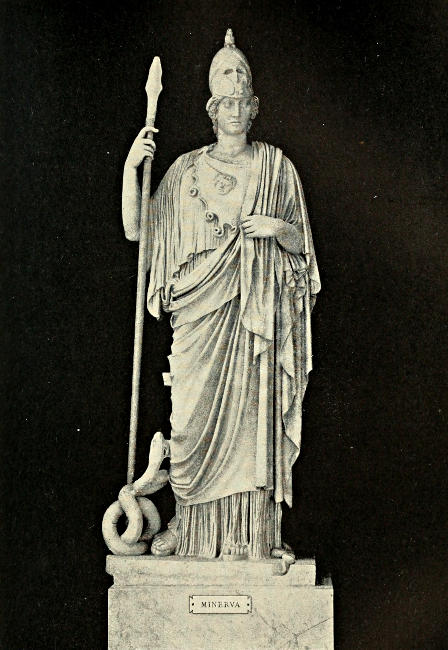
STATUE OF MINERVA
A process analogous to the ostracism subsisted at Argos, at Syracuse, and
in some other Grecian democracies. Aristotle states that it was abused for
factious purposes: and at Syracuse, where it was introduced after the expulsion
of the Gelonian dynasty, Diodorus affirms that it was so unjustly and
profusely applied, as to deter persons of wealth and station from taking any
part in public affairs; for which reason it was speedily discontinued. We
have no particulars to enable us to appreciate this general statement. But
we cannot safely infer that because the ostracism worked on the whole well
at Athens, it must necessarily have worked well in other states—the more
so, as we do not know whether it was surrounded with the same precautionary
formalities, nor whether it even required the same large minimum of
votes to make it effective. This latter guarantee, so valuable in regard to an
institution essentially easy to abuse, is not noticed by Diodorus in his brief
account of the petalism—so the process was denominated at Syracuse.
Such was the first Athenian democracy, engendered as well by the
reaction against Hippias and his dynasty as by the memorable partnership,
whether spontaneous or compulsory, between Clisthenes and the unfranchised
multitude. It is to be distinguished, both from the mitigated oligarchy
established by Solon before, and from the full-grown and symmetrical democracy
which prevailed afterwards from the beginning of the Peloponnesian
War towards the close of the career of Pericles. It was, indeed, a striking
revolution, impressed upon the citizen not less by the sentiments to which it
appealed than by the visible change which it made in political and social
life. He saw himself marshalled in the ranks of hoplites, alongside of new
companions in arms; he was enrolled in a new register, and his property
in a new schedule, in his deme and by his demarch, an officer before unknown;
he found the year distributed afresh, for all legal purposes, into ten parts
bearing the name of prytanies, each marked by a solemn and free-spoken
ecclesia, at which he had a right to be present; that ecclesia was convoked
and presided by senators called prytanes, members of a senate novel
both as to number and distribution; his political duties were now performed
as member of a tribe, designated by a name not before pronounced
in common Attic life, connected with one of ten heroes whose statues he now
for the first time saw in the agora, and associating him with fellow-tribesmen
from all parts of Attica. All these and many others were sensible
novelties, felt in the daily proceedings of the citizen. But the great novelty
of all was the authentic recognition of the ten new tribes as a sovereign
demos, or people, apart from all specialties of phratric or gentile origin, with
free speech and equal law; retaining no distinction except the four classes
of the Solonian property-schedule with their gradations of eligibility. To
a considerable proportion of citizens this great novelty was still further
endeared by the fact that it had raised them out of the degraded position of
metics and slaves; and to the large majority of all the citizens, it furnished
a splendid political idea, profoundly impressive to the Greek mind, capable of
calling forth the most ardent attachment as well as the most devoted sense
of active obligation and obedience. We have now to see how their newly-created
patriotism manifested itself.
Clisthenes and his new constitution carried with them so completely the
popular favour, that Isagoras had no other way of opposing it except by
calling in the interference of Cleomenes and the Lacedæmonians. Cleomenes
listened the more readily to this call, as he was reported to have been
on an intimate footing with the wife of Isagoras. He prepared to come to
Athens; but his first aim was to deprive the democracy of its great leader
Clisthenes, who, as belonging to the Alcmæonid family, was supposed to
be tainted with the inherited sin of his great-grandfather Megacles, the destroyer
of the usurper Cylon. Cleomenes sent a herald to Athens, demanding
the expulsion “of the accursed,”—so this family were called by their
enemies, and so they continued to be called eighty years afterwards, when
the same manœuvre was practised by the Lacedæmonians of that day against
Pericles. This requisition had been recommended by Isagoras, and was so
well-timed that Clisthenes, not venturing to disobey it, retired voluntarily,
so that Cleomenes, though arriving at Athens only with a small force, found
himself master of the city. At the instigation of Isagoras, he sent into exile
seven hundred families, selected from the chief partisans of Clisthenes: his
next attempt was to dissolve the new senate of Five Hundred and place the
whole government in the hands of three hundred adherents of the chief
whose cause he espoused. But now was seen the spirit infused into the
people by their new constitution. At the time of the first usurpation of
Pisistratus, the senate of that day had not only not resisted, but even lent
themselves to the scheme. But the new senate of Clisthenes resolutely
refused to submit to dissolution, and the citizens manifested themselves in
a way at once so hostile and so determined, that Cleomenes and Isagoras
were altogether baffled. They were compelled to retire into the Acropolis
and stand upon the defensive; and this symptom of weakness was the signal
for a general rising of the Athenians, who besieged the Spartan king on the
holy rock. He had evidently come without any expectation of finding, or
any means of overpowering, resistance; for at the end of two days his provisions
were exhausted, and he was forced to capitulate. He and his Lacedæmonians,
as well as Isagoras, were allowed to retire to Sparta; but the
Athenians of the party captured along with him were imprisoned, condemned,
and executed by the people.
Clisthenes, with the seven hundred exiled families, was immediately recalled,
and his new constitution materially strengthened by this first success.
Yet the prospect of renewed Spartan attack was sufficiently serious to induce
him to send envoys to Artaphernes, the Persian satrap at Sardis, soliciting
the admission of Athens into the Persian alliance: he probably feared the
intrigues of the expelled Hippias in the same quarter. Artaphernes, having
first informed himself who the Athenians were, and where they dwelt,
replied that, if they chose to send earth and water to the king of Persia,
they might be received as allies, but upon no other condition. Such were
the feelings of alarm under which the envoys had quitted Athens, that they
went the length of promising this unqualified token of submission. But
their countrymen, on their return, disavowed them with scorn and indignation.
It was at this time that the first connection began between Athens and
the little Bœotian town of Platæa, situated on the northern slope of the range
of Cithæron, between that mountain and the river Asopus, on the road from
Athens to Thebes; and it is upon this first occasion that we become acquainted
with the Bœotians and their polities. The Bœotian federation has
already been briefly described, as composed of some twelve or thirteen autonomous
towns under the headship of Thebes, which was, or professed to have
been, their mother-city. Platæa had been, so the Thebans affirmed, their
latest foundation; it was ill-used by them, and discontented with the alliance.
Accordingly, as Cleomenes was on his way back from Athens, the
Platæans took the opportunity of addressing themselves to him, craved
the protection of Sparta against Thebes, and surrendered their town and
territory without reserve. The Spartan king, having no motive to undertake
a trust which promised nothing but trouble, advised them to solicit the protection
of Athens, as nearer and more accessible for them in case of need. He
foresaw that this would embroil the Athenians with Bœotia; and such anticipation
was in fact his chief motive for giving the advice, which the Platæans
followed.
[506 B.C.]
Selecting an occasion of public sacrifice at Athens, they despatched thither
envoys, who sat down as suppliants at the altar, surrendered their town to
Athens, and implored protection against Thebes. Such an appeal was not
to be resisted, and protection was promised; it was soon needed, for the
Thebans invaded the Platæan territory, and an Athenian force marched to
defend it. Battle was about to be joined, when the Corinthians interposed
with their mediation, which was accepted by both parties. They decided
altogether in favour of Platæa, pronouncing that the Thebans had no right
to employ force against any seceding member of the Bœotian federation.
But the Thebans, finding the decision against them, refused to abide by it,
and, attacking the Athenians on their return, sustained a complete defeat:
the latter avenged this breach of faith by joining to Platæa the portion of
Theban territory south of the Asopus, and making that river the limit
between the two. By such success, however, the Athenians gained nothing,
except the enmity of Bœotia, as Cleomenes had foreseen. Their alliance
with Platæa, long continued, and presenting in the course of this history
several incidents touching to our sympathies, will be found, if we except
one splendid occasion, productive only of burden to the one party, yet
insufficient as a protection to the other.
Meanwhile Cleomenes had returned to Sparta full of resentment against
the Athenians, and resolved on punishing them, as well as on establishing
his friend Isagoras as despot over them. Having been taught, however, by
humiliating experience, that this was no easy achievement, he would not make
the attempt, without having assembled a considerable force; he summoned
allies from all the various states of the Peloponnesus, yet without venturing
to inform them what he was about to undertake. He at the same time
concerted measures with the Bœotians, and with the Chalcidians of Eubœa,
for a simultaneous invasion of Attica on all sides. It appears that he had
greater confidence in their hostile dispositions towards Athens than in those
of the Peloponnesians; he was not afraid to acquaint them with his design,
and probably the Bœotians were incensed with the recent interference of
Athens in the affair of Platæa. As soon as these preparations were completed,
the two kings of Sparta, Cleomenes and Demaratus, put themselves
at the head of the united Peloponnesian force, marched into Attica, and advanced
as far as Eleusis on the way to Athens. But when the allies came to
know the purpose for which they were to be employed, a spirit of dissatisfaction
manifested itself among them. They had no unfriendly sentiment
towards Athens; and the Corinthians especially, favourably disposed rather
than otherwise towards that city, resolved to proceed no further, withdrew
their contingent from the camp, and returned home. At the same time,
king Demaratus, either sharing in the general dissatisfaction, or moved by
some grudge against his colleague which had not before manifested itself,
renounced the undertaking also. And these two examples, operating upon
the pre-existing sentiment of the allies generally, caused the whole camp to
break up and return home without striking a blow.
We may here remark that this is the first instance known in which
Sparta appears in act as recognised head of an obligatory Peloponnesian
alliance, summoning contingents from the cities to be placed under the command
of her king. Her headship, previously recognised in theory, passes
now into act, but in an unsatisfactory manner, so as to prove the necessity of
precaution and concert beforehand, which will be found not long wanting.
Pursuant to the scheme concerted, the Bœotians and Chalcidians attacked
Attica at the same time that Cleomenes entered it. The former seized
Œnoe and Hysiæ, the frontier demes of Attica on the side towards Platæa,
while the latter assailed the northeastern frontier, which faces Eubœa. Invaded
on three sides, the Athenians were in serious danger, and were compelled
to concentrate all their forces at Eleusis against Cleomenes, leaving
the Bœotians and Chalcidians unopposed. But the unexpected breaking up
of the invading army from the Peloponnesus proved their rescue, and enabled
them to turn the whole of their attention to the other frontier. They
marched into Bœotia to the strait called Euripus, which separates it from
Eubœa, intending to prevent the junction of the Bœotians and Chalcidians,
and to attack the latter first apart. But the arrival of the Bœotians caused
an alteration of their scheme; they attacked the Bœotians first, and gained
a victory of the most complete character, killing a large number, and capturing
seven hundred prisoners. On the very same day they crossed over
to Eubœa, attacked the Chalcidians, and gained another victory so decisive
that it at once terminated the war. Many Chalcidians were taken, as well as
Bœotians, and conveyed in chains to Athens, where after a certain detention
they were at last ransomed for two minæ per man; and the tenth of the
sum thus raised was employed in the fabrication of a chariot and four
horses in bronze, which was placed in the Acropolis to commemorate the victory.
Herodotus saw this trophy when he was at Athens. He saw too,
what was a still more speaking trophy, the actual chains in which the
prisoners had been fettered, exhibiting in their appearance the damage
undergone when the Acropolis was burnt by Xerxes: an inscription of four
lines described the offerings and recorded the victory out of which they had
sprung.
Another consequence of some moment arose out of this victory. The
Athenians planted a body of four thousand of their citizens as cleruchs (lot-holders)
or settlers upon the lands of the wealthy Chalcidian oligarchy
called the hippobotæ—proprietors probably in the fertile plain of Lelantum,
between Chalcis and Eretria. This is a system which we shall find
hereafter extensively followed out by the Athenians in the days of their
power; partly with the view of providing for their poorer citizens, partly
to serve as garrison among a population either hostile or of doubtful
fidelity. These Attic cleruchs (we can find no other name by which to
speak of them) did not lose their birthright as Athenian citizens: they were
not colonists in the Grecian sense, and they are known by a totally different
name, but they corresponded very nearly to the colonies formally planted
out on the conquered lands by Rome. The increase of the poorer population
was always more or less painfully felt in every Grecian city. For
though the aggregate population never seems to have increased very fast,
yet the multiplication of children in poor families caused the subdivision of
the smaller lots of land, until at last they became insufficient for a maintenance;
and the persons thus impoverished found it difficult to obtain subsistence
in other ways, more especially as the labour for the richer classes
was so much performed by imported slaves. The numerous cleruchies sent
out by Athens, of which this to Eubœa was the first, arose in a great measure
out of the multiplication of the poorer population, which her extended power
was employed in providing for. Her subsequent proceedings with a view to
the same object will not be always found so justifiable as this now before us,
which grew naturally, according to the ideas of the time, out of her success
against the Chalcidians.
[498-491 B.C.]
The war between Athens, however, and Thebes with her Bœotian allies,
still continued, to the great and repeated disadvantage of the latter, until at
length the Thebans in despair sent to ask advice of the Delphian oracle,
and were directed to “solicit aid from those nearest to them.” “How (they
replied) are we to obey? Our nearest neighbours, of Tanagra, Coronea, and
Thespiæ, are now, and have been from the beginning, lending us all the aid
in their power.” An ingenious Theban, however, coming to the relief of
his perplexed fellow-citizens, dived into the depths of legend and brought
up a happy meaning. “Those nearest to us (he said) are the inhabitants of
Ægina: for Thebe (the eponym of Thebes) and Ægina (the eponym of that
island) were both sisters, daughters of Asopus: let us send to crave assistance
from the Æginetans.” If his subtle interpretation (founded upon their
descent from the same legendary progenitors) did not at once convince all
who heard it, at least no one had any better to suggest; and envoys were at
once sent to the Æginetans, who, in reply to a petition founded on legendary
claims, sent to the help of the Thebans a reinforcement of legendary,
but venerated, auxiliaries—the Æacid heroes. We are left to suppose that
their effigies are here meant. It was in vain, however, that the glory and
the supposed presence of the Æacids, Telamon and Peleus, were introduced
into the Theban camp. Victory still continued on the side of Athens; and
the discouraged Thebans again sent to Ægina, restoring the heroes, and praying
for aid of a character more human and positive. Their request was granted,
and the Æginetans commenced war against Athens without even the decent
preliminary of a herald and declaration.
This remarkable embassy first brings us into acquaintance with the
Dorians of Ægina,—oligarchical, wealthy, commercial, and powerful at sea,
even in the earliest days; more analogous to Corinth than to any of the
other cities called Dorian. The hostility which they now began without
provocation against Athens,—repressed by Sparta at the critical moment of
the battle of Marathon, and hushed for a while by the common dangers of
the Persian invasion under Xerxes; then again breaking out,—was appeased
only with the conquest of the island about twenty years after that event,
and with the expulsion and destruction of its inhabitants some years later.
There had been indeed, according to Herodotus, a feud of great antiquity
between Athens and Ægina, of which he gives the account in a singular
narrative, blending together religion, politics, exposition of ancient customs,
etc.; but at the time when the Thebans solicited aid from Ægina, the latter
was at peace with Athens. The Æginetans employed their fleet, powerful
for that day, in ravaging Phalerum and the maritime demes of Attica; nor
had the Athenians as yet any fleet to resist them. It is probable that the
desired effect was produced, of diverting a portion of the Athenian force
from the war against Bœotia, and thus partially relieving Thebes. But the
war of Athens against both of them continued for a considerable time, though
we have no information respecting its details.
Meanwhile the attention of Athens was called off from these combined
enemies by a more menacing cloud, which threatened to burst upon her
from the side of Sparta. Cleomenes and his countrymen, full of resentment
at the late inglorious desertion of Eleusis, were yet more incensed by the
discovery, which appears to have been then recently made, that the injunctions
of the Delphian priestess for the expulsion of Hippias from Athens had
been fraudulently procured. Moreover, Cleomenes, when shut up in the
Acropolis of Athens with Isagoras, had found there various prophecies previously
treasured up by the Pisistratidæ, many of which foreshadowed events
highly disastrous to Sparta. And while the recent brilliant manifestations
of courage, and repeated victories, on the part of Athens, seemed to indicate
that such prophecies might perhaps be realised, Sparta had to reproach
herself, that, from the foolish and mischievous conduct of Cleomenes, she had
undone the effect of her previous aid against the Pisistratidæ, and thus lost
that return of gratitude which the Athenians would otherwise have testified.
Under such impressions, the Spartan authorities took the remarkable step of
sending for Hippias from his residence at Sigeum to the Peloponnesus, and of
summoning deputies from all their allies to meet him at Sparta.
The convocation thus summoned deserves notice as the commencement
of a new era in Grecian politics. The previous expedition of Cleomenes
against Attica presents to us the first known example of Spartan headship
passing from theory into act: that expedition miscarried because the allies,
though willing to follow, would not follow blindly, nor be made the instruments
of executing purposes repugnant to their feelings. Sparta had now
learned the necessity, in order to insure their hearty concurrence, of letting
them know what she contemplated, so as to ascertain at least that she had no
decided opposition to apprehend. Here, then, is the third stage in the spontaneous
movement of Greece towards a systematic conjunction, however
imperfect, of its many autonomous units. First we have Spartan headship
suggested in theory, from a concourse of circumstances which attract to her
the admiration of all Greece,—power, unrivalled training, undisturbed
antiquity, etc.; next, the theory passes into act, yet rude and shapeless;
lastly, the act becomes clothed with formalities, and preceded by discussion
and determination. The first convocation of the allies at Sparta, for the
purpose of having a common object submitted to their consideration, may
well be regarded as an important event in Grecian political history. The
proceedings at the convocation are no less important, as an indication of the
way in which the Greeks of that day felt and acted, and must be borne in
mind as a contrast with times hereafter to be described.
Hippias having been presented to the assembled allies, the Spartans
expressed their sorrow for having dethroned him, their resentment and
alarm at the new born insolence of Athens, already tasted by her immediate
neighbours, and menacing to every state represented in the convocation,
and their anxiety to restore Hippias, not less as a reparation for past wrong,
than as a means, through his rule, of keeping Athens low and dependent.
But the proposition, though emanating from Sparta, was listened to by the
allies with one common sentiment of repugnance. They had no sympathy
for Hippias, no dislike, still less any fear, of Athens, and a profound detestation
of the character of a despot. The spirit which had animated the
armed contingents at Eleusis now reappeared among the deputies at Sparta,
and the Corinthians again took the initiative. Their deputy Sosicles protested
against the project in the fiercest and most indignant strain: no language
can be stronger than that of the long harangue which Herodotus puts
into his mouth, wherein the bitter recollections prevalent at Corinth respecting
Cypselus and Periander are poured forth. “Surely, heaven and earth
are about to change places,—the fish are coming to dwell on dry land, and
mankind going to inhabit the sea,—when you, Spartans, propose to subvert
the popular governments, and to set up in the cities that wicked and bloody
thing called a Despot. First try what it is, for yourselves at Sparta, and
then force it upon others if you can: you have not tasted its calamities as
we have, and you take very good care to keep it away from yourselves. We
adjure you, by the common gods of Hellas,—plant not despots in her cities:
if you persist in a scheme so wicked, know that the Corinthians will not
second you.”
This animated appeal was received with a shout of approbation and sympathy
on the part of the allies. All with one accord united with Sosicles in
adjuring the Lacedæmonians “not to revolutionise any Hellenic city.” No
one listened to Hippias when he replied, warning the Corinthians that the
time would come, when they, more than any one else, would dread and abhor
the Athenian democracy, and wish the Pisistratidæ back again. He knew
well, says Herodotus, that this would be, for he was better acquainted with
the prophecies than any man. But no one then believed him, and he was
forced to take his departure back to Sigeum: the Spartans not venturing to
espouse his cause against the determined sentiment of the allies.
That determined sentiment deserves notice, because it marks the present
period of the Hellenic mind; fifty years later it will be found materially
altered. Aversion to single-headed rule, and bitter recollection of men like
Cypselus and Periander are now the chords which thrill in an assembly of
Grecian deputies: the idea of a revolution, implying thereby a great and
comprehensive change, of which the party using the word disapproves, consists
in substituting a permanent One in place of those periodical magistrates
and assemblies which were the common attribute of oligarchy and democracy:
the antithesis between these last two is as yet in the background, nor does there
prevail either fear of Athens or hatred of the Athenian democracy. But
when we turn to the period immediately before the Peloponnesian War, we
find the order of precedence between these two sentiments reversed. The
anti-monarchical feeling has not perished, but has been overlaid by other and
more recent political antipathies,—the antithesis between democracy and
oligarchy having become, not indeed the only sentiment, but the uppermost
sentiment, in the minds of Grecian politicians generally, and the soul of
active party movement. Moreover, a hatred of the most deadly character
has grown up against Athens and her democracy, especially in the grandsons
of those very Corinthians who now stand forward as her sympathising
friends. The remarkable change of feeling here mentioned is nowhere so
strikingly exhibited as when we contrast the address of the Corinthian
Sosicles, just narrated, with the speech of the Corinthian envoys at Sparta,
immediately antecedent to the Peloponnesian War, as given to us in Thucydides.
It will hereafter be fully explained by the intermediate events, by
the growth of Athenian power, and by the still more miraculous development
of Athenian energy.
[494-490 B.C.]
Such development, the fruit of the fresh-planted democracy as well as the
seed for its sustentation and aggrandisement, continued progressive during
the whole period just adverted to. But the first unexpected burst of it,
under the Clisthenean constitution, and after the expulsion of Hippias, is
described by Herodotus in terms too emphatic to be omitted. After narrating
the successive victories of the Athenians over both Bœotians and
Chalcidians, that historian proceeds: “Thus did the Athenians grow in
strength. And we may find proof, not merely in this instance but everywhere
else, how valuable a thing freedom is: since even the Athenians, while
under a despot, were not superior in war to any of their surrounding neighbours,
but, so soon as they got rid of their despots, became by far the first of
all. These things show that while kept down by one man, they were slack
and timid, like men working for a master; but when they were liberated,
every single man became eager in exertions for his own benefit.” The same
comparison reappears a short time afterwards, where he tells us, that “the
Athenians when free, felt themselves a match for Sparta; but while kept
down by any man under a despotism, were feeble and apt for submission.”
Stronger expressions cannot be found to depict the rapid improvement
wrought in the Athenian people by their new democracy. Of course this
did not arise merely from suspension of previous cruelties, or better laws, or
better administration. These, indeed, were essential conditions, but the
active transforming cause here was the principle and system of which such
amendments formed the detail: the grand and new idea of the sovereign
people, composed of free and equal citizens,—or liberty and equality, to use
words which so profoundly moved the French nation half a century ago.
It was this comprehensive political idea which acted with electric effect upon
the Athenians, creating within them a host of sentiments, motives, sympathies,
and capacities to which they had before been strangers. Democracy in
Grecian antiquity possessed the privilege, not only of kindling an earnest
and unanimous attachment to the constitution in the bosoms of the citizens,
but also of creating an energy of public and private action, such as could
never be obtained under an oligarchy, where the utmost that could be hoped
for was a passive acquiescence and obedience. Mr. Burke has remarked
that the mass of the people are generally very indifferent about theories of
government; but such indifference—although improvements in the practical
working of all governments tend to foster it—is hardly to be expected
among any people who exhibit decided mental activity and spirit on other
matters; and the reverse was unquestionably true, in the year 500 B.C.,
among the communities of ancient Greece. Theories of government were
there anything but a dead letter; they were connected with emotions of the
strongest as well as of the most opposite character. The theory of a permanent
ruling One, for example, was universally odious: that of a ruling
Few, though acquiesced in, was never positively attractive, unless either where
it was associated with the maintenance of peculiar education and habits, as
at Sparta, or where it presented itself as the only antithesis to democracy, the
latter having by peculiar circumstances become an object of terror. But
the theory of democracy was pre-eminently seductive; creating in the mass
of the citizens an intense positive attachment, and disposing them to voluntary
action and suffering on its behalf, such as no coercion on the part of
other governments could extort.
Herodotus, in his comparison of the three sorts of government, puts in
the front rank of the advantages of democracy, “its most splendid name and
promise,”—its power of enlisting the hearts of the citizens in support of
their constitution, and of providing for all a common bond of union and fraternity.
This is what even democracy did not always do: but it was what
no other government in Greece could do: a reason alone sufficient to stamp
it as the best government, and presenting the greatest chance of beneficent
results, for a Grecian community. Among the Athenian citizens, certainly,
it produced a strength and unanimity of positive political sentiment, such as
has rarely been seen in the history of mankind, which excites our surprise
and admiration the more when we compare it with the apathy which had
preceded,—and which is even applied as the natural state of the public
mind in Solon’s famous proclamation against neutrality in a sedition. Because
democracy happens to be unpalatable to some modern readers, they
have been accustomed to look upon the sentiment here described only in
its least honourable manifestations,—in the caricatures of Aristophanes,
or in the empty commonplaces of rhetorical declaimers. But it is not in
this way that the force, the earnestness, or the binding value of democratical
sentiment at Athens is to be measured. We must listen to it as it
comes from the lips of Pericles, while he is strenuously enforcing upon the
people those active duties for which it both implanted the stimulus and supplied
the courage; or from the oligarchical Nicias in the harbour of Syracuse,
when he is endeavouring to revive the courage of his despairing troops for
one last death-struggle, and when he appeals to their democratical patriotism
as to the only flame yet alive and burning even in that moment of agony.
From the time of Clisthenes downward, the creation of this new mighty
impulse makes an entire revolution in the Athenian character. And if the
change still stood out in so prominent a manner before the eyes of Herodotus,
much more must it have been felt by the contemporaries among whom it
occurred.
The attachment of an Athenian citizen to his democratical constitution
comprised two distinct veins of sentiment: first, his rights, protection, and
advantages derived from it; next, his obligations of exertion and sacrifice
towards it and with reference to it. Neither of these two veins of sentiment
was ever wholly absent; but according as the one or the other was present at
different times in varying proportions, the patriotism of the citizen was a
very different feeling. That which Herodotus remarks is, the extraordinary
efforts of heart and hand which the Athenians suddenly displayed,—the
efficacy of the active sentiment throughout the bulk of the citizens; and we
shall observe even more memorable evidences of the same phenomenon in
tracing down the history from Clisthenes to the end of the Peloponnesian
War: we shall trace a series of events and motives eminently calculated to
stimulate that self-imposed labour and discipline which the early democracy
had first called forth. But when we advance farther down, from the restoration
of the democracy after the Thirty Tyrants to the time of Demosthenes,
we venture upon this brief anticipation, in the conviction that one period
of Grecian history can be thoroughly understood only by contrasting it with
another,—we shall find a sensible change in Athenian patriotism. The active
sentiment of obligation is comparatively inoperative, the citizen, it is true,
has a keen sense of the value of the democracy as protecting him and insuring
to him valuable rights, and he is, moreover, willing to perform his ordinary
sphere of legal duties towards it; but he looks upon it as a thing established,
and capable of maintaining itself in a due measure of foreign ascendency,
without any such personal efforts as those which his forefathers cheerfully
imposed upon themselves. The orations of Demosthenes contain melancholy
proofs of such altered tone of patriotism,—of that languor, paralysis, and
waiting for others to act, which preceded the catastrophe of Chæronea, notwithstanding
an unabated attachment to the democracy as a source of protection
and good government. That same preternatural activity which the
allies of Sparta, at the beginning of the Peloponnesian War, both denounced
and admired in the Athenians, is noted by the orator as now belonging to
their enemy Philip.
Such variations in the scale of national energy pervade history, modern
as well as ancient, but in regard to Grecian history, especially, they can never
be overlooked. For a certain measure, not only of positive political attachment,
but also of active self-devotion, military readiness, and personal effort,
was the indispensable condition of maintaining Hellenic autonomy, either in
Athens or elsewhere; and became so more than ever when the Macedonians
were once organised under an enterprising and semi-Hellenised prince.
The democracy was the first creative cause of that astonishing personal and
many-sided energy which marked the Athenian character, for a century downwards
from Clisthenes.
That the same ultra-Hellenic activity did not longer continue, is referable
to other causes, which will be hereafter in part explained. No system of
government, even supposing it to be very much better and more faultless than
the Athenian democracy, can ever pretend to accomplish its legitimate end
apart from the personal character of the people, or to supersede the necessity
of individual virtue and vigour.
During the half-century immediately preceding the battle of Chæronea,
the Athenians had lost that remarkable energy which distinguished them
during the first century of their democracy, and had fallen much more nearly
to a level with the other Greeks, in common with whom they were obliged to
yield to the pressure of a foreign enemy. We here briefly notice their last
period of languor, in contrast with the first burst of democratical fervour
under Clisthenes, now opening—a feeling which will be found, as we proceed,
to continue for a longer period than could have been reasonably anticipated,
but which was too high-strung to become a perpetual and inherent
attribute of any community.b
Where’er we tread ’tis haunted, holy ground;
No earth of thine is lost in vulgar mould,
But one vast realm of wonder spreads around,
And all the muse’s tales seem truly told,
Till the sense aches with gazing to behold
The scenes our earliest dreams have dwelt upon;
Each hill and dale, each deepening glen and wold,
Defies the power which crushed thy temples gone:
Age shakes Athena’s tower, but spares gray Marathon.
Curtius in the well-known passage which begins his celebrated history
asks where is the division between Asia and Europe, pointing out that the
islands of the Ægean Sea are practically stepping-stones between Asia Minor
and Greece, and that from one point of view the intervening bits of water
are rather connecting links than a severing barrier. This claim has much
to support it in the view of a maritime people; yet from another point of view
a very tangible barrier does exist between the two continents. The Persians,
as is well known, having their native seat far inland had a standing dread of
water. For them the Ægean Sea was unquestionably a barrier, not a bridge.
It would probably have been long before they attempted to cross this barrier
had not the initiative been taken from the other side. But while it was far
from Asia to Europe, it was not far, in the point of view of the sea-faring
Greek, from Europe to Asia. To him the sea was a bridge.
No one knows how early the Greeks themselves crossed the various
“bridges” of the Ægean and began to make settlements in Asia Minor, but
it is known that in a very early day these settlements on the eastern shore
had come to play a most important part in Grecian life. It is supposed that
in the early day the inhabitants of Asia Minor welcomed the Greek colonist
who became valuable to them as a manufacturer, and, in particular, as a
trader.
It was long before there seemed anything menacing in the growth of
these scattered colonies, and, before the powers of Asia Minor had aroused to
a right understanding of the political import of the colonisation that had gone
on under their eyes, the whole coast had come practically under the control
of these peaceful invaders from the West. Then indeed the Lydians, in
particular, were aroused to a realisation of what they had permitted, and
sought to make amends by subjecting the colonies that had hitherto been
their own masters. The attempt was first made on a large scale by Crœsus,
but, before he had completed the task, he was himself overthrown by Cyrus,
and the standing broil with the Greek colonies of the coast was one of the
perquisites of war which Crœsus handed over to the Persians.
Cyrus himself seems to have thought the Greeks of small importance, as
he left a subordinate to dispose of them, while he turned his personal attention
to the more powerful Babylonians, but the Greeks were supported by
the memory of some generations of freedom, and they did not prove the contemptible
foe that they seemed. Cities once conquered were prone to revolt,
and the indomitable spirit of the Greeks on this western border of the
Persian territory proved a standing source of annoyance. At last Darius
determined to put an end to the Grecians once for all, and it was his general
who for the first time led a Persian host across the Hellespont and into the
precincts of Greece itself. The repulse of this host by the Athenians on
the field of Marathon was an event which the Greeks of a later time never
tired of celebrating, and which has taken its place in later history as one of
the half-dozen great decisive battles of the world. Subjected to a critical
view this battle of Marathon, as we shall have occasion to see presently, was
not quite so decisive an event as the Athenians were disposed to think it.
Still it turned the Persian horde back from Greece for a decade. Then
under Xerxes came that stupendous half-organised army that has been the
wonder of all after-times; and the glorious events of Thermopylæ, Salamis,
Platæa, and Mycale in rapid succession added to the glory of Greek prowess
and saved the life of Greece as a nation—saved it from an outer foe that it
might die by its own hand. The events of this memorable epoch are among
the most important in all Grecian history, and we must view them in detail,
drawing largely for our knowledge of them on the great original source,
Herodotus, but noting also the impression which they have made upon many
generations of historians of other times and other lands.a
Herodotus, born 484, in the midst of the Median wars, wondered at this
great conflict between the Greek and barbarian worlds and sought its causes
in times more remote than the Trojan war, even in the mythological period.
[506 B.C.]
“The most learned of the Persians,” he says, “assert that the Phœnicians
were the original exciters of contention. This nation migrated from the borders
of the Red Sea to the place of their present settlement, and soon distinguished
themselves by their long and enterprising voyages. They exported
to Argos, among other places, the produce of Egypt and Assyria. Argos, at
that period, was the most famous of all those states which are now comprehended
under the general appellation of Greece. On their arrival here, the
Phœnicians exposed their merchandise to sale; after remaining about six days,
and when they had almost disposed of their different articles of commerce, the
king’s daughter, whom both nations agree in calling Io, came among a great
number of other women, to visit them at their station. Whilst these females,
standing near the stern of the vessel, amused themselves with bargaining for
such things as attracted their curiosity, the Phœnicians, in conjunction, made
an attempt to seize their persons. The greater part of them escaped, but Io,
with many others, remained a captive. They carried them on board, and
directed their course for Egypt.
“The relation of the Greeks differs essentially; but this, according to the
Persians, was the cause of Io’s arrival in Egypt, and the first act of violence
which was committed. In process of time, certain Grecians, concerning
whose country writers disagree, but who were really of Crete, are reported to
have touched at Tyre, and to have carried away Europa, the daughter of the
prince. Thus far the Greeks had only retaliated; but they were certainly
guilty of the second provocation. They made a voyage in a vessel of war
to Æa, a city of Colchis, near the river Phasis; and, after having accomplished
the more immediate object of their expedition, they forcibly carried
off the king’s daughter, Medea. The king of Colchis despatched a herald
to demand satisfaction for the affront, and the restitution of the princess;
but the Greeks replied, that they should make no reparation in the present
instance, as the violence formerly offered to Io still remained unexpiated.
“In the age which followed, Alexander [Paris], the son of Priam, encouraged
by the memory of these events, determined on obtaining a wife from
Greece, by means of similar violence; fully persuaded that this, like former
wrongs, would never be avenged.
“Upon the loss of Helen, the Greeks at first employed messengers to demand
her person, as well as a compensation for the affront. All the satisfaction
they received was reproach for the injury which had been offered to
Medea; and they were further asked, how, under circumstances entirely
alike, they could reasonably require what they themselves had denied.
“Hitherto the animosity betwixt the two nations extended no farther than
to acts of private violence. But at this period, the Greeks certainly laid the
foundation of subsequent contention; who, before the Persians invaded
Europe, doubtless made military incursions into Asia. The Persians appear
to be of opinion, that they who offer violence to women must be insensible
to the impressions of justice, but that such provocations are as much beneath
revenge, as the women themselves are undeserving of regard: it being obvious,
that all females thus circumstanced must have been more or less accessary to
the fact. They asserted also, that although women had been forcibly carried
away from Asia, they had never resented the affront. The Greeks, on
the contrary, to avenge the rape of a Lacedæmonian woman, had assembled
a mighty fleet, entered Asia in a hostile manner, and had totally overthrown
the empire of Priam. Since which event they had always considered the
Greeks as the public enemies of their nation.”
[515-499 B.C.]
Such were the causes of the animosity between Persians and Greeks as
Herodotus conceived them. But the modern historian gives scant credence
to these tales. In reality we do not have to go back to the abduction of Io
and Helen by the Asiatics, and of Europa and Medea by the Greeks to explain
this mutual hate. Equally trivial are such incidents as the flight
of the physician Democedes, who deceived Darius that he might return to his
native Croton; and the desire of the queen, Atossa, to include Spartan and
Athenian women among her slaves. The appeals of Hippias to be reinstated
in Athens, and of the Aleuadæ of Thessaly to be delivered from the enemies
that oppressed them had, to be sure, a somewhat more serious influence.
But the real cause was Persia’s power. This empire had at that
time attained its natural limits. Being nearly surrounded by deserts, the
sea, wide rivers, and high mountains, there was but one direction in which
she could expand, the northwest; and on that side lay a famous country,
Greece, whose independence affronted the pride of the Great King. Cyrus
had conquered Asia; Cambyses a part of Africa, so Darius, not to be outdone
by his predecessors, attacked Europe. The Sardian satrap, Artaphernes,
had already replied to the overtures of Clisthenes by demanding that
Athens should come under the rule of the Great King. Darius had reorganised
his empire and restored in his provinces the order so rudely shaken by
the usurpation of the Magian and the efforts of the conquered nations to
regain their freedom; it was necessary moreover to furnish occupation for
the warlike ardour which still characterised the Persians. With this end in
view he planned an important expedition. The Scythians had formerly
invaded Asia; it was the recollection of that injury and the desire to subjugate
Thrace which adjoined his own empire that pointed out to Darius
the route he was to follow. He set out from Susa with a numerous army,
crossed the Bosporus on a bridge of boats constructed by the Samian, Mandrocles,
and entered Europe bringing seven or eight hundred thousand men
in his train, among whom were some Asiatic Greeks commanded by the
tyrants of the various cities. He traversed Thrace, crossed the Danube
(Ister) on a bridge of boats which he left the Greeks to guard, then penetrated
well into Scythia in pursuit of an enemy whom it was impossible to
seize. Darius had told the Greeks not to expect him to return after the
expiration of sixty days. This time having passed without news of him,
the Athenian, Miltiades, tyrant of the Chersonesus, proposed to destroy the
bridge that the way into Thrace might not be left open to the Scythians
whom he supposed victorious, also that the Persian army might be destroyed
by them should it still exist. Histiæus of Miletus opposed this plan,
representing to the chiefs, who were all tyrants of Greek cities, that they
would surely be overthrown the day they lost the support of their great
leader. This reasoning saved Darius, who, returning from his vain pursuit,
left with Megabyzus eighty thousand men to complete the subjugation of
Thrace, and also to conquer Macedonia.
Megabyzus conquered Perinthus, that part of Thrace which still resisted,
Pæonia, and called upon the king of Macedonia to render him homage of
earth and water. Amyntas accorded this, and Megabyzus was able to report
to his master that the Persian empire at last adjoined Greece in Europe.
With this the expedition came to an end. Histiæus’ services were rewarded
by the gift of a vast territory on the banks of the Strymon. The site had
been well chosen, near the gold and silver mines of Mount Pangæ, at the
foot of hills rich in building woods and near the mouth of a river that offered
an excellent port on the Ægean Sea. Myrcinus, founded there by Histiæus,
would soon have attained the growth and prosperity that were to signalise
Amphipolis later on the same spot, had not Megabyzus, in alarm, warned the
king of the necessity of preventing this Greek from carrying out the plans
he meditated. Histiæus was summoned to Sardis on pretext of being needed
for an important consultation, and once there, Darius told him simply that
he could not do without his friendship and advice. Histiæus was obliged to
accept these gilded chains.
[499-494 B.C.]
Several years had passed in unbroken peace when a trivial matter and an
obscure man threw all in disorder again. Naxos, the largest of the Cyclades,
was powerful at that time, ruling over several islands, possessing a considerable
navy and able to place in the field eight thousand hoplites. Unfortunately,
like every other Grecian state, Naxos was divided into two factions,
the popular and the aristocratic. This latter destroyed itself by an unpardonable
crime, similar to that of which Lucretia was victim about the same
time in Rome. Sent into exile, they proposed to Aristagoras, Histiæus’ son-in-law
and, in his absence, tyrant of Miletus, to take them back to their
island. He acceded readily, beholding in fancy the Cyclades, possibly also
Eubœa as already under his dominion. But unable to accomplish such an
enterprise without help, he succeeded in interesting the satrap of Sardis,
Artaphernes, who placed at his disposal a fleet of two hundred ships commanded
by Megabates. This Persian rebelled at being under the orders of
a Greek and to avenge a slight received in a quarrel that broke out between
them, sent information to the Naxians. The success of the expedition depended
on secrecy; this once destroyed, it was bound to fail. Aristagoras
held to the project four months, spending his own treasure as well as that
given him for the enterprise by the king. He feared being obliged to make
good this loss, and decided that revolt offered a preferable alternative, in
which choice he was aided by the secret instigations of Histiæus. The army
he had led before Naxos was still united, and forming part of it were all the
tyrants of the cities on the Asiatic coast. These he seized and sent back to
their respective cities where they were placed under sentence of death or
exile, then established democracy everywhere (499 B.C.). After these deeds,
finding it necessary to attach some powerful ally to his cause, he visited
Lacedæmon. Cleomenes, its king, questioned him as to the distance of the
Persian capital from the sea. “A three months’ march,” replied Aristagoras.
“In that case you will leave this place to-morrow,” said the king, “it
would be folly to propose to Lacedæmonians to put a three months’ march
between themselves and the sea.” Aristagoras tried to bribe him to consent;
but for once Spartan virtue was incorruptible and the Ionian went on to
Athens. Given permission to speak in the assembly, he described the riches
of Persia, and laid stress on the advantage the Greeks would have over a
foe to whom the use of spear and shield was unknown, and finally adduced
the fact that Miletus was a colony of Athens. The Athenians had more
than one grievance against the Persians—the refuge given to Hippias, and
the order to recall the tyrant received as a reply to their remonstrances.
Aristagoras had little difficulty in persuading them to assure their own
safety by carrying the war with which they were menaced over into the
enemy’s country, they also believing doubtless that the matter was but a private
quarrel between the satrap and Aristagoras. They decreed to the envoy
twenty vessels to which were added five triremes from Eretria, this state
thus repaying the aid it had formerly received from Miletus in its war
against Chalcis. The allies proceeded to Ephesus and thence to Sardis,
which they took and pillaged. The houses were thatched with reeds, and, a
soldier accidentally setting fire to one of the roofs, the entire city, with the
exception of the citadel to which Artaphernes had retired, was consumed,
together with the temple of Cybele, venerated as deeply by the Persians as
by the Lydians (498). Artaphernes meanwhile had recalled the army that
was besieging Miletus, and from all sides gathered the provincial troops; the
Athenians began to think of retreat. A defeat they suffered near Ephesus,
possibly also treason among themselves, completed their dissatisfaction.
They boarded their ships and returned to Athens, leaving their allies to
extricate themselves from the difficulty in which they were placed as best
they could.
The Ionians continued the contest, drawing into their movement all the
cities on the Hellespont and the Propontis, together with Chalcedonia and
Byzantium, the Carians and the island of Cyprus. The Persians got together
several armies; one, directed northward against the cities of the Hellespont,
took several towns, then fell back towards the south against the Carians, who,
after losing two battles, surrendered. Another attacked Cyprus with the
Phœnician fleet that had been defeated by the Ionians, but the treachery of
a Cypriote chief delivered the island over to the enemy. Acting jointly in
the centre, Artaphernes and Otanes captured Clazomenæ and Cyme, and
then advanced with a considerable force against Miletus, the last bulwark
of Ionia. Here Aristagoras was no longer chief; he had basely deserted
and escaped to Myrcinus, and was later killed in an attack on a Thracian
city. As regards Histiæus, Darius, deceived by his promises, had recently
restored him to liberty, but the Milesians, having no liking for tyrants,
refused to receive him. Getting together a small force of Mytilenæans he
became a pirate and was killed in a descent on the Asiatic coast. The
Ionians assembled at the Panionium, deliberated as to the best means of
saving Miletus. It was decided to risk a naval battle; Chios furnished a
hundred ships, Lesbos seventy, Samos sixty, and Miletus itself eighty, the
fleet numbering in all three hundred and fifty-three ships. The Persians
had six hundred.
[494-492 B.C.]
In the Greek fleet was a very able man who would have saved Ionia had
she been willing to be saved. This was Dionysius, a Phocæan, who demonstrated
to the allies that strict discipline and constant practice in manœuvres
would assure them success. For seven days he drilled the crews in all the
movements of naval warfare, but at the end of this time the effeminate Ionians
had had enough; they left the ships, pitched their tents on land, and
forgot that the enemy existed. As was unavoidable after taking such a
course, their moral fibre became relaxed and treachery began to show among
them. When the day of battle arrived, the Samians, in the hottest of the
action, deserted their post and made for their own island. The Ionians were
defeated despite the splendid courage of the Chian sailors and of Dionysius,
who himself took three of the enemy’s vessels. When he saw that the battle
was lost he boldly pushed on to Tyre and sank several merchant ships, retiring
to Sicily with the wealth obtained. The rest of his life was passed in
pursuing on the open sea Phœnician, Carthaginian, and Tyrrhenian ships.
All hope was lost for Miletus; it was taken and its inhabitants transported
to Ampe, at the mouth of the Tigris (494). Chios, Lesbos, Tenedos,
shared Miletus’ fate, and several cities of the Hellespont were destroyed by
fire. The inhabitants of Chalcedon and Byzantium abandoned these cities
to seek a home on the northwest coast of the Pontus Euxinus, in Mesambria.
Miltiades also deemed it prudent to leave the Chersonesus; he returned to
Athens, where he was soon to find himself arrayed against those very Persians
from whom he now sought flight. The news of Ionia’s downfall echoed
sadly throughout Greece, Athens, in particular, being affected. Phrynichus
presented a play entitled the Capture of Miletus at which the entire audience
burst into tears, and the poet was sentenced to pay a fine of a thousand
drachmæ “for having revived the memory of a great domestic misfortune.”
Tears like these expiate many faults.
Meanwhile Darius had not forgotten that after the burning of Sardis he
had sworn to be revenged on the Athenians. He gave to his son-in-law,
Mardonius, command over a newly raised army that was to enter Europe by
way of Thrace while the fleet followed along the coast. Mardonius, to conciliate
the Greeks in Asia, restored to them a democratic government, bearing
in mind that the authors of the recent revolt had been two of the tyrants
that Persia supported.
Megabazus had already subdued all the nations between the Hellespont
and Macedonia. Mardonius crossed the Strymon and gave his fleet rendezvous
in the Thermaic Gulf. He took Thasos and was passing along the
coast of Chalcidice when on doubling the promontory of Mount Athos,
which rises nineteen hundred and fifty metres out of the sea, his fleet encountered
a terrific gale that wrecked three hundred ships and destroyed twenty
thousand lives. About the same time Mardonius, attacked at night by the
Thracians, lost many of his men and was himself wounded. He continued
the expedition, but was so enfeebled after the subjugation of the Brygians
that he felt himself obliged to return to Asia.
A more formidable armament was at once prepared. Before sending it
forth Darius despatched heralds to Greece demanding homage of earth and
water, and, in the case of maritime cities, a contingent of galleys. The
greater part of the islands and several cities yielded to this demand, Ægina
even anticipating the desire of the Great King. The indignation of Athens
and Sparta was such that they forgot the respect due to envoys. “You
want earth and water?” replied the Spartans, “very well, you shall have
both,” and the unfortunate men were thrown into a well. The Greeks cast
them into the barathrum, and if a not very authentic tale may be believed,
condemned to death the interpreter who had defiled the Greek tongue by
translating into it the orders of a barbarian.[18]
[492 B.C.]
Athens was constantly at war with the Æginetans, and she now seized
an opportunity their conduct offered to accuse them to the Lacedæmonians
of treachery to the common cause. This appeal to the Spartans was equivalent
to acknowledging their claims to supremacy as the recognised chiefs
of Hellas, the exigencies of the situation having silenced pride. Cleomenes
shared the resentment of the Athenians, and proceeded to Ægina to seize
the offenders. But his colleague Demaratus, who had already betrayed
him in an expedition into Attica, informed the islanders and the enterprise
fell through.
To put an end to his colleague’s vexatious opposition Cleomenes caused
it to be declared by the Pythia, whom he had won over, that Demaratus was
not of royal blood, thus obtaining his deposition. Leotychides, who had
joined with him in this scheme, succeeded the deposed king, to whom he
was next of kin, and by outrageous treatment drove him from Sparta.
Demaratus sought out Hippias in his exile and, like him, begged hospitality
of the great protector of kings.
Cleomenes next proceeded to Ægina and took thence ten hostages whom
he delivered over to the Athenians. This was the last public act of the
turbulent chief who later became insane and perished miserably by his own
hand; Leotychides, convicted of having taken bribes from the enemy he
should have stubbornly opposed, died in exile. “Thus,” says Herodotus,
“did the gods punish the perjury of these two princes.” Meanwhile the
Æginetans demanded the return of their hostages, and, Athens refusing
to surrender them, they attacked and captured the sacred galley that was
carrying to Cape Sunium many prominent citizens. War immediately broke
out. An Æginetan attempted to overthrow, in his island, the oligarchical
government. He got possession of the citadel, but reinforcements not
reaching him in time, he left in the hands of the enemy seven hundred of
his men, who were massacred without mercy. One of these poor creatures
succeeded in escaping and made his way to the temple of Ceres where
he expected to find safe refuge. The gates being closed, he clung with both
hands to the latch-ring, and all efforts to make him let go being unavailing,
the butchers cut off his hands, which even in the convulsions of death still
preserved their frenzied hold. Herodotus, accustomed as he was to civil
war, raises not a word of protest against this slaughter of seven hundred
citizens, he remarks only upon the sacrilege committed on account of one
of them. “No sacrifice,” he says piously, “will be sufficient to appease the
wrath of the goddess.” The nobles were all ejected from the island before
they had expiated their act of sacrilege. This war did not close, in fact,
until nine years after the second expedition of the Persians.d
[492-490 B.C.]
Whilst these two nations were thus
engaged in hostilities, the domestic of
the Persian monarch continued regularly
to bid him “Remember the Athenians,”
which incident was further
enforced by the unremitting endeavours
of the Pisistratidæ to criminate
that people. The king himself was
very glad of this pretext, effectually
to reduce such of the Grecian states
as had refused him “earth and water.”
He accordingly removed from his command
Mardonius, who had been unsuccessful
in his naval undertakings; he
appointed two other officers to commence
an expedition against Eretria
and Athens; these were Datis, a
native of Media, and Artaphernes his
nephew, who were commanded totally
to subdue both the above places, and
to bring the inhabitants captive before
him.
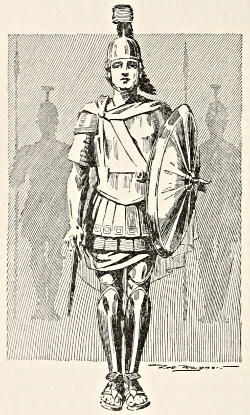
Greek Foot Soldier
These commanders, as soon as
they had received their appointment,
advanced to Aleum in Cilicia, with
a large and well-provided body of
infantry. Here, as soon as they
encamped, they were joined by a
numerous reinforcement of marines,
agreeably to the orders which had
been given. Not long afterwards, those vessels arrived to take the cavalry
on board, which in the preceding year Darius had commanded his tributaries
to supply. The horse and foot immediately embarked, and proceeded to
Ionia, in a fleet of six hundred triremes. They did not, keeping along
the coast, advance in a right line to Thrace and the Hellespont, but loosing
from Samos, they passed through the midst of the islands, and the
Icarian Sea, fearing, as we should suppose, to double the promontory of
Athos, by which they had in a former year severely suffered. They were
further induced to this course by the island of Naxos which before they had
omitted to take.
Proceeding therefore from the Icarian Sea to this island, which was the
first object of their enterprise, they met with no resistance. The Naxians,
remembering their former calamities, fled in alarm to the mountains. Those
taken captive were made slaves, the sacred buildings and the city were
burned. This done, the Persians sailed to the other islands.
At this juncture the inhabitants of Delos deserted their island and fled
to Tenos. The Persian fleet was directing its course to Delos, when Datis,
hastening to the van, obliged them to station themselves at Rhenea, which
lies beyond it. As soon as he learned to what place the Delians had retired,
he sent a herald to them with this message: “Why, oh sacred people, do you
fly, thinking so injuriously of me? If I had not received particular directions
from the king my master to this effect, I, of my own accord, would
never have molested you, nor offered violence to a place in which two deities
were born. Return therefore, and inhabit your island as before.” Having
sent this message, he offered upon one of their altars incense to the amount
of three hundred talents [£60,000 or $300,000].
[490 B.C.]
After this measure, Datis led his whole army against Eretria, taking with
him the Ionians and Æolians. The Delians say, that at the moment of his
departure the island of Delos was affected by a tremulous motion, a circumstance
which, as the Delians affirm, never happened before or since. The
deity, as it should seem by this prodigy, forewarned mankind of the evils
which were about to happen. Greece certainly suffered more and greater
calamities during the reigns of Darius son of Hystaspes, Xerxes son of Darius,
and Artaxerxes son of Xerxes, than in all the preceding twenty generations;
these calamities arose partly from the Persians, and partly from the contentions
for power among its own great men. It was not therefore without
reason that Delos, immovable before, should then be shaken, which event
indeed had been predicted by the oracle:
“Although Delos be immovable, I will shake it.”
It is also worth observation, that, translated into the Greek tongue, Darius
signifies one who compels, Xerxes, a warrior, Artaxerxes, a great warrior;
and thus they would call them if they used the corresponding terms.
The barbarians, sailing from Delos to the other islands, took on board
reinforcements from them all, together with the children of the inhabitants
as hostages. Cruising round the different islands, they arrived off Carystus;
but the people of this place positively refused either to give hostages, or to
serve against their neighbours, Athens and Eretria. They were consequently
besieged, and their lands wasted; and they were finally compelled to surrender
themselves to the Persians.
The Eretrians, on the approach of the Persian army, applied to the Athenians
for assistance; this the Athenians did not think proper to withhold;
they accordingly sent them the four thousand men to whom those lands had
been assigned which formerly belonged to the Chalcidian cavalry; but the
Eretrians, notwithstanding their application to the Athenians, were far from
being firm and determined. They were so divided in their resolutions, that
whilst some of them advised the city to be deserted, and a retreat made to
the rocks of Eubœa, others, expecting a reward from the Persians, prepared
to betray their country. Æschines, the son of Nothon, an Eretrian of the
highest rank, observing these different sentiments, informed the Athenians
of the state of affairs, advising them to return home, lest they should be involved
in the common ruin. The Athenians attended to this advice of Æschines,
and by passing over to Oropus, escaped the impending danger.
The Persians, arriving at Eretria, came near Tamynæ, Chærea, and
Ægilia; making themselves masters of these places, they disembarked the
horse, and prepared to attack the enemy. The Eretrians did not think
proper to advance and engage them; the opinion for defending the city had
prevailed, and their whole attention was occupied in preparing for a siege.
The Persians endeavoured to storm the place, and a contest of six days was
attended with very considerable loss on both sides. On the seventh, the
city was betrayed to the enemy by two of the more eminent citizens, Euphorbus,
son of Alcimachus, and Philager, son of Cyneas. As soon as the Persians
got possession of the place, they pillaged and burned the temples to
avenge the burning of their own temples at Sardis. The people, according
to the orders of Darius, were made slaves.
After this victory at Eretria, the Persians stayed a few days, and then
sailed to Attica, driving all before them, and thinking to treat the Athenians
as they had done the Eretrians. There was a place in Attica called Marathon,
not far from Eretria, well adapted for the motions of cavalry: to this
place therefore they were conducted by Hippias, son of Pisistratus.
As soon as the Athenians heard this, they advanced to the same spot,
under the conduct of ten leaders, with the view of repelling force by force.
The last of these was Miltiades. His father Cimon, son of Stesagoras, had
been formerly driven from Athens by the influence of Pisistratus, son of
Hippocrates. During his exile, he had obtained the prize at the Olympic games,
in the chariot-race of four horses. This honour, however, he transferred
to Miltiades his uterine brother. At the Olympic games which next followed
he was again victorious, and with the same mares. This honour he suffered
to be assigned to Pisistratus, on condition of his being recalled; a reconciliation
ensued, and he was permitted to return. Being victorious a third time,
on the same occasion, and with the same mares, he was put to death by the
sons of Pisistratus, Pisistratus himself being then dead. He was assassinated
in the night, near the Prytaneum, by some villains sent for the purpose: he
was buried in the approach to the city, near the hollow way; and in the same
spot were interred the mares which had three times obtained the prize at the
Olympic games. If we except the mares of Evagoras of Sparta, no other
ever obtained a similar honour. At this period, Stesagoras, the eldest son
of Cimon, resided in the Chersonesus with his uncle Miltiades; the youngest
was brought up at Athens under Cimon himself, and named Miltiades, from
the founder of the Chersonesus.
This Miltiades, the Athenian leader, in advancing from the Chersonesus,
escaped from two incidents which alike threatened his life: he was pursued
as far as Imbros by the Phœnicians, who were exceedingly desirous to take
him alive, and present him to the King; on his return home, where he thought
himself secure, his enemies accused, and brought him to a public trial, under
pretence of his aiming at the sovereignty of the Chersonesus; from this also
he escaped, and was afterwards chosen a general of the Athenians by the suffrages
of the people.
The Athenian leaders, before they left the city, despatched Phidippides
to Sparta: he was an Athenian by birth, and his daily employment was that
of a courier. To this Phidippides, as he himself affirmed, and related to the
Athenians, the god Pan appeared on Mount Parthenius, which is beyond
Tegea. The deity called him by his name, and commanded him to ask the
Athenians why they so entirely neglected him, who not only wished them
well, but who had frequently rendered them service, and would do so again.
All this the Athenians believed, and as soon as the state of their affairs
permitted, they erected a temple to Pan near the citadel: ever since the
above period, they venerate the god by annual sacrifices, and the race of
torches.
Phidippides, who was sent by the Athenian generals, and who related
his having met with Pan, arrived at Sparta on the second day of his departure
from Athens. He went immediately to the magistrates, and thus addressed
them: “Men of Lacedæmon, the Athenians supplicate your assistance, and
entreat you not to suffer the most ancient city of Greece to fall into the
hands of the barbarians: Eretria is already subdued, and Greece weakened
by the loss of that illustrious place.” After this speech of Phidippides, the
Lacedæmonians resolved to assist the Athenians; but they were prevented
from doing this immediately by the prejudice of an inveterate custom. This
was the ninth day of the month, and it was a practice with them to undertake
no enterprise before the moon was at the full: for this, therefore, they
waited.
In the night before Hippias conducted the barbarians to the plains of
Marathon, he saw this vision: he thought that he lay with his mother. The
inference which he drew from this was, that he should again return to Athens,
be restored to his authority, and die in his own house of old age: he was then
executing the office of a general. The prisoners taken in Eretria he removed
to Ægilia, an island belonging to the Styreans; the vessels which arrived at
Marathon, he stationed in the port, and drew up the barbarians in order as
they disembarked. Whilst he was thus employed, he was seized with a fit
of sneezing, attended with a very unusual cough. The agitation into which
he was thrown, being an old man, was so violent, that as his teeth were loose,
one of them dropped out of his mouth upon the sand. Much pains were taken
to find it, but in vain; upon which Hippias remarked with a sigh to those
around him, “This country is not ours, nor shall we ever become masters of
it—my lost tooth possesses all that belongs to me.”
Hippias conceived that he saw in the above incident, the accomplishment
of his vision. In the meantime the Athenians, drawing themselves up in
military order near the temple of Hercules, were joined by the whole force
of the Platæans. The Athenians had formerly submitted to many difficulties
on account of the Platæans, who now, to return the obligation, gave
themselves up to their direction. The occasion was this: the Platæans
being oppressed by the Thebans, solicited the protection of Cleomenes
the son of Anaxandrides, and of such Lacedæmonians as were at hand;
they disclaimed, however, any interference, for which they assigned this
reason:
“From us,” said they, “situated at so great a distance, you can expect
but little assistance; for before we can even receive intelligence of your
danger, you may be effectually reduced to servitude; we would rather recommend
you to apply to the Athenians, who are not only near, but able to
protect you.”
The Lacedæmonians, in saying this, did not so much consider the interest
of the Platæans, as they were desirous of seeing the Athenians harassed by a
Bœotian war. The advice was nevertheless accepted, and the Platæans going
to Athens, first offered a solemn sacrifice to the twelve deities, and then
sitting near the altar, in the attitude of supplicants, they placed themselves
formally under the protection of the Athenians. Upon this the Thebans led
an army against Platæa, to defend which, the Athenians appeared with a
body of forces. As the two armies were about to engage, the Corinthians
interfered; their endeavours to reconcile them so far prevailed, that it was
agreed, on the part of both nations, to suffer such of the people of Bœotia as
did not choose to be ranked as Bœotians, to follow their own inclinations.
Having effected this, the Corinthians retired, and their example was followed
by the Athenians; these latter were on their return attacked by the
Bœotians, whom they defeated. Passing over the boundaries, which the
Corinthians had marked out, they determined that Asopus and Hysiæ
should be the future limits between the Thebans and Platæans. The Platæans
having thus given themselves up to the Athenians, came to their assistance
at Marathon.
The Athenian leaders were greatly divided in opinion; some thought
that a battle was by no means to be hazarded, as they were so inferior to the
Medes in point of number; others, among whom was Miltiades, were anxious
to engage the enemy. Of these contradictory sentiments, the less
politic appeared likely to prevail, when Miltiades addressed himself to the
polemarch, whose name was Callimachus of Aphidna. This magistrate,
elected into his office by vote, has the privilege of a casting voice: and,
according to established customs, is equal in point of dignity and influence
to the military leaders. Miltiades addressed him thus:
“Upon you, O Callimachus, it alone depends, whether Athens shall be
enslaved, or whether, in the preservation of its liberties, it shall perpetuate
your name even beyond the glory of Harmodius and Aristogiton. Our
country is now reduced to a more delicate and dangerous predicament than
it has ever before experienced; if conquered, we know our fate, and must
prepare for the tyranny of Hippias; if we overcome, our city may be made
the first in Greece. How this may be accomplished, and in what manner it
depends on you, I will explain: the sentiments of our ten leaders are divided,
some are desirous of an engagement, others the contrary. If we do not
engage, some seditious tumult will probably arise, which may prompt many
of our citizens to favour the cause of the Medes; if we come to a battle
before any evil of this kind take place, we may, if the gods be not against
us, reasonably hope for victory: all these things are submitted to your attention,
and are suspended on your will. If you accede to my opinion, our
country will be free, our city the first in Greece.”
These arguments of Miltiades produced the desired effect upon Callimachus,
from whose interposition it was determined to fight. Those leaders,
who from the first had been solicitous to engage the enemy, resigned to Miltiades
the days of their respective command. This he accepted, but did not
think proper to commence the attack till the day of his own particular command
arrived in its course.
When this happened, the Athenians were drawn up for battle in the following
order: Callimachus, as polemarch, commanded the right wing, in
conformity with the established custom of the Athenians; next followed
the tribes, ranged in close order, according to their respective ranks; the
Platæans, placed in the rear, formed the left wing. Ever since this battle,
in those solemn and public sacrifices, which are celebrated every fifth year,
the herald implores happiness for the Platæans, jointly with the Athenians.
Thus the Athenians produced a front equal in extent to that of the Medes.
The ranks in the centre were not very deep, which of course constituted
their weakest part; but the two wings were more numerous and strong.
The preparations for the attack being thus made, and the appearance of
the victims favourable, the Athenians ran toward the barbarians. There was
betwixt the two armies an interval of about eight furlongs. The Persians
seeing them approach by running, prepared to receive them, and as they
observed the Athenians to be few in number, destitute both of cavalry and
archers, they considered them as mad, and rushing on certain destruction;
but as soon as the Greeks mingled with the enemy, they behaved with the
greatest gallantry. They were the first Greeks that we know of, who ran
to attack an enemy; they were the first also who beheld without dismay the
dress and armour of the Medes; for hitherto in Greece the very name of a
Mede excited terror.
After a long and obstinate contest, the barbarians in the centre, composed
of the Persians and the Sacæ, obliged the Greeks to give way, and pursued
the flying foe into the middle of the country. At the same time the Athenians
and Platæans, in the two wings, drove the barbarians before them; then
making an inclination toward each other, by contracting themselves, they
formed against that part of the enemy which had penetrated and defeated
the Grecian centre, and obtained a complete victory, killing a prodigious
number, and pursuing the rest to the sea, where they set fire to their vessels.
Callimachus the polemarch, after the most signal acts of valour, lost his
life in this battle. Stesilaus also, the son of Thrasylas, and one of the Grecian
leaders, was slain. Cynægirus, son of Euphorion, after seizing one of
the vessels by the poop, had his hand cut off with an axe, and died of his
wounds: with these many other eminent Athenians perished.
In addition to their victory, the Athenians obtained possession of seven
of the enemy’s vessels. The barbarians retired with their fleet, and taking
on board the Eretrian plunder, which they had left in the island, they passed
the promontory of Sunium, thinking to circumvent the Athenians, and arrive
at their city before them. The Athenians impute the prosecution of
this measure to one of the Alcmæonidæ, who they say held up a shield as a
signal to the Persians, when they were under sail.
While they were doubling the cape of Sunium, the Athenians lost no time
in hastening to the defence of their city, and effectually prevented the designs
of the enemy. Retiring from the temple of Hercules, on the plains of
Marathon, they fixed their camp near another temple of the same deity, in
Cynosarges. The barbarians anchoring off Phalerum, the Athenian harbour,
remained there some time, and then retired to Asia.
The Persians lost in the battle of Marathon six thousand four hundred
men, the Athenians one hundred and ninety-two. In the heat of the engagement
a most remarkable incident occurred: an Athenian, the son of Cuphagoras,
whose name was Epizelus, whilst valiantly fighting, was suddenly
struck with blindness. He had received no wound, nor any kind of injury,
notwithstanding which he continued blind for the remainder of his life.
Epizelus, in relating this calamity, always declared, that during the battle
he was opposed by a man of gigantic stature, completely armed, whose beard
covered the whole of his shield: he added, that the spectre, passing him,
killed the man who stood next him.c
Thus far we have followed the account of Herodotus. His high repute,
for many years scoffed at, has had a sudden and cordial revival. Minute surveys
of the Grecian battle-fields have recently been made by George Beardoe
Grundy,f who finds Herodotus remarkably accurate in his topography and in
his sifting of evidence and discarding of what he could not definitely substantiate.
It is well to read, however, a typical account of the battle of
Marathon, by a German critic Busolt, whose cautious use of Herodotus has
made the following account of this battle famous.a
At the head of the army marched Callimachus the polemarch, who in his
capacity of military chief was entitled to important privileges and honours.
Not only did he offer sacrifices and vows, and in the order of battle assume
the place of honour at the head of the right wing, but he was also entitled to
vote with the Strategi in the council of war, and it even appears that as
president of the latter he registered his vote last. In spite of this the actual
command of the army was in the hands of the leaders of the regiments of the
phylæ, amongst whom the chief command alternated in daily rotation. The
Strategi at that time included, so far as we know, Aristides, Stesilaus, and Miltiades,
who had apparently been elected as the tenth by his phyle, the Œneis.
The Athenian army is said to have marched out nine or ten thousand strong,
but no confidence can be placed in these numbers as they rest on a later and
unreliable authority.
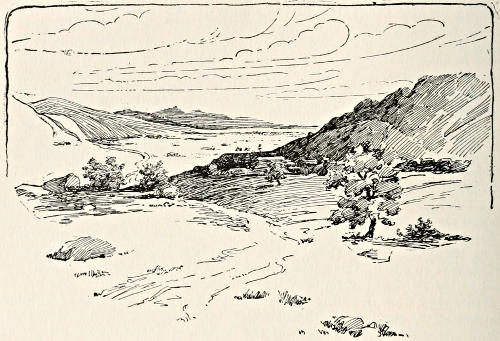
The Plain of Marathon
Similarly, we have no decided, tangible information, as to what it was
that induced the Athenians not to fortify themselves behind the walls of
their city, but to venture into the open field to encounter an enemy, far
superior in numbers and also, since the victory over the Ionians, evidently
dreaded in Hellas. Perhaps the fate of Eretria may have exercised a decisive
influence on the resolution of the Athenians. The town walls may not
have been in the best condition, and, as in particular there was good cause to
distrust the followers of the Pisistratidæ, there must have been some apprehension
lest the latter should find occasion, while the Persian army lay before
the town, to enter into relations with the enemy, as the Eretrian traitors had
done. But if they decided for contest in the open field it was advisable to
join battle in as favourable a position as possible; so that the country might
be protected from plunder and foraging. It was therefore necessary to renounce
the idea of barring the passes of Pentelicus and its outlying slopes,
since this position might be easily turned by way of the sea. Still less durst
they risk a battle in the open plain, where the enemy would have all the
advantage belonging to their overwhelming numbers, and the Persian cavalry
would have full play.
The most favourable place to take up a position would be in one of the
long narrow side valleys, which adjoin the plain of Marathon and in which a
small army might safely encamp opposite a large one. In one of these side
valleys and indeed in that of Avlon itself, was the temple precinct of the
Heracleum, by which the Athenian army took up its position. The flanks
were covered by the slopes of Argaliki (right) and of Kotroni (left) and
secured against a turning movement. Whilst it was well calculated for an
attack the position also afforded protection against an advancing enemy.
The limited breadth of the entrance to the valley hindered the Persians from
bringing forward the whole strength of their infantry and from using their
cavalry effectively.[19] If they elected to make no attack but to slip past the
Athenian army, two ways offered themselves for the march against Athens.
One of these led by Marathon or Vrana to Cephisia, the other between the
outlying slopes of Pentelicus towards Pallene and the Mesogæa. But it was
only this last road that was practicable for vehicles and an army with cavalry
and baggage. On the march by either of these two routes the Persians
must expose their flank to the enemy. If they took ship, that they might make
direct for Phalerum, they were liable to be attacked by the Athenian army
before they could get away.
When the Athenians had taken up their stand at the Heracleum, the
whole fighting force of the Platæans joined them. It appears from this that
the armies had been encamped opposite one another for several days, since
the Platæans could of course only start for Marathon after they had heard
of the decisive resolution of the Athenians to go out to meet the enemy in
that place. Since the Persians showed no signs of attacking the Attic position
and since doubtful tidings had already arrived from Sparta, Miltiades
decided to anticipate the attack himself, in order, as Herodotus says, to leave
those who cherished projects of high treason no time to affect a wider circle
of citizens and create discord. Yet half of his colleagues held the Athenian
army to be too weak and declared against a battle. Under these circumstances
the decision lay with the vote of the polemarch Callimachus, and the
latter sided with Miltiades. Thereupon, each of the Strategi, who had voted
for the battle, surrendered his command for the day on which it was his turn
to assume it to Miltiades. The latter did indeed accept it, but it is nevertheless
said that he did not advance to the attack until the day arrived on
which he held the command-in-chief himself in his own right. This statement
is very doubtful, but shows that Herodotus was unacquainted with the
tradition that Miltiades advanced to the attack when he received the news
that the Persians were embarking and that the cavalry were on the sea-shore.
If the battle-day was selected in this way, Miltiades could not certainly
have voluntarily waited for his day. Now it is principally Herodotus
whom we have to go upon, as the oldest authority and the one on which
later writers have generally preferred to draw, and, moreover, the tradition
of the embarkation of the cavalry is a completely unreliable one; all hypotheses
therefore which are built upon it and on the circumstance of the
display of the shield on the height of Pentelicus are to be regarded as of
no value.
In the order of battle the Athenians placed themselves according to the
official order of the phylæ. At their head as leader of the right wing,
stood the polemarch Callimachus, with the phyle Æantis, to which he himself,
as an Aphidnæan, belonged. The Platæans received a place on the
extreme left. The front of the Athenians was turned to the northeast.
The left wing was covered by the slope of Kotroni and the trees which
fringed it; the right was not very far from the shore. The ground permitted
Miltiades to make the line of battle the same length as that of the
enemy, in order to protect himself from a flank movement. The wings had to
be strong enough both to repel an attempt to surround them and to effect a
charge; he therefore ranged the centre only a few lines deep, whilst the
wings were relatively strong. The attack was not unexpected by the Persians;
they had time to form in order of battle with a centre including their
picked troops, Persians and Sacæ, while the cavalry seem to have been kept
in reserve behind the hills. They were, however, astounded by the manner
of the attack. According to Herodotus the space between the two lines of
battle amounted to eight stadia. The serried ranks of the Athenians covered
this distance at a run (in some nine minutes) chiefly to avoid the chance
that the cavalry might fall upon them by the way, and in order to get as
quickly as possible past the hail of Persian arrows and come to a hand-to-hand
combat. For the Persians began their battles with a fight at a distance,
and their army was essentially a defensive army, to which Hellenic hoplites
were superior in a struggle of man against man. Moreover the speed of
the forward movement must have added force to the charge of the heavy-armed
infantry. The shock of meeting probably took place between the Charadra
and the Brexisa; the Persian foot stood firm and the fight lasted a long
time. Finally the Athenians and Platæans with great force threw back the
enemy, on either wing, although their centre was pierced by the Persians
and Sacæ and pursued inland. In consequence, the victorious wings left
the vanquished to fly, wheeled inwards and turned their united front against
the Persians and Sacæ. A new fight ensued, which ended in the total defeat
of the barbarians. Many of them were driven, in their flight, into the great
swamp of Kato Suli, and there perished.
In the meantime, the Persian wings which had been vanquished in the
onset, had had some time in which to launch a number of ships and get first
on board. In especial, the embarkation of the cavalry, which had probably
remained behind the wings, must have been effected. This cannot have required
very much time, since the horse-transports were flat-built vessels.
When the Athenians wished to follow up the pursuit of the Persians and
Sacæ by the shore, they attempted to take or set fire to such ships as were
still within reach. Thereupon there ensued a hot fight in which fell many
men of name, such as polemarch Callimachus, the strategus Stesilaus, and
Cynægirus, brother of the poet Æschylus. The Athenians succeeded in gaining
possession of only seven ships; with the others the Persians got away and
then made for the islet of Ægilia, to take on board the Eretrians they had
left there.
The Persians were already in their ships, when it was noticed in the
Athenian camps that a signal had been made by a shield, set up apparently
upon the height of Pentelicus. It was believed that it had been given by the
traitors in the town. Apparently on the morning after the battle the Persian
fleet left Ægilia and steered its course for Cape Sunium. As soon as
the Athenians observed the direction taken, the strategi could no longer doubt
that it was the town which was aimed at. Forthwith they started with the
army, and, by a rapid forced march, succeeded in reaching Athens before the
enemy, and there set up a camp on the Heracleum, at the southern foot of
Lycabettus, in Cynosarges. The Persian fleet soon showed itself above the
height of Phalerum, yet made no attack, but only anchored for a time and
then sailed back to Asia.
Presumably Datis did not venture on a landing in sight of the Athenian
army after the experience of Marathon. The defeat was not indeed a crushing
one, but had been by no means insignificant, for the Persians had lost 6400
killed, to which a considerable number of wounded is to be added. Of the
Athenians, 192 citizens had fallen in the battle. The town bestowed on them
the peculiar honour of a common burial on the battle-field itself. Close by,
a tropæum of white marble and a monument to Miltiades were erected.
With the tithe of the spoil, the Athenians erected, amongst other things, a
bronze group at Delphi. Every year, on the sixth of Bœdromion, the festival
of Artemis Agrotera, a great goat sacrifice was offered to that goddess for
the crowd of defeated enemies, in fulfilment of a vow of the polemarch,
before the battle.
Pan, who had thrown his terror amongst the barbarians, received a sanctuary
in the grotto on the northwest side of the rock-citadel. To him also
an annual sacrifice was offered and a torch-race instituted. The memory of
the victory which the Athenians, as advance guard of the Hellenes, had
achieved always filled them with special pride. Poets and orators could not
refer to it often enough.
The day of the battle cannot be determined with precision. Only this
much is certain, that the fight took place at the time of the full moon, in one
of the last months of the summer of the year 490. For after the full moon
two thousand Lacedæmonians marched hastily from Sparta and made every
effort to reach Athens in time. On the third day they arrived in Attica, but
the battle had already been fought. After having viewed the scene of the
Persian overthrow they started on their return march spreading eulogies on
the Athenians.g
In an article in the Journal of Hellenic Studies (1898), J. A. R. Munroh
declares that the reason the Persians chose so disadvantageous a field as
Marathon, was purely to lure Miltiades and the troops out of Athens while
the plot was maturing by which the supporters of Hippias should open the
gates and admit the Persians by way of Phalerum. But as usually happens,
something hung fire, the Spartans approached and, before the signal of the
shield could be raised, Miltiades had routed the land forces with undreamed
success and was hastening back to Athens.
In this view, the strategy of the Persians becomes somewhat less contemptible
and the march of the Spartans seems not so useless.a
Modern history will never cease to ring with grateful praises of the
Athenians and Platæans for their defence of Greece against Persia. They
were the bulwark of the Occident against the Orient, of Europe against
Asia. The Persian scholar can see many ways in which, to his mind at least,
it would have been best if the Asiatic conquest of Greece had not thus been
postponed for centuries. We of to-day shall always be glad that events
fashioned themselves as they did until Europe was ready to resist any general
enforcement of Asiatic ideals and customs.
Granting the importance, then, of the victory to its fullest extent, it cannot
but make for truth to realise how little the Greeks knew all they were
doing, how selfish and mutually jealous they were, and in what a humble
manner they accomplished so much more than they dreamed or desired.a
The realism of this glorious feat could not be more vividly phrased than by
Prof. J. P. Mahaffy in his Rambles and Studies in Greece:
“Byron may well be excused for raving about the liberty of the Greeks,
for truly their old conflict at Marathon where a thousand ill-disciplined men
repulsed a larger number of still worse disciplined Orientals, without any
recondite tactics,—perhaps even without any very extraordinary heroism,—how
is it that this conflict has maintained a celebrity which has not been
equalled by all the great battles of the world, from that day down to our
own? The courage of the Greeks was not of the first order. Herodotus
praises the Athenians in this very battle for being the first Greeks that
dared to look the Persians in the face. Their generals all through history
seem never to feel sure of victory, and always endeavour to harangue their
soldiers into a fury. Instead of advising coolness, they specially incite to
rage—ὀργῇ προσμίξωμεν, says one of them in Thucydides—as if any man
not in this state would be sure to estimate the danger fully, and run away.
“It is, indeed, true that the ancient battles were hand to hand, and
therefore parallel to our charges of bayonets, which are said to be very
seldom carried out by two opposing lines, as one of them almost always gives
way before the actual collision takes place. This must often have taken
place in Greek battles, for, at Amphipolis, Brasidas in a battle lost seven
men; at a battle of Corinth, mentioned by Xenophon—an important battle,
too—the slain amounted to eight; and these battles were fought before the
days when whole armies were composed of mercenaries, who spared one
another, as Ordericus Vitalis says, ‘for the love of God, and out of good
feeling for the fraternity of arms.’ So, then, the loss of 192 Athenians, including
some distinguished men, was rather a severe one. As to the loss
of the Persians, I so totally disbelieve the Greek accounts of such things, that
it is better to pass it by in silence.
“Perhaps most readers will be astonished to hear of the Athenian army
as undisciplined, and of the science of war as undeveloped, in those times.
Yet I firmly believe this was so. The accounts of battles by almost all the
historians are so utterly vague, and so childishly conventional, that it is evident
these gentlemen were not only quite ignorant of the science of war, but
could not easily find any one to explain it to them. We know that the Spartans,
the most admired of all Greek warriors, were chiefly so admired because
they devised the system of subordinating officers to one another within
the same detachment, like our gradation from colonel to corporal. So orders
were passed down from officer to officer, instead of being bawled out by a
herald to a whole army.
“But this superiority of the Spartans who were really disciplined, and
went into battle coolly, like brave men, certainly did not extend to strategy,
but was merely a question of better drill. As soon as any real strategist
met them, they were helpless. Thus Iphicrates, when he devised Wellington’s
plan of meeting their attacking column in line, and using missiles,
succeeded against them, even without firearms. Thus Epaminondas, when
he devised Napoleon’s plan of massing troops on a single point, while keeping
his enemy’s line occupied, defeated them without any considerable struggle.
As for that general’s great battle of Mantinea, which seems really to
have been introduced by some complicated strategical movements, it is a mere
hopeless jumble in our histories. But these men were in the distant future
when the battle of Marathon was being fought.
“Yet what signifies all this criticism? In spite of all scepticism, in spite
of all contempt, the battle of Marathon, whether badly or well fought, and
the troops at Marathon, whether well or ill trained, will ever be more famous
than any other battle or army, however important or gigantic its dimensions.
Even in this very war, the battles of Salamis and Platæa were vastly more
important and more hotly contested. The losses were greater, the results
were more enduring, yet thousands have heard of Marathon to whom the
other names are unknown. So much for literary ability—so much for the
power of talking well about one’s deeds. Marathon was fought by Athenians;
the Athenians eclipsed the other Greeks as far as the other Greeks
eclipsed the rest of the world in literary power. This battle became the literary
property of the city, hymned by poet, cited by orator, told by aged
nurse, lisped by stammering infant; and so it has taken its position, above
all criticism, as one of the great decisive battles which assured the liberty of
the West against oriental despotism.”j
Had the first aggressive expedition of Darius, with his own personal
command and fresh appetite for conquest, been directed against Greece
instead of against Scythia (between 516-514 B.C.), Grecian independence
would have perished almost infallibly. For Athens was then still governed
by the Pisistratidæ. She had then no courage for energetic self-defence,
and probably Hippias himself, far from offering resistance, would have found
it advantageous to accept Persian dominion as a means of strengthening his
own rule, like the Ionian despots: moreover the Grecian habit of co-operation
was then only just commencing. But fortunately the Persian invader
did not touch the shore of Greece until more than twenty years afterwards,
in 490 B.C.; and during that precious interval, the Athenian character had
undergone the memorable revolution which has been before described. Their
energy and their organisation had been alike improved and their force of
resistance had become decupled; moreover, their conduct had so provoked
the Persians that resistance was then a matter of necessity with them and
submission on tolerable terms an impossibility. When we come to the grand
Persian invasion of Greece, we shall see that Athens was the life and soul
of all the opposition offered. We shall see further, that with all the efforts
of Athens, the success of the defence was more than once doubtful; and
would have been converted into a very different result, if Xerxes had
listened to the best of his own counsellors. But had Darius, at the head of
the very same force which he conducted into Scythia, or even an inferior
force, landed at Marathon in 514 B.C., instead of sending Datis in 490 B.C.—he
would have found no men like the victors of Marathon to meet him.
As far as we can appreciate the probabilities, he would have met with little
resistance, except from the Spartans singly, who would have maintained
their own very defensible territory against all his effort—like the Mysians
and Pisidians in Asia Minor, or like the Mainots of Laconia in later days;
but Hellas generally would have become a Persian satrapy.k
Happy would it have been for Miltiades if he had shared the honourable
death of the polemarch Callimachus, in seeking to fire the ships of the defeated
Persians at Marathon. The short sequel of his history will be found
in melancholy contrast with the Marathonian heroism.
His reputation had been great before the battle, and after it the admiration
and confidence of his countrymen knew no bounds: it appears, indeed,
to have reached such a pitch that his head was turned, and he lost both his
patriotism and his prudence. He proposed to his countrymen to incur the
cost of equipping an armament of seventy ships, with an adequate armed
force, and to place it altogether at his discretion; giving them no intimation
whither he intended to go, but merely assuring them that, if they would
follow him, he would conduct them to a land where gold was abundant, and
thus enrich them. Such a promise from the lips of the recent victor of
Marathon was sufficient, and the armament was granted, no man except
Miltiades knowing what was its destination. He sailed immediately to the
island of Paros, laid siege to the town, and sent in a herald to require from
the inhabitants a contribution of one hundred talents [£20,000 or $100,000],
on pain of entire destruction. His pretence for this attack was, that the
Parians had furnished a trireme to Datis for the Persian fleet at Marathon;
but his real motive, so Herodotus assures us, was vindictive animosity against
a Parian citizen named Lysagoras, who had exasperated the Persian general
Hydarnes against him. The Parians amused him at first with evasions, until
they had procured a little delay to repair the defective portions of their wall,
after which they set him at defiance; and Miltiades in vain prosecuted hostilities
against them for the space of twenty-six days: he ravaged the island,
but his attacks made no impression upon the town. Beginning to despair of
success in his military operations, he entered into some negotiation—such at
least was the tale of the Parians themselves—with a Parian woman named
Timo, priestess or attendant in the temple of Demeter, near the town gates.
This woman, promising to reveal to him a secret which would place Paros in
his power, induced him to visit by night a temple to which no male person
was admissible. He leaped the exterior fence, and approached the sanctuary;
but on coming near, was seized with a panic terror and ran away,
almost out of his senses: on leaping the same fence to get back, he strained
or bruised his thigh badly, and became utterly disabled. In this melancholy
state he was placed on shipboard, the siege being raised, and the whole
armament returning to Athens.
[489 B.C.]
Vehement was the indignation both of the armament and of the remaining
Athenians against Miltiades on his return; and Xanthippus, father of the
great Pericles, became the spokesman of this feeling. He impeached Miltiades
before the popular judicature as having been guilty of deceiving the
people, and as having deserved the penalty of death. The accused himself,
disabled by his injured thigh, which even began to show symptoms of gangrene,
was unable to stand, or to say a word in his own defence: he lay on
his couch before the assembled judges, while his friends made the best case
they could in his behalf. Defence, it appears, there was none; all they could
do, was to appeal to his previous services: they reminded the people largely
and emphatically of the inestimable exploit at Marathon, coming in addition
to his previous conquest of Lemnos. The assembled dicasts, or jurors,
showed their sense of these powerful appeals by rejecting the proposition of
his accuser to condemn him to death: but they imposed on him the penalty
of fifty talents [£10,000 or $50,000] “for his iniquity.”
Cornelius Nepos affirms that these fifty talents represented the expenses
incurred by the state in fitting out the armament; but we may more probably
believe, looking to the practice of the Athenian dicastery in criminal
cases, that fifty talents was the minor penalty actually proposed by the
defenders of Miltiades themselves, as a substitute for the punishment of
death. In those penal cases at Athens, where the punishment was not fixed
beforehand by the terms of the law, if the person accused was found guilty,
it was customary to submit to the jurors, subsequently and separately, the
question as to amount of punishment: first, the accuser named the penalty
which he thought suitable; next, the accused person was called upon to
name an amount of penalty for himself, and the jurors were constrained to
take their choice between these two—no third gradation of penalty being
admissible for consideration. Of course, under such circumstances, it was
the interest of the accused party to name, even in his own case, some real
and serious penalty—something which the jurors might be likely to deem
not wholly inadequate to his crime just proved; for if he proposed some
penalty only trifling, he drove them to prefer the heavier sentence recommended
by his opponent. Accordingly, in the case of Miltiades, his friends,
desirous of inducing the jurors to refuse their assent to the punishment of
death, proposed a fine of fifty talents as the self-assessed penalty of the
defendant; and perhaps they may have stated, as an argument in the case,
that such a sum would suffice to defray the costs of the expedition. The
fine was imposed, but Miltiades did not live to pay it: his injured limb
mortified, and he died, leaving the fine to be paid by his son Cimon.
According to Cornelius Nepos, Diodorus, and Plutarch, he was put in
prison, after having been fined, and there died. But Herodotus does not
mention this imprisonment, and the fact appears improbable: he would
hardly have omitted to notice it, had it come to his knowledge.
Thus closed the life of the conqueror of Marathon. The last act of it
produces an impression so mournful, and even shocking—his descent from
the pinnacle of glory to defeat, mean tampering with a temple-servant,
mortal bodily hurt, undefended ignominy, and death under a sentence of
heavy fine, is so abrupt and unprepared—that readers, ancient and modern,
have not been satisfied without finding some one to blame for it: we must
except Herodotus, our original authority, who recounts the transaction without
dropping a single hint of blame against any one. To speak ill of the
people, as Machiavelli has long ago observed, is a strain in which every one at
all times, even under a democratical government, indulges with impunity
and without provoking any opponent to reply; and in this instance, the hard
fate of Miltiades has been imputed to the vices of the Athenians and their
democracy—it has been cited in proof, partly of their fickleness, partly of
their ingratitude. But however such blame may serve to lighten the mental
sadness arising from a series of painful facts, it will not be found justified if
we apply to those facts a reasonable criticism.
What is called the fickleness of the Athenians on this occasion is nothing
more than a rapid and decisive change in their estimation of Miltiades; unbounded
admiration passing at once into extreme wrath. To censure them
for fickleness is here an abuse of terms; such a change in their opinion was
the unavoidable result of his conduct. His behaviour in the expedition of
Paros was as reprehensible as at Marathon it had been meritorious, and the
one succeeded immediately after the other: what else could ensue except an
entire revolution in the Athenian feelings? He had employed his prodigious
ascendency over their minds to induce them to follow him without knowing
whither, in the confidence of an unknown booty; he had exposed their lives
and wasted their substance in wreaking a private grudge; in addition to the
shame of an unprincipled project, comes the constructive shame of not having
succeeded in it. Without doubt, such behaviour, coming from a man whom
they admired to excess, must have produced a violent and painful revulsion
in the feelings of his countrymen. The idea of having lavished praise and
confidence upon a person who forthwith turns it to an unworthy purpose, is
one of the greatest torments of the human bosom; and we may well understand
that the intensity of the subsequent displeasure would be aggravated
by this reactionary sentiment, without accusing the Athenians of fickleness.
In regard to the charge of ingratitude against the Athenians, this last-mentioned
point—sufficiency of reason—stands tacitly admitted. It is
conceded that Miltiades deserved punishment for his conduct in reference to
the Parian expedition, but it is nevertheless maintained that gratitude for
his previous services at Marathon ought to have exempted him from punishment.
But the sentiment upon which, after all, this exculpation rests,
will not bear to be drawn out and stated in the form of a cogent or justifying
reason. For will any one really contend, that a man who has rendered
great services to the public, is to receive in return a license of unpunished
misconduct for the future? Is the general, who has earned applause by eminent
skill and important victories, to be recompensed by being allowed the
liberty of betraying his trust afterwards, and exposing his country to peril,
without censure or penalty? This is what no one intends to vindicate deliberately;
yet a man must be prepared to vindicate it, when he blames the
Athenians for ingratitude towards Miltiades. It will be recollected that the
death of Miltiades arose neither from his trial nor his fine, but from the hurt
in his thigh.
The charge of ingratitude against the Athenian popular juries really
amounts to this—that, in trying a person accused of present crime or
fault, they were apt to confine themselves too strictly and exclusively to the
particular matter of charge, either forgetting or making too little account
of past services which he might have rendered. Whoever imagines that
such was the habit of Athenian dicasts, must have studied the orators to
very little purpose. Their real defect was the very opposite: they were
too much disposed to wander from the special issue before them, and to be
affected by appeals to previous services and conduct.
This defect is one which we should naturally expect from a body of private,
non-professional citizens assembled for the occasion, and which belongs
more or less to the system of jury-trial everywhere; but it is the direct
reverse of that ingratitude, or habitual insensibility to prior services, for
which they have been so often denounced.
The fate of Miltiades, then, so far from illustrating either the fickleness
or the ingratitude of his countrymen, attests their just appreciation of deserts.
It also illustrates another moral, of no small importance to the right
comprehension of Grecian affairs; it teaches us the painful lesson, how perfectly
maddening were the effects of a copious draught of glory on the
temperament of an enterprising and ambitious Greek. There can be no
doubt, that the rapid transition, in the course of about one week, from
Athenian terror before the battle to Athenian exultation after it, must have
produced demonstrations towards Miltiades such as were never paid towards
any other man in the whole history of the commonwealth. Such unmeasured
admiration unseated his rational judgment, so that his mind became
abandoned to the reckless impulses of insolence, and antipathy, and rapacity—that
distempered state, for which (according to Grecian morality) the
retributive Nemesis was ever on the watch, and which, in his case, she
visited with a judgment startling in its rapidity, as well as terrible in its
amount. Had Miltiades been the same man before the battle of Marathon
as he became after it, the battle might probably have turned out a defeat
instead of a victory. We shall presently be called upon to observe the same
tendency in the case of the Spartan Pausanias, and even in that of the Athenian
Themistocles.
It is, indeed, fortunate that the reckless aspirations of Miltiades did not
take a turn more noxious to Athens than the comparatively unimportant
enterprise against Paros. For had he sought to acquire dominion and
gratify antipathies against enemies at home, instead of directing his blow
against a Parian enemy, the peace and security of his country might have
been seriously endangered.
Of the despots who gained power in Greece, a considerable proportion
began by popular conduct, and by rendering good service to their fellow-citizens:
having first earned public gratitude, they abused it for purposes
of their own ambition. There was far greater danger, in a Grecian community,
of dangerous excess of gratitude towards a victorious soldier, than
of deficiency in that sentiment: hence the person thus exalted acquired a
position such that the community found it difficult afterwards to shake
him off. Now there is a disposition almost universal among writers and
readers to side with an individual, especially an eminent individual, against
the multitude; and accordingly those who under such circumstances suspect
the probable abuse of an exalted position, are denounced as if they harboured
an unworthy jealousy of superior abilities. But the truth is, that the largest
analogies of the Grecian character justified that suspicion, and required the
community to take precautions against the corrupting effects of their own
enthusiasm. There is no feature which more largely pervades the impressible
Grecian character, than a liability to be intoxicated and demoralised
by success: there was no fault from which so few eminent Greeks were
free: there was hardly any danger, against which it was at once so necessary
and so difficult for the Grecian governments to take security—especially
the democracies, where the manifestations of enthusiasm were always the
loudest. Such is the real explanation of those charges which have been
urged against the Grecian democracies, that they came to hate and ill-treat
previous benefactors; and the history of Miltiades illustrates it in a manner
no less pointed than painful.
If we are to predicate any attribute of the multitude, it will rather be that
of undue tenacity than undue fickleness; and there will occur nothing in
the course of this history to prove that the Athenian people changed their
opinions on insufficient grounds more frequently than an unresponsible one
or few would have changed.
But there were two circumstances in the working of the Athenian democracy
which imparted to it an appearance of greater fickleness, without the
reality: First, that the manifestations and changes of opinion were all open,
undisguised, and noisy: the people gave utterance to their present impression,
whatever it was, with perfect frankness; if their opinions were really
changed, they had no shame or scruple in avowing it. Secondly,—and this
is a point of capital importance in the working of democracy generally,—the
present impression, whatever it might be, was not merely undisguised in
its manifestations, but also had a tendency to be exaggerated in its intensity.
This arose from their habit of treating public affairs in multitudinous assemblages,
the well-known effect of which is, to inflame sentiment in every man’s
bosom by mere contact with a sympathising circle of neighbours. Whatever
the sentiment might be,—fear, ambition, cupidity, wrath, compassion, piety,
patriotic devotion, etc.,—and whether well-founded or ill-founded, it was
constantly influenced more or less by such intensifying cause. This is a
defect which of course belongs in a certain degree to all exercise of power
by numerous bodies, even though they be representative bodies, especially
when the character of the people, instead of being comparatively sedate and
slow to move, like the English, is quick, impressible, and fiery, like Greeks
or Italians; but it operated far more powerfully on the self-acting Demos
assembled in the Pnyx. It was in fact the constitutional malady of the
democracy, of which the people were themselves perfectly sensible,—as we
shall show hereafter from the securities which they tried to provide against
it,—but which no securities could ever wholly eradicate. Frequency of
public assemblies, far from aggravating the evil, had a tendency to lighten it.
The people thus became accustomed to hear and balance many different views
as a preliminary to ultimate judgment; they contracted personal interest and
esteem for a numerous class of dissentient speakers; and they even acquired
a certain practical consciousness of their own liability to error.
These two attributes, then, belonged to the Athenian democracy; first,
their sentiments of every kind were manifested loudly and openly; next,
their sentiments tended to a pitch of great present intensity. Of course,
therefore, when they changed, the change of sentiment stood prominent,
and forced itself upon every one’s notice—being a transition from one strong
sentiment past to another strong sentiment present. And it was because
such alterations, when they did take place, stood out so palpably to remark,
that the Athenian people have drawn upon themselves the imputation of
fickleness: for it is not at all true that changes of sentiment were more
frequently produced in them by frivolous or insufficient causes, than changes
of sentiment in other governments.b
What follows is one of the most interesting parts of Herodotus. It
exhibits the most circumstantial detail of the expedition of Xerxes against
Greece, by a writer almost contemporary. It is also impressed with the
character of authenticity, for it was recited to a multitude of Greeks assembled
at Olympia, among whom doubtless there were many who had fought
both at Salamis and Platæa.f
When the news of the battle of Marathon was communicated to Darius,
he, who was before incensed against the Athenians, on account of their
invasion of Sardis, became still more exasperated, and more inclined to
invade Greece. He instantly therefore sent emissaries to the different cities
under his power, to provide a still greater number of transports, horses,
corn, and provisions. In the interval which this business employed, Asia
experienced three years of confusion; her most able men being enrolled for
the Greek expedition, and making preparation for it. In the fourth, the
Egyptians, who had been reduced by Cambyses, revolted from the Persians:
but this only induced Darius to accelerate his preparations against both
nations. At this juncture there arose a violent dispute among the sons of
Darius, concerning the succession to the throne, the Persian customs forbidding
the sovereign to undertake any expedition without naming his heir.
Darius had three sons before he ascended the throne, by the daughter of
Gobryas; he had four afterwards by Atossa, daughter of Cyrus: Artabazanes
was the eldest of the former, Xerxes of the latter. Not being of the same
mother, a dispute arose between them; Artabazanes asserted his pretensions
from being the eldest of all his father’s sons, a claim which mankind
in general consent to acknowledge. Xerxes claimed the throne because he
was the grandson of Cyrus, to whom the Persians were indebted for their
liberties.
Darius having declared Xerxes his heir, prepared to march; but in the
year which succeeded the Egyptian revolt, he died; having reigned thirty-six
years, without being able to gratify his resentment against the Egyptians
and Athenians who had opposed his power. On his death, Xerxes immediately
succeeded to the throne, and from the first, seemed wholly inclined to
the Egyptian rather than the Athenian War. But Mardonius, who was his
cousin, being the son of Gobryas, by a sister of Darius, thus addressed him:
“I should think, Sir, that the Athenians, who have so grievously injured
the Persians, ought not to escape with impunity. I would nevertheless
have you execute what you immediately propose; but when you shall have
chastised the insolence of Egypt, resume the expedition against Athens.
Thus will your reputation be established, and others in future be deterred
from molesting your dominions.” What he said was further enforced by
representing the beauties of Europe, that it was exceedingly fertile, abounded
with all kinds of trees, and deserved to be possessed by the king alone.
[485-484 B.C.]
Mardonius said this, being desirous of new enterprises, and ambitious of
the government of Greece. Xerxes at length acceded to his counsel, to
which he was also urged by other considerations. Some messengers came
from Thessaly on the part of the Aleuadæ, imploring the king to invade
Greece; to accomplish which, they used the most earnest endeavours. These
Aleuadæ were the princes of Thessaly: their solicitations were strengthened
by the Pisistratidæ, who had taken refuge at Susa, and who to the arguments
before adduced, added others. They had among them Onomacritus,
an Athenian, a famous priest, who sold the oracles of Musæus; with him
they had been reconciled previous to their arrival at Susa. This man had
been formerly banished from Athens by the son of Pisistratus; for Lasus of
Hermione had detected him in the fact of introducing a pretended oracle,
among the verses of Musæus, intimating that the islands contiguous to
Lemnos should be overwhelmed in the ocean. Hipparchus for this expelled
him, though he had been very intimate with him before. He accompanied
the Pisistratidæ to Susa, who always spoke of him in terms highly honourable;
upon which account, whenever he appeared in the royal presence, he recited
certain oracular verses. He omitted whatever predicted anything unfortunate
to the barbarians, selecting only what promised them auspiciously;
among other things he said the fates decreed that a Persian should throw a
bridge over the Hellespont.
Thus was the mind of Xerxes assailed by the predictions of the priest,
and the opinions of the Pisistratidæ. In the year which followed the death
of Darius, he determined on an expedition against Greece, but commenced
hostilities with those who had revolted from the Persians. These being subdued,
and the whole of Egypt more effectually reduced than it had been by
Darius, he confided the government of it to Achæmenes, his own brother,
son of Darius. Achæmenes was afterwards slain by Inarus, a Libyan, the
son of Psammetichus. After the subjection of Egypt, Xerxes prepared to
lead an army against Athens, but first of all he called an assembly of the
principal Persians, to hear their sentiments, and to deliver, without reserve,
his own. He addressed them to the following purport:
“You will remember, O Persians, that I am not about to execute any new
project of my own; I only pursue the path which has been previously marked
out for me. I have learned from my ancestors, that ever since we recovered
this empire from the Medes, after the depression of Astyages by Cyrus, we
have never been in a state of inactivity. A deity is our guide, and auspiciously
conducts us to prosperity. It must be unnecessary for me to relate
the exploits of Cyrus, Cambyses, and Darius, and the nations they added to
our empire. For my own part, ever since my accession to the throne, it has
been my careful endeavour not to reflect any disgrace upon my forefathers,
by suffering the Persian power to diminish. My deliberations on this matter
have presented me with a prospect full of glory; they have pointed out to
me a region not inferior to our own in extent, and far exceeding it in fertility,
which incitements are further promoted by the expectation of honourable
revenge; I have therefore assembled you to explain what I intend:
“I have resolved, by throwing a bridge over the Hellespont, to lead my
forces through Europe into Greece, and to inflict vengeance on the Athenians
for the injuries offered to my father and Persia. You well know that
this war was intended by Darius, though death deprived him of the means
of vengeance. Considering what is due to him and to Persia, it is my determination
not to remit my exertions, till Athens shall be taken and burned.
The Athenians, unprovoked, first insulted me and my father; under the
conduct of Aristagoras of Miletus, our dependent and slave, they attacked
Sardis, and consumed with fire our groves and temples. What they perpetrated
against you, when, led by Datis and Artaphernes, you penetrated into
their country, you know by fatal experience. Such are my inducements to
proceed against them: but I have also additional motives.
“If we reduce these and their neighbours who inhabit the country of
Pelops the Phrygian, to our power, the Persian empire will be limited by
the heavens alone; the sun will illuminate no country contiguous to ours; I
shall overrun all Europe, and with your assistance possess unlimited dominion.
For if I am properly informed, there exists no race of men, nor can any city
or nation be found, which if these be reduced, can possibly resist our arms:
we shall thus subject, as well those who have, as those who have not, injured
us. I call therefore for your assistance, which I shall thankfully accept and
acknowledge; I trust that with cheerfulness and activity you will all assemble
at the place I shall appoint. To him who shall appear with the greatest
number of well-provided troops, I will present those gifts which in our
country are thought to confer the highest honour. That I may not appear
to dictate my own wishes in an arbitrary manner, I commit the matter to
your reflection, permitting every one to deliver his sentiments with freedom.”
When Xerxes had finished, Mardonius made the following reply:
“Sir, you are not only the most illustrious of all the Persians who have
hitherto appeared, but you may securely defy the competition of posterity.
Among other things which you have advanced, alike excellent and just, you
are entitled to our particular admiration for not suffering the people of Ionia,
contemptible as they are, to insult us with impunity. It would indeed be
preposterous, if after reducing to our power the Sacæ, the Indians, the
Ethiopians, and the Assyrians, with many other great and illustrious nations,
not in revenge of injuries received, but solely from the honourable desire of
dominion, we should not inflict vengeance on these Greeks who, without
provocation, have molested us.
“There can be nothing to excite our alarm; no multitude of troops, no
extraordinary wealth; we have tried their mode of fighting, and know their
weakness. Their descendants, who under the names of Ionians, Æolians, and
Dorians, reside within our dominions, we first subdued, and now govern.
Their prowess I myself have known, when at the command of your father I
prosecuted a war against them. I penetrated Macedonia, advanced almost
to Athens, and found no enemy to encounter.
“Beside this, I am informed that in all their military undertakings, the
Greeks betray the extremest ignorance and folly. As soon as they commence
hostilities among themselves, their first care is to find a large and beautiful
plain,[20] where they appear and give battle: the consequence is, that even the
victors suffer severe loss; of the vanquished I say nothing, for they are totally
destroyed. As they use one common language, they ought in policy to terminate
all disputes by the mediation of ambassadors, and above all things to
avoid a war among themselves: or, if this should prove unavoidable, they
should mutually endeavour to find a place of great natural strength, and
then try the issue of a battle. By pursuing as absurd a conduct as I have
described, the Greeks suffered me to advance as far as Macedonia without
resistance. But who, Sir, shall oppose you, at the head of the forces and the
fleet of Asia? The Greeks, I think, never can be so audacious. If however
I should be deceived, and they shall be so mad as to engage us, they will soon
find to their cost that in the art of war we are the first of mankind. Let us
however adopt various modes of proceeding, for perfection and success can
only be the result of frequent experiment.”
In this manner, Mardonius seconded the speech of Xerxes.
A total silence prevailed in the assembly, no one daring to oppose what
had been said; till at length Artabanus, son of Hystaspes, and uncle to
Xerxes, deriving confidence from his relationship, thus delivered his sentiments:
“Unless, O King, different sentiments be submitted to the judgment,
no alternative of choice remains, the one introduced is of necessity adopted.
The purity of gold cannot be ascertained by a single specimen; it is known
and approved by comparing it with others. It was my advice to Darius, your
father and my brother, that he should by no means undertake an expedition
against the Scythians, a people without towns and cities. Allured by his
hopes of subduing them, he disregarded my admonitions; and proceeding to
execute his purpose was obliged to return, having lost numbers of his best
troops. The men, O King, whom you are preparing to attack, are far superior
to the Scythians, and alike formidable by land and sea. I deem it therefore
my duty to forewarn you of the dangers you will have to encounter.
“You say that, throwing a bridge over the Hellespont, you will lead your
forces through Europe into Greece; but it may possibly happen, that either
on land or by sea, or perhaps by both, you may sustain a defeat, for our enemies
are reported to be valiant. Of this indeed we have had sufficient testimony;
for if the Athenians by themselves routed the numerous armies of
Datis and Artaphernes, it proves that we are not, either by land or sea, perfectly
invincible. If, preparing their fleet, they shall be victorious by sea, and
afterwards sailing to the Hellespont, shall destroy your bridge, we may dread
all that is bad. I do not argue in this respect from my own private conjecture;
we can all of us remember how very narrowly we escaped destruction,
when your father, throwing bridges over the Thracian Bosporus and the Ister,
passed into Scythia. The guard of this pass was entrusted to the Ionians,
whom the Scythians urged to break it down, by the most earnest importunity.
If at this period Histiæus of Miletus had not opposed the sentiments of the
rest, there would have been an end of the Persian name.
“It is painful to repeat, and afflicting to remember, that the safety of our
prince and his dominions depended on a single man. Listen therefore to
my advice, and where no necessity demands it, do not involve yourself in
danger. For the present, dismiss this meeting; revolve the matter more
seriously in your mind, and at a future and seasonable time make known
your determination. For my own part, I have found from experience,
that deliberation produces the happiest effects. In such a case, if the event
does not answer our wishes, we still merit the praise of discretion, and fortune
is alone to be blamed. He who is rash and inconsiderate, although
fortune may be kind, and anticipate his desires, is not the less to be censured
for temerity. You may have observed how the thunderbolt of heaven
chastises the insolence of the more enormous animals, whilst it passes over
without injury the weak and insignificant: before these weapons of the gods
you must have seen how the proudest palaces and the loftiest trees fall and
perish. The most conspicuous things are those which are chiefly singled out
as objects of the divine displeasure. From the same principle it is that a
mighty army is sometimes overthrown by one that is contemptible: for the
Deity in his anger sends his terrors among them, and makes them perish in a
manner unworthy of their former glory. Perfect wisdom is the prerogative
of Heaven alone, and every measure undertaken with temerity is liable to be
perplexed with error, and punished by misfortune. Discreet caution, on
the contrary, has many and peculiar advantages, which if not apparent at the
moment, reveal themselves in time.
“Such, O King, is my advice; and little does it become you, O son of
Gobryas, to speak of the Greeks in a language foolish as well as false. By
calumniating Greece, you excite your sovereign to war, the great object
of all your zeal: but I entreat you to forbear. Calumny is a restless vice,
where it is indulged there are always two who offer injury. The calumniator
himself is injurious, because he traduces an absent person; he is also injurious
who suffers himself to be persuaded without investigating the truth. The
person traduced is doubly injured, first by him who propagates, and secondly
by him who receives the calumny. If this war be a measure of necessity, let
it be prosecuted; but let the king remain at home with his subjects. Suffer
the children of us two to remain in his power, as the test of our different
opinions; and do you, Mardonius, conduct the war with whatever forces you
shall think expedient. If, agreeably to your representations, the designs of
the king shall be successful, let me and my children perish; but if what I
predict shall be accomplished, let your children die, and yourself too, in case
you shall return. If you refuse these conditions, and are still resolved to lead
an army into Greece, I do not hesitate to declare, that all those who shall be
left behind will hear that Mardonius, after having involved the Persians in
some conspicuous calamity, became a prey to dogs and ravenous birds, in the
territories either of Athens or Lacedæmon, or probably during his march
thither. Thus you will know, by fatal experience, what those men are,
against whom you endeavour to persuade the king to prosecute a war.”
When Artabanus had finished, Xerxes thus angrily replied: “Artabanus,
you are my father’s brother, which alone prevents your receiving the chastisement
due to your foolish speech. This mark of ignominy shall however
adhere to you—as you are so dastardly and mean, you shall not accompany
me to Greece, but remain at home, the companion of our women. Without
your assistance, I shall proceed in the accomplishment of my designs; for I
should ill deserve to be esteemed the son of Darius, who was the son of Hystaspes,
and reckoned among his ancestors Arsames, Ariaramnes, Teispes,
Cyrus, Cambyses, Teispes, and Achæmenes, if I did not gratify my revenge
upon the Athenians. I am well assured, that if we on our parts were tranquil,
they would not be, but would invade and ravage our country. This we may
reasonably conclude from their burning of Sardis, and their incursions into
Asia. Neither party can therefore recede; we must advance to the attack
of the Greeks, or we must prepare to sustain theirs; we must either submit
to them, or they to us; in enmities like these there can be no medium.
Injured as we have been, it becomes us to seek for revenge; for I am determined
to know what evil is to be dreaded from those whom Pelops the
Phrygian, the slave of my ancestors, so effectually subdued, that even to
this day they, as well as their country, are distinguished by his name.”
On the approach of evening the sentiments of Artabanus gave great disquietude
to Xerxes, and after more serious deliberation with himself in the
night, he found himself still less inclined to the Grecian war. Having decided
on the subject, he fell asleep, when, as the Persians relate, the following vision
appeared to him:—He dreamed that he saw before him a man of unusual
size and beauty, who thus addressed him: “Are you then determined, O
Persian, contrary to your former resolutions, not to lead an army against
Greece, although you have ordered your subjects to prepare their forces?
This change in your sentiments is absurd in itself, and will certainly be censured
by the world. Resume therefore, and persist in what you had resolved
by day.” Having said this, the vision disappeared.
The impression made by the vision vanished with the morning. Xerxes
a second time convoked the former meeting, and again addressed them:
“Men of Persia,” said he, “you will forgive me, if my former sentiments
are changed. I am not yet arrived at the full maturity of my judgment;
and they who wish me to prosecute the measures which I before seemed to
approve, do not remit their importunities. When I first heard the opinion
of Artabanus, I yielded to the emotions of youth, and expressed myself more
petulantly than was becoming, to a man of his years. To prove that I see
my indiscretion, I am resolved to follow his advice. It is not my intention
to undertake an expedition against Greece; remain therefore in tranquillity.”
The Persians hearing these sentiments, prostrated themselves with joy
before the king. On the following night the same phantom appeared a
second time to Xerxes in his sleep, and spake to him as follows: “Son of
Darius, disregarding my admonitions as of no weight or value, you have publicly
renounced all thoughts of war. Hear what I say: unless you immediately
undertake that which I recommend, the same short period of time
which has seen you great and powerful, shall behold you reduced and abject.”
Terrified at the vision, the king leaped from his couch, and sent for
Artabanus. As soon as he approached, “Artabanus,” exclaimed Xerxes, “in
return for your salutary counsel, I reproached and insulted you; but as soon
as I became master of myself I endeavoured to prove my repentance by adopting
what you proposed. This however, whatever may be my wishes, I am
unable to do. As soon as my former determinations were changed, I beheld
in my sleep a vision, which first endeavoured to dissuade me, and has this
moment left me with threats. If what I have seen proceed from the interference
of some deity, who is solicitous that I should make war on Greece,
it will doubtless appear to you, and give you a similar mandate. This
will I think be the case, if you will assume my habit, and after sitting on
my throne retire to rest in my apartment.”
Artabanus was at first unwilling to comply, alleging that he was not
worthy to sit on the throne of the king. But being urged, he finally acquiesced,
after thus expressing his sentiments: “I am of opinion, O King, that
to think well, and to follow what is well-advised, is alike commendable: both
these qualities are yours; but the artifice of evil counsellors misleads you.
Thus, the ocean is of itself most useful to mankind, but the stormy winds
render it injurious, by disturbing its natural surface. Your reproaches gave
me less uneasiness than to see that when two opinions were submitted to
public deliberation, the one aiming to restrain, the other to countenance the
pride of Persia, you preferred that which was full of danger to yourself and
your country, rejecting the wiser counsel, which pointed out the evil tendency
of ambition. Now that you have changed your resolution with respect to
Greece, a phantom has appeared, and, as you say, by some divine interposition,
has forbidden your present purpose of dismissing your forces. But,
my son, I dispute the divinity of this interposition, for of the fallacy of dreams
I, who am more experienced than yourself, can produce sufficient testimonies.
Dreams in general originate from those incidents which have most occupied
the thoughts during the day. Two days since, you will remember that
this expedition was the object of much warm discussion: but if this vision
be really sent from heaven, your reasoning upon it is just, and it will certainly
appear to me as it has done to you, expressing itself to a similar
effect; but it will not show itself to me dressed in your robes, and reclining
on your couch, sooner than if I were in my own habit and my own apartment.
No change of dress will induce the phantom, if it does appear, to mistake me
for you. If it shall hold me in contempt, it will not appear to me, however
I may be clothed. It unquestionably however merits attention; its
repeated appearance I myself must acknowledge to be a proof of its divinity.
If you are determined in your purpose, I am ready to go to rest in your
apartment: but till I see the phantom myself I shall retain my former
opinions.”
Artabanus, expecting to find the king’s dream of no importance, did as
he was ordered. He accordingly put on the robe of Xerxes, seated himself
on the royal throne, and afterward retired to the king’s apartment. The
same phantom which had disturbed Xerxes appeared to him,[21] and thus
addressed him: “Art thou the man who, pretending to watch over the conduct
of Xerxes, art endeavouring to restrain his designs against Greece?
Your perverseness shall be punished both now and in future; and as for
Xerxes himself, he has been forewarned of the evils he will suffer, if disobedient
to my will.”
Such were the threats which Artabanus heard from the spectre, which at
the same time made an effort to burn out his eyes with a hot iron. Alarmed
at his danger, Artabanus leaped from his couch, and uttering a loud cry,
went instantly to Xerxes. After relating his vision, he thus spake to him:
“Being a man, O King, of much experience, and having seen the undertakings
of the powerful foiled by the efforts of the weak, I was unwilling
that you should indulge the fervour of your age. Of the ill effects of inordinate
ambition, I had seen a fatal proof, in the expedition which Cyrus undertook
against the Massagetæ; I knew also what became of the army of
Cambyses in their attack of Ethiopia; and lastly, I myself witnessed the
misfortunes of Darius, in his hostilities with the Scythians. The remembrance
of these incidents induced me to believe that if you continued
a peaceful reign, you would beyond all men deserve the character of happy:
but as your present inclination seems directed by some supernatural influence,
and as the Greeks seem marked out by heaven for destruction, I acknowledge
that my sentiments are changed; do you therefore make known to the Persians
the extraordinary intimations you have received, and direct your
dependents to hasten the preparations you had before commanded. Be careful,
in what relates to yourself, to second the intentions of the gods.”
The vision indeed had so powerfully impressed the minds of both, that
as soon as the morning appeared, Xerxes communicated his intentions to
the Persians; which Artabanus, in opposition to his former sentiments, now
openly and warmly approved.
[484-480 B.C.]
Whilst everything was making ready for his departure, Xerxes saw a
third vision. The magi to whom it was related were of opinion that it portended
to Xerxes unlimited and universal empire. The king conceived
himself to be crowned with the wreath of an olive tree, whose branches
covered all the earth, but that this wreath suddenly and totally disappeared.
After the above interpretation of the magi had been made known in the
national assembly of the Persians, the governors departed to their several
provinces, eager to execute the commands they had received, in expectation
of the promised reward. Xerxes was so anxious to complete his levies that
no part of the continent was left without being ransacked for this purpose.
After the reduction of Egypt, four entire years were employed in assembling
the army and collecting provisions; but in the beginning of the fifth he
began his march with an immense body of forces.b
Darius was three years in preparing for an expedition against Greece;
in the fourth Egypt revolted, and in the following year Darius died; this
therefore was the fifth year after the battle of Marathon. Xerxes employed
four years in making preparations for the same purpose; in the fifth he
began his march, he advanced to Sardis, and there wintered; in the beginning
of the following spring he entered Greece. This therefore was in the
eleventh year after the battle of Marathon; which account agrees with that
given by Thucydides.f
Of all the military expeditions, the fame of which has come down to us,
this was far the greatest, much exceeding that which Darius undertook
against Scythia, as well as the incursion made by the Scythians, who, pursuing
the Cimmerians, entered Media, and made themselves entire masters
of almost all the higher parts of Asia; an incursion which afforded Darius
the pretence for his attack on Scythia. It surpasses also the famous expedition
of the sons of Atreus against Troy, as well as that of the Mysians and
Teucrians before the Trojan War. These nations, passing over the Bosporus
into Europe, reduced all the inhabitants of Thrace, advancing to the
Ionian Sea, and thence as far as the southern part of the river Peneus.
[483 B.C.]
None of the expeditions already mentioned, nor indeed any other, may
at all be compared with this of Xerxes. It would be difficult to specify any
nation of Asia, which did not accompany the Persian monarch against Greece,
or any waters, except great rivers, which were not exhausted by his armies.
Some supplied ships, some a body of infantry, others of horse; some provided
transports for the cavalry and the troops; others brought long ships
to serve as bridges; many also brought vessels laden with corn, all which
preparations were made for three years, to guard against a repetition of the
calamities which the Persian fleet had formerly sustained, in their attempts
to double the promontory of Mount Athos. The place of rendezvous for
the triremes was at Elæus of the Chersonesus, from whence detachments from
the army were sent, and by force of blows compelled to dig a passage through
Mount Athos, with orders to relieve each other at certain regular intervals.
The undertaking was assisted by those who inhabited the mountain, and the
conduct of the work was confided to Bubares, the son of Megabazus, and
Antachæus, son of Artæus, both of whom were Persians.b
This incident Richardson conceives to be utterly incredible. The promontory
was, as he justly remarks, no more than two hundred miles from
Athens, and yet Xerxes is said to have employed a number of men, three
years before his crossing the Hellespont, to separate it from the continent,
and make a canal for his shipping. Themistocles, also, who from the time of
the battle of Marathon had been incessantly alarming the Athenians with
another Persian invasion, never endeavoured to support his opinion by
any allusion to this canal, the very digging of which must have filled all
Greece with astonishment, and been the subject of every public conversation.
Pococke, who visited Mount Athos, also deems the event highly improbable,
and says that he could not perceive the smallest vestige of any such undertaking.f
Bury thinks that the canal was actually dug, the reason being not that
which Herodotus later suggests, a mere desire for display, but an obedience
to the axiom of Persian strategy that the army and the fleet should not lose
touch with each other. But leaving the riddle unsolved, as needs we must,
let us proceed with the narrative, Herodotus acting as guide.a
Athos is a large and noble mountain projecting into the sea, and inhabited;
where it terminates on the land side, it has the appearance of a peninsula,
and forms an isthmus of about twelve stadia in breadth: the surface
of this is interspersed with several small hills, reaching from the Acanthian
Sea to that of Torone, which is opposite. Where Mount Athos terminates,
stands a Grecian city, called Sane; in the interior parts, betwixt Sane and
the elevation of Athos, are situated the towns of Dium, Olophyxus, Acrothoum,
Thyssus, and Cleonæ, inhabited by Greeks. It was the object of the
Persians to detach these from the continent.
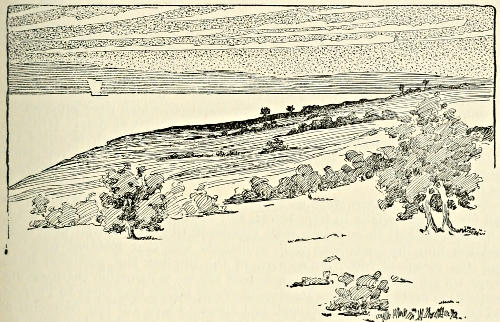
The Hellespont
They proceeded to dig in this manner: the barbarians marked out the
ground in the vicinity of Sane with a rope, assigning to each nation their
particular station; then sinking a deep trench, whilst they at the bottom
continued digging, the nearest to them handed the earth to others standing
immediately above them upon ladders; it was thus progressively elevated,
till it came to the summit, where they who stood received and carried
it away. The brink of the trench giving way, except in that part where the
Phœnicians were employed, occasioned a double labour; and this, as the
trench was no wider at top than at bottom, was unavoidable. But in this,
as in other instances, the Phœnicians discovered their superior sagacity, for
in the part allotted to them they commenced by making the breadth of the
trench twice as large as was necessary; and thus proceeding in an inclined
direction, they made their work at the bottom of the prescribed dimensions.
In this part was a meadow, which was their public place for business and for
commerce, and where a vast quantity of corn was imported from Asia.b
Plutarch, in his treatise De Ira cohibenda, has preserved a ridiculous
letter, supposed to have been written by Xerxes to Mount Athos. It was to
this effect: “O thou miserable Athos, whose top now reaches to the heavens,
I give thee in charge not to throw any great stones in my way, which may
impede my work; if thou shalt do this, I will cut thee in pieces and cast
thee into the sea.” This threat to the mountain is however at least as sensible
as the chastisement inflicted upon the Hellespont; so that if one anecdote
be true, the other may also obtain credit.f
The motive of Xerxes in this work was, as far as we are able to conjecture,
the vain desire of exhibiting his power, and of leaving a monument to posterity.
When with very little trouble he might have transported his vessels
over the isthmus, he chose rather to unite the two seas by a canal, of sufficient
diameter to admit two triremes abreast. Those employed in this business
were also ordered to throw bridges over the river Strymon.
For these bridges Xerxes provided cordage made of the bark of the
biblos, and of white flax. The care of transporting provisions for the army
was committed jointly to the Egyptians and Phœnicians, that the troops, as
well as the beasts of burden, in this expedition to Greece, might not suffer
from famine. After examining into the nature of the country, he directed
stores to be deposited in every convenient situation, which were supplied by
transports and vessels of burden, from the different parts of Asia. Of these,
the greater number were carried to that part of Thrace which is called the
“White Coast”; others to Tyrodiza of the Perinthians; the remainder
were severally distributed at Doriscus, at Eion on the banks of the Strymon,
and in Macedonia.
[483-480 B.C.]
Whilst these things were carrying on, Xerxes, at the head of all his
land forces, left Critalla in Cappadocia, and marched towards Sardis: it was
at Critalla that all those troops were appointed to assemble who were to attend
the king by land; who the commander was, that received from the
king the promised gifts, on account of the number and goodness of his
troops, we are unable to decide, nor indeed can we say whether there was any
competition on the subject. Passing the river Halys, they came to Phrygia,
and continuing to advance, arrived at Celænæ, where are the fountains of
the Mæander, as well as those of another river of equal size with the
Mæander, called Catarrhactes, which rising in the public square of Celænæ,
empties itself into the Mæander. In the forum of this city is suspended the
skin of Marsyas, which the Phrygians say was placed there after he had been
flayed by Apollo.
In this city lived a man named Pythius, son of Atys, a native of Lydia,
who entertained Xerxes and all his army with great magnificence: he further
engaged to supply the king with money for the war. Xerxes was on this
induced to inquire of his Persian attendants who this Pythius was, and what
were the resources which enabled him to make these offers: “It is the
same,” they replied, “who presented your father Darius with a plane-tree
and a vine of gold, and who, next to yourself, is the richest of mankind.”[22]
These last words filled Xerxes with astonishment; and he could not
refrain from asking Pythius himself the amount of his wealth: “Sir,” he replied,
“I conceal nothing from you, nor affect ignorance; but as I am able
I will fairly tell you.—As soon as I heard of your approach to the Grecian
sea, I was desirous of giving you money for the war; on examining into the
state of my affairs, I found that I was possessed of two thousand talents of
silver, and four millions, wanting only seven thousand, of gold staters of
Darius; all this I give you—my slaves and my farms will be sufficient to
maintain me.”
“My Lydian friend,” returned Xerxes, much delighted, “since I first left
Persia, you are the only person who has treated my army with hospitality,
or who, appearing in my presence, has voluntarily offered me a supply for
the war; you have done both; in acknowledgment for which I offer you
my friendship; you shall be my host, and I will give you the seven thousand
staters, which are wanting to make your sum of four millions complete.—Retain,
therefore, and enjoy your property; persevere in your present mode
of conduct, which will invariably operate to your happiness.”
Xerxes having performed what he promised, proceeded on his march;
passing by a Phrygian city, called Anava, and a lake from which salt is
made, he came to Colossæ. This also is a city of Phrygia, and of considerable
eminence; here the Lycus disappears, entering abruptly a chasm in the
earth, but at the distance of seven stadia it again emerges, and continues its
course to the Mæander. The Persian army, advancing from Colossæ, came
to Cydrara, a place on the confines of Phrygia and Lydia; here a pillar had
been erected by Crœsus, with an inscription defining the boundaries of the
two countries.
On entering Lydia from Phrygia they came to a place where two roads
met, the one on the left leading to Caria, the other on the right to Sardis:
to those who go by the latter it is necessary to cross the Mæander, and to
pass Callatebus, a city where honey is made of the tamarisk and wheat.
Xerxes here found a plane tree, so very beautiful, that he adorned it with
chains of gold, and assigned the guard of it to one of the immortal band;
the next day he came to the principal city of the Lydians.
When arrived at Sardis, his first step was to send heralds into Greece, demanding
earth and water, and commanding that preparations should be made
to entertain him. He did not, however, send either to Athens or Lacedæmon:
his motive for repeating the demand to the other cities, was the expectation
that they who had before refused earth and water to Darius would, from
their alarm at his approach, send it now; this he wished positively to know.
[481 B.C.]
Whilst he was preparing to go to Abydos, numbers were employed in
throwing a bridge over the Hellespont, from Asia to Europe; betwixt Sestos
and Madytus, in the Chersonesus of the Hellespont, the coast toward the sea
from Abydos is rough and woody. After this period, and at no remote
interval of time, Xanthippus, son of Ariphron, and commander of the Athenians,
in this place took Antayctes, a Persian, and governor of Sestos,
prisoner; he was crucified alive: he had formerly carried some females to
the temple of Protesilaus in Elæus, and perpetrated what is detestable.
They on whom the office was imposed proceeded in the work of the
bridge, commencing at the side next Abydos. The Phœnicians used a
cordage made of linen, the Egyptians the bark of the biblos: from Abydos
to the opposite continent is a space of seven stadia. The bridge was no
sooner completed, than a great tempest arose, which tore in pieces and
destroyed the whole of their labour.
When Xerxes heard of what had happened, he was so enraged, that he
ordered three hundred lashes to be inflicted on the Hellespont, and a pair of
fetters to be thrown into the sea. We are told that he even sent some executioners
to brand the Hellespont with marks of ignominy; but it is certain,
that he ordered those who inflicted the lashes to use these barbarous and
mad expressions: “Thou ungracious water, thy master condemns thee to this
punishment for having injured him without provocation. Xerxes the king
will pass over thee, whether thou consentest or not: just is it that no man
honours thee with sacrifice, for thou art insidious, and of an ungrateful flavour.”
After thus treating the sea, the king commanded those who presided
over the construction of the bridge to be beheaded.
These commands were executed by those on whom that unpleasing
office was conferred. A bridge was then constructed by a different set of
architects, who performed it in the following manner: they connected together
ships of different kinds, some long vessels of fifty oars, others three-banked
galleys, to the number of three hundred and sixty on the side towards
the Euxine Sea, and three hundred and thirteen on that of the Hellespont.[23]
When these vessels were firmly connected to each other, they were secured
on each side by anchors of great length; on the upper side, because
of the winds which set in from the Euxine; on the lower, toward the Ægean
Sea, on account of the south and southeast winds. They left however openings
in three places, sufficient to afford a passage for light vessels, which
might have occasion to sail into the Euxine or from it: having performed
this, they extended cables from the shore, stretching them upon large capstans
of wood; for this purpose they did not employ a number of separate
cables, but united two of white flax with four of biblos. These were alike
in thickness, and apparently so in goodness, but those of flax were in proportion
much the more solid, weighing not less than a talent to every cubit.
When the pass was thus secured, they sawed out rafters of wood, making
their length equal to the space required for the bridge; these they laid in
order across upon the extended cables, and then bound them fast together.
They next brought unwrought wood, which they placed very regularly upon
the rafters; over all they threw earth, which they raised to a proper height,
and finished all by a fence on each side, that the horses and other beasts of
burden might not be terrified by looking down upon the sea.
[481-480 B.C.]
The bridges were at length completed, and the work at Mount Athos
finished: to prevent the canal at this last place being choked up by the flow
of the tides, deep trenches were sunk at its mouth. The army had wintered
at Sardis, but on receiving intelligence of the above, they marched at the
commencement of the spring for Abydos. At the moment of their departure,
the sun, which before gave his full light, in a bright unclouded atmosphere,
withdrew his beams, and the darkest night succeeded. Xerxes, alarmed at
this incident, consulted the magi upon what it might portend. They replied,
that the protection of Heaven was withdrawn from the Greeks; the
sun, they observed, was the tutelar divinity of Greece, as the moon was of
Persia. The answer was so satisfactory to Xerxes, that he proceeded with
increased alacrity. During the march, Pythius the Lydian, who was much
intimidated by the prodigy which had appeared, went to the king; deriving
confidence from the liberality he had shown and received, he thus addressed
him: “Sir, I entreat a favour no less trifling to you, than important to myself.”
Xerxes, not imagining what he was about to ask, promised to grant it, and
desired to know what he would have. Pythius on this became still more
bold: “Sir,” he returned, “I have five sons, who are all with you in this
Grecian expedition; I would entreat you to pity my age, and dispense with
the presence of the eldest. Take with you the four others, but leave one to
manage my affairs; so may you return in safety, after the accomplishment
of your wishes.”
Xerxes, in great indignation, made this reply: “Infamous man! you
see me embark my all in this Grecian war; myself, my children, my
brothers, my domestics, and my friends, how dare you then presume to mention
your son, you who are my slave, and whose duty it is to accompany
me on this occasion, with all your family, and even your wife? Remember
this, the spirit of a man resides in his ears; when he hears what is agreeable
to him, the pleasure diffuses itself over all his body; but when the contrary
happens, he is anxious and uneasy. If your former conduct was good, and
your promises yet better, you still cannot boast of having surpassed the king
in liberality. Although your present behaviour is base and insolent, you
shall be punished less severely than you deserve: your former hospitality
preserves yourself and four of your children; the fifth, whom you most
regard, shall pay the penalty of your crime.”
As soon as he had finished, the king commanded the proper officers to
find the eldest son of Pythius, and divide his body in two; he then ordered
one part of the body thrown on the right side of the road, the other on the
left, whilst the army continued their march betwixt them.
[480 B.C.]
The march was conducted in the following order: first of all went those
who had the care of the baggage; they were followed by a promiscuous body
of strangers of all nations, without any regularity, but to the amount of more
than half the army; after these was a considerable interval, for these did not
join the troops where the king was; next came a thousand horse, the flower
of the Persian army, who were followed by the same number of spear-men,
in like manner selected, trailing their pikes upon the ground; behind these
were ten sacred horses called Nisæan, with very superb trappings (they take
their name from a certain district in Media, called Nisæus, remarkable for
producing horses of an extraordinary size); the sacred car of Jupiter was
next in the procession, it was drawn by eight white horses, behind which, on
foot, was the charioteer, with the reins in his hands, for no mortal is permitted
to sit in this car; then came Xerxes himself, in a chariot drawn by
Nisæan horses; by his side sat his charioteer, whose name was Patiramphes,
son of Otanes the Persian.
Such was the order in which Xerxes departed from Sardis; but as often
as occasion required, he left his chariot for a common carriage. A thousand
of the first and noblest Persians attended his person, bearing their spears
according to the custom of their country; and a thousand horse, selected like
the former, immediately succeeded. A body of ten thousand chosen infantry
came next; a thousand of these had at the extremity of their spears a pomegranate
of gold, the remaining nine thousand, whom the former enclosed, had
in the same manner pomegranates of silver. They who preceded Xerxes, and
trailed their spears, had their arms decorated with gold: they who followed
him had, as we have described, golden pomegranates: these ten thousand foot
were followed by an equal number of Persian cavalry; at an interval of about
two furlongs, followed a numerous, irregular, and promiscuous multitude.
From Lydia the army continued its march along the banks of the Caicus,
to Mysia, and leaving Mount Canæ on the left, proceeded through Atarnis
to the city Carina. Moving hence over the plains of Thebe, and passing by
Adramyttium and Antandros, a Pelasgian city, they left Mount Ida to the
left, and entered the district of Ilium. In the very first night which they
passed under Ida, a furious storm of thunder and lightning arose, which
destroyed numbers of the troops. From hence they advanced to the Scamander;
this river first of all, after their departure from Sardis, failed in
supplying them with a quantity of water sufficient for their troops and beasts
of burden. On his arrival at this river, Xerxes ascended the citadel of Priam,
desirous of examining the place. Having surveyed it attentively, and satisfied
himself concerning it, he ordered a thousand oxen to be sacrificed to the
Trojan Minerva, at the same time the magi directed libations to be offered to
the manes of the heroes; when this was done, a panic spread itself in the night
through the army. At the dawn of morning they moved forwards, leaving
to the left the towns of Rhœteum, Ophryneum, and Dardanus, which last is
very near Abydos: the Gergithæ and Teucri were to their right.
On their arrival at Abydos, Xerxes desired to take a survey of all his
army: the inhabitants had, at his previous desire, constructed for him, on
an eminence, a seat of white marble; upon this he sat, and directing his eyes
to the shore, beheld at one view, his land and sea forces. He next wished to
see a naval combat; one was accordingly exhibited before him, in which
the Phœnicians of Sidon were victorious. The view of this contest, as well
as of the number of his forces, delighted Xerxes exceedingly.
When the king beheld all the Hellespont crowded with ships, and all the
shore, with the plains of Abydos, covered with his troops, he at first congratulated
himself as happy, but he afterward burst into tears.
Artabanus, the uncle of Xerxes, who with so much freedom had at first
opposed the expedition against Greece, observed the king’s emotion: “How
different, Sir,” said he, addressing him, “is your present behaviour, from what
it was a few minutes since! you then esteemed yourself happy, you now are
dissolved in tears.”
“My reflection,” answered Xerxes, “on the transitory period of human
life, excited my compassion for this vast multitude, not one of whom will
complete the term of an hundred years! But tell me, has the vision which
you saw impressed full conviction on your mind, or do your former sentiments
incline you to dissuade me from this Grecian war?—speak without
reserve.”
“May the vision, O King,” replied Artabanus, “which we have mutually
seen, succeed to both our wishes! For my own part I am still so full of apprehensions,
as not at all to be master of myself: after reflecting seriously on
the subject, I discern two important things, exceedingly hostile to your views.”
“What, my good friend, can these two things possibly be?” replied
Xerxes; “do you think unfavourably of our land army, as not being sufficiently
numerous? Do you imagine the Greeks will be able to collect one
more powerful? Can you conceive our fleet inferior to that of our enemies?—or
do both these considerations together distress you? If our force does
not seem to you sufficiently effective, reinforcements may soon be provided.”
“No one, Sir,” answered Artabanus, “in his proper senses, could object
either to your army, or to the multitude of your fleet: should you increase
their number, the more hostile would the two things be of which I speak; I
allude to the land and the sea. In case of any sudden tempest, you will find
no harbour, as I conjecture, sufficiently capacious or convenient for the protection
of your fleet; no one port would answer this purpose, you must have
the whole extent of the continent; your being without a resource of this
kind, should induce you to remember that fortune commands men, and not
men fortune. This is one of the calamities which threaten you; I will now
explain the other. The land is also your enemy; your meeting with no resistance
will render it more so, as you will be thus seduced imperceptibly to
advance; it is the nature of man, never to be satisfied with success: thus,
having no enemy to encounter every moment of time, and addition to your
progress, will be gradually introductive of famine. He, therefore, who is
truly wise, will as carefully deliberate about the possible event of things, as
he will be bold and intrepid in action.”
Xerxes made this reply: “What you allege, Artabanus, is certainly reasonable;
but you should not so much give way to fear, as to see everything
in the worst point of view: if in consulting upon any matter we were to be
influenced by the consideration of every possible contingency, we should
execute nothing. It is better to submit to half of the evil which may be the
result of any measure, than to remain in inactivity from the fear of what may
eventually occur. You are sensible to what a height the power of Persia has
arrived, which would never have been the case, if my predecessors had either
been biassed by such sentiments as yours, or listened to such advisers: it was
their contempt of danger which promoted their country’s glory, for great exploits
are always attended with proportionable danger. We, therefore, emulous
of their reputation, have selected the best season of the year for our
enterprise; and having effectually conquered Europe, we shall return without
experience of famine or any other calamity: we have with us abundance of
provisions, and the nations among which we arrive will supply us with corn,
for they against whom we advance are not shepherds, but husbandmen.”
“Since, Sir,” returned Artabanus, “you will suffer no mention to be
made of fear, at least listen to my advice: where a number of things are to
be discussed, prolixity is unavoidable. Cyrus, son of Cambyses, made all
Ionia tributary to Persia, Athens excepted; do not, therefore, I entreat you,
lead these men against those from whom they are immediately descended:
without the Ionians, we are more than a sufficient match for our opponents.
They must either be most base, by assisting to reduce the principal city of
their country; or, by contributing to its freedom, will do what is most just.
If they shall prove the former, they can render us no material service; if
the latter, they may bring destruction on your army. Remember, therefore,
the truth of the ancient proverb, When we commence a thing we cannot
always tell how it will end.”
“Artabanus,” interrupted Xerxes, “your suspicions of the fidelity of the
Ionians must be false and injurious; we have had sufficient testimony of
their constancy, as you yourself must be convinced, as well as all those who
served under Darius against the Scythians. It was in their power to save
or to destroy all the forces of Persia, but they preserved their faith, their
honour, and their gratitude; add to this, they have left their wives, their
children, and their wealth, in our dominions, and therefore dare not meditate
anything against us. Indulge, therefore, no apprehensions, but cheerfully
watch over my family and preserve my authority: to you, I commit
the exercise of my power.”
Xerxes after this interview dismissed Artabanus to Susa, and a second
time called an assembly of the most illustrious Persians. As soon as they
were met, he thus addressed them: “My motive, Persians, for thus convoking
you, is to entreat you to behave like men, and not dishonour the many great
exploits of our ancestors: let us individually and collectively exert ourselves.
We are engaged in a common cause; and I the rather call upon you to display
your valour, because I understand we are advancing against a warlike
people, whom if we overcome, no one will in future dare oppose us. Let us,
therefore, proceed, having first implored the aid of the gods of Persia.”
On the same day they prepared to pass the bridge: the next morning,
whilst they waited for the rising of the sun, they burned on the bridge all
manner of perfumes, and strewed the way with branches of myrtle. When
the sun appeared, Xerxes poured into the sea a libation from a golden vessel,
and then addressing the sun, he implored him to avert from the Persians
every calamity, till they should totally have vanquished Europe, arriving at
its extremest limits.
Xerxes then threw the cup into the Hellespont, together with a golden
goblet, and a Persian scimitar. We are not able to determine whether the
king, by throwing these things into the Hellespont, intended to make an
offering to the sun, or whether he wished thus to make compensation to the
sea, for having formerly chastised it.
When this was done, all the infantry and the horse were made to pass
over that part of the bridge which was toward the Euxine; over that to the
Ægean, went the servants of the camp, and the beasts of burden. They
were preceded by ten thousand Persians, having garlands on their heads;
and these were followed by a promiscuous multitude of all nations—these
passed on the first day. The first who went over the next day were the
knights, and they who trailed their spears; these also had garlands on their
heads: next came the sacred horses, and the sacred car; afterwards Xerxes
himself, who was followed by a body of spear-men, and a thousand horse.
The remainder of the army closed the procession, and at the same time the
fleet moved to the opposite shore: it is said that the king himself was the
last who passed the bridge.
As soon as Xerxes had set foot in Europe, he saw his troops driven over
the bridge by the force of blows; and seven whole days and as many nights
were consumed in the passage of his army. [Later authorities than Herodotus
say that the crossing took two days and that the term seven days and
nights was based first on the greatly exaggerated estimate of Xerxes’ host,
and secondly on the peculiar sanctity of the number seven.]
When Xerxes had passed the Hellespont, an inhabitant of the country is
said to have exclaimed: “Why, O Jupiter, under the appearance of a Persian,
and for the name of Jupiter taking that of Xerxes, art thou come to distract
and persecute Greece? or why bring so vast a multitude, when able to accomplish
thy purpose without them?”
When all were gone over, and were proceeding on their march, a wonderful
prodigy appeared, which, though disregarded by Xerxes, had an obvious
meaning—a mare brought forth a hare[24]: from this it might have been inferred,
that Xerxes, who had led an army into Greece with much ostentation
and insolence, should be involved in personal danger, and compelled to return
with dishonour. Whilst yet at Sardis, he had seen another prodigy—a mule
produced a young one, which had the marks of both sexes those of the male
being beneath.
Neither of these incidents made any impression on his mind, and he continued
to advance with his army by land, whilst his fleet, passing beyond the
Hellespont, coasted along the shore in an opposite direction. The latter
sailed toward the west, to the promontory of Sarpedon, where they were
commanded to remain; the former proceeded eastward through the Chersonesus,
having on their right the tomb of Helle, the daughter of Athamas;
on their left the city of Cardia. Moving onward, through the midst of a
city called Agora, they turned aside to the Gulf of Melas, and a river of
the same name, the waters of which were not sufficient for the troops.
Having passed this river, which gives its name to the above-mentioned gulf,
they directed their march westward, and passing Ænos, a city of Æolis, and
the lake Stentoris, they came to Doriscus.
Doriscus is on the coast, and is a spacious plain of Thrace, through which
the great river Hebrus flows. Here was a royal fort called Doriscus, in
which Darius, in his expedition against Scythia, had placed a Persian garrison.
This appearing a proper place for the purpose, Xerxes gave orders to
have his army here marshalled and numbered. The fleet being all arrived
off the shore near Doriscus, their officers arranged them in order near where
Sale, a Samothracian town, and Zone are situated. At the extremity of this
shore is the celebrated promontory of Serrhium, which formerly belonged to
the Ciconians. The crews having brought their vessels to shore, enjoyed an
interval of repose, whilst Xerxes was drawing up his troops on the plain of
Doriscus.b
A curious instance of extreme critical scepticism is the opinion of the
English lexicographer, Charles Richardson: “I remain still in doubt,” says
he, “whether any such expedition was ever undertaken by the paramount
sovereign of Persia. Disguised in name by some Greek corruption, Xerxes
may possibly have been a feudatory prince or viceroy of the western districts;
and that an invasion of Greece may have possibly taken place under this
prince, I shall readily believe, but upon a scale I must also believe infinitely
narrower than the least exaggerated description of the Greek historians.”
In Herodotus the reputed followers of Xerxes amount to 5,283,220; Isocrates,
in his Panathenaicos, estimates the land army in round numbers at five
million. And with them Plutarch in general agrees; but such myriads appeared
to Diodorus, Pliny, Ælianus, and other later writers, so much stretched
beyond all belief, that they at once cut off about four-fifths, to bring them
within the line of possibility. Yet what is this, but a singular and very
unauthorised liberty in one of the most consequential points of the expedition?
What circumstance in the whole narration is more explicit in Herodotus,
or by its frequent repetition, not in figures, but in words at length,
seems less liable to the mistake of copiers?
Upon this subject, Larcherd, who probably had never seen Richardson’s
book, writes as follows:
“This immense army astonishes the imagination, but still is not incredible.
All the people dependent on Persia were slaves; they were compelled to
march, without distinction of birth or profession. Extreme youth or advanced
age were probably the only reasons which excused them from bearing arms.
The only reasonable objection to be made to this recital of Herodotus is that
which Voltaire has omitted to make—where were provisions to be had for
so numerous an army? But Herodotus has anticipated this objection:
‘We have with us,’ says Xerxes, ‘abundance of provisions, and all the
nations among which we shall come, not being shepherds, but husbandmen,
we shall find corn in their country, which we shall appropriate to our own
use.’ Subsequent writers have, it is true, differed from Herodotus, and diminished
the number of the army of Xerxes; but Herodotus, who was in some
measure a contemporary, and who recited his history to Greeks assembled at
Olympia, where were many who fought at Salamis and Platæa, is more
deserving of credit than later historians.”
The truth perhaps may lie betwixt the two different opinions of Richardson
and Larcher. It is not likely, as there were many exiles from Greece at
the court of Persia, that Xerxes should be ignorant of the numbers and
resources of Greece. To lead there so many millions seems at first sight not
only unnecessary but preposterous. Admitting that so vast an army had
marched against Greece, no one of common-sense would have thought of
making an attack by the way of Thermopylæ, where the passage must have
been so tedious, and any resistance, as so few in proportion could possibly
be brought to act, might be made almost on equal terms: whilst, on the
contrary, to make a descent, they had the whole range of coast before them.
With respect to provisions, the difficulty appears still greater, and almost insurmountable.
We cannot think, with Larcher, that the numbers recorded
by Herodotus are consistent with probability.
Rennelle says, that the Persians may be compared, in respect to the rest of
the army of Xerxes, with the Europeans in a British army in India, composed
chiefly of sepoys and native troops.
Probably Xerxes had not many more actual soldiers than the Greeks; the
rest were desultory hordes fit only for plunder, and four-fifths of the whole
were followers of the camp with rice, provisions, etc. The army that marched
under Lord Cornwallis at the siege of Seringapatam, in the first campaign,
consisted of twenty thousand troops, but the followers were more than one
hundred thousand. This is the case in all Eastern countries.f
But let us hear what Herodotus has to say concerning the size of Xerxes’
horde, for after all the modern critics have only his account as a basis:
We are not able to specify what number of men each nation supplied, as
no one has recorded it. The whole amount of the land forces was seventeen
hundred thousand. Their mode of ascertaining the number was this: they
drew up in one place a body of ten thousand men; making these stand
together as compactly as possible, they drew a circle round them. Dismissing
these, they enclosed the circle with a wall breast high; into this they
introduced another and another ten thousand, till they thus obtained the
precise number of the whole. They afterwards ranged each nation apart.
The generals in chief of all the infantry were Mardonius, son of Gobryas;
Tritantæchmes, son of Artabanus, who had given his opinion against the
Grecian war; and Smerdomenes, son of Otanes, which last two were sons of
two brothers of Darius, the uncles of Xerxes. To the above may be added
Masistes, son of Darius by Atossa; Gergis, son of Arinus; and Megabyzus,
son of Zopyrus.
These were the commanders of all the infantry, except of the ten thousand
chosen Persians, who were led by Hydarnes, son of Hydarnes. These
were called the Immortal Band, and for this reason, if any of them died in
battle, or by any disease, his place was immediately supplied. They were
thus never more nor less than ten thousand. The Persians surpassed all
the rest of the army, not only in magnificence but valour; they were also
remarkable for the quantity of gold which adorned them: they had with
them carriages for their women, and a vast number of attendants splendidly
provided. They had also camels and beasts of burden to carry their provisions,
beside those for the common occasions of the army. The Persian
horse, except a small number, whose casques were ornamented with brass and
iron, were habited like the infantry.
There appeared of the Sagartii a body of eight thousand horse. These
people lead a pastoral life, were originally of Persian descent, and used the
Persian language: their dress is something betwixt the Persian and the Pactyan;
they have no offensive weapons, either of iron or brass, except their
daggers: their principal dependence in action is upon cords made of twisted
leather, which they use in this manner: when they engage an enemy they
throw out these cords, having a noose at the extremity; if they entangle in
them either horse or man, they without difficulty put them to death. These
forces were embodied with the Persians. The cavalry of the Medes, and
also of the Cissians, are accoutred like their infantry. The Indian horse
likewise were armed like their foot; but beside led horses they had chariots
of war, drawn by horses and wild asses. The armour of the Bactrian and
Caspian horse and foot were alike. This was also the case with the Africans,
only it is to be observed that these last all fought from chariots. The
Paricanian horse were also equipped like their foot, as were the Arabians,
all of whom had camels, by no means inferior to the horse in swiftness.
These were the cavalry, who formed a body of eighty thousand, exclusive
of camels and chariots. They were drawn up in regular order, and the
Arabians were disposed in the rear, that the horses might not be terrified,
as a horse cannot endure a camel. Harmamithres and Tithæus, the sons
of Datis, commanded the cavalry; they had shared this command with
Pharnuches, but he had been left at Sardis indisposed. As the troops
were marching from Sardis he met with an unfortunate accident: a dog ran
under the feet of his horse, which being terrified reared up and threw his
rider. Pharnuches was in consequence seized with a vomiting of blood,
which finally terminated in a consumption. His servants, in compliance with
the orders of their master, led the horse to the place where the accident
happened, and there cut off his legs at the knees. Thus was Pharnuches
deprived of his command.b
We give the account of the Persian fleet as stated by Herodotus, that the
reader may compare it with that which follows of Diodorus Siculus:
| Phœnicians |
300 |
| Egyptians |
200 |
| Cyprians |
150 |
| Cilicians |
100 |
| Pamphylians |
30 |
| Lycians |
50 |
| Dorians |
30 |
| Carians |
70 |
| Ionians |
100 |
| Islanders |
17 |
| Æolians |
60 |
| People of the Hellespont |
100 |
|
1207 |
According to Diodorus Siculus,
| Dorians |
40 |
| Æolians |
40 |
| Ionians |
100 |
| Hellespontians |
80 |
| Islanders |
50 |
| Egyptians |
200 |
| Phœnicians |
300 |
| Cilicians |
80 |
| Carians |
80 |
| Pamphylians |
40 |
| Lycians |
40 |
| Cyprians |
150 |
|
1200f |
The commanders-in-chief of the sea forces were Ariabignes, son of
Darius, Prexaspes, son of Aspathines, and Megabazus, son of Megabates,
together with Achæmenes, another son of Darius. The other leaders we
forbear to specify, it not appearing necessary; but it is impossible not to
speak, and with admiration, of Artemisia, who, though a female, served in
this Grecian expedition. On the death of her husband she enjoyed the supreme
authority, for her son was not yet grown up, and her great spirit and
vigour of mind alone induced her to exert herself on this occasion. She was
the daughter of Lygdamis, by her father’s side of Halicarnassus, by her mother
of Cretan descent. She had the conduct of those of Halicarnassus, Cos,
Nisyros, and Calynda. She furnished five ships, which next to those of the
Sidonians, were the best in the fleet. She was also distinguished among all
the allies for the salutary counsels which she gave the king. Such were
the maritime forces.b Leaving this vast armament on its prosperous course
towards Greece, let us see what has been happening meanwhile in that busy
little nation.
O Land of Solon, Plato, and of men
Whose glorious like earth ne’er shall see again!
Our information respecting the affairs of Greece immediately after the
repulse of the Persians from Marathon, is very scanty.
Cleomenes and Leotychides, the two kings of Sparta (the former belonging
to the elder or Eurysthenid, the latter to the younger or the Proclid,
race), had conspired for the purpose of dethroning the former Proclid king
Demaratus: and Cleomenes had even gone so far as to tamper with the
Delphian priestess for this purpose. His manœuvre being betrayed shortly
afterwards, he was so alarmed at the displeasure of the Spartans, that he
retired into Thessaly, and from thence into Arcadia, where he employed the
powerful influence of his regal character and heroic lineage to arm the Arcadian
people against his country. The Spartans, alarmed in their turn, voluntarily
invited him back with a promise of amnesty. But his renewed
lease did not last long: his habitual violence of character became aggravated
into decided insanity, insomuch that he struck with his stick whomsoever
he met; and his relatives were forced to confine him in chains under a helot
sentinel. By severe menaces, he one day constrained this man to give him
his sword, with which he mangled himself dreadfully and perished.
But what surprises us most is, to hear that the Spartans, usually more
disposed than other Greeks to refer every striking phenomenon to divine
agency, recognised on this occasion nothing but a vulgar physical cause:
Cleomenes had gone mad (they affirmed) through habits of intoxication,
learnt from some Scythian envoys who had come to Sparta.
The general course of the war with Ægina, and especially the failure
of the enterprise concerted with Nicodromus in consequence of delay in
borrowing ships from Corinth, were well calculated to impress upon the
Athenians the necessity of enlarging their naval force. And it is from the
present time that we trace among them the first growth of that decided
tendency towards maritime activity which coincided so happily with the
expansion of their democracy, and opened a new phase in Grecian history
as well as a new career for themselves.
The exciting effect produced upon them by the repulse of the Persians
at Marathon has been dwelt upon. Miltiades, the victor in that field, having
been removed from the scene under circumstances already described,
Aristides and Themistocles became the chief men at Athens: and the former
was chosen archon during the succeeding year. His exemplary uprightness
in magisterial functions ensured to him lofty esteem from the general public,
not without a certain proportion of active enemies, some of them sufferers
by his justice. These enemies naturally became partisans of his rival Themistocles,
who had all the talents necessary for bringing them into co-operation:
and the rivalry between the two chiefs became so bitter and menacing,
that even Aristides himself is reported to have said, “If the Athenians were
wise, they would cast both of us into the barathrum.”
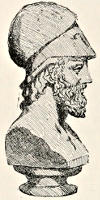
Themistocles
[489-481 B.C.]
Of the particular points on which their rivalry turned,
we are unfortunately little informed. But it is highly
probable that one of them was the important change of
policy above alluded to,—the conversion of Athens from
a land-power into a sea-power; the development of this
new and stirring element in the minds of the people. By
all authorities, this change of policy is ascribed principally
and specially to Themistocles. On that account, if for no
other reason, Aristides would probably be found opposed
to it: but it was moreover a change not in harmony
with that old-fashioned Hellenism, undisturbed uniformity
of life, and narrow range of active duty and experience
which Aristides seems to have approved in common
with the subsequent philosophers. The seaman was
naturally more of a wanderer and cosmopolite than the
heavy-armed soldier: the modern Greek seaman even at
this moment is so to a remarkable degree, distinguished
for the variety of his ideas, and the quickness of his intelligence:
the land-service was a type of steadiness and
inflexible ranks, the sea-service that of mutability and adventure. Such was
the idea strongly entertained by Plato and other philosophers: though we
may remark that they do not render justice to the Athenian seaman, whose
training was far more perfect and laborious, and his habits of obedience far
more complete, than that of the Athenian hoplite or horseman: a training
beginning with Themistocles, and reaching its full perfection about the commencement
of the Peloponnesian War.
In recommending extraordinary efforts to create a navy as well as to
acquire nautical practice, Themistocles displayed all that sagacious appreciation
of the circumstances and dangers of the time for which Thucydides
gives him credit: and there can be no doubt that Aristides, though the honester
politician of the two, was at this particular crisis the less essential to
his country. Not only was there the struggle with Ægina, a maritime
power equal or more than equal, and within sight of the Athenian harbour,
but there was also in the distance a still more formidable contingency to
guard against. The Persian armament had been driven with disgrace from
Attica back to Asia; but the Persian monarch still remained with undiminished
means of aggression as well as increased thirst for revenge; and
Themistocles knew well that the danger from that quarter would recur
greater than ever. He believed that it would recur again in the same way,
by an expedition across the Ægean like that of Datis to Marathon; against
which the best defence would be found in a numerous and well-trained fleet.
Nor could the large preparations of Darius for renewing the attack remain
unknown to a vigilant observer, extending as they did over so many Greeks
subject to the Persian empire. Such positive warning was more than enough
to stimulate the active genius of Themistocles, who now prevailed upon his
countrymen to begin with energy the work of maritime preparation, as well
against Ægina as against Persia. Not only were two hundred new ships
built, and citizens trained as seamen, but the important work was commenced,
during the year when Themistocles was either archon or general,
of forming and fortifying a new harbour for Athens at Piræus, instead of
the ancient open bay of Phalerum. The latter was indeed somewhat nearer
to the city, but Piræus with its three separate natural ports, admitting of
being closed and fortified, was incomparably superior in safety as well as in
convenience. It is not too much to say with Herodotus, that the Æginetan
war was “the salvation of Greece, by constraining the Athenians to
make themselves a maritime power.” The whole efficiency of the resistance
subsequently made to Xerxes turned upon this new movement in the organisation
of Athens, allowed as it was to attain tolerable completeness through
a fortunate concurrence of accidents; for the important delay of ten years
between the defeat of Marathon and the fresh invasion by which it was to
be avenged was, in truth, the result of accident. First, the revolt of Egypt;
next, the death of Darius; thirdly, the indifference of Xerxes at his first
accession towards Hellenic matters—postponing until 480 B.C., an invasion
which would naturally have been undertaken in 487 or 486 B.C., and which
would have found Athens at that time without her wooden walls—the great
engine of her subsequent salvation.
Another accidental help, without which the new fleet could not have
been built—a considerable amount of public money—was also by good
fortune now available to the Athenians. It is first in an emphatic passage
of the poet Æschylus, and next from Herodotus on the present occasion, that
we hear of the silver mines of Laurium in Attica, and the valuable produce
which they rendered to the state. At what time they first began to be worked,
we have no information; but it seems hardly possible that they could have
been worked with any spirit or profitable result, until after the expulsion of
Hippias and the establishment of the democratical constitution of Clisthenes.
Neither the strong local factions, by which different portions of Attica were
set against each other before the time of Pisistratus—nor the rule of that
despot succeeded by his two sons—were likely to afford confidence and encouragement.
But when the democracy of Clisthenes first brought Attica
into one systematic and comprehensive whole, with equal rights assigned to
each part, and with a common centre at Athens—the power of that central
government over the mineral wealth of the country, and its means of binding
the whole people to respect agreements concluded with individual undertakers,
would give a new stimulus to private speculation in the district of Laurium.
It was the practice of the Athenian government either to sell, or to
let for a long term of years, particular districts of this productive region
to individuals or companies; on consideration partly of a sum or fine paid
down, partly of a reserved rent equal to one twenty-fourth part of the gross
produce.
We are told by Herodotus that there was in the Athenian treasury, at
the time when Themistocles made his proposition to enlarge the naval force,
a great sum arising from the Laurian mines, out of which a distribution
was on the point of being made among the citizens—ten drachmæ [about
8 shillings or $2] to each man. Themistocles availed himself of this precious
opportunity—set forth the necessities of the war with Ægina, and the still
more formidable menace from the great enemy in Asia—and prevailed upon
the people to forego the promised distribution for the purpose of obtaining
an efficient navy. One cannot doubt that there must have been many speakers
who would try to make themselves popular by opposing this proposition and
supporting the distribution; insomuch that the power of the people generally
to feel the force of a distant motive as predominant over a present gain, deserves
notice as an earnest of their approaching greatness.
Immense indeed was the recompense reaped for this self-denial, not merely
by Athens but by Greece generally, when the preparations of Xerxes came
to be matured, and his armament was understood to be approaching. The
orders for equipment of ships and laying in of provisions, issued by the Great
King to his subject Greeks in Asia, the Ægean, and Thrace, would of course
become known throughout Greece proper; especially the vast labour bestowed
on the canal of Mount Athos, which would be the theme of wondering
talk with every Thasian or Acanthian citizen who visited the festival
games in the Peloponnesus. All these premonitory evidences were public
enough, without any need of that elaborate stratagem whereby the exiled
Demaratus is alleged to have secretly transmitted, from Susa to Sparta, intelligence
of the approaching expedition. The formal announcements of
Xerxes all designated Athens as the special object of his wrath and vengeance.
Other Grecian cities might thus hope to escape without mischief:
so that the prospect of the great invasion did not at first provoke among
them any unanimous disposition to resist. Accordingly, when the first
heralds despatched by Xerxes from Sardis in the autumn of 481 B.C., a little
before his march to the Hellespont, addressed themselves to the different
cities with demand of earth and water, many were disposed to comply.
Neither to Athens, nor to Sparta, were any heralds sent; and these two
cities were thus from the beginning identified in interest and in the necessity
of defence. Both of them sent, in this trying moment, to consult the
Delphian oracle; while both at the same time joined to convene a Panhellenic
congress at the Isthmus of Corinth, for the purpose of organising
resistance against the expected invader.
[481 B.C.]
We have pointed out the various steps whereby the separate states of Greece
were gradually brought, even against their own natural instincts, into something
approaching more nearly to political union. The present congress,
assembled under the influence of common fear from Persia, has more of
a Panhellenic character than any political event which has yet occurred in
Grecian history. It extends far beyond the range of those Peloponnesian
states which constitute the immediate allies of Sparta: it comprehends Athens,
and is even summoned in part by her strenuous instigation: moreover it seeks
to combine every city of Hellenic race and language, however distant, which
can be induced to take part in it—even the Cretans, Corcyræans, and Sicilians.
It is true that all these states do not actually come, but earnest efforts are
made to induce them to come: the dispersed brethren of the Hellenic family
are entreated to marshal themselves in the same ranks for a joint political
purpose—the defence of the common hearth and metropolis of the race. This
is a new fact in Grecian history, opening scenes and ideas unlike to anything
which has gone before—enlarging prodigiously the functions and duties
connected with that headship of Greece which had hitherto been in the
hands of Sparta, but which is about to become too comprehensive for her
to manage—and thus introducing increased habits of co-operation among
the subordinate states, as well as rival hopes of aggrandisement among the
leaders. The congress at the Isthmus of Corinth marks such further advance
in the centralising tendencies of Greece, and seems at first to promise
an onward march in the same direction: but the promise will not be found
realised.
Its first step was indeed one of inestimable value. While most of the
deputies present came prepared, in the name of their respective cities, to swear
reciprocal fidelity and brotherhood, they also addressed all their efforts to
appease the feuds and dissensions which reigned among particular members
of their own meeting. Of these the most prominent, as well as the most
dangerous, was the war still subsisting between Athens and Ægina. The
latter was not exempt, even now, from suspicions of medising (i.e., embracing
the cause of the Persians), which had been raised by her giving earth and
water ten years before to Darius. But her present conduct afforded no countenance
to such suspicions: she took earnest part in the congress as well as
in the joint measures of defence, and willingly consented to accommodate her
difference with Athens. In this work of reconciling feuds, so essential to the
safety of Greece, the Athenian Themistocles took a prominent part, as well as
Cheileus of Tegea in Arcadia. The congress proceeded to send envoys and
solicit co-operation from such cities as were yet either equivocal or indifferent,
especially Argos, Corcyra, and the Cretan and Sicilian Greeks; and at the
same time to despatch spies across to Sardis, for the purpose of learning the
state and prospects of the assembled army.
These spies presently returned, having been detected, and condemned to
death by the Persian generals, but released by express order of Xerxes, who
directed that the full strength of his assembled armament should be shown
to them, in order that the terror of the Greeks might be thus magnified.
The step was well calculated for such a purpose: but the discouragement
throughout Greece was already extreme, at this critical period when the
storm was about to burst upon them. Even to intelligent and well-meaning
Greeks, much more to the careless, the timid, or the treacherous—Xerxes
with his countless host appeared irresistible, and indeed something more
than human. Of course such an impression would be encouraged by the
large number of Greeks already his tributaries: and we may even trace the
manifestation of a wish to get rid of the Athenians altogether, as the chief
objects of Persian vengeance and chief hindrance to tranquil submission.
This despair of the very continuance of Hellenic life and autonomy breaks
forth even from the sanctuary of Hellenic religion, the Delphian temple;
when the Athenians, in their distress and uncertainty, sent to consult the
oracle. Hardly had their two envoys performed the customary sacrifices,
and sat down in the inner chamber near the priestess Aristonice, when she
at once exclaimed: “Wretched men, why sit ye there? Quit your land
and city, and flee afar! Head, body, feet, and hands are alike rotten: fire and
sword, in the train of the Syrian chariot, shall overwhelm you: nor only
your city, but other cities also, as well as many even of the temples of the
gods—which are now sweating and trembling with fear, and foreshadow,
by drops of blood on their roofs, the hard calamities impending. Get ye
away from the sanctuary, with your souls steeped in sorrow.”
So terrific a reply had rarely escaped from the lips of the priestess. The
envoys were struck to the earth by it, and durst not carry it back to Athens.
In their sorrow they were encouraged yet to hope by an influential Delphian
citizen named Timon (we trace here as elsewhere the underhand working of
these leading Delphians on the priestess), who advised them to provide themselves
with the characteristic marks of supplication, and to approach the
oracle a second time in that imploring guise: “O lord, we pray thee (they
said), have compassion on these boughs of supplication, and deliver to us
something more comfortable concerning our country; else we quit not thy
sanctuary, but remain here until death.” Upon which the priestess replied:
“Athene with all her prayers and all her sagacity cannot propitiate Olympian
Zeus. But this assurance I will give you, firm as adamant. When everything
else in the land of Cecrops shall be taken, Zeus grants to Athene that the
wooden wall alone shall remain unconquered, to defend you and your children.
Stand not to await the assailing horse and foot from the continent,
but turn your backs and retire: you shall yet live to fight another day. O
divine Salamis, thou too shalt destroy the children of women, either at the
seed-time or at the harvest.”
This second answer was a sensible mitigation of the first. It left open
some hope of escape, though faint, dark, and unintelligible: and the envoys
wrote it down to carry back to Athens, not concealing probably the terrific
sentence which had preceded it. When read to the people, the obscurity
of the meaning provoked many different interpretations. What was meant
by “the wooden wall”? Some supposed that the Acropolis itself, which
had originally been surrounded with a wooden palisade, was the refuge
pointed out; but the greater number, and among them most of those who
were by profession expositors of prophecy, maintained that the wooden wall
indicated the fleet. But these professional expositors, while declaring that
the god bade them go on shipboard, deprecated all idea of a naval battle,
and insisted on the necessity of abandoning Attica forever: the last lines
of the oracle, wherein it was said that Salamis would destroy the children
of women, appeared to them to portend nothing but disaster in the event of
a naval combat. Such was the opinion of those who passed for the best
expositors of the divine will. It harmonised completely with the despairing
temper then prevalent, heightened by the terrible sentence pronounced in
the first oracle; and emigration to some foreign land presented itself as the
only hope of safety even for their persons. The fate of Athens—and of
Greece generally, which would have been helpless without Athens—now
hung upon a thread, when Themistocles, the great originator of the fleet,
interposed with equal steadfastness of heart and ingenuity, to insure the
proper use of it. He contended that if the god had intended to designate
Salamis as the scene of a naval disaster to the Greeks, that island would
have been called in the oracle by some such epithet as “wretched Salamis:”
but the fact that it was termed “divine Salamis,” indicated that the parties,
destined to perish there, were the enemies of Greece, not the Greeks themselves.
He encouraged his countrymen therefore to abandon their city and
country, and to trust themselves to the fleet as the wooden wall recommended
by the god, but with full determination to fight and conquer on
board. Great indeed were the consequences which turned upon this bold
stretch of exegetical conjecture. Unless the Athenians had been persuaded,
by some plausible show of interpretation, that the sense of the oracle encouraged
instead of forbidding a naval combat, they would in their existing
depression have abandoned all thought of resistance.
Even with the help of an encouraging interpretation, however, nothing
less than the most unconquerable resolution and patriotism could have
enabled the Athenians to bear up against such terrific denunciations from
the Delphian god, and persist in resistance in place of seeking safety by
emigration. Herodotus emphatically impresses this truth upon his readers:
nay, he even steps out of his way to do so, proclaiming Athens as the real saviour
of Greece. Writing as he did about the beginning of the Peloponnesian
War—at a time when Athens, having attained the maximum of her empire,
was alike feared, hated, and admired, by most of the Grecian states—he
knows that the opinion which he is giving will be unpopular with his
hearers generally, and he apologises for it as something wrung from him
against his will by the force of the evidence. Nor was it only that the
Athenians dared to stay and fight against immense odds: they, and they
alone, threw into the cause that energy and forwardness whereby it was
enabled to succeed, as will appear further in the sequel.
But there was also a third way, not less deserving of notice, in which they
contributed to the result. As soon as the congress of deputies met at the
Isthmus of Corinth, it became essential to recognise some one commanding
state: and with regard to the land-force, no one dreamt of contesting the
pre-eminence of Sparta. But in respect to the fleet, her pretensions were more
disputable, since she furnished at most only sixteen ships, and little or no
nautical skill; while Athens brought two-thirds of the entire naval force,
with the best ships and seamen. Upon these grounds the idea was at first
started, that Athens should command at sea and Sparta on land: but the
majority of the allies manifested a decided repugnance, announcing that they
would follow no one but a Spartan. To the honour of the Athenians, they
at once waived their pretensions, as soon as they saw that the unity of the
confederate force at this moment of peril would be compromised. To appreciate
this generous abnegation of a claim in itself so reasonable, we must
recollect that the love of pre-eminence was among the most prominent attributes
of the Hellenic character; a prolific source of their greatness and
excellence, but producing also no small amount both of their follies and
their crimes. To renounce at the call of public obligation a claim to personal
honour and glory, is perhaps the rarest of all virtues in a son of
Hellen.
[481-480 B.C.]
We find thus the Athenians nerved up to the pitch of resistance, prepared
to see their country wasted, and to live as well as to fight on shipboard,
when the necessity should arrive; furnishing two-thirds of the whole fleet,
and yet prosecuting the building of fresh ships until the last moment; sending
forth the ablest and most forward leader in the common cause, while
content themselves to serve like other states under the leadership of Sparta.
During the winter preceding the march of Xerxes from Sardis, the congress
at the isthmus was trying, with little success, to bring the Grecian cities
into united action. Among the cities north of Attica and the Peloponnesus,
the greater number were either inclined to submit, like Thebes and the greater
part of Bœotia, or were at least lukewarm in the cause of independence: so rare
at this trying moment (to use the language of the unfortunate Platæans
fifty-three years afterwards) was the exertion of resolute Hellenic patriotism
against the invader. Even in the interior of the Peloponnesus, the powerful
Argos maintained an ambiguous neutrality. It was one of the first steps of
the congress to send special envoys to Argos, setting forth the common danger
and soliciting co-operation. The result is certain, that no co-operation was
obtained—the Argives did nothing throughout the struggle; but as to
their real position, or the grounds of their refusal, contradictory statements
had reached the ears of Herodotus. They themselves affirmed that they
were ready to have joined the Hellenic cause, in spite of dissuasion from the
Delphian oracle—exacting only as conditions that the Spartans should
conclude a truce with them for thirty years, and should equally divide the
honours of headship with Argos.
Such was the story told by the Argives themselves, but seemingly not
credited either by any other Greeks, or by Herodotus himself. The prevalent
opinion was, that the Argives had a secret understanding with Xerxes,
and some even affirmed that they had been the parties who invited him into
Greece, as a means both of protection and of vengeance to themselves against
Sparta after their defeat by Cleomenes. And Herodotus himself evidently believed
that they medised, though he is half afraid to say so, and disguises his
opinion in a cloud of words which betray the angry polemics going on about
the matter, even fifty years afterwards. It is certain that in act the Argives
were neutral.
The Cretans declined to take any part, on the ground of prohibitory
injunctions from the oracle; the Corcyræans promised without performing,
and even without any intention to perform. Their neutrality was a serious
loss to the Greeks, since they could fit out a naval force of sixty triremes,
second only to that of Athens. With this important contingent they engaged
to join the Grecian fleet, and actually set sail from Corcyra; but they took
care not to sail round Cape Malea, or to reach the scene of action.
The envoys who visited Corcyra proceeded onward on their mission to
Gelo the despot of Syracuse. Of that potentate, regarded by Herodotus
as more powerful than any state in Greece, we shall speak more fully in a
subsequent chapter: it is sufficient to mention now, that he rendered no aid
against Xerxes. Nor was it in his power to do so, whatever might have
been his inclinations; for the same year which brought the Persian monarch
against Greece, was also selected by the Carthaginians for a formidable invasion
of Sicily, which kept the Sicilian Greeks to the defence of their own
island. It seems even probable that this simultaneous invasion had been
concerted between the Persians and Carthaginians.
The endeavours of the deputies of Greeks at the isthmus had thus produced
no other reinforcement to their cause except some fair words from the
Corcyræans. It was about the time when Xerxes was about to pass the Hellespont,
in the beginning of 480 B.C., that the first actual step for resistance
was taken, at the instigation of the Thessalians. Though the great Thessalian
family of the Aleuadæ were among the companions of Xerxes, and the
most forward in inviting him into Greece, with every promise of ready submission
from their countrymen—yet it seems that these promises were in
reality unwarranted. The Aleuadæ were at the head only of a minority,
and perhaps were even in exile, like the Pisistratidæ: while most of the
Thessalians were disposed to resist Xerxes—for which purpose they now
sent envoys to the isthmus, intimating the necessity of guarding the passes
of Olympus, the northernmost entrance of Greece. They offered their own
cordial aid in this defence, adding that they should be under the necessity of
making their own separate submission, if this demand were not complied with.
Accordingly a body of ten thousand Grecian heavy-armed infantry, under
the command of the Spartan Euænetus and the Athenian Themistocles,
were despatched by sea to Alus in Achaia Phthiotis, where they disembarked
and marched by land across Achaia and Thessaly. Being joined by
the Thessalian horse, they occupied the defile of Tempe, through which the
river Peneus makes its way to the sea, by a cleft between the mountains
Olympus and Ossa.
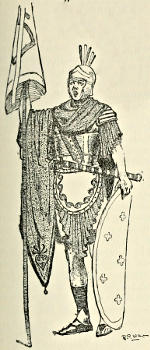
Greek Standard Bearer
The long, narrow, and winding defile of Tempe formed then, and
forms still, the single entrance, open throughout winter as well as
summer, from lower or maritime Macedonia into Thessaly. The
lofty mountain precipices approach so closely as to leave
hardly room enough in some places for a road: it is thus
eminently defensible, and a few resolute men would be
sufficient to arrest in it the progress of the most numerous
host. But the Greeks soon discovered that the
position was such as they could not hold—first, because
the powerful fleet of Xerxes would be able to
land troops in their rear; secondly, because
there was also a second entrance passable in
summer, from upper Macedonia into Thessaly,
by the mountain passes over the range of Olympus.
It was in fact by this second pass, evading
the insurmountable difficulties of Tempe,
that the advancing march of the Persians was
destined to be made, under the auspices of Alexander,
king of Macedon, tributary to them and
active in their service. That prince sent a communication
of the fact to the Greeks at Tempe,
admonishing them that they would be trodden
under foot by the countless host approaching,
and urging them to renounce their hopeless
position. He passed for a friend, and probably
believed himself to be acting as such, in dissuading
the Greeks from unavailing resistance
to Persia: but he was in reality a very dangerous
mediator; and as such the Spartans had
good reason to dread him, in a second intervention
of which we shall hear more hereafter.
On the present occasion, the Grecian commanders
were quite ignorant of the existence
of any other entrance into Thessaly, besides Tempe, until their arrival in
that region. Perhaps it might have been possible to defend both entrances
at once, and considering the immense importance of arresting the march of
the Persians at the frontiers of Hellas, the attempt would have been worth
some risk. So great was the alarm, however, produced by the unexpected
discovery, justifying or seeming to justify the friendly advice of Alexander,
that they remained only a few days at Tempe, then at once retired back to
their ships, and returned by sea to the Isthmus of Corinth—about the time
when Xerxes was crossing the Hellespont.
This precipitate retreat produced consequences highly disastrous and
discouraging. It appeared to leave all Hellas north of Mount Cithæron
and of the Megarid territory without defence, and it served either as reason
or pretext for the majority of the Grecian states, north of that boundary,
to make their submission to Xerxes, which some of them had already begun
to do before. When Xerxes in the course of his march reached the
Thermaic Gulf, within sight of Olympus and Ossa, the heralds whom he
had sent from Sardis brought him tokens of submission from a third portion
of the Hellenic name—the Thessalians, Dolopes, Ænianes, Perrhæbians,
Magnetes, Locrians, Dorians, Melians, Phthiotic Achæans, and Bœotians.
Among the latter is included Thebes, but not Thespiæ or Platæa. The
Thessalians, especially, not only submitted, but manifested active zeal and
rendered much service in the cause of Xerxes, under the stimulus of the
Aleuadæ, whose party now became predominant: they were probably indignant
at the hasty retreat of those who had come to defend them.
Had the Greeks been able to maintain the passes of Olympus and Ossa,
all this northern fraction might probably have been induced to partake in
the resistance instead of becoming auxiliaries to the invader. During the
six weeks or two months which elapsed between the retreat of the Greeks
from Tempe and the arrival of Xerxes at Therma, no new plan of defence
was yet thoroughly organised; for it was not until that arrival became
known at the isthmus, that the Greek army and fleet made its forward
movement to occupy Thermopylæ and Artemisium.b
Xerxes having ranged and numbered his armament, was desirous to
take a survey of them all. Mounted in his car, he examined each nation in
its turn. To all of them he proposed certain questions, the replies to which
were noted down by his secretaries. In this manner he proceeded from first
to last through all the ranks, both of horse and foot. When this was done,
the fleet also was pushed off from land, whilst the monarch, exchanging his
chariot for a Sidonian vessel, on the deck of which he sat beneath a golden
canopy, passed slowly the heads of the ships, proposing in like manner
questions to each, and noting down the answers. The commanders had
severally moored their vessels at about four plethra from shore, in one
uniform line, with their sterns out to sea, and their crews under arms, as
if prepared for battle. Xerxes viewed them, passing betwixt their prows
and the shore.
When he had finished his survey, he went on shore; and sending for
Demaratus, the son of Ariston, who accompanied him in this expedition
against Greece, he thus addressed him: “From you, Demaratus, who are
a Greek, and, as I understand from yourself and others, of no mean or
contemptible city, I am desirous of obtaining information: do you think
that the Greeks will presume to make any resistance against me? For
my own part, not to mention their want of unanimity, I cannot think that
all the Greeks, joined to all the inhabitants of the west, would be able to
withstand my power: what is your opinion on this subject?” “Sir,” said
Demaratus, in reply, “shall I say what is true, or only what is agreeable?”
Xerxes commanded him to speak the truth.
“Since,” answered Demaratus, “you command me to speak the truth,
it shall be my care to deliver myself in such a manner that no one hereafter,
speaking as I do, shall be convicted of falsehood. Greece has ever been the
child of poverty; for its virtue it is indebted to the severe wisdom and discipline,
by which it has tempered its poverty, and repelled its oppressors.
To this praise all the Dorian Greeks are entitled; but I shall now speak of
the Lacedæmonians only. You may depend upon it that your propositions,
which threaten Greece with servitude, will be rejected; and if all the other
Greeks side with you against them, the Lacedæmonians will engage you in
battle. Make no inquiries as to their number, for if they shall have but a
thousand men, or even fewer, they will fight you.”
“What, Demaratus,” answered Xerxes, smiling, “think you that a thousand
men will engage so vast a host? Tell me, you who, as you say, have
been their prince, would you now willingly engage with ten opponents? If
your countrymen be what you describe them, according to your own principles
you, who are their prince, should be equal to two of them. If, therefore,
one of them be able to contend with ten of my soldiers, you may be
reasonably expected to contend with twenty: such ought to be the test of
your assertions. But if your countrymen really resemble in form and size
you, and such other Greeks as appear in my presence, it should seem that
what you say is dictated by pride and insolence; for how can it be shown that
a thousand, or ten thousand, or even fifty thousand men, all equally free,
and not subject to the will of an individual, could oppose so great an army?
Granting them to have five thousand men, we have still a majority of a
thousand to one; they who like us are under the command of one person,
from the fear of their leader, and under the immediate impression of the lash,
are animated with a spirit contrary to their nature, and are made to attack
a number greater than their own; but they who are urged by no constraint
will not do this. If these Greeks were even equal to us in number, I cannot
think they would dare to encounter Persians. The virtue to which you
allude, is to be found among ourselves, though the examples are certainly
not numerous; there are of my Persian guards men who will singly contend
with three Greeks. The preposterous language which you use can only,
therefore, proceed from your ignorance.”
“I knew, my lord, from the first,” returned Demaratus, “that by speaking
truth I should offend you. I was induced to give you this representation
of the Spartans, from your urging me to speak without reserve. You
may judge, sir, what my attachment must be to those who, not content with
depriving me of my paternal dignities, drove me ignominiously into exile.
Your father received, protected, and supported me: no prudent man will
treat with ingratitude the kindness of his benefactor. I will never presume
to engage in fight with ten men, nor even with two, nor indeed willingly with
one; but if necessity demanded, or danger provoked me, I would not hesitate
to fight with any one of those, who is said to be a match for three Greeks.
The Lacedæmonians, when they engage in single combat, are certainly not
inferior to other men, but in a body they are not to be equalled. Although
free, they are not so without some reserve; the law is their superior, of which
they stand in greater awe than your subjects do of you: they are obedient
to what it commands, and it commands them always not to fly from the
field of battle, whatever may be the number of their adversaries. It is
their duty to preserve their ranks, to conquer or to die. If what I say
seem to you absurd, I am willing in future to be silent. I have spoken
what I think, because the king commanded me, to whom may all he desires
be accomplished.”
Xerxes smiled at these words of Demaratus, whom he dismissed without
anger, civilly from his presence. After the above conference, he removed
from Doriscus the governor who had been placed there by Darius, and promoted
in his room Mascames, son of Megadostes. He then passed through
Thrace with his army, towards Greece.
To this Mascames, as to the bravest of all the governors appointed either by
himself or by Darius, Xerxes sent presents every year, and Artaxerxes, son
of Xerxes continued to do the same to his descendants. Before this expedition
against Greece, there had constantly been governors both in Thrace and
the Hellespont, all of whom, except Mascames, the Greeks afterwards expelled:
he alone retained Doriscus in his subjection, in defiance of the many and
repeated exertions made to remove him. It was in remembrance of these
services, that he and all his descendants received presents from the kings of
Persia.
The only one of all those expelled by the Greeks, who enjoyed the good
opinion of Xerxes, was Boges, the governor of Eion; he always mentioned
this man in terms of esteem, and all his descendants were honourably regarded
in Persia. Boges was not undeserving his great reputation: when he was
besieged by the Athenians, under the conduct of Cimon, son of Miltiades,
he might, if he had thought proper, have retired into Asia; this he refused,
and defended himself to the last extremity, from apprehensions that the king
might ascribe his conduct to fear. When no provisions were left, he caused
a large pile to be raised; he then slew his children, his wife, his concubines,
and all his family and threw them into the fire; he next cast all the gold
and silver of the place from the walls into the Strymon; lastly, he leaped
himself into the flames. This man is, therefore, very deservedly extolled by
the Persians.
Xerxes, in his progress from Doriscus to Greece, compelled all the people
among whom he came to join his army. All this tract of country, as far as
Thessaly, as we have before remarked, had been made tributary to the king,
first by Megabazus, and finally by Mardonius.
Xerxes having passed the exhausted bed of the Lissus, continued his
march beyond the Grecian cities of Maronea, Dicæa, and Abdera. He proceeded
onward through the more midland cities, in one of which is a lake
almost of thirty stadia in circumference, full of fish, but remarkably salt:
the waters of this proved only sufficient for the beasts of burden. The name
of the city is Pistyrus. These Grecian and maritime cities were to the left
of Xerxes as he passed them.
The nations of Thrace, through which he marched are these: the Pæti,
Cicones, Bistones, Sapæi, Dersæi, Edoni, and the Satræ. The inhabitants
of the maritime towns followed by sea; those inland were, except the Satræ,
compelled to accompany the army by land. The Satræ, as far as we know,
never were subdued.
Xerxes continued to advance, and passed by two Pierian cities, one called
Phagra, the other Pergamus; to his right he left the mountain Pangæus,
keeping a westward direction, till he came to the river Strymon. To this
river the magi offered a sacrifice of white horses. After performing these
and many other religious rites to the Strymon, they proceeded through the
Edonian district of the Nine Ways, to where they found bridges thrown over
the Strymon: when they heard that this place was named the Nine Ways, they
buried there alive nine youths and as many virgins, natives of the country.
This custom of burying alive was common in Persia; and Amestris, the wife
of Xerxes, when she was of an advanced age, commanded fourteen Persian
children of illustrious birth to be interred alive in honour of that deity, who,
as they suppose, exists under the earth.
On his arrival at Acanthus, the Persian monarch interchanged the rites
of hospitality with the people, and presented each with a Median vest: he
was prompted to this conduct by the particular zeal which they discovered
towards the war, and from their having completed the work of the canal.
As soon as the royal will was made known by the heralds, the inhabitants of
the several cities divided the corn which they possessed, and employed many
months in reducing it to meal and flour. Some there were, who purchased
at a great price the finest cattle they could procure, for the purpose of fattening
them: others, with the same view of entertaining the army, provided
birds both of the land and the water, which they preserved in cages and in
ponds. Many employed themselves in making cups and goblets of gold and
silver, with other utensils of the table: these last-mentioned articles were
intended only for the king himself, and his more immediate attendants;
with respect to the army in general, it was thought sufficient to furnish them
with provision. On the approach of the main body, a pavilion was erected,
and properly prepared for the residence of the monarch, the rest of the
troops remained in the open air. From the commencement of the feast to
its conclusion, the fatigue of those who provided it is hardly to be expressed.
The guests, after satisfying their appetite, passed the night on the place;
the next morning, after tearing up the pavilion, and plundering its contents,
they departed, without leaving anything behind them.
Upon this occasion the witty remark of Megacreon of Abdera, has been
handed down to posterity. If the Abderites, he observed, had been required
to furnish a dinner as well as a supper, they must either have prevented the
visit of the king by flight, or have been the most miserable of human beings.
These people, severe as was the burden, fulfilled what had been enjoined
them. From Acanthus, Xerxes dismissed the commanders of his fleet, requiring
them to wait his orders at Therma. Therma is situated near the
Thermæan Gulf, to which it gives its name. He had been taught to suppose
this the most convenient road; by the command of Xerxes, the army
had marched from Doriscus to Acanthus, in three separate bodies: one went
by the seacoast, moving with the fleet, and was commanded by Mardonius
and Masistes; a second proceeded through the midst of the continent, under
the conduct of Tritantæchmes and Gergis; betwixt these went the third detachment,
with whom was Xerxes himself, and who were led by Smerdomenes
and Megabyzus.
As soon as the royal mandate was issued, the navy entered the canal
which had been cut at Mount Athos, and which was continued to the gulf.
Taking on board a supply of troops from these places, the fleet advanced towards
the Thermæan Gulf, and doubling the Toronean promontory of
Ampelos, they proceeded by a short cut to the Canastrean cape, the point,
which of all the districts of Pallene, projects farthest into the sea. Coasting
onward to the station appointed, they supplied themselves with troops
from the cities in the vicinity of Pallene, and the Thermæan Gulf. From
Ænea the fleet went in a straight direction to the Thermæan Gulf, and the
coast of Mygdonia; it ultimately arrived at Therma, where they waited for
the king. Directing his march this way, Xerxes, with all his forces, left
Acanthus, and proceeded over the continent through Pæonia and Crestonia.
In the course of this march, the camels, which carried the provisions, were
attacked by lions: in the darkness of the night they left their accustomed
abode, and without molesting man or beast, fell upon the camels only. That
the lions should attack the camels alone, animals they had never been known
before to devour, or even by mistake to have seen, is a fact which we are
totally unable to explain.
On his arrival at Therma, Xerxes halted with his army, which occupied
the whole of the coast from Therma and Mygdonia, as far as the rivers
Lydias and Haliacmon, which forming the limits of Bottiæis and Macedonia,
meet at last in the same channel. Here the barbarians encamped.
Xerxes, viewing from Therma, Olympus and Ossa, Thessalian mountains
of an extraordinary height, betwixt which was a narrow passage where the
Peneus poured its stream, and where was an entrance to Thessaly, he was
desirous of sailing to the mouth of this river. For the way he had determined
to march as the safest was through the high country of Macedonia, by
the Perrhæbi, and the town of Gonnus. He instantly however set about the
accomplishment of his wish. He accordingly went on board a Sidonian vessel,
for on such occasions he always preferred the ships of that country; leaving
here his land forces, he gave the signal for all the fleet to prepare to set sail.
Arriving at the mouth of the Peneus, he observed it with particular admiration,
and desired to know of his guides if it would not be possible to turn
the stream, and make it empty itself into the sea in some other place.
Thessaly is said to have been formerly a marsh, on all sides surrounded
by lofty mountains[25]; to the east by Pelion and Ossa, whose bases meet each
other; to the north by Olympus, to the west by Pindus; to the south by
Othrys. The space betwixt these is Thessaly, into which depressed region
many rivers pour their waters.
Xerxes inquiring of his guides whether the Peneus might be conducted
to the sea by any other channel, received from them, who were well acquainted
with the situation of the country, this reply: “As Thessaly, O King, is on
every side encircled by mountains, the Peneus can have no other communication
with the sea.” “The Thessalians,” Xerxes is said to have answered,
“are a sagacious people. They have been careful to decline a contest for
many reasons, and particularly as they must have discerned that their country
would afford an easy conquest to an invader. All that would be necessary
to deluge the whole of Thessaly, except the mountainous parts, would
be to stop up the mouth of the river, and thus throw back its waters upon
the country.” This observation referred to the sons of Aleuas, who were
Thessalians, and the first Greeks who submitted to the king. He presumed
that their conduct declared the general sentiments of the nation in his
favour. After surveying the place he returned to Therma.
He remained a few days in the neighbourhood of Pieria, during which
interval a detachment of the third of his army was employed in clearing the
Macedonian mountain, to facilitate the passage of the troops into the country
of the Perrhæbi. The messengers who had been sent to require earth and
water of the Greeks returned, some with and some without it. Xerxes sent
no messengers either to Athens or to Sparta, for when Darius had before sent
to these places, the Athenians threw his people into their pit of punishment,
the Lacedæmonians into wells, telling them to get the earth and water
thence, and carry it to their king. A long time after the incident we have
related, the entrails of the victims continued at Sparta to bear an unfavourable
appearance, till the people, reduced to despondency, called a general
assembly, in which they inquired by their heralds, if any Lacedæmonian
would die for his country. Upon this Sperthies, son of Aneristus, and Bulis,
son of Nicolaus, Spartans of great accomplishments and distinction, offered
themselves to undergo whatever punishment Xerxes the son of Darius should
think proper to inflict on account of the murder of his ambassadors. These
men therefore the Spartans sent to the Medes, as to certain death.
The magnanimity of these two men, as well as the words which they
used, deserve admiration. On their way to Susa they came to Hydarnes, a
native of Persia, and governor of the vanquished places in Asia near the
sea: he entertained them with much liberality and kindness, and addressed
them as follows: “Why, O Lacedæmonians, will you reject the friendship of
the king? From me, and from my condition, you may learn how well he
knows to reward merit. He already thinks highly of your virtue, and if you
will but enter into his service, he will doubtless assign to each of you some
government in Greece.” “Hydarnes,” they replied, “your advice with respect
to us is inconsistent: you speak from the experience of your own but
with an entire ignorance of our situation. To you servitude is familiar; but
how sweet a thing liberty is, you have never known, if you had, you yourself
would have advised us to make all possible exertions to preserve it.”
When introduced, on their arrival at Susa, to the royal presence, they
were first ordered by the guards to fall prostrate, and adore the king, and
some force was used to compel them. But this they refused to do, even if
they should dash their heads against the ground. They were not, they said,
accustomed to adore a man, nor was it for this purpose that they came.
After persevering in such conduct, they addressed Xerxes himself in these
and similar expressions: “King of the Medes, we are sent by our countrymen
to make atonement for those ambassadors who perished at Sparta.”
Xerxes with great magnanimity said he would not imitate the example of
the Lacedæmonians. They in killing his ambassadors had violated the laws
of nations; he would not be guilty of that with which he reproached them,
nor, by destroying their messengers, indirectly justify their crime.c
Everything among the Spartans conduced to plant in their hearts
the most heroic courage, by the remembrance of their ancestors, whose
principles and sentiments were the spur to the noblest actions. The
lowest Spartans were exalted to a level with their greatest chiefs by a
glorious death; their memory was renewed by the most solemn offering
to the latest posterity, and their images were placed next to those of
the gods.—Adapted from Bonny.
[480 B.C.]
Xerxes encamped in Trachinia at Melis; the Greeks, in the straits.
These straits the Greeks in general call Thermopylæ; the people of the
country Pylæ only. Here then were the two armies stationed, Xerxes occupying
all the northern region as far as Trachinia, the Greeks that of the
south. The Grecian army, which here waited the approach of the Persian,
was composed of three hundred Spartans in complete armour; five hundred
Tegeatæ, and as many Mantineans; one hundred and twenty men from
Orchomenos of Arcadia, a thousand men from the rest of Arcadia, four hundred
Corinthians, two hundred from Phlius, and eighty from Mycenæ.
The above came from the Peloponnesus: from Bœotia there were seven hundred
Thespians and four hundred Thebans.
In addition to the above, the aid of all the Opuntian Locrians had been
solicited, together with a thousand Phocians. To obtain the assistance of
these the Greeks had previously sent emissaries among them, saying, that
they were the forerunners only of another and more numerous body, whose
arrival was every day expected. They added, that the defence of the sea
was confided to the people of Athens and Ægina, in conjunction with the
rest of the fleet; that there was no occasion for alarm, as the invader of
Greece was not a god, but a mere human being; that there never was nor
could be any mortal superior to the vicissitudes of fortune; that the most
exalted characters were exposed to the greatest evils; he therefore, a mortal,
now advancing to attack them, would suffer for his temerity. These arguments
proved effectual, and they accordingly marched to Trachis to join
their allies.
Leonidas and His Allies
These troops were commanded by different officers of their respective
countries: but the man most regarded, and entrusted with the chief command,
was Leonidas of Sparta. His ancestors were traced back to Hercules.
An accident had placed him on the throne of Sparta; for, as he had two
brothers older than himself, Cleomenes and Dorieus, he had entertained no
thoughts of the government; but Cleomenes dying without male issue, and
Dorieus not surviving (for he ended his days in Sicily) the crown came to
Leonidas, who was older than Cleombrotus, the youngest of the sons of
Anaxandrides, and who had married the daughter of Cleomenes. On the
present occasion he took with him to Thermopylæ a body of three hundred
chosen men, all of whom had children. To these he added the Theban
troops who were conducted by Leontiades, son of Eurymachus.[26] Leonidas
had selected the Thebans to accompany him, because a suspicion generally
prevailed that they were secretly attached to the Medes. These therefore
he summoned to attend him, to ascertain whether they would actually contribute
their aid, or openly withdraw themselves from the Grecian league.
With hostile sentiments they nevertheless sent the assistance required.[27]
The march of this body under Leonidas was accelerated by the Spartans,
that their example might stimulate their allies to action, and that they might
not make their delay a pretence for going over to the Medes. The celebration
of the Carnean festival[28] protracted the march of their main body; but
it was their intention to follow with all imaginable expedition, leaving only
a small detachment for the defence of Sparta. The rest of the allies were
actuated by similar motives, for the Olympic games happened to recur at
this period; and as they did not expect an engagement would immediately
take place at Thermopylæ, they sent only a detachment before them.
Such were the motives of the confederate body. The Greeks who were
already assembled at Thermopylæ were seized with so much terror on the
approach of the Persians that they consulted about a retreat. Those of the
Peloponnesus were in general of opinion that they should return and guard
the isthmus; but as the Phocians and Locrians were exceedingly averse to
this measure, Leonidas prevailed on them to continue on their post. He
resolved however to send messengers round to all the states, requiring supplies,
stating that their number was much too small to oppose the Medes
with any effect.
Whilst they thus deliberated, Xerxes sent a horseman to examine their
number and their motions. He had before heard, in Thessaly, that a small
band was collected at this passage, that they were led by Lacedæmonians,
and by Leonidas of the race of Hercules. The person employed performed
his duty: all those who were without the entrenchment he was able to
reconnoitre; those who were within for the purpose of defending it, eluded
his observation. The Lacedæmonians were at that period stationed without;
of these some were performing gymnastic exercises, whilst others were employed
in combing their hair. He was greatly astonished, but he leisurely
surveyed their number and employments, and returned without molestation,
for they despised him too much to pursue him. He related to Xerxes all
that he had seen.
Xerxes, on hearing the above, was little aware of what was really the
case, that this people were preparing themselves either to conquer or to
die. The thing appeared to him so ridiculous, that he sent for Demaratus
the son of Ariston, who was then with the army. On his appearing, the
king questioned him on this behaviour of the Spartans, expressing his desire
to know what it might intimate. “I have before, Sir,” said Demaratus,
“spoken to you of this people, at the commencement of this expedition;
and as I remember, when I related to you what I knew you would have occasion
to observe, you treated me with contempt. I am conscious of the danger of
declaring the truth, in opposition to your prejudices; but I will nevertheless
do so. It is the determination of these men to dispute this pass with us, and
they are preparing themselves accordingly. It is their custom before any
enterprise of danger to adorn their hair. Of this you may be assured, that
if you vanquish these, and their countrymen in Sparta, no other nation will
presume to take up arms against you: you are now advancing to attack a
people whose realms and city are the fairest, and whose troops are the bravest
of Greece.” These words seemed to Xerxes preposterous enough; but he demanded
a second time, how so small a number could contend with his army.
“Sir,” said Demaratus, “I will submit to suffer the punishment of falsehood,
if what I say does not happen.”
Xerxes Assails the Pass
Xerxes was still incredulous; he accordingly kept his position without
any movement for four days, in expectation of seeing them retreat. On the
fifth day, observing that they continued on their post, merely as he supposed
from the most impudent rashness, he became much exasperated, and sent
against them a detachment of Medes and Cissians, with a command to bring
them alive to his presence. The Medes in consequence attacked them, and
lost a considerable number. A reinforcement arrived; but though the onset
was severe, no impression was made. It now became universally conspicuous,
and no less so to the king himself, that he had many troops, but few
men.[29] The above engagement continued all day.
The Medes, after being very roughly treated, retired, and were succeeded
by the band of Persians called by the king “the Immortal,” and commanded
by Hydarnes. These it was supposed would succeed without the smallest
difficulty. They commenced the attack, but made no greater impression
than the Medes: their superior numbers were of no advantage, on account
of the narrowness of the place; and their spears also were shorter than
those of the Greeks. The Lacedæmonians fought in a manner which deserves
to be recorded; their own excellent discipline, and the unskilfulness of their
adversaries, were in many instances remarkable, and not the least so when
in close ranks they affected to retreat. The barbarians seeing them retire,
pursued them with a great and clamorous shout; but on their near approach
the Greeks faced about to receive them. The loss of the Persians was prodigious,
and a few also of the Spartans fell. The Persians, after successive
efforts made with great bodies of their troops to gain the pass, were unable
to accomplish it and obliged to retire.
It is said of Xerxes himself that, being a spectator of the contest, he was
so greatly alarmed for the safety of his men, that he leaped thrice from his
throne. On the following day, the barbarians succeeded no better than before.
They went to the onset as against a contemptible number, whose
wounds they supposed would hardly permit them to renew the combat: but
the Greeks, drawn up in regular divisions, fought each nation on its respective
post, except the Phocians, who were stationed on the summit of the
mountain to defend the pass. The Persians, experiencing a repetition of the
same treatment, a second time retired.
The Treachery of Ephialtes
Whilst the king was exceedingly perplexed what conduct to pursue in the
present emergence, Ephialtes, the son of Eurydemus, a Malian, demanded
an audience: he expected to receive some great recompense for showing him
the path which led over the mountain to Thermopylæ: and he indeed it
was who thus rendered ineffectual the valour of those Greeks who perished
on this station. This man, through fear of the Lacedæmonians, fled afterwards
into Thessaly; but the Pylagoræ, calling a council of the Amphictyons
at Pylæ for this express purpose, set a price upon his head, and he was
afterwards slain by Athenades, a Trachinian, at Anticyra, to which place he
had returned.
The intelligence of Ephialtes gave the king infinite satisfaction, and he
instantly detached Hydarnes, with the forces under his command, to avail
himself of it. They left the camp at the first approach of evening; the
Malians, the natives of the country, discovered this path, and by it conducted
the Thessalians against the Phocians, who had defended it by an entrenchment,
and deemed themselves secure. It had never, however, proved of any
advantage to the Malians.
The path of which we are speaking commences at the river Asopus.
This stream flows through an aperture of the mountain called Anopæa,
which is also the name of the path. This is continued through the whole
length of the mountain, and terminates near the town of Alpenus. Following
the track which has been described, the Persians passed the Asopus, and
marched all night, keeping the Œtean Mountains on the right, and the Trachinian
on the left. At the dawn of morning they found themselves at the
summit, where a band of a thousand Phocians in arms was stationed, both to
defend their own country and this pass.
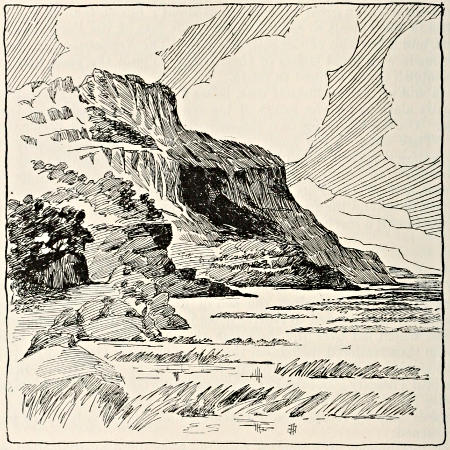
The Pass of Thermopylæ
The approach of the Persians was discovered to the Phocians in this
manner: whilst they were ascending the mountain they were totally concealed
by the thick groves of oak; but from the stillness of the air they were
discovered by the noise they made by trampling on the leaves, a thing which
might naturally happen. The Phocians ran to arms, and in a moment the
barbarians appeared, who, seeing a number of men precipitately arming
themselves, were at first struck with astonishment. They did not expect an
adversary; and they had fallen in among armed troops. Hydarnes, apprehending
that the Phocians might prove to be Lacedæmonians, inquired of
Ephialtes who they were. When he was informed, he drew up the Persians
in order of battle. The Phocians, not able to sustain the heavy flight of
arrows, retreated up the mountain, imagining themselves the objects of this
attack, and expecting certain destruction: but the troops with Hydarnes
and Ephialtes did not think it worth their while to pursue them, and
descended rapidly down the opposite side of the mountain.
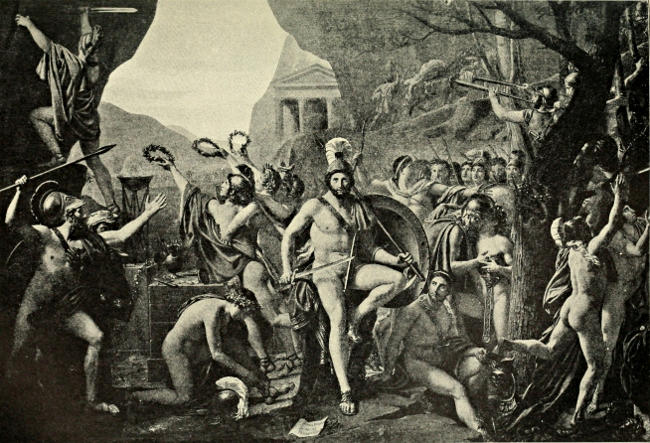
LEONIDAS (BY DAVID)
To those Greeks stationed in the straits of Thermopylæ, Megistias the
soothsayer had previously, from inspection of the entrails, predicted that
death awaited them in the morning. Some deserters had also informed
them of the circuit the Persians had taken; and this intelligence was in the
course of the night circulated through the camp. All this was confirmed by
their sentinels, who early in the morning fled down the sides of the mountain.
In this predicament, the Greeks called a council, who were greatly
divided in their opinions: some were for remaining on their station, others
advised a retreat. In consequence of their not agreeing, many of them dispersed
to their respective cities; a part resolved to continue with Leonidas.
It is said, that those who retired only did so in compliance with the
wishes of Leonidas, who was desirous to preserve them: but he thought
that he himself, with his Spartans, could not without the greatest ignominy
forsake the post they had come to defend. Obedient to the direction of their
leader, the confederates retired. The Thespians and Thebans[30] alone remained
with the Spartans, the Thebans indeed very reluctantly, but they were detained
by Leonidas as hostages. The Thespians were very zealous in the
cause, and refusing to abandon their friends, perished with them. The
leader of the Thespians was Demophilus, son of Diadromas.
The Final Assault
Xerxes early in the morning offered a solemn libation, then waiting till
the hour of full forum, he advanced from his camp: to the above measure
he had been advised by Ephialtes. The descent from the mountain is much
shorter than the circuitous ascent. The barbarians with Xerxes approached;
Leonidas and his Greeks proceeded, as to inevitable death, a much greater
space from the defile than they had yet done. Till now they had defended
themselves behind their entrenchment, fighting in the most contracted part
of the passage; but on this day they engaged on a wider space, and a multitude
of their opponents fell. Behind each troop of Persians, officers were
stationed with whips in their hands, compelling with blows their men to
advance. Many of them fell into the sea, where they perished; many were
trodden under foot by their own troops, without exciting the smallest pity
or regard. The Greeks, conscious that their destruction was at hand from
those who had taken the circuit of the mountain, exerted themselves with
the most desperate valour against their barbarian assailants.
Their spears being broken in pieces, they had recourse to their swords.
Leonidas fell in the engagement, having greatly signalised himself; and
with him, many Spartans of distinction, as well as others of inferior note.
Many illustrious Persians also were slain, among whom were Abrocomes
and Hyperanthes, sons of Darius.
These two brothers of Xerxes fell as they were contending for the body
of Leonidas: here the conflict was the most severe, till at length the Greeks
by their superior valour four times repelled the Persians, and drew aside
the body of their prince. In this situation they continued till Ephialtes
and his party approached. As soon as the Greeks perceived them at hand,
the scene was changed, and they retreated to the narrowest part of the pass.
Having repassed their entrenchment, they posted themselves, all except the
Thebans, in a compact body, upon a hill, which is at the entrance of the
straits, and where a lion of stone has been erected in honour of Leonidas.
In this situation, they who had swords left, used them against the enemy, the
rest exerted themselves with their hands and their teeth. The barbarians
rushing upon them, some in front, after overturning their wall, others
surrounding and pressing them in all directions, finally overpowered them.
Such was the conduct of the Lacedæmonians and Thespians; but none
of them distinguished themselves so much as Dieneces the Spartan. A
speech of his is recorded, which he made before they came to any engagement.
A certain Trachinian having observed that the barbarians would
send forth such a shower of arrows that their multitude would obscure the
sun; he replied, like a man ignorant of fear, and despising the numbers
of the Medes, “our Trachinian friend promises us great advantages; if the
Medes obscure the sun’s light, we shall fight them in the shade, and be protected
from the heat.” Many other sayings have been handed down as
monuments of this man’s fame. Next to him, the most distinguished of the
Spartans were, Alpheus and Maron, two brothers, the sons of Orisiphantus;
of the Thespians, the most conspicuous was Dithyrambus, son of Harmatidas.
All these were interred in the place where they fell, together with such of
the confederates as were slain before the separation of the forces by Leonidas.
Upon their tomb was this inscription:
“Here once, from Pelops’ seagirt region brought,
Four thousand men three hostile millions fought.”
This was applied to them all collectively. The Spartans were thus distinguished:
“Go, stranger, and to list’ning Spartans tell,
That here, obedient to their laws, we fell.”
There was one also appropriated to the prophet Megistias:
“By Medes cut off beside Sperchius’ wave,
The seer Megistias fills this glorious grave:
Who stood the fate he well foresaw to meet,
And, link’d with Sparta’s leaders, scorn’d retreat.”
All these ornaments and inscriptions, that of Megistias alone excepted,
were here placed by the Amphictyons.
Of these three hundred, there were two named Eurytus and Aristodemus;
both of them, consistently with the discipline of their country, might
have secured themselves by retiring to Sparta, for Leonidas had permitted
them to leave the camp; but they continued at Alpenus, being both afflicted
by a violent disorder of the eyes: or, if they had not thought proper to
return home, they had the alternative of meeting death in the field with their
fellow-soldiers. In this situation, they differed in opinion what conduct to
pursue. Eurytus having heard of the circuit made by the Persians, called
for his arms, and putting them on, commanded his helot to conduct him to
the battle. The slave did so, and immediately fled, whilst his master died
fighting valiantly. Aristodemus pusillanimously stayed where he was. If
either Aristodemus, being individually diseased, had retired home, or if they
had returned together, we cannot think that the Spartans could have shown
any resentment against them; but as one of them died in the field, which
the other, who was precisely in the same circumstances, refused to do, it was
impossible not to be greatly incensed against Aristodemus.
Aristodemus, on his return, was branded with disgrace and infamy; no
one would speak with him; no one would supply him with fire; and the
opprobrious term of trembler was annexed to his name; but he afterwards,
at the battle of Platæa, effectually atoned for his former conduct. It is also
said that another of the three hundred survived; his name was Pantites, and
he had been sent on some business to Thessaly. Returning to Sparta, he felt
himself in disgrace, and put an end to his life.
The Thebans, under the command of Leontiades, hitherto constrained by
force, had fought with the Greeks against the Persians; but as soon as they
saw that the Persians were victorious, when Leonidas and his party retired
to the hill, they separated themselves from the Greeks. In the attitude of
suppliants they approached the barbarians, assuring them, what was really
the truth, that they were attached to the Medes; that they had been among
the first to render earth and water; that they had only come to Thermopylæ
on compulsion, and could not be considered as accessory to the
slaughter of the king’s troops. The Thessalians confirming the truth of
what they had asserted, their lives were preserved. Some of them however
were slain; for as they approached, the barbarians put several to the sword;
but the greater part, by the order of Xerxes, had the royal marks impressed
upon them, beginning with Leontiades himself. Eurymachus his son was
afterwards slain at the head of four hundred Thebans, by the people of
Platæa, whilst he was making an attempt upon their city. In this manner
the Greeks fought at Thermopylæ.b
Such is the story of this memorable contest as Herodotus tells it. He is
our most important source by far, and his simple words give a more realistic
picture than is conveyed by any modern paraphrase. It is well to recall, however,
that there are discrepant accounts of the death of Leonidas. None of
these is so plausible as the description just given, but two of them are worth
citing, to illustrate the historical uncertainties that attach to the subject.a
Plutarch, in his parallels between the Romans and Greeks, thus describes
the death of Leonidas: “Whilst they were at dinner, the barbarians fell
upon them: upon which Leonidas desired them to eat heartily, for they
were to sup with Pluto. Leonidas charged at the head of his troops, and
after receiving a multitude of wounds, got up to Xerxes himself, and snatched
the crown from his head. He lost his life in the attempt; and Xerxes, causing
his body to be opened, found his heart hairy. So says Aristides, in his
first book of his Persian History.” This fiction seems to have been taken
from the λασιόν κῆρ of Homer.
Diodorus Siculus tells us that Leonidas, when he knew that he was circumvented,
made a bold attempt by night to penetrate to the tent of Xerxes;
but this the Persian king had forsaken on the first alarm. The Greeks however
proceeded in search of him from one side to the other, and slew a prodigious
multitude. When morning approached, the Persians perceiving the
Greeks so few in number, held them in contempt; but they still did not dare
to attack them in front; encompassing them on both sides, and behind, they
slew them all with their spears. Such was the end of Leonidas and his party.c
Where the Spartans fell, they were afterwards buried: their tomb, as
Simonides sang, was an altar; a sanctuary, in which Greece revered the
memory of her second founders.
The inscription of the monument raised over the slain, who died from
first to last in defence of the pass, recorded that four thousand men from
the Peloponnesus had fought at Thermopylæ with three hundred myriads.
We ought not to expect accuracy in these numbers: the list in Herodotus, if
the Locrian force is only supposed equal to the Phocian, exceeds six thousand
men: the Phocians, it must be remembered, were not engaged. But it is
not easy to reconcile either account with the historian’s statement, that the
Grecian dead amounted to four thousand, unless we suppose that the helots,
though not numbered, formed a large part of the army of Leonidas. The
lustre of his achievement is not diminished by their presence. He himself
and his Spartans no doubt considered their persevering stand in the post
entrusted to them, not as an act of high and heroic devotion, but of simple
and indispensable duty. Their spirit spoke in the lines inscribed upon their
monument, which bade the passenger tell their countrymen, that they had
fallen in obedience to their laws.
The Persians are said to have lost twenty thousand men: among them
were several of royal blood. To console himself for this loss, and to reap
the utmost advantage from his victory, Xerxes sent over to the fleet, which,
having heard of the departure of the Greeks, was now stationed on the north
coast of Eubœa, and by public notice invited all who were curious, to see the
chastisement he had inflicted on the men who had dared to defy his power.
That he had previously buried the greater part of his own dead seems natural
enough, and such an artifice, so slightly differing from the universal
practice of both ancient and modern belligerents, scarcely deserved the name
of a stratagem. He is said also to have mutilated the body of Leonidas, and
as this was one of the foremost he found on a field which had cost him so
dear, we are not at liberty to reject the tradition on the ground that such
ferocity was not consistent with the respect usually paid by the Persians
to a gallant enemy.
At Thermopylæ Xerxes learnt a lesson which he had refused to receive
from the warnings of Demaratus; and he inquired, with altered spirit,
whether he had to expect many such obstacles in the conquest of Greece.
The Spartan told him that there were eight thousand of his countrymen, who
would all be ready to do what Leonidas had done, and that at the isthmus
he would meet with a resistance more powerful and obstinate than at Thermopylæ.
But if, instead of attacking the Peloponnesus on this side, where he
would find its whole force collected to withstand him, he sent a detachment
of his fleet to seize the island of Cythera, and to infest the coast of Laconia,
the confederacy would be distracted, and its members, deprived of their
head and perhaps disunited, would successively yield to his arms. The
plan, whether Demaratus or Herodotus was the author, found no supporters
in the Persian council.
He had now the key of northern Greece in his hands, and it only remained
to determine towards which side he should first turn his arms. The
Thessalians, who ever since his arrival in their country had been zealous in
his service, now resolved to make use of their influence, and to direct the
course of the storm to their own advantage. These Thessalians, who are
mentioned on this occasion by Herodotus without any more precise description,
were probably the same nobles who, against the wishes of their nation,
had invited and forwarded the invasion. They had now an opportunity of
gratifying either their cupidity or their revenge; and they sent to the Phocians
to demand a bribe of fifty talents, as the price at which they would
consent to avert the destruction which was impending over Phocis. The
Phocians however either did not trust their faith, or would not buy their
safety of a hated rival. The Thessalians then persuaded Xerxes to cross
that part of the Œtean chain which separates the vale of the Sperchius from
the little valley of Doris. The Dorians were spared, as friends. Those of
the Phocians who had the means of escaping took refuge on the high plains
that lie under the topmost peaks of Parnassus, or at Amphissa. But on all
that remained in their homes, on the fields, the cities, the temples of the
devoted land, the fury of the invader, directed and stimulated by the malice
of the Thessalians, poured undistinguishing ruin. Fire and sword, the cruelty
and the lust of irritated spoilers, ravaged the vale of the Cephisus down
to the borders of Bœotia. The rich sanctuary of Apollo at Abæ was sacked
and burnt, and fourteen towns shared its fate. At Panopeus, Xerxes divided
his forces; or rather detached a small body round the foot of Parnassus to
Delphi, with orders to strip the temple of its treasures, and lay them at his
feet. He had learnt their value from the best authority at Sardis. The
great army turned off toward the lower vale of the Cephisus, to pursue its
march through Bœotia to Athens.h
Remains of the Tomb of Leonidas of Sparta
Eleusis, Part of the Island of Salamis
A king sate on the rocky brow
Which looks o’er sea-born Salamis;
And ships, by thousands, lay below,
And men in nations;—all were his,
He counted them at break of day,
And when the sun set where were they?
[480 B.C.]
The days of battle at Thermopylæ had been not less actively employed
by the fleets at Aphetæ and Artemisium. It has already been mentioned
that the Greek ships, having abandoned their station at the latter place and
retired to Chalcis, were induced to return, by the news that the Persian
fleet had been nearly ruined by the recent storm, and that, on returning
to Artemisium, the Grecian commanders felt renewed alarm on seeing the
enemy’s fleet, in spite of the damage just sustained, still mustering in overwhelming
number at the opposite station of Aphetæ. Such was the effect
of this spectacle, and the impression of their own inferiority, that they again
resolved to retire without fighting, leaving the strait open and undefended.
Great consternation was caused by the news of their determination among
the inhabitants of Eubœa, who entreated Eurybiades to maintain his position
for a few days, until they could have time to remove their families and their
property. But even such postponement was thought unsafe, and refused:
and he was on the point of giving orders for retreat, when the Eubœans
sent their envoy, Pelagon, to Themistocles, with the offer of thirty talents,
on condition that the fleet should keep its station and hazard an engagement
in defence of the island. Themistocles employed the money adroitly and
successfully, giving five talents to Eurybiades, with large presents besides to
the other leading chiefs: the most unmanageable among them was the
Corinthian Adimantus, who at first threatened to depart with his own
squadron alone, if the remaining Greeks were mad enough to remain.
His alarm was silenced, if not tranquillised, by a present of three talents.
However Plutarch may be scandalised at such inglorious revelations preserved
to us by Herodotus respecting the underhand agencies of this memorable
struggle, there is no reason to call in question the bribery here described.
But Themistocles doubtless was only tempted to do, and enabled to do, by means
of the Eubœan money, that which he would have wished and had probably tried
to accomplish without the money—to bring on a naval engagement at Artemisium.
It was absolutely essential to the maintenance of Thermopylæ, and to
the general plan of defence, that the Eubœan strait should be defended against
the Persian fleet, nor could the Greeks expect a more favourable position to
fight in. We may reasonably presume that Themistocles, distinguished not
less by daring than by sagacity, and the great originator of maritime energies
in his country, concurred unwillingly in the projected abandonment of
Artemisium: but his high mental capacity did not exclude that pecuniary
corruption which rendered the presents of the Eubœans both admissible and
welcome—yet still more welcome to him perhaps, as they supplied means
of bringing over the other opposing chiefs and the Spartan admiral. It was
finally determined, therefore, to remain, and if necessary, to hazard an
engagement in the Eubœan strait: but at any rate to procure for the inhabitants
of the island a short interval to remove their families. Had these
Eubœans heeded the oracles, says Herodotus, they would have packed up
and removed long before; for a text of Bacis gave them express warning;
but, having neglected the sacred writings as unworthy of credit, they were
now severely punished for such presumption.
Among the Persian fleet at Aphetæ, on the other hand, the feeling prevalent
was one of sanguine hope and confidence in their superior numbers,
forming a strong contrast with the discouragement of the Greeks at
Artemisium. Had they attacked the latter immediately, when both fleets
first saw each other from their opposite stations, they would have gained an
easy victory, for the Greek fleet would have fled, as the admiral was on the
point of ordering, even without an attack. But this was not sufficient for
the Persians, who wished to cut off every ship among their enemies even
from flight and escape. Accordingly, they detached two hundred ships to
circumnavigate the island of Eubœa, and to sail up the Eubœan strait from
the south, in the rear of the Greeks,—and postponing their own attack in
front until this squadron should be in position to intercept the retreating
Greeks. But though the manœuvre was concealed by sending the squadron
round outside of the island of Sciathus, it became known immediately
among the Greeks, through a deserter—Scyllias of Scione. This man, the
best swimmer and diver of his time, and now engaged like other Thracian
Greeks in the Persian service, passed over to Artemisium, and communicated
to the Greek commanders both the particulars of the late destructive storm
and the despatch of the intercepting squadron.
It appears that his communications, respecting the effects of the storm
and the condition of the Persian fleet, somewhat reassured the Greeks, who
resolved during the ensuing night to sail from their station at Artemisium
for the purpose of surprising the detached squadron of two hundred ships,
and who even became bold enough, under the inspirations of Themistocles,
to go out and offer battle to the main fleet near Aphetæ. Wanting to
acquire some practical experience, which neither leaders nor soldiers as yet
possessed, of the manner in which Phœnicians and others in the Persian
fleet handled and manœuvred their ships, they waited till a late hour of
the afternoon, when little daylight remained. Their boldness in thus advancing
out, with inferior numbers and even inferior ships, astonished the
Persian admirals, and distressed the Ionians and other subject Greeks who
were serving them as unwilling auxiliaries: to both it seemed that the victory
of the Persian fleet, which was speedily brought forth to battle, and was numerous
enough to encompass the Greeks, would be certain as well as complete.
The Greek ships were at first marshalled in a circle, with the sterns in the
interior, and presenting their prows in front at all points of the circumference;
in this position, compressed into a narrow space, they seemed to be
awaiting the attack of the enemy, who formed a larger circle around them:
but on a second signal given, their ships assumed the aggressive, rowed out
from the inner circle in direct impact against the hostile ships around, and
took or disabled no less than thirty of them; in one of which Philaon, brother
of Gorgus, despot of Salamis in Cyprus, was made prisoner. Such unexpected
forwardness at first disconcerted the Persians, who however rallied
and inflicted considerable damage and loss on the Greeks: but the near
approach of night put an end to the combat, and each fleet retired to its
former station—the Persians to Aphetæ, the Greeks to Artemisium.
The result of this first day’s combat, though indecisive in itself, surprised
both parties and did much to exalt the confidence of the Greeks. But the
events of the ensuing night did yet more. Another tremendous storm was
sent by the gods to aid them. Though it was the middle of summer,—a
season when rain rarely falls in the climate of Greece,—the most violent
wind, rain, and thunder prevailed during the whole night, blowing right on
shore against the Persians at Aphetæ, and thus but little troublesome to the
Greeks on the opposite side of the strait. The seamen of the Persian fleet,
scarcely recovered from the former storm at Sepias Acte, were almost driven
to despair by this repetition of the same peril: the more so when they found
the prows of their ships surrounded, and the play of their oars impeded, by
the dead bodies and the spars from the recent battle, which the current
drove towards their shore. If this storm was injurious to the main fleet at
Aphetæ, it proved the entire ruin of the squadron detached to circumnavigate
Eubœa, who, overtaken by it near the dangerous eastern coast of that
island, called the Hollows of Eubœa, were driven upon the rocks and
wrecked. The news of this second conspiracy of the elements, or intervention
of the gods, against the schemes of the invaders, was highly
encouraging to the Greeks; and the seasonable arrival of fifty-three fresh
Athenian ships, which reinforced them the next day, raised them to a still
higher pitch of confidence. In the afternoon of the same day, they sailed
out against the Persian fleet at Aphetæ, and attacked and destroyed some
Cilician ships even at their moorings; the fleet having been too much
damaged by the storm of the preceding night to come out and fight.
But the Persian admirals were not of a temper to endure such insults,—still
less to let their master hear of them. About noon on the ensuing
day, they sailed with their entire fleet near to the Greek station at Artemisium,
and formed themselves into a half moon; while the Greeks kept
near to the shore, so that they could not be surrounded, nor could the
Persians bring their entire fleet into action; the ships running foul of
each other, and not finding space to attack. The battle raged fiercely all
day, and with great loss and damage on both sides: the Egyptians bore
off the palm of valour among the Persians, the Athenians among the
Greeks. Though the positive loss sustained by the Persians was by far
the greater, and though the Greeks, being near their own shore, became
masters of the dead bodies as well as of the disabled ships and floating
fragments, still, they were themselves hurt and crippled in greater proportion
with reference to their inferior total: and the Athenian vessels
especially, foremost in the preceding combat, found one-half of their
number out of condition to renew it. The Egyptians alone had captured
five Grecian ships with their entire crews.
Under these circumstances, the Greek leaders—and Themistocles, as
it seems, among them—determined that they could no longer venture to
hold the position of Artemisium, but must withdraw the naval force farther
into Greece: though this was in fact a surrender of the pass of Thermopylæ,
and though the removal which the Eubœans were hastening was still unfinished.
These unfortunate men were forced to be satisfied with the
promise of Themistocles to give them convoy for their boats and their
persons; abandoning their sheep and cattle for the consumption of the
fleet, as better than leaving them to become booty for the enemy. While
the Greeks were thus employed in organising their retreat, they received
news which rendered retreat doubly necessary. The Athenian Abronychus,
stationed with his ship near Thermopylæ, in order to keep up communication
between the army and fleet, brought the disastrous intelligence that
Xerxes was already master of the pass, and that the division of Leonidas
was either destroyed or in flight. Upon this the fleet abandoned Artemisium
forthwith, and sailed up the Eubœan strait; the Corinthian ships
in the van, the Athenians bringing up the rear. Themistocles, conducting
the latter, stayed long enough at the various watering-stations and landing-places
to inscribe on some neighbouring stones invitations to the Ionian
contingents serving under Xerxes: whereby the latter were conjured not
to serve against their fathers, but to desert, if possible—or at least, to
fight as little and as backwardly as they could. Themistocles hoped by
this stratagem perhaps to detach some of the Ionians from the Persian
side, or, at any rate, to render them objects of mistrust, and thus to
diminish their efficiency. With no longer delay than was requisite for
such inscriptions, he followed the remaining fleet, which sailed round the
coast of Attica, not stopping until it reached the island of Salamis.
The news of the retreat of the Greek fleet was speedily conveyed by
a citizen of Histiæa to the Persians at Aphetæ, who at first disbelieved it,
and detained the messenger until they had sent to ascertain the fact. On
the next day, their fleet passed across to the north of Eubœa, and became
master of Histiæa and the neighbouring territory: from whence many of
them, by permission and even invitation of Xerxes, crossed over to Thermopylæ
to survey the field of battle and the dead. Respecting the number
of the dead, Xerxes is asserted to have deliberately imposed upon the
spectators: he buried all his own dead, except one thousand, whose bodies
were left out—while the total number of Greeks who had perished at
Thermopylæ, four thousand in number, were all left exposed, and in one
heap, so as to create an impression that their loss had been much more
severe than their own. Moreover, the bodies of the slain helots were
included in the heap, all of them passing for Spartans or Thespians in
the estimation of the spectators. We are not surprised to hear, however,
that this trick, gross and public as it must have been, really deceived
very few.
The sentiment, alike durable and unanimous, with which the Greeks of
after-times looked back on the battle of Thermopylæ, and which they have
communicated to all subsequent readers, was that of just admiration for the
courage and patriotism of Leonidas and his band. But among the contemporary
Greeks that sentiment, though doubtless sincerely felt, was by no
means predominant: it was overpowered by the more pressing emotions of
disappointment and terror. So confident were the Spartans and Peloponnesians
in the defensibility of Thermopylæ and Artemisium, that when the
news of the disaster reached them, not a single soldier had yet been put in
motion: the season of the festival games had passed, but no active step had
yet been taken. Meanwhile the invading force, army, and fleet, was in its
progress towards Attica and the Peloponnesus, without the least preparations—and,
what was still worse, without any combined and concerted plan—for
defending the heart of Greece. The loss sustained by Xerxes at Thermopylæ,
insignificant in proportion to his vast total, was more than compensated
by the fresh Grecian auxiliaries which he now acquired. Not merely the
Malians, Locrians, and Dorians, but also the great mass of the Bœotians,
with their chief town Thebes, all except Thespiæ and Platæa, now joined
him. Demaratus, his Spartan companion, moved forward to Thebes to
renew an ancient tie of hospitality with the Theban oligarchical leader,
Attaginus, while small garrisons were sent by Alexander of Macedon to
most of the Bœotian towns, as well to protect them from plunder as to
insure their fidelity. The Thespians, on the other hand, abandoned their city,
and fled into the Peloponnesus; while the Platæans, who had been serving
aboard the Athenian ships at Artemisium, were disembarked at Chalcis as
the fleet retreated, for the purpose of marching by land to their city, and
removing their families. Nor was it only the land-force of Xerxes which
had been thus strengthened; his fleet also had received some accessions from
Carystus in Eubœa, and from several of the Cyclades—so that the losses
sustained by the storm at Sepias and the fights at Artemisium, if not wholly
made up, were at least in part repaired, while the fleet remained still prodigiously
superior in number to that of the Greeks.
At the beginning of the Peloponnesian War, near fifty years after these
events, the Corinthian envoys reminded Sparta that she had allowed Xerxes
time to arrive from the extremity of the earth at the threshold of the Peloponnesus,
before she took any adequate precautions against him; a reproach true
almost to the letter. It was only when roused and terrified by the news of
the death of Leonidas, that the Lacedæmonians and the other Peloponnesians
began to put forth their full strength. But it was then too late to
perform the promise made to Athens, of taking up a position in Bœotia so
as to protect Attica. To defend the isthmus of Corinth was all that they
now thought of, and seemingly all that was now open to them: thither they
rushed with all their available population under the conduct of Cleombrotus,
king of Sparta (brother of Leonidas), and began to draw fortifications
across it, as well as to break up the Scironian road from Megara to Corinth,
with every mark of anxious energy. The Lacedæmonians, Arcadians,
Eleans, Corinthians, Sicyonians, Epidaurians, Phliasians, Trœzenians, and
Hermionians, were all present here in full numbers; many myriads of men
(bodies of ten thousand each) working and bringing materials night and
day. As a defence to themselves against attack by land, this was an excellent
position: they considered it as their last chance, abandoning all hope
of successful resistance at sea. But they forgot that a fortified isthmus was
no protection even to themselves against the navy of Xerxes, while it professedly
threw out not only Attica, but also Megara and Ægina. And thus
rose a new peril to Greece from the loss of Thermopylæ: no other position
could be found which, like that memorable strait, comprehended and protected
at once all the separate cities. The disunion thus produced brought
them within a hair’s breadth of ruin.
If the causes of alarm were great for the Peloponnesians, yet more desperate
did the position of the Athenians appear. Expecting, according to
agreement, to find a Peloponnesian army in Bœotia ready to sustain Leonidas,
or at any rate to co-operate in the defence of Attica, they had taken no
measures to remove their families or property: but they saw with indignant
disappointment as well as dismay, on retreating from Artemisium, that the
conqueror was in full march from Thermopylæ, that the road to Attica was
open to him, and that the Peloponnesians were absorbed exclusively in the
defence of their own isthmus and their own separate existence. The fleet
from Artemisium had been directed to muster at the harbour of Trœzen, there
to await such reinforcements as could be got together: but the Athenians
entreated Eurybiades to halt at Salamis, so as to allow them a short time
for consultation in the critical state of their affairs, and to aid them in the
transport of their families. While Eurybiades was thus staying at Salamis,
several new ships which had reached Trœzen came over to join him; and in
this way Salamis became for a time the naval station of the Greeks, without
any deliberate intention beforehand.
Meanwhile Themistocles and the Athenian seamen landed at Phalerum,
and made their mournful entry into Athens. Gloomy as the prospect appeared,
there was little room for difference of opinion, and still less room for
delay. The authorities and the public assembly at once issued a proclamation,
enjoining every Athenian to remove his family out of the country in
the best way he could. We may conceive the state of tumult and terror
which followed on this unexpected proclamation, when we reflect that it
had to be circulated and acted upon throughout all Attica, from Sunium to
Oropus, within the narrow space of less than six days; for no longer interval
elapsed before Xerxes actually arrived at Athens, where indeed he might
have arrived even sooner.
The whole Grecian fleet was doubtless employed in carrying out the helpless
exiles; mostly to Trœzen, where a kind reception and generous support
were provided for them,—the Trœzenian population being seemingly semi-Ionic,
and having ancient relations of religion as well as of traffic with
Athens,—but in part also to Ægina: there were, however, many who
could not, or would not, go farther than Salamis. Themistocles impressed
upon the sufferers that they were only obeying the oracle, which had directed
them to abandon the city and to take refuge behind the wooden
walls; and either his policy, or the mental depression of the time, gave circulation
to other stories, intimating that even the divine inmates of the
Acropolis were for a while deserting it. In the ancient temple of Athene
Polias on that rock, there dwelt, or was believed to dwell, as guardian to
the sanctuary and familiar attendant of the goddess, a sacred serpent, for
whose nourishment a honey cake was placed once in the month. The honey
cake had been hitherto regularly consumed; but at this fatal moment the
priestess announced that it remained untouched: the sacred guardian had
thus set the example of quitting the acropolis, and it behooved the citizens
to follow the example, confiding in the goddess herself for future return and
restitution.
The migration of so many ancient men, women, and children, was a
scene of tears and misery inferior only to that which would have ensued on
the actual capture of the city.[31] Some few individuals, too poor to hope for
maintenance, or too old to care for life elsewhere,—confiding, moreover,
in their own interpretation of the wooden wall which the Pythian priestess
had pronounced to be inexpugnable,—shut themselves up in the Acropolis
along with the administrators of the temple, obstructing the entrance or
western front with wooden doors and palisades. When we read how great
were the sufferings of the population of Attica near half a century afterwards,
compressed for refuge within the spacious fortifications of Athens at
the first outbreak of the Peloponnesian War, we may form some faint idea
of the incalculably greater misery which overwhelmed an emigrant population,
hurrying, they knew not whither, to escape the long arm of Xerxes.
Little chance did there seem that they would ever revisit their homes except
as his slaves.
In the midst of circumstances thus calamitous and threatening, neither
the warriors nor the leaders of Athens lost their energy—arm as well as
mind was strung to the loftiest pitch of human resolution. Political dissensions
were suspended: Themistocles proposed to the people a decree, and
obtained their sanction, inviting home all who were under sentence of temporary
banishment: moreover, he not only included but even specially designated
among them his own great opponent Aristides, now in the third year
of ostracism. Xanthippus the accuser, and Cimon, the son of Miltiades,
were partners in the same emigration: the latter, enrolled by his scale of
fortune among the horsemen of the state, was seen with his companions
cheerfully marching through the Ceramicus to dedicate their bridles in the
Acropolis, and to bring away in exchange some of the sacred arms there suspended,
thus setting an example of ready service on shipboard, instead of on
horseback. It was absolutely essential to obtain supplies of money, partly
for the aid of the poorer exiles, but still more for the equipment of the fleet;
there were no funds in the public treasury—but the senate of Areopagus,
then composed in large proportion of men from the wealthier classes, put forth
all its public authority as well as its private contributions and example to
others, and thus succeeded in raising the sum of eight drachmæ for every
soldier serving.
This timely help was indeed partly obtained by the inexhaustible resource
of Themistocles, who, in the hurry of embarkation, either discovered or pretended
that the Gorgon’s head from the statue of Athene was lost, and
directing upon this ground every man’s baggage to be searched, rendered
any treasures, which private citizens might be carrying out, available to the
public service. By the most strenuous efforts, these few important days
were made to suffice for removing the whole population of Attica,—those of
military competence to the fleet at Salamis,—the rest to some place of
refuge,—together with as much property as the case admitted. So complete
was the desertion of the country, that the host of Xerxes, when it
became master, could not seize and carry off more than five hundred prisoners.
Moreover, the fleet itself, which had been brought home from
Artemisium partially disabled, was quickly repaired, so that, by the time the
Persian fleet arrived, it was again in something like fighting condition.
The combined fleet which had now got together at Salamis consisted of
three hundred and sixty-six ships,—a force far greater than at Artemisium.
Of these, no less than two hundred were Athenian; twenty among which,
however, were lent to the Chalcidians, and manned by them. Forty Corinthian
ships, thirty Æginetan, twenty Megarian, sixteen Lacedæmonian,
fifteen Sicyonian, ten Epidaurian, seven from Ambracia, and as many from
Eretria, five from Trœzen, three from Hermione, and the same number from
Leucas; two from Ceos, two from Styra, and one from Cythnos; four
from Naxos, despatched as a contingent to the Persian fleet, but brought by
the choice of their captains and seamen to Salamis;—all these triremes,
together with a small squadron of the inferior vessels called penteconters,
made up the total. From the great Grecian cities in Italy there appeared
only one trireme, a volunteer, equipped and commanded by an eminent citizen
named Phaÿllus, thrice victor at the Pythian games. The entire fleet
was thus a trifle larger than the combined force, three hundred and fifty-eight
ships, collected by the Asiatic Greeks at Lade, fifteen years earlier,
during the Ionic revolt. We may doubt, however, whether this total,
borrowed from Herodotus, be not larger than that which actually fought a
little afterwards at the battle of Salamis, and which Æschylus gives decidedly
as consisting of three hundred sail, in addition to ten prime and chosen
ships. That great poet, himself one of the combatants, and speaking in a
drama represented only seven years after the battle, is better authority on
the point even than Herodotus.
Hardly was the fleet mustered at Salamis, and the Athenian population
removed, when Xerxes and his host overran the deserted country, his fleet
occupying the roadstead of Phalerum with the coast adjoining. His land
force had been put in motion under the guidance of the Thessalians, two or
three days after the battle of Thermopylæ, and he was assured by some
Arcadians who came to seek service, that the Peloponnesians were, even at
that moment, occupied with the celebration of the Olympic games. “What
prize does the victor receive?” he asked. Upon the reply made, that the
prize was a wreath of the wild olive, Tritantæchmes, son of the monarch’s
uncle Artabanus, is said to have burst forth, notwithstanding the displeasure
both of the monarch himself and of the bystanders: “Heavens, Mardonius,
what manner of men are these against whom thou hast brought us to fight!
men who contend not for money, but for honour!” Whether this be a
remark really delivered, or a dramatic illustration imagined by some contemporary
of Herodotus, it is not the less interesting as bringing to view a
characteristic of Hellenic life, which contrasts not merely with the manners
of contemporary Orientals, but even with those of the earlier Greeks themselves
during the Homeric times.
Among all the various Greeks between Thermopylæ and the borders of
Attica, there were none except the Phocians disposed to refuse submission:
and they refused only because the paramount influence of their bitter enemies
the Thessalians made them despair of obtaining favourable terms.
Nor would they even listen to a proposition of the Thessalians, who, boasting
that it was in their power to guide as they pleased the terrors of the
Persian host, offered to insure lenient treatment to the territory of Phocis,
provided a sum of fifty talents were paid to them. The proposition being
indignantly refused, they conducted Xerxes through the little territory of
Doris, which medised and escaped plunder, into the upper valley of the
Cephisus, among the towns of the inflexible Phocians. All of them were
found deserted; the inhabitants having previously escaped either to the
wide-spreading summit of Parnassus, called Tithorea, or even still farther,
across that mountain into the territory of the Ozolian Locrians. Ten or
a dozen small Phocian towns, the most considerable of which were Elatea
and Hyampolis, were sacked and destroyed by the invaders, nor was the
holy temple and oracle of Apollo at Abæ better treated than the rest: all
its treasures were pillaged, and it was then burnt. From Panopeus Xerxes
detached a body of men to plunder Delphi, marching with his main army
through Bœotia, in which country he found all the towns submissive and
willing, except Thespiæ and Platæa: both were deserted by their citizens,
and both were now burnt. From hence he conducted his army into the
abandoned territory of Attica, reaching without resistance the foot of the
Acropolis at Athens.
Very different was the fate of that division which he had detached from
Panopeus against Delphi: Apollo defended his temple here more vigorously
than at Abæ. The cupidity of the Persian king was stimulated by
accounts of the boundless wealth accumulated at Delphi, especially the profuse
donations of Crœsus. The Delphians, in the extreme of alarm, while
they sought safety for themselves on the heights of Parnassus, and for their
families by transport across the gulf into Achaia, consulted the oracle
whether they should carry away or bury the sacred treasures. Apollo directed
them to leave the treasures untouched, saying that he was competent
himself to take care of his own property. Sixty Delphians alone ventured
to remain, together with Aceratus, the religious superior: but evidences of
superhuman aid soon appeared to encourage them. The sacred arms suspended
in the interior cell, which no mortal hand was ever permitted to
touch, were seen lying before the door of the temple; and when the Persians,
marching along the road called Schiste, up that rugged path under
the steep cliffs of Parnassus which conducts to Delphi, had reached the
temple of Athene Pronœa, on a sudden, dreadful thunder was heard,
two vast mountain crags detached themselves and rushed down with deafening
noise among them, crushing many to death, the war shout was also
heard from the interior of the temple of Athene. Seized with a panic terror,
the invaders turned round and fled; pursued not only by the Delphians,
but also, as they themselves affirmed, by two armed warriors of superhuman
stature and destructive arm. The triumphant Delphians confirmed this
report, adding that the two auxiliaries were the heroes Phylacus and Autonoüs,
whose sacred precincts were close adjoining: and Herodotus himself
when he visited Delphi, saw in the sacred ground of Athene the identical
masses of rock which had overwhelmed the Persians.[32] Thus did the god
repel these invaders from his Delphian sanctuary and treasures, which remained
inviolate until one hundred and thirty years afterwards, when they
were rifled by the sacrilegious hands of the Phocian Philomelus. On this
occasion, as will be seen presently, the real protectors of the treasures were
the conquerors at Salamis and Platæa.
Four months had elapsed since the departure from Asia when Xerxes
reached Athens, the last term of his advance. He brought with him the
members of the Pisistratid family, who doubtless thought their restoration
already certain, and a few Athenian exiles attached to their interest.
Though the country was altogether deserted, the handful of men collected
in the Acropolis ventured to defy him: nor could all the persuasions of the
Pisistratids, eager to preserve the holy place from pillage, induce them to
surrender.
The Athenian Acropolis—a craggy rock rising abruptly about one hundred
and fifty feet, with a flat summit of about one thousand feet long from
east to west, by five hundred feet broad from north to south—had no practicable
access except on the western side: moreover, in all parts where there
seemed any possibility of climbing up, it was defended by the ancient fortification
called the Pelasgic wall. Obliged to take the place by force, the
Persian army was posted around the northern and western sides, and commenced
their operations from the eminence immediately adjoining on the
northwest, called Areopagus: from whence they bombarded, if we may venture
upon the expression, with hot missiles, the woodwork before the gates;
that is, they poured upon it multitudes of arrows with burning tow attached
to them. The wooden palisades and boarding presently took fire and were
consumed: but when the Persians tried to mount to the assault by the western
road leading up to the gate, the undaunted little garrison still kept them
at bay, having provided vast stones, which they rolled down upon them in the
ascent.
For a time the Great King seemed likely to be driven to the slow process
of blockade; but at length some adventurous men among the besiegers tried
to scale the precipitous rock before them on its northern side, hard by the
temple or chapel of Aglaurus, which lay nearly in front of the Persian position,
but behind the gates and the western ascent. Here the rock was
naturally so inaccessible, that it was altogether unguarded, and seemingly
even unfortified: moreover, the attention of the little garrison was all
concentrated on the host which fronted the gates. Hence the separate escalading
party was enabled to accomplish their object unobserved, and to
reach the summit in the rear of the garrison; who, deprived of their last
hope, either cast themselves headlong from the walls, or fled for safety to
the inner temple. The successful escaladers opened the gates to the entire
Persian host, and the whole Acropolis was presently in their hands. Its defenders
were slain, its temples pillaged, and all its dwellings and buildings,
sacred as well as profane, consigned to the flames. The citadel of Athens
fell into the hands of Xerxes by a surprise, very much the same as that
which had placed Sardis in those of Cyrus.
Thus was divine prophecy fulfilled: Attica passed entirely into the
hands of the Persians, and the conflagration of Sardis was retaliated upon
the home and citadel of its captors, as it also was upon their sacred temple
of Eleusis. Xerxes immediately despatched to Susa intelligence of the fact,
which is said to have excited unmeasured demonstrations of joy, confuting,
seemingly, the gloomy predictions of his uncle Artabanus. On the next day
but one, the Athenian exiles in his suite received his orders, or perhaps obtained
his permission, to go and offer sacrifice amidst the ruins of the Acropolis,
and atone, if possible, for the desecration of the ground: they discovered
that the sacred olive tree near the chapel of Erechtheus, the special gift of
the goddess Athene, though burnt to the ground by the recent flames, had
already thrown out a fresh shoot of one cubit long,—at least the piety of
restored Athens afterwards believed this encouraging portent, as well as
that which was said to have been seen by Dicæus, an Athenian companion
of the Pisistratids, in the Thriasian plain.
It was now the day set apart for the celebration of the Eleusinian mysteries;
and though in this sorrowful year there was no celebration, nor
any Athenians in the territory, Dicæus still fancied that he beheld the
dust and heard the loud multitudinous chant, which was wont to accompany
in ordinary times the processional march from Athens to Eleusis. He would
even have revealed the fact to Xerxes himself, had not Demaratus deterred
him from doing so: but he as well as Herodotus construed it as an evidence
that the goddesses themselves were passing over from Eleusis to help the
Athenians at Salamis. But whatever may have been received in after times,
on that day certainly no man could believe in the speedy resurrection of conquered
Athens as a free city: not even if he had witnessed the portent of
the burnt olive tree suddenly sprouting afresh with preternatural vigour. So
hopeless did the circumstances of the Athenians then appear, not less to their
confederates assembled at Salamis than to the victorious Persians.
About the time of the capture of the Acropolis, the Persian fleet also
arrived safely in the Bay of Phalerum, reinforced by ships from Carystus as
well as from various islands of the Cyclades, so that Herodotus reckons it to
have been as strong as before the terrible storm at Sepias Acte—an estimate
certainly not admissible.
Soon after their arrival, Xerxes himself descended to the shore to inspect
the fleet, as well as to take counsel with the various naval leaders about the
expediency of attacking the hostile fleet, now so near him in the narrow strait
between Salamis and the coasts of Attica. He invited them all to take their
seats in an assembly, wherein the king of Sidon occupied the first place and
the king of Tyre the second. The question was put to each of them separately
by Mardonius, and when we learn that all pronounced in favour of immediate
fighting, we may be satisfied that the decided opinion of Xerxes himself must
have been well known to them beforehand. One exception alone was found
to this unanimity,—Artemisia, queen of Halicarnassus in Caria; into whose
mouth Herodotus puts a speech of some length, deprecating all idea of fighting
in the narrow strait of Salamis, predicting that if the land-force were
moved forwards to attack the Peloponnesus, the Peloponnesians in the fleet at
Salamis would return for the protection of their own homes, and thus the
fleet would disperse, the rather as there was little or no food in the island,
and intimating, besides, unmeasured contempt for the efficacy of the Persian
fleet and seamen as compared with the Greek, as well as for the subject contingents
of Xerxes generally. That Queen Artemisia gave this prudent
counsel, there is no reason to question; and the historian of Halicarnassus
may have had means of hearing the grounds on which her opinion rested:
but we find a difficulty in believing that she can have publicly delivered any
such estimate of the maritime subjects of Persia—an estimate not merely
insulting to all who heard it, but at the time not just, though it had come to
be nearer the truth at the time when Herodotus wrote, and though Artemisia
herself may have lived to entertain the conviction afterwards. Whatever may
have been her reasons, the historian tells us that friends as well as rivals
were astonished at her rashness in dissuading the monarch from a naval
battle, and expected that she would be put to death. But Xerxes heard the
advice with perfect good temper, and even esteemed the Carian queen the
more highly: though he resolved that the opinion of the majority, or his own
opinion, should be acted upon: and orders were accordingly issued for
attacking the next day, while the land-force should move forwards towards
the Peloponnesus.
Whilst, on the shore of Phalerum, an omnipotent will compelled seeming
unanimity and precluded all real deliberation, great, indeed, was the contrast
presented by the neighbouring Greek armament at Salamis, among the
members of which unmeasured dissension had been reigning. It has already
been stated that the Greek fleet had originally got together at that island,
not with any view of making it a naval station, but simply in order to cover
and assist the emigration of the Athenians. This object being accomplished,
and Xerxes being already in Attica, Eurybiades convoked the chiefs to consider
what position was the fittest for a naval engagement. Most of them,
especially those from the Peloponnesus, were averse to remaining at Salamis, and
proposed that the fleet should be transferred to the isthmus of Corinth, where
it would be in immediate communication with the Peloponnesian land-force,
so that in case of defeat at sea, the ships would find protection on shore, and
the men would join in the land service—while if worsted in a naval action
near Salamis, they would be inclosed in an island from whence there were
no hopes of escape. In the midst of the debate, a messenger arrived with
news of the capture and conflagration of Athens and her Acropolis by the
Persians: and such was the terror produced by this intelligence, that some
of the chiefs, without even awaiting the conclusion of the debate and the
final vote, quitted the council forthwith, and began to hoist sail, or prepare
their rowers, for departure. The majority came to a vote for removing to
the isthmus, but as night was approaching, actual removal was deferred until
the next morning.
Now was felt the want of a position like that of Thermopylæ, which had
served as a protection to all the Greeks at once, so as to check the growth of
separate fears and interests. We can hardly wonder that the Peloponnesian
chiefs—the Corinthian in particular, who furnished so large a naval contingent,
and within whose territory the land-battle at the isthmus seemed about
to take place—should manifest such an obstinate reluctance to fight at Salamis,
and should insist on removing to a position where, in case of naval
defeat, they could assist, and be assisted by, their own soldiers on land.
On the other hand, Salamis was not only the most favourable position, in
consequence of its narrow strait, for the inferior numbers of the Greeks,
but could not be abandoned without breaking up the unity of the allied fleet;
since Megara and Ægina would thus be left uncovered, and the contingents
of each would immediately retire for the defence of their homes, while the
Athenians also, a large portion of whose expatriated families were in Salamis
and Ægina, would be in like manner distracted from combined maritime
efforts at the isthmus. If transferred to the latter place, probably not even
the Peloponnesians themselves would have remained in one body; for the
squadrons of Epidaurus, Trœzen, Hermione, etc., each fearing that the
Persian fleet might make a descent on one or other of these separate ports,
would go home to repel such a contingency, in spite of the efforts of Eurybiades
to keep them together. Hence the order for quitting Salamis and
repairing to the isthmus was nothing less than a sentence of extinction for
all combined maritime defence; and it thus became doubly abhorrent to all
those who, like the Athenians, Æginetans, and Megarians, were also led by
their own separate safety to cling to the defence of Salamis. In spite of all
such opposition, however, and in spite of the protest of Themistocles, the
obstinate determination of the Peloponnesian leaders carried the vote for
retreat, and each of them went to his ship to prepare for it on the following
morning.
When Themistocles returned to his ship, with the gloom of this melancholy
resolution full upon his mind, and with the necessity of providing for
removal of the expatriated Athenian families in the island as well as for that
of the squadron, he found an Athenian friend named Mnesiphilus, who asked
him what the synod of chiefs had determined. Concerning this Mnesiphilus,
who is mentioned generally as a sagacious practical politician, we unfortunately
have no particulars: but it must have been no common man whom
fame selected, truly or falsely, as the inspiring genius of Themistocles. On
learning what had been resolved, Mnesiphilus burst out into remonstrance
on the utter ruin which its execution would entail: there would presently
be neither any united fleet to fight, nor any aggregate cause and country to
fight for. He vehemently urged Themistocles again to open the question,
and to press by every means in his power for a recall of the vote for retreat,
as well as for a resolution to stay and fight at Salamis.
Themistocles had already in vain tried to enforce the same view: but
disheartened as he was by ill success, the remonstrances of a respected friend
struck him so forcibly as to induce him to renew his efforts. He went instantly
to the ship of Eurybiades, asked permission to speak with him, and
being invited aboard, reopened with him alone the whole subject of the past
discussion, enforcing his own views as emphatically as he could. In this
private communication, all the arguments bearing upon the case were more
unsparingly laid open than it had been possible to do in an assembly of the
chiefs, who would have been insulted if openly told that they were likely to
desert the fleet when once removed from Salamis. Speaking thus freely and
confidentially, and speaking to Eurybiades alone, Themistocles was enabled
to bring him partially round, and even prevailed upon him to convene a fresh
synod. So soon as this synod had assembled, even before Eurybiades had
explained the object and formally opened the discussion, Themistocles addressed
himself to each of the chiefs separately, pouring forth at large his
fears and anxiety as to the abandonment of Salamis: insomuch that the
Corinthian Adimantus rebuked him by saying, “Themistocles, those who in
the public festival-matches rise up before the proper signal, are scourged.”
“True,” rejoined the Athenian, “but those who lag behind the signal win
no crowns.”
Eurybiades then explained to the synod that doubts had arisen in his
mind, and that he called them together to reconsider the previous resolve:
upon which Themistocles began the debate, and vehemently enforced the
necessity of fighting in the narrow sea of Salamis and not in the open waters
at the isthmus, as well as of preserving Megara and Ægina: contending
that a naval victory at Salamis would be not less effective for the defence of
the Peloponnesus than if it took place at the isthmus, whereas, if the fleet
were withdrawn to the latter point, they would only draw the Persians after
them. Nor did he omit to add, that the Athenians had a prophecy assuring
to them victory in this, their own island. But his speech made little impression
on the Peloponnesian chiefs, who were even exasperated at being again
summoned to reopen a debate already concluded, and concluded in a way
which they deemed essential to their safety. In the bosom of the Corinthian
Adimantus, especially, this feeling of anger burst all bounds. He sharply
denounced the presumption of Themistocles, and bade him be silent as a man
who had now no free Grecian city to represent, Athens being in the power
of the enemy: nay, he went so far as to contend that Eurybiades had no
right to count the vote of Themistocles, until the latter could produce some
free city as accrediting him to the synod.
Such an attack, alike ungenerous and insane, upon the leader of more
than half of the whole fleet, demonstrates the ungovernable impatience of
the Corinthians to carry away the fleet to their isthmus: it provoked a
bitter retort against them from Themistocles, who reminded them that while
he had around him two hundred well-manned ships, he could procure for
himself anywhere both city and territory as good or better than Corinth.
But he now saw clearly that it was hopeless to think of enforcing his policy
by argument, and that nothing would succeed except the direct language of
intimidation. Turning to Eurybiades, and addressing him personally, he
said: “If thou wilt stay here, and fight bravely here, all will turn out well:
but if thou wilt not stay, thou wilt bring Hellas to ruin. For with us, all
our means of war are contained in our ships. Be thou yet persuaded by me.
If not, we Athenians shall migrate with our families on board, just as we
are, to Siris in Italy, which is ours from of old, and which the prophecies
announce that we are one day to colonise. You chiefs then, when bereft of
allies like us, will hereafter recollect what I am now saying.”
Eurybiades had before been nearly convinced by the impressive pleading of
Themistocles. But this last downright menace clenched his determination,
and probably struck dumb even the Corinthian and Peloponnesian opponents:
for it was but too plain, that without the Athenians the fleet was
powerless. He did not, however, put the question again to vote, but took
upon himself to rescind the previous resolution and to issue orders for staying
at Salamis to fight. In this order all acquiesced, willing or unwilling; the
succeeding dawn saw them preparing for fight instead of for retreat, and
invoking the protection and companionship of the Æacid heroes of Salamis,—Telamon
and Ajax: they even sent a trireme to Ægina to implore Æacus
himself and the remaining Æacids. It seems to have been on this same day,
also, that the resolution of fighting at Salamis was taken by Xerxes, whose
fleet was seen in motion, towards the close of the day, preparing for attack
the next morning.
But the Peloponnesians, though not venturing to disobey the orders of
the Spartan admiral, still retained unabated their former fears and reluctance,
which began again after a short interval to prevail over the formidable
menace of Themistocles, and were further strengthened by the advices from
the isthmus. The messengers from that quarter depicted the trepidation
and affright of their absent brethren while constructing their cross wall at that
point, to resist the impending land invasion. Why were they not there also,
to join hands and to help in the defence,—even if worsted at sea,—at least
on land, instead of wasting their efforts in defence of Attica, already in the
hands of the enemy? Such were the complaints which passed from man to
man, with many a bitter exclamation against the insanity of Eurybiades: at
length the common feeling broke out in public and mutinous manifestation,
and a fresh synod of the chiefs was demanded and convoked. Here the
same angry debate, and the same irreconcilable difference, was again renewed;
the Peloponnesian chiefs clamouring for immediate departure, while the
Athenians, Æginetans, and Megarians were equally urgent in favour of
staying to fight. It was evident to Themistocles that the majority of votes
among the chiefs would be against him, in spite of the orders of Eurybiades;
and the disastrous crisis, destined to deprive Greece of all united maritime
defence, appeared imminent, when he resorted to one last stratagem to meet
the desperate emergency, by rendering flight impossible. Contriving a pretext
for stealing away from the synod, he despatched a trusty messenger
across the strait with a secret communication to the Persian generals. Sicinnus
his slave—seemingly an Asiatic Greek, who understood Persian, and
had perhaps been sold during the late Ionic revolt, but whose superior qualities
are marked by the fact that he had the care and teaching of the children
of his master—was instructed to acquaint them privately and in the name
of Themistocles, who was represented as wishing success at heart to the
Persians, that the Greek fleet was not only in the utmost alarm, meditating
immediate flight, but that the various portions of it were in such violent dissension,
that they were more likely to fight against each other than against
any common enemy. A splendid opportunity, it was added, was thus opened
to the Persians, if they chose to avail themselves of it without delay, first, to
inclose and prevent their flight, and then to attack a disunited body, many
of whom would, when the combat began, openly espouse the Persian cause.
Such was the important communication despatched by Themistocles
across the narrow strait, only a quarter of a mile in breadth at the narrowest
part, which divides Salamis from the neighbouring continent on which the
enemy were posted. It was delivered with so much address as to produce
the exact impression which he intended, and the glorious success which
followed caused it to pass for a splendid stratagem: had defeat ensued, his
name would have been covered with infamy. What surprises us the most
is, that after having reaped signal honour from it in the eyes of the Greeks,
as a stratagem, he lived to take credit for it, during the exile of his latter
days, as a capital service rendered to the Persian monarch: nor is it improbable,
when we reflect upon the desperate condition of Grecian affairs at the
moment, that such facility of double interpretation was in part his inducement
for sending the message.
It appears to have been delivered to Xerxes shortly after he had issued
his orders for fighting on the next morning: and he entered so greedily into
the scheme, as to direct his generals to close up the strait of Salamis on both
sides during the night, to the north as well as to the south of the town of
Salamis, at the risk of their heads if any opening were left for the Greeks to
escape. The station of the numerous Persian fleet was along the coast of
Attica,—its headquarters were in the Bay of Phalerum, but doubtless parts
of it would occupy those three natural harbours, as yet unimproved by art,
which belonged to the deme of Piræus,—and would perhaps extend besides
to other portions of the western coast southward of Phalerum: while the
Greek fleet was in the harbour of the town called Salamis, in the portion of
the island facing Mount Ægaleos, in Attica.
During the night, a portion of the Persian fleet, sailing from Piræus
northward along the western coast of Attica, closed round to the north of
the town and harbour of Salamis, so as to shut up the northern issue from
the strait on the side of Eleusis: while another portion blocked up the other
issue between Piræus and the southeastern corner of the island, landing a
detachment of troops on the desert island of Psyttalea, near to that corner.
These measures were all taken during the night, to prevent the anticipated
flight of the Greeks, and then to attack them in the narrow strait close on
their own harbour the next morning.
Meanwhile, that angry controversy among the Grecian chiefs, in the midst
of which Themistocles had sent over his secret envoy, continued without abatement
and without decision. It was the interest of the Athenian general to
prolong the debate, and to prevent any concluding vote until the effect of his
stratagem should have rendered retreat impossible: nor was prolongation
difficult in a case so critical, where the majority of chiefs was on one side and
that of naval force on the other—especially as Eurybiades himself was
favourable to the view of Themistocles. Accordingly, the debate was still
unfinished at nightfall, and either continued all night, or was adjourned to
an hour before daybreak on the following morning, when an incident, interesting
as well as important, gave to it a new turn.
The ostracised Aristides arrived at Salamis from Ægina. Since the
revocation of his sentence, proposed by Themistocles himself, he had had no
opportunity of revisiting Athens, and he now for the first time rejoined his
countrymen in their exile at Salamis; not uninformed of the dissensions
raging, and of the impatience of the Peloponnesians to retire to the isthmus.
He was the first to bring the news that such retirement had become impracticable
from the position of the Persian fleet, which his own vessel, in coming
from Ægina, had only eluded under favour of night. He caused Themistocles
to be invited out from the assembled synod of chiefs, and after a generous
exordium, wherein he expressed his hope that their rivalry would for the future
be only a competition in doing good to their common country, apprised him
that the new movement of the Persians excluded all hope of now reaching
the isthmus and rendered farther debate useless. Themistocles expressed
his joy at the intelligence, and communicated his own secret message whereby
he had himself brought the movement about, in order that the Peloponnesian
chiefs might be forced to fight at Salamis, even against their own consent.
He moreover desired Aristides to go himself into the synod, and communicate
the news: for if it came from the lips of Themistocles, the Peloponnesians
would treat it as a fabrication. So obstinate indeed was their incredulity,
that they refused to accept it as truth even on the assertion of Aristides:
nor was it until the arrival of a Tenian vessel, deserting from the Persian
fleet, that they at last brought themselves to credit the actual posture of
affairs and the entire impossibility of retreat. Once satisfied of this fact,
they prepared themselves at dawn for the impending battle.
Having caused his land-force to be drawn up along the shore opposite to
Salamis, Xerxes had erected for himself a lofty seat, or throne, upon one of
the projecting declivities of Mount Ægaleos, near the Heracleum, and immediately
overhanging the sea, from whence he could plainly review all
the phases of the combat and the conduct of his subject troops. He was
persuaded himself that they had not done their best at Artemisium, in consequence
of his absence, and that his presence would inspire them with fresh
valour: moreover, his royal scribes stood ready by his side to take the names
both of the brave and of the backward combatants. On the right wing of
his fleet—which approached Salamis on the side of Eleusis, and was opposed
to the Athenians on the Grecian left—were placed the Phœnicians and
Egyptians; on his left wing the Ionians, approaching from the side of
Piræus, and opposed to the Lacedæmonians, Æginetans, and Megarians.
The seamen of the Persian fleet, however, had been on shipboard all night,
in making that movement which had brought them into their actual position:
while the Greek seamen now began without previous fatigue, fresh from the
animated harangues of Themistocles and the other leaders: moreover, just as
they were getting on board, they were joined by the triremes which had been
sent to Ægina to bring to their aid Æacus, with the other Æacid heroes.
Honoured with this precious heroic aid, which tended so much to raise the
spirits of the Greeks, the Æginetan trireme now arrived just in time to take
her post in the line, having eluded pursuit from the intervening enemy.
The Greeks rowed forward from the shore to attack with the usual pæan,
or war-shout, which was confidently returned by the Persians; and the latter
were the most forward of the two to begin the fight: for the Greek seamen,
on gradually nearing the enemy, became at first disposed to hesitate, and
even backed water for a space, so that some of them touched ground on their
own shore: until the retrograde movement was arrested by a supernatural
feminine figure hovering over them, who exclaimed, with a voice that rang
through the whole fleet, “Ye worthies, how much farther are ye going to
back water?” The very circulation of this fable attests the dubious courage
of the Greeks at the commencement of the battle. The brave Athenian captains
Aminias and Lycomedes (the former, brother of the poet Æschylus)
were the first to obey either the feminine voice or the inspirations of their
own ardour: though according to the version current at Ægina, it was the
Æginetan ship, the carrier of the Æacid heroes, which first set this honourable
example. The Naxian Democritus was celebrated by Simonides as the
third ship in action. Aminias, darting forth from the line, charged with
the beak of his ship full against a Phœnician, and the two became entangled
so that he could not again get clear; other ships came in aid on both sides,
and the action thus became general. Herodotus, with his usual candour,
tells us that he could procure few details about the action, except as to what
concerned Artemisia, the queen of his own city: so that we know hardly
anything beyond the general facts. But it appears that, with the exception
of the Ionic Greeks, many of whom—apparently a greater number than
Herodotus likes to acknowledge—were lukewarm, and some even averse, the
subjects of Xerxes conducted themselves generally with great bravery:
Phœnicians, Cyprians, Cilicians, Egyptians, vied with the Persians and
Medes, serving as soldiers on shipboard, in trying to satisfy the exigent
monarch who sat on shore watching their behaviour.
Their signal defeat was not owing to any want of courage, but, first,
to the narrow space which rendered their superior number a hindrance rather
than a benefit: next, to their want of orderly line and discipline as compared
with the Greeks: thirdly, to the fact that, when once fortune seemed to turn
against them, they had no fidelity or reciprocal attachment, and each ally
was willing to sacrifice or even to run down others, in order to effect his own
escape. Their numbers and absence of concert threw them into confusion, and
caused them to run foul of each other: those in the front could not recede,
nor could those in the rear advance: the oar blades were broken by collision,
the steersmen lost control of their ships, and could no longer adjust the ship’s
course so as to strike that direct blow with the beak which was essential in
ancient warfare. After some time of combat, the whole Persian fleet was
driven back and became thoroughly unmanageable, so that the issue was no
longer doubtful, and nothing remained except the efforts of individual bravery
to protract the struggle.
While the Athenian squadron on the left, which had the greatest resistance
to surmount, broke up and drove before them the Persian right, the
Æginetans on the right intercepted the flight of the fugitives to Phalerum:
Democritus, the Naxian captain, was said to have captured five ships of the
Persians with his own single trireme. The chief admiral, Ariabignes, brother
of Xerxes, attacked at once by two Athenian triremes, fell, gallantly trying
to board one of them, and the number of distinguished Persians and Medes
who shared his fate was great: the more so, as few of them knew how to
swim, while among the Greek seamen who were cast into the sea, the greater
number were swimmers, and had the friendly shore of Salamis near at hand.
It appears that the Phœnician seamen of the fleet threw the blame of defeat
upon the Ionic Greeks; and some of them, driven ashore during the heat of
the battle under the immediate throne of Xerxes, excused themselves by
denouncing the others as traitors. The heads of the Ionic leaders might
have been endangered if the monarch had not seen with his own eyes an act
of surprising gallantry by one of their number. An Ionic trireme from
Samothrace charged and disabled an Attic trireme, but was herself almost
immediately run down by an Æginetan. The Samothracian crew, as their
vessel lay disabled on the water, made such excellent use of their missile
weapons, that they cleared the decks of the Æginetan, sprung on board, and
became masters of her. This exploit, passing under the eyes of Xerxes himself,
induced him to treat the Phœnicians as dastardly calumniators, and to
direct their heads to be cut off: his wrath and vexation, Herodotus tells us,
were boundless, and he scarcely knew on whom to vent it.
In this disastrous battle itself, as in the debate before the battle, the conduct
of Artemisia of Halicarnassus was such as to give him full satisfaction.
It appears that this queen maintained her full part in the battle until the
disorder had become irretrievable; she then sought to escape, pursued by
the Athenian trierarch, Aminias, but found her progress obstructed by the
number of fugitive or embarrassed comrades before her. In this dilemma,
she preserved herself from pursuit by attacking one of her own comrades;
she charged the trireme of the Carian prince, Damasithymus of Calynda,
ran it down and sunk it, so that the prince with all his crew perished. Had
Aminias been aware that the vessel which he was following was that of
Artemisia, nothing would have induced him to relax in the pursuit, for
the Athenian captains were all indignant at the idea of a female invader
assailing their city; but knowing her ship only as one among the enemy,
and seeing her thus charge and destroy another enemy’s ship, he concluded
her to be a deserter, turned his pursuit elsewhere, and suffered her to escape.
At the same time, it so happened that the destruction of the ship of Damasithymus
happened under the eyes of Xerxes and of the persons around him
on shore, who recognised the ship of Artemisia, but supposed the ship destroyed
to be a Greek. Accordingly they remarked to him, “Master, seest
thou not how well Artemisia fights, and how she has just sunk an enemy’s
ship?” Assured that it was really her deed, Xerxes is said to have replied,
“My men have become women; my women, men.” Thus was Artemisia
not only preserved, but exalted to a higher place in the esteem of Xerxes
by the destruction of one of his own ships, among the crew of which not a
man survived to tell the true story.
Of the total loss of either fleet, Herodotus gives us no estimate; but
Diodorus states the number of ships destroyed on the Grecian side as forty,
on the Persian side as two hundred; independent of those which were made
prisoners with all their crews. To the Persian loss is to be added the destruction
of all those troops whom they had landed before the battle in the
island of Psyttalea: as soon as the Persian fleet was put to flight, Aristides
carried over some Grecian hoplites to that island, overpowered the enemy,
and put them to death to a man. This loss appears to have been much
deplored, as they were choice troops; in great proportion the native Persian
guards.
Great and capital as the victory was, there yet remained after it a sufficient
portion of the Persian fleet to maintain even maritime war vigorously,
not to mention the powerful land-force, as yet unshaken. And the Greeks
themselves, immediately after they had collected in their island, as well as
could be done, the fragments of shipping and the dead bodies, made themselves
ready for a second engagement. But they were relieved from this
necessity by the pusillanimity of the invading monarch, in whom the defeat
had occasioned a sudden revulsion from contemptuous confidence, not only
to rage and disappointment, but to the extreme of alarm for his own personal
safety. He was possessed with a feeling of mingled wrath and mistrust
against his naval force, which consisted entirely of subject nations—Phœnicians,
Egyptians, Cilicians, Cyprians, Pamphylians, Ionic Greeks, etc.,
with a few Persians and Medes serving on board, in a capacity probably not
well suited to them. None of these subjects had any interest in the success
of the invasion, or any other motive for service except fear, while the sympathies
of the Ionic Greeks were even decidedly against it. Xerxes now
came to suspect the fidelity, or undervalue the courage, of all these naval
subjects; he fancied that they could make no resistance to the Greek fleet,
and dreaded lest the latter should sail forthwith to the Hellespont, so as to
break down the bridge and intercept his personal retreat; for, upon the
maintenance of that bridge he conceived his own safety to turn, not less
than that of his father Darius, when retreating from Scythia, upon the
preservation of the bridge over the Danube. Against the Phœnicians, from
whom he had expected most, his rage broke out in such fierce threats, that
they stole away from the fleet in the night, and departed homeward. Such a
capital desertion made future naval struggle still more hopeless, and Xerxes,
though at first breathing revenge, and talking about a vast mole or bridge
to be thrown across the strait to Salamis, speedily ended by giving orders to
the whole fleet to leave Phalerum in the night, not without disembarking,
however, the best soldiers who served on board. They were to make straight
for the Hellespont, and there to guard the bridge against his arrival.
This resolution was prompted by Mardonius, who saw the real terror
which beset his master, and read therein sufficient evidence of danger to
himself. When Xerxes despatched to Susa intelligence of his disastrous
overthrow, the feeling at home was not simply that of violent grief for the
calamity, and fear for the personal safety of the monarch—it was farther
embittered by anger against Mardonius, as the instigator of this ruinous
enterprise. That general knew full well that there was no safety for him
in returning to Persia with the shame of failure on his head: it was better
for him to take upon himself the chance of subduing Greece, which he had
good hopes of being yet able to do, and to advise the return of Xerxes
himself to a safe and easy residence in Asia. Such counsel was eminently
palatable to the present alarm of the monarch, while it opened to Mardonius
himself a fresh chance not only of safety, but of increased power and glory.
Accordingly, he began to reassure his master, by representing that the recent
blow was after all not serious—that it had only fallen upon the inferior
part of his force, and upon worthless foreign slaves, like Phœnicians, Egyptians,
etc., while the native Persian troops yet remained unconquered and
unconquerable, fully adequate to execute the monarch’s revenge upon
Hellas; that Xerxes might now very well retire with the bulk of his
army if he were disposed; and that he, Mardonius, would pledge himself to
complete the conquest, at the head of three hundred thousand chosen troops.
This proposition afforded at the same time consolation for the monarch’s
wounded vanity, and safety for his person: his confidential Persians, and Artemisia
herself, on being consulted, approved of the step. The latter had
acquired his confidence by the dissuasive advice which she had given before
the recent deplorable engagement, and she had every motive now to encourage
a proposition indicating solicitude for his person, as well as relieving
herself from the obligation of further service. “If Mardonius desires to remain
(she remarked, contemptuously), by all means let him have the troops:
should he succeed, thou wilt be the gainer: should he even perish, the loss of
some of thy slaves is trifling, so long as thou remainest safe, and thy house
in power. Thou hast already accomplished the purpose of thy expedition,
in burning Athens.” Xerxes, while adopting this counsel, and directing the
return of his fleet, showed his satisfaction with the Halicarnassian queen, by
entrusting her with some of his children, directing her to transport them to
Ephesus.
The Greeks at Salamis learned with surprise and joy the departure of the
hostile fleet from the Bay of Phalerum, and immediately put themselves in
pursuit; following as far as the island of Andros without success. Themistocles
and the Athenians are even said to have been anxious to push on forthwith
to the Hellespont, and there break down the bridge of boats, in order
to prevent the escape of Xerxes, had they not been restrained by the caution
of Eurybiades and the Peloponnesians, who represented that it was
dangerous to detain the Persian monarch in the heart of Greece. Themistocles
readily suffered himself to be persuaded, and contributed much to
divert his countrymen from the idea; while he at the same time sent the
faithful Sicinnus a second time to Xerxes, with the intimation that he,
Themistocles, had restrained the impatience of the Greeks to proceed without
delay and burn the Hellespontine bridge, and that he had thus, from
personal friendship to the monarch, secured for him a safe retreat. Though
this is the story related by Herodotus, we can hardly believe that, with the
great Persian land-force in the heart of Attica, there could have been any
serious idea of so distant an operation as that of attacking the bridge at
the Hellespont. It seems more probable that Themistocles fabricated the
intention, with a view of frightening Xerxes away, as well as of establishing
a personal claim upon his gratitude in reserve for future contingencies.
Such crafty manœuvres and long-sighted calculations of possibility, seem
extraordinary: but the facts are sufficiently attested—since Themistocles
lived to claim as well as to receive fulfilment of the obligation thus conferred—and
though extraordinary, they will not appear inexplicable, if we reflect,
first, that the Persian game, even now, after the defeat of Salamis, was not
only not desperate, but might perfectly well have succeeded, if it had been
played with reasonable prudence: next, that there existed in the mind of
this eminent man an almost unparalleled combination of splendid patriotism,
long-sighted cunning, and selfish rapacity. Themistocles knew better than
any one else that the cause of Greece had appeared utterly desperate, only
a few hours before the late battle; moreover, a clever man, tainted with such
constant guilt, might naturally calculate on being one day detected and punished,
even if the Greeks proved successful.
He now employed the fleet among the islands of the Cyclades, for the
purpose of levying fines upon them as a punishment for adherence to the
Persian. He first laid siege to Andros, telling the inhabitants that he came
to demand their money, bringing with him two great gods—Persuasion and
Necessity. To which the Andrians replied, that “Athens was a great city,
and blest with excellent gods: but that they were miserably poor, and that
there were two unkind gods who always stayed with them and would never
quit the island—Poverty and Helplessness. In these gods the Andrians put
their trust, refusing to deliver the money required; for the power of Athens
could never overcome their inability.” While the fleet was engaged in contending
against the Andrians with their sad protecting deities, Themistocles
sent round to various other cities, demanding from them private sums of
money on condition of securing them from attack. From Carystus, Paros,
and other places, he thus extorted bribes for himself apart from the other
generals, but it appears that Andros was found unproductive, and after no
very long absence the fleet was brought back to Salamis.
The intimation sent by Themistocles perhaps had the effect of hastening
the departure of Xerxes, who remained in Attica only a few days after the
battle of Salamis, and then withdrew his army through Bœotia into Thessaly,
where Mardonius made choice of the troops to be retained for his future
operations. He retained all the Persians, Medes, Sacæ, Bactrians, and
Indians, horse as well as foot, together with select detachments of the remaining
contingents: making in all, according to Herodotus, three hundred
thousand men. But as it was now the beginning of September, and as sixty
thousand out of his forces, under Artabazus, were destined to escort Xerxes
himself to the Hellespont, Mardonius proposed to winter in Thessaly, and to
postpone further military operations until the ensuing spring.
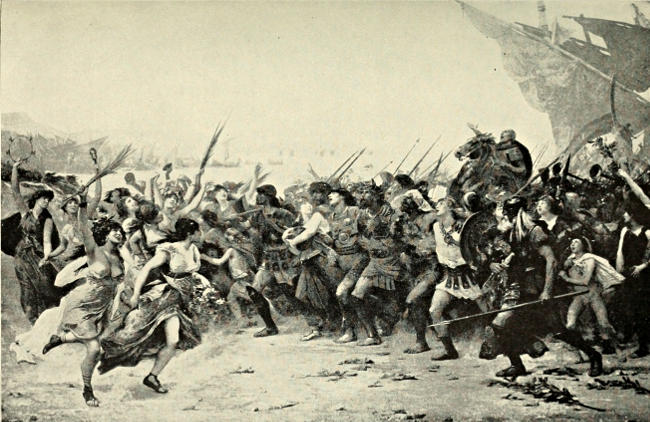
THE VICTORY OF SALAMIS (BY CORMOT)
Having left most of these troops under the orders of Mardonius in Thessaly,
Xerxes marched away with the rest to the Hellespont, by the same
road as he had taken in his advance a few months before. Respecting his
retreat, a plentiful stock of stories were circulated, inconsistent with each
other, fanciful, and even incredible: Grecian imagination, in the contemporary
poet Æschylus, as well as in the Latin moralisers Seneca or Juvenal,
delighted in handling this invasion with the maximum of light and shadow,
magnifying the destructive misery and humiliation of the retreat so as to
form an impressive contrast with the superhuman pride of the advance, and
illustrating the antithesis with unbounded license of detail. The sufferings
from want of provision were doubtless severe, and are described as frightful
and death-dealing: the magazines stored up for the advancing march had
been exhausted, so that the retiring army were now forced to seize upon the
corn of the country through which they passed—an insufficient maintenance,
eked out by leaves, grass, the bark of trees, and other wretched substitutes
for food. Plague and dysentery aggravated their misery, and occasioned
many to be left behind among the cities through whose territory the
retreat was carried; strict orders being left by Xerxes that these cities
should maintain and tend them. After forty-five days’ march from Attica,
he at length found himself at the Hellespont, whither his fleet, retreating
from Salamis, had arrived long before him. But the short-lived bridge had
already been knocked to pieces by a storm, so that the army was transported
on shipboard across to Asia, where it first obtained comfort and abundance,
and where the change from privation to excess engendered new maladies.
In the time of Herodotus, the citizens of Abdera still showed the gilt scimitar
and tiara, which Xerxes had presented to them when he halted there in
his retreat, in token of hospitality and satisfaction: and they even went the
length of affirming that never, since his departure from Attica, had he loosened
his girdle until he reached their city. So fertile was Grecian fancy in
magnifying the terror of the repulsed invader—who re-entered Sardis, with
a broken army and humbled spirit, only eight months after he had left it as
the presumed conqueror of the western world.
Meanwhile the Athenians and Peloponnesians, liberated from the immediate
presence of the enemy either on land or sea, and passing from the extreme
of terror to sudden ease and security, indulged in the full delight and
self-congratulation of unexpected victory. On the day before the battle,
Greece had seemed irretrievably lost: she was now saved even against all
reasonable hope, and the terrific cloud impending over her was dispersed.
In the division of the booty, the Æginetans were adjudged to have distinguished
themselves most in the action, and to be entitled to the choice lot;
while various tributes of gratitude were also set apart for the gods. Among
them were three Phœnician triremes, which were offered in dedication to Ajax
at Salamis, to Athene at Sunium, and to Poseidon at the Isthmus of Corinth;
further presents were sent to Apollo at Delphi, who, on being asked whether
he was satisfied, replied, that all had done their duty to him except the Æginetans:
from them he required additional munificence on account of the prize
awarded to them, and they were constrained to dedicate in the temple four
golden stars upon a staff of brass, which Herodotus himself saw there. Next
to the Æginetans, the second place of honour was awarded to the Athenians;
the Æginetan Polycritus, and the Athenians Eumenes and Aminias, being
ranked first among the individual combatants.
Besides the first and second prizes of valour, the chiefs at the isthmus tried
to adjudicate among themselves the first and second prizes of skill and wisdom.
Each of them deposited two names on the altar of Poseidon: and when these
votes came to be looked at, it was found that each man had voted for himself
as deserving the first prize, but that Themistocles had a large majority of
votes for the second. The result of such voting allowed no man to claim
the first prize, nor could the chiefs give a second prize without it; so that
Themistocles was disappointed of his reward, though exalted so much the
higher, perhaps, through that very disappointment, in general renown. He
went shortly afterwards to Sparta, where he received from the Lacedæmonians
honours such as were never paid before or afterwards to any foreigner.
A crown of olive was indeed given to Eurybiades as the first prize, but a like
crown was at the same time conferred on Themistocles as a special reward
for unparalleled sagacity; together with a chariot, the finest which the city
afforded. Moreover, on his departure, the three hundred select youths called
hippeis, who formed the active guard and police of the country, all accompanied
him in a body as escort of honour to the frontiers of Tegea. Such
demonstrations were so astonishing, from the haughty and immovable Spartans,
that they were ascribed by some authors to their fear lest Themistocles
should be offended by being deprived of the general prize.b
On the very same day on which the Persians were defeated at Salamis,
another portion of the Hellenic race, the Sicilian Greeks, also obtained a
victory over an immense barbarian force. There is reason to believe that
the invasion of Sicily by the Carthaginians was concerted with Xerxes, and
that the simultaneous attack on two distinct Grecian peoples, by two
immense armaments, was not merely the result of chance. It was, however,
in the internal affairs of Sicily that the Carthaginians sought the pretext
and the opportunity for their invasion. About the year 481 B.C., Theron,
despot of Agrigentum, a relative of Gelo, the powerful ruler of Syracuse,
expelled Terillus from Himera, and took possession of that town. Terillus,
backed by some Sicilian cities which formed a kind of Carthaginian party,
applied to the Carthaginians to restore him. The Carthaginians complied
with the invitation; and in the year 480 B.C., Hamilcar landed at Panormus
with a force composed of various nations, which is said to have amounted to
the enormous sum of three hundred thousand men. Having drawn up his
vessels on the beach, and protected them with a rampart, Hamilcar proceeded
to besiege the Himeræans, who on their part prepared for an obstinate
defence. At the instance of Theron, Gelo marched to the relief of
the town with fifty thousand foot and five thousand horse. An obstinate
and bloody engagement ensued, which, by a stratagem of Gelo’s, was at
length determined in his favour. The ships of the Carthaginians were fired,
and Hamilcar himself slain. According to the statement of Diodorus, one
hundred and fifty thousand Carthaginians fell in the engagement, while the
greater part of the remainder surrendered at discretion, twenty ships alone
escaping with a few fugitives. This account may justly be regarded as an
exaggeration; yet it cannot be doubted that the victory was a decisive one,
and the number very great of the prisoners and slain.
In Sicily, Greek taste made the sinews of the prisoners subserve the
purposes of art; and many of the public structures which adorned and
distinguished Agrigentum rose by the labour of the captive Carthaginians.
Thus were the arms of Greece victorious on all sides, and the outposts of
Europe maintained against the incursions of the semi-barbarous hordes of
Asia and Africa.f
The battle of Salamis is a watchword of Greek triumph, and yet it by no
means solved the problem of independence, for a great army was still in the
country, enjoying the confidence and aid of many Greek allies. The defeated
Persian fleet itself was still of sufficient power to be a lively danger.
The remainder of the fleet of Xerxes, which, flying from Salamis, arrived
in Asia, after transporting the king and his forces from the Chersonesus to
Abydos, wintered at Cyme. In the commencement of the spring it assembled
at Samos, where some other vessels had continued during the winter.
This armament was principally manned by Persians and Medes, and was
under the conduct of Mardontes, the son of Bagæus, and Artayntes, son of
Artachæus, whose uncle Amitres had been joined to him as his colleague.
As the alarm of their former defeat was not yet subsided, they did not attempt
to advance farther west, nor indeed did any one impel them to do so.
Their vessels, with those of the Ionians, amounted to three hundred, and
they stationed themselves at Samos, to secure the fidelity of Ionia. They
did not think it probable that the Greeks would penetrate into Ionia, but
would be satisfied with defending their country. They were confirmed
in this opinion, as the Greeks, after the battle of Salamis, never attempted to
pursue them, but were themselves content to retire also.
With respect to their affairs at sea, the Persians were sufficiently depressed;
but they expected that Mardonius would do great things by land.
Remaining on their station at Samos, they consulted how they might annoy
the enemy, and they anxiously attended to the progress and affairs of
Mardonius.
The approach of the spring, and the appearance of Mardonius in Thessaly,
roused the Greeks. Their land army was not yet got together, but their
fleet, consisting of a hundred and ten ships, was already at Ægina, under the
command of Leotychides. He was descended in a right line from Hercules.
He was of the second royal family, and all his ancestors, except the two
named after Leotychides, had been kings of Sparta. The Athenians were
commanded by Xanthippus, son of Ariphron.
When the fleet of the Greeks had arrived at Ægina, the same individuals
who had before been at Sparta to entreat the assistance of that people to
deliver Ionia, arrived among the Greeks. Herodotus, the son of Basilides,
was with them; they were in all seven, and had together concerted the
death of Strattis, tyrant of Chios. Their plot having been discovered by
one of the accomplices, the other six had withdrawn themselves to Sparta,
and now came to Ægina to persuade the Greeks to enter Ionia: they were
induced, though not without difficulty, to advance as far as Delos. All
beyond this, the Greeks viewed as full of danger, as well because they were
ignorant of the country, as because they supposed the enemy’s forces were in
all these parts strong and numerous: Samos they considered as not less remote
than the pillars of Hercules. Thus the barbarians were kept by their
apprehensions from advancing beyond Samos, and the Greeks, notwithstanding
the solicitations of the Chians, would not move farther eastward than
Delos. Their mutual alarm thus kept the two parties at a distance from
each other.
Whilst the Greeks thus moved to Delos, Mardonius, who had wintered
in Thessaly, began to break up his quarters. His first step was to send an
European, whose name was Mys, to the different oracles, ordering him to
use his endeavours, and consult them all.
[479 B.C.]
As soon as the oracular declarations had been conveyed to Mardonius, he
sent Alexander the Macedonian, son of Amyntas, ambassador to Athens.
His choice of him was directed from his being connected with the Persians
by ties of consanguinity and from his being a man of munificent and hospitable
spirit. For these reasons he deemed him the most likely to conciliate the
Athenians, who were represented to him as a valiant and numerous people,
and who had principally contributed to the defeats which the Persians had
sustained by sea. He reasonably presumed, that if he could prevail on them
to unite their forces with his own, he might easily become master of the sea.
His power by land was in his opinion superior to all resistance, and as
the oracles had probably advised him to make an alliance with the Athenians,
he hoped by these means effectually to subdue the Greeks.
When Alexander arrived at Athens, as deputed by Mardonius, he delivered
the following speech: “Men of Athens, Mardonius informs you by
me, that he has received a commission from the king of the following import:
‘Whatever injuries the Athenians may have done me, I willingly
forgive: return them therefore their country; let them add to it from
any other they may prefer, and let them enjoy their own laws. If they
will consent to enter into an alliance with me, you have my orders to
rebuild all their temples which I have burned.’
“It will be my business to do all this unless you prevent me. I will now
give you my own sentiments: What infatuation can induce you to continue
your hostilities against a king to whom you can never be superior, and
whom you cannot always resist: you already know the forces and exploits
of Xerxes: neither can you be ignorant of the army under me. If you
should even repel and conquer us, of which if you be wise you can indulge
no hope, another army not inferior in strength will soon succeed ours. Do
not, therefore, by endeavouring to render yourselves equal to so great a
king, risk not only the loss of your native country, but the security of your
persons: accept, therefore, of our friendship, and avail yourselves of the
present honourable opportunity of averting the indignation of Xerxes.
Be free, and let us mutually enter into a solemn alliance without fraud or
treachery. Let, then, my offers prevail with you as their importance merits,
for to you alone of all the Greeks, the king forgives the injuries he has
sustained, wishing to become your friend.”
The Lacedæmonians having heard that this prince was gone to Athens
to invite the Athenians to an alliance with the Persians, were exceedingly
alarmed. They could not forget the oracle which foretold that they, with
the rest of the Dorians, should be driven from the Peloponnesus by a junction
of the Medes with the Athenians, to whom therefore they lost no time
in sending ambassadors. These were present at the Athenian council, for
the Athenians had endeavoured to gain time, well knowing that the Lacedæmonians
would learn that an ambassador was come to invite them to a confederacy
with the Persians, and would consequently send deputies to be
present on the occasion; they therefore deferred the meeting, that the
Lacedæmonians might be present at the declaration of their sentiments.
When Alexander had finished speaking, the Spartan envoys made this
immediate reply: “We have been deputed by the Spartans, to entreat you
not to engage in anything which may operate to the injury of our common
country, nor listen to any propositions of Xerxes; such a conduct would not
be equitable in itself, and would be particularly base in you from various
reasons: you were the first promoters of this war, in opposition to our opinion;
it was first of all commenced in vindication of your liberties, though all Greece
was afterwards drawn into the contest. It will be most of all intolerable,
that the Athenians should become the instruments of enslaving Greece, who,
from times the most remote, have restored their liberties to many. Your
present condition does not fail to excite in us sentiments of the sincerest pity,
who, for two successive seasons, have been deprived of the produce of your
lands, and have so long seen your mansions in ruin. From reflecting on your
situation, we Spartans, in conjunction with your other allies, undertake to
maintain, as long as the war shall continue, not only your wives, but such
other parts of your families as are incapable of military service. Let not,
therefore, this Macedonian Alexander, softening the sentiments of Mardonius,
seduce you: the part he acts is consistent; a tyrant himself, he espouses the
interests of a tyrant. If you are wise you will always remember, that the
barbarians are invariably false and faithless.”
After the above address of the Spartans, the Athenians made this reply
to Alexander: “It was not at all necessary for you to inform us, that the
power of the Persians was superior to our own: nevertheless, in defence of
our liberties, we will continue our resistance to the utmost of our abilities.
You may be assured that your endeavours to persuade us into an alliance
with the barbarians never will succeed: tell, therefore, Mardonius, on the
part of the Athenians, that as long as the sun shall continue its ordinary
course, so long will we avoid any friendship with Xerxes, and so long will
we continue to resist him. Tell him, we shall always look with confidence
to the protecting assistance of those gods and heroes whose shrines and temples
he has contemptuously destroyed. Hereafter do not you presume to enter
an Athenian assembly with overtures of this kind, lest whilst you appear to
mean us well, you prompt us to do what is abominable. We are unwilling
that you should receive any injury from us, having been our guest and our
friend.”
The above was the answer given to Alexander; after which the Athenians
thus spoke to the Lacedæmonians: “That the Spartans should fear our entering
into an alliance with the barbarians seems natural enough; but in doing
this, as you have had sufficient testimonies of Athenian firmness, you certainly
did us injury. There is not upon earth a quantity of gold, nor any country
so rich or so beautiful, as to seduce us to take part with the Medes, or to act
injuriously to the liberties of Greece.
“If of ourselves we were so inclined, there still exist many important circumstances
to deter us: in the first place, what is of all motives the most
powerful, the shrines and temples of our deities, consumed by fire, and levelled
with the ground, prompt us to the prosecution of a just revenge, and
manifestly compel us to reject every idea of forming an alliance with him
who perpetrated these impieties. In the next place, our common consanguinity,
our using the same language, our worship of the same divinities, and our
practice of the same religious ceremonies, render it impossible that the Athenians
should prove perfidious. If you knew it not before, be satisfied now,
that as long as one Athenian shall survive, we will not be friends with Xerxes;
in the mean time, your interest in our fortunes, your concern for the ruin of
our mansions, and your offers to provide for the maintenance of our families,
demand our gratitude, and may be considered as the perfection of generosity.
We will, however, bear our misfortunes as we may be able, and not be troublesome
to you; be it your care to bring your forces into the field as expeditiously
as possible; it is not probable that the barbarian will long defer his
invasion of our country, he will be upon us as soon as he shall be informed
that we have rejected his proposals: before he shall be able to penetrate into
Attica, it becomes us to advance to the assistance of Bœotia.”
On receiving this answer from the Athenians, the ambassadors returned
to Sparta. As soon as Mardonius heard from Alexander the determination
of the Athenians, he moved from Thessaly, directing by rapid marches his
course towards Athens. Wherever he came, he furnished himself with supplies
of troops. The princes of Thessaly were so far from repenting of the
part they had taken, that they endeavoured still more to animate Mardonius.
Of these, Thorax of Larissa, who had attended Xerxes in his flight, now
openly conducted Mardonius into Greece.
As soon as the army in its progress arrived at Bœotia, the Thebans
received Mardonius. They endeavoured to persuade him to fix his station
where he was, assuring him that a place more convenient for a camp, or
better adapted for the accomplishment of his purpose, could not be found.
They told him that by staying here he might subdue the Greeks without a
battle. He might be satisfied, they added, from his former experience, that
as long as the Greeks were united, it would be impossible for any body of
men to subdue them. “If,” said they, “you will be directed by our advice,
you will be able, without difficulty, to counteract their wisest counsels.
Send a sum of money to the most powerful men in each city: you will thus
create anarchy in Greece, and by the assistance of your partisans, easily
overcome all opposition.”
This was the advice of the Thebans, which Mardonius was prevented
from following, partly by his earnest desire of becoming a second time master
of Athens, and partly by his pride. He was also anxious to inform the
king at Sardis, by means of fires disposed at certain distances along the
islands, that he had taken Athens. Proceeding therefore to Attica, he found
it totally deserted; the inhabitants, as he was informed, being either at
Salamis or on board the fleet. He then took possession of Athens a second
time, ten months after its capture by Xerxes. Whilst he continued at
Athens, he despatched to Salamis, Murichides, a native of the Hellespont,
with the same propositions that Alexander the Macedonian had before made
to the Athenians.
Murichides went to the council, and delivered the sentiments of Mardonius.
A senator named Lycidas gave his opinion, that the terms offered by
Murichides were such as it became them to listen to, and communicate to
the people; he said this, either from conviction, or seduced by the gold of
Mardonius; but he had no sooner thus expressed himself, than both the
Athenians who heard him, and those who were without, rushed with indignation
upon him, and stoned him to death.[33] They dismissed Murichides without
injury. The Athenian women soon heard of the tumult which had been
excited at Salamis on account of Lycidas, when, in a body mutually stimulating
each other, they ran impetuously to his house, and stoned his wife
and his children.
These were the inducements with the Athenians for returning to Salamis:
as long as they entertained any expectation of assistance from the
Peloponnesus, they stayed in Attica; but when they found their allies careless
and inactive, and that Mardonius was already in Bœotia, they removed with
all their effects to Salamis. At the same time they sent envoys to Lacedæmon,
to complain that the Spartans, instead of advancing with them to meet
the barbarian in Bœotia, had suffered him to enter Attica. They told them
by what liberal offers the Persian had invited them to his friendship; and
they forewarned them, that if they were not speedy in their communication
of assistance, the Athenians must seek some other remedy. The Lacedæmonians
were then celebrating what are called the hyacinthia, which solemnity,
they deem of the highest importance; they were also at work upon the
wall of the isthmus, the battlements of which were already erected.
The ephori heard the deputies, but deferred answering them till the next
day; when the morrow came, they put them off till the day following, and
this they did for ten days successively. In this interval, the Peloponnesians
prosecuted with great ardour on the isthmus, their work of the wall, which
they nearly completed. Why the Spartans discovered so great an anxiety
on the arrival of Alexander at Athens, lest the Athenians should come to
terms with the Medes, and why now they did not seem to concern themselves
about them, is more than we are able to explain, unless it was that
the wall of the Isthmus was unfinished, after which they did not want the
aid of the Athenians: but when Alexander arrived at Athens, this work
was not completed, although from terror of the Persians they eagerly pursued
it.
The answer and motions of the Spartans were finally these: on the day
preceding that which was last appointed, a man of Tegea, named Chileus,
who enjoyed at Lacedæmon greater reputation than any other foreigner,
inquired from one of the ephori what the Athenians had said; which when
he knew, he thus addressed them: “Things, O ephori, are thus circumstanced.
If the Athenians, withdrawing from our alliance, shall unite with
the Persian, strong as our wall on the isthmus may be, the enemy will still
find an easy entrance into the Peloponnesus. Let us therefore hear them,
before they do anything which may involve Greece in ruin.”
The ephori were so impressed by what Chileus had said, that without
communicating with the deputies of the different states, whilst it was yet
night, they sent away a detachment of five thousand Spartans, each accompanied
by seven helots, under the conduct of Pausanias, son of Cleombrotus.
With these forces Pausanias left Sparta: the deputies, ignorant of the
matter, when the morning came went to the ephori, having previously
resolved to return to their respective cities: “You, O Lacedæmonians,”
they exclaimed, “lingering here, solemnise the hyacinthia, and are busy in
your public games, basely deserting your allies. The Athenians, injured by
you, and but little assisted by any, will make their peace with the Persians
on the best terms they can obtain. When the enmity betwixt us shall have
ceased, and we shall become the king’s allies, we shall fight with him wherever
he may choose to lead us: you may know therefore what consequences
you have to expect.”
In answer to this declaration of the ambassadors, the ephori protested,
upon oath, that they believed their troops were already in Oresteum, on their
march against the strangers; by which expression they meant the barbarians.
The deputies, not understanding them, requested an explanation.
When the matter was properly represented to them, they departed with
astonishment to overtake them, accompanied by five thousand armed troops
from the neighbourhood of Sparta.
Whilst these were hastening to the isthmus, the Argives, as soon as they
heard of the departure of Pausanias at the head of a body of troops from
Sparta, sent one of their fleetest messengers to Mardonius in Attica. They
had before undertaken to prevent the Lacedæmonians from taking the field.
When the herald arrived at Athens, “I am sent,” said he to Mardonius, “by
the Argives, to inform you that the forces of Sparta are already on their
march, and we have not been able to prevent them; avail yourself therefore
of this information.” Saying this, he returned.
Mardonius, hearing this, determined to stay no longer in Attica. He
had continued until this time, willing to see what measures the Athenians
would take; and he had refrained from offering any kind of injury to the
Athenian lands, hoping they would still make peace with him. When it
was evident that this was not to be expected, he withdrew his army, before
Pausanias and his detachment arrived at the isthmus. He did not however
depart without setting fire to Athens,[34] and levelling with the ground whatever
of the walls, buildings, or temples, still remained entire. He was
induced to quit his station, because the country of Attica was ill adapted for
cavalry, and because in case of defeat he had no other means of escape but
through straits where a handful of men might cut off his retreat. He therefore
determined to remove to Thebes, that he might have the advantage of
fighting near a confederate city and in a country convenient for his cavalry.
Mardonius was already on his march, when another courier came in
haste to inform him, that a second body of a thousand Spartans was moving
towards Megara. He accordingly deliberated how he might intercept this
latter party. Turning aside towards Megara, he sent on his cavalry to
ravage the Megarian lands. These were the extreme limits on the western
parts of Europe, to which the Persian army penetrated.
Another messenger now came to tell him, that the Greeks were assembled
with great strength at the isthmus; he therefore turned back through Decelea.
The Bœotian chiefs had employed their Asopian neighbours as guides,
who conducted Mardonius first to Sphendaleas, and thence to Tanagra. At
Tanagra, Mardonius passed the night, and the next day came to Scolos, in
the Theban territory. Here the lands of the Thebans, though the friends
and allies of the Medes, were laid waste, not from any enmity, but from the
urgent necessities of the army. The general was desirous to fortify his
camp, and to have some place of refuge in case of defeat. His camp extended
from Erythræ, by Hysiæ, as far as Platæa, on the banks of the Asopus.
It was protected by a wall, which did not continue the whole extent
of the camp, but which occupied a space of ten stadia in each of the four
fronts.
Whilst Mardonius was stationed in Bœotia, all the Greeks who were
attached to the Persians supplied him with troops, and joined him in his
attack on Athens; the Phocians alone did not; these had indeed, and with
apparent ardour, favoured the Medes, not from inclination but necessity.
A few days after the entertainment given at Thebes, they arrived with a
thousand well-armed troops under the command of Harmocydes, one of their
most popular citizens. Mardonius, on their following him to Thebes, sent
some horsemen, commanding them to halt by themselves in the plain where
they were: at the same moment, all the Persian cavalry appeared in sight.
A rumour instantly circulated among those Greeks who were in the Persian
camp, that the Phocians were going to be put to death by the cavalry. The
same also spread through the Phocians, on which account their leader Harmocydes
thus addressed them:
“My friends, I am convinced that we are destined to perish by the swords
of these men, and from the accusations of the Thessalians. Let each man
therefore prove his valour. It is better to die like men, exerting ourselves
in our own defence, than to suffer ourselves to be slain tamely and without
resistance: let these barbarians know, that the men whose deaths they meditate
are Greeks.”
With these words Harmocydes animated his countrymen. When the
cavalry had surrounded them, they rode up as if to destroy them: they made
a show of hurling their weapons, which some of them probably did. The
Phocians upon this closed their ranks, and on every part fronted the enemy.
The Persians seeing this, faced about and retired. We are not able to decide
whether, at the instigation of the Thessalians, the Phocians were actually
doomed to death; or whether, observing them determined to defend themselves,
the Persians retired from the fear of receiving some injury themselves,
and as if they had been so ordered by Mardonius, merely to make experiment
of their valour. After the cavalry were withdrawn, a herald came to them
on the part of Mardonius: “Men of Phocis,” he exclaimed, “be not alarmed;
you have given a proof of resolution which Mardonius had been taught not
to expect; assist us therefore in the war with alacrity, for you shall neither
outdo me nor the king in generosity.”
The Lacedæmonians arriving at the isthmus, fortified their camp. As soon
as this was known to the rest of the Peloponnesians, all were unwilling to
be surpassed by the Spartans, as well they who were actuated by a love of
their country, as they who had seen the Lacedæmonians proceed on their
march. The victims which were sacrificed having a favourable appearance,
they left the isthmus in a body, and came to Eleusis. The sacrifices at this
place being again auspicious, they continued to advance, having been joined
at Eleusis by the Athenians, who had passed over from Salamis. On their
arrival at Erythræ, in Bœotia, they learned that the barbarians were encamped
near the Asopus; then they marched to the foot of Mount Cithæron.
As they did not descend into the plain[35] Mardonius sent the whole of his
cavalry against them, under the command of Masistius, called by the Greeks
Macistius. He was a Persian of distinction, and was on this occasion
mounted on a Nisæan horse, decorated with a bridle of gold, and other
splendid trappings. When they came near the Greeks, they attacked them
in squadrons, did them considerable injury, and by way of insult called them
women. The situation of the Megarians being most easy of access, was most
exposed to the enemy’s attack. Being hardly pressed by the barbarians,
they sent a herald, who thus addressed the Grecian commanders: “We
Megarians, O allies, are unable to stand the shock of the enemy’s cavalry
in our present position: if you are not speedy in relieving us, we shall be
compelled to quit the field.”
After this report of the heralds, Pausanias wished to see if any of the
Greeks would voluntarily offer themselves to take the post of the Megarians.
All refused, except a chosen band of three hundred Athenians, commanded
by Olympiodorus, the son of Lampon.
This body, which took upon itself the defence of a post declined by all
the other Greeks encamped at Erythræ, brought with them a band of archers.
The engagement, after an obstinate dispute, terminated thus: The enemies’
horse attacked in squadrons; the steed of Masistius, being conspicuous
above the rest, was wounded in the side by an arrow; it reared, and becoming
unruly from the pain of the wound, threw its rider. The Athenians
rushed upon him, seized the horse, and notwithstanding his resistance,
killed Masistius. In doing this, however, they had some difficulty, on
account of his armour. Over a purple tunic he wore a breastplate covered
with plates of gold. This repelled all their blows, which some person perceiving,
killed him by wounding him in the eye. The death of Masistius
was unknown to the rest of his troops; they did not see him fall from his
horse, and were ignorant of his fate, their attention being entirely occupied
by succeeding in regular squadrons to the charge. At length making a
stand, they perceived themselves without a leader. Upon this they rushed
in with united force to bring off the body of Masistius.
The Athenians seeing them advance in a collected body, called out
for relief. While the infantry were moving to their support, the body of
Masistius was vigorously disputed. While the three hundred were alone,
they were compelled to give ground, and recede from the body; but other
forces coming to their relief, the cavalry in their turn gave way, and, with
the body of their leader, lost a great number of their men. Retiring for the
space of two stadia, they held a consultation, and being without a commander,
determined to return to Mardonius. On their arrival at the camp, the death
of Masistius spread a general sorrow through the army, and greatly afflicted
Mardonius himself. They cut off the hair from themselves, their horses,
and their beasts of burden, and all Bœotia resounded with their cries and
lamentations. The man they had lost, was, next to Mardonius, most esteemed
by the Persians and the king.
The Greeks having not only sustained but repelled the attacks of the
cavalry, were inspired with increasing resolution. The body of Masistius,
which from its beauty and size deserved admiration, they placed on a
carriage, and passed through the ranks, while all quitted their stations to
view it. They afterwards determined to remove to Platæa; they thought this
a more commodious place for a camp than Erythræ, as well for other reasons
as because there was plenty of water. To this place, near which is the fountain
of Gargaphia, they resolved to go and pitch a regularly fortified camp.
Taking their arms, they proceeded by the foot of Cithæron, and passing
Hysiæ, came to Platæa. They drew themselves up in regular divisions of
the different nations, near the fountain of Gargaphia and the shrine of the
hero Androcrates, some on a gently rising ground, others on the plain.
In the arrangement of the several nations, a violent dispute arose betwixt
the Tegeatæ and Athenians, each asserting their claim to one of the wings,
in vindication of which they appealed to their former as well as more recent
exploits. The Tegeatæ spoke to this effect:
“The post which we now claim has ever been given us by the joint
consent of the allies, in all the expeditions made beyond the Peloponnesus:
we not only speak of ancient but of less distant periods. After the death
of Eurystheus, when the Heraclidæ made an attempt to return to the
Peloponnesus, the rank we now vindicate was allowed us. With you, O
Lacedæmonians, we do not enter into competition, we are willing that you
should take your post in which wing you think proper; the command of
the other, which has so long been allowed us, we now claim. Not to
dwell upon the action we have recited, we are certainly more worthy of this
post than the Athenians. On your account, O Spartans, as well as for
the benefit of others, we have fought again and again with success and
glory. Let not then the Athenians be on this occasion preferred to us;
for they have never in an equal manner distinguished themselves in past
or in more recent periods.”
The Athenians made this reply: “We are well aware, that the motive of
our assembling here is not to spend our time in altercations, but to fight the
barbarians; but since it has been thought necessary to urge on the part of
the Tegeatæ their ancient as well as more recent exploits, we feel ourselves
obliged to assert that right, which we receive from our ancestors, to be preferred
to the Arcadians as long as we shall conduct ourselves well. Those
Heraclidæ, whose leader they boast to have slain at the isthmus, after being
rejected by all the Greeks with whom they wished to take refuge from the
servitude of the people of Mycenæ, found a secure retreat with us alone.
In conjunction with them we chastised the insolence of Eurystheus, and obtained
a complete victory over those possessing the Peloponnesus. The
Argives, who under Polynices fought against Thebes, remaining unburied,
we undertook an expedition against the Cadmeans, recovered the bodies, and
interred them in our country at Eleusis. A further instance of our prowess was
exhibited in our repulsion of the Amazons, who advanced from the river Thermodon
to invade Attica. We were no less conspicuous at the siege of Troy.
“But this recital is vain and useless; the people who were then illustrious
might now be base, or dastards then, might now be heroes. Enough
therefore of the examples of our former glory, though we are still able to
introduce more and greater; for if any of the Greeks at the battle of Marathon
merited renown, we may claim this, and more also. On that day we
alone contended with the Persian, and after a glorious and successful contest
were victorious over an army of forty-six different nations; which action
must confessedly entitle us to the post we claim; but in the present state of
affairs, all dispute about rank is unseasonable; we are ready, O Lacedæmonians,
to oppose the enemy wherever you shall choose to station us. Wherever
we may be, we shall endeavour to behave like men. Lead us on therefore,
we are ready to obey you.”
When the Athenians had thus delivered their sentiments, the Lacedæmonians
were unanimous in declaring that the Arcadians must yield to the
people of Athens the command of one of the wings. They accordingly took
their station in preference to the Tegeatæ.
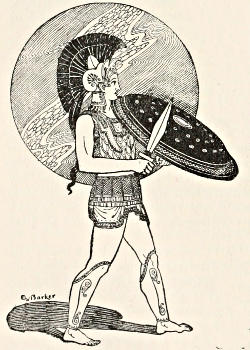
Greek Officer
(After Hope)
The Greeks who came afterwards, with those who
were present before, were thus disposed. The
Lacedæmonians, to the number of ten thousand,
occupied the right wing; of these, five
thousand were Spartans, who were followed
by thirty-five thousand helots lightly armed,
allowing seven helots to each Spartan. The
Tegeatæ, to the number of fifteen hundred,
were placed by the Spartans next themselves,
in consideration of their valour,
and as a mark of honour. Nearest the
Tegeatæ were five thousand Corinthians,
who, in consequence of their request
to Pausanias, had contiguous to them
three hundred Potidæans of Pallene. Next
in order were six hundred Arcadians of Orchomnene,
three thousand Sicyonians, eight
hundred Epidaurians, and a thousand Trœzenians.
Contiguous to these last were two
hundred Lepreatæ; next to whom were
four hundred Mycenæans and Tirynthians.
Stationed by the Tirynthians were, in regular
succession, a thousand Phliasians, three hundred
Hermionians, six hundred Eretrians
and Styrians; next came four hundred Chalcidians,
five hundred Ambracians, eight
hundred Leucadians and Anactorians; to
whom two hundred Paleans of Cephallenia, and five hundred Æginetæ,
successively joined. Three thousand Megarians and six hundred Platæans
were contiguous to the Athenians, who to the number of eight thousand,
under the command of Aristides, son of Lysimachus, occupied the left wing
at the other extremity of the army.
The amount of this army, independent of the seven helots to each Spartan,
was thirty-eight thousand seven hundred men, all of them completely
armed and drawn together to repel the barbarian. Of the light-armed
troops were the thirty-five thousand helots, each well prepared for battle,
and thirty-four thousand five hundred attendant on the Lacedæmonians and
other Greeks,[36] reckoning a light-armed soldier to every man; the whole of
these therefore amounted to sixty-nine thousand five hundred.
Thus the whole of the Grecian army assembled at Platæa, including both
the heavy-and light-armed troops, was one hundred and eight thousand two
hundred men; adding to these one thousand and eight hundred Thespians,
who were with the Greeks, but without arms, the complete number was one
hundred and ten thousand. These were encamped on the banks of the
Asopus.
The barbarian army having ceased to lament Masistius, as soon as they
knew that the Greeks were advanced to Platæa, marched also to that part
of the Asopus nearest to it; where they were thus disposed by Mardonius.
Opposed to the Lacedæmonians were the Persians, who, as they were superior
in number, fronted the Tegeatæ also. Of this body the select part was
opposed to the Lacedæmonians, the less effective to the Tegeatæ. In making
which arrangement, Mardonius followed the advice of the Thebans.
Next to the Persians were the Medes, opposed to the Corinthians, Potidæans,
Orchomenians, and Sicyonians. The Bactrians were placed next, to encounter
the Epidaurians, Trœzenians, Lepreatæ, Tirynthians, Mycenæans,
and Phliasians. Contiguous to the Bactrians the Indians were disposed, in
opposition to the Hermionians, Eretrians, Styrians, and Chalcidians. The
Sacæ, next in order, fronted the Ambracians, Anactorians, Leucadians,
Paleans, and Æginetæ. The Athenians, Platæans, and Megarians were
ultimately faced by the Bœotians, Locrians, Melians, Thessalians, and a
thousand Phocians. All the Phocians did not assist the Medes; some of
them, about Parnassus, favoured the Greeks, and from that station attacked
and harassed both the troops of Mardonius and those of the Greeks who were
with him. The Macedonians and Thessalians were also opposed to the
Athenians.
In this manner Mardonius arranged those nations who were the most
numerous and the most illustrious; with these were promiscuously mixed
bodies of Phrygians, Thracians, Mysians, Pæonians, and others. To the
above might be added the Ethiopians, and those Egyptians named Hermotybians
and Calasirians, who alone of that country follow the profession
of arms. These had formerly served on board the fleet, whence they had
been removed to the land-forces by Mardonius when at Phalerum: the
Egyptians had not been reckoned with those forces which Xerxes led
against Athens. We have before remarked, that the barbarian army consisted
of three hundred thousand men; the number of the Greek confederates
of Mardonius, as it was never taken, cannot be ascertained; but as far as
conjecture may determine, they amounted to about fifty thousand men.
Such was the arrangement of the infantry; the cavalry were posted apart
by themselves.
Both armies being thus ranged in nations and squadrons, on the following
day offered sacrifices. The sacrifices promised victory to the Greeks if they
acted on the defensive, but the contrary if, passing the Asopus, they began
the fight. Mardonius, though anxious to engage, had nothing to hope from
the entrails, unless he acted on the defensive only. He had also sacrificed
according to the Grecian rites, using as his soothsayer Hegesistratus, an
Elean, and the most illustrious of the Telliadæ. The Spartans had formerly
seized this man, thrown him into prison, and menaced him with death, as
one from whom they had received many and atrocious injuries. In this
distress, alarmed not merely for his life, but with the idea of having
previously to suffer many severities, he accomplished a thing which can
hardly be told. He was confined in some stocks bound with iron, but
accidentally obtaining a knife, he perpetrated the boldest thing which
has ever been recorded.
Calculating what part of the remainder he should be able to draw out, he
cut off the extremity of his foot; this done, notwithstanding he was guarded,
he dug a hole under the wall, and escaped to Tegea, travelling only by night,
and concealing himself in the woods during the day. Eluding the strictest
search of the Lacedæmonians, he came on the third night to Tegea, his keepers
being astonished at his resolution, for they saw the half of his foot, but could
not find the man. In this manner Hegesistratus escaped to Tegea, which
was not at that period in amity with Sparta. When his wound was healed
he procured himself a wooden foot, and became an avowed enemy to Sparta.
His animosity against the Lacedæmonians proved ultimately of no advantage
to himself; he was taken in the exercise of his office at Zacynthus, and put to
death. The fate of Hegesistratus was subsequent to the battle of Platæa: at
the time of which we were speaking, Mardonius, for a considerable sum, had
prevailed with him to sacrifice, which he eagerly did, as well from his hatred
of the Lacedæmonians, as from the desire of reward; but the appearance of
the entrails gave no encouragement to fight, either to the Persians or their
confederate Greeks, who also had their own appropriate soothsayer, Hippomachus
of Leucadia. As the Grecian army continually increased, Timagenidas
of Thebes, son of Herpys, advised Mardonius to guard the pass of Cithæron,
representing that he might thus intercept great bodies, who were every day
thronging to the allied army of the Greeks.
The hostile armies had already remained eight days encamped opposite to
each other, when the above counsel was given to Mardonius. He acknowledged
its propriety, and immediately on the approach of night detached some
cavalry to that part of Cithæron leading to Platæa, a place called by the
Bœotians the “Three Heads,” by the Athenians the “Heads of Oak.” This
measure had its effect, and they took a convoy of five hundred beasts of burden,
carrying a supply of provisions from the Peloponnesus to the army: with
the carriages, they took also all the men who conducted them. Masters of this
booty, the Persians, with the most unrelenting barbarity, put both men and
beasts to death: when their cruelty was satiated, they returned with what
they had taken to Mardonius.
After this event two days more passed, neither army being willing to
engage. The barbarians, to irritate the Greeks, advanced as far as the Asopus,
but neither army would pass the stream. The cavalry of Mardonius greatly
and constantly harassed the Greeks. The Thebans, who were very zealous in
their attachment to the Medes, prosecuted the war with ardour, and did everything
but join battle; the Persians and Medes supported them and performed
many illustrious actions.
In this situation things remained for the space of ten days: on the
eleventh, the armies retaining the same position with respect to each other,
and the Greeks having received considerable reinforcements, Mardonius
became disgusted with their inactivity. He accordingly held a conference
with Artabazus, the son of Pharnaces, who was one of the few Persians
whom Xerxes honoured with his esteem: it was the opinion of Artabazus
that they should immediately break up their camp, and withdraw beneath
the walls of Thebes, where was already prepared a magazine of provisions
for themselves, and corn for their cavalry: here they might at their leisure
terminate the war by the following measures. They had in their possession
a great quantity of coined and uncoined gold, with an abundance of silver
and plate: it was recommended to send these with no sparing hand to the
Greeks, and particularly to those of greatest authority in their respective
cities. It was urged, that if this were done, the Greeks would soon surrender
their liberties, nor again risk the hazard of a battle. This opinion
was seconded by the Thebans, who thought that it would operate successfully.
Mardonius was of a contrary opinion, fierce, obstinate, and unyielding.
His own army he thought superior to that of the Greeks, and that
they should by all means fight before the Greeks received further supplies;
that they should give no importance to the declarations of Hegesistratus,
but without violating the laws of Persia, commence a battle in their usual
manner. This opinion of Mardonius nobody thought proper to oppose, for
to him, and not to Artabazus, the king had confided the supreme command
of the army. He therefore ordered that everything should be properly disposed
to commence the attack early in the morning.
When the night was far advanced, and the strictest silence prevailed
through the army, which was buried in sleep, Alexander, son of Amyntas,
general and prince of the Macedonians, rode up to the Athenian outposts,
and earnestly desired to speak with their commanders. On hearing this, the
greater number continued on their posts, while some hastened to their officers,
whom they informed that a horseman was arrived from the enemy’s army,
who, naming the principal Greeks, would say nothing more than that he
desired to speak with them.
The commanders lost no time in repairing to the advanced guard, where,
on their arrival, they were thus addressed by Alexander: “I am come, O
Athenians, to inform you of a secret which you must impart to Pausanias only,
lest my ruin ensue. Nor would I speak now, were not I anxious for the
safety of Greece. I from remote antiquity am of Grecian origin, and I
would not willingly see you exchange freedom for servitude: I have
therefore to inform you, that if Mardonius and his army could have drawn
favourable omens from their victims, a battle would long since have taken
place: intending to pay no further attention to these, it is his determination
to attack you early in the morning, being afraid, as I suppose, that your
forces will be yet more numerous. Be, therefore, on your guard; but if he
still defer his purpose of an engagement, do you remain where you are, for
he has provisions but for a few days more. If the event of this war shall be
agreeable to your wishes, it will become you to make some efforts to restore
my independence, who, on account of my partiality to the Greeks, have
exposed myself to so much danger in thus acquainting you with the intention
of Mardonius, to prevent the barbarians attacking you by surprise. I
am Alexander of Macedon.”
When he had thus spoken, he returned to his station in the Persian
camp.
The Athenian chiefs went to the right wing, and informed Pausanias of
what they had learned from Alexander. Pausanias, who stood in much awe
of the Persians, addressed them thus in reply:
“As a battle is to take place in the morning, I think it advisable that you,
Athenians, should front the Persians, and we, those Bœotians and Greeks
who are now posted opposite to you. You have before contended with the
Medes, and know their mode of fighting by experience at Marathon; we
have never had this opportunity; but we have before fought the Bœotians,
and Thessalians; take, therefore, your arms, and let us exchange
situations.”
“From the first,” answered the Athenians, “when we observed the Persians
opposed to you, we wished to make the proposal we now hear from
you; we have been only deterred by our fear of offending you: as the overture
comes from you, we are ready to comply with it.”
This being agreeable to both, as soon as the morning dawned they
changed situations; this the Bœotians observed, and communicated to
Mardonius. The Persian general immediately exerted himself to oppose
the Lacedæmonians with his troops. Pausanias, on seeing his scheme thus
detected, again removed the Spartans to the right wing, as did Mardonius
instantly his Persians to the left.
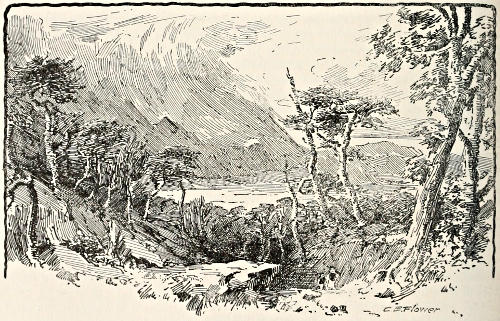
The Field of Platæa
When the troops had thus resumed their former posts, Mardonius sent a
herald with this message to the Spartans: “Your character, O Lacedæmonians,
is highly celebrated among all these nations, as men who disdain to fly;
who never desert your ranks, determined either to slay your enemies or die.
Nothing of this is true: we perceive you in the act of retreating, and of
deserting your posts before a battle is commenced: we see you delegating to
the Athenians the more dangerous attempt of opposing us, and placing yourselves
against our slaves, neither of which actions is consistent with bravery.
We are, therefore, greatly deceived in our opinion of you; we expected, that
from a love of glory you would have despatched a herald to us, expressing
yourselves desirous to combat with the Persians alone. Instead of this we
find you alarmed and terrified; but as you have offered no challenge to us,
we propose one to you. As you are esteemed the most illustrious of your
army, why may not an equal number of you on the part of the Greeks, and
of us on the part of the barbarians, contend for victory? If it be agreeable
to you, the rest of our common forces may afterwards engage; if this be unnecessary,
we will alone engage; and whichever conquers shall be esteemed
victorious over the whole of the adverse army.”
The herald, after delivering his commission, waited some time for an answer;
not receiving any, he returned to Mardonius. He was exceedingly
delighted, and already anticipating a victory, sent his cavalry to attack the
Greeks; these with their lances and arrows materially distressed the Grecian
army, and forbade any near approach. Advancing to the Gargaphian fountain,
which furnished the Greeks with water, they disturbed and stopped it
up. The Lacedæmonians alone were stationed near this fountain, the other
Greeks, according to their different stations, were more or less distant, but
all of them in the vicinity of the Asopus; but as they were debarred from
watering here, by the missile weapons of the cavalry, they all came to the
fountain. In this predicament the leaders of the Greeks, seeing the army
cut off from the water, and harassed by the cavalry, came in crowds to
Pausanias on the right wing, to deliberate about these and other emergencies.
Unpleasant as the present incident might be, they were still more
distressed from their want of provision; their servants, who had been
despatched to bring this from the Peloponnesus, were prevented by the
cavalry from returning to the camp.
The Grecian leaders, after deliberating upon the subject, determined, if
the Persians should for one day more defer coming to an engagement, to pass
to the island opposite to Platæa, and about ten stadia from the Asopus and
the fountain Gargaphia, where they were at present encamped. This island
is thus connected with the continent: the river, descending from Cithæron to
the plain, divides itself into two streams, which, after flowing separately for
about the distance of three stadia, again unite, thus forming the island which
is called Oëroë, who, according to the natives, is the daughter of Asopus.
The Greeks by this measure proposed to themselves two advantages; first
to be secure of water, and secondly to guard against being further annoyed
by the enemy’s cavalry. They resolved to decamp at the time of the second
watch by night, lest the Persians, perceiving them, should pursue and harass
them with their cavalry. It was also their intention, when arrived at the
spot where the Asopian Oëroë is formed by the division of the waters flowing
from Cithæron, to detach one-half of their army to the mountain to relieve
a body of their servants, who, with a convoy of provisions, were there
encompassed.
After taking the above resolutions, they remained all that day much incommoded
by the enemy’s horse: when these, at the approach of evening,
retired, and the appointed hour was arrived, the greater part of the Greeks
began to move with their baggage, but without any design of proceeding to
the place before resolved on. The moment they began to march, occupied
with no idea but that of escaping the cavalry, they retired towards Platæa,
and fixed themselves near the temple of Juno, which is opposite to the city,
and at the distance of twenty stadia from the fountain of Gargaphia: in
this place they encamped.
Pausanias, observing them in motion, gave orders to the Lacedæmonians
to take their arms, and follow their route, presuming they were proceeding
to the appointed station. The officers all showed themselves disposed to
obey the orders of Pausanias, except Amompharetus, the son of Poliadas,
captain of the band of Pitanatæ, who asserted that he would not fly before
the barbarians, and thus be accessory to the dishonour of Sparta: he had
not been present at the previous consultation, and knew not what was intended.
Pausanias and Euryanax, though indignant at his refusal to obey
the orders which had been issued, were still but little inclined to abandon the
Pitanatæ, on the account of their leader’s obstinacy; thinking, that by
their prosecuting the measure which the Greeks in general had adopted,
Amompharetus and his party must unavoidably perish. With these sentiments
the Lacedæmonians were commanded to halt, and pains were taken to
dissuade the man from his purpose, who alone, of all the Lacedæmonians and
Tegeatæ, was determined not to quit his post.
At this crisis the Athenians determined to remain quietly on their posts,
knowing it to be the genius of the Lacedæmonians to say one thing and
think another. But as soon as they observed the troops in motion, they
despatched a horseman to learn whether the Lacedæmonians intended to
remove, and to inquire of Pausanias what was to be done. When the messenger
arrived, he found the men in their ranks, but their leaders in violent
altercation. Pausanias and Euryanax were unsuccessfully attempting to
persuade Amompharetus not to involve the Lacedæmonians alone in danger
by remaining behind, when the Athenian messenger came up to them. At
this moment, in the violence of dispute, Amompharetus took up a stone
with both his hands, and throwing it at the feet of Pausanias, exclaimed:
“There is my vote for not flying before the foreigners!”
Pausanias, after telling him that he could be only actuated by frenzy,
turned to the Athenian, who delivered his commission. He afterwards desired
him to return, and communicate to the Athenians the state in which he
found them, and to entreat them immediately to join their forces, and act in
concert, as should be deemed expedient.
The messenger accordingly returned to the Athenians, whilst the Spartan
chiefs continued their disputes till the morning. Thus far Pausanias remained
indecisive, but thinking, as the event proved, that Amompharetus
would certainly not stay behind, if the Lacedæmonians actually advanced,
he gave orders to all the forces to march forward by the heights, in which
they were followed by the Tegeans. The Athenians, keeping close to their
ranks, pursued a route opposite to that of the Lacedæmonians; these last,
who were in great awe of the cavalry, advanced by the steep paths which
led to the foot of Mount Cithæron; the Athenians marched over the plain.
Amompharetus, never imagining that Pausanias would venture to abandon
them, made great exertions to keep his men on their posts; but when he saw
Pausanias advancing with his troops, he concluded himself effectually given
up; taking therefore his arms, he with his band proceeded slowly after the
rest of the army. These continuing their march for a space of ten stadia,
came to a place called Agriopius, near the river Moloës, where is a temple of
the Eleusinian Ceres, and there halted, waiting for Amompharetus and his
party. The motive of Pausanias in doing this was, that he might have the
opportunity of returning to the support of Amompharetus, if he should be
still determined not to quit his post. Here Amompharetus and his band
joined them; the whole force of the enemy’s horse continuing as usual to
harass them. As soon as the Barbarians discovered that the spot where the
Greeks had before encamped was deserted, they put themselves in motion,
overtook, and materially distressed them.
Mardonius being informed that the Greeks had decamped by night, and
seeing their former station unoccupied, led the Persians over the Asopus,
and pursued the path which the Greeks had taken, whom he considered as
flying from his arms. The Lacedæmonians and Tegeatæ were the sole objects
of his attack, for the Athenians, who had marched over the plain, were
concealed by the hills from his view. The other Persian leaders seeing the
troops moving, as if in pursuit of the Greeks, raised their standards, and
followed the rout with great impetuosity, but without regularity or discipline;
they hurried on with tumultuous shouts, considering the Greeks as
absolutely in their power.
When Pausanias found himself thus pressed by the cavalry, he sent a
horseman with the following message to the Athenians: “We are menaced,
O Athenians, by a battle, the event of which will determine the freedom or
slavery of Greece; and in this perplexity you, as well as ourselves, have, in
the preceding night, been deserted by our allies. It is nevertheless our determination
to defend ourselves to the last, and to render you such assistance
as we may be able. If the enemy’s horse had attacked you, we should have
thought it our duty to have marched with the Tegeatæ, who are in our rear,
and still faithful to Greece, to your support. As the whole operation of the
enemy seems directed against us, it becomes you to give us the relief we
materially want; but if you yourselves are so circumstanced, as to be unable
to advance to our assistance, at least send us a body of archers. We confess,
that in this war your activity has been far the most conspicuous, and we
therefore presume on your compliance with our request.”
The Athenians, without hesitation, and with determined bravery, advanced
to communicate the relief which had been required. When they
were already on their march, the confederate Greeks, in the service of the
king, intercepted and attacked them: they were thus prevented from assisting
the Lacedæmonians, a circumstance which gave them extreme uneasiness.
In this situation the Spartans, to the amount of fifty thousand light-armed
troops, with three thousand Tegeatæ,[37] who on no occasion were separated
from them, offered a solemn sacrifice, with the resolution of encountering
Mardonius.
The victims, however, were not auspicious, and in the mean time many of
them were slain, and more wounded. The Persians, under the protection
of their bucklers, showered their arrows upon the Spartans with prodigious
effect. At this moment Pausanias, observing the entrails still unfavourable,
looked earnestly towards the temple of Juno at Platæa, imploring the interposition
of the goddess, and entreating her to prevent their disgrace and
defeat.
Whilst he was in the act of supplicating the goddess, the Tegeatæ
advanced against the barbarians: at the same moment the sacrifices became
favourable, and Pausanias, at the head of his Spartans, went up boldly to the
enemy. The Persians, throwing aside their bows, prepared to receive them.
The engagement commenced before the barricade: when this was thrown
down, a conflict took place near the temple of Ceres, which was continued
with unremitted obstinacy till the fortune of the day was decided.
The barbarians, seizing their adversaries’ lances, broke them in pieces,
and discovered no inferiority either in strength or courage; but their
armour was inefficient, their attack without skill, and their inferiority, with
respect to discipline, conspicuous. In whatever manner they rushed upon
the enemy, from one to ten at a time, they were cut in pieces by the
Spartans.
Mardonius Falls and the Day is Won
The Greeks were most severely pressed where Mardonius himself, on a
white horse, at the head of a thousand chosen Persians, directed his attack.
As long as he lived, the Persians, both in their attack and defence, conducted
themselves well, and slew great numbers of the Spartans; but as
soon as Mardonius was slain, and the band which fought near his person,
and which was the flower of the army, was destroyed, all the rest turned
their backs and fled. They were much oppressed and encumbered by their
long dresses, besides which, being lightly armed, they had to oppose men
in full and complete armour.
On this day, as the oracle had before predicted, the death of Leonidas
was amply revenged upon Mardonius, and the most glorious victory which
has ever been recorded, was then obtained by Pausanias. Mardonius was
slain by Æmnestus, a Spartan of distinguished reputation. Æmnestus
long after this Persian war, together with three hundred men, was killed
in an engagement at Stenyclarus, in which he opposed the united force
of the Messenians.
The Persians, routed by the Spartans at Platæa, fled in the greatest
confusion towards their camp, and to the wooden entrenchment which they
had constructed in the Theban territories. It seems somewhat surprising
that although the battle was fought near the grove of Ceres, not a single
Persian took refuge in the temple, nor was slain near it; but the greater part
of them perished beyond the limits of the sacred ground. Such was the
issue of the battle of Platæa.
Artabazus, the son of Pharnaces, who had from the first disapproved
of the king’s leaving Mardonius behind him, and who had warmly, though
unsuccessfully, endeavoured to prevent a battle, determined on the following
measures. He was at the head of no small body of troops; they
amounted to forty thousand men: being much averse to the conduct of
Mardonius, and foreseeing what the event of an engagement must be, he
prepared and commanded his men to follow him wherever he should go, and
to remit or increase their speed by his example. He then drew out his army,
as if to attack the enemy; but he soon met the Persians flying from them:
he then immediately and precipitately fled with all his troops in disorder, not
directing his course to the entrenchment or to Thebes, but towards Phocis,
intending to gain the Hellespont with all possible speed.
Of those Greeks who were in the royal army, all except the Bœotians,
from a preconcerted design, behaved themselves ill. The Bœotians fought
the Athenians with obstinate resolution: those Thebans who were attached
to the Medes made very considerable exertions, fighting with such courage,
that three hundred of their first and boldest citizens fell by the swords of the
Athenians. They fled at length, and pursued their way to Thebes, avoiding
the route which the Persians had taken with the immense multitude of confederates,
who, so far from making any exertions, had never struck a blow.
In the midst of all this tumult, intelligence was conveyed to those
Greeks posted near the temple of Juno, and remote from the battle, that
the event was decided, and Pausanias victorious. The Corinthians instantly,
without any regularity, hurried over the hills which lay at the foot of the
mountain, to arrive at the temple of Ceres. The Megarians and Phliasians,
with the same intentions, posted over the plain, the more direct and obvious
road. As they approached the enemy, they were observed by the Theban
horse, commanded by Asopodorus, son of Timander, who, taking advantage
of their want of order, rushed upon them and slew six hundred, driving
the rest towards Mount Cithæron. Thus did these perish ingloriously.
The Persians, and a promiscuous multitude along with them, as soon as
they arrived at the entrenchment, endeavoured to climb the turrets before
the Lacedæmonians should come up with them. Having effected this, they
endeavoured to defend themselves as well as they could. The Lacedæmonians
soon arrived, and a severe engagement commenced.
Before the Athenians came up, the Persians not only defended themselves
well, but had the advantage, as the Lacedæmonians were ignorant of the
proper method of attack; but as soon as the Athenians advanced to their
support, the battle was renewed with greater fierceness, and was long continued.
The valour and firmness of the Athenians finally prevailed. Having
made a breach they rushed into the camp: the Tegeatæ were the first
Greeks that entered, and were they who plundered the tent of Mardonius,
taking from thence, among other things, the manger from which his horses
were fed, made entirely of brass, and very curious. This was afterwards
deposited by the Tegeatæ in the temple of the Alean Minerva: the rest of
the booty was carried to the spot where the common plunder was collected.
As soon as their entrenchment was thrown down, the barbarians dispersed
themselves different ways, without exhibiting any proof of their former
bravery; they were, indeed, in a state of stupefaction and terror, from seeing
their immense multitude overpowered in so short a period.
So great was the slaughter made by the Greeks, that of this army, which
consisted of three hundred thousand men, not three thousand escaped, if we
except the forty thousand who fled with Artabazus. The Lacedæmonians of
Sparta lost ninety-one men; the Tegeatæ sixteen; the Athenians fifty-two.[38]
Of those who most distinguished themselves on the part of the barbarians,
are to be reckoned the Persian infantry, the Sacian cavalry, and lastly,
Mardonius himself. Of the Greeks, the Tegeatæ and Athenians were eminently
conspicuous; they were, nevertheless, inferior to the Lacedæmonians.
The most daring of the Spartans, was Aristodemus; the same who alone
returning from Thermopylæ fell into disgrace and infamy; next to him,
Posidonius, Phylocyon, and Amompharetus the Spartan, behaved the best.
Nevertheless, when it was disputed in conversation what individual had on
that day most distinguished himself, the Spartans who were present said, that
Aristodemus, being anxious to die conspicuously, as an expiation of his
former crime, in an emotion of fury had burst from his rank, and performed
extraordinary exploits; but that Posidonius had no desire to lose his life, and
therefore his behaviour was the more glorious: but this remark might have
proceeded from envy. All those slain on this day, were highly honoured,
except Aristodemus. To him, for the reason above mentioned, no respect was
paid, as having voluntarily sought death.
Among the troops of the Æginetæ, assembled at Platæa, was Lampon, one
of their principal citizens, and son of Pytheas. This man went to Pausanias,
giving him the following most impious counsel: “Son of Cleombrotus, what
you have done is beyond comparison splendid, and deserving admiration.
The deity, in making you the instrument of Greece’s freedom, has placed
you far above all your predecessors in glory: in concluding this business so
conduct yourself that your reputation may be still increased, and that no
barbarian may ever again attempt to perpetrate atrocious actions against
Greece. When Leonidas was slain at Thermopylæ, Mardonius and Xerxes
cut off his head, and suspended his body from a cross. Do the same with
respect to Mardonius, and you will deserve the applause of Sparta and of
Greece, and avenge the cause of your uncle Leonidas.” Thus spake Lampon,
thinking he should please Pausanias.
“Friend of Ægina,” replied Pausanias, “I thank you for your good
intentions, and commend your foresight; but what you say violates every
principle of equity.[39] After elevating me, my country, and this recent victory,
to the summit of fame, you again depress us to infamy, in recommending
me to inflict vengeance on the dead. You say, indeed, that by such an
action I shall exalt my character; but I think it is more consistent with the
conduct of barbarians than of Greeks, as it is one of those things for which
we reproach them. I must therefore dissent from the Æginetæ, and all
those who approve their sentiments. For me, it is sufficient to merit the
esteem of Sparta, by attending to the rules of honour, both in my words and
actions: Leonidas, whom you wish me to avenge, has, I think, received the
amplest vengeance. The deaths of this immense multitude must sufficiently
have atoned for him, and for those who fell with him at Thermopylæ. I
would advise you in future, having these sentiments, to avoid my presence;
and I would have you think it a favour, that I do not punish you.”
Pausanias afterwards proclaimed by a herald, that no person should touch
any of the booty; and he ordered the helots to collect the money into one
place. They, as they dispersed themselves over the camp, found tents decorated
with gold and silver, couches of the same, goblets, cups, and drinking
vessels of gold, besides sacks of gold, and silver cauldrons placed on carriages.
The dead bodies they stripped of bracelets, chains, and scimitars
of gold; to their habits of various colours they paid no attention. Many
things of value the helots secreted, and sold to the Æginetæ; others, unable
to conceal, they were obliged to produce. The Æginetæ from this became
exceedingly rich; for they purchased gold of the helots at the price of brass.
From the wealth thus collected, a tenth part was selected for sacred purposes.
To the deity of Delphi was presented a golden tripod, resting on a
three-headed snake of brass: it was placed near the altar. To the Olympian
god they erected a Jupiter, ten cubits high: to the god of the isthmus, the
figure of Neptune, in brass, seven cubits high. When this was done, the
remainder of the plunder was divided among the army, according to their
merits; it consisted of Persian concubines, gold, silver, beasts of burden,
with various riches. What choice things were given to those who most distinguished
themselves at Platæa, has never been mentioned, though certain
presents were made them. It is certain, that a tenth part of the whole was
given to Pausanias, consisting among other things of women, horses, talents,
and camels.
It is further recorded, that when Xerxes fled from Greece, he left all his
equipage to Mardonius: Pausanias seeing this composed of gold, silver, and
cloth of the richest embroidery, gave orders to the cooks and domestics to
prepare an entertainment for him, as for Mardonius. His commands were
executed, and he beheld couches of gold and silver, tables of the same, and
everything that was splendid and magnificent. Astonished at the spectacle,
he again with a smile directed his servants to prepare a Lacedæmonian repast.
When this was ready the contrast was so striking, that he laughing sent for
the Grecian leaders: when they were assembled, he showed them the two
entertainments. “Men of Greece,” said he, “I have called you together to
bear testimony to the king of Persia’s folly, who forsook all this luxury to
plunder us who live in so much poverty.” These were the words which
Pausanias is said to have used to the Grecian leaders.
In succeeding times, many of the Platæans found on the field of battle,
chests of gold, silver, and other riches. This thing also happened: when the
flesh had fallen from the bones of the dead bodies, the Platæans, in removing
them to some other spot, discovered a skull as one entire bone, without any
suture. Two jaw bones also were found with their teeth, which though divided
were of one entire bone, the grinders as well as the rest. The body of Mardonius
was removed the day after the battle; but it is not known by whom.
Sarcophagi at Platæa
The Greeks, after the division of the plunder at Platæa, proceeded to
inter their dead, each nation by themselves. The Lacedæmonians sunk
three trenches: in the one they deposited the bodies of their priests; in the
second were interred the other Spartans; in the third, the helots. The
Tegeatæ were buried by themselves, but with no distinction: the Athenians
in like manner, and also the Megarians and Phliasians who were slain by the
cavalry. Mounds of earth were raised over the bodies of all these people.
With respect to the others shown at Platæa, they were raised by those, who
being ashamed of their absence from the battle, wished to secure the esteem
of posterity.
Having buried their dead on the plain of Platæa, the Greeks, after serious
deliberation, resolved to attack Thebes, and demand the persons of those
who had taken part with the Medes. Of these the most distinguished were
Timagenidas and Attaginus, the leaders of the faction. They determined,
unless these were given up, not to leave Thebes without utterly destroying it.
On the eleventh day after the battle, they besieged the Thebans, demanding
the men whom we have named. They refused to surrender them, in
consequence of which their lands were laid waste and their walls attacked.
This violence being continued, Timagenidas, on the twentieth day, thus addressed
the Thebans: “Men of Thebes, since the Greeks are resolved
not to retire from Thebes till they shall either have destroyed it, or you
shall deliver us into their power, let not Bœotia on our account be farther
distressed. If their demand of our persons be merely a pretence to obtain
money, let us satisfy them from the wealth of the public, as not we alone
but all of us have been equally and openly active on the part of the Medes;
if their real object in besieging Thebes is to obtain our persons, we are
ready to go ourselves, and confer with them.” The Thebans approving his
advice, sent immediately a herald to Pausanias, saying they were ready to
deliver up the men. As soon as this measure was determined, Attaginus
fled, but his children were delivered to Pausanias, who immediately dismissed
them, urging that infants could not possibly have any part in the faction of
the Medes. The other Thebans who were given up, imagined they should
have the liberty of pleading for themselves, and by the means of money hoped
to escape. Pausanias suspecting that such a thing might happen, as soon
as he got them in his power, dismissed all the forces of the allies; then
removing the Thebans to Corinth, he there put them to death.
Artabazus son of Pharnaces fled from Platæa to the Thessalians. They
received him with great hospitality, and entirely ignorant of what had
happened, inquired after the remainder of the army. The Persian was fearful
that if he disclosed the whole truth, he might draw upon him the attack
of all who knew it, and consequently involve himself and army in the extremest
danger. This reflection had before prevented his communication of
the matter to the Phocians: and on the present occasion he thus addressed
the Thessalians:
“I am hastening, as you perceive, with great expedition to Thrace, being
despatched thither from our camp with this detachment, on some important
business. Mardonius with his troops follows me at no great distance: show
him the rights of hospitality and every suitable attention. You will finally
have no occasion to repent of your kindness.”
He then proceeded through Thessaly and Macedonia, immediately to
Thrace, with evident marks of being in haste. Directing his march through
the midst of the country, he arrived at Byzantium, with the loss of great
numbers of his men, who were either cut in pieces by the Thracians, or
quite worn out by fatigue and hunger. From Byzantium, he passed over
his army in transports, and thus effected his return to Asia.
On the very day[40] of the battle of Platæa, a victory was gained at Mycale
in Ionia. Whilst the Grecian fleet was yet at Delos, under the command
of Leotychides the Lacedæmonian, ambassadors came to them from Samos.
On their arrival, they sought the Grecian leaders, whom Hegesistratus (one
of the ambassadors) addressed with various arguments. He urged that as
soon as they should show themselves, all the Ionians would shake off their
dependence, and revolt from the Persians; he told them that they might
wait in vain for the prospect of a richer booty. He implored also their
common deities, that being Greeks, they would deliver those who also were
Greeks from servitude, and avenge them on the barbarian. He concluded
by saying, that this might be easily accomplished, as the ships of the enemy
were slow sailers, and by no means equal to those of the Greeks.
The Samians, with an oath, engaged to become the confederates of the
Greeks. Leotychides then dismissed them all excepting Hegesistratus, who,
on account of his name, he chose to take along with him. The Greeks, after
remaining that day on their station, on the next sacrificed with favourable
omens; Deiphonus, son of Evenius of Apollonia, in the Ionian Gulf, being
their minister.
The Greeks having sacrificed favourably, set sail from Delos towards
Samos. On their arrival at Calami of Samos, they drew themselves up near
the temple of Juno, and prepared for a naval engagement. When the Persians
heard of their approach, they moved with the residue of their fleet towards
the continent, having previously permitted the Phœnicians to retire.
They had determined, after a consultation, not to risk an engagement, as
they did not think themselves a match for their opponents. They therefore
made towards the continent, that they might be covered by their land forces
at Mycale, to whom Xerxes had intrusted the defence of Ionia. These, to
the amount of sixty thousand, were under the command of Tigranes the Persian,
one of the handsomest and tallest of his countrymen. To these troops
the commanders of the fleet resolved to retire: it was also their intention to
draw their vessels on shore, and to throw up an intrenchment round them,
which might equally serve as a protection to their vessels and themselves.
After this resolution, they proceeded on their course, and were carried near
the temple of the Eumenidæ at Mycale. Here the Persians drew their ships
to land, defending them with an intrenchment formed of stones, branches
of fruit trees cut down upon the spot, and pieces of timber closely fitted
together. In this position they were ready to sustain a blockade, and with
hopes of victory, being prepared for either event.
When the Greeks received intelligence that the barbarians were retired
to the continent, they considered them as escaped out of their hands. They
were exceedingly exasperated, and in great perplexity whether they should
return or proceed towards the Hellespont. Their ultimate determination
was to follow the enemy towards the continent. Getting therefore all
things ready for an engagement by sea, and providing themselves with
scaling ladders, and such other things as were necessary, they sailed to
Mycale. When they approached the enemy’s station, they perceived no one
advancing to meet them; but beheld the ships drawn on shore, secured
within an intrenchment, and a considerable body of infantry ranged along
the coast. Leotychides upon this advanced before all the rest in his ship,
and coming as near the shore as he could, thus addressed the Ionians by
a herald:
“Men of Ionia, all you who hear me, listen to what I say, for the Persians
will understand nothing of what I tell you. When the engagement
shall commence, remember first of all our common liberties; in the next
place take notice, our watch-word is Hebe. Let those who hear me, inform
all who do not.”
The motive of this conduct was the same with that of Themistocles at
Artemisium. These expressions, if not intelligible to the barbarians, might
make the desired impression on the Ionians; or if explained to the former,
might render the fidelity of the latter suspected.
When Leotychides had done this, the Greeks approached the shore, disembarked,
and prepared for battle. The Persians observing this, and knowing
the purport of the enemy’s address to the Ionians, took their arms from
the Samians, suspecting them of a secret attachment to the Greeks. The
Samians had purchased the freedom of five hundred Athenians, and sent
them back with provisions to their country, who having been left in Attica,
had been taken prisoners by the Persians, and brought away in the barbarian
fleet. The circumstance of their thus releasing five hundred of the enemies
of Xerxes, made them greatly suspected. To the Milesians, under pretence
of their knowledge of the country, the Persians confided the guard of the
paths to the heights of Mycale: their real motive was to remove them to
a distance. By these steps the Persians endeavoured to guard against those
Ionians, who might wish, if they had the opportunity, to effect a revolt.
They next heaped their bucklers upon each other, to make a temporary
rampart.
The Greeks being drawn up, advanced to attack the barbarians: as they
were proceeding, a herald’s wand was discovered on the beach, and a rumour
circulated through the ranks, that the Greeks had obtained a victory over
the forces of Mardonius and Bœotia.[41] On the same day that their enemies
were slaughtered at Platæa, and were about to be defeated at Mycale, the
rumour of the former victory being circulated to this distance, rendered the
Greeks more bold, and animated them against every danger. It appears
farther worthy of observation, that both battles took place near the temple
of the Eleusinian Ceres. The battle of Platæa, as we have before remarked,
was in the vicinity of the temple of Ceres; the one at Mycale was in a
similar situation.
The Athenians, who with those that accompanied them, constituted one-half
of the army, advanced by the coast, and along the plain: the Lacedæmonians
and their auxiliaries made their way by the more woody and
mountainous places.
Whilst the Lacedæmonians were making a circuit, the Athenians in the
other wing were already engaged. The Persians, as long as their entrenchment
remained uninjured, defended themselves well, and without any inferiority;
but when the Athenians, with those who supported them, increased
their exertions, mutually exhorting one another, that they and not the Lacedæmonians
might have the glory of the day, the face of things was changed;
the rampart was thrown down, and a sensible advantage was obtained over
the Persians. They sustained the shock for a considerable time, but finally
gave way, and retreated behind their entrenchments. The Athenians, Corinthians,
Sicyonians, and Trœzenians, rushed in with them; for this part of
the army was composed of these different nations.
When the wall was carried, the barbarians gave no testimony of their
former prowess, but, except the Persians, indiscriminately fled. These last,
though few in number, vigorously resisted the Greeks, who poured in upon
them in crowds. Artayntes and Ithamitres, the commanders of the fleet,
saved themselves by flight: but Mardontes, and Tigranes the general of the
land-forces, were slain. Whilst the Persians still refused to give ground,
the Lacedæmonians and their party arrived, and put all who survived to
the sword. Upon this occasion many of the Greeks were slain, and among
a number of the Sicyonians, Perilaus their leader. The Samians, who were
in the Persian army, and from whom their weapons had been taken, no
sooner saw victory incline to the side of the Greeks, than they assisted them
with all their power. The other Ionians seeing this, revolted also, and
turned their arms against the barbarians. The Milesians had been ordered,
the better to provide for the safety of the Persians, to guard the paths to
the heights, so that in case of accident the barbarians, under their guidance,
might take refuge on the summits of Mycale; with this view, as well as to
remove them to a distance, and thus guard against their perfidy, the Milesians
had been so disposed; but they acted in direct contradiction to their
orders. Those who fled, they introduced directly into the midst of their
enemies, and finally were active beyond all the rest in putting them to the
sword. In this manner did Ionia a second time revolt from the Persian
power.
In this battle the Athenians most distinguished themselves, and next to
the Athenians, they who obtained the greatest reputation were the Corinthians,
Trœzenians, and Sicyonians. The greater number of the barbarians
being slain, either in the battle or in the pursuit, the Greeks burned their
ships, and totally destroyed their wall: the plunder they collected upon the
shore, among which was a considerable quantity of money. Having done
this, they sailed from the coast. When they came to Samos, they deliberated
on the propriety of removing the Ionians to some other place, wishing to
place them in some part of Greece where their authority was secure; but
they determined to abandon Ionia to the barbarians. They were well aware
both of the impossibility of defending the Ionians on every emergency, and
of the danger which these would incur from the Persians, if they did not.
The Peloponnesian magistrates were of opinion, that those nations who had
embraced the cause of the Medes should be expelled, and their lands given
to the Ionians. The Athenians would not consent that the Ionians should be
transported from their country, nor would they allow the Peloponnesians
to decide on the destruction of Athenian colonies. Seeing them tenacious
of this opinion, the Peloponnesians no longer opposed them. Afterwards the
people of Samos, Chios, Lesbos, and the other islands who had assisted with
their arms in the present exigence, were received into the general confederacy,
having by an oath, promised constant and inviolable fidelity. This
ceremony performed, they sailed towards the Hellespont, meaning to destroy
the bridge, which they expected to find in its original state.
The barbarians who saved themselves by flight, came to the heights of
Mycale, and thence escaped in no great numbers to Sardis. During the retreat,
Masistes, son of Darius, who had been present at the late unfortunate
engagement, severely reproached Artayntes the commander-in-chief: among
other things, he said, that in the execution of his duty he had behaved more
like a woman than a man, and had materially injured the interests of his
master. To say that a man is more dastardly than a woman is with the
Persians the most infamous of all reproaches. Artayntes, after bearing the
insult for some time, became at length so exasperated, that he drew his scimitar,
intending to kill Masistes. He was prevented by Xenagoras, son of Praxilaus,
a native of Halicarnassus, who happening to be behind Artayntes, seized
him by the middle, and threw him to the ground: at the same time the guards
of Masistes came up. Xenagoras by this action not only obtained the favour of
Masistes, but so much obliged Xerxes, by thus preserving his brother, that he
was honoured with the government of all Cilicia. Nothing further of consequence
occurred on their way to Sardis, where they found the king, who after
his retreat from Athens, and his ill success at sea, had there resided.
The Greeks, sailing from Mycale towards the Hellespont, were obliged
by contrary winds to put in at Lectum: thence they proceeded to Abydos.
Here they found the bridge, which they imagined was entire, and which was
the principal object of their voyage, effectually broken down. They on this
held a consultation; Leotychides, and the Lacedæmonians with him, were for
returning to Greece; the Athenians, with their leader Xanthippus, advised
them to continue where they were, and make an attempt on the Chersonesus.
The Peloponnesians returned; but the Athenians, passing from Abydos to
the Chersonesus, laid siege to Sestus. To this place, as by far the strongest
in all that district, great numbers had retired from the neighbouring towns,
as soon as it was known that the Greeks were in the Hellespont: among
others was Œobazus of Cardia, a Persian who had previously collected here
all that remained of the bridge. The town itself was possessed by the
native Æolians, but they had with them a great number of Persians and
other allies. The governor of this place, under Xerxes, was Artayctes, a
Persian, of a cruel and profligate character.
Whilst they were prosecuting the siege, the autumn arrived. The
Athenians, unable to make themselves masters of the place, and uneasy at
being engaged in an expedition so far from their country, entreated their
leaders to conduct them home. They refused to do this, till they should
either succeed in their enterprise, or be recalled by the people of Athens,
so intent were they on the business before them.
The besieged, under Artayctes, were reduced to such extremity of
wretchedness, that they were obliged to boil for food the cords of which
their beds were composed. When these also were consumed, Artayctes,
Œobazus, and some other Persians, fled, under cover of the night, escaping
by an avenue behind the town, which happened not to be blockaded by the
enemy.
When the morning came, the people of the Chersonesus made signals to
the Athenians from the turrets, and opened to them the gates. The greater
part commenced a pursuit of the Persians, the remainder took possession of
the town. Œobazus fled into Thrace; but he was here seized by the Absinthians,
and sacrificed, according to their rites, to their god Plistorus: his
followers were put to death in some other manner. Artayctes and his adherents,
who fled the last, were overtaken near the waters of Ægos, where, after
a vigorous defence, part were slain, and part taken prisoners. The Greeks
put them all in chains, Artayctes and his son with the rest, and carried them
to Sestus. Conducting him therefore to the shore where the bridge of Xerxes
had been constructed, they there crucified him; though some say this was
done upon an eminence near the city of Madytus. The son was stoned in
his father’s presence.
The Athenians, after the above transactions, returned to Greece, carrying
with them, besides vast quantities of money, the fragments of the bridge,
to be suspended in their temples.b
The disproportion between the immense host assembled by Xerxes, and
the little which he accomplished, naturally provokes both contempt for Persian
force and an admiration for the comparative handful of men by whom
they were so ignominiously beaten. Both these sentiments are just, but
both are often exaggerated beyond the point which attentive contemplation
of the facts will justify. The Persian mode of making war (which we may
liken to that of the modern Turks, now that the period of their energetic
fanaticism has passed away) was in a high degree disorderly and inefficient:
the men indeed, individually taken, especially the native Persians, were not
deficient in the qualities of soldiers, but their arms and their organisation
were wretched—and their leaders yet worse. On the other hand, the
Greeks, equal, if not superior, in individual bravery, were incomparably
superior in soldier-like order as well as in arms: but here too the leadership
was defective, and the disunion a constant source of peril. Those who, like
Plutarch (or rather the Pseudo-Plutarch) in his treatise on the malignity of
Herodotus, insist on acknowledging nothing but magnanimity and heroism
in the proceedings of the Greeks throughout these critical years, are forced
to deal very harshly with the inestimable witness on whom our knowledge
of the facts depends, and who intimates plainly that, in spite of the devoted
courage displayed, not less by the vanquished at Thermopylæ than by
the victors at Salamis, Greece owed her salvation chiefly to the imbecility,
cowardice, and credulous rashness of Xerxes. Had he indeed possessed
either the personal energy of Cyrus or the judgment of Artemisia, it may be
doubted whether any excellence of management, or any intimacy of union,
could have preserved the Greeks against so great a superiority of force; but
it is certain that all their courage as soldiers in line would have been unavailing
for that purpose, without a higher degree of generalship, and a more
hearty spirit of co-operation, than that which they actually manifested.
One hundred and fifty years after this eventful period, we shall see the
tables turned, and the united forces of Greece under Alexander of Macedon
becoming invaders of Persia. We shall find that in Persia no improvement
has taken place during this long interval, that the scheme of defence under
Darius Codomannus labours under the same defects as that of attack under
Xerxes, that there is the same blind and exclusive confidence in pitched
battles with superior numbers, that the advice of Mentor the Rhodian,
and of Charidemus, is despised like that of Demaratus and Artemisia, that
Darius Codomannus, essentially of the same stamp as Xerxes, is hurried into
the battle of Issus by the same ruinous temerity as that which threw away
the Persian fleet at Salamis, and that the Persian native infantry (not the
cavalry) even appear to have lost that individual gallantry which they displayed
so conspicuously at Platæa. But on the Grecian side, the improvement
in every way is very great: the orderly courage of the soldier has been
sustained and even augmented, while the generalship and power of military
combination has reached a point unexampled in the previous history of mankind.
Military science may be esteemed a sort of creation during this interval,
and will be found to go through various stages: Demosthenes and
Brasidas, the Cyreian army and Xenophon, Agesilaus, Iphicrates, Epaminondas,
Philip of Macedon, Alexander: for the Macedonian princes are borrowers
of Greek tactics, though extending and applying them with a personal
energy peculiar to themselves, and with advantages of position such as no
Athenian or Spartan ever enjoyed. In this comparison between the invasion
of Xerxes and that of Alexander we contrast the progressive spirit of Greece,
serving as herald and stimulus to the like spirit in Europe, with the stationary
mind of Asia, occasionally roused by some splendid individual, but never
appropriating to itself new social ideas or powers, either for war or for peace.
It is out of the invasion of Xerxes that those new powers of combination,
political as well as military, which lighten up Grecian history during the
next two centuries, take their rise. They are brought into agency through
the altered position and character of the Athenians—improvers, to a certain
extent, of military operations on land, but the great creators of marine tactics
and manœuvring in Greece, and the earliest of all Greeks who showed
themselves capable of organising and directing the joint action of numerous
allies and dependents, thus uniting the two distinctive qualities of the
Homeric Agamemnon—ability in command, with vigour in execution.
In the general Hellenic confederacy, which had acted against Persia
under the presidency of Sparta, Athens could hardly be said to occupy any
ostensible rank above that of an ordinary member: the post of second dignity
in the line at Platæa had indeed been adjudged to her, but only after
a contending claim from Tegea. But without any difference in ostensible
rank, she was in the eye and feeling of Greece no longer the same power as
before. She had suffered more, and at sea had certainly done more, than all
the other allies put together: even on land at Platæa, her hoplites had
manifested a combination of bravery, discipline, and efficiency against the
formidable Persian cavalry superior even to the Spartans: nor had any
Athenian officer committed so perilous an act of disobedience as the Spartan
Amompharetus. After the victory of Mycale, when the Peloponnesians all
hastened home to enjoy their triumph, the Athenian forces did not shrink
from prolonged service for the important object of clearing the Hellespont,
thus standing forth as the willing and forward champions of the Asiatic
Greeks against Persia. Besides these exploits of Athens collectively, the
only two individuals gifted with any talents for command, whom this momentous
conquest had thrown up, were both of them Athenians: first,
Themistocles; next, Aristides. From the beginning to the end of the struggle,
Athens had displayed an unreserved Panhellenic patriotism, which
had been most ungenerously requited by the Peloponnesians; who had kept
within their isthmian walls, and betrayed Attica twice to hostile ravage;
the first time, perhaps, unavoidably, but the second time a culpable neglect,
in postponing their outward march against Mardonius. And the Peloponnesians
could not but feel, that while they had left Attica unprotected,
they owed their own salvation at Salamis altogether to the dexterity of Themistocles
and the imposing Athenian naval force.
Considering that the Peloponnesians had sustained little or no mischief
by the invasion, while the Athenians had lost for the time even their city
and country, with a large proportion of their movable property irrecoverably
destroyed, we might naturally expect to find the former, if not lending
their grateful and active aid to repair the damage in Attica, at least cordially
welcoming the restoration of the ruined city by its former inhabitants.
Instead of this, we find the same selfishness again prevalent among them;
ill-will and mistrust for the future, aggravated by an admiration which they
could not help feeling, overlays all their gratitude and sympathy.g
Winged Victory
(From a Greek Statuette now in the British Museum)
When the Persians had retreated from Europe after being conquered both
by sea and land by the Greeks, and those of them had been destroyed who
had fled with their ships to Mycale, Leotychides, king of the Lacedæmonians,
returned home with the allies that were from the Peloponnesus, as
we have already noted; while the Athenians, and the allies from Ionia and
the Hellespont, who had now revolted from the king, stayed behind, and laid
siege to Sestus, of which the Medes were in possession. Having spent the
winter before it, they took it, after the barbarians had evacuated it; and
then sailed away from the Hellespont, each to his own city. And the people
of Athens, when they found the barbarians had departed from their country,
proceeded immediately to carry over their children and wives, and the
remnant of their furniture, from where they had put them out of the way;
and were preparing to rebuild their city and their walls. For short spaces
of the enclosure were standing, and, though the majority of the houses had
fallen, a few remained in which the grandees of the Persians had themselves
taken up their quarters.
[478-476 B.C.]
The Lacedæmonians, perceiving what they were about to do, sent an
embassy to them; partly because they themselves would have been more
pleased to see neither them nor any one else in possession of a wall; but
still more because the allies instigated them, and were afraid of their
numerous fleet, which before they had not had, and of the bravery they had
shown in the Persian War. And they begged them not to build their walls,
but rather to join them in throwing down those of the cities out of the
Peloponnesus; not betraying their real wishes, and their suspicious feelings
towards the Athenians; but representing that the barbarian, if he should
again come against them, would not then be able to make his advances from
any stronghold, as in the present instance he had done from Thebes; and
the Peloponnesus, they said, was sufficient for all, as a place to retreat into
and sally forth from. When the Lacedæmonians had thus spoken, the
Athenians, by the advice of Themistocles, answered that they would send
ambassadors to them concerning what they spoke of; and they immediately
dismissed them. And Themistocles advised them to send himself as quickly
as possible to Lacedæmon, and having chosen other ambassadors besides himself,
not to despatch them immediately, but to wait till such time as they
should have raised their wall to the height most absolutely necessary for
fighting from; and that the whole population in the city, men, women, and
children, should build it, sparing neither private nor public edifice, from
which any assistance towards the work would be gained, but throwing down
everything. After giving these instructions, and suggesting that he would
himself manage all other matters there, he took his departure. On his
arrival at Lacedæmon he did not apply to the authorities, but kept putting
off and making excuses. And whenever any of those who were in office
asked him why he did not come before the assembly, he said that he was
waiting for his colleagues; that owing to some engagement they had been
left behind; he expected, however, that they would shortly come, and
wondered that they were not already there.
When they heard this, they believed Themistocles through their friendship
for him; but when every one else came and distinctly informed them
that the walls were building, and already advancing to some height, they did
not know how to discredit it. When he found this, he told them not to be
led away by tales, but rather to send men of their own body who were of
good character, and would bring back a credible report after inspection.
They despatched them therefore; and Themistocles secretly sent directions
about them to the Athenians, to detain them, with as little appearance of it
as possible, and not to let them go until they themselves had returned back;
(for by this time his colleagues, Abronychus, the son of Lysicles, and Aristides,
the son of Lysimachus, had also come to him with the news that the
wall was sufficiently advanced) for he was afraid that the Lacedæmonians,
when they heard the truth, might not then let them go. So the Athenians
detained the ambassadors, as was told them; and Themistocles, having come
to an audience of the Lacedæmonians, then indeed told them plainly that
their city was already walled, so as to be capable of defending its inhabitants;
and if the Lacedæmonians or the allies wished to send any embassy to them,
they should in future go as to men who could discern what were their own
and the general interests. For when they thought it better to abandon
their city and to go on board their ships, they said that they had made up
their minds, and had the courage to do it, without consulting them; and
again, on whatever matters they had deliberated with them, they had shown
themselves inferior to none in judgment. And so at the present time, likewise,
they thought it was better that their city should have a wall, and that
it would be more expedient for their citizens in particular, as well as for the
allies in general; for it was not possible for any one without equal resources
to give any equal or fair advice for the common good. Either all therefore,
he said, should join the confederacy without walls, or they should consider
that the present case also was as it ought to be.
The Lacedæmonians, on hearing this, did not let their anger appear to the
Athenians; for they had not sent their embassy to obstruct their designs,
but to offer counsel, they said, to their state; and besides, they were at that
time on very friendly terms with them owing to their zeal against the
Mede; in secret, however, they were annoyed at failing in their wish. So
the ambassadors of each state returned home without any complaint being
made.
In this way, Thucydides continues, the Athenians walled their city in
a short time. And the building shows even now that it was executed in
haste; for the foundations are laid with stones of all kinds, and in some
places not wrought together, but as the several parties at any time brought
them to the spot: and many columns from tombs, and wrought stones, were
worked up in them.b
The first indispensable step, in the renovation of Athens after her temporary
extinction, was now happily accomplished: the city was made secure
against external enemies. But Themistocles, to whom the Athenians owed
the late successful stratagem, and whose influence must have been much
strengthened by its success, had conceived plans of a wider and more ambitious
range. He had been the original adviser of the great maritime start taken
by his countrymen, as well as of the powerful naval force which they had
created during the last few years, and which had so recently proved their
salvation. He saw in that force both the only chance of salvation for the
future, in case the Persians should renew their attack by sea,—a contingency
at that time seemingly probable,—and boundless prospects of future ascendency
over the Grecian coasts and islands: it was the great engine of defence,
of offence, and of ambition. To continue this movement required much less
foresight and genius than to begin it, and Themistocles, the moment that
the walls of the city had been finished, brought back the attention of his
countrymen to those wooden walls which had served them as a refuge against
the Persian monarch. He prevailed upon them to provide harbour-room at
once safe and adequate, by the enlargement and fortification of the Piræus.
This again was only the prosecution of an enterprise previously begun: for
he had already, while in office two or three years before, made his countrymen
sensible that the open roadstead of Phalerum was thoroughly insecure, and
had prevailed upon them to improve and employ in part the more spacious
harbours of Piræus and Munychia—three natural basins, all capable of being
closed and defended. Something had then been done towards the enlargement
of this port, though it had probably been subsequently ruined by the
Persian invaders: but Themistocles now resumed the scheme on a scale far
grander than he could then have ventured to propose—a scale which
demonstrates the vast auguries present to his mind respecting the destinies
of Athens.
Piræus and Munychia, in his new plan, constituted a fortified space as large
as the enlarged Athens, and with a wall far more elaborate and unassailable.
The wall which surrounded them, sixty stadia in circuit [about seven and a
half miles], was intended by him to be so stupendous, both in height and
thickness, as to render assault hopeless, and to enable the whole military
population to act on shipboard, leaving only old men and boys as a garrison.
We may judge how vast his project was, when we learn that the wall, though
in practice always found sufficient, was only carried up to half the height
which he had contemplated. In respect to thickness, however, his ideas
were exactly followed: two carts meeting one another brought stones which
were laid together right and left on the outer side of each, and thus formed
two primary parallel walls, between which the interior space—of course, at
least as broad as the joint breadth of the two carts—was filled up, “not
with rubble, in the usual manner of the Greeks, but constructed, throughout
the whole thickness, of squared stones, cramped together with metal.”
The result was a solid wall, probably not less than fourteen or fifteen feet
thick, since it was intended to carry so very unusual a height. In the
exhortations whereby he animated the people to this fatiguing and costly
work, he laboured to impress upon them that Piræus was of more value to
them than Athens itself, and that it afforded a shelter into which, if their
territory should be again overwhelmed by a superior land-force, they might
securely retire, with full liberty of that maritime action in which they were
a match for all the world. We may even suspect that if Themistocles could
have followed his own feelings, he would have altered the site of the city
from Athens to Piræus: the attachment of the people to their ancient and
holy rock doubtless prevented any such proposition. Nor did he at that
time, probably, contemplate the possibility of those long walls which in a
few years afterwards consolidated the two cities into one.
Forty-five years afterwards, at the beginning of the Peloponnesian War,
we shall hear from Pericles, who espoused and carried out the large ideas of
Themistocles, this same language about the capacity of Athens to sustain a
great power exclusively or chiefly upon maritime action. But the Athenian
empire was then an established reality, whereas in the time of Themistocles
it was yet a dream, and his bold predictions, surpassed as they were by the
future reality, mark that extraordinary power of practical divination which
Thucydides so emphatically extols in him. And it proves the exuberant
hope which had now passed into the temper of the Athenian people, when
we find them, on the faith of these predictions, undertaking a new enterprise
of so much toil and expense; and that too when just returned from exile
into a desolated country, at a moment of private distress and public impoverishment.
However, Piræus served other purposes besides its direct use
as a dockyard for military marine: its secure fortifications and the protection
of the Athenian navy, were well calculated to call back those metics, or
resident foreigners, who had been driven away by the invasion of Xerxes,
and who might feel themselves insecure in returning, unless some new and
conspicuous means of protection were exhibited.
To invite them back, and to attract new residents of a similar description,
Themistocles proposed to exempt them from the metoikion, or non-freeman’s
annual tax: but this exemption can only have lasted for a time, and the
great temptation for them to return must have consisted in the new securities
and facilities for trade, which Athens, with her fortified ports and navy, now
afforded. The presence of numerous metics was profitable to the Athenians,
both privately and publicly: much of the trading, professional, and handicraft
business was in their hands: and the Athenian legislation, while it
excluded them from the political franchise, was in other respects equitable
and protective to them.
We are further told that Themistocles prevailed on the Athenians to build
every year twenty new ships of the line—so we may designate the trireme.
Whether this number was always strictly adhered to, it is impossible to say;
but to repair the ships, as well as to keep up their numbers, was always regarded
among the most indispensable obligations of the executive government.
It does not appear that the Spartans offered any opposition to the
fortification of the Piræus, though it was an enterprise greater, more novel,
and more menacing, than that of Athens. But Diodorus tells us, probably
enough, that Themistocles thought it necessary to send an embassy to Sparta,
intimating that his scheme was to provide a safe harbour for the collective
navy of Greece, in the event of future Persian attack.
Works on so vast a scale must have taken a considerable time, and absorbed
much of the Athenian force; yet they did not prevent Athens from
lending active aid towards the expedition which, in the year after the battle
of Platæa (478 B.C.), set sail for Asia under the Spartan Pausanias. Twenty
ships from the various cities of the Peloponnesus were under his command: the
Athenians alone furnished thirty, under the orders of Aristides and Cimon:
other triremes also came from the Ionian and insular allies. They first sailed
to Cyprus, in which island they liberated most of the Grecian cities from the
Persian government: next, they turned to the Bosporus of Thrace, and
undertook the siege of Byzantium, which, like Sestus in the Chersonesus, was
a post of great moment, as well as of great strength—occupied by a considerable
Persian force, with several leading Persians and even kinsmen of
the monarch. The place was captured, seemingly after a prolonged siege:
it might probably hold out even longer than Sestus, as being taken less
unprepared. The line of communication between the Euxine Sea and Greece
was thus cleared of obstruction.
[478 B.C.]
The capture of Byzantium proved the signal for a capital and unexpected
change in the relations of the various Grecian cities; a change, of which the
proximate cause lay in the misconduct of Pausanias, but towards which other
causes, deep-seated as well as various, also tended. In recounting the history
of Miltiades, we noticed the deplorable liability of the Grecian leading
men to be spoiled by success: this distemper worked with singular rapidity
on Pausanias. As conqueror of Platæa, he had acquired a renown unparalleled
in Grecian experience, together with a prodigious share of the
plunder: the concubines, horses, camels, and gold plate, which had thus
passed into his possession, were well calculated to make the sobriety
and discipline of Spartan life irksome, while his power also, though great
on foreign command, became subordinate to that of the ephors when he
returned home. His newly acquired insolence was manifested immediately
after the battle, in the commemorative tripod dedicated by his order at
Delphi, which proclaimed himself by name and singly, as commander of the
Greeks and destroyer of the Persians: an unseemly boast, of which the
Lacedæmonians themselves were the first to mark their disapprobation, by
causing the inscription to be erased, and the names of the cities who had
taken part in the combat to be all enumerated on the tripod. Nevertheless,
he was still sent on the command against Cyprus and Byzantium, and it was
on the capture of this latter place that his ambition and discontent first
ripened into distinct treason. He entered into correspondence with Gongylus
the Eretrian exile (now a subject of Persia, and invested with the
property and government of a district in Mysia), to whom he entrusted his
new acquisition of Byzantium, and the care of the valuable prisoners taken
in it. These prisoners were presently suffered to escape, or rather sent away
underhand to Xerxes; together with a letter from the hand of Pausanias,
himself, to the following effect: “Pausanias, the Spartan commander, having
taken these captives, sends them back, in his anxiety to oblige thee. I am
minded, if it so please thee, to marry thy daughter, and to bring under thy
dominion both Sparta and the rest of Greece: with thy aid, I think myself
competent to achieve this. If my proposition be acceptable, send some
confidential person down to the sea-board, through whom we may hereafter
correspond.”
Xerxes, highly pleased with the opening thus held out, immediately sent
down Artabazus (the same who had been second in command in Bœotia)
to supersede Megabates in the satrapy of Dascylium; the new satrap, furnished
with a letter of reply bearing the regal seal, was instructed to further
actively the projects of Pausanias. The letter was to this purport: “Thus
saith King Xerxes to Pausanias. Thy name stands forever recorded in my
house as a well-doer, on account of the men whom thou hast saved for me
beyond sea at Byzantium: and thy propositions now received are acceptable
to me. Relax not either night or day in accomplishing that which thou
promisest, nor let thyself be held back by cost, either gold or silver, or numbers
of men, if thou standest in need of them, but transact in confidence thy
business and mine jointly with Artabazus, the good man whom I have now
sent, in such manner as may be best for both of us.”
Throughout the whole of this expedition, Pausanias had been insolent
and domineering, degrading the allies at quarters and watering-places in the
most offensive manner as compared with the Spartans, and treating the whole
armament in a manner which Greek warriors could not tolerate, even in a
Spartan Heraclid, and a victorious general. But when he received the
letter from Xerxes, and found himself in immediate communication with
Artabazus, as well as supplied with funds for corruption, his insane hopes
knew no bounds, and he already fancied himself son-in-law of the Great
King, as well as despot of Hellas. Fortunately for Greece, his treasonable
plans were not deliberately laid and veiled until ripe for execution, but
manifested with childish impatience. He clothed himself in Persian attire—(a
proceeding which the Macedonian army, a century and a half afterwards,
could not tolerate, even in Alexander the Great),—he traversed
Thrace with a body of Median and Egyptian guards,—he copied the Persian
chiefs, both in the luxury of his table and in his conduct towards the
free women of Byzantium. Cleonice, a Byzantine maiden of conspicuous
family, having been ravished from her parents by his order, was brought to
his chamber at night: he happened to be asleep, and being suddenly awakened,
knew not at first who was the person approaching his bed, but seized
his sword and slew her. Moreover, his haughty reserve, with uncontrolled
bursts of wrath, rendered him unapproachable; and the allies at length
came to regard him as a despot rather than a general. The news of such outrageous
behaviour, and the manifest evidences of his alliance with the Persians,
were soon transmitted to the Spartans, who recalled him to answer for
his conduct, and seemingly the Spartan vessels along with him.
In spite of the flagrant conduct of Pausanias, the Lacedæmonians acquitted
him on the allegations of positive and individual wrong; yet, mistrusting
his conduct in reference to collusion with the enemy, they sent out Dorcis
to supersede him as commander. But a revolution, of immense importance
for Greece, had taken place in the minds of the allies. The headship, or
hegemony, was in the hands of Athens, and Dorcis the Spartan found the
allies not disposed to recognise his authority.
Even before the battle of Salamis, the question had been raised, whether
Athens was not entitled to the command at sea, in consequence of the preponderance
of her naval contingent. The repugnance of the allies to any
command except that of Sparta, either on land or water, had induced the
Athenians to waive their pretensions at that critical moment. But the subsequent
victories had materially exalted the latter in the eyes of Greece: while
the armament now serving, differently composed from that which had fought
at Salamis, contained a large proportion of the newly enfranchised Ionic
Greeks, who not only had no preference for Spartan command, but were
attached to the Athenians on every ground—as well from kindred race, as
from the certainty that Athens with her superior fleet was the only protector
upon whom they could rely against the Persians. Moreover, it happened
that the Athenian generals on this expedition, Aristides and Cimon, were
personally just and conciliating, forming a striking contrast with Pausanias.
Hence the Ionic Greeks in the fleet, when they found that the behaviour of
the latter was not only oppressive towards themselves but also revolting to
Grecian sentiment generally, addressed themselves to the Athenian commanders
for protection and redress, on the plausible ground of kindred race;
entreating to be allowed to serve under Athens as leader instead of Sparta.
The Spartan government about this time recalled Pausanias to undergo an
examination, in consequence of the universal complaints against him which
had reached them. He seems to have left no Spartan authority behind him,—even
the small Spartan squadron accompanied him home: so that the
Athenian generals had the best opportunity for insuring to themselves and
exercising that command which the allies besought them to undertake. So
effectually did they improve the moment, that when Dorcis arrived to replace
Pausanias, they were already in full supremacy; while Dorcis, having only
a small force, and being in no condition to employ constraint, found himself
obliged to return home.
Type of Greek Helmet
This incident, though not a declaration of
war against Sparta, was the first open renunciation
of her authority as presiding state among
the Greeks; the first avowed manifestation of
a competitor for that dignity, with numerous
and willing followers; the first separation of
Greece—considered in herself alone and apart
from foreign solicitations, such as the Persian
invasion—into two distinct organised camps,
each with collective interests and projects of its
own. In spite of mortified pride, Sparta was
constrained, and even in some points of view
not indisposed, to patient acquiescence. The
example of their king Leotychides, too, near
about this time, was a second illustration of the
same tendency. At the same time, apparently,
that Pausanias embarked for Asia to carry on
the war against the Persians, Leotychides was
sent with an army into Thessaly to put down
the Aleuadæ and those Thessalian parties who had sided with Xerxes and
Mardonius. Successful in this expedition, he suffered himself to be bribed,
and was even detected with a large sum of money actually on his person: in
consequence of which the Lacedæmonians condemned him to banishment, and
razed his house to the ground; he died afterwards in exile at Tegea. Two
such instances were well calculated to make the Lacedæmonians distrust the
conduct of their Heraclid leaders when on foreign service, and this feeling
weighed much in inducing them to abandon the Asiatic headship in favour
of Athens. It appears that their Peloponnesian allies retired from this contest
at the same time as they did, so that the prosecution of the war was thus
left to Athens as chief of the newly emancipated Greeks.
It was from these considerations that the Spartans were induced to submit
to that loss of command which the misconduct of Pausanias had brought
upon them. Their acquiescence facilitated the immense change about to
take place in Grecian politics. According to the tendencies in progress
prior to the Persian invasion, Sparta had become gradually more and more
the president of something like a Panhellenic union, comprising the greater
part of the Grecian states. Such at least was the point towards which
things seemed to be tending; and if many separate states stood aloof from
this union, none of them at least sought to form any counter-union, if we
except the obsolete and impotent pretensions of Argos.
But the sympathies of the Peloponnesians still clung to Sparta, while
those of the Ionian Greeks had turned to Athens: and thus not only the
short-lived symptoms of an established Panhellenic union, but even all tendencies
towards it from this time disappear. There now stands out a manifest
schism, with two pronounced parties, towards one of which nearly all the constituent
atoms of the Grecian world gravitate: the maritime states, newly enfranchised
from Persia, towards Athens—the land-states, which had formed
most part of the confederate army at Platæa, towards Sparta. Along with this
national schism and called into action by it, appears the internal political
schism in each separate city between oligarchy and democracy. Of course,
the germ of these parties had already previously existed in the separate states,
but the energetic democracy of Athens, and the pronounced tendency of
Sparta to rest upon the native oligarchies in each separate city as her chief
support, now began to bestow, on the conflict of internal political parties, an
Hellenic importance, and an aggravated bitterness, which had never before
belonged to it.
[478-476 B.C.]
The general conditions of the confederacy of Delos were regulated in a
common synod of the members appointed to meet periodically for deliberative
purposes, in the temple of Apollo and Artemis at Delos—of old, the
venerated spot for the religious festivals of the Ionic cities, and at the same
time a convenient centre for the members. A definite obligation, either in
equipped ships of war or in money, was imposed upon every separate city;
and the Athenians, as leaders, determined in which form contribution should
be made by each: their assessment must of course have been reviewed by the
synod, nor had they at this time power to enforce any regulation not approved
by that body. It had been the good fortune of Athens to profit by the genius
of Themistocles on two recent critical occasions (the battle of Salamis and
the rebuilding of her walls), where sagacity, craft, and decision were required
in extraordinary measure, and where pecuniary probity was of less necessity:
it was no less her good fortune now—in the delicate business of assessing
a new tax and determining how much each state should bear, without
precedents to guide them, when unimpeachable honesty in the assessor was
the first of all qualities—not to have Themistocles; but to employ in his
stead the well-known, we might almost say the ostentatious probity of Aristides.
This must be accounted good fortune, since at the moment when
Aristides was sent out, the Athenians could not have anticipated that any
such duty would devolve upon him. His assessment not only found favour
at the time of its original proposition, when it must have been freely canvassed
by the assembled allies, but also maintained its place in general
esteem, after Athens had degenerated into an unpopular empire.
Respecting this first assessment, we scarcely know more than one single
fact—the aggregate in money was four hundred and sixty talents [equal to
about £106,000 or $530,000].
Of the items composing such aggregate, of the individual cities which
paid it, of the distribution of obligations to furnish ships and money, we are
entirely ignorant: the little information which we possess on these points
relates to a period considerably later, shortly before the Peloponnesian War,
under the uncontrolled empire then exercised by Athens. Thucydides, in his
brief sketch, makes us clearly understand the difference between presiding
Athens, with her autonomous and regularly assembled allies in 476 B.C., and
imperial Athens, with her subject allies in 432 B.C.; the Greek word equivalent
to ally left either of these epithets to be understood, by an ambiguity
exceedingly convenient to the powerful states,—and he indicates the general
causes of the change: but he gives us few particulars as to the modifying
circumstances, and none at all as to the first start. He tells us only that the
Athenians appointed a peculiar board of officers, called the hellenotamiæ, to
receive and administer the common fund,—that Delos was constituted the
general treasury, where the money was to be kept,—and that the payment
thus levied was called the phorus; a name which appears then to have been
first put into circulation, though afterwards usual, and to have conveyed at
first no degrading import, though it afterwards became so odious as to be
exchanged for a more innocent synonym.
The public import of the name hellenotamiæ, coined for the occasion,
the selection of Delos as a centre, and the provision for regular meetings
of the members, demonstrate the patriotic and fraternal purpose which the
league was destined to serve. In truth, the protection of the Ægean Sea
against foreign maritime force and lawless piracy, as well as that of the
Hellespont and Bosporus against the transit of a Persian force, was a purpose
essentially public, for which all the parties interested were bound in
equity to provide by way of common contribution: any island or seaport
which might refrain from contributing, was a gainer at the cost of others:
and we cannot doubt that the general feeling of this common danger as well
as equitable obligation, at a moment when the fear of Persia was yet serious,
was the real cause which brought together so many contributing members,
and enabled the forward parties to shame into concurrence such as were
more backward.
How it was that the confederacy came to be turned afterwards to the
purposes of Athenian ambition, we shall see at the proper time: but in its
origin it was an equal alliance, in so far as alliance between the strong and the
weak can ever be equal, not an Athenian empire: nay, it was an alliance in
which every individual member was more exposed, more defenceless, and more
essentially benefited in the way of protection, than Athens.
We have here in truth one of the few moments in Grecian history
wherein a purpose at once common, equal, useful, and innocent, brought
together spontaneously many fragments of this disunited race, and overlaid
for a time that exclusive bent towards petty and isolated autonomy which
ultimately made slaves of them all. It was a proceeding equitable and prudent,
in principle as well as in detail; promising at the time the most beneficent
consequences, not merely protection against the Persians, but a standing
police of the Ægean Sea, regulated by a common superintending authority.
And if such promise was not realised, we shall find that the inherent defects
of the allies, indisposing them to the hearty appreciation and steady performance
of their duties as equal confederates, are at least as much chargeable
with the failure as the ambition of Athens. We may add that, in
selecting Delos as a centre, the Ionic allies were conciliated by a renovation
of the solemnities which their fathers, in the days of former freedom, had
crowded to witness in that sacred island.
[477-470 B.C.]
At the time when this alliance was formed, the Persians still held not
only the important posts of Eion on the Strymon and Doriscus in Thrace,
but also several other posts in that country, which are not specified to us. We
may thus understand why the Greek cities on and near the Chalcidic peninsula,—Argilus,
Stagiras, Acanthus, Scolus, Olynthus, Spartolus, etc.,—which
we know to have joined under the first assessment of Aristides, were
not less anxious to seek protection in the bosom of the new confederacy,
than the Dorian islands of Rhodes and Cos, the Ionic islands of Samos and
Chios, the Æolic Lesbos and Tenedos, or continental towns such as Miletus
and Byzantium: by all of whom adhesion to this alliance must have been
contemplated, in 477 or 476 B.C., as the sole condition of emancipation from
Persia. Nothing more was required for the success of a foreign enemy
against Greece generally than complete autonomy of every Grecian city,
small as well as great—such as the Persian monarch prescribed and tried
to enforce ninety years afterwards, through the Lacedæmonian Antalcidas,
in the pacification which bears the name of the latter. Some sort of union,
organised and obligatory upon each city, was indispensable to the safety of
all. Nor was it by any means certain, at the time when the confederacy
of Delos was first formed, that, even with that aid, the Asiatic enemy would
be effectually kept out; especially as the Persians were strong, not merely
from their own force, but also from the aid of internal parties in many of
the Grecian states—traitors within, as well as exiles without.
Among these, the first in rank as well as the most formidable, was the
Spartan Pausanias. Summoned home from Byzantium to Sparta, in order
that the loud complaints against him might be examined, he had been acquitted
of the charges of wrong and oppression against individuals; yet the
presumptions of medism, or treacherous correspondence with the Persians,
appeared so strong that, though not found guilty, he was still not reappointed
to the command. Such treatment seems to have only emboldened
him in the prosecution of his designs against Greece, and he came out with
this view to Byzantium in a trireme belonging to Hermione, under pretence
of aiding as a volunteer without any formal authority in the war. He there
resumed his negotiations with Artabazus: his great station and celebrity
still gave him a strong hold on men’s opinions, and he appears to have established
a sort of mastery in Byzantium, from whence the Athenians, already
recognised heads of the confederacy, were constrained to expel him by force:
and we may be very sure that the terror excited by his presence as well as by
his known designs tended materially to accelerate the organisation of the
confederacy under Athens. He then retired to Colonæ in the Troad, where
he continued for some time in the farther prosecution of his schemes, trying
to form a Persian party, despatching emissaries to distribute Persian gold
among various cities of Greece, and probably employing the name of Sparta
to impede the formation of the new confederacy: until at length the Spartan
authorities, apprised of his proceedings, sent a herald out to him, with peremptory
orders that he should come home immediately along with the herald:
if he disobeyed, “the Spartans would declare war against him,” or constitute
him a public enemy.
[ca. 470 B.C.]
As the execution of this threat would have frustrated all the ulterior
schemes of Pausanias, he thought it prudent to obey; the rather, as he felt
entire confidence of escaping all the charges against him at Sparta by the
employment of bribes, the means for which were abundantly furnished to
him through Artabazus. He accordingly returned along with the herald,
and was, in the first moments of indignation, imprisoned by order of the
ephors; who, it seems, were legally competent to imprison him, even had he
been king instead of regent. But he was soon let out, on his own requisition,
and under a private arrangement with friends and partisans, to take his trial
against all accusers. Even to stand forth as accuser against so powerful a
man was a serious peril: to undertake the proof of specific matter of treason
against him was yet more serious: nor does it appear that any Spartan ventured
to do either. It was known that nothing short of the most manifest
and invincible proof would be held to justify his condemnation, and amidst
a long chain of acts carrying conviction when taken in the aggregate, there
was no single treason sufficiently demonstrable for the purpose. Accordingly,
Pausanias remained not only at large but unaccused, still audaciously
persisting both in his intrigues at home and his correspondence abroad with
Artabazus. He ventured to assail the unshielded side of Sparta by opening
negotiations with the helots, and instigating them to revolt; promising them
both liberation and admission to political privilege; with a view, first, to
destroy the board of ephors, and render himself despot in his own country,
next, to acquire through Persian help the supremacy of Greece. Some of
those helots to whom he addressed himself revealed the plot to the ephors,
who, nevertheless, in spite of such grave peril, did not choose to take measures
against Pausanias upon no better information—so imposing was still his
name and position. But though some few helots might inform, probably,
many others, both gladly heard the proposition and faithfully kept the secret:
we shall find, by what happened a few years afterwards, that there were a
large number of them who had their spears in readiness for revolt. Suspected
as Pausanias was, yet by the fears of some and the connivance of
others, he was allowed to bring his plans to the very brink of consummation:
and his last letters to Artabazus, intimating that he was ready for action, and
bespeaking immediate performance of the engagements concerted between
them, were actually in the hands of the messenger. Sparta was saved from
an outbreak of the most formidable kind, not by the prudence of her authorities,
but by a mere accident, or rather by the fact that Pausanias was not
only a traitor to his country, but also base and cruel in his private relations.
The messenger to whom these last letters were entrusted was a native of
Argilus in Thrace, a favourite and faithful slave of Pausanias; once connected
with him by that intimate relation which Grecian manners tolerated,
and admitted even to the full confidence of his treasonable projects. It was
by no means the intention of this Argilian to betray his master; but, on receiving
the letter to carry, he recollected, with some uneasiness, that none of
the previous messengers had ever come back. Accordingly he broke the
seal and read it, with the full view of carrying it forward to its destination,
if he found nothing inconsistent with his own personal safety: he had further
taken the precaution to counterfeit his master’s seal, so that he could
easily reclose the letter. On reading it, he found his suspicions confirmed
by an express injunction that the bearer was to be put to death—a
discovery which left him no alternative except to deliver it to the ephors.
But those magistrates, who had before disbelieved the helot informers,
still refused to believe even the confidential slave with his master’s autograph
and seal, and with the full account besides, which doubtless he would
communicate at the same time, of all that had previously passed in the
Persian correspondence. Partly from the suspicion which, in antiquity,
always attached to the testimony of slaves, except when it was obtained under
the pretended guarantee of torture, partly from the peril of dealing with
so exalted a criminal, the ephors would not be satisfied with any evidence
less than his own speech and their own ears. They directed the Argilian
slave to plant himself as a suppliant in the sacred precinct of Poseidon, near
Cape Tænarus, under the shelter of a double tent, or hut, behind which two
of them concealed themselves. Apprised of this unexpected mark of alarm,
Pausanias hastened to the temple, and demanded the reason: upon which the
slave disclosed his knowledge of the contents of the letter, and complained
bitterly that, after a long and faithful service,—with a secrecy never once
betrayed, throughout this dangerous correspondence,—he was at length rewarded
with nothing better than the same miserable fate which had befallen the
previous messengers. Pausanias, admitting all these facts, tried to appease
the slave’s disquietude, and gave him a solemn assurance of safety if he would
quit the sanctuary; urging him at the same time to proceed on the journey
forthwith, in order that the schemes in progress might not be retarded.
All this passed within the hearing of the concealed ephors; who at length,
thoroughly satisfied, determined to arrest Pausanias immediately on his return
to Sparta. They met him in the public street, not far from the temple
of Athene Chalciœcus (or of the Brazen House); but as they came near,
either their menacing looks, or a significant nod from one of them, revealed
to this guilty man their purpose; and he fled for refuge to the temple, which
was so near that he reached it before they could overtake him. He planted
himself as a suppliant, far more hopeless than the Argilian slave whom he
had so recently talked over at Tænarus, in a narrow-roofed chamber belonging
to the sacred building; where the ephors, not warranted in touching
him, took off the roof, built up the doors, and kept watch until he was on
the point of death by starvation. According to a current story, not recognised
by Thucydides, yet consistent with Spartan manners, his own
mother was the person who placed the first stone to build up the door, in
deep abhorrence of his treason. His last moments being carefully observed,
he was brought away just in time to expire without, and thus to avoid the
desecration of the temple. The first impulse of the ephors was to cast his
body into the ravine, or hollow, called the Cæadas, the usual place of punishment
for criminals: probably, his powerful friends averted this disgrace,
and he was buried not far off, until, some time afterwards, under the mandate
of the Delphian oracle, his body was exhumed and transported to the exact
spot where he had died. Nor was the oracle satisfied even with this reinterment:
pronouncing the whole proceeding to be a profanation of the sanctity
of Athene, it enjoined that two bodies should be presented to her as an
atonement for the one carried away. In the very early days of Greece, or
among the Carthaginians, even at this period, such an injunction would
probably have produced the slaughter of two human victims: on the present
occasion, Athene, or Hicesius, the tutelary god of suppliants, was supposed
to be satisfied by two brazen statues; not, however, without some
attempts to make out that the expiation was inadequate.
Thus perished a Greek who reached the pinnacle of renown simply from
the accidents of his lofty descent, and of his being general at Platæa, where
it does not appear that he displayed any superior qualities. His treasonable
projects implicated and brought to disgrace a man far greater than himself,
the Athenian Themistocles.
[478-470 B.C.]
The chronology of this important period is not so fully known as to enable
us to make out the full dates of particular events; but we are obliged—in
consequence of the subsequent events connected with Themistocles,
whose flight to Persia is tolerably well marked as to date—to admit an
interval of about nine years between the retirement of Pausanias from his
command at Byzantium, and his death. To suppose so long an interval
engaged in treasonable correspondence, is perplexing; and we can only
explain it to ourselves very imperfectly by considering that the Spartans
were habitually slow in their movements, and that the suspected regent may
perhaps have communicated with partisans, real or expected, in many parts
of Greece. Among those whom he sought to enlist as accomplices was Themistocles,
still in great power—though, as it would seem, in declining
power—at Athens: and the charge of collusion with the Persians connects
itself with the previous movement of political parties in that city.
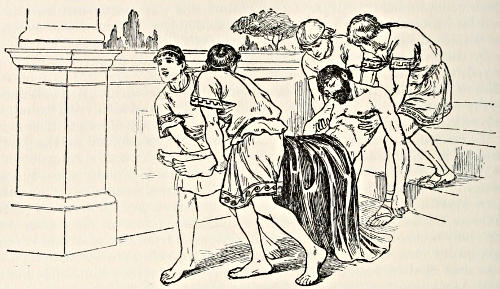
The Dying Pausanias Carried from the Temple
[478-476 B.C.]
The rivalry of Themistocles and Aristides had been greatly appeased
by the invasion of Xerxes, which had imposed upon both the peremptory
necessity of co-operation against a common enemy. Nor was it apparently
resumed, during the times which immediately succeeded the return of the
Athenians to their country: at least we hear of both in effective service, and
in prominent posts. Themistocles stands forward as the contriver of the
city walls and architect of Piræus: Aristides is commander of the fleet,
and first organiser of the confederacy of Delos. Moreover, we seem to
detect a change in the character of the latter: he had ceased to be the champion
of Athenian old-fashioned landed interest, against Themistocles as the
originator of the maritime innovations. Those innovations had now, since
the battle of Salamis, become an established fact; a fact of overwhelming
influence on the destinies and character, public as well as private, of the
Athenians. During the exile at Salamis, every man, rich or poor, landed
proprietor or artisan, had been for the time a seaman: and the anecdote of
Cimon, who dedicated the bridle of his horse in the Acropolis, as a token
that he was about to pass from the cavalry to service on shipboard, is a type
of that change of feeling which must have been impressed more or less upon
every rich man in Athens. From henceforward the fleet is endeared to every
man as the grand force, offensive and defensive, of the state, in which character
all the political leaders agree in accepting it.
We see by the active political sentiment of the German people, after the
great struggles of 1813 and 1814, how much an energetic and successful
military effort of the people at large, blended with endurance of serious
hardship, tends to stimulate the sense of political dignity and the demand
for developed citizenship: and if this be the tendency even among a
people habitually passive on such subjects, much more was it to be expected
in the Athenian population, who had gone through a previous
training of near thirty years under the democracy of Clisthenes. At the
time when that constitution was first established, it was perhaps the most
democratical in Greece: it had worked extremely well and had diffused
among the people a sentiment favourable to equal citizenship and unfriendly
to avowed privilege: so that the impressions made by the struggle at
Salamis found the popular mind prepared to receive them. Early after the
return to Attica, the Clisthenean constitution was enlarged as respects
eligibility to the magistracy. According to that constitution, the fourth or
last class of the Solonian census, including the considerable majority of the
freemen, were not admissible to offices of state, though they possessed votes
in common with the rest: no person was eligible to be a magistrate unless
he belonged to one of the three higher classes. This restriction was now
annulled, and eligibility extended to all the citizens. We may appreciate
the strength of feeling with which such reform was demanded, when we
find that it was proposed by Aristides, a man the reverse of what is called
a demagogue, and a strenuous friend of the Clisthenean constitution. No
political system would work after the Persian War, which formally excluded
“the maritime multitude” from holding magistracy. We rather imagine
that election of magistrates was still retained, and not exchanged for drawing
lots until a certain time, though not a long time, afterwards. That
which the public sentiment first demanded was the recognition of the equal
and open principle: after a certain length of experience, it was found that
poor men, though legally qualified to be chosen, were in point of fact rarely
chosen: then came the lot, to give them an equal chance with the rich.
The principle of sortition, or choice by lot, was never applied, as we have
before remarked, to all offices at Athens—never, for example, to the strategi,
or generals, whose functions were more grave and responsible than those of
any other person in the service of the state, and who always continued to be
elected by show of hands.
And it was probably about this period, during the years immediately
succeeding the battle of Salamis,—when the force of old habit and tradition
had been partially enfeebled by so many stirring novelties,—that the
archons were withdrawn altogether from political and military duties, and
confined to civil or judicial administration. At the battle of Marathon, the
polemarch is a military commander, president of the ten strategi: we know
him afterwards only as a civil magistrate, administering justice to the metics,
or non-freemen, while the strategi perform military duties without him.
The special and important change which characterised the period immediately
succeeding the battle of Salamis, was the more accurate line drawn
between the archons and the strategi; assigning the foreign and military
department entirely to the strategi, and rendering the archons purely civil
magistrates,—administrative as well as judicial. It was by some such steps
that the Athenian administration gradually attained that complete development
which it exhibits in practise during the century from the Peloponnesian
War downward, to which nearly all our positive and direct information relates.
[476-472 B.C.]
With this expansion both of democratical feeling and of military activity
at Athens, Aristides appears to have sympathised; and the popularity thus
insured to him, probably heightened by some regret for his previous ostracism,
was calculated to acquire permanence from his straightforward and incorruptible
character, now brought into strong relief from his function as assessor
to the new Delian confederacy. On the other hand, the ascendency of
Themistocles, though so often exalted by his unrivalled political genius and
daring, as well as by the signal value of his public recommendations, was
as often overthrown by his duplicity of means and unprincipled thirst for
money. New political opponents sprang up against him, men sympathising
with Aristides, and far more violent in their antipathy than Aristides himself.
Of these, the chief were Cimon, son of Miltiades and Alcmæon;
moreover, it seems that the Lacedæmonians, though full of esteem for Themistocles
immediately after the battle of Salamis, had now become extremely
hostile to him—a change which may be sufficiently explained from his
stratagem respecting the fortifications of Athens, and his subsequent ambitious
projects in reference to the Piræus. The Lacedæmonian influence, then not
inconsiderable in Athens, was employed to second the political combinations
against him. He is said to have given offence by manifestations of personal
vanity, by continual boasting of his great services to the state, and by the
erection of a private chapel, close to his own house, in honour of Artemis
Aristobule, or Artemis of admirable counsel; just as Pausanias had irritated
the Lacedæmonians by inscribing his own single name on the Delphian tripod,
and as the friends of Aristides had displeased the Athenians by endless
encomiums upon his justice.
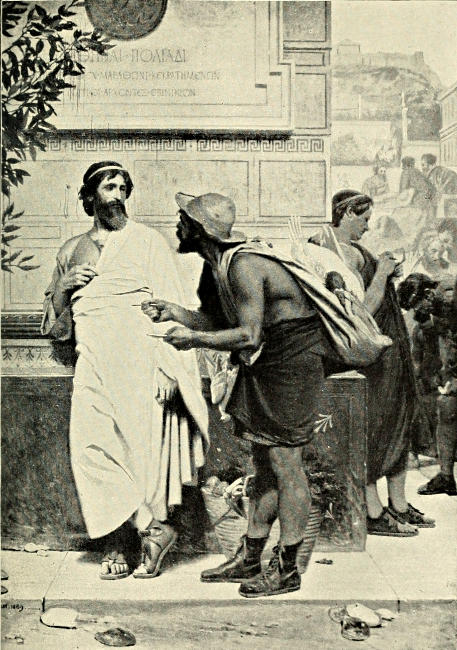
ARISTIDES AND THE PEASANT
But the main cause of his discredit was the prostitution of his great
influence for arbitrary and corrupt purposes. In the unsettled condition
of so many different Grecian communities, recently emancipated from Persia,
when there was past misrule to avenge, wrong-doers to be deposed and perhaps
punished, exiles to be restored, and all the disturbance and suspicions
accompanying so great a change of political condition as well as of foreign
policy, the influence of the leading men at Athens must have been great
in determining the treatment of particular individuals. Themistocles, placed
at the head of an Athenian squadron and sailing among the islands, partly
for the purposes of war against Persia, partly for organising the new confederacy,
is affirmed to have accepted bribes without scruple, for executing
sentences just and unjust, restoring some citizens, expelling others, and even
putting some to death. We learn this from a friend and guest of Themistocles,
the poet Timocreon of Ialysus in Rhodes, who had expected his own
restoration from the Athenian commander, but found that it was thwarted
by a bribe of three talents from his opponents; so that he was still kept in
exile on the charge of medism. The assertions of Timocreon, personally
incensed on this ground against Themistocles, are doubtless to be considered
as passionate and exaggerated: nevertheless, they are a valuable memorial of
the feelings of the time, and are far too much in harmony with the general
character of this eminent man to allow of our disbelieving them entirely.
Timocreon is as emphatic in his admiration of Aristides as in his censure of
Themistocles, whom he denounces as “a lying and unjust traitor.”
[472-471 B.C.]
Such conduct as that described by this new Archilochus, even making
every allowance for exaggeration, must have caused Themistocles to be both
hated and feared among the insular allies, whose opinion was now of considerable
importance to the Athenians. A similar sentiment grew up partially
against him in Athens itself, and appears to have been connected with
suspicions of treasonable inclinations towards the Persians. As the Persians
could offer the highest bribes, a man open to corruption might naturally be
suspected of inclinations towards their cause; and if Themistocles had rendered
pre-eminent service against them, so also had Pausanias, whose conduct
had undergone so fatal a change for the worse. It was the treason of Pausanias,
suspected and believed against him by the Athenians even when he
was in command at Byzantium, though not proved against him at Sparta
until long afterwards, which first seems to have raised the presumption of
medism against Themistocles also, when combined with the corrupt proceedings
which stained his public conduct: we must recollect, also, that Themistocles
had given some colour to these presumptions, even by the stratagems in
reference to Xerxes, which wore a double-faced aspect, capable of being construed
either in a Persian or in a Grecian sense. The Lacedæmonians, hostile
to Themistocles since the time when he had outwitted them respecting the
walls of Athens, and fearing him also as a supposed accomplice of the suspected
Pausanias, procured the charge of medism to be preferred against him
at Athens; by secret instigations, and, as it is said, by bribes, to his political
opponents. But no satisfactory proof could be furnished of the accusation,
which Themistocles himself strenuously denied, not without emphatic appeals
to his illustrious services. In spite of violent invectives against him from
Alcmæon and Cimon, tempered, indeed, by a generous moderation on the
part of Aristides, his defence was successful. He carried the people with
him and was acquitted of the charge. Nor was he merely acquitted, but, as
might naturally be expected, a reaction took place in his favour: his splendid
qualities and exploits were brought impressively before the public mind, and
he seemed for the time to acquire greater ascendency than ever.
Such a charge, and such a failure, must have exasperated to the utmost
the animosity between him and his chief opponents,—Aristides, Cimon,
Alcmæon, and others; nor can we wonder that they were anxious to get rid
of him by ostracism. In explaining this peculiar process, we have already
stated that it could never be raised against any one individual separately and
ostensibly, and that it could never be brought into operation at all, unless
its necessity were made clear, not merely to violent party men, but also to
the assembled senate and people, including, of course, a considerable proportion
of the more moderate citizens. We may well conceive that the conjuncture
was deemed by many dispassionate Athenians well suited for the
tutelary intervention of ostracism, the express benefit of which consisted in
its separating political opponents when the antipathy between them threatened
to push one or the other into extra-constitutional proceedings—especially
when one of those parties was Themistocles, a man alike vast in his
abilities and unscrupulous in his morality. Probably also there were not a
few wished to revenge the previous ostracism of Aristides: and lastly, the
friends of Themistocles himself, elate with his acquittal and his seemingly
augmented popularity, might indulge hopes that the vote of ostracism would
turn out in his favour, and remove one or other of his chief political opponents.
From all these circumstances we learn without astonishment, that a
vote of ostracism was soon after resorted to. It ended in the temporary
banishment of Themistocles.
[471-466 B.C.]
He retired into exile, and was residing at Argos, whither he carried a considerable
property, yet occasionally visiting other parts of the Peloponnesus,
when the exposure and death of Pausanias, together with the discovery of
his correspondence, took place at Sparta. Among this correspondence were
found proofs, which Thucydides seems to have considered as real and sufficient,
of the privity of Themistocles. According to Ephorus and others, he
is admitted to have been solicited by Pausanias, and to have known his plans,
but to have kept them secret while refusing to co-operate in them, but
probably after his exile he took a more decided share in them than before;
being well-placed for that purpose at Argos, a city not only unfriendly to
Sparta, but strongly believed to have been in collusion with Xerxes at his
invasion of Greece. On this occasion the Lacedæmonians sent to Athens,
publicly to prefer a formal charge of treason against him, and to urge the
necessity of trying him as a Panhellenic criminal before the synod of the
allies assembled at Sparta. Whether this latter request would have been
granted, or whether Themistocles would have been tried at Athens, we cannot
tell: for no sooner was he apprised that joint envoys from Sparta and
Athens had been despatched to arrest him, than he fled forthwith from
Argos to Corcyra. The inhabitants of that island, though owing gratitude
to him and favourably disposed, could not venture to protect him against
the two most powerful states in Greece, but sent him to the neighbouring
continent.
Here, however, being still tracked and followed by the envoys, he was
obliged to seek protection from a man whom he had formerly thwarted in
a demand at Athens, and who had become his personal enemy—Admetus,
king of the Molossians. Fortunately for him, at the moment when he
arrived, Admetus was not at home; and Themistocles, becoming a suppliant
to his wife, conciliated her sympathy so entirely, that she placed her child in
his arms, and planted him at the hearth in the full solemnity of supplication
to soften her husband. As soon as Admetus returned, Themistocles revealed
his name, his pursuers, and his danger, entreating protection as a helpless suppliant
in the last extremity. He appealed to the generosity of the Epirotic
prince not to take revenge on a man now defenceless, for offence given under
such very different circumstances; and for an offence too, after all, not of capital
moment, while the protection now entreated was to the suppliant a matter
of life or death. Admetus raised him up from the hearth with the child in
his arms, an evidence that he accepted the appeal and engaged to protect
him; refusing to give him up to the envoys, and at last only sending him away
on the expression of his own wish to visit the king of Persia. Two Macedonian
guides conducted him across the mountains to Pydna, in the Thermaic
Gulf, where he found a merchant ship about to set sail for the coast of Asia
Minor, and took a passage on board; neither the master nor the crew knowing
his name. An untoward storm drove the vessel to the island of Naxos, at
that moment besieged by an Athenian armament: had he been forced to land
there, he would of course have been recognised and seized, but his wonted
subtlety did not desert him. Having communicated both his name and the
peril which awaited him, he conjured the master of the ship to assist in saving
him, and not to suffer any one of the crew to land; menacing that if by
any accident he were discovered, he would bring the master to ruin along
with himself, by representing him as an accomplice induced by money to
facilitate the escape of Themistocles: on the other hand, in case of safety,
he promised a large reward. Such promises and threats weighed with the
master, who controlled his crew, and forced them to beat about during a day
and a night off the coast, without seeking to land. After that dangerous
interval, the storm abated, and the ship reached Ephesus in safety.
[466-460 (?) B.C.]
Thus did Themistocles, after a series of perils, find himself safe on the
Persian side of the Ægean. At Athens, he was proclaimed a traitor, and
his property confiscated: nevertheless, as it frequently happened in cases of
confiscation, his friends secreted a considerable sum, and sent it over to him
in Asia, together with the money which he had left at Argos; so that he
was thus enabled liberally to reward the ship-captain who had preserved
him. With all this deduction, the property which he possessed of a character
not susceptible of concealment, and which was therefore actually seized,
was found to amount to eighty talents [about £16,000 or $80,000] according
to Theophrastus, to one hundred talents according to Theopompus. In
contrast with this large sum, it is melancholy to learn that he had begun his
political career with a property not greater than three talents. The poverty
of Aristides at the end of his life presents an impressive contrast to the
enrichment of his rival.
The escape of Themistocles, and his adventures in Persia, appear to have
formed a favourite theme for the fancy and exaggeration of authors a century
afterwards: we have thus many anecdotes which contradict either
directly or by implication the simple narrative of Thucydides. Thus we are
told that at the moment when he was running away from the Greeks, the
Persian king also had proclaimed a reward of two hundred talents for his
head, and that some Greeks on the coast of Asia were watching to take him
for this reward: that he was forced to conceal himself strictly near the
coast, until means were found to send him up to Susa in a closed litter,
under pretence that it was a woman for the king’s harem: that Mandane,
sister of Xerxes, insisted upon having him delivered up to her as an expiation
for the loss of her son at the battle of Salamis: that he learned Persian
so well, and discoursed in it so eloquently, as to procure for himself an
acquittal from the Persian judges, when put upon his trial through the
importunity of Mandane: that the officers of the king’s household at Susa,
and the satraps on his way back, threatened him with still further perils:
that he was admitted to see the king in person, after having received a lecture
from the chamberlain on the indispensable duty of falling down before
him to do homage, etc., with several other uncertified details, which make us
value more highly the narrative of Thucydides. Indeed, Ephorus, Dinon,
Clitarchus, and Heraclides, from whom these anecdotes appear mostly to
be derived, even affirmed that Themistocles had found Xerxes himself alive
and seen him: whereas, Thucydides and Charon, the two contemporary
authors, for the former is nearly contemporary, asserted that he had found
Xerxes recently dead, and his son Artaxerxes on the throne.
According to Thucydides, the eminent exile does not seem to have been
exposed to the least danger in Persia. He presented himself as a deserter
from Greece, and was accepted as such: moreover,—what is more
strange, though it seems true,—he was received as an actual benefactor of the
Persian king, and a sufferer from the Greeks on account of such dispositions,
in consequence of his communications made to Xerxes respecting the intended
retreat of the Greeks from Salamis, and respecting the contemplated destruction
of the Hellespontine bridge. He was conducted by some Persians on
the coast up to Susa, where he addressed a letter to the king couched in the
following terms, such as probably no modern European king would tolerate
except from a Quaker: “I, Themistocles, am come to thee, having done to
thy house more mischief than any other Greek, as long as I was compelled in
my own defence to resist the attack of thy father—but having also done
him yet greater good, when I could do so with safety to myself, and when
his retreat was endangered. Reward is yet owing to me for my past service:
moreover, I am now here, chased away by the Greeks, in consequence of my
attachment to thee, but able still to serve thee with great effect. I wish to
wait a year, and then to come before thee in person to explain my views.”
Whether the Persian interpreters, who read this letter to Artaxerxes
Longimanus, exactly rendered its brief and direct expression, we cannot say.
But it made a strong impression upon him, combined with the previous reputation
of the writer, and he willingly granted the prayer for delay: though
we shall not readily believe that he was so transported as to show his joy by
immediate sacrifice to the gods, by an unusual measure of convivial indulgence,
and by crying out thrice in his sleep, “I have got Themistocles the
Athenian,”—as some of Plutarch’s authors informed him. In the course of
the year granted, Themistocles had learned so much of the Persian language
and customs as to be able to communicate personally with the king, and
acquire his confidence: no Greek, says Thucydides, had ever before attained
such a commanding influence and position at the Persian court. His ingenuity
was now displayed in laying out schemes for the subjugation of Greece
to Persia, which were eminently captivating to the monarch, who rewarded
him with a Persian wife and large presents, sending him down to Magnesia,
on the Mæander, not far from the coast of Ionia. The revenues of the district
round that town, amounting to the large sum of fifty talents [£10,000
or $50,000] yearly, were assigned to him for bread: those of the neighbouring
seaport of Myus, for articles of condiment to his bread, which was
always accounted the main nourishment: those of Lampsacus on the Hellespont,
for wine. Not knowing the amount of these two latter items, we can
not determine how much revenue Themistocles received altogether: but
there can be no doubt, judging from the revenues of Magnesia alone, that
he was a great pecuniary gainer by his change of country. After having
visited various parts of Asia, he lived for a certain time at Magnesia, in
which place his family joined him from Athens. How long his residence
at Magnesia lasted we do not know, but seemingly long enough to acquire
local estimation and leave mementos behind him. He at length died of sickness,
when sixty-five years old, without having taken any step towards the
accomplishment of those victorious campaigns which he had promised to
Artaxerxes. That sickness was the real cause of his death, we may believe
on the distinct statement of Thucydides; who at the same time notices a
rumour partially current in his own time, of poison voluntarily taken, from
painful consciousness on the part of Themistocles himself that the promises
made could never be performed—a further proof of the general tendency
to surround the last years of this distinguished man with impressive adventures,
and to dignify his last moments with a revived feeling, not unworthy
of his earlier patriotism. The report may possibly have been designedly
circulated by his friends and relatives, in order to conciliate some tenderness
towards his memory (his sons still continued citizens at Athens, and his
daughters were married there). These friends further stated that they had
brought back his bones to Attica, at his own express command, and buried
them privately without the knowledge of the Athenians; no condemned
traitor being permitted to be buried in Attic soil. If, however, we even suppose
that this statement was true, no one could point out with certainty the
spot wherein such interment had taken place: nor does it seem, when we
mark the cautious expressions of Thucydides, that he himself was satisfied of
the fact: moreover, we may affirm with confidence that the inhabitants of
Magnesia, when they showed the splendid sepulchral monument erected in
honour of Themistocles in their own market-place, were persuaded that his
bones were really enclosed within it.
[468 B.C.]
Aristides died about three or four years after the ostracism of Themistocles;
but respecting the place and manner of his death, there were several
contradictions among the authors whom Plutarch had before him. Some
affirmed that he perished on foreign service in the Euxine Sea; others, that
he died at home, amidst the universal esteem and grief of his fellow-citizens.
A third story, confined to the single statement of Craterus, and strenuously
rejected by Plutarch, represents Aristides as having been falsely accused
before the Athenian judicature and condemned to a fine of fifty minæ [£180,
or $900], on the allegation of having taken bribes during the assessment of
the tribute on the allies—which fine he was unable to pay, and was therefore
obliged to retire to Ionia, where he died. Dismissing this last story,
we find nothing certain about his death except one fact,—but that fact at
the same time the most honourable of all,—that he died very poor. It is
even asserted that he did not leave enough to pay funeral expenses, that
a sepulchre was provided for him at Phalerum at the public cost, besides a
handsome donation to his son Lysimachus, and a dowry to each of his two
daughters. In the two or three ensuing generations, however, his descendants
still continued poor, and even at that remote day, some of them received
aid out of the public purse, from the recollection of their incorruptible ancestor.
Near a century and a half afterwards, a poor man, named Lysimachus,
descendant of the just Aristides, was to be seen at Athens, near the chapel of
Iacchus, carrying a mysterious tablet, and obtaining his scanty fee of two
oboli [3d. or 6 cents] for interpreting the dreams of the passers-by: Demetrius
the Phalerean procured from the people, for the mother and aunt of this
poor man, a small daily allowance.
On all these points the contrast is marked when we compare Aristides
with Themistocles. The latter, having distinguished himself by ostentatious
cost at Olympia, and by a choregic victory at Athens, with little scruple as
to the means of acquisition, ended his life at Magnesia in dishonourable
affluence greater than ever, and left an enriched posterity both at that place
and at Athens. More than five centuries afterwards, his descendant, the
Athenian Themistocles, attended the lectures of the philosopher Ammonius
at Athens, as the comrade and friend of Plutarch himself.c
Greek Boat
(From a wall decoration)
Athens! thou birthplace of the great, the free!
Though bowed thy power, and dimmed thy name may be,
Though old Renown’s once dazzling sun hath set,
Fair beams the star of Memory o’er thee yet.
City! where sang the bard, and taught the sage,
Thy shrines may fall, thou ne’er wilt know old age;
Fresh shall thy image glow in every heart,
And but with Time’s last hour thy fame depart.
The history of this time with its rush of events and its startling changes
exhibits on the Athenian side a picture of astonishing and almost preternatural
energy.b The transition from the Athenian hegemony to the
Athenian empire was doubtless gradual, so that no one could determine
precisely where the former ends and the latter begins: but it had been
consummated before the thirty years’ truce, which was concluded fourteen
years before the Peloponnesian War, and it was in fact the substantial
cause of that war. Empire then came to be held by Athens,—partly as
a fact established, resting on acquiescence rather than attachment or consent
in the minds of the subjects,—partly as a corollary from necessity of union
combined with her superior force: while this latter point, superiority of
force as a legitimate title, stood more and more forward, both in the
language of her speakers and in the conceptions of her citizens. Nay, the
Athenian orators of the middle of the Peloponnesian War venture to affirm
that their empire had been of this same character ever since the repulse
of the Persians: an inaccuracy so manifest, that if we could suppose the
speech made by the Athenian Euphemus at Camarina in 415 B.C., to have
been heard by Themistocles or Aristides fifty years before, it would have been
alike offensive to the prudence of the one and to the justice of the other.
The imperial state of Athens, that which she held at the beginning of
the Peloponnesian War, when her allies, except Chios and Lesbos, were
tributary subjects, and when the Ægean Sea was an Athenian lake, was
of course the period of her greatest splendour and greatest action upon the
Grecian world. It was also the period most impressive to historians,
orators, and philosophers, suggesting the idea of some one state exercising
dominion over the Ægean, as the natural condition of Greece, so that
if Athens lost such dominion, it would be transferred to Sparta, holding
out the dispersed maritime Greeks as a tempting prize for the aggressive
schemes of some new conqueror, and even bringing up by association into
men’s fancies the mythical Minos of Crete, and others, as having been rulers
of the Ægean in times anterior to Athens.
[479-466 B.C.]
Even those who lived under the full-grown Athenian empire had before
them no good accounts of the incidents between 479-450 B.C.; for we may
gather from the intimation of Thucydides, as well as from his barrenness of
facts, that while there were chroniclers both for the Persian invasion and for
the times before, no one cared for the times immediately succeeding. Hence,
the little light which has fallen upon this blank has all been borrowed—if
we except the careful Thucydides—from a subsequent age; and the Athenian
hegemony has been treated as a mere commencement of the Athenian
empire: credit has been given to Athens for a long-sighted ambition, aiming
from the Persian War downwards at results which perhaps Themistocles
may have partially divined, but which only time and successive accidents
opened even to distant view. But such systematic anticipation of subsequent
results is fatal to any correct understanding, either of the real agents
or of the real period; both of which are to be explained from the circumstances
preceding and actually present, with some help, though cautious and
sparing, from our acquaintance with that which was then an unknown future.
When Aristides and Cimon dismissed the Lacedæmonian admiral Dorcis,
and drove Pausanias away from Byzantium on his second coming out, they
had to deal with the problem immediately before them; they had to complete
the defeat of the Persian power, still formidable, and to create and organise
a confederacy as yet only inchoate. This was quite enough to occupy their
attention, without ascribing to them distant views of Athenian maritime
empire.
In that brief sketch of incidents preceding the Peloponnesian War, which
Thucydides introduces as “the throwing off of his narrative,” he neither
gives, nor professes to give, a complete enumeration of all which actually
occurred. During the interval between the first desertion of the Asiatic allies
from Pausanias to Athens, in 477 B.C., and the revolt of Naxos in 466 B.C.,
he recites three incidents only: first, the siege and capture of Eion, on
the Strymon, with its Persian garrison; next, the capture of Scyros, and
appropriation of the island to Athenian cleruchs, or out-citizens; thirdly,
the war with Carystus in Eubœa and reduction of the place by capitulation.
It has been too much the practice to reason as if these three events were the
full history of ten or eleven years. Considering what Thucydides states
respecting the darkness of this period, we might perhaps suspect that they
were all which he could learn about it on good authority: and they are all,
in truth, events having a near and special bearing on the subsequent history
of Athens herself; for Eion was the first stepping-stone to the important
settlement of Amphipolis, and Scyros in the time of Thucydides was the
property of outlying Athenian citizens, or cleruchs.
Still, we are left in almost entire ignorance of the proceedings of Athens,
as conducting the newly established confederate force: for it is certain that
the first ten years of the Athenian hegemony must have been years of most
active warfare against the Persians. One positive testimony to this effect
has been accidentally preserved to us by Herodotus, who mentions, that
“before the invasion of Xerxes, there were Persian commanders and garrisons
everywhere in Thrace and the Hellespont, all of whom were conquered
by the Greeks after that invasion, with the single exception of Mascames,
governor of Doriscus, who could never be taken, though many different
Grecian attempts were made upon the fortress. Of those who were captured
by the Greeks, not one made any defence sufficient to attract the admiration
of Xerxes, except Boges, governor of Eion.” Boges, after bravely defending
himself, and refusing offers of capitulation, found his provisions exhausted,
and further resistance impracticable. He then kindled a vast funeral pile,
slew his wives, children, concubines, and family, and cast them into it,
threw his precious effects over the wall into the Strymon, and lastly, precipitated
himself into the flames. His brave despair was the theme of warm
encomium among the Persians, and his relatives in Persia were liberally rewarded
by Xerxes. This capture of Eion, effected by Cimon, has been
mentioned, as already stated, by Thucydides; but Herodotus here gives us
to understand that it was only one of a string of enterprises, all unnoticed by
Thucydides, against the Persians. Nay, it would seem from his language,
that Mascames maintained himself in Doriscus during the whole reign of
Xerxes, and perhaps longer, repelling successive Grecian assaults.
The valuable indication here cited from Herodotus would be of itself a
sufficient proof that the first years of the Athenian hegemony were full of
busy and successful hostility against the Persians. And in truth this is
what we should expect: the battles of Salamis, Platæa, and Mycale, drove
the Persians out of Greece, and overpowered their main armaments, but did
not remove them at once from all the various posts which they occupied
throughout the Ægean and Thrace. Without doubt, the Athenians had to
clear the coasts and the islands of a great number of different Persian detachments:
an operation never short nor easy, with the then imperfect
means of siege, as we may see by the cases of Sestus and Eion; nor, indeed,
always practicable, as the case of Doriscus teaches us. The fear of these
Persians, yet remaining in the neighbourhood, and even the chance of a
renewed Persian invading armament, formed one pressing motive for Grecian
cities to join the new confederacy: while the expulsion of the enemy
added to it those places which he had occupied. It was by these years of
active operations at sea against the common enemy, that the Athenians first
established that constant, systematic, and laborious training, among their
own ships’ crews, which transmitted itself with continual improvements
down to the Peloponnesian War: it was by these, combined with the present
fear, that they were enabled to organise the largest and most efficient
confederacy ever known among Greeks, to bring together deliberative deputies,
to plant their own ascendency as enforcers of the collective resolutions,
and to raise a prodigious tax from universal contribution. Lastly, it was
by these same operations, prosecuted so successfully as to remove present
alarm, that they at length fatigued the more lukewarm and passive members
of the confederacy, and created in them a wish either to commute personal
service for pecuniary contribution, or to escape from the obligation of service
in any way. The Athenian nautical training would never have been
acquired, the confederacy would never have become a working reality, the
fatigue and discontents among its members would never have arisen, unless
there had been a real fear of the Persians, and a pressing necessity for vigorous
and organised operations against them, during the ten years between
477 and 466 B.C.
But after a few years several of the confederates becoming weary of personal
military service, prevailed upon the Athenians to provide ships and
men in their place, and imposed upon themselves in exchange a money payment
of suitable amount. This commutation, at first probably introduced
to meet some special case of inconvenience, was found so suitable to the
taste of all parties that it gradually spread through the larger portion of the
confederacy. To unwarlike allies, hating labour and privation, it was a welcome
relief, while to the Athenians, full of ardour and patient of labour, as
well as discipline, for the aggrandisement of their country, it afforded constant
pay for a fleet more numerous than they could otherwise have kept
afloat. It is plain from the statement of Thucydides that this altered practice
was introduced from the petition of the confederates themselves, not
from any pressure or stratagem on the part of Athens. But though such
was its real source, it did not the less fatally degrade the allies in reference
to Athens, and extinguish the original feeling of equal rights and partnership
in the confederacy, with communion of danger as well as of glory, which had
once bound them together.
The Athenians came to consider themselves as military chiefs and soldiers,
with a body of tribute-paying subjects, whom they were entitled to hold
in dominion, and restrict, both as to foreign policy and internal government,
to such extent as they thought expedient, but whom they were also bound
to protect against foreign enemies. The military force of these subject-states
was thus in a great degree transferred to Athens, by their own act,
just as that of so many of the native princes in India was made over to the
English.
Under such circumstances several of the confederate states grew tired
even of paying their tribute, and averse to continuance as members. They
made successive attempts to secede, but Athens, acting seemingly in conjunction
with the synod, repressed their attempts one after the other, conquering,
fining, and disarming the revolters; which was the more easily done,
since in most cases their naval force had been in great part handed over
to her. As these events took place, not all at once, but successively
in different years, the number of mere tribute-paying allies as well as of
subdued revolters continually increasing, so there was never any one
moment of conspicuous change in the character of the confederacy: the
allies slid unconsciously into subjects, while Athens, without any predetermined
plan, passed from a chief into a despot. By strictly enforcing the
obligations of the pact upon unwilling members, and by employing coercion
against revolters, she had become unpopular in the same proportion as she
acquired new power, and that, too, without any guilt of her own. In this
position, even if she had been inclined to relax her hold upon the tributary
subjects, considerations of her own safety would have deterred her from
doing so; for there was reason to apprehend that they might place their
strength at the disposal of her enemies. It is very certain that she never
was so inclined; it would have required a more self-denying public morality
than has ever been practised by any state, either ancient or modern, even to
conceive the idea of relinquishing voluntarily an immense ascendency as well
as a lucrative revenue: least of all was such an idea likely to be conceived
by Athenian citizens, whose ambition increased with their power, and among
whom the love of Athenian ascendency was both passion and patriotism.
But though the Athenians were both disposed and qualified to push all the
advantages offered, and even to look out for new, we must not forget that
the foundations of their empire were laid in the most honourable causes:
voluntary invitation, efforts both unwearied and successful against a common
enemy, unpopularity incurred in discharge of an imperative duty, and
inability to break up the confederacy without endangering themselves as
well as laying open the Ægean Sea to the Persians.
There were two causes, besides that which has just been adverted to, for
the unpopularity of imperial Athens. First, the existence of the confederacy,
imposing permanent obligations, was in conflict with the general instinct of
the Greek mind, tending towards separate political autonomy of each city, as
well as with the particular turn of the Ionic mind, incapable of that steady
personal effort which was requisite for maintaining the synod of Delos, on
its first large and equal basis. Next,—and this is the great cause of all,—Athens,
having defeated the Persians, and thrust them to a distance, began
to employ the force and the tribute of her subject-allies in warfare against
Greeks, wherein these allies had nothing to gain from success, everything
to apprehend from defeat, and a banner to fight for, offensive to Hellenic
sympathies. On this head, the subject-allies had great reason to complain
throughout the prolonged wars of Greek against Greek for the purpose of
sustaining Athenian predominance: but on the point of practical grievances
or oppression they had little ground for discontent and little feeling of actual
discontent. Among the general body of citizens in the subject-allied cities,
the feeling towards Athens was rather indifference than hatred: the movement
of revolt against her proceeded from small parties of leading men, acting
apart from the citizens, and generally with collateral views of ambition
for themselves; and the positive hatred towards her was felt chiefly by those
who were not her subjects.
It is probable that the same indisposition to personal effort, which prompted
the confederates of Delos to tender money payment as a substitute for military
service, also induced them to neglect attendance at the synod. But we
do not know the steps whereby this assembly, at first an effective reality,
gradually dwindled into a mere form and vanished. Nothing, however, can
more forcibly illustrate the difference of character between the maritime
allies of Athens, and the Peloponnesian allies of Sparta, than the fact that,
while the former shrank from personal service, and thought it an advantage
to tax themselves in place of it, the latter were “ready enough with their
bodies,” but uncomplying and impracticable as to contributions. The contempt
felt by these Dorian landsmen for the military efficiency of the Ionians
recurs frequently, and appears even to have exceeded what the reality justified:
but when we turn to the conduct of the latter twenty years earlier, at
the battle of Lade, in the very crisis of the Ionic revolt from Persia, we detect
the same want of energy, the same incapacity of personal effort and
labour, as that which broke up the confederacy of Delos with all its beneficial
promise. To appreciate fully the indefatigable activity and daring, together
with the patient endurance of laborious maritime training, which characterised
the Athenians of that day, we have only to contrast them with
these confederates, so remarkably destitute of both. Amidst such glaring
inequalities of merit, capacity, and power, to maintain a confederacy of
equal members was impossible: it was in the nature of things that the
confederacy should either break up, or be transmuted into an Athenian
empire.
It has already been mentioned that the first aggregate assessment of
tribute, proposed by Aristides, and adopted by the synod at Delos, was four
hundred and sixty talents in money (about £92,000, or $460,000). At
that time many of the confederates paid their quota, not in money but in
ships; but this practice gradually diminished, as the commutations above
alluded to, of money in place of ships, were multiplied, while the aggregate
tribute, of course, became larger. It was no more than six hundred talents
at the commencement of the Peloponnesian War, forty-six years after the
first formation of the confederacy; from whence we may infer that it was
never at all increased upon individual members during the interval. For the
difference between four hundred and sixty talents and six hundred admits of
being fully explained by the numerous commutations of service for money,
as well as by the acquisitions of new members, which doubtless Athens had
more or less the opportunity of making. It is not to be imagined that the
confederacy had attained its maximum number, at the date of the first assessment
of tribute: there must have been various cities, like Sinope and Ægina,
subsequently added.
Without some such preliminary statements as those just given, respecting
the new state of Greece between the Persian and Peloponnesian wars, beginning
with the Athenian hegemony, or headship, and ending with the Athenian
empire, the reader would hardly understand the bearing of those
particular events which our authorities enable us to recount; events unhappily
few in number, though the period must have been full of action, and
not well authenticated as to dates.
[470-468 B.C.]
The first known enterprise of the Athenians in their new capacity,—whether
the first absolutely or not, we cannot determine,—between 476 B.C.
and 466 B.C., was the conquest of the important post of Eion, on the Strymon,
where the Persian governor, Boges, starved out after a desperate
resistance, destroyed himself rather than capitulate, together with his family
and precious effects, as has already been stated. The next events named
are their enterprises against the Dolopes and Pelasgi in the island of Scyros,
seemingly about 470 B.C., and the Dryopes in the town and district of
Carystus, in Eubœa. To the latter, who were of a different kindred from
the inhabitants of Chalcis and Eretria, and received no aid from them, they
granted a capitulation: the former were more rigorously dealt with, and
expelled from their island. Scyros was barren, and had little to recommend
it, except a good maritime position and an excellent harbour; while its
inhabitants, seemingly akin to the Pelasgian residents in Lemnos, prior to
the Athenian occupation of that spot, were alike piratical and cruel. Some
Thessalian traders, recently plundered and imprisoned by them, had raised
a complaint against them before the Amphictyonic synod, which condemned
the island to make restitution: the mass of the islanders threw the burden
upon those who had committed the crime; and these men, in order to evade
payment, invoked Cimon with the Athenian armament who conquered the
island, expelled the inhabitants, and peopled it with Athenian settlers.
Such clearance was a beneficial act, suitable to the new character of Athens
as guardian of the Ægean Sea against piracy: but it seems also connected
with Athenian plans. The island lay very convenient for the communication
with Lemnos, which the Athenians had doubtless reoccupied after the expulsion
of the Persians, and became, as well as Lemnos, a recognised adjunct,
or outlying portion, of Attica: moreover, there were old legends which
connected the Athenians with it, as the tomb of their hero Theseus, whose
name, as the mythical champion of democracy, was in peculiar favour at the
period immediately following the return from Salamis. It was in the year
476 B.C., that the oracle had directed them to bring home the bones of
Theseus from Scyros, and to prepare for that hero a splendid entombment
and edifice in their new city: they had tried to effect this, but the unsocial
manners of the Dolopians had prevented a search, and it was only after
Cimon had taken the island that he found, or pretended to find, the body.
It was brought to Athens in the year 469 B.C., and after being welcomed by
the people in solemn and joyous procession, as if the hero himself had come
back, was deposited in the interior of the city; the monument called the
Theseum, with its sacred precinct being built on the spot, and invested with
the privilege of a sanctuary for men of poor condition who might feel ground
for dreading the oppressions of the powerful, as well as for slaves in case
of cruel usage. Such were the protective functions of the mythical hero of
democracy, whose installation is interesting as marking the growing intensity
of democratical feeling in Athens since the Persian War.
[468-465 B.C.]
It was about two years or more
after this incident, that the first breach
of union in the confederacy of Delos
took place. The important island of
Naxos, the largest of the Cyclades,—an
island which thirty years before had
boasted a large marine force and eight
thousand hoplites,—revolted; on
what special ground we do not know:
but probably the greater islands fancied
themselves better able to dispense
with the protection of the confederacy
than the smaller—at the same time
they were more jealous of Athens.
After a siege of unknown duration by
Athens and the confederate force, it
was forced to surrender, and reduced
to the condition of a tributary subject;
its armed ships being doubtless
taken away, and its fortifications
razed: whether any fine or ulterior
penalty was levied, we have no information.
Greek Helmet and Weapons
(In the British Museum)
Though we know no particulars respecting operations against Persia, since
the attack on Eion, such operations must have been going on; but the expedition
under Cimon, undertaken not long after the Naxian revolt, was attended
with memorable results. That commander, having under him two hundred
triremes from Athens, and one hundred from the various confederates, was
despatched to attack the Persians on the southwestern and southern coast of
Asia Minor. He attacked and drove out several of their garrisons from various
Grecian settlements, both in Caria and Lycia: among others, the important
trading city of Phaselis, though at first resisting, and even standing a siege, was
prevailed upon by the friendly suggestions of the Chians in Cimon’s armament
to pay a contribution of ten talents and join in the expedition. From
the length of time occupied in these various undertakings, the Persian satraps
had been enabled to assemble a powerful force, both fleet and army, near the
mouth of the river Eurymedon, in Pamphylia, under the command of Tithraustes
and Pherendates, both of the regal blood. The fleet, chiefly Phœnician,
seems to have consisted of two hundred ships, but a further reinforcement
of eighty Phœnician ships was expected, and was actually near at hand, and
the commanders were unwilling to hazard a battle before its arrival. Cimon,
anxious for the same reason to hasten on the combat, attacked them vigorously:
partly from their inferiority of numbers, partly from discouragement
at the absence of the reinforcement, they seem to have made no strenuous
resistance. They were put to flight and driven ashore, so speedily, and with so
little loss to the Greeks, that Cimon was enabled to disembark his men forthwith,
and attack the land-force which was drawn up on shore to protect them.
The battle on land was long and gallantly contested, but Cimon at length
gained a complete victory, dispersed the army with the capture of many
prisoners, and either took or destroyed the entire fleet. As soon as his victory
and his prisoners were secured, he sailed to Cyprus for the purpose of
intercepting the reinforcement of eighty Phœnician ships in their way, and
was fortunate enough to attack them while yet they were ignorant of the
victories of the Eurymedon. These ships too were all destroyed, though
most of the crews appear to have escaped ashore on the island. Two great
victories, one at sea and the other on land, gained on the same day by the
same armament, counted with reason among the most glorious of all Grecian
exploits, and were extolled as such in the inscription on the commemorative
offering to Apollo, set up out of the tithe of the spoils. The number of prisoners,
as well as the booty taken by the victors, was immense.
A victory thus remarkable, which thrust back the Persians to the region
eastward of Phaselis, doubtless fortified materially the position of the Athenian
confederacy against them; but it tended not less to exalt the reputation
of Athens, and even to popularise her with the confederates generally,
from the large amount of plunder divisible among them. Probably this
increased power and popularity stood her in stead throughout her approaching
contest with Thasos, and at the same time it explains the increasing fear
and dislike of the Peloponnesians.c
Athens, become, within a very few years, from the capital of a small
province, in fact though not yet in avowed pretension, the head of an empire,
exhibited a new and singular phenomenon in politics, a sovereign people; a
people, not, as in many other Grecian democracies, sovereign merely of that
state which themselves, maintained by slaves, composed, but supreme over
other people in subordinate republics, acknowledging a degree of subjection,
yet claiming to be free. Under this extraordinary political constitution philosophy
and the arts were beginning to make Athens their principal resort.
Migrating from Egypt and the east, they had long been fostered on the
western coast of Asia. In Greece itself they had owed some temporary encouragement
principally to those called tyrants; the Pisistratidæ at Athens,
and Periander at Corinth. But their efforts were desultory and comparatively
feeble till the communication with the Asian Greeks, checked
and interrupted by their subjection to Persia, was restored, and Athens,
chief of the glorious confederacy by whose arms the deliverance had been
effected, began to draw everything toward itself as a common centre, the
capital of an empire. Already science and fine taste were so far perfected
that Æschylus had exhibited tragedy in its utmost dignity, and Sophocles
and Euripides were giving it the highest polish, when Cimon returned in
triumph to his country.
It was the peculiar felicity of Athens in this period that, of the constellation
of great men which arose there, each was singularly fitted for the situation
in which the circumstances of the time required him to act; and none
filled his place more advantageously than Cimon. But the fate of all those
great men, and the resources employed, mostly in vain, to avert it, sufficiently
mark, in this splendid era, a defective constitution, and law and justice
ill assured. Aristides, we are told, though it is not undisputed, had founded
his security upon extreme poverty: Cimon endeavoured to establish himself
by a splendid, and almost unbounded, yet politic liberality. To ward against
envy, and to secure his party with that tremendous tyrant, as the comic poet
not inaptly calls the sovereign people, he made a parade of throwing down
the fences of his gardens and orchards in the neighbourhood of Athens, and
permitted all to partake of their produce; a table was daily spread at his
house for the poorer citizens, but more particularly for those of his own
ward, whom he invited from the agora, the courts of justice, or the general
assembly; a bounty which both enabled and disposed them to give their
time at his call whenever his interest required their support. In going about
the city he was commonly attended by a large retinue, handsomely clothed;
and if he met an elderly citizen ill clad, he directed one of his attendants to
change cloaks with him. To the indigent of higher rank he was equally
attentive, lending or giving money, as he found their circumstances required,
and always managing his bounty with the utmost care that the object of it
should not be put to shame.[42]
His conduct, in short, was a continual preparation for an election; not,
as in England, to decide whether the candidate should or should not be a
member of the legislature; but whether he should be head of the commonwealth
or an exile.[43] In his youth he had affected a roughness of manners,
and a contempt for the elegances generally reckoned becoming his rank, and
which his fortune enabled him to command. In his riper years he discovered
that virtue and grossness have no natural connection: he became himself a
model of politeness, patronised every liberal art, and studied to procure elegant
as well as useful indulgences for the people. By him were raised the
first of those edifices which, for want of a more proper name, we call porticos,
under whose magnificent shelter, in their torrid climate, it became the
delight of the Athenians to assemble, and pass their leisure in promiscuous
conversation. The widely celebrated groves of Academia acknowledged him
as the founder of their fame. In the wood, before rude and without water,
he formed commodious and elegant walks, and adorned them with running
fountains. Nor was the planting of the agora, or great market-place of
Athens, with that beautiful tree, the oriental plane, forgotten as a benefit
from Cimon; while, ages after him, his trees flourished, affording an agreeable
and salutary shade to those who exposed their wares there, and to those
who came to purchase them. Much, if not the whole of these things, we are
given to understand, was done at his private expense; but our information
upon the subject is inaccurate. Those stores, with which his victories had
enriched the treasury, probably furnished the sums employed upon some of
the public works executed under his direction, as, more especially, the completion
of the fortification of the citadel, whose principal defence hitherto,
on the southern side, had been the precipitous form of the rock.
While with this splendid and princely liberality Cimon endeavoured to
confirm his own interest, he was attentive to promote the general welfare,
and to render permanent the superiority of Athens among the Grecian republics.
The citizens of the allied states grew daily more impatient of the
requisitions regularly made to take their turn of service on shipboard, and
longed for uninterrupted enjoyment of their homes, in that security against
foreign enemies which their past labours had, they thought, now sufficiently
established. But that the common interest still required the maintenance
of a fleet was a proposition that could not be denied, while the Persian
empire existed, or while the Grecian seas offered temptation for piracy.
Cimon therefore proposed that any commonwealth of the confederacy might
compound for the personal service of its citizens, by furnishing ships, and
paying a sum of money to the common treasury: the Athenians would then
undertake the manning of the fleet. The proposal was at the moment
popular; most of the allies acceded to it, unaware or heedless of the consequences;
for, while they were thus depriving themselves of all maritime
force, making that of Athens irresistible, they gave that ambitious republic
claims upon them, uncertain in their nature, and which, as they might be
made, could now also be enforced, at its pleasure.
[465-463 B.C.]
Having thus at the same time strengthened itself and reduced to impotence
many of the allied states, the Athenian government became less scrupulous
of using force against any of the rest which might dispute its sovereign
authority. The reduction of Eion, by the confederate arms under Cimon,
had led to new information of the value of the adjacent country; where
some mines of gold and silver, and a lucrative commerce with the surrounding
Thracian hordes, excited avidity. But the people of the neighbouring
island of Thasos, very anciently possessed of that commerce, and of the
more accessible mines, insisted that these, when recovered from the common
enemy by the arms of that confederacy of which they were members, should
revert entire to them. The Athenians, asserting the right of conquest, on
the contrary, claimed the principal share as their own. The Thasians, irritated,
renounced the confederacy. Cimon then was commanded to lead the
confederate armament against them. They venturing an action at sea, were
defeated; and Cimon, debarking his forces on the island, became quickly
master of everything but the principal town, to which he laid siege. The
Athenians then hastened to appropriate that inviting territory on the continent,
which was their principal object, by sending thither a colony of no
less than ten thousand men, partly Athenian citizens, partly from the allied
commonwealths.
The Thasians had not originally trusted in their own strength alone for
the hope of final success. Early in the dispute they had sent ministers to
Lacedæmon, soliciting protection against the oppression of Athens. The
pretence was certainly favourable, and the Lacedæmonian government, no
longer pressed by domestic troubles, determined to use the opportunity for
interfering to check the growing power of the rival commonwealth, so long
an object of jealousy, and now become truly formidable. Without a fleet
capable of contending with the Athenian, they could not send succour immediately
to Thasos: but they were taking measures secretly for a diversion
in its favour, by invading Attica, when a sudden and extraordinary
calamity, an earthquake which overthrew the city of Sparta, and in its
immediate consequences threatened destruction to the commonwealth, compelled
them to confine all their attention at home. Nevertheless the siege,
carried on with great vigour, and with all the skill of the age under the
direction of Cimon, was, during three years, obstinately resisted. Even
then the Thasians obtained terms, severe indeed, but by which they obviated
the miseries, death often for themselves and slavery for their families,
to which Grecian people, less able to defend themselves, were frequently
reduced by Grecian arms. Their fortifications however were destroyed;
their ships of war were surrendered; they paid immediately a sum of money;
they bound themselves to an annual tribute; and they yielded all claim upon
the opposite continent, and the valuable mines there.
The sovereignty of the Athenian people over the allied republics would
thus gain some present confirmation; but in the principal object their ambition
and avarice were, apparently through over-greediness, disappointed.
The town of Eion stood at the mouth of the river Strymon. For the new
settlement a place called the Nine Ways, a few miles up the river, was
chosen; commodious for the double purpose of communicating with the
sea, and commanding the neighbouring country. But the Edonian Thracians,
in whose territory it was, resenting the encroachment, infested the
settlers with irregular but continual hostilities. To put an end to so
troublesome a war the whole force of the colony marched against them. As
the Greeks advanced, the Edonians retreated; avoiding a general action,
while they sent to all the neighbouring Thracian tribes for assistance, as in
a common cause. When they were at length assembled in sufficient numbers,
having engaged the Greeks far within a wild and difficult country,
they attacked, overpowered, and cut in pieces their army, and annihilated
the colony.
Cimon, on his return to Athens, did not meet the acclamations to which
he had been accustomed. Faction had been busy in his absence. Apparently
the fall of the colony of the Nine Ways furnished both instigation and
opportunity, perhaps assisted by circumstances of which no information
remains. A prosecution was instituted against him, on the pretence, according
to the biographers, that he ought to have extended the Athenian
dominion by conquest in Macedonia, and that bribes from Alexander, king
of that country, had stopped his exertions. The covetous ambition indeed
of the Athenian people, inflamed by interested demagogues, was growing
boundless. Cimon, indignant at the ungrateful return for a life divided between
performing the most important services to his country, and studying
how most to gratify the people, would enter little into particulars in refuting
a charge, one part of which he considered as attributing to him no crime, the
other as incapable of credit, and therefore beneath his regard. He told
the assembled people that “they mistook both him and the country which
it was said he ought to have conquered. Other generals have cultivated an
interest with the Ionians and the Thessalians, whose riches might make an
interference in their concerns profitable. For himself, he had never sought
any connection with those people; but he confessed he esteemed the Macedonians,
who were virtuous and brave, but not rich; nor would he ever
prefer riches to those qualities, though he had his satisfaction in having
enriched his country with the spoils of its enemies.” The popularity of
Cimon was yet great; his principal opponents apparently found it not
a time for pushing matters to extremity against him, and such a defence
sufficed to procure an honourable acquittal.
[464-462 B.C.]
Meanwhile Lacedæmon had been in the utmost confusion and on the
brink of ruin. In the year 464 B.C. the earthquake came suddenly at mid-day,
with a violence before unheard of. The youths of the principal families,
assembled in the gymnasium at the appointed hour for exercise, were in
great numbers crushed by its fall: many of both sexes and of all ages were
buried under the ruins of other buildings: the shocks were repeated; the
earth opened in several places; vast fragments from the summits of Taygetus
were tumbled down its sides: in the end only five houses remained
standing in Sparta, and it was computed that twenty thousand lives were
lost.
The first strokes of this awful calamity filled all ranks with the same apprehensions.
But, in the continuance of it, that wretched multitude, excluded
from all participation in the prosperity of their country, began to found hope
on its distress: a proposal, obscurely made, was rapidly communicated, and
the helots assembled from various parts with one purpose, of putting their
severe masters to death, and making the country their own. The ready
foresight and prudent exertion of Archidamus, who had succeeded his grandfather
Leotychides in the throne of the house of Procles, preserved Lacedæmon.
In the confusion of the first alarm, while some were endeavouring to
save their most valuable effects from the ruins of the city, others flying
various ways for personal safety, Archidamus, collecting what he could of
his friends and attendants about him, caused trumpets to sound to arms, as
if an enemy were at hand. The Lacedæmonians, universally trained to the
strictest military discipline, obeyed the signal; arms were the only necessaries
sought; and civil rule, dissipated by the magnitude of the calamity,
was, for the existing circumstances, most advantageously supplied by military
order. The helots, awed by the very unexpected appearance of a
regular army instead of a confused and flying multitude, desisted from their
meditated attempt; but, quitting the city, spread themselves over the country,
and excited their fellows universally to rebellion.
[462 B.C.]
The greater part of those miserable men, whom the Lacedæmonians held
in so cruel a bondage, were descendants of the Messenians, men of the same
blood with themselves, Greeks and Dorians. Memory of the wars of their
ancestors, of their hero Aristomenes, and of the defence of Ithome, was not
obsolete among them. Ithome accordingly they seized and made their principal
post; and they so outnumbered the Lacedæmonians that, though deficiently
armed, yet, being not without discipline acquired in attendance upon
their masters in war, they were capable of being formidable even in the
field. Nor was it thus only that the rebellion was distressing.[44] The Lacedæmonians,
singularly ready and able in the use of arms, were singularly
helpless in almost every other business. Deprived of their slaves they were
nearly deprived of the means of subsistence; agriculture stopped, and mechanic
arts ceased. Application was therefore made to the neighbouring
allies for succour. The zealous friendship of the Æginetans upon the occasion
we find afterwards acknowledged by the Lacedæmonian government,
and assistance came from as far as Platæa. Thus re-enforced the spirited and
well-directed exertions of Archidamus quickly so far reduced the rebellion
that the insurgents remaining in arms were blockaded in Ithome. But the
extraordinary natural strength of that place, the desperate obstinacy of the
defenders, and the deficiency of the assailants in the science of attack, giving
reason to apprehend that the business might not be soon accomplished, the
Lacedæmonians sent to desire assistance from the Athenians, who were
esteemed, beyond the other Greeks, experienced and skilful in the war of
sieges.
This measure seems to have been on many accounts imprudent. There
was found at Athens a strong disposition to refuse the aid. But Cimon, who,
with a universal liberality, always professed particular esteem for the Lacedæmonians,
prevailed upon his countrymen to take the generous part; and a
considerable body of forces marched under his command into the Peloponnesus.
Upon their arrival at the camp of the besiegers an assault upon the place
was attempted, but with so little success that recourse was again had to
the old method of blockade. It was in the leisure of that inactive and
tedious mode of attack that principally arose those heartburnings which first
occasioned an avowed national aversion between the Athenians and Lacedæmonians,
and led, not indeed immediately, but in a direct line, to the fatal
Peloponnesian War. All the prudence and all the authority of Cimon could
not prevent the vivacious spirit of the Athenians from exulting, perhaps
rather insultingly, in the new pre-eminence of their country; wherever
danger called, they would be ostentatiously forward to meet it; and an
assumed superiority, without a direct pretension to it, was continually
appearing.
The Spartan pride was offended by their arrogance; the Spartan gravity
was disturbed by their lively forwardness: it began to be considered that,
though Greeks, they were Ionians, whom the Peloponnesians considered as an
alien race; and it occurred that if, in the continuance of the siege, any disgust
should arise, there was no security that they might not renounce their
present engagements, and even connect themselves with the helots; who, as
Greeks, had, not less than the Lacedæmonians, a claim to friendship and protection
from every other Grecian people. Mistrust thus arose on one side;
disgust became quickly manifest on both; and the Lacedæmonians shortly
resolved to dismiss the Athenian forces. This however they endeavoured to
do, as far as might be, without offence, by declaring that an “assault having
been found ineffectual, the assistance of the Athenians was superfluous for
the blockade, and the Lacedæmonians would not give their allies unnecessary
trouble.” All the other allies were however retained, and the Athenians
alone returned home; so exasperated by this invidious distinction that, on
their arrival at Athens, the party adverse to Cimon proposing a decree for
renouncing the confederacy with Lacedæmon, it was carried. An alliance
with Argos, the inveterate enemy of Sparta, immediately followed; and soon
after the Thessalians acceded to the new confederacy.
While Lacedæmon was engaged with this dangerous insurrection, a
petty war arose in the Peloponnesus, affording one of the most remarkable,
among the many strong instances on record, of the miseries to which the
greater part of Greece was perpetually liable from the defects of its political
system. Argos, the capital of Argolis, and formerly of the Peloponnesus
under the early kings of the Danaan race, or perhaps before them, lost its preeminence,
as we have already seen, during the reigns of the Persidæan and
Pelopidæan princes, under whom Mycenæ became the first city of Greece.
On the return of the Heraclidæ, Temenus fixed his residence at Argos,
which thus regained its superiority. But, as the oppressions, arising from a
defective political system, occasioned very generally through Greece the
desire, so the troubles of the Argive government gave the means for the inferior
towns to become independent republics. Like the rest, or perhaps
more than the rest, generally oppressive, that government was certainly
often ill-conducted and weak; and Lacedæmon, its perpetual enemy,
fomented the rebellious disposition of its dependencies. During the ancient
wars of Sparta and Messenia, the Argives had expelled the people of their
towns of Asine and Nauplia, and forced them to seek foreign settlements;
a resource sufficiently marking a government both weak and oppressive.
Mycenæ was now a much smaller town than Argos; but its people, encouraged
by Lacedæmon, formed lofty pretensions. The far-famed temple
of Juno, the tutelar deity of the country, situated about five miles from
Argos, and little more than one from Mycenæ, was considered by the Argives
as theirs; and, from the time, it was supposed, of the Heraclidæ, the
priestess had been appointed and the sacred ceremonies administered under
the protection of their government. Nevertheless the Mycenæans now
claimed the right to this superintendency. The games of Nemea, from their
institution, or, as it was called, their restoration, had been under the direction
of the Argives; but the Mycenæan government claimed also the prior
right to preside there. These however were but branches of a much more
important claim; for they wanted only power, or sufficient assistance from
Sparta, to assert a right of sovereignty over Argos itself and all Argolis;
and they were continually urging another pretension, not the less invidious
to Argos because better founded, a pretension to merit with all the Greek
nation for having joined the confederacy against Persia, while the Argives
allied themselves with the common enemy of Greece. The favourable opportunity
afforded by the helot rebellion was eagerly seized by the Argives for
ridding themselves of such troublesome and dangerous neighbours, whom
they considered as rebellious subjects. Laying siege to Mycenæ they took
the place, reduced the surviving people to slavery, and dedicating a tenth of
the spoil to the gods destroyed the town, which was never rebuilt.
At Athens, after the banishment of Themistocles, Cimon remained long
in possession of a popularity which nothing could resist; and his abilities,
his successes, and his moderation, his connection with the aristocratical interest,
and his favour with the people, seemed altogether likely to insure, if
anything could insure, permanency and quiet to his administration. But
in Athens, as in every free government, there would always be a party adverse
to the party in the direction of public affairs: matters had been for
some time ripening for a change; and the renunciation of the Lacedæmonian
alliance was the triumph of the opposition.d
This was the ruler of the land
When Athens was the land of fame:
This was the light that led the band
When earth was like a living flame;
The centre of earth’s noblest ring—
Of more than men the more than king.
Cimon was beyond dispute the ablest and most successful general of his
day: and his victories had shed a lustre on the arms of Athens, which almost
dimmed the glories of Marathon and Salamis. But while he was gaining
renown abroad, he had rivals at home, who were endeavouring to supplant
him in the affections of the people, and to establish a system of domestic and
foreign policy directly counter to his views, and were preparing contests for
him in which his military talents would be of little avail. While Themistocles
and Aristides were occupying the political stage, an extraordinary
genius had been ripening in obscurity, and was only waiting for a favourable
juncture to issue from the shade into the broad day of public life. Xanthippus,
the conqueror of Mycale, had married Agariste, a descendant of the
famous Clisthenes, and had left two sons, Ariphron and Pericles. Of Ariphron
little is known beside his name: but Pericles, to an observing eye, gave
early indications of a mind formed for great things, and a will earnestly bent
on them.
In his youth he had not rested satisfied with the ordinary Greek education,
but had applied himself, with an ardour which was not even abated
by the lapse of years, nor stifled by his public avocations, to intellectual
pursuits, which were then new at Athens, and confined to a very narrow
circle of inquisitive spirits. His birth and fortune afforded him the means
of familiar intercourse with all the men most eminent in every kind of
knowledge and art, who were already beginning to resort to Athens as a
common seat of learning. Thus, though Pythoclides taught him to touch
the cithara, he sought the elements of a higher kind of music in the lessons
of Damon, who was believed to have contributed mainly to train
him for his political career: himself no ordinary person; for he was held
up by the comic poets to public jealousy, as a secret favourer of tyranny,
and was driven from Athens by the process of ostracism. But Pericles
also entered with avidity into the abstrusest philosophical speculations,
and even took pleasure in the arid subtleties of the Eleatic school, or at
least in the ingenuity and the dialectic art with which they were unfolded
to him by Zeno. But his principal guide in such researches, and the man
who appears to have exercised the most powerful and durable influence on
his mind and character, was the philosopher Anaxagoras, with whom he
was long united in intimate friendship. Not only his public and private
deportment, and his habits of thought, but the tone and style of his
eloquence were believed to have been formed by his intercourse with Anaxagoras.
It was commonly supposed that this effect was produced by the
philosopher’s physical speculations, which, elevating his disciple above the
ignorant superstition of the vulgar, had imparted to him the serene condescension
and dignified language of a superior being. But we should be loth
to believe that it was the possession of such physical secrets as Anaxagoras
was able to communicate, that inspired Pericles with his lofty conceptions,
or that he was intoxicated with the little taste of science which had weaned
him from a few popular prejudices. We should rather ascribe so deep an
impression to the distinguishing tenet of the Anaxagorean system, by which
the philosopher himself was supposed to have acquired the title of Mind.
It was undoubtedly not for the mere amusement of his leisure that
Pericles had enriched his mind with so many rare acquirements. All of
them were probably considered by him as instruments for the use of the
statesman: and even those which seemed most remote from all practical
purposes, may have contributed to the cultivation of that natural eloquence,
to which he owed so much of his influence. He left no specimens of his
oratory behind him, and we can only estimate it, like many other fruits of
Greek genius, by the effect it produced. The few minute fragments preserved
by Plutarch, which were recorded by earlier authors because they
had sunk deep in the mind of his hearers, seem to indicate that he loved
to concentrate his thoughts in a bold and vivid image: as when he called
Ægina the eyesore of Piræus, and said that he descried war lowering from
the Peloponnesus. But though signally gifted and accomplished for political
action, it was not without much hesitation and apprehension that he
entered on a field, where he saw ample room indeed for the display of his
powers, but also many enemies and great dangers. The very superiority
of which he could not but be conscious, suggested a motive for alarm, as
it might easily excite suspicion in the people of views adverse to their
freedom: and these fears were heightened by some circumstances, trifling
in themselves, but capable of awakening or confirming a popular prejudice.
His personal appearance was graceful and majestic, notwithstanding a
remarkable disproportion in the length of his head, which became a subject
of inexhaustible pleasantry for the comic poets of this day: but the old men
who remembered Pisistratus, were struck by the resemblance which they
discovered between the tyrant and the young heir of the Alemæonids, and
not only in their features, but in the sweetness of voice, and the volubility
of utterance, with which both expressed themselves. Still, after the ostracism
of Themistocles, and the death of Aristides, while Cimon was engaged
in continual expeditions, Pericles began to present himself more and more to
the public eye, and was soon the acknowledged chief of a powerful party,
which openly aimed at counteracting Cimon’s influence, and introducing
opposite maxims into the public counsels.
To some of the ancients indeed it appeared that the course of policy
adopted by Pericles was entirely determined by the spirit of emulation,
which induced him to take a different ground from that which he found
already occupied by Cimon: and that, as Cimon was at the head of the
aristocratical party which had been represented by Aristides, he therefore
placed himself in the front of that which had been led by Themistocles. The
difference between these parties, after the revolution by which the ancestor of
Pericles had undermined the power of the old aristocracy, was for some time
very faintly marked, and we have seen that Aristides himself was the author
of a very democratical measure, which threw the first officers of the state
open to all classes of the citizens. The aristocracy had no hope of recovering
what it had lost; but, as the commonalty grew more enterprising, it
became also more intent on keeping all that it had retained, and on stopping
all further innovation at home. Abroad too, though it was no longer a
question, whether Athens should continue to be a great maritime power, or
should reduce her navy to the footing of the old naucraries, and though
Cimon himself had actively pursued the policy of Themistocles, there was
room for great difference of opinion as to the course which was to be followed
in her foreign relations. The aristocratical party wished, for their
own sake at least as much as for that of peace and justice, to preserve the
balance of power as steady as possible in Greece, and directed the Athenian
arms against the Persian empire with the greater energy, in the hope of
diverting them from intestine warfare. The democratical party had other
interests, and concurred only with that part of these views which tended
towards enriching and aggrandising the state.
It is difficult wholly to clear Pericles from the charge of having been
swayed by personal motives in the choice of his political system, as it would
be to establish it. But even if it were certain that his decision was not the
result of conviction, it might as fairly be attributed to a hereditary prepossession
in favour of the principles for which his ancestors had contended,
and which had probably been transmitted in his family, as to his competition
with Cimon, or to his fear of incurring the suspicion that he aimed at a
tyranny, or unconstitutional power; a suspicion to which he was much more
exposed in the station which he actually filled. But if his personal character
might seem better adapted to an aristocratical than to a democratical party,
it must also render us unwilling to believe, that he devoted himself to the
cause of the commonalty merely that he might make it the instrument of his
own ambition. There seems to be much better ground for supposing that
he deliberately preferred the system which he adopted, as the most consistent,
if not alone reconcilable, with the prosperity and safety of Athens: though his
own agency in directing and controlling it might be a prominent object in all
his views. But he might well think that the people had gone too far to remain
stationary, even if there was any reason why it should not seize the good
which lay within its reach. Its greatness had risen with the growth of the
commonalty, and, it might appear to him, could only be maintained and extended
by the same means: at home by a decided ascendency of the popular
interest over that of the old aristocracy, and every other class in the state;
abroad by an equally decided supremacy over the rest of Greece.
The contest between the parties seems for some time to have been carried
on, without much violence or animosity, and rather with a noble emulation
in the service of the public, than with assaults on one another. Cimon
had enriched his country with the spoil and ransom of the Persians; and he
had also greatly increased his private fortune. His disposition was naturally
inclined to liberality, and he made a munificent use of his wealth.
The state of things had undergone a great change at Athens in favour
of the poorer class, since Solon had been obliged to interpose, to protect
them from the rigour of creditors, who first impoverished, and then enslaved
them. Since this time the aristocracy had found it expedient to court the
commonalty which it could no longer oppress, and to part with a portion of
its wealth for the sake of retaining its power. There were of course then,
as at all times, benevolent individuals, who only consulted the dictates of a
generous nature: but the contrast between the practice which prevailed
before and after the age of Solon, seems clearly to mark the spurious origin
of the ordinary beneficence. Yet Isocrates, when he extols the bounty of
the good old times, which prevented the pressure of poverty from being ever
felt, speaks of land granted at low rents, sums of money advanced at low
interest, and asserts that none of the citizens were then in such indigence,
as to depend on casual relief. Cimon’s munificence therefore must have
been remarkable, not only in its degree, but in its kind: and was not the
less that of a demagogue, because he sought popularity, not merely for his
own sake, but for that of his order and his party.
Such was the light in which it was viewed by Pericles; and some of the
measures which most strongly marked his administration were adopted to
counteract its effects. He was not able to rival Cimon’s profusion, and he
even husbanded his private fortune with rigid economy, that he might keep
his probity in the management of public affairs free both from temptation and
suspicion. His friend Demonides is said first to have suggested the thought
of throwing Cimon’s liberality into the shade, and rendering it superfluous,
by proposing a similar application of the public revenue. Pericles perhaps
deemed it safer and more becoming, that the people should supply the poorer
citizens with the means of enjoyment out of its own funds, than that they should
depend on the bounty of opulent individuals. He might think that the generation
which had raised their country to such a pitch of greatness, was
entitled to reap the fruits of the sacrifice which their fathers had made, in
resigning the produce of the mines of Laurium to the use of the state.
Very early therefore he signalised his appearance in the assembly by
becoming the author of a series of measures, all tending to provide for the
subsistence and gratification of the poorer class at the public expense.
But we must here observe, that, while he was courting the favour of the
multitude by these arts, he was no less studious to command its respect.
From his first entrance into public life, he devoted himself with unremitting
application to business; he was never to be seen out of doors, but on the
way between his house and the seat of council: and, as if by way of contrast
to Cimon’s convivial tastes, declined all invitations to the entertainments of
his acquaintance—once only during the whole period he broke through this
rule, to honour the wedding of his relative Euryptolemus with his presence—and
confined himself to the society of a very select circle of intimate
friends. He bestowed the most assiduous attention on the preparation of
his speeches, and so little disguised it, that he used to say he never mounted
the bema, without praying that no inappropriate word might drop from his
lips. The impression thus produced was heightened by the calm majesty
of his air and carriage, and by the philosophical composure which he maintained
under all provocations.[45] And he was so careful to avoid the effect
which familiarity might have on the people, that he was sparing even in his
attendance at the assembly, and, reserving his own appearance for great
occasions, carried many of his measures through the agency of his friends
and partisans. Among them the person whose name is most frequently
associated with that of Pericles was Ephialtes, son of Sophonides, a person
not much less conspicuous for his rigid integrity than Aristides himself, and
who seems to have entered into the views of Pericles with disinterested
earnestness, and fearlessly to have borne the brunt of the conflict with the
opposite party.
Immediately after the conquest of Thasos an occasion occurred for the
two parties to measure their strength. As has been described, Cimon had
received instructions, before he brought home his victorious armament, to
attempt some further conquest on the mainland between the newly conquered
district and Macedonia. Plutarch says, that he was expected to have invaded
Macedonia, and to have added a large tract of it to the dominions of Athens.
Yet it does not clearly appear how the conquest of Thasos afforded an opportunity
of effecting this with greater ease: nor is any motive suggested for such
an attack on the territories of Alexander. We might hence be inclined to suspect,
that the expedition which Cimon had neglected to undertake, though
called for by the people’s wishes, if not by their express orders, was to have been
directed, not against Macedonia, but against the Thracian tribes on its frontier,
who had so lately cut off their colonists on the Strymon: a blow which
the Athenians were naturally impatient to avenge, but which the king of
Macedonia might well be supposed to have witnessed without regret, even if
he did not instigate those who inflicted it. However this may be, Cimon’s
forbearance disappointed and irritated the people, and his adversaries inflamed
the popular indignation by ascribing his conduct to the influence of Macedonian
gold. This part of the charge at least was undoubtedly groundless;
and Pericles, though appointed by the people one of Cimon’s accusers, when
he was brought to trial for treason, seems to have entered into the prosecution
with reluctance. The danger however was great, and Elpinice came to the
house of Pericles to plead with him for her brother. Pericles, playfully,
though it would seem not quite so delicately as our manners would require,
reminded her that she was past the age at which female intercession is most
powerful; but in effect he granted her request; for he kept back the thunder
of his eloquence, and only rose once, for form’s sake, to second the accusation.
Plutarch says that Cimon was acquitted; and there seems to be no reason
for doubting the fact, except a suspicion, that this was the trial to which
Demosthenes alludes, when he says that Cimon narrowly escaped with his
life, and was condemned to a penalty of fifty talents: a singular repetition
of his father’s destiny.
This however was only a prelude to a more momentous struggle, which
involved the principles of the parties, and excited much stronger feelings of
mutual resentment. It appears to have been about this time that Pericles
resolved on attacking the aristocracy in its ancient and revered stronghold,
the Areopagus. We have seen that this body, at once a council and a court
of justice, was composed, according to Solon’s regulation, of the ex-archons.
Its character was little altered after the archonship was filled by lot, so long
as it was open to none but citizens of the wealthiest class. But, by the innovation
introduced by Aristides, the poorest Athenian might gain admission
to the Areopagus. Still the change which this measure produced in its composition
was probably for a long time scarcely perceptible, and attended with
no effect on its maxims and proceedings. When Pericles made his attack
on it, it was perhaps as much as ever an aristocratical assembly. The greater
part of the members had come in under the old system, and most of those who
followed them probably belonged to the same class; for though in the eye of
the law the archonship had become open to all, it is not likely that many of
a lower station would immediately present themselves to take their chance.
But even if any such were successful, they could exert but little influence on
the general character of the council, which would act much more powerfully
on them. The poor man who took his seat among a number of persons of
superior rank, fortune, and education, would generally be eager to adopt the
tone and conform to the wishes of his colleagues; and hence the prevailing
spirit might continue for many generations unaltered. This may be the main
point which Isocrates had in view, when he observed that the worst men, as
soon as they entered the Areopagus, seemed to change their nature. Pericles
therefore had reason to consider it as a formidable obstacle to his plans. He
did not however attempt, or perhaps desire, to abolish an institution so hallowed
by tradition; but he aimed at narrowing the range of its functions, so
as to leave it little more than an august name. Ephialtes was his principal
coadjutor in this undertaking, and by the prominent part which he took in it
exposed himself to the implacable enmity of the opposite party, which appears
to have set all its engines in motion to ward off the blow.
It is not certain whether this struggle had begun, or was only impending,
at the time of the embassy which came from Sparta to request the aid of the
Athenians against Ithome. But the two parties were no less at variance on
this subject than on the other. The aristocratical party considered Sparta
as its natural ally, and did not wish to see Athens without a rival in Greece.
Cimon was personally attached to Sparta, possessed the confidence of the
Spartans, and took every opportunity of expressing the warmest admiration
for their character and institutions; and, to mark his respect for them, gave
one of his sons the name of Lacedæmonius. He himself was in some degree
indebted to their patronage for his political elevation, and had requited their
favour by joining with them in the persecution of Themistocles. When
therefore Ephialtes dissuaded the people from granting the request of the
Spartans, and exclaimed against the folly of raising a fallen antagonist, Cimon
urged them “not to permit Greece to be lamed, and Athens to lose her yoke-fellow.”
This advice prevailed, and Cimon was sent with a large force to
assist the Spartans at the siege of Ithome.
The first effect produced by the affront Sparta later gave to Athens, was,
as we have seen, a resolution to break off all connection with Sparta, and, to
make the rupture more glaring, they had entered into an alliance with
Sparta’s old rival, Argos.
This turn of events was extremely agreeable to the democratical party at
Athens, not only in itself, on account of the assistance which they might
hope to receive from Argos, but because it immediately afforded them a great
advantage in their conflict with their domestic adversaries, and in particular
furnished them with new arms against Cimon. He instantly became obnoxious,
both as the avowed friend of Sparta, and as the author and leader
of the expedition which had drawn so rude an insult on his countrymen.
The attack on the authority of the Areopagus was now prosecuted with
greater vigour, and Cimon had little influence left to exert in its behalf.
Yet his party seems not by any means to have remained passive, but to have
put forth all its strength in a last effort to save its citadel: and it was supported
by an auxiliary which had in its possession some very powerful engines
to wield in its defence.
[525-456 B.C.]
This was the poet Æschylus, who was attached to it by his character and
his early associations. Himself a Eupatrid, perhaps connected with the
priestly families of Eleusis, his deme, if not his birth-place, he gloried in
the laurels which he had won at Marathon, above all the honours earned by
his sword and by his pen, though he had also fought at Salamis, and had
founded a new era of dramatic poetry. He was an admirer of Aristides,
whose character he had painted in one of his tragedies, under the name of
an ancient hero, with a truth which was immediately recognised by the
audience.
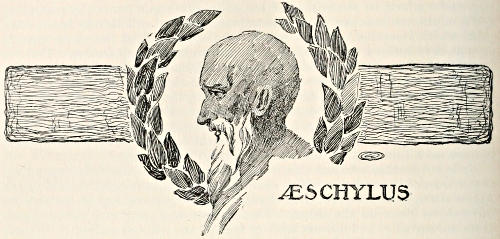
Æschylus
The contest with Persia, which was the subject of one of his great
works, probably appeared to him the legitimate object for the energies of
Greece. Beside this general disposition to side with Cimon’s party, against
Pericles, the whole train of his poetical and religious feelings was nourished
by a study of the mythical and religious traditions of Greek antiquity. In
his tragedy, entitled the Eumenides, he exhibits the mythical origin of the
court and council of Areopagus, in the form which best suited his purpose,
tracing it to the cause first pleaded there between the Argive matricide
Orestes, who pledges his country to eternal alliance with Athens, and the
“dread goddesses,” who sought vengeance for the blood which he had shed.
The poet brings these terrible beings on the stage, as well as the tutelary
goddess of the city, who herself institutes the tribunal, “to last throughout
all ages,” and exhorts her people to preserve it as the glory and safeguard
of the city; and the spectators are led to consider the continuance of the
blessings which the pacified avengers promise to the land, as depending on
the permanence of the institution which had succeeded to their function.b
Owing to a misunderstanding as to the date of this tragedy, it was long
believed that Æschylus wrote it in reproof of Pericles for diminishing the
power of the Areopagus. When it became certain that the play was not
produced till 458, a new light was thrown on the affair, showing Æschylus
as a defender of the merely judicial function of the Areopagus, for Pericles
and Ephialtes left the Areopagus its judicial dignity and merely removed its
political weight, as will be more fully shown in a later chapter. Æschylus
therefore appears as one in no sense protesting, but rather as showing the
true origin and strictly judicial function of the Areopagus, and approving
Ephialtes who carried the day and reduced its pretensions.a
[461-460 B.C.]
This triumph of Pericles and his party over the Areopagus seems to have
been immediately followed by the ostracism of Cimon, which took place about
two years after the return of the Athenians from Messenia: and it is therefore
not improbable that his exile may have been not so much an effect of
popular resentment, as a measure of precaution, which may have appeared
necessary even to the moderate men of both parties, for the establishment of
public tranquillity.b
The new character which Athens had assumed, as a competitor for landed
alliances not less than for maritime ascendency, came opportunely for the
protection of the neighbouring town of Megara. It appears that Corinth,
perhaps instigated like Argos by the helplessness of the Lacedæmonians,
had been making border encroachments—on the one side upon Cleonæ,
on the other side upon Megara: on which ground the latter, probably
despairing of protection from Lacedæmon, renounced the Lacedæmonian
connection, and obtained permission to enrol herself as an ally of Athens.
This was an acquisition of signal value to the Athenians, since it both
opened to them the whole range of territory across the outer Isthmus of
Corinth to the interior of the Crissæan gulf, on which the Megarian port of
Pegæ was situated, and placed them in possession of the passes of Mount
Geranea, so that they could arrest the march of a Peloponnesian army over
the isthmus, and protect Attica from invasion. It was moreover of great
importance in its effects on Grecian politics: for it was counted as a wrong
by Lacedæmon, gave deadly offence to the Corinthians, and lighted up the
flames of war between them and Athens; their allies the Epidaurians and
Æginetans taking their part. Though Athens had not yet been guilty of
unjust encroachment against any Peloponnesian state, her ambition and
energy had inspired universal awe; while the maritime states in the neighbourhood,
such as Corinth, Epidaurus, and Ægina, saw these terror-striking
qualities threatening them at their own doors, through her alliance with
Argos and Megara. Moreover, it is probable that the ancient feud between
the Athenians and Æginetans, though dormant since a little before the Persian
invasion, had never been appeased or forgotten: so that the Æginetans,
dwelling within sight of Piræus, were at once best able to appreciate, and
most likely to dread, the enormous maritime power now possessed by Athens.
Pericles was wont to call Ægina the eyesore of Piræus: but we may be sure
that Piræus, grown into a vast fortified port within the existing generation,
was in a much stronger degree the eyesore of Ægina.
The Athenians were at this time actively engaged in prosecuting the
war against Persia, having a fleet of no less than two hundred sail, equipped
by or from the confederacy collectively, now serving in Cyprus and on the
Phœnician coast. Moreover the revolt of the Egyptians under Inarus
(about 460 B.C.) opened to them new means of action against the Great
King. Their fleet, by invitation of the rebels, sailed up the Nile to
Memphis, where there seemed at first a good prospect of throwing off the
Persian dominion. Yet in spite of so great an abstraction from their disposable
force, their military operations near home were conducted with
unabated vigour: and the inscription which remains—a commemoration of
their citizens of the Erechthid tribe who were slain in one and the same
year in Cyprus, Egypt, Phœnicia, the Halieis, Ægina, and Megara—brings
forcibly before us that remarkable energy which astonished and even alarmed
their contemporaries.
[460-458 B.C.]
Their first proceedings at Megara were of a nature altogether novel, in
the existing condition of Greece. It was necessary for the Athenians to protect
their new ally against the superiority of the Peloponnesian land-force,
and to insure a constant communication with it by sea. But the city (like
most of the ancient Hellenic towns) was situated on a hill at some distance
from the sea, separated from its port Nisæa by a space of nearly one mile.
One of the earliest proceedings of the Athenians was to build two lines of
wall, near and parallel to each other, connecting the city with Nisæa; so that
the two thus formed one continuous fortress, wherein a standing Athenian
garrison was maintained, with the constant means of succour from Athens in
case of need. These “Long Walls,” though afterwards copied in other places
and on a larger scale, were at that juncture an ingenious invention, and were
erected for the purpose of extending the maritime arm of Athens to an
inland city.
The first operations of Corinth however were not directed against Megara.
The Athenians, having undertaken a landing in the territory of the
Halieis (the population of the southern Argolic peninsula, bordering on
Trœzen and Hermione), were defeated on land by the Corinthian and Epidaurian
forces: possibly it may have been in this expedition that they
acquired possession of Trœzen, which we find afterwards in their dependance,
without knowing when it became so. But in a sea-fight which took
place off the island of Cecryphaleia (between Ægina and the Argolic peninsula)
the Athenians gained the victory. After this victory and defeat—neither
of them apparently very decisive—the Æginetans began to take
a more energetic part in the war, and brought out their full naval force
together with that of their allies—Corinthians, Epidaurians, and other
Peloponnesians: while Athens equipped a fleet of corresponding magnitude,
summoning her allies also; though we do not know the actual numbers on
either side.
In the great naval battle which ensued off the island of Ægina, the superiority
of the new nautical tactics acquired by twenty years’ practice of
the Athenians since the Persian War—over the old Hellenic ships and seamen,
as shown in those states where at the time of the battle of Marathon
the maritime strength of Greece had resided—was demonstrated by a victory
most complete and decisive. The Peloponnesian and Dorian seamen
had as yet had no experience of the improved seacraft of Athens, and when
we find how much they were disconcerted with it even twenty-eight years
afterwards at the beginning of the Peloponnesian War, we shall not wonder
at its destructive effect upon them in this early battle. The maritime
power of Ægina was irrecoverably ruined. The Athenians captured seventy
ships of war, landed a large force upon the island, and commenced the siege
of the city by land as well as by sea.
If the Lacedæmonians had not been occupied at home by the blockade
of Ithome, they would have been probably induced to invade Attica as a
diversion to the Æginetans; especially as the Persian Megabazus came to
Sparta at this time on the part of Artaxerxes to prevail upon them to do so,
in order that the Athenians might be constrained to retire from Egypt.
This Persian brought with him a large sum of money, but was nevertheless
obliged to return without effecting his mission. The Corinthians and Epidaurians,
however, while they carried to Ægina a reinforcement of three
hundred hoplites, did their best to aid her further by an attack upon Megara;
which place, it was supposed, the Athenians could not possibly relieve without
withdrawing their forces from Ægina, inasmuch as so many of their
men were at the same time serving in Egypt. But the Athenians showed
themselves equal to all these three exigencies at one and the same time—to
the great disappointment of their enemies. Myronides marched from
Athens to Megara at the head of the citizens in the two extremes of military
age, old and young; these being the only troops at home. He fought the
Corinthians near the town, gaining a slight, but debatable advantage, which
he commemorated by a trophy, as soon as the Corinthians had returned home.
But the latter, when they arrived at home, were so much reproached by their
own old citizens, for not having vanquished the refuse of the Athenian military
force, that they returned back at the end of twelve days and erected a
trophy on their side, laying claim to a victory in the past battle. The Athenians,
marching out of Megara, attacked them a second time, and gained on
this occasion a decisive victory. The defeated Corinthians were still more
unfortunate in their retreat; for a body of them, missing their road, became
entangled in a space of private ground enclosed on every side by a deep
ditch and having only one narrow entrance. Myronides, detecting this
fatal mistake, planted his hoplites at the entrance to prevent their escape,
and then surrounded the enclosure with his light-armed troops, who with
their missile weapons slew all the Corinthian hoplites, without possibility
either of flight or resistance. The bulk of the Corinthian army effected their
retreat, but the destruction of this detachment was a sad blow to the city.
[458 B.C.]
Splendid as the success of the Athenians had been during this year,
both on land and at sea, it was easy for them to foresee that the power of their
enemies would presently be augmented by the Lacedæmonians taking the
field. Partly on this account—partly also from the more energetic phase
of democracy, and the long-sighted views of Pericles, which were now becoming
ascendant in the city—the Athenians began the stupendous undertaking
of connecting Athens with the sea by means of long walls. The idea
of this measure had doubtless been first suggested by the recent erection of
long walls, though for so much smaller a distance, between Megara and
Nisæa: for without such an intermediate stepping-stone, the project of a
wall forty stadia (about 4½ English miles) to join Athens with Piræus, and
another wall of thirty-five stadia (nearly 4 English miles) to join it with
Phalerum, would have appeared extravagant even to the sanguine temper of
Athenians—as it certainly would have seemed a few years earlier to Themistocles
himself. Coming as an immediate sequel of great recent victories,
and while Ægina, the great Dorian naval power, was prostrate and under
blockade, it excited the utmost alarm among the Peloponnesians—being
regarded as the second great stride, at once conspicuous and of lasting effect,
in Athenian ambition, next to the fortification of Piræus. But besides
this feeling in the bosom of enemies, the measure was also interwoven with
the formidable contention of political parties then going on at Athens. Cimon
had been recently ostracised; and the democratical movement pressed by
Pericles and Ephialtes (of which more presently) was in its full tide of
success; yet not without a violent and unprincipled opposition on the part
of those who supported the existing constitution.
Now the Long Walls formed a part of the foreign policy of Pericles, continuing
on a gigantic scale the plans of Themistocles when he first schemed
the Piræus. They were framed to render Athens capable of carrying on
war against any superiority of land attack, and of bidding defiance to the
united force of Peloponnesus. But though thus calculated for contingencies
which a long-sighted man might see gathering in the distance, the new
walls were, almost on the same grounds, obnoxious to a considerable number
of Athenians: to the party recently headed by Cimon, which was attached
to the Lacedæmonian connection, and desired above all things to maintain
peace at home, reserving the energies of the state for anti-Persian enterprise:
to many landed proprietors in Attica, whom they seemed to threaten
with approaching invasion and destruction of their territorial possessions: to
the rich men and aristocrats of Athens, averse to a still closer contact and
amalgamation with the maritime multitude in Piræus: lastly, perhaps, to a
certain vein of old Attic feeling, which might look upon the junction of
Athens with the separate demes of Piræus and Phalerum as effacing the
special associations connected with the holy rock of Athene. When to all
these grounds of opposition we add the expense and trouble of the undertaking
itself, the interference with private property, the peculiar violence of
party which happened then to be raging, and the absence of a large proportion
of military citizens in Egypt, we shall hardly be surprised to find that
the projected long walls brought on a risk of the most serious character both
for Athens and her democracy. If any further proof were wanting of the
vast importance of these long walls, in the eyes both of friends and of enemies,
we might find it in the fact that their destruction was the prominent
mark of Athenian humiliation after the battle of Ægospotami, and their
restoration the immediate boon of Pharnabazus and Conon after the victory
of Cnidus.
[457 B.C.]
Under the influence of the alarm now spread by the proceedings of
Athens, the Lacedæmonians were prevailed upon to undertake an expedition
out of Peloponnesus, although the helots in Ithome were not yet reduced
to surrender. Their force consisted of fifteen hundred troops of their own,
and ten thousand of their various allies, under the regent Nicomedes. The
ostensible motive, or the pretence, for this march, was the protection of the
little territory of Doris against the Phocians, who had recently invaded it
and taken one of its three towns. The mere approach of so large a force
immediately compelled the Phocians to relinquish their conquest, but it was
soon seen that this was only a small part of the objects of Sparta, and that
her main purpose, under instigation of the Corinthians, was, to arrest the
aggrandisement of Athens. It could not escape the penetration of Corinth,
that the Athenians might presently either enlist or constrain the towns of
Bœotia into their alliance, as they had recently acquired Megara, in addition
to their previous ally Platæa: for the Bœotian federation was at this time
much disorganised, and Thebes, its chief, had never recovered her ascendency
since the discredit of her support lent to the Persian invasion. To strengthen
Thebes and to render her ascendency effective over the Bœotian cities, was the
best way of providing a neighbour at once powerful and hostile to the Athenians,
so as to prevent their further aggrandisement by land: it was the
same policy as Epaminondas pursued eighty years afterwards, in organising
Arcadia and Messene against Sparta. Accordingly the Peloponnesian force
was now employed partly in enlarging and strengthening the fortifications of
Thebes herself, partly in constraining the other Bœotian cities into effective
obedience to her supremacy; probably by placing their governments in the
hands of citizens of known oligarchical politics, and perhaps banishing suspected
opponents. To this scheme the Thebans lent themselves with earnestness;
promising to keep down for the future their border neighbours, so as
to spare the necessity of armies coming from Sparta.
But there was also a further design, yet more important, in contemplation
by the Spartans and Corinthians. The oligarchical opposition at
Athens was so bitterly hostile to the Long Walls, to Pericles, and to the
democratical movement, that several of them opened a secret negotiation
with the Peloponnesian leaders; inviting them into Attica, and entreating
their aid in an internal rising for the purpose not only of putting a stop to
the Long Walls, but also of subverting the democracy. The Peloponnesian
army, while prosecuting its operations in Bœotia, waited in hopes of seeing
the Athenian malcontents in arms, encamping at Tanagra on the very
borders of Attica for the purpose of immediate co-operation with them.
The juncture was undoubtedly one of much hazard for Athens, especially as
the ostracised Cimon and his remaining friends in the city were suspected of
being implicated in the conspiracy. But the Athenian leaders, aware of the
Lacedæmonian operations in Bœotia, knew also what was meant by the presence
of the army on their immediate borders—and took decisive measures
to avert the danger. Having obtained a reinforcement of one thousand
Argeians and some Thessalian horse, they marched out to Tanagra, with the
full Athenian force then at home; which must of course have consisted
chiefly of the old and the young, the same who had fought under Myronides
at Megara; for the blockade of Ægina was still going on.
Near Tanagra a bloody battle took place between the two armies, wherein
the Lacedæmonians were victorious, chiefly from the desertion of the Thessalian
horse who passed over to them in the very heat of the engagement.
But though the advantage was on their side, it was not sufficiently decisive
to favour the contemplated rising in Attica. Nor did the Peloponnesians
gain anything by it except an undisturbed retreat over the high lands of
Geranea, after having partially ravaged the Megarid.
Though the battle of Tanagra was a defeat, yet there were circumstances
connected with it which rendered its effects highly beneficial to Athens.
The ostracised Cimon presented himself on the field, as soon as the army
had passed over the boundaries of Attica, requesting to be allowed to occupy
his station as a hoplite and fight in the ranks of his tribe—the Œneis. But
such was the belief, entertained by the members of the senate and by his
political enemies present, that he was an accomplice in the conspiracy known
to be on foot, that permission was refused and he was forced to retire. In
departing he conjured his personal friends, Euthippus (of the deme Anaphlystus)
and others, to behave in such a manner as might wipe away the
stain resting upon his fidelity, and in part also upon theirs. His friends
retained his panoply and assigned to it the station in the ranks which he
would himself have occupied: they then entered the engagement with desperate
resolution and one hundred of them fell side by side in their ranks.
Pericles, on his part, who was present among the hoplites of his own tribe
the Acamantii, aware of this application and repulse of Cimon, thought it
incumbent upon him to display not merely his ordinary personal courage,
but an unusual recklessness of life and safety, though it happened that he
escaped unwounded. All these incidents brought about a generous sympathy
and spirit of compromise among the contending parties at Athens; while
the unshaken patriotism of Cimon and his friends discountenanced and disarmed
those conspirators who had entered into correspondence with the
enemy, at the same time that it roused a repentant admiration towards the
ostracised leader himself. Such was the happy working of this new sentiment
that a decree was shortly proposed and carried—proposed too by
Pericles himself—to abridge the ten years of Cimon’s ostracism, and permit
his immediate return.
We may recollect that under circumstances partly analogous, Themistocles
had himself proposed the restoration of his rival Aristides from ostracism,
a little before the battle of Salamis: and in both cases, the suspension of
enmity between the two leaders was partly the sign, partly also the auxiliary
cause, of reconciliation and renewed fraternity among the general body of
citizens. It was a moment analogous to that salutary impulse of compromise,
and harmony of parties, which followed the extinction of the oligarchy
of Four Hundred, forty-six years afterwards, and on which Thucydides
dwells emphatically as the salvation of Athens in her distress—a moment
rare in free communities generally, not less than among the jealous competitors
for political ascendency at Athens.
So powerful was this burst of fresh patriotism and unanimity after the
battle of Tanagra, which produced the recall of Cimon and appears to have
overlaid the pre-existing conspiracy, that the Athenians were quickly in a
condition to wipe off the stain of their defeat. It was on the sixty-second
day after the battle that they undertook an aggressive march under Myronides
into Bœotia: the extreme precision of this date (being the single
case throughout the summary of events between the Persian and Peloponnesian
Wars wherein Thucydides is thus precise) marks how strong an impression
it made upon the memory of the Athenians. At the battle of Œnophyta,
engaged against the aggregate Theban and Bœotian forces, or, if Diodorus
is to be trusted, in two battles, of which that of Œnophyta was the last, Myronides
was completely victorious. The Athenians became masters of Thebes
as well as of the remaining Bœotian towns; reversing all the arrangements
recently made by Sparta, establishing democratical governments, and forcing
the aristocratical leaders, favourable to Theban ascendency and Lacedæmonian
connection, to become exiles. Nor was it only Bœotia which the
Athenians thus acquired; Phocis and Locris were both successively added
to the list of their dependent allies, the former being in the main friendly
to Athens and not disinclined to the change, while the latter were so decidedly
hostile that one hundred of their chiefs were detained and sent to
Athens as hostages. The Athenians thus extended their influence, maintained
through internal party-management, backed by the dread of interference
from without in case of need, from the borders of the Corinthian
territory, including both Megara and Pegæ, to the strait of Thermopylæ.
[457-456 B.C.]
These important acquisitions were soon crowned by the completion of
the Long Walls and the conquest of Ægina. That island, doubtless starved
out by its protracted blockade, was forced to capitulate on condition of destroying
its fortifications, surrendering all its ships of war, and submitting
to annual tribute as a dependent ally of Athens. The reduction of this once
powerful maritime city marked Athens as mistress of the sea on the Peloponnesian
coast not less than on the Ægean. Her admiral Tolmides displayed
her strength by sailing round Peloponnesus, and even by the insult of burning
the Lacedæmonian ports of Methone and of Gythium. He took Chalcis,
a possession of the Corinthians, and Naupactus belonging to the Ozolian
Locrians, near the mouth of the Corinthian Gulf, disembarked troops near
Sicyon, with some advantage in a battle against opponents from that town,
and either gained or forced into the Athenian alliance not only Zacynthus
and Cephallenia, but also some of the towns of Achaia; for we afterwards
find these latter attached to Athens without knowing when the connection
began. During the ensuing year the Athenians renewed their attack upon
Sicyon, with a force of one thousand hoplites under Pericles himself, sailing
from the Megarian harbour of Pegæ in the Crissæan Gulf. This eminent
man, however, gained no greater advantage than Tolmides, defeating the
Sicyonian forces in the field and driving them within their walls. He afterwards
made an expedition into Acarnania, taking the Achæan allies in addition
to his own forces, but miscarried in his attack on Œniadæ and accomplished
nothing. Nor were the Athenians more successful in a march undertaken
this same year against Thessaly, for the purpose of restoring Orestes, one of
the exiled princes or nobles of Pharsalus. Though they took with them an
imposing force, including their Bœotian and Phocian allies, the powerful
Thessalian cavalry forced them to keep in a compact body and confined
them to the ground actually occupied by their hoplites; while all their
attempts against the city failed, and their hopes of internal rising were
disappointed.
Had the Athenians succeeded in Thessaly, they would have acquired to
their alliance nearly the whole of extra-Peloponnesian Greece. But even
without Thessaly their power was prodigious, and had now attained a maximum
height from which it never varied except to decline. As a counter-balancing
loss against so many successes, we have to reckon their ruinous
defeat in Egypt, after a war of six years against the Persians (460-455 B.C.).
At first they had gained brilliant advantages, in conjunction with the insurgent
prince Inarus; expelling the Persians from all Memphis except that
strongest part called the White Fortress. And such was the alarm of the
Persian king Artaxerxes at the presence of the Athenians in Egypt, that he
sent Megabazus with a large sum of money to Sparta, in order to induce
the Lacedæmonians to invade Attica. This envoy however failed, and an
augmented Persian force, being sent to Egypt under Megabyzus, son of Zopyrus,
drove the Athenians and their allies, after an obstinate struggle, out
of Memphis into the island of the Nile called Prosopitis. Here they were
blocked up for eighteen months, until at length Megabyzus turned the arm of
the river, laid the channel dry, and stormed the island by land. A very few
Athenians escaped by land to Cyrene: the rest were either slain or made
captive, and Inarus himself was crucified. And the calamity of Athens was
farther aggravated by the arrival of fifty fresh Athenian ships, which, coming
after the defeat, but without being aware of it, sailed into the Mendesian
branch of the Nile, and thus fell unawares into the power of the Persians
and Phœnicians, very few either of the ships or men escaping. The whole
of Egypt became again subject to the Persians, except Amyrtæus, who contrived
by retiring into the inaccessible fens still to maintain his independence.
One of the largest armaments ever sent forth by Athens and her confederacy
was thus utterly ruined.
It was about the time of the destruction of the Athenian army in Egypt,
and of the circumnavigation of Peloponnesus by Tolmides, that the internal
war, carried on by the Lacedæmonians against the helots or Messenians at
Ithome, ended. These besieged men, no longer able to stand out against
a protracted blockade, were forced to abandon this last fortress of ancient
Messenian independence, stipulating for a safe retreat from the Peloponnesus
with their wives and families; with the proviso that if any one of them ever
returned to Peloponnesus, he should become the slave of the first person who
seized him. They were established by Tolmides at Naupactus (recently
taken by the Athenians from the Ozolian Locrians), where they will be
found rendering good service to Athens in the following wars.
[455-448 B.C.]
After the victory of Tanagra, the Lacedæmonians made no further expeditions
out of Peloponnesus for several succeeding years, not even to prevent
Bœotia and Phocis from being absorbed into the Athenian alliance. The
reason of this remissness lay, partly, in their general character; partly, in
the continuance of the siege of Ithome, which occupied them at home; but
still more perhaps, in the fact that the Athenians, masters of the Megarid,
were in occupation of the road over the high lands of Geranea, and could
therefore obstruct the march of any army out from Peloponnesus. Even
after the surrender of Ithome, the Lacedæmonians remained inactive for
three years, after which time a formal truce was concluded with Athens by
the Peloponnesians generally, for five years longer. This truce was concluded
in a great degree through the influence of Cimon, who was eager to
resume effective operations against the Persians; while it was not less suitable
to the political interest of Pericles that his most distinguished rival
should be absent on foreign service, so as not to interfere with his influence
at home. Accordingly Cimon, having equipped a fleet of two hundred triremes
from Athens and her confederates, set sail for Cyprus, from whence
he despatched sixty ships to Egypt, at the request of the insurgent prince
Amyrtæus, who was still maintaining himself against the Persians amidst
the fens—while with the remaining armament he laid siege to Citium. In
the prosecution of this siege, he died either of disease or of a wound. The
armament, under his successor Anaxicrates, became so embarrassed for want
of provisions that they abandoned the undertaking altogether, and went to
fight the Phœnician and Cilician fleet near Salamis in Cyprus. They were
here victorious, first on sea and afterwards on land, though probably not on the
same day, as at the Eurymedon; after which they returned home, followed
by the sixty ships which had gone to Egypt for the purpose of aiding
Amyrtæus.
From this time forward no further operations were undertaken by Athens
and her confederacy against the Persians. And it appears that a convention
was concluded between them, whereby the Great King on his part promised
two things: To leave free, undisturbed, and untaxed, the Asiatic maritime
Greeks, not sending troops within a given distance of the coast: To refrain
from sending any ships of war either westward of Phaselis (others place the
boundary at the Chelidonean islands, rather more to the westward) or within
the Cyanean rocks at the confluence of the Thracian Bosporus with the
Euxine. On their side the Athenians agreed to leave him in undisturbed
possession of Cyprus and Egypt. This was called the Peace of Callias.
We may believe in the reality of this treaty between Athens and Persia,
improperly called the Cimonian Treaty: improperly, since not only was it
concluded after the death of Cimon, but the Athenian victories by which it
was immediately brought on, were gained after his death. Nay more—the
probability is, that if Cimon had lived, it would not have been concluded at
all. For his interest as well as his glory led him to prosecute the war
against Persia, since he was no match for his rival Pericles either as a statesman
or as an orator, and could only maintain his popularity by the same
means whereby he had earned it—victories and plunder at the cost of the
Persians. His death ensured more complete ascendency to Pericles whose
policy and character were of a cast altogether opposite.
Athens was now at peace both abroad and at home, under the administration
of Pericles, with a great empire, a great fleet, and a great accumulated
treasure. The common fund collected from the contributions of the confederates,
and originally deposited at Delos, had before this time been transferred
to the Acropolis at Athens. At what precise time such transfer took
place, we cannot state: nor are we enabled to assign the successive stages
whereby the confederacy, chiefly with the free will of its own members,
became transformed from a body of armed and active warriors under the
guidance of Athens, into disarmed and passive tribute-payers defended by
the military force of Athens: from allies free, meeting at Delos, and self-determining
into subjects isolated, sending their annual tribute, and awaiting
Athenian orders. But it would appear that the change had been made
before this time. Some of the more resolute of the allies had tried to secede,
but Athens had coerced them by force, and reduced them to the condition of
tribute-payers without ships or defence; and Chios, Lesbos, and Samos
were now the only allies free and armed on the original footing. Every
successive change of an armed ally into a tributary, every subjugation of a
seceder, tended of course to cut down the numbers, and enfeeble the
authority of the Delian synod; and, what was still worse, it materially
altered the reciprocal relation and feelings both of Athens and her allies—exalting
the former into something like a despot, and degrading the latter
into mere passive subjects.
Of course the palpable manifestation of the change must have been the
transfer of the confederate fund from Delos to Athens. The only circumstance
which we know respecting this transfer is, that it was proposed by the
Samians—the second power in the confederacy, inferior only to Athens, and
least of all likely to favour any job or sinister purpose of the Athenians.
Such transition, arising spontaneously out of the character and circumstances
of the confederates themselves, was thus materially forwarded by
the acquisitions of Athens extraneous to the confederacy. She was now not
merely the first maritime state in Greece, but perhaps equal to Sparta even
in land-power, possessing in her alliance Megara, Bœotia, Phocis, Locris,
together with Achaia and Trœzen in the Peloponnesus. Large as this aggregate
already was, both at sea and on land, yet the magnitude of the annual
tribute, and still more the character of the Athenians themselves, superior
to all Greeks in that combination of energy and discipline which is the grand
cause of progress, threatened still further increase. Occupying the Megarian
harbour of Pegæ, the Athenians had full means of naval action on both sides
of the Corinthian isthmus: but what was of still greater importance to them,
by their possession of the Megarid and of the high lands of Geranea, they
could restrain any land-force from marching out of the Peloponnesus, and
were thus (considering besides their mastery at sea) completely unassailable
in Attica. Ever since the repulse of Xerxes, Athens had been advancing in
an uninterrupted course of power and prosperity at home, as well as of victory
and ascendency abroad—to which there was no exception except the
ruinous enterprise in Egypt.
[448-446 B.C.]
Looking at the position of Greece therefore about 448 B.C.—after the
conclusion of five years’ truce between the Peloponnesians and Athens, and of
the so-called Cimonian Peace between Persia and Athens—a discerning
Greek might well calculate upon further aggrandisement of this imperial
state as the tendency of the age; and accustomed as every Greek was to the
conception of separate town-autonomy as essential to a freeman and a citizen,
such prospect could not but inspire terror and aversion. The sympathy of the
Peloponnesians for the islanders and ultra-maritime states, who constituted
the original confederacy of Athens, was not considerable. But when the
Dorian island of Ægina was subjugated also, and passed into the condition
of a defenceless tributary, they felt the blow sorely on every ground. The
ancient celebrity, and eminent service rendered at the battle of Salamis, of
this memorable island, had not been able to protect it; while those great
Æginetan families, whose victories at the sacred festival-games Pindar celebrates
in a large proportion of his odes, would spread the language of complaint
and indignation throughout their numerous “guests” in every Hellenic
city. Of course, the same anti-Athenian feeling would pervade those
Peloponnesian states which had been engaged in actual hostility with Athens—Corinth,
Sicyon, Epidaurus, etc., as well as Sparta, the once-recognised
head of Hellas, but now tacitly degraded from her pre-eminence, baffled
in her projects respecting Bœotia, and exposed to the burning of her port
at Gythium without being able even to retaliate upon Attica. Putting all
those circumstances together, we may comprehend the powerful feeling of
dislike and apprehension now diffused so widely over Greece against the
upstart despot-city; whose ascendency, newly acquired, maintained by superior
force, and not recognised as legitimate, threatened nevertheless still
further increase. Sixteen years hence, this same sentiment will be found
exploding into the Peloponnesian War. But it became rooted in the
Greek mind during the period which we have now reached, when Athens
was much more formidable than she had come to be at the commencement
of that war: nor shall we thoroughly appreciate the ideas of that later
period, unless we take them as handed down from the earlier date of the five
years’ truce (about 451-446 B.C.).
Formidable as the Athenian empire both really was and appeared to be,
however, this widespread feeling of antipathy proved still stronger, so that
instead of the threatened increase, the empire underwent a most material
diminution. This did not arise from the attack of open enemies; for during
the five years’ truce, Sparta undertook only one movement, and that not
against Attica: she sent troops to Delphi, in an expedition dignified with
the name of the Sacred War—expelled the Phocians, who had assumed to
themselves the management of the temple—and restored it to the native
Delphians. To this the Athenians made no direct opposition, but as soon as
the Lacedæmonians were gone, they themselves marched thither and placed
the temple again in the hands of the Phocians, who were then their allies.
The Delphians were members of the Phocian league, and there was a dispute
of old standing as to the administration of the temple—whether it
belonged to them separately or to the Phocians collectively. The favour
of those who administered it counted as an element of considerable moment
in Grecian politics; the sympathies of the leading Delphians led them to
embrace the side of Sparta, but the Athenians now hoped to counteract this
tendency by means of their preponderance in Phocis. We are not told
that the Lacedæmonians took any ulterior step in consequence of their
views being frustrated by Athens—a significant evidence of the politics of
that day.
[447 B.C.]
The blow which brought down the Athenian empire from this its greatest
exaltation was struck by the subjects themselves. The Athenian ascendency
over Bœotia, Phocis, Locris, and Eubœa, was maintained, not by means of
garrisons, but through domestic parties favourable to Athens, and a suitable
form of government—just in the same way as Sparta maintained her influence
over her Peloponnesian allies. After the victory of Œnophyta, the
Athenians had broken up the governments in the Bœotian cities established
by Sparta before the battle of Tanagra, and converted them into democracies
at Thebes and elsewhere. Many of the previous leading men had thus been
sent into exile; and as the same process had taken place in Phocis and
Locris, there was at this time a considerable aggregate body of exiles, Bœotian,
Phocian, Locrian, Eubœan, Æginetan, etc., all bitterly hostile to
Athens, and ready to join in any attack upon her power. We learn further
that the democracy established at Thebes after the battle of Œnophyta was
ill conducted and disorderly, which circumstance laid open Bœotia still further
to the schemes of assailants on the watch for every weak point. These
various exiles, all joining their forces and concerting measures with their
partisans in the interior, succeeded in mastering Orchomenos, Chæronea,
and some other less important places in Bœotia.
The Athenian general Tolmides marched to expel them, with one thousand
Athenian hoplites and an auxiliary body of allies. It appears that this
march was undertaken in haste and rashness. The hoplites of Tolmides principally
youthful volunteers and belonging to the best families of Athens, disdained
the enemy too much to await a larger and more commanding force:
nor would the people listen even to Pericles, when he admonished them that
the march would be full of hazard, and adjured them not to attempt it without
greater numbers as well as greater caution. Fatally indeed were his
predictions justified. Though Tolmides was successful in his first enterprise—the
recapture of Chæronea, wherein he placed a garrison—yet in
his march, probably incautious and disorderly, when departing from that
place, he was surprised and attacked unawares, near Coronea, by the united
body of exiles and their partisans.
No defeat in Grecian history was ever more complete or ruinous. Tolmides
himself was slain, together with many of the Athenian hoplites, while
a large number of them were taken prisoners. In order to recover these
prisoners, who belonged to the best families in the city, the Athenians submitted
to a convention whereby they agreed to evacuate Bœotia altogether:
in all the cities of that country the exiles were restored, the democratical
government overthrown, and Bœotia was transformed from an ally of Athens
into her bitter enemy. Long indeed did the fatal issue of this action dwell
in the memory of the Athenians, and inspire them with an apprehension of
Bœotian superiority in heavy armour on land. But if the hoplites under
Tolmides had been all slain on the field, their death would probably have
been avenged and Bœotia would not have been lost—whereas in the case of
living citizens, the Athenians deemed no sacrifice too great to redeem them.
We shall discover hereafter in the Lacedæmonians a feeling very similar, respecting
their brethren captured at Sphacteria.
[447-445 B.C.]
The calamitous consequences of this defeat came upon Athens in thick
and rapid succession. The united exiles, having carried their point in Bœotia,
proceeded to expel the philo-Athenian government both from Phocis and
Locris, and to carry the flame of revolt into Eubœa. To this important island
Pericles himself proceeded forthwith, at the head of a powerful force; but
before he had time to complete the reconquest, he was summoned home by
news of a still more formidable character. The Megarians had revolted from
Athens. By a conspiracy previously planned, a division of hoplites from
Corinth, Sicyon, and Epidaurus, was already admitted as garrison into their
city: the Athenian soldiers who kept watch over the Long Walls had been
overpowered and slain, except a few who escaped into the fortified port of
Nisæa. As if to make the Athenians at once sensible how seriously this
disaster affected them, by throwing open the road over Geranea, Plistoanax,
king of Sparta, was announced as already on his march for an invasion
of Attica. He did in truth conduct an army, of mixed Lacedæmonians
and Peloponnesian allies, into Attica, as far as the neighbourhood of Eleusis
and the Thriasian plain. He was a very young man, so that a Spartan of
mature years, Cleandridas, had been attached to him by the ephors as adjutant
and counsellor. Pericles, it is said, persuaded both the one and the
other, by means of large bribes, to evacuate Attica without advancing to
Athens. We may fairly doubt whether they had force enough to adventure
so far into the interior, and we shall hereafter observe the great precautions
with which Archidamus thought it necessary to conduct his invasion, during
the first year of the Peloponnesian War, though at the head of a more commanding
force. Nevertheless, on their return, the Lacedæmonians, believing
that they might have achieved it, found both of them guilty of corruption.
Both were banished: Cleandridas never came back, and Plistoanax himself
lived for a long time in sanctuary near the temple of Athene at Tegea, until
at length he procured his restoration by tampering with the Pythian priestess,
and by bringing her bought admonitions to act upon the authorities at Sparta.
So soon as the Lacedæmonians had retired from Attica, Pericles returned
with his forces to Eubœa, and reconquered the island completely. With that
caution which always distinguished him as a military man, so opposite to the
fatal rashness of Tolmides, he took with him an overwhelming force of fifty
triremes and five thousand hoplites. He admitted most of the Eubœan towns
to surrender, altering the government of Chalcis by the expulsion of the
wealthy oligarchy called the hippobotæ. But the inhabitants of Histiæa at
the north of the island, who had taken an Athenian merchantman and massacred
all the crew, were more severely dealt with, the free population being
all or in great part expelled, and the land distributed among Athenian cleruchs
or out-settled citizens.
[445-440 B.C.]
Yet the reconquest of Eubœa was far from restoring Athens to the position
which she had occupied before the fatal engagement of Coronea. Her
land-empire was irretrievably gone, together with her recently acquired influence
over the Delphian oracle; and she reverted to her former condition
of an exclusively maritime potentate. Moreover, the precarious hold which
she possessed over unwilling allies had been demonstrated in a manner likely
to encourage similar attempts among her maritime subjects; attempts which
would now be seconded by Peloponnesian armies invading Attica. The fear
of such a combination of embarrassments, and especially of an irresistible
enemy carrying ruin over the flourishing territory round Eleusis and Athens,
was at this moment predominant in the Athenian mind. We shall find
Pericles, at the beginning of the Peloponnesian War fourteen years afterwards,
exhausting all his persuasive force, and not succeeding without great
difficulty, in prevailing upon his countrymen to endure the hardship of invasion—even
in defence of their maritime empire, and when events had
been gradually so ripening as to render the prospect of war familiar, if not
inevitable. But the late series of misfortunes had burst upon them so
rapidly and unexpectedly, as to discourage even Athenian confidence, and
to render the prospect of continued war full of gloom and danger. The
prudence of Pericles would doubtless counsel the surrender of their remaining
landed possessions or alliances, which had now become unprofitable, in
order to purchase peace; but we may be sure that nothing short of extreme
temporary despondency could have induced the Athenian assembly to listen
to such advice, and to accept the inglorious peace which followed. A truce
for thirty years was concluded with Sparta and her allies, in the beginning
of 445 B.C., whereby Athens surrendered Nisæa, Pegæ, Achaia, and Trœzen—thus
abandoning the Peloponnesus altogether, and leaving the Megarians
(with their full territory and their two ports) to be included among the
Peloponnesian allies of Sparta.
It was to the Megarians, especially, that the altered position of Athens
after this truce was owing: it was their secession from Attica and junction
with the Peloponnesians, which laid open Attica to invasion. Hence arose
the deadly hatred on the part of the Athenians towards Megara, manifested
during the ensuing years—a sentiment the more natural, as Megara had
spontaneously sought the alliance of Athens a few years before as a protection
against the Corinthians, and had then afterwards, without any known
ill-usage on the part of Athens, broken off from the alliance and become her
enemy, with the fatal consequence of rendering her vulnerable on the land-side.
Under such circumstances we shall not be surprised to find the antipathy
of the Athenians against Megara strongly pronounced, insomuch that
the system of exclusion which they adopted against her was among the most
prominent causes of the Peloponnesian War.d
Athens now rested six years, unengaged in any hostilities; a longer
interval of perfect peace than she had before known in above forty years
elapsed since she rose from her ashes after the Persian invasion. It is a
wonderful and singular phenomenon in the history of mankind, little
accounted for by anything recorded by ancient, or imagined by modern
writers, that, during this period of turbulence, in a commonwealth whose
whole population in free subjects amounted scarcely to thirty thousand
families, art, science, fine taste, and politeness should have risen to that
perfection which has made Athens the mistress of the world through all
succeeding ages. Some sciences indeed have been carried higher in modern
times, and art has put forth new branches, of which some have given new
helps to science: but Athens, in that age, reached a perfection of taste that
no country has since surpassed; but on the contrary all have looked up to, as
a polar star, by which, after sinking in the deepest barbarism, taste has been
guided in its restoration to splendour, and the observation of which will
probably ever be the surest preservative against its future corruption and
decay.
One great point of the policy of Pericles was to keep the people always
either amused or employed. During peace an exercising squadron of sixty
trireme galleys was sent out for eight months in every year. Nor was this
without a further use than merely engaging the attention of the people, and
maintaining the navy in vigour. He sometimes took the command in person:
and, sailing among the distant dependencies of the empire, settled disputes
between them, and confirmed the power and extended the influence of
Athens. The Ægean and the Propontis did not bound his voyages: he
penetrated into the Euxine; and finding the distant Grecian settlement of
Sinope divided between Timesileus, who affected the tyranny, and an opposing
party, he left there Lamachus with thirteen ships, and a land-force with
whose assistance to the popular side the tyrant and those of his faction were
expelled. The justice of what followed may indeed appear questionable.
Their houses and property, apportioned into six hundred lots, were offered to
so many Athenian citizens; and volunteers were not wanting to accept the
offer, and settle at Sinope. To disburden the government at home, by providing
advantageous establishments, in distant parts, for the poor and discontented
among the sovereign citizens of Athens, was a policy more than once
resorted to by Pericles. It was during his administration, in the year, according
to Diodorus, in which the Thirty Years’ Truce was concluded, that
the deputation came from the Thessalian adventurers who had been expelled
by the Crotoniats from their attempted establishment in the deserted territory
of Sybaris, in consequence of which, under his patronage, the colony
was settled with which the historian Herodotus then, and afterward the
orator Lysias, passing to Thurii, both established themselves there.
Plutarch has attributed to Pericles a noble project, unnoticed by any
earlier extant author, but worthy of his capacious mind, and otherwise also
bearing some characters of authenticity and truth. It was no less than to
unite all Greece under one great federal government, of which Athens should
be the capital. But the immediate and direct avowal of such a purpose would
be likely to raise jealousies so numerous and extensive as to form insuperable
obstacles to the execution. The religion of the nation was that alone in
which the Grecian people universally claimed a clear common interest; and
even in this every town and almost every family claimed something peculiar
to itself. In the vehemence of public alarm, during the Persian invasion,
vows had been, in some places, made to the gods for sacrifices, to an extent
beyond what the votaries, when blessed with deliverance beyond hope, were
able to perform; and some temples, destroyed by the invaders, were not yet
restored; probably because the means of those in whose territories they had
stood were deficient. Taking these circumstances then for his ground,
Pericles proposed that a congress of deputies from every republic of the
nation should be assembled at Athens, for the purpose first of inquiring concerning
vows for the safety of Greece yet unperformed, and temples, injured
by the barbarians, not yet restored; and then of proceeding to concert
measures for the lasting security of navigation in the Grecian seas, and for
the preservation of peace by land also between all the states composing the
Greek nation. The naval question, but still more the ruin which, in the
Persian invasion, had befallen northern Greece, and especially Attica, while
Peloponnesus had felt nothing of its evils, gave pretensions for Athens to
take the lead in the business. On the motion of Pericles, a decree of the
Athenian people directed the appointment of ministers to invite every
Grecian state to send its deputies. Plutarch, rarely attentive to political
information, has not at all indicated what attention was shown, or what
participation proposed, for Lacedæmon. His prejudices indeed we find
very generally adverse to the Lacedæmonian government, and favouring the
Athenian democracy. But, judging from the friendship which, according
to the authentic information of Thucydides, subsisted between Pericles and
Archidamus, king of Lacedæmon, through life, it is little likely that, in
putting forward the project for the peace of Greece, Pericles would have
proposed anything derogatory to the just weight and dignity of Sparta;
which indeed would have been, with peace the pretence, only putting
forward a project of contest.
Pericles, when he formed his coalition with Cimon, seems to have
entered heartily into the enlarged views of that great man; and, with the
hope that, through their coalition, both the oligarchical and the democratical
powers in Athens might be held justly balanced, had early in view to establish
the peace of Greece on a union between Athens and Lacedæmon. It is
however evident, from the narrative of Thucydides, that Archidamus rarely
could direct the measures of the Lacedæmonian government. On a view of
all information, then, it may seem probable that the project of Pericles was
concerted with Archidamus; and that the opposition of those in Lacedæmon,
of an adverse faction concurred with opposition from those in Athens, who
apprehended injury to their interests from a new coalition with the aristocratical
party, to compel the great projector to abandon his magnificent and
beneficent purpose.f
Peace between Lacedæmon and Athens was indispensable towards the
quiet of the rest of the nation, but, in the want of such a union as Pericles
had projected, was unfortunately far from being insured; and, when war
began anywhere, though among the most distant settlements of the Grecian
people, how far it might extend was not to be foreseen. A dispute
between two Asiatic states of the Athenian confederacy led Athens into a
war which greatly endangered the truce made for thirty years, when it had
scarcely lasted six. Miletus and Samos, each claiming the sovereignty of
Priene, originally a free Grecian commonwealth, asserted their respective
pretensions by arms. The Milesians, not till they were suffering under
defeat, applied to Athens for redress, as of a flagrant injury done them.
The usual feuds within every Grecian state furnished assistance to their
clamour; for, the aristocracy prevailing at that time in Samos, the leaders
of the democratical party joined the enemies of their country in accusing
the proceedings of its government before the Athenian people.
[440-439 B.C.]
The opposition at Athens maliciously imputed the measures following to
the weak compliance of Pericles with the solicitations of Aspasia in favour of
her native city; but it appears clearly, from Thucydides, that no such motive
was needful: the Athenian government would of course take cognisance of
the cause; and, as might be expected, a requisition was sent to the Samian
administration to answer, by deputies at Athens, to the charges urged against
them. The Samians, unwilling to submit their claim to the arbitration of
those who they knew were always systematically adverse to the aristocratical
interest, refused to send deputies. A fleet of forty trireme galleys however
brought them to immediate submission; their government was changed to
a democracy, in which those who had headed the opposition of course took
the lead; and to insure permanent acquiescence from the aristocratical party,
fifty men and fifty boys, of the first families of the island, were taken as
hostages, and placed under an Athenian guard in the island of Lemnos.
What Herodotus mentions, as an observation applicable generally, we
may readily believe was on this occasion experienced in Samos, “that the
lower people were most unpleasant associates to the nobles.” A number of
these, unable to support the oppression to which they found themselves
exposed, quitted the island, and applied to Pissuthnes, satrap of Sardis.
The project of conquering Greece by arms appears to have been abandoned
by the Persian government; but the urgency for constantly watching its
politics, and interfering, as occasion might offer, with a view to the safety,
if not to the extension, of the western border of the empire, was obvious;
and it appears that the western satraps were instructed accordingly. The
Samian refugees were favourably received by Pissuthnes. They corresponded
with many of their party yet remaining in the island, and they
engaged in their interest the city of Byzantium, itself a subject ally of
Athens. Collecting then about seven hundred auxiliary soldiers, they
crossed by night the narrow channel which separates Samos from the continent,
and, being joined by their friends, they surprised and overpowered
the new administration. Without delay they proceeded to Lemnos, and so
well conducted their enterprise that they carried off their hostages, together
with the Athenian guard set over them. To win then more effectually the
favour of the satrap, the Athenian prisoners were presented to him. Assured
of assistance from Byzantium, being also not without hopes from Lacedæmon,
they prepared to prosecute their success by immediately undertaking
an expedition against Miletus.
Information of these transactions arriving quickly at Athens, Pericles,
with nine others, according to the ancient military constitution, joined with
him in command, hastened to Samos with a fleet of sixty trireme galleys.
Pericles met the Samian fleet and defeated it. He debarked his infantry on
the island of Samos, and laid siege to the city by land and sea.
In the ninth month from the commencement of the siege, it capitulated:
the ships of war were surrendered, the fortifications were destroyed, the
Samians bound themselves to the payment of a sum of money by instalment
for the expenses of the war, and gave hostages as pledges of their fidelity
to the sovereign commonwealth of Athens. The Byzantines, not waiting the
approach of the coercing fleet, sent their request to be readmitted to their
former terms of subjection, which was granted.
This rebellion, alarming and troublesome at the time to the administration
of Athens, otherwise little disturbed the internal peace of the commonwealth;
and, in the event, contributed rather to strengthen its command
over its dependencies. Pericles took occasion from it to acquire fresh popularity.
On the return of the armament to Athens the accustomed solemnities,
in honour of those who had fallen in the war, were performed with new
splendour; and, in speaking the funeral oration, he exerted the powers of
his eloquence very highly to the gratification of the people. As he descended
from the bema, the stand whence orations were delivered to the people, the
women presented him with chaplets; an idea derived from the ceremonies
of the public games, where the crowning with a chaplet was the distinction
of the victors, and, as something approaching to divine honour, was
held among the highest tokens of admiration, esteem, and respect.
[439-435 B.C.]
The threatened renewal of general war in Greece having been obviated
by the determination of the Peloponnesian congress not to interfere between
the Athenians and their Asiatic allies, peace prevailed during the next three
years after the submission of the Samians; or, if hostilities occurred anywhere,
they were of so little importance that no account of them remains.
A fatal spark then, raising fire in a corner of the country hitherto little within
the notice of history, the blaze rapidly spread over the whole with inextinguishable
fury; insomuch that the further history of Greece, with some
splendid episodes, is chiefly a tale of calamities, which the nation, in ceaseless
exertions of misdirected valour and genius, brought upon itself.
The island of Corcyra had been occupied, in an early age, by a colony
from Corinth. The political connection of colonies with the mother-country
will always depend upon their respective strength; and the Grecian colonies,
all having been the offspring of very small states, in many instances
acquired more than the parent’s force. Corcyra, already populous, had not
yet entirely broken its connection with Corinth, when the resolution was
taken by its government to settle a colony on the Illyrian coast. An embassy
was therefore sent, in due form, to desire a Corinthian for the leader.
Phaleus, of a family boasting its descent from Hercules, was accordingly
appointed to that honour: some Corinthians and others of Dorian race accompanied
him; and Phaleus thus became the nominal founder of Epidamnus,
which was however considered as a Corcyræan, not a Corinthian colony.
But in process of time Epidamnus, growing populous and wealthy,
followed the example of its mother-country, asserted independency, and
maintained the claim. Like most other Grecian cities, it was then, during
many years, torn by sedition; and a war supervening with the neighbouring
barbarians, it fell much from its former flourishing state. But the
spirit of faction remaining in spite of misfortune untamed, the commonalty
at length expelled all the higher citizens. These, finding refuge among the
Illyrians, engaged with them in a predatory war, which was unremittingly
carried on against the city by land and sea. Unable thus to rest, and
almost to subsist, the Epidamnians in possession requested assistance from
Corcyra. This humble supplication however being rejected, they hastened
a deputation to Corinth.
Fortunately for their object, though peace had not yet been broken, yet
animosity between Corinth and Corcyra had so risen that the Corcyræans,
who had long refused political dependency, now denied to the Corinthians all
those honours and compliments usually paid by Grecian colonies to their
parent states. Under stimulation thus from affront, and with encouragement
from the oracle, the prospect of an acquisition of dominion was too
tempting, and the proposal of the Epidamnians was accepted. But Corinth
had at this time only thirty ships of war, whereas Corcyra was able
to put to sea near four times the number; being, next to Athens, the most
powerful maritime state of Greece. Application for naval assistance was
therefore made to the republics with which Corinth was most bound in friendship,
and thus more than forty vessels were obtained. It had been the
settled policy of the Corcyræans, islanders and strong at sea, to engage in
no alliances. They had avoided both the Peloponnesian and the Athenian
confederacy; and hitherto with this policy they had prospered. But,
alarmed now at the combination formed against them, and fearing it might
still be extended, they sent ambassadors to Lacedæmon and Sicyon; who prevailed
so far that ministers from those two states accompanied them to
Corinth, as mediators in the existing differences. In presence of these the
Corcyræan ambassadors proposed to submit the matters in dispute to the
arbitration of any Peloponnesian states, or to the Delphian oracle, which
the Corinthians had supposed already favourable to them. The Corinthians
however, now prepared for war, and apparently persuaded that neither
Lacedæmon nor Sicyon would take any active part against them, refused
to treat upon any equal terms, and the Corcyræan ambassadors departed
(435 B.C.).
[435-433 B.C.]
The Corinthians then hastened to use the force they had collected. The
Corcyræans had manned those of their ships which were already equipped,
and hastily prepared some of those less in readiness, when their herald returned,
bearing no friendly answer. With eighty galleys then they quitted
their port, met the enemy off Actium, and gained a complete victory, destroying
fifteen ships. Returning to Corcyra, they erected their trophy on the
headland of Leucimme, and they immediately put to death all their prisoners,
except the Corinthians, whom, as pledges, they kept in bonds. Epidamnus
surrendered to their forces on the same day.
The opportunities now open, for both revenge and profit, were not neglected
by the Corcyræans. During that year, unopposed on the sea, there
was scarcely an intermission of their smaller enterprises; by some of which
they gained booty, by others only gave alarm, but by all together greatly
distressed the Corinthians and their allies (434 B.C.).
But since their misfortune off Actium the Corinthians had been unremittingly
assiduous in repairing their loss, and in preparing to revenge it.
Triremes were built, all necessaries for a fleet were largely collected, rowers
were engaged throughout Peloponnesus, and where else in any part of Greece
they could be obtained for hire. The Corcyræans, informed of these measures,
notwithstanding their past success were uneasy with the consideration
that their commonwealth stood single, while their enemies were members of
an extensive confederacy; of which, though a part only had yet been induced
to act, more powerful exertions were nevertheless to be apprehended. In
this state of things it appeared necessary to abandon their ancient policy,
and to seek alliances. Thucydides gives us to understand that they would
have preferred the Peloponnesian to the Athenian confederacy; induced,
apparently, both by their kindred origin, and their kindred form of government.
But they were precluded by the circumstances of the existing war,
Corinth being one of the most considerable members of the Peloponnesian
confederacy; and it was beyond hope that Lacedæmon could be engaged in
measures hostile to so old and useful an ally. It was therefore finally resolved
to send an embassy to Athens. As soon as the purpose of the Corcyræans
was known at Corinth, ambassadors were sent thence to Athens to
remonstrate against it.
The Athenian people were assembled to receive the two embassies, each
of which, in presence of the other, made its proposition in a formal oration.
The point to be determined was highly critical for Athens. A truce existed,
but not a peace, with a confederacy inferior in naval force, but far superior
by land; and Attica, a continental territory, was open to attack by land.
But next to Athens Corcyra was the most powerful maritime republic; and
to prevent the accession of its strength, through alliance, or through conquest,
to the Peloponnesian confederacy, was, for the Athenian people,
highly important. In the articles of the truce moreover it was expressly
stipulated, that any Grecian state, not yet a member of either confederacy,
might at pleasure be admitted to either. But, notwithstanding this, it was
little less than certain that, in the present circumstances, an alliance with
Corcyra must lead to a rupture with the Peloponnesians; and this consideration
occasioned much suspense in the minds of the Athenians. Twice the
assembly was held to debate the question. On the first day, the arguments
of the Corinthian ambassadors had so far effect that nothing was decided:
on the second, the spirit of ambition, ordinary in democracy, prevailed, and
the question was carried for alliance with Corcyra.
[433 B.C.]
Meanwhile the earnestness with which the Corinthians persevered in
their purpose of prosecuting war against the Corcyræans, now to be supported
by the power of Athens, appears to mark confidence in support, on
their side, from the Lacedæmonian confederacy; some members of which
indeed were evidently of ready zeal. The Corinthians increased their own
trireme galleys to ninety. The Eleans, resenting the burning of Cyllene,
had exerted themselves in naval preparation, and sent ten triremes completely
manned to join them. Assistance from Megara, Leucas, and Ambracia
made their whole fleet a hundred and fifty: the crews would hardly
be less than forty thousand men. With this large force they sailed to Chimerium,
a port of Thesprotia, over against Corcyra, where, according to the
practice of the Greeks, they formed their naval camp.
The Athenian government meanwhile, desirous to confirm their new
alliance, yet still anxious to avoid a rupture with the Peloponnesian confederacy,
had sent ten triremes to Corcyra, under the command of Lacedæmonius,
son of Cimon; but with orders not to fight, unless a descent were made
on the island, or any of its towns were attacked. The Corcyræans, on
receiving intelligence that the enemy was approaching, put to sea with a
hundred and ten triremes, exclusive of the Athenian, and formed their naval
camp on one of the small islets called Sybota, the Sow-leas or Sow-pastures,
between their own island and the main. Their land-forces at the same time,
with a thousand auxiliaries from Zacynthus, encamped on the headland of
Leucimme in Corcyra, to be prepared against invasion; while on the opposite
coast of the continent the barbarians, long since friendly to Corinth,
assembled in large number. The Corinthians however, moving in the night,
perceived in the dawn the Corcyræan fleet approaching. Both prepared
immediately to engage.
So great a number of ships had never before met in any action between
Greeks and Greeks. The onset was vigorous; and the battle was maintained,
on either side, with much courage but little skill. Both Corcyræan
and Corinthian ships were equipped in the ancient manner, very inartificially.
The decks were crowded with soldiers, some heavy-armed, some with missile
weapons; and the action, in the eye of the Athenians, trained in the discipline
of Themistocles, resembled a battle of infantry rather than a sea-fight.
Once engaged, the number and throng of the vessels made free motion
impossible: nor was there any attempt at the rapid evolution of the diecplus,
as it was called, for piercing the enemy’s line and dashing away his
oars, the great objects of the improved naval tactics; but the event
depended, as of old, chiefly upon the heavy-armed soldiers who fought on
the decks. Tumult and confusion thus prevailing everywhere, Lacedæmonius,
restrained by his orders from fighting, gave yet some assistance to the
Corcyræans, by showing himself wherever he saw them particularly pressed,
and alarming their enemies. The Corcyræans were, in the left of their line,
successful: twenty of their ships put to flight the Megarians and Ambracians
who were opposed to them, pursued to the shore, and, debarking, plundered
and burnt the naval camp. But the Corinthians, in the other wing,
had meanwhile been gaining an advantage which became decisive through
the imprudent forwardness of the victorious Corcyræans. The Athenians
now endeavoured, by more effectual assistance to their allies, to prevent
a total rout; but disorder was already too prevalent, and advantage of
numbers too great against them. The Corinthians pressed their success;
the Corcyræans fled, the Athenians became mingled among them; and in the
confusion of a running fight acts of hostility passed between the Athenians
and Corinthians. The defeated however soon reached their own shore,
whither the conquerors did not think proper to follow.
In the action several galleys had been sunk; most by the Corinthians,
but some by the victorious part of the Corcyræan fleet. The crews had
recourse, as usual, to their boats; and it was common for the conquerors,
when they could seize any of these, to take them in tow and make the men
prisoners: but the Corinthians, in the first moment of success, gave no quarter;
and, unaware of the disaster of the right of their fleet, in the hurry and
confusion of the occasion, not easily distinguishing between Greeks and
Greeks, inadvertently destroyed many of their unfortunate friends. When
pursuit ceased, and they had collected whatever could be recovered of the
wrecks and the dead, they carried them to a desert harbour, not distant,
on the Thesprotian coast, called, like the neighbouring islets, Sybota: and
depositing them under the care of their barbarian allies, who were there encamped,
they returned, on the afternoon of the same day, with the purpose
of renewing attack upon the Corcyræan fleet.
The Corcyræans meanwhile had been considering the probable consequences
of leaving the enemy masters of the sea. They dreaded descents
upon their island, and consequent ravage of their lands. The return of
their victorious squadron gave them new spirits: Lacedæmonius encouraged
them with assurance that, since hostilities had already passed, he would no
longer scruple to afford them his utmost support; and they resolved upon
the bold measure of quitting their port and, though evening was already
approaching, again giving the enemy battle. Instantly they proceeded to
put this in execution. The pæan, the song of battle, was already sung,
when the Corinthians began suddenly to retreat. The Corcyræans were at
a loss immediately to account for this; but presently they discovered a
squadron coming round a headland, which had concealed it longer from them
than from the enemy. Still uncertain whether it might be friendly or hostile,
they also retreated into their port; but shortly, to their great joy,
twenty triremes under Glaucon and Andocides, sent from Attica, in the apprehension
that the small force under Lacedæmonius might be unequal to
the occurring exigencies, took their station by them.
Next day the Corcyræans did not hesitate, with the thirty Athenian
ships, for none of those under Lacedæmonius had suffered materially in the
action, to show themselves off the harbour of Sybota, where the enemy lay,
and offer battle. The Corinthians came out of the harbour, formed for
action, and so rested. They were not desirous of risking an engagement
against the increased strength of the enemy, but they could not remain conveniently
in the station they had occupied, a desert shore, where they could
neither refit their injured ships, nor recruit their stock of provisions; and
they were encumbered with more than a thousand prisoners; a very inconvenient
addition to the crowded complements of their galleys. Their object
therefore was to return home: but they were apprehensive that the Athenians,
holding the truce as broken by the action of the preceding day, would
not allow an unmolested passage. It was therefore determined to try their
disposition by sending a small vessel with a message to the Athenian commanders,
without the formality of a herald. This was a service not without
danger. Those Corcyræans, who were near enough to observe what passed,
exclaimed, in the vehemence of their animosity, “that the bearers should be
put to death;” which, considering them as enemies, would have been within
the law of war of the Greeks. The Athenian commanders however thought
proper to hold a different conduct. To the message delivered, which accused
them of breaking the truce, by obstructing the passage of Corcyra, they
replied that “it was not their purpose to break the truce, but only to protect
their allies. Wherever else the Corinthians chose to go, they might go
without interruption from them; but any attempt against Corcyra, or any
of its possessions, would be resisted by the Athenians to the utmost of their
power.”
Upon receiving this answer, the Corinthians, after erecting a trophy at
Sybota on the continent, proceeded homeward. In their way they took by
stratagem Anactorium, a town at the mouth of the Ambracian Gulf, which
had formerly been held in common by their commonwealth and the Corcyræans;
and, leaving a garrison there, proceeded to Corinth. Of their
prisoners they found near eight hundred had been slaves, and these they
sold. The remainder, about two hundred and fifty, were strictly guarded,
but otherwise treated with the utmost kindness. Among them were some
of the first men of Corcyra; and through these the Corinthians hoped, at
some future opportunity, to recover their ancient interest and authority in
the island.
The Corcyræans meanwhile had gratified themselves with the erection of
a trophy on the island Sybota, as a claim of victory, in opposition to the
Corinthian trophy on the continent. The Athenian fleet returned home; and
thus ended, without any treaty, that series of actions which is distinguished
among Greek writers by the name of the Corcyræan, or, sometimes, the Corinthian war.b
[433-432 B.C.]
The Corinthians had incurred an immense cost, and taxed all their willing
allies, only to leave their enemy stronger than she was before. From
this time forward they considered the Thirty Years’ Truce as broken, and
conceived a hatred, alike deadly and undisguised, against Athens; so that
the latter gained nothing by the moderation of her admirals in sparing the
Corinthian fleet off the coast of Epirus. An opportunity was not long
wanting for the Corinthians to strike a blow at their enemy, through one
of her widespread dependencies.
On the isthmus of that lesser peninsula called Pallene, which forms the
westernmost of the three prongs of the greater Thracian peninsula called
Chalcidice, between the Thermaic and the Strymonic gulfs, was situated
the Dorian town of Potidæa, one of the tributary allies of Athens, but
originally colonised from Corinth, and still maintaining a certain metropolitan
allegiance towards the latter: insomuch that every year certain Corinthians
were sent thither as magistrates under the title of Epidemiurgi. On
various points of the neighbouring coast, also, there were several small
towns belonging to the Chalcidians and Bottiæans, enrolled in like manner
in the list of Athenian tributaries. The neighbouring inland territory,
Mygdonia and Chalcidice, was held by the Macedonian king, Perdiccas,
son of that Alexander who had taken part, fifty years before, in the expedition
of Xerxes. These two princes appear gradually to have extended their
dominions, after the ruin of Persian power in Thrace by the exertions of
Athens, until at length they acquired all the territory between the rivers
Axius and Strymon. Now Perdiccas had been for some time the friend and
ally of Athens; but there were other Macedonian princes, his brother
Philip, and Derdas, holding independent principalities in the upper country,
apparently on the higher course of the Axius near the Pæonian tribes, with
whom he was in a state of dispute. These princes having been accepted as
the allies of Athens, Perdiccas from that time became her active enemy, and
it was from his intrigues that all the difficulties of Athens on that coast took
their first origin. The Athenian empire was much less complete and secure
over the seaports on the mainland than over the islands: for the former were
always more or less dependent on any powerful land-neighbour, sometimes
more dependent on him than upon the mistress of the sea; and we shall find
Athens herself cultivating assiduously the favour of Sitalces and other strong
Thracian potentates, as an aid to her dominion over the seaports. Perdiccas
immediately began to incite and aid the Chalcidians and Bottiæans to revolt
from Athens, and the violent enmity against the latter, kindled in the
bosoms of the Corinthians by the recent events at Corcyra, enabled him
to extend the same projects to Potidæa. Not only did he send envoys to
Corinth in order to concert measures for provoking the revolt of Potidæa,
but also to Sparta, instigating the Peloponnesian league to a general declaration
of war against Athens. And he further prevailed on many of the Chalcidian
inhabitants to abandon their separate small town on the seacoast, for
the purpose of joint residence at Olynthus, which was several stadia from the
sea. Thus that town, as well as the Chalcidian interest, became much
strengthened, while Perdiccas further assigned some territory near Lake
Bolbe to contribute to the temporary maintenance of the concentrated
population.
The Athenians were not ignorant either of his hostile preparations or of
the dangers which awaited them from Corinth after the Corcyræan sea-fight
immediately after which they sent to take precautions against the revolt
of Potidæa; requiring the inhabitants to take down their wall on the side of
Pallene, so as to leave the town open on the side of the peninsula, or on what
may be called the sea-side, and fortified only towards the mainland—requiring
them further both to deliver hostages and to dismiss the annual magistrates
who came to them from Corinth. An Athenian armament of thirty
triremes and one thousand hoplites, under Archestratus and ten others, despatched
to act against Perdiccas in the Thermaic gulf, was directed at the
same time to enforce these requisitions against Potidæa, and to repress any
dispositions to revolt among the neighbouring Chalcidians. Immediately on
receiving the requisitions, the Potidæans sent envoys both to Athens, for the
purpose of evading and gaining time, and to Sparta, in conjunction with
Corinth, in order to determine a Lacedæmonian invasion of Attica, in the
event of Potidæa being attacked by Athens. From the Spartan authorities
they obtained a distinct affirmative promise, in spite of the Thirty Years’ Truce
still subsisting: at Athens they had no success, and they accordingly openly
revolted (seemingly about midsummer 432 B.C.), at the same time that the
armament under Archestratus sailed. The Chalcidians and Bottiæans revolted
also, at the express instigation of Corinth, accompanied by solemn oaths and
promises of assistance. Archestratus with his fleet, on reaching the Thermaic
gulf, found them all in proclaimed enmity, but was obliged to confine himself
to the attack of Perdiccas in Macedonia, not having numbers enough to
admit of a division of his force. He accordingly laid siege to Therma, in
co-operation with the Macedonian troops from the upper country, under
Philip and the brothers of Derdas; after taking that place, he next proceeded
to besiege Pydna. But it would probably have been wiser had he turned
his whole force instantly to the blockade of Potidæa; for during the period
of more than six weeks that he spent in the operations against Therma, the
Corinthians conveyed to Potidæa a reinforcement of sixteen hundred hoplites
and four hundred light-armed, partly their own citizens, partly Peloponnesians,
hired for the occasion—under Aristeus, son of Adimantus, a
man of such eminent popularity, both at Corinth and at Potidæa, that most
of the soldiers volunteered on his personal account. Potidæa was thus put
in a state of complete defence shortly after the news of its revolt reached
Athens, and long before any second armament could be sent to attack it. A
second armament, however, was speedily sent forth—forty triremes and two
thousand Athenian hoplites under Callias, son of Calliades, with four other
commanders—who on reaching the Thermaic gulf, joined the former body
at the siege of Pydna. After prosecuting the siege in vain for a short time,
they found themselves obliged to patch up an accommodation on the best
terms they could with Perdiccas, from the necessity of commencing immediate
operations against Aristeus and Potidæa. They then quitted Macedonia,
first crossing by sea from Pydna to the eastern coast of the Thermaic
Gulf—next attacking, though without effect, the town of Berœa—and then
marching by land along the eastern coast of the gulf, in the direction of
Potidæa. On the third day of easy march, they reached the seaport called
Gigonus, near which they encamped.
[432 B.C.]
In spite of the convention concluded at Pydna, Perdiccas, whose character
for faithlessness we shall have more than one occasion to notice, was
now again on the side of the Chalcidians, and sent two hundred horse to
join them, under the command of Iolaus. Aristeus posted his Corinthians
and Potidæans on the isthmus near Potidæa, providing a market without the
walls, in order that they might not stray in quest of provisions. His position
was on the side towards Olynthus—which was about seven miles off,
but within sight, and in a lofty and conspicuous situation. He here awaited
the approach of the Athenians, calculating that the Chalcidians from Olynthus
would, upon the hoisting of a given signal, assail them in the rear when
they attacked him. But Callias was strong enough to place in reserve his
Macedonian cavalry and other allies as a check against Olynthus; while with
his Athenians and the main force he marched to the isthmus and took position
in front of Aristeus. In the battle which ensued, Aristeus and the
chosen band of Corinthians immediately about him were completely successful,
breaking the troops opposed to them, and pursuing for a considerable
distance; but the remaining Potidæans and Peloponnesians were routed by
the Athenians and driven within the walls. On returning from pursuit,
Aristeus found the victorious Athenians between him and Potidæa, and was
reduced to the alternative either of cutting his way through them into the
latter town, or of making a retreating march to Olynthus. He chose the
former as the least of two hazards, and forced his way through the flank of
the Athenians, wading into the sea in order to turn the extremity of the
Potidæan wall, which reached entirely across the isthmus with a mole running
out at each end into the water: he effected this daring enterprise and
saved his detachment, though not without considerable difficulty and some
loss. Meanwhile, the auxiliaries from Olynthus, though they had begun
their march on seeing the concerted signal, had been kept in check by the
Macedonian horse, so that the Potidæans had been beaten and the signal
again withdrawn, before they could make any effective diversion: nor did
the cavalry on either side come into action. The defeated Potidæans and
Corinthians, having the town immediately in their rear, lost only three
hundred men, while the Athenians lost one hundred and fifty, together with
the general, Callias.
The victory was, however, quite complete, and the Athenians, after having
erected their trophy and given up the enemy’s dead for burial, immediately
built their blockading wall across the isthmus on the side of the
mainland, so as to cut off Potidæa from all communication with Olynthus and
the Chalcidians. To make the blockade complete, a second wall across the
isthmus was necessary, on the other side towards Pallene: but they had not
force enough to detach a completely separate body for this purpose, until
after some time they were joined by Phormion with sixteen hundred fresh
hoplites from Athens. That general, landing at Aphytis, in the peninsula
of Pallene, marched slowly up to Potidæa, ravaging the territory in order to
draw out the citizens to battle: but the challenge not being accepted, he
undertook, and finished without obstruction, the blockading wall on the side
of Pallene, so that the town was now completely enclosed and the harbour
watched by the Athenian fleet. The wall once finished, a portion of the
force sufficed to guard it, leaving Phormion at liberty to undertake aggressive
operations against the Chalcidic and Bottiæan townships. The capture of
Potidæa being now only a question of more or less time, Aristeus, in order that
the provisions might last longer, proposed to the citizens to choose a favourable
wind, get on shipboard, and break out suddenly from the harbour, taking
their chance of eluding the Athenian fleet, and leaving only five hundred
defenders behind. Though he offered himself to be among those left, he
could not determine the citizens to so bold an enterprise, and therefore sallied
forth, in the way proposed, with a small detachment, in order to try and procure
relief from without—especially some aid or diversion from Peloponnesus.
But he was able to accomplish nothing beyond some partial warlike
operations among the Chalcidians, and a successful ambuscade against the
citizens of Sermyla, which did nothing for the relief of the blockaded town:
it had, however, been so well provisioned that it held out for two whole
years—a period full of important events elsewhere.
From these two contests between Athens and Corinth, first indirectly at
Corcyra, next distinctly and avowedly at Potidæa, sprang those important
movements in the Lacedæmonian alliance which will be recounted later.c
Athens the stately-walled, magnificent!—Pindar.
[460-430 B.C.]
The judicial alterations effected at Athens by Pericles and Ephialtes,
described in a preceding chapter, gave to a large proportion of the citizens
direct jury functions and an active interest in the constitution, such as they
had never before enjoyed; the change being at once a mark of previous
growth of democratical sentiment during the past, and a cause of its further
development during the future. The Athenian people were at this time
ready for any personal exertion. The naval service especially was prosecuted
with a degree of assiduity which brought about continual improvement in
skill and efficiency; while the poorer citizens, of whom it chiefly consisted,
were more exact in obedience and discipline than any of the more opulent
persons from whom the infantry or the cavalry were drawn. The maritime
multitude, in addition to self-confidence and courage, acquired by this
laborious training an increased skill, which placed the Athenian navy every
year more and more above the rest of Greece: and the perfection of this
force became the more indispensable as the Athenian empire was now again
confined to the sea and seaport towns; the reverses immediately preceding
the Thirty Years’ Truce having broken up all Athenian land ascendency over
Megara, Bœotia, and the other continental territories adjoining to Attica.
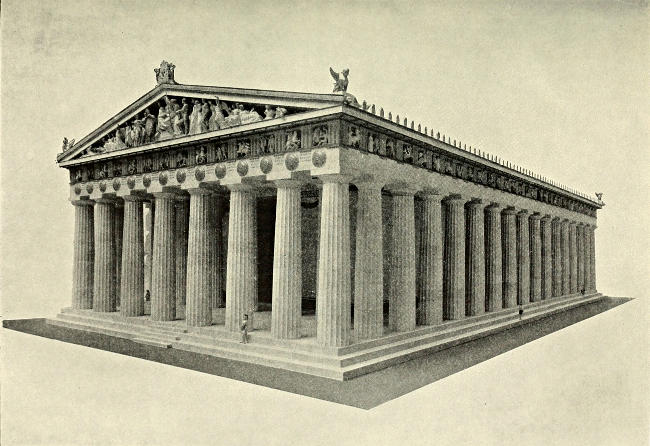
RESTORATION OF THE PARTHENON
Instead of trying to cherish or restore the feelings of equal alliance, Pericles
formally disclaimed it. He maintained that Athens owed to her subject
allies no account of the money received from them, so long as she performed
her contract by keeping away the Persian enemy, and maintaining the safety
of the Ægean waters. This was, as he represented, the obligation which
Athens had undertaken; and provided it were faithfully discharged, the allies
had no right to ask questions or institute control. That it was faithfully
discharged no one could deny: no ship of war except those of Athens and
her allies was ever seen between the eastern and western shores of the
Ægean. An Athenian fleet of sixty triremes was kept on duty in these waters,
chiefly manned by Athenian citizens, and beneficial as well from the protection
afforded to commerce as for keeping the seamen in constant pay and
training. And such was the effective superintendence maintained, that in
the disastrous period preceding the Thirty Years’ Truce, when Athens lost
Megara and Bœotia, and with difficulty recovered Eubœa, none of her numerous
maritime subjects took the opportunity to revolt.
The total of these distinct tributary cities is said to have amounted to
one thousand, according to a verse of Aristophanes, which cannot be under
the truth, though it may well be, and probably is, greatly above the truth.
The total annual tribute collected at the beginning of the Peloponnesian
War, and probably also for the years preceding it, is given by Thucydides at
about six hundred talents [£120,000 or $600,000]. Of the sums paid by
particular states, however, we have little or no information. It was placed
under the superintendence of the Hellenotamiæ; originally officers of the
confederacy, but now removed from Delos to Athens, and acting altogether
as an Athenian treasury-board. The sum total of the Athenian revenue,
from all sources, including this tribute, at the beginning of the Peloponnesian
War is stated by Xenophon at one thousand talents: customs, harbour,
and market-dues, receipt from the silver mines at Laurium, rents of public
property, fines from judicial sentences, a tax per head upon slaves, the annual
payment made by each metic, etc., may have made up a larger sum than four
hundred talents; which sum, added to the six hundred talents from tribute,
would make the total named by Xenophon. But a verse of Aristophanes,
during the ninth year of the Peloponnesian War, B.C. 422, gives the general
total of that time as “nearly two thousand talents”: this is in all probability
much above the truth, though we may reasonably imagine that the amount
of tribute money levied upon the allies had been augmented during the interval.
Whatever may have been the actual magnitude of the Athenian
budget, however, prior to the Peloponnesian War, we know that during the
larger part of the administration of Pericles, the revenue including tribute,
was so managed as to leave a large annual surplus; insomuch that a treasure
of coined money was accumulated in the Acropolis during the years preceding
the Peloponnesian War—which treasure when at its maximum reached the
great sum of ninety-seven hundred talents [£1,940,000 or $9,700,000], and
was still at six thousand talents, after a serious drain for various purposes,
at the moment when that war began. This system of public economy, constantly
laying by a considerable sum year after year—in which Athens stood
alone, since none of the Peloponnesian states had any public reserve whatever—goes
far of itself to vindicate Pericles from the charge of having wasted the
public money in mischievous distributions for the purpose of obtaining popularity;
and also to exonerate the Athenian demos from that reproach of a
greedy appetite for living by the public purse which it is common to advance
against them. After the death of Cimon, no further expeditions were
undertaken against the Persians, and even for some years before his death,
not much appears to have been done. The tribute money thus remained
unexpended, and kept in reserve, as the presidential duties of Athens prescribed,
against future attack, which might at any time be renewed.
Though we do not know the exact amount of the other sources of Athenian
revenue, however, we know that tribute received from allies was the
largest item in it. And altogether the exercise of empire abroad became a
prominent feature in Athenian life, and a necessity to Athenian sentiment,
not less than democracy at home. Athens was no longer, as she had been
once, a single city, with Attica for her territory: she was a capital or imperial
city—a despot-city, was the expression used by her enemies, and even
sometimes by her own citizens—with many dependencies attached to her,
and bound to follow her orders. Such was the manner in which not merely
Pericles and the other leading statesmen, but even the humblest Athenian
citizen, conceived the dignity of Athens; and the sentiment was one which
carried with it both personal pride and stimulus to patriotism.
To establish Athenian interests in the dependent territories, was one important
object in the eyes of Pericles, and while he discountenanced all distant
and rash enterprises, such as invasion of Egypt or Cyprus, he planted out many
cleruchies and colonies of Athenian citizens intermingled with allies, on
islands and parts of the coast. He conducted one thousand citizens to the
Thracian Chersonese, five hundred to Naxos, and two hundred and fifty to
Andros. In the Chersonese, he further repelled the barbarous Thracian invaders
from without, and even undertook the labour of carrying a wall of
defence across the isthmus, which connected the peninsula with Thrace;
since the barbarous Thracian tribes, though expelled some time before by
Cimon, had still continued to renew their incursions from time to time.
Ever since the occupation of the elder Miltiades, about eighty years before,
there had been in this peninsula many Athenian proprietors, apparently
intermingled with half-civilised Thracians: the settlers now acquired both
greater numerical strength and better protection, though it does not appear
that the cross-wall was permanently maintained. The maritime expeditions
of Pericles even extended into the Euxine Sea, as far as the important Greek
city of Sinope, then governed by a despot named Timesileus, against whom
a large proportion of the citizens were in active discontent.
Lamachus was left with thirteen Athenian triremes to assist in expelling
the despot, who was driven into exile with his friends: the properties of
these exiles were confiscated, and assigned to the maintenance of six hundred
Athenian citizens, admitted to equal fellowship and residence with the Sinopians.
We may presume that on this occasion Sinope became a member of
the Athenian tributary alliance, if it had not been so before: but we do not
know whether Cotyora and Trapezus, dependencies of Sinope further eastward,
which the ten thousand Greeks found on their retreat fifty years afterwards,
existed in the time of Pericles or not. Moreover, the numerous and
well-equipped Athenian fleet, under the command of Pericles, produced an
imposing effect upon the barbarous princes and tribes along the coast, contributing
certainly to the security of Grecian trade, and probably to the acquisition
of new dependent allies.
It was by successive proceedings of this sort that many detachments of
Athenian citizens became settled in various portions of the maritime empire
of the city—some rich, investing their property in the islands as more secure
(from the incontestable superiority of Athens at sea) even than Attica, which
since the loss of the Megarid could not be guarded against a Peloponnesian
land invasion—others poor, and hiring themselves out as labourers. The
islands of Lemnos, Imbros, and Scyros, as well as the territory of Histiæa, on
the north of Eubœa, were completely occupied by Athenian proprietors and
citizens: other places were partially so occupied. And it was doubtless advantageous
to the islanders to associate themselves with Athenians in trading
enterprises, since they thereby obtained a better chance of the protection of
the Athenian fleet. It seems that Athens passed regulations occasionally for
the commerce of her dependent allies, as we see by the fact that, shortly
before the Peloponnesian War, she excluded the Megarians from all their
ports. The commercial relations between Piræus and the Ægean reached
their maximum during the interval immediately preceding the Peloponnesian
War. Nor were these relations confined to the country east and north of
Attica: they reached also the western regions. The most important settlements
founded by Athens during this period were, Amphipolis in Thrace and
Thurii in Italy. Amphipolis was planted by a colony of Athenians and
other Greeks, under the conduct of the Athenian Agnon, in 437 B.C. It
was situated near the river Strymon in Thrace, on the eastern bank, and at
the spot where the Strymon resumes its river-course after emerging from the
lake above.
The colony of Thurii on the coast of the Gulf of Tarentum in Italy, near
the site and on the territory of the ancient Sybaris, was founded by Athens
about seven years earlier than Amphipolis, not long after the conclusion of
the Thirty Years’ Truce with Sparta, 443 B.C.
The fourteen years between the Thirty Years’ Truce and the breaking out
of the Peloponnesian War, are a period of full maritime empire on the part of
Athens—partially indeed resisted, but never with success. They are a
period of peace with all cities extraneous to her own empire; and of splendid
decorations to the city itself, emanating from the genius of Phidias and
others, in sculpture as well as in architecture. Since the death of Cimon,
Pericles had become, gradually but entirely, the first citizen in the commonwealth.
His qualities told for more, the longer they were known, and even
the disastrous reverses which preceded the Thirty Years’ Truce had not overthrown
him, since he had protested against that expedition of Tolmides into
Bœotia out of which they first arose. But if the personal influence of Pericles
had increased, the party opposed to him seems also to have become
stronger than before; and to have acquired a leader in many respects more
effective than Cimon—Thucydides, son of Melesias.
The new chief was a relative of Cimon, but of a character and talents
more analogous to those of Pericles: a statesman and orator rather than a
general, though competent to both functions if occasion demanded, as every
leading man in those days was required to be. Under Thucydides, the
political and parliamentary opposition against Pericles assumed a constant
character and organisation such as Cimon, with his exclusively military aptitudes,
had never been able to establish. The aristocratical party in the
commonwealth—the “honourable and respectable” citizens, as we find them
styled, adopting their own nomenclature—now imposed upon themselves
the obligation of undeviating regularity in their attendance on the public
assembly, sitting together in a particular section, so as to be conspicuously
parted from the demos. In this manner, their applause and dissent, their
mutual encouragement to each other, their distribution of parts to different
speakers, was made more conducive to the party purposes than it had been
before when these distinguished persons were intermingled with the mass of
citizens. Thucydides himself was eminent as a speaker, inferior only to
Pericles—perhaps hardly inferior even to him.
Such an opposition made to Pericles, in all the full license which a
democratical constitution permitted, must have been both efficient and embarrassing.
But the pointed severance of the aristocratical chiefs, which
Thucydides, son of Melesias, introduced, contributed probably at once to
rally the democratical majority round Pericles, and to exasperate the bitterness
of party conflict. As far as we can make out the grounds of the opposition,
it turned partly upon the pacific policy of Pericles towards the Persians,
partly upon his expenditure for home ornament. Thucydides contended
that Athens was disgraced in the eyes of the Greeks by having drawn the
confederate treasure from Delos to her own Acropolis, under pretence of
greater security—and then employing it, not in prosecuting war against
the Persians, but in beautifying Athens by new temples and costly statues.
To this Pericles replied that Athens had undertaken the obligation, in consideration
of the tribute-money, to protect her allies and keep off from them
every foreign enemy,—that she had accomplished this object completely at
the present, and retained a reserve sufficient to guarantee the like security
for the future,—that under such circumstances she owed no account to her
allies of the expenditure of the surplus, but was at liberty to employ it for
purposes useful and honourable to the city. In this point of view it was an
object of great public importance to render Athens imposing in the eyes
both of the allies and of Hellas generally, by improved fortifications,—by
accumulated embellishment, sculptural and architectural,—and by religious
festivals, frequent, splendid, musical, and poetical.
Such was the answer made by Pericles in defence of his policy against
the opposition headed by Thucydides. And considering the ground of the
debate on both sides, the answer was perfectly satisfactory. For when we
look at the very large sum which Pericles continually kept in reserve in the
treasury, no one could reasonably complain that his expenditure for ornamental
purposes was carried so far as to encroach upon the exigencies of defence.
What Thucydides and his partisans appear to have urged, was that
this common fund should still continue to be spent in aggressive warfare
against the Persian king, in Egypt and elsewhere—conformably to the projects
pursued by Cimon during his life. But Pericles was right in contending
that such outlay would have been simply wasteful; of no use either to
Athens or her allies, though risking all the chances of distant defeat, such
as had been experienced a few years before in Egypt.
So bitter however was the opposition made by Thucydides and his party
to this projected expenditure—so violent and pointed did the scission of
aristocrats and democrats become—that the dispute came after no long
time to that ultimate appeal which the Athenian constitution provided for
the case of two opposite and nearly equal party-leaders—a vote of ostracism.
Of the particular details which preceded this ostracism, we are not
informed; but we see clearly that the general position was such as the ostracism
was intended to meet. Probably the vote was proposed by the
party of Thucydides, in order to procure the banishment of Pericles, the
more powerful person of the two and the most likely to excite popular jealousy.
The challenge was accepted by Pericles and his friends, and the
result of the voting was such that an adequate legal majority condemned
Thucydides to ostracism. And it seems that the majority must have been
very decisive, for the party of Thucydides was completely broken by it:
and we hear of no other single individual equally formidable, as a leader of
opposition, throughout all the remaining life of Pericles.
The ostracism of Thucydides apparently took place about two years after
the conclusion of the Thirty Years’ Truce (443-442 B.C.), and it is to the
period immediately following, that the great Periclean works belong. The
southern wall of the Acropolis had been built out of the spoils brought by
Cimon from his Persian expeditions; but the third of the Long Walls connecting
Athens with the harbour was the proposition of Pericles, at what
precise time we do not know. The Long Walls originally completed (not
long after the battle of Tanagra, as has already been stated) were two, one
from Athens to Piræus, another from Athens to Phalerum: the space between
them was broad, and if in the hands of an enemy, the communication with
Piræus would be interrupted. Accordingly, Pericles now induced the people
to construct a third or intermediate wall, running parallel with the first wall
to Piræus, and within a short distance (seemingly near one furlong) from it:
so that the communication between the city and the port was placed beyond
all possible interruption, even assuming an enemy to have got within the
Phaleric wall. It was seemingly about this time, too, that the splendid docks
and arsenal in Piræus, alleged by Isocrates to have cost one thousand talents
[£200,000 or $1,000,000] were constructed; while the town itself of Piræus
was laid out anew with straight streets intersecting at right angles. Apparently
this was something new in Greece—the towns generally, and Athens
itself in particular, having been built without any symmetry, or width, or
continuity of streets: and Hippodamus the Milesian, a man of considerable
attainments in the physical philosophy of the age, derived much renown as
the earliest town architect, for having laid out the Piræus on a regular plan.
The market-place, or one of them at least, permanently bore his name—the
Hippodamian agora. At a time when so many great architects were displaying
their genius in the construction of temples, we are not surprised to
hear that the structure of towns began to be regularised also. Moreover we
are told that the new colonial town of Thurii, to which Hippodamus went as
a settler, was also constructed in the same systematic form as to straight and
wide streets.
The new scheme upon which the Piræus was laid out, was not without its
value as one visible proof of the naval grandeur of Athens. But the buildings
in Athens and on the Acropolis formed the real glory of the Periclean age.
A new theatre, termed the Odeon, was constructed for musical and poetical
representations at the great Panathenaic solemnity; next, the splendid temple
of Athene, called the Parthenon, with all its masterpieces of decorative sculpture,
friezes, and reliefs; lastly, the costly portals erected to adorn the entrance
of the Acropolis, on the western side of the hill, through which the solemn
processions on festival days were conducted. It appears that the Odeon and
the Parthenon were both finished between 445 and 437 B.C.: the Propylæa
somewhat later, between 437 and 431 B.C., in which latter year the Peloponnesian
War began. Progress was also made in restoring or reconstructing
the Erechtheion, or ancient temple of Athene Polias, the patron goddess of
the city—which had been burnt in the invasion of Xerxes. But the breaking
out of the Peloponnesian War seems to have prevented the completion of
this, as well as of the great temple of Demeter, at Eleusis, for the celebration
of the Eleusinian mysteries—that of Athene, at Sunium—and that of
Nemesis at Rhamnus. Nor was the sculpture less memorable than the
architecture; three statues of Athene, all by the hand of Phidias, decorated
the Acropolis, one colossal, forty-seven feet high, of ivory, in the
Parthenon, a second of bronze, called the Lemnian Athene, a third of colossal
magnitude, also in bronze, called Athene Promachos, placed between the
Propylæa, and the Parthenon, and visible from afar off, even to the navigator
approaching Piræus by sea.
It is not, of course, to Pericles that the renown of these splendid productions
of art belongs; but the great sculptors and architects, by whom they
were conceived and executed, belonged to that same period of expanding
and stimulating Athenian democracy, which likewise called forth creative
genius in oratory, in dramatic poetry, and in philosophical speculation.
Considering these prodigious achievements in the field of art only as
they bear upon Athenian and Grecian history, they are phenomena of
extraordinary importance. When we learn the profound impression which
they produced upon Grecian spectators of a later age, we may judge how
immense was the effect upon that generation which saw them both begun
and finished. In the year 480 B.C., Athens was ruined by the occupation
of Xerxes: since that period, the Greeks had seen, first, the rebuilding and
fortifying of the city on an enlarged scale; next, the addition of Piræus
with its docks and magazines; thirdly, the junction of the two by the Long
Walls, thus including the most numerous concentrated population, wealth,
arms, ships, etc., in Greece; lastly, the rapid creation of so many new miracles
of art—the sculptures of Phidias as well as the paintings of the Thasian
painter Polygnotus, in the temple of Theseus, and in the portico called
Pœcile.b
Plutarch says: “That which was the chief delight of the Athenians and
the wonder of strangers, and which alone serves for a proof that the boasted
power and opulence of ancient Greece is not an idle tale, was the magnificence
of the temples and public edifices. Works were raised of an
astonishing magnitude, and inimitable beauty and perfection, every architect
striving to surpass the magnificence of the design with the elegance of the
execution; yet still the most wonderful circumstance was the expedition
with which they were completed. Phidias was appointed by Pericles superintendent
of all the public edifices.”f
It thus appears that the gigantic strides by which Athens had reached
her maritime empire were now immediately succeeded by a series of works
which stamped her as the imperial city of Greece, gave to her an appearance
of power even greater than the reality, and especially put to shame the
old-fashioned simplicity of Sparta. The cost was doubtless prodigious, and
could only have been borne at a time when there was a large treasure in
the Acropolis, as well as a considerable tribute annually coming in: if we
may trust a computation which seems to rest on plausible grounds, it cannot
have been much less than three thousand talents in the aggregate [£600,000
or $3,000,000].
The expenditure of so large a sum was, of course, a source of revenue
and of great private gain to all manner of contractors, tradesmen, merchants,
artisans of various descriptions, etc., concerned in it: in one way or
another, it distributed itself over a large portion of the whole city. And it
appears that the materials employed for much of the work were designedly
of the most costly description, as being most consistent with the reverence
due to the gods: marble was rejected as too common for the statue of
Athene, and ivory employed in its place; while the gold with which it was
surrounded weighed not less than forty talents [£8000 or $40,000]. A
large expenditure for such purposes, considered as pious towards the gods,
was at the same time imposing in reference to Grecian feeling, which regarded
with admiration every variety of public show and magnificence, and
repaid with grateful deference the rich men who indulged in it. Pericles
knew well that the visible splendour of the city, so new to all his contemporaries,
would cause her great power to appear greater still, and would thus
procure for her a real, though unacknowledged influence—perhaps even an
ascendency—over all cities of the Grecian name. And it is certain that
even among those who most hated and feared her, at the outbreak of the
Peloponnesian War, there prevailed a powerful sentiment of involuntary
deference.
Before Ephialtes advanced his main proposition for abridging the competence
of the senate of Areopagus, he appears to have been strenuous
in repressing the practical abuse of magisterial authority, by accusations
brought against the magistrates at the period of their regular accountability.
After repeated efforts to check the practical abuse of these magisterial
powers, Ephialtes and Pericles were at last conducted to the proposition of
cutting them down permanently, and introducing an altered system.
It was now that Pericles and Ephialtes carried their important scheme
of judicial reform. The senate of Areopagus was deprived of its discretionary
censorial power, as well as of all its judicial competence, except that
which related to homicide. The individual magistrates, as well as the
senate of Five Hundred, were also stripped of their judicial attributes (except
the power of imposing a small fine), which were transferred to the newly
created panels of salaried dicasts, lotted off in ten divisions from the aggregate
Heliæa. Ephialtes first brought down the laws of Solon from the
Acropolis to the neighbourhood of the market-place, where the dicasteries sat—a
visible proof that the judicature was now popularised.
In the representation of many authors, the full bearing of this great
constitutional change is very inadequately conceived. What we are commonly
told is, that Pericles was the first to assign a salary to these numerous
dicasteries at Athens. He bribed the people with the public money (says
Plutarch), in order to make head against Cimon, who bribed them out of his
own private purse; as if the pay were the main feature in the case, and as
if all which Pericles did was, to make himself popular by paying the dicasts
for judicial service which they had before rendered gratuitously. The truth
is, that this numerous army of dicasts, distributed into ten regiments and
summoned to act systematically throughout the year, was now for the first
time organised: the commencement of their pay is also the commencement
of their regular judicial action. What Pericles really did was, to sever for
the first time from the administrative competence of the magistrates that
judicial authority which had originally gone along with it. The great men
who had been accustomed to hold these offices were lowered both in influence
and authority: while on the other hand a new life, habit, and sense of power,
sprung up among the poorer citizens. A plaintiff having cause of civil action,
or an accuser invoking punishment against citizens guilty of injury either to
himself or to the state, had still to address himself to one or other of the
archons, but it was only with a view of ultimately arriving before the dicastery
by whom the cause was to be tried.
While the magistrates individually were thus restricted to simple administration,
they experienced still more serious loss of power in their capacity of
members of the Areopagus, after the year of archonship was expired. Instead
of their previous unmeasured range of supervision and interference, they were
now deprived of all judicial sanction beyond that small power of fining which
was still left both to individual magistrates, and to the senate of Five Hundred.
But the cognisance of homicide was still expressly reserved to them—for the
procedure, in this latter case religious not less than judicial, was so thoroughly
consecrated by ancient feeling, that no reformer could venture to disturb or
remove it.
It was upon this same ground probably that the stationary party defended
all the prerogatives of the senate of Areopagus—denouncing the curtailments
proposed by Ephialtes as impious and guilty innovations. How
extreme their resentment became, when these reforms were carried,—and
how fierce was the collision of political parties at this moment,—we may
judge by the result. The enemies of Ephialtes caused him to be privately
assassinated, by the hand of a Bœotian of Tanagra named Aristodicus. Such
a crime—rare in the political annals of Athens, for we come to no known
instance of it afterwards until the oligarchy of the Four Hundred in 411 B.C.—marks
at once the gravity of the change now introduced, the fierceness of
the opposition offered, and the unscrupulous character of the conservative
party. Cimon was in exile and had no share in the deed. Doubtless the
assassination of Ephialtes produced an effect unfavourable in every way to
the party who procured it. The popular party in their resentment must have
become still more attached to the judicial reforms just assured to them, while
the hands of Pericles, the superior leader left behind and now acting singly,
must have been materially strengthened.
It is from this point that the administration of that great man may be said
to date: he was now the leading adviser (we might almost say Prime Minister)
of the Athenian people. His first years were marked by a series of brilliant
successes—already mentioned—the acquisition of Megara as an ally, and
the victorious war against Corinth and Ægina. But when he proposed the
great and valuable improvement of the Long Walls, thus making one city
of Athens and Piræus, the same oligarchical party, which had opposed his
judicial changes and assassinated Ephialtes, again stood forward in vehement
resistance. Finding direct opposition unavailing, they did not scruple to
enter into treasonable correspondence with Sparta—invoking the aid of a
foreign force for the overthrow of the democracy: so odious had it become
in their eyes, since the recent innovations. How serious was the hazard
incurred by Athens, near the time of the battle of Tanagra, has been already
recounted; together with the rapid and unexpected reconciliation of parties
after that battle, principally owing to the generous patriotism of Cimon and
his immediate friends. Cimon was restored from ostracism on this occasion,
before his full time had expired; while the rivalry between him and Pericles
henceforward becomes mitigated, or even converted into a compromise,
whereby the internal affairs of the city were left to the one, and the conduct
of foreign expeditions to the other. The successes of Athens during the
ensuing ten years were more brilliant than ever, and she attained the maximum
of her power: which doubtless had a material effect in imparting
stability to the democracy as well as to the administration of Pericles—and
enabled both the one and the other to stand the shock of those great public
reverses, which deprived the Athenians of their dependent landed alliances,
in the interval between the defeat of Coronea and the Thirty Years’ Truce.
Along with the important judicial revolution brought about by Pericles,
were introduced other changes belonging to the same scheme and system.
Thus a general power of supervision both over the magistrates and over
the public assembly, was vested in seven magistrates, now named for the
first time, called nomophylaces, or law-guardians, and doubtless changed
every year. These nomophylaces sat alongside of the Proedri or presidents
both in the senate and in the public assembly, and were charged with the duty
of interposing whenever any step was taken or any proposition made contrary
to the existing laws: they were also empowered to constrain the magistrates
to act according to law.
Another important change, which we may with probability refer to Pericles,
is the institution of the nomothetæ. These men were in point of fact
dicasts, members of the six thousand citizens annually sworn in that capacity.
But they were not, like the dicasts for trying causes, distributed into panels or
regiments known by a particular letter and acting together throughout the
entire year: they were lotted off to sit together only on special occasion and
as the necessity arose. According to the reform now introduced, the ecclesia
or public assembly, even with the sanction of the senate of Five Hundred,
became incompetent either to pass a new law or to repeal a law already in
existence; it could only enact a psephism—that is, properly speaking, a decree
applicable only to a particular case; though the word was used at Athens in
a very large sense, sometimes comprehending decrees of general as well as
permanent application. In reference to laws, a peculiar judicial procedure
was established. The thesmothetæ were directed annually to examine the
existing laws, noting any contradictions or double laws on the same matter;
and in the first prytany (tenth part) of the Attic year, on the eleventh day,
an ecclesia was held, in which the first business was to go through the laws
seriatim, and submit them for approval or rejection; first beginning with the
laws relating to the senate, next coming to those of more general import,
especially such as determined the functions and competence of the magistrates.
If any law was condemned by the vote of the public assembly, or if
any citizen had a new law to propose, the third assembly of the prytany was
employed, previous to any other business, in the appointment of nomothetæ
and in the provision of means to pay their salary.
The effect of this institution was to place the making or repealing of
laws under the same solemnities and guarantees as the trying of causes or
accusations in judicature.
As an additional security both to the public assembly and the nomothetæ
against being entrapped into decisions contrary to existing law, another
remarkable provision has yet to be mentioned—a provision probably introduced
by Pericles at the same time as the formalities of law-making by means
of specially delegated nomothetæ. This was the Graphe Paranomon—indictment
for informality or illegality—which might be brought on certain
grounds against the proposer of any law or any psephism, and rendered him
liable to punishment by the dicastery. He was required in bringing forward
his new measure to take care that it should not be in contradiction with any
pre-existing law—or if there were any such contradiction, to give formal
notice of it, to propose the repeal of that which existed, and to write up publicly
beforehand what his proposition was—in order that there might never
be two contradictory laws at the same time in operation, nor any illegal
decree passed either by the senate or by the public assembly. If he neglected
this precaution, he was liable to prosecution under the Graphe Paranomon,
which any Athenian citizen might bring against him before the dicastery,
through the intervention and under the presidency of the thesmothetæ.
That this indictment, as one of the most direct vents for such enmity,
was largely applied and abused at Athens, is certain. But though it probably
deterred unpractised citizens from originating new propositions, it did
not produce the same effect upon those orators who made politics a regular
business, and who could therefore both calculate the temper of the people,
and reckon upon support from a certain knot of friends. Aristophon, towards
the close of his political life, made it a boast that he had been thus
indicted and acquitted seventy-five times. Probably the worst effect which
it produced was that of encouraging the vein of personality and bitterness
which pervades so large a proportion of Attic oratory, even in its most illustrious
manifestations; turning deliberative into judicial eloquence, and interweaving
the discussion of a law or decree along with a declamatory harangue
against the character of its mover. We may at the same time add that the
Graphe Paranomon was often the most convenient way of getting a law or
a psephism repealed, so that it was used even when the annual period had
passed over, and when the mover was therefore out of danger, the indictment
being then brought only against the law or decree.
Such were the great constitutional innovations of Pericles and Ephialtes,—changes
full of practical results,—the transformation, as well as the complement,
of that democratical system which Clisthenes had begun and to
which the tide of Athenian feeling had been gradually mounting up during
the preceding twenty years. The entire force of these changes is generally
not perceived, because the popular dicasteries and the nomothetæ are so often
represented as institutions of Solon, and as merely supplied with pay by
Pericles. This erroneous supposition prevents all clear view of the growth
of the Athenian democracy by throwing back its last elaborations to the
period of its early and imperfect start. To strip the magistrates of all their
judicial power, except that of imposing a small fine, and the Areopagus of all
its jurisdiction except in cases of homicide—providing popular, numerous,
and salaried dicasts to decide all the judicial business at Athens as well as to
repeal and enact laws—this was the consummation of the Athenian democracy.
No serious constitutional alteration (excepting the temporary interruptions
of the Four Hundred and the Thirty) was afterwards made until the
days of Macedonian interference. As Pericles made it, so it remained in the
days of Demosthenes—though with a sensible change in the character, and
abatement in the energies, of the people, rich as well as poor.
In appreciating the practical working of these numerous dicasteries at
Athens, in comparison with such justice as might have been expected from
individual magistrates, we have to consider: first, that personal and pecuniary
corruption seems to have been a common vice among the leading men
of Athens and Sparta, when acting individually or in boards of a few members,
and not uncommon even with the kings of Sparta; next, that in the
Grecian cities generally, as we know even from the oligarchical Xenophon
(he particularly excepts Sparta), the rich and great men were not only insubordinate
to the magistrates, but made a parade of showing that they
cared nothing about them. We know also from the same unsuspected
source, that while the poorer Athenian citizens who served on shipboard
were distinguished for the strictest discipline, the hoplites or middling burghers
who formed the infantry were less obedient, and the rich citizens who
served on horseback the most disobedient of all.
To make rich criminals amenable to justice has been found so difficult
everywhere, until a recent period of history, that we should be surprised
if it were otherwise in Greece. When we follow the reckless demeanour of
rich men like Critias, Alcibiades, and Midias, even under the full-grown
democracy of Athens, we may be sure that their predecessors under the
Clisthenean constitution would have been often too formidable to be punished
or kept down by an individual archon of ordinary firmness, even
assuming him to be upright and well-intentioned. Now the dicasteries
established by Pericles were inaccessible both to corruption and intimidation:
their number, their secret suffrage, and the impossibility of knowing
beforehand what individuals would sit in any particular cause, prevented
both the one and the other. And besides that the magnitude of their number,
extravagant according to our ideas of judicial business, was essential to
this tutelary effect—it served further to render the trial solemn and the
verdict imposing on the minds of parties and spectators, as we may see by the
fact that, in important causes the dicastery was doubled or tripled. Nor
was it possible by any other means than numbers to give dignity to an assembly
of citizens, of whom many were poor, some old, and all were despised
individually by rich accused persons who were brought before them—as
Aristophanes and Xenophon give us plainly to understand. If we except
the strict and peculiar educational discipline of Sparta, these numerous
dicasteries afforded the only organ which Grecian politics could devise, for
getting redress against powerful criminals, public as well as private, and for
obtaining a sincere and uncorrupt verdict.
Taking the general working of the dicasteries, we shall find that they are
nothing but jury-trial applied on a scale broad, systematic, unaided, and
uncontrolled, beyond all other historical experience—and that they therefore
exhibit in exaggerated proportions both the excellences and the
defects characteristic of the jury system, as compared with decision by
trained and professional judges. All the encomiums, which it is customary
to pronounce upon jury-trial, will be found predicable of the Athenian dicasteries
in a still greater degree; all the reproaches, which can be addressed
on good ground to the dicasteries, will apply to modern juries also, though
in a less degree.
The first establishment of the dicasteries is nearly coincident with the
great improvement of Attic tragedy in passing from Æschylus to Sophocles.
The same development of the national genius, now preparing splendid
manifestations both in tragic and comic poetry, was called with redoubled
force into the path of oratory, by the new judicial system. A certain power
of speech now became necessary, not merely for those who intended to take
a prominent part in politics, but also for private citizens to vindicate their
rights or repel accusations, in a court of justice. It was an accomplishment
of the greatest practical utility, even apart from ambitious purposes; hardly
less so than the use of arms or the practice of the gymnasium. Accordingly,
the teachers of grammar and rhetoric, and the composers of written speeches
to be delivered by others, now began to multiply and to acquire an unprecedented
importance—as well at Athens as under the contemporary democracy
of Syracuse, in which also some form of popular judicature was established.
Style and speech began to be reduced to a system, and so communicated;
not always happily, for several of the early rhetors adopted an artificial,
ornate, and conceited manner, from which Attic good taste afterwards liberated
itself. But the very character of a teacher of rhetoric as an art—a
man giving precepts and putting himself forward in show-lectures as a
model for others, is a feature first belonging to the Periclean age, and indicates
a new demand in the minds of the citizens.
We begin to hear, in the generation now growing up, of the rhetor and the
sophist, as persons of influence and celebrity. These two names denoted
persons of similar moral and intellectual endowments, or often indeed the
same person, considered in different points of view; either as professing
to improve the moral character, or as communicating power and facility of
expression, or as suggesting premises for persuasion, illustrations on the
commonplaces of morals and politics, argumentative abundance on matters
of ordinary experience, dialectical subtlety in confuting an opponent, etc.
Antiphon of the deme Rhamnus in Attica, Thrasymachus of Chalcedon,
Tisias of Syracuse, Gorgias of Leontini, Protagoras of Abdera, Prodicus of
Ceos, Theodorus of Byzantium, Hippias of Elis, Zeno of Elea, were among
the first who distinguished themselves in these departments of teaching.
Antiphon was the author of the earliest composed speech really spoken in a
dicastery and preserved down to the later critics. These men were mostly not
citizens of Athens, though many of them belonged to towns comprehended
in the Athenian empire, at a time when important judicial causes belonging
to these towns were often carried up to be tried at Athens—while all of
them looked to that city as a central point of action and distinction. The
term “sophist,” which Herodotus applies with sincere respect to men of distinguished
wisdom such as Solon, Anacharsis, Pythagoras, etc., now came
to be applied to these teachers of virtue, rhetoric, conversation, and disputation;
many of whom professed acquaintance with the whole circle of human
science, physical as well as moral (then narrow enough), so far as was necessary
to talk about any portion of it plausibly, and to answer any question
proposed to them.
Though they passed from one town to another, partly in the capacity of
envoys from their fellow-citizens, partly as exhibiting their talents to numerous
hearers, with much renown and large gain—they appear to have been
viewed with jealousy and dislike by a large portion of the public. For at
a time when every citizen pleaded his own cause before the dicastery, they
imparted, to those who were rich enough to purchase it, a peculiar skill in
the common weapons, which made them like fencing-masters or professional
swordsmen amidst a society of untrained duellists. Moreover Socrates—himself
a product of the same age, a disputant on the same subjects, and
bearing the same name of a sophist—but despising political and judicial
practice, and looking to the production of intellectual stimulus and moral
impressions upon his hearers—Socrates or rather Plato, speaking through
the person of Socrates—carried on throughout his life a constant polemical
warfare against the sophists and rhetors in that negative vein in which he
was unrivalled. And as the works of these latter have not remained, it is
chiefly from the observations of their opponents that we know them; so that
they are in a situation such as that in which Socrates himself would have
been if we had been compelled to judge of him only from the Clouds of Aristophanes,
or from those unfavourable impressions respecting his character
which we know, even from the Apologia of Plato and Xenophon, to have
been generally prevalent at Athens.
This is not the opportunity, however, for trying to distinguish the good
from the evil in the working of the sophists and rhetors. At present it is
enough that they were the natural product of the age; supplying those wants,
and answering to that stimulus, which arose partly from the deliberations of
the ecclesia, but still more from the contentions before the dicastery—in
which latter a far greater number of citizens took active part, with or without
their own consent. The public and frequent dicasteries constituted by
Pericles opened to the Athenian mind precisely that career of improvement
which was best suited to its natural aptitude. They were essential to the
development of that demand out of which grew not only Grecian oratory,
but also, as secondary products, the speculative moral and political philosophy,
and the didactic analysis of rhetoric and grammar, which long survived
after Grecian creative genius had passed away. And it was one of the first
measures of the oligarchy of Thirty, to forbid by an express law, any teaching
of the art of speaking. Aristophanes derides the Athenians for their
love of talk and controversy, as if it had enfeebled their military energy;
but in his time, most undoubtedly, that reproach was not true—nor did it
become true, even in part, until the crushing misfortunes which marked the
close of the Peloponnesian War. During the course of that war, restless
and energetic action was the characteristic of Athens even in a greater degree
than oratory or political discussion, though before the time of Demosthenes
a material alteration had taken place.
The establishment of these paid dicasteries at Athens was thus one of
the most important and prolific events in all Grecian history. The pay
helped to furnish a maintenance for old citizens, past the age of military service.
Elderly men were the best persons for such a service, and were preferred
for judicial purposes both at Sparta and, as it seems, in heroic Greece.
Nevertheless, we need not suppose that all the dicasts were either old or
poor, though a considerable proportion of them were so, and though Aristophanes
selects these qualities as among the most suitable subjects for his
ridicule. Pericles has been often censured for this institution, as if he had
been the first to insure pay to dicasts who before served for nothing, and
had thus introduced poor citizens into courts previously composed of citizens
above poverty. But in the first place, this supposition is not correct
in point of fact, inasmuch as there were no such constant dicasteries previously
acting without pay; next, if it had been true, the habitual exclusion
of the poor citizens would have nullified the popular working of these bodies,
and would have prevented them from answering any longer to the reigning
sentiment at Athens. Nor could it be deemed unreasonable to assign a regular
pay to those who thus rendered regular service. It was indeed an essential
item in the whole scheme and purpose, so that the suppression of the
pay of itself seems to have suspended the dicasteries, while the oligarchy of
Four Hundred was established—and it can only be discussed in that light.
As the fact stands, we may suppose that the six thousand heliasts who filled
the dicasteries were composed of the middling and poorer citizens indiscriminately;
though there was nothing to exclude the richer, if they chose to
serve.b
The public works which were undertaken through the advice of Pericles
were executed under his inspection; the choice of the artists employed and
of the plans adopted, was probably entrusted in a great measure to his judgment;
and the large sums expended on them passed through his hands.
This was an office which it was scarcely possible to exercise at Athens without
either exciting suspicion or giving a handle for calumny. We find that
Cratinus in one of his comedies threw out some hints as to the tardiness with
which Pericles carried on the third of the Long Walls which he had persuaded
the people to begin. “He had been long professing to go on with it, but in
fact did not stir a step.” Whether the motives to which this delay was
imputed were such as to call his integrity into question, does not appear;
but in time his enemies ventured openly to attack him on this ground. Yet
the first blow was not aimed directly at himself, but was intended to wound
him through the side of a friend. Phidias, whose genius was the ruling principle
which animated and controlled every design for the ornament of the
city, had been brought, as well by conformity of taste as by the nature of
his engagement, into an intimate relation with Pericles. To ruin Phidias
was one of the readiest means both of hurting the feelings and of shaking
the credit of Pericles. If Phidias could be convicted of a fraud on the
public, it would seem an unavoidable inference that Pericles had shared the
profit. The ivory statue of the goddess in the Parthenon, which was enriched
with massy ornaments of pure gold, appeared to offer a groundwork
for a charge which could not easily be refuted. To give it the greater weight,
a man named Menon, who had been employed by Phidias in some of the details
of the work, was induced to seat himself in the agora with the ensigns of
a suppliant, and to implore pardon of the people as the condition of revealing
an offence in which he had been an accomplice with Phidias. He accused
Phidias of having embezzled a part of the gold which he had received from
the treasury. But this charge immediately fell to the ground through a
contrivance which Pericles had adopted for a different end. The golden
ornaments had been fixed on the statue in such a manner, that they could be
taken off without doing it any injury, and thus afforded the means of ascertaining
their exact weight. Pericles challenged the accusers of Phidias to
use this opportunity of verifying their charge; but they shrank from the
application of this decisive test.
Though however they were thus baffled in this part of their attempt, they
were not abashed or deterred; for they had discovered another ground, which
gave them a surer hold on the public mind. Some keen eye had observed
two figures among those with which Phidias had represented the battle between
Theseus and the Amazons on the shield of the goddess, in which it
detected the portraits of the artist himself, as a bald old man, and that of
Pericles in all the comeliness of his graceful person. To the religious feelings
of the Athenians this mode of perpetuating the memory of individuals,
by connecting their portraits with an object of public worship, appeared to
violate the sanctity of the place; and it was probably also viewed as an arrogant
intrusion, no less offensive to the majesty of the commonwealth. It
seems as if Menon’s evidence was required even to support this charge.
Phidias was committed to prison, and died there. The informer, who was a
foreigner, was rewarded with certain immunities; and, as one who in the
service of the state had provoked a powerful enemy, was placed by a formal
decree under the protection of the Ten Generals.
This success emboldened the enemies of Pericles to proceed. They had
not indeed established any of their accusations; but they had sounded the
disposition of the people, and found that it might be inspired with distrust
and jealousy of its powerful minister, or that it was not unwilling to see him
humbled. They seem now to have concerted a plan for attacking him, both
directly and indirectly, in several quarters at once; and they began with a
person in whose safety he felt as much concern as in his own, and who could
not be ruined without involving him in the like calamity.
This was the celebrated Aspasia, who had long attracted almost as much
of the public attention at Athens as Pericles himself. She was a native of
Miletus, which was early and long renowned as a school for the cultivation
of female graces. She had come, it would seem, as an adventurer to Athens,
and by the combined charms of her person, manners, and conversation, won
the affections and the esteem of Pericles. Her station had freed her from the
restraints which custom laid on the education of the Athenian matron: and she
had enriched her mind with accomplishments which were rare even among the
men. Her acquaintance with Pericles seems to have begun while he was still
united to a lady of high birth, before the wife of the wealthy Hipponicus.
We can hardly doubt that it was Aspasia who first disturbed this union,
though it is said to have been dissolved by mutual consent. But after parting
from his wife, who had borne him two sons, Pericles attached himself to
Aspasia by the most intimate relation which the laws permitted him to contract
with a foreign woman; and she acquired an ascendency over him, which
soon became notorious, and furnished the comic poets with an inexhaustible
fund of ridicule, and his enemies with a ground for serious charges. On the
stage she was the Hera of the Athenian Zeus, the Omphale, or the Dejanira
of an enslaved or a faithless Hercules. The Samian War was ascribed to her
interposition on behalf of her birthplace; and rumours were set afloat which
represented her as ministering to the vices of Pericles by the most odious and
degrading of offices. There was perhaps as little foundation for this report,
as for a similar one in which Phidias was implicated; though among all the
imputations brought against Pericles this is that which it is the most difficult
clearly to refute.
But we are inclined to believe that it may have arisen from the peculiar
nature of Aspasia’s private circles, which, with a bold neglect of established
usage, were composed not only of the most intelligent and accomplished men
to be found at Athens, but also of matrons, who it is said were brought by
their husbands, to listen to her conversation; which must have been highly
instructive as well as brilliant, since Plato did not hesitate to describe her as
the preceptress of Socrates, and to assert that she both formed the rhetoric of
Pericles, and composed one of his most admired harangues. The innovation
which drew women of free birth, and good condition, into her company for
such a purpose, must, even where the truth was understood, have surprised
and offended many; and it was liable to the grossest misconstruction. And
if her female friends were sometimes seen watching the progress of the works
of Phidias, it was easy, through his intimacy with Pericles, to connect this
fact with a calumny of the same kind.
There was another rumour still more dangerous, which grew out of the
character of the persons who were admitted to the society of Pericles and
Aspasia. Athens had become a place of resort for learned and ingenious men
of all pursuits. None were more welcome at the house of Pericles than such
as were distinguished by philosophical studies, and especially by the profession
of new speculative tenets. He himself was never weary of discussing such
subjects; and Aspasia was undoubtedly able to bear her part in this, as well
as in any other kind of conversation. The mere presence of Anaxagoras,
Zeno, Protagoras, and other celebrated men, who were known to hold doctrines
very remote from the religious conceptions of the vulgar, was sufficient to
make a circle in which they were familiar pass for a school of impiety. Such
were the materials out of which the comic poet Hermippus, laying aside
the mask, framed a criminal prosecution against Aspasia. His indictment
included two heads: an offence against religion, and that of corrupting
Athenian women to gratify the passions of Pericles.
This cause seems to have been still pending, when one Diopithes procured
a decree, by which persons who denied the being of the gods, or taught doctrines
concerning the celestial bodies which were inconsistent with religion,
were made liable to a certain criminal process. This stroke was aimed immediately
at Anaxagoras—whose physical speculations had become famous,
and were thought to rob the greatest of the heavenly beings of their inherent
deity—but indirectly at his disciple and patron Pericles. When the discussion
of this decree, and the prosecution commenced against Aspasia, had disposed
the people to listen to other less probable charges, the main attack was
opened, and the accusation which in the affair of Phidias had been silenced
by the force of truth, was revived in another form. A decree was passed on
the motion of one Dracontides, directing Pericles to give in his accounts to
the Prytanis, to be submitted to a trial, which was to be conducted with
extraordinary solemnity; for it was to be held in the citadel, and the jurors
were to take the balls with which each signified his verdict, from the top of
an altar. But this part of the decree was afterwards modified by an amendment
moved by Agnon, which ordered the cause to be tried in the ordinary
way, but by a body of fifteen hundred jurors. The uncertainty of the party
which managed these proceedings, and their distrust as to the evidence which
they should be able to procure, seem to be strongly marked by a clause in
this decree, which provided that the offence imputed to Pericles might be
described either as embezzlement, or by a more general name, as coming
under the head of public wrong.
Yet all these machinations failed at least of reaching their main object.
The issue of those which were directed against Anaxagoras cannot be exactly
ascertained through the discrepancy of the accounts given of it. According
to some authors he was tried, and condemned either to a fine and
banishment or to death; but in the latter case made his escape from prison.
According to others he was defended by Pericles, and acquitted. Plutarch
says that Pericles, fearing the event of a trial, induced him to withdraw
from Athens; and it seems to have been admitted on all hands, that he
ended his long life in quiet and honour at Lampsacus. The danger which
threatened Aspasia was also averted; but it seems that Pericles, who pleaded
her cause, found need for his most strenuous exertions, and that in her behalf
he descended to tears and entreaties, which no similar emergency of his own
could ever draw from him. It was indeed probably a trial more of his personal
influence than of his eloquence; and his success, hardly as it was won,
may have induced his adversaries to drop the proceedings instituted against
himself, or at least to postpone them to a fitter season. After weathering
this storm he seems to have recovered his former high and firm position,
which to the end of his life was never again endangered, except by one very
transient gust of popular displeasure. He felt strong enough to resist the
wishes, and to rebuke the impatience of the people. Yet it was a persuasion
so widely spread among the ancients as to have lasted even to modern times,
that his dread of the persecution which hung over him, and his consciousness
that his expenditure of the public money would not bear a scrutiny, were
at least among the motives which induced him to kindle the war which put an
end to the Thirty Years’ Truce.c
Greek Terra-cotta Heads
(In the British Museum)
Hail, Nature’s utmost boast! unrivalled Greece!
My fairest reign! where every power benign
Conspired to blow the flower of human kind,
And lavished all that genius can inspire.
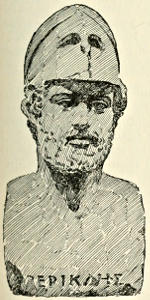
Pericles
[460-410 B.C.]
Everywhere in the ancient world, but in a
higher or less degree in different countries, the
necessaries of life upon the whole were cheaper
than they are at the present day. But with regard
to particular articles, examples enough of the contrary
are found. The main causes of this comparative
cheapness were the less amount of money in
circulation, the uncommon fruitfulness of the
southern countries which the Greeks inhabited,
or with which they traded; countries which at
that time were cultivated with an extraordinary
degree of care, but are at present neglected; and
the impossibility of exportation to the distant regions
which had no intercourse, or but little, with
the countries lying on the Mediterranean Sea.
The last is especially the reason of the great cheapness
of wine. The large quantities of the same
which were produced in all southern regions, were
not distributed over so considerable an extent of the
earth as at present. Nevertheless in considering
the prices of commodities in ancient times the difference
of times and places must be well weighed.
In Rome and Athens wine was not, in the most
flourishing condition of the state, as cheap as it was in Upper Italy and in
Lusitania. In Upper Italy, the Sicilian medimnus of wheat, which was equal
to the Attic medimnus, and considerably less than the Prussian bushel (or
than 1½ English bushels), was worth, even in the times of Polybius, according
to the account of that historian, only four oboli. This price seems to rest
upon an inaccurate comparison of the Roman with the Greek coin, and particularly
upon the supposition that the modius, one-sixth of the medimnus,
was worth two asses, the medimnus, therefore, worth twelve asses; which,
estimating the denarius to be equivalent to the drachma, would be equal to
4½ oboli. To this last amount four ancient oboli of the standard of Solon
(11.4 cents) may certainly be estimated as equivalent. The medimnus of
barley was worth the half of this price, the metretes of wine (about ten
English gallons), was worth as much as the medimnus of barley.
In the time of Solon, indeed, an ox was worth only five drachmæ, a sheep
one drachma, and the medimnus of grain the same. But gradually the
prices increased five fold; of several articles seven, ten and twenty fold.
After the examples of modern times this will not appear strange. The
amount of ready money was not only increased, but by the increase of population,
and of intercourse, its circulation was accelerated: so that already in
the age of Socrates, Athens was considered an expensive place of residence.
The cheapness of commodities, in ancient times, has generally been exaggerated
by some, who supposed the assumption, that prices were on an average
ten times lower than in the eighteenth century, to come the nearest to the
truth. The prices of grain, according to which the prices of many other
articles must be regulated, show the contrary. It is difficult to designate
average prices, however; since so few, and those only very casual accounts,
are extant. Letronne designates the value of the medimnus of grain at two
and a half drachmæ as the average price in Greece, in particular at the city of
Athens, about the year 400 B.C.; and in accordance with this, he assumes the
value of grain, compared with that of silver, to have been in the relation
of 1 to 3146; the same at Rome, fifty years before the Christian era, to have
been in the relation of 1 to 2681, in France, before the year 1520 in the relation
of 1 to 4320, and in the nineteenth century in the relation of 1 to 1050.
This estimation, according to which the present prices of grain are three times
as high as they were during the period of the most flourishing condition of
Greece, appears the most probable.
The most temperate man needed daily, at least, an obolus for his food,
one-fourth of an obolus for a chœnix of grain, according to the price of barley
in the time of Socrates; together, annually, reckoning the year at 360
days, 75 drachmæ; for clothes and shoes at least 15 drachmæ. A family,
therefore, of four adult persons must have needed at least 360 drachmæ
(£12 or $60) for these necessaries of life. The sum requisite, however, in
the time of Demosthenes, must have been 22½ drachmæ higher for each person;
for 4 persons, therefore, 90 drachmæ (£3 or $15) higher. To this must
be added the cost of a habitation, the value of which, estimated at least at
3 minæ, would involve, according to the common rate of interest (12 per
cent.), an annual expense of 36 drachmæ (£1 or $5). So that the poorest
family of 4 adult free persons, if they did not wish to live upon bread and
water, needed upon an average about £17 or $85 annually.
Socrates did not have, as was falsely reported, two wives at the same
time, but one after the other; Myrto, who was poor when he married her,
and who probably had no dowry, and Xanthippe. He also had three children.
Of these, Lamprocles was already adult at the death of his father,
but Sophroniscus and Menexenus were minors. He prosecuted no manual
art after he had sacrificed the employment of his youth to the never-resting
effort to acquire wisdom. His teaching procured him no income. According
to Xenophon he lived upon his property, which, if it should have
found a good purchaser (ὡνητὴς), the house included, might easily have
brought, altogether, five minæ; and he needed only a small addition from
his friends. From this it has been inferred, that living was extraordinarily
cheap at Athens. It is evident, however, that Socrates with his family could
not live upon the interest of so small an amount of property. For, however
poor the house may have been, its value can scarcely be estimated at less than
three minæ. So that, without taking the furniture into consideration, the
remainder of his property from which interest could be derived, could have
amounted to but two minæ, and the income from it, according to the common
rate of interest, to only twenty-four drachmæ. With this sum he could
not have procured even the amount of barley which was requisite for himself
and his wife, to say nothing of the other necessaries of life, and of the support
of his children.
The history of the ancient sages is so entangled and garnished with traditions,
and the circumstances of their lives are so differently represented
even by contemporary writers, that we can seldom find firm ground on which
to stand. Thus, according to the defence of Socrates composed by Plato,
the former is represented to have affirmed that he could pay for his liberation
only about a mina of silver; and Eubulides says the same. According
to others, he estimated the amount which he should pay at twenty-five drachmæ,
and in the defence ascribed to Xenophon he is represented as neither
having himself estimated any amount, nor having allowed his friends to do
so. Thus the well-informed Demetrius of Phalerum affirmed, in opposition
to Xenophon, that Socrates had, beside his house, seventy minæ at interest
in the possession of Crito. And Libanius informs us that he had lost eighty
minæ, which he had inherited from his father, by the insolvency of a friend,
in whose hands he had placed it, and who certainly cannot have been, as
Schneider supposed, the wealthy Crito.
But assuming that Xenophon’s account is perfectly correct, we must suppose
that the mother of the young boys supported herself and both the children,
either by labour or from her dowry, and that Lamprocles supported
himself, and that the famed economy of Socrates probably consisted, among
other things, in this also, that he kept them at work. And then, again, suppose
that he always lived upon his twenty-four drachmæ, with a small additional
sum from his friends, yet no one could live as he did. It is true, that
he is said to have frequently offered sacrifices at home, and upon the public
altars. But they were doubtless only baked dough, shaped into the forms
of animals, after the manner of the poor; properly bread, therefore, a great
part of which was at the same time eaten, and to which his family also contributed.
He lived in the strictest sense upon bread and water, except when
invited to entertainments at the tables of others, and could therefore be particularly
glad, as he is said to have been, on account of the cheapness of barley,
when four chœnices sold for an obolus. He wore no undergarment;
even his outside garment was poor, and the same one was worn both summer
and winter. He generally went barefooted, and his dress-sandals, which he
occasionally wore, may have lasted him his life-time. His walk for pleasure
and exercise before his house served him instead of a relish for his meal.
In short, no slave was so poorly maintained as was Socrates. The drachma
[about 8½d. or 17 cents] which he gave Prodicus was certainly the largest
sum ever spent by him at one time. And it may boldly be affirmed, without
wishing to disparage his exalted genius, that, in respect to his indigence,
and a certain cynicism in his character, the representation of Aristophanes
was not much exaggerated, but in the essential particulars was delineated
from the life.
If in the time of Socrates four persons lived upon £17 or $85 a year,
they must have been satisfied with but a scanty allowance. He who wished
to live respectably, needed even then, and still more in the time of Demosthenes,
a sum considerably larger. According to the speech against Phænippus,
there were left to the complainant and his brother by their father,
forty-five minæ to each, on which, it is said, one could not easily live,
namely, upon the interest of it, which amounted, according to the common
rate of interest, to 540 drachmæ (£19 or $95).
Mantitheus in Demosthenes asserts that he could have been maintained
and educated upon the interest of his mother’s dowry, which amounted to a
talent; consequently, according to the usual rate of interest, upon 720
drachmæ (£25 or $125), annually. For the maintenance of the young
Demosthenes himself, his sister still younger, and his mother, seven minæ
(£24 or $120) were annually paid, without reckoning anything for their
habitation, since they dwelt in their own house. The cost of the education
of Demosthenes was not included in this sum. For that the guardians
remained in debt. Lysias refers, in one of his speeches, to the knavish
account of the guardian of the children of Diodotus. He had, for example,
charged for clothing, shoes, and hair-cutting over a talent for a period of
less than eight years, and for sacrifices and festivals more than four thousand
drachmæ, and he ultimately would pay a balance of only two minæ of
silver, and thirty Cyzicene staters, whereby his wards had become impoverished.
Lysias remarks, that if he had charged more than any one in
the city had ever done before for two boys, and their sister, a pedagogue,
and a female servant, his account could not have amounted to more than a
thousand drachmæ (£35 or $175) annually. This would be not much less
than three drachmæ daily, and must certainly appear to have been too much
in the time of that orator for three children and two attendants.
In the time of Solon one must certainly have been able to travel quite a
distance with an obolus, since that lawgiver forbid that a woman should take
with her upon a march, or a journey, a larger quantity of meat and drink
than could be purchased for that sum, and a basket of larger dimensions than
an ell in length. On the contrary, when the citizens of Trœzen, according to
Plutarch, resolved to give to each of the old men, women, and children who
fled from Athens upon the approach of Xerxes, two oboli daily, it appears to
be a large sum for the purpose. In the most flourishing period of the state,
however, even a single person could maintain himself but indifferently on two
or three oboli a day. Notwithstanding all this, the cheapness and facility of
living still remained very great. In accordance with the noble reverence of
the Greeks for the dead, the death of a man, his interment, and monument,
often occasioned more expense than many years of his life, since private
persons appropriated three, ten, fifty, and even 120 minæ, to that purpose.
The value of the property of the Athenian people, excluding the property
of the state, and the mines, was according to a probable computation,
at thirty thousand to forty thousand talents. Of these if only twenty thousand
talents be considered productive property, every one of the twenty
thousand citizens would have had, if the property had been equally divided,
the interest of a talent, or, according to the common rate of interest, 720
drachmæ as an annual income. On this, with the addition of the profit from
their labour, they might all have lived in a respectable manner. They would
in that case have realised what the ancient sages and statesmen considered
the highest prosperity of a state. But a considerable number of the citizens
were poor. Others possessed a large amount of property, on which they
could fare luxuriously on account of the cheapness of living, and the high
rate of interest, and yet at the same time could increase their means, because
property augmented exceedingly fast.
This inequality corrupted the state, and the manners of the people. Its
most natural consequence was the submissiveness of the poor towards the
rich, although they believed that their rights were equal. The rich followed
the practice, afterwards so notorious and decried at Rome, of suing for the
favour of the people, sometimes in a nobler, sometimes in a baser manner.
In proportion to the cheapness of the necessaries of life, the wages of
labour must have been less in ancient times than at present. And all the
multitude of those who sought labour as the means of subsistence must have
diminished its price, since competition everywhere produces this result. In
this number, beside the thetes and aliens under the protection of the state,
a great part of the slaves are to be included; so that the families of slaves
belonging to the rich, lessened the profit of the poorer class of citizens. The
Phocians, by whom the keeping of slaves is said to have been in the earlier
periods of their state prohibited, not unjustly reproached Mnason, who possessed
a thousand slaves and more, for depriving an equal number of poor
citizens of the means of subsistence. After the
Peloponnesian War even citizens who had been
accustomed to a higher standing were compelled
to support themselves, whatever it might have
cost them to submit to it, as day labourers, or
in some other way, by the labour of their hands.
For they had lost their landed property in foreign
states, and on account of the want of money,
and the decrease of the population, rents had
depreciated, and loans were not to be had.
Dress of a Greek Labourer
(After Hope)
Nevertheless, we do not find that daily wages
were excessively low. Lucian represents the
daily wages of an agricultural labourer or gardener,
on a remote estate lying near the frontiers
of Attica, to have been, in the time of Timon,
four oboli (5¾d. or 11.4 cents). The wages of
a porter are the same in Aristophanes, and of a
common labourer, who carried dirt, they were
three oboli. When Ptolemy sent to the Rhodians
one hundred house builders, together with
350 labourers, in order to restore the buildings
destroyed by an earthquake, he gave them fourteen
talents annually for their food, three oboli
a day for each man. We know not, however,
by what standard the money was estimated.
This was, if they were slaves, for other aliment
beside grain; if they were free men, it was only
a part of their wages, since a man needs something
else besides his food. In 408 B.C., a sawyer
(πρίστης) who sawed for a public building, received
a drachma a day. A carpenter, who
worked on the same building, received five oboli a day. We find that in the
time of Pericles, as it seems, a drachma, as daily wages, was given to each
of a number of persons working by the day. It is not at all probable that
they were artisans, but only common labourers.
Persons in higher stations, or those who laboured with the pen, were,
according to genuine democratic principles, not better paid. The architect
of the temple of Minerva Polias received no more than a stone sawyer,
or common labourer engaged upon the building, namely, a drachma (8½d.
or 17 cents) daily. The undersecretary (ὑπογραμματεὺς) of the superintendents
of the public buildings received daily five oboli (7¼d. or 14.25
cents). For particular services, in which a certain deference is manifested by
the labourer to the person served, a high price was paid in Athens, as is the
case in all large cities. When Bacchus in the Frogs of Aristophanes wishes
to have his bundle carried by a porter, the latter demands two drachmæ.
When the god offers the ghost nine oboli, he replies that before he will do
so, he must become alive again. If this conversation in the realm of departed
spirits is not a scene from real life, it has no point. A living porter at
Athens was probably just as shameless in his demands, and if less were
offered, he might have said: “I must die before I do it.”
The fare for a voyage by sea, particularly for long voyages, was extraordinarily
low. For sailing from Ægina to the Piræus, more than sixteen
miles, two oboli (3d. or 6 cents) were paid in the time of Plato. For sailing
from Egypt, or Pontus, to the Piræus, a man, with his family and baggage,
paid in the same period at the most two drachmæ (1s. 5d. or 35 cents).
This is a proof that commerce was very lucrative, so that it was not found
necessary to take a high fare from passengers. In the time of Lucian four
oboli were given for being conveyed from Athens to Ægina. The freight
of timber seems to have been higher, according to Demosthenes, who mentions
that for transporting a ship-load from Macedonia to Athens, 1,750
drachmæ were paid. The enormous vessel for conveying grain named Isis,
which in the time of the emperors brought so much grain from Egypt to
Italy, that, according to report, the cargo was sufficient to last the whole of
Attica a year, earned in freight at least twelve talents annually. The freight
of a talent in weight from Ceos, which lay directly opposite Sunium, to Athens,
was an obolus.
The price of a bath, although it is not barely a compensation for labour
was two oboli. A delicate little gentleman is represented by Philemon to
have paid four persons each six chalci, as appears from a passage of Pollux,
for plucking out the hair of his body with pitch, that he might have a
feminine skin. Moreover, the rich had their own, and the Athenian people
public baths.
The pay of the soldiers was different in different periods, and according
to circumstances. It fluctuated between two oboli, and, including the money
given for subsistence, two drachmæ for a hoplite and his servant. The
cavalry received from twice to fourfold the pay of the infantry; officers,
commonly twice, generals four fold the same. For, as in respect to
labour performed for daily wages, the higher station had not a relatively
higher estimation in the same degree, as at the present day. The money
given for subsistence was commonly equal in amount to the pay. For from
two to three oboli a day the soldier could maintain himself quite well, especially
since in many places living was much cheaper than in Athens. His
pay was partly as surplus, partly for clothes and weapons, and if booty were
added, he might become rich. This explains the saying of the comedian
Theopompus, that a man could support a wife on two oboli of pay daily;
with four oboli a day his fortune was made. The pay alone of the soldier is
here meant, without the money given him for subsistence.
The pay of the judges, and of those who attended the assemblies of the
people (ἐκκλησιασταί) amounted at least to three oboli a day, and like
the theoricon served only as an additional supply for the subsistence of the
citizens. The heliast in Aristophanes shows clearly how difficult it was,
with that sum, to procure bread, food, and wood for three persons. He
does not include clothing and habitation, because he sustained the expenses
for them out of his own property. The pay of senators and of ambassadors
was higher. Persons engaged in the liberal arts and sciences, and prostitutes,
were paid the highest prices.
The ancient states maintained public, salaried physicians; for example,
Hippocrates is said to have been public physician at Athens. These, again,
had servants, particularly slaves, who attended to their masters’ business
among the poorer class, and among the slaves. The celebrated physician
Democedes, of Croton, received, about 540 B.C. notwithstanding there was
little money in circulation at that time, the high salary of a talent of silver
(£211:10 or $1026, since Attic money seems to be meant). When called
to Athens he received one hundred minæ (£350 or $1750), until Polycrates
of Samos gave him two talents. In like manner, no doubt, practitioners
in many other arts were paid by the state; as, for example, architects at
Rhodes and Cyzicus, and certainly in every place of importance. For it
cannot be supposed that all architects, particularly those invited from
foreign countries, would have exercised their art, as several did at Athens,
for daily wages.
The compensation of musicians, and of theatrical performers, was very
high. Amœbeus, a singer of ancient Athens, received every time he sang in
public, an Attic talent. That the players on the flute demanded a high
price for their services, is well known. In a Corcyræan inscription, a late
one indeed, but executed before the dominion of the Romans was established
in that island, fifty Corinthian minæ were designated as the compensation,
beside their expensive maintenance, for the services of three players on the
flute, three tragedians, and three comedians at the celebration of a festival.
The compensation of distinguished theatrical performers was not less, although,
beside the period of their engagement at Athens, they earned large
sums in travelling, and performing at the various cities and places on their
route. For example, Polus or Aristodemus is said to have earned a talent
in two days, or even in one day, or for performing in a single drama. All
these artists received, in addition, prizes of victory. Also common itinerant
theatrical performers, jugglers, conjurers, fortune-tellers, enjoyed a competency;
although the sum paid by the individual spectator was small, a few
chalci, or oboli, but sometimes even a drachma. The custom of paying fees
for apprenticeship to the trades and arts, and also to the medical profession,
was established even in the time of Socrates. For a part of the instruction
in music, and for athletic exercises, it was the duty of the tribes in Athens
to provide. Each tribe had its own teachers, whose lessons the youth of the
whole tribe attended. In the other schools each individual paid for his
instruction; we know not how much. The legislation of Charondas, in
which the salaries of the teachers are said to have been permanently established,
would have made an exception, if the laws from which Diodorus
derived his information, had not been fictitious.
The teachers of wisdom and eloquence, or sophists, were not paid by the
state until later times. But in earlier periods, they required large sums from
their scholars. In this they imitated the mercenary lyric poets, whose inspiration
frequently slumbered until incited by gold. Protagoras of Abdera
is said to have been the first who taught for money. He required from each
scholar, for a complete course of instruction, an hundred minæ (£350 or
$1750). Gorgias asked the same price, and yet his property at his death
amounted to only one thousand staters. Zeno of Elea, in other respects
unlike the sophists, required the same amount. Since the price for teaching
wisdom was so high, it was natural that there should be chaffering about it,
and that an agreement upon reasonable terms should be sought. Hippias
earned, while yet a young man, in connection with Protagoras, in a short
time, 150 minæ. Even from a small city he earned more than twenty minæ,
not by long courses of lessons, as it seems, but by a shorter method of proceeding.
But gradually the increased number of teachers reduced the price.
Evenus of Paros, as early as the time of Socrates, required, to the general
derision, only ten minæ (£35 or $175); while for the same sum Isocrates
taught the whole art of oratory. And this appears to have been in the
age of Lycurgus, the usual honorary of a teacher of eloquence. At length
the Socratic philosophers found it convenient to teach for a compensation.
Aristippus was the first who did so. Moreover, payment was also sometimes
required from each auditor for single discourses, as, for example, by Prodicus,
one, two, four, to fifty drachmæ. Antiphon was the first who wrote
speeches and orations for money. He required high prices for them.b
It is remarkable that the frequent notices which occur of schoolmasters
and their schools, supply so little clear information as to the habits or social
position of this important part of the community; nor does it appear
whether they were a distinct class, or merely a lower grade of sophists or
rhetors. They seem, however, to have belonged to the upper rank of citizens
in some states, and to have been received in the best circles. Such as they
were, the lessons they taught were limited to the Greek tongue. Instruction
in foreign languages was never esteemed in Greece either a necessary or an
important branch of general education. This is a peculiarity which forms
also a signal defect of Greek culture as compared with that of modern times.
In Athens, and probably in other Greek republics, every citizen was under
at least a moral obligation to provide his sons with a competent knowledge
of letters. The discipline of the schools was also under state control. Yet
the government nowhere seems to have provided or maintained them, or to
have appointed or paid the schoolmasters, whose livelihood depended on the
fees of their pupils. The amount of those fees has not been recorded. But
more distinct notices have been transmitted of the charges made by literary
professors of the higher class. The fees said to have been paid for a course
of instruction to some of the earlier and more distinguished sophists and
philosophers are so extravagant as to be scarcely credible, even when attested,
as they are in some instances, by the best contemporaneous authority. Protagoras
is taunted by Plato as the first professor of the higher branches of
learning who taught for hire. If this imputation be well founded, his older
contemporaries, Zeno and Gorgias, must have been speedily led to follow his
example: for Zeno is said by Plato himself to have been paid 100 minæ, or
upwards of £400 [$2000], by each disciple, for a course of lectures; and Gorgias
also to have been richly remunerated by his pupils. The fees of both
Protagoras and Gorgias are rated by other authorities at the same amount
as those of Zeno. This sum, taking into account the high value of the
precious metals in ancient times, would be equal to about £2000, or $10,000.
But prices were afterwards greatly reduced, as the number of professors
increased, and the former blind veneration for their magic powers of communicating
knowledge, or for the value of the knowledge communicated, declined.
Isocrates, the younger contemporary of Protagoras, and probably the better
master of the two, was satisfied with ten minæ [£40 or $200] for the course;
which sum seems afterwards to have remained the ordinary rate of payment.
No distinct notice occurs of the existence, during the Attic period, either
at Athens or elsewhere, of a public library, in the familiar sense of a miscellaneous
collection of books for the use of the citizens; although, as in
the time of Pisistratus, standard editions of the popular works recited at
public solemnities, and more especially of the dramas of Æschylus, Sophocles,
and Euripides, were preserved at Athens under the charge of the city clerk.
Private libraries had, however, already become sufficiently voluminous or
curious to merit being specially recorded. Such were those of Euripides,
the poet, and of Plato, part of whose collection was purchased at Tarentum,
in Italy, from the heirs of its former proprietor, Philolaus, and another part
at Syracuse; those of Euthydemus mentioned by Xenophon, of Aristotle,
of Nicocrates of Cyprus, and of the Athenian archon, Euclides. The varied
character of the works stored in the library of a literary professor, towards
the close of this period, is illustrated by a scene in a comedy of Alexis, the
humour of which turns on the gluttony of Hercules, a hero habitually burlesqued
for that failing in Greek satirical literature. The youthful demigod,
when directed by his master, the poet Linus, to select the book he preferred
from his preceptor’s collection,—described as containing the poems of Homer,
Orpheus, Hesiod, Chœrilus, Epicharmus, the tragedians, and the popular prose
classics,—makes choice of a cookery book.
That books of all kinds, then commonly in use, abounded during the
greater part of the Attic period appears, not only from the general familiarity
which the educated ranks possessed with the text of the national classics,
but still more from the absence of any allusion to a scarcity of copies as interposing
a serious obstacle to the attainment of such knowledge. The book
trade, as a distinct branch of commerce, seems indeed to have been still limited,
as in truth it was, comparatively, in every age prior to the invention of
printing; and remained, probably in a great measure, in the hands of professional
copyists.
Booksellers, however, and a book mart at Athens, are mentioned by
authors flourishing during the Peloponnesian War; and occasional notices
occur of book scribes or copyists, and of bookbinding. A trade in books or
paper is also mentioned by Xenophon as having been carried on about the
same date, between Greece and the coasts of the Euxine Sea. A considerable
time, however, seems to have been required to bring the works, even of the
most popular authors, into general circulation; and the disciples of distinguished
philosophers, Hermodorus for example, a scholar of Plato, appear to
have made profit by being the first to transport copies of their masters’
lectures into distant localities.c
It was generally the father who chose a wife for his son, looking less to
her person than to her family and dowry. This is one of the respects in
which the historic position of women differed from the heroic. No longer
does the man with splendid gifts win a wife from many suitors; the father
must dower his daughter appropriately in order to place her with a husband,
and so the daughter often appeared as a burden to the family; so, also, the
foundations of petticoat government in marriage were often laid, since the man
was only the usufructuary, not the owner of the dowry. How much equality
of fortune was considered, and how much a poor family, unable to offer a
dowry itself, shrank from the proposals of a rich man, one may gather from
the Trinummus of Plautus, in which the whole action turns upon this point.
Lesbonicus, who is unable to dower his sister, says to the suitor in the play:
“I will not have you think how you can help my poverty; think, rather,
that I, though poor, am not dishonourable, so people shall not say that I
have let you have my own sister for a mistress, without any dowry like this,
rather than for a wife.”
Very often young men were obliged by their fathers to marry, that they
might at last be reclaimed from a disorderly life, and thereby, also, discharging
their duty to the state. This is what happens, for instance, to the
libertine Lesbonicus in the same play by Plautus. Resignedly he receives
the news that he is betrothed: “I will have her, this one or that one, any
one you like”; whereon the father-in-law comments, “A hundred wives
would not be punishment enough for his sins!” The ancients themselves
felt the unkindness that lay in this treatment of girls.
The feeling is most strongly expressed in a fragment
of Sophocles, where young maidens complain:
“But when, light of heart, we reach the time of
maidenhood, we are cast from the house and sold, far
from the home-gods and mother and father; and yet,
when the wedding is over, we must sing praises and
believe that it is right as it is.”
We cannot wonder if in the early days of marriage
the atmosphere was often cold, the heavens clouded.
For this reason Plato wished that before marriage there
should be a nearer acquaintance between the interested
persons, so that no one should be deceived; and he
proposed the arranging of special games, in which
young men and maidens should perform dances. The
statement, however, that no free-born Athenian ever
married from love and passionate inclination is a gross
exaggeration, the outcome of a one-sided and prejudiced
view. In many comedies the plot turns on a young
man’s passion for a maiden who in the end is discovered
to be a citizen, and generally the lost daughter
of a rich man. And every one must remember the
glorified love of the prince’s son Hæmon for the heroic
Antigone. It is incredible that in these instances the
author presented situations that never occurred in the actual world. But
other indications are to be found. If we look up the life of Cimon, for
instance, in Plutarch, we shall find the following passages:
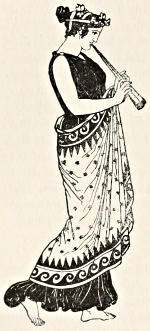
Greek Woman
(From a vase)
“But when Callias came, a rich Athenian who had fallen in love with
Elpinice, and begged that he might pay her father’s fine for him, she consented,
and her brother Cimon gave her to Callias for a wife. So much is
certain that Cimon loved his wife Isodice too passionately and made himself
too unhappy over her death, if one may judge by the elegies composed for
his consolation.”
Only we must not think that such a passion was “romantic” in the
modern sense; its birth was more natural and sensual, and it did not rise to
a transcendent deification of the beloved. Sometimes it may well have happened
that love put in an appearance after marriage, as in The Mother-in-law
of Terence, where Pamphilus, attracted by the noble qualities of the wife he
once despised, gradually becomes untrue to his mistress. The peculiarly
prosaic and cool relations that existed between man and wife, along with the
leading motive for marriage, is most clearly expressed in a document of the
highest interest to the historian of morals, the speech against the courtesan
Neæra, which is attributed to Demosthenes. “Mistresses,” he says, “are
kept for pleasure, and housekeepers for daily attendance and personal service;
but a man marries a woman that he may beget legitimate children, of the
same station on both sides, and have a faithful guardian in the house.”
Companionable intercourse between man and wife was necessarily hindered
by the sharp division between their occupations, and reduced itself,
no doubt, to very few hours in the day. “Because,” Ischomachus says, “it
is better for a woman to stay in than to be away from home, whereas it is
ignominious for a man to stay at home and not concern himself with what
is going on in the world.” So, in the same piece of Xenophon, Socrates says
to Aristobulus: “Is there any one to whom you talk less than to your wife?”
And the disciple answers, “No one, or at least very few.” We learn, however,
from comedies and other sources, that in reality things did not wear so
sorry an aspect, and that feminine curiosity and jealousy led to all sorts of
questions and talks. On the other hand, there was no question of any intercourse
with other men; in fact a wife withdrew if her husband, by chance,
brought a guest home with him. If the husband were not at home it would
have been reckoned a gross incivility for another man to enter the house.
Indeed, Demosthenes mentions a case where a friend, who had been summoned
by a servant for help, did not venture into the house because the
master was away. So what Cornelius Nepos says about the Greek woman is
true: “She does not appear at dinner except among relatives; she stays in the
inner part of the house where no one is admitted but her nearest kinsmen.”
Euripides, indeed, went so far as to forbid the visits of women among
themselves, for he writes in the Andromache: “Never, never—for I do not
say it only for this one occasion—ought intelligent men, who are married,
to allow other women to visit their wives, for they are the teachers of wickedness.
One corrupts the marriage because she gains something by it, another
wants a companion in sinning.” But things were not so bad on the whole
in this respect either. In the Regiment of Women, by Aristophanes, a neighbour
says to Blephyrus, who misses his wife when he gets up in the morning,
“What can it be? Do you think one of her friends has asked her to breakfast,
perhaps?” And the husband answers, “I think that must be it.
After all, she is not so bad as that comes to, so far as I know.”
Phidias symbolised the solitariness of the home-keeping wife by the tortoise,
on whose back he set the statue of Aphrodite Urania in Elis. But
the acutest note of women’s relations to the outer world is in the Thesmophoriazusæ
of Aristophanes, where the women speak themselves: “If we are
an evil, why do you marry us, and allow us neither to go out, nor to be
caught looking from the windows, and insist on guarding the evil with so
much care? And if a woman goes out and you find her before the door,
you get into a rage, whereas you ought to be pleased and bring a thank offering,
if you were really rid of the evil and did not find her sitting there any
more when you came home. Then when we take a peep out of the window
every man wants to look at the evil, and when one blushes and draws in
one’s head, they all want all the more to see the evil peep out.” Even on
occasions when fear and necessity would break through conventional restrictions,
we find the women going no farther than the door of the house; and
the orator Lycurgus actually complains because after the battle of Chæronea,
the women inquired after the fate of their own men-folk from their doorways.
Walking in the street was made a very difficult matter even for married
women. Even Solon left directions on this subject; and among other things
he said that no woman, when she went out, must have more than three pieces
of clothing, nor more than one obolus’ worth of food and drink with her, nor
must she carry any basket of more than two feet. Also she must not travel
by night, except in a carriage, and then have a light carried before her. In
the times of the Diadochi, indeed, special superintendents were appointed
in Athens to check the immorality and extravagance of women, such as were
already established in other cities, Syracuse, for example. Since the husband
generally did the marketing himself, and walks had not yet, it would
seem, become fashionable, although they were recommended by a woman disciple
of Pythagoras, Phintys, there were hardly any other motives left for
going out except the attendance at religious functions and the play.d
Ruins on Acropolis at Athens
[460-430 B.C.]
Policy united with natural inclination to induce Pericles to patronise the
arts, and call forth their finest productions for the admiration and delight of
the Athenian people. The Athenian people were the despotic sovereign;
Pericles the favourite and minister, whose business it was to indulge the
sovereign’s caprices that he might direct their measures; and he had the
skill often to direct even their caprices. That fine taste, which he possessed
eminently, was in some degree general among the Athenians; and the gratification
of that fine taste was one means by which he retained his influence.
Works were undertaken, according to the expression of Plutarch, in whose
time they remained still perfect, of stupendous magnitude, and in form and
grace inimitable; all calculated for the accommodation or in some way for
the gratification of the multitude. Phidias was superintendent of the works:
under him many architects and artists were employed, whose merit entitled
them to fame with posterity, and of whose labours (such is the hardness of
the Attic marble, their principal material, and the mildness of the Attic atmosphere)
relics, which have escaped the violence of men, still, after the
lapse of more than two thousand years, exhibit all the perfection of design,
and even of workmanship, which earned that fame.c
But the Greeks had not attained all at once to the architectural perfection
which we admire on the Acropolis. They had assigned their gods the crest
of the mountains or the deep forests for their first abode; they desired to
have them nearer to themselves and, from the earliest times, they built them
dwellings, at first rustic and clumsy, but which were gradually embellished
and attracted other arts with religious pomp; the poets celebrating the
gods and their native country, the philosophers raising the great problems of
nature and of the soul. The temple was the centre of Hellenic life.
But the gods, like men, have to reckon with time. Before sending out
the radiations of their divine majesty from the midst of the wonders of art,
those destined to become the glorious dwellers on Olympus were at first
obscure and indefinite personalities, inhabiting the trunk of an oak, then
wretched wooden structures, and later on houses of stone and sometimes of
brass, like the Athene Chalciœcus of Sparta. It was only with the progress
of civilised life that their habitation grew in size and loftiness. The true
temples, and the most ancient of them, those of Corinth, Samos, and Metapontum—date
only from the seventh century.
The Greeks were acquainted neither with the pointed arch nor the dome.
Some have thought to find that at Tiryns and Mycenæ, but if some of the
bays and galleries end in a point, it is because the courses draw closer and
closer together and end by meeting at the top. The method is therefore
clumsy and barbarous; it was abandoned for the lintel and the pediment.
All the Greek temples resemble one another in their general plan of construction;
and yet the architectural combinations might be very numerous,
inasmuch as they all differ in the nature of the material employed and the
ornamentation which decorates them, in the number of the columns and the
size of the intercolumniations, which determine the proportions of the edifice,
above all in the character peculiar to each of the three orders—the Doric, the
Ionic, and the Corinthian. A single member of the structure, the column with
the portion of the entablature which it supports, determines this character.
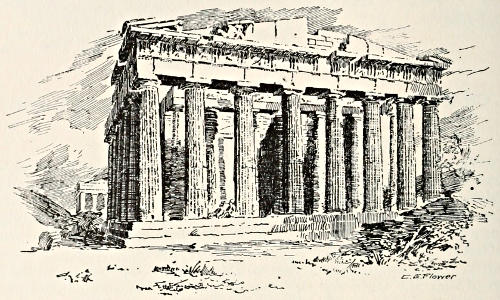
Ruins of the Parthenon
The first temples worthy of the name were in the Doric style. The walls
were large and heavy, the columns short and stunted without any base, like
the stake which had been the primitive support, but with flutings, a capital,
and a double pediment stretching above a wide face, like an eagle with outstretched
wings—the expression is Pindar’s. The whole edifice, built of
ordinary stone, was hidden, as in the case of many of the Egyptian temples,
under a coat of stucco which displayed vivid colours. The remains of this
are to be seen at Assus, on the coast of Asia; at Corinth, Delphi and Ægina
in Greece; at Syracuse, Agrigentum and Selinus in Sicily; at Metapontum
and especially at Pæstum in Italy, where the grandest ruins in the ancient
Doric order are to be found. The common characteristic of these buildings,
which nearly all belong to the seventh or sixth century, was their sturdy but
heavy and thick-set appearance. The columns have a height of only four
diameters—four and two-thirds at most; and the stucco in coming off has
displayed the poverty of the material employed. Even the temple of
Olympia was built of a hard and porous tufa which the stucco had concealed
under a brilliant covering. That of Ægina was also of stone, not marble;
there remain of it at least some beautiful ruins.
We must go to Athens to find Doric architecture in its severe elegance.
Even in the temple of Ægina the column is higher: five and a third diameters;
at the Theseum it is five and a half; at the Parthenon, six, and this
is the proportion which is most pleasing to the eye. Of these three temples
the first, in which we can still find traces of an archaic character, belongs to
the sixth century; the second, which has better proportions, to the first half
of the fifth; the third is the architectural triumph of the age of Pericles.
The Parthenon, built entirely of Pentelic marble, is not the most vast of
the Greek temples, but its execution is more perfect and it is this which
made it the masterpiece of Hellenic art. A very small detail will show the
finish of the work. It is with difficulty and by the assistance of eye and
hand that one succeeds in discovering the joints of the tambours forming the
colonnade which surrounds the building, so skilfully have these enormous
masses been adjusted. Even in her masons Athens possessed artists.
The interior of the Parthenon contained two halls: the smaller at the
back, the opisthodomus, enclosed the public treasure; the larger, or cella, contained
the statue of the goddess born without mother from the thought of
the master of the gods, and who was as the soul of which the Parthenon was
the material casing. Figures in high relief, about twice life size, adorned the
two pediments of the temple. The frieze, which ran round the cella and
opisthodomus at a height of thirteen metres (42 ft., 8 ins.), and to a length
of more than one hundred and sixty metres (525 ft.), represented the procession
of the great Panathenæa.
The work was finished in 435 B.C. It is neither the centuries nor the
barbarians that have mutilated it. The Parthenon was still almost intact in
1687, when on the 27th of September Morosini bombarded the citadel. One
of the projectiles, setting fire to the barrels of powder stored in the temple,
blew up a part of it; then the Venetian desired that the statues should be
taken down from the pediment and he broke them. Lord Elgin, at the
beginning of the nineteenth century, tore down the bas-reliefs of the frieze
and the metopes: this was another disaster. The Ilissus or Cephisus, the
Hercules or Theseus, the Charities, “vernal goddesses”—called by some the
Three Fates, by others Demeter, Core, and Iris—are still, though somewhat
mutilated, the most precious of our relics of antiquity. In 1812 some other
Englishmen carried off the frieze of the temple of Phigalia (Bassæ), built by
Ictinus. All these fragments of masterpieces were sold for hard cash, and
it is under the damp and gloomy sky of England that we are reduced to
admiring the remains of that which was the imperial mantle which Pericles
wrapped about Pallas Athene. Thus to understand the incomparable magnificence
of the Parthenon, we must render back to it in imagination what
men have taken away, then place it on its lofty rock, one hundred and fifty-six
metres (512 ft.) high, whence a magic panorama is unrolled before the
eyes, and surround it with the buildings of the Acropolis; the Erechtheum,
which exhibited all the graces of art, beside the severe grandeur of the
principal temple; the bronze statue of Athene Promachus, “she who fought
in the front rank,” to which the artist gave a colossal height, so that the sailors
arriving from the high sea steered by the plume on her helmet and the gold
tip of her lance, maris stella; and lower down, at the only place by which
the rock was accessible, the wonderful vestibule of the Propylæa and the
temple of Victory which formed one of its wings; but, above all, it must be
seen wrapped in the blazing light of the eastern sky, compared to which our
clearest day is but a twilight.
One thing has been observed in the Parthenon which proves the profound
artistic sense the Greeks possessed and how well they understood how to
correct geometry by taste. In all the Parthenon there is no surface which
is absolutely flat. As the columns owe their full beauty only to the fact that
they exhibit towards their centre a slight outward curve, of which the eye is
not aware, so the entire building, colonnades and walls, is inclined slightly
inwards towards an invisible point which would be lost in the region of the
clouds, and all the horizontal lines are convex. But all with such delicacy
that it is sufficient to allow the eye and the light to wander gently over the
surfaces and to give the monument at once the grace of art and the solidity
of strength; but not enough for it to assume the compressed and heavy
aspect of a truncated pyramid like the Egyptian temples. On the southern
façade the rise of the curve is only one hundred and twenty-three millimetres
(about 4½ inches).
The Propylæa, the masterpiece of civil and military architecture, belonged,
like the Parthenon, to the Doric order, and stood at the only accessible point
of the Acropolis. The architect Mnesicles disposed its various parts in such
a manner as to give an aspect of grandeur to the entrance to the Holy of
Holies of pagan Athens and also to secure its defence. Epaminondas would
have transported it to Thebes to adorn the Cadmea: six centuries after,
Pausanias admired it more than the Parthenon, and Plutarch said: “These
works have preserved a freshness, a virginity which time cannot wither;
they appear still bright with youth as if a breath would animate them and
as if they had an immortal soul.”
Athens had other monuments which were erected at very diverse epochs:
the Anaceum, the temple of Castor and Pollux, where the sale of slaves
took place; the Pantheon or temple of all the gods, the work of the emperor
Hadrian; the octagonal Tower of the Winds, an indifferent work built about
the first century before Christ. On each of its eight sides, corresponding to
the quarters of the principal winds, was sculptured the figure of one of them.
This tower still exists, as well as the choragic monument erected by the
choregus Lysicrates, in 334 B.C., on the occasion of the victory of the Acamantid
tribe in a chorus. The remains of the theatre of Bacchus are still to
be seen on the south-eastern slope of the citadel, some of the marble seats
bearing very beautiful sculptures. But the Stadium beyond the Ilissus,
according to Pausanias one of the wonders of Athens, has disappeared and
the excavations made there produced nothing remarkable.
Like its capital, Attica too had monuments of victory, of patriotic pride,
and pious gratitude to the gods: and all these monuments were constructed
in the severe style whose principal models we have just studied. In the
sacred city of Eleusis, in sight of Salamis, a vast religious edifice was built,
capable of containing the multitude of those initiated into the mysteries of
Ceres. Rhamnus which overlooks the plain of Marathon, raised a sanctuary
to Nemesis, the goddess of just vengeance; and on the summit of Cape
Sunium, two temples consecrated to Poseidon and Athene, the tutelary
deities of Attica, signalised from afar, to sailors coming from the isles or the
coast of Asia, their approach to the ground where the Persians had found a
tomb and the Greeks liberty. When on the days of the sacred festivals, the
people arrived in long theoria (embassies) at the promontory now called Cape
Colonna, they saw extending at their feet that sea which had now become
their own domain, and fervently thanked the two divinities for having given
them: for their leaders, political wisdom; for their mariners, favourable winds.
At a later time philosophy was to take its seat near the temple of the gods,
and we, like it, believe that Sunium heard some of the discourses of Plato.
The school of Athens extended her influence to distant places. It did
not build the temple of Olympia, but Phidias made the statue of Zeus;
Pæonius of Mende and Alcamenes of Lemnos have been credited, without
absolute proof, with the sculptures of the two pediments, on one of which
was represented the combat of Pelops and Œnomaus, and on the other the
contests of the Lapithæ and Centaurs at the nuptials of Pirithous.
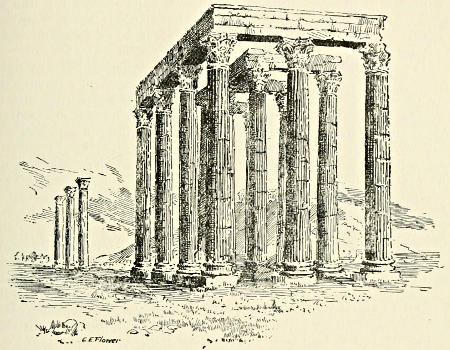
Ruins of Temple of the Olympian Jove. Athens
Time, barbarians, perhaps fire, destroyed the temple, and the Alpheus,
in overflowing its banks, covered the plain of Altis which Pausanias had
seen in such beauty with eight or ten metres (about 26 or 32 ft.) of alluvium.
Before the Expédition de Morée, which brought away some fragments for the
Louvre, even the spot in which so much magnificence stood was unknown.
The successful excavations of the German commission have brought to
light a victory of Pæonius, a Hermes of Praxiteles and other masterpieces.
The Ionic style is also native to the coast of Asia, where the Doric had
preceded it. It was exhibited there in all its grace in the sixth century,
when the temple of Ephesus was erected. The Cretan Chersiphron and his
son Metagenes began its construction, which was carried on, like that of our
Gothic cathedrals, with a tardiness that extended it over two or three centuries.
Its columns, several of which were given by Crœsus, had a height
of eight diameters, with bases which lacked the Doric columns and voluted
capitals which the ancients compared to the drooping curls of a woman’s
hair. Of the Ionic temple at Samos, burned by the Persians, a single column
remains upright, and according to the diameter of the base it was sixteen
metres (about 52½ ft.) high. This temple was therefore a colossal structure.
At Athens the Erechtheum and the temple of the Wingless Victory are in
the same style, but of very small dimensions. The first contained the oldest
image of Athene: a statue of olive wood which was said to have fallen from
heaven. In the second was a warlike Minerva; in order to attach her permanently
to the fortunes of Athens, the sculptor had not given her the wings
which are the attributes of the fickle goddess of lucky battles.
In the time of Pericles the Corinthian style has not yet appeared but is
about to do so. It is related that Callimachus, having seen on a child’s
tomb at Corinth, a basket filled with its playthings and enveloped in the
graceful curves of the leaves of an acanthus, took from it the idea of the
Corinthian capital. The date of his birth is unknown, but since Ictinus
after the plague of Athens, and Scopas in 396 constructed, the one at Phigalia,
the other at Tegea, two temples in which traces have been found of
the new style of architecture, its invention must have followed very soon
after the construction of the Propylæa.
There is a question concerning Greek architecture which has only been
answered in our own day, that of polychromy. In spite of our very decided
preference for bare stone, we have been forced to recognise that the Greeks
had a different taste. Light and colour are the joy of the eyes; but their
rôle is not the same in countries in which the sky often appears like a shroud
suspended above the earth, and in those where that earth, animated by the
sun, sings, with its thousand voices, the poem of nature. In the north a
wan light casts gloom upon the monuments; thus we are not loath to build
them with materials which at first give them a dazzling whiteness. In the
south they are too vividly illuminated, and the dazzling brightness of the
marble would burn the eyes if the sun did not clothe the stone in a golden
tint which rests the gaze. Colour, unnecessary and somewhat incommoding
to the sculptor, whose main concern is with the form and truth of outline,
furnishes the architect on the contrary with a valuable means of animating
the great flat surfaces which in their nakedness would be cold and lifeless.
He does not, like the polychromic sculptor, seek to create a deceitful illusion;
colour and ornamentation make no false pretence, and are a charm the more
when, in the case of a building standing in the midst of a sacred wood, it
establishes a needful harmony between the work of art and that of nature.
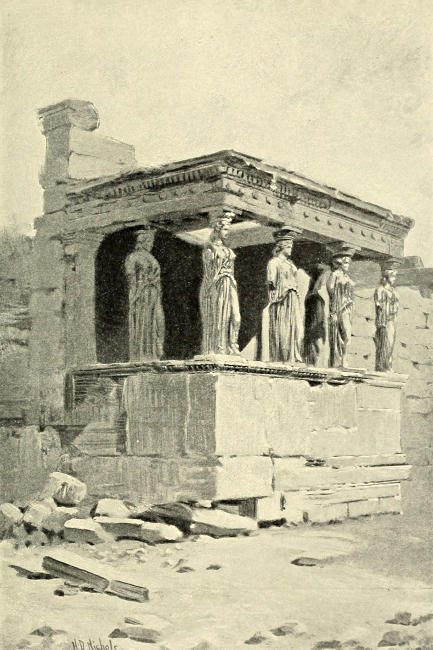
THE ERECHTHEUM
Greek Head
(In the British Museum)
Egypt and Asia were prodigal of colour, whether in painting or by the
use of enamelled faiences with which the monuments of Persia are still
covered. The most ancient inhabitants of Hellas passed under their influence.
Colour has been found on the walls of dwellings older than Homer
by ten centuries; it was to be seen at Tiryns, one of the capitals of the
heroic age, and on the prows of the first ships which ventured into the midst
of the waves. This usage continued through the epochs which succeeded;
but, as in every domain of art, the Greeks modified this legacy of their
ancestors and of the peoples which had preceded them in civilised life,
according to the requirements of a delicate taste. Hues more or less vivid
covered the stone of the temple, even the sculptures of the frieze, the
metopes, and the pediment; terra-cottas, whose colours mixed with a kind
of paste were indestructible, decorated the upper parts of the monument and
enlivened these severe structures. But a distinction must be drawn between
the polychromy of Athens in the time of Pericles and that of other Hellenic
countries. In Sicily, in greater Greece, even in Ægina, where the materials
which the architects had to dispose of were of a coarse description, it may be
that the temples received a brilliant colouring. But at Athens the beautiful
Pentelic marble employed in the construction of the temples was certainly
not entirely concealed under crude and violent colours. The words of
Plutarch, quoted above, on the freshness
and youth preserved by the monuments of
the Acropolis, when six centuries had already
passed over them, does not allow us
to believe in more than a moderate colouration
for the columns and walls. At one
point only of the building there was certainly
greater variety. In all countries
women, who are ingenious artists, apply
themselves to adorning their heads, and
with reason: it is the stronghold from which
formidable arrows are shot. Ictinus also
decorated the upper portions of the Parthenon
with all the graces he could call into
play. Ornaments of gilt bronze fastened to
the draperies of the figures, inlaid enamels,
and magnificent carvings running all along
the frieze. On festival days treasures and
garlands were added, so that the edifice wore
on its brow, as it were, a crown of flowers
and foliage over a circlet of precious stones.
Antiquity has preserved us no details
concerning the artists; we are ignorant of
even the native country of most of them.
For centuries their works spoke for them,
but the very ruins of the monuments they
raised have perished. Only the Parthenon
still proudly lifts its mutilated head above
the mass of rubbish.
A great poet saw a gloomy vision of
Europe dying and Paris vanishing. Twenty-five
centuries before, Thucydides drew a less
poetic but more faithful fantasy for Athens
and Lacedæmon. Comparing the sterility
of the one to the fertility of the other, he
said: “Let both towns be destroyed and the mere débris of the monuments
and temples of Athens will reveal a glorious city; the ruins of Lacedæmon
will be only those of a large village.”
Art is a natural instinct which is to be found even amongst the
last of the savages who were the prehistoric inhabitants of Gaul, and which
the most intelligent of animals do not possess. This instinct is developed
or arrested, not, as has been said, according to race, but in response to the
social influences to which a people is subjected amidst melancholy and severe
or peaceful and smiling scenes which extinguish or call forth the creative
imagination. These influences, working through the centuries, predisposed
Hellas to change the paths which art had been pursuing in the East; and
habits which were easily acclimatised in Greece, but which could not have
had their birth on the banks of the Nile and Euphrates, favoured this slow
evolution.
Thanks to a good system of education, to long-continued gymnastic
exercises and to a life in the open air, often without clothing and always
without a dress which could hamper the harmonious development of the
body, the Greeks became the most beautiful race under the sun. As they
had always before their eyes the ephebi, so agile in the
race, the wrestlers and the athletes, who displayed so
much virile grace, the æsthetic sense developed in them
with a strength which, when nature had given genius
to the artists, produced masterpieces. Religion still
further increased this tendency. Their gods having been
conceived in the image of man, as a superior humanity, the
sculptors, as the religious conscience grew more elevated
and taste was purified, took their ideal for
the representations of the dwellers on
Olympus from human beauty carried to perfection.
The people even looked upon it as
a gift of heaven, and after death men were
accorded heroic honours on account of their
beauty.
Minerva
(From a statue)
Herodotus has preserved us a fact which exhibits the
Greek character: Philip of Croton was venerated as a
hero after his death, in a small building erected to him
because he was the most beautiful man of his time, and
the old historian agrees with the Egestans who had made
this singular kind of god. He does not ask if Xerxes
had truly royal qualities. “In his vast army,” he says,
“none was more worthy by his beauty of the sovereign
power.” In one of the choregiæ in which he often triumphed
by his magnificence, Nicias had given the part
of Dionysus to a young slave so perfectly handsome and
so nobly attired that on his appearance the people broke
into applause. Nicias liberated him at once, considering,
he said, that it was an impiety to retain in servitude
a man who had been hailed by the Athenians in the
character of a god. Nicias indeed was performing a very
popular act; it was the handsome ephebus, not the god, who had excited the
admiration of the spectators.
From first to last Greece thought thus. Many a time in the Odyssey,
Ulysses and Telemachus fancy that they see a god when they unexpectedly
encounter a tall and beautiful man; and the cold and severe Aristotle writes:
“If amongst mortals any were born resembling the images of the gods, the
rest of mankind would agree in swearing to them an eternal obedience.”
Simonides, without going so far, made beauty the second of the four conditions
necessary to happiness, and Isocrates said: “Virtue is so honoured
only because it is moral beauty.” It was because he was the most beautiful
of the ephebi that Sophocles was charged, after Salamis, with the task of
leading the chorus which sung the hymn of victory; and it is said Phidias
engraved on the finger of Zeus at Olympia: “Pantarces is beautiful”—a
sacrilege which might have exposed him to great danger. We no longer
possess this inscription, but we find a similar one on a painted vase, where
Victory is offering a crown to a handsome ephebus. The gods themselves
had the reputation of being sensible of this advantage, which had procured
many mortals the honour of their love. At Ægium Jupiter desired that his
priests should be chosen from among the young men who had carried off the
prize for beauty; for this merit Ganymede was snatched up to heaven, that
he might serve as cup-bearer to the gods, and Apollo admitted into his
sanctuary the statue of Phryne, the most admired of the courtesans of
Greece. It is notorious how Hyperides saved the beautiful hetæra from a
capital charge, when she was standing before
the judges, by simply tearing away at an appropriate
moment the veil which hid her
beauty. The recollection of these facts serves
to explain the divine honours paid to Antinoüs
by the most Grecian of the Roman emperors;
but they also show how much this
worship of beauty, of which the Greeks had
made a religion and from which Plato was to
weave a theory, went to form the artists, and,
to a certain extent, the philosophers of Greece.
Did not Plato utter words whence has been
legitimately derived the famous saying that
Beauty is the splendour of goodness? The
jurisconsults of the Roman empire called themselves
the priests of law; Phidias and Polyclitus
might have styled themselves the priests
of the beautiful; and this trait suffices to
mark the difference between the two civilisations,
the Greek and the Roman. Beauty
is the perpetual aspiration of the French spirit
which seeks it in everything, in the great
spectacles of nature or in the works of famous
writers and artists.
Amongst the statues of which the ancients
were most proud, are some which amaze us by
their colossal height, and others which shock
our taste by the diversity of the colours and
materials employed. The Egyptians treated
their Pharaohs and their gods in a similar
fashion, as did the Persians their kings, the
Athenians the people or the senate personified,
and we ourselves do the same to translate certain ideas: the Saint Borromeo
of Lake Maggiore and the Liberty of New York are colossi. Executed
to be seen from afar, they strike the eye by their mass, and are
the expression in stone of elevated sentiments: of holiness, patriotism, or
independence. On the promontory where they are placed between earth
and heaven they appear as the very genius of the people which erected
them, a shining witness of their gratitude, and the figurative representation
of their inmost thought.
Apollo
(From a Statue now in the Museum at Naples)
The art of colossal sculpture was at the service of the gods, and was in
its place in or near their temples. It was the same with the chryselephantine
sculpture, and for the same reasons. The most celebrated of these sculptures
and those which from ancient descriptions we know the best, were the Athene
of the Parthenon and the Zeus of Olympia.
Reaching with her pedestal to a height of fifteen metres (about 49 ft.),
Minerva stood erect, enveloped in a talaric tunic, the dress of virgins.
In one hand she held a Victory, in the other the spear round which the
serpent Erichthonius was coiled. The draperies were of gold, the naked
parts of ivory, the head of Medusa, on the Ægis, in silver, the eyes being of
precious stones.
How did this Minerva, which was seen by Julian as late as the fourth century
of our era, finally perish? The Christians have been charged with this,
but the accusation should be brought against her wealth. So much gold
could not escape the barbarians, whoever they were, whether invaders from
the north, needy princes, or ordinary thieves. The pillage of the Parthenon
had already begun in the time of Isocrates and the Athene of Julian must
have been only a ruin.
Phidias was also summoned to Olympia. The treasures accumulated in
the temple from the offerings of all Greece, permitted him to execute a work
which surpassed that of the Parthenon.
On a throne of cedar wood, inlaid with
gold and ivory, ebony, and precious stones,
and covered with bas-reliefs and paintings,
Zeus was majestically seated. His thick
hair and beard were of gold; of gold and
ivory was the Victory he carried in his
right hand, in token that his will was
always triumphant; of gold, too, mingled
with other metals was the royal sceptre
surmounted by an eagle, which he held in
his left hand. On the head was the crown
of olive leaves, which was given to the
victors in the games, but, as was fitting,
that of the god was gold, as well as his
sandals and his mantle, which revealed
his naked breast in ivory. His visage had
the virile beauty proper to the father of
gods and men; his tranquil gaze was
indeed that of the all-powerful whom no
passion stirs and behind whose broad
forehead should reside the vast intelligence
of the orderer of worlds. Placed
at the back of the naos, at the point
where the trend of the architectural lines
attracted the gaze, the statue, fifteen or
sixteen metres (49 or 52 ft.) high, seemed
still more colossal than it was.
Minerva
(From a Greek vase)
The Olympian Jupiter shared the fate
of the Minerva of the Parthenon; he was
too rich for an age grown too barbarous
and beliefs too hostile. It is said that in
393 Theodosius had it transported to Constantinople, where it perished some
years later in one of the great conflagrations that so often visited the new
capital of the Empire; it is not likely that it was so long respected.
Already in the second century Lucian laughs at this “honest fellow, the
exterminator of giants, who remained seated so quietly while brigands shaved
his golden hair.”
Other towns besides Athens and Olympia had chryselephantine statues.
Costly materials were used for the Juno at Argos, the Æsculapius of Epidaurus,
and others.
Phidias did not confine himself to representing gods, that is to say to
making colossi; with his own hands, or more often through those who
worked under his direction, he lavished less divine sculpture on the frieze,
the metopes, and the double pediment of the temple, the figures of which, as
seen from below, do not appear to be of more than ordinary height. Those
which he chiselled on Minerva’s shield and on her sandals, were still smaller.
The magnificent fragments which remain to us from the two pediments,
Demeter and Core, Iris and Cephisus, the Charities or Fates, the Hercules
or Theseus, are the works of his school and we may say of his mind. In
spite of their mutilations, these marbles, like those of the Victory untying
her sandal, may be ranged beside, if not above, the most glorious creations of
Renaissance sculpture in the purity of the style and the calm serenity of the
figures, which neither have their limbs twisted in violent action nor their
brows overcharged with thought, as happened when statuary strove to rival
painting. What a puissant life is in these divinities tranquilly seated in the
pediments, and how calm on their fiery horses are the riders in the Panathenaic
procession! Later on the school of grace and voluptuousness will
appear, with an Athenian, Praxiteles, as its chief; still later, passion will
agitate the marble: then the decay of art begins—such a drama as the
“Farnese bull”[46] depicts may not fittingly be presented in stone.
It is to the eternal honour of Phidias that he finally broke with hieratic
art, whose influence is still traceable in the beautiful statues of Ægina, with
their admirably studied but lifeless shapes and grinning heads exhibiting,
even in pain and death, the same idiotic smile. The great artist sought the
beauty which is the spiritual essence of things, whether it be in the soul seen
through the body; or nature contemplated in her most harmonious expansion;
and this ideal beauty he realised without making the effort visible.
This is supreme art; for there is no grandeur without simplicity.
Greek Lyres
If the description in the Iliad of the shield of Achilles is a work of imagination,
those of the Athene of the Parthenon and the Zeus of Olympia, as
given by Pausanias after an attentive study of the works themselves, show
that the school of Athens had carried the art of carving metal and ivory to a
high degree of perfection, as well as that of working hard stones for casts or
in relief. Yet this skill was borrowed from the school of Argos, where work
in bronze was held in high honour.
It was not so with painting, which in Greece had never the perfection of
statuary, whatever may be said on the faith of anecdotes more famous than
veracious. Modern painting seeks to move; that of the ancients was rather
sculptural in its character, in the sense that it sacrificed colouring to design
and the effects of light and shade to form—a stranger to what might
be called, if we have Rembrandt in mind, the drama of light and shade, or,
in referring to the Venetians, the harmonious chant of colours. Sicyon
was the first Greek town which had a school
for design. Athens, Miletus, and subsequently
Corinth, followed this example. We shall see
presently that Greece had great painters, and
that those of Athenian origin did not occupy
the first rank in this art. But it would be
rash to speak of Greek painting except according
to the judgment of the ancients, since
nothing of it remains save painted vases, which
belong to industry rather than art; and the
mural decorations at Pompeii and Herculaneum,
which are too often mere conventional
productions, executed hurriedly and probably
for small payment by workmen rather than
artists. The Roman mosaics were also made
by Greek hands, but there is not one, except
the battle of Issus, which is of a high order
of art.
Lyre Player
The Greeks possessed the merit of realising
that the highest intellectual culture is one of
the conditions of greatness in the individual
and the state; and they understood how to
utilise every means of attaining it. In their
plan of education, besides the study of poets
and philosophers to form the mind, and gymnastic
exercise to develop suppleness and
strength, they included music, which habituates
the mind to harmony, and dancing, which
bestows grace. These two secondary arts
were the chief ones at Lacedæmon; they also
ranked high among the Athenians, though
Athens did not set her mark on them as she did on architecture and the art
of statuary. They were indispensable auxiliaries at festivals, sacrifices, and
funerals, and played a part in the performance of religious rites. The marvellous
effects of the lyre of Orpheus were universally kept in mind, and
Achilles, the hero who was the ideal type of warlike courage, was represented
celebrating his exploits on the cithara; in the Iliad or the Odyssey there is
no feast to which a melodious singer is not invited. Down to the last days
of Greece the beneficent action of music was believed in: Polybius attributed
the misfortunes of the Arcadians to the neglect among them of the art which
calms the passions and which, by teaching the rules of harmony, trains the
learner not to violate public peace. Damon the musician, a friend of Pericles
and of Socrates, held that musical methods could not be changed without
threatening the foundation of morality and the laws of the city. Plato thinks
the same, and Aristotle calls music “the greatest charm of life.” It is well
known how much importance was attached to it by the school of the Pythagoreans,
who professed to hear the music of the celestial spheres turning
harmoniously through infinite space.
Greek Dancing Girl
(Hope)
The Greeks also conceived of dancing in another fashion from ours,
for they had introduced into it number and measure, which in art are a
manifestation of beauty, but no longer remain so when whirling speed is
substituted for grace. With them the dance formed part of their religious
solemnities and military education. “The ancients,” says Plato in the
Seventh Book of the Laws, “have bequeathed us a great number of beautiful
dances.” In the Dorian cities dancing
was one of the necessary rites in the worship
of Apollo, and the gravest people participated.
Theseus, returning from Crete,
danced the γέρανος in the holy island of
Delos, to celebrate his victory over the
Minotaur; and the Spartans, in annual commemoration
of their triumph over the people
of Thyrea danced the γυμνοπαιδια before the
images of Apollo, Diana, and Latona, singing
verses of Aleman and the Cretan Thaletas.
The Bacchic dances, with thyrsi and
lighted torches, were a mimic representation
of the life of Dionysus.
In the neighbourhood of Eleusis was to
be seen the fountain of beautiful dances,
Callichorum, where the initiated chanted the
invocation to Iacchus as they danced: “O
adored god, approach at our voice. Iacchus!
Iacchus! come and dance the sacred thiasus
in this meadow, thy well-beloved home;
strike the ground with a bold foot and mingle
in our free and joyous dances, inspired by the
graces who rule our consecrated chorus.”
Plato, in his treatise on “Law,” which is
a kind of commentary on Athenian legislation
and customs, attaches extreme importance,
even for the moral education of youth,
to the possession by the ephebi of the “art of
choruses,” which includes song and dance.
We may well believe that demoralising dances existed in Ionia and elsewhere.
At Sparta and Athens the Pyrrhic dance was a military exercise
and a patriotic training. The ephebi danced them at the greater and lesser
Panathenæa, imitating all the movements of a combat for attack, defence, or
the evasion of darts. And was not the heroic circle of the Suliote women a
recollection of these warlike dances? Having taken refuge on the summit
of a mountain to escape a harem or the yataghan of the Turks, they sang
their funeral hymn, joined hands and danced on this narrow peak, which was
surrounded by precipices. Each time that the ring approached the abyss, the
circle was narrowed, for one of their number detached herself from it to fling
herself down; and one after another, all threw themselves over.
[460-410 B.C.]
The fifth century is the golden age of Greek art. We have told of the
artists whom Athens gave to the world; we shall now see what others the
rest of Hellas produced—such at least whose names have come down to us
with an indication of their works.
Chersiphron and his son Metagenes of Knossos, in Crete, are outside the
period with which we are dealing, for they began the construction of the great
temple of Ephesus in the sixth century.
The domain of statuary had a great artist whom the ancients have compared
to Phidias, Polyclitus of Sicyon or Argos. The artists of the century
of Pericles did not confine themselves to one corner of the regions of
art; they cultivated the whole. Polyclitus was as much a skilful architect
as a great sculptor. At Epidaurus he erected a circular monument, the Tholus,
and a theatre which was much admired by the ancients; at Argos his
Juno was the rival of the Minerva of the Parthenon, though it did not stand
as high, and was less costly. Phidias lived with the gods in spirit, Polyclitus
dwelt more among men. He even wrote on the proportions of the
human body, and applied his knowledge to his Doryphorus, which was called
the “canon,” or the “rule.” The ancients divided the palm for statuary
between the two great artists: giving it to the one for his gods; to the other
for his Canephorus, which Verres stole from the Sicilians, his Amazon, which
triumphed over that of Phidias in the famous competition at Ephesus, and
his statues of successful athletes, such as the Diadumenus and the two Astragalizontes,
or dice-players. Myron, whom we might have included among
the Athenian artists, went farther in his imitation of nature; his bronze
cow was famous, and still more so his Discobolus, whose attitude must have
been very difficult to render.
Polygnotus of Thasos, whom Cimon brought from that town in 463,
lived for a long time on the banks of the Ilissus, and was given the rights of
an Athenian citizen as a reward for his labours in the decoration of the
temple of Theseus, the Anaceum, the Pœcile, and a part of the Propylæa.
There was some stiffness in the designs of Polygnotus; his was a sculptural
painting which, nevertheless, obtained great effects by very simple means.
The ancients lauded the expression and beauty of his figures, but they have
neither the grace nor the dramatic character which the painters of the period
that followed were to give to their works. The arts of painting and statuary
are two sisters who resemble each other, and both follow the variations of
taste: the first with a vivacity at times imprudent, the second with more reserve.
Zeuxis of Heraclea Pontica and his rival, Parrhasius of Ephesus, were
younger than Polygnotus. Their painting was already more scientific, less
ideal, and nearer reality. Aristotle reproaches Zeuxis with yielding too much
to Ionian effeminacy. If we are to believe anecdotes whose frequent repetition
does not make them more authentic, these painters even succeeded in
deceiving the eye: the one with a bunch of grapes which the birds came to
peck at, the other with a curtain which Zeuxis attempted to draw back, thinking
that it concealed the real picture. These would be triumphs of ingenuity
rather than art. It is to be noted that both men drew freely on the
abundant resources of ancient poetry. Both attained to great fame and
opulence. In spite of the misfortunes of the times, Greece still had gold
for her favourite painters. Archelaus, king of Macedon, paid four hundred
minæ for the painting of Zeuxis in his palace, and Parrhasius never appeared
in public without a robe of purple fringed with gold. He considered himself
“master of the elegancies,” as well as of his art, so we need not wonder
at his having inclined to effeminate gracefulness. “His Theseus,” said
Ephranor, “is fed on roses; mine was fed on meat.” But it was at a
later time, with Lysippus and Pamphilus, that the school of Sicyon was to
have its full splendour.
The sight of the sculptors and painters turning to Homer for their
inspiration, calls forth the remark that the Iliad was the Bible of Greece,
as much for art as for religion. As our churches of the Middle Ages constituted,
by means of their windows, a grand book of religious instruction,
so the walls and pediments of the Greek temples exhibited to the eye
legends which spoke of the divinities and heroes of the Hellenic race.
Thus, while in Rome art was to be merely a foreign importation, in
Greece it came from the very heart of the country; and this was the secret
of its greatness.b
Of all branches of literature there is none more closely interwoven with
political life than oratory. This art could only have been developed among
the Ionians, for no other race had the same innate taste for vivacious utterance,
or the same feeling for fluency, copiousness, and brilliancy of speech.
Nor is there any doubt that the kind of oratory which aims at influencing
the feeling and directing the resolutions of the civic body was first practised
in the cities of Ionia. But it was at Athens that Greek oratory was brought
to its true perfection. There the public oration developed side by side with
freedom of speech and the duty of speaking which was encumbent on every
Attic citizen. It seemed so intimately connected with the life of Attica
that the state of Theseus was represented as founded by it.
For this reason oratory was not the subject of a special study that could
be conceived of apart from public life, but the simple expression of practical
experience and statesman-like prudence; for at that period men could not
have imagined a popular leader who was not at the same time a statesman
proved in peace and war and had not won by his public career the right to
be listened to by his fellow citizens. And as oratory grew into a power
which dominated the life of the community, so language itself was advanced
to a new stage in development, when Athens became the centre of the world.
What grew out of the local dialect was a new idiom, in which the power
inherent in the Greek language first came to its full maturity by becoming
the vehicle of Attic culture.
The Greek language had undergone a many-sided development in Ionia.
The Ionic dialect was the repository not only of the Homeric and post-Homeric
epics and hymns, but of the whole treasure of elegiac and iambic poetry.
Ionia was the first country to avail herself largely of the art of writing.
This was first put to use in connection with the art of the country; the epic
poems which had been composed without the aid of writing, and had become
the property of the nation, were by its aid disseminated, cast into permanent
form, and continued. Reading and writing were first introduced into the
schools of the Rhapsodists, which is the reason why Homer himself is represented
as a schoolmaster; and when the later epic poets—Arctinus, Lesches,
and others—who sang in Ionia after the beginning of the Olympiads, made
the great epic the starting-point of their own poems, in which they endeavoured
to amplify, supplement, and connect the substance of the Iliad and
the Odyssey, writing was a common accomplishment among poets, and the
rhapsodic art itself took on more of the character of a science in consequence.
At this point, however, and in Ionia as before, there came into being a
wholly novel method of literary statement, intended, not to rouse the emotions
of a crowded audience, but to spread abroad the results of scientific
research. Philosophers and historians wrote for the public in prose, and in
the sixth century the taste for reading and writing spread with great rapidity
through the whole of Ionia, where Samos, in particular, became a school
for the cultivation of the art of writing.
At this time, however, prose did not develop in contrast to poetry; as
yet no distinction was made between the two classes of composition. The
colloquial language of ordinary life, the lively popular note, was simply
adopted by writers of fables, and from the tales of Æsop the maxims of
homely wit and wisdom passed into literature. Archilochus was fond of using
them, so was Herodotus. Men were so accustomed to learn from the poets
that even speculative philosophers set forth their theories in poetic garb, like
Xenophanes, who wandered about reciting his doctrines in the form of a
rhapsody. The narratives of Herodotus are composed with a view to stirring
the listening crowd, and the poetic character of his descriptions is
unmistakable. His style flows on with the ease of an epic recitation, his
sentences hang together loosely; poet-like he sees around him the audience
which he desires to enchant and thrill with the charm of his story. Even
in philosophy no attempt was made to reproduce the sequence of ideas in clear
and exact terms. The teachings of Heraclitus bore the character of Sibylline
oracles; he delighted in figurative language which suggested rather than
followed up an idea, and apart from the abstruseness of his thought the construction
of his sentences was so far from plain that it was impossible to
determine precisely the grammatical sequence of his discourse.
Thus, great as was the wealth of Ionian literature, it had as yet no prose,
while other parts of the country were even more backward. Generally speaking,
we may say that the distinction between poetry and prose as two separate
forms of literature was not recognised by the Greeks till late. We need only
recall the hymns of Pindar to see how phrases and ideas of an entirely prosaic
order occur side by side with the loftiest flights of poetic imagery. It was
reserved for Athenian literature to create a prose style. The language was
sufficiently new and supple to take and reproduce the peculiar impress of the
Attic spirit; and this, as compared with the Ionic spirit, manifests itself in
language, as in garb and manners, by greater simplicity and smoothness of
form.
The dialect spoken in Attica occupied a sort of intermediate position
among the dialects of the various tribes of Greece, and was therefore admirably
fitted to become the medium of communication among all educated
Greeks. For, although closely akin to Ionic, the Attic dialect had remained
free from many Ionic peculiarities developed in the islands and on the further
coast—particularly from the tendency to soften the vowel sounds.
Side by side with the eloquence which subserved political ends and was
designed to guide the masses, there developed in Athens the speech of the
law courts, which from the outset was more strictly in accordance with regular
rules and bore more likeness to a literary exercise, by reason of the rise of a
class of writers who composed pleas for others. For it was the law in Attica
that every man must conduct his own case, so that even those who had their
speeches composed by counsel were themselves obliged to deliver them.
Accordingly the personality of the orator, which carried such weight in political
speeches, fell completely into the background; he was a mere writer of
orations (logographos), and dealt with public instead of private affairs. This
kind of oratory entered into much closer relations with sophistry, because the
latter aimed at giving the mind such versatility as would enable it to handle
with skill any subject presented to it and to discover in each the greatest
variety of interesting matter.
A Greek Orator
A peculiar kind of public oration which attained to importance in the
Athens of Pericles was the speech in honour of citizens who had fallen in
battle. By a special statute which dates from the time of Cimon, a speech
of this character was associated with a public funeral; and it was the custom
to commission the most approved orator of the day to deliver this funeral
oration in the name of the community, as an honourable distinction and
acknowledgment of the public services of the deceased. Wordy and elaborate
eulogiums did not suit the taste of the time. At such moments, when the
citizens felt themselves smitten with grievous loss, it seemed a worthier task
to bid them take courage, to turn their mourning into thanksgiving, their
sorrow into joy and pride, by holding up before them the lofty interests of
the public service for which their fellow citizens had laid down their lives,
and to encourage the hearers to the same joyful self sacrifice.
Considering that all the arts and sciences flourished most vigorously
during the period of the Persian wars, the fruits of which came to maturity
in the years of peace under Pericles, it may well surprise us that the lyric
art, the very one which is wont to be most closely associated with every spiritual
movement, did not keep pace with the development of the other arts;
and that the Wars of Liberation, so national, so just, and crowned, after
grievous trials, with such amazing success, found no fuller echo in popular
minstrelsy. Various circumstances combine to explain the fact.
The home of Æolian lyric poetry was more remote from the agitations of
the times, and the inspiration which had called forth the poems of Alcæus
and Sappho a hundred years before had burnt low. Choral lyric poetry, on
the other hand, was too completely interwoven with religious worship and
earlier conditions of life, it was too much accustomed to put its art at the
service of the old families whose glories belonged to the past rather than the
present, to find itself at home in these changed times. The Theban bard, in
particular, was too deeply concerned for his native city—which had reaped
nothing but shame and misery from the Wars of Liberation—and for Delphi—which
had from the first looked with disfavour on the national aspirations
after liberty—to appreciate dispassionately the glories of the new era, though
he was too large hearted and liberal minded to refuse the victorious city of
Athens its meed of admiration and praise in song. The Thebans punished
Pindar for calling Athens “the pillar
of Hellas”; the Athenians rewarded
him, rightly esteeming his
tribute a triumph of the good cause.
In Sparta nothing was done to celebrate
the Wars of Liberation. The
Spartan constitution allowed no freedom
of intellectual life, and furnished
too little in the way of comfort and
contentment to prove a favourable
soil for poetry.
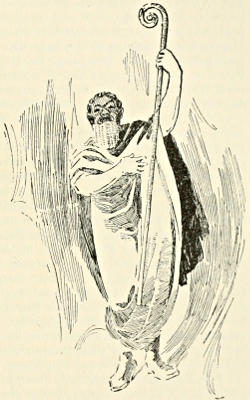
Greek Comedian
In the elegy, the oldest form of
Greek lyric—so perfect an expression
of the Ionic spirit in its varied measures
and uses—a new form had been
evolved in Ionia itself, side by side
with the older one in which Theognis
had expounded his party rancour and
Solon his statesman-like wisdom—a
lighter form which touched upon life
in accents untinged by grief, the song
of joyous conviviality, giving the gaiety
of the banquet a higher consecration
by the introduction of ethical
ideas. “To drink, to jest, to bear a
just mind,” sang Ion, and brought
public affairs gracefully into the conversation.
Dionysius the Athenian,
a statesman of note in the age of
Pericles, associated himself with Ion
in this form of verse, and the lighter kind of elegy so appealed to the
intellectual character of contemporary Athens that even Sophocles and Æschylus
composed elegies of this sort. The fifth century was so rich in life
and movement that these occasional verses were produced in great abundance;
the epigram itself is no more than a subsidiary kind of elegiac verse.
Its concise form was due to its original purpose, which was to serve as an inscription
on some public monument, and it is therefore more closely connected
with the great events of the time than any other kind of poetry. Simonides
of Ceos was esteemed above all other Greeks as a writer of occasional verse
in the best sense of the term, so much so that Sparta commissioned the
Ionian poet to sing the praise of her Leonidas. With inimitable felicity he
immortalised the events of the Wars of Liberation in brief pregnant epigrams
inscribed on monuments of every sort, sang the praises of the fallen in elegies,
and celebrated the days of Artemisium and Marathon in grand cantatas which
were performed by festal choirs.
The state did what it could to advance the cause of art. It offered poets
brilliant opportunities for distinguishing themselves at the celebrations held
in honour of its victories, and gave prizes for the best performances. As
Themistocles had been assisted by Simonides, so Cimon was assisted by
the genius of Ion, who in like manner laboured to hand down his fame to
posterity. Pericles was led by his own tastes as well as by political considerations
to do all that lay in his power to foster the art of song in Athens.
For this purpose he introduced the musical competitions at the Panathenæa,
and so summoned all men of talent to vie publicly one with another. He
himself was the organiser and lawgiver in this department, and settled with
profound artistic knowledge the manner in which the singers and cithara-players
should appear at the festivals. If in spite of all these efforts lyric
poetry did not take the place we might have anticipated in the Athens of
Pericles, and Simonides found no worthy successors, the principal reason
must be sought in the fact that another stronger and richer voice of poetry
arose, into which the lyric was merged and so lost its individual importance.
Of all kinds of lyric poetry none was cultivated in Athens so admirably
and successfully as the dithyrambus, the chant in praise of the god Dionysus,
the giver of blessings—the branch of religious poetry which showed a capacity
for development beyond all others. Lasus of Hermione, the tutor of
Pindar, had changed this form of song (originally no more than the medium
of an enthusiastic nature worship) into an artistically constructed choral
chant and invested it with such splendour by bold and varied measures and
the rippling music of flutes, as to cast the fame of Arion, its original inventor,
into the shade. From the Peloponnesus Lasus brought the new art
to the court of the Pisistratidæ at Athens. At that time everything connected
with the worship of Dionysus was regarded with special favour, the
dithyrambus was introduced into state festivals, and wealthy citizens vied
with one another in equipping and training Bacchic choirs, composed of fifty
singers who danced circling the flaming altars of Dionysus; and no expense
was spared to procure new songs for the Attic Dionysia from the greatest
masters, such as Pindar and Simonides. The latter could boast that he had
won no less than fifty dithyrambic victories at Athens. But the evolution
of the dithyrambus did not stop there.
The dithyrambus not only included every metre and rhythm known to
earlier kinds of lyric poetry, but it contained elements which tended to pass
beyond the limitations of the lyric. For the festal chorus regarded the god
whose praises they, sang as an immanent presence and, as it were, lived
through all that befell him, whether of persecution or victory; and it was
therefore but a short step to pass beyond the assumption that their audience
was acquainted with the events which formed the subject of their chants, and
to call them to mind by narration or set them forth by spectacular representation.
The leaders of the dithyrambic chorus accordingly interspersed their
singing with recitations, and thus epic and song were combined. The epic
recitation was then rendered more effective by the aid of action and costume,
the god himself was made visible in his suffering and triumph, the leader of
the chorus undertook the part, the dancers were transformed into satyrs—attendants
of the god and partakers of his fortunes; and thus from the union
of the old forms of poetry there sprang a new form, the drama, the richest
and most perfect of all.
The Greeks were by nature gifted with dramatic talent. Their natural
vivacity induced them to clothe every doubt or deliberation in the form of
a dialogue. Thus even in Homer we find the germ of the drama, which now
reaped the benefit of the entire evolution of the older art methods. For
all that dance and song had invented in the way of balanced rhythm, effective
metre, and poetic imagery, was here united, enlivened by the art of
mimicry, which made the person of the actor the instrument of artistic exposition,
and warmed by the joyous fires of the Bacchic festival.
The cycle of representation could not but be limited so long as the
action was confined by ceremonial considerations to the subjects offered by
the worship of Bacchus. The Greeks therefore went a step farther and in
place of the fortunes of Bacchus took other subjects equally well calculated
to arouse lively sympathy, and thus (when this form of art had been invented)
there flowed in an abundance of materials and fertile themes, the
storehouse of Homeric and post-Homeric epos was flung open, the national
heroes were introduced to the nation in a novel and striking guise, and
a vast field of activity was opened to dramatic art.
This advance had already been made beyond the borders of Attica; for
before the time of Clisthenes the hero Adrastus had been substituted for
Dionysus, and it may be that a similar enlargement of the scope of dithyrambic
poetry had also taken place at Corinth. But it was at Athens alone
that these rudiments of the drama reached their full development. As the
epic had mirrored the heroic days of old, as the lyric kept pace with the
development of the nation for three centuries after the decline of the epic,
so the drama was the form of poetry which began to flower at the moment
when Athens became the pivot of Greek history. Originating from humble
beginnings in the time of Solon, it grew in magnitude and importance with
the growth of the city’s greatness, and is associated with the history of
Athens in every stage of its development.
Thespis was the founder of Attic tragedy, for it was he who introduced
the alternation of recitation and song and arranged the stage and costumes.
The story goes that Solon had small liking for the new art, believing the
violent excitement of the emotions by the representation of imaginary
events to be prejudicial, but that the tyrants favoured this popular diversion,
like everything else connected with the democratic worship of Dionysus,
because it suited the purpose of their policy to provide brilliant
entertainments for the population at the expense of wealthy citizens.
About 550 B.C. they summoned the chorus leader from Icaria to the city,
competitions between rival tragic choruses were introduced, and the stage
near the black poplar in the market place became a centre of Attic festivity.
With the restoration of peace all civic festivals took a higher flight,
the various constituents fell apart, tragedy rejected the baser elements of
Bacchic festivity and assumed greater dignity, it was cast into definite
artistic forms by Pratinas and Chœrilus, and became freer and freer in its
choice of subject. The old element was not abandoned for all that, the
rustic youth would not be deprived of their accustomed masquerade, and
the people were left their satyr choruses. But the two forms, which could
not be combined without mutual detriment, were separated, and thus the
satyr drama grows up side by side with tragedy. Pratinas, who migrated
to Athens from Phlius, gave these plays their typical form, and they retained
their original character of Bacchic jollity, their rustic and homely
features, and the merry rout of the satyrs with their wild dances and rude
jests. Thus these elements were preserved to literature and yet prevented
from molesting or hampering the further development of tragedy.
The period in which Athens took her place as a great power and sent
her triremes across the sea to support the Ionian revolt, likewise constituted
an epoch in the history of Attic tragedy. About that time the wooden
scaffoldings from which the audience had looked on at the plays of Pratinas,
Chœrilus, Phrynichus, and the youthful Æschylus, gave way; and the
drama had already attained such consequence
in Athens that the building
of a magnificent theatre was taken in
hand. A permanent stage of stone
was built within the precincts sacred
to Dionysus on the southern declivity
of the citadel, and seats for spectators,
rising one above the other in semi-circular
rows, were built into the rock
of the Acropolis in such wise that the
audience commanded a view of Hymettus
and the Ilissus on the left and
of the harbour on the right.
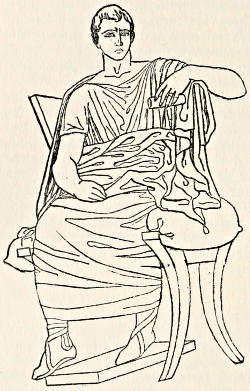
Greek Poet
Meanwhile the artistic structure of
tragedy was steadily advancing towards
perfection. The subject-matter
grew more varied, music and the dance
were used in a greater variety of forms,
female characters were added. Nevertheless
the lyric element remained predominant
down to the time of the
Persian wars; and Phrynichus, the
greatest predecessor of Æschylus, was
most admired for his charming choral
songs. It was with the great drama
of the War of Liberation that the theatrical
drama began to unfold its full
powers, and nowhere do we perceive
more clearly the manifestation of the newly-acquired energy which pervaded
every department of Attic life.
The man destined to give utterance in tragic art to the spirit of the great
age was Æschylus, the son of Euphorion of Eleusis, a scion of an ancient
family, through which he claimed association with one of the most venerable
sanctuaries of the land. This is why he calls himself the pupil of Demeter,
thus testifying that the solemn services of the temple at Eleusis had not
failed to exercise a lasting influence upon his mind. As a boy he witnessed
the fall of the tyrants: when come to man’s estate he fought at Marathon,
being then thirty-five years old, and he himself declared, in the inscription
on his tombstone, that he took pride, not in his tragedies, but in his share in
that great day, though there he had been but a citizen among citizens, while
as a poet he was without peer among his contemporaries. For it was he
whose creative genius laid the foundations of Attic tragedy, making all previous
achievements look like imperfect attempts.
He introduced a second actor on the stage, and thus made the play a real
drama, by which means lively colloquy first became possible. Dialogue, for
which the Athenians were singularly well qualified by their love of talking,
readiness and acute reasoning faculty, was thus transferred to the stage, and
this gave it a wholly novel interest. The language of the dialogue was in
the main that of ordinary life, while older phonetic principles prevailed in the
chorus, which was thus less familiar to the ear and produced an impression
of solemnity and dignity which suited well with its character of the oldest
element of tragedy and the religious centre about which it had crystallised.
The choruses were shortened to allow the action to proceed more vigorously,
the characters of the dramatis personæ were more sharply defined, a distinction
was made between leading and secondary parts, and the parts of
secondary characters of lower station bore the stamp of the common people,
as distinguished from the heroic figures of the play. The stage itself was
brought to a higher pitch of perfection. It was effectively fitted up as an
ideal scene by Agatharchus, the son of Eudemus, an artist from Samos, who
cultivated scene painting scientifically as a branch of art, and mechanism
was pressed into the service to raise shades from the depths of the earth or
cause gods to hover in the air by artificial means. The spectacle as a whole
gained in solemn dignity no less than in spiritual import and moral significance.
The principal aim of the earlier poets had been to express and induce
emotional moods; but the object of the drama was to present the legends
of olden times completely in their general connection, and for this purpose
Attic drama was so arranged that three tragedies were joined to form a single
whole, in order to display upon a harmonious plan the successive developments
of the mythical story, and these three tragedies, which were so many
acts of one great drama, were followed by a Satyr-drama as afterpiece. This
led back from the affecting solemnity of the tragedies to the popular sphere
of the Dionysian festival, where the diverting adventures witnessed and enacted
by the satyrs restored the minds of the spectators to innocent mirth.
It was a healthy trait of popular sentiment which thus mingled jest and
earnest, and one of which we see other evidences in vase painting and the
sculptures of the temples.
Such was the tetralogy of Attic drama, which, if not invented by Æschylus
yet received its artistic consummation at his hands. The dithyrambic
chorus was divided into groups, each consisting of twelve (and later of
fifteen) persons, so that there was a special chorus for each part of the tetralogy,
to follow sympathetically the action of the dramatis personæ and fill
up the pauses with dance and song. The orchestra, where the chorus was
placed, lay between the stage and the spectators, just as the chorus itself
symbolically occupied an intermediate position between the audience and
the heroes of the drama.
The Greeks were accustomed to look upon the poets as their teachers,
and no man could gain recognition as a poet among them who had only
talent, imagination, and artistic skill to show as proofs of his poetic vocation;
this required a thorough education of heart and mind and clear insight into
things human and divine. Hence the calling of a poet laid claim to the
whole man and the man’s whole life, and none conceived of it more nobly
than Æschylus. Like Pindar he takes his hearers into the very heart of
the myth, drawing out its moral earnestness and illuminating it with the
light of historical experience. Humanity, as represented by Æschylus in
the Titan Prometheus, with its constancy through struggles and misery, its
proud self-respect, its indefatigable inventive genius, with its tendency, too,
to rashness and arrogant boasting, is the generation of his own contemporaries,
with their reckless aspirations; but no wisdom avails man save that
which comes from Zeus, no skill and intelligence save that which is based
on devout morality. Thus, without petty premeditation the poet becomes
a true teacher of the people; in an age of incipient scepticism he endeavours
to uphold the religion of his forefathers, to purify popular conceptions and to
draw forth the kernel of wholesome truth from the many-hued tinsel of popular
fables. It was the mission of the poet to maintain harmony between
popular tradition and advancing knowledge.
But the poets lived in the midstream of civic life, and it is not to be
supposed that, in a city like Athens, men who at public festivals set forth the
creations of their genius in the public eye, could remain indifferent to
the questions of their own day. They were obliged of necessity to belong
to one party or another, and if they were sincere and candid, their views as
to what was for the good of the commonwealth could not but appear in their
works. Their choice of subject was still limited in the main to mythology;
man’s strength of will, his deeds and sufferings, the contradiction between
laws human and divine, were still set forth by preference in the characters
of the Homeric age of which the tradition survived in the epos. These
were the prototypes of the human race, their sufferings were the sufferings
and entanglements incident to the whole human race; in contemplating
them the spectators were to be freed from what was personal in their
sorrows and cares, the narrow bounds of their self-consciousness were to
be widened, and they were to receive from the performance not only the
highest artistic pleasure, but a cheering and healing purification of their
hearts. These heroes of olden times were in harmony with the ideal character
which the dramatists were bent on giving to the whole world of the
stage; but the impression was none the less striking because the audience
was transported into a dim and legendary past. We feel the spirit of the
warrior of Marathon in the warlike plays of Æschylus, and the spectator of his
Seven against Thebes glowed with eagerness to strike a blow for his country.
Meanwhile Phrynichus had ventured to put modern events on the stage,
and his Fall of Miletus and Phœnissæ were no doubt fraught with political
intention. Æschylus followed the example of his predecessor in a far
grander style when, four years after the production of the Phœnissæ of
Phrynichus, he produced his drama of the Persæ. He depicted the fall of
the Great King. But with fine artistic instinct he chose Persia, not Attica,
for the scene of his tragedy. He brings before our eyes the consequences
of the battle, its reaction upon the hostile empire, in its own capital.
Darius is conjured from the grave that in the person of the pious and
prudent ruler may be set forth the glory of the inviolate Persian empire,
while his successor returns from Hellas shorn of all dignity, a warning example
of the ruin which foolish arrogance brings upon all sovereign power.
The whole composition is pervaded by the idea of retribution, which had
been awakened in the Greek mind by the Persian wars.
In the tragedy of Phrynichus, Themistocles is extolled above all other
men, while Æschylus only alludes to him in passing as the inventor of a
subtle stratagem. On the other hand the latter gives a detailed account of
the fight on Psyttalea, so exalting the fame of Aristides, who contributed
substantially to the victory of Salamis, not by sea, but by land.
The Persæ was the middle play of a trilogy and comes to no final conclusion.
The shade of Darius hints at other defeats in the future, and at
the struggles of Platæa. From Glaucus, the third play of the trilogy, an
allusion to Himera has been preserved. The first part, Phineus, takes its
name from the mythical seer who revealed to the Argonauts their coming
voyage to the land of the northern barbarians. Hence, it is extremely probable
that all three plays were linked together by a single idea, the idea
(present to all thinking men of the time) of the great struggle between barbarian
and Greek, between Asia and Europe, which had its mythical prelude
in the voyage of the Argonauts, and came to its glorious issue on the battlefields
of Greece and Sicily. In like manner Herodotus had conceived of the
Persian War as one link in a great chain of historical development, and Pindar
had associated Salamis, Platæa, and Himera as ranking equally among
the glorious days of the Greeks; and we may be sure that the trilogy of the
Persæ would not have been acted at the court of Hiero unless it had fully
satisfied the tyrant’s love of praise.
Æschylus represented the legendary history of the house of Pelops in the
three plays of the Oresteia, and that of the royal house of Thebes and the
Thracian king, Lycurgus, each in a cycle of three dramas; he worked up
the legend of Prometheus so that the conflicts and discords of the several
parts find a satisfactory solution in a larger order of things; and thus the
poet wove legend and history into a single piece. Prehistoric and present
times, East and West, the mother-country and the colonies, all form parts
of a grand picture, of a chain of events linked together by prophecy and
reciprocal reaction. The poet looks forward and backward, and prophet-like
interprets the course of history, seeing the inner necessity revealed to the eye
of the spirit. He uplifts the hearts of his people by setting forth the waxing
power of the Greeks, the waning might of the barbarians on every side, without
a taint of scorn or malicious triumph to vitiate the moral majesty of his
work. At the same time he moderates the pride of victory, by pointing to
the guilt which brought about the Persian overthrow and to the eternal laws
of divine justice, the observance of which is the inexorable condition of the
prosperity of the Greeks.
In the tragedies on mythical subjects there was no lack of passages which
permitted of or actually challenged application to the events of the day.
Next to Aristides, it was Cimon to whom the muse of Æschylus did homage.
Like Cimon, the poet was the champion of a common Hellenism, of
patriarchal customs, the rule of the best, the discipline of the good old times,
and so when the waves of popular agitation rose higher and higher till they
threatened the very Areopagus, the last bulwark, the septuagenarian poet led
his muse into the strife of conflicting parties and exerted his utmost powers
to impress upon his fellow-citizens the sacred dignity of the Areopagus as a
divine institution and to warn them of the consequences of sinful license.
The Eumenides of Æschylus is a brilliant example of the way in which a
great imaginative work may be made to serve a special purpose and express
a particular tendency without losing anything of its transparent lucidity or
of the sublimity which stamps it as a masterpiece for all time. But though
the Areopagus remained unmolested as a court of justice (and we should like
to fancy the poem of Æschylus an influential factor in the matter) the poet
felt alien and solitary in the city where democracy had completely gained the
ascendant. This was not the freedom for which he had bled in the field;
the band of those who had fought in the Wars of Liberation dwindled and
dwindled; the Oresteia was the last work he produced in Athens; and he
died in his seventieth year at Gela in Sicily (456 B.C.), after a residence
there of about two years.
The day of the warriors of Marathon was past, and the new age, the age
of Pericles, found exponents in a younger generation, and on the Attic stage
in Sophocles. Like Æschylus he was of noble birth, as is indicated by his
appointment to be a priest of the hero, Halon, but his father was a craftsman
and the head of a great smithy for the manufacture of weapons. He
was born in the metalliferous district of Colonus about B.C. 496 and grew
up amidst the delightful rural scenery of the valley of the Cephisus, in the
shade of the sacred olives that had witnessed the first beginnings of national
history, yet near the capital and near the sea, which he overlooked
from the crags of Colonus, and where he saw the port grow up during his
boyhood years. In the early bloom of youthful beauty he led the dance at
the festival held in honour of the victory of Salamis; twelve years later he
entered the lists as a rival of the great poet Æschylus, whose inspiring art
had attracted him to follow the same path to poetic fame. It was a day of
unwonted excitement throughout Athens when all men awaited the issue
of the contest between the ambitious young poet and Æschylus, then close
upon sixty years of age and twice already the wearer of the laurel crown.
The occasion was the same Dionysian festival on which Cimon, having brought
the Thracian campaign to a glorious close, came up from the Piræus and
offered his thank-offerings to the gods in the orchestra of the theatre. The
people were in raptures over the relics of Theseus which he had brought back,
and amidst the assenting acclamations of the assembled citizens the archon
Apsephion appointed Cimon and his fellow-generals umpires, as being the
worthiest representatives of the ten tribes. The result was that the prize was
awarded to the Triptolemus trilogy of Sophocles.
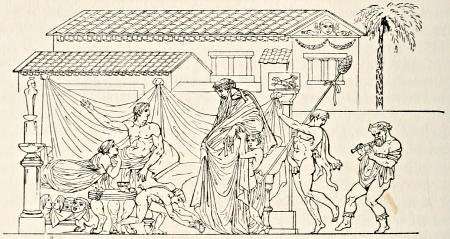
Representation of a Reception of Bacchus
There was no opposition between the art of Sophocles and that of his
predecessor. The former looked up reverentially to the man whose original
genius had led the way to the consummation of tragic art. Envy and
jealousy were foreign to his lovable disposition. But he was an independent-minded
pupil of his great master, and a man of very different endowments.
His genius was gentler, simpler, and more tranquil, the extremes of pathos
and pomp were repugnant to his taste. Accordingly he toned down the force
of the theatrical diction which Æschylus had introduced, and, without degrading
his characters to the common level, tried to make them more human, so
that the spectators could feel more closely akin to them. This method is
intimately connected with the altered treatment of the subjects of tragedy.
In the treatment of tragic legend Æschylus reached the greatest heights to
which the genius of Greece ever soared; in this sphere no man could surpass
him. But Sophocles realised that the legends could not always be presented
to the people with the same breadth of handling without their interest being
gradually exhausted. It was therefore necessary to develop more vital action
within the various tragedies, to conceive the characters more definitely, and
excite a more vivid psychological interest.
Æschylus had already treated the trilogy in such a manner that it was
not bound to the thread of a single myth, and the combination, if not dissolved
by Sophocles, was so far loosened as to make each tragedy of the
three complete in itself, leading up to its appropriate close within the limits
of the action and capable of being judged as a separate composition. The
result was much greater freedom, the motive of each play could be treated
in fuller detail and the poetic picture enhanced by the prominence given
to secondary characters. Thus, in his treatment of the legend of Orestes,
Sophocles suffers the act of matricide and its perpetrator to fall into the
background and gives quite a new turn to the familiar subject by making
Electra the leading character in place of her brother Orestes, showing the whole
course of the action as reflected in her spirit, and thus securing an opportunity
of creating a study of varied emotion and a type of womanly heroism
to which the picture of her sister’s dissimilar temperament serves as an
admirable foil.
In order to take full advantage of the resources of a more refined and
advanced style of art, Sophocles introduced a third actor on the stage and
thus opened the way to incomparably greater vividness of treatment no less
than to much greater variety of colouring and grouping in the dramatis personæ.
Moreover, Sophocles, though an adept in the song and dance, was
the first poet to abandon the practice of appearing in the parts he had created.
From that time the professions of poet and actor were distinct, and the art
of the latter acquired greater independent value. A less active part, outside
the scope of the action, was assigned to the chorus, and the dramatic
element became more significantly prominent as the nucleus of the tragedy.
Æschylus himself recognised the advance, for he not only adopted the improvements
in the outward setting of tragedy thus effected, but spurred on
by his younger rival, rose to the height of a maturer art in his dramas.
To the influence of Sophocles was due the increased fondness for Attic
subjects; his Triptolemus extolled Attica as the home of a superior civilisation,
which spread victoriously from that centre to distant lands, he
brings the legend of Œdipus to an harmonious close on Attic soil, at
Colonus, his own birth-place, and even in the Electra he manifests the Athenian
point of view by taking the overthrow of unlawful dominion and the
successful struggle for liberty as the purpose of the action.
His tragedies contributed more than any other works to give spiritual
significance, as Pericles strove to do, to the age of Athenian might and splendour.
Like Pericles, Sophocles endeavoured to maintain the ascendency of
the ancient worship and customs of the country, the unwritten precepts of
sacred law, while at the same time mastering every step of intellectual progress
and every enlargement of the bounds of knowledge. His diction bears
the stamp of a trained and powerful intellect, which often carries terseness
to the verge of obscurity; but with what skill does he preserve the charm
of graceful expression, what a spirit of felicitous harmony pervades all his
works! He was a man after Pericles’ own heart, and his personal intimacy
with the latter is proved by the gay and unaffected manner in which the
statesman treats the poet as his colleague in the camp. Sophocles was never
a partisan or party writer in the same sense as Æschylus, and as Phrynichus
seems to have been, but his art was a mirror of the noblest tendencies of the
time, a glorified version of the Athens of Pericles. We meet with his clear
and sound judgment on civil affairs in every passage in which he praises
prudent counsel as the safeguard of states, and the Attic people rightly appreciated
him as the true poet of his age, for none ever won so many prizes
or enjoyed his fame so unmolested as Sophocles, nor could Euripides (who
though only fifteen or sixteen years his junior belonged to a totally different
era) gain any success as his rival until the age of Pericles was past. And
even to him Sophocles was never obliged to yield the palm.
Side by side with tragedy, and from the same germ, i.e., from the Bacchic
festivities, comedy developed. It is full sister to tragedy, but grew up
longer in rustic freedom and fell much later under the discipline and training
of the city; and for that reason it retained more faithfully the character
of its source. For its origin was the jollity of the vintage, the merry-making
of country folk over the increase of another year, which is found in all wine-growing
districts. Swarms of masked holiday-makers sang the praises of
the genial god and in tipsy merriment played all kinds of jokes and tricks
on every one who met the procession and gave an opening for pranks and
raillery, the events of the day were freely exploited, and he who hit upon
the merriest quips was rewarded by the hearty laughter and applause of a
grateful audience.
Thus the autumnal festival was kept in Attica in its day, and more particularly
in the district of Icaria, not far from Marathon. The worship of
Dionysus as there celebrated made it in a manner the nursery of the whole
body of Athenian drama, for Thespis came from Icaria. Thither, too, came
Susarion of Megara, bringing from his native place the rude wit of Megarian
farce and setting the fashion which remained in vogue for the time in Attica.
From his school arose Mæson, who was very popular in the time of the
Pisistratidæ. The next step was the transference of the rustic stage to the
capital, where it was recognised by the government as a part of the Dionysian
festival and supported out of the public funds. This took place in the
time of Cimon, after the Persian wars, and the energetic temper which at
that time pervaded the life of Athens proved its vigour by transforming the
rude, half-foreign farce into a well-organised form of art, full of significance
and thoroughly Attic in character, of which we must regard Chionides and
Magnes of Icaria as the founders.
When once the Icarian drama was naturalised in the home of tragedy
many of the concomitants of the tragic drama were transferred to it, public
contests in comedy were instituted by the state, prizes were adjudicated and
awarded, and the cost of the chorus was defrayed from the public funds;
moreover it was similarly arranged in such matters as the stage, the dialogue,
the chorus, and the number of actors, without, however, forfeiting its peculiar
characteristics. For tragedy carried the spectators into a loftier sphere, and
strove by every means at her command to present figures and conditions on
a grander scale than that of ordinary life, while comedy maintained the
closest relations with contemporary and common life. It remained more
unaffected in dance, versification, and diction no less than in poetic design;
nay, to such an extent did it retain its topical character and its adaptation
to the events of the hour that the poet used the choir to interrupt the course
of the action entirely in order to discuss his personal affairs or the burning
questions of the time with the audience in lengthy parabases.
This kind of dramatic composition could only flourish in a democratic
atmosphere, and it was associated with the democracy in every stage of its
development. Occupied from the outset with the preposterous and ridiculous
side of life, it castigated all follies, defects, and weaknesses, and amidst the
variety and publicity of the civic life of Athens it could never lack either
subjects for mirth or a witty, ingenious, and laughter-loving audience ready
to catch at every allusion. But it also served the purpose of bringing abuses
and contradictions in public life to light. This was the serious side of its
calling, for unless inspired by a serious and patriotic temper its humour
would have grown dull, ineffective, and contemptible. The aim of the comic
poets was to be not mere frivolous provokers of mirth, but teachers of men,
and leaders of the people, even as the tragic poets were; and in an age of
feverish excitement the severest of their censures were directed against new-fangled
ways. Comedy was aristocratic in character, it championed native
custom against foreign ways, it ruthlessly denounced every evil tendency in
life and art, and every instance of misconduct or abuse of power. It cherished
the memory of the heroes of the Wars of Liberation and encouraged
others to emulate their example, and it was fond of subjects which had some
bearing on important contemporary events, as we see in the Thracian Women
of Cratinus, which was associated with the establishment of colonies in Thrace.
The founders of comedy as an Attic art are Crates and Cratinus. Cratinus
was slightly younger than Æschylus, and like him was endowed with original
creative genius, but his taste for unrestrained freedom and his inexhaustible
fund of humour marked him out as a born comic poet, while his rude
veracity qualified him to make comedy a power in the state. It became so
about the time that Pericles came into power, and though Cratinus was not
the sort of man to commit himself unreservedly to one or other of the contesting
parties, we know that in his Archilochi (a comedy in which the
chorus was composed of scoffers like Archilochus) he brought an Attic
citizen upon the stage immediately after the death of Cimon and put in his
mouth a lament for “the divine man,” “the most hospitable, the best of all
Panhellenes, with whom he had hoped to spend a serene old age—but now
he had passed away before him.” The mighty Cratinus was succeeded by
Aristophanes and Eupolis, both unmistakably akin to him in mind and
feeling, but gentler, more moderate, and stricter in their adherence to the
rules of art. But Aristophanes alone combined with these qualities a wealth
of creative invention in nothing inferior to the genius of Cratinus.
All these men,—philosophers and historians, orators and poets,—each
one of whom marks an epoch in the development of art and science, were not
merely contemporaries, but lived together in the same city, some born there
and nourished from their youth on the glories of their native place, others
attracted thither by the same glory; nor was their association merely local,
they laboured, consciously or unconsciously, at a common task. For whether
they were personally intimate or not with the great statesman who was the
centre of the Attic world, nay, even if they were numbered among his
opponents, they could not but render him substantial help in his life-work
of making Athens the intellectual capital of Greece.
Here whatever germs of culture were introduced from foreign parts
gained new life, the Ionian study of countries and peoples became history
as soon as Herodotus came into touch with Athens; the Peloponnesian
dithyrambus grew into tragedy at Athens, the farce of Megara into Attic
comedy; here the philosophy of Ionia and Magna Græcia met to supplement
each other’s defects and prepare the way for the development of Attic
philosophy; even sophistry was nowhere turned to such account as at
Athens. In earlier times every district, city, and island had had its peculiar
school and tendencies, but now all vigorous intellectual movements
crowded together at Athens; local and tribal
peculiarities of temperament and dialect
were reconciled; and as the drama (the
most Attic of all the arts) absorbed all
art-methods into itself, to reproduce them
in organic harmony, so from all the achievements
of the genius of Greece there grew
a general culture which was at once the
heritage of Attica and of the Greek nation.
Vehemently as other states might oppose
the political predominance of Athens, none
could deny that the city where Æschylus,
Sophocles, Herodotus, Zeno, Anaxagoras,
Protagoras, Crates, and Cratinus all laboured
together, was the focus of all lofty aspirations,
the heart of the nation, Hellas in
Hellas.
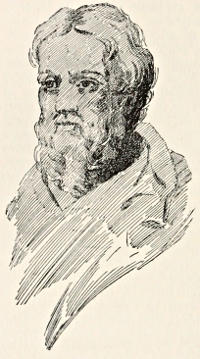
Herodotus
Slight as is our knowledge of the personal
relations of these great contemporaries,
there are a few traditions from which
we can gather some idea of the intercourse
of Pericles with the most eminent among
them and of their intercourse with one
another. We know that Pericles equipped
the chorus for a theatrical performance in
which Æschylus carried off the prize. We
know of the friendship of Herodotus and
Sophocles, and we actually possess the beginning of some occasional verses
addressed to Herodotus by the poet, then in the fifty-fifth year of his age;
a letter in elegiac metre dating from the time when the historian migrated
to Thurii, and withdrew from the delightful society of the best men of
Athens. Sophocles was before all things sociable, and we hear that he
formed a circle of men skilled in the fine arts and dedicated it to the
Muses, and that it held regular meetings. This reciprocal stimulus resulted
in a steady advance in all directions. In every branch of art we can trace
the epochs of development as surely as in the structure of the trimetre of the
drama. But as, generally speaking, Greek art owed its unfaltering progress
to the fact that the younger artists did not endeavour to gain a start by rash
attempts at originality, but held fast the good in all things and readily
adopted and perfected methods that had once gained acceptance, so in Athens
we see the elder masters gratefully praised and honoured by their pupils,
like Æschylus by Sophocles and Cratinus by Aristophanes.
It is one of the most notable characteristics of the intellectual life of
Athens that her eminent men, however high a view they took of their own
calling, did not owe their pre-eminence in it to any narrow-minded restriction
of their interest to their own peculiar sphere. This versatility was
rendered possible by the vitality for which the contemporaries of Pericles
were remarkable, and it seems as though the brilliant prime of the Greek
nation manifested itself most plainly in the frequent combination of extraordinary
mental and physical powers. We cannot but admire the men who
retained their vital force unimpaired to extreme old age and advanced in
the practice of their art to the last.
Sophocles, after having composed 113 dramas, is said to have read the
chorus of the Œdipus at Colonus aloud, to disprove the rumour that he was
incapable of managing his own affairs by reason of the infirmities of old age.
Cratinus was ninety-one when he produced Dame Bottle, the saucy comedy
with which he defeated Aristophanes, who had looked upon him as a rival
whose day was over. Simonides, Xenophanes, Parmenides, and Zeno, were
likewise examples of healthy and vigorous old age. Timocreon combined
the skill of an athlete with the profession of a poet. Polus, Sophocles’
favourite actor, was competent to take the leading part in eight tragedies
in four days. Lastly, the sterling capacity and versatility of the masters
of those days is shown by the fact that though extraordinarily prolific
authors of imaginative works, they spared time to strive after scientific certainty
concerning the problems and resources of their art, and combined
absolute self-possession and the love of theoretical study with the enthusiasm
of the artist temperament. Thus Lasus, the inventor of the perfected
form of the dithyrambus, was at the same time an accomplished critic and one
of the first writers on the theory of music; and Sophocles himself wrote
a treatise on the tragic chorus, to set forth his views as to its place and
purpose in tragedy. In like manner the most distinguished architects
wrote scientific treatises on the principles of their art, Polyclitus worked
out the theory of numbers which lies at the root of plastic symmetry, and
Agatharchus the principles of optics, according to which he had arranged the
decoration of the stage. In so doing he took the first step towards the
teaching of perspective, which was subsequently developed by Democritus
and Anaxagoras.b
No admirer of Greek civilisation can turn
from the peaceful age of Pericles and follow
the next step in Grecian history without a
feeling of sadness, for he has to see the most cultured people of antiquity torn
by internal dissensions and interstate jealousies; he has to see the people who
represent the acme of culture harassed for a generation by an imbecile strife,
which shall leave it so weakened that it will become an easy prey to outside
foes. In every succeeding generation, when men have studied the history
of classical times, the same feeling of amazement has prevailed, and has often
found expression in contemplating this period of the Peloponnesian War;
but it remained for John Ruskin to invent the vivid phrase which in three
words epitomises the entire story, when he speaks of this amazing conflict as
the “suicide of Greece.” It was in truth nothing less than that.
There was no great question at issue between the Athenian and Spartan
peoples that must be decided by the arbitrament of arms or otherwise.
There was no reason outside the temperament of the people themselves why
the Athenians on the one hand, and the Spartans on the other, might not
have gone on indefinitely, each people pre-eminent in its own territory, and
each standing aloof from the other; but that interstate jealousy which was
responsible for so many things in Grecian history came as a determining influence
which at last could not longer be controlled. Persian might, which
dared not re-enter Greece, but which longed for the overthrow of an old
enemy, urged on one side or the other, as seemed for the moment best to
serve that end. The remaining Grecian cities took sides with Athens or
Sparta according to their predilections, or their own personal enmities and
jealousies, and there resulted a war which involved practically all the cities
of Greece, and which, after continuing for a full generation, brought Hellas
as a whole to destruction.
The history of this war has been preserved to posterity in far greater detail
than has the history of any preceding conflict anywhere in the world.
The Athenian general Thucydides, who himself took an active part in the
earlier stages of the war, commanding forces in the field until finally he suffered
the displeasure of the Athenians, determined from the outset, as he
himself tells us, to write a complete history of the conflict which he believed
would be the most memorable of all in the annals of history. The work
which he produced has probably been more widely celebrated and more universally
applauded than any other piece of historical composition that was
ever written. All manner of extravagant things have been said about it.
Every one has heard, for example, of Macaulay’s saying that he felt he might
perhaps equal any other piece of historical writing that had ever been done
except the seventh book of Thucydides, before which he felt himself helpless.
This eulogy is of a piece with much more that has been said in similar kind
by a multitude of other critics. It has even been alleged that no historian
of a later period has ever dealt out such impartial judgment as is to be found
in the pages of Thucydides. Seemingly forgetful of the meaning of words,
critics have even assured us that no period of like extent of the world’s
history, ancient or modern, is so fully known to us as this period of the
Peloponnesian War through the history of Thucydides.
To any one, who himself will take up the history of Thucydides, either
in the original or in such a translation as the admirable one of Dale, two
things will at once be apparent; in the first place it will not long be open to
doubt, to any one who is familiar with the literature of antiquity, that this
work of Thucydides, considered in relation to the time in which it was
written, is really an extraordinary production; but, in the second place,
it will be equally clear that if we are to consider the work not in comparison
with the writings of ancient authors but as a part of world-literature,
then much that has been said of it must be regarded as fulsome eulogy.
To say that this work covers the period of the Peloponnesian War as no
modern period of history has been covered; to say that no modern historian
has dealt with his topic with the calm impartiality of Thucydides; to say
that no writer can hope to produce an historical narrative comparable to the
seventh book, or to any other book, of Thucydides—to say such things as
these is to abandon the broad impartial view from which alone criticism
worthy of the name is possible, and to come under the spell of other minds.
The History of the Peloponnesian War is a great book; as an historical composition
it is one of the greatest ever written: but when one has said that one
has said enough. Its style, by common consent, is not such as to make it a
model, and its matter is very largely the recital of bald facts with evidence
of an insight into the political motives beneath the surface, which seems extraordinary
only because the predecessors of Thucydides and some of his successors
had seemed so woefully to lack such insight. As to the impartiality
of the narrative, we must not overlook the significance of Professor Mahaffy’s
remark, that for most of the period covered in the history of Thucydides this
history itself is our sole authority. That it does, nevertheless, evince a high
degree of impartiality and a broad sweep of intellect on the part of its author
will not be questioned; but Professor Mahaffy makes an estimate, which no
one who is not fully under the spell of antiquity would think of disputing,
when he asserts his belief that such modern historians as, for example, Thirlwall,
must be accredited with at least as high a degree of impartiality as
Thucydides can claim.
But all this must not be taken as in any sense denying that the work of
Thucydides is a marvellous production. Considering the time when it was
written, and that its author was a participant in many of the events which
he describes, it is astonishing that his work should be measurably free from
partiality. That it is so was, perhaps, at least in some measure, due to the
fact that Thucydides was banished from Athens, and hence wrote his history
not so much from the Athenian standpoint, as from the standpoint of a man
without a country, who was at enmity with both Spartans and Athenians.
But, partial or impartial, the history of Thucydides remains, and presumably
must always remain, the sole contemporary record open to posterity of that
great struggle through which Greece, as it were, voluntarily threw away her
prestige and her power.
Thucydides, to be sure, did not complete his history of the war, or, if he
did, his later chapters have not been preserved to us. The former supposition
is doubtless the correct one, because the thread of the narrative, which
Thucydides dropped so abruptly, was taken up by Xenophon, also a contemporary.
It was a not unusual custom among the ancient authors to write
important works as explicit continuations of the works of other writers.
Xenophon’s narrative of the events of the later years of the Peloponnesian
War is such a work. Like the history of Thucydides it is practically our
sole authority for the period that it covers, but, by common consent of
critics, it takes a much lower level than the work which it supplements.
Xenophon was also an exile from Athens; but he differed from Thucydides
in being an ardent friend of Sparta, and his prejudices are well known
to readers of his works. One must suppose, however, that the favourite
pupil of Socrates may be depended upon for reasonable impartiality when
he deals with matters of fact. But, be this as it may, it is Xenophon, and
Xenophon alone, who tells us most that we know at first hand, not alone of
the closing years of the Peloponnesian War, but of many in the period succeeding.
We shall constantly support our narrative of the events of this period,
therefore, by references to the pages of Xenophon, as well as to those of
Thucydides.a
Even before the recent hostilities at Corcyra and Potidæa, it had been
evident to reflecting Greeks that prolonged observance of the Thirty Years’
Truce was becoming uncertain, and that the mingled hatred, fear, and admiration
which Athens inspired throughout Greece would prompt Sparta and
the Spartan confederacy to seize any favourable opening for breaking down
the Athenian power. That such was the disposition of Sparta was well understood
among the Athenian allies, however considerations of prudence and
general slowness in resolving might postpone the moment of carrying it into
effect. Accordingly not only the Samians when they revolted had applied
to the Spartan confederacy for aid, which they appear to have been prevented
from obtaining chiefly by the pacific interests then animating the
Corinthians—but also the Lesbians had endeavoured to open negotiations
with Sparta for a similar purpose, though the authorities to whom alone the
proposition could have been communicated, since it long remained secret and
was never executed—had given them no encouragement.
The affairs of Athens had been administered, under the ascendency of
Pericles, without any view to extension of empire or encroachment upon
others, though with constant reference to the probabilities of war, and with
anxiety to keep the city in a condition to meet it. But even the splendid
internal ornaments, which Athens at that time acquired, were probably not
without their effect in provoking jealousy on the part of other Greeks as to
her ultimate views. The only known incident, wherein Athens had been
brought into collision with a member of the Spartan confederacy prior to the
Corcyræan dispute, was her decree passed in regard to Megara, prohibiting
the Megarians, on pain of death, from all trade or intercourse as well
with Athens as with all ports within the Athenian empire. This prohibition
was grounded on the alleged fact, that the Megarians had harboured runaway
slaves from Athens, and had appropriated and cultivated portions of
land upon her border; partly land, the property of the goddesses of Eleusis;
partly a strip of territory disputed between the two states, and therefore
left by mutual understanding in common pasture without any permanent
enclosure. In reference to this latter point, the Athenian herald Anthemocritus
had been sent to Megara to remonstrate, but had been so rudely dealt
with, that his death shortly afterwards was imputed to the Megarians. We
may reasonably suppose that ever since the revolt of Megara fourteen
years before—which caused to Athens an irreparable mischief—the
feeling prevalent between the two cities had been one of bitter enmity,
manifesting itself in many ways, but so much exasperated by recent
events as to provoke Athens to a signal revenge. Exclusion
from Athens and all the ports in her empire, comprising
nearly every island and seaport in the Ægean, was so ruinous
to the Megarians, that they loudly complained of it at
Sparta, representing it as an infraction of
the Thirty Years’ Truce; though it was
undoubtedly within the legitimate right of
Athens to enforce, and was even less harsh
than the systematic expulsion of foreigners
by Sparta, with which Pericles compared it.
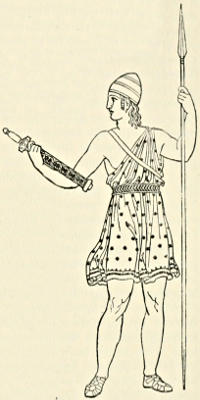
Attendant of a Greek Warrior
(From a vase)
[432 B.C.]
These complaints found increased attention after
the war of Corcyra and the blockade of Potidæa by
the Athenians. The sentiments of the Corinthians
towards Athens had now become angry and warlike
in the highest degree. It was not simply resentment
for the past which animated them, but also the anxiety
farther to bring upon Athens so strong a hostile pressure
as should preserve Potidæa and its garrison from
capture. Accordingly they lost no time in endeavouring
to rouse the feelings of the Spartans against
Athens, and in inducing them to invite to Sparta all
such of the confederates as had any grievances against
that city. Not merely the Megarians, but several
other confederates, came thither as accusers; while
the Æginetans, though their insular position made it
perilous for them to appear, made themselves vehemently
heard through the mouths of others, complaining
that Athens withheld from them the autonomy to which they were
entitled under the truce.
According to the Lacedæmonian practice, it was necessary first that the
Spartans themselves, apart from their allies, should decide whether there
existed a sufficient case of wrong done by Athens against themselves or
against Peloponnesus—either in violation of the Thirty Years’ Truce, or in
any other way. If the determination of Sparta herself were in the negative,
the case would never even be submitted to the vote of the allies; but if it
were in the affirmative, then the latter would be convoked to deliver their
opinion also: and assuming that the majority of votes coincided with the
previous decision of Sparta, the entire confederacy stood then pledged to the
given line of policy—if the majority was contrary, the Spartans would stand
alone, or with such only of the confederates as concurred. Even in the oligarchy
of Sparta, such a question as this could only be decided by a general
assembly of Spartan citizens, qualified both by age, by regular contribution
to the public mess, and by obedience to Spartan discipline. To the assembly
so constituted the deputies of the various allied cities addressed themselves,
each setting forth his case against Athens. The Corinthians chose to reserve
themselves to the last, after the assembly had been inflamed by the previous
speakers.
Of this important assembly, on which so much of the future fate of
Greece turned, Thucydides has preserved an account unusually copious.
First, the speech delivered by the Corinthian envoys. Next, that of some
Athenian envoys, who happening to be at the same time in Sparta on some
other matters, and being present in the assembly so as to have heard the
speeches both of the Corinthians and of the other complainants, obtained
permission from the magistrates to address the assembly in their turn.
Thirdly, the address of the Spartan king Archidamus, on the course of
policy proper to be adopted by Sparta. Lastly, the brief, but eminently
characteristic, address of the ephor, Sthenelaidas, on putting the question for
decision. These speeches, the composition of Thucydides himself, contain
substantially the sentiments of the parties to whom they are ascribed.
Neither of them is distinctly a reply to that which has preceded, but each
presents the situation of affairs from a different point of view.
To dwell much upon specific allegations of wrong, would not have suited
the purpose of the Corinthian envoy; for against such, the Thirty Years’
Truce expressly provided that recourse should be had to amicable arbitration—to
which recourse he never once alludes. He knew that, as between
Corinth and Athens, war had already begun at Potidæa; and his business,
throughout nearly all of a very emphatic speech, is to show that the Peloponnesian
confederacy, and especially Sparta, is bound to take instant part
in it, not less by prudence than by duty. He employs the most animated
language to depict the ambition, the unwearied activity, the personal effort
abroad as well as at home, the quick resolves, the sanguine hopes never
dashed by failure—of Athens, as contrasted with the cautious, home-keeping,
indolent, scrupulous routine of Sparta. He reproaches the Spartans
with their backwardness and timidity, in not having repressed the
growth of Athens before she reached this formidable height, especially in
having allowed her to fortify her city after the retreat of Xerxes and afterwards
to build the Long Walls from the city to the sea. The Spartans (he
observes) stood alone among all Greeks in the notable system of keeping
down an enemy, not by acting, but by delaying to act—not arresting his
growth, but putting him down when his force was doubled. Falsely indeed
had they acquired the reputation of being sure, when they were in reality
merely slow. In resisting Xerxes, as in resisting Athens, they had always
been behindhand, disappointing and leaving their friends to ruin; while both
these enemies had only failed of complete success through their own mistakes.
After half apologising for the tartness of these reproofs—which however,
as the Spartans were now well disposed to go to war forthwith, would be
well-timed and even agreeable—the Corinthian orator vindicates the necessity
of plain-speaking by the urgent peril of the emergency and the formidable
character of the enemy who threatened them. “You do not reflect” he
says “how thoroughly different the Athenians are from yourselves. They
are innovators by nature, sharp both in devising, and in executing what they
have determined: you are sharp only in keeping what you have got, in determining
on nothing beyond, and in doing even less than absolute necessity
requires. They again dare beyond their means, run risks beyond their own
judgment, and keep alive their hopes in desperate circumstances: your
peculiarity is, that your performance comes short of your power, you have
no faith even in what your judgment guarantees, when in difficulties you
despair of all escape. They never hang back, you are habitual laggards:
they love foreign service, you cannot stir from home: for they are always
under the belief that their movements will lead to some further gain, while
you fancy that new products will endanger what you already have. When
successful, they make the greatest forward march; when defeated, they fall
back the least. Moreover they task their bodies on behalf of their city as if
they were the bodies of others, while their minds are most of all their own,
for exertion in her service. When their plans for acquisition do not come
successfully out, they feel like men robbed of what belongs to them: yet
the acquisitions when realised appear like trifles compared with what remains
to be acquired. If they sometimes fail in an attempt, new hopes arise
in some other direction to supply the want; for with them alone the possession
and the hope of what they aim at are almost simultaneous, from their
habit of quickly executing all that they have once resolved. And in this
manner do they toil throughout all their lives amidst hardship and peril,
disregarding present enjoyment in the continual thirst for increase, knowing
no other festival recreation except the performance of active duty, and
deeming inactive repose a worse condition than fatiguing occupation. To
speak the truth in two words, such is their inborn temper that they will
neither remain at rest themselves nor allow rest to others.
“Such is the city which stands opposed to you, Lacedæmonians—yet ye
still hang back from action. Your continual scruples and apathy would
hardly be safe, even if ye had neighbours like yourselves in character:
but as to dealings with Athens, your system is antiquated and out of date.
In politics as in art, it is the modern improvements which are sure to come
out victorious; and though unchanged institutions are best, if a city be not
called upon to act, yet multiplicity of active obligations requires multiplicity
and novelty of contrivance. It is through these numerous trials that
the means of Athens have acquired so much more new development than
yours.”
The Corinthians concluded by saying, that if, after so many previous
warnings, now repeated for the last time, Sparta still refused to protect her
allies against Athens, if she delayed to perform her promise made to the
Potidæans of immediately invading Attica, they (the Corinthians) would
forthwith look for safety in some new alliance, which they felt themselves
fully justified in doing. They admonished her to look well to the case, and
to carry forward Peloponnesus, with undiminished dignity, as it had been
transmitted to her from her predecessors.
Such was the memorable picture of Athens and her citizens, as exhibited
by her fiercest enemy before the public assembly at Sparta. It was calculated
to impress the assembly, not by appeal to recent or particular misdeeds, but
by the general system of unprincipled and endless aggression which was
imputed to Athens during the past, and by the certainty held out that the
same system, unless put down by measures of decisive hostility, would be
pushed still farther in future, to the utter ruin of Peloponnesus. And
to this point did the Athenian envoy (staying in Sparta about some other
negotiation and now present in the assembly) address himself in reply, after
having asked and obtained permission from the magistrates. The empire of
Athens was now of such standing that the younger men present had no personal
knowledge of the circumstances under which it had grown up, and
what was needed as information for them would be impressive as a reminder
even to their seniors.
In her position, he asserted, no Grecian power either would or could have
acted otherwise—no Grecian power, certainly not Sparta, would have acted
with so much equity and moderation or given so little ground of complaint
to her subjects. Worse they had suffered, while under Persia; worse they
would suffer, if they came under Sparta, who held her own allies under the
thraldom of an oligarchical party in each city; and if they hated Athens
this was only because subjects always hated the present dominion, whatever
that might be.
Having justified both the origin and the working of the Athenian empire,
the envoy concluded by warning Sparta to consider calmly, without being
hurried away by the passions and invectives of others, before she took a step
from which there was no retreat, and which exposed the future to chances
such as no man on either side could foresee. He called on her not to break
the truce mutually sworn to, but to adjust all differences, as Athens was
prepared to do, by the amicable arbitration which that truce provided.
Should she begin war, the Athenians would follow her lead and resist her,
calling to witness those gods under whose sanction the oaths were taken. At
any time previous to the affair of Corcyra, the topics insisted upon by the
Athenian would probably have been profoundly listened to at Sparta. But
now the mind of the Spartans was made up. Having cleared the assembly
of all “strangers,” and even all allies, they proceeded to discuss and determine
the question among themselves. Most of their speakers held but one
language—expatiating on the wrongs already done by Athens, and urging
the necessity of instant war. There was however one voice, and that a
commanding voice, raised against this conclusion: the ancient and respected
king Archidamus opposed it.
The speech of Archidamus is that of a deliberate Spartan, who, setting
aside both hatred to Athens and blind partiality to allies, looks at the question
with a view to the interests and honour of Sparta only. He reminded
them of the wealth, the population (greater than that of any other Grecian
city), the naval force, the cavalry, the hoplites, the large foreign dominion
of Athens—and then asked by what means they proposed to put her down.
Ships, they had few; trained seamen, yet fewer; wealth, next to none.
They could indeed invade and ravage Attica, by their superior numbers and
land-force. But the Athenians had possessions abroad sufficient to enable
them to dispense with the produce of Attica, while their great navy would
retaliate the like ravages upon Peloponnesus. To suppose that one or two
devastating expeditions into Attica would bring the war to an end, would
be a deplorable error; such proceedings would merely enrage the Athenians,
without impairing their real strength, and the war would thus be prolonged,
perhaps for a whole generation. Before they determined upon war, it was
absolutely necessary to provide more efficient means for carrying it on; and
to multiply their allies not merely among the Greeks, but among foreigners
also. While this was in process, envoys ought to be sent to Athens to
remonstrate and obtain redress for the grievances of the allies. If the Athenians
granted this—which they very probably would do, when they saw the
preparations going forward, and when the ruin of the highly-cultivated soil
of Attica was held over them in terrorem without being actually consummated—so
much the better: if they refused, in the course of two or three
years, war might be commenced with some hopes of success. Archidamus
reminded his countrymen that their allies would hold them responsible for
the good or bad issue of what was now determined; admonishing them, in
the true spirit of a conservative Spartan, to cling to that cautious policy which
had been ever the characteristic of the state, despising both taunts on their
tardiness and panegyric on their valour.
The speech of Archidamus was not only in itself full of plain reason and
good sense, but delivered altogether from the point of view of a Spartan;
appealing greatly to Spartan conservative feeling and even prejudice. But
in spite of all this, and in spite of the personal esteem entertained for the
speaker, the tide of feeling in the opposite direction was at that moment
irresistible. Sthenelaidas, one of the five ephors to whom it fell to put
the question for voting, closed the debate. His few words mark at once
the character of the man, the temper of the assembly, and the simplicity
of speech, though without the wisdom of judgment, for which Archidamus
had taken credit to his countrymen.
“I don’t understand,” he said, “these long speeches of the Athenians.
They have praised themselves abundantly, but they have never rebutted
what is laid to their charge—that they are guilty of wrong against our
allies and against Peloponnesus. Now if in former days they were good men
against the Persians, and are now evil-doers against us, they deserve double
punishment as having become evil-doers instead of good. But we are the
same now as we were then: we know better than to sit still while our allies
are suffering wrong: we shall not adjourn our aid, while they cannot adjourn
their sufferings. Others have in abundance wealth, ships, and horses—but
we have good allies, whom we are not to abandon to the mercy of the
Athenians: nor are we to trust our redress to arbitration and to words,
when our wrongs are not confined to words. We must help them speedily
and with all our strength. Nor let any one tell us that we can with honour
deliberate when we are actually suffering wrong—it is rather for those who
intend to do the wrong, to deliberate well beforehand. Resolve upon war
then, Lacedæmonians, in a manner worthy of Sparta. Suffer not the Athenians
to become greater than they are: let us not betray our allies to ruin,
but march with the aid of the gods against the wrong-doers.”
With these few words, so well calculated to defeat the prudential admonitions
of Archidamus, Sthenelaidas put the question for the decision of
the assembly—which at Sparta was usually taken neither by show of hands,
nor by deposit of balls in an urn, but by cries analogous to the ay or no of
the English House of Commons—the presiding ephor declaring which of
the cries predominated. On this occasion the cry for war was manifestly the
stronger. Yet Sthenelaidas affected inability to determine which of the two
was the louder, in order that he might have an excuse for bringing about
a more impressive manifestation of sentiment and a stronger apparent majority—since
a portion of the minority would probably be afraid to show their
real opinions as individuals openly. He therefore directed a division—like
the speaker of the English House of Commons when his decision in favour
of ay or no is questioned by any member—“Such of you as think that the
truce has been violated and that the Athenians are doing us wrong, go to
that side; such as think the contrary, to the other side.” The assembly
accordingly divided, and the majority was very great on the warlike side of
the question.
The first step of the Lacedæmonians, after coming to this important
decision, was to send to Delphi and inquire of the oracle whether it would
be beneficial to them to undertake the war. The answer brought back
(Thucydides seems hardly certain that it was really given) was—that if
they did their best they would be victorious, and that the gods would help
them, invoked or uninvoked. They at the same time convened a general
congress of their allies to Sparta, for the purpose of submitting their recent
resolution to the vote of all.
[432-431 B.C.]
If there were any speeches delivered at this congress in opposition to the
war, they were not likely to be successful in a cause wherein even Archidamus
had failed. After the Corinthian had concluded, the question was
put to the deputies of every city, great and small indiscriminately: and the
majority decided for war. This important resolution was adopted about the
end of 432 B.C., or the beginning of January 431 B.C.: the previous decision
of the Spartans separately, may have been taken about two months earlier,
in the preceding October or November 432 B.C.
Reviewing the conduct of the two great Grecian parties at this momentous
juncture, with reference to existing treaties and positive grounds of complaint,
it seems clear that Athens was in the right. She had done nothing
which could fairly be called a violation of the Thirty Years’ Truce: while for
such of her acts as were alleged to be such, she offered to submit them to that
amicable arbitration which the truce itself prescribed. The Peloponnesian
confederates were manifestly the aggressors in the contest; and if Sparta,
usually so backward, now came forward in a spirit so decidedly opposite, we
are to ascribe it partly to her standing fear and jealousy of Athens, partly to
the pressure of her allies, especially of the Corinthians. Thucydides, recognising
these two as the grand determining motives, and indicating the alleged
infractions of truce as simple occasions or pretexts, seems to consider the fear
and hatred of Athens as having contributed more to determine Sparta than
the urgency of her allies. That the extraordinary aggrandisement of Athens,
during the period immediately succeeding the Persian invasion, was well-calculated
to excite alarm and jealousy in Peloponnesus, is indisputable. But
if we take Athens as she stood in 432 B.C., it deserves notice that she had
neither made, nor (so far as we know) tried to make, a single new acquisition
during the whole fourteen years which had elapsed since the conclusion
of the Thirty Years’ Truce—and moreover that that truce marked an epoch
of signal humiliation and reduction of her power. The triumph which Sparta
and the Peloponnesians then gained, though not sufficiently complete to remove
all fear of Athens, was yet great enough to inspire them with the hope
that a second combined effort would subdue her. This mixture of fear and
hope was exactly the state of feeling out of which war was likely to grow.
Moreover the confident hopes of the Peloponnesians were materially
strengthened by the widespread sympathy in favour of their cause, proclaiming
as it did the intended liberation of Greece from a despot city.
To Athens, on the other hand, the coming war presented itself in a very
different aspect; holding out scarcely any hope of possible gain, and the
certainty of prodigious loss and privation—even granting that at this heavy
cost, her independence and union at home, and her empire abroad, could be
upheld. By Pericles, and by the more long-sighted Athenians, the chance of
unavoidable war was foreseen even before the Corcyræan dispute. But
Pericles was only the first citizen in a democracy, esteemed, trusted, and listened
to, more than any one else by the body of citizens, but warmly opposed
in most of his measures, under the free speech and latitude of individual
action which reigned at Athens—and even bitterly hated by many active
political opponents. The formal determination of the Lacedæmonians, to
declare war, must of course have been made known at Athens, by those Athenian
envoys who had entered an unavailing protest against it in the Spartan
assembly. No steps were taken by Sparta to carry this determination into
effect until after the congress of allies and their pronounced confirmatory
vote. Nor did the Spartans even then send any herald, or make any formal
declaration. They despatched various propositions to Athens, not at all with
a view of trying to obtain satisfaction, or of providing some escape from the
probability of war; but with the contrary purpose—of multiplying demands,
and enlarging the grounds of quarrel. Meanwhile the deputies retiring
home from the congress to their respective cities carried with them the general
resolution for immediate warlike preparations to be made with as little
delay as possible.
Greek Helmets and Standard
The first requisition addressed by the Lacedæmonians to Athens was a
political manœuvre aimed at Pericles, their chief opponent in that city. His
mother Agariste belonged to the great family of the Alemæonids, who were
supposed to be under an inexorable hereditary taint, in consequence of the
sacrilege committed by their ancestor Megacles nearly two centuries before,
in the slaughter of the Cylonian suppliants near the altar of the Venerable
Goddesses. Ancient as this transaction was, it still had sufficient hold on
the mind of the Athenians to serve as the basis of a political manœuvre:
about seventy-seven years before, shortly after the expulsion of Hippias
from Athens, it had been so employed by the Spartan king Cleomenes, who
at that time exacted from the Athenians a clearance of the ancient sacrilege,
to be effected by the banishment of Clisthenes (the founder of the democracy)
and his chief partisans. This demand, addressed by Cleomenes to the
Athenians at the instance of Isagoras, the rival of Clisthenes, had been
then obeyed, and had served well the purposes of those who sent it. A
similar blow was now aimed by the Lacedæmonians at Pericles (the grand-nephew
of Clisthenes), and doubtless at the instance of his political enemies:
religion required, it was pretended, that “the abomination of the
goddess should be driven out.” If the Athenians complied with this demand,
they would deprive themselves, at this critical moment, of their ablest
leader. But the Lacedæmonians, not expecting compliance, reckoned at all
events upon discrediting Pericles with the people, as being partly the cause
of the war through family taint of impiety; and this impression would
doubtless be loudly proclaimed by his political opponents in the assembly.
The influence of Pericles with the Athenian public had become greater
and greater as their political experience of him was prolonged. But the
bitterness of his enemies appears to have increased along with it; and not
long before this period, he had been indirectly assailed, as we have seen,
through the medium of accusations against three different persons, all more
or less intimate with him—his mistress Aspasia, the philosopher Anaxagoras,
and the sculptor Phidias. It is said also that Dracontides proposed
and carried a decree in the public assembly, that Pericles should be called on
to give an account of the money which he had expended, and that the dicasts,
before whom the account was rendered, should give their suffrage in the
most solemn manner from the altar: this latter provision was modified by
Agnon, who, while proposing that the dicasts should be fifteen hundred in
number, retained the vote by pebbles in the urn according to ordinary custom.
If Pericles was ever tried on such a charge, there can be no doubt that
he was honourably acquitted: for the language of Thucydides respecting
his pecuniary probity is such as could not have been employed if a verdict
of guilty on a charge of peculation had been publicly pronounced. But we
cannot be certain that he ever was tried; indeed, another accusation urged
by his enemies, and even by Aristophanes in the sixth year of the Peloponnesian
War, implies that no trial took place: for it was alleged that Pericles,
in order to escape this danger, “blew up the Peloponnesian War,” and involved
his country in such confusion and peril as made his own aid and
guidance indispensably necessary to her, especially that he passed the decree
against the Megarians by which the war was really brought on. We know
enough, however, to be certain that such a supposition is altogether inadmissible.
The enemies of Pericles were far too eager, and too expert in
Athenian political warfare, to have let him escape by such a stratagem.
Moreover, we learn from the assurance of Thucydides that the war depended
upon far deeper causes—that the Megarian decree was in no way the real
cause of it; that it was not Pericles, but the Peloponnesians, who brought
it on, by the blow struck at Potidæa.
All that we can make out, amidst these uncertified allegations, is that,
in a year or two immediately preceding the Peloponnesian War, Pericles was
hard pressed by the accusations of political enemies—perhaps even in his
own person, but certainly in the persons of those who were most in his confidence
and affection. And it was in this turn of his political position, that
the Lacedæmonians sent to Athens the above-mentioned requisition, that the
ancient Cylonian sacrilege might be at length cleared out; in other words,
that Pericles and his family might be banished. Doubtless his enemies, as
well as the partisans of Lacedæmon at Athens, would strenuously support this
proposition. And the party of Lacedæmon at Athens was always strong, even
during the middle of the war; to act as proxenus to the Lacedæmonians was
accounted an honour even by the greatest Athenian families. On this occasion,
however, the manœuvre did not succeed, nor did the Athenians listen
to the requisition for banishing the sacrilegious Alcmæonids. On the contrary,
they replied that the Spartans too had an account of sacrilege to clear
off: for they had violated the sanctuary of Poseidon at Cape Tænarus, in
dragging from it some helot suppliants; and the sanctuary of Athene
Chalciœcus at Sparta, in blocking up and starving to death the guilty regent
Pausanias. To require that Laconia might be cleared of these two acts of
sacrilege, was the only answer which the Athenians made to the demand
sent for the banishment of Pericles. Probably the actual effect of that demand
was to strengthen him in the public esteem—very different from the
effect of the same manœuvre when practised before by Cleomenes against
Clisthenes.
Other Spartan envoys shortly afterwards arrived with fresh demands.
The Athenians were now required: (1) to withdraw their troops from
Potidæa; (2) to replace Ægina in its autonomy; (3) to repeal the bill of
exclusion against the Megarians.
It was upon the latter that the greatest stress was laid; an intimation
being held out that the war might be avoided if such repeal were granted.
We see plainly from this proceeding that the Lacedæmonians acted in
concert with the anti-Periclean leaders at Athens. To Sparta and her
confederacy the decree against the Megarians was of less importance than
the rescue of the Corinthian troops now blocked up in Potidæa; but on the
other hand, the party opposed to Pericles would have much better chance of
getting a vote of the assembly against him on the subject of the Megarians:
and this advantage, if gained, would serve to enfeeble his influence generally.
No concession was obtained however on either of the three points: even in
respect to Megara, the decree of exclusion was vindicated and upheld
against all the force of opposition. At length the Lacedæmonians—who
had already resolved upon war and had sent three envoys in mere compliance
with the exigencies of ordinary practice, not with any idea of bringing about
an accommodation—sent a third batch of envoys with a proposition which
at least had the merit of disclosing their real purpose without disguise.
Rhamphias and two other Spartans announced to the Athenians the simple
injunction: “The Lacedæmonians wish the peace to stand; and it may stand,
if you will leave the Greeks autonomous.” Upon this demand, so very different
from the preceding, the Athenians resolved to hold a fresh assembly
on the subject of war or peace, to open the whole question anew for discussion,
and to determine once for all on a peremptory answer.
The last demands presented on the part of Sparta, which went to nothing
less than the entire extinction of the Athenian empire—combined with the
character, alike wavering and insincere, of the demands previously made,
and with the knowledge that the Spartan confederacy had pronounced peremptorily
in favour of war—seemed likely to produce unanimity at Athens,
and to bring together this important assembly under the universal conviction
that war was inevitable. Such however was not the fact.
The reluctance to go to war was sincere amidst the majority of the assembly,
while among a considerable portion of them it was so preponderant,
that they even now reverted to the opening which the Lacedæmonians
had before held out about the anti-Megarian decree, as if that were the
chief cause of the war. There was much difference of opinion among
the speakers, several of whom insisted upon the repeal of this decree, treating
it as a matter far too insignificant to go to war about, and denouncing
the obstinacy of Pericles for refusing to concede such a trifle. Against this
opinion Pericles entered his protest, in an harangue decisive and encouraging,
which Dionysius of Halicarnassus ranks among the best speeches in
Thucydides: the latter historian may probably himself have heard the
original speech.
“I continue, Athenians, to adhere to the same conviction, that we must
not yield to the Peloponnesians. Now let none of you believe that we shall
be going to war about a trifle if we refuse to rescind the Megarian decree—which
they chiefly put forward, as if its repeal would avert the war—let
none of you take blame to yourselves as if we had gone to war about a small
matter. For this small matter contains in itself the whole test and trial of
your mettle: if ye yield it, ye will presently have some other greater exaction
put upon you, like men who have already truckled on one point from fear:
whereas if ye hold out stoutly, ye will make it clear to them that they must
deal with you upon a footing of equality.”
Pericles then examined the relative strength of parties and the chances of
war. The Peloponnesians were a self-working population, with few slaves,
and without wealth, either private or public: they had no means of carrying
on distant or long-continued war: they were ready to expose their persons,
but not at all ready to contribute from their very narrow means: in a border-war
or a single land battle, they were invincible, but for systematic warfare
against a power like Athens, they had neither competent headship, nor habits
of concert and punctuality, nor money to profit by opportunities, always rare
and accidental, for successful attack. They might perhaps establish a fortified
post in Attica, but it would do little serious mischief; while at sea, their
inferiority and helplessness would be complete, and the irresistible Athenian
navy would take care to keep it so. Nor would they be able to reckon on tempting
away the able foreign seamen from Athenian ships by means of funds
borrowed from Olympia or Delphi. For besides that the mariners of the
dependent islands would find themselves losers even by accepting a higher
pay, with the certainty of Athenian vengeance afterwards, Athens herself
would suffice to man her fleet in case of need, with her own citizens and
metics: she had within her own walls steersmen and mariners better, as well
as more numerous, than all Greece besides. There was but one side on
which Athens was vulnerable: Attica unfortunately was not an island—it
was exposed to invasion and ravage. To this the Athenians must submit,
without committing the imprudence of engaging a land battle to avert it:
they had abundant lands out of Attica, insular as well as continental, to supply
their wants, and they could in their turn, by means of their navy, ravage
the Peloponnesian territories, whose inhabitants had no subsidiary lands to
recur to.
“Mourn not for the loss of land and house,” continued the orator: “reserve
your mourning for men: houses and land acquire not men, but men
acquire them. Nay, if I thought I could prevail upon you, I would exhort
you to march out and ravage them yourselves, and thus show to the Peloponnesians
that for them at least ye will not truckle. And I could exhibit
many further grounds for confidently anticipating success, if ye will only be
willing not to aim at increased dominion when we are in the midst of war,
and not to take upon yourself new self-imposed risks; for I have ever been
more afraid of our own blunders than of the plans of our enemy. But these
are matters for further discussion, when we come to actual operations: for
the present, let us dismiss these envoys with the answer—That we will permit
the Megarians to use our markets and harbours, if the Lacedæmonians
on their side will discontinue their summary expulsions of ourselves and our
allies from their own territory; for there is nothing in the truce to prevent
either one or the other: That we will leave the Grecian cities autonomous,
if we had them as autonomous at the time when the truce was made; and as
soon as the Lacedæmonians shall grant to their allied cities autonomy such
as each of them shall freely choose, not such as is convenient to Sparta:
That while we are ready to give satisfaction according to the truce, we will
not begin war, but will repel those who do begin it. Such is the reply at once
just and suitable to the dignity of this city. We ought to make up our minds
that war is inevitable: the more cheerfully we accept it, the less vehement
shall we find our enemies in their attack: and where the danger is greatest,
there also is the final honour greatest, both for a state and for a private
citizen. Assuredly our fathers, when they bore up against the Persians—having
no such means as we possess to start from, and even compelled to
abandon all that they did possess—both repelled the invader and brought
matters forward to our actual pitch, more by advised operation than by good
fortune, and by a daring courage greater than their real power. We ought
not to fall short of them: we must keep off our enemies in every way, and
leave an unimpaired power to our successors.”
These animating encouragements of Pericles carried with them the
majority of the assembly, so that answer was made to the envoys, such as he
recommended, on each of the particular points in debate. It was announced
to them, moreover, on the general question of peace or war, that the Athenians
were prepared to discuss all the grounds of complaint against them,
pursuant to the truce, by equal and amicable arbitration, but that they
would do nothing under authoritative demand. With this answer the envoys
returned to Sparta, and an end was put to negotiation.
It seems evident, from the account of Thucydides, that the Athenian
public was not brought to this resolution without much reluctance, and great
fear of the consequences, especially destruction of property in Attica; and
that a considerable minority took opposition on the Megarian decree—the
ground skilfully laid by Sparta for breaking the unanimity of her enemy,
and strengthening the party opposed to Pericles. But we may also decidedly
infer from the same historian—especially from the proceedings of Corinth
and Sparta as he sets them forth—that Athens could not have avoided the
war without such an abnegation both of dignity and power as no nation under
any government will ever submit to, and as would have even left her without
decent security for her individual rights. It is common to ascribe the
Peloponnesian War to the ambition of Athens, but this is a partial view of
the case.
The aggressive sentiment, partly fear and partly hatred, was on the side
of the Peloponnesians, who were not ignorant that Athens desired the continuance
of peace, but were resolved not to let her stand as she was at the
conclusion of the Thirty Years’ Truce. It was their purpose to attack her
and break down her empire, as dangerous, wrongful, and anti-Hellenic.
The war was thus partly a contest of principle, involving the popular proclamation
of the right of every Grecian state to autonomy, against Athens:
partly a contest of power, wherein Spartan and Corinthian ambition was not
less conspicuous, and far more aggressive in the beginning than Athenian.
[431 B.C.]
Conformably to what is here said, the first blow of the war was struck,
not by Athens, but against her. After the decisive answer given to the
Spartan envoys, taken in conjunction with the previous proceedings, and
the preparations actually going on, among the Peloponnesian confederacy,
the truce could hardly be said to be in force, though there was no formal
proclamation of rupture.
A few weeks undoubtedly passed in restricted and mistrustful intercourse;
though individuals who passed the borders did not think it necessary
to take a herald with them, as in time of actual war. Had the
excess of ambition been on the side of Athens compared with her enemies,
this was the time for her to strike the first blow, carrying with it of course
greater probability of success, before their preparations were completed.
But she remained strictly within the limits of the truce, while the disastrous
series of mutual aggressions, destined to tear in pieces the entrails of Hellas,
was opened by her enemy and her neighbour.
The little town of Platæa, still hallowed by the memorable victory over
the Persians as well as by the tutelary consecration received from Pausanias,
was the scene of this unforeseen enterprise which marks the opening of hostilities
in the Peloponnesian war.b
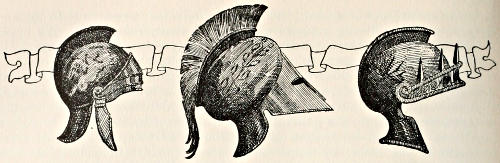
Greek Helmets
War had been only threatened, not declared; and peaceful intercourse,
though not wholly free from distrust, was still kept up between the subjects
of the two confederacies. But early in the following spring, 431 B.C., in
the fifteenth year of the Thirty Years’ Truce, an event took place which
closed all prospects of peace, precipitated the commencement of war, embittered
the animosity of the contending parties, and prepared some of the
most tragical scenes of the ensuing history. In the dead of night the city
of Platæa was surprised by a body of three hundred Thebans, commanded
by two of the great officers called Bœotarchs. They had been invited by
a Platæan named Nauclides, and others of the same party, who hoped with
the aid of the Thebans to rid themselves of their political opponents, and to
break off the relation in which their city was standing to Athens, and transfer
its alliance to Thebes. The Thebans, foreseeing that a general war was
fast approaching, felt the less scruple in strengthening themselves by this
acquisition, while it might be made with little cost and risk. The gates
were unguarded, as in time of peace, and one of them was secretly opened
to the invaders, who advanced without interruption into the marketplace.
Their Platæan friends wished to lead them at once to the houses of their
adversaries, and to glut their hatred by a massacre. But the Thebans were
more anxious to secure the possession of the city, and feared to provoke resistance
by an act of violence. Having therefore halted in the marketplace,
they made a proclamation inviting all who were willing that Platæa should
become again, as it had been in former times, a member of the Bœotian body,
to join them.
The Platæans who were not in the plot, imagined the force by which
their city had been surprised to be much stronger than it really was, and, as
no hostile treatment was offered to them, remained quiet, and entered into a
parley with the Thebans. In the course of these conferences they gradually
discovered that the number of the enemy was small, and might be easily
overpowered; and, as they were in general attached to the Athenians, or at
least strongly averse to an alliance with Thebes, they resolved to make the
attempt, while the darkness might favour them, and perplex the strangers.
To avoid suspicion they met to concert their plan of operation by means of
passages opened through the walls of their houses; and having barricaded
the streets with wagons, and made such other preparations as they thought
necessary, a little before daybreak they suddenly fell upon the Thebans.
The little band made a vigorous defence, and twice or thrice repulsed
the assailants; but as these still returned to the charge, and were assisted by
the women and slaves, who showered stones and tiles from the houses on the
enemy, all at the same time raising a tumultuous clamour, and a heavy rain
increased the confusion caused by the darkness, they at length lost their
presence of mind, and took to flight. But most were unable to find their
way in the dark through a strange town, and several were slain as they
wandered to and fro in search of an outlet. The gate by which they were
admitted had in the meanwhile been closed, and no other was open. Some,
pressed by their pursuers, mounted the walls, and threw themselves down
on the outside, but for the most part were killed by the fall. A few were
fortunate enough to break open one of the gates in a lone quarter, with an
axe which they obtained from a woman, and to effect their escape. The
main body, which had kept together, entered a large building adjoining the
walls, having mistaken its gates, which they found open, for those of
the town, and were shut in. The Platæans at first thought of setting fire
to the building; but at length the men within, as well as the rest of the
Thebans who were still wandering up and down the streets, surrendered at
discretion.
Before their departure from Thebes it had been concerted that as large
a force as could be raised should march the same night to support them.
The distance between the two places was not quite nine miles, and these
troops were expected to reach the gates of Platæa before the morning; but
the Asopus, which crossed their road, had been swollen by the rain, and the
state of the ground and the weather otherwise retarded them, so that they
were still on their way when they heard of the failure of the enterprise.
Though they did not know the fate of their countrymen, as it was possible
that some might have been taken prisoners, they were at first inclined to
seize as many of the Platæans as they could find without the walls, and
to keep them as hostages. The Platæans anticipated this design, and were
alarmed, for many of their fellow citizens were living out of the town in the
security of peace, and there was much valuable property in the country.
They therefore sent a herald to the Theban army to complain of their treacherous
attack, and call upon them to abstain from further aggression, and to
threaten that, if any was offered, the prisoners should answer for it with
their lives. The Thebans afterwards alleged that they had received a promise,
confirmed by an oath, that, on condition of their retiring from the Platæan
territory, the prisoners should be released; and Thucydides seems
disposed to believe this statement. The Platæans denied that they had
pledged themselves to spare the lives of the prisoners, unless they should
come to terms on the whole matter with the Thebans; but it does not seem
likely that, after ascertaining the state of the case, the Thebans would have
been satisfied with so slight a security. It is certain however that they
retired, and that the Platæans, as soon as they had transported their movable
property out of the country into the town, put to death all the prisoners—amounting
to 180, and including Eurymachus, the principal author
of the enterprise, and the man who possessed the greatest influence in
Thebes.
On the first entrance of the Thebans into Platæa a messenger had been
despatched to Athens with the intelligence, and the Athenians had immediately
laid all the Bœotians in Attica under arrest; and when another messenger
brought the news of the victory gained by the Platæans, they sent a
herald to request that they would reserve the prisoners for the disposal of
the Athenians. The herald came too late to prevent the execution: and the
Athenians, foreseeing that Platæa would stand in great need of defence, sent
a body of troops to garrison it, supplied it with provisions, and removed the
women and children and all persons unfit for service in a siege.
After this event it was apparent that the quarrel could only be decided
by arms. Platæa was so intimately united with Athens, that the Athenians
felt the attack which had been made on it as an outrage offered to themselves,
and prepared for immediate hostilities. Sparta, too, instantly sent notice to
all her allies to get their contingents ready by an appointed day for the invasion
of Attica. Two-thirds of the whole force which each raised were
ordered to march, and when the time came assembled in the isthmus, where
King Archidamus put himself at their head. An army more formidable, both
in numbers and spirit, had never issued from the peninsula; and Archidamus
thought it advisable, before they set out, to call the principal officers
together, and to urge the necessity of proceeding with caution and maintaining
exact discipline, as soon as they should have entered the enemy’s territory;
admonishing them not to be so far elated by their superior numbers
as to believe that the Athenians would certainly remain passive spectators of
their inroads. And though all except himself were impatient to move, he
would not yet take the decisive step, without making one attempt more to
avert its necessity. He still cherished a faint hope, that the resolution of
the Athenians might be shaken by the prospect of the evils of war which
were now so imminent, and he sent Melesippus to sound their disposition.
But the envoy was not able to obtain an audience from the people, nor so
much as to enter the walls. A decree had been made, at the instigation of
Pericles, to receive no embassy from the Spartans while they should be under
arms. Melesippus was informed that if his government wished to treat with
Athens, it must first recall its forces. He himself was ordered to quit Attica
that very day, and persons were appointed to conduct him to the frontier, to
prevent him from holding communication with any one by the way. On
parting with his conductors he exclaimed, “This day will be the beginning
of great evils to Greece.”
Such a prediction might well occur to any one, who reflected on the nature
of the two powers which were now coming into conflict, and on the great
resources of both, which, though totally different in kind, were so evenly
balanced that no human eye could perceive in which scale victory hung;
and the termination of the struggle could seem near only to one darkened
by passion. The strength of Sparta, as was implied in the observation of
Sthenelaidas, lay in the armies which she could collect from the states of her
confederacy. The force which she could thus bring into the field is admitted
by Pericles, in one of the speeches ascribed to him by Thucydides, to be capable
of making head against any that could be raised by the united efforts of the rest
of Greece. Within the isthmus her allies included all the states of Peloponnesus,
except Achaia and Argos; and the latter was bound to neutrality by a
truce which still wanted several years of its term. Hence the great contest
now beginning was not improperly called the Peloponnesian War. Beyond
the isthmus she was supported by Megara and Thebes, which drew the rest
of Bœotia along with it; and Attica would thus have been completely surrounded
on the land side by hostile territories, if Platæa and Oropus had not
been politically attached to it. The Locrians of Opus, the Dorians of the
mother-country, and the Phocians (though these last were secretly more
inclined to the Athenians, who had always taken their part in their quarrels
with Delphi, the stanch friend of Sparta) were also on her side. Thessaly,
Acarnania, and the Amphilochian Argos, were in alliance with her enemy;
but for this very reason, and more especially from their hostility to the
Messenians of Naupactus, the Ætolians were friendly to her; and she could
also reckon on the Corinthian colonies, Anactorium, Ambracia, and Leucas.
The power which Sparta exerted over her allies was much more narrowly
limited than that which Athens had assumed over her subjects. The Spartan
influence rested partly on the national affinity by which the head was united
to the Dorian members of the confederacy, but still more on the conformity,
which she established or maintained among all of them, to her own oligarchical
institutions. This was the only point in which she encroached on the
independence of any. Every state had a voice in the deliberations by which
its interests might be affected; and if Sparta determined the amount of the
contributions required by extraordinary occasions, she was obliged carefully
to adjust it to the ability of each community. So far was she from enriching
herself at the expense of the confederacy, that at the beginning of the war
there was, as we have seen, no common treasure belonging to it, and no regular
tribute for common purposes. But, to compensate for these defects, her
power stood on a more durable basis of goodwill than that of Athens; and
though in every state there was a party attached to the Athenian interest on
political grounds, yet on the whole the Spartan cause was popular throughout
Greece; and while Athens was forced to keep a jealous eye on all her
subjects, and was in continual fear of losing them, Sparta, secure of the loyalty
of her own allies, could calmly watch for opportunities of profiting by
the disaffection of those of her rival.
At home indeed her state was far from sound, and the Athenians were
well aware of her vulnerable side; but abroad, and as chief of the Peloponnesian
confederacy, she presented the majestic and winning aspect of the
champion of liberty against Athenian tyranny and ambition: and hence
she had important advantages to hope from states which were but remotely
connected with her, and were quite beyond the reach of her arms. Many
powerful cities in Italy and Sicily were thus induced to promise her their
aid, and it was on this she founded her chief expectations of forming a navy,
which might face that of Athens. Her allies in this quarter engaged to
furnish her with money and ships, which, it was calculated, would amount
to no less than five hundred, though for the present it was agreed that they
should wear the mask of neutrality, and admit single Athenian vessels into
their ports. But as she was conscious that she should still be deficient in
the sinews of war, she already began to turn her eyes to the common enemy
of Greece, who was able abundantly to supply this want, and would probably
be willing to lavish his gold for the sake of ruining Athens, the object of his
especial enmity and dread.
The extent of the Athenian empire cannot be so exactly computed. In
the language of the comic stage, it is said to comprehend a thousand cities;
and it is difficult to estimate what abatement ought to be made from this
playful exaggeration. The subjects of Athens were in general more opulent
than the allies of Sparta, and their sovereign disposed of their revenues at
her pleasure. The only states to which she granted more than a nominal
independence were some islands in the western seas, Corcyra, Zacynthus,
and Cephallenia—points of peculiar importance to her operations and prospects
in that quarter, though even there she was more feared than loved. At
the moment of the revolt of Potidæa her empire had reached its widest
range, and her finances were in the most flourishing condition; and at the
outbreak of the war her naval and military strength was at its greatest
height. Pericles, as one of the ten regular generals, or ministers of war,
before the Peloponnesian army had reached the frontier, held an assembly,
in which he gave an exact account of the resources which the republic had
at her disposal.
Her finances, beside the revenue which she drew from a variety of sources,
foreign and domestic, were nourished by the annual tribute of her allies,
which now amounted to six hundred talents [£120,000 or $600,000]. Six
thousand, in money, still remained in the treasury, after the great expenditure
incurred on account of the public buildings, and the siege of Potidæa, before
which the sum had amounted to nearly ten thousand. But to this, Pericles
observed, must be added the gold and silver which, in various forms of
offerings, ornaments, and sacred utensils, enriched the temples or public
places, which he calculated at five hundred talents, without reckoning the
precious materials employed in the statues of the gods and heroes. The
statue of Athene in the Parthenon alone contained forty talents’ weight of
pure gold, in the ægis, shield, and other appendages. If they should ever
be reduced to the want of such a supply, there could be no doubt that their
tutelary goddess would willingly part with her ornaments for their service,
on condition that they were replaced at the earliest opportunity.
They could muster a force of 13,000 heavy-armed, beside those who
were employed in their various garrisons, and in the defence of the city itself,
with the long walls and the fortifications of its harbours, who amounted
to 16,000 more; made up, indeed, partly of the resident aliens, and partly
of citizens on either verge of the military age. The military force also included
1200 cavalry and 1600 bowmen, beside some who were mounted; and
they had 300 galleys in sailing condition.
After rousing the confidence of the Athenians by this enumeration,
Pericles urged them without delay to transport their families and all their
movable property out of the enemy’s reach, and, as long as the war should
last, to look upon the capital as their home. To encourage a patriotic spirit
by his example, and at the same time to secure himself from imputations to
which he might be exposed, either by the Spartan cunning, or by an indiscreet
display of private friendship, he publicly declared, that if Archidamus,
who was personally attached to him by the ties of hospitality, should,
either from this motive, or in compliance with orders which might be given
in an opposite intention, exempt his lands from the ravages of war, they
should from that time become the property of the state.
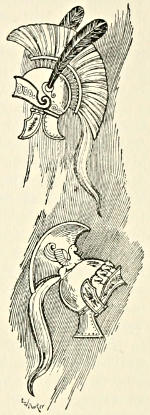
Officers’ Helmets
To many of his hearers that which he required was a very painful sacrifice.
Many had been born, and had passed all their lives, in the country.
They were attached to it, not merely by the profit or the pleasure of rural
pursuits, but by domestic and religious associations. For though the
incorporation of the Attic townships had for ages extinguished their political
independence, it had not interrupted their religious traditions, or effaced
the peculiar features of their local worship; and hence the Attic countryman
clung to his deme with a fondness which he could not feel for the great
city. In the period of increasing prosperity which had followed the Persian
invasion, the country had been cultivated and adorned more assiduously
than ever. All was now to be left or carried away. Reluctantly they
adopted the decree which Pericles proposed; and, with heavy hearts, as if
going into exile, they quitted their native and hereditary seats. If the rich
man sighed to part from his elegant villa, the husbandman still more deeply
felt the pang of being torn from his home, and of abandoning his beloved
fields, the scenes of his infancy, the holy places where his forefathers had
worshipped, to the ravages of a merciless invader. All however was removed:
the flocks and cattle to Eubœa and other adjacent islands; all
beside that was portable, and even the timber of the houses, into Athens,
to which they themselves migrated with their families.
The city itself was not prepared for the sudden influx of so many new
inhabitants. A few found shelter under the roofs of relatives or friends;
but the greater part, on their arrival, found themselves houseless as well as
homeless. Some took refuge in such temples as were usually open; others
occupied the towers of the walls; others raised temporary
hovels on any vacant ground which they could find
in the city, and even resorted for this purpose to a site
which had hitherto been guarded from all such uses by
policy, aided by a religious sanction. It was the place
under the western wall of the citadel, called, from the
ancient builders of the wall, the Pelasgicum: a curse had
been pronounced on any one who should tenant it; and
men remembered some words of an oracle, which declared
it better untrodden. The real motive for the prohibition
was probably the security of the citadel; but all police
seems to have been suspended by the urgency of the occasion.
It was some time before the newcomers bethought
themselves of spreading over the vacant space between
the long walls, or of descending to Piræus. But this
foretaste of the evils of war did not damp the general
ardour, especially that of the youthful spirits, which began
at Athens, as elsewhere, to be impatient of repose. Numberless
oracles and predictions were circulated, in which
every one found something that accorded with the tone
of his feelings. Even those who had no definite hopes,
fears, or wishes shared the excitement of men on the eve
of a great crisis. The holy island of Delos had been
recently shaken by an earthquake. It was forgotten, or
was never known out of Delos itself, that this had happened
already, just before the first Persian invasion. It was deemed a
portent, which signified new and extraordinary events, and it was soon
combined with other prodigies, which tended to encourage similar forebodings.
Such was the state in which the Athenians awaited the advance
of the Peloponnesian army.c
Adolf Holme compares the Periclean policy of voluntary reconcentration
with the acts of the Dutch, when in the sixteenth century they let the
Spanish destroy their crops, and then opened the dikes and flooded their
own country. We may compare also the compulsory reconcentration of the
country people in the cities as carried out by General Weyler in Cuba, in
1897, and by Lord Kitchener in South Africa, in 1901.a
Archidamus, as soon as the reception of his last envoy was made known
to him, continued his march from the isthmus into Attica—which territory
he entered by the road of Œnoe, the frontier Athenian fortress of Attica
towards Bœotia. His march, was slow, and he thought it necessary to make
a regular attack on the fort of Œnoe, which had been put in so good a
state of defence that, after all the various modes of assault—in which the
Lacedæmonians were not skilful—had been tried in vain, and after a delay
of several days before the place, he was compelled to renounce the attempt.
The want of enthusiasm on the part of the Spartan king, his multiplied
delays, first at the isthmus, next in the march, and lastly before Œnoe,
were all offensive to the fiery impatience of the army, who were loud in
their murmurs against him. He acted upon the calculation already laid
down in his discourse at Sparta—that the highly cultivated soil of Attica
was to be looked upon as a hostage for the pacific dispositions of the
Athenians, who would be more likely to yield when devastation, though
not yet inflicted, was nevertheless impending and at their doors. In this
point of view, a little delay at the border was no disadvantage; and perhaps
the partisans of peace at Athens may have encouraged him to hope that
it would enable them to prevail.
After having spent several days before Œnoe without either taking the
fort or receiving any message from the Athenians, Archidamus marched
onward to Eleusis and the Thriasian plain—about the middle of June,
eighty days after the surprise of Platæa. His army was of irresistible
force, not less than sixty thousand hoplites, according to the statement of
Plutarch, or of one hundred thousand, according to others. Considering
the number of constituent allies, the strong feeling by which they were
prompted, and the shortness of the expedition combined with the chance
of plunder, even the largest of these two numbers is not incredibly great,
if we take it to include not hoplites only, but cavalry and light armed
also. But as Thucydides, though comparatively full in his account of this
march, has stated no general total, we may presume that he had heard none
upon which he could rely.
As the Athenians had made no movement towards peace, Archidamus
anticipated that they would come forth to meet him in the fertile plain of
Eleusis and Thria, which was the first portion of territory that he sat down
to ravage. Yet no Athenian force appeared to oppose him, except a
detachment of cavalry, who were repulsed in a skirmish near the small
lakes called Rheiti. Having laid waste this plain without any serious
opposition, Archidamus did not think fit to pursue the straight road which
from Thria conducted directly to Athens across the ridge of Mount Ægaleos,
but turned off to the eastward, leaving that mountain on his right hand
until he came to Cropia, where he crossed a portion of the line of Ægaleos
over to Acharnæ.
He was here about seven miles from Athens, on a declivity sloping down
into the plain which stretches westerly and northwesterly from Athens, and
visible from the city walls; and here he encamped, keeping his army in
perfect order for battle, but at the same time intending to damage and ruin
the place and its neighbourhood. Acharnæ was the largest and most populous
of all the demes in Attica, furnishing no less than three thousand
hoplites to the national line, and flourishing as well by its corn, vines, and
olives, as by its peculiar abundance of charcoal burning from the forests of
ilex on the neighbouring hills. Moreover, if we are to believe Aristophanes,
the Acharnian proprietors were not merely sturdy “hearts of oak,” but
peculiarly vehement and irritable. It illustrates the condition of a Grecian
territory under invasion, when we find this great deme, which could not
have contained less than twelve thousand free inhabitants of both sexes
and all ages, with at least an equal number of slaves, completely deserted.
Archidamus calculated that when the Athenians actually saw his troops so
close to their city, carrying fire and sword over their wealthiest canton,
their indignation would become uncontrollable, and they would march out
forthwith to battle. The Acharnian proprietors especially (he thought)
would be foremost in inflaming this temper, and insisting upon protection to
their own properties—or if the remaining citizens refused to march out
along with them, they would, after having been thus left undefended to
ruin, become discontented and indifferent to the general weal.
Though his calculation was not realised, it was nevertheless founded upon
most rational grounds. What Archidamus anticipated was on the point of
happening, and nothing prevented it except the personal ascendency of Pericles,
strained to its very utmost. So long as the invading army was engaged
in the Thriasian plain, the Athenians had some faint hope that it might (like
Plistoanax fourteen years before) advance no farther into the interior. But
when it came to Acharnæ within sight of the city walls—when the ravagers
were actually seen destroying buildings, fruit trees, and crops, in the plain of
Athens, a sight strange to every Athenian eye except to those very old men
who recollected the Persian invasion—the exasperation of the general body
of citizens rose to a pitch never before known. The Acharnians first of all—next
the youthful citizens, generally—became madly clamorous for arming
and going forth to fight. Knowing well their own great strength, but
less correctly informed of the superior strength of the enemy, they felt
confident that victory was within their reach. Groups of citizens were
everywhere gathered together, angrily debating the critical question of the
moment; while the usual concomitants of excited feeling—oracles and
prophecies of diverse tenor, many of them doubtless promising success
against the enemy at Acharnæ—were eagerly caught up and circulated.
In this inflamed temper of the Athenian mind, Pericles was naturally the
great object of complaint and wrath. He was denounced as the cause of all
the existing suffering: he was reviled as a coward for not leading out the
citizens to fight, in his capacity of general: the rational convictions as to
the necessity of the war and the only practical means of carrying it on, which
his repeated speeches had implanted, seemed to be altogether forgotten. This
burst of spontaneous discontent was of course fomented by the numerous
political enemies of Pericles, and particularly by Cleon,[47] now rising into importance
as an opposition-speaker; whose talent for invective was thus first
exercised under the auspices of the high aristocratical party, as well as of an
excited public.
But no manifestations, however violent, could disturb either the judgment
or the firmness of Pericles. He listened unmoved to all the declarations made
against him, resolutely refusing to convene a public assembly, or any meeting
invested with an authorised character, under the present irritated temper
of the citizens. It appears that he as general, or rather the board of ten
generals among whom he was one, must have been invested constitutionally
with the power not only of calling the ecclesia when they thought fit, but
also of preventing it from meeting, and of postponing even those regular
meetings which commonly took place at fixed times, four times in the prytany.
No assembly accordingly took place, and the violent exasperation of
the people was thus prevented from realising itself in any rash public resolution.
That Pericles should have held firm against this raging force, is but
one among the many honourable points in his political character; but it is
far less wonderful than the fact that his refusal to call the ecclesia was efficacious
to prevent the ecclesia from being held. The entire body of Athenians
were now assembled within the walls, and if he refused to convoke the
ecclesia, they might easily have met in the Pnyx without him; for which it
would not have been difficult at such a juncture to provide plausible justification.
The inviolable respect which the Athenian people manifested on this
occasion for the forms of their democratical constitution—assisted doubtless
by their long-established esteem for Pericles, yet opposed to an excitement
alike intense and pervading, and to a demand apparently reasonable, in so far
as regarded the calling of an assembly for discussion—is one of the most
memorable incidents in their history.
While Pericles thus decidedly forbade any general march out for battle he
sought to provide as much employment as possible for the compressed eagerness
of the citizens. The cavalry were sent forth, together with the Thessalian
cavalry their allies, for the purpose of restraining the excursions of the
enemy’s light troops, and protecting the lands near the city from plunder.
At the same time he fitted out a powerful expedition, which sailed forth to
ravage Peloponnesus, even while the invaders were yet in Attica. Archidamus,
after having remained engaged in the devastation of Acharnæ long
enough to satisfy himself that the Athenians would not hazard a battle, turned
away from Athens in a northwesterly direction towards the demes between
Mount Brilessus and Mount Parnes, on the road passing through Decelea.
The army continued ravaging these districts until their provisions were exhausted,
and then quitted Attica by the northwestern road near Oropus,
which brought them into Bœotia. As the Oropians, though not Athenians,
were yet dependent upon Athens—the district of Græa, a portion of their
territory, was laid waste; after which the army dispersed and retired back
to their respective homes. It would seem that they quitted Attica towards
the end of July, having remained in the country between thirty and forty
days.
Meanwhile, the Athenian expedition, under Caranus, Proteas, and Socrates,
joined by fifty Corcyræan ships and by some other allies, sailed round
Peloponnesus, landing in various parts to inflict damage, and among other
places at Methone (Modon), on the southwestern peninsula of the Lacedæmonian
territory. The place, neither strong nor well-garrisoned, would
have been carried with little difficulty, had not Brasidas, the son of Tellis—a
gallant Spartan now mentioned for the first time, but destined to great
celebrity afterwards—who happened to be on guard at a neighbouring post,
thrown himself into it with one hundred men by a rapid movement, before
the dispersed Athenian troops could be brought together to prevent him.
He infused such courage into the defenders of the place that every attack
was repelled, and the Athenians were forced to re-embark—an act of prowess
which procured for him the first public honours bestowed by the Spartans
during this war. Sailing northward along the western coast of Peloponnesus,
the Athenians landed again on the coast of Elis, a little south of the promontory
called Cape Ichthys: they ravaged the territory for two days, defeating
both the troops in the neighbourhood and three hundred chosen men from
the central Elean territory. Strong winds on a harbourless coast now
induced the captains to sail with most of the troops round Cape Ichthys,
in order to reach the harbour of Phea on the northern side of it; while the
Messenian hoplites, marching by land across the promontory, attacked Phea
and carried it by assault. When the fleet arrived, all were re-embarked—the
full force of Elis being under march to attack them. They then sailed
northward, landing on various other spots to commit devastation, until they
reached Sollium, a Corinthian settlement on the coast of Acarnania. They
captured this place, which they handed over to the inhabitants of the neighbouring
Acarnanian town of Palærus, as well as Astacus, from whence they
expelled the despot Euarchus, and enrolled the town as a member of the
Athenian alliance. From hence they passed over to Cephallenia, which they
were fortunate enough also to acquire as an ally of Athens without any compulsion—with
its four distinct towns or districts, Pale, Cranii, Same, and
Proni. These various operations took up near three months from about the
beginning of July, so that they returned to Athens towards the close of
September—the beginning of the winter half of the year, according to
the distribution of Thucydides.
This was not the only maritime expedition of the summer. Thirty more
triremes, under Cleopompus, were sent through the Euripus to the Locrian
coast opposite to the northern part of Eubœa. Some disembarkations were
made, whereby the Locrian towns of Thronium and Alope were sacked, and
further devastation inflicted; while a permanent garrison was planted, and a
fortified post erected, in the uninhabited island of Atalante opposite to the
Locrian coast, in order to restrain privateers from Opus and the other Locrian
towns in their excursions against Eubœa. It was further determined to
expel the Æginetan inhabitants from Ægina, and to occupy the island with
Athenian colonists. This step was partly rendered prudent by the important
position of the island midway between Attica and Peloponnesus. But a
concurrent motive, and probably the stronger motive, was the gratification
of ancient antipathy and revenge against a people who had been among the
foremost in provoking the war and in inflicting upon Athens so much suffering.
The Æginetans, with their wives and children, were all put on ship-board
and landed in Peloponnesus, where the Spartans permitted them to
occupy the maritime district and town of Thyrea, their last frontier towards
Argos; some of them, however, found shelter in other parts of Greece. The
island was made over to a detachment of Athenian cleruchs, or citizen proprietors,
sent hither by lot.
To the sufferings of the Æginetans, which we shall hereafter find still
more deplorably aggravated, we have to add those of the Megarians. Both
had been most zealous in kindling the war, but upon none did the distress of
war fall so heavily. Both probably shared the premature confidence felt
among the Peloponnesian confederacy, that Athens could never hold out
more than a year or two, and were thus induced to overlook their own undefended
position against her. Towards the close of September, the full force
of Athens, citizens and metics, marched into the Megarid, under Pericles,
and laid waste the greater part of the territory; while they were in it, the
hundred ships which had been circumnavigating Peloponnesus, having arrived
at Ægina on their return, joined their fellow citizens in the Megarid,
instead of going straight home. The junction of the two formed
the largest Athenian force that had ever yet been seen together; there
were ten thousand citizen hoplites (independent of three thousand others
who were engaged in the siege of Potidæa), and three thousand metic hoplites,
besides a large number of light troops. Against so large a force the
Megarians could make no head, so that their territory was all laid waste, even
to the city walls. For several years of the war, the Athenians inflicted this
destruction once, and often twice in the same year. A decree was proposed
in the Athenian ecclesia by Charinus, though perhaps not carried, to the effect
that the strategi every year should swear, as a portion of their oath of office,
that they would twice invade and ravage the Megarid. As the Athenians at
the same time kept the port of Nisæa blocked up, by means of their superior
naval force and of the neighbouring coast of Salamis, the privations imposed
on the Megarians became extreme and intolerable. Not only their corn and
fruits, but even their garden vegetables were rooted up, and their situation
was that of a besieged city pressed by famine. Even in the time of Pausanias,
many centuries afterward, the miseries of the town during these years were
remembered and communicated to him, being assigned as the reason why one
of their most memorable statues had never been completed.
To the various military operations of Athens during the course of this
summer, some other measures of moment are to be added. Moreover, Thucydides
notices an eclipse of the sun, which modern astronomical calculations
refer to the third of August; had this eclipse happened three months earlier,
immediately before the entrance of the Peloponnesians into Attica, it might
probably have been construed as an unfavourable omen, and caused the postponement
of the scheme. Expecting a prolonged struggle, the Athenians
now made arrangements for placing Attica in a permanent state of defence,
both by sea and land; what these arrangements were, we are not told in
detail, but one of them was sufficiently remarkable to be named particularly.
They set apart one thousand talents [£200,000 or $1,000,000] out of the treasure
in the Acropolis as an inviolable reserve, not to be touched except on the
single contingency of a hostile naval force about to assail the city, with no
other means at hand to defend it. They further enacted that if any citizen
should propose, or any magistrate put the question, in the public assembly,
to make any different application of this reserve, he should be punishable
with death. Moreover, they resolved every year to keep back one hundred
of their best triremes, and trierarchs to command and equip them, for the same
special necessity. It may be doubted whether this latter provision was placed
under the same stringent sanction, or observed with the same rigour, as that
concerning the money; which latter was not departed from until the twentieth
year of the war, after all the disasters of the Sicilian expedition, and on
the terrible news of the revolt of Chios. It was on that occasion that the
Athenians first repealed the sentence of capital punishment against the proposer
of this forbidden change, and next appropriated the money to meet the
then imminent peril of the commonwealth.
The resolution here taken about this sacred reserve, and the rigorous
sentence interdicting contrary propositions, is pronounced by Mitford[48] to
be an evidence of the indelible barbarism of democratical government. But
we must recollect, first, that the sentence of capital punishment was one
which could hardly by possibility come into execution; for no citizen would
be so mad as to make the forbidden proposition while this law was in force.
Whoever desired to make it would first begin by proposing to repeal the
prohibitory law, whereby he would incur no danger, whether the assembly
decided in the affirmative or negative; and if he obtained an affirmative
decision he would then, and then only, proceed to move the re-appropriation
of the fund. To speak the language of English parliamentary procedure, he
would first move the suspension or abrogation of the standing order whereby
the proposition was forbidden; next, he would move the proposition itself;
in fact, such was the mode actually pursued, when the thing at last came to
be done. But though the capital sentence could hardly come into effect, the
proclamation of it in terrorem had a very distinct meaning. It expressed
the deep and solemn conviction which the people entertained of the importance
of their own resolution about the reserve; it forewarned all assemblies
and all citizens to come of the danger of diverting it to any other purpose;
it surrounded the reserve with an artificial sanctity, which forced every man
who aimed at the re-appropriation to begin with a preliminary proposition
formidable on the very face of it, as removing a guarantee which previous
assemblies had deemed of immense value, and opening the door to a contingency
which they had looked upon as treasonable. The proclamation of a
lighter punishment, or a simple prohibition without any definite sanction
whatever, would neither have announced the same emphatic conviction, nor
produced the same deterring effect. The assembly of 431 B.C. could not in
any way enact laws which subsequent assemblies could not reverse; but it
could so frame its enactments, in cases of peculiar solemnity, as to make its
authority strongly felt upon the judgment of its successors, and to prevent
them from entertaining motions for repeal except under necessity at once
urgent and obvious.
Far from thinking that the law now passed at Athens displayed barbarism,
either in the end or in the means, we consider it principally remarkable
for its cautious and long-sighted view of the future—qualities the exact
reverse of barbarism—and worthy of the general character of Pericles, who
probably suggested it. Athens was just entering into a war which threatened
to be of indefinite length, and was certain to be very costly. To prevent
the people from exhausting all their accumulated fund, and to place
them under a necessity of reserving something against extreme casualties,
was an object of immense importance. Now the particular casualty, which
Pericles (assuming him to be the proposer) named as the sole condition of
touching this one thousand talents, might be considered as of all others the
most improbable, in the year 431 B.C. So immense was then the superiority
of the Athenian naval force, that to suppose it defeated, and a Peloponnesian
fleet in full sail for Piræus, was a possibility which it required a statesman
of extraordinary caution to look forward to, and which it is truly wonderful
that the people generally could have been induced to contemplate.
Once tied up to this purpose, however, the fund lay ready for any other
terrible emergency: and we shall find the actual employment of it incalculably
beneficial to Athens, at a moment of the gravest peril, when she could
hardly have protected herself without some such special resource. The
people would scarcely have sanctioned so rigorous an economy, had it not
been proposed to them at a period so early in the war that their available
reserve was still much larger. But it will be forever to the credit of their
foresight as well as constancy, that they should first have adopted such a
precautionary measure, and afterwards adhered to it for nineteen years,
under severe pressure for money, until at length a case arose which rendered
further abstinence really, and not constructively, impossible.
To display their force and take revenge by disembarking and ravaging
parts of the Peloponnesus, was doubtless of much importance to Athens during
this first summer of the war: though it might seem that the force so
employed was quite as much needed in the conquest of Potidæa, which still
remained under blockade, and of the neighbouring Chalcidians in Thrace,
still in revolt. It was during the course of this summer that a prospect
opened to Athens of subduing these towns, through the assistance of Sitalces,
king of the Odrysian Thracians. That prince had married the sister of
Nymphodorus, a citizen of Abdera; who engaged to render him, and his son
Sadocus, allies of Athens. Sent for to Athens and appointed proxenus of
Athens at Abdera, which was one of the Athenian subject allies, Nymphodorus
made this alliance, and promised in the name of Sitalces that a sufficient
Thracian force should be sent to aid Athens in the reconquest of her
revolted towns: the honour of Athenian citizenship was at the same time
conferred upon Sadocus. Nymphodorus further established a good understanding
between Perdiccas II of Macedonia and the Athenians, who were
persuaded to restore to him Therma, which they had before taken from him.
The Athenians had thus the promise of powerful aid against the Chalcidians
and Potidæans: yet the latter still held out, with little prospect of immediate
surrender. Moreover, the town of Astacus in Acarnania, which the
Athenians had captured during the summer, in the course of their expedition
round Peloponnesus, was recovered during the autumn by the deposed
despot Euarchus, assisted by forty Corinthian triremes and one thousand
hoplites. This Corinthian armament, after restoring Euarchus, made some
unsuccessful descents both upon other parts of Acarnania and upon the
island of Cephallenia: in the latter they were entrapped into an ambuscade
and obliged to return home with considerable loss.b
Greek Terra-cotta
(In the British Museum)
It was towards the close of autumn that Pericles, chosen by the people
for the purpose, delivered the funeral oration at the public interment of
those warriors who had fallen during the campaign, on the occasion of the
conquest of Samos. One of the remarkable features in this discourse is its
business-like, impersonal character: it is Athens herself who undertakes to
commend and to decorate her departed sons, as well as to hearten up and
admonish the living.
After a few words on the magnitude of the empire and on the glorious
efforts as well as endurance whereby their forefathers and they had acquired
it—Pericles proceeds to sketch the plan of life, the constitution, and the
manners, under which such achievements were brought about.
“We live under a constitution such as noway to envy the laws of our
neighbours,—ourselves an example to others, rather than mere imitators.
It is called a democracy, since its permanent aim tends towards the Many
and not towards the Few: in regard to private matters and disputes, the
laws deal equally with every man; while looking to public affairs, and to
claims of individual influence, every man’s chance of advancement is determined
not by party favour but by real worth, according as his reputation
stands in his own particular department: nor does poverty, or obscure station,
keep him back, if he really has the means of benefiting the city. And
our social march is free, not merely in regard to public affairs, but also in
regard to intolerance of each other’s diversity of daily pursuits. For we
are not angry with our neighbour for what he may do to please himself, nor
do we ever put on those sour looks, which, though they do no positive damage,
are not the less sure to offend. Thus conducting our private social intercourse
with reciprocal indulgence, we are restrained from wrong on public
matters by fear and reverence of our magistrates for the time being and of
our laws—especially such laws as are instituted for the protection of wrongful
sufferers, and even such others as, though not written, are enforced by
a common sense of shame.
“Besides this, we have provided for our minds numerous recreations from
toil, partly by our customary solemnities of sacrifice and festival throughout
the year, partly by the elegance of our private establishments, the daily
charm of which banishes the sense of discomfort. From the magnitude of
our city, the products of the whole earth are brought to us, so that our enjoyment
of foreign luxuries is as much our own and assured as those which we
grow at home. In respect to training for war, we differ from our opponents
(the Lacedæmonians) on several material points. First, we lay open our city
as a common resort: we apply no xenelasia to exclude even an enemy either
from any lesson or any spectacle, the full view of which he may think advantageous
to him; for we trust less to manœuvres and quackery than to our
native bravery, for warlike efficiency. Next, in regard to education, while
the Lacedæmonians even from their earliest youth subject themselves to an
irksome exercise for the attainment of courage, we with our easy habits of
life are not less prepared than they, to encounter all perils within the measure
of our strength. The proof of this is, that the Peloponnesian confederates
do not attack us one by one, but with their whole united force; while
we, when we attack them at home, overpower for the most part all of them
who try to defend their own territory. None of our enemies has ever met
and contended with our entire force; partly in consequence of our large
navy—partly from our dispersion in different simultaneous land expeditions.
But when they chance to be engaged with any part of it, if victorious, they
pretend to have vanquished us all—if defeated, they pretend to have been
vanquished by all.
“Now if we are willing to brave danger, just as much under an indulgent
system as under constant toil, and by spontaneous courage as much as under
force of law—we are gainers in the end by not vexing ourselves beforehand
with sufferings to come, yet still appearing in the hour of trial not less daring
than those who toil without ceasing.
“In other matters, too, as well as in these, our city deserves admiration.
For we combine elegance of taste with simplicity of life, and we pursue
knowledge without being enervated: we employ wealth not for talking and
ostentation, but as a real help in the proper season: nor is it disgraceful to
any one who is poor to confess his poverty, though he may rather incur
reproach for not actually keeping himself out of poverty. The magistrates
who discharge public trusts fulfil their domestic duties also—the private
citizen, while engaged in professional business, has competent knowledge on
public affairs: for we stand alone in regarding the man who keeps aloof
from these latter not as harmless, but as useless. Moreover, we always hear
and pronounce on public matters, when discussed by our leaders—or perhaps
strike out for ourselves correct reasonings about them: far from accounting
discussion an impediment to action, we complain only if we are not
told what is to be done before it becomes our duty to do it. For in truth
we combine in the most remarkable manner these two qualities—extreme
boldness in execution with full debate beforehand on that which we are
going about: whereas with others, ignorance alone imparts boldness—debate
introduces hesitation. Assuredly those men are properly to be
regarded as the stoutest of heart, who, knowing most precisely both the
terrors of war and the sweets of peace, are still not the less willing to encounter
peril.
“In fine, I affirm that our city, considered as a whole, is the schoolmistress
of Greece; while, viewed individually, we enable the same man to furnish
himself out and suffice to himself in the greatest variety of ways and with
the most complete grace and refinement. This is no empty boast of the
moment, but genuine reality; and the power of the city, acquired through
the dispositions just indicated, exists to prove it. Athens alone of all cities
stands forth in actual trial greater than her reputation: her enemy when he
attacks her will not have his pride wounded by suffering defeat from feeble
hands—her subjects will not think themselves degraded as if their obedience
were paid to an unworthy superior. Having thus put forth our power, not
uncertified, but backed by the most evident proofs, we shall be admired not
less by posterity than by our contemporaries. Nor do we stand in need
either of Homer or of any other panegyrist, whose words may for the moment
please, while the truth when known would confute their intended meaning.
We have compelled all land and sea to become accessible to our courage, and
have planted everywhere imperishable monuments of our kindness as well
as of our hostility.
“Such is the city on behalf of which these warriors have nobly died in
battle, vindicating her just title to unimpaired rights—and on behalf of
which all of us here left behind must willingly toil. It is for this reason
that I have spoken at length concerning the city, at once to draw from it the
lesson that the conflict is not for equal motives between us and enemies who
possess nothing of the like excellence—and to demonstrate by proofs the
truth of my encomium pronounced upon her.”
Pericles pursues at considerable additional length the same tenor of
mixed exhortation to the living and eulogy of the dead; with many special
and emphatic observations addressed to the relatives of the latter, who were
assembled around and doubtless very near him. But the extract which we
have already made is so long, that no further addition would be admissible:
yet it was impossible to pass over lightly the picture of the Athenian commonwealth
in its glory, as delivered by the ablest citizen of the age. The
effect of the democratical constitution, with its diffused and equal citizenship,
in calling forth not merely strong attachment, but painful self sacrifice, on
the part of all Athenians—is nowhere more forcibly insisted upon than in
the words above cited of Pericles, as well as in others afterwards. “Contemplating
as you do daily before you the actual power of the state, and
becoming passionately attached to it, when you conceive its full greatness,
reflect that it was all acquired by men daring, acquainted with their duty,
and full of an honourable sense of shame in their actions”—such is the
association which he presents between the greatness of the state as an object
of common passion, and the courage, intelligence, and mutual esteem, of
individual citizens, as its creating and preserving causes; poor as well as
rich being alike interested in the partnership.
But the claims of patriotism, though put forward as essentially and deservedly
paramount, are by no means understood to reign exclusively, or to
absorb the whole of the democratical activity. Subject to these, and to
those laws and sanctions which protect both the public and individuals
against wrong, it is the pride of Athens to exhibit a rich and varied fund of
human impulse—an unrestrained play of fancy and diversity of private
pursuit coupled with a reciprocity of cheerful indulgence between one individual
and another—and an absence even of those “black looks” which
so much embitter life, even if they never pass into enmity of fact. This
portion of the speech of Pericles deserves particular attention, because it
serves to correct an assertion, often far too indiscriminately made, respecting
antiquity as contrasted with modern societies—an assertion that the ancient
societies sacrificed the individual to the state, and that only in modern times
has individual agency been left free to the proper extent. This is preeminently
true of Sparta—it is also true in a great degree of the ideal
societies depicted by Plato and Aristotle: but it is pointedly untrue of the
Athenian democracy, nor can we with any confidence predicate it of the
major part of the Grecian cities.
Connected with this reciprocal indulgence of individual diversity, was
not only the hospitable reception of all strangers at Athens, which Pericles
contrasts with the xenelasia or jealous expulsion practised at Sparta—but
also the many-sided activity, bodily and mental, visible in the former, so
opposite to that narrow range of thought, exclusive discipline of the body,
and never-ending preparation for war, which formed the system of the
latter. His assertion that Athens was equal to Sparta even in her own solitary
excellence—efficiency on the field of battle—is doubtless untenable.
But not the less impressive is his sketch of that multitude of concurrent
impulses which at this same time agitated and impelled the Athenian mind—the
strength of one not implying the weakness of the remainder: the relish
for all pleasures of art and elegance, and the appetite for intellectual expansion,
coinciding in the same bosom with energetic promptitude as well as
endurance: abundance of recreative spectacles, yet noway abating the cheerfulness
of obedience even to the hardest calls of patriotic duty: that combination
of reason and courage which encountered danger the more willingly
from having discussed and calculated it beforehand: lastly, an anxious interest,
as well as a competence of judgment, in public discussion and public
action, common to every citizen rich and poor, and combined with every
man’s own private industry. So comprehensive an ideal of many-sided social
development, bringing out the capacities for action and endurance, as well
as those for enjoyment, would be sufficiently remarkable, even if we supposed
it only existing in the imagination of a philosopher: but it becomes still
more so when we recollect that the main features of it at least were drawn
from the fellow citizens of the speaker. It must be taken however as belonging
peculiarly to the Athens of Pericles and his contemporaries; nor
would it have suited either the period of the Persian War fifty years before,
or that of Demosthenes seventy years afterwards.
At the former period, the art, letters, philosophy, adverted to with pride
by Pericles, were as yet backward, while even the active energy and democratical
stimulus, though very powerful, had not been worked up to the pitch
which they afterwards reached: at the latter period, although the intellectual
manifestations of Athens subsist in full or even increased vigour, we shall
find the personal enterprise and energetic spirit of her citizens materially
abated. As the circumstances, which we have already recounted, go far to
explain the previous upward movement, so those which fill the coming chapters,
containing the disasters of the Peloponnesian War, will be found to
explain still more completely the declining tendency shortly about to commence.
Athens was brought to the brink of entire ruin, from which it is
surprising that she recovered at all—but noway surprising that she recovered
at the expense of a considerable loss of personal energy in the character
of her citizens.
And thus the season at which Pericles delivered his discourse lends to
it an additional and peculiar pathos. It was delivered at a time when
Athens was as yet erect and at her maximum: for though her real power
was doubtless much diminished compared with the period before the Thirty
Years’ Truce, yet the great edifices and works of art, achieved since then,
tended to compensate that loss, in so far as the sense of greatness was concerned;
and no one, either citizen or enemy, considered Athens as having
at all declined. It was delivered at the commencement of the great struggle
with the Peloponnesian confederacy, the coming hardships of which
Pericles never disguised either to himself or to his fellow citizens, though
he fully counted upon eventual success. Attica had been already invaded;
it was no longer “the unwasted territory,” as Euripides had designated it
in his tragedy Medea, represented three or four months before the march
of Archidamus—and a picture of Athens in her social glory was well
calculated both to arouse the pride and nerve the courage of those individual
citizens, who had been compelled once, and would be compelled again and
again, to abandon their country residences and fields for a thin tent or confined
hole in the city. Such calamities might indeed be foreseen: but there
was one still greater calamity, which, though actually then impending,
could not be foreseen.b
[430 B.C.]
At the very beginning of the next summer the Peloponnesians and their
allies, with two-thirds of their forces, as on the first occasion, invaded Attica,
under the command of Archidamus, the son of Zeuxidamus, king of the
Lacedæmonians; and after encamping, they laid waste the country. When
they had not yet been many days in Attica, the plague first began to show
itself among the Athenians; though it was said to have previously lighted
on many places, about Lemnos and elsewhere. Such a pestilence, however,
and loss of life as this, was nowhere remembered to have happened. For
neither were physicians of any avail at first, treating it as they did, in
ignorance of its nature,—nay, they themselves died most of all, inasmuch
as they most visited the sick,—nor any other art of man. And as to the
supplications that they offered in their temples, or the divinations, and
similar means, that they had recourse to, they were all unavailing; and at
last they ceased from them, being overcome by the pressure of the calamity.
It is said to have first begun in the part of Ethiopia above Egypt, and
then to have come down into Egypt, and Libya, and the greatest part of the
king’s territory.[49] On the city of Athens it fell suddenly, and first attacked
the men in the Piræus; so that it was even reported by them that the Peloponnesians
had thrown poison into the cisterns; for as yet there were no fountains
there. Afterwards it reached the upper city also; and then they died
much more generally. Now let every one, whether physician or unprofessional
man, speak on the subject according to his views; from what source
it was likely to have arisen, and the causes which he thinks were sufficient
to have produced so great a change from health to universal sickness. I,
however, shall only describe what was its character; and explain those symptoms
by reference to which one might best be enabled to recognise it through
this previous acquaintance, if it should ever break out again; for I was both
attacked by it myself, and had personal observation of others who were suffering
with it.
That year then, as was generally allowed, happened to be of all years
the most free from disease, so far as regards other disorders; and if any
one had any previous sickness, all terminated in this. Others, without any
ostensible cause, but suddenly, while in the enjoyment of health, were seized
at first with violent heats in the head, and redness and inflammation of the
eyes; and the internal parts, both the throat and the tongue, immediately
assumed a bloody tinge, and emitted an unnatural and fetid breath. Next
after these symptoms, sneezing and hoarseness came on; and in a short time
the pain descended to the chest, with a violent cough. When it settled in
the stomach, it caused vomiting; and all the discharges of bile that have
been mentioned by physicians succeeded, and those accompanied with great
suffering. An ineffectual retching also followed in most cases, producing a
violent spasm, which in some cases ceased soon afterwards, in others not
until a long time later.
Externally the body was not very hot to the touch, nor was it pale; but
reddish, livid, and broken out
in small pimples and sores.
But the internal parts were
burnt to such a degree that
they could not bear clothing
or linen of the very lightest
kind to be laid upon them, nor
to be anything else but stark
naked; but would most gladly
have thrown themselves into
cold water if they could. Indeed
many of those who were
not taken care of did so, plunging
into cisterns in the agony
of their unquenchable thirst:
and it was all the same whether
they drank much or little.
Moreover, the misery of restlessness
and wakefulness continually
oppressed them. The
body did not waste away so
long as the disease was at its
height, but resisted it beyond
all expectation: so that they
either died in most cases on
the ninth or the seventh day,
through the internal burning,
while they had still some degree
of strength; or if they
escaped that stage of the disorder,
then, after it had further
descended into the bowels, and violent ulceration was produced in them,
and intense diarrhœa had come on, the greater part were afterwards carried
off through the weakness occasioned by it. For the disease, which was
originally seated in the head, beginning from above, passed throughout the
whole body; and if any one survived its most fatal consequences, yet it
marked him by laying hold of his extremities; for it settled on the pudenda,
and fingers, and toes, and many escaped with the loss of these, while some
also lost their eyes. Others, again, were seized on their first recovery with
forgetfulness of everything alike, and did not know either themselves or
their friends.
Greek Funeral Pyre
For the character of the disorder surpassed description; and while in
other respects also it attacked every one in a degree more grievous than
human nature could endure, in the following way, especially, it proved itself
to be something different from any of the diseases familiar to man.[50] All the
birds and beasts that prey on human bodies, either did not come near them,
though there were many lying unburied, or died after they had tasted them.
As a proof of this, there was a marked disappearance of birds of this kind,
and they were not seen either engaged in this way, or in any other; while
the dogs, from their domestic habits, more clearly afforded opportunity of
marking the result I have mentioned.
The disease, then, to pass over many various points of peculiarity, as it
happened to be different in one case from another, was in its general nature
such as I have described. And no other of those to which they were accustomed
afflicted them besides this at that time; or whatever there was, it
ended in this. And of those who were seized by it some died in neglect,
others in the midst of every attention. And there was no one settled remedy,
so to speak, by applying which they were to give them relief: for what did
good to one, did harm to another. And no constitution showed itself fortified
against it, in point either of strength or weakness: but it seized on
all alike, even those that were treated with all possible regard to diet. But
the most dreadful part of the whole calamity was the dejection felt whenever
any one found himself sickening (for by immediately falling into a feeling
of despair, they abandoned themselves much more certainly to the disease,
and did not resist it), and the fact of their being charged with infection
from attending on one another, and so dying like sheep. And it was this
that caused the greatest mortality amongst them; for if through fear they
were unwilling to visit each other, they perished from being deserted, and
many houses were emptied for want of some one to attend to the sufferers;
or if they did visit them, they met their death, and especially such as made
any pretensions to goodness; for through a feeling of shame they were
unsparing of themselves, in going into their friends’ houses when deserted
by all others; since even the members of the family were at length worn
out by the very moanings of the dying, and were overcome by their excessive
misery. Still more, however, than even these, did such as had escaped the
disorder show pity for the dying and the suffering, both from their previous
knowledge of what it was, and from their being now in no fear of it themselves:
for it never seized the same person twice, so as to prove actually
fatal. And such persons were felicitated by others; and themselves, in the
excess of their present joy, entertained for the future also, to a certain
degree, a vain hope that they would never now be carried off even by any
other disease.
In addition to the original calamity, what oppressed them still more was
the crowding into the city from the country, especially the newcomers. For
as they had no houses, but lived in stifling cabins at the hot season of
the year, the mortality amongst them spread without restraint; bodies lying
on one another in the death agony, and half-dead creatures rolling about in
the streets and round all the fountains, in their longing for water. The
sacred places also in which they had quartered themselves, were full of the
corpses of those that died there in them: for in the surpassing violence
of the calamity, men not knowing what was to become of them, came to
disregard everything, both sacred and profane, alike. And all the laws
were violated which they before observed respecting burials; and they
buried them as each one could. And many from want of proper means, in
consequence of so many of their friends having died, had recourse to shameless
modes of sepulture; for on the piles prepared for others, some, anticipating
those who had raised them, would lay their own dead relatives and
set fire to them; and others, while the body of a stranger was burning, would
throw on the top of it the one they were carrying, and go away.
In other respects also the plague was the origin of lawless conduct in
the city, to a greater extent than it had before existed. For deeds which
formerly men hid from view, so as not to do them just as they pleased, they
now more readily ventured on; since they saw the change so sudden in the
case of those who were prosperous and quickly perished, and of those who
before had had nothing, and at once came into possession of the property of
the dead. So they resolved to take their enjoyment quickly, and with a sole
view to gratification; regarding their lives and their riches alike as things
of a day. As for taking trouble about what was thought honourable, no
one was forward to do it; deeming it uncertain whether, before he had
attained to it, he would not be cut off; but everything that was immediately
pleasant, and that which was conducive to it by any means whatever,
this was laid down to be both honourable and expedient. And fear of gods,
or law of men, there was none to stop them; for with regard to the former
they esteemed it all the same whether they worshipped them or not, from seeing
all alike perishing; and with regard to their offences against the latter,
no one expected to live till judgment should be passed on him, and so to
pay the penalty of them; but they thought a far heavier sentence was impending
in that which had already been passed upon them; and that before
it fell on them, it was right to have some enjoyment of life.
Such was the calamity which the Athenians had met with, and by which
they were afflicted, their men dying within the city, and their land being
wasted without. In their misery they remembered this verse amongst other
things, as was natural they should; the old men saying that it had been
uttered long ago:
“A Dorian war shall come, and plague with it.”
Now there was a dispute amongst them, and some asserted that it was not
“a plague” (loimos), that had been mentioned in the verse by the men of
former times, but “a famine” (limos): the opinion, however, at the present
time naturally prevailed that “a plague” had been mentioned: for men
adapted their recollections to what they were suffering. But, I suppose, in
case of another Dorian war ever befalling them after this, and a famine
happening to exist, in all probability they will recite the verse accordingly.
Those who were acquainted with it recollected also the oracle given to the
Lacedæmonians, when on their inquiring of the god whether they should go
to war, he answered, “that if they carried it on with all their might, they would
gain the victory; and that he would himself take part with them in it.”
With regard to the oracle then, they supposed that what was happening
answered to it. For the disease had begun immediately after the Lacedæmonians
had made their incursion; and it did not go into the Peloponnesus,
worth even speaking of, but ravaged Athens most of all, and next to it the
most populous of the other towns. Such were the circumstances that
occurred in connection with the plague.
The Peloponnesians, after ravaging the plain, passed into the Paralian
territory, as it is called, as far as Laurium, where the gold mines of the
Athenians are situated. And first they ravaged the side which looks towards
Peloponnesus; afterwards, that which lies towards Eubœa and Andros.
Pericles being general at that time as well as before, maintained the same
opinion as he had in the former invasion, about the Athenians not marching
out against them.
While they were still in the plain, before they went to the Paralian
territory, he was preparing an armament of a hundred ships to sail against
the Peloponnesus; and when all was ready, he put out to sea. On board the
ships he took four thousand heavy-armed of the Athenians, and three hundred
cavalry in horse transports, then for the first time made out of old
vessels: a Chian and Lesbian force also joined the expedition with fifty
ships. When this armament of the Athenians put out to sea, they left the
Peloponnesians in the Paralian territory of Attica. On arriving at Epidaurus,
in the Peloponnesus, they ravaged the greater part of the land, and having
made an assault on the city, entertained some hope of taking it; but
did not, however, succeed. After sailing from Epidaurus, they ravaged the
land belonging to Trœzen, Haliœ, and Hermione; all which places are on
the coast of the Peloponnesus. Proceeding thence they came to Prasiæ, a
maritime town of Laconia, and ravaged some of the land, and took the town
itself, and sacked it. After performing these achievements, they returned
home; and found the Peloponnesians no longer in Attica, but returned.
Now all the time that the Peloponnesians were in the Athenian territory,
and the Athenians were engaged in the expedition on board their ships, the
plague was carrying them off both in the armament and in the city, so that it
was even said that the Peloponnesians, for fear of the disorder, when they
heard from the deserters that it was in the city, and also perceived them performing
the funeral rites, retired the quicker from the country. Yet in this invasion
they stayed the longest time, and ravaged the whole country: for they
were about forty days in the Athenian territory.
The same summer Hagnon, son of Nicias, and Cleopompus, son of Clinias,
who were colleagues with Pericles, took the army which he had employed, and
went straightway on an expedition against the Chalcidians Thrace-ward,
and Potidæa, which was still being besieged: and on their arrival they
brought up their engines against Potidæa, and endeavoured to take it by
every means. But they neither succeeded in capturing the city, nor in their
other measures, to any extent worthy of their preparations: for the plague
attacked them, and this indeed utterly overpowered them there, wasting
their force to such a degree, that even the soldiers of the Athenians who
were there before were infected with it by the troops which came with
Hagnon, though previously they had been in good health. Phormion, however,
and his sixteen hundred, were no longer in the neighbourhood of the
Chalcidians (and so escaped its ravages). Hagnon therefore returned with
his ships to Athens, having lost by the plague fifteen hundred out of four
thousand heavy-armed, in about forty days. The soldiers who were there
before still remained in the country, and continued the siege of Potidæa.
After the second invasion of the Lacedæmonians, the Athenians, when their
land had been again ravaged, and the disease and the war were afflicting
them at the same time, changed their views, and found fault with Pericles,
thinking that he had persuaded them to go to war, and that it was through
him that they had met with their misfortunes; and they were eager to come
to terms with the Lacedæmonians. Indeed they sent ambassadors to them,
but did not succeed in their object. And their minds being on all sides
reduced to despair, they were violent against Pericles. He therefore, seeing
them irritated by their present circumstances, and doing everything that he
himself expected them to do, called an assembly, (for he was still general)
wishing to cheer them, and by drawing off the irritation of their feelings to
lead them to a calmer and more confident state of mind.
The Lacedæmonians and their allies the same summer made an expedition
with a hundred ships against the island of Zacynthus, which lies over
against Elis. The inhabitants are a colony of the Achæans of the Peloponnesus,
and were in alliance with the Athenians. On board the fleet were a
thousand heavy-armed of the Lacedæmonians, and Cnemus, a Spartan, as
admiral. Having made a descent on the country, they ravaged the greater
part of it; and when they did not surrender, they sailed back home.
At the end of the same summer, Aristeus, a Corinthian, Aneristus,
Nicolaus, and Stratodemus, ambassadors of the Lacedæmonians, Timagoras,
a Tegean, and Pollis, an Argive in a private capacity, being on their
way to Asia, to obtain an interview with the king, if by any means they
might prevail on him to supply money and join in the war, went first to
Thrace, to Sitalces the son of Teres, wishing to persuade him, if they
could, to withdraw from his alliance with the Athenians. He gave orders
to deliver them up to the Athenian ambassadors; who, having received
them, took them to Athens. On their arrival the Athenians, being afraid
that if Aristeus escaped he might do them still more mischief (for even
before this he had evidently conducted all the measures in Potidæa and
their possessions Thrace-ward) without giving them a trial, though they
requested to say something in their own defence, put them to death that
same day, and threw them into pits; thinking it but just to requite them
in the same way as the Lacedæmonians had begun with; for they had
killed and thrown into pits the merchants, both of the Athenians and their
allies, whom they had taken on board trading vessels about the coast of
the Peloponnesus. Indeed all that the Lacedæmonians took on the sea at
the beginning of the war, they butchered as enemies, both those who were
confederates of the Athenians and those who were neutral.
The following winter, the Athenians sent twenty ships round the Peloponnese,
with Phormion as commander, who, making Naupactus his station,
kept watch that no one either sailed out from Corinth and the Crissæan Bay,
or into it. Another squadron of six they sent towards Caria and Lycia,
with Melesander as commander, to raise money from those parts, and to hinder
the privateers of the Peloponnesians from making that their rendezvous,
and interfering with the navigation of the merchantmen from Phaselis and
Phœnicia, and the continent in that direction. But Melesander, having gone
up the country into Lycia with a force composed of the Athenians from the
ships and the allies, and being defeated in a battle, was killed, and lost a
considerable part of the army.
The same winter, when the Potidæans could no longer hold out against
their besiegers, the inroads of the Peloponnesians into Attica having had no
more effect towards causing the Athenians to withdraw, and their provisions
being exhausted, and many other horrors having befallen them in their
straits for food, and some having even eaten one another; under these circumstances,
they made proposals for a capitulation to the generals of the
Athenians who were in command against them, Xenophon, son of Euripides,
Histiodorus, son of Aristoclides, and Phanomachus, son of Callimachus;
who accepted them, seeing the distress of their army in so exposed a position,
and the state having already expended 2000 talents [£400,000 or
$2,000,000] on the siege. On these terms therefore they came to an agreement;
that themselves, their children, wives, and auxiliaries, should go out
of the place with one dress each—but the women with two—and with a
fixed sum of money for their journey. According to this treaty, they went
out to Chalcidice, or where each could: but the Athenians blamed the generals
for having come to an agreement without consulting them; for they
thought they might have got possession of the place on their own terms;
and afterwards they sent settlers of their own to Potidæa and colonised
it. These were the transactions of the winter; and so ended the second
year of this war.c
In his capacity of strategus, Pericles convoked a formal assembly of the
people, for the purpose of vindicating himself publicly against the prevailing
sentiment, and recommending perseverance in his line of policy. The
speeches made by his opponents, assuredly very bitter, are not given by
Thucydides; but that of Pericles himself is set down at considerable length,
and a memorable discourse it is. It strikingly brings into relief both the
character of the man and the impress of actual circumstances—an impregnable
mind conscious not only of right purposes but of just and reasonable
anticipations, and bearing up with manliness, or even defiance, against the
natural difficulty of the case, heightened by an extreme of incalculable misfortune.
He had foreseen, while advising the war originally, the probable
impatience of his countrymen under its first hardships, but he could not
foresee the epidemic by which that impatience had been exasperated into
madness; and he now addressed them not merely with unabated adherence
to his own deliberate convictions, but also in a tone of reproachful remonstrance
against their unmerited change of sentiment towards him—seeking
at the same time to combat that uncontrolled despair which, for the moment,
overlaid both their pride and their patriotism. Far from humbling himself
before the present sentiment, it is at this time that he sets forth his titles to
their esteem in the most direct and unqualified manner, and claims the continuance
of that which they had so long accorded, as something belonging
to him by acquired right.
His main object, throughout this discourse, is to fill the minds of his audience
with patriotic sympathy for the weal of the entire city, so as to counterbalance
the absorbing sense of private woe. If the collective city
flourishes (he argues), private misfortunes may at least be borne: but no
amount of private prosperity will avail, if the collective city falls (a proposition
literally true in ancient times and under the circumstances of ancient
warfare—though less true at present). “Distracted by domestic calamity,
ye are now angry both with me who advised you to go to war, and with
yourselves who followed the advice. Ye listened to me, considering me
superior to others in judgment, in speech, in patriotism, and in incorruptible
probity—nor ought I now to be treated as culpable for giving such advice,
when in point of fact the war was unavoidable and there would have been
still greater danger in shrinking from it. I am the same man, still unchanged—but
ye in your misfortunes cannot stand to the convictions which
ye adopt when yet unhurt. Extreme and unforeseen, indeed, are the sorrows
which have fallen upon you: yet inhabiting as ye do a great city and
brought up in dispositions suitable to it, ye must also resolve to bear up
against the utmost pressure of adversity, and never to surrender your dignity.
I have often explained to you that ye have no reason to doubt of
eventual success in the war, but I will now remind you, more emphatically
than before, and even with a degree of ostentation suitable as a stimulus to
your present unnatural depression—that your naval force makes you masters
not only of your allies, but of the entire sea—one-half of the visible
field for action and employment. Compared with so vast a power as this,
the temporary use of your houses and territory is a mere trifle—an ornamental
accessory not worth considering: and this too, if ye preserve your
freedom, ye will quickly recover. It was your fathers who first gained this
empire, without any of the advantages which ye now enjoy; ye must not
disgrace yourselves by losing what they acquired. Delighting as ye all do in
the honour and empire enjoyed by the city, ye must not shrink from the toils
whereby alone that honour is sustained: moreover ye now fight, not merely
for freedom instead of slavery, but for empire against loss of empire, with
all the perils arising out of imperial unpopularity. It is not safe for you
now to abdicate, even if ye chose to do so; for ye hold your empire like
a despotism—unjust perhaps in the original acquisition, but ruinous to
part with when once acquired. Be not angry with me, whose advice ye followed
in going to war, because the enemy have done such damage as might
be expected from them; still less on account of this unforeseen distemper:
I know that this makes me an object of your special present hatred, though
very unjustly, unless ye will consent to give me credit also of any unexpected
good luck which may occur. Our city derives its particular glory
from unshaken bearing up against misfortune: her power, her name, her
empire of Greeks over Greeks, are such as have never before been seen: and
if we choose to be great, we must take the consequence of that temporary
envy and hatred which is the necessary price of permanent renown. Behave
ye now in a manner worthy of that glory; display that courage which is
essential to protect you against disgrace at present, as well as to guarantee
your honour for the future. Send no further embassy to Sparta, and bear
your misfortunes without showing symptoms of distress.”
The irresistible reason, as well as the proud and resolute bearing of this
discourse, set forth with an eloquence which it was not possible for Thucydides
to reproduce—together with the age and character of Pericles—carried
the assent of the assembled people; who, when in the Pnyx and
engaged according to habit on public matters, would for a moment forget
their private sufferings in considerations of the safety and grandeur of
Athens. Possibly indeed, those sufferings, though still continuing, might
become somewhat alleviated when the invaders quitted Attica, and when it
was no longer indispensable for all the population to confine itself within the
walls. Accordingly, the assembly resolved that no further propositions
should be made for peace, and that the war should be prosecuted with
vigour. But though the public resolution thus adopted showed the ancient
habit of deference to the authority of Pericles, the sentiments of individuals
taken separately were still those of anger against him as the author of that
system which had brought them into so much distress. His political opponents—Cleon,
Simmias, or Lacratidas, perhaps all three in conjunction—took
care to provide an opportunity for this prevalent irritation to manifest
itself in act, by bringing an accusation against him before the dicastery.
The accusation is said to have been preferred on the ground of pecuniary
malversation, and ended by his being sentenced to pay a considerable fine,
fifteen, fifty, or eighty talents, according to different authors.[51]
The accusing party thus appeared to have carried their point, and to have
disgraced, as well as excluded from re-election, the veteran statesman. But
the event disappointed their expectations. The imposition of the fine not
only satiated all the irritation of the people against him, but even occasioned
a serious reaction in his favour, and brought back as strongly as ever the
ancient sentiment of esteem and admiration. It was quickly found that
those who had succeeded Pericles as generals neither possessed nor deserved
in an equal degree the public confidence and he was accordingly soon re-elected,
with as much power and influence as he had ever in his life enjoyed.
But that life, long, honourable, and useful, had already been prolonged
considerably beyond the sixtieth year, and there were but too many circumstances,
besides the recent fine, which tended to hasten as well as to embitter
its close. At the very moment when Pericles was preaching to his countrymen,
in a tone almost reproachful, the necessity of manful and unabated
devotion to the common country, in the midst of private suffering—he was
himself among the greatest of sufferers, and most hardly pressed to set the
example of observing his own precepts. The epidemic carried off not merely
his two sons (the only two legitimate, Xanthippus and Paralus), but also his
sister, several other relatives, and his best and most useful political friends.
Amidst this train of domestic calamities, and in the funeral obsequies of so
many of his dearest friends, he remained master of his grief, and maintained
his habitual self command, until the last misfortune—the death of his
favourite son Paralus, which left his house without any legitimate representative
to maintain the family and the hereditary sacred rites. On this
final blow, though he strove to command himself as before, yet at the obsequies
of the young man, when it became his duty to place a wreath on the
dead body, his grief became uncontrollable, and he burst out, for the first
time in his life, into profuse tears and sobbing.
In the midst of these several personal trials he received the intimation,
through Alcibiades and some other friends, of the restored confidence of the
people towards him, and his re-election to the office of strategus. But it
was not without difficulty that he was persuaded to present himself again at
the public assembly, and resume the direction of affairs. The regret of the
people was formally expressed to him for the recent sentence—perhaps
indeed the fine may have been repaid to him, or some evasion of it permitted,
saving the forms of law—in the present temper of the city; which was
further displayed towards him by the grant of a remarkable exemption from
a law of his own original proposition. He had himself, some years before,
been the author of that law, whereby the citizenship of Athens was restricted
to persons born both of Athenian fathers and Athenian mothers, under
which restriction several thousand persons, illegitimate on the mother’s side,
are said to have been deprived of the citizenship, on occasion of a public distribution
of corn. Invidious as it appeared to grant, to Pericles singly, an
exemption from a law which had been strictly enforced against so many
others, the people were now moved not less by compassion than by anxiety
to redress their own previous severity. Without a legitimate heir, the house
of Pericles, one branch of the great Alcmæonid gens by his mother’s side,
would be left deserted, and the continuity of the family sacred rites would
be broken—a misfortune painfully felt by every Athenian family, as calculated
to wrong all the deceased members, and provoke their posthumous displeasure
towards the city. Accordingly, permission was granted to Pericles
to legitimise, and to inscribe in his own gens and phratry, his natural son by
Aspasia, who bore his own name.
[430-429 B.C.]
It was thus that Pericles was reinstated in his post of strategus as well
as in his ascendency over the public counsels—seemingly about August or
September—430 B.C. He lived about one year longer, and seems to have
maintained his influence as long as his health permitted. Yet we hear
nothing of him after this moment, and he fell a victim, not to the violent
symptoms of the epidemic, but to a slow and wearing fever, which undermined
his strength as well as his capacity. To a friend who came to ask
after him when in this disease, Pericles replied by showing a charm or
amulet which his female relations had hung about his neck—a proof how
low he was reduced, and how completely he had become a passive subject in
the hands of others. And according to another anecdote which we read, yet
more interesting and equally illustrative of his character—it was during his
last moments, when he was lying apparently unconscious and insensible, that
the friends around his bed were passing in review the acts of his life, and the
nine trophies which he had erected at different times for so many victories.
He heard what they said, though they fancied that he was past hearing, and
interrupted them by remarking, “What you praise in my life, belongs partly
to good fortune; and is, at best, common to me with many other generals.
But the peculiarity of which I am most proud, you have not noticed: no
Athenian has ever put on mourning through any action of mine.”
Such a cause of self-gratulation, doubtless more satisfactory to recall at
such a moment than any other, illustrates that long-sighted calculation,
aversion to distant or hazardous enterprise, and economy of the public force,
which marked his entire political career; a career long, beyond all parallel
in the history of Athens—since he maintained a great influence, gradually
swelling into a decisive personal ascendency, for between thirty and forty
years. His character has been presented in very different lights by different
authors, both ancient and modern, and our materials for striking the balance
are not so good as we could wish. But his immense and long-continued
supremacy, as well as his unparalleled eloquence, are facts attested not less
by his enemies than by his friends—nay, even more forcibly by the former
than by the latter. The comic writers, who hated him, and whose trade it
was to deride and hunt down every leading political character, exhaust their
powers of illustration in setting forth both the one and the other: Telecleides,
Cratinus, Eupolis, Aristophanes, all hearers and all enemies, speak
of him like Olympian Zeus hurling thunder and lightning—like Hercules
and Achilles—as the only speaker on whose lips persuasion sat and who
left his sting in the minds of his audience: while Plato the philosopher,
who disapproved of his political working and of the moral effects which he
produced upon Athens, nevertheless extols his intellectual and oratorical
ascendency—“his majestic intelligence.” There is another point of eulogy,
not less valuable, on which the testimony appears uncontradicted: throughout
his long career, amidst the hottest political animosities, the conduct of
Pericles towards opponents was always mild and liberal.[52]
The conscious self-esteem and arrogance of manner, with which the
contemporary poet Ion reproached him, contrasting it with the unpretending
simplicity of his own patron Cimon, though probably invidiously exaggerated,
is doubtless in substance well founded, and those who read the last
speech just given out of Thucydides will at once recognise in it this
attribute. His natural taste, his love of philosophical research, and his
unwearied application to public affairs, all contributed to alienate him from
ordinary familiarity, and to make him careless, perhaps improperly careless,
of the lesser means of conciliating public favour.
But admitting this latter reproach to be well founded, as it seems to be,
it helps to negative that greater and graver political crime which has been
imputed to him, of sacrificing the permanent well-being and morality of the
state to the maintenance of his own political power—of corrupting the people
by distributions of the public money. “He gave the reins to the people.”
in Plutarch’s words, “and shaped his administration for their immediate
spectacle or festival or procession, thus nursing up the city in elegant pleasures—and
by sending out every year sixty triremes manned by citizen-seamen
on full pay, who were thus kept in practice and acquired nautical skill.”
The charge here made against Pericles, and supported by allegations in
themselves honourable rather than otherwise—of a vicious appetite for
immediate popularity, and of improper concessions to the immediate feelings
of the people against their permanent interests—is precisely that which
Thucydides in the most pointed manner denies; and not merely denies, but
contrasts Pericles with his successors in the express circumstance that they
did so, while he did not. The language of the contemporary historian well
deserves to be cited: “Pericles, powerful from dignity of character as well
as from wisdom, and conspicuously above the least tinge of corruption, held
back the people with a free hand, and was their real leader instead of being
led by them. For not being a seeker of power from unworthy sources, he
did not speak with any view to present favour, but had sufficient sense of
dignity to contradict them on occasion, even braving their displeasure.
Thus whenever he perceived them insolently and unseasonably confident,
he shaped his speeches in such a manner as to alarm and beat them down;
when again he saw them unduly frightened, he tried to counteract it and
restore their confidence; so that the government was in name a democracy,
but in reality an empire exercised by the first citizen in the state. But
those who succeeded after his death, being more equal one with another, and
each of them desiring pre-eminence over the rest, adopted the different
course of courting the favour of the people and sacrificing to that object
even important state interests. From whence arose many other bad measures,
as might be expected in a great and imperial city, and especially the
Sicilian expedition.”
It will be seen that the judgment here quoted from Thucydides contradicts,
in the most unqualified manner, the reproaches commonly made
against Pericles of having corrupted the Athenian people—by distributions
of the public money, and by giving way to their unwise caprices—for the
purpose of acquiring and maintaining his own political power. Nay, the
historian particularly notes the opposite qualities—self-judgment, conscious
dignity, indifference to immediate popular applause or wrath when
set against what was permanently right and useful—as the special characteristic
of that great statesman. A distinction might indeed be possible,
and Plutarch professes to note such distinction, between the earlier and the
later part of his long political career. Pericles began (so that biographer
says) by corrupting the people in order to acquire power; but having
acquired it, he employed it in an independent and patriotic manner, so that
the judgment of Thucydides, true respecting the later part of his life,
would not be applicable to the earlier.
The internal political changes at Athens, respecting the Areopagus and
the dicasteries, took place when Pericles was a young man, and when he
cannot be supposed to have yet acquired the immense personal weight which
afterwards belonged to him (Ephialtes in fact seems in those early days to
have been a greater man than Pericles, if we may judge by the fact that he
was selected by his political adversaries for assassination)—so that they might
with greater propriety be ascribed to the party with which Pericles was connected,
rather than to that statesman himself. But next, we have no reason
to presume that Thucydides considered these changes as injurious, or as
having deteriorated the Athenian character. All that he does say as to the
working of Pericles on the sentiment and actions of his countrymen is
eminently favourable.
Though Thucydides does not directly canvass the constitutional changes
effected in Athens under Pericles, yet everything which he does say leads us
to believe that he accounted the working of that statesman, upon the whole,
on Athenian power as well as on Athenian character, eminently valuable, and
his death as an irreparable loss. And we may thus appeal to the judgment
of an historian who is our best witness in every conceivable respect, as a
valid reply to the charge against Pericles of having corrupted the Athenian
habits, character, and government. If he spent a large amount of the public
treasure upon religious edifices and ornaments, and upon stately works for
the city—yet the sum which he left untouched, ready for use at the beginning
of the Peloponnesian War, was such as to appear more than sufficient for
all purposes of defence, or public safety, or military honour. It cannot be
shown of Pericles that he ever sacrificed the greater object to the less—the
permanent and substantially valuable, to the transitory and showy—assured
present possessions, to the lust of new, distant, or uncertain conquests. If
his advice had been listened to, the rashness which brought on the defeat
of the Athenian Tolmides at Coronea in Bœotia would have been avoided,
and Athens might probably have maintained her ascendency over Megara
and Bœotia, which would have protected her territory from invasion, and
given a new turn to the subsequent history.
Pericles is not to be treated as the author of the Athenian character: he
found it with its very marked positive characteristics and susceptibilities,
among which, those which he chiefly brought out and improved were the
best. The lust of expeditions against the Persians, which Cimon would
have pushed into Egypt and Cyprus, he repressed, after it had accomplished
all which could be usefully aimed at: the ambition of Athens he moderated
rather than encouraged: the democratical movement of Athens he regularised,
and worked out into judicial institutions which ranked among the
prominent features of Athenian life, and worked with a very large balance
of benefit to the national mind as well as to the individual security, in
spite of the many defects in their direct character as tribunals. But that
point in which there was the greatest difference between Athens, as Pericles
found it and as he left it, is unquestionably, the pacific and intellectual
development—rhetoric, poetry, arts, philosophical research, and
recreative variety. To which, if we add great improvement in the cultivation
of the Attic soil, extension of Athenian trade, attainment and laborious
maintenance of the maximum of maritime skill (attested by the battles of
Phormion), enlargement of the area of complete security by construction
of the Long Walls, lastly, the clothing of Athens in her imperial mantle,
by ornaments architectural and sculptural—we shall make out a case of
genuine progress realised during the political life of Pericles, such as the
evils imputed to him, far more imaginary than real, will go but little way
to alloy. How little, comparatively speaking, of the picture drawn by
Pericles in his funeral harangue of 431 B.C., would have been correct, if
the harangue had been delivered over those warriors who fell at Tanagra
twenty-seven years before!
Taking him altogether, with his powers of thought, speech, and action,
his competence civil and military, in the council as well as in the field, his
vigorous and cultivated intellect, and his comprehensive ideas of a community
in pacific and many-sided development, his incorruptible public morality,
caution, and firmness, in a country where all those qualities were rare,
and the union of them in the same individual of course much rarer—we
shall find him without a parallel throughout the whole course of Grecian
history.b
Among the important personages of antiquity, there is none on whom
posterity has so fully agreed in its judgment, as on Pericles. When we
meet with this name in modern works, we find but one general voice
acknowledging his greatness, one voice of admiration for the unusual
qualities which distinguished him.
Even the opposers of his political administration were just to him, even
those who, in the great rising of Athenian democracy, saw the beginning
of a splendid misery, did not deny their respect to the man, who by this
development was assigned a place in the first rank. Without wishing to do
so they heaped praise on him, in which we must decline to join, although we
are the last to wish to rob him of his well-deserved fame. In the political
revolution which resulted in the sovereignty of the constitutional demos,
and in checking the ruin which only too soon followed, they credited him
with so much blame and merit, as even had he divided it with Ephialtes and
others, would still have surpassed the power of any mortal, though he were
the greatest of the great.
Such great political events as those here mentioned, are not the work of
individual men, not the act of a party, however great may be the aggregate
of the particular forces it may have at command. They have their root in
the nature of the conditions, in the disposition of the circumstances, in the
requirements of society, in alliance with which the individual, like Antæus,
derives fresh strength out of every defeat, and without which he is but rolling
the stone of Sisyphus.
For such a deeply rooted change in the forms of political life in a community,
whether that change be for good or evil, elementary forces are
necessary which are neither subject to the command nor to the violence
of the individual, which human will can neither loose nor arrest, and in the
present case we have to deal with a revolution to effect which the agitators
employed but a single lever, a single weapon, the convincing word, the
power of oratory, the weight of reason.
Also the advent of the internal decay which, as is supposed, followed so
rapidly on the violent exertion of the power of the Athenian mob at home,
would not, had the times really been ripe for it, have awaited the death of
Pericles, an event usually regarded, in flattering enough recognition of the
greatness of the man, as the thunderbolt which struck and came to set fire
to the heaped-up seeds of corruption.
But the unsought-for praise which springs from this misunderstanding
again strikingly proves how universally spread, how deeply rooted is the
respect of posterity for this one great Athenian. It is remarkable, however,
that his immediate and more remote contemporaries, held an opinion quite
different. In examining their judgments on this statesman, we see that with
all the deplorable incompleteness of tradition an almost complete unanimity
of opinion is found, but this unanimity is not for, but against, Pericles. To
our great surprise we discover that the most diverse channels which voiced
public opinion, the most various representatives of the universal judgment,
seem to have entered into a regular conspiracy against the memory of this
man, against the fame of his public and of his personal character.
Highly gifted comic poets such as Cratinus and Eupolis, not to mention
others, frivolous anecdote-mongers such as Stesimbrotus of Thasos and
Idomeneus of Lampsacus, rhetorical historians like Ephorus, whom Diodorus
follows, and earnest philosophers like Plato and Aristotle, are unanimous in
repudiating and condemning Pericles. One would understand if they satisfied
themselves with a truly Greek disparagement of his great qualities, and
exaggeration of his defects, although one might wonder at the unanimity of
this proceeding: but they do not stop at this; some at least even go so far
as to stamp Pericles as a criminal.
Idomeneus of Lampsacus reproached him with an assassination of the
worst kind, committed on his true friend and confederate Ephialtes.
Ephorus accused him of embezzling public money and of extensive thefts of
public property entrusted to his administration; and comparatively speaking
Plato’s judgment is mild, when he consigns him to the ranks of those
common demagogues who are not particular as to their means of fraudulently
obtaining the favour of the populace. And Aristotle who had cleared him
of many serious accusations does not admit him among the statesmen and
patriots of the highest rank, but gives preference to such men as Nicias,
Thucydides, and even Theramenes.
The reason of this extraordinary fact lies in the partisan spirit which
though notorious is not always rightly estimated, and by which the overwhelming
majority of the Greek writers whose works have come down to us
were animated against the Athenian democracy, so that the champion of
popular government which they condemned in principle, cannot possibly
find favour in their sight.
On what then does the judgment of posterity repose, a judgment that is
in direct opposition to such an imposing number of authorities? Is it a conjecture
to which a tacit agreement of competent judges gave a legal authority?
Is it the result of an arbitrary process which on grounds of innate probability
and by an undisputed verdict clears the historical kernel of all the
dross with which the hate and envy, mistakes and calumnies of contemporaries
had surrounded it? Or if this judgment is based on the authentic
foundation of evidence, is it surely not merely commended, by its innate
rectitude, but also confirmed by an unequivocal testimony?
The latter is the case. Our judgment of Pericles is based on the immovable
foundation of a testimony which stands alone, not only in this respect
but also in the whole of Greek literature, the testimony of Thucydides. It
is to Thucydides that his greatest contemporary owes the honour accorded
to his name by posterity. His summing up amounts to this: Pericles owes
the authoritative position which he occupies in the Athenian state, neither
to cunning nor force, but exclusively to the trust of his fellow citizens:
their trust in the tried greatness of his spirit, the universally recognised
purity of his character, the immovable firmness of his will.
He stood, in truth, above the people, whom he ruled as a prince; raised
even above the suspicion of dishonesty, raised above the reproach of cringing
submissiveness, he stood firm in his superior influence on the resolution
of the multitude, because he had not gained possession of it by the employment
of unseemly means, but through the esteem of the citizens for his aptitude
for government. He did not give way to the pressure of the changing
fancies and moods of the moment. He met the anger of the multitude with
unflinching pride, he brought the insolent to their senses, and encouraged
the faint hearted to self-confidence. It was a democracy in appearance only,
in deed and truth it was the rule of an individual man, of the greatest of the
great, over the people.e
Among students of Greek history the little town of Platæa takes a large
hold upon the affections. We have seen how its old time devotion to Athens
brought upon it a sudden descent from the arch-enemy Thebes at the very
outbreak of the Peloponnesian War. It was a case of Greek against Greek,
of Theban duplicity versus Platæan wile. The success of Platæa was so neat
and exasperating as to inspire a desperate revenge. Now it was no longer
a playtime for trickery, and on both sides the sterner elements of human
nature were put to test. The siege of Platæa lasted from the summer of the
third year of the war (429 B.C.) to the summer of the fifth year (427 B.C.)
but it seems better to tell it in isolated continuity. Accordingly three separate
portions of Thirlwall’s vivid history are here brought together.a
[429 B.C.]
In the beginning of the summer 429 B.C., a Peloponnesian army was
again assembled at the isthmus, under the command of Archidamus.
But instead of invading Attica, which was perhaps thought dangerous on
account of the pestilence, he gratified the wishes of the Thebans, by marching
into the territory of Platæa, where he encamped, and prepared to lay it
waste. But before he had committed any acts of hostility, envoys from
Platæa demanded an audience, and, being admitted, made a solemn remonstrance
against his proceedings in the name of religion. They reminded the
Spartans that, after the glorious battle which secured the liberty of Greece,
Pausanias in the presence of the allied army, and in the public place of
Platæa, where he had just offered a sacrifice in honour of the victory, formally
reinstated the Platæans in the independent possession of their city and
territory, which he placed under the protection of all the allies, with whom
they had shared the common triumph, to defend them from unjust aggression.
They complained that the Spartans were now about to violate this well-earned
privilege, which had been secured to Platæa by solemn oaths, at the instigation
of her bitterest enemies, the Thebans. And they adjured him, by the gods
who had been invoked to witness the engagement of Pausanias, as well as by
those of Sparta, and of their violated territory, to desist from his enterprise.
Archidamus in reply admitted the claim of the Platæans, but desired them
to reflect that the rights on which they insisted implied some corresponding
duties; that, if the Spartans were pledged to protect their independence,
they were themselves no less bound to assist the Spartans in delivering those
who had once been their allies in the struggle with Persia, from the tyranny
of Athens. Yet Sparta, as she had already declared, did not wish to force
them to take a part in the war which she was waging for the liberties of
Greece, but would be satisfied if they would remain neutral, and would admit
both parties alike to amicable intercourse, without aiding either. The envoys
returned with this answer, and, after laying it before the people, came back,
instructed to reply: that it was impossible for them to accede to the proposal
of Archidamus, without the consent of the Athenians, who had their
wives and children in their hands; and they should have reason to fear either
the resentment of their present allies, who on the retreat of the Spartans
might come and deprive them of their city; or the treachery of the
Thebans, who under the cover of neutrality, might find another opportunity
of surprising them. But the Spartan, without noticing the ties that bound
them to Athens, met the last objection with a new offer.
“Let them commit their city, houses, and lands, to the custody of the
Spartans, with an exact account of the boundaries, the number of their trees,
and all other things left behind, which it was possible to number. Let them
withdraw, and live elsewhere until the end of the war. The Spartans would
then restore the deposit entrusted to them, and in the meanwhile would provide
for the cultivation of the land, and pay a fair rent.”
It is possible that this proposal may have been honestly meant; though
it is as likely that it was suggested by the malice of the Thebans. For it
was evident that the Platæans could not accept it without renouncing the
friendship of the Athenians, to whom they had committed their families, and
in the most favourable contingency, which would be the fall of their old ally,
casting themselves upon the honour of an enemy for their political existence;
while nevertheless the speciously liberal offer, if rejected, would afford a pretext
for treating them with the utmost rigour. This the Platæans probably
perceived; and therefore, when their envoys returned with the proposal of
the Spartans, requested an armistice, that they might lay it before the Athenians,
promising to accept it if they could obtain their consent.
Archidamus granted their request; but the answer brought from Athens
put an end, as might have been expected, to the negotiation. It exhorted
them to keep their faith with their ally, and to depend upon Athenian protection.
Thus urged and emboldened, they resolved, whatever might befall
them, to adhere to the side of Athens, and to break off all parley with the
enemy, by a short answer, delivered not through envoys, but from the walls:
that it was out of their power to do as the Spartans desired.[53] Archidamus,
on receiving this declaration, prepared for attacking the city. But first,
with great solemnity, he called upon the gods and heroes of the land to witness,
that he had not invaded it without just cause, but after the Platæans
had first abandoned their ancient confederates; and that whatever they
might hereafter suffer would be a merited punishment of the perverseness
with which they had rejected his equitable offers.
His first operation, after ravaging the country, was to invest the city
with a palisade, for which the fruit trees cut down by his troops furnished
materials. This slight inclosure was sufficient for his purpose, as he hoped
that the overwhelming superiority of his numbers would enable him to take
the place by storm. The mode of attack which he chiefly relied upon, was
the same which we have seen employed by the Persians against the Ionian
cities. He attempted to raise a mound to a level with the walls. It was
piled up with earth and rubbish, wood and stones, and was guarded on either
side by a strong lattice-work of forest timber. For seventy days and seventy
nights the troops, divided into parties which constantly relieved each
other, were occupied in this labour without intermission, urged to their tasks
by the Lacedæmonians who commanded the contingents of the allies. But
as the mound rose, the besieged devised expedients for averting the danger.
First they surmounted the opposite part of their wall with a superstructure
of brick—taken from the adjacent houses which were pulled down for
the purpose—secured in a frame of timber, and shielded from fiery missiles
by a curtain of raw hides and skins, which protected the workmen and their
work. But as the mound still kept rising as fast as the wall, they set about
contriving plans for reducing it. And first, issuing by night through an
opening made in the wall, they scooped out and carried away large quantities
of the earth from the lower part of the mound. But the Peloponnesians, on
discovering this device, counteracted it, by repairing the breach with layers
of stiff clay, pressed down close on wattles of reed. Thus baffled, the besieged
sank a shaft within the walls, and thence working upon a rough estimate,
dug a passage under ground as far as the mound, which they were
thus enabled to undermine. And against this contrivance the enemy had
no remedy, except in the multitude of hands, which repaired the loss almost
as soon as it was felt.
But the garrison, fearing that they should not be able to struggle long
with this disadvantage, and that their wall would at length be carried by
force of numbers, provided against this event, by building a second wall, in
the shape of a half-moon, behind the raised part of the old wall, which was
the chord of the arc. Thus in the worst emergency they secured themselves
a retreat, from which they would be able to assail the enemy to great advantage,
and he would have to recommence his work under the most unfavourable
circumstances. This countermure drove the besiegers to their last
resources. They had already brought battering engines to play upon the
walls. But the spirit and ingenuity of the besieged had generally baffled
these assaults; though one had given an alarming shock to the superstructure
in front of the half-moon. Sometimes the head of an engine was caught
up by means of a noose; sometimes it was broken off by a heavy beam, suspended
by chains from two levers placed on the wall.
Now, however, after the main hope of the Peloponnesians, which rested
on their mound, was completely defeated by the countermure, Archidamus
resolved to try a last extraordinary experiment. He caused the hollow between
the mound and the wall, and all the space which he could reach on the
other side, to be filled up with a pile of faggots, which, when it had been
steeped in pitch and sulphur, was set on fire. The blaze was such as had
perhaps never before been kindled by the art of man; Thucydides compares
it to a burning forest. It penetrated to a great distance within the city;
and if it had been seconded, as the besiegers hoped, by a favourable wind,
would probably have destroyed it. The alarm and confusion which it
caused for a time in the garrison were great; a large tract of the city was inaccessible.
Yet it does not appear that Archidamus made any attempt to
take advantage of their consternation and disorder. He waited; but the
expected breeze did not come to spread the flames, and—according to a
report which the historian mentions, but does not vouch for—a sudden
storm of thunder and rain arose to quench them.
Thus thwarted and disheartened, and perhaps unable to keep the whole of
his army any longer in the camp, he reluctantly determined to convert the
siege to a blockade, which it was foreseen would be tedious and expensive.
A part of the troops were immediately sent home: the remainder set about
the work of circumvallation, which was apportioned to the contingents of
the confederates. Two ditches were dug round the town, and yielded materials
for a double line of walls, which were built in the intermediate space
on the edge of each trench. The walls were sixteen feet asunder; but the
interval was occupied with barracks for the soldiers, so that the whole might
be said to form one wall. At the distance of ten battlements from each
other were large towers, which covered the whole breadth of the rampart.
At the autumnal equinox the lines were completed, and were left, one-half
in the custody of the Bœotians, the other in that of their allies. The troops
who were not needed for this service were then led back to their homes. The
garrison of the place at this time consisted of four hundred Platæans, and
eighty Athenians; and 110 women who had been retained, when all the useless
hands were sent to Athens, to minister to the wants of the men.
Athens could do nothing for the relief of Platæa. The brave garrison
had begun to suffer from the failure of provisions; and, as their condition
grew hopeless, two of their leading men, Theænetus a soothsayer, and
Eupompidas, one of the generals, conceived the project of escaping across
the enemy’s lines. When it was first proposed, it was unanimously adopted:
but as the time for its execution approached, half of the men shrank from
the danger, and not more than 220 adhered to their resolution. The contrivers
of the plan took the lead in the enterprise. Scaling ladders of a
proper height were the first requisite; and they were made upon a measurement
of the enemy’s wall, for which the besieged had no other basis than
the number of layers of brick, which were sedulously counted over and over
again by different persons, until the amount, and consequently the height of
the wall, was sufficiently ascertained. A dark and stormy night, in the
depth of winter, was chosen for the attempt; it was known that in such
nights the sentinels took shelter in the towers, and left the intervening
battlements unguarded; and it was on this practice that the success of the
adventure mainly depended. It was concerted, that the part of the garrison
which remained behind should make demonstrations of attacking the enemy’s
lines on the side opposite to that by which their comrades attempted to
escape. And first a small party, lightly armed, the right foot bare, to give
them a surer footing in the mud, keeping at such a distance from each other
as to prevent their arms from clashing, crossed the ditch, and planted their
ladders, unseen and unheard; for the noise of their approach was drowned
by the wind. The first who mounted were twelve men armed with short
swords, led by Ammeas son of Corœbus. His followers, six on each side,
proceeded immediately to secure the two nearest towers. Next came another
party with short spears, their shields being carried by their comrades behind
them. But before many more had mounted, the fall of a tile, broken off
from a battlement by one of the Platæans, as he laid hold of it, alarmed
the nearest sentinels, and presently the whole force of the besiegers was
called to the walls. But no one knew what had happened, and the general
confusion was increased by the sally of the besieged. All therefore remained
at their posts; only a body of three hundred men, who were always in readiness
to move toward any quarter where they might be needed, issued from
one of the gates in search of the place from which the alarm had arisen. In
the meanwhile the assailants had made themselves masters of the two towers
between which they scaled the wall, and, after cutting down the sentinels,
guarded the passages which led through them, while others mounted by
ladders to the roofs, and thence discharged their missiles on all who
attempted to approach the scene of action. The main body of the fugitives
now poured through the opening thus secured, applying more ladders,
and knocking away the battlements: and as they gained the other side of
the outer ditch, they formed upon its edge, and with their arrows and
javelins protected their comrades, who were crossing, from the enemy above.
Last of all, and with some difficulty—for the ditch was deep, the water high,
and covered with a thin crust of ice—the parties which occupied the towers
effected their retreat; and they had scarcely crossed, before the three hundred
were seen coming up with lighted torches. But their lights, which
discovered nothing to them, made them a mark for the missiles of the Platæans,
who were thus enabled to elude their pursuit, and to move away in
good order.
All the details of the plan seem to have been concerted with admirable
forethought. On the first alarm fire signals were raised by the besiegers to
convey the intelligence to Thebes. But the Platæans had provided against
this danger, and showed similar signals from their own walls, so as to render
it impossible for the Thebans to interpret those of the enemy. This precaution
afforded additional security to their retreat. For instead of taking the
nearest road to Athens, they first bent their steps toward Thebes, while they
could see their pursuers with their blazing torches threading the ascent of
Cithæron. After they had followed the Theban road for six or seven furlongs,
they struck into that which led by Erythræ and Hysiæ to the Attic
border, and arrived safe at Athens. Out of the 220 who set out together,
one fell into the enemy’s hands, after he had crossed the outer ditch. Seven
turned back panic-struck, and reported that all their companions had been
cut off: and at daybreak a herald was sent to recover their bodies. The
answer revealed the happy issue of the adventure.
[427 B.C.]
By this time the remaining garrison of Platæa was reduced to the last
stage of weakness. The besiegers might probably long before have taken
the town without difficulty by assault. But the Spartans had a motive of
policy for wishing to bring the siege to a different termination. They
looked forward to a peace which they might have to conclude upon the ordinary
terms of a mutual restitution of conquests made in the war. In this
case, if Platæa fell by storm, they would be obliged to restore it to Athens;
but if it capitulated, they might allege that it was no conquest. With this
view their commander protracted the blockade, until at length he discovered
by a feint attack that the garrison was utterly unable to defend the walls.
He then sent a herald to propose that they should surrender, not to the
Thebans, but to the Spartans, on condition that Spartan judges alone should
decide upon their fate. These terms were accepted, the town delivered up,
and the garrison, which was nearly starved, received a supply of food. In a
few days five commissioners came from Sparta to hold the promised trial.
But instead of the usual forms of accusation and defence, the prisoners found
themselves called upon to answer a single question: Whether in the course
of the war they had done any service to Sparta and her allies. The spirit
which dictated such an interrogatory was clear enough. The prisoners however
obtained leave to plead for themselves without restriction; their defence
was conducted by two of their number, one of whom, Lacon son of Aimnestus,
was proxenus of Sparta.
The arguments of the Platæan orators, as reported by Thucydides, are
strong, and the address which he attributes to them is the only specimen he
has left of pathetic eloquence. They could point out the absurdity of sending
five commissioners from Sparta, to inquire whether the garrison of a
besieged town were friends of the besiegers; a question which, if retorted
upon the party which asked it, would equally convict them of a wanton
aggression. They could appeal to their services and sufferings in the Persian
War, when they alone among the Bœotians remained constant to the
cause of Greece, while the Thebans had fought on the side of the barbarians
in the very land which they now hoped to make their own with the consent
of Sparta. They could plead an important obligation which they had more
recently conferred on Sparta herself, whom they had succoured with a third
part of their whole force, when her very existence was threatened by the
revolt of the Messenians after the great earthquake. They could urge that
their alliance with Athens had been originally formed with the approbation,
and even by the advice, of the Spartans themselves; that justice and honour
forbade them to renounce a connection which they had sought as a favour,
and from which they had derived great advantages; and that, as far as lay
in themselves, they had not broken the last peace, but had been treacherously
surprised by the Thebans, while they thought themselves secure in the faith
of treaties. Even if their former merits were not sufficient to outweigh any
later offence which could be imputed to them, they might insist on the Greek
usage of war, which forbade proceeding to the last extremity with an enemy
who had voluntarily surrendered himself; and as they had proved, by the
patience with which they had endured the torments of hunger, that they
preferred perishing by famine to falling into the hands of the Thebans, they
had a right to demand that they should not be placed in a worse condition
by their own act, but if they were to gain nothing by their capitulation, should
be restored to the state in which they were when they made it.
But unhappily for the Platæans they had nothing to rely upon but the
mercy or the honour of Sparta: two principles which never appear to have
had the weight of a feather in any of her public transactions; and though
the Spartan commissioners bore the title of judges, they came in fact only to
pronounce a sentence which had been previously dictated by Thebes. Yet
the appeal of the Platæans was so affecting, that the Thebans distrusted the
firmness of their allies, and obtained leave to reply. They very judiciously
and honestly treated the question as one which lay entirely between the
Platæans and themselves. They attributed the conduct of their ancestors
in the Persian War, to the compulsion of a small, dominant faction, and
pleaded the services which they had themselves since rendered to Sparta.
They depreciated the patriotic deeds of the Platæans, as the result of their
attachment to Athens, whom they had not scrupled to abet in all her undertakings
against the liberties of Greece. They defended the attempt which
they had made upon Platæa during the peace, on the ground that they had
been invited by a number of its wealthiest and noblest citizens, and they
charged the Platæans with a breach of faith in the execution of their Theban
prisoners, whose blood called for vengeance as loudly as they for mercy.
These were indeed reasons which fully explained and perhaps justified
their own enmity to Platæa, and did not need to be aided by so glaring a falsehood,
as the assertion that their enemies were enjoying the benefit of a fair
trial. But the only part of their argument, that bore upon the real question,
was that in which they reminded the Spartans that Thebes was their most
powerful and useful ally. This the Spartans felt; and they had long determined
that no scruples of justice or humanity should endanger so valuable
a connection. But it seems that they still could not devise any more ingenious
mode of reconciling their secret motive with outward decency, than the
original question, which implied that if the prisoners were their enemies,
they might rightfully put them to death; and in this sophistical abstraction
all the claims which arose out of the capitulation, when construed according
to the plainest rules of equity, were overlooked. The question was again
proposed to each separately, and when the ceremony was finished by his
answer or his silence, he was immediately consigned to the executioner.
The Platæans who suffered amounted to two hundred; their fate was shared
by twenty-five Athenians, who could not have expected or claimed milder
treatment, as they might have been fairly excepted from the benefit of the
surrender. The women were all made slaves. If there had been nothing
but inhumanity in the proceeding of the Spartans, it would have been so
much slighter than that which they had exhibited towards their most unoffending
prisoners from the beginning of the war, as scarcely to deserve
notice. All that is very signal in this transaction is the baseness of their
cunning, and perhaps the dullness of their invention.
The town and its territory were, with better right, ceded to the Thebans.
For a year they permitted the town to be occupied by a body of exiles from
Megara, and by the remnant of the Platæans belonging to the Theban party.
But afterwards—fearing perhaps that it might be wrested from them—they
razed it to the ground, leaving only the temples standing. But on the
site, and with the materials of the demolished buildings, they erected an
edifice 200 feet square, with an upper story, the whole divided into apartments,
for the reception of the pilgrims who might come to the quinquennial
festival, or on other sacred occasions. They also built a new temple, which
together with the brass and the iron found in the town, which were made
into couches, they dedicated to Hera, the goddess to whom Pausanias was
thought to have owed his victory. The territory was annexed to the Theban
state lands, and let for a term of ten years. So, in the ninety-third year
after Platæa had entered into alliance with Athens, this alliance became the
cause of its ruin.b
[429 B.C.]
While Archidamus was holding Platæa by the throat, other enterprises
were meeting with varied success. Athens sent 2000 hoplites and 200
horse to Chalcidian Thrace under the Xenophon to whom Potidæa had
surrendered. He made an assault on the town of Spartolus, only to lose a
desperate battle, and to be crushed on his retreat; Xenophon and two associated
generals were killed, and with them 430 hoplites, a loss of about
25 per cent.
In Thrace, Sitalces, king of an immense realm, came to the aid of Athens
against the double-dealing Macedonian king, Perdiccas. He invaded Macedonia
and the Chalcidian territory, and voyaged far and wide until the
severity of winter and the failure of Athenian aid led him to retire.
Meanwhile, the Spartans had tried to wrest the Ionian Sea from Athens.
Their expedition against Cephallenia and Zacynthus in 430 B.C. had failed,
but now a powerful horde was gathered against Acarnania. Sparta sent a
thousand hoplites under the admiral Cnemus. Corinth, Leucadia, Anactorium,
and Ambracia furnished troops, and other bodies came from barbaric Epirots
and Macedonian tribes otherwise obscure, including 1000 Chaonians, 1000
Orestæ besides Thesprotians, Molossians, Atintanes, and Paravæi. Even
the Macedonian king, Perdiccas, a professed ally of Athens, sent 1000 Macedonians.
These arrived, however, too late; fortunately for them, since the
troops, without waiting for the fleet, marched against the Acarnanian city
of Stratus in such disorderly pride that they fell into ambush, and, after a
chaotic retreat, dispersed.
The fleet which was to have collaborated in the campaign hoped to evade
the vigilance of the Athenian fleet as Cnemus had done, but the imperial
fleet was under the command of the great and cunning Phormion, who was
not deterred from attack by inferiority of numbers. Interesting naval chess-play
followed.a
Now the fleet from Corinth and the rest of the confederates coming from
the Crissæan Bay, which ought to have joined Cnemus, in order to prevent
the Acarnanians on the coast from succouring their countrymen in the
interior, did not do so; but they were compelled, about the same time as
the battle was fought at Stratus, to come to an engagement with Phormion
and the twenty Athenian vessels that kept guard at Naupactus. For Phormion
kept watching them as they coasted along out of the gulf, wishing to
attack them in the open sea. But the Corinthians and the allies were not
sailing to Acarnania with any intention to fight by sea, but were equipped
more for land service. When, however, they saw them sailing along opposite
to them, as they themselves proceeded along their own coast, and on
attempting to cross over from Patræ in Achaia to the mainland opposite, on
their way to Acarnania observed the Athenians sailing against them from
Chalcis and the river Evenus (for they had not escaped their observation
when they had endeavoured to bring to secretly during the night); under
these circumstances they were compelled to engage in the mid passage.
They had separate commanders for the contingents of the different states
that joined the armament, but those of the Corinthians were Machaon,
Isocrates, and Agatharcidas.
And now the Peloponnesians ranged their ships in a circle, as large as
they could without leaving any opening, with their prows turned outward
and their sterns inward; and placed inside all the small craft that accompanied
them, and their five best sailers, to advance out quickly and strengthen
any point on which the enemy might make his attack.
On the other hand, the Athenians, ranged in a single line, kept sailing
round them, and reducing them into a smaller compass; continually brushing
past them, and making demonstrations of an immediate onset; though
they had previously been commanded by Phormion not to attack them till he
himself gave the signal. For he hoped that their order would not be maintained
like that of a land-force on shore, but that the ships would fall foul
of each other, and that the other craft would cause confusion; and if the
wind should blow from the gulf, in expectation of which he was sailing
round them, and which usually rose towards morning, that they would not
remain steady an instant. He thought, too, that it rested with him to make
the attack, whenever he pleased, as his ships were the better sailers; and
that then would be the best time for making it. So when the wind came
down upon them, and their ships, being now brought into a narrow compass,
were thrown into confusion by the operation of both causes—the violence
of the wind, and the small craft dashing against them—and when ship was
falling foul of ship, and the crews were pushing them off with poles, and in
their shouting, and trying to keep clear, and abusing each other, did not
hear a word either of their orders or the boatswains’ directions; while,
through inexperience, they could not lift their oars in the swell of the sea,
and so rendered the vessels less obedient to the helmsmen; just then, at that
favourable moment, he gave the signal.
And the Athenians attacked them, and first of all sank one of the
admiral-ships, then destroyed all wherever they went, and reduced them to
such a condition, that owing to their confusion none of them thought of
resistance, but they fled to Patræ and Dyme, in Achaia. The Athenians
having closely pursued them, and taken twelve ships, picking up most of the
men from them, and putting them on board their own vessels, sailed off to
Molycrium; and after erecting a trophy at Rhium, and dedicating a ship to
Neptune, they returned to Naupactus. The Peloponnesians also immediately
coasted along with their remaining ships from Dyme and Patræ to
Cyllene, the arsenal of the Eleans; and Cnemus and the ships that were at
Leucas, which were to have formed a junction with these, came thence, after
the battle of Stratus, to the same port.
Then the Lacedæmonians sent to the fleet, as counsellors to Cnemus,
Timocrates, Brasidas, and Lycophron; commanding him to make preparations
for a second engagement more successful than the former, and not to
be driven off the sea by a few ships. For the result appeared very different
from what they might have expected (particularly as it was the first sea-fight
they had attempted); and they thought that it was not so much their
fleet that was inferior, but that there had been some cowardice; for they
did not weigh the long experience of the Athenians against their own short
practice of naval matters. They despatched them, therefore, in anger; and
on their arrival they sent round, in conjunction with Cnemus, orders for
ships to be furnished by the different states, while they refitted those they
already had, with a view to an engagement. Phormion, too, on the other
hand, sent messengers to Athens to acquaint them with their preparations,
and to tell them of the victory they had gained; at the same time desiring
them to send him quickly the largest possible number of ships, for he was
in daily expectation of an immediate engagement. They despatched to him
twenty; but gave additional orders to the commander of them to go first to
Crete. For Nicias, a Cretan of Gortyn, who was their proxenus, persuaded
them to sail against Cydonia, telling them that he would reduce it under
their power; for it was at present hostile to them. His object, however, in
calling them in was, that he might oblige the Polichnitæ, who bordered on
the Cydonians. The commander, therefore, of the squadron went with it
to Crete, and in conjunction with the Polichnitæ laid waste the territory of
the Cydonians; and wasted no little time in the country, owing to adverse
winds and the impossibility of putting to sea.
During the time that the Athenians were thus detained on the coast of
Crete, the Peloponnesians at Cyllene, having made their preparations for an
engagement, coasted along to Panormus in Achaia, where the land-force of
the Peloponnesians had come to support them. Phormion, too, coasted along
to the Rhium near Molycrium, and dropped anchor outside of it, with twenty
ships, the same as he had before fought with. This Rhium was friendly to
the Athenians; the other, namely, that in the Peloponnesus, is opposite to it;
the distance between the two being about seven stadia of sea, which forms the
mouth of the Crissæan Gulf. At the Rhium in Achaia, then, being not far
from Panormus, where their land-force was, the Peloponnesians also came
to anchor with seventy-seven ships, when they saw that the Athenians had
done the same. And for six or seven days they lay opposite each other,
practising and preparing for the battle; the Peloponnesians intending not to
sail beyond the Rhia into the open sea, for they were afraid of a disaster like
the former; the Athenians, not to sail into the straits, for they thought that
fighting in a confined space was in favour of the enemy.
Now when the Athenians did not sail into the narrow part of the gulf to
meet them, the Peloponnesians, wishing to lead them on even against their
will, weighed in the morning, and having formed their ships in a column
four abreast, sailed to their own land towards the inner part of the gulf,
with the right wing taking the lead, in which position also they lay at anchor.
In this wing they had placed their twenty best sailers; that if Phormion, supposing
them to be sailing against Naupactus, should himself also coast along
in that direction to relieve the place, the Athenians might not, by getting
outside their wing, escape their advance against them, but that these ships
might shut them in. As they expected, he was alarmed for the place in
its unprotected state; and when he saw them under weigh, against his will,
and in great haste too, he embarked his crews and sailed along shore; while
the land-forces of the Messenians at the same time came to support him.
When the Peloponnesians saw them coasting along in a single file, and already
within the gulf and near the shore (which was just what they wished), at
one signal they suddenly brought their ships round and sailed in a line, as
fast as each could, against the Athenians, hoping to cut off all their ships.
Eleven of them, however, which were taking the lead, escaped the wing of
the Peloponnesians and their sudden turn into the open gulf; but the rest
they surprised, and drove them on shore, in their attempt to escape, and destroyed
them, killing such of the crews as had not swum out of them. Some
of the ships they lashed to their own and began to tow off empty, and one
they took men and all; while in the case of some others, the Messenians,
coming to their succour, and dashing into the sea with their armour, and
boarding them, fought from the decks, and rescued them when they were
already being towed off.
To this extent then the Peloponnesians had the advantage, and destroyed
the Athenian ships; while their twenty vessels in the right wing were in pursuit
of those eleven of the enemy that had just escaped their turn into the
open gulf. They, with the exception of one ship, got the start of them
and fled for refuge to Naupactus; and facing about, opposite the temple
of Apollo, prepared to defend themselves, in case they should sail to shore
against them. Presently they came up, and were singing the pæan as they
sailed, considering that they had gained the victory; and the one Athenian
vessel that had been left behind was chased by a single Leucadian far in advance
of the rest. Now there happened to be a merchant vessel moored out
at sea, which the Athenian ship had time to sail round, and struck the Leucadian
in pursuit of her amidship, and sunk her. The Peloponnesians therefore
were panic-stricken by this sudden and unlooked-for achievement; and
moreover, as they were pursuing in disorder, on account of the advantage
they had gained, some of the ships dropped their oars, and stopped in their
course, from a wish to wait for the rest—doing what was unadvisable, considering
that they were observing each other at so short a distance—while
others even ran on the shoals, through their ignorance of the localities.
The Athenians, on seeing this, took courage, and at one word shouted for
battle, and rushed upon them. In consequence of their previous blunders
and their present confusion, they withstood them but a short time and then
fled to Panormus, whence they had put out. The Athenians pursued them
closely, and took six of the ships nearest to them, and recovered their own,
which the enemy had disabled near the shore and at the beginning of the
engagement, and had taken in tow. Of the men, they put some to death,
and made others prisoners. Now on board the Leucadian ship, which went
down off the merchant vessel, was Timocrates the Lacedæmonian; who, when
the ship was destroyed, killed himself, and falling overboard was floated into
the harbour of Naupactus. On their return, the Athenians erected a trophy
at the spot from which they put out before gaining the victory; and all the
dead and the wrecks that were near their coast they took up, and gave back
to the enemy theirs under truce. The Peloponnesians also erected a trophy,
as victors, for the defeat of the ships they had disabled near the shore; and
the ship they had taken they dedicated at Rhium, in Achaia, by the side of
the trophy. Afterwards, being afraid of the reinforcement from Athens, all
but the Leucadians sailed at the approach of night into the Crissæan Bay and
the port of Corinth. Not long after their retreat, the Athenians from Crete
arrived at Naupactus, with the twenty ships that were to have joined Phormion
before the engagement. And thus ended the summer.
Before, however, the fleet dispersed which had retired to Corinth and the
Crissæan Bay, Cnemus, Brasidas, and the rest of the Peloponnesian commanders
wished, at the suggestion of the Megarians, to make an attempt
upon Piræus, the port of Athens; which, as was natural from their decided
superiority at sea, was left unguarded and open. It was determined, therefore,
that each man should take his oar, and cushion, and tropoter, and go by
land from Corinth to the sea on the side of Athens; and that after proceeding
as quickly as possible to Megara, they should launch from its port, Nisæa,
forty vessels that happened to be there, and sail straightway to Piræus. For
there was neither any fleet keeping guard before it, nor any thought of the
enemy ever sailing against it in so sudden a manner; and as for their venturing
to do it openly and deliberately, they supposed that either they would
not think of it, or themselves would not fail to be aware beforehand, if they
should. Having adopted this resolution, they proceeded immediately to
execute it; and when they had arrived by night, and launched the vessels
from Nisæa, they sailed, not against Athens as they had intended, for they
were afraid of the risk (some wind or other was also said to have prevented
them), but to the headland of Salamis looking towards Megara; where there
was a fort, and a guard of three ships to prevent anything from being taken
in or out of Megara. So they assaulted the fort, and towed off the triremes
empty; and making a sudden attack on the rest of Salamis, they laid it waste.
Now fire signals of an enemy’s approach were raised towards Athens, and
a consternation was caused by them not exceeded by any during the whole
war. For those in the city imagined that the enemy had already sailed into
Piræus; while those in Piræus thought that Salamis had been taken, and
that they were all but sailing into their harbours: which indeed, if they
would but have not been afraid of it, might easily have been done; and it
was not a wind that would have prevented it. But at daybreak the Athenians
went all in a body to Piræus to resist the enemy; and launched their
ships, and going on board with haste and much uproar, sailed with the fleet
to Salamis, while with their land-forces they mounted guard at Piræus.
When the Peloponnesians saw them coming to the rescue, after overrunning
the greater part of Salamis, and taking both men and booty, and the three
ships from the port of Budorum, they sailed for Nisæa as quickly as they
could; for their vessels too caused them some alarm, as they had been
launched after lying idle a long time, and were not at all water-tight. On
their arrival at Megara they returned again to Corinth by land. When the
Athenians found them no longer on the coast of Salamis, they also sailed
back; and after this alarm they paid more attention in future to the safety
of Piræus, both by closing the harbours, and by all other precautions.
[429-428 B.C.]
During this winter, after the fleet of the Peloponnesians had dispersed,
the Athenians at Naupactus under the command of Phormion, after coasting
along to Astacus, and there disembarking, marched into the interior of
Acarnania, with four hundred heavy-armed of the Athenians from the ships
and four hundred of the Messenians. From Stratus, Coronta, and some
other places, they expelled certain individuals who were thought to be
untrue to them; and having restored Cynes, son of Theolytus, to Coronta,
returned again to their vessels and sailed home to Athens at the return of
spring, taking with them such of the prisoners from the naval battles as were
freemen (who were exchanged man for man), and the ships they had captured.
And so ended this winter, and the third year of the war.c
Bury, following Grote, says, that after this, Phormion “silently drops out
of history, and as we find his son Asopius sent out in the following summer
at the request of the Acarnanians, we must conclude that his career had
been cut short by death”: Duruy says he died in 428 B.C., and that “the city
gave him an honourable funeral and placed his tomb beside that of Pericles.”
Asopius after failing in an assault on Œniadæ, was killed before Leucas.a
The fourth year of the war, 428 B.C., opened with the third invasion of
Attica by Archidamus, but the Periclean policy of remaining within the
walls was continued. Athens herself remaining impregnable, revolt broke
out among her allies.a
One of the most remarkable events in the history of the Peloponnesian
war is the revolt of Mytilene. The island of Lesbos contained five Æolian
towns, which were indeed connected in a certain way, but were yet perfectly
independent of one another; Mytilene, however, by the advantages of its
position and by its excellent harbour, had risen far above the other four
towns. The three smaller ones among them, Pyrrha, Eresus, and Antissa,
had absolutely joined Mytilene, and were guided by it; but Methymna had
not done so, and the relation in which the Lesbians stood to Athens was still
very favourable: their contingent consisted in ships commanded by Lesbians,
and they paid no tribute. But the fate of Samos had warned the few places
standing in the same relation, Chios and Lesbos, and had rendered them
suspicious of the intentions of the Athenians; and they feared lest the
Athenians should treat them as they had treated the smaller islands, and
should reduce them to the same state of dependence as Samos, by ordering
them to deliver up their ships and pay tribute. But the more such places
became aware of their importance, and the more they felt that by going over
to the other side, they would cast a great weight into the scale, the more
they naturally became inclined to revolt. Thus the Mytileneans were prepared
for the step they took, and the revolt spread thence over the whole of
Lesbos, with the exception of Methymna, which, as is always the case in confederations
of states, from jealousy of Mytilene, sided with the Athenians,
and directed their attention to the fact that treasonable plots were formed
in Lesbos, and that a revolt was near at hand.
[428-427 B.C.]
At first the Athenians, with incredible carelessness, paid little attention
to the information, a neglect which was the consequence of the strange anarchical
condition of Athens, where the government had in reality no power.
There was no magistracy to take the initiative, or to form a preliminary resolution
or probuleuma in such cases. The people might indeed meet, and did
meet every day, and any demagogue might propose a measure; but when
this was not done, there was no authority on which it was incumbent to introduce
such measures, and nothing was done. At Mytilene, on the other hand,
although under the supremacy of Athens democracy everywhere gained the
upper hand, there seems to have been a powerful aristocratic element, and
the government must have been very strong. Everything was carefully
and cautiously prepared, and was kept profoundly secret. The revolt was
determined upon, and public opinion was in favour of it. But as they wished
to proceed safely, and provide themselves sufficiently with arms and provisions,
the undertaking was delayed, and the Athenians, who at first had
neglected everything, at last fitted out an expedition which was to take
Mytilene by surprise.
But on this occasion it became evident how injurious it was to Athens,
down to the end of the war, that at such times of urgent necessity the government
still continued to be as before, and that there had not been instituted
a separate magistrate for war to take such measures in time. As all proceedings
were public, and neither the preparations nor their object could be kept
secret, all the plans were known to everybody, as they were discussed in the
popular assembly. It was indeed resolved there to surprise Mytilene; but
this decree was ludicrous, and its consequences might be foreseen.
A Mytilenean, who was staying at Athens, or some one else anxious to do
them a service, on hearing of it, went to Eubœa, took a boat, and informed
the Mytileneans of the danger that was threatening them. Had this not been
done, the revolt would have been prevented, and that for the good of the
Mytileneans themselves. The intention of the Athenians was to surprise the
city during the celebration of a festival, which the Mytileneans solemnised
at a considerable distance from their city, in conjunction with the other Lesbians.
Knowing the design of the Athenians, they did not go out to the
festival, and determined to raise the standard of revolt at once. They quickly
applied to the Peloponnesians, with whom they had, no doubt, been already
negotiating, and requested the Spartans to send them succour of some kind or
another. The Spartans sent them a commander without a force, which was
anything but what they would have liked. He undertook the command in the
city, and exhorted them to be courageous and persevering. They were expected
to undergo the hardships of famine for the sake of the Spartans, but
the general did not bring them any additional strength to repel the Athenians.
They had nothing but their own forces.
[427 B.C.]
The Athenian fleet now arrived and blockaded the city; after several little
engagements the Mytileneans were reduced to extremities. Their envoys
had at length prevailed upon the Peloponnesians to send them a motley fleet
to relieve Mytilene. But it set sail with the usual slowness of the Spartans,
and did not arrive until Mytilene, compelled by famine, had surrendered.
Such was the care shown to save Mytilene! The long endurance of famine,
shows how strongly the Mytileneans were bent upon escaping from the
dominion of their enemies. How fearful it must have been, may be inferred
from the fact, that in the end they preferred surrendering at discretion to an
enraged enemy. The courage of the Mytileneans was like that of the Campanians
in the Hannibalic War: they allowed themselves to be shut up like
sheep in a fold, to be starved, and thus there remained nothing for them in
the end, but to surrender. Many of those who had been most conspicuous,
were taken prisoners by Paches, the Athenian general. The capitulation
contained nothing else but a promise that the Athenian commander would
not, on his own authority, order any one to be put to death, and that he
would leave the decision to the people of Athens.
The war had already assumed the most fearful character: Alcidas, the
Spartan admiral of the Peloponnesian fleet, which went to the relief of the
Mytileneans, had, on his voyage, indulged in the most cruel piracy; he had
captured all the ships he met with, without any regard as to what place
they belonged to, and had thrown into the sea the crews of the allies and
subjects of the Athenians, for whose deliverance the Spartans pretended to
be anxious, as well as those of Athenian vessels. This barbarous mode of
warfare was practised by the Spartans from the very beginning of the war.
They not only captured the Athenian ships which sailed round Peloponnesus,
but mutilated the crews, chopping off the hands of the sailors, and then
drowned them.
This inhuman cruelty of the Spartans excited in the minds of the Athenians
a desire to make reprisals; and thus it unfortunately became quite a
natural feeling among the Athenians to devise inhuman vengeance upon the
Mytileneans. They felt that Athens had given the Mytileneans no cause for
revolt, that the alliance with them had been left unaltered as it had been
before, and that if the Mytileneans had succeeded in joining the Spartans,
they would have brought Athens into great danger, partly by their power,
and partly by their example. It was, moreover, thought necessary to terrify
Chios by a striking example, in order that the oligarchical party there might
not attempt a similar undertaking. Those who did not see the necessity for
such a measure, at least imagined that they saw it, for reasons of this kind
are never anything else than an evil pretext. With all enticements of this
description, the people were induced to despatch orders to the general Paches
to avenge on the Mytileneans what the Spartans had done to the Athenians.
He was to put to death all the men capable of bearing arms, and to sell
women and children into slavery.
But the minds of the Athenians were too humane for such a design to be
entertained by them for any length of time; and although it had been possible
to carry out such a decree, through the existing confusion of ideas about
morality, yet the better voice had not yet died away in their bosoms. The
historian need not tell us that thousands could not close their eyes during
the night in consequence of the terrible decree; and that through fear lest
it should be carried into effect, they assembled early in the morning, even
before sunrise. The morning after the day on which the decree had been
passed, all the people met earlier than usual, and demanded of the prytanes
once more to put the question to the vote, to see whether the decree should
be carried into effect or not. This was done, and although the ferocious
Cleon struggled with all fury to obtain the sanction of the first decree, yet
humanity prevailed at this second voting.b
It is in this debate that Cleon first appears in the pages of Thucydides;
he was opposed by Diodotus who, by calm logic rather than impassioned
appeal, won the Athenians over to mercy. It is thus that Thucydides
describes the escape of the Mytileneans:a
“And they immediately despatched another trireme with all speed, that
they might not find the city destroyed through the previous arrival of the
first; which had the start by a day and a night. The Mytilenean ambassadors
having provided for the vessel wine and barley-cakes, and promising
great rewards if they should arrive first, there was such haste in their course,
that at the same time as they rowed they ate cakes kneaded with oil and
wine; and some slept in turn while others rowed. And as there happened
to be no wind against them, and the former vessel did not sail in any haste
on so horrible a business, while this hurried on in the manner described;
though the other arrived so much first that Paches had read the decree, and
was on the point of executing the sentence, the second came to land after it,
and prevented the butchery. Into such imminent peril did Mytilene come.
“The other party, whom Paches had sent off as the chief authors of the
revolt, the Athenians put to death, according to the advice of Cleon, amounting
to rather more than one thousand. They also dismantled the walls of
the Mytileneans, and seized their ships.”c
It was resolved that only the leaders of the rebellion should be taken to
account and conveyed to Athens, but that no harm should be done to the
other Mytileneans. The Mytileneans were, of course, obliged to deliver up
all their ships and arms; and their territory, with that of the other towns,
except Methymna, made a cleruchia: that is, it was divided into equal lots,
and given to Athenian citizens as fiefs. But this was, in point of fact, nothing
else than the imposition of a permanent land-tax upon the former owners;
for the Athenians let out their lots to the ancient proprietors for a small
rent. The number of rebels who were carried to Athens and executed there,
was, indeed, very great, sadly great; but they were real rebels, and their
blood did not come upon the heads of the Athenians.
In the declamations of the sophists, we hear much of the evils of the
Athenian democracy, of the misfortunes of the most distinguished men: and
that of Paches is regarded as one of the most conspicuous cases. The people,
it is said, were ungrateful towards Paches, the conqueror of Mytilene, who
had, even before that conquest, distinguished himself as a general; and they
now took him to account for the manner in which he had conducted the
war; and he, in order to escape condemnation, made away with himself.
This story is believed to have been related by the father of all sophists and
declaimers, Isocrates, and is mentioned also by the sophists of later times,
and by a Roman writer on military affairs. But the true account may be
learnt from a poem of the Greek Anthology, where Paches is said to have
abused his power in subduing the island: he dishonoured two noble ladies
of Mytilene, who went to Athens to appeal to the sense of justice of the
Athenian people.
On that occasion the Athenians showed their true humanity, for they
forgot how dangerous enemies the Mytileneans had been to them, and notwithstanding
the victory of Paches, they were inexorable towards him, and
had he not put an end to his life, he would certainly have been condemned
and handed over to the Eleven. Of this deed the friends of Athens need
not be ashamed.
The conduct of the commander of the Spartan fleet, which appeared on
the coast of Ionia, shows the Spartans in the same light in which they always
appear, as immensely awkward and slow in all they undertook. It was in
vain that the Corinthians and other enterprising people advised them to attack
Mytilene, because the Athenians were in a newly-conquered city, and the
appearance of a superior force of Peloponnesians would be sufficient to create
a revolt in the city, and to crush the small force of the Athenians. But Alcidas,
in torpid Spartan laziness, was immovable, and returned to Peloponnesus
without undertaking or having effected anything, except that he
received on board the suppliants who threw themselves into the sea, and carried
on the most cruel piracy. The Spartans followed the principle of not
punishing their generals, which was the very opposite to that of the Athenians,
who often made their commanders responsible when fortune had been
against them; and when they had neglected an opportunity, or been guilty
of any crime, they never escaped unpunished.b
It was shortly after the fate of Mytilene was sealed, that Platæa fell into
the power of ruthless Sparta, as described previously. The affair of Mytilene
was followed by an internal war in the island of Corcyra. In describing
this sedition Thucydides is unwontedly vivid and his final moralising
upon the bloody event, as Grote says, “will ever remain memorable as the
work of an analyst and a philosopher.”a
Now the forty ships of the Peloponnesians which had gone to the relief
of the Lesbians, (and which were flying, at the time we referred to them,
across the open sea, and were pursued by the Athenians, and caught in a
storm off Crete, and from that point had been dispersed,) on reaching the
Peloponnese, found at Cyllene thirteen ships of the Leucadians and Ambracians,
with Brasidas, son of Tellis, who had lately arrived as counsellor to
Alcidas. For the Lacedæmonians wished, as they had failed in saving
Lesbos, to make their fleet more numerous, and to sail to Corcyra, which was
in a state of sedition; as the Athenians were stationed at Naupactus with
only twelve ships; and in order that they might have the start of them,
before any larger fleet reinforced them from Athens. So Brasidas and
Alcidas proceeded to make preparations for these measures.
For the Corcyræans began their sedition on the return home of the
prisoners taken in the sea-fights off Epidamnus, who had been sent back by
the Corinthians, nominally on the security of eight hundred talents given for
them by their proxeni, but in reality, because they had consented to bring
over Corcyra to the Corinthians. These men then were intriguing, by visits
to each of the citizens, to cause the revolt of the city from the Athenians.
On the arrival of a ship from Athens and another from Corinth, with envoys
on board, and on their meeting for a conference, the Corcyræans voted to
continue allies of the Athenians according to their agreement, but to be on
friendly terms with the Peloponnesians, as they had formerly been.
Now there was one Pithias, a volunteer proxenus of the Athenians, and
the leader of the popular party; him these men brought to trial, on a charge
of enslaving Corcyra to the Athenians. Having been acquitted, he brought
to trial in return the five richest individuals of their party, charging them
with cutting stakes in the ground sacred to Jupiter, and to the hero Alcinous;
the penalty affixed being a stater for every stake. When they had
been convicted, and, owing to the amount of the penalty, were sitting as
suppliants in the temples, that they might be allowed to pay it by instalments,
Pithias, who was a member of the council also, persuades that body
to enforce the law. So when they were excluded from all hope by the
severity of the law, and at the same time heard that Pithias was likely,
while he was still in the council, to persuade the populace to hold as friends
and foes the same as the Athenians did, they conspired together, and took
daggers, and, having suddenly entered the council, assassinated Pithias and
others, both counsellors and private persons, to the number of sixty. Some
few, however, of the same party as Pithias, took refuge on board the Athenian
trireme, which was still there.
Having perpetrated this deed, and summoned the Corcyræans to an
assembly, they told them that this was the best thing for them, and that so
they would be least in danger of being enslaved by the Athenians; and they
moved, that in future they should receive neither party, except coming in a
quiet manner with a single ship, but should consider a larger force as hostile.
As they moved, so also they compelled them to adopt their motion. They
likewise sent immediately ambassadors to Athens, to show, respecting what
had been done, that it was for their best interests, and to prevail on the
refugees there to adopt no measure prejudicial to them, that there might not
be any reaction.
On their arrival, the Athenians arrested as revolutionists both the
ambassadors and all who were persuaded by them, and lodged them in custody
in Ægina. In the meantime, on the arrival of a Corinthian ship and
some Lacedæmonian envoys, the dominant party of the Corcyræans attacked
the commonalty, and defeated them in battle. When night came on, the
commons took refuge in the citadel, and on the eminences in the city, and
there established themselves in a body, having possession also of the Hyllaic
harbour; while the other party occupied the market-place, where most of
them dwelt, with the harbour adjoining it, looking towards the mainland.
The next day they had a few skirmishes, and both parties sent about into
the country, inviting the slaves, and offering them freedom. The greater
part of them joined the commons as allies; while the other party was reinforced
by eight hundred auxiliaries from the continent.
After the interval of a day, a battle was again fought, and the commons
gained the victory, having the advantage both in strength of position and in
numbers: the women also boldly assisted them, throwing at the enemy with
the tiling from the houses, and standing the brunt of the mêlée beyond what
could have been expected from their nature. About twilight the rout of
the oligarchical party was effected; and fearing that the commons might
carry the arsenal at the first assault, and put them to the sword, they fired
the houses round about the market-place, and the lodging-houses, to stop
their advance, sparing neither their own nor other people’s; so that much
property belonging to the merchants was consumed, and the whole city was in
danger of being destroyed, if, in addition to the fire, there had been a wind
blowing on it. After ceasing from the engagement, both sides remained
quiet, and kept guard during the night. On victory declaring for the commons,
the Corinthian ship stole out to sea; while the greater part of the
auxiliaries passed over unobserved to the continent.
The day following, Nicostratus son of Diïtrephes, a general of the Athenians,
came to their assistance from Naupactus with twelve ships and five
hundred heavy-armed, and wished to negotiate a settlement, persuading
them to agree with each other to bring to trial the ten chief authors of the
sedition (who immediately fled), and for the rest to dwell in peace, having
made an arrangement with each other, and with the Athenians, to have the
same foes and friends. After effecting this he was going to sail away; but
the leaders of the commons urged him to leave them five of his ships, that
their adversaries might be less on the move; and they would themselves
man and send with him an equal number of theirs. He consented to do so,
and they proceeded to enlist their adversaries for the ships. They, fearing
that they should be sent off to Athens, seated themselves as suppliants
in the temple of the Dioscuri; while Nicostratus was trying to persuade
them to rise, and to encourage them. When he did not prevail on them, the
commons, having armed themselves on this pretext, alleged that they had
no good intentions, as was evident from their mistrust in not sailing with
them; and removed their arms from their houses, and would have despatched
some of them whom they met with, if Nicostratus had not prevented it.
The rest, seeing what was going on, seated themselves as suppliants in the
temple of Juno, their number amounting to not less than four hundred.
But the commons, being afraid of their making some new attempt, persuaded
them to rise, and transferred them to the island in front of the temple, and
provisions were sent over there for them.
When the sedition was at this point, on the fourth or fifth day after the
transfer of the men to the island, the ships of the Peloponnesians, three-and-fifty
in number, came up from Cyllene, having been stationed there since
their return from Ionia. The commander of them, as before, was Alcidas,
Brasidas sailing with him as counsellor. After coming to anchor at Sybota,
a port on the mainland, as soon as it was morning they sailed towards
Corcyra.
The Corcyræans, being in great confusion, and alarmed both at the state
of things in the city and at the advance of the enemy, at once proceeded to
equip sixty vessels, and to send them out, as they were successively manned,
against the enemy; though the Athenians advised them to let them sail out
first, and afterwards to follow themselves with all their ships together. On
their vessels coming up to the enemy in this scattered manner, two immediately
went over to them, while in others the crews were fighting amongst
themselves, and there was no order in their measures. The Peloponnesians,
seeing their confusion, drew up twenty of their ships against the Corcyræans,
and the remainder against the twelve of the Athenians, amongst which were
the two celebrated vessels, Salaminia and Paralus.
The Corcyræans, coming to the attack in bad order, and by few ships at
a time, were distressed through their own arrangements; while the Athenians,
fearing the enemy’s numbers and the chance of their surrounding them,
did not attack their whole fleet, or even the centre of the division opposed to
themselves, but took it in flank, and sank one ship. After this, when the
Peloponnesians had formed in a circle, they began to sail round them, and
endeavoured to throw them into confusion. The division which was opposed
to the Corcyræans perceiving this, and fearing that the same thing might
happen as had at Naupactus, advanced to their support. Thus the whole
united fleet simultaneously attacked the Athenians, who now began to retire,
rowing astern; at the same time wishing the vessels of the Corcyræans to
retreat first, while they themselves drew off as leisurely as possible, and
while the enemy were still ranged against them. The sea-fight then, having
been of this character, ended at sunset.
The Corcyræans, fearing that the enemy, on the strength of his victory,
might sail against the city, and either rescue the men in the island, or proceed
to some other violent measures, carried the men over again to the sanctuary
of Juno, and kept the city under guard. The Peloponnesians, however,
though victorious in the engagement, did not dare to sail against the city,
but withdrew with thirteen of the Corcyræan vessels to the continent, whence
they had put out. The next day they advanced none the more against the
city, though the inhabitants were in great confusion, and though Brasidas, it
is said, advised Alcidas to do so, but was not equal to him in authority;
but they landed on the promontory of Leucimne, and ravaged the country.
Meanwhile, the commons of the Corcyræans, being very much alarmed
lest the fleet should sail against them, entered into negotiation with the suppliants
and the rest for the preservation of the city. And some of them
they persuaded to go on board the ships; for, notwithstanding the general
dismay, they still manned thirty, in expectation of the enemy’s advance
against them. But the Peloponnesians, after ravaging the land till mid-day,
sailed away; and at nightfall the approach of sixty Athenian ships
from Leucas was signalled to them, which the Athenians had sent with
Eurymedon son of Thucles, as commander, on hearing of the sedition, and
of the fleet about to go to Corcyra with Alcidas.
The Peloponnesians then immediately proceeded homeward by night with
all haste, passing along shore; and having hauled their ships over the
isthmus of Leucas, that they might not be seen doubling it, they sailed back.
The Corcyræans, on learning the approach of the Athenian fleet and the
retreat of the enemy, took and brought into the city the Messenians, who
before had been without the walls: and having ordered the ships they had
manned to sail round into the Hyllaic harbour, while they were going round,
they put to death any of their opponents they might have happened to
seize; and afterwards despatched, as they landed them from the ships, all
that they had persuaded to go on board. They also went to the sanctuary
of Juno, and persuaded about fifty men to take their trial, and condemned
them all to death. The majority of the suppliants, who had not been prevailed
on by them, when they saw what was being done, slew one another
there on the sacred ground; while some hanged themselves on the trees,
and others destroyed themselves as they severally could. During seven days
that Eurymedon stayed after his arrival with his sixty ships, the Corcyræans
were butchering those of their countrymen whom they thought hostile to
them; bringing their accusations, indeed, against those only who were for
putting down the democracy; but some were slain for private enmity also,
and others for money owed them by those who had borrowed it. Every
mode of death was thus had recourse to; and whatever ordinarily happens
in such a state of things, happened then, and still more. For father murdered
son, and they were dragged out of the sanctuaries, or slain in them;
while in that of Bacchus some were walled up and perished. So savagely
did the sedition proceed; while it appeared to do so all the more from its
being amongst the earliest.[54]
For afterwards, even the whole of Greece, so to say, was convulsed;
struggles being everywhere made by the popular leaders to call in the
Athenians, by the oligarchical party, the Lacedæmonians. Now they would
have had no pretext for calling them in, nor have been prepared to do so, in
time of peace. But when pressed by war, and when an alliance also was
maintained by both parties for the injury of their opponents and for their
own gain therefrom, occasions of inviting them were easily supplied to such
as wished to effect any revolution. And many dreadful things befell the
cities through this sedition, which occur, and will always do so, as long as
human nature is the same, but in a more violent or milder form, and varying
in their phenomena, as the several variations of circumstances may in each
case present themselves.
For in peace and prosperity both communities and individuals had better
feelings, through not falling into urgent needs; whereas war, by taking away
the free supply of daily wants, is a violent master, and assimilates most men’s
tempers to their present condition. The states then were thus torn by
sedition, and the later instances of it in any part, from having heard what
had been done before, exhibited largely an excessive refinement of ideas,
both in the eminent cunning of their plans, and the monstrous cruelty of
their vengeance. The ordinary meaning of words was changed by them as
they thought proper. For reckless daring was regarded as courage that was
true to its friends; prudent delay, as specious cowardice; moderation, as a
cloak for unmanliness; being intelligent in everything, as being useful for
nothing. Frantic violence was assigned to the manly character; cautious
plotting was considered a specious excuse for declining the contest.
The advocate for cruel measures was always trusted; while his opponent
was suspected. He that plotted against another, if successful, was reckoned
clever; he that suspected a plot, still cleverer; but he that forecasted for
escaping the necessity of all such things, was regarded as one who broke up
his party, and was afraid of his adversaries. In a word, the man was commended
who anticipated one going to do an evil deed, or who persuaded to
it one who had no thought of it. Moreover, kindred became a tie less close
than party, because the latter was more ready for unscrupulous audacity.
For such associations have nothing to do with any benefit from established
laws, but are formed in opposition to those institutions by a spirit of rapacity.
Again, their mutual grounds of confidence they confirmed not so much by
any reference to the divine law as by fellowship in some act of lawlessness.
The fair professions of their adversaries they received with a cautious eye to
their actions, if they were stronger than themselves, and not with a spirit of
generosity.
To be avenged on another was deemed of greater consequence than to
escape being first injured oneself. As for oaths, if in any case exchanged
with a view to a reconciliation, being taken by either party with regard to
their immediate necessity, they only held good so long as they had no resources
from any other quarter; but he that first, when occasion offered,
took courage to break them, if he saw his enemy off his guard, wreaked
his vengeance on him with greater pleasure for his confidence, than he would
have done in an open manner; taking into account both the safety of the
plan, and the fact that by taking a treacherous advantage of him he also
won a prize for cleverness. And the majority of men, when dishonest, more
easily get the name of talented, than, when simple, that of good; and of the
one they are ashamed, while of the other they are proud. Now the cause of
all these things was power pursued for the gratification of covetousness and
ambition, and the consequent violence of parties when once engaged in contention.
For the leaders in the cities, having a specious profession on each side,
put forward, respectively, the political equality of the people, or a moderate
aristocracy, while in word they served the common interests, in truth
they made them their prizes. And while struggling by every means to
obtain an advantage over each other, they dared and carried out the most
dreadful deeds; heaping on still greater vengeance, not only so far as was
just and expedient for the state, but to the measure of what was pleasing to
either party in each successive case: and whether by an unjust sentence of
condemnation, or on gaining the ascendency by the strong hand, they were
ready to glut the animosity they felt at the moment. Thus piety was in
fashion with neither party; but those who had the luck to effect some odious
purpose under fair pretences were the more highly spoken of. The neutrals
amongst the citizens were destroyed by both parties; either because they did
not join them in their quarrel, or for envy that they should so escape.
Thus every kind of villainy arose in Greece from these seditions. Simplicity,
which is a very large ingredient in a noble nature, was laughed
down and disappeared; and mutual opposition of feeling, with a want of
confidence, prevailed to a great extent. For there was neither promise that
could be depended on, nor oath that struck them with fear, to put an end
to their strife; but all being in their calculations more strongly inclined to
despair of anything proving trustworthy, they looked forward to their own
escape from suffering more easily than they could place confidence in
arrangements with others. And the men of more homely wit, generally
speaking, had the advantage; for through fearing their own deficiency and
the cleverness of their opponents, lest they might be worsted in words, and
be first plotted against by means of the versatility of their enemy’s genius,
they proceeded boldly to deeds. Whereas their opponents, arrogantly thinking
that they should be aware beforehand, and that there was no need for
their securing by action what they could by stratagem, were unguarded and
more often ruined.
It was in Corcyra then that most of these things were first ventured on;
both the deeds which men who were governed with a spirit of insolence,
rather than of moderation, by those who afterwards afforded them an opportunity
of vengeance, would do as the retaliating party; or which those who
wished to rid themselves of their accustomed poverty, and passionately
desired the possession of their neighbours’ goods, might unjustly resolve on;
or which those who had begun the struggle, not from covetousness, but on a
more equal footing, might savagely and ruthlessly proceed to, chiefly through
being carried away by the rudeness of their anger. Thus the course of life
being at that time thrown into confusion in the city, human nature, which
is wont to do wrong even in spite of the laws, having then got the mastery
of the law, gladly showed itself to be unrestrained in passion, above regard
for justice, and an enemy to all superiority. They would not else have preferred
vengeance to religion, and gain to innocence; in which state envy
would have had no power to hurt them. And so men presume in their acts
of vengeance to be the first to violate those common laws on such questions,
from which all have a hope secured to them of being themselves rescued from
misfortune; and they will not allow them to remain, in case of any one’s
ever being in danger and in need of some of them.c
[426-425 B.C.]
These massacres at Corcyra, Mytilene, Platæa, and Melos were doubly
disastrous; iniquity always striking back at its perpetrators, thus making
two victims. Through such reversions to the barbarity of former days the
sense of right, of justice will everywhere become enfeebled until it finally
disappears.
As though nature herself had wished to take part in the general disorder,
earthquakes visited Attica, Eubœa, and all of Bœotia, particularly Orchomenos.
Pestilence had never made its appearance in the Peloponnesus: now
for a year it raged among the Athenians with terrible mortality. Since
its outbreak it had carried off forty-three hundred hoplites, three hundred
horsemen, and innumerable victims among the general population.
This was the last blow fate dealt the Athenians. To appease the god to
whom all pollution was an offence, they caused the island of Apollo to be
thoroughly purified as had already been done by the Pisistratidæ. Birth
and death being alike forbidden at Delos, the remains of the dead buried there
were exhumed and sent elsewhere, and the sick were transported to Rhenea, a
neighbouring island. Finally, there were instituted in honour of Apollo
games and horse-races which were to be celebrated every four years, the
Greeks as well as the Romans thinking to gain thus the protection of a god,
whom they caused to be represented by images at these festivals.
The Ionians, excluded from the Peloponnesian solemnities, flocked to
those of Delos, where Nicias, at the first celebration, made himself remarkable
for the magnificence of his gifts. In one night he caused to be constructed
between Delos and Rhenea a bridge seven hundred metres long,
carpeted and decorated with wreaths, across which was to pass the procession
of the dead exiled in the name of religion from the holy island
(425 B.C.).
It is a proof of the part taken by the people of Athens in the great things
accomplished by Pericles, that in the four years passed without his enlightened
counsel, they had displayed under the double scourge of plague and
war that steadfastness he had particularly enjoined upon them: no disturbances
took place in the city and no pettiness of spirit was shown in the
choice of military chiefs. In vain Cleon thundered from the tribune. Into
the hands of none but tried generals, were they noble, rich, or friends of
peace, like Nicias and Demosthenes, was given the command of their armies.
At Mytilene and Corcyra those who had placed their trust in Lacedæmon
had perished; the destruction of Platæa was the only check received by
Athens. She began to turn her gaze toward Sicily; soon she sent there
twenty galleys to aid the Leontini against Syracuse. Her pretext was community
of origin with the Leontini, but in reality she wished to prevent
the exportation of Sicilian grain into the Peloponnesus.
Demosthenes was a true general, able and bold; to him war was a science
made up of difficult combinations as well as courage. Leaving to his
colleague, Nicias, the seas near Athens he set out for western waters, to destroy
the influence of Corinth even in the gulf that bears his name. Aided
by the Acarnanians he had the preceding year (426) vanquished in the
land-battle of Olpæ, by force of superior tactics, the Peloponnesians, who
lost so many men that the general had three hundred panoplies, his share of
the plunder, consecrated in the temple at Athens. But this Acarnanian
War, related at such length by Thucydides, could not have very serious
results. An audacious enterprise by Demosthenes seemed, at one moment,
to have brought it to a close. Struck, while navigating around the Peloponnesus,
by the advantageous position of Pylos a promontory on the coast of
Messene which commands the present harbour of Navarino, the best sea-port
of the peninsula, left deserted by the Spartans since the Messenian
War, the idea came to him that if he could occupy it with Messenians he would
be “attaching a burning torch to the flank of the Peloponnesus.” He
obtained from the people permission to act on this idea; but when the fleet
which had set out for Corcyra and Italy arrived at Pylos, the generals commanding
it shrank from the project and refused to execute it. The winds
interposed in Demosthenes’ behalf, by driving the ships on to the coast and
forcing the Athenians to land. Once on shore the soldiers, with that industry
that characterised the Athenians, set to work to construct walls and fortifications,
without either tools for cutting stone or hods for carrying mortar.
At the end of six days the rampart was about finished and Demosthenes,
with six galleys, took up his position on the point (425).
[425 B.C.]
Sparta was with reason alarmed at this move, the place chosen by Demosthenes
at the west of the Peloponnesus, forming an excellent station for
hostile fleets, and from Pylos the Athenians would be able to spread agitation
through all Messene, perhaps even to incite the helots to fresh revolt.
The Peloponnesian army was at once recalled from Attica where it had only
arrived two weeks before, and also the fleet from Corcyra with the end in
view of blockading Pylos by land and by sea. At the entrance to this harbour
was an island fifteen stadia [not quite two miles] long called Sphacteria.
The Lacedæmonians landed on this island a force of four hundred and twenty
hoplites, and barred the channel on either side with vessels having their prows
turned outward. Pylos had no other defence seaward than the difficulty of
effecting a landing on her shores, but it was on this side that the attack began.
It lasted two days and was unsuccessful. Brasidas, who had displayed great
valour, was covered with wounds and lost his shield, which the waters carried
over to the Athenians. There was still hope for the Lacedæmonians;
but at this point forty Athenian galleys arriving from Zacynthus, assailed
their fleet and after a furious combat drove their ships upon the land.
Thus Sphacteria was surrounded by an armed circle that kept close guard
about her night and day.
Sparta was thrown into consternation by the news of this defeat. Her
population that in Lycurgus’ time numbered nine thousand was reduced in
the year of the battle of Platæa to five thousand, which in another quarter
of a century had dwindled to seven hundred; hence she could not support
the loss of the men now held under siege by the Athenians. The ephors
went in person to Pylos to examine the condition of affairs and saw no
other way to preserve the lives of their fellow-citizens than to conclude an
armistice with the Athenian generals. It was agreed that Laconia should
send ambassadors to Athens, and that she should immediately surrender all
the vessels, sixty galleys, that she had in the port of Pylos; Athens to continue
the blockade of Sphacteria but allowing to pass in daily, two Attic
phœnices of flour, two cotyles of wine, and a portion of meat per soldier, with
half that allowance for the menials.
The Lacedæmonian deputies appeared in the assembly at Athens and,
contrary to their usual custom, delivered a long discourse offering peace in
exchange for the Spartan prisoners and adding that the treaty once made,
all other cities would follow their example and lay down arms. Where now
were all the causes of complaint held against Athens at the commencement
of the war? The Spartans deserted their allies and the cause they had
formerly held so just for the sake of some fellow-citizens in danger. But
had they not also the preceding year betrayed the Ambracians after the
defeat at Olpæ? Unfortunately Pericles was no longer there to urge upon
the people a prudent generosity. Cleon exhorted the assembly to demand
the restitution of the towns ceded when the Thirty Years’ Truce was concluded,
and the deputies, unable to accept such terms, retired without having
accomplished anything.
The armistice ceased with their return; but the Athenians, pretending
the violation of certain conditions, refused to give up the Spartan vessels,
which was an entirely gratuitous breach of faith since the ships were no
longer of any use to the Spartans. Famine was the greatest danger the
besieged had to fear; the island, thickly wooded as it was, offering peril
to the enemy that would attempt to take it by force. Freedom was promised
each helot who would carry provisions through the blockade, and many attempting
and succeeding, the four hundred and twenty were enabled to hold
out till the approach of winter.
The Athenians at Pylos had also to fear for themselves the difficulty of
obtaining provisions through the severe season. The army already suffered,
and this fact became known at Athens. Cleon, who had rejected the overtures
of the Lacedæmonians, laid the blame on the generals. It was because
of their lack of resolution, he said, that hostilities were so prolonged. In
this he was right, the Athenians at Pylos numbering ten thousand men as
against four hundred and twenty Spartans. Nicias, in a constant state of
alarm, believed success even with their superior force impossible, and to
silence the demagogue proposed to him to go himself to Sphacteria.
Cleon hesitated, but the impatient people took the general at his word,
and Cleon was obliged to go; promising that in twenty days all trouble
would be at an end. In truth this was time enough to effect his purpose
when he once seriously set to work. He first prudently requested that
Demosthenes co-operate with him, and was wise enough to take counsel of
this able man at every step. Shortly after his arrival at Pylos a fire
lighted on Sphacteria to cook food and imperfectly extinguished, was fanned
by a violent wind into a blaze that destroyed the whole forest. This accident
removed the principal obstacle in the way of an attack. Demosthenes
made the preparations aided by Cleon, and one night they fell upon the
island with their entire force. Having among their troops many that were
lightly armed, they were able to reach the highest points and from there
sorely harass the Lacedæmonians who were unused to the methods of attack
of an enemy that uttered wild cries and fled as soon as they had struck.
The ashes of the recently consumed forest rose into the air and blinded the
besieged men, and unable longer to distinguish objects they stood motionless
in one place and received from every side projectiles that their felt
cuirasses were ill-fitted to turn aside. To render the combat a little less
unequal they retired in a body to an elevated fort at the extremity of the
island. This position gave them a decided advantage, and they were beginning
to repulse their assailants when there appeared upon the rocks above
them a corps of Messenians who had outflanked them.
They saw the necessity of surrendering, but named a condition: that
they be allowed to consult with the Lacedæmonians who were stationed on
the neighbouring coast. Their compatriots replied: “You are free to act as
you think best provided you incur no dishonour.” At this they laid down
their arms and surrendered; the course wherein dishonour formerly lay for
Sparta apparently containing it no more. One hundred and twenty-eight
were killed in the engagement: of the two hundred and ninety-two survivors
one hundred and twenty belonged to the noblest families of Sparta.
Some one praised in the hearing of one of the prisoners the courage of those
of his companions who had been slain: “It would be impossible,” he said,
“to esteem the darts too highly if they are capable of distinguishing a
brave man from a coward.” This retort was, for a Spartan, very Athenian
in spirit. The blockade had lasted fifty-two days.
His victory at Sphacteria raised Cleon high in the estimation of the people.
A decree gave him the right to live in the Prytaneum at the cost of the
republic, and to perpetuate the memory of his success a statue of Victory
was erected on the Acropolis. Aristophanes in revenge presented six months
later his comedy of the Knights, in which Cleon as the “Paphlagonian,”
the slave who ingratiates himself with Demos for the purpose of robbing him,
causes blows to rain upon the faithful servants Nicias and Demosthenes, and
finally serves up to his master the cake of Pylos that Demosthenes alone has
prepared. We will only say in conclusion that though all the honour of the
affair may go to Demosthenes, Cleon manifested in it an energy that was not
without effect; that even in the account of Thucydides he does not appear
to have borne himself discreditably as captain or soldier; and lastly, that all
that he promised he performed.
The balance of power was now disturbed, fortune leaned to the side of the
Athenians. Nevertheless, while the Lacedæmonians were taking their land-forces
economically over into Attica from Laconia, Athens was ruining herself
by maintaining fleets in all the seas of Greece, recruiting at heavy cost
the rowers to man them. Her annual expenses amounted to twenty-five
hundred talents. In 425 the reserved funds amassed by Pericles being
exhausted, it became necessary to increase both the tribute paid her by her
allies and the tax laid upon the revenues of her citizens. One of these
measures was to cause disaffection later, and the other, that which weighed
upon the rich, was to give rise to plots against the popular government, germs
of disaster that the future was to bring to fruition.
[425-424 B.C.]
The Athenians had as yet no forebodings, but applied rare vigour to the
following up of their success. Nicias, at the head of a considerable armament,
landed on the isthmus and defeated the Corinthians, then he proceeded to
the capture of Methone between Trœzen and Epidaurus on the peninsula,
and extending towards Ægina. A garrison was left behind a wall that closed
the isthmus, and from this post which communicated by fire signals with
Piræus the Athenians made frequent raids into Argolis (425). The following
year Nicias took the island of Cythera which, situated near the southern
coast of the Peloponnesus, offered great facility for making raids into that
district and for waylaying ships bound there. It commanded, moreover, the
seas of Crete and Sicily in both of which Athens had stationed fleets for the
support of the cities at war with Syracuse.
After having ravaged Laconia for seven days with impunity, Nicias
returned to Thyrea in Cynuria, where the Spartans had established the
Æginetans. He took the city despite the proximity of a Lacedæmonian
army which did not venture to aid it, and his prisoners were sent to Athens
and there put to death. This new-born national greatness, if such a return
to savagery can merit the name, increased constantly in power: the foe was
a criminal meriting punishment and his defeat equivalent to a sentence of
death. In just this period occurred a tragedy, the story of which we would
refuse to receive were it not for Thucydides’ direct affirmation; the massacre
of two thousand of the bravest helots for the sole purpose of weakening the
corps and of frightening those of their companions to whom the success of
Athens might have given the idea of revolt. Overwhelmed by so many
reverses and fearful of seeing war established permanently around Laconia,
at Pylos, Cythera, and Cynuria, the Spartans shrank from further action.
Whatever step they took might lead them into error and having never learned
the lessons of misfortune, they remained irresolute and timid. The Athenians,
on the contrary, were full of confidence in their good fortune. The
Greeks in Sicily having brought their wars to a close by a general reconciliation,
the generals sent to that country by the Athenians allowed themselves
to be included in the treaty. On their return the people condemned two of
them to exile and one to a heavy fine, on the pretext that they had it in their
power to subjugate Sicily but had been bought off by presents. The Athenian
people believed themselves to be irresistible, and in the loftiness of their
aspirations denied to any enterprise, whether practicable or not, the possibility
of defeat. This was the forerunner of the fatal madness that seized
them when Alcibiades planned the unfortunate expedition into Sicily.
Athens was thus taking everywhere the offensive, and Sparta, paralysed,
had entirely ceased to act; she had recourse again to Darius, begging aid
more insistently than ever, thus betraying the cause of all Greece and dimming
the glory of their deeds at Thermopylæ. The Athenians intercepted
the Persian Artaphernes in Thrace. In the letter this envoy bore, the
king set forth that not being able to grasp the meaning of the Spartans—no
two of their envoys delivering to him the same message—he had thought
best in order to come to a clear understanding, to send them a deputy.
Athens at once took steps to neutralise Sparta’s measures; perhaps even to
supplant her in the favour of the Great King, and sent Artaphernes back
honourably accompanied by ambassadors. From now on Greece was to witness
the shameful spectacle offered by the descendants of the victors of Salamis
and Platæa bowing down to the successors of Xerxes. At Ephesus the
embassy learnt of the death of the Great King and went no further; but
Athens had none the less been false, in intent if not in deed, to all the traditions
of her past, and was to expiate her sin without delay.
[424 B.C.]
Demosthenes’ able plan had succeeded; the Peloponnesus was encircled
by hostile posts; there now remained but to shut off the isthmus and imprison
the Spartans in their retreat. One way of doing this was to occupy
Megara, but a still better method would be to obtain an alliance with Bœotia.
The attempt on Megara having failed, Demosthenes turned his attention
to Bœotia. He held secret communication with the inhabitants of
Chæronea, who promised to deliver over the city to a body of Athenians
who were to leave Naupactus unseen, aided by the Phocians, while he himself
was to storm Siphæ on the Gulf of Crissa, the Athenian general Hippocrates
being charged with the capture of Delium, on the Eubœan side.
These three enterprises were to be executed the same day, and if they succeeded,
Bœotia, like the Peloponnesus, would be encircled by a hostile ring,
and Thebes would be separated from Lacedæmon. But too many were
in the secret to allow of its being kept, the enemy was warned and the three
Athenian forces, failing to act in concert, lost the advantage that would have
lain in a simultaneous attack.
The enterprise against Siphæ and Chæronea failed also and Hippocrates,
delayed a few days in his advance, found arrayed against him in one body
all the Bœotian forces that he and his colleagues had plotted to divide. He
succeeded in occupying Delium and fortified the temple of Apollo found
there. To the Bœotians it was profanation to turn a temple into a fortress,
and this scruple was shared by many of the Athenians who entered but half-heartedly
into the combat. A thousand hoplites with their chief perished in
the action; contrary to sacred usage Thebes let the bodies of the dead lie
without sepulture seventeen days, until the taking of Delium; holding them
to be sacrilegious evil-doers whose wandering souls were to receive punishment
in the infernal world.
Socrates had taken part in this battle. In company with his friend
Laches and some others equally brave, he had held his ground to the last,
retreating step by step before the Theban cavalry. Simultaneously with
this display of heroism Aristophanes was writing his comedy, the Clouds.
Sparta possessed but one man of ability, Brasidas, who had saved Megara,
menaced Piræus, and almost defeated Demosthenes at Pylos. Clear-sighted
and brave to the point of audacity, he possessed an additional weapon, one
that was capable of inflicting cruel wounds, and that the Spartans had hitherto
known little how to use, eloquence. The sea being closed to him, he decided
that it would be possible to injure Athens seriously both in fortune and
renown without leaving the land. The very policy she had used against
Sparta, Pylos, Cythera, and Methone, could now be turned against her in
Chalcidice and Thrace. At the commencement of the war she had forced
Perdiccas, king of Macedonia, to enter her alliance and had gained the friendship
of Sitalces the powerful king of the Odrysians, whose territory extended
from the Ægean Sea to the Danube, and from Byzantium to the source of the
Strymon, a distance not to be covered under thirty days’ travel.
At Athens’ instigation Sitalces had in 429 invaded Macedonia, but since
then his zeal had cooled. Perdiccas, on his side, had never lost an opportunity
of secretly injuring the Athenians. Even at this moment he was urging
Sparta to send an expedition to Chalcidice and the coast of Thrace. To
deprive Athens of these regions whence she obtained her timber was to
attack her in her navy, and to carry at the same time the centre of hostilities
towards the north, was to draw her away from the Peloponnesus which
had lately suffered so many ills. Brasidas was charged with the enterprise,
but Sparta refused to engage in it deeply. He raised a force of seven hundred
helots who were armed as hoplites, to which were added a thousand
Peloponnesians attracted by Perdiccas’ promises. This was little; but
Brasidas held in reserve the treacherous but magical word, Liberty, that
was to open for him many gates.
He took possession in this way of Acanthus, Stagira, and Amphipolis itself
fell into his power, he having entered one of its suburbs by stealth, and won
over all the inhabitants by the generosity of his conditions. Amphipolitans
and Athenians alike he permitted to remain with retention of all their rights
and property; he also accorded to those who wished to leave, five days in
which to carry away all their belongings. Not for an age had war been
carried on with such humanity, and it was a Spartan who was setting the
example! We must also note the lack of eagerness shown by Athens’ allies
to cast off her yoke which, viewed in the light of facts, takes on an aspect
much less odious than that in which it is represented by rhetoricians.
The approach of so active an enemy as Brasidas, and the blows he had
dealt, should have led the Athenian generals in that region to concentrate
their forces on the continent not far from Amphipolis, which was Athens’
principal stronghold on that side. One of these commanders had gone with
seven galleys to Thasos, where there was no need of his presence, the island
being secure from menace. Though too late to save Amphipolis he arrived in
time to save the port, Eion. At the suggestion of Cleon the people punished
this act of negligence by a twenty years’ sentence of exile. It is to this
sentence that posterity owes a masterwork in which vigorous thoughts are
expressed in a style of great conciseness, the exiled one being Thucydides, who
employed his leisure in writing the history of the Peloponnesian War. The
real culprit was Eucles, the commander of Amphipolis, who had allowed
himself to be taken by surprise.
In according liberty to the towns he took, Brasidas deprived Athens of
many subjects without bestowing any on Lacedæmonia who had no desire for
conquest in such distant regions; hence the success of the adventurous general
astonished Greece without arousing great enthusiasm in Sparta; neither
did it cause much vexation at Athens after the first outburst of anger to
which Thucydides fell a victim. Deprived of a few cities of importance,
Athens retained her island empire; the loss of Amphipolis being her most
serious reverse.
King Plistoanax, exiled in 445 from Sparta for having lent ear to the
propositions of Pericles, had taken refuge on Mount Lycæus in Arcadia
near the temple of Zeus, and had dwelt there nineteen years. The partisans
of peace recalled the exile, who returned to his native land filled with
the determination to end the war. Neither was Athens, for the moment,
in a bellicose mood.
[423-421 B.C.]
Her desire to reduce expenses and Sparta’s to recover captives that
belonged to her most influential families brought about, in fact, a sort of
union between the two nations. In March, 423, a truce of one year was
declared, the conditions being that each side should retain all its possessions.
The population forming the Peloponnesian league were authorised
to navigate the waters surrounding their own coasts and those of their
allies, but they were forbidden the use of war-galleys. The signers of the
treaty must guarantee to all free access to the temple and oracle of Pythian
Apollo, must harbour no refugees, free or slave, must protect all heralds
and deputies journeying by land or sea, must, in a word, aid by every
means in their power the conclusion of permanent peace.
While the treaty was being concluded at Athens, Brasidas entered
Scione, on the peninsula of Pallene where he was received with open arms,
the inhabitants decreeing him a golden crown, and binding his head with
fillets as though he had been a victorious athlete. This victory being
achieved two days after the conclusion of peace, the conquered territory
ought to have been given back; this Sparta refused to do and hostilities
broke out again. Nicias, arriving with a considerable force, took Scione,
then Mende, which was delivered over to him by the people, and persuaded
Perdiccas to ally himself again with Athens. Brasidas failed in an enterprise
against Potidæa. The following year Cleon was named general. He
urged Athens and with reason to repeat against Potidæa the vigour of
her action at Pylos, it being necessary to check the advance of Brasidas.
He first seized Torone and Galepsus, then established himself at Eion to
await the auxiliaries that were on their way to him from Thrace and
Macedonia. But his soldiers carried him along with them in a rush to
Amphipolis, where Brasidas was stationed. This latter took advantage of
a false move on the part of the Athenians to attack them by surprise, and
won a victory that cost him his life. Cleon also fell in this action. In
the account of Thucydides Cleon was one of the first to seek flight, but
according to Diodorus he died bravely. Brasidas, mourned by all his
allies who took part, fully armed, in his funeral procession, was interred
with the ceremonies accorded to one of the ancient heroes. His tomb was
enclosed within a consecrated circle and in his honour were instituted annual
games and sacrifices (422).
The death of these two men facilitated the conclusion of peace; Brasidas
by his activity and success, Cleon by his discourses having been for long
the chief sustainers of war. Athens, which had experienced a serious check,
lost confidence, as did also Sparta, the victory of Amphipolis having been
gained not by her native troops but by a body of mercenaries upon whom
no reliance could be placed; the war she had lightly undertaken against
Athens had lasted ten years, with the menace of another contest in the near
future; the Thirty Years’ Truce concluded with the Argives was on the
point of expiring, and lastly her naval ports were still in the hands of the
enemy and her citizens were still held captive. In both cities the balance
of influence was on the side of the peace partisans, prudent Nicias in
Athens, and the easy-going Plistoanax in Lacedæmon. There were two
treaties of peace which were finally concluded in 421.
[421 B.C.]
The first treaty guaranteed to the Greeks, according to usage, the right
to offer sacrifices at Delphi, to consult its oracle and to attend its festivals.
It was agreed that each side should restore the cities taken in war; Thebes
alone was to be allowed to retain Platæa, in exchange for which the Athenians
would keep Nisæa in the Megarid, and Anactorium and Sollium in
Acarnania. It was stipulated that “what was decreed for the majority of
the allies should bind them all, unless hindrances should occur on the part
of the gods and heroes.” All the allies save Corinth, Megara, and the
Eleans, accepted these conditions. It was finally decided that peace should
be ratified by an oath renewed each year and inscribed upon the columns of
Olympia and Delphi, of the temple of Poseidon on the isthmus, in the citadel
at Athens, and the Amyclæum at Sparta.
One of the articles of the treaty read that prisoners should be restored
on both sides. When those of Sphacteria arrived, they were degraded from
their rights as citizens, that the stain on Spartan courage might be removed
by showing that Lacedæmon recognised no compromise with duty, even
in the face of death. It is true that shortly after, these same citizens were
reinstated in their former position.
The first of these treaties which brought temporary cessation to the ills
the people had suffered for the last ten years, bore the name of the honourable
man who had been instrumental in having it drawn, Nicias. Who had
profited by all the blood that had been shed? Sparta had increased neither
in strength nor in glory, while Greece simply retained her original empire,
her people not for a moment renouncing the hatred that had armed them
against each other. No side had gained, and civilisation had lost what ten
years of peace would have added to the brilliancy of the Age of Pericles.e
Thucydides remarks that after the Peace of Nicias, there was but one
of the predictions current at the commencement of the Peloponnesian War
that was reputed to have received its fulfilment: it was the one which declared
that the war would last three times nine years. There were indeed
three acts in this war; we have seen the first: the second was the uneasy
truce which extends from 421 to 413 when, though there was no general
war, war was everywhere. The last, from 413 to 404, includes the catastrophe
and the train of circumstances which brought it about.
The first period is filled with Pericles; his policy survives him, and in
spite of Cleon his spirit governs Athens; the second and third are entirely
taken up by Alcibiades, his passions, his services, and his crimes.
[450-421 B.C.]
Alcibiades whose descent was derived from Ajax, was connected on his
mother’s side with the Alemæonids. The death of his father Clinias, killed
at Coronea, left him to the guardianship of his relatives, Pericles and Ariphron,
who, on his attaining his majority, handed him over one of the great
fortunes in Athens. With wealth and noble blood, he joined that beauty
which in the estimation of this artist-people added to the brilliance of
talents and virtue on the brows of Sophocles and Pericles, and always
seemed a gift of the gods, even on the features of an athlete. Parasites,
flatterers, all who are attracted by fortune, grace, and boldness, thronged
round the footsteps of this rich and witty young man, who had become
what in Athens was a power, namely the ruler of fashion. Accustomed in
the midst of this train to find himself applauded for his wild actions, Alcibiades
dared everything, and all with impunity. The force and flexibility
of his temperament rendered him capable of vice and virtue, abstinence and
debauchery, according to the hour, the day, or the place. In the city of
Lycurgus there was no Spartan more harsh towards his body; in Asia he
outdid the satraps in luxury and self-indulgence. But his audacity and his
indomitable petulance compromised the long meditated plans of his ambition
for the sake of a jest or an orgy. Lively and diverse passions carried him
now in one direction, now in another, and always to excess, while in the
stormy versatility of his character he did not find the curb which might have
restrained him, namely, the sense of right and duty.
One day he was to be seen with Socrates, welcoming with avidity the
noble lessons of the philosopher, and weeping with admiration and enthusiasm;
but on the morrow he would be crossing the agora with a trailing
robe and indolent, dissolute mien, and would go with his too complacent
friends to plunge into shameful pleasures. Yet the sage contended for him,
and sometimes with success, against the crowd of his corruptors. In the
early wars they shared the same tent. Socrates saved Alcibiades at Potidæa,
and at Delium Alcibiades protected the retreat of Socrates.
From his childhood he exhibited the half heroic, half savage nature of his
mind. He was playing at dice on the public way when a chariot approached;
he told the charioteer to wait; the latter paid no heed and continued to advance;
Alcibiades flung himself across the road and called out, “Now pass
if you dare.” He was wrestling with one of his comrades and not being
the strongest, he bit the arm of his adversary. “You bite like a woman.”
“No, but like a lion,” he answered. He had caused a Cupid throwing a
thunderbolt to be engraved on his shield.
He had a superb dog which had cost him more than seven thousand
drachmæ. When all the town had admired it he cut off its tail, its finest
ornament, that it might be talked of still more. “Whilst the Athenians
are interested in my dog,” he said, “they will say nothing worse concerning
me.” One day he was passing in the public square; the assembly was
tumultuous and he inquired the cause; he was told that a distribution of
money was on hand; he advanced and threw some himself amid the applause
of the crowd: but according to the fashion among the exquisites of the day
he was carrying a pet quail under his mantle: the terrified bird escaped
and all the people ran, shouting, after it, that they might bring it back to its
master. Alcibiades and the people of Athens were made to understand one
another. “They detest him,” said Aristophanes, “need him and cannot do
without him.”
One day he laid a wager to give a blow in the open street to Hipponicus,
one of the most eminent men in the town; he won his bet, but the next day
he presented himself at the house of the man he had so grossly insulted, removed
his garments and offered himself to receive the chastisement he had
deserved. He had married Hipparete, a woman of much virtue, and responded
to her eager affection only by outrageous conduct. After long
endurance she determined to lay a petition for divorce before the archon.
Alcibiades, hearing this, hurried to the magistrate’s house and under the
eyes of a cheering crowd carried off his wife in his arms across the public
square, she not daring to resist; and brought her back to his house where she
remained, well-pleased with this tender violence.
Alcibiades treated Athens as he did Hipponicus and Hipparete, and
Athens, like Hipparete and Hipponicus, often forgave this medley of faults
and amiable qualities in which there was always something of that wit and
audacity which the Athenians prized above everything. His audacity indeed
made sport alike of justice and religion. He may be excused for beating a
teacher in whose school he had not found the Iliad: but at the Dionysia he
struck one of his adversaries, in the very middle of the spectacle, regardless
of the solemnity; and at another time, in order the better to celebrate a
festival, he carried off the sacred vessel which was required at that very
moment for a public and religious service. A painter having refused to
work for him he kept him prisoner until he had finished decorating his
house, but dismissed him loaded with presents. On one occasion when a
poet was pursued by justice, he tore the act of indictment from the public
archives. In a republic these actions were not very republican. But all Greece
had such a weakness for Alcibiades! At Olympia he had seven chariots competing
at once, thus eclipsing the magnificence of the kings of Syracuse and
Cyrene; and he carried off two prizes in the same race, while another of his
chariots came in fourth. Euripides sang of his victory and cities joined together
to celebrate it. The Ephesians erected him a magnificent pavilion;
the men of Chios fed his horses and provided him with a great number of
victims; the Lesbians gave him wine and the whole assembly of Olympia
took their seats at festive tables to which a private individual had invited
them. Posterity, less indulgent than contemporaries, whilst recognising the
eminent qualities of the man, will condemn the bad policy which made the
expedition to Sicily, and the bad citizen who so many times gave the scandalous
example of violating the laws and who dared to arm against his own
country, to raise his hand against his mother. Alcibiades will remain the
type of the most brilliant, but the most immoral and consequently the most
dangerous citizen of a republic.
[421-420 B.C.]
In spite of his birth which classed him among the Eupatrids, Alcibiades,
like Pericles, went over to the side of the people, and made himself the
adversary of a man very different from himself, the
superstitious Nicias, who was also a noble, rich and
tried by long services. But Alcibiades had the advantage
of him in audacity, fascination, and eloquence.
Demosthenes regards him as the first orator
of his time; not that he had a great flow of language;
on the contrary, as his phrases did not come quickly
enough, he frequently repeated the last words of his
sentences; but the force and elegance of his speech
and a certain lisp which was not displeasing, rendered
him irresistible. His first political act was an
unwelcome measure. He suggested an increase of
the tribute of the allies, an imprudence which Pericles
would not have committed. But Alcibiades had
different schemes and different doctrines. He believed
in the right of might and he made use of it;
he looked forward to gigantic enterprises and he prepared
the necessary means in advance. His inaction
began to weigh on him. He was thirty-one years
old and had as yet done nothing; so he bestirred
himself considerably on the occasion of the treaty of
421. He would have liked to supplant Nicias and
win the honour of the peace for himself. His flatteries
to the prisoners of Sphacteria met with no
success; the Spartans relied more on the old general, and Alcibiades bore
them a grudge in consequence.
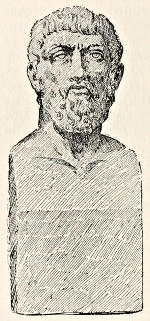
Alcibiades
There was no lack of men opposed to this treaty. It was signed amidst
the applause of the old, the rich, and the cultivators, but in it Athens, through
Nicias’ fault, had allowed herself to be ignominiously tricked. The merchants
who during the war had seen the sea closed to their rivals and open to their
own vessels, the sailors, the soldiers, and all the people of the Piræus who
lived on their pay or their booty, formed a numerous party. Alcibiades
constituted himself its chief. The warlike spirit which was to disappear
only with Greece itself soon gave him allies from outside.
What Sparta and Athens were doing on a large scale was being done by
other towns on a small one. Strong or weak, obscure or illustrious, all had
the same ambition: all desired subjects. The Eleans had subdued the Lepreatæ,
Mantinea and the towns in her neighbourhood; Thebes had knocked
down the walls of Thespiæ in order to keep that town at her mercy; and
Argos had transferred within her own walls the inhabitants of several townships
of Argos, though in doing so she granted them civil rights. Sparta
watched with annoyance this movement for the concentration of lesser cities
round more powerful ones. She proclaimed the independence of the Lepreatæ,
and secretly encouraged the defection of the subjects of Mantinea
and the hatred of Epidaurus against Argos. But since Sphacteria she had
lost her prestige. At Corinth, at Megara, in Bœotia, it was openly said
that she had basely sacrificed the interests of her allies; indignation was
especially felt at her alliance with Athens. The Peloponnesian league
was in fact dissolved; one people dreamed of reconstituting it for their
own advantage.
The repose and prosperity of Argos in the midst of the general conflict
had increased her resources and her liberal policy towards the towns of the
district had augmented her strength. But the new-comers were a powerful
reinforcement to the democratic party whose influence impelled Argos on a
line of policy opposed to that of the Spartans. This town therefore might
and wished to become the centre of an anti-Lacedæmonian league. Mantinea,
where the democracy predominated; the Eleans, who had been offended
by Lacedæmon; Corinth, which, by the treaty of Nicias, lost two important
towns in Acarnania, were ready to join their grudges and their forces. The
Argives skilfully seized the opportunity; twelve deputies were sent to all
the Greek cities which desired to form a confederation from which the two
cities which were equally menacing to the common liberty, namely Sparta
and Athens, should be excluded. But an agreement could not be arrived
at. A league of the northern states was thus rendered abortive; nothing
could yet be done without Sparta or Athens.
Between these two towns there were many grounds for discontent. The
lot had decided that Sparta should be the first to make the restitutions
agreed on at the treaty of 421. For Athens the most valuable of these restitutions
was that of Amphipolis and the towns of Chalcidice. Sparta withdrew
her garrisons but did not restore the towns; and yet Nicias, deceived
by the ephors, led the people to commit the mistake of not keeping the
pledges which they had in their possession until Lacedæmon should have put
an end to her bad faith. Sparta had negotiated for all her allies; and the
most powerful were refusing to observe her engagements. The Bœotians
restored Panactum, but kept the Athenian prisoners and only agreed to a
truce of ten days. Athens, which had thought to win peace, was, ten days
later, again at war with the Bœotians and uninterruptedly with Chalcidice.
As regards the latter she had just given a terrible example of her anger.
The whole male population of Scione had been put to death as a punishment
for its recent revolt, in virtue of a decree of the people which the generals
had carried with them.
All this furnished material which Alcibiades might work up into a war.
First, he prevented the Athenians from evacuating Pylos. The helots and
Messenians were simply withdrawn thence at the instance of Lacedæmon
and were transported to Cephallenia. Then, warned by his friends at Argos
that Sparta was seeking to draw that city into her alliance, he answered that
Athens herself was quite ready to join the Argives. Athens at once concluded
an offensive and defensive alliance with the Argives, the Mantineans
and the Eleans. In the ardour of hatred against Sparta it was agreed that
the alliance should last a hundred years; a long period for such spirits (420).
We here remark a new and important point; it is that the alliance was
concluded on a perfect footing of equality. The command of the allied
troops was to belong to the people which should demand aid and on whose
territory war should be made.
[420-418 B.C.]
The neutrality of the Argolid and of the centre of the Peloponnesus had
hitherto preserved Lacedæmon from a continental invasion. War, after having
long hovered on the outskirts of the peninsula, had not ventured, within
the last few years, to do more than lay hold of certain points on the coasts to
the west, south, and east, which were quite remote from Sparta, at Pylos,
Cythera, and Methone. But now the Argives, the Mantineans and the
Eleans were about to introduce it into the heart of the Peloponnesus, to
bring it in the very face of the helots. Sparta became once more the patient,
deliberate city of former days, even to the point of submitting to outrageous
insults. On account of the despatch of the helots to Lepreum during the
sacred truce, the Eleans had condemned the Lacedæmonians to a fine of two
thousand minæ, and on their refusal to pay had excluded them by decree from
the Olympic games. A Spartan of distinction, named Lichas, had however
a chariot competing in the same race in which Alcibiades had displayed so
much magnificence and obtained wreaths. When the judges learnt his name
they had him ignominiously driven away with blows. Sparta did not avenge
this outrage; she had ceased to believe in herself. At last Alcibiades passed
over into the Peloponnesus with a few troops.
At Argos he persuaded the people to seize a port on the Saronic Gulf
from the Epidaurians; from thence the Argives might the more easily receive
succours from Athens which was in possession of Ægina opposite
Epidaurus. But the Lacedæmonians sent this town three hundred hoplites
who arrived by sea and repelled all attacks. At this news the Athenians
wrote at the base of the column on which the treaty had been engraved, that
Sparta had violated the peace, and the war began (419).
It was in vain that Aristophanes produced about this time his comedy
entitled the Peace, resuming the theme he had taken up seven years
before in the Acharnians. It was to no purpose that he personified War
as a giant who crushes the towns in a mortar, using the generals for his
pestles, and showed that with the return of Peace, drawn at last from the
cavern in which she has been captive for thirteen years, banquets and feasts
will recommence, the whole town will be given up to joy, and the armourers
only will be in despair; he persuaded no one, not even the judges of the
competition, who refused him the first prize.
The Lacedæmonians, under the command of Agis, entered the Argolid
with the contingents of Bœotia, Megara, Corinth, Phlius, Pellene, and
Tegea. The Argive general, cut off from the town by a clever manœuvre,
proposed a truce which Agis accepted. This was not what was desired by
the Athenians, who arrived shortly after, to the number of a thousand
hoplites and three hundred horsemen; Alcibiades spoke in presence of the
people of Argos and prevailed with them: the truce was broken, a march
was made on Orchomenos and it was taken. The blame of the rupture fell
on Agis. The Spartans, angry at his having given their enemies time to
make this conquest, wished first to demolish his house and condemn him
to a fine of a hundred thousand drachmæ; his prayers won his pardon; but
it was determined that in future the kings of Sparta should be assisted in
the war by a council of ten Spartans.
To repair his mistake, Agis went in search of the allies; he encountered
them near Mantinea. “The two armies,” says Thucydides, “advanced
against each other; the Argives with impetuosity, the Lacedæmonians
slowly and, according to their custom, to the sound of a great number of
pipes which beat time and kept them in line.” The Lacedæmonian left was
driven in, but the right, commanded by the king, retrieved the fight and
carried the day (418). This battle, which cost the allies eleven hundred
men and the Spartans about three hundred, is regarded by Thucydides as
the most important which the Greeks had fought for a long time. It
restored the reputation of Sparta in the Peloponnesus, and in Argos the
preponderance of the wealthy who suppressed the popular commune, put its
leaders to death and made an alliance with Lacedæmon.
[418-416 B.C.]
This treaty broke up the confederation recently agreed on with Athens,
Elis, and Mantinea. The last-named town even thought itself sufficiently
endangered by the defection of Argos to consent to descend once more to
the rank of an ally of the Spartans. A treaty, dictated by the latter, decreed
that all the states, great and small, should be free and should keep their
national laws with their independence. Sparta desired nothing but divisions
and weakness round her. To the policy of concentration advocated by
Athens, she opposed the policy of isolation which was to put all Greece at
her feet, but would also afterwards place her, with Sparta herself, at the feet
of Macedonia and of the Romans (417).
The victory of Agis was that of the oligarchy. At Sicyon, in Achaia, it
again raised its head or established itself more firmly. We have just seen
how it resumed power in Argos. But in that town, if we are to believe
Pausanias, a crime analogous to those which founded the liberties of the
people in Rome brought about the fall of the tyrants three months later.
Expelled by an insurrection, the chief citizens retired to Sparta, whilst the
people appealed to the Athenians, and men, women, and children laboured
to join Argos with the sea by means of long walls. Alcibiades hurried
thither with masons and carpenters to aid in the work; but the Lacedæmonians,
under the guidance of the exiles, dispersed the workers. Argos,
exhausted by these cruel discords, did not recover herself; and with her fell
that idea of a league of secondary states which might perhaps have spared
Greece many misfortunes by imposing peace and a certain caution on the
two great states (417).
[416 B.C.]
The Athenians, who were acting weakly in Chalcidice, had recently lost
two towns there and had seen the king of Macedon withdraw from their
alliance; they resolved to avenge themselves for all their embarrassments
on the Dorian island of Melos, which was insulting their maritime empire by
its independence. At Naxos and Samos they had shown themselves merciful,
because they were amongst the Ionians where they could reckon on a democratic
party; at Melos, an outpost of the Dorians in the Cretan Sea, they
were implacable because the blow struck at these islanders, faithful to their
metropolis, was to find a mournful echo in Lacedæmon. A squadron of
thirty-eight galleys summoned the town to submit, and on its refusal an
army besieged it, took it, and exterminated all the adult male population.
The women and children were sold (416). Before the attack a conference
had taken place with the Melians.
“In order to obtain the best possible result for our negotiations,” said
the Athenians, “let us start from a principle with which both sides shall be
really satisfied, a principle which we know well and would employ with
people who are as well acquainted with it as we are: it is that business
between men is regulated by the laws of justice when an equal necessity
obliges them to submit to it; but that those who have the advantage in
strength do all that is in their power and that it is the part of the weak to
yield,” and further: “nor do we fear that the divine protection will forsake
us. In our principles and in our actions we neither depart from the idea
which men have conceived of the Divinity nor from the line of conduct
which they preserve amongst themselves. We believe, according to the
received opinion, that the gods, and we know very well that men, by a
necessity of nature, dominate wherever they have force. This is not a law
that we have made; it is not we who have first applied it; we profit by it
and shall transmit it to times to come; you yourselves, with the power
which we enjoy, would follow the same course.”
The theory of force has rarely been so distinctly expressed. The
reputation of the Athenians has suffered by it, without their having derived
the slightest profit from this evil deed. But let us observe, even while we
think with horror of the sanguinary act performed at Melos, that the practice,
if not the theory of this right of the strongest is a very old one; it is
the principle on which the whole of antiquity is based; it is nothing but the
famous law, salus populi suprema lex, so many times evoked to justify odious
enterprises or iniquitous cruelties; and it must be acknowledged with sadness
that in all times and in almost all places men have thought with
Euripides, “that wisdom and glory are: to hold a victorious hand over the
head of one’s enemies.” Force is as old as the world, it is right which
emerges slowly: can we believe that its reign will not come?
The Dorian colonists of Melos had counted on the support of Sparta.
“She will abandon you,” the Athenians had answered; and the prudent city
which, for its part regarded all things from the point of view of utility, had
sent neither ship nor soldier. This inertia inflated the hopes of Athens:
she believed that the moment had come for annexing to her empire the great
island of the West where internal divisions had roused in several cities the
desire for foreign protection.b
The largest island in the Mediterranean, Sicily has been a stepping-stone
between African, Asiatic, and European nations. Freemane has compared
it with Great Britain in its “geographical and historical position.”
Its original inhabitants seem to have been the Sicans who were invaded
first by the Elymians and then by the Sicels. Relations with Sicily were
begun as early as the Mycenæan age, and jars of Ægean ware have been
unearthed in the tombs of Syracuse. The Phœnicians established factories
and trading places in Sicily, and then came the Greeks overflowing the
island and founding many a city and stronghold. As we have seen in a
previous chapter, Sicily became one of the earliest and most important of the
Greek colonies.
The African city of Carthage, which we think of chiefly along with
Roman history, early took up the grievances of the Phœnicians against the
Greeks. In the sixth century B.C., various settlements had fallen by the
ears with one another. About 580 B.C. the Greek adventurer Pentathlus
threatened the Phœnician settlements, but was defeated and slain. Carthage,
however, was awakened to the danger from Greek land-hunger, and
about 560 B.C. sent an expedition under Malchus, who gave a severe check
to Greek encroachment and an encouragement to Carthaginian ambition.
Finally, by 480 B.C., the Carthaginians were ready to combine with the
Persians against Greek prosperity and independence. While Xerxes assailed
the mother-country, Carthage by agreement sent an enormous expedition
against the Sicilian Greeks. Their general was Hamilcar, and the magnificence
of his host has been as splendidly exaggerated as that of Xerxes.
His success was equal to that of the Persian, except that Xerxes escaped
alive, while Hamilcar perished.
[481-447 B.C.]
The chief instruments of the Sicilian victory were the tyrants who had
gathered to themselves supreme power in their own cities or groups of
cities as the tyrants of the mother-country had previously done. In Sicily
there were four powerful masters of four chief cities: Anaxilaus of Rhegium
in Italy, who crossing the straits, took possession of Zancle; his father-in-law
Terillus of Himera; Gelo of Syracuse and his father-in-law, Theron of
Acragas. It was a quarrel between Theron and Terillus that gave the
Carthaginians their immediate excuse for invading Sicily. Terillus being
thwarted by Theron played a treacherous part like that of Hippias, and
begged the Persians to attack Acragas. Terillus called in Carthage to his
aid against Theron. There is a tradition that the defeat of the Carthaginians
happened on the same day as the battle of Salamis. Such traditions
are always subject to scepticism, and yet the coincidence of Vicksburg and
Gettysburg in American history is hardly more incredible.
Theron had called on Gelo to aid him in expelling the Carthaginians,
and Gelo had won the greater glory. He died two years later leaving his
younger brother Hiero to succeed him. It was Hiero’s privilege to thwart
the ambition of the Etruscans as his elder brother had foiled Carthage. The
naval battle of Cyme was the brilliant victory which led Pindar to write
one of his loftiest songs. He and Simonides, Æschylus, and Bacchylides,
were all received with honour at the opulent court of Hiero. The glitter
of court life, however, was small compensation for the tyranny of the various
despots of Sicily. Their ambitions clashed at the least pretext, always at
the cost of the blood of their subjects. They had a curious way of deporting
the inhabitants of an entire city to some other place to suit their own
whims. And gradually time took its revenge upon them. Theron left as
his heir a weak son, Thrasydæus who went to battle with Hiero, and, losing
the battle, lost also his prestige and his power, for the cities Himera and
Acragas formed themselves into democracies. Five years later, in 467 B.C.,
Hiero died, and his tyranny fell to his brother Thrasybulus whose blood-thirsty
and tax-hungry cruelties aroused a revolution. He was besieged in
Syracuse, compelled to surrender and sent into exile.
Life in Sicily is not to this day so quiet as in certain other portions
of the globe, and it was inevitable in the change from despotism to
democracy that there should be much friction and bloodshed, but the cities
lost none of the prosperity they had acquired under the tyrants. Syracuse
continued to be the principal city and power in the island; Agrigentum, as
the Romans named Acragas, being the second in power.
Now a new source of danger appeared, this time not from a foreign
invasion, or from the ambition of such pretenders as had tried to re-establish
the power of Gelo. The new threat came from a racial jealousy. The
old inhabitants, the Sicels, who had been crowded into the interior, gave
birth to a Napoleonic ambition. A young man named Ducetius who first
appeared in 461, having fed upon certain small successes in acquiring power,
showed his ingenuity in 453 by forming a federation of Sicel towns with
himself as prince. He seized an early opportunity to assail the Greeks, and
justified the fidelity of the Sicels by capturing the towns of Morgantium,
Ætna, and the Acragantine stronghold of Motya, building a new city—Palice.
He now became important enough to merit the anger of Syracuse, and
a large force from Syracuse and Agrigentum marched against him. The toy
Napoleon met his little Waterloo. His partisans deserted him and he found
himself alone. A desperate resolve occurred to him as the only means of
saving his life. He rode by night to the gates of Syracuse, entered the city
secretly, and sat himself down before the altar in the market place. He
was soon surrounded by a crowd who had too keen a sense of the dramatic
not to forgive him and let him off with the easy exile to Corinth. From
this Elba this Napoleon soon emerged. He violated his parole laying the
blame on an oracle, and took a body of colonists to Sicily where he founded
the city of Calacta (or Kale Akte). He began gradually to reach out for
more power, but his death in 440 ended his schemes and left his federation
as a prize for Syracuse.
[440-431 B.C.]
While Syracuse was beginning to plume itself upon its leadership and to
dream of more definite control, the city of Athens was building an empire,
not over one island but many. It was only natural that she should wish to
stand well with the rich cities of Sicily. At first there could hardly have
been any thought of conquest, and Grotef points out that Plutarch is mistaken
and is contradicted by Thucydides, when he implies that even as late
as the quarrel between Corinth and Corcyra, the Athenians had thought of
dominion over Sicily. Professor Buryd however sees a distinct desire to have
influence, if not conquest, from a very early day. He says:
“During the fifth century the eyes of Athenian statesmen often wandered
to western Greece beyond the seas. We can surprise some oblique glances,
as early as the days of Themistocles; and we have seen how under Pericles
a western policy definitely began. An alliance was formed with the Elymian
town of Segesta, and subsequently treaties of alliance (the stone records
are still partly preserved) were concluded with Leontini and Rhegium.
One general object of Athens was to support the Ionian cities against the
Dorian, which were predominant in number and power, and especially against
Syracuse, the daughter and friend of Corinth. The same purpose of counter-acting
the Dorian predominance may be detected in the foundation of Thurii.
But Thurii did not effect this purpose. The colonists were a mixed body;
other than Athenian elements gained the upper hand; and, in the end,
Thurii became rather a Dorian centre and was no support to Athens. It
is to be observed that at the time of the foundation of Thurii, and for nigh
thirty years more, Athens is seeking merely influence in the west, she has no
thought of dominion. The growth of her connection with Italian and Sicilian
affairs was forced upon her by the conditions of commerce and the rivalry
of Corinth.” Adolph Holmb is equally positive in accusing the Athenians of
an early desire to obtain a footing in Sicily.
[431-425 B.C.]
The outbreak of the Peloponnesian War in 431 B.C. found Sicily in a high
state of prosperity, political equality, and intellectual health. According as
the various cities had been founded by Dorian or Ionian colonists their family
prejudices inclined them towards Sparta or Athens. The war in fact, according
to Müller,h was called by the oracles, the Doric War. The preponderance
in Sicily was largely toward Sparta and Corinth, for Corinth had been the
mother-city to Syracuse. Grotef thus discusses the feelings of the various
cities at this time:
“In that struggle the Italian and Sicilian Greeks had no direct concern,
nor anything to fear from the ambition of Athens; who, though she had
founded Thurii in 443 B.C., appears never to have aimed at any political
ascendency even over that town—much less anywhere else on the coast.
But the Sicilian Greeks, though forming a system apart in their own island,
from which it suited the dominant policy of Syracuse to exclude all foreign
interference, were yet connected by sympathy, and one side even by alliances,
with the two main streams of Hellenic politics. Among the allies of Sparta
were numbered all or most of the Dorian cities of Sicily—Syracuse, Camarina,
Gela, Agrigentum, Selinus, perhaps Himera and Messana—together
with Locri and Tarentum in Italy; among the allies of Athens, perhaps, the
Chalcidic or Ionic Rhegium in Italy. Whether the Ionic cities in Sicily—Naxos,
Catana, and Leontini—were at this time united with Athens by any
special treaty, is very doubtful. But if we examine the state of politics prior
to the breaking out of the war, it will be found that the connection of the
Sicilian cities on both sides with central Greece was rather one of sympathy
and tendency, than of pronounced obligation and action. The Dorian Sicilians,
though sharing the antipathy of the Peloponnesian Dorians to Athens,
had never been called upon for any co-operation with Sparta; nor had the
Ionic Sicilians yet learned to look to Athens for protection against Syracuse.”
Sparta counted apparently upon the active assistance of Syracuse, and
demanded that the Dorians in Italy and Sicily should contribute to her both
ships and money. She realised no ships, a little money, and profuse expressions
of interest and sympathy. The awakening of the old Dorio-Ionic
blood feud suggested to the Syracusans, however, that while the Peloponnesian
War was remote from them both geographically and commercially, it
yet furnished a good excuse for attacking such cities in Sicily as were in any
way attached to Athens. Naxos, Catana, and Leontini were looked upon as
the first prizes to be seized. These towns were so far from being able to
send aid to Athens that they were compelled to ask aid of her. They succeeded
in forming an alliance with Camarina, which was a Dorian city but
jealous of Syracuse, and with the town of Rhegium in Italy. The friendship
of Rhegium brought over to Syracuse the Italian city of Locri. With
the aid of Locri and practically all the Dorian cities, Syracuse was so strong
that the Ionic allies were soon in desperate straits. They sent their eloquent
orator Gorgias to implore the Athenians for aid and to advise them to grant
it, lest when Syracuse had conquered all Sicily she should send her troops
and ships to the aid of the Spartans and Corinthians. The Athenians sent
twenty triremes under Laches, who after various minor successes fell under
suspicion as to his honesty and efficiency, and was called home.
[425-416 B.C.]
The Ionians sent another appeal to Athens, and received the promise of
forty more triremes. In the spring of 425 this fleet left Athens under command
of Eurymedon and Sophocles. It was this fleet which, almost accidentally,
paused on the Spartan coast at Pylos with the result that it gained
for Athens the renowned victory of Sphacteria, as previously described.
This victory was very profitable to Athens in its immediate glory, but was
of very gloomy purport in the Sicilian matter, for the fleet having delayed
to take part in the victory, and later pausing at Corcyra, did not reach Sicily
before September. This delay had given the Syracusan allies time to undo
what little had been achieved by Laches. He had won the friendship of the
town of Messana, thus giving Athens command of the straits. The delay
however had weakened the friendship of Messana, and lost its alliance.
Furthermore, the cities which Athens had come to aid were found to be in a
decided humour to put an end to the civil war. A congress of Sicilian cities
was called at Gela.
This congress at Gela takes on a decided importance in political history
because of the theories brought forward there by a Syracusan orator, Hermocrates,
whose political creed has been compared to the Monroe Doctrine of
the United States. The creed was not successfully carried out, and as has
often happened in the history of the United States, the promulgators of the
doctrine were by no means consistent in their actions. Hermocrates pleaded
for a policy, which in modern phrase would be called “Sicily for the Sicilians.”
He wished Sicily to regard herself as an entity, considering all
foreigners to be outsiders, and all interference to be meddling. He was not
rash enough or un-Grecian enough to deny the Sicilian cities the luxury of
fighting with one another; but he called for unity against the invader or the
intriguer from other shores. From his speech, as imagined by Thucydides,i
the peroration is worth quoting for its cool common sense:
“And I call on you all, of your own free will, to act in the same manner
as myself, and not to be compelled to do it by your enemies. For there is
no disgrace in connections giving way to connections, whether a Dorian to a
Dorian, or a Chalcidian to those of the same race; in a word, all of us who
are neighbours, and live together in one country, and that an island, and are
called by the one name of Sicilians. For we shall go to war again, I suppose,
when it may so happen, and come to terms again amongst ourselves by means
of general conferences; but to foreign invaders we shall always, if we are
wise, offer united resistance, inasmuch as by our separate losses we are collectively
endangered; and we shall never in future call in any allies or
mediators. For by acting thus we shall at the present time avoid depriving
Sicily of two blessings—riddance both of the Athenians and of civil war—and
shall in future enjoy it by ourselves in freedom, and less exposed to the
machinations of others.”
The Athenian expedition having been coldly received by the cities it
came to rescue, returned to Athens, where Eurymedon was fined and Sophocles
banished on a charge of bribery. And now the reservation made by
Hermocrates as to the right of the Sicilian cities to war upon one another,
was soon justified. And to such an extent that the Ionic cities began to
realise that the Syracusans had been chiefly anxious to expel the foreign
invader, in order that the island might be left entirely to Syracusan ambition.
In the city of Leontini the aristocrats crushed the democrats, and
turned the city into a Syracusan fort after destroying the greater portion of
it. The common people appealed to Athens, and received in reply two triremes
under Phæax in B.C. 422. Before he had accomplished anything the
Peace of Nicias put a temporary close to the war.
In 417 B.C. the two Sicilian cities of Selinus and Segesta (or Egesta)
quarrelled over a bit of territory. Syracuse aided Selinus, and Segesta, after
appealing in vain to Agrigentum and to Carthage, sent envoys to Athens.
The Leontine people also reminded Athens that Syracuse, having destroyed
Leontini and assailed Segesta, was planning and accomplishing the gradual
reduction of all Sicilian cities favourable to Athens, and thus building up an
empire which would give Sparta unlimited aid. The people of Segesta asked
only for men and ships, and promised to provide ample money for expenses.
[416-415 B.C.]
The idea of such an armada delighted the fire-brand Alcibiades, who saw
in it a chance to be a leader and to find an abundance of the things he most
desired—adventure, notoriety, and money. The cautious Nicias opposed
the scheme, and secured a delay until ambassadors could be sent to Segesta
to learn if the city were really wealthy enough to pay as it promised. And
now it was a case of Greek meeting Sicilian. The people of Segesta had sent
secret expeditions to all their friendly towns, Phœnician or Grecian, to
borrow all the treasure they could wheedle out of their prospective allies.
When the Athenian envoys appeared, they were taken to the temple of
Venus and shown a great array of gifts, “bowls, wine ladles, censers, and
other articles of furniture in no small quantity.” These were all silver or of
silver gilt, and made a far greater showing than they merited. Then the
Athenians were put through a round of entertainments. In each case the
host displayed all his own plate, and in addition a large portion of the common
fund, which was passed from house to house surreptitiously. The gullible
Athenians were overwhelmed by the evident opulence of the private
citizens of Segesta, and when sixty talents of uncoined silver (valued at
over £12,000 or $60,000) were handed over to the Athenians for the first
month’s expenses of the fleet, the embassy was thoroughly duped, and returned
to Athens glowing with enthusiasm for an alliance with such a western Golconda.
Then followed a tug of war between Nicias and Alcibiades. Nicias
was to be one of the commanders of the expedition, and he could well claim
that it was no fear of bodily danger that made him averse to it. He opposed
it purely as a piece of folly. Alcibiades replied in favour of the expedition,
and it was so evident that the people were determined to send the fleet that
Nicias in a last effort tried to alarm the city by magnifying the difficulties
of the task and demanding a tremendous force. To the Athenians, in their
drunkenness for empire, and in that frenzy of “Westward Ho!” which, in
the fifteenth century, attacked all Europe, the opposition of Nicias was only
wind on flame. They rejoiced the more at the magnificence of the problem.
To decide upon sending a fleet of one hundred triremes instead of the
sixty asked for, was folly enough; but to elect Nicias as the commander of
the expedition, and to ally with him his bitter opponent, Alcibiades, was
pure delirium. Still, Athens had just conquered Melos, and no task was too
gigantic for her hopes.a
Greek Door Keys
For the two or three months immediately succeeding the final resolution
taken by the Athenians to invade Sicily, the whole city was elate and bustling
with preparation. The prophets, circulators of oracles, and other accredited
religious advisers, announced generally the favourable dispositions
of the gods, and promised a triumphant result. All classes in the city, rich
and poor,—cultivators, traders, and seamen,—old and young, all embraced
the project with ardour; as requiring a great effort, yet promising unparalleled
results, both of public aggrandisement and individual gain. Each man
was anxious to put down his own name for personal service; so that the three
generals, Nicias, Alcibiades, and Lamachus, when they proceeded to make
their selection of hoplites, instead of being forced to employ constraint or
incur ill-will, as happened when an expedition was adopted reluctantly with
many dissentients, had only to choose the fittest among a throng of eager
volunteers.
Such efforts were much facilitated by the fact that five years had now
elapsed since the Peace of Nicias, without any considerable warlike operations.
While the treasury had become replenished with fresh accumulations,
and the triremes increased in number, the military population, reinforced by
additional numbers of youth, had forgotten both the hardships of the war
and the pressure of epidemic disease. Hence the fleet now got together,
while it surpassed in number all previous armaments of Athens, except a
single one in the second year of the previous war under Pericles, was incomparably
superior even to that, and still more superior to all the rest in
the other ingredients of force, material as well as moral, in picked men,
universal ardour, ships as well as arms in the best condition, and accessories
of every kind in abundance. Such was the confidence of success, that many
Athenians went prepared for trade as well as for combat; so that the private
stock, thus added to the public outfit and to the sums placed in the hands of
the generals, constituted an unparalleled aggregate of wealth. After between
two and three months of active preparations, the expedition was
almost ready to start, when an event happened which fatally poisoned the
prevalent cheerfulness of the city. This was the mutilation of the Hermæ,
one of the most extraordinary events in all Grecian history.
[415 B.C.]
The Hermæ, or half-statues of the god Hermes, were blocks of marble
about the height of the human figure. The upper part was cut into a head,
face, neck, and bust; the lower part was left as a quadrangular pillar, broad
at the base, without arms, body, or legs, but with the significant mark of the
male sex in front. They were distributed in great numbers throughout
Athens, and always in the most conspicuous situations. The religious feeling
of the Greeks considered the god to be planted or domiciliated where his
statue stood, so that the companionship, sympathy, and guardianship of
Hermes became associated with most of the manifestations of conjunct life
at Athens, political, social, commercial, or gymnastic.
About the end of May 415 B.C., in the course of one and the same night,
all these Hermæ, one of the most peculiar marks of the city, were mutilated
by unknown hands. Their characteristic features were knocked off or levelled,
so that nothing was left except a mass of stone with no resemblance to humanity
or deity. All were thus dealt with in the same way, save and except
very few: nay, Andocides affirms that there was but one which escaped
unharmed. If we take that reasonable pains, which is incumbent on those who
study the history of Greece, to realize in our minds the religious and political
associations of the Athenians,—noted in ancient times for their superior piety,
as well as for their accuracy and magnificence about the visible monuments
embodying that feeling,—we shall in part comprehend the intensity of
mingled dismay, terror, and wrath, which beset the public mind, on the
morning after this nocturnal sacrilege, alike unforeseen and unparalleled.
Amidst all the ruin and impoverishment which had been inflicted by the Persian
invasion of Attica, there was nothing which was so profoundly felt or so
long remembered as the deliberate burning of the statues and temples of the
gods. If we could imagine the excitement of a Spanish or Italian town, on
finding that all the images of the Virgin had been defaced during the same
night, we should have a parallel, though a very inadequate parallel, to what
was now felt at Athens—where religious associations and persons were far
more intimately allied with all civil acts and with all the proceedings of every-day
life—where, too, the god and his efficiency were more forcibly localised,
as well as identified with the presence and keeping of the statue. To the
Athenians, when they went forth on the following morning, each man seeing
the divine guardian at his doorway dishonoured and defaced, and each man
gradually coming to know that the devastation was general,—it would seem
that the town had become as it were godless—that the streets, the market-place,
the porticoes, were robbed of their divine protectors; and what was
worse still, that these protectors, having been grossly insulted, carried away
with them alienated sentiments—wrathful and vindictive instead of tutelary
and sympathising.
Such was the mysterious incident which broke in upon the eager and
bustling movement of Athens a few days before the Sicilian expedition was
in condition for starting. In reference to that expedition, it was taken to
heart as a most depressing omen. The mutilation of the Hermæ, however,
was something much more ominous than the worst accident. It proclaimed
itself as the deliberate act of organised conspirators, not inconsiderable in
number, whose names and final purpose were indeed unknown, but who had
begun by committing sacrilege of a character flagrant and unheard of. For
intentional mutilation of a public and sacred statue, where the material
afforded no temptation to plunder, is a case to which we know no parallel:
much more, mutilation by wholesale—spread by one band and in one night
throughout the entire city. Though neither the parties concerned, nor their
purposes, were ever more than partially made out, the concert and conspiracy
itself is unquestionable.
It seems probable, as far as we can form an opinion, that the conspirators
had two objects, perhaps some of them one and some the other—to ruin
Alcibiades—to frustrate or delay the expedition. Indeed the two objects
were intimately connected with each other; for the prosecution of the enterprise,
while full of prospective conquest to Athens, was yet more pregnant
with future power and wealth to Alcibiades himself. Such chances would
disappear if the expedition could be prevented; nor was it at all impossible
that the Athenians, under the intense impression of religious terror consequent
on the mutilation of the Hermæ, might throw up the scheme altogether.
Few men in Athens either had, or deserved to have, a greater number of
enemies, political as well as private, than Alcibiades; many of them being
among the highest citizens, whom he offended by his insolence, and whose
liturgies and other customary exhibitions he outshone by his reckless expenditure.
His importance had been already so much increased and threatened
to be so much more increased by the Sicilian enterprise, that they no
longer observed any measures in compassing his ruin. That which the
mutilators of the Hermæ seemed to have deliberately planned, his other
enemies were ready to turn to profit.
While the senate of Five Hundred were invested with full powers of
action, Diognetus, Pisander, Charicles, and others, were named commissioners
for receiving and prosecuting inquiries: and public assemblies were held
nearly every day to receive reports. The first informations received, however,
did not relate to the grave and recent mutilation of the Hermæ, but to
analogous incidents of older date; to certain defacements of other statues,
accomplished in drunken frolic—and above all, to ludicrous ceremonies
celebrated in various houses, by parties of revellers caricaturing and divulging
the Eleusinian mysteries. It was under this latter head that the first
impeachment was preferred against Alcibiades.
But Alcibiades saw full well the danger of having such charges hanging
over his head, and the peculiar advantage which he derived from his accidental
position at the moment. He implored the people to investigate the
charges at once; proclaiming his anxiety to stand trial and even to suffer
death, if found guilty,—accepting the command only in case he should be
acquitted,—and insisting above all things on the mischief to the city of
sending him on such an expedition with the charge undecided, as well as on
the hardship to himself of being aspersed by calumny during his absence,
without power of defence. Such appeals, just and reasonable in themselves,
and urged with all the vehemence of a man who felt that the question was
one of life or death to his future prospects, were very near prevailing. His
enemies could only defeat them by the trick of putting up fresh speakers,
less notorious for hostility to Alcibiades. These men affected a tone of
candour, deprecated the delay which would be occasioned in the departure
of the expedition, if he were put upon his trial forthwith; and proposed
deferring the trial until a certain number of days after his return. Such
was the determination ultimately adopted: the supporters of Alcibiades
probably not fully appreciating its consequences, and conceiving that the
speedy departure of the expedition was advisable even for his interest, as
well as agreeable to their own feelings. And thus his enemies, though
baffled in their first attempt to bring on his immediate ruin, carried a postponement
which insured to them leisure for thoroughly poisoning the public
mind against him, and choosing their own time for his trial. They took
care to keep back all farther accusation until he and the armament had
departed.
The spectacle of its departure was indeed so imposing, and the moment
so full of anxious interest, that it banished even the recollection of the recent
sacrilege. The entire armament was not mustered at Athens; for it had
been judged expedient to order most of the allied contingents to rendezvous
at once at Corcyra. But the Athenian force alone was astounding to behold.
The condition, the equipment, the pomp both of wealth and force, visible
in the armament, were still more impressive than the number. At day-break
on the day appointed, when all the ships were ready in Piræus for
departure, the military force was marched down in a body from the city
and embarked. They were accompanied by nearly the whole population,
metics and foreigners as well as citizens, so that the appearance was that of
a collective emigration like the flight to Salamis sixty-five years before.
While the crowd of foreigners, brought thither by curiosity, were amazed
by the grandeur of the spectacle—the citizens accompanying were moved
by deeper and more stirring anxieties. Their sons, brothers, relatives, and
friends, were just starting on the longest and largest enterprise which Athens
had ever undertaken; against an island extensive as well as powerful, known
to none to them accurately, and into a sea of undefined possibilities—glory
and profit on the one side, but hazards of unassignable magnitude on
the other. At this final parting, ideas of doubt and danger became far more
painfully present than they had been in any of the preliminary discussions;
and in spite of all the reassuring effect of the unrivalled armament before
them, the relatives now separating at the water’s edge could not banish
the dark presentiment that they were bidding each other farewell for the
last time.
The moment immediately succeeding this farewell—when all the soldiers
were already on board and the celeustes was on the point of beginning his
chant to put the rowers in motion—was peculiarly solemn and touching.
Silence having been enjoined and obtained, by sound of trumpet, the crews
in every ship, and the spectators on shore, followed the voice of the herald
in praying to the gods for success, and in singing the pæan. On every deck
were seen bowls of wine prepared, out of which the officers and the epibatæ
made libations, with goblets of silver and gold. At length the final signal
was given, and the whole fleet quitted Piræus in single file—displaying
the exuberance of their yet untried force by a race of speed as far as Ægina.
Never in Grecian history was an invocation more unanimous, emphatic, and
imposing, addressed to the gods; never was the refusing nod of Zeus more
stern or peremptory.f
The customary libations were poured out; and, after the triumphant pæan
had been sung, the whole fleet set sail, and contended for the prize of naval
skill and celerity, until they reached the shores of Ægina, from whence they
enjoyed a prosperous voyage to their confederates at Corcyra.
At Corcyra the commanders reviewed the strength of the armament,
which consisted of a hundred and thirty-four ships of war, with a proportional
number of transports and tenders. The heavy-armed troops, exceeding
five thousand, were attended with a sufficient body of slingers and
archers. The army, abundantly provided with every other article, was
extremely deficient in horses, which amounted to no more than thirty. But,
at a moderate computation, we may estimate the whole military and naval
strength, including slaves and servants, at twenty thousand men.[55]
With this powerful host, had the Athenians at once surprised and assailed
the unprepared security of Syracuse, the expedition, however adventurous
and imprudent, might, perhaps, have been crowned with success. But the
timid mariners of Greece would have trembled at the proposal of trusting
such a numerous fleet on the broad expanse of the Ionian Sea. They determined
to cross the narrowest passage between Italy and Sicily, after coasting
along the eastern shores of the former, until they reached the strait of
Messana. That this design might be executed with the greater safety, they
despatched three light vessels to examine the disposition of the Italian
cities, and to solicit admission into their harbours. Neither the ties of consanguinity,
nor the duties acknowledged by colonies towards their parent
state, could prevail on the suspicious Thurians to open their gates, or even
to furnish a market, to their Athenian ancestors. The towns of Tarentum
and Locri prohibited them the use of their harbours, and refused to supply
them with water; and they coasted the whole extent of the shore, from the
promontory of Iapygia to that of Rhegium, before any one city would allow
them to purchase the commodities for which they had immediate use. The
magistrates of Rhegium granted this favour, but they granted nothing more.
A considerable detachment was sent to examine the preparations and the
strength of Syracuse, and to proclaim liberty, and offer protection, to all the
captives and strangers confined within its walls.
With another detachment Alcibiades sailed to Naxos, and persuaded the
inhabitants to accept the alliance of Athens. The remainder of the armament
proceeded to Catana, which refused to admit the ships into the harbour,
or the troops into the city. But on the arrival of Alcibiades, the Catanians
allowed him to address the assembly, and propose his demands. The artful
Athenian transported the populace, and even the magistrates themselves, by
the charms of his eloquence; the citizens flocked from every quarter, to
hear a discourse which was purposely protracted for several hours; the
soldiers forsook their posts; and the enemy, who had prepared to avail
themselves of this negligence, burst through the unguarded gates, and became
masters of the city. Those of the Catanians who were most attached to
the interests of Syracuse, fortunately escaped death by the celerity of their
flight. The rest accepted the proffered friendship of the Athenians. This
success would probably have been followed by the surrender of Messana,
which Alcibiades had filled with distrust and sedition. But when the plot
was ripe for execution, the man who had contrived, and who alone could conduct
it, was disqualified from serving his country. The arrival of the
Salaminian galley recalled Alcibiades to Athens, that he might stand trial
for his life.
Greek City Seals
Alcibiades escaped to Thurii, and afterwards to Argos; and when he
understood that the Athenians had set a price on his head, he finally took
refuge in Sparta, where his active genius seized the first opportunity to
advise and promote those fatal measures, which, while they gratified his
private resentment, occasioned the ruin of his country.
The removal of Alcibiades soon appeared in the languid operations of the
Athenian armament. The cautious timidity of Nicias, supported by wealth,
eloquence, and authority, gained an absolute ascendant over the more warlike
and enterprising character of Lamachus, whose poverty exposed him
to contempt. Instead of making a bold impression on Selinus or Syracuse,
Nicias contented himself with taking possession of the inconsiderable colony
of Hyccara. He ravaged, or laid under contribution, some places of smaller
note, and obtained thirty talents from the Segestans, which, added to the
sale of the booty, furnished about thirty thousand pounds sterling, a sum
that might be usefully employed in the prosecution of an expensive war.
But this advantage did not compensate for the courage inspired into the
Syracusans by delay, and for the dishonour sustained by the Athenian
troops, in their unsuccessful attempts against Hybla and Himera, as well
as for their dejection at being confined, during the greatest part of the summer,
in the inactive quarters of Naxos and Catana.
Ancient Syracuse, of which the ruined grandeur still forms an object
of admiration, was situated on a spacious promontory, washed on three sides
by the sea, and defended on the west by abrupt and almost inaccessible mountains.
The town was built in a triangular form, whose summit may be
conceived on the lofty mountain Epipolæ. Adjacent to these natural fortifications,
the western or inland division of the city was distinguished by
the name of Tyche, or Fortune, being adorned by a magnificent temple of
that flattering divinity. The triangle gradually widening towards the base,
comprehended the vast extent of Achradina, reaching from the northern
shore of the promontory to the southern island, Ortygia. This small island,
composing the whole of modern Syracuse, formed but the third and least
extensive division of the ancient; which was fortified by walls eighteen
miles in circuit, enriched by a triple harbour, and peopled by above two
hundred thousand warlike citizens or industrious slaves.
When the Syracusans heard the first rumours of the Athenian invasion,
they despised, or affected to despise them, as idle lies invented to amuse the
ignorance of the populace. The hostile armament had arrived at Rhegium
before they could be persuaded, by the wisdom of Hermocrates, to provide
against a danger which their presumption painted as imaginary. But when
they received undoubted intelligence that the enemy had reached the
Italian coast, when they beheld their numerous fleet commanding the sea
of Sicily and ready to make a descent on their defenceless island, they were
seized with a degree of just terror and alarm proportional to their false
security. The dilatory operations of the enemy not only removed the recent
terror and trepidation of the Syracusans, but inspired them with unusual
firmness. They requested the generals, whom they had appointed to the
number of fifteen, to lead them to Catana, that they might attack the hostile
camp. Their cavalry harassed the Athenians by frequent incursions, beat
up their quarters, intercepted their convoys, destroyed their advanced posts,
and even proceeded so near to the main body, that they were distinctly heard
demanding, with loud insults, whether those boasted lords of Greece had
left their native country, that they might form a precarious settlement at
the foot of Mount Ætna.
[415-414 B.C.]
Provoked by these indignities, and excited by the impatient resentment
of his own troops, Nicias was still restrained from an open attempt against
Syracuse by the difficulties attending that enterprise. He employed a stratagem.
A citizen of Catana, whose subtile and daring genius, prepared alike
to die or to deceive, ought to have preserved his name from oblivion, appeared
in Syracuse as a deserter from his native city; the unhappy fate of
which, in being subjected to the imperious commands, or licentious disorder
of the Athenians, he lamented with perfidious tears, and with the plaintive
accents of well-dissembled sorrow. “The Athenians,” he said, “spurned the
confinement of the military life; their posts were forsaken, their ships unguarded,
they disdained the duties of the camp, and indulged in the pleasures
of the city. On an appointed day it would be easy for the Syracusans,
assisted by the conspirators of Catana, to attack them unprepared, to mount
their undefended ramparts, to demolish their encampment, and to burn their
fleet.” This daring proposal well corresponded with the keen sentiments
of revenge which animated the inhabitants of Syracuse. The day was
named; the plan of the enterprise was concerted, and the treacherous Catanian
returned home to revive the hopes, and to confirm the resolution, of
his pretended associates.
The success of this intrigue gave the utmost satisfaction to Nicias, whose
armament prepared to sail for Syracuse on the day appointed by the inhabitants
of that city for assaulting, with their whole force, the Athenian camp.
Already had they marched, with this view, to the fertile plain of Leontini,
when, after twelve hours’ sail, the Athenian fleet arrived in the great harbour,
disembarked their troops, and fortified a camp without the western
wall, near to a celebrated temple of Olympian Jupiter, a situation which
had been pointed out by some Syracusan exiles, and which was well adapted
to every purpose of accommodation and defence. Meanwhile the cavalry
of Syracuse, having proceeded to the walls of Catana, had discovered, to
their infinite regret, the departure of the Athenians. The unwelcome intelligence
was conveyed, with the utmost expedition, to the infantry, who
immediately marched back to protect Syracuse. The rapid return of the
war-like youth restored the courage of the aged Syracusans. They were
joined by the forces of Gela, Selinus, and Camarina; and it was determined
to attack the hostile encampment.
The attack was begun with fury, and continued with perseverance for
several hours. Both sides were animated by every principle that can inspire
and urge the utmost vigour of exertion, and victory was still doubtful, when
a tempest suddenly arose, accompanied with unusual peals of thunder. This
event, which little affected the Athenians, confounded the unexperienced
credulity of the enemy, who were broken and put to flight. The Syracusans
escaped to their city, and the Athenians returned to their camp. In such
an obstinate conflict the vanquished lost two hundred and sixty, the victors
only fifty men.
The voyage, the encampment, and the battle, employed the dangerous
activity, and gratified the impetuous ardour of the Athenians, but did not
facilitate the conquest of Syracuse. Without more powerful preparations,
Nicias despaired of taking the place, either by assault, or by a regular siege.
Soon after his victory he returned with the whole armament to Naxos and
Catana. Nicias had reason to expect that his victory over the Syracusans
would procure him respect and assistance from the inferior states of Sicily.
His emissaries were diffused over that island and the neighbouring coast of
Italy. Messengers were sent to Tuscany, where Pisa and other cities had
been founded by Greek colonies. An embassy was despatched to Carthage,
the rival and enemy of Syracuse. Nicias gave orders to collect materials for
circumvallation, iron, bricks, and all necessary stores. He demanded horses
from the Segestans; and required from Athens reinforcements and a large
pecuniary supply; and neglected nothing that might enable him to open the
ensuing campaign with vigour and effect.
While the Athenians thus prepared for the attack of Syracuse, the
citizens of that capital displayed equal activity in providing for their own
defence. By the advice of Hermocrates, they appointed himself, Heraclides,
and Sicanus; three, instead of fifteen generals. The commanders newly
elected, both in civil and military affairs, were invested with unlimited power,
which was usefully employed to purchase or prepare arms, daily to exercise
the troops, and to strengthen and extend the fortifications of Syracuse.
They likewise despatched ambassadors to the numerous cities and republics
with which they had been connected in peace, or allied in war, to solicit the
continuance of their friendship, and to counteract the dangerous designs of
the Athenians.
Meanwhile the expected reinforcements arrived from Athens. In addition
to his original force, Nicias had likewise collected a body of six hundred
cavalry, and the sum of four hundred talents; and, in the eighteenth summer
of the war, the activity of the troops and workmen had completed all necessary
preparations for undertaking the siege of Syracuse.
The plan which Nicias adopted for conquering the city, was to draw a
wall on either side. When these circumvallations had surrounded the place
by land, he expected, by his numerous fleet, to block up the wide extent of
the Syracusan harbours. The whole strength of the Athenian armament
was employed in the former operations; and as all necessary materials had
been provided with due attention, the works rose with a rapidity which
surprised and terrified the besieged. Their former as well as their recent
defeats deterred them from opposing the enemy in a general engagement;
but the advice of Hermocrates persuaded them to raise walls which might
traverse and interrupt those of the Athenians. The imminent danger urged
the activity of the workmen; the hostile bulwarks approached each other;
frequent skirmishes took place, in one of which the brave Lamachus unfortunately
fell a victim to his rash valour; but the Athenian troops maintained
their usual superiority.
Encouraged by success, Nicias pushed the enemy with vigour. The
Syracusans lost hopes of defending their new works, or of preventing the
complete circumvallation of their city. New generals were named in the
room of Hermocrates and his colleagues; and this injudicious alteration
increased the calamities of Syracuse, which at length prepared to capitulate.
While the assembly deliberated concerning the execution of a measure,
which, however disgraceful, was declared to be necessary, a Corinthian galley,
commanded by Gongylus, entered the central harbour of Ortygia, which
being strongly fortified, and penetrating into the heart of the city, served as
the principal and most secure station for the Syracusan fleet. Gongylus
announced a speedy and effectual relief to the besieged city. He acquainted
the Syracusans, that the embassy, sent the preceding year to crave the assistance
of Peloponnesus, had been crowned with success. His own countrymen
had warmly embraced the cause of their kinsmen, and most respectable
colony. They had fitted out a considerable fleet, the arrival of which might
be expected every hour. The Lacedæmonians also had sent a small squadron,
and the whole armament was conducted by the Spartan Gylippus, an officer
of tried valour and ability.
While the desponding citizens of Syracuse listened to this intelligence
with pleasing astonishment, a messenger arrived by land from Gylippus
himself. That experienced commander, instead of pursuing a direct course,
which might have been intercepted by the Athenian fleet, had landed with
four galleys on the western coast of the island. The name of a Spartan general
determined the wavering irresolution of the Sicilians. The troops of
Himera, Selinus, and Gela flocked to his standard; and he approached Syracuse
on the side of Epipolæ, where the line of contravallation was still unfinished,
with a body of several thousand men.
Greek Medal
The most courageous of the citizens sallied forth to meet this generous
and powerful protector. The junction was happily effected; the ardour of
the troops kindled into enthusiasm; and they distinguished that memorable
day by surprising several important Athenian posts. This first success
reanimated the activity of the soldiers and workmen. The traverse wall
was extended with the utmost diligence, and a vigorous sally deprived the
enemy of the strong castle of Labdalum. Nicias, perceiving that the interest
of the Athenians in Sicily would be continually weakened by delay, wished
to bring the fortune of the war to the decision of a battle. Nor did
Gylippus decline the engagement. The first action was unfavourable to the
Syracusans, who had been imprudently posted in the defiles between their
own and the enemy’s walls, which rendered of no avail their superiority in
cavalry and archers. The magnanimity of Gylippus acknowledged this
error, for which he completely atoned by his judicious conduct in the
succeeding engagements.
The Syracusans soon extended their works beyond the line of circumvallation,
so that it was impossible to block up their city, without forcing their
ramparts. The besiegers, while they maintained the superiority of their
arms, had been abundantly supplied with necessaries from the neighbouring
territory; but every place was alike hostile to them after their defeat. The
soldiers who went out in quest of wood and water, were unexpectedly attacked
and cut off by the enemy’s cavalry, or by the reinforcements which
arrived from every quarter to the assistance of Syracuse; and they were at
length reduced to depend for every necessary supply on the precarious
bounty of the Italian shore.
Nicias, whose sensibility deeply felt the public distress, wrote a most
desponding letter to the Athenians. He honestly described, and lamented,
the misfortunes and disorders of his army. The slaves deserted in great
numbers; the mercenary troops, who fought only for pay and subsistence,
preferred the more secure and lucrative service of Syracuse. He therefore
exhorted the assembly either to call them home without delay, or to send
immediately a second armament, not less powerful than the first.
The principal squadrons of Syracuse lay in the harbour of Ortygia,
separated, by an island of the same name, from the station of the Athenian
fleet. While Hermocrates sailed forth with eighty galleys, to venture a
naval engagement, Gylippus attacked the hostile fortifications at Plemmyrium,
a promontory opposite to Ortygia, which confined the entrance of the
Great Harbour. The defeat of the Syracusans at sea, whereby they lost
fourteen vessels, was balanced by their victory on land, in which they took
three fortresses, containing a large quantity of military and naval stores,
and a considerable sum of money. In some subsequent actions, which
scarcely deserve the name of battles, their fleet was still unsuccessful; but
as they engaged with great caution, and found everywhere a secure retreat
on a friendly shore, their loss was extremely inconsiderable. The want of
success, in their first attempt, did not abate their resolution to gain the
command at sea.
By unexampled assiduity the Syracusans at length prevailed in a general
engagement, which was fought in the Great Harbour. Seven Athenian
ships were sunk, many more were disabled, and Nicias saved the remains of
his shattered and dishonoured armament by retiring behind a line of merchantmen
and transports, from the masts of which had been suspended huge
masses of lead, named dolphins from their form, sufficient to crush by their
falling weight the stoutest galleys of antiquity. This unexpected obstacle
arrested the progress of the victors; but the advantages already obtained
elevated them with the highest hopes, and reduced the enemy to despair.
[414-413 B.C.]
The Athenian misfortunes in Sicily were attended by misfortunes at
home still more dreadful. In the eighteenth year of the war, Alcibiades
accompanied to Sparta the ambassadors of Corinth and Syracuse, who had
solicited and obtained assistance to the besieged city. On that occasion the
Athenian exile first acquired the confidence of the Spartans, by condemning,
in the strongest terms, the injustice and ambition of his ungrateful countrymen,
“whose cruelty towards himself equalled their inveterate hostility to
the Lacedæmonian republic; but that republic might, by following his
advice, disarm their resentment. The town of Decelea was situated on the
Attic frontier, at an equal distance of fifteen miles from Thebes and Athens.
This place, which commanded an extensive and fertile plain, might be
surprised and fortified by the Spartans, who, instead of harassing their foes by
annual incursions, might thus infest them by a continual war. The wisdom
of Sparta had too long neglected such a salutary and decisive measure, especially
as the existence of a similar design had often been suggested by the
fears of the enemy, who trembled even at the apprehension of seeing a
foreign garrison in their territory.”
This advice first proposed, and often urged, by Alcibiades, was adopted
in the commencement of the ensuing spring, when the warlike Agis led a
powerful army into Attica. The defenceless inhabitants of the frontier fled
before his irresistible arms; but instead of pursuing them, as usual, into the
heart of the country, he stopped short at Decelea. As all necessary materials
had been provided in great abundance, the place was speedily fortified
on every side, and the walls of Decelea, which might be distinctly seen
across the intermediate plain, bid defiance to those of Athens.
The latter city was kept in continual alarm by the watchful hostility of
a neighbouring garrison. The open country was entirely laid waste, and
the usual communication with the valuable island of Eubœa was interrupted,
from which, in seasons of scarcity, or during the ravages of war, the Athenians
commonly derived their supplies of corn, wine, and oil, and whatever
is most necessary to life. Harassed by the fatigues of unremitting service,
and deprived of daily bread, the slaves murmured, complained, and revolted
to the enemy; and their defection robbed the state of twenty thousand useful
artisans. Since the latter years of Pericles, the Athenians had not been
involved in such distress.
The domestic calamities of the republic did not, however, prevent the
most vigorous exertions abroad. Twenty galleys, stationed at Naupactus,
watched the motions of the Peloponnesian fleet destined to the assistance
of Syracuse; thirty carried on the war in Macedonia, to reduce the rebellion
of Amphipolis; a considerable squadron collected tribute, and levied soldiers,
in the colonies of Asia; another, still more powerful, ravaged the coast of
Peloponnesus. Never did any kingdom or republic equal the magnanimity
of Athens; never in ancient or modern times did the courage of any state,
entertain an ambition so far superior to its power, or exert efforts so disproportionate
to its strength. Amidst the difficulties and dangers which
encompassed them on every side, the Athenians persisted in the siege of
Syracuse, a city little inferior to their own; and, undaunted by the actual
devastation of their country, unterrified by the menaced assault of their
walls, they sent, without delay, such a reinforcement into Sicily, as afforded
the most promising hopes of success in their expedition against that island.
[413 B.C.]
The Syracusans had scarcely time to rejoice at their victory, or Nicias to
bewail his defeat, when a numerous and formidable armament appeared on
the Sicilian coast. The foremost galleys, their prows adorned with gaudy
streamers, pursued a secure course towards the harbour of Syracuse. The
emulation of the rowers was animated by the mingled sounds of trumpet
and clarion; and the regular decoration, the elegant splendour, which distinguished
every part of the equipment, exhibited a pompous spectacle of
naval triumph. Their appearance, even at a distance, announced the country
to which they belonged; and both the joy of the besiegers and the terror of
the besieged, testified that Athens was the only city in the world capable
of sending to the sea such a beautiful and magnificent contribution. The
Syracusans employed not unavailing efforts to check the progress, or to
hinder the approach, of the hostile armament; which, besides innumerable
foreign vessels and transports, consisted of seventy-three Athenian galleys,
commanded by the experienced valour of Demosthenes and Eurymedon.
The pikemen on board exceeded five thousand; the light-armed troops were
nearly as numerous; and, including the rowers, workmen, and attendants,
the whole strength may be reckoned equal to that originally sent with
Nicias, which amounted to above twenty thousand men.
The misfortunes hitherto attending the operations in Sicily had lowered
the character of the general; and this circumstance, as well as the superior
abilities of Demosthenes, entitled him to assume the tone of authority in
their conjunct deliberations. After ravaging the banks of the Anapus, and
making some ineffectual attempts against the fortifications on that side,
Demosthenes chose the first hour of a moonlit night, to proceed with the
flower of the army to seize the fortresses in Epipolæ. The march was performed
with successful celerity; the outposts were surprised, the guards
put to the sword; and three separate encampments, of the Syracusans, the
Sicilians, the allies, formed a feeble opposition to the Athenian ardour.
As if their victory had already been complete, the assailants began to pull
down the wooden battlements, or to urge the pursuit with a rapidity which
disordered their ranks.
Meanwhile, the vigilant activity of Gylippus had assembled the whole
force of Syracuse. At the approach of the enemy his vanguard retired.
The Athenians were decoyed within the intricate windings of the walls,
and their irregular fury was first checked by the firmness of a Theban
phalanx. A resistance so sudden and unexpected might alone have been
decisive; but other circumstances were adverse to the Athenians: their
ignorance of the ground, the alternate obscurity of night, and the deceitful
glare of the moon, which, shining in the front of the Thebans, illumined
the splendour of their arms, and multiplied the terror of their numbers.
The foremost ranks of the pursuers were repelled; and, as they retreated
to the main body, encountered the advancing Argives and Corcyræans,
who, singing the pæan in their Doric dialect and accent, were unfortunately
taken for enemies. Fear, and then rage, seized the Athenians, who, thinking
themselves encompassed on all sides, determined to force their way, and
committed much bloodshed among their allies, before the mistake could be
discovered.
To prevent the repetition of this dreadful error, their scattered bands
were obliged at every moment to demand the watchword, which was at
length betrayed to their adversaries. The consequence of this was doubly
fatal. At every rencounter the silent Athenians were slaughtered without
mercy, while the enemy, who knew their watchword, might at pleasure join,
or decline, the battle, and easily oppress their weakness, or elude their
strength. The terror and confusion increased; the rout became general;
Gylippus pursued in good order with his victorious troops. The vanquished
could not descend in a body with the celerity of fear, by the narrow passages
through which they had mounted. Many abandoned their arms, and explored
the unknown paths of the rocky Epipolæ. Others threw themselves
from precipices, rather than await the pursuers. Several thousands were
left dead or wounded on the scene of action; and in the morning the
greater part of the stragglers were intercepted and cut off by the Syracusan
cavalry.
This dreadful and unexpected disaster suspended the operations of the
siege. The Athenian generals spent the time in fruitless deliberations concerning
their future measures, while the army lay encamped on the marshy
and unhealthy banks of the Anapus. A general sickness broke out in the
camp. Demosthenes urged this calamity as a new reason for hastening their
departure, while it was yet possible to cross the Ionian Sea, without risking
the danger of a winter’s tempest. But Nicias opposed the design of leaving
Sicily until they should be warranted to take this important step by the
positive authority of the republic. The colleagues of Nicias were confounded
with the firmness of an opposition so unlike the flexible timidity of his ordinary
character, but they submitted to his opinion, an opinion equally fatal
to himself and to them, and to the armament which they commanded.
Meanwhile the prudence of Gylippus profited by the fame of his victory,
to draw a powerful reinforcement from the Sicilian cities; and the transports,
so long expected from Peloponnesus, finally arrived in the harbour of Ortygia.
This squadron formed the last assistance sent to either of the contending
parties, and nothing further was required to complete the actors in the
scene; for by the accession of the Cyrenians, Syracuse was either attacked or
defended by all the various divisions of the Grecian name, which formed, in
that age, the most civilised portion of the inhabitants of Asia, Africa, and
Europe. The arrival of such powerful auxiliaries to the besieged, and the
increasing force of the malady, totally disconcerted the Athenians. Even
Nicias agreed to set sail. Every necessary preparation was made for this purpose,
and the cover of night was chosen, as most proper for concealing their
own disgrace, and for eluding the vengeance of the enemy. But the night
appointed for their departure was distinguished by an inauspicious eclipse of
the moon. The voyage was deferred till the mystical number of thrice nine
days. But before the expiration of that time it was no longer practicable;
for the design was soon discovered to the Syracusans, and this discovery, added
to the encouragement derived from the circumstances of which we have already
taken notice, increased their eagerness to attack the enemy by sea and
land. Their attempts failed to destroy, by fire-ships, the Athenian fleet.
They were more successful in employing superior numbers to divide the
strength and to weaken the resistance of an enfeebled and dejected foe.
During three days there was a perpetual succession of military and naval exploits.
On the first day fortune hung in suspense; the second deprived the
Athenians of a considerable squadron commanded by Eurymedon; and this
misfortune was embittered on the third day, by the loss of eighteen galleys,
with their crews.
A design, suggested by the wisdom of Hermocrates, was eagerly adopted
by the active zeal of his fellow-citizens, who strove, with unremitting ardour,
to throw a chain of vessels across the mouth of the Great Harbour, about a
mile in breadth. The labour was complete before Nicias, totally occupied
by other objects, attempted to interrupt it. After repeated defeats, and
although he was so miserably tormented by the stone, that he had frequently
solicited his recall, that virtuous commander, whose courage rose in adversity,
used the utmost diligence to retrieve the affairs of his country. The shattered
galleys were speedily refitted, and again prepared, to the number of a hundred
and ten, to risk the event of a battle. As they had suffered greatly, on
former occasions, by the hardness and massive solidity of the Syracusan prows,
Nicias provided them with grappling-irons, fitted to prevent the recoil of
their opponents, and the repetition of the hostile stroke. The decks were
crowded with armed men, and the contrivance to which the enemy had
hitherto chiefly owed their success, of introducing the firmness and stability
of a military, into a naval engagement, was adopted in its full extent by the
Athenians. When Gylippus and the Syracusan commanders were apprised
of the designs of the enemy, they hastened to the defence of the bar which
had been thrown across the entrance of the harbour. Even the Athenian
grappling-irons had not been overlooked; to elude the dangerous grasp of
these instruments, the prows of the Syracusan vessels were covered with wet
and slippery hides.
The first impression of the Athenians was irresistible; they burst through
the passage of the bar, and repelled the squadrons on either side. As the
entrance widened, the Syracusans, in their turn, rushed into the harbour,
which was more favourable than the open sea to their mode of fighting.
Thither the foremost of the Athenians returned, either compelled by superior
force, or that they might assist their companions. The engagement became
general in the mouth of the harbour; and in this narrow space two hundred
galleys fought, during the greatest part of the day, with an obstinate and
persevering valour. It would require the expressive energy of Thucydides,
and the imitative, though inimitable, sounds and expressions of the Grecian
tongue, to describe the noise, the tumult, and the ardour of the contending
squadrons. The battle was not long confined to the shock of adverse prows,
and to the distant hostility of darts and arrows. The nearest vessels grappled,
and closed with each other, and their decks were soon converted into a field
of blood. While the heavy-armed troops boarded the enemy’s ships, they
left their own exposed to a similar misfortune; the fleets were divided into
massive clusters of adhering galleys; and the confusion of their mingled
shouts overpowered the voice of authority. The singular and tremendous
spectacle of an engagement more fierce and obstinate than any that had ever
been beheld in the Grecian seas, totally suspended the powers of the numerous
and adverse battalions which encircled the coast.
Hope, fear, the shouts of victory, the shrieks of despair, the anxious solicitude
of doubtful success, animated the countenances, the voice, and the gestures
of the Athenians, whose whole reliance centred in their fleet. When at
length their galleys evidently gave way on every side, the contrast of alternate,
and the rapid tumult of successive passions, subsided in a melancholy
calm. This dreadful pause of astonishment and terror was followed by the
disordered trepidation of flight and fear; many escaped to the camp; others
ran, uncertain whither to direct their steps; while Nicias, with a small, but
undismayed band, remained on the shore to protect the landing of their unfortunate
galleys. But the retreat of the Athenians could not probably have
been effected, had it not been favoured by the actual circumstances of the
enemy, as well as by the peculiar prejudices of ancient superstition. In this
well-fought battle, the vanquished had lost fifty and the victors forty vessels.
It was incumbent on the latter to employ their immediate and most strenuous
efforts to recover the dead bodies of their friends, that they might be
honoured with the sacred and indispensable rites of funeral. The day was
far spent; the strength of the sailors had been exhausted by a long continuance
of unremitting labour; and both they and their companions on shore
were more desirous to return to Syracuse to enjoy the fruits of victory, than
to irritate the dangerous despair of the vanquished Athenians.
It is observed by the Roman orator Cicero, with no less truth than
elegance, that not only the navy of Athens, but the glory and the empire of
that republic, suffered shipwreck in the fatal harbour of Syracuse. The
despondent degeneracy which immediately followed this ever memorable
engagement was testified in the neglect of a duty which the Athenians had
never neglected before, and in denying a part of their national character,
which it had hitherto been their greatest glory to maintain. They abandoned
to insult and indignity the bodies of the slain; and when it was
proposed to them by their commanders to prepare next day for a second engagement,
since their vessels were still more numerous than those of the enemy,
they, who had seldom avoided a superior, and who had never declined the
encounter of an equal force, declared, that no motive could induce them to
withstand the weaker armament of Syracuse. Their only desire was to escape
by land, under cover of the night, from a foe whom they had not courage to
oppose, and from a place where every object was offensive to their sight, and
most painful to their reflection.
The behaviour of the Syracusans might have proved extremely favourable
to this design. The coincidence of a festival and a victory demanded
an accumulated profusion of such objects as soothe the senses and please the
fancy. Amidst these giddy transports, the Syracusans lost all remembrance
of an enemy whom they despised; even the soldiers on guard joined the dissolute
or frivolous amusements of their companions; and, during the greatest
part of the night, Syracuse presented a mixed scene of secure gayety, of
thoughtless jollity, and of mad and dangerous disorder.
The firm and vigilant mind of Hermocrates alone withstood, but was
unable to divert, the general current. It was impossible to rouse to the
fatigues of war men buried in wine and pleasure, and intoxicated with
victory; and, as he could not intercept by force, he determined to retard
by stratagem, the intended retreat of the Athenians, whose numbers and
resentment would still render them formidable to whatever part of Sicily
they might remove their camp. A select band of horsemen, assuming
the character of traitors, fearlessly approached the hostile ramparts, and
warned the Athenians of the danger of departing that night, as many
ambuscades lurked in the way, and all the most important passes were
occupied by the enemy. The frequency of treason gained credit to the
perfidious advice; and the Athenians, having changed their first resolution,
were persuaded by Nicias to wait two days longer, that such measures might
be taken as seemed best adapted to promote the safety and celerity of their
march.
The superior rank of Nicias entitled him to a pre-eminence of toil and
of woe; and he deserves the regard of posterity by his character and sufferings,
and still more by the melancholy firmness of his conduct.j
Few pages of history are more eloquent than those wherein Thucydides
describes the epic miseries of the defeated host of Athens. They have furthermore
the merit of great accuracy. The rest of this chapter may therefore
be given over to his vivid and tragic picture of the retreat.a
When Nicias and Demosthenes thought they were sufficiently prepared,
the removal of the army took place, on the third day after the sea-fight. It
was a wretched scene then, not on account of the single circumstance alone,
that they were retreating after having lost all their ships, and while both
themselves and their country were in danger, instead of being in high hope;
but also because, on leaving their camp, every one had grievous things both
to behold with his eyes and to feel in his heart. For as the dead lay unburied,
and any one saw a friend on the ground, he was struck at once with grief and
fear. And the living who were being left behind, wounded or sick, were to
the living a much more sorrowful spectacle than the dead, and more piteous
than those who had perished. For having recourse to entreaties and wailings,
they reduced them to utter perplexity, begging to be taken away, and
appealing to each individual friend or relative that any of them might anywhere
see; or hanging on their comrades, as they were now going away; or
following as far as they could, and when in any case the strength of their
body failed, not being left behind without many appeals to heaven and many
lamentations. So that the whole army, being filled with tears and distress
of this kind, did not easily get away, although from an enemy’s country, and
although they had both suffered already miseries too great for tears to express,
and were still afraid for the future, lest they might suffer more. There
was also amongst them much dejection and depreciation of their own strength.
For they resembled nothing but a city starved out and attempting to escape;
and no small one too, for of their whole multitude there were not less than
forty thousand on the march.
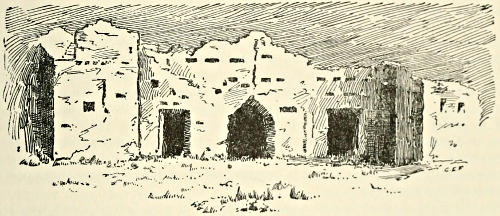
Sepulchral Structures at Athens
Of these, all the rest took whatever each one could that was useful, and
the heavy-armed and cavalry themselves, contrary to custom, carried their
own food under their arms, some for want of servants, others through distrusting
them; for they had for a long time been deserting, and did so in
greatest numbers at that moment. And even what they carried was not sufficient;
for there was no longer any food in the camp. Nor, again, was their
other misery, and their equal participation in sufferings (though it affords
some alleviation to endure with others), considered even on that account
easy to bear at the present time; especially, when they reflected from what
splendour and boasting at first they had been reduced to such an abject termination.
For this was the greatest reverse that ever befell a Grecian army;
since, in contrast to their having come to enslave others, they had to depart
in fear of undergoing that themselves; and instead of the prayers and hymns,
with which they sailed from home, they had to start on their return with
omens the very contrary; going by land, instead of by sea, and relying on a
military rather than a naval force. But nevertheless, in consequence of the
greatness of the danger still impending, all these things seemed endurable to
them.
Nicias, seeing the army dejected, and greatly changed, passed along the
ranks, and encouraged and cheered them, as well as existing circumstances
allowed; speaking still louder than before, as he severally came opposite to
them, in the earnestness of his feeling, and from wishing to be of service
to them by making himself audible to as many as possible. If he saw them
anywhere straggling, and not marching in order, he collected and brought
them to their post; while Demosthenes also did no less to those who were
near him, addressing them in a similar manner. They marched in the form
of a hollow square, the division under Nicias taking the lead, and that of
Demosthenes following; while the baggage bearers and the main crowd of
camp followers were enclosed within the heavy-armed.
When they had come to the river Anapus, they found drawn up a body of
the Syracusans and allies; but having routed these, and secured the passage,
they proceeded onwards; while the Syracusans pressed them with charges
of horse, as their light-armed did with their missiles. On that day the
Athenians advanced about five miles, and then halted for the night on a hill.
The day following, they commenced their march at an early hour, and having
advanced about two and a half miles, descended into a level district, and there
encamped, wishing to procure some eatables from the houses (for the place
was inhabited), and to carry on with them water from it, since for many
miles before them, in the direction they were to go, it was not plentiful. The
Syracusans, in the meantime, had gone on before, and were blocking up the
pass in advance of them. For there was there a steep hill, with a precipitous
ravine on either side of it, called the Acræum Lepas. The next day the
Athenians advanced, and the horse and dart-men of the Syracusans and allies,
each in great numbers, impeded their progress, hurling their missiles upon
them, and annoying them with cavalry charges. The Athenians fought for
a long time, and then returned again to the same camp, no longer having provisions
as they had before; and it was no more possible to leave their position,
because of the cavalry.
Starting early, they began their march again, and forced their way to the
hill which had been fortified; where they found before them the enemy’s
infantry drawn up for the defence of the wall many spears deep; for the pass
was but narrow. The Athenians charged and assaulted the wall, but being
annoyed with missiles by a large body from the hill, which was steep (for
those on the heights more easily reached their aim), and not being able to
force a passage, they retreated again, and rested. There happened also to
be at the same time some claps of thunder and rain, as is generally the case
when the year is now verging on autumn; in consequence of which the
Athenians were still more dispirited, and thought that all these things also
were conspiring together for their ruin. While they were resting, Gylippus
and the Syracusans sent a part of their troops to intercept them again with a
wall on their rear, where they had already passed: but they, on their side
also, sent some of their men against them, and prevented their doing it. After
this, the Athenians returned again with all their army into the more level
country, and there halted for the night. The next day they marched forward,
while the Syracusans discharged their weapons on them, surrounding them on
all sides, and disabled many with wounds; retreating if the Athenians advanced
against them, and pressing on them if they gave way; most especially
attacking their extreme rear, in the hope that by routing them little by little,
they might strike terror into the whole army. The Athenians resisted this
mode of attack for a long time, but then, after advancing five or six furlongs,
halted for rest on the plain; while the Syracusans went to their camp.
During the night, their troops being in a wretched condition, both from
the want of all provisions which was now felt, and from so many men being
disabled by wounds in the numerous attacks that had been made upon them
by the enemy, Nicias and Demosthenes determined to light as many fires as
possible, and then lead off the army, no longer by the same route as they had
intended, but in the opposite direction to where the Syracusans were watching
for them, namely, to the sea. Now the whole of this road would lead
the armament, not towards Catana, but to the other side of Sicily, to Camarina,
and Gela, and the cities in that direction, whether Grecian or barbarian.
They kindled therefore many fires, and began their march in the night.
And as all armies, especially the largest, are liable to have terrors and
panics amongst them, particularly when marching at night, and through
an enemy’s country, and with the enemy not far off; so they also were thrown
into alarm; and the division of Nicias, taking the lead as it did, kept
together and got a long way in advance; while that of Demosthenes, containing
about half or more, was separated from the others, and proceeded in
greater disorder. By the morning, nevertheless, they arrived at the seacoast,
and entering on what is called the Helorine road, continued their
march, in order that when they had reached the river Cacyparis, they might
march up along its banks through the interior; for they hoped also that
in this direction the Sicels, to whom they had sent, would come to meet
them. But when they had reached the river, they found a guard of the
Syracusans there too, intercepting the pass with a wall and a palisade, having
carried which, they crossed the river, and marched on again to another
called the Erineus; for this was the route which their guides directed them
to take.
Demosthenes Surrenders His Detachment
In the meantime the Syracusans and allies, as soon as it was day, and
they found that the Athenians had departed, most of them charged Gylippus
with having purposely let them escape; and pursuing with all haste by
the route which they had no difficulty in finding they had taken, they overtook
them about dinner-time. When they came up with the troops under
Demosthenes, which were behind the rest, and marching more slowly and
disorderly, ever since they had been thrown into confusion during the night,
at the time we have mentioned, they immediately fell upon and engaged
them; and the Syracusan horse surrounded them with greater ease from
their being divided, and confined them in a narrow space.
The division of Nicias was six miles in advance; for he led them on more
rapidly, thinking that their preservation depended, under such circumstances,
not on staying behind, if they could help it, and on fighting, but on retreating
as quickly as possible, and only fighting as often as they were compelled.
Demosthenes, on the other hand, was, generally speaking, involved in more
incessant labour (because, as he was retreating in the rear, he was the first
that the enemy attacked), and on that occasion, finding that the Syracusans
were in pursuit, he was not so much inclined to push on, as to form his men
for battle; until, through thus loitering, he was surrounded by them, and
both himself and the Athenians with him were thrown into great confusion.
Being driven back into a certain spot which had a wall all round it, with
a road on each side, and many olive trees growing about, they were annoyed
with missiles in every direction. This kind of attack the Syracusans naturally
adopted, instead of close combat; since risking their lives against men
reduced to despair was no longer for their advantage, so much as for that of
the Athenians. Besides, after success which was now so signal, each man
spared himself in some degree, that he might not be cut off before the end
of the business. They thought too that, even as it was, they should by this
kind of fighting subdue and capture the Athenians.
At any rate, when, after plying the Athenians and their allies with missiles
all day from every quarter, they saw them now distressed by wounds
and other sufferings, Gylippus with the Syracusans and allies made a proclamation,
in the first place, that any of the islanders who chose should come
over to them, on condition of retaining his liberty; and some few states
went over. Afterwards, terms were made with all the troops under Demosthenes,
that they should surrender their arms, and that no one should be put
to death, either by violence or imprisonment, or want of such nourishment
as was most absolutely requisite. Thus there surrendered, in all, to the number
of six thousand; and they laid down the whole of the money in their possession,
throwing it into the hollow of shields, four of which they filled with
it. These they immediately led back to the city, while Nicias and his division
arrived that day on the banks of the river Erineus; having crossed
which, he posted his army on some high ground.
Nicias Parleys, Fights, and Surrenders
The Syracusans, having overtaken him the next day, told him that
Demosthenes and his division had surrendered themselves, and called on
him also to do the same. Being incredulous of the fact, he obtained a truce
to enable him to send a horseman to see. When he had gone, and brought
word back again that they had surrendered, Nicias sent a herald to Gylippus
and the Syracusans, saying that he was ready to agree with the Syracusans,
on behalf of the Athenians, to repay whatever money the Syracusans had
spent on the war, on condition of their letting his army go; and that until
the money was paid, he would give Athenians as hostages, one for every
talent. The Syracusans and Gylippus did not accede to these proposals, but
fell upon this division also, and surrounded them on all sides, and annoyed
them with their missiles until late in the day. And they too, like the others,
were in a wretched plight for want of food and necessaries. Nevertheless,
they watched for the quiet of the night, and then intended to pursue their
march. And they were now just taking up their arms, when the Syracusans
perceived it and raised their pæan. The Athenians, therefore, finding that they
had not eluded their observation, laid their arms down again; excepting
about three hundred men who forced their way through the sentinels, and
proceeded, during the night, how and where they could.
As soon as it was day, Nicias led his troops forward; while the Syracusans
and allies pressed on them in the same manner, discharging their missiles
at them, and striking them down with their javelins on every side. The
Athenians were hurrying on to reach the river Assinarus, being urged to
this at once by the attack made on every side of them by the numerous cavalry
and the rest of the light-armed multitude (for they thought they should
be more at ease if they were once across the river), and also by their weariness
and craving for drink. When they reached its banks, they rushed into
it without any more regard for order, every man anxious to be himself the
first to cross it; while the attack of the enemy rendered the passage more
difficult. For being compelled to advance in a dense body, they fell upon
and trod down one another; and some of them died immediately on the javelins
and articles of baggage, while others were entangled together, and floated
down the stream. On the other side of the river, too, the Syracusans lined
the bank, which was precipitous, and from the higher ground discharged
their missiles on the Athenians, while most of them were eagerly drinking in
confusion amongst themselves in the hollow bed of the stream. The Peloponnesians,
moreover, charged them and butchered them, especially those in
the river. And thus the water was immediately spoiled; but nevertheless
it was drunk by them, mud and all, and bloody as it was, it was even fought
for by most of them.
At length, when many dead were now heaped one upon another in the
river, and the army was destroyed, either at the river, or, if any part had
escaped, by the cavalry, Nicias surrendered himself to Gylippus, placing
more confidence in him than in the Syracusans; and desired him and the
Lacedæmonians to do what they pleased with himself, but to stop butchering
the rest of the soldiers. After this, Gylippus commanded to make prisoners;
and they collected all that were alive, excepting such as they concealed for
their own benefit (of whom there was a large number). They also sent a
party in pursuit of the three hundred, who had forced their way through
the sentinels during the night, and took them. The part of the army, then,
that was collected as general property, was not large, but that which was
secreted was considerable; and the whole of Sicily was filled with them,
inasmuch as they had not been taken on definite terms of surrender, like
those with Demosthenes. Indeed no small part was actually put to death;
for this was the most extensive slaughter, and surpassed by none of all that
occurred in this Sicilian war. In the other encounters also, which were
frequent on their march, no few had fallen. But many also escaped; some
at the moment, others after serving as slaves, and running away subsequently.
These found a place of refuge at Catana.
The Fate of the Captives
When the Syracusans and allies were assembled together, they took with
them as many prisoners as they could, with the spoils, and returned to the
city. All the rest of the Athenians and the allies that they had taken,
they sent down into the quarries, thinking this the safest way of keeping
them; but Nicias and Demosthenes they executed, against the wish of
Gylippus. For he thought it would be a glorious distinction for him, in
addition to all his other achievements, to take to the Lacedæmonians the
generals who had commanded against them. And it so happened, that one
of these, namely Demosthenes, was regarded by them as their most inveterate
enemy, in consequence of what had occurred on the island and at Pylos;
the other, for the same reasons, as most in their interest; for Nicias had
exerted himself for the release of the Lacedæmonians taken from the island,
by persuading the Athenians to make a treaty. On this account the Lacedæmonians
had friendly feelings towards him; and indeed it was mainly for
the same reasons that he reposed confidence in Gylippus, and surrendered
himself to him. But certain of the Syracusans (as it was said) were afraid,
some of them, since they had held communication with him, that if put to
the torture, he might cause them trouble on that account in the midst of
their success; others, and especially the Corinthians, lest he might bribe
some, as he was rich, and effect his escape, and so they should again incur
mischief through his agency; and therefore they persuaded the allies, and
put him to death. For this cause then, or something very like it, he was
executed, having least of all the Greeks deserved to meet with such a
misfortune, on account of his devoted attention to the practice of every
virtue.
As for those in the quarries, the Syracusans treated them with cruelty
during the first period of their captivity. For as they were in a hollow
place, and many in a small compass, the sun, as well as the suffocating closeness,
distressed them at first, in consequence of their not being under cover;
and then, on the contrary, the nights coming on autumnal and cold, soon
worked in them an alteration from health to disease, by means of the change.
Since, too, in consequence of their want of room, they did everything in the
same place; and the dead, moreover, were piled up on one another—such
as died from their wounds, and from the change they had experienced, and
such like. There were, besides, intolerable stenches; while at the same time
they were tormented with hunger and thirst, for during eight months they
gave each of them daily only a cotyle[56] of water, and two of corn. And of
all the other miseries which it was likely that men thrown into such a place
would suffer, there was none that did not fall to their lot. For some seventy
days they thus lived all together; then the rest of them were sold, except
the Athenians, and whatever Siceliots or Italians had joined them in the
expedition.
The total number of those who were taken, though it were difficult to
speak with exactness, was still not less than seven thousand. “And this,”
says Thucydides in conclusion, “was the greatest Grecian exploit of all that
were performed in this war; nay, in my opinion, of all Grecian achievements
that we have heard of also; and was at once most splendid for the conquerors,
and most disastrous for the conquered. For being altogether vanquished
at all points, and having suffered in no slight degree in any respect, they
were destroyed (as the saying is) with utter destruction, both army, and
navy, and everything; and only a few out of many returned home. Such
were the events which occurred in Sicily.”i
The Groves of the Academy
In the populous and extensive kingdoms of modern Europe, the revolutions
of public affairs seldom disturb the humble obscurity of private life;
but the national transactions of Greece involved the interest of every family,
and deeply affected the fortune and happiness of every individual. Had the
arms of the Athenians proved successful in Sicily, each citizen would have
derived from that event an immediate accession of wealth, as well as of
power, and have felt a proportional increase of honour and security. But
their proud hopes perished forever in the harbour of Syracuse. The succeeding
disasters shook to the foundation the fabric of their empire.
In one rash enterprise they lost their army, their fleet, the prudence of
their experienced generals, and the flourishing vigour of their manly youth—irreparable
disasters which totally disabled them to resist the confederacy
of Peloponnesus, reinforced by the resentment of a new and powerful
enemy. While a Lacedæmonian army invested their city, they had reason
to dread that a Syracusan fleet should assault the Piræus; that Athens must
finally yield to these combined attacks, and her once prosperous citizens
destroyed by the sword, or dragged into captivity, atone by their death or
disgrace for the cruelties which they had recently inflicted on the wretched
republics of Melos and Scione.
The dreadful alternative of victory and defeat, renders it little surprising
that the Athenians should have rejected intelligence, which they must have
received with horror. The first messengers of such sad news were treated
with contempt; but it was impossible long to withhold belief from the
miserable fugitives, whose squalid and dejected countenances too faithfully
attested the public calamity. Such evidence could not be refused; the
arrogance of incredulity was abashed, and the whole republic thrown into
consternation, or seized with despair. The venerable members of the Areopagus
expressed the majesty of silent sorrow; but the piercing cries of woe
extended many a mile along the lofty walls which joined the Piræus to the city;
and the licentious populace raged with unbridled fury against the diviners
and orators, whose blind predictions, and ambitious harangues, had promoted
an expedition eternally fatal to their country.
The Athenian allies, or rather subjects, scattered over so many coasts and
islands, prepared to assert their independence; the confederates of Sparta,
among whom the Syracusans justly assumed the first rank, were unsatisfied
with victory, and longed for revenge: even those communities which had
hitherto declined the danger of a doubtful contest, meanly solicited to
become parties in a war, which they expected must finally terminate in the
destruction of Athens. Should all the efforts of such a powerful confederacy
still prove insufficient to the ruin of the devoted city, there was yet another
enemy behind, from whose strength and animosity the Athenians had everything
to fear.
[425-413 B.C.]
The long and peaceful reign of Artaxerxes expired four hundred and
twenty-five years before the Christian era. There followed a rapid succession
of kings, Xerxes, Sogdianus, Ochus; the last of whom assumed the name
of Darius, to which historians have added the epithet of Nothus, the bastard,
to distinguish this effeminate prince from his illustrious predecessor. But in
the ninth year of his reign Darius was roused from his lethargy by the revolt
of Egypt and Lydia. The defection of the latter threatened to tear from his
dominion the valuable provinces of Asia Minor; a consequence which he determined
to prevent by employing the bravery of Pharnabazus, and the policy
of the crafty Tissaphernes, to govern respectively the northern and southern
districts of that rich and fertile peninsula. The abilities of these generals
not only quelled the rebellion in Lydia, but extended the arms of their master
towards the shores of the Ægean, as well as of the Hellespont and Propontis;
in direct opposition to the treaty which forty years before had been ratified
between the Athenians, then in the height of their prosperity, and the unwarlike
Artaxerxes. But the recent misfortunes of that ambitious people flattered
the Persian commanders with the hope of restoring the whole Asiatic
coast to the Great King, as well as of inflicting exemplary punishment on the
proud city, which had resisted the power, dismembered the empire, and
tarnished the glory of Persia.
The terror of such a formidable combination might have reduced the
Athenians to despair. Their disasters and disgrace in Sicily destroyed at
once the real and the ideal supports of their power; the loss of one-third of
their citizens made it impossible to supply, with fresh recruits, the exhausted
strength of their garrisons in foreign parts; the terror of their fleet was no
more; and their multiplied defeats, before the walls of Syracuse, had converted
into contempt that admiration in which Athens had been long held
by Greeks and barbarians.
But in free governments there are many latent resources which public
calamities alone can bring to light; and adversity, which to individuals endowed
with inborn vigour of mind is the great school of virtue and of heroism,
furnishes also to the enthusiasm of popular assemblies the noblest field
for the display of national honour and magnanimity. Had the measures of
the Athenians depended on one man, or even on a few, it is probable that the
selfish timidity of a prince, and the cautious prudence of a council, would have
sunk under the weight of misfortunes, too heavy for the unsupported strength
of ordinary minds. But the first spark of generous ardour, which the love
of virtue, of glory, and the republic, or even the meaner motives of ambition
and vanity, excited in the assembled multitude, was diffused and increased
by the natural contagion of sympathy; the patriotic flame was communicated
simultaneously to every breast. With one mind and resolution the Athenians
determined to brave the severity of fortune, and to withstand the assaults of
the enemy.
[412 B.C.]
In the year following the unfortunate expedition into Sicily, the Spartans
prepared a fleet of a hundred sail, of which twenty-five galleys were furnished
by their own seaports. This armament was destined to encourage
and support the revolt of the Asiatic subjects of the Athenians. The islands
of Chios and Lesbos, as well as the city Erythræ on the continent, solicited
the Spartans to join them with their naval force. Their request was enforced
by Tissaphernes, who promised to pay the sailors, and to victual the ships.
At the same time, an ambassador from Cyzicus, a populous town situate on
an island of the Propontis, entreated the Lacedæmonian armament to sail
to the safe and capacious harbours which had long formed the wealth and
the ornament of that city, and to expel the Athenian garrisons, to which the
Cyzicenes and their neighbours reluctantly submitted. The Persian Pharnabazus
seconded their proposal; offered the same conditions with Tissaphernes;
and so little harmony subsisted between the lieutenants of the
Great King, that each urged his particular demand with a total unconcern
about the important interests of their common master. The Lacedæmonians
held many consultations amongst themselves, and with their allies; hesitated,
deliberated, resolved, and changed their resolution; and at length were persuaded
by Alcibiades to prefer the overture of Tissaphernes and the Ionians
to that of the Hellespontines and Pharnabazus.
The delay occasioned by this deliberation was the principal, but not the
only cause which hindered the allies from acting expeditiously, at a time
when expedition was of the utmost importance. A variety of private views
diverted them from the general aim of the confederacy; and the season was
far advanced before the Corinthians, who had been distinguished by excess
of antipathy to Athens, were prepared to sail. The Athenians anticipated
the designs of the rebels of Chios, and carried off seven ships as pledges of
their fidelity. The squadron which returned from this useful enterprise,
intercepted the Corinthians as they sailed through the Saronic Gulf; and
having attacked and conquered them, pursued and blocked them up in their
harbours. Meanwhile the Spartans sent to the Ionian coast such squadrons
as were successively ready for sea, under the conduct of Alcibiades, Chalcideus,
and Astyochus. The first of these commanders sailed to the isle of
Chios, which was distracted by contending factions. The Athenian partisans
were surprised and compelled to submit; and the city, which possessed forty
galleys, and yielded in wealth and populousness to none of the neighbouring
colonies, became an accession to the Peloponnesian confederacy. The strong
and rich town of Miletus followed the example: Erythræ and Clazomenæ
surrendered to Chalcideus; several places of less note were conquered by
Astyochus.
When the Athenians received the unwelcome intelligence of these events,
they voted the expenditure of a thousand talents, which in more prosperous
times, they had deposited in the citadel, under the sanction of a decree of
the senate and people, to reserve it for an occasion of the utmost danger.
This seasonable supply enabled them to increase the fleet, which sailed under
Phrynichus and other leaders, to the isle of Lesbos. Having secured the
fidelity of the Lesbians, who were ripe for rebellion, they endeavoured to
recover their authority in Miletus, anciently regarded as the capital of the
Ionic coast. A bloody battle was fought before the walls of that place, between
the Athenians and Argives on one side, and the Peloponnesians,
assisted by the troops of Tissaphernes and the revolted Milesians, on the
other. The Athenian bravery defeated, on this occasion, the superior number
of Greeks and barbarians to whom they were opposed; but their Argive
auxiliaries were repulsed by the gallant citizens of Miletus so that in both
parts of the engagement, the Ionic race, commonly reckoned the less war-like,
prevailed over their Dorian rivals and enemies. Elevated with the joy
of victory, the Athenians prepared to assault the town, when they were
alarmed by the approach of a fleet of fifty-five sail which advanced in two
divisions, the one commanded by the celebrated Hermocrates, the other by
Theramenes the Spartan. Phrynichus prudently considered, that his own
strength only amounted to forty-eight galleys, and refused to commit the
last hope of the republic to the danger of an unequal combat. His firmness
despised the clamours of the Athenian sailors, who insulted, under the name
of cowardice, the caution of their admiral; and he calmly retired with his
whole force to the isle of Samos, where the popular faction having lately
treated the nobles with shocking injustice and cruelty, too frequent in Grecian
democracies, were ready to receive with open arms the patrons of that
form of government.
The retreat of the Athenian fleet acknowledged the naval superiority of
the enemy; a superiority which was alone sufficient either to acquire or to
maintain the submission of the neighbouring coasts and islands. In other
respects too, the Peloponnesians enjoyed the most decisive advantages. Their
galleys were victualled, their soldiers were paid by Tissaphernes, and they
daily expected a reinforcement of a hundred and fifty Phœnician ships. But,
in this dangerous crisis, fortune seemed to respect the declining age of Athens,
and, by a train of accidents, singular and almost incredible, enabled Alcibiades,
so long the misfortune and the scourge, to become the defence and the
saviour of his country.
Greek Sandals
[415-412 B.C.]
During his long residence in Sparta, Alcibiades assumed the outward
gravity of deportment, and conformed himself to the spare diet, and laborious
exercises, which prevailed in that austere republic; but his character and
his principles remained as licentious as ever. His intrigue with Timæa, the
spouse of king Agis, was discovered by an excess of female levity. The
queen, vain of the attachment of so celebrated a character, familiarly gave
the name of Alcibiades to her son Leotychides; a name which, first confined
to the privacy of her female companions, was soon spread abroad in the world.
Alcibiades punished her folly by a most mortifying but well-merited declaration,
boasting that he had solicited her favours from no other motive but
that he might indulge the ambitious desire of giving a king to Sparta. The
offence itself, and the shameless avowal, still more provoking than the offence,
excited the keenest resentment in the breast of the injured husband. The
magistrates and generals of Sparta, jealous of the fame, and envious of the
merit of a stranger, readily sympathised with the misfortune, and encouraged
the revenge of Agis; and, as the horrid practice of assassination was still
disgracing the manners of Greece, orders were sent to Astyochus, who commanded
in chief the Peloponnesian forces in Asia, secretly to destroy
Alcibiades, whose power defied those laws which in every Grecian republic
condemned adulterers to death. But the active and subtile Athenian had
secured too faithful domestic intelligence in the principal families of Sparta
to become the victim of this execrable design. With his usual address he
eluded all the snares of Astyochus: his safety, however, required perpetual
vigilance and caution, and he determined to escape from the situation, which
subjected him to such irksome restraint.
Publicly banished from Athens, secretly persecuted by Sparta, he had
recourse to the friendship of Tissaphernes, who admired his accomplishments,
and respected his abilities, which, though far superior in degree, were similar
in kind to his own. Tissaphernes was of a temper the more readily to
serve a friend, in proportion as he less needed his services. Alcibiades, therefore,
carefully concealed from him the dangerous resentment of the Spartans.
In the selfish breast of the Persian no attachment could be durable unless
founded on interest; and Alcibiades, who had deeply studied his character,
began to flatter his avarice, that he might insure his protection. He
informed him, that by allowing the Peloponnesian sailors a drachma, or
sevenpence sterling, of daily pay, he treated them with a useless and even
dangerous liberality: that the pay given by the Athenians, even in the most
flourishing times, amounted only to three oboli. Should the sailors prove
dissatisfied with this equitable reduction, the Grecian character afforded an
easy expedient for silencing their licentious clamours. It would be sufficient
to bribe the naval commanders and a few mercenary orators, and the careless
and improvident seamen would submit, without suspicion, the rate of
their pay, as well as every other concern, to the influence and the authority
of those who were accustomed to govern them.
Tissaphernes heard this advice with all the attention of an avaricious
man to every proposal for saving his money; and so true a judgment had
Alcibiades formed of the Greeks, that Hermocrates the Syracusan was the
only officer who disdained, meanly and perfidiously, to betray the interest
of the men under his command: yet through the influence of his colleagues,
the plan of economy was universally adopted.
The intrigues of Alcibiades sowed jealousy and distrust in the Peloponnesian
fleet: they alienated the minds of the troops both from Tissaphernes
and from their commanders: the Persian was ready to forsake those whom
he had learned to despise; and Alcibiades profited by this disposition to
insinuate that the alliance of the Lacedæmonians was equally expensive
and inconvenient for the Great King and his lieutenants.
These artful representations produced almost an open breach between
Tissaphernes and his confederates. The advantage which Athens would
derive from this rupture might have paved the way for Alcibiades to return
to his country: but he dreaded to encounter that popular fury, whose
effects he had fatally experienced, and whose mad resentment no degree of
merit could appease; he therefore applied secretly to Pisander, Theramenes,
and other persons of distinction in the Athenian camp. To them
he deplored the desperate state of public affairs, expatiated on his own
credit with Tissaphernes, and insinuated that it might be yet possible to
prevent the Phœnician fleet from sailing to assist the enemy. Assuming
gradually more boldness, he finally declared that the Athenians might obtain
not merely the neutrality, but perhaps the assistance of Tissaphernes, should
they consent to abolish their turbulent democracy, so odious to the Persians,
and to entrust the administration of government to men worthy to negotiate
with so mighty a monarch.
When the illustrious exile proposed this measure, it is uncertain whether
he was acquainted with the secret cabals which had been already formed,
both in the city and in the camp, for executing the design which he suggested.
One man, the personal enemy of Alcibiades, alone opposed the
general current. But this man was Phrynichus. The courage with which
he invited dangers many have equalled, but none ever surpassed the boldness
with which he extricated himself from difficulties. When he perceived
that his colleagues were deaf to every objection against recalling the friend
of Tissaphernes, he secretly informed the Spartan admiral Astyochus, of
the intrigues which were carrying on to the disadvantage of his country.
Daring as this treachery was, Phrynichus addressed a traitor not less
perfidious than himself. Astyochus was become the pensioner and creature
of Tissaphernes, to whom he communicated the intelligence. The Persian
again communicated it to his favourite Alcibiades, who complained in
strong terms to the Athenians of the baseness and villainy of Phrynichus.
The latter exculpated himself with address; but as the return of Alcibiades
might prove fatal to his safety, he ventured, a second time, to write
to Astyochus, gently reproaching him with his breach of confidence, and
explaining by what means he might surprise the whole Athenian fleet
at Samos; an exploit that must forever establish his fame and fortune.
Astyochus again betrayed the secret to Tissaphernes and Alcibiades; but
before their letters could be conveyed to the Athenian camp, Phrynichus,
who, by some unknown channel, was informed of this second treachery,
anticipated the dangerous discovery, by apprising the Athenians of their
enemy’s design to surprise their fleet. They had scarcely employed the
proper means to counteract that purpose when messengers came from
Alcibiades to announce the horrid perfidy of a wretch who had basely
sacrificed to private resentment the last hope of his country. But the
messengers arrived too late; the prior information of Phrynichus, as well
as the bold and singular wickedness of his design, which no common
degree of evidence was thought sufficient to prove, were sustained as
arguments for his exculpation; and it was believed that Alcibiades had
made use of a stratagem most infamous in itself, but not unexampled
among the Greeks, for destroying a man whom he detested.
The opposition of Phrynichus, though it retarded the designs of
Alcibiades, prevented not the measures of Pisander and his associates
for abolishing the democracy. The soldiers at Samos were induced, by
reasons above mentioned, to acquiesce in the resolution of their generals.
But a more difficult task remained; to deprive the people of Athens of
their liberty which, since the expulsion of the family of Pisistratus, they
had enjoyed a hundred years. Pisander headed the deputation which was
sent from the camp to the city to effect this important revolution. He
acquainted the extraordinary assembly, summoned on that occasion in the
theatre of Bacchus, of the measures which had been adopted by their
soldiers and fellow-citizens at Samos. The compact band of conspirators
warmly approved the example; but loud murmurs of discontent resounded
in different quarters of that spacious theatre. Pisander asked the reason of
this disapprobation. “Had his opponents anything better to propose?
If they had, let them come forward and explain the grounds of their
dissent: but, above all, let them explain how they could save themselves,
their families, and their country, unless they complied with the demand of
Tissaphernes. The imperious voice of necessity was superior to law; and
when the actual danger had ceased, they might re-establish their ancient
constitution.” The opponents of Pisander were unable or afraid to reply:
and the assembly passed a decree, investing ten ambassadors with full powers
to treat with the Persian satrap.
[412 B.C.]
Soon after the arrival of the Peloponnesian fleet on the coast of Asia,
the Spartan commanders had concluded, in the name of their republic, a
treaty with Tissaphernes; in which it was stipulated, that the subsidies should
be regularly paid by the king of Persia, and that the Peloponnesian forces
should employ their utmost endeavours to recover, for that monarch, all
the dominions of his ancestors, which had been long unjustly usurped, and
cruelly insulted, by the Athenians. This treaty seemed so honourable to
the Great King, that his lieutenant could not venture openly to infringe it.
Alarmed at the decay of his influence with the Persians, on which he had
built the flattering hopes of returning to his country, Alcibiades employed
all the resources of his genius to conceal his disgrace. By solicitations,
entreaties, and the meanest compliances, he obtained an audience for his fellow-citizens.
As the agent of Tissaphernes, he then proposed the conditions
on which they might obtain the friendship of the Great King. Several
demands were made, demands most disgraceful to the name of Athens: to
all of which the ambassadors submitted. They even agreed to surrender the
whole coast of Ionia to its ancient sovereign. But when the artful Athenian
(fearful lest they should, on any terms, admit the treaty which Tissaphernes
was resolved on no terms to grant) demanded that the Persian fleets should
be allowed to sail, undisturbed, in the Grecian seas, the ambassadors, well
knowing that should this condition be complied with, no treaty could hinder
Greece from becoming a province of Persia, expressed their indignation in
very unguarded language, and left the assembly in disgust.
This imprudence enabled Alcibiades to affirm, with some appearance of
truth, that their own anger and obstinacy, not the reluctance of Tissaphernes,
had obstructed the negotiation, which was precisely the issue of the affair
most favourable to his views. His artifices succeeded, but were not attended
with the consequences expected from them. The Athenians, both in the
camp and city, perceived, by this transaction, that his credit with the Persians
was less than he represented it; and the aristocratical faction were glad to
get rid of a man, whose restless ambition rendered him a dangerous associate.
They persisted, however, with great activity, in executing their purpose; of
which Phrynichus, who had opposed them only from hatred of Alcibiades,
became an active abettor. When persuasion was ineffectual, they had recourse
to violence. Androcles, Hyperbolus, and other licentious demagogues,
were assassinated. The people of Athens, ignorant of the strength of the conspirators,
and surprised to find in the number many whom they least suspected,
were restrained by inactive timidity, or fluctuated in doubtful suspense. The
cabal alone acted with union and with vigour; and difficult as it seemed to
subvert the Athenian democracy, which had subsisted a hundred years with
unexampled glory, yet this design was undertaken and accomplished by the
enterprising activity of Pisander, the artful eloquence of Theramenes, the firm
intrepidity of Phrynichus, and the superintending wisdom of Antiphon.
He it was who formed the plan, and regulated the mode of attack, which
was carried on by his associates. Pisander and his party boldly declared,
that neither the spirit nor the forms of the established constitution (which
had recently subjected them to such a weight of misfortunes) suited the
present dangerous and alarming crisis. That it was necessary to new-model
the whole fabric of government; for which purpose five persons (whose
names he read) ought to be appointed by the people, to choose a hundred
others; each of whom should select three associates; and the four hundred
thus chosen, men of dignity and opulence, who would serve their country
without fee or reward, ought immediately to be invested with the majesty
of the republic. They alone should conduct the administration uncontrolled,
and assemble, as often as seemed proper, five thousand citizens, whom they
judged most worthy of being consulted in the management of public affairs.
This extraordinary proposal was accepted without opposition: the partisans
of democracy dreaded the strength of the cabal; and the undiscerning multitude,
dazzled by the imposing name of five thousand, a number far exceeding
the ordinary assemblies of Athens, perceived not that they surrendered
their liberties to the artifice of an ambitious faction.b
[411 B.C.]
Full liberty being thus granted to make any motion, however anti-constitutional,
and to dispense with all the established formalities, such as preliminary
authorisation by the senate, Pisander now came forward with his
substantive propositions to the following effect:
(1) All the existing democratical magistracies were suppressed at once,
and made to cease for the future. (2) No civil functions whatever were
hereafter to be salaried. (3) To constitute a new government, a committee
of five persons were named forthwith, who were to choose a larger body of
one hundred; that is, one hundred including the five choosers themselves.
Each individual out of this body of one hundred, was to choose three persons.
(4) A body of Four Hundred was thus constituted, who were to take
their seat in the senate house, and to carry on the government with unlimited
powers, according to their own discretion. (5) They were to convene
the Five Thousand, whenever they might think fit. All was passed without
a dissentient voice.
The invention and employment of this imaginary aggregate of Five
Thousand was not the least dexterous among the combinations of Antiphon.
No one knew who these Five Thousand were: yet the resolution just adopted
purported—not that such a number of citizens should be singled out and
constituted, either by choice, or by lot, or in some determinate manner which
should exhibit them to the view and knowledge of others—but that the
Four Hundred should convene the Five Thousand, whenever they thought
proper: thus assuming the latter to be a list already made up and notorious,
at least to the Four Hundred themselves. The real fact was that the Five
Thousand existed nowhere except in the talk and proclamations of the conspirators,
as a supplement of fictitious auxiliaries. They did not even exist
as individual names on paper, but simply as an imposturous nominal aggregate.
The Four Hundred, now installed, formed the entire and exclusive
rulers of the state. But the mere name of the Five Thousand, though it
was nothing more than a name, served two important purposes for Antiphon
and his conspiracy. First, it admitted of being falsely produced,
especially to the armament at Samos, as proof of a tolerably numerous and
popular body of equal, qualified, concurrent citizens, all intended to take
their turn by rotation in exercising the powers of government; thus lightening
the odium of extreme usurpation to the Four Hundred, and passing them off
merely as the earliest section of the Five Thousand, put into office for a few
months, and destined at the end of that period to give place to another equal
section. Next, it immensely augmented the means of intimidation possessed
by the Four Hundred at home, by exaggerating the impression of their supposed
strength. For the citizens generally were made to believe that there
were five thousand real and living partners in the conspiracy; while the fact
that these partners were not known and could not be individually identified,
rather aggravated the reigning terror and mistrust; since every man, suspecting
that his neighbour might possibly be among them, was afraid to
communicate his discontent or propose means for joint resistance. In both
these two ways, the name and assumed existence of the Five Thousand lent
strength to the real Four Hundred conspirators. It masked their usurpation,
while it increased their hold on the respect and fears of the citizens.
As soon as the public assembly at Colonus had, with such seeming unanimity,
accepted all the propositions of Pisander, they were dismissed; and
the new regiment of Four Hundred were chosen and constituted in the form
prescribed. It now only remained to install them in the senate house.
But this could not be done without force, since the senators were already
within it; having doubtless gone thither immediately from the assembly,
where their presence, at least the presence of the prytanes, or senators of the
presiding tribe, was essential as legal presidents. They had to deliberate
what they would do under the decree just passed, which divested them of all
authority. Nor was it impossible that they might organise armed resistance;
for which there seemed more than usual facility at the present moment, since
the occupation of Decelea by the Lacedæmonians kept Athens in a condition
like that of a permanent camp, with a large proportion of the citizens day
and night under arms. Against this chance the Four Hundred made provision.
They selected that hour of the day when the greater number of
citizens habitually went home, probably to their morning meal, leaving the
military station, with the arms piled and ready, under comparatively thin
watch. While the general body of hoplites left the station at this hour,
according to the usual practice, the hoplites—Andrian, Tenian, and others—in
the immediate confidence of the Four Hundred, were directed, by private
order, to hold themselves prepared and in arms, at a little distance off; so
that if any symptoms should appear of resistance being contemplated, they
might at once interfere and forestall it.
The Four Hundred then marched to the senate house, each man with a
dagger concealed under his garment, and followed by their special bodyguard
of 120 young men from various Grecian cities, the instruments of the
assassinations ordered by Antiphon and his colleagues. In this array they
marched into the senate house, where the senators were assembled, and
commanded them to depart; at the same time tendering to them their pay
for all the remainder of the year—seemingly about three months or more
down to the beginning of Hecatombæon, the month of new nominations—during
which their functions ought to have continued. The senators were
no way prepared to resist the decree just passed under the forms of legality,
with an armed body now arrived to enforce its execution. They obeyed and
departed, each man as he passed the door receiving the salary tendered to
him. That they should yield obedience to superior force, under the circumstances,
can excite neither censure nor surprise; but that they should accept,
from the hands of the conspirators, this anticipation of an unearned salary,
was a meanness which almost branded them as accomplices, and dishonoured
the expiring hour of the last democratical authority. The Four Hundred
now at last found themselves triumphantly installed in the senate house,
without the least resistance, either from within its walls or even from without,
by any portion of the citizens.
Thus perished, or seemed to perish, the democracy of Athens, after an
uninterrupted existence of nearly one hundred years since the revolution of
Clisthenes. So incredible did it appear that the numerous, intelligent, and
constitutional citizens of Athens should suffer their liberties to be overthrown
by a band of four hundred conspirators, while the great mass of them
not only loved their democracy, but had arms in their hands to defend it,
that even their enemy and neighbour Agis, at Decelea, could hardly imagine
the revolution to be a fact accomplished.
The ulterior success of the conspiracy—when all prospect of Persian
gold, or improved foreign position, was at an end—is due to the combinations,
alike nefarious and skillful, of Antiphon, wielding and organising the
united strength of the aristocratical classes at Athens; strength always exceedingly
great, but under ordinary circumstances working in fractions
disunited and even reciprocally hostile to each other—restrained by the
ascendent democratical institutions—and reduced to corrupt what it could
not overthrow. Antiphon, about to employ this anti-popular force in one
systematic scheme, and for the accomplishment of a predetermined purpose,
keeps still within the same ostensible constitutional limits. He raises no
open mutiny: he maintains inviolate the cardinal point of Athenian political
morality—respect to the decision of the senate and political assembly, as
well as to constitutional maxims.
He knows, however, that the value of these meetings, depends upon freedom
of speech; and that, if that freedom be suppressed, the assembly itself
becomes a nullity, or rather an instrument of positive imposture and mischief.
Accordingly, he causes all the popular orators to be successively
assassinated, so that no man dares to open his mouth on that side; while on
the other hand, the anti-popular speakers are all loud and confident, cheering
one another on, and seeming to represent all the feeling of the persons
present. By thus silencing each individual leader, and intimidating every
opponent from standing forward as spokesman, he extorts the formal sanction
of the assembly and the senate to measures which the large majority of the
citizens detest. That majority, however, are bound by their own constitutional
forms; and when the decision of these, by whatever means obtained,
is against them, they have neither the inclination nor the courage to resist.
In no part of the world has this sentiment of constitutional duty, and submission
to the vote of a legal majority, been more keenly and universally
felt, than it was among the citizens of democratical Athens.[57] Antiphon thus
finds means to employ the constitutional sentiment of Athens as a means of
killing the constitution: the mere empty form, after its vital and protective
efficacy has been abstracted, remains simply as a cheat to paralyse individual
patriotism.
As Grecian history has been usually written, we are instructed to believe
that the misfortunes, and the corruption, and the degradation of the democratical
states are brought upon them by the class of demagogues, of whom
Cleon, Hyperbolus, Androcles, etc., stand forth as specimens. These men
are represented as mischief makers and revilers, accusing without just cause,
and converting innocence into treason. Now the history of this conspiracy
of the Four Hundred presents to us the other side of the picture. It shows
that the political enemies, against whom the Athenian people were protected
by their democratical institutions, and by the demagogues as living
organs of those institutions, were not fictitious but dangerously real. It
reveals the continued existence of powerful anti-popular combinations, ready
to come together for treasonable purposes when the moment appeared safe
and tempting. It manifests the character and morality of the leaders, to
whom the direction of the anti-popular force naturally fell. It proves that
these leaders, men of uncommon ability, required nothing more than the
extinction or silence of the demagogues, to be enabled to subvert the popular
securities and get possession of the government. We need no better proof
to teach us what was the real function and intrinsic necessity of these demagogues
in the Athenian system, taking them as a class, and apart from the
manner in which individuals among them may have performed their duty.
They formed the vital movement of all that was tutelary and public spirited in
democracy. Aggressive in respect to official delinquents, they were defensive
in respect to the public and the constitution.
If that force, which Antiphon found ready made, had not been efficient,
at an earlier period in stifling the democracy, it was because there were demagogues
to cry aloud, as well as assemblies to hear and sustain them. If
Antiphon’s conspiracy was successful, it was because he knew where to aim
his blows, so as to strike down the real enemies of the oligarchy and the real
defenders of the people. We here employ the term demagogue because it is
that commonly used by those who denounce the class of men here under
review: the proper neutral phrase, laying aside odious associations, would be
to call them popular speakers, or opposition speakers. But, by whatever
name they may be called, it is impossible rightly to conceive their position
in Athens, without looking at them in contrast and antithesis with those anti-popular
forces against which they formed the indispensable barrier, and
which come forth into such manifest and melancholy working under the
organising hands of Antiphon and Phrynichus.c
Greek Seals
The conduct of the Four Hundred tyrants (for historians have justly
adopted the language of Athenian resentment) soon opened the eyes and
understanding of the most thoughtless. They abolished every vestige of
ancient freedom; employed mercenary troops levied from the small islands
of the Ægean, to overawe the multitude, and to intimidate, in some instances
to destroy, their real or suspected enemies. Instead of seizing the opportunity
of annoying the Peloponnesians, enraged at the treachery of Tissaphernes,
and mutinous for want of pay and subsistence, they sent ambassadors to
solicit peace from the Spartans on the most dishonourable terms. Their
tyranny rendered them odious in the city, and their cowardice made them
contemptible in the camp at Samos. Their cruelty and injustice were
described and exaggerated by the fugitives who continually arrived in that
island. Thrasybulus and Thrasyllus, two officers of high merit and distinction,
though not actually entrusted with a share in the principal command,
gave activity and boldness to the insurgents. The abettors of the new government
were attacked by surprise: thirty of the most criminal were put to
death, several others were banished, democracy was re-established in the
camp, and the soldiers were bound by oath to maintain their hereditary government
against the conspiracy of domestic foes, and to act with vigour
against the public enemy.
Thrasybulus, who headed this successful and meritorious sedition, had
a mind to conceive, a tongue to persuade, and a hand to execute the most
daring designs. He exhorted the soldiers not to despair of effecting in the
capital the same revolution which they had produced in the camp. Their
most immediate concern was to recall Alcibiades, who had been deceived
and disgraced by the tyrants, and who not only felt with peculiar sensibility,
but could resent with becoming dignity, the wrongs of his country and his
own. The advice of Thrasybulus was approved; soon after he sailed to
Magnesia, and returned in company with Alcibiades.
Greek Seals
Though the army immediately saluted him general, Alcibiades left the care
of the troops to his colleagues Thrasybulus and Thrasyllus, and withdrew himself
from the applauses of his admiring countrymen, on pretence of concerting
with Tissaphernes the system of their future operations. But his principal
motive was to show himself to the Persian, in the new and illustrious character
with which he was invested; for having raised his authority among the Athenians
by his influence with the satrap, he expected to strengthen this influence by
the support of that authority. Before he returned to the camp, ambassadors
had been sent by the tyrants, to attempt a negotiation with the partisans of
democracy, who, inflamed by continual reports of the indignities and cruelties
committed in Athens, prepared to sail thither to protect their friends
and take vengeance on their enemies. Alcibiades judiciously opposed this
rash resolution which must have left the Hellespont, Ionia, and the islands,
at the mercy of the hostile fleet. But he commanded the ambassadors to deliver
to their masters a short but pithy message: “That they must divest
themselves of their illegal power, and restore the ancient constitution. If
they delayed obedience, he would sail to the Piræus, and deprive them of their
authority and their lives.”
When this message was reported at Athens, it added to the disorder and
confusion in which that unhappy city was involved. The Four Hundred who
had acted with unanimity in usurping the government, soon disagreed about
the administration, and split into factions, which persecuted each other as
furiously as both had persecuted the people. Theramenes and Aristocrates
condemned and opposed the tyrannical measures of their colleagues. The
perfidious Phrynichus was slain: both parties prepared for taking arms;
and the horrors of a Corcyrean sedition were ready to be renewed in Athens,
when the old men, the children, the women, and strangers, interposed for the
safety of a city which had long been the ornament of Greece, the terror of
Persia, and the admiration of the world.
Had the public enemy availed themselves of this opportunity to assault
the Piræus, Athens could not have been saved from immediate destruction.
But the Peloponnesian forces at Miletus, long clamorous and discontented,
had broken out into open mutiny, when they heard of the recall of Alcibiades,
and the hostile intentions of Tissaphernes. They destroyed the Persian
fortifications in the neighbourhood of Miletus; they put the garrisons to the
sword; their treacherous commander, Astyochus, saved his life by flying to
an altar; nor was the tumult appeased until the guilty were removed from
their sight, and Mindarus, an officer of approved valour and fidelity, arrived
from Sparta to assume the principal command.
The dreadful consequences which must have resulted to the Athenians,
if, during the fury of their sedition, the enemy had attacked them with a
fleet of a hundred and fifty sail, may be conceived by the terror inspired by
a much smaller Peloponnesian squadron of only forty-two vessels commanded
by the Spartan Agesandridas. The friends of the constitution had assembled
in the spacious theatre of Bacchus. The most important matters were in
agitation, when the alarm was given that some Peloponnesian ships had been
seen on the coast. All ranks of men hastened to the Piræus; and prepared
thirty-six vessels for taking the sea. When Agesandridas perceived the
ardent opposition which he must encounter in attempting to land, he doubled
the promontory of Sunium, and sailed towards the fertile island of Eubœa,
from which, since the fortification of Decelea, the Athenians had derived far
more plentiful supplies than from the desolated territory of Attica. To defend
a country which formed their principal resource, they sailed in pursuit
of the enemy, and observed them next day near the shore of Eretria, the most
considerable town in the island.
The Eubœans, who had long watched an opportunity to revolt, supplied
the Peloponnesian squadron with all necessaries in abundance; but instead
of furnishing a market to the Athenians, they retired from the coast
on their approach. The commanders were obliged to weaken their strength
by despatching several parties into the country to procure provisions;
Agesandridas seized this opportunity to attack them: most of the ships
were taken; the crews swam to land; many were cruelly murdered by the
Eretrians, from whom they expected protection; and such only survived as
took refuge in the Athenian garrisons scattered over the island.
The news of this misfortune were most alarming to the Athenians. Neither
the invasion of Xerxes, nor even the defeat in Sicily, occasioned such terrible
consternation. They dreaded the immediate defection of Eubœa; they
had no more ships to launch; no means of resisting their multiplied enemies:
the city was divided against the camp, and divided against itself. Yet the
magnanimous firmness of Theramenes did not allow the friends of liberty to
despair. He encouraged them to disburden the republic of its domestic foes,
who had summoned, or who were at least believed to have summoned, the
assistance of the Lacedæmonian fleet, that they might be enabled to enslave
their fellow citizens. Antiphon, Pisander, and the most obnoxious, seasonably
escaped; the rest submitted. A decree was passed, recalling Alcibiades,
and approving the conduct of the troops at Samos. The sedition ceased.
The democracy, which had been interrupted four months, was restored; and
such are the resources of a free government, that even this violent fermentation
was not unproductive of benefit to the state.
[411-409 B.C.]
The Spartans, who formerly rejected the friendship, now courted the protection
of Pharnabazus; to whose northern province they sailed with the
principal strength of their armament, proceeded northwards in pursuit of
the enemy; and the important straits, which join the Euxine and Ægean seas,
became, and long continued, the scene of conflict. In the twenty-first winter
of the war, a year already distinguished by the dissolution and revival of
their democracy, the Athenians prevailed in three successive engagements,
including Cynossema, the event of which became continually more decisive.
The Spartans yielded possession of the sea, which they hoped soon to
recover, and retired to the friendly harbours of Cyzicus, to repair their shattered
fleet; while the Athenians profited by the fame of their victory, and by
the terror of their arms, to demand contributions from the numerous and
wealthy towns in that neighbourhood. It was determined, chiefly by the
advice of Alcibiades, to attack the enemy at Cyzicus; for which purpose they
sailed, with eighty galleys, to the small island of Proconnesus, near the
western extremity of the Propontis, and ten miles distant from the station of
the Peloponnesian fleet. Alcibiades surprised sixty vessels on a dark and
rainy morning, as they were manœuvring at a distance from the harbour, and
skilfully intercepted their retreat. As the day cleared up, the rest sailed
forth to their assistance; the action became general; the Athenians obtained
a complete victory, and their valour was rewarded by the capture of the
whole Peloponnesian fleet, except the Syracusan ships, which were burned,
in the face of a victorious enemy, by the enterprising Hermocrates. The
Peloponnesians were assisted by Pharnabazus in equipping a new fleet; but
were deprived of the wise counsels of Hermocrates, whose abilities were
well fitted both to prepare and to employ the resources of war. The success
of the Asiatic expedition had not corresponded to the sanguine hopes of his
countrymen; the insolent populace accused their commanders of incapacity;
and a mandate was sent from Syracuse, depriving them of their office, and
punishing them with banishment.
Meanwhile Thrasyllus obtained at Athens the supplies which he had gone
to solicit; supplies far more powerful than he had reason to expect. With
these forces, Thrasyllus sailed to Samos. He took Colophon, with several
places of less note, in Ionia; penetrated into the heart of Lydia, burning the
corn and villages; and returned to the shore, driving before him a numerous
body of slaves, and other valuable booty. His courage was increased by the
want of resistance on the part of Tissaphernes, whose province he had
invaded; of the Peloponnesian forces at Miletus; and of the revolted colonies
of Athens. He resolved, therefore, to attack the beautiful and flourishing
city of Ephesus, which was then the principal ornament and defence of
the Ionic coast. The Athenians were defeated, with the loss of three hundred
men; and retiring from the field of battle, they sought refuge in their
ships, and prepared to sail towards the Hellespont.
During the voyage thither, they fell in with twenty Sicilian galleys, of
which they took four, and pursued the rest to Ephesus. Having soon afterwards
reached the Hellespont, they found the Athenian armament at Lampsacus,
where Alcibiades thought proper to muster the whole military and naval
forces. They made a conjunct expedition against Abydos. Pharnabazus
defended the place with a numerous body of Persian cavalry. The disgraced
troops of Thrasyllus rejoiced in an opportunity to retrieve their honour. They
attacked, repelled, and routed the enemy.
[408-407 B.C.]
For several years the measures of the Athenians had been almost uniformly
successful; but the twenty-fourth campaign was distinguished by
peculiar favours of fortune. The Athenians returned in triumph to attack
the fortified cities, which still declined submission; an undertaking in which
Alcibiades displayed the wonderful resources of his extraordinary genius.
By gradual approaches, by sudden assaults, by surprise, by treason, or by
stratagem, he in a few months became master of Chalcedon, Selymbria, and
at last of Byzantium itself. His naval success was equally conspicuous.
The Athenians again commanded the sea. The small squadrons fitted out
by the enemy successively fell into their power. It was computed by the
partisans of Alcibiades, that, since assuming the command, he had taken or
destroyed two hundred Syracusan and Peloponnesian galleys; and his superiority
of naval strength enabled him to raise such contributions, both in
the Euxine and Mediterranean, as abundantly supplied his fleet and army
with every necessary article of subsistence and accommodation.
While the Athenian arms were crowned with such glory abroad, the Attic
territory was continually harassed by King Agis, and the Lacedæmonian troops
posted at Decelea. Their bold and sudden incursions frequently threatened
the safety of the city itself; the desolated lands afforded no advantage to the
ruined proprietors; nor could the Athenians venture without their walls,
to celebrate their accustomed festivals. Alcibiades, animated by his foreign
victories, hoped to relieve the domestic sufferings of his country; and after
an absence of many years, distinguished by such a variety of fortune, eagerly
longed to revisit his native city, and enjoy the rewards and honours usually
bestowed by the Greeks on successful valour. This celebrated voyage, which
several ancient historians studiously decorated with every circumstance of
naval triumph, was performed in the twenty-fifth summer of the war. Notwithstanding
all his services, the cautious son of Clinias, instructed by
adversity, declined to land in the Piræus, until he was informed that the
assembly had repealed the decrees against him, formally revoked his banishment,
and prolonged the term of his command. Even after this agreeable
intelligence he was still unable to conquer his well-founded distrust of the
variable and capricious humours of the people; nor would he approach the
crowded shore, till he observed, in the midst of the multitude, his principal
friends and relations inviting him by their voice and action. He then landed
amidst the universal acclamations of the spectators, who, unattentive to the
naval pomp, and regardless of the other commanders, fixed their eyes only
on Alcibiades. Next day an extraordinary assembly was summoned, by
order of the magistrates, that he might explain and justify his apparent
misconduct, and receive the rewards due to his acknowledged merit.
Before judges so favourably disposed to hear him, Alcibiades found no
difficulty to make his defence. He was appointed commander-in-chief by sea
and land. A hundred galleys were equipped, and transports were prepared
for fifteen hundred heavy-armed men, with a proportional body of cavalry.
Several months had passed in these preparations, when the Eleusinian
festival approached; a time destined to commemorate and to diffuse the
temporal and spiritual gifts of the goddess Ceres, originally bestowed on
the Athenians, and by them communicated to the rest of Greece.
Besides the mysterious ceremonies of the temple, the worship of that
bountiful goddess was celebrated by vocal and instrumental music, by public
shows, and exhibitions, which continued during several days, and above all,
by the pompous procession, which marched for ten miles along the sacred
road leading from Athens to Eleusis. This important part of the solemnity
had formerly been intermitted, because the Athenians, after the loss of
Decelea, were no longer masters of the road, and were compelled, contrary
to established custom, to proceed by sea to the temple of Ceres. Alcibiades
determined to wipe off the stain of impiety which had long adhered to his
character, by renewing, in all its lustre, this venerable procession. After
sufficient garrisons had been left to defend the Athenian walls and fortresses,
the whole body of heavy-armed troops were drawn out to protect the
Eleusinian procession, which marched along the usual road to the temple,
and afterwards returned to Athens, without suffering any molestation from
the Lacedæmonians; having united, on this occasion alone, all the splendour
of war with the pomp of superstition.
[407 B.C.]
Soon after this meritorious enterprise, Alcibiades prepared to sail for
Lesser Asia, accompanied by the affectionate admiration of his fellow
citizens, who flattered themselves that the abilities and fortune of their
commander would speedily reduce Chios, Ephesus, Miletus, and the other
revolted cities and islands. The general alacrity, however, was somewhat
abated by the reflection, that the arrival of Alcibiades in Athens coincided
with the anniversary of the plynteria, a day condemned to melancholy idleness,
from a superstitious belief that nothing undertaken on that day could
be brought to a prosperous conclusion.
While the superstitious multitude trembled at the imaginary anger of
Minerva, men of reflection and experience dreaded the activity and valour
of Lysander, who, during the residence of Alcibiades at Athens, had taken the
command of the Peloponnesian forces in the East. Years had added experience
to his valour, and enlarged the resources, without abating the ardour,
of his ambitious mind. In his transactions with the world, he had learned
to soften the harsh asperity of his national manners; to gain by fraud what
could not be effected by force; and, in his own figurative language, to “eke
out the lion’s with the fox’s skin.” This mixed character admirably suited
the part which he was called to act.
Since the decisive action at Cyzicus, the Peloponnesians, unable to resist
the enemy, had been employed in preparing ships on the coast of their own
peninsula, as well as in the harbours of their Persian and Grecian allies.
The most considerable squadrons had been equipped in Cos, Rhodes, Miletus,
and Ephesus; in the last of which the whole armament, amounting to ninety
sail, was collected by Lysander. But the assembling of such a force was a
matter of little consequence, unless proper measures should be taken for
holding it together, and for enabling it to act with vigour. It was necessary,
above all, to secure pay for the seamen; for this purpose, Lysander,
accompanied by several Lacedæmonian ambassadors, repaired to Sardis, to
congratulate the happy arrival of Cyrus, a generous and valiant youth of
seventeen, who had been entrusted by his father Darius with the government
of the inland parts of Lesser Asia. Lysander excited the warmest
emotions of friendship in the youthful breast of Cyrus, who drinking his
health after the Persian fashion, desired him to ask a boon, with full
assurance that nothing should be denied him. Lysander replied, with
his usual address, “That he should ask what it would be no less useful for
the prince to give, than for him to receive: the addition of an obolus a day
to the pay of the mariners; an augmentation which, by inducing the Athenian
crews to desert, would not only increase their own strength, but enfeeble
the common enemy.” Struck with the apparent disinterestedness of this
specious proposal, Cyrus ordered him immediately ten thousand darics
(above five thousand pounds sterling); with which he returned to Ephesus,
discharged the arrears due to his troops, gave them a month’s pay in advance,
raised their daily allowance, and seduced innumerable deserters from
the Athenian fleet.
While Lysander was usefully employed in manning his ships, and preparing
them for action, Alcibiades attacked the small island of Andros.
The resistance was more vigorous than he had reason to expect; and the
immediate necessity of procuring pay and subsistence for the fleet, obliged
him to leave his work imperfect. With a small squadron he sailed to raise
contributions on the Ionian or Carian coast, committing the principal armament
to Antiochus, a man totally unworthy of such an important trust.
Even the affectionate partiality of Alcibiades seems to have discerned the
unworthiness of his favourite, since he gave him strict orders to continue,
during his own absence, in the harbour of Samos, and by no means to risk an
engagement. This injunction, as it could not prevent the rashness, might
perhaps provoke the vain levity of the vice-admiral, who after the departure
of his friend, sailed to Notium near Ephesus, approached Lysander’s ships,
and with the most licentious insults challenged him to battle. The prudent
Spartan delayed the moment of attack, until the presumption of his enemies
had thrown them into scattered disorder. He then commanded the Peloponnesian
squadrons to advance. His manœuvres were judicious, and executed
with a prompt obedience. The battle was not obstinate, as the
Athenians, who scarcely expected any resistance, much less assault, sunk at
once from the insolence of temerity into the despondency of fear. They
lost fifteen vessels, with a considerable part of their crews. The remainder
retired disgracefully to Samos; while the Lacedæmonians profited by their
victory by the taking of Eion and Delphinium. Though fortune thus
favoured the prudence of Lysander, he declined to venture a second engagement
with the superior strength of Alcibiades, who, having resumed the
command, employed every artifice and insult that might procure him an
opportunity to restore the tarnished lustre of the Athenian fleet.
Greek Buckles
(In the British Museum)
[407-406 B.C.]
But such an opportunity he could never again find. The people of
Athens, who expected to hear of nothing but victories and triumphs, were
mortified to the last degree, when they received intelligence of such a
shameful defeat. As they could not suspect the abilities, they distrusted
the fidelity, of their commander. Their suspicions were increased and confirmed
by the arrival of Thrasybulus, who, whether actuated by a laudable zeal
for the interest of the public service, or animated by a selfish jealousy of
the fame and honours that had been so liberally heaped on a rival, formally
impeached Alcibiades in the Athenian assembly. “His misconduct
had totally ruined the affairs of his country. A talent for low buffoonery
was a sure recommendation to his favour. His friends were, partially, selected
from the meanest and most abandoned of men, who possessed no
other merit than that of being subservient to his passions. To such unworthy
instruments the fleet of Athens was entrusted; while the commander-in-chief
revelled in debauchery with the harlots of Abydos and
Ionia, or raised exorbitant contributions on the dependent cities, that he
might defray the expense of a fortress on the coast of Thrace, in the neighbourhood
of Byzantium, which he had erected to shelter himself against the
just vengeance of the republic.”
In the assembly, Alcibiades was accused, and almost unanimously condemned;
and that the affairs of the republic might not again suffer by the
abuse of undivided power, ten commanders were substituted in his room;
among whom were Thrasyllus, Leon, Diomedon; Conon, a character as yet
but little known, but destined, in a future period, to eclipse the fame of his
contemporaries; and Pericles, who inherited the name, the merit, and the
bad fortune, of his illustrious father. The new generals immediately sailed
to Samos; and Alcibiades sought refuge in his Thracian fortress.
They had scarcely assumed the command, when an important alteration
took place in the Peloponnesian fleet. Lysander’s year had expired, and
Callicratidas, a Spartan of a very opposite character, was sent to succeed
him.
Lysander reluctantly resigned his employment; but determined to render
it painful, and if possible, too weighty for the abilities of his successor.
For this purpose he returned to the court of Cyrus, to whom he restored a
considerable sum of money still unexpended in the service of the Grecian
fleet, and to whom he misrepresented, under the names of obstinacy, ignorance,
and rusticity, the unaffected plainness, the downright sincerity, and
the other manly, but uncomplying, virtues of the generous Callicratidas.
When that commander repaired to Sardis to demand the stipulated pay, he
could not obtain admission to the royal presence.
But Callicratidas could not, with honour or safety, return to the fleet at
Ephesus, without having collected money to supply the immediate wants
of the sailors. He proceeded, therefore, to Miletus and other friendly
towns of Ionia; and having met the principal citizens, in their respective
assemblies, he explained openly and fully the mean jealousy of Lysander,
and the disdainful arrogance of Cyrus. By those judicious and honourable
expedients, Callicratidas, without fraud or violence, obtained such considerable,
yet voluntary contributions, as enabled him to gratify the importunate
demands of the sailors, and to return with honour to Ephesus, in order to
prepare for action. His first operations were directed against the isle of
Lesbos, or rather against the strong and populous towns of Methymna and
Mytilene, which respectively commanded the northern and southern divisions
of that island. Methymna was taken by storm, and subjected to the depredations
of the Peloponnesian troops.
Meanwhile Conon, the most active and enterprising of the Athenian
commanders, had put to sea with a squadron of seventy sail, in order to
protect the coast of Lesbos. But this design was attempted too late; nor,
had it been more early undertaken, was the force of Conon sufficient to
accomplish it. Callicratidas observed his motions, discovered his strength, and,
with a far superior fleet, intercepted his retreat to the armament of Samos.
The Athenians fled towards the coast of Mytilene, but were prevented from
entering the harbour of that place by the resentment of the inhabitants,
who rejoiced in an opportunity to punish those who had so often conquered,
and so long oppressed, their city. In consequence of this unexpected
opposition, the Athenian squadron was overtaken by the enemy. The
engagement was more sharp and obstinate than might have been expected in
such an inequality of strength. Thirty empty ships (for the most of the men
swam to land) were taken by the Peloponnesians. The remaining forty
were hauled up under the walls of Mytilene; Callicratidas recalled his
troops from Methymna, received a reinforcement from Chios, and blocked up
the Athenians by sea and land.
[406 B.C.]
The Athenians reinforced their domestic strength with the assistance
of their allies; all able-bodied men were pressed into the service; and, in a
few weeks, they had assembled at Samos a hundred and fifty sail, which
immediately took the sea, with a resolution to encounter the enemy.
Callicratidas did not decline the engagement. Having left fifty ships
to guard the harbour of Mytilene, he proceeded with a hundred and twenty
to Cape Malea, the most southern point of Lesbos. The Athenians had
advanced, the same evening, to the islands or rather rocks, of Arginusæ,
four miles distant from that promontory. The night passed in bold stratagems
for mutual surprise, which were rendered ineffectual by a violent
tempest of rain and thunder. The fight was long and bloody; passing,
successively, through all the different gradations, from disciplined order
and regularity to the most tumultuous confusion. The Spartan commander
was slain charging in the centre of the bravest enemies. The hostile
squadrons fought with various fortune in different parts of the battle, and
promiscuously conquered, pursued, surrendered, or fled. Thirteen Athenian
vessels were taken by the Peloponnesians; but, at length, the latter gave
way on all sides: seventy of their ships were captured, the rest escaped to
Chios and Phocæa.
The Athenian admirals, though justly elated with their good fortune, cautiously
deliberated concerning the best means of improving their victory.
Several advised that the fleet should steer its course to Mytilene, to
surprise the Peloponnesian squadron which blocked up the harbour of that
city. Diomedon recommended it as a more immediate and essential object
of their care to recover the bodies of the slain, and to save the wreck of
twelve vessels which had been disabled in the engagement. Thrasybulus
observed, that by dividing their strength, both purposes might be effected.
His opinion was approved. The charge of preserving the dying, and
collecting the bodies of the dead, was committed to Theramenes and Thrasybulus.
Fifty vessels were destined to that important service, doubly recommended
by humanity and superstition. The remainder sailed to the isle
of Lesbos, in quest of the Peloponnesians on that coast, who narrowly escaped
destruction through the well-conducted stratagem of Eteonicus, the Spartan
vice-admiral.
While the prudent foresight of Eteonicus saved the Peloponnesian
squadron at Mytilene, the violence of a storm prevented Theramenes and
Thrasybulus from saving their unfortunate companions, all of whom, excepting
one of the admirals and a few others who escaped by their extraordinary
dexterity in swimming, were overwhelmed by the waves of a
tempestuous sea; nor could their dead bodies ever be recovered. These
unforeseen circumstances were the more disagreeable and mortifying to the
commanders, because, immediately after the battle, they had sent an advice-boat
to Athens, acquainting the magistrates with the capture of seventy
vessels; mentioning their intended expeditions to Mytilene, Methymna, and
Chios, from which they had reason to hope the most distinguished success;
and particularly taking notice that the important charge of recovering the
bodies of the drowned or slain had been committed to Theramenes and Thrasybulus,
two captains of approved conduct and fidelity.
The joy with which the Athenians received this flattering intelligence
was converted into disappointment and sorrow, when they understood that
their fleet had returned to Samos, without reaping the expected fruits of
victory. They were afflicted beyond measure with the total loss of the
wreck, by which their brave and victorious countrymen had been deprived
of the sacred rites of funeral; a circumstance viewed with peculiar horror,
because it was supposed, according to a superstition consecrated by the
belief of ages, to subject their melancholy shades to wander a hundred years
on the gloomy banks of the Styx, before they could be transported to the
regions of light and felicity. The relations of the dead lamented their
private misfortunes; the enemies of the admirals exaggerated the public
calamity; both demanded an immediate and serious examination into the
cause of this distressful event, that the guilty might be discovered and
punished.
Amidst the ferment of popular discontents, Theramenes sailed to Athens,
with a view to exculpate himself and his colleague, Thrasybulus. The
letter sent thither before them had excited their fear and their resentment;
since it rendered them responsible for a duty which they found it impossible
to perform. Theramenes accused the admirals of having neglected the
favourable moment to save the perishing, and to recover the bodies of the
dead; and, after the opportunity of this important service was irrecoverably
lost, of having devolved the charge on others, in order to screen their
own misconduct. The Athenians greedily listened to the accusation, and
cashiered the absent commanders. Conon, who during the action remained
blocked up at Mytilene, was entrusted with the fleet. Protomachus and
Aristogenes chose a voluntary banishment. The rest returned home to
justify measures which appeared so criminal.
Archedemus, an opulent and powerful citizen, and Callixenus, a seditious
demagogue, partly moved by the entreaties of Theramenes, and partly excited
by personal envy and resentment, denounced the admirals to the senate.
The accusation was supported by the relatives of the deceased, who appeared
in mourning robes, their heads shaved, their arms folded, their eyes bathed
in tears, piteously lamenting the loss and disgrace of their families, deprived
of their protectors, who had been themselves deprived of those last and solemn
duties to which all mankind are entitled. A false witness swore in court,
that he had been saved, almost by miracle, from the wreck, and that his companions,
as they were ready to be drowned, charged him to acquaint his
country how they had fallen victims to the neglect of their commanders.
An unjust decree, which deprived the commanders of the benefits of a
separate trial, of an impartial hearing, and of the time as well as the means
necessary to prepare a legal defence, was approved by a majority of the
senate, and received with loud acclamations by the people, whose levity,
insolence, pride, and cruelty, all eagerly demanded the destruction of the
admirals. The senators were intimidated into a reluctant compliance with
measures which they disapproved, and by which they were for ever to be
disgraced. Yet the philosophic firmness of Socrates disdained to submit.
He protested against the tameness of his colleagues, and declared that
neither threats, nor danger, nor violence, could compel him to conspire with
injustice for the destruction of the innocent.
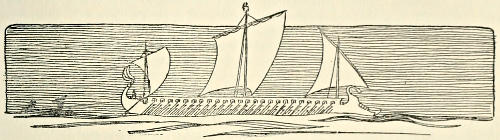
Grecian Galley
But what could avail the voice of one virtuous man amidst the licentious
madness of thousands? The commanders were accused, tried, condemned,
and, with the most irregular precipitancy, delivered to the executioner.
Before they were led to death, Diomedon addressed the assembly in a short
but ever-memorable speech: “I am afraid, Athenians, lest the sentence
which you have passed on us, prove hurtful to the republic. Yet I would
exhort you to employ the most proper means to avert the vengeance of
heaven. You must carefully perform the sacrifices which, before giving
battle at Arginusæ, we promised to the gods in behalf of ourselves and of
you. Our misfortunes deprive us of an opportunity to acquit this just debt,
and to pay the sincere tribute of our gratitude. But we are deeply sensible
that the assistance of the gods enabled us to obtain that glorious and signal
victory.” The disinterestedness, the patriotism, and the magnanimity of
this discourse, must have appeased (if anything had been able to appease)
the tumultuous passions of the vulgar. But their headstrong fury defied
every restraint of reason or of sentiment. They persisted in their bloody
purpose, which was executed without pity: yet their cruelty was followed
by a speedy repentance, and punished by the sharp pangs of remorse, the
intolerable pain of which they vainly attempted to mitigate by inflicting a
well-merited vengeance on the detestable Callixenus.b
This complication of injustice and ingratitude seemed to give the finishing
blow to the Athenian state; they struggled for a while, after their defeat
at Syracuse; but from hence they were entirely sunk.
The enemy, after their last defeat, had once more recourse to Lysander,
who had so often led them to conquest: on him they placed their chief confidence,
and ardently solicited his return. The Lacedæmonians, to gratify
their allies, and yet to observe their laws, which forbade that honour being
conferred twice on the same person, sent him with an inferior title, but with
the power of admiral. Thus appointed, Lysander sailed towards the Hellespont,
and laid siege to Lampsacus: the place was carried by storm, and
abandoned by Lysander to the mercy of the soldiers. The Athenians, who
followed him close, upon the news of his success, steered forward towards
Sestus, and from thence, sailing along the coast, halted over against the
enemy at Ægospotami, a place fatal to the Athenians.
[405 B.C.]
The Hellespont is not above two thousand
yards broad in that place. The two armies seeing
themselves so near each other, expected only to
rest the day, and were in hopes of coming to a
battle on that next. But Lysander had another
design in view: he commanded the seamen and
pilots to go on board their galleys, as if they were
in reality to fight the next morning at break of
day, to hold themselves in readiness, and to wait
his orders in profound silence. He ordered the
land army, in like manner, to draw up in battle
upon the coast, and to wait the day without any
noise. On the morning, as soon as the sun was
risen, the Athenians began to row towards them
with their whole fleet in one line, and to bid them
defiance. Lysander, though his ships were ranged
in order of battle, with their heads towards the
enemy, lay still without making any movement.
In the evening, when the Athenians withdrew, he
did not suffer his soldiers to go ashore, till two
or three galleys, which he had sent out to observe
them, were returned with advice that they had
seen the enemy land. The next day passed in the
same manner, as did the third and fourth. Such
a conduct, which argued reserve and apprehension,
extremely augmented the security and boldness
of the Athenians, and inspired them with a
high contempt for an army, which fear prevented
from showing themselves or attempting anything.
Greek Candelabrum
(After Hope)
Whilst this passed, Alcibiades, who was near
the fleet, took horse, and came to the Athenian
generals, to whom he represented, that they came upon a very disadvantageous
coast, where there were neither ports nor cities in the neighbourhood;
that they were obliged to bring their provisions from Sestus, with
great danger and difficulty; and that they were very much in the wrong
to suffer the soldiers and mariners of the fleet, as soon as they were ashore,
to straggle and disperse themselves at their pleasure, whilst the enemy’s
fleet faced them in view, accustomed to execute the orders of their general
with instant obedience, and upon the slightest signal.
He offered also to attack the enemy by land, with a strong body of Thracian
troops, and to force a battle. The generals, especially Tydeus and
Menander, jealous of their command, did not content themselves with refusing
his offers, from the opinion, that, if the event proved unfortunate, the
whole blame would fall upon them, and, if favourable, that Alcibiades would
engross the whole honour of it; but rejected also with insult his wise and
salutary counsel: as if a man in disgrace lost his sense and abilities with the
favour of the commonwealth. Alcibiades withdrew.
The fifth day, the Athenians presented themselves again, and offered
battle, retiring in the evening according to custom, with a more insulting air
than the days before. Lysander, as usual, detached some galleys to observe
them, with orders to return with the utmost diligence when they saw the
Athenians landed, and to put a bright buckler[58] at each ship’s head, as soon
as they reached the middle of the channel. Himself, in the meantime, ran
through the whole line in his galley, exhorting the pilots and officers to hold
the seamen and soldiers in readiness to row and fight on the first signal.
As soon as the bucklers were put up in the ships’ heads, and the admiral’s
galley had given the signal by the sound of trumpet, the whole fleet set forwards,
in good order. The land army, at the same time, made all possible
haste to the top of the promontory, to see the battle. The strait that
separates the two continents in this place is about fifteen stadia, or two
miles in breadth, which space was presently cleared, through the activity
and diligence of the rowers. Conon, the Athenian general, was the first who
perceived from shore the enemy’s fleet advancing in good order to attack
him, upon which he immediately cried out for the troops to embark. In the
height of sorrow and perplexity, some he called to by their names, some he
conjured, and others he forced to go on board their galleys: but all his endeavours
and emotion were ineffectual, the soldiers being dispersed on all
sides. For they were no sooner come on shore, than some were run to the
sutlers, some to walk in the country, some to sleep in their tents, and others
had begun to dress their suppers. This proceeded from the want of vigilance
and experience in their generals, who, not suspecting the least danger, indulged
themselves in taking their repose, and gave their soldiers the same
liberty.
The enemy had already fallen on with loud cries, and a great noise of
their oars, when Conon, disengaging himself with nine galleys, of which
number was the sacred ship, stood away for Cyprus, where he took refuge
with Evagoras. The Peloponnesians, falling upon the rest of the fleet, took
immediately the galleys which were empty, and disabled and destroyed such
as began to fill with men. The soldiers, who ran without order or arms to
their relief, were either killed in the endeavour to get on board, or flying on
shore, were cut in pieces by the enemy, who landed in pursuit of them.
Lysander took three thousand prisoners, with all their generals, and the
whole fleet. After having plundered the camp, and fastened the enemy’s
galleys to the sterns of his own, he returned to Lampsacus, amidst the
sounds of flutes and songs of triumph. It was his glory to have achieved
one of the greatest military exploits recorded in history, with little or no
loss, and to have terminated a war, in the small space of an hour, which had
already lasted seven-and-twenty years, and which perhaps, without him, had
been of much longer continuance. Lysander immediately sent despatches
with this agreeable news to Sparta.
The three thousand prisoners taken in this battle having been condemned
to die, Lysander called upon Philocles, one of the Athenian generals, who
had caused all the prisoners taken in two galleys, the one of Andros, the
other of Corinth, to be thrown from the top of a precipice, and had formerly
persuaded the people of Athens to make a decree for cutting off the thumb
of the right hand of all the prisoners of war, in order to disable them from
handling the pike, and that they might be fit only to serve at the oar.
Lysander, therefore, caused him to be brought forth, and asked him what
sentence he would pass upon himself, for having induced his city to pass
that cruel decree. Philocles, without departing from his haughtiness in the
least, notwithstanding the extreme danger he was in, made answer: “Accuse
not people of crimes, who have no judges; but, as you are victors, use your
right, and do by us as we had done by you, if we had conquered.” At the
same instant he went into a bath, put on afterwards a magnificent robe, and
marched foremost to the execution. All the prisoners were put to the sword,
except Adimantus,[59] who had opposed the decree.e
When he had arranged matters at Lampsacus, Lysander
sailed against Byzantium and Chalcedon; where
the inhabitants admitted him, after sending away the
Athenian garrison under treaty. The party that had
betrayed Byzantium to Alcibiades, at that time fled to
Pontus, and afterwards to Athens, and became citizens
there. The garrison troops of the Athenians, and whatever
other Athenians he found anywhere, Lysander sent
to Athens, giving them safe conduct so long as they
were sailing to that place alone, and to no other; knowing
that the more people were collected in the city and
Piræus, the sooner there would be a want of provisions.
And now, leaving Sthenelaus as Lacedæmonian harmost
of Byzantium and Chalcedon, he himself sailed away to
Lampsacus, and refitted his ships.
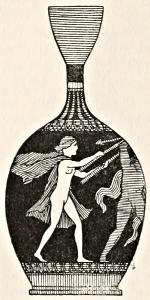
Greek Vase
At Athens, on the arrival of the Paralus in the
night, the tale of their disaster was told; and the lamentation
spread from the Piræus up the Long Walls into
the city, one man passing on the tidings to another: so
that no one went to bed that night, not only through their mourning for the
dead, but much more still because they thought they should themselves
suffer the same things as they had done to the Melians (who were a colony
from Lacedæmon), when they had reduced them by blockade, and to the
Histiæans, Scionæans, Toronæans, Æginetans, and many others of the
Greeks. But the next day they convened an assembly, at which it was
resolved to block up the harbours, with the exception of one, and to put
the walls in order, and mount guard upon them, and in every other way to
prepare the city for a siege.
Lysander, having come with two hundred ships from the Hellespont to
Lesbos, regulated both the other cities in the island, and especially Mytilene;
while he sent Eteonicus with ten ships to the Athenian possessions
Thraceward, who brought over all the places there to the Lacedæmonians.
And all the rest of Greece too revolted from Athens immediately after the
sea-fight, except the Samians; they massacred the notables amongst them,
and kept possession of the city. Afterwards Lysander sent word to Agis
at Decelea, and to Lacedæmon, that he was sailing up with two hundred
ships. And the Lacedæmonians went out to meet him en masse, and all
the rest of the Peloponnesians but the Argives, at the command of the
other Spartan king, Pausanias. When they were all combined, he took
them to the city and encamped before it, in the academy—the gymnasium
so called. Then Lysander went to Ægina, and restored the city to the
Æginetans, having collected as many of them as he could; and so likewise
to the Melians, and as many others as had been deprived of their city. After
this, having ravaged Salamis, he came to anchor off the Piræus, with a hundred
and fifty ships, and prevented all vessels from sailing into it.
The Athenians, being thus besieged by land and by sea, were at a loss
what to do, as they had neither ships, nor allies, nor provisions; and they
thought nothing could save them from suffering what they had done to
others, not in self-defence, but wantonly wronging men of smaller states, on
no other single ground, but their being allies of the Lacedæmonians. Wherefore
they restored to their privileges those who had been degraded from them,
and held out resolutely; and though many in the city were dying of starvation,
they spoke not a word of coming to terms. But when their corn had
now entirely failed, they sent ambassadors to Agis, wishing to become allies
of the Lacedæmonians, while they retained their walls and the Piræus, and
on these conditions to make treaty with them. He told them to go to
Lacedæmon, as he had himself no power to treat. When the ambassadors
delivered this message to the Athenians, they sent them to Lacedæmon.
But when they were at Sellasia, near the Laconian territory, and the ephors
heard what they proposed, which was the same as they had done to Agis,
they bade them return from that very spot, and if they had any wish at all
for peace, to come back after taking better advice.
When the ambassadors came home, and reported this in the city, dejection
fell on all; for they thought they would be sold into slavery; and that
even while they were sending another embassy, many would die of famine.
But with respect to the demolition of their walls, no one would advise it:
for Archestratus had been thrown into prison for saying in the council, that
it was best to make peace with the Lacedæmonians on the terms they offered,
which were, that they should demolish ten furlongs of each of the Long Walls;
and a decree was then made, that it should not be allowed to advise on that
subject. Such being the case, Theramenes said in the assembly, that if they
would send him to Lysander, he would come back with full knowledge
whether it was from a wish to enslave the city that the Lacedæmonians held
out on the subject of the walls, or to have a guarantee for their good faith.
Having been sent, he remained with Lysander three months and more,
watching to see when the Athenians, from the failure of all their food, would
agree to what any one might say. On his return in the fourth month, he
reported in the assembly that Lysander had detained him all that time, and
then told him to go to Lacedæmon. After this he was chosen ambassador
to Lacedæmon with full powers, together with nine others. Now Lysander
had sent, along with some others who were Lacedæmonians, Aristoteles,
an Athenian exile, to carry word to the ephors that he had answered Theramenes,
that it was they who were empowered to decide on the question of
peace or war. So when Theramenes and the rest of the ambassadors were
at Sellasia, being asked on what terms they had come, they replied that they
had full powers to treat for peace; the ephors then ordered them to be called
onward. Upon their arrival they convened an assembly, at which the Corinthians
and Thebans contended most strenuously, though many others of
the Greeks did so too, that they should conclude no treaty with the Athenians,
but make away with them.
The Lacedæmonians, however, said they would not reduce to bondage a
state which had done great good at the time of the greatest dangers that
had ever befallen Greece; but they offered to make peace, on condition of
their demolishing the Long Walls and Piræus, giving up all their ships but
twelve, restoring their exiles, having the same friends and foes as the Lacedæmonians,
and following, both by land and by sea, wherever they might
lead. Theramenes and his fellow-ambassadors carried back these terms to
Athens. On their entering the city, a great multitude poured round them,
afraid of their having returned unsuccessful: for it was no longer possible
to delay, owing to the great numbers who were dying of famine. The next
day the ambassadors reported on what conditions the Lacedæmonians were
willing to make peace; and Theramenes, as their spokesman, said that they
should obey the Lacedæmonians, and destroy the walls. When some had
opposed him, but far more agreed with him, it was resolved to accept the
peace. Subsequently Lysander sailed into the Piræus, and the exiles were
restored; and they dug down the walls with much glee, to the music of
women playing the flute, considering that day to be the beginning of liberty
to Greece.
And so ended the year in the middle of which Dionysius the son of Hermocrates,
the Syracusan, became tyrant, after the Carthaginians, though
previously defeated in battle by the Syracusans, had reduced Agrigentum.f
[478-404 B.C.]
The confederacy of Delos was formed by the free and spontaneous association
of many different towns, all alike independent; towns which met in
synod and deliberated by equal vote—took by their majority resolutions
binding upon all—and chose Athens as their chief to enforce these resolutions,
as well as to superintend generally the war against the common enemy.
Now the only way by which the confederacy was saved from falling to
pieces, was by being transformed into an Athenian empire. Such transformation
(as Thucydides plainly intimates) did not arise from the ambition or
deep-laid projects of Athens, but from the reluctance of the larger confederates
to discharge the obligations imposed by the common synod, and from the
unwarlike character of the confederates generally—which made them desirous
to commute military service for money-payment, while Athens on her part
was not less anxious to perform the service and obtain the money. By gradual
and unforeseen stages, Athens thus passed from consulate to empire; in
such manner that no one could point out the precise moment of time when
the confederacy of Delos ceased, and when the empire began.
But the Athenian empire came to include (between 460-446 B.C.) other
cities not parties to the confederacy of Delos. Athens had conquered her
ancient enemy the island of Ægina, and had acquired supremacy over
Megara, Bœotia, Phocis, and Locris, and Achaia in Peloponnesus. Her
empire was now at its maximum; and had she been able to maintain it—or
even to keep possession of the Megarid separately, which gave her the means
of barring out all invasions from the Peloponnesus—the future course of
Grecian history would have been materially altered. But her empire on land
did not rest upon the same footing as her empire at sea. The exiles in
Megara and Bœotia, etc., and the anti-Athenian party generally in those
places—combined with the rashness of her general Tolmides at Coronea—deprived
her of all her land-dependencies near home, and even threatened
her with the loss of Eubœa. The peace concluded in 445 B.C. left her with
all her maritime and insular empire (including Eubœa), but with nothing
more; while by the loss of Megara she was now open to invasion from the
Peloponnesus.
On this footing she remained at the beginning of the Peloponnesian War
fourteen years afterwards. That war did not arise (as has been so often
asserted) from aggressive or ambitious schemes on the part of Athens, but
that, on the contrary, the aggression was all on the side of her enemies, who
were full of hopes that they could put her down with little delay; while she
was not merely conservative and defensive, but even discouraged by the certainty
of destructive invasion, and only dissuaded from concessions, alike
imprudent and inglorious, by the extraordinary influence and resolute wisdom
of Pericles. That great man comprehended well both the conditions
and the limits of Athenian empire. Athens was now understood (especially
since the revolt and reconquest of the
powerful island of Samos in 440 B.C.)
by her subjects and enemies as well as
by her own citizens, to be mistress of
the sea. It was the care of Pericles to
keep that belief within definite boundaries,
and to prevent all waste of the
force of the city in making new or distant
acquisitions which could not be
permanently maintained. But it was
also his care to enforce upon his countrymen
the lesson of maintaining their
existing empire unimpaired, and shrinking
from no effort requisite for that end.
Though their whole empire was now
staked upon the chances of a perilous
war, he did not hesitate to promise them
success, provided that they adhered to
this conservative policy.
[431-413 B.C.]
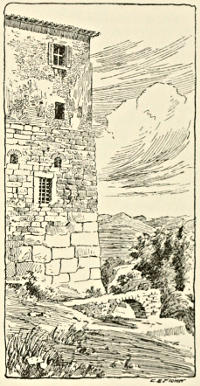
Part of the Ancient Greek Wall at
Ferentinum with superimposed Modern Structure
Following the events of the war, we
shall find that Athens did adhere to it
for the first seven years; years of suffering
and trial, from the destructive
annual invasion, the yet more destructive
pestilence, and the revolt of Mytilene—but
years which still left her
empire unimpaired, and the promises of
Pericles in fair chance of being realised.
In the seventh year of the war occurred
the unexpected victory at Sphacteria
and the capture of the Lacedæmonian
prisoners. This placed in the hands of
the Athenians a capital advantage, imparting
to them prodigious confidence
of future success, while their enemies
were in a proportional degree disheartened. It was in this temper that
they first departed from the conservative precept of Pericles.
Down to the expedition against Syracuse the empire of Athens (except
the possessions in Thrace) remained undiminished, and her general power
nearly as great as it had ever been since 445 B.C. That expedition was the
one great and fatal departure from the Periclean policy, bringing upon Athens
an amount of disaster from which she never recovered; and it was doubtless
an error of over-ambition.
After the Syracusan disaster, there is no longer any question about adhering
to, or departing from the Periclean policy. Athens is like Patroclus
in the Iliad, after Apollo has stunned him by a blow on the back and
loosened his armour. Nothing but the slackness of her enemies allowed
her time for a partial recovery, so as to make increased heroism a substitute
for impaired force, even against doubled and tripled difficulties. And the
years of struggle which she now went through are among the most glorious
events in her history. These years present many misfortunes, but no serious
misjudgment; not to mention one peculiarly honourable moment, after the
overthrow of the Four Hundred. And after all, they were on the point of
partially recovering themselves in 408 B.C., when the unexpected advent
of Cyrus set the seal to their destiny.
The bloodshed after the recapture of Mytilene and Scione, and still more
that which succeeded the capture of Melos, are disgraceful to the humanity
of Athens, and stand in pointed contrast with the treatment of Samos when
reconquered by Pericles. But they did not contribute sensibly to break
down her power; though, being recollected with aversion after other incidents
were forgotten, they are alluded to in later times as if they had caused
the fall of the empire. Her downfall had one great cause—we may almost
say, one single cause—the Sicilian expedition.[60] The empire of Athens both
was, and appeared to be, in exuberant strength when that expedition was
sent forth; strength more than sufficient to bear up against all moderate
faults or moderate misfortunes, such as no government ever long escapes.
But the catastrophe of Syracuse was something overpassing in terrific calamity
all Grecian experience and all power of foresight. It was like the
Russian campaign of 1812 to the Emperor Napoleon, though by no means
imputable, in an equal degree, to vice in the original project. No Grecian
power could bear up against such a death wound; and the prolonged struggle
of Athens after it is not the least wonderful part of the whole war.
[460-404 B.C.]
Nothing in the political history of Greece is so remarkable as the Athenian
empire; taking it as it stood in its completeness, from about 460-413
B.C. (the date of the Syracusan catastrophe), or still more, from
460-424 B.C. (the date when Brasidas made his conquests in Thrace).
After the Syracusan catastrophe, the conditions of the empire were altogether
changed; it was irretrievably broken up, though Athens still continued
an energetic struggle to retain some of the fragments. But if we
view it as it had stood before that event, during the period of its integrity,
it is a sight marvellous to contemplate, and its working must be pronounced,
in my judgment, to have been highly beneficial to the Grecian world. No
Grecian state except Athens could have sufficed to organise such a system,
or to hold, in partial, though regulated, continuous and specific communion,
so many little states, each animated with that force of political repulsion
instinctive in the Grecian mind. This was a mighty task, worthy of Athens,
and to which no state except Athens was competent. We have already
seen in part, and we shall see still farther, how little qualified Sparta was to
perform it: and we shall have occasion hereafter to notice a like fruitless
essay on the part of Thebes.
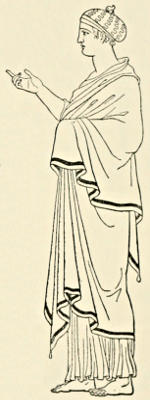
Athenian Woman
(After Hope)
As in regard to the democracy of Athens generally, so in regard to her
empire—it has been customary with historians to take notice of little except
the bad side. But the empire of Athens was not harsh and
oppressive, as it is commonly depicted. Under the circumstances
of her dominion—at a time when the whole transit
and commerce of the Ægean was under one maritime system,
which excluded all irregular force—when Persian ships of
war were kept out of the waters, and Persian tribute-officers
away from the seaboard—when the disputes
inevitable among so many little communities could
be peaceably redressed by the mutual right of application
to the tribunals at Athens—and when these tribunals
were also such as to present to sufferers a refuge
against wrongs done even by individual citizens of Athens
herself (to use the expression of the oligarchical Phrynichus)—the
condition of the maritime Greeks was materially
better than it had been before, or than it will be seen
to become afterwards. Her empire, if it did not inspire
attachment, certainly provoked no antipathy, among the
bulk of the citizens of the subject-communities, as is shown
by the party-character of the revolts against her. If in
her imperial character she exacted obedience, she also fulfilled
duties and insured protection—to a degree incomparably
greater than was ever realised by Sparta. And
even if she had been ever so much disposed to cramp the
free play of mind and purpose among her subjects—a disposition
which is no way proved—the very circumstances
of her own democracy, with its open antithesis of political
parties, universal liberty of speech, and manifold individual
energy, would do much to prevent the accomplishment of
such an end, and would act as a stimulus to the dependent
communities even without her own intention.
Without being insensible either to the faults or to the
misdeeds of imperial Athens, I believe that her empire was
a great comparative benefit, and its extinction a great loss, to her own subjects.
But still more do I believe it to have been a good, looked at with
reference to Panhellenic interests. Its maintenance furnished the only possibility
of keeping out foreign intervention, and leaving the destinies of
Greece to depend upon native, spontaneous, untrammelled Grecian agencies.
The downfall of the Athenian empire is the signal for the arms and corruption
of Persia again to make themselves felt, and for the re-enslavement of
the Asiatic Greeks under her tribute-officers. What is still worse, it leaves
the Grecian world in a state incapable of repelling any energetic foreign
attack, and open to the overruling march of “the man of Macedon” half
a century afterwards. For such was the natural tendency of the Grecian
world to political non-integration or disintegration, that the rise of the
Athenian empire, incorporating so many states into one system, is to be
regarded as a most extraordinary accident. Nothing but the genius, energy,
discipline, and democracy of Athens, could have brought it about; nor even
she, unless favoured and pushed on by a very peculiar train of antecedent
events. But having once got it, she might perfectly well have kept it;
and had she done so, the Hellenic world would have remained so organised
as to be able to repel foreign intervention, either from Susa or from Pella.
When we reflect how infinitely superior was the Hellenic mind to that of
all surrounding nations and races; how completely its creative agency was
stifled as soon as it came under the Macedonian dictation; and how much
more it might perhaps have achieved, if it had enjoyed another century or
half-century of freedom, under the stimulating headship of the most progressive
and most intellectual of all its separate communities—we shall look
with double regret on the ruin of the Athenian empire, as accelerating,
without remedy, the universal ruin of Grecian independence, political action,
and mental grandeur.c
BRIEF REFERENCE-LIST OF AUTHORITIES BY CHAPTERS — Chapter I. Land and People — Chapter II. The Mycenæan Age — Chapter III. The Heroic Age — Chapter IV. The Transition to Secure History — Chapter V. The Dorians — Chapter VI. Sparta and Lycurgus — Chapter VII. The Messenian Wars of Sparta — Chapter VIII. The Ionians — Chapter IX. Some Characteristic Institutions — Chapter X. The Smaller Cities and States — Chapter XI. Crete and the Colonies — Chapter XII. Solon the Lawgiver — Chapter XIII. Pisistratus the Tyrant — Chapter XIV. Democracy Established at Athens — Chapter XV. The First Foreign Invasion — Chapter XVI. Miltiades and the Alleged Fickleness of Republics — Chapter XVII. The Plans of Xerxes — Chapter XVIII. Proceedings in Greece from Marathon to Thermopylæ — Chapter XIX. Thermopylæ — Chapter XX. The Battles of Artemisium and Salamis — Chapter XXI. From Salamis to Mycale — Chapter XXII. The Aftermath of the War — Chapter XXIII. The Growth of the Athenian Empire — Chapter XXIV. The Rise of Pericles — Chapter XXV. Athens at War — Chapter XXVI. Imperial Athens under Pericles — Chapter XXVII. Manners and Customs of the Age of Pericles — Chapter XXVIII. Art of the Periclean Age — Chapter XXIX. Greek Literature — Chapter XXX. The Outbreak of the Peloponnesian War — Chapter XXXI. The Plague; and the Death of Pericles — Chapter XXXII. The Second and Third Years of the Peloponnesian War — Chapter XXXIII. The Fourth to the Tenth Years — Chapter XXXIV. The Rise of Alcibiades — Chapter XXXV. The Sicilian Expedition — Chapter XXXVI. Close of the Peloponnesian War
[The letter a is reserved for Editorial Matter.]
b Connop Thirlwall, The History of Greece.
c John B. Bury, History of Greece.
d William Ridgeway, The Early Age of Greece.
e Gustav F. Hertzberg, Geschichte der
Griechen im Alterthum.
f Strabo, Γεωγραφικά.
g Thucydides, History of the Peloponnesian
War.
h Pausanias, General Description of Greece.
i Herodotus, History.
b D. G. Hogarth, article on “Mycenæan Civilisation,” in the New Volumes of the Ninth
Edition of the Encyclopædia Britannica.
c Henry Schliemann, Mycenæ.
d C. Tsountas
and J. Irving Manatt, The Mycenæan Age.
e Percy Gardner, New Chapters of Greek History.
f Wolfgang Helbig, Die Italiker in der Po-Ebene.
g Pigorini, In Atti dell’Accademia
dei Lincei.
h C. Schuchhardt, Schliemann’s Excavations (translated by E. Sellers).
i Julius Beloch, Griechische Geschichte.
b George Grote, History of Greece.
c Connop Thirlwall, The History of Greece.
d Friedrich C. Schlosser, Weltgeschichte.
f Plassman, quoted in Thirlwall’s Notes.
h William Mitford, History of Greece.
i L. A. Prévost-Paradol, Essai sur l’Histoire
Universelle.
k Friedrich August Wolf, Prolegomena ad Homerum.
l Henry Schliemann,
Troja.
c Julius Beloch, Griechische Geschichte.
b Karl O. Müller, The History and Antiquities of the Doric Race.
c Ernst Curtius,
Griechische Geschichte.
d Eugamon, Telegonia.
e Xanthus, Lydiaca.
b W. Assmann, Handbuch der Allgemeinen Geschichte.
c Plutarch, Lives of Illustrious
Men.
d Victor Duruy, Histoire grecque.
e John B. Bury, History of Greece.
f Philoste-Phanus, Timæus, Sosibius, and Demetrius Phalereus, as quoted by Plutarch.
g Aristotle,
Politics.
h Plato, Republic.
b George Grote, History of Greece.
c Pausanias, General Description of Greece.
d Tyrtæus, Fragments, 5, 6.
e Isocrates, Archidamus.
f Diodorus Siculus, Historical
Library.
b Gustav F. Hertzberg, Geschichte der Griechen im Alterthum.
c E. G. Bulwer-Lytton,
Athens: Its Rise and Fall.
d William Mitford, History of Greece.
e Connop Thirlwall,
The History of Greece.
f Plutarch, Lives of Illustrious Men.
g Strabo, Γεωγραφικά.
h Thucydides, History of the Peloponnesian War.
b Connop Thirlwall, The History of Greece.
c William Mitford, History of Greece.
d Diodorus Siculus, Historical Library.
e Strabo, Γεωγραφικά.
f Pausanias, General
Description of Greece.
g Aristotle, Politics.
b Connop Thirlwall, The History of Greece.
c Eugène Lerminier, Histoire des legislatures
et des constitutions de la Grèce ancienne.
d Aristotle, Politics.
e Strabo, Γεωγραφικά.
f Pausanias, General Description of Greece.
g Polybius, General History.
h Herodotus, History.
i Theognis, Poems.
j Thucydides, History of the Peloponnesian War.
b Eugène Lerminier, Histoire des legislatures et des constitutions de la Grèce ancienne.
c Julius Beloch, Griechische Geschichte.
d Aristotle, Politics.
b George Grote, History of Greece.
c Connop Thirlwall, The History of Greece.
d Plutarch, Lives of Illustrious Men.
e John B. Bury, History of Greece.
b E. G. Bulwer-Lytton, Athens: Its Rise and Fall.
c Herodotus, History.
d Ernst
Curtius, Griechische Geschichte.
b George Grote, History of Greece.
c Victor Duruy, Histoire grecque.
d Thucydides,
History of the Peloponnesian War.
e Herodotus, History.
f Plutarch, Lives of Illustrious
Men.
g Aristotle, Politics.
h Diodorus Siculus, Historical Library.
b Ernst Curtius, Griechische Geschichte.
c Herodotus, History.
d Victor Duruy,
Histoire grecque.
e E. G. Bulwer-Lytton, Athens: Its Rise and Fall.
f G. B. Grundy, The
Persian War.
g Georg Busolt, Griechische Geschichte.
h J. A. R. Munro, in the Journal
of Hellenic Studies.
i F. C. H. Kruse, Hellas.
j John P. Mahaffy, Rambles and Studies
in Greece.
k George Grote, History of Greece.
b George Grote, History of Greece.
c Herodotus, History.
d Diodorus Siculus,
Historical Library.
e Cornelius Nepos, Lives.
f Plutarch, Lives of Illustrious Men.
b Herodotus, History.
c Plutarch, Lives of Illustrious Men; also his Moralia.
d P. H.
Larcher, translation of Herodotus into French.
e James Rennel, The Geographical System
of Herodotus.
f William Beloe, in his translation of Herodotus.
g Diodorus Siculus,
Historical Library.
h John B. Bury, History of Greece.
b George Grote, History of Greece.
c Herodotus, History.
d James Rennel, The
Geographical System of Herodotus.
b Herodotus, History.
c William Beloe, in his translation of Herodotus.
d John B.
Bury, History of Greece.
e P. H. Larcher, translation of Herodotus into French.
f Diodorus
Siculus, Historical Library.
g Plutarch, Lives of Illustrious Men.
h Connop
Thirlwall, The History of Greece.
i Pausanias, General Description of Greece.
b George Grote, History of Greece.
c Colonel Leake, Topography of Athens.
d Herodotus,
History.
e Diodorus Siculus, Historical Library.
f William Smith, History of
Greece.
g Plutarch, Lives of Illustrious Men.
h William H. Waddington, Visit to Greece.
i Pausanias,
General Description of Greece.
b Herodotus, History.
c William Beloe, in his translation of Herodotus.
d Plutarch,
Lives of Illustrious Men.
e P. H. Larcher, translation of Herodotus into French.
f John
B. Bury, History of Greece.
g George Grote, History of Greece.
b Thucydides, History of the Grecian War (translated by Henry Dale).
c George Grote,
History of Greece.
d Plutarch, Lives of Illustrious Men.
e Cornelius Nepos, Lives.
b George W. Cox, The Athenian Empire.
c George Grote, History of Greece.
d William
Mitford, History of Greece.
e Plutarch, Lives of Illustrious Men.
f Connop Thirlwall,
The History of Greece.
g Cornelius Nepos, Lives.
h Thucydides, History of the
Grecian War (translated by Henry Dale).
b Connop Thirlwall, The History of Greece.
c Plutarch, Lives of Illustrious Men.
d George
Grote, History of Greece.
e Thucydides, History of the Grecian War (translated
by Henry Dale).
f William Mitford, History of Greece.
g Diodorus Siculus, Historical
Library.
h Herodotus, History.
b William Mitford, History of Greece.
c George Grote, History of Greece.
d Connop
Thirlwall, The History of Greece.
e Plutarch, Lives of Illustrious Men.
f Herodotus,
History.
b George Grote, History of Greece.
c Connop Thirlwall, The History of Greece.
d Thucydides, History of the Grecian War (translated by Henry Dale).
e Xenophon,
Hellenics.
b A. Boekh, Public Economy of the Athenians (translated by A. Lamb).
c William
Mure, Grecian Literature.
d H. Goll, Kulturbilder aus Hellas und Rom.
b Victor Duruy, Histoire grecque.
c William Mitford, History of Greece.
b Ernst Curtius, Griechische Geschichte.
b George Grote, History of Greece.
c Connop Thirlwall, History of Greece.
d Thucydides,
History of the Grecian War (translated by Henry Dale).
e Adolph Holm, History of
Greece.
f William Mitford, History of Greece.
g John Ruskin, Præterita.
h Xenophon,
Hellenics.
b George Grote, History of Greece.
c Thucydides, History of the Grecian War (translated
by Henry Dale).
d John B. Bury, History of Greece.
e William Oncken, Athen und
Hellas.
f Titus Livius, Roman History.
g Diodorus Siculus, Historical Library.
h Plutarch, Lives of Illustrious Men.
b Connop Thirlwall, History of Greece.
c Thucydides, History of the Grecian War
(translated by Henry Dale).
d John B. Bury, History of Greece.
e Pausanias, General
Description of Greece.
f George Grote, History of Greece.
b Barthold G. Niebuhr, Lectures on Ancient History.
c Thucydides, History of the
Grecian War (translated by Henry Dale).
d George Grote, History of Greece.
e Victor
Duruy, Histoire grecque.
f Diodorus Siculus, Historical Library.
b Victor Duruy, Histoire grecque.
c Thucydides, History of the Grecian War (translated
by Henry Dale).
b Adolf Holm, History of Greece.
c Julius Beloch, Griechische Geschichte.
d John B.
Bury, History of Greece.
e Edward A. Freeman, article on “Sicily” in the Ninth Edition
of the Encyclopædia Britannica.
f George Grote, History of Greece.
g Victor Duruy,
Histoire grecque.
h Karl O. Müller, The Dorians.
i Thucydides, History of the Grecian
War (translated by Henry Dale).
j John Gillies, History of Ancient Greece.
b J. Gillies, History of Ancient Greece.
c George Grote, History of Greece.
d William
Mitford, History of Greece.
e Oliver Goldsmith, History of Greece.
f Xenophon, Hellenics.
g Johann K. F. Manso, Sparta.
h Connop Thirlwall, The History of Greece.
i George W. Cox, The Athenian Empire.
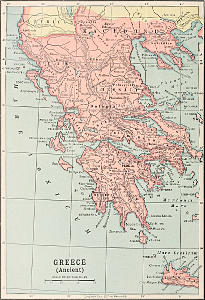
GREECE (Ancient)
Longitude East 22° from Greenwich
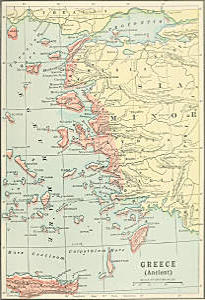
GREECE (Ancient)
Longitude East 27° from Greenwich