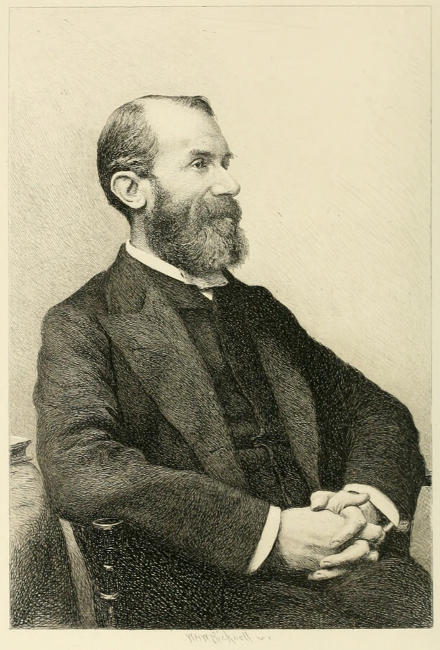
By BERNHARD STADE
Translated for the present work from Geschichte des Volks Israel.
Many a nation has walked God’s earth, has long enjoyed its good things,
has come into being and passed away, without our knowing anything of its
history, or even whether it had a history at all. For no nation has a history
except one that makes history, that is to say, that influences the course of
human development. It is with races as with individuals; none is kept in
mind by posterity save those who have distinguished themselves by ideas
that have modified the life of mankind, or (which comes to the same thing)
have been pioneers in fresh fields of action. The greater the spiritual gain
a nation has brought to the rest of the world, the longer and more steadily
its life has flowed in the channels it was the first to make, the longer is its
history told among them. The nations of history are those which have put
forward, in one fashion or another, their claim to the dominion of the
world.
Thus we may fitly ask what claim it is that is made upon our interest by
the history of the Jewish nation. And the answer will be, that nothing
which excites our attention, or stirs us to admiration or imitation in the
history of other nations, is here present in any large measure. Israel was
always a small, nay, a petty nation, settled in a narrow space, never of any
considerable importance in the political history of the East; it never brought
forth a Ramses II, a Sargon, an Esarhaddon, an Asshurbanapal, a Nebuchadrezzar,
or a Cyrus to bear its banner into distant lands. Yet, for all this, the
history of Israel has, for us, an interest quite different from that of those
other nations of antiquity.
And if, as we see, Israel is far surpassed in martial glory by the peoples
of the great empires, and by the Romans in their influence on the development
of law, there are yet other points in which it must yield unquestioned
precedence to other nations of antiquity. We do not find in Israel the same
feeling for beauty as among the Greeks, who, like no nation before them or
after, showed forth the laws of beauty in every sphere of intellectual life,
and to this day, in such matters, stand forth in a perfection which has never
again been attained, far less excelled. Among the Hebrews there is nothing
analogous, nothing comparable to what we admire in the Hellenic people.
It has no epic, nothing that can be compared with the Iliad and the Odyssey,
against which the Germans set the Nibelungen Lied, and the Finns the Kalewala;
it has not the slightest rudiments of a drama—the Song of Songs
and Job are not dramas. There is a school of lyrical poetry unsurpassed for
all time, and the music that corresponds to it. But the bent towards science,
which actuates the Greeks, is wholly lacking—wholly lacking the bent towards
philosophy. Nor was it ever eminent in ancient days, in the walks of commerce,
enterprise and invention, by which, also, a nation may conquer the
world; its intellectual life is absolutely one-sided, a one-sidedness that produces
on us the effect of extreme singularity.
But the attraction it has for us does not lie in this singularity. It is
due, rather, to the circumstance that this small nation has exerted a far
greater influence over the course of the history of the whole human race
than the Greeks or Romans, that to us it has become typical in many more
respects than they. Our present modes of thought and feeling, our lives
and actions, are far more profoundly influenced by the world of thought and
feeling which Israel brought to the birth, than by that of Greece or Rome.
Our whole civilisation to-day is saturated with tendencies and impulses which
have their origin in Israel.
The reason for this is that in Israel one side of human nature had developed
to a very high perfection, a side which is of far greater consequence
to mankind in general than art or science, law or philosophy. While in
Hellas, philosophy first, and then, indirectly, science, developed out of
mythology, in Israel the age of mythology was succeeded by that of religion.
And we may say that the religion of Israel is still the active religion
of mankind in a far higher degree than the philosophy of the Greeks is still
its active philosophy. What Israel did in the sphere of religion is without
a doubt far more epoch-making, unique, and effective than what the Romans
did in the sphere of politics, or the Greeks in that of art or science. As
Israel assumed the leadership of the human race in religion, so Rome did in
matters of government, and Greece in questions of philosophy; but while
the civilised nations which adopted Roman law strove with increasing
energy to free themselves from the band of Roman legal conceptions; while
the relics of Greek art and science only roused the enthusiasm of a chosen
few, and the philosophy which the Greeks had created was confined within
ever-narrowing limits by religion on the one hand, and the ever-widening
field of science on the other; religion embraces all classes of the people, from
the king to the beggar, and strives more and more to embrace all the nations
upon earth. Moreover, however men may shut their eyes to the fact, among
ourselves to-day religion is a subject of far more universal interest than
art, science, or any political institution whatsoever. Disputed questions
of religion shake kingdoms and kindle the most sanguinary wars. By
this means it changes the character of nations and brings forth new
national types. The spiritual features of mankind at the present time,
under Mohammedan and European civilisation alike, are substantially the
product of the monotheistic religion that arose in Israel.
We cannot find a more striking example of the effect of Israelitish ideas
on mankind nowadays than by recalling the importance of the religious figures
of ancient Israel in the eyes of our own people. For the bulk of the
nation, Biblical history stands for all the history there is. The populace
knows more about Abraham, Isaac, and Jacob, about Saul, David, and Solomon,
about Samuel and Elijah, than about the heroes of its own history,
and feels them (in marked contrast with its sentiments towards their posterity,
which it beholds with the eyes of the body and not with the eyes of
the spirit) to be flesh of its flesh and bone of its bone. In this respect our
own nation is thoroughly Hebraised, or, if you prefer it, Semiticised.
And this is even more strikingly the case with nations which have
adopted the creed of Islam. In the eyes of Mohammedans, Abraham was a
Mohammedan; through Ishmael, his first-born and rightful heir, he is the
progenitor of the People of the Revelation; in their eyes all the religious figures
of Israel of old are Mohammedan saints.
Thus the importance of Israel in the history of mankind, and, consequently,
our interest in its own history, is due to the leading part it took in
the sphere of religion. In Israel, indeed, religion—or, as most people prefer
to express it, monotheism—first came into being. Let not the reader
misunderstand the latter word. The monotheism of Israel is not the acknowledgment
that there is but one Supreme Being. That is not a religious
but a philosophical idea. The God of the Israel of old is not to be
defined as the sole, supreme, and absolutely perfect being, but as the Not-World,
or, better still, as the sum of all forces present and active in the world
conceived of apart from the substratum through which they are manifest in
phenomena. Hence the God of Israel of old is simply the Mighty One. But
in the eyes of the Israelite of old the world was no wider than the land that
nourished him. For this reason the God of ancient Israel is the God of the
Land of Israel, and the actual existence of the gods of other nations is not
denied. They exercise in the lands of other nations the same sway as Israel’s
God in the world of Israel.
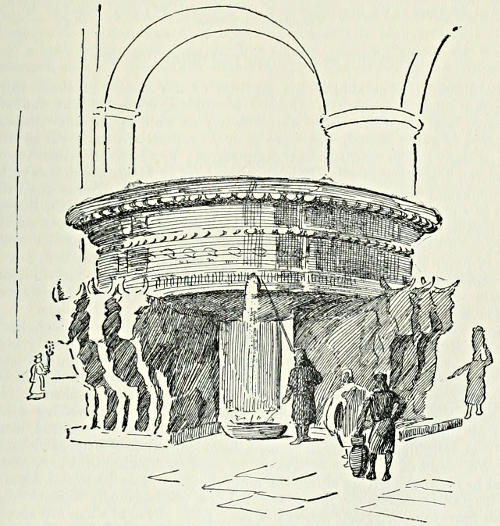
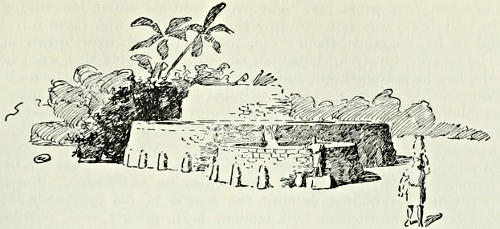
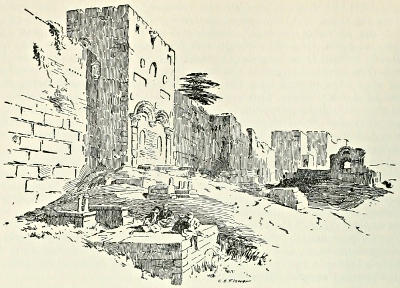
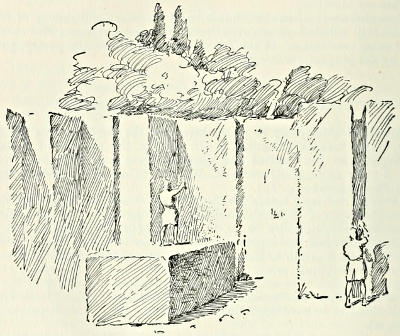
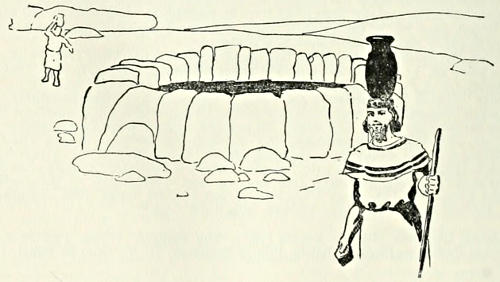
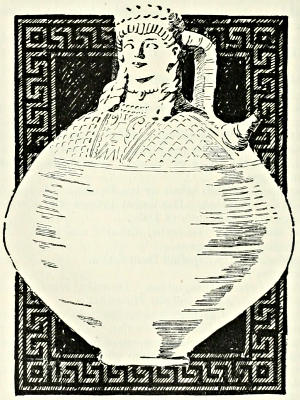
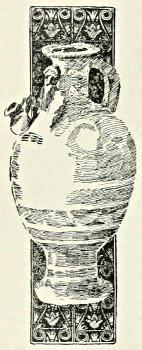
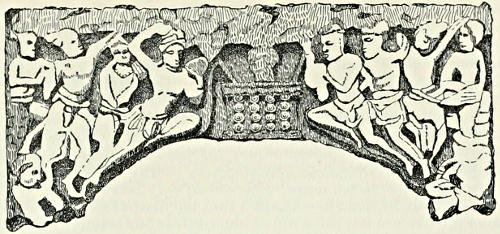
Brazen Fountain used for supplying Water to the Temple, Ancient Judea
Written Specially for the Present Work
By Rev. THOMAS KELLY CHEYNE, D. Litt., D. D.
Oriel Professor of the Interpretation of Scripture, Oxford; Joint Editor of the
Encyclopædia Biblica
The difficulty of sketching the outlines of the history of Israel in pre-Maccabean
times is unusually great. Historical curiosity was denied to
this people, and the Captivities were literary as well as political disasters.
The record of events which may have been kept, partly in the royal archives,
partly perhaps in the temples, had disappeared; nor have any royal inscriptions
as yet been discovered. It is only the land of Moab which has yielded
up an historical inscription, to which we shall refer in due course as an illustration
of contemporary Israelitish history. It is probable that the disciples
of the prophets kept some record of interesting events in the lives of their
masters—and the greater prophets were personages of political as well as
religious importance—but the inveterate tendency of such history to become
hagiology, compels us to read the fragments of prophetic narrative
literature which have survived, even more critically than the passages of
narrative which may, perhaps, have been derived from royal annals.
There were also, however, collections of popular traditions which, though
suffused with imagination, were doubtless more precious to the early Israelites
than the dry facts of contemporary or nearly contemporary history.
They were the imaginative vesture of vague and distorted recollections
of long-past events. In the form in which they have reached us, they
must have lost much of the original spirit and of the primitive phraseology;
on the other hand, the narrators, some of whom were gifted writers
as well as religiously progressive men, have contributed original elements
which, for many of us, must outweigh the most interesting folklore, because
we find in them the germs of Jewish monotheism. The historian, however,
must constantly remember the consciously or unconsciously didactic object
of these narrators, or rather schools of narrators. Five of them are specially
well known, and of these it is only the so-called Elohist who is comparatively
free from preoccupation with definite ethical and religious principles. The
Yahvist is very distinctly on the side of the greater prophets; the Deuteronomist,
the Priestly Narrator, and the Chronicler have for their chief
object the direct or indirect enforcement of the religious principles of the
earlier or the later law, to which in the Chronicler’s case we may add the
glorification of the temple at Jerusalem, its various classes of ministers, and
its ritual.
The composition of these works ranges over a long period, extending at
any rate from the eighth to the third century B.C.; the upper limit is not
certain. It is the task of the critic to extract the passages belonging to the
first four of these narrators (or rather sometimes schools of narrators) from
the composite works in which they are found, and also to investigate the
sources from which they may have been drawn. On the first part of this
task much skill has been lavished by a long succession of critics, but the
second part is still very far behindhand. And it must regretfully be said
that owing to the backward condition of the criticism of the text of the Old
Testament, there is some uncertainty in the basis of all constructive treatment
of the political and religious history. The scantiness of outside material,
which is peculiarly needed as a check on the subjective Hebrew writers,
is also no slight hindrance to the formation of thoroughly trustworthy
conclusions.
Tradition tells that the founder of the Israelitish nation first saw the
light in Egypt, where a number of Hebrew tribes were sojourning. A
change in the sentiments of the court towards the Hebrews had brought
about a cruel oppression. According to the Elohist (one of the narrators
mentioned above, fragments of whose work are preserved in the Pentateuch),
Moses, the child of a Hebrew man and woman of a tribe called Levi, was
hidden in an “ark of bulrushes” by the Nile, on account of a royal edict that
all male children of the Hebrews should be put to death. Pharaoh’s daughter
saw the child, had compassion on him, and finally adopted him as her
son. This, however, is by no means a contemporary account, and the details
would never have been thought of, but for the existence in popular
Hebrew tradition of a mythic tale of the setting adrift of a divine or at least
heroic infant on water.
The earliest traditions respecting Moses knew nothing of this. They
place the cradle of the national existence of the Israelites, and must consequently
have placed the cradle of the deliverer Moses, not in Mizraim or
Egypt, but in a region of northern Arabia called Mizrim, the border of
which on one side adjoined Egypt.
The whole story of the Exodus from Egypt appears to be due to a confusion
between Mizraim and Mizrim—a confusion which is presupposed
by what remains of the Yahvist’s and the Elohist’s narratives in their
present form, but which was probably not made by these narratives in
their original form, and cannot be shown indisputably to have been made
by the earliest prophets (Amos ii. 10; iii. 1; v. 25; ix. 7; Hosea ii. 15;
viii. 13; ix. 3; xi. 1, 5; xii. 9, 13; xiii. 4).
The residence of Moses in Egypt constitutes, in fact, a considerable difficulty.
Had Moses been reared as an Egyptian prince, he would have
received an Egyptian name, an Egyptian office and an Egyptian wife. We
are told, however, that he married one of the seven daughters of Hobab, the
priest of a tribe of Midianites (or Kenites) which dwelt not far from Yahveh’s
sacred mountain, Horeb. Her name is Zipporah, and, in accordance
with the undoubtedly true theory that the relations of tribes were expressed
by the Hebrews under the form of genealogies, we may assume that the
seven daughters of Hobab were the tribes occupying seven districts in Arabia,
in the neighbourhood of Horeb. Where Horeb or Sinai was, is disputed;
it is even doubted whether the Old Testament is entirely consistent with
itself on this point. The traditional view, however, which comes down to
us from Christian antiquity, that the mountain of the giving of the Law was
on the western side of the Sinaitic peninsula, is sufficiently refuted by this
one historical fact, that in the days when the Exodus from Egypt (if Egypt
was really the temporary abode of the primitive Israelites) may be conceived
to have taken place, a portion of the peninsula was occupied by Egyptian
officials and miners, and garrisoned by Egyptian troops. The student
may well be perplexed by the divergent views as to the situation of Horeb
(which in the original tradition was probably a synonym for Sinai), nor can
we digress to relieve his perplexity. All that we can say is that, if he
accepts our guidance, he will have provisionally to adopt the view (strongly
opposed to the later tradition) that Horeb or Sinai was near the sacred town
of Kadesh, better known as Kadesh-Barnea, on the northern Arabian border,
and also to assume that Zipporah (the name of the traditional wife of Moses)
is connected with Zarephath (the vowels of this name are uncertain), a place
which Moses (i.e., the Moses-clan) may be supposed to have acquired, either
by cession or by conquest.
To couple this with the traditional belief that there was once a person
called Moses, would be to misconceive the possible range of oral tradition,
and to forget the universal tendency to imagine the ancestors or founders
of tribes and races. That there was a clan bearing a name like Mosheh or
Moses; that, owing to a close connection with a Yahveh-worshipping tribe
of Kenites, this clan became ardently devoted to the service of Yahveh; and
that its chief centre was at Zarephath [Sarepta] (whence, be it noted,
another prophetic hero of tradition, Elijah, probably sprung), may, however,
be admitted as probable. Other kindred clans must have gathered
round that which bore the name of Moses, and we find that when the
northward migration of those whom we know as Israelites took place, the
number of the emigrants was increased by the adhesion of other North
Arabians. All who were thus brought together must have had the link
of a common worship—the worship of the god called Yahveh, a name
which must originally have expressed a physical relation or phenomenon,
but which in course of time came to be explained by some as meaning the
truly existent or the self-manifesting One.
This God was believed to be specially present on Mount Sinai, whence it
is natural that the Yahveh-worshipping tribes of Israel conceived themselves
to have derived laws and institutions which were really of late origin. The
Israelites in Arabia were nomads, but the three great annual festivals referred
to in the Pentateuch are those of an agricultural people, and must have been
adopted by the Israelites after they had passed into a settled mode of life.
One portion of the first of these feasts, however—the so-called Passover—is
really a monument of the nomadic life of the Israelites; it corresponds to a
similar spring-festival which we know to have been observed by the ancient
Arabians. The festival of the New Moon, which was entirely unconnected
with agriculture, and that of sheep-shearing, may have been retained by the
Israelites from their nomadic period.
The city of Zarephath seems to have been regarded as on the border-line
between the country known as Mizrim or Muzri, and the pastoral country
called in Hebrew the Negeb, though there are some Old Testament passages
which indicate that in later times a more southerly limit was fixed, viz., at
Kadesh. It is possible that among the pre-Israelitish inhabitants of the
Negeb were the “sons of Anak” or Anakites, and that these Anakites
(whose terribleness was magnified by legend) were identical with, or closely
related to, the “Rephaim” or Rephaites, whose king, called Og, is commonly,
by a very early error of the text, transferred to the country on the east
of the Jordan, and who were really Amalekites, i.e., Jerahmeelites (the leading
race of northern Arabia in primitive times, including Edomites). In fact,
Og and Agag (the latter a traditional Amalekite name) are names which
could only, for some strong philological or historical reason, be separated.
It is too true that the Hebrew texts are often sadly corrupt, but among
other things we can still see, underneath the corruption, that the first migration
of the Israelites from Kadesh (near Horeb or Sinai) was neither to the
western nor to the eastern part of Canaan, but to the country on the south of
Palestine (the Negeb) where the inhabitants had passed (as probably those
of Mizrim had also passed) into a settled mode of life and were flourishing
agriculturists; their vineyards were especially renowned in ancient legend.
This region, in consequence, became the scene of a large number of Hebrew
legends, and the sacred spots in it continued to draw reverent pilgrims as late
as the fall of the kingdom of Judah. (This follows from a critical examination
of Jeremiah xli.) Among these legends are those of the patriarchs
in their earlier form, and perhaps even those of the so-called Judges. The
period when the Israelitish centre was still in the Negeb was one in which
very little unity of action was possible, and the first attempts to introduce
personal sovereignty appear to have had full success only within the sphere
of single tribes (see especially the stories of Jephthah and Gideon). It need
hardly be added that regal government presupposes the possession of cities,
towns, and villages.
The most trustworthy record that we possess of the transitional pre-regal
period is the so-called Song of Deborah (Judges v.) which celebrates the successful
war of a number of Hebrew clans, confederated for the present occasion,
against the common enemy, who, according to the corrupt text of
Judges iv. (compare also v. 19, also corrupt), was king of Canaan; but
according to a more trustworthy reading, derived by methodical criticism
from the corrupt text, was king of Kenaz (a widely spread tribe related to
Edom). The Song appears to represent tradition at a point when it may
still be called historical. It shows that in times of great need it was possible
for the clans to unite, and a parallel case, which we could easily believe to be
historical, is mentioned in Judges iii. 8-11: the oppression of the Israelites
by a Jerahmeelite king called Cushan (properly a race name), which was
closed by the intervention of a friendly clan of Kenizzite origin called
Othniel (Ethan?). This Othniel-clan must have had a leader of more
than common heroism, who induced the other clans to follow him. Such
occurrences, renewed, perhaps, at frequent intervals, must have prepared
the way for regal government.
The adversaries of Israel evidently derived their power not merely from
their superior armour and experience in warfare, but from their union. It
was possible for nomads, by the fierceness and suddenness of their attacks,
to effect conquests in settled and civilised territories; it was not so easy to
maintain these conquests against the assaults of determined, united and well-equipped
foes. To what extent the Israelite clans had settled themselves in
Canaan, as distinct from the Negeb, we can hardly be said to know, but we
find a territory known as Benjamin in the hands of Israelite clans at the close
of the transitional period, and we cannot doubt that between Benjamin and
the Negeb there must have been settlements of Israelite clans interspersed
with the older populations; and we may venture to assert that one of the
most important of these clans was called Judah and another Caleb. That
the Israelites were also established in the centre and to some extent in the
north of Palestine is, of course, not to be questioned. But then, no very
certain Hebrew traditions on this point have been preserved, and the supposition
that the tribe of Asher was so called because its seats were in the once
important land of Asaru (mentioned in Egyptian inscriptions) in what
became western Galilee, and may, indeed, at one time have possessed all
Galilee, is less probable than the theory that the name is a modification
of Ashkhur, derived from a time when this tribe dwelt in the neighbourhood
of a Tekoa in Calebite territory far away to the south (1 Chronicles
ii. 24, iv. 5). We cannot, therefore, say anything about the Israelitish
occupation of central and northern Palestine, nor can we venture to assume
that the Israelites of this region were in any sense, however limited, subjects
of King Saul.
As to the chronology of the events of the pre-regal period, great uncertainty
prevails. We are not, indeed, without some light from external
sources, but this light leads us in an unexpected and undesired direction.
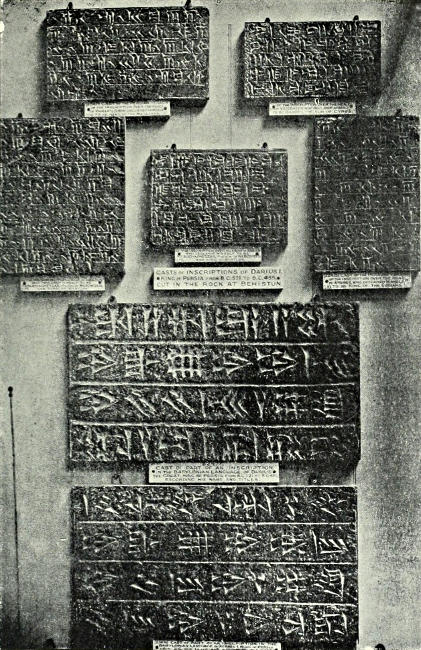
In 1896 Professor Flinders Petrie discovered an inscription of the Pharaoh
Meneptah in which that king speaks of having conquered not only Askalon,
Gezer, and Yenuam, but Israel. Kharu (a land) is also mentioned, the
exact position of which is uncertain. The situation of Askalon and Gezer
is well known. The former is a Philistine city, the site of the latter is on
the right of the railway from Joppa to Jerusalem, south of Lydda. The
position of Yenuam is less certain. A city called Janoah is mentioned in
2 Kings xv. 29 between Abel-beth-maacah and Kadesh, in connection with
Gilead, Galilee, and Naphtali, but the correctness of the received geographical
view of the reference of these old names cannot be implicitly relied upon.
Naville thinks that we may identify Yenuam with Jabneel or Jamnia, but
the names can hardly be connected philologically. We do know, however,
that Naamah is a clan name of southern Palestine and northern Arabia, and
there being in 2 Kings xv. 29 probably a confusion between Asshur (Assyria)
and Ashkhur (a northern Arabian kingdom, perhaps Melukhkha, often mentioned
in Assyrian inscriptions), it appears most critical to assume that
Meneptah’s Yenuam was in the south of Palestine. It thus becomes a plausible
view that clans of Israelites existed in the south of Palestine about
1273 B.C.
Let us go a step further. From the treaty of peace between Ramses II
(father of Meneptah) and the king of the Kheta or Hittites (about 1300 B.C.)
we seem to gather that the south of Palestine was at that time garrisoned by
Egyptian troops. Only the south was Egyptian; the north continued to
be under the control of the Hittites. Even Seti I (father of Ramses II),
who had a course of unbroken success in northern Arabia and southern
Palestine, could occupy permanently no fortress in Canaan to the north of
Megiddo. From these facts we may conclude that one section of Israelites
may perhaps have penetrated from Kadesh into southern Palestine before
the reign of the Pharaoh Seti I, during the period of the decline of the
Egyptian authority in Asia. And it so happens that we have in the famous
Tel-el-Amarna correspondence unimpeachable statements of the trouble caused
in southern Palestine in the century preceding Ramses II by certain people
called Khabiri, whom some have identified with the Israelites; and it is Abd-khiba,
king or at least governor of Urusalim or Jerusalem, who complains to
his liege lord the king of Egypt that the king’s dominion is being lost to
the Khabiri.
These Khabiri were apparently plundering nomad tribes, which were on
the way to adopt a settled mode of life. It is not improbable that the name
is equivalent to Ibrim (Hebrews); only if we adopt this equation, we must
not confine the application of the term “Hebrews” to the Israelites, but
extend it to “all the sons of Eber” (Genesis x. 24), a Biblical phrase which
shows that the Israelites themselves were by no means narrow in the use of
the term. Sooner than identify the Khabiri with the Israelites, who probably
became to a large extent agriculturists in the Negeb, one would suppose the
chieftain of Jerusalem to refer to those whom we know as the Amalekites.
Still one cannot deny the bare possibility that the people in southern Canaan
called “Israel” by the Pharaoh Meneptah may have been partly derived
from some of the plundering clans called Khabiri.
The facts of importance for the history of Israel to be gained from the
Tel-el-Amarna letters are these:
1. The continuance of the Babylonian language and the cuneiform characters—a
proof of the intensity of the early Babylonian influence over Syria
and Palestine.
2. The semi-independence of the cities—a consequence of the disintegration
of the Egyptian empire in Asia.
3. The existence of names (Milkili, Abd-Milki) pointing to a Jerahmeelite
element in the settled population of Palestine.
4. The name Urusalim (Jerusalem), and the importance of the city
so-called.
5. The name Khabiri, possibly connected with Ibrim, “Hebrews.”
6. The importance of the Hittites in northern Palestine (including the
later kingdom of Israel).
7. The restless activity of warlike nomads, some of whom entered the
service of kings and chiefs.
8. The favour shown to natives of Palestine at the Egyptian court,
reminding us of the story of Joseph.
We cannot pause to comment on each of these facts, but may point out
that the story of Joseph, as it now stands, certainly has a more historical
appearance than any other of the early Hebrew legends. The Egyptian
functionary who superintends the magazines of grain in the land of Yarimuta,
according to the Amarna tablets, reminds us of Joseph in a similar office;
and the question arises whether at the root of the story of Joseph there may
not be a tradition of some gifted member of one of the clans of Jacob or
Israel who found favour and employment at the court of Amenhotep IV
(one of the Pharaohs of the Amarna tablets).
Still, the story of Joseph may, like the other ancient Hebrew legends,
have had an earlier form, in which the scene of the events was in the
wide region to the south of Palestine, and the king spoken of was a
North Arabian. And though there may have been an “Israel” in South
Palestine in the thirteenth century B.C., yet the same authority which appears
to state this as a fact also says that the victorious Egyptian king laid Israel
waste, leaving no fruits of the field, and the context suggests that the male
population had been carried captive, or slain.
We return to Saul, whom the legend represents as the first king of Israel,
but who, if his story be critically regarded, was no more than the dictator
of the South Israelitish tribes in a time of continually renewed warfare.
His foes, according to our present texts, were the Ammonites, the Philistines,
and the Amalekites, but in the original legends, only one great foe
was referred to—those whom the Amarna tablets called the Khabiri, i.e.,
North Arabian tribes, sometimes called Jerahmeelites (whence the name
“Amalekites”), sometimes Zarephathites (whence probably “Pelethites”
and “Pelishtim” or Philistines). The notice in 1 Samuel xiv. 47, 48,
that Saul had wars with other foreign foes besides these here mentioned, viz.,
the northern Aramæans, is not to be relied upon; it is evident that there
has been both interpolation and confusion of names. It is only the latter
part that concerns the historian, for it gives the achievement of the reign of
Saul in a nutshell, “He smote Amalek, and delivered Israel out of the hand
of his spoiler.” Another pithy and truthful saying is, “There was sore war
against the Philistines (Zarephathites) all the days of Saul” (1 Samuel
xiv. 52).
It is probable, however, that Saul had another foe. This is not expressly
indicated in our texts, but the language of 1 Samuel xvi. 28; xviii. 8 acquires
a new force when regarded as an echo of this deliberately suppressed fact.
That foe was the man who became Saul’s successor—David. It is important
to know where this opponent of Saul came from. He was a native of
one of several places called (originally) Beth-jerahmeel: a later editor made
a geographical mistake and supposed that it was a Beth-jerahmeel better
known as “Beth-lehem of Judah,” whereas really it was a Beth-jerahmeel
in the “Negeb” or steppe-country. It is a significant fact that David’s sister
Abigail married a man of Jezreel (near Carmel in Judah, whence came
David’s favourite wife Abigail), and that David himself took his first wife
from that place. All this points to a place nearer than Beth-lehem to northern
Arabia; probably it was not far from Maon and Carmel. Nominally
this district of the Negeb was a part of Saul’s dominion. This we infer
from 2 Samuel ii. 9, which states (rightly interpreted) that Saul’s son (and
consequently Saul, himself, before him) was king over (the southern Gilead)
Asshur, Jezreel and Ephraim, as well as over Benjamin. Judah is not mentioned,
because, according to the legend, David had lately been made king over
the “house of Judah” in Hebron. But to hold so many semi-independent
clans in check was beyond Saul’s power, and David, a member of one of
them, conceived the idea of carving out a principality for himself in the
south till such time as the ripe fruit of a larger kingdom should drop into
his mouth. His political rôle began when he gathered round him a band
of freebooters, consisting partly of his own kinsmen, partly of desperate outlaws.
Among his haunts are especially mentioned Adullam, Keilah, Carmel
and Ziklag—all places in the “Negeb.” The last-named place is represented
to us as belonging to Achish, king of Gath. But a Philistine suzerain
of an Israelite free-lance is inconceivable, and again and again in the
Hebrew narratives we find that the name Gath has sprung by corruption
out of a mutilated fragment of “Rehoboth.” A little to the northeast of
the site of Rehoboth (Ruhaibeh), in the direction of Beersheba, stand the
ruins of Halasa, the Elusa of the early Christian age, famous in that period
for its peculiar heathen cult. This is not improbably David’s Ziklag. While
David was prince of Ziklag, the fatal contest between Saul and the Zarephathites
(Philistines) took place, the scene of which was not Mount
Gilboa in the north (as textual criticism shows), but Mount Jerahmeel in
the south. Whether the traditional narrative is right in asserting David’s
abstention from the battle, no one can tell.
That David all this time had acted with consummate craft, we need not
doubt. At the time of the death of Saul, he was not only lord of Ziklag,
but had become by marriage chief of a powerful clan settled in the neighbourhood
of the southern Carmel, i.e., probably near his own home. His
object must have been to detach the clans of the Negeb from Saul, and to
prepare them to receive himself as their lord, or, where Saul had not even
won the nominal allegiance of a clan, to bring the clans into personal relation
to himself by doing them some service. At last David was strong
enough to have himself proclaimed king. This implies that a number of
clans dwelling near together (compare 1 Samuel xxx. 27-31) trusted or
feared him enough to promise him obedience. What was the centre of
his dominion? and was he really independent, or was he the vassal of a
more powerful king?
The capital of David’s earlier realm was Hebron, that is, he had succeeded
in winning allegiance where Saul had failed. The clan of Judah
(not as yet a “tribe”), and with it other clans which had common interests
with Judah, joined together, and recognised David as their king. After
this David carried out another great stroke of policy. He was scheming for
a larger kingdom than that of Judah, and at once selected and fought for
his capital. This capital was a Jebusite (Ishmaelite, i.e., Jerahmeelite) city,
which had succeeded thus far in preserving its independence—Jerusalem.
Its geographical position and natural strength, and the circumstance that it
was unconnected with any Israelite clan or tribe, made it admirably suited
for the capital of an extensive Palestinian kingdom. But before he could
proceed further he had to cope with foes. The Rehobothites and Zarephathites,
who had been not unfriendly to David, regarding him as the foe of
Saul, now saw that he had stepped into the position of Saul, and would carry
on that king’s patriotic work. In the neighbourhood of “Gob” or “Gath”
or rather Rehoboth (of which both names are a corruption), and also in the
valley of Rephaim, David and his warriors fought with and conquered the
Zarephathites, and it is a reasonable conjecture that the “Cherethites and
Pelethites,” who, according to the present text, became David’s bodyguard,
were men of Rehoboth and Zarephath, who, seeing that it was hopeless to
fight against David, chose the next best part—that of fighting with him.
It must have been this victory which enabled David to bring back the sacred
ark of Yahveh from its place of captivity among the Jerahmeelites.
David’s next task was to put down Saul’s successor, Eshbaal or Ishbosheth,
and to conquer what remained to this weakling of Saul’s realm. That
more blood was shed than our texts allow, may be assumed. The legend-makers
idealised David, but the historian is bound to go behind the legend.
The epithets hurled at David by Shimei, according to 2 Samuel xvi. 7, must
have something more for their justification than the concession professedly
made by David to the vengeance of the Gibeonites (2 Samuel xxi. 1-14);
and the strange legend of the destruction of Benjamin in Judges xx., xxi.,
is probably a disguise of an historical fact which took place later than the
period assumed in the legend. Both Benjamin and parts of the Negeb had
to be won by force, and from the nature of the case, as well as from the fact
that Saul’s general and relative, Abner, took the side of Eshbaal, we may
assume that this war lasted for some time. What took place in the large
part of Palestine, which did not, so far as we can be said to know, enter into
the dominion of Saul, we would gladly be able to tell, but the traditions have
faded away. That David had statecraft as well as great ability in war, may
be accepted from the tradition, and the advantages of unity may have been
patent to tribes which had a fertile territory, and were liable to be swept by
Midianite and Aramæan invasions. Still, fear of David, as well as a regard
for self-interest, may have contributed to the annexation, as we may fairly
call it, of central and northern Israel to the empire of the adventurer from
the Negeb. Probably, however, this event did not take place as soon as the
present form of our texts suggests; probably, too, the union of north and
south was never as close as that which came to exist between Judah, and part,
at least, of Benjamin. Further investigation may throw some rays of
light on this subject.
Two revolts are recorded as having occurred in the latter part of David’s
reign. In both cases the narratives have to be closely and critically examined.
At the present stage of the inquiry it appears that the rebellion of
Sheba is wrongly connected with the revolt of Absalom, and occurred at an
earlier part of David’s reign. David had probably not as yet succeeded in
crushing the independent spirit of the Benjamites, and Sheba, who was sheikh
of the important clan (it was Saul’s clan) of the Bicrites, raised the standard of
revolt supported not only by the Bicrites, but to some extent by the Israelitish
inhabitants of Maacah in the Negeb (2 Samuel xx. 14). What he aimed at
was probably a revival of the kingdom of Saul, and a definite renunciation of
the ambitious scheme of a Palestinian empire. His attempt, however, failed.
The revolt of Absalom was similar, but its chief supporters were not in Benjamin
(which, indeed, had most probably by this time been subjugated), but
in Judah. This tribe was, no doubt, the creation of David, but the elements
which had been combined with the old clan of Judah, being Calebite or
Jerahmeelite, still felt the keenest interest in the country to the south of
Palestine called the Negeb, and when Absalom, the child of a northern
Arabian mother, adopted their aspirations as his own, the whole Israelitish
population of the Negeb flocked to his standard. This well-conceived plan,
however, which probably presupposes further successful warfare of David
against the southern Aram (i.e., the Jerahmeelites in and near the Negeb),
was also doomed to failure.
David’s successor, Solomon, reached the throne by a coup d’état. His
success was largely due to the energy of the Jerusalem priest, Zadok, who
was devoted to the service of David’s new sanctuary on Mount Zion. The
friendship of the priestly party had important results both for Solomon
(whom the priests of Jerusalem naturally idealised in legend) and for the
state, which now possessed a sanctuary officially recognised as supreme.
The erection of a temple required a large supply both of timber and of stone,
and our texts represent that the timber and the stone came from Lebanon by
the friendly offices of the king of Tyre, to whose territory Lebanon is supposed
to have belonged. Underneath the present texts, however, we can
discern a different and much more probable form of text, in which the king
whose help is requested is the king of Mizzur (the North Arabian land of
Muzri), and it is also presumably the same king (called in this case the king
of Muzri) whose daughter became Solomon’s wife.
Afterwards, however, the relations between the two kings, Solomon and
Hiram, appear to have changed for the worse. Twenty cities are recorded
to have been ceded by Solomon to Hiram, and (in the original text) a large
sum of money to have been paid. We can hardly doubt that this was the
price of peace; hostilities must have broken out between the two kings,
whose territories adjoined each other. It is possible that the war was occasioned,
not only by the memories of wrongs done to Mizrim by David, but
also by the desire on Hiram’s part for commercial advantages. Solomon was
bent on enriching himself by commercial voyages, and Hiram would not be
behind him. Ezion-geber, at the head of the Gulf of Akabah, formed part
of Solomon’s dominion. Hiram can have had no mariners of his own, but
was resolved not to allow all the profits of the voyages which started from
Ezion-geber to go to his rival. So he sent his own “servants,” i.e., probably
commissioners and merchants, to carry on traffic for him at the different ports
touched at, the chief of which was doubtless Ophir, the port of the great
Arabian or East African gold-land. Nor was the King of Mizrim the only
North Arabian prince who made Solomon’s position a difficult one. For a
time the region adjoining the Negeb, called Cusham, had received Israelite
garrisons, but an adventurer named Rezon expelled the Israelites, and founded
a new line of kings of Cusham, which was destined to cause infinite trouble
to future Israelite kings.
Another bitter opponent of Solomon was the once fugitive Edomite or
rather Aramite prince, Hadad, who returned to his own country (the southern
Aram or Jerahmeel) and distressed Israel. And a third was Jeroboam,
son of Nebat, an Ephrathite of mixed parentage (his mother was a Mizrite).
That he belonged to the northern tribe of Ephraim, cannot be safely argued;
Ephrath was the name of a district in the Negeb, and it was the district to
which Jeroboam belonged. His home was at Zeredah, otherwise called Tirzah,
and seeing that he was “industrious” and specially interested in the Negeb,
Solomon “put him in charge over all the burden of the house of Ishmael,”
i.e., over the compulsory work (the corvée) of the northern Arabian subject
population. This position of trust Jeroboam used for his own ambitious
ends. Naturally, he incurred Solomon’s resentment, and had to flee for his
life to his mother’s country, Mizrim.
The suppression of Jeroboam’s revolt left behind it angry feelings towards
the Davidic family. When, therefore, the fugitive returned after Solomon’s
death, the Israelites in the Negeb were prepared to espouse his claims to
sovereignty. What line was taken by the Israelites of Ephraim and the
other northern tribes, was not expressly stated in the original narrative.
We may be sure, however, that they took no interest in Solomon’s temple,
but the greatest possible interest in the sanctuaries of the Negeb. They had
to support Jeroboam because they loved the land in which the patriarchs had
dwelt. Its sanctuaries were to them the holiest spots upon earth; Canaan
without the Negeb would have been like a temple without its altar. Consequently,
whether the northern tribes sent representatives, or not, on the death
of Solomon, to the national assembly at the venerable city of Cusham-Jerahmeel
(later scribes, and hardly by mere accident, wrote “Shechem”), the voice of
the nation was adequately expressed, and the doom pronounced on the house
of David, in the name of the northern Israelites and the kindred clans in the
Negeb, was final.
Most probably, however, the story of the national assembly is a legend,
and Jeroboam and his party at once appealed to the arbitrament of war.
There may have been fighting on the northern border, but the field of battle
was no doubt chiefly in the Negeb, which, henceforth, according to several
indications in our texts, was partly Israelite, partly Judahite, at least when
Aramite or Jerahmeelite invaders did not take advantage of some temporary
relaxation of vigilance on the part of Israel and Judah. So Jeroboam, not
unaided perhaps by his Mizrite friends, became the king of the northern, and
Rehoboam, the son of Solomon, of the southern part of Israel.
All the Israelite tribes from Asher to Ephraim adhered to Jeroboam;
Judah and Benjamin to Rehoboam. The Holy Land of the Negeb appears
to have been claimed by both, but especially by northern Israel. Jeroboam,
we are assured, occupied Beth-el, and if we may venture to hold that this
means the southern Bethel (in the Negeb), a new light is thrown on many
Old Testament passages of great importance for the history of religion. In
the Bethel sanctuary Jeroboam is said to have placed an image of a bull
overlaid with gold. This bull must have represented the Jerahmeelite Baal,
whom Jeroboam identified with the Yahveh, whose worship the ancient Israelites
adopted from the Kenites of Kadesh (on the border of the Jerahmeelite
Negeb), who conducted them in their migration. To this cultus Jeroboam
was naturally devoted. We cannot, indeed, suppose that there was no such
image of Baal at Bethel till he placed one there, but at least by making
Bethel the “king’s sanctuary” (Amos vi. 13) he gave fresh prestige to
the cultus.
We cannot, therefore, be surprised if in northern Israel the Jerahmeelite
Baal more and more threw Yahveh into the shade, so that men swore, not by
Yahveh, but by the Baal of Beth-el, and shut themselves entirely off from the
forces, so active in Judah, which made for religious progress. Meantime
the outward condition both of Israel and of Judah was so prosperous, that
even a king of Egypt (Shashanq) thought it worth while to raid both territories.
Sculptures on the south wall of the great temple at Karnak (Egyptian
Thebes) appear to record this.
The new dynasty did not long maintain itself. Jeroboam’s son, Nadab,
was slain by Baasha, of the tribe of Issachar, while he was besieging (so our
text says) Gibbethon in Philistia. It was a military revolution such as became
frequent in northern Israel. Baasha energetically resumed the war with
Judah, whose king Asa, however, paralysed Baasha by invoking the help of
Ben-Hadad (probably Bir-dadda), king of Cusham in northern Arabia, who
sent an army against the cities of Israel (in the Negeb). It is remarkable to
see the two kings, who jointly represent Israel, contending with one another
for the favour and protection of a northern Arabian power. Presumably,
Asa offered a larger payment than Baasha. Elah, Baasha’s son, quickly
suffered the fate of Nadab, before the Philistine fortress of Gibbethon.
Whether the singularly exact correspondence between the circumstances of
the first two northern Israelite dynasties is historical, has not unnaturally been
questioned.
Zimri, “who slew his master,” did not live many days in the enjoyment
of royalty. The majority of the warriors were not on his side, but favoured
the commander-in-chief Omri. The late king had been murdered in Tirzah.
From Gibbethon, therefore, Omri and the army moved to Tirzah, and besieged
the city. Zimri met his death in his burning palace.
But Omri had yet to fight for his crown. Another party of the people
favoured the claims of Tibni; after a civil war, the party of Omri finally
prevailed. The result was for the good of northern Israel. Omri, though
not always fortunate in war (1 Kings xx. 34), was a highly capable ruler.
This appears from three particulars which have come down to us; (1) the
subjugation of Moab by northern Israel in his reign, (2) his foundation
of the city of Shomeron, or, rather, Shimron, better known as Samaria, and
we may perhaps add, (3) the respect given to his name by the Assyrians,
who after his death designated the kingdom of northern Israel mat Khumri
or Bit Khumri, “land” or “house of Omri.”
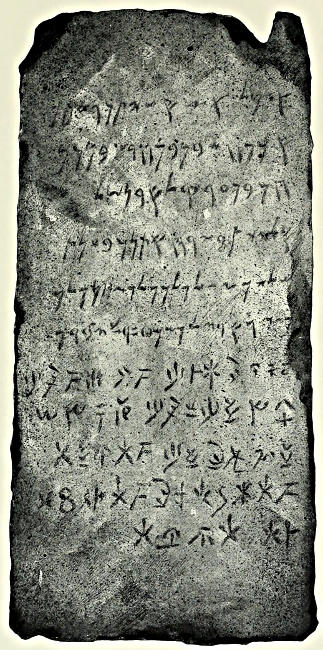
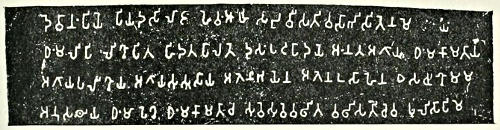
The first of these facts is recorded in the famous “Moabite Stone,”
which tells how Omri afflicted Moab and took possession of the land of
Medeba, and how Israel dwelt therein, during his days, and half his son’s
days—forty years. The second, if correctly reported, is equally interesting;
for Omri’s predecessors, and Omri himself for the first six years of his
reign, held their court at Tirzah, which appears to have been a strong city in
the Negeb. If Omri really built the northern Shimron, he not improbably
named it after a city called Shimron in the Negeb, not far from Beth-el.
The resolution to place his capital in central Palestine, if it be a fact, was
a most judicious one, considering the increasing danger from Assyria and
from the northern Aram. Perhaps, some day, the spade of the excavator
may remove the slight doubt which seems to exist on this point.
The misfortune is that the fragments of Hebrew historical tradition,
critically regarded, tell us very little that can be trusted respecting the
contact of the northern Israelites with these two powers at this period.
Shalmaneser II tells us in an inscription that (in 854 B.C.) he was victorious
at Qarqar, near Hamath, over a league of kings, the first of whom was Dad-idri,
or Bir-idri, of Damascus, the second Irkhulina of Hamath, and the third
Akhabbu of Israel (?). Of this important fact not a hint is given in
1 Kings; indeed, the Hebrew account of the last campaign of Ahab is not
strictly reconcilable with the Assyrian inscription. The same Assyrian
king records that (in 842) Yaua, son of Khumri, together with the Tyrians
and Sidonians, paid him tribute. Not a word of this in 1 Kings. Similar
records of the northern Aramæans are, unhappily, not extant. The final
editor of the narratives in 1 Kings must have believed that the Israelites
had serious conflicts with northern Aram, but underneath the traditional
Hebrew text, lie narratives, which can still be approximately restored, in
which the contending powers were not Israel and Aram-Damascus, but
Israel and Aram-Cusham. The Shimron and the Jezreel spoken of in these
narratives are not Samaria and the northern Jezreel, but places bearing those
names in the “Negeb.”
The name Ben-Hadad, given in 1 Kings to the king of Aram, corresponds
not to Bir-idri (the name of a contemporary king of Damascus), but to Bir-dadda,
the possibility of which, as the name of a North Arabian king, is
shown by its occurrence in the inscriptions. Hazael, too, is equally possible
on similar grounds, as the name of a king of the northern Arabian land of
Cusham. Elijah and Elisha, too, in the original Hebrew narratives, were
certainly represented (according to recent criticism) as prophets of the
Negeb. The appearances and disappearances of Elijah now cease to be
meteoric; he has not so very far to go either to Shimron to meet the king,
or to Horeb to revive his spiritual energies by communion with the God
who specially dwelt on the summit of that mountain.
The whole religious history of northern Israel now becomes a good deal
more intelligible. It is the Jerahmeelite Baal whom the Israelites worship,
identifying him with the God of the Exodus; and the unprogressive character
of his cultus, which addressed itself largely to the senses, was the
reason why the prophets of Judah used such vehement language in denouncing
its votaries. Elijah, we may be sure, that is, the school of prophets
whom he represents (i.e., Amos), never entered a Jerahmeelite temple. But
the sanctity of Horeb, in so far as it was not impaired by a corrupt cultus
and its buildings, was not denied by these successors of Moses.
It is commonly held that Ahab was the husband of a Tyrian wife and
the promoter of a newly imported Tyrian variety of Baal-worship. The
analogous history of Solomon, however, warns us to caution, and a critical
view of the text shows that Ahab’s wife was a northern Arabian princess
from Mizrim, and his offence, from the point of view of Elijah, was in giving
a fresh official sanction to what we may call Jerahmeelitism. Jeroboam had
given his royal favour to the sanctuary of Bethel; Ahab conferred a similar
distinction on the new sanctuary at Shimron. It was this southern city
of Shimron, and not its northern namesake, that Ben-Hadad (Bir-dadda?)
of Cusham besieged. The ultimate result of the siege, of which we have
probably two accounts (1 Kings xxi. 22 and 2 Kings vi. 24-vii.), was fortunate
for Ahab. On the other hand, Ramoth (or Ramath), in the southern
Gilead, still had to be fought for by Ahab, and the brave king met his
death by a chance shot from an Aramite bow. It was also before Ramoth
in Gilead that Jehoram, son of Ahab, who succeeded his elder brother
Ahaziah, received those wounds of which we hear in the story of the rebellion
of Jehu.
Turning to the southern kingdom, we notice that it was some time before
the Davidic king made an effort to obtain foreign protection. In Jeroboam’s
time, indeed, it would have been useless. In Rehoboam’s fifth year the king
of Mizrim proved his regard for Jeroboam and for his own selfish advantage
by invading the Jewish dominion. Resistance was hopeless; Jerusalem itself
was taken, and the departure of Cushi (the name is corrupted in our
own texts into Shishak) was only purchased at a great price. It was the
third king, Asa, who, finding himself in danger of becoming the vassal of
Baasha, became virtually the vassal of the king of Cusham; the story of his
having defeated an army of Cushite invaders (at Zephath, or Zarephath?)
must surely be apocryphal. Asa and his son Jehoshaphat are both praised
for their fidelity to Yahveh. The latter king, however, managed to exchange
a Cushite for an Israelite suzerain, and according to the (late) Chronicler
gained a victory over the (southern) Aramites or Jerahmeelites in the Negeb
(the text of 2 Chronicles xx. has suffered, as regards the geographical
setting).
In the war against Moab, Jehoshaphat did a vassal’s service to Ahab, and
we may suppose that there was a Judahite contingent in the force of ten
thousand men sent by Ahab to the battle of Qarqar. We are also told that he
sought to open once more direct communication by sea with the gold-country
Ophir. His son Jehoram continued loyal to the northern Israelitish king.
Asa had found it impossible to oppose a marriage between the crown-prince
and Athaliah, the daughter of Jezebel. So, officially at any rate, there was
religious as well as political union between northern and southern Israel;
Jehoram, we are told, “walked in the way (i.e., practised the cultus) of the
house of Ahab.”
The revolt of the Edomites, who had hitherto recognised the supremacy of
Judah, marks the reign of Jehoram. His son Ahaziah continued his policy,
and just after he had performed a vassal’s duty before Ramoth in the southern
Gilead (still fought for by the Aramites), he fell a victim with his uncle
and suzerain, Jehoram of Israel, to the machinations of the ambitious general,
Jehu. The name of Jehu (as it seems, an Israelite of the Negeb) is attached
to a revolution which had different results from those which had been contemplated.
We have only the account of it which was given by the prophetic
school of narrators. According to this, the revolution was planned by a
prophet named Elisha, and received the sanction of the sheikh of a subdivision
of the Kenites, called Rechabites. Certainly it is probable enough
that the prophets of the Negeb interfered with politics, and that that portion
of the Kenites which had not adopted a settled mode of life was greatly
agitated by the continuance of that sensuous form of cultus which was
favoured by the house of Omri.
Jehu, too, may have been widely known as an energetic and unscrupulous
man whose ambition could be used in the interests of religious reformation.
At any rate the Baal-worship of the court, which, as we are assured, had
become aggressive, was violently put down by Jehu, and this bold adventurer
now began to scheme for a united kingdom of Israel, like David’s of old.
With this object, he massacred not only Jehoram of Israel, but Ahaziah
of Judah, though, as the event proved, he reckoned without his host,
for Athaliah, the queen-mother in Judah, on her side, massacred all the
children of the other wives of Jehoram of Judah, and, in intention, also
the son of Ahaziah (he escaped, however), and usurped the throne. The
consequence was that north and south Israel, for the present, went each
its own way.
In 842 B.C. Jehu found it expedient to send rich presents to Shalmaneser II,
which this king denominated “tribute.” Here we are painfully conscious of
the meagreness of our information. What was the policy of the queen of
Judah during the six years of her reign? Did she intrigue with Cusham
against northern Israel? We know that Hazael, the Cushamite king, renewed
the war in the Negeb with double fury. Next, what was the policy
of the other Hazael—the king of Damascus—towards northern Israel?
The editor of Kings seems to have thought that this Hazael was an opponent
of Jehu. This might account for the “present” sent by Jehu to Shalmaneser,
who waged war with Hazael. On the other hand, Jehu does not appear to
have sent any gifts in 839 B.C., when Shalmaneser had his second encounter
with Hazael, and Tyre, Sidon, and Gebal again sent tribute. Had Jehu in
the interval been obliged to become a vassal of the king of Damascus, who
was still able to withstand the repeated attacks of the Assyrians?
The furious onslaught of Hazael of Cusham continued after Jehu’s death.
So large a part of the Negeb was taken either by Hazael or by his successor
Ben-Hadad, i.e., Bir-dadda, and so many of its Israelite inhabitants had been
either slain in battle or carried away into slavery, that the most valued
jewel in the crown of Israel’s kings seemed to have been lost. A turn for the
better in Israel’s fortunes took place under Joash. Probably this was mainly
due to the victories of the Assyrian king, Adad-nirari III, who claims to
have received tribute from Tyre, Sidon, Khumri (Israel), Edom, and Philistia,
and who humbled, though he did not destroy, Mari, the brave king of
Damascus. If, as one may plausibly suppose, the latter king punished Jehoahaz
for his father’s Assyrian proclivities, we can understand that when
Damascus ceased to be dangerous, the son of Jehoahaz, stimulated by
prophets like Elisha, might make a supreme, successful effort against
invaders of the Negeb.
The work of liberation, however, had still to be completed; this was
the achievement of Jeroboam II. It was he who reconquered the venerable
city of Cusham-jerahmeel, and recovered the region of Maacath (or
Jerahmeel) for Israel. This period, as criticism is able to show, receives
vivid illustration from the work of Amos, the account of whose conflict with
Amaziah, the priest of the southern Bethel, refers to Jeroboam by name.
The war was still going on, however, when this prophet of evil tidings wrote.
It is probable that for some part of the reigns of Joash and Jeroboam the
king of Judah was once more in vassalage to the king of Israel.
The death of Jeroboam was the beginning of the end for the northern
realm. Murders and revolutions succeeded each other with fearful rapidity.
Of Zechariah and Shallum there is nothing to be said. Menahem’s reign,
however, marks an epoch. Tiglathpileser III states in his Annals that he
received tribute from Kushtashpi of Kummukh, Rasunnu of Damascus and
Minihimi of Samirina. It is plausible to identify the third king with Menahem
of Samaria. The identification, however, is not certain; some other
city may perhaps have been meant. Moreover, the Hebrew record speaks
of an invasion of the northern kingdom, and calls the invader Pul (a Greek
reading is Paloch) king of Asshur. Now there is good evidence in the
Book of Hosea that the Israelites at this period were suing for the favour
of the North Arabian kings of Mizrim and of Asshur. Mizrim we know to
be the land otherwise called Muzri; Asshur (Ashkhur) we may suspect to be
the land called by the Assyrians Melukhkha. Probably, therefore, it is the
king of Melukhkha, the greatest of the North Arabian kings, who invaded
Menahem’s realm, and exacted tribute from Menahem. In this case it was not
central Palestine which he invaded, but the Negeb. In the next reign but
one—that of Pekah—the same king of Asshur (called this time, not Pul,
but by the equally inaccurate name Tiglath pileser or Tilgath pilneser)
returned to the Negeb, a part of which he conquered, deporting its Israelite
inhabitants into northern Arabia.
Probably he was displeased because the impoverished kingdom of Israel
could not pay its tribute. The North Arabian king, however, must have
had some additional reason for his activity. The true Assyrian Tiglathpileser
tells us of the queen of Aribi and of the minor Arabian sheikhs who
paid him tribute, and we may well suppose that, knowing the ambitious
projects and the intrigues of Assyria, the greatest North Arabian potentate
sought to strengthen the North Arabian border by introducing colonists on
whom he could depend. Shortly afterwards he treated Cusham in a similar
manner, deporting its inhabitants to Kir. Again we must regret the paucity
of external information illustrating this period. The Hebrew text as it
stands speaks of Pekah of Israel as joining the king of the northern Aram
in an invasion of Judah. This, as we shall see, is highly doubtful. There
is also much besides in the traditional history of this period which is liable
to revision. The confusion between the two Shimrons and the two Asshurs
is as troublesome as the confusion between the two Arams and the two
Muzurs. But, have the Assyrian inscriptions no facts to communicate?
On the contrary, they mention both Pekah and Hoshea. The former they
present to us as a member of the anti-Assyrian party which existed in Samaria,
as elsewhere, and we gather from the Annals that, as a punishment for this,
the inhabitants of a large part of Bit-Khumri (Samaria) were deported
by the Assyrians, and that when Pekah had been assassinated, Tiglathpileser
ratified the appointment of Hoshea as king of the scanty remnant of
North Israel (733 B.C.).
From the same source we learn that early in Sargon’s reign (722 B.C.?) that
king besieged and captured Samirina (Samaria), carried away 27,290 of its
inhabitants, reserved fifty of their chariots, placed a governor over the remnant
of the people, and imposed upon them the tribute of the former king.
This is all that we know about the doings of the Assyrians; for those of the
Asshurites we must turn to the prophet Hosea and to the second Book of
Kings. The former, writing probably when the doom of the southern Shimron
was already sealed, prophesies not only that it will be taken, but that
the king of Israel will meet his death through Asshur. He also probably
gives the name of the Asshurite king who succeeded Pul or Paloch as Shalman
(Hosea xi. 14), referring to some typical barbarities of which this king
had been guilty.
Shalman appears incorrectly in 2 Kings as Shalmaneser. We learn
that for some years Hoshea paid tribute to Shalman (eser), but that after
this, relying upon the help of the king of Mizrim, he withheld it; the Asshurite
king therefore cast him into prison. If the letter of 2 Kings xvii.
4, 5, is correct, this preceded an Asshurite invasion of the land (i.e., the
Negeb), which ended with a siege of Shimron. The siege lasted three years,
at the end of which the king of Asshur took Shimron, and deported a large
part of the remaining Israelite population of the Negeb into his own land,
filling their place in the Negeb with North Arabian colonists. These new
Shimronites are the people who caused the Jews so much trouble in the days
of Nehemiah.
Thus the two sections of that large part of Israel which had rejected the
Davidic Dynasty were all but annihilated, for history can take no further
account of the remnants which survived both in northern Israel and in the
Negeb, remnants which, though they retained the divine name Yahveh, in
their cultus, were in no essential respect different from the non-Israelites
with whom they mingled. We do, indeed, gather from 2 Kings xvii. 25-33
that the North Arabian colonists in the Negeb combined the ritual worship
of Yahveh with that of their own gods, and we may assume that they learned
the “manner” or ceremonial prescriptions of Yahveh, not from a single
priest—the sole representative of Israel in the wide land of the Negeb—but
from a scanty remnant of Israelites left by the conqueror (compare 2 Kings
xxiii. 20). But of what value or significance for the history of Israel or of
Israel’s history, is this poor and uninteresting fact? Henceforth the world-historical
mission of Israel was confined to that portion of the people which
was loyal to the Davidic Dynasty, and in which, thanks to prophets largely
drawn from the Negeb (a land of opposites in religion), the elements of
progress were still active in spite of great hindrances.
We return to Athaliah, and her bold attempt to naturalise more fully the
sensuous religious developments of North Arabia in Judah. After six years,
both she and her movement came to a sudden end. The only surviving
male representative of David was set upon the throne. The priest Jehoiada
won over the “prætorian guard” on which Athaliah had relied; the usurper
was slain and the house of Baal broken down. The new king Jehoash conformed
to the directions of the priests. This did not, however, avert a
serious calamity. A Cushamite invasion took place, and the retirement of
Hazael had to be bought at a high price. Jehoash was succeeded by his
foolhardy son Amaziah, who seems to have had a dream of throwing off the
suzerainty of North Israel. As the first step to this, he tried his martial
prowess on the Jerahmeelites, whom he encountered in a valley in the Negeb,
but when Joash of Israel, who had no mind to let Judah become predominant
in that region, came down upon him with his army, the result was disastrous
for Judah. Jerusalem was taken, so that the suzerainty of northern Israel
was secured, and the king, Amaziah, met with a violent death. His son and
successor, Azariah (or Uzziah), is to some extent a mystery; we have two
narratives respecting him, one of which surprises us as much by its brevity
as the other (2 Chronicles xxvi.) by its particularity. The probability,
however, is that the account in 2 Kings xv. 1-7 omits all detailed reference
to Azariah’s wars in the south because of a great humiliation which he
received in the course of them. That heavy blow was probably nothing less
than captivity in Mizrim, from the record of which, accidentally or deliberately,
the later tradition extracted the statement that Azariah was smitten
with leprosy. During his father’s enforced absence, Jotham acted as regent.
We can hardly believe that the period of these two reigns was in any sense
a prosperous one for Judah. No special misfortune, indeed, is put down to
Jotham, but we are informed that the king of Aram or Cusham began those
incursions into Judah which became such a serious danger in the next
reign. Whether either Azariah or Jotham succeeded in becoming independent
of Israel, we cannot say.
It was Ahaz, so well known to us from the prophet Isaiah, who succeeded
Jotham. The editors of the Books of Kings and of Isaiah believed that the
“Aram,” which became so troublesome to Ahaz, was the North Aramæan
kingdom of Damascus, and that the ruler of this state in conjunction
with Pekah, king of Israel, fearing the aggressions of Assyria, sought to
force Judah into alliance with them. It was notorious that Ahaz favoured
a different policy, but the allies thought themselves strong enough to capture
Jerusalem and to place a nominee of their own upon the throne of Judah.
It is probable, however, that here, as elsewhere, the editors have adjusted
the narratives and prophecies to historical and geographical ideas which were
not those of the narrators. In reality, it was the king of Aram (i.e., Cusham)
and the king of Ishmael (i.e., some other North Arabian principality) who
sought the humiliation of Judah. The object, as the experience of the past
had shown, was not unattainable, but since the time when the king of Mizrim
humiliated Rehoboam, the suzerain of all the smaller kings—the great “Arabian
king” (Asshur)—had become more jealous of the ambitious activity
of his lieges. Hence, as soon as Ahaz sent an importunate message to the
king wrongly called Tiglathpileser, deliverance came to him, and ruin to
Cusham through an Asshurite intervention. The prophet Isaiah, however,
took a different position. According to him, trust in the true Yahveh and
obedience to his righteous law (of which Isaiah and those like him were the
exponents) was the sure, the only sure, defence against human foes, while
for Ahaz to send for the Asshurite king was to put his head into the mouth
of a lion. But how could such trust and obedience be expected of Judah?
Ever since Solomon’s time this little country had hankered after a worldly
prosperity which was inconsistent, as the most high-minded prophets believed,
with the worship of the true Yahveh. Consequently both Isaiah and Micah,
like Amos and Hosea, saw nothing for their people to expect but ruin.
In the next reign it appeared as if this prophecy were about to be fulfilled.
Two invasions took place—one of the Assyrians, the other of the
Asshurites of northern Arabia—which have been confounded by the editors
who brought the Books of Kings and of Isaiah into their present form. The
difficulties which have been found in reconciling the Hebrew narratives with
the inscription of Sennacherib are partly due to this confusion. We may
suppose that the Asshurite invasion, which ended in the hurried departure of
the invaders, came first; it is this which is referred to in the prophetic utterances
of Isaiah. Whether or no Isaiah lived to see the second invasion
(which took place in 701) is a problem for critics. The prophet has at
any rate given us a vivid picture of the alarm of Judah and the neighbouring
countries in the Asshurite crisis, and we can venture to supplement this
to some extent with facts from the late narratives in 2 Kings xviii. 13;
xix. 37 (Isaiah xxxvi. 1-xxxvii. 38), provided that a methodical criticism
has first been applied to the text.
From Sennacherib himself we have particulars respecting his operations
in Judah. He asserts that he took 46 towns and carried off 200,150 persons;
that he shut up Hezekiah like a cage-bird in Jerusalem, made him
deliver up a captive Ekronite king, imposed a heavy fine upon him and
curtailed his territory. We can easily believe that Judah was not in a
position to resist a second invasion, even though the first was not quite so
calamitous as it might have been. It is also plausible to suppose that the
misfortune arising from Sennacherib’s invasion may have led Hezekiah to
put himself under the tuition of the priests of Jerusalem, and begin a movement
for the centralisation of the cultus. If so, his son and successor
Manasseh revised his policy, and initiated a reaction in the direction of North
Arabian heathenism. Worshippers of the true Yahveh found in the king’s
subsequent career a divine judgment upon such wickedness. The generals of
the king of the North Arabian Asshur (such is the most tenable explanation
of 2 Chronicles xxxiii. 11) brought him as captive to the capital of that country,
but he was afterwards restored. It must be confessed, however, that we do
not know to what North Arabian people the Hebrew compiler applies the
old name of Asshur; the kingdom of Melukhkha appears not to have recovered
from the blow dealt to it by the Arabian invasion of Esarhaddon. One
thing is certain from the Assyrian inscriptions—that Manasseh gave no
cause of complaint to the northern Asshur. Among the vassals who paid
them homage, both Esarhaddon and Asshurbanapal mention Manasseh king
of Judah.
Manasseh’s son Amon continued to promote the religious reaction.
After two years he was murdered, but the “people of the land,” who
appear to have sympathised with Amon’s views, punished the murderers.
This was about 636 B.C., noteworthy as the date of the accession of the
young Josiah. Assyria was still powerful, and few could have foreseen
its impending decline and fall. But it was not Assyria to which the
prophet Jeremiah pointed as the executor of Yahveh’s judgment, nor yet
(as many have supposed) the hordes of Scythian nomads, but a people or
peoples of northern Arabia. Josiah, however, did not lose his composure.
He had thrown himself into the arms of the priests, and the priests and
prophets (not Jeremiah) combined to produce a law-book (our Deuteronomy
has grown out of it), obedience to which might be expected to insure
prosperity.
The reform of the cultus, and the prohibition of more than the one
sanctuary, were far-reaching measures which affected the daily life of every
Israelite. We are even told (2 Kings xxiii. 15-20) that the reformation
extended to Beth-el and the cities of Shimron, i.e., to the Negeb. This view
of the narrator’s meaning is a solid result of criticism, and certainly the
detail has no slight verisimilitude. The realm of Judah needed expansion,
and what region could Josiah more reasonably covet than the Negeb,
so dear to Israelite tradition? Events proved, however, that a greater
potentate also had designs upon it, viz., the king of Mizrim. We do not
know what race predominated at this time in the ancient Muzri, but we can
hardly doubt the fact that the king of a territory adjoining the Negeb, who
was at any rate more powerful than Josiah, went upon an expedition against
Kidsham (i.e., Kadesh), or perhaps Cusham (i.e., Cusham-jerahmeel), and
found his passage barred by Josiah. A battle took place in Maacath-migdol
(if we rightly read the name), and the king of Judah was mortally wounded.
All Judah mourned. The people had lost a king, and were in danger of
losing a faith. For the religious law book promising prosperity to the obedient,
which they had accepted in deference to the king and the priests,
seemed to have been proved a delusion and a snare.
Thus the power most dreaded by Judah is once more the North Arabian
Mizrim, though the race which now predominated in Mizrim had, perhaps, only
lately arrived there. The late editor of Kings, however, confounded Mizrim
with Mizraim (Egypt), and represented the king whom Josiah encountered
as Neku of Egypt; he also confounded the place-name Migdol with Megiddo.
It is not impossible that the enterprising Neku of Egypt really did interfere
with the affairs of Syria, but, if so, it was hardly Josiah whom he had to deal
with. It appears to be clear from the Hebrew narratives, critically interpreted,
that it was first the Mizrites and then the Babelites or Jerahmeelites
(i.e., the peoples to which the Hebrew writers, archaising, apply these names)
who interfered with southern Palestine. The Mizrite king is said to have
deposed Josiah’s successor, Jehoahaz, after a reign of three months, and nominated
a brother of Jehoahaz named Eliakim or Jehoiakim, as king (608 or
607 B.C.?). It was a short-lived suzerainty; another king, miscalled by
the later editor the king of Babel (the name should be “Jerahmeel”),
appeared, and asserted his claim to the Negeb. Jehoiakim became his
vassal, but after three years rebelled, preferring the old vassalage to the
new. Apparently he died before a fresh invasion took place; it was his
son Jehoiachin who, yielding to necessity, surrendered to the Jerahmeelite
army, and together with the principal citizens of Jerusalem, including the
prophet Ezekiel, was deported. A third son of Josiah, named Mattaniah or
Zedekiah, was appointed king by the conqueror. The early part of his reign
was quiet, but the unenlightened war party, which trusted in the oracles of
its own prophets and in the promises of the king of Mizrim, forced the king
to revolt, thus involving his people in the fate long foreseen by the prophet
Jeremiah. The destruction of Jerusalem and the temple, and a second captivity,
followed. The sons of Zedekiah were slain; he himself was blinded.
It is true, the possibility must be allowed for, that the Arabians were but
the helpers of the (true) Babylonians in their destructive operations, and
that captives were carried away, partly to Babylon, partly into northern
Arabia. It is at any rate difficult to believe that no captives of Judah at
all went to Babylon. It is stated by the late Babylonian historian Berosus
(if we may trust Josephus) that Nebuchadrezzar, who succeeded his father
Nabopolassar after the destruction of Nineveh, conquered Egypt, Syria,
Phœnicia and Arabia, from which countries he carried away captives.
Egypt, however, Nebuchadrezzar cannot, apparently, be shown to have conquered,
and the statement made by Berosus in another quotation of Josephus
relative to the destruction of Jerusalem may not contain the whole truth.
Inscriptions of Nebuchadrezzar are urgently wanted. At any rate, so far
as we can learn from the evidence producible by criticism from the Hebrew
writings, the bulk of the captives went into northern Arabia, and the oppression
of the Jews in Judah, wherever this is referred to, appears to have
proceeded from Arabians.
The events of the following period, however, are only known in a legendary
form. The disciples of Jeremiah appear to have remembered that a
Judahite was the first governor set up in the land of Judah, by which is
probably meant the cities occupied by Judahites in the Negeb. Also that
numerous fugitives escaped for a time into the land still known as Mizrim.
Ezekiel was hardly in Babylonia, but in a northern Arabian territory; the
text of Ezekiel which refers to “the land of Chaldea” has been manipulated.
This prophet was one of the heroes of the monotheistic movement, but he
did not confine himself, like Jeremiah, to denouncing the corrupt popular
religion; he saw that only by a strict organisation of the ritual could the
people be trained to a pure worship of the one true God. His successors,
nameless but influential men, carried on his work, the description of which,
however, belongs rather to a history of the literature of Judaism than to a
history of the Jews.
The facts relating to the revival of the Jewish people in their own land
are difficult to ascertain. Our most trustworthy records are the prophecies
of Haggai and Zechariah (i.-viii.). From these we learn that Zerubbabel
(this form of the name is hardly original), the civil head of the Judahite
community, laid the foundation of the temple, and with him we hear of
the high priest Jeshua as stirring up the people to the work of rebuilding.
There are also traces of ambitious hopes of the recovery of the
national independence through Zerubbabel. Whether the chronological
statements of these books in their present forms can be relied upon is more
doubtful, while to restore to some extent the original forms of the Books of
Ezra and Nehemiah requires a keen criticism such as has only lately been
begun. So much, however, is plain that our ideas of this period require not
a little reconstruction. The chief opponents of the Jews in Judah were not
“Samaritans,” but Shimronites (i.e., the mixed population of the Negeb) and
Arabians, and there is reason to suspect that the historical and geographical
framework of both books was originally such as we should expect from the
prominence of the northern Arabians in the destruction of Jerusalem.
That the liberator of the Jewish captives was Cyrus, is at first sight
plausible, but no mention occurs in the extant inscriptions of Cyrus of any
restoration of exiles to their native land, nor do the prophecies of Haggai
and Zechariah appear to presuppose any such restoration on a large scale.
It is very possible, however, that some Jewish exiles had returned from
northern Arabia before the surrender of Babylon to Cyrus, and, indeed, that
Haggai and Zechariah exercised their ministry before that event. Ezekiel
(vi. 4) expects the captivity of Judah to last only forty years, and part of
his book is occupied by a kind of programme for the restored theocracy.
There is also a tradition (2 Kings xxv. 27) that a Babelite (Jerahmeelite)
king signalised his accession by releasing Jehoiachin from prison in the
thirty-seventh year of his captivity.
That by degrees more and more Babylonian Jews returned, is also a
probable conjecture, and even those who stayed behind were doubtless
serviceable both by pecuniary and by intellectual contributions. The
intellectual help of the Jews of Babylon must, indeed, have been considerable;
the highly developed literary and religious cultus of Babylon cannot
have been altogether lost upon them, nor must we underrate the religious
influence of Persia. It would seem, however, that though Judah doubtless
became part of the Persian empire, it continued to groan under Arabian
oppression. The expansion of the northern Arabian races was irresistible,
and the Persian rulers do not seem to have interfered in behalf of the Jews.
As time went on, these rulers themselves appear to have altered for the
worse.
Hence, like other nations, the Jews were ready to welcome Alexander
the Great as a God-sent deliverer. Long before his arrival a more
developed law-book, carrying out Ezekiel’s ideas, had been introduced at
Jerusalem, in spite of considerable opposition. It is said to have been
brought by the scribe Ezra from Babel, but whether Babylon or the land
of Jerahmeel was originally meant, is disputed.
For the following period we are mainly dependent on Josephus and on
the Book of Maccabees. The former is not very trustworthy; the first, and,
to some extent, the second Book of Maccabees, however, repay the student.
Under the first three Ptolemies (306-221) the Jews were well off, but
during the struggle between the Ptolemies and the Seleucidæ, they became
not disinclined for a change of masters. From 198-197 B.C. onwards Judea
formed part of the Syrian kingdom, and in this period we meet with a
movement among the Jews towards Greek culture. This was favoured by
the ruling power; the Seleucidæ were favourable, as the Ptolemies now
were, to a Hellenising of the subject nationalities. Antiochus Epiphanes
went further than his predecessors, and dreamed of a universal adoption of
Greek culture and of the recognition by all races of the Olympian Zeus as
supreme God. Other Syrian peoples complied with his demands. If the
Jews refused, it was obstinacy which deserved punishment.
The priestly aristocracy of Jerusalem brought themselves to yield;
Yahveh and Zeus could be regarded as identical. But there were Jews who
saw the inherent weakness of compromise, and valued their ideals more than
life, so successful had been the movement towards strict legal orthodoxy,
connected with the name of Ezra. It was a country priest named Mattathias,
who, with his sons, set an example of heroic resistance. The supreme command
of the revolters was taken by the third of the brothers, Judas Maccabæus
(166 B.C.), and such was his success that exactly three years after the
temple had been profaned, the signs of heathenism were removed and the
legal cultus restored. This was the main object of the struggle. Judas,
however, was not content with the concession, which was offered to the Jews,
of religious liberty. We need not deny that earthly ambition had to do
with his refusal, but, no doubt, he also thought that without political
independence the freedom of the pious community was insecure. And it so
happened that the disputes between the various claimants of the Syrian
throne made it easy for Jonathan—a diplomatist not less than a general—to
gain more and more advantages. In 143-142 B.C., Jonathan’s successor,
Simon, concluded formal peace with Demetrius II, and in the following
year the Syrian garrison evacuated the Acra at Jerusalem. Simon himself
was, by a popular decree, made hereditary high priest and ethnarch. He
was succeeded by his son, John Hyrcanus, who extended his comparatively
narrow territory by conquest; Shechem, Samaria and Edom became Jewish.
Of Judas Aristobulus, according to Josephus, not much good can be said
(105-104 B.C.). All considerations of piety were sacrificed to political
expediency. Strabo, however, in the name of Timagenes, speaks favourably
of him. As a Sadducee and a “philhellen” it is possible that he was
calumniously misrepresented by the Pharisees. He was the first of his
family to assume the title of king. The eldest of his three brothers, Alexander
Jannæus (104-78 B.C.), came to the throne by the favour of Alexandra,
or Salome, his deceased brother’s widow, who also gave him her hand. His
aim was to extend the limits of his kingdom, so that he was almost always
conducting military operations. At home his struggle with the Pharisees
and their friends (inevitable in the first instance, no doubt) was carried on
with a cruelty worthy of a heathen. On one occasion six hundred Jews were
massacred for insulting him while he was discharging his priestly office.
He was succeeded by his widow, Alexandra, who nominated her eldest son,
Hyrcanus II, high priest. By the advice, it is said, of Jannæus, she made
peace with the Pharisees; indeed, as the same authority (Josephus) assures
us, “she had indeed the name of royalty, but the Pharisees had the power.”
In fact, there was a Pharisean reaction, and the Talmud represents the
age of Simon ben Shetach (a celebrated Pharisee) and Queen Salome as a
golden age, in which even the grains of corn attained a miraculous size.
Externally, the queen showed both energy and prudence. A serious danger
from Tigranes of Armenia was arrested, partly by bribes, partly by a diversion
caused by the Romans under Lucullus (69 B.C.).
No sooner was the queen dead than a war broke out between the brothers,
Aristobulus II and Hyrcanus II, the one able and daring, the other easy-going
and indolent, which was destined to close with the extinction of
Jewish liberty. Hyrcanus, being the eldest son, had the right of succession,
but ill success in war induced him to abdicate the royal and high-priestly
dignities in favour of Aristobulus, on condition that he was left in the
enjoyment of his property. But this arrangement did not last long. The
younger Antipater, governor of Idumæa, and himself an Idumæan, saw clearly
that he could do better for himself under the weakling Hyrcanus than under
the warlike Aristobulus. Taking Hyrcanus’ side, he persuaded him that
his life was in danger, and that he must flee to the Nabatæan prince Aretas
III. This he did, and Aretas took the field against Jerusalem to redress his
wrongs. Aristobulus defended himself in the temple, and the siege promised
to be a long one, when Pompey, who was then in Asia, sent his legate Scaurus
into Syria (65 B.C.), who at first decided for Aristobulus. In the spring of
63 B.C. Pompey himself appeared, and finally decided for Hyrcanus, who
was therefore again installed as high priest. Aristobulus was arrested; his
adherents defended themselves in the temple, which was at length captured
by the Romans. The Asmonæan monarchy was at an end. All the succeeding
high priests were vassals of the Romans.
Judea now became a subdivision of the Roman province of Syria. The
religious institutions, however, which antedated the Maccabæan rising still
continued; liberty of worship was guaranteed by Pompey. But so strong
was the attachment of the people to the Asmonæan family that a succession
of revolts broke out. Meantime, the power of Antipater went on increasing;
Hyrcanus was too weak to oppose him; from Rome, too, he received signal
marks of favour, being even made governor of Judea. A rival, however,
gained over the cupbearer of Hyrcanus, who put Antipater to death by
poison as he was one day dining with Hyrcanus (43 B.C.).
Thus Antipater had fallen, but the power of his family was not diminished
thereby. One of his sons, Herod, had already shown his energy as
governor of Galilee; he now displayed his craft in adapting himself to the
vicissitudes of the supreme Roman power. A closing struggle between
Herod and Antigonus—the last representative of the Asmonæan family—terminated
in Herod’s favour. Antigonus was beheaded at Antioch by
order of Mark Antony, “supposing he could in no other way bend the
minds of the Jews so as to receive Herod whom he had made king in his
stead” (Josephus).
On the news of the battle of Actium (31 B.C.), Herod lost no time in
passing over to the winning side. Though aware of his loyalty to Antony,
Octavian confirmed him in his kingship. It is an eternal blot upon Herod’s
character that he swept away the last representatives of the Asmonæan
family. It is true, he considered this indispensable to the security of his
throne. By princely gifts he kept the Romans on his side, though the concessions
of Cæsar and the senate were sufficiently justified by the proof of
his capacity as a governor. He put down Arabian robbers, created magnificent
cities, and helped his people in times of famine. Yet the Jews were
never drawn to his person; he was after all only an Edomite, and he curried
favour with a heathen power. Herod died 4 B.C. Mommsen, the historian
of the Roman Empire, has said that there is no royal house of any age in
which such bloody domestic quarrels raged.
His dominions were apportioned among his sons Archelaus, Antipas and
Philip. Archelaus became ethnarch of Idumæa, Judea, and Samaria, with
the exception of certain cities; Antipas, tetrarch of Galilee and Peræa;
Philip, tetrarch of Trachonitis, Batanæa, Gaulanitis and Paneas. This
arrangement soon came to an end, so far as the government of Archelaus was
concerned. He was deposed by Augustus, and his dominions were incorporated
in the province of Syria, but specially entrusted to a procurator.
The vicissitudes of the other governments we cannot here follow. Herod
Agrippa had for a time the realm of his grandfather, but after his death
(44 A.D.) the whole of Palestine came under the direct authority of Rome,
and was ruled by procurators (Pontius Pilate, 26-36 A.D.) under the supervision
of the governor of Syria.
The Jews had wished this, but the oppressiveness of the new rule was
powerfully felt. Discontent became rife. At length Gessius Florus disregarded
justice to such an extent that war became inevitable. In Jerusalem
the war party obtained the predominance. Preparation was made for the
defence of the country, which was mapped out into districts, each with its
own commander. The man responsible for Galilee was Josephus, a Pharisee,
but destined to become a friend of the Romans, and the historian of the war.
Nero, when informed of the threatening state of affairs, summoned the general,
Vespasian, and entrusted him with the conduct of the war against the
revolters. Vespasian’s son, Titus, brought two legions from Alexandria;
he himself proceeded to Antioch, and took command of another legion
together with auxiliary troops. The scene of war was at first in Galilee.
The Jews met with great misfortunes, but this only intensified the
fanatical excitement of the party of zealots, which obtained the upper hand
in Jerusalem. Vespasian adopted a waiting attitude, and was at length
precluded from taking a decisive step by grave news from Rome. Vitellius
had followed Otho as emperor, but the legions in the East disapproved, and in
July, 67, Vespasian was acclaimed emperor. He hastened to Rome, leaving
the siege of Jerusalem to his son Titus. For two years party strife had
raged in the city. The priestly aristocrats were accused of treachery; the
zealots were too obviously careful for nothing but the intoxication of an otherworldly
enthusiasm.
Many false prophets arose and led many astray, as an apocalyptic passage
in the Gospel says; Josephus asserts that they were suborned by the
tyrants (i.e. by the dominant faction) to keep the people from deserting.
At length the end came. The city and temple were destroyed. The golden
altar of incense, the golden candlestick and the Book of the Law were taken
to Rome and exhibited to the populace in the triumph of Vespasian and
Titus.
Still, though the temple was destroyed, the Jewish religion remained,
and the wonder is that the Pharisees and teachers of the Law should have
been able so skilfully to adjust the religious and social systems to the altered
circumstances. Could the Jews have put aside the hope of a sudden divine
intervention, and devoted themselves to the task of witnessing for righteousness
within the wide limits of the Roman world, the Jewish people would
yet have recovered from even such a great humiliation. But the transcendentalism
which pervades so much of the later Jewish literature was too
deeply seated to be expelled from the national mind. And the command of
the emperor Hadrian that Jerusalem should be rebuilt as a Roman colony,
was the spark which rekindled the flame of revolt.
Again the Jews in Palestine flew to arms with the sympathy of the entire
Jewish world. Their leader was a certain Simon, surnamed Bar Kosiba, or
Bar Kocheba, who claimed to be the Messiah, and was recognised as such even
by Rabbi Alciba. His coins bear the legend “Simon, Prince of Israel.” He
actually succeeded in “liberating” Jerusalem; the sacrificial system, too,
was probably restored. Julius Severus had to be brought from Britain to
crush the rebellion. The closing struggle took place at Bether, now Bittir,
to the southwest of Jerusalem. After a heroic resistance the fortress was
taken, Bar Kocheba having been already slain. The war had probably lasted
three and a half years (132-135 A.D.).
The history of the expansion of Judaism from a national to a universal
religion has too many lacunæ for us to attempt it here. We have but given
the outward history of the people which was the appointed bearer of the
monotheistic idea. These facts are themselves highly significant. They
show the wonderful receptivity of the Jewish race; they also show that there
was, at least, in certain heroes of the race, a moral enthusiasm which converted
all experiences, as well as all intellectual acquisitions, into the basis
of an ever higher and nobler faith in God. The evolution, however, of
pure spiritual religion was far from complete when the old Jerusalem passed
away forever, and the name of Israel had become little more than a rhetorical
archaism.
The modern historian knows as little of the origin of the Hebrews as he
knows of the beginnings of the racial history of any other nation. The
Hebrew traditions, according to which the race originated in Chaldea, and
migrated thence under Father Abraham, are familiar to every one through
the Bible records. There is no reason to doubt that here, as elsewhere, the
national tradition represents at least a general outline of the historical truth.
But the scientific historian of to-day looks askance at all unverified traditions
of antiquity, and it is becoming more and more common to begin the history
of Israel with the Egyptian sojourn, or at least to treat the prior history of
the race as merely traditional.
There are ethnologists, indeed, who regard the Hebrews as primarily of
Egyptian origin; but such a theory is only tenable on the assumption that
the entire Semitic race came originally from the valley of the Nile. For it
is not at all in question that the Hebrews were closely related ethnically to
the Semitic races of Mesopotamia. Whatever the ultimate origin of the
Semites, it need not be doubted that the Hebrews were the offshoot of that
portion of the race which had settled at an early day in the valley of the
Tigris and Euphrates. It must be admitted, however, that the present
day historian has no such tangible records of the pre-Egyptian history of
the Hebrews as have been discovered for the early period of Babylonian
history.
Even as regards the Egyptian sojourn of the Hebrews, our records are
by no means so secure as could be wished. Despite patient searching, the
monuments of Egypt fail to reveal any traces of the Jewish captivity. A
few years ago it was thought that a monument discovered by Professor
Flinders Petrie, in the tomb of Meneptah at Thebes, had at last furnished
the long looked for mention of the people of Israel. As Meneptah, the son
and successor of Ramses II, was believed to be the Pharaoh of the Exodus,
this inscription naturally excited the widest curiosity and the most eager
expectations. But when fully elucidated, the record was found to contain
merely a somewhat doubtful reference to the Hebrews as a people existing
at the time of Meneptah, throwing no light whatever on the vexed question
of the Exodus. No other reference to the people of Israel has been found in
the Egyptian records. Of course, such a record may exist as yet undiscovered;
but as the task of searching the Egyptian monuments goes on, this
becomes increasingly improbable. It would appear that national egoism,
which is the birthright of every people, gave to the Egyptian sojourn an
importance in the eyes of the Hebrews themselves, which it did not possess
for their captors. There is little reason, therefore, to suppose that the
Hebrews made any important impression on the course of Egyptian history.
It is quite otherwise, however, when we consider the probable influence
of the Egyptian residence upon the Hebrews themselves. What they may
have been, before going to Egypt, is only inferential; but there is no reason
to suppose that they were other than an uncultivated, partially civilised,
nomadic race. The contact with the high civilisation of the Egyptians may
have had upon them some such effect as the contact with the Romans had in
later times upon the barbaric German hordes. In any event it is notable
that the Hebrews after their migration, and throughout the period of their
subsequent history, were firmly imbued with some essentially Egyptian
ideas. They alone, of ancient people other than the Egyptians, practised a
circumcision. It is at least an open question whether the Hebrew belief in
the immortality of the soul was not gained through contact with the people
of the Nile. This entire subject, however, is too new and too deeply hedged
in by prejudice and preconception, to be susceptible of full and satisfactory
handling at the present time. Fortunately, the main facts of Hebrew political
history may be discussed with greater certitude.
After leaving Egypt, the Hebrews settled in the region of the Jordan, and
entered upon a localised national existence. But for several centuries they
made too small a mark to be remembered otherwise than by vague tradition;
and even at their best, they cut no very large figure in the scheme of political
news in the ancient world. There was but one period when they attempted,
with any measure of success, to rival their powerful neighbours.
This was the brief period when David and his son Solomon occupied the
throne. The wars of David, if not so extensive as those of some of his
contemporaries, have left no less sanguinary records of pillage and plunder
than the records of other oriental conquests; and Solomon, under whose
government the kingdom reached its apex of political glory, so far succeeded
in vying with other kings, that his name became a byword of magnificence
to later generations, though it probably did not dazzle his contemporaries.
If the national tendency toward exaggeration has not played false to the
facts, Solomon established a record, in one regard at least, that has not been
equalled to this day: his harem of a thousand wives and concubines has no
historical counterpart.
Yet after all the Hebrew monarchy, in its golden age, must have seemed
a petty state as viewed from the contemporary standpoint of the Egyptians,
Babylonians, Assyrians, and, perhaps, even the Hittites. The absence of
contemporary references is sufficient evidence of this fact. And after the
death of Solomon almost every vestige of world-historical importance vanished
from the divided Hebrew nation. The weak and senescent people,
whose whole time of glory had compassed but two brief generations, was
from this time on to struggle for national existence, with no thought of
conquest; it asked only that it might be allowed to live. And this boon was
vouchsafed, despite vicissitudes of fortune that would have pressed out the
very life of almost any other nation.
The Assyrians and the Babylonians repeatedly put the Israelites to the
sword; yet that conquered people maintained its integrity long after these
persecutors had ceased to have national existence. In one sense, this time
of decline had greater importance than any other period that preceded it,
because its vicissitudes gave rise to that impassioned poetry of denunciation
which remained, and will always remain, the chief glory of Hebrew history.
Thanks largely to this poetry, the Hebrews first began to have a truly world-historical
importance some centuries after the Romans effected their final
dispersion. All through their life as an autonomist nation they vainly
strove to vie with their neighbours in royal power, looking out upon other
peoples jealously, and accepting their own insignificance with angry protest.
Yet by a strange irony of fortune the despised Hebrew was to be chiefly
responsible for preserving the memory of his more glorious contemporaries.
For two thousand years the swords of the Assyrians and Babylonians were
remembered chiefly because the stylus of the Hebrew scribe had told of
their prowess.
A little over half a century ago James Ferguson, the historian of architecture,
commented on the lack of Hebrew records as follows:
“It is one of the peculiarities of the Jewish history, and certainly not
one of the least singular, that all we know of them is derived from their
written books. Not one monument, not one sculptured stone, not one letter
of an inscription, not even a potsherd, remains to witness by a material fact
the existence of the Jewish kingdom. No museum ever possessed a Jewish
antiquity, while Egypt, Assyria, Greece, and all the surrounding countries
teem with material evidence of former greatness, and of the people that
once inhabited them.”
Half a century of investigation has altered somewhat the aspect of
Hebrew archæology. It is no longer quite true that there are no Hebrew
antiquities in any museum. But the number of these antiquities is so small,
and their importance so slight from an historical standpoint, that Ferguson’s
criticism remains true in spirit if not in letter. The most patient researches
in Palestine, beginning with the famous tour of Ernest Renan, have failed
to bring to light more than two or three Hebrew inscriptions, as against the
tens of thousands of records from Mesopotamia. Nor is it at all probable
that any startling finds will ever be excavated. In all probability the
ancient records of the Hebrews have almost utterly perished, whereas in
Mesopotamia there are doubtless myriads of inscribed tablets to reward the
future searcher. In Palestine it is almost certain there are no such stores
of buried treasure undiscovered. Nor is the reason for this paucity of
antiquities hard to find. The explanation is found in the seemingly paradoxical
fact that the cities of the Israelites were not destroyed in ancient
times, and continued to be inhabited far into the Middle Ages, or, as in the
case of Jerusalem, until the present day. It will be recalled that the Babylonian
and Assyrian tablets were preserved beneath the ruins of destroyed
cities, and the most important collections have come from Nineveh, the city
that was overthrown in the most cataclysmic manner. It requires but a
moment’s consideration to make it clear that all of the tablets that were preserved
beneath the ruins of Nineveh would long since have been scattered
or broken had they continued to be accessible to successive generations of
that destructive animal, man. Making the application to the case of the
Hebrews it is clear that their antiquities were in fact scattered and destroyed
in the course of time as those of Nineveh would have been under those circumstances.
It should be added, however, that it is doubtful whether the Hebrews
produced inscriptions on relatively imperishable materials in such relative
abundance as did the Mesopotamians. The Hebrews came upon the historical
field at a comparatively late day. It has been doubted whether any
of their records were written much before the eighth or ninth century B.C.;
and it is probable that they largely employed such perishable materials as
the papyrus and animal skins to receive their writings. Doubtless the clay
tablet of Babylonia was well known to them; indeed, they cannot have
failed to be familiar with this document through the experiences of the
Babylonian captivity. But it does not follow that they largely adopted
the customs of their Mesopotamian cousins. There is, then, perhaps, a
double reason for the paucity of ancient Hebrew inscriptions: the destructive
agency of time acting upon a supply which was relatively meagre in
the beginning.
All this applies to original inscriptions comparable to those which have
come down to us from Egypt and Mesopotamia. But as every one knows,
the story is quite different when we consider the Hebrew records that have
come down to us through the efforts of successive generations of copyists.
Here again we find that the case of the Israelites is sharply contrasted with
that of the Assyrio-Babylonians. The records of the latter, produced in
such abundance, and preserved by burial, were soon forgotten, because no
lineal descendants of the people who made them were at hand to interest
themselves in their preservation. The Hebrew records were passed down
from one generation to another through a never ending series of copies: so
that, curiously enough, the same agency which resulted in the destruction
of the original documents themselves effected at the same time a permanent
preservation of their contents. Thus it has happened that the oriental
nation which has left us the fewest antiquities has sent down to us the most
voluminous and complete literature.
It is to this literature of the Hebrews themselves that we must chiefly
look for the history of that people. Contemporary nations paid but little
attention to the Israelites, and the historians of Egypt, Mesopotamia,
Greece, and Rome have left us only random references, which in the aggregate
suffice to give only the barest glimpses of Hebrew history. Aside
from the Bible, including the apocryphal books, the only considerable texts
that have come down to us, even from classical times, is the work of Josephus;
and that author, it will be recalled, was himself a Jew, though he
wrote in the Greek language. But for that matter the oldest existing texts
of the Bible itself are also in the Greek language. No Hebrew text is
known from earlier than the ninth century A.D.; whereas three reasonably
complete Greek codices date from the fourth century A.D.
The authenticity of the various texts of the Hebrew writings need not be
discussed here. It is estimated that the various manuscripts in the Greek,
Latin, Hebrew, and other languages that are to-day preserved, present, when
their texts are critically compared, about one hundred and fifty thousand
discrepancies. Under these circumstances there must obviously be certain
doubts about the exact reading of many texts; but it is held that the discrepancies
as a whole are of minor importance; and doubtless in most instances
it may safely be assumed that such is the case. In the main, the chief substance
of the original text has probably been preserved, even where details
have been consciously or unconsciously altered.
As to the reliability of the original records thus preserved, opinions
differ widely. It seems to be generally conceded that the Hebrews were
somewhat lacking in the true historical sense, being in this regard comparable
rather to the Egyptians, than to their relatives the Babylonians.
But on the other hand, what has already been said about the general
reliability of national traditions may be applied with full force here. The
most sceptical historian will hardly deny that in their broad outlines the
books of the Old Testament give expression to the actual facts of Hebrew
history, however prejudiced the point of view, and however lacking the
sense of chronology. In any event, whatever doubt may be cast upon the
authenticity of any particular Bible record, the fact remains that, generally
speaking, the Bible records as a whole constitute practically our sole source
for ancient Hebrew history. As has been said, the references made here
and there by other nations, by which the Bible records may be checked,
have abundant interest, but can hardly be said to be truly consequential.
There is, indeed, but a single inscription known to us in the original which
makes direct reference to a specific event mentioned in the Bible. This
unique monument is the famous Moabite stone, which bears an inscription
in which King Mesha refers to an encounter with the Hebrews, which is
told of from the other standpoint in the Bible reference. For all practical
purposes, then, it is to the Bible alone that the historian must turn in
attempting to reconstruct the history of Israel. No one need be reminded
with what zeal this source has been investigated.
The attitude of the modern critic towards the Hebrew texts has changed
very radically within the past few generations. As long ago as the year
1753 Dr. Astruc, court physician to Louis XV, pointed out that the earlier
books of the Old Testament were not homogeneous. The suggestion was at
that time regarded as most iconoclastic, and it had little influence. But in
the nineteenth century a new school of scientific criticism arose which went
back virtually to the position of Dr. Astruc, then forged ahead to still more
iconoclastic conclusions. It was pointed out that two different sources had
been used in the compilation of the first two chapters of Genesis. A further
analysis placed the heterogeneous nature of the Pentateuch, or as one school
of critics would prefer, the Hexateuch, seemingly beyond question. The
upshot of the matter, so far as this can be phrased in a few words, is that
many books of the Old Testament, once regarded as of undisputed authorship,
are now considered by the dominant school of critics to be anonymous.
Indeed, this remark applies, according to Professor Ewald, to the narrative
books of the Old Testament without exception. Ewald’s views on the subject
are worth quoting in extenso as showing the opinion of a recognised
leader of this new school of criticism.
“There is one general token by which, in spite of its apparent insignificance,
we can at once recognise with tolerable certainty the whole distinctive
character of Hebrew historiography in relation to a special science of history.
This token is the anonymous character of the historical books.
“The historian did not mention himself as the author nor do the readers
make much inquiry after his name; this custom is persistent throughout and
was only gradually changed in the last centuries, as may be concluded from
the book of Ezra and Nehemiah, and from the Chronicles which question
more particularly as to the names of the authors of more ancient histories.
Moreover, it is only in these last days of the ancient people that names like
‘Book of Moses’ or ‘Books of Samuel’ appear, as will be shown presently.
We must say that the practice of writing anonymously was established
for the historical works from the very first, and that in the most flourishing
times of historiography it was retained unaltered; it was just this that constituted
the fundamental distinction between the writing of Hebrew history
and that of both Greek and Arab (especially Mohammedan), and here was a
failing from which it never properly freed itself even in later times. Much
as, amongst the Indians, little inquiry has from ancient times been made
concerning the author of a Purana, and the individual himself did not usually
mention his own name.”
This estimate may doubtless be regarded as fairly representative of the
opinions of such modern authorities as Wellhausen, Stade, Kittel, and
Cheyne. It would be far afield from the present purpose to enter into a
discussion of this subject in detail. Needless to say, there is scarcely any
other topic that has excited more general interest or more acrimonious controversy.
But for the purposes of the general historian it suffices to know
that the historical writings of the Hebrews are now subjected to the same
kind of analysis that is applied to the other writings of antiquity, and that,
making the usual allowances for the ambiguities of an unscientific age, for
the national prejudice of a peculiarly stubborn and egotistical people, and
for the chronological inaccuracies of a race somewhat deficient in the historical
sense, the Hebrew writings, like the writings of the old Greek historians,
may be said to have stood fairly well the test of modern criticism.
Overlooking, for the present purpose, the traditional early wanderings of
the race, the history of Israel as a nation properly begins with the occupation
of the land of Canaan. The tribes practically occupy the territories
subsequently called after them, and become consolidated into a nation. But
the Philistines and Phœnicians still hold the coast land, and the Canaanites
some of their central strongholds.
B.C. The so-called judges are
tribal chiefs, military leaders, who in this period stand at the head
of the state. There is no regular transmission of authority, and no
one is at the head of all the tribes at once. Sometimes they rule
contemporaneously. In this age of settlement the bonds between the
different tribes gradually become dissolved as they attain to security
and peace. The earlier judges carry on the conquest of Canaan, and
repel some outside invaders. Barak of Kadesh prompted by the prophet
Deborah deals a crushing blow on the banks of the Kishor to a strong
coalition of northern Canaanites under the leadership of Sisera.
Gideon, one of the judges, puts a stop to the frequent incursions
of the Midianites. The need of a monarchy begins to be felt. Gideon
refuses a crown offered by the tribes of central Palestine, but his son
Abimelech, aided by Shechemite kinsfolk, attempts to found a kingship.
He is unsuccessful owing to internal dissension among his followers.
Jephthah leads the Gileadites in a successful campaign against the
Ammonites, and this leads to a bloody tribal conflict between the
Gileadites and Ephraimites. There are short wars with Philistia,
with which the name of Samson the Danite is connected. In one
of them the Israelites are 1040 badly beaten at Aphek and the Ark of
the Covenant captured. The latter is returned after seven months,
and sent to Kirjath-jearim for safe keeping. The tribes are rapidly
becoming disorganised, though by conquest and fusion with the
Canaanites they have become a large and vigorous people. The
old religion is almost forgotten. In this age probably belongs
the beginning of Hebrew literature, and the use of writing becomes
common.
About twenty years after the battle of Aphek, Samuel, the last of the
judges, calls an assembly of the tribes at Mizpeh. Law and order
are restored in the community, and the covenant with Yahveh renewed.
To complete the work of unification, Saul of Benjamin is
elected king of Israel, and anointed by Samuel. Samuel also establishes
schools of the prophets (Nebiim) in various parts of the land,
whose main duties are to keep the light of religion from dying out,
and to preserve the feeling of national unity.
1020 Saul.—He delivers Jabesh-Gilead from the besieging Ammonites, and
assisted by his son Jonathan, conducts a successful war against the
Philistines. His leniency towards Agag, king of the Amalekites,
brings about his rejection by Samuel. David, an unknown youth,
becomes attached to the king’s person, probably on account of his
skill as a musician. Saul finally regards David as a rival, and exiles
him. David gathers his tribesmen and many malcontents about
him, and makes the Cave of Adullam his stronghold. He attacks
1010 the Philistines and the Amalekites. Saul and three sons are slain at
Mount Gilboa in a battle with the Philistines, and Eshbaal (Ishbosheth),
a surviving son, is made king by Abner, Saul’s general.
David returns to Hebron and is anointed king of Judah. After
several conflicts between the forces of the rival kings, Abner quarrels
with Eshbaal and makes overtures to David, but is shortly assassinated
by Joab.
1002 Murder of Eshbaal. David is invited to the throne of all Israel.
Judah becomes the leading tribe. The Philistines revolt. David
defeats them at Baal-perazim and Rephaim. Gath becomes tributary.
David dislodges the Canaanites from Jebus and refounds the
city, now Jerusalem. Royal palace on Mount Zion built. The Ark
is brought from Kirjath-jearim to the new capital. David goes to
war to defend and consolidate his kingdom. Campaigns against
Edom, Moab, and Ammon. Rabbath Ammon captured, and inhabitants
barbarously put to death. His son Absalom rebels and receives
such support that David flees from Jerusalem, and Absalom takes possession.
The king returns after Absalom’s death. The revolt of
Sheba is suppressed and punished. Through her influence, Bathsheba
succeeds in having her son Solomon appointed heir over Adonijah,
the eldest son. The kingdom now extends from the borders of
Egypt to the Euphrates on the west, and the Orontes on the north.
970 Solomon.—King at David’s death. He puts Adonijah, Joab, and
Shimei to death at once. Banishes Abiathar the high priest, and installs
Zadok. Marries daughter of the Pharaoh (probably Pasebkhanu II).
Makes alliance with Hiram of Tyre. Builds fortresses
and institutes an elaborate system of taxation, which arouses discontent
and jealousy.
966-959 Building of the temple at Jerusalem. In the luxuries of the court
various forms of heathen worship creep in, and the oppression of the
people to support the king’s splendour, paves the way to disruption.
Hadad of Edom and Rezon of Damascus become powerful rivals.
940 Jeroboam of Ephraim, revolts with the help of Ahijah of Shiloh. The
plot fails, and Jeroboam seeks refuge with Shashanq I of Egypt.
930 At death of Solomon, the ten northern tribes which get no promise of
better treatment from his successor, openly revolt, and sending for
Jeroboam, elect him their king. Rehoboam, Solomon’s son, retains
Judah and Benjamin only.
Judah (930-586 B.C.)
(Judah and Benjamin) |
Israel (930-722 B.C.)
(The Ten Northern Tribes) |
| 930 |
Rehoboam attempts to win back the ten tribes; finally prevented by the prophet Shemaiah. |
930 |
Jeroboam I becomes leader of a democratic movement looking
to the abolishment of the elective monarchy. Makes Dan and Bethel the chief centres
of religion, where Yahveh is worshipped in the form of a bull. A new non-Levitical
priesthood started. Ahijah, the prophet, denounces these reactionary measures. |
| 925 |
Invasion of Judah by Shashanq I of Egypt. |
|
Capture and sack of Jerusalem. |
| 920 |
Abijam, king of Judah. |
| 917 |
Asa, king of Judah. Wars with Israel continue. Asa allies
himself with Ben-Hadad I of Damascus. |
917 |
Nadab succeeds his father, is murdered after two years by |
| 915 |
Baasha, a captain of the army, while besieging Gibbethon. Baasha makes himself king,
and is denounced by the prophet Jehu. Ben-Hadad invades Israel. |
| 892 |
Elah, Baasha’s son succeeds him, and is slain in conspiracy by |
| 890 |
Zimri, one of his officers, who, usurping the throne for seven days, is killed by |
|
Omri, the commander of the Israelites, who takes the throne after slaying
another pretender, Tibni. The capital of the kingdom is transferred
from Sechem to Samaria, built by Omri. He founds the first secure dynasty in Israel—makes
the Moabites pay tribute, but is hard pressed by the growing power of Damascus. |
| 874 |
Jehoshaphat, king of Israel. Alliance of Judah and Israel
through marriage of Jehoram and Athaliah, daughter of Ahab. |
875 |
Ahab, king of Israel. Defeats the Syrians twice, and then, to the offence of
the prophets, allies himself with them, probably to resist Assyria. |
| 854 |
Shalmaneser II of Assyria invades Syria, and defeats Israelites and Syrians at Qarqar. The
alliance comes to an end, and Ahab is killed the following year in attempting to recover
Ramoth-gilead from Ben-Hadad. Ahab marries Jezebel, daughter of Ethbaal of Tyre, and the
worship of Baal is instituted at Tyre. The prophet Elijah vigorously denounces this course.
Contest between Baal and Yahveh, after which the latter is rehabilitated. Elijah flees. |
| 853 |
Ahaziah, king of Israel. Elijah rebukes him for calling on Baal-zebub, the god of Ekron. |
| 851 |
Jehoram succeeds his brother with help of Jehoshaphat. Attempts
to recover allegiance of Moabites, but fails. |
| 849 |
Jehoram, son of Jehoshaphat, succeeds his father. Athaliah attempts to introduce the
heathenism and profligacy of Israel into Judah. The Edomites successfully revolt. The
Philistines invade and pillage Jerusalem. |
|
Elisha, servant and successor of Elijah, comes into prominence, and makes fierce war upon
Baal worship, and in the course of this anoints Jehu, an officer of the army, king. Jehu in
revolt at once attacks Jehoram and Ahaziah, who are visiting him, and slays them both. |
| 844 |
Ahaziah succeeds his father. Is killed by Jehu. |
843 |
Jehu. Roots out Baal worship by fire and sword. The house of Omri is
entirely exterminated. Comes to terms and pays tribute to Shalmaneser II, to protect his
kingdom from Syria. |
| 842 |
Athaliah usurps throne. Kills all the royal house except Joash, who is concealed by the
high priest Jehoiada. The cult of Baal established in Jerusalem. |
| 836 |
Jehoiada organises an insurrection. Athaliah is murdered and Joash made king. Reaction
against Baal worship, although the cult still continues. Prophecies of Zechariah. Hazael of
Damascus invades Judah. |
|
|
815 |
Jehoahaz, Jehu’s son, succeeds him. Ben-Hadad III of Damascus
besieges Samaria, but withdraws on approach of Assyrian army. |
|
|
802 |
Jehoash. Defeats Syrians and recovers lost cities. Israel delivered from
the Syrian yoke. Death of Elisha. Defeat and capture of Amaziah at Beth-shemesh. Enters Jerusalem. |
| 797 |
Amaziah. The Edomites defeated in the valley of Salt. Declares war upon
Israel and is badly defeated. Assassinated at Lachish in a conspiracy. |
| 782 |
Jeroboam II, his son, succeeds. Recovers all of lost territory from Syria, reduced to
impotency by Assyria, and Israel extends once more from “the entering in of Hamath unto the sea
of the Arabah.” |
| 778 |
Azariah (Uzziah). Builds harbour of Elath. Era of commercial prosperity. Kingdom
made secure against the Philistines. Uzziah dies a leper. |
|
An era of peace and prosperity begins, although the attitude of Assyria is threatening. |
|
Prophecies of Amos and Hosea. They denounce the corruption and heathenism of the people,
and predict the fall of the kingdom. |
| 741 |
Zechariah, king of Israel. |
| 740 |
Jotham, his son, becomes king, after a short regency. |
740 |
Shallum, a conspirator, murders the king and takes the throne. |
| 738 |
Menahem, a soldier, kills and replaces Shallum. Levies an immense tax to purchase
Tiglathpileser III’s support to his claim on the throne. |
| 737 |
Pekahiah, his son, succeeds. |
| 736 |
Ahaz, a man of weak character, succeeds his father. In spite of the prophet Isaiah’s warnings,
calls upon Tiglathpileser III to help resist Pekah and Rezin. Religion is in a state
of corrupt decay. Prophecies of Isaiah and Micah. Isaiah preaches against the consequences
of the Assyrian alliance to the nation and religion of Judah, and advises a policy of
quietness; Micah against the condition of the poor. |
736 |
Pekah, an officer at the head of a military plot, slays the king and seizes the
throne. Allies himself with Rezin of Damascus to attack Judah. |
| 734 |
Hoshea, supported by Tiglathpileser, slays Pekah, and becomes an Assyrian vassal. |
| 727 |
Hezekiah. Carries out moderate religious reforms in early years of reign. The religion
centralised at Jerusalem. Many administrative improvements in the kingdom. |
|
|
| 725 |
Hoshea, on Shabak’s advice, withholds tribute from Shalmaneser IV, who at once
lays siege to Samaria. |
| 722 |
Capture of Samaria by Shalmaneser’s successor Sargon II. The population is deported
beyond the Euphrates, and replaced by Assyrio-Babylonian settlers. Absorption of the
northern kingdom by Assyria. |
Growing strength, in spite of Isaiah’s warning of the 702 anti-Assyrian
party until finally
Hezekiah withholds tribute from Assyria; his example is followed by
other vassal states of Palestine.
701 Sennacherib invades Palestine. Battle of Eltekeh (Altaku). Tirhaqa
of Egypt comes to Hezekiah’s assistance. The Assyrians, disabled
by great pestilence, return to Nineveh without taking Jerusalem,
but Hezekiah resumes payment of tribute.
695 Manasseh succeeds Hezekiah. Revival of Baal worship. Reaction
against disciples of the prophets who are persecuted. Adoration of
the sun and stars introduced from Assyria, where Manasseh spends
some time as a hostage to Asshurbanapal.
641 Amon, king of Judah. Persecution of the faithful Jews continues.
639 Josiah, son of Amon, succeeds at age of eight. Terrible social and
moral conditions exposed in prophecies of Zephaniah and Nahum.
621 Pretended discovery by Hilkiah of the “Book of the Law” leading
to religious reforms. Idolatrous emblems are cast out and local
sanctuaries abolished.
608 Neku II of Egypt enters Palestine on a career of conquest. Josiah
meets him at Megiddo and is slain. Jehoahaz elected king by the
people over his elder brother, Jehoiakim.
607 Jehoahaz made prisoner by Neku, and Jehoiakim placed on the throne.
Judah, weakened and in disorder, becomes an Egyptian province.
605 Defeat of Neku by Nebuchadrezzar at Carchemish, in consequence
whereof
601 Jehoiakim becomes a vassal of the Babylonian king.
597 Jehoiakim slain in a Chaldean invasion; his son Jehoiachin succeeds.
After three months’ reign is carried captive to Babylon, after the
surrender of Jerusalem to Nebuchadrezzar. The flower of the population
is deported also. Mattaniah, Jehoiachin’s uncle, is appointed
king and his name changed to Zedekiah. Jeremiah counsels complete
submission to Babylon, but,
588 Zedekiah rebels, relying on the vain promise of Uah-ab-Ra [Hophra]
of Egypt, and as a consequence
588-586 Siege and capture of Jerusalem by Nebuchadrezzar.
586 The Jews “except the poorest of the land” are carried into captivity at
Babylon. Gedaliah is appointed governor over the remnant left
behind. A few surviving leaders flee and settle in Egypt, among
them Jeremiah. End of the Hebrews as a nation. Henceforth they
exist as a religious community. Beginning of Judaism.
586-536 The Period of Exile. The Jews form the nucleus of a new people.
Jehoiachin is released by Amil Marduk (Evil-Merodach) and treated
with kindness. Ezekiel labours with his people to bear their burden
and cheers them with the hope of restoration. They spend much
time in compiling and revising the literary records of the past. The
“Priestly Code” is compiled.
538 Conquest of Babylon by Cyrus. Persian dominion.
536 Cyrus issues decree permitting Jews to return to Jerusalem with their
sacred vessels and to rebuild the temple. A band sets out at once
headed by Zerubbabel and Jeshua.
534 The rebuilding of the temple is begun, but interrupted on account of
the opposition of the Samaritans. Haggai and Zechariah exhort the
Jews to complete the temple.
520 The rebuilding is renewed.
516 The temple is dedicated.
510-460 A period whose history is unknown. Zerubbabel may have been
crowned king, but this is doubtful. Judea now an insignificant
province of the empire, controlled by Persian satraps whose rulers are
corrupt and oppressive. Religious faith again begins to decay. The
Law is evaded and disobeyed, and in this condition of things a small
reactionary and zealous party increase in numbers and influence.
483 Ezra, a Zadokite priest, is encouraged to visit Jerusalem on a mission
of reform, by Artaxerxes I, who wishes to conciliate the Jews in
Babylon, who are uneasy at the condition of religion in Judea. His
mission fails.
445 Nehemiah, a Babylonian Jew, arrives in Jerusalem with Artaxerxes’ permission
to repair the city’s walls. Ezra reappears. The Law Book
is published and the covenant between Israel and Yahveh is renewed.
The foundation stone of Judaism is laid. The Law is now the possession
of each Israelite. Nehemiah improves the social condition of
the poor and returns to Persia (433).
432 Second visit of Nehemiah. He finds some of the old abuses again in
practice. The founding of the Samaritan colony gets rid of those
opposed to Nehemiah, and unifies the loyal Jews.
415 Death of Nehemiah. The internal administration of Judea passes to
the line of hereditary high priests.
415 Eliashib, high priest. He and his successors direct the affairs of Judea
assisted by a council of elders and priests.
413 Joiada becomes high priest.
373 Johanan murders his brother Joshua, who attempts to seize the high-priesthood.
The Persian satrap interferes and fines the Jews.
350 Judea ravished by Artaxerxes III, while suppressing a Syrian revolt.
The temple destroyed. Many Jews deported.
341 Jaddua becomes high priest. The age of “Wisdom” literature
(Khokmah).
333 Overthrow of the Persian Empire by Alexander at the battle of Issus.
Israel has a new master.
323 At death of Alexander, Judea becomes a part of the satrapy of Syria.
321 Onias I becomes high priest.
320 Conquest of Jerusalem by Ptolemy Lagus. He deports some of the
inhabitants to Egypt.
314-302 Judea a Syrian province.
302 Ptolemy Lagus retakes Judea.
300 Simon the Just becomes high priest. He repairs the temple and
strengthens the fortifications of the city.
294-280 Judea nominally a Seleucid province.
285 Ptolemy Philadelphus succeeds his father, who abdicates. The Septuagint
version of the Bible begun under his patronage.
250 Onias II becomes high priest. Tries to withhold tribute from Ptolemy.
247 Ptolemy Euergetes succeeds his father.
222 Ptolemy Philopator succeeds his father.
219 In the war between Antiochus the Great and Ptolemy Philopator,
Jerusalem is pillaged and the temple profaned by the latter.
217 Simon II becomes high priest.
204 Judea lost to the Ptolemies, under whom she has been happier than
any time since she lost her independence, and comes under the rule
of the Seleucidæ.
198 Onias III becomes high priest. Antiochus makes a bloodless capture
of Jerusalem. His treatment of the Jews is very favourable.
187 Seleucus Philopator succeeds Antiochus.
176 Attempt of Heliodorus, instigated by the viceroy Apollonius, to
plunder the temple.
175 Antiochus Epiphanes succeeds Seleucus.
175 Onias, friendly to the Egyptian party, is deposed by Antiochus IV, and
retiring to Egypt with his followers founds Leontopolis. Jason
becomes high priest. A Greek gymnasium established at Jerusalem.
172 Menelaus ousts Jason from the priesthood.
Antiochus intervenes in the resulting quarrel. Menelaus is forcibly
installed as high priest and Apollonius takes Jerusalem. Profanation
of the temple. Daily sacrifice and other rites suspended.
167 There is a rising at Modin, under the priest Mattathias, because Syrian
officers try to compel the Jews to worship heathen deities. Many
desperate adherents flock to Mattathias’ standard, and a large band
is soon roaming the country destroying heathen altars and enforcing
circumcision. Mattathias dies (166) making Judas Maccabæus his
successor. A systematic campaign is now decided upon.
166 Judas Maccabæus defeats the Syrians at Emmaus.
165 Judas Maccabæus defeats the Syrians at Bethzur, reconsecrates the
temple and restores daily sacrifice.
164 Antiochus Eupator. The Book of Daniel is written.
162 Judas attempts to expel the Syrian garrison from Acra, meets a crushing
defeat from the Syrians at Bethzur. Alcimus, leader of the
Hellenistic party, becomes high priest, to the resentment of the
Maccabæans.
Demetrius I usurps the Syrian throne, and has Antiochus killed.
161 Judas defeats Nicanor, the Syrian, at Beth-horon (Adasa). Nicanor
slain. Judas defeated and killed at Elasa. He had made secret
overtures to Rome. Judas’ brother Jonathan succeeds to the leadership
of the party.
159 Death of Alcimus. An interregnum in the high-priestship. Jonathan
establishes himself at Michmash as governor of the Jewish nation.
153 Alexander Balas, a pretender to the Syrian throne, makes Jonathan
high priest.
150 Death of Demetrius.
145 Alexander Balas killed by Ptolemy Philometor. Demetrius II succeeds.
Confirms Jonathan in the priesthood.
142 Trypho, the general of Alexander Balas, and his son Antiochus, seize
Jonathan and put him to death. Simon, son of Mattathias, assumes
the leadership, and induces Demetrius to release Judea from tribute.
Capture of Acra by Simon. Judea free from Syrian control.
141 Simon confirmed as high priest. A time of peace and prosperity.
The Law finally re-established.
135 Murder of Simon and his two sons by his son-in-law, Ptolemy. The
third son, John Hyrcanus, succeeds to the high-priesthood. The position
becomes one of practically independent sovereignty. Antiochus
VII attempts to recover Judea. He devastates the country
and Hyrcanus is obliged to purchase the withdrawal of the army,
and the immunity of the capital.
128 Antiochus killed in Parthia. Hyrcanus annexes new territory. Captures
Shechem and Samaria. Era of grandeur for the Jewish commonwealth.
105 John Hyrcanus dies. His son Aristobulus imprisons his mother, kills
two brothers, and assumes title of king. Conquest and annexation
of Ituræa.
104 Alexander Jannæus succeeds his brother. The growing opposition of
the Scribes and Pharisees to the development of the Maccabæan
commonwealth into a kingdom, leads to civil war, during which the
Pharisees summon assistance from Syria and drive Alexander from
Jerusalem, but he recovers the throne and works bloody revenge
upon the Pharisees.
79 Hyrcanus II succeeds his father Alexander.
78 Alexandra (widow of Jannæus) makes terms with the Pharisees.
69 Aristobulus II wrests power from his brother Hyrcanus. Antipater,
governor of Idumæa, sides with the latter. Aristobulus defeated,
and Hyrcanus nearly succeeds in 65 regaining the throne, but
the Romans appear in Syria, and take sides with Aristobulus.
63 Pompey, appealed to by both princes, captures Jerusalem; Hyrcanus
retains his title, but Judea is made tributary to Rome.
47 Antipater made procurator of Judea, Samaria, and Galilee by Julius
Cæsar. Hyrcanus assumes title of ethnarch.
43 Assassination of Antipater. His son Phasael is governor of Jerusalem.
His son Herod is governor of Galilee.
40 Phasael captured by Antigonus, son of Aristobulus II, and commits
suicide. Herod flees to Rome and is made king of the Jews.
37 Herod captures Jerusalem in his war against Antigonus.
He reorganises the sanhedrim, and the Pharisees become nearly as
numerous in it as the priests and elders.
35-25 Herod removes the surviving members of the Asmonæan family from
his path.
20 Herod begins reconstruction of the temple. He founds the cities of
Antipatris and Cæsarea.
7-6 Herod causes the sons of Mariamne to be condemned and strangled.
4 Birth of Jesus—Death of Herod. He wills his dominions to his surviving
sons, Herod Antipas and Archelaus.
6 A.D. The Jews appeal to Rome on account of Archelaus’ misgovernment.
Augustus deposes the ethnarch, and Judea becomes a Roman province.
7 The census of Quirinius takes place. Coponius is procurator. He is
followed by Marcus Ambivius and Annius Rufus.
15 Valerius Gratus appointed procurator.
26 Pontius Pilate appointed procurator. The procurators are subordinate
to the Imperial Legates of Syria and reside at Cæsarea.
29 Jesus begins his ministry.
33 Death of Jesus.
36 Marcellus appointed procurator.
37 Marullus appointed procurator.
38 Persecution of the Jews for refusing to worship Caligula.
41 The emperor Claudius commits the former kingdom of Herod to the
latter’s grandson, Agrippa.
44 Death of Agrippa. Cuspius Fadus appointed procurator. The insurrection
of Theudas takes place.
46 Tiberius Alexander appointed procurator.
48 Cumanus appointed procurator. Signs of revolt among the Jews appear.
52 Felix appointed procurator. The state of anarchy increases. The
Zealots become the dominant party.
60 Porcius Festus appointed procurator.
62 Albinus appointed procurator.
64 Gessius Florus, the last procurator, appointed.
66 Florus seizes the temple treasure. After other atrocities the Jews
revolt. The Syrian legate appears before Jerusalem, but quickly
raises the siege. The emperor then appoints Vespasian to conduct
the war.
67 Vespasian arrives in Galilee. Siege and capture of Jotapata. Josephus
the insurgent general taken.
68 Siege of Jerusalem begins.
70 Fall of Jerusalem.
It is difficult nowadays to realise how unimportant the people of Israel
seemed in their own time, as viewed by contemporaries. Thanks to their
traditions, which the Western world accepted almost unchallenged for many
centuries, the Hebrews came to be thought of as occupying a central position
in the Oriental world. In point of fact they had no such position. They
were quite overshadowed by numerous competitors. Except for a brief
period under David and Solomon, they were never a conquering people, or of
political consequence. They could not compete in culture with the Egyptians
on the one hand, or with the Assyrians on the other. They were not
great traders like their neighbours, the Phœnicians. We shall see that they
even turned to the latter for aid in building their famous temple which, after
all, as it appears, was but an insignificant structure compared with the great
pyramids and temples of their neighbours.
Nevertheless, the importance which the Hebrews attained in the eyes of
subsequent generations through their literature, gives them a world-historical
status fully on a plane with that of any other oriental nation. The smallness
of the land, and the relative feebleness of the people, only serve to
emphasise the contrast between material prosperity and possible intellectual
influence. It is curious, however, looking back from a modern standpoint,
to realise how little influence the Hebrews had in their own day. One can
never escape this thought; it returns to one constantly as one scans the
history of the inhabitants of the tiny land of Palestine.
We have already seen that the Hebrews were a Semitic race, closely allied
to the Mesopotamians. We shall come across many Semitic traits in dealing
with the Israelites, that are familiar through our studies of the Babylonians
and Assyrians. Despite the contention of some modern ethnologists, most
readers will probably feel that the Semite was a peculiarly cruel and relentless
victor when fortune favoured his arms; but it must be admitted that he
was a stubborn, heroic sufferer under reverses. The persistence of the
Hebrew race, scarcely modified to the present day—the most extraordinary
case of racial preservation in all history—may be traced directly to the
dominant ideas which the people entertained from the earliest times, and
which they never relinquished.
A word should be said as to the names “Hebrew,” “Israelite,” and
“Jew,” which are so often used synonymously. Etymologically, a Hebrew
is a descendant of Heber, a great grandson of Shem; an Israelite is
a descendant of Israel, a name given to Jacob after he had proved himself
what the name implies, a “warrior of God”; while a Jew is a descendant of
the kingdom of Judah. The fact that the northern branch of the divided
kingdom took the specific name of Israel, in contradistinction to the kingdom
of Judah, has led to the restricted application of the name Israel.
Nevertheless, it is customary to apply the word in its wider or original
sense, and the more recent historians generally make the name “Israelite”
synonymous with “Hebrew,” as applying to the entire race from earliest
times. It is customary, however, for careful writers to use the name “Jew”
only in reference to the later period of racial history, as it was the descendants
of the kingdom of Judah alone that maintained racial existence after
the Babylonian captivity.a
Palestine is the southern portion of Syria. It extends from Mount Hermon
to the desert of Arabia Petræa, between the thirty-first and thirty-second
degree north latitude. The inhabitants of the country called it
Canaan, and its borders are thus defined in the Book of Genesis: “The
border of the Canaanites was from Sidon as thou camest to Gerar, unto
Gaza; as thou goest unto Sodom, and Gomorrah, and Admah, and Zeboim,
even unto Lasha.” Its eastern boundary, of which Genesis makes no mention,
was probably the Jordan. To the seacoast the Greeks gave the name
of Phœnicia; as for that of Palestine, it originally denoted only the southwestern
part, which was inhabited by the Pelesheth or Philistines. After
the Hebrew conquest, the country of Canaan, now become the land of Israel,
stretched beyond the right bank of Jordan towards the desert. After the
division of the Israelite tribes into two kingdoms, the southern portion, west
of the Dead Sea, became the land of Judah, whence comes the name of Judea.
Under the Maccabees, the name of Judea included the whole region which,
in earlier days, had been the land of Israel. The Romans divided the
country into four provinces; the first three, on the western bank of Jordan,
being—Galilee, in the north, next Samaria, and then Judea; the fourth,
Peræa, was on the eastern bank. This division corresponds roughly with
the character of the country; and is that which we meet with in Greek and
Latin authors, in the New Testament, and in the Fathers of the Church.
Two ranges of mountains, with the Jordan flowing between, traverse
Palestine from north to south and connect Lebanon and Anti-Lebanon with
Horeb and Sinai. They are intersected by valleys and plains, and the
principal peaks bear names hallowed by historical associations or mythological
traditions. The most famous are the hills about Jerusalem—Zion,
Moriah, and the Mount of Olives. Proceeding northwards, we come to
Mount Gerizim, where stood a rival sanctuary to that at Jerusalem; Carmel,
the abode of Elijah the prophet; Tabor, where St. Jerome places the scene
of the Transfiguration; and, east of Jordan, to Mount Nebo, whence Moses
viewed the Promised Land before he died. To the north the mountains are
clothed with trees and vegetation; to the south, in Judea proper, they are
barren rocks; even the plains on the shore of the Dead Sea are untilled and
waste. The contrast becomes even more marked when we pass beyond the
borders of Palestine; to the south, rugged Idumæa, the country of Job, and
beyond it the sandy deserts where reigns the burning simoon, the wrath
whereof is a devouring fire; and the holy mountain of Sinai, where the
One God revealed himself in tempest and lightnings. To the north, the
deep gorges of Lebanon, whence spring the sources of the Jordan; and
those gardens of God, the hollow of Syria and the plain of Damascus; and
the snowy peaks of Mount Hermon, whence the sons of God came down to
join themselves, under the shade of the great cedars, with the daughters of
men. After the lapse of many centuries, this marriage of heaven and earth
was destined to be renewed in a chaster form, and Eden and Galilee to see
bloom, like a lily under green palm trees, the new Eve, the Virgin who
should bear a God.
The Jordan first traverses a small lake, which is almost dry in summer,
and then flows into the lake of Gennesareth or Tiberias, also called the
Sea of Galilee, and famous in Christian tradition. The shape of this lake
is an irregular oval, twenty kilometres in length by about nine in breadth.
The water is fresh and fit for drinking, but the volcanic nature of the soil is
indicated by springs of hot water in the vicinity, and by the basaltic rocks
that cover its shores. Its level is two hundred and thirty metres below that
of the sea. This low level has been found constant throughout the whole
valley of the Jordan, which, leaving the lake of Gennesareth, continues its
course southwards, and, at a distance of twenty-five leagues from it, falls into
the Dead Sea. The mouth is four hundred metres below the level of the
Mediterranean. The Dead Sea, also called Lake Asphaltites, because of the
bitumen which floats upon its surface, is a lake with no outlet, and loses by
evaporation about the same amount of water that it receives from the Jordan
and its other affluents. It is sixty-four kilometres in length, its breadth
varies from eight to thirteen kilometres, its greatest depth is about four
hundred metres. Its basin is the bottom of the great valley which extends
from Mount Hermon to the Gulf of Akabah on the Red Sea. This basin is
in all likelihood due to the giving way of a vast crater formed by the great
volcanic eruption which swallowed up the cities of Pentapolis. Genesis has
preserved the memory of this cataclysm, which it calls a rain of fire and
brimstone. In the neighbourhood we find deposits of lava, pumice-stone,
sulphur, and bitumen. The saltness and causticity of the water of the
Dead Sea explain why no fish nor any sort of animal can live in it; it contains
twenty-four to twenty-six and a quarter per cent. of saline matter, in
place of the four per cent. of other seas. Its specific gravity is greater by
a fifth than that of the water of the ocean, and it is consequently impossible
to drown in it. The saline concretions met with in such regions as this may
have given rise to the fable of Lot’s wife, who was changed into a pillar of salt.
The sacred writers frequently extol the fertility of Palestine, “a country
of wheat, of barley, of vines, of fig trees, and pomegranate trees, a country
of olive trees, of oil, and of honey.” It is true that the soil about Jerusalem
is barren and stony, a fact which caused Strabo to say that the people led by
Moses had had no trouble in conquering a country that did not deserve to
be defended; but the whole of Palestine is not like the environs of Jerusalem.
Latin authors confirm the testimony of the Bible as to the fertility of
Judea. “The soil,” says Tacitus, “yields in abundance the products of our
country, and balm and the palm tree beside.” According to Justin, the
balm of Judea, which was grown chiefly in the plain of Jericho, was the
principal source of the wealth of the country. Ammianus Marcellinus
speaks in the same way of the rich husbandry of Palestine. To this day,
in spite of Turkish misgovernment and Arab raids, it retains—in the north
more especially—many traces of its ancient fertility. The valley of Jordan
is rich in pastures. The olives of Palestine are said to be preferable to those
of Provence. Judea itself, though on the whole barren, has some districts
which yield good harvests, and, above all, excellent wine. But the scourge
of the country, according to the Turks and Arabs, is locusts. “The number
of these insects,” says Volney, “is incredible to any one who has not seen it
with his own eyes: the ground is covered with them for the space of several
leagues. The noise they make, browsing on the trees and herbs, can be
heard from afar, like an army pillaging by stealth. It is better to have to
do with Tartars than with these destructive little creatures, it is as though
fire followed in their wake. Wherever their legions repair, verdure disappears
from the land like a curtain rolled up; trees and plants, stripped of
their leaves and reduced to mere branches and stalks, make the hideous
aspect of winter succeed, in the twinkling of an eye, to the bounteous scenes
of spring. When these clouds of locusts rise on the wing, to surmount some
obstacle or to cross some desert place more rapidly, it is literally true to say
that they darken the sky.”b
Ancient Joppa
The inhabitants of the country just described have each and all (with
exceptions so small as to count for nothing in the mass) belonged to a race
which we are in the habit of calling “Semitic,” or the “nations of the
Semitic tongue.” The term has been so much abused, in scientific works no
less than in public life, that we must first determine its real significance.
The name of “Semite” is derived from “Shem,” who appears in the tenth
chapter of Genesis (in the language of the genealogising historiographer) as
the ancestor of the Hebrews and a number of neighbouring tribes.
Because most of the nations whose descent is traced from Shem, in
Genesis x., speak languages alike in structure and entirely different from
other languages, we have accustomed ourselves, ever since the days of Eichhorn,
to call these nations and languages Semitic. And because peoples
who speak analogous languages are always, to a certain extent, connected by
similarity of descent, and consequently, by physical and mental resemblances,
we likewise speak of a Semitic race. Under this heading we class all the
nations that speak languages of the Hebrew type, and these are the Aramæans,
Assyrians, Babylonians, Canaanites, Phœnicians, Arabs, and a large
proportion of the Abyssinians. Hence the phrase Semitic peoples or languages
is, like so many that are used in science, merely a conventional term.
As far back as history goes, the inhabitants of Palestine have always
been people of Semitic speech, i.e. of a language of the Hebrew type. In
the very earliest times to which historical research can give us any clew, the
period before the immigration of the Israelites into the land west of Jordan,
the population of Palestine varied, exactly as it does now, according to the
character of the various parts of the country. Moreover, then as now, the
Jordan and the Jordan Valley constituted the main barrier between these
Semitic peoples. To the west of Jordan dwells an agricultural population,
divided up into numerous small tribes, which we are in the habit of calling
Canaanite. The collective term Canaanite had of course been extended
from a single district or tribe named Canaan to the whole body of cognate
peoples. The inhabitants of the Phœnician maritime cities are of the same
race, and so are those of the kingdom of the Hittites, which lies to the north
of Palestine.
On the farther side of Jordan, however, dwell Semitic tribes, in many
cases still nomadic, speaking the same language as the rest, but inferior to
them in civilisation, who are each and all styled “Ibrim” (Hebrews), i.e.
“those beyond” or those that dwell beyond Jordan.
But along the southern, no less than on the eastern, frontier of the land
west of Jordan, wandered nomadic tribes (intermingled to a great extent
with Canaanite and Hebrew tribes), who are classed, according to common
opinion, under the general heading of Arab, a view to which the few remains
in the shape of proper names which have come down to us, offers no
contradiction.
This order of things was disturbed when one of the aforesaid Hebrew
tribes began to migrate by degrees into the country west of Jordan, to settle
there, and ultimately to take possession of it more and more completely.
During the process it mingled freely with the original Canaanite population,
whose civilisation it gradually assimilated, while at the same time some other
Hebrew and Arabian tribes were merged in it.
The product of this intermixture is the people of Israel. It first came
into being by the immigration into the country west of the Jordan, which
consequently has a perfect title to pass in legend for the Promised Land.
It did not come out of Egypt as an organised nation, and arrive on the west
of Jordan after many wanderings to and fro. It was as little a nation of
pure blood as any on earth, for it admitted persons of Aramæan and Egyptian
descent as well as the Canaanite, Hebrew and Arabic elements already
mentioned.
The people of Israel never succeeded in possessing themselves of the
whole country west of Jordan. And only on that condition could it have
grown into one of the greater nations and established a homogeneous state
of commanding importance. Nay, it could not so much as permanently
hold its own in its old territory east of Jordan. That would only have been
possible if it had been able to occupy the regions northwards from the plain
of Megiddo to Lebanon and the opposite districts on the east of Jordan with
a dense population of settlers. There no obstacle interferes with intercourse
between the two halves of the country. There a compact population could
have developed, a unit in customs and interests; and by this means the
southern portions of the country, divided by the river Jordan, would have
been held together. But in those parts of the country west of the river,
which lie to the north of the plain of Megiddo, the Israelite population was
never numerous in the days of the kingdom of Israel. It had always a
strong intermixture of Canaanite elements which it was unable to assimilate.
Hence many of the Israelite families which settled there were early
lost to the nation.
But since the people of Israel were not numerically strong enough to win
these regions for Israelite nationality, and since a compact body of Israelitish
inhabitants existed on the highlands south of the plain of Megiddo to the
southern margin of the Dead Sea, and these parts accordingly became the
nucleus of the kingdom of Israel; the latter bore the seeds of destruction
within itself from the beginning. And there was another factor to add to the
difficulties of the situation: before the regions which afterwards formed
the nucleus of the Israelite state had passed into the whole possession of the
immigrants, before the fusion of Canaanite, Hebrew, and Arabian families
with the tribes of Israel was everywhere complete, before, that is, they
could contemplate the conquest of the coast, two other claimants of the land
west of Jordan appeared on the scene. From the northeast, Aramæan
tribes pressed forward as far as Anti-Lebanon, from the southwest came the
warlike nation of the Philistines. Like the Israelites, they both amalgamated
with the original Canaanite population of the territory they conquered.
They, and not the Canaanite population of the coast, were for centuries the
real adversaries of the state of Israel. Nay, the nation was first called into
being by the danger that menaced it from the Philistines.
Thus the strength of the Israelite nation was exhausted in the struggle
for the possession of the land west of Jordan. A people less tenacious, less
valiant, less persevering, would never have maintained its national existence
so long under the circumstances. By holding its own against Philistines and
Aramæans, and succumbing only to the onset of the great Asiatic empires,
Israel gave proof of its high capacities in the sphere of politics.
But how did an Israelite state come into being at all under such circumstances?
Why did not the Hebrews who migrated to the west of Jordan
join themselves to the original Canaanite population which spoke the same
language and was ethnologically so closely akin to them? Why did not a
Canaanite state arise, seeing that in all points of civilisation the Canaanites
were the instructors of the Hebrew immigrants? The answer to this question
is to be found in the fact that the immigrant Hebrew clans who gave
the first impulse to the creation of the nation of Israel, were prevented from
so doing by the difference between their religion and that of the Canaanites.
Before their migration across the Jordan they had separated from the rest
of the Hebrew tribes and adopted a religion of a far higher type than that
of the original Canaanite dwellers west of Jordan. By this means they
had already become one people. Concerning the process by which it came
to pass we have nothing but myth and legend. But if we compare these
with the observations we have been able to make in the case of religion, civilisation,
and customs of other Hebrew tribes, we can at all events draw
general conclusions as to the course of the movements which led to this
result. Let us therefore next consider the relation in which the children of
Israel stand to other Hebrew peoples. According to what has been said in
the foregoing pages, there are three things which distinguish the children of
Israel from the rest of the Hebrews. Firstly, the large intermixture of
Canaanite blood—in one, at least, of the latter races there was a larger
measure of Arab blood than in the children of Israel. Secondly, their adoption
of Canaanite civilisation, and, as a consequence, a more complete transition
to agricultural life. Thirdly, the worship of Jehovah as their national god.
Israel represents that section of the Hebrew race which, on the one hand,
was most strongly influenced by Canaanite civilisation, and on the other, had
advanced farthest in religious development, and was most largely permeated
with foreign elements. Generally speaking, the other nations of the same
class are of purer Hebrew blood and have remained partly nomadic, and
therefore—with the exception of the Moabites—they have remained more
barbarous in a lower stage of development. In the earliest times, more particularly,
the differences between the Israelites and the Hebrews proper
were vague and undefined. Several Hebrew clans found admittance into
Judah, a tribe which is not even mentioned among those of Israel in the
Song of Deborah, and at that time when Numbers xxv. 1-5 was composed,
a licentious worship of Baal of Peor was in vogue in that neighbourhood.
But all the Old Testament records prove that the Moabites worshipped one
god only, the divinity Chemosh. Hence, since such a narrative as the Yahvistic
text is absolutely trustworthy in such matters, we are forced to conclude
that it was Chemosh who was thus worshipped in that neighbourhood
as the Baal (i.e. Lord) of Peor. The conduct of the Moabite men and
women is in no way different from that of Israel of old in the lament of
Hosea iv. 13-15. That the Moabites, like the Israelites, gave their god
the name of Baal, i.e. Lord, may be deduced from the two Moabite local
names of Baal Meon and Bamoth Baal. It is therefore unnecessary to have
recourse to the theory that the phrase “Baal Peor” may have been coined
by the Israelites.
The language of the Moabites is merely a dialect of that in which the
Old Testament scriptures are written, and which we usually call Hebrew,
though Israelitish would be the better word. The affinity of the two
languages is not only evident from Moabitish proper names that have come
down to us; it is raised above the reach of doubt by Mesha’s inscription.
From this inscription it is plain that Moabitish presents some points of contact
with Arabic, a fact that can be explained by the contiguity of the two
languages.
The idea that the Israelites conquered the country north of Arnon as
early as the days of Moses must be given up as unhistorical. It is derived
from an uncritical application of Numbers ii. From this chapter the
inference is usually drawn that an Amorite invasion of Moab had taken
place shortly before the time of Moses. They are supposed to have conquered
all the northern half of Moab and the farther side of Jordan and
then to have been defeated and destroyed by Moses. The groundwork of
the passage in Numbers xxi. is a narrative taken from the Elohistic text xxi.
4-9, 12-18, 21-25, 27, 30. According to this, there existed in the time
of Moses a kingdom of the Amorites (i.e. Canaanites) under a king named
Sihon, to the north of Arnon, between that river and the Jabbok, and
bordered on the east by the land of the Ammonites. Verse 26 is warrant
that this king Sihon had taken his country from the Moabites. But this
verse is an interpolation which interrupts the continuity of vv. 25 and 27,
and is intended to bring the view of the Elohistic text into line with that
which prevailed elsewhere, and according to which these districts belonged
to Moab.
In support of the opinion that this district was invested from the
Moabites in the time of Moses, the Elohistic text refers to an ancient song,
probably taken from the Book of the Wars of Jehovah. In vv. 27-30 he
says, “wherefore they that speak in proverbs say:
‘Come into Heshbon, let the city of Sihon be built and prepared:
For there is a fire gone out of Heshbon, a flame from the city of Sihon:
It hath consumed Ar of Moab, and the lords of the high places of Arnon.
Woe to thee, Moab! thou art undone, O people of Chemosh:
He hath given his sons that escaped, and his daughters into captivity, (unto Sihon, king of the Amorites.)
We have shot at them; Heshbon is perished even unto Dibon.’”
But this song contradicts at all points the statement which the Elohistic
text brings it forward to verify. King Sihon, who was conquered according
to the song, is rather a king of the Moabites, and his conquerors, who in the
introduction are invited to settle in conquered cities, are obviously Israelites,
since the invitation comes in an Israelite song. The “Sihon, king of the
Amorites” put in brackets above, is proved by its incompatibility with the
whole tenor of the song to be a gloss, interpolated for the purpose of bringing
it into harmony with the presuppositions of v. 26. The song is a poem,
composed on the occasion of such an inroad from the north into Moabite
territory north of the Arnon, as the inscription of Mesha describes.
Hence it is out of the question that Israel should have settled in northern
Moab after the conquest of an Amorite king, Sihon by name, at a period
anterior to the migration into the land west of Jordan. The settlement
took place much later, and Sihon, king of the Amorites, whom Moses is
supposed to have conquered, came into being by a misinterpretation of the
song just quoted.
This same settlement of Israel in the northern half of Moab was temporary
only. According to Isaiah xv.-xvi. the whole region north of Arnon,
which Numbers xxi. represents to us as having been conquered by Moses and
which the Fundamental Writing gives to Reuben, is part of the kingdom of
Moab. Jeremiah xlviii. also names the cities north of Arnon as Moabite.
Hence, in the region between the northern margin of the Dead Sea and the
Arnon, the conflict between the two cognate nations of Moab and Israel
surged to and fro for centuries. And probably the immediate object of
each was the possession of the walled cities. They must have been held
first by one nation and then by the other. The country population may
have changed less; it fled before the invading foe and submitted to the
victor. A large proportion of it was probably Moabite even while Israel
was in temporary possession of the cities. And this was, of course, even
more the case when the whole of Moab was tributary to Israel.
All the hatred of Israel for the kindred tribe of Moab that defended its
territory and won back their conquests from them finds expression in the
legend that Moab and the people of Ammon took their rise from the incestuous
intercourse of Lot with his daughters (Genesis xix. 30 seq.). The bias
of the whole legend is betrayed by its ignorance of the names of the daughters.
It is obviously nothing but a malicious travesty of the view that made the
Moabites sons of Lot (Deuteronomy ii., ix., xix.).
The figure of Lot, on the other hand, is not an invention of Jewish legend
or an interpretation of some physical phenomena observed on the Dead Sea,
but the name of a Hebrew or Moabitish clan. The figure of Lot’s wife (who
is also anonymous) alone is a nature-myth. It is the interpretation given to a
block of rock-salt, exposed by the action of water, on the shore of the Dead
Sea, in which the beholders fancied they saw the figure of a woman, an idea
found repeatedly in the legendary lore of the most diverse races. A pillar
of salt of this kind is shown at the present day. The ethnological origin of
Lot, on the contrary, can be maintained with the more assurance since we
meet with the adjective “Lotan,” derived from Lot as the name of an
Edomite clan in Genesis xxxvi. 20, 29.
The second Hebrew people with which we have to do, the Bene-Ammon,
the sons of Ammon or Ammonites, of whose putative descent from Lot’s
younger daughter we have already spoken, seems to have been a genuine
desert race. The land east of Jordan being occupied by Moab in the south
and Israel in the north, there certainly were but few districts fit for tillage
left for them. Nevertheless, attempts were not wanting on their part to gain
possession of the east side of Jordan.
The Edomites, the third of these Hebrew peoples, were those with whom
Israel came most into contact. The close relations and frequent intermixtures
which took place between Edomite and Israelite clans find expression
in the legend that makes Esau, the progenitor of the tribe, the brother
of Jacob and, like him, the son of Isaac of Beersheba. Esau is really the
name of a god, and we meet with it again in Phœnician mythology in its
Hellenised form of Usoos. The divine nature of Esau is also betrayed in
the fact that in the Elohistic text it is he, while in the Yahvistic text, it is
God, who meets Jacob at Penuel (Genesis xxxii. 31, 33, seq.). The name
of this divinity was probably in old times the name of the clan that worshipped
him. At any rate, we never meet with Esau as the collective name
of this people; it is invariably Edom. But Edom itself is the name of a
half-forgotten god, as is evident from the proper name Obed-Edom.
The Edomites were no more a nation of pure Hebrew blood than the
Israelites. They sprang from the fusion of Hebrew immigrants with the
population that already occupied the country, on the one hand, and with
Arab tribes, on the other. And these two elements which the Edomite race
absorbed must have retained their distinctive character to a comparatively
late period, for on no other supposition can we explain the extent and
definiteness of the information which has come down to us on the subject.
In the west, the Edomites spread from the southern margin of the Dead Sea
and from the Nachal ha ’Arabum (Brook of the Arab Bushes, now the Wady
Alachsi) to the Gulf of Akabah. In the west and north they forfeited much
of their nationality. For at one time they occupied the whole of what was
afterwards southern Judah, though intermixed with Arab clans. The
Edomites united with Judah later—probably constrained to do so by their
geographical situation—and possessed the hegemony in the time of David.
The capital of this Edomite district was the ancient city of Hebron.
Its union with Judah was naturally accompanied by a corresponding loss
to Edom, which from that time forward passed for less powerful than Israel
in those parts, whereas, in earlier times, being united under the rule of kings,
it had been superior to the kingless state of Israel, divided up into tribes,
each eager in pursuit of its personal ends. The national monarchy of Israel
is no sooner consolidated than it is strong enough to subdue Edom.
This is expressed in legend by making Esau the elder brother of Jacob,
but only the elder of twins, with whom the younger strives even in the
womb and tries to prevent him from being the first to issue forth. Ultimately,
Esau is cheated of his birthright by Jacob or sells it to him for a
mess of pottage. Edom, on the other hand, always maintained his dominions,
although for a while under the suzerainty of Israel or Judah, in the
wild and barren mountain tract of Seir, which rises to the south of the
mountains of Judah. But this is precisely where the aboriginal inhabitants
whom the Edomites had found in possession held their ground longest, protected
by the unfertility of their country, which made agriculture impossible
and compelled its inhabitants to adopt the rude life of shepherds and hunters.
These aboriginal inhabitants were called Horites, i.e. cave-dwellers.
There may have been Horite elements even in the Edomite population of
southern Judah, for we still find cave-dwellings at Beit-Jibrin (Bethogabris)
and meet with Horite clan-names amongst those of Judah.
It may also be conjectured that a very primitive state of civilisation had
survived among them, for a great many of these little clans are called by
the names of animals. But neither from this circumstance nor from the
form of their names can we deduce any conclusion as to the branch of the
Semitic race to which these Horites belonged. For the names of animals
are found as tribal names among all Semites, and the form of these names—even
supposing it to have been handed down accurately—would allow of
their being considered either Hebrew or Arabic.
In the course of Jewish history the vicissitudes of the fortune of the
Edomite nation occupy us again and again. Just such a Hebrew tribe, or
coalition of Hebrew tribes, as they were, amalgamating with the Semitic
population already in possession to form the nations of the Ammonites,
Moabites, and Edomites, was the stock from which, by amalgamation with
Canaanite and other elements, the people of Israel sprang. Israel, Men of
Israel, Children of Israel, was in historic times the title of honour which it
bestowed upon itself and its members. But even after its migration and
settlement in the land west of Jordan, the non-Israelite inhabitants of the
country called it by the collective name of the Hebrews, and thus it comes
about that to this day it bears that name in the speech of all nations, and its
language is spoken of as Hebrew.
What, then, is the origin of the national name of Israel? It must have
become the name of the nation in the same way as the names of other nations
come into being; by extension from one tribe to the whole body of those
who belong to the same national coalition. Accordingly, there must once
have been a tribe of Israel which distinguished itself in some way and won
fame, and whose name was then assumed by others. Nothing of the sort
has ever taken place in historic times. But this fact does not affect the
correctness of the conclusion that tribal names are very liable to alteration
by the division of old tribes and the rise of new ones. This forgotten tribe
of Israel, which gave its name to the whole people, may have its dwelling-place
in the land east of Jordan, on both banks of the Jabbok, and at the
spot where Mahanaim, a city of the highest importance in the earliest period
of the monarchy, was situated. For the memories of Israel that survive in
legend centre about the land east of Jordan, Mahanaim, and Penuel more
particularly. At Mahanaim Jacob sees the army (machane) of angels; or,
according to another etymological legend, he there divides his army into two
parts (machanajin); at the Jabbok he wrestles with God, or meets with
Esau. There he receives the name of Israel.
The double name of Jacob-Israel may be explained by the identification
and amalgamation of two mythological figures revered as eponymous heroes.
Israel is attested as such by his wrestling with God. The figure of Jacob,
on the other hand, belongs to the west of Jordan. This is proved by the
association of his name with Bethel. If Jacob-Israel had been a single
figure from the beginning, we should expect to find reminiscences of Israel
west of Jordan.
A hypothesis has recently been started to the effect that this tribe of
Israel was not Hebrew at all, but Arab, i.e. that it belonged not to the
Canaanite group of northern Semites, but to the southern Semitic group.
Two arguments have been advanced in support of this contention with
some show of reason. One of these is the borrowing of the religion of
Jehovah from the Kenites; the other the name of Israel. But religions
are equally likely to pass from one nation to kindred or alien peoples. The
determining factor is not the greater or less degree of consanguinity, but the
circumstance that they are at the same stage of civilisation. Religion, the
most universal of all phenomena common to the human race, has everywhere
something of an international character. The second argument is even less
to the purpose. It is true that the word Israel is formed like Ishmael,
Jerahmeel, Abdeel. But on the other hand we find Jiphtah-el as the name of
a valley in northern Palestine, called after some forgotten nation that was
certainly Canaanite. Nay, we find identical tribal names among Semitic
nations of different descent, e.g. among Edomites, Hebrews, Canaanites and
Arabs.
If the clan which bore the name of Israel was Arab by origin, it must
have been merged in a Hebrew majority. For the nation of Israel that
arose spoke a Hebrew language, that is, one that belonged to the north
Semitic group, nay, actually to the Canaanite division of it.
From the foregoing considerations it is clear how the second title of
honour, the name of Jacob, must be explained. This, too, was in the first
instance the name of a clan and of the eponymous hero from whom it claimed
descent. He was worshipped in various places west of Jordan, more particularly
at Bethel. But the use of the name Jacob to denote the whole
nation of Israel is confined to prophets and poets, no historical document
ever applies it to Israel. Possibly the name of Israel had become the name
of the nation before the migration west of Jordan. Moreover, we cannot
even assert that the figure of Jacob is of necessity Hebrew. It may have
been associated with Bethel before the immigration and transmitted to the
Hebrews by the original Canaanite inhabitants.
Even before its migration west of Jordan, Israel was distinguished from
all other Hebrews by the worship of Jehovah as the national divinity. It is
a right instinct, therefore, which makes the rise of Israelite nationality and
the rise of the religion of Jehovah coincide in the mythical reminiscences of
the people of Israel. Legend alone, and no historic document, records the
rise of this worship. But legend, rightly interrogated, gives us hints as to
how we should suppose it to have come to pass. And legend connects it
with the immigration into the Holy Land and more particularly with the
conquest of the land east of Jordan.c
Hebrew Dolmen at Ala-Safat
It is a matter of some delicacy to speak of the origin of the Hebrews.
But whatever the historian’s individual bias, he has no resource but to treat
the early history of this race exactly as he treats the early history of other
races. It has already been pointed out again and again, that history knows
nothing of racial beginnings.
We have noted that modern historians are disposed to begin their
accounts of the history of the Israelites with the Egyptian sojourn. It is
impossible, however, to avoid questioning as to the home of the people prior
to that period, and at least a brief reference must be made to the traditional
wanderings of the race in the earlier epoch. Whoever is disposed to feel
that the modern historian in his iconoclastic treatment of the Hebrew
records is passing beyond justifiable bounds, may be reminded that some of
the greatest of living scholars are able to separate their ideas as to it into
two classes, and to entertain two seemingly antagonistic sets of judgments
regarding the entire subject of Hebrew history. As archæologists and
historians they study the Hebrew records as human documents, to be judged
by ordinary historical standards; while as theologians, they view the same
documents through a prism of faith that gives them an altogether altered
position. Perhaps this attitude of a certain school cannot be better expressed
than in the words of the Rev. A. H. Sayce, Professor of Assyriology at
Oxford, who is recognised everywhere as one of the highest authorities on
oriental archæology.
In the preface to his Early History of the Hebrews Professor Sayce
points out that “There is no infallible history any more than there is
infallible philology; and if we are to understand the history of the
Hebrews aright, we must deal with it as we should with the history of
any other ancient people. The Old Testament writers were human; and
in so far as they were historians, their conceptions and manner of writing
history were the same as those of their oriental contemporaries. They were
not European historians of the nineteenth century, and to treat them as such
would be not only to pursue a radically false method, but to falsify the history
they have recorded. No human history is, or can be, inerrant, and to
claim inerrancy for the history of Israel is to introduce into Christianity the
Hindu doctrine of the inerrancy of the Veda. For the historian, at any rate,
the questions involved in a theological treatment of the Old Testament do
not exist.” But after making these statements, Professor Sayce continues:
“The present writer, accordingly, must be understood to speak throughout
simply as an archæologist and historian. Theologically he accepts unreservedly
whatever doctrine has been laid down by the Church as an article
of the faith. But among these doctrines he fails to find any which forbids
a free and impartial handling of Old Testament history.”
If so great an authority finds this attitude justifiable, surely it is open to
every one to read the history of the Hebrews as interpreted according to
modern ideas, and then to apply to it whatever prism of faith may suit his
own fancy.a
[ca. 2300 B.C.]
The age of the patriarchs, according to Max Löhr, belongs to the prehistoric
period of Israel, to the childhood of the nation; and nations, in
their childhood, are like children, colouring everything with the brilliant
hues of their imaginations and transforming the commonplace events of the
beginnings of their national existence into marvellous fairy tales, narrating
the deeds of the founders of the nation. This is as true of Israel as of other
nations; and it is in this light that the modern historian reads the accounts
of the patriarchs as recorded in Genesis, almost our only source of information,
and endeavours to extract the small kernels of historic truth, which
nearly all of them contain, from the surrounding mass of the legendary
shells.
Abraham is the central figure in the record of the patriarchs. Some
historians would take from him his historical personality. They believe that
he was originally a local deity of Hebron, or other place; and that in the
course of time he was transformed, through legendary alchemy, into one of
the fathers of his race. But the chief value of Abraham’s character is not
historical; it is religious. The Old Testament makes him the hero of faith,
whose confidence in the goodness and justice of God cannot be shaken.
The words of Goethe, in his fourth book of Poetry and Truth, concerning
the patriarch can be applied especially to Abraham, and they indicate the
source of his lofty religion:
“Their mode of life on the sea, the desert, and the pasture land, gave
breadth and freedom to their convictions. The star-sown vault of heaven,
under which they lived, ennobled their emotions; they were more than
active and skilful hunters, more than industrious home-loving husbandmen;
they believed that God was confiding in them, visiting them, taking an interest
in them, leading and saving them.”
Even at the beginning, religion was the motive power in the history of
Israel. Unshaken faith in God was the characteristic of all the patriarchs;
and even if their knowledge of God was crude and imperfect, their faith in
him was sublime.
If we consider the patriarchs as nomadic chiefs, at the head of one or
more pastoral races, who willingly submitted to the command of men of
superior wealth, courage, and energy, then we must look upon the wanderings
of Abraham and Isaac and Jacob, and their successors, as a series of
great racial migrations, extending over centuries, and resulting in frequent
changes and reorganisations, with its final culmination into the historic
nation of Israel.c
[ca. 2300-1270 B.C.]
The eminent historian, Bernhard Stade, takes a view of Israelitish traditions
far less confiding than that of Max Löhr. According to the oldest
tradition, he says, the people of Israel came from northern Mesopotamia;
and Kharran (Haran), the city of Nachor (the Carrhæ of the Greeks
and Romans on the south of the Armenian Mountains), was, according to
the Yahvist and Elohist texts, the home of Abraham. Also Jacob’s two
wives, Leah and Rachel, i.e. the Hebraic families of those names which
early became extinct, came out of Kharran. There seems accordingly to
have been an old tradition that certain Hebraic clans migrated from those
districts to Palestine. Moreover, one can suppose that they there found
family connections with whom they amalgamated; and this would be the
interpretation of the marriage of Jacob with Leah and Rachel.
This tradition would not be at all incredible in itself, but another reason
also can be cited for the emigration of Hebraic tribes from the district lying
south of the Armenian Mountains. After the Hebrews, the Aramæan tribes
came from the northwest into Syria, pushing on and absorbing parts of the
Hebrew population, as the Hebrews drove on the Canaanites. The pressure
of these Aramæan people may have already burdened the Hebrews and have
driven them to migrate towards the southwest. But after all there is no
historical certainty about these things, on account of the fragmentary
character of the traditions and their complete mixture with mythological
elements.
According to the sacred legend, the fathers of Israel (Abraham, Isaac,
and Jacob), who were of Mesopotamian origin, dwelt for three generations
in the country west of Jordan, settling in different places; but the third
generation emigrated to Egypt, where Joseph, the great-grandson of Abraham,
had already reached a high position. But the Hebrew legend tells us
no more of the history of the emigrants while in Egypt until the time
of their departure from the country, than do the Egyptian accounts
thus far found.
[ca. 1270-1250 B.C.]
Israel comes to Egypt a single family, and leaves the country a populous
nation. Tradition connects the migration from Egypt into the land
east of Jordan with the Levites, Moses and his brother Aaron, the forerunners
and founders of the Israelitish priesthood. Moreover, the oldest form
of the legend, as the Yahvistic text gives it, mentions only Moses. He is
in it the liberator, leader, and priest of Israel. Neither the residence of the
Patriarchs in the country west of Jordan, nor the stay of the Israelites in
Egypt, have been historically proved, and the former is quite improbable.
Joseph, Jacob, Isaac, and Abraham are heroes of the race, the first two
being at the same time tribal names. The last three have been revered at
celebrated sanctuaries; and it must not be overlooked that the sanctuary of
the first ancestor is the least important one. Moreover, it is a fact, proved
by the history of different sanctuaries of the land, that those of Israel were
considered sacred by the original inhabitants. This is the case at Sichem
and Gibeon; Bethel was likewise a Canaanitish town in earlier times.
Hebron was Edomitish, probably in the first place Horitish, and the very
name of Beersheba shows its Canaanitish origin.
If the ancient Israelites took over the sanctuaries from the original
Canaanitish inhabitants, as we know definitely concerning some and must
surmise in the case of others, and if they nevertheless maintain that these
sanctuaries were founded by their fathers, the object of this assertion is
merely to gain a legal title to the possession of these pre-Israelitic sacred
spots, and to obliterate the fact of their non-Israelitish origin. We shall
have to go even farther and say that the Israelites either adopted from the
Canaanites the hero that was honoured in those places, or that they there
localised a certain Hebraic hero. But in both cases there is no evidence of
a pre-Egyptian sojourn of Israelitish families in the land west of Jordan.
Moreover, the comparatively recent origin of the patriarchical tradition must
be borne in mind.
It is not quite so bad, though not essentially better, with the question of
the residence of Israel in Egypt before its migration to the land east of Jordan.
That, in spite of the most anxious search of apologetic Egyptologists
and theologians, no trace of Moses and the Hebrews has been found in the
Egyptian records is just as suspicious as the fact that the Hebrew account
says nothing about all that happened between the time of Joseph and that
of Moses.
It seems as if the flight of story-spinning imagination had been sufficient
to transpose both the historical personage of Moses and the eponymous hero,
Joseph, together with the eponyms of the two tribes descended from him, to
Egypt, but not to fill out the intervening period. Egypt has, however, been
too often for longer or shorter periods the residence of Semitic families for
one to dare to deny the possibility that some Hebrew tribes or families
stayed in Egypt. But that the Hebrew people, to say nothing of the race
of Israel, did not do so, follows necessarily from the origin of these terms.
So it is easily seen why the search of the Egyptologists for traces of the
residence of the Children of Israel or the Hebrews in Egypt must be fruitless.
If any Hebrew clan did stay there, its name is unknown, and the Egyptologists
would not recognise it, even if they understood more of Hebraic antiquity.
But in any case the search for the Pharaohs, under whom Israel
entered and left Egypt, is a useless jugglery with dates and names; and it
is also useless to attempt to discover the route by which Israel left Egypt.
Tradition makes the institution of the Jewish religion on Mount Sinai
contemporaneous with the emigration from Egypt; and it has been often
surmised, especially by Egyptologists, that Moses imposed upon Israel elements
of Egyptian theology. But there is no basis in fact for this theory.
It is not known what the Hebrews may have borrowed from the Egyptians.
Part of that which has been put under that category is entirely foreign to
the old Jewish religion, and was gradually and spontaneously evolved, and
the rest plays no part in it at all. It is especially absurd to attribute the
idea of the unity of God to Egyptian influences.
However, the worship of God which the Jews adopted at Sinai certainly
was originally foreign to them. It is an error to suppose from the story
that Moses represented himself to Israel as the ambassador of the God of
their fathers, that he must have found among the people the faith of this
one God. This theory would lessen the importance of Moses for the Old
Testament religion. Like all founders of religion he endowed the people
with a new creative idea which gave a fresh turn to their life, and this new
idea was the worship of Jehovah as their ancestral God. For if we take away
all that the worship of Israel gained upon the path it travelled in historical
times, then, supposing such antiquity for the worship of Jehovah in Israel,
there is left no fresh idea, from the adoption of which by the people a new
epoch could date. Moses, then, would in the most favourable light be only
a restorer or a reformer of the old Israelitish religion, and not the founder
of a religion as he is rightly considered by priestly tradition.
Two further points must be noted in this connection. In the first place,
we know nothing of Israel’s worship before the time of Moses; not a single
tradition exists of it. But this cannot be wondered at; and it may be
observed elsewhere also that after the adoption of a higher religion, all recollection
of an earlier form of worship not only dies out, but is designedly
destroyed. Secondly, however, it should be noted that the worship of
Jehovah may have been in a more imperfect and undeveloped form among
the people from whom Moses borrowed it, than that in which he imposed it
on his race.
Many features of the sacred tradition show that the worship of Jehovah
was originally foreign to Israel. To ancient Israel Jehovah dwells on Sinai,
which, therefore, is the original seat of his worship. Moreover, confused as
the accounts may seem in some particulars, the old tradition explicitly states
that Moses, who imposes the worship of Jehovah upon Israel, is the son-in-law
of the priest of an Arabian race; that is, that the priesthood of Moses
and Levi is connected with an older non-Israelitish Jehovah priesthood.
This father-in-law of Moses is called in Exodus iii. 1, Jethro the priest of
the Midianites, and in Exodus ii. 18, Reuel. Exodus xviii. contains a fairly
authentic account of Jethro by the Elohist, and yet it is questionable whether
this account really refers to him. It is, however, probable. In Numbers x. 29,
his name appears as Hobab. And in Judges i. 16, the Kenites are brought
into connection with the father-in-law of Moses; Judges iv. 2 likewise calls
Hobab, Moses’ father-in-law, a Kenite; he, therefore, should rather have been
called a priest of the Kenites.
That the Arabic or nomadic race, from which Moses borrowed the worship of Jehovah,
was the tribe of the Kenites, is proved by the later history
of this people, who henceforth are closely interwoven with the worship of
Jehovah.
According to Numbers x. 29, and Judges i. 16, the Kenites joined the
children of Israel in their journey to the land west of Jordan, and according
to the latter passage “they went up out of the city of palm trees (Jericho),
with the children of Judah into the wilderness of Judah.” In the south of
the district of Judah, we meet in the earliest ages of the Kings a nomadic
Kenite race, which was in friendly relations with Judah (1 Samuel xxx.),
although dwelling among the Amalekites (1 Samuel xv. 6).
It is questionable whether, after such a definite proof as the latter
passages, it can be maintained that the Kenites were in alliance with the
Midianites, especially as the land of Midian lies on the east of the Persian
Gulf, and the Midianites at the time of the birth of the Jewish kingdom
lived on the east of Jordan.
In this connection may be cited the fact that a single Kenite clan was
nomadic in the north, and that Ephraim was, according to Judges v. 14, of
partly Amalekitish origin. Nevertheless these are all only surmises. The
scarcity of the records deprives us of any clear light on the ancient ethnological
relations.
The people of Israel, then, strengthened by Kenitish elements, migrated
from the Sinaitic peninsula into the land east of Jordan. But we know
neither by what route they went, the time when it happened, nor how long
the journey took. To be sure, in Amos v. 25, it is stated that the people
were in the wilderness for forty years. This round number is, however, not
only doubtful in itself; it is still more so because it rests upon the assumption,
proceeding from theological hypotheses, that the whole of the people
which emigrated from Egypt, with the exception of Moses, Joshua, and
Caleb, died in the desert for their unbelief and never saw the Holy Land.
The most ancient source of the Pentateuch probably knows nothing of
this forty years’ wandering. The accuracy of the mention of the places,
which were the stations of the wandering in the desert, cannot, however, be
brought forward as historical proof of this time in the desert. These places,
it goes without saying, have all, within historical times, been desert stations.
But that Israel repaired to them is supported solely by the tradition of later
times which, on the hypothesis that Israel came from the Sinaitic peninsula
and, on the other hand, on the basis of its knowledge of the roads through
the desert, constructed a picture of the way which the Israelites might have
taken. Moreover, it is evident that the veneration by neighbouring peoples
of some of the places in the doubtful territory influenced the tradition.
Hence the choice of Kadesh-Barnea as a chief station, of Mount Horeb as the
place of Aaron’s death, and of the mountains in the north of Moab, as the
abode of Moses in his last days.
It is then of little import for us to verify the route which Israel is said
to have taken in its journey from the peninsula of Sinai to the land east of
Jordan. We have already shown that there is no historical tradition concerning
the conquest of the land east of Jordan, and that what is related
about the conquest of the kingdom of Sichem by the Israelites under Moses
is based upon conclusions as to the primitive condition of the country which
are drawn from its condition at the time of the early Kings, but which are
not free from misunderstanding.e
Before continuing with the critical narrative it may be well to glance
over the biography of Moses as given in the Bible, Exodus and Deuteronomy.
And Pharaoh charged all his people, saying, Every son that is born ye
shall cast into the river, and every daughter ye shall save alive.—Exodus
i. 22.
And there went a man of the house of Levi, and took to wife a daughter
of Levi.
And the woman conceived, and bare a son: and when she saw him that
he was a goodly child, she hid him three months.
And when she could not longer hide him, she took for him an ark of
bulrushes, and daubed it with slime and with pitch, and put the child therein;
and she laid it in the flags by the river’s brink.
And his sister stood afar off, to wit what would be done to him.
And the daughter of Pharaoh came down to wash herself at the river;
and her maidens walked along by the river’s side; and when she saw the
ark among the flags, she sent her maid to fetch it.
And when she had opened it, she saw the child: and, behold, the babe
wept. And she had compassion on him, and said, This is one of the
Hebrews’ children.
Then said his sister to Pharaoh’s daughter, Shall I go and call to thee a
nurse of the Hebrew women, that she may nurse the child for thee?
And Pharaoh’s daughter said to her, Go. And the maid went and
called the child’s mother.
And Pharaoh’s daughter said unto her, Take this child away, and nurse
it for me, and I will give thee thy wages. And the woman took the child,
and nursed it.
And the child grew, and she brought him unto Pharaoh’s daughter, and
he became her son. And she called his name Moses: and she said, Because
I drew him out of the water.
And it came to pass in those days, when Moses was grown, that he went
out unto his brethren, and looked on their burdens: and he spied an Egyptian
smiting an Hebrew, one of his brethren.
And he looked this way and that way, and when he saw that there was
no man, he slew the Egyptian, and hid him in the sand.
And when he went out the second day, behold, two men of the Hebrews
strove together: and he said to him that did the wrong, Wherefore smitest
thou thy fellow?
And he said, Who made thee a prince and a judge over us? intendest
thou to kill me, as thou killedst the Egyptian? And Moses feared, and said,
Surely this thing is known.
Now when Pharaoh heard this thing, he sought to slay Moses. But
Moses fled from the face of Pharaoh, and dwelt in the land of Midian: and
he sat down by a well.—Exodus ii. 1-15.
Then Moses called for all the elders of Israel, and said unto them, Draw
out and take you a lamb according to your families, and kill the passover.
And ye shall take a bunch of hyssop, and dip it in the blood that is in the
bason, and strike the lintel and the two side posts with the blood that is in
the bason; and none of you shall go out at the door of his house until the
morning.
For the Lord will pass through to smite the Egyptians; and when he
seeth the blood upon the lintel, and on the two side posts, the Lord will
pass over the door, and will not suffer the destroyer to come in unto your
houses to smite you.
And ye shall observe this thing for an ordinance to thee and to thy sons
for ever.
And it shall come to pass, when ye be come to the land which the Lord
will give you, according as he hath promised, that ye shall keep this
service.
And it shall come to pass, when your children shall say unto you,
What mean ye by this service?
That ye shall say, It is the sacrifice of the Lord’s passover, who passed
over the houses of the children of Israel in Egypt, when he smote the Egyptians,
and delivered our houses. And the people bowed the head and
worshipped.
And the children of Israel went away, and did as the Lord had commanded
Moses and Aaron, so did they.
And it came to pass, that at midnight the Lord smote all the firstborn in
the land of Egypt, from the firstborn of Pharaoh that sat on his throne unto
the firstborn of the captive that was in the dungeon; and all the firstborn
of cattle.
And Pharaoh rose up in the night, he, and all his servants, and all the
Egyptians; and there was a great cry in Egypt; for there was not a house
where there was not one dead.
And he called for Moses and Aaron by night, and said, Rise up, and get
you forth from among my people, both ye and the children of Israel; and
go, serve the Lord, as ye have said.
Also take your flocks and your herds, as ye have said, and be gone; and
bless me also.
And the Egyptians were urgent upon the people, that they might send
them out of the land in haste; for they said, We be all dead men.
And the people took their dough before it was leavened, their kneading-troughs
being bound up in their clothes upon their shoulders.
And the children of Israel did according to the word of Moses; and they
borrowed of the Egyptians jewels of silver, and jewels of gold, and raiment:
And the Lord gave the people favour in the sight of the Egyptians, so
that they lent unto them such things as they required. And they spoiled the
Egyptians.
And the children of Israel journeyed from Rameses to Succoth, about
six hundred thousand on foot that were men, beside children.
And a mixed multitude went up also with them; and flocks, and herds,
even very much cattle.
And they baked unleavened cakes of the dough which they brought forth
out of Egypt, for it was not leavened; because they were thrust out of
Egypt, and could not tarry, neither had they prepared for themselves any
victual.
Now the sojourning of the children of Israel, who dwelt in Egypt, was
four hundred and thirty years.
And it came to pass at the end of the four hundred and thirty years,
even the selfsame day it came to pass, that all the hosts of the Lord went
out from the land of Egypt.—Exodus xii. 21-41.
And Moses went up from the plains of Moab unto the mountain of Nebo,
to the top of Pisgah, that is over against Jericho. And the Lord shewed
him all the land of Gilead, unto Dan,
And all Naphtali, and the land of Ephraim, and Manasseh, and all the
land of Judah, unto the utmost sea,
And the south, and the plain of the valley of Jericho, the city of palm
trees, unto Zoar.
And the Lord said unto him, This is the land which I sware unto Abraham,
unto Isaac, and unto Jacob, saying, I will give it unto thy seed: I
have caused thee to see it with thine eyes, but thou shalt not go over
thither.
So Moses the servant of the Lord died there in the land of Moab,
according to the word of the Lord.
And he buried him in a valley in the land of Moab, over against Beth-peor:
but no man knoweth of his sepulchre unto this day.
And Moses was an hundred and twenty years old when he died: his eye
was not dim, nor his natural force abated.
And the children of Israel wept for Moses in the plains of Moab thirty
days: so the days of weeping and mourning for Moses were ended.
And Joshua the son of Nun was full of the spirit of wisdom; for Moses
had laid his hands upon him: and the children of Israel hearkened unto
him, and did as the Lord commanded Moses.
And there arose not a prophet since in Israel like unto Moses, whom the
Lord knew face to face,
In all the signs and the wonders, which the Lord sent him to do in the
land of Egypt to Pharaoh, and to all his servants, and to all his land,
And in all that mighty hand, and in all the great terror which Moses
shewed in the sight of all Israel.—Deuteronomy xxxiv.
To return to modern analytic accounts, it is noted by Stade that Israel
never mastered the whole country west of the Jordan. The coast, with the
exception of a few places, remained in the possession of the Canaanites, who,
at the period of the Hebrew immigration, had long been organised into the
prosperous and powerful commercial states known to us under the name of
Phœnician. Nay, the influence, intellectual and material, of Akko, Sor
(Tyre), and Sidon on the inland country was so great that it prevented the
absorption of the original Canaanite population by the immigrant Israelites,
and consequently the formation of compact Israelite tribes in the north.
As far as we know, the Israelites were always on a friendly footing with
these Phœnician states. They could not avoid trading with one another,
and commerce only thrives in time of peace. The Phœnician cities disposed
of the produce of Palestine, the wheat of the land west of Jordan, the balsam
of the Jordan lowlands, the male and female slaves taken in war, and they
offered an ever ready market for the produce of the flocks. The Israelites,
on the other hand, procured from them, in ancient times, all products of
handicraft and art which could not be made by the inmates of each farm for
themselves. Thus it comes about that to the Israelite, Canaanite and trader
were synonymous terms.
This commerce, no less than the fact that the Phœnician cities were impregnable
to their unpretentious strategy, obliged them to keep the peace.
Furthermore, from the very moment the Philistines embarked on a career
of conquest in Palestine, the interests of the Phœnician cities had been
directed towards forming the inhabitants of the southern part of Syria, which
they exploited commercially, into a strong political structure. For against
the former the Israelites were the only allies to be had.
Of all the neighbours of the people of Israel, these Philistines were
farthest removed from them in manners and customs. However, we must
not conclude from this circumstance that no intermixture took place between
the two. The legend of Samson is sufficient proof to the contrary. In the
time of the first monarchy, in particular, numerous Philistines came to Israel
to serve in the army and then continued to dwell in the land. Obed-Edom
the Gittite, in whose house David left the Ark of the Covenant (1 Samuel
vi. 19 seq.), was a Philistine.
According to Amos ix. 7; Deuteronomy ii. 23; Jeremiah xlvii. 4, the Philistines
had migrated into Syria from Caphtor. Caphtor has often been conjectured
to be the island of Crete. This may very well be the case, especially
as—to judge from 1 Samuel xxx. 14—part of the territory of the Philistines
was called the South of the Cretans [Cherethites], to distinguish it from the
south of Judah and Caleb. In that case we should here have to do with a
migration of Semites back from Crete, from which they may have been
ousted by immigrant Hellenes. It is well known that in the description of
Crete in the Odyssey XIX, 172-177, the statement occurs that various languages
were spoken and five different races dwelt there, among whom were
the Eteocretans (real Cretans), as well as Achæans, Cydonians, Dorians, and
Pelasgians. The presence of Semites among the inhabitants of the island is
proved by the name of one of its rivers, the Jardanus. And the names
of the Philistines, their cities and institutions, prove them to have been
Semites.
The Philistines dwelt in the tract of country southward from Jaffa to
Gaza. But their settlements were by no means confined to the coast; on
the contrary, they stretched inland to the mountains of Judah on the
frontier of which Gath and Timnath lie. Only the seaboard population,
at most, can have been of pure Philistine blood.
The Philistines, like the Israelites, gradually absorbed the autochthonous
Canaanite population they found in possession. In the earliest days of the
monarchy Judah and the Philistines are not neighbours along the whole
eastern frontier of the latter, remnants of the Canaanite population lay
between and were not amalgamated with Judah till later. Nor did the
frontier afterwards always remain the same, as is well seen in the case of
Libnah.
[ca. 1250-1200 B.C.]
Philistine territory was divided into the territory of the five cities of
Gaza, Ashdod, Askalon, Gath, and Ekron, the so-called Philistine Pentapolis.
Each of these districts was ruled by a prince, and these rulers were the five
princes of the Philistines (sarne pelischim). They were the leaders in war.
The Philistines proved themselves to be a people of great military capacity.
They possessed an organised army—chariots, horsemen, and foot-soldiers—who
fought in regular battle array. Hence it came to pass that
for a time they ruled over Israel.
In the very earliest times Israel’s neighbours on the northern frontier
were also Canaanites. Northwards from Hermon stretched the kingdom of
the Hittites, a Canaanite race, whose capital was Kadesh, situate on an
artificial lake on the Orontes which is called the lake of Kedesh to this
day. This kingdom of the Hittites was tributary to David. We find
a Hittite in David’s bodyguard, Uriah, who had Bathsheba, an Israelite
woman of good family, to wife. The connubium therefore existed between
the Hittites and Israelites.
In the age of the XVIIIth, XIXth, and XXth Egyptian Dynasties this
kingdom of the Hittites (or Kheta, as the Egyptians called them) was the
mightiest in Anterior Asia. It engaged in fierce warfare with the Pharaohs
of these dynasties. But the state of affairs in the north was gradually
altered by the arrival of Aramæan tribes on the scene.
These last seem to have come from the Euphrates and the mountain
regions of the north, and, like the Israelites, to have been pastoral tribes
originally. Remnants of this race, speaking a group of northern Semitic
dialects closely akin to Canaanite languages, are still to be found in these
parts. They make their first appearance in Palestine in the north of the
land east of Jordan. They founded the kingdoms of Damascus, Geshur,
Ishtob, Maacah, and Zobah, against which David had to fight. They
pressed steadily westwards rather than southwards. Like the Hebrews, they
amalgamated with themselves the original Canaanite population they found
in possession, and thus the Hittite nation was gradually merged into them.
But the Aramæans were no more capable of gaining the mastery over the
emporiums of trade on the coast than the Hebrews had been. To the east
of Jordan, Gilead was long the frontier province of the Hebrews. Hence
arises the legend that Jacob and Laban set up a pillar there to witness
the peace concluded between them (Genesis xxxi). They were the arch-enemies
of Israel before the rise of the Assyrians. Under Assyrian, Persian,
and even Greek rule, their language continued to make conquests in
Palestine. By the time of the birth of Christ it had superseded all Semitic
languages there and divided the ground with Greek alone. In later days a
like fate befell the Aramæan language and nationality from the spread of
Arabic.
The space between the southwestern border of Judah and the Philistines
and the wall of Egypt had been occupied from time immemorial by nomadic
tribes, which we are accustomed to call “Arabic,” a name that only came
into use at a comparatively late period.
These desert tribes were the Amalekites, the Kenites, and the Ishmaelites.
Of the Kenites and their relations with the Amalekites and Midianites we
have already spoken. The Amalekites seem to have lived in a state of open
hostility to the Israelites, and to have harassed them by predatory raids.
Saul and David both fought against them. One body of the Amalekites
appears afterwards to have joined itself to Edom; another to have been
absorbed in Ephraim (Judges v. 14). The Ishmaelites and Israelites
may, on the other hand, have been on friendly terms, although the divergence
of their respective interests would naturally make the ungovernable
nomads, who acknowledged a political authority, troublesome neighbours
to husbandmen.
Thus the admirable description of her future son given by the angel of
the Lord to Hagar at the well of Lahai-roi in Genesis xvi. 12, “He will be a
wild man; his hand will be against every man, and every man’s hand
against him; and he shall dwell in the presence of all his brethren,” is
drawn straight from the life. The more friendly relations in which Ishmael
and Israel stand with one another finds expression in the mythical genealogy
which makes Ishmael half brother to Isaac and traces his descent from
Hagar, the Egyptian, Abraham’s concubine. Hagar is, of course, the name
of an Ishmaelite clan. We meet with another expression of the same relation
when Keturah is given to Abraham as a concubine. This must likewise
be understood as the name of an Ishmaelite clan. This mode of
expression took its rise in the holy places of Beersheba, Beer-lahai-roi, and
Hebron, which were probably visited by Israelites and Ishmaelites alike.
One proof that the connubium existed between Israelites and Ishmaelites is
the fact that Abigail, a sister of David, had an Ishmaelite husband, Ithra by
name.
The name of Ishmaelite speedily disappears from history. We hear
nothing of any catastrophe that overwhelmed the nation, and consequently
it seems possible that Ishmael, like Israel, was in historic times merely the
name of a confederation of distinct tribes. The confederation dissolved,
and the name of Ishmael vanished with it, as the name of Israel would have
vanished after the catastrophe of 722 had it not acquired a spiritual significance
which rendered its transference to Judah possible. The post-Exilic
Jews acquired the habit of calling all Arabs by the name of Ishmael. From
the Jews the name and the idea passed over to the Arabs themselves.
This explains why the name of Ishmael has been made by Arab genealogists
the basis of every kind of speculation. The application of the term Ishmaelites
to the Mohammedans is also to be referred to Jewish usage.e
On their departure from Egypt the Israelites might have entered Canaan
direct by the route that skirted the Mediterranean, but there they would
have been in danger of attack from the garrisons which occupied the
Egyptian fortresses or from the Philistines. They therefore chose a much
longer route, and betook themselves to the desert. The kings of Egypt
possessed, or had possessed, important metallurgical works in the peninsula
of Sinai. Perhaps the fugitives wished to seize upon them. The Bible
does not say so, but some of the legends it relates might well incline us to
believe it; the fashioning of the golden calf, the brazen serpent, and the
ornaments of the tabernacle presuppose a settled position and a command
of material ill compatible with the wandering life of a caravan, and easier to
explain by an Israelite occupation of the copper mines of Sinai.
The transition from nomadic to sedentary life must of necessity have
been slow and gradual, and there is nothing that obliges us to say with
Goethe that the Bible exaggerates the length of the sojourn in the wilderness.
Israel dreamed of a land flowing with milk and honey, but, pending
its arrival there, led its flocks where they could find pasture, and settled as
best it could in the lands of which it could possess itself. It endeavoured
to conclude alliances with the inhabitants of the desert, who were of the
same race; with the Midianites, for example, that they might serve “as
eyes,” that is, as guides to the tribes. This alliance with the Midianites is
indicated in the Bible by the visit of Jethro, Moses’ father-in-law, who, when
he hears of the passage of the Red Sea, proclaims Jehovah the greatest of
all gods. But alien tribes did not always exhibit the same good will; witness
the struggle against Amalek. It is probable that, on leaving Sinai, the
Israelites bent their steps towards the frontiers of Canaan, and that, repulsed
in that direction, they once more took the southern road and skirted the
mountains of the land of the Edomites, so to turn towards the east. In
Deuteronomy, Jehovah commands his people not to molest the Edomites,
who had already been seized with dread of them, and even to pay for the
food and water of which they should have need, because Jehovah had given
Seir to Edom for an inheritance. The same admonition is given with regard
to the Moabites and the Ammonites, for these peoples also had received their
land from Jehovah.
The children of Lot, that is, the Ammonites and Moabites, were settled
in the country east of the Dead Sea and the Jordan; but the Amorites,
having crossed the Jordan, took part of the territory of the Moabites from
them. The Israelites, who were then wandering in the deserts that lay to
the east of the land of Moab, defeated the Amorites, probably with the help
of the Moabites. The tribes of Reuben and Gad, who had doubtless borne
the brunt of the conflict, occupied the land between the Arnon and the
Jabbok, promising to co-operate later with the rest of the children of Israel.
All the cities of the conquered country were “devoted,” that is to say, all
the inhabitants were massacred, men, women and children; “there was none
left remaining.” Immediately after this conquest the Bible places that of
the land of Bashan, whose king, Og, was the last of the race of Giants
(Rephaïm). All the inhabitants of Bashan were likewise massacred, according
to Deuteronomy, and in the Bible these two wars are placed before the
death of Moses. There are, however, several passages in the Book of Judges
from which it must be inferred that the land of Bashan or Gilead was not
conquered till later. As for the legend of Balaam, related in the Book of
Numbers immediately after the conquest of Bashan, it is now acknowledged
that it must have been composed during the last days of the kingdom of
Israel, probably in the reign of Jeroboam II. It was inspired by hatred
of Moab and contains allusions to Assyria. At the period of this conquest
the Israelites had no reason to fear the Assyrians, of whose existence they
were not even aware, and to them the Moabites, far from being enemies,
were natural allies and auxiliaries, as were the Ammonites and the Edomites.
The conquest of Canaan is related in the Book of Joshua, which appears
to have been written at the time of the Babylonian captivity. The thesis
of political unity guaranteed by religious unity is supported, as in the
Pentateuch, by a series of miracles. The miracle of the passage of the Red
Sea is repeated at the passage of the Jordan. Joshua then besieges Jericho.
“And it came to pass on the seventh day that they rose early at the dawning
of the day, and compassed the city after the same manner seven times.
And it came to pass at the seventh time, when the priests blew with the
trumpets, Joshua said unto the people, Shout: for Jehovah hath given you
the city. So the people shouted, and the wall fell down flat, so that the
people went up into the city, every man straight before him, and they took
the city. And they devoted all that was in the city, both man and woman,
both young and old, and ox and sheep, and ass, with the edge of the sword.”
Only Rahab, the harlot, who had betrayed her country by hiding the spies
sent out by Joshua, was spared with her family and all her house. “And
they burnt the city with fire, and all that was therein.” And Joshua pronounced
a curse upon the man that should build it again.
The Israelites then besieged the city of Ai, near Bethel, and, having
taken it by a stratagem, treated it as they had treated Jericho. “And all
that fell that day, both of men and women, were twelve thousand.… So
Joshua burnt Ai, and made it an heap for ever, even a desolation, unto this
day. And the king of Ai he hanged on a tree until the eventide: and at
the going down of the sun Joshua commanded, and they took his carcase
from the tree, and cast it at the entering of the gate of the city, and raised
thereon a great heap of stones, unto this day.” At the news of the destruction
of Ai and Jericho, Adoni-zedek, king of Jerusalem, forms a coalition
with the kings of Hebron, of Jarmuth, of Lachish, and of Eglon, and, hearing
that Gibeon has treated with the enemy, they lay siege to the city which
has betrayed their common cause. The Gibeonites call Joshua to their
aid, and he departs from Gilgal with his army and comes up with the
allied kings. “And Jehovah discomfited them before Israel, and he slew
them with a great slaughter at Gibeon, and chased them by the way of
the ascent of Beth-horon, and smote them unto Azekah and unto Makkedah.
And it came to pass, as they fled from before Israel, while they were in the
going down of Beth-horon, that Jehovah cast down great stones from heaven
upon them unto Azekah, and they died: they were more which died with
the hailstones than they whom the children of Israel slew with the sword.
Then Joshua spake to Jehovah in the day when Jehovah delivered up the
Amorites before the children of Israel; and he said in the sight of Israel,
‘Sun, stand thou still upon Gibeon; and thou, Moon, in the valley of
Ajalon.’ And the sun stood still, and the moon stayed, until the nation
had avenged themselves of their enemies. Is not this written in the book
of the Upright? And the sun stayed in the midst of heaven, and hasted
not to go down about a whole day. And there was no day like that before
it or after it, that Jehovah hearkened to the voice of a man, for Jehovah
fought for Israel.”
The five kings, having taken refuge in a cave at Makkedah, are discovered,
and when the people return to the camp after the extermination of
the defeated army, they are brought before Joshua. All the chiefs of the
men of war that had marched with him put their feet upon the necks of the
kings, then Joshua causes them to be hanged on five trees, and in the evening
their corpses are cast into the cave and great stones are rolled to the mouth
of it. “And Joshua took Makkedah on that day and smote it with the edge
of the sword, and the king thereof he devoted and all the souls that were
therein, he left none remaining.” The same formula is repeated in the Bible
with melancholy monotony, in the case of the cities of Libnah and Lachish;
the king of Gezer having attempted to help Lachish, “Joshua smote him and
his people, until he had left none remaining.” And the Bible resumes the
tale of massacres, Eglon, Hebron, and Debir are devoted with all their inhabitants,
not one of whom is spared. “So Joshua smote all the land, the hill
country, and the south, and the lowland, and all their kings; he left none
remaining, but he devoted all that breathed, as Jehovah, the God of Israel,
commanded.” Then it is the turn of the kings of the north; the king of
Hazor and the other Canaanite kings take the field with a large army, “even
as the sand that is upon the sea shore in multitude, with horses and chariots
very many.” Joshua attacks them near the waters of Merom, pursues them
to Zidon, and destroys them, “until he left none remaining”; he houghs
their horses and burns their chariots with fire. Then he returns upon his
footsteps and seizes Hazor, the chief city of all these kingdoms, and slays its
king with the sword. “And they smote all the souls that were therein with
the edge of the sword, having devoted them; there was none left that
breathed: and he burnt Hazor with fire. And the cities of those kings and
all the kings of them did Joshua take, and he smote them with the edge of
the sword and devoted them, as Moses the servant of Jehovah commanded.…
So Joshua took all that land, the hill country, and all the south, and
all the land of Goshen, and the lowland, and the plain of Israel, from the
bare mountain that goeth up unto Seir, even unto Baal-gad in the valley of
Lebanon under Mount Hermon: and all their kings he took, and smote them
and put them to death.… For it was of Jehovah to harden their hearts, to
come against Israel in battle, that he might devote them, that they might have
no favour, but that he might destroy them, as Jehovah commanded Moses.”
Such is the summary of the legend of the conquest as related in the Book
of Joshua. The usual way of extracting from it such historical fact as it
may contain is to suppress the miraculous circumstances, or to explain them,
as well as may be, by natural causes. Serious criticism cannot rest satisfied
with this method. Unfortunately, in the case of Jewish history, we have no
such invaluable aid as the study of inscriptions supplies to the history of
Egypt and Assyria. We have no other source of information than a book
compiled several centuries after the event, from popular traditions more or
less wrested for political ends. Nevertheless Biblical exegesis, by collecting
a certain amount of scattered testimony, has succeeded in discovering the
facts of the case. This is not the place to recapitulate this work of analysis,
a summary of it may be found in the introduction to the Bible written by
Professor Reuss, of the University of Strassburg. A comparison of all these
materials for research leads scholars to the conclusion that the surest means
of gaining a totally false impression of the conquest of Canaan is to abide by
the view of it conveyed in the Book of Joshua.
That which this book tells us was accomplished in five years was as a
matter of fact, very gradually accomplished in the course of two centuries
and a half, for the conquest of the country and the complete subjugation of
the Canaanites were not finally achieved until the reign of Solomon. It is
precisely the same thing that happened in the conquest of the Peloponnesus
by the Dorians, and of Roman Gaul by the Franks. From this we may
infer, for the honour of the Israelites, that the frightful massacres related in
the Book of Joshua have been greatly exaggerated by the compilers of the
Bible, who regarded the extermination of the vanquished as among their
ancestors’ titles to fame, and as a proof of their obedience to the commands
of the national God of Israel. “We must not,” say the Dutch authors of
The Family Bible, “imagine all the children of Israel gathered together in
a single camp at Gilgal and all acting in concert. It would be much nearer
the truth to imagine the Israelite tribes indulging in local and intermittent
raids into the land of the Canaanites, who were perhaps enfeebled in consequence
of a war with Ramses III, king of Egypt.”
The partition of the lands conquered or still to be conquered is given in
the concluding chapters of the Book of Joshua, which are not by the same
hand as the narrative of the conquest. The region to the east of the Dead
Sea and the Jordan, afterwards known as Peræa, had been occupied ever
since the time of Moses by the tribes of Reuben, Gad and the half-tribe of
Manasseh. Judah took the southern part of the land of Canaan, west of the
Dead Sea. The small tribes of Simeon, Dan, and Benjamin grouped themselves
about Judah, the first-named on the west, the other two on the north.
These four tribes afterwards constituted the kingdom of Judah. Many
portions of the territory assigned to them in this partition long remained in
the occupation of alien peoples. Thus the Jebusites were first subjugated
by David, who seized upon their city, thereafter called Jerusalem; the
Philistines, whom Joshua had not ventured to attack, kept the five cities
which they occupied on the Mediterranean coast, and these served as a
refuge for the Anakim. At the period when the monarchy was instituted
in Israel the sway of the Philistines extended over almost all the territory of
Judah.
The powerful tribe of Ephraim, to which Joshua belonged, established
itself in the middle of the land of Canaan, between the Jordan and the
Mediterranean. The Ark of the Covenant, first set up at Gilgal, was afterwards
carried to Shiloh, which became the common sanctuary of all the
Israelite tribes. The tribe of Issachar settled to the north of the territory
of Ephraim, along the Jordan, and the half-tribe of Manasseh farther to the
west. Lastly, the tribes of Asher, Zebulun, and Naphtali settled in the
northern region, afterwards called Galilee; Asher spread abroad on the seacoast
north of Carmel, but was not able to gain possession of the Phœnician
cities within the border assigned to it; Zebulun encamped in the plain of
Jezreel, northwest of Issachar, and Naphtali along the Upper Jordan,
between the waters of Merom and the lake of Gennesareth. The tribe of
Levi had no territory of its own, for, as the Bible frequently repeats,
Jehovah was its inheritance. The Levites received forty-eight cities,
scattered over the territory of the other tribes. Some of these cities were
intended to serve as places of shelter for involuntary homicides; these were
called cities of refuge.
The genealogies which take up so much space in the Bible show clearly
the importance which the tribes of Israel attached to the descent from
Abraham and Jacob. Nevertheless they were far from being a race of pure
blood. Before their sojourn in Egypt they had allied themselves with the
women of the country, as their own legends testify; of the sons of Jacob
four are the issue of female slaves of whose descent we know nothing.
Joseph weds the daughter of an Egyptian priest, Moses a Midianitess and
an Ethiopian woman, and when his sister Miriam upbraids him for this
mésalliance, Jehovah smites her with leprosy. On their departure from
Egypt the Children of Israel are accompanied by “a mixed multitude,” who
must have been incorporated into the tribes, for there is no subsequent
mention of them. During the half-century which lies between the going
forth out of Egypt and the conquest of Canaan there must have been unions
with Edomites, Ammonites, and Moabites. At the time of the invasion,
wandering hordes of Arabs, too weak to make their way into Palestine by
themselves, may have taken advantage of this opportunity to join the
Israelite tribes; such were the children of Keni, the father-in-law of Moses,
who accompanied the Children of Judah as far as the city of palm trees
(Jericho). These Kenites or Kenizzites settled among the men of Judah
and were ultimately merged in them; it was impossible to hold aloof from
allies who had contributed their share towards victory.
After the conquest, unions with the indigenous peoples became very
numerous. “The Children of Israel,” says the Book of Judges, “dwelt
among the Canaanites, and the Hittites, and the Amorites, and the Perizzites,
and the Hivites, and the Jebusites: and they took their daughters to
be their wives, and gave their own daughters to their sons, and served their
gods. And the Children of Israel did that which was evil in the sight of
Jehovah, and forgot Jehovah their God, and served the Baalim and the
Ashtaroth.” It was not the first time that they had been unfaithful to
Jehovah; in the wilderness, for forty years, according to the prophet Amos,
they had borne before them the image of Moloch and the star of their idols.
The position of the Israelites settled in the midst of the Canaanites was
not everywhere the same; in some districts the earlier inhabitants had been
exterminated or reduced to slavery, but in others they had remained in possession
of the land, and the new-comers had only been able to take up their
abode there on payment of tribute. Oftenest of all, the old inhabitants and
the new lived side by side on a footing of armed neutrality, frequently disturbed
by feuds, each on the watch for an opportunity of subjugating or
expelling the other. After the Israelites had settled in various parts of the
country, the Canaanites, the Amorites, and the Philistines took their revenge,
and made them pay by instalments for the outrages of the invasion.
The stronger tribes did not succour the weaker, for the tie that bound them
together was religious, not political, and was growing weaker and weaker;
hence the Bible invariably attributes the defeats of the Israelites to their
neglect of the national religion.
“And the anger of Jehovah was kindled against Israel, and he delivered
them into the hand of spoilers that spoiled them, and he sold them into the
hands of their enemies round about. Whithersoever they went out, the
hand of Jehovah was against them for evil, as Jehovah had sworn unto
them; and they were sore distressed. And Jehovah raised up judges,
which saved them out of the hand of those that spoiled them. And when
Jehovah raised them up judges, then Jehovah was with the judge, and saved
them out of the hand of their enemies all the days of the judge: for it
repented Jehovah because of their groaning by reason of them that oppressed
them and vexed them. But it came to pass, when the judge was dead, that
they turned back and dealt more corruptly than their fathers, in following
other gods to serve them, and to bow down unto them; they ceased not
from their doings, nor from their stubborn way.”g
Tiberias, looking toward Hermon
[ca. 1200-1020 B.C.]
The Bible gives the title of Judges (Sophetim) to those “deliverers”
whom Jehovah raised up from time to time; but they were not elective
magistrates, like the Suffetes of Carthage, who bore the same name; they
were valiant chieftains who placed themselves at the head of a band of patriots
to free their own tribes. Some successful exploit would give them a
kind of moral authority for the remainder of their lives, but they were not
invested with regular powers recognised by the whole nation. Though the
Bible is careful to state the duration of the government of each one, these
figures cannot serve as the basis of a sound chronology, for it is probable
that many of the judges were contemporary and belonged to different tribes.
We are given details concerning three or four of them; others are merely
named. The first of whom mention is made is Othniel, the nephew of
Caleb, who delivers the tribes of the north from the dominion of the king
of Mesopotamia. Then a king of Moab takes possession of Jericho and
oppresses Israel for eighteen years; Ehud the Benjamite slays him by
treachery and delivers the land. The Bible next names Shamgar, the son
of Anath, who slew six hundred Philistines with an ox goad. The much
longer narrative of the expedition of Barak and Deborah seems to be historical
in character. It tells of the defeat of Sisera and his death at the
hands of Jael (Judges iv.). On this occasion Deborah composed a savage
and spirited canticle, the oldest piece of Hebrew poetry that has come
down to us.
The invasion of Canaan by the Israelites was not an unexampled occurrence;
in all ages the nomadic Bedouins of the desert had cast covetous
glances at the fertile cultivated plains of Palestine. When the tribes of
Israel had succeeded in establishing themselves there, they, in their turn,
were forced to defend themselves against fresh hordes of invaders. “Because
of Midian the Children of Israel made them the dens which are in the mountains,
and in the caves, and the strongholds. And so it was, when Israel
had sown, that the Midianites came up, and the Amalekites, and the Children
of the East; they came up against them and destroyed the increase
of the earth, till thou come unto Gaza, and left no sustenance in Israel,
neither sheep, nor ox, nor ass.”
A peasant of the tribe of Manasseh placed himself at the head of a few
resolute men and delivered Israel. His name was Jerubbaal, and he was
surnamed Gideon, that is, the Sword, just as Judas, the Asmonæan was surnamed
Maccabæus, that is, the Hammer. The little band, with torches and
trumpets, made a night attack on the camp of the Midianites, who were
seized with panic and slew one another. Gideon sent messengers to the
men of Ephraim who hastened up to cut off the retreat of the fugitives at
the ford of the Jordan.
The Children of Israel said to Gideon, “Rule thou over us, both thou
and thy son, and thy son’s son also: for thou hast saved us out of the hand
of Midian.” He answered, “I will not rule over you, neither shall my son
rule over you, Jehovah shall rule over you.” After his death one of his
seventy sons, Abimelech, had himself proclaimed king at Shechem, and had
himself proclaimed king by the oak of Shechem. Civil war broke out.
Shechem was destroyed and its ruins sown with salt. Abimelech set fire to
the tower of the temple of Baal-berith, where the principal inhabitants of
the city had taken refuge; a thousand souls perished in it. He next
besieged the city of Thebez; the inhabitants shut themselves up in the
citadel; and as he drew near to set it on fire, a woman cast a millstone on
his head, and he commanded his armour bearer to kill him, that he might
not die by the hand of a woman.
After repulsing the invasion of the Midianites, the tribe of Manasseh,
whose territory lay on both banks of the Jordan, were desirous of enlarging
their borders to the east, and completed the conquest of the land of Bashan.
The Ammonites, however, laid claim to the country, which had formerly
belonged to them. They gathered together and encamped at Gilead.
“And it was so, that when the children of Ammon made war against Israel,
the elders of Gilead went to fetch Jephthah out of the land of Tob; and
they said unto Jephthah, Come and be our chief, that we may fight with
the Children of Ammon. And Jephthah vowed a vow unto Jehovah, and
said, If thou wilt indeed deliver the children of Ammon into mine hand,
then shall it be, that whatsoever cometh forth of the doors of my house to
meet me, when I return in peace from the children of Ammon, it shall be
Jehovah’s, and I will offer it up for a burnt offering. So Jephthah passed
over unto the Children of Ammon to fight against them, and Jehovah delivered
them into his hand. And Jephthah came to Mizpah unto his house, and,
behold, his daughter came out to meet him with timbrels and dances; and
she was his only child; beside her he had neither son nor daughter. And
it came to pass, when he saw her, that he rent his clothes, and said, Alas,
my daughter! thou hast brought me very low, and thou art one of them
that trouble me: for I have opened my mouth unto Jehovah, and I cannot
go back. And she said unto him, My father, thou hast opened thy mouth
unto Jehovah; do unto me according to that which hath proceeded out of
thy mouth; forasmuch as Jehovah hath taken vengeance for thee of thine
enemies. And she said unto her father, Let this thing be done for me: let
me alone two months, that I may depart and go down upon the mountains
and bewail my virginity, I and my companions. And he said, Go. And he
sent her away for two months: and she departed, she and her companions,
and bewailed her virginity upon the mountains. And it came to pass at
the end of two months, that she returned unto her father, who did with her
according to his vow which he had vowed: and she had not known man.
And it was a custom in Israel, that the daughters of Israel went yearly to
lament the daughter of Jephthah the Gileadite.”
There is so great a resemblance between this tradition and the Greek
legend of the sacrifice of Iphigenia that we may well believe that one was
borrowed from the other. It may be that Phœnician mariners, or even
Israelite prisoners sold into slavery on the coast of Asia Minor, recounted
the tragic story of a general who gained the victory at the price of the
sacrifice of his daughter. The very name of Iphigenia seems to be no more
than a Greek translation of the words “daughter of Jephthah.” The legend
is unknown to Homer. Euripides borrowed it from a cyclic poem, the
Cypria. According to this poem the sacrifice was not consummated; the
goddess substituted a hind for the maiden. Some theologians have tried to
extenuate the sacrifice of Jephthah in the same way, and have maintained
that his daughter was vowed to perpetual celibacy. This explanation, however,
has failed to win acceptance. “The text,” says M. Munk, “leaves no
room to doubt that Jephthah did actually offer up his daughter as a burnt
offering, and Josephus expressly says so” (Antiq., V, 7, 10).
While the tribes of the north were striving with the Canaanites, and
those of the east with the Midianites and Ammonites, the tribes of the
south were not always successful in defending their independence against
the Philistines. The isolated position of the Israelite tribes made it possible
for the Philistines to subjugate those in their immediate neighbourhood.
The resistance of Israel to this suppression is personified in Samson,
the hero of the tribe of Dan, the Israelitish Hercules.
Samson cannot be considered an historical figure. He appears to bear
a strong resemblance to Samdan, the Assyrian Hercules, and, generally
speaking, to all solar divinities. Like Apollo, his hair has never been cut;
like Hercules he subdues lions and is himself subdued by women. The
metamorphosis of an ancient divinity into a local hero is of common occurrence
in all mythologies. The existence of a city of the sun, Beth-shemesh,
within the borders of the tribe of Dan, leads us to suppose that the oldest
inhabitants paid peculiar honours to the sun; it is natural that the Israelites,
who held a different religion, should graft the legend of a hero on the
fables current in the locality.
As a sequel to the legend of Samson, we find two narratives which form,
as it were, an appendix to the Book of Judges. The first seems to refer to
the actual period of the conquest, for the tribe of Dan had no territory as
yet, and sought an inheritance to dwell in. Five men were sent out to
explore the land. “And they came unto their brethren to Zorah and Eshtaol;
and said unto them, Arise, and let us go up against them; for we
have seen the land, and, behold, it is very good: but keep ye silence, be not
slothful to go and to enter in to possess the land.”
As they pass through the hill country of Ephraim, their spies inform
them that, in the house of a certain man named Micah, there is an ephod,
teraphim, and a graven image, under the charge of a Levite. They represent
to the Levite that it will be to his advantage to be the priest of a tribe
rather than the chaplain of a private individual, and carry him off, taking
the graven image, the ephod, and the teraphim with them. Micah pursues
him and complains of the theft, they bid him hold his peace or they will set
fire to his house. Then the Danites come to Laish: “They came unto a
people quiet and secure, and smote them with the edge of the sword; and
they burnt the city with fire.… And the children of Dan set up for themselves
the graven image: and Jonathan, the son of Gershom, the son of
Moses, he and his sons were priests to the tribe of the Danites until the day
of the captivity of the land. So they set them up Micah’s graven image
which he made, all the time that the house of God was in Shiloh.” If we
attribute the Decalogue, with its prohibition of graven images, to Moses, we
must suppose that the precepts of the lawgiver had been very quickly forgotten,
even in his own family.
The story of the Levite of Ephraim throws a yet more melancholy light
on the morals of the Israelites. The wife of this Levite is outraged and
murdered by a band of men at Gibeah, of the tribe of Benjamin. The husband
cuts the corpse into twelve pieces, which he sends to the twelve tribes
of Israel. And all men, when they saw it, said, “There was no such deed
done since the day when the Children of Israel came up out of Egypt.” The
Benjamites are required to give up the culprits, they refuse and take up
arms, to the number of twenty-six thousand men. The other tribes put
four hundred thousand soldiers in the field, according to the Bible, and
inquire of Jehovah who shall march first to battle. Jehovah appoints the
tribe of Judah. But twice in succession the Benjamites come forth out of
Gibeah and gain the advantage over the enormous army of Israel, which
loses forty thousand men in two days. The people go up to Bethel, where
the Ark of the Covenant then was; they fast, they offer burnt offerings, and
Jehovah promises them the victory. The attacking force surrounds the
enemy, and defeats them with such slaughter that only six hundred men
escape and take refuge in the wilderness. The victors burn all the cities of
Benjamin and put all their inhabitants to the sword.
After this vengeance, however, they regret the annihilation of a
whole tribe, and offer terms of peace to the six hundred survivors of the
Benjamites.
At the beginning and at the end of this narrative the Bible says that in
those days there was no king in Israel, and that every man did that which
was right in his own eyes. The author imagines that thus he can explain
the atrocities he has related; but there was no king in the Greek cities
either, and nothing of this kind took place there.
We may be astonished that a nation which “rose up as one man to punish
a crime and blot out a stain from Israel” should not be able to unite to
repulse a foreign foe. But this contrast is not enough to cast doubt upon
the Bible narrative; it is unhappily true that an age and a country may witness
at one and the same time the most merciless reprisals in civil war and
the most deplorable weakness in face of the outside world. The Philistines
had already subjugated the southern tribes, Dan, Judah, and Zebulun; they
were now menacing those of the centre.
The Israelites remembered that after their coming forth out of Egypt
the Ark of the Covenant had led them to the conquest of Canaan, and they
thought that now again it would insure them the victory. The Ark was at
that time at Shiloh, under the charge of the aged Eli, who combined the
office of high priest with the title of Judge in Israel. So the Ark was brought
from thence in charge of the two sons of Eli. But its presence was after
all of no avail. “Israel was smitten, and they fled every man to his tent:
and there was a very great slaughter; for there fell of Israel thirty thousand
footmen. And the Ark of the God was taken; and the two sons of Eli,
Hophni and Phinehas, were slain.”
Such a blow could not but daunt the spirit of the nation. As a matter
of fact, the Philistines did not keep the trophy long; believing that the
presence of a hostile god would bring misfortune upon them, they sent the
Ark of the Covenant back to the Israelites. But to prevent any attempt at
rebellion, they forbade the vanquished to bear arms and carried off all the
smiths, so that no Israelite could mend his plough unless he went to the
Philistines.
The reawakening of the national sentiment took the form of a revival of
religious zeal, as it does among the Arabs of this day. The initiative in
this religious movement is attributed to Samuel, of the tribe of Ephraim.
From his childhood he had been dedicated to the service of Jehovah, and he
was early believed to receive direct communication from God. He was
therefore what was called a nabi (inspired person). This word is usually
translated by “prophet,” which signifies soothsayer, because such inspired
persons were supposed to be gifted with the power of foreseeing the future,
and themselves believed that they possessed it.
The distinction between priests and prophets is clearly marked, even in
the legend of Moses; for the lawgiver, the interpreter of Jehovah, reserves
the sacerdotal office, not for his own descendants, but for those of his brother
Aaron. This distinction is not peculiar to the Hebrews; the Greeks also
had soothsayers, who received inspiration from a god, and priests, or rather
sacristans, who were charged with the maintenance of the temples and
superintended the ceremonial of worship. The Hebrew priesthood became
by degree an exclusive caste; prophecy which had its origin in personal
inspiration, could not be hereditary, for the spirit bloweth where it listeth.
There were no priestesses among the Israelites, though there were prophetesses,
like Miriam the sister of Moses, or Deborah. In the same way it was
a woman, the Pythia, who transmitted the oracles of Apollo at Delphi.
Samuel tried to make prophecy a permanent institution. After the death
of Eli he went back to his own home, Ramah, a city of Benjamin, and there
founded a college or convent of prophets (najoth). There were similar
schools at Bethel, Gilgal, and Jericho. The members of these brotherhoods
lived in community, for enthusiasm is contagious. Music was the means
employed to call down inspiration. With the prophets of Israel, as with
the Pythia of Delphi, the ecstasy was the result of a morbid excitation, a
kind of intoxication, an intermittent delirium; when this phase of exaltation
was over the prophet became an ordinary man once more.
But the trait that distinguishes the religious institutions of the Hebrews
from anything analogous that may have existed at other times and in other
countries, is their exclusively national character and their attitude of unvarying
hostility towards the outer world. The religion of Israel is intolerant
because it is but the ideal form of a fanatical patriotism. For this reason
every awakening of public spirit among the Hebrews manifests itself by a
fresh outbreak of invective against the religions of their neighbours.d
A Palace of Ancient Israel
We come now to the period when, for the first time, Israel as a nation
attains sufficient unity to come under the control of a single monarch.
Samuel, the last of the judges, causes Saul to be elected king of the united
tribes. Saul is succeeded by David, and he in turn by his son Solomon.
The three reigns cover a period of about ninety years, from 1020 to 930 B.C.
For this brief period alone all Israel is united into a somewhat homogeneous
monarchy. But even at best, it is the powerful hand of David more than
any national unity of spirit that holds the various tribes together; and
under Solomon, dissensions are gathering force, which are to cause the disruption
of the kingdom immediately after that monarch’s death.
As the latter day Jew looked back upon this period, across an interval
of centuries, it seemed to him that the kingdom of Israel, in this its time of
relative might, had shone as a star of the first magnitude in the oriental
firmament. But in truth it was only the eye of national prejudice that could
thus magnify the mild effulgence of Hebrew glory. In reality, the kingdom
of Israel, even under David, was but a petty state; and such power as it
seemed to wield was due largely to the momentary weakness of surrounding
nations. It chanced that the epoch of Hebrew monarchy was contemporary
with the XXIst Dynasty of Egypt, during which time that land was governed
simultaneously by the Tanites and high priests, whose dissensions so
weakened the government that the chief authority gradually passed into the
hands of the commanders of Libyan mercenaries. Torn thus by internal
dissensions, Egypt had little time to think of external conquests. Meantime
a condition of things not altogether dissimilar existed in Mesopotamia.
Babylonia and Assyria were struggling one against the other, and mutual
antagonism weakened each principality.
It was this temporary lull in the warlike activities of the really great
oriental nations that enabled the Israelites to achieve a momentary position
of relative consequence, which traditionalists of a later day were able, with
some slight show of verisimilitude, to magnify into a period of actual glory.
“Man to console himself for a destiny most frequently leaden,” says Ernest
Renan,[1] speaking of the last great Hebrew monarchs, “is constrained to
imagine brilliant ages in the past, a kind of fireworks which did not last, but
produced a charming effect. In spite of the anathemas of prophets and the
disparagements of the northern tribes, Solomon left, amongst a section of
the people, an admiration that expressed itself, after a lapse of two or three
hundred years, in the half-legendary history which figures in the Books of
the Kings. The misfortunes of the nation only served to excite these visions
of a lost ideal. Solomon became the pivot of the Jewish agada, [the legendary
element of the Talmud]. To the author of Ecclesiastes he is already
the richest and most powerful of men. In the Gospels he is the embodiment
of all human splendour. A luxuriant garden of myths grew up around
him. Mohammed fed on it; then on the wings of Islamism this shower of
fables, variegated with a thousand hues, spread through the whole world
the magic name of Soleyman. The historic fact concealed behind these
marvellous stories was roughly this: A thousand years before Christ there
reigned in a petty acropolis in Syria, a petty sovereign, intelligent, and unencumbered
by national prejudices, understanding nothing of the true vocation
of his race, and wise according to the ideas of that time, though it
cannot be said that he was superior in morality to the average Eastern
monarchs of all ages. The intelligence which evidently characterised him,
early won him a reputation for philosophy and learning. Each age understood
this learning and philosophy according to the style which predominated.
Thus Solomon was in turn parabolist, naturalist, sceptic, magician, astrologer,
alchemist, cabalist.”
With these corrective views in mind, we may turn to the history of
Israel in its golden epoch, with less fear of gaining an incorrect historical
image. We shall be still further guarded if we recall that it is very doubtful
whether any of the Hebrew writings now extant were in existence in the
time of David and Solomon. By this it is not meant to deny that the
Israelites of that day knew how to write. Doubtless the works of that
period were drawn upon by later compilers. But by far the larger number
of records ostensibly dating from this time must be ascribed to a much later
period. It is held by Renan that “the only part of the Hebrew literature
now preserved, which might be attributed to Solomon, is that portion of the
Book of Proverbs which extends from verse one of the tenth chapter to the
sixteenth verse of the twenty-second chapter.” And even this, it is alleged,
cannot in all probability be the work of Solomon himself. “Not only have
we no work of Solomon’s,” says Renan, “but it is probable that he did not
write at all.” Even if such iconoclastic views as this are accepted, it does not
follow that we have no knowledge of the true history of Israel in this period.
The fact is quite the contrary; however much tradition may have befogged
the view, the time of Hebrew monarchy is a truly historical epoch, the main
outlines of which are clearly preserved. We turn now to the detailed
examination of this interesting period.a
[ca. 1020 B.C.]
It was not only the Philistines with whom Saul had to contend. The
Amalekites invaded the country from the south, devastating it as they went.
Saul defeated them, marched through their territory, and made their king,
Agag, prisoner. All the Amalekites taken were destroyed with the edge of
the sword, and the same was done to all such cattle as were useless; the
captive Agag and the best of the animals were brought back in triumph to
Gilgal, through the territory of the tribe of Judah.
Samuel came from Ramah, where he had lived since the loss of the holy
Ark, to offer the sacrifice of thanksgiving, and said to Saul: “What meaneth
this bleating of the sheep in mine ears and the lowing of the oxen which I
hear? Thou hast done evil in the sight of Jehovah.” He was displeased
because all that lived had not been utterly destroyed, and would not offer
the sacrifice. The victorious king was submissive enough to confess his
fault. “I have sinned,” he said, “yet honour me now I pray thee before
the elders of my people, and turn again with me that I may worship the
Lord thy God.” Then Samuel demanded that the captive king of Amalek
should be brought before him. This was done, and Samuel said to him,
“As thy sword has made women childless, so shall thy mother be made
childless among women.” And “Samuel hewed Agag in pieces before the
Lord in Gilgal.”
King Saul, so the story continues in summary fashion, performed mighty
deeds of valour, and when he saw any strong man or any valiant man, he
took him unto him and fought against all the enemies of Israel on every
side, against Moab and against Edom and against the kings of Zobah (in the
north); and the war was sore against the Philistines so long as Saul lived,
and wherever he turned he conquered. His sword never came back empty,
and the daughters of Israel could clothe themselves in purple from the
spoil of his victories and adorn their garments with gold. By these long
and hard struggles, Saul succeeded in destroying the lordship of the Philistines
over Israel and breaking the power of their arms, and “delivered Israel
out of the hands of them that spoiled them.” In Saul’s hands the royal
power accomplished what the Israelites had expected when they placed it
there. Supported by his son Jonathan and his cousin Abner, whom as a
distinguished warrior the king had made the captain of his host, Saul had
become the saviour of Israel; but for him the tribes on the hither side of
Jordan would have been subdued by the Philistines, those beyond Jordan by
the Ammonites and Moabites, and they would probably have completely
succumbed to their power. He sought also to improve the state of affairs
within the country; it is reported that “in his zeal for Israel,” he brought
the Hivites of Gibeon to submission and obedience; the wizards and the
conjurors of the dead he had put away out of the country.
[ca. 1020-1010 B.C.]
As king, Saul remained faithful to the simple manners of his early life.
When not in the field, which was, however, generally the case, he lived on
his own portion at Gibeah. There was no question of state, dignitaries,
ceremonial, or a harem. His wife, Ahinoam, had borne Saul three sons besides
Jonathan: Abinadab, Malchishua, and Ishbosheth [Eshbaal], and two
daughters, Merab and Michal; the elder, Merab, was married to Adriel, the
son of Barzillai.
It was the ambition, the intrigues, and the rebellion of a man whom Saul
had himself raised from obscurity, which not only robbed the latter of the
reward of his deeds and his house of the throne, but also deprived Israel of
all the fruits of so many and such great efforts, and once more set the fate
of the nation at stake.
David, the son of Jesse of Bethlehem, in the tribe of Judah, belonged “to
the valiant men whom Saul had taken to himself”; he had distinguished
himself in the struggle against the Philistines, and the king had made him
his armour bearer and sent him out frequently against them; with fortune
on his side David’s expeditions succeeded better than those of other captains.
Thus he was beloved in the eyes of the people and of the king’s servants,
and Jonathan, the brave son of Saul, “made a covenant with David,
for he loved him as his own soul.” In Saul’s house David was trusted and
honoured before the other warriors. Saul made him a captain of a thousand
and gave him the command of the bodyguard. After Abner, David was the
first of Saul’s followers and ate at his table. Saul even went farther; he
gave David his second daughter Michal to wife, because she loved him,
though David had himself refused to take her. “What am I,” said David,
“and what is my life or my father’s family that I should be the king’s son-in-law?
But I am a poor man and lightly esteemed.”
After this, Saul was seized with a suspicion of David, fearing lest this man
whom he had raised so high and had made his son-in-law, and who was the
bosom friend of his son, should conspire against him and his house in alliance
with Samuel and other priests who had not abandoned their unfriendly
attitude towards the newly established throne and the man who filled it.
It is related that Saul thrust at David with a spear, but that the latter
avoided the blow and fled to his house. Then Saul commanded that the
house should be surrounded, that David might be killed the next day. But
Michal let David down in the night from a window, and laid the household
god in the bed in his place, covered it up with a cloth, and placed the fly-net
of goat’s hair over the face of the image. Meantime David fled to Samuel
at Ramah and hid with him at Naioth until Saul learned his whereabouts.
Then David escaped to Nob, where the priest Ahimelech inquired of Jehovah
for him and gave him provisions and a sword, and thence he fled farther to
the Philistine prince, Achish, king of Gath.
Saul blamed his daughter for having helped David out of his difficulties,
and said to Jonathan: “As long as the son of Jesse liveth, thou shalt not be
established nor thy kingdom.” Then he held a strict trial of the priests,
under the tamarisk at Gibeah. When the priests of Nob were brought
before him, Saul asked Ahimelech: “Why have ye conspired against me,
thou and the son of Jesse, that he should rise against me? Thou shalt
surely die. Slay the priests,” he cried to his bodyguard; “their hand is
with David and because they knew when he fled and did not shew it to me.”
But the servants of the king would not put forth their hand to fall upon the
priests of the Lord. And the king said to Doeg, “Turn thou and fall upon
the priests.” And Doeg the Edomite turned and fell upon the priests, and
slew on that day fourscore and five persons that did wear a linen ephod.
“And Nob, the city of the priests, smote he with the edge of the sword,
both men and women, children and sucklings, and oxen, and asses, and sheep,
with the edge of the sword.
“And one of the sons of Ahimelech the son of Ahitub, named Abiathar,
escaped and fled after David. And Abiathar shewed David that Saul had
slain the Lord’s priests.”
We do not know exactly how far Saul’s suspicion of David was justified:
from the story which has been revised and worked up with a view to prejudicing
us in David’s favour, we can only perceive that the son of Jesse
actually was in close alliance with the priests, and David’s own actions
after he had broken with Saul are evidence of far-reaching and carefully
laid schemes, the means of whose execution were not too scrupulous. But
whether Saul had perceived David’s ambitious intentions in good time, or
had gone too far in his proceedings against him, in either case he had committed
an error: David was by no means content with escaping from the
king’s anger; if wrong had been done him he far outdid it by his own acts.
The Philistines would neither have received in Gath a dangerous enemy like
David, who had done them so much injury, nor have spared his life, if he
had not agreed to support them for the future in their struggle against Saul.
David also entered into relations with other enemies of his country.
His father and mother he took to the king of Moab, to secure them
against Saul’s vengeance. He then threw himself into the desolate tracts of
eastern Judea about the Dead Sea, and here he attempted to organise a
rising; he probably counted on the adhesion of the tribe of Judah, to which
he belonged, as he might reckon on their jealousy of the king from the little
tribe of Benjamin, although the tribe of Judah should have been especially
grateful to Saul, since it had been the one to suffer longest under the
Philistine dominion. His father’s house really gathered round him, “and
all the oppressed, and whosoever had a creditor and whosoever had a grievance.”
They were for the most part people of the tribe of Judah, with some
from Benjamin and others from Gad, beyond Jordan—four to six hundred
men, who assembled round David in the cave of Adullam. This was no
great result, and David found himself compelled to lead a robber existence
with this band, and by so doing he ran the danger of rousing the inhabitants
of the neighbourhood against him.
He therefore tried a middle course and sent to a rich man, Nabal of
Carmel, who possessed three thousand sheep and one thousand goats, and
who was a descendant of that Caleb who had here once founded a lordship
for himself with the sword. David sent to say that he had taken nothing
from Nabal’s flocks, and to ask if the latter would not, therefore, send him
and his the means of subsistence. But Nabal answered David’s messenger:
“Who is David and who is the son of Jesse; there be many servants nowadays
that break away every man from his master.” Then David set out, by
night, to fall on Nabal’s house and flocks. On the way he was met by
Nabal’s wife Abigail, who, in her dread of the freebooters, had had some
asses laden with slaughtered sheep, bread, jars of wine, figs, and raisin cakes,
to take secretly to David’s camp. “Blessed be thy advice, woman,” said
David, “for as the Lord God of Israel liveth, hadst thou not met me, surely
by the morning light there had been none left of Nabal and his house.”
Nabal miraculously died ten days after this incident. David reflected that
so rich a possession in this region could not but be useful. Saul’s daughter
was lost to him, so he sent some servants to Abigail at Carmel. They said:
“David sent us unto thee, to take thee to him to wife.” And Abigail arose
and bowed herself on her face to the earth and said, ‘Behold, let thine handmaid
be a servant to wash the feet of the servants of my lord.’ Then she
arose with five of her maidens, and went after the messengers of David and
became his wife. In fact, this marriage seems to have been of great assistance
to David’s enterprise. The southern towns of Judah—Aroer, Hormah,
Ramoth, Jattir, Eshtemoa, even Hebron itself, declared for him. From here
David endeavoured to press forward to the north and made himself master
of the fortified city of Keilah.
When Saul was informed of this, he said: “God hath delivered him into
mine hand, for he is shut in by entering into a town that hath gates and
bars.” As Saul approached, David bade Abiathar the priest, who had fled to
him from Nob with the image of Jehovah, to bring the image. David
inquired of it: “Will the men of Keilah deliver me and my men into the
hands of Saul; O Lord God of Israel, I beseech thee tell thy servant.” And
Jehovah said, “They will deliver thee up.” Then David despaired of holding
the town and fled to Ziph and Maon in the wilderness by the Dead Sea.
But Saul followed and overtook him: nothing but a mountain now divided
David’s band from the king. David was already surrounded and lost—when
a message reached Saul: “The Philistines have invaded the land.”
It was probably an expedition that the Philistines had undertaken in aid of
the hard-pressed rebels. Saul immediately abandoned the pursuit and marched
against the foreigner. But David named the rock the Rock of Escapes. After
the king had beaten the Philistines he took three thousand men from the army
that he might completely quell the rebellion. David had retreated farther
east, on the border of the Dead Sea in the neighbourhood of Engedi, “upon
the rocks of the wild goats,” and here Saul reduced him to such straits that
he despaired of maintaining himself in Judah and got away to the Philistines
with his following. The rising was at an end.
David’s attempt to induce the tribe of Judah to secede from Saul, had
completely failed. Driven from the soil on which he had raised the standard
of revolt, he no longer hesitated to formally enter the service of the Philistines,
and the latter welcomed the support of a brave and clever rebel, knowing
that though once their enemy, he had already given much trouble in
Judah to the arms of Saul, whose force they had so often felt and who had
snatched from them their dominion over Israel, and aware that his resentment
against his benefactor and master might prove of the greatest service
to them, King Achish of Gath, to whom David had a second time fled,
declared: “He hath made his people Israel utterly to abhor him; therefore
he shall be my servant forever.” And he gave him and his band of freebooters
the town of Ziklag as a dwelling-place. David was now established
at Ziklag as a vassal of Achish. At the latter’s command he had to march to
battle and also to deliver up a share of the booty taken, and from Ziklag in
the territory of the Philistines he and his small army, still recruited from the
discontented of Israel who fled to David across the frontier, conducted a
guerilla warfare against Saul and his native country. In these expeditions
David was shrewd enough to spare his former adherents in Judah, the towns
which had once declared for him, and to direct his attacks solely against the
followers of Saul; he even secretly maintained relations with his party in
Judah, and out of the booty derived from his warlike and plundering raids
he sent presents to the elders of those towns which were well-disposed towards
him.
David had dwelt some time in Ziklag when the Philistines assembled their
whole force against Saul. When the princes of the Philistines reviewed the
army and made the various sections pass before them, David and his men also
came amongst the soldiers of Achish. Then said the other princes to
Achish: “What do these Hebrews here? Let David not go down with us
to battle, lest in the battle he be an adversary to us and go over to his master
that he might once more gain favour with Saul with our heads.” Achish
trusted David and said: “He has already been with me for some time, for
years. I have found nothing against him up till now.” But the other
princes insisted. When Achish informed David that he could not accompany
the army, the latter answered: “But what have I done and what hast thou
found in thy servant so long as I have been with thee unto this day, that I
may not go fight against the enemies of my king?” But in spite of his
urgent wish David was sent back.
[ca. 1010-1002 B.C.]
The army of the Philistines penetrated far into Israel; but north of the
territory of the tribe of Ephraim, on the mountain of Gilboa, Saul encamped
opposite them with the army of the Israelites. The battle was a fierce
one. Abinadab and Malchishua, the sons of Saul, fell, and Jonathan himself
was slain. The ranks of the Israelites gave way and the enemies’
archers attained the king.
Saul was determined not to survive the fall of his sons and his first defeat.
He called to his armour bearer: “Draw thy sword and kill me, lest these
uncircumcised come and thrust me through and abuse me.” But the faithful
servant refused to lay hands on his lord; then Saul fell on his own sword,
and the armour bearer followed the king’s example. The army of the
Israelites fled in every direction and the inhabitants of many towns escaped
from the Philistines by retreating across the Jordan.
The dread which Saul had inspired in the enemies of Israel and how
great a shield he had been to his own people, was shown after his death.
The Israelites sang laments for him.
“The gazelle, oh Israel, is slain upon thy high places: how are the
mighty fallen. Tell it not in Gath; publish it not in the streets of Askalon,
lest the daughters of the Philistines rejoice, lest the daughters of the uncircumcised
triumph. Ye mountains of Gilboa, let there be no dew, neither let
there be rain upon you, nor fields of offerings. For there the shield of the
mighty is vilely cast away, the shield of Saul. From the blood of the slain,
from the fat of the mighty the bow of Jonathan turned not back and the sword
of Saul returned not empty. Saul and Jonathan were lovely and pleasant in
their lives, and in their death they were not divided: they were swifter than
eagles, they were stronger than lions. Ye daughters of Israel, weep over Saul,
who clothed you in scarlet with other delights; who put ornaments of gold
upon your apparel. How are the mighty fallen in the midst of the battle!”
The Philistines rejoiced when they found the body of Saul on Mount Gilboa.
They took away the arms of the dead king and sent them round through
their whole country, to convince all men that the dreaded leader of Israel
was really dead. Then the arms were hung up in the temple of Astarte.
The head of the corpse the Philistines hewed from the body, and hung
it up in the temple of Dagon; the trunk, and the bodies of Saul’s three
sons, they placed in the market at Beth-shan, in the territory of the tribe
of Manasseh.
The men of Jabesh in Gilead, which Saul had once saved in its sorest
need, arose and secretly stole away the corpse of Saul and the corpses of his
three sons from the market-place of Beth-shan, burnt them at Jabesh and
there buried them under the tamarisk; and they fasted and mourned over
Saul seven days.
But the other tribes also preserved a faithful memory of the fallen king.
Saul’s youngest son alone survived; he had escaped across the Jordan with
Abner, Saul’s captain of the host. Although a single battle had destroyed
all that Saul had won in long and painful struggles and although the Philistines
were again masters of the hither side of Jordan, as in the dreary days
before the reign of Saul, yet the tribes beyond Jordan recognised Ishbosheth
[Eshbaal] as their lawful king. He was, however, obliged to fix his seat at
Mahanaim, east of Jordan. Abner’s courage and energy succeeded in gradually
bringing back the fruits of the Philistine victory at Gilboa, and in
freeing the territory of the northern tribes, including Ephraim and Benjamin,
from the yoke of the Philistines.
Whilst Abner was doing his utmost to save the wrecks of Saul’s dominion
for the king’s son, and to drive the Philistines out of the country, David had
been looking after his own interests. After the defeat of Gilboa, many
had hastened to him at Ziklag. David had been a notable warrior, and there
was a certainty of finding protection from the Philistines’ vassal. Those
towns of the tribe of Judah which had formally adhered to David, also now
for the most part went over to him, and indeed the tribe of Judah was more
accustomed than the others to the Philistines’ rule. David inquired of
Jehovah whether he should go up from Ziklag to any of the cities of Judah,
and Jehovah answered: “To Hebron.” He did so, “and the men of Judah
came and there they anointed David, king over the house of Judah, for only
the house of Judah followed David.” Thus David had succeeded in achieving
what he had failed to accomplish in Saul’s life-time, and had founded an
independent sovereignty in the territory of the tribe of Judah. At first he
ruled there from Hebron in peace, as the vassal of the Philistines so long as
Abner had to fight with the latter. But when Ishbosheth’s government was
once more established in the north and centre of the country, Abner, to complete
the liberation of Israel, was obliged to attack David as he had done the
Philistines.
“There was long war between the house of Saul and the house of David,”
says the tradition. It continued during several years, without any decisive
issue, when a breach between Abner and Ishbosheth gave David his advantage,
and finally won him the throne of Saul. Ishbosheth appears to have
become distrustful of Abner, to whom he owed everything. When Abner
took to himself Saul’s concubine Rizpah, Ishbosheth imagined that he intended
by this means to acquire a claim to the throne, in order to be able to
seize the government himself; and he did not conceal his resentment. Then
Abner turned from the man whom he had raised to greatness, and opened
secret negotiations with David. David responded gladly.
With characteristic cunning he first demanded the restoration of his
wife, Michal, Saul’s daughter, whom, after David’s rebellion, Saul had given
in marriage to another man. David had learnt to know the Israelites’ attachment
to Saul, and saw that nothing would bring him nearer to the throne than
a renewal of the union with Saul’s family; then, if none of Saul’s descendants
remained except his daughter, he himself would be actually the rightful heir.
Abner sent Michal to him, and went himself to Hebron, to arrange for handing
over the kingdom. An agreement had been arrived at. Abner had
accomplished his task, and was already on his way home to Mahanaim,
when Joab, David’s captain, sent to call him back. He came, and Joab led
him aside under the gate as though he had some private words to say to him,
instead of which he thrust him through the body with his sword. David protested
his innocence (Abner must have had many friends and followers
among the Israelites) and mourned over Abner’s death. The corpse was
solemnly interred at Hebron and David went in sackcloth behind the bier,
but Joab was left unpunished. More just was the Israelites’ lament for
Abner’s death. “Must Abner die as the godless dieth?” they sang. “Thy
hands were not bound, nor thy feet put into fetters; as a man falleth before
the sons of iniquity fellest thou.”
[ca. 1002 B.C.]
When the news of Abner’s death came to Mahanaim, Ishbosheth’s “hands
were feeble, and all the Israelites were troubled.” The pillar of the kingdom
had fallen. The two captains thought to earn David’s gratitude. While
Ishbosheth was taking his midday rest on his bed in the sleeping chamber,
they crept unnoticed into the house, hewed off the head of their king, and
brought it with all speed to David at Hebron. This murder also must have
been welcome to David; it brought him quickly to his goal; but he would
not reward the agents—he had them both hanged.
The throne of Saul was vacant, and David, the husband of his daughter,
was at the head of no inconsiderable power; whom else could the tribes of
Israel, which had obeyed Ishbosheth, now raise to the throne, if the melancholy
division was to be brought to an end and the people again united under
one rule? The elders of the tribes were wise enough to judge the situation
aright. So the whole people came together at Hebron; in full assembly David
was raised to the throne of all Israel, and anointed by the elders. All was joy,
harmony, and hope, that, after the close of the long, fraternal quarrel, better
times might now be in store.
Eight years had gone by since Saul had fallen at Gilboa, and David had
at last attained the object which he had persistently aimed at through so
many changes of fortune. But he did not feel secure so long as male
descendants of Saul were still surviving. Still he would not lay hands on
them himself. Now the Hivites of Gibeon nourished a deadly hatred against
Saul’s family, because, “in his zeal for the children of Israel,” Saul’s hand
had lain heavy upon them. David offered “to make atonement for the
wrong which Saul had done them,” and thereupon they demanded: because
their land had borne no fruit for three years, that seven men of Saul’s family
should be delivered to them “to be hanged before Jehovah at Gibeah,” the
home of Saul. Just seven male descendants of Saul survived, two sons of
his concubine, Rizpah, and five grandsons, whom Saul’s eldest daughter had
borne to Adriel. These David took and “delivered into the hands of the
Gibeonites and they hanged them in the hill before Jehovah.”
Only Mephibosheth, Jonathan’s son, David spared, remembering his oath
of friendship to Jonathan. Moreover, Mephibosheth was young and lame in
both feet; in the night of terror after the battle of Gilboa, his nurse had let
him fall. David left him his inheritance intact, in so far that he was allowed
to take possession of Saul’s portion in Gibeah, and the king ordered that the
bones of Saul and Jonathan should be brought from Jabesh to Zelah near
Gibeah, where Saul’s father rested. In the tribe of Benjamin, which had
been Saul’s and, among the friends of his house, David’s deeds were not
forgotten; these men hated “David, the man of blood.”c
[ca. 1002-990 B.C.]
The eyes of Israel were now all turned to David. All the tribes of
Israel, in the persons of their nobles, came to Hebron and said: “Behold,
we are thy bone and thy flesh. And moreover, in times past, even when
Saul was king, thou wast he that leddest out and broughtest in Israel: and
the Lord thy God said unto thee, Thou shalt feed my people Israel, and
thou shalt be ruler over my people Israel.” Thereupon the elders of Israel
anointed David to be their king before Jehovah in Hebron. Nothing denotes
more clearly than these words of our chronicler, the idea which animated all
Israel in calling upon David to mount the throne of Saul. He still lived in
their memory as the renowned leader in the struggle with the Philistines.
And the memory of the days of Saul must have been all the more vivid, the
more inglorious and mean the present appeared.
David could consequently be in no doubt as to his first task as newly
elected king of Israel. Israel must be again free, and the Philistines thrown
back on their coasts. Nothing else was intended when the tribes invited
him to be their prince. And, like Saul in former days, by this means
alone could David permanently retain the confidence with which the tribes
approached him at his anointing.
In the country of the Philistines also, the significance of what had passed
in Hebron was quickly perceived. There was probably no need of many
words and messages to announce that the position of vassal to Philistia, in
which David had hitherto stood, was at an end. If Saul’s kingdom had
passed to David, between him and the Philistines the cause of Israel still
retained the same rights as in the days of Saul. In spite of this, David
seems to have been attacked sooner than he could have anticipated; immediately,
on the news of his anointing at Hebron, the Philistines invaded
Judah. David seems to have been taken unawares, and Israel’s attempt to
make itself independent through him, to have been nipped in the bud. Beitlahm
(Bible Bethlehem) David’s home, was quickly occupied, and Hebron
was threatened. David was warned, but having no time to summon the
militia, was compelled to withdraw hastily to the cave of Adullam, which
stronghold had long ago been intrusted to him. Here he seems to have
remained some time, until he had collected his forces, and later he succeeded
in inflicting a sensible defeat on the Philistines, who had fixed their camp in
the land of giants, the so-called plain of Rephaim north of Jebus, opposite
Gibeon.
But it must be confessed that the Philistines were not annihilated, or even
merely reduced to quiescence by this. The struggle was again renewed on
the occasion of a second invasion of Judah by the enemy. In obedience
to Jehovah’s oracle, David passed round the Philistines, who had again
encamped in the land of giants, and attacked them from the north, i.e. from
behind. He smote them from Gibeon to Gezer.
For the time the Philistines seemed to have remained quiet after these
two defeats, which David had inflicted on them within so short a time. But
their power was not yet broken, and David must have fought many and
doubtless severe battles before Israel had rest from the Philistines. Many a
reminiscence of David and his heroes, many a bold feat of his valiant host,
lived on through subsequent generations and was referred to this very struggle.
At one time it is David’s own life which is at stake, at another, Goliath
of Gath is slain, the enemy who has also lent his name to the unknown
Philistine giant whom David had formerly killed. Finally, by a decisive
battle, David succeeds in winning the Philistine’s capital and with it their
whole country. From this time forward the power of the Philistines is
broken. Never afterwards do they appear as the enemies of Israel. From
the time of David the relations between the two nations are essentially peaceful.
Nor, in spite of his victories, did David subjugate Philistia or destroy
her nationality. He was content to have won back Israel’s position, defeated
the enemy, and kept peace with him. It even appears that moderately friendly
relations were opened between the rivals. Indeed, so little were the Philistines
now considered as the hereditary foes of Israel, that David chooses his
bodyguard from amongst them.
But David was not content with the success he had so far attained.
Israel was not merely to be free. Israel was to be united, and raised to a
position commanding respect among the neighbouring states. Step by step,
David brought this aim nearer fulfilment. He trained the tribes to give
new and better expression to their cohesion than had formerly been possible;
he fitted them to guide their destinies according to his own ideal; thanks
to him, for a time, Israel was even able to have a decisive voice in the
council of the peoples of Anterior Asia, who dwelt west of the Euphrates.
No wonder, then, that Israel knows no greater king than David, and
that his name is the expression, to the most remote posterity, of all the
magnificence and all the splendour which could ever have been imagined in
Israel. David was and remains the greatest man next to Moses in the history
of Israel, and is at the same time the most popular.
It was not David’s work which awakened in the tribes of Israel the consciousness
that they formed an unit, a single people, nor that for a transitory
period they acted as one nation. Moses, and again later, Saul, even Deborah
for some of the tribes, had given expression to this ideal unity, and temporarily
realised it. The tribes must now long have known that they were
the limbs of a single nation. But always, as had been lately manifested in
Saul, the strength was lacking to maintain what had been momentarily
acquired. What was especially wanted even when liberty had been won,
was a national centre, round which the life of the nation, political as well as
religious, might gather. Only when this was attained could the unification
be really complete, and any sort of permanence be guaranteed for the liberty
won by the sword. Saul, with inconceivable shortsightedness, did little or
nothing towards this object. The national sanctuary, first lost and afterwards
again recovered, he had left standing in an obscure corner of Israel,
and had fixed his royal abode in his native Benjamite city of Gibeah where
he had lived as a peasant, and which had neither past nor future—the best
evidence that Saul lacked the kingly faculty. David saw deeper than Saul.
If Saul was an able warrior, who, when he had sheathed his sword, returned
to his cattle at Gibeah, David, on the contrary, was a born ruler. He recognised
that religion and national life needed a centre, unity a base, national
power a place of assembly—in short that if the country was to maintain its
unity and independence, it must have a capital worthy of royalty and fitted
to secure it.
[ca. 990 B.C.]
Immediately after the conclusion of the first Philistine wars, David proceeded
to the accomplishment of this object. His choice bears witness to his
genius. Hebron, lying at the southern end of the country, and being moreover
the capital of his own tribe, could be suited, neither by its position nor
its tribal character, to form the centre of the new kingdom, which must
be superior to the ancient tribal distinctions. Saul’s residence of Gibeah
was disqualified on similar grounds, and probably also strategically
unimportant. On the other hand, the fortress of Jebus answered, as did no
other place in Israel, to what David sought. Furnished by nature with the
attributes of an almost impregnable stronghold from a strategical point of
view, Jebus is one of the most important places in the country. At the
middle point of the traffic between the Mediterranean and the East, as of
that between Syria and Egypt, it is a natural centre for trade and commerce.
As it was still in the possession of the Canaanites, it was well qualified to
remain aloof from the contention for precedence among the tribes. And
yet again as it lay not far from David’s birthplace, Jebus provided for the
preservation of David’s kingship and of that connection with the tribe of
Judah which was to a certain extent indispensable. In fact, David’s choice
of Jebus—henceforth called Jerusalem in the Old Testament—as capital
of his kingdom, was an act of incalculably wide-reaching importance. It is
quite impossible to say what would have become of Judah and the throne of
David in the centuries which followed Solomon’s death, but for the possession
of Jerusalem. Of the part played by Jerusalem in the destinies of
Israel, both before and after the exile, every one who knows the story is
aware. If David’s successful fight for liberty against the Philistines was
the first jewel which he added to his newly acquired crown, the second was
the town of Jerusalem, which he now won and raised to be the royal city of
Israel.
Jebus had hitherto been a relic of that large territory forming with Gibeon,
Beeroth, Kirjath-jearim and Chephirah, a Canaanitish strip of land,
which once, in the period of the conquest and for a considerable time after,
had extended into the possession of Israel. In course of time, most of this
land, so long beyond the borders of Israel, had been absorbed. Finally Saul
had exerted himself in the matter by the application of force. Only Jebus,
with its strong rock-citadel Zion, had obstinately resisted all attacks. Its
possessors seem to have formed a singular little Canaanitish nation, called,
from their town, the Jebusites.
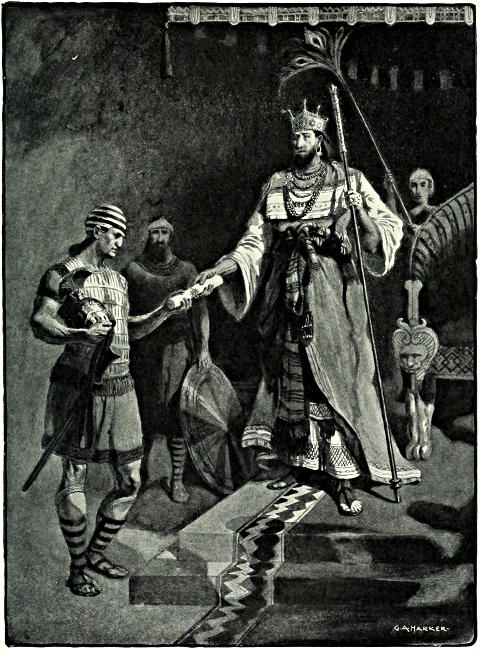
DAVID SENDING URIAH TO JOAB
David’s attempt to win the Jebusites and their town for Israel by peaceful
means, miscarried. Their rocky eyrie, Zion, appeared to the Jebusites
so strong that the lame and blind would suffice to defend it. Undismayed
by their scorn, David proceeded to use force, and stormed town and citadel.
The citadel he took possession of himself and called it David’s citadel (the
city of David) after having first restored the building for his own purposes.
Hiram of Tyre, to whom the friendship of his powerful neighbour must
have been a matter of some importance, is said to have assisted him with
cedar wood and workmen. The former masters of the town seem, like the
Philistines after them, not to have been treated according to the usage of
war, but to have been spared. At least in later times we find the Jebusites
living with Israel in Jerusalem.
But the conquest of Jerusalem by David, and the selection of this town
as the capital of the country, had yet a further significance. A royal sanctuary
was a necessary adjunct
to the king’s residence and
the capital of the country.
But religion in Israel was a
popular institution. No
affair which touched the
whole nation could dispense
with it. The national capital,
the centre of the life of
the people, must, if it were
to answer its purpose, also
be the centre of the religious
life. In order, therefore,
to make Jerusalem, as
a capital, what it might be
and what by David’s means
it actually was to become
for Israel, it must be the
centre of Jehovah’s worship.
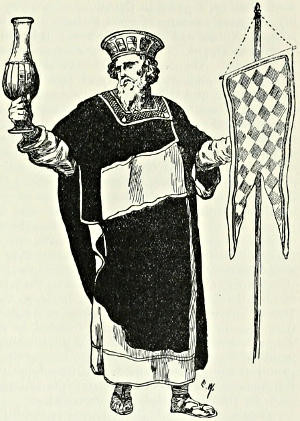
Jewish King performing a Religious Rite
David’s greatness is raised
to a still higher level by the
fact that he thought of this
also. History is made by
the man who recognises the
spirit of his time and of his
country, and is in a position
to step forward and
act decisively in consonance
with it. David perceived
that the spirit of his nation
and its destiny only worked
in the close connection of the national with the religious life. He had
an eye for the most secret inner existence of his nation, according to
which it must be the people of religion, God’s people. Thus he became
at once the historical, and what was inseparable from this, the religious
hero of Israel. We need neither overlook the weakness and despotic
whims of David, nor transform the man, by nature a hero, into a feeble
saint, in order to appreciate his deep religious character and his importance
for the religion of Israel. As David had glorified Israel’s past, so
he had done for its future, and in days of tribulation his name revived
Israel’s sinking hope and faith in God. Jehovah, the God of Israel, became
through him the chief dweller at Jerusalem, the neighbour and almost the
household companion, nay more, the host and father of its king. Jerusalem,
the royal city, is at the same time the city of God, the holy city; David’s
Dynasty is Jehovah’s royal house, and its members Jehovah’s sons, and even
the hero of the last days, who shall save Israel and the world from all their
woes, can henceforth be pictured in no other way than as a second David,
the great son and antitype of the glorious founder of the holy city.
The ancient sanctuary of the time of Moses, the Ark of God, had been
almost forgotten since the evil days when it fell into the enemy’s hand.
The Philistines indeed, smitten with a solemn awe, had restored the ark.
But neither Saul nor the priesthood of Nob, which had succeeded that of
Shiloh, nor any one else in Israel, had interested himself in it. It might
seem that its sojourn in the enemies’ country had desecrated it. Or probably
the small measure of good fortune it had brought to the arms of Israel’s
hosts at Aphek had shaken the belief in its virtue.
Not so David. The scruples of superstitious Saul and of his age, did not
terrify him. He saw what the Ark of God was and that it was what he
needed: the ancient sanctuary of Israel, which assured Jehovah’s presence
in the desert, and with which great memories were connected. For him the
fact that it had long, and perhaps in the first instance, had its location with
the tribe of Joseph, could only be an additional reason for once more restoring
it to honour. Everything must depend on his winning over to himself
and Jerusalem that northern group of the tribes.
Thus the Ark of God was fetched in solemn procession and in the presence
of the whole people from Baal Jehuda [Bible, Baalah (Kirjath-jearim)
in Judah] where it stood in the house of a private individual. But an
accident which befell the driver of the cart upon which it was carried, perplexed
David. The fancy he had thought dispelled, that Jehovah’s hand
of blessing was withdrawn from the ark, now appeared to be founded on the
truth. He did not venture to conduct it to Zion. It was only when even
a foreigner, Obed Edom of Gath, in whose house the Ark had been left for
three months, derived blessing from it, that David carried out his intention.
With rejoicing and the sound of trumpet, the people led Jehovah to Zion.
David himself executed the motions of dancing before the Ark, clad in the
linen garment of a priest, and fulfilled as chief the priestly office before
Jehovah in Zion. Michal, Saul’s proud daughter, was ashamed of her husband
for degrading himself before his serving men and maids. David was
proud of having been honoured before Jehovah. There was in him a truly
religious nature, which did not scruple to go even to the verge of what were,
even for that age, religious eccentricities.
It must be in the highest degree astonishing that David built no temple
for the Ark. If he fetched it to his capital and his palace, he must also have
meant to erect there a fitting resting-place for Jehovah. Since he did not do
so, he must have been guided by special reasons and considerations. If, as the
history of Samuel hints, the Ark had already a temple of its own in Shiloh,
it can be positively said that only a divine oracle could have withheld David
from building a fitting temple. Without such a definite declaration of
Jehovah’s will, it would have been culpable indifference and criminal contempt
for the Majesty of Jehovah for David to have built no temple.
There is consequently no real grounds to discredit as a late invention the
tradition of David’s firm intention to build Jehovah a temple on Zion and
its prevention by a prophetic saying. The rather late compilation of the
writings concerning it cannot be taken into consideration, in face of such
overwhelming inherent grounds for the truth of the fact. Nay, it is believeable
that already on this occasion a prophetic saying furnished David with
the prospect of the continuance of his dynasty.
[ca. 990-980 B.C.]
David was not left to the peaceful enjoyment of what he had already
acquired. It could scarcely have been otherwise, and David would hardly
have desired that it should. If Israel were to be master in Syria, if her borders
were to be secured and the independence so often contested by surrounding
peoples were to be rendered indisputable, explanations with her remaining
neighbours must take place. David could not then possibly rest content
with the acquisition of the kingship over all Israel, and the overthrow of the
Philistines. The occasion, not undesired by David, came from without,
from Ammon. The Ammonites soon joined themselves with the various
Aramaic peoples, so that, when he had conquered them, David was master of
all the border country to the north and east of Israel.
It is extremely doubtful whether the Ammonites were permanently subdued.
At a later period their territory did not belong to Israel, but it
probably did in David’s time. In any case the marauding eastern tribes
which had so often threatened Israel, were for the present reduced to quiescence.
The frontier of David’s kingdom was now secured in the east as
far as to the desert. In the north his rule extended to Lebanon and Hebron.
Even the rulers of the territories lying farther to the north and east sought
his friendship. As for instance, King Toi of Hamath on the Orontes, who
had lived at feud with Hadad-ezer and consequently could only be grateful
to David for his overthrow. Also King Talmai of Geshur, a district of
Hermon, southwest of Damascus. A daughter of his was one of David’s
wives. She became the mother of Absalom.
The Phœnicians had even better reason than these northern neighbours
to keep on good terms with David. Nothing but gain could result to their
commercial operations from the existence in the interior of Palestine of a
powerful and well-ordered state, such as David was striving after. Their
king, Hiram of Tyre, concluded a friendly alliance with David, which continued
under Solomon.
Thus David’s kingdom stretched from the Red Sea to Lebanon. It was
the ruling power in Syria. It stood in uncontested power. It had no
longer any adversary to fear. Next to David the greatest share in this
result was due to Joab, his chief general—especially as David did not latterly
often take the field himself. From beginning to end he remained
faithfully devoted to David, unshaken through all the storms and vicissitudes
of fortune—a warrior to whose keen sword success was never denied,
but also a man of rude violence and unbridled selfishness, to whom no bond
seemed sacred, no means to be rejected.
It is obvious that in such quarrels as he had to conduct on all sides,
David had need of a carefully administered and well-disciplined army. The
nucleus of his troops, a kind of guard on whom he could implicitly rely,
consisted of those six hundred men, who, long ago, in the days of his flight
from Saul, had gathered round him and had remained true to him during
his persecution. When David became king, they, of course, stayed with
him. Henceforth they represented his bodyguard, and bore the name of
Gibborim, the “Heroes.” In war, special tasks were, as a matter of course,
assigned to them. The gaps in the circles of these picked troops, which
resulted from David’s numerous wars, were afterwards filled up after
the victories over the Philistines—for reasons which are explained by the
purpose of the force as the king’s bodyguard. The recruits were chiefly
foreigners, especially Philistines and Cretan mercenaries of cognate race.
Thus this whole force soon bore the name of Cretans and Philistines.
Important as this picked body was at all times to David, it could not
possibly suffice for his great campaigns. David recognised that for wars
such as he had to conduct, a permanent and reliable military organisation
was necessary for Israel, even in time of peace, so that even then Israel’s
troops might be under surveillance and no tribe be able to evade its duty in
the moment of war. The census of the people undertaken by David’s chief
captain, Joab, served this object. It was to secure the supervision of those
capable of bearing arms in Israel, and to afford a groundwork for that organisation.
Joab spent three-quarters of a year on the way; he extended his
journey to Kadesh on the Orontes, the capital of the once mighty Hittite
empire, which, consequently, if the statement is correct, had also been subdued
by David. Soon after this numbering, a destructive pestilence fell
upon Israel. In this David recognised Jehovah’s avenging hand. We have
other reasons to assume that David’s remodelling of the army was not the
cause of his success in the struggle with the neighbouring peoples. It
appears only to have been taken in hand as a result of the information here
collected, and as a measure which might be of value at a subsequent period.
The close of David’s history, so far as it is not dominated by the well-known
occurrences in his own family, might be said to be comprised in two
episodes, which concern his relations to the few surviving members of the
family of his predecessor, Saul. They probably belong to the time before
David’s foreign wars, but stand in our narrative in no historical sequence, so
that it is difficult to define their date exactly. The second of them is to be
judged from the first.
According to this, David, doubtless some time after the whole of Saul’s
kingdom has fallen to him, and he had firmly established himself in Zion,
felt constrained to exercise some grace towards the surviving posterity of
Saul, in memory of the friendship which had united him to Saul’s son,
Jonathan. On inquiry it appeared that a son of Jonathan’s, named Meribaal
(or Mephibosheth) was still alive. He was lame from a child, and
lived, as it seems, in profound seclusion—probably from fear of David’s
vengeance—in Lodebar. David had Meribaal brought before him, and
presented him with his grandfather’s possessions. It would seem, therefore,
that for a time this had been assumed by David. He was, however, to take
up his abode at Jerusalem, and Saul’s servant, Ziba, was to cultivate the
estate in Gibeah. David here joins magnanimity and policy. He magnanimously
pardons Meribaal, who might regard his life as forfeited, and also
makes him royal gifts. But he also does not omit to separate the prince
from his family and Saul’s royal seat, and to keep him under his own eyes
in Jerusalem. He, as well as the nobles of Benjamin, were to be removed
from everything which might remind them of the ancient claims of Saul.
If David here exercised magnanimity in a manner which no one could
have expected of him, it is not probable that, in another instance of which
we are apprised he was influenced by a desire to exterminate the house of
Saul. The town of Gibeon, which an ancient compact had secured in its
Canaanitish integrity, had suffered violence from Saul “in his zeal for
Israel.” It is to be presumed that he made an attack on Gibeon, and executed
a sanguinary punishment on a part of the Canaanite population. For
this breach of faith, the guilt of blood lay on Saul and on Israel and must be
expiated. Once in David’s time, some time after the above described event,
the land had been scourged for three years with drought and famine. David
questioned Jehovah concerning it, and its cause is named as the blood-guiltiness
weighing on the house of Saul, and therefore—for the king represents
the people—on Israel. The citizens of the injured Gibeon were to decide
on the atonement. They demanded blood for blood; seven male descendants
of Saul were delivered to the Gibeonites and by them “hanged up
before Jehovah.” They were Saul’s two sons by his concubine Rizpah, who
had once caused the breach between Abner and Eshbaal (Ishbosheth),
besides Saul’s five grandsons from the marriage of Merab (the correct reading
instead of Michal, lxx. Luc. Pesh.) with Adriel the son of Barzillai of
Abel-meholah. Jonathan’s son, Meribaal, was spared for the sake of David’s
bond of brotherhood with Jonathan. In her profound mother-love Rizpah
kept watch by her slaughtered sons, scaring wild beasts and birds of prey
from the corpses, till at last rain fell as a token that Jehovah’s anger was
appeased. The bodies could now be buried. David collected their bones
and had them deposited in the hereditary sepulchre of Kish at Gibeah.
Saul’s house fell, but scarcely with David’s consent—a sacrifice to the
religious belief of the time.
[ca. 990-970 B.C.]
David had gloriously overcome the
foes of Israel, but he had not attained
to winning the mastery over his own
unruly passions. The same man who
could guide his people step by step
with strength and dexterity, did not
possess enough firmness of will to train
his own sons. The bitter fruit could
not fail to appear. Our records tell the
story, with a plain objectivity, with an
unsparing impartiality, and from a high
moral standpoint that it would be hard
to parallel.
Gate of Joppa, Jerusalem
Whilst Joab is with the army before
Rabbath-Ammon, David transgresses
with the wife of a captain who
has gone to the war. In order to escape
the responsibility for the consequences
which do not fail to follow,
David had Uriah, the husband, sent
home with a message concerning the
state of the war. But, ostensibly from
a feeling of soldierly duty, although he
probably knew what had happened, he
refuses to visit his wife and hastens back
to the army. Only one means now remains
to hide the king’s fault. David
gives Uriah a letter to Joab which disposes
of the troublesome accuser. Joab
must place him at a dangerous place in the battle and leave him to his fate.
The plan succeeds; Uriah’s wife Bathsheba duly bewailed her spouse and
then became the wife of her seducer.
When Bathsheba had given birth to a child, that which Uriah had
already suspected or discovered could no longer be concealed, and the
prophet Nathan becomes spokesman for the public conscience. First in a
parable, and then in plain language, he announces to David the judgment
of Jehovah. David, thereby showing his true greatness, instead of being
angered by Nathan, owns his guilt. The child falls sick, and, in spite of
David’s prayer, dies after seven days. In the child’s death David recognises
Jehovah’s judgment on his own sin. But he cannot prevent his
example from speedily ripening into evil fruit in his grown sons.
His first-born, Amnon, is consumed by a passion for his half-sister,
Tamar. By a stratagem, suggested by an unscrupulous flatterer at the court,
he manages to get her into his power. A feigned sickness offers an excuse
for her visit to him. When the deed has been accomplished, he roughly
thrusts the dishonoured maiden from him with pitiless violence, a sure sign
that it was not love, but savage desire which had prompted him.
It is as though we were watching a Greek tragedy of fate, when we
follow the chronicler’s relation of how the evil deed brought forth evil.
Now in fatal succession, guilt is heaped on guilt. The father had begun
with open adultery, and had then sought to veil his guilt by hypocrisy and
to cover it with blood. He could not, therefore, be surprised if his children
did not shrink from the violation of honour, or even from incest, and thence
allowed themselves to pass to murder and rebellion.
After what he had done himself, David had not the courage to punish
Amnon’s crime, save with words. So another of his sons, Tamar’s own
brother Absalom, took it on himself to avenge the outrage on his sister.
But he knew how to wait till opportunity offered. Two years after the
crime had been committed, Absalom invited the king’s court to the festival
of the sheep-shearing at his estate of Baal Hazar. Amnon and the other
princes attended. During the meal, Amnon was struck down unawares by
Absalom’s people. The others fled homewards, and Absalom to Geshur to
his grandfather, Talmai. Three years he remained there in exile, till, by a
stratagem of Joab, he succeeded in altering the king’s disposition towards
him. Absalom was permitted to return to Jerusalem, but for two years
more he was forbidden to appear before the king’s eyes. Finally he succeeded,
again through Joab’s intervention, in obtaining a complete pardon.
No good came to David from his pardon of Absalom. To the son’s
ambitious and imperious spirit, were now joined spite and the desire to
revenge the wrong which he believed, or professed to believe, had been done
him. Established in his rights as heir to the throne, he took advantage of
his newly acquired position to steal the hearts of the people from the king,
who was now growing old. And, not content with the prospect of eventually
becoming his father’s lawful successor, he laid a malicious plan for the premature
supersession of the king. For the space of four years he secretly
prepared what he had in mind, winning over the people by royal splendour
and popular mildness, and obtaining accomplices and comrades for his treacherous
plans. Fully equipped, he passed to open rebellion against the unsuspecting
king.
[ca. 970 B.C.]
He desired, with the king’s permission, to make sacrifice in the ancient,
sacred Hebron, the discarded, and consequently discontented, capital of
Judah. Messengers who left Jerusalem at the same time as he did, announced
throughout Israel Absalom’s approaching succession. Here in Hebron,
supported by Jewish tribal chiefs, Absalom unfurled the standard of rebellion.
Soon a considerable number of the men of Israel rallied round him.
To David, the news of Absalom’s rising was a thunderbolt from a clear
sky. It found him unsuspecting and completely unprepared. Not only in
Judah but in the remaining portion of Israel, David’s government must have
aroused discontent. Beyond his six hundred faithful followers, he seems for
the moment to have been able to count on little support in the country west
of Jordan. Only the east, which had formerly stood firmly by the house
of Saul, appears also to have remained true to him. Even in his strong
capital he did not feel himself safe for an instant from a sudden attack of
Absalom, and decided to leave it.
Even now, reduced to the sorest straits ever experienced in his stirring
life, the trust in God, the courage and wisdom which had so often sustained
him, did not forsake David. Leaving his harem behind in the palace, he
flees across the Kidron to Jordan. His bodyguard, his household, and what
remains to him, accompanies his flight, including the priests Zadok and
Abiathar with the Ark of God. David bids them return to Jerusalem; he
cherishes the hope that Jehovah will not forsake his city. Moreover, the
priests will be able secretly to inform him through their sons Jonathan and
Ahimaaz of what is passing in the city. With the same object he sends
back the faithful Hushai, commissioning him to appear as a partisan of
Absalom and to frustrate the counsels of the crafty Ahitophel, who has
gone over to Absalom.
David was now soon to learn that Absalom’s appeal to Israel had also
found a willing ear in Saul’s house and tribe. He was still at the Mount of
Olives when Meribaal’s steward, Ziba, met him with the message that his
master had joined Absalom in the hope of recovering the throne of his
grandfather. Soon afterwards in Bahurin a notable Benjamite, Shimei,
comes upon him. He receives him with fierce reproaches, which betray
plainly enough how fresh was the hold retained over many irreconcilables by
the memory of Saul and his house’s bloody fall, though of this David was
guiltless.
Absalom took possession of the empty capital. He showed the people
that he had entered upon the succession to David, by appropriating to himself
the latter’s harem. If Absalom meant to secure his throne, David must
first be removed. Now, before he had collected an army, this would be an
easy matter, since Absalom had already considerable force. This, in view
of the present state of things, was the counsel of Ahitophel. But Absalom’s
destiny willed it that he should not follow this advice. It flattered the
vanity of the king’s son to let one of David’s former adherents also speak.
Hushai’s stratagem succeeded in befooling the deluded man, and his fate was
sealed. He worked on Absalom’s dread of David’s brave and daring host,
and induced him to wait till he should have collected round him the forces of
all Israel. At the same time he informed David, through the priests, of
what he had counselled.
David was now master of the situation, and his decision was immediately
taken. He crossed the Jordan, went to Eshbaal’s (Ishbosheth) former
capital, Mahanaim, and employed the time allowed him in gathering an
army.
Meanwhile Absalom had also crossed the Jordan. In the country east of
that river a battle could not be avoided. David’s army marched in three
bodies, led by Joab, Abishai, and the Gittite Ittai. Absalom’s commander
was David’s nephew Amasa, who was the son of an Ishmaelite Ithra and
David’s sister Abigail. David himself, on the earnest entreaty of his people,
remained behind in Mahanaim. In the wood of Ephraim—which must have
been the name of a wooded district east of Jordan—the decisive struggle
took place. Absalom’s host, though far more numerous, for they stand to
the narrator for “all Israel,” made no stand before David’s men. In the
hurry of the flight Absalom is caught by his long waving hair in the branches
of a terebinth. The mule gallops on. Swinging thus between heaven and
earth, he is found by a common soldier who informs Joab of what he has
seen. That savage warrior knows no mercy. Even David’s special injunction
which had restrained the soldier meets with no regard from him. He
rates the man’s weakness and himself thrusts three darts into Absalom’s body.
Immediately afterwards he causes trumpet-calls to announce the end of the
pursuit. Absalom’s body is thrown into a pit and covered with stones.
David, seated at the gate of Mahanaim, awaits the issue. The watchman
perceives a man running up from the battle-field, then a second: in the
first he recognises Zadok’s son, Ahimaaz, who had already done good messenger
work in Jerusalem. Outrunning Joab’s messenger, he brings tidings
of David’s victory. The father’s heart thinks only of Absalom. Asked
concerning him, Ahimaaz evades the question. Meantime the other runner
has come up and tells bluntly what has happened. The king trembles.
Deeply moved, he mounts into the upper chamber of the gate-house, breaking
out into loud lamentations over his son. He remained there a long time
in his sorrow, not even heeding the victorious army which had meantime
marched up. Joab’s anger at this treatment of his brave and faithful troops
was not small. It was only his vigorous words which succeeded in inducing
the king to rouse himself and master his sorrow.
As was to be expected, the people’s conscience revived after the sword
had spoken. The revolted tribes, mindful of Israel’s debt of gratitude to
David, and, perhaps, in obedience to the ancient grudge against Judah, once
more turned penitently to David. Only Judah still stood defiantly apart.
It is distinctly apparent that David’s own tribe had been the home of the
conspiracy. The first thing, as David believed, was to win it over. He
entered into negotiation with the elders of the tribe of Judah, and even
offered Amasa Joab’s place in the army. Perhaps an ancient cause of
Judah’s discontent was by this means removed.
The men of Judah now brought David across the Jordan with much
ceremony, the Shimei before mentioned joining them at the head of one
thousand Benjamites. David magnanimously pardoned him. Ziba, too,
was active in David’s service. Soon the lame Meribaal also appeared to
clear himself from Ziba’s accusation. David, not wholly trusting in his
innocence, restored to him only half of his possessions. In Gilgal, the rest
of the army encountered David’s train. The pre-eminence accorded by
David to the stiff-necked men of Judah, breeds very comprehensible ill will.
The feud between north and south threatens to break out anew.
Indeed, a portion of the tribe of David could not even now manage to
restrain its enmity towards him. Sheba-ben-Bichri of Benjamin once more
sounded the call to arms against the king. A considerable section of Israel
seems to have again responded to the summons to revolt. But this time
Judah remained steadfast and conducted David back to Jerusalem. In
accordance with David’s promise, Amasa was to summon the militia of
Judah to face the rebels. Joab was not the man to endure patiently a slight
which he had not wholly deserved. As Amasa delayed, Joab once more
contrived to render himself indispensable to the king. Him, also, David sent
out to battle against Sheba with the bodyguard. At Gibeon they came
upon Amasa. Like Abner before him, he fell by Joab’s hand.
The rebels had gone north. Joab pursued and drove them to the uttermost
borders of the Israelite territory. In Abel-beth-maacha, near Dan
and the sources of Jordan, Sheba succeeded in making a stand. Joab prepared
to storm the town. Then, in response to his demand, the rebel’s head
was thrown to him over the wall. Joab departed, and spared the faithful
city.
With this, David’s control over the course of events comes to an end.
What followed was scarcely of his doing. For a quiet and undisturbed
period David may still have held
the reins in Israel; then we find
him as a worn-out old man, scarcely
master of his own will, and in the
hands of a court and harem not
too nice in their aims and methods.
As far as history is concerned,
David had disappeared from the
scene.
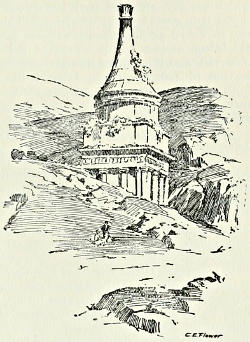
The Pillar of Absalom
The outline of David’s character
stands more clearly in the light
of history than that of Saul. Israel’s
greatness and Jehovah’s honour
are David’s first precepts, and
this fact also secured for him the
gratitude of Israel and the love
and respect of posterity for all
time. Nor could they be obscured
by the truly gigantic shadow of
the man of violence. David towers
head and shoulders above the average
human ruler. He also stands
out prominently beyond both the
kings of Israel who followed him
and his predecessor Saul, in respect
of grandeur, magnanimity,
wisdom, tenacity, strength, and
skill in victory as in rule. Even in the extravagance of his personal and
despotic passions there are few who come up to him.
But even in his weaknesses David’s greatness of soul always reappears
in its original beauty. David’s despotic whim seduced Bathsheba and
basely murdered Uriah—but bowed, in righteous sense of guilt and unfeigned
repentance, to the judgment of the people and the uncompromising
sentence of Jehovah’s prophet. David’s paternal weakness was responsible
for Amnon’s crime and Absalom’s rebellion—but the father’s heart did not
cease to beat warmly for the son who had sinned so deeply. David’s weakness
comes home to us in his noble sorrow over Absalom, and is, in our eyes,
a striking instance of paternal fidelity. David’s magnanimity may seem to
have degenerated into want of firmness in regard to Joab—though we
have too little insight into the exact course of events to be able to form a
conclusive judgment—but as concerns Saul and his house, as well as Shimei
and Amasa, it is indisputable. Poetic endowment and religious zeal are so
much the characteristics of his nature, that the possibility of David’s having
taken an active share in the beginnings of the religious lyric in Israel will
scarcely be called in question.b
David died at the age of about sixty-six years, after a thirty-years’ reign,
and in his palace of Zion. He was buried close by, in a tomb hollowed in
the rock, at the foot of the hill on which stood the city of David. All this
happened about one thousand years before Christ.
A thousand years before Christ. This fact must not be forgotten in
seeking to gain an idea of a character so complex as that of David, in
endeavouring to form a picture of the singularly defective and violent world
which has just unfolded itself before our eyes. It may be said that religion
in the true sense was not yet born. The god, Jehovah, who is daily assuming
in Israel an importance without parallel, is of a revolting partiality.
He brings success to his servants; this is what is supposed to have been
observed, and this makes him very strong. There is as yet no instance of a
servant of Jehovah, whom Jehovah has abandoned. David’s profession of
faith may be summed up in one word: “Jehovah who preserved my life
from all danger.” Jehovah is a sure refuge, a rock whence one may defy
one’s enemy, a buckler, a saviour. The servant of Jehovah is in all things
a privileged being. Oh, it is a wise thing to be a scrupulous servant of
Jehovah!
It was above all in this sense that the reign of David was of extreme
religious importance. David’s was the first grand success made in the name
and by the influence of Jehovah. The success of David, confirmed by the
fact that his descendants succeeded him on the throne, was the palpable
demonstration of Jehovah’s power. The victories of Jehovah’s servants are
the victories of Jehovah himself; the strong god is he who wins. This idea
differs little from that of Islam, whose vindication has scarcely any other
support than that of success. Islam is true, for God has given it the victory.
Jehovah is the true God by proof of experience; he gives the victory
to the faithful. A brutal realism saw nothing beyond this triumph of material
fact. But what is to happen on the day when the servant of Jehovah
shall be poor, dishonoured, persecuted for his fidelity to Jehovah? The
element of the grandiose and the extraordinary reserved for that day,
may be perceived from the struggle of the Israelite conscience up to the
present time.c
Tiberias, looking toward Lebanon
The picture of the last period of King David’s life is clouded by the
struggle for the succession. The true circumstances of Solomon’s accession
will forever remain to some extent obscure, owing to the incompleteness of
our information. We give the account as found in the records we possess.
David had grown old and needed careful attendance. At the court the
question as to who should succeed him could not remain in abeyance. According
to order of birth, David’s fourth son, Adonijah, stood next to the
throne after Absalom’s death. In fact, Adonijah regarded himself as the
heir, and went so far as to exercise the rights of heir-apparent, even in public,
as Absalom had done. A part of the court, and an influential portion of
the people, seem also to have fully recognised Adonijah as the future king.
David himself, who tenderly loved Adonijah, and had regarded him as taking
the place of the Absalom whom he still mourned, did not venture to oppose
him. Adonijah had the same mother (Haggith) as Absalom.
But Adonijah’s hopes did not meet with universal acceptance at the court.
It is true that he succeeded in winning over Joab and the priest Abiathar,
to his cause. But on the other side stood Bathsheba, who was exerting
herself to obtain the succession for her son Solomon. Her cause was
favoured by the priest Zadok, the prophet Nathan, and Benaiah, the captain
of the royal bodyguard. Thus in the last days of David’s life, two parties
stood opposed to one another at the court.
One day Adonijah gave a banquet to his followers at the serpent-stone
(En-rogel), a sacrificial stone in the neighbourhood of Jerusalem. Nathan,
who was, as it appears, the spiritual head of the opposition, feared lest the
banquet should end, like that of Absalom in Hebron, with the hailing of
Adonijah as king. This would mean the ruin of Solomon’s cause. It was
therefore an occasion for prompt measures. Bathsheba must at once inform
the king of what was happening at the serpent-stone; she must remind
David of a former promise that gave a prospect of Solomon’s succession, and
obtain its immediate confirmation.
Bathsheba did what she was told. According to agreement, Nathan,
after a short interval, follows her to the king’s presence, to lend her words
emphasis. He even professes to have already heard the cry of the conspirators,
“Long live King Adonijah.” The two succeed in arousing the king’s
suspicions. He is convinced that again in his old age he is to be deprived
of the throne and become the victim of a conspiracy of one of his sons.
At once he solemnly adjudges the succession to Solomon. By David’s command
the latter is conducted on the king’s own mule to Gihon, a sacred
spring near Jerusalem, anointed by Zadok and Nathan, hailed as king, and
solemnly enthroned. The joyful acclamations of the people and the noise
of the trumpets, reach the ears of the banqueters, who are not far off. They
have scarcely time to ask the cause, when Jonathan, Abiathar’s son, brings
tidings of what has occurred. Solomon is king. Adonijah has no resource
but the altar, at whose horns he implores bare life from his more fortunate
brother. He does homage to the latter and is granted his life.
[ca. 970-960 B.C.]
Solomon is thereupon proclaimed King, and now before David bows his
head in death he lays on his successor a charge which he has closely at heart.
He reminds him that Joab’s deeds of blood against Abner and Amasa have
not yet been expiated, and puts him in mind of the services rendered to him
by Barzillai, and of Shimei’s curses upon his house. Barzillai he is to
reward loyally; the other two he shall not let go down to sheol (i.e. the
Hebrew hades) in peace.
David had scarcely closed his eyes when the desire for the throne was
again roused in Adonijah, whom Solomon had pardoned. Through Bathsheba’s
intervention he requested Solomon to give him David’s nurse, Abishag,
to wife. What this wish meant, according to the conception of the period,
we know from Absalom’s behaviour towards David’s harem. Solomon saw
through Adonijah’s daring plans, and the latter paid with his life. The
fate of Adonijah’s most distinguished partisans was also decided. Abiathar
was relieved of his priestly office, but his life was spared in consideration of
the services he had rendered to David in trouble and prosperity. He was
banished to Anathoth, and his former colleague, Zadok, took his place.
Joab, foreboding evil, fled to the altar of Jehovah, but there was no mercy
for him. Appealing to his ancient blood-guiltiness, Solomon had him hewn
down. Finally Shimei, who had not shared in Adonijah’s attempts, was for
the time being confined to Jerusalem, and, soon after, when in opposition to
the king’s command he left the city, he was executed.
This is the account contained in 1 Kings i.-ii. Many have recently
taken the view that the first part distinctly contains the story of a palace
intrigue, set on foot by Nathan and Bathsheba in favour of Solomon against
Adonijah’s succession; while the second part of the narrative has been
recognised as an only partially veiled attempt to avert from Solomon the
responsibility for the bloody deeds with which he thought to establish his
newly acquired throne.
The fact that there hitherto had been no word of Solomon’s succession
seems to be decidedly in favour of this view. If Adonijah was the innocent
victim of a court intrigue, it must be assumed that Bathsheba and
Nathan persuaded the weak old king into acknowledging a promise he had
never given, but which he now gladly adopted in his anxiety for the peace
of his last days. This conception seems also to be favoured by the additional
circumstance, that the narrator, obviously in an access of intentional
irony, does not give an account of his own respecting Adonijah’s criminal
intentions at the sacrificial feast, but makes Nathan give his detailed version
in the king’s presence. Finally, as regards the second part of the narrative,
in the passage concerning David’s last dispositions, the traces of a later
hand are distinctly visible, suggesting the idea that the whole passage is of
late origin. This also lends support to the notion that, both according to
the original account and also in reality, Solomon at least removed Joab from
his path, not on account of his earlier but by reason of his later conduct, and
not in compliance with David’s wish, but for being a partisan of Adonijah.
But the literary basis of this last conception is not sufficiently secure.
It is just those portions of David’s last words which refer to Joab and
Shimei, which are indisputably old, while the whole passage comes from our
most authentic sources. Besides, as a matter of fact, such a wish on David’s
part does not in itself awaken such grave doubts as might appear. Only
we must guard against trying to measure the distant past by our own
moral feelings, and we must bear in mind what David, following the cruel
faith of his time, did to the house of Saul, in order to blot out the stain of
an ancient deed of blood which still lay on it. Thus it cannot really appear
strange that he should have been tormented by an uneasy fear at the guilt
and curse of a past, which, one day, when he was gone, might strike his house
as that guilt of blood had chastised the house of Saul.
[ca. 960-950 B.C.]
With Abiathar’s removal from the priesthood, an act of the highest
importance for the history of religion in Israel was accomplished. In place
of the house of Eli, which had already been severely threatened in the time
of Saul, but had finally recovered itself under David’s favour, a new priesthood
appeared on the scene. How significant the change was is shown by
the circumstance that a prophetic reference to it is already made in the
story of Eli. Eli derived his priesthood and that of his family from Egypt
and probably from the father of the priesthood, Aaron. In what Zadok’s
claim consisted we do not know. He can hardly have been the first of an
entirely new line, and thus not even a Levite. Solomon would have guarded
against putting in Abiathar’s stead a priest of quite unpriestly blood.
Henceforth the “Bene- (sons of) Zadok” hold possession of the priesthood
at Jerusalem. And after the erection of the temple they succeeded in
bringing this priesthood, and with it their own house, to high prosperity
and power.
Solomon’s task as king was clear. As David’s successor he was heir to
great wealth; he had only to preserve what David had created and to confirm
himself in its possession. Abroad he had to maintain the extraordinary
prestige which Israel had acquired; at home to make the unity of the tribes,
which David had completed, a permanent thing, and to chain Israel to the
house of the great king.
In the last Solomon did not succeed. For himself, as far as we can see,
he seems to have been possessed of sufficient force and skill. As long as he
lived, David’s kingdom remained in his hands, if not undisputed, still in
the main undiminished. And if he did not contrive, or did not care, to
make the tribes of Israel contented under his sway, yet, during his reign,
matters did not come to an open breach. The single attempt at a rising
of which we hear, that of Jeroboam, he put down by force. Eager as the
northern tribes may have been to renounce the house of David, they did
not dare to wrest from Solomon the sceptre he wielded with so much power.
This, which mainly concerns internal relations, shows that Solomon was not
the weak, inactive king whom many have represented him to be. But abroad
also Solomon showed himself equal to his task, at least in all questions of
importance.
Difficulties were not wanting. The death of the great David was an
event which many of Israel’s adversaries had doubtless long been looking
for. When to this was added the disappearance from the scene of his
bravest soldier, Joab, the opportunity for attacking Israel could not have
been more favourable. A scion of that ancient royal house of Edom which
David had overthrown, Hadad by name, had fled to Egypt. He had succeeded,
like Solomon himself, in obtaining in marriage a princess of the
house of Pharaoh, the sister of Queen Tahpenes. Immediately after David’s
death he returned to his own country and seems to have wrenched at least a
part of Edom from Solomon. But either his dominion was insignificant and
not dangerous to Solomon, or the latter afterwards succeeded in regaining
possession of Edom, for the approach to the Red Sea by Ezion-geber
remained open to Solomon.
A second adversary is said to have risen against Solomon in the north.
One of the captains of that Hadad-ezer of the Aramæan state of Zobah
whom David had conquered, Rezon-ben-Eliadah, separated himself from his
master. After a long life of adventure, he founded a dominion of his own,
and made the ancient Damascus its capital. He drove out the governor
whom David had placed there, and Solomon did not succeed in recovering
the city. Here, then, if the tale be historical, Solomon suffered a real and,
as it seems, a permanent loss. Still it would be hard to say whether, at the
time, it was much felt; for probably neither David nor Solomon had ever
been in possession of Damascus and Aram-Damascus. Here, too, as in
Solomon’s home government, the most serious question would seem to be
the outlook for the future. For in course of time the kingdom of Damascus
was to become one of Israel’s most dangerous opponents.
[ca. 950-940 B.C.]
If, therefore, in this way Solomon had received in the south, and perhaps
also in the north, certain, though probably not very important checks,
still he appears to have done a considerable amount for the preservation and
strengthening of Israel’s prestige. It is possible that he did not attach so
much importance to those of David’s conquests which lay on the outskirts of
the kingdom as to the preservation of Israel itself. It is a fact that he protected
it by founding strong fortresses against hostile invasions—an undertaking
whose high utility cannot possibly be called in question. Thus in
the north he fortified Hazor and Megiddo; in the neighbourhood of Jerusalem
Beth-horon and the royal Canaanitish city, Gezer; to the south, for the
protection of the border as the caravan route from Hebron to Eloth, he fortified
the city of Tadmor. The Egyptian Pharaoh, whose daughter Solomon
married, had conquered Gezer for him. A town named Baalath whose site
is uncertain but perhaps lay near Gezer, is also mentioned among Solomon’s
fortified places. He also bestowed great attention on increasing the war
material and cavalry which were distributed through a series of garrison
towns and in keeping them ready for use. Though the figures concerning
these are somewhat doubtful, the fact itself cannot be called in question.
All this shows that we can scarcely speak of a decline in the power of Israel
under Solomon, even if he abandoned certain outlying posts.
Yet, nevertheless, Solomon did not attain to his father’s greatness. He
had grown up as a king’s son, without occasion and necessity to steel his
will in the hard school of danger and privation, and he did not possess his
father’s energy and initiative. He thought more of the rights and pleasures
of kingship than of his high duties and tasks. The father’s despotic tendencies,
in him only showing at intervals and immediately restrained and
overcome, are in the son the groundwork of his character. His favourite
amusements are costly buildings, strange women, rich display.
But he also insisted on the regular execution of justice, and his chief
strength lay in the orderly administration of his country. Side by side with
this went the final removal and absorption of the Canaanites. Both probably
served the same object. Solomon required a great deal of money and
labour for his costly buildings. His subjects must supply them. He made
no distinctions amongst the population, no one escaped the common burdens.
To him all Israel formed one unit and was partitioned, without regard to the
differences between the tribes or the distinction between Israelite and
Canaanite, into twelve zones, each of which was administered by a governor.
Some of their names have been lost. The amount to be paid in taxes
was regulated on the basis of this division. The compulsory service which
Solomon required for his mighty structures for war and peace, were doubtless
arranged in a similar manner. In Lebanon alone he is said to have
kept ten thousand men who rendered such service, constantly occupied
under Adoniram. The distinction between Israelites and Canaanites was
continued only to a certain extent, in that what had formerly been the
Canaanitish zones were considerably smaller than the others. Thus, when
it came to their turn to serve, the Canaanites were more affected; the forcible
incorporation in Israel, indeed, made them liable to be called on.
[ca. 940-930 B.C.]
Such burdens were unknown to the simple courts of David and Saul, and
they must now, therefore, have weighed all the more heavily. Freedom, as
the possession of the subject, was little regarded. No wonder, then, that in
course of time the discontent, probably long nourished in secret, broke out
into fierce rebellion. It was no accident that it started in the house of
Joseph, that is, from Ephraim, still less that it proceeded from one of
Solomon’s overseers. From two sources, the ancient dislike of the northern
tribes to the house of Jesse, and the discontent with the present harsh government,
the waters flowed into the same channel.
An Ephraimite of Zereda, Jeroboam-ben-Nebat, placed himself at its
head. He seems to have been a young man of low rank, the son of a poor
widow. The king came to know and value him amongst his workmen when,
towards the end of his reign, he was building mills and thus “repaired the
breaches of the city of David.” Soon the oversight “of the charge of the
house of Joseph” was laid on him: the best opportunity to make himself
acquainted with the people’s grievances and to utilise them for his own benefit.
At some time or other Jeroboam made up his mind to raise the standard
of rebellion. But without success: either the conspiracy was prematurely
discovered or Jeroboam’s rising was put down. He himself escaped, and
found a welcome with Pharaoh Shishak (Shashanq) the founder of the
XXIInd Dynasty (Manethan). It is worthy of note that a prophet of
Shiloh, Ahijah by name, supported the action of Jeroboam. The discontent
with Solomon’s rule had already taken hold of all classes of the population.
Tradition represents Solomon as a king rich in wisdom and justice and
in gold and treasures. That he was so, is shown by his measures for securing
his frontier, and for regulating the administration, as well as by the
famous and certainly historical judgment of Solomon, respecting which posterity
may indeed ask itself, for which did the great king deserve the
palm: wisdom or justice? It is certain that many sayings of practical
worldly wisdom have also come down from him. It is also probably credible
that, at the very beginning of his reign, a vision indicated to him the
path he was to follow and Jehovah’s will as well. That rich treasures
should have passed through his hands cannot seem strange, when we consider
the heavy taxes he exacted and how many profitable enterprises he
conducted besides.
It is beyond all doubt that Solomon was the first who imported the horse
into Israel, at least to any great extent and especially for purposes of war.
More remarkable is it that all accounts concerning this, agree with later
notices respecting Solomon’s splendour and magnificence. Nor can this
prevent them from being regarded—at least so far as concerns the fact as
worthy of credit. If Egypt was, as it appears, the country from which
Syria obtained its horses, and Solomon the son-in-law of the ruling Pharaoh,
we can find little objection to the statement that Solomon managed to derive
considerable profit from the import of Egyptian horses. The visit to Solomon
of the queen of the ancient kingdom of Sheba, may probably have been
connected in the first instance with commercial relations. This, too, I am
not inclined to relegate at once into the domain of fable. For even if later
stories have considerably exaggerated Solomon’s splendour, they would not
have arisen without some foundation in fact. The voyages of Solomon’s
ships to the Arabian gold country of Ophir are, it seems to us, particularly
well authenticated. The account speaks of a single ship, which Hiram of
Tyre managed with his skilled seamen and which is said to have brought
the products and articles of merchandise of the favoured Arabia direct to
Israel and Tyre.
That, in spite of all this, Solomon’s coffers were often empty, finally to
such a serious extent that he was obliged to pledge twenty towns in Galilee
to Hiram, cannot be denied in face of the last-named fact: the marriage with
a daughter of Pharaoh made his household costly, and the castles and
fortifications must have swallowed enormous sums.
In Solomon’s government there was one weak point which might easily
produce a rupture. There was no need for it to come now; but if a fit and
determined man were forthcoming the crisis was ready. For opinion in
Israel was sufficiently prepared.
The transition from an elective monarchy to a rigidly despotic government,
had been too rapidly completed. The tribes of Israel, of their own
free choice, had set the crown on David’s head as formerly on that of Saul.
Israel had been a purely elective kingdom. But David’s sons played each in
turn the rôle of heir-apparent. Neither Absalom, Adonijah, nor Solomon
had thought of first obtaining election by the tribes. As David’s sons, the
succession to their father belonged to them. Israel had become an hereditary
monarchy. This development lay indeed in the nature of the case. It would
have been already completed in the house of Saul had Jonathan lived or
Eshbaal been abler or more fortunate; nevertheless, it was now in all the
greater danger, for the exclusion of the house of Saul had a second time
brought home to the consciousness of the tribes, the independence of the
people’s will.
The change, however, could only have worked beneficially if in the meantime
the binding of the tribes of Israel to the house of David could really
have been effected. Even David had not entirely accomplished this task, so
difficult under existing conditions. The northern tribes and Benjamin always
eyed his rule with distrust. Still less was Solomon equal to the task. It
was impossible that his despotic inclinations, and especially the severe
pressure of the taxes, could serve to make the tribes forget that only a short
time ago, not birth, but the people’s will, had raised the king to his throne.
How far the ferment had gone in the northern tribes, even in Solomon’s
own day, we see clearly enough from the circumstance that the rebellion
broke out during his life-time. It was only by force that it was suppressed,
and the secession of the northern tribes from Solomon was averted. It was
Jeroboam, one of the overseers of the king’s workmen, who had prepared it.
He was compelled to flee to Egypt, and was there, as it seems, received with
open arms. But Solomon’s rule was strong enough to make it impossible
for him and his to think of a repetition of the rising, so long as Solomon
possessed the throne. It may excite surprise that an Israelite rebel should
have received protection in Egypt whose Pharaoh was the father of one of
Solomon’s wives. The explanation is to be found in the fact that Shishak,
the Egyptian Shashanq I, was the founder of a new dynasty and consequently
knew not Solomon.
[ca. 930 B.C.]
After Solomon’s death, which we may place about the year 930 B.C., the
succession of his son Rehoboam at first appeared to be a matter of course.
What it was which secured to him the precedence over Solomon’s other sons
we do not know. As a fact he seems to have mounted the throne and
occupied it for a time. But the seething discontent with Solomon’s government
which the northern tribes had so long restrained, broke out, if not
immediately on his accession, at any rate soon after. There may have been
many negotiations and attempts to smooth things over, until finally Rehoboam
determined himself to make terms with the discontented in Shechem.
Meanwhile Jeroboam had also had time to return from Egypt, and take the
guidance of the movement into his own hand.b
Exterior of the Holy Sepulchre, Jerusalem
Rehoboam could easily have
made himself popular by a few
insignificant concessions. He had
come to Shechem in Ephraim to
be acknowledged by the assembled
tribes. Jeroboam spoke in
the name of the people, praying
the king to lighten the burdens
that Solomon had put upon them.
Rehoboam demanded three days
in which to reflect and consult
his courtiers. The old men advised
him to submit, the young
men counselled him to resist public
opinion. He followed this
latter advice and gave an insolent
and rough answer: “My father
hath chastised you with whips,
but I will chastise you with scorpions.”
Then the people answered:
“What portion have
we in David? To your tents,
Israel.”
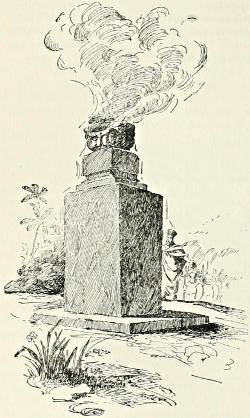
Jewish Shrine
[ca. 930-875 B.C.]
Upon signs of open rebellion
Rehoboam hastily returned to
Jerusalem. The weak bond
which had united the tribes of
the north to those of the south
was severed forever. The Judeans
alone remained faithful to
David’s race, including Jerusalem, which had an interest in keeping its place
as a royal city. A part of the land of Benjamin, forming the outskirts of
Jerusalem, and the towns of Simeon enclosed in the land of Judah remained
united to the little Judean kingdom, which also retained Idumæa under its
sovereignty. All the rest of the land on both sides of Jordan kept the name
of the kingdom of Israel, with an uncertain suzerainty over the territory of
Moab and Ammon. Syria had already made itself independent of the Jewish
empire. Thus the empire which had had a moment of brilliancy under the
reigns of David and Solomon, was replaced by two kingdoms, nearly always
at war with one another. The schism is placed about the year 975 B.C.[2]
Jeroboam, who was at the head of the separatist movement, had no
trouble in having himself proclaimed king by the dissenting tribes. But he
feared the attraction which the temple of Jerusalem already had for the
Israelites. Wishing to prevent pilgrimages dangerous to his authority, and
to consecrate the political secession by a religious one, he established the
worship of the golden calf.
The history of the kingdom of Israel is only a succession of violent
usurpations nearly always provoked by the prophets, who intervened in
everything in the name of Jehovah, and made all manner of government
impossible by their perpetual opposition. In Judea, on the contrary, the
undying remembrance of David assured the regular succession of royal
power in his family.
The only important event in the reign of Rehoboam, is the expedition of
Shashanq I, king of Egypt, called Shishak in the Bible, who took Jerusalem
and pillaged the treasures of the temple and of the palace, amongst others
the golden shield Solomon had had made. The end of Rehoboam’s reign
and that of his son, Abijam, and his grandson, Asa, were filled by wars of
no importance against the kingdom of Israel.
Jeroboam did not succeed in founding a dynasty in Israel. He died after
a reign of twenty-two years, and his son Nadab was massacred with all his
family, by his lieutenant, Baasha. The same event was reproduced after an
equal interval. Baasha reigned twenty-two years, and his son Elah and all
his family were assassinated by Zimri. But the army which was then in
the land of the Philistines, proclaimed Omri general, and marched against
the usurper, who burnt himself in his palace after a reign of seven days.
The kingdom of the north had not the advantage of possessing a strong
and well-situated capital like that of the south, and on a height in the territory
of Ephraim, Omri built the city of Samaria, which by its strong position
could become a centre of resistance for Israel, as Jerusalem was for
Judah. In Assyrian inscriptions, Samaria and even the kingdom of Israel
are always called the house of Omri. Besides this important foundation to
which his name was to remain attached, Omri showed proof of his ability by
securing himself an ally against the ever-increasing danger of a struggle
with Syria. He asked and obtained the hand of Jezebel, daughter of Ithobaal
(Ethbaal), king of Tyre, for his son Ahab.
[ca. 875-860 B.C.]
Ahab is generally represented as a type of impiety; to assert this is
entirely to misunderstand the character of this epoch. No one was impious;
each people had its god and thought him stronger than the others. Ahab
heard his wife boasting of the power of Baal; he thought it clever to make
sure of two divine protectors instead of one, and leaving Jehovah his sanctuaries
at Dan and Bethel, he built a temple to Baal at Samaria. There
was no intention of abolishing the worship of Jehovah. The worship of
Baal had existed in Israel at the time of Gideon, and even in the time of
Saul; it had been abolished since the reign of David. When Ahab wished
to re-establish it, he stumbled against the unyielding patriotism of the
prophets, who would acknowledge no other god but the national one.
They made a desperate fight against Baal. The people, persuaded like
the king, that two religions are better than one, looked on at these quarrels
without taking part in them. Elijah, the prophet, reproaches them with
being lame in both feet. The legend of Elijah and the priests of Baal
(2 Kings xviii.) in its theatrical setting sums up the struggle between the
national worship of Jehovah and the Phœnician worship of Baal, a struggle
which was prolonged for half a century.
Elijah, the Tishbite, is probably an historical personage, but it is difficult to
discern his real personality in the midst of the fables accumulated about him.
The massacre of the priests of Baal really took place under Jehu, after the extermination
of the princes of the house of Omri. Elijah’s mysterious life, his
sojourn in the desert where he was fed by ravens, his visions and miracles, the
power attributed to him of making rain fall at his word, have made him
the model and patron of ascetics of the succeeding ages. The last passage of
the legend has not a Hebrew character; he is taken up to heaven in a chariot
of fire. The resemblance of the name Elijah with the Greek name of sun,
“Helios,” might lead one to believe in some mythological infiltration.
The legends of Elijah and Elisha show us the extent of the admiration
of the people for the prophets, and by that we can judge of the influence
they must have had on the politics of their time. This influence was not
limited to the kingdom of Israel, and was not always beneficial. Thus
Jehovah orders Elijah to anoint Elisha as prophet, Jehu as king of Israel,
and Hazael as king of Syria, and the Bible adds: “that him that escapeth
the sword of Hazael shall Jehu slay; and him that escapeth from the
sword of Jehu shall Elisha slay. Yet I have left seven thousand in Israel,
all the knees which have not bowed unto Baal and every mouth which
has not kissed him.” Foreign war was added to religious dissensions.
Ben-Hadad, king of Damascus, “having thirty-two kings as his auxiliaries,”
assembled his army and laid siege to Samaria. The Children of Israel
slew of the Syrians an hundred thousand footmen in one day. But the rest
fled to Aphek, into the city and there a wall fell upon seven and twenty
thousand of the men that were left. And Ben-Hadad fled and came into
the city into an inner chamber. Ahab spared Ben-Hadad upon his promise
to restore the cities of Israel that were in possession of the Syrians. This
clemency, which reminds one of that shown by Saul to the king of the
Amalekites, could not please the prophets. One of them said to Ahab:
“Thus saith the Lord, Because thou hast let go out of thy hand a man whom
I appointed to utter destruction, therefore shall thy life go for his life, and
thy people for his people.”
Ahab had played a fine part; unfortunately he soon furnished a legitimate
grievance to his enemies: he wanted a vineyard adjoining his house,
and the proprietor refused to sell it. On the advice of Jezebel, he had the
owner accused of treason, and when the judges condemned him he confiscated
his goods. No doubt it was a crime, but no greater than that of David,
who had caused the death of one of his officers so as to obtain the latter’s
wife; and that had not prevented David from being a king after the Lord’s
heart: whilst the death of Naboth served as a pretext to justify the plots of
those jealous of Ahab’s family.
It is remarkable that there should have been proofs of friendships
between the kingdoms of Israel and Judah only under the kings of the
house of Omri; and singularly enough, this alliance was concluded with one
of the kings of Judah, who found grace in the sight of the writers of the
Bible, because of their fervour for the worship of Jehovah.
Asa, grandson of Rehoboam, died after a reign of forty-two years. His
son Jehoshaphat surpassed him in piety; the only reproach made against him
in the Book of Kings, is with regard to his having tolerated sacrifices “in
the high places,” and this reproach is without import, as this custom was
not considered heretic until the reign of Hezekiah. Jehoshaphat made his
son Jehoram (or Joram) marry a daughter of Ahab and Jezebel, called
Athaliah. The king of Israel, wishing to retake Ramoth in Gilead, which
had not been included among the towns restituted by Ben-Hadad, demanded
the assistance of the king of Judah as his ally: Jehoshaphat consented to
follow him; but not until he had consulted Jehovah on the issue of the
battle. Ahab gathered together four hundred prophets: all announced
the success of the expedition. Micaiah, however, when urged to speak
the truth, prophesied the defeat and death of Ahab.
[ca. 860-850 B.C.]
Thereupon Ahab ordered him to be seized and kept until his return.
“If thou certainly return in peace,” says the prophet, “then hath not the
Lord spoken by me.” Ahab left and Jehoshaphat accompanied him according
to his promise. The Syrians had received the order to direct their
attack against the king of Israel. He disguised himself so as to mingle with
the soldiers. Jehoshaphat, who had retained his royal robes, ran great
danger, and only escaped death by making himself known through his war-cry.
But a chance arrow smote Ahab between the joints of his armour.
He had himself supported in his chariot, with his face turned toward the
Syrians, and died in the evening. His courage did not prevent the loss of
the battle; at sunset the cry went forth: “Every man to his city and to his
own country.”
The dead king was brought back to Samaria and buried there. He had
reigned twenty-two years, during which he had checked the invading power of
the Syrian kings, and contracted useful alliances with Tyre and the kingdom
of Judah. He had built several towns and protected the arts and industry.
Although he raised a temple to Baal, it is difficult to admit that he proscribed
the worship of Jehovah, as he consulted the prophets in all circumstances,
and before his last campaign found four hundred prophets to reply to his
appeal.
At the news of Ahab’s death, the Moabites, who for forty years had paid
a tribute to Israel, hastened to shake off their yoke. This event has been
unexpectedly enlightened in recent times, by the discovery of a stele erected
at Dibon by Mesha, king of Moab. This stele, covered with characters
similar to those of the most ancient Phœnician inscriptions, was with great
difficulty taken away by M. Clermont-Ganneau, vice-consul of France, who
offered it to the museum of the Louvre.
The Arabs, perceiving the importance which Europeans attached to this
monument, had blown it up; but nearly all the pieces were put together
again, and those missing supplemented by the help of an impression, which
fortunately had been taken when the inscription was whole. Here is a
translation of the principal passages: “I am Mesha, son of Nadab
(Chemosh-melesh), king of Moab. My father reigned over Moab thirty
years, and I reigned after my father. I have erected this stone to Chemosh,
the stone of deliverance, for he has delivered me from my enemies, he has
avenged those that hate me. Omri was king of Israel and oppressed Moab
for a long time because Chemosh was angered against his people. The son
of Omri succeeded him and said: ‘I will also oppress Moab.’ But in my day
Chemosh said: ‘I will cast my eyes on him and over his house and Israel
shall perish forever.’”
He then enumerates the towns which he has taken from the king of
Israel: “I attacked the town of Ataroth and I took it and killed all the
people in honour of Chemosh god of Moab. And I carried away the arel
of Dodah[3] and I dragged it along the ground before the face of Chemosh
at Kerioth. And Chemosh said unto me: Go and take Nebo from Israel.
And I went at night and fought against the town from daybreak until noon,
and I took it, and killed all, seven thousand men, for they had been interdicted
in honour of Ashtar-Chemosh. And I carried away the arels of
Jehovah, and I dragged them along the ground before Chemosh.” Mesha
then speaks of the town of Korkhar which he had built, and where wells
and canals were dug by the captives of Israel.
This inscription, which is the most ancient monument of Semitic epigraphy,
clearly shows us the purely national character of the religions of
Palestine. In it, Chemosh plays the part attributed to Jehovah in the books
of the Hebrews. If Moab was oppressed by Israel, it was because Chemosh
was angered against his people, in the same way as Israel explains its servitude
by the anger of Jehovah. If Mesha undertook a war, it was in
obedience with the orders of Chemosh: he placed an interdict over the
towns and massacred the inhabitants in honour of Chemosh, as Joshua or
David did in honour of Jehovah. These are the same ideas and the same
expressions. The stele of Mesha concerns political history as well as the
religious. The war between Israel and Moab is described in the Bible, and
the two versions can be compared. The Moabite version is an official bulletin,
that of the Book of Kings bears a legendary character, and the prophet
Elisha plays in it the most important part.
[ca. 850-840 B.C.]
Under the reign of Jehoshaphat’s son, called Jehoram or Joram, like the
king of Israel, the Edomites made themselves independent of the kingdom
of Judah. The Chronicles also mention an invasion of the Philistines and
the Arabs, in which all the children of Jehoram perished, excepting Ahaziah
who succeeded him. The intrigues of the prophets were then preparing
bloody revolutions in Syria and the kingdom of Israel.
Joram, king of Israel, and Ahaziah, king of Judah, son of Jehoram’s
sister Athaliah, renewed the attack of Ahab and Jehoshaphat against Ramoth
of Gilead, and had no better success. Joram, wounded by the Syrians, returned
to Jezreel to establish himself, and his nephew Ahaziah came to see him.
[ca. 840-815 B.C.]
A new revolt was now raised by Jehu, who, having been anointed by
the prophets, slew the kings of Israel and Judah, Jehoram and Ahaziah,
Jezebel and “all that remained of the house of Ahab in Jezreel, and all
his great men, and his kinsfolk and his priests, until he left him none
remaining.”
The priests of Baal, assembled by treachery, were all killed, the temple
was overthrown and made into a draught house. These butcheries had an
unexpected counterblow in Jerusalem. Of all Ahab’s family there remained
only Athaliah, Joram’s widow, and Ahaziah’s mother. She occupied the
throne after her son’s death, and as a singular result of Jehu’s crime, the
worship of Baal, proscribed in the kingdom of Israel, found a refuge in
the kingdom of Judah.
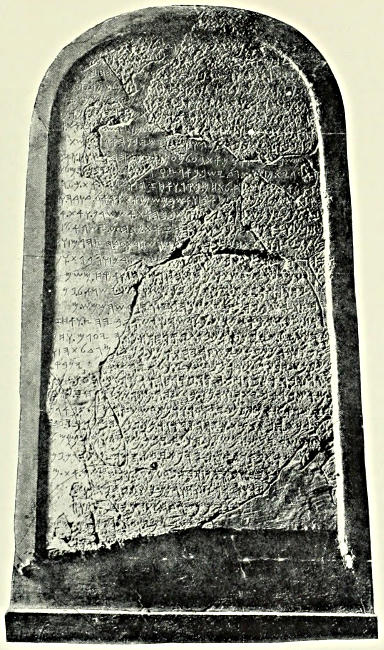
THE MOABITE STONE
Thus is this event described in the Book of Kings: “And when Athaliah,
the mother of Ahaziah, saw that her son was dead, she arose and
destroyed all the seed royal. Jehosheba, the daughter of king Joram, sister
of Ahaziah, took Joash, the son of Ahaziah, and stole him from among the
king’s sons which were slain; and they hid him, even him and his nurse, in
the bed chamber, from Athaliah, so that he was not slain. And he was with
her hid in the house of the Lord six years. And Athaliah did reign over
the land.”
This story, which furnishes the subject of one of Racine’s masterworks,
is more dramatic than probable. The Bible does not tell us of whom this
royal family, exterminated by Athaliah, was composed. The brothers and
nephews of Ahaziah had been assassinated by Jehu on the road to Samaria;
there is no reason why Athaliah should have completed the massacre by killing
her grandchildren. If some of the king’s sons remained at Jerusalem
safe from the rage of Jehu, no one had more interest in keeping them than
the queen mother, as she was their guardian and could legalise her power by
reigning in their name. All we know is that six years later the high priest
Jehoiada presented a child to the soldiers, telling them that he was Ahaziah’s
son, and the last branch of David’s race.
This child was proclaimed king under the name of Jehoash; Athaliah
heard acclamations and rushed out of the palace and was slain by order of
the high priest. The temple of Baal was invaded, and the high priest
Mattan slain before the altar. Jehoiada appointed himself guardian of the
new king, who was only seven years old: it was a government ruled by the
priests.
The kingdom of Israel was divided for the first time in Jehu’s reign, for
it is easier to deal with disarmed people than to cope with strange invasions.
Hazael, the usurper, raised, like Jehu, by the prophet Elisha, conquered all
the region to the east of the Jordan: “the land of Gilead, the territories of
Gath, Reuben and Manasseh, from Aroer on the torrent Arnon to Gilead and
Bashan.” The time was not far distant when the kingdoms of Israel and
Damascus were to be absorbed by the powerful Assyrian Empire. Hazael,
twice beaten by Shalmaneser II, acknowledges his supremacy, Jehu sent him
a tribute of gold and silver bars.
These facts, which the Bible does not mention, are contained in two
Assyrian inscriptions, one of which is found on the obelisk of Nimrud, and
the other on a tablet in the British Museum. In these inscriptions Jehu is
called the son of Omri, which proves that the Syrians knew little about the
genealogy of the kings of Israel. A bas-relief on the Nimrud obelisk represents
persons of Jewish or Aramæan types, wearing turbans with pointed
tops, bringing presents, and one of them is prostrating himself before Shalmaneser.
It is supposed that this bas-relief, twice repeated, represents the
submission of Hazael and Jehu. If Jehu, in declaring himself vassal to the
king of Assyria, hoped for protection against Hazael, he was mistaken.
Shalmaneser did not intervene in the quarrels of his vassals and Jehu left his
son Jehoahaz a weakened and mutilated kingdom in 815 B.C.
[ca. 815-780 B.C.]
Hazael, and his son, Ben-Hadad III, who succeeded him, reduced the Israelite
army to ten thousand footmen, fifty horsemen, and ten chariots. Israel
did not begin to recover itself until the reign of the son of Jehoahaz, named
Joash like the king of Judah; the two kingdoms of the north and south were
once more governed by kings of the same name. At Jerusalem the priests,
who had governed without control since Athaliah’s death, appropriated to
themselves the revenues destined for the maintenance of the temple. At the
end of twenty-three years, as these repairs were not made, Jehoash, who was
then thirty, wished to put an end to this scandal and withdrew from them the
free disposal of money. The discontent of the priests only broke out after
Jehoiada’s death, perhaps because thenceforth Jehoash took less caution.
According to the Book of Chronicles, he had the son of his benefactor, who
was remonstrating with him, stoned by the people, and it is to avenge this
death that he was assassinated on his return from a war with the Syrians,
in which he was wounded. The Book of Kings does not mention this war,
and on the contrary says that Jehoash diverted Hazael by giving him the
treasures of the temple. The Book of Kings does not mention the murder
of Jehoiada’s son, neither does it explain the reason of Jehoash’s assassination.
His son, Amaziah, succeeded him and punished his murderers, “but
the children of the murderers he slew not,” which indicated an improvement
in the ideas and morals of the country (797 B.C.).
The kingdom of Israel, so weakened in the reigns of Jehu and Jehoahaz,
was raised by three victories of Jehoash over Ben-Hadad, son of Hazael. It
is said that they were predicted by Elisha on his death-bed.
Joash regained the towns taken from his father, Jehoahaz. At the same
time Amaziah, king of Judah, beat the Edomites in the valley of Salt, and took
from them the town of Sela, afterwards called Petra. Proud of this success he
provoked the king of Israel. An encounter took place at Beth-shemesh;
Amaziah was beaten and taken prisoner. Joash entered Jerusalem, destroyed
the walls for four hundred cubits, pillaged the temple and the royal treasure,
and took hostages back to Samaria. According to Josephus, Joash had given
life and liberty to Amaziah on condition that he should open the gates of the
city to him. Joash, who survived his victory only a short time, had as successor
his son Jeroboam II. The kingdom of Judah remained under the
dependence of the kingdom of Israel until the end of the reign of Amaziah,
who died like his father, by an assassin’s hand, the result of conspiracy.
The Book of Chronicles says he had turned away from the Lord, which might
lead one to believe that this conspiracy was headed by the priests.
[ca. 780-740 B.C.]
The second Book of Chronicles entirely omits the name of Jeroboam, son
of Joash, whose name is mentioned only once in the first book in connection
with an enumeration. This is a curious omission, for in this reign the
kingdom of Israel seems to have attained a certain amount of power and
brilliancy. According to the Book of Kings: “He restored the coast of
Israel from the entering of Hamath unto the sea of the plain, according to
the word of the Lord God of Israel, which he spake by the hand of his servant
Jonah, the son of Amittai the prophet, which was of Gath-hepher.”
Jonah’s prophecy has not descended to us. The legend which says he
was swallowed by a whale, was written at a much later date. A German
theologist thought he could attribute to him the oracle against Moab, cited
in the Book of Isaiah as belonging to a more ancient prophet, and concluded
that Jeroboam had subjugated the Moabites, but Munk rejects this opinion.
The conquest of Syria has also been attributed to Jeroboam by explaining,
in an arbitrary manner, the very obscure sentence in the Book of Kings:
“He recovered Damascus and Hamath, which belonged to Judah, to Israel.”
To complete this scanty information concerning the long reign of Jeroboam,
which lasted more than forty years, we are reduced to gathering details from
prophetic writings.
Thus, through Joel and Amos, we know that at about this time there
was an earthquake and a plague of locusts. Historical allusions are rarely
made by the prophets, and their predictions bear a general character which
does not allow of fixing dates. This incertitude does not exist for Amos,
who himself relates that he was denounced by the high priest of Bethel for
having predicted the approaching fall of Jeroboam. As he was of Judah,
he was requested to go and prophesy in his own country. Since Jehu’s
accession, it became known that the declamations of the prophets were not
without danger to the dynasties.
Prophecy was developed later in Judah than in Israel, perhaps because
the priests were more powerful there. A passage in Jeremiah (xxix. 26)
tells us that the high priest Jehoiada had established officers in the house of
the Lord, who were to put “every man that is mad and maketh himself a
prophet,” in prison with chains around their necks. But these restrictive
measures could not entirely prevent the development of prophecy, which
answered to a public necessity as the press does to-day. Without the opposition
maintained among the people by the prophets, the Hebrews would
have been a race of slaves, bowing the knee to their masters like other eastern
nations. The attachment of the Judeans to the house of David, explains
why the part of the prophet was different in the two kingdoms. Instead of
stirring up plots like those of Israel, the prophets of Judah attacked the
morals of their fellow-citizens. They announced to them that in punishment
of their vices, and above all of their impiety, Jehovah would deliver
them into the hands of strange conquerors.
Their preachings were written, and were addressed to the educated portion
of the population. The collections of prophecies in the Bible form one
of the most important parts of Hebrew literature, and contain pieces of
great beauty. There is a difference of temperament and style among them,
but that which is common to all, is an ardent patriotism blending itself with
religion. As patriotism is an exclusive sentiment, religion had to bear the
same character. It was not sufficient to say that the national god was the
most powerful of all gods; it was believed that he was the only God. The
prophets did not doubt that after having chastised His people, He would
place them at the head of all nations under a new David. The brilliant
future they dreamt of corrected the bitterness of their complaints of the
present. But the hopes of the Messiah, ever adjourned, were not realised.
They were given a mystical meaning, and this change of sense prepared the
way for a new religion.

Jerusalem
[ca. 780-722 B.C.]
Judah had become vassal to Israel; probably for a time the kingdom of
the south had been annexed to that of the north, for the Book of Kings
places an interval of twelve years between the assassination of Amaziah and
the accession of his son Azariah, also called Uzziah. If there was no interregnum,
then the text is faulty. The death of Jeroboam II was followed by
an epoch full of troubles, in which Judah seized the opportunity to raise
itself.
Azariah took and rebuilt the port of Elath on the Red Sea. According
to the Book of Chronicles he conquered Gath and even Ashdod from the
Philistines, he exacted tributes from the Ammonites, fortified all the towns
of Judah, and made agriculture prosperous. Elated at his success, he ventured
to offer incense in the temple, thus usurping the privileges of the
priests, and was instantly struck with leprosy. The Book of Kings, a little
less impregnated with sacerdotal ideas than the Chronicles, limits itself to
saying, that the Lord afflicted him with a disease, and that he remained in a
house for lepers until his death, whilst his son Jotham reigned in his stead.
During this time Israel had fallen a prey to anarchy. Jeroboam II had
died after a reign of forty-one to fifty years, unless here also there was an
interregnum, for the figures of the Bible do not agree. His son Zechariah
was assassinated by Shallum at the end of six months. At the end of
a month the murderer of Zechariah was assassinated by Menahem, who,
according to Josephus, commanded the army. This was a repetition of
the events which had taken place at the fall of the house of Baasha.
Menahem reigned ten years, and left the throne to his son Pekahiah, who
two years later was assassinated at Samaria by one of his captains named
Pekah, the son of Remaliah.
The kingdom of Judah had continued to improve under the reign of
Jotham, son of Azariah, who like his father imposed a tribute on the
Ammonites. But Jotham died after a reign of sixteen years, and his son
Ahaz, from the time of his accession, had to fight a coalition of Rezin, king
of Damascus and Pekah, king of Israel. According to the prophet Isaiah,
they wished to place a son of Tabeal on the throne of Judah; he was a man
from among them. Ahaz was beaten by the king of Syria, who took the
port of Elath from the Judeans, and by the king of Israel, who killed one
hundred and twenty thousand of his men, and made two hundred thousand
prisoners, according to the author of Chronicles. Ahaz, frightened at
the coalition of the Syrians and Israelites, placed himself under the protection
of the king of Assyria, Tiglathpileser III; he declared himself his
vassal, and sent him all the treasures of the temple and of the royal house.
Tiglathpileser marched against Syria, took Damascus and carried away its
inhabitants to Kir, and slew Rezin. He also invaded the kingdom of
Israel: “and took Ijon and Abel-beth-maacha and Janoah, and Kadesh
and Hazor and Gilead and Galilee, all the land of Napthali, and carried
them captive to Assyria.”
Pekah did not survive his defeat for long. Like most of his predecessors
he was slain. His murderer, Hoshea, took possession of the throne and was
the last king of Israel. His authority only extended over the territory of
Ephraim, and he paid a tribute to the king of Assyria. Too weak to free
himself from this subjection, he tried to obtain help from outside, and sent
messages to a king of Egypt whom the Bible calls So, and who is probably
Shabak, an Ethiopian king of the XXVth Dynasty.
[722-700 B.C.]
Hoshea did not pay the annual tribute regularly, which the king of
Assyria had imposed upon him, either because his resources were insufficient
or because he counted on the assistance he had asked of Egypt. Shalmaneser
had him seized and put in prison, then attacked Samaria, which resisted
bravely, in vain awaiting help. The king of Egypt did not wish to risk the
chances of war for the support of a lost cause. The king of Judah, Hezekiah,
son of Ahaz, was afraid of bringing wrath on his head and prudently stayed
at home, occupying himself solely in preparing a religious reform. The
siege of Samaria had already lasted ten years when Shalmaneser died. It
was actively carried on by his successor, who took the town and carried away
its inhabitants to Assyria and Media to the number of about twenty-seven
thousand, according to the inscription of Khorsabad. They were gradually
absorbed by the populations in the midst of which they had been placed. The
Israelites of the northern tribes transported by Tiglathpileser, and those
which Sargon had taken from Samaria, were replaced by colonies taken
from diverse provinces of the Assyrian Empire, who likewise mingled with
those who remained of the old Israelite and Canaanite inhabitants. There
arose a mixed race for whom the Judeans always had a great aversion.
These new Samaritans had nevertheless adopted the worship of Jehovah
without abandoning the religion of the country they had left. Among
the Israelites who had been left in the country, there were great numbers
who migrated into the kingdom of Judah and even into Egypt. The
prophets of Judah have not a word of pity for their brethren of Israel.
The author of Chronicles does not mention the fall of Samaria. This event
seems to him less worthy of the attention of posterity than the details of
the ritual, the choirs of the Levites, the burnt offerings and purifications.
(722 B.C.)
The piety of Hezekiah is represented in the Book of Chronicles as forming
an absolute contrast to the impiety of his father Ahaz. The changes
he introduces into the national worship were far more serious than those
his father was accused of having made, only they conformed to the interest
of the sacerdotal caste. Ahaz had limited himself to renewing parts of the
accessories of the temple which dated from Solomon’s time, and did not
seem of such good taste to him, as what he had seen in Damascus. Hezekiah
destroyed all the high places in his kingdom, that is to say, local sanctuaries,
chapels, private altars, groves, and all material symbols of religion, notably
“the brazen serpent that Moses had made: for unto those days the Children
of Israel did burn incense unto it: and he called it Nehushtan.” The
temple of Jerusalem thenceforth became the only sanctuary where sacrifices
could be made to the national God. The priests who offered sacrifices and
the Levites charged with the keeping of the temple, thus saw the increase of
their importance and their revenues.
After Sargon’s death there had been a general revolt among the vassals
of Assyria. Hezekiah did as the others; he refused to pay the tribute and
sought the aid of Egypt, in spite of the advice of the prophet Isaiah, who
would have liked all human aid disdained and divine protection alone
reckoned on. Sennacherib, Sargon’s successor, after having punished the
Babylonian revolt, invaded Palestine. “Hezekiah remained shut up in
Jerusalem like a bird in a cage,” says the Assyrian inscription. The
towns and strongholds were taken, two hundred thousand captives were
sent to Assyria. Then Hezekiah sent to the king of Assyria at Lachish, to
say: “I have offended, return from me, that which thou puttest on me I
will bear. And the king appointed unto Hezekiah three hundred talents
of silver and thirty talents of gold, and Hezekiah gave him all the treasure
that was found in the temple and in the treasures of the king’s house. At
that time did Hezekiah cut off the gold from the doors of the temple of the
Lord and from the pillars which Hezekiah king of Judah had overlaid, and
gave it to the king of Assyria.”
[700-680 B.C.]
Sennacherib was not appeased; he had just heard that a new Egyptian
army was being formed at Pelusium and he thought Hezekiah was trying to
gain time. He remained before Lachish, which he was besieging, and sent
part of his army towards Jerusalem. Having heard that Tirhaqa, king of
Ethiopia, was advancing against him at the head of an army, Sennacherib
made a fresh attempt to obtain the surrender of Jerusalem.
The prophet Isaiah then reassures Hezekiah on the issue of the war; he
promises him that in a year’s time his subjects will be able to cultivate their
fields and gather the fruits. “And it came to pass that the Angel of the
Lord went out, and smote in the camp of the Assyrians an hundred four
score and five thousand: and when they arose in the morning, behold they
were all dead corpses. So Sennacherib, king of Assyria, departed and
returned and dwelt at Nineveh.”
There is an Egyptian legend concerning Sennacherib’s hasty departure.
According to this legend, told to Herodotus by the priests, the god Ptah, so
as to reward the piety of Sethos, king of Egypt, who favoured the sacerdotal
caste, had sent a multitude of rats into the Assyrian camp. In one night
they gnawed all the strings of the bows and of the shields; the enemy
being unable to fight, were obliged to flee, and the greater number perished
in the panic. Herodotus adds that in his time there was a statue in the
temple of Ptah, representing the king holding a rat in hand, with the
following inscription: “Whoever thou art, on seeing me, learn to respect
the gods.”
According to a Dutch work, The Family Bible, which we have already
mentioned, the Egyptian priests who related this legend to Herodotus did
not know much about the symbols of their own religion. “Generally the
rat is a symbol of destruction, particularly of the plague. The invasion of
rats spoken of in our fable is no other than a false interpretation of the rat
found in the hands of statues. This rat really represents the plague. As
the Israelites attributed the cause of this illness to the angel of the Lord,
the Egyptian story would agree with what the Bible says of the retreat of
Sennacherib, were it not that Herodotus gives Pharaoh the name of Sethos,
whilst the Bible calls him Tirhakah. At any rate, Sennacherib was obliged
to interrupt his wars on account of infectious diseases. Of course his
inscription does not state this: at the end of it he boasts of having brought
back to Nineveh, not a greatly reduced army, but great treasures conquered
partly in the land of Judah, and of having received from Hezekiah, not only
the offer of a heavy ransom, but also that of submission. This point was
only realised in the imagination of the vain monarch. Hezekiah maintained
his independence.”
The Assyrians had left the land in a deplorable state. The fields had
been ravaged, the towns burnt, the strongholds destroyed, and their inhabitants
reduced to slavery. The people ascribed all these evils to the theocratical
side which was all-powerful in the reign of Hezekiah. This side had
always preached war to the death; it is true that the national independence
had been saved, but it was at the cost of material interests, and prompt submission
might have prevented terrible disasters. The destruction of local
sanctuaries, to the benefit of the temple at Jerusalem, had also upset all
religious customs, especially in the provinces.
Rabshakeh knew that this radical step was impiety in the eyes of
conservatives, and it was not without reason that he wished to speak to
the people in the Hebrew language. It is thus that one can account for
the violent reaction which took place against the reforms of Hezekiah in the
reign of his son Manasseh. The Bible attributes all to the king, but the
invectives of the prophets against what they call “the hardening of
the people,” suffice to prove that the government more or less unconsciously
followed the course of public opinion.
[680-610 B.C.]
The reaction raised continual opposition on the vanquished side, as is
always the case after bloody repressions; for the Book of Kings tells us
that Manasseh (2 Kings xxi. 22) “shed innocent blood very much, till he
had filled Jerusalem from one end to the other.” The tradition referred to
in the Talmud, according to which Isaiah was sawn between two planks, is
rejected generally; a detail of such importance would not have been omitted
in the Bible. The account in Chronicles of another Assyrian invasion, of
the captivity of Manasseh and his repentance, is likewise rejected; the
prayer he is said to have made after his conversion makes part of what is
called the Apocrypha of the Old Testament, and is comparatively of recent
origin.
The Assyrian documents do not mention any invasion into Judea by the
successors of Sennacherib. Jeremiah and the Book of Kings represent
the ruin of the kingdom of Judah as the punishment for the idolatry of
Manasseh without alluding to his repentance. M. Munk says: “Therefore
we believe in giving no value to the deeds which the Chronicles assign to
Manasseh. We will say as much of the Apocryphal history of Judith. The
book of Judith must be considered as an edifying story, but fabulous, composed
by an author little versed in history and geography. Thus we do not
know of any important historical event of the long reign of Manasseh,
excepting the reaction which took place among the priests and prophets. It
is probable that Judah was troubled by no outside enemies during this
reign.”
Manasseh died after a reign of fifty-five years (641 B.C.) and his son
Amon, who had also shown himself hostile to the theocratic party, was
assassinated two years later. It is not known whether there were religious
or political motives for this murder: but the people were very wroth about
it, and killed the conspirators and placed Josiah, son of Amon, aged eight
years, on the throne (639 B.C.).
In the eighteenth year of Josiah’s reign, whilst the carpenters, architects,
and masons were doing some repairs in the temple, the high priest Hilkiah
presented himself before the scribe and said that he had found the Book of
the Law in the temple. The Book was brought to the king, who had it read
to him. At the reading of the terrible threats it contained, he rent his garments:
“Go ye, inquire of the Lord for me and for the people and for all Judah
concerning the words of the Book that is found: for great is the wrath of
the Lord that is kindled against us, because our fathers have not hearkened
unto the words of this Book to do according unto all that which is written
concerning us.”
It is believed that this Book found in the temple comprised the principal
parts of Deuteronomy, especially the commandments contained in the
iv. chapter, the curses pronounced in the xxviii. chapter against those
who would turn away from the terms of the alliance; and in the intermediate
chapters all that related to the proscribing of strange religions and the
worshipping of images, the privileges of the tribe of Levi, and the establishment
of one sanctuary alone in the town chosen by the Lord.
Judaism, that is to say, exclusive theocratic and iconoclastic monotheism,
was under the patronage of Moses, the legendary hero who had brought
Israel out of Egypt. To change the religious customs of the nation, they
opposed to the conservative tradition another represented as being more
ancient and which was connected to a venerated name. King Josiah, armed
with a version which he did not think necessary to authenticate, set himself
to the task of executing all its prescriptions. The sanctuaries of Judah
were destroyed, the priests were maintained, but they had no function in
the temple. The king then went to Bethel and destroyed the sanctuary raised
by Jeroboam. He did likewise in all the towns of Samaria: “And he slew
all the priests of the high places upon the altars and burned men’s bones.”
[610-605 B.C.]
After this invasion into the ancient kingdom of Israel, to which it would
seem that the Assyrians, then in their decline, opposed no obstacle, the king
of Judah entered Jerusalem, where he ordered a solemn celebration of the
Passover: “According as it was written in the Book of this Covenant.
Surely there was not holden such a passover from the days of the judges
that judged Israel, nor in all the days of the kings of Israel, nor of the
kings of Judah: but in the eighteenth year of King Josiah, wherein this
passover was holden to the Lord in Jerusalem.”
The enthusiasm of the theocratic party is shown by the unlimited praises
of the Book of Kings: “And like unto Josiah was there no king before him,
that turned to the Lord with all his heart, and with all his soul, and with all
his might, according to all the law of Moses, neither after him arose there
any like him.”
All the promises of the prophets could not fail to be realised under the
reign of such a prince; he could consider himself certain of the protection
of the Lord, whose worship reigned entirely throughout all the land of
Judah and even of Israel. These hopes were cruelly crushed by the disastrous
events which marked the end of the reign of Josiah. Neku, king
of Egypt, wishing to take advantage of the fall of the Assyrian Empire, was
directing an army towards the Euphrates to fight against Nabopolassar, king
of Babylon. Judah was in no wise threatened, and the Book of Kings does
not explain the motives which may have decided Josiah to take part in an
uneven struggle. He came to meet the Egyptian army at Megiddo in the
plains of Jezreel. According to the Book of Chronicles, Neku sent ambassadors
to him, saying, “What have I to do with thee, thou King of Judah?
I come not against thee this day, but against the house wherewith I have
war: for God commanded me to make haste: forbear thee from meddling
with God, who is with me, that he destroy thee not.” Josiah paid no heed
to this warning; he fought and was killed. “And all Judah and Jerusalem
mourned for Josiah. And Jeremiah lamented for Josiah; and all the singing
men and the singing women spake of Josiah in their lamentations to this day.”
The Bible contains only a very dry account of the events which followed
the death of Josiah, which has been a little further completed by the help of
some passages taken from Jeremiah. The defeat of Megiddo seems to have
dealt a fatal blow to the reforms of Josiah, for the Book of Kings accuses all
his successors of having “done evil in the sight of the Lord.” The people
had placed Jehoahaz, son of Josiah, called Shallum by Jeremiah, on the
throne. Three months later Neku made him go to Riblah and sent him as
prisoner to Egypt and replaced him by another son of Josiah’s named
Eliakim, and changed his name into Jehoiakim, exacting from Judea a
tribute of one hundred talents of silver and one talent of gold.
[605-597 B.C.]
At the end of three years Neku was beaten at Carchemish by Nebuchadrezzar,
son of the king of Babylon. The little kingdom of Judah was
situated between two great empires, Egypt and Chaldea, and pressed on all
sides. Jehoiakim, although vassal to the king of Egypt, to whom he owed
the throne, so as to keep it, submitted to the suzerainty of the king of
Babylon. But as he always preferred Egypt, he revolted. Nebuchadrezzar
sent some troops, and scattered bands of Moabites and Ammonites in Judea,
who only wanted an opportunity to avenge their long oppression. The king
shut himself up in Jerusalem, awaiting from Egypt help which never came.
The prophets did not agree, and accused one another of imposture. Jeremiah
discouraged resistance by his sinister predictions. The people were
more and more irritated, and several times his life was threatened. But he
had partisans, for at least his was a free voice protesting against public
misery. If he was severe towards the people, he was far more so towards
the king, whom he accused of foolish expenditures and tyranny. “He said,
‘thus saith the Lord concerning Jehoiakim, the son of Josiah, king of
Judah: He shall be buried with the burial of an ass, drawn and cast forth
beyond the gates of Jerusalem.’” The king burnt his prophecies and had
him pursued; but as Jeremiah belonged to the sacerdotal caste, being the
son of Hilkiah, they helped to hide him. One of his disciples was not so
fortunate; he had taken refuge in Egypt, and was brought back and put to
death.
[597-586 B.C.]
According to the Book of Chronicles, Jehoiakim was sent to Babylon
laden with chains. Josephus pretends that Nebuchadrezzar, having entered
Jerusalem promising to do no harm to the king, made him die in spite of
his promise, and deprived him of burial according to the prophecy of Jeremiah.
The Book of Kings merely says that Jehoiakim “slept with his
fathers.” His son Jehoiachin, called Jeconiah or Coniah by Jeremiah, reigned
only three months.
Nebuchadrezzar established as king in Jerusalem the last of the sons of
Josiah, who changed his name, Mattaniah, to Zedekiah. As to Jeconiah,
he remained prisoner in Babylon for thirty years. Evil-Merodach, successor
to Nebuchadrezzar, freed him. Had Zedekiah contented himself with being
satrap to the king of Babylon, he could have governed the remainder of the
Jews in peace; but he was drawn in different ways by the current of public
opinion, then represented by the prophets as it is to-day by the newspapers.
Those who announced an approaching deliverance were more eagerly listened
to than those who, like Jeremiah, preached submission to the conqueror,
for they could not believe that the Lord had abandoned his people.
Zedekiah had received messages from Tyre and Sidon, Ammon and Moab;
no doubt it was concerning a general rebellion. Jeremiah sent each of the
ambassadors, and even the king, a wooden yoke, announcing that all people
who resented the Babylonian yoke would be punished by the sword, famine,
and plague. He himself appeared in the temple with a yoke on his
shoulders. A prophet who was for war tore it off and broke it before the
people, saying, “Thus saith the Lord: Even so will I break the yoke of
Nebuchadrezzar king of Babylon from the neck of all nations within the
space of two full years.”
The king was greatly embarrassed, for it was only by the fulfilment that
a true prophecy could be distinguished from a false. He began negotiations
with Egypt; the king of Egypt, Hophra (Apries, Uah-ab-Ra), having promised
him help, he refused to pay the tribute he had been subjected to for
eight years. Nebuchadrezzar decided to settle the Jews, and came to attack
Jerusalem. Zedekiah assembled the people, and to obtain the Lord’s favour
it was decided that those who had Jewish slaves should free them, conforming
with a law attributed to Moses, but which had never been carried out.
The oath was taken with the ancient custom of cutting an ox in two and
passing between the portions of meat. But the news came that an Egyptian
army was arriving in Judea; the Chaldeans went to meet it. They thought
that all was won, that there was no necessity to mind, and each one took
back his slaves. Jeremiah, indignant at this, announced that the town
should be burned, and that the land should become a desert. Then, as he
tried to leave Jerusalem, he was accused of wanting to pass over to the
enemy. They had become very suspicious of him. “Let him be put to
death,” said they, “for he unnerves the hands of the fighting men.” The
king was obliged to have the prophet put in prison.
[586 B.C.]
According to Josephus, the Egyptian army was beaten in a great battle.
Jeremiah alone says it returned to Egypt. The Chaldeans continued the
siege of Jerusalem, which lasted for nearly ten years: “The famine prevailed
in the city, and there was no bread for the people of the land. And
the city was broken up, and all the men of war fled by night by the way of
the gate between two walls, which is by the king’s garden. Now, the
Chaldeans were against the city round about: and the king went the way
toward the plain. And the army of the Chaldeans pursued after the king,
and overtook him in the plains of Jericho: and all his army were scattered
from him. So they took the king and brought him up to the king of
Babylon at Riblah.” The walls of Jerusalem were destroyed, the city was
devastated by fire, and great numbers of prisoners were carried off to
Babylon.
The king of Babylon confided the government of the land to a Jew
called Gedaliah, a friend of Jeremiah, and probably, like him, a partisan
of peace and submission. Gedaliah established his residence at Mizpah, and
announced to the Jews that they had nought to fear in remaining faithful to
Nebuchadrezzar. The officers and soldiers who had hidden themselves in
the provinces at the time of the taking of Jerusalem, returned in large
numbers. A great number of Jews emigrated to Egypt, in spite of the
prophecies of Jeremiah, announcing to them that they would be pursued by
the vengeance of the king of Babylon, and that Egypt would be conquered.
The prophet Ezekiel, one of those transported in Jehoiachin’s time, also
prophesied the conquest of Egypt by the Chaldeans. According to Josephus,
these predictions were fulfilled. Nebuchadrezzar had beaten and
killed Hophra (Apries, Uah-ab-Ra), and had taken away into Chaldea the
Jews established in the Delta. But M. Maspero says, “Egyptian accounts
do not allow of admitting the authenticity of this tradition; on the contrary,
they prove that Nebuchadrezzar met with a serious reverse.”
An appendix to the Book of Jeremiah talks of 745 Jews carried away to
Babylon five years after the fall of Jerusalem; but it is probable that they
were taken from among those who had remained in Judea after the murder
of Gedaliah. According to these passages, the total number of those
transported thrice in the reign of Nebuchadrezzar would be forty-six hundred
souls. This number is so weak that one might think the author had counted
only the heads of the family. The Lamentations attributed to Jeremiah
offer us a poetical picture of the misery of Jerusalem and Judea after the
Chaldean conquest:
“How doth the city sit solitary, that was full of people; how is she
become as a widow, she that was great among the nations, and princess
among the provinces; how is she become tributary? She weepeth sore in
the night, and her tears are on her cheeks: among all her lovers she hath
none to comfort her: all her friends have dealt treacherously with her, they
are become her enemies. Our inheritance is turned to strangers, our houses
to aliens. We are orphans and fatherless, our mothers are as widows. But
thou, O Lord, remainest for ever, thy throne from generation to generation.
Wherefore dost thou forget us for ever, and forsake us for so long time.”
At the same time the exiled, in the remembrance of their country, gave
vent to accents of a depth which even Dante has never surpassed, and in
which the hope of vengeance was displayed with a fierce energy.
“By the waters of Babylon, we sat down and wept, when we remembered
Zion. We hanged our harps upon the willows in the midst thereof. If
I forget thee, O Jerusalem, let my right hand forget her cunning. If I do
not remember thee, let my tongue cleave to the roof of my mouth: if I
prefer not Jerusalem above my chief joy.”
That which has given life to the Jewish people is the feeling of patriotism
carried to the extreme, the hatred for the stranger. The native land is not
alone the corner of the earth in which one is born, it is the moral link uniting
the members of a society in common thought so as to form one family.
This small nation, surrounded and then subjugated by more numerous and
stronger neighbours, from which it differed neither in race nor language,
was distinguished from them by religion. This religion is the ideal form
of patriotism; it dominates and fills its history. If they regret Jerusalem,
it is on account of the temple. The intolerant fanaticism of the prophets,
the narrow formalism of the priests, raised around the people of the Lord an
invisible rampart, more insurmountable than the great wall of China. At
the same time, when national independence was giving way to strength, the
resolute energy of the theocratical party was preparing its revival. This is
one of the greatest marvels of history, and all the miracles with which this
nation filled its legends are not worth those which they themselves performed
by the sole power of their faith.b
Convent of Terra Santa, Nazareth
Comfort ye, comfort ye my people, saith your God.
Speak ye comfortably to Jerusalem, and cry unto her, that her
warfare is accomplished, that her iniquity is pardoned: for she hath
received of the Lord’s hand double for all her sins.
The voice of him that crieth in the wilderness, Prepare ye the way
of the Lord, make straight in the desert a highway for our God.
Every valley shall be exalted, and every mountain and hill shall
be made low: and the crooked shall be made straight, and the rough
places plain.
And the glory of the Lord shall be revealed, and all flesh shall see
it together: for the mouth of the Lord hath spoken it.—Isaiah xl.
1-5.
Who gave Jacob for a spoil, and Israel to the robbers? did not the
Lord, he against whom we have sinned? for they would not walk in
his ways, neither were they obedient unto his law.
Therefore he hath poured upon him the fury of his anger, and the
strength of battle: and it hath set him on fire round about, yet he
knew not; and it burned him, yet he laid it not to heart.—Isaiah
xlii. 24-25.
But now thus saith the Lord that created thee, O Jacob, and he
that formed thee, O Israel, Fear not: for I have redeemed thee, I have
called thee by thy name; thou art mine.
For I am the Lord thy God, the Holy One of Israel, thy Saviour:
I gave Egypt for thy ransom, Ethiopia and Seba for thee.
Fear not: for I am with thee: I will bring thy seed from the east,
and gather thee from the west;
I will say to the north, Give up; and to the south, Keep not back:
bring my sons from far, and my daughters from the ends of the earth.—Isaiah
xliii. 1, 3, 5, 6.
Thus saith the Lord, thy redeemer, and he that formed thee from
the womb, I am the Lord that maketh all things; that stretcheth forth
the heavens alone; that spreadeth abroad the earth by myself;
That frustrateth the tokens of the liars, and maketh diviners
mad; that turneth wise men backward, and maketh their knowledge
foolish.
That confirmeth the word of his servant, and performeth the counsel
of his messengers; that saith to Jerusalem, Thou shalt be inhabited;
and to the cities of Judah, Ye shall be built, and I will raise
up the decayed places thereof:
That saith to the deep, Be dry, and I will dry up thy rivers:
That saith of Cyrus, He is my shepherd, and shall perform all my
pleasure: even saying to Jerusalem, Thou shalt be built; and to the
temple, Thy foundation shall be laid.—Isaiah xliv. 24-28.
Thus saith the Lord to his anointed, to Cyrus, whose right hand I
have holden, to subdue nations before him; and I will loose the loins
of kings, to open before him the two-leaved gates; and the gates shall
not be shut;
I will go before thee, and make the crooked places straight: I will
break in pieces the gates of brass, and cut in sunder the bars of iron.—Isaiah
xlv. 1-2.
Bel boweth down, Nebo stoopeth, their idols were upon the beasts,
and upon the cattle; your carriages were heavy loaden; they are a
burden to the weary beast.
They stoop, they bow down together; they could not deliver the
burden, but themselves are gone into captivity.—Isaiah xlvi. 1-2.
Come down, and sit in the dust, O virgin daughter of Babylon, sit
on the ground: there is no throne, O daughter of the Chaldeans: for
thou shalt no more be called tender and delicate.—Isaiah xlvii. 1.
Sit thou silent, and get thee into darkness, O daughter of the Chaldeans:
for thou shalt no more be called, The lady of kingdoms.
I was wroth with my people, I have polluted mine inheritance, and
given them into thine hand: thou didst shew them no mercy; upon
the ancient hast thou very heavily laid thy yoke.
And thou saidst, I shall be a lady for ever: so that thou didst not
lay these things to thy heart, neither didst remember the latter end
of it.
Therefore hear now this, thou that art given to pleasures, that
dwellest carelessly, that sayest in thine heart, I am, and none else
beside me; I shall not sit as a widow, neither shall I know the loss
of children:
But these two things shall come to thee in a moment in one day,
the loss of children, and widowhood: they shall come upon thee in
their perfection for the multitude of thy sorceries, and for the great
abundance of thine enchantments.—Isaiah xlvii. 5-9.
Thou art wearied in the multitude of thy counsels. Let now the
astrologers, the stargazers, the monthly prognosticators, stand up, and
save thee from these things that shall come upon thee.
Behold, they shall be as stubble; the fire shall burn them; they
shall not deliver themselves from the power of the flame: there shall
not be a coal to warm at, nor fire to sit before it.
Thus shall they be unto thee with whom thou hast laboured, even
thy merchants, from thy youth: they shall wander every one to his
quarter; none shall save thee.—Isaiah xlvii. 13-15.
Hear ye this, O house of Jacob, which are called by the name of
Israel, and are come forth out of the waters of Judah, which swear by
the name of the Lord, and make mention of the God of Israel.—Isaiah
xlviii. 1.
[586-536 B.C.]
After hearing this sonorous prophecy of Isaiah, in which, at worst, the
wish was father to the thought, we may hear what so critical a student of
Jewish history as Ernest Renan had to say of the prophets in general.
“As much as half a century before the capture of Samaria,” he says,
“almost all the activity of the Hebrew genius had been concentrated in
Judah. Prophetism had arrived at its main conclusions—namely, monotheism,
God (or Jehovah) being the sole cause of the phenomena of the universe;
the justice of Jehovah and the necessity that that justice should be
carried into effect on earth and for each individual within the limits of his
own existence; a democratic puritanism in manners, hatred of luxury, of secular
civilisation, of the obligations resulting from complicated civil organisation;
absolute trust in Jehovah; the worship of Jehovah, consisting above all in
purity of heart. The immensity of such a revolution astounds us, and when
we reflect on it we find that the moment when the creation took place is the
most fertile in the whole history of religion. Even the initial movement
of Christianity in the first century of our era, gives place to this extraordinary
movement of Jewish prophetism in the eighth century before Christ.
All of Jesus is contained in Isaiah. The humanitarian destiny of Israel is
as clearly written towards 720 as that of Greece will be two hundred years
later.
“Down to the time of Elijah and Elisha, Israel is not essentially distinguished
from the neighbouring peoples; there is no mark on her forehead.
From the moment now reached, her vocation is absolutely laid down for her.
After a very favourable reign (that of Hezekiah), prophetism will traverse
a long period of trial (the reigns of Manasseh and Amon), and will then
completely triumph under Josiah. The history of Judah will henceforth be
the history of a religion, first confined during long centuries to her own
limits, then mingling by the victory of Christianity in the general movement
of mankind. The ancient prophets’ cry of justice will not be stifled. Greece
will lay the foundations of lay society, free in the sense in which the economists
understand it, without heeding the sufferings of the weak which result
from the greatness of the social work. Prophetism will accentuate the just
claims of the poor; it will undermine the position of the army and of royalty
in Israel; but it will found the synagogue, the Church, societies for the
poor, which, from the time of Theodosius, will become all powerful and will
govern the world. During the Middle Ages the thundering voice of the
prophets, interpreted by Saint Jerome, will awe the rich and powerful, and,
for the benefit of the poor, or those who pretend to be such, will prevent
every sort of industrial, scientific, or worldly progress.
“Germanic laicism repulsed the thrusts of this oppressive ebionism. The
warrior, Frank, Lombard, Saxon, Frisian, took his revenge on the man of
God. The warrior of the Middle Ages was so simple-minded that his credulity
soon brought him again under the yoke of theocracy, but the Renaissance
and Protestantism emancipated him; the Church could not recover
her hold on her prey. In fact, the barbarian, the most brutal of lay princes,
was a deliverer compared with the Christian priest with the secular arm at
his disposal. The hardest oppression is that exercised in the name of a spiritual
principle; lay tyranny contents itself with the homage of the body;
the community which has the power to enforce its opinions is the worst of
scourges.
“The work of the prophets has thus remained one of the essential elements
of the world. The motion of the world is the resultant of the parallelogram
of two forces—liberalism on the one side, and socialism on the
other; liberalism of Greek origin, socialism of Hebrew origin; liberalism
making for the greatest human development, socialism paying attention first
of all to justice, understood in a strict sense, and to the happiness of the
greatest number in practice, so often sacrificed to the needs of civilisation
and the state. The socialist of our time who declaims against the abuses
inevitable in a great organised state, greatly resembles Amos, representing
as monstrous the most obvious necessities of society, such as the payment of
debts, loans on security, and taxes.
“Before venturing to say which of these two opposing tendencies is the
right one, we must know what is the goal of humanity. Is it the well-being
of the individuals who compose it, or is it the attainment of certain abstract,
objective aims, as they are called, which require hecatombs of individuals
as sacrifices? Each will answer according to his moral temperament,
and that is enough. The universe, which never ceases to make revelations,
reaches its end by an infinite variety of ways. What Jehovah wills always
comes to pass. Let us be calm; if we are of those who are mistaken, who
work against the tide of the supreme will, it is of little consequence. Humanity
is one of the innumerable ant-hills where reason gains her experience
in space; if we miss our part, others will gain it.”
Accepting the prophets and prophecy, then, in whatsoever spirit one
individually will, it is interesting to note in what manner and to what
degree the prophecy is fulfilled, for the Jews return to rebuild the temple
and the walls, only to remain obscure, and helplessly to pass from master to
master.a
The history of the Hebrews is divided into two distinct periods. The
first, purely legendary until the time of Samuel, only becomes a true history
under the kings; it ceases abruptly for Israel at the siege of Samaria
by Shalmaneser IV [and Sargon II] and for Judah about a century later at
the siege of Jerusalem by Nebuchadrezzar.
The ruin of Israel was complete; the tribes, transported to the other
side of the Euphrates, by degrees forgot their former recollections, customs,
language, even their religion, and became confounded with the nations of
Higher Asia. When and how, it is not known. Colonists brought into
Canaan by Esarhaddon, replaced them by mingling themselves with the
remains of the Israelite population. Such was not the case with the
Judeans taken to Babylon; although not so numerous, they kept to their
national life during exile. When the occasion arose, they returned to
their own country, surrounded themselves by the rural population left
by the conqueror to cultivate the land, and became the centre of a new
nation.
The Jews transported by Nebuchadrezzar had been established in different
provinces of the Chaldean Empire, in which they dwelt together. Their
condition was infinitely better than that of political exiles in Siberia, Cayenne,
or Numea at the present time. Jeremiah advised his compatriots to
cultivate and build, which proves that they were given land and that they
formed colonies.
They were governed by their elders who judged without appeal even
in extreme cases, as is seen by the story of Susanna in the addition to
the Book of Daniel. Nothing prevented them from carrying on their
religion freely. It is true that as sacrifices could be offered regularly only
at Jerusalem, the sacrificers had no employment: but the prophets maintained
their influence, and Ezekiel speaks several times of the visits paid
to them so as to consult the Lord. M. Munk says: “There were probably
meetings where prayer was offered up in common, and perhaps the
origin of synagogues dates back to this time. A tradition referred to in
the Talmud of Babylon, Meghilla, fol. 28, a, attributes the foundation of
a synagogue built of stones from the Holy Land, to the exiles who had
accompanied Jehoiakim.”
The legends of Daniel in the lions’ den, and of the three men in the furnace,
do not suffice to make one believe in a religious persecution, which the
contemporary prophets would not fail to have mentioned; all that can be
concluded from these popular traditions, gathered very much later, is that
some Jews, doubtless eunuchs or diviners, were able to play a part at the
court of the Babylonian kings. The natural wrath of the Jews against the
destroyer of Jerusalem, gave rise to a legend according to which, Nebuchadrezzar,
in punishment of his arrogance, was driven from amongst men for
seven years and reduced to being a beast. “And he did eat grass as oxen,
and his body was wet with the dew of heaven, till his hairs were grown like
eagles’ feathers and his nails like birds’ claws.” It is probable that the
Jewish captives in Babylon took the large winged bulls with human heads
at the gates of the Assyrian palaces, for images of the kings. The historical
books of the Bible do not mention this legend, which is only
quoted in the Book of Daniel, written in the time of Antiochus Epiphanes.
A song of triumph on the death of Nebuchadrezzar is written in the Book
of Isaiah.
[538 B.C.]
In the reign of Nabonidus, called Belshazzar in the Book of Daniel,
Babylon was besieged by Cyrus, king of the Persians. The town was well
supplied with provisions, and relied on the strength and height of its walls:
but Cyrus turned aside the waters of the Euphrates, and made his army
enter the dried-up bed of the river. Had the Babylonians suspected his
intentions they might have caught the enemy in a trap by closing the doors
leading to the Euphrates: but they were occupied in celebrating a feast.
This circumstance gave rise to the legend of Belshazzar, related in the Book
of Daniel.
Cyrus is not even mentioned in this account, a strange omission, considering
it was he who gave the Jews back their country. M. Munk identifies
the Median Darius of Daniel with the Xerxes of Xenophon; but the
Cyropædia is a romance bearing no more authority than the Book of
Daniel. After the accession of Cyrus, the Jews had followed the rapid
progress of the New Persian Empire with interest. The siege of Babylon
seemed to them the vengeance of their God on those who had oppressed his
people. They considered the Persians as deliverers, for the enemies of our
enemies are always our friends. This sympathy and hope are vividly
expressed by the second Isaiah. He calls Cyrus, “the Shepherd of Jehovah,
who performeth his pleasure even in saying to Jerusalem, Thou shalt be
built, and to the temple, Thy foundations shall be laid.”
He is so persuaded that Cyrus is the instrument of the God of the Jews,
chosen especially to deliver them, that he gives him the name of Messiah like
to a true king of Israel: “Thus saith the Lord to his anointed, to Cyrus
whose right hand I have holden, to subdue nations before him, to open
before him the gates. I will go before thee, and make the crooked places
straight: I will break in pieces the gates of brass and cut in sunder the bars
of iron.… I am the Lord and there is none else. I form the light, and
create darkness: I make peace, and create evil: I the Lord do all these
things.” The last sentence is an allusion to the Mazdean doctrine of the two
principles. The Persians attribute the good to a good god named Ormuzd,
and evil to a wicked god named Ahriman. The prophet on the contrary
proclaims one only god, author alike of good and evil, which proves that at
this time the belief in the devil had not yet been accepted by the Jews.
Nevertheless, there was a great connection between the Jewish and
Iranian religions: both were iconoclastic, and the Bible never accuses the
Persians of idolatry, as it does other nations. The kindness Cyrus showed
to the Jews is generally attributed to these religious affinities. It can also
be accounted for by political reasons. The facility with which he had
taken Babylon seems to indicate that he had accomplices in the place. In
favouring the Jews he was acquitting himself of a great obligation. It may
be that he proposed from thence to conquer Egypt, and that he thought it
would be advantageous to place on the Egyptian frontier, an energetic
people whose fidelity was assured to him. According to the Bible, from the
first year of his reign, or rather in the year following the siege of Babylon,
he allowed the Jews to return to Jerusalem and build their temple. He
even gave the chief priest all the sacred vessels that had been taken from the
temple at Jerusalem by Nebuchadrezzar. This chief priest, grandson to
King Jehoiachin, bore the characteristic name of Zerubbabel, that is to say,
“born at Babel.” In other passages he is designated under the name of
Sheshbazzar, which seems to be more of a title than of a proper name.
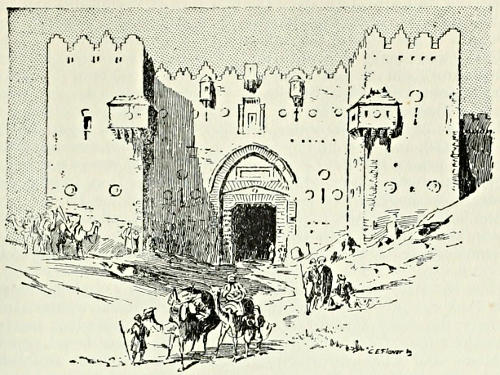
The Damascus Gate, Jerusalem
[536-515 B.C.]
The decree of Cyrus appeared in 536 B.C., fifty-two years after the fall
of Jerusalem, and sixty-three years after the exile of King Jehoiachin.
Ineffectual efforts have been made so that these figures should correspond to
the seventy years of captivity prophesied by Jeremiah, which only represents
a round and undetermined number in the mind of the prophet. The
greater part of the Hebrew captives had followed the advice of Jeremiah, and
built houses and cultivated their fields. In the land of their exile they had
developed that aptitude for commerce which to-day distinguishes the Jewish
race. It was hard for them to sacrifice their interests to begin a new life in
a ruined country. Those who, having taken advantage of the decree of
Cyrus, had left Babylon under Zerubbabel, numbered about forty thousand
without counting the slaves according to Ezra, who also gives a list of the
families; this list is reproduced with variations in the Book of Nehemiah and
in the Third Book of Esdras.
“In adding up the detailed numbers,” says M. Munk, “there are scarcely
thirty thousand. According to the Jewish doctors one must take into consideration
the surplus of the Israelites of the ten tribes.”
In spite of this explanation made to conciliate the figures, it is generally
acknowledged that the emigrants all, or nearly all, belonged to the ancient
tribe of Judah. The name Jehoudin, Judeans, corrupted into that of Jews,
must henceforth be used to designate the new political and religious society
which established itself in Palestine.
It was, thanks to the unceasing efforts and exclusive patriotism of the
theocratic party, that the Jews had gone through the long years of exile
without ceasing to be a nation, without mixing with strange people. Among
the families who returned to Judea, those of the priests formed at least one-eighth
of the total. Some, not having their genealogies, were excluded from
the priesthood.
After the return to Jerusalem, the first care of Zerubbabel and the high
priest Jeshua was to raise the altar for the sacrifices, and to gather together
the offerings of the chiefs of the fathers for the reconstruction of the temple.
“They gave money also unto the masons, and to the carpenters; and
meat and drink, and oil, unto them of Sidon and to them of Tyre, to bring
cedar trees from Lebanon to the sea of Joppa, according to the grant that
they had of Cyrus, king of Persia. Now in the second year of their coming
into the house of God at Jerusalem, in the second month, began Zerubbabel,
son of Shealtiel, and Jeshua, the son of Jozadak, and the remnant of their
brethren the priests and the Levites, and all they that were come out of the
captivity unto Jerusalem; and appointed the Levites from twenty years old
and upward, to set forward the work of the house of the Lord.… And
when the builders laid the foundation of the temple of the Lord, they set
priests in their apparel with trumpets, and the Levites the sons of Asaph
with cymbals, to praise the Lord, after the ordinance of David, king of Israel”
(Ezra iii. 8, 10).
In this, the Book of Ezra describes an event which Josephus places in the
time of Darius, and which shows that in the narrow zeal of the sacerdotal
aristocracy, the pride of race had as large a share as religious intolerance.
We remember that after the destruction of the kingdom of Israel, populations
from Media and Chaldea, principally Kutheans, had been established by
Esarhaddon in the land of Samaria, so as to replace the Israelites transported
over the Euphrates. According to the Book of Kings, these strange colonists
adopted the God of their new country. They feared the Lord and served
their own gods after the manner of the nations out of which they had been
brought to Samaria.
The descendants of these colonists having mingled themselves more and
more with the remains of the former Israelite population, the custom of
strange worship diminished. The reform of Josiah spread itself over the
land, and in the Book of Jeremiah we read that after the destruction of Jerusalem,
the people of Shiloh, Shechem, and Samaria came and wept over the
ruins of the temple. Thus, in spite of their strange origin, the Samaritans
had the same religion as the Jews, and although the Book of Ezra calls them
the enemies of Judah and Benjamin, the step they took with regard to the
emigrants of Babylon showed the most brotherly dispositions.
“Now when the adversaries of Judah and Benjamin heard that the Children
of the Captivity builded the temple unto the Lord God of Israel; then
they came to Zerubbabel, and to the chief of the fathers and said unto them:
Let us build with you: for we seek your God, as ye do; and we do sacrifice
unto him since the days of Esarhaddon king of Asshur, which brought us
up hither. But Zerubbabel and Jeshua and the rest of the chief of the
fathers of Israel said unto them: Ye have nothing to do with us to build
an house unto our God; but we ourselves together will build unto the Lord
God of Israel, as king Cyrus the king of Persia hath commanded us. Then
the people of the land weakened the hands of the people of Judah, and
troubled them in building. And hired counsellors against them, to frustrate
their purpose all the days of Cyrus king of Persia, even until the reign of
Darius king of Persia.”
[515-450 B.C.]
But the temple was built in spite of the intrigues of the Samaritans, and
the dedication took place in the sixth year of the reign of Darius (515 B.C.).
According to the Book of Ezra, Darius found the decree of Cyrus among
the records at Ecbatana and ordered it to be carried out. We know nothing
of the fate of the Jewish colony during the last thirty years of the reign
of Darius and during the twenty years of the reign of Xerxes. The
Book of Ezra contains no fact relating to this period for more than half
a century.
In the seventh year of the reign of Artaxerxes Longimanus (458 B.C.),
more than half a century after the establishment of the temple, a new colony
of Jews left Babylon for Jerusalem under the leadership of Ezra, grandson
of the priest Seraiah who had been put to death by Nebuchadrezzar at the
fall of Jerusalem. Ezra had taken the title of “sophar,” that is to say,
scribe or doctor of the law: “he had prepared his heart to seek the law of
the Lord, and to do it, and to teach in Israel statutes and judgments.”
The firman he had obtained from Artaxerxes has come to us travestied by
the Jews, and the terms are even more suspicious than those of the decree of
Cyrus. It is possible that the king may have helped the emigrants with
money or provisions and even exempted the priests from taxes; but it is
not likely that he would have condemned to death, as the Book of Ezra says,
those who would not submit to the religious law which the leader of the
expedition was going to enforce. This law, wrought during the captivity
under the influence of the prophet Ezekiel, answered to the authoritative
inspirations of the sacerdotal party of whom Ezra was the chief. All privileges
were reserved for the priests, of whom the Levites were only the servants.
This explains why among the fifteen chiefs of families, who answered to
Ezra’s appeal, there was not one Levite. Nevertheless, there was a great
number of them in Babylonia. Ezra, with a great deal of trouble, succeeded
in recruiting a few of them.
The first colony led by Zerubbabel, arrived in Judea under very trying
circumstances. The land had not remained unoccupied during the captivity
at Babylon. Besides the poor people whom Nebuchadrezzar left there,
because they were not worth taking away, Idumæans, Moabites, and other
strangers had come and settled themselves. A place had to be found among
them, for the new-comers were not powerful enough to expel them. The
emigrants had to consider themselves lucky in forming alliances with the
families who were in possession of the territory, without ascertaining
whether these families were of pure Israelite blood. But when Ezra
arrived at the head of a new colony, the difficulties of the first installation
no longer existed. The marriages contracted by his predecessors with
strange women seemed to him abominable and ungodly. He prayed, fasted,
rent his garments, assembled the people, and begged that these wretched
beings should be sent away with their children. It was, as the authors of
The Family Bible remark, like a new form of sacrifice of children to Moloch.
But without seeking examples in the Canaanite religions, Ezra could remind
them of Abraham sending his servant Hagar into the desert accompanied
by her child.
[450-445 B.C.]
The authority of a priest and the national pride stifled all family feeling:
“All the congregation answered and said with a loud voice, As thou hast
said, so must we do. But the people are many and it is a time of much
rain, and we are not able to stand without, neither is this a work of one day
or two: for we are many that have transgressed in this thing.”
An assembly, presided over by Ezra, held a severe investigation. The
Bible gives us the names of one hundred and thirteen individuals who had
married strange women, and who had to send them away with their children.
Those belonging to the priesthood offered a ram in expiation of their sin.
The number of children is unknown, also whether each mother was able to
take away the bread and water such as Abraham had given to Hagar in
sending her into the desert. In the following year great events took place,
the counterblow of which must have been felt in Judea, although the Bible
does not mention it.
[445-415 B.C.]
Egypt raised itself against Persia and took as king the Libyan Inarus.
The armies of the land and sea, destined to crush this rebellion, assembled
in Syria and Phœnicia. Inarus having been put to death with fifty Greek
prisoners in spite of the conventions sworn, the satrap of Syria, Megabyses,
indignant at this treachery, in his turn revolted. It is not known whether
the Jews took the part of the king or of the satrap. It is supposed that on
this occasion the walls of Jerusalem were again destroyed, but the Book of
Ezra does not say so; it ends abruptly after the account of the expulsion
of the strange women, and we only find Ezra again, thirteen years later, in
the Book of Nehemiah, which also bears the title of The Second Book of Ezra.
Nehemiah, whose recollections helped to compose this work, was a zealous
Jew, cupbearer to king Artaxerxes. He obtained his master’s permission to
go to Jerusalem and raise the walls, and started as a pasha of Judea with an
escort of cavalry, and royal letters to the keeper of the forests who was to
supply the timber for construction. In spite of his official position, and the
prestige which the favour of the king was to give him, he had to fight
against adversaries who were sufficiently powerful to raise serious difficulties
for him. He names three of them: Sanballat, the Horonite; Tobiah, a
royal servant in the land of the Ammonites; and Geshem, the Arab.
The pride of the Jews began to bear its fruit; the Samaritans whose
disinterested help they had refused, the strange families whose daughters
they had repudiated, were not anxious to see Jerusalem a stronghold once
more: those who were for peace feared the dreams of independence pertaining
to the Messiah, and useless rebellions followed by blood-shed: the
country people feared the concentration of political and religious authority
in the capital.
At first they mocked at the fortifications begun, then threatened the
workmen; Nehemiah made them work with their swords at their sides; at
night there were sentinels. They tried to intimidate him, and told him that
he was accused of wishing to be proclaimed King of the Jews, they wanted
to draw him to meetings, but by prudence he refused to go. He was even
suspicious of his friends; prophets told him his life was in danger, and
advised him to hide in the temple; he thought a trap was being laid for him,
and that they were trying to make him violate the law which forbids the laity
to enter the temple; and he answered, “Should such a man as I flee?”
Thanks to his energy and activity, the work was finished at the end of
fifty-two days.
After having raised the walls of Jerusalem, Nehemiah resolved to quiet
the discord which was beginning to show itself among the classes. The
poor complained of the rich. Many people had to borrow money to pay the
taxes; they had hired out their fields and vineyards, and then sold their
sons and daughters so as to have bread.
Nehemiah, instead of preaching resignation and patience to the poor,
made the rich ashamed of their hardness. He reminded them that at
Babylon, according to his means he had redeemed those Jews who had
become slaves to strangers: “And will ye even sell your brethren? or shall
they be sold unto us? Then held they their peace, and found nothing to
answer. And I said: It is not good that ye do: ought ye not to walk in
the fear of our God because of the reproach of the heathen our enemies?
I likewise, and my brethren and my servants might exact of them money
and corn. I pray you let us leave off this usury. Restore, I pray you, to
them, even this day, their lands, their vineyards, their olive yards, and
their houses. Then said they We will do as thou sayest.” Nehemiah
made them take the oath before the priests and shook his garment, saying:
“So God shake out every man from his house, and from his labour, that
performeth not this promise, even thus he be shaken out, and emptied.
And all the congregation said Amen.”
With its walls and gates Jerusalem was a town and not a city; there
were no inhabitants. The Jews preferred living in the country, where they
cultivated their fields, to shutting themselves up in this town without any
resources, which in the time of the monarchy owed its riches only to the
presence of the court. Nehemiah and the chiefs of the people agreed that
one-eighth of the population of Judea should establish itself at Jerusalem,
and they cast lots for the families who had to transfer, nolens volens, their
dwellings thither. They established a sort of police; sentinels were placed
at the gates, which were shut at night, and only opened in the morning after
sunrise. But the new Jewish state could only be constituted by the promulgation
of the law. Standing on a platform facing the people, solemnly
assembled for the autumn feast, Ezra read the Law called by the name of
Moses.
If Josephus can be relied on, the public reading of the Law took place
several years sooner, and Ezra had died before the arrival of Nehemiah in
Jerusalem: but the Bible attests the presence of Nehemiah beside Ezra.
The congregation indulged in oriental demonstrations, there were fasts,
prayers, loud confessions; they smote their breasts, clad themselves in sackcloth,
and put dust on their heads, after which they signed the agreement to
conform to the Law. The Bible gives the names of those who signed in the
name of all the people. There were twenty priests, almost as many Levites,
and forty-four laymen. Ezra’s name is not on the list; it is supposed that
he had died before the act was drawn up.
Those who signed undertook to repudiate all strange marriages, to buy
nothing on the Sabbath day, to observe the sabbatical year, to pay one-third
of a shekel (about twenty cents) yearly for the divine service, to supply the
wood for the sacrifices, to offer the first-born of men and animals and the
first fruits of the earth, and to pay tithes for the maintenance of the priests
and Levites. As they had to live in Jerusalem they had to be kept: but
the precepts which appeal to peoples’ purses are not readily received. Malachi,
the last of the prophets, complains of the negligence in the paying of
the tithes. At the same time he accuses the priests of failing to do their
duty and making themselves despised by the people.
[415 B.C.]
After a sojourn of twenty-two years in Jerusalem, Nehemiah had resumed
his duties at the court of Artaxerxes. He soon heard that his constitution
had difficulty in establishing itself, and he obtained fresh leave from the
king. He found his work compromised: buying and selling took place on
the Sabbath as on other days; the Levites not being paid, had left their
posts; mixed marriages had become so frequent that the children spoke a
mixture of Hebrew and strange dialects. The ruling class set the bad
example, as is nearly always the case. The high priest, Eliashib, had given
a lodging in the temple to Tobiah, one of his relations, and had married one
of his sons to a daughter of Sanballat; these two men were adversaries of
Nehemiah. He showed himself very severe; he sent away the son-in-law of
Sanballat, turned Tobiah out of his apartment, closed the gates of the town
during the whole Sabbath, and forbade the merchants of Tyre to approach
the walls on that day. He entirely shared the ideas of Esdras on the subject
of mixed marriages. Had not strange women been the fall of the wise
king Solomon? Israel must be purified from this contamination. He struck
those who were refractory and pulled out their hair. They had to submit,
willingly or unwillingly. The payment of the tithes was assured to the
Levites and priests, and regular order was established in the administration
of the revenues of the temple. That was the chief point, and Nehemiah had
the right to consider himself the benefactor of the Jewish theocracy: “Remember
me, O my God, concerning this, and wipe not out my good deeds
that I have done for the house of my God, and for the offices thereof.”[4]
d
The Dead Sea, looking towards Moab, with the Convent
of Mar Saba in Foreground
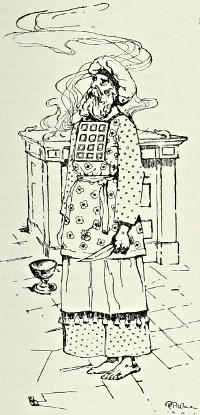
Jewish Priest and Altar
[415-332 B.C.]
We have very little information from trustworthy
sources concerning the subsequent events of the period
of Persian dominion. The list of high priests
during this interval of some two centuries is—reckoning
from father to son, with the approximate
date at which they flourished—Jeshua,
the son of Jozadak, 463; Josakim, 449; Eliashib,
the contemporary of Nehemiah, 415;
Joiada, 413; Johanan or Jonathan, 373; Jaddua,
341. Into their hands, it appears,
the direction of the commonwealth
passed by degrees, unless some other
person were appointed by the king of
Persia; the Persian governors retaining
certain prerogatives not more fully
particularised, but probably the collection
of the king’s taxes and the levy of
recruits for military service.
Generally speaking, the Jews enjoyed
humane treatment under Persian
rule, only alloyed now and again by
extortionate taxation. Bagoses, governor
under Artaxerxes II, imposed on
the country a tax of fifty drachmas
for every lamb of the daily sacrifice
for seven years, in consequence of a
quarrel between Johanan the high
priest and Joshua his brother. Concerning
a rebellion against Artaxerxes
III (Ochus, 362-338), which ended in the destruction of Jericho and the carrying
away captive of many Jews to Hyrcania, we have but vague reports.
In the north the extent of the restored state was hardly greater than that
of the former kingdom of Judah, while in the south, where Edomite tribes
had forced their way into the country, it was hardly so great. From the
dense population which appears to have dwelt in the land by the end of the
Persian supremacy, we may conclude that other immigrations had taken
place besides those recorded in the books of Ezra and Nehemiah. There
were, moreover, numerous Jewish communities, not only in the regions
about the Euphrates, but in the countries round Palestine, and even in Asia
Minor and Egypt, which remained in touch with the mother country, and
provided sacrifices and other gifts for the temple.
It is true that the hopes of the complete restoration of their former
might and independence cherished at the time of the return from captivity
had not been fulfilled. The splendid promises of the prophets withdrew
from the mean and narrow sphere of the present into an ideal and remote
future. If any expectations of political power still existed, they had to be
abandoned perforce. The pressure of the times taught and compelled the
people to turn their eyes to internal and spiritual conditions, by no means
to the detriment of the community. The period of the Babylonian exile,
comparatively short though it was, had wrought a complete change in the
religious views of the nation. The leaning towards heathen cults, which
had been so strongly manifest in earlier times, had completely disappeared;
the prophets and psalms of this date employ no weapon but ridicule against
idolatry. The sufferings they had endured, the infliction of the long-threatened
chastisement, had brought about a purification of religious feeling.
The adherents of heathen cults had withdrawn from the Jewish society in
time of oppression, and the result had been a tightening of the bond that
held them together, and a stern abhorrence of intermixture with foreigners,
born of a keen instinct of self-preservation and strengthened by the
memory of old and mournful experience. Contact with the Magian religion,
which predominated in the Persian Empire and permitted no image-worship,
may have done something towards this end; at least an acquaintance
with eastern Asiatic conceptions is evident in the writings of the prophets
of the exile (Ezekiel and Zechariah). The belief in the personal existence
of angels, and of evil spirits likewise, the doctrine of the resurrection
of the dead in the enlightened aspect of the immortality of the soul, a
greater accuracy of chronological statement, etc., are intellectual acquirements
which the Jews brought with them from exile and developed further
under the same influences.
[332-312 B.C.]
In the year 334 Alexander of Macedon entered upon that campaign of
conquest against Persia which speedily brought about the fall of the great
empire. After the battle of Issus (November 333) Syria and Phœnicia were
subjugated, Tyre alone offered a stubborn resistance, and was not taken until
August 332, after a seven months’ siege. It is said that at the beginning of
the siege Alexander called upon the high priest of Jerusalem to rebel against
Darius. But, unlike the Samaritans, who promptly brought an auxiliary
army to Alexander’s assistance, the Jews refused to renounce the allegiance
they owed to the king of Persia. In order to punish this disobedience,
Alexander marched upon Jerusalem after the fall of Tyre, which was soon
followed by that of Gaza. The high priest came to meet him at the head
of the assembled priesthood, marching in solemn procession in their sacred
vestments. At this spectacle Alexander dismounted and bowed reverently
before the venerable high priest, because—as he declared to the astonished
Parmenio—just such an august figure had once appeared to him in a dream.
He made a peaceful entry into Jerusalem, caused sacrifices to be offered for
him in the temple, and permitted the Jews to live according to their laws,
granting them, among other privileges, exemption from taxation during the
Sabbath year. Many Jews thereupon determined to enter his army.
The authenticity of this story of Alexander’s march to Jerusalem, which
is told by Josephus and the Talmud but by no Greek historian, has been
impugned with good reason.[5] The high priest in question is called Jadus
(Jaddua) by Josephus, and Simon the Just by the Talmud. Later amplifications
of these stories declare that, as a token of gratitude for Alexander’s
favour, the high priest promised him that all sons born to high priests that
year should be called Alexander. Although certain books of the Bible are
later than the dissolution of the Persian Empire, Alexander’s name is not
mentioned in any; he is only referred to under various figures in the
dreams and visions of the book of Daniel. Thus the great figure which
Nebuchadrezzar beholds in a dream, the iron thighs (Daniel ii. 32-40), the
fourth terrible beast in Daniel’s dream (vii. 7, 19), the goat coming from
the west in the following vision (viii. 5 seq.), and, lastly, the great king
(xi. 3), stand for the Macedonian kingdom or Alexander the Great.
The dissolution of the Persian Empire at first brought about no substantial
change in the political and religious condition of the Jews, and the
influences bred of the diffusion of Greek civilisation in Anterior Asia were
not felt by them till much later. But, generally speaking, the state of the
Jewish commonwealth during this period and down to the wars of the
Maccabees is wrapped in a certain amount of obscurity, since the lack of
Biblical records throws us back almost entirely on the narrative of Josephus,
who himself drew from somewhat turbid sources and did not sift his material
with sufficient care. After the rapid decline of the Macedonian kingdom
and during the conflict of Alexander’s generals among themselves, Palestine,
together with Phœnicia and Cœle-Syria, became the apple of discord between
the rulers of the Syrian and Egyptian kingdoms. Ptolemy I (Lagi
or Soter reigned until 283) seized Jerusalem in the year 320 by a sudden
attack on the Sabbath (on which day no resistance was offered) and carried
away a large number of Jews to Egypt, where some of them were sold as
slaves and some enrolled in the royal army. Ptolemy, however, did not
gain permanent possession of the country until the battle of Gaza, in 312,
after which he again marched into Jerusalem, but acted with great clemency,
so much so that many Jews of consequence migrated with him to
Egypt, one of them being a learned man of the name of Ezekias (Hizkiah).
The high priests at the time were Onias I, in 330, and his son Simon I,
in 310.
[312-204 B.C.]
With the battle of Gaza in 312 is associated, among the Jews as among
other oriental nations, the “era of the Seleucids” (also called Minjan
Shtarot—æra contractuum—and, probably, “[the years] of the rule of the
Hellenes”) which remained in use during the Middle Ages and even later.
When afterwards the era of the creation of the world also came into use
among the Jews, most Jewish chronologists, in order to reduce the two to a
common standard, assumed that the era of the Seleucids had begun in the
year 3448 after the creation of the world, and one thousand after the coming
forth out of Egypt. They accordingly reduced any given date of the
Seleucid era to the corresponding date after the creation of the world by
adding 3447 to it, and to the corresponding date of the Christian era (with
precision only for the first nine months of the year, as the Seleucid year begins
in autumn) by deducting the Seleucid date from 312 to find the year B.C.,
or deducting 312 from it to find the year A.D. Asarja de’ Rossi, in the
twenty-third chapter of Meor Enajim, enlarges upon the error of Jewish
chronologists, who identify the beginning of the Seleucid era with the
beginning of Greek dominion in Asia.
For more than a century Judea remained under the rule of the Greek
kings of Egypt, and on the whole enjoyed, with slight interruptions, a
period of happy tranquillity and benevolent treatment. The relation of the
kings of Egypt to the country cannot have been widely different from that
of the kings of Persia, the commonwealth was represented abroad by the
high priest, whose first business it was to see to the levying of the taxes.
After Simon I, mentioned above, the office was held by his brother Eleazar
(his son Onias being too young), who was succeeded by his uncle Manasseh
(276), and then by Onias II (250).
An old tradition associates with the name of the second Ptolemy (Philadelphus)
the origin of a literary undertaking in some respects unique in the
literature of antiquity, the translation of the Holy Scriptures into the Greek
language.
The high priest, Onias II, mentioned above, who is depicted as a morose
and avaricious man, brought down upon himself the wrath of Ptolemy III,
surnamed Euergetes, his Egyptian suzerain, by refusing to pay the annual
tribute of twenty talents, and would have involved his country in a great
calamity had not Joseph ben Tobiah, his sister’s son, stepped into the breach.
With his uncle’s permission he undertook to go as ambassador to the Egyptian
court, where by wise liberality he contrived first to win the favour of
the courtiers, and then of the king himself. At the farming out of the
taxes of Cœle-Syria, Phœnicia, and Judea, for which purpose many nobles
from those countries had come to the Egyptian court, Joseph, without more
ado, offered twice as much as any of them, and, being provided by the king
with adequate forces, was able by well-directed severity not only to levy the
sum agreed upon but to gain great wealth and reputation for himself. For
two and twenty years he filled the office of tax-farmer for the whole region
known as Syria.
Josephus relates with great satisfaction that Ptolemy Euergetes, passing
through Jerusalem on his way back from a victorious struggle with Seleucus
Callinicus, king of Syria (245) offered sacrifices in the temple and bestowed
great gifts on it; but Judea had nevertheless suffered from the perpetual
friction between Egypt and Syria. She also endured many evils at the
hands of the Samaritans under the administration of Onias.
These quarrels between the two great kingdoms between which Judea
was wedged, did not cease in the reign of the fourth Ptolemy (Philopator,
221-204). Antiochus (the Great) of Syria had occupied Galilee and the
land east of Jordan when Philopator took the field against him, defeated
him at Raphia, and forced him to conclude peace. Among those who congratulated
Philopator on this victory were ambassadors from the Jews,
whom he received graciously, and desired to show his favour towards them
by coming to Jerusalem and sacrificing in the temple. On this occasion he
was inspired with a wish to enter the Holy of Holies, nor would he be
restrained by the urgent remonstrances of the priests and the tumult of the
whole city. But as he was about to set his foot within the hallowed
space he was seized with sudden faintness and had to be carried away
senseless.
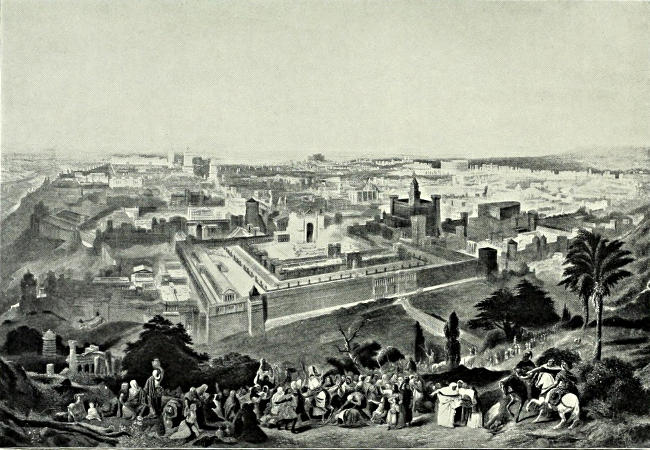
ANCIENT JERUSALEM (A RESTORATION)
Thirsting for vengeance, he departed, and promulgated harsh measures
against the Jews, and, when they did not produce the effect he anticipated,
he collected all the Jews in Egypt together on his return home, and shut
them up in a circus, where they were to be trodden to death by elephants
excited by intoxicating liquors for the purpose. At the decisive moment,
however, the elephants turned against their drivers and wrought hideous
havoc among the assembled crowds of Egyptians. This cruel act of Philopator
and the miraculous deliverance of the Jews forms the subject of the
third Book of the Maccabees and lacks historic confirmation. According to
Josephus, the event took place in the reign of Ptolemy Physcon (146-117),
the motive being revenge because the Jews had supported the claims of
Cleopatra, widow of Ptolemy Philometor.
[204-200 B.C.]
After the death of Philopator (204), and the accession of his son, a child
of five, Antiochus succeeded in conquering Palestine, and it never again fell
under the sway of Egypt.
Onias II was succeeded by his son, Simon II, who proved more worthy
of his high office than his father had been. It is on this Simon that the
name of “the Just” (ha-Zaddik) was bestowed, and in the Mishnah he is
styled one of the last of the men of the Great Assembly. His motto as
there given, “The world rests upon three things, doctrine, the service of
God, and benevolence,” is in sharp contrast to the views that dominated the
world in his day, and is characteristic of the aspirations of the spiritual
leaders of the time. The list of the Tannaïm (teachers of the Mishnah)
usually opens with his name. Joshua ben Sirach, a younger contemporary
of his, lavishes encomiums on him, and he has been glorified even more
by later legend. He embellished and fortified the temple, constructed
aqueducts, and rebuilt the walls of Jerusalem which Ptolemy Lagi had
broken down and left in a state of demolition. The means for this
expenditure were promptly and liberally supplied by the numerous and
valuable gifts and contributions which were bestowed on the temple from
all quarters, and not by Jews only; and which served likewise to attract
the envy and covetousness of many foreign rulers. Onias III, the son
and successor of Simon the Just, filled the office of high priest no less
worthily.
The labours of the Sofrim seem to have been unaffected by any of these
political events; the storm which raged throughout the whole of Anterior
Asia after the death of Alexander had only made the Jews, who had no
political power whatever, devote themselves the more diligently to the consolidation
of their religious inheritance, and in this occupation they found
compensation for the loss of external splendour and constancy at the approach
of their enemies. The 119th Psalm, that “hundred-fold echo of the excellence
and needfulness of the Law,” is typical of this spirit. The completion
of the Book of Psalms and the composition of Chronicles, and the Book
of Esther must be assigned to the first century of Greek dominion, i.e. to
about 200 B.C. The language of these books leads us to infer a flagging
of the primitive spirit of Jewish nationality; as a result of close intercourse
with Syria, Aramaic gained ground, especially as the speech of the
common people.
[300-187 B.C.]
On the disintegration of the Macedonian Empire, Syria fell first to
Antigonus, and then (after the battle of Ipsus in 301) to Seleucus I, surnamed
Nicator, who was assassinated in 281. His successors were—his
son, Antiochus I, surnamed Soter (281-261), Antiochus II, surnamed Theos
(261-247), Seleucus II, surnamed Callinicus (246-227), Seleucus III, surnamed
Ceraunus (227-224), then the brother of the last-named monarch,
Antiochus III, surnamed the Great (224-187), Seleucus IV, surnamed Philopator
(187-176), Antiochus IV, surnamed Epiphanes (175-163). The son of
Antiochus IV, Antiochus Eupator, who was only thirteen years of age at
the time of his father’s death, was assassinated, together with his guardian,
Lysias, by Demetrius, the son of his father’s brother Seleucus, in the year 161.
The Greek language and literature, Greek ideas and habits, which had
been making an abiding conquest of Anterior Asia since the days of Alexander
the Great, had not failed to make their influence felt at length by the
Jews. First, indeed, by those who lived away from Judea, remote from the
centre of Jewish thought and Jewish life. We have already seen how, as a
result of these conditions, the need of a Greek translation of the sacred books
arose among the Egyptian Jews; to what kind of literature this translation
itself gave rise we shall presently show. But while in Egypt, Asia Minor,
and elsewhere, the Jewish and Greek spirit contrived to establish some sort
of accord, a very different state of things prevailed in Palestine. Here the
contrast of the Jewish and Greek conceptions of the universe was manifest
in its full strength and bitterness. In Judea, in place of the conditions which
had facilitated reciprocal approximation and partial amalgamation in Egypt,
such as a preponderant Greek majority, brisk intercourse in civil life, and
general culture on the part of the Jews, the situation was reversed. Jerusalem
was the original seat of Jewish life, which constantly derived fresh
strength from perpetual and minute study of the national scriptures and
zealous practice of the divine precepts. This life, grave, strict, based on the
inviolable ground of morality, tending always towards austerity and self-sacrifice,
contrasted vividly with the blithe and sensuous mode of life of the
Greeks, with its ready enjoyment of the moment and what it offered. The
clear intellect of the Jewish thinker plainly perceived that this alluring
existence hid the most shameful vices under an artificial veil.
The relations of the Syrian Empire with the Jews were at first of an
amicable character. Seleucus Nicator had given Jews equal privileges with
Macedonians and Greeks in the cities he founded in Asia Minor and Syria
and in Antioch itself, and his example was followed by his grandson
Antiochus Theos. After the death of Ptolemy Philopator the Jews gave a
cordial welcome to Antiochus the Great, who had defeated Scopas, the Egyptian
general, and Antiochus readily acknowledged their good will. He
helped them to repair the damage done by the war, gave liberal gifts in
money and natural objects for the service of the temple, permitted and
advanced the completion of the temple buildings begun before his time, and
granted the members of the senate, the priests, and other temple officers
entire immunity from taxation. To increase the population of the capital,
he granted exemption from taxation for three years to its inhabitants and
to any who would remove thither within a fixed period, and remission of one-third
of the taxes after that; any who were sold as slaves were to have their
liberty and property restored. He gave evidence of the great confidence he
reposed in the loyalty of the Jews by transplanting two thousand of them
from Mesopotamia and Babylonia to the provinces of Lydia and Phrygia,
which were on the verge of rebellion, and granting them fields and vineyards,
together with ten years exemption from taxation. He also guaranteed to
all Jews within his empire, without restriction, the right of living according
to the law of their forefathers.
[187-175 B.C.]
Seleucus IV, surnamed Philopator, the son and successor of Antiochus
the Great, was a man of humane and pacific temper, and yet during his reign
a cloud, the presage of the storm that was so soon to burst, gathered over
Judea. The Syrian court was constantly involved in great financial straits
because of the contribution which had yet to be paid to the Romans. Under
these circumstances Simon, the overseer of the temple, who had had a quarrel
with the high priest, drew the attention of Apollonius, commander of the
Syrian forces in Cœle-Syria, to the riches of the temple treasury. The hint
was eagerly taken, and Seleucus despatched his servant Heliodorus with
orders to inspect the temple treasury. In vain did the pious and conscientious
Onias expostulate with him, in vain did he protest that a great part of
the treasure consisted of deposits made by widows and orphans, and that
the sum total amounted to no more than four hundred talents of silver and
two hundred talents of gold. Heliodorus was obstinate; but was prevented
by a supernatural appearance, when he was actually within the treasury,
from carrying his sacrilegious purpose into effect. It seemed to him that a
gorgeously clad horseman trampled him under foot, while at the same time
two youths appeared, glorious to behold, and scourged him unremittingly,
so that he was carried thence in a swoon. The intercessions and expiatory
sacrifices of the high priest restored him to life, and nothing would induce
him to repeat the attempt. Onias himself repaired to the court of Seleucus
to defend himself against the charges brought by his violent adversary
Simon, with what result is uncertain. Seleucus was soon afterwards poisoned
by this same Heliodorus, but the latter’s purpose of placing himself on the
throne was frustrated.
[175 B.C.]
On hearing the news of the death of Seleucus, his brother Antiochus,
surnamed Epiphanes, who was in Rome at the time as a hostage, hastened
home and assumed the reins of government. He is the Antiochus who won
a melancholy celebrity in the annals of the Jews, and gave occasion for a
glorious episode in their history, which ended with the attainment of political
independence. Nevertheless, the imputations cast upon his character
are to some extent baseless or exaggerated. In spite of the luxurious and
licentious life he led, he was not worse than the majority of Syrian and
Egyptian monarchs of the period. He was good-natured and liberal, though
accessible to the arts of flatterers and evil counsellors, and irritable under the
restraints imposed upon him by the Romans. Ancient Greece was incapable
of comprehending the existence of religious conviction or the capacity for
making such sacrifices on its behalf as were made by the Jews; to Antiochus
the question was merely that of reducing rebellious subjects to submission,
the rather because certain of them compelled him to have recourse to
measures of ever-increasing severity.
The first seed of the growing complications was sown by the Jews themselves.
Soon after the accession of Antiochus, Joshua (Greek Jason) the
brother of the high priest, visited him and purchased the office of high priest
for a large annual payment, Onias being compelled to retire into private life.
Jason took advantage of his exalted position to introduce Greek customs into
Jerusalem, and among other things instituted a gymnasium (a place for the
practice of physical exercises). A large number of the priests took great
pleasure in it, so much so that the regularity of the temple services suffered;
while to the devout it seemed an abomination and a desecration of the holy
city. Hand in hand with these practices went the violation of the precepts
for the regulation of Jewish life, and among other things the artificial
obliteration of the traces of circumcision.
Meanwhile the friendly relations between Egypt and Syria had once
more been disturbed by the refusal of Antiochus to give up Cœle-Syria,
which his father had promised as the dowry of Cleopatra on her marriage
with Ptolemy Philopator. In a progress which he made through his western
dominions while war with Egypt was impending, Antiochus came to Jerusalem,
where he met with a magnificent reception, and made his entry by
torchlight amid the joyful acclamations of the people.b
There was a sharp contrast between the welcome of his entry and the
mood imposed by his stay. Under Antiochus Epiphanes the Jews suffered
such outrages as finally steeled even their unwarlike hearts to battle. The
character and cruelties of Antiochus deserve some further detail, as do also
the deeds of his native lieutenant, who tormented the conservative Jewish
conscience more exquisitely perhaps than the foreign master; for to the
people Jason was a renegade who began his Hellenising, it was said, on his
own name, which was originally Joshua or Jesus. In the following account
of Antiochus’ conduct towards the Jews, George Smith does not take so
kindly a view of the Syrian king as has been given above.a
[175-170 B.C.]
Antiochus Epiphanes was mean in his spirit, low in his habits, covetous
in disposition, and exceedingly cruel in temper. The evil tendency of his
bad character was, however, rather elicited by the corrupt state of Jewish
morals, than voluntarily directed against this people. But the result was
terrible beyond description. Soon after his accession, Jason, the brother of
the high priest, proceeded to the king at Antioch, and offered a great increase
of tribute, if he would appoint him high priest, and confine his deposed
brother Onias in his capital. The necessities of the king, occasioned by the
great tribute which he had to pay to Rome, acting upon an unprincipled and
covetous mind, induced him to yield a ready compliance with this infamous
proposal. The pious and venerable Onias therefore was forthwith deposed
and banished, and Jason invested with the high-priesthood.
Finding how availing money was with the young monarch, Jason gave a
further sum for liberty to erect a gymnasium at Jerusalem, for the celebration
of Grecian games in the holy city; and to build an academy for teaching
youth the sciences, after the manner of Greece; and for power to make such
Jews as he thought fit free of the city of Antioch. The effect of these
licenses tended to strengthen the party of the usurper, and at the same time
to inflict a terrible blow on the great cause of Jewish nationality and religion.
The academies were erected, and Grecian learning cultivated. His gymnasium
was so much frequented, that priests neglected their duties at the altar
to contend in the games. As these exercises were performed naked, it
induced a general desire to avoid the distinguishing mark of Judaism.
“The only avowed purpose of these athletic exercises was the strengthening
of the body; but the real design went to the gradual changing of Judaism
for Heathenism, as was clearly indicated by the pains which many took to
efface the mark of circumcision. The games, besides, were closely connected
with idolatry; for they were generally celebrated in honour of some pagan
god. The innovations of Jason were therefore extremely odious to the more
pious part of the nation, and even his own adherents did not enter fully into
all his views.”
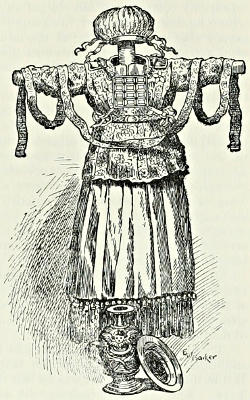
Robes of the High Priest
So extensively did this impious priest carry out his irreligious and denationalising
plans, that he actually sent Jews to contend in the games which
were celebrated at Tyre before Antiochus, although they were avowedly in
honour of Hercules; transmitting
by them, at the same time, a large
sum to be presented as a votive
offering to the god. The persons
entrusted with the present had, however,
so much more sound principle
than their master, that they presented
the money to the Tyrians for
building ships of war.
About this time Antiochus, aware
that the king of Egypt intended to
attempt the recovery of Judea and
Phœnicia, in making a tour of these
provinces, went to Jerusalem, where
he was received by Jason with great
splendour.
This apostate high priest had
now laboured for three years to destroy
the Jewish constitution and
religion, when he found himself the
victim of villainy similar to that
which he had himself practised.
It being the time to remit the annual
tribute to Antioch, he sent it
by the hand of his younger brother,
Onias, who, carrying out in his own
case the prevailing desire to merge
all Hebrew distinctions in an accommodation
to Greek customs and
manners, had taken the name of
Menelaus. This person, in his intercourse with the Syrian king, instead of
discussing those subjects with which he had been charged by his brother,
availed himself of every opportunity of insinuating himself into the good
graces of the king; and having to some extent succeeded, he ventured
to bid a much larger sum than Jason had paid as tribute, and was accordingly
invested with the high-priesthood. Thus did the unworthy descendants
of Israel barter away the interests of their country; and, instead of
uniting their energies to make Judea strong and respectable in the eyes
of surrounding states, they looked at nothing but the gratification of their
own low and sordid passions.
Menelaus returned to Jerusalem with his commission, where, as he was
supported by the powerful sons of Tobias, he soon found himself at the head
of a formidable party. But, notwithstanding this, Jason had sufficient
strength to resist his pretensions; and the people being disgusted with his
infamous treachery, he was obliged to return to Antioch. Here, the further
to commend himself to the favour of the king, he and his friends
solemnly abjured the Jewish religion, and engaged to bring the whole
Hebrew people to take the same course, and to assimilate their manners and
institutions in all respects to the model of the Greeks. On making these
promises, he obtained a military force, which being unable to resist, Jason
fled to the country of the Ammonites, leaving to the still more apostate
Menelaus the government of Jerusalem. He proceeded to carry out his
engagement with the imperial court in all but one particular—he neglected
to send the tribute which he had promised to pay. After having been
repeatedly reminded of his obligation in vain, he was summoned to Antioch,
where he soon found that the amount must at once be paid; but the temporary
absence of the king at the moment of his arrival gave him time to
send orders back to Lysimachus, his deputy at Jerusalem, to abstract as
many of the golden vessels from the temple as would suffice to raise the
money. By these means he realised enough to pay his debt, and, besides,
to make large presents to Andronicus, to whom Antiochus had entrusted the
direction of affairs in his absence. But this fact coming to the knowledge
of Onias, the deposed high priest, who resided in exile at Antioch, he complained
so severely of this conduct, that an insurrection of the Jews residing
in the capital was seriously apprehended, in consequence of their anger
against Menelaus. At his instance, therefore, Andronicus murdered the pious
ex-high-priest under circumstances of the greatest baseness and atrocity.
This sacrilegious conduct was equally fruitful of mischief at Jerusalem; for
although Lysimachus had three thousand men under his command, so
enraged were the populace when they heard what had been done, that they
attacked him and his guards, and, having slain many, pursued him into the
temple, where he was destroyed.
[170 B.C.]
On the return of Antiochus to Antioch, he was informed of the death of
Onias by the hand of Andronicus; and, wicked as he was, he was so affected
at the enormity of this crime, that he ordered that officer to be taken to the
spot where he had committed the murder, and there to suffer the penalty
of death.
These collisions and murders had brought Jerusalem into great trouble
and difficulty, and rendered the rule of Menelaus hateful to the people.
While the Jewish capital was in this distracted condition, Antiochus visited
Tyre. The Jewish sanhedrim took advantage of the proximity of the king
to Jerusalem to send three persons thither, for the purpose of explaining
the unhappy circumstances of the Jewish people, and of showing that this
was attributable to the conduct of the high priest. They acquitted themselves
so well in this duty, that Menelaus, unable to defend himself, had
recourse to his usual weapon, bribery: by this means he gained over the
king’s favourite, Ptolemy Macron, who not only induced the monarch to
acquit the high priest, but also to put the deputies to death.
This afforded Menelaus a complete victory; so he henceforth proceeded
on in his career of impiety and cruelty, unchecked by inward principle or
external power. During this time, while Antiochus was engaged in an
expedition to Egypt, on a report being spread that he was killed before
Alexandria, Jason, who had been long sheltered among the Ammonites,
suddenly appeared before Jerusalem with a band of one thousand resolute
men. With this force, by the aid of his friends within the city, he easily
obtained admission, and forced Menelaus to retire into the citadel. Being
thus in possession of the metropolis, he vented his rage against all those
whom he suspected to belong to the party of his brother: this led to the
most shocking barbarity, which, however, was soon terminated by the
approach of Antiochus.
[170-167 B.C.]
The king, having invaded Egypt with every encouragement and prospect
of success, was suddenly arrested in his progress by the presence of
Roman ambassadors, who insisted on his immediate retreat, on pain of being
declared an enemy to Rome. Not daring to meet the arms of the republic,
he sullenly relinquished his prey; and, returning, heard that the Jews had
rejoiced at the rumour respecting his death, and were now in a state of
insurrection against his authority: he therefore marched directly to Jerusalem.
The Jews, aware of his wrath, closed their gates, and defended their
city with great vigour; but in vain; they could not resist his army: Jerusalem
was taken by storm, and subjected to the most horrid barbarities.
The carnage lasted for three days; and it is said forty thousand persons
were killed, and an equal number taken for captives and sold as slaves into
the neighbouring countries. Elated with his success, he caused Menelaus
the high priest to lead him into the temple, even into the most holy place.
Here he defiled the sacred vessels, and removed all the gold, valuables, and
treasure which had been laid up there, even to the vail of the sanctuary.
By these means he obtained one thousand eight hundred talents of gold and
silver, besides the gold and vessels which he took from the temple; and with
this booty he marched in triumph to Antioch. And as if this butchery and
robbery was not a sufficient infliction on the unhappy Jews, he confirmed
Menelaus in the high-priesthood, and appointed one Philip, a Phrygian, a
most barbarous man, to be governor of the country.
These measures were the commencement of a regular system of tyranny
and slaughter. After two years from the spoiling of the temple by Antiochus,
he sent Apollonius to Jerusalem, with an army of twenty-two thousand
men. He came in a peaceable way, and took up his quarters in the city,
until the first Sabbath day, when he sallied out with his troops, ordering
them to massacre the men, and make captives of all the women and children.
This cruel and unexpected attack on an unarmed population, amid the
sanctities of the Sabbath, filled Jerusalem with blood, and was followed by
universal rapine; the houses were plundered and demolished, the walls of
the city broken down, and a castle built on Mount Zion, which commanded
the entrance of the temple; by which means Apollonius obtained entire
control over the celebration of worship.
These preparations appear to have been made with the design of carrying
out a preconceived purpose of the king. Soon afterwards an edict was published
at Antioch, and proclaimed in all the provinces of Syria, commanding
the people, throughout the whole empire, to worship the gods of the king,
and to acknowledge no religion but his. An old Greek was sent to Judea
to enforce this law. Henceforth all the services of the temple were prohibited;
circumcision, the keeping of the Sabbath, and every observance of
the law, were now made capital offences; all the copies of the sacred books
that could be found were destroyed. Idolatrous altars were erected in every
city, and the people were commanded to offer sacrifices to the gods, and to
eat swine’s flesh every month on the birthday of the king. The temple at
Jerusalem was altered and profaned, in accordance with this infamous policy.
The sacred building was dedicated to Jupiter Olympus; an image of this
heathen deity set up; and, on the altar of Jehovah, another smaller one
was erected, on which to sacrifice to Jupiter.
The Jews had never before been subjected to a persecution so directly
levelled against all their institutions, and enforced with such diligent and
persevering malignity. The execution of these laws was as execrable as
their object. Two women, having circumcised their infants with their own
hands, being detected, were led through the streets of Jerusalem, with their
infants hung about their necks, and then cast from the highest part of the
walls of the city, and dashed to pieces. On another occasion a thousand
men, women, and children were discovered secretly observing the Sabbath
in a cave, and all barbarously put to death by the inhuman Philip.
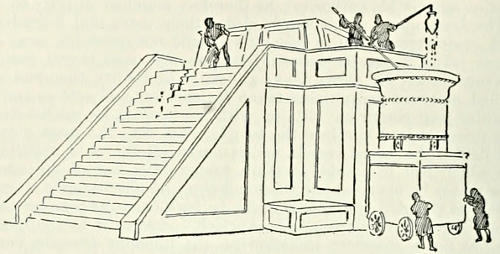
Great Jewish Altar for making Sacrifices
Antiochus was enraged to find that so many of the Jews resisted his
will; and his wrath was perhaps rendered more intense because the Samaritans
had readily submitted to his edict, and allowed their temple to be dedicated
to Jupiter Xenios, or, “the protector of strangers.” He therefore
came in person to Jerusalem, to enforce the law, or extirpate the people.
His first victim was Eleazar, a very aged scribe, who, when commanded to
eat swine’s flesh, positively refused, and, although ninety years of age, upheld
the religion of his God with sterling energy; and, at last, exhorting
others to follow his example, died under the lash of the tyrant. A mother
and her seven sons, all grown up, acted in the same heroic manner. The
young men, refusing to transgress the law, were subjected, in succession, to
the most horrid tortures, until every one of them, and, lastly, the mother
also, died martyrs for the cause of truth and righteousness.
[167-166 B.C.]
These atrocities produced the results which always follow such deeds,
where any manly spirit or nobility of soul remains. Men who had a conscientious
regard for the law of their God and the religion of their fathers,
and whose minds were not so debased by slavery as to have lost every noble
attribute of human nature, would prefer dying in a patriotic resistance to
such tyranny, rather than to perish tamely under the power of the tyrant.
The man who first dared to adopt this course was an aged priest, named
Mattathias, the father of five sons, all distinguished for bodily strength and
nobility of mind. When the king’s officers came to the city of Modin,
where this family resided, to make the Jews sacrifice to the heathen gods,
they invited Mattathias to bring his sons and brethren first to the sacrifice,
that the influence of his character and office, as a ruler, might induce others
to follow his example; that he might thus be regarded as one of “the
king’s friends.” The aged priest indignantly refused compliance, protesting
that, if himself and his sons stood alone, they would adhere to the law and
ordinances of God. While he was thus declaring his determination, he saw
one of the apostate Jews come forth to the altar to offer sacrifice. This
flagrant act roused the spirit of the priest: inflamed with zeal, he ran
towards the culprit, and, in the sight of all the people, inflicted on him the
punishment which the law denounced against idolatry—he slew him upon
the altar. He also killed the king’s commissioner, who had been sent to
compel the people to sacrifice, and pulled down the altar; then, running
through the city, crying, with a loud voice, “Whosoever is zealous of the
law, and maintaineth the covenant, let him follow me,” he, with his sons,
abandoned all the property they had in the city, and went out into the
wilderness. They were quickly followed by many others; and, as soon as it
was noised abroad, great numbers crowded to their retreat, until Mattathias
found himself at the head of a considerable body of men.
Having placed himself and his friends in this position, the venerable
priest addressed himself to the arduous duty which he had undertaken with
becoming gravity and zeal. The first point which appears to have engaged
his attention was, the proper line of conduct which they were bound to
pursue with respect to the Sabbath. Hitherto the Jews had always regarded
themselves as under a religious obligation to avoid all warlike operations
on that holy day. To such an extent had this been carried, that they
would not defend themselves, even when attacked. Their heathen foes,
therefore, generally selected the sacred day for their assaults, that they
might secure their object without resistance. But Mattathias, having considered
the subject with his friends, and consulted such learned scribes as
he had access to, decided that, although it was not right to provoke a combat
on the Sabbath day, it was, nevertheless, their duty, if attacked on that day,
to defend themselves, and resist the aggression. This was a most important
decision, and had a mighty influence upon the results of the ensuing war.
The general course of proceeding adopted by the aged chief seems, also,
to merit particular attention. He did not shrink from engaging any of the
Syrian forces that came in his way; but his principal object, or, at least, his
immediate design, does not appear to have been the expulsion of the Syrians.
As a patriotic soldier, this might have been expected; but as a patriotic
priest, he thought it wiser to act differently. He appears to have viewed
the humbled and prostrate condition of Israel as the result of the infidelity
of the people; and therefore directed his energies to the restoration of the
Jewish faith. With this object he marched from town to town, destroying
all idolatrous altars, punishing with death, or driving into other lands, those
that had apostatised from the faith, recovering the sacred books which had
been concealed, and restoring again the law, the worship, and the authority
of Jehovah. In these efforts he was eminently successful. Those who had
not been circumcised submitted to that rite; and not only was the religious
aspect of the country soon greatly improved, but some important advantages
were gained over the enemy. When the venerable Mattathias found his end
approaching, he exhorted his sons to devote their lives to the holy cause in
which they had been engaged, reminding them of the noblest examples in Hebrew
history. He then advised them to regard their brother Simon as their
counsellor, on account of his wisdom; and Judas he appointed the captain,
because of his strength and bravery: him he surnamed Maccabeus, or, “the
hammerer.”[6] Thus Mattathias blessed his sons, and died in a good old age.
[166 B.C.]
On the death of his father, Judas took the command of the band which
had been gathered together, about six thousand men (2 Maccabees viii. 1);
and, as soon as the days of mourning had expired, proceeded to carry on the
war. This may be called the war of Jewish independence. From the time
of their return from captivity the Jews had been always in entire subjection
to Gentile powers. At first they were a part of the Persian Empire; they
then passed under the dominion of Alexander; on the division of his kingdom
they were subjected to Egypt; and, lastly, had been attached to the
Greek kingdom of Syria. Nor is it probable that the Jews would have
made any vigorous efforts to obtain freedom and self-government, if they
had been ruled with tolerance and moderation. But the boundless cruelty
and insane impiety of Antiochus were too much for endurance, by men of
such energy and intellect as the Jews. Besides, the time was peculiarly
appropriate for such an attempt. The disjointed fragments of the Macedo-Grecian
Empire were becoming daily more feeble and disorganised; while
the mighty power of Rome was steadily advancing, giving constant evidence
of her great purpose and destiny—to govern the world. It was, therefore,
the manifest policy of Rome to encourage, rather than to suppress, efforts
made by states, subject to the kingdoms of Syria and Egypt, for the purpose
of obtaining independence. Under such circumstances Judas commenced
his martial career.g
Sepulchre at Siloam, the so-called Monolith
[166-165 B.C.]
The Hebrews had not only their Exodus but also their War
of Independence. Their Garibaldi bore the name of Judas, from
which his memory should take some of the stain. To this name
was added the epithet of “Hammer” or “Maccabæus.”
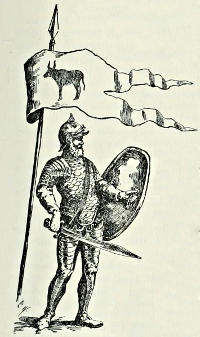
Hebrew Warrior
(After Bardon)
The ancient Hebrew valour was at last aroused from
its deathlike slumber. Those Jews who
would rather endure wrong from man
than do wrong in the sight of God, were
not all willing nor in the long run able
to maintain an attitude of patient suffering.
They saw that war was not always
one-sided, and that when their escape
was cut off they must at last be brought by despair
to defend themselves. So the sluggish mass
gradually became thoroughly leavened, until even
cowards took heart, and the national spirit was
stirred to its very depths.
This was not to be a war for independence,
distorted by priests into a war of faith; but Israel
from the start was fighting for its religion, the
root of its national existence. This origin of the
war ennobled it also in its continuation, when it
aimed at and gained political freedom.
The beginning of resistance to the oppression of conscience,
the first active opposition to violence, was made
by Mattathias, a priest who, to avoid unreasonable demands
and persecution, had retired to his birthplace,
Modin. But hither came also the servants of the king.
When commanded to sacrifice to the heathen gods and
thus set a good example to others, Mattathias steadfastly
refused. When a Jew prepared to make such a sacrifice before his eyes,
he struck him down at the altar, and also slew the Syrian captain. Then
he escaped to the mountains with his five sons and his followers. His
flight was the signal for many orthodox families to flee to the desert and
take up their abode in the caverns of the mountains.
An armed force was sent out against them from Jerusalem. As they
would not lift their hands in self-defence on the Sabbath, about one thousand,
including women and children, were slaughtered. Then Mattathias
took counsel with his followers, and it was decided that henceforth, though
they would themselves make no attack on the Sabbath, they would nevertheless,
if attacked, defend themselves. As the forces of Mattathias grew,
raids were undertaken in all directions, altars were overthrown, newborn
boys were circumcised, and apostates and heathen without distinction were
punished with the sword.
Within a year Mattathias died (166 B.C.), leaving the leadership to his
third son Judas, with his elder brother Simon as adviser.
The conduct of the war could not but gain in rapidity and reckless determination
under Judas, who was a man of great personal bravery and had
already shown great qualities of leadership. He was very skilful in choosing
time and place of battle. He made much use of the night for sudden
surprises, setting fire to the enemy’s camp and intimidating the masses of
the Syrians. His surname Maqqabi, “the hammer,” was long afterwards
applied to the whole family, who at this time were called Asmonæans. Their
party called themselves Assideans or Chasidees (the pious).
Apollonius was sent against Judas with a large force, among them auxiliaries
from Samaria, which had made peace with Antiochus. He was probably
over-confident of his superiority and advanced incautiously, for he was
defeated and killed. Judas gained a second victory immediately afterwards.
Seron, commander of the Syrian militia, thinking he saw an opportunity to
gain honour by suppression of the rebellion, now marched against Judas.
Near the pass of Beth-horon he was suddenly attacked on the march by Judas.
As he was unable to manage his forces properly they became disordered,
were driven down the mountain-side, and fled with great loss to Philistia.
Such tidings from Judea were not calculated to put the king in a good
humour, especially as the whole affair came at a most inopportune time for
him. An instalment of his war debt to Rome was due; but his treasury
had been exhausted by the equipment of his great army, and his income was
inadequate, owing to the difficulty of collecting taxes in the remote provinces
of the east and to the disruption he had rashly provoked among the
Jews. So with half of his army he set out for Persia to collect tribute and
raise money by any means possible. The rest of the army was left in command
of Lysias, who received peremptory orders to make an end of the
Jews, bring foreign settlers into the country, and divide the lands among
them by lot. (166 B.C.)
Since the defeat of Seron there had been no force in Judea able to cope
with Judas’ little army of six thousand men, and he had remained undisputed
master of the country. Philip, the governor, finding himself confined in
Jerusalem under the protection of the garrison of the citadel, appealed in
distress to Ptolemæus, governor of Cœle-Syria and Phœnicia. The latter
perhaps at the same time received orders from Lysias. He sent out an army
under Nicanor and Gorgias, which was augmented by Syrian and Philistine
militia to a strength of perhaps twenty thousand men. Nicanor, confident
of victory, had proclaimed in the coast cities that he would sell Jewish
slaves at one talent each; so there were many traders with money and
chains in the train of the army which encamped at Emmaus, fifteen Roman
miles from Jerusalem.
Judas and his followers saw that there would be a decisive battle. Unable
to implore divine help in the temple at Jerusalem, they assembled in an old
sanctuary at Mizpah, fulfilled their religious duties as far as possible, and
opening the “Book of the Law” for a prophecy, obtained the watchword
“Eleazar,” “God hath stood by.” Judas organised his army and purged it
of its weak elements in accordance with the Law, his force being thus reduced
to only about three thousand men.
Meanwhile the enemy had approached the foot of the mountain south of
Emmaus. Gorgias set out by night with foot and horse to surprise Judas.
But the latter got news of the movement, and Gorgias found the camp
empty. At daybreak Judas stood face to face with the main army, now
weakened by the absence of Gorgias’ division. Without hesitation he began
the attack. The Syrians were utterly defeated, and driven to the south and
west. When Gorgias returned, he saw the camp burning from afar, and the
Jews, whom their leader had forbidden premature plundering, drawn up in
battle array against him. At this sight, the courage of his men deserted
them, and they took to flight. The Syrian general hastened directly across
country to Antioch to report the wretched outcome of the campaign. The
Jews, returning from pursuit, found immeasurable booty in the enemy’s
camp.
For this year the war was at an end. In the following year (165 B.C.),
however, Lysias himself, at the head of a much greater force, crossed to the
east of Jordan, and marched around the Dead Sea into Idumæa, in order to
attack and crush his opponent from the rear. But on the boundary near
Bethzur he found his way barred by Judas with an army of ten thousand
men. The resistance offered by the Jews was so stubborn that Lysias was
obliged to give up the whole undertaking as hopeless. He set out on his
return to Antioch, with the intention of raising a still larger army and
again trying his luck. He took the same route by which he had come.
Judas, following closely, and harassing him continually, was victorious in a
number of battles, and after taking the city of Jaser returned to Judea.
Judas now proceeded with all his forces to Jerusalem, in order to restore
the temple and the orthodox worship of God. The garrison in the citadel
was harassed and worried by incessant attacks. All traces of heathen worship
were wiped out, the great altar was rebuilt with new stones, and new
sacred vessels were procured. On the anniversary of the day when, three
years before, the altar had first been desecrated by heathen sacrifice, the first
orthodox worship was held again as the beginning of an eight days’ dedication
festival.b
This ceremonial has been enthusiastically described by the patriotic
Josephus: “When, therefore, the generals of Antiochus’ armies had been
beaten so often, Judas assembled the people together, and told them that
after these many victories which God had given them, they ought to go up
to Jerusalem, and purify the temple, and offer the appointed sacrifices. But
as soon as he, with the whole multitude, was come to Jerusalem, and found
the temple deserted, and its gates burnt down, and plants growing in the
temple of their own accord, on account of its desertion, he and those that
were with him began to lament, and were quite confounded at the sight of
the temple; so he chose out some of his soldiers, and gave them order to
fight against those guards that were in the citadel, until he should have
purified the temple. When therefore he had carefully purged it, and had
brought in new vessels, the candlestick, the table (of shew-bread), and the
altar (of incense), which were made of gold, he hung up the veils at the
gates, and added doors to them. He also took down the altar (of burnt-offering),
and built a new one of stones that he gathered together, and
not of such as were hewn with iron tools. So on the five and twentieth day
of the month Kislev, which the Macedonians call Apelleus, they lighted the
lamps that were on the candlestick, and offered incense upon the altar (of
incense), and laid the loaves upon the table (of shew-bread), and offered
burnt-offerings upon the new altar (of burnt-offering). Now it so fell out,
that these things were done on the very same day on which their divine
worship had fallen off, and was reduced to a profane and common use, after
three years’ time; for so it was, that the temple was made desolate by
Antiochus, and so continued for three years. This desolation happened
to the temple in the hundred forty and fifth year, on the twenty-fifth day
of the month Apelleus, and on the hundred and fifty-third olympiad: but it
was dedicated anew, on the same day, the twenty-fifth of the month Apelleus,
in the hundred and forty-eighth year, and on the hundred and fifty-fourth
olympiad. And this desolation came to pass according to the prophecy of
Daniel, which was given four hundred and eight years before; for he declared
that the Macedonians would dissolve that worship (for some time).
[165-164 B.C.]
“Now Judas celebrated the festival of the restoration of the sacrifices
of the temple for eight days; and omitted no sort of pleasures thereon: but
he feasted them upon very rich and splendid sacrifices; and he honoured
God, and delighted them, by hymns and psalms. Nay, they were so very
glad at the revival of their customs, when after a long time of intermission,
they unexpectedly had regained the freedom of their worship, that they
made it a law for their posterity, that they should keep a festival, on account
of the restoration of their temple worship, for eight days. And from that
time to this we celebrate this festival, and call it Lights. I suppose the
reason was, because this liberty beyond our hopes appeared to us; and that
thence was the name given to that festival. Judas also rebuilt the walls
round about the city, and reared towers of great height against the incursions
of enemies, and set guards therein. He also fortified the city Bethsura,
that it might serve as a citadel against any distresses that might come
from our enemies.”c
The news of the Jews’ military successes had been received by their
enemies with fierce wrath; those who had been so lately scourged by Judas
were breathing revenge; and now the report of the restoration of the Jewish
religion made their cup full. The heathen peoples all about fell upon their
Jewish neighbours, so that defence had continually to be made on all sides,
and Judas was unable to lay down arms at all.
Finally the Assideans decided in council to divide their army into three
parts. Simon with three thousand men was sent into Galilee to drive out
the enemies there. Judas and his brother Jonathan with the main army
were to cross the Jordan to the aid of the besieged garrison in Gilead, while
the remaining force was to defend Judea from attack. Simon completed his
task first. Victorious in numerous battles, he drove the forces of the heathen
out of the district and brought the Jewish population of Galilee in safety to
Judea.
[164-163 B.C.]
Judas, with his usual rapidity of movement and promptness in availing
himself of opportunities, overran the whole district of Gilead, winning battle
after battle and siege after siege, and destroying temples and altars as well
as fortifications. With regard to the Jews of Gilead he pursued the same
policy that Simon had carried out in Galilee, leading them across into Judea,
where he could the more easily defend them from the raids of the heathen.
The Jewish armies returned home crowned with victory, and the country
was left in peace for a short time, unmolested by the Syrian government,
which had its hands full with its own affairs after the death of King
Antiochus on his Persian campaign. (164 B.C.)
The warrior Judas was now in such honour among his people that he
could assume the leadership in time of peace. He had now to consider the
reorganisation of the unsettled commonwealth. Support had to be provided
for the families brought from Galilee and Gilead, not an easy task, as the
following year was a sabbatical one. Furthermore, the hostile citadel beside
the temple remained a thorn in the side of Israel. At first Judas had only
time to attend to the collection of the scattered sacred books.
[163-162 B.C.]
In 163 he began the siege of the citadel. Some of the garrison escaped
and were joined by recreant Jews, who went to Antioch to make complaint
against their own people. On the death of Antiochus Epiphanes his son, the
child Antiochus, surnamed Eupator, had succeeded to the throne. The
regency, to which the father had appointed Philip, had been seized by
Lysias. In him the messengers from Jerusalem found a willing listener, for
he was not likely to forget how he had been put to shame two years before.
Besides, the new kingdom could not allow itself to be defied.b
The death of the relentless Antiochus Epiphanes could not but seem to
the Israelites a divine dispensation. So we find Josephus explaining it and
declaring that it was not because of his sacrilege towards the Persian Diana,
but towards the Hebrew Yahveh. His account of this event and his stirring
picture of the following conflicts we quote at some length.a
“About this time it was that King Antiochus, as he was going over the
upper countries, heard that there was a very rich city in Persia, called
Elymais; and therein a very rich temple of Diana, and that it was full of all
sorts of donations dedicated to it; as also weapons and breast-plates, which,
upon inquiry, he found had been left there by Alexander, the son of Philip,
king of Macedonia; and being incited by these motives, he went in haste to
Elymais, and assaulted it, and besieged it. But as those that were in it were
not terrified at his assault, nor at his siege, but opposed him very courageously,
he was beaten off his hopes; for they drove him away from the city,
and went out and pursued after him, insomuch that he fled away as far as
Babylon, and lost a great many of his army; and when he was grieving for
this disappointment, some persons told him of the defeat of his commanders
whom he had left behind him to fight against Judea, and what strength the
Jews had already gotten. When this concern about these affairs was added
to the former, he was confounded, and, by the anxiety he was in, fell into a
distemper, which, as it lasted a great while, and as his pains increased upon
him, so he at length perceived he should die in a little time; so he called his
friends to him, and told them that his distemper was severe upon him, and
confessed withal, that this calamity was sent upon him for the miseries he
had brought upon the Jewish nation, while he plundered their temple and
contemned their God; and when he had said this, he gave up the ghost.
Whence one may wonder at Polybius of Megalopolis, who, though otherwise
a good man, yet saith that ‘Antiochus died, because he had a purpose to
plunder the temple of Diana in Persia’; for the purposing to do a thing,
but not actually doing it, is not worthy of punishment. But if Polybius
could think that Antiochus thus lost his life on that account, it is much more
probable that this king died on account of his sacrilegious plundering of the
temple at Jerusalem. But we will not contend about this matter with those
who may think that the cause assigned by this Polybius of Megalopolis is
nearer the truth than that assigned by us.
“However, Antiochus, before he died, called for Philip, who was one
of his companions, and made him the guardian of his kingdom; and gave
him his diadem, and his garment, and his ring, and charged him to carry
them, and deliver them to his son Antiochus; and desired him to take care
of his education, and to preserve the kingdom for him. This Antiochus died
in the hundred forty and ninth year; but it was Lysias that declared his
death to the multitude, and appointed his son Antiochus to be king (of
whom at present he had the care), and called him Eupator.
[162-161 B.C.]
“At this time it was that the garrison in the citadel at Jerusalem, with
the Jewish runagates, did a great deal of harm to the Jews: for the soldiers
that were in that garrison rushed out upon the sudden, and destroyed such
as were going up to the temple in order to offer their sacrifices, for this citadel
adjoined to and overlooked the temple. When these misfortunes had
often happened to them, Judas resolved to destroy that garrison; whereupon
he got all the people together, and vigorously besieged those that were in the
citadel. This was in the hundred and fiftieth year of the dominion of the
Seleucidæ. So he made engines of war, and erected bulwarks, and very
zealously pressed on to take the citadel. But there were not a few of the
runagates who were in the place, that went out by night into the country,
and got together some other wicked men like themselves, and went to
Antiochus the king, and desired of him that he would not suffer them to be
neglected, under the great hardships that lay upon them from those of their
own nation; and this because their sufferings were occasioned on his father’s
account, while they left the religious worship of their fathers, and preferred
that which he had commanded them to follow: that there was danger lest
the citadel, and those appointed to garrison it by the king, should be taken
by Judas and those that were with him, unless he would send them succours.
When Antiochus, who was but a child, heard this, he was angry, and sent
for his captains and his friends, and gave order that they should get an army
of mercenaries together, with such men also of his own kingdom as were of
an age fit for war. Accordingly an army was collected of about a hundred
thousand footmen, and twenty thousand horsemen, and thirty-two elephants.
“So the king took this army, and marched hastily out of Antioch, with
Lysias, who had the command of the whole, and came to Idumæa, and
thence went up to the city Bethzur, a city that was strong, and not to be
taken without great difficulty. He set about this city, and besieged it; and
while the inhabitants of Bethzur courageously opposed him, and sallied out
upon him, and burnt his engines of war, a great deal of time was spent in
the siege; but when Judas heard of the king’s coming, he raised the siege of
the citadel, and met the king, and pitched his camp in certain straits, at a
place called Bethzachariah, at the distance of seventy furlongs from the
enemy; but the king soon drew his forces from Bethzur, and brought them
to those straits; and as soon as it was day, he put his men in battle-array,
and made his elephants follow one another through the narrow passes,
because they could not be set sideways by one another. Now round about
every elephant there were a thousand footmen and five hundred horsemen.
The elephants also had high towers (upon their backs), and archers (in
them); and he also made the rest of his army to go up the mountains, and
put his friends before the rest; and gave orders for the army to shout aloud,
and so he attacked the enemy. He also exposed to sight their golden and
brazen shields, so that a glorious splendour was sent from them; and when
they shouted, the mountains echoed again. When Judas saw this, he was
not terrified, but received the enemy with great courage, and slew about six
hundred of the first ranks. But when his brother Eleazar, whom they called
Auran, saw the tallest of all the elephants armed with royal breast-plates,
and supposed that the king was upon him, he attacked him with great quickness
and bravery. He also slew many of those that were about the elephant,
and scattered the rest, and then went under the belly of the elephant, and
smote him, and slew him; so the elephant fell upon Eleazar, and by his weight
crushed him to death. And thus did this man come to his end, when he had
first courageously destroyed many of his enemies.
“But Judas, seeing the strength of the enemy, retired to Jerusalem,
and prepared to endure a siege. As for Antiochus, he sent part of his army
to Bethzur, to besiege it, and with the rest of his army he came against
Jerusalem; but the inhabitants of Bethzur were terrified at his strength;
and seeing that their provisions grew scarce, they delivered themselves up
on the security of oaths that they should suffer no hard treatment from the
king. And when Antiochus had thus taken the city, he did them no other
harm than sending them out naked. Fie also placed a garrison of his own
in the city; but as for the temple of Jerusalem, he lay at its siege a long
time, while they within bravely defended it; for what engines soever the
king set against them, they set other engines again to oppose them. But
then their provisions failed them; what fruits of the ground they had laid
up were spent, and the land being not ploughed that year, continued
unsowed, because it was the seventh year, on which, by our laws, we are
obliged to let it lie uncultivated. And withal, so many of the besieged
ran away for want of necessaries, that but a few only were left in the
temple.
“And these happened to be the circumstances of such as were besieged
in the temple. But then, because Lysias, the general of the army, and
Antiochus, the king, were informed that Philip was coming upon them out
of Persia, and was endeavouring to get the management of public affairs to
himself, they came into these sentiments, to leave the siege, and to make
haste to go against Philip; yet did they resolve not to let this be known to
the soldiers or the officers; but the king commanded Lysias to speak openly
to the soldiers and the officers, without saying a word about the business of
Philip; and to intimate to them that the siege would be very long; that the
place was very strong; that they were already in want of provisions; that
many affairs of the kingdom wanted regulation; and that it was much better
to make a league with the besieged, and to become friends to their whole
nation, by permitting them to observe the laws of their fathers, while they
broke out into this war only because they were deprived of them, and so to
depart home. When Lysias had discoursed thus with them, both the army
and the officers were pleased with this resolution.
“Accordingly the king sent to Judas, and to those that were besieged
with him, and promised to give them peace, and to permit them to make use
of and live according to the laws of their fathers; and they gladly received
his proposals; and when they had gained security upon oath for their performance,
they went out of the temple: but when Antiochus came into it,
and saw how strong the place was, he broke his oaths, and ordered his army
that was there to pluck down the walls to the ground; and when he had so
done, he returned to Antioch.”c
The defenders of the temple had, however, possessed no authority to
make a treaty for others. Judas and the Assideans were not bound by it
nor included in it. So negotiations had to be continued after the withdrawal
of the hostile army. The principal in these negotiations seems to
have been the notorious Menelaus, who had been made high priest by Antiochus
Epiphanes, and whose shameless plundering and desecration of the
temple had been one of the main causes of the popular uprising. During
the progress of the negotiations, Lysias, apparently fearing that Menelaus
might undermine his influence with the king, accused him of being the cause
of all the mischief and had him put to death. As the execution of this
wretch seemed to give proof that Lysias and the king sincerely desired peace,
an agreement was soon arrived at.
Demetrius, the uncle of Eupator, who had for years been held as a hostage
at Rome, now managed to make his escape. Landing at Tripolis with
a small force, he soon got control of the army, and was thus easily enabled to
take possession of the government. He had the young king and Lysias put
to death, and assumed the royal title (162 B.C.). Immediately Jews of the
Hellenistic party under the leadership of Alcimus, an aspirant for the high-priesthood,
approached the new king with complaints of the Assideans. As
Alcimus had been guilty of heathen excesses, Judas and his followers had
denied him access to the altar which they had restored. Demetrius listened
to his complaint, appointed him high priest, and sent a considerable force
under Bacchides to establish him in office by violent means. The learned
aristocracy were disposed to come to terms with Alcimus; and as the services
of the temple were no longer interfered with by the soldiers of the
citadel and religion was not threatened with any disturbance, Judas could
not reckon upon sufficient support to resist the command of the king in violation
of the treaty.
So Bacchides led Alcimus without opposition to Jerusalem, transferred
the government of the country to him, and left a body of troops for his protection.
Alcimus sought to strengthen his hold on his position; but proving
faithless to the learned caste, sixty of whom he caused to be put to death,
he soon began to lose influence, and the Assideans again got the upper hand.
Alcimus finally found his position quite untenable and journeyed to Antioch
a second time.
It was probably during this time that Judas sent an embassy to Rome to
propose a protective alliance (1 Maccabees viii. 17). This proposal of course
had particularly in view protection against Demetrius, for Judas certainly
must have known that the Senate was not favourably disposed towards the
king. The embassy brought home a treaty which left it to the judgment of
each of the two parties as to whether circumstances required the performance
of military service. But the assistance of the Jews could not be of much
use to Rome at this time; and as the treaty did not bind Rome strongly
enough, it was of but little benefit to the Jews. However, the alliance had
at least the appearance of reality, and it is likely that the Senate sent
Demetrius a warning.
In response to the complaint of Alcimus, the king sent a strong force
under Nicanor, former master of elephants, to Judea. Although a bitter
hater of the Jews, this leader first tried the way of friendly negotiation.
Judas consented to a meeting after his brother Simon had suffered a defeat.
But Nicanor could not retreat from the demand that Alcimus be acknowledged,
and Judas suspecting treachery, withdrew. Soon after this, Nicanor,
defeated in a first skirmish, vented his ill-humour on the priests, whom he
suspected of Assidean sympathies. In spite of their burnt-offerings for the
king, he derided and insulted them, and threatened to destroy the temple
upon his return.
[161 B.C.]
A battle took place at Adasa, not far from Guphna. Nicanor was reinforced
by Syrian militia and impressed Jews, but neither could have
been a very reliable kind of troops, so that it was probably necessary
for the general to set an example of great bravery. After a severe conflict,
Nicanor fell fighting gloriously; his troops turned in flight, and
were pursued a day’s journey with great slaughter. (161 B.C.) The
head and arm were cut from Nicanor’s body and exposed in Jerusalem;
and that day was long annually celebrated as the “day of Nicanor” (2
Maccabees xv.).
But the land was not to enjoy peace long. Such a triumph of rebellious
subjects was not easily overlooked. The king once more placed his reliance
in the faithful Bacchides, who was now sent a second time with Alcimus.
Passing through Galilee to Jerusalem without opposition, he reinstalled
Alcimus and then marched to Berea in search of Judas. The latter was
encamped at Elasa, a place which, like Berea, appears to be situated in the
mountain wastes of southern Judea. Judas, then, had chosen a position in
a wild mountainous region, and there he was attacked. The sight of the
hostile army disheartened Judas’ followers, and only eight hundred remained
by him. Nevertheless, Judas would not yield to the superior force but
inspired his handful of men to desperate battle. The position was favourable
to defence, and flight was probably impossible except to individuals.b
For the account of the last brave fight of Judas we turn again to the
pages of his countryman, Josephus.
“Now when Judas was deserted by his own soldiers, and the enemy
pressed upon him, and gave him no time to gather his army together, he was
disposed to fight with Bacchides’ army, though he had but eight hundred
men with him; so he exhorted these men to undergo the danger courageously,
and encouraged them to attack the enemy. And when they said they were
not a body sufficient to fight so great an army, and advised that they should
retire now and save themselves, and that when he had gathered his own
men together, then he should fall upon the enemy afterwards, his answer
was this: ‘Let not the sun ever see such a thing, that I should show my
back to the enemy; and although this be the time that will bring me to my
end, and I must die in this battle, I will rather stand to it courageously, and
bear whatsoever comes upon me, than by now running away, bring reproach
upon my former great actions, or tarnish their glory.’ This was the speech
he made to those that remained with him, and whereby he encouraged them
to attack the enemy.
“But Bacchides drew his army out of their camp, and put them in array
for the battle. He set the horsemen on both the wings, and the light soldiers
and the archers he placed before the whole army, but was himself on the
right wing. And when he had thus put his army in order of battle, and
was going to join battle with the enemy, he commanded the trumpeter to
give a signal of battle, and the army to make a shout, and to fall on the
enemy.
“And when Judas had done the same, he joined battle with them; and
as both sides fought valiantly, and the battle continued till sunset, Judas
saw that Bacchides and the strongest part of the army was in the right wing,
and thereupon took the most courageous men with him, and ran upon that
part of the army, and fell upon those that were there, and broke their ranks,
and drove them into the middle, and forced them to run away, and pursued
them as far as to a mountain called Aza: but when those of the left wing
saw that the right wing was put to flight, they encompassed Judas, and pursued
him, and came behind him, and took him into the middle of their army;
so not being able to fly, but encompassed round about with enemies, he stood
still, and he and those that were with him fought; and when he had slain a
great many of those that came against him, he at last was himself wounded,
and fell, and gave up the ghost, and died in a way like to his former famous
actions. When Judas was dead, those that were with him had no one whom
they could regard (as their commander); but when they saw themselves
deprived of such a general, they fled. But Simon and Jonathan, Judas’
brethren, received his dead body by a treaty from the enemy, and carried it
to the village Modin, where their father had been buried, and there buried
him; while the multitude lamented him many days, and performed the usual
solemn rites of a funeral to him.
“And this was the end that Judas came to. He had been a man of
valour and a great warrior, and mindful of all the commands of their father
Mattathias; and had undergone all difficulties, both in doing and suffering,
for the liberty of his countrymen. And when his character was so excellent
(while he was alive), he left behind him a glorious reputation and memorial,
by gaining freedom for his nation, and delivering them from slavery under
the Macedonians. And when he had retained the high-priesthood three
years, he died.”c
If ever praise was deserved by any soldier-patriot, it was earned by the
noble-minded Judas Maccabæus. His sphere of action did not place nations
at his feet, or give him an opportunity of marshalling myriads; yet, making
a proper estimate of his small resources and his great achievements, the
Hebrew hero, during the six years of his martial career, will not be disparaged,
when placed in comparison with any warrior whose deeds have
been heralded by history, or formed the theme of poetic inspiration.
[161-153 B.C.]
After the death of Judas, the apostate Jews, under the protection of the
Syrians, again recovered strength, and were placed by the Syrian general
in possession of all offices of trust throughout the country; while, at the
same time, no mercy was shown by Bacchides to any one who was known to
have been a follower of Judas. In this crisis those who still adhered to the
worship of Jehovah, and were willing to hazard their lives in his cause,
gathered themselves together, and made Jonathan, the youngest brother of
Judas, their captain. Under his command they withdrew to the wilderness.
Bacchides retired to Antioch, and the Jews had two years of tranquility.
Jonathan and his friends did their utmost during this interval to
strengthen their cause and increase their numbers, until they had become
so formidable, that the apostate Jews sent to inform Demetrius, king of
Syria, of their growing strength, and to invite him to cut them off. Bacchides
was accordingly sent again into Judea with his army; but Jonathan,
having discovered the design of the apostate Jews to seize his person, and
deliver him up to the Syrian general, had fifty of the principal conspirators
put to death. This prevented the others from attempting anything. The
forces of Jonathan did not enable him to meet Bacchides in the field. He
therefore retired to Bethbasi, a fortified place in the wilderness, which he
repaired, and put into such a posture of defence, that the utmost efforts of
the Syrians could not reduce it. Bacchides, enraged at his failure, raised
the siege, and in his wrath put to death many of those Jews who had invited
him to undertake this disastrous campaign. On his retiring from Bethbasi,
Jonathan sent an embassy after him, with proposals of peace, which were
accepted, and sworn to by both parties.
[153-142 B.C.]
The affairs of Syria now afforded some prospect of good for the Jewish
people. Demetrius Soter having made himself obnoxious to the surrounding
states, and given himself up to luxury, a young man of obscure birth was
put forward, who pretended to be the son of Antiochus Epiphanes, and as
such laid claim to the Syrian throne. Having, by means of this external
support, raised an army and made himself formidable under the title of
Alexander Balas, Demetrius was aroused from his sloth. In those circumstances,
the rival parties saw the importance of winning over the Jews.
Demetrius therefore sent to Jonathan, offering to make him governor of
Judea, and ordering all the hostages detained in the citadel of Jerusalem to
be released, giving him at the same time full power to levy troops. By
using this letter, Jonathan obtained the release of the hostages, and the
retirement from Judea of all Syrian garrisons, except that of Bethzur, and
the citadel of Zion, which were still held for the Syrians, but which were
occupied chiefly by apostate Jews.
Alexander Balas was not behind his rival in his offers. He called Jonathan
his friend and brother, sent him a golden crown and a purple robe,
and appointed him to the high-priesthood. Jonathan accepted these presents,
and entered upon his office as high priest; he did not, however, openly
commit himself to either party.
Demetrius, upon hearing of this, became still more extravagant in his offers;
and in an epistle which has been preserved by Josephus, he endeavoured to
outdo Balas in the extravagance of his promises. All this was vain: the
Jews could not forget what they had suffered, and ultimately gave their
hearty support to Balas, who, having defeated and slain his rival, ascended
the throne. The affairs of Syria, however, were at this time too uncertain
and troubled to allow an occupant of the throne repose: a short time sufficed
to dispossess Balas, and place Demetrius Nicator, son of the preceding king,
at the head of the government.
While these changes were taking place in Syria, Jonathan again invested
the citadel of Zion. Notice of this being sent to Nicator, he summoned
Jonathan to meet him at Ptolemais. The Jewish chief obeyed the mandate;
and not only succeeded in justifying his conduct, but so pleased the Syrian
king that he placed under the government of Jonathan several districts
which had previously belonged to Samaria. Jonathan, having returned to
Jerusalem, pressed the siege of the citadel; but finding it impregnable, he
petitioned Demetrius that the garrison might be withdrawn. The king
happened to be at this time in great distress: the citizens of Antioch having
raised an insurrection against him, he solicited aid from the Jewish chief.
Jonathan complied, and sent three thousand chosen men, who restored the
city to obedience; when the faithless king, freed from danger, not only
refused to withdraw the garrison, but insisted upon the payment of the
tribute which he had previously remitted. By this conduct he completely
alienated the Jews from his cause; nor did much time elapse before an
opportunity offered for manifesting this alienation.
Trypho, who had administered the affairs of Syria under Alexander
Balas, managed to obtain the custody of a son of his, who had been consigned
to the care of an Arab chief. With this powerful element of rebellion, he
soon collected an army, and appeared against Demetrius. So readily was
his cause espoused, that Demetrius was defeated, and compelled to retire
into Seleucia. The young prince then assumed the government, under the
profane title of Antiochus Theos, “the God.”
[142 B.C.]
As Jonathan had great cause to be dissatisfied with Demetrius, he joined
Antiochus, who, in return, confirmed him in possession of all his dignities
and privileges. In consequence of this arrangement, Jonathan fought several
battles with the soldiers of Demetrius, with varying success. At this time,
however, he sent another embassy to Rome, which was kindly received, and
dismissed with marks of friendship. The two brothers, Jonathan and Simon,
exerted themselves, in this season of comparative tranquillity, to put the
fortresses of the country in the best condition, and to prepare for any future
circumstances. Nor was it long before dark reverses crossed their way.
Trypho had used Antiochus only as a means to work out his own personal and
ambitious views. But he now found the way so opened, that Jonathan, the
Jewish high priest, was the only apparent obstacle to his views. He accordingly
devised a plan for getting this hero into his power, and, under pretence
of adding Ptolemais to his dominions, Jonathan was induced to go
there with only one thousand men. But immediately on their entering the
gates, his men were cut in pieces, and he thrown into chains.
This was a terrible stroke to the rising cause of Jewish liberty. But
Simon, the remaining brother, broke its force by taking on himself the command
of the army and the direction of affairs; so that, when Trypho, immediately
on the capture of Jonathan, marched into Judea, he was met by
Simon with such an imposing force, that the Syrian general durst not hazard
a battle. Trypho then pretended that his object in seizing Jonathan was to
obtain the payment of one hundred talents, due for tribute; and that if this
sum was sent him, and Jonathan’s two sons as hostages, the chief should
be released. Although Simon distrusted these statements, he sent the money
and the young men. The perfidious Syrian received the hundred talents,
and retained both Jonathan and his sons in captivity; and being compelled
to retire into Gilead, he there put the noble Jonathan to death.
Simon now formally assumed the command of the army, and the high-priesthood,
and sent ambassadors to inform the Senate of Rome of his
accession, and of the fate of his brother. They were received with every
demonstration of honour, and returned with a treaty between Rome and the
Jewish priest. During this time Demetrius had still maintained the war
with Trypho; and Simon and the Jewish people, being greatly incensed
against the murderer of Jonathan, thought the friendship of Demetrius
preferable to intercourse with such a perfidious person. They accordingly
sent a present of a golden crown to Demetrius, with overtures of peace.
This measure was the means of restoring the Jews to political independence.
Demetrius at this moment so greatly needed the aid of the Jews in
his war with Trypho, and was so pleased with their voluntary adhesion to
him, that he accepted their present, consented to bury in oblivion all past
differences, recognised Simon as high priest and prince of the Jews, and
relinquished all future claims on the Jewish people; and these grants were
published as a royal edict. Thus did Judea again take its place among the
independent nations of the earth.d
From the decayed Syrian kingdom,
whose king, Demetrius, was
languishing in imprisonment in Parthia,
the Jewish people had no serious
danger to fear. So Simon, as
prince and high priest, ruled the
land wisely and justly for several
years. He restored the national religion
everywhere, had coins struck
with his name, and took suitable
measures for the welfare and the
safety of the people. And when
Antiochus, the brother of the imprisoned
king, demanded again the
tribute to which Demetrius had relinquished
claim, and took the field
upon Simon’s refusal, John, the son
of Simon, who had been appointed
general by his father, inflicted a
defeat upon the Syrian army at
Ashdod. (139 B.C.)
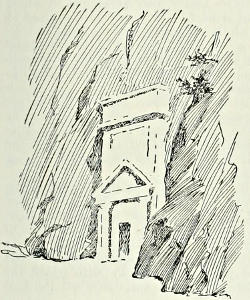
Jewish Tomb, Judea
Now Simon ruled like a second
David over the liberated land. The
Jewish people in solemn assembly named him “Commander-in-chief and
unimpeachable prince of the nation, with the right of conferring all the
dignities and offices in the kingdom and of forever exercising supervision
over sacred affairs,” and a record of this plebiscite was set up in the sanctuary.
Simon strengthened the alliance with Rome, promoted agriculture
and commerce, and honoured justice and the fear of God.
Simon sought the best interests of his people, “as that evermore his
authority and honour pleased them well,” says the first Book of Maccabees.
(xiv. 4, etc.) “Then did they till their ground in peace, and the earth
gave her increase, and the trees of the field their fruit. The ancient men
sat all in the streets, communicating together of good things, and the young
men put on glorious and warlike apparel. He provided victuals for the
cities, and set in them all manner of munition, so that his honourable name
was renowned unto the end of the world. He made peace in the land, and
Israel rejoiced with great joy. For every man sat under his vine and his
fig tree, and there was none to fray them. Neither was there any left in
the land to fight against them; yea, the kings were overthrown in those
days. Moreover, he strengthened all those of his people that were brought
low; the law he searched out, and every contemner of the law he took away.
He beautified the sanctuary, and multiplied the vessels of the temple.”
[135-126 B.C.]
But Simon’s end was not to be so happy as David’s. His son-in-law,
Ptolemæus, whom he had placed in command of the plain of Jericho, was
ambitious for the supreme authority. So he invited the high priest with
his two sons, Mattathias and Judas, to his house, and slew them at a banquet.
This crime, however, brought its perpetrator no advantage. Simon’s son
John, surnamed Hyrcanus, escaped the snares of his brother-in-law, and
after killing the murderers sent against him, quickly took possession of
Jerusalem and the high-priesthood, and after a long siege, took Jericho.
Ptolemæus, however, after murdering the imprisoned mother and two
brothers of the Maccabæan, saved himself by flight across the Jordan.
Afterwards John concluded a favourable treaty with Antiochus, by which
for a moderate tribute and the pledge of military service, he was confirmed in
his ancestral dignity and position. With the sums that he took from David’s
rifled tomb, John enlisted an army of mercenaries, with which he completed
the liberation of the land, extended the bounds of his state on all sides, subjugated
Samaria and Galilee, and forced the Idumæans (Edomites) either to
accept the Jewish law and be circumcised, or to emigrate.
King Antiochus fell in battle against the Parthians. Against his brother
Demetrius, who was released from imprisonment, John protected himself by
renewed alliance with the Romans, who now in their accustomed manner
held out their protecting hand over the little people on Lebanon until the
hour came when they could devour it along with the great state against
which they had protected it. (128-126 B.C.)
A consequence of this alliance with Rome was that the Jewish nation
once more enjoyed a happy period before its fall. The nearly thirty years’
reign of John Hyrcanus was a period of external peace and internal well-being,
when the Jew lived free and unhindered according to the laws of
their theocracy, and brought the “holy state” to its full development. Only
internal quarrels, caused by the sectarian hatred of the schools and religious
parties, and by the race jealousy and pride of orthodoxy with which the
Jews looked down upon the Samaritans and Galileans, disturbed the harmony
of their relations.
[126-108 B.C.]
When the worship of Jehovah was restored to its rights and external
religious pressure ceased, the place of the former sects, the heathenising
Hellenists and the orthodox Chasidees (Assideans), was taken by the Sadducees
and Pharisees, two schools of religious brotherhoods which followed
the same tendencies, only with less roughness and without violent means of
conversion. The Sadducees, named after their founder Zadok, made the
attempt “in teaching and precept to amalgamate the Greek wisdom of the
time with the Jewish nature, not in order to destroy the latter, but to uplift
and advance it.” Consisting of the wealthier and more aristocratic part of
the people, they aimed at greater freedom in life and thought, put a less
strict construction upon the Mosaic Law and tried to bring it more into
harmony with Greek customs, teachings, and mode of thought. Under the
influence of Greek philosophy they took the ground that there is no higher
fate which unalterably predestines all human affairs, and especially that God
neither does evil nor controls it; that good and evil, human weal and woe,
depend solely upon man’s own choice, and upon his knowledge or his ignorance.
A further step brought them to the denial of immortality and eternal
reward, as well as of the actual existence of angels and spirits.
In contrast to the Sadducees were the Pharisees (i.e., “the particular”),
who claimed to be distinguished from others by their greater piety. They
originated in the ranks of the Chasidees (“the pious”), and held strictly to
the law and the prophets. But they regarded with greatest care and solicitude
the letter and the wording of the law, and thus through arbitrary and
forced interpretation, they produced a great mass of directions, commandments,
and petty definitions of external sanctimoniousness, upon the observation
of which they set great value. In this way they fell into hypocrisy and
mock holiness.
Acting on the principle: “Build a fence about the law,” they saw in
the restriction and limitation of action a sign of orthodox piety. “Driven
by ambition, and more or less consciously indulging their own selfishness,
the Pharisees made piety a kind of trade, in order by it to gain permanent
power.” They wore certain signs, e.g., little rolls on arm or neck inscribed
with words from the sacred law; and they sought by the “appearance of
piety” to draw the people to them. “Living poor in the sight of the
world, many of them, nevertheless, did not despise the treasures and pleasures
of the world.”
A third sect, called the Essenes or Essees, like the Pharisees descended
from the Chasidees, believed God was best served and their own salvation
promoted by separation from the world and its indulgences, by the curbing
of all passions and lusts, by abstinence from wine, meat, and oil, and by
pious penances and common devotion. They dwelt in groups on the west
side of the Dead Sea, carried on agriculture, cattle raising, and innocent,
peaceful occupations. As the individuals renounced private property, they
brought both possessions and profits together into a common treasury for
common use. All members of the order wore the same garb; only a few
believed in marriage. As overseers of the poor and physicians, they earned
the gratitude of mankind. “Their external forms, their division into three
successive, strictly separated degrees, their admission and strict investigation
of pupils, with the vow of secrecy, their solemn oath upon reception into
the last degree with the requirement henceforth to refuse all oaths—many
of these things may appear to be copied from the Pythagoræan societies;
but after all that would only be something chance and unimportant beside
the nature of their efforts themselves. At all events, they are the noblest
and most remarkable product that ancient religion brought forth without
attempting to go beyond itself.”
Related to the Essees, only a “refinement and improvement” of them,
were the Egyptian Therapeutæ, of whom the Jewish-Alexandrian author
Philo gives an enthusiastic description. As among the former, we find
among the latter also “community of life and labour in deserts, close conformity
to Holy Scriptures and allegorical interpretation of them. But the
common labour becomes here merely a common spiritual exercise in the true
fear of God and veneration of the great lawgiver Moses in contemplative
rest.” The Therapeutæ lived in small companies about a house of prayer,
but on Sabbaths and feast days they united for greater services. Their
principal seat and place of assembly was in the desert by Lake Mareotis
west of Alexandria. Women were also received in the order, “at the
meetings modestly taking their places beside the ranks of men. Besides
the expounding of the sacred books and edification out of them, prayers
and fasting were their daily business, with bread, salt, and hyssop as the
most suitable nourishment. Moreover the actual spiritual exercises readily
rose to new and characteristic songs and poetic creations of various kinds.”
The “Book of Wisdom” appears to be one of the finest fruits of this spiritual
tendency.
[108-65 B.C.]
The Maccabæan family, which had showed itself so great in time of need
and distress, degenerated in good fortune. Before his death John Hyrcanus
bestowed the secular princely dignity upon his wife, while the high-priesthood
went by right of inheritance to his eldest son Aristobulus. Hardly
had the latter taken possession of his office, however, when he assumed the
title of King, imprisoned his mother and let her starve to death. He also
kept three of his brothers in durance; the fourth, Antigonus, fell a victim
of a court cabal before his very eyes. These deeds, however, awakened the
conscience of the royal high priest, who was not without feeling, and so tormented
him that he died the very next year. (108 B.C.)
His brother Alexander Jannæus now stepped from the cell to the throne.
He was a rough man, who took pleasure only in women, wine, and arms, and
began his reign with the murder of one of his brothers. He was brave and
warlike, and during the twenty-seven years of his reign extended the boundaries
of the kingdom to the south. The Pharisees, however, who were
angered with him for his preference for Hellenistic manners, aroused the
people against him. At the Feast of Tabernacles, while sacrificing at the
altar as high priest, he was pelted with citrons. Enraged at this disgrace,
the violent man had six thousand of the people apprehended and killed by
his mercenaries.
This hasty deed was to bear evil fruits for him. On a campaign against
the Arabians he lost the greater part of his army through an ambush.
When he returned to the capital a fugitive, the Pharisees stirred up the
people to civil war, raised troops, and called on the king of Syria for aid.
Alexander Jannæus was defeated and for a long time wandered about helpless
in forest and mountains. But after a while he again got together a
mixed force of Jews and mercenaries, gained a victory over his enemies, and
returned to Jerusalem. Here, while celebrating the most voluptuous feasts,
he had eight hundred crucified and their wives and children slaughtered
before their eyes. By these bloody deeds he inspired such terror in his
opponents that they thenceforth attempted no further resistance. He could
now follow his lust of conquest unhindered. And his arms were in fact so
victorious beyond Jordan that at his death the Jewish kingdom had almost
the extent it had in the days of David. (79 B.C.)
Jannæus’ widow, Alexandra, a wise and determined woman, by the advice
of her late husband, attached herself to the Pharisees and thus obtained a
quiet reign, her son Hyrcanus occupying the high priest’s office. She defended
the conquered lands, and in spite of an army of foreign mercenaries,
had a full treasury. But scarcely had she closed her eyes when her son
Aristobulus, at the head of the persecuted Sadducees, raised the banner of
revolt, was victorious in battle, and compelled his brother to abdicate in his
favour the high priestly dignity together with the royal power. (70 B.C.)
But after some time Hyrcanus, at the suggestion of the sly and enterprising
Idumæan, Antipater, escaped from Jerusalem and with the aid of several
Arabian chiefs began war against his brother.
[65-47 B.C.]
This gave the Romans, before whose tribunal the quarrelling Asmonæans
brought their case for decision, an occasion for intervention. Pompey, whom
Aristobulus, by the costly gift of a golden vine had tried in vain to gain for
his side, demanded the surrender of all fortresses, including the capital.
And when the royal high priest hesitated and made preparations for war,
he had him imprisoned, and took Jerusalem by storm after a three months’
siege. (63 B.C.) Then he appointed Hyrcanus high priest and prince of the
nation (ethnarch) without the royal title, imposed upon him annual tribute
to the Romans, demolished the walls of Jerusalem and the principal fortress
of the land, and narrowed the boundaries of Judea. Samaria became independent,
Galilee was attached to the viceregency of Syria. Pompey’s curiosity
led him to enter the Holy of Holies, but he refrained from all violation
or spoliation. Aristobulus and his two sons followed the general to Rome
to adorn his triumph. After a while the elder son Alexander, and soon
afterward, the father also made their escape. They returned to Palestine
and raised a new war, but both were captured again. Alexander was beheaded
at Antioch; Aristobulus was put out of the way in Rome itself, probably
by poison, but was buried at Jerusalem with royal honours.
[47-40 B.C.]
During these events the brave and shrewd Idumæan Antipater had rendered
the Romans great services, thus winning the favour of all the generals
from Pompey to Cæsar. They transferred to him the entire secular authority
over Judea, together with Galilee and Samaria, while Hyrcanus the high
priest was restricted to the guidance of religious affairs. Through him the
Jews were granted the right to live in accordance with the laws of their
fathers, were freed from all burdens of war and the tribute was put upon
a just and moderate basis. By these services Antipater won the love of the
Jews in such a degree that he could rule in the land like a king, even though
he did not bear that title.b
With Weber’s theory that Antipater was popular, George Smith does not
agree. But we shall turn from Antipater to note the rise of that dark name
in Jewish chronicle, King Herod.
Antipater carefully conformed to the views of Cæsar in arranging the
affairs of Judea. He raised again the walls of Jerusalem, journeyed through
the country, used every means to repress the lawlessness and disorder which
the late troubles had engendered, and, by alternate persuasion and power,
reduced the people to obedience. To carry out this plan, he made his eldest
son, Phasael, governor of Jerusalem, and his second, Herod, governor of
Galilee. The latter was a young man of extraordinary talent and spirit.
He devoted himself with great ability to the difficult duty which devolved
upon him. Galilee was at this time greatly infested with bands of robbers:
Herod sought them out, and all that fell into his hands he put to death, even
including Hezekiah, their leader. The government of Antipater and his
sons was not popular with the Jewish people; for all saw that, although
Hyrcanus was the nominal head, restored by Pompey, the Idumæan was
really the chief. This was unpalatable: the people preferred Aristobulus.
When, therefore, Herod was found acting in this decisive manner, he was
summoned before the sanhedrim, to answer the charge of having arbitrarily
exercised the power of life and death. The young man, under the advice of
his father, appeared in their court, bearing with him a letter from the prefect
of Syria, charging Hyrcanus, the president of the sanhedrim, to protect
him. He presented himself, however, more like a prince than a criminal.
He was attired in purple, with hair neatly dressed, and surrounded with his
guards. This appearance confounded the Jewish elders. Even those who
had preferred the charge against Herod did not now dare to repeat it, and he
was thus virtually acquitted; when Sameas arose, and, protesting at length
against their cowardice, affirmed, that if they thus spared Herod, the time
would come when he would not spare them. This roused the assembly; but
Hyrcanus adjourned the business, and then advised Herod to withdraw;
and thus the case terminated.
About three years afterwards, while Judea was progressing in order and
wealth, Julius Cæsar was assassinated in the capitol, and the Roman world
again convulsed, from its centre to its circumference.
Immediately after this event, Hyrcanus sent ambassadors to the Roman
Senate, requesting a confirmation of all the privileges and immunities which
had been given by Cæsar; a request which was immediately granted. While
Rome and the provinces were in the utmost perplexity as to the result of
pending arrangements, Antipater was most ungratefully poisoned by Malichus,
a Jewish general, who soon after was put to death for the crime, at the
instance of Herod, by Cassius Longinus, who then wielded the Roman power
in Syria and Asia Minor. This circumstance, as Malichus was popular with
many, increased the dislike of the Jews to Herod; and they petitioned Marc
Antony, who soon after came into Syria, against him; but in vain: the
address of Herod, in showing the services which his father had rendered to
the Roman cause, warded off all danger, and secured him the protection of
this triumvir.
Urgent necessity, however, called Antony into Italy; and Syria and the
neighbouring kingdoms—having lately been subjected, in rapid succession,
to the rapacity and extortion of Dolabella, Longinus, and Antony; and
knowing that Rome was at war with Parthia, and that they were, in consequence,
likely to be subjected to a repetition of these evils—agreed to invite
the Parthians to come and occupy these countries. This was done. Syria
and Asia Minor were occupied; and Antigonus, the surviving son of Aristobulus,
was seated on the Jewish throne, with the title of king, under the
protection of Parthia. In the course of these events, Hyrcanus and Phasael
were made prisoners. The former had his ears cropped, and was thereby
rendered incapable of ever being high priest again; the latter killed himself
in prison. Herod contrived to escape; and, having placed his family and
treasures in safety, fled to Rome.
[40-4 B.C.]
When Herod reached the imperial city, he fortunately found Antony and
Octavius there on friendly terms. He therefore renewed his friendship with
the former, who received him very cordially, introduced him to Octavius, and
stated how very useful Antipater had been to Julius Cæsar in Egypt.
Herod was, therefore, patronised by both these great men, who held in their
hands, at that moment, the political destinies of Rome and of the world.
When the son of Antipater had fled as a fugitive to the imperial city, his
highest hope was to get Aristobulus, a grandson of Hyrcanus, and brother
to Mariamne, to whom he was espoused, placed upon the throne, with himself
as minister, or procurator, under him. In this way his father had
wielded all the power of Judea; and he hoped, at that time, for no higher
dignity. But, being received with such marks of distinction, and promising
Antony further sums of money, he was, by the favour of these two arbiters
of the affairs of nations, himself raised to the throne. The senate was
accordingly convened, and Herod introduced to the conscript fathers by two
noble senators, who set forth the invaluable services rendered by his father
to the Romans; and, at the same time, declared Antigonus, who then governed
at Jerusalem, to be a turbulent person, and an enemy to their nation;
while Antony pointed out the importance of having a fast friend to Rome on
the throne of Judea during his approaching expedition against Parthia. The
Senate hereupon unanimously elected Herod to the throne, and voted
Antigonus an enemy of Rome.
The whole of these proceedings was evidently conducted upon the presumption
that Judea was either a recognised province of the Roman Empire,
or, at least, entirely dependent upon the imperial state. But what follows
is yet more strange. Considering the entire peculiarity of Jewish manners
and religion, it might have been supposed, even if the Senate had made the
appointment, that the inauguration of the king would have been in accordance
with the rites of the nation to be ruled. But, no! Immediately, upon
the vote of the fathers, Herod was conducted by Antony and Octavius into
the capitol, and there consecrated king, with idolatrous sacrifices. Having
thus far secured the object of his highest ambition, Herod remembered that
the affairs of his family and kingdom did not justify a protracted stay at
Rome: he therefore departed from the city at the expiration of seven days;
and, by a rapid journey, reached Judea just three months after he had left it.
Here, although beset with difficulties, he found a fair field; the Parthians
had, during his journey, been driven from Syria, which was again
occupied by Roman troops. His first care was to collect an army, with which,
and some aid from the Roman general, he made himself master of Galilee.
Following up this success, he marched to the relief of his family, who were
closely besieged by Antigonus. In this object he also succeeded; and, after
a series of dangers and exploits, he became master of all the country, and
shut up Antigonus in Jerusalem. Yet, notwithstanding the utmost efforts
of Herod, it was not until his rival had reigned three years that he was able,
when supported by a Roman army, to reduce the capital, which was at
length taken by assault, and subjected to fearful massacre and pillage from
the Roman troops, who, enraged at the obstinacy of the defence, continued
the slaughter after all resistance had ceased; and at length Herod had to
pay a large sum of money to save Jerusalem from being destroyed. Antigonus
was taken and put to death by the Romans as a malefactor.
Herod was now seated on the throne of Judea, the first of a new dynasty.
Hitherto the Asmonæan or Maccabæan family had really or nominally governed.
With Hyrcanus and Antigonus this line had ended; and Herod,
who was not a Jew, but an Idumæan by nation, and professedly a Jewish
proselyte in religion, was, by the favour of Rome, invested with supreme
authority over the Jewish people. From the first elevation of Antipater,
the cause of his family was unpopular; and it was only the consummate
sagacity of that person, in attaching himself to the oldest branch of the
Asmonæan family, which enabled him to carry out his purpose. Herod felt
this throughout his career. It was this which kept Antigonus so long upon
the throne; it was this which caused the son of Antipater so much difficulty,
when possessed of the object of his ambition.
Fully aware of the state of the public mind, his first care, after having
recovered Jerusalem, was the extermination of the Asmonæan family.
Although he had married Mariamne, the daughter of Hyrcanus, this seemed
in no wise to soften the violence of his political hate. All those Jews who
had supported Antigonus were proscribed, forty-five of the principal of
them were slain; all their property was confiscated, and seized by the king;
all the gold, silver, and valuables found in Jerusalem were taken for his
use; and thus, with the exception of a small part of the people, the land
was treated like a conquered country. Influenced by this jealousy of the
Asmonæans, Herod found an obscure priest of Babylon, who was descended
from the ancient high priests of Israel. Him he raised to the high-priesthood,
although his wife’s brother was of age, and heir to the office. He also
cut off the whole sanhedrim, except Sameas and Pollio.
The superseding of Aristobulus in the high-priesthood created an element
of discord and misery in the family of Herod, which ultimately
destroyed his peace. Herod’s intimacy with Antony introduced his family
to the infamous Cleopatra. Alexandra, the mother of Mariamne and Aristobulus,
by her influence with this queen, and her intercession with Antony,
induced Herod to cancel his appointment. Ananelus was set aside, and
Aristobulus inducted into the high-priesthood. But this young man was
received with such marks of favour and affection by the people, whilst officiating
at the ensuing feast of tabernacles, that all the jealous enmity of Herod
was again blown into a flame, and the heartless king soon after caused the
young priest to be drowned whilst bathing. Cleopatra, informed of this
crime, used her utmost influence with Antony to have Herod slain. Besides
the gratification of vanity and revenge (for she had attempted in vain to
seduce Herod), she greatly desired the possession of Judea; but as Antony
was equally in want of money to sustain him in his contest with Octavius,
Herod supplied him, and continued to reign.
After the fall of Antony, Herod waited upon Octavius, and by his frank
and candid deportment secured the friendship of the sole governor of the
great Roman Empire. Prior to this time, Herod had lured the aged Hyrcanus
from his captivity in Parthia, and, after placing him in close surveillance
for several years, had him beheaded. The future course of Herod
was violent, miserable, and vile. He laboured, on the one hand, to make
his kingdom great, and his country magnificent; but his means of effecting
this were most atrocious: while, on the other hand, his conduct to his family
was suspicious and cruel.
In his public life he consolidated his power, and raised Judea to a state
of wealth and prosperity which it had not before attained for centuries.
Having by the most sanguinary means cut off the last of the Asmonæans, he
built a theatre in Jerusalem, and a spacious amphitheatre in the suburbs.
All kinds of heathenish games were introduced. Musicians, players,
courses, gladiators, and wild beasts, were exhibited in the holy city. And
it is a circumstance worthy of observation, that there yet existed sufficient
zeal for the Divine Law to render all these exceedingly disgusting to a great
body of the Jewish people. About this time Herod also rebuilt several
important fortresses, and restored Samaria, which had long lain in ruins.
He also adorned Jerusalem with a stately palace for himself, which was
built of the most costly materials, and of exquisite workmanship.
Yet all these things were performed in a manner and style so foreign to
the peculiar genius of the Jewish mind, that, proud as they were of their
country, they were by these means more and more alienated from the king.
He saw this, and laboured to stem the torrent of public feeling. At one
time he wished to introduce an oath of allegiance; but it was so strenuously
opposed by the most eminent Jewish doctors, that he was compelled to lay
it aside. He then remitted a part of the taxes, professedly on account of
several national calamities which had recently fallen upon the country, but
really to bid for popular favour: this also was vain. One other course was
open to him; and he pursued it. The temple, as then existing, was
unworthy of the nation and of the improved state of Jerusalem: he proposed
to rebuild it; but so distrustful were the people of his promise and of
his religion, that they would not have the old one removed until they saw
the materials collected for the new building. After two years of preparation,
the old edifice was taken down in parts, as the new one was raised.
The holy place was finished in eighteen months, the body of the structure in
eight years. This building was erected in the Greek style of architecture,
and of the most costly and beautiful marble and other material; and the
great work appears to some extent to have produced a better state of feeling
between the Jews and their king.
Yet, during all these works, Herod’s domestic course was one of continued
misery and crime. As if the blood through which he had waded to
the throne, and the numerous victims which in these times of turbulence
and war were sacrificed to his ambition, were not sufficient to satiate his
sanguinary nature, his lovely wife Mariamne, after having borne him two
sons, was doomed by his order to perish on the scaffold, the victim of the
most groundless jealousy and cruel conspiracy. He endeavoured to bury
this crime in oblivion by other marriages, but in vain. Intense suspicion
haunted all his thoughts; a morbid apprehension of evil destroyed every
acquisition, and turned all the members of his family into foes. Under this
influence, after years of disquiet, he condemned his two sons by Mariamne
to death. It were useless to attempt the history of this family at greater
length. Herod married ten wives, eight of whom bore him children. This
was not the least amongst the causes of his domestic misery.d
[4 B.C.]
Herod willed his dominion to his two sons, Herod Antipas and Archelaus,
and after some delay they entered into their inheritance. Archelaus was
ethnarch over Samaria, Judea, and Idumæa, which he misgoverned so
grossly that the exasperated Jews complained to Rome (6 A.D.). Augustus
deposed and banished his faithless servant, putting a procurator over the
dominions.a
In Judea the position of the Roman procurators was one of great difficulty.
The Jews were the most restless of all the peoples of the empire.
The most inoffensive measures wounded their religious susceptibilities.
Thus the general census made by Quirinus, governor of Syria, at the command
of Augustus, seemed to them a menace and a danger. Long ago,
in the reign of David, a similar measure had evoked murmurs amongst
them; it was worse still under foreign rule. They persuaded themselves
that the object of the census was to reduce them to slavery. A certain
Judas, surnamed the Gaulonite or the Galilean, stirred up a revolt, which
was suppressed by the procurator, but the partisans of Judas, who were
afterwards known as the Zealots, formed a sect which played an important
part during the last days of Jewish history. According to them, the law
forbade the Jews to recognise any sovereign except God, and it was their
duty to die rather than submit to a human authority. This perpetual confounding
of religion and politics was often extremely troublesome to the
Romans. Pontius Pilate, procurator of Judea, having brought into Jerusalem
Roman ensigns adorned with the portrait of Tiberius, the Jews complained
loudly at the offence, and betook themselves to Cæsarea, where the
governors resided, to demand the removal of the ensigns. He surrounded
the malcontents with his troops, but they offered their throats to the knife,
declaring that they would rather die than endure the desecration of the Holy
City. Pilate gave way, and afterwards, by the express command of Tiberius,
removed the golden shields which bore in their inscriptions the names
of the gods of the empire. Another time, desiring to build an aqueduct to
bring water to Jerusalem, he took money from the temple treasury, and
there was another riot on that score.
[33 A.D.]
The rule of the Romans, like that of the Seleucidæ before them, made
the Jews fall back upon their Messianic dreams. In these the Bible played
the leading part. The prophets of old had merely been religious and popular
tribunes; nevertheless, by the aid of fanciful interpretation they succeeded
in making them soothsayers. They were made to predict the supremacy of
the Jewish nation over all others; by taking some sentences of their writings
apart from the context the people discovered allusions to their future
deliverer, their Messiah. Like all mythological types, this ideal figure of
the Messiah grew more and more clearly defined. But at the same time it
assumed a loftier significance, it became purely moral in character. In face
of the vastness of the Roman power, a warrior king like David would not
have been enough; what was needed was rather a revealer, like Moses, to set
up the kingdom of God upon earth. The Messiah, in this supernatural rôle,
was bound to exercise a far greater effect upon the people; but any kind of
revolution, whether violent or mystical, must always inspire the ruling
classes with equal abhorrence. The Jewish priesthood implored the aid of
the secular arm against Jesus of Nazareth, as it had done against Judas
Maccabæus. Pilate being loth to put an innocent man to death in order to
gratify priestly spite, they gave him to understand that his own position
would be compromised by indulgence, and he yielded for fear of losing his
office. Moreover, it is likely that the death sentence caused him no great
remorse; no doubt he said to himself that it was the price of maintaining
order, and that in dealing with an enemy to society there was no constraining
need to be just. This event, which divides the history of the world in
two, passed unmarked by the generation that witnessed it. The five or six
lines which we find in Josephus appear to be an interpolation. If Josephus
had believed, as the passage states, that Jesus was the Messiah and that he
was more than man, it is obvious that, instead of remaining a Jew, he would
have become a Christian.b
The excerpt from Josephus is as follows: “Now there was about this
time Jesus, a wise man, if it be lawful to call him a man, for he was a doer
of wonderful works—a teacher of such men as receive the truth with pleasure.
He drew over to him both many of the Jews, and many of the Gentiles.
He was (the) Christ; and when Pilate, at the suggestion of the principal
men amongst us, had condemned him to the cross, those that loved
him at the first did not forsake him, for he appeared to them alive again the
third day, as the divine prophets had foretold these and ten thousand other
wonderful things concerning him; and the tribe of Christians, so named
from him, are not extinct at this day.”
As has just been said, this paragraph is probably an interpolation of a
copyist of a much later period. It would seem, then, that no contemporary
record, no mention even, of the life of Jesus has been preserved to us. This
fact is one of the most striking paradoxes in all history. As a general rule,
it may be taken for granted that the great names in history are achieved
during the life of their bearers. But here, speaking purely from the standpoint
of the historian, was an obscure personage, whose entire theatre of
action, so far as known, consisted of the petty state of Palestine, at that time
one of the minor dependencies of Rome. The period of activity of this personage
as an historical character compasses but a few years; and it would
appear that during his life his deeds were practically unknown beyond the
bounds of the petty state in which he lived. Yet the historical result of
these activities was more momentous, even from a strictly secular standpoint,
than the deeds of any other character of history. A new era, recognised
by the chief civilisations of the world, dates from his birth; and whole
libraries of literature are devoted to every aspect of his life, in strange contrast
to the paucity of contemporary records.
There is no occasion to chronicle here the incidents of the life of Jesus.
To every reader of these pages these incidents have been familiar from childhood.
As there is no contemporary source to quote, at best we could but paraphrase
the scriptural accounts, to which every reader may turn for himself.a
Beyond the borders of Palestine, where they held their ancient glories
in perpetual remembrance, the Jews gave less thought to their Messiah. In
the Greek cities whither they had been allured by commerce, at Ephesus,
Cyrene, and above all, Alexandria, they tried to gain acceptance for their
traditions and their monotheism under the warranty of the Sibyls; they
composed apocryphal writings in somewhat tame verse, or studied Greek
philosophy. The monistic theories of Plato attracted them most strongly
to his school, and Philo makes amazing efforts, by dint of moral allegorising,
to discover Platonic teachings in Genesis. The word, λόγος, which signifies
both the reason of things and human speech, became the starting point of a
kind of abstract mythology; and among the Hellenistic Jews the idea of
the Word assumed an importance equal to, and a character hardly less personal
than, that of the Messiah among the Jews of Palestine. From one of
these groups Christian legend was destined to arise, from the other Christian
philosophy. The Persian doctrine of the principle of evil, the Egyptian
doctrine of the resurrection of the body, had already become familiar to the
Jews; Christianity adopted them and made them the basis of a vast mythological
edifice, the Fall and Redemption, the great Judgment Day of God,
and the coming of His kingdom upon earth after the destruction of the
world, which was placed in the immediate future. The dispersion of the
Jews throughout all the eastern provinces of the empire offered a vast field
to Christian propaganda, which, however, soon spread beyond the Jewish
race, when once the innovating party had definitely rejected circumcision,
the distinction between clean and unclean meats, and all the trivial and
troublesome practices which separated Israel from other nations. The Jewish
element was soon submerged by the rising tide of world-wide proselytism
known as the calling of the Gentiles.
The introduction of Christianity into Greece is associated with the name
of a Jew, St. Paul, just as the introduction of the Dionysiac mysteries is
with that of the Thracian Orpheus. It is a divine seed come forth from
the East, after an interval of fifteen centuries, and developing in the fructifying
rays of the sun of Greece. But Christianity, although it represents
the last phase of the progressive invasion of the West by oriental beliefs,
is an original religion and not a heresy of Judaism. Far from being the
supplement of the Jewish faith, we might rather call it its denial. The
dominant note of Judaism is the attitude at which it places the conception
of the Divine; between man and his God the distance is infinite. Christianity,
on the contrary, had for its fundamental dogma the worship of the
God-man. The Jewish religion, alone of all the religions of the earth,
confined itself absolutely to this present life, without following man beyond
the limits of his earthly destiny; to Christianity the earth is but a temporary
place of trial, and life a preparation for eternity. The Jewish nation
prides itself on the exclusive inheritance of the Law and casts forth the
multitude of the uncircumcised from its midst; while Christianity proclaimed
itself the universal religion from the beginning, and has never
ceased to call men of all nations to itself. The Christians borrowed nothing
from Judea but its traditions and its legends; had they rested satisfied with
these, they would have been no more than a small Jewish sect that would
have passed away unnoted. Judaism is one of the tributaries of the great
Christian river, but it is not its principal source. In its apotheosis of
humanity Christianity has a direct link with Hellenism, of which it is the
legitimate successor.
The doctrines of the Fall, the Incarnation, the Redemption, the Sacrament
of the Eucharist, all have their source in the most ancient beliefs of
Indo-European peoples; which explains why the Jews so obstinately hold
aloof from it. The true heir of Jewish thought is Islamism, the modern
religion of the Semitic race. By depriving Christianity of its Greek elements,
by setting aside the idea of the incarnation of the Divine in humanity,
which spanned the gulf between God and man, Mohammed restored
Semitic monotheism to its pristine severity, tempered only by belief in
the devil and in a future life, which the Jews themselves had ended by
accepting.
[37-41 A.D.]
At Rome, whither all men seeking their fortunes drifted, the Jews were
very numerous, and insinuated themselves among all classes, especially
among women, exploiting their credulity by interpreting dreams and selling
philtres and amulets. They were generally confounded with Chaldeans
and other venders of horoscopes. A lady of rank, whom they had converted
to their religion, having had reason to complain of their sharp
practices, Tiberius enlisted four thousand Jews, whom he sent to Sardinia.
A grandson of Herod, Agrippa by name, who had squandered his fortune
in profligate courses and lived by his wits, insinuated himself into the good
graces of the young Caligula. During a walk which they took together,
Agrippa said aloud, “When will the day come on which the death of old
Tiberius will leave thee master of the empire, for my happiness and that of the
world?” The words were repeated to Tiberius by a freedman, and Agrippa
was put in prison. Caligula, who became emperor soon after, set him at
liberty and gave him the tetrarchy of his uncle Philip (who had died shortly
before), with the title of King. But the ambitious Herodias could not
endure to see her brother, whom she had formerly assisted out of her
bounty, win a higher rank than her husband. At her instigation Antipas
proceeded to Rome to solicit the diadem. It was an evil day for him;
Agrippa accused him of having laid up a store of arms and of holding
communication with the Parthians; Caligula, without deigning to inquire
into the matter, banished him to Lyons in Gaul, and added his tetrarchy to
Agrippa’s kingdom.
The new king soon had an opportunity of rendering signal service to his
co-religionists. Caligula desired to have divine honours paid him. This
was no new thing; Alexander had caused himself to be worshipped, like
the ancient kings of Egypt, the majority of his successors had followed his
example; the Cæsars might well do as much. It was a logical result of
monarchy; when one man is set above the rest, it is easy for him to fancy
himself a god. The Jews alone, to their eternal honour in history, had
courage to protest against this apotheosis of tyrants that disgraced the end
of the Old World. When orders had been given to place the emperor’s
statue in the temple of Jerusalem, the attitude of the Jews became so
menacing that Petronius wrote to the emperor asking him to revoke the
command, which could only be carried into effect by the extermination of
the whole people. Agrippa was at Rome at the time. He gave a magnificent
banquet to Caligula, and when the emperor, inflamed with wine,
offered to extend his kingdom, he entreated him to respect the religious
scruples of his subjects. The emperor yielded, but when he received
Petronius’ letter he flew into a violent rage, accused the governor of having
taken bribes from the Jews, and threatened him with the imperial
vengeance. Fortunately for Petronius and the Jews, Caligula was soon
afterward assassinated by Chærea, one of his officers. The Senate was
desirous of restoring the republic, but the prætorian guard, composed of
Germans, offered the throne to Claudius, the uncle of Caligula. According
to Josephus, it was Agrippa who persuaded him to accept, and served as
intermediary between the Senate and the army. Chærea was put to
death. Claudius had no sooner assumed possession of the empire than he
added Judea, Samaria, and some districts in the Lebanon, to the kingdom
of Agrippa. The principality of Chalcis was bestowed upon his brother
Herod.
[41-44 A.D.]
Agrippa, having thus become king over the whole of Palestine, proceeded
to Jerusalem, and hung in the temple a golden chain which Caligula
had given him when he came out of prison. Like Herod, his grandfather,
he set up a great many monuments, he enlarged Jerusalem considerably,
and built an amphitheatre at Berytus, where he instituted gladiatorial
shows. But while Herod had never been able to win popularity, Agrippa
gained the affections of the Jews by showing himself a strict observer of
the Law. Munk, who takes the story from the Rabbis, tells how, at the
Feast of the Tabernacles, he read the Book of Deuteronomy in public, and,
coming to the passage in which the lawgiver denies a foreigner the right
of reigning over Israel, he burst into tears, remembering his own Idumæan
descent. But from all sides the people cried to him, “Fear not, Agrippa,
thou art our brother!” It was undoubtedly to please the priests at
Jerusalem that he put James, the brother of John the Evangelist, to death;
for the Jews, when they were in the ascendant, were very far from allowing
others the religious liberty which they everywhere claimed for themselves.
Christian preaching might be attended with more or less success among the
communities of Jews or Jewish proselytes settled elsewhere than in Judea;
but at Jerusalem, where memories of independence still survived, no man
could be acknowledged as the true Messiah who had failed to deliver his
nation from foreign oppression, and the new sect could not take root in the
country that had been its cradle. Moreover, the little church at Jerusalem
was very inoffensive, and the Book of Acts does not tell us on what pretext
James was beheaded. Simon Peter, the chief of the Apostles, whom
Agrippa had cast into prison, was delivered by night, and his deliverance
was ascribed to angelic agency. This miraculous deliverance of St. Peter
forms the subject of one of Raphael’s finest pictures.
[44-52 A.D.]
At Agrippa’s death, which took place a short time after, his son, also
named Agrippa, was only seventeen years of age. In spite of his youth the
emperor was desirous of letting the kingdom of Judea descend to him, but
was unfortunately dissuaded from his purpose by his advisers. The tetrarchy
of Philippi was afterward bestowed on Agrippa the Younger, but Judea fell
finally under the rule of procurators. Of all the provinces of the empire it
was the most difficult to govern. The others accepted Roman dominion.
In exchange for their independence Rome offered civilisation to Spain and
Gaul, peace and quiet to Greece and Asia, wearied as they were by centuries
of war. But the Jews understood Græco-Roman civilisation no better than
the Mohammedans understood our own, and as for peace, they would accept
it only on the condition that they should be over all other nations: that was
what they understood by the kingdom of God.
Their Messianic dreams haunted them more and more persistently. The
land was full of visionaries, and they always found disciples. A prophet
named Theudas induced more than four hundred persons to follow him into
the wilderness by declaring that he would cause them to pass dry-shod over
Jordan. Fadus, the procurator, despatched a body of horsemen, who slew
him and dispersed his following. The author of the Acts, who placed the
said Theudas before the time of Judas the Gaulonite, indicates the comparison
generally made between the preaching of these two agitators and
that of the Apostles. Roman governors and Jewish lovers of order saw no
great difference between men inspired and robbers. Tiberius Alexander, a
renegade Jew of Alexandria, who succeeded Fadus in the government of
Judea, crucified two sons of Judas the Gaulonite, who were still upholding
the sect of the Zealots. As for the populace, they were well disposed to all
attempts, but among innovators they liked those who adopted violent measures
better than those whose methods were peaceable; thus, as the Gospel
relates, Barabbas was preferred to Jesus.
Samaria, like Jerusalem, had its prophets and its messiahs. In the days
of Pontius Pilate there was one who gathered together a great multitude on
Mount Gerizim, promising to show them the sacred vessels which had been
buried there by Moses. Pilate punished these wretched people so severely
that Vitellius, governor of Syria, compelled him to go to Rome, there to
exculpate himself before Tiberius. In the reign of Claudius one Simon of
Gittha taught in Samaria with great success a subtle form of theology borrowed
from the Judæo-Egyptian schools of Alexandria, which subsequently
reappears in the mythological doctrines of Christian Gnosticism. He assigned
the principal rôle in it to himself, giving himself out to be an incarnation of
the great power of God, though he acknowledged the divine mission of Jesus.
He averred that in him, Simon, God had revealed himself to the Samaritans
in the character of the Father, as he had revealed himself to the Jews in the
crucifixion of the Son, and to the Gentiles by the gift of the Holy Ghost.
The doctrine of the Trinity, perhaps borrowed from Egypt, has become
a part of Christianity, but Simon appears to have given a place in it to the
Feminine Principle, probably represented by the Holy Ghost, that name
being feminine in Hebrew. Wherever he went he took with him a very
beautiful woman, whom he had bought in the market at Tyre. Her name
was Helen, and Simon, identifying her with Homer’s Helen, deduced from
the name a mystical scheme of redemption for the Eternal Feminine. It
was the time when Christianity was first preached, and the Apostles were
credited with miraculous powers of healing by the laying on of hands. A
prophet ought to work miracles, and Simon was accordingly anxious to purchase
their methods, and proposed that they should work together. The
invincible repugnance of the Jew for the Samaritan made them repel his
advances with scorn. A legend grew up in the Christian church about the
name of Simon, surnamed Magus, who became the type of all charlatans,
and the name of simony has since been given to all traffic in holy things.
The reciprocal antipathy of Jews and Samaritans was a source of embarrassment
to the Roman government. Some Galileans, on their way to
Jerusalem for the feasts, passed through Samaria and quarrelled with the
inhabitants. The men of Jerusalem, led by a robber chieftain, pillaged
Samaria. Cumanus, the procurator, was called upon to intervene, and
decided in favour of the Samaritans. The Jews accused him of taking
bribes, and appealed first to the governor of Syria and then to the emperor.
The young Agrippa, who stood high in the good graces of Claudius, contrived
that the Jews should win their suit, and Cumanus was banished.
[52-62 A.D.]
From the government of this same Cumanus, Josephus dates the disorders
which ended in the destruction of Jerusalem. He had, nevertheless, treated
the religious scruples of the Jews with great consideration, going so far as
to inflict capital punishment on a Roman soldier who had torn up a copy of
the Pentateuch while engaged in suppressing a riot. The sway of Rome was
not oppressive, and the government confined itself to protecting the public
peace against adventurers who lived on plunder under the cloak of religion,
and fanatics who endeavoured to stir up the people by promising to work
miracles before them. One of these induced thirty thousand persons to follow
him to the Mount of Olives, that thence they might see the walls of
Jerusalem fall at his behest. Felix, the procurator, sent soldiers to disperse
the multitudes, and the prophet took to flight. But it was always the same
story. “Judea,” says Josephus, “was full of robbers and sorcerers who
deceived the people, and not a day passed in which Felix did not punish
some of one sort or the other. But the robbers continued to stir up the
people to rebel against the Romans, giving over to fire and plunder the
villages of those who refused to rejoin them.”
When it might have been imagined that severe repressive measures had
delivered Judea from this pest, it reappeared in a yet more formidable shape.
At the festivals, when a great concourse of people from all parts were gathered
together at Jerusalem, bandits known as sicarii, that is “men of the
knife,” mingled with the throng and stabbed their victims, without any being
able to see whence the blow came, for the assassins were the first to cry
murder. “The first whom they assassinated on this wise,” says Josephus,
“was Jonathan the high priest, and not a day passed on which they did not
kill several in the same manner. The panic that prevailed throughout the
city was worse than the evil itself. Men looked for death at any moment,
as in time of war. They saw none approach without trembling, they did
not dare to trust their friends. These precautions and suspicions did not
put a stop to the murders, so great was the daring of these villains and their
skill in hiding themselves.” Josephus does not ascribe anything of a religious
character to these assassinations. But according to the author of the Philosophumena
(Origenf or St. Hippolytus) the sicarii were identical with the
Zealots, and were connected with the sect of the Essenes. “When they
hear any of the uncircumcised speak of God and of His law, they seek to
come upon him by stealth in a solitary place and threaten to kill him unless
he will be circumcised: if he refuses to obey, he is slain. This is wherefore
they are called Zealots, and by some sicarii.” Josephus, in his Antiquities
of the Jews accuses Felix, the procurator, of having procured the assassination
of the high priest Jonathan by the sicarii, an accusation which he does
not repeat in the Wars of the Jews. Felix was a brother of Pallas, the
freedman and favourite of Claudius. Tacitus speaks of him in even harsher
terms than Josephus. “Claudius made Judea into a province which he
abandoned to Roman knights or to freedmen; among these Felix distinguished
himself by every sort of cruelty and license, he exercised the
authority of a despot in the base spirit of a slave.” The Jews caused him
to be accused before Nero, who had succeeded Claudius, but he was saved
by the influence of his brother Pallas.
At Cæsarea there was a constant rivalry between the Jewish and the
Greek or Syrian part of the population. The Jews were exempt from military
service; the Greeks and Syrians, from whose ranks the legions were
recruited, were jealous of this inequality. Hence arose taunts on the one
side and recriminations on the other, sanguinary quarrels and riots. Finally
the two parties sent agents to plead their cause before Nero, who decided
against the Jews and deprived them of civil rights. Josephus says that this
decree was the cause of the rebellion of the Jews; but it was only the last
drop that makes the cup overflow. The rebellion had long been inevitable.
It was not induced, like that of Judas Maccabæus, by religious persecution;
the Romans allowed the Jews the free exercise of their religion, as they
allowed it to all other nations. But the Jews were the chief people in the
empire who did not belong to the Indo-European race. There is an incompatibility
of temper between that race and the Semitic; we perceive the fact
only too clearly in Algeria. The demand for union with the empire, raised
after the death of Herod, had proceeded from the Jews themselves. A
procurator, even if not beyond reproach, could not possibly be worse than
their native kings. Festus, who succeeded Felix, seems to have governed
with firmness and prudence. Like his predecessors, he dealt severely with
robbers, sicarii, and messiahs. But nothing could allay the fever that had
laid hold upon Judea and worked madness in the brain; for there are epidemics
in the moral as in the physical order. We cannot lay all the blame
on the Romans; their rule secured the peace of the world, a boon which was
doubtless worth the sacrifice of the restless and precarious autonomy of a few
peoples. But we mourn for Greece, and we may be permitted to mourn for
Judea. Nor must we cast a stone at this small and fiery nation, with its
obstinate will to live. Depopulated Greece had died of weariness and
exhaustion. Judea, overflowing with inhabitants, was about to die in a
frenzy of patriotism; it is the worthier death.
[62 A.D.]
In spite of the Roman occupation, the Jewish theocracy found means for
tyrannical action. The high priests seized upon the tithes due to the
priests, the principal inhabitants of Jerusalem, espoused the cause of the
inferior clergy, who were starving; there were fights in the streets, and
the Roman government looked on passively, not wishing to meddle with
religious matters. They were Agrippa’s affair, since the appointment of
the high priests had been left to him. He, though his kingdom did not
extend to the northern provinces, resided in Herod’s palace at Jerusalem.
He had built a tower, from the height of which the inner court of the temple
could be scanned. The priests regarded this as a profanation, and built a
high wall, shutting off both the palace and the barracks of the Roman
guard. Agrippa and Festus wished to demolish it, but, thanks to the support
of the Empress Poppæa, who was a Jewess, or, at least, very well disposed
towards the Jews, the priests gained permission from Nero that the
wall should remain. After the death of Festus, and before the arrival of
Ananus, the high priest convoked the Sanhedrim to sit in judgment on and
condemn certain transgressors of the law, and, among others, James, the
brother or cousin of Jesus. Hanan belonged to the sect of the Sadducees,
which consisted entirely of wealthy people. James was greatly beloved by
the poor. The epistle attributed to him, though it preached patience to the
latter, contains passages little favourable to the rich. He was stoned. The
sentence was illegal, for the high priest had no right to pass sentence of
death in the absence of the procurator. Ananus was deposed from his
office, but the death of James gave rise to great disaffection, and no doubt
contributed to the separation of Christians from Jews. James was one of
those who endeavoured to avoid this separation, and the church at Jerusalem,
of which he was the head, showed great attachment to the practices of
Judaism.
At Rome, the preaching of Christianity had begun in the reign of
Claudius, and as it stirred up incessant quarrels among the Jews, which led
to the disturbance of public order, the emperor had them all expelled from
the city. Suetonius ascribes these scenes of disorder to Christ; it is the
first time that we meet with the name in a pagan author, and the phraseology
of Suetonius appears to indicate that, in his opinion, Christ was a
person who lived at Rome in the time of Claudius: “Judæos, impulsore
Christo assidue tumultuantes, Roma expulit.” According to Dion Cassius,
the Jews were not expelled from the city, but were forbidden to assemble
together. The Christians were confounded with the Jews; the distinction
first began to be made under Nero. “They put to the torture,” says
Suetonius, “the Christians, a sort of men holding a new and noxious superstition.”
A terrible fire, which destroyed more than half of Rome, gave
occasion for these tortures. Rumour accused Nero of having set fire to
Rome that he might rebuild it in greater beauty; it was even said that during
the fire he had gone up into his theatre and sung the destruction of Troy.
“To put an end to these rumours,” says Tacitus, “he sought for guilty
persons, and inflicted the most cruel tortures upon persons detested for their
infamous practices, who were commonly called Christians. This name they
took from Christ, who was condemned to death under Tiberius by the procurator
Pontius Pilate. This pernicious superstition, suppressed for the
moment, had since overflowed, not only in Judea, where was the source of
the evil, but even in Rome, where all crimes and shames meet together.
Those were first seized who confessed, and afterwards, on their testimony,
a great number of others, who were convicted, less of having set fire to
Rome than of hating the human race. Mockery was added to torture; they
were wrapped in the skins of beasts to be cast to dogs to devour; they were
crucified; they were set alight like torches to give light by night. Nero
had offered his gardens for this spectacle, and he mingled with the people
in the garb of a charioteer or driving a chariot. Thus these wretches,
though deserving of exemplary punishment, inspired pity, for they were not
sacrificed to the interests of the public but to the cruelty of a single man.”
It seems as though the Christians must have been safe in their obscurity
from the emperor’s notice if it had not been directed to them by some
special influence. Gibbon appears to believe that the beautiful Poppæa,
the mistress and wife of Nero, and a Jewish comedian who had won his
master’s favour, prevented the persecution from spreading to all Jews at
Rome by concentrating it on a dissenting sect, in very evil odour with
genuine Israelites. Renan goes farther, and thinks that the persecution
directed against the Christians may have been excited by the intrigues of
the Jews. He bases his opinion upon an ingenious interpretation of a very
obscure passage in Clemens Romanus. Against this conjecture we may set
the silence of the Apocalypse, which contains no allusion to Poppæa nor to
the Neronian persecution. Now, as Renan has demonstrated by a wealth
of evidence, the Apocalypse was a direct outcome of this persecution.
Nero is Antichrist and the Beast, and the number 666, which is the
number of the Beast, represents the letters of his name, Νέρων Καισαρ,
transcribed in Hebrew and added up according to their numerical value.
Like the Book of Daniel, written at the time of the great struggle of the
Jews with the kings of Syria, the Book of the Revelation is a political and
religious pamphlet. The author gives his estimate of the events of his
time or expounds his hopes for the future under the figure of prophetic
visions and of enigmas to which he sometimes supplies the key. The Jews
were extremely fond of this form of literature. The Apocalypse, i.e., the
Revelation, ascribed to John, the last survivor of the Apostolic band, was
written during the period of anarchy which lay between the death of Nero
and the accession of Vespasian. It was the eve of the last agony of Judea;
the speedy dissolution of the Roman Empire was expected. A supreme conflict
between heaven and earth was about to begin, and would end by the
great judgment of God and the reign of his Christ. Nor did the prophet
lie; for it was in truth the end of the old world and the birth of the new.b
[62-67 A.D.]
The Jewish heart had been kindled to a successful revolt under Judas
Maccabæus. The memory of this triumph and of the cruelties that had
forced it upon the unwarlike people, ripened the national heart for an
effort against even the mighty empire of Rome. The struggle was one
of the bravest and one of the most horrible in the world’s annals. It
found a splendid chronicler in Josephus, who was one of the generals, and
fought bravely, and yet, like his Grecian prototype, Thucydides, won his
immortality by his pen instead of by his sword. Josephus’ account is, however,
a voluminous work in itself, and we must be content with some of the
most brilliant pages, turning to Ménard for a briefer sketch of the general
story.a
In Judea, the temper of the nation had long given warning of approaching
revolt. It broke out at length when Gessius Florus was appointed
procurator through the influence of his wife, who was a friend of Poppæa’s.
His vexatious measures and rapacity wore out the patience of the Jews;
on this point Tacitus is at one with Josephus. Disorders first occurred
at Cæsarea on the occasion of Nero’s decree; then the action of Florus
in taking seventeen talents out of the temple treasury provoked a riot
at Jerusalem. The soldiery spread through the streets, plundering the
houses and massacring the peaceable inhabitants, not sparing even women
and children; after which the procurator withdrew to Cæsarea, leaving only
one cohort in the tower of Antonia. The Zealots promptly occupied the
temple precincts. When a government flees before the mob it may safely be
predicted that the most excited and violent party will impose its will on the
rest. In vain did Agrippa II and his sister Berenice, who happened to be
at Jerusalem at the time, endeavour to allay the popular frenzy. They
could gain nothing, in spite of the respect felt for the last descendants of the
ancient kings. A band of men left the city, seized the fortress of Masada,
and massacred the garrison.
The moderate party, composed of the wealthier classes and the priests,
would have recoiled from an insensate struggle against the power of Rome,
but Eleazar, the leader of the party of action, made the rupture final by
refusing to offer in the temple the victims which were wont to be sacrificed
there by the emperor’s command for the prosperity of Rome and of the
empire. The friends of order sent to entreat Agrippa and Florus to come
with all speed to protect them against the rebels. Agrippa sent three
thousand horsemen, who took possession of the upper city, while the Zealots,
robbers, and sicarii occupied the temple and the lower city. Florus returned
no answer. According to Josephus, he wished the insurrection to grow to a
head, and, when it was exhausted by its own violence, to extinguish it in
blood. Such are the habitual tactics of military leaders in time of revolution.
Such deliverers deserve, as Lamennais says, to be execrated in the
present and in the future.
The insurgents, who were masters of the temple, refused entrance to the
partisans of peace, made their way into the upper city, and set fire to the
palace of Agrippa and Berenice. They also burnt the archives, in order to
destroy all vouchers of credit and so bring over the debtors to their side.
They were commanded by Manahem, the son of Judas the Gaulonite, and by
Eleazar, the son of the high priest Ananias, who was one of the principal
leaders of the opposite party, for civil war had set division even between
members of the same family. The tower of Antonia was taken and burnt
by the revolutionaries, who allowed Agrippa’s horsemen to depart unmolested.
The Romans, for their part, took refuge in the three towers of the
old wall. Ananias, who, with his brother Hezekiah, was found hidden in an
aqueduct, was slaughtered by Manahem. Then Eleazar, enraged at the
assassination of his father and uncle, stirred up the people against Manahem,
who now gave himself the airs of a tyrant. “It was not worth while,” he
said to them, “to cast off the yoke of Rome in order to stoop to that of the
least among yourselves.” Manahem was stoned in the court of the temple.
Such of his partisans as could make their escape took refuge in the fortress
of Masada. The Romans asked for terms of capitulation. They were
promised their lives, but they had no sooner given up their arms than
Eleazar and the Zealots fell upon them and slew them all but one, who consented
to be circumcised. The rest died, to a man, without asking for
mercy, only crying out upon the sanctity of their oaths. These imprecations
filled the people with dire forebodings, all the more so because this
perjury had been committed on the Sabbath day.
The same day and hour, as if by the working of divine vengeance, says
Josephus, a massacre of the Jews took place at Cæsarea; of twenty thousand
men not one was left, for those who escaped were captured by Florus and
sent to the galleys. This massacre roused the whole nation to such a pitch
of fury that they ravaged the towns and villages of the Syrian frontier,
Philadelphia, Heshbon, Gerasa, Pella, and Scythopolis, with fire and sword.
They then sacked Gadara, Hippos, and Gaulonitis, burned Sebaste and
Askalon, and demolished Anthedon and Gaza. They slew all that were not
Jews. Then, as was to be expected, terrible reprisals followed. An epidemic
of carnage raged all over southern Syria and extended to Egypt.
Every mixed city became a battle-ground. If we are to trust Josephus, the
Jews were never the aggressors. That is hard to believe. It is possible
that the rabble, seeing Judea rebel against Rome, concluded that they might
massacre the Jews with impunity. But it is also very probable that the
insurrection had roused to the highest pitch the fanaticism of Jews settled
elsewhere than in Judea, and that they were desirous of imitating the exploits
of their brethren at Jerusalem. In Alexandria, as a sequel to a
discussion in the theatre, the Jews armed themselves with torches and
threatened to burn all the Greeks alive. The governor of the city was
Tiberius Alexander, the Jewish convert to Hellenism who had formerly been
procurator of Judea. He tried to make his compatriots listen to reason, but
without success. He was obliged to send for the Roman legions. The Jewish
quarter, known as the Delta, was heaped with corpses; Josephus speaks of
fifty thousand slain. At Damascus the Syrians cooped the Jews up in the
gymnasium and slew ten thousand of them. They had carefully concealed
their design from their wives, nearly all of whom professed the Jewish
religion.
After they had succeeded in retaking Jerusalem, the Zealots occupied the
fortresses of the Dead Sea district. They massacred the Roman garrison of
the castle of Cypros, which commanded Jericho; that of Macherus capitulated.
At length Cestius Gallus, governor of Syria, determined to take up
arms against the insurrection. He started from Antioch with his legions
and some auxiliary troops furnished by Agrippa, who accompanied him on
this expedition, and by the kings of Commagene and Ituræa. Galilee and
the seaboard were subdued, and Cestius advanced to Gabao, two leagues
from Jerusalem. The city was full of pilgrims who had come up to the
Feast of Tabernacles. Although it was the Sabbath day, an immense multitude
marched forth, and the irresistible onset of this troop of anarchists
triumphed over Roman discipline. Simon, the son of Giora, one of the
bravest leaders of the Zealots, pursued the fugitives and dispersed the Roman
rear-guard. Agrippa endeavoured to induce the insurgents to submit by
promising them an amnesty in the name of Cestius; one party among the
people was desirous of accepting terms, but the anarchists killed the ambassadors.
Cestius again advanced upon Jerusalem and took possession of
the outskirts of the city. The insurgents had abandoned the new city
and fallen back upon the temple. If he had attacked immediately, the war
would have come to an end. A member of the family of Ananus, who was
at the head of the party of order, offered to open the gates to the Romans;
the Zealots flung him from the walls. For five days Cestius endeavoured to
storm the temple precincts. The soldiers were at work sapping the walls,
sheltering themselves under their shields, in the formation known as the
“tortoise” (testudo). The anarchists, losing heart, began to take to flight,
and the moderate party were about to open the gates, when Cestius, deceived
by false reports, or perhaps seduced by bribery, sounded the retreat, withdrew
to Gabao, and—pursued and harassed by the Jews, who killed six
thousand of his men—escaped under cover of night, leaving his baggage
and engines of war behind.
The partisans of peace, seeing that in spite of their efforts they were
embarked upon the conflict, resolved to set themselves at the head of the
movement, so as to keep it within bounds if that were still possible. “Ananus,”
says Renan, “took more and more the position of head of the moderate
party. He still had hopes of bringing the mass of the people over to peaceful
counsels; he endeavoured secretly to check the manufacture of arms, and
to paralyse resistance while seeming to organise it. This is the most dangerous
of all games to play in time of revolution; Ananus was, no doubt,
what revolutionaries call a traitor. In the eyes of the enthusiasts he was
guilty of the crime of seeing clearly; in those of history he cannot be
absolved from the guilt of having accepted the falsest of false positions, that
which consists of making war without conviction, merely under pressure
from ignorant fanatics.” Among the peace party were some who held aloof
lest they should be involved in a destruction which they regarded as inevitable.
Such, for example, were some of the Pharisees, and certain doctors,
careless of politics and absorbed in the study of the law, the adherents of the
Herod family, and the members of the Christian church, who, since the
death of James, had begun more and more to regard their cause as distinct
from that of the Jews.
Munk, though he says nothing of the rabbis who emigrated to Jabneh
before the final struggle, deals somewhat harshly with the Herodians and
Christians. “Only such,” he says, “as rated their personal interests above
those of their country, or sought the melancholy satisfaction of seeing in its
ruin the triumph of their political or religious opinions, fled in the hour of
peril. The friends of Agrippa openly betrayed their country by going over
to the Roman side and paying court to Cestius and the emperor Nero. Among
the fugitives were also the Christian Jews, following the advice given by
Jesus Christ to his disciples (Matthew xxiv. 16). Preoccupied with the
kingdom of Heaven, which they then seriously looked for, the Christians
did not feel it their duty to meddle with earthly matters nor to take part in
the defence of their unhappy country; led by Simeon, their bishop, they
withdrew beyond Jordan, far from the clash of arms, and sought a refuge
in the city of Pella.”
Cestius died, of disease or grief, shortly after his defeat. Nero handed
over the command to Vespasian, an experienced general, who had given
proof of his military capacity in Germania and Brittany. Vespasian proceeded
to Syria by way of Asia Minor, while his son Titus went to Alexandria
to fetch two legions and lead them into Palestine. Agrippa and some
other petty kings from the country round about, Antiochus of Commagene,
Sohemus, and Malchus the Arab, brought auxiliary troops to Vespasian, and
at the end of the winter of the year 67, an army of sixty thousand men
marched into Galilee. The government of that province had been committed
by his fellow-countrymen to Josephus, the historian to whom we owe the
account of the whole war; and though he was one of the peace party, he
had neglected no measures for putting the country in a state of defence.
The defence, which he relates in detail, was heroic. The little city of Jotapata
held out with amazing resolution against arms and engines of war.
Forty thousand men succumbed during the siege.c
Both as a vivid narrative and as a type of the ferocity of assault, resistance
and revenge marking the battles of that time, the account by Josephus
of his own ingenious and desperate defence of Jotapata is well worth citing
at length. He speaks of himself, like Cæsar, in the third person.a
Jotapata, he says, is almost all of it built upon a precipice, having on all
the other sides of it every way valleys immensely deep and steep, insomuch
that those who would look down would have their sight fail them before it
reaches to the bottom. It is only to be come at on the north side, where
the utmost part of the city is built on the mountain, as it ends obliquely at
a plain. This mountain Josephus had encompassed with a wall when he
fortified the city, that its top might not be capable of being seized upon by
the enemies. The city is covered all round with other mountains, and can
no way be seen till a man comes just upon it. And this was the strong
situation of Jotapata.
Vespasian, therefore, in order to try how he might overcome the natural
strength of the place, as well as the bold defence of the Jews, made a resolution
to prosecute the siege with vigour. To that end he called the commanders
that were under him to a council of war, and consulted with them which
way the assault might be managed to the best advantage; and when the
resolution was there taken to raise a bank against that part of the wall which
was practicable, he sent his whole army abroad to get the materials together.
So when they had cut down all the trees on the mountains that adjoined to
the city, and had gotten together a vast heap of stones, besides the wood
they had cut down, some of them brought hurdles, in order to avoid the
effects of the darts that were shot from above them. These hurdles they
spread over their banks, under cover whereof they formed their bank, and
so were little or nothing hurt by the darts that were thrown upon them from
the wall, while others pulled the neighbouring hillocks to pieces, and perpetually
brought earth to them; so that while they were busy three sorts of
ways, nobody was idle. However, the Jews cast great stones from the walls
upon the hurdles which protected the men, with all sorts of darts also; and
the noise of what could not reach them was yet so terrible, that it was some
impediment to the workmen.
Vespasian then set the engines for throwing stones and darts round about
the city; the number of the engines was in all a hundred and sixty; and
bade them fall to work and dislodge those that were upon the wall. At the
same time such engines as were intended for that purpose, threw at once lances
upon them with great noise, and stones of the weight of a talent were thrown
by the engines that were prepared for that purpose, together with fire, and a
vast multitude of arrows, which made the wall so dangerous, that the Jews
durst not only not to come upon it, but durst not come to those parts within
the walls which were reached by the engines; for the multitude of the Arabian
archers, as well also as all those that threw darts and slung stones, fell to
work at the same time with the engines. Yet did not the others lie still
when they could not throw at the Romans from a higher place; for they
then made sallies out of the city like private robbers, by parties, and pulled
away the hurdles that covered the workmen, and killed them when they were
thus naked; and when those workmen gave way, these cast away the earth
that composed the bank, and burnt the wooden parts of it, together with
the hurdles, till at length Vespasian perceived that the intervals there were
between the works were of disadvantage to him; for those spaces of ground
afforded the Jews a place for assaulting the Romans. So he united the hurdles,
and at the same time joined one part of the army to the other, which
prevented the private excursions of the Jews.
And when the bank was now raised, and brought nearer than ever to
the battlements that belonged to the walls, Josephus thought it would be
entirely wrong in him if he could make no contrivances in opposition to
theirs, and that might be for the city’s preservation; so he got together his
workmen, and ordered them to build the wall higher; and when they said
that this was impossible to be done while so many darts were thrown at them,
he invented this sort of cover for them:
He bade them fix piles, and expand before them raw hides of oxen newly
killed, that these hides, by yielding and hollowing themselves when the stones
were thrown at them, might receive them, for that the other darts would
slide off them, and the fire that was thrown would be quenched by the moisture
that was in them; and these he set before the workmen; and under
them these workmen went on with their works in safety, and raised the wall
higher, and that both by day and by night, till it was twenty cubits high.
He also built a good number of towers upon the wall, and fitted it to strong
battlements. This greatly discouraged the Romans, who in their own opinions
were already gotten within the walls, while they were now at once
astonished at Josephus’ contrivance and at the fortitude of the citizens that
were in the city.
And now Vespasian was plainly irritated at the great subtilty of this
stratagem, and at the boldness of the citizens of Jotapata; for taking heart
again upon the building of this wall, they made fresh sallies upon the Romans,
and had everyday conflicts with them by parties, together with all such
contrivances as robbers make use of, and with the plundering of all that
came to hand, as also with the setting fire to all the other works; and this
till Vespasian made his army leave off fighting them, and resolved to lie
round the city, and to starve them into a surrender, as supposing that either
they would be forced to petition him for mercy by want of provisions, or if
they should have the courage to hold out till the last, they should perish
by famine: and he concluded he should conquer them the more easily in
fighting, if he gave them an interval, and then fell upon them when they
were weakened by famine; but still he gave orders that they should guard
against their coming out of the city.
Now the besieged had plenty of corn within the city, and indeed of all
other necessaries, but they wanted water, because there was no fountain in
the city, the people being there usually satisfied with rain-water; yet it is
a rare thing in that country to have rain in summer, and at this season,
during the siege, they were in great distress for some contrivance to satisfy
their thirst; and they were very sad at this time particularly, as if they
were already in want of water entirely, for Josephus, seeing that the city
abounded with other necessaries, and that the men were of good courage,
and being desirous to protect the siege to the Romans longer than they
expected, ordered their drink to be given them by measure; but this scanty
distribution of water by measure was deemed by them as a thing more hard
upon them than the want of it; and their not being able to drink as much
as they would, made them more desirous of drinking than they otherwise
had been; nay, they were so much disheartened hereby as if they were come
to the last degree of thirst. Nor were the Romans unacquainted with the
state they were in, for when they stood over against them, beyond the wall,
they could see them running together, and taking their water by measure,
which made them throw their javelins thither, the place being within their
reach, and kill a great many of them.
Hereupon, Vespasian hoped that their receptacles of water would in no
long time be emptied, and that they would be forced to deliver up the city
to him; but Josephus being minded to break such his hope, gave command
that they should wet a great many of their clothes, and hang them out about
the battlements, till the entire wall was of a sudden all wet with the running
down of the water. At this sight the Romans were discouraged, and
under consternation, when they saw them able to throw away in sport so
much water, when they supposed them not to have enough to drink themselves.
This made the Roman general despair of taking the city by their
want of necessaries, and to betake himself again to arms, and to try to force
them to surrender, which was what the Jews greatly desired; for as they
despaired of either themselves or their city being able to escape, they preferred
a death in battle before one by hunger and thirst.
However, Josephus contrived another stratagem besides the foregoing,
to get plenty of what they wanted. There was a certain rough and uneven
place that could hardly be ascended, and on that account was not guarded
by the soldiers; so Josephus sent out certain persons along the western
parts of the valley, and by them sent letters to whom he pleased of the Jews
that were out of the city, and procured from them what necessaries soever
they wanted in the city in abundance; he enjoined them also to creep generally
along by the watch as they came into the city, and to cover their backs
with such sheepskins as had their wool upon them, that if any one should
spy them in the night-time, they might be believed to be dogs. This was
done till the watch perceived their contrivance, and encompassed that rough
place about themselves.
[67 A.D.]
And now it was that Josephus perceived that the city could not hold
out long, and that his own life would be in doubt if he continued in it;
so he consulted how he and the most potent men of the city might fly out of
it. When the multitude understood this, they came all round about him,
and begged of him not to overlook them while they entirely depended on
him, and him alone; for that there was still hope of the city’s deliverance
if he would stay with them, because everybody would undertake any pains
with great cheerfulness on his account, and in that case there would be some
comfort for them also, though they should be taken: that it became him
neither to fly from his enemies, nor to desert his friends, nor to leap out of
that city, as out of a ship that was sinking in a storm, into which he came,
when it was quiet and in a calm; for that by going away he would be the
cause of drowning the city, because nobody would then venture to oppose
the enemy when he was once gone, upon whom they wholly confided.
Hereupon, Josephus avoided letting them know that he was to go away
to provide for his own safety, but told them that he would go out of the
city for their sakes; for that if he stayed with them, he should be able to do
them little good while they were in a safe condition; and that if they were
once taken, he should only perish with them to no purpose; but that if he
were once gotten free from this siege, he should be able to bring them very
great relief; for that he would then immediately get the Galileans together,
out of the country, in great multitudes, and draw the Romans off their city
by another war. That he did not see what advantage he could bring to
them now, by staying among them, but only provoked the Romans to besiege
them more closely, as esteeming it a most valuable thing to take him; but
that if they were once informed that he was fled out of the city, they would
greatly remit of their eagerness against it. Yet did not this plea move the
people, but inflamed them the more to hang about him.
Accordingly, both the children and the old men, and the women with
their infants, came mourning to him, and fell down before him, and all of
them caught hold of his feet, and held him fast, and besought him, with great
lamentations, that he would take his share with them in their fortune;
and I think they did this, not that they envied his deliverance, but that they
hoped for their own; for they could not think they should suffer any great
misfortune, provided Josephus would but stay with them.
Now, Josephus thought, that if he resolved to stay, it would be ascribed
to their entreaties; and if he resolved to go away by force, he should be put
into custody. His commiseration also of the people under their lamentations,
had much broken that of his eagerness to leave them; so he resolved to stay,
and arming himself with the common despair of the citizens, he said to
them:
“Now is the time to begin to fight in earnest, when there is no hope of
deliverance left. It is a brave thing to prefer glory before life, and to set
about some such noble undertaking as may be remembered by late posterity.”
Having said this, he fell to work immediately, and made a sally, and dispersed
the enemies’ out-guards, and ran as far as the Roman camp itself, and
pulled the coverings of their tents to pieces, that were upon their banks, and
set fire to their works. And this was the manner in which he never left off
fighting, neither the next day nor the day after it, but went on with it for
a considerable number of both days and nights.
Upon this, Vespasian, when he saw the Romans distressed by these
sallies (although they were ashamed to be made to run away by the Jews;
and when at any time they made the Jews run away, their heavy armour
would not let them pursue them far; while the Jews, when they had performed
any action, and before they could be hurt themselves, still retired
into the city), ordered his armed men to avoid their onset, and not to
fight it out with men under desperation, while nothing is more courageous
than despair; but that their violence would be quenched when they
saw they failed of their purposes, as fire is quenched when it wants fuel;
and that it was most proper for the Romans to gain their victories as
cheap as they could, since they are not forced to fight, but only to enlarge
their own dominions. So he repelled the Jews in great measure by the
Arabian archers, and the Syrian slingers, and by those that threw stones
at them, nor was there any intermission of the great number of their offensive
engines. Now, the Jews suffered greatly by these engines, without
being able to escape from them; and when these engines threw their stones
or javelins a great way, and the Jews were within their reach, they pressed
hard upon the Romans, and fought desperately, without sparing either soul
or body, one part succouring another by turns, when it was tired down.
When, therefore, Vespasian looked upon himself as in a manner besieged
by these sallies of the Jews, and when his banks were now not far from the
walls, he determined to make use of his battering-ram. Now, at the very
first stroke of this engine, the wall was shaken, and a terrible clamour was
raised by the people within the city, as if they were already taken.
And now, when Josephus saw this ram still battering the same place,
and that the wall would quickly be thrown down by it, he resolved to elude
for a while the force of the engine. With this design he gave orders to fill
sacks with chaff, and to hang them down before that place where they saw
the ram always battering, that the stroke might be turned aside, or that the
place might feel less of the strokes by the yielding nature of the chaff. This
contrivance very much delayed the attempts of the Romans, because, let them
remove their engine to what part they pleased, those that were above it
removed their sacks, and placed them over against the strokes it made,
insomuch that the wall was no way hurt, and this by diversion of the strokes,
till the Romans made an opposite contrivance of long poles, and by tying
hooks at their ends, cut off the sacks.
Now, when the battering ram thus recovered its force, and the wall having
been but newly built, was giving way, Josephus and those about him
had afterwards immediate recourse to fire, to defend themselves withal;
whereupon they took what materials soever they had that were but dry, and
made a sally three ways, and set fire to the machines, and the hurdles,
and the banks of the Romans themselves; nor did the Romans well know
how to come to their assistance, being at once under a consternation at
the Jews’ boldness, and being prevented by the flames from coming to their
assistance; for the materials being dry with the bitumen and pitch that
were among them, as was brimstone also, the fire caught hold of everything
immediately; and what cost the Romans a great deal of pains, was in one
hour consumed.
And here a certain Jew appeared worthy of our relation and commendation;
he was the son of Sameas, and was called Eleazar, and was born at
Saab, in Galilee. This man took up a stone of vast bigness, and threw it
down from the wall upon the ram, and this with so great a force that it broke
off the head of the engine. He also leaped down and took up the head of
the ram from the midst of them, and without any concern, carried it to the
top of the wall, and this, while he stood as a fit mark to be pelted by all his
enemies. Accordingly, he received the strokes upon his naked body, and
was wounded with five darts; nor did he mind any of them while he went
up to the top of the wall, where he stood in sight of them all, as an instance
of the greatest boldness: after which he threw himself on a heap with his
wounds upon him, and fell down, together with the head of the ram. Next
to him, two brothers showed their courage; their names were Netir and
Philip, both of them of the village of Ruma, and both of them Galileans
also; these men leaped upon the soldiers of the tenth legion, and fell upon
the Romans with such a noise and force as to disorder their ranks, and put
to flight all upon whomsoever they made their assaults.
After these men’s performances, Josephus, and the rest of the multitude
with him, took a great deal of fire, and burnt both the machines, and their
coverings, with the works belonging to the fifth, and to the tenth legion,
which they put to flight; when others followed them immediately, and
buried those instruments and all their materials under ground. However,
about the evening the Romans erected the battering-ram again, against that
part of the wall which had suffered before; where a certain Jew that
defended the city from the Romans, hit Vespasian with a dart in his foot,
and wounded him a little, the distance being so great, that no mighty
impression could be made by the dart thrown so far off.
But still Josephus and those with him, although they fell down dead one
upon another by the darts and stones which the engines threw upon them,
yet did not they desert the wall, but fell upon those who managed the ram,
under the protection of the hurdles, with fire, and iron weapons, and stones;
and these could do little or nothing, but fell themselves perpetually, while
they were seen by those whom they could not see, for the light of their own
flame shone about them, and made them a most visible mark to the enemy,
as they were in the day-time, while the engines could not be seen at a great
distance, and so what was thrown at them was hard to be avoided; for the
force with which these engines threw stones and darts made them hurt
several at a time, and the violent force of the stones that were cast by the
engines was so great, that they carried away the pinnacles of the wall, and
broke off the corners of the towers; for no body of men could be so strong
as not to be overthrown to the last rank, by the largeness of the stones;
and any one may learn the force of the engines by what happened this very
night; for as one of those that stood round about Josephus was near the
wall, his head was carried away by such a stone, and his skull was flung as
far as three furlongs. In the day-time also, a woman with child had her
belly so violently struck, as she was just come out of her house, that the
infant was carried to the distance of half a furlong; so great was the force
of that engine.
The noise of the instruments themselves was very terrible, the sound of
the darts and stones that were thrown by them, was so also; of the same
sort was the noise the dead bodies made, when they were dashed against the
wall; and indeed dreadful was the clamour which these things raised in the
women within the city, which was echoed back at the same time by the cries
of such as were slain; while the whole space of ground whereon they fought
ran with blood, and the wall might have been ascended over by the bodies of
the dead carcasses; the mountains also contributed to increase the noise by
their echoes; nor was there on that night any thing of terror wanting that
could either affect the hearing or the sight: yet did a great part of those
that fought so hard for Jotapata fall manfully, as were a great part of them
wounded. However, the morning watch was come ere the wall yielded to
the machines employed against it, though it had been battered without intermission.
However, those within covered their bodies with their armour,
and raised works over against that part which was thrown down, before those
machines were laid by which the Romans were to ascend into the city.
In the morning Vespasian got his army together, in order to take the
city by storm. But Josephus, understanding the meaning of Vespasian’s
contrivance, set the old men, together with those that were tired out, at
the sound parts of the wall, as expecting no harm from those quarters,
but set the strongest of his men at the place where the wall was broken
down, and before them all, six men by themselves, among whom he took
his share of the first and greatest danger. He also gave orders, that
when the legions made a shout they should stop their ears, that they
might not be affrighted at it, and that, to avoid the multitude of the
enemies’ darts, they should bend down on their knees, and cover themselves
with their shields, and that they should retreat a little backward
for a while, till the archers should have emptied their quivers; but that,
when the Romans should lay their instruments for ascending the walls,
they should leap out on the sudden, and with their own instruments should
meet the enemy, and that every one should strive to do his best, in order not
to defend his own city, as if it were possible to be preserved, but in order to
revenge it, when it was already destroyed; and that they should set before
their eyes how their old men were to be slain, and their children and their
wives to be killed immediately by the enemy; and that they would beforehand
spend all their fury, on account of the calamities just coming upon them, and
pour it out on the actors.
And thus did Josephus dispose of both his bodies of men; but then for
the useless part of the citizens, the women and children, when they saw their
city encompassed by a threefold army (for none of the usual guards that
had been fighting before were removed), when they also saw not only the
walls thrown down, but their enemies with swords in their hands, as also
the hilly country above them shining with their weapons, and the darts in
the hands of the Arabian archers, they made a final and lamentable outcry
of the destruction, as if the misery were not only threatened, but actually
come upon them already.
But Josephus ordered the women to be shut up in their houses, lest they
should render the warlike actions of the men too effeminate, by making
them commiserate their condition, and commanded them to hold their peace,
and threatened them if they did not, while he came himself before the breach,
where his allotment was; for all those who brought ladders to the other
places, he took no notice of them, but earnestly waited for the shower of
arrows that was coming.
And now the trumpeters of the several Roman legions sounded together,
and the army made a terrible shout; and the darts, as by order, flew so fast
that they intercepted the light. However, Josephus’ men remembered the
charges he had given them, they stopped their ears at the sounds and covered
their bodies against the darts; and as to the engines that were set ready to
go to work, the Jews ran out upon them, before those that should have used
them were gotten upon them. And now, on the ascending of the soldiers,
there was a great conflict, and many actions of the hands and of the soul
were exhibited, while the Jews did earnestly endeavour, in the extreme
danger they were in, not to show less courage than those who, without being
in danger, fought so stoutly against them; nor did they leave off struggling
with the Romans till they either fell down dead themselves, or killed their
antagonists. But the Jews grew weary with defending themselves continually,
and had not enow to come in their places to succour them—while, on
the side of the Romans, fresh men still succeeded those that were tired; and
still new men soon got upon the machines for ascent, in the room of those that
were thrust down; those encouraging one another, and joining side to side
with their shields, which were a protection to them, they became a body of
men not to be broken; and as this band thrust away the Jews, as though
they were themselves but one body, they began already to get upon the wall.
Then did Josephus take necessity for his counsellor in this utmost distress
(which necessity is very sagacious in invention, when it is irritated by
despair), and gave orders to pour scalding oil upon those whose shields protected
them. Whereupon they soon got it ready, being many that brought
it, and what they brought being a great quantity also, and poured it on all
sides upon the Romans, and threw down upon them their vessels as they
were still hissing from the heat of the fire: this so burnt the Romans, that it
dispersed that united band, who now tumbled down from the wall with horrid
pains, for the oil did easily run down the whole body from head to foot,
under their entire armour, and fed upon their flesh like flame itself, its fat
and unctuous nature rendering it soon heated and slowly cooled; and as the
men were cooped up in their head-pieces and breast-plates, they could no
way get free from this burning oil; they could only leap and roll about in
their pains, as they fell down from the bridges they had laid. And as they
were thus beaten back, and retired to their own party, who still pressed
them forward, they were easily wounded by those that were behind them.
However, in this ill success of the Romans, their courage did not fail
them, nor did the Jews want prudence to oppose them; for the Romans,
although they saw their own men thrown down, and in a miserable condition,
yet were they vehemently bent against those that poured the oil upon
them, while every one reproached the man before him as a coward, and one
that hindered him from exerting himself; and while the Jews made use of
another stratagem to prevent their ascent, and poured boiling fenugreek
upon the boards, in order to make them slip and fall down; by which means
neither could those that were coming up, nor those that were going down,
stand on their feet; but some of them fell backward upon the machines on
which they ascended, and were trodden upon; many of them fell down on
the bank they had raised, and when they were fallen upon it were slain by
the Jews; for when the Romans could not keep their feet, the Jews, being
freed from fighting hand to hand, had leisure to throw their darts at them.
So the general called off those soldiers in the evening that had suffered so
sorely, of whom the number of the slain was not a few, while that of the
wounded was still greater; but of the people of Jotapata no more than
six men were killed, although more than three hundred were carried off
wounded. This fight happened on the twentieth day of the month Desius
(Sivan).
Hereupon Vespasian comforted his army on occasion of what had
happened, and as he found them angry indeed, but rather wanting somewhat
to do than any further exhortations, he gave orders to raise the banks
still higher, and to erect three towers, each fifty feet high, and that they
should cover them with plates of iron on every side, that they might be both
firm by their weight, and not easily liable to be set on fire. These towers
he set upon the banks, and placed upon them such as could shoot darts and
arrows, with the lighter engines for throwing stones and darts also; and
besides these, he set upon them the stoutest men among the slingers, who not
being to be seen by reason of the height they stood upon, and the battlements
that protected them, might throw their weapons at those that were upon the
wall, and were easily seen by them. Hereupon the Jews, not being easily
able to escape those darts that were thrown down upon their heads, nor to
avenge themselves on those whom they could not see, and perceiving that
the height of the towers was so great, that a dart which they threw with
their hand could hardly reach it, and that the iron plates about them made
it very hard to come at them by fire, they ran away from the walls, and fled
hastily out of the city, and fell upon those that shot at them. And thus did
the people of Jotapata resist the Romans, while a great number of them were
every day killed, without their being able to retort the evil upon their
enemies; nor could they keep them out of the city without danger to
themselves.
But as the people of Jotapata still held out manfully, and bore up under
their miseries beyond all that could be hoped for, on the forty-seventh day
(of the siege) the banks cast up by the Romans were become higher than
the wall; on which day a certain deserter went to Vespasian, and told him,
how few were left in the city, and how weak they were, and that they had
been so worn out with perpetual watching, and also perpetual fighting, that
they could not now oppose any force that came against them, and that they
might be taken by stratagem, if any one would attack them; for that about
the last watch of the night, when they thought they might have some rest
from the hardships they were under, and when a morning sleep used to come
upon them, as they were thoroughly weary, he said the watch used to fall
asleep; accordingly his advice was, that they should make their attack at
that hour.
But Vespasian had a suspicion about this deserter, as knowing how
faithful the Jews were to one another, and how much they despised any
punishments that could be inflicted on them; this last, because one of the
people of Jotapata had undergone all sorts of torments, and though they
made him pass through a fiery trial of his enemies in his examination, yet
would he inform them nothing of the affairs within the city, and as he was
crucified, smiled at them!
However, the probability there was in the relation itself did partly confirm
the truth of what the deserter told them, and they thought he might
probably speak the truth. However, Vespasian thought they should be
no great sufferers if the report was a sham; so he commanded them to keep
the man in custody, and prepared the army for taking the city.
According to which resolution they marched without noise, at the hour
that had been told them, to the wall; and it was Titus himself that
first got upon it, with one of his tribunes, Domitius Sabinus, and had a few
of the fifteenth legion along with him. So they cut the throats of the watch,
and entered the city very quietly. After these came Cerealis the tribune,
and Placidus, and led on those that were under them. Now when the citadel
was taken, and the enemy were in the very midst of the city, and when
it was already day, yet was not the taking of the city known by those that
held it; for a great many of them were fast asleep, and a great mist, which
then by chance fell upon the city, hindered those that got up from distinctly
seeing the case they were in, till the whole Roman army was gotten in, and
they were raised up only to find the miseries they were under; and as they
were slaying, they perceived the city was taken.
And for the Romans, they so well remembered what they had suffered
during the siege, that they spared none, nor pitied any, but drove the people
down the precipice from the citadel, and slew them as they drove them
down; at which time the difficulties of the place hindered those that were
still able to fight from defending themselves; for as they were distressed in
the narrow streets, and could not keep their feet sure along the precipice,
they were overpowered with the crowd of those that came fighting them
down from the citadel. This provoked a great many, even of those chosen
men that were about Josephus, to kill themselves with their own hands; for
when they saw that they could kill none of the Romans, they resolved to
prevent themselves being killed by the Romans, and got together in great
numbers, in the utmost parts of the city, and killed themselves.
And on this day the Romans slew all the multitude that appeared openly;
but on the following days they searched the hiding-places, and fell upon
those that were under ground, and in the caverns, and went thus through
every age, excepting the infants and the women, and of these there were
gathered altogether as captives twelve hundred; and as for those that were
slain at the taking of the city, and in the former fights, they were numbered
to be forty thousand. So Vespasian gave order that the city should be
entirely demolished, and all the fortifications burnt down. And thus was
Jotapata taken, in the thirteenth year of the reign of Nero, on the first day
of the month Panemus (Tammuz).b
The Golden Gate, Jerusalem
[68-70 A.D.]
Josephus escaped from the general massacre at Jotapata with much
difficulty. His life was threatened not only by the Roman soldiers who
found him shut up in a cave and wished to have his life, but also by the
forty other inmates of the cave who did not approve of Josephus’ desire to
surrender. Josephus had recourse to the pious subterfuge of a divine vision
ordering him to surrender to the Romans. But his companions in misery
treated him as a contemptible coward, and he was forced to prove his physical
valour by holding them all at bay. He finally suggested that they draw
lots and kill each other successively. By some strange circumstance, which
Josephus does not explain, the Jews in the cave bravely met death at the
hands of one another until only two survived, of whom Josephus was one.
Josephus easily persuaded this man to resign the privilege of martyrdom and
join him in surrendering to the Romans. Josephus is our only authority for
the story and he does not shine in particular brilliance even according to his
own explanation. Dean Milman heaps contempt upon him for the hypocrisy
and trickery of his attitude in this matter, but in the first place it would
have been a profitless folly to yield to the fanaticism of his comrades, and in
the second place his death would have deprived us of his invaluable history.
And even Milman, while confessing the inconsistency of Josephus’ character,
admits the glory of his generalship in spite of his lack of previous military
instruction, confesses that he held the Roman arms in check for two months
on the very frontier of an “insignificant province,” and takes the siege of
Jotapata as a type of “the nature of the conflict of the Jews with the Roman
supremacy, against which, in the wide circle of the empire, they were the
last desperate combatants for freedom.” Josephus was treated as a traitor
by the Jews, even as Thucydides had been exiled by the Greeks, but he
strove hard to mitigate the horrible extremes to which Roman cruelty was
driven by the superb courage of the doomed nation.
Jotapata having fallen, the Roman arms speedily overran the country.
The Samaritans, despised by the Jews, entrenched themselves on Mount
Gerizim, where they were massacred to the number of eleven thousand and
six hundred. The city of Cæsarea was surrendered by the Greeks who had
massacred the Jews in the city. Tiberias also opened its gates to the
Romans. Tarichea resisted, and received only butchery as the reward of
its heroism. Many of the inhabitants fled to the Lake of Galilee in light
fishing boats, and yet when they were pursued by the heavy barks of the
Romans, they had the courage to attack the Romans with stones. “Feeble
warfare,” as Milman says, “which only irritated the pursuers: for if thrown
from a distance they did no damage, only splashing the water over the
soldiers or falling harmless from their iron cuirasses; if those who threw
them approached nearer, they could be hit in their turn by Roman arrows.
All the shores were occupied by hostile soldiers, and they were pursued into
every inlet and creek; some were transfixed with spears from the high
banks of the vessels, some were boarded and put to the sword, the boats of
others were crushed or swamped, and the people drowned. If their heads
rose as they were swimming, they were hit with an arrow, or by the prow
of the bark; if they clung to the side of the enemy’s vessel, their hands and
heads were hewn off. The few survivors were driven to the shore, where
they met with no more mercy. Either before they landed, or in the act of
landing, they were cut down or pierced through. The blue waters of the
whole lake were tinged with blood, and its clear surface exhaled for several
days a fœtid steam. The shores were strewn with wrecks of boats and
swollen bodies that lay rotting in the sun, and infected the air, till the conquerors
themselves shrank from the effects of their own barbarities. Here
we must add to our bloody catalogue the loss of six thousand lives.”
Those who had remained in the town and surrendered peaceably, trusting
in Roman honesty, had even more bitter fate. After long and cold-blooded
deliberation, Vespasian had twelve hundred of the aged and weak put to
death; six thousand of the strongest were sent to help dig the ditch which
Nero was trying to cut through the Isthmus of Corinth; more than thirty
thousand others were sold as slaves. This deed of Vespasian, as Milman
says, “tarnished his fame forever.” The harshness, however, led to the
instant surrender of all the rest of Galilee except the towns of Gamala,
Giscala, and Itabyrium. Gamala held out four months, and its fate was as
curious as it was terrible. Josephus describes the town as clinging to the
side of a mountain with the houses very thick and close to one another.
The Romans made a breach in the walls and gradually forced the Jews up to
the top of the town, where they made a sudden rally and charged fiercely
down upon the Romans, who being able neither to resist the impetus of the
Jews nor to press back the Romans in their rear, took refuge in the houses.
The houses were so lightly built that they collapsed under the weight of the
crowded soldiers and the whole town came tumbling down the cliff-side like
a pack of cards. The Romans suffered a great panic with heavy loss and the
Jews drove them out of the town, Vespasian himself being saved with great
difficulty from slaughter. Gradually, however, the city was overcome and
a bloody massacre followed. Hundreds threw themselves over the precipices
with their wives and children. Hundreds of others the Romans flung over
the cliffs. Nine thousand corpses marked the vain courage of the people of
Gamala. Itabyrium had fallen in the meanwhile and Giscala was abandoned
by its commander John of Giscala, who took his troops and his ambition into
Jerusalem, though hotly pursued by Titus.
“But Jerusalem,” says Milman, “was ill-preparing herself to assume the
part which became the metropolis of the nation, in this slow contest; and
better had it been for her, if John of Giscala had perished in the trenches of
his native town, or been cut off in his flight by the pursuing cavalry. His
fame had gone before him to Jerusalem, perhaps not a little enhanced by the
defection of his rival Josephus. The multitude poured out to meet him, as
well to do him honour, as to receive authentic tidings of the disasters in
Galilee. They assumed a lofty demeanour, declared that for Giscala, and
such insignificant villages, it was not worth risking the blood of brave men—they
had reserved all theirs to be shed in the defence of the capital. Yet to
many their retreat was too manifestly a flight, and from the dreadful details
of massacre and captivity, they foreboded the fate which awaited themselves.
John, however, represented the Roman force as greatly enfeebled, and their
engines worn out before Jotapata and Gamala; and urged, that if they were
so long in subduing the towns of Galilee, they would inevitably be repulsed
with shame from Jerusalem. John was a man of the most insinuating
address, and the most plausible and fluent eloquence. The war and the
peace factions not only distracted the public councils, but in every family,
among the dearest and most intimate friends, this vital question created
stern and bloody divisions. Every one assembled a band of adherents, or
joined himself to some organised party. The youth were everywhere unanimous
in their ardour for war; the older in vain endeavoured to allay the
frenzy by calmer and more prudent reasoning. First individuals, afterwards
bands of desperate men, began to spread over the whole country, spoiling
either by open robbery, or under pretence of chastising those who were
traitors to the cause of their country. The unoffending and peaceful who
saw their houses burning, and their families plundered, thought they could
have nothing worse to apprehend from the conquest of the Romans than
from the lawless violence of their own countrymen.”
There is no space here to tell in detail the horrors of the civil war that
ensued within Jerusalem. The cruelties inflicted by the Romans themselves
hardly rivalled the infamous treacheries, murders, and indignities even to
corpses, which the Jews heaped upon their own people. The Roman Empire
itself, however, was also undergoing the throes of a civil war, in which
the Jews thought they saw the dissolution of the empire and the golden
opportunity for the independence of their own country. But the ship of
Roman state weathered this tempest as so many another, and by the spring
of the year 70 A.D. Titus commenced the siege of the city in earnest. At
this time Jerusalem was crowded with something like a million persons who
had come in for the Passover, but the aggregate number of fighting men
seems to have been less than twenty-four thousand, while the forces of Titus
are estimated at about eighty thousand. The Jews expected succour from
their kinsmen of Parthia as well as from other quarters of the empire, but
before these arrived, if they were ever sent at all, the forces of Titus appeared
before the city. Taking six hundred horse with him Titus advanced
at once to reconnoitre, but as no one appeared to oppose his progress he
incautiously approached so near the wall that he was suddenly surrounded
by a multitude of men who rushed out from one of the gates behind him.
Bareheaded and without his breastplate as he was, yet he forced his way
through this multitude and escaped unharmed to the Roman camp, although
many of his followers were slain.
[70 A.D.]
Attempts were made at once to take the walls by storm, but these
assaults were repulsed by the defenders, the Roman army retired to its
entrenchments, and a regular siege began. Battering-rams were brought
into play against the walls, while catapults and ballistæ were plied incessantly
against the defenders on the walls, and were responded to with similar
weapons by them. In the use of these weapons, however, the Jews were
very unskilful, while the bolts and stones thrown from the Roman camp did
effective work both on the walls and inside them. The enormous thickness of
the outer walls resisted the battering-rams for some days, but they gave way
at last and the defenders retired within their second line. This second wall
was carried five days later and Titus was thus made master of the lower city.
Famine now added to the war within and without the city its ghastly
terrors. Never has a more thrilling picture of human misery been painted
than that of Josephus.a
It was now a miserable case, and a sight that would justly bring tears
into our eyes, how men stood as to their food, while the more powerful
had more than enough, and the weaker were lamenting (for want of it).
But the famine was too hard for all other passions, and it is destructive to
nothing so much as to modesty; for what was otherwise worthy of reverence
was in this case despised; insomuch that children pulled the very morsels
that their fathers were eating out of their very mouths, and what was
still more to be pitied, so did the mothers do as to their infants; and when
those that were most dear were perishing under their hands, they were not
ashamed to take from them the very last drops that might preserve their
lives; and while they ate after this manner, yet were they not concealed in
so doing; but the seditious everywhere came upon them immediately, and
snatched away from them what they had gotten from others; for when they
saw any house shut up, this was to them a signal that the people within had
gotten some food; whereupon they broke open the doors, and ran in, and
took pieces of what they were eating, almost up out of their very throats,
and this by force: the old men, who held their food fast, were beaten; and
if the women hid what they had within their hands, their hair was torn for
so doing; nor was there any commiseration shown either to the aged or to
infants, but they lifted up children from the ground as they hung upon the
morsels they had gotten, and shook them down upon the floor; but still
were they more barbarously cruel to those that had prevented their coming
in, and had actually swallowed down what they were going to seize upon, as
if they had been unjustly defrauded of their right.
They also invented terrible methods of torment to discover where any
food was, and they were these: to stop up the passages of the privy parts of
the miserable wretches, and a man was forced to bear what it is terrible even
to hear, in order to make him confess that he had but one loaf of bread, or
that he might discover a handful of barley-meal that was concealed; and
this was done when these tormentors were not themselves hungry; for the
thing had been less barbarous had necessity forced them to it; but this was
done to keep their madness in exercise, and as making preparation of provisions
for themselves for the following days. These men went also to meet
those that had crept out of the city by night, as far as the Roman guards, to
gather some plants and herbs that grew wild; and when those people
thought they had got clear of the enemy, these snatched from them what
they had brought with them, even while they had frequently entreated them,
and that by calling upon the tremendous name of God, to give them back
some part of what they had brought; though these would not give them the
least crumb; and they were to be well contented that they were only spoiled,
and not slain at the same time.
It is therefore impossible to go distinctly over every instance of these
men’s iniquity. I shall therefore speak my mind here at once briefly:
That neither did any other city ever suffer such miseries, nor did any age
ever breed a generation more fruitful in wickedness than this was, from the
beginning of the world. Finally, they brought the Hebrew nation into contempt,
that they might themselves appear comparatively less impious with
regard to strangers. They confessed what was true, that they were the
slaves, the scum, and the spurious and abortive offspring of our nation, while
they overthrew the city themselves, and forced the Romans, whether they
would or no, to gain a melancholy reputation, by acting gloriously against
them, and did almost draw that fire upon the temple, which they seemed to
think came too slowly; and, indeed, when they saw that temple burning
from the upper city, they were neither troubled at it, nor did they shed any
tears on that account, while yet these passions were discovered among the
Romans themselves: which circumstances we shall speak of hereafter in their
proper place, when we come to treat of such matters.
So now Titus’ banks were advanced a great way, notwithstanding his
soldiers had been very much distressed from the wall. He then sent a party
of horsemen, and ordered they should lay ambushes for those that went out
into the valleys to gather food. Some of these were indeed fighting men,
who were not contented with what they got by rapine; but the greater part
of them were poor people, who were deterred from deserting by the concern
they were under for their own relations: for they could not hope to escape
away, together with their wives and children, without the knowledge of the
seditious; nor could they think of leaving these relations to be slain by the
robbers on their account; nay, the severity of the famine made them bold in
thus going out: so nothing remained but that, when they were concealed
from the robbers, they should be taken by the enemy; and when they were
going to be taken, they were forced to defend themselves, for fear of being
punished: as after they had fought, they thought it too late to make any
supplications for mercy: so they were first whipped, and then tormented
with all sorts of tortures before they died, and were then crucified before the
wall of the city. This miserable procedure made Titus greatly to pity them,
while they caught every day five hundred Jews; nay, some days they caught
more; yet did it not appear to be safe for him to let those that were taken
by force go their way; and to set a guard over so many, he saw would be to
make such as guarded them useless to him.
The main reason why he did not forbid that cruelty was this, that he
hoped the Jews might perhaps yield at that sight, out of fear lest they might
themselves afterwards be liable to the same cruel treatment. So the soldiers,
out of the wrath and hatred they bore the Jews, nailed those they
caught, one after one way, and another after another, to the crosses, by way
of jest; when their multitude was so great, that room was wanting for the
crosses, and crosses wanting for the bodies.
But so far were the seditious from repenting at this sad sight, that, on
the contrary, they made the rest of the multitude believe otherwise; for
they brought the relations of those that had deserted upon the wall, with
such of the populace as were very eager to go over upon the security offered
them, and showed them what miseries those underwent who fled to the
Romans; and told them that those who were caught were supplicants to
them, and not such as were taken prisoners. This sight kept many of those
within the city who were so eager to desert, till the truth was known; yet
did some of them run away immediately as unto certain punishment, esteeming
death from their enemies to be a quiet departure, if compared with that
by famine.
So Titus commanded that the hands of many of those that were caught
should be cut off, that they might not be thought deserters, and might be
credited on account of the calamity they were under, and sent them in to
John and Simon, with this exhortation, that they would now at length leave
off (their madness), and not force him to destroy the city, whereby they
would have those advantages of repentance, even in their utmost distress, that
they would preserve their own lives, and so fine a city of their own, and that
temple which was their peculiar pride. He then went round about the banks
that were cast up, and hastened them, in order to show that his words should
in no long time be followed by his deeds. In answer to which, the seditious
cast reproaches upon Cæsar himself, and upon his father also, and cried out
with a loud voice, that they contemned death, and did well in preferring it
before slavery; that they would do all the mischief to the Romans they
could while they had breath in them; and that for their own city, since
they were, as he said, to be destroyed, they had no concern about it, and
that the world itself was a better temple to God than this. That yet this
temple would be preserved by him that inhabited therein, whom they still
had for their assistant in this war, and did therefore laugh at all his threatenings,
which would come to nothing; because the conclusion of the whole
depended upon God only. These words were mixed with reproaches, and
with them they made a mighty clamour.
So all hope of escaping was now cut off from the Jews, together with
their liberty of going out of the city. Then did the famine widen its progress,
and devoured the people by whole houses and families; the upper
rooms were full of women and children that were dying by famine; and
the lanes of the city were full of the dead bodies of the aged; the children
also and the young men wandered about the market-places like shadows, all
swelled with the famine, and fell down dead wheresoever their misery seized
them. As for burying them, those that were sick themselves were not able
to do it; and those that were hearty and well, were deterred from doing it
by the great multitude of those dead bodies, and by the uncertainty there
was how soon they should die themselves; for many died as they were burying
others, and many went to their coffins before that fatal hour was come!
Nor was there any lamentation made under these calamities, nor were
heard any mournful complaints; but the famine confounded all natural
passions; for those who were just going to die, looked upon those that
were gone to their rest before them with dry eyes and open mouths.
A deep silence also, and a kind of deadly night, had seized upon the city;
while yet the robbers were still more terrible than these miseries were themselves;
for they brake open those houses which were no other than graves of
dead bodies, and plundered them of what they had; and carrying off the
coverings of their bodies, went out laughing, and tried the points of their
swords on their dead bodies; and, in order to prove what mettle they were
made of, they thrust some of those through that still lay alive upon the
ground; but for those that entreated them to lend them their right hand,
and their sword to despatch them, they were too proud to grant their
requests, and left them to be consumed by the famine. Now every one of
these died with their eyes fixed upon the temple, and left the seditious alive
behind them. Now the seditious at first gave orders that the dead should
be buried out of the public treasury, as not enduring the stench of their dead
bodies. But afterwards, when they could not do that, they had them cast
down from the walls into the valleys beneath.
However, when Titus, in going his rounds along those valleys, saw them
full of dead bodies, and the thick putrefaction running about them, he gave
a groan, and, spreading out his hands to heaven, called God to witness that
this was not his doing.
Some of the deserters, having no other way, leaped down from the wall
immediately, while others of them went out of the city with stones, as if
they would fight them; but thereupon, they fled away to the Romans:
but here a worse fate accompanied these than what they had found within
the city; and they met with a quicker despatch from the too great abundance
they had among the Romans, than they could have done from the famine
among the Jews; for when they came first to the Romans, they were puffed
up by the famine, and swelled like men in a dropsy; after which they all on
the sudden over-filled those bodies that were before empty, and so burst
asunder, excepting such only as were skilful enough to restrain their appetites,
and, by degrees, took in their food into bodies unaccustomed thereto.
Yet did another plague seize upon those that were thus preserved; for
there was found among the Syrian deserters a certain person who was caught
gathering pieces of gold out of the excrements of the Jews’ bellies,—for
the deserters used to swallow such pieces of gold, when they came out,—and
for these did the seditious search them all, for there was a great quantity
of gold in the city, insomuch that as much was now sold (in the Roman camp)
for twelve Attic drachmæ as was sold before for twenty-five; but when this
contrivance was discovered in one instance, the fame of it filled their several
camps, that the deserters came to them full of gold. So the multitude of the
Arabians, with the Syrians, cut up those that came as supplicants, and searched
their bellies. Nor does it seem to me that any misery befell the Jews that was
more terrible than this, since in one night’s time about two thousand of these
deserters were thus dissected.
But as for John, when he could no longer plunder the people, he betook
himself to sacrilege, and melted down many of the sacred utensils which had
been given to the temple, as also many of those vessels which were necessary
for such as ministered about holy things, the caldrons, the dishes, and
the tables; nay, he did not abstain from those pouring-vessels that were sent
them by Augustus and his wife; for the Roman emperors did ever both honour
and adorn this temple. Whereas this man, who was a Jew, seized upon
what were the donations of foreigners, and said to those that were with
him that it was proper for them to use divine things while they were fighting
for the Divinity, without fear, and that such whose warfare is for the
temple, should live of the temple; on which account he emptied the vessels
of that sacred wine and oil, which the priests kept to be poured on the burnt-offerings,
and which lay in the inner court of the temple, and distributed it
among the multitude, who, in their anointing themselves and drinking, used
(each of them) above an hin of them. And here I cannot but speak my mind,
and what the concern I am under dictates to me, and it is this: I suppose,
that had the Romans made any longer delay in coming against these villains,
the city would either have been swallowed up by the ground opening upon
them, or been overflowed by water, or else been destroyed by such thunder
as the country of Sodom perished by, for it had brought forth a generation
of men much more atheistical than were those that suffered such punishments,
for by their madness it was that all the people came to be destroyed.
And, indeed, why do I relate these particular calamities?—while Manneus,
the son of Lazarus, came running to Titus at this very time, and told
him that there had been carried out through that one gate, which was entrusted
to his care, no fewer than a hundred and fifteen thousand eight hundred
and eighty dead bodies, in the interval between the fourteenth day of
the month Xanthicus (Nisan), when the Romans pitched their camp by the
city, and the first day of the month Panemus (Tammuz). This was itself a
prodigious multitude; and though this man was not himself set as a governor
at that gate, yet was he appointed to pay the public stipend for carrying these
bodies out, and so was obliged of necessity to number them, while the rest
were buried by their relations, though all their burial was but this, to bring
them away, and cast them out of the city. After this man there ran away to
Titus many of the eminent citizens, and told him the entire number of the
poor that were dead; and that no fewer than six hundred thousand were
thrown out at the gates, though still the number of the rest could not be
discovered; and they told him further, that when they were no longer able
to carry out the dead bodies of the poor, they laid their corpses on heaps in
very large houses, and shut them up therein; as also that a medimnus of
wheat was sold for a talent; and that when, a while afterwards, it was not
possible to gather herbs, by reason the city was all walled about, some persons
were driven to that terrible distress as to search the common sewers and old
dunghills of cattle, and to eat the dung which they got there; and what they
of old could not endure so much as to see, they now used for food. When
the Romans barely heard all this, they commiserated their case; while the
seditious, who saw it also, did not repent, but suffered the same distress to
come upon themselves; for they were blinded by that fate which was already
coming upon the city, and upon themselves also.
Now of those that perished by famine in the city, the number was prodigious,
and the miseries they underwent were unspeakable; for if so much
as the shadow of any kind of food did anywhere appear, a war was commenced
presently; and the dearest friends fell a fighting one with another
about it, snatching from each other the most miserable supports of life.
Nor would men believe that those who were dying had no food; but the
robbers would search them when they were expiring, lest any one should
have concealed food in their bosoms, and counterfeited dying: nay, these
robbers gaped for want, and ran about stumbling and staggering along like
mad dogs, and reeling against the doors of the houses like drunken men;
they would also, in the great distress they were in, rush into the very same
houses two or three times in one and the same day. Moreover, their hunger
was so intolerable, that it obliged them to chew everything, while they
gathered such things as the most sordid animals would not touch, and
endured to eat them; nor did they at length abstain from girdles and
shoes; and the very leather which belonged to their shields they pulled off
and gnawed; the very wisps of old hay became food to some; and some
gathered up fibres, and sold a very small weight of them for four Attic
drachmæ. But why do I describe the shameless impudence that the
famine brought on men in their eating inanimate things, while I am
going to relate a matter of fact, the like to which no history relates, either
among the Greeks or Barbarians! It is horrible to speak of it, and incredible
when heard. I had indeed willingly omitted this calamity of ours, that
I might not seem to deliver what is so portentous to posterity, but that I
have innumerable witnesses to it in my own age; and besides, my country
would have had little reason to thank me for suppressing the miseries that
she underwent at this time.
There was a certain woman that dwelt beyond Jordan, her name was
Mary; her father was Eleazar, of the village Bethezub, which signifies “the
House of Hyssop.” She was eminent for her family and her wealth, and had
fled away to Jerusalem with the rest of the multitude, and was with them
besieged therein at this time. The other effects of this woman had been
already seized upon; such, I mean, as she had brought with her out of Peræa,
and removed to the city. What she had treasured up besides, as also what
food she had contrived to save, had been also carried off by the rapacious
guards, who came every day running into her house for that purpose. This
put the poor woman into a very great passion, and by the frequent reproaches
and imprecations she cast at these rapacious villains, she had provoked them
to anger against her; but none of them, either out of the indignation she
had raised against herself, or out of the commiseration of her case, would
take away her life; and if she found any food, she perceived her labours
were for others, and not for herself; and it was now become impossible for
her any way to find any more food, while the famine pierced through her
very bowels and marrow, when also her passion was fired to a degree beyond
the famine itself; nor did she consult with anything but with her passion
and the necessity she was in.
She then attempted a most unnatural thing; and snatching up her son,
who was a child sucking at her breast, she said: “O thou miserable infant!
for whom shall I preserve thee in this war, this famine, and this sedition?
As to the war with the Romans, if they preserve our lives, we must be
slaves! This famine also will destroy us, even before that slavery comes
upon us;—yet are these seditious rogues more terrible than both the other.
Come on; be thou my food, and be thou a fury to these seditious varlets
and a byword to the world, which is all that is now wanting to complete
the calamities of us Jews.”
As soon as she had said this she slew her son; and then roasted him, and
ate the one half of him, and kept the other half by her concealed. Upon
this the seditious came in presently, and smelling the horrid scent of this
food, they threatened her, that they would cut her throat immediately if she
did not show them what food she had gotten ready. She replied, that she
had saved a very fine portion of it for them; and withal uncovered what
was left of her son. Hereupon they were seized with a horror and amazement
of mind, and stood astonished at the sight; when she said to them:
“This is mine own son; and what hath been done was mine own doing!
Come, eat of this food; for I have eaten of it myself! Do not you pretend
to be either more tender than a woman, or more compassionate than a
mother; but if you be so scrupulous, and do abominate this my sacrifice, as I
have eaten the one half, let the rest be reserved for me also.”
After which, those men went out trembling, being never so much
affrighted at anything as they were at this, and with some difficulty they
left the rest of that meat to the mother. Upon which the whole city was
full of this horrid action immediately; and while everybody laid this miserable
case before their own eyes, they trembled, as if this unheard-of action had
been done by themselves. So those that were thus distressed by the famine
were very desirous to die; and those already dead were esteemed happy, because
they had not lived long enough either to hear or to see such miseries.
This sad instance was quickly told to the Romans, some of whom could
not believe it, and others pitied the distress which the Jews were under;
but there were many of them who were hereby induced to a more bitter
hatred than ordinary against our nation;—but for Cæsar, he excused himself
before God as to this matter, and said, that he had proposed peace and
liberty to the Jews, as well as an oblivion of all their former insolent practices;
but that they, instead of concord, had chosen sedition; instead of
peace, war; and before satiety and abundance, a famine. That they had
begun with their own hands to burn down that temple, which we have preserved
hitherto; and that therefore they deserved to eat such food as this was.
That, however, this horrid action of eating one’s own child, ought to be covered
with the overthrow of their very country itself; and men ought not to leave
such a city upon the habitable earth to be seen by the sun, wherein mothers
are thus fed, although such food be fitter for the fathers than for the mothers
to eat of, since it is they that continue still in a state of war against us, after
they have undergone such miseries as these. And at the same time that he
said this, he reflected on the desperate condition these men must be in; nor
could he expect that such men could be recovered to sobriety of mind after
they had endured those very sufferings for the avoiding whereof it only was
probable they might have repented.c
In spite of such gaunt famine, however, the war went on and the resistance
continued. Soon the battering-rams made a breach in the wall of
Antonia, and Titus called upon his soldiers to mount the breach, but only
one soldier, Sibanus, and eleven others responded, and these were overwhelmed
at once. Two nights later, however, twenty-four soldiers crept
into the breach, and Antonia was taken. Titus at once made offers of
clemency and many accepted his offer of mercy, but the rest fled to Zion
and the temple. He then called a council of war to decide whether the
temple should be saved; many of his generals were in favour of destroying
it, but nevertheless Titus ordered the flames to be extinguished, fixing the
next day for the final assault. But even Roman discipline could not control
the infuriated soldiers and one of them threw a blazing torch into the
gilded lattice of the porch. “The flames sprang up at once. The Jews
uttered one simultaneous shriek and grasped their swords with a furious
determination of revenging and perishing in the ruins of the temple. Titus
rushed down with the utmost speed: he shouted, he made signs to his
soldiers to quench the fire: his voice was drowned and his signs unnoticed
in the blind confusion. The legionaries either could not or would not hear:
they rushed on, trampling each other down in their furious haste, or stumbling
over the crumbling ruins, and perished with the enemy. Each exhorted
the other, and each hurled his blazing brand into the inner part of the edifice,
and then hastened to his work of carnage. The unarmed and the defenceless
people were slain in thousands; they lay heaped like sacrifices round the
altar; the steps of the temple ran with streams of blood, which washed down
the bodies which lay upon it.”
Titus himself entered the Holy of Holies before the flames had reached
the sanctuary, and with a last effort attempted to save it, but in his very
presence his soldiers fired the great door and the building was soon wrapt in
flames.
[70-73 A.D.]
Thus was Jerusalem destroyed. Josephus reckons that the number of
people who perished in this siege was one million one hundred thousand, and
while this is probably an exaggeration it is not impossible that such a number
may have perished, when we remember that a large proportion of the male
population of Judea had gathered in Jerusalem for the Passover. Persecutions
of the remaining Jews were soon begun at Antioch, where several Jews
were burnt and tortured. It is to Titus’ credit that these persecutions were
checked and his soldiers rebuked: “The country of the Jews is destroyed—thither
they cannot return: it would be hard to allow them no home to
return to—leave them in peace.” The booty taken at Jerusalem was so
enormous as to cause an immense depreciation in the value of gold and silver
throughout Asia, and this even though the treasures of the temple had been
burned and destroyed.
The revolt lasted a little longer in the Dead Sea region. The castle of
Herodion soon fell; Macherus surrendered, but the men were slain, the
women and children sent to slavery. Masada held out till the year 73, when
the garrison, seeing their case hopeless, killed their wives and children, and
then themselves after setting fire to the castle. The Jews in other parts of
the world suffered many disasters and made a few efforts at revolt under
Zealots, but gradually all resistance was crushed out in blood, and the Jews
having perished by the hundred thousand, ceased to be a nation. As Munk
said, “Almost all Judea became a desert; the wolves and the hyenas entered
the cities.”a
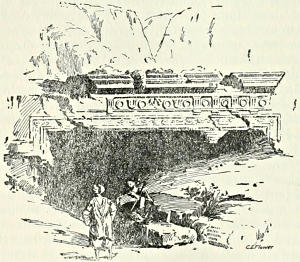
Entrance to the Tomb of the Kings, Jerusalem
From that day forward the Jews have no important history. The extremist
party of the prophets and Zealots, which was likewise the nationalist party,
no longer existed; it had been
drowned in blood. As for the
priests and rabbis, they had
long since withdrawn from
the conflict, but it is due to
them that the Jews, having
completely lost their national
existence, have been able to
subsist to this day as a religious
body. “Renouncing
the hope of playing a political
rôle,” says Munk, “the
Jews directed all their efforts
towards a moral aim, and devoted
themselves wholly to
consolidating their religious
unity.” Convinced at last that
their mission as a body politic
was at an end, and that the
sanctuary at Jerusalem, with
its priests and sacrifices, could no longer be the symbol about which the
scattered remnants of the Jewish nation were to gather, they laid down
their arms, and sought by peaceful ways and intellectual methods to
strengthen themselves as a religious body. For a while Palestine still remained
the chief seat of religious study, the rabbis settling in several cities
of Galilee, notably Sephoris and Tiberias. From the school of Tiberias,
founded about the year 180, came forth the famous rabbi, Yehudah, surnamed
the Holy, who collected the incomplete codes and traditional laws
of the schools of the Pharisees, and, in the first quarter of the third century,
fashioned them into an immense system of laws known under the name of
the Mishnah, or Second Law. This code is divided into six parts, entitled
Sedarim, orders. Each of the six is subdivided into several treatises, each
treatise into chapters. This code was annotated, discussed, and amplified,
first by the Palestinian and then by the Babylonian school, and each school
afterwards made a collection of these annotations and discussions. The
name of Gemara, Complement, was given to these collections, which were
much more voluminous than the Mishnah that serves for their text. The
Mishnah and the Gemara together form the Talmud, the Teaching.
The Zealots who had perished in the struggle for independence or in the
massacres that followed on their defeat, and the rabbis who laboured in
obscurity and silence, constituted but a comparatively small part of the
Jewish population, and we may well ask what became of the innumerable
slaves who flooded the empire after the fall of Jerusalem. They did not
all succumb to the arduous toils of the Coliseum. Under Hadrian there was
a fresh influx of Jewish slaves; Dion Cassius, who speaks of five hundred
and eighty thousand men killed in the course of the war, says nothing
of women or children. We cannot doubt that they were sold, according to
the common custom. Renan says that at the yearly fair of the Terebinth,
near Hebron, Jews could be bought at the same price as horses. Once
bought, they ran no further risk of death from hunger or destitution, for a
slave, even if bought at the price of a horse, represented money’s worth,
which it was not in his master’s interest to lose. Among their co-religionists,
slaves like themselves, or freedmen, these unhappy beings found the
pathetic brotherhood of the poor, ingenious in expedients. All the little
nameless trades offered resources to this humiliated race, unscrupulous,
skilful in exploiting the vices of the ruling classes, armed with good reasons
for not loving the human race. Mingled with slaves of other races, they
communicated to them the fanaticism of their wrath and their hopes of
revenge. This revenge was afterwards relegated to a distant future; but
at that time, smarting under the memory of recent disaster, they dreamt
of it as complete and in the immediate future. Let the world come to an
end, since nothing could reform it; let it go down to the bottomless pit,
with all its defilements, and the agonies of the outcasts of life, and oppressions
without number, and inexpiable ills! The hour of deliverance is near,
and the accursed shall go to everlasting fire, there shall be weeping and
gnashing of teeth. The fall of the Jewish nation redounded to the advantage
of Christian propaganda. From that time forward we hear less and less
of the Jews and more and more of the Christians.
It is an inevitable consequence of military government that after every
conquest the conquered impose their ideas on the conquerors. When Rome
had subjugated Greece, she herself submitted to the dominion of the Hellenistic
spirit, which imposed on the Romans its own forms of art, its literary
culture, its mythology, and its philosophy. Rome, mistress of Asia, was
invaded by Asiatic luxury, the East opened upon the West the floodgates
of its superstitions, sensual, gloomy, frenzied, or ascetic; nothing was talked
of save mysteries, funeral feasts, horoscopes, magic, purifications, Isis and
Mithras, the passion of Attys, gods dead and risen again. Egypt had deified
the Pharaohs, Rome deified the Cæsars. Finally, Judea, the last province
conquered by the Romans, was the last to impose its religious thought upon
the world. The obscure traditions of a despised people were destined to
take the place of the glorious memories of Greece and Rome. A monarchy
required a monarchial religion. The republic had vanished from the earth,
it could not be left in the heavens. The images of the gods still stood in
their temples, but since the time of Augustus the only god of the empire had
been the emperor. Since the conscience of the conquerors of the world had not
revolted from the apotheosis of tyrants, the conquered were fully entitled to
seek among their own ranks for a worthier object. One nation alone had
refused its incense to the emperors. That nation was destined to provide a
God for the coming centuries. In the arrogant words of a Jew of our own
times, this nation said to the world, “Till thou art able to understand me,
behold a man of my race, make of him thy god.” Humanity had found its
social ideal in servitude; it was just that the gibbet of slaves should become
the symbol of the religion of the human race.
Thus in the great Christian synthesis, the worship of the God-man, which
sums up the whole of Greek anthropomorphism, took its place by the side of
Jewish monotheism. With the principle of universal order, the source and
reason of things, was associated, in the unity of the Divine, the moral law
in its loftiest form, the sacrifice of self and redemption through suffering.
But while other religions, when introduced into the empire, had allowed the
traditions and monuments of Græco-Roman civilisation to remain, the monistic
religion of the Semitic race was destined to exclude all other religious
forms and wipe out the traces of them. Like the wind of the desert that
destroys everything in its path, the solitary God of Sinai was to sweep
away all the works of the past. Hence, some centuries later, Rutilius
Numatianus, the last of pagan poets, exclaimed, in the midst of the ruins of
civilisation and the empire, “Would to the gods that Judea had never been
conquered! The plague, extirpated there, hath spread abroad, and a vanquished
nation oppresses its conquerors.” Had this poet had a little of the
living faith of those he despised, had religion been anything to him beyond
a literary form, he would have recognised that this conquest of the world
by Jewish thought was but a just vengeance for the hideous wars of Titus
and Hadrian, and a striking proof of the justice of the gods. The events
of human history are neither effects of capricious chance nor phases of
necessary evolution, but moral consequences of a great law of equilibrium
and expiation which is the nemesis of history.e
The Tower of David, Jerusalem
If a nation can be in any sense summed up, the National Idea of the
Hebrews as a unit has been stated by Hegel in contrast with the Idea of
other peoples. He says: While among the Phœnician people the Spiritual
was still limited by Nature, in the case of the Jews we find it entirely purified—the
pure product of thought. Self-conception appears in the field
of consciousness, and the Spiritual develops itself in sharp contrast to Nature
and to union with it. It is true that we observed at an earlier stage the
pure conception “Brahma,” but only as the universal being of Nature; and
with this limitation, that Brahma is not himself an object of consciousness.
Among the Persians we saw this abstract being become an object for consciousness,
but it was that of sensuous intuition—as Light. But the idea
of Light has at this stage advanced to that of “Jehovah,”—the purely One.
This forms the point of separation between the East and the West; Spirit
descends into the depths of its own being, and recognises the abstract
fundamental principle as the Spiritual. Nature, which in the East is the
primary and fundamental existence, is now depressed to the condition of
a mere creature; and Spirit now occupies the first place. God is known as
the creator of all men, as he is of all nature, and as absolute causality
generally. But this great principle, as further conditioned, is exclusive
Unity.
This religion must necessarily possess the element of exclusiveness, which
consists essentially in this—that only the One People which adopts it,
recognizes the One God, and is acknowledged by Him. The God of the
Jewish People is the God only of Abraham and of his seed: National individuality
and a special local worship are involved in such a conception of
deity. Before Him all other gods are false: moreover the distinction
between “true” and “false” is quite abstract; for as regards the false
gods, not a ray of the Divine is supposed to shine into them. But every
form of spiritual force, and a fortiori every religion is of such a nature, that
whatever be its peculiar character, an affirmative element is necessarily
contained in it.
However erroneous a religion may be, it possesses truth, although in a
mutilated phase. In every religion there is a divine presence, a divine
relation; and a philosophy of history has to seek out the spiritual element
even in the most imperfect forms. But it does not follow that because
it is a religion, it is therefore good. We must not fall into the lax conception,
that the content is of no importance, but only the form. This latitudinarian
tolerance the Jewish religion does not admit, being absolutely exclusive.
The Spiritual speaks itself here absolutely free of the Sensuous, and
Nature is reduced to something merely external and undivine. This is the
true and proper estimate of Nature at this stage; for only at a more
advanced phase can the idea attain a reconciliation (recognise itself) in this
its alien form. Its first utterances will be in opposition to Nature; for
Spirit, which had been hitherto dishonoured, now first attains its due
dignity, while Nature resumes its proper position. Nature is conceived as
having the ground of its existence in another—as something posited,
created; and this idea, that God is the lord and creator of Nature, leads
men to regard God as the Exalted One, while the whole of Nature is only
His robe of glory, and is expended in His service.
In contrast with this kind of exaltation, that which the Hindu religion
presents is only that of indefinitude. In virtue of the prevailing spirituality
the Sensuous and Immoral are no longer privileged, but disparaged as ungodliness.
Only the One—Spirit—the Non-sensuous is the truth; Thought
exists free for itself, and true morality and righteousness can now make their
appearance; for God is honoured by righteousness, and right-doing is “walking
in the way of the Lord.”
With this is conjoined happiness, life, and temporal prosperity as its
reward; for it is said: “that thou mayest live long in the land.”—Here
too, also, we have the possibility of a historical view; for the understanding
has become prosaic; putting the limited and circumscribed in its proper
place, and comprehending it as the form proper to finite existence: Men are
regarded as individuals, not as incarnations of God; Sun as Sun, Mountains
as Mountains—not as possessing Spirit and Will.
We observed among this people a severe religious ceremonial, expressing
a relation to pure Thought. The individual as concrete does not become free,
because the Absolute itself is not comprehended as concrete Spirit, since
the Spirit still appears posited as non-spiritual—destitute of its proper
characteristics. It is true that subjective feeling is manifest—the pure
heart, repentance, devotion; but the particular concrete individuality has
not become objective to itself in the Absolute. It therefore remains closely
bound to the observance of ceremonies and of the Law, the basis of which
latter is pure freedom in its abstract form. The Jews possess that which
makes them what they are, through the One: consequently the individual
has no freedom for itself. Spinoza regards the code of Moses as having
been given by God to the Jews for a punishment—a rod of correction.
The individual never comes to the consciousness of independence; on that
account we do not find among the Jews any belief in the immortality of the
soul; for individuality does not exist in and for itself.
But though in Judaism the Individual is not respected, the Family has
inherent value; for the worship of Jehovah is attached to the Family, and
it is consequently viewed as a substantial existence. But the State is an
institution not consonant with the Judaistic principle, and it is alien to the
legislation of Moses. In the idea of the Jews, Jehovah is the God of Abraham,
of Isaac, and Jacob; who commanded them to depart out of Egypt,
and gave them the land of Canaan. The accounts of the Patriarchs attract
our interest. We see in this history the transition from the patriarchal
nomad condition to agriculture.
On the whole the Jewish history exhibits grand features of character;
but it is disfigured by an exclusive bearing (sanctioned in its religion)
towards the genius of other nations (the destruction of the inhabitants of
Canaan being even commanded), by want of culture generally, and by the
superstition arising from the idea of the high value of their peculiar nationality.
Miracles, too, form a disturbing feature in this history—as history;
for as far as concrete consciousness is not free, concrete perception is also not
free; Nature is undeified, but not yet understood.b
The expiatory offerings of the Israelites were governed by precepts
which were more numerous than sacrifices. If any one had violated the
Laws of the Torah, or Book of the Law, he was obliged at once to offer up
a young ox; the fat and kidneys of the ox were burnt before Yahveh, the
skin, head, legs, stomach, and flesh were burnt outside the camp. If the
whole community sinned, the ancients or heads of families had to offer up
this sacrifice. Any one who could not afford an ox could replace it by a goat
or a young lamb if he had witnessed a curse without declaring it, or if he
had blasphemed himself, or had touched the body of an impure animal or
any other impurity. A poor man was only obliged to offer up two doves or
pigeons, one as a sin offering, the other as a sacrifice. If he was very poor
indeed, he contented himself by bringing the tenth part of an ephah of flour
without adding oil or the incense for the sacrifice.
The peace offering was offered up after a vow or a pious act, or after a
benefit for which the son of Israel wished to thank Yahveh. The law also
ordained a few peace offerings such as the ram brought by the Nazarite, at
the same time that he offered up a sacrifice. At the festival of the First Fruit,
the Hebrews brought two yearling lambs which belonged to the priests. The
priest only had the breast and right shoulder of the other peace offerings,
while the remainder of the victim formed part of the grand repast to which
the tribe was invited, and from which the Christian feasts must have sprung.
Besides the victims chosen for these three kinds of sacrifices, there were
two others, the young cow and the red cow, which were sacrificed on special
occasions. When the body of a murdered man was found in the country,
the ancients and the chiefs of the families of the surrounding towns assembled
together. When the nearest place to where the murder had been committed
had been carefully fixed upon, the ancients of that city or borough
were obliged to take a young heifer, which had not yet worked, to a rough and
uncultivated valley. There, after wringing the neck of the cow, the ancients
in the presence of the priests washed their hands over the victims killed in
the valley, and sang. The guilty man remaining unknown and not making
atonement for his crime, the sacrificed heifer served as an atonement instead.
The red heifer, quite full grown, but which had never been yoked, was
killed and burnt whole by the cohene-hakadel, who sprinkled the entrance
of the tabernacle, seven times with his finger dipped in the blood of the
victim. The cinders of the cow were collected to make lustral water (water
of separation), which purified people from the touch of corpses. Perhaps
the cow thus sacrificed represented sin and impurity. Amongst the Egyptians,
red seems to have been a wicked colour. That was doubtless why the
Hebrews had chosen a cow of this colour as victim of sin.
The entire nation was expected to make presents to Yahveh, without
counting the private offerings which were added to all these donations.
The law decided upon some of them. The poor, who could not offer up two
doves or two of their young as sin offerings, could instead offer a tenth part
of an ephah of flour without oil or incense. The husband who doubted his
wife’s chastity brought her before the priests to try her, but began by presenting
some barley, as the offering of jealousy.
The first day the priest exercised his powers he brought the tenth part
of an ephah of flour. He offered up half in the morning and half in the
evening. According to the Talmud and Josephus, the high priest had every
day to offer up sacrifices. This offering had to be consumed whole; as for
the other presents, only a handful was burnt and the rest was given to the
priests. Voluntary donations and those which were the result of vows have
also to be added to those ordained by religion.
Sweet-smelling perfumes were brought by the sons of Israel and burnt
upon the altar, Yahveh alone was allowed to smell them. “Whoever makes
this perfume for his own use, let him be taken from his people.”
Every first-born belonged to Yahveh; a month after birth, a child had to
be presented to the temple and bought back for five shekels at most. As
for the first-born of animals, it was offered up as a peace sacrifice, and the
flesh went to the priests. If it were an unclean animal, it could be sold or
killed for the benefit of the tabernacle.
Besides these sacrifices, which took place, for the most part, at no fixed
times, the Hebrews celebrated feasts in honour of Yahveh. Each week they
had to observe the Sabbath, by abstaining from work. This was in memory
of the repose of Yahveh, the seventh day after he had created the world.
Perhaps this number seven, so particularly beloved by the Hebrews, which
was the close for them of certain periods of days and years, was also a
remembrance of Egypt. The great mourning for the death of Osiris
lasted seven days. During the same length of time the death of Adonis,
the divine young man slain by the teeth of a wild boar, was mourned in
Phœnicia.
On the Sabbath day every occupation was forbidden, even picking up
wood or cooking food. No longer journey was allowed than a walk of two
thousand steps outside the town. All the religious functions as well as
military operations were carried on on that day as on other days. It was
only after exile, when a spirit of narrow fanaticism took hold of the people,
that Jewish soldiers at certain times preferred to let themselves be killed
rather than violate the repose of the Sabbath by fighting. Originally the
difference between the Sabbath and other days was only the absence of work
and the sacrifice of two lambs, followed by an offering of libation, which
had to be made in the middle of the day. Later when there were synagogues
throughout Palestine, everybody went there on the Sabbath to pray
in common and to hear the Law explained from the mouth of the rabbi.
The Sabbath began, like all the days amongst the Hebrews, at sunset, and
ended the following evening.
Every seven years the earth also had a Sabbath. During the whole year
it rested. People were forbidden to till or sow, or trim the vine or olive
trees. Everything the earth produced naturally and unaided went to the
land-owner and to the beggars and strangers. That year also all debts and
all slavery were cancelled. A Hebrew slave had the right to leave his master
after six years; if he preferred to stay with him, he was put against a
door and his ear was pierced.
The Egyptians celebrated the feast of the New Moon and the different
phases of its course. The Hebrews also celebrated the New Moon; during
this feast sacrifice was offered up composed of two bulls, a ram, and seven
lambs, to which a he-goat was added as an expiatory offering. Offerings
and libation were also added to all this. There was doubtless a solemn
repast at the New Moon, when the people were assembled to eat the sacrificed
animals.
It was generally the day after the new moon had been seen in the sky
that the feast was celebrated.
But the principal feasts of Israel were the feasts of the Passover, of
Pentecost, and of Tabernacles, and the day of Atonement. The first three
originally had to do with the different phases of the harvest, later souvenirs
of national life were associated with them.
The social organisation of the Hebrew people was to a certain degree the
outcome of the religious ideas. Yahveh, the master and king of Israel,
governed the country through the Law. The chiefs were only the lieutenants
of Yahveh, whose business it was to see that the laws were observed
which had been transmitted by Moses. All the eldest sons of the Hebrews
were equals, there was no aristocracy, no lower class, no plebeians; nothing
in Israel resembled Greek or Roman society, divided into castes, whose only
objects very often were to crush one another. With this principle of
equality among the Hebrews, royalty and its origin did not even enter into
the thoughts of the Israelites. If the political and administrative codes of the
Hebrews be examined, as they appear in the Pentateuch and in subsequent
history, it will be seen that certain great assemblies were called together by
the chiefs of Israel, and were composed of ancients, judges, and scribes.
The ancients appear to have been the elders of the family. In each town
they formed a kind of local council, and regulated the affairs of the city;
they also seem to have had a fairly large judicial power. The Law gave
them, in many instances, the right of pronouncing judgments and enforcing
the Law. The elders also formed on great occasions a national council, in
whose wisdom the chief of the Hebrews could enlighten himself. In general
matters they appeared to be often invested with sovereign powers. It
was the elders of Israel who invited Samuel to choose a king. Later, they
chose David to rule over Israel. It would be a mistake to consider these
elders as an aristocratic assembly, full of hatred and bound down to odious
privileges; they were the natural representatives of the family, members of
different houses who came out of the shade of the fig trees at certain times,
to regulate at the gates the affairs of the town, or to give their opinions on
the general interests of the Hebrew state.
In each important locality, there was a tribunal composed of judges.
The Levites of the city, versed in the knowledge of the Law, doubtless
formed part of the tribunals. The judges held very honoured places and
formed part of all the great assemblies where the interests of Israel were
discussed. They held their office by election.
The scribes, who were also elected, assisted in the great assemblies.
They formed the learned part, holding the style like the Egyptian scribes.
They were attached to the elders or to the judges, holding the office of genealogists,
and in the wars served as heralds to the commanders of the army.
At the head of the scribes, there was a chief with certain rights not enjoyed
by the others.
In order to assure the equality of rights for the entire Hebrew race, the
Law tried to establish, as far as possible, equality of fortune. Every fifty
years transferred property had to be returned to the original possessors, but
this rule seems hardly to have been observed. Trade and usury, the principal
sources of the investment of money, were excluded by the Law from this
rule, and thus making Israel an agricultural nation. Israel soon escaped
from the obligations. The Hebrew was a most astonishing mixture of idealism
and of practical common sense, and this explains many contradictions in
his nature. Even to-day the Jew can unite to a prodigious extent, the most
terrestrial details with the highest and noblest sentiments. All that was
most idealistic in Israel was collected together in the Law; but how far did
the lives of the Hebrews resemble their book?
Foreigners and colonists were not ill-treated in Israel. The Law guaranteed
protection to Hebrew and colonist alike. But the good will shown
towards the Canaanite and the sons of Ammon and Moab was not very great.
They were forever excluded from using the title of citizen. Neither they
nor the bastard nor the eunuch could take a place in the assembly of Yahveh.
But at the third generation the sons of Edom and Mizraim were admitted as
Israelites on condition they submitted to the ceremony of circumcision, by
which the Hebrew was always distinguished from the Gentile.
Marriage was considered an absolute obligation, from which nobody could
be exempt. This idea was certainly one of the causes of the morality and
power of Israel. Woman was not according to the Law an inferior being,
she was part of man, she bore the same name as man; he was called isch,
and she ischa, with the feminine termination. No more in Israel than in
Egypt were the young girls and young women shut up from all eyes. Nobody
could have enjoyed more liberty than Miriam and Deborah. Woman
looked up to and free, as she was imagined in a country where law was respected,
has been marvellously described at the end of Proverbs. The more they
thought of woman, the more she was punished when she forgot her duties.
The power of fathers over their sons and daughters before marriage was
very great. The latter could be sold as slaves, but only for a time. However,
the Law forbids the father the right of killing his children. It was
necessary for the father, in order to have his son put to death, to appeal to
the assembly of the elders assembled at the gates of the town. Brought up
with the knowledge of the Law, the son remained for a long time under the
authority of his father, for whom he had to work even after marriage, which
emancipated the daughters.
How were the inheritances divided, and did the right of the eldest son
ever exist in Israel? The eldest son, so long as a daughter had not come
before him, had a right to two parts of the paternal succession. The remainder
was distributed equally amongst the other children. As for the
father, he could not lawfully change his will in favour of a favourite son.
What Jacob did for Joseph, the Hebrew legislators wished to spare to future
generations. Israel with the proud Josephides suffered too severely from
favouritism not to repudiate it energetically. Far inferior to the right of
priority of birth, the law of favouritism only feeds hypocrites and stirs up
hatred and jealousy in the bosoms of families. When a man died leaving
only daughters, they shared the inheritance with the obligation of only
marrying members of their tribe. If there were no daughters, the nearest
relations inherited. Later, by putting aside the Law, the heads of families
commenced leaving a part of their property either to their daughters or
sometimes to their slaves.
This short account of the Jewish Law would be incomplete if it were
silent on an interesting feature of the society of Israel, the slave. Like all
nations of antiquity, Israel had slaves. But the Law softened their lot.
Amongst the slaves were Hebrews and foreigners. A man who was much
in need could sell his young daughter as a slave. Sometimes the son of her
master was obliged to marry her. The Hebrew incapable of paying the fine
after a theft was obliged to deliver himself up to the man he had stolen
from. When reduced to the last extremity, he could sell himself. These
were the principal circumstances of slavery in Israel, but at the end of six
years the slave became free, and left his master with a reward in the shape
of lambs, kids, and goats. They also received presents of ground and of
household linen. But if the slave at the eighth year said to his master, “I
will not leave you,” the master would take a bodkin or puncheon, and pierce
the ear of the slave leaning against the door of his house: this was a sign
of perpetual slavery.
Foreigners became slaves in Israel by selling themselves, or when they
were prisoners of war. The Law was lenient towards them. They had the
right to take part in the panegyrics and joys of Yahveh, to share the repast
of the climes and the natural fruit of the Sabbatic years, and to rest on
the Sabbath day. If their masters mutilated them, they were obliged to liberate
them; freedom might be the result of a broken tooth. If the slave died
from his master’s ill-treatment, the master was terribly punished; how, is not
clearly stated. A slave seems once to have enjoyed the office of steward;
the management of the whole house was in his hands.
Except in regard to Yahveh, the Hebraic Law appears to have received
beneficial influence from Egypt and Assyria; at every moment that beautiful
chapter cxxv of The Book of the Dead seemed to be remembered, where
the soul justifying itself before Osiris, after stating that the precepts of
charity had been fulfilled, dares to add “I have not made tears flow.”c
During the last three centuries, many scholars have devoted themselves
especially to the art of this nation that has played such an extraordinary
rôle in the history of the world. These researches have been
directed almost entirely upon the temple at Jerusalem and its furniture; for
here, where the national life was concentrated, was in fact all the art that
the country produced. Moreover, while the remains are no longer in our
hands or under our eyes, there is not a single edifice in all oriental or classical
antiquity concerning which we possess such numerous and circumstantial
records.
The city of Jerusalem occupies to-day the northern extremity of a plateau
which is bounded on the east by the valley of the Kidron, and on the south
and west by the valley of Hinnom. This plateau is divided from north to
south by a ravine called the valley of the Tyropœon (“the cheesemakers”)
in such a manner as to form two hills. The eastern hill is Mount Moriah,
whose southern extremity, now called Ophel, was Zion, the “city of David.”
When Solomon ascended the throne, Jerusalem occupied only Zion, and
did not begin to extend to the western and larger hill until under the kings
of Judea. Mount Moriah, on the north, was given up to husbandry, and a
rich man of Jerusalem, Araunah, owned there a field with a threshing-floor,
where camels and oxen trod out the grain at harvest-time. David had bought
the field of Araunah as a site for the temple of the true God, and had erected
an altar on the threshing-floor.
The work began in the fourth year of the reign of Solomon. The
materials had already been in great part fitted. Architects, workmen, and
artists were engaged in Tyre by the aid of King Hiram, and the work
progressed rapidly. The summit of Moriah was first levelled, and then
around the remaining hillock was constructed an immense retaining wall of
extraordinary solidity, extending up to the level of the summit. It was
built of enormous blocks held together by cramp-irons, and was supported
on the outside by embankments. All the space between the interior face of
this wall and the rock was filled in with rubble in such a way as to form
a square platform.

Movable Vessel of the Temple
(After Mangeant)
Then followed the erection of the temple itself, and so rapidly was it
pushed that the dedication feast was celebrated only seven years after the
laying of the first stone of the substructure. The temple was to be enclosed
by two courts, but Solomon completed only the first or inner one, and the
east wall of the second or outer, which was not finished until long after the
great king’s death, in the reign of Manasseh.
The Bible gives us a detailed description of the magnificence of the interior
of this sanctuary, built and decorated by Phœnician workmen, and of the
objects of art accumulated there by the most ostentatious of Hebrew kings.
The architecture and the decorations of the interior were all in Egyptian
style, like the temples of the Phœnicians themselves. But of the works of
Solomon nothing has remained but the cisterns and the east wall of the outer
court. This wall is ornamented with a gate under which Solomon had his
throne placed when he assisted at public ceremonies; it was still called Solomon’s
gate, even after the time of Herod. Numerous enlargements and
restorations were made under the kings of Judea; but in 586 B.C., when the
Chaldeans took Jerusalem, the temple was totally destroyed.
Fifty-two years later, the captive Jews in Babylon having been delivered
by Cyrus, their leader, Zerubbabel, undertook to rebuild the temple of the
true God. Though similar in plan to that of Solomon, the new edifice was
less beautiful and of less majestic proportions; the old men who recalled the
former one wept. This building stood for nearly five centuries, passing
through the domination of the Seleucidæ and the Roman conquest of
Pompey without being sacked or demolished.
Then Herod, the Idumæan, made king of the Jews by the Romans, conceived
the idea of making himself popular with the people by rebuilding the
temple in all the splendour of Solomon. The execution of his plan, which
included enlargement,—Josephus says he doubled the original size,—required
the complete demolition of the former structure and the rebuilding of the
ancient terraces and the gates crowning them. The only portion of the old
temple that he seems to have preserved was the eastern gate or gate of Solomon.
The ancient plan, however, was apparently not departed from in the main.
The great outer court was surrounded on three sides by a double colonnade
of Doric columns twenty-five cubits high. On the south side was a
basilica, i.e. “a building with three unequal naves supported by columns.”
This enclosure was the Court of the Gentiles, and was open to all visitors.
A barrier only three cubits high prevented the ungodly from entering the
enclosure reserved for the Israelites, which comprised the Court of Women
and the Court of Men, or of Israel. The Court of Women had at its four
corners square halls serving for the supplies of the temple, for ablutions, or
other pious exercises.
From this court three gates led through a group of buildings to the
Court of Israel. The principal one of these gates, celebrated as the Nicanor
Gate, had doors of Corinthian bronze, and was of beautiful architectural
proportions and rich construction. The Court of Israel, which was reserved
for men who had performed certain acts of purification, was eleven cubits
wide. The halls surrounding it on three sides, which had façades furnished
with porticoes, were appendages of the divine cult. Each was consecrated
to a special service. Here the skins of victims were salted and washed; the
musical instruments, the salt, the eternal fire, the wood were kept here; and
here was the hall of the sanhedrim.
Finally came the Court of the Priests, in the middle of which were the
temple proper and the altar of burnt offerings. The temple stood on a terrace
six cubits high, so that there was thus a difference of level of eight and a half
metres between the platform of the temple and the Court of the Gentiles.
Its architectural features were essentially the same as those of Solomon’s
temple. This temple of the Jews was one of the most majestic works of
architecture that antiquity produced. The succession of enclosed courts
rising one above another and crowned by the gigantic white marble pylons
of the sanctuary is a conception of genius that was realised only here, and
all antiquity had but one voice in praise of its imposing grandeur.
The House of the Eternal was embellished with an unprecedented luxury.
Costly woods, gold, silver, ivory, precious stones even—nothing was spared
by this people that was so jealous of its God. The accessories of the cult,
moreover, sacred vessels, knives, basins, utensils of every kind, were works in
which caster and engraver vied with one another in the display of their art.
But it must not be forgotten that the artists who decorated the ancient
temple were Phœnicians; and as the Phœnicians always limited themselves
to imitation of the Egyptians and the Assyrians, their technique has a hybrid
character, which, like Syria itself from a geographical point of view, is a
sort of compromise between Asia and Egypt.d
The race which had so little influence on the art of the world and so
much upon its literature, religion, commerce, and destinies, has had the
strangest of all national fates. To the Christian it is as the escape of the
soul from the corruption and death of the body. Newmane has thus closed
his History of the Hebrew Monarchy, in words that may fitly serve as finis
here:
“It is not intended here to pursue the later fortunes of the Jewish
nation. We have seen its monarchy rise and fall. In its progress, the prophetical
and the sacerdotal elements were developed side by side; the former
flourished in its native soil for a brief period, but was transplanted over all
the world, to impart a lasting glory to Jewish monotheism. The latter,
while in union with and subservient to the free spirit of prophecy, had
struck its roots into the national heart, and grown up as a constitutional
pillar to the monarchy: but when unchecked by prophet or by king, and
invested with the supreme temporal and spiritual control of the restored
nation, it dwindled to a mere scrubby plant, whose fruit was dry and thorny
learning, or apples of Sodom, which are as ashes in the mouth. Such was
the unexpansive and literal materialism of the later rabbis, out of which has
proceeded nearly all that is unamiable in the Jewish character: but the
Roman writers who saw that side only of the nation, little knew how high a
value the retrospect of the world’s history would set on the agency of this
scattered and despised people.
“For if Greece was born to teach art and philosophy, and Rome to diffuse
the processes of law and government, surely Judea has been the wellspring
of religious wisdom to a world besotted by frivolous or impure fancies. To
these three nations it has been given to cultivate and develop principles
characteristic of themselves: to the Greeks, Beauty and Science; to the
Romans, Jurisprudence and Municipal Rule; but to the Jews, the Holiness
of God and his Sympathy with his chosen servants. That this was the true
calling of the nation, the prophets were inwardly conscious at an early
period. They discerned that Jerusalem was as a centre of bright light to a
dark world; and while groaning over the monstrous fictions which imposed
on the nations under the name of religion, they announced that out of
Zion should go forth the Law and the word of Jehovah. When they did
not see, yet they believed, that the proud and despiteful heathen should at
length gladly learn of their wisdom, and rejoice to honour them. In this
faith the younger Isaiah closed his magnificent strains, addressing Jerusalem:
‘Behold, darkness covereth the earth,
And thick mist the peoples;
But Jehovah riseth upon thee,
And his glory shall be seen on thee:
And the Gentiles shall come to thy light,
And kings to the brightness of thy rising.…
The Gentiles shall see thy righteousness,
And all kings thy glory;
And thou shalt be called by a new name,
Which the mouth of Jehovah shall name.
Thou shalt be a garland of glory in the hand of Jehovah,
And a royal diadem in the hand of thy God.
Thou shalt no more be termed Forsaken,
Nor shall thy land any more be termed Desolate;
For Jehovah delighteth in thee,
And thy land shall be married to him.’”
e
Written Specially for the Present Work
By Dr. D. H. MÜLLER
Professor in the University of Vienna; Member of the Imperial Academy of Sciences, etc.
The Prophets prophesied in a far-off land, many, many hundred years
ago. They prophesied to a small nation that dwelt in a small country and
established a petty kingdom. The petty kingdom has been crushed under
the iron heel of the world’s advance, the nation scattered to every quarter
under heaven; but the writings of the prophets remain; they have come
down to us in the original text; they have been translated into every
language and are read by every nation.
To this day the words of the prophets resound from every pulpit, in
admonition and menace, for comfort and salvation. The substance of the
prophetic discourses is sufficiently familiar, and these words spoken
thousands of years ago do not fail of their effect to-day. From the depths
of the heart they welled forth, divine inspiration was their source, they
were addressed to men burdened with passions and frailties; and hence
they have kept their power through centuries and tens of centuries.
We will not at present concern ourselves with the substance of the
prophetic books nor with the development of prophecy; we will consider
the form of the prophetic discourses. Men prized the substance so highly
that they neglected to examine the form. Are they prose or poetry? Even
this question has not been answered. A Greek oration is minutely analysed;
we know the rules of rhetoric, and divide each oration into its component
parts. A Greek or Latin poem is classed as drama, epic, lyric, etc., and its
metre is studied and criticised. What rules govern the composition of the
prophetic books?
On the basis and in pursuance of my previous researches I advance the
thesis that “the main characteristics of the style of the prophetic writings
are strophic composition and responsion.” What a strophe is every one
knows; nevertheless I will expressly state that by “strophe” I mean a
group of lines or verses, standing in relation to other verses, and yet forming
in and by themselves a compact whole.
In Semitic poetry or rhetoric, in so far as we may speak of it, the “responsion”
has hitherto been an unknown quantity; but we are familiar with it
in classical literature, the best examples being the choruses of the Greek
dramas. The strophe and antistrophe correspond in metre, in form, and in
the division of the periods; they frequently correspond in substance also;
and this correspondence is often marked by verbal consonance or assonance.
This peculiarity, which seems to be of infrequent occurrence and trifling
importance in Greek literature, has been recognised and named by the
exact observation and penetrative criticism of classical philology; in Semitic
poetry, where the responsion, combined with the strophic structure, to
which it serves as the element of crystallisation, must be regarded as of
the very essence of the poem or discourse, it has neither been explained nor
named.
I will take an example of the responsion from Amos, the first prophet
who cast his discourses into literary form, Chaps. vii.-viii.
1) Thus the Lord God shewed me:
And, behold, he formed locusts in the beginning of the shooting up after the latter growth;
And, lo, it was the latter growth after the king’s mowings.
2) And it came to pass that when they made an end of eating the grass of the land,
Then I said, O Lord God, forgive, I beseech thee:
How shall Jacob stand? for he is small.
3) The Lord repented concerning this:
It shall not be, saith the Lord.
4) Thus the Lord God shewed me:
And, behold, the Lord God called to contend by fire;
And it devoured the great deep,
And would have devoured up the land.
5) Then said I, O Lord God, cease, I beseech thee:
How shall Jacob stand? for he is small.
6) The Lord repented concerning this:
This also shall not be, saith the Lord God.
7) Thus he (the Lord God) shewed me:
And behold he stood beside a wall made by a plumbline, with a plumbline in his hand.
8) And the Lord said unto me, Amos, what seest thou?
And I said, A plumbline.
Then the Lord said, Behold, I will set a plumbline in the midst of my people Israel;
I will not again pass them by any more:
9) And the high places of Isaac shall be desolate, and the sanctuaries of Israel shall be laid waste.
And I will rise against the house of Jeroboam with the sword.
1) Thus the Lord God shewed me:
And, behold, [there was] a basket of summer [ripe] fruit.
2) And he said, Amos, what seest thou?
And I said, A basket of summer [ripe] fruit.
3) Then said the Lord unto me,
The end [ripeness] is come upon my people Israel;
I will not again pass by them any more.
And the songs of the temple shall be howlings in that day.
The dead bodies shall be many; in every place have they cast them forth: be silent.
This vision of Amos sets forth a series of punishments which have overtaken
or threaten to overtake the land. “The first two refer to dangers
already past at the time of the discourse, the last two to the future.” In
form, again, the first two and the last two exhibit a close affinity with
one another. All four strophes have eight lines apiece and begin with
the same phrase; in all four the second line begins in the same fashion,
but proceeds differently even in the verses of each couple. In the third
line the couples diverge entirely, the twin strophes alone remaining in close
correspondence.
This method of working on a definite plan was a favourite one with the
prophets. The change of picture in the same framework produces a lasting
impression, and the repetition of the same form with a different substance
fixes the mind on the thing seen, which is in danger of vanishing all too
quickly. The responsion in verses apparently different is very noteworthy;
as are lines 7 and 8 respectively, where the desolate places of Isaac correspond
to the songs of the temple changed into howlings, and the rising with the
sword of the third strophe to the many dead bodies of the fourth.
I take another example of correspondence between the strophes from the
Book of the Prophet Ezekiel, Chap. xxi.
| 1) And the word of the Lord came unto me, saying, |
6) And the word of the Lord came unto me, saying, |
| 2) Son of man, |
7) Son of man, |
| Set thy face toward the South. |
Set thy face toward Jerusalem |
| And drop thy word toward the South, |
And drop thy word toward the Sanctuaries, |
| And prophesy against the forest of the field in the South; |
And prophesy against the land of Israel; |
| 3) And say to the forest of the South: |
8) And say to the land of Israel: |
| Hear the word of the Lord; |
|
| Thus saith the Lord God: |
Thus saith the Lord: |
| Behold I will kindle a fire in thee |
Behold I am against thee, |
| And it shall devour every green tree in thee and every dry tree. |
And will draw forth my sword from its sheath |
| And will cut off from thee the righteous and the wicked. |
|
9) Seeing that I will cut off from thee the righteous and the wicked. |
| The flaming fire shall not be quenched, |
Therefore shall my sword go forth out of its sheath against all flesh |
| And all faces shall be burnt thereby. |
| From the north to the south. |
From the north to the south. |
| 4) And all flesh shall see |
10) And all flesh shall know |
| That I, the Lord, have kindled it: |
That I the Lord have drawn forth my sword out of its sheath; |
| It shall not be quenched. |
It shall not return any more. |
One of Ezekiel’s grandest poems is the Song of the Sword. The sword
from the North in the hand of Nebuchadrezzar comes forth against Jerusalem
and destroys the last remnant of life in the perishing city. The introduction
to the Song of the Sword is an allegory such as Ezekiel loves; he
looks in prophetic trance towards the south and sees a fire approaching from
thence which seizes upon the forest of the south and devours the green tree
and the dry. Then he solves the riddle, thus interpreting the vision. By
placing the riddle and the interpretation in parallel columns, we obtain a
classic example of strict responsion.
As a third example of the responsion I select Matthew vii. 13, 14,
| Enter ye in by the narrow gate: |
| For wide is the gate, | For narrow is the gate, |
| And broad is the way, | And straitened the way, |
| That leadeth to destruction | That leadeth unto life, |
| And many be they that enter in thereby. | And few be they that find it. |
In order to grasp the fundamental idea, that of the responsion, let us once
more clearly define that of the strophe and antistrophe.
The strophe consists of a number of verses combined so as to form a larger
whole; it contains a sheaf of ideas which express a single idea, just as a sheaf
of rays unites to form a single light.
The antistrophe represents an analogous or contrasting idea, which is, like
the former, the sum or product of another sheaf of ideas, and answers to the
former in some or all of its component parts.
Accordingly the responsion, thus conceived of, is the formal expression of
this relation of two or more strophes to one another. Where the principle
of the responsion is strictly carried out each line of the first strophe corresponds
to the corresponding line of the second, either verbally or substantially,
and in the latter case either by parallelism or antithesis. The similarity of
the majority of lines which thus correspond throws the differences at certain
points into strong relief and renders them all the more forcible and impressive.
The highest organic structures have been analysed and found to be built up
from a single cell. All the preliminary conditions which enable the cell to
form organisms lie dormant in it already, but the germ cannot become an
organic being except by a slow process of development. What we now have
to do is to find the germ from which the responsion has developed; and the
germ of this phenomenon is the parallelismus membrorum which constitutes
the vital element of apothegm and verse in the Semitic languages, and more
particularly in Hebrew. But two things may be parallel one with another
not only by analogy but by contrast. The parallelismus membrorum places
side by side two or more ideas, analogous but not identical, and adapted by
their slight diversity to give an image of what the poet desires to convey.
Such sentences abound in the prophetic discourses, as in Isaiah i. 3,
The ox knoweth his owner, and the ass his master’s crib:
But Israel doth not know, my people doth not consider.
And Amos ix. 2,
Though they dig into hell, thence shall my hand take them;
And though they climb up into heaven, thence will I bring them down.
The idea, being presented under a different figure, is repeated without producing
an effect of tedium or monotony.
What the parallelismus membrorum is to the verse or sentence, that
the responsion is to the strophe or discourse.
By slight variations on the responsion two literary forms were evolved to
supply an æsthetic want. When two strophes stand in such a relation that
the conclusion of the one answers to the beginning of that which succeeds
it, the result is the concatenation, which unites two strophes with one another
and leads the way from one field of thought to another. Again, if the
beginning of one strophe or group of strophes corresponds with the conclusion
of the same, the result is the inclusion, the object of which is to
emphasise the logical and æsthetic unity of the said strophe or group of
strophes.
An example of concatenation may be cited from Isaiah, Chap. i.
One column begins—
Hear, O heavens, and give ear, O earth, for the Lord hath spoken—
and ends—
We should have been as Sodom, we should have been like unto Gomorrah.
The second strophe-column begins—
Hear the word of the Lord, ye rulers of Sodom;
Give ear unto the Lord our God, ye people of Gomorrah.
Here, as we see, the beginning of the second column answers to the beginning
of the first and is linked with its conclusion.
Habakkuk (ii. 11) affords another example,
(end of strophe)
For the stone shall cry out of the wall,
And the beam out of the timbers shall answer it.
Herewith the image of a building rises before the prophet as before the
reader. A thought flashes through the prophet’s mind, and he proceeds,
(beginning of strophe)
Woe to him that buildeth a town with blood
And stablisheth a city by iniquity.
And as an example of the inclusion we may quote Jeremiah xlvi. 20-24:
(beginning of strophe)
Egypt is a very fair heifer; but destruction out of the north is come, it is come.
(end of strophe)
The daughter of Egypt shall be put to shame, she shall be delivered into the hand of the people of the north.
In the second chapter of Zephaniah, we find an example of the two-lined
inclusion:
(beginning of strophe)
8) I have heard the reproach of Moab, and the revilings of the children of Ammon,
Wherewith they have reproached my people and magnified themselves against my border.
(end of strophe)
10) This shall they have for their pride,
Because they have reproached and magnified themselves against the people of the Lord of hosts.
Thus the three literary forms, besides the strophic measure, which govern
the composition of the prophetic books are—the responsion, the concatenation,
and the inclusion.
If the responsion is the expression of the outward and inward symmetry—of
substance and form—proper to two strophic organisms which, though
they may be far apart, show their relation one to another by similarity of
character and structure, and correspond to each other more or less, either by
analogy or antithesis, the concatenation may be regarded as the complement
and counterpart of the responsion, inasmuch as it unites the two strophic
organisms by an outward and inward bond—of substance and form. By this
means the two are combined to constitute a greater whole. For this reason
the concatenation does not run parallel to the responsion, but joins the end of
one strophe to the beginning of a second, and leads from one field of thought
to another. The inclusion may be regarded as, in a certain sense, the reverse
of the concatenation. As the concatenation brings about the conjunction of
two strophes, so the inclusion constitutes the boundary line that cuts one
strophic organism off from the next. The concatenation obliterates the distinctive
character of two separate strophic organisms, the inclusion rounds
off and defines a strophe, or group of strophes, and emphasises its distinctive
character.
I cannot refrain from giving at least one example from Isaiah of a strophe-column,
which corresponds with a parallel column of similar structure. I
select the famous vision of Chapter vi. for the purpose. It may be regarded
as one of the earliest prophecies of Isaiah, in conception perhaps the earliest
of all. The Tesetes tradition gives the passage as a single whole,
without break or paragraph. In dealing with a prophet of Isaiah’s rank,
and one so pre-eminent in the composition of these prophetic discourses, we
naturally seek to discover a definite plan in the composition of this vision,
and such a plan does, as a matter of fact, become manifest to the critical
student. The vision begins, “And I saw the Lord,” and the continuation
and complement opens with the words (verse 8), “And I heard the voice
of the Lord.” The passage, accordingly, falls into two parts, one describing
what the prophet saw, the other what he heard. If we examine the two
parts more closely we are struck by the phrase, “Then said I,” occurring
in the one after he had seen all, and in the other after he had heard all.
Hence it appears that the grand vision consists of two images, which
correspond with each other exactly.
| 1) And I saw the Lord |
8) And I heard the voice of the Lord, saying, |
| Sitting upon a throne, high and lifted up, |
Whom shall I send, and who will go for us? |
| And his train filled the temple. |
Then I said, Here am I, send me. |
| 2) Above him stood the Seraphim: |
|
| Each one had six wings; |
9) And he said, Go, and tell this people |
| With twain he covered his face, |
Hear ye indeed, but understand not; |
| And with twain he covered his feet, |
And see ye indeed, but perceive not. |
| And with twain he did fly. |
|
| 3) And one cried unto another, and said, |
10) How fat is the heart of this people |
| Holy, Holy, Holy, is the Lord of hosts. |
And their ears how heavy, |
| The whole earth is full of his glory. |
And their eyes as it were shut. |
|
Else might they see with their eyes |
| 4) And the foundations of the thresholds were moved at the voice of him that cried, |
And hear with their ears |
| And understand with their heart, |
| And turn again, and be healed. |
| And the house was filled with smoke. |
|
| 5) Then said I, Woe is me! |
11) Then said I, Lord, how long? |
| Because I am a man of unclean lips, etc. |
And he answered, Until the cities be waste, without inhabitant, etc. |
Besides these two-column discourses, of which we have just seen an
example, we find three-column discourses, especially in Micah, Jeremiah,
and Ezekiel. They frequently consist of three parallel parts, each divided
into two or three strophes. The strophes of each column correspond on the
one hand, the corresponding stanzas of each part on the other, so that we
have, if we may so express it, a vertical and a horizontal responsion. The
double responsion gives, as it were, the fixed points between which the network
of the strophes is outspread. A classic example of this method is the
great discourse in the ninth chapter of Jeremiah, which belongs to the best
period, and the authenticity of which is unreservedly admitted by Biblical
criticism. Lack of space unfortunately forbids me to give it here arranged
according to the principles I have laid down.
It is time to observe that the same laws may be shown to prevail in cuneiform
inscriptions and the works of the prophet Mohammed.
As an example of responsion I give a passage from the great inscription
of Sargon (L. 186-194).
| That city and that palace, |
(But) its ruler, |
| Asshur, the father of the gods, |
Its royal architect, |
| In the glory of his shining countenance |
May he attain to old age, |
|
May he obtain power |
| Graciously may he look upon it, |
For ever and ever, |
| To days far hence |
May its maker grow old. |
| May he proclaim its renewing. |
|
| With his shining mouth may he decree: |
With his sounding lips may he speak: |
| The protecting genius, |
He who dwelleth in them, |
| The rescuing God, |
In health of body, |
| Day and night |
And joy of heart, |
| Let them rule therein, |
And gladness of spirit, |
| Nor let their power cease. |
May he rejoice therein, |
|
May he taste the joy of life. |
A very instructive example of the strophe combined with responsion is
afforded by the second Babylonian version of the Creation, which has been
for the first time translated and published by T. G. Pinches. It consists of
forty lines, and is arranged in four strophes of ten lines each. The responsion
is clear and vivid to the last degree, the end harks back to the beginning
with manifest intention. The concatenation constitutes, as it were, a
rivet between the strophes. I will confine myself at present to quoting the
beginning of the first three and the ending of the last two strophes.
Str. I (beginning),
The glorious house, the house of the gods, in a glorious place had not been made,
A plant had not been brought forth, a tree had not been created, etc.
Str. I (end),
(As for) the glorious house, the house of the gods, its seat had not been made,
The whole of the lands were sea.
Str. II (beginning),
When within the sea there was a stream
In that day Eridu was made, Ê-sagila was constructed, etc.
Str. II (end),
The gods were to be caused to sit in a seat of joy of heart,
He made mankind.
Str. III (beginning),
Aruru had made the seed of mankind with him.
He made the beasts of the field and the living creatures of the desert; etc.
The age of this Babylonian story of the Creation probably goes back to at
least the middle of the second millennium of our chronology, and in this very
ancient specimen of Semitic poetry we find this poetic form fully developed.
It seems hardly possible to believe that the Arab prophet, who regarded
it as an insult to be described as a poet, should have employed definite
literary forms, and more particularly the strophe combined with the responsion,
in his revelations. Yet such is the fact. In most cases the strophes
rise and fall in harmony with his abrupt and agitated style (similar strophes
occur in the prophetic books), but regular strophes are to be found, and in
those that rise and fall we can trace a definite law which altogether excludes
the idea of chance. The occurrence of the strophe combined with the
responsion in the Koran, is a point of the utmost importance to the hypothesis
of strophic composition, because the correctness of the arrangement of the
Koran in lines seems to be assured both by the rhyme and by tradition. I
will bring to your notice in this place an example of the regular strophe
from the Koran. In the thirty-sixth surah we come upon a passage framed,
as it were, between two verses, which form the inclusion.
v. 28. There was only one cry (of Gabriel from heaven), and behold, they became utterly extinct.
v. 49. They only wait for one sounding (of the trumpet), which shall overtake them while they are disputing together.
Between these two lie five strophes of four lines each.
Str. I, begins (v. 29),
Oh, the misery of men! no apostle cometh unto them but they laugh him to scorn.
Str. II, begins (v. 33),
One sign [of the resurrection] unto them is the dead earth, we quicken the same, etc.
Str. III, begins (v. 37),
The night also is a sign unto them, we withdraw the day from the same, etc.
Str. IV, begins (v. 41),
It is a sign also unto them that they carry off their offspring in the ship filled with merchandise, etc.
Str. V (v. 45), takes up the burden of the first, and begins,
And if it is said unto you, Fear that which is before you and that which is behind,
It may be ye shall find mercy, etc.
I will also subjoin an example of the falling strophe combined with the
responsion, from sura 56, vv. 57-72.
57) We have created you, will ye not therefore believe.…
58) What think ye? The seed that ye emit.
59) Do ye create the same or are we the creators thereof?
60) We have decreed death unto you all, and we shall not be prevented.
61) We are able to substitute others like you in your stead, and to produce you again in the condition or form which ye know not.
62) Ye know the original production by creation; will ye not therefore consider.…
63) What think ye the grain which ye sow?
64) Do ye cause the same to spring forth, or do we cause it to spring forth?
65) If we pleased, we could render the same dry and fruitless, so that you would not cease to wonder, saying,
66) Verily we have contracted debts for seed and labour, but we are not permitted to reap the fruit thereof.
67) What think ye? The water which ye drink,
68) Do ye send down the same from the clouds, or are we the senders thereof?
69) If we pleased we could render the same brackish: will ye not therefore give thanks?
70) What think ye? The fire which ye strike,
71) Do ye produce the tree whence ye obtain the same, or are we the producers thereof?
72) We have ordained the same for an admonition, and an advantage to those who travel through the deserts.
This passage, which is complete in itself, consists of four stanzas, of
5-4-3-2 verses, all of them diverse presentations of the same idea and alike
in construction.
The whole group is enclosed between two single verses which correspond
to one another, and form, as it were, a frame to it.
An exact observation of the Koran shows that strophes of the most varied
structure occur in it, often combined with the responsion, and held together
by all kinds of other literary forms. The principal characteristic of the
strophe is still unity of idea, which, being in its nature relative, is subject
to great variation. Nor is the strophe the final and greatest unit. As the
strophe is formed by the combination of several lines or sentences, so a group
is formed of a number of strophes and a great systematically constructed
discourse of several groups. The same laws which govern the sentence and
the verse prevail in the structure of the strophe and the formation of the
group. Parallelism and antithesis are the principal elements of form in
sentence and verse; they are likewise the forces that struggle for expression,
and assert themselves in the structure of the strophe and the formation of
the group.
The question may be raised: How did Mohammed come to adopt this
form of composition? For the present, I can only advance a hypothesis in
reply. Mohammed received the first impulse to meditate upon matters of
religion from various wise and learned men, and through them became
acquainted with the principal doctrines of Judaism and Christianity; and in
like manner he must have acquired from them the tradition of this form of
poetry, a form which, unlike the poetry of the heathen, was not devoted
to the delight and joy of life, but to religious meditation and to ancient and
pious legend. This form of composition may have been practised and preserved
by the old soothsayers (Kahin) after it had been generally superseded
by the new-fangled and rigidly metrical poetry. Mohammed may possibly
have acquired the secret of this form of composition from such a Kahin, who
had meditated upon the nature of religion. He therefore rightly rejected
the title of poet, and with equal right called himself the “Seal of the
Prophet”; for he spoke and wrote in the style of the prophets of old.
A careful consideration of the laws of strophic form and responsion
which can be shown to exist, though in unequal measure, in the three great
Semitic literatures, leads us to the conclusion that there are only three
possible explanations of their occurrence. Either we have to do with a
phenomenon evolved independently in different parts of the world, or these
literary forms were invented by one nation and borrowed and imitated by
the others, or, lastly, they must all be referred to a common origin.
The three nations among whom we find these literary forms are so widely
separated in space and time that there can be no question of borrowing
between them. But, again, phenomena so original and complicated could
not appear in different places without something of a common origin.
Accordingly, the only possible assumption is that they may all be referred
to a common origin, and that even in primitive times religious poetry was governed
by these literary forms. They have been preserved in the Bible, the
cuneiform inscriptions, and the Koran.
The establishment of the fact that strophic composition combined with
responsion is to be found in all three Semitic literatures naturally drew my
attention to a similar phenomenon in the choruses of Greek tragedy, a
phenomenon noted and recognised by classical philology, though not treated
with the consideration it deserves. Too much stress has been laid on the
metrical uniformity of the strophes, too little on their substantial correspondence,
and more especially on the way in which the latter is interwoven
with assonance and verbal responsion. A certain amount of critical acumen
is required for the recognition of these subtly concealed and delicate
allusions and antitheses, but when once they are recognised, we cannot
doubt that in their choruses the Greek tragedians employed the same artistic
methods as the prophets. Strophe and antistrophe are modelled on the
same pattern, not in rhythm and syntax alone, but in idea. Now and then
the correspondence may be seen and shown to exist line for line, but in most
cases it is found only in single lines, though almost always in such as occur
in the same place, a circumstance that proves that the correspondence is not
due to chance, but that a definite artistic intention was at work to create a
certain symmetry between the two strophes.
I subjoin a few examples in support of this assertion. From the Prometheus
of Æschylus, 397-414.
I mourn thy grievous fate,
Prometheus! From my tender eyes pours forth a flood of tears,
Wetting my cheeks from the springs of weeping. 400
For thus harshly Zeus,
Ruling in the law of his own will, displays
An imperious sceptre to the gods of old.
And now all the earth mourns,
And for that grand and ancient sway she weeps,
With mourning for the empire thou and thy brothers held. 410
And all who have abodes
On holy Asia’s borders, in thy loud mourned woes
Those mortals suffer with thee.
The curious responsion of these two strophes is very interesting, interwoven
as it is with most of the lines, now by verbal similarity (as in στένω
and στονόεν), now by similarity of sense (tears and weeps), now by antithesis
(gods and men), and lastly, by an etymological play upon words (νόμος and
νέμονται). In addition we have the contrast of ideas in the last lines, in the
one strophe Zeus constrains the gods, in the other men mourn complaining.
Again in the Œdipus Rex of Sophocles, 1, 863-910:
| Strophe I |
Antistrophe I |
| Beginning. |
|
| 863) Be it my lot to keep |
873)’Tis insolence begets the tyrant, |
| That reverent purity of word and deed, etc. |
Insolence, foolishly puffed up, etc. |
| Conclusion. |
|
| 870) Ne’er shall forgetfulness lull them to rest: |
880) Rivalry that brings |
| Weal to the state I ask not God to end: |
A great god in them dwells, nor ever waxeth old. |
|
Never shall I depart from God my champion. |
| Strophe II |
Antistrophe II |
| Beginning. |
|
| 883) But a man who walks in haughty insolence of word or deed, |
897) Never shall I more in reverence go to Delphi’s holy place |
| Fearing not the hand of Justice, nor revering shrines of gods. |
Nor the shrine of Abæ, nor Olympia. |
| Conclusion. |
|
| 895) But if such deeds as these are held in honour |
909) No longer in Apollo’s worship manifest, |
| What offerings need I bring the gods? |
But honours to the gods go all unpaid. |
This form of strophic construction is worthy of note, because not only do
the strophe and antistrophe correspond, but the couples of strophes answer
to one another; in other words, besides the vertical responsion we find a
horizontal responsion (as in Jeremiah ix.), expressed sometimes by the use of
identical words, sometimes by antithesis.
Euripides, Bacchæ.
All night in choric dances my white foot shall beat
The Bacchic rout; my head I will toss in the dewy air,
As the fawn that sports among the pleasures of green fields,
When in fear it flees the chase,
Escaping the trap, overleaping the well-wrought toils.…
Slowly, yet surely moves the power divine,
It punisheth mortals who go the way of folly,
And madly fail to reverence the gods.
But subtly the gods still wait
Long time in hiding, and hunt down the impious man.…
In the strophe we have the shy and timid fawn which takes flight from
the pasture and rejoices at her escape from the pursuit of the hunters, in the
antistrophe the presumptuous man who transgresses the laws of nature and
custom. In the one the timid flight, in the other the subtle (ποικίλος) lying
in wait of the gods; the fawn escapes the huntsman, man escapes not the
gods. The antithesis in lines 4-5 is most striking. The last lines of both
strophes are identical.
A careful study of the responsion in all the wonderful variety of form it
presents will suffice to show, even from these few examples, that they bear
an amazing resemblance to the forms exhibited by Semitic poetry, particularly
by the prophetic writings.
Instead of attempting to prove here that the Greek chorus came into
being under Semitic influences I will subjoin the opinion of a classical
philologist who has studied the question more minutely than any one
else. I refer to D. P. Thomas M. Wehofer (Untersuchungen zur altchristlichen
Epistolographie, p. 16).
“For the rest, long before the Christian era Greek literature had received
a strong admixture of Semitic art-forms. For, as has been convincingly
proved, in my opinion, by Dr. D. H. Müller (Die Propheten, p. 244 seq.),
the Greek choruses, those splendid productions of Greek poetry, must be
referred for their origin to the temple of Apollo at Delphi, whither (according
to the tradition preserved by Euripides in the Phœnissæ) ‘chosen
Phœnician virgins were sent from Tyre to conduct the service of the god.’
It is evident that the Greek chorus, the germ from which Greek tragedy
was destined to be evolved, followed the same path as Greek painting and
plastic art.
“The Greek spirit took possession of all the elements of beauty it encountered,
not to preserve them in a petrified state, but by its own working
to shape and perfect them, and bring them to the highest conceivable pitch of
development.”
The genius of Greece recognised the power of Semitic poetry; it gladly
left it its soaring flight, but brought into it the noble feeling for form which
was its own peculiar gift, and to ideas and responsion added metrical symmetry.
The choruses present a happy combination of the Semitic spirit and
the Greek sense of beauty.
The assumption that the Greek chorus, with its strophe and antistrophe,
is a Semitic invention is not without bearing on the history of the earliest
ages of Semitic poetry. If the Greeks borrowed the chorus, it must have
been in use in the religious worship of the Phœnicians. If, in connection
with this fact, we consider the responsion in the strophes of the prophetic
writings, which exhibit precisely the same method of composition and
literary form as the Greek choruses, we are forced upon the hypothesis that
the earliest form of prophetic composition must be regarded as a chorus
with strophes and antistrophes.
Authorities.—Die Propheten in ihrer ursprünglichen Form. Die Grundgesetze der
ursemitischen Poesie erschlossen und nachgewiesen in Bibel Keilinschriften und Koran und
in ihrer Wirkung erkannt in den Chören der griechischen Tragödie, by D. H. Müller. 2 vols.
Vienna, 1896.
Strophen und Responsion. Neue Beiträge. By D. H. Müller. Vienna, 1898. (Cf. also
Felix Perles in the Wiener Zeitschrift für Kunde des Morgenlandes, X, 112, 71; and J. Zeenner
in the Zeitschrift für Katholische Theologie, XX, p. 378.)
Untersuchungen zur altchristlichen Epistolographie, by D. P. Thomas M. Wehofer. Vienna,
1901.
Ancient Quarry near Jerusalem
[The letter a is reserved for Editorial Matter.]
b L. Ménard, Histoire des anciens peuples de l’Orient.
c B. Stade, Geschichte des Volkes
Israel.
d The Holy Bible.
e Strabo, Γεωγραφικά.
f Tacitus, Annales.
g Justin, The History
of the World.
h Ammianus Marcellinus, Rerum Gestarum libri.
i Comte de Volney, Voyage
en Égypte et en Syrie.
j J. G. Eickhorn, De Antiquis Historiæ Arabum Monumentes.
b A. H. Sayce, The Early History of the Hebrews.
c Max Löhr, Geschichte des Volkes
Israel.
d Wolfgang von Goethe, Dichtung und Wahrheit.
e B. Stade, Geschichte des Volkes
Israel.
f The Holy Bible.
g L. Ménard, Histoire des anciens peuples de l’Orient.
h Eduard
Reuss, Introduction to the Holy Bible.
b Flavius Josephus, Antiquities of the Jews (translated from the Greek by William
Whiston).
c Salomon Munk, La Palestine.
d L. Ménard, Histoire des anciens peuples de
l’Orient.
e The Holy Bible.
b J. E. Renan, Histoire du peuple d’Israël.
c Max Duncker, Geschichte des Alterthums.
d The Holy Bible.
e The Talmud.
b Rudolf Kittel, Geschichte der Hebräer.
c J. E. Renan, Histoire du peuple d’Israël.
d The Talmud.
e Flavius Josephus, Antiquities of the Jews (translated from the Greek by
William Whiston).
f The Holy Bible.
b Rudolf Kittel, Geschichte der Hebräer.
c The Holy Bible.
d F. W. Newman, A History
of the Hebrew Monarchy.
b L. Ménard, Histoire des anciens peuples de l’Orient.
c Rudolf Kittel, Geschichte der
Hebräer.
d The Moabite Stone.
e A. H. Sayce, The Early History of the Hebrews.
fAssyrian
Inscriptions.
g Salomon Munk, La Palestine.
h Flavius Josephus, Antiquities of the Jews
(translated from the Greek by William Whiston).
i The Holy Bible.
j The Apocrypha.
k Gaston C. C. Maspero, Histoire ancienne des peuples de l’Orient.
b The Holy Bible.
c J. E. Renan, Histoire du peuple d’Israël.
d L. Ménard, Histoire
des anciens peuples de l’Orient.
e Salomon Munk, La Palestine.
f Xenophon, Cyropædia
(translated from the Greek by J. S. Watson and Henry Dale).
g The Apocrypha.
h Flavius
Josephus, Antiquities of the Jews (translated from the Greek by William Whiston).
b David Cassel, Lehrbuch der jüdischen Geschichte und Litteratur.
c Flavius Josephus,
Antiquities of the Jews (translated from the Greek by William Whiston).
d The Talmud (the
Mishnah).
e J. Jahn, The Hebrew Commonwealth.
f The Apocrypha (The Books of the Maccabees).
g George
Smith, The Hebrew People.
h Asaria de’ Rossi, Meor Enajim.
b F. Hitzig, Geschichte des Volkes Israel.
c Flavius Josephus, Antiquities of the Jews
(translated from the Greek by William Whiston).
d George Smith, The Hebrew People.
e J. Jahn, The Hebrew Commonwealth.
f The Holy Bible.
g The Apocrypha.
h Polybius,
Καθολικὴ κοινὴ ἱστορία.
b Georg Weber, Allgemeine Weltgeschichte.
c The Apocrypha (The Book of Wisdom).
d George
Smith, The Hebrew People.
e Flavius Josephus, Antiquities of the Jews (translated
from the Greek by William Whiston).
b L. Ménard, Histoire des anciens peuples de l’Orient.
c Flavius Josephus, The Antiquities
of the Jews and the Wars of the Jews (translated from the Greek by William Whiston).
d The Holy Bible.
e Salomon Munk, La Palestine.
f Origen, φιλοσοφούμενα.
g Cornelius
Tacitus, The Works of Cornelius Tacitus (translated from the Latin by A. Murphy).
h J. E. Renan, Histoire du peuple d’Israël.
i E. Gibbon, The Decline and Fall of the Roman Empire.
j Suetonius, Vitæ duodecim Cæsarum.
k Dion Cassius, Ῥωμαικὴ ἱστορία.
l Clemens Romanus,
Epistolæ.
b Flavius Josephus, The Wars of the Jews.
c L. Ménard, Histoire des anciens peuples
de l’Orient.
d Salomon Munk, La Palestine.
e Thucydides, Συγγραφή.
f F. R. Lamennais,
Essai sur l’indifférence en matière de la religion.
b H. H. Milman, History of the Jews.
c Flavius Josephus, The Wars of the Jews.
d Salomon Munk, La Palestine.
e L. Ménard, Histoire des anciens peuples de l’Orient.
f Dion Cassius, Ῥωμαικὴ ἱστορία.
g The Talmud (Mishnah and Gemara).
b G. W. F. Hegel, Lectures on the Philosophy of History.
c E. Ledrain, L’histoire d’Israël.
d E. Babelon, Manuel d’archéologie orientale.
e F. W. Newman, History of the Hebrew
Monarchy.
f The Holy Bible.
g Baruch Spinoza, Opera posthuma.
The Holy Bible.
T. G. Pinches, “Babylonian Story of the Creation” (in Records of
the Past).
Thos. M. Wehofer, Untersuchungen zur altchristlichen Epistolographie.
D. H.
Müller, Die Propheten in ihrer ursprünglichen Form.
D. H. Müller, Strophen und Responsion.
Felix
Perles, article in Wiener Zeitschrift für Kunde des Morgenlandes, X, 112, 71.
J. Zeenner, article in Zeitschrift für Katholische Theologie, XX, 378.
Ramla, Once the Finest City in Palestine
Abbott, I. K., Essays chiefly on the original texts of the Old and New Testament,
London, 1901.—Adams, H. C., The History of the Jews, London, 1887.—Alker, E., Die
vortrojanische ägyptische Chronologie im Einklang mit der biblischen, Leobschütz, 1894.—Amitai,
L. K., Étude sur les rapports qui ont existé entre les romains et les juifs
jusqu’à la prise de Jerusalem, Paris, 1893.—Andrée, R., Zur Volkskunde der Juden,
Bielefeld and Leipsic, 1881.—Andrée, J., L’esclavage chez les anciens Hébreux, Genève,
1892.—Andrian, E. von, Höhenkult asiat. und europ. Völker, Wien, 1895.—Archinard,
Étude d’histoire et d’archéologie d’Israël et ses voisins asiatiques: la Phénicie, l’Aram et
l’Assyrie de l’époque de Salomon à celle de Sanherib, Genève, 1890.
Babelon, E., Manuel d’archéologie orientale, Paris, 1888.—Back, S., Das Synhedrion
unter Napoleon I, Prag, 1879; Die relig. gesch. Litteratur der Juden in dem Zeitraum
v. 15-18 Jahrhundert, Trier, 1893.—Basnage, T. de Beauval, Histoire des juifs depuis
J. C. jusqu’à présent, pour servir de continuation à l’histoire de Josephus, La Haye, 1716.—Bauer,
G. L., Manual of the History of the Hebrew Nation, Nürnberg and Altdorf,
1880, 3 vols.—Baxter, W. L., Sanctuary and Sacrifices, London, 1895.—Bellange, C.,
Le judaïsme de l’histoire du peuple juif, Paris, 1889.—Bennett, W. H., Economic
conditions of the Hebrew Monarchy (in The Thinker, 8, II, 9, I), New York, 1893.—Benzinger,
J., Hebräische Archæologie, Freiburg, 1894.—Bestmann, H., Entwicklungsgeschichte
des Reiches Gottes unter dem Alten und Neuen Bunde, Berlin, 1895.—Berliner, A.,
Geschichte der Juden in Rom, Frankfurt, 1893.—Bender, A., Vorträge über die Offenbarung
Gottes auf alttest. Boden.—Bertholet, Die Stellung der Israeliten und der Juden zu den
Fremden, Freiburg, 1896.—Bettany, G. T. A., Sketch of Judaism and Christianity in the
Light of Modern Research, London, 1892.—Bible, The Holy (“authorised version”),
London, 1611; (“revised version”), London, 1884.—Blaikie, W. G., Heroes of Israel,
Gütersloh, 1891.—Bloch, J. S., Der nationale Zwist und die Juden in Österreich, Wien,
1886.—Bois, H., Essais sur les origines de la philosoph. judéo-alexandrine, Paris, 1895;
Alexandre le Grand et les juifs en Palestine, (in Revue de Théol. et Philos., Paris,
1890-91).—Boralevi, E., Civiltà e Culto giudaico, Livorno, 1893.—Borselli, F., Introduction
in libros prophetarum, Neapolis, 1893.—Boscawen, W. St. C., The Bible and the
Monuments, London, 1895.—Braun, M., Geschichte der Juden und ihrer Litteratur, vom
Auszug aus Ægypten bis Talmud, Breslau, 1896.—Brooks, J. W., The History of the Hebrew
Nation from its First Origin to the Present Time, London, 1841.—Brownlee, W. C.,
The History of the Jews, from the Taking of Jerusalem by Titus to the Present Time,
New York, 1842.—Bruce, W. S., The Ethics of the Old Testament, Edinburgh, 1895.—Brugsch,
H., Die biblischen sieben Jahre der Hungersnoth, etc., Leipsic, 1891; Steininschrift
und Bibelwort, Berlin, 1891.—Budde, K., Die Religion des Volkes Israel, Giessen,
1900; Die Ebed-Jahwe-Lieder und die Bedeutung des Knechtes Jahwes (in Jes. 40-55),
Giessen, 1900; Der Kanon des Alten Testamentes: Ein Abriss, Giessen, 1900; Israel und
Ägypten (in Deutsches Wochenblatt, No. 26).—Buhl, F. P. W., Det israelitiskhe Folks
historie, Copenhagen, 1893.—Buhl, F., Kanon und Text des Alten Testamentes, Leipsic,
1891; Die Geschichte der Edomiter, Leipsic, 1893; Geographie des alten Palästina, Freiburg,
1894; Die socialen Verhältnisse der Israeliten, Berlin, 1898.—Baudissin, Count, W. H. F. C.,
Geschichte des alttestamentlichen Priestertums, Leipsic, 1889; Studien zur semitischen Religionsgeschichte,
Leipsic, 1876-78, 2 vols.
Capefigue, B. H. R., Histoire philosophique des juifs, Paris, 1833.—Casabo y Pages,
P., La España Judia, Barcelona, 1891.—Cassel, D., Lehrbuch der jüdischen Geschichte
und Litteratur, Leipsic, 1879.—Castelli, D., Storia degl’ Israeliti dalle origini fino della
monarchia, Milano, 1887; Gli ebrei sunto di storia politica e letteraria, Florence, 1899.—Cavagnaro,
C., Gli ebrei in Egitto, Genova, 1890.—Cazes, D., Essai sur l’histoire des
Israélites de Tunisie, Paris, 1888.—Chaikin, A., Étude historique sur l’état des juifs, etc.,
Paris, 1887.—Chastel, E., Histoire du Christianisme, Paris, 1881, 4 vols.—Cheyne, T. K.,
From Isaiah to Ezra: A Study of Ethanites and Jerahmeelites (in Am. Journ. of Theology,
Vol. V., p. 433 et seq.); Founders of Old Testament Criticism: biogr., descript., and critical
studies, London, 1893; The Origin and Religious Contents of the Psalter in the Light of Old
Test. Criticism and the History of Religions, London, 1894.—Cheyne, T. K. and Sutherland,
Black, J., Encyclopædia Biblica: A Critical Dictionary of the Liter., Polit., and Relig. History,
the Archæol., Geography, and Natural History of the Bible, London, 1899, etc.—Chmerkin,
X., Les juifs en Russie, Paris, 1893.—Cobb, W. F., Origines Judaicæ.—Cohen, L., Chronologische
Beiträge zur jüdischen Geschichte, Breslau, 1892.—Commilito, Luther und die
Juden, Leipsic, 1881.—Conder, C. R., The Hebrew Tragedy, Edinburgh, 1900.—Cordier,
H., Les juifs en Chine, Paris, 1891.—Corneilhan, G., Le Judaïsme en Egypte et en Syrie,
Paris, 1889.—Cornill, Entstehung des Volkes Israel und seiner nationalen Organisation,
Hamburg, 1888 (Virchow, Samml. wissenschaftl. Vorträge, n. F. 3 Serie, Heft 60);
Einleitung, C. H., in das Alte Testament, Freiburg, 1896.—Costa, I. de, Israel en de
volken overzicht van de geschiedenis der Toden tot op owzen tijd, Utrecht, 1876.
Daly, C. P., Settlement of the Jews in North America, New York, 1893.—Davies, T.
W., Magic Divination and Demonology among the Hebrews and their Neighbors, London,
1898.—Davis, M. D., Hebrew Deeds of English Jews before 1290, London, 1888.—Day,
E., The Social Life of the Hebrews, New York, 1901.—Deane, W. I., Pseudepigrapha:
An Account of Certain Apocryphal Sacred Writings of the Jews and Early Christians,
Edinburgh, 1894.—Dédié, M., Les esséniens dans leur rapports avec le judaïsme et
christianisme, Montauban, 1894.—Deissmann, G. A., Beiträge zur Geschichte der Sprache,
etc., des hellenistischen Judenthums, Marburg, 1895; Die sprachliche Erforschung der
griechischen Bibel, ihr gegenwärtiger Stand und ihre Aufgaben, Giessen, 1898.—Delattre,
R. P., Le pays de Chanaan, province de l’ancien empire égyptien (in Revue des questions
historiques, Paris, July, 1896, pp. 5-94).—Delitzsch, Franz, Geschichte der jüdischen Poesie,
Leipsic, 1836; Beiträge zur mittelalterlichen Scholastik unter Juden und Moslemen, Leipsic,
1841; Jesus und Hillel, mit Rücksicht auf Renan und Geiger verglichen, Erlangen,
1879; Jüdisch-arabische Poesien aus vormuhammedanischer Zeit., Leipsic, 1874; Die
biblisch-prophetische Theologie, Leipsic, 1845; Die Bücher des Alten Testaments aus dem
Griechischen ins Hebräische übersetzt, Berlin, 1885; Das System der biblischen Psychologie,
Leipsic, 1861; Physiologie und Musik in ihrer Bedeutung für die Grammatik, besonders die
hebräische; Leipsic, 1868.—Delitzsch, Friedrich, Wo lag das Paradies? Leipsic, 1881.
The Hebrew Language viewed in the Light of Assyrian Research, London, 1883; Prolegomena
eines neuen hebräisch-aramäischen Wörterbuchs zum Alten Testament, Leipsic,
1886.—Dérenbourg, J., Essai sur l’histoire de la Palestine, Paris, 1867.—Dessauer, J.
H., Geschichte der Israeliten mit besonderer Berücksichtigung der Culturgeschichte derselben,
Breslau, 1870.—Destinon, J. v., Die Chronologie des Josephus, Kiel, 1880.—Dillmann,
A., Über die Herkunft der urgesch. Sagen der Hebräer (in Sitz. Ber. d. Berliner
Acad. d. Wiss.), Berlin, 1882; Über den Ursprung der alttest. Religion, Giessen, 1865;
Über die Propheten des Alten Bundes nach ihrer politischen Wirksamkeit, Giessen, 1868.—Dion
Cassius, History of Rome, London, 1704.—Driver, S. R., Introduction to the
Literature of the Old Testament, London, 1894.—Drumont, E. A., La France juive,
Paris, 1886.—Duncker, M., Geschichte des Alterthums, Leipsic, 1877, 6 vols.—Dutt, A.,
Old Test. Theology, London, 1900.
Edersheim, A., Life and Times of Jesus the Messiah, London, 1884; Law and Policy
of the Jews, London, 1880; Sketches of Jewish Social Life in Days of Christ, London,
1876; History of the Jewish Nation after the Destruction of Jerusalem under Titus, London,
1890.—Emil, E., Erinnerungen eines alten Pragers, Ghettogeschichten, etc., Leipsic,
1893.—Errera, L., Les juifs russes, Brussels, 1893.—Eusebius, F., Chronicon.—Ewald, G.
H. A., Geschichte des Volkes Israel, Göttingen, 1864-1867, 7 vols. Die Altertümer des
Volkes Israel, Göttingen, 1866.
Georg Heinrich August Ewald was born at Göttingen, November 16, 1803; died at
Göttingen, May 4, 1875. He was professor of oriental languages in Göttingen from 1827
to 1837 and from 1848 to 1867. Professor Ewald was one of the most stalwart figures in
that company of great men who took part in reorganising the attitude of nineteenth-century
thought toward Hebrew literature. But while delving to the very depths of oriental
scholarship, he took no less keen an interest in the politics of the Germany of his own
time; and it was this interest, rather than the other, which determined most of the important
steps in his personal history. Thus the interruption of his first course as professor at
Göttingen was due to his association with that famous company known as the “Göttingen
Seven,” who protested so vigorously against what they regarded as a political outrage that
it was no longer possible for them to retain their connection with the university there.
Subsequently Ewald was recalled to his old post, but again a conflict came, in which he
needs must say his mind, with a result much as before. And even later in life, when the
world-famed orientalist was past his seventy-first year, he was tried, convicted, and condemned
to three weeks’ imprisonment for having expressed his honest opinions of the
actions of Prince Bismarck and the Imperial Government which that statesman dominated.
With these biographical details in mind it can never be in question that the great orientalist
was a man of the firmest convictions, who always stood ready to battle for the
faith that was in him, which was the keynote of his very existence. He was a controversialist,
a reformer—as has been said—another Luther. A student of oriental literature
from his early childhood, he came in after life to be recognised everywhere as one of the
greatest authorities upon this subject; and his writings, nearly all of them having to do
with Hebrew history, mark an epoch in the progress of the religious and historical thought
of his age. The Geschichte des Volkes Israel, especially, must always stand at once as
a monument of learning and as a milestone of the intellectual progress of a generation.
When it appeared, and for many years afterwards, it seemed to the generality of scholars
of the time an iconoclastic work—a work tending to shake the foundations of faith,
though written by one whose own faith was of the profoundest character. It was, indeed,
a forerunner of that work of biblical exegesis which has since become famous under the
popular name of the “The Higher Criticism.” But so swift were the changes during the
later decades of the nineteenth century that what seemed iconoclasm—almost scepticism—in
1840 must be classed as conservatism in 1900. Ewald himself would have stood aghast
could he have seen whither the road on which he had entered was sure to lead.
Fenton, J., Early Hebrew Life: a Study of Sociology, London, 1880.—Fergusson, J., The
Palaces of Nineveh and Persepolis Restored, London, 1851.—Fiske, A. K., The Jewish
Scriptures: the Books of the Old Testament in the Light of their Origin and History, New
York, 1894.—Flöckner, Über den Character der alttest. Poesie; Beuthen, 1898.—Floigl, V.,
Chronologie der Bibel, Leipsic, 1880.—Fowle, E., Short Papers on Jewish History, London,
1880.—Fox, A., Patriarchs and Leaders of Israel, London, 1890.—Frederic, H., The New
Exodus: Study of Israel in Russia, London, 1892.—Fresco, Hist. des Israélites, Paris, 1898.
Garredi, M., Catholicisme et Judaïsme, Paris, 1888.—Gautier, L., La mission du
prophète Ezéchiel, Lausanne, 1895.—Geneste, Max, Parallel Histories of Judah and
Israel, with explanatory notes, London, 1843.—Geikie, C., Landmarks of Old Testament
History, London, 1893.—Gibbon, Edward, The Decline and Fall of the Roman Empire,
(ed. by W. Smith), London, 1872, 8 vols.—Gilbert, I., Nature, the Supernatural and the
Religion of Israel, London, 1893.—Gindraux, F., À la suite des Israélites d’Egypte au
Sinai, Lausanne, 1895.—Ginsburg, C. D., The Moabite Stone, London, 1891 (contains
translations by Dermbourg, Gannean, Geiger, Hang, Hayes, Hitzig, Kaempf, Neubauer,
Noeldeke, Schlottmann and Wright).—Girard, R. de, Études de géologie biblique,
Freiburg, 1893.—Glover, A. K., Jewish Chinese Papers, 1894.—Goethe, Wolfgang
von, Dichtung und Wahrheit, Weimar, 1811-1812, 1814.—Goldschmidt, S., Geschichte der
Juden in England, Berlin, 1890.—Goodspeed, G. S., A Sketch of Canaanitish History to
about the Year 1000 (in Bibl. World, 7, II, Chicago, 1896).—Gordon, R. A., Old Testament
History, London, 1890.—Gourgeot, E., La Domination juive en Algérie, Alger,
1894.—Grant, M., L’Orient et la Bible, Genève, 1897.—Grätz, H., Geschichte der Juden
von den ältesten Zeiten bis auf die Gegenwart, Leipsic, 1853-1875; Volkstümliche
Geschichte der Juden, Leipsic, 1888.—Green, General Introduction to the Old Testament:
The Canon, London, 1899.—Grünbaum, M., Neue Beiträge zur semitischen Sagenkunde,
Leiden, 1893.—Grüneisen, Der Ahnenkultus und die Urreligion Israels, Halle, 1899.—Guthe,
Geschichte des Volkes Israel, Freiburg, 1899.
Haneberg, Die religiösen Altertümer, Stuttgart, 1869.—Harper, E. J., Important
Movements in Israel Prior to the Establishment of the Kingdom (in Bibl. World, 7, II,
Chicago, 1896).—Harris, M. H., The People of the Bible, New York, 1890.—Hastings,
F. E., Biblical Chronology, The historical period, kings, judges (in Proc. Soc. of Bibl.
Archæol., Vol. XXII, p. 10 et seq., London).—Havet, E., Étude d’histoire religieuse, Paris,
1894.—Heath, D. J., On the Jewish Exodus, as illustrated by Certain Egyptian Papyri (in
Journ. Brit. Archæol. Assoc., Vol. XI, p. 238, London).—Hegel, G. W. F., Lectures on the
Philosophy of History, London, 1857.—Henderson, A., Palestine, its Historical Geography
(2nd edition), Edinburgh, 1894.—Hengstenberg, E. W., Geschichte des Reiches Gottes
unter dem alten Bunde, Berlin, 1870-1871.—Henne Am Rhyn, O., Allgemeine Kulturgeschichte,
Leipsic, 1877-1879, 6 vols; Kulturgeschichte des jüdischen Volkes von den
ältesten Zeiten bis zur Gegenwart, Jena, 1892.
Otto Henne am Rhyn was born August 26, 1828, at Zürich. We have already had occasion
to refer to the advantageous point of view of the historian who is also a practical man
of affairs. The case of Henne am Rhyn is another illustration in point. In his early days,
and even till well on in life, he was a practical journalist, and he abandoned this field for
the position of professor in the University of Zürich. As a journalist he attained notable
distinction, and the fact of obtaining a professorship speaks for itself as to his scholarship.
The briefest glance at his Allgemeine Kulturgeschichte makes it clear that he was a man of
a broad sweep of mind, fully conversant with the great subject which he attempted to treat.
German scholarship has given us several “culture” histories of the widest type, notably
those of Wachsmuth and Osman, but among them all there is perhaps none of higher or
more various merit than that of the Swiss journalist-professor.
Herzfeld, L., Geschichte des Volkes Israel, Braunschweig, 1847-1857, 3 vols.; Handelsgeschichte
der Juden des Altertums, Braunschweig, 1879.—Hitzig, F., Geschichte des
Volkes Israel, Leipsic, 1869.—Holtzmann, V., Religionsgeschichtliche Vorträge, Giessen,
1902.—Holzinger, H., Einleitung in den Hexateuch, Freiburg, 1895.—Hoonacker, A.
van, Nouvelles études sur la restauration juive d’après l’exit de Babylone, Paris-Louvain,
1893.—Hommel, F., The Ancient Hebrew Tradition, as illustrated by the Monuments,
London, 1897.—Hosmer, J. K., Jews in Ancient and Modern Times, London, 1866; The
Story of the Jews, Ancient, Mediæval, and Modern, New York, 1891.—Hudson, E. H.,
History of the Jews in Rome, London, 1882-1884.—Hutton, L., Literary Landmarks of
Jerusalem, New York, 1895.
Inman, Dr. T., Ancient Faiths, Liverpool, 1868-1869, 2 vols.
Jacobs, J., Studies in Biblical Archæology, London, 1894; The Jews of Angevin
History, London, 1893; Inquiry into the Sources of the History of the Jews in Spain,
London, 1894.—Jahn, Johann, The Hebrew Commonwealth, London, 1829.—Jellinek, A.,
Franzosen über Juden, Wien, 1880.—Johnson, W. E., Our Debt to the Past, or Chaldean
Science, London, 1890.—Josephus, F., Περι τοῡ Ἰουδαϊκοῡ πολέμον, Basel, 1554; Ἰουδαϊκὴ
ἀρχαιολογία, Oxford, 1720; Κατὰ Ἀπίωνος, Leipsic, 1691; Antiquities of the Jews, Edinburgh,
1843; The Wars of the Jews, Edinburgh, 1843.
Flavius Josephus, a Jew, was born about the year 37 A.D. and died about 95 A.D. He is
the one secular historian whose writings had great importance in perpetuating the knowledge
of the Jewish history throughout later classical and mediæval times. Indeed, thanks
to the subject upon which he wrote, Josephus has continued to be better known to the
general public than almost any other classical author. Josephus, though a Jew, spent most
of his life in Rome, and he appears to have taken it as his mission to justify his race to his
western associates. As is well known, the Jews were not favourably regarded among the
Greeks and Romans; hence the character of the narrative of Josephus. His chief work on
the history of the Jews is based very manifestly upon the sacred records of his people. It
is, in short, in the main a bald transcript, with certain additions and omissions, of the
biblical record. It can hardly be maintained that the transcript was made with entire
candour and honesty. In the nature of the case, these merits were hardly to be expected of
Josephus. He was a Jew, a member of a despised and insignificant race, striving to prove
to the most cultured people in the world that the contempt in which they held his compatriots
was not merited. His whole effort, therefore, is to magnify the importance of the
Jews, to minimise their faults. It is true he introduces into his narrative, here and there,
much matter that is not to be found in the Bible records. To a certain extent such matter
may be drawn from other Jewish sources that have not come down to us; but it is quite
impossible to draw the line between such matter and other matter which the imagination
of Josephus may have invented, not indeed as to bald facts, but as to the elaboration of
details. The work of Josephus has an added importance in that it brings the history of his
race down to his own time; that is to say, to the latter part of the first century A.D. For
later events, in some of which the author himself participated as a military leader, the
work of Josephus is the highest, if not indeed the sole authority, and we have quoted
from him frequently. For the earlier period, Josephus depended upon the traditions of
his race.
Jost, Israel Marcus, Geschichte der Israeliten, Berlin, 1820-1847, 12 vols.; Allgemeine
Geschichte des israelitischen Volkes, Leipsic, 1850; Geschichte des Judentums und seiner
Sekten, Leipsic, 1857-1889, 3 vols.—Justinius, Historiæ Philippicæ et totius Mundi
Origenes et Terræ Situs, Venice, 1470.—Jungfer, H., Die Juden unter Friedrich dem
Grossen, Leipsic, 1880.—Justi, F., Geschichte der altorientalischen Völker im Altertum,
St. Petersburg, 1884.
Kahn, L., Histoire de la communauté israélite à Paris, Paris, 1894.—Kalischer, E.,
Parabel und Fabel bei den alten Hebräern, Berlin, 1894.—Kamphausen, A., Das Lied
Moses, Leipsic, 1862; Das Gebet des Herrn, Elberfeld, 1866; Die Chronologie der
hebräischen Könige, Bonn, 1883; Das Buch Daniel und die neuere Geschichtsforschung,
Leipsic, 1893; Bleek’s Einleitung ins Alte Testament, Berlin, 1870.—Karpeles, G., A
Sketch of Jewish History, Philadelphia, 1897; Jewish Literature and Other Essays, Philadelphia,
1895.—Kautzsch, An Outline of the History of the Literature of the Old Testament,
New York, 1899.—Keil, Handbuch der biblischen Archæologie, Frankfurt, 1875.—Kellner,
Max, The Assyrian Monuments (illustrating the Sermons of Isaiah), Boston,
1900.—Kellogg, S. H., The Jews, or Prediction and Fulfilment, New York, 1883.—Kennard,
H. M., Philistines and Israelites: A New Light on the World’s History, London,
1895.—Kent, C. F., A History of the Hebrew People, New York, 1896; A History of the
Jewish People during the Babylonian, Persian, and Greek Periods, New York, 1899.—Kirkpatrick,
A. F., The Doctrine of the Prophets, London, 1897.—Kittel, R., Die Anfänge
der hebräischen Geschichtsschreibung im Alten Testament, Leipsic, 1895; Geschichte der
Hebräer, Gotha, 1884.—Klostermann, Geschichte des Volkes Israel bis zur Restauration
unter Esra und Nehemia, München, 1896.—Koehler, A., Lehrbuch der Geschichte des
Alten Bundes, Erlangen, 1875-1881.—Kohlbauer, A., Geschichte des alttestamentlichen
Bundesvolkes, Regensburg, 1886.—König, Ed., Einleitung in das Alte Testament mit
Einschluss der Apokryphen und Pseudepigraphen des Alten Testamentes, Bonn,
1893.—Kosters, W. H., Die Wiederherstellung Israels (in der Pers. Studie), Heidelberg,
1895.—Kuehnen, A., Gottesdienst von Israel, Haarlem, 1869-1870; Hist. critisch
onderzoek naar het ontstaan en de verzameling van de boeken des ouden Verbonds. 2
uitgave. Leyden, 1885-1893; Die Profeten und die Profetie in Israel, Leyden, 1875, 2 vols.;
Volksreligion und Weltreligion, Berlin, 1883; Skizzen aus der Geschichte Israels, Nimwegen,
1882-1892, 2 vols.; Gesammelte Abhandlungen zur biblischen Wissenschaft, Freiburg,
1894.—Kurtz, J. H., Geschichte des alten Bundes, Berlin, 1848-1855, 2 vols.
Landau, R., Geschichte der jüdischen Ärzte, Berlin, 1895.—Laroche, E., Chronologie
des Israélites, Angers, 1892.—Latimer, Judæa: from Cyrus to Titus, 537 B.C.-70 A.D.,
London, 1894.—Lazarus, M., Die Ethik des Judentums, Frankfurt, 1898.—Leathes, S.,
The Law in the Prophets, London, 1894.—Ledrain, E., L’histoire d’Israël, avec append. par
J. Oppert, Paris, 1879.
Eugène Ledrain was born at St. Suzanne (Mayenne), France, in 1844. Professor Ledrain
is a distinguished member of that large coterie of French scholars who have devoted their
lives to the study of biblical history. His works have for some reason not been translated,
and his name is therefore not very familiar to the English reader. His particular field has
been the history of the Jews in all its phases. His industry is illustrated not only by the
long list of his writings, but particularly by the fact that these included a new translation
of the Bible. So much said, it is clear that his investigations have been of a kind to give
him the fullest familiarity with his subject, and it is no surprise to find that he is able to
present his knowledge in an acceptable form.
Leitner, F., Die prophetische Inspiration, Freiburg, 1894.—Lidzbarski, Handbuch
der nordsemitischen Epigraphik nebst ausgew. Inschrift., Weimar, 1898.—Lieblein, J.,
L’exode des hébreux (in Proc. Soc. of Bibl. Archæol., Vol. XX, p. 277; Vol. XXI, p. 53,
London, 1898).—Lincke, V., Die Entstehung des Judentums (in Ztschr. für Wissenschaftl.
Theologie, Jahrg. 44, p. 481 et seq., Leipsic, 1901).—Linden, G. v., Der Sieg des Judentums
über das Germanentum, Leipsic, 1879.—Lindo, E. H., History of the Jews of Spain and
Portugal, London, 1848.—Lippe, Ch. D., Biblisches Lexicon der gesammten jüd. Litteratur
der Gegenwart, Wien, 1881.—Löhr, M., Geschichte des Volkes Israel, Strassburg, 1900.—Lotz,
W., Geschichte und Offenbarung im Alten Testament, Leipsic, 1894.—Löwenstein,
L., Beiträge zur Geschichte der Juden in Deutschland, Frankfurt, 1895.—Lury, I., Geschichte
der Edomiter im biblischen Zeitalter, Bern, 1897.—Lyon, Sketch of Babylonian and Assyrian
History with special reference to Palestine (in Bibl. World, 7, II, Chicago, 1896).
McCurdy, F. F., History, Prophecy, and the Monuments to the Fall of Nineveh,
London, 1894; To the Downfall of Samaria, London, 1894.—MacDonald, M., Harmony
of Ancient History and Chronology of the Egyptians and the Jews, Philadelphia, 1891.—Magdeleine,
J. de, La France catholique et la France juive, Paris, 1888.—Magnus, Lady
Philip, Outlines of Jewish History, London, 1892.—Mally, J., Historia sacra antiqui Testamenti,
Strigonii, 1890.—Margoliouth, G., Hebrew-Babylonian Affinities, London, 1899.—Marquart,
J., Fundamente israelitischer und jüdischer Geschichte, Göttingen, 1896.—Marti,
K., Geschichte der israelitischen Religion, Strassburg, 1897.—Masse, E., La Révolution française
et la Rabbinat, Paris, 1890.—Mayers, M., The History of the Jews: from their Origin
to their Ultimate Dispersion, London, 1824.—Mears, J. W., From Exile to Overthrow:
a History of the Jews from Babylonian Captivity, Philadelphia, 1881.—Ménard, L. N.,
Histoire des Israélites, Paris, 1883; Histoire des anciens peuples de l’Orient, Paris, 1883.
Louis Nicolas Ménard was born at Paris, October 15, 1822. The celebrated French professor
of art is better known to the general public through his historical writings than
through those that pertain to his own speciality. But, indeed, it would be perhaps keeping
in too narrow a vein to speak of Ménard as pre-eminently a specialist in the field of art, for
his interests are cosmopolitan, and he is quite as much at home in the field of history pure
and simple as in that of his favourite study. As a writer, Ménard has the merit of comprehensiveness
of view and of unusual felicity of presentation. His history of the Israelites is,
on some accounts, the best brief popular presentation of the subject that has been written in
any language. It is at once free from the idolatrous prejudice which has marred the works
of certain historians, and from the iconoclastic prejudice which has disfigured certain others.
It is a work, therefore, which every earnest student of ancient history who would wish
to view the Israelites in their proper historic perspective, may read with interest and profit.
Mendelssohn, M., Jerusalem, Berlin, 1783.—Merx, Adalbert, Zur Geschichte des
Stammes Levi, 1870.—Meyer, Ed., Die Entstehung des Judentums, Halle, 1896; Geschichte
des Altertums, Stuttgart, 1884-1902, 5 vols.—Mills, A., The ancient Hebrews, New York
and Chicago, 1874.—Milman, H. H., The History of the Jews from the Earliest Period
to the Present Time, London, 1878.—Moabite Stone. (For numerous translations see
Christian D. Ginsburg.)—Moebius, H., Die Kinder Israel nie in Ägypten, Ilmenau,
1884.—Monasch, M., Geschiedenis van het volk Israel, Amsterdam, 1891.—Montefiore,
C. G., Lectures on the Origin and Growth of Religion as illustrated by the Religion of
the Ancient Hebrews (Hibbert Lectures, 1892), London, 1893 (2nd edition).—Montet, J.,
Le Deutéronome et la question de l’Hexateuque, Paris, 1895.—Morrison, W. D., The
Jews under Roman rule, London, 1890.—Moulton, H. G., The Literary Study of the Bible,
London, 1895.—Munk, Salomon, La Palestine, Paris, 1845.
Naville, E., The Store City of Pithom, London, 1885.—Neil, J., Pictured Palestine,
London, 1893.—Nestle, E., Marginalien und Materialien, Tübingen, 1893.—Neteler, B.,
Stellung der alttest. Zeitrechnung in der altorientalischen Geschichte, Münster, 1893;
Die Zeitstellung des israelitischen Auszugs, Münster, 1895.—Neubauer, A., Mediæval
Jewish Chronicles, London, 1887.—Neubauer, A., and Stern, M., Hebräische Berichte
über die Judenverfolgungen, Berlin, 1888.—Newman, F. W., A History of the Hebrew
Monarchy, London, 1847.
Francis William Newman was born at London, June 27, 1805. Professor Newman had
the misfortune to be the brother of a man more famous than himself. His name, partly on
this account, is comparatively little known to-day, while that of the Cardinal is almost a
household word. Nevertheless, he was a man of distinguished scholarship, and traces of
that same stalwart character of mind which characterised his brother are manifest everywhere
in his writings. His history of the Hebrew monarchy, written about the middle of
the century,—when, as we have already noted, the higher criticism was making itself felt,—remains
to this day one of the clearest and most interesting and authoritative accounts of that
people. To most readers of the time of its first publication it must have seemed a daringly
iconoclastic work, and even now there are many who would follow some of its pages with
bated breath. Yet neither its fairness, its lack of prejudice, nor its scholarly foundations
can be in question, and combined with these traits it has qualities of style which must give
it a lasting value for the popular reader.
Niebuhr, C., Die Chronologie der Geschichte Israels, Ägyptens, etc., Leipsic, 1894; Geschichte
des Hebräischen Zeitalters, Berlin, 1894.—Nikel, I., Der Monotheismus Israels in der
vorexil. Zeit, Paderborn, 1893.—Nöldeke, Th., Die Amalekiter, Göttingen, 1864; Alttestamentliche
Litteratur, Leipsic, 1868: Untersuchungen zur Kritik des Alten Testamentes,
Kiel, 1869; Inschriften des Königs Mesa von Moab, Kiel, 1870; Die semitischen Sprachen,
Leipsic, 1887.—Novikov, T., Das jüdische Russland, Berlin, 1892.—Nowack, W., Die
sozial. Probleme in Israel, Strassburg, 1892; Die Entstehung der israelitischen Religion,
Strassburg, 1895.
Öhler, G. F., Theologie des Alten Testamentes; (3 ed.), Stuttgart, 1893.—Oppert, J.,
Salomon et ses successeurs: solution d’un problème chronologique, Paris, 1877.—Origen,
φιλοσοφουμενα (in Jac. Gronovius’ Theasaurus Antiquitatem Græcorum, Vol. X, p. 349, et
seq. Leyden, 1697).—Ottley, R. L., A Short History of the Hebrews to the Roman Period,
Cambridge, 1901; Hebrew Prophets, London, 1898.—Oxford, A. W., Introduction to the
History of Ancient Israel, London, 1887.
Palmer, E. H., History of the Jewish Nation, London, 1874.—Paludan-Muller, B.,
Bibelhistorien og den gameltestamentlige Kritik, Copenhagen, 1893.—Perreau, P., Gli
ebrei in Inghilterra nel secole XI e XII, Trieste, 1887.—Philipson, D., Old European
Jewries, Philadelphia, 1894.—Picciotto, J., Sketches of Anglo-Jewish History, London,
1875.—Piepenbring, C., Histoire du peuple d’Israël, Paris, 1898.—Pomeranz, B., La
Grèce et la Judée dans l’antiquité, Paris, 1891.—Post, G. E., Essays on the Sects and
Nationalities of Syria and Palestine (in Quart. Statement of Eg. Explor. Fund, London,
1890).—Prévost-Paradol, L. A., Essai sur l’histoire universelle, Paris, 1890.
Lucien Anatole Prévost-Paradol was born at Paris, August 8, 1829; died by his own hand, in
Washington, U.S.A., July 20, 1870. The celebrated author of the Essay on Universal History
was not primarily a historian—certainly not a great historian. He was a professional
writer and practical politician. But practical politics is, after all, nothing more or
less than contemporary history, and from the earliest times the men who have taken part
in the events of their epoch have been regarded as the most competent to describe these;
one need but mention the names of Thucydides, Xenophon, and Polybius as cases in point.
Not that Prévost-Paradol can be justly compared to these great historians, not that it can
in any sense be claimed that he wrote a great history, but that the practices of a professional
politician in any age necessarily give him, on some accounts, a better point of
view from which to look out upon the events of universal history than can be attained by
the mere closet student. The great difficulty with the large mass of modern historical
literature is that the men who have produced it have been impractical closet students,
who knew next to nothing of the actual life of the practical everyday diplomatist and
statesman; hence so much infantile criticism and childish credulity in estimating the
motives of the men who in all ages have made history; hence also, on the other hand,
the value of the estimate of any man who, having had forced upon him a practical realisation
of the motives that control men in modern history, shall attempt to estimate, from the
point of view thus gained, the deeds of men of other times. Doubly valuable must be such
work if the practical statesman who makes it is also an accomplished writer. Such was
the status of Prévost-Paradol. His work has the charm of a polished literary style, and
his estimate of peoples and of events is that of one who is at once artist and man of affairs.
What he says of the Hebrews or any other people is not to be considered as the estimate of a
scholar who has devoted his life to studying the original sources for his history, yet it is the
estimate of a littérateur of scholarly habits, who is fully in touch with his subject, at least
at second hand, and whose skill as a writer enables him to bring it more vividly before his
public than the more scholarly investigator is usually able to do.
Price, J. M., Important Movements in Israel Prior to 1000 B.C. (in Bibl. World, 7, II,
Chicago, 1896); The Monuments and the Old Testament, Chicago, 1900.—Prideaux, H.,
History of the connection of the Old and New Testaments, London, 1715-1717, 6 vols.
Rabelleau, M., Histoire des Hébreux, Paris, 1825.—Racah, L., Gl. Israeliti. Storia
politico-litteraria, Roma, 1898.—Reinach, T., Histoire des israélites, etc., Paris, 1884.—Renan,
J. E., Histoire du peuple d’Israël, Paris, 1887-93, 4 vols.
Joseph Ernest Renan was born at Tréguier, Côtes-du-Nord, France, January 27, 1823;
died at Paris, October 2, 1892. Doubtless no other name that we have occasion to cite in
connection with Hebrew history is so widely known to the general public as that of Renan.
The famous ex-priest, who till the end of his life contended that he was still at heart a
priest, early gained the ear of the public and maintained it to the end, partly through the
eloquence of his discourse, partly through the seemingly startling character of his message.
As a stylist, even in the land of stylists, Renan, from the first, took a foremost rank; as a
littérateur, his position was assured, whatever subject he might choose to treat. But he
also attained a corresponding distinction as a scholar pure and simple. He devoted himself
early to the fullest investigation of Hebrew history, and his whole life was bound up with
this task. Starting out with the intention of becoming a priest, he found himself presently
lacking in sympathy with some of the dearest tenets of the church, and was led to retire
from his prospective profession to devote himself purely to his literary pursuits. He became
known, and for a time at least it seemingly pleased him to be known, as a sceptic, and
his name has been mentioned with opprobrium from many a pulpit. Yet whoever reads his
work from the standpoint of our own generation will find in it but little that is startlingly
iconoclastic, and will be almost prepared to admit that Renan was right when he said—perhaps
half jestingly—that he was still a priest to the end. In his later years, Renan
himself came to feel that he had, perhaps, in so far that he had combated ancient beliefs,
been doing little more than to fight a man of straw, and at last regretted that he had not
turned his attention to some field of science rather than to the narrower channel of the
history of an ancient nation. Yet perhaps this regret was ill-advised; for after all, Renan’s
cast of mind was essentially theological, and it must be at least an open question whether
he could have accomplished more in any field of science than he was able to accomplish in
the field of history and of literature. Had he, on the other hand, chosen a purely literary
field, without the hampering weight of historical traditions, he might very probably have
produced something of more lasting merit than any of his existing histories. Be that as it
may, however, his histories remain as a monument of industry and of artistic presentation
which the biblical student of our generation cannot neglect.
Rendu, A., The Jewish Race in Ancient and Roman History, London, 1895.—Reville,
A., Herodes der Grosse: Cap. aus der jüdischen Geschichte des l. Halbjahres vor Christus
(in Deutsche Revue, Berlin, Mai-Juli, 1892).—Riehm, C. A., Handwörterbuch des biblischen
Altertums, Bielefeld, 1892-1894; Die Gesetzgebung Mosis im Lande Moab, Gotha, 1854; Die
besondere Bedeutung des Alten Testamentes für die religiöse Erkenntniss, Halle, 1864;
Die messianische Weissagung, Gotha, 1875; Der Begriff der Sühne im Alten Testament,
Gotha, 1877; Der biblische Schöpfungsbericht, Halle, 1881; Einleitung in das Alte Testament
(ed. by Brandt), Halle, 1889; Alttestamentliche Theologie (ed. by Pahncke), Halle,
1889.—Riggs, T. S., History of the Jewish People during Maccabean and Roman Periods
(Incl. New Test. Times), 1900.—Robert, U., Les signes d’infamie au moyen age, juifs,
etc., Paris, 1817.—Robertson, James, The Early Religion of Israel as set forth by Biblical
Writers and by Modern Critical Historians, London, 1892; The Poetry and Religion of the
Psalms, London, 1899.—Rodocanachi, E., Le Ghetto à Rome, Paris, 1891.—Röhricht, R.,
Bibliotheca geographica Palæstinæ Chronolog. (Verzeichniss der auf Palästinas Geographie
bezüglichen Litteratur von 338 bis 1878), Berlin, 1890.—Rosenmüller, Handbuch der
biblischen Altertumskunde, Leipsic, 1823-1827, 2 vols.—Roskoff, Die hebräischen Altertümer,
Wien, 1857.—Rothschild, C. de and R. de, The History and Literature of the
Israelites according to the Old Testament and the Apocrypha, London, 1871.—Rougé, E.
de, Moïse et les hébreux d’après les monuments, Paris, 1869.—Rupprecht, E., Beitr. zur
richtigen Lösung des Pentateuchrätsels, Gütersloh, 1896.
Saalschütz, J. L., Archæologie der Hebräer, Königsberg, 1855-1856, 2 vols.—Sack, I.,
Israël et Juda (in Revue d’études juives, Vol. XXXVIII, p. 172 et seq. Vol. XXXIX,
Paris, 1898).—Sailer, F., Die Juden und das Deutsche Reich, Berlin, 1876.—Sanday,
W., The Oracles of God, London, 1891.—Sayce, A. H., The Higher Criticism and the
Verdict of the Monuments, London, 1894; Patriarchal Palestine, London, 1895; Early
Israel and the Surrounding Nations, London, 1899; The Early History of the Hebrews,
London, 1897; Fresh Light from the Ancient Monuments (Religious Tract Society),
London, 1893.—Scaliger, J. J., Thesaurus Temporum, Leyden, 1606.—Schäfer, Die
religiösen Altertümer der Bibel, Münster, 1892.—Schalin, Z., Der Aufenthalt der Israeliten
in Ägypten, Helsingfors, 1894.—Schall, E., Staatsverfassung der Juden, Leipsic, 1894.—Scharling,
H., Hauran, Reisebilder aus Palästina, Bremen, 1890.—Schenkel, Bibellexicon
für Geistliche und Gemeindeglieder, Leipsic, 1869-1875, 5 vols.—Schlatter, Zur
Topographie und Geschichte Palästinas, Calw and Stuttgart, 1894.—Schlosser, F. C.,
Weltgeschichte, Frankfurt, 1844-1854, 19 vols.—Schmidt, N., Moses, his Age and his Work
(in Biblical World, 7, II, Chicago, 1896).—Scholz, A., Zeit und Ort der Entstehung der
Bücher des Alten Testamentes, Würzburg, 1893.—Scholz, P., Die heiligen Altertümer des
Volkes Israel, Regensburg, 1869-1870, 2 vols.—Schrader, Eberhard, Keilinschriften und das
Alte Testament, Berlin, 1872, 2 vols.; 2nd edition, 1883 (English translation, London, 1885-1889,
2 vols.); Studien zur Kritik und Erklärung der biblischen Urgeschichte, Berlin, 1863.
Eberhard Schrader was born at Brunswick, Germany, January 5, 1836. Professor Schrader
is known to scholars everywhere as one of the leaders among modern Hebrew scholars. In
particular, his investigations have looked to the elucidation of Hebrew history from the
Mesopotamian side, so to speak. He early took up the study of the cuneiform writing, and
became known as one of the foremost authorities in that new field. From this standpoint
he has investigated, as far as might be, the origin of the Hebrew people, and has compared
the biblical records with the similar ones which the exhumations at Nineveh and Babylon
have revealed. The scholarship of Professor Schrader is essentially of the German type, in
the more ponderous meaning of that word. There is little in his writings to appeal to the
popular audience, except that the subject has universal interest. Nevertheless, some of them
have been translated into English and widely read; in particular, the translations of the
so-called Chaldean Genesis have interested a wide public.
Schultz, H., The Theology of the Old Testament, London, 1895 (2nd edition).—Schürer,
Geschichte des jüdischen Volkes im Zeitalter Christi, Leipsic, 1885; Der Kalender
und die Æra von Gaza (in Sitz. Ber. d. Berliner Acad. d. Wiss. no. 41).—Scott,
C. A., The Making of Israel, from Joseph to Joshua, Edinburgh, 1895.—Seinecke, L. C.,
Geschichte des Volkes Israel, Göttingen, 1876-1884.—Sellin, Beitr. zur isr. und jüd. Religionsgeschichte,
Leipsic, 1895.—Sharpe, S., History of the Hebrew Nation and its Literature,
London, 1882.—Shuckford, S., The Sacred and Profane History of the World,
London, 1728-1754.—Sime, J., The Kingdom of all Israel: its History, London, 1883.—Smend,
R., Lehrbuch d. alttest. Religionsgeschichte, Freiburg, 1899.—Smith, George, The
Hebrew People.—Smith, G. A., The Historical Geography of the Holy Land, London,
1901.—Smith, W., Illustrated History of the Bible, 1871; Dictionary of the Bible, London,
1860-1863, 3 vols.—Smith, W. R., The Prophets of Israel and their Place in History,
to the Close of the Eighth Century: with Additional Notes by T. K. Cheyne, London, 1895.—Soares,
Th. G., Hebrew Historiography (in Bibl. World), Chicago, September,
1893.—Solly, H. S., Antiquities of Israel, London, 1876.—Somerville, R., The Parallel
History of the Jewish Monarchy, Cambridge, 1895.—Spanier, M., Quellenbuch für den
Unterricht in jüdischer Geschichte, Frankfurt, 1890.—Spence, H. D. M., and Exell, J. S.,
Pulpit Commentary, London, 1880.—Spiro, S., Étude sur le peuple samaritain, Paris,
1897.—Stade, B., Geschichte des Volkes Israel, Berlin, 1887, 2 vols.; Die Entstehung des
Volkes Israel, Giessen, 1899.
Bernhard Stade was born at Arnstadt, May 11, 1848; professor of Old Testament
history in the University of Giessen. Scholarship is so universally a pre-requisite to the
holding of a professorship in German universities that the iteration of the fact becomes
tiresome. One might almost say that no German dares to think of writing a book on history
or science without having first made himself fully master of his subject. When a book comes
from a German press one is usually justified in assuming that it will be found to have all the
authority that can come from mere knowledge of the subject of which it treats. The Germans
are proverbially linguists and philologists. Scholarship with them is traditional, and the
tradition was never more amply sustained than in the present generation. But there is one
other question to be asked in taking up a German book, the answer to which is by no means
so secure, and that is the question as to the style of the author; for unfortunately German
scholarship is not more proverbial among the writers of history than is German lack of
literary mastery. The German language peculiarly lends itself to a manner of presentation
that seems to the Frenchman or the Englishman obscure; and there is only here and there a
writer in the long list of German historians who has achieved that distinction of style which,
it must be freely admitted, is almost a national heritage with the Frenchman and which is
by no means unusual with the writers of English. Among this select company we at once
recall the name of Heeren, and it will be remembered that such men as Curtius and Mommsen
have done their full share to create a new standard of literary excellence for their countrymen.
It seems clear that the admirable examples thus given have not been lost upon the
German historians of the present generation. Among these it will, perhaps, hardly be
claimed that Professor Stade has attained in this regard a peculiar distinction, but at least
he has secured an honourable place; and there is, perhaps, no other work on the history of
Israel which, as a whole, can claim a better average of desirable qualities, at once of
knowledge and of style, than the work now before us.
Staerk, W., Studien zur Religions- und Sprachgeschichte des Alten Testamentes, Berlin,
1899.—Stanley, A. P., Lectures on the History of the Jewish Church, London, 1884, 3 vols.—Stapfer,
E., La Palestine au temps de Jésus-Christ, (5th edition), Paris, 1892.—Stave,
Über den Einfluss des Parsismus auf das Judentum, 1898.—Steinschneider, M., Die
hebräischen Übersetzungen des Mittelalters, Berlin, 1893.—Stern, M., Urkundliche Beiträge
über die Stellung der Juden, Kiel, 1893; Die israelitische Bevölkerung der deutschen Städte,
Frankfurt, 1890-1896.—Steuernagel, Der Rahmen des Deuteronomiums, Halle, 1894;
Die Entstehung des deuteronom. Gesetzes, Halle, 1895.—Stosch, G., Alttest. Studien,
Gütersloh, 1895.—Strange, Guy de, Palestine under the Moslems. A Description of Syria
and the Holy Land from A.D. 650 to 1500, London, 1896.—Sulzbach, A., Die religiöse und
weltliche Poesie der Juden vom 7, bis zum 16, Jahrhundert, Trier, 1893.—Sunderland,
I. T., The Bible: its Origin and Growth, New York, 1893.
Tacitus, Cornelius, Historiæ Venice, 1470.—The Talmud, Venice, 1520-23.—Tineo,
H. A., Los Judios en España, Madrid, 1881.—Tristram, H. B., Land of Israel, London,
1865.
Uhlemann, M. A., Israeliten und Hyksos in Ägypten: eine histor. kritische Untersuchung,
Berlin, 1856.—Unger, G. F., Die Seleucidenära der Makkabäerbücher, München, 1895;
Die Regierungsjahre der makkab. Fürsten (Abhdl. Acad. München, Heft. 2).
Vatke, W., Die biblische Theologie wissenschaftlich dargestellt, Berlin, 1835.—Vernes,
M., Du prétendu polythéisme des hébreux, Paris, 1893, 2 vols.—Visser, I. Th. de, Hebreeuwsche
Archæologie, Utrecht, 1894.
Ward, A., Hebrew Monarchy: its History and Purpose, London, 1900.—Weber, G.,
Allgemeine Weltgeschichte, Leipsic, 1857-1880.—Weber, G., and Holtzmann, H. J.,
Geschichte des Volkes Israel und der Entstehung des Christentums, Leipsic, 1867.—Weber,
J. B., and Kempter, W., La Situation des Juifs en Russie, Paris, 1893.—Wedgwood,
J., The Message of Israel in the Light of Modern Criticism, London,
1894.—Weill, A., Les cinq livres (mosaïstes) de Moïse, Paris, 1893; Le centenaire de
l’émancipation des Juifs, Paris, 1888.—Weinstein, N. I., Beiträge zur Geschichte der
Essäer, Bern, 1892.—Wellhausen, J., Geschichte Israels, Berlin, 1878; Sketch of the
History of Israel and Judah, (3rd edition), London, 1895; Compos. d. Hexateuchs, Berlin,
1889; Skizzen und Vorarbeiten, vol. V., Berlin, 1895; Ansicht über den Gang der Geschichte
Israels, Berlin, 1878. (Julius Wellhausen was born in Hameln, Germany, May 17th, 1844.
At present, holds a professorial chair at Göttingen. He is one of the best known of the
critical investigators of the Bible narratives.)—Wendland, P., Die Therapeuten und die
philon. Schrift vom beschaulichen Leben: ein Beitrag zur Geschichte des hellen. Judentums,
Leipsic, 1894.—Westphal, R., Allgemeine Metrik der indogermanischen und semitischen
Völker, Berlin, 1893.—Wete, Henry Barclay, The Old Testament in Greek according
to the Septuaginta, Cambridge, 1898.—Wiener, L., The history of Yiddish Literature in
the XIXth Century, New York, 1889.—Wilberforce, B. F., Heroes of Hebrew History,
London, 1895.—Wildeboer, G., De Letterkunde des Ouden Verbonds naar de tijdsorde van
haar ontstaan, Groningen, 1893; Die Litteratur des Alten Testamentes, Göttingen, 1895;
Die Entstehung des alttestamentlichen Kanons, Gotha, 1894.—Willrich, H., Judaica:
Forschungen zur hellen.-jüdischen Geschichte und Litteratur, Göttingen, 1900; Juden und
Griechen vor der makkabäischen Erhebung, Göttingen, 1895.—Wilson, A. M., The Wines
of the Bible, London, 1877.—Winckler, Hugo, Geschichte Israels in Einzeldarstellungen,
Leipsic, 1895; Altorientalische Forschungen, Leipsic, 1893; Alttestamentliche Untersuchungen,
Leipsic, 1892.—Winer, G. B., Biblisches Realwörterbuch, Leipsic, 1847-1848.—Wright,
G. H. B., Was Israel ever in Egypt? London, 1895.
Xenophon, Κυροπαιδεία, Florence, 1516.
Zahn, A., Israelitische und jüdische Geschichte; Beurtheilung der Schrift, Gütersloh,
1895.—Zeller, P., Biblisches Handwörterbuch (2nd edition), Calw and Stuttgart, 1893.—Zenos,
A. C., The Elements of the Higher Criticism, New York, 1895.—Zöckler, Die
Apokryphen des Alten Testamentes, nebst Anhang über Pseudepigraphenlitteratur, München,
1893.—Zunz, L., Die gottesdienstlichen Vorträge der Juden, Frankfurt, 1892.
PART V
THE HISTORY OF PHŒNICIA
BASED CHIEFLY UPON THE FOLLOWING AUTHORITIES
A. H. L. HEEREN, JOHN KENRICK, O. MELTZER, T. MOMMSEN,
F. C. MOVERS, R. PIETSCHMANN
WITH ADDITIONAL CITATIONS FROM
APPIANUS ALEXANDRINUS, ARISTOTLE, ARRIAN, THE HOLY BIBLE,
C. K. J. VON BUNSEN, PHILO BYBLIUS, QUINTUS CURTIUS,
W. DEECKE, DIODORUS, MAX DUNCKER, ERATOSTHENES,
EUPOLEMUS, ED. GERHARD, E. GIBBON, P. F.
J. GOSSELIN, GEORGE GROTE, HANNO,
HERODOTUS, F. HOMMEL, ISOCRATES,
ST. JEROME (HIERONYMUS),
FLAVIUS JOSEPHUS, JUSTIN, MENANDER OF EPHESUS, POMPONIUS MELA,
B. G. NIEBUHR, J. P. PETERS, JAS. RENNELL, VICOMTE DE ROUGÉ,
SALLUSTIUS, SANCHONIATHON, PLINIUS SECUNDUS, STRABO,
THEOPHILUS, THUCYDIDES, GEORG WEBER, WILLIAM
OF TYRE, H. WUTTKE, XENOPHON
TOGETHER WITH AN INTRODUCTORY ESSAY ON
THE INDIVIDUALITY OF PHŒNICIAN HISTORY AND ORIGIN
OF THE NAME
BY
RICHARD PIETSCHMANN
Copyright, 1904,
By HENRY SMITH WILLIAMS.
All rights reserved.