Written Specially for the Present Work
By JOSEPH HALÉVY
Professor in the Collège de France, Paris
Ingratitude in masses, as in individuals, is very apt to be the reward
of great benefactors. Egypt, taciturn, proud, and self-contained, was
respected and admired by all her neighbours, while Greece and Judea,
the shining beacons of Mediterranean civilisation, from the point of view
of morals and science, have had the mortification of receiving ineffaceable
stigmas. In the popular language of our own day, “Greek” and “Jew”
are such offensive sobriquets that the descendants of these two glorious
races seek to avoid the use of those names when describing their origins.
Babylonia, after her conquest and disappearance from the scene of the
world, although she was vastly superior to her destroyers, did not escape this
little-deserved fate. To the contemporaries of her fall, Babylon is only the
city of courtesans and insipid magic; nevertheless, in the days of her
strength, she ruled the barbarian world that surrounded her by other
means than naked flesh and empty formulas of incantation. For thousands
of years she shone with an unparalleled brilliancy, and illuminated with her
vivifying rays the rude peoples with which she was in contact. Her influence
left indelible traces even on the civilisations of western Asia and of the Greek
world, partly through the agency of the Phœnicians and Aramæans. And
if her disappearance caused no disturbance in the march of progress, it is
because her mission was fulfilled long before the epoch of her decline. From
the reign of Xerxes, plundered Babylon gradually decayed; on the arrival
of Alexander she was already three-fourths in ruins. The war of the Diadochi
and the advent of the Parthian dynasty completed her entombment.
There was none to assume her moral heritage at that time, for the heir had
already taken all that was precious and truly imperishable.
A truly intellectual culture is manifested in the possession of a form of
writing. The existence of it in Babylon is proved by documents that go
back to the fifth millennium B.C. The letters consist as yet of linear strokes
representing certain parts of the human body, various kinds of animals,
plants, and natural or manufactured objects. It was not until later that
these strokes assumed the wedge form that has caused the name “cuneiform”
system to be applied to them. The primitive characters are few in
number—about fifteen—and are joined with one another to form a syllabary
that is both ideographic and phonetic.
The intrinsic nature of these values is a striking proof of the Semitic
origin of the system, and completely refutes the hypothesis of the earlier
decipherers that there existed on Babylonian soil prior to the Semites an
alien race called “Sumerian” or “Accadian,” from whom came the cuneiform
characters, as well as the entire Semitic civilisation of Babylonia. Such
syllables as ab, “father”; an, “god”; el, “pure, bright”; en, “lord”; sal,
“servant, woman”; il, “high”; is, “tree, wood”; ul, “past”; mu, “name”;
rat, “canal”; sag, “summit, head”; rig, “plant, green leaf,” etc., are taken
from fundamental Semitic words of the Babylonian language, which, except
for slight variations, was also that of Elam and Assyria. Nowhere, and at
no period of their existence, is any linguistic modification noticed which
could be attributed to the intrusion of a foreign element.
Without risk of being accused of exaggeration, we may place the beginning
of writing in the sixth, or even in the seventh, millennium before our
era; and yet the Babylonian language has the worn and phonetically impoverished
character which it always preserved in comparison with its sister
languages. This is an astonishing phenomenon, and gives an idea of the
extreme antiquity, not only of the existence of the Semites in Babylonia, but
of the development of the great civilisation of which they were the creators.
For, after the appearance of the written documents on stone and on clay
tablets, we meet with a most remarkable ancient civilisation: monarchical
institutions, communal organisations, flourishing agriculture, systematic canalisation,
metal working, proprietorship of land, extensive commercial transactions,
fixed taxes, the establishment of governors in subject countries. With
regard to science, astronomy was cultivated and there were observatories for
the study of the movements of the stars and the eclipses. The Babylonians
had the divisions of the year, the month, and the day; they fixed weights
and measures, and calculated square and cube roots. A rational classification
facilitated the knowledge of botany and zoology. Dynastic lists were
drawn up with care, in which the principal historical events of the reigns
were recorded. Finally, the spiritual needs of the nation were satisfied by a
vast mythological system which is lost in the night of time, and on the basis
of which innumerable epic tales were developed. Among these the stories
of the creation and of the deluge, the descent of Ishtar into Hades, the
adventures of Gilgames and Etanna, etc., rank among the most beautiful
products of the poetic imagination. On the other hand, the fetichistic mysticism
of prehistoric times was transformed into a learned magic, which was
combined with religious and moral elements, and claimed to be based upon
miraculous facts that had, however, been proved by experience.
A Babylonian furnished with these elements of intellectual culture must,
in spite of his superstitions and the real gaps in his knowledge, have seemed
a superior being to the neighbouring tribes which had the same racial
instincts, but whose development was still embryonic and had taken place
under totally different conditions. It is nothing astonishing, then, that the
most capable of these semi-savages hastened to adopt, in different degrees,
a large part of the Babylonian civilisation, the advantages of which they had
learned to appreciate. As usual, it is the apparent and material side that
was accepted first; after a more intimate acquaintance with the Babylonian
mode of life, these peoples were captivated by the religious conceptions
and the powerful attraction of the legends and the magic. All this
slowly filtered into the mind of the other Semitic peoples, and became so
well embodied there that some centuries later it formed an integral part of
their national substance, and to such a degree that it has been possible to
disentangle their true origin only by means of an arduous research which
has not yet said the last word.
The extension of Babylonian civilisation beyond its primitive cradle had
its greatest strength during the glorious reign of Sargon I, the first monarch
known to have made military expeditions into the countries of the west.
We shall have, then, to consider, first, the pre-Sargonic, second, the post-Sargonic,
epochs.
Before the reign of Sargon, about thirty-eight hundred years before our
common era, Babylonia had succeeded in forming itself into a national body,
having the same manners, speaking the same language, and using the same
alphabet. No alien people broke into this unity of race and genius, which
included on its eastern side the inhabitants of the Elamitic plain, forming
a simple annex to Babylonia on that side of the Tigris. The great excess
of population flowed into the fertile plains extending between the Tigris
and the mighty chain of the Zagros, and founded the little kingdoms of
Suti, Lulubi, Namar, and with greater success the powerful kingdom of
Assyria, which during the years of its prosperity became the most powerful
military state of the oriental world.
These very ancient colonies were often in conflict with the mother
country, and Assyria even succeeded in imposing its iron yoke for several
generations; but, save for Sennacherib’s moment of violent passion, Babylonia
remained for all of them a centre of light and of religious mystery.
The Babylonian divinities have their temples and serve as types for various
localisations. In Assyria, especially, Ishtar of Nineveh, Ishtar of Arbela,
Ishtar of Kidmur, etc., are worshipped. The Babylonian origin is perpetuated
in the new capital Ninua (Nineveh), which is the name of a locality of
Babylonia, while the ancient capital Asshur recalls the name of the most
ancient god of the Babylonian epic of creation.
It goes without saying that among the neighbouring tribes of different
languages Babylonian influence could not penetrate so completely. In the
south the numerous Aramæan tribes persisted in their nomadic state; in
the mountainous districts of the east the Susio-Amardians, in the north the
Vannians and the Mitannians, while accepting Babylonian civilisation, use
along with the ordinary Babylonian syllabary a more limited one for writing
their own languages. Traces of Assyrian influences in ancient epochs have
been proved in Cappadocia, which shows the great antiquity of the kingdom
of Assyria. But the most important and most enduring influence manifests
itself in the Semitic region of the extreme west, in Syrio-Phœnicia and in
Palestine.
Through the discovery of the tablets of Tel-el-Amarna, which date from
the reigns of Amenhotep III and Amenhotep IV, it was learned with
astonishment that in the fourteenth century before our era, Babylonian was
the diplomatic language, not only of the western Semites, but also of the
sovereigns of Egypt. Syria and Phœnicia then formed a vassal province of
the Pharaohs, probably as a result of the conquests of Tehutimes III; the
use of Egyptian writing, or at least of the special Assyrian type, was to be
expected there, but it is the Babylonian alphabet, the Babylonian dialect, that
we find in use. We are forced to conclude that the extension of Babylonian
culture was due to an occupation of Syria by the Babylonians at
an extremely early period, when Assyria was still too feeble to bar the way
to the country of its origin. History shows the truth of this, for it tells us
that Sargon I spent three years in Syria, and finally made himself master of
it; in one of his maritime expeditions he even crossed to the island of
Cyprus and took possession. It is probable that this vassalage of Syria to
Babylonia underwent frequent reactions and interruptions of continuity, due
in great part to the policy of Egypt, which was seeking an outlet to the
north. The plan of thwarting the covetousness of the Pharaohs for this
province, if not of simply annexing the valley of the Nile to the great empire
of the East, was carried out by Sargon I in an invasion of Egypt, the success
of which is recorded in the account of the haruspices [Tablet of Omens].
His son Naram-Sin, according to the same documents, likewise invaded Egypt
and killed its king, whose name has unfortunately disappeared on account
of the breaking of the tablet. Egypt, intimidated, made no hostile movement
for several centuries, which undoubtedly strengthened the Babylonian
authority in Syria under all the dynasties that successively occupied the
throne in the capital of Chaldea.
In the age of Abraham, when Elam exercised supremacy over Babylonia,
the king of the latter country, Khammurabi, the Amraphel of Genesis, figures
among the kings who had accompanied the Elamite suzerain in his expedition
against several tribes of eastern and southern Palestine (Gen. xiv.). Seven
centuries later the Egyptian functionaries of Syrio-Phœnicia correspond in
Babylonian with the court of Thebes. This province had been conquered a
half-century before by Tehutimes III; and the Egyptian supremacy left its
trace in the invention of the Phœnician alphabet, which marks the decision
to break with Babylonian sympathies in favour of the intellectual culture of
Egypt, of which the city of Byblus was to be the principal centre.
A remarkable circumstance furnished the occasion for this decision. In
this city, where mystic tendencies seem to have prevailed over the desire for
the riches that navigation and commerce bring, a local goddess was worshipped,
called Baal-Gebal, “Lady of Byblus,” who represented one of the
numerous Semitic goddesses known under the name of Baalat or Belit. She
was identified with the great Egyptian goddess Isis, and the myth of Osiris
was attached to the shore of this city to such an extent that the priesthood
of Byblus was believed to be in possession of the true meaning of these mysteries.
At the bottom of this process was the desire of finding a ground of
agreement for all the religious conceptions of the civilised nations of the age.
In the matter of religion, as in the arts and industry, the rôle of the Phœnicians
consisted in serving as intermediaries, as zealous apostles who saw the
advantage of being useful to the barbarians after having obtained profit from
them, and hoped to profit further in the future.
So, after this reconcilement with the Egyptian religion, the exportation of
manufactured articles to the valley of the Nile, or of imitations of Egyptian
art, which was so strongly marked with a religious stamp, could develop indefinitely
in all the Mediterranean regions and contribute to the prosperity
of the mother country and her colonies. So, after the fourteenth century
before the common era, the invention of alphabetic writing had barred the
way for the extension of Babylonian writing into the European world. The
ancient spiritual legacy of Babylonia’s thousand years of domination, a natural
product of the Semitic genius, was too strongly anchored in Syrio-Phœnicia
to be totally eclipsed, or even to descend to an inferior rank under the
pressure of Egyptian influence.
Egypt, with its language deprived of all outlet and with its essentially
funereal mythology, was incapable of producing a movement of renaissance
in foreign peoples. The spiritual condition remained without notable
change, but, direct contact with Babylonia having become more difficult, the
Phœnicians were obliged to record in their own language their ancestral and
divine traditions, in which the universal elements received from Babylonia
always remained preponderant.
Of Phœnician literature nothing is known in the original language, but
some cosmogonic data taken from the book of Sanchoniathon by Philo of
Byblus reflect myths that can have been produced only on the soil of Babylon,
although the Philhellenic author is unable to interpret them with exactness.
The primordial couple of chaos, Apason and Tomoth, are in reality the
Babylonian divinities prior to the creation: Apsu, “ocean, abyss,” and Tiamat,
“sea”; but Philo, carried away by Neoplatonic doctrine and confounding
similar consonants, attributes to Apason the meaning of “desire,” and
seems to discern in Tiamat the divinity Mot, “death,” symbolical of matter.
Another goddess, Chosartes, recalls the consort of Asshur, Kishar, of cosmogonic
character. On the Syrio-Phœnician monuments we often read the name
of the goddess Anath, bearing the title of “force of life or of the living,” but
the masculine consort is not met with. The Babylonian inscriptions fill the
gap by very frequently furnishing the couple Anu and Anata. Philistia
worshipped principally the ichthyomorphous god Dagon, who is no other
than the Babylonian Daganu, associated with Anu.
Among other divine personages we note in the first place Tammuz, consort
of Astarte, who was slain by a boar in the flower of his youth. His
death was mourned for a month each year, and his resurrection was later
celebrated with frenzied demonstrations of joy. This myth of nature, symbolical
of the passing of summer and metaphorically of that of ardent and
passionate youth, has as its basis the Babylonian tale of Du’uzu, eponym of
the month of that name (Tammuz), who died prematurely, and whom the
goddess Ishtar (Astarte), the incarnation of ardent passion, endeavours,
though in vain, to bring back from the kingdom of death. The grief and
the heroic effort of the goddess are told in a touching manner in the
beautiful poem, entitled The Descent of Ishtar into Hades. The Phœnicians
mourned Tammuz under the honorary title of Adon, Adonim, “lord,”
whence the Greek Adonis. From Phœnicia this rite passed to Greece, and
was celebrated there with no less pomp, while the descent of Ishtar became
there the point of departure for several analogous legends.
Less known is the cult of the Babylonian god of war, Nergal, who had
sanctuaries in Phœnicia. Among celestial gods we identify Hadad or Hadod,
styled “king of the gods,” Rimmon, Nabu, Sin, and Mar, called among the
Babylonians Adad, Ramman (god of the air), Nabu, Sin, Allat, and Marduk
(god of Babylon). The inscriptions of Sam’al add to these Nusk and Be’el-Kharran,
one of whom is the Babylonian Nusku, the other a local Bel of the
Babylonian city of Kharran, whose cult was transplanted to the city of the
same name in Upper Mesopotamia.
Since very remote antiquity certain names of Babylonian divinities have
been fixed in Syrio-Phœnicia as names of places and persons: the city of
Nebo in Moab, the desert of Sin, and probably also Mount Sinai in Arabia
Petræa, the fortress of Anathoth in the territory of Benjamin; Ana, a chief
of Esau, Anath, a judge of Israel, Hadad, the common name of a king of
Aram and a king of Idumæa. So many reminiscences of the superior rank
of the Babylonian religion clearly prove how the mind of the western Semites
was imbued and moulded into permanent form by their ancient masters in
the ages preceding the occupation of Syria by the Egyptians. Egypt did
almost nothing to modify the tendencies of the subject peoples; she contented
herself with collecting the taxes, and gave nothing in exchange. We
must not then be surprised that, if we except the maritime coast, Egyptian
dominion left no trace on the civilisation of the interior of Syria. These
peoples, when they became independent, continued to cultivate the germs of
civilisation they had received in such abundance, but regarded them as their
own creations.
Passing to the nomads of northern Arabia we find ourselves before an
ethnographic unknown, the ancient tribes having disintegrated and new ones
formed, a transformation that was certainly repeated several times. There is
as yet no agreement on the question whether the tribes called in ancient
times Ishmaelites and Ceturians spoke Arabic or Aramæan. It is, however,
certain that fragments of southern tribes of true Arabian race moved to the
north at periods very difficult to determine. It is not very long since it was
affirmed that these unstable populations lacked every element of civilisation,
and it was even claimed that they were a pure example of unmixed Semitic
race, to which an instinctive monotheism was attributed.
These speculations have been dissipated by the testimony of the Assyrian
texts, which show that the Arabs possessed statues of their gods. These
proud children of the desert even signed their submission to the government
of Nineveh, in order to recover the statues which the Assyrians had taken
from them in the course of an expedition into the interior of Arabia. The
possession of statues implies the existence in the oases of fixed sanctuaries,
of religious rites, and of a traditional priesthood.
When we consider that the conquering nation of the Persians did not
arrive at the idea of anthropomorphic gods until the time of Artaxerxes II,
and then solely under the influence of the Babylonian cult, we cannot doubt
that the worship of statues by the nomadic Arabs in the seventh century
before our era was due to the same influence. The Ishmaelites were particularly
devoted to Atar Celeste, that is, to the great goddess Ishtar, whose
cult spread from Babylon among all the Semites of Syria.
In the oasis of Teyma a stele has been found that fixes the revenues of a
priest, who had lately been installed, to provide for the expenses of the cult
of an adopted divinity, and this priest is dressed in the mode of the Babylonian
priesthood. Such a borrowing is all the more remarkable because the
garments of sacrificing priests had in antiquity a meaning intimately connected
with the religious mysteries. This fact supposes the presence of
Babylonian instructors at some previous epoch.
Hedjaz forms the first province, whose inhabitants belong to the Arabian
race, properly so called, whose idiom and whose writing are very different
from those of the Aramæan populations of the north. Some of these tribes
settled in the east of Syria, on the edge of the desert, especially in the oasis
of Safa, south of Damascus. We must wait until the numerous graffiti, discovered
in recent times, are published, before we can get an exact idea of the
theophorous names used among these tribes. The names Bel and Hadad
figure here, however; but this may be a late borrowing from their Aramæan
neighbours. From northern Hedjaz we have a considerable number of
inscriptions and graffiti, copies of which are still to be regarded with caution,
and there, too, the names Bel, Hadad and compounds of the Babylonian
Nabu, are found in the list of names of the nomads.
More interesting is the ancient name of Mecca, Macoraba, which originally
designated the celebrated central sanctuary of the region. This name is
derived front the verb karaba, which in Babylonian means “worship, bless,
pray”, in evident proof of an ancient borrowing from the idiom of the cuneiform
texts. We shall know some day what the inscriptions of middle and
southern Hedjaz contain in the way of theophorous names. These inscriptions
certainly exist, and await a traveller courageous enough to save them
from total destruction at the stupid hands of the pilgrims. The famous
black stone of Kaaba seems to bear an inscription of which it would be well
to have a photograph.
We know still less what is reserved for us in the graffiti scattered in the
intermediate region between Hedjaz and Yemen; the graphic chain cannot
have been interrupted in this latitude, which from great antiquity formed
the entrance to the highly civilised kingdom of Sheba, and which, owing to its
production of aromatic essences, had commercial relations with the peoples of
the Mediterranean.
Yemen was composed of four kingdoms, of which that of Sheba seems to
have been the most ancient and most powerful; the other three are Catabania,
Hadramaut, Mahrah or Tafat. Of the latter we have no indigenous information
prior to Islamism, and there is reason to believe that it formed a vassal
state of Hadramaut. The latter is pre-eminently the spice-producing region,
and Catabania may be considered as an ancient colony of Hadramaut, which
was founded on the northern route for a commercial purpose, and later gained
its independence.
In its turn Catabania founded, again, on the northern route, another
colony, which, on gaining its freedom, called itself the Minyæan people,
after the principal city, Ma’in. The Minyæi left traces of their activity at
Egra on the frontier of Nabatia, and in central Egypt at Oxyrhyncus, where
they had a settlement at the time of the first Ptolemies; but their presence
in Egypt in the Persian period is proved by a votive inscription, thanking
their gods for having saved their caravan from the danger by which it had
been threatened during the war between the Egyptians and the Medes, i.e.,
the Persians. From Egypt they sent their caravans to Gaza in Phœnicia and
into all Syria.
Prior to this the trade in incense and spices seems to have been in the
hands of the Sabæans. Solomon (about the year 1000 B.C.) sought to
make a treaty with this people, whose queen had made him an official visit
at Jerusalem. It is to be presumed that the Sabæans also sent caravans
directly to Nineveh and Babylon by way of the oases of Negran, Wady
Dawassir, and Gebel-Sammar. Owing to these almost uninterrupted visits,
the peoples of southern Arabia were in a position to learn and practise
customs and rites peculiar to the eastern Semites; for example, the employment
of aromatic fumigation as a means of purification after sexual
intercourse. The Sabæan pantheon contained El (the Assyrio-Babylonian
Ilu) under the guise of a divine personage, and not simply as an abstract
term for “god.” The Babylonian Ishtar, daughter of Sin, is transformed
into a male divinity, Athtar, son of Sin. The manifold diversification of
the Babylonian goddess appears also in the Sabæan Athtar; the great
religious centres of Sheba each possess their own Athtar. Nabu, the Babylonian
god of writing and prophecy, was also worshipped by the Catabanians
under the somewhat disguised form of Anbai. From the point of
view of art, the technique of sculpture and decoration often recalls the
Babylonian style. Finally, we meet in the kingdom of Sheba the Assyrian
institution of the limmi, or annual archons, an institution that existed
also at Carthage, but nowhere else on the Asiatic continent, least of all in
a monarchical state.
We know very little of the religion of the Agazi or Semites of Abyssinia;
a pre-Christian inscription asserts, however, that the cult of El and
of Astar (Astarte) flourished among them. Their pantheon included also
a god of war called Mahram, the equivalent of the Ninib or Adar of the
Semites of the north.
On the opposite side, at the extreme east of the Arabian peninsula, along
the Persian gulf, the most important agglomeration formed the kingdom of
Gerrha. The Gerrhæans maintained commercial relations with both Egypt
and Chaldea. One of their cities bore the name of Bilbana, “Bil (Bel) has
built,” a certain indication that it had adopted the cult of the most popular
Babylonian god. Facing this coast is the Bahrein group of islands, the
largest of which contains a number of tombs in which cuneiform inscriptions
in the Babylonian language have been found.
We have now made the round of the whole Semitic region, and everywhere
we have been able to show striking Babylonian influences in spite of
the enormous distance in time and space that separates the converging rays
from their point of radiation. But before concluding, we must halt upon
a particular territory, a territory that forms but an imperceptible point in
this vast region, but which in spite of its material diminutiveness brought
forth a nation that was destined to assume the glorious rôle of being the
legitimate heir of the great Babylonian ancestor, and of directing the conscience
not only of the Semitic race, but of the most civilised portion of the
human race in general.
This nation, which chance seems to have thrown into the world without
defence, in the midst of hostile elements that were furious for its destruction,
and whose name, Israel, exactly symbolises the unremitting struggle
against the terribly destructive powers that surround it, this nation, I say,
had the strength to transform the splendid polytheistic heritage that had
fallen to it from Babylon into a monotheistic theory of an astounding originality.
The transformation of the antique legacy took place only after
centuries of struggle between the best part of the nation, the party of the
prophets, and the conservatism of the mass of the people, who were everywhere
attached to the ancient traditions.
The writings of this monotheistic minority, which finally imposed itself
upon the entire nation, enable us to appreciate the importance of the ancient
elements, the dross of which was rejected in the refining process of the
prophets. Genesis has preserved two great and very characteristic Babylonian
epics,—the Creation, and the Deluge,—but how different in spirit,
in spite of the close similarity in outline and external form.
In the Babylonian cosmogony, chaos, incarnate in the female dragon
Tiamat, the primordial ocean, brings forth at the same time the gods and
the most horrible, malevolent monsters. Having learned that the gods wish
to build themselves a more commodious residence in her domain, she gathers
her forces, furiously attacks the clan of gods, and puts them to flight. They
unite again and choose as their champion Marduk, the son of Yan, who succeeds
in vanquishing the terrible ancestress. Marduk cuts the body of
Tiamat into two pieces, and of them he constructs heaven and earth. Then
he proceeds to make the heavenly bodies, and arranges them in an immutable
order; he stocks the earth with plants and animals, and has man made by
the goddess Arura, who fashions him out of the dust of the earth.
This myth, splendid as an epic invention, is too rude to contain the
least philosophical principle. The Hebrew thinker, while retaining the general
outline, has eliminated the whole crowd of monstrous or ugly divinities
unworthy to receive the homage of the human race. The picture has lost
nothing in extent; but a single, all-powerful god first creates chaotic matter,
and then organises it, step by step, for the sole benefit of the human race.
The cycle of the ten antediluvian patriarchs, which includes millions of
years, is reduced to sixteen hundred years, and thus brought within the
range of actual humanity. Finally, the deluge, in the primitive legend the
result of the mad arrogance of the god Bel, is justified by the extraordinary
corruption of the men of that epoch.
Like a true reformer the prophetic narrator has raised upon the Babylonian
basis a new system whose rational and moral side need not fear comparison
with any other religious doctrine of humanity. Among the Greeks,
no religious or social reform could be developed and preserved that took
for a basis their castes of irresponsible gods. Egypt perished without
having attempted to rise from its coarse animal-worship. Babylonianism
alone, by its hymns and its epics, still lives to-day as an important factor
in universal religion, although under a form idealised by genius. Materially,
Babylon is but a memory, but a delicate part of its atoms passed into
the vigorous constitution of its spiritual heir, the sacred book of Hebrew
monotheism, to become the common property of humanity.
The Babylonians and Assyrians were two very important peoples of remote
antiquity, inhabiting the region of the Tigris and Euphrates rivers in
southwestern Asia. The Greeks regarded these peoples as constituting one
nation and called their country Mesopotamia, a name that could properly be
applied to only a part of their territory. The Babylonians and Assyrians,
themselves, on the other hand, regarded each other as alien peoples, though
both belonged to the same Semitic stock. The Babylonians were the more
ancient, and their territory lay to the south, where, many scholars believe,
they had been preceded by a people of a different race.
Though the seat of this early civilisation is geographically small in extent,
yet the peoples who entered into it were by no means homogeneous,
nor was their history a continuous record of unbroken political succession.
On the contrary, at least two different races of people were involved,—a
Turanian stock in the early Babylonian history, a Semitic stock in all the later
periods,—and at least three successive kingdoms or empires, not to speak
of mere changes of dynasty. The earliest period known to us—that which
left records at Nippur and Shirpurla, in old Babylonia—had its seat in the
southern portion of the territory bordering on the sea; thence, seemingly,
civilisation spread northward. Assyriologists are not fully agreed as to the
share which the non-Semitic race had in this early civilisation. It has even
been questioned whether these so-called Sumerians really existed at all.[15]
In any event the Semitic Babylonians acquired full control at a very early
period.
The Assyrian kingdom—which came to be a veritable world-empire—had
its seat at Calah and afterwards at Nineveh. It conquered and absorbed
the old Babylonian kingdom, and then reached out for domination to the east
and to the west, finally overrunning even Egypt.
The Bible accounts preserve records of some of its most famous kings,
including Sennacherib. The Greek legends are chiefly concerned with a
mythical Semiramis, the alleged founder of Nineveh, and with a seemingly
mythical Sardanapalus, who perished after an inglorious reign, in the destruction
of Nineveh, which came about suddenly and dramatically in the year
606 B.C.—the Sardanapalus myth being, however, based on an actuality.
After the destruction of Nineveh, Babylon, the capital of Babylonia,
resumed renewed importance as a world metropolis. Nebuchadrezzar, the
most famous king of this period, besieged Jerusalem and carried the Israelites
to his capital (the Babylonian capital). The classical accounts preserve
reminiscences of the magnificence of Babylon in this period. The course of
the New Babylonian empire, though brilliant, was brief, ending with the overthrow
of Babylon by the Persians under Cyrus in the year 538 B.C. Babylon
was not, like Nineveh, totally destroyed; but it never regained autonomy or
anything approaching its former importance. It was one of the Persian
capitals for two centuries, until in 331 B.C., with the downfall of the Persian
empire, it passed into the hands of Alexander the Great, who, after his eastern
conquests, chose it as the capital of his newly acquired empire. But Alexander
died in his new capital almost immediately, and his death was the last
great world-historic event that occurred in Mesopotamia. In the course of
a few centuries thereafter, the whole region that for so many years had been
the very heart of the world’s civilisation, became a barren wilderness, and
Babylon itself, like Nineveh before it, was reduced to a mere earth-covered
mound of ruins, the very location of which was practically forgotten.
Such a fate was tragic enough; yet after all it seems less cruel than the
destiny of such nations as Egypt, and in later time, Greece, which live on
in senescence long after all vestige of their power has departed. And in any
event, Mesopotamia had had its full share of glory, for no other region of
the globe, within historic times, with the possible exception of Egypt alone,
has so long held rank as a centre of influence and civilisation. If the earlier
walls of the Temple of Bel (Baal) at Nippur really date from 6000 or 7000
years B.C. as the records seem to prove, there was a continuous, powerful
empire in Mesopotamia for at least five or six thousand years. The civilisations
of Greece, of Rome, or of any modern state, seem mere mushroom
growths in comparison.
In studying the history of Egypt we have caught occasional glimpses of
this oldest Asiatic civilisation of Babylonia and Assyria, and it is almost
impossible to avoid drawing comparisons between these two countries, so
closely related are the two peoples in the minds of all students. It is true
that the ethnological types are quite different, and that the two peoples,
during the greater part of their existence, did not mingle much with one
another. Often they were at war, and it is traditional that for the most part
the Egyptians repelled rather than invited any advances from their Asiatic
neighbours. Nevertheless, their own interests dictated a commercial policy
that led first and last to an extensive intermingling between all the contemporary
civilisations of western Asiatic antiquity, and there are abundant
evidences that the same influence extended also to the Nile Valley.
But even had this not been the case,—even had Egypt and Mesopotamia
been shut off absolutely one from the other,—it would still be impossible
for the modern student to disassociate the two, so many are the links of association
between them. The fact that these two are the oldest civilisations
known to us, and the further fact that there has been a constant question in
the minds of investigators as to which one of these ancient peoples can claim
priority of development, form in themselves an indissoluble bond of union.
Yet in some respects the story of the Babylonians and Assyrians is unique;
because this well-nigh greatest of civilisations was blotted out absolutely
almost before the oldest European civilisation was under way. Egypt, indeed,
declined in power at about the same period and permanently lost autonomy,
but its pyramids and temples and numberless antiquities remain as obvious
testimonials of its former greatness; whereas the monuments of Mesopotamia—the
ruins of such wonderful cities as Nippur, Babylon, and Nineveh—were
completely buried under the accumulating earth deposits of centuries,
and almost absolutely lost to view. For more than two thousand years the
names of these once famous cities were only reminiscences. No one knew
accurately even their site, and scarcely an antiquity of any description was
known to be preserved that evidenced the sometime greatness of the Mesopotamian
civilisation.
During this long period a few reminiscences preserved in the writings of
Berosus, Diodorus, Herodotus, and a few other classical writers, and in the
text of Hebrew writings, gave all the clews that were obtainable, and apparently
all that could ever be obtained regarding one of the most remarkable
peoples of antiquity.
We have said that the entire destruction of the Mesopotamian civilisation
gave it peculiar interest. It should not be forgotten, however, that at least
one other very important people of antiquity, namely the Hittites, met with
a like fate. Probably there were still others whose names even are unknown
to us. But the story of Mesopotamia stands quite by itself in the fact that
it has been very largely restored to us through the efforts of modern explorers.
We have seen that the decipherment of the hieroglyphics led to a
much fuller understanding of Egyptian history than had previously been
possible; yet, after all, these new revelations sufficed to fill in the outlines of
an old story, rather than to create an altogether new one. But in the case
of Babylonia and Assyria the modern investigators had virtually a blank
canvas upon which to work in reconstructing the history. The Bible
references and the classical myths gave but the most shadowy outlines. Yet
traditions are all powerful for the transmission of knowledge in a vague
form, and throughout all generations it had never been doubted that the
reminiscences of Mesopotamian greatness had a firm foundation in fact,
though few historians were visionary enough to dare hope that more tangible
evidence would ever be forthcoming, and not even the most enthusiastic
dreamer could have suspected that such records as the nineteenth century
has restored to us had been preserved.
Even now, looking back from the standpoint of accomplishment, it seems
almost incredible that the monuments of a great civilisation—treasures of
art, and voluminous literary records—should have been absolutely hidden
from human view for a minimum period of more than two thousand years,
and should then have been restored in almost their original condition.
Yet such is the fact regarding the antiquities of Mesopotamia.
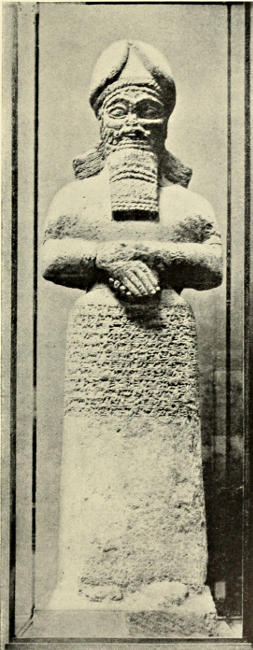
THE ASSYRIAN GOD NABU
The reports that have come down to us from antiquity dealing with the
history of Babylonia and Assyria are relatively meagre in extent and decidedly
untrustworthy from an historical standpoint. Without doubt numerous
classical writers dealt with the subject, but of such writings, only a few have
been preserved. So far as known, the principal native historian of the later
period of Babylonian history was Berosus. He was a Chaldean priest living
in the time of Alexander the Great, as his own writings testify. He had
access to the ancient documents of his country, and is believed to have made
excellent use of them. Unfortunately, only meagre remnants of his history
have come down to us, and these more or less distorted through the medium
of transcribers, the chief of these being Alexander Polyhistor and Eusebius.
Had we the entire work of Berosus, he would, perhaps, perform some such
function for Mesopotamia as Manetho performed for Egypt; but as the case
stands, the remnants of Berosus serve to transmit certain interesting traditions,
particularly with reference to Babylonian cosmogony, rather than to
preserve any considerable historical records.
The classical historian whose account of the Babylonians and Assyrians
has been most largely copied was Ctesias. This writer was a Greek who
served for seventeen years (415-398 B.C.) as court physician to the Persian
king Artaxerxes Mnemon, and who wrote a history of Persia alleged to be
based upon native documents. In this history Ctesias considered the contemporary
civilisation, but he was interested rather in picturesque traditions
than in the sober historical narratives, and the records he preserved are
chiefly of a nature which the modern critical historian pronounces fabulous.
The original work of Ctesias has perished, but its character is fairly
established through the writings of other authors who used Ctesias as a
source. Foremost among the latter is Diodorus, whose account of the
Assyrians represents the ideas that were current throughout classical
times, and continued in vogue until the nineteenth century.
The most authentic classical accounts of the Babylonians are those given
by Herodotus and by Strabo, both of whom spoke as eye-witnesses. Unfortunately,
these writers did not have access to the native materials, and their
accounts, while throwing interesting sidelights upon the later civilisation,
do very little towards enlightening us as to the actual history of the greatest
of Asiatic peoples of antiquity.
A few other fragments have been preserved from the classical writings,
notably some bits from Abydenus, preserved through Eusebius. To these
must be added numerous references to the Babylonians and Assyrians
in the biblical writings. Taken altogether, however, these classical
and oriental traditions fail to give us more than the vaguest picture of
Mesopotamian history.
The real sources of that history are the original chronicles of the Babylonians
and Assyrians themselves, which were inscribed on stone slabs and
on tablets of clay. The clay tablets, after being inscribed, were dried,
forming almost imperishable bricks. Tens of thousands of these were preserved
beneath the ruins of Mesopotamian cities, and were first brought to
light in the nineteenth century. Among these are several lists of kings, and
other chronological documents of a somewhat general character. One document
attempts the synchronism of Babylonian and Assyrian history. Then
there are numerous tablets and cylinders and wall inscriptions which record
the deeds of individual kings, including such famous monarchs as Sennacherib.
Vast quantities of documents are doubtless still buried in Mesopotamia,
and a large proportion of the inscriptions that have been exhumed are still
undeciphered. But enough of these documents have been discovered and
read to restore the outline of Babylonian and Assyrian history as a whole;
and for certain periods, including the time of greatest Assyrian power, very
full records are at hand. The result of these recent discoveries has been
the practical substitution of secure historical records for the old classical
and oriental traditions regarding the Babylonians and Assyrians.
The modern workers who have assisted in the restoration of Mesopotamian
history through the recovery and decipherment of the monumental
inscriptions make up in the aggregate a large company. The chief explorers
of the earliest period were Botta and Layard. Then came Fresnel,
Thomas, and Oppert, followed by Rassam, George Smith, Ernest de Sarzec;
the Germans, Koldewey and Moritz, and the Americans, Peters, Hilprecht,
and Haynes.
The work of interpreting the newly found Assyrian records began with
Sir Henry Rawlinson in England, Eberhard Schrader in Germany, and a small
company of other workers, about the middle of the nineteenth century.
The difficulties of deciphering records in an unknown language, and of an
extremely intricate character, at first seemed almost insuperable; but with
the aid of the knowledge of Ancient Persian, already acquired earlier in the
century through the efforts of Grotefend and his followers, together with
the hints gained by comparison with the Hebrew language and other extant
Semitic tongues, a working knowledge of the Assyrian language was at last
attained. Since then the decipherment of the inscriptions has gone on
unceasingly, and a constantly growing band of workers has added to our
knowledge.
Most of the excavators and explorers have, very naturally, given us
personal accounts of their labours. Botta’s labours, however, were chiefly
made public through the publications of Victor Place; and in more recent
times, Heuzey has published the chief accounts of the excavations of
De Sarzec. Layard, on the other hand, the greatest of all Assyrian explorers,
gave full accounts of his own discoveries, and interpreted the
monuments as well as described them. He restored to us a picture of Mesopotamian
civilisation somewhat as Wilkinson had done for Egypt. Of the
more recent workers who have written about Babylonia and Assyria the
most important are Meyer, Hommel, Winckler, Muerdter, and Delitzsch in
Germany; Tiele in Holland; Lenormant, Babelon, Menant and Halévy
in France; Sayce in England, and Peters, Hilprecht, Harper and Rogers
in America.
Thanks to the records thus made available, the history of this most ancient
civilisation is no longer a mere hazy figment of tradition, but has become a
sharply outlined picture. We are able to trace, not indeed the origin of the
Mesopotamian civilisation—for the beginnings of national life evade us here
as elsewhere—but its very early development in the cities of old or southern
Babylonia. Antiquarian documents, aided by estimates as to the rate of
deposit of sediment at the mouth of the rivers, enable us to fix, at least
approximately, the dates for this early civilisation. These figures cannot
pretend to exact accuracy, but the Assyriologist assures us with some confidence
that they carry us back to a period something like six or seven
thousand years B.C. At this remote time the civilisation of southern
Babylonia was already established in its main features. The people of Ur,
Nippur, Shirpurla, and Babylon were able even then to build elaborate palaces
and temples, to carve interesting sculptures, to make ornaments of
glass, and to record their thought in words traced in the most complex
script. In a word, the main characteristics of Mesopotamian civilisation
were fully established several millenniums before the Christian era, and
abundant proofs of this fact have been preserved to us.
It must not be supposed, however, that the records exhumed from the
ruins of these ancient capitals have given us full information regarding the
entire stretch of this long material existence. The fact is quite otherwise.
Only comparatively short periods are covered fully by the historical records
in the wedge writing, and there are reaches of some thousands of years in
the aggregate, regarding which our knowledge is still most fragmentary.
Indeed, the history of the old Babylonian kingdom in its entirety is known
at present only in the most general way. But it seems almost miraculous
that we should know even the outlines of this ancient story.
The earliest known inhabitants of Babylonia were a people of whose
origin nothing is known except that they were not Semites. After a time
they are called sometimes Sumerians, sometimes Accadians. Sumer was the
southern portion of Babylonia, Accad the northern. The Accadian language
is now considered a dialect of the Sumerian, the older form.
Civilisation in the land goes back at least to 6000 B.C. Between 5000
and 4000 B.C. this people was invaded by a warlike Semitic race, the
Babylonians of history, who came, perhaps, from Arabia. What portion
of the aborigines the invaders did not expel or destroy they assimilated,
gradually assuming the older civilisation.
The chronology of the earlier period is largely speculative. Recent
chronology begins with the kingdom of Babylon about the time of Khammurabi.
For the earlier kingdoms, we, for the most part, follow the dates
of Professor Rogers.
Without referring to the legendary history of Babylonia, related by Berosus,
which is mentioned elsewhere, our earliest knowledge of the land is of a
country of independent kingdoms, the cities with the temples forming their
centres. The ruler is often the patesi or high priest.
Before 4500 B.C. En-shag-kush-anna is king of Kengi, in southern Babylonia, but
whether he was Sumerian or Semite, we do not know. He is patesi
of En-lil, the later Bel. Of his kingdom, Shirpurla-Girsu (or Sungir)
is the capital and Nippur the religious centre. Later, Sungir is
called Sumer and gave its name to the whole of southern Babylonia.
The chief rival of Kengi is the Semitic kingdom of Kish in the
north, which En-shag-kush-anna defeated but only temporarily
checked. We know of no other king of Kengi.
Monuments.—Several vase inscriptions found at Nippur.
Recovers itself quickly after its reverse by En-shag-kush-anna.
A certain U-dug is patesi of Kish at the time of this revival.
4400 Mesilim, king of Kish, subjugates Shirpurla, at the time of Lugal-shug-gur.
This supremacy is maintained for a short period, 4200 until
E-anna-tum, king of Shirpurla, shakes off the yoke. Kish is left
very feeble after this, but gradually recovers its power.
3850 Alusharshid, the last great king of Kish before the conquest of Sargon I.
Monuments.—Many vase inscriptions.
4400 Ush is patesi, contemporary of Mesilim of Kish. He wages war with
Shirpurla on the question of boundaries. Gishban is subjugated 4200 by
E-anna-tum of Shirpurla. At the latter’s death, Ur-lumma, patesi,
invades Shirpurla and probably suffers a slight defeat.
4120 Great defeat of Ur-lumma by Entemena of Shirpurla.
4000 Lugal-zaggisi, patesi, son of Ukush, leads a victorious army against the
south. The whole of Babylonia to the southern gulf is subjugated.
He becomes king of Erech and is styled “king of the whole world.”
He revives the ancient cults of Lower Mesopotamia.
Monuments.—Vase inscriptions.
Shirpurla, sometimes called Lagash—the modern Telloh—is
situated north of Mugheir on the east side of the Shatt-el-Khai.
The oldest king that we know is
4500 Urukagina.—A great warrior and administrator. He builds and
restores temples and also a canal for the capital Sungir (Girsu).
4400 One of his successors is En-ge-gal, and another, Lugal-shug-gur, is
reduced by Mesilim of Kish to a patesi.
4300 In the enfeebled kingdom, dominated by the rulers of Kish, a new
family headed by Ur-Nina comes to the throne. He is famous as a
temple builder, but also begins to prepare his kingdom to throw off
the yoke of Kish. He calls himself king though his son is still patesi.
Monuments.—Vase inscriptions.
4250 Akurgal succeeds Ur-Nina. He is the father of E-anna-tum and En-anna-tum
I.
4200 E-anna-tum, the hero who delivers his country from the thraldom of
Kish, and resumes the royal title. After this he puts Gishban under
his yoke, and wages successful wars against Erech, Ur, Larsa, Az,
and Ukh. He builds a wall around one of the suburbs of Shirpurla,
digs canals for boundary lines, etc. Is a great and wise administrator
as well as a mighty warrior.
Monuments.—The famous “Vulture Stele” now in the Louvre—many
inscriptions.
En-anna-tum I succeeds his brother E-anna-tum. An unsuccessful
invasion of Shirpurla by the patesi of Gishban.
4120 En-teme-na, son of En-anna-tum I, defeats and destroys army of the
patesi of Gishban.
Monuments.—The Cone of En-teme-na. The “silver vase”—an exquisite
piece of art placed on the altar of the god Nina at Singur.
4100 En-anna-tum II, the last patesi of the dynasty of Ur-Nina, since his son,
Lummadu, bears no title. Conquest of Shirpurla by Lugal-zaggisi
of Gishban.
4100-3800 There are patesis in Shirpurla, ruled over by Lugal-zaggisi and
his successors.
3800-3100 The darkest age of Babylonian history. Lugal-ushumgal was
patesi and vassal of Sargon I. In all probability the kings of Agade
ruled over Shirpurla until dispossessed by the second dynasty of Ur.
Of all the patesis, the vassal rulers, of this period Ur-Bau 3500 (?)
and Gudea 3300 (?) are the most prominent. Ur-Bau’s rule seems
to have been peaceful; Gudea is a warrior; he wrests the territory
of Anshan from Elam. Builds the temple of Nina at Singur.
Monuments.—Many inscriptions.
The civilisation of Shirpurla was a high one, and it contained no Semitic
elements.
The first king of this dynasty appears after the conquest of Erech
by Lugal-zaggisi of Gishban. He would appear to have overthrown
Lugal-zaggisi.
3900 Lugal-kigubni-dudu.
Lugal-kisali, his son.
Their rule includes Ur, Erech, and Nippur, and possibly they conquered
Shirpurla. The fate of this dynasty with the names of its
other rulers is unknown, but it probably falls before the power of
Agade.
Monuments.—Inscriptions of the two above-mentioned kings.
There are inscriptions relating to two kings, Lasirab of Guti and
Anu-banini of Lulubi. They seem to have been contemporaneous
with Sargon I (3800 B.C.).
3800 The earliest known dynasty is Semitic, and the first ruler is Sargon I
(Shargani-shar-ali), son of Itti-Bel. By conquest he founds an
empire from Elam to the Mediterranean, and from the extreme
south of Babylonia to Apirak and Guti.
Monuments.—Engraved seals of wonderful execution, inscriptions, and
contract tablets.
3750 Naram-Sin, son of Sargon, succeeds him. First to assume title “King
of the Four Quarters of the World”—a great conqueror and
builder. Campaigns against Apirak and Magan (Arabia).
Builds temples at Nippur and Agade. Temple E-barra of Shamash
at Sippar. This temple is the one in which Nabonidus found the
“tablet with the writing of the name of Naram-Sin,” by which we
are able to fix the date of his reign.
Under Sargon I and Naram-Sin there is a high state of organisation
and civilisation in the kingdom. There were judges, musicians,
physicians, good roads, etc. Thureau-Dangin says: “The epoch of
Sargon and Naram-Sin certainly marks a culminating point in the
history of the old Orient.”
Monuments.—Inscriptions.
3700 Bingani-shar-ali, son of Naram-Sin.
Further history of the kingdom of Agade is still unknown. Apparently
the later kings gradually lose their power before that of the
second dynasty of Ur.
The first period of Babylonian history is now closed. The Semites
are in full possession of the land. We have the main seat of power
at Agade with the rulers of Shirpurla reduced to patesis.
These kings add the title “King of Sumer and Accad” to that of
Ur, combining the hostile elements of the North and South under
one rule; “restoring,” says Radau, “in old Babylonia the peace
which had been disturbed for many centuries, even from the time of
the original Semitic invasion.”
3200 Ur-gur holds sway over both Semites and Sumerians (Agade and
Shirpurla). His capital is at Ur. Famous as a temple builder.
Builds temple Teimila to Nannar (moon god) at Ur, temple E-anna
to Ishtar at Erech, temple E-barra to Shamash at Larsa.
Monuments.—Pyramidal tower at Nippur. Inscriptions.
3150 Dun-gi I succeeds. Continues his father’s work.
Builds temples of Nin-mar, Nina, Ningirsu, Dam-gal-nunna, and Ea,
in Sungir, Nippur, and Kutha.
These two were ancestors of a long line of kings, concerning whom
history is still silent. Apparently ground in southern Babylonia
was soon lost, for we find
3100-3000 Two kings of pure Semitic names are known at this period.
Singashid, probably the founder of the dynasty, and Sin-gamil. The
probable history of this kingdom is that of a strong Semitic colony
in southern Babylonia making itself independent and establishing a
king and capital at Erech. With Sin-gamil, the thread of its history
is lost.
Monuments.—Inscriptions relating to building of palace, temples, and
restoration of temples at Erech.
A Semitic kingdom, similar to that of Erech, is established at Isin
in the north. These kings extend their power to Nippur, Ur,
Eridu, and finally to Erech, extinguishing the dynasty ruling there.
The kings add “king of Sumer and Accad” to that of Isin, showing
also that the second dynasty of Ur has ceased to exist.
3000 Libit-Ishtar.
Monuments and cylinder inscriptions.
Other kings are, Ishbigarra, Bur-Sin I, Ur-Ninib, Idin-Dagan.
2850 Ishme Dagan, the last to bear the title of Sumer and Accad. His son
En-anna-tum is a vassal of the third dynasty of Ur.
Monuments.—Tablet inscriptions.
The early kings call themselves simply Kings of Ur.
2800 Gungunu puts an end to the dynasty of Isin.
He is succeeded by Ur-gur II and Dungi II, order uncertain.
They build many temples, and Ur-gur II fortifies the wall of his
capital, hence he must have been harassed by enemies. We have
records that the patesis of Shirpurla still existed at this time.
Monuments.—Votive and seal inscriptions.
2700 Dungi III.—The kings from now on add “King of the Four Quarters
of the World” to their title, and for this reason some scholars reckon
this king as the first of a fourth dynasty. He is followed by Bur-Sin
II, Gamil-Sin, and Ine-Sin; the latter ruling about 2580. We
have no knowledge of other kings, but about
2450-2400 the “Kingship of the Four Quarters of the World” is overthrown
in the north by the Ist Dynasty of Babylon and in the
south by Nur-Adad of Larsa.
Monuments.—Building records and contract tablets.
2400 Successful rebellion of southern Babylonia against the kings of Ur.
The kingdom of Larsa founded by Nur-Adad.
2370 Sin-iddin succeeds his father and extends his kingdom over Sumer and
Accad.
2350 Kudur-nankhundi, king of Elam, invades southern Babylonia. Under
Kudur-nankhundi’s successor, Kudur-lagamar 2340 (Kudur-dugmal, probably
the Hebrew Chedoriaomer) the Elamites establish a kingdom in
Larsa with Rim-Sin (Eri-aku) at its head. He adopts Sin-iddin’s
titles. 2312 The latter appeals to Khammurabi, king of Babylon, who
overpowers Rim-Sin.
Ist DYNASTY, 2450-2150 B.C.
In the days of Sumer and Accad there is no mention of Babylon,
which must, however, have developed into some importance during
the supremacy of Isin (3000-2850). Dates are now more reliable.
2450 Sumu-abi overthrows the Ur Dynasty in Babylon, but the rebellion
does not extend beyond that city.
2440 Sumu-la-ilu.—He builds six strong fortresses in Babylon.
2405 Zabu.—He builds temple E-dubar in Sippar. The country is evidently
in revolution, for mention is made of a pretender, Immeru.
2290 Apil-Sin.
2370 Sin-muballit.
Only monuments of these reigns, contract tablets.
2342 Khammurabi.—Probably the Amraphel of the Bible, a contemporary
of Abraham. The maker of a united Babylon, for in
2312 called upon by Sin-iddin, he expels Rim-Sin and the Elamites from
Larsa, and adding southern Babylonia to his dominions, resumes the
titles of the kings of Ur, Isin, and Larsa. He begins to develop
his new kingdom, digging canals for water supply. Builds a great
storehouse for wheat in Babylonia. Enlarges temples of E-zida and
E-sagila in Borsippa.
Monuments.—Letters and inscriptions.
2287-2150 The remaining kings of the dynasty lived in complete peace.
The few remains of their age witness a high civilisation and great
prosperity.
Monuments.—Contract tablets.
IInd DYNASTY, 2150-1783 B.C.
2150-1783 Called the dynasty of Uru-Azag (probably referring to a district
of the city of Babylon). Eleven kings of Sumerian origin reign for
368 years. There is but little known of them.
No monuments of this dynasty.
IIIrd DYNASTY, 1783-1207 B.C.
1783 The Kossæans or Kassites (Kasshu) from the mountains of Elam
establish a dynasty with Gandish or Gaddash the first king. They
had entered the country as roving bands, had overrun it, and finally
attained the power. Culture and civilisation are assimilated by
the newcomers.
1700 Agum-kakrime, the first king of the dynasty of whom we have any
details. His kingdom is greater than that of Khammurabi. The
land of Padan is subject to him. Some statues of gods that had
been previously carried away are restored to Babylon.
1450 Karaindash.—In this reign we have the first evidence of intercourse
between the kingdoms of Assyria and Babylonia—a treaty with
Asshur-bel-nish-eshu, king of Assyria, concerning boundary line.
Builds a temple to Nana, goddess of E-Anna.
1430 Kadashman-Bel.—He corresponds with Amenhotep III, of Egypt.
Monuments.—Letters found at Tel-el-Amarna.
1420 Burnaburiash I.—Contemporary with Puzur-Asshur of Assyria, with
whom he seems to have had difficulties regarding questions of
boundary. Builds a temple to the Sun-god at Larsa.
1410 Kurigalzu I.—The city of Dur-Kurigalzu is named after him. He
probably rebuilds it.
Monuments.—Correspondence with Pharaoh of Egypt. (Tel-el-Amarna.)
1400 Burnaburiash II.—His successor. Long and prosperous reign.
Monuments.—Correspondence with Amenhotep IV, of Egypt. (Tel-el-Amarna.)
1370 Kharakhardash, marries a daughter of Asshur-uballit, king of Assyria.
His son, Kadashman-Kharbe I, conducts a campaign against the
Sutu, whom he conquers, and among whom he settles some of his
subjects.
1360 Rebellion of the Kassites, who, jealous of the growing Assyrian
influence, kill the king and place on the throne Nazibugash, who
is defeated and killed by Asshur-uballit, the king of Assyria.
1350 Kurigalzu II.—Placed on the throne by the Assyrian king, invades
Elam, and conquers the city of Susa (or Shushan). Battle with
Bel-nirari, king of Assyria, with doubtful result.
1340-1286 Continuous struggle between Babylonia and Assyria under
the following kings: Nazi-Maruttash (1340), Kadashman-Turgu,
Kadashman-Buriash (1330), Kudur-Bel (1304-1299), Shagarakti-Buriash
(1298-1286).
1285-1270 The king of Assyria, Tukulti-Ninib I, invades Babylon, enters
the town, removes the treasures of the temple, and carries away the
god Marduk to Assyria. This invasion took place probably under
the reign of Bibeiashu, whose successors, Bel-shum-iddin, Kadashman-Kharbe
II (1277-1275), and Adad-shum-iddin (1274-1269), were
very likely only vassals of Tukulti-Ninib, who was the real king of
Babylon for seven years.
1270 The Babylonians rise in revolt, drive the Assyrians from Babylon, 1269 and
make Adad-shum-usur king, under whom the power of Babylon begins
to revive. Assyria attacked, the king, Bel-kudur-usur, slain, and a
portion of Assyrian territory annexed.
1238-1224 Meli-Shipak.—Successful against the Assyrian king, Ninib-apal-esharra,
1223-1211 so that under Marduk-apal-iddin, the Babylonian
dominion extends over nearly the whole of the valley.
1210 Under the last two kings of this dynasty, Zamamu-shum-iddin and
1209 Bel-shum-iddin, Babylonia threatened by the Assyrian Asshur-dan.
1207 End of the dynasty as result of a Semitic revolution.
IVth DYNASTY, 1207-1075 B.C.
The origin of this (Isin) dynasty still doubtful. There are
eleven kings, of whom four or five are unknown to us.
1135 Nebuchadrezzar I, sixth king, exhibits the old-time spirit. Invades
Assyria, but is repulsed. Is successful in campaigns against the
people of Elam and Lulubi, even penetrates into Syria.
Monuments.—Monolithic inscription concerning grant of land to Ritti
Marduk of Bit-Karziyabku.
1110 In the reign of Marduk-nadin-akhe, Tiglathpileser I of Assyria invades
Babylon and takes the capital.
1083 At death of Marduk-shapik-zer-mati, a usurper, Adad-apal-iddin takes
the throne.
1078 End of dynasty with death of Nabu-shum.
Vth, VIth, VIIth, VIIIth DYNASTIES, 1075-728 B.C.
A series of short-lived dynasties all struggling with the rising
power of Assyria.
1075 Dynasty of Sea Lands, at the estuaries of the Tigris and the Euphrates
upon the Persian Gulf, which later exercises great influence upon
the history of Babylonia. This dynasty numbers only three kings,
who reign together twenty-one years five months, or, according to
the Babylonian chronicle, twenty-three years; viz. Sibar-Shipak,
slain and buried in palace of Sargon. In his reign the Elamites
pillage Sippar and do much damage; Ea-mukin-zer, of whom nothing
is known, and Kasshu-nadin-akhe. These kings engaged on rebuilding
the temple of the Sun at Sippar.
1053-1033 The dynasty of Sea Lands in Babylonia followed by the dynasty
of Bit-Bazi, numbering also only three kings: Eulbar-shakin-shum,
Ninib-kudur-usur, and Silanim-shukamuna, followed by a
dynasty of Elam with only one king, whose name is unknown.
1027 The VIIIth Dynasty. Babylonian stock having exhausted its vigour,
now intermixed with Kassite and other foreign blood.
747 Nabu-nasir (Nabonassar) of the VIIIth Dynasty comes to the throne.
A time of literary activity.
732 Nabu-nadinzer, his successor, slain by Nabu-shum-ukin.
731 Ukinzer replaces Nabu-shum-ukin. Tiglathpileser III invades Babylon
and determines to end the rule of native princes in the land.
728 Tiglathpileser, king of Babylon. End of the Old Babylonian Empire.
FIRST PERIOD, 1830-1120 B.C.
Assyria was colonised from Babylonia. The date is uncertain,
but Nineveh was in existence in 3000 B.C. The early rulers appear
to have been subject priest-princes of the kings of Babylonia.
1830-1810 The first known rulers (Ishakke) are Ishme-Dagan and his son,
Shamshi-Adad I, who builds a great temple in the city of Asshur,
dedicated to the gods Anu and Adad.
1800-1700 Little known of their successors Igur-kapkapu, Shamshi-Adad II,
while the dates of Khallu and Irishum are unknown.
Monuments.—A few inscriptions.
1700 Bel-Kapkapu.—The first to take the title of king, and therefore considered
the real founder of the monarchy, probably the Bel-bani, of
whom Esarhaddon claimed to be a direct descendant.
1700-1450 A dark age of Assyrian history. We know nothing of it, except
that after the battle of Megiddo (ca. 1525) the ruler of Assyria sends
presents to Tehutimes III.
1450 Assyria is now recognised by Babylonia as an independent kingdom.
Its ruler, Asshur-bel-nish-eshu, makes a treaty with Karaindash, king
of Kardunyash (Babylonia) concerning boundaries.
1420 Puzur-Asshur, treats with the Babylonians concerning the boundary.
1400 Asshur-nadin-akhe II, his successor, contemporary of Amenhotep IV,
king of Egypt. Builds or restores a palace in Asshur.
Monuments.—Friendly correspondence with Amenhotep IV in the
Tel-el-Amarna letters.
1370 Succeeded by Asshur-uballit, whose daughter, Muballitat Sheru’a, is
married to Karakhardash, king of Babylon. The murder of his
son, Kadashman-Kharbe I, brought about Assyrian intervention,
and a grandson of Asshur-uballit, Kurigalzu, is placed on the throne.
Babylonia now partially subject to Assyria. Campaigns of Asshur-uballit
against the Shubari.
1360 His son Bel-nirari said to have conquered the inhabitants of the neighbouring
Elamite foothills. These Assyrian conquests lead to a conflict
between Kurigalzu II and Bel-nirari, in which the latter is
victorious. A rearrangement of the boundary lines between the
two countries is the result.
1350 His son, Pudu-ilu, a great warrior, considerably extends his kingdom.
Monuments.—A few brief inscriptions.
1345 His son and successor, Adad-nirari I, continues conquests in neighbouring
territory. Rebuilds captured cities. Struggle with Babylonian
king. He adds considerably to strength of kingdom.
Monuments.—A bronze sword, on which he calls himself king of
Kishshati; an inscription, the oldest yet found with an eponym date.
1330 His son, Shalmaneser I, establishes colonies between the Euphrates
and Tigris as a bulwark against the nomadic populations of the
farther north. Subjects the Musri in northern Syria. Assyrians
cross the Euphrates for the first time. The rapidly growing kingdom
firmly established as far as the Balikh and perhaps the Euphrates.
New capital built at Calah.
Monuments.—Two broken tablets.
1290 Under his son and successor, Tukulti-Ninib I, there is renewed trouble
between Assyria and Babylonia. Invasion of Babylonia; capital
taken. Conquered city governed from Calah, Assyrian officers stationed
both in the north and south of the country. Tukulti-Ninib
adopts the title of “King of Sumer and Accad” in addition to his
former titles, “King of Kishshati” and “King of Asshur.” This
rule over Babylonia maintained for seven years only. The king is
killed in civil war. The most brilliant reign in Assyrian history up
to this time. The steady and rapid progress of the Assyrians now
checked.
1280 Rapid decline of Assyrian power under Asshurnazirpal I, Tukulti-Ninib’s
son. An attack of Babylonia is repulsed with difficulty.
1250 Under his successors, Asshur-narara and Nabu-daian, the Assyrian
power continues to wane, while the Babylonian increases.
1240-1235 Under Bel-kudur-usur and Ninib-apal-esharra Assyria is invaded
by the Babylonians under Meli-shipak and Marduk-apal-iddin. All
the southern and part of the northern and western conquered
territory lost.
1210 Under Asshur-dan I rehabilitation of Assyrian power. He crosses the
Lower Zab, invades Babylonian territory, and restores a small section
of it to Assyria.
1150 Further Assyrian gains under Mutakkil-Nusku and Asshur-rish-ishi, who
1140 restores temple of Ishtar at Calah.
SECOND PERIOD, 1120-885 B.C.
1120 Tiglathpileser I (Tukulti-apal-esharra, my help is the god Ninib).—He
builds up anew the Assyrian Empire, and thus records his work of
conquest: “In all forty-two countries and their kings from the
Lower Zab (and) the border of the distant mountains to beyond
the Euphrates to the land of the Hittites and the Upper Sea of the
Setting Sun, from the beginning of my sovereignty until my fifth
year my hand has conquered.” His great success in war equalled
by a marvellous story of peaceful achievements. The capital of
Assyria brought back from Calah to Asshur; the temples of Ishtar,
Adad, and Bel rebuilt, palaces restored and rebuilt.
Monuments.—The eight-sided prism found at Calah: several fragmentary
annals of the early years of his reign.
1090 Under his successors, Asshur-bel-kala and Shamshi-Adad III, both sons
of Tiglathpileser, further peaceful development, with gradually a
falling off in the power and dignity of the kingdom. The former
king maintains terms of peace with the king of Babylonia, Marduk-shapik-zer-mati,
who thereby seems to be considered an independent
monarch. As to Shamshi-Adad I, he is known to us only as the
rebuilder of the temple of Ishtar in Nineveh.
1050-950 A dark age. The fortunes of Assyria are at low ebb. In this
period reigned Asshurnazirpal II, Erba-Adad, Asshur-nadin-akhe, and
Asshur-erbi. The last loses territory to the Aramæans, but he seems
to have invaded Phœnicia.
950 Tiglathpileser II, who calls himself “King of Kishshati and King of
Asshur.”
930 Asshur-dan II, his son.
911 Adad-nirari II.—Revival of struggle with Babylonia. Defeats Shamash-mudammik
of Babylon in battle of Mount Yalman, also his
successor Nabu-shum-ishkun. Assyrian cities given to Babylonia.
Treaty of peace between the two nations.
890 Tukulti-Ninib II.—The period of weakness is passing. Babylon
ceases to be troublesome, and the Assyrians begin to seek tribute in
the north and west. The king ravages Armenia and the land of
Kummukh.
THIRD PERIOD, 885-722 B.C.
885 Asshurnazirpal III, begins campaigns of conquest at once. In ten
years all of Tiglathpileser I’s empire in the north, east, and west,
conquered or intimidated into subjection with atrocious cruelties
and barbarous devastations, is under heavy tribute.
876 A great invasion of the west. At his approach all the cities from
Carchemish to Tyre hasten to send presents and arrange for tribute.
The campaign ends in the gathering of timber for the temple of
Ishtar at Nineveh.
867 A short and bloody campaign against Kummukh, Qurkhi and the
country around Mount Masius. Asshurnazirpal rebuilds Calah, and
constructs a canal to supply the city with water from the Lower Zab.
Monuments.—The royal palace unearthed at Nimrud; monolith containing
accounts of his reign discovered by Layard at Nimrud;
several lesser inscriptions.
860 Shalmaneser II, his son, continues his father’s conquests with similar
cruelty. Campaign against Nairi and first of many campaigns in
the north and east lasting until 830 with no real success.
857 The Aramæans of Bit-Adini in the Mesopotamian valley finally conquered
and their land placed under Assyrian government.
854 Shalmaneser proceeds successfully against a coalition of North Syrian
princes, Israel and Phœnicia. Battle of Qarqar. Yearly tribute
imposed on states of northern Syria.
852 Marduk-nadin-shun of Babylon calls Shalmaneser to help him against
his rebellious brother Marduk-bel-usati. Shalmaneser attacks and
vanquishes the rebels and Marduk-nadin-shum rules under an
Assyrian protectorate. The king of Assyria is once more the real
ruler of Babylon.
849-834 Campaigns against the west. The results are not definite, and
little is done except to pave the way for the future. Attack upon
Ben-Hadad II of Damascus and his allies. Jehu sends aid against
Damascus and the Assyrians get their first hold upon Israel.
827 Rebellion of Shalmaneser’s son Asshur-danin-apli which splits the
kingdom into two discordant parts.
825 Death of Shalmaneser.
Monuments.—The black basalt obelisk containing story of his wars;
monolith with portrait in bas-relief; gate inscriptions from Balauat.
823 Shamshi-Adad IV, after two years of civil war with his brother, is
acknowledged legitimate king.
822-814 Campaigns in north, east, and west to receive allegiance.
813 Invasion of Chaldea.
812 Invasion of Babylon where Marduk-balatsu-iqbi refuses to pay tribute—a
decisive victory.
Monuments.—Inscriptions.
811 Adad-nirari III succeeds his father—a ruler who increases Assyrian
prestige immensely. Successful campaigns in the west. Eight
brilliant campaigns against the Medes.
796-795 Babylon invaded—now practically an Assyrian province. The
king tries to efface all national differences. Temples built in
Assyria similar to those of Babylon, and Babylonian forms introduced
into the ritual.
Monuments.—A statue of Nabu from the temple of Calah; inscriptions.
782 Shalmaneser III, a period of decline sets in. Of his ten campaigns, six
are against the growing power of Urartu, which is trying to wrest
the land of Nairi from the Assyrians.
772 Asshur-dan III.—The decay continues. Campaigns against Damascus,
and Khatarikka in Syria. Two invasions of Babylon (771-767).
763-758 A series of rebellions in various parts of the kingdom.
754 Asshur-nirari II.—A reign of decadence. Campaigns against Arpad
and Nairi, but no attempt to collect tribute.
746 Rebellion in Calah. Asshur-nirari disappears and with him the royal
family that has ruled Assyria for centuries.
FOURTH PERIOD, 745-606 B.C.
745 Pulu.—A man of obscure origin obtains the throne, probably as the
outcome of the Calah rebellion. He takes the name of Tiglathpileser
(III), and begins at once the formation of a great world-empire
and proceeds first against Babylonia. Reconquers the
country as far south as Nippur and reorganises the government.
Makes a fixed policy of planting colonies and transporting captives.
He next subdues the troublesome land east of Assyria, and sends
his general, Asshur-danin-ani, into Media. Second expedition into
Media (737), but withal the country remains practically independent.
He takes up a difficult problem in the north where
Argistis of Urartu had regained much territory, and his successor,
Sarduris II, has formed an alliance with many northern princes.
The armies of Sarduris and Tiglathpileser meet and the former is
forced to retire.
742 Tiglathpileser, free from Sarduris, attacks Arpad, which falls, 740.
Many neighbouring states send presents. The king of Unqi resists,
but is soon taken and his country annexed to Assyria.
739 Part of Nairi taken. Tiglathpileser sets out to break the coalition of
Syrian princes against him, aiming at Uzziah of Judah, the ringleader.
Menahem of Israel weakens and pays the Assyrian heavy
tribute, whereupon he abandons attacks on Judah, but subdues, and
returns home with tribute from, all the other members of the league.
735 Campaign against Urartu—does not conquer but breaks the spirit of
the country.
734-732 Campaigns in Syria. Damascus taken. Ahaz of Judah gives
homage. Other lands incorporated with Assyria. Gaza captured.
731-729 He invades Babylonia to settle the internal strife raging there.
Determines to do away with native princes. Ukinzer deposed.
Merodach-baladan of Bit-Yakin gives homage.
728 Proclaimed legitimate king of Babylon.
Monuments.—The annals badly defaced by Esarhaddon; the slabs of
Nimrud; inscription on clay tablets.
726 Shalmaneser IV succeeds.
725 Hoshea of Israel in alliance with Shabak of Egypt refuses tribute.
Shalmaneser lays siege to Samaria.
THE SARGONIDES, 722-606 B.C.
722 Sargon II—a usurper succeeds. Samaria falls in this year. The
inhabitants are removed to the Median mountains and replaced by
colonists from Kutha.
721 Merodach-baladan rebels and is proclaimed king of Babylon. Sargon
proceeds unsuccessfully against him. Rebellion in Hamath, joined
by Gaza and Samaria.
720 The confederation defeated at Raphia.
720-710 Continuous campaigns. Successful attack on Urartu. Coalition
in the north broken up.
717 Assyrian governors installed throughout the country. The career of
Carchemish ended.
710 Merodach-baladan defeated. Sargon adopts title “Shakkanak,” Governor,
of Babylon.
707 The great palace in his city of Dur-Sharrukin (Khorsabad) is finished.
The walls are covered with magnificent inscriptions. He enters it
the next year.
Monuments.—The palace of Dur-Sharrukin with inscriptions—other
inscriptions.
705 Sennacherib (Sin-akhe-erba) succeeds his father.
702 Visits rebellious Babylonia and makes Bel ibni king.
701 Coalition against Sennacherib of Syrian princes and Tirhaqa of Egypt.
The Assyrian attacks Phœnician cities and most of Syria submits.
Battle of Altaku. Sennacherib’s army ravaged by pestilence, and he
returns to Nineveh which he has made his capital.
700 Bel-ibni becomes hostile to Assyria through force of public opinion.
Merodach-baladan and Marduk-ushezib of Chaldea join him. Sennacherib
defeats them and has his own son Asshur-nadin-shum proclaimed
king of Babylon.
694 Campaigns against the Chaldeans settled in Elam. Asshur-nadin-shum
captured by the Elamites and Nergal-ushezib crowned.
692 Mushezib-Marduk made king of Babylon. With the Elamites, the
Babylonians oppose Sennacherib at Khalule (691) and are utterly
defeated.
689 Destruction of Babylon by Sennacherib.
688-682 Sennacherib absent in Arabia.
681 Murder of Sennacherib by his sons Nergal-shar-eser and Adarmalik.
681 Esarhaddon (Asshur-akhe-iddin) succeeds his father.
681-672 Nine campaigns to repress rebellions in different parts of the
empire.
672 Destruction of Sidon. City of Kar-Asshur-akhe-iddin built on the
same spot.
670 Esarhaddon appears in Egypt to punish Tirhaqa. Memphis taken.
The whole country surrenders to Esarhaddon who reorganises the
government.
668 Esarhaddon abdicates. He appoints his son Shamash-shum-ukin viceroy
of Babylonia, and another son, Asshurbanapal, receives the throne
of Assyria.
Monuments.—The “Black Stone,” the stele of Zenjirli; other inscriptions.
668 Asshurbanapal begins his reign.
667 Sends an army to Egypt which defeats Tirhaqa who has retaken Memphis.
Conspiracy of Egyptian princes to restore Tirhaqa. They
are taken and punished. Exacts tribute from King Baal of Tyre,
and other princes.
655 Psamthek I of Egypt throws off the Assyrian yoke.
Campaign against Elam.
War with Shamash-shum-ukin, who plots against Assyria, and severe
punishment of Babylonia. Cruel onslaught on Elam for assistance
to Shamash-shum-ukin and his allies. The same fate is meted out
to the Arabians.
Asshurbanapal is famous as a builder. Temple of E-kur-gal-kurra in
Nineveh adorned. Rebuilding of E-sagila in Babylon completed.
E-zida in Borsippa is embellished. The palace of Nineveh reconstructed
and a great library built and equipped. Vast building
operations in Babylonia and Arbela. His reign is one of great glory
in works of peace, but Egypt has been lost, and many foreign provinces
are on the verge of regaining their liberty.
Monuments.—Many records from the library of Nineveh.
626-609 Asshurbanapal succeeded by Asshur-etil-ili-ukinni, Sin-shum-lishir,
and Sin-shar-ishkum (Saracus), of whom we have but little knowledge.
625 First appearance of the Scythian tribes in Assyria. They invade the
land and burn Calah.
609 Sin-shar-ishkum attacks Babylonia, of which Nabopolassar is now king.
The latter allies himself with the Scythian tribe of the Manda, which
attacks Nineveh.
606 Sin-shar-ishkum sets fire to palace and perishes
in the flames.
Nineveh taken and destroyed, as well as Dur-Sharrukin and Asshur.
The Manda secure the old land of Assyria, together with the northern
provinces as far as the river Halys. The Babylonians take the
southern and the Syrio-Phœnician possessions. End of the Assyrian
Empire.
Nabopolassar (Nabu-apal-usur), an Assyrian governor of Babylonia
about 625, finally becomes king, and a powerful rival of Assyria.
After the destruction of Nineveh he receives his share of the old
empire, and continues his reign in peace. Neku II of Egypt marches
upon Babylonia. Country developed by canals and great buildings.
Temple of Belit at Sippar rebuilt.
604-562 Nebuchadrezzar (Nabu-kudur-usur). Before he becomes king, he
has defeated Neku at Carchemish (605). Campaign against Judah.
Jerusalem twice besieged in 597, when Jehoiachin had to surrender,
in whose place Mattaniah, a son of Josiah, was made king under the
name of Zedekiah; and again in 586 when the city is taken, plundered,
and destroyed. Population deported and Gedaliah placed as
governor.
585-573 Investment of Tyre for thirteen years. Finally taken in 573 and
King Ithobaal II deposed.
567 Invasion of Egypt in the reign of Aahmes II; heavy booty secured,
but no lasting results. Splendid works of peace shown in numerous
inscriptions. Extensive building operations. The walls of Babylon
rebuilt and rendered impregnable. Canals repaired and temples
reconstructed. Temples of Borsippa repaired and the walls reconstructed,
also at Sippar, Larsa, Ur, Dilbat, Baz, and Erech.
Monuments.—Many inscriptions.
562 Amil-Marduk (the biblical Evil-merodach). No inscriptions found.
560 Assassinated by
Nergal-shar-usur (Neriglissor).—Under him Babylon adorned and enlarged.
The temple E-sagila beautified. Canal system regulated.
Succeeded by
556 Labashi-Marduk, who was killed after a reign of only nine months, and
succeeded by
555 Nabu-Na’id (Nabonidus), a usurper. Chiefly engaged in building and
restoring temples. The temple E-ulbar restored and temples at
Sippar and Kharran in Babylonia rebuilt.
539 Babylonia invaded by Cyrus of Elam and Persia.
538 Sippar taken. Babylon surrenders. Triumphal entrance of Cyrus
into the city. Babylonia a Persian province.
Cities have been, and vanished; fanes have sunk,
Heaped into shapeless ruin; sands o’erspread
Fields that were Edens; millions too have shrunk
To a few starving hundreds, or have fled
From off the page of being. Now the dead
Are the sole habitants of Babylon;
Kings, at whose bidding nations toiled and bled,
Heroes, who many a field of carnage won,
Their names—their boasted names to utter death are done.—James Gates Percival.
It should be explained here at the very beginning that in speaking of the
Mesopotamian civilisation as a unit, we are adopting for the sake of convenience
a form of expression that is not historically accurate. Even the word
“Mesopotamia” cannot be justified on strict analysis. The word is from
the Greek, and means, literally, “between the rivers,” an obvious reference
to the fact that the important portion of the territory in question lies between
the Tigris and Euphrates rivers. The word was used by the Greeks in indiscriminate
application to Babylonia and Assyria, and its extreme convenience
as a generic term has led to its retention in lieu of a better one; yet, as has been
said, it cannot be applied with strict accuracy unless its etymological significance
be quite overlooked; for, curiously enough, neither Babylon nor Nineveh
was wholly situated in the territory which the Greek word describes.
Babylon lay partly on the western shore of the Euphrates river, and Nineveh
was situated on the eastern shore of the Tigris. But in common usage,
as so often happens, the exact implication of the word “Mesopotamia” has
been overlooked, and the word itself has come to be applied to the entire
region of Babylonia and Assyria. In this sense, rather than in the more
restricted one, we shall find it convenient as a substitute for the more cumbersome
appellation, Babylonia-Assyria.
It has already been pointed out that we have to do with different races of
people in dealing with Mesopotamian history. After a long dispute, carried
on chiefly by philologists, it is now generally conceded that the earliest
civilisation of southern Babylonia was due to a non-Semitic people, the
Sumerians.[16] To this people, it would seem, must be ascribed the honour of
developing the chief features of Mesopotamian civilisation, including the
invention of the cuneiform system of writing. It is not at all clear at precisely
what time the Semitic people, destined ultimately to become predominant
in this region, made their appearance. Nor is the place of Semitic
origin agreed upon among students of the subject. Some authors,[17] as Von
Kremer, Guidi, and Hommel, hold that Babylonia was itself originally the
cradle of the race. Others, including Sprenger, Sayce, Schrader, De Goeje,
Wright, and Barton, contend that the Semites invaded Babylonia from
Arabia. Yet others, including Palgrave, Gerland, Bertin, Brinton, Nöldeke,
Jastrow, Keane, and Schmidt, hold to the African origin; while a modification
of these views advocated by Wiedemann, De Morgan, and Erman supposes
that both the Semites and Hamites rose in Arabia, and had their common
civilisation before the Hamites went to Africa. Confronted with such conflict
of opinions, the historian must be content to regard the exact antecedents
of the Semites, previous to their appearance in Babylonia, as quite unknown.
As to the date of the beginnings of Semitic civilisation in Mesopotamia,
Dr. John P. Peters, making use of Ainsworth’s estimates as to the amount
and rate of alluvial deposit at the head of the Persian Gulf, computes that
the seacoast must have been established this side of the site of the city of
Ur about 6600 B.C., which date must, therefore, represent the earliest possible
period for the foundation of that city. Ur was apparently the most southerly
city of old Babylonia, and Nippur apparently the most northerly. Dr.
Peters’ excavations at Nippur lead him to base its foundation at some period
previous to 6000 B.C., and possibly previous to 7000 B.C.a He sums up his
theory as follows:
“My suggestion, from the various facts here marshalled, would be that
the original home of civilisation in Babylonia was the strip of land from
Nippur southward to the neighbourhood of Ur, and not, as has sometimes
been argued, the region about Babylonia and northward to Sippara; while
the latter region is in itself older, it does not seem to have been older as the
home of civilised man.
“The ancestors of the civilisation of Babylonia seem to have come from
the region between Nippur and what was then the coast of the Persian Gulf.
This would accord also with the tradition preserved to us in later sources that
civilisation came to Babylonia out of the Persian Gulf. Possibly Eridu, on the
Arabian plateau near the western shore and not far from the head of what was
then the Persian Gulf, may represent the oldest seat of that civilisation.
However that may be, at a very early period Nippur became the centre of
civilisation and religion, being founded at a time when everything below Ur
probably was still under water. As early as the close, if not the beginning,
of the seventh millennium B.C., this strip of land at the head of the then
Persian Gulf seems to have been the home of the civilised men, and from here
civilisation spread northward.”f
The land of the Euphrates and Tigris lies between the Iranian country
on the east and the Syrio-Arabian district on the west, from the chain of
mountains of the Zagros to the rocky heights of the Lebanon and the Syrian
desert. From the mountains of Armenia, in which both rivers have their
source, the land gradually declines to the plain, extending from the point of
their union to where they fall into the Persian Gulf.
The upper-river beds, winding through a high-lying, sometimes fertile
steppe country, are surrounded by heights, where plane and cypress groves
alternate with green meads and a rich growth of many-coloured flowers and
plants.
As the land grows flatter, these valleys widen to fertile pastures on the
river-banks, whilst the wide central plain grows more and more bare and
treeless, until it ends at last in a desert trodden only by a few wandering
shepherds with their flocks, and full of ostriches, bustards, and wild game.
This is known as the between-river (Mesopotamia) district, which extends
into a wide plain of rich brown soil, about a hundred miles above the mouth,
where the two rivers approach most nearly, and the banks touch the so-called
Median wall.
This plain, famous for its uncommon fertility as well as for its historic
importance, the “Shinar” Land of the Semites, and the Babylonia of the
Greeks, is as rainless as Egypt, and would have dried up into a sandy desert,
had not nature and human artifice contrived means of irrigation.
For in the spring, when the snow melts on the Armenian mountains, both
rivers overflow their banks and water the thirsty land. This overflowing of
the gently moving Euphrates is as regular as that of the Nile; the wide tract
of water is unopposed in its inundation of the plain and, like the Nile, it
deposits a rich mud soil, and man’s resources are called into play to aid
nature by the artificial conduct of water and by means of dams to give the
neighbouring district a share in the fertilising irrigation.
But the bed of the Tigris growing decidedly more narrow as it nears the
sea, receives the devastating stream from the eastern and northern mountains,
and the force of the waters transports the fertile soil from the fields and
transforms the plains into a wide swampy land, covered with reeds and rushes.
The inhabitants, therefore, had the double task of stemming the force of
the stream to prevent destructive inundations, and of securing a course for
the fertilising waters by canals and lakes. So the Babylonian plains were
sown with such a number of small and great canals, dams and ditches, that
the waterworks and means of irrigation were a source of wonder and astonishment
to the whole of antiquity. These canals, cut in every direction and
decreasing in size until they were almost rivulets, were furnished with countless
machines and pump-works. Many of these canals, which should have
been kept free by continuous clearing from the stoppage of mud, were lost
in the sand; others, emptying into the Tigris, increased its size, the nearer
it approached the sea, while the waters of the Euphrates were decreased
through the drain of the canals.b
The Tigris and the Euphrates have both flood seasons and carry their
waters over a wide extent of country, exactly as the Nile. This fact is so
perfectly clear that there can be no doubt concerning it, though Herodotus
directly asserts the contrary, saying, “The river does not, as in Egypt, overflow
the corn lands of its own accord, but is spread over them by the help of
engines.” The rise is indeed not so prolonged as the rise of the Nile, but its
influence is, nevertheless, distinctly to be seen. Furthermore, the water was
retained in sufficient quantity to supply an irrigation system far back from
the river for the grain harvest, after the fall of the river. This entire system
is now a vast ruin. The river rises and falls as it wills, and sweeping
far over the western bank, turns the country into a morass. The harm of
this is both negative and positive. It makes impossible any such great
ingathering of grain as existed when this great valley was the world’s granary,
and it fills the land with a dangerous miasma, which produces fevers and
leaves the inhabitants weak and sickly. There are few instances in the world
of a sadder waste of a beautiful and fertile country.e
Old writers give the most brilliant descriptions of the wonders of the district.
Xenophon praises the quality and quantity of the dates, of the groves
of palms which line the banks of the lower course of the two rivers and break
the uniformity of the landscape, and are still very productive where the
cruel Turkish rule has not changed the garden into a desert.
Herodotus lays particular stress upon the natural fertility of the country,
for he writes: “Babylon is, as we know, famed for the best tillage of all
lands, producing always two hundredfold of fruit and, in very good years,
three hundredfold. The leaves of the wheat and barley are all four fingers
wide, and I very well know, but I would rather not say, to what size the
millet and seed grow; for I am certain that those who have not been in
Babylon, will not believe it. There are few trees, no fig trees, no vine, no olive.
They have no oil but what they make from sesame. But palm trees grow all
over the country, and the fruit is eaten and honey and wine made from it.”
This country is now almost a desert, without buildings and vegetation,
a world of tower-like ruins, which vary the monotony of the vast plains.
“From these heights,” says Ritter in his Geography, “one sees in the
solemn stillness of this ruined world the far-reaching wide mirror of the
Euphrates, winding majestically through that solitude like a royal pilgrim
among the silent ruins of his departed kingdom. The palaces and temples,
and the magnificent buildings, have all dropped into dust and ruin; hanging
gardens and blooming paradises have fallen into gray, rush-grown, swampy
marshes; and even there, where once the captive Israelites hung up their
harps in the royal capital, and sang their songs of mourning over fallen
Jerusalem, only a few imperishable willows remain, and the silence is unbroken
by a voice of joy or mourning.”
Assyria, a mountainous district between the Tigris and the mountainous
western boundary of Iran, is not so fertile as Babylonia, but its high position
gives it a bracing climate.
Like the southern plains, it has little rain, but it is partially watered by
the numerous rivers which flow eastward and westward to the Tigris, and
partially by the canals and water conduits, and is rendered tolerably fertile by
careful cultivation.
In the south only a few palm trees and cypresses break the monotony of
the wide tilled fields, as in the Babylonian plain, but in the centre of the
country are Aturia and Arbelitis (Adiabene) where the Upper Zab, the
Zabatus or Lycus of classical writers, pours its blue waters into the Tigris,
and there are fruitful hills, with protected valleys, full of corn, wine, sesame,
figs, olives, and oranges; naphtha streams give forth their precious oil, and
farther northward on the borders of Armenia and Media there are mountainous
districts, the heights of which are crowned with woods of oak and
pine. The eastern district at the foot of the Zagros (Chalonitis) is particularly
prized for its wealth of palms, fruit trees, and olives, and the country
of Arpakha (Arrapachitis) in the Chaldean mountains is considered the
home of Abraham. From hence he descended into the river district of the
centre and settled in the land around Kharran.
Northward lies the pasture land of Mesopotamia, whose wide plains
became the scenes of bloody battles, and where races and royal families
sought to eternalise their transitory power by the foundation of cities, which
have mostly vanished, leaving no trace behind them. Like the Assyrian hill
country, it gradually declines into grass-grown steppes until, in the south, it
becomes a desert whose waterless wastes are trodden only by wandering
Arabs.b
So far back as we have yet been able to penetrate, we find in the southern
part of Mesopotamia a number of petty independent kingdoms, governed
from their capital cities. Our present knowledge of this land and its inhabitants
may be briefly summed up.
After the river Euphrates, with countless windings and sharp falls, has
cleft the Syrio-Mesopotamian plain where it fertilises the districts contiguous
on its banks, it approaches to within a few miles of the Tigris, and
both streams water a completely flat plain, intersected by numerous rivers
and canals, and, for the most part, flooded by the Euphrates in the summer.
The numerous districts on both sides of the lower Tigris and west of the
Euphrates which are out of reach of the irrigation have a desert character,
as rain is as rare here as in Egypt. But the irrigated land was proportionately
fertile; at least it was so in antiquity and the Middle Ages. The district
at the mouth of the streams was of a marshy character with numerous
swamps and lakes. In olden times the confluence of both rivers, at latitude
about 31° N., formed a long narrow bay which has now been filled up by
their deposits. The Arabian Desert lies at the west of the Euphrates, or
rather on its western arm, the Pallakopas. The country on the east of the
Tigris rises gradually to the wild mountainous boundary of the Iranian
highlands, which descends in terrace form to the Tigris, to which it sends
numerous rivers, which in earlier times flowed direct into the sea.
At the present time the greater part of this district is a swampy desert
traversed only by wandering tribes, whilst in antiquity, and again at the
time of the Caliphs, it was made one of the most fertile countries in the world
by dint of careful irrigation, regulation, and the construction of dams and
canals.[18]
The most ancient population of this country formed several closely
related races which had no connection with the other nations of Western
Asia, but in the course of historical evolution they lost their language and
nationality and were submerged in the neighbouring races.
In the land of Makan, the district of the mouth of the two chief rivers,
were the Sumerians (Sumer, with its chief city of Ur, on the Euphrates);
and in the northern part of the river country (Melucha land) from Erech,
now Warka, upwards to the borders of the Mesopotamian steppes, lived the
Accadians, so called from Agade, their capital, north of Babylon. To the
east of the Tigris, far into the pathless districts of the Zagros Mountains,
dwelt the warlike races of the Kossæans (Assyrian Kasshu). From their
home, mode of life and character, they were evidently the predecessors of
the modern Kurds, who belong, by language, to the Iranians. Next came
the land of Elam, or Anshan, as it was called in the language of the country,
the district of the rivers Choaspes and Eulæos, called by the Greeks
Kissian, with the capital Shushan, the Susa of the Greeks.
Whilst the Kossæans were always a wild mountainous people, and the
inhabitants of the plains of Elam, although they had a firmly established
state organization, were dependent on their western neighbours for culture,
Sumer and Accad (i.e. Babylonia) possessed an ancient and a complete, independently
evolved culture, which, although second to that of the Lower
Nile in innate worth and exclusive evolution, perhaps exceeded it in historical
influence. The surplus of water from inundations was distributed
over the country by means of canals and dykes. Thus ensued a better-ordered
life of the state from the closer union of the different provinces.
The temples of the great gods formed the centres of the different districts
from which, as with the Egyptians, the cities of Babylonia arose first everywhere.
In Ur (now El-Mugheir) there was a temple of the moon-god Sin (or
Nannar). In Eridu (now Abu Shahrein) was the temple of Ea, the
ancient god of the ocean, and in Larsa (now Senkereh) that of the sun-god
Babbar (or Shamash), the lord of the city. The latter was worshipped in
like manner in Sippar (now Abu Habba), whilst in the neighbouring Agade
(Accad) the goddess Anunit was the deity of the city. On the south lay
the sacred “Gate of the Gods” Ka-Dingira, the Semitic Babel (Babylon),
the capital of the country. [With it was later united the city of Borsippa.]
The city Erech (Orchoë, now Warka), the sanctuary of the
goddess Nana (Ishtar), was held in special veneration. North of Larsa
was Girsu; on the canal Shatt-el-Khai was probably Lagash (now Telloh);
north of this the city of Isin; near it was for a time the chief city of all
Babylonia, Nippur, which was the home of the god Bel. It is here that the
excavations of the University of Pennsylvania have been so fruitful. About
fifteen miles northeast of Babylon was Kutha (now Tel-Ibrahim), whose
god was Nergal; near Kutha was Kish. In the northern limit of Babylonia
were Dur-Kurigalzu, nearly opposite the present Baghdad; and Upi [or
Opis.]
It seems therefore that the lay dynasty arose mainly from the priesthood
of these temples, for the kings are universally found in closest relation to
the city deities, in whose honour they built or restored the temples, and
down to their last day the priestly dignity ranked foremost in the title of
the Babylonian kings.c
It is coming to be a common agreement among Assyriologists that the
original peoples of Babylon were of a race that was not Semitic. Just what
it was these scholars are not yet prepared to say; although the inclination
of belief is that it was an Indo-European race and most likely of the Turanian
family. An attempt has recently been made to connect the aborigines with
the Ugro-Finnish branch of the Ural-Altaic family, but with what success it
is still too soon to say. But whatever these people, the Sumerians, may
have been, they occupied the land of Babylonia until dislodged by a great
wave of Semitic migration. This fact has not gone unchallenged, and from
the ranks of Philology there has come a strong contention for a Semitic
origin of the Babylonians, and the assertion that the Sumerian texts “do
not represent a real language, but a kind of cipher written according to an
artificial system of grammar.” And throughout the following discussion,
written by Professor Hommel, it must not be forgotten that Professor
Halévy, the originator of the theory of the Sumerian texts summarised
above, still champions his contention and adduces evidence for it that seems
to him conclusive.a
It has often been observed that southern Babylonia was originally the
proper home of the Sumerians, while as early as the beginning of the fourth
millennium before the Christian era the Semitic Babylonians were already
settled in northern Babylonia, and, as is proved by the Naram-Sin inscription
and several dating from the time of Sargon, his father (circa 3800 B.C.)
had already acquired the Sumerian character (and, by inference, the Sumerian
civilisation). In the case of southern Babylonia, the discoveries at
Telloh have put us in possession of a number of sculptures—some of them
in relief, others severed heads of statues, dating from the period between
circa 4000 B.C., or earlier, and circa 3000. These present two different
types. One is characterised by a rounded head with slightly prominent
cheek bones, always beardless, and usually with clean-shaven crown. To
this type certainly belong the representations of vanquished foes on the
archaic sculpture, known as the Vulture stele, though the primitive method
of representing the brow and nose by a single slightly curved line gives a
merely superficial resemblance to the Semitic cast of countenance. The
other is a longer-skulled (dolichocephalous) type, with thick, black hair
and long, flowing beard.
It is certainly by no mere accident that the heads of the Telloh statues,
most of which are supposed to represent kings, are of the first-mentioned
(Sumerian) type, while the bronze votive offerings, which likewise bear the
name of Gudea, are carried, as is evident at a glance, by Semites. And as
there were Semites among the subjects of Gudea, where the Sumerians were
the dominant race, so we find the same Semitic type clearly marked in the
figures round the stem of a vase; while the party of musicians, who are
seen approaching with submissive gestures on the fragment of a bas-relief,
which probably also dates from the reign of Gudea, must likewise be of
Semitico-Babylonian descent.
Fortunately, ancient Babylonian art gives us the opportunity, not merely
of studying the wholly non-Semitic language of the earliest inhabitants of
Babylonia in lengthy bilingual original inscriptions such as many of the
statues of Gudea bear, but of seeing with our own eyes the bodily semblance
of this singular people, and so observing the striking correspondence
of non-Semitic elements in speech and facial type. In this connection we
would draw attention to an ancient Babylonian statue of a female figure,
now in the Louvre at Paris. We may confidently assume that the woman
represented is a Sumerian and not a Semitic Babylonian; and it may thus
be regarded as a splendid counterpart to the Gudea statues, which by the
whole character of workmanship it calls to mind. Whether we have here
a queen or some other lady of high rank (the supposition that she is a goddess
appears to be excluded by the absence of the head-dress goddesses
are wont to wear) cannot, of course, be determined with certainty. It
is only natural that various mixed types should have developed in course
of time, especially in northern Babylonia; and many of the faces we
meet with—on the seal-cylinders more particularly—may be representations
of such.
That the Sumerians, like the Semites, were not an autochthonous race
in Babylonia follows from the condition of the soil, which had to be rendered
fit for agriculture, and indeed, for human habitation, by a system of
canals. Whence, then, did the Sumerians originally come, before they took
possession of the swampy Euphrates valley and settled there?
There is a word in Sumerian, “Kar” (Turkish yer), which means “country”
(as does the Turkish word). But in Sumerian it has also come to
signify “mountain” and likewise “east” (since the mountains lie only in
the east of Babylonia)—meanings which the Turkish word does not bear.
This is, therefore, a clear indication that, even after the Sumerians had
settled in Babylonia, the range on the Median frontier and what lay behind
it always passed with them for their true country, the original home whence
they had come. There is also extreme significance in the fact that they
were originally unacquainted with both the lion and the horse, as also with
wine (and consequently with the vine) and the palm tree; for they had no
names for them, and called the lion “great dog” (nug magh), the horse “ass
of the mountains” or “of the east,” wine the “drink of life” (gish-tin, from
gash-tin), and the palm “tree of Magan” (mis-magan), or “the upright”
(ügin, in its Semitic form mus-ukannu).
By far the greater part of Babylonian literature, as well as the many official
documents of the kings of Babylon (in the more restricted sense of the
term) and Asshur is written in a language which was clearly perceived, as
early as 1849, to be intimately related to the so-called Semitic languages of
Anterior Asia. The relationship is but confirmed by the type presented to
us in various statues and sculptures in relief, apart, of course, from the Sumerian
sculptures of the very oldest period; though in Babylonia we frequently
meet with a hybrid type, yet even in this the Semitic element is
unmistakable. In the heads of Assyrian figures the Semitic characteristics
are very strikingly marked. But since the Babylonians and Assyrians were
a single nation as far as language is concerned, and differed in blood only
by the fact that there seems to have been a strong admixture of some foreign
element in the former, while the latter presents a strongly marked and far
purer racial type, it may be taken as proved that this type is that of the
Semitic races, a conclusion which is doubly vouched for by language and by
facial conformation. It has already been remarked in the foregoing chapter,
that (unlike the Sumerians) the Semitic population of Babylonia, which we
meet with in northern Babylonia as early as 3800 B.C., and which predominated
there from 2500 B.C. (or even earlier) onwards, was distinguished by
an abundant growth of black hair and long beards.
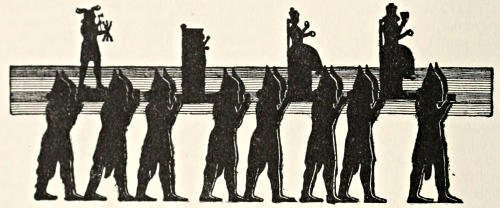
A Religious Procession
From the circumstance that in the third millennium before the Christian
era the old Babylonian kings who resided in Middle Babylonia (particularly
at Nisin and Erech) and in Ur and Larsa bore Semitic names, though the
inscriptions that have come down to us from their reigns are written entirely
in Sumerian, we are probably justified in concluding that in Middle Babylonia,
where the dominant Sumerian population of the south and the dominant
Semitic population of the north must have come most directly into
contact, the interfusion of the two races was at that time taking place on a
very large scale. On the other hand, in northern Babylonia, where Sumerians
had lived from the very earliest period, but had never risen to any
political importance as compared with the Semitic immigrants, the two must
have lived strictly apart down to 2000 B.C. (the latest date of which we can
be certain), for not long before that time colonists went out from northern
Babylonia and founded the empire of Assyria. The far greater purity of
the Semitic type among the Assyrians, together with the absolute identity
of their language and civilisation with that of Babylonia, leads inevitably to
the inference that the intermixture of Sumerian blood with Semitic in North
Babylonia had either not begun, or had as yet proceeded but a very little way.
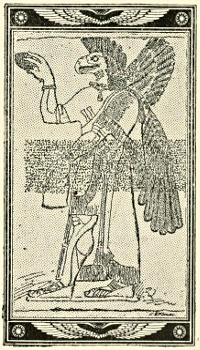
An Assyrian God
Tested thus by philology, the Assyrio-Babylonian language, together with
Canaanitish (under which title we include Phœnician, Hebrew, and Moabitish),
Aramaic (Syrian, the so-called
Biblical Chaldee, Palmyrene, etc.), and
Arabic (and under this heading not
only the Sabæan tongue of southern
Arabia, but the Ethiopian and Amharic
languages of Abyssinia, should be
placed), belong to a single well-defined
group which we have long been accustomed
to call Semitic (cf. Stade’s
Geschichte des Volkes Israel) and the
races which spoke and speak them are
known to ethnology as Semites. From
the remotest antiquity down to modern
times these races have maintained a
singular purity of blood and racial type;
the Canaanites represented in Egyptian
tombs of the XIIth Dynasty, the
Assyrian heads in the bas-reliefs of
Nineveh, the features of Jews at the
present time living in the midst of Indo-Germanic
nations, and the Bedouins who
to-day roam the Syrian and Arabian
deserts, all exhibit a family likeness so
remarkable that we see that throughout
the whole course of history they can
have mingled but little with alien races.
The question of how and from what
causes the Semitic type in Assyria came
to be preserved in greater purity than in Babylonia itself, whence the
Assyrians emigrated, is one that has been briefly touched upon above.
Under these circumstances it is only to be expected that the constant
type of character proper to other Semites should be discoverable, or, at least,
in part recognisable in the Babylonians and Assyrians; although we are
bound to take into account the fact that even in later days the Hebrews
retained much of their old nomadic habits, that the Aramæans of the Assyrian
period were for the most part nomadic, and that the Arabs are so still;
while from the very beginning of their appearance in history the Semitic
inhabitants of the regions about the Euphrates and Tigris are a home-dwelling
people on a high level of civilisation. Many traits of primitive national
character tend to be obliterated or modified by such an advance to a superior
stage of civilisation, while others, foreign to the brother or kindred races
which remained longer or still remain in the nomadic stage, are developed.
In the Assyrians and Babylonians, as a matter of fact, we must meet
with so much that recalls instinctively their kin with those whom the Bible
and universal history have long rendered us familiar that it offers the fullest
confirmation of the conclusions arrived at by a study of their language and
physical type. It is very difficult to compress into a few words a correct
description of Semitic national character.
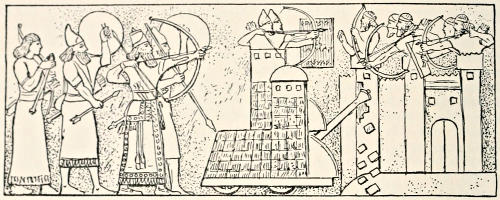
Siege of a City (Nineveh)
Eduard Meyer, in his otherwise admirable Geschichte des Alterthums,
says, “A very matter of fact habit of thought, keen observation of detail, a
calculating intellect ever directed to practical aims, keeping the creations
of the imagination completely under control and averse from any freer flight
of the spirit into the Illimitable, such are the characteristics that distinguish
the Arabs and Phœnicians, Hebrews and Assyrians,”—a judgment which,
though in the main correct, is nevertheless not exhaustive. [Some of
Professor Meyer’s other estimates are less satisfactory to Professor Hommel,
who quotes the following with entire disapproval, claiming that they quite
misrepresent the true character of the Semitic mind: “This same abominably
matter-of-fact habit of thought, which dominates the Koran and by
means of which it wrought its effect, lies at the root of the human sacrifices
of the Canaanites, the religious phrases of the Assyrians, and, finally,
of Yahvism” (i.e. the religion of the Old Testament). “The relation
of the individual to the god is regarded in a strictly rationalistic and calculating
spirit. An ethical or mystical relation to the Deity is wholly alien
to the Semitic mind.”] Compare these and other passages of the same sort
[Professor Hommel continues] with the fact that, on the contrary, a monotheistic
tendency stronger than in any other race in the world, and combining
with it the idea of a heartfelt surrender of the whole man to the Deity,
was one of the principal characteristics of the Semitic mind as a whole
(though most highly developed among the Israelites).
It is true that the cruelty of the Assyrians to foreign prisoners of war,
which often shocks us and estranges our sympathies from the whole nation,
recall certain instances of a like defect among the ancient Israelites too
strongly not to tempt us to think of it as a Semitic propensity; but nevertheless
these are mere excesses and excrescences which must not be set to
the account of national character. The Semite is not naturally cruel. If
he were so, the trait must have come out most strongly in the Bedouin
Arabs, who for centuries have remained at the barbaric stage in religious
matters; whereas this is not so, but rather the reverse. With many races
(some of them Indo-Germanic) of whom the most unspeakable horrors and
acts of violence are recorded in the course of history, sheer lust of blood and
torture has been the motive of such actions (or rather crimes), while the
cruelties just referred to sprang from the dark side (revolting, it must be
confessed) of a national virtue: true zeal for the Holiest.
On such questions as the degree of kinship in which the Babylonians and
Assyrians stood to other Semites, their original home, their last halting-places,
and consequently the sequence of Semitic migrations, Eduard Meyer
holds the same views as the famous orientalist, Sprenger, to wit, that Arabia,
i.e. the desert as distinct from the arable land, used from the very earliest
times to send forth the surplus of her predatory and rapacious Bedouin
population to the great pastoral districts in the vicinity, that is, to Palestine,
the plain of Mesopotamia (Aram), and, in times long out of mind, to northern
Babylonia also; that they were, so to speak, deposited there from time to
time, and that all Semitic nations whom we meet with in a state of civilisation
in the course of subsequent history have come into being in this manner.
“But this ingenious theory has been directly refuted by later investigations
set on foot by A. von Kremer, and followed up by Ign. Guidi at Rome,
and, more especially, by myself, with a view to discovering what domestic
animals and cultivated plants were known to the original Semitic stock.
By the year 1879 Guidi and I had come independently and, to some extent,
by different ways to the conclusion that the original home of the Semites
could not possibly be Arabia, but must be sought farther to the northeast.
In the treatise, Die sprachgeschichtliche Stellung des Babylonisch-Assyrischen,
I succeeded in proving further that the people who afterwards
became the Babylonians and Assyrians must have separated from the
common stock in some part of central Asia where the lion was indigenous,
and emigrated into northern Babylonia through one of the passes of
the Medio-Elamite range certainly no later than the fifth millennium B.C.
The rest, however, came by way of the southern shore of the Caspian Sea—probably
towards the end of the fourth millennium and at all events later
than the Hamites of northern Babylonia—and entered what was afterwards
Aramæan Mesopotamia from the north, then occupied it, and spread gradually
from thence to Syria, Palestine, and Arabia.” (Hommel.) So, by subsequent
offshoots and migrations, they became the Aramæans, Canaanites,
and Arabs.
This theory furnishes, on the one hand, the first satisfactory explanation
of many points in which Babylonian development, in language and various
respects, differs from that of other Semites. On the other hand, it sets the
large amount they have in common in a most interesting light, since it
proves to be the primitive heritage of the Semitic race.
The whole question of the manner of Semitic migrations and offshoots
is one that cannot be a matter of indifference to the historian, as may be
objected in some quarters; and for a right understanding of the history of
Babylonia in the earliest times, it is of the utmost consequence that we should
know whether the Semitic Babylonians were a distinct branch, as compared
with their brethren, whose relations among themselves were much closer,
and whether the beginning of their migration had led their steps through
the land where grew the olive, fig, vine, and other cultivated plants not to
be found in Babylonia; and lastly, it is imperative for a right comprehension
of the history of Semitic civilisation to arrive at a decision on these
questions. The fact that we find in the Assyrio-Babylonian language no
trace of the common Semitic name (found in Aramaic, Canaanitish, and
Arabic) for the three plants just mentioned, and others of the same nature,
constitutes, together with weighty philological considerations, the positive
argument in favour of the theory I have set forth: namely, that the route
by which the Semitic settlers of the lower Euphrates came did not lie
through regions where these plants are indigenous, but that they migrated
in advance of the rest of the Semites straight from the east or northeast into
anterior Asia and so to their new home of Babylonia.d
We have here the mere dust of history, rather than history itself;
here an isolated individual makes his appearance in the record of his
name, to vanish when we attempt to lay hold of him; there the stem
of a dynasty which breaks abruptly off, pompous preambles, devout
formulas, dedications of objects or buildings; here and there the account
of some battle, or the indication of some foreign country with
which relations of friendship or commerce were maintained—these are
the scanty materials out of which to construct a connected narrative.—Maspero.
Recent researches in old Babylonia have brought to light a very large
quantity of historical documents which tell a most important story, inasmuch
as they have to do with the very remotest periods of antiquity. At Telloh,
the site of the ancient city of Shirpurla, the French explorers have found an
abundance of interesting material, while the Americans have exhumed, and
are still exhuming, at Nippur, a mass of documents which bids fair to rival
in quantity the voluminous records from the libraries of the Assyrian kings.
In a single season’s excavating, Mr. Haynes has very recently brought to
light thousands of inscribed tablets, some of which date from a period as
long anterior to the time of the great Assyrian kings as that time is to our
own.
The historian is to be particularly congratulated in that many of these
ancient documents have the most direct bearing upon his studies. It has
already been pointed out that the Babylonians were much more amply
endowed with historical sense than were the Egyptians. They had a tolerably
full appreciation of the importance of chronology, and though, like the
Egyptians, they lacked a fixed era from which to reckon, they, to some
extent, compensated for this defect by the ample series of king lists and
“synchronisms” which various monarchs caused to be written. Several of
these chronological documents have been restored to us by the various excavators,
and, thanks to these, the outlines of considerable periods of early
Babylonian history are now more accurately known than many much more
recent epochs of occidental history.
Unfortunately, these ancient lists consist, for the most part, of tables
of names having strange and unfamiliar sounds. To the average reader
these names are necessarily repellant. Such words as E-anna-tum, Urumush
or Alusharshid, Samsu-iluna, Kadashman-Kharbe cannot well be
otherwise than mystifying when unconnected with any vivid sequence of
tangible events. And for the most part the names of these earliest rulers
of Babylonia stand, in the present state of our knowledge, as mere names,
with only here and there a suggestion of tangibility. Now and then we hear
that a bas-relief of a certain king has been preserved, as in the case of one
Ur-Nina, “builder of an edifice attached to the temple of Nina at Lagash,”[19]
and in such a case the mind conjures a curious world of associations at
thought of an actual likeness, real or alleged, being preserved for a period
of more than six thousand years. The king whose image is thus tangibly
brought to view after all these centuries of oblivion must seem a very real
personage, however little else is known of him or of his achievements.
Again, in the case of certain other monarchs, there are brief records of
campaigns and conquests against neighbouring peoples whose very names,
perhaps, have been preserved to us only through this incidental mention.
In such cases the mind is stimulated to the formation of vague pictures
of unknown peoples of that remote era, and the least imaginative person
must feel a bewildered sense of wonderment as to what these peoples
were like, whence they came, and whither they vanished. But for that matter
the Babylonian kings themselves, and the peoples over whom they ruled,
seem shadowy and mysterious enough, to say nothing of their neighbours.
The present knowledge does not by any means suffice to give us a full list
of the names of these early monarchs.
In all probability there are lists still in existence buried in the ruins of
various cities, as yet unexplored, that in time will restore to us a reasonably
full record of those long stretches of time which now seem so hazy.
In numerous places the excavations are still going on, discoveries are
daily being made, undeciphered material is being read; in a word, new
chapters of this oldest past are being almost daily brought to light.
Whatever is written to-day regarding early Babylonian history must then,
in the nature of the case, be subject to possible revision to-morrow. At
least this is true to the extent that additions are sure to be made to the
present incomplete knowledge in the near future. It does not follow,
however, that the knowledge of the present will be altogether superseded.
Such king lists as have been already deciphered, covering in the aggregate
considerable periods of time, may be depended upon, in general, as accurate
and permanent records, which will be supplemented rather than supplanted
by the new records of future discovery. Meantime, we must be content
with the glimpses into here and there an epoch, and with the citation of
here and there a name, covering as best we may some three or four
thousand years of Babylonian history in a few meagre chapters.
Tantalising as it is to catch such mere glimpses into realms that must
be fascinating could we but know their fuller history, there is at least a
certain consolation in the thought that our generation is the first within the
past two thousand years to gain even a glimpse of these epochs of history.
Even in classical times nothing was known of early Babylonia: such
reminiscences of Mesopotamian greatness as were preserved pertained to
the later Assyrian history and to New Babylonia. And the Assyrians and
New Babylonians themselves were possessed of but little information regarding
their remote ancestors, whose records were, in the main, as completely
hidden from them as they have been from all succeeding generations of
men until our own time.
To co-ordinate properly the great mass of information, unearthed of late
years concerning the numerous states that existed in Babylonia in the
earliest historic period, is the task that Dr. Hugo Radau has undertaken
with great success. The following extract from his recently published work[20]
will give the reader the latest knowledge of these petty kingdoms, and
enable him to understand how the greater ones absorbed the lesser, and how
the way was thus paved for the union of all Babylonia under one ruler.a
[ca. 4500 B.C.]
The oldest king of Babylonia of whom we have any record, is Enshagkushanna,
whose date we have placed before 4500 B.C. He calls himself
“lord of Kengi,” the southern part of Babylonia. As to his nationality,
whether he was a so-called “Sumerian” or a “Semite,” we have no means
of knowing. Besides “lord of Kengi,” he seems to have had another title,
viz. “king of … “ The lacuna probably contained the names of the
capital of the kingdom. He must have waged war against Kish in northern
Babylonia, which city he terms “wicked of heart.” He was the victor, and
presented the spoil to “Enlil, king of the lands.” Enlil—the later Bel—was
the chief god in Nippur; Nippur accordingly was called En-lil-ki,
the “city of Enlil.” Hence Enlil of Nippur seems to have been the god who
wielded the chief influence over the inhabitants of Early Babylonia. From
inscriptions of certain patesis[21] of Shirpurla, as well as from those of Lugalzaggisi,
we know that this temple was under the control of the king, who called
himself accordingly patesi-gal, “the great patesi.” But it also had its own
“chief local administrator,” the dam-kar-gal, who in his turn had several
minor priests or patesis under him. The cult of this god seems to have
been well arranged; the king, being the summus episcopus, had a host of
other officers (priests) under him, who exercised the ordinary functions of
the so-called priesthood of Bel. Few as the historical notices are, yet
they enable us to get an insight into the condition of the land and of the
people at this remote time. They show us that a struggle went on between
the south (Kengi) and the north (Kish) which struggle lasted undoubtedly
for several centuries.
Prominent cities at this time were the capital of Kengi, i.e. Shirpurla-Girsu,
as we shall see later on; not Erech (Hilprecht), Nippur, and Kish.
It is necessary, however, before tracing the different steps in the development
of Kish, to turn our attention to a kingdom called in the inscriptions
“Shirpurla.” The inscriptions of the rulers of this kingdom give us an
impression of a power and might which presupposes centuries for its
development. All that we know of its art and civilisation tends in the
same direction.
[ca. 4500-4100 B.C.]
Shirpurla is the modern Tel-Loh (or Telloh) where De Sarzec found the
inscriptions relating to the rulers of this dynasty. It is situated fifteen
hours north of Mugheir, on the east side of the Shatt-el-Khai, and about
twelve hours east of Warka. At this early time the city of Shirpurla seems
to have included four component parts, viz. Girsu, Nina, Uruazagga, Erim.
Thus it happened that one and the same king might call himself either
“king of Shirpurla” or “king of Girsu.” These suburbs were built by
various rulers in honour of their favourite gods or goddesses. Whether
Shirpurla is the right reading, or Sirgulla (Hommel), we do not know.
According to Pinches, Guide to the Kuyunjik Gallery, p. 7, London, 1883,
and Babyl. Records, iii, p. 24, Shirpurla may read Lagash, which reading is
adopted throughout by Jensen in K. B. iii. We retain the old reading
Shirpurla, because this writing occurs most frequently in the monuments.
The rulers of Shirpurla may conveniently be grouped under four
divisions:
(1) The dynasty of Urukagina—beginning with this ruler or his predecessor(s)
and ending with Lugalshuggur and his successor(s).
(2) The dynasty of Ur-Nina, ending with Lummadur.
(3) The patesis between Lummadur and Ur-Ba’u.
(4) Ur-Ba’u and his successors, ending with Gala-Lama.
To Urukagina, the oldest member of the first dynasty of Shirpurla, we
have assigned the approximate date of 4500 B.C. His greatness consisted
not so much in successful wars against the neighbouring cities, as in securing
a peaceful administration for his country and city. As “king of Girsu-Shirpurla,”
he devoted his energy to the building of different storehouses,
that should take up “the abundance of the countries,” and erected temples
for different gods—thus showing his devotion and piety. He built “for
Nina the beloved canal, the canal Nina-ki-tum-a,” and thus supplied his city
with water. Bel of Nippur still exercises the highest influence. Ningirsu
(“the lord of Girsu”) is the chief city-god, under whose control the capital
stands. He is the Gud or “hero” of Enlil. In somewhat later inscriptions,
Ningirsu has the title gud-lig-ga, “the strong hero” of Enlil. Many
other gods are mentioned in his inscriptions.
To this oldest dynasty of Shirpurla belongs also a certain En-gegal (“lord
of abundance” or “very rich”). He, like Urukagina, calls himself “lugal
Pur-shir-la,” “king of Shirpurla.” Besides this he bears the proud title “lugal
ki-gal-la,” “the great king,” and terms himself shib (dingir) Nin-gir-su,
“the priest of Ningirsu,” a title similar to that of patesi-gal. From the title
“the great king” we may venture to conclude that he, unlike his predecessor,
must have carried his arms successfully against his enemies, who had
previously succeeded in plundering Shirpurla; but fate decreed that his royal
capital should be reduced to the seat of a patesi. Kish, having been defeated
some time before by Enshagkushanna, seems to have acquired new
strength. Its king, Mesilim, became lord paramount of Shirpurla, thus reducing
its rulers to mere patesis. The name of only one of these earliest
patesis is preserved to us, i.e. Lugal-shug-gur, who is mentioned in the inscription
of Mesilim. The sovereignty of Kish over Shirpurla does not seem
to have lasted very long. Shirpurla regained its former glory under a new
dynasty, namely, that of Ur-Nina.
[ca. 4300-4200 B.C.]
With Ur-Nina begins a new dynasty, probably the mightiest of early
Babylonia, the duration of its sovereignty extending from 4300 B.C. to
4100 B.C. Looking at the art and the inscriptions of these kings, we cannot
help thinking that in Shirpurla civilisation must have been far advanced,
so far advanced as to force upon us the conclusion that “several centuries
have elapsed before men could reach this stage of civilisation.” The greater
number of these art treasures are preserved in the Louvre; the inscriptions
found on them have been published in Découvertes en Chaldée and in the
Revue d’Assyriologie.
The first king of this dynasty was Ur-Nina (servant of Nina). The dynasty
of Urukagina must have been reduced to mere nothingness by the kings
of Kish, so that Ur-Nina found it easy to take possession of the throne. He
must have been of an old family, for he mentions the name of his father and
grandfather, who have the title neither of patesi nor of king. He, like his
predecessor seems to have been great in peace. He built temples and various
storehouses. A passage in his inscriptions where he records the building
of the “wall of Shirpurla,” suggests that the old enemy, Kish, was still
troublesome, so that he found it necessary to fortify his capital against the
deadly enemies from the north.
The son of Ur-Nina, who succeeded him upon the throne of Shirpurla, was
Akurgal. As yet no inscriptions of this monarch have been found. All
that is known about him is gathered either from the inscriptions of his son
(Eannatum) or from those of his father (Ur-Nina). In these inscriptions
eight sons of Ur-Nina are mentioned. If we classify them according to
their height, and take this as a basis for determining their age, we would
get the following result:
UR-NINA
(1) Lid-da, (2) Mu-ri-kur-ta, (3) A-ni-kur-ra, (4) Lugal-shir,
(5) A-kur-gal, (6) Nun-pad, (7) E-ud-bu, (8) Nina-ku-tur-a.
It is remarkable that the first-born, Lidda, is mentioned in only one inscription.
Did he never succeed his father upon the throne of Shirpurla?
Did Akurgal, his fifth son, in preference to all the others, inherit the royal
sceptre, and thus become the immediate successor of Ur-Nina? Interesting
as these questions are, we are yet, with the means on hand, unable to decide
them. This much only we know, that both Eannatum and Enannatum I,
call themselves, “son of Akurgal.” Another interesting fact is that Eannatum,
in his “Stèle des Vautours,” calls his father lugal (“king”) of Shirpurla,
while in his other inscriptions he only terms him “patesi of Shirpurla.” Not
very much can be concluded from this, because even Ur-Nina is styled
by Eannatum “patesi of Shirpurla.” The translation of this latter passage,
is not yet certain. Ur-Nina’s successor, however,—either Lidda or
Akurgal,—may have lost the title “king” in consequence of an unsuccessful
war. Eannatum, on the other hand, being more successful, resumes
again for a short time the title “king” after his victory over Kish. This
latter fact is very important. Eannatum expressly tells us that Innanna
gave him the nam-lugal Kish-ki, “the kingship of Kish,” while as ruler of
Shirpurla he was only patesi. The state of affairs then was as follows:
Ur-Nina, a usurper, was able to constitute himself king of Shirpurla in
consequence of the weakness of the patesis of Shirpurla who preceded him,
they having been reduced by the kings of Kish to complete powerlessness.
Ur-Nina’s successors, however, were not able to retain the title of their
father. Was it internal disharmony between the sons of Ur-Nina which
caused this? They lost the title “king,” and had to accept that of patesi.
Undoubtedly they were forced to do this by one of the successors of Mesilim,
i.e. by a king of Kish. Eannatum—a great hero—was able to overcome
the old enemy Kish. He even was so fortunate as to add to his old title,
“patesi of Shirpurla,” that of “king” (sc. of “Kish”) and by a stretch of
this latter title he may have also called himself “king of Shirpurla.” The
successors of Eannatum called themselves, and are called without exception
“patesis of Shirpurla.”
[ca. 4200 B.C.]
After these preliminary remarks about the titles of the different members
of the dynasty of Ur-Nina, we now turn our attention to Eannatum (i.e.
“The house of heaven is stable”), the son of Akurgal himself. Whether
he reigned contemporaneously with his brother Enannatum I or not, we
cannot tell. The fact that the sons of Enannatum I succeeded upon the
throne of Shirpurla makes it reasonable to suppose that Eannatum preceded
Enannatum I. This latter ruler seems to have played only a minor rôle in
early Babylonia history. Only two of his inscriptions have so far come
down to us. Eannatum, his brother, on the contrary, is the greatest of the
whole dynasty. The deeds of this monarch have been preserved to us on
different monuments, among which the “Stèle des Vautours” is the most
important. In order to obtain a full conception of his time we must
compare this “Stèle” with the so-called “Cone” of Entemena. Those
monuments in connection with the Galet A, give us the following interesting
piece of history:
The god of Shirpurla (Ningirsu) and the god of Gishban, at the instigation
of Enlil (god of Nippur), agree to settle the boundaries between their
respective territories (Cone i, 1-7). Mesilim, king of Kish,—a contemporary
of Lugalshuggur, patesi of Shirpurla,—in the quality of lord paramount
of Shirpurla, corroborates the result of this “settling of boundaries,” and
erects a statue on the junction of the two territories, to mark out the
boundaries of the territory of Shirpurla on the one side and of Gishban
on the other (Cone i, 8-12). Ush, however, a certain ambitious patesi of
Gishban, is not satisfied with this decision. He takes away the statue
which Mesilim had erected, and then invades Shirpurla, undoubtedly to
extend his territory beyond the boundary previously fixed (13-21). A
war between Shirpurla and Gishban ensues.
Mesilim, who feels dishonoured by this action of Ush, takes the side of
Shirpurla and defeats Gishban (22-31). Gishban in course of time again
becomes restless. It invades, under its patesi Gunammide, the territory of
Shirpurla, and more specifically the Guedin, a district sacred to Ningirsu.
“Gunammide, the patesi of Gishban, according to the command of his
god … the Guedin, the beloved territory of Ningirsu he destroyed.”
Eannatum, after having fortified Shirpurla sufficiently (“the wall of Uruazagga
he built”), and having led his armies victoriously against Elam and
Gishgal, feels himself strong enough to deal a deadly (?) blow at Gishban.
“Gishban he put under the yoke, twenty of its dead ones he buried.”
Having done this, he restores the sacred territory, the Guedin, to Ningirsu;
concludes a treaty with Enakalli, (one of) the successor(s) of Gunammide;
digs a canal “from the great river (i.e. the Euphrates?) to the Guedin,”
and makes the Gishbanites swear never to invade the sacred territory of
Ningirsu again, nor to trespass this boundary.
“In the future time the territory of Ningirsu, when (the Gishbanites)
should invade it again, the dyke and the canal, if they should trespass it,
the statue, if they should take it away—at that time when they invade it,
then the sa-shush-gal (i.e. Eannatum) of Utu, the powerful king by whom
they have sworn, shall rise against Gishban.”
“The Stèle des Vautours” has for its main object the commemoration of
this treaty with Enakalli, patesi of Gishban, after the latter city had been
defeated by Eannatum. But Eannatum was not satisfied with this; he imposes
a heavy tribute upon Gishban, consisting of one karu of grain for Nina
and one karu for Ningirsu, besides 144,000 (?) great karu. (Cone ii, 19 ff.)
After having reduced Gishban to tranquillity, Eannatum also carries his
victorious weapons against Erech (Warka) and Ur (the Ur of the Chaldeans),
Ki-Utu (Larsa?) and Az (on the Persian Gulf)—the patesi of which latter
city he kills—against Melimme and Arua. These latter cities were all in
the neighbourhood of Shirpurla. Last of all he crushes and defeats Zuzu,
king of Ukh. But even this does not exhaust the record of his victories.
He becomes king of Kish—Kish, which for so long had itself been sovereign
over Shirpurla. How this victory was accomplished is not evident from the
inscriptions so far extant. Probably at some future time we may find an
account of this war.
Eannatum was not only a hero in war, but also a wise administrator.
He not only renewed three suburbs of his capital, one of which—Uruazagga—he
even surrounded by a wall, but also improved the condition of Shirpurla
itself by digging different canals, which he consecrated to his god
Ningirsu: the Kishedin, which probably marked the boundary between the
Guedin and Gishban, and which the Gishbanites had to swear never to cross;
the Lummagirnuntashagazaggipadda along the territory of Ningirsu; and
the Lummadimshar.
Urukagina, we have seen, was the first to build a canal, viz. one for Nina,
which he called Nina-ki-tum-a. In the Cone of Entemena are also mentioned
the canal Lummasirta, the Imdubba, and the Namnundakiggara. Here,
then, we have the beginning of the most characteristic feature of Babylonia.
Babylonia becomes the “land of canals,” such as the Psalmist had in mind
when he wrote that touching psalm, “By the rivers of Babylon we sat down
and wept.” Further, Eannatum was not unmindful of his duty to the gods.
He confesses that all that he is and that he has comes from his gods.
Accordingly, he shows his gratitude by erecting sanctuaries for Enlil,
Ninkharsag, Ningirsu, and Utu, and by restoring old buildings, which had
been erected by his predecessors in honour of the gods, among which is to be
found the Tirash.
In spite of the solemn promise of Gishban never to invade the territory
of Shirpurla again, or to pass over the boundary canal, it very soon—probably
at the end of the reign of Eannatum, or better, at the beginning of that
of Enannatum I—becomes rebellious as before. It invades the territory of
Girsu, under the leadership of a certain Urlumma, patesi of Gishban, passes
over the boundary canals which Eannatum had made, removes the steles
erected on those canals in honour of Ningirsu, casts them into the fire, and
even destroys the sanctuaries which Eannatum had built on one of these canals
(i.e. the Namnundakigarra) in honour of Enlil, Ninkharsag, Ningirsu, and
Utu, and lays waste the country. Enannatum promptly arises to chastise
“those dogs” who had dared to break their solemn promise. Whether this
battle was decisive or not, is not evident. It seems, however, that Enannatum
I gained but a slight victory over Gishban.
For Entemena, the son of Enannatum, finds it necessary to renew the war
with Gishban. “He puts Urlumma under the yoke,” i.e. subdues him,
forces him to return to his own country, and pursues him to the very midst
of Gishban. This triumphant victory began with the decisive battle at the
canal Lummasirta in the territory of Shirpurla. “Of his (i.e. Urlumma’s)
army sixty men on the side of the Lummasirta he left.” On account of the
severe loss Gishban fled. Entemena pursued after it, of which pursuit he
records that “he left the bones of the soldiers (of Urlumma) in the field.”
Many of these soldiers of Gishban must have fallen, so many that Entemena
was obliged “to bury their dead in five different places.”
Arrived in Gishban, Entemena makes a certain priest of Innannaab-ki
(or Nin-ab-ki), Ili by name, patesi of Gishban, probably after having deposed
Urlumma. As a compensation for the new dignity thus conferred, Entemena
commands Ili to build in the territory of Karkar—which latter had also
become rebellious—boundary canals and some other buildings. The canal
which Eannatum had built “from the great river (Euphrates?) to the
Guedin” Entemena prolongs to the Tigris, and also repairs the other canals,
which had been destroyed more or less by the Gishbanites, and dedicates
them anew to Ningirsu and Nina.
Interesting also is the subscription of this Cone:
“When the men of Gishban the boundary canal of Ningirsu and the
boundary canal of Nina—for the purpose of ravaging these territories—shall
pass over, then may Enlil destroy the men of Gishban and the men of
the mountains; may Ningirsu bring his curse over them; may he lift up his
great power; may the soldiery of his (Entemena’s) city be filled with bravery;
may in the midst of the city be courage in their hearts.”
With Lummadur, the son of Enannatum II, we arrive at the last representative
of the house of Ur-Nina. Nothing but his name is known to
us. From the absence of the title patesi behind his name, we may conclude
that Enannatum II was the last patesi of the line of Ur-Nina, and that
the old enemies, Kish and Gishban, have finally succeeded in overpowering
Shirpurla.
It is hardly possible to look back upon this dynasty of Ur-Nina—which,
as we have seen, dates from before 4000 B.C.—without being impressed by
the high civilisation, cult, the many buildings and canals, military skill, and
style of writing. Surely such a people as this could not have sprung into
existence as a deus ex machina; it must have had its history—a history
which presupposes a development of several centuries more. We would
gladly follow up the history of the successors of Lummadur, but the lack of
material prevents us from so doing. Passing, therefore, over an interval of
about two hundred years in the history of Shirpurla, we turn now to
the enemies of the “hero Ningirsu,” i.e. Kish and Gishban (or, better,
Gishukh).
[ca. 4200-4000 B.C.]
Various changes had befallen the land of Kish. When speaking of Enshagkushanna,
we saw that Kish was defeated. It had, however, in course of
time again increased in strength. Mesilim was able to establish himself as
ruler over Shirpurla at the time of Lugalshuggur. His successors may have
retained their glory for a considerable period. They were, however, not
able to withstand the mighty weapons of Eannatum. This latter king not
only shook off the old yoke which Kish had fastened upon Shirpurla, but
even became “king of Kish.” He must have reduced Kish to total impotence.
Hence it came about that Kish was vanquished by another power,
of which we shall hear shortly.
Just as Gishban, after its defeat by Eannatum, felt strong enough to disregard
the solemn promise never to invade the territory of Shirpurla, so Kish,
after its overthrow by Eannatum, seems to have rapidly regained its old
power. For we find a certain En-ne-ugun, “king of Kish,” who is also
termed “king of the hordes of Gishban,” desirous with the help of this latter
city to extend the power of his capital. He was, however, defeated by a certain
king of a certain country (the names cannot be read on account of the
mutilated condition of the tablets). “His statue”—this unknown victorious
king records, while relating his victory over En-ne-ugun—“his
shining silver, the utensils, his property, he carried away, and presented
them to Bel at Nippur.”
In course of time, however, and probably not very long after this defeat,
Kish seems to have recovered from this blow. A certain Urzaguddu must
have been very successful in his wars, for, in addition to his title “king of
Kish,” he calls himself also “king of …” Unfortunately here again we
have a gap, so that we cannot determine of what city he became king.
Very little is known of the next king of Kish, Lugaltarsi. At what time
subsequent to Urzaguddu he lived we cannot tell. So much only is certain,
that he reigned some time before Alusharshid, about 3850 B.C. His inscription—the
only one so far known to us—is preserved in the British Museum
in which he records the building of Bad-kisal in honour of Bel and Ishtar.
We can now place Manishtusu and Alusharshid also among the kings of
Kish. Both flourished somewhere about 3850 B.C., before Sargon I.
When reading the inscriptions of these kings, it is as if a new race were
speaking to us, so widely different is the language used by these rulers from
that of their predecessors, or of any other kings we have so far met with.
We here find for the first time the so-called Semitic-Babylonian inscriptions.
It is the same language which is also employed in the inscriptions of Sharganisharali
and his successors, in that of Lasirab, king of Guti, and of Annubanini,
king of Lalubu, all of whom were more or less contemporary with
these kings of Kish. Scholars who believe that we must postulate two
different races among the inhabitants of early Babylonia call the kings who
wrote in this style “Semitic kings,” while the others are referred to the
Sumerian population. As a result of this they read the names of these kings
in a Semitic way. Manishtusu becomes Ma-an-is-tu-iro (so Winckler).
Urumush becomes Alu-usharshid (i.e. “He—some deity—founded the
city”).
The inscription of Manishtusu, whom we place provisionally before
Urumush, runs, “Manishtuirba, king of Kish, has presented (this) to Belit-Malkatu.”
Of more importance, from the historical point of view as well as from
the linguistic, is the next ruler who followed soon after the former. This
ruler is Alusharshid. From his inscriptions—to be found in fifty-one
fragments of vases, which have been excavated by the expedition of the
University of Pennsylvania under Dr. Peters, and partly published by
Hilprecht—we learn that he subdued Elam, on the eastern side of the
Tigris, and the country of Bara’se (Para’se), from which lands he brought
back these marble vases, and dedicated them to his gods at Nippur and
Sippar.
For but a short period subsequent to Alusharshid does Kish seem to
have enjoyed its old power. The might of Kish gave place to that of
Agade, as we shall see shortly. Leaving, therefore, Kish for the present,
we turn our attention to the other enemy of Old Shirpurla, viz. Gishban.
[ca. 4000 B.C.]
At about 4000 B.C., not long after the time of Eannatum, Gishban seems
to have acquired new power and might. It directed its chief attention not
so much towards Shirpurla as towards the south. Probably the rulers of
Shirpurla had at this time been reduced to utter weakness by its old enemies
(i.e. Kish and Gishban), of which enemies Gishban was destined to play
the most important rôle in the development of ancient Babylonian history.
Lugalzaggisi, the son of Ukush, patesi of Gishban, we find at the head
of the armies of Gishban, which he leads victoriously against the south.
After Erech had opened its doors, the whole of Babylonia to the Persian
Gulf fell an easy prey to the conquering hero. He, although originally
only the son of a patesi, becomes king of Erech, nay, even king of the
“whole world.” “Enlil, king of the lands, has given to Lugulzaggisi the
kingship of the world; he has made him to prosper before the world; he it
was that had placed the lands under his sceptre—the lands ‘from the
rising of the sun even unto the going down of the same.’ He it also was
that gave him the tribute of those lands, which he made to dwell in peace,
notwithstanding that they had been brought under a new régime.” With
these words Lugalzaggisi acknowledges, as the kings of Shirpurla did, that
Enlil, and Enlil alone, had granted to him so unprecedented a dominion,
extending from the lower sea of the Tigris and the Euphrates (i.e. the
Persian Gulf) to the upper sea (i.e. the Mediterranean). Constituted thus
“lord of the world,” he now becomes its “summus episcopus.” “In the
sanctuaries of Kengi, as patesi of the lands, and in Erech, as high priest,
they (the gods) established him.”
To quote Hilprecht: “Babylonia, as a whole, had no fault to find with
this new and powerful régime. The Sumerian civilisation was directed into
new channels from stagnation; the ancient cults between the lower Tigris
and Euphrates began to revive and its temples to shine in new splendour.”
Thus, endowed with the highest temporal and spiritual power, he “makes
Erech to abound in rejoicing.” Nor does he forget the other representative
cities of his domain: “Ur, like a steer, to the top of the heavens he raised.”
“Over Larsa, the beloved city of Shamash, he poured out waters of joy.”
His own native town and land receive chief attention: “Gishban, the
beloved city of … to an unheard-of power he raised.” He, as wise
ruler and statesman, not only shows his good will and favour towards the
larger and more influential cities, but also protects the weaker ones:
“Ki-Innanna-ab he kept in an enclosure, like a sheep that is to be shorn.”
Indeed, “Lugalzaggisi stands out from the dawn (?) of Babylonian history
as a giant who deserves our full admiration for the work he accomplished.”
Seeing that Semitisms occur in almost all the earliest inscriptions so far
known to us, and that the rulers themselves may have been and probably
were Semites—let us confess this—then the other question arises: At
what time did the Semites come into the country, so as to induce the original
inhabitants to employ expressions foreign to their own language? Where
did they come from? To the last question, which has been repeatedly
discussed by scholars, different answers have been given. Some make
Africa the original home of the Semites; others Arabia; and Hilprecht,
who last spoke of this problem, assigns for this purpose Kish, or better,
Kharran some distance north of Babylonia. According to his theory,
Lugalzaggisi, the great conqueror from Gishban (Kharran), was the first
Semite to occupy any territory in Babylonia, and thus opened the way for
the Semitic population. But Lugalzaggisi does not antedate Ur-Nina.
Ur-Nina is a Semite, as we have seen, consequently Semites were in the
country before Lugalzaggisi.
Gishban is not Kharran, but the neighbouring state of Shirpurla; hence the
Semites did not come from Kharran, but actually occupied already the whole
country of Babylonia. Thus the two questions—when did the Semites
invade Babylonia? and, whence did they come?—are still awaiting an
answer. It is possible that some tablets may give us a key to this problem,
but so far these tablets have not been found.
ca. 6000-3800 B.C.
But further, if the Semites at so early a time as 4500 B.C. (Urukagina)
had possession of Babylonia and had adopted the old language of the
country, which language they interspersed with their own idiom, they must
have been for a long time resident in the land. This would bring the
immigration of the Semites back to at least 5000 B.C. and earlier, when the
Sumerian power began to decay. We must therefore push back the height
of Sumerian influence to a yet more remote period.
Hence, whatever view we take in regard to the two peoples and their
languages, we are led to the same general result: Civilisation and history
must go back to at least 6000 B.C.
Of Ur—the Biblical “Ur of the Chaldees”—we have already heard at
the time of Eannatum. It was situated at the western side of the Euphrates,
opposite the place where the Shatt-el-Khai flows into it. Up to the time of
Lugalzaggisi it may not have been of very great importance. This latter
ruler, however, “raised it like a steer to the top of the heaven,” hence at no
long period subsequent to Lugalzaggisi we meet two kings, father and son,
ruling at Ur. It is not impossible that this dynasty may itself have brought
about the overthrow of Lugalzaggisi, as to whose successors we have no information.
Probably, also, it took possession of the more northern part of
Babylonia (Nippur), for we find that both these kings present vases to Enlil,
the “lord of the lands.”
The names of these two monarchs forming the first dynasty of Ur are:
Lugalkigubnidudu, and his son (?); Lugalkisalsi.
Their dominion extended over Ur, Erech, and Nippur, probably also
over Shirpurla, for the kings of the south could not have gained possession of
Nippur without passing Shirpurla. This would explain why we know so very
little about Shirpurla at this time. It is, however, remarkable that both these
kings should call themselves first “kings of Erech,” and then “kings of Ur”;
while on the other hand, Lugalkigubnidudu expressly says that Enlil added
(tab) the lordship (nam-en) to the kingship (nam-lugal), which lordship so
added was Erech. We would expect that, if he were originally king of Ur,
the title, “king of Ur,” would come first. Here, then, we have an analogy to
and a confirmation of the argument used in regard to Urzaguddu. The
latter king had also two titles, viz. “king of Kish” and “king of …,”
and it was argued that the latter title, “king of …,” was the original,
i.e. Urzaguddu became later on “king of Kish.” So here “king of Ur” was
the original title; Lugalkigubnidudu subsequently became “king of Erech.”
[ca. 4000-3800 B.C.]
How long this dynasty flourished, how many rulers were comprised in it,
and when and by whom it was overthrown, we cannot tell. Probably, however,
it was replaced by a mighty kingdom which arose in the north (that of
Agade), destined to bear sway over “the four corners of the world.”
Once more—before we leave southern Babylonia and pass over to the
north—we have to direct our attention to Shirpurla. The traces which we
possess of the life of Shirpurla and its patesis during this time (i.e. 4100-3800
B.C.) are but fragmentary. Only one patesi is known to us from a
tablet recently published by Thureau-Dangin, in the Revue d’Assyriologie.
This patesi, Lugalanda by name, cannot have lived very long after Lummadur,
for the writing of that tablet shows all the palæographic peculiarities
of the inscriptions of Eannatum. Probably he belonged to those patesis
over whom Lugalzaggisi or his successors may have ruled.
With the next two patesis, Lugalushumgal and his son (?) Ur-E, we
arrive at the time of Sharganisharali [Sargon], 3800 B.C. A considerable
gap in this period has still to be filled up. Let us hope that the future
excavations, combined with the industry of the decipherer, will bring some
light into this darkest of all periods in Old Babylonian history.
Mentioning only another patesi that belongs to this period, Ur-(dingir)
Utu(?)—whose name is followed by [nam?]
patesi Uru-um-ki-ma (i.e. Ur)—we pass from
the south to the north of Babylonia, i.e. to
the city of Agade.
Agade, near the modern Abu-Habba,
formed in olden times with Sippar a double
city. It was situated near the Euphrates
and north of Babylon. As early as 3800
B.C. Semitic kings ruled in this city, extending
their sceptres over the whole of Babylonia.
The finding of the Infant Sargon
[ca. 3800 B.C.]
The first king, as far as our knowledge
goes, was Sharganisharali, cited by us as
Sargon I. He was the son of a certain Itti-Bel.
This latter is neither called a king nor
even a patesi. In this we may see a confirmation
of the so-called “legend of Sargon,”
according to which this monarch was “of an
inferior birth on his father’s side,” and so
either a usurper or the founder of the dynasty
of Agade. This legend—probably
written in the eighth century B.C.—purports
to be a copy of an inscription written on a
statue of this great king, and bears a certain
similarity to the Biblical account of Moses.
It reads: “Shargena, the powerful king, the
king of Agade, am I. My mother was of
noble family (?) [others: was poor], my
father I did not know, whereas the brother of my father inhabited the
mountains. My town was Azipiranu, which is situated on the bank of the
Euphrates. My mother of noble family (?) (or, who was poor) conceived
me and gave birth to me secretly. She put me into a basket of shurru
(reeds?), and shut up the mouth (?) of it (?) with bitumen; she cast me
into the river, which did not overwhelm (?) me. The river carried me
away and brought me to Akki, the drawer of water. Akki, the drawer of
water, took me up in … Akki, the drawer of water, reared me to boyhood.
Akki, the drawer of water, made me a gardener. During my activity as
gardener, Ishtar loved me. X + IV years I exercised dominion, … years I
commanded the black-headed people (i.e. the Semites) and ruled them,” etc.
The rest of this legend tells us something about his campaign against Dur-ilu
on the borders of Elam; it is, however, too fragmentary to be coherent.
In connection with this legend we would call the attention of the reader
once more to the fact that not merely the identity of this Shargena with our
Sharganisharali, his deeds and warlike expeditions recorded in the so-called
“Tablet of Omens,” with the date of his rule, have been doubted, but even
his very existence. A series of new facts connected with the time of Naram-Sin
and Sharganisharali have since come to light by the publication of a
great number of contract-tablets written during the reign of these kings.
These tablets are to be found in Revue d’Assyriologie, iv, No. iii. Hence it
is now impossible to doubt the historicity of Sharganisharali, as was done
by Niebuhr.
Down to the time of Hilprecht’s publication of Old Babylonian Inscriptions,
Part I, our knowledge of Sargon I was almost entirely drawn from
the “legend” and the “Tablet of Omens.” Hence it happened that the
great deeds which were attributed to Sargon and Naram-Sin in the “Tablet
of Omens” were said to be “purely legendary” (so by Winckler, Geschichte
Babylon. und Assyr., p. 38). Others thought that his deeds had been
simply projected backwards (so Maspero, Dawn of Civilization, New York,
1895, p. 599; “Sargon II is he who projected backward”); others again, not
believing that Sargon I could have undertaken such expeditions and have
become practically the “king of the four corners of the earth,” invented
another king Sargon (so Hommel, Gesch. Baby. und Assyr., Berlin, 1883,
p. 307, note 4; this Sargon he places at about 2000 B.C.).
Thanks to the excavations at Telloh and the industry of Thureau-Dangin,
we are now in a position to prove that the statements of the
“Tablet of Omens” are correct in almost every particular.
Let us hear what this “Tablet of Omens” has to say. Eleven of these
“omens” are ascribed to Sargon and two to Naram-Sin. They generally
begin with the phrase: “When the moon was in such and such position,”
then Sargon, etc.
The first omen records Sargon’s expedition to and subjection of Elam.
The second tells how he marched to the land Akharri (i.e. the West-land),
and subjected it, and that his army subjugated the kibrati irbitta, i.e.
“the four corners of the world.”
The third tells us that he brought sorrow upon Kish and Babylon, and
built a city after the pattern (?) of Agade, and called it Ub-da-ki, i.e.
“place (city) of the world.”
The fourth records another expedition against the West and the taking
possession of the four corners of the earth. So also the fifth omen.
The sixth omen is too fragmentary to yield any certain sense.
The seventh gives us a fuller account of the expedition against Akharri;
he crosses the sea of the West and wages war against it for three years, takes
it, erects there his statues, and transports the prisoners, whom he had taken,
over land and sea.
The eighth describes the repairing of one of his palaces, which he calls
“E-ki-a-am i-ni-lik,” i.e. “the house”: “so let us walk.”
In the next we hear of a campaign against a certain Kashtubilla of Kasalla,
who had revolted. Sargon goes against him, conquers him and his army, and
destroys the rebellious country.
The tenth probably is one of the most important. It reads: “Sargon,
against whom under this omen the elders of the whole country had revolted,
and in Agade had shut him up—Sargon went out, conquered them, and cast
them down, subdued their army, and.…”
The last omen tells us something about Sargon’s campaign against the
land Suri, how he overcame it, and took it, and how he destroyed its
army.
The two omens relating to Naram-Sin record a campaign against Apirak
(Omen i) and against Magan (Omen ii). In both expeditions Naram-Sin
was so successful, that he even took captive the kings of these countries,
viz.: Resh-Ramman (Adad), king of Apirak, and N. N. king of Magan.
According to this “Tablet of Omens,” then Sargon I subdued Elam, the
“West-land,” brought woe upon Babylon and Kish, conquered the country
Kasalla, suppressed a revolt which had arisen against him while on his expeditions,
and finally subdued the land Suri “in its totality.”b
[ca. 3750-2700 B.C.]
Sargon’s son and successor, Naram-Sin, followed up the successes of his
father by marching into Magan, whose king he took captive. He assumed
the imperial title of “king of the four zones,” and, like his father, was
addressed as a “god.” He is even called “the god of Agade” (Accad),
reminding us of the divine honours claimed by the Pharaohs of Egypt, whose
territory now adjoined that of Babylonia. A finely executed bas-relief, representing
Naram-Sin, and bearing a striking resemblance to early Egyptian
art in many of its features, has been found at Diarbekir. Babylonian art,
however, had already attained a high degree of excellence; two seal cylinders
of the time of Sargon are among the most beautiful specimens of the
gem-cutter’s art ever discovered. The empire was bound together by roads,
along which there was a regular postal service, and clay seals, which took
the place of stamps, are now in the Louvre bearing the names of Sargon and
his son. A cadastral survey seems also to have been instituted, and one
of the documents relating to it states that a certain Uru-Malik, whose name
appears to indicate his Canaanitish origin, was governor of the land of the
Amorites, as Syria and Palestine were called by the Babylonians. It is
probable that the first collection of astronomical observations and terrestrial
omens was made for a library established by Sargon.
Bingani-shar-ali was the son of Naram-Sin, but we do not yet know
whether he followed his father on the throne. Another son was high priest
of the city of Tutu, and in the name of his daughter, Lipus-Eaum, a priestess
of Sin, some scholars have seen that of the Hebrew deity, Yahveh. The
Babylonian god, Ea, however, is more likely to be meant.
The fall of Sargon’s empire seems to have been as sudden as its rise.
The seat of supreme power in Babylonia was shifted southward to Erech,
Isin, and Ur. At least three dynasties appear to have reigned at Ur and
claimed suzerainty over the other Babylonian states. One of these, under
Gungunu, succeeded in transferring the capital of Babylonia from Isin to
Ur. It is still uncertain whether Gungunu belonged to the second or third
dynasty of Ur; if to the second, among his successors would have been
Ur-Gur, a great builder, who built or restored the temples of the Moon-god
at Ur, of the Sun-god at Larsa, of Ishtar at Erech, and of Bel at Nippur.
His son and successor was Dungi II, one of whose vassals was Gudea the
patesi or high priest of Lagash [Shirpurla]. Gudea was also a great builder,
and the materials for his buildings and statues were brought from all parts of
western Asia, cedar wood from the Amanus Mountains, quarried stones from
Lebanon, copper from northern Arabia, gold and precious stones from the
desert between Palestine and Egypt, dolerite from Magan (the Sinaitic
peninsula), and timber from Dilmun in the Persian Gulf. Some of his
statues, now in the Louvre, are carved out of Sinaitic dolerite, and on the
lap of one of them is the plan of his palace, with the scale of measurement
attached. Six of the statues bore special names, and offerings were made to
them as to the statues of the gods. Gudea claims to have conquered Anshan
in Elam, and was succeeded by his son, Ur-Ningirsu. His date may be provisionally
fixed at 2700 B.C.
[ca. 2700-2340 B.C.]
The high priests of Lagash still owned allegiance to Ur, when the last
dynasty of Ur was dominant in Babylonia. The dynasty was Semitic, not
Sumerian, though one of its kings was Dungi II. He was followed by Bur-Sin
II, Gimil-Sin, and Ine-Sin, whose power extended to the Mediterranean,
and of whose reigns we possess a large number of contemporaneous monuments
in the shape of contracts and similar business documents, as well as
chronological tables. After the fall of the dynasty, Babylonia passed under
foreign influence.
Sumu-abi (“Shem is my father”), from southern Arabia (or perhaps
Canaan), made himself master of northern Babylonia, while Elamite invaders
occupied the South. After a reign of fourteen years, Sumu-abi was succeeded
by his son, Sumu-la-ilu, in the fifth year of whose reign the fortress
of Babylon was built, and the city became for the first time a capital. Rival
kings, Pungun-ila and Immeru, are mentioned in the contract tablets as
reigning at the same time as Sumu-la-ilu (or Samu-la-ilu); and under Sin-muballit,
the great-grandson of Sumu-la-ilu, the Elamites laid the whole of
the country under tribute, and made Eri-Aku, or Arioch, called Rim-Sin by his
Semitic subjects, king of Larsa. Eri-Aku was the son of Kudur-Mabuk,
who was prince of Yamudbal [or E-mutbal], on the eastern border of
Babylonia, and also “governor of Syria.”
The Elamite supremacy was at last shaken off by the son and successor
of Sin-muballit, Khammurabi, whose name is also written Ammurapi and
Khammuram, and who was the Amraphel of Genesis xiv. 1. The Elamites,
under their king, Kudur-Lagamar or Chedorlaomer, seem to have taken
Babylon and destroyed the temple of Bel-Merodach; but Khammurabi
retrieved his fortunes, and in the thirtieth year of his reign (in 2340 B.C.),
he overthrew the Elamite forces in a decisive battle and drove them out of
Babylonia. The next two years were occupied in adding Larsa and Yamudbal
to his dominion, and in forming Babylonia into a single monarchy, the
head of which was Babylon.
A great literary revival followed the recovery of Babylonian independence,
and the rule of Babylon was obeyed as far as the shores of the
Mediterranean. Vast numbers of contract tablets, dated in the reigns of
Khammurabi and other kings of the dynasty, have been discovered, as well
as autograph letters of the kings themselves, more especially of Khammurabi.
Among the latter is one ordering the despatch of two hundred and forty
soldiers from Assyria and Situllum, a proof that Assyria was at the time
a Babylonian dependency. Constant intercourse was kept up between
Babylonia and the West, Babylonian officials and troops passing to Syria
and Canaan, while “Amorite” colonists were established in Babylonia for
the purposes of trade. One of these Amorites, Abi-ramu or Abram by
name, is the father of a witness to a deed dated in the reign of Khammurabi’s
grandfather. Ammi-satana, the great-grandson of Khammurabi, still
entitles himself “king of the land of the Amorites,” and both his father and
son bear the Canaanitish (and South Arabian) names of Abesukh or Abishua
[Ebishum], and Ammi-zadok [or Ammi-sadugga].
[ca. 2287-1100 B.C.]
Samsu-satana, the son of Ammi-zadok, was the last king of the first
dynasty of Babylon, which was followed by a dynasty of eleven Sumerian
kings for 368 years. We know but little of them; their capital has not yet
been discovered, and no trading documents dated in their reigns have been
found. They were overthrown and Babylonia was conquered by Kassites
or Kossæans from the mountains of Elam, under Kandish [Gandish] or
Gaddas (in 1800 B.C.), who established a dynasty which lasted for 576
years and nine months.
Under this foreign domination, Babylonia lost its empire over western
Asia. Syria and Palestine became independent, and the high priests of
Asshur made themselves kings of Assyria. The divine attributes with which
the Semitic kings of Babylonia had been invested disappeared at the same
time; the title of “god” is never given to a Kassite sovereign. Babylon,
however, remained the capital of the kingdom and the holy city of western
Asia. Like the sovereigns of the Holy Roman Empire, it was necessary for
the prince, who claimed rule in western Asia, to go to Babylon and there be
acknowledged as the adopted son of Bel before his claim to legitimacy could
be admitted. Babylon became more and more a priestly city, living on its
ancient prestige and merging its ruler into a pontiff. From henceforth,
down to the Persian era, it was the religious head of the civilised East.
One of the earlier Kassite kings was Agum-kakrime, who recovered the
images of Merodach and his consort, which had been carried away to Khani.
At a later date Kadashman-Bel and Burna-buriash I corresponded with
the Egyptian Pharaohs, Amenhotep III and Amenhotep IV (1400 B.C.).
The Assyrian king Asshur-uballit still owned allegiance to his Babylonian
suzerain, and intermarriages took place between the royal families of Assyria
and Babylonia. Babylonia, moreover, still sought opportunities of recovering
its old supremacy in Palestine, which the conquests of the XVIIIth
Dynasty had made an Egyptian province, and along with Mitanni or Aram-Naharain
and the Hittites intrigued against the Egyptian government with
disaffected conspirators in the West. After the death of Burna-buriash, however,
civil war in Babylonia led to Assyrian interference in the affairs of the
country, and from this time forward even the nominal obedience of Assyria
to its old suzerain was at an end.
Frequent wars broke out between the two nations, and eventually (about
1280 B.C.) Tukulti-Ninib of Assyria, in the fifth year of his reign, captured
Babylon and sent the treasures of E-sagila, the temple of Bel-Merodach, to
Asshur. For seven years the Assyrian monarch reigned over Babylonia, then
a revolt obliged him to retire; Adad-shum-usur of the native dynasty was
placed on the Babylonian throne; and Tukulti-Ninib was shortly afterwards
murdered by his son, Asshurnazirpal I. Assyria steadily increased in power,
while Babylonia fell more and more into decay. Shalmaneser I, the builder
of Calah (now Nimrud) in 1300 B.C., carried his victorious arms in all
directions, and Tiglathpileser I extended the Assyrian Empire as far as the
Mediterranean (1100 B.C.).
[ca. 1230-745 B.C.]
The Kassite Dynasty had fallen about 1230 B.C., in consequence of an
attack on the part of the Elamites, and a new dynasty which sprang from
Isin took its place, and lasted for 132½ years. Then came a series of
short-lived dynasties, ending with that of Nabu-nasir, the Nabonassar of
classical writers, who ascended the throne of Babylon in 747 B.C. Assyria
was at the time in the throes of a revolution. Civil war and pestilence
were devastating the kingdom, and its northern provinces had been wrested
from it by Ararat (or Van) [Urartu]. In 746 B.C. Calah rebelled, and
on the thirteenth of Airu (April), in the following year, Pulu or Pul, who
took the name of Tiglathpileser III, seized the throne, and inaugurated a
new and vigorous policy.c
At this point it seems well to interrupt the story of Babylonia for a time
until we have traced the origins and rise of that Assyrian power in which
the fortunes of Babylon were soon involved and subordinated until the
destruction of Nineveh, when the New Babylonian Empire emerged into
historic prominence.a
Behold, the Assyrian was a cedar in Lebanon with fair branches,
and with a shadowing shroud, and of an high stature; and his top was
among the thick boughs.
The waters made him great, the deep set him up on high with her
rivers running round about his plants, and sent out her little rivers
unto all the trees of the field.
Therefore his height was exalted above all the trees of the field,
and his boughs were multiplied, and his branches became long because
of the multitude of waters, when he shot forth.
All the fowls of heaven made their nests in his boughs, and under
his branches did all the beasts of the field bring forth their young, and
under his shadow dwelt all great nations.
Thus was he fair in his greatness, in the length of his branches: for
his root was by great waters.—Ezekiel xxxi. 3-7.
The Assyrian Empire is in some respects unique in history. Despite
the proverbial tendency of history to repeat itself, there has been no duplication
of the tragic history of this wonderful body politic. It rose to be the
most powerful of nations; it reached out and gained the widest empire that
had hitherto been seen; its capital, Nineveh, was for a few centuries the
metropolis of the world. But in the very fulness of its imperial flight it
was struck down and utterly destroyed.
Other empires have been subjugated; Nineveh was annihilated. The
very name “Assyrian” became only a memory and a tradition. Late in the
seventh century B.C. Nineveh was the boasted mistress of the world; two
centuries later the mounds that covered her ruins were noted by the Greek
historian Xenophon, who marched past them with the ill-fated Ten Thousand,
merely as the relics of some ancient city of unknown name. So brief
may be the highest fame! Yet the sequel is stranger still. As we have seen,
these forgotten mounds treasured secrets of history which they have since
given up to the explorer, and our own generation has seen Assyria restored
to its place in history. The details of its career are more fully known to us
than those of almost any other nation of antiquity. Such a phœnix-like
regeneration is a fitting sequel to the fantastic career with its tragic dénouement,
which is about to claim our attention.
[ca. 3000-1120 B.C.]
It must not be supposed that the Assyrian Empire came suddenly to the
height of power just suggested. On the contrary, its rise was slow, and
accomplished by intermittent impulses. Naturally enough, the growing
nation has left us no such exhaustive records of its history during earlier
days as have come to us from its time of might. Indeed, for some centuries
after Assyria began to assume importance, we have but fragmentary records
of its history. Only here and there a great monarch puts the stamp of his
achievements upon an epoch so indelibly that time itself cannot wipe it out.
Such names as Sargon II, Shalmaneser, and Tiglathpileser were remembered
by posterity as the names of great heroes whose deeds various successors
strove to emulate, and whose names were taken up, sometimes by usurpers
of the throne, sometimes by legitimate descendants of royalty, and thus
doubly perpetuated.
It is not till we are well within the last thousand years of the pre-Christian
era, however, that the monarchs of Assyria come to be so well known
to us as to seem like true historic personages in the same sense in which
these terms would be applied to the Alexanders and Cæsars of a later
period. Such kings as Sargon II, Asshurnazirpal, Tiglathpileser III, Shalmaneser
II and a little later, Sennacherib, Esarhaddon, and Asshurbanapal,
left records so voluminous and so perfectly authenticated as to bring their
authors into the clearest light of history. Nowhere else outside of Egypt
have such full records been preserved of the deeds of ancient monarchs as
in the case of these Assyrian kings. Naturally enough, the record ceases
before the destruction of Nineveh; there was no Assyrian scribe left to tell
of that tragic event.
But now the scene shifts to Babylon; the kings of that principality take
up the broken record, and for a few generations supply us with historical
documents of the utmost importance. And where the Babylonian records
end, the Persian chronicles begin. These are supplemented in due course
by the reports of the Grecian historians, beginning with Herodotus, so that
the historical sequence is practically unbroken.
We have seen that these Assyrian and Babylonian records were quite
unknown throughout later classical times, and from then on until restored
late in the nineteenth century. A peculiar interest, then, attaches to the
comparison of these records with the traditions of Babylonian and Assyrian
heroes which the classical writers have preserved. In general, it can hardly
be said that the comparison is flattering to the classical mind. No Assyrian
tablet tells us of any such person as Ninus, the alleged founder of Nineveh.
Nor is there any royal cylinder that tells of the mighty conquests of Queen
Semiramis. There is, indeed, a queen of that name mentioned, but she is the
consort of a late king of Nineveh, and there is nothing recorded to suggest
that her achievements were in any respect noteworthy. We are forced to
conclude, then, that the Greek historians, in recording the alleged history of
Assyria, depended upon verbal traditions. They appear to have been altogether
ignorant of the contents of the authentic historical documents, many
of which were still accessible in the libraries of Babylonia when Herodotus
visited that city. It is interesting to note, however, that the Greeks had a
vivid realisation of the sometime greatness of Assyria, even though they
were unable to form a clear and correct image of the picture. Semiramis
was really an idealised impersonation of the general conception of the Assyrian
conqueror. Sargon, Tiglathpileser, and their successors were forgotten
in name, but their deeds were vaguely remembered, and out of the reminiscences
of their actual conquests arose the conception of a mythical ruler,
whose name was destined for centuries to supplant the names of actual
heroes. What happened here is but a repetition of what has happened elsewhere
under similar conditions. There is no myth without its background
of fact. Had there never been great conquerors ruling over Assyria, there
would never have arisen the legend of Semiramis. That “there is no smoke
without some fire” is a maxim which the historian should never overlook;
it is a maxim to which the story of Assyrian history gives peculiar emphasis.
So much has been said about the sources of Assyrian history that only
a word need be added here. We shall have occasion as we proceed, to call
attention in greater detail to the specific records of various kings. In addition
to these, however, there are certain historical documents of a more general
character, which have been largely instrumental in enabling the modern
investigator to reconstruct Babylonian and Assyrian history. The most
important of these are certain Babylonian king-lists and a so-called Synchronistic
History, in which the succession of rulers in Babylonia and in
Assyria is synchronised. These chronological documents taken together do
not enable us fully to reconstruct the history of the long periods in question,
but the gaps are relatively insignificant, in particular after about the
year 1000 B.C.; and for the later monarchs of Assyria the records are
often so voluminous as to furnish accurate details regarding all the events
of importance.
It has already been pointed out that the
earliest history of Assyria is no less obscure
than that of early Babylonia. As nearly as
the facts can now be restored to us, it would
appear that for some centuries the people to
the north of Babylonia were struggling for
supremacy against the older civilisation of
the South. Gradually the northerners—the
Assyrians, as they became known—gained
in strength until, finally, about the
beginning of the fourteenth century B.C.,
under Shalmaneser I, Asshur obtained a
position at least equal to Babylonia. After
the death of this monarch Assyria seems to
have weakened for a time, and it is not
until about 1100 B.C. that another great
monarch appeared to put the stamp of his
personality upon the epoch. This new ruler
was known as Tiglathpileser I. He has
been called the first of the great Assyrian
conquerors, though perhaps this estimate
does scant justice to certain of his predecessors.
In any event, he restored the influence
of Assyria, subjugated Babylonia,
and is said to have been the first Assyrian
ruler to be crowned as “King of the Four
Corners of the Earth.” It is believed that
Nineveh was established as the capital of
the empire in the reign of the son and
successor of Tiglathpileser, who bore the unfamiliar name of Asshur-bel-kala.
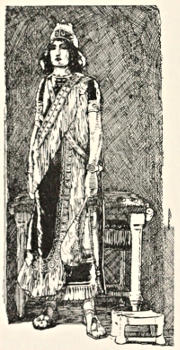
An Assyrian Prince
[ca. 950-825 B.C.]
It is curious how largely the personality of an individual monarch
dominates the history of an epoch among oriental nations. An illustration
of this familiar fact is shown by antithesis in the scantiness of the records
for about a century after the death of Tiglathpileser. Imperfect records
reappear about 950 B.C., but it is not till about three-quarters of a century
later that Assyria rises again to a time of might. Then, under Asshurnazirpal,
one of the most enterprising and most cruel of conquerors, the
stamp of Assyrian influence was put upon all surrounding nations. Shalmaneser
II largely sustained the traditions of his father, and the power of
Assyria was upheld, if not extended, by the next rulers, Tiglathpileser III
and Shalmaneser IV.
How fully the deeds of these later Assyrian monarchs are known to us
will appear in the succeeding pages. Monarchs of even greater celebrity
were to come after; yet perhaps the reign of Asshurnazirpal (885-860 B.C.)
may not unjustly be regarded as the period when Assyria obtained its
greatest power and its highest civilisation. The bas-reliefs from the palace
of Asshurnazirpal, which were exhumed by Layard and which are now
exhibited in the British Museum, are in some respects the most perfect
examples of Assyrian art that have been preserved. It is true that the
artists of two centuries later had developed a more elaborate fashion in the
matter of details; but the rugged outlines of the earlier masters tell of art
in its creative period. The models produced in this epoch were never to be
altered in their essentials during the entire course of Assyrian history.
Such hunting scenes as that in which Asshurnazirpal, standing in his
chariot, is seen shooting an arrow at an enraged and wounded lion, were
perhaps never quite equalled by any Assyrian artist of a later epoch. The
art of this time shows examples also of massive sculptures, such as the
human-headed bulls and lions, in relative abundance. A curious feature of
the later sculptures is that they usually present inscriptions written across
pedestal and figure alike. Needless to say, these inscriptions record deeds
of the great conqueror. Unfortunately, many of them are repetitions, but
even so they preserve relatively comprehensive records of the achievements
of the great king.
Even fuller records are preserved of Shalmaneser II. In particular, the
black obelisk on which the deeds of this king are presented, both in graphic
pictures and in extensive inscriptions, is one of the most famous of Assyrian
antiquities. The exact character of this inscription and of the other records
in question will be detailed in the succeeding pages.a Before proceeding to
the history proper, let us study the theatre where the drama was played and
the origins of the actors.
The land of Assyria, in the more restricted sense of the term, lies for
the most part on the left bank of the Tigris, and is bounded on the south by
the Lower Zab. Hence, strictly speaking, it would not form part of Mesopotamia
were it not that the capital importance of the Tigris to the country
and the trend of its other rivers make it a kind of appendage to the alluvial
plain, and that the mountain ranges of the North constitute a boundary
which cuts it off from the rest of the world, and thus naturally assigns it to
Mesopotamia. Consequently, as soon as the Assyrians gained their independence
and started on a career of conquest, it was natural that they should
first extend their borders in that direction.
Mesopotamia consists of a great low-lying plain divided by no physical
barrier. It was natural, therefore, that the policy of all powerful rulers in
that region should have had for its aim the political unification of all parts
of the country, united as they were already by a common civilisation and
economic interdependence. The efforts of the Assyrians were likewise
directed towards this end, though it was long before they obtained it. In
the kingdom of Babylonia, which asserted its sway over the whole southern
portion of the plain and its dependent provinces, they were at first confronted
by an adversary strong enough to resist them, and all that fell to
them for the time being was the northern half of Mesopotamia, the greater
part of which remained under their dominion, and was merged into an
Assyrian empire, just as the whole of Babylonia had been merged into a
Babylonian empire. We shall see, however, that the memory of the separate
existence of the two component parts of the empire at an earlier stage
still subsisted in certain customs and relics of civil law, just as it did in
Babylonia.
The Assyrians were a Semitic race, and, but for slight differences of
dialect, spoke the same language as the Semitic-Babylonians. The Assyrian
branch of the race constituted, in the first instance, an outpost on the
left bank of the Tigris, where it developed on somewhat different lines
from the Semites who remained in Mesopotamia. We have every reason
for assuming that, before the Assyrians made their way into the country,
the whole of Mesopotamia, the north no less than the south, was occupied
by a Semitic population, distinct from the Aramæans—themselves probably
recent immigrants—and united by a common civilisation. This is the
race which we have styled Babylonians, as distinguished from the Sumerians,
or, more exactly, Semitic-Babylonians, in treating of Babylonia. We are
absolutely in the dark as to the extent to which these Semites of the North
may have absorbed elements of an elder Sumerian population that may have
survived, for in the earliest times concerning which we have any historic
testimony the Semites were predominant even in northern Babylonia, much
more, therefore, in northern Mesopotamia.
The Assyrians must have developed on independent lines, for in all
other respects they differ materially from the Babylonians. In the latter
we have made the acquaintance of a people peaceably disposed, nay, actually
unwarlike, concerned mainly with the development of their civilisation—qualities
which, when we compare them with the Assyrians, we are inclined
to set to the account of their Sumerian blood. The latter were probably
the most warlike of all the Semitic nations of the East, and maintained the
purity of their racial type; for the features of the figures in their sculptures
exhibit to a marked degree the characteristics which strike us nowadays as
peculiar to the Jewish race. They also differ from the Babylonians in
figure, for the latter are usually represented as short and thick-set, while the
Assyrians are of somewhat lofty stature and powerful build.
The land of Assyria is very different from Mesopotamia proper. The
nearness of the mountain ranges makes the climate cooler, and the soil is
probably less productive than that of the lowlands along the river. Nor
were the means of transport within its borders as good as in Mesopotamia
proper, for the Tigris only constituted the frontier, and the swiftness of
its current made it less well adapted for traffic than the Euphrates, which
formed the most convenient natural line of communication in the plain of
Mesopotamia.
In Babylonia we made the acquaintance of a country which had developed
its own civilisation, and one where the inhabitants held in proud and
honourable remembrance the various stages of its economic and political
development,—a sentiment reflected in the religious cults of the ancient
cities, the centres of civilisation. With Assyria it is otherwise. That
country began to play its part in Mesopotamian history with the set purpose
of appropriating what Babylonia had achieved. The Assyrians had no such
gains, hallowed by the associations of thousands of years to boast of in their
own country. They were a tardy supplement to the Semitic immigration.
They felt themselves an appendage to the Semitic population already settled
in Mesopotamia, and consequently regarded its ancient cults as, in a measure,
their own. The fact implies an unconscious confession that they had nothing
analogous or equivalent to set against the old centres of Babylonian civilisation,
and, as a matter of fact, the chief towns of Assyria cannot for a moment
be compared in importance with those of Babylonia. The most famous of
the former owed their day of splendour to the rise of the Assyrian Empire
or even, to some extent, to the fancy of individual kings; and when the
Assyrian Empire passed from the stage of history these, its artificial creations,
were abolished with it.
Babylonia rose again after every fresh blow, because her rise to the
position she held had its root in a vital need of the peoples of anterior Asia;
while soon after the fall of the Assyrian Empire the very names of the great
cities of Assyria had passed from the memory of the dwellers in the land.
The case is different with the cities of northern Mesopotamia, which belonged
to the Assyrian Empire, but existed before its rise, and survived its
fall. The only other exception among the large Assyrian cities is Arbela,
which, being situate at the junction of the trade routes to northern Mesopotamia,
Armenia, and Media, had probably been in existence before the
time of the Assyrian Empire, and likewise retained its importance to a later
period.
The oldest capital of Assyria was Asshur, situated on the right bank of
the Tigris, on the site of the present Kalah Sherghat. It was originally
the seat of rulers called patesis, who were probably subjects of the Babylonian
monarchy. In the first half of the second millennium B.C. these
rulers extended their sway over the district which they styled “the land of
the city of Asshur,” and assumed the title of “king.” Asshur was always
held in honour as the ancient capital, but it lay so far to the south (being, in
fact, almost beyond the borders of the country), that it soon became imperative
for the “kings of Assyria” to transfer the centre of government to
a more convenient place. Shalmaneser I (circa 1300) accordingly chose
Calah for his residence. The natural result was the decline of the importance
of Asshur, since its situation was not such as to assure it a leading
position. In later times it subsisted mainly upon its old reputation, and
enjoyed special privileges, which were confirmed even by Sargon. It was
the seat of Asshur, the chief national divinity. The kings of Assyria, from
Shalmaneser I to Sargon, held their court at Calah (Nimrud). Its consequence
seems to have declined after the reign of Tiglathpileser I, for his
son, Asshur-bel-kala removed to Nineveh, which remained the royal residence
till the reign of Asshurnazirpal. The latter rebuilt Calah and so
improved it that it remained the capital until Sargon chose Dur-Sharrukin
(Khorsabad), which in turn Nineveh replaced as capital.
Nineveh (Ninua), situated above Calah, on the left bank of the Tigris,
and opposite the present town of Mosul, is now represented by the two
mounds of Kuyunjik and Neby-Yunus. It was one of the oldest and most
important cities of the province of Assyria, and was highly esteemed from
the very earliest times of the Assyrian Empire as being the seat of a cult of
an Ishtar known as “Ishtar of Ninua,” to distinguish her from the Ishtar
of Arbela. We must therefore look upon it as a city which originally stood
on an equal footing with Asshur, and was subjugated by the patesi of
the latter city. It became the royal residence in the reign of Asshur-bel-kala,
the son of Tiglathpileser (or even earlier), and remained so until the
reign of Asshurnazirpal. But it really owed its fame as the capital and
chief city of Assyria, which it represented in the eyes of other nations, to
Sennacherib. He built an entirely new Nineveh, which was to show forth
worthily the power and glory of the Assyrian Empire. His successors continued
to reside there, and contributed to its splendour. Esarhaddon and
Asshurbanapal built palaces there, and Nineveh formed the last bulwark of
the Assyrian Empire.
In the Euphrates Valley, and mainly on the right bank, between the
bank where the river turns towards the southwest and Babylonia, various
states had come into being which, by the force of their natural connection
with Babylonia, inclined towards that kingdom rather than towards Assyria
and northern Mesopotamia. There are Laqi, Khindanu, and (east of the
latter) Sukhi, or Shuhi, which last extended from somewhere near the
mouth of the Khabur to Babylonia, and was under Babylonian ascendency
down to a late period. These states had probably in the first instance been
dependencies of the Babylonian Empire, but had enjoyed virtual independence
from the time of the fall of Babylonia and the rise of Assyria.
Asshurnazirpal was the first to subjugate these “governors,” who, up to this
time, had “paid no tribute” to the Assyrian kings, and who were supported
by Babylonia in their struggle with Assyria. The population of these states
was composed of the same elements as that of Mesopotamia. The original
Semitic-Babylonian settlers had been ousted by Aramæan immigrants. This
was most evident in Laqi, the westernmost, which was not a homogeneous
body politic in the reign of Asshurnazirpal, but was governed by various
sheikhs. And, generally speaking, these states were semi-nomadic commonwealths.
[ca. 1741-1300 B.C.]
The city of Asshur was originally a patesi-ship. The situation of Asshur
seems to point to a close connection with Babylonia rather than with northern
Mesopotamia, and for the present, at least, it seems most likely that we ought
to regard it as a vassal state to Babylonia or the Kingdom of the Four
Quarters of the World. Nor must we ignore the possibility that it may
have formed part of the realm of the “Kishshati.”
A record left by an Assyrian king enables us to determine one point
of time, at least, when Asshur was still a dependency and ruled by a
patesi. Tiglathpileser I built that part of the great temple of Asshur
which was intended for the worship of the gods Anu and Ramman (Adad),
and in the record he has left he observes that this temple was built by the
patesi Shamshi-Adad, the son of Ishme-Dagan, patesi of Asshur, six hundred
and forty-one years before the reign of his own great-grandfather Asshur-dan,
sixty years earlier. Accordingly Asshur must have been ruled by
patesis sixty plus six hundred and forty-one years before 1100, when Tiglathpileser
was on the throne, and its exaltation to the rank of a kingdom must
have taken place later than that. The names of two patesis of Asshur
and those of their fathers are known to us from inscriptions of their
own. One of them, Shamshi-Adad, and his father, Igur-Kapkapu, we
may place before or after Shamshi, the son of Ishme-Dagan, with equal
probability, while the form of the other two names, Irishum and his father
Khallu, being simple and exhibiting nothing of the compound character of
later Assyrian names, leads us to conjecture that they belong to an earlier
period.
The names of these six patesis and their work in the building of the
temple of Asshur represent our whole stock of knowledge concerning Asshur
before it rose to be a royal city. The first king of Assyria of whom we
know anything is Asshur-bel-nish-eshu, who is introduced to us by the
Synchronistic History as a contemporary of the Kossæan[22] king Karaindash
of Babylon. As this monarch reigned some time about the first half of the
fifteenth century B.C., there is an interval of over three hundred years
between him and the patesi Shamshi-Adad, an interval of which we know
nothing except that the rise of Asshur and the establishment of the kingdom
of Assyria must fall within it. Of the circumstances and conditions under
which these events took place we know nothing in detail, but an explanation
naturally suggests itself from the state of Babylonia. During this same
period Babylonia had sunk to such a depth of decrepitude that her own
strength was no longer adequate to secure her against hordes of invaders,
and she could continue to exist only under the protection of the Kossæan
kings and their armies. These disorders, which inevitably attend such a state
of things, served, as they invariably do in the East, to promote the formation
of new states under energetic and enterprising leaders, and to these circumstances
the kingdom of Asshur probably owed its rise.
From the reign of Shalmaneser I (circa 1300) onwards the kings of
Assyria bear the title of “Shar Kishshati” and even place it before that of
“King of Asshur.” “Shar Kishshati” means “King of the World,” and the
title is thus formed in the same fashion as the Babylonian “King of the
Four Quarters of the World.” And the Assyrian title, like the Babylonian,
was not merely general in scope, but was bound up with the possession of a
particular district and particular cities.
It is doubtful whether Assyria subdued the kingdom of the Kishshati
from the outset, or gained possession of it at a later period. According to
the scanty records at present open to us, the latter hypothesis seems the
more probable. The first Assyrian king to bear the title of “Shar Kishshati”
is Shalmaneser I (about 1300), and he gives it to his father, Adad-nirari
I (or Ramman-nirari), although the latter does not assume it in his
own inscription. Shalmaneser attaches so much weight to this title that on
a couple of bricks, which date from his reign, he actually styles himself
“King of Kishshati” alone, and omits the royal title of Assyria; and we
therefore may conclude that the union of northern Mesopotamia and Assyria
was the work of Adad-nirari and of Shalmaneser.
This would be at least one fixed point in the earliest history of Assyria
from which to trace the development of the empire. Before Shalmaneser
we have to do only with the little kingdom of Asshur, which was chiefly
engaged in struggles with Babylonia and its eastern neighbours, and after
his time with the united dominions of Assyria and northern Mesopotamia,
the leading power of Mesopotamian civilisation against the West and the
attacks of barbarians on every side. The Synchronistic History is our
principal guide to Assyrian history, as it was to the history of Babylonia
before it came into touch with Assyria. We have but few inscriptions of
the kings of this early stage of Assyria’s existence, and only by the aid
of the above-mentioned document can we more or less connectedly trace
the course of history. Before the reign of Asshur-bel-nish-eshu, at
which the chronicle now begins, we can be sure of nothing but a great
blank.
[ca. 1450-1325 B.C.]
With Asshur-bel-nish-eshu, who reigned in the first half of the fifteenth
century, begins a line of kings with a certain degree of continuity. Of
himself we only know what is told in the Synchronistic History, namely, that
he concluded an alliance with Karaindash of Babylon by which they guaranteed
one another in possession of their dominions. He was presently—though
perhaps not immediately—succeeded by Puzur-Asshur [probably
about 1420 B.C.] of whom we are told the same thing. He entered into
friendly alliance with Burna-buriash.
Of his supposed successor, Asshur-nadin-akhe, we know, from the letters of
his son Asshur-uballit to Amenhotep IV, that he, like his Babylonian contemporary,
held communication with the kings of Egypt. In an inscription
of a later king mention is made of a building of his, the foundation of a
palace at Asshur. For the rest, it is by no means impossible that he may
have reigned before Puzur-Asshur, and that the latter, as well as Asshur-uballit,
was his son.
We possess a letter written by Asshur-uballit to Amenhotep IV of
Egypt. It gives an account of presents made to the king of Egypt—a
war chariot yoked to two white horses, and a seal cylinder—makes excuse
for the tardy return of Egyptian ambassadors on the plea that they had
been stopped by the (nomadic) Sutu, and contains the usual importunate
requests for richer presents in return. In Babylonia, Asshur-uballit succeeded
in making a way for Assyrian interference, and thus came a step nearer
to the goal all kings of Assyria longed to reach, the suzerainty of Babylon.
Apart from the attempt of Asshur-narara and Nabu-daian, which presumably
came to nothing, the little kingdom of Assyria had been on friendly
terms with Babylonia, and had made alliance which probably contributed
more to her own security than that of the other party. Internal troubles
were the pretext which first rendered feasible his successful interference in
Babylonian affairs.
The assassination of the Babylonian king by the malcontent Kossæans,
and the elevation of Nazibugash to the throne, gave Asshur-uballit an admirable
pretext for restoring “order” in Babylonia and placing Kurigalzu, his
other grandson, on the throne. Adad-nirari mentions another expedition of
his against the Shubari. His successor, Bel-nirari I [about 1370 B.C.],
boasts in his inscription that he conquered the Kasshu (Kossæans) and
enlarged the borders of the land. This probably refers to a distinct campaign
against the Kasshu, and not to the war with Kurigalzu II, in which
he was likewise victorious. The latter enterprise also resulted in territorial
expansion, which does not necessarily seem to have been made permanent.
[ca. 1325-1275 B.C.]
Pudi-ilu (about 1350), the son and successor of Bel-nirari, waged war,
we are told by his son, Adad-nirari, against the otherwise unknown Turuki
and Nigimkhi, who probably dwelt somewhere in the direction of Armenia,
and extended the Assyrian frontier to the north (Gutium). Adad-nirari I
(about 1325) has left an inscription which has been discovered at Kalah
Shergat (Asshur). According to it, he, like his predecessors, waged most
of his wars on the northeastern frontier of his kingdom, and endeavoured,
by building cities, to revive the prosperity of the region occupied by the
Shubari, Lulumi, Guti, and Kasshu of the northeast, which had been laid
waste by previous wars. His inscription relates mainly to the buildings
he erected in connection with the temple of Asshur. It is the first from
Assyria with a definite date. It was indited in the limmu (i.e. the year of
office) of Shulman-kharradu.
His son, Shalmaneser I (about 1300), was one of the mightiest Assyrian
kings, and probably the first who raised Asshur to a position equal, if not
superior, to that of Babylonia. We do not know much about him from
inscriptions left by himself, and are therefore obliged to depend on occasional
statements of succeeding kings. He ruled over Mesopotamia westward to
the Balikh at least, if not to the Euphrates, and assured to Assyria the
possession of the northern tract between the Euphrates and Tigris, which
was afterward the provinces of Gumathene and Sophene. He founded colonies
there, and planted them with Assyrian settlers to form a bulwark to
Mesopotamia against the tribes of the North. Afterwards, when the power
of Assyria was impaired, these colonies were in great straits, but they held
their own, and were then reinforced by Asshurnazirpal, to whom they served
as a welcome basis for the new Assyrian province of Tuskhan which he
established there.
With the extension of the kingdom and the inclusion of northern Mesopotamia,
the need of another capital than Asshur, which lay too far to the
south, made itself felt. The city Shalmaneser chose for this purpose was
Calah, which remained the capital down to the time of Sargon, except during
the period of decline which followed upon the reign of Tiglathpileser I. His
object in this change of residence was clearly to give expression to the
altered state of things which had come about in Assyria and Mesopotamia.
Assyria was not to be the privileged kingdom, but the two political organisations,
Asshur and the Kingdom of the Kishshati, were to be equal members
of the new empire, each retaining its own centre in Asshur and Kharran
respectively, while the king founded his own capital for himself, to avoid
giving the preference to either.
Shalmaneser’s son, Tukulti-Ninib I (about 1275) [but probably somewhat
earlier] was no less fortunate in his enterprises than his father. He
was the first to achieve the object of every king in Assyria—dominion
over Babylon. Adad-nirari III, in his list of his ancestors, styles him
“King of Sumer and Accad,” from which we may certainly conclude that
he held the same sort of position toward the whole of Babylonia, and
the kingdom of Babylon more particularly, as was afterward attained by
Shalmaneser II—that is to say, he must have ruled over the several provinces
of all Babylonia and exercised a kind of suzerainty over Babylon.
The rapid rise of Assyria seems to have been followed by equally rapid
decline. For a hundred years we have hardly any information concerning
it, and do not even know the names of the kings who reigned during that
period. The lack of inscriptions, or, at any rate, of vaunting records in the
reigns of later kings, seems in itself to indicate a time of humiliation, while
the conditions which we find prevailing when our sources of information
become more copious, show that soon after the reign of Tukulti-Ninib, and
therefore probably before the end of the thirteenth century B.C., the power
of Assyria must have been seriously curtailed and exposed to grievous
shocks. Whence they arose we shall presently see.b
There is scarcely a year in which additional information concerning
this obscure period does not come to light. A recently deciphered fragment
of the Babylonian Chronicle mentions an Assyrian king, Tukulti-Asshur-Bel,
contemporaneous with Tukulti-Ninib, but of the relation of the two kings
nothing is stated. Professor Winckler in Altorientalische Forschungen,
suggests that the former was the latter’s son, and co-regent while he was
engaged in ruling and reducing Babylon. Professor Rogers sums up the
end of Tukulti-Ninib’s life: “For seven years was this rule over Babylonia
maintained. The Babylonians rebelled, drove out the Assyrian conquerors,
and set up once more a Babylonian, Adad-shum-usur (about 1268-1239
B.C.), over them. When Tukulti-Ninib returned to Assyria he found even
his own people in rebellion under the leadership of his son. In the civil
war that followed he lost his life, and the most brilliant reign in Assyrian
history up to that time was closed.”
[ca. 1275-1235 B.C.]
This rebellious son was not the above mentioned Tulkulti-Asshur-Bel,
but Asshurnazirpal I. His reign continues the period of decline, and in it it
is believed that Adad-shum-usur actually attacked Assyria. Next come two
kings, Asshur-narara and Nabu-daian, whose reigns seem to have been contemporaneous
(about 1250 B.C.). A fragment of a clay tablet was found
containing a letter from Adad-shum-usur to these two kings, in which he
remonstrates on their folly in taking up arms against him, which shows that
Babylon’s power was still waxing.a
We do not know how it came to pass that Assyria lost the ascendancy
she had gained over Babylonia under Tukulti-Ninib, but it is certain that
some fifty years later Bel-kudur-usur found himself relegated to Assyria
proper, and was obliged to fight for the possession of his capital. [According
to Professor Rogers, Meli-Shipak (about 1238) and Marduk-apal-iddin
(about 1223-1211) were the Babylonian kings in this war. He places
Adad-shum-iddin’s death at 1269, and Adad-shum-usur’s at 1238 B.C.,
basing these dates on some recent illuminative suggestions of Professor
Hommel.] The Synchronistic History, which is incomplete at this point,
states that Ninib-apal-esharra (who was probably the son of Bel-kudur-usur)
was forced to retreat. The Babylonians appear to have pursued
and besieged him in his own capital of Asshur, and there a battle was
fought, in which, according to the apparent purport of the Synchronistic
History, the Assyrians were beaten. But the victory, if victory it were,
cannot have been decisive, for after the battle the Babylonians withdrew
without making any further attempt to invade the remoter parts of the
country. The defeat of the Assyrians must, therefore, have been more like
a successful defence of their city. Slight as this clew is, it makes it evident
that for a while Assyria had to fight for her life against Babylon, and
that she held her own with difficulty. The development of this state
of things must be sought in the great hiatus made by the reign of Bel-kudur-usur.
The titles of the Babylonian kings of the period also go to
prove that at this time Babylonia had actually repossessed herself of
northern Mesopotamia.
Since we find Tiglathpileser in possession of much the same dominions as
Tukulti-Ninib (though Sumer and Accad did not belong to him), the course
of events during all the twelfth century, from Ninib-apal-esharra to Asshur-rish-ishi,
is self-evident. The business in hand was the reconquest of what
had been lost, and at it the succeeding rulers steadily and successfully
laboured.
Of Ninib-apal-esharra, the Synchronistic History says nothing except
that he successfully withstood the Babylonian attack, nor does Tiglathpileser
mention any other deeds of his. The latter, however, expressly gives him
the character of a capable commander, “who led the troops of Asshur
aright,” presumably with reference to his retreat after the death of Bel-kudur-usur
and the repulse of the Babylonian king.
[ca. 1200-1116 B.C.]
His son and successor, Asshur-dan (about 1200 B.C.), won some victories
over Babylon and reconquered some parts beyond the Zab from Samana-shum-iddin
(king of Babylonia). Tiglathpileser lays stress upon the fact
that he lived to a great age (to about 1150 B.C.). Of his son, Mutakkil-Nusku,
no particulars are known. He probably carried on the work of his
predecessors, for Assyria gradually regained all she had lost.
Then Asshur-rish-ishi (about 1140 B.C.), the father of Tiglathpileser I,
reports that he had reconquered the Lulumi and Kuti, whom Adad-nirari
had formerly subjugated, and who had either fallen under the sway of Babylon
or made themselves independent; and that he had repulsed the nomads,
whom Adad-nirari had likewise driven back, and who had naturally taken
advantage of Assyria’s weakness to press forward again. His war with
Nebuchadrezzar I, king of Babylon, seems to have been waged mainly for the
possession of Mesopotamia, which the defeat of the nomads was also intended
to secure. It is most probable that he gained his end, the evacuation of the
kingdom of Kishshati, of which Nebuchadrezzar styles himself king in one
of his inscriptions.b
[ca. 1116-1050 B.C.]
Asshur-rish-ishi’s son, Tiglathpileser I (Tu-kulti-apal-esharra,
meaning “My help is the son
of Esharra,” i.e. the god Ninib), is the first of the
great Assyrian conquerors. Directly after his
accession to the throne he marched against the
Mushke (Mushkaya) to conquer the districts previously
taken by them. The Mushke (the Meshech
of the Old Testament, and the Moschi of
the Greeks) were defeated, as well as the people
of Kummukh and the mountainous races of the
Kharia and Qurkhi country stretching from the
north of the Tigris to the Upper Zab. In
the next campaign the same district was traversed,
but the king then crossed the Lower Zab,
and thence proceeded northward into the mountains.
The whole mountainous district was then
incorporated with the Assyrian kingdom, and
Tiglathpileser was then able to proceed to the
subjugation of the lands of western Armenia and
Pontis, never before entered by the Assyrian rulers.
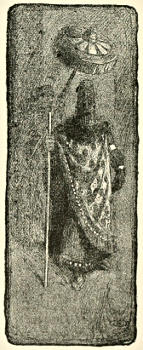
An Assyrian King
He crossed sixteen mountains, reached (what
he calls the land of the Nairi) the upper Euphrates,
which he crossed, and defeated in a
great battle twenty-five kings [twenty-three according
to others], who encountered him with
their troops and war chariots. The enemies were
pursued as far as the banks of the Black Sea,
when all the princes swore fealty and bound
themselves to pay tribute. On the return march
the town Milidia, i.e. Melitene on the Euphrates,
was taken and forced to pay tribute.
The next, the fourth campaign of the king was directed against the
Aramæans, of the North Mesopotamian steppe; he penetrated as far as the
Euphrates, and conquered several places in the vicinity of Carchemish.
Then followed an expedition to the east against [the Musri and] the then
unknown race of the Qumani. In later years Tiglathpileser undertook
campaigns in the west. An inscription at the source of the Supnat, the
first easterly tributary of the Tigris, tells us that he traversed the country
of Nairi (Armenia) three times, and that he subjugated all the country
“from the great sea of the west country to the sea of Nairi.” In particular
we learn that he made a voyage in ships from Arvad (Aradus) on the
Mediterranean Sea, that he hunted in Lebanon (he was a passionate hunter),
and that the kings of Egypt sent him some rare sea fishes as a present.
It is very probable that one of the mutilated inscriptions which the
Assyrian kings had put up on the Dog River (the Nahr-el-Kelb, north
of Beirut), quite close to the victory monuments of Ramses II, related to
Tiglathpileser. He also made war against Marduk-nadin-akhe of Babylon,
but with no success; at least we learn that the Babylonian king, in the
year 1110 B.C., carried off images of gods from an Assyrian city. [According
to Professor Rogers, Tiglathpileser marched to Babylon and was there
acknowledged King of the Four Quarters of the World.]
However, Tiglathpileser in a second campaign was completely victorious
in a battle of the Lower Zab, and took all the capitals of the northern half
of Accad: Dur-Kurigalzu, the double town Sippar, Babylon, and Upi.
The steppe district on the western bank of the Euphrates (the land of the
Shuhi or Sukhi) was also subjugated by him. Thus did Tiglathpileser
create a great kingdom, which included the whole district of the Euphrates
and Tigris, as far as Babylon, as well as the mountainous country of western
Armenia and eastern Asia Minor, as far as Pontis; and his supremacy was
also recognised by northern Syria.
Of the organisation of the kingdom, we only know that the contiguous
districts, such as the valley of the Khabur, eastern Kummukh, and Qurkhe
were incorporated with the state, and governed by Assyrian ministers,
whilst the more distant countries retained their native rulers, and were
only bound to the payment of tribute. The kingdom has no enduring
position. We hear that Asshur-bel-kala (about 1090 B.C.), the son of
Tiglathpileser, lived in the greatest peace with Marduk-shapik-zer-mati, the
Babylonian king. When, after the latter’s fall, Adad-apal-iddin, the son of
Esagila-shaduni, was raised to the throne, Asshur-bel-kala married his
daughter and brought her home to Assyria, with many presents. [In this
reign, according to Rogers, the seat of empire was probably established at
Nineveh.]
[ca. 1050-884 B.C.]
Babylonia had evidently regained her complete independence, though
the Assyrian chronicles fail to relate the means whereby it was achieved.
Asshur-bel-kala was succeeded by his brother Shamshi-Adad (about
1080 B.C.), of whom we know nothing further; and then follows a great gap
in the line of kings. [Here may be inserted the names of Asshurnazirpal II
about 1050 B.C., Erba-Adad, and Asshur-nadin-akhe.]
Of King Asshur-erbi it is only mentioned that under him the districts
conquered by Tiglathpileser, namely, the country Pitru on the Sagur near
Carchemish, and the city of Mutkinu, east of the Euphrates, were taken by
the Aramæan king. This was evidently the king of the country of Bit-Adini,
whose chief dominion lay east of the Euphrates, the capital being
Tel-Barsip, which is probably Birejik, opposite the Zeugma of the Greeks.
At the beginning of the ninth century we again have more accurate information
about Assyria, and so find that, beyond a part of the mountainous district
east and southeast of Nineveh, the kings now have only the country
on the upper Tigris (around Amida), Kummukh, and a great part of the
cultivated land of Mesopotamia.
The district on the Euphrates, opposite Carchemish, is independent and
split up into several princedoms (Bit-Adini, Nila, Bit-Bachiani, and farther
north, Tel-Abnai), the exact boundaries of which it has hitherto been impossible
to determine. The country on the Balikh seems to have remained
Assyrian; it is very remarkable that the city of Kharran is not mentioned
in any of the later campaigns. The district farther east, Nisibis and the
neighbouring Gozan, the fruitful valleys of the Khabur and its tributaries,
even the city of Suru in the land of Bit-Khalupe on the Euphrates (Sura,
east of Thapsachos), were governed by Assyrian ministers. The government
of Assyrian ministers in the lower valley of the Khabur is of special
interest to us.
The whole district of this river, as well as the land of Sangara farther
east, is full of heaps and ruins, which mark the localities of old and later
times. The most important are the ruins at the place now called Arban on
the Khabur. Here are the remains of an ancient palace, built in the Assyrian
style, with four winged oxen, with men’s heads, an open-mouthed lion,
the portrait in relief of a warrior, etc. The oxen bear the inscription
“Palace of the Mushesh-Ninib.” The possibility of getting at a satisfactory
date for this palace is unfortunately not yet apparent. That scarabs of
Tehutimes III and Amenhotep III have been found in Arban and Calah, is
no sufficient clew. As King Asshurnazirpal III of Assyria went down the
Khabur in the year 884 B.C., Shulman-khaman-ilani of Sadikkan and Ilu-Adad
of Shuma brought him heavy tribute. Doubtless one of these two
places is the Arban of to-day, and their governors were semi-independent
Assyrian ministers, known as the Mushesh-Ninib, for the names, writing,
and style of art show us that we have not here to do with a native government.
The population of the valley of the Khabur was doubtless Aramæan,
like that of Kharran and Nisibis.
[ca. 1090-885 B.C.]
The eleventh and tenth centuries B.C. confirmed the complete freedom
of the local government of the countries of Western Asia. Whilst the kingdom
of the Pharaohs was decaying from age, a new nation was rising in Syria and
evolving an active intelligent life of its own.
The Phœnician merchants circulated the products of the civilisation of
Syria along all the coasts of the Mediterranean, and the dwellers on the
Ægean Sea having already entered the circle of cultured races, competing
with the Phœnicians in trade and the traverse of the sea, took possession of
the coasts one after another and thereby developed a complete political and
intellectual life. The fate of Western Asia was determined by the evolution
of Syria’s culture not taking a wide-reaching, powerful, political form, but
rather hindering it. Since the days of the Kheta kingdom’s glory, there
has been no great power in Syria. So when a conquering, military state
was now formed on the Tigris, under a fearless, warlike prince, it met
with no sustained resistance.
The success of Assyria was due to her military organisation. Little as
we know of its particulars, there can be no doubt that the whole race regarded
war and conquest as the real aims of existence, and the more successful they
were, the more they ignored all other sides of life; whereas the little states
of Syria made tillage, trade, and industry the chief occupations of their life,
albeit every inhabitant was presumably bound, like the Israelites, to take up
arms in case of need, in the defence of his country. The sole great military
power was Egypt, but her warrior caste was composed of foreign mercenaries
who exploited the country, although from a military point of view
they evidently did not benefit it more than the generality of their class in
similar cases.
The outcome of events was thus a foregone conclusion. The Assyrian
campaigns of two centuries ended in the political and national fall of the
races of Syria. The progress of events then led further to the annihilation
of nationality in the whole of Western Asia. The kingdom of Tiglathpileser
I fell, soon after his death, and there now ensues a little later a gap
of more than a century in our information about Assyria. The very scanty
notices commence about 950 B.C. Asshur-dan II, mentioned as “the maker
of a canal,” reigned at that time. [A recently discovered inscription of
Adad-nirari II speaks of his grandfather Tiglathpileser. Therefore, a new
Tiglathpileser, the second of his name, is now reckoned in the list of kings,
and the approximate dates 950-930 B.C. assigned to his reign. Nothing is
known of him except that he is called “King of Kishshati and King of
Asshur.” Asshur-dan II’s reign is now put down as beginning 930 B.C.,
and Adad-nirari II’s at 911.] Asshur-dan’s successor, Adad-nirari II,
mentioned with the building at the “Gate of the Tigris” (890 B.C.),
conquers King Shamash-mudammik of Babylon in a battle on Mount
Yalman, and made war against his successor, Nabu-shum-ishkun [who
was also defeated and yielded certain cities]. In the peace made by an
alliance, the boundary was fixed near the city of Tel-Bari, south of the
Lower Zab.
The next king, Tukulti-Ninib II (890-885 B.C.), fought in the northwest
mountains, and at the source of Supnat, the first tributary of the
Tigris, he had his statue (stele) erected near that of Tiglathpileser. In
spite of repeated attacks, the mountainous districts on the east as far as the
lake of Van, the chief part of the land of Qurkhi, retained essentially their
independence. The warlike efforts of these rulers had been hitherto directed
against the races of the mountains of Kasjar (Masius), the south of the
Tigris, and close to Aramæan Mesopotamia, which, in spite of numerous
campaigns, had never been subjugated. If Nisibis, Gozan, and the valley of
the Khabur, and apparently also Kharran, belonged to the Assyrians under
Asshurnazirpal, they either remained independent after the twelfth century,
or were subjugated by the kings of this period. In the east, the mountainous
races of Khubushkia and Kirruri (on the Upper Zab, and as far
as the lake of Urumiyeh) are tributary, and on the Lower Zab, we find
under Asshurnazirpal, an Assyrian governor of Dagara, in the land of the
Euphrates, whose fortified citadels were mostly situated on the banks of
the river, or like Anat, on an island, paid tribute. Tukulti-Ninib’s son,
Asshurnazirpal III (885 to 860), entered on fresh conquests directly after
his accession to the throne.c
[885-880 B.C.]
Tiglathpileser’s work of conquest was to be begun over again; Asshurnazirpal
felt the full force of the mission, and he accomplished it with a
cruelty worthy of the hero he took for pattern, and his successors applied
themselves, as did he, to avenge, arms in hand, Asshur’s temporary humiliation.
Scarcely was Asshurnazirpal seated on the throne, when he turned attention
to his armies,—his war chariots and armed men were numerous and
well equipped; they were ready to take the march. It was the land
of Numme which received the first blow. Accustomed to prolonged
and uninterrupted peace, the inhabitants
had never even thought
of measures for defence, and they
fled to the mountains at the approach
of the Assyrians, who made
bloodless captures of the towns of
Libe, Surra, Abuku, Arura, and
Arubi, situated at the base of
Mounts Rime, Aruni, and Etini.
“These majestic peaks,” relates
Asshurnazirpal, “rise up like daggers’
blades, and only the birds of
the sky in their flight can reach
their summits. The natives entrenched
themselves among them
as though in eagles’ nests. None
of the kings, my fathers, had ever
penetrated so far. In three days
I reached those heights; I brought
terror in the midst of their hiding
places, I shook their nests; two
hundred defenders perished by the
sword, and I seized their flock
and a rich booty. Their corpses
strewed the mountains like leaves
from the trees, and those who escaped
had to take refuge in caves.”
These proceedings terrified the
peaceful inhabitants of the Kirruri
district, who hastened from Simirra,
Ulmania, Adanit, Khargai,
and Kharasi, to throw themselves
at the conqueror’s feet and offered
all that he was wont to seize—horses,
oxen, sheep, and brazen
vessels. They were given an
Assyrian governor. Such was
the fright throughout the whole
of Nairi that while he still lingered in Kirruri, Asshurnazirpal received
ambassadors from the people of Gozan and Khubushkia who came from far
to the east, bringing presents asking for the chains of slavery.
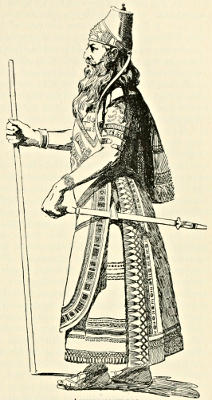
Asshurnazirpal
(Based on Sculptures in the British Museum)
From Kirruri the Assyrian king went a little to the east into the district
of Qurkhi, pillaging in turn at least a dozen towns and finally arrived at the
borders of Urartu. The only serious resistance he encountered was under
the walls of Nishtum, which paid dear for its courage. These beginnings
were a forecast of the future, and Asshurnazirpal did not even wait for the
following year to recommence. While still wearing the dignity of “limmu,”
on the 24th day of the month Abu (July-August), he set out to lay waste
the country now called the Bohtan district, between the Tigris and the
western spurs of the Judi Mountains. Here were the districts of Nippur
and Pazati, comprising more than twenty important towns, among which
Atkun and Pilazi were burned. Asshurnazirpal then crossed the Tigris and
invaded Kummukh to claim the annual tribute it had forgotten to furnish.
[It is possible that he went for the purpose of quelling a rebellion.]
At the moment he was thinking of going on to the Moschi, more to the
northwest, a messenger brought him a letter which contained the following
news: “The city of Suru (Surieh of the present day), which is subject to
Bit-Khalupe, is in revolt; the inhabitants have put Khamitai, their governor,
to death, and have proclaimed Akhi-yababa, son of Lamaman, whom they
have brought from Bit-Adini, as their king.” Furious at this information,
Asshurnazirpal invoked Asshur and Adad, counted his chariots and soldiers,
and flew to the seat of trouble by descending the course of the Khabur.
His progress was hampered by the arrival of many persons, their hands filled
with presents and their mouths with protestations of fidelity. There were
Shulman-khaman-ilani of Sadikkan, Ilu-Adad of Shuma, and a hundred others.
The city of Suru took fright, and the rebels came out to meet him, bringing
the keys of the citadel. They kissed his feet, but Asshurnazirpal was
inflexible. “I killed one out of every two of them,” he says, and one-half
of the remainder was reduced to slavery. Akhi-yababa, a prisoner, witnessed
the pillage of his palace, he saw his wives, sons, and daughters in chains, and
his tutelary gods, his chariot, his armour, and his treasure carried off. He
saw all his ministers flayed alive as well as the leaders of the rebellion. A
pyramid erected at the city gate was covered with their skins; some were
walled up in the masonry, others were crucified and exposed on stakes along
the side of the pyramid. One would hesitate to believe all this and would
willingly take the Assyrian monarchs for boasters of their cruelty, if the bas-reliefs
with which they decorated their palace walls, and which to-day
ornament our museums, did not speak to our eyes or their accompanying
inscriptions speak to our intelligence. We must tax our wits to imagine
more refinement of torture or of methods of execution.
Before Asshurnazirpal returned to Nineveh, he made a military tour of the
regions about the junction on the Khabur and Euphrates, which formed the
country of Laqi. All the petty dynasties of this land brought their tribute.
Then he advanced as far as Khindanu, on the Euphrates, the frontier of the
Shuhi country. On returning to his capital the king was followed by an
endless file of slaves, horses, oxen, sheep, chariots laden with stuffs of wool
and linen, ingots of gold, bronze and iron, copper and leaden vessels, and
wooden framework; the booty, he says, was as numberless as the stars of the
sky. The soldiers had laid hold of every manner of object, and in the division
a use was found for everything.
At Nineveh the king occupied himself with embellishing his palace while
he waited for the spring. In one of the inner courts he erected a statue to
himself of colossal size, and the history of his recent conquests was engraved
on the palace gates. He was daily obliged to receive the homage of ambassadors
who arrived from all parts to acknowledge his suzerainty, offer presents,
and claim the sad honour of serving such a master, for they had learned
by experience that it was too late for a city to offer its submission when the
king was at its gates.
[880-876 B.C.]
It happened that Asshurnazirpal was en pleine fête surrounded by his
court when news came of a rebellion in the region situated around the
sources of the Tigris. The leader of this insurrection was an Assyrian,
Khula by name, whom in former days Shalmaneser had appointed governor
of Darudamusa and Khalzilukha. The king set out at once, and, arriving at
the sources of the Tigris, he sought out the steles which his predecessors,
Tiglathpileser and Tukulti-Ninib, had erected, and by their side set up one
for himself. On the way he stopped to levy tribute on the country of
Izalla and took by assault the cities of Kinabu, Mariru, and Tela. After a
bloody contest under the walls of the last place he put out the eyes and cut
off the noses and ears of the prisoners whose lives he spared. Khula was
flayed alive.
There stood in this region, within the land of Nirbu, a city which bore
the name of Asshur and had probably been built by Tiglathpileser in order
to control the surrounding country. Since this town had also taken part in
the rebellion, Asshurnazirpal caused it to be razed to its foundations as well
as the city of Tushka, upon whose ruins he built a pyramid surmounted by
his statue and bearing an inscription which related the conquest of the land
of Nairi. Here he received tribute of the kings of Nairi. The districts of
Urumi and Bituni also brought their gifts. But scarcely had Asshurnazirpal
turned his back when all the tribes of Nairi revolted, and he had to return
and prosecute a regular man-hunt among the mountains.
The year had been very full, and it was easy to foresee that the disasters
following the reign of Tiglathpileser would soon be repaired. In three campaigns
Asshurnazirpal had carried the torch over a portion of the land of
Nairi, to the south and east of Lake Van, to the sources of the Tigris, through
the Khabur Valley, and down the Euphrates. But like the effect of a tempest
which passes and devours everything, the Assyrian domination founded
only in fear was fatally ephemeral and became shaky just as soon as the chastising
arm was observed to withdraw.
[876-854 B.C.]
Feeling secure in the direction of Nairi, which he had treated so harshly,
Asshurnazirpal turned his attention to the fertile slopes along the left bank
of the Tigris. He risked encountering the Babylonians, but these latter had
no longer any fear for him, and the weakened, scattered Kassite (or Kossæan)
tribes could scarcely be called formidable. Babitu, Dagara, Bara,
Kakzi, and twenty other places underwent the fate reserved for cities taken
by assault; one hundred and fifty towns were pillaged and burnt, and the
whole land of Nishir was devastated. The rainy season suspended hostilities,
and Asshurnazirpal returned to winter quarters at Nineveh, but as soon
as the weather permitted on the first of Sivan (May) he returned to Zamua.
The capital of Zamua was Zamri, and there King Amikha resided, in no condition
to resist. He fled to the mountains where Asshurnazirpal dared not
pursue him, and contented himself with laying hands on the riches of the
palace. All the surrounding districts hastened to offer their submission
with the exception of the city of Mizu, which was taken by assault.
The following year was consumed in military expeditions to the sources
of the Tigris, in the lands of Kummukh, Qurkhi, and Kashiari, where certain
cities like Mattiate and Irisia had neglected to pay tribute or manifested
symptoms of rebellion. Asshurnazirpal experienced no serious or well-organised
resistance except beneath the walls of Bit-Ura in the land of
Dirra. “The city,” he says, “crowns a height, is surrounded by a strong
double enceinte and lifts itself like a great thumb above the mountain.
With the help of Asshur—my lord—I attacked it with my valorous soldiers,
and besieged it for two days from the side of the rising sun. Arrows
fell upon it like the hail of the god Adad. Finally, my warriors, whose zeal
I had encouraged, fell upon the city like vultures. I took the citadel, I put
eight hundred men to the sword, and I cut off their heads. I made a
mound with their corpses before the city gate; the prisoners were beheaded
and I put seven hundred of them to the cross. The city was pillaged and
destroyed; I transformed it into a heap of ruins.” Passing thence into the
land of Qurkhi, Asshurnazirpal committed the same atrocities: two hundred
captives had their heads cut off, and two thousand others were reduced to
slavery. One of the kinglets of the land who had succeeded in winning the
king’s good graces from the time of the first war, Ammibaal, by name, son
of Zamani, had become odious to his people, because of his friendship for the
tyrant, and he was put to death by his own officers. The king of Assyria
hastened to avenge his faithful vassal. When the culprits saw the storm
advancing, they tried to ward it off by offering all they possessed to the
invader, and for once he remained satisfied.
He had under his authority all the regions between the source of the
Supnat and the borders of the land of Shabitani on one side; between the
land of Kirruri and that of Kilzani on the other, from the banks of the Zab
to the city of Tel-Bari which is above Zaban from Tel-Sa-abtan to Tel-Sa-zabtan;
besides this he annexed to his empire the cities of Kimiru and
Kuratu, the land of Birut and of Kardunyash, and he imposed tribute upon
the whole of Nairi.
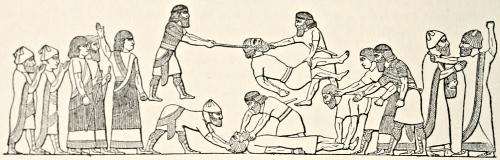
Bas-reliefs showing Assyrians torturing Prisoners
(After Layard)
What was to be done with so much wealth constantly accumulating in
the storehouses of Nineveh, and for whom was this gold, these jewels, this
bronze, these rich stuffs? To what use could he put these thousands of
slaves who ran the risk of becoming so many idle mouths to feed? Asshurnazirpal
had the idea of building a palace which would surpass the wildest
dreams of his predecessors, and he fixed its location in the city of Calah,
which was particularly the city of his dynasty.
British archæologists, who have made a special study of the ruins of
Calah, astonished at the treasures they found buried under the mound
Nimrud, have attempted to reconstruct from their own imaginations and the
recovered documents the general aspect of the city in the days of Asshurnazirpal,
who has left his name and inscriptions in every corner of it. “In a
strong and healthy position,” says George Rawlinson, “on a low spur of
the Jebel Maklub, protected on either side by a deep river, the new
capital grew to greatness. Palace after palace rose on its lofty platforms,
rich with carved woodwork, gilding, painting, sculpture, and enamel, each
aiming to outshine its predecessors; while stone lions, sphinxes, obelisks,
shrines, and temple towers embellished the scene, breaking its monotonous
sameness by variety. The lofty ziggurat (pyramid) attached to the temple
of Ninib, dominating over the whole, gave unity to the vast mass of palatial
and sacred edifices. The Tigris, skirting the entire western base of the
mound, glossed in its waves, and, doubling the apparent height, rendered less
observable the chief weakness of the architecture. When the setting sun
lighted up the whole with the gorgeous lines seen only under an eastern sky,
Calah must have seemed to the traveller who beheld it for the first time like
a vision of fairyland.”
From the pyramid of the temple of Ninib the Assyrian priests observed
the motions of the heavens, calculated the return of eclipses, and
questioned the future. In the temple searched by Layard traces were
everywhere found of Asshurnazirpal and what he himself calls “the glory of
his name.” His portrait has been found repeated a dozen times on the bas-reliefs;
he has all the features of a corrupt and cruel monarch. His low,
retreating forehead lacks nobility; the eyes are unusually large; the cheekbones
stand out prominently; the nostrils of the round, aquiline nose are too
large; the clipped moustache, brushed and curled at the ends, reveals thick,
sensual lips, while the chin and face are covered with that heavy false beard
which falls upon the breast in symmetrical twists, and was worn by all the
kings. The thick, short neck, the broad shoulders and thick-set body, gave
the king a robust, vigorous aspect. His statue in the British Museum represents
him standing. In one hand he holds a scythe, in the other a sceptre.
On his breast is written, “Asshurnazirpal, great king, powerful king, king of
legions, king of Assyria, son of Tukulti-Ninib (?), great king, powerful king,
king of legions, king of Assyria, son of Adad-nirari, great king, powerful
king, king of Assyria. He possesses lands from the shores of the Tigris as
far as Labana [Lebanon]; he has subjected to his power the great sea, and
all the lands from the rising to the setting of the sun.”
Several years after this statue was erected Asshurnazirpal would not have
fixed the Lebanon range as the western limit of his empire, for the fortunes
of war still smiled upon him. The last portion of his reign is filled with
two great expeditions in which he covered himself with glory. The definite
submission of the middle and lower Euphrates region, including the land of
Kardunyash, and the conquest of a part of Syria and Phœnicia. A revolt
in the lands of Laqi and Shuhi, on the Middle Euphrates, was an excellent
pretext for recommencing the war interrupted by the work of embellishing
Calah. [He marched upon Suru, levying tribute at every step.] For
a long time this little land of Shuhi had been warring with the Assyrians,
and though unceasingly beaten and ransomed, it nevertheless managed to
hold up its head, and had been able hitherto to maintain its independence.
Its sovereigns appear to have had continual friendly relations with their
neighbours the kings of Babylon, at least on the occasions when it was
necessary to resist the men of the North.
This time the Shuhites again appealed to the Chaldeans, whom the inscription,
through tradition, doubtless, still calls the Kassites or Kossæans.
[Suru was taken, and among the prisoners were the brother and the general
of Nabu-apal-iddin, king of Babylon.]
Then terror seized the soul of the weak Nabu-apal-iddin, king of Babylon,
and all Chaldea trembled. Unfortunate wars and intestine quarrels had
put Babylon out of condition to fight against the all-pervading Assyrian
superiority. Nevertheless Asshurnazirpal does not say that he entered
Babylonia, which he even seems to have prudently respected. He contents
himself with telling us that he erected his statue in the city of Suru,
and spread terror throughout Chaldea and all the lands watered by the
Euphrates.
The following year he was compelled to suppress a revolt of the mountaineers
inhabiting the southern slopes of Mount Masius in the very heart of
Mesopotamia. This was the state of Bit-Adini, whose principal cities were
Kaprabi and Tel-Aban. Asshurnazirpal scattered an army of eight thousand
horsemen, and brought back to Calah two thousand four hundred slaves
to work at the embellishment of his capital.
In spite of the peace which ruled in the Tigris and Euphrates basins,
whose resources were, moreover, completely exhausted, Asshurnazirpal now
resolved to strike a great blow on their western side, which would be a field
for rapine in which no Assyrian had ever yet set foot. The occasion seemed
favourable, for on the west of the Euphrates the Hittites were in no condition
to wage war; they had not yet recovered from the terrible blows dealt
them by Tiglathpileser, and their resistance in any case would not be very
great.
Asshurnazirpal went right ahead [starting on the 8th day of Airu
(April), 876.—Rogers], traversing the states of Bit-Bahian, Amila, and
Bit-Adini as far as the Euphrates, which he crossed on floats in sight of Carchemish.
Into the city he made a bloodless entry, receiving the homage
and tribute of King Sangara. A Hittite prince, Lubarna, who ruled in
the valley of the river Apre (modern Afrin) [in a state called Patin]
and possessed places of considerable importance such as Hazaz and Kunulua
(the capital). Lubarna made preparations to oppose the march of
the invader, but on seeing him approach fell on his knees and stripped himself
of all he possessed for offerings. He was soon master of both slopes of
the Lebanon, and he could see the great Phœnician Sea (Mediterranean).
There, in astonishment, and grateful to the gods for all their blessings, he
offered them a sacrifice of thanks on a wave-washed rock. “I received,” he
says, “the tribute of the kings of the land of the sea, the people of Tyre,
Sidon, Byblus, Makhallat, Maiz, Kaiz,[23] Akharri, and of Arvad, which is situated
full on the sea; they brought me silver, gold, tin, iron, iron utensils,
garments of wool and linen, ‘pagut,’ large and small, of sandal and ebony
wood, skins of marine animals, and they kissed my feet.”
Asshurnazirpal, protected by Ninib and Nergal, the gods of strength, embarked
on a vessel which he captured in the harbour of Arvad and took a
sea trip, during which he killed a dolphin. Several days later he hunted
among the steep gorges of Lebanon, killed buffaloes and boars, capturing a
number of them alive, which he sent to Assyria. He boasts of having killed
one hundred and twenty lions himself, and claims that these animals succumbed
to fright before his almightiness. He further enumerates troops of
wild animals which he drove back to their lairs,—antelopes, deer, ibexes,
gazelles, tigers, foxes, leopards; he also killed some eagles and vultures.
Among these mountains this true son of Nimrod quite forgot himself until
the king of Egypt, whom the fame of his deeds had reached, sent a congratulatory
embassy asking for his friendship. When later the kings of Egypt
and Assyria met on the shore of the Mediterranean, it was by no means for
mutual congratulation and the exchange of presents.
After this, Asshurnazirpal turned northward into the Amanus Mountains,
where he cut down cedar, pine, and cypress trees for his great buildings in
Calah. No one will ever know how much effort, nor the lives of how many
slaves it cost, to transport those gigantic logs cut in the Amanus forests
over the mountainous and trackless country to the banks of the Tigris.
Asshurnazirpal never revisited the shores of the Mediterranean, and like
Moses he but caught a glimpse of the promised land which his successors
were destined to conquer, and whose inexhaustible riches they so long
exploited. What we know of the remainder of his reign is the story of
unimportant expeditions, principally for the collection of tribute in the north
of Mesopotamia and around the sources of the Tigris. The district of Khipani
and its capital, Khuzirina, as well as the states of Assa, Qurkhi, and
Adini, underwent new trials; the city of Amida, the modern Diarbekir,
witnessed a pyramid of human skulls rising before its walls, and three thousand
slaves—those whose eyes were not put out or who were not crucified—were
sent to Nineveh, where they were employed in digging a great irrigation
canal to make use of the waters of the Upper Zab, the borders of which
were planted with trees torn from the forests of Syria.
The last eight years of his life seem to have been more peaceful than
their predecessors, although we can scarcely suppose that he passed them in
profound peace, which would be as hard to reconcile with his turbulent
and sanguinary nature as with the terrible condition of the lands he had conquered,
all of which were trying to regain their freedom. At all events, he
left his successors an immense empire, an unbroken frontier, and an Assyrian
domination recognised from the Zagros to the Amanus Mountains, and
from the sources of the Euphrates to the gates of Babylon.d
Aside from the ruthlessness of his conquests, Asshurnazirpal was chiefly
remarkable for rebuilding the city of Calah, constructing a canal, erecting
himself a wonderful palace, whose ruins have been found at Nimrud, and the
building or rebuilding of a great aqueduct. He, who had butchered and
battled so liberally, died in 860 B.C. in peace.
His son, Shalmaneser II (Shulman-asharid) (860-824 B.C.) commenced
warlike operations at once. After a campaign eastward (860) he entered
upon a systematic conquest of the western countries. After several campaigns
(859-856) Akhuni’s district of Bit-Adini, on both sides of the
Euphrates, was completely subjugated, incorporated with the kingdom, and
peopled with Assyrian colonists, and Tel-Barship on the Euphrates was
changed into an Assyrian residence city under the name of Kar-Shulman-asharid
(City of Shalmaneser). Finally he succeeded in capturing the
prince who had fled across the Euphrates into the mountains. Next followed
the campaigns on the west of the Euphrates. In the year 859 he
twice defeated a coalition of North Syrian princes, the rulers of Carchemish,
Patin, Sama’al, etc., joined by the kings of Que, and Khilukha; then he
subjugated the Amanus district and the district on the lower Orontes (the
country of Patin). In the following year, the annual tribute of all the
North Syrian states was definitely settled.
[854-829 B.C.]
In the year 854 B.C. Shalmaneser advanced farther south. Khalman
made submission, but a strong coalition was formed against him in the district
of Hamath by Hadad-ezer, or Ben-Hadad II, of Damascus, Irkhulina of
Hamath, and Ahab of Israel. The adjacent smaller states of the princes,
Matinu-Baal of Arvad (Aradus), Baasha of Ammon, etc., followed suit.
The Syrian states evidently recognised the full extent of the danger
threatening them; Ahab of Israel probably made peace with Damascus so
as to be able to withstand the Assyrians. Only the Phœnician cities were
obdurate; whilst the Arabian prince, Gindibu, sent a thousand camel riders,
and even the Egyptian king sent one thousand men. A battle took place at
Qarqar in the vicinity of the Orontes. Shalmaneser boasts of a complete
victory. [His inscription says: “Fourteen thousand of their warriors I
slew with arms; like Adad I rained a deluge upon them, I strewed hither
and yon their bodies, I filled the face of the ruins with their widespread
soldiers; chariots, saddle-horses, and yoke-horses I took from them.”]
But he attained no further successes, and his power was limited to northern
Syria. In the years 850, 849, and 846, Shalmaneser renewed his attacks
upon central Syria, the last time with one hundred and twenty thousand
men, but without great success. Their tribute money was not much safeguard
to the North Syrian princes, the places in the district of Carchemish
and in the Amanus Mountains were again and again plundered and burned,
and the inhabitants massacred. Only the king of Patin, who was farthest
away, and therefore the most powerful of the vassals, seems to have been
better treated.
The fifth campaign, in 842, was more successful, but in the meanwhile
the revolutions in Damascus and Samaria overthrew the old dynasties, and
Hazael and Jehu ascended the throne. In a battle at the foot of Mount
Lebanon, Hazael was conquered and shut up in his capital; but Damascus
was not taken. Shalmaneser laid waste the Hauran, then repaired to the
coast, where Tyre and Sidon, and also Jehu of Israel, paid him tribute.
The tribute payment of the latter (gold, lead, vessels, etc.) is depicted on
Shalmaneser’s black obelisk. In the year 839 the campaign was repeated
without any far-reaching success; and Tyre, Sidon, and Byblus paid tribute.
When the people of Patin slew their king, the Assyrian general, Asshur-daian
(or Dan-Asshur), took fearful revenge for the death of the faithful
vassal. But Shalmaneser extended his dominion in this district northward
only. In the years 838 and 837, twenty-four kings of Tabal (in Cappadocia),
as well as the king of Milid (Melitene), were compelled to pay
tribute; and in 835 and 834, King Kati of Que; i.e. East Cilicia west of
Mount Amanus, was vanquished, and the town Tarzi (i.e. in all probability
Tarsus), was taken and given to his brother Kirri.
Shalmaneser II had the same success in the east and north of his
kingdom. After the mountainous district on the Tigris had been conquered,
the Assyrians came into direct contact with the powerful race of the Alarodians,
whose territory extended on both sides of the Lake of Van, from the
source of the Euphrates to the land of Garzan, or Gozan, on Lake Urumiyeh.
After making a fearful visitation to Khubushkia and its vicinity, Shalmaneser
had already attacked their king, Arame, on the east in 860. In 857 he
invaded his district on the west, after crossing the Arsanias. In 845 he
penetrated as far as the source of the Euphrates, and in 833 Asshur-daian,
his commander-in-chief, repeated the same campaign. It seems that Arame
and his successor, Siduri (or Sarduris), in the year 833, made, on the whole,
a valiant defence.
Much greater success attended the campaigns against the southeasterly
mountainous races of Urartu on the “sea of the land of the Nairi,” i.e. the
lake of Urumiyeh, and the districts of Manna, Parsua, Amada[24] (Media),
etc., at the south and east of the same as well as that against the land of
Namri southeast of the Zab. In the years 844, 836, 830, and 829 the
campaigns in these districts were conducted sometimes by the king himself,
and sometimes by his commander-in-chief.
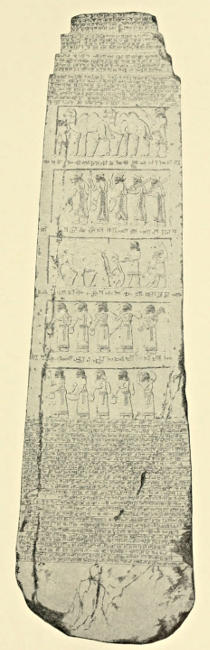
THE OBELISK OF SHALMANESER II
The famous representations on Shalmaneser’s black obelisk show how
King Sua of Gozan and the Lord of Musri (i.e. the eastern mountainous
district) sent him a collection of wonderful animals, double-humped camels,
apes, a rhinoceros, an elephant, and a yak, besides gold, silver, bronze vessels,
and horses.
Between the great campaigns there were a few smaller struggles; in 855
in the Masius Mountains, in 853 against the kings of Tel-Abnai, and in 847
against the town of Ishtarat and the country of Yati, districts south of the
source of the Tigris; in 848 against the unknown land of Paqarakhubuni,
west of the Euphrates, and finally in 831 against the Qurkhi. The black
obelisk records that the desert district of Sukhi, on the other side of the
Euphrates, subjected by Asshurnazirpal, remained dependent, and Marduk-bel-usur
of Sukhi brings to the king as tribute silver and gold, elephants’
teeth, garments, and also stags and lions. In the years 852 and 851
Shalmaneser advanced to Babylon. The king of Babylon, Nabu-apal-iddin,
had just died, and his brother Marduk-bel-usate had taken up arms
against Marduk-nadin-shum, the son of Nabu-apal-iddin. Shalmaneser went
to the assistance of the rightful king, defeated the rebels in two expeditions,
and presented rich gifts in the sacred cities of Babylon, Borsippa, and Kutha
to the chief gods enthroned there. Then repairing farther southward into
the land of Chaldea proper, he vanquished the kings of Bit-Adini and of Bit-Dakkuri,
and exacted tribute from Mussallim-Marduk and Yakin, who was
ruler of the sea country, which was subsequently called Bit-Yakin after him.
We see that the unity of the kingdoms of Sumer and Accad was now no
more; but that south of Kardunyash, the district of Babylon, there arose a
line of smaller states. Perhaps the South was always separated from
Kardunyash after the Kossæan conquest.
[829-783 B.C.]
In the last years of Shalmaneser’s reign his son Asshur-danin-apli rebelled
against him with a great portion of the kingdom, including Asshur, Arbela,
the town of Imgur-Bel, founded by Asshurnazirpal, Amido, and Tel-Abnai,
on the upper Tigris, Zaban on the Zab, etc. But another son, Shamshi-Adad
IV, quelled the insurrection [and it took him four years of hard
fighting to dissipate the opposition] and succeeded his father on the throne.
The first campaigns of the new ruler were directed against the Nairi countries,
the mountains on the north and east of the Tigris, and his general, Mushaqqil-Asshur,
penetrated as far as the “Sea of the Sunset,” which means as far as
the Black Sea. Then the king attacked Babylonia; a line of frontier places
was taken, and [in the battle of Dur-Papsukal, in northern Babylonia] King
Marduk-balatsu-iqbi, who had been supported by the rulers of Chaldea,
Elam, Namri, and the Aramæan races of eastern Babylonia, was slain.
This expedition was repeated in the years 813 and 812; and other wars
the king mentioned, in shorter notices, cannot be more accurately localised.
He made no attempt of any encroachment of Syria’s rights.
[806-774 B.C.]
The successes of [his son] Adad-nirari III (811-783 B.C.) are of greater
importance. In the North and South all the races hitherto subjugated, including
the Medes, the people of Parsua, etc., were kept in subjection. Frequent
mention is made of expeditions against Manna, Khubushkia, Namri,
and Aa. The king says that his kingdom was extended as far as the coasts
of the “great Sea of the Sunrise,” i.e. the Caspian Sea. In 803 mention was
made of an expedition “to the sea coasts” (i.e. Babylonia, not Syria). As
in Shalmaneser’s time, all the kings of the land of Kaldi (Chaldea) paid
tribute; in the chief cities of Babylonia the king offers sacrifice, gains rich
booty, and fixes boundaries. Many expeditions were moreover made against
the Aramæan race of Itu’a which dwelt in Babylonia, and these were repeated
in subsequent reigns. “On the west of the Euphrates,” says Adad-nirari,
“I subjugated the land of Khatti, the whole land of Akharri, Phœnicia, Tyre,
Sidon, the kingdom of Israel (Bit-Khumri), Edom and Philistia as far as
the coasts of the West Sea, and imposed taxes and tribute upon them.” He
makes special mention of an expedition against Mari, king of Damascus, who
was besieged in his capital and forced to capitulate, and pay 2300 talents of
silver, 20 talents of gold, 300 talents of bronze, 5000 talents of iron, so that the
loot of the Assyrian king was very considerable. These events cannot be
accurately fixed, chronologically. The chronological lists mention campaigns
in 806, 805, and 797, against Arpad, Khazaz, and Mansuate in northern Syria.
The war against Damascus was included in one of them, for it led to the payment
of tribute by the Phœnician cities and the southern states (Israel, Edom,
and Philistia). [There exists an inscription of this reign referring to Sammuramat
as “Lady of the Palace and its Mistress.” There is some reason for
conjecturing that this might have been the woman round whose name and
undoubted prestige in so glorious a reign, clustered the legends of Semiramis.
No previous Assyrian king ruled over so great a territory, or collected
so much tribute as Adad-nirari III, or, as it is sometimes written, Ramman-nirari
III. After him came a period of decline in which there are no royal
inscriptions, and of which our knowledge comes from brief notes in the
Eponym lists.]
[774-745 B.C.]
The next king Shalmaneser III (782-773) also went to Syria and made
war against Damascus, 773, the land of Khatarikka, 772, and the land of
Lebanon.
His successor Asshur-dan III (772-754) also made war against Lebanon
in the years 767 and 755, and against Arpad in the year 754. The subjugation
of Hamath probably occurred in one of these expeditions. Battles
are mentioned against Babylonia (in the district of the Aramæan race, Itu’a
and the city of Gannanat) in 777, 771, 769, and 767, in which the city of
Kalneh was presumably taken. But Shalmaneser III was chiefly concerned
in the subjugation of the land of Urartu, the Alarodians. He is mentioned
not less than six times as taking the field against them (781-778, 776, 774);
but his efforts met with no, or at least no enduring, success.
In all probability the formation of a great Armenian kingdom with the
city of Van (Thuspa of the Greeks) as the central point dates from this
period. Its founder was Sarduris, the son of Litipris, who was probably
identical with the king Sarduris who was conquered in 833 by Shalmaneser.
In two inscriptions written in Assyrian, he calls himself “King of the land
of Nairi.” His successors (Ispuinish, Minuas, Argistis I, Sarduris II) then
utilised the Assyrian writing for inscribing the language of their country.
For in the same record they call their kingdom Biaina, whilst it is called
Urartu by the Assyrians. The inscriptions of the rulers are rather numerous
and written quite in the Assyrian style. They record the buildings of
the kings in Van itself, where a citadel was built by Argistis, sacrifices and
gifts to Khaldi and the numerous other deities of the Armenian Pantheon,
campaigns and conquests.
When still co-regent with Ispuinish, his father, Minuas erected monuments
in the two high passes south of Lake Urumiyeh which record his conquests,
and other inscriptions also relate his successes against the land of
Manna and its vicinity. These battles presumably occurred in the latter
time of Adad-nirari III, and are the continuation of his campaigns in the
eastern mountains. Minuas also fought against the land of Alzi, against
the king of the city of Milid (Melitene), and against the Kheta. An inscription
on a wall of rock on the Arsanias below an old castle (near Palu) records
among others his successes in this direction. In the north he penetrated to
and beyond the Araxes; one of his inscriptions is to be found on the right
bank of the river opposite Armavir, and two others, written by his son
Argistis, north of Eriwan. The latter seems to have been the most powerful
ruler of Urartu. A long inscription on the rock of the citadel of Van
records his successes in the land of Manna, which he seems to have subjugated,
and also in the west, against Melitene, the land of Khatti (Kheta), etc.
Repeated victories over the Assyrians are mentioned, which were evidently
won against Shalmaneser III and Asshurdan III, or their generals.
Sarduris II, the son of Argistis, was also very successful in both districts.
For it appears from his inscriptions, confirmed by later events, that Melitene,
Kummukh, Gurgum, and other princedoms on the Amanus, became
feudal states of the kingdom of Urartu, which included the whole Armenian
plateau from the sources of the Euphrates and Araxes across Lake Urumiyeh.
How Sarduris II succumbed to the Assyrian will be shown later.
The reign of Asshur-dan III seems to have been much more peaceful than
the preceding ones, for the short chronicle of this period repeatedly records
that the king remained “in the land,” and therefore undertook no campaign.
The successes of Argistis were of great importance. Insurrections also
broke out in the interior in the years 763 to 758, first in the city of Asshur,
then in Arrapachitis (Arpakha), a city situated in the vicinity of the Upper
Zab, east of Nineveh, and finally in Guzanu, in the Khabur country. After
its subjugation, Asshur-dan, as already related, repaired twice more to Syria
(755 and 754), but it was not possible with the increasing extension of the
Armenian power in this direction to retain supremacy over the smaller
states of Syria.
[747-740 B.C.]
The next reign, that of Asshur-nirari II (754-745) was still less eventful.
He took the field only in the years 749 and 748 against the mountainous
country of Namri, in the southeast [and in 754 against Arpad].
Otherwise, he remained “in the land.” In the last year of his reign the
chronicle mentions an insurrection in Calah. The fact doubtless was that
in the spring of the following year (746) the throne was ascended by a
usurper who called himself after the first of the great Assyrian conquerors,
Tiglathpileser.
The overthrown dynasty, which went back to Ishme-dagan and Shamshi-Adad
and the ancient Bel-kap-kapu, had held the throne in uninterrupted
succession for more than a thousand years.c
The eminent Dutch historian Tiele calls the new monarch Tiglathpileser II,
but a recently discovered inscription of Adad-nirari II speaks of his grandfather,
Tiglathpileser, and so the latter, of whom nothing is known beyond
his name, is now denoted the second ruler of his name. Therefore the subject
of the present chapter is here called Tiglathpileser III.
Tiglathpileser III mounted the throne of Assyria on the 13th Airu (about
April) of the year 745 B.C., and resided, says Tiele, during the greater part of
his reign at Calah and Nineveh, where he built palaces. He was without
any doubt an Assyrian, and not a Chaldean, as has been supposed. Whether
he was the rightful heir, or whether he was even of royal blood, remains
undecided. His real name was Pulu (Pul, Poros), and there is reason to
suppose that he was either a military commander or a younger son of the
king, who took advantage of the confusion during the last years of the reign
of Asshurnirari II to put the crown on his own head. He assumed the name
of the great conqueror, Tiglathpileser.
He may have employed the first months of his reign in restoring quiet in
the country and establishing himself securely on the throne. It is only in
September of the year 745 (month Tasrit) that he marches into the field
and turns his arms against Babylonia. Nabonassar (Nabu-nasir) had ruled
at Babylon since 747, but nothing else is known of him, though he seems to
have been the founder of a new method of reckoning time. Tiglathpileser’s
first campaign was not, however, directed against him, at least not immediately;
his first object was to destroy the Aramæans’ and Chaldeans’ ever-increasing
power in that country. After he had won possession of the city
of Sippar, which lay between the Tigris and the Euphrates, and perhaps even
of Nippur also, and had conquered Dur-Kurigalzu, together with some other
less important strongholds of Kardunyash, as far as the Ukni, he subdued
the nomadic Aramæans east of the Tigris, reorganised the government of
the conquered territory, dividing it into four provinces, over which Assyrian
governors were placed, founded two cities [Kar-Asshur was one and probably
Dur-Tukulti-apal-esharra the other] as administrative centres to preserve
the allegiance of the new territory, and peopled the new settlements with the
prisoners of war. The priesthood of Babylon, Borsippa, and Kutha brought
gifts from the temples of their gods into the king’s headquarters, and thus
averted the danger which threatened their towns also. For the time
Tiglathpileser contented himself with the successes gained. It was not
at present his intention to subdue all Babylonia, or perhaps he was not
yet strong enough to do so. Apparently all he desired was to secure the
southern frontiers of Assyria against the invasions of the Aramæans and
Chaldeans, who were becoming more and more audacious, before he ventured
farther afield.
The security of the eastern border was of scarcely less importance. In
the year 744 he marched against the ever turbulent Namri which lay in this
direction; here, too, he compelled all to bow to his victorious arms, even
penetrated the western portion of the future Media, and exacted tribute
from all the Median princes as far as the eastern mountains of Biknu. He
did not proceed in person to further conquests, but entrusted the punishment
of those Medians who dwelt farther east to his general, Asshur-daninani,
who returned victorious, bringing with him rich booty, especially in horses.
However, this country was not incorporated in the empire.
His hand was now free for the re-establishment of the weakened power
of Assyria in the west. But one of his most powerful enemies who had, perhaps,
already stirred up Namri to resistance, namely Sarduris II of Urartu,
or Chaldia, sought to prevent this. When Tiglathpileser had reached
Arpad in Syria, he found his flank, and when he would have marched still
farther, his rear, threatened by a considerable army at whose head was
Sarduris, and which besides the latter’s troops consisted of those of the
northern Hittite states of Melid, Gurgum, Kummukh, and Agusi. The
defeat of the allies was complete. Sarduris had to abandon his camp and
seek refuge in flight. About seventy-three thousand prisoners fell into the
Assyrians’ hands.
[740-732 B.C.]
The three following years were not fortunate. When Tiglathpileser
marched against Kummukh he does not appear to have left an adequate garrison
behind him in Arpad, for in the year 742 the town, and with it the
key of the west country, was in the power of his enemies, and he found himself
obliged to besiege it for three years. Not till the year 740 did he take
it, and thither came Kushtashpi of Kummukh, Rezin of Damascus, Hiram of
Tyre, Uriakki of Que, Pisiris of Carchemish, and Tarkhulara of Gurgum, to
offer him rich presents. One of the Hittite princes, Tutammu of Unqi, a
district between the Orontes and the Afrin, refused his submission. His
capital, Kinalia, was taken for the second time and the whole country placed
under an Assyrian governor. In the year 739 Tiglathpileser continued his
conquest northeast of Arpad, devastated Kilkhi, a district belonging to
Nairi, and conquered Ulluba, where he founded an Assyrian capital under
the name of Asshuriqisha. But it was long before the land of the Khatti
(Syria) was pacified. Between 740 and 738 no less than nineteen districts
belonging to the Syrian kingdom of Hamath, and some other adjacent districts,
broke away from Assyria, and from some mutilated parts of the
inscriptions it is believed we may conclude that they asked for help from
Azariah [Uzziah], the warlike king of Judah. At all events, the latter at
that time ventured to defy the power of Assyria, and Tiglathpileser connected
this hostile attitude with the rising of the people of Hamath. About
738 Azariah was defeated and the country of Hamath added to Assyria.
Then the king had recourse to his favourite means for the suppression of the
sentiment of nationality—namely, the transplantation of prisoners of war
in the most extensive fashion. Whilst all princes of any consideration and
even an Arabian queen now offered the conqueror their submission and
presents, he received the joyful tidings of important successes won by his
generals on the other frontiers of the empire. The eastern Aramæans had
shaken off the Assyrian yoke and advanced to the Zab, but were driven
back, though with some difficulty. At the same time the governor of Lullume
was harassing the Babylonians, whilst the governor of Nairi held in
check the populations on the northern frontier. Booty and prisoners were
sent to the king in the land of the Khatti.
The three following years (737-735) he was occupied with expeditions
in the east and northeast. Some districts of Media were then under the
Babylonian rule, and now passed to that of the Assyrians. But the most
important event of this year was the march to Turushpa, the capital of
Urartu [Chaldia], the residence of Sarduris, on the Lake of Van. No
Assyrian conqueror had penetrated so far as this, nor did Tiglathpileser
succeed in taking the town in which Sarduris had fortified himself after his
first defeat; but the power of this dangerous rival was broken for a long time.
[732-731 B.C.]
Tiglathpileser now determined to bring the west under his yoke, and did
not rest until he had brought all the Hittite and Semitic countries to the
coast of the Mediterranean and the frontiers of Egypt, except some Arabian
districts, under his sway. This took him three years, from 734-732. The
immediate inducement to this expedition was probably that Ahaz of Judah,
threatened by Rezin of Damascus and Pekah of Israel, called in the aid of
Assyria. Moreover, the last two had probably paid no tribute, and, generally
speaking, Assyria needed little persuasion to fish in troubled waters. The
first attack was directed against Rezin. Beaten in the open field, he was
compelled to retreat to his capital. Here Tiglathpileser shut him in “like a
bird in its cage”; he conquered all the towns round about, including the
important city of Sam’ala, and marched on, after having destroyed, according
to his wont, all crops around Damascus, and thus increased the difficulty of
transporting the means of existence. He marched into Israel (Bit-Khumri),
wasting whole districts, some of which he added to his empire,—for the
present, however, leaving the capital undisturbed. The immediate goal was
now the Philistine Gaza, whose king, Hanno (Khanunu), probably trusting
in Damascus and Israel, had at first renounced his allegiance, but now on the
approach of the Assyrian army fled to Egypt. The town was taken, and a
rich booty fell into the hands of the victors. Askalon, whose prince Mitinti
had made an attempt at rebellion, was punished—though probably not till
later—and Rukipti, Mitinti’s son, raised to the throne. Shamshi, “the
queen of Arabia in the land of Sheba,” also offered resistance, but was likewise
utterly defeated and with difficulty escaped with bare life. Her
country, which is certainly not to be confounded with the Sheba of the
South, became an Assyrian province. Other Arab tribes submitted voluntarily,
and amongst them the well-known Tema; and Tiglathpileser appointed
the powerful tribe of the Idibi’il, as being nearest to Egypt, to be wardens of
the marches at the gates of that still mighty empire. Now came the turn of
Samaria, the only city of Israel which the conqueror had not yet reduced.
He appears, indeed, to have visited it, but not to have besieged and taken
it, yet he raised Hoshea, who had meantime slain Pekah, to the throne,
or confirmed him in its possession. It was longer before Damascus fell.
It continued to hold out for two years more. That it was then taken is
probable.
Of all the kingdoms of the West there now remained only Tyre and Tabal,
which latter lay much farther north. The king did not go in person against
either of these towns, but he sent Rabshakeh, who subdued them and changed
the government in Tabal, while on Tyre he imposed a tax of not less than
one hundred and fifty talents [about £60,000, or $300,000]. Whether this
took place now or later, cannot be said with certainty.
[731-726 B.C.]
Victorious over all rebellious subjects in his colossal empire, and dreaded
by all his neighbours, Tiglathpileser now felt himself strong enough to make
a direct attack on the Aramæans and Chaldeans of Babylonia, and to conquer
the holy city itself. In the year 731 he ventured and accomplished this act
of daring. In Babylonia itself no one seems to have resisted him, and the
population seem rather to have received him as a deliverer. He entered
Sippar, Nippur, Babylon, Borsippa, Kutha, Kish, Dilbat, and Erech, each in
their turn, and received the protection of the great gods, by offering them
sacrifices. Then he fell on the Aramaic-Chaldean tribe of Pekud (Pekod),
subdued it as far as the frontiers of Elam, continued his victorious march
through the Chaldean states of Bit-Silani and Bit-Sha’alli, which soon
succumbed to his arms. Nabu-ushabshi, the king of the former state, was
impaled before the gate of his capital, Sarrabani, and the town levelled with
the ground; Zakiru of Sha’alli was sent to Assyria in chains, and the capital,
which still offered resistance, was starved into surrender. Bit-Amukkani,
whose king, Ukinzer (Chinziros), who appears to have been at that time the
leading chief of the Chaldeans, and consequently regarded as king of
Babylon, was not so easily overcome. It is true that the whole country
was ravaged and the king shut up in his capital of Sapia; that a sortie of the
garrison miscarried; that in fear of the overwhelming strength of Assyria,
Balasu of Bit-Dakkuri, Nadin of Larak (Bit-Shala), and even Marduk-bal-iddin
[Merodoch-baladan] of Bit-Yakin on the seacoast, the man who
was later to become so terrible an enemy to Assyria, came here to offer
their costly gifts and their submission; but Sapia was not taken and Ukinzer
not conquered, so that nominally he shared the rule over Babylon for yet
another year. Still, from this time forward it was not without reason that
Tiglathpileser styled himself king or overlord of Babylon, king of Sumer and
Accad; he might boast that he ruled from the Persian Gulf to the far East,
over the coasts of the Mediterranean as far as Egypt, and that he had
extended his kingdom farther than any of his predecessors. He reigned for
three years more, for the most part in peace, as far as we know. Of his
last two years it is reported that he clasped the hands of Bel; that is, that
he received the highest religious consecration as king of Babylon. In the
year 727 Shalmaneser IV succeeded him on the throne. The latter only
ruled for five years, and of his short reign little is known.
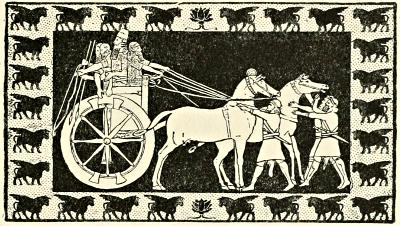
Assyrian King in his War Chariot
In the list of the Babylonian kings for these five years, there stands, not
his name, but that of Ulule, who was neither, as has been believed hitherto,
an independent prince nor a viceroy appointed by Shalmaneser, but none
other than Shalmaneser himself, who also probably resided at Babylon.
Perhaps his expedition against Phœnicia and Israel falls as early as the
year of his accession. The occasion of the war against Tyre, whose king,
Elulæus, at that time stood at the head of the Phœnician towns, is said
to have been an expedition undertaken by the latter against the Khittim of
Cyprus. It is more probable that the Tyrian king, like Hoshea of Israel,
had taken advantage of Tiglathpileser’s death to renounce his allegiance to
Assyria. Shalmaneser again subdued Hoshea and raised tribute from him.
At the same time he sent into Phœnicia a part of his army, which devastated
the whole country, and once more made it tributary. After this the whole
empire seems to have quieted down, for the following year (726) was a year
of peace. But the calm was not of long duration. Scarcely had the Assyrian
troops marched away, when Hoshea turned to the Egyptian king, in the
hope that with his aid he might free himself from the yoke of Assyria, and
from thenceforward once more refused the tribute.
We have here probably a great conspiracy, in which Elulæus was also
concerned, for Shalmaneser now marched against both kings. He took
Hoshea prisoner, evidently after a struggle, wasted the whole land of Israel,
but at Samaria, whose population may very likely have incited the king to
revolt, he encountered an obstinate resistance. Meantime the whole Phœnician
mainland, either from fear or under pressure from the superior force
of Assyria, hastened to desert from Elulæus and to submit to Shalmaneser.
The Tyrian king found himself under the necessity of retreating to his
fortress on the island of Tyre, where he was at once besieged. It was only
under Shalmaneser’s successor that Samaria was taken after a three years’
siege, and Tyre after one of five years. We cannot but experience a feeling
of respect for these two cities, which ventured unaided—for the help from
Egypt failed, as usual, to appear—to defy the gigantic power of Assyria.
[It is by no means undisputed that Shalmaneser marched against both
Elulæus and Hoshea, as Professor Tiele states. Some of the historians
believe that no action was taken against the king of Tyre, and that since
there are no allusions to the five years’ siege in any of the inscriptions,
Josephus, the sole authority, made a mistake in attributing to Shalmaneser
an attack on Tyre that was really made by Sennacherib.]
The scanty records of Shalmaneser’s reign bear witness to material prosperity.
That he was, as has been thought, a feeble ruler, under whose
administration the empire declined, is entirely unproved. His early death
prevented him from acquiring the same glory as his predecessor, and if,
immediately after his decease, the vassals of the empire raised the standards
of rebellion in every direction, this speaks rather for than against the influence
of his personality.e
After the death of Shalmaneser IV, the throne of Assyria was taken by
a man of doubtful antecedents, who became the founder of a very powerful
dynasty. This king, like some previous usurpers, adopted a name famous
in Assyrian history. He became known to the world as Sargon II, and
Rogers says he was not of royal blood; Tiele, however, from whom we shall
quote, thinks differently.a
[722-716 B.C.]
In the year 722 B.C. Sargon became king in Asshur. He was an Assyrian
of royal blood, who seems, however, to have belonged to another
branch than that of the dynasty which had ruled before Tiglathpileser III,
nor does he appear to have been closely related to the latter and his successor.
He boasts that he restored to the ancient seat of government, the city
of Asshur, her long usurped rights, and to Kharran, the object of his especial
favour, her former liberties, which had also long been curtailed. Evidently,
therefore, he appeared to a certain extent in the character of an innovator,
or rather as the restorer of the ancient order.
Samaria fell shortly after his accession, and a part of its inhabitants were
led away into banishment, to be replaced later on by others. Whether or
no Sargon was present in person is not clear, but it is certain that he could
not long devote his attention to the western portion of the empire. Scarcely
was Shalmaneser IV dead before the Chaldeans revenged themselves for the
humiliation they had suffered at the hands of Tiglathpileser. Marduk-baliddin
[Merodach-baladan] of Bit-Yakin, at that time the most powerful
amongst them, since through his timely submission to the Assyrians his
country had been preserved from the miseries of war, had made himself master
of the city of Babylon, and now ruled as king over the whole Babylonian
country. Sargon marched south, perhaps in the hope of recovering what was
lost. But in this he was unsuccessful. He did not venture to attack Babylon
itself, but turned his arms against an Aramæan tribe, the Tu’mun, who had
surrendered their chief to the Chaldean king. The tribe was subjugated and
carried to Syria. Sargon now pressed on as far as the town of Dur-ilu in
whose suburb he sustained with Babylon’s ally, the Elamite king Khumbanigash,
a hotly contested fight, from which he asserts that he came off
victor. This campaign, however, yielded no further advantages. Elam retained
its independence and Merodach-baladan possession of Babylon. An
indirect result was that the South had learned to know Sargon as a military
commander, and, for the future, good care was taken not to molest him.
The danger threatened from another quarter. Syria was up in arms.
At the head of the rising was Hamath, where a man of mean origin, Ya-ubidi
or Il-ubidi, had seized the government. Arpad, Simirra, Damascus, and
Samaria followed his example. He found a support in Hanno (Khanunu)
of Gaza, who had resumed his throne, and even in Shabak,[25] the Ethiopian
king of Egypt, whom Hoshea’s unhappy fate does not seem to have frightened
from endeavouring to measure his strength with the imperial might of
Assyria. Even before the allies could unite their forces, Sargon, who probably
received early intelligence of what was going on in the countries of the
Mediterranean coast, encamped before Qarqar, where Ya-ubidi had fixed his
headquarters, stormed and burnt the city, had the ringleader flayed alive and
his principal adherents put to death, increased his host with three hundred
warriors who fought in chariots, and six hundred horsemen from amongst the
conquered, and then marched south against the allied armies of Hanno and
Shabak. At Raphia on the Egyptian frontier was fought the decisive battle,
which turned out a brilliant victory for the Assyrians. Hanno was taken
and carried off to Assyria with nine thousand of his subjects, and Shabak
owed his safety only to his precipitate flight in which he was accompanied
only by his chief herdsman. Hezekiah seems to have thought it wise not to
defy the victor; perhaps he even sent Sargon a present. Tyre also must
have been pacified in this year (720).
Meantime the other enemies of the empire were not yet cowed. The
whole north, northeast and northwest, longed impatiently to shake off the
Assyrian yoke. In this they were supported by Mitatti of Zikirtu, Rusas of
Urartu and Mita of Muskhe, who had secretly formed a league over which
Sargon was to triumph only after a long and fierce struggle. In the year
719 Mitatti contrived to persuade some towns of the loyal Iranzu of Man to
revolt, whilst Rusas brought several other towns under his sway. Sargon
proceeded against them with so much energy that the instigators themselves
held cautiously aloof, while they beheld their country laid waste and most
of its inhabitants carried into the west, especially to Damascus. In the year
718 unrest revealed itself in Tabal, where Kiakki, prince of Sinukhtu, refused
to pay his tribute. But he, too, was soon led away captive to Assyria, together
with seven thousand of his subjects, and Matti of Atun, a faithful
vassal, was invested with Kiakki’s province. In the year 717 Sargon had to
suppress a dangerous rising. Pisiris, the Hittite prince of Carchemish,
which was one of the keys of the West, attempted, with the support of Mita
of Muskhe, to make himself independent. But his city was taken, the
majority of his subjects carried off, and an enormous booty stored in
Asshurnazirpal’s palace at Calah, which Sargon had restored for himself.
[716-715 B.C.]
These disturbances were nothing compared with the war which now, in
the year 716, broke out against Sargon and lasted several years. Rusas of
Urartu had persuaded the chief men of the Assyrian provinces of Karalla
and Man to secede, in which he was supported by Zikirtu and by the mountain
region of Umildish, which was governed by a certain Bagdatti. It
appears that the rebellion had spread all over the eastern frontier, and the
princes of western Media also took arms. Sargon boldly attacked his enemies.
He began with the country of Man, which lay nearest, soon got
Bagdatti into his power, and had him flayed. The chief men of Man raised
Ullusunu, the brother of Aza, whom Bagdatti had murdered, to the throne
and compelled him to join Rusas’s party, to which the princes of the Nairi
states, Karalla and Allabra, whose names, Asshurli and Itti, denote them as
Assyrian deserters, also went over. But scarcely had Sargon set out against
them before Ullusunu and his nobles found themselves obliged to offer their
submission. Sargon confirmed the former in his kingdom, and compelled his
two allies with other petty chiefs to return to their allegiance. The territory
of the city of Kisheshim was ruled by a governor, Bel-shar-usur,
probably a Babylonian. Sargon gave it the name of Kar-Nergal and made
it into an Assyrian province. A like fate befell the west Median town
of Kharkhar, which had expelled its sovereign, Kibaba, and solicited support
from Dalta of Ellipi; henceforth it was called Kar-Sharrukin [City
of Sargon]. On this the governors of other Median towns made their
submission.
[715-711 B.C.]
But after these isolated successes it was still long before the eastern
states were quieted. In the following year (715) Rusas wrested twenty-two
towns from Ullusunu, and a certain Daiukku, who is called viceregent of
Man, was involved in the affair. Khubushkia, a state of Nairi, and the
neighbouring districts, became refractory, and the territory of Kar-Sharrukin,
incorporated only the year before, again seceded. At the same time in
the west Mita of Muskhe made an invasion into the Assyrian district of
Que [in eastern Cilicia] with considerable success. Nevertheless, Sargon
succeeded in maintaining the upper hand at all points. He reconquered
Kar-Sharrukin, fortified it more strongly than before, and received the
homage of the governors of twenty-two Median cities. His general in the
west was not content with reconquering the towns taken by Mita, but even
pressed southward as far as the Arabian Desert, and transferred the tribes
subdued there to Samaria.
Secure of the west, Sargon now felt in a condition to strike at the real
authors of all the trouble in the east. After Man and some Median districts
had paid their tributes, the next thing was to proceed against Mitatti of
Zikirtu. So complete was the overthrow of this prince that, after the burning
of his capital, Parda, and the desolation of his country, he with his
whole people sought another home. It was a harder task to subdue
Rusas, the soul of the confederacy. But this, too, was accomplished
by the warlike king. Rusas was defeated among his high hills. His
whole royal house, amounting to some 250 persons, fell with his horsemen
into the victor’s hands, and he himself only escaped with much difficulty
and hid in the mountains. Rusas still built hopes on one of his allies; if he
would make a stand all was not yet lost. This was Urzana of Muzazir, a
former vassal of Asshur, who had, however, joined Rusas as the chief of a
kindred tribe. In his mountain country, protected by its natural strength
and almost impenetrable, he believed himself entirely safe. But the dauntless
spirit of the ancient Assyrian warriors was not extinct in Sargon. He
piously commended himself to the protection of the gods, assembled a carefully
selected body of troops, and ventured with them on the almost impossible
enterprise. When Urzana understood that the valiant hero was actually
approaching with his veterans, he fled, according to the praiseworthy custom
of Asiatic despots, with all speed into the higher mountains, leaving his
capital and his own family to the mercy of the enemy. Muzazir’s fate was
now soon decided; with a large number of prisoners, and an extraordinarily
rich booty, including the two great gods of the country, Sargon returned to
his own country. This was the death-blow for Rusas. The whole structure
so laboriously prepared lay in ruins, and filled with despair he fell upon his
sword.
When Sargon had thus secured his empire against the danger threatening
from the half-savage barbarians of the north, he re-established order in the
northwest and west. Next he turned, not against the chief author of the
trouble, Mita of Muskhe himself, but against Tabal, which lay not far and
somewhat to the south of Muskhe. Ambaris of Tabal, to whom previously,
while his father Khulle was still alive, Sargon had amongst other tokens of
favour given one of his daughters to wife, and whose kingdom he had increased
by the grant of Cilicia, had been ungrateful enough to join with Rusas and
Mita. In the year 713 Sargon punished him as he had deserved, and made
his country into an Assyrian province. The same thing happened to Khamman
and Melid in the following year. Sargon peopled the country with foreign
prisoners of war, and endeavoured by the erection of ten fortresses to
secure it against Urartu and Muskhe. Continuing its southward march, the
Assyrian army remained for a time in the region of the Amanus, and then,
in the year 711, attacked Gurgum in the neighbourhood of Kummukh, which
became an Assyrian province.
[711-709 B.C.]
It is very doubtful whether Sargon took a personal share in these expeditions.
It was during just these years that he was occupied with the construction
of his new residence of Dur-Sharrukin. It is certain that the
devastation of Ashdod, which concluded the campaign of 711, was effected
not under the king’s superintendence, but under that of the king,
Akhimiti, whom Sargon had installed there, but who had been expelled, and
Yaman, a man of mean origin, raised to the throne by the people. On the
approach of the Assyrian army this hero fled to Egypt, but the king of
Melukhkha (Egypt), fearing the vengeance of Assyria, sent him back loaded
with iron bands. The population of Ashdod was also carried away and replaced
by other tribes. Fortified by these triumphs, Sargon could now
collect his forces in order to undertake a war which should set the crown
to all his achievements. This was the conquest of Babylon, which had been
for the last twelve years in the possession of the Chaldean king, Merodach-baladan.
Two years were required for this undertaking, in which Sargon proceeded
with great caution. Merodach-baladan was ready for the attack. He had
not neglected to make the necessary dispositions and to strengthen his fortresses.
In one of them, Dur-Atkhara, which was probably the nearest to
Assyria, and whose defensive works he had caused to be raised, he had concentrated
the whole military power of the Aramæan tribe of Gambuli, and
had sent to their assistance a portion of his own choicest troops, six hundred
horsemen and four thousand foot. Sargon directed himself against this fortress,
and whilst he was besieging it, it is probable that another division of
his army won several successes in the east, where it had to keep the Elamite
king, Shutur-nakhundi, occupied, and prevent him from joining hands with
his ally. Dur-Atkhara fell; more than eighteen thousand prisoners and a
great booty became the spoil of the conqueror, and the rest of the defenders
hastily took to flight. The Assyrian king made the town his headquarters;
he subsequently gave it the name of Dur-Nabu, and placed it under an Assyrian
governor. The Khamarani tribe which dwelt on the banks of the Euphrates,
in their terror at the approach of his army, had already taken refuge in
the town of Sippar. At the news of the surrender of Dur-Atkhara, and the
defeat of the Gambuli, the Aramæan tribes of Rubu, Khindaru, Yatburu, and
Puqudu, who dwelt east of the Tigris, and relied on the protection of Babylon
and Elam, withdrew behind the river Ukni. The Assyrians threw a
bridge across the Umlias, a river to the north of Elam, and took several
strongholds there, whereupon some chiefs of the Aramæans did homage to the
king at Dur-Atkhara. They were assigned to the new government of
Gambuli. The remainder were attacked and defeated in the territory of the
Ukni, so that of them also many submitted, and were made subject to Gambuli.
Now the army of Assyria operating east of the Tigris attacked Elam
from Yatburu, subdued all the surrounding country, the seven principalities
of Yatburu, with which two fortresses conquered from Elam were incorporated,
and a part of the Elamite territory itself. It compelled the forces of
the land of Rash, which belonged to Elam, to retire to a fortress, and the
Elamite king to seek refuge in the high mountains of his country. Secured
against any surprise from this quarter, Sargon himself with the main body
now crossed the Euphrates into the Chaldaic-Babylonian state of Bit-Dakkuri,
whose capital, Dur-Ladinna, henceforth became his headquarters.
There was now no room for Merodach-baladan in Babylon. Threatened
on three sides, and in danger of being cut off by Sargon from his own principality,
he and his troops left the city during the night and directed their
steps to the Elamite part of Yatburu, whence they might advance against the
enemy in co-operation with Shutur-nakhundi. But, although he offered the
latter the most costly presents, the Elamite had not yet forgotten the lesson
he had received. He declined to expose himself to new defeats, and so, perhaps,
lose both land and people. Merodach-baladan left Yatburu, having
gained nothing, and collected his army in a stronghold of his own country,
called Iqbi-Bel.
Meantime, at Dur-Ladinna, in Bit-Dakkuri, not only did Sargon receive
the submission of the inhabitants and the neighbouring Bit-Amukkani, but
the authorities of Babylon also came in solemn embassy, bringing an invitation
to enter the holy city, with which he immediately complied. At the
great festival of the lord of the gods in the month of Shabat (January) he
was permitted “to clasp the hands” of that great Bel-Marduk and Nabu,
the king of the universe.
But still the south of Babylonia was not yet subjugated, for there Merodach-baladan
was still in arms. He collected all his forces in the immediate
neighbourhood of his capital, and at the same time, for fear of treachery, led
thither the population of the ancient cities of Ur, Larsa, Kishik, etc. Strong
defences were set up and special canals dug, behind which he entrenched himself
with his allies. But the great king did not shrink before all these obstacles.
Scarcely was the campaign of the year 709 begun, before he marched
south, distributed his troops along the enemy’s whole line of defence, and
inflicted on the latter so terrible a defeat that the trenches appeared as though
full of blood, and the Suti, who had marched from Bit-Yakin to the rescue,
did not venture an attack, but hurriedly retreated. Then Sargon fell on the
auxiliaries and slaughtered them like sheep. Terror now seized on the
Chaldeans’ main army; Merodach-baladan left his camp with all speed and
retreated to his city. But it, too, was soon taken after a short siege,
and with this the power of Merodach-baladan was broken. It is uncertain
whether he himself fell into his enemy’s hands or saved himself by flight;
but probably the latter was the case, for immediately after Sargon’s death
he is again in a position to take action, at least if the Merodach-baladan,
who then revolted against Sennacherib, is the same who was conquered by
Sargon and his son. But for the time Babylonia was freed from the Aramaic-Chaldean
domination, and breathed again. Sargon restored the ancient
rights of the natives which the oppressors had curtailed in favour of the foreigners.
To the towns of southern Babylonia he gave back their stolen gods;
he everywhere showed himself extremely liberal to the temples and the
ancient religion of the country. In all directions he appeared as deliverer,
avenger of the insulted gods, restorer of the ancestral religion, protector of
the priests and of all the natives of the country. His triumph did not signalise
the commencement of foreign rule, but, on the contrary, it was he who
put an end to it.
[709-708 B.C.]
Sargon’s rejoicings over his victory were still further increased by the
embassies and reports which he received one after the other. Uperi, the
king of the island of Dilmun, in the Persian Sea, did homage to him while he
was still at Bit-Yakin, and gave costly presents. When he had marched from
southern Babylonia to consolidate his dominion in the conquered countries,
still more welcome tidings reached him at Irma’i. Even his great enemy in
the northwest, Mita of Muskhe, who had stood with Rusas at the head of the
confederacy against Asshur, but who had been overcome by the governor
of Que, now sent ambassadors to Sargon with presents and protestations of
homage and devotion. When, finally, the king had again returned to Babylon,
there came envoys from seven districts of Cyprus, “whose names had
never been known to the kings, his fathers, since the rule of the god Sin,”
and who offered him valuable gifts and kissed his feet. Thus the empire of
the mighty conqueror stretched from the island of Dilmun, in the Persian
Gulf, to the Isle of Cyprus, in the Mediterranean.
Sargon returned to Calah in the beginning of 708, his fourteenth year as
king of Assyria, and third as king of Babylon, after spending some time in the
latter city. Whilst he was at Calah, resting on his laurels—he did not again,
himself, take the field—and from thence prosecuting the construction of his
new residence of Dur-Sharrukin, not far from Nineveh, his armies had still
to conduct two wars, one in the year 708, the other, perhaps, in the same, but
probably in the following year. Urartu had to a certain extent recovered
from the blows it had suffered in the defeats and death of its king, Rusas;
and the new king, Argistis, began to grow restless, and persuaded Prince
Mutallu of Kummukh to a revolt against the Assyrian domination. Sargon
sent a high official with a powerful army and full royal authority, who put
Mutallu to flight, taking the capital of the province, and so restoring the
Assyrian dominion. The rich booty was sent to Calah to the king, and the
latter placed a very strong garrison at the disposal of the new viceroy, to
prevent any further attempts at risings, and at the same time to constitute a
defence against Argistis. But it was once more apparent that the Assyrian
Empire, as a purely military power, rested on a tottering foundation, and
could only be sustained by continued wars and victories.
The other war was that for the succession in Ellipi to the north of Elam.
There, after the death of Dalta, who after some resistance had become a loyal
vassal of Assyria, a dispute over the inheritance broke out between his two
sons, Nibe and Ishpabara. The first applied for help to Shutur-nankhundi
of Elam; the second to Sargon. The latter sent seven of his commanders,
who succeeded in defeating Nibe, taking his capital, Marubishti, and there
installing Ishpabara as king.
[708-705 B.C.]
Sargon, who, even in the early years of his reign, in the midst of his most
terrible wars, had not neglected the reconstruction of palaces and temples at
Nineveh and Calah, now devoted himself entirely to the realisation of a long
cherished plan, whose execution he had begun long ago. A new suburb of
Nineveh, called by his name, was to come into existence as a permanent
memorial of his fame and piety, and at the same time serve as a summer
residence. This was Dur-Sharrukin with its temples to various gods, with
its palaces and gardens, whose walls and gates, like those of a sacred city,
looked to the four quarters of the heavens and were named after the high
gods, and whose inhabitants, selected from the prisoners of war of all the
nations whom the king had conquered and placed under Assyrian magistrates,
afforded a living testimony to his mighty deeds. On the 22nd Tasrit
(September) 707, the gods were solemnly introduced into their temples, and
on the 6th Airu (April) of the following year, the king took possession of
the new residence. He was not permitted to enjoy it long. In the year
705 he fell by an assassin’s hand. [This is doubted by some authorities,
who believe that he died a natural death.]
Sargon was, without doubt, one of the greatest princes who sat on the
throne of Assyria and Babylon. He was no mere conqueror, who thought
merely of increasing the size of his empire, but also a true king who occupied
himself for its welfare. What chiefly strikes us in him is the comparative
moderation by which he was distinguished from his predecessors and in
particular from his son and successor. The horrors and devastations of war
were the inevitable accompaniment of the forcible subjugation of the whole
of western Asia, and some obstinate rebels were punished according to the
barbarous custom of his age and race. But in general he contented himself
with expelling the conquered prince or making him prisoner. He also remained
faithful to the policy first pursued by Tiglathpileser III, namely that
of furthering the unity of the empire by transplanting whole populations to
other districts. But in his records it is only now and then that we encounter
the refined cruelties perpetrated by the other Assyrian kings, and he
never dwells on them with so much complacency as they display.b
[705-681 B.C.]
Sargon II was succeeded by his son Sin-akhe-erba, the Sennacherib
of the Bible, who reigned long and gloriously. The period now in question
has a double interest. It is a time when Assyria is at the height of its
power; and the interest that attaches to any strong empire is enhanced by
the fact that the Assyrians of this period came in contact with the people of
Israel. Sennacherib, in particular, bears a name familiar to all succeeding
generations because of the repeated mention of this ruler in the Hebrew
scriptures. Until the records of the Assyrian monuments were brought to
light, nothing was known of him, except what referred to his disastrous
campaign against Jerusalem, together with the brief reference to his murder
by his son. Now, however, an abundance of material is at hand telling of
the deeds of Sennacherib. The most important of these records are contained
on large cylinders of the type which many Assyrian kings employed.
These cylinders tell of various campaigns of the great conqueror, including
several attacks upon Israel. Two or three brief excerpts from the chronicles
of Sennacherib will serve to give an idea of the phraseology in which
these royal documents are couched. The first two excerpts here selected
were translated by George Smith from a cylinder now in the British
Museum.
Column I of this cylinder begins as follows:
“Sennacherib the great king, the powerful king, king of Assyria, king
of the four regions, the appointed ruler, worshipper of the great gods,
guardian of right, lover of justice, maker of peace, going the right way,
preserver of good. The powerful prince, the warlike hero, leader among
kings, giant devouring the enemy, breaker of bonds. Asshur, the great
mountain, an empire unequalled, has committed to me, and over all who
dwell in palaces has exalted my servants. From the upper sea of the setting
sun to the lower sea of the rising sun all the dark races he has subdued to
my feet, and stubborn kings avoided war, their countries abandoned, and,
like Sudinni birds, … fled to desert places.”[26]
Column II contains a record of the campaign against the Hittites:
“In my third expedition to the land of the Hittites I went. Elulæus
king of Sidon, fear of the might of my dominion overwhelmed him, and to
a distance in the midst of the sea he fled, and his
country I took. Great Sidon, Lesser Sidon, Bit-Sitte,
Sarepta Machalliba, Ushu Alhzibu, and
Akko his strong cities, fortresses, walled and enclosed,
his castles; the might of the soldiers of
Asshur my lord overwhelmed them, and they
submitted to my feet. Tubahal in the throne of
the kingdom over them I seated, and taxes and
tribute to my dominion yearly, unceasing, I fixed
upon him. Of Menahem of Samsimuruna, Tubahal
of Sidon, Abdilihiti of Arvad, Urumilki of
Gubal (Byblos), Mitinti of Ashdod, Buduilu of
Beth-Ammon, Kammusunadab of Moab, Malikrammu
of Edom, kings of the Hittites, all of
them of the coast, the whole, their presents and
furniture, to my presence they carried, and
kissed my feet, and Zidqa, king of Askalon, who
did not submit to my yoke; the gods of the
house of his father, himself, his wife, his sons,
his daughters, and his brothers, the seed of the
house of his father I removed, and to Assyria I
sent him. Sharruludari, son of Rukipti their
former king, over the people of Askalon I
appointed, and the gifts of taxes due to my
dominion I fixed on him, and he performed my
pleasure.”
Full of interest is the record of an invasion
of Palestine. Sennacherib, it will be recalled,
was the Assyrian that came down like a wolf
on the fold, as recorded in Byron’s stirring lines. The Hebrew account is
from 2 Kings xix. 35:
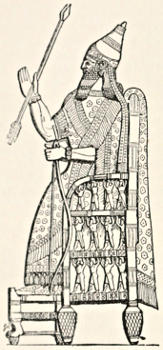
Sennacherib on his Throne
(Layard)
“And it came to pass that night, that the angel of the Lord went out,
and smote in the camp of the Assyrians an hundred fourscore and five
thousand; and when they arose early in the morning, behold, they were all
dead corpses. So Sennacherib king of Assyria departed, and went and
returned, and dwelt at Nineveh. And it came to pass, as he was worshipping
in the house of Nisroch his god, that Adrammelech and Sharezer his
sons smote him with the sword; and they escaped into the land of Armenia.
And Esarhaddon his son reigned in his stead.”a
It is hardly necessary to state that no such record as this is to be found
on the cylinder before us. The oriental scribe, whether of Egypt, Assyria,
or Persia, rarely made the mistake of putting details of unfortunate expeditions
on record. Doubtless Sennacherib once invaded western Asia unsuccessfully,
and quite likely a plague may have decimated his hosts, but that
particular invasion is not likely to furnish a favourable theme for the court
chronicler.
An invasion of Palestine is, indeed, recorded on the present cylinder, but
it is an invasion with very different results. Listen to the official account
of the conquest of Jerusalem furnished by this cylinder of Sennacherib, as
translated by Dr. Budge. The scribe reports the king as speaking in the
first person:
“I drew nigh to Ekron and I slew the governors and princes who had
transgressed, and I hung upon poles round about the city their dead bodies;
the people of the city who had done wickedly and had committed offences I
counted as spoil, but those who had not done these things I pardoned.
I brought their king, Padi, forth from Jerusalem and I stablished him upon
the throne of dominion over them, and I laid tribute upon him.
“I then besieged Hezekiah of Judah who had not submitted to my yoke,
and I captured forty-six of his strong cities and fortresses and innumerable
small cities which were round about them, with the battering of rams and
the assault of engines, and the attack of foot-soldiers, and by mines and
breaches (made in the walls). I brought out therefrom 200,150 people, both
small and great, male and female, and horses, and mules, and asses, and camels,
and oxen, and innumerable sheep I counted as spoil. (Hezekiah) himself, like
a caged bird, I shut up within Jerusalem his royal city. I threw up mounds
against him, and I took vengeance upon any man who came forth from his city.
His cities which I had captured I took from him and gave to Mitinti, king of
Ashdod, and Padi, king of Ekron, and Silli-bel, king of Gaza, and I reduced
his land. I added to their former yearly tribute, and increased the gifts
which they paid unto me. The fear of the majesty of my sovereignty overwhelmed
Hezekiah, and the Urbi and his trusty warriors, whom he had
brought into his royal city of Jerusalem to protect it, deserted. And he
despatched after me his messenger to my royal city Nineveh to pay tribute
and to make submission with thirty talents of gold, eight hundred talents of
silver, precious stones, eye paint … ivory couches and thrones, hides and
tusks, precious woods, and divers objects, a heavy treasure, together with his
daughters, and the women of his palace, and male and female musicians.”
It must not be supposed, however, that either this record of a successful
invasion or the Hebrew account of that other disastrous one is altogether
false, however much the facts may have been exaggerated, or however
poetical the guise in which they are presented. It is merely to be understood
that the two records refer to different campaigns or to different portions
of the same campaign, as explained later by Professor Tiele. It is
supposed by some modern interpreters that the destruction of Sennacherib’s
hosts actually occurred through the plague. The king himself, however,
escaped to return to Nineveh and there to continue his rule for many years.
He was finally killed by his own sons, as is recorded on a contemporary
Babylonian document. What would not the Hebrew scholar give, could he
find contemporary documents of these events from the Hebrew standpoint,
instead of being obliged to depend on records handed down, perhaps, by
tradition for many generations, or at best, copied from one hand to another
for centuries?
The value of contemporary documents as records of fact may, indeed, be
overestimated, for it is possible to pervert, exaggerate, or understate the
facts even in the day of their occurrence; but in any event the contemporary
document has obvious advantage over documents of subsequent
generations, which can be nothing more than copies, variously distorted, of
earlier records. As for such mere matters of fact as the dates of ancient
kings, and the particular details of campaigns and conquests, the historic
importance of the contemporary record cannot be questioned; hence the
enormous value of these tablets of Assyria and Babylon. But, questions of
historical value aside, a peculiar charm attaches to whatever is old, and it is
nothing less than fascinating to look at such a document as this cylinder, and
feel that the very lines you scan were once read by Sennacherib himself
before he met his untimely end “on the 20th day of the month Tebet” some
twenty-five centuries ago.h
[705-702 B.C.]
It was in the year 705 B.C. that Sennacherib, who was not, perhaps,
entirely guiltless of Sargon’s death, mounted the throne and became the
supreme king both in Babylon and Assyria. To Merodach-baladan, who
may have been either the recognised king of the Sea Lands, or the son or
namesake of the latter, the occasion now seemed favourable for recovering
the throne lost to Sargon. Sennacherib and his army marched up in all
haste, and though it appears that Merodach-baladan had all the Aramæan
and Chaldean tribes on his side, and was moreover supported by Elamite
auxiliaries, he suffered a defeat and so lost his kingdom. According to the
Assyrian narrator, this defeat was so complete that the Chaldean was forced
to take flight in the greatest haste, leaving behind him his whole baggage-train,
as well as his family and court. He had reigned nine months. The
land was heavily scourged, great and small towns were taken and laid waste,
and the inhabitants dragged into exile. The same fate was meted out to all
Arabians, Aramæans, and Chaldeans who were living in the Babylonian
towns.
When the campaign in Chaldea was at an end, the troops were sent
against the Aramæan tribes, which dwelt on the banks of the Tigris and
Euphrates. Here, too, there was devastation and plundering. A considerable
booty, as was to be expected from these nomads, consisting chiefly of
cattle, but also including camels, fell into the hands of the conquerors, and
no less than two hundred thousand men and women were carried off to Assyria
as slaves. It fared still worse with one small, heroic tribe, the Hirimmi,
who offered an obstinate resistance to the Assyrians. When, finally, the
latter succeeded in overcoming them, of all the rebels they left no prisoner
of war alive, and hanged the corpses on poles upon the wall surrounding the
town. Sennacherib annexed the whole territory to his realm, while he laid
on it a very moderate tax for the benefit of the Assyrian god.
We may assume it as probably certain that the king did not personally
take part in the campaign, but occupied himself the while with the adjustment
of Babylonian state affairs. His policy may be distinctly followed.
It was only toward the Chaldeans and their allies that he appeared in the
character of an enemy. They alone were punished or carried off. The
actual citizens of Babylon, Erech, Nippur, Kish, and Kharsag-kalama he left
unmolested, and to propitiate them still further, he even gave them a king
belonging to the ruling Babylonian house—namely, the young Bel-ibni,
whose father held an important office, and who had himself been brought up
from childhood at the Assyrian court. Of him Sennacherib might hope that
he would be faithful to Assyria and at the same time not unfriendly to the
Babylonians, and therefore he now bestowed on him the title of “King of
Sumer and Accad.”
The establishment of order in Babylon was turned to account by Sennacherib
for the purpose of averting the danger with which his eastern frontier
was threatened by the nomads who wandered there, and by the mountain
people, and also for extending his empire in every direction. He now
attacked the Kasshu and Yasubigallu, by which names we doubtless have to
understand those barbarous Kossæans, and their allies, whose successors,
centuries later, according to Diodorus, still made the Mesopotamian frontier
insecure, and who were related to those Kassites who had so long reigned
over Babylon. Their surest protection was the inaccessible nature of the
country. Steep mountain paths and thick forests made it difficult for an
Assyrian army to advance, while for vehicles it was impossible.
The king himself led the march, and thus showed himself a worthy successor
of the undaunted heroes who in earlier centuries had founded the
Assyrian power. His chariot had frequently to be carried behind him, and
then he mounted on horseback or performed the journey on foot at the head
of his troops. Sennacherib succeeded in taking their three strongholds.
The smaller places he laid in ashes and the nomads’ tents were burnt. But
for greater security he desired to bring the wild tribes under Assyrian rule,
and to force them to settle in fixed abodes. He selected Bit-Kilamzakh as a
centre, fortified it far more effectually than before, making it a formidable
fortress to keep the inhabitants of the country in check, and peopled it with
captives whom he had carried off in former warlike expeditions. He caused
a tablet inscribed with the history of this campaign to be set up in the
capital, in order that the terror of the Assyrian arms might be kept perpetually
alive. As soon as he had subdued the Kasshu he marched against
Ellipi. Sennacherib fell on the country like a tempest. The two royal
seats Marubishti and Accudu, with all the smaller towns, were taken by him
and given up to be plundered and burnt, whilst all crops were destroyed
and even the cornfields delivered over to the fire. It was with a certain
satisfaction that Sennacherib boasted of having transformed Ellipi into a
desert, and led away the whole population with its goods and chattels.
When these successes became known, a number of Median princes, dwelling
at a more remote distance, hastened to offer their submission.
Meantime the king’s attention was directed to events in the west. The elevation
of the young and high-spirited Tirhaqa to the throne of Egypt, probably
as husband of King Shabak’s widow, and guardian of his son who was a minor,
had aroused in some princes of the strips of land along the Mediterranean
coast the hope that by an alliance with him they might shake off the Assyrian
yoke. To these belonged Elulæus (Luli) king of Tyre and Sidon, Zedekiah,
(Zidga) king of Askalon, and above all Hezekiah, the king of Judah. The
latter took on himself the leadership, at least in the southwest.
Sennacherib’s third campaign was directed against this coalition, and is
probably to be assigned to the year 702 B.C. With its usual promptitude, the
Assyrian army marched on Phœnicia, and thus attacked one of the allies
before the rest had a chance to unite their forces. Elulæus fled in haste to
Cyprus, where Citium still belonged to him; and all his towns on the continent,
within a short space of time, fell into the hands of the Assyrian. All
the princes of the other petty Phœnician states came that they might offer
their submission.
[701 B.C.]
Sennacherib immediately starts along the seacoast for Askalon, southernmost
of the revolted states, and soon overpowers it. Zedekiah, the king,
suffers the usual fate; with the hereditary gods of his house, his wife, his
sons, daughters, brothers, and his whole family he is dragged away to
Assyria.
Now that the whole coast-line had submitted, Sennacherib turned to
Ekron, which lay farther to the north, but more inland. But in Altaku
[Eltekeh], which lay south of Ekron and belonged to it, he encountered
some resistance, and was at the same time caught by an Egyptian army,
which at last appeared to the rescue of the Philistine towns. According to
the Assyrian account it was very numerous and was composed of the troops
of the king of Musuri, and of the bowmen, chariots, and horses of the king of
Melukhkha. Still, whatever these two names may mean here, it is certain that
neither Tirhaqa himself nor any other Egyptian king was leading the army,
but that it was merely commanded by Egyptian princes and two generals
belonging to the horsemen. These did not show themselves a match for the
powerful Assyrian conqueror. In spite of the number of their followers
they suffered a total defeat, and it does not say much for their skill and
courage that they all, princes and commanders, fell alive into the enemy’s
hands. In consequence of this, the relieving army appears to have retraced
its march to Egypt, so that nothing now stood in the way of Sennacherib
continuing his conquests in Philistia and Canaan. The ruling high priest
and the princes who had stirred up the rebellion, he caused to be put to
death and their corpses displayed on stakes on the town walls; such of the
inhabitants as had made common cause with the rebels were led away captive;
the innocent, on the contrary, went free.
Now at last came the turn of Hezekiah. The following is the main outline
of what the Assyrians relate concerning the campaign against Judah.
When it became apparent that even after the overthrow of his allies, Hezekiah
was not inclined to give himself up readily to the mercy of his powerful
enemy, the latter marched into his country. Forty strong towns besides the
citadels and countless smaller places were beleaguered, taken by storm, razed
to the ground or burned, and more than two hundred thousand prisoners, with
a great number of horses, asses, and camels were carried away from them.
Hezekiah himself, Sennacherib shut up in his capital, Jerusalem (Ursalimmu),
like “a bird in its cage.” But the town was in a strong position and provided
with a good garrison. Hezekiah had not only assembled his faithful
warriors, but had also enlisted a number of Arabian soldiers. When these,
however, required pay, and in case of refusal threatened to withdraw, Hezekiah—the
Assyrian says from dread of the glory of Asshur—paid the
heavy tribute which Sennacherib demanded of him—namely, thirty talents
of gold [about £9000 or $45,000] and three hundred talents of silver, besides
precious stones, woods, and other articles, and also sent to Nineveh his
daughters and the women of the palace, accompanied by male and female
slaves together with an envoy, who was at the same time commissioned to
proffer his master’s homage.
From this narrative no one who did not know the official style of the
Assyrian historical writers would guess that Jerusalem was not taken, and
that Sennacherib, with the remainder of his army, was obliged to quit Judah
with all possible speed. But it was not their business to report failures of
this kind. Doubtless in this account of the course of Sennacherib’s campaign,
the main features are correct and also described in the right chronological
order. It is certain that, after the overthrow of Phœnicia, the king
found it advisable first to reduce the small Philistine states on the seacoast
to obedience that he might then attack the Jewish king, who at last, when
he had been deprived of everything save his capital, and when his own
soldiers were deserting him, saw himself compelled to produce the war-tax
demanded. The assertion that he sent it by an envoy to Nineveh cannot
possibly be correct, and must have been invented for the purpose of rounding
off the narrative without relating the true issue of the affair.
We possess two traditions concerning the close of the war which, though
they may differ from one another in other respects, agree in this, that an
extraordinary event unexpectedly compelled Sennacherib to return with
some precipitation to Assyria. One is the biblical tradition; the other is
the account of Herodotus.b
The biblical account, as found in 2 Kings, we have already quoted.
The account of Herodotus relates to a certain king Sethos, a priest of Vulcan
(believed to represent Shabak of the XXVth Dynasty). This king, says
Herodotus, treated the military of Egypt with extreme contempt, and as if
he had no occasion for their services. Among other indignities he deprived
them of their aruræ, or fields of fifty feet square, which, by way of reward,
his predecessors had given to each soldier; the result was that, when Sennacherib,
king of Arabia and Assyria, attacked Egypt with a mighty army,
the warriors whom he had thus treated refused to assist him. In this perplexity
the priest retired to the shrine of his god, before which he lamented
his danger and misfortunes; here he sunk into a profound sleep, and his
deity promised him, in a dream, that if he marched to meet the Assyrians,
he should experience no injury, for that he would furnish him with assistance.
The vision inspired him with confidence; he put himself at the head of his
adherents and marched to Pelusium, the entrance of Egypt: not a soldier
accompanied the party, which was entirely composed of tradesmen and artisans.
On their arrival at Pelusium, so immense a number of mice infested
by night the enemy’s camp that their quivers and bows, together with what
secured their shields to their arms, were gnawed in pieces. In the morning
the Arabians, finding themselves without arms, fled in confusion, and lost
great numbers of their men. There is now to be seen in the temple of Vulcan
a marble statue of this king, having a mouse in his hand, and with this
inscription, “Whoever thou art, learn, from my fortune, to reverence the
gods.”c
Taking together all the circumstances in which the somewhat contradictory
reports are agreed, we may picture the course of events as follows:
On the advance of the Assyrian king, Hezekiah collects his picked men, who
are reinforced by foreign soldiers, in his capital, and resolves to defend it.
Meantime the Assyrian army overruns the whole of Judah, takes one fortified
town after another, and all the citadels and smaller places, and Sennacherib
has penetrated as far as Libnah, a small town lying in the southwest of the
Jewish territory. There he learns that Tirhaqa is approaching with an
Egyptian army, to fight against him and liberate Judah. So long as the
capital is not yet in his power, and Judah consequently not wholly subdued,
he cannot go out against him without losing all the advantages gained. He
will therefore try whether he cannot, by threatening Hezekiah, induce him
to deliver up the town of his own accord; and he sends him messengers with
letters peremptorily calling on him to submit. But with prophetic fire
Isaiah pours out his wrath at the insults offered to Jehovah by this servant
of Asshur, and vehemently urges steadfast resistance.
[701-696 B.C.]
Sennacherib meantime continues his victorious march, and now that he
is master of all Judah with the sole exception of the capital, he can detach
a part of his army. If Hezekiah will not yield of his own free will he must
be compelled to do so. A strong body of troops under the leadership of the
Rabshakeh, or generalissimo, marched against the strong fortress and closely
beset it on all sides. But it is the Rabshakeh who chiefly figures in the
foreground of the affair. The Hebrews tell of his efforts to induce the
people and the garrison of Jerusalem to desert their king. He sought to
attain this end by means of scornful speeches on the helplessness of Judah.
Hezekiah, perhaps again spurred on by Isaiah, who still continues to
trust in a miraculous deliverance, does not give way at once, but defends the
city against a superior foe for some time, though it was the only town that
remained to him and was as isolated and forsaken “as a cottage in a vineyard,
as a lodge in a garden of cucumbers.” But at last, when famine in
the town has reached its highest pitch and signs of impatience and discontent
manifest themselves among the garrison, he makes up his mind to submission,
and sends a messenger to Lachish to inquire the terms of surrender. They
are very hard. But there is no longer any choice, and he tenders the Assyrian
conquerors the amount required at the hand of the envoy, who subsequently
accompanied it to Nineveh. Whether the siege was thereupon immediately
raised, or whether it was thought well to keep the town still under observation
until the contest with Egypt was decided, we cannot say positively.
But, as a great misfortune, either pestilence or some other natural phenomenon,
actually did soon after smite the Assyrian army, and the whole
of the conqueror’s force, reduced to a miserable handful, quitted Judah and
the West, the true believers among the Egyptians and Israelites saw in it a
miraculous deliverance which the gods had sent them, and the latter at the
same time regarded it as a fulfilment of the prophecies of Isaiah, which at
first did not seem to be coming true.
Of course the event had not in reality the importance which the grateful
Egyptians and Israelites attributed to it. Although it secured them relief,
and Sennacherib’s army was so weakened that he thought it advisable to
beat a hasty retreat, yet his supremacy over Phœnicia and Canaan remained
for a long time unshaken, and in the following year he was again in the field
with a powerful army. Subsequently he appears again to have marched
westward and to have made a particular fight against Arabia and Edom.
But it does not appear that in this campaign he also made war against
Phœnicia, Philistia, and Judah, as he certainly would not have failed to do
had traces of insubordination showed themselves. The chastisement had
been too severe, and the country was too greatly exhausted.
In the year 700 B.C. Sennacherib’s presence was again required in Babylonia.
It was the third and last year of Bel-ibni’s rule at Babylon. Sennacherib
had him brought to Assyria, together with his whole family. He
had proved unequal to the task which Sennacherib had assigned him.
After the victories, which intimidated even Elam, Sennacherib went to
Babylon, and there in place of Bel-ibni, set up his own eldest son Asshur-nadin-shum
on the throne as king of Sumer and Accad. His six years’ reign
began in the year 700 B.C., and now Sennacherib thought himself safe from
the machinations of Chaldean pretenders.
For some years he had really had his hands free in the south. He
employed the time in bringing into subjection some of the northwestern
neighbours of his empire. This campaign, which the Assyrians reckon as
the fifth, and which must have taken place somewhere between 699 and 696,
ended with a war in Cilicia. According to Berosus it was occasioned by a
Greek invasion, and the Assyrian army obtained the victory only after suffering
great loss. Abydenus even speaks of a sea-fight on the Cilician coast,
in which the Greek fleet was worsted. Both historians agree in this, that
Sennacherib immortalised his famous deeds by the erection of his statue or
the setting up of bronze pillars with inscriptions, and that he built the town
of Tarsus, which he called Tharsin, so that the Cydnus flowed through it
as the Arazanes (Aralshtu) through Babylon. Strange as it may seem, the
Assyrians themselves make no mention of the foundation of this important
town, but Berosus is too credible a witness for his statement to be rejected.
Even before 694 Sennacherib had busied himself in the preparations of
a great plan. Merodach-baladan had sought and found in Nagitu, on the
coast of Elam, a refuge and place of security where he believed his deadly
enemy could not reach him. After the latter’s expedition against Bit-Yakin
in the year 700, the remainder of the population of that territory had found
it expedient to take ships with their gods, as their master had done, and
cross to the region where the latter had taken up his abode. Sennacherib
apparently feared that this new state would prove a source of danger
to the province entrusted to his son; all the more since Merodach-baladan
had now become a vassal of Elam, Asshur’s ancient and hereditary enemy.
The difficulty was great, particularly as Nagitu was not accessible from
the land side, without passing through Elamite territory. He had among
his captives shipbuilders from Khatti, and he set them to work at Nineveh
on the Tigris and Tel-Barsip on the Euphrates. The ships were towed
down the Euphrates and the Tigris [or they may have been transported
overland by camels]. They were manned by Tyrian, Sidonian, and Ionic
seamen, who were also prisoners of war. He, himself, had meantime
marched to the Persian Gulf with his army, and had fixed his camp close
to the ships. From the description of the voyage it is evident what a
deep impression this very unusual expedition made on the Assyrians. Even
before they set sail they made an unexpected acquaintance with the sea,
which they believed four hours’ distance away; they may perhaps have
been aware that, even so far up as Bab-Salimeti, the river was subject to the
ebb and flow; but a spring flood, which suddenly laid the camp under water,
and even made its way into the royal tent, took them by surprise. They
had to seek refuge on the ships and remain on them five days and nights,
“as in a great bird-cage,” says Sennacherib. Whether this experience of
life on shipboard was enough for the bold monarch, or whether he had no
intention of taking part in the maritime expedition, it is certain that he did
not leave the shore. The transports were taken to the mouth of the
Euphrates; costly sacrifices to Ea, the sea god, among which were a golden
ship and a golden fish, were thrown into the rivers to obtain his protection
for the fleet, and then it set sail. It is not told how long the voyage lasted,
but merely that the country whither they went lay at the mouth of the
Eulæus (Ulai), the chief river of Elam. There the great battle was fought,
and of course the Assyrians came off the victors. They took possession of
various Elamite towns, and carried off the Chaldeans and all the goods from
Bit-Yakin, together with a number of Aramæans and captured ships, to
Bab-Salimeti, where the king awaited them. Of Merodach-baladan not a
word is said. Therefore he did not fall into the hands of the Assyrians, and
was not robbed of his sovereignty by the defeat. Thus far, at least, the
victory was of no lasting significance for the Assyrians. It appears simply
to have destroyed the prosperity of the Chaldean colony for some time, and
to have deterred the indefatigable adversary from direct attacks. But this
extraordinary and costly expedition shows how greatly he was dreaded and
with what implacable hatred his house was pursued by that of Sargon.
[696-692 B.C.]
While the Assyrian king was engaged in the seacoast war, Khallus, the
king of Elam, instigated by the Babylonians who had left the town in good
time with Merodach-baladan and had sought refuge with him, invaded
Accad with his army, penetrated as far as Sippar, where he instituted a massacre,
and brought Asshur-nadin-shum prisoner to Elam. On the Babylonian
throne he set up a Babylonian, Suzub, son of Gakhul. It is a characteristic
trait that the Assyrian account is silent as to the unhappy fate which overtook
Sennacherib’s oldest son. Suzub, on his accession to the throne, took
the name of Negal-ushezib. He is the Regebelos of the Ptolemaic Canon, and
must be carefully distinguished from the Chaldean Suzub who did not reign
over Babylon till a later date (692) and under another name.
But the new king was lord over only part of the country. The whole
South was still in the hands of the Assyrians and had to be conquered by
him.
About June, 694 or 693, he succeeded in getting possession of Nippur,
but his farther advance was checked by the tidings that the Assyrians had
meantime marched as far as Erech. Sennacherib immediately despatched
a large force against the king of Elam, whom he rightly regarded as the chief
author of all the trouble. Erech fell and was sacked, and, laden with rich
booty, including even the chief gods of the sacred city, the Assyrians
marched forward. At Nippur, Nergal-ushezib awaited them, and in the
battle which followed he remained victor. But his rule was of short duration.
As to the end of his reign the Babylonian and Assyrian records are
agreed. The former asserts that, after the Assyrians had carried away the
gods and inhabitants of Erech, Nergal-ushezib was taken prisoner in the
battle at Nippur and conducted to Assyria. According to the second, he
was thrown from his horse in the battle, taken prisoner and brought in
chains before Sennacherib, who then shut him up in prison at the gate of
Nineveh. The two accounts seem to make the story complete.
After the misfortune that had overtaken their king, the Babylonians
bestowed the crown on Suzub the Chaldean, who had also fled to Elam. He
reigned independently for four years, under the name of Mushezib-Marduk.
The Assyrians consequently content themselves with mentioning several
advantages won by them over the Elamites, and also relating that they took
Suzub prisoner on their march from Erech to Asshur. They themselves
practically acknowledged that Babylon did not fall into their hands, when
they inform us that, after Suzub’s capture, the Babylonians closed their city
gates against the Assyrians and offered an obstinate resistance.
So far as we may judge, the whole of this campaign of Sennacherib’s was
a political blunder, which does not speak well for his sagacity. There was
in fact nothing to be feared from Merodach-baladan; the real peril, which
threatened from Elam, escaped the Assyrian king. The maritime expedition
undertaken at so much labour and expense, was more adventurous than
glorious, and failed in its main object: the arch enemy, at whom it was
aimed, retained his liberty and his kingdom. And meantime Babylon was
left without protection, and Sennacherib’s own son was bereft of throne and
freedom. He had not even provided himself with sufficient forces to avenge
the descent of the Elamites and reconquer the lost territory. The sole fruit
of the campaign (exclusive of booty and prisoners) was the carrying away
of a Babylonian king, whose place was at once taken by another prince, not
less hostile. A poor compensation for the loss of the capital, the whole
territory belonging to it and of his own son! Under Sennacherib’s government
it was continually apparent that only under compulsion had the
Babylonians submitted to the yoke of the Assyrians, and that they preferred
to unite with Elam rather than again obey a Sargonid.
[692-689 B.C.]
In Elam, meantime, a rising took place against Khallus, possibly because
he had been unsuccessful in his war against Assyria. [He was killed in
the uprising.] Kudur-nankhundi became king in his stead. Sennacherib
thought this a favourable opportunity to attack his old enemies, the Elamites.
It was in 692, probably, that he took advantage of Elam’s disordered condition
to inflict a heavy punishment on that country. From Rasa to Bit-Burnaki
he ravaged and plundered to his heart’s content. He introduced
Assyrian garrisons and placed the territory under the care of a governor.
Besides this, he took thirty-five fortified towns. Such was the devastation
“that the smoke of the flames covered the face of the wide heaven like a
heavy storm,” and so great was the terror he spread that Kudur-nankhundi
left his residence at Madaktu in all haste, and fled to a town called Khaidala,
which lay far up in the mountains. But nature saved him from the hands
of the Assyrians. Sennacherib did indeed give orders to march to Madaktu,
but he could not carry his intention into effect. It was winter, and in
(Tebet) December an earthquake, coupled with storms of rain and snow,
compelled him to retreat. The mountain streams were so swollen that no
army could now cross them with safety. Only three months afterwards
Kudur-nankhundi died “suddenly, before his time,” and his own brother
Umman-minanu mounted the throne. Scarcely had Umman-minanu assumed
the sceptre of Elam than he allowed himself to be beguiled into an alliance
with Babylon against Asshur. At Babylon now reigned Suzub II, the
Chaldean, Mushezib-Marduk. After his flight from Sennacherib, in the year
700 or 699, he had returned to Babylon, where, after the misfortunes that
overtook his namesake, he was made king, no doubt to the great chagrin of
the Assyrians. When he sent gold and silver from the treasury of E-sagila,
the great temple of Marduk and Zarpanit, to the Elamite king, he found the
latter prepared to collect an army at once and march with it to Babylon for
a joint attack upon Asshur. Sennacherib was astounded that the lesson he
had imparted to Elam in the previous year had borne no better fruit. But
the Chaldeans and Elamites had good ground to hope for success. The
Assyrian’s latest victories had not been rich in lasting results. He had not
succeeded in conquering Babylon. He had been obliged to retreat hastily
from Elam. He had not been able to defend Chaldea. Moreover, the kings
of Babylon and Elam could now count on a number of allies. The number
of the enemy impressed the Assyrians, who likened them to a swarm of
locusts. “Like a violent gale which drives the rain-clouds across the firmament,
so rose the cloud of dust at their approach.” But calling on the gods,
his heavenly protectors, Sennacherib ventures an attack.
It was a fierce battle; both sides fought with the greatest fury. Sennacherib,
himself, was distinguished by his personal courage. With helm and
mail, spear and bow, Asshur’s sacred bow, which none but the kings of
Assyria carried, he stands in his war chariot like an angry lion, and like a
heavy storm from Adad, the god of tempests, he rushes on the enemy,
covering the plain with corpses as with grass. His horses wallow in blood;
blood and fragments of the slain cleave to the pole of his war chariot. A
choice troop of Elamite nobles, equipped with golden daggers and bracelets,
are slaughtered like sheep, and the Elamite commander and grand vizier,
Khumbanundash, a man of great ability, also falls. Others are taken
prisoners. Yet the kings of Elam and Babylon and the Chaldean chiefs
got away, according to the Assyrian writer, who delights in depicting their
sufferings in a very imaginative fashion, with a loss of tents and baggage and
of one hundred and fifty thousand dead left on the battle-field. They were
pursued for a distance of some miles, but their capture was not effected.
There is something loathsome in the lively colours in which the scene is
painted; the pitiless slaughter and horrible mutilation of the slain are
described with bloodthirsty complacency. The writer of the Assyrian tablet
knew well that his savage, revengeful master based his renown on such
inhuman acts. And yet it was no victory for the Assyrians. They may
have remained in possession of the field, but the murderous battle was so
undecisive that the Elamites and Babylonians could claim the victory as
well. The losses on both sides must have been so great that neither of the
two parties ventured to continue the war. Both sides assumed the attitude
of waiting for a more favourable opportunity. The prevalent idea that after
the battle of Khalule Sennacherib immediately conquered Babylon is decidedly
false and is contradicted by the true reading of both Assyrian and Babylonian
records.
Not till the year 690 or 689 did Sennacherib find a favourable opportunity
to risk another attack on Babylon. From Elam there was now nothing more
to fear. The power of Umman-minanu was much weakened and he was
soon to lose it altogether. The Assyrian king marched on Babylon with
the impetuousity which distinguished all his warlike expeditions, and was
at times disadvantageous to him; and on this occasion his effort was crowned
with the desired success. Now he directed his arms against Mushezib-Marduk’s
town, not as his predecessors, including his own father, had done, as a
rescuer bringing deliverance from a usurper and therefore striking at the
latter and his dependents, and sparing the inhabitants: upon the town which
had so long withstood him, so repeatedly and obstinately lifted its head
against him, a fearful vengeance was to be taken. It was literally wiped
out; nothing was spared; corpses lay piled up in the streets; all its treasures
were pillaged and divided amongst the soldiers; the temples were desecrated,
and the gods torn from their sanctuaries. Then the whole town was delivered
up to the flames; the walls and ramparts, the temples and the ziggurat,
(probably the two towers of Babylon and Borsippa), were thrown down and
hurled into the Arakhtu or other canals, and the water from the river and
the canals was turned on the ruins that they might be flooded. The very
place where the sacred town had stood became unrecognisable and was
changed into a marsh. Mushezib-Marduk escaped and sought refuge in
Elam, but Umman-minanu, fearing Assyrian vengeance, surrendered his
ally, and the latter and his family were brought prisoners to Nineveh.
Such a deed may well have spread fear and horror even in Assyria itself.
Sennacherib had done what none had even ventured before. Towards the town
which many an Assyrian king had treated with respect and which had never
been sacked, he had behaved with a relentlessness which hitherto had only
been exhibited to foreign rebels. He was now master of Babylon. For the
remaining eight years of his life, he was called King of Babylon, even according
to the Babylonian list of kings, although the Ptolemaic canon mentions
this period as an interim. King Ummanaldash [Khumba-Khaldashu] who
(the 7th of Adar 690 or 689?) succeeded Umman-minanu on the throne
of Elam, and who reigned eight years, left the Assyrian king in peaceful
possession. There are sufficient grounds for the assumption that this supremacy
over Babylon of a tyrant embittered by earlier reverses was a reign
of terror.
For the last years of Sennacherib’s reign authentic accounts are almost
entirely wanting. An expedition to Arabia, against a certain king Hazael
(Khazailu), in which the capital of Edom is stormed and the deity of the place
falls into his hands, certainly belongs to this period of his reign.
[695-681 B.C.]
Like most of the Assyrian princes, Sennacherib, in spite of his unsettled
existence, was a great builder. But he bestowed the most care on the re-establishment
and embellishment of his beloved Nineveh. In the earlier part of
his reign he had also strengthened this town with an outer wall and an inner
rampart (duru and shalkhu), and in the year 695 he had built a great palace
by the northwest wall, after pulling down a small palace which stood there.
The latter had fallen into decay, partly as a result of the overflowings of the
canal on which it stood, partly from the heat of the sun. The canal was
now diverted, and on its margin was built a new and loftier palace, in which
ivory and costly woods were not spared. There the king had a park laid
out and irrigated by the waters of the Khushur (Khosr) which were made
to flow through it, and it was planted with trees from the Amanus Mountains.
At the same time the town was extended and embellished.
Scarcely was this structure completed when Sennacherib caused another
palace, which lay farther south of the same wall, to be pulled down. It had
served former kings as armoury, magazine, and stables, and had now become
not only too small but also decayed. Some fields were added to it and earth
brought to raise them, and upon this now rose a palace, not of tiles, but of
hewn stone after the fashion of the land of Khatti (Aram). For this also
cedars from Amanus and great lion and animal colossi, which had been hewn
out of stone in the town of Baladai and then cased in bronze, were employed,
and cunning architects disposed them with great care and magnificence.
The purpose of the building remained the same; horses and every sort of
cattle found stabling, stuffs and weapons were laid up there, but it had now
also to serve as a barrack for the national troops. The king’s name is
displayed on every wall.
Immediately after the completion of this building on the 20th day of Adar,
691, that is, in the same year in which the battle of Khalule took place, Sennacherib
began another and not less important work, which was only completed
and inaugurated after the sack of Babylon. This was an undertaking
intended to provide the city of Nineveh with good drinking water. A number
of canals had to be dug, which served at the same time to fertilise some
uncultivated strips of land. In the capital which was thus, as it were, born
again, the old warrior now probably rested on his laurels for a few years
longer.
In the latter period of his life, Sennacherib appears to have handed over a
part of his royal functions to his son Esarhaddon (Asshur-akhe-iddin), if he
did not actually make him co-ruler. The latter was not his eldest son, for his
name, “Asshur grants brothers, or, a brother,” shows the contrary, but he was
perhaps, the second, and therefore direct heir to the throne after the death, or
at least in the absence of, the king’s eldest son, Asshur-nadin-shum, who had
been carried off by the Elamites. Esarhaddon was certainly destined to the
succession by his father, and was the latter’s favourite. Sennacherib issued
a decree by which the whole of his booty brought from the Babylonio-Chaldean
district of Bit-Amukkani was assigned to him, and his name was at the
same time changed to Asshur-etilli-ukinnibal (Asshur, the lord has lent a
son)—a name which was more appropriate for one who now took the place of
eldest son, but which Esarhaddon himself does not appear to have adopted.
His brothers, whether younger or older, were not pleased at this. Two
of them at least, Sharezer, whose full name was probably Nergal-shar-usur
(or the Nergilus of Berosus), and Adarmalik, disputed the succession, taking
advantage of the circumstance that Esarhaddon, at the head of the army,
was absent in the northwest, most probably in a war with Armenia. Whilst
Sennacherib was praying in a temple, they fell on him and slew him, and
Nergal-shar-usur took possession of the throne, [but was at once superseded.
Some histories deny his accession]. Thus died Sennacherib, on the 20th
Tebet (about December) 681, by the hands of his own sons.
From the official sources, which are the only ones we possess, it is difficult
to obtain an idea of the character of the Assyrian sovereign, but the records
of Sennacherib’s reign certainly make a far more unfavourable impression
than those which Sargon left behind. Both were conquerors, but the one
shows more respect for law and justice. Stern, at times to harshness, against
uncompromising adversaries, Sargon yet gives place to mildness where mercy
can be made to harmonise with the interests of the empire. Sennacherib,
on the other hand, takes an obvious delight in scenes of blood and desolation,
in inflicting punishments which only awaken disgust at their brutish
cruelty. The destruction of Babylon, the burning and blotting out of a
town venerable from its age and importance, and so sacred to the pious
Assyrians, was indeed a blind vengeance which fixes an indelible blot on the
name of the author of the crime. Not less courageous and warlike than his
predecessors, he was rash and presumptuous rather than bold, and his plans
were rather venturesome than well calculated. Impetuous in attack, he
neglected the needful precautions, and attained the immediate goal, often
only to lose more than he gained. Whether he was concerned in his father’s
murder cannot be determined; that he was, as his name indicates, a younger
son, is no certain evidence of this, but it is a suspicious circumstance that
he nowhere mentions his celebrated father’s name. If he was guilty, Nemesis
overtook him. As a king he was far inferior to Sargon. Nineveh alone had
much to thank him for. Babylon, on the contrary, which had called in Sargon
as her deliverer, sought to secure her independence of him, and preferred to
his yoke the dearly bought protection of Elam. After he died, having reigned
something like twenty-four years, it was a long time before the empire was
as powerful and flourishing as at the commencement of his rule. In thinking
of Sargon and Sennacherib we are involuntarily reminded of Cyrus and
Cambyses, who differed from one another in the same way.b
[681-668 B.C.]
Sennacherib, as we have seen, was murdered by his sons. It appears
that this event did not occur at once after the return from the disastrous
campaign against the Israelites, as might be inferred from the Hebrew
record, but a good many years later. Esarhaddon, who succeeded his father,
was obliged to win back the kingdom from the regicides before he could
securely occupy the throne of Assyria. He seems to have had no great
difficulty in this, however, and for many years he continued in undisputed
sway, not merely sustaining but extending the influence that his father had
wielded. The greatest glory of his reign was his successful invasion of
Egypt. Opinions have differed considerably as to the character of Esarhaddon.
Professor Tiele’s verdict, which we give in extenso later, is somewhat
less favourable than that of various other authorities. The opinion
of Professor Maspero is perhaps worth quoting in some detail. He says:
“Esarhaddon is one of the finest and most attractive characters of Assyrian
history. He was as active and resolute as Asshurnazirpal or Tiglathpileser,
without being hard on his subjects or cruel to those he conquered, as
they were. He delighted in being merciful as much as his predecessors had
rejoiced in being merciless, and the accounts of his wars no longer make
constant mention of captives being burnt alive, kings impaled on the gates
of their cities, or whole populations being burnt out by fire. He took pleasure
in restoring the ruins with which his father and grandfather had covered
the land, and in the first year of his reign he gave orders for the rebuilding
of Babylon, which was commenced on a grand scale.
“All the Chaldean prisoners were set free, and those who liked to work
under the architects could do so for payment in oil, wine, honey, and other
commodities of life; and when laying the foundation stones of different
edifices, he himself wore the special dress of the masons. The temple of
Bit-Zaggaton, the seat of Marduk, the protector of the town, issued from
the ruins and the walls, and royal castles were raised beyond their former
height. Beyond Babylon Esarhaddon consecrated thirty-six temples at
Asshur and Agade; and they were lined with shining sheets of gold and
silver.
“The palace which he built at Nineveh on the site of an old building
surpassed all that had hitherto been seen. The quarries of alabaster in the
mountains of Gordyene and the forests of Phœnicia furnished material for
the halls; thirty-two Hittite kings on the Mediterranean coast sent great
beams of pines, cedars, and cypresses. The roof was made of carved cedar
wood, supported by columns of cypress encircled with gold and silver; stone
lions and bulls stood at the doorways; the panels of the doors were made of
ebony and cypress, encrusted with iron, silver, and ivory. The palace of
Babylon was entirely destroyed, and the one commenced at Calah with
Egyptian booty was never finished. The conquerors had been much impressed
by the long avenues of sphinxes at the entrance of the Memphite
temples, and in imitation of the idea Esarhaddon had sphinxes,
lions, and bulls at the entrances of his buildings. The construction lasted
three years (671-669), and it was only just far enough completed for the
decoration to be started, when he fell seriously ill in 669.” Two years later
he died.
It will probably be felt by most readers of the records left by Esarhaddon
himself—which are, of course, our sole authority in the matter, save for a
few chance biblical references—that Professor Maspero’s verdict as just
quoted is over-enthusiastic. Nevertheless, it can hardly be doubted that
Esarhaddon was in many ways a much more admirable character than his
father. The following excerpt from one of Esarhaddon’s inscriptions, contained
on a hexagonal prism of baked clay found near Nineveh, and now in
the British Museum, will suggest something as to the precise interpretation
one should place upon the words “attractive” and “merciful” as applied to
an Assyrian conqueror:
“Esarhaddon, king of Sumer and Accad, (son of Sennacherib, king of)
Assyria, (son of Sargon) king of Assyria, (who in the name of Asshur,
Bel,) the Moon, the Sun, Nabu Marduk, Ishtar of Nineveh, and Ishtar of
Arbela, the great gods his lords from the rising of the sun to the setting of
the sun marched victorious without a rival.
“Conqueror of the city of Sidon, which is on the sea, sweeper away of
all its villages; its citadel and residence I rooted up, and into the sea I flung
them. Its place of justice I destroyed. Abd-milkot its king who away from
my arms into the middle of the sea had fled; like a fish from out of the sea I
caught him, and cut off his head. His treasure, his goods, gold and silver
and precious stones, skins of elephants, teeth of elephants, dan wood, ku
wood, cloths, dyed purple and yellow, of every description, and the regalia
of his palace I carried off as my spoil. Men and women without number,
oxen and sheep and mules, I swept them all off to Assyria. I assembled
the kings of Syria and the seacoast, all of them. (The city of Sidon) I
built anew, and I called it ‘The City of Esarhaddon.’ Men, captured by
my arms, natives of the lands and seas of the East, within it I placed to
dwell, and I set my own officers in authority over them.
“And Sanduarri king of Kundu and Sizu, an enemy and heretic, not
honouring my majesty, who had abandoned the worship of the gods trusted
to his rocky stronghold and Abd-milkot king of Sidon took for his ally.
The names of the great gods side by side he wrote and to their power he
trusted; but I trusted to Asshur, my lord. Like a bird from out of the
mountains I took him, and I cut off his head. I wrought the judgment of
Asshur my lord on the men who were criminals. The heads of Sanduarri
and Abd-milkot by the side of those of their chiefs I hung up: and with
captives young and old, male and female, to the gate of Nineveh I marched.
“Trampler on the heads of the men of Khilakki and Duhuka, who dwell
in the mountains, which front the land of Tabal, who trusted to their
mountains and from days of old never submitted to my yoke: twenty-one
of their strong cities and smaller towns in their neighbourhood I attacked,
captured, and carried off the spoil; I ruined, destroyed, and burnt them
with fire. The rest of the men, who crimes and murders had not committed,
I only placed the yoke of my empire heavily upon them.”
It is notable that the successor of Esarhaddon, his son Asshurbanapal,
seems to have placed the same favourable opinion upon the character of his
father, as compared with his grandfather Sennacherib, that moderns are
disposed to adjudge. This is suggested by the fact that Asshurbanapal in
various inscriptions refers to “Esarhaddon, king of Assyria, the father, my
begetter,” and never to his grandfather, whom he probably would have
mentioned, following custom, had he held him in any particular regard.
Asshurbanapal himself was, at least in his earlier years, a warrior of no mean
quality; but he was, it would appear, primarily a lover of the arts of peace.
There is a marked difference in the tone of his inscriptions, as compared with
those of his predecessors, even when describing his conquests. Many times
they suggest one who loves the pleasures of life rather than one who gloats
over the infliction of death. The following are the words in which he
describes the expedition against Egypt and Ethiopia, and against Tyre, as
recorded on a cylinder now preserved in the British Museum:
“In my second expedition to Egypt and Ethiopia I directed the march.
Tandamani [Tanut-Amen] of the progress of my expedition heard, and that
I had crossed over the borders of Egypt. Memphis he abandoned, and to
save his life he fled into Thebes. The kings, prefects, and governors, whom
in Egypt I had set up, to my presence came, and kissed my feet. After
Tandamani the road I took, I went to Thebes the strong city. The approach
of my powerful army he saw, and Thebes he abandoned, and fled to Kipkip.
That city (Thebes) the whole of it, in the service of Asshur and Ishtar,
my hands took; silver, gold, precious stones, the furniture of his palace, all
there was, garments of wool and linen, great horses, people male and female,
two lofty obelisks covered with beautiful carving, two thousand five hundred
talents (over ninety tons) their weight, standing before the gate of a temple,
from their places I removed and brought to Assyria. The spoil great and
unnumbered, I carried off from the midst of Thebes. Over Egypt and
Ethiopia, my soldiers I caused to march, and I acquired glory. With a full
hand peacefully I returned to Nineveh, the city of my dominion.
“In my third expedition against Baal, king of Tyre, dwelling in the
midst of the sea, I went; who my royal will disregarded, and did not hear
the words of my lips. Towers round him I raised, on sea and land his roads
I took, their spirits I humbled and caused to melt away, to my yoke I made
them submissive. The daughter proceeding from his body and the daughters
of his brothers, for concubines he brought to my presence. Yahimelek his
son, the glory of the country, of unsurpassed renown, at once he sent forward
to make obeisance to me. His daughter and the daughters of his brothers
with their great dowries I received. Favour I granted him, and the son
proceeding from his body, I restored and gave him. Yakinlu, king of Arvad,
dwelling in the midst of the sea, who to the kings my fathers was not
submissive, submitted to my yoke. His daughter with many gifts, for a
concubine to Nineveh he brought, and kissed my feet. Mukallu, king of
Tabal, who against the kings my fathers made attacks, the daughter proceeding
from his body, and her great dowry, for a concubine to Nineveh he
brought, and kissed my feet. Over Mukallu great horses an annual tribute
I fixed upon him. Sandasharme of Cilicia, who to the kings my fathers did
not submit, and did not perform their pleasure, the daughter proceeding from
his body, with many gifts, for a concubine to Nineveh he brought, and kissed
my feet.”
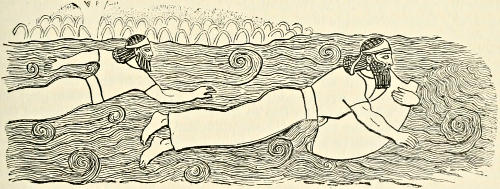
Assyrians crossing River by Means of Air Bags
Of Asshurbanapal as patron of art and literature we shall have occasion
to speak more fully in a later chapter, in referring to the contents of his
famous library. Not less noteworthy than this library was the gallery of
art constituting the walls of the great king’s dining room. We turn now
to the more detailed consideration of the life-histories of Esarhaddon and
Asshurbanapal, as interpreted by a modern authority.a
[681 B.C.]
Sennacherib’s murderers did not stand alone, but had a considerable
following. Asshur-akhe-iddin (Asshur is brother), Esarhaddon, as the
Hebrews call him, who had been already destined to the throne by his
father, had therefore to conquer the crown assigned him at the point of the
sword. Although it was (Tebet) December—Sennacherib, as we have seen,
had fallen on the 20th of this month—and consequently the time favourable
for warlike operations had gone by, yet he perceived that this was a case for
prompt action. He lay with his army in the northwest, but without waiting
a single day, without stopping to collect men, horses, chariots, or material,
without even supplying himself with provisions, and in spite of snow and tempest,
which might be feared at that season, he hurried straight to Nineveh;
“like a bird of prey with outstretched wings.” At Khanigalbat, a neighbourhood
the position of which is unknown to us, but which must be
sought in or near North Aramæa [probably near Melid], the army of the
rebels intercepted him. But these were soon defeated and scattered. A
great part very probably went over to Esarhaddon. The two chiefs of the
rebellion, his brothers, sought safety in flight and were received in Urartu.
That one of them, as Abydenus would have us believe, fell in the battle,
is not very probable. Still it is certain that they never again attempted
to get possession of the government. On the 2nd of Adar (February)
the rising was extinguished, and five weeks later, on the 8th of Nisan, that
is, the beginning of the year 681 B.C. [Professor Rogers gives the month
of Siran, 680, for this date], Esarhaddon mounted the throne of his
father.
When his brothers’ rebellion was suppressed, Esarhaddon was indeed in
safe possession of the Assyrian throne, but by no means in undisputed enjoyment
of the sovereignty over the whole of his father’s empire. He was
continually obliged to engage in wars and to quell risings.
The son of that arch-enemy of the Assyrians, Merodach-baladan, who is
generally called Nabu-ziru-kinish-lishir (Nabu, guide the true scion!), had
naturally taken advantage of the confusion resulting from the murder of Sennacherib
and the war of the succession, to repudiate his allegiance, and may
perhaps have already thought of reconquering Babylon. From Esarhaddon’s
accession he had ceased to send the presents required from a vassal, and had
also omitted to appoint an envoy to offer his homage to the new king, and
thus to recognise his overlordship. He had evidently overestimated the
difficulties with which the king had to contend, and had not anticipated that
the latter would so soon repress the rebellion and be in a position to proceed
against him with decisive energy. It is uncertain whether he himself risked
the attack; it appears, however, that he had already penetrated as far as Ur.
Esarhaddon, who was at Nineveh when he received the news of his defection,
could certainly not now be spared there. But he ordered the governors of
the province bordering on the maritime country to go out against the
rebellious Chaldean at the head of an army which was despatched to them,
and this proved sufficient. According to the Assyrian accounts Nabu-ziru-kinish-lishir
did not await the attack, but fled to Elam. But this realm was
no longer what it once had been. Ummanaldash II, who now reigned there,
was not inclined to endanger the peace of his kingdom and involve himself
in a war with Assyria for a stranger’s sake; the fugitive was seized and put
to death. Na’id-Marduk, who accompanied him on his expedition to Elam,
feared a like fate. He chose the wiser course; he hastened to Assyria, made
his submission, and in reward was invested with the sovereignty of his
brother’s kingdom, that is, of the whole seacoast. Henceforth he faithfully
paid the annual tribute.
[677-676 B.C.]
It was not so easy to put down another movement at another end of the empire.
Very soon after Esarhaddon’s accession, perhaps even before, certain
kings of the west country planned an attempt to free themselves from the
Assyrian yoke. These were the kings of Sidon and of two other cities whose
position is uncertain, but is certainly to be sought east of Sidon, namely
Kundu and Sizu. Over the two last ruled Sanduarri, whose name proclaims
him as one of the Hittites or related to them, and over Sidon, Abd-milkot.
They had to bind themselves by an oath to recover their independence with
their united forces, and fought with great persistence. This is shown by the
fact that they were not subdued till the fourth year of Esarhaddon, and also
of the fearful vengeance of the Assyrians, so little in accordance with this
king’s customary procedure. In the year 677 Sidon succumbed to the
besieging force. The city was plundered, wasted, and depopulated. Town
and citadel were “thrown into the sea” and the place where they had stood
made unrecognisable. The population was brought to Assyria, with all its
goods and cattle and all the treasures of that rich commercial city. But
Esarhaddon did not, like his father, take pleasure in mere destruction. A
new town rose in the place where the former had stood. He called it by
his own name [Kar-Asshur-akhe-iddin], and allowed conquered mountain
peoples and inhabitants of the coast of the Persian Gulf to settle there—the
old means, devised by Tiglathpileser, for absorbing sentiments of nationality
and independence into the unity of the great empire. Abd-milkot
had meantime fled, probably to Cyprus; for Esarhaddon says that he “took
him out of the sea like a fish.” He was overtaken, made prisoner, and put
to death, and in the month Tasrit of the following year, 676, his severed
head reached Assyria. It was some time before Sanduarri was conquered
in his mountain country, but in the month Adar of the same year he suffered
a like fate to that which had overtaken his ally. Then the barbarous
triumph took place in Nineveh. All the captured subjects of the defeated
kings, with the great and distinguished men at their head, were led
through the broad streets of the capital, and two of the noblest carried the
severed heads of the rulers round their necks. Revolt against the supreme
king, which meant sin against Asshur, the god of the gods, when conducted
with much obstinacy as was displayed by these two men, could not be
severely enough punished.
If Esarhaddon intended by these severities to spread terror among the
kings of the west country, he attained his object. Although according to
the wont of the Assyrian annalists, the scribe places the narrative of the war
in the king’s own mouth, he took no personal part in it, but remained quietly
at Nineveh. Thither now came the ambassadors of some twelve kings,
whom the Assyrians called simply Khatti-kings and kings of the seacoast,
and with them those of ten kings who ruled in Cyprus, to offer him their
homage and presents.
When the ten Cypriote rulers, whose names have for the most part a
Greek sound, joined in the homage of the Assyrian, Phœnician, and Canaanite
kings, it is obvious that Esarhaddon’s army, when it pursued the flying
king to Cyprus, had there re-established the Assyrian rule which had not
been exercised since the time of Sargon.
All these princes had to bring him costly material for the building of
his great palace at Nineveh. There is an inclination to credit Esarhaddon
with a special preference for Babylon, and to assume that he had made that
town his headquarters, at least towards the end of his life. Our knowledge
of the building he erected is, however, not favourable to this view. He certainly
governed directly and not merely by vassal-kings that part of his
realm of which Babylon was the capital, and there are good grounds for the
assumption that he actually cherished the intention of establishing himself
at Babylon; but it is none the less certain that for him, as for his fathers,
until the nomination of Asshurbanapal as vassal-king of Assyria, the centre
of the dominion was Assyria, and the Assyrian capital was his chief home.
[676-673 B.C.]
Although Esarhaddon now imitated his father in his care for the decoration
of the Assyrian capital, he did not limit himself to this so exclusively
as his predecessors. On the contrary he boasts of having built the temples
of the town of Asshur and Accad, and of having adorned them with silver
and gold. That he did not neglect Accad or Babylonia is shown by the
work, which surpassed all other undertakings, completed in his reign and
for which he gave orders in his early years,—the reconstruction of the
ruined capital itself.
In Elam it was with disapproving eyes that men regarded this renovation
of Babylon by an Assyrian king and with it the re-establishment of the
Assyrian rule in that territory. The king of Elam, Ummanaldash II, therefore
decided to attack Esarhaddon in this part of the country. In 675, the
sixth year of Esarhaddon’s reign, he invaded Babylon with an army, we
know not on what pretext, and penetrated as far as Sippar. The misfortune
was not, however, a lasting one. In that very year Ummanaldash died
in his palace. Perhaps there is some connection between these Elamite
disturbances and Esarhaddon’s campaign against the (to us) unknown
country of Ruriza which he conquered in Tebet of the year 673. This may
be said with certainty of the measures which he took against the Gambuli.
That warlike Aramaic-Chaldean race, which had once constituted the
vanguard of Merodach-baladan’s army, had then, at least, dwelt in a swampy
tract of country where they lived “like fish in the midst of the rivers.”
At this time their king was Belbasha (En-basha?), the son of Bananu, and
in his impracticable country he had been able to preserve his independence.
It was not he and his Gambulians that Esarhaddon now feared, but rather
that he might easily be won over to ally himself with his neighbour Elam.
Belbasha is pressed to choose and Esarhaddon makes ready to convince him
by the unanswerable argument of his arms. But the Aramæan does not
wait for the struggle. Knowing well that he has now no help from Elam
to look to, he decides of his own accord to attest his submission to Assyria
and sends the required presents. Thus Esarhaddon gains his object. The
submission is accepted, the country spared, the capital, Shapi-Bel, extraordinarily
fortified, the command laid on the prince to furnish it with bowmen
and to defend it as “the door which unlocks Elam.” How well Esarhaddon
had judged was to be shown later, when his heir had to punish the son and
successor of Bel-basha for his intrigues with Elam.
[673-672 B.C.]
These few facts, with the circumstance that, in the same year, 673,
probably while the court was at Babylon, the queen died, are all that we
know concerning the history of the southern realm under the reign of Esarhaddon.
More is known of the king’s warlike expeditions, or at least those of his
army, for it is not likely that he himself took part in them all. Some of
them are of little importance to history, or were directed against tribes
whose locality we can no longer determine. We pass them over in silence
here. Attention may, however, be called to an expedition against Teushpa,
the king of the Kimmirri or Cimmerians, or more accurately against the
Umman-manda, who dwelt at a great distance, and who were afterwards to be
the cause of so much trouble to Asshur and Babylon. The Cimmerians are
also referred to in other records as the enemies of Assyria in Esarhaddon’s
day. According to these they joined in a great coalition which was formed
against Asshur; at its head stood Kashtariti of Kar-Kasshi, a Median
prince, who evidently dwelt on the borders of Elam, and Mamitiarsu, governor
of the Medes, and to which the Manneans also belonged. At the
outset, at least, they were successful, took several towns now unknown to us
(Khartam, Kishassu, and five others), and so great was the fear which they
thus spread through Assyria, that in order to propitiate the gods, the priest
(amelu khalti) was commanded to perform sacred rites and celebrate festivals
in their honour from 3rd Airu to the 15th Abu—that is, during one
hundred days. The issue of the struggle is not given in the Assyrian
records, but it appears that the Babylonian chronicle told of the invasion of
Assyria by the Kimmirri and of their defeat.
Perhaps this gave Esarhaddon an opportunity to revenge himself on the
Medes and to conduct a war against their country with great persistence.
He penetrated farther into it than any of his forefathers—namely, to the
land of Patusharra (Patiskhoria?) which lay deep in Median territory, in the
neighbourhood of the Bikni Mountains, where so much crystal was found.
There ruled Shitir-parna and Eparna, two powerful princes whose names
appear to be Iranian. They were subdued by the Assyrians and carried to
Assyria with a rich booty, consisting chiefly of cattle, horses, and chariots.
This visitation had the result that other princes from farther Media, who
had not hitherto acknowledged the Assyrian supremacy, came of their own
accord and tendered their submission.
At the other extremity of his empire, Esarhaddon maintained his sovereignty
in the same fashion. The means by which Assyria had made herself,
and remained during many centuries, the mistress of western Asia, was the
pursuit of a traditional policy whose principles the impulsive Sennacherib
had forsaken in the most deplorable fashion, but which distinguished Esarhaddon,
as well as his grandfather Sargon. By a judicious blending of
gracious forgiveness on the one hand and severe punishment on the other,
he managed not only to confirm Assyrian sovereignty in the northern regions
of Arabia, but also to extend it. Faithful to the rule by which those who
had submitted of their own accord must be at once taken in favour, and
admitted as allies, he listened to the petition of King Hazael (Khazailu) of
Kedar when the latter came to Nineveh and requested that the images of the
gods which had been carried thither, might be given back. Esarhaddon had
them restored, caused his name and his famous deeds to be inscribed on them,
and gave them back to Hazael. But on this king’s death he took care that
the latter’s son Ya’lu, whom he raised to be king in his father’s stead, should
be still more closely bound to Assyria and pay higher tribute. Under the
same condition he restored to another tribe, together with the gods of which
they had been previously despoiled, a certain princess Tabua who had been
carried away from their midst and had grown up in the royal palace at
Nineveh, and thus reinstated her in her position. It was soon evident that
he had an object in these tokens of favour. He wished by this means to
smooth himself a path to some Arabian tribes beyond, which were still
independent and therefore dangerous to the frontiers, and who roamed about
in the land of Bazu and in the mountains of Khazu. The march thither was
very difficult, 180 kashbu kakkar (double hours) through an arid desert full
of snakes and scorpions, so that it appeared almost advisable to secure a
safe retreat. If the expedition against these remote tribes had failed, we
should have learned nothing of it, at least from Assyrian sources; but it was
successful. Six Arabian kings and two queens were defeated and probably
put to death, and their treasures, gods, and subjects were then carried to
Assyria; so many of the latter, at least, that the remainder were unable to
defend themselves.
[672-671 B.C.]
The glory of Esarhaddon’s reign is the conquest of Egypt, for which the
Arabian campaign, just described, no doubt served as a preparation. A
decisive contest with Egypt was sooner or later unavoidable, especially since
Tirhaqa had just brought the divided kingdom into a certain unity and was
evidently striving again to raise it to the position of a great power.
In the year 672 Egypt took the first step. As usual, the prize was the
overlordship of the West. Tirhaqa managed to persuade Baal, the king of
Tyre, to break with Assyria, and thus threatened to draw the whole of the
Mediterranean coast into rebellion. Prompt measures were taken, and in
Nisan of 671 a powerful Assyrian army marched westward. The immediate
goal is Tyre. It is surrounded and the water-supply cut off. Without
waiting for the town to fall, Esarhaddon now proceeds south and halts at
Aphek, not far from Samaria, thence within fifteen days, with a certain caution
and perhaps not without encountering resistance, he leads his army to
Rapikhu [Raphia] on the Egyptian stream which forms the boundary between
that country and Canaan. Unfortunately the text breaks off abruptly
where the narrative of the actual struggle with Egypt begins. But we learn
from other sources that the object was attained and Egypt conquered. On
the 3rd, 16th, and 18th Tammuz (June) three battles were fought, in which
the Assyrians remained victorious. Memphis was taken on the 12th of the
month, and although Tirhaqa succeeded in fleeing to his own land of
Ethiopia, his son and his brother’s sons were taken prisoners.
[671-668 B.C.]
Esarhaddon was now actually king over Egypt, and here again shows
himself to be a prudent ruler. He was content with the title of dignity of
“King of the Kings of Egypt”—that is, with the overlordship of the country.
Had he incorporated it into Assyria, he would have weakened rather
than strengthened his empire. His sole aim was to keep it disunited and consequently
weak, and by the expulsion of the Ethiopian to put an end to the
latter’s dangerous intrigues in the west. Therefore he did not put in his
own generals, courtiers, or governors, but sought to bind the provincial
princes to him by granting them a certain measure of independence. The
sole danger for him lay in a united Egypt under the warlike king on whose
assistance the ever restless kings of Phœnicia, Philistia, and Canaan might
reckon; and he therefore contented himself with obtaining from the
provincial princes an oath of fidelity to Assyria. Only the supremacy of
Asshur must be distinctly apparent, so the Egyptian name of the northern
capital, Saïs, was altered to the Assyrian one of Kar-bel-matati (fortress of
the lord of the lands), and that of Neku’s son into Nabu-shezib-anni (Nabu
preserved me!). After this Esarhaddon went back to Assyria, and on his
homeward march he gave orders to carve his royal image and the account of
his conquest of Egypt on the rocks by the Dog River (Nahr-el-Kelb) at
Beirut, where, besides inscriptions and images of various Egyptian kings,
some of his forefathers had caused theirs also to be cut.
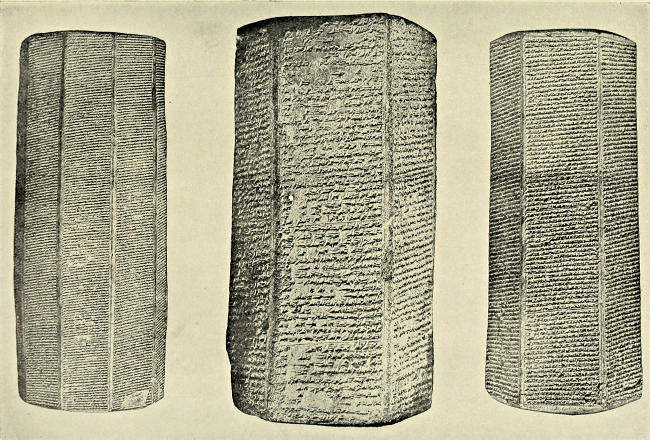
THE PRISMS OF SENNACHERIB, ESARHADDON AND ASSHURBANAPAL
The conquest of Egypt is the last great undertaking of Esarhaddon’s
reign, which was to last only two or three years longer. In the year 670 he
was occupied with Assyrian affairs, all details of which are, however, wanting.
But by the following year it had become manifest that conditions in Egypt
were not permanently settled. It was evident that a new expedition to the
valley of the Nile was imperative. Esarhaddon assembled his forces and
proposed to head his troops himself, to assert upholding the Assyrian domination
in Egypt. Yet first—perhaps because he already had a presentiment
of his approaching end, or because he did not trust the aspect of internal
affairs—he appointed his eldest son, Asshurbanapal, as co-ruler in Assyria;
if we are not to assume, what is also possible, that this was done before the
campaign of the year 671. The expedition came to nothing. On the 10th
of the month Arakhsamnu (Marsheshwan, about October), of the year 668,
in the twelfth year of his reign, the king died, either in Egypt or, as it is
probable, before he reached it.
As the great king of a mighty empire Esarhaddon indeed stands very
high; for although he was not more soft hearted, or, indeed, where insubordination
had to be punished, less harsh than his predecessor, yet he did not
act in obedience to ungoverned passion, but with deliberation, and this foresighted
policy allowed him always to choose the golden mean between
needless severity and dangerous indulgence. In a few years he strengthened
the foundations of the Assyrian rule, and considerably extended it; he
erected magnificent buildings, and made desolated Babylon rise again from
her rubbish-heaps. By raising his son, Asshurbanapal, to the throne during
his own lifetime, he made a struggle for the possession of the crown such
as that with which his own reign had begun an impossibility, while by his
wise and firm government he had laid the foundations for his son’s long,
and, at least in the beginning, brilliant and glorious reign. Sennacherib
had little in common with his great father; Esarhaddon was worthy to be
the grandson of Sargon.
We have already seen that Esarhaddon made his son Asshurbanapal
vassal-king of Assyria during his own lifetime. With festive display
the young prince entered the royal palace which his grandfather Sennacherib
had built, where his father Esarhaddon was born, and grown to
manhood and had since held his court, and where he himself, as a friend of
learning and science, now began to collect that extensive library which, after
centuries had passed, was to make his deeds and the traditions of his nation
known to the learning of the West. There in the presence of his father and
his brothers, of the princes, captains, and great men of Assyria, he received
the oath of fealty from the dependent kings and courtiers, calling on the
name of the gods and binding themselves to obedience to his commands, and
the maintenance of the ancient laws and institutions. It was an important
step on the part of the old king. He did not indeed resign the government
of Assyria. He remained king over this part of his kingdom as well as of
the others, and the dignity to which he raised his son was only the petty or
vassal-kingship, a filial government under his own still existing supremacy,
whilst he was himself apart from this primarily king of Babylon, Sumer,
and Accad, as well as king of the kings of the Egyptian countries. But for
this very reason the appointment of the crown-prince as vassal-king of
Assyria, in reality implied the transformation of that country, hitherto
the centre of the empire, and whose capital had been the seat of the central
government, into a kingdom occupying merely a secondary position, whilst
Babylon became the seat of the chief rule and assumed the first place. It
had become manifest that the true centre of the empire had shifted to Babylon,
and that the latter now possessed more vital energy than Assyria.
[668-664 B.C.]
Esarhaddon’s death had opened up to the Ethiopian the prospect of a
reconquest of his lost territory. It was to be expected that Tirhaqa would
take advantage of an opportunity so favourable to him, and soon, no doubt
as early as the year 668, there came a messenger to Nineveh with the
announcement that the king of Cush had marched into Egypt and not only
overrun the whole south of the country, but had even made a triumphant
entry into Memphis, the town which Esarhaddon had included in Assyria.
The governors whom the last Assyrian king had set up had not indeed gone
over to the enemy, but neither had they ventured to resist him. On his
advance they had deserted their chief towns and retired with their armed
forces to the desert. Asshurbanapal recognised the gravity of the event,
for it endangered the peace of the coast districts along the Mediterranean.
He did not himself take the field, but he immediately sent a considerable
force into the west under the leadership of the Tartan and other captains.
The latter proceeded to Egypt by those forced marches for which the Assyrian
army was distinguished, and hastened to the assistance of the governors
who were hard pressed by Tirhaqa. At Karbanit, or Karbana, a town which
lay west of the Canopic branch of the Nile, near its mouth, the armies joined
battle. The defeat of the Egyptians was so complete that Tirhaqa thought
it advisable to evacuate Memphis without giving himself time to break up
his camp. This and all the Ethiopians’ armed river-boats fell into the hands
of the Assyrians. Tirhaqa withdrew to Thebes and entrenched himself
there.
Asshurbanapal, who had been informed of these successes of his army,
decided to attack the enemy in Thebes. But as the Tartan’s army had also
greatly suffered, he ordered the Rabshakeh, who apparently commanded the
garrisons of the West, to collect a new army from the soldiers and auxiliaries
under his command belonging to all governors and vassal-kings west of the
Euphrates. Impressed by the defeat which Tirhaqa had sustained, the
twenty-two kings of the seacoast, the plain, and the island of Cyprus
hastened to obey this command, and not only to furnish soldiers, but also on
demand of the supreme king to supply ships for the purpose of blockading
the coast and prevent possible attempts at risings on the part of the maritime
states on the banks of the Mediterranean, and perhaps also for sailing
up the Nile. This army pushed on to join that of the Tartan and the troops
of the loyal Egyptian vassals, and the united forces then marched against
Thebes, which was reached a month and ten days later.
Meanwhile Tirhaqa had abandoned the town itself while it was still time,
and had entrenched himself on the other bank of the river in the city of the
tombs. Besides this, he had persuaded three of the principal vassal-kings to
desert from the Assyrian and go over to his side. These were Sharludari,
prince of Pelusium (Si’nu), Pakruru, ruler of Pisept in Egyptian Arabia,
and no less a person than Neku himself, the king whom Esarhaddon had
placed at the head of all. They even seem to have taken the initiative,
because they preferred to have a ruler of kindred race as overlord, rather
than obey a foreigner. So they offered to conclude an alliance with the
Ethiopian, by which his supremacy was recognised, and they undertook the
defence of Lower Egypt. Had their design succeeded, the Assyrian army
would also have had a hostile power in its rear and have seen its retreat cut
off. But fortunately for the Assyrians the conspiracy was discovered.
Their messengers were seized, the letters intercepted, and their cunning
plans thus cunningly frustrated.
But first Asshurbanapal had followed the example of his father and pardoned
Neku. After he had exacted from him an oath of fealty to Asshur,
and laid him under heavier burdens than before, he again put upon him the
royal purple and furnished him with the symbols of his office: golden rings
on hands and feet, a carved sword in a golden sheath, horses, and chariots;
and so he sent him back to Egypt, that he might rule it as chief of
the other vassals in Asshur’s name. He himself was again invested with
Kar-bel-matati,—that is, Saïs,—and his son, Nabu-shezib-anni, received the
principality of Athribis in Lower Egypt, to which also a significant Assyrian
name, Limir-shakku-Asshur (let the governor of Asshur beware) was given.
The other kings also renewed their alliance with Assyria. But Asshurbanapal
did not omit to strengthen the garrisons, and to give those whom he had pardoned
Assyrian officers intended to keep a watchful eye upon them.
For a time Egypt enjoyed peace under Neku’s sway and Assyria’s lordship.
But after the death of Tirhaqa, Tamut-Amen, too, began to think of
a reconquest of Egypt. He set out with his army, and like the former
Ethiopian king, is hailed with delight in Elephantine and Thebes as a
deliverer; then after he has fortified the southern capital, he continues his
march to Memphis, where he first encounters resistance. But the rebels, as
the king calls them—these were of course the Assyrian garrison with the
troops of Neku who ruled over Memphis and Saïs—were so thoroughly
beaten in a desperate sally, that they evacuated Memphis and retired to the
strongholds of the Delta. Some princes headed by that Pa-Kerer (Pakruru)
of Pisept, who had always borne the Assyrian yoke with reluctance, came to
offer their submission, which was graciously accepted. This was the last
time that an Assyrian army undertook a campaign against Egypt.
While Asshurbanapal had restored his supremacy in Egypt for a certain
time, for the present at least, it was unshaken in the northern provinces of
the West. The most important event mentioned by the Assyrian record of
these days (evidently about 664) is the accession of Lydia. Asshurbanapal
relates that the Lydian king, prompted by a dream which revealed to
him the magnanimity of Asshur, sent his ambassadors to Nineveh to request
the alliance and protection of the great ruler. For the deity had said to
him that by the renown of this name he should overcome his enemies. He
did in fact succeed in doing so. The Cimmerians were beaten by him. It
may be assumed, though it is not stated, that Gyges received other help
from the Assyrians besides the recognition as their ally. However that
may be, he conquered, and, on the successful termination of the war, sent two
Cimmerian rebels with a great present to Nineveh. There they were no
little flattered at this homage, but also no little embarrassed to make themselves
understood by the newcomers, or to understand them; for even at a
court where, as the Assyrian writer says, the languages of East and West
were met together, there was no one acquainted with the speech of these
barbarians.
Probably for the same reason as Gyges, Mukallu of Tabal, his eastern
neighbour, and Yakinlu of Arvad, with perhaps also Sandasharme, of Cilicia,
placed themselves under the protecting wing of Assyria. Knowing the tastes
of the great ruler of nations, each of them sent him a daughter for his
harem, with a rich present, and it appears that this was the custom. Some
even, that they might exhibit the more zeal, sent him, besides their own
daughters, those of their brothers and other relatives.
In the east, too, Asshurbanapal manifested the still unbroken superiority
of his arms. There, shortly after or at the same time as the Egyptian campaigns,
he had already chastised a mountain people whose raids had greatly
distressed the inhabitants of Yamudbal [E-mutbal], on the borders of Elam,
so that the chiefs of the town of Dur-ilu had made complaints concerning
them. He had sent a force which subdued the tribe, brought the chieftain
Tandai alive to Assyria and carried off a great number of captives. The
king had them taken to Egypt and in their place peopled the wasted country
with prisoners of war from other regions.
[664 B.C.]
Of far greater importance was the campaign against Man. The cause is
not stated, but may well have been that the king of Man, Akhsheri, declared
himself independent, or had shown an evident disposition to attack Assyria.
If this were so, he had been over-hasty in his proceedings. However little
of the warrior there may have been in Asshurbanapal’s nature, the Assyrian
army, in the early periods of his reign at least, was yet too fearless and its
commanders too valiant for any man to be able to defy the powerful monarchy.
Akhsheri attempted a night surprise of the troops sent against him,
before they had even crossed his frontiers; but in this he was not successful.
The Manneans were defeated in a bloody battle, and for a distance of six
leagues round their dead covered the battle-field. Nothing retarded the
victorious army from entering Man, where it laid waste eight great towns
whose position is unknown to us, as well as a crowd of small places, and so
reached the domain of the capital, Izirtu. It was surrounded, together with
the towns of Urbija and Armijate, and after the inhabitants, driven to the
last extremity, had surrendered, they were led away and their whole territory
conquered and laid waste.
But the object was attained. The frightful misery of the war which had
visited that unhappy country had embittered the population against the man
to whom they ascribed its guilt, namely, their old king, Akhsheri. In any
case, he had shown his incapacity to defend his country. With all his brothers
and his father and family, he was put to death, and so great was the
nation’s fury that they would not even concede him an honourable tomb, but
threw the corpse on to the streets of his city. His son Ualli, himself already
a middle-aged man, was raised to the throne, and he hastened to acknowledge
Assyria’s supreme authority. He sent his young son to Nineveh, to
kiss the monarch’s feet, and did not neglect to send his daughter also, to
add to Asshurbanapal’s crowd of women. His submission was of course
accepted, but his annual tribute was raised by some thirty horses. Other
attempts at rebellion in the northeast were soon suppressed.
[ca. 664-648 B.C.]
But whilst these disturbances in the northeast were suppressed without
much difficulty, in the southeast signs soon appeared which gave warning
of that great storm which in a few years was to be raised there and to
threaten the empire with destruction. The throne of Elam was still occupied
by Urtaki, who had always preserved a friendship with Esarhaddon,
and had received from him repeated tokens of good will. Asshurbanapal
had followed up this policy of his father and treated Urtaki as an ally, and
when Elam was suffering from a severe famine after a prolonged drought he
had not even refrained from extending a helping hand. He sent grain into
the afflicted country, and not only permitted those of Urtaki’s subjects who
fled to his country to settle there, but also allowed them to return to their
native land, unhindered, when the rains had again appeared and a sufficient
harvest secured. If in this he was prompted by motives of policy it was at
least an intelligent and peaceable one. In a proclamation to the Elamite
tribe of the Rash, and the tribes of the Sea Lands, he could appeal with truth
to these tokens of neighbourliness. But they did not prevent Urtaki from
taking arms against him and invading Babylonia.
It seems that Asshurbanapal could scarcely believe the news which he
received. Instead of hurrying to the spot to avert the danger, as had been
the custom of his warlike father, he sent a messenger to inquire into the
state of affairs and to report to him upon it. The latter returned with the
tidings that the Elamites had poured themselves over Accad like a swarm of
locusts, and had even set up a fortified camp in sight of the city of Babylon.
He now hastily collected an army which drove the invaders from Accad, and
even inflicted a defeat on them on the frontier. It is with a certain unction
that the Assyrian scribe recounts the melancholy fate which soon after
overtook all these enemies of his king. In the year which followed these
events they all died: Bel-basha, as it seems, from a poisonous bite; Nabu-shum-eresh
in a flood; Urtaki and his generals, in their despair, by their
own hands in each other’s presence. Whether the narrator learned this on
good authority or had only heard it from rumour, can scarcely be determined;
but that in reality they all died soon after is certain; for in the subsequent
war with Elam, sons or successors are found in their places.
The crown of Elam fell to Teumman, brother of the two previous kings,
who was “like a devil,” says our Assyrian informant. That he was a tyrant
who would shrink from no means of preserving his power, was also the conviction
of the relatives of Ummanaldash and Urtaki, the last two kings of
Elam. The one had left two sons, Kudurru and Paru, the other three, Ummanigash,
Ummanappa, and Tammaritu. Well aware that their uncle was
determined to remove them from his path, with all that belonged to them, in
order to secure the succession to his own son, they abandoned their country
with a great following, among which were included sixty members of the
royal family and a bodyguard of bowmen, and sought shelter and protection
with Asshurbanapal.
Naturally Teumman could not let this pass unnoticed. He therefore
hastened to despatch two ambassadors to Nineveh, Umbadara, an Elamite,
and a Chaldean, Nabu-dammik, and to demand through them the surrender
of the fugitives. But Asshurbanapal, encouraged by favourable omens,
dreams of his seers, and oracles of the gods; in other words, incited by his
priesthood to whose guidance he always submitted in pious zeal, steadfastly
refused to comply with Teumman’s demand and assembled an army. In the
month of Ulul it was ready to march. He did not himself take the field, for
in fact his army, led by one of his generals, had merely to support the Elamite
force of Ummanigash, his brothers and cousins. Ummanigash himself
was generalissimo, if only in name. The Assyrian general was empowered
to set Ummanigash on the throne of Elam in the name of the Assyrian
supreme king, after the conquest of the country.
Teumman was also in the field with an army. But when he learned that
the troops of his rival and of the Assyrians had already marched into the
towns of Dur-ilu, which lay not far from the frontier of his country, and
several times therefore had been the scene of a struggle between the two
powers, he turned back, abandoning the western provinces of his kingdom,
and entrenched himself in his capital, Shushan [Susa], which lay on the
eastern bank of the river Ulai [modern Karun]. Meanwhile the allied Assyrians
and Elamites entered the royal city of Mataktu, which lay to the
west of that river, and there Ummanigash is crowned king. Teumman, indeed,
makes one more effort; owing to the damage which the text had undergone
it is not exactly shown of what kind, but from the context it is plain
that he sent out an army in vain to hinder the advance of his enemies.
The latter, once more encouraged by a dream, cross the river after Teumman’s
troops have suffered a defeat at Tul-Liz, and now attack Shushan itself.
There the decisive battle takes place. It ends with the complete defeat of
the Elamites: a great massacre begins, the river is filled with corpses,
and innumerable women wander about the neighbourhood lamenting.
Many distinguished and a large number of lesser prisoners fall into the
hands of the Assyrians. All seek safety in flight. One of Teumman’s sons,
who had advised him against the war and had foretold the issue, rends his
clothes in his despair. The eldest son, Tammaritu, follows his father in his
flight to the forest, and when the king’s chariot breaks down there, they are
overtaken and both slain. The king’s head is sent as a trophy to Assyria,
where it was set up on the great gate of Nineveh, an eloquent witness to the
nation of the might of Asshur and Ishtar. His son-in-law, Urtaki, himself
begged an Assyrian to cut off his head and send it as good tidings to Asshurbanapal.
Yet others of the great men of the kingdom come of their own
accord and make their submission. The chief magistrates of the province of
Khidali behead their own prince, Ishtarnandi, and one of them himself
brings his master’s severed head into the Assyrian camp. Tammaritu, the
third brother of Ummanigash, entrusts the government of this principality
to the Assyrian generals, and Ummanigash himself now makes his entry into
Shushan, and is there crowned as a vassal of Assyria. As pledge of his
loyalty he delivers a grandson of Marduk-bal-iddin, better known by the
Hebrew appellation Merodach-baladan, probably the author of the whole
resistance to the Assyrian king, to the latter’s representatives.
But the war was not ended with the punishment of Elam. Dunanu, the
son of Bel-basha, prince of Gambul, was now to be taught what it was to
side with the enemy. The army, on its return from Elam, breaks into his
territory, conquers the capital Shapi-Bel, carries away from it all who have
not fallen by the sword, lays the whole place waste, and flings the ruins into
the waters of the stream which flows around it; whereupon a motley crew
of human beings are raked together and brought there to re-people the
desolate country.
It was a grim revenge that was taken on all enemies, even when they
were already dead, on their corpses. At the triumphal entry of the army
into Nineveh, Dunanu was compelled to carry the head of his ally, Teumman,
round his neck. When Teumman’s ambassadors, who had remained in Nineveh,
saw this, one of them tore out his beard in his despair, and the other
plunged a dagger into his own heart. Dunanu was placed on the rack in
Arbela and died in tortures. All his brothers, including Samgunu, as well as
Merodach-baladan’s grandson and his brothers, were also put to death; the
chiefs of the Gambuli were even flayed, after they had had their tongues
torn out as blasphemers of the high gods, after which all corpses were cut
in pieces, and were then sent all over the empire, in token of the overlordship
of Assyria. With a refinement of cruelty Asshurbanapal even caused
the corpse of his old opponent, the Tigenna Nabu-shum-eresh, which he had
had brought to Assyria from Gambul for the purpose, to be disfigured in
the great gate of Nineveh by the latter’s own sons. Even before all this
was brought to a conclusion, Sarduris III of Urartu, perhaps because he was
already threatened by the Iranian enemies, who were soon to put an end
to the Kingdom of Van, and was anxious to obtain the help of his powerful
neighbour, despatched an ambassador to the latter. Asshurbanapal did
not omit to make use of the occasion to bring Teumman’s ambassadors before
the newcomers, in order to inspire the former with a consciousness of his
greatness, and to give the latter a warning example in case their sovereign
also should prove unfaithful.
Thus the greatest danger that had hitherto threatened the empire seemed
permanently averted, and if ever a pitiless revenge was qualified to deprive
the conquered nations of the desire to fight for their independence, this must
certainly have been the case after such a sanguinary judgment. But it was
soon to be manifested that it had availed nothing. Assyria had only
succeeded in making herself more detested than before, and had only stirred up
princes and peoples alike to resist everything rather than any longer endure
the yoke of the hangman of Asia.
About the year 652 a formidable war broke
out against Assyria. It had, perhaps, long
been secretly preparing before Asshurbanapal
had any suspicion of the danger which threatened
him. He believed that his conciliatory
policy had secured the permanent attachment
of the Babylonians. He had invested his
brother, Shamash-shum-ukin, with the royal
dignity, raised him to be lord of all Sumer
and Accad, and had placed an army of foot-soldiers,
horses, and chariots at his disposal.
Those of the inhabitants of towns, plains, and
farms who had left the country during the
period of anarchy, or had been carried off, he
had permitted to return. As for the Babylonians
who had settled in Assyria, he did not
merely place them on a level with his own immediate
subjects, but treated them with especial
distinction, continued the privileges which
Esarhaddon had granted them, and raised
them to important offices, and they even moved
about his royal court unmolested, clad in magnificent
garments with golden ornaments. They
still continued to protest their submission to
the Assyrian domination, yet all the time
they were conspiring with Shamash-shum-ukin
against the king.
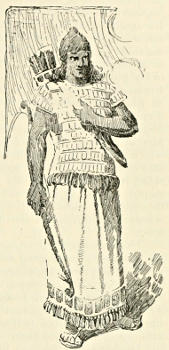
An Assyrian Bowman
The first intimation of this conspiracy came
to the king from Kudur, the governor of Erech. This faithful servant had
received from Sin-tabni-usur, the governor of Ur, information to the effect
that envoys from the king of Babylon had been there and that some of the
people had already risen. Sin-tabni-usur had no mind to give ear to the
proposals from Babylon, and had consequently requested reinforcements.
Kudur sent him five hundred men, who, at his request, were afterwards
increased by troops belonging to the governor of Arpakha and Amida.
But it seems that Sin-tabni-usur was unable to maintain himself until these
supports came up, and even before their arrival found himself constrained to
go over to the party of the rebels.
Asshurbanapal was soon to learn with horror that the movement, the
soul of which was his disloyal brother, had spread with great swiftness, and
that Kudur’s anxiety was not without foundation. Shamash-shum-ukin
sent messengers in all directions, and they did not work in vain. All
Accad and Chaldea, all the Aramæans of Babylonia, all the inhabitants of
the Sea Lands joined with him. His chief ally in this district was: Nabu-bel-shume,
grandson of Merodach-baladan, that irreconcilable enemy of
Assyria, who was now king of Chaldea; Mannuki-Babili, prince of Bit-Dakkuri;
Ea-shum-basha, prince of Bit-Amukkani, and Nadan of Puqudu.
Ummanigash, king of Elam, who owed his throne to Asshurbanapal, was also
gained over by Shamash-shum-ukin. Asshurbanapal had fancied that he
might venture to impose on the Elamite, who owed him so much, conditions
which the latter could certainly only fulfil with great difficulty. He had
demanded the restoration of the goddess Nana of Erech, which had been in
the possession of Elam for centuries, and whose worship had become so
popular that the kings still sent their gifts to the goddess of Erech. Ummanigash
could not comply with this demand without exciting universal
discontent in his kingdom, and, doubtless, in consequence of this, was all
the more inclined to listen to the proposals of the Babylonian prince. They
were supported by a rich gift, for which the temple treasures of Bel-Marduk
in Babylon, of Nabu in Borsippa, and of Nergal in Kutha had been plundered.
Ummanigash immediately sent auxiliaries to Chaldea. The Guti nomads
on the Assyrio-Babylonian frontier, the kings of the West, with Baal of
Tyre at their head, and the king of Melukhkha, by whom Psamthek is here
doubtless meant; these, too, Shamash-shum-ukin found prepared to join
him in a rising against Assyria. The secession of Gyges, king of Lydia,
who had previously concluded an alliance with the Egyptian king, probably
also belongs to this time, and it is certain that various Egyptian sheikhs also
sided with Babylon. Only the peoples of the northeast and north of the
empire appear to have taken no part in the movement. They were held
in check by the energetic governors of Amida and Arpakha, the last of
whom even prevented the north of Elam from rising against the supreme
king.
There was need of energy and wisdom to exorcise the storm, which was
approaching from so many sides at once. Asshurbanapal, with whom religion
occupied so prominent a place, of course turned first to his gods. But he did
not neglect active measures. Yet it is not clear or probable that he himself
took up arms. When Tammaritu came to him in the year 650, he was at
Nineveh. But in the preceding years he had sent out various armies to attack
the allies at different points. As soon as the news from Babylon reached
him, he issued a proclamation to the Babylonians, in which he denounced
his brother’s treachery as ingratitude and exhorted those whom he had so
favoured not to join Shamash-shum-ukin. It is true that these words found
no echo amongst the nobility of Babylon, but they were not perhaps without
influence on the temper of the nation. At any rate, the latter finally turned
against their king. When Ummanigash’s troops invaded Chaldea and
Kardunyash, in the year 657, they encountered an Assyrian force. At the
head of the Elamites was the son of Teumman, that Elamite king whom
Asshurbanapal had put to death, and who had been chosen by Ummanigash
as his general, because he had the death of his father to revenge on the
Assyrians. With him came the governors of Billate and Khilmu, Zazaz and
Paru; Attumetu, the captain of the bowmen, Neshu the Elamite commander,
and a Babylonian division joined them. The account of the battle is too
much damaged for us to form any conclusion about it. But it is evident
that the Assyrians obtained some success, to which the severed head of
Attumetu, which was sent to Asshurbanapal at Nineveh, bore witness.
It was not so easy to coerce the chief author of the war. Shamash-shum-ukin’s
first measure was to close all the gates of Babylon, Borsippa, and
Sippar, to place garrisons in all places of any importance, and make himself
master of all the towns in Babylonia. As a sign that he renounced his
allegiance, he caused all the sacrifices to the highest gods, which Asshurbanapal
had instituted, to be suspended, and appropriated all the gifts assigned
to them, a measure which excited the indignation of the supreme king more
than anything else.
This happened in the year 650, for it must have been in the April of that
year that Bel-ibni was appointed governor of the lands on the coast. Chaldea
and the surrounding territories were now also subdued. These had revolted
in the previous year after Shamash-shum-ukin had raised the standard of
rebellion in the year 652. On the 4th Nisan 651, Merodach-baladan’s grandson,
Nabu-bel-shume, had collected an army of Accadians, Chaldeans, and
Kardunyashu (the men of the coast) in which he had included the Assyrians
whom Asshurbanapal had sent him as auxiliaries or garrison. Between the
22nd Tammuz and 22nd Abu of the same year, Sin-tabni-usur, the governor,
had joined them, and between 7th Abu and the 7th Ulul the Elamite auxiliaries
had also marched up. But in the end the Assyrian army had defeated
them all and compelled the Elamites to retreat. Nabu-bel-shume had followed
them with his troops to Elam. The Assyrians, on whom he could not
depend, he had previously sent under a reliable commander in the same
direction, very probably under pretence of letting them march against Elam,
and thus had delivered into the hands of Indabigash. Perhaps this defeat
was the cause of Tammaritu’s fall. It must have at least followed soon after.
The south of Babylonia was certainly again brought under the Assyrian
dominion towards the end of year 651.
Asshurbanapal could now turn his thoughts to attacking the arch-rebel
in his own territory. It seems that the latter had again entered into relations
with Elam, and either now went there in person or sent messengers.
But on the 17th Arakhsamnu (Marsheshwan) 651, Asshurbanapal’s
warriors advanced against his brother. In the year 650 they stormed in
fearful fashion through northern Babylonia, instituted a formidable massacre
of Shamash-shum-ukin’s subjects in town and country, made themselves
masters of the canals, and finally surrounded Sippar, Babylon, and Borsippa,
which the Babylonian king had fortified. The siege must have lasted
a year or two, for it was not till 648 that the capital was taken.
And it would not have fallen then—so obstinately was it defended—had
not the misery within the walls reached the acme. The famine was so
dreadful that the besieged fed on the flesh of their own children, and famine
was followed by plague. The gods themselves fought for the Assyrians, as
the historian remarks. Then despair fell upon the people. In their fury
they laid hold on Shamash-shum-ukin, and threw him, doubtless together
with some of his satellites, into the fire. The town was then, of course,
handed over to the enemy, and thus escaped the fate which Sennacherib had
already inflicted on it. A strict trial was held. Those who had been
concerned in the rebellion, such of them as had escaped the sword, hunger,
and plague, who had saved themselves betimes during the rising and so could
not be burnt with their master, were dragged from the hiding-place where
they had concealed themselves into the light of day, and slain without grace
or mercy, so that not one of them escaped. Those who had incited to rebellion
and defamed Asshur had their tongues torn out of their mouths before
they were sent to death. But the heaviest punishment overtook those who
had already been punished as rebels by the king’s grandfather, Sennacherib,
and whose severed limbs were now thrown to the dogs and all kinds of beasts
of prey. The corpses of those who had been destroyed by disease, hunger,
and wretchedness, and which filled the streets of Babylon, Sippar, Kutha,
and the surrounding country, were dragged away and piled up in heaps, and
the insulted gods and angry goddesses were appeased by the care which was
now bestowed upon their sanctuaries and altars. All fugitives were pardoned
and granted life; they were permitted to settle in Babylon. Nor was
the town plundered in any way. Asshurbanapal contented himself with the
spoil from the palace of his rebellious brother, with his harem, household chariots,
munitions of war, and the tokens of his royal dignity, and all this he had
carried to Assyria with the captured warriors.
[648 B.C.
In the south of the country the ferment seems to have lasted longer.
The Accadians, Chaldeans, Aramæans, and inhabitants of the coast, who had
formerly served Shamash-shum-ukin and then submitted to the Assyrian
governor, Bel-ibni, had now of their own accord once more risen against
Asshurbanapal; but the Assyrian army, now the army of Babylon, marched
into their territory, and soon brought the whole country back to the Assyrian
dominion. Governors and princes appointed by the king reintroduced
the Assyrian laws, and saw that the yearly tribute was henceforth paid
regularly.
As before related, Merodach-baladan’s grandson,
Nabu-bel-shume, had delivered those troops
which Asshurbanapal had sent him for the defence
of his country against the Elamites and insurgent
Babylonians into Indabigash’s hand. Even before
Babylon was taken, the Assyrian king had sent an
envoy to the latter to demand the release of these
men. Indabigash had answered with proposals
for peace. He does not seem to have dared to
risk a struggle with Assyria, nor yet to have been
prepared to comply with Asshurbanapal’s request;
the party of the Chaldeans and their friends was
probably too powerful in Elam for this. After
Babylon had fallen, the Assyrian sent a fresh messenger,
supported by a numerous army, with a
vigorous ultimatum to Elam. “If thou restorest
not these men,” so ran the message, “then will I
come and destroy thy cities, carry away the people
of Shushan, Madaktu, and Khidalu, thrust thee
from thy royal throne, and put another in thy
place. As formerly I destroyed Teumman, so will
I destroy thee.” But the envoy had not yet got
so far as Deri, when the war party killed Indabigash
from a natural fear lest he should yield,
and had made Ummanaldash, the son of Attumetu,
king.
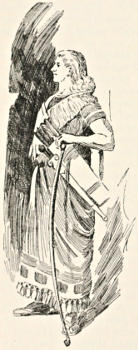
Of course the latter refused Asshurbanapal’s request,
and the war broke out afresh. Asshurbanapal
now intended to establish Tammaritu for the
second time in the government of Elam, a policy which again was destined
not to be realised. A powerful army, led by this claimant, marched
into the enemy’s country, and several border-towns immediately submitted
through fear, and came to offer their men and cattle. The first resistance
was encountered at Bit-Imbi, once a royal city of Elam, “which shut in the
front of Elam like a great bulwark,” and had been conquered by Sennacherib
and razed to the ground. But a later Elamite king had built a new
Bit-Imbi opposite the old town and surrounded it with a strong wall and
outworks. This town defended itself obstinately, but it was conquered, and
those who would not submit were beheaded and their lips sent to Assyria as
trophies of victory. The captain of the bowmen, Imbappi, who was a son-in-law
of the Elamite king and had commanded in the city, fell alive into
the enemy’s hands, together with the harem, the sons of the former king
Teumman, and the rest of the population, and was led away to Assyria.
This feat of arms appears to have been of great importance, for no sooner
did it reach Ummanaldash’s ears than he fled from Madaktu into the mountains.
The same course was followed by another prince (Umbahabua?) who
had reigned in Elam for a time, before Ummanaldash, but, in face of a rebellion,
had retreated to Bubilu. He too left his dwelling, and hid himself in
the low-lying districts on the seacoast. Elam was now open to the Assyrian
army, which made use of the opportunity to march into Shushan and there
again consecrate Tammaritu king. But the latter perceived that it was only
as a shadow king that he had been set up. When the Assyrian troops who
had accompanied him withdrew to their own country with the greater part
of the population as prisoners and an enormous spoil, he was completely
undeceived and sought to prevent this impoverishment of the land by force.
But he was unsuccessful. In the eyes of the Assyrians this was base ingratitude;
he was deposed and again carried off, and before the return march was
finally entered upon, a regular drive was made over the whole of Elam, during
which the chief towns were sacked. But no Assyrian garrison remained
behind in the country, and there is no word of its permanent annexation.
Immediately after the withdrawal of the Assyrian army, Ummanaldash II
came out from his hiding-place and once more obtained possession of the
government.
But Asshurbanapal was not satisfied with this non possum, and this time
he sent Tammaritu himself as ambassador with another demand. The oracle
he had asked from the goddess of Erech had enjoined on him to fetch back
the image of the goddess Nana, which had been carried off to Elam centuries
before. It will be remembered that this oracle had already served as an
excuse to draw Ummanigash into a war. It was now again made use of.
But Ummanaldash, no more than his predecessor, could comply with the
demand without setting throne and life at stake. No other choice remained
for him than to try the fortune of war.
The war proceeded as it had the first time, but was conducted with more
energy and certainly lasted longer. Bit-Imbi was again taken, then the Rashi
country and the city of Khamanu with its territory, a conquest which the
Assyrians thought important enough to be perpetuated in a relief. Although
all this was only frontier territory, Ummanaldash thought it advisable to leave
Madaktu, the western capital of his country, and to retreat to Dur-Undasi,
a town on the farther side of the Ulai, but west of the river Ididi, which
formed a strong natural defence. Thus he abandoned a great part of his
country, but even there he did not feel himself safe and crossed the Ididi that
he might range his troops behind it in order of battle. The Assyrians pursued
their triumphal march, took one town after the other, and at last came
to Dur-Undasi. But here the army refused to go farther, and two days went
by before they could make up their minds to cross the apparently dangerous
river. However, in the nick of time, Ishtar of Arbela, the warlike goddess,
whose priesthood doubtless accompanied the army with a portable sanctuary
or ark, sent one of her seers a dream in which she promised her help, and
this restored the army’s courage. The crossing was a success, the army of
Ummanaldash was beaten, and twelve Elamite provinces east of the Ididi
with fourteen royal cities and a number of smaller places were abandoned to
destruction.
Still there was no intention of taking possession of the country, and when
Ummanaldash with the remnant of his army had gone farther into the mountains,
and consequently there was no longer a dangerous enemy on the east
side of the Ididi to hinder the operations on the west side, the Assyrians
marched back into Shushan. There was the goddess for whose sake the
whole expedition had been undertaken. On former occasions, when Shushan
had been taken, the object of the war was to set the Elamite pretender on
the throne, then the restoration could hardly be demanded. But now Asshur
was in arms against Elam itself, and consideration need no longer be
shown. The goddess was brought back to Erech to her sanctuary, E-khili-anha,
“the house of power in the heavens,” and the king caused new and
permanent sanctuaries to be erected for her.
To all appearances and contrary to his practice, he had himself come to
Shushan. At least, it is related that he clasped the hands of the goddess,
that is, performed a religious ceremony in her sanctuary and that he also had
the gratification of entering the palace of Shushan and seating himself on the
throne of the hereditary enemy of Assyria. Elam was one of the oldest and
most famous monarchies of Asia, and Shushan was the sacred city, the seat
of the gods and the place of their oracles. In the treasure chamber of the
royal citadel were heaped up all those valuables which the kings of Elam had
collected “down to the kings of those days,” and which had never yet been
touched by a victorious enemy. No little of the treasure had been taken
away by former Elamite kings from Sumer, Accad, and Kardunyash, and
there was also a collection of valuables and jewels with royal insignia, which
former kings of Accad, down to Shamash-shumukin, had presented to Elam
in exchange for her help. All this, with all the glories of the royal palace,
where a rich and splendour-loving court had resided, Asshurbanapal took
with him to his own states. The very tombs of the kings were not spared
by the conqueror: they were destroyed and exposed to the light of day; even
the corpses were carried off, so that the shades had to wander about homeless.
In order to mortify the enemy as much as possible, the Assyrian soldiers were
allowed to desecrate those sacred forests, whose precincts no unhallowed foot
might ever tread, and then to burn them.
Whilst the Elamite war was still raging in the west, the Arabs had
again arisen. Abiyate, whom Asshurbanapal had appointed in the place of
Yauta-ben-Hazael as Assyrian vassal-king of Aribi, entered into negotiations
with Natnu, prince of Nabathea, to whom Yauta had formerly fled, but who
had at that time thought it safer to seek the friendship of Assyria. He now
allowed himself to be persuaded to trouble the borders of the western provinces
of Assyria, in conjunction with Abiyate. Lest the forces in this district
should not be strong enough to face the joint attacks of the Arabs, a powerful
army was despatched from Assyria to quell the rising. Arrived on the 25th
Sivan at Khadata, which probably lay at the eastern extremity of this desert,
the army pursued its way unchallenged to Laribda, a well-watered oasis,
where the camp was fixed, and then marched on to Khurarina, not far from
Yarki and Azalli, still in the same desert, where the first encounter took
place. There the Isamme, the Bedouins, who worship the god Atarsamain
and the Nabatheans, sought to stop the further progress of the Assyrian
army, but were defeated. The victors, having provided themselves with
water from Azalli, marched on to Kurasiti. There again stood Bedouins
who worship Atarsamain, with Yauta-ben-Bir-Dadda and the men of Kedar,
but they too gave way, and not only a rich booty, but Yauta’s gods and
women, with his mother, fell into the Assyrians’ hands and were carried
with them to Damascus. On the night of the 3rd Abu, after a rest of about
forty days, the Assyrian army marched to the town of Khulkhuliti, south of
Damascus, and in the mountain region of Khulkurina a battle was fought
with the two sons of Te’ri, namely, the leaders of the rebellion, Abiyate and
Aamu. Aamu was taken alive, chained hand and foot, and sent to Nineveh,
where Asshurbanapal had him flayed. The remainder of the troops sought
refuge in the hiding-places in the mountains; but when the Assyrians set
guard in all the surrounding places and cut off their supplies of water, they
found themselves under the necessity first of killing their camels and then
of surrendering themselves. They, too, were taken to Assyria, and thus the
country was as though “inundated with Arabs and camels.” Yauta-ben-Bir-Dadda
still kept the field with his troops; but when disease and famine
had made terrible havoc among them, they came to the conclusion that
they were no match for the might of the Assyrian gods, rose against their
king, and drove him from them. He was seized by the enemy and sent to
Assyria. There his son was killed before his eyes by Asshurbanapal’s own
hand, and he and his cousin bound with a dog-chain to Nerib-mashuakti-atuati,
the eastern gate of Nineveh. The king counted it as a favour that he escaped
with his life.
Even Ummanaldash was also destined to fall into the Assyrians’ hands.
His own subjects rose against him, perhaps at the instigation of a certain
Ummanigash, a son of Ametirra, and he sought refuge in the mountains.
The Assyrians made use of these disturbances to march into Elam, fan the
fire of rebellion, and lead Ummanaldash in triumph to their own country.
The ancient monarchy, which had so often threatened Assyria, was now
entirely broken. For a time Elam still prolonged a melancholy existence.
She was not annexed to the Assyrian Empire. But when, within a few
years, the latter’s power had disappeared, Elam fell an easy prey to the
Persians, when Prince Sispis, or Teispes, of the race of the Achæmenidæ,
placed himself on the throne of Shushan.
Little dreaming that the hour of Asshur’s downfall was so soon to strike,
Asshurbanapal revelled in the joy of victory. In memory of all these triumphs,
and in order to show his gratitude for the help of the gods, he built a new
sanctuary for the great goddess of Nineveh, the spouse of Asshur, and when
it was ready and he presented himself in it in order to consecrate it with
ceremonial sacrifices, he had his royal chariot dragged to the gate of the
temple by four captive kings,—Tammaritu, Pa’e, Ummanaldash, and Yauta.
This barbarous triumph was his last, and the last also of the renowned
Assyrian army.b
We have followed the fortunes of Assyria through several dynasties of
clearest historical record. But, curiously enough, as we now proceed the
landmarks disappear, and we enter a realm of myth, as if we were going
backward instead of forward in time. Even while Asshurbanapal lives, the
record becomes vague, and after him there is almost nothing securely known
of its details. Even the names of his successors are somewhat in doubt.
The only sure thing is the broad historical fact that the empire declined in
power until it was completely overthrown by the Scythians and Babylonians
about twenty years after the death of Asshurbanapal—the precise date of
this closing scene being, like all other details of the epoch, more or less in
doubt.
Our surprise at this cataclysmic overthrow is the greater in that we have
just seen the Assyrian Empire at such a height of apparent power under
Asshurbanapal. The palaces, libraries, and art treasures of that king as
now known to us convey an irresistible impression of a powerful monarch.
Yet it is held that the decline in Assyrian affairs had begun even during the
life of Asshurbanapal.a
Professor Rogers has well summed up an impression as to the cause of
this decline. After noting the glories of the reign in matters of literature,
sciences, and art, and giving Asshurbanapal a full meed of praise as regards
his attainment in this direction, Professor Rogers continues:
In war only had he failed. But by the sword the kingdom of Assyria
had been founded, by the sword it had added kingdom unto kingdom until
it had become a world-empire. By the sword it had cleared the way for the
advance of its trader, and opened up to civilisation great territories, some
of which, like Urartu, had even adopted its method of writing. It had held
all the vast empire together by the sword, and not by beneficent and unselfish
rule. Even unto this very reign barbaric treatment of men who yearned
for liberty had been the rule and not the exception. That which had been
founded by the sword and maintained by the sword would not survive if the
sword lost its keenness or the arm which wielded it lost its strength or readiness.
This had happened in the days of Asshurbanapal. He had conquered
but little new territory, made scarcely any advance, as most of the kings
who preceded him had done. He had not only not made distinct advances,
he had actually beaten a retreat, and the empire was smaller. Worse even
than this, he had weakened the borders which remained, and had not erected
fortresses, as had Sargon and Esarhaddon and even Sennacherib, for the
defence of the frontier against aggression. He had gained no new allies, and
had shown no consideration or friendship for any people who might have
been won to join hands with Assyria when the hour of struggle between
the Semites and the Indo-Europeans should come. On the contrary, his
brutality, singularly unsuited to his period and his position of growing weakness,
his bloodthirstiness, his destructive raids into the territories of his
neighbours, had increased the hatred of Assyria into a passion. All these
things threatened the end of Assyrian prestige, if not the entire collapse of
the empire.
The culture which Asshurbanapal had nurtured and disseminated was
but a cloak to cover the nakedness of Assyrian savagery. It never became
a part of the life of the people. It contributed not to national patriotism,
but only to national enervation. Luxury had usurped the place of simplicity,
and weakness had conquered strength. The most brilliant colour of all
Assyrian history was only overlaid on the palace and temple walls. The
shadows were growing long and deep, and the night of Assyria was
approaching.b
Whatever our precise estimate of this criticism of Asshurbanapal, it is
clear that the successors of that monarch were unable to sustain the traditions
of their fathers. Assyriologists have recently restored to us the names
of Bel-zakir-ishkun or Asshur-etil-ili, Sin-shar-ishkun, as the immediate
successors of Asshurbanapal, the last named being the one who is believed to
have been the occupant of the throne when the conquering hosts of Cyaxares
finally razed Nineveh to the ground.
It may fairly be presumed that there exist somewhere among the yet
unrecovered treasures of Mesopotamia, inscriptions giving more or less full
accounts of the destruction of Nineveh. But be that as it may, no such
inscription has yet come to light; at least none such has been deciphered.
There is an abundance of material in the various museums of Europe and
America that has not yet been fully investigated. The reading of inscriptions
in the arrow-head script is an extremely difficult task; indeed, it has
been claimed, perhaps half jestingly, by one of the greatest of living orientalists,
that only four scholars in the world are competent to read securely
Assyrian or Babylonian texts from the original clay tablet. Doubtless this
is an exaggeration, but it is one full of suggestion as to the difficulties encountered
by the would-be investigator of Mesopotamian history; and at
the same time offering an explanation of the fact that so much material
is awaiting its turn, and must long remain unpublished, notwithstanding
the importance and interest of the historical secrets thus entombed.
Possibly, as has been suggested, the story of the destruction of Nineveh may
be among these secrets, but as to the validity of this surmise time must
decide.
Meanwhile the twentieth-century historian is but little better off than
his predecessor of the times before the advent of modern Assyriology in
regard to this particular problem. Whoever would picture to himself the
destruction of Nineveh has no resource but to turn back to such classical
accounts as that of Diodorus, giving whatever degree of credence he may
choose to the details of the story. One qualification, however, may be added.
We at least are tolerably sure, as our predecessors could not be, that the last
ruler of Nineveh did not bear the name which classical tradition ascribed to
him. Just as there was no Ninus, founder of Nineveh, so there was no
Sardanapalus last ruler of that famous city. In regard to this detail, tradition
was at fault here as so often elsewhere. None the less will the name of
Sardanapalus long continue to symbolise the idea of the last ruler of Nineveh,
whose effeminate reign and tragic end form so interesting a theme for
the classical writer.a
In all probability, Asshurbanapal lived
until 626, and during the whole of his
reign he remained firmly established in
possession of the Assyrian throne and
also of the kingdom of Babylon. Elam
had been rendered powerless, Babylon
had been conquered, and the desert
dwellers of the west were too much weakened
and impoverished by the severe lesson
taught them, as well as by hunger and
disease, to be dangerous. Media was only
in her youth, and Assyria was still strong
enough to resist the first onrush of this
new, conquering state. Besides her northeastern
and northern neighbours, the states
of Asia Minor and the inhabitants of the
Mediterranean coast had enough to do to
defend themselves against the barbarians
who were pressing upon them from the
north and east. Egypt was indeed independent,
but could not seriously think of
conquests in Asia. The condition of the
Assyrian Empire resembled the calm before
the storm.
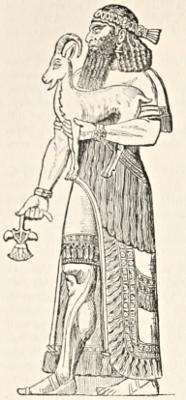
Assyrian King in Sacerdotal Robes
In his latter years the king doubtless
devoted himself by preference to the works
of peace. He had already erected many
buildings, even during the period of his
great wars. He had continued and completed
the work on the temples of Assyria
and Babylonia, which Esarhaddon had begun. Unfortunately the inscription
which enumerates the principal structures belonging to the first half of his
reign only occasionally mentions the places in which the temples he erected
stood. In the later years of the king’s reign the walls of Nineveh demanded
his attention. They were loosened by annual rains and the violent showers
of Adad, and had sunk. Asshurbanapal restored them and made them
stronger than before. When he had seen his great campaigns crowned with
victory, he at last undertook an important work in Nineveh, the town of
Bel and Ishtar. Bit-Riduti, the great palace, which Sennacherib had built
and established as a royal dwelling, had fallen to ruins. This king did
nothing without the gods. It was now again a dream which made known
to him their will that he should repair the damage to the palace. This was
done. The forced labour of Assyrian subjects brought the stone in carts
from the spoil of Elam; and the captive Arabian kings, decked out with
appropriate marks of distinction, shared in the labour as workmen. When
the palace was completed to the pinnacles and enlarged, it was surrounded
with noble grounds; and when the victims were slaughtered at the consecration,
the king made his entry carried in a gorgeous palanquin and with
festive rejoicings.
Of all the objects assembled in this palace the king set the highest value
on the library which he had founded and which has now for the most part
been unearthed and brought to Europe. Asshurbanapal was, without any
doubt, an admirer and patron of learning and a prince who loved art. He
did not allow the libraries of Babylonia to be plundered, but he had the literary
treasures which were buried there, including whole works on philosophical,
mythological, and poetic subjects, copied in Assyrian characters
and added to the historical records of his own predecessors. He even seems
to have studied them diligently himself, and to have encouraged their perusal.
The fruit of this study is shown in his own memorials. In fact these
have some literary value, which cannot be said of the dry chronicles of former
kings. He was not, however, the first to found a library. Not only had the
ancient Babylonian kings—it is said even Sargon I of Agade—preceded
him in this respect, but the Assyrian kings had also set him an example.
This was certainly true of Sennacherib, in whose palace at Nineveh, according
to the calculation made by George Smith, probably twenty thousand
fragments are now awaiting the investigator who can find the time and
means to dig them out and make them accessible to western learning. But
it cannot be denied that Asshurbanapal earned the gratitude of scholars
by rendering so many treasures of the Babylonian libraries accessible to his
compatriots, and also by founding libraries in other places; as, for example,
in Babylon, and that he devoted more attention to these things than any of
his predecessors.
[626-609 B.C.]
The popular tradition of the downfall of the Assyrian Empire, which took
shape in later years and came from the Persians to the Greeks, represents
Sardanapalus (by whom none other than Asshurbanapal can be meant) as the
type of a luxurious, effeminate, oriental despot, who forgets his kingly duties
in the enjoyments of his harem, abandons his empire to the enemies rising
against him on all sides, and finally, shut up in his capital, delivers himself
in despair to the flames with his wives and all his treasures. We now know
how little this picture agrees with the truth, but from what is historically
credible we can gather how it arose. Asshurbanapal did indeed take pleasure
in filling his women’s palace with the daughters of all the princes subdued
by him, and with those of their nearest relatives; and these princes
knew well what was pleasing to the supreme king. It is true that this proceeded
as much from love of display as from an inclination to voluptuousness;
it is true that policy also had a share in it, because by this means his
supremacy was confirmed and a pledge given for further submissiveness; it
is true that the custom was a usual one with oriental monarchs; but a
king who pursued it to such an extent must have been easily transformed into
a voluptuary in the minds of his people.
There was also some reason for regarding him as weak and effeminate.
The great Assyrian monarchs, at least during the years of their youth and
vigorous manhood, had themselves frequently led their armies to victory.
It was seldom, if ever, that Asshurbanapal joined in the fight. His official
historians do, indeed, ascribe to him the honour of all the victories during his
reign, but they have not succeeded in hiding the fact that his generals fought
the battles. Yet he was by no means a weakling. That he was an eager
hunter is testified by a number of hunting inscriptions, some of them accompanied
by reliefs. In any case, a prince who could find pleasure in so manly
a pastime was no effeminate voluptuary, little warlike though he may have
shown himself to be.
The king’s tragic end in the flames of his own palace, of which the legend
speaks, may have been shifted on to him from his brother, Shamash-shum-ukin,
or, still more probably, from the last Ninevite king. That he, the last
great king of Assyria, should have been supposed to continue reigning until
the end of the empire, while the insignificant kings who really followed him
were forgotten, is natural enough. In short, Asshurbanapal was not a hero
who strove to reap the laurels of the battle-field through difficulty and privations
on distant campaigns. He preferred to linger in his luxurious palace,
and to alternate the delights of the harem and the pursuit of learning with
the royal lion-hunting. He was very pious, and did nothing without consulting
the oracles of his gods or the dreams of his seers. If he thought the
dignity of his empire, and with it the honour of his gods, insulted by an
obstinate rebellion, he would avenge them as his predecessors had done by
punishments of ingenious cruelty, inflicted both on individuals and on whole
countries. The fearful suffering which the war on Asshur’s enemies
wrought in its train, the pestilence which filled the streets with corpses, the
famine which drove parents to destroy their own children, filled him with
transports of joy. His ruling idea was the unity and vastness of his empire.
If he left the sword in its sheath, the love of pleasure did not make him
neglect his duties as a ruler. He took care that his armies should always
be ready to take the field, which would not have been possible without good
organisation; and they triumphed over almost all his enemies, maintained
his sway against a powerful coalition, crushed the formidable Elam so
severely that she never recovered from the blows she had received, and, if
not during his reign, at least shortly after it, repelled the advancing Medes.
He regularly transmitted his orders to all the governors in his empire, and
was by them kept carefully informed of anything of importance which happened
in their provinces. No one of his victorious military leaders ever
ventured to turn his arms against him. All, including the governors, recognised
him and honoured him as their king. Such he was in the fullest sense
of the word. In his palace at Nineveh, during two-and-forty years, he held
the reigns of government with a strong hand. And this is all the more
creditable to the influence of his personality, since the empire was internally
weakened by his own political mistakes, in particular by the removal of the
centre of government from Babylon, which Esarhaddon had made its seat,
to Nineveh, and by other causes, so that it went to pieces a few years after
his death.
After him at least two kings ruled over Assyria, who were probably
brothers, for one of them, Bel-zakir-ishkun, was the son of a king of Assyria,
and grandson of a king of Sumer and Accad, and though their names are
missing from the inscriptions, they can have been none other than Asshurbanapal
and Esarhaddon; and the other, Asshur-etil-ili [who is sometimes
known by a lengthened form of his name, Asshur-etil-ili-ukinni] is expressly
called the son and grandson of these rulers. Probably Bel-zakir-ishkun
reigned first, and then the other.[27] No historical records have been preserved,
dealing either with the fortunes and achievements of these kings or with the
fall of Assyria. Certain texts have led some to conclude that a third king,
a namesake of Esarhaddon, may have swayed the sceptre at this period, but
this has been shown to be extremely questionable.
[612-609 B.C.]
Immediately after Asshurbanapal’s death, or perhaps even in the last
year of his reign, Babylon broke away from the Assyrian rule, and this time
the separation was permanent. The empire was much weakened by it. The
north and northwest, Urartu and the states of Asia Minor, gradually fell
into the power of the ever-advancing Medes. The Assyrian lordship over
the countries on the coast of the Mediterranean Sea now existed in name
only, so that King Josiah of Judah was able to effect his reform unhindered,
and to act as master in the territory of the ancient kingdom of Israel, which
for years had been an Assyrian province. And in the year 608 Neku II,
king of Egypt, was able to think of extending his empire to the Euphrates,
as in days long past, and to take arms against Assyria with the idea of
wresting from her all her western provinces. The foundation of the new
Babylonian Empire and the invasion of the Egyptians, who could no longer
be repelled by the Assyrians, but were only to give way before the Babylonian
arms, are described elsewhere. Here we only mention them as among
the causes which brought about the fall of the Assyrian Empire. That
empire no longer had any real existence, at least as a ruling power. Thrust
back to its old frontiers, the ancient Assyrian state slowly languished and
only awaited the death-blow.
That blow was to come from the Medes in alliance with the Babylonians,
and was partly hastened, partly stayed, by the great migratory streams of the
Cimmerians and Scythians.c
Though Professor Tiele’s admirable history is recent, much new information
concerning the last days of the Assyrian rule at Nineveh has come
to light, and historians are now able to place the conquest of the city by
the Manda in the reign of Sin-shar-ishkun. Without overlooking a certain
Sin-shum-lishir, who is mentioned in several places as an Assyrian king, and
must have ruled about this time, but whose personality has not yet been
unwrapped from the historic gloom, it is safe to say that this Sin-shar-ishkun
was Asshur-etil-ili’s successor. From contract tablets found at Sippar and
Erech we know that he occupied the Assyrian throne in 612 B.C., and that
his dominion included a part of Babylonia as well. Later records would
show him to be of much stronger character than the man he succeeded. In
610 or 609 he attempted to wrest more of the Babylonian provinces from
Nabopolassar, and the harassed king took the fatal step of appealing to that
people from the north, who for the most part had formed part of the great
Indo-European migration into western Asia. Already these Scythian hordes,
the Manda, had their eye on the rich Mesopotamian Valley, and therefore
Nabopolassar’s appeal did not fall upon unwilling ears. Sin-shar-ishkun
was indeed driven back, but when that happened the Manda were in the
coveted land. The reader will observe that we have just spoken of the Manda
and not the Medes as the assailants of Nineveh. This is because of the recent
clearing up of a historical error that was our heritage from the Greek historians.
They simply confused the Manda, the nomadic tribes that lived
northeast of Assyria towards the Caspian Sea and were the classical Scythians,
with the Mada, or true Medes. As Professor Sayce says: “It was not until
the discovery of the monuments of Nabonidus and Cyrus that the truth at
last came to light and it was found that the history we had so long believed
was founded upon a philological mistake.” This matter will be more fully
explained in the account of Persia.a
Like his father, Cyaxares perceived that it would not be possible for
the Medes to extend and maintain their conquests westward so long as
he had to dread the rivalry of the Assyrian Empire, so lately the mistress
of those regions. Consequently he put into practice the lesson which
his father had received from the Assyrians. The as yet untrained hordes
of Medians were evidently no match for the better military organisation
of the Assyrians and the military skill of the Assyrian generals.
Cyaxares, therefore, began as became a warlike prince with the remodelling
of his army, dividing his troops, after the pattern of the Assyrians, into the
various arms—spearmen, bowmen, and horsemen—and fortifying his citadel,
Ecbatana. Then he again ventured to attack Assyria, this time with better
success. The Assyrian army was beaten in Nineveh at last, and was surrounded.
But an unexpected event came to the assistance of the hard-pressed
Ninevites—the Scythians invaded Media.
Their invasion compelled Cyaxares to evacuate Assyria, and for a time
Nineveh breathed again. But only for a short time. Cyaxares succeeded
in putting an end to the Scythian domination in his kingdom in the course
of a few years.
[609-401 B.C.]
About 609 the Median army under the command of Cyaxares appeared
for the second time at the gates of Nineveh. According to Berosus, the
Babylonian king, whose son Nebuchadrezzar had married the Median king’s
daughter, also took part in this siege. It is easy to understand how it was
that Herodotus knew nothing of this, for the Persians were his authorities.
But he is certainly right in assigning the chief rôle to the Medes, of whom
Abydenus says nothing, for from this time forward they kept possession of
Assyria itself; and he is also right in placing the taking of Nineveh during
the period of Cyaxares’ government, and not, like Berosus and the authors
who follow him, in the time of Astyages, since the latter did not ascend the
throne of Media before 584 B.C. It is sufficient that Nineveh fell, and Assyria
passed to the power of the Medes, who at the same time acquired the
dominion over the North and the countries of Asia Minor as far as the
Halys. All other provinces of the fallen empire as far as the Mediterranean
Sea, including probably that part of ancient Assyria whose capital was the
city of Asshur, and also Kharran and Carchemish, fell to Babylonia.
We have no historical account of the details connected with the fall of
Nineveh. The story of the last Assyrian king, Asshur-etil-ili, or, as some
authorities call him, Saracus,[28] which represents him in his despair burning
himself with his palace and his treasures, is a popular tale which is not indeed
impossible, but probably arose by confusion with Shamash-shum-ukin’s end.
Nineveh was so completely desolated that when Xenophon passed with the
Ten Thousand in the year 401 B.C. he took the ruins for the remains of
Median towns destroyed by the Persians. Subsequently a fortress, Ninus,
seems to have been built there by the Parthians. Calah also once more rose
from its rubbish heaps after lying desolate for a long time. Arbela remained
untouched, and it is therefore probable that it fell unresisting into the
hands of the conquerors. But the Assyrian monarchy was gone forever.
[606 B.C.]
The Assyrian monarchy was gone, but not the empire at whose head the
kings of Asshur had stood. It has been matter of astonishment that so
powerful an empire, to which through a series of centuries the whole of
western Asia had been subdued, could have been so suddenly overturned by
the fall of the capital. But this surprise proceeds from an incorrect conception
of history. Events had long prepared the fall of Nineveh. The keen
eye of Esarhaddon had already perceived that it would be safer to remove
the centre of the empire to Babylon. His son Asshurbanapal, a less acute
statesman than he, but a great king and a strong administrator, had once
more attempted to secure the hegemony for Assyria. In this he had succeeded,
being supported by favourable circumstances and the influence of
his own personality. But when the sceptre fell from his strong hand, little
more was needed to put an end to the Assyrian dominion, and that end was
only a question of time. However, the empire survived for a few years
longer, though not in its full vigour. The hegemony now passed again to
Babylon; but not unimpaired, for, since Media had conquered Nineveh, the
lion’s share of Assyria itself fell to the Median kingdom, together with those
northern and northwestern provinces which had been lost long before. But
the Assyrian survived in the new Babylonian Empire, which continued its
policy of conquest, and the Greeks, who not long afterwards called the
Babylonians themselves Assyrians, were in this not so very far from the
truth. But the days of the Semitic dominion were hastening to their end.
Even the new monarchy under Babylon’s hegemony could only be propped
up by the force of Nebuchadrezzar’s personality. His feeble successors
were in no condition to prevent the spread of the Median power nor the rise
of the Persian monarchy, which had grown to such proportions by the conquest
of Elam, until the genius of Cyrus founded a dominion which soon
embraced the four ancient empires—the Median, the Elamite, the Assyrio-Babylonian,
and the Egyptian—and gave the sceptre of western Asia to the
Aryans.
The sense of relief which fell on the oppressed nations at the downfall of
the scourge of Asia can be gathered from the rejoicing accents of the Jewish
prophets. What an Isaiah, a Micah, had not dared to hope, Nahum and
Zephaniah saw approach and actually happen. Nahum is convinced that the
fate of Thebes will soon overtake Nineveh. Her merchants, multiplied as
the stars of heaven, her crowned, her captains, her whole people, they shall
be scattered like flying grasshoppers, and no man shall gather them. “All
that hear the bruit of thee shall clap their hands over thee: for upon whom
hath not thy wickedness passed continually?” (Nahum iii. 19.) And Zephaniah
(ii. 13-15), his contemporary, sees with satisfaction the desolation of
the proud city, who thought herself so safe and boasted herself to be the first
and the only one, but now had become desolate and a place for beasts, in
whose ruins the bittern and the screech-owl lodge.c
“Belshazzar’s grave is made,
His kingdom passed away,
He, in the balance weighed,
Is light and worthless clay,
The shroud his robe of state,
His canopy the stone;
The Mede is at his gate,
The Persian on his throne.”—Byron’s “Vision of Belshazzar.”
Nowhere is there a more striking illustration of national regeneration
than is furnished by the story of the new Babylonian Empire. Freed from
Assyrian thraldom, Babylon, the old, old city, came forward to take the
place of the fallen Nineveh as the world-metropolis.
It has been customary to think and speak of the new Babylonian Empire
as evidencing the rejuvenation of an old people. In one sense this view has
full validity. But it must not be supposed that the new Babylonians who
came to power when Nineveh fell were the bona fide descendants of the rulers
of old Babylonia. New blood had made itself felt in the old race; indeed,
without its influence it is highly improbable that the rejuvenation could
have been effected. The outsiders who made their influence felt with such
potency to restore and rejuvenate the old empire, are known as the Chaldeans.
The precise origin of this people is in doubt. It is held to be established,
however, that they were Semitic, and hence could claim cousinship with
the Babylonians and Assyrians. They inhabited the Sea Lands to the
south of Mesopotamia at an early date, and have been supposed to come
originally from Arabia. They are heard of from time to time in Babylonian
and Assyrian annals as a half-barbaric and often troublesome people, divided
into various tribes or clans or petty principalities, bearing such unfamiliar
names as Bit-Silani, Bit-Sa’alli, and Bit-Sala.
It is supposed by modern orientalists that the Chaldeans long had
their eyes upon the fertile regions of the North, and even, from time to
time, been presumptuous enough to cross swords with the Babylonians and
Assyrians in the hope of dethroning them. Certain it is that the rulers of
the North had at various times waged war against their less civilised cousins
of the Sea Lands. Yet the evidence does not seem to be very clear as to the
precise share which the Chaldeans took in the new movement inaugurated in
Babylon with the death of the last really powerful Assyrian king, Asshurbanapal.
The name of the new ruler who now came to power in Babylon
was Nabopolassar; but it cannot be asserted with confidence that he was of
Chaldean origin. It is held, however, that the influences that dominated the
kingdom under his reign were clearly Chaldean; though considering the
vagueness that surrounds the entire subject, it must be admitted that this
assertion is much easier to make than to prove. Still, all that we know
about the degeneration of old nations elsewhere, and the extreme difficulty
of resuscitating a senescent people, except by a mixture of races, tends to
confirm the theory that a race relatively new to civilisation was chiefly
instrumental in working the miracle of Babylonian regeneration.
In any event, the people who for something less than a century made
Babylon a great centre of world-influence were known to their contemporaries
and to succeeding generations as Chaldeans rather than as Babylonians.
Just to what extent the old Babylonian people shared in the new work, can
perhaps never be known; but the question is relatively unimportant, because
in any event it was a people of the same old Semitic stock that carried on
the historic story.
The most brilliant period of the new Babylonian Empire came soon after
the fall of Nineveh, in the reign of the world-famous king, Nebuchadrezzar,
the monarch who built the marvellous wall about the city and the fabulous
hanging gardens; the conqueror who overthrew the Phœnicians and carried
the Israelites into captivity.
A peculiar interest attaches to the period of the immediate successors of
Nebuchadrezzar because the Babylonian captivity of the Israelites still continued,
to which the Hebrew writers made such extended references. The
famous account in the Book of Daniel of the feast of Belshazzar, with its
brief but graphic reference to the alleged tragic end of the Babylonian king,
and the overthrow of Babylon itself at the hands of “Darius the Mede,”
have furnished never-to-be-forgotten pictures to all subsequent generations.
The modern archæologist has rudely shattered some of these treasured
images. Thus the Book of Daniel makes allusion to the overthrow of
Babylon in these words: “Belshazzar the king made a great feast to a thousand
of his lords, and drank wine before the thousand. Belshazzar, whiles
he tasted the wine, commanded to bring the golden and silver vessels which
his father Nebuchadnezzar had taken out of the temple which was in Jerusalem;
that the king, and his princes, his wives, and his concubines, might
drink therein.… In that night was Belshazzar the king of the Chaldeans
slain. And Darius the Median took the kingdom, being about threescore
and two years old.” (Daniel v. 1, 2, 30, 31.)
[555 B.C.]
But within the past generation inscriptions have come to light proving,
to the amazement of a keenly interested world, that no king named Belshazzar
ever reigned in Babylon; and that the name of the monarch overthrown
by Cyrus the Persian or Elamite—not by “Darius the Mede”—was
Nabonidus. Nabonidus had a son, Belshazzar, but he never ruled. This
Nabonidus was not the son of Nebuchadrezzar or his immediate successor,
three successive rulers after Nebuchadrezzar having reigned before he came
to the throne. It is clear from inscriptions of Nabonidus and of Cyrus his
conqueror that Babylon was overthrown without a struggle. A cylinder
inscription by Cyrus tells the story: the first part of which, translated by
the Rev. C. J. Ball, is as follows: “The continual offering he made to cease
… he (es)tablished in the cities the worship of Merodach, the King of the
Gods, he exalted (?) His name … by a yoke unrelaxing he ruined them
all. At their lamentation the Lord of the Gods waxed very wroth … the
Gods who dwelt among them forsook Their abode. In wrath because he
brought them into Shu-anna (i.e. Babylon), Merodach … He turned
towards all the districts whose dwellings were thrown down. And (to) the
people of Shinar and Accad, who were become as dead, He turned (His
regard?): He showed compassion upon all the lands together. He looked
for, He found him, yea, He sought out an upright Prince, after His own heart,
whom He took by his hand, Cyrus, king of the city of Anshan; He named
his name; to the kingdom of the whole world He called him by na(me).
The land of Qutû (and) all the Umman-Manda he humbled to his feet; the
Blackheaded folk, whom his hands subdued,—in faithfulness and righteousness
he looked after them. Merodach, the great Lord, the guardian of His
people, joyfully beheld his good deeds and his upright heart. To His own
city Babylon his march He commanded; He put them on the road to Tin-tir
(i.e. Babylon); like a comrade and helper He marched at his side. His
great hosts, whose number like the waters of a river could not be known, with
their weapons girded on, advanced beside him. Without skirmish or battle
He made him enter Shu-anna. His own city Babylon He spared from distress;
Nabonidus the king, who feared him not, He delivered up to him.
The people of Tin-tir in a body, the entire land of Shinar and Accad, the
nobles and grandees, bowed down before Him, kissed His feet, rejoiced at
His accession; their faces brightened.”
The accounts given by Nabonidus himself confirm this record of Cyrus.
It would appear, then, that the Hebrew chroniclers, gifted rather with the
poetical imagination than with the calm historical sense, confused the Babylonian
conquest of Cyrus with a later campaign of his successor, Darius.
But no mere substitution of the cold facts of history can ever rob the world
of the beautiful traditional picture of the feast of Belshazzar. Here, as elsewhere,
myth must be allowed to hold its own as the embodiment of the spirit
of history. Myth and history coincide as to the fact that the old dynasty
in new Babylonia was overthrown. And with that overthrow the sceptre of
world-influence passed from the hands of the Semitic race forever.
[615-538 B.C.]
The epoch of the new Babylonian Empire covers a period of time from
about 615 to 538 B.C., approximately three-quarters of a century. We have
already, at the beginning of this book, outlined the position of contemporary
civilisations during the entire sweep of Assyrian and new Babylonian history;
but it may be well briefly to recapitulate the position of other nations
during the epoch of new Babylonian domination, that a clearer picture of
the time may be before the eyes as we view the details of Babylonian
history.
While reading of the achievements of Nebuchadrezzar and his successors,
then, it will be well to recall that:
Egypt under the XXVIth Dynasty enjoys a brief period of rejuvenescence
as a world-power; curiously linked in time with the new awakening of her
old-time rival, Babylonia;
In India, at about this period, Buddha lives and founds the religion that
is to bear his name;
Greece and Rome are in a relative youth, not yet reckoning time from a
fixed era, and only beginning to make secure records on which future generations
may build. Their civilisation does not compare in importance with
that of Babylon, which is the recognised centre of culture, looking upon
these “new” nations in the west as utter barbarians;
Phœnicia is far past the zenith of its power; Samaria has fallen; Jerusalem
is to become subject to Babylon itself;
In Asia Minor, Sardis, the capital of Lydia, is waxing in power.
But the coming nation of the epoch is Persia, which turns the tables on
its fellow, Manda, hitherto the stronger of the half-civilised pair of nations,
and which finally, under Cyrus, captures Babylon itself, and assumes undisputed
sovereignty over the whole of southwestern Asia.a
[626-562 B.C.]
Nabopolassar (Nabu-apal-usur, i.e. “Nabu protect the heir”), according
to the Ptolemaic canon, reigned from 625 B.C. (the date of his accession thus
being 626) until 605 B.C., in which year he died, shortly before the victory
won by his son Nebuchadrezzar over the Egyptians at Carchemish, having
been in ill health before Nebuchadrezzar started for Syria. We have seen
how immediately upon his accession to the throne of the Pharaohs, Neku II
profited by the impotence of the Assyrian kingdom, which was enfeebled to
the last degree by long years of Scythian incursions, to penetrate into the
Hamath district.
[He encountered the army of Judah at Meggido—the same historical
locality where, a thousand years before, Tehutimes III had vanquished the
combined forces of Syria and Phœnicia. The king of Jerusalem was slain
on the field, and his army, retreating in terror to the capital, made his young
son, Jehoahaz, king, ignoring the claims of Eliakim, the eldest, probably
because he was in favour of submitting to Neku. Pharaoh now proceeded,
unmolested, to Riblah in Cœle-Syria, where he made his headquarters, and
confident in his mastery over Judah, ordered Jehoahaz to appear before him.
When the new king arrived he was thrown into chains and Eliakim put in
his place under the name of Jehoiakim.]
Neku’s ambition was next directed to the conquest of the whole of northern
Syria; a project which he actually accomplished to a great extent
during the years 608 to 606, whilst the Babylonians, with their Median allies,
were besieging Nineveh. He must certainly have advanced as far as Carchemish,
since that was the spot where the Egyptian and Babylonian forces met
in 605. The fate of Syria was sealed thereby; it became a province of Babylonia
even as it had once been a province of Assyria, and Judah became a
vassal kingdom to Babylonia.
[602-587 B.C.]
Thus Nabopolassar, who died in 605, while his son was on the march for
Syria, only just missed the satisfaction of seeing the new kingdom of Babylonia
which he had founded enter upon the heritage of the Assyrian Empire,
out of which the western province could least of all be spared. He did not
see it: instead the news of his father’s death reached the young Nebuchadrezzar
(Nabu-kudur-usur, i.e. “Nabu protect the crown”) shortly after the
victory of the Egyptians, which decided the fate of Syria for the time being;
and leaving his generals to follow up the victory, he had to return to Babylon
in hot haste to assume the royal dignity that awaited him. There he received
the crown at the hands of the great nobles without encountering any obstacles,
and for the long period of his glorious reign, which lasted forty-two
years (604-562) he guided the destinies of his country, extended and
strengthened its borders, and thus made Babylonia a great power, and Babylon
one of the most splendid and illustrious cities of ancient times. If we
further take into consideration that it was he who likewise conquered Syria
for Babylonia, we cannot but acknowledge his claim to be counted the first
ruler who entered upon the full possession of Assyria and consolidated it.
Amid all the many and sometimes detailed inscriptions of Nebuchadrezzar
which have been found in the ruins of Babylon and other cities, not one
contains any account of his campaigns; but from a passage in the preamble
of the great inscription of the kingdom, we see that in spite of his preference
for building and other peaceful labours he was a mighty warrior. It runs:
“Under his mighty protection (i.e. that of the god Marduk) I have passed
through far countries, distant mountains, from the upper sea even to the
lower sea (i.e. probably from the Gulf of Issus to the mouth of the Nile) far-reaching
ways, closed paths where my step was stayed and my foot could
not stand, a road of hardships, a way of thirst; the disobedient I subdued
and took the adversaries captive, the land I guided aright, the people I
caused to be seized; I carried away the bad and the good among them, silver
and gold and precious stones, copper, palm wood and cedar wood, whatsoever
was costly, in gorgeous abundance; the products of the mountains and that
which the sea yielded, brought I as a gift of great weight, as a rich tribute
into my city of Babylon before his (the god’s) face.” And although the
different campaigns of which we know are distributed over almost the whole
of his long reign, we find mention of only one short war against Aahmes of
Egypt in the thirty-seventh year of it.
With regard to these wars, most of them aimed at completing the work
begun at the battle of Carchemish, and more particularly at preventing further
interference on the part of Egypt, and at banishing her influence completely
from Babylonian territory, which had now been extended to her very
frontier. It was probably in the third year after Nebuchadrezzar’s battle
(therefore in 602 B.C.) that Syria was completely incorporated into the
Babylonian kingdom, leaving him free to think of displaying his power in
the eyes of Jehoiakim, whom Neku had set up as king in Jerusalem, by
advancing against him with an army. The desired result promptly followed,
and from 601 to 599 Jehoiakim became tributary to the king of the Chaldeans.
In the fourth year, 598, the king of Judah withheld the tribute,
probably at the instigation of Egypt. When the Babylonians invaded
Judah (probably at the beginning of 587) Jehoiakim was just dead; his son
Jehoiachin (known also as Jeconiah) was besieged at Jerusalem and, seeing
further resistance useless, surrendered to Nebuchadrezzar. He was carried
away captive to Babylon with his family and nearly all the princes, warriors,
masons, and smiths; but, once there, their lot was no hard one, for they
were permitted to settle without molestation and to exercise their own
religion. A great number of them lived thus at Tel-Abib (i.e. “heap of
ruins”) on the canal Chebar [a canal found near Nippur and now called
Kabaru] as we know from the chronicles of Ezekiel, who was one of them.
Jerusalem was not destroyed, but Jehoiachin’s kinsman, Mattaniah (another
son of Josiah), was set over the few inhabitants that remained there as a vassal
of Babylonia, under the new name of Zedekiah (595-587). The newly
installed sovereign was a weak man, who by his own good will would have
been a loyal vassal; but ultimately in spite of the warnings of the prophet
Jeremiah, who fully realised the true state of affairs, he threw in his lot
with the war party, who relied on the help of Egypt, and rebelled against
Babylonia.
In 589 Psamthek II (Neku’s successor) himself was succeeded by the
young and warlike Uah-ab-Ra (the Hophra of the Bible and the Apries of the
Greeks), who sent a fleet to the assistance of the Phœnicians in an attempt
they made to revolt. Thereupon Nebuchadrezzar marched his troops into
Syria and set up his headquarters at Riblah, the old headquarters of Neku,
so as to operate from thence against Zedekiah, Tyre, and Pharaoh. How
Jerusalem was besieged (589-587) and destroyed, how in the meantime
Uah-ab-Ra’s army was vanquished, and how Tyre was then invested (the siege
lasting thirteen years) and forced to pay tribute, if no more—all these events
are likewise known to us only from other sources than cuneiform inscriptions,
and the detailed description of them, at least in so far as they relate
to the downfall of the kingdom of Judah, and thus form a part of (not the
opening era of) Jewish history, lies ready to every reader’s hand in the
books of the Bible of which we have given a brief outline. As for Tyre
(after the siege) she remained under the rule of her own kings, though as a
vassal to Babylonia. All the worse was the fate which, in 587, overtook
Judah, whose hopes had been so cruelly deceived, for not only was the city
utterly destroyed (see the moving laments in the so-called Book of Lamentations),
and the king, blinded and fettered, carried away into captivity
after seeing his sons slain before his face; but with the exception of the
poor, the day labourers absolutely necessary for the cultivation of the soil
and vineyards, all who had escaped the previous deportation were carried
away by the Babylonian king to the “waters of Babylon” (Psalm 137).
[587-568 B.C.]
[While his soldiers were keeping their long and weary station under the
walls of Tyre, Nebuchadrezzar turned his attention to another important
matter. Because the people of Judah and Tyre had looked to Egypt for
assistance, they had given the Babylonian king much trouble. Egypt, therefore,
must suffer for this; so that she would not feel inclined to repeat her
action of sending an army to Zedekiah’s aid. A new Egyptian campaign
was planned.]
A fragment at the beginning of which a prayer (“Thou destroyest my
enemies and makest my heart to rejoice”) was set down, assigns the above-mentioned
campaign in Egypt to the year 568 (i.e. the thirty-seventh year
of the reign). The passage which refers to it,—“Year 37 of Nebuchadrezzar,
king of (Babylonia to the land of) Misir, (i.e. Egypt) to give a
battle, he marched and (his troops A-ma)-a-su, the king of Misir assembled
and …” leaves no doubt that Aahmes or Amasu is the king here meant,
for only the year before, in 569, Aahmes had revolted against Uah-ab-Ra and
forced him to recognise him (Aahmes) as co-regent. He soon afterward
became sole ruler in Egypt; and, as such, he died in the year 528, shortly
before the conquest of Egypt by the Persians. Nebuchadrezzar meanwhile
contented himself with humbling the pride of Egypt, and refrained from
conquering the country, which even had it been successfully done would
but have raised difficulties for the Babylonian kingdom to cope with. His
chief aim, to keep Syria and Palestine clear of Egyptian influence, was
attained by the campaign.
Of Nebuchadrezzar’s other military expeditions, the one mentioned (Jeremiah
xlix. 28-33) against the Bedouins of Kedar and the Arab tribes, which
had settled to the east of Palestine, leads us again to the borders of the Occident.
The town of Teredon, at the mouth of the Euphrates, was founded at
this time as a bulwark against the Bedouins, and by reason of its situation
became, like Gerrha, on the Persian Gulf, and Thapsacus, Tiphsah, on the
middle Euphrates, a mercantile station of some importance. Not until the
time of the New Kingdom of Babylonia did a flourishing trade develop along
the Euphrates, with Armenia and the east coast of Arabia for its extreme
poles; and from the reign of Nebuchadrezzar dates the part played by
Babylon, his capital, as the greatest emporium of the ancient world, and
the proverbial meaning which the name of Babylon has retained down to
our times, to signify the worst aspects (luxury and license) of a capital
city.
From Babylon and the mention of her trade it would be a natural transition
to the buildings erected by Nebuchadrezzar, if we were not first bound to
mention the northwest and east, which are of extreme importance from an
historical point of view, and in which Nebuchadrezzar took the part of a
mediator, if no more, between the Medes and the Lydians.
[604-560 B.C.]
To return to the buildings erected by Nebuchadrezzar, which, up to this
time form the subject of nearly all the inscriptions discovered, the latter all
show his character in a favourable light. In all we find evidence of the
paternal care of a prince zealous for the welfare of his dominions, and of a
sincere and heartfelt piety which by no means leaves the impression that
it is a mere form of speech. We can listen to his own words prefixed to his
account of the buildings he erected and revealing something of his heart.
“Since the Lord, Marduk, created me, and made fair preparation for my
birth from the womb, from that time forward, when I was born and created,
I have visited the holy places of God, and walked in the ways of God.
To Marduk, my Lord, I prayed; I took up my parable in prayer to him, the
speech of my heart came (before him) to him I spoke: ‘Eternal, Holy, Lord
of all things, for the king, whom thou lovest, whose name thou callest according
to thy good pleasure, guide his name well, lead (or guard) him in a
straight path. I, the prince, who obeyeth thee, am the work of thy hands,
thou didst create me, thou didst commit unto me the royal dominion over
the whole people, according to thy grace, O Lord which thou sendest forth
upon all. Teach me to love thy august sovereignty, let the fear of thy
divinity be in my heart, bestow (upon me) that which is pleasing unto thee,
thou who preparest my life.’ Thereupon the Highest, the Glorious, the first
among the gods, the august Marduk, heard my supplication and accepted my
prayers, he caused his great majesty to rule favourably, he caused the fear of
God to abide in my heart, I fear his majesty.” And the conclusion runs:
“Babylon, the capital of the land, I established with the hills of the forest.
To Marduk, my lord, I prayed and lifted up my hand: ‘Marduk, lord, the
first of gods, thou mighty prince, thou hast created me, thou hast committed
to me royal dominion over the multitude of the people, I love the majesty of
thy courts as my precious life. Save thy city of Babylon. I have made me
no other capital out of all inhabited places. As I love the fear of thy divinity
and seek thy majesty, so incline graciously to my supplication (literally,
to the raising of my hands), hear my prayers. I am the King, the Restorer,
who delights thy heart, the zealous ruler, the restorer of all thy cities. At
thy command, O merciful Marduk, may the house which I have built endure
to all eternity, may I satisfy myself in its abundance. May I come to old
age therein, may I satisfy myself with my glory, may I receive the weighty
tribute therein from the kings of all regions of the world and from all mankind.
From the horizon of the heavens unto the meridian and at (?) the
rising sun may I have no enemies nor possess any adversaries (lit. them that
put me in fear). May my posterity bear rule therein over the black-headed
people to all eternity.’”
Nebuchadrezzar, himself, attached the greatest importance to the restoration
of the temples of E-sagila and E-zida, as being the most ancient sanctuaries
of Babylon, and in his briefest inscriptions, the stamp-marks on bricks,
whether used for the building of these two temples or any other edifice,
always had added to his title of king, that of restorer of the temples of
E-sagila and E-zida. Of greater interest to us, however, since we can still
admire the ruins of it, is a temple which is only briefly referred to in a few
words in the long inscription, but of which we have a detailed account in
another, shorter inscription, namely, the Temple of the Seven Spheres of
Heaven and Earth, which was built in seven stories near (or as a ziggurat
of) E-zida at Borsippa.
But although Nebuchadrezzar devoted most thought to his beloved
Babylon (and to Borsippa) he in nowise neglected other seats of worship of
the country. The temple of the Sun, at Sippar, the temple of a god as yet
unidentified, in the city of Baz (Paszitu), the temple of Idi-Anu (the Eye
of Anu), at Dilbat, the temple of Lugal-Amarda (Marad), E-Anna, the
temple of Ishtar, at Erech, the temple of the Sun, at Larsa, and the temple
of the Moon, at Erech, are enumerated one after another as having been rebuilt
by Nebuchadrezzar. With better right than his father he calls himself on
one of the Abu-Habba cylinders “the ruler of Sumer and Accad, who laid
the foundation of the land” (or as Winckler translates it, “made fast the
foundations of the land”), for in truth his new creations extended over the
whole territory that had been Sumer and Accad as we are familiar with it
in ancient Babylonian history, from the reigns of Ur-Ba’u of Ur onward.
Under him, after a long sleep (lasting in places for a thousand years) among
her ruins, the whole of Babylonia kept the festival of her resurrection, and
joyous sacrificial hymns resounded through the length and breadth of the
land during Nebuchadrezzar’s long and prosperous reign, as in the days of
her distant prime.
To complete the picture of Nebuchadrezzar’s capital, we must in conclusion
cast a glance at the vast fortifications with which this king girdled the
city he had created, and so insured it against the most formidable assault.
Nebuchadrezzar did not rest satisfied with completely restoring and enlarging
these fortifications (a work that his father had begun, since they had
again been impaired); he included a strip of arable land some four thousand
cubits (about two to three kilometres) in breadth, on the farther side of the
rampart Nimitti-Bel, within another “mountain high” wall, and made it a
part of the outworks, thus casting a gigantic threefold girdle of ramparts
(or walls) and moats about the city. Nor was that enough: “To quell the
countenance of the enemy that he should not harass the (threefold) encompassment
of Babylon, I surrounded the land with mighty streams, comparable
unto the waters of the sea; to cross them was as it were to cross the ocean.
To render an inundation from their midst (the midst of these artificial
courses) impossible, I heaped up masses of earth, I set up brick dams round
about them.”
And herewith we must take leave of this truly great ruler, and turn to
his successors, who, unhappily, did not resemble him, and of whom the last,
Nabonidus by name, could alone be compared to him in his zeal for the restoration
and adornment of the various temples of the country, though in all
other respects he fell far below the greatness of his mighty ancestor. This
inferiority is the reason that the New Babylonian Kingdom hurried so swiftly
to its unexpected end.
[560-555 B.C.]
We know from the Ptolemaic canon, Hommel goes on, that after Nebuchadrezzar’s
death (562) Illoarudamos (probably a clerical error for Illoarudakos,
i.e. Amil-Marduk), the biblical Evil-Merodach, ascended the throne
and died in the second year of his reign (560). Berosus calls him a son of
Nebuchadrezzar, and describes his short reign as unjust and licentious, this
being the reason why he was murdered by Neriglissor (Nergal-shar-usur), his
sister’s husband, and thus son-in-law to Nebuchadrezzar. As a matter of
fact, in direct confirmation of the chronological statements of the Ptolemaic
canon, the only contract tablets that have been discovered of the reign of
this king, date from his accession, about July 22, 560 B.C. He is mentioned
in the Old Testament, in the last four verses of the 2nd Book of Kings;
“And it came to pass in the seven and thirtieth year of the captivity of
Jehoiachin, king of Judah, in the twelfth month, on the seven and twentieth
day of the month, that Evil-Merodach, king of Babylon, in the year that he
began to reign, did lift up the head of Jehoiachin, king of Judah, out of
prison. And he spake kindly to him and set his throne above the throne
of the kings that were with him in Babylon; and changed his prison garments,
and he did eat bread continually before him all the days of his life.
And his allowance was a continual allowance given him of the king, a daily
rate for every day, all the days of his life.” It is evident that the Bible here
refers to Amil-Marduk, for on the twenty-seventh Adar 560 this king was
still upon the throne (see the above date, 4th Abu), whilst the first well-authenticated
date of Neriglissor is 25th Marsheshwan, i.e. about 10th
November of that same year.
From the reign of Amil-Marduk we have no inscription, but we are in
better case as regards his successor, Nergal-shar-usur (the Nergal-sharezer of
the Bible; Berosus, Neriglissor, Ptolemaic canon, Neriga-solasar). He reigned
from 559-556, for there are two inscriptions on cylinders and a brief inscription
on brick which we may assign to this reign. The subject appears
to be some restoration in the shrine of E-zida at Babylon. Where the
inscription again becomes legible, the king gives an account of the construction
of a canal, the waters of which had gone away and withdrawn, and
of palace building.
The following questions are suggested by these inscriptions. Firstly,
who was his father, the Bel-shum-ishkum twice mentioned in them? Let it
suffice here to note the possibility that he may be identical with a former king
of Assyria, the son of Asshurbanapal, who certainly did not reign more than
a few months. The chronology presents no obstacle to the acceptance of
this hypothesis. Let us then assume that Bel-shum-ishkum was born about
645; he would then be about twenty years of age at the death of Asshurbanapal,
and about forty at the fall of Nineveh, after which he probably
found a refuge at the Babylonian court. By that time (606) his son Nergal-shar-usur
might very well be about eighteen years old; if we take this for
granted, then the latter was thirty-seven in the year 587, in which two persons
of the same name (Nergal-sharezer, Jeremiah xxxix. 3) are mentioned
among Nebuchadrezzar’s nobles (one among the “princes” in general, the
other amongst the officials of highest rank), sixty-four at his accession in
560 B.C. and not quite seventy when he died, which gives a great show of
probability to his identity with one or other of these two Nergal-sharezers.
Another question to which it would be very interesting to find an answer is
that of the wars of Nergal-shar-usur, for, short as his reign was, it is evident
from the two cylinder inscriptions that he did wage wars. Unfortunately
we have no more exact information on the subject; but if we consider that
as early as the year 555, that is, only a year after Nergal-shar-usur’s death,
disorders of such magnitude had broken out in Mesopotamia, due to the
“Manda warriors” under the leadership of their king Ishtuvegu (Astyages),
that is to say, to Median hordes, that the Babylonians appealed to Kurush
(Cyrus), king of Anshan, who did, in fact, succeed in driving the Medes
back, we may be sure that the earliest incursions of the Manda into Babylonian
territory (of which Mesopotamia had formed a part since the fall of
Nineveh) took place in the reign of Neriglissor. This hypothesis is directly
confirmed by the tenor of Nabonidus’ account of the invasion. In that case
Neriglissor’s warlike enterprises were not crowned with brilliant success, or
at all events did not expel the Manda from Mesopotamia altogether.
On the death of Neriglissor in 556, he was succeeded, according to
Berosus, by his son Labassarachos or Labarosoarchodos (in inscriptions
Labashi-Marduk), but it appears that a Babylonian of high rank, Nabu-naidu
(“Nabu is glorious”), the son of Nabu-balatsu-iqbi (“Nabu hath
foretold his life”), was immediately proclaimed king by an opposition party,
and although Labashi-Marduk made head against Nabu-naidu (or Nabonidus,
as he is usually known) for nine months, the latter dates the beginning of
his reign from the death of Neriglissor. According to Berosus, Labashi-Marduk
was a child, and fell victim to a conspiracy, having already betrayed
tokens of a bad disposition.
According to the Ptolemaic canon, Nabonidus reigned seventeen years,
which agrees with the circumstance that the latest of the numerous contract
tablets belonging to his reign up to this time discovered are dated the 5th of
Ulul (the middle of August) in his seventeenth year. He concerned himself
chiefly with the restoration of old temples elsewhere than in Babylon, as
those at Ur, Larsa, Sippar, and even at Kharran in Mesopotamia, that is, the
oldest sanctuaries in the country; while in Babylon, where he certainly
resided, if only at intervals, he seems to have done nothing except to proceed
with the building of the walls on the river bank.[29] Nabonidus was actuated
not merely by religious motives, but by an interest in history and archæology,
which grew to be an absolute mania with him. His inscriptions give us
minute information as to how he dug and hunted for the foundation cylinders
of these primitive temples, nor does he fail to deal many a sly hit at his
predecessors (Nebuchadrezzar, for example), who had not always conscientiously
done this, and had consequently many a time built something that
was not in the original plan. When, after long search, Nabonidus found
these cylinders, often buried deep down in the ground, he reproduced
the tenor of them exactly, frequently giving the precise number of years
between his own reign and that of the ancient Babylonian king in question,
and so providing us with the most valuable data for determining the earliest
periods of Babylonian history. In this way we have learned the date of
Naram-Sim, the ancient king of Agade, of Shagarakti-Buriash [sometimes
read Shagarakti-Shuriash], and lastly, as it would appear, of Khammurabi
(although in this case the computation is incorrect), together with many
other data of historical importance. For this reason the reign of Nabonidus
is to us among the most important in Babylonian history, but his
passion for archæology—which seems to have made him forget the world
entirely, and, in particular, overlook the danger with which the victories of
Cyrus menaced Babylonia—was of less service to himself, and ultimately
cost him his throne and liberty.
[555-547 B.C.]
We have already mentioned the fragment of the Babylonian chronicle
treating of the reign of Nabonidus and the conquest of Babylon and the
whole Babylonian empire by Cyrus. We will now regard the public events
of the reign of the last native king of Babylonia in the light of this text.
In the first year mention is made of a military expedition with the object of
subjugating a prince of whose name, unfortunately, nothing (or at most the
termination, shu’ishshi) has been preserved, but whom we should, perhaps,
be justified in regarding as the chieftain of a Median tribe.
From the first section of the cylinder-inscription of Abu-Habba we see
that if, after the deliverance of Kharran, Nabonidus summoned his troops
from the frontier of Egypt and onward to the Gulf of Issus and the Persian
Gulf, to the work of building, or the collection of building material; these
were not military enterprises in the strict sense of the term (and this is
characteristic), but merely expeditions for peaceful ends, which were all the
easier for Nabonidus to achieve, because, since the reign of Nebuchadrezzar
the Babylonians had held undisputed possession of the “Occident” right up
to the Egyptian frontier. The only exception to this rule seems to be the
account of the beginning of the first year (or the beginning of his reign)
given in the chronicle, where, among other things, it is said, “the king summoned
his warriors.” But this expedition was, in all likelihood, only the
less laborious gleaning left to Nabonidus after the conquest of the Medes
by Cyrus.
The next event narrated in the chronicle is the final defeat of the Medes
by Cyrus, which cannot, therefore, have taken place later than the sixth year
of the reign of Nabonidus, that is, 550 B.C., and may have been earlier.
The account of the seventh year is difficult to understand, but this much
is plain, that in those years Nabonidus was not present at the New Year’s
celebration at E-sagila, nay, that the festival in question did not take place
at all. We do not know why this was so, but we may conjecture that the
reason was a hierarchical revolution, a kind of vote of want of confidence in
the king, who was pursuing his works and researches in the temples of Sippar,
Ur, Larsa, and other cities, heedless of the danger that menaced the
country from Cyrus.
[547-538 B.C.]
Of greater importance, historically, is the account of the ninth year (547
B.C.). After repeating the statement concerning the non-celebration of the
feast of Bel, it proceeds: On the 5th of Nisan the king’s mother died in the
fortified camp on the far side (Sha am? = sha ammat) of the Euphrates above
Sippar; for three days mourning prevailed and lamentation, in the month of
Sivan there was mourning (official) for the queen-mother throughout the
(whole) land of Accad. In the Nisan (of this year) Kurush (Cyrus), king
of the land of Parsu, had summoned his warriors and crossed the Tigris below
Arbela, in order to invade Asia Minor in the following month, Airu,
“from the king he took away his silver and goods, his own children he caused
to mount the [funeral pyre], after his children and the king (he himself,
Cyrus?) were therein.”
We know from Herodotus that an expedition of Cyrus against King
Crœsus of Lydia took place at this very time, and ended with the siege and
reduction of Sardis and the fall of the kingdom of Lydia, after an indecisive
battle had been fought in Cappadocia, near Pteria (Boghaz-köi), a place
since made famous by the discovery of a Hittite bas-relief. Nabonidus had
joined the alliance between Lydia, Sparta and Aahmes of Egypt, on which
Crœsus relied when he began the war against Cyrus; probably he thought
he could make an easy conquest of Media and Elam after the defeat he expected
Cyrus to suffer in Asia Minor. The Babylonians do not seem to
have taken any active part in the struggle after Cyrus’ speedy victory over
the Lydians, but nevertheless with that victory the fate of Babylonia was
practically sealed. For it was obvious that Cyrus, who had not only ruled
over the whole of Media, since the taking of Ecbatana, but was also undisputed
master of Armenia right up to the western coast of Asia Minor, and
thus had really become emperor (or great king) would take the first
opportunity of seizing upon Babylonia and its wealthy Syrian provinces.
Moreover, from this time forth he had the best of reasons for regarding
Nabonidus as a disloyal neighbour who deserved condign punishment.
In the tenth and eleventh years the chronicle first notes the omission of
the Feast of Bel in exactly the same terms as in the case of the seventh and
ninth years, and when the narration begins we find ourselves in the seventeenth
and last year of the reign of Nabonidus (539 B.C.). After a series
of sentences which are very much defaced the narrative proceeds: “In the
month of Tammuz (June-July, 539), Kurush [Cyrus] fought a battle at
Kish (?) above the canal of Illat (?) against the warriors of the land of
Accad; the people of the land of Accad rose up against the ranks of soldiers,
on the 14th day (of Tammuz) the city of Sippar was taken without a battle,
Nabonidus fled. On the 17th day (i.e. about July 5, 539), Ugbaru (Gobryas),
governor of Guti (i.e. the district to the east of Arbela), and the warriors of Kurush
marched into E-ki (Babylon); when Nabonidus thereupon entrenched
himself in E-ki (Babylon) he was taken captive. Even unto the end of the
month the tukkimi (troops?) of the land of Guti encompassed the gates
of E-sagila, yet were not weapons of any sort laid upon E-sagila and the
(other) temples, nor was the embellishment (i.e. the images and vessels of
the temple) taken away. On the 3rd of Marsheshwan (Arakhsamnu, i.e.
about October 19), Kurush marched into E-ki, the streets were filled in
view of his entry, he established peace in the city; Kurush proclaimed peace
to the whole of Tintir (Babylon), he set Ugbaru (Gobryas), his vicegerent,
as vicegerent over Babylon, and from the month Kislev even until Adar
(November-December, 539—February-March, 538), he caused the gods of
the land of Accad, which Nabonidus had caused to be brought into Babylon,
to be carried back into their own places. In the same (?) month, on the
11th day, Ugbaru went over and the king dies; from the 27th of the month
Adar, even to the 3rd of Nisan (the end of March, 538), there is mourning in
Accad, all the people loose (lit. cleave) their hair (?); on the 4th, Kambujiya
(Cambyses), the son of Kurush, goes to the temple of the city (?) of Khadkalamasummu.…”
What follows is defaced beyond translation, and, to
judge from the scraps of lines still decipherable, contains nothing of historic
interest; for example, it goes on to speak of the temple of E-Anna at Erech.
[538 B.C.]
Thus we see that Babylon itself received King Cyrus with open arms,
and that, even as the Kossæans had usurped and long maintained the mastery
of Accad, so now the Persians superseded the native dynasty. The
event was therefore no new thing, and, as a matter of fact, Babylonian history
proceeds upon the old lines under Cyrus and his successors, so that it is
hard to see why most narratives should break off at this point. The national
literature and mode of writing continued to flourish, but the history of
Babylonia and Assyria, of which the short-lived prosperity of the New Babylonian
Kingdom was the last chapter, concluded with the entry of Cyrus
into Babylon; the subsequent history of Babylonia is of local interest only,
and has no further significance for the world.
Lastly, as regards the important original Babylonian inscription of the
reign of Cyrus, which has been referred to before, it most fully confirms the
correctness of the impression made by the narrative of the chronicle on every
unprejudiced reader. The Babylonians, with the hierarchy of the city of
Babylon at their head, were utterly weary of the feeble rule of Nabonidus,
who does not seem even to have been of the blood-royal, and hailed Cyrus as
deliverer. At the bidding of Cyrus the learned Babylonian scribes were
charged to draw up an inscription, and from its contents and wording (which
can hardly have been dictated by the king of Persia) we can clearly realise the
view of the situation taken by the priestly circles of the country (which governed
the populace). From the very beginning, defaced as it is, we perceive
that Nabonidus is made the scapegoat for everything. He is represented with
having sent forth “to Ur and the other cities oracles that did not beseem
them” (i.e. the gods), with “thinking daily upon evil” (?), with having
“caused the daily sacrifice to cease” and grossly neglected the worship of
the god Marduk; further, with having “let the fortifications of Babylon fall
into ruin, so that the lord of the gods was greatly incensed in lamentation
thereat,” as well as “with wrath that he had brought in (into E-sagila) the
gods (of other Babylonian cities), who were thus constrained to forsake
their (former) temples.
Then it came to pass that Marduk “looked upon his friend,” and “laid
hold of his hand, Kurush, king of Anshan, was his name called”; “he
subdued the land of the Kuti and the whole host of the Manda hordes
beneath his feet; he caused the black-headed people to fall into his hands;
in righteousness and justice came he unto them.” The god Marduk
“bade him to go to Babylon and take the road to Tintir, like a friend and
comrade went he at his side, the multitude of his troops, whereof the number,
like unto the waters of a river, was not known, girt on the weapons and
marched at his side; he (Marduk) caused him to enter Shu-anna (Babylon)
without strife or battle; Babylon, his city, he spared with difficulty; Nabonidus
the king, who did not fear him, he gave over into his (Kurush’s)
hands; all the people of Tintir, the whole multitude of Sumer and Accad,
the princes and the ruler who submitted to his dynasty, kissed his feet and
rejoiced in his royal dominion; their faces shone. The Lord, who (draweth
nigh) with succour, who raiseth the dead to life, who in might bestoweth
benefits upon the whole earth, graciously blesseth him (Cyrus) and hath
respect unto his name. I, Kurush, King of the world, the mighty King,
King of Babylon, King of Sumer and Accad, King of the four quarters of
the Earth, son of Kambujiya, the great King, the King of the city of Anshan,
grandson of Kurush, the great King, the King of the city of Anshan, descendant
(libbalbal) of Sispis, the great King, the King of Anshan, the eternal
shoot of royalty, whose government Bel and Nabu love, to do good unto his
heart and for the superabundance of his joy.” Cyrus then proceeds to lay
stress upon his peaceful entry into Babylon and the gladness and rejoicing
amidst which he took up his abode there, on how his troops occupied the
city in peace and he himself visited the other cities in peace, how he repaired
their ruins and loosed their chains (?), how Marduk was gracious towards
him and his son Kambujiya (Cambyses), and how, “at Marduk’s august
bidding all the kings who dwelt in royal chambers, from all quarters under
heaven, from the upper sea even to the lower sea, and likewise the kings of
the Occident who inhabit [the desert] and they that dwell in tents,” all
brought weighty tribute and kissed his feet at Babylon.
“From … even unto the cities of Asshur and Ishtar-Damiktu (?), the
city of Agade, the land of Ishnunnak, the cities of Zambaru, Mi-Turnu and
Dur-ilu, even unto the region of the land of Kuti, the cities on the (bank
of) Tigris, where their dwelling-place was from of old, I carried the gods
that dwelt there back to their places,” “the gods of Sumer, and Accad, whom
Nabonidus, to the great indignation of the lord of gods, had caused to be
brought into Babylon, I set once more into their shrines in peace at the
command of Marduk.”
Such is practically the tenor (and wording) of the Cyrus inscription,
which, considered in connection with the chronicle which has come down to
us from the reign of Nabonidus, sets this important matter of the transference
of the new Babylonian Empire to Cyrus the Achæmeniad in an entirely
new light. The termination of the political independence of Babylon came
about in quite other guise than the end of Nineveh; there was no bloodshed,
no siege, no judgment with fire and devastation. A further act of
peace was the permission given by Cyrus to the Jews who dwelt in and
about Babylon to return to the Holy Land. This is referred to in the
prophecy of the great unknown prophet of the latter half of the Babylonian
exile, the so-called Second Isaiah (Isaiah xliv. to the end). “The Lord that
saith of Cyrus, He is my shepherd and shall perform all my pleasure: even
saying to Jerusalem, Thou shalt be built, and to the temple, Thy foundation
shall be laid. Thus saith the Lord to his anointed, to Cyrus, whose right
hand I have holden, to subdue nations (the Medes and Lydians) before him;
and I will loose the loins of kings, to open before him the two-leaved gates;
and the gates shall not be shut.”
The last words involuntarily recall to our minds the gates of Babylon,
which opened of themselves to the clement conqueror. And this prophecy,
no less than the conduct of the Babylonian priests, shows that Cyrus was
preceded by a reputation for clemency; for what would their ready submission
have availed the latter, had Cyrus been a savage conqueror like other
semi-barbaric tribal chiefs? Pillage and many horrors would then have
been the lot of Babylon when she opened her gates to the foreign king. It
seems probable, however, that the Babylonians nourished the certain hope
that Cyrus would spare them.
Thus the history of Babylonia closes peaceably upon the noble figure of
Cyrus, the Achæmeniad prince, who commands our warmest sympathies.
Planted in Babylonian soil at the beginning of time, the primitive civilisation
of the Sumerians was brought to the flower by the Babylonian Semites,
then further developed and transplanted to Asshur and Nineveh. There
the conditions grew ripe under which Assyria became the ruling power of
the world. After the fall of her empire, the ancient mother-country became
for a brief season the centre of the civilisation which had taken its rise there
two thousand years before, and this civilisation now passed on as a legacy to
the Persians, not to die among them, but to revivify and educate, even as,
on the other hand, it drew fresh strength from the youthful vigour of the
Indo-Germanic race, untutored as yet, but abundantly endowed with all
intellectual gifts.b
Bas-relief of Eunuch Warriors in Battle
(Found at Nimrud) (Layard)
The horseman lifteth up both the bright sword and the glittering
spear: and there is a multitude of slain, and a great number of carcases;
and there is none end of their corpses; they stumble upon
their corpses.—Nahum iii. 3.
In following the political fortunes of Babylonia and Assyria we have necessarily
caught glimpses from time to time of the conditions of civilisation
which form everywhere the background of the picture. But it is desirable
to view some phases of this civilisation more in detail, and an attempt will be
made in the present book to summarise these conditions as a whole, and to
elaborate certain details in reference to the more interesting or more important
themes. Such an attempt within the spacial limits necessarily imposed
cannot hope to be altogether satisfactory. In particular it must be borne in
mind that we are dealing, or attempting to deal, with a period of time not
less than three thousand years in extent, even if we consider only the minimum
epoch covered by a tolerably sure chronology.
It is obvious that in such a sweep of time numerous changes must take
place in the manners and customs of the people, and multiform alterations
must be developed in the various phases of civilisation. This would necessarily
be true even if the history of a single people were involved. But, in
point of fact, as we have seen, we have here to do with four tolerably distinct
peoples—the Sumerians, the Babylonians, the Assyrians, and the Chaldeans.
To attempt a brief exposition of the varied civilisations of these four peoples
during a period of several millenniums within brief bounds, would clearly be a
presumptuous task were full details accessible as to all the periods involved.
But we have already seen that such details are not accessible. Meagre
details have come down to us from the Sumerians, and only less meagre ones
Babylonians; and the reminiscences of the Chaldeans, notwithstanding
their later period in history, are but slightly less vague. It is the
Assyrians that must be looked to chiefly for data that can afford us, at best,
an inferential knowledge of their predecessors; and we must all along remember
that we are to a certain extent seeing with Assyrian eyes in attempting
to view the Babylonian civilisation. Still, it should be recalled that
important changes in the manners and customs of any people are usually of
slow development everywhere, and that they were perhaps particularly so
here, because we have to do with the most conservative of races. The Babylonians
and Assyrians were own cousins to the Hebrews, and no doubt partook
in full measure of what Goethe styles the “obstinate persistency” of
that race. The main outline of their civilisation, therefore, probably remained
unchanged generation after generation.
On the other hand, it must be understood that the Sumerians, whatever
their precise racial affinities, were a very different people from the Semitic
races that superseded them. There is reason to believe that they were essentially
a creative race, whereas the Semites, and in particular the Assyrians,
were pre-eminently copyists and adapters rather than originators. It would
appear that all the chief features of the later Assyrian civilisation were
adumbrated, if not indeed fully elaborated, in that early day when the Sumerians
were dominant in southern Babylonia. Even the cuneiform system of
writing, with all its extraordinary complexities, is believed by philologists to
give unequivocal evidence of Sumerian origin. But however correct this
view may be, we are constrained to view the Sumerians solely in the light of
their successors. The monumental remains exhumed from amid the ruins of
the palace of Asshurbanapal supply us with the chief documents for the interpretation
of a civilisation that had passed away something like three thousand
years before this palace itself or its documentary treasures came into
being.
This is somewhat as if one were to study the manners and customs of the
Italians of to-day in order to gain a knowledge of the civilisation of Rome in
the time of the Tarquinians. The parallel is really not quite so complete as
it might at first sight appear, for in many respects practical civilisation
changed more in the nineteenth century than in all the previous centuries of
recorded history. Beyond cavil, the civilisation of the time of Sargon I had
far greater resemblance to the time of Asshurbanapal than the Rome of the
early kings bears to the Rome of King Victor Emmanuel. Nevertheless,
we should bear this corrective view in mind in the alleged attempt to deal
with Mesopotamian civilisation as a whole.
The sources of our knowledge of Mesopotamian history have been pretty
fully discussed in previous chapters. Beyond the classical traditions, our
sole reliance must be placed upon the monuments. And of these the sculptures
are by far the most important in their bearings upon the civilisation of
the people.
Very little is said, except inferentially, by the written inscriptions, that
throws any definite light upon the manners and customs of the people. But
fortunately the Assyrians in particular were much given to pictorial presentation
of the scenes of at least certain features of their everyday life; their
bas-reliefs, therefore, furnish us with the clearest index as to their life customs.
The interpretation of these bas-reliefs in this light was first taken up in
detail by Sir Henry Layard, and his expositions remain to this day the most
complete and satisfactory. We shall have occasion to turn frequently to his
pages in the present book, supplementing his accounts with certain elaborations,
in particular with reference to the religious and legal documents, based
on the more recent readings of the inscriptions.
However much the customs of the Babylonians and Assyrians may have
changed in the course of ages, there was one important regard in which there
was probably no conspicuous alteration from first to last. This was the
character of the government. Like other orientals, the Mesopotamians had
no conception of any government except a thoroughly despotic one. They
were ruled by kings whose authority was absolute, and whose will was
accepted as the sole law. A change of government meant merely the overthrow
of one king by some one who, attaining supreme authority, was himself
to be recognised as king.
But the assumption and retention of exclusive power in a body politic
by one individual presupposes a triumph of physical force. Kingship in its
oriental manifestation has its foundation in military power. We find, therefore,
that the Babylonian or Assyrian monarch is able to make himself felt
and remembered just in proportion as he is a competent military leader. To
be a great king he must be a great conqueror. A record of conquests is
substantially the whole story of the royal annals. It is a very sanguinary
and inhuman story as we have seen.
The texts of the inscriptions deal with results rather than with methods.
We are told the names of peoples against whom warfare was waged; lists of
captives and booty are not forgotten, the idea being of course to perpetuate
the glory of the conqueror. To that end the name of the conqueror himself
is always given, the narrative being usually told in the first person; but one
never hears so much as the name of a subordinate. It is the king alone to
whom credit is to be given.
What the inscriptions lack in the way of reference to details of the art of
warfare is supplied by the Assyrian bas-reliefs. These represent armies in
action and enable us to form a very clear picture of the war costumes, the
weapons, and to a certain extent of the battle methods of the Assyrians. In
particular the details are given of the methods of assault by which the
Assyrians were accustomed to break down the walls of a rebellious city.
Battering-rams and scaling-towers are depicted in the most realistic manner,
and are a favourite subject of the artist—partly, no doubt, because they lend
themselves to pictorial presentation; partly, perhaps, because the Assyrians
excelled in this particular phase of warfare. But other phases of warfare are
by no means overlooked. Even such details as the beheading or flaying
alive of captives are presented with gruesome realism.
For the reason already stated, our text will have to do chiefly with the
art of war as practised by the Assyrians, rather than by their predecessors.
Whether any of the implements or methods employed in this relatively late
period originated with the Assyrians themselves, we have no present means
of deciding. The presumption is, however, that the Assyrian king pursued
the art of war in much the same way it had been practised by the old
Babylonian kings from time immemorial.a
As the Assyrians possessed disciplined and organised troops, it is probable
that they were also acquainted, to a certain extent, with military tactics,
and that their battles were fought upon some kind of system. We know
that such was the case with the Egyptians; and their monuments show that
amongst their enemies, also, there were nations not unacquainted with the
military science. They had bodies of troops in reserve; they advanced and
retreated in rank, and performed various manœuvres. Although, in the
Assyrian sculptures, we have no attempt at an actual representation of the
general plan of a battle, as in some Egyptian bas-reliefs, yet from the order
in which the soldiers are drawn up before the castle walls, and from the
phalanx which they then appear to form, it seems highly probable that similar
means were adopted, to resist the assaults of the enemy in the open field.
The king himself, attended by his vizier, his eunuchs, and principal officers
of state, was present in battle, and not only commanded, but took an active
part in the affray. Even [the traditional] Sardanapalus, when called upon to
place himself at the head of his armies to meet the invading [traditional]
Medes, showed, a courage equal to the occasion, and repulsed his enemies.
Like the Persian monarchs who succeeded, him in the dominion of Asia, the
Assyrian king was accompanied to the war, however distant his seat might be,
by his wives, his concubines, and his children, and by an enormous retinue
of servants. Even his nobles were similarly attended. Their couches were of
gold and silver, and the hangings of the richest materials. Vessels of the
same precious metals were used at their tables; their tents were made of the
most costly stuffs, and were even adorned with precious stones. The canopy
or tent of Holofernes was of purple, gold, and emeralds and precious stones;
and every man had gold and silver (vessels) out of the king’s house.
(Judith ii. 18.) This book contains an interesting account of the luxurious
manner of living of the great Assyrian warriors, confirming what has been
said in the text, and showing that the Persians were, in this respect, as
almost in every other, imitators of the Assyrians. Herodotus (Lib. IX., c.
82 and 83) describes the equipage, furnished with gold and silver, and with
various coloured hangings, and the gold and silver couches and tables, found
in the tents of Mardonius after the defeat of the Persian army. They had
been left by Xerxes when he fled from Greece. They were also accompanied
by musicians, who are represented in the sculptures as walking
before the warriors, on their triumphant return from battle.
The army was followed by a crowd of sutlers, servants, and grooms;
who, whilst adding to its bulk, acted as an impediment upon its movements,
and carried ruin and desolation into the countries through which it passed.
As this multitude could not depend entirely for supplies upon the inhabitants,
whom they unmercifully pillaged, provisions in great abundance, as
well as live-stock, were carried with them. Holofernes, in marching from
Nineveh with his army, took with him “camels and asses for their carriage,
a very great number, and sheep, and oxen, and goats without number, for
their provision; and plenty of victuals for every man.”
Quintus Curtius thus describes the march of a Persian army: The
signal was given from the tent of the king, on the top of which, so as to be
seen by all, was placed an image of the sun, in crystal. The holy fire
was borne on altars of silver, surrounded by the priests, chanting their
sacred hymns. They were followed by three hundred and sixty-five youths,
according to the number of the days in the year, dressed in purple garments.
The chariot, dedicated to the supreme deity, or to the sun, was drawn by
snow-white horses, led by grooms wearing white garments, and carrying
golden wands. The horse especially consecrated to the sun was chosen from
its size. It was followed by ten chariots, embossed with gold and silver, and
by the cavalry of twelve nations, dressed in their various costumes, and carrying
their peculiar arms. Then came the Persian immortals, ten thousand
in number, adorned with golden chains, and wearing robes embroidered with
gold, and long-sleeved tunics, all glittering with precious stones. At a short
interval fifteen thousand nobles, who bore the honourable title of relations
of the king, walked in garments which, in magnificence and luxury, more
resembled those of women than of men. The doryphori (a chosen company
of spearmen) preceded the chariot in which the king himself sat, high above
the surrounding multitude. On either side of this chariot were effigies of
the gods in gold and silver. The yoke was inlaid with the rarest jewels.
From it projected two golden figures of Ninus and Belus, each a cubit in
length. A golden eagle with outspread wings was placed between them.
The king was distinguished, from all those who surrounded him, by the
magnificence of his robes, and by the cidaris, or mitre, upon his head. By
his side walked two hundred of the most noble of his relations. Ten thousand
warriors, bearing spears whose staffs were of silver and heads of gold,
followed the royal chariot. The king’s led horses, forty in number, and
thirty thousand footmen, concluded the procession. At the distance of one
stadium followed the mother and wife of the king, in chariots. A crowd of
women, the handmaidens and ladies of the queens, accompanied them on
horseback. Fifteen cars, called armamaxæ, carried the children of the king,
their tutors and nurses, and the eunuchs. The king’s three hundred
and sixty concubines, who accompanied him, were adorned with royal
splendour. Six hundred mules and three hundred camels bore the royal
treasury, guarded by the archers. The friends and relations of the ladies
were mingled with a crowd of cooks and servants of all kinds. The procession
was closed by the light-armed troops.
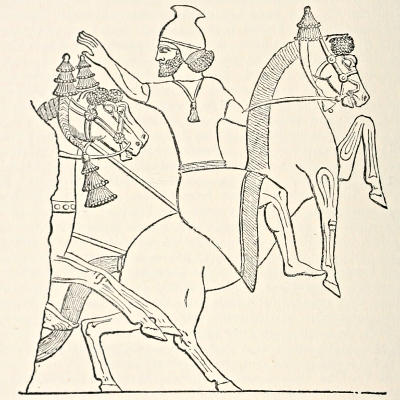
The Enemy asking Quarter of Assyrian Horsemen
The armies were provided with the engines and materials necessary for
the siege of the cities they might meet with in their expedition. If any
natural obstructions impeded the approach to a castle, such as a forest or a
river, they were, if possible, removed. Rivers were turned out of their
courses, if they impeded the operations of the army; and warriors are frequently
represented in the sculptures cutting down trees which surround
a hostile city.
The first step in a siege was probably to advance the battering-ram. If
the castle was built, as in the plains of Assyria and Babylonia, upon an artificial
eminence, an inclined plane, reaching to the summit of the mound, was
formed of earth, stones, or trees, and the besiegers were then able to bring
their engines to the foot of the walls. This road was not unfrequently
covered with bricks, forming a kind of paved way, up which the ponderous
machines could be drawn without much difficulty.
This mode of reaching the walls of a city is frequently alluded to by the
prophets, and is described by Isaiah: “Thus saith the Lord, concerning the
king of Assyria, he shall not come into this city, nor shoot an arrow there,
nor come before it with shields, nor cast a bank against it.” Similar approaches
were used by the Egyptians. They not only enabled the besiegers to push
their battering-rams up to the castle, but at the same time to escalade the
walls, the summit of which might otherwise have been beyond the reach of
their ladders.
The battering-rams were of several kinds. Some were joined to movable
towers which held warriors and armed men. The whole then formed
one great temporary building, the top of which is represented in the sculptures,
as on a level with the walls, and even turrets, of the besieged city. In
some bas-reliefs the battering-ram is without wheels; it was then perhaps
constructed on the spot, and was not intended to be moved. The movable
tower was probably sometimes unprovided with the ram; but I have not
met with it so represented in the sculptures. When Nebuchadrezzar,
king of Babylon, besieged Jerusalem, he “built forts against it round
about.” These forts or towers, if stationary, were solidly constructed of
wood; if movable, they consisted of a light frame covered with wickerwork.
The Jews were forbidden to cut down and employ, for this purpose,
trees which afford sustenance to man. “Only the trees which thou
knowest that they be not trees for meat, thou shalt destroy and cut them
down: and thou shalt build bulwarks against the city that maketh war with
thee until it be subdued.”
When the machine containing the battering-ram consisted of a simple
framework, not forming an artificial tower, a cloth of some kind of drapery
edged with fringes and otherwise ornamented appears to have been occasionally
thrown over it. Sometimes it may have been covered with hides.
It moved either on four or on six wheels, and was provided with one ram or
with two. The mode of working the rams cannot be determined from the
Assyrian sculptures. It may be presumed, from the representations in the
bas-reliefs, that they were partly suspended by a rope fastened to the outside
of the machine, and that men directed and impelled them from within. Such
was the plan adopted by the Egyptians, in whose paintings the warriors,
working the ram, may be seen through the frame. Sometimes this engine
was ornamented by a carved or painted figure of the presiding divinity,
kneeling on one knee and drawing a bow. The artificial tower was usually
occupied by two warriors: one discharged his arrows against the besieged,
whom he was able from his lofty position to harass more effectually than if
he had been below; the other held up a shield for his companion’s defence.
Warriors are not unfrequently represented as stepping from the machine to
the battlements.
Ezekiel alludes to all these modes of attack. “Lay siege against it,” he
exclaims, speaking of the city of Jerusalem, “and build a fort against it, and
cast a mount against it; set the camp also against it, and set battering-rams
against it round about.”
Archers on the walls hurled stones from slings, and discharged their
arrows against the warriors in the artificial towers; whilst the rest of the
besieged were no less active in endeavouring to frustrate the attempts of the
assailants to make breaches in their walls. By dropping a doubled chain or
rope from the battlements, they caught the ram, and could either destroy its
efficacy altogether or break the force of its blows. Those below, however,
by placing hooks over the engine, and throwing their whole weight upon
them, struggled to retain it in its place.
The besieged, if unable to displace the battering-ram, sought to destroy
it by fire and threw lighted torches or firebrands upon it. But water was
poured upon the flames, through
pipes attached to the artificial tower.
Other engines and instruments of
war were employed by the besiegers.
With a kind of catapult, apparently
consisting of a light wooden frame
covered with canvas or hides, they
threw large stones and darts against
the besieged, who, in their turn, endeavoured
to set fire to it by torches.
A long staff with an iron head, resembling
a spear, was used to force
stones out of the walls. Mines were
also opened, and the assailants sought
to enter the castle through concealed
passages. Those who worked on
them, or advanced to the attack, were
perhaps protected by the testudo, as
represented in the Egyptian paintings;
but this defence is not seen in
the Assyrian sculptures. Attempts
were made to set fire to the gates of
the city by placing torches against
them, or to break them open with
axes.
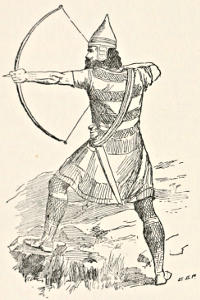
An Assyrian Archer
Mounting to the assault by ladders
was constantly practised, and
appears to have been the most general mode of attacking a castle; for ladders
are found on those bas-reliefs in which neither the battering-ram nor other
engines are introduced. It is remarkable that the battering-ram is not introduced
in the sculptures hitherto discovered at Kuyunjik, nor, as far as I am
aware, in those of Khorsabad. It would appear, therefore, that at the period
of the building of those edifices it had fallen into disuse. Scaling-ladders
appear in Egyptian sculptures as early as the XIXth Dynasty. Ramses III
is seen taking a city, by their means, at Medinet Habu. They reached to
the top of the battlements, and several persons could ascend them at the
same time. Whilst warriors, armed with the sword and spear, scaled the
walls, archers posted at the foot of the ladders kept the enemy in check and
drove them from the walls.
The troops of the besieging army were ranged in ranks below. The king
was frequently present during the attack. Descending from his chariot,
which remained stationary at a short distance behind him, he discharged his
arrows against the enemy. He was attended by his shield bearer and eunuchs,
one of whom generally held over him the emblem of royalty, the umbrella,
whilst the others bore his arms. He is sometimes represented in his chariots,
superintending the operations, or repulsing a sally. Warriors of high
rank likewise came in chariots, accompanied by their shield bearers and charioteers.
The vizier and the chief of the eunuchs are frequently seen in the
midst of the combatants.
The besieging warriors were protected, as I have already mentioned, by
large shields of wickerwork, sometimes covered with hides, which concealed
the entire person. Three men frequently formed a group; one held the
shield, a second drew the bow, and a third stood ready with a sword to defend
the archer and shield bearer, in case the enemy should sally from the castle.
The besieged manned the battlements with archers and slingers, who
discharged their missiles against the assailants. Large stones and hot
water were also thrown upon those below. A woman from the battlement
of Thebez cast a millstone upon Abimelech’s head, and broke his skull
(Judges ix. 53).
When the battering-ram had made a breach, and the assault had commenced,
the women appeared upon the walls; and, tearing their hair or
stretching out their hands, implored mercy. The men are not unfrequently
represented as joining in asking for quarter. When the assailants were once
masters of the place, an indiscriminate slaughter appears to have succeeded,
and the city was generally given over to the flames. In the bas-reliefs warriors
are seen decapitating the conquered and plunging swords or daggers
into their hearts, holding them by the hair of their heads. The prisoners
were either impaled and subjected to horrible torments or carried away as
slaves. The manner of impaling, adopted by the Assyrians, appears to have
differed from that still in use in the East. A stake was driven into the body
immediately under the ribs. When Darius took Babylon he impaled three
thousand prisoners (Herod, iii. 159). In a bas-relief discovered at Khorsabad,
a man was represented flaying a prisoner with a semicircular knife.
The Scythians scalped and flayed their enemies, and used their skins as horse-trappings
(Herod, iv. 64).
The women, children, and cattle were led away by the conquerors; and
that it was frequently the custom of the Assyrians to remove the whole population
of the conquered country to some distant part of their dominions, and
to replace it by colonies of their own, we learn from the treatment of the people
of Samaria. Eunuchs and scribes were appointed to take an inventory of the
spoil. They appear to have stood near the gates, and wrote down with a pen,
probably upon rolls of leather, the number of prisoners, sheep, and oxen, and
the amount of the booty, which issued from the city. The women were
sometimes taken away in bullock carts, and are usually seen in the bas-reliefs
bearing a part of their property with them—either a vase or a sack perhaps
filled with household stuff. They were sometimes accompanied by their children,
and are generally represented as tearing their hair, throwing dust upon
their heads, and bewailing their lot.
After the city had been taken, a throne for the king appears to have been
placed in some conspicuous spot within the walls. He is represented in the
sculptures as sitting upon it, attended by his eunuchs and principal officers,
and receiving the prisoners brought bound into his presence. The chiefs
prostrate themselves before him, whilst he places his foot upon their necks,
as Joshua commanded the captains of Israel to put their feet upon the necks
of the captive kings. This custom long prevailed in the East. In the rock
sculpture of Behistun, Darius is seen with his foot upon the neck of Gometes,
the rebellious Magian, who declared himself to be Bardius, the son of Cyrus.
When inferior prisoners were captured, their hands were tied behind, or their
arms and feet were bound by iron manacles.
They were urged onward by blows from the spears or swords of the
warriors to whom they were entrusted. In a bas-relief from Khorsabad, captives
are led before the king by a rope fastened to rings passed through the
lip and nose. This sculpture illustrates the passage in 2 Kings xix. 28: “I
will put my hook in thy nose, and my bridle in thy lips.” The king is represented
in the bas-relief as holding a rope fastened to a ring, which passes
through the lips of a prisoner, one of whose eyes he appears to be piercing
with his spear.
In the sculptures of Khorsabad and Kuyunjik, captives are seen bringing
small models of their cities to the victorious king, as a token of their subjection.
Similar models are borne in triumphal processions.
The heads of the slain were generally collected, and brought either to the
king or to an officer appointed to take account of their number. When
Ahab’s seventy sons were killed, their heads were cut off, and brought in
baskets to Jezreel. They were afterwards, laid “in two heaps at the entering
in of the gate” (2 Kings x. 8). The Egyptians generally counted by
hands. This mode of reckoning the loss of the enemy was long resorted to
in the East.
As soon as the soldiers entered the captured city, they began to plunder,
and then hurried away with the spoil. They led off the horses, carried forth
on their shoulders furniture and vessels of gold, silver, and other metals, and
made prisoners of the inhabitants, who, probably, became the property of
those who seized them. The Assyrian warriors are seen in the sculptures
bearing away in triumph the idols of the conquered nations, or breaking
them into pieces, weighing them in scales, and dividing the fragments.
Thus Hosea prophesied that the calf, the idol of Samaria, should be carried
away by the Assyrians.
When the city had been sacked it was usually given up to the flames and
utterly destroyed. The surrounding country was also laid waste. If it had
been a capital—a place of strength and renown—it was seldom rebuilt on
the same spot, which was avoided as unfortunate by those who survived the
catastrophe and returned to the ruins.
The costume of the warriors differed according to their rank and the
nature of the service they had to perform. Those who fought in chariots,
and held the shield for the defence of the king, are generally seen in coats of
scale armour, which descend either to the knees or to the ankles. A large
number of the scales were discovered in the earliest palace of Nimrud.
They were generally of iron, slightly embossed or raised in the centre, and
some were inlaid with copper. They were probably fastened to a shirt of
felt or coarse linen. Such is the armour always represented in the most
ancient sculptures. At a later period other kinds were used; the scales
were larger, and appear to have been fastened to bands of iron or copper.
The armour was frequently embossed with groups of figures and fanciful
ornaments; but there is no reason to believe that the rich designs on the
breasts of the kings were on metal.
The warriors were frequently dressed in an embroidered tunic, which was
probably made of felt or leather, sufficiently thick to resist the weapons then
in use. On the sculptures of Kuyunjik they are generally seen in this attire.
Their arms were bare from above the elbow, and their legs from the knees
downward, except when they wore shirts of mail which descended to the
ankles. They had sandals on their feet. The warriors on the later Assyrian
monuments, particularly on those of Khorsabad, are distinguished by a peculiar
ornament, somewhat resembling the Highland phillibeg. It appears to be
fastened to the girdle, and falls below the short tunic.
In the sculptures of Kuyunjik and of monuments of the same period, the
dress of the soldiers appears to vary, according to the manner in which they
are armed. Those with spear
and shield wear pointed or
crested helmets, and plain or
embroidered tunics, confined at
the waist by a broad girdle. A
kind of cross belt passes over
the shoulders, and is ornamented
in the centre of the breast by a
circular disk, probably of metal.
The slingers are attired in the
embroidered tunic, which I conjecture
to be of felt or leather;
and wear a pointed helmet, with
metal lappets falling over the
ears. Both the spearmen and
slingers have greaves, which
appear to have been laced in
front.
The archers are dressed in
very short embroidered tunics,
which scarcely cover half the
thigh, the rest of the leg being
left completely bare. They are
chiefly distinguished from other
warriors by the absence of the
helmet. A simple band round
the temples confines the hair,
which is drawn up in a bunch
behind.
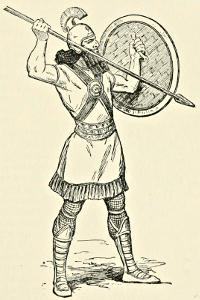
Costume of an Assyrian Spearman
It is probable that these various costumes indicate people of different
countries, auxiliaries in the Assyrian armies, who used the weapons most
familiar to them, and formed different corps or divisions. Thus, in the army
of Xerxes were marshalled men of many nations, each armed according to
the fashion of his country, and fighting in his own peculiar way. We may,
perhaps, identify, in the Assyrian sculptures, several of the costumes described
by the Greek historian as worn by those who formed the vast army of the
Persian king.
The arms of the early Assyrians were the spear, the bow, the sword, and
the dagger. The sling is not represented in the most ancient monuments as
an Assyrian weapon, although used by a conquered nation; it was, perhaps,
introduced at a later period. The bows were of two kinds: one long and
slightly curved, the other short and almost angular; the two appear to have
been carried at the same time by those who fought in chariots.
The arrows were probably made of reeds, and were kept in a quiver slung
over the back. The king, however, and the great officers of the state were
followed by attendants, who carried the quivers and supplied their masters
with arrows. The bow was drawn to the cheek or to the ear, as by the
Saxons, and not to the breast, after the fashion of the Greeks. The barbs
were of iron and copper, several of both materials having been found in the
ruins. When in battle it was customary for the archer to hold two arrows
in reserve in his right hand; they were placed between the fingers, and did
not interfere with the motion of the arm whilst drawing the bow. When
marching he usually carried the larger bow over his shoulders, having first
passed his head through it. The bow of the king was borne by an attendant.
The smaller bows were frequently placed in the quiver, particularly by
those who fought in chariots. A leather or linen guard was fastened by straps
to the inside of the left arm to protect it when the arrow was discharged.
The swords were worn on the left side, and suspended by belts passing
over the shoulders or round the middle; some were short and others long.
I have already alluded to the beauty of the ornaments on the hilt and sheath.
The dagger appears to have been carried by all, both in time of peace and
war; even the priests and divinities are represented with them. They were
worn indifferently on the left and right side, or perhaps on both at the same
time. Generally two, or sometimes three, were inserted into one sheath,
which was passed through the girdle. The handles, as I have already mentioned,
were most elaborately adorned, and were frequently in the shape of
the head of a ram, bull, or horse, being made of ivory or rare stones. A
small chain was sometimes fastened to the hilt or to the sheath, probably to
retain it in its place. A dagger, resembling in form those of the sculptures,
was found amongst the ruins of Nimrud; it is of copper. The handle is
hollowed, either to receive precious stones, ivory, or enamel.
The spear of the Assyrian footman was short, scarcely exceeding the
height of a man; that of the horseman appears to have been considerably
longer. The iron head of a spear from Nimrud is in the British Museum.
The shaft was probably of some strong wood, and did not consist of a reed,
like that of the modern Arab lance. The large club pointed with iron, mentioned
by Herodotus amongst the weapons carried by the Assyrians, is not
represented in the sculptures; unless, indeed, the description of the historian
applies to the mace, a weapon in very general use amongst them, and frequently
seen in the bas-reliefs. This weapon consisted of a short handle,
probably of wood, to which was fixed a head, evidently of metal, in the shape
of a flower, rosette, lion, or bull. To the end of the handle was attached a
thong, apparently of leather, through which the hand was passed. I have
not found any representation of warriors using the hatchet, except when cutting
down trees, to clear the country preparatory to a siege. It is, however,
generally seen amongst the weapons of those who fought in chariots, and was
carried in the quiver, with the arrows and short angular bow.
In the bas-reliefs of Kuyunjik, slingers are frequently represented amongst
the Assyrian troops. The sling appears to have consisted of a double rope,
with a thong, probably of leather, to receive the stone; it was swung round
the head. The slinger held a second stone in his left hand, and at his feet is
generally seen a heap of pebbles ready for use. That the Persian slingers
were exceedingly expert, used very large stones, and could annoy their enemies
whilst out of the reach of their darts or arrows, we learn from several
passages in Xenophon.
The javelin is frequently included amongst the weapons of the Assyrian
charioteers; but the warriors are not represented as using it in battle. It
was carried in the quiver amongst the arrows.
The shields of the Assyrians were of various forms and materials. In
the more ancient bas-reliefs a circular buckler, either of hide or metal, perhaps
in some instances of gold and silver, is most frequently introduced. King
Solomon made three hundred shields of beaten gold, three pounds of gold
to each shield (1 Kings x. 17). The servants of Hadad-ezer, king of
Zobah, carried shields of gold (2 Samuel viii. 7). The shield of Goliath
was of brass. It was held by a handle fixed to the centre. Light oblong
shields of wickerwork, carried in a similar manner, are also found in the
early sculptures; but those of a circular form appear to have been generally
used by the charioteers.
Suspended to the backs of the chariots, and also carried by warriors, are
frequently seen shields in the shape of a crescent, narrow and curved outwards
at the extremities. The face is ornamented by a row of angular bosses,
or teeth, in the centre of which is the head of a lion. In the sculptures of
Khorsabad the round shield is often highly ornamented. It resembles, both
in shape and in the devices upon it, the bucklers now carried by the Kurds
and Arabs, which are made of the hide of the hippopotamus. In the bas-reliefs
of Kuyunjik some warriors bear oval shields, very convex, and
sufficiently large to cover the greater part of the body. The centre and
outer rim are decorated with bosses.
The shield used during a siege concealed the whole person of the warrior,
and completely defended him from the arrows of the enemy. It was made
either of wickerwork or of hides, and was furnished at the top with a curved
point, or with a square projection, like a roof, at right angles to the body of
the shield, which may have served to defend the heads of the combatants
against missiles discharged from the walls and towers. Such were probably
the shields used by the Persian archers at the battle of Platæa. The archers,
whether fighting on foot or in chariots, were accompanied by shield bearers,
whose office it was to protect them from the shafts of the enemy. Sometimes
one shield covered two archers. The shield bearer was usually provided
with a sword, which he held ready drawn for defence. The king was
always attended in his wars by this officer, and even in peace one of his
eunuchs usually carried a circular shield for his use. This shield bearer was
probably a person of rank, as in Egypt. On some monuments of the later
Assyrian period he is represented carrying two shields, one in each hand.
A great part of the strength of the Assyrian armies consisted in chariots
and horsemen, to which we have frequent allusion in the inspired writings.
The chariots appear to have been used by the king and the highest officers
of state, who are never seen in battle on horseback nor, except in sieges, on
foot. They contained either two or three persons. The king was always
accompanied by two attendants—the warrior protecting him with a shield
(who was replaced during peace by the eunuch bearing the parasol), and the
charioteer. The principal warriors were also frequently attended by their
shield bearers, though more generally by the driver alone.
The chariot was used during a siege, as well as in open battle. The
king and his warriors are frequently represented as fighting in chariots with
the enemy beneath the walls of a castle, or as having dismounted from their
cars, to discharge their arrows against the besieged. In the latter case,
grooms on foot hold the horses. When the king in his chariot formed part
of a triumphal procession, armed men led the horses. The chariot was also
preceded and followed by men on foot.
The horsemen formed a no less important part of the Assyrian army
than the charioteers.—“Assyrians clothed in blue, captains and rulers, all
of them desirable young men, horsemen riding upon horses” (Ezekiel
xxiii. 6). Horsemen are seen in the most ancient sculptures of Nimrud.
It is singular, as observes Sir Gardner Wilkinson (Ancient Egyptians, Vol. I,
p. 288), that horsemen are nowhere represented on the monuments of Egypt,
although there can be no doubt, from numerous passages in the sacred
writings, that cavalry formed an important part of the Egyptian armies. I
have already mentioned that disciplined bodies of cavalry were represented
in the bas-reliefs of Kuyunjik. We learn from the Book of Judith that
Holofernes had twelve thousand archers on horseback (Judith ii. 15).
Solomon had twelve thousand horsemen (1 Kings x. 26). The king himself
is never represented on horseback, although a horse richly caparisoned,
apparently for his use,—perhaps to enable him to fly, should his chariot
horses be killed,—is frequently seen led by a warrior, and following his
chariot.
In the earliest sculptures the horses, except such as are led behind the
king’s chariot, are unprovided with cloths or saddles. The rider is seated
on the naked back of the animal. At a later period, however, a kind of pad
appears to have been introduced; and in a sculpture at Kuyunjik was represented
a high saddle not unlike that now in use in the East.b
Nothing else, perhaps, is so vitally important in the life-history of a
nation as its contact with other nations. Such contact alone, it would seem,
can enable a nation in some measure to ward off the lethargy of age, or to
overcome the incubus of custom and superstition.
The isolated nation does not get beyond a certain stage of evolution. It
learns a few secrets, and seems powerless to learn others of itself. Only
through contact with another community can it improve its customs,
get new ideas, acquire better habits of thought and action. We have
already pointed out how Egypt profited in this regard through the foreign
associations that came with the inroad of conquering tribes from the
south and east.
Babylon, however, occupied a far more favourable position than Egypt for
contact with other nations, not alone through such warlike channels, but also
through the yet more beneficent channels of peaceful commerce. A glance
at the map shows that Mesopotamia occupies the very centre of the world of
ancient civilisation. By reaching out its hand, so to speak, this way or that,
it came in contact with every civilised nation of the period except China.
It was the connecting link between Persia and India on the one hand, and
Lydia, Syria, and Egypt on the other. Even Chinese ideas were to some
extent accessible through the mediation of India. No other great nation of
antiquity compares with Babylonia in this regard; and perhaps this was the
most important reason why this little strip of fertile land between the two
great rivers supported a continuous civilisation, on the whole ever advancing,
millennium after millennium.
If one would correctly understand the development of that Mesopotamian
civilisation, of which our own culture is the direct outgrowth, one must give
heed to the commercial relations which were so important a factor of national
growth, without which, indeed, no such civilisation as that of Babylon and
Nineveh could have come into existence.
But, of course, commerce builds up local industries. A nation must be a
producer of useful commodities before it can hope to secure, by peaceful
means, the commodities produced by other nations. In connection with the
commercial relations of a nation we must study also its home industries, that
is to say, broadly speaking, its agricultural and manufacturing conditions.
We must see something also of the social customs that grow out of, and rest
upon these industrial conditions; and of the laws that are the official expression
of the communal intelligence—the index of the communal conscience of
the epoch.a And first we have the privilege of quoting from one who
himself saw Babylon, that is, of course, Herodotus.
The Assyrians are masters of many capital towns; but their place of
greatest strength and fame is Babylon, which, after the destruction of Nineveh,
was the royal residence. It is situated on a large plain, and is a perfect
square; each side, by every approach, is 120 furlongs in length; the space,
therefore, occupied by the whole is 480 furlongs. [The different reports
of the extent of the walls of Babylon are given as follows: By Herodotus
at 120 stadia each side, or 480 in circumference. By Pliny and Solinus at
60 Roman miles, which, at eight stadia to a mile, agrees with Herodotus.
By Strabo at 385 stadia. By Diodorus, from Ctesias, 360; but from Clitarchus,
who accompanied Alexander, 365; and, lastly, by Curtius, 368. It appears
highly probable that 360 or 365 was the true statement of the circumference.]
So extensive is the ground which Babylon occupies, its internal beauty
and magnificence exceeds whatever has come within my knowledge. It is
surrounded by a trench, very wide, deep, and full of water; the wall beyond
this is two hundred royal cubits high, and fifty wide; the royal exceeds the
common cubit by three digits. [These measures, being taken from the
proportions of the human body, are more permanent than any other. The
foot of a moderate-sized man and the cubit, that is the space from the end
of the fingers to the elbow, have always been near twelve and eighteen
inches respectively.—Beloe.]
I here think it right to describe the use to which the earth dug out of
the trench was converted, as well as the particular manner in which they
constructed the wall. The earth of the trench was first of all laid in heaps,
and, when a sufficient quantity was obtained, made into square bricks and
baked in a furnace. They used as cement a composition of heated bitumen,
which, mixed with tops of reeds, was placed betwixt every thirtieth course
of bricks. Having thus lined the sides of the trench, they proceeded to
build the wall in the same manner, on the summit of which, and fronting
each other, they erected small watch-towers of one story, leaving a space betwixt
them, through which a chariot and four horses might pass and turn.
In the circumference of the wall, at different distances, were an hundred
massy gates of brass, whose hinges and frames were of the same metal.
Within an eight days’ journey from Babylon is a city called Is [Hit], near
which flows a river of the same name, which empties itself into the Euphrates.
With the current of this river, particles of bitumen descend
towards Babylon, by the means of which its walls were constructed. The
great river Euphrates, which, with its deep and rapid streams, rises in the
Armenian Mountains, and pours itself into the Red Sea, divides Babylon into
two parts. The walls meet and form an angle with the river at each extremity
of the town, where a breastwork of burnt bricks begins, and is continued
along each bank. The city, which abounds in houses from three to
four stories in height, is regularly divided into streets. Through these,
which are parallel, there are transverse avenues to the river, opened through
the wall and breastwork, and secured by an equal number of little gates of
brass.
The first wall is regularly fortified; the interior one, though less in substance,
is of almost equal strength. Besides these, in the centre of each
division of the city, there is a circular space surrounded by a wall. In one
of these stands the royal palace, which fills a large and strongly defended
space. The temple of Jupiter Belus occupies the other, whose huge gates
of brass may still be seen. It is a square building, each side of which is of
the length of two furlongs. In the midst a tower rises, of the solid depth
and height of one furlong, upon which, resting as a base, seven other turrets
are built in regular succession. The ascent is on the outside, which, winding
from the ground, is continued to the highest tower; and in the middle
of the whole structure there is a convenient resting-place. In the last tower
is a large chapel, in which is placed a couch magnificently adorned, and near
it a table of solid gold; but there is no statue in the place. No man is suffered
to sleep here; but the apartment is occupied by a female, who, as the
Chaldean priests affirm, is selected by their deity from the whole nation as
the object of his pleasures.
They themselves have a tradition, which cannot easily obtain credit, that
their deity enters this temple and reposes by night on this couch. A similar
assertion is also made by the Egyptians of Thebes; for, in the interior
part of the temple of the Theban Jupiter, a woman in like manner sleeps. Of
these two women, it is presumed that neither of them has any communication
with the other sex. In which predicament the priestess of the temple
of Pataræ in Lycia is also placed. Here is no regular oracle; but whenever
a divine communication is expected, the priestess is obliged to pass the preceding
night in the temple.
In this temple there is also a small chapel, lower in the building, which
contains a figure of Jupiter in a sitting posture, with a large table before
him; these, with the base of the table and the seat of the throne, are all of
the purest gold, and are estimated by the Chaldeans to be worth eight hundred
talents. On the outside of this chapel there are two altars: one is of
gold, the other is of immense size, and appropriated to the sacrifice of full-grown
animals; those only which have not left their dams may be offered on
the altar of gold. Upon the larger altar, at the time of the anniversary festival
in honour of their god, the Chaldeans regularly consume incense, to the
amount of a thousand talents. There was formerly in this temple a statue
of gold, twelve cubits high; this, however, I mention from the information
of the Chaldeans, and not from my own knowledge. Darius, the son of
Hystaspes, endeavoured by sinister means to get possession of this, not daring
openly to take it; but his son Xerxes afterwards seized it, putting the
priest to death who endeavoured to prevent its removal. The temple, besides
those ornaments which I have described, contains many offerings of
individuals.
Among the various sovereigns of Babylon, who contributed to the strength
of its walls, and the decoration of its temples, and of whom I shall make
mention when I treat of the Assyrians, there were two females; the former
of these was named Semiramis, who preceded the other by an interval of
five generations. This queen raised certain mounds, which are indeed
admirable works. Till then the whole plain was subject to violent inundations
from the river. The other queen was called Nitocris. She being a
woman of superior understanding, not only left many permanent works,
which I shall hereafter describe, but also having observed the increasing
power and restless spirit of the Medes, and that Nineveh, with other cities,
had fallen a prey to their ambition, put her dominions in the strongest
posture of defence. To effect this she sunk a number of canals above
Babylon, which by their disposition rendered the Euphrates, which before
flowed to the sea in an almost even line, so complicated by its windings that
in its passage to Babylon it arrives three times at Ardericca, an Assyrian
village; and to this hour they who wish to go from the sea up the Euphrates
to Babylon are compelled to touch at Ardericca three times on three different
days. The banks also, which she raised to restrain the river on each side,
are really wonderful from their enormous height and substance. At a considerable
distance above Babylon, turning aside a little from the stream, she
ordered an immense lake to be dug, sinking it till they came to the water.
Its circumference was no less than four hundred and twenty furlongs. The
earth of this was applied to the embankments of the river, and the sides of the
trench or lake were strengthened and lined with stones brought thither for
that purpose. She had in view by these works, first of all to break the
violence of the current by the number of circumflexions and also to render
the navigation to Babylon as difficult and tedious as possible. These things
were done in that part of her dominions which was most accessible to the
Medes, and with the further view of keeping them in ignorance of her affairs
by giving them no commercial encouragement. Having rendered both of
these works strong and secure, she proceeded to execute the following
project. The city being divided by the river into two distinct parts, whoever
wanted to go from one side to the other was obliged in the time of the
former kings to pass the water in a boat. For this, which was a matter of
general inconvenience, she provided this remedy, and the immense lake
which she had before sunk became the further means of extending her fame.
Having procured a number of large stones, she changed the course of the
river, directing it into the canal prepared for its reception. When this was
full the natural bed of the river became dry, and the embankments on each side,
near those smaller gates which led to the water, were lined with bricks hardened
by fire, similar to those which had been used in the construction of the wall.
She afterwards, nearly in the centre of the city, with the stones above-mentioned,
strongly compacted with iron and with lead, erected a bridge. Over
this the inhabitants passed in the daytime by a square platform, which was
removed in the evening to prevent acts of mutual depredation. When the
above canal was thoroughly filled with water, and the bridge completely
finished and adorned, the Euphrates was suffered to return to its original
bed; thus both the canal and the bridge were confessedly of the greatest
utility to the public. The above queen was also celebrated for another
instance of ingenuity. She caused her tomb to be erected over one of the
principal gates of the city, and so situated as to be obvious to universal
inspection. It was thus inscribed: “If any of the sovereigns, my successors,
shall be in extreme want of money let him open my tomb and take
what money he may think proper; if his necessity be not great, let him
forbear; the experiment will perhaps be dangerous.” The tomb remained
without injury till the time and reign of Darius. He was equally offended
at the gate’s being rendered useless, and that the invitation thus held out to
become affluent should have been so long neglected. The gate, it is to be
observed, was of no use, from the general aversion to pass through a place
over which a dead body was laid. Darius opened the tomb; but instead
of finding riches, he saw only a dead body, with a label of this import: “If
your avarice had not been equally base and insatiable, you would not have
disturbed the repose of the dead.” Such are the traditions concerning this
queen.
The following exists amongst many other proofs which I shall hereafter
produce of the power and greatness of Babylon. Independent of those subsidies
which are paid monthly to the Persian monarch, the whole of his
dominions are obliged throughout the year to provide subsistence for him
and for his army. Babylon alone raises a supply for four months, eight
being proportioned to all the rest of Asia, so that the resources of this region
are considered as adequate to a third part of Asia. The government also
of this country, which the Persians call a satrapy, is deemed by much the
noblest in the empire. When Tritantæchmes, son of Artabazus, was appointed
to this principality by the king, he received every day an artaby of silver.
The artaby is a Persian measure which exceeds the Attic medimnus by about
three chænices. Besides his horses for military service this province maintained
for the sovereign’s use a stud of eight hundred stallions and sixteen
thousand mares, one horse being allotted to twenty mares. He had, moreover,
so immense a number of Indian dogs that four great towns in the
vicinity of Babylon were exempted from every other tax but that of maintaining
them.
The Assyrians have but little rain; the lands, however, are fertilised and
the fruits of the earth nourished by means of the river. This does not, like
the Egyptian Nile, enrich the country by overflowing its banks, but is dispersed
by manual labour or by hydraulic engines. The Babylonian district,
like Egypt, is intersected by a number of canals, the largest of which, continued
with a southeast course from the Euphrates to that part of the Tigris
where Nineveh stands, is capable of receiving vessels of burden. Of all
countries which have come within my observation this is far the most fruitful
in corn. Fruit trees, such as the vine, the olive, and the fig, they do not
even attempt to cultivate; but the soil is so particularly well adapted for
corn, that it never produces less than two hundredfold. In seasons which are
remarkably favourable it will sometimes rise to three hundred. The ear of
their wheat as well as barley is four digits in size. The immense height to
which millet and sesamum will grow, although I have witnessed it myself, I
know not how to mention. I am well aware that they who have not visited
this country will deem whatever I may say on this subject a violation of
probability. They have no oil but what they extract from the sesamum.
The palm is a very common plant in this country and generally fruitful.
This they cultivate like fig trees, and it produces them bread, wine, and
honey. The process observed is this: they fasten the fruit of that which
the Greeks term the male tree to the one which produces the date; by this
means the worm which is contained in the former entering the fruit ripens
and prevents it from dropping immaturely. The male palms bear insects in
their fruit in the same manner as the wild fig trees. Of all that I saw in
this country, next to Babylon itself, what to me appeared the greatest
curiosity were the boats. These which are used by those who come to the
city are of a circular form and made of skins. They are constructed in
Armenia, in the parts above Assyria, where the sides of the vessels being
formed of willow are covered externally with skins, and having no distinction
of head or stern, are modelled in the shape of a shield. Lining the
bottom of the boats with reeds, they take on board their merchandise, and
thus commit themselves to the stream. The principal article of their commerce
is palm wine, which they carry in casks. The boats have two oars,
one man to each; one pulls to him, the other pushes from him. These boats
are of very different dimensions; some of them are so large as to bear freights
to the value of five thousand talents; the smaller of them has one ass on
board, the larger several. On their arrival at Babylon they dispose of all
their cargo, selling the ribs of their boats, the matting, and everything but
the skins which cover them; these they lay upon their asses and with them
return to Armenia. The rapidity of the stream is too great to render their
return by water practicable. This is perhaps the reason which induces them
to make their boats of skin rather than of wood. On their return with their
asses to Armenia they make other vessels in the manner we have before
described.
Their clothing is of this kind: they have two vests, one of linen which
falls to the feet, another over this which is made of wool, a white sash
connects the whole. The fashion of their shoes is peculiar to themselves,
though somewhat resembling those worn by the Thebans. They wear their
hair long, and covered with a turban, and are lavish in their use of perfumes.
Each person has a seal ring, and a cane, or walking-stick, upon the top of
which is carved an apple, a rose, a lily, an eagle, or some figure or other,
for to have a stick without a device is unlawful.
In my description of their laws I have to mention one, the wisdom of
which I must admire, and which, if I am not misinformed, the Eneti, who
are of Illyrian origin, use also. In each of their several districts this custom
was every year observed: such of their virgins as were marriageable were,
at an appointed time and place, assembled together. Here the men also
came, and some public officer sold by auction the young women one by one,
beginning with the most beautiful. When she was disposed of, and, as may
be supposed, for a considerable sum, he proceeded to sell the one who was
next in beauty, taking it for granted that each man married the maid he
purchased. [Herodotus here omits one circumstance of consequence, in
my opinion, to prove that this ceremony was conducted with decency. It
passed under the inspection of the magistrates, and the tribunal superintended
the marriage of the young women. Three men, respectable for their
virtue, and who were at the head of their several tribes, conducted the young
women that were marriageable to the place of assembly, and there sold them
by the voice of the public crier.—Larcher. If the custom of disposing of
the young women to the best bidder was peculiar to the Babylonians, that of
purchasing the person intended for a wife, and of giving the father a sum to
obtain her, was much more general. It was practised amongst the Greeks,
the Trojans and their allies, and even amongst the deities.—Bellanger.]
The more affluent of the Babylonian youths contended with much ardour
and emulation to obtain the most beautiful; those of the common people
who were desirous of marrying, as if they had but little occasion for personal
accomplishments, were content to receive the more homely maidens, with a
portion annexed to them. For the crier, when he had sold the fairest, selected
next the most ugly, or one that was deformed; she also was put up to sale,
and assigned to whoever would take her with the least money. This money
was what the sale of the beautiful maidens produced, who were thus obliged
to portion out those who were deformed, or less lovely than themselves. No
man was permitted to provide a match for his daughter, nor could any one
take away the woman whom he purchased without first giving security to
make her his wife. To this, if he did not assent, his money was returned
to him. There were no restrictions with respect to residence; those of
another village might also become purchasers. This, although the most wise
of all their institutions, has not been preserved to our time. One of their
later ordinances was made to punish violence offered to women, and to
prevent their being carried away to other parts; for after the city had been
taken, and the inhabitants plundered, the lower people were reduced to such
extremities that they prostituted their daughters for hire.
They have also another institution, the good tendency of which claims
applause. Such as are diseased among them they carry into some public
square; they have no professors of medicine, but the passengers in general
interrogate the sick person concerning his malady, that if any person has
either been afflicted with a similar disease himself, or seen its operation on
another, he may communicate the process by which his own recovery was
effected, or by which, in any other instance, he knew the disease to be
removed. No one may pass by the afflicted person in silence, or without
inquiry into the nature of his complaint.
Previous to their interment, their dead are anointed with honey, and,
like the Egyptians, they are fond of funeral lamentations. Whenever a
man has had communication with his wife, he sits over a consecrated vessel,
containing burning perfumes; the woman does the same. In the morning
both of them go into the bath; till they have done this they will neither of
them touch any domestic utensil. This custom is also observed in Arabia.
The Babylonians have one custom in the highest degree abominable.
Every woman who is a native of the country is obliged once in her life to
attend at the temple of Venus, and prostitute herself to a stranger. Such
women as are of superior rank do not omit even this opportunity of separating
themselves from their inferiors; these go to the temple in splendid
chariots, accompanied by a numerous train of domestics, and place themselves
near the entrance. This is the practice with many, whilst the greater
part, crowned with garlands, seat themselves in the vestibule, and there are
always numbers coming and going. The seats have all of them a rope or
string annexed to them, by which the stranger may determine his choice.
A woman, having once taken this situation, is not allowed to return home
till some stranger throws her a piece of money, and leading her to a distance
from the temple, enjoys her person. It is usual for the man, when he gives
the money, to say, “May the goddess Mylitta be auspicious to thee!” Mylitta
being the Assyrian name of Venus. The money given is applied to sacred
uses, and must not be refused, however small it may be. The woman is not
suffered to make any distinction, but is obliged to accompany whoever offers
her money. She afterwards makes some conciliatory oblation to the goddess,
and returns to her house, never afterwards to be obtained on similar or on any
terms. Such as are eminent for their elegance and beauty do not continue
long, but those who are of less engaging appearance have sometimes been
known to remain from three to four years unable to accomplish the terms of
the law. It is to be remarked that the inhabitants of Cyprus have a similar
observance.
In addition to the foregoing account of Babylonian manners, we may
observe that there are three tribes of this people whose only food is fish.
They prepare it thus: having dried it in the sun, they beat it very small in
a mortar, and afterwards sift it through a piece of fine cloth; they then form
it into cakes, or bake it as bread.c
The foregoing description by Herodotus refers to the condition of Babylon
in the early part of the fifth century B.C., something like fifty years after
the overthrow of the new Babylonian empire by Cyrus. The city still
remained under Persian influence, Babylon being one of the capitals of the
“Great King.” The account given has a peculiar value because it is the
only description given by an eye-witness from the Western world that has
come down to us from so early a period.
Herodotus saw with the eyes of a Greek of the age of Pericles, and it is
now admitted that when he describes his personal experiences, he is altogether
dependable. His account, therefore, still has full value as supplementing
the records of the monuments. It is greatly to be regretted that
the Greek historian remained ignorant of the monumental records themselves,
though it would have been strange had he been able to decipher
them, since the Greeks were notoriously unfamiliar with any language but
their own.
The account of Babylon given by the great geographer, Strabo, which
will be presented in the next chapter, relates to a period not far from the
beginning of the Christian era, and hence carries us ahead of the political
story as told in the preceding books. At this time Babylon had ceased to
be the capital city, though still important. Since Herodotus wrote, some
five hundred years have passed. Alexander has overthrown the Persians,
and Alexander’s empire in turn has been overthrown. Yet we may suppose
that the old city of Babylon—the most ancient city retaining influence at
that day—has not very greatly changed, except that its ancient monuments
are falling into ruins. A peculiar interest attaches to this description of the
last stages in the life-history of a city that has seen so many rotations of
fortune, and has lived on through so many shiftings of the political kaleidoscope.
It is probable that Strabo, like Herodotus, writes as an eye-witness. In
any event his account has full authority, coming from one of the greatest
and most scientific of ancient geographers, who in addition to his geographical
learning had a keen historical sense.a
Babylon is situated in a plain. The wall is 385 stadia in circumference
and 32 feet in thickness. The height of the space between the
towers is 50, and of the towers, 60 cubits. The roadway upon the walls will
allow chariots with four horses when they meet to pass each other with ease.
Whence, among the seven wonders of the world, are reckoned this wall and
the hanging garden; the shape of the garden is a square, and each side of
it measures four plethra. It consists of vaulted terraces, raised one above
another, and resting upon cube-shaped pillars. These are hollow and filled
with earth, to allow trees of the largest size to be planted. The pillars, the
vaults, and the terraces are constructed of baked bricks and asphalt.
The ascent to the highest story is by stairs, and at their side are water-engines,
by means of which persons, appointed expressly for the purpose,
are continually employed in raising water from the Euphrates into the garden;
for the river, which is a stadium in breadth, flows through the middle
of the city, and the garden is on the side of the river. The tomb, also, of
Belus is there. At present it is in ruins, having been demolished, it is said,
by Xerxes. It was a quadrangular pyramid of baked brick, a stadium in
height, and each of the sides a stadium in length. Alexander intended to
repair it. It was a great undertaking, and required a long time for its completion
(for ten thousand men were occupied two months in clearing away
the mound of earth), so that he was not able to execute what he had attempted
before disease hurried him rapidly to his end. None of the persons who succeeded
him attended to this undertaking; other works also were neglected,
and the city was dilapidated, partly by the Persians, partly by time, and
through the indifference of the Macedonians to things of this kind, particularly
after Seleucus Nicator had fortified Seleucia, on the Tigris, near Babylon,
at the distance of about three hundred stadia.
Both this prince and all his successors directed their care to that city,
and transferred to it the seat of empire. At present it is larger than Babylon;
the other is in great part deserted, so that no one would hesitate to
apply to it what one of the comic writers said of Megalopolitæ in Arcadia:
“The great city is a great desert.”
On account of the scarcity of timber, the beams and pillars of the houses
were made of palm wood. They wind ropes of twisted reed round the pillars,
paint them over with colours, and draw designs upon them; they cover
the doors with a coat of asphaltus. These are lofty, and all the houses are
vaulted on account of the want of timber. For the country is bare, a great
part of it is covered with shrubs, and produces nothing but the palm. This
tree grows in the greatest abundance in Babylonia. It is found in Susiana;
also, in great quantity, on the Persian coast, and in Carmania.
They do not use tiles for their houses, because there are no great rains.
The case is the same in Susiana and in Sitacene. In Babylon a residence
was set apart for the native philosophers called Chaldeans, who are chiefly
devoted to the study of astronomy. Some, who are not approved of by the
rest, profess to understand genethlialogy, or the casting of nativities. There
is also a tribe of Chaldeans who inhabit a district of Babylonia in the
neighbourhood of the Arabians and of the sea called the Persian Sea. There
are several classes of the Chaldean astronomers. Some have the name of
Orcheni, some Borsippeni, and many others, as if divided into sects, who
disseminate different tenets on the same subjects. The mathematicians
make mention of some individuals among them, as Cidenas, Naburianus, and
Sudinus. Seleucus, also, of Seleucia, is a Chaldean, and many other
remarkable men. Borsippa is a city sacred to Diana and Apollo. Here
is a large linen manufactory. Bats of much larger size than those in other
parts abound in it. They are caught and salted for food.
The country of the Babylonians is surrounded on the east by the Susans,
Elymæi, and Parætaceni; on the south by the Persian Gulf, and the Chaldeans
as far as the Arabian Messeni; on the west by the Arabian Scenitæ
as far as Adiabene and Gordyæa; on the north by the Armenians and Medes
as far as the Zagros, and the nations about that river.
The country is intersected by many rivers, the largest of which are the
Euphrates and the Tigris; next to the Indian rivers, the rivers in the southern
parts of Asia are said to hold the second place. The Tigris is navigable
upward from its mouth to Opis and to the present Seleucia. Opis is a village
and a mart for the surrounding places. The Euphrates also is navigable
up to Babylon, a distance of more than three thousand stadia. The
Persians, through fear of incursions from without and for the purpose of
preventing vessels from ascending these rivers, constructed artificial cataracts.
Alexander, on arriving there, destroyed as many of them as he could,
those particularly (on the Tigris from the sea) to Opis. But he bestowed
great care upon the canals, for the Euphrates, at the commencement of summer,
overflows. It begins to fill in the spring, when the snow in Armenia
melts; the ploughed land, therefore, would be covered with water and be
submerged, unless the overflow of the superabundant water of the Nile is
diverted. Hence the origin of canals. Great labour is requisite for their
maintenance, for the soil is deep, soft, and yielding, so that it would easily
be swept away by the stream; the fields would be laid bare, the canals filled,
and the accumulation of mud would soon obstruct their mouths. Then
again, the excess of water discharging itself into the plains near the sea
forms lakes and marshes and reed grounds, supplying the reeds with which
all kinds of platted vessels are woven; some of these vessels are capable of
holding water when covered over with asphaltus; others are used with the
material in its natural state. Sails are also made of reeds; these resemble
mats or hurdles.
It is not, perhaps, possible to prevent inundations of this kind altogether,
but it is the duty of good princes to afford all possible assistance. The assistance
required is to prevent excessive overflow by the construction of
dams, and to obviate the filling of rivers produced by the accumulation of
mud, by cleansing the canals and removing stoppages at their mouths. The
cleansing of the canals is easily performed, but the construction of dams
requires the labour of numerous workmen. For the earth being soft and
yielding does not support the superincumbent mass, which sinks, and is
itself carried away, and thus a difficulty arises in making dams at the mouth.
Expedition is necessary in closing the canals to prevent all the water flowing
out. When the canals dry up in the summer-time they cause the river to
dry up also; and if the river is low (before the canals are closed) it cannot
supply the canals in time with water, of which the country, burnt up and
scorched, requires a very large quantity, for there is no difference, whether
the crops are flooded by an excess or perish by drought and a failure of water.
The navigation up the rivers (a source of many advantages) is continually
obstructed by both the above-mentioned causes, and it is not possible to remedy
this unless the mouths of the canals were quickly opened and quickly
closed, and the canals were made to contain and preserve a mean between
excess and deficiency of water.
Aristobulus relates that Alexander himself, when he was sailing up the
river and directing the course of the boat, inspected the canals, and ordered
them to be cleared by his multitude of followers; he likewise stopped up
some of the mouths, and opened others. He observed that one of these
canals, which took a direction more immediately to the marshes and to the
lakes in front of Arabia, had a mouth very difficult to be dealt with, and
which could not be easily closed on account of the soft and yielding nature of
the soil; he (therefore) opened a new mouth at the distance of thirty stadia,
selecting a place with a rocky bottom, and to this the current was diverted.
But in doing this he was taking precautions that Arabia should not become
entirely inaccessible in consequence of the lakes and marshes, as it was
already almost an island from the quantity of water (which surrounded it).
For he contemplated making himself master of this country, and he had
already provided a fleet and places of rendezvous, and had built vessels in
Phœnicia and at Cyprus, some of which were in separate pieces, others were
in parts, fastened together by bolts. These, after being conveyed to Thapsacus
in seven distances of a day’s march, were then to be transported down
the river to Babylon. He constructed other boats in Babylonia, from cypress
trees in the groves and parks, for there is a scarcity of timber in Babylonia.
Among the Cossæi [Kossæans] and some other tribes the supply of timber
is not great.
The pretext for the war, says Aristobulus, was that the Arabians were
the only people who did not send their ambassadors to Alexander; but the
true reason was his ambition to be lord of all.
When he was informed that they worshipped two deities only, Jupiter and
Bacchus, who supply what is most requisite for the subsistence of mankind,
he supposed that, after his conquests, they would worship him as a third, if
he permitted them to enjoy their former national independence. Thus was
Alexander employed in clearing the canals, and in examining minutely the
sepulchres of the kings, most of which are situated among the lakes.
Eratosthenes, when he is speaking of the lakes near Arabia, says, that the
water, when it cannot find an outlet, opens passages underground, and is
conveyed through these as far as the Cœle-Syrians, it is also compressed and
forced into the parts near Rhinocolura and Mount Casius, and there forms
lakes and deep pits. But I know not whether this is probable. For the
overflowings of the water of the Euphrates, which form the lakes and marshes
near Arabia, are near the Persian Sea. But the isthmus which separates
them is neither large nor rocky, so that it was more probable that the water
forced its way in this direction into the sea, either under the ground, or
across the surface, than that it traversed so dry and parched a soil for more
than six thousand stadia: particularly, when we observe, situated midway in
this course, Libanus, Antilibanus, and Mount Casius.
Such, then, are the accounts of Eratosthenes and Aristobulus.
But Polycleitus says, that the Euphrates does not overflow its banks,
because its course is through large plains; that of the mountains (from which
it is supplied) some are distant two thousand, and the Kossæan Mountains
scarcely one thousand stadia, that they are not very high, nor covered with
snow to a great depth, and therefore do not occasion the snow to melt in
great masses, for the most elevated mountains are in the northern parts
above Ecbatana; towards the south they are divided, spread out, and are
much lower; the Tigris also receives the greater part of the water (which
comes down from them) and thus overflows its banks.
The last assertion is evidently absurd, because the Tigris descends into the
same plains (as the Euphrates); and the above-mentioned mountains are not
of the same height, the northern being more elevated, the southern extending
in breadth, but are of a lower altitude. The quantity of snow is not, however,
to be estimated by altitude only, but by aspect. The same mountain
has more snow on the northern than on the southern side, and the snow continues
longer on the former than on the latter. As the Tigris therefore
receives from the most southern parts of Armenia, which are near Babylon,
the water of the melted snow, of which there is no great quantity, since it
comes from the southern side, it should overflow in a less degree than the
Euphrates, which receives the water from both parts (northern and southern),
and not from a single mountain only, but from many, as I have mentioned in
the description of Armenia. To this we must add the length of the river,
the large tract of country which it traverses in the Greater and in the Lesser
Armenia, the large space it takes in its course in passing out of the Lesser
Armenia and Cappadocia, after issuing out of the Taurus in its way to Thapsacus
(forming the boundary between Syria below and Mesopotamia), and
the large remaining portion of country as far as Babylon and to its mouth, a
course in all of thirty-six thousand stadia.
This, then, on the subject of the canals (of Babylonia).
Babylonia produces barley in larger quantity than any other country, for
a produce of three hundredfold is spoken of. The palm tree furnishes everything
else—bread, wine, vinegar, and meal; all kinds of woven articles are
also procured from it. Braziers use the stones of the fruit instead of charcoal.
When softened by being soaked in water, they are food for fattening
oxen and sheep.
It is said that there is a Persian song in which are reckoned up three
hundred and sixty useful properties of the palm.
They employ for the most part the oil of sesamum, a plant which is rare
in other places.
Asphaltus is found in great abundance in Babylonia. Eratosthenes describes
it as follows:
The liquid asphaltus, which is called naphtha, is found in Susiana; the
dry kind, which can be made solid, in Babylonia. There is a spring of it
near the Euphrates. When this river overflows at the time of the melting
of the snow, the spring also of asphaltus is filled and overflows into the river,
where large clods are consolidated, fit for buildings constructed of baked bricks.
Others say that the liquid kind also is found in Babylonia. With respect to
the solid kind, I have described its great utility in the construction of buildings.
They say that boats (of reeds) are woven, which, when besmeared
with asphaltus, are firmly compacted. The liquid kind, called naphtha, is of
a singular nature. When it is brought near the fire, the fire catches it; and
if a body smeared over with it is brought near the fire, it burns with a
flame, which it is impossible to extinguish, except with a large quantity of
water; with a small quantity it burns more violently, but it may be smothered
and extinguished by mud, vinegar, alum, and glue. It is said that Alexander,
as an experiment, ordered naphtha to be poured over a boy in a bath, and a
lamp to be brought near his body. The boy became enveloped in flames, and
would have perished if the bystanders had not mastered the fire by pouring
upon him a great quantity of water, and thus saved his life.
Poseidonius says that there are springs of naphtha in Babylonia, some of
which produce white, others black, naphtha; the first of these, I mean the
white naphtha, which attracts flame, is liquid sulphur; the second, or black
naphtha, is liquid asphaltus, and is burnt in lamps instead of oil.
In former times the capital of Assyria was Babylon; it is now called
Seleucia upon the Tigris. Near it is a large village called Ctesiphon. This
the Parthian kings usually made their winter residence, with a view to spare
the Seleucians the burden of furnishing quarters for the Scythian soldiery.
In consequence of the power of Parthia, Ctesiphon may be considered as a
city rather than a village; from its size it is capable of lodging a great multitude
of people; it has been adorned with public buildings by the Parthians,
and has furnished merchandise, and given rise to arts profitable to its masters.
The kings usually passed the winter there, on account of the salubrity of
the air, and the summer at Ecbatana and in Hyrcania, induced by the ancient
renown of these places.
As we call the country Babylonia, so we call the people Babylonians, not
from the name of the city, but of the country; the case is not precisely the
same, however, as regards even natives of Seleucia, as, for instance, Diogenes,
the stoic philosopher [who had the appellation of the Babylonian, and not the
Seleucian].d
We turn now from the classical accounts having to do with the manners
and customs of the Mesopotamians to more modern interpretations. The
account of the commercial relations of the Babylonians given in the succeeding
section still has full authority, notwithstanding it was written before
modern excavations had created the new science of Assyriology. No later
writer has so profoundly studied the conditions of commerce and trade in
antiquity as Heeren, and his accounts are still the most illuminative accessible.
The monumental pictures and inscriptions, much as they have told us
of the political history, and of the art, literature, and science of the Mesopotamians,
have added singularly little to our knowledge of the peaceful relations
of oriental nations as evidenced by their commercial dealings. The
chance references of classical writers still furnish us the foundation of our
knowledge of this subject, and the Assyrian monuments, where they have
thrown any light on the subject at all, have chiefly served to substantiate
our previous inferences. Thus, to cite a single example, the pictures on the
black obelisk of Shalmaneser II show us such beasts as apes and elephants
being brought as tribute to the conqueror, confirming in the most unequivocal
way the belief, based on Ctesias and Strabo, that the Assyrians held
commercial relations with India.
The narrative of Heeren will be supplemented, however, by accounts of
the manners and customs of the people in question based upon a more recent
study of the monuments, both pictorial and documentary. We have already
noted that the sculptures rather than the written documents furnish us a
view of the everyday life of the people. Certain matters, however, such as
those pertaining to legal transactions, could not possibly be known to us
except through the medium of inscriptions.a
As the European steps into a new world as soon as he has crossed the Alps,
says Heeren, so is the contrast equally striking to the Asiatic traveller upon descending
from the mountainous country of Persia and Media, or Irak Ajemi,
into the plain of ancient Babylon and modern Baghdad, the capital of Irak
Arabi. The connection, frequently so mysterious and inexplicable, which
exists between climates and countries, and even between climates and inhabitants,
is here most remarkably exemplified. The manners of the people,
their habitations, their dress, are all different. While in Persia and Media
the garments, though long, were closely fitted to the person, they are here,
on the contrary, loose and flowing. The black sheepskin cap which covered
the head gives way to the lofty and proud folds of the turban, and the
girdle, with its single knife, is replaced with the costly shawl and rich
poniard. “On my entrance into the city of the Caliphs,” says a modern
traveller (Porter, ii, 243, et seq.), “I found the streets crowded with men in
every variety of dress, and of every shade of complexion. Instead of the
low dwellings peculiar to Persia, the houses were several stories high, with
lattice windows closely shut. The great Bazaar was full of people, and I
saw on all sides innumerable shops and coffee-houses. The sound of voices
and the rustling of silks reminded one of the buzzing of a swarm of bees.
For even now, though but the shadow of its former splendour, Baghdad is
still the grand caravanserai of Asia.” But what a change has taken place
in manners and modes of life! The rigid etiquette of the Persian court has
disappeared; the tone of society, the relation of the sexes, is under less
constraint, and everything betokens pleasure and voluptuousness. Though
in the hot season the glowing sky forces the inhabitants during the day into
their underground vaults, yet they enjoy the balmy coolness of night in the
open air on their house tops. The delightful temperature of the winter
months, from the middle of November to that of February, compensates for
the inconveniences of summer, though at the same time it offers irresistible
incentives to all manner of sensual enjoyments.
It must surely have been the same in former times. Can it be supposed
that those who came down the Euphrates from the royal cities of Persia and
Media to the great city of traffic had not the same spectacle before their
eyes? But what is modern Baghdad compared with the ancient capital of
the East? What crowds must have once thronged the streets and squares
of that city when the caravans of the East and West, with the crews of ships
trading to the south, were there collected together; when the Chaldean
and Persian sovereigns, with their numberless attendants, made it their residence;
when it was the emporium of the world, and the great centre of
attraction to all nations! How bustling and animated must not these desolate
places have been formerly, where all now is still, save the call of the
Bedouin or the roaring of the lion!
The accounts of ancient Babylon given by Jewish and Grecian writers
set before us a picture of wealth, magnificence, and pomp, though at the
same time a less pleasing representation of luxury and licentiousness. Their
banquets were carried to a disgusting excess, and the pleasures of the table
degenerated into debauchery; nay, at the very time when the victorious
Persians rushed into the city, the princes of Babylon were engaged in festivities;
and Belshazzar was given up to intoxication in company with thousands
of his lords when the hand which wrote on the wall of the royal
banqueting house, and predicted his approaching fate, aroused him to the
dreadful reality of his condition. But this total degeneracy of manners was
above all conspicuous in the other sex, amongst whom were no traces of that
reserve which usually prevails in an eastern harem. The prophet, therefore,
when he denounces the fall of Babylon, describes it under the image of
a luxurious and lascivious woman, who is cast headlong into slavery from
the seat where she sits so effeminately. Moreover, at these orgies the
women appeared, where they proceeded so far as to lay aside their garments,
and with them every feeling of shame; nay, there was even a religious
enactment, as we are informed by Herodotus, according to which every
woman was obliged to prostitute herself to strangers in the temple of
Mylitta once in her life, and was not allowed to reject any person who presented
himself.
The principal cause of this profligacy of manners was the riches and
luxury consequent upon extended commerce, which Babylon owed to its
geographical position. Climate and religion effected the rest.
I have already had occasion to notice this advantageous situation of
Babylonia, in which respect it was probably superior to every other country
in Asia. While this afforded admirable facilities for traffic by land, it was
equally convenient for maritime and river navigation. The two large rivers
which flowed on each side of it seemed the natural channels of commercial
intercourse with the interior of Asia, and the Persian Gulf by no means
presented the same difficulties and dangers to the navigator as that of
Arabia.
If we add to this the accounts which ancient authors have given us of
the industry, manners, and civil institutions of Babylon, it will be evident
that it owed its splendour and wealth to the same causes which in latter
times have been the occasion of an extensive commerce to the cities of
Baghdad and Bassorah. They unanimously describe the Babylonians as a
people fond of magnificence, and accustomed to a multitude of artificial
wants, which they could not have supplied except by commercial relations
with many countries, some of them very remote. In their private life,
especially in their dress, costliness appears to have been more their object
than either convenience or utility. Their public festivals and sacrifices were
attended with immense expense, particularly in precious perfumes, with
which they could not have been provided but from foreign countries. The
raw materials, too, required for their celebrated manufactures—flax, cotton,
and wool, and perhaps silk—were either not the produce of their soil, or certainly
not in sufficient quantities for their consumption. Lastly, many of
their civil institutions were of such a nature as only to be calculated for a
city into which there was a continual influx of strangers. On this principle
alone can be explained, not only their custom of exposing sick persons in
the market-place, that they might meet with some one competent to prescribe
for them, but also, and more particularly, the above-mentioned law, which
obliged their women to prostitute themselves in the temple of Mylitta, and
the public auction of marriageable virgins. It has been already observed
that the relations of the sexes are formed in a peculiar manner in large commercial
cities, and this will serve to explain many remarkable institutions of
several nations in Asia.
However certain may be the evidence drawn from these principles, and
the accounts of antiquity in general, viz., that Babylon was the great centre
where all nations assembled, and whence they departed to their several destinations,
yet it is difficult to enter in detail on the commerce of the Babylonians,
and to settle with any degree of accuracy its nature and its course.
The obscure traces of it which yet remain must be laboriously sought for in
the works of Greek and Hebrew writers alone; the labour, however, will
not be without its recompense, and the general result of this investigation
will be a picture, which, though not complete in its subordinate details, will
yet present a generally faithful outline.
As a preliminary step, however, let us take a glance at the products of
Babylonian skill and industry, amongst which weaving of various kinds
deserves our first notice. The peculiar dress of the Babylonians consisted
partly of woollen, and partly of linen, or probably cotton stuffs. “They
wear,” says Herodotus, “a gown of linen (or cotton) flowing down to the
feet, over this, an upper woollen garment, and a white (woollen) tunic covering
the whole.” This garb, which must have been too much for so warm a
climate, seems to have been assumed rather for ostentation, than to meet their
actual wants, and probably some alteration was made in it as the weather
became warmer. Their woven stuffs, however, were not confined to domestic
use, but were exported into foreign countries. Carpets, one of the principal
objects of luxury in the East, the floors of the rich being generally covered
with them, were nowhere so finely woven, and in such splendid colours, as at
Babylon. Particular representations were seen on them, of those wonderful
Indian animals, the griffin and others, with which we have become acquainted
by the ruins of Persepolis, whence the knowledge of them was brought to
the West. Foreign nations made use of these carpets in the decoration of
their harems and royal saloons; indeed, this species of luxury appears nowhere
to have been carried farther than among the Persians. With them,
not only the floors, but even beds and sofas in the houses of the nobles were
covered with two or three of these carpets; nay, the oldest of their sacred
edifices, the tomb of Cyrus at Pasargada, was ornamented with a purple one
of Babylonian workmanship.
Babylonian garments were not less esteemed; those in particular called
sindones were in very high repute. It appears that they were usually of
cotton, and the most costly were so highly valued for their brilliancy of colour
and fineness of texture, as to be compared to those of Media, and set
apart for royal use; they were even to be found at the tomb of Cyrus, which
was profusely decorated with every description of furniture in use amongst
the Persian kings during their lives. The superiority of Babylonian robes
and carpets will not be a matter of surprise, when we consider how near
Babylon was to Carmania on the one side, and to Arabia and Syria on the
other, and that in these countries the finest cotton was produced.
Large weaving establishments were not confined to the capital, but
existed likewise in other cities and inferior towns of Babylonia, which Semiramis
is said to have built on the banks of the Euphrates and Tigris, and
which she appointed as marts for those who imported Median and Persian
goods. These manufacturing towns also were, as will soon be shown in
respect to Opis, staples for land traffic. The most famous of them was Borsippa,
situated on the Euphrates, fifteen miles below Babylon, and mentioned
in history before the time of Cyrus. These were the principal linen and
cotton manufactories, and they still existed in the age of Strabo.
Besides these, the Babylonians appear to have made all kinds of apparel,
and every article of luxury: such as sweet waters, which were in common
use, and probably necessary, from the heat of the climate; walking-sticks
delicately chased with figures of animals and other objects, and also elegantly
engraved stones, were in general use amongst the Babylonians.
These stones begin to form a particular class, since the curiosities called
Babylonian cylinders have become less rare. Many of them have undoubtedly
served for seal rings; for in the East the seal supplies the place of a
signature, or at any rate makes it valid, as we still see on specimens of Babylonian
documents. The same may be said of the cylinders. We have a
striking illustration of the perfection to which the Babylonians had brought
the art of cutting precious stones in the collection of M. Dorow, which contains
a cylinder, formed from a jasper, bearing a cuneiform inscription, and
an image of a winged Ized, or Genius, in a flowing Babylonian dress, represented
in the act of crushing with each hand an ostrich, the bird of Ahriman.
These various manufactures and works of art presuppose an extensive commerce,
because the necessary materials must have been imported from foreign
countries.
From what has been already adduced, no doubt can be entertained that
Babylon enjoyed a lively commerce with the principal countries of the Persian
Empire. Not only did the Persian and Median lords decorate their
houses with the productions of Babylonian skill, but the kings of Persia
spent a great part of the year in that city with all their numerous attendants,
added to which the satraps exhibited in the same capital a pomp but
little inferior to royal magnificence. Owing to this intimate connection between
the chief provinces of Persia and Babylonia, the country lying between
this and Susa became the most populous and cultivated in Asia; and a highway
was made from Babylon to Susa, which was twenty days’ journey distant,
sufficiently commodious for the baggage of an army to be conveyed on
it without difficulty. The investigation, however, is involved in greater
difficulties as we proceed towards the east beyond Persia, though a principal
country to which they traded, that is to say, Persian India, or the present
Belur-land, and with the parts adjacent, whence the Babylonians imported
many of their most highly prized commodities, afford a clear proof of the
direction and extent of this commerce.
The first article which we may confidently assert the Babylonians to have
obtained, at least in part, from these countries, were precious stones, the
use of which for seal rings was very general amongst them. Ctesias says
expressly, that these stones came from India; and that onyxes, sardines, and
the other stones used for seals were obtained in the mountains bordering
on the sandy desert. The testimonies of modern travellers have proved that
the account of this author is entitled to full credit; and that even at the
present time the lapis-lazuli is found there in its greatest perfection; and if
it be added to this that what Ctesias relates of India undoubtedly refers for
the most part to these northern countries, we must consider it probable that
the stones in question were found in the mountains of which we are speaking;
while with regard to the sapphire of the ancients, that is to say, our
lapis-lazuli, I have no doubt that it is a native of this country. A decisive
proof is furnished by Theophrastus, a more recent author, but worthy of
credit. “Emeralds and jaspers,” says he, “which are used as objects of decoration,
come from the desert of Bactria (of Cobi). They are sought for by
persons who go thither on horseback at the time of the north wind, which
blows away the sand, and so discovers them.” “The largest of the emeralds
called Bactrian,” says he, in another place, “is at Tyre, in the temple of
Hercules. It forms a tolerably large pillar.” The passage, however, of
Ctesias, to which we have referred, as a modern author has justly remarked,
contains some indications, which, relatively to onyxes, appear to refer to the
Ghat Mountains; since he speaks of a hot country not far from the sea.
The circumstance of large quantities of onyxes coming out of these
mountains at the present day, viz., the mountains near Cambaya and
Beroach, the ancient Barygaza, must render this opinion so much the more
probable, as it was this very part of the Indian coast with which the ancients
were most acquainted; and their navigation from the Persian Gulf to these
regions, as will be shown hereafter, admits of no doubt. This opinion, however,
must not lead us to conclude, that the commerce of Babylon was
confined to those countries; for that they were acquainted with the above-mentioned
northern districts is equally certain.
Hence also the Babylonians imported Indian dogs. This breed is asserted
to be the largest and strongest that exist, and on that account the
best suited for hunting wild beasts, even lions, which they will very readily
attack. The great fondness felt by the Persians for the pleasures of the
chase, by whom it was regarded as a chivalrous exercise, must have increased
the value and use of these animals, which soon became even an object
of luxury. The Persian nobles were obliged to keep a great number of
them, as they formed a necessary part of their domestic economy, and their
train; and they were also accustomed to take them with them on their
journeys and military expeditions. Thus Xerxes, as we are assured by
Herodotus, was followed by an innumerable quantity of dogs, when he
marched against Greece; and an example taken from the same writer
shows to what a pitch the Persian lords and satraps had carried their luxury
in this particular. Tritantæchmes, satrap of Babylon, devoted to the maintenance
of these Indian dogs no less than four towns of his government,
which were exempted from all other taxes. It is easy to settle the extent
of this branch of commerce, admitting, as is reasonable, that they were
propagated in the country.
The native country of these animals, according to Ctesias, was that
whence precious stones were obtained. And this account of the ancient
author has been confirmed by a modern traveller; for Marco Polo, in his
account of these regions, has not forgotten to mention large dogs, which
were even able to overcome lions.
A third, and no less certain class of productions, which the Persians and
Babylonians obtained from this part of the world, were dyes, and amongst
them the cochineal, or rather Indian lacca. The most ancient, though not
quite accurate description of this insect, and of the tree upon which it
settles, is also found in Ctesias. According to him, it is a native of the
country near the sources of the Indus, and produces a red, resembling cinnabar.
The Indians themselves use it for the purpose of dyeing their garments,
to which it gives a colour even surpassing in beauty the dyes of the Persians.
Strabo has preserved to us from Eratosthenes a knowledge of the roads
by which the commodities of the Indian districts, bordering on the Persian
Empire, were conveyed to its principal cities, and especially to Babylon.
The usual high-road, through populous and cultivated regions, first ran in a
northerly direction, in order to avoid the predatory tribes which infested the
desert between Persia and Media. It continued along the southern part of
this desert, as far as one of the most celebrated defiles in Asia, called the
Caspian gates, through which it proceeded to Hyrcania and Aria. In this
latter country, taking its course along the foot of the high and woody
Hyrcanian and Parthian Mountains, the road thence turned northward
towards Bactra. This is the same which Alexander followed in his expedition
against the Bactrians; and though he left it occasionally to attack the
inhabitants of the neighbouring mountains, he always returned to it. In
Arrian it bears the name of the great military road.
The great commercial route to India was the same as this as far as Aria.
Here, however, it took a different, that is to say, an easterly direction, while
the other proceeded northward towards Bactra. Thence it ran to Prophthasia,
Arachotus, and Ortospana, where it divided itself into three branches.
One of these went due east to the borders of India; perhaps the second had
a similar direction, with a little inclination to the south; and the third
turned northward towards Bactria and formed the great road through
which India had communication with this country and its capital, Bactra.
The city must then be regarded as the commercial staple of eastern Asia.
Its name belongs to a people who never cease to afford matter for historical
details from the time they are first mentioned.
We cannot entertain any doubt as to the persons through whose hands
the commodities of India came to Bactra. It is evident, from what has been
said before, that the natives of the countries bordering on Little Thibet and
others, or the northern Indians of Herodotus and Ctesias, formed the caravans
which travelled into the gold desert, and that it was the same people from
whom western Asia obtained ingredients for dyeing, and also the finest wool.
“The country where gold is found, and which the griffins infest,” says
Ctesias, “is exceedingly desolate. The Bactrians, who dwell in the neighbourhood
of the Indians, assert that the griffins watch over the gold, though
the Indians themselves deny that they do anything of the kind, as they have
no need of the metal; but (say they) the griffins are only apprehensive on
account of their young, and these are the objects of their protection. The
Indians go armed into the desert, in troops of a thousand or two thousand
men. But we are assured that they do not return from these expeditions
till the third or fourth year.”
It is clear, from the foregoing statement, that the Indians here mentioned
were no other than the natives of northern India; and by the desert where
they found gold, must be understood the sandy desert of Cobi, bounding
Tangut on the west and China on the north. With regard, however, to the
account of Ctesias, that caravans of a thousand or two thousand men travelled
into this desert, and returned after three or four years laden with gold—what
other direction could this journey have had than to the rich countries
in the most remote and eastern part of Asia? I willingly leave it to
the reader to judge what degree of probability there is to support this conjecture.
This distant obscurity indeed prevents our having a clear view,
yet this very obscurity possesses a certain charm.
We are indebted to Strabo for an account of the road by which the wares
of Babylon were conveyed to the shores of the Mediterranean. It ran in a
due northern direction through the midst of Mesopotamia, and reached the
Euphrates near Anthemusia, five and twenty days’ journey distant, where it
turned off towards the west to the Mediterranean. This could have been
only a caravan road, because a numerous company of merchants would be
necessary for mutual defence against the predatory nomad tribes, the Scenites,
who infested the desert; or indeed for procuring a safe passage by the payment
of a ransom. I cannot advance it as certain that this road was generally
used under the Persian dynasty; yet it appears in the highest degree
probable from the circumstance that roads were seldom or never altered by
the ancients.
Another great military road, described by Herodotus, from station to
station, and leading to Sardis and other Greek commercial towns in Asia
Minor, was made by the Persian kings at a vast expense. It is not, indeed,
to be doubted that political reasons were a principal inducement to the
formation of this road, because the Persians, when they were engaged in war
with the Greeks, scarcely set so high a value upon any of their provinces as
they did upon Asia Minor, with which they were very desirous to further
and maintain an uninterrupted communication. But we moreover learn
from the description of Herodotus, that it was a commercial road, upon
which caravans travelled from the chief cities of Persia into Asia Minor.
According to him the road began from Susa, and not from Babylon; yet the
vicinity of these two cities and their intimate connection, which has been
remarked above, renders this a circumstance of no importance.
This principal road of Asia, once so famous, having undergone no other
alteration than that occasioned by its different limits, is now commonly used
by caravans from Ispahan to Smyrna; Tavernier has given us a full description
of it. Its present course is from Smyrna to Tokat, and thence to
Erivan. Only the last half has varied; for, in order to be in the direction
of Ispahan, the traveller now proceeds northeast, beyond the lake of Urumiyeh;
whereas the ancients, on the contrary, without going so far east,
inclined more to the south, and followed the course of the Tigris.
On the whole, however, the ancient and modern roads agree in one particular,
the reason of which we are told by Herodotus; that is to say, they
chose the longer in preference to the shorter way, that they might travel
through inhabited countries, and in security. The direct road would have
led them through the midst of the steppes of Mesopotamia, where security
would have been quite out of the question, on account of the roving predatory
hordes. Therefore in ancient times, as well as the present, they chose
the northern route along the foot of the Armenian Mountains, where the
traveller enjoyed security from molestation.
As to the rest, the division into stations was evidently adopted for the
advantage of the caravans. According to Herodotus, the distance between
each station was five parasangs, a journey of seven or eight hours; and this
we learn from Tavernier is exactly the space which caravans consisting of
loaded camels are accustomed to traverse in the course of a day; but those
of horses travel much faster. As this road, however, was perfectly safe,
there can be no doubt that single merchants and travellers performed the
journey alone.
A third branch of Babylonian commerce in the interior of Asia had a
northern direction, particularly to Armenia. The Armenians had the advantage
of the Euphrates to convey their wares to Babylon, and amongst these
wine, which the soil of Babylonia did not produce, was the principal. Herodotus
has described this navigation; and we learn from him that the ships
or floats of the Armenians were constructed similarly to those which are at
present seen on the Tigris, under the appellation of kilets. The skeleton
only was of wood; this had a covering of skins overlaid with reeds; and an
oval form was given to the whole, so that there was no difference between
the stern and prow. They were filled with goods, especially large casks of
wine, and then guided down the stream by two oars. The size of these barks
varied considerably; Herodotus observed some which were rated at more
than five thousand talents’ burthen [i.e. about 12,000 tons by the least estimate].
On their arrival at Babylon, the conductors sold not only the cargo,
but also the skeleton; the skins, however, were carried back by land on
asses, which they brought with them for the purpose; since, as the historian
has remarked, the force of the stream rendered it impossible for them to
return up the river: thus, in Germany, the market boats which go down the
Danube to Vienna never return, but are sold with the commodities which
they convey.
We shall be led to conclude, that the navigation of the Euphrates must
have been very important, if we recollect the great works which were performed
in order to secure it. Herodotus speaks of it as extraordinary; and,
truly, if we believe, as there is great probability for doing, that this trade
was confined to the consumption of Babylon, it must necessarily have been
very considerable, from the immense population of the city, and from the
peculiarity of its soil, which, as it yielded a superfluity of some things, was
necessarily quite deficient in others. Hence the Babylonians were obliged
to import from the northern regions those necessaries of life which their own
soil failed to produce; and we shall have more distinct notions respecting this
trade if we recollect that Herodotus includes under the name of Armenia, in
addition to the mountainous district which may be termed Armenia proper,
also the whole of that rich and fruitful country, northern Mesopotamia.e
One does not think of the Assyrians as a naval people, yet that they
also went down to the sea in ships, we may learn from Layard’s researches.
Although the Assyrians were properly an inland people, yet their conquests
and expeditions, particularly at a later period, brought them into
contact with maritime nations. We consequently find, on the monuments
of Khorsabad and Kuyunjik, frequent representations of naval engagements
and operations on the seacoast. In the most ancient palace of Nimrud
only bas-reliefs with a river have been discovered; they furnish us, however,
with the forms of vessels, evidently of Assyrian construction—all those in
the sculptures of Khorsabad and Kuyunjik belonging probably to allies or
to the enemy. It may be presumed that the rivers navigated by the early
Assyrians, and represented in their bas-reliefs, were the Tigris, Euphrates,
and Khabur.
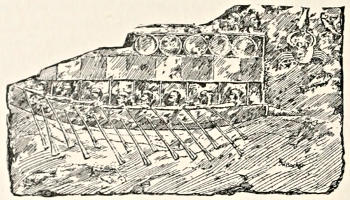
Bas-relief of an Assyrian Galley
Herodotus thus describes the Babylonian vessels of a later period: “The
boats used by those who come to the city (Babylon) are of a circular form,
and made of skins. They are constructed in Armenia, in the parts above
Assyria. The ribs of the vessels are formed of willow boughs and branches,
and covered externally with skins. They are round like a shield, there
being no distinction between the head and stern. They line the bottoms of
their boats with reeds (or straw), and, taking on board merchandise, principally
palm wine, float down the stream. The boats have two oars, one man
to each; one pulls to him, the other pushes from him. These vessels are of
different dimensions; some of them are so large that they bear freight to
the value of five thousand talents [£1,000,000 or $5,000,000]. The smaller
have one ass on board, the larger several. On their arrival at Babylon the
boatmen dispose of their goods, and also offer for sale the ribs and the reeds
(or straw). They then load their asses with the skins, and return with
them to Armenia, where they construct new vessels.”
I was, at one time, inclined to believe that the description of Herodotus
applied to the rafts still constructed on the rivers of Mesopotamia, and used,
it will be remembered, for the conveyance of the sculptures from Nimrud
to Bassorah. The materials of which they are made are precisely those
mentioned by the Greek historian, and they are still disposed of at Baghdad
in the same way as they were in his day at Babylon. But the boats which
excited the wonder of Herodotus seem to have been more solidly built, and
were capable of bearing animals, to which purpose the modern raft could not
be applied. They were probably more like the circular vessels now used at
Baghdad, built of boughs, and sometimes covered with skins, over which
bitumen is smeared, to render the whole waterproof. The boats commonly
employed for the conveyance of goods and animals, on the lower part of the
Tigris and Euphrates, and for ferries on all parts of those rivers, are constructed
of planks of poplar wood, rudely joined together by iron nails or
wooden pins, and coated with bitumen.
In a bas-relief, from the most ancient palace of Nimrud, two kinds of
boats are introduced. The larger vessel contains the king in his chariot,
with his attendants and eunuchs. It is both impelled by oars and towed by
men. The smaller resembles that described by Herodotus. The head does
not differ in form from the stern, and two men sit face to face at the oars.
In this bas-relief are also represented men supporting themselves upon
inflated skins—a manner of crossing rivers still generally practised in
Mesopotamia.
The larger boats were steered by a long oar, to the end of which was
attached a square or oval board. This oar was held in its place by a rope
fastened to a wooden pin at the stern. By this contrivance the steersman
had considerable control over the vessel, and could impel it or turn the head
at pleasure. This mode of steering and propelling boats still prevails on
the Mesopotamian rivers.
The vessels of the Khorsabad sculptures show a considerable advance in
the knowledge of ship-building. That they did not belong to the Assyrians,
but to some allied nation, appears to be indicated by the peculiar costume of
the figures in them.[30] The form of the vessel is not inelegant; it is that of
a sea monster, the prow being in the shape of the head of a horse, and the
stern in that of the tail of a fish. Several men stand at the oars. The mast,
supported by two ropes, appears to be surmounted by a box, or what is
technically called a crow’s nest, which, in the galleys of the Egyptians,
frequently held an archer.
But it was in the sculptures of Kuyunjik that vessels were found represented
in the greatest perfection. From their position in the bas-reliefs,
with reference to the besieging army, it would seem that they did not belong
to the Assyrians themselves, but to a people with whom they were at war,
and whom they appear to have conquered. The sea was also here indicated
by the nature of the fish and marine animals; such as the star or jelly fish
and a kind of shark. A castle stood on the shore; and the inhabitants,
attacked on the land side, were deserting the city and taking refuge in their
vessels.
The larger galleys of these bas-reliefs were of peculiar form, and may, I
think, be identified with the vessels used to a comparatively late period by
the inhabitants of the great maritime cities of the Syrian coast—by the
people of Tyre and Sidon. Their height out of the water, when compared
with the depth of keel, was very considerable. The fore part rose perpendicularly
from a low sharp prow, which resembled a ploughshare, and was
probably of iron or some other metal, being intended, like that of the Roman
galley, to sink or disable the enemy’s ships. The stern was curved from the
keel, and ended in a point high above the upper deck. There were two tiers
of rowers; but whether they were divided by a deck or merely sat upon
benches placed at different elevations in the hold, does not appear from the
sculptures. Above the rowers was a deck, on which stood the armed men.
These vessels had only one mast, to the top of which was attached a very
long yard, held by ropes. In the sculptures the sails were represented as
furled. The number of rowers in the bas-reliefs was generally eight on a
side. Only the heads of the upper tier of men were visible; the lower tier
was completely concealed, the oars passing through small apertures, or portholes,
in the sides of the vessel.
Besides the vessel I have described, a smaller is represented in the same
bas-reliefs. It has also a double tier of rowers; but the head and stern are
differently constructed from those of the larger galley, and both being of the
same shape, are not to be distinguished one from the other except by the
position of the rowers. They rise high above the water, and are flat at
the top, with a beak projecting outward. This vessel had no mast, and
was impelled entirely by oars. On the upper deck are seen warriors armed
with spears, and women.
It is impossible to determine from the sculptures the size of the vessels,
as the relative proportions between them and the figures they contain are
not preserved. It is most probable that the four rowers in each tier are
merely a conventional number, and we cannot, therefore, conjecture the
length of the ship from them. No representations of naval engagements,
as on the monuments of Egypt, have yet been found in the Assyrian edifices.
It is most probable that, not being a maritime people, the Assyrians—as
the Persians did afterwards—made use of the fleets of their allies in their
expeditions by sea, furnishing warriors to man the ships.b
The sense of justice and its administration play a large part in the
history of any nation; and we are so fortunate as to possess certain light
on the courts and customs of Assyria.
Asshurbanapal opened his library, not only to the documents emanating
from the kings, but also as a depository for collections on law, juridicial
decisions, and contracts between private individuals.
The Assyrio-Chaldean legislation rested on laws and customs which were
already in force under the Sumerian civilisation. A great number of tablets
written in both languages give us the primitive text of the law and the
corresponding Assyrian translation. Others, written in Assyrian, are full of
citations from Sumerian texts.
First of all, there is a long fragment of laws relating to the family,
written in Assyrian and Sumerian. They read as follows:
“It has thus been decided by the sentence of the judge: ‘If a son (is
authorised) to say to his father: “Thou art not my father,” he (the son) can
sell him, treat him as a forfeit, and give him in payment like money.
“‘If a son (is authorised) to say to his mother: “Thou art not my mother,”
he will cut her hair off, assemble the people, and make her go out of his
house.
“‘If a father (is authorised) to say to his son: “Thou art not my son,” he
(the father) can shut him up in his dwelling and in the cellar.
“‘If a mother (is authorised) to say to her son: “Thou art not my son,”
she can shut him up in her dwelling and in the upper chambers.
“‘If a wife (is authorised) to repudiate her husband, and to say to him:
“Thou art not my husband,” she can have him thrown into the river.
“‘If a man (is authorised) to say to his wife: “Thou art not my wife,”
he can have half a mina of silver paid to him.
“‘If the intendant lets a slave escape, if he dies (the slave), if he becomes
infirm, if in consequence of bad treatment he becomes ill, he (the intendant)
shall pay half a hin of corn a day (to the master of the slave).’”
In these ancient records we likewise find laws concerning property. One
tablet seems to pertain to the observations made by a Sumerian agriculturist,
which were proposed to the Assyrian agriculturists of the seventh century
B.C. First of all are indicated the best conditions of crop-growing, the time
for sowing, the calculating of the income, the tillage, irrigation, and the
injurious animals which must be destroyed.
It is evident that, in spite of the difference in property or wealth, the
interest is always the same, the calculation of interest on different sums in
contracts showing that the figures bear a relation to one another.
Loans could be made with or without interest; they could be made with
or without security, and these securities were of different natures:
“For the interest of one’s money.… He has given as security.…
A house, a field, an orchard, a female slave, a male slave.”
Exchanges were frequent, and from the data on the tablets, the principal
things exchanged are known:
“They exchanged a house for money. They exchanged a field for money.
They exchanged an orchard for money. They exchanged a female slave for
money. They exchanged a male slave for money.”
Trials are inherent to human nature and to all epochs. Pleading took
place in Nineveh, Assyria, and Chaldea. On this subject the following
axiom used by the judges and the pleaders, holds perfectly to-day:
“He who listeneth not to his conscience, the judge will not listen to his
right.”
There must have been a fairly complicated code of procedure, for traces
are found of an appellative jurisdiction in which the sovereign was the final
judge.
The Sumerian laws likewise fixed the form of individual contracts. The
signature, “qatatu,” was the essential feature of the contract.
Signature took place by affixing the seal. One fragment of these tablets
bears witness to this custom so perpetuated in the East from remotest times
to the present. Herodotus mentions the existence of seals as a peculiarity
of the Babylonians.
“Every Babylonian,” said he, “had his seal for his personal use.” The
Assyrian “kunuk” answers, like our word “seal,” both to the instrument and
the mark it left on the plastic earth.
A large number of contracts of private business concerning all the ordinary
transactions of life, between individuals, on which figures the mark of
a seal, has been found: contracts of sale or exchange; contracts of loan or
hire; acknowledgments of debts, carrying the guaranty of a mortgage or of
chattels. They read like the records of a notary’s office. These contracts,
like all the documents of the palace library, are written on the traditional
bricks. These are easily distinguished from other documents by their outer
appearance. After a few lines given up to the names of the contracting
parties, we see the imprints of their seals, or sometimes the imprint of three
finger nails.
The general drift of their contracts is easy to understand; the clauses are
worded in formal language which proceeds from the nature of the relations of
the two parties according to the object of their agreement. As a usual thing,
these contracts are very simply drawn. They begin by stating the names
and qualifications of the parties who are going to enter into agreement by
the affixment of their seal or by the nail mark, its substitute.
All contracting parties are not called upon to fulfil this formality; it is
only those who have the title of “dominus negotii” the vendor, the lessor,
the lender, those who “hold the pen” as the modern expression is.
A place reserved in the text for the fixing of seal or imprint reveals to
us that their seals had different shapes. As many of these jewels have
descended to us, and as there are a great number in our public and private
collections, it is not without interest to describe them in more detail.
Generally they are hard stones, cut and polished in different ways. Some
are conical or like a truncated pyramid, on the base of which the design is
sunk. Sometimes the seal is in the shape of a spheroid or an ellipsoid. Many
are cylindrical, the design being engraved on the surface of the cylinder,
and the imprint is obtained by rolling it on plastic earth. Every variety of
precious stones has been cut for this purpose; the study of these jewels and
their designs is of the greatest interest to the student of art.
After the imprint of the seals, the object of the contract is stated, then
its nature and its amount, which is sometimes paid down, sometimes at quarter-day;
in certain cases a security is stipulated.
As to money loans, the interest is generally fixed upon by the contracting
parties. Where the contract is silent on this subject it seems as if a general
law were referred to, probably that which is mentioned above.
Measurements, capacities, estimates, and prices are expressed with great
precision, and thus one may determine the importance of the matter discussed
in the contract. The form of drawing up, indicates that the agreement passed
before a magistrate who gave, if I may thus express myself, authenticity to
the stipulations agreed on between the parties, from which they could not
release themselves without penalty of a fine or damages. Generally the fine
was paid into the treasury of Ishtar either at Arbela or Nineveh; then the
judge decreed the restitution of the sum paid over, with a certain sum for
damages. The contract often contained a more or less extended prayer formula
and thus placed the execution of the agreement under the protection of
the gods. The contract ends with the names of witnesses and their status,
and is dated on the day, month, and year of its drawing up.
The contract thus perfected was delivered to a special functionary, who
registered it in the public depository, the superintendence of which was confided
to him.
Here are some contracts which help us to understand the methods of drawing
up, and inform us as to the nature of the most usual transactions of that
epoch. We give first a contract relating to the sale of a slave; it is thus
worded:
Seal of Nabu-rikhtav-usur, son of Akhardisu, man of Hasaï, workman of
Zikkar Ishtar, of the city of …
Seal of Tebetai, his son, seal of Silim Bin his son, owners of the slave sold.
The girl Tavat-khasina, slave of Nabu-rikhtav-usur.… And Nitocris
obtained her for the price of sixteen drachmas of silver … for Takhu
her son, on account of his marriage. She will be slave to Takhu. The
price has been definitely fixed. Whoever in days to come and at no matter
what epoch shall contest this before me, be it Nabu-rikhtav-usur, his sons,
his sons’ sons, his brother, his brother’s sons, or any other, or his attorney,
should wish to annul the bargain between Nitocris, her sons, or her sons’
sons, shall pay ten minas of silver for the revocation of this contract, it
shall not be sold. Shapimayu, shepherd, Bel-shum-usur, son of Yudanani
Rimbel, son of Atu, are the three men, heirs of the woman because of the
binding of her hands (her first marriage) and of the interest on the wage of
Karmeon who was to inherit (if he lived).
Witnesses: Akhardisu, Zikkar-nipika, Mutumhisu, Khasba.
In the month of Ulul (August) the last day of the year of Asshur-sadu-sakil.
As before Yum-shamash, Putainpaïte, Atu, Nabu-iddin-akhe, presiding.
This document is one of the most curious that we have. First of all, it
contains the name of an Egyptian woman, Nitocris (Nitit-eqar), then that of
Takhu her son, who bears equally an Egyptian name.
The vendor is the daughter of Nabu-rikhtav-usur; his sons intervene in
their quality of kinsmen for the sale of their slave, that is to say, the servant
of their house. The money is not to be paid to Nitocris or direct descendants,
but to third persons who are also designated; there are the three heirs
of one named Karmeon, who would be the heir if he lived.
Here is another of the same kind:
Seal of Khataï owner of the slave. Lu-akhi is the slave offered up. And
Dannaï obtained him from Khataï for the price of twenty drachmas of silver.
The price has been definitely fixed, the slave has been paid for and delivered;
no annulment of the bargain can now take place. Whosoever in the future
shall claim before me (the nullity of the agreement, shall pay the fine).
Witnesses: Shamash, Khimar, Zabda, Kharaman, Mannuakhi, Zikkar,
Shamash.
In the month of Ulul (August) the fifth day in the year of Nabu-bel-iddin.
In the presence of Zikkar Shamash, the officer.
Contracts of this nature are numerous, and they raise a question on a
point of the history of ancient slavery, which it would be interesting to have
cleared up. What was the origin of these slaves who were at that time
trafficked in, and who do not seem to have had to undergo the law of the
vanquished, and who were so easily carried off after the seizure of a town?
We have no information on this subject, and we must limit ourselves to
register that which is given us in the above-mentioned texts.
The proprietor of the slave, Khataï, is a Syrian, whilst the slave, Lu-akhe,
is an Assyrian sold to another Assyrian, Dannaï, for a sum of money equal
to £3 [$15].
Sometimes the contract is not so simple. Complications may arise as to
titles of the property or in its manner of transmission. It is also interesting
to study the status of the contracting parties. One fact seems to be universal,
it is that the stranger—Phœnician, Jew, or Egyptian—had the same
civil rights of contracting, selling, or buying as Assyrian subjects.
Here is a contract of another kind. It concerns the sale of a house.
Instead of their seal the parties affixed marks by pressing their thumb-nails
into the clay.
Nail of Sharludari, nail of Ahasshuru, nail of the woman Amat-Sula,
wife of Belduru head of three legions, proprietors of the house to be sold.
A house in course of construction with its beams, columns, materials, situate
in the city of Nineveh, bounded by the house of Mannuki-akhe, bounded by
the house of Ankia, bounded by the market-place. And Sil-asshur, the
Egyptian officer, has acquired it by means of a mina of the king’s money,
from Sharladuri, Ahasshuru, and the woman Amat-sula, wife of her husband.
The price has been definitely fixed, the house paid for and bought, the
annulment of the contract cannot be allowed.
No matter who, whoever he may be, in days to come, and no matter at
what epoch, even among these persons, contests the right and contract of
Sil-asshur shall pay ten minas of silver. Witnesses: Shushankhu, officer of
the king, Kharmaza, head of three legions, Razu, captain of a vessel, Nabu-dur,
officer, Kharmaza, captain of a vessel, Sin-shar-usur, Zidka.
The sixteenth day of the month Sivan (May) of the year of Zaza, prefect
of the town of Arpad (1692 B.C.).
Before Shamash-ukin-akhe, Litturu, Nabu-shum-iddin.
This act is, above all, remarkable for the names of the contracting parties,
from which we can now recognise that people of different nationalities were
allowed to make contracts in Nineveh with the same rights as the Assyrians.
Thus the names of the witnesses Shushankhu and Kharmaza are Egyptian,
and their original form could easily be restituted. The name of the woman
Amat-Sula is Phœnician and reveals the name of an unknown divinity; literally
it means servant of Sula.f
We have purposely approached the subject of Mesopotamian law from
the Assyrian side, because the Assyrian laws represent the later forms of
elaboration of the old Babylonian codes on which they are based. In conclusion,
however, we shall present in its entirety the oldest known, and at present
the most famous, of these ancient codes, that of king Khammurabi, that the
reader may judge for himself as to the character of the judicial and feudal
system that was in vogue in Babylonia in the third millennium before our
era. This extraordinary document will repay the closest study on the part
of anyone who takes the slightest interest in the evolution of human society.
Until a comparatively recent date the name of Khammurabi, the ruler who
first united the states of the Euphrates valley under one rule, and thus
founded the Babylonian empire, was scarcely known, whereas now we have a
large mass of material dating from his reign—his inscriptions, his letters,
and lastly, most important of all, his code of laws. It is difficult to obtain
more than a vague idea of a country merely from its name, or from the
lists of its kings and their military exploits, which is all that we possess
of most Assyrian and Babylonian kings. The real life of the people wholly
escapes us. This reason alone would make this code inexpressibly valuable,
because, by giving the laws which controlled the social and commercial life of
the people, even to minute details, it gives a picture of the actual condition
of the country.
Aside from its bearing on Babylonian civilisation, however, this code is
one of the most important monuments in the history of the human race.
It is the oldest known legal code in existence, antedating the Mosaic
code by at least a thousand years, and older than the laws of Manu. It
formed the basis of Babylonian legislation until the fall of the empire, and
was compiled by a king living about 2300 B.C., whose rule extended from
the Tigris to the Mediterranean. Khammurabi is generally identified with
Amraphel, the contemporary of Abraham; and it cannot be questioned that
these laws formed a part of the traditions which the Hebrews brought with
them to their new home.
The monument containing these laws was not found at Babylon, as might
have been expected, but at Susa (Shushan) in the so-called Acropolis. The
discovery is due to the French excavating expedition under M. de Morgan,
and was made in December and January of 1901-1902. The monument is
a block of black diorite nearly eight feet high. It has been photographed
and published with transcription and translation by Father V. Scheil,g the
Assyriologist of the expedition, in the Mémoires de la Délégation en Perse,
tome IV, Textes Élamites Sémitiques. The whole inscription has since been
translated by Dr. H. Wincklerh in Der Alte Orient, 4 Jahrgang, Heft 4, 1902,
and the code alone by Rev. C. H. W. Johns,i The Oldest Code of Laws in the
World, Edinburgh, 1903.
The obverse of the stone contains a representation in bas-relief of Khammurabi
receiving the laws inscribed beneath, from Shamash, the sun-god and
god of right, who is pictured seated on a throne. The king stands in a
respectful attitude before him. The inscription several times mentions the
fact that the laws were given by Shamash; so the very interesting theory in
The Times, London, of April 14th, 1903, that the god in the picture is Bel
has not much foundation. This theory would connect the code more closely
with the Biblical narrative. To quote from The Times,j “The old Bel was
the god who dwelt on the mountain of the world and gave laws to men and
wore on his breast the tablets of destiny. So here we have a curious proof
of the existence of the tradition of the mountain-given law long before the
Mosaic reception on Sinai.”
Below the bas-relief on the obverse are sixteen columns of writing with
1,114 lines, and on the reverse there are twenty-eight columns with 2,510 lines.
Five columns of the obverse have been erased and the stone repolished, probably
to make room for an inscription of the conquering Elamite king who
carried the stone away from Babylon to Susa. Possibly one of the dire
calamities which Khammurabi, in the inscription, invokes the gods to send on
anyone who should deface his monument, befell the unfortunate Elamite.
The writing is in a beautifully clear archaic script often used for royal
inscriptions, even after the cursive writing came into use. There are a great
many tablets dating from the same period written in the cursive, some of
them bearing the impression of seals in the archaic. Some seven hundred
lines of the inscription are devoted to proclaiming the titles of the king, his
care for his subjects, his reason for erecting the monument, his maledictions
on anyone who shall interfere with it. Some passages in it remind one of the
majesty of portions of the Psalms. It begins:
“When Anu the supreme, king of the Anunnaki, and Bel, lord of heaven
and earth, who determines the fate of the universe, to Marduk the eldest son
of Ea, god of right, earthly power had assigned, among the Igigi had made
him great, Babylon with his august name had named, in all the world had
exalted him, in the heart (of that city) an eternal kingdom, whose foundations
are firm as heaven and earth, had established,—then did Anu and
Bel call me by name, Khammurabi, the great prince, who fears god, to establish
justice in the land, to destroy the wicked and base, so that the strong
oppress not the weak, to go forth like Shamash (the sun) over the black
heads (i.e., men) to give light to the world, to promote the prosperity of the
people.…”
Immediately following the code Khammurabi resumes: “The just decrees
which Khammurabi, the wise king, has established; for the land a sure law
and a happy reign he has procured. Khammurabi, the protecting king, I am.
From the black heads, which Bel gave me, to be a shepherd over whom Marduk
appointed me, I have not held aloof, have not rested; places of peace I have
provided for them; I opened up a way through steep passes and sent them
aid. With the powerful arms which Zamama and Ishtar endowed me, with the
clear glance that Ea granted me, with the bravery which Marduk gave me,
the enemy above and below I have rooted out, the deeps I have conquered,
established the prosperity of the country, the dwellers in houses have I made
to live in safety; a cause for fear I have not suffered to exist. The great
gods have chosen me. I am the peace-bringing shepherd whose staff is
straight (i.e., sceptre is just), the good shadow which is spread over my city;
to my heart the people of Sumer and Accad I have taken, under my protection
have I caused them to live in peace, sheltered them in my wisdom, so
that the strong may not oppress the weak; to counsel the orphan and the
widow, their head have I raised in Babylon, the city of Anu and Bel; in
E-sagila, the temple whose foundations are firm as heaven and earth, to speak
justice to the land, to decide disputed questions, to remedy evil, have I written
my precious words on my monument; before my picture, as of a king
of justice I have placed them.… At the command of Shamash, the great
judge of heaven and earth, shall justice reign in the land; by the order of
Marduk my lord no destruction shall touch my statue. In E-sagila, that I
love, shall my name be remembered forever; the oppressed man who has a
cause for complaint shall come before my picture of the king of justice, shall
read the inscription, shall apprehend my precious words, the writing shall
explain to him his case, he shall see his right, his heart shall become glad,
(and he shall say) ‘Khammurabi is a lord who is like a father to his subjects,
he has made the word of Marduk to be feared.’ … Khammurabi, the king
of righteousness, to whom Shamash gave the law, I am.”
The inscription contains also many references to public works and historical
events which make it one of the most important historical records
ever discovered. One reference to Asshur (Assyria) is particularly important.
It occurs in the introduction to the code and records the restoration of
“its protecting god to the city of Asshur.” The name Asshur occurs again
in a letter written by Khammurabi to Sin-idinnam, and also in a private
letter of the period, the former published by Mr. L. W. Kingk in 1901.
We now turn to the code proper, and the following points are especially
noticeable throughout. The idea of responsibility is very clearly fixed,—a
man who hired an animal was responsible for that animal,—if a boat he was
responsible for the boat,—if he stored anything for another, or carried anything
to another, he was responsible so long as the object was in his hands.
Also of builders,—if a man built a house he was responsible for its solidity;
a physician was held responsible for the life of his patient.
Secondly, we notice the importance of putting everything in writing—a
marriage without a written contract was invalid; a man who took goods
on deposit, an agent who obtained goods from a merchant, if he had no
document to show for it, could claim no legal aid in case of disagreement.
We have countless contract tablets from this period, containing the seals
and names of witnesses to just such transactions as are provided for in the
code, which show how well this principle was observed.
The law of retaliation or jus talionis is another important feature, as it is
prominent also in the Mosaic code. This is expressed by the familiar phrase
“an eye for an eye, and a tooth for a tooth.” The attempt to make the
punishment balance the crime exactly is carried to such an extent that if
a house fell and killed the owner, the builder was to be put to death, if the
owner’s son died, the builder’s son was killed. In several of the laws we
notice peculiarly humane provisions, showing that the king really had the
interests of his subjects at heart, and that his words on the inscription and his
desire to be a father to his people were not a vain boast. This is especially
noticeable in a regulation concerning debtors (clause 45), in the provisions
for inheritance, and particularly in the clause concerning the sick wife (148).
It is not to be supposed that all of the laws found in Khammurabi’s code
date from his reign. Some of them were much older, as is shown by a difference
in the grades of culture represented. Some even assign different
penalties for the same crime (see clauses 6 and 8). As Prof. Jastrowl has
pointed out, the ordeal by water cannot have been invented in the same
period as the minute provisions for the inheritance of property.
The so-called Sumerian domestic laws which are very similar to those
before us were known prior to the discovery of Khammurabi’s code, and are
known to have been already in use at that time. The code contains something
like 280 clauses, and is arranged in comparatively systematic order.
Space has not permitted the giving of all the provisions in detail. The plan
has been to deal with each class of laws as a whole, in some cases giving
merely the synopsis of a class.[31]
1. If a man weaves a spell about another man (i.e., accuses him), and
throws a curse on him, and cannot prove it, the one who wove the spell shall
be put to death.
2. If a man weaves a spell about another man, and has not proved it, he
on whom suspicion was thrown shall go to the river, shall plunge into the
river. If the river seizes hold of him, he who wove the spell shall take his
house. If the river shows him to be innocent, and he is uninjured, he who
threw suspicion on him shall be put to death. He who plunged into the
river shall take the house of him who wove the spell on him.
3. If a man has accused the witnesses in a lawsuit of malice and has not
proved what he said; if the suit was one of life (and death), that man shall
be put to death.
4. If he has sent corn and silver to the witnesses, he shall bear the
penalty of the suit.
5. If a judge has delivered a sentence, has made a decision and fixed it
in writing, and if afterwards he has annulled his sentence, that judge for
having altered his decision shall be brought to judgment; for the penalty
inflicted in his decision, twelve-fold shall he pay it, and publicly shall they
remove him from his judgment seat. He shall not come back and shall not
sit in judgment with the other judges.
6. If a man has stolen property from the god or palace, that man shall
be put to death; and he who received the stolen goods from his hands
shall be put to death.
7. If a man has bought or received in deposit, silver, gold, a man or
woman slave, an ox, a sheep, an ass, or whatever it may be, from the hands
of a son of another or a slave of another, without witness or contract, that
man shall be put to death as a thief.
8. If anyone has stolen an ox, a sheep, an ass, a pig, or a boat, if it
belongs to the god or to the palace, he shall return it thirty-fold; if it belongs
to a noble he shall return it ten-fold; if the thief has nothing with which to
repay, he shall be put to death.
9. If anyone who has lost something, finds his something that was lost
in the hand (possession) of another; if the man in whose hand the lost
object was found says: “A trader sold it to me, before witnesses I paid for
it,” and if the owner of the lost object says: “Witnesses who know my lost
object I will bring,” then shall the purchaser bring the seller who sold it to
him, and the witnesses before whom he bought it, and the owner of the lost
object shall bring witnesses who know his lost goods: the judge shall consider
their words, and the witnesses before whom the purchase was made,
and the witnesses who know the object shall bear testimony before God.
The seller is a thief and shall be put to death. The owner of the lost object
shall receive the object; the buyer shall get back the money he paid from
the house of the seller.
10. If the buyer does not bring the seller who sold it to him and the witnesses
before whom he bought it; if the owner of the lost object brings the
witnesses who know his object, the buyer is a thief and shall be killed; the
owner shall get his lost object.
11. If the owner of the lost object does not bring his expert witnesses,
then he is a miscreant; he has accused falsely, he shall die.
12. If the seller has gone to his fate, the buyer shall receive from the
house of the seller five times the costs of the suit.
13. If that man has not his witnesses at hand, the judge shall give him
a respite of six months. If in six months his witnesses do not come, that
man is a miscreant and shall bear the costs of the suit.
14. If anyone steals the minor son of a man, he shall be put to death.
15. If anyone has caused a male slave of the palace or a female slave of
the palace, the male slave of a noble or the female slave of a noble, to go
out of the gate, he shall be put to death.
16. If anyone harbours in his house a runaway male or female slave
from the palace or the house of a noble, and does not bring them out at the
command of the majordomo, the master of the house shall be put to death.
17. If anyone has caught a runaway male or female slave in the field,
and brings him back to his master, the master of the slave shall give him
two shekels of silver.
18. If that slave will not name his owner, to the palace he shall bring
him; his case shall be investigated; to his owner one shall bring him.
19. If he retains that slave in his house, and if, later, the slave is found
in his hands, that man shall be put to death.
20. If the slave escapes from the house of the one who caught him, that
man shall swear to the owner of the slave in the name of God and he shall
be quit.
21. If anyone has broken a hole in a house, in front of that hole one
shall kill him and bury him.
22. If anyone has committed a robbery and is caught, he shall be
killed.
23. If the robber is not caught, the man who has been robbed shall make
claim before God to everything stolen from him, and the town and its governor
within the territory and limits of which the robbery took place shall
give back to him everything he has lost.
24. If it was a life, the city and governor shall pay one mina of silver
to his people.
25. If a fire breaks out in the house of a man, and some one who has
gone thither to put it out raise his eyes to the goods of the master of the
house, and take the goods of the master of the house, that man shall be
thrown into that fire.
Special rules governed the estates of officers or constables in the king’s
employ. They seem to have had land given them by the state, which was
inalienable; they might not sell it, deed it to wife or daughter, or give it in
return for a debt. In the absence of the proprietor he might give the land
into the keeping of another to manage it for him. This was usually done by
a son or wife. Three years’ absence or neglect forfeited his claim to the
land. No man could send a substitute in his place on pain of death for both
himself and the substitute. The king’s officers could buy land in their own
right which they were free to dispose of at pleasure, and they could also sell
the land which was theirs by official right to another officer.
42. If anyone has taken a field to cultivate, and has not made grain to
grow in the field, he shall be charged with not having done his duty in the
field; he shall give grain equal to that yielded by the neighbouring field to
the owner of the field.
43. If he has not tilled the field, has let it lie, he shall give to the owner
of the field grain equal to the yield of the neighbouring field; and the field
which he left untilled, he shall harrow, sow, and return it to its owner.
44. If anyone has hired an unreclaimed field for three years, to open
(cultivate) it, but has neglected it, has not opened the field, in the fourth
year he shall harrow the field, hoe it, and plant it and return it to the owner
of the field, and 10 GUR of grain for every 10 GAN he shall measure out.
45. If a man has rented his field to a cultivator for the produce and he
has received his produce, and then a storm has come and destroyed the harvest,
the loss is the cultivator’s.
46. If he has not received the produce from his field, but has given his
field on a half or a third share, the grain which is in the field shall the
owner and cultivator share according to their contract.
47. If the cultivator, because in the first year he did not obtain his
living (?), had the field cultivated by another, the owner of the field shall
not blame this cultivator, his field has been cultivated; at the time of
harvest he shall receive grain according to his contract.
48. If a man has a debt and a storm has devastated his field and carried
off the harvest, or if the grain has not grown on account of a lack of water,
in that year he shall give no grain to the creditor; he shall soak his tablet
(in water, i.e., alter it), and shall pay no interest for that year.
49. If anyone has borrowed money from a merchant and given a
ploughed field sown with grain or sesame to the merchant and said to
him: “Cultivate the field, harvest and take the grain or sesame which is
thereon;” when the cultivator has raised grain or sesame in the field, at
the time of harvest the owner of the field shall take the grain or sesame
which is in the field, and shall give to the merchant grain in return for the
money with its interest, which he took from the merchant, and for the support
of the cultivator.
50. If he has given him an (already) cultivated field (of grain) or a field
of sesame, the grain or sesame which is in the field shall the owner of the
field receive; money and interest to the merchant he shall give.
51. If he has no money with which to pay him, he shall give to the merchant
sesame equal to the value of the money which he received from the
merchant, with interest according to the king’s tariff.
52. If the cultivator has not raised grain or sesame in the field, his contract
is not altered.
The canals built by Khammurabi are frequently referred to in his inscriptions
so that we expect to find them mentioned in his laws. Clauses 53-56
are in connection with this subject:
53. If anyone is too lazy to keep his dikes in order and fails to do so,
and if a breach is made in his dike and the fields have been flooded with
water, the man in whose dike the breach was opened shall replace the grain
which he has destroyed.
54. If he is not able to replace the grain, he and his property shall
be sold, and the people whose grain the water carried off shall share (the
proceeds).
55. If anyone opens his irrigation canals to let in water, but is careless
and the water floods the field of his neighbour, he shall measure out grain to
the latter in proportion to the yield of the neighbouring field.
56. If anyone lets in the water and it floods the growth of his neighbour’s
field, he shall measure out to him 10 GUR of grain for every 10 GAN
(of land).
Each cultivator had an intricate system of small water-ways covering his
land, into which he let water from the main canal at certain times. When
he had watered his field he dammed up the connection again, but if he neglected
to do so the water would keep on coming in and eventually flood his
neighbour’s land.
If a shepherd let his flock pasture in a field without permission, he was
compelled to return a definite amount of grain to the owner. Anyone cutting
down a tree without permission had to pay one-half of a mina of silver.
About thirty-five clauses, from 65 to 100, have been erased. This gap has
been partly filled in from some old fragments of another supposed copy of
this code in the British Museum. One of these supplementary fragments
speaks of house rent: if a tenant has paid his rent for a whole year, and the
landlord turns him out before the end of his term, the landlord shall pay
back to the tenant a proportionate amount of the money which the tenant
gave him.
The reverse of the stele begins with a continuation of the laws regulating
commercial relations, which are extremely important as showing a highly
developed system. If an agent found no opening where he went, he was to
return the capital to the merchant; also if any mishap befell him in the place
to which he went. If he were robbed by the way, he was to swear before
God that the loss was through no fault of his and could then go free. The
agent was to make out a written statement of the goods received, and
received also a receipt for the money paid to the merchant. Without this
receipt he could lay no claim to his money in case of disagreement.
Curiously enough the wine sellers appear to have been women. We read
in clause 109: If a wine merchant when rebels meet in her house does not
arrest them and take them to the palace, that wine merchant shall be put to
death. 110. If a votary who does not live in the temple shall open a tavern
or enter a tavern to drink, she shall be burned.
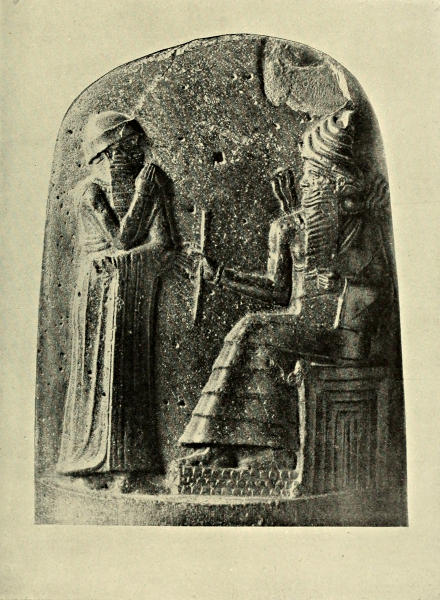
THE GOD SHAMASH DICTATING THE CODE OF LAWS TO KING KHAMMURABI
Laws concerning debt are treated of in clauses 113-119. A man
might be imprisoned for debt, or, as in the Mosaic code, he might sell his
wife and children into bondage for debt, but only for three years. We have
a peculiarly doleful picture of a prison of this period, in a letter dating from
the reign of Khammurabi. It is written by an imprisoned man to his master.
He describes his place of confinement as a “house of want,” and begs for
food and clothing, to keep him from death and being devoured by dogs.
If the debtor died a natural death in his confinement, the case was at an end,
but:
116. If the confined man has died in the house of his confinement as
a result of blows or ill-treatment, the owner of the prisoner shall call his
merchant to account. If the man was free-born, his son (of the merchant)
one shall kill; if he was a slave, he shall pay one-third of a mina of silver,
and shall lose possession of everything which he gave him.
117. If anyone has an indebtedness, sells wife, son, or daughter for gold
or gives them into bondage, three years in the house of their buyer or their
taskmaster shall they labour; in the fourth year shall he let them go free.
118. If he gives away a man or woman slave into servitude, and if the
merchant passes them on, sells them for money, there is no protest.
119. If anyone has contracted a debt and sells a slave who has borne
him children, the money which the merchant paid, the owner of the slave
shall pay back to him and buy back his slave.
Clauses 120-126 are in regard to depositing grain and other property in
another’s keeping. A written document was necessary and the person who
received the deposit made responsible for what had been intrusted to him.
120. If anyone has stored his grain in the house of another for keeping,
and a disaster has happened in the granary, or the owner of the house has
opened the granary and taken out grain, or if he disputes as to the whole
amount which was deposited with him, the owner of the grain shall pursue
(claim) his grain before God, and the master of the house shall return undiminished
to its owner the grain which he took.
The laws referring to domestic legislation are especially interesting as
showing the position of women. We know from other documents of the
period that they could hold property in their own name and carry on business,
and we see here that their position was respected.
127. If anyone has caused a finger to be pointed at a votary or the wife
of a man and has not proved (his accusation against) that man, one shall
bring him before the judge and brand his forehead.
A contract was necessary for legal marriage:
128. If anyone has married a wife but has not drawn up a contract with
her, that woman is not a wife.
If a man was taken captive and if, during his absence, his wife married
some one else while there was means of subsistence in the house, she was
drowned. But if she had no means of support, her action was considered
justifiable. If, in the latter case, the husband returned, his wife was to
return to him; but the children of her second marriage remained with their
father. If the man was a fugitive and had abandoned his native city, but
returned after a time and wanted his wife again, she was not to return to him.
The laws concerning divorce were much like those existing in Mohammedan
countries to-day. If a woman were childless and her husband wished
to divorce her, she received her dowry and marriage portion and returned to
her father’s house. If she had borne children and her husband still wanted
to divorce her, she received besides her marriage portion sufficient means to
bring up her children; and after they were grown, of whatever they received
they were to give her a son’s share. She was also free to marry again.
If the woman were divorced through a fault of her own, she received nothing.
141. If a man’s wife, who lives in his house, sets her face to go out,
causes discord, wastes her house, neglects her husband, to justice one shall
bring her. If her husband says, “I repudiate her,” he shall let her go her
way, he shall give her nothing for her divorce. If her husband says, “I do
not repudiate her,” her husband may take another wife; that (first) wife
shall stay in the house of her husband as a slave.
A woman who wanted a divorce, if she could show fault in her husband
for it, might take her marriage portion and go home; but if the fault were
hers she was thrown into the water.
A peculiarly humane provision is the following:
148. If anyone has taken a wife and a sickness has seized her, and if his
face is set towards taking another wife, he may take (her), but his wife
whom the sickness has seized he may not repudiate her, she shall live in the
house he has built, and as long as she lives he shall support her.
149. If that woman does not desire to live in the house of her husband,
he shall give her the marriage portion she brought from her father’s house,
and she shall go.
150. If anyone has given his wife, field, garden, house, or property, and
has left her a sealed tablet; after (the death of) her husband, her children
shall contest nothing with her. The mother shall leave her inheritance to
the child whom she loves; to a brother she shall not give it.
Laws of inheritance are more particularly dealt with in clauses 162-184:
162. If anyone has married a wife, and she has borne him children; if
that woman has gone to her fate, of her marriage portion her father shall
claim nothing; her marriage portion belongs to her children.
163. If anyone has married a wife and she has borne him no children; if
that woman has gone to her fate, if the dowry which that man took from
the house of his father-in-law his father-in-law has returned; on the marriage
portion of that woman the husband shall make no claim, it belongs to
the house of her father.
164. If his father-in-law has not returned him the dowry, from her marriage
portion he shall deduct all her dowry; and her marriage portion he
shall return to the house of her father.
165. If any man to his son, the first in his eyes, has given a field, garden,
and house, and has written a tablet for him; if afterwards the father has
gone to his fate, when the brothers make a division, the present which the
father gave him he shall keep; in addition, the goods of their father’s house
in equal parts they shall share (with him).
166. If a man has taken wives for his sons, for his little son a wife has
not taken, if afterwards the father has gone to his fate, when the brothers
divide the goods of their father’s house, to their little brother, who has not
taken a wife, besides his portion, money for a dowry they shall give him, and
a wife they shall cause him to take.
167. If a man has married a woman, if she has borne him children, if
that woman has gone to her fate; if afterwards he has taken another wife,
who has borne him children, and if afterwards the father has gone to his fate:
the children shall not divide the property according to their mothers; they
shall take the marriage portion of their mother; their father’s property they
shall share in equal parts.
168. If anyone has set his face to cut off his son and says to the judge,
“I cut off my son,” the judge shall inquire into the matter; and if the son
has no grievous offence, which would lead to being cut off from sonship, the
father shall not cut off his son from sonship.
169. If he has a grievous crime against his father to the extent of cutting
him off from sonship, for the first time he (the father) shall turn away his
face; but if he commit a grievous crime a second time, the father shall cut
off his son from sonship.
170. If to a man his wife has borne children, and if his servant has borne
him children; if the father during his life has said: “You are my children,”
to the children which his servant bore him, and has counted them with his
wife’s children: afterwards if that father has gone to his fate, the goods of
the father’s house shall the children of the wife and the children of the servant
share on equal terms. In the division the children of the wife shall
choose (first) and take.
171. And if the father, during his life to the children which his slave
bore him has not said, “You are my children,” afterwards when the father
has gone to his fate, the property of the father’s house the children of
the servant shall not share with the children of the wife. The freedom of the
servant and her children shall be assured. The children of the wife cannot
claim the children of the servant for servitude. The wife shall take her
marriage portion and the gift which her husband gave her and wrote on a
tablet for her, and shall remain in the house of her husband. As long as
she lives she shall keep them, and for money shall not give them; after her
they belong to her children.
172. If her husband has not given her a gift, her marriage portion she
shall receive entire; and of the property of her husband’s house, a portion
like a son she shall take. If her children force her to go out of the house,
the judge shall inquire into the matter, and if a fault is imputed to the
children, that woman shall not go out of the house of her husband. If that
woman has set her face to go, the gift which her husband gave her she
shall leave to her children. The marriage portion which came from her
father’s house she shall keep, and the husband of her choice she shall take.
173. If that woman, there where she has entered, to her second husband
has borne children, and if afterward that woman dies, her marriage portion
shall her earlier and her later children divide between them.
174. If to her second husband she has borne no children, her marriage
portion shall the children of her first husband take.
175. If a free-born woman has married a palace slave or the slave of a
noble, and has borne children; the owner of the slave on the children of the
free-born woman shall make no claim for servitude.
176. And if a free-born woman marries a slave of the palace or the slave
of a noble, and if when he married her she entered the house of the palace
slave or of the nobleman’s slave with a marriage portion from the house of
her father, and from the time that they set up their house together have
acquired property; if afterward either the slave of the palace or the slave
of the nobleman has gone to his fate, the free-born woman shall take her
marriage portion, and whatever her husband and she since they began
housekeeping have made, into two parts they shall divide; one-half the
owner of the slave shall take, one-half the free-born woman shall take for
her children.
176 a. If the free-born woman had no marriage portion, everything
which her husband and she had acquired since they kept house together,
into two parts they shall divide. The owner of the slave one-half shall
take: one-half shall the free-born woman take for her children.
177. If a widow, whose children are still young, has set her face to enter
the house of another without consulting the judge, she shall not enter.
When she enters another house the judge shall inquire into that which was
left from the house of her former husband; and the goods of her former
husband’s house to her later husband and to that woman (herself) one shall
confide, and a tablet one shall make them deliver. They shall keep the
house and bring up the little ones; no utensil shall they give for money.
The buyer who shall buy a utensil belonging to the children of the widow,
shall lose his money; the property shall return to its owner.
178. If a votary or a vowed woman to whom her father has given a
marriage portion, a tablet has written, and on the tablet he wrote for her
did not write, “After her she may give to whom she pleases,” has not permitted
her all the wish of her heart; afterwards when the father has gone
to his fate, her field and garden shall her brothers take, and according to
the value of her portion they shall give her grain, oil, and wool, and her
heart they shall content. If her brothers have not given her grain, oil, and
wool according to the value of her portion, and have not contented her
heart, she shall give her field and garden to a cultivator who is pleasing to
her, and her cultivator shall sustain her. The field, garden, and whatever
her father gave her she shall keep as long as she lives, but for money she
shall not give it, to another she shall not part with it; her sonship (inheritance)
belongs to her brother.
179. If a votary or a vowed woman to whom her father has given a
marriage portion, and has written her a tablet, and on the tablet which he
wrote her has written, “property where (to whom) it seems good to her to
give (let her give),” has allowed her the fulness of her heart’s desire: afterwards
when the father has gone to his fate, her property after her death
to whomever it pleases her she shall give; her brothers shall not strive
with her.
180. If a father to his daughter, a bride or vowed woman, a marriage
portion has not given; after the father has gone to his fate, she shall receive
of the possession of the father’s house a share like one son. As long as
she lives she shall keep it; her property after her death shall belong to her
brothers.
181. If a father has vowed to God a hierodule or a temple virgin, and
has gone to his fate, she shall have a share in the possession of the father’s
house equal to one-third her portion as one of his children. As long as
she lives she shall keep it. Her property after her death shall belong to her
brothers.
182. If a father to his daughter, a votary of Marduk of Babylon, has not
given a marriage portion, a tablet has not written; after the father has gone
to his fate she shall share with her brothers in the possession of her father’s
house; a third of her share as his child (she shall receive). Control over
it shall not go from her. The votary of Marduk shall give her property
after her death to whomever it pleases her.
183. If a father to his daughter by a concubine has given a marriage
portion, and has given her to a husband and has written her a tablet; after
the father has gone to his fate, in the goods of the father’s house, she shall
not share.
184. If a man to his daughter by a concubine a marriage portion has not
provided, to a husband has not given her; after the father has gone to his
fate her brothers shall provide her a marriage portion according to the value
of the father’s house, and to a husband they shall give her.
185. If a man has taken a small child as a son in his own name and has
brought him up, that foster child shall not be reclaimed.
186. If a man has taken a small child for his son, and if when he took
him his father and his mother he offended, that foster child shall return to
the house of his father.
187. The son of a familiar slave in the palace service, or the son of a
vowed woman, cannot be reclaimed.
188. If an artisan has taken a child to bring up, and has taught him
his handicraft, no one can make a complaint.
189. If he has not taught him his handicraft, that foster child shall
return to the house of his father.
190. If a man, a small child whom he took for his son and brought him
up, with his own sons has not counted, that foster son shall return to his
father’s house.
191. If a man who has taken a small child for his son and has brought
him up, has afterwards made a home for himself and acquired children, if he
sets his face to cut off the foster child; that child shall not go his way. His
adoptive father shall give him of his goods one-third a son’s share, and then
he shall go. Of the field, garden, and house he shall not give him.
192. If the son of a favourite slave or the son of a vowed woman to the
father who brought him up and to the mother who brought him up say, “Thou
art not my father, thou art not my mother,” one shall cut out his tongue.
193. If the son of a palace favourite or the son of a vowed woman has
known the house of his father and has hated the father who brought him up
and the mother who brought him up, and has gone to the house of his father,
one shall tear out his eyes.
194. If a man has given his son to a nurse and if his son has died in the
hand of the nurse, and if the nurse, without the consent of his father or
mother, another child has nourished, she shall be brought to account and
because she nourished another child, without the consent of the father and
mother, one shall cut off her breasts.
195. If a son has struck his father, one shall cut off his hands.
196. If one destroys the eye of a free-born man, his eye one shall destroy.
197. If anyone breaks the limb of a free-born man, his limb one shall
break.
198. If the eye of a nobleman he has destroyed, or the limb of a nobleman
he has broken, one mina of silver he shall pay.
199. If he has destroyed the eye of the slave of a free-born man or has
broken the limb of the slave of a free-born man, he shall pay the half
of its price.
200. If he knocks out the teeth of a man who is his equal, his teeth one
shall knock out.
201. If the teeth of a freedman he has made to fall out, he shall pay one-third
of a mina of silver.
202. If anyone has injured the strength of a man who is high above him,
he shall publicly be struck with sixty strokes of a cowhide whip.
203. If he has injured the strength of a man who is his equal, he shall
pay one mina of silver.
204. If he has injured the strength of a freedman, one shall cut off his
ear.
205. If the slave of a man has injured the strength of a free-born man,
one shall cut off his ear.
206. If a man has struck another in a quarrel and has wounded him, and
that man shall swear, “I did not strike him wittingly,” he shall pay the doctor.
207. If he dies of the blows, he shall swear again, and if it was a free-born
man, he shall pay one-half a mina of silver.
208. If it was a freedman, he shall pay one-third a mina of silver.
209. If anyone has struck a free-born woman and caused her to let fall
what was in her womb, he shall pay ten shekels of silver for what was in
her womb.
210. If that woman dies, one shall put his daughter to death.
211. If it was a freedwoman whom he caused to let fall that which was in
her womb, through his blows, he shall pay five shekels of silver.
212. If that woman dies, he shall pay one-half a mina of silver.
213. If he has struck a man’s maid-servant and caused her to drop what
was in her womb, he shall pay two shekels of silver.
214. If that maid-servant dies he shall pay one-third a mina of silver.
215. If a doctor has treated a man for a severe wound with a lancet of
bronze and has cured the man, or has opened a tumour with a bronze lancet
and has cured the man’s eye; he shall receive ten shekels of silver.
216. If it was a freedman, he shall receive five shekels of silver.
217. If it was a man’s slave, the owner of the slave shall give the doctor
two shekels of silver.
218. If a physician has treated a free-born man for a severe wound with a
lancet of bronze and has caused the man to die, or has opened a tumour of
the man with a lancet of bronze and has destroyed his eye, his hands one
shall cut off.
219. If a doctor has treated the slave of a freedman for a severe wound
with a bronze lancet and has caused him to die, he shall give back slave for
slave.
220. If he has opened his tumour with a bronze lancet and has ruined his
eye, he shall pay the half of his price in money.
221. If a doctor has cured the broken limb of a man, or has healed his
sick body, the patient shall pay the doctor five shekels of silver.
222. If it was a freedman, he shall give three shekels of silver.
223. If it was a man’s slave, the owner of the slave shall give two shekels
of silver to the doctor.
224. If the doctor of oxen and asses has treated an ox or an ass for a
grave wound and has cured it, the owner of the ox or the ass shall give to
the doctor as his pay one-sixth of a shekel of silver.
225. If he has treated an ox or an ass for a severe wound and has caused
its death, he shall pay one-fourth of its price to the owner of the ox or the
ass.
226. If a barber-surgeon, without consent of the owner of a slave, has
branded the slave with an indelible mark, one shall cut off the hands of that
barber.
227. If anyone deceives the barber-surgeon and makes him brand a slave
with an indelible mark, one shall kill that man and bury him in his house.
The barber shall swear, “I did not mark him wittingly,” and he shall be
guiltless.
228. If a builder has built a house for some one and has finished it,
for every SAR of house he shall give him two shekels of silver as his fee.
229. If a builder has built a house for some one and has not made his
work firm, and if the house he built has fallen and has killed the owner of
the house, that builder shall be put to death.
230. If it has killed the son of the house-owner, one shall kill the son
of that builder.
231. If it has killed the slave of the house-owner, he (the builder) shall
give to the owner of the house slave for slave.
232. If it has destroyed property, he shall restore everything he
destroyed; and because the house he built was not firm and fell in, out of
his own funds he shall rebuild the house that fell.
233. If a builder has built a house for some one and has not made its
foundations solid, and a wall falls, that builder out of his own money shall
make firm that wall.
234. If a boatman has caulked (?) a boat of 60 GUR for a man, he shall
give him two shekels of silver as his fee.
235. If a boatman has caulked a boat for a man, and has not made firm
his work; if in that year that ship is put into use and it suffers an injury,
the boatman shall alter that boat and shall make it firm out of his own
funds; and he shall give the strengthened boat to the owner of the boat.
236. If a man has given his boat to a boatman on hire, if the boatman
has been careless, has grounded the boat or destroyed it, the boatman shall
give a boat to the owner of the boat in compensation.
237. If a man has hired a boatman and a boat, and has loaded it with
grain, wool, oil, dates, or whatever the cargo was; if that boatman has been
careless, has grounded the ship and destroyed all that was in it, the boatman
shall make good the ship which he grounded and whatever he destroyed of
what was in it.
238. If a man has grounded a boat and has refloated it, he shall pay the
half of its price in silver.
239. If a man has hired a boatman, he shall give 6 GUR of grain a
year.
240. If a freight boat has struck a ferry-boat, and grounded it, the owner
of the grounded boat shall make a statement before God of everything that
was destroyed in the boat and (the owner of) the freight boat which
grounded the ferry-boat shall make good the boat and whatever was destroyed.
241. If a man has forced an ox to too hard labour, he shall pay one-third
a mina of silver.
242. If a man hires (the ox) for one year, he shall pay 4 GUR of grain
as the hire of a working ox.
243. For the hire of an ox to carry burdens (?) he shall give 3 GUR
of grain to its owner.
244. If anyone has hired an ox or an ass, and if in the field a lion has
killed it, the loss is its master’s.
245. If anyone has hired an ox and has caused it to die through ill-treatment
or blows, he shall return ox for ox to the owner of the ox.
246. If a man has hired an ox and has broken his leg or has cut its nape,
he shall return ox for ox to the owner of the ox.
247. If a man has hired an ox and has knocked out its eye, he shall give
one-half its value in silver to the owner of the ox.
248. If anyone has hired an ox and has broken its horn, cut off its tail,
or has injured its nostrils, he shall pay one-fourth of its price in silver.
249. If anyone has hired an ox and God (an accident) has struck him
and he has died, he who hired the ox shall swear by the name of God and be
guiltless.
250. If a furious ox in his charge gores a man and kills him, that case
cannot be brought to judgment.
251. If an ox has pushed a man (with his horns) and in pushing showed
him his vice, and if he has not blunted his horns, has not shut up his ox: if
that ox gores a free-born man and kills him, he shall pay one-half a mina of
silver.
252. If it is the slave of a man he shall give one-third of a mina of silver.
253. If a man has hired a man to live in his field and has furnished him
seed grain (?) and oxen, and has bound him to cultivate the field; if that
man has stolen grain or plants and they are seized in his possession, one shall
cut off his hands.
254. If he has taken the seed grain (?), for himself exhausted the oxen;
he shall make restitution according to the amount of the grain which he took.
255. If he has given out the man’s oxen on hire or has stolen the grain,
has not caused it to grow in the field; one shall bring that man to judgment,
for 100 GAN of land he shall measure out 60 GUR of grain.
256. If his community (clan) will not take up his cause, one shall leave
him in the field among the oxen. (?)
257. If a man has hired a harvester, he shall give him 8 GUR of grain for
one year.
258. If a man has hired an ox driver (?), he shall give him 6 GUR of
grain for one year.
259. If a man has stolen a watering wheel (Gis-Apin) from the field, he
shall pay 5 shekels of silver to the owner of the wheel.
260. If he has stolen a watering bucket[32] or a plough, he shall pay three
shekels of silver.
261. If a man has hired a herdsman to pasture cattle and sheep, he shall
pay him 8 GUR of grain a year.
262. If a man, oxen or sheep … [the stone is here defaced.]
263. If he has destroyed the oxen or sheep which were given him, ox for
ox and sheep for sheep he shall restore to their owner.
264. If a herdsman, to whom oxen and sheep have been given for pasturing,
has received his wages, whatever was agreed upon, and his heart is contented;
if he has diminished the oxen or the sheep, has lessened the offspring,
he shall give offspring and produce according to the words of his agreement.
265. If a herdsman, to whom oxen and sheep have been given for pasturing,
has deceived, has changed the price, or has given them for money; he
shall be brought to judgment and he shall return to their owner oxen and
sheep ten times that which he stole.
266. If in the fold a disaster is brought about from God, or if a lion has
killed, the herdsman shall purge himself before God, and the owner of the
fold shall bear the disaster to the fold.
267. If the herdsman has been careless and in the fold has caused loss,
the shepherd shall make good in oxen and sheep the loss he caused in the
fold, and shall give them to their owner in good condition.
268. If a man has hired an ox for threshing, 20 KA of grain is its hire.
269. If he has hired an ass for threshing, 10 KA of grain is its hire.
270. If he has hired a young animal for threshing, 1 KA of grain is its hire.
271. If anyone has hired oxen, a cart, and driver, he shall pay 180 KA of
grain for one day.
272. If anyone has hired a cart alone, he shall give 40 KA of grain for
one day.
273. If anyone has hired a day labourer, from the first of the year to the
fifth month, he shall give him 6 SHE of silver a day; from the sixth month
to the end of the year he shall give him 5 SHE of silver a day.
274. If anyone hires an artisan,—The wages of a … are 5 SHE of
silver; the wages of a brick maker (?), 5 SHE of silver; the wages of a
tailor, 5 SHE of silver; the wages of a stone cutter (?) … SHE of silver;
the wages of a … SHE of silver; the wages of a … SHE of silver;
the wages of a carpenter, 4 SHE of silver; the wages of a … 4 SHE of
silver; the wages of … SHE of silver; the wages of a mason … SHE
of silver,—a day he shall give.
275. If anyone has hired a (ferry-boat?) its hire is 3 SHE of silver a day.
276. If he has hired a freight boat, he shall give 2½ SHE of silver a day
as its hire.
277. If anyone has hired a boat of 60 GUR he shall give one-sixth of a
shekel of silver as its hire.
278. If anyone has bought a man or woman slave and before the end of
the month the bennu-sickness has fallen upon him, he shall return him to the
seller, and the buyer shall take back the money which he paid.
279. If anyone has bought a man or woman slave and a complaint is made,
the seller shall answer for the complaint.
280. If anyone has bought another man’s man or woman slave in a strange
land; when he has come into the country and the owner of the man or woman
slave recognises his property; if that man or woman slave are natives: without
money he shall grant them their freedom.
281. If they are from another country, the buyer shall declare before God
the money which he paid; the owner of the man or woman slave shall give
to the merchant the money which he paid, and shall recover his man or
woman slave.
282. If a slave has said to his master, “Thou art not my master,” one
shall bring him to judgment as his slave, and his master shall cut off his ear.
Having presented this remarkable code in its entirety, it is hardly necessary
to comment upon it at length. It will repay the closest examination
on the part of anyone who is interested in the manners and customs of this
remote period. Prior to the excavations in Mesopotamia, no historian could
have dared hope that we should ever have presented to us so varied and so
authoritative an exposition of the laws that governed society in any part of
the world in the third millennium before our era. Thanks to the imperishable
nature of the materials on which the Babylonians wrote, this seeming
miracle has now come to pass, and we are in a fair way to have a much more
precise and accurate knowledge of the culture of this ancient people than we
are likely ever to possess regarding European nations of two thousand years
later. The laws that governed the Greeks and Romans of the earlier period,
and the details as to the practicalities of their civilisation, are for the most
part preserved to us only through traditions that utterly lack the authenticity
of such an original document as this code of Khammurabi. The sands
of Egypt have recently given up to us a papyrus roll on which is inscribed
the famous treatise on the constitution of Athens by Aristotle; and the
eagerness with which this document has been scanned by students of Greek
history is in itself an evidence of the paucity of authoritative documents
regarding the classical world during this relatively recent period. It is
peculiarly gratifying then to be able to go back to so much more remote a
period and learn as it were at first hand such interesting details of the laws
that governed the social intercourse of these forerunners of the Greeks.
The fact that the earliest European civilisation undoubtedly deferred in
many ways to this remoter civilisation of the Orient lends additional importance
to these wonderful documents from old Babylonia.a
It is always extremely difficult for a writer of any nationality to appreciate
the peculiar genius of another nation, even as regards its political and
social history. And when we turn to the question of religion, the difficulty
becomes well nigh an impassable barrier. Obviously the effort must be
made, but we can never feel too secure in the results; certainly not unless we
know the particular bias of the individual interpreter. Perhaps we cannot
better illustrate the difficulties in question than by making two short quotations,
each of which includes an estimate of Babylonian influence in general,
and of its religious influence in particular.
One of these estimates runs thus:
“In spite of the skill and knowledge of the Babylonians, and their
wonderful progress in arts and sciences, they had a religion of the lowest
and most degrading kind. True insight into natural phenomena was prevented,
and progress beyond the surface of things stopped by a religion
which had a multitude of gods, which were supposed to bring about in an
irregular and capricious manner all the changes in nature and all the misfortunes
which happened to the people; thus foresight and medicine were
neglected, and unavailing prayers and useless sacrifices offered to propitiate
the deities, who were imagined to hold the destiny of the human race in
their hands.”
The other estimate is quite different:
“The history of Babylonia has an interest of a wider kind than that of
Egypt; from its more intimate connection with the general history of the
human race, and from the remarkable influence which its religion, its
science, and its civilisation have had on all subsequent human progress.
Its religious traditions, carried away by the Israelites who came out from
Ur of the Chaldees (Genesis xi. 31), have through this wonderful people
become the heritage of all mankind, while its science and civilisation,
through the medium of the Greeks and Romans, have become the basis of
modern research and advancement.”
Now the curious thing is that these contradictory estimates occur in the
same book, and only separated from one another by a few pages. They were
probably not written by the same man, for the edition we are quoting is one
published after the author’s death, and “edited and brought up to date” by
another writer. George Smith was the author, A. H. Sayce the editor, and
both alike have the highest rank as Assyriologists, and any quotation from
either must be considered as having a high degree of authority. Which,
then, is right? Had the Babylonians a “religion of the lowest and most
degrading kind,” or was it a religion which has had a “remarkable
influence upon all subsequent human progress” through having been
adopted by the Hebrews, and through them becoming “the heritage of
all mankind”?
Or, again, are the two citations less contradictory than they seem, each
being a correct statement of a particular point of view? Did the Babylonian
religion, which the Hebrews are said to have borrowed, really have
elements both of greatness and of degradation, and was it, therefore, capable
of being interpreted in one way or the other, according to the particular
element for the moment considered? Perhaps this is the fairer view.
Possibly these two phases might be found to pertain to every religion
whatsoever. In any event, we shall have occasion often to quote contradictory
views in attempting to get at the truth about the religions of the
various peoples who come before us. And of a certainty we shall sometimes
be left in doubt as to the real character of the religion in question.
So long as the sects of Christendom cannot agree among themselves as
to the correct interpretation of the particular records which form their
common basis, we can hardly hope to interpret with full justice the religious
contemplations of people of another genius.
The following account of Assyrian religion by Joachim Menant is based
upon a study of documents from the library of Asshurbanapal, and, as will
be seen, is an exposition of certain details of the subject, rather than an
attempt at a comprehensive analysis. Nevertheless, its explicit depiction of
these details will perhaps give the reader a clearer idea of the Assyrian
religion than could be gained from a more general treatment. As already
pointed out, any interpretation of the mysteries of an oriental religion
must necessarily, in the present state of our knowledge, leave much to
be desired.a
It is rather difficult nowadays to distinguish the link which united science
to astrology and astrology to religion. The Assyrio-Chaldean dogma is not
formulated in a text by which we may grasp the whole, and thus we are
obliged to seek traces of it in fragments of different sources and of different
times, without being able to give them the unity they must have had in their
complete form; in other words, we cannot reconstruct the Assyrian pantheon
as a whole.
The most superficial examination suffices to show that we are in the presence
of a very complicated polytheism, but there is no text to explain the
hierarchy which must have reigned in the celestial world. At the summit
of this hierarchy one can perceive a divinity, one, and at the same time
divisible. Dogma proclaims this divinity in certain passages, but when we
wish to learn its exact individuality, it eludes us, so that we may only seize
the abstraction. We are led to believe in a celestial hierarchy of beings
inhabiting a superior world and subordinated to an all-powerful God, who
governs gods, world, and men. He is enthroned in spaces inaccessible to
us in our condition, and appears only in legends; his power intervenes only
when the order of the universe is threatened, as we shall see in the legend
of Ishtar, when the goddess of the dwellings of the dead wishes to keep the
daughter of Sin in the dark dwelling, where she is so boldly detained.
This all-powerful God does not seem to be accessible to human beings;
secondary divinities revolve about him and seem, like him, to be pure spirits.
In the practice of the religion one has a glimpse of an assembly of divinities,
whose relations with humanity are more tangible. These gods assume more
definite form, as a general thing the human one often joined with that of
various animals, fish, oxen, or birds. The wings seem to have but a single
symbolical signification, to denote beings of a superior order.
These gods have a rather definite hierarchy, twelve of them being known
as “great gods.” The one who appears to be the chief varies according to
locality and time. The chances of political conquest seem to influence him,
and he is changed according to the fortunes of war that give the upper hand
to such and such locality where his cult is followed.
At Nineveh, the god which seems to have been the highest in the celestial
hierarchy, is Ilu; his character is no further defined and his symbol is often
only the abstract representation of the divinity.
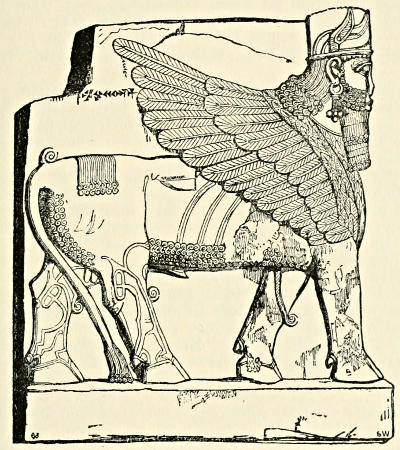
Winged Bull discovered at Arban
(Layard)
In the historical texts of the Assyrian kings we find an enumeration of
the great gods who were invoked by the sovereigns of the earth; their number
and order is not always constant, but such as they are we can mention:
Ilu (Ana), who is often confounded at Nineveh with Asshur; then Bel
(Baal); and lastly Anu. These three divinities appear as the reflection of
the gods of the superior world, which we have already mentioned, but to
which we have been unable to ascribe names. Then follow the gods more
particularly associated with the visible world: Sin, the god of the moon;
Shamash, god of the sun; Bin (Ramman or Adad), god of the higher
regions of the atmosphere, arbitrator of the heavens and earth, the god
who presides over tempests.
A series of divinities seems especially given over to the superintendence
of the planets: Adar over Saturn, Marduk over Jupiter, Nergal over Mars,
Ishtar over Venus, Nabu over Mercury.
Ishtar seems always to have a peculiar and special individuality, notwithstanding
that each of the great gods has a spouse who is often invoked with
him, and who seems to complete him. The rôle of the great spouses of the
great gods is not well understood; with Ishtar we can see Beltis figure, whose
name is transformed and often becomes like that of Ishtar, a collective appellation
of all female divinities; those whose names seem to have a more
permanent character are Zarpanit, the goddess who particularly represents
the fertile principle of the universe, and Tasmit, the goddess of wisdom. All
female divinities seem to have direct relations with humanity, but they often
disappear in the higher and inaccessible world, and then only reveal themselves
through secondary influences. Secondary gods, whose number is
infinite, are born of these divine couples; a tablet from the Nineveh library
gives us the list of twelve sons of Anu with their attributes; of these sons
other divinities are born, but their descent we cannot follow. It is so with
other great gods.
At Babylon the divinities are the same, but the hierarchy is different;
Bel seems to have replaced Ilu (Ana), and Marduk takes the place of Asshur.
It is easy to be seen that these theogonies come from a common source, which
is every day becoming more accessible to us, but which we have not yet
sufficiently explored to know its exact nature.
The artistic development at which the Chaldeans had arrived from the
remotest antiquity, allows us easily to suppose that we ought to discover in
the pictured monuments that which the texts have not yet revealed to us.
Unfortunately we cannot fix upon the meaning of the figures on the engraved
stones until we shall have complete enlightenment from the texts. The
significance of a symbol cannot be guessed at; also it is the most we can do
if from all these representations we are able to recognise the figures of four
or five divinities—Ilu, Nabu, Marduk, Ishtar, and Zarpanit. There is, moreover,
a special reason why we should be most cautious in our comparisons;
we know that when the Assyrians took possession of a hostile town, they
carried away the images of strange divinities, and restored them to their
possessors, after inscribing on these images the names of Assyrian gods.
Therefore we should not trust too much to an Assyrian inscription to fix
on the identification of the image of a divinity, as deeds of this nature might
have been repeated in every campaign. It is thus, doubtless, that we may
explain the fact that, while in the whole of Mesopotamia the abstract idea
of the divinity was mentioned by the name Ilu, it appears on the monuments
of the Achæmenidæ as Ormuzd.
The Assyrio-Chaldean cult had a very solemn ritual; we already have a
great number of hymns addressed to the principal divinities; and as every
month and every day of the month was under the protection of a particular
divinity, one may understand that the Assyrio-Chaldean ritual must have
had a considerable development. There were hymns dedicated to Nabu,
Sin, Shamash, Anuit, to Fire, and to the Elements. Here is a hymn which
can give an idea of the lyric poetry of which the library of Nineveh included
numerous fragments:
“Lord Illuminator of darkness who penetrates obscurity. The Good
God, who uplifts those who are in abjection, who sustains the feeble. The
great gods turn their eyes towards thy light. The spirits of the abyss
eagerly contemplate thy face. The language of praise is addressed to thee
as a single word. The … of their heads seeks the light of the Southern
sun. Like a betrothed thou restest full of joy and graciousness. In thy
splendour thou attainest the limits of Heaven. Thou art the Standard of
this wide World. O God, the men who live afar off contemplate thee and
rejoice.”
Religious ceremonies bore a relation to external worship; they all
ended in invocation or sacrifice. The cylinder-engraved scenes give us an
idea of these ceremonies; we usually see the priest in an attitude of adoration
or prayer, sometimes alone, but often before an altar, on which reposes
the object of adoration, or that which is going to be sacrificed. The most
usual victim is a ram or a kid. The Assyrian kings never began an important
expedition without having invoked the gods and held religious
ceremonies; after a victory they offered a sacrifice on the borders of their
newly conquered states. These sacrifices generally took place in the open
air; nevertheless, temples were numerous in Assyria and Chaldea; their
traditional form is that of a step-pyramid (ziggurat); every town had one
or two temples of this kind under the patronage of one of the divinities of
the Assyrian pantheon.
A tablet from the library gives us a list of these different sanctuaries,
where the gifts of the faithful multiplied and accumulated until the time
when war came to disperse them.
Cosmogony occupies a large place on the tablets of Asshurbanapal’s
library. Amongst all these tablets, those which relate to the creation of the
world, particularly to the history of the flood, have acquired notoriety.
These ancient traditions form a whole which claims the closest attention.
Whatever the philological explanations one may accept, there is one dominating
matter which gives an incontestable importance to these remains,
and this is their relation to the Mosaic statements. It is certain that the
fall of Nineveh antedated the Babylonian captivity, and that the Bible in its
present form postdates the return from captivity. It is not without interest,
therefore, to compare the biblical accounts with a text, which could not have
been altered from the day it was buried under the ruins of an Assyrian
palace. This is not all; these ancient Assyrian legends are really the translation
of a Sumerian text, which Asshurbanapal had copied and translated
from the libraries of lower Chaldea, and we know positively that these texts
antedate the reign of the ancient Sargon, and are therefore earlier by several
centuries than the time when Abraham must have left Chaldea.
It is doubtless not the place here to give way to a discussion on pure
philology; we will simply say this: when we make a mistake in translating
a hymn addressed to the god Sin, and apply it to quite another divinity of
the Assyrian pantheon, it is a deplorable mistake; but such an error, were it
the most gross, would have no influence on our present prejudices. It is
otherwise if we refer to a text which can influence our intimate beliefs, be it
to fortify them, combat them, or explain their origin. In England and
other protestant countries the discoveries of George Smith acquired a tremendous
notoriety, and his translations are accepted with an eagerness and
confidence which a severe criticism has not justified. In France these discoveries
aroused less curiosity from the first, and Assyriologists who study
legendary texts have done so with a dispassionateness which is all the more
conducive to scientific and correct historic results.
Nevertheless, from these sources and authorities, translations have passed
into elementary books, where it has been sought to use them in the support of
preconceived ideas, often by altering their true meaning. We cannot set ourselves
too strongly against such proceedings. It is surely not a new principle,
that disinterested science must with perfect impartiality scrutinise all
books, legends, and documents which claim the attention of the human mind.
The history of the creation comprises a collection of several tablets, of
which the text was published in 1875, in the Transactions of the Society of
Biblical Archæology. This text includes six fragments forming part of a
series of tablets designated in Assyria under the title of “Enuva” (i.e.,
Formerly).b
Since George Smith first published the tablets various other fragments
have been discovered, the most important new discovery, perhaps, being
made by Mr. L. W. Kingj of a tablet containing a reference to the creation
of man. He found that the tablets belonging to the series are seven in
number, and has published all the hitherto known material in his Seven
Tablets of Creation. The following extracts are taken from his translation:
When in the height heaven was not named,
And the earth beneath did not yet bear a name,
And the primeval Apsu who begat them,
And chaos, Tiamat, the mother of them both,—
Their waters were mingled together,
And no field was found, no marsh was to be seen;
When of the gods none had been called into being,
And none bore a name, and no destinies [were ordained]
Then were created the gods in the midst of [heaven]
Lakhmu and Lakhamu were called into being [............]
Ages increased [........]
Then Anshar and Kishar were created, and over them [.......]
Long were the days, then there came forth [........]
Anu, their son,
Anshar and Anu [.........]
And the god Anu [.........]
Here follow three tablets telling of the revolt of Tiamat and her defeat,
which will be spoken of later on.
The fifth tablet begins:
He (Marduk) made the stations for the great gods;
The stars, their images, as the stars of the zodiac he fixed.
He ordained the year and into sections he divided it;
For the twelve months he fixed three stars.
........
The Moon-god he caused to shine forth, the night he intrusted to him.
He appointed him, a being of the night, to determine the days.
The rest of the tablet is rather badly mutilated. The sixth begins:
When Marduk heard the words of the gods,
His heart prompted him and he devised [a cunning plan].
He opened his mouth and unto Ea [he spake],
That which he had conceived in his heart he imparted [unto him],
“My blood will I take and bone will I [fashion],
I will make man, that man may........[.......]
I will create man who shall inhabit [the earth]
That the service of the gods may be established and that [their] shrines [may be built].
But I will alter the ways of the gods, and I will change [their paths];
Together shall they be oppressed, and unto evil shall [they......]”
And Ea answered him and spake the word:
The rest of the tablet is too fragmentary for translation. The seventh
contains the fifty titles of Marduk.
Besides these seven tablets there are some which contain other accounts
of the creation. One of these refers to the creation of cattle and the
beasts of the field.a
When the gods in their assembly had made [the world]
And had created the heavens and had formed [the earth]
And had brought living creatures into being [......]
And [had fashioned] the cattle of the field, and the beasts of the field, and the creatures [of
the city],—
After [they had........] unto the living creatures [.......]
c
The rest is too mutilated for comprehension of anything besides single
words.
The fact that these tablets as well as so many others of Babylonian
origin were found in an Assyrian library, shows that the Assyrians took
their religion like the rest of their culture from the Babylonians. Indeed
the Assyrian myths, religious doctrines, and observances are so similar to
those of the mother-country that in speaking of Babylonian religion the
Assyrian is usually to be understood as well. The Babylonian religion in
turn was largely influenced by the Summerian which was an astral religion.
The names of the gods are found written with the same ideograms although
they were doubtless pronounced differently. Many of the texts are found
written in Summerian with interlinear Assyrian translations.
Babylonian religion as we first see it is in the form of local cults. Each
city with its surrounding district had its own god, whose authority was
supreme. Thus Anu was worshipped in Erech, Bel in Nippur, Ea in Eridu,
Sin in Uru, Shamash in Larsa and Sippar. When these cities began to be
welded together into political systems, the gods also were put together into
an organised pantheon in which political situations influenced the relations
the gods were made to bear to each other. Thus when Babylon became the
capital of the empire its special god, Marduk, became leader among the gods.
A second characteristic feature of the Babylonian religion is that it is
based on natural phenomena. The myths are nature myths. The story of
the original creation was in a way the prototype of what happened every
year. The earth is covered with water from the winter rains (state of chaos).
The spring sun (Marduk) fights with and overcomes the water (Tiamat); the
earth appears, green things of all kinds and life are produced. The story of
the flood may have referred to the annual inundation, with perhaps the added
element of severe winds and a tidal wave from the south. Such inundations
have occurred in historic times. Ishtar’s descent into the lower world marks
the autumn when everything is dry and has been burned up by the fierce
summer sun. Ishtar goes to seek the water of life, which in the Babylonian
world was a most appropriate metaphor, because water actually was the life
of the country. Without it the land was arid and desolate as to-day; with
it, its luxuriant vegetation caused the region about Babylon to be called the
garden of the gods (Karaduniash).
The creation legend as we have it must have been written after the consolidation
of the empire with Babylon as its capital, because in the story
Marduk, although one of the younger gods, is made the champion and leader
of the others. The tablets on which the legend is contained now usually
go by the name of enuma elish, “when above,” from the opening words.
The opening lines of the story relating the creation of the gods, and the latter
part telling of the creation of animals and man, we have already seen.
The version of creation given here is practically the one Berosus gives
of the Babylonians, which is found in Eusebius and which he quotes from
Polyhistor (see Appendix A).
In the beginning was chaos, consisting of a watery mass. Only two
beings existed—Apsu, the Deep, and Tiamat, the universal mother. These
two represent the two formative elements from whose union the gods were
created. First Lakhmu and Lakhamu were born, then Anshar and Kishar,
and after a long interval the other great gods. Tiamat, after having
brought forth the gods, conceived a hatred for them and created a large
number of monsters to aid her in a battle against them and gave the
command to her son Kingu. She bore: “giant snakes, sharp as to teeth,
and merciless—with poison she filled their bodies as with blood.” Anshar
sends his son Anu against Tiamat, but he is afraid to face her. After Ea
also has been sent in vain, Marduk offers to take up the fight, but first
demands to be recognised by the other gods as their champion. Anshar
summons the great gods to a feast, informs them of all that has taken place,
and calls on them to appoint Marduk as their defender. The gods do so
and hail him with the following words (the translation of the Assyrian
texts is based upon that of Jensenh in his Cosmologie der Babylonier):
Thou art the most honoured among the great gods
Thy fate has no equal, thy decree is Anu.
Marduk, thou art most honoured among the great gods
Thy fate has no equal, thy decree is Anu.
From now on thy word shall not be altered,
To put up and to lower, shall be in thy hand;
What goes out of thy mouth shall be established
Thy decree shall not be resisted.
No one among the great gods shall overstep thy boundary
........
Marduk, thou our avenger,
We give thee dominion over the whole world.
To test his powers the gods place a garment before Marduk and tell him
to bid it disappear and come back again at his word. When he has accomplished
this prodigy the gods are pleased and exclaim “Marduk is king.”
The avenger after equipping himself for the fray goes out to meet Tiamat
and her host, taking with him his thunderbolt, spear, and net; he is followed
by seven winds, which he has created. We take up the story again at the
point where Marduk challenges Tiamat to battle:
“Stand! I and thou let us fight together—”
When Tiamat heard these words
She became like one demented, and lost her senses.
Then cried out Tiamat wild and loud
Her limbs trembled to their very foundations,
She said an incantation, and spoke a formula,
And of the gods of battle, she asked their weapons.
They drew near, Tiamat and Marduk, wise among the gods,
They advanced to battle, came near to fight—
Then the lord spread out his net and surrounded her.
He let loose the evil wind that was behind him.
When Tiamat opened her mouth to its full extent,
He sent the evil wind into it, so that she could not close her lips.
Filled her belly with terrible winds
Her heart was … and she opened wide her mouth.
He seized the spear and pierced through her belly
Cut through her inward parts, and pierced her heart.
He overcame her and destroyed her life,
Threw down her body and stood upon it.
When he had killed Tiamat, the leader,
Her might was broken and her host scattered
And the gods, her helpers, who went at her side
Trembled, were afraid, and turned back.
After Marduk had dealt with the minor rebels
He returned to Tiamat, whom he had conquered
He cut her in two parts like a fish
He put up one half of her as a cover for the heavens,
Placed before it a bolt and established a watchman—
And commanded him not to let her waters come forth.
The rest of the legend deals with the creation and has been mentioned elsewhere.
Professor Gunkeli (in his Schöpfung und Chaos) in speaking of this
myth says that Tiamat’s offspring, the monsters of the sea, are the stars in the
constellations of the zodiac. The stars are the children of the night. Marduk
is the spring sun, who fights with the waters, finally subdues them, and
brings forth vegetation. This story of Marduk and his fight with the dragon
is sometimes identified with the Christ story. The Babylonians also appear
to have celebrated a festival at the new year, when the sun turned back from
the equator and left the constellation of the water-man. This may be said
to mark the birth of spring. Three months later when the god has grown
sufficiently strong he fights with the waters (Tiamat Sin) and conquers.
The Babylonians pictured the earth as a cone-shaped mountain surrounded
by water. Over this was stretched the dome of heaven behind which was
the heavenly ocean and the home of the gods. In the dome were two gates
through which Shamash the sun-god passed out in the morning and entered
at night. The moon and stars were within the dome, and did not pass
through it as did the sun. Underneath the thick crust of the earth’s surface
the space was all filled with water, and within the crust was Arallu, the
home of the dead and land of “no return.” This was supposed to be surrounded
by seven walls. Although the real home of the gods was beyond
the dome of heaven, they usually lived on the earth and had their council-chamber
on the mountain of sunrise, near the gate through which Shamash
came out in the morning.
The Babylonian gods are very human. They are born, live, love, fight,
and even die, like the people on the earth. The conception is wholly materialistic.
Alfred Jeremiask says of this religion: “A practical streak runs
through the religion of the inhabitants of the Euphrates valley. Their gods
are gods of the living; they are in active intercourse with them as helpers
in every action, as rescuers from all evil. The whole religious interest centres
on the necessities of this world. There is no room for the anxious reflection
and philosophising as to the whence, and whither of the soul, which is
so characteristic of the Egyptians. With death comes an end of strength
and life, of hope and comfort. Hence their religion as such has little to do
with conceptions of another world.”
The names of the chief gods have been already mentioned. Besides the
ilani rabuti, the great gods, there were a hosts of smaller ones, and a large
number of good and evil spirits. Sickness and disease were supposed to be
brought by demons, the children of the under-world who performed the bidding
of Allatu and Nergal, the rulers over hades. Allatu’s chief messenger
was Namtar, the demon of pestilence. The Annunaki likewise did her
errands of destruction. The Babylonians lived in constant terror of offending
some of these divinities, and a large part of their literature was devoted
to magical formulas and prayers for aid and protection. Before undertaking
any deed it was customary to find out whether or not the omens were favourable.
Certain days were particularly unlucky and on them nothing could be
done. The 7th, 14th, 21st, and 28th days of every month were among the
unlucky ones. The later Jewish sabbath is thus seen to have been originally
an unlucky day rather than a holy day. Hugo Winckler has suggested an
ingenious theory for the fact that thirteen has always been considered an
unlucky number. In order to make the Babylonian calendrical system of
lunar months agree with the solar year, it was necessary to insert an extra
month. This thirteenth month was regarded as being in the way and disturbing
calculations. So thirteen came to be regarded as a superfluous,
unlucky number. Another sign of the zodiac was appointed for this extra
month, and this was the sign of the raven.
A great many of the tablets which have been excavated contain omens.
Omens were drawn from dreams, from the conjunction of stars and planets,
from earthquakes, eclipses, and in short from all natural phenomena. Connected
with this was the magical literature, the hymns, and penitential
psalms. If all a man’s precautions had been in vain and disease had come
upon him, there were magical formulas which might rescue him from his
misery, certain prayers or hymns he might recite. Every Babylonian had
his own protecting god and goddess, to whose care he was perhaps committed
at birth, but the intervention of a priest was necessary to appease the
god. The following prayer, from a tablet used as prayer-book for the use of
priest and penitent, is taken from King’sc Babylonian Religion and Mythology:
O my God, who art angry, accept my prayer, O my goddess, who art angry, receive my
supplication. Receive my supplication and let thy spirit be at rest. O my goddess, look with
pity on me and accept my supplication. Let my sins be forgiven, let my transgressions be
blotted out. Let the ban be torn away, let the bonds be loosened. Let the seven winds carry
away my sighs. I will send away my wickedness, let the bird bear it to the heavens. Let the
fish carry off my misery, let the river sweep it away. Let the beast of the field take it from me.
Let the flowing waters of the river wash me clean.
To ascertain why the evil had come upon the man, questions like the
following were asked, some of which show an advanced moral code:
Has he estranged the father from his son or the son from his father? Has he estranged the
mother from her daughter or the daughter from her mother? Has he estranged the brother from
his brother or the friend from his friend? Has he refused to set a captive free? Has he shut out
a prisoner from the light? has he committed a sin against a god or against a goddess? Has
he done violence to one older than himself? Has he said yes for no or no for yes? Has he used
false scales? Has he accepted a wrong account? Has he set up a false landmark? Has he
broken into his neighbour’s house? Has he come near his neighbour’s wife? Has he shed his
neighbour’s blood?
On one old tablet which has a Summerian interlinear translation the
stricken man turns to Marduk as an intercessor:
An evil curse like a demon has come upon the man
Sorrow and trouble have fallen upon him
Evil sorrow has fallen upon him
An evil curse, a spell, a sickness,
The evil curse has slain that man like a lamb.
His god has departed from his body,
His guardian goddess has left his side,
He is covered by sorrow and trouble as with a garment, and he is overwhelmed.
Then Marduk saw him
He entered into the house of his father Ea and said to him:
“O my father, an evil curse like a demon has beset the man.”
Twice he spoke unto him and said
“I know not what that man has done nor whereby he may be cured.”
Ea made answer to his son Marduk:
“O my son, what thou dost not know, what can I tell thee?
O, Marduk, what thou dost not know, what can I tell thee?
What I know, thou knowest,
Go my son Marduk,
Take him to the house of purification
Take away the spell from him, remove the spell from him.”
A very pessimistic view of life is shown by the following complaint of a
sick man quoted by Jeremias: “The day is sighing, the night a flood of
tears; weeping is the month and misery the year.”
We have already seen specimens of Babylonian hymnology. The following
hymn to Sin, as translated from Shrader’sm work on cuneiform inscriptions,
shows real religious fervour:
Lord, ruler among the gods, who alone is great on heaven and earth,
Father Nannar, Lord, God Amar, ruler among the gods
........
Merciful, gracious father, in whose hand the life of the whole land is held.
O Lord, thy divinity is like the distant heaven, like the wide sea, full of majesty.
He who has created the land, founded the temple, called it by name
Father, generator of gods and men, who caused dwellings to be put up, established sacrifice
Who calls to dominions, gives the sceptre, decides fate for distant days,
Mighty leader, whose depths no god sees through
Valiant one, whose knees never grow tired, who opens the way for the gods, his brothers,
Who passes glorious from the depths of heaven to its heights,
Who opens the gate of heaven, makes light for all men.
Father, generator of all, who looks upon living beings … who thinks upon …
Lord, who utters judgment for heaven and earth, whose decree no one alters
Who holds fire and water, who directs living beings, What god is like to thee?
........
In heaven who is great? Thou alone art great.
On earth, who is great? Thou alone art great.
When thy word resounds in heaven, the Igigi throw themselves upon their faces;
When thy word resounds on earth the Anunnaki kiss the ground.
When thy word speeds above like the storm wind, it causes food and drink to flourish,
When thy word settles upon the east, the green arises,
Thy word makes stall and herd to be fat, expands living beings.
Thy word causes right and justice to arise, so that men speak justice.
Thy word is the distant heaven, the hidden under-world which no one sees through,
Thy word, who can understand it, who is equal to it?
O Lord, thou hast no rival in heaven in dominion nor on the earth in power, among the gods thy
brothers.
The close relation existing between mythology and religion hardly needs
to be pointed out. The great epic of the Babylonians and Assyrians—that
of Gilgamish—is of special interest to us since it contains the Babylonian
story of the flood. The hero’s name was formerly read as Izdubar, as the
following quotation from Jeremiasn in his Izdubar-Nimrod shows.a
The epic, which was preserved in the royal library of Nineveh in the
seventh century as a precious national possession, gives us a glimpse into the
Babylonian history of a remote past. The poem deals principally with
“kings who ruled the land in by-gone times,” and with a city “which was
old” at the time of the flood, and the epic itself reaches back into very ancient
times. Its scene is laid among cities in the Euphrates district: Uruk (Erech),
Nippur, the “city of ships,” Sherippak and Babylon. The geographical
horizon extends beyond these cities to the mountain Nisir, east of the Tigris,
and southwards, beyond the Mashu mountain land, clear into the Persian
Gulf. The central point of interest is the city Uruk, called Uruk supuri,
“the well guarded.” Among the aristocracy of this city Izdubar makes
himself distinguished, being “perfect in power, like a mountain ox, excelling
the heroes in might.” He overcomes the jealousy of his fellow citizens and
establishes an indigenous kingdom, namely by conquering the tyrant Khumbaba,
who is shown by his name to be of Elamite descent. The attempt has
been made to identify this historical background with the national uprising
of Babylonia, which, according to Berosus, brought about the downfall of
an Elamite dynasty ruling 2450-2250 B.C. That the tradition really did
reach back to this age is proved by Babylonian seal-cylinders of the oldest
kings, which unquestionably reproduce scenes from the epic, perhaps also the
connection of the epic with certain constellations of the zodiac.
More important than the historical is the mythological background.
Since Babylonian religion did not belong to the “aristocracy of book
religions,” it is difficult to form a system from the abundance of religious
literature, the views of which have been influenced by varying popular
opinion. Hence the portrayal of the divine world as found in a finished epic
is the more important. As in the inscription of King Nabunaid, written
2,000 years later, so here we find the two great divine triads, Anu, Bel, Ea,
who represent three parts of the world according to Babylonian ideas
(heaven, earth, ocean), and Shamash, Sin, Ishtar, who represent the chief
heavenly bodies (Sun, Moon, Venus).
The relations between gods and men is pictured in a naïve childlike
fashion, as in Homer. Ishtar tries to win the love of the hero Izdubar.
Shamash establishes friendship between the hero and Eabani, the three great
gods Anu, Bel, Ea whisper secrets into his ear. As Ishtar at one time mounts
from out the city to the heaven of her father Bel, so the gods out of fear of
the rising flood “crouch down like dogs at the portals of heaven”; they
flock like flies around the sacrifice and “smell the good smell.”
One remarkable feature of the epic should be noticed here, namely, the
importance attached to dreams. The whole action is set in motion by countless
dreams, by means of which the gods show men the future and give them
council. This view is characteristic of Babylonian and Assyrian religion.
The ancient Babylonian king Gudea is shown the outline of the temple building
in a dream. Asshurbanapal on his coming to the throne receives an
address of encouragement from the priestly class, which is based on a dream
of his grandfather Sennacherib, and in his campaigns inspiring dreams are
sent to his soldiers from the goddess of war.n
Nothing definite is known as to the time of the composition of this epic.
We do not know if the copy in Asshurbanapal’s library was made from a
Babylonian original or not. It is not probable that the whole was written
at one time or by one author.
The Gilgamish epic comprises twelve tablets. These are mutilated and
broken in places leaving gaps in the story, but they are sufficiently well preserved
to permit us to follow the main thread of the argument. When the
scene opens the city of Erech is suffering under the severe misfortune of a
protracted siege. The inhabitants are in distress and the gods do nothing to
help them. This siege lasts for three years, during which time the gates of
the city remain closed. Then Gilgamish appears, whether as conqueror or
deliverer the mutilated condition of the tablet leaves in doubt. He was
probably the former, since his rule is very severe and the people complain of
his tyrannical acts. In their distress they appeal to the goddess Aruru, who
is elsewhere associated with Marduk in the creation of mankind, to make a
person who shall rival Gilgamish in strength and power. Aruru accordingly
creates Ea-bani, a creature whose whole body is covered with long hair like
a woman’s. The upper part of his body is like a man but his legs are those
of a beast. This strange being lives among the beasts of the field, eating
and drinking with them.
Gilgamish fearing that Ea-bani will be sent by the gods against him sends
out a man called the hunter to catch and bring him to Erech. The hunter
lies in wait for him three days, but on account of his great strength is afraid
to attack him and returns to the city. Gilgamish then sends a harlot from
the temple with the hunter, to tempt Ea-bani. This plan is successful.
Ea-bani forsakes his cattle out of love for Achat, the harlot, and is persuaded
by her to return to Erech and meet Gilgamish. One thinks involuntarily
here of the story of Adam and Eve. There also it is a woman who tempts
man and leads him to civilisation.
Ea-bani would like to match his strength with Gilgamish, but he is
warned in a dream not to do so. Gilgamish is also told in a dream of
Ea-bani’s coming, and the goddess to whom he appeals for interpretation
of his dream advises him to make friends with the approaching hero. The
intervention of Shamash, the sun-god, however, is necessary to persuade
Ea-bani to become a companion and friend to Gilgamish.
The two heroes then proceed against the Elamite tyrant, Khumbaba.
The epic tells of the long, hard road they have to follow, of their terror,
and of the wonderful cedar grove in which the fortress of Khumbaba is
placed. Gilgamish has several encouraging dreams to cheer them on, and
they eventually succeed in killing the tyrant. On their return Gilgamish
has the misfortune to incur Ishtar’s displeasure. The goddess sues for his
love and invites him to become her husband. He, however, refuses her
favour, even reproaching her for her cruel treatment of her former lovers,
Tammuz among them, all of whom she has forsaken and destroyed. Ishtar
in her rage at being repulsed hastens to her father, Anu, who creates a
divine bull to attack Gilgamish. The latter, however, with Ea-bani’s help
succeeds in conquering the bull. He sacrifices his magnificent horns to
Shamash and proudly boasts that he will conquer Ishtar as well as the bull.
But here his success is at an end. Ea-bani dies, probably stricken by Ishtar,
and Gilgamish himself is afflicted by her with a dreadful disease, which
strikes terror to his heart at the thought that he must die like his friend.
Izdubar wept for Ea-bani, his friend;
In sorrow he laid himself down in the field.
“I will not die like Ea-bani,
Grief has entered my soul.
I am afraid of death
And lay me down in the field.”
Gilgamish then determines to seek Sit-napishtim and beseech his help to
rescue him from disease and death. After various experiences he comes
to the mountain Mashu, the sunset mountain, whose gates are guarded by
scorpion men. They let him enter and he journeys for twenty-four hours
in intense darkness before he emerges into the sunlight and passes by a tree
and grove with precious stones for fruit. He then comes to the sea coast,
ruled over by a princess Sabitum. She advises him to seek out Arad-Ea,
the former pilot of Sit-napishtim, who may possibly carry him across the
waters. Arad-Ea consents, builds a boat with the aid of Gilgamish and they
set out together. The most difficult part of the voyage is the journey across
the “waters of death.” The two finally reach the island home of Sit-napishtim
who, at Gilgamish’s request, tells the story of his escape from the
flood (as translated from Jeremiasn):
Sit-napishtim said to him, to Gishduba (Gilgamish),
“I will reveal to thee, Gishduba, something hidden.
And a secret of the gods will I tell thee.
Shurippak, a city which thou knowest—on the banks of the Euphrates it is situated—
This city is old. The gods within it,
Their heart led the great gods to bring up a deluge.
Their father Anu was there, their counsellor, the mighty Bel,
Their herald Ninib, their leader En-nu-gi.
Ninigiazag (Ea) was with them and related their words to a hut of reeds, saying: “O reed hut, O reed hut! O wall, wall!
Reed hut hear! wall understand!
Thou man of Shurippak, son of Ubaratutu,
Make a house, build a ship, leave thy possessions, seek thy life.
Abandon thy goods, and save thy life.
Bring up living seed of every kind into the ship,
The ship, which thou shalt build.
Its dimensions must be measured;
Its breadth and its strength must suit each other.
Thou shalt place it in the ocean.”
I understood and said to Ea, my lord,
“See, my lord, what thou hast commanded
I shall heed and perform.
But, how shall I answer to the city, to the people and to the elders?”
Ea opened his mouth and spake, said to me, his slave,
“This answer shalt thou say to them:
Because Bel hateth me
No longer will I live in your city, nor lay my head on Bel’s earth.
To the deep will I go down and live with Ea, my lord.
He will then cause it to rain upon ye abundantly.
A large number of birds, a crowd of fishes,
A quantity of animals, abundant harvest.…
The lines here are too mutilated to make much meaning. According to
some interpretations Sit-napishtim assures his fellow-citizens of coming prosperity
so that they have no misgivings as to his leaving them; others, on the
contrary, indicate that Sit-napishtim made no secret of the coming deluge.
Sit-napishtim then relates how he built the ship, gives its dimensions, and
tells what he put into it. He continues (Jeremias’n translation):
“I brought up into the ship my whole family, and my dependants,
Cattle of the field, beasts of the field, artisans all together I brought them up.
Shamash had appointed a signal,
‘The lord of darkness will send a heavy rain in the evening.
Then enter into the ship and close the door.’
The appointed time came;
The lord of darkness sent a heavy rain in the evening.
I feared the beginning of the day;
I was afraid to look upon the day.
I entered the ship and closed the door.
To the pilot of the ship, to Puzur-Bel, the boatman,
I intrusted the ship and what was in it.
When the first dawn appeared
A black cloud arose from the foundation of heaven
Ramman thundered within it.
Nabu and Marduk preceded it.
They advanced as leaders over mountain and earth.
Uragal pulled up the anchor;
Ninib went forth and caused the storm to follow.
The Annunaki raised their torches;
They lighted the earth with their beams.
The thunder of Ramman mounted to heaven;
Everything light was turned to darkness.”
Ramman floods the land, the tempest rages for a whole day, a strong wind
blows the water like mountains upon the people.
“Brother did not see his brother, men could not be distinguished; in heaven
The gods were afraid of the deluge.
They quailed, they mounted up to the heaven of Anu.
The gods crouched down like dogs, at the borders of heaven.
Ishtar screamed like a woman in travail.
The lady of the gods cried with a loud voice
‘Former man has been turned again to clay
Because I counselled an evil thing in the council of the gods.’”
Ishtar complains that her offspring have become like fish spawn and the
gods weep with her. After six days, however, the storm abates, the sea
becomes quiet. Sit-napishtim looks out of the window and weeps at the
sight that meets his gaze. Mankind is turned to clay, the world is all sea.
After twelve days land appears, and the ship sticks fast on the top of Mount
Nisit, where it remains for six days.
“When the seventh day drew nigh,
I sent out a dove and let her go. The dove flew hither and thither,
But as there was no resting place for her, she returned.
Then I sent out a swallow and let her go. The swallow flew hither and thither,
But as there was no resting place for her, she returned.
Then I sent out a raven and let her go.
The raven flew off and saw the diminishing of the waters,
She came near and croaked, but did not return.
Then I brought out (all), offered a sacrifice to the four winds;
I made a libation on the top of the mountain,
I laid out the vessels seven by seven,
Under them I put reed, cedar-wood and incense.
The gods smelled the smell. The gods smelled the good smell.
The gods gathered like flies about the lord of the sacrifice.”
When Ishtar arrives she bitterly accuses Bel for having destroyed mankind
and refuses to let him approach the sacrifice. Bel on his part is angry
that any man whatever has escaped. Ea interposes, rebukes Bel for his
deed, and tells him that in the future some other device shall be used to
punish mankind. Bel accepts the censure and himself leads Sit-napishtim
and his wife out of the ship and blesses them. They are then transported
to an island at the “mouth of the streams” where they are to live forever.
After listening to this story Gilgamish is cured of his disease by Sit-napishtim
who also tells him of a plant which has the power to prolong life.
Gilgamish sets out with Arad-Ea to find it, and their search is indeed successful;
but later on in the journey a demon steals the plant, and Gilgamish
returns sorrowfully home. Here he continues to mourn for his lost friend
Ea-bani. In his desire to see him again he appeals in turn to Bel, Sin, and Ea
to assist him, but they are powerless to help him. It is Nergal, god of the
dead, who grants his request and “opened the earth, let the spirit of Ea-bani
come out of the earth like a breath of wind.” When asked to describe the
under-world Ea-bani at first answers, “I cannot tell you, my friend, I cannot
tell you,” then he bids him sit down and weep while he gives him a gloomy
account of the place, which closes with the following lines (Jeremias’
translation):
“On a couch he lieth, drinking pure water.
He who was killed in battle—thou hast seen it, I have seen it—
His father and his mother hold his head
And his wife kneels at his side.
He whose corpse lies in the field—thou hast seen it, I have seen it—
His soul has no rest in the world.
He whose soul has no one to care for it—thou hast seen it, I have seen it.
The dregs of the cup, the remnants of the feast—what is thrown on the street, that is his food.”
h
This is the end of the epic. It has been suggested that the whole forms
a solar myth and is divided into twelve parts to correspond to the twelve
months. According to this theory the sixth tablet, relating to Ishtar, and her
treatment of Tammuz and her other lovers, corresponds to the sixth month.
It is the month when everything seems dry and dead after the hot summer
sun, and in this month the festival of Tammuz was celebrated, as a characteristic
of which was the weeping for Tammuz related in Ezekiel viii. 14.
The seventh tablet speaking of Gilgamish’s illness would thus correspond
to the seventh month, the one following the summer solstice, when the
power of nature seems to grow less, and this was attributed to a disease of
the sun.
This idea is brought out more fully in the legend of Ishtar’s descent into
the under world. It is possible that the story used to be recited in connection
with the festival of Tammuz just mentioned. Ishtar is pictured as
descending into the lower realms, probably in search of her young husband.
The picture it gives us of the conception the Babylonians had of life after
death is very valuable. The poem begins:
To the land of no return, to the land …
Ishtar the daughter of Sin inclined her ear.
To the house of darkness, the dwelling of Irkalla
To the house from which none who enter ever return
To the road whose course does not turn back.
To the house in which he who enters is deprived of light,
Where dust is their nurture and mud their food.
They see not the light, they dwell in darkness.
They are clothed like birds in a garment of feathers.
On the doors and bolts is spread dust.
When Ishtar reached the gate of the land of no return
She spoke to the porter at the gate
“Porter, open thy gate,
Open thy gate, I will enter.
If thou dost not open thy gate, and I do not enter,
I will strike the door, I will break the bolt,
I will strike the threshold and break down the door.
I will raise up the dead to consume the living,
The dead shall be more numerous than the living!”
The porter opened his mouth and spoke,
Spoke to the powerful Ishtar:
“Stay, my lady, do not break it down,
I will go and announce thy name to the queen Allatu.”
The porter then informs Allatu that her sister Ishtar stands at the door.
The goddess is displeased at the news but bids the porter open the door and
treat her according to the “ancient laws.” These demanded that she should
lose some part of her apparel at each of the seven gates of the under-world
until she stood naked before the throne of its goddess. At the first gate the
porter takes away her crown and she asks: “Why, O porter, dost thou take
the great crown from my head!” He answers: “Enter, O lady, for these
are the commands of the mistress of the world.” At each gate Ishtar
remonstrates at having her ornaments taken from her, and each time the
porter returns the same answer.
When Ishtar comes before Allatu, the latter commands her messenger
Namtar to smite the goddess with disease in all parts of her body. But
while Ishtar is being detained in the lower world, all life has stopped on the
earth’s surface. The gods demand her release. A being is specially created
to bring her back. The rest of the story and the meaning of this and the
flood myth is told by C. P. Tieleo as follows:a
The story of Ishtar’s descent into hades is unmistakably a nature myth,
which describes in picturesque fashion her descent into the under-world to
seek the springs of living water, probably the central force of light and heat
in the world. When she is imprisoned there by Allatu, the goddess of death
and of the shadow world, and even visited with all sorts of diseases, all
growth and generation stand still in the world, so that the gods take council
and decide to demand her release. Ea accordingly creates a wonderful being
a kind of priest, called “his light shineth,” who is to seek out the fountain
of life, and whom Allatu cannot withstand, however much she may scold and
curse. The goddess is set free, returns to the upper world and brings her
dead lover Tammuz back to life by sprinkling him with the water of immortality.
This myth is not cosmological nor ethical, but has already become a
pure anthropomorphic narration, the physical basis for certain episodes and
details of which is often not clear, and which has a tendency to strengthen
belief in immortality. The account of the flood also, which we have in several
versions and which was itself put together out of various parts, some of
them heterogeneous, betrays the fact that it was put together by a polytheist
and originated in a nature myth. But the nature myths as such lie already
so far behind the author, there is such a naïve humour in the way the gods
are represented, everything happens in such a human fashion—one needs
only to think of Ishtar’s complaint that she has created men but no brood of
fishes, of the sly excuse with which Ea excuses himself to Bel for having rescued
his favourite from the destruction planned by the latter, one needs only
to hear how Bel is preached at by the wise Ea for his unreasonable and blind
passion, and how the great Ishtar declares him to have forfeited his share of
the sacrifice, and then see how he silently acknowledges his wrong by himself
accompanying the man over whose rescue he had become so excited, and
raising him with his family to a place among the gods—one needs only to
think of all this to see that the narrator made use of the mythological material
only to describe the fall of sinful humanity and at the same time to
remind his hearers that the gods always have means at their command, such
as hunger, pestilence, and wild beasts, to punish the evil-doer.o
The Babylonian view of life after death was particularly gloomy. There
was no hope of anything better. The highest state of happiness pictured
was to lie on a couch and drink clear water; even for the pious it was a
place of gloom. And there was no possibility of escaping from it. Sit-napishtim
tells Gilgamish in this connection that death must come to all
(we translate again from the version of Jeremiasn):
So long as houses are built,
So long as contracts are made,
So long as brothers quarrel,
So long as enmity exists,
So long as rivers bear their waves [to the sea]
........
The Anunnaki and the great gods determine fate
And Mammetum, the creator of destiny, with them.
They determine life and death,
The days of death are not known.
h
We have seen the legend telling of a visit to the lower world; there are
two which tell of visits to heaven. One is in connection with Etana. In
Asshurbanapal’s library were a series of tablets containing the Etana legend.
One portion of the story tells how Shamash helped Etana to find a plant
which would help his wife in child-birth. Another narrates how Etana
mounted to heaven on the back of an eagle. They pause at different stages
to look at the earth beneath them. At the first stop: “The earth appears
like a mountain, the sea has become a pool.” They go further and the
eagle again calls to Etana to look at the earth. This time the sea looks like
a belt around the earth. The next time he looks the sea has become a mere
gardener’s ditch. After reaching the gate of Anu, Bel, and Ea, the eagle
wants to go still further and persuades Etana to accompany him to Ishtar’s
abode. They fly until the earth appears a mere “garden bed,” but here the
rash attempt of the eagle to reach the highest regions appears to be punished.
The two are hurled down from heaven upon the earth. Another
part of the legend tells of a deceit practised upon the eagle by the serpent,
aided by Shamash, in which the eagle dies a miserable death.
The second story of a visit to heaven is found in the legend of Adapa.
This legend was on one of the tablets found at Tel Amarna. Adapa is a son
of the god Ea, and is represented as serving in his temple. One day as he
is fishing in the sea the south wind overturns his boat. Adapa then fights
with the south wind and succeeds in breaking its wings so that it does not
blow for seven days. At the end of this time Anu, in heaven, becomes
aware that the south wind has not been blowing and inquires the reason.
When told, he becomes very angry that anyone should have had the audacity
to interfere with any of his creatures. He accordingly sends for Adapa
to appear before him. Ea gives his son advice as to his conduct, telling
him how to secure the good favour of the two porters at the gate, one of
whom is Tammuz. He tells him further: “When thou comest before Anu,
they will offer thee food of death—do not eat. Water of death they will
offer thee—do not drink. They will offer thee a garment—put it on.
They will offer thee oil—anoint thyself.” Adapa then reaches heaven,
and everything happens as Ea has told him. Only the food and water
which are offered him are of life not of death, and thus Adapa loses his
chances of eternal life. Anu looks at him in amazement and exclaims: “O
Adapa, why didst thou not eat and drink? Now thou canst not live.”
Here, as in the case of Adam in the biblical story, whose name by the way
may possibly be identical with Adapa, we see that a deceit was practised on
man. In each case he is told that the food and water of life will bring him
death, although the Babylonian story differs from the biblical in that the
former freely and gladly accords man knowledge, as represented by the
clothing and oil for anointment, which may be regarded as symbols of
civilisation.
In the Euphrates valley religion was very closely associated with the
actual life of the nation. The temples were storehouses and banking establishments;
the priests were lawyers and scribes. Every historical inscription
contains a reference to the gods. Victory was due to their intervention.
Nothing was conceived without them. Their festivals were the great events
of the year. The German excavating society has recently brought to light
the old procession street between Babylon and Borsippa over which the
image of the god Nabu used to be carried on his annual visit to Marduk
at Babylon. This street was decorated with glazed, coloured tiles, representing
a stately procession of lions and other beasts, which show a high
grade of artistic talent.
The Babylonian religion shows its development plainly. In its earliest
phase we have the belief in a great many spirits and demons, who could be
controlled by magic. Then comes the period of local cults followed by the
organised pantheon, in which we see faint signs of a conception of one god
manifested in many forms.a
To sum up in the words of Tiele: From all that has been said it will
be seen that the religion of the Babylonians had at an early date attained
a comparatively high stage of development. It had not yet crossed the
boundary of monotheism but remained a theocratic, monarchical polytheism;
nevertheless it came very near that boundary. The gods of mythology were
already treated with great freedom, and the disgust which some of their
deeds called forth was not disguised. A comparatively pure and lofty conception
of the highest divinity had already been developed, even if it was
called upon by different names. However much superficiality and formality,
however many superstitions and magical customs may have been connected
with the divine worship, it was yet not lacking in deep religious feeling and
moral earnestness, which is shown particularly in the penitential psalms.o
Bas-relief of Workmen and Cart
(After Layard)
Of all the revelations regarding the Mesopotamian civilisation which the
researches of Botta and Layard and their followers have brought to light,
none perhaps are more interesting than those that showed the position which
art had attained in those far-off and forgotten times. It had all along been
remembered that powerful political empires had risen and fallen here, however
vaguely the details of the history may have been preserved. It was
recalled, too, that these peoples possessed religions with the same fundamental
elements as the Jewish creeds; but that they had developed an artistic spirit
and artistic craftsmanship far beyond that of any other people of their time,
had been entirely forgotten. Yet, as we have seen, the most striking and
conspicuous of the monuments restored by the explorations were works of
art. We have obtained many glimpses of these in the preceding pages, and
it will not be necessary here to treat them in very great detail; indeed, it
would be quite impossible to do so within the necessary bounds of space.
Our concern is with the historic relations of the Mesopotamian art development
rather than with the details of the art itself. Nevertheless, something
more than incidental references will be made to some features of the subject.a
The origin of Babylonian-Assyrian civilisation is lost in the darkness of
prehistoric times, like that of the Egyptians and Chinese. We shall see that
even their oldest monuments display a high grade of artistic ability and presuppose
a long development. The texts on the oldest monuments are already
written in cuneiform; the picture writing in which this must have originated
was already out of use, which shows a great progress in civilisation.
As to the origin of this culture various suppositions have been made.
According to the one which has made most headway, it was borrowed by
the Babylonians from a non-Semitic race who inhabited the country before
them, and then spread gradually from the Persian Gulf, where it originated
or whither it was brought from without, towards the north.
It is pure supposition to say that civilisation in Babylonia started out
from the shores of the Persian Gulf and spread from there towards the
north, but it is a supposition which has a high degree of probability. In
this direction points the old legend of the Babylonians, as Berossus relates it,
which describes the origin of civilisation—the legend of the divine fish-man
Oannes, who came up in the morning from the Erythræan Sea, instructed
the inhabitants of Chaldea, who were still living like animals, in the arts and
sciences, and then in the evening disappeared again under the waves. This
fish-god has long since been recognised as the god who is so frequently
depicted on Babylonian and Assyrian monuments, and it can now hardly be
longer doubted that he, the god of the waters, or rather the source of light
and fire in the waters, is the god Ea. This god with his circle is without
doubt indigenous to southern Chaldea. The oldest and most important centre
of his cult is Eridu, situated close to the sea. His son Marduk, and the god
connected with him whom the Semites call Nabu, is especially honoured on
the islands and coast of the Persian Gulf. Thus if legend traces the culture
of the Chaldeans from the instruction of this god, this is the origin of the
tradition that his worshippers, who must have been mariners and dwellers on
the sea coast, introduced this civilisation into Chaldea.
In agreement with this is the fact that the decrees of Ea and the magic
formulæ of Eridu, his chief city situated near the sea, are repeatedly designated
as being very holy and powerful, and as very ancient; also that the
oldest sayings and traditions which are known to us in the Gisdubas (Gilgamesh)
epic, are located precisely in places on the sea coast or not far distant
from it. These were also the centres of powerful states, as also of the kingdom
of Ur, and the oldest monuments of Chaldean civilisation which have
yet become known to us were found in southern Babylonia at Telloh.
However, wherever its origin may have been, the great age of Babylonian
culture, of which the Assyrian is only a later branch, stands beyond doubt.
The cylinders of Sargon I as well as the statues found at Telloh show a high
grade of development and presuppose an art which already has a long past
behind it. That the Egyptian culture is younger and even derived from
the Babylonian, and that the latter is thus the oldest in the world, and at the
same time was the mother of all other civilisations of antiquity, as has been
claimed (Hommel), can naturally not be proved and is still doubtful; but it
is not impossible. And the most remarkable fact is, that at least the plastic
art could never again reach the heights it had already attained in such a
gray antiquity.
This does not mean to imply that the Babylonians did not further
develop the civilisation, the elements of which they had received from their
predecessors. They assimilated it and developed it independently; it may
even be assumed that they improved on it in more than one respect, and
applied it to higher ends. They also introduced into it much that was
peculiar to them. How far this was the case—what with them was borrowed
and what original, cannot yet be determined in detail. At any rate we are
not justified in attributing to their non-Semitic teachers, as often happens,
everything barbaric, cruel, and repulsive that still characterises their customs,
nor all the superstitions still connected with their religion.
The original inhabitants excelled the Semites in artistic spirit and
ability, perhaps also as traders and mariners, and the latter probably imitated
the former, but seldom reached them and never surpassed them. The Semites,
on the other hand, put more depth and earnestness into their religious life;
energetically carried out the monarchic principle in this, as also in the life of
the state; simplified the writing; enriched the literature, which was thus
rendered more practical, by highly remarkable epic narrations, especially
with epic poems, and even made an attempt to write history. Furthermore,
by the organisation of a capable army, by the warlike talents of their kings
and generals, as also by their unbending character and persevering will, they
established states which endured the most violent upheavals and changes,
and ruled all their neighbours for centuries. If they were behind their predecessors
in some points, they far surpassed them in others. The conception
that one people takes on the culture of another, quite as one puts on a borrowed
dress, is just as foolish as the conception that a nation relinquishes its
own individuality and originality as soon as it learns something from another.
The Greeks of whom it has now been proved that they owed much to oriental
peoples, the Persians of whom everyone knows that they borrowed most of
their civilisation from Babylon, prove the contrary. The people who brought
its culture to the southern coasts of Babylonia and probably also to the coasts
of Elan and communicated it to the still uncultured races living there, seems
to have belonged to that peaceful, commercial race which the Hebrews designated
as the “sons of Kush,” which was not unlike the Phœnicians and
was placed in the same category; a race which, while jealous of its independence,
was not aggressive, although inclined to colonisation and to making
distant journeys. These dwellers on the coasts, together with the inland
tribes, were then conquered by the Semites, perhaps after long battles. If,
however, they became in this way, as always, the teachers of their conquerors,
the culture which grew under their influence was none the less a
creation, and thus the inalienable property of the Babylonians.
How high a state of civilisation the Babylonians had reached is shown
by the fact that the invention of writing was a long-accomplished fact with
them. The oldest inscriptions known to us, and which certainly date as far
back as 4000 B.C., are already written in a species of character which from
similarity to the second Egyptian style of writing has been called hieratic,
and it has been proved that this hieratic style of writing has been evolved
from older hieroglyphics, long since fallen into disuse.
It is not known whether any other material than stone or clay was used
to write upon, and whether in such case syllabic writing was used or not.
It has been surmised that the Babylonians and Assyrians also used, and perhaps
exclusively at first, papyrus, leather, and other soft materials to write
upon, and engraved upon stone or clay only such matter as they wished to
preserve. This is not improbable, even though we do not possess any such
manuscripts. For as a matter of course the first named materials could not
withstand the Babylonian climate as well as the Egyptian, and only the last
named are proof against fire and water. It is a fact, however, that the bas-reliefs
show the scribes recording the number of the slain on soft material,
probably leather, as well as upon hard tablets. Whether they also wrote
books or letters on papyrus or leather has not been definitely established.
However much the writing of the Babylonians and Assyrians may have
been an inheritance from very ancient times, and how much they may be
indebted to the early Chaldeans for the single form and the structure of
the whole system, the cuneiform writing in which they represented their
language was their own invention in more than one respect, since they did
not thoughtlessly use what was ready to hand, but modified and altered it
with deliberation.
Writing was also used by the Babylonians and Assyrians for purely
literary purposes. The narratives, legends, or poems were inscribed on
tablets of clay, and if in case of a work of greater size, the two sides covered
with microscopic characters did not suffice, a series of such was used,
which were clearly designated and numbered, so that they were in fact
leaves of a book. Generally the title of the whole, as usual with the
Hebrews, the first words and the first words of the following tablet were
inscribed on every tablet. This literature even if limited to the productions
of the imagination, is comparatively abundant. Although in this
respect it may not equal the literature of some races still living, such as the
Chinese, Arabian, Persian, and Indian, nor that of the ancient times of
Greece and India, which in the last named country grows as luxuriantly as
its vegetation, yet on the other hand, it excels in this respect that of the
other Semitic races, the Hebrews not excepted. This is proved not only
by the writings so far discovered but also by the catalogues of books in
Babylonian libraries or of similar works elsewhere. However, enough has
been brought to light, and in a fair state of preservation, to enable us to
form an opinion of the literary talent of the Babylonians, and to prove
to us what great varieties of it they cultivated.

Baked Clay Cylinder of Sargon II, King of Assyria, B.C. 722-705, inscribed with a
Chronicle of his Expedition
The Assyrians stand, in a literary sense, in about the same relation to
the Babylonians as the Romans to the Greeks, disciples who never equalled
their masters, although as far as can be seen, even relatively considered,
Roman literature stands higher in relation to Greek than Assyrian stands
in relation to Babylonian. The tendency of the Assyrians was warlike, and
directed to practical ideas: to found a mighty empire, and to maintain their
supremacy was the end for which they strove. Therefore they were more
interested in history than in creations of the imagination; purely literary
work had little charm for them. Only much later, a desire is awakened in
them to become acquainted with the productions of the Babylonians in this
field, and to acquire as much as possible of it for themselves. And perhaps
even here interest in the ancient religions and national traditions played
a greater rôle than love for poetry.
The Assyrians seem to have had more taste for what may be designated
the science of the period, than for literature. Here also, they were following
the lead of the Babylonians, and accomplished little beyond taking possession
of the treasures of the Babylonian libraries. The prestige which
attached to the Babylonians in antiquity as the earliest cultivators of science
is well known, although some thought that they had borrowed it from the
Egyptians. Without doubt they reached the greatest eminence in antiquity
in the knowledge of astronomy. Kalisthenes sent Aristotle astronomical
observations from Babylon, which, according to the most moderate statement,
reach back to 1903 before Alexander, i.e., 2324 B.C.; and there is
nothing improbable in this. The number of eclipses mentioned on the
astronomical tablets would lead to a conclusion that there was an even
longer period of recorded calculations. It may be that the Ziggurat of the
temples, which originally had a religious significance, might, in Assyria at
least, have been used as observatories. It has even been surmised that
the Babylonians had some sort of a telescope, and this surmise rests upon the
finding of a lens in the ruins, and upon the fact that they were acquainted
with the planet Saturn, which is invisible to the naked eye; but this doss
not seem probable. One thing is certain, they gave names to the constellations,
especially to the signs of the Zodiac, which have in part remained
in use. They were acquainted with five planets, and distinguished them
very exactly from the other heavenly bodies. They observed, and with great
accuracy, the eclipses of the sun and moon, perhaps also the sun spots, the
comets, the orbit of Venus, and the position of the Polar star; but they had
some very childish ideas about the causes of eclipses and the character of
the other heavenly phenomena. Naturally the Milky Way did not escape
their observation. They even calculated the regular recurrence of eclipses
of the moon as well as its phases.
A few of the mathematical tablets extant prove that they had made great
progress in arithmetic and higher mathematics, so indispensable to the study
of astronomy. The prevalent system was the sexagesimal, with the 60 as
the unit, but the decimal system seems to have been known and used.
However in spite of the recognition of the high value of these researches,
they hardly deserve the name of science. These researches were certainly
not undertaken from a love of science. The prime object, no doubt, was to
discover the will of the gods in regard to the future. The science of
mathematics itself was made subservient to the art of divination. Astronomy
was a secondary object, astrology the principal one. Knowledge was sought
of what must happen when there should be a recurrence of certain phases
of stars and heavenly bodies. All observations of planets, comets, and
other stars, of eclipses and other phenomena, were immediately connected
with occurrences on earth, which at some former time had fallen in conjunction
with them and consequently must be expected again.
No more were other branches of science besides astronomy cultivated for
their own sakes. Their science of medicine was based almost entirely upon
magic, and appears to have stood on a lower plane than that of the Egyptians,
at least in so far as the still existing inscriptions will permit us to
judge. They indeed used as did the Vedic Indians external and internal
remedies, but they probably regarded them as charms; whatever progress
they may have made in the science of medicine, the records of it in the
ancient inscriptions prove that it was somewhat less than what we know
of the Vedic physicians and their cures. Thus it is rather an exaggeration
to speak of physical, geographical, grammatical, and mythological writings of
the Babylonians and Assyrians, unless the myths and legends belonging
to literature already discussed are meant.
There are various reasons for the supposition that each of the Babylonian
libraries according to the studies of the several religious and scientific schools
had a distinctive character. The Assyrian libraries, on the other hand, being
all of later date, had more general and more varied contents.
The idea that these libraries were for the use of the general public, is not
well founded, and rather improbable. They were probably designed in the
first place, for the learned men and scribes of the king, as well as for his own
use, for the instruction of his sons, and future officials, as well as for archives
of the state. They do not in the least prove that culture, learning, and erudition
were the property of all classes in Assyria.h
At the same time the large number of written private documents which
have been unearthed—the letters and contract tablets—show that writing
was not an unusual thing among the people as a whole.
From one point of view these old letters are the most interesting form of
Babylonian literature because they show better than anything else the real
life of the nation. At first thought it may seem that a correspondence on
clay must have been cumbersome, but most of these little letters were not so
large as an ordinary envelope and some of them were only two or three inches
long, and could easily be carried in the pocket. Some of them were enclosed
in an outer envelope of clay which frequently contained a copy of the real
document within.
In connection with the code of Khammurabi, his correspondence with
one of his officials, Sin-idinnam, is particularly interesting because in these
letters we find references to the same subjects which are treated of in the
laws. In them all, we see Khammurabi attending to the minutest affairs of
his kingdom, taking a personal interest in everything. It seems to have been
a comparatively easy matter to get the king’s ear. He received letters complaining
of things we should perhaps consider beneath the notice of a powerful
king, and he seems to have devoted careful thought to all.
The letters of Khammurabi have been edited and translated by Mr. L.
W. King, of the British Museum. They have been also translated by Dr. G.
Nageli for a doctor’s dissertation, at Berlin, and published in the Beiträge zur
Assyriologie, vol. IV. Some of the latter’s translations are given below.a
To Sin-idinnam say: Thus saith Khammurabi. Naram-Sin the keeper
of flocks hath said: “To the leaders of the troops have our shepherd lads
been given.” Thus did he say. The shepherd lads of Apil-Shamash and of
Naram-Sin must not be given to the troopers. Now send to Etil-hi-Marduk
and his fellows that they give back the shepherd lads of Apil-Shamash and
of Naram-Sin which they have taken.
To Sin-idinnam say: Thus saith Khammurabi. The whole canal was
dug, but it was not dug clear into Erech, so that water does not come into
the city. Also … on the bank of the Duru canal has fallen in. This
labour is not too much for the people at thy command to do in three days.
Directly upon receipt of this writing dig the canal with all the people at thy
command, clear into the city of Erech, within three days. As soon as thou
hast dug the canal, do the work which I have commanded thee.
To Sin-idinnam say: Thus saith Khammurabi. Tummumu of Nippur
has announced to me as follows: “In the place Unaburu (?) I deposited
seventy tons of grain in a granary (?). Avel-ilu has opened the granary
and taken the grain.” Thus did he tell me. See, I am sending Tummumu
to thee with this. Let Avel-ilu be brought before thee. Examine their
dispute. The grain belonging to Tummumu which Avel-ilu took, he shall
give back to Tummumu.
To Sin-idinnam say: Thus saith Khammurabi. See, I have ordered and
sent Sin-aiaba-iddina, Guzalu and Shatammu to the war. They will reach
thee on the 12th day of Marshewan. When they have reached thee, do thou
proceed with them. The cows and flocks of thy province, put into safe
keeping. Also Nabu-malik, Ilu-naditum, Shamash-mushalim, Sin-usili, Taribum,
and Idin-Ninshah shall go with thee and take part in the war.
To Sin-idinnam say: Thus saith Khammurabi. Immediately upon receipt
of this letter, have all the keepers of thy temple and Ardi-Shamash, the
son of Eriban, the shepherd of the Shamash temple come before thee,
together with their complete account. Send them to Babylon to give their
account. Let them ride day and night. Within two days they should be in
Babylon.i
We also have examples of the private correspondence of the same period,
showing the style of letter one Babylonian wrote to another. The following
remarks and translations of letters are taken from a dissertation giving
letters from the time of Khammurabi.a
The insignificant contents of some of these letters show that letter writing
at that time was a general custom and the theory again and again thrusts
itself forward that a comparatively regular postal service was already in
existence. These letters also show how far Babylonian commerce extended
in the second half of the third century before Christ. Every letter throws
new light upon that far distant past and helps us to form an ever surer picture
of the daily life of the old Babylonian people. Following are a few
examples to give an idea of the epistolary style.
To my father say: Thus speaks Elmeshu. May Shamash and Marduk keep
my father alive forever. Mayest thou, my father, be in health, mayest thou live.
May the protecting deity of my father lift up the head of my father in favour.
To greet my father have I written. May the prosperity of my father before
Shamash and Marduk endure forever. After Sin and Ramman had spoken
thy name, my father,[33] thou, my father, didst speak as follows: “As soon as
I come to Der-Ammizadaduga on the Sharku canal, I will send thee, within
a short space, a lamb with five mina of silver.” This didst thou say, my
father. My father made me expectant, but thou hast sent nothing. Now
after thou, my father, hadst started out to Taribu, the queen, I sent a letter
to my father. Thou, my father, hast never voluntarily sent anyone who
brought (even) a silver shekel. In accordance with the … of Sin and
Ramman who have blessed my father, may my father send me that for
which I am eager, so will my heart not be grieved, and I will pray for my
father to Shamash and Marduk.
To my lord, say: Thus speaketh Belshunu, thy slave. Since I have been
confined in prison thou, my lord, hast kept me alive. What is the reason
that for five months my lord has neglected me? The house in which I am
confined is a house of want. Now I have sent the Mar-abulli (gate-keeper[?])
to you with a letter. I am also ill. May my lord have pity on me, send me
corn and vegetables so that I may not die. Send me also a dress to cover
my nakedness. Either a half shekel of silver or two mina of wool let him
(Mar-abulli) bring, for my service let him bring it. Let not Mar-abulli be
sent empty away. If he cometh empty, the dogs will devour me. As thou,
my lord, so also every inhabitant of Sippar and Babylon knows that I am
confined without guilt; not because of a bilshu, I have been imprisoned.
Thou, my lord, didst send me beyond the river to carry oil, but the Sutu
people met me and took me captive. Speak a favourable word to the servant
of the king’s grand vizir. Send, that I die not in the house of need.
Send one ka of oil and five ka of salt. What thou didst send a short time
ago was not delivered. Whatever thou sendest, send it well guarded.
To my father say: Thus saith Zimri-erah. May Shamash and Marduk
give my father everlasting life. Ibi-Ninshah the younger brother of Nur-ilishu
has fallen upon Nabu-atpalam and beaten him; he has also spoken
insults concerning me which are not to be endured. I shall beat the young
man! Wherefore has he cursed me? I have as yet said nothing to the
person. I thought to myself: “I will send to my father, let him send his
decision about the matter, and then I will speak to the person.” Now I
have sent a tablet to Nabu-atpalam, for information in this matter. Up!
make a decision in this matter, send your judgment, give (?) a word.
To the secretary of the merchants of Sippar, Iahruru speak: Thus saith
Ammidatitana. The wool dealer has informed me as follows: “I have
written to the secretary of the merchants of Sippar, Iahruru to send his
spun wool to Babylon, but he has not sent his spun wool.” Thus has he
informed me. Why hast thou not sent thy spun wool to Babylon? Since
thou hast not feared to do this thing, so send—as soon as thou seest this
tablet—thy spun wool to Babylon.[34]
To Appa speak: Thus saith Gimil-Marduk. May Shamash keep thee
alive. I have spoken in thy behalf to the person in question and he said;
“Let him come so that he may speak.” And the tablets which thou didst
take to examine, take them according to thy examination and come quickly.
To Etil-Shamash-iddina speak: Thus saith Avel-Ruhati. May Shamash
and Ishtar keep thee alive; I am well. Humtani has given for Amti-Shamash
8⅚ kat and 15 she of silver. To Musalimma, I will give the money wherever
he commands. I am going into the service of the king’s daughter. I will
quickly send thy desire. Send an answer to my tablet.j
Among the large number of letters which have been preserved it has
been possible to find more than one written by the same person, and, by putting
these together, to get some idea of the life and character of the writer.
The letters of a certain Bel-Ibni are prominent among these. They contain
allusions to historical events mentioned on the monuments, thus contributing
valuable details to these rather barren records of events. Bel-Ibni himself
was a general in the army of Ashurbanapal. Below is a translation of one
of these letters made by Dr. C. Johnston,k in the Epistolary literature of the
Assyrians and Babylonians in the Journal of the American Oriental Society,
vol. XVIII.a
To the lord of kings, my lord, thy servant Bel-Ibni! May Ashur, Shamash
and Marduk decree length of days, health of mind and body for the lord of
kings, my lord! Shuma, the son of Sham-iddina, son of Gakhal, son of
Tammaritu’s sister, fleeing from Elam, reached the (country of the) Dakkha.
I took him under my protection and transferred him from Dakkha (hither).
He is ill. As soon as he completely recovers his health, I shall send him to
the king, my lord.
A messenger has come to him (with the news) that Nadan and the
Pukudeans of Til … had a meeting with Nabu-bel-shumate at the city of
Targibati, and they took a neutral oath to this effect: “According to agreement
we shall send you whatever news we may hear.” To bind the bargain
(?) they purchased from him fifty head of cattle, and also said to him:
“Our sheep shall come and graze in the pasture (?) among the Ubanateans,
in order that you may have confidence in us.” Now (I should advise that)
a messenger of my lord, the king, come, and give Nadan plainly to understand
as follows: “If thou sendest anything to Elam for sale, or if a single
sheep gets over to the Elamite pasture (?) I will not let thee live.” The
king, my lord, may thoroughly rely upon my report.k
Professor Delitzsch in an article in the Beiträge zur Assyriologie, vol. I.
entitled Beiträge zur Erklärung der babylonisch-assyrischen Brieflitteratur,
has given a translation of a letter from the king to this same Bel-Ibni:
The word of the king to Bel-Ibni: May my greeting make glad thy heart!
Concerning thy communication about the Pukudeans on the river Charru—In
the future, whoever loves the house of his lords, shall communicate whatever
he sees and hears to his lords. See! whilst thou inform me concerning
the cause of thy communication.l
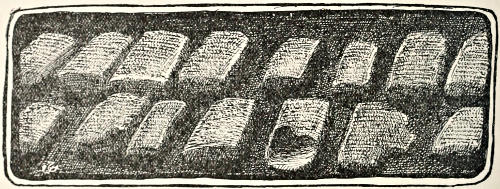
Baked Clay Tablets from the Library of Asshurbanapal at Nineveh
Some of the letters throw light on religious ceremonies, others are communications
from astrologers telling whether or not the signs of the heavens
are propitious for certain undertakings. There are still others from physicians
telling of patients under their care. The following is translated by
Dr. Johnston:a
To the king, my lord, thy servant, Arad-Nana! Greeting most heartily to
my lord, the king! May Adar and Gula grant health of mind and body to my
lord, the king. A hearty greeting to the son of the king.… With regard to
the patient who has a bleeding from his nose, the Rab-mugi reports:
“Yesterday, towards evening, there was much hemorrhage.” Those dressings
are not scientifically applied. They are placed on the alæ of the nose,
oppress the breathing, and come off when there is hemorrhage. Let them
be placed within the nostrils, and then the air will be kept away and the
hemorrhage restrained. If it is agreeable to my lord, the king, I will go
to-morrow and give instructions; (meantime) let me hear how he does.k
Several letters have been preserved of a certain Ishtar-duri, who appears
to have lived during the reign of Sargon (722-705 B.C.), and was perhaps
identical with the eponym of the same name in the year 714. Dr. Johnston
has translated a communication of his to the king:a
To the king, my lord, thy servant Ishtar-duri! Greeting to the king, my
lord! I send forthwith to my lord, the king, in company with my messenger,
the physicians Nabu-shum-iddina and Nabu-erba, of whom I spoke to
the king, my lord. Let them be admitted to the presence of the king, my
lord, and let the king, my lord, converse with them. I have not disclosed
(to them) the true facts, but have told them nothing. As the king, my
lord, commands, (so) has it been done.
Shamash-bel-uçur sends word from Der: “We have no inscriptions to
place upon the temple walls.” I send therefore to the king, my lord, (to
ask) that one inscription be written out and sent immediately, (and that)
the rest be speedily written, so that they may place them upon the temple
walls.
There has been a great deal of rain, (but) the harvest is gathered. May
the heart of the king, my lord, be of good cheer!k
Art occupies too prominent a position in the life of the Babylonians
and Assyrians, and they have produced too much that is original and peculiar
to them, for this history to pass over the question in silence. Even a
mere sketch of their culture would be incomplete without it. At the same
time great precaution is necessary. In the determination of the chronological
succession of undated monuments so much depends on subjective valuation
and æsthetic judgment that, without a long and conscientious study of
the history of art, one is liable to serious error. And the determination
of dates largely influences one’s conception of the progress of Babylonian-Assyrian
art; æsthetic judgment, one’s decision concerning the character,
independence, and value of this artistic effort.
Here again, as in the language, religion, and in the whole civilisation of
this people the unity of the Babylonian-Assyrian race comes clearly to light.
Whatever differences may exist between Babylonian and Assyrian art in the
conception of detail, in certain peculiarities of technique, in the choice of
subjects, at bottom they are one. It has ever been characterised as a
national school in which one and the same character prevails, so that a work
of art, be it from Telloh, Babylon, Nineveh, or Kalah, at once shows its connection
with it. All the differences are merely shades, changes caused by
time. This is especially noticeable when one considers what material for
example was used for building. In Babylonia it is difficult to obtain
stone; there are no rocks there. Consequently this material, which had to
be brought from a distance, and was therefore expensive, was kept like
precious and other metals for the decoration of the whole, for pillars, bas-reliefs,
dedicatory inscriptions, etc., or for making a firm foundation, while
dried and burnt bricks were used for the buildings themselves. Among the
Assyrians this difficulty did not exist. Excellent stone, which was easily
worked, was found in close proximity, and the Assyrians understood how to
hew and shape it. In spite of this, they imitated the Babylonian custom
and used mainly bricks for their buildings. They preferred continually to
repair these temples and palaces, which soon fell into ruin, or else to replace
them by others, rather than to depart from the traditional mode of building
of their ancestors.
The question has been raised as to whether Babylonian-Assyrian art may
not perhaps have been a daughter of the Egyptian. Without doubt Assyrian
art was at least influenced by it. All the ivory objects which have yet been
found are plainly imitations of Egyptian motives, although they were certainly
not made by Egyptians, and some of them date from the time of
Asshurnazirpal. The lotus ornament also, which is so often used as a temple
decoration, points to an Egyptian origin. Perhaps, however, the models were
not borrowed directly from the Egyptians. Certain dishes and cups for
drink-offering, which occur in Mesopotamia, as well as in western Asia and
southern Europe, are plainly ornamented with Egyptian cartouches, hieroglyphics,
and symbols, but in such a divergent form that no Egyptian could
have made them; and these objects have the name of the artificer in Aramaic
characters on the border or back. It is thus plainly to be seen that this
Egyptian fashion wandered into Assyria through the influence of Aramäen
artists.
When it is acknowledged, however, that Egyptian patterns were imitated
by the Assyrians at a comparatively late date, and that Egyptian motives
were borrowed from her artists, it does not by any means follow that Babylonian-Assyrian
art as a whole was of Egyptian origin. This could be
proved only from the oldest monuments to be found in Babylonia. It was
in fact believed, when the art works of Telloh first became known, that they
showed a great similarity to the products of Egyptian art. They displayed
the same simplicity and naïveness, the same clean-shorn heads and faces, and
many other coincidences. The connoisseurs of art, however, believe differently.
The similarity is great; nevertheless a careful examination shows
the independence of Babylonian art in respect to Egyptian. Thus in the oldest
monuments the same peculiarities, truth and strength, appear, which in
the later development of art among the Assyrians were so greatly exaggerated,
whereas they are wholly lacking in Egyptian figures.
A further similarity is found between the oldest pyramids in the Nile
valley and the Babylonian-Assyrian Ziggurat. In the first place, however,
the pyramids had a wholly different object from the Ziggurat, and, in the
second place, it must not be forgotten that the Babylonian temple architecture
varies greatly from the Egyptian. If there is any dependence it is not on the
side of the Chaldeans; they did not borrow their art from the Egyptians.
At the same time the similarities are so remarkable, especially between the
old Chaldaic statues and the oldest productions of Egyptian sculpture, such
as the statues of Shafra, Chufu, and Ra-em-ke, that we are compelled here,
as in the case of the writing, to suppose a common stock out of which both
branches grew independently and in a way peculiar to each.
The important discoveries made by the French consul, De Sarsac, at
Telloh have first thrown some light on the old Chaldean art in which the
whole Babylonian-Assyrian art has taken its origin. The question as to
whether the works of art found there are Semitic or non-Semitic does not
concern us here. It is more probably the latter. At any rate we are here
confronted with a civilisation preceding the flourishing period of the known
Semitic dominion in Babylonia.[35] A temple was found there 53 by 31 metres
square which shows the same fundamental plan as the later Chaldean architecture,
that is, a structure of burnt on a foundation of dried brick, the
corners exactly facing the points of the compass (not the side as in Egypt),
a Ziggurat in the centre, the whole, as is seen from stamps on the stones,
dating from the time of the priest-prince Gudra, who is known from other
sources, and who rebuilt or founded this temple. Besides, a large number
of larger and smaller works of art were discovered, cylinders, reliefs, bronze
objects, especially statues, which had been collected either by the ruler already
mentioned or by other priestly princes or kings.h
Before building a temple or palace, a religious ceremony took place corresponding
to what we call to-day laying the corner-stone. Nabuna’id relates
that in the ruins of the oldest Chaldean temples he looked for the foundation
stone, the temen which the original kings had placed there, and that he had
the good fortune to find this corner-stone, whereas several of his predecessors
had excavated only in vain. In our days such cylindrical tubes have
been found covered with close writing difficult to decipher, which had been
placed in little niches at the corners of the foundation facing the four points
of the compass. Thus at Nimrod, Rawlinson caused excavations to be carried
on in one of the corners of the tower, feeling sure that he would find
objects similar to those which had been met with elsewhere. He relates his
discovery as follows: “At the end of half an hour a small cavity was found.
‘Bring me,’” said Rawlinson to the man in charge of the digging, “‘bring
me the dedicatory cylinder.’ The workman put his hand into the hole and
showed the cylinder; those present could not believe their eyes and looked
at each other in amazement. The cylinder, covered with inscriptions, then
came out of the hiding-place where it had been placed probably by the hands
of Nebuchadrezzar himself, and where it had lain for twenty-nine centuries.”
In the fruitful excavations which he undertook at Telloh, De Sarsac made
similar discoveries. “I found,” said he, “at a depth of scarcely thirty centimeters
under the original soil, four cubes of masonry of large bricks and
bitumen, measuring eighty centimeters on each side. In the centre of these
cubes was a cavity of twenty-seven centimeters by twelve and by thirty-five
of depth. This cavity filled with yellow sand enclosed a statuette of bronze,
representing now a man kneeling, again a woman standing, sometimes also a
bull. At the foot of each statue, usually embedded in the bitumen which
lined the cavity, were found two stone tablets, one white, the other black.
It was the black one which usually bore an inscription in cuneiform characters,
like or almost like the one carved on the figure of bronze.” Moreover
De Sarsac in place of statuettes found cones of clay in the shape of large
nails with hemispherical heads, and having an inscription around the stem.m
It has been believed that three stages of development may be detected in
this ancient art. To the first belong the reliefs, which represent scenes of
war and burial which have not yet been satisfactorily explained, drawn very
awkwardly and comparatively rough and primitive. This stage represents
the infancy of art. To the second stage are counted the eight statues of
Gudea and the one of Ur-ba-’u which are carved with great skill and fine
artistic feeling out of hard stone, as it appears of diorite.
The strength which characterises the sculptural efforts of the Babylonians
and especially of the Assyrians, is already manifest, although without that
exaggeration of the muscles and joints which is so pronounced with the
latter. Hands and feet in particular are most carefully executed. The
heads are totally different from the hairy and bearded Assyrian, or even early
Babylonian heads. They are perfectly clean shaven, but sometimes seemingly
decked with an artificial hair arrangement or something of that sort;
all just as in Egypt. In addition, an attempt to suggest the folds of draperies
is seen, which we do not find among the Babylonians and Assyrians
nor the Egyptians, but only later among the Persians and Greeks. In the
third so-called classic period are placed works of art of most finished execution,
which show a decided advance, among which are pictures, in which beard
and hair are worked out with the greatest care.
It would be exaggerated scepticism to deny that these art productions
exceed in antiquity, nearly everything found in Babylonia until now. The
only exception could be the beautiful cylinder of the time of Sargon I, if we
assume that this monarch reigned about 3800 B.C., and that this work of art
is of his time. But this is by no means established as a fact.
It can also not be denied that these creations of early Chaldaic art,
although in some instances only feeble attempts, in others, however, are of
such finished perfection, that in succeeding periods they were never excelled
and seldom equalled.
We have here a similar case to one in Egypt, where, for instance, under
the kings of the fourth dynasty, sculpture reached an eminence, which
nothing of later date ever approached, and where the oldest works of art
have a value which none of the Egyptian sculptures of the following centuries
can claim. In both these countries therefore there is an early, surprisingly
rapid development, followed by a speedy decline; where even in succeeding
brilliant epochs no successful attempts to equal the results of the first florescence
were ever made. Such a phenomenon is all the more striking when it is
considered that these later epochs, whether in Egypt, in Babel, or in Asshur,
were by no means periods of degeneration, but show, although with continual
fluctuations, marked progress in literature, science, government, and general
culture. It seems probable that the cause lies in the difference of race.
The artists who carved the statues of King Schafra, were no more Semites
than, judging from all appearances and from the facial types of the monarchs,
pictured, were the sculptors who immortalised King Gudea. Later on the
Egyptian population became more and more affected by Semitic elements,
and under the increasing influence of the Semites, art declined.
Not until under the Saits, who certainly were not descended from a race
intermixed with Semitic blood, did art rise again to a height which recalled
the palmy days of the ancient realm. Thus early Chaldaic art was the
mother of that of Babylonia and Assyria, and the Semites of Babylon and
Asshur proved themselves diligent students, gifted imitators, who gave to their
works also the stamp of their own genius; but they were never more than
students and imitators, they never produced anything original which might
stand in equality by the side of early Chaldaic art. The Semitic race occupies
one of the foremost positions in the history of civilisation, and is highly
talented. But in architecture and sculpture it has always worked in close connection
with foreign masters, and never produced anything really great by
itself.[36] The further it goes from the ancient centres, where the great
tradition of the former so highly developed art still lived on, the more unskilful
become its productions in this field. Assyria where the Semitic blood
was purer than in Babylonia, and which was certainly surpassed in art by the
latter, Phœnicia, Palestine, and Arabia, are proofs of this. Only when
the Semites have handed down the old tradition which they have at least
preserved, to the Aryans, the Persians, and Greeks, is there an independent
higher development of plastic art. Be that as it may, considered as artists,
the Babylonians and Assyrians stand foremost among the Semites, but they
are indebted for this to the early Chaldeans.
The character of the Babylonian-Assyrian building has remained in
general about the same, from the earliest times, until the destruction of the
nation. The architect, more than any other artist, is dependent upon
the nature of the material at his disposal; and this in Babylonia was almost
exclusively in the form of tiles of clay, either dried in the sun, or baked in
the fire. The former, which were made most skilfully in Babylonia, were
generally used for foundations, either by simply placing them in layers, or
cementing them with wet clay or pitch, or, as in the substructures of the
Assyrian palaces, by using them while still in a moist condition, in order that
under the pressure of the superstructure they might be united in one solid
mass. For the covering of the walls, baked tiles were used. Enamelled or
glazed bricks were used in those parts of the building which were most
exposed to moisture or the changes of the weather. In Assyria where stone
was not expensive this was also used as the outer coating of walls. This,
however, is the only important variation which the Assyrian architects
allowed themselves. Although it would have been easier for them to erect
more beautiful, more pleasing, and certainly more durable buildings of stone,
they were not able to rise to the attempt, although they had only to carry out
and use in larger measure what had already been found in Chaldea. A short
step was indeed taken in this direction.
The Babylonians already knew how to make wooden pillars or columns,
probably covered with metal, and made use of them in lighter architecture,
as for instance the Naos, or canopy over the figures of the gods. The Assyrians
not only copied this, but built columns of stone, and a certain originality
and gracefulness in the capitals and bases of their pillars is not to be
denied. However, the column never played the same important rôle in their
architecture as it does, for instance, in the Græco-Roman and even in the
Egyptian. In their great buildings they clung almost servilely to the designs
handed down during centuries. The question as to whether the buildings
had more than one story, was formerly almost generally admitted as a fact,
but it is generally denied now, and can really hardly be determined. The
ruins give no positive support to either theory; but a few reliefs give
representations of two-storied buildings.
Tile construction presents necessarily a certain monotony which is here
accentuated by the absence of windows. To relieve this monotony, glazing,
colouring, or woodwork were resorted to, in case the use of columns was
excluded; sometimes more artistic measures were used, such as projecting
pilasters, which in Chaldea were somewhat crude, but richly ornamented in
Assyria; also mosaics of conical form, or decorations of vases on the walls.
The upper stones of the walls were decorated with battlements. The inner,
as well as the outer walls, had a stone covering up to a certain height, and
higher up a polychromatic layer of stucco. Ivory, and particularly bronze
decorations, were much employed. In spite of all this, the impression given
by Babylonian and Assyrian buildings is one of massiveness, almost clumsiness,
and the decorations seem childish, paltry, and commonplace. Hence also
the disproportion of length and breadth, in other words the elongated form
of the rooms, whose roof not being supported by columns, had to rest on the
side walls, and whose breadth depended on the length of the roof beams.
On the other hand, the almost exclusive use of tiles had this advantageous
result, that it was almost imperative to make prodigal use of arch and vault
construction. That the Chaldaic architects were the inventors of these
constructions, with which the Etruscans were formerly erroneously credited,
cannot be positively affirmed, for they are also found in Egypt, although
seldom made use of there. Without doubt, however, the Babylonians and
Assyrians developed them greatly and knew how to make use of them with
great skill. From the false arch, which is formed by allowing each succeeding
layer of stone to project over the foregoing one, to the finished arch, all
kinds are represented by them. Not only were all underground canals and
sewers, vaults of masonry, but all gateways ended in arches, and even the
ceilings of some apartments, particularly those in the part of the palaces
which seems to have been the harem were wholly or partially vaulted.
The Babylonians and Assyrians have built extensively many and great
cities enclosed within mighty walls, extended palaces and peculiar temples.
They cannot be enumerated here or even described in general terms.
A few important points, however, may be touched upon. In the first place
it must be noticed that, while in Egypt the monumental buildings were tombs
and temples, in Babylon and Asshur they were mainly palaces. Although
no pains nor expense were spared in the erection of the temples, they were
smaller than the palaces, of which they were in some cases certainly annexes.
The tombs were constructed with great care, in order to guard against
the rapid decay of the corpses, yet the inhabitants of Mesopotamia never
reached the same degree of perfection in the embalming of bodies as the
Egyptians: they were also fitted out with everything that, according to
their faith, was necessary for the dead, but they were piled upon each other,
and thus excluded from view. Art was not expended upon them; on the
other hand, however, all known means of art were used to decorate the residences
of the kings and the earthly habitations of the gods in the most splendid
and sumptuous manner. Their size increased continually. The early
Chaldaic palace discovered at Telloh, had an area of only 53 meters long
by 31 broad; the so-called Wasevas at Warka (Erech) was 200 meters
long by 150 broad; the palace of Sargon II at Dur-Sharrukin covered an area
of about 10 hectares, and contained 30 open courts and more than 200 apartments.
Under the Sargonids the rooms also became larger. One in the
palace of Sennacherib was almost as long as the entire palace at Telloh, i.e.,
46 meters long by 12 wide. Another in the palace of Esarhaddon, which
was intended to be 15 meters by 12 meters, remained unfinished, probably
on account of the difficulty of construction. The palace of Asshurbanapal
was of somewhat smaller, though still magnificent proportions. The great
palace of Nebuchadrezzar II, consisting of the old palace of his father and
a new one constructed by him and joined to the old, has not yet been sufficiently
explored, but according to the descriptions, must have surpassed in
splendour, if not in size, all those of his predecessors. All palaces were constructed
on the same plan, and contained separate living apartments for
the king and his court, for his wives, for the lower court officials, and,
as it appears, also a temple with various sanctuaries and a tower.
Too little is as yet known of the Babylonian-Assyrian temples to judge
with any certainty of their style of architecture. Here and there, remains
of temples have been found, but it has not yet been proved that the buildings
designated as temples were really devoted to religious purposes. Most
of the temples seem to have been small, at any rate not intended for large
assemblages. The altar stood outside and consequently the religious services
must usually have taken place there.
Every large town had many temples but always only one Ziggurat. This
constituted only one part of the principal temple, albeit the most prominent
one. There were various kinds of such towers, of three or more, sometimes
seven stories, which were attainable by a single inclined plane encircling the
whole building, or a double one rising on two sides of it. The ground plan
was a perfect square in some, in others a parallelogram; all rested, however,
on a massive substructure, and seem to have been crowned with a small
sanctuary.
Although these principal temples, including the Ziggurat, were not of
equal extent with the royal palaces, they were nevertheless imposing buildings,
and the towers in particular were erected with much care and at
great expense. It would be wrong to conclude from this ratio of temples
and palaces that the Assyrians were less religious and more servile than the
Egyptians, who, entirely dominated as they were by the dogma of immortality,
lavished more care on the tombs of the dead kings than on the habitations
of the living ones. The valuable decorations and sculptures which
the Assyrians and Babylonians gave to their gods prove their pious tendency.
In reality the whole palace was a sacred edifice in which the representative
of the deity lived on earth with and beside his god.
The aid which architecture received from other arts has already been
briefly mentioned. There are still a few particulars to be noticed in regard
to this point. The Assyrians as well as the Babylonians were skilful workers
in bronze. Proofs of this are the bronze door-sill 1½ meters long, found at
Borsippa, whose decorations of rosettes and squares are in very good taste,
and particularly the bronze gates at Balawat, belonging to the 9th century
B.C., which are masterpieces of their kind, and a great number of other
remains.
Painting was also employed to decorate the exterior as well as the
interior of walls. Ornaments and figures were painted with great skill
on stucco, al fresco in such a case, or on tiles which were afterwards glazed.
These tiles were sometimes joined to make one picture. In what remains
of such work it is shown that painting had attained quite an eminence in
Babylon and Asshur. Drawing and grouping are often very successful, and
the treatment has often a certain breadth. These paintings are also important
because it is seen from them how much conventionality prevailed in Assyrian
sculpture. In painting there is nothing of that exaggerated muscularity nor
of the almost clumsy strength of the sculptured figures. Beard and hair are
not as stiffly curled as in the sculptures, but hang more loosely and naturally.h
A beautiful example of glazed tiling has recently been excavated by the
Deutsche Orient Gesellschaft at Babylon. It is in the so-called Procession
street leading from Babylon to Borsippa; on either side of the street were
walls faced with coloured tiles representing a stately procession of lions and
other animals, very artistically drawn.a
Sculpture, more than painting, was employed in decorating buildings,
the works of which covered the greater part of the palace walls, and ornamented
the gateways, courts, terraces, and apartments. The material which
the sculptor used in Chaldea was usually valuable stone difficult to procure,
such as basalt, dolorite, diorite; in Assyria, generally a commoner, more
easily worked species, such as alabaster and sandstone. The difference of
material naturally influenced the work itself. Figures of cast bronze are
also often found.
The inscriptions of the Babylonian kings often speak of columns erected
in honour of the gods, of which some were made of solid gold or silver,
others only coated with precious metal, and the Assyrian kings also mention
such dedications. Naturally the columns of precious metal have not survived,
but a great number of stone pillars have been found. It may be chance, that
the greater number of statues in the round are from Babylon, the greater
number of bas-reliefs from Assyria. The objects of these surviving sculptures
are mainly of a religious or historical character. But rarely does a representation
of the domestic life of the monarch or other social circles appear.
Only once is a banquet pictured, that of king Asshurbanapal and his
queen. Otherwise no women, except captives, appear in the reliefs. On the
whole little tendency is shown to represent female beauty and grace, as compared
with the Egyptians and especially with the Greeks. The nude female
figure is seldom pictured, and if so, in a repulsively realistic form, as in the
small figures of the mother goddess. Cheerful or comic scenes, which are not
wanting even in Egyptian reliefs and vignettes, are never found here. Hasty
conclusions, however, should not be drawn from this, and it should not be
forgotten, that most of the surviving reliefs are from the palaces, few from
the temples, still fewer from the tombs, and none at all from private residences.
This is doubtless one of the reasons why representations of domestic
or private life are so scarce. In fact, in a few of the tombs reliefs have been
found whose subjects recall favourite representations in those of Egypt. Most
prevalent certainly, are those scenes relating to religious and public life.
In the treatment of these objects, truth is often sacrificed to certain conventionalities.
Thus for instance the Lamassi and Shedi, the man-headed
lions and bulls have five legs, in order that they may always present four to
the eye, whether viewed from the front or the side; the heads are usually
represented in profile with the eyes in full face, but sometimes in full face,
although the image presents a side view to the beholder, which was also
customary in Egypt; so also, the stiff curling of the hair and beard is
unnatural. Apparently no attempt had ever been made in Egypt to make
portraits of historical personages, and the individual differences of rank and
condition can only be recognised by objects of secondary importance. There
is, however, still some doubt upon this point. There is indeed a great
uniformity, but an attempt at least to differentiate facial traits cannot be
overlooked. Ignoring all accessories, the features differ among kings and
higher courtiers on the one hand, and lower men-at-arms on the other,
among men and eunuchs, among adults and youths. Wherever the artists
of Mesopotamia were not limited by conventionality,—notably in the representation
of animals,—they have surpassed in accuracy, in truth and strength
of representation all other nations of antiquity, the Greeks hardly excepted.
This is particularly true of the representation of native animals, yet foreign
ones were treated with great skill, although the delineation of these betrays
less practice. Even in the picturing of therianthropic deities, they remain as
true to nature as possible, and with much taste and tact allow the human
attributes of the figure to predominate. Wherever it is possible to partially
or wholly break away from tradition, their talent is displayed in a manner
truly marvellous. Their only prominent fault is their exaggerated realism,
which shows itself not only in the monstrous drawing of muscles and joints,
but also in the disgusting details of the nude figures of Astarte.
Too little of the sculpture of the new Babylonian realm has been preserved
to allow judgment of the state of art during this period. The well
known carving of Nebuchadrezzar II on a cameo would force us to have a
very high opinion of it, if convincing reasons did not argue that, although
genuine, it is the work of a foreign, probably a Cyprian, artist.
There is no doubt that the art of music was cultivated among the Babylonians
and Assyrians, since the reliefs show musicians very frequently, at
religious festivals, at triumphal greetings of the victorious king and at festivities.
They play singly or in concert, and also accompany singing. The
musical instruments are of various kinds, and the musicians, who are sometimes
very daintily attired, are not always eunuchs, and are of different
ages.
On the whole it must be conceded, that the Assyrio-Babylonian nation
was artistically inclined and that it cultivated various branches of art with
talent and success. If they, the Assyrians in particular, had been able to free
themselves from tradition, they might have surpassed their predecessors and
teachers. They practised art, however, not for itself alone, but as a means
of glorifying the gods or the kings, and the historical reliefs at least, are for
the greater part nothing more than illustrations to the inscriptions, a sort of
war-report in pictures. They were not an artistic people like the Greeks.
Still they have produced more and better results in this respect, than all
other nations of their race put together. And although in some special
instances they may have been excelled by the Egyptians, in others they are
far in advance of them. The Assyrians, following the example of the Babylonians,
showed their artistic talents also in the productions of their industries;
art and industry were with them closely related.
Among the productions to be considered here are primarily the hundreds
of seals, which are still in preservation, and whose number will not seem so
surprising when it is remembered that every Babylonian and Assyrian of
quality had his private seal. In early times these were always, and in later
times generally, cylinders, pierced through the centre, to be worn around
the neck suspended from a cord. The impression was made by rolling them
over moist clay. After the eighth century conical and half-spherical seals
appear. These cylinders are made of many different materials, at first, of
easily carved, later of harder, material, such as porphyry, basalt, ferruginous
marble, serpentine, syenite and hematite. After that, semi-precious stones
were used, jasper, agate, onyx, chalcedony, rock-crystal, garnet, etc. In the
oldest stones the pictured objects were rather suggested by indentations and
strokes, than actually executed and carved; but gradually a great skilfulness
was attained, and there are beautiful cuttings in the hard stones also.
The execution varied greatly of course, not only in proportion to the talent
of the artist, but also according to the rank and wealth of the person who
gave the commission. The subjects chosen are mostly of a religious nature,
the adoration of a goddess, an offering of sacrifice, various emblems such as
winged animals, sun, moon, and stars, and very frequently the tree of life,
in whose shadow stand two persons, or which is guarded by two genii.
Under the new Babylonian dominion and under the Achamenides, glyptics
as an art declined rapidly.
Ceramic art seems not to have occupied a very lofty position in Babylonia
at first. Clay vases and utensils, during a long period made by hand, are
crude and inartistic in earliest times. Gradually with the introduction of
the potter’s wheel, however, they become more graceful in form, and towards
the end of the Assyrian period are enamelled and decorated with patterns
painted in colours. However, Babylonian ceramic art cannot compete with
that of Greece, although it surpasses that of Egypt. Glass has not been
found in large quantities, to be sure, but quite advanced progress had
been made in its manufacture. The Assyrians and Babylonians showed particular
skill in the working of metals. Bronze, a mixture of copper and tin,
was known to them in the earliest times. They had a knowledge of iron
earlier than the Egyptians, and certainly made much greater use of it. Gold
objects are commoner than those of silver, and lead is seldom used. Ornaments,
such as bracelets, ear-rings, and necklaces are usually cast of precious
metal and often inlaid with pearls. It may be taken as a proof of highly
advanced culture that they used not only spoons, but forks, a luxury introduced
into Europe only at the close of the Middle Ages, and that toilet
articles, such as combs, pins, etc., were ornamented with the greatest care
and skill.
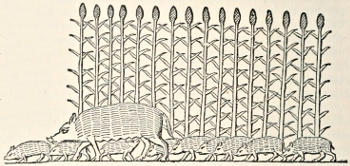
Bas-relief of Wild Sow and Young among Reeds
(Layard)
The Assyrians were also more skilled in mechanics than the Egyptians and
were not inferior to them in agriculture. Two reliefs, one Assyrian, the other
Egyptian, give us an opportunity to compare how each nation overcame the
difficulties attending the moving and putting in place of their enormous collossi
of stone. It is shown
that the Assyrians knew the
use of the lever, which the
Egyptians did not, and that
they took much greater precautions
against upsetting
the collossi. How the Babylonians
and Assyrians, like
the Egyptians and Chinese,
made use of irrigation is
well known. On
the same tablets
with the records of
their deeds of war,
the rulers often
spoke of the laying
out of canals, the regulating and deepening of the river beds “enduring
waters for the enduring use of town and country,” and associated their
own names with them. On account of the higher altitude of their country
than that of their southern brethren, the Assyrians had to surmount greater
difficulties in achieving such works, but this did not deter them from rivalry
with them. One canal leading from the Upper Zab and one of its tributaries,
irrigated the region between this river and the Tigris, and also supplied
the capital, Kalah, with drinking water.
Sennacherib did something similar for Nineveh, which together with its
environs was completely dependent upon rain. He had a network of canals
constructed, which were fed, partly by the Khushur, and partly by the
small mountain brooks of the Accad and Tash mountains. Here also two
objects were attained, to furnish Nineveh with good drinking water, and
to make the surrounding country fruitful; for the king had it all planted
with many kinds of plants, among which was the vine. Floriculture was
also much encouraged by the kings of Babylon and Asshur. They admired
beautiful parks in which strange foreign animals were bred and nurtured.
Marduk-bel-iddin, king of Bit-Yakin, apparently the same who at one time
overcame Babylon, owned sixty-seven vegetable gardens and six parks of
which a catalogue still exists, although he was constantly at war or guarding
against the vengeance of the Assyrians.h
But the world-historic relations of Mesopotamian art are best brought out
by a study of the later and more perfectly preserved examples of Assyrian
craftsmanship. It was the Assyrian who borrowed more directly from the
Egyptian in developing his art, and who passed on artistic impulses to the
Persians on the one hand, and to the Greeks on the other. The question to
what extent the Assyrians were themselves influenced by the Mycenæan art
of early Greece is one regarding which students of the subject are not agreed,
and which we need not enter upon here.a
It is impossible to examine the monuments of Assyria without being
convinced that the people who raised them had acquired a skill in sculpture
and painting, and a knowledge of design and even composition, indicating
an advanced state of civilisation. It is very remarkable that the most
ancient ruins show this knowledge in the greatest perfection attained by the
Assyrians. The bas-relief representing the lion hunt, now in the British
Museum, is a good illustration of the earliest school of Assyrian art yet
known. It far exceeds the sculptures of Khorsabad, Kuyunjik, or the later
palaces of Nimrud, in the vigour of the treatment, the elegance of the
forms, and in what the French aptly term mouvement. At the same time it
is eminently distinguished from them by the evident attempt at composition—by
the artistical arrangement of the groups. The sculptors who worked
at Khorsabad and Kuyunjik had perhaps acquired more skill in handling
their tools. Their work is frequently superior to that of the earlier artists in
delicacy of execution—in the details of the features, for instance—and in
the boldness of the relief; but the slightest acquaintance with Assyrian
monuments will show that they were greatly inferior to their ancestors in
the higher branches of art—in the treatment of a subject and in beauty and
variety of form. This decline of art, after suddenly attaining its greatest
perfection in its earliest stage, is a fact presented by almost every people,
ancient and modern, with which we are acquainted. In Egypt the most
ancient monuments display the purest forms and the most elegant decorations.
A rapid retrogression, after a certain period, is apparent, and the
state of art serves to indicate approximately the epoch of most of her remains.
In the history of Greek and Roman art this sudden rise and rapid fall are
equally well known. Even changes in royal dynasties have had an influence
upon art, as a glance at monuments of that part of the East of which we
are specially treating will show. Thus the sculpture of Persia, as that of
Assyria, was in its best state at the time of the earliest monarchs, and gradually
declined until the fall of the empire. After the Greek invasion it
revived under the first kings of the Arsacid branch, Greek taste still exercising
an influence over the Iranian provinces. How rapidly art degenerated
to the most barbarous forms, the medals and monuments of the later Arsacids
abundantly prove. When the Sassanians restored the old Persian monarchy
and introduced the ancient religion and sacred ceremonies of the empire, art
again appears to have received a momentary impulse. The coins, gems, and
rock sculptures of the first kings of this dynasty are distinguished by considerable
elegance, and spirit of design, and beauty of form. But the decay
was as rapid under them as it had been under their predecessors. Even
before the Chosroes raised the glory and power of the empire to its highest
pitch, art was fast degenerating. By the time of Yezdigird it had become
even more rude and barbarous than in the last days of the Arsacids.
This decline in art may be accounted for by supposing that, in the infancy
of a people, or after the occurrence of any great event having a very decided
influence upon their manners, their religion, or their political state, nature
was the chief, if not the only, object of study. When a certain proficiency
had been attained, and no violent changes took place to shake the established
order of things, the artist, instead of endeavouring to imitate that which he
saw in nature, received as correct delineations the works of his predecessors,
and made them his types and his models. In some countries, as in Egypt,
religion may have contributed to this result. Whilst the imagination, as
well as the hand, was fettered by prejudices, and even by laws, or whilst
indolence or ignorance led to the mere servile copying of what had been
done before, it may easily be conceived how rapidly a deviation from correctness
of form would take place. As each transmitted the errors of those who
had preceded him, and added to them himself, it is not wonderful if, ere long,
the whole became one great error. It is to be feared that this prescriptive
love of imitation has exercised no less influence on modern art than it did
upon the arts of the ancients.
As the earliest specimens of Assyrian art which we possess are the best,
it is natural to conclude that either there are other monuments still undiscovered
which would tend to show a gradual progression, or that such monuments
did once exist, but have long since perished; otherwise it must be
inferred that those who raised the most ancient Assyrian edifice derived their
knowledge directly from another people, or merely imitated what they had
seen in a foreign land. Some are inclined to look upon the style and character
of these early sculptures as purely Egyptian. But there is such a disparity
in the mode of treatment and in the execution, that the Egyptian
origin of Assyrian art appears to me to be a question open to considerable
doubt. That which they have in common would mark the first efforts of
any people of a certain intellectual
order to imitate
nature. The want of relative
proportions in the figures
and the ignorance of perspective—the
full eye in the
side face and the bodies of
the dead scattered above or
below the principal figures—are
as characteristic of all
early productions of art as
they are of the rude attempts
at delineation of children.
It is only in the later monuments
of Nineveh that we
find evident and direct traces
of Egyptian influence: as in
the sitting sphinxes and
ivories of Nimrud, and in the
lotus-shaped ornaments of
Khorsabad and Kuyunjik;
perhaps also in the custom which then prevailed of inserting the name of
the king, or of the castle, upon or immediately above their sculptured
representations. Neither the ornaments of the earliest palace of Nimrud,
nor the costumes, nor the elaborate nature of the embroideries upon the
robes, with the groups of human figures and animals, nor the mythological
symbols, are of an Egyptian character; they show a very different taste
and style.
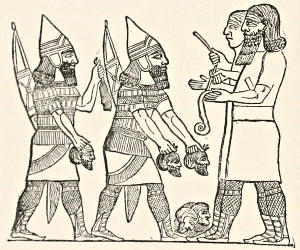
Bas-relief of Scribes writing down the Number of
Heads of the Slain
(Layard)
The principal distinction between Assyrian and Egyptian art appears to
be that in the one conventional forms were much more strictly adhered to
than in the other. The angular mode of treatment, so conspicuous in
Egyptian monuments, even in the delineation of every object, is not perceivable
in those of Assyria. Had the arts of the two countries been derived
from the same source—or had one been imitated from the other—they
would both surely have displayed the same striking peculiarity. The Assyrians,
less fettered, sought to imitate nature more closely, however rude and
unsuccessful their attempts may have been; and this is proved by the constant
endeavour to show the muscles, veins, and anatomical proportions of
the human figure.
We must not lose sight of the assertion of Moses of Chorene—derived
no doubt from ancient traditions, if not from direct historical evidence—that
when Ninus founded the Assyrian Empire, a people far advanced in civilisation
and in the knowledge of the arts and sciences, whose works the conquerors
endeavoured to destroy, were already in possession of the country.
Who that people may have been, we cannot now even conjecture. The same
mystery hangs over the origin of the arts in Egypt and in Assyria. They
may have been derived, before the introduction of any conventional forms,
from a common source—from a people whose very name, and the proofs of
whose former existence, may have perished even before tradition begins.
The monuments of Assyria furnish us with very important data, as to the
origin of many branches of art, subsequently brought to the highest perfection
in Asia Minor and Greece. I conceive the Assyrian influence on Asia
Minor to have been twofold. In the first place, direct, during the time of the
greatest prosperity of the Assyrian monarchy or empire, when, as it has been
shown, the power of its kings extended over that country; in the second, indirect,
through Persia, after the destruction of Nineveh. Of the influence
exercised upon the arts of western Asia, during the early occupation of the
Assyrians, few traces have hitherto been discovered, unless the remarkable
monuments on the site of ancient Pteria, or Pterium, belong to this period.
The evident connection between the divinities and sacred emblems worshipped
in various parts of Asia Minor, and those of Assyria will be hereafter particularly
pointed out. The Assyrian origin of these monuments, and of these
religious symbols, once admitted, we shall have no difficulty in recognising the
influence of Assyria on the arts and customs of Asia Minor. The antiquities
of that country, prior to a well-known period, the Persian occupation, have been
but little investigated. Few remains of an earlier epoch have yet been discovered.
That such remains do exist, perhaps buried under ground, I have
little doubt. It is most probable that, as we have additional materials for
inquiry, we shall be still more convinced of this Assyrian influence, pointed
out by Herodotus, when he declares the founder of the kingdom of Lydia to
have been a descendant of Ninus, and by other authors, who mention the
Syrian, or Assyrian, descent of many nations of Asia Minor.
But the second, or indirect, period of this influence is very fully and
completely illustrated by the monuments of Asia Minor, of the time of the
Persian domination. The known connection between these monuments and
the archaic forms of Greek art renders this part of the inquiry both important
and interesting. The Xanthian marbles, acquired for England by Sir
Charles Fellows, and now in the British Museum, are remarkable illustrations
of the threefold connection between Assyria and Persia, Persia and Asia
Minor, and Asia Minor and Greece. Were those marbles properly arranged,
and placed in chronological order, they would afford a most useful lesson, and
would enable even a superficial observer to trace the gradual progress of art
from its primitive rudeness to the most classic conceptions of the Greek
sculptor. Not that he would find either style, the pure Assyrian or the
Greek, in its greatest perfection; but he would be able to see how a closer
imitation of nature, a gradual refinement of taste and additional study,
had converted the hard and rigid lines of the Assyrians into the flowing
draperies and classic forms of the highest order of art.
I have termed this second period that of indirect influence, because the
arts did not then penetrate directly into Asia Minor from Assyria, but were
conveyed thither through the Persians. The Assyrian Empire had already
existed for centuries, and had exercised the supreme power over Asia, before
it was disputed by the kingdoms of Persia and Media, united under one
monarch. The Persians were probably a rude people, possessing neither a
literature nor arts of their own, but deriving what they had from their civilised
neighbours. We have no earlier specimen of Persian writing than the
inscription containing the name of Cyrus, on the ruins supposed to be those
of his tomb, at Murghaub [Pasargarda]; nor any earlier remains of Persian
art than the buildings and sculptures of Persepolis, and other monuments to
be attributed beyond a question to the kings of the Achæmenian dynasty.
It has already been shown that the writing of the Persians was imitated from
the Assyrians, and it can as easily be proved that their sculptures were
derived from the same source. The monuments of Persepolis establish this
beyond a doubt. They exhibit precisely the same mode of treatment, the
same forms, the same peculiarities in the arrangement of the bas-reliefs
against the walls, the same entrances formed by gigantic winged animals
with human heads, and, finally, the same religious emblems. Had this
identity been displayed in one instance alone, we might have attributed it
to chance, or to mere casual intercourse; but when it pervades the whole
system, we can scarcely doubt that one was a close copy, an imitation, of the
other. That the peculiar characteristics of the Persepolitan sculptures were
derived from the monuments of the second Assyrian dynasty—that is, from
those of the latest Assyrian period—can be proved by the similarity of
shape in the ornaments and in the costume of many of the figures. Thus,
the head-dress of the winged monsters forming the portals is lofty, squared,
and richly ornamented at the top, resembling those of Khorsabad and
Kuyunjik, and differing from the round, unornamented cap of the older
figures at Nimrud.
The processions of warriors, captives, and tribute-bearers at Persepolis
are in every respect similar to those on the walls of Nimrud and Khorsabad;
we have the same mode of treatment in the figures, the same way of portraying
the eyes and hair. The Persian artist introduced folds into the
draperies; but, with this exception, he certainly did not improve upon his
Assyrian model. On the contrary, his work is greatly inferior to it in the
general arrangement of the groups and in the elegance of the details.
From whence the Persians obtained the column and other architectural
ornaments used at Persepolis, it may be more difficult to determine. We have
seen that the column was not unknown to the later Assyrians, although it
does not appear to have been employed in the construction of their palaces.
The Persians, therefore, may have partly derived their knowledge from them;
and partly, perhaps principally, from the Egyptians, whom, before the foundation
of Persepolis, they had already conquered. It will be observed that the
capitals of their columns frequently assume the shape of Assyrian religious
types, the bull for instance; whilst other portions of them nearly resemble
in the form of their ornaments, though not in their proportions, those of
Egypt.
The Persians introduced into Asia Minor the arts and religion which
they received from the Assyrians. Thus the Harpy Tomb and the monument
usually attributed to Harpagus at Xanthus, and other still earlier
remains, show all the peculiarities of the sculpture of Persepolis, and at the
same time that gradual progress in the mode of treatment—the introduction
of action and sentiment, and a knowledge of anatomy—which marks the
distinction between Asiatic and Greek art. Whilst there was a manifest
improvement in the disposition of the draperies and in the delineation of
the human form, we still remark, even in the latest works of the Persian
period in Asia Minor, the absence of all attempt to impart sentiment to the
features, or even to give more than the side view of the human face.
Many architectural ornaments, known to the Assyrians, passed from them,
directly or indirectly, into Greece. The Ionic column is an instance. We
have, moreover, in the earliest monuments
of Nineveh that graceful
ornament, commonly called the honeysuckle,
which was so extensively used
in Greece, and is to this day more generally
employed than any other moulding.
In Assyria, as I have pointed
out, it was invested with sacred properties,
and was either a symbol or an
object of worship. That the similarity
between the Assyrian and Greek ornament
is not accidental, seems to be
proved, beyond a question, by the
alternation of the lotus or tulip, whichever
this flower may be, with the
honeysuckle, by the number of leaves
or petals of the flower, and by their
proceeding in both from a semicircle,
supported by two tendrils or scrolls.
The same ornament occurs, even in
India, on a lath erected by Asoka at
Allahabad (about B.C. 250); but
whether introduced by the Greeks—which,
from the date of the erection
of the monument, shortly after the
Macedonian invasion, is not improbable—or
whether derived directly
from another source, I cannot venture to decide.
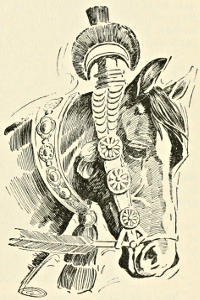
Assyrian Harness
That the Assyrians possessed a highly refined taste can hardly be questioned
when we find them inventing an ornament which the Greeks afterwards,
with few additions and improvements, so generally adopted in their
most classic monuments. Others, no less beautiful, continually occur in the
most ancient bas-reliefs of Nimrud. The sacred bull, with expanded wings,
and the wild goat are introduced, kneeling before the mystic flower which is
the principal feature in the border just described. The same animals are
occasionally represented supporting disks, or flowers, and rosettes. A bird,
or human figure, frequently takes the place of the bull and goat; and the
simple flower becomes a tree, bearing many flowers of the same shape. This
tree, evidently a sacred symbol, is elaborately and tastefully formed; and is
one of the most conspicuous ornaments of Assyrian sculpture.
The flowers at the ends of the branches are frequently replaced in later
Assyrian monuments and on cylinders by the fir or pine cone, and sometimes
by a fruit or ornament resembling the pomegranate.
The guilloche, or intertwining bands, continually found on Greek monuments,
and still in common use, was also well known to the Assyrians, and
was one of their most favourite ornaments. It was embroidered on their
robes, embossed on their arms and chariots, and painted on their walls.
This purity and elegance of taste was equally displayed in the garments,
arms, furniture, and trappings of the Assyrians. The robes of the king
were most elaborately embroidered. The part covering his breast was
generally adorned, not only with flowers and scroll-work, but with groups
of figures, animals, and even hunting and battle scenes. In other parts of
his dress similar designs were introduced, and rows of tassels or fringes were
carried round the borders. The ear-rings, necklaces, armlets, and bracelets
were all of the most elegant forms. The clasps and ends of the bracelets were
frequently in the shape of the heads of rams and bulls, resembling our
modern jewellery. The ear-rings have generally on the later monuments,
particularly in the bas-reliefs of Khorsabad, the form of a cross.
In their arms the Assyrians rivalled even the Greeks in elegance of
design. The hilt of the sword was frequently ornamented with four lions’
heads; two, with part of the neck and shoulders, made the cross-bar or
defence, and two more with extended jaws were introduced into the handle.
The end of the sheath was formed by two entire lions, clasped together,
their heads turned outward and their mouths open. Sometimes the whole
of the sheath was engraved or embossed, with groups of human figures, animals,
and flowers. The handles of the daggers were no less highly ornamented,
being sometimes in the form of the head of a horse, bull, or ram.
The sheath frequently terminated in the head of a bird, to which a tassel
was suspended. The part of the bow to which the string was attached was
in the shape of an eagle’s head. The quiver was richly decorated with
groups of figures and fanciful designs.
Ornaments in the form of the heads of animals, chiefly the lion, bull, and
ram, were very generally introduced even in parts of the chariot, the harness
of the horses, and domestic furniture. In this respect the Assyrians resembled
the Egyptians.b
The study of a country’s art is interesting, primarily of course purely as
a study in the expression of beauty or in the portraiture of national types
and ideals. The study should not, however, stop here, but one should
consider also the effect each school has had upon the evolution of the world-art.
This phase of Assyrian art has been examined by the Editor in a
paper called “The Influence of Modern Research on the Scope of World
History,” a Prefatory Essay to Vol. III of the New Volumes of the Ninth
Edition of the Encyclopædia Britannica, from which a quotation may be
permitted here.a
Whoever would see the story of the evolution of Greek art illustrated,
should go to the British Museum and pass from the Egyptian hall, with its
grotesque colossi, to the Assyrian rooms, with their marvellous bas-reliefs,
and then on to the Elgin marbles from the Parthenon. In particular, the
art treasures of the Assyrian collection should demand the closest scrutiny.
In the Nineveh gallery, for example, where one finds collections of strange
Assyrian books, the walls are flanked everywhere with bas-reliefs that come
from some buried palace that once stored the literary treasures.
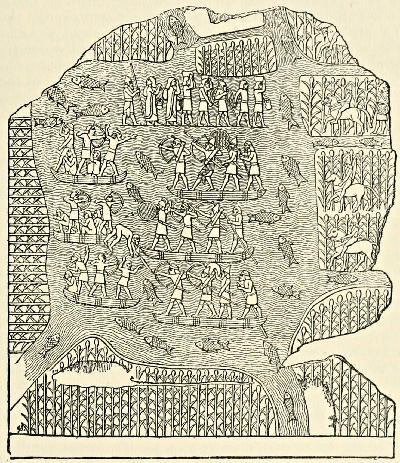
Battle in a Marsh in Southern Mesopotamia
(Layard)
It appears that the kings of that far-off time and land were connoisseurs
of art as well as patrons of literature; and the art treasures of their palaces
certainly form the most striking, if not the most important, part of the mementoes
they have left to us. The more closely these figures in low relief are
examined, the more wonderful they will seem. They take the place of the
Egyptian carvings in the round; and if they are less striking to first view
than the great sarcophagi, the grotesque gods, and colossal animal forms of
that people, they will prove infinitely more expressive and incomparably more
artistic on closer inspection. For these flat sculptures depict, not alone gods
and sacerdotal scenes, but everyday affairs and the events of Assyrian history.
The bas-relief was clearly the focal point of Assyrian art. Even the great
bulls and lions that guarded the palace entrances were only partially detached
from their background, and a frescoed statue of King Asshurnazirpal shows
the same tendency. The full rounded statue was not indeed unknown to
them, as several examples testify; but their real forte lay in mural decoration
in low relief. And the particular walls on which the artists mainly
expended their skill, if we may judge from what the ruins have revealed
to us, were not the walls of temples, but the palaces of kings. It is quite
clear that these great conquerors of antiquity were very human, very like
their successors of after times. They loved to have their heroic deeds, real
or alleged, heralded to the world, and recalled incessantly to their own
memories. So one finds whole histories epitomised on these walls—wars,
conquests, victories; the storming of cities, the slaughter of the enemy, the
leading of captives, and bringing of tribute by subject people—everything,
in short, but Assyrian reverses; the court artist, true to his colours then
as now, never made the mistake of depicting those.
As historical records these sculptures are of priceless value, both for what
they tell of political history and for the light they throw on the powers and
limitations of antique art. But before you venture to judge the Assyrian
artist in the latter regard, you must pass on to the room of Asshurnazirpal,
and from that to the adjacent room, where the mural decorations of the
dining-hall of the last of the great Assyrian kings, Asshurbanapal, have been
placed in situ, reproducing an effect which they first made in the palace of
Nineveh in the seventh century B.C. Here you may see at once both another
phase of royal life in Assyria and another stage of Assyrian art. Not war,
but the chase is now the theme. King Asshurbanapal is seen in pursuit of
the goat, the wild ass, the lion. The king, of course, towers above his
attendants, though not in the grotesque disproportion of the Egyptian paintings.
To the oriental mind such excessive stature seemed indissoluble from
royal station. One recalls how the mother of Darius, made captive at Issus,
mistook Hephæstion for the king, because he was taller than Alexander; and
how Agesilaus, when he went to Egypt as an ally of the Egyptians, was held
in contempt, despite his renown, because of his diminutive stature; and one
cannot help wondering what would have been the real aspect of the Assyrian
and Egyptian monarchs could they have been subjected to the camera. Be
that as it may, there was apparently no doubt in the mind of the court artist
as to what his chisel should reveal in this respect, and the king may always
be distinguished by his stature, without regard to his royal robes. Still, it is
notable, as a distinction between Egyptian and Assyrian art, that the realistic
eye of the Assyrian sculptor never let him depict the king as a Brobdingnag
among the pigmies, after the Egyptian fashion. At the most he is a head
taller than those about him.
The royal hunter pursues his quarry sometimes on foot, more usually
standing in his chariot. His weapon is usually the bow, sometimes the
spear; on one occasion he grapples with the lion, hand to jowl, and stabs
the quarry to the heart with a short sword. The quiet dignity and royal
calm with which the feat is achieved must have insured the artist a high
and enduring place in the royal favour. The action, however, of the human
figures in these sculptures is always sedate and reposeful, suggestive of
reserved strength perhaps, or possibly of the artist’s limitations. Whichever
it is, the real power of the artist is not shown in the human figures.
These, to be sure, are in part strongly anatomised; in the main, they are
fairly proportioned, and, unlike the Egyptian figures, they have the
shoulders drawn in proper perspective. But the faces are fixed, impassive;
the eyes are not in perspective, and, as a whole, they cannot claim high
merit as works of art, viewed from an abstract modern standpoint. Considered
in relation to their time, they are wonderful enough, so far ahead
are they of anything that we could suppose to have been accomplished in
the world of that day. But they fall far short of the standard which the
same artist has himself given us in animal figures of his composition. It
seems as if the human figures might have been done from memory, whereas
the animal forms are clearly enough from the natural model. Indeed, when
we turn to these animal figures we may criticise them, not with reservation
as to their age, but from the standpoint of modern art, and as individual
figures they will not be found wanting. The three fundamental canons—“proportion,
action, aspect”—have been successfully met. The lions skulk
sullenly from their cages,
spring furiously into action,
or roll in death agony at the
will of the depicter. The
lioness, with spine broken
by an arrow, dragging her
palsied hind-quarters, is a
veritable masterpiece. The
same is true of many of the
figures of goats, of running
and pacing wild asses, and
of dogs. As a whole, these
animal frescoes are nothing
less than wonderful. It is
worth a visit to London
from the remotest land to see these sculptures from the palace of the old
Assyrian king.
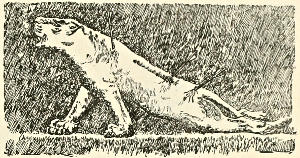
Bas-relief of a wounded Lioness
(Now in the British Museum)
Still, though these bas-reliefs have intrinsic merits as works of art, their
chief value is for what they teach regarding the evolution of art in the
world. Previously to their discovery it had been supposed that the stiff
formalism of Egyptian sculpture represented the fullest flight of pre-Grecian
art, and that Greek art itself had stepped suddenly forth, rather a new
creation than an evolution. But the pick and shovel of Layard at Nineveh
dispelled that illusion. For these art treasures, that had lain there under
the deposits of centuries, were found to represent an enormous advance upon
Egyptian models, precisely in the direction of that realism for which Greek
art is distinguished.
If we would judge how direct and unequivocal was the impulse which
the dying nation transferred to the adolescent one in point of art, we have
but to take a few steps in the British Museum, from the Assyrian rooms to
the wonderful hall that holds Lord Elgin’s trophies from the desecrated
Parthenon. Look, then, upon the frieze of bas-relief that bears the magic
name of Phidias. If anything can reconcile us to the act that deprived
Greece of her priceless heirlooms, it is the fact that they have found lodgment
here close beside their oriental prototypes, where half a million visitors
each year may at least have an opportunity to learn the lesson that human
progress is an accretion, a growth, a building upon foundations; and, specifically,
that Greek art, no less than other forms of human culture, was an
evolution, and not an isolated miracle. For what is the Parthenon frieze, as
we now come to it fresh from the palaces of Nineveh, but an Assyrian fresco
adapted to the needs and ideals of another race and developed by the genius
of a newer civilisation? The profiled figures in low relief coursing together,
are they different in conception from the profiled figures of the palaces we
have just left? The horses of the Parthenon frieze might almost seem to
have stepped bodily from the palaces of Asshurbanapal. They have gained
something in suppleness of limb, have altered their attitude in a measure, to
be sure, thanks to their new environment. But their type has not changed
by so much as an actual breed of horses might be changed in as many generations.
Note the head, the most typical and characteristic feature of this
Grecian steed. Line for line it is the same head, trappings aside, that we
have just seen at Nineveh. Even the defects of the Assyrian drawing
are there—the too small and slender face, and receding lower jaw, the
tiny ear, the far too full and “chuffy” neck. Possibly no horse in nature
was ever like this, but the Assyrian artist so conceives it; the Greek copies
that conception; and the distorted type will be transmitted down the
generations to the Italian of the Renaissance, to the classical painters of
Spain, the Netherlands, and Germany, and France; nay, even to the artist
of the nineteenth century. The court artist of an oriental prince of
the ninth or tenth century B.C. conceives a certain ideal; and, following
him, a certain type of sculptured horse, such as the artist who carved it has
never seen, steps before the chariot on Napoleon’s Arc de Triomphe in
nineteenth-century Paris.c
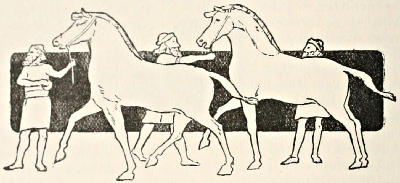
Bas-relief of Horses
If Mesopotamian art and literature had been forgotten in succeeding
ages, Chaldean science had not shared the same fate. The fame of the
Babylonian astrology and astronomy was still fresh in the mind of the
Greeks of the day of Diodorus, as we shall see, and it is curious to reflect
that even at this relatively late period after Greece had passed far beyond
the culminating point of her own career the learned Greek looked upon
Chaldean science as something beyond the pale of the science of his own
nation. It would seem as if the cultivated Greek looked back upon the
Babylonian civilisation with something of that reverence which “modern”
European nations have reserved for Greece itself. It is significant, too, that
the Babylonians themselves, even in the day of their decline, continued to
regard the Greeks, along with the rest of the outside world, as “barbarians”
in something more than the Greek sense of the word.
The older civilisation always thus regards the younger, regardless of the
actual relative merits of the two. It was an Egyptian priest who lectured
the famous Greek in these words: “O Solon! Solon! You Hellenes are but
children, and there is never an old man who is a Hellene. In my mind
you are all young. There is no old opinion handed down among you by
ancient tradition, nor any science hoary with age”; but the same words
might well have been pronounced by a priest of Chaldea. We have learned
through Diodorus that the Egyptians guarded the secrets of their science
very jealously from the Greeks, who travelled and sojourned there for the
express purpose of learning them; and there is reason to suppose that much
the same reception was accorded the Greek traveller in Babylonia, since
Herodotus seems to have learned so little there beyond what his own direct
observations taught him.
But how much ground the Babylonian had for this arrogance of intellectual
attitude the modern world had little material for judging, beyond such
general assertions as that of Diodorus, until the records of the libraries were
revealed. Then it was made evident that as original scientific investigators
the Babylonians were no whit inferior to their contemporaries of the Nile, if,
indeed, they were not superior; that in short they fully merited the praise
which classical tradition accorded them. A people that thus excelled in
theoretical science, no less than in art and literature and in practical civilisation,
has many claims to be considered the foremost nation of antiquity.a
“Here it will not be amiss to say something of the Chaldeans (as the
Babylonians call them) and of their Antiquity, that nothing worth Remark
may be omitted,” says Diodorus, as translated in 1700 by Booth.
“They being the most ancient Babylonians, hold the same station and dignity
in the Common-wealth as the Egyptian Priests do in Egypt: For being
deputed to Divine Offices, they spend all their Time in the study of Philosophy,
and are especially famous for the Art of Astrology. They are mightily
given to Divination, and foretel future Events, and imploy themselves
either by Purifications, Sacrifices, or other Inchantments to avert Evils, or
procure good Fortune and Success. They are skilful likewise in the Art
of Divination, by the flying of Birds, and interpreting of Dreams and Prodigies:
And are reputed as true Oracles (in declaring what will come to pass)
by their exact and diligent viewing the Intrals of the Sacrifices. But they
attain not to this Knowledge in the same manner as the Grecians do; for
the Chaldeans learn it by Tradition from their Ancestors, the Son from the
Father, who are all in the mean time free from all other publick Offices and
Attendances; and because their Parents are their Tutors, they both learn
every thing without Envy, and rely with more confidence upon the truth of
what is taught them; and being train’d up in this Learning from their very
Childhood, they become most famous Philosophers, (that Age being most
capable of Learning, wherein they spend much of their time). But the Grecians
for the most part come raw to this study, unfitted and unprepar’d, and
are long before they attain to the Knowledge of this Philosophy: And after
they have spent some small time in this Study, they are many times call’d
off and forc’d to leave it, in order to get a Livelihood and Subsistence. And
although some few do industriously apply themselves to Philosophy, yet for
the sake of Gain, these very Men are opinionative, and ever and anon starting
new and high Points, and never fix in the steps of their Ancestors. But
the Barbarians keeping constantly close to the same thing, attain to a perfect
and distinct Knowledge in every particular.
“But the Grecians cunningly catching at all Opportunities of Gain, make
new Sects and Parties, and by their contrary Opinions wrangling and quarelling
concerning the chiefest Points, lead their Scholars into a Maze; and
being uncertain and doubtful what to pitch upon for certain truth, their
Minds are fluctuating and in suspence all the days of their Lives, and unable
to give a certain assent unto any thing. For if any Man will but examine
the most eminent Sects of the Philosophers, he shall find them much differing
among themselves, and even opposing one another in the most weighty
parts of their Philosophy. But to return to the Chaldeans, they hold that
the World is eternal, which had neither any certain Beginning, nor shall
have any End; but all agree, that all things are order’d, and this beautiful
Fabrick is supported by a Divine Providence, and that the Motions of the
Heavens are not perform’d by chance and of their own accord, but by a certain
and determinate Will and Appointment of the Gods.
“Therefore from a long observation of the Stars, and an exact Knowledge
of the motions and influences of every one of them, wherein they excel all
others, they fortel many things that are to come to pass.
“They say that the Five Stars which some call Planets, but they Interpreters,
are most worthy of Consideration, both for their motions and their remarkable
influences, especially that which the Grecians call Saturn. The brightest
of them all, and which often portends many and great Events, they call Sol,
the other Four they name Mars, Venus, Mercury, and Jupiter, with our own
Country Astrologers. They give the Name of Interpreters to these Stars,
because these only by a peculiar Motion do portend things to come, and
instead of Jupiters, do declare to Men before-hand the good-will of the
Gods; whereas the other Stars (not being of the number of the Planets)
have a constant ordinary motion. Future Events (they say) are pointed at
sometimes by their Rising, and sometimes by their Setting, and at other
times by their Colour, as may be experienc’d by those that will diligently
observe it; sometimes foreshewing Hurricanes, at other times Tempestuous
Rains, and then again exceeding Droughts. By these, they say, are often
portended the appearance of Comets, Eclipses of the Sun and Moon, Earthquakes
and all other the various Changes and remarkable effects in the Air,
boding good and bad, not only to Nations in general, but to Kings and Private
Persons in particular. Under the Course of these Planets, they say are
Thirty Stars, which they call Counselling Gods, half of whom observe what
is done under the Earth, and the other half take notice of the actions of Men
upon the Earth, and what is transacted in the Heavens. Once every Ten
Days space (they say) one of the highest Order of these Stars descends to
them that are of the lowest, like a Messenger sent from them above; and
then again another ascends from those below to them above, and that this
is their constant natural motion to continue for ever. The chief of these
Gods, they say, are Twelve in number, to each of which they attribute a
Month, and one Sign of the Twelve in the Zodiack.
“Through these Twelve Signs the Sun, Moon, and the other Five Planets
run their Course. The Sun in a Years time, and the Moon in the space of a
Month. To every one of the Planets they assign their own proper Courses,
which are perform’d variously in lesser or shorter time according as their
several motions are quicker or slower. These Stars, they say, have a great
influence both as to good and bad in Mens Nativities; and from the consideration
of their several Natures, may be foreknown what will befal Men
afterwards. As they foretold things to come to other Kings formerly, so
they did to Alexander who conquer’d Darius, and to his Successors Antigonus
and Seleucus Nicator; and accordingly things fell out as they declar’d;
which we shall relate particularly hereafter in a more convenient
time. They tell likewise private Men their Fortunes so certainly, that those
who have found the thing true by Experience, have esteem’d it a Miracle,
and above the reach of Man to perform. Out of the Circle of the Zodiack
they describe Four and Twenty Stars, Twelve towards the North Pole, and
as many to the South.
“Those which we see, they assign to the living; and the other that do not
appear, they conceive are Constellations for the Dead; and they term them
Judges of all things. The Moon, they say, is in the lowest Orb; and being
therefore next to the Earth (because she is so small,) she finishes her Course
in a little time, not through the swiftness of her Motion, but the shortness
of her Sphear. In that which they affirm (that she has but a borrow’d light,
and that when she is eclips’d, it’s caus’d by the interposition of the shadow
of the Earth) they agree with the Grecians.
“Their Rules and Notions concerning the Eclipses of the Sun are but weak
and mean, which they dare not positively foretel, nor fix a certain time for
them. They have likewise Opinions concerning the Earth peculiar to themselves,
affirming it to resemble a Boat, and to be hollow, to prove which, and
other things relating to the frame of the World, they abound in Arguments;
but to give a particular Account of ’em, we conceive would be a thing foreign
to our History. But this any Man may justly and truly say, That the
Chaldeans far exceed all other Men in the Knowledge of Astrology, and have
study’d it most of any other Art or Science: But the number of Years during
which the Chaldeans say, those of their Profession have given themselves to
the study of this natural Philosophy, is incredible; for when Alexander was
in Asia, they reckon’d up Four Hundred and Seventy Thousand Years since
they first began to observe the Motions of the Stars. But lest we should
make too long a digression from our intended Design, let this which we have
said concerning the Chaldeans suffice.”d
The Babylonian year, according to Eduard Meyer, consisted of simple
lunar months (twenty-nine or thirty days), which, as with the Greeks and
the Mohammedans, was determined by the course of the moon itself.
To make this year coincide with the course of the sun, an extra month
was intercalated; in olden times this seems to have been done after the first
or the sixth month.
This year, with the names of its months, was adopted by the Jews at the
time of the Exile, and is still in use with them. The commencement of
their year (Nisan) falls at the time of the spring equinox. The Babylonians
had no continuous chronology; they dated according to the years of the
kings, or, rather, they marked the year according to any important event
which took place in it. Thus we see dates like “on the 30th Adar in the
Sixth year after the conquest of Nisin by King Rim-Sin.”
Later on in Babylon, and also in Assyria, they reckoned simply the years
of the kings, from the day of their accession to the throne. The remainder
of the year, in the course of which the predecessor had died, was therefore
considered the first part of the first year of the new reign, and was very often
called “the beginning of the reign” of the king in question.
Chronological calculations were reckoned from the same starting-point
as in Egypt. They reckon the calendar year in which a king comes to the
throne as his first year, and hence his death takes place in the first year of
his successor. This is the method of the Ptolemaic canon, one of the most
important chronological monuments of antiquity. It is the list beginning
with Nabonassar (about 747 B.C.) of the native and Persian kings of Babylonia,
to which the Egyptian rulers up to Alexander are added. It is an
addition to the astronomical work of Ptolemy, and was intended to throw
light on the passages relating to the Babylonian, and later on to the Alexandrian
chronological methods. It is authentic, and is confirmed by the
monuments. Yet, in using the same, it must be recollected that all dates of
the Egyptian “vague” year (and the Egyptian months) are reduced.
Therefore the first year of the Nabonassar era begins on the 1st Tehuti,
the 26th February, 747 B.C.
In Assyria there is also a second and far more common form of specifying
the years. Since a very early date (as far back as the fourteenth
century) it was customary to name the year after some high official. The
year, as such, is called limmu, “eponymic year.” Of course, they had continuous
lists of these eponyms; and we have recovered several fragments.
The lists for the years 893 to 666 are complete, and with fragments we can
go still farther back. The kings frequently used this system, and private
persons regularly used this eponym.
Some copies of the lists contain accounts of the changes of reigns, and
give short statements of important internal and external events of the particular
years. Thus an eclipse of the sun June 15, 763 B.C., mentioned
therein can be astronomically fixed, and the dates arrived at thereby concur
exactly with the accounts of the Ptolemaic canon. The chronological history
of this epoch is therefore perfectly determined.e
This being the Babylonian method of reckoning dates, it is interesting
to note on what plan they subdivided the day. Investigations were made in
this line by that indefatigable Irishman, Edward Hincks, from whose article
“On the Assyrio-Babylonian Measures of Time,” in the Transactions of the
Royal Irish Academy, we quote.a
I begin with the day and its divisions.
Our knowledge on this subject is mainly derived from a tablet in the
British Museum, marked K. 15. A paper of mine was read before the Royal
Irish Academy in 1854, and was published in the twenty-third volume of the
Transactions in which this tablet was discussed. As that paper contained
some slight philological errors, I will here repeat the substance of it, correcting
those errors.
I now translate the inscription on the Tablet as follows, omitting the customary
benedictory formula. “On the sixth day of the month Nisan the
day and the night are equal; six kazabs [kashbu] are the day; six kazabs
[kashbu] are the night.” It is evident that this inscription records the
observation of an equinox; and I will return to the consideration of it with
that view. At present I will only remark that it points to a double division
of the day, or Nycthemeron; viz., the first into the day properly so called,
and the night; which were in this instance equal, though not generally so;
the second into twelve equal kazabs [kashbu].
I proceed to the second division of the day into twelve kazabs [kashbu].
Each of these was equivalent, putting out of sight errors of observation, to
two hours of mean solar time, such as we use in ordinary life. The word
kazab [kashbu] is from a Hebrew root meaning “to fail,” which is applied
to streams that run dry. This suggests the primary signification, “runnings
out,” namely, of the water which had been poured into a vessel with a small
hole in the bottom. The Babylonians measured time by clepsydræ, which,
when they had been filled, would be emptied in two hours of mean time.
Such clepsydræ would maintain a sufficiently accurate division of the day
into twelve kazabs [kashbu] if the first were set to run at apparent noon, the
second when the first had run out, and so on till the thirteenth, which would
be set to run at the next apparent noon, whether the twelfth was just running
out, or had already run out, or had still a little water in it.
The kazab [kashbu] is mentioned as an ordinary measure of time in more
than one passage. The distance from the mainland to an island in the Persian
Gulf is said to be a voyage of thirty kazabs [kashbu] (Botta, 41. 48),
just as that from Cyprus to Syria is said to be one of seven days (Botta,
38. 41). Also, in Rawlinson, 42. 13, Sennacherib speaks of slaughtering his
enemies for the space of a journey or march of two kazabs [kashbu]. This
use of the word seems to me a positive proof that the clepsydræ was in use
among the Assyrians and Babylonians generally, and was not confined to the
astronomers.
There does not appear to me any reason to suppose that a division of the
day from sunrise to sunset into twelve hours, varying in length according to
the season of the year, and again of the night, from sunset to sunrise into
twelve similar hours, was ever known to the Babylonians. Such a division
was in use among the Egyptians, and was adopted from them by the Greeks,
but the Babylonians and Assyrians knew nothing of it. I may here observe
that some modern writers have committed a strange mistake in supposing
the clepsydræ to have been invented so late as the third century before
Christ and at Alexandria. These writers have confounded two totally different
things; viz., the original invention of the clepsydræ marking mean
solar time, which goes back to remote antiquity, and is almost certainly due
to the Babylonians, and the adaptation of the clepsydræ to the seasonable
(καιρικαὶ) hours of the Egyptians and Greeks, which was accomplished at the
time and place which these writers mention. I have met with no subdivisions
of the kazab [kashbu], and I much doubt whether the Babylonians had
any means of marking such.f
The exact sciences were cultivated in Assyria from the earliest times,
nor had natural sciences been neglected. Zoology, botany, mineralogy are
largely represented in the library of Nineveh, and as all these tablets contain
a Sumerian as well as the equivalent Assyrian text, we are justified in
believing that the Ninevites, in this respect, still followed the traditions of
their predecessors.
We find lists of animals arranged in a certain order which indicates an
attempt at classification; thus the dog, lion, and wolf are in the same category,
whilst the ox, sheep, and goat form another. In the enumeration of
the different animals, there is a very evident design of establishing genera
and families, and of distinguishing species. Thus we have a family comprising
the great Carnivora: the dog, lion, and wolf; then we have different
species in the dog family—such as the dog itself, the domestic dog, the
coursing dog, the small dog, the dog of Elam, etc. The scientific side of
this classification is revealed by an easily recognised circumstance; thus one
finds after the common name a special nomenclature, which belongs to a
scientific classification with which the Assyrians seem to have been familiar.
Among the birds similar attempts at classification are evident. Birds of
rapid flight, sea-birds, or marsh birds are differentiated. Insects form a very
numerous class; we see an entire family whose species are differentiated
according as they attack plants, animals, clothing, or wood. Vegetables seem
to be classified according to their usefulness, or the service that industry
can make of them. One tablet enumerates the uses to which wood can be
put, according to its adaptability, for the timber-work of palaces, the construction
of vessels, the making of carts, implements of husbandry, or even
furniture. Minerals occupy a long series in these tablets. They are classed
according to their qualities, gold and silver forming a division apart; precious
stones form still another, but there is nothing to indicate on what basis
a classification would be established.
If we pass from the natural sciences to geography, we find the latter in
a synthetic and fairly confused state. Nevertheless several lists give us a
series of the names of towns, rivers, and mountains, arranged according to
their geographical disposition, as we can easily prove. Sometimes the data
are of a practical character, and names are followed by mention of natural or
industrial products of localities, their revenue taxes, or tributes. But the
science, par excellence, which was especially cultivated in Assyria, and which
the learned men of Asshurbanapal connected with the greatest care with
antique Chaldean traditions, was astronomy.
This science was not indeed born at Nineveh; the Greeks teach us that
astronomical observations were first made in lower Chaldea 1903 years before
Alexander, and consequently 2226 years before Christ. Whatever the
value of this date may be, the tradition of this origin is found in the works
of the Assyrians, who constantly refer to the observations of their predecessors.
Asshurbanapal had sent these learned men to the old schools of
Mesopotamia, Ur, Sippar, Agade, Babylon; there to imbibe the elements of
the science which was the glory of the southern empire. In the seventh
century before our era, observations were carried on at Nineveh. At this
date the fixed stars had long been distinguished from the planets; the sidereal
revolutions, the divisions of the year, the course of the sun in the
different constellations of the zodiac, periodic return of eclipses, and even
the precession of the equinoxes, had been calculated. These achievements
imply long and conscientious observation, a special intelligence to undertake
them, and simple methods of rigorous calculation.
We are ignorant as to the nature of the instruments with which the
Assyrio-Chaldeans could observe the stars. The chances of error in observations
by the naked eye are evidently very great, and errors can only be
rectified by multiplied operations and the most minute calculations. It is
known that the determining of the periodicity of the moon’s eclipses rests
on a knowledge of the cycle of 223 lunations which bring back the same
eclipses periodically. It is certain that the Assyrio-Chaldeans must have
also known another cycle of 22,325 lunations equalling 1805 tropical years
plus 8 days, or 1805 Julian years of 365¼ days; after which the eclipses
return with still greater precision in the same order. How long did it take
the human mind to observe and understand a sufficient number of lunations
so as to combine the data they afforded and deduct the law that Meton
formulated and to which he has given his name?
In regard to eclipses of the sun, the cycle is so very much greater that
the beginnings of the observations on which the calculations of their periodicity
would rest, would take us back to a period which is quite beyond the
limits of the historic age. Diogenes Laertius estimates it as 48,863 years.
During that time 373 eclipses of the moon and 832 eclipses of the sun had
been observed. When they turned their attention to the calculations resulting
from these observations the Assyrio-Chaldeans were marvellously helped
by their system of notation. Their numerical system lent itself with ease
to the most complicated of calculations. We must content ourselves with
stating the results. As we were saying a minute ago, the observations were
carried on under Asshurbanapal; the king sent astronomers to different
points to study celestial phenomena, and the results of their labours were
sent him. Here are the terms in which these reports were expressed:
“To the King, my Lord, his humble servant Ishtar-iddin-apal, chief
astronomer of the town of Arbela writes this: Peace and happiness to the
king my master and may he long prosper.
“On the 29th day, I observed the node of the moon, the clouds obscured
the field of observation, and we could not see the moon.
“In the month of Sebat (January) the 1st day during the year Bel-haran-saduya
(648 B.C.).”
The result of this mission was not satisfactory. The eclipse had been
predicted, but although the state of the atmosphere did not allow of observation,
the attesting of this failure proves the care with which every circumstance
that could serve to explain the phenomenon was noted. Here is an
observation which was entirely successful:
“To the director of observations my Lord, his humble servant Nabu-shum-iddin,
Great Astronomer of Nineveh writes this: May Nabu and
Marduk be propitious to the director of these observations, my Lord.
“The 15th day we observed the node of the moon, and the moon was
eclipsed.”
Here is a more complicated observation:
“To the king, my Lord, may the Gods Nabu and Marduk be propitious,
may the great gods grant to the king, my master, long life, the benefits of
the flesh and satisfaction of the heart.
“The 27th day the moon disappeared; the 28th 29th and 30th day we
continually observed the node of the obscuring sun. The eclipse did not
take place. The 1st day (of the following month) we saw the moon during
the first day of the month Tammuz (June) above the star Mercury of which
I have previously sent an observation to the king my master. In its course
during the day of Anu, around the shepherd star (the planet Venus), it was
seen declining: on account of rain the horns were not very distinctly visible,
and so it was in its whole course. The day Anu I sent the observation of
its conjunction, to the king my master. It was prolonged and was visible
above the star of the Chariot in its course during the day of Baal; it disappeared
towards the star of the Chariot.
“To the King, my Lord, peace and happiness.”
The discovery of the precession of the equinoxes is generally attributed
to Hipparchus. It was he, indeed, who taught this fact to the Greeks, and
he estimated its yearly amount as from 36 to 39 seconds; but it is certain
that he learned about it in Chaldea, and that he obtained the elements of his
calculations from the astronomical observations made on the lower Euphrates.
All the astronomical knowledge of the Ninevite savants had the same point
of origin.
Two thousand years before our era, from the time of a king of Agade
called Sharrukin (Shargani-shar-ali), and who is usually known as Sargon I
(the Ancient), the precession of the equinoxes was an observed and calculated
fact, since it had already brought sufficient disturbance into the
calendar to make a corrective element necessary. Sargon had given a
brilliancy to his century which the learned men of Nineveh only echoed.
In his time there was a library at Agade, the importance of which we can
judge by the fragments which were preserved at Nineveh. We are certain
that at these remote times the great divisions of the uranographic chart were
already determined upon. Fixed stars were designated according to the
different groups or constellations which were known by the names they have
retained to this day.
Outside these fixed stars the signs of the zodiac were perfectly determined
in that portion of the celestial vault which the texts designate by the
name of harranu (the way), that is to say, the way of the stars. These stars
were the planets. The Chaldeans knew of seven, and they were thus known
to them: Shamash, the sun; Sin, the moon; Alap-Shamash, Saturn; Rus, Jupiter;
Ashbat, Venus; Sulpa-sadu, Mars; Nivit-Anu, Mercury. The Ninevite
savants borrowed their astronomical knowledge from the Chaldeans; they
made use of the calendar as it was transmitted to them, and as such it has
been used by all nations from the remotest times up to the present day.
The Assyrian year was composed of twelve lunar months. It began
with the new moon preceding the vernal equinox. A well-known tablet thus
fixes the day of the equinoxes: “At the sixth day of the month of Nisan
(March) the days and nights are equal (and comprise), six kashbu for the
day and six kashbu for the night. May Nabu and Marduk be propitious to
the King, my Lord.”
To correct the error resulting from the difference between the lunar and
solar year, a supplementary month was intercalated, the length of which
necessarily varied with circumstances. The Ninevite tablets offer us calendars
arranged in conformity with the different exigencies of life. Some
are purely scientific, and show us the divisions of the year into days,
months, and seasons. Others are formed to meet the needs of religion, and
tell us, by the day, the feasts consecrated to divinities invoked or honoured
by special ceremonies. Others seem to take current superstitions into
account; thus days are marked by a particular sign, according as they are
considered propitious or disastrous. We see tables constructed to indicate
the influence of the stars on each day of the year, with a mention of appropriate
prayers, to propitiate favourable auguries and ward off those which
are fatal.
The importance of these last documents must not be exaggerated; they
are related to superstitions common to all ages and lands; and, in the ancient
East, as everywhere else, these beliefs merely represent one of the most curious,
but the least interesting phases of the aberrations of the human mind.g
Babylonian King Lion Hunting
Such is the fate of empire: Asshur rose
Where elder thrones and prouder warriors stood;
Before the Memphian priest his precepts chose,
Men reasoned greatly of the highest good;
Before Troy was, or Xanthus rolled in blood,
Armies were ranged in battles’ dread array:
They fought—their glory withered in its bud;
They perished—with them ceased their tyrants’ sway;
New wars, new heroes came—their story passed away.—James Gates Percival.
It is a curious paradox that our knowledge of this oldest civilisation
should be the very newest and most novel record with which present-day
history has to deal. The Chaldeans, Assyrians, and Babylonians, of whose
accomplishments we speak so confidently to-day, lived out their national life,
and vanished from the earth, as nations, mostly before civilisation had its
dawning in Europe; and for two thousand years they were but a reminiscence.
It was reserved for nineteenth century investigators literally to dig from
the earth their lost records, and to read the secrets of their forgotten
history. Marvellous secrets they were, as we shall see; but before we
turn to them, it will be of interest to recall the reminiscences that did
service as the history of these wonderful peoples for so many centuries.
In a few extracts we may set forth the substance of all that the world
remembered of that marvellous civilisation from the days of Herodotus
and Diodorus till the middle of the nineteenth century. A mixture of
fact and fable, it still has absorbing interest, the more so that we may now
compare it with the surer records brought to light in our own time.
Aside from their intrinsic interest, the classical records have, in this regard,
a unique importance.
As to the precise classical authorities in question, we have already
become acquainted with Diodorus and Ælianus in the earlier portion of this
work. Another author we shall now have occasion to quote is Berosus.
As to this author and the exact status of his work, we cannot do better than
quote the following critical estimate from the Babylone et la Chaldée of
Joachim Menant.
“Berosus came of a priestly family and was born in Babylon, about 330
B.C. He himself is authority for the information that he was a contemporary
of Alexander the Great. According to Tatian, he is the most learned
of all Asiatic historians. He was deeply versed in the ancient traditions of
his country and taught them to the Greeks, through whom they have come
down to us. Vitruvius informs us that he left Babylon and went to live on
the island of Cos, where he opened a school of astrology. He invented, or
at least introduced among the Greeks, a particular kind of time-keeping.
There still exist fragments of astrological works to which Berosus has
attached his name, and owing to the special interests of the writers who
have borrowed from his works, the fame of the astrologer perhaps outshines
that of the historian. Pliny (VII. 37) declares that the Athenians erected
a golden-tongued statue to him in the Gymnasium, on account of his
wonderful predictions.
“He wrote in Greek, about 280 B.C., a history of ancient Chaldea and
dedicated it to Antiochus Soter. The work consisted of three volumes,
of which we possess now but a few excerpts preserved in the chronicles of
several historiographers who have lived at different periods and whom it
may be well to mention. First of all there is Flavius Josephus, the great
historian of the Jews, born at Jerusalem 33 A.D.; then there are St. Clement,
the Alexandrian catechist (born early in the second century A.D., died 217),
Eusebius, Bishop of Cæsarea (author of the Symbol of Nice, who lived from
267 to 338), and finally, George Syncellus (so called from the office he filled
under the Bishop of Constantinople, and who died about the year 800).
These writers took from Berosus only just what was needed for their purposes,
and none in fact seems to have been personally acquainted with the
work of the learned Chaldean.
“For instance, Syncellus, whose writings show marks of haste and are
by no means free from error, borrows his quotations from Eusebius, whom he
often pretends to correct. Eusebius seems to be indebted to Julius Africanus,
who wrote in the third century of our era, and the latter in turn
mentions his obligation to Alexander Polyhistor, who flourished twenty-five
years before Christ. Now Polyhistor takes his references from Apollodorus,
who lived some years before. Josephus in all probability used Alexander
Polyhistor as his source, although he does not say so. Clement of Alexandria
had at his elbow the works of King Juba of Mauritania, who reigned
about 30 B.C., and who seems to have taken his material, unfortunately too
limited in amount, from the very works of Berosus, in whom he placed the
utmost confidence.
“One thing is certain, the original text of Berosus in passing through so
many hands and suffering condensation and mutilation must have been considerably
altered.
“Berosus had free access to those famous clay-tablet libraries which
Pliny describes and whose importance modern research has revealed. As at
Nineveh, there were at Babylon, Borsippa, Orchoë [Erech], and in the large
cities of Chaldea, archives which contained the national traditions to which
the Chaldean priest was obliged to resort.
“In the days of Berosus the writings in these archives were understood
not only in Babylon, but throughout western Asia. The Assyrio-Chaldean
language was still written in cuneiform characters till the time of the Seleucidæ
and even during the first century B.C. Berosus was thus enabled to
consult these precious sources, and we know that he went to them. Already
in the priceless débris of these curious archives, fragments in corroboration
of Berosus have been discovered, and these acquisitions only make us regret
the more what is irrevocably lost.”
We shall now take up some of the portions of Berosus’ history transcribed
by later historiographers.a
Berosus, in the first book of his history of Babylonia, informs us that he
lived in the age of Alexander, the son of Philip. And he mentions that
there were written accounts, preserved at Babylon with the greatest care,
comprehending a period of about fifteen myriads of years; and that these
writings contained histories of the heavens and of the sea; of the birth of
mankind; and of the kings, and of the memorable actions which they had
achieved.
And in the first place he describes Babylonia as a country situated between
the Tigris and the Euphrates; that it abounded with wheat and barley,
and ocrus, and sesame; and that in the lakes were produced the roots
called gongæ, which are fit for food, and in respect for nutriment similar
to barley. That there were also palm trees and apples, and a variety of
fruits; fish also and birds, both those which are merely of flight, and those
which frequent the lakes. He adds, that those parts of the country which
bordered upon Arabia were without water and barren; but that the parts
which lay on the other side were both hilly and fertile.
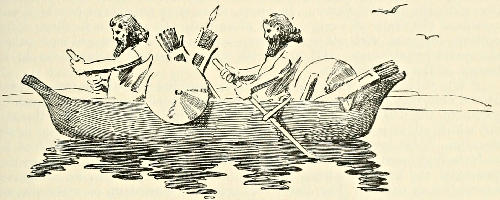
Assyrian Boat
(From the Monuments)
At Babylon there was (in these times) a great resort of people of various
nations, who inhabited Chaldea, and lived in a lawless manner, like the
beasts of the field.
In the first year there appeared from that part of the Erythræan Sea [the
Persian Gulf] which borders upon Babylonia, an animal destitute of reason,
by name Oannes [perhaps the same as Anu], whose whole body (according to
the account of Apollodorus) was that of a fish; that under the fish’s head he
had another head, with feet also below, similar to those of a man, subjoined
to the fish’s tail. His voice, too, and language, was articulate and human;
and a representation of him is preserved even to this day.
This Being was accustomed to pass the day among men; but took no
food at that season; and he gave them an insight into letters and sciences,
and arts of every kind. He taught them to construct cities, to found temples,
to compile laws, and explained to them the principles of geometrical knowledge.
He made them distinguish the seeds of the earth, and showed them
how to collect the fruits; in short he instructed them in everything which
could tend to soften manners and humanise their lives. From that time
nothing material has been added by way of improvement to his instructions.
And when the sun had set, this Being, Oannes, retired again into the sea, and
passed the night in the deep; for he was amphibious. After this there appeared
other animals like Oannes, of which Berosus proposes to give an
account when he comes to the history of the kings. Moreover, Oannes
wrote concerning the generation of mankind, and of their civil policy; and
the following is the purport of what he said:
“There was a time in which there existed nothing but darkness and an
abyss of waters, wherein resided most hideous beings, which were produced
of a twofold principle. There appeared men, some of whom were furnished
with two wings, others with four, and with two faces. They had one body
but two heads: the one that of a man, the other of a woman; likewise in
their several organs, they were both male and female. Other human figures
were to be seen with the legs and horns of goats; some had horses’ feet;
while others united the hind quarters of a horse with the body of a man, resembling
in shape the hippocentaurs. Bulls likewise were bred there with
the heads of men; and dogs with fourfold bodies, terminated in their extremities
with the tails of fishes. In short, there were creatures in which were
combined the limbs of every species of animal. In addition to these, fishes,
reptiles, serpents, with other monstrous animals, which assumed each other’s
shape and countenance. Of all which were preserved delineations in the
temple of Belus at Babylon.
“The person who was believed to have presided over them, was a woman
named Omoroca [a Greek form of the Aramaic word ’Amqia, “the ocean”];
which in the Chaldean language is Thalath; in Greek, Thalassa, the sea;
but which might equally be interpreted the Moon. All things being in this
situation, Belus came, and cut the woman asunder: and of one half of her
he formed the earth, and of the other half the heavens; and at the same time
destroyed the animals within her. All this (he says) was an allegorical
description of nature. For, the whole universe consisting of moisture, and
animals being continually generated therein, the deity above mentioned took
off his own head: upon which the other gods mixed the blood, as it gushed
out, with the earth; and from thence were formed men. On this account
it is that they are rational, and partake of divine knowledge.
“This Belus, by whom they signify Jupiter, divided the darkness, and
separated the Heavens from the Earth, and reduced the universe to order.
But the animals, not being able to bear the prevalence of light, died. Belus,
upon this, seeing a vast space unoccupied, though by nature fruitful, commanded
one of the gods to take off his head, and to mix the blood with the
earth; and from thence to form other men and animals, which should be
capable of bearing the air. Belus formed also the stars, and the sun, and the
moon, and the five planets.”
(Such, according to Alexander Polyhistor, is the account which Berosus
gives in his first book. In the second book was contained the history of
the ten kings of the Chaldeans, and the periods of the continuance of each
reign, which consisted collectively of 120 sars, or 432,000 years; reaching to
the time of the Deluge. For Alexander, enumerating the kings from the
writings of the Chaldeans, after Ardates the IXth, proceeds to the Xth, who
is called by them Xisuthrus, in this manner:)
After the death of Ardates, his son Xisuthrus reigned 18 sars. In his
time happened a great Deluge; the history of which is thus described. The
Deity, Cronus, appeared to him in a vision, and warned him that upon the
fifteenth day of the month Dæsius [or Dæsia, i.e. May and June] there would
be a flood, by which mankind would be destroyed. He therefore enjoined
him to write a history of the beginning, procedure, and conclusion of all
things; and bury it in the city of the Sun at Sippara; and to build
a vessel, and to take with him into it his friends and relations; and to
convey on board everything necessary to sustain life, together with all
the different animals, both birds and quadrupeds, and trust himself fearlessly
to the deep. Having asked the Deity, whither he was to sail, he
was answered, “To the Gods”: upon which he offered up a prayer for
the good of mankind. He then obeyed the divine admonition: and built
a vessel five stadia in length and two in breadth. Into this he put everything
which he had prepared; and last of all conveyed into it his wife,
his children, and his friends.
After the flood had been upon the earth, and was in time abated, Xisuthrus
sent out birds from the vessel, which, not finding any food, nor any place
whereupon they might rest their feet, returned to him again. After an interval
of some days he sent them forth a second time; and they now returned
with their feet tinged with mud. He made a trial a third time with these
birds; but they returned to him no more: from whence he judged that the
surface of the earth had appeared above the waters. He therefore made an
opening in the vessel, and upon looking out found that it was stranded upon
the side of some mountain; upon which he immediately quitted it with his
wife, his daughter, and the pilot. Xisuthrus then paid his adoration to the
earth: and having constructed an altar, offered sacrifices to the gods, and,
with those who had come out of the vessel with him, disappeared.
They who remained within, finding that their companions did not return,
quitted the vessel with many lamentations, and called continually on the
name of Xisuthrus. Him they saw no more; but they could distinguish his
voice in the air, and could hear him admonish them to pay due regard to religion;
and likewise informed them that it was on account of his piety that
he was translated to live with the gods; that his wife and daughter, and the
pilot, had obtained the same honour. To this he added, that they should
return to Babylonia; and, as it was ordained, search for the writings at Sippara,
which they were to make known to all mankind: moreover, that the
place wherein they then were, was the land of Armenia [in the Hebrew,
Ararat]. The rest having heard these words, offered sacrifices to the gods;
and, taking a circuit, journeyed towards Babylonia.
The vessel being thus stranded in Armenia, some part of it yet remains
in the Corcyræan [or Gordyæan] Mountains of Armenia; and the people
scrape off the bitumen, with which it had been outwardly coated, and make
use of it by way of an alexipharmic and amulet. And when they returned
to Babylon, and had found the writings at Sippara, they built cities, and
erected temples: and Babylon was thus inhabited again.
Of the Chaldean Kings
This is the history which Berosus has transmitted to us. He tells us
that the first king was Alorus [or Ur, the Babylonian deity] of Babylon, a
Chaldean: he reigned ten sars: and afterwards Alaparus, and Amelon,
who came from Pantibiblon [Greek form of Sippara]: then Ammenon the
Chaldean, in whose time appeared the Musarus Oannes, the Annedotus from
the Erythræan Sea. (But Alexander Polyhistor, anticipating the event, has
said that he appeared in the first year; but Apollodorus says that it was
after forty sars; Abydenus, however, makes the second Annedotus appear
after twenty-six sars.) Then succeeded Megalarus from the city of Pantibiblon;
and he reigned eighteen sars: and after him Daonus, the shepherd
from Pantibiblon, reigned ten sars; in his time (he says) appeared again
from the Erythræan Sea a fourth Annedotus, having the same form with those
above, the shape of a fish blended with that of a man. Then reigned Euedorachus,
from Pantibiblon, for the term of eighteen sars; in his days there
appeared another personage from the Erythræan Sea like the former, having
the same complicated form between a fish and a man, whose name was Odacon.
(All these, says Apollodorus, related particularly and circumstantially
whatever Oannes had informed them of: concerning these, Abydenus has
made no mention.) Then reigned Amempsinus, a Chaldean from Laranchæ
[or Larissa]; and he, being the eighth in order, reigned ten sars. Then
reigned Otiartes, a Chaldean, from Laranchæ; and he reigned eight sars.
And upon the death of Otiartes, his son Xisuthrus reigned eighteen sars: in
his time happened the great Deluge. So that the sum of all the kings is ten;
and the term which they collectively reigned was a hundred and twenty sars.
[From Eusebius.]
So much concerning the wisdom of the Chaldeans.
It is said that the first king of the country was Alorus, and that he gave
out a report that God had appointed him to be the Shepherd of the people:
he reigned ten sars: now a sar is esteemed to be three thousand six hundred
years; a ner six hundred; and a sos sixty.
After him Alaparus reigned three sars: to him succeeded Amillarus from
the city of Pantibiblon, who reigned thirteen sars: in his time came up from
the sea a second Annedotus, a semi-demon very similar in his form to
Oannes: after Amillarus reigned Ammenon twelve sars, who was of the city
of Pantibiblon: then Megalarus of the same place reigned eighteen sars:
then Daos, the shepherd, governed for the space of ten sars, he was of Pantibiblon
[Sippara]; in his time four double-shaped personages came up out
of the sea to land, whose names were Euedocus, Eneugamus, Eneuboulus,
and Anementus: afterwards in the time of Euedoreschus appeared another
Anodaphus. After these reigned other kings, and, last of all, Sisithrus
[Xisuthrus]: so that in the whole the number amounted to ten kings, and
the term of their reigns to an hundred and twenty sars. (And, among other
things not irrelative to the subject, he continues thus concerning the Deluge):
After Euedorechus some others reigned and then Sisithrus. To him the
deity Cronus foretold that on the fifteenth day of the month Dæsius
there would be a deluge of rain: and he commanded him to deposit all
the writings whatever which were in his possession in the city of the Sun
in Sippara. Sisithrus, when he had complied with these commands, sailed
immediately to Armenia, and was presently inspired by God. Upon the third
day after the cessation of the rain Sisithrus sent out birds, by way of experiment,
that he might judge whether the flood had subsided. But the birds,
passing over an unbounded sea, without finding any place of rest, returned
again to Sisithrus. This he repeated with other birds. And when upon the
third trial he succeeded, for the birds then returned with their feet stained
with mud, the gods translated him from among men. With respect to the
vessel, which yet remains in Armenia, it is a custom of the inhabitants to
form bracelets and amulets of its wood. [From Eusebius.]
They say that the first inhabitants of the earth, glorying in their own
strength and size, and despising the gods, undertook to raise a tower whose
top should reach the sky in the place in which Babylon now stands: but
when it approached the heaven, the winds assisted the gods, and overthrew
the work upon its contrivers: and its ruins are said to be at Babylon: and
the gods introduced a diversity of tongues among men, who till that time had
all spoken the same language: and a war arose between Cronus and Titan.
The place in which they built the tower is now called Babylon, on account of
the confusion of the tongues; for confusion is by the Hebrews called Babel.[37]
[From Eusebius.]
After the Deluge, in the tenth generation, was a certain man among the
Chaldeans renowned for his justice and great exploits, and for his skill in
the celestial sciences. [From Eusebius.]
From the reign of Nabonassar only are the Chaldeans (from whom the
Greek mathematicians copy) accurately acquainted with the heavenly motions:
for Nabonassar collected all the mementos of the kings prior to himself, and
destroyed them, that the enumeration of the Chaldean kings might commence
with him. [From Syncellus.]
He (Nabopolassar) sent his son Nebuchadrezzar with a great army against
Egypt, and against Judea, upon his being informed that they had revolted
from him; and by that means he subdued them all, and set fire to the temple
that was at Jerusalem; and removed our people entirely out of their own
country, and transferred them to Babylon, and our city remained in a state
of desolation during the interval of seventy years, until the days of Cyrus,
king of Persia. (He then says, that) this Babylonian king conquered Egypt,
and Syria, and Phœnicia, and Arabia, and exceeded in his exploits all that
had reigned before him in Babylon and Chaldea. [From Josephus.]
When Nabopolassar, his (Nebuchadrezzar’s) father, heard that the governor,
whom he had set over Egypt and the provinces of Cœle-Syria and Phœnicia,
had revolted, he was determined to punish his delinquencies, and for
that purpose entrusted part of his army to his son Nebuchadrezzar, who was
then of mature age, and sent him forth against the rebel: and Nebuchadrezzar
engaged and overcame him, and reduced the country again under his
dominion. And it came to pass that his father, Nabopolassar, was seized
with a disorder which proved fatal, and he died in the city of Babylon, after
he had reigned nine and twenty years.
Nebuchadrezzar, as soon as he had received intelligence of his father’s
death, set in order the affairs of Egypt and the other countries, and committed
to some of his faithful officers the captives he had taken from the
Jews, and Phœnicians, and Syrians, and the nations belonging to Egypt, that
they might conduct them with that part of the forces which had heavy armour,
together with the rest of his baggage, to Babylonia: in the meantime with a
few attendants he hastily crossed the desert to Babylon. When he arrived
there he found that his affairs had been faithfully conducted by the Chaldeans,
and that the principal person among them had preserved the kingdom
for him: and he accordingly obtained possession of all his father’s dominions.
And he distributed the captives in colonies in the most proper places in Babylonia:
and adorned the temple of Belus, and the other temples, in a sumptuous
and pious manner, out of the spoils which he had taken in this war. He
also rebuilt the old city, and added another to it on the outside, and so far completed
Babylon that none who might besiege it afterwards should have it in
their power to divert the river so as to facilitate an entrance into it: and he
effected this by building three walls about the inner city, and three about the
outer. Some of these walls he built of burnt brick and bitumen, and some
of brick only. When he had thus admirably fortified the city, and had
magnificently adorned the gates, he added also a new palace to those in which
his forefathers had dwelt, adjoining them, but exceeding them in height and
splendour. Any attempt to describe it would be tedious: yet notwithstanding
its prodigious size and magnificence, it was finished within fifteen days.
In this palace he erected very high walks, supported by stone pillars; and by
planting what was called a pensile paradise, and replenishing it with all sorts
of trees, he rendered the prospect an exact resemblance of a mountainous
country. This he did to gratify his queen [Amytis], because she had been
brought up in Media, and was fond of a mountainous situation. [From
Josephus.]
Nebuchadrezzar, whilst he was engaged in building the above-mentioned
wall, fell sick, and died after he had reigned forty-three years; whereupon
his son Evil-merodachus succeeded him in his kingdom. His government,
however, was conducted in an illegal and improper manner, and he fell a
victim to a conspiracy which was formed against his life by Neriglissorus,
his sister’s husband, after he had reigned about two years.
Upon his death Neriglissorus, the chief of the conspirators, obtained
possession of the kingdom, and reigned four years.
He was succeeded by his son Labarosoarchodus [Labashi-Marduk], who
was but a child, and reigned nine months; for his misconduct he was seized
by conspirators, and put to death by torture.
After his death, the conspirators assembled, and by common consent
placed the crown upon the head of Nabonidus, a man of Babylon, and one of
the leaders of the insurrection. It was in this reign that the walls of the city
of Babylon which defend the banks of the river were curiously built with
burnt brick and bitumen.
In the seventeenth year of the reign of Nabonidus, Cyrus came out of Persia
with a great army, and, having conquered all the rest of Asia, advanced hastily
into the country of Babylonia. As soon as Nabonidus perceived he was
advancing to attack him, he assembled his forces and opposed him, but was
defeated, and fled with a few of his adherents, and was shut up in the city of
Borsippus. Upon this Cyrus took Babylon, and gave orders that the outer
walls should be demolished, because the city appeared of such strength as to
render a siege almost impracticable. From thence he marched to Borsippus
to besiege Nabonidus; but Nabonidus delivered himself into his hands without
holding out the place: he was therefore kindly treated by Cyrus, who
provided him with an establishment in Carmania, but sent him out of Babylonia.
Nabonidus accordingly spent the remainder of his life in that country,
where he died. [From Josephus.[38]]
Berosus, in the first book of his Babylonian history, says: That in the
eleventh month, called Loos [July], is celebrated in Babylon the feast of
Sacea for five days, in which it is the custom that the masters should obey
their domestics, one of whom is led round the house, clothed in a royal
garment, and him they call Zoganes. [From Athenæus.]
Abydenus, in his history of the Assyrians, has preserved the following
fragment of Megasthenes, who says: That Nabucodrosorus [Nebuchadrezzar],
having become more powerful than Hercules, invaded Libya and Iberia
[Spain], and when he had rendered them tributary, he extended his conquests
over the inhabitants of the shores upon the right of the sea. It is, moreover,
related by the Chaldeans that as he went up into his palace he was possessed
by some god; and he cried out and said:
“Oh! Babylonians, I, Nabucodrosorus, foretell unto you a calamity
which must shortly come to pass, which neither Belus, my ancestor, nor his
queen Beltis, have power to persuade the Fates to turn away. A Persian
mule shall come, and by the assistance of your gods shall impose upon you
the yoke of slavery; the author of which shall be a Mede, the vainglory
of Assyria. Before he should thus betray my subjects, O! that some sea
or whirlpool might receive him, and his memory be blotted out forever; or
that he might be cast out to wander through some desert where there are
neither cities nor the trace of men, a solitary exile among rocks and caverns,
where beasts and birds alone abide. But for me, before he shall have conceived
these mischiefs in his mind a happier end will be provided.”
When he had thus prophesied, he expired, and was succeeded by his son
Evilmaruchus [Evil-merodach], who was slain by his kinsman Neriglisares;
and Neriglisares left Labassoarascus his son; and when he also had suffered
death by violence, they crowned Nabannidochus [Nabonidus], who had no
connection with the royal family; and in his reign Cyrus took Babylon, and
granted him a principality in Carmania.
And concerning the rebuilding of Babylon by Nabuchodonosor, he
[Megasthenes] writes thus: It is said that from the beginning all things
were water, called the sea; that Belus caused this state of things to cease,
and appointed to each its proper place; and he surrounded Babylon with a
wall; but in process of time this wall disappeared; and Nabuchodonosor
walled it in again, and it remained so with its brazen gates until the time
of the Macedonian conquest. And after other things he [Megasthenes]
says: Nabuchodonosor having succeeded to the kingdom, built the walls of
Babylon in a triple circuit in fifteen days; and he turned the river Armacale,
a branch of the Euphrates, and the Acracanus; and above the city of Sippara
he dug a receptacle for the waters, whose perimeter was forty parasangs
and whose depth was twenty cubits; and he placed gates at the entrance
thereof, by opening which they irrigated the plains, and these they called
echetognomones (sluices); and he constructed dikes against the eruptions
of the Erythræan Sea, and built the city of Teredon to check the incursions
of the Arabs; and he adorned the palaces with trees, calling them hanging
gardens. [From Abydenus.]b
The reader, having already passed in review the chief events of Mesopotamian
history, is aware that the modern historian knows nothing of a
King Ninus, or of any warlike female ruler of Assyria. Nevertheless this
story of Diodorus—the only long account of Assyrian affairs that has come
down to us from antiquity—has true historical value, as showing the
manner of tradition that may be woven about the half-remembered facts of
history. The account has interest for yet another reason: it is a record
that passed current as the authentic history of Assyria for some eighteen
hundred years—from classical times till after the middle of the nineteenth
century.a
Asia was anciently govern’d, says Diodorus, by its own Native Kings,
of whom there’s no History extant, either as to any memorable Actions
they perform’d, or so much as to their Names.
Ninus is the First King of Assyria that is recorded in History; he perform’d
many great and noble Actions; of whom we have design’d to set
forth something particularly.
He was naturally of a Warlike Disposition, and very ambitious of Honour
and Glory, and therefore caus’d the strongest of his Young Men to be
train’d up in Martial Discipline, and by long and continual Exercise inur’d
them readily to undergo all the Toyls and Hazards of War.
Having therefore rais’d a gallant Army, he made a League with Arieus
King of Arabia, that was at that time full of strong and valiant Men. For that
Nation are constant Lovers of Liberty, never upon any Terms admitting of
any Foreign Prince: And therefore neither the Persian, nor the Macedonian
Kings after them, (though they were most powerful in Arms) were ever able
to conquer them. For Arabia being partly Desert, and partly parcht up for
want of Water (unless it be in some secret Wells and Pits known only to
the Inhabitants) cannot be subdu’d by any Foreign Force.
Ninus therefore, the Assyrian King, with the Prince of Arabia his Assistant,
with a numerous Army, invaded the Babylonians, then next bordering upon
him: For the Babylon that is now, was not built at that time; but the Province
of Babylon had in it then many other considerable Cities, whose Inhabitants
he easily subdu’d, (being rude and unexpert in Matters of War,) and
impos’d upon them a Yearly Tribute; but carried away the King with all his
Children Prisoners, and after put them to Death. Afterwards he entered
Armenia with a great Army, and having overthrown some Cities, he struck
Terror into the rest, and thereupon their King Barzanus seeing himself unable
to deal with him, met him with many rich Presents, and submitted himself;
whom Ninus out of his generous disposition, courteously receiv’d, and
gave him the Kingdom of Armenia, upon condition he should be his Friend
for the future, and supply him with Men and Provision for his Wars as he
should have occasion.
Being thus strengthen’d, he invaded Media, whose King Pharnus coming
out against him with a mighty Army, was utterly routed, and lost most of his
Men, and was taken Prisoner with his Wife and Seven Children, and afterwards
Crucified.
Ninus being thus successful and prosperous, his Ambition rose the higher,
and his desire most ardent to conquer all in Asia, which lay between Tanais
and Nile; (so far does Prosperity and Excess in getting much, inflame the Desire
to gain and compass more). In order hereunto, he made one of his
Friends Governor of the Province of Media, and he himself in the meantime
marcht against the other Provinces of Asia, and subdu’d them all in Seventeen
Years time, except the Indians and Bactrians. But no Writer has given
any Account of the several Battels he fought, nor of the number of those
Nations he conquer’d; and therefore following Ctesias the Cnidian, we
shall only briefly run over the most famous and considerable Countries. He
over-ran all the Countries bordering upon the Sea, together with the adjoining
Continent, as Egypt and Phenicia, Celo-Syria, Cilicia, Pamphylia,
Lycia, Caria, Phrygia, Mysia, and Lydia; the Province of Troas and Phrygia
upon the Hellespont, together with Propontis, Bithynia, Cappadocia, and the
Barbarous Nations adjoyning upon Pontus, as far as to Tanais; he gain’d
likewise the Country of the Caddusians, Tarpyrians, Hyrcanians, Dacians,
Derbians, Carmanians, Choroneans, Borchanians, and Parthians. He pierc’d
likewise into Persia, the Provinces of Susiana, and that call’d Caspiana,
through those narrow Straits, which from thence are call’d the Caspian
Gates. He subdu’d likewise many other less considerable Nations, which
would be too tedious here to recount. After much toyl and labour in vain,
because of the difficulty of the Passes, and the multitude of those Warlike
Inhabitants, he was forc’d to put off his War against the Bactrians to
another opportunity.
Having marcht back with his Army into Syria, he markt out a Place
for the building of a stately City: For in as much as he had surpast all his
Ancestors in the glory and success of his Arms, he was resolv’d to build one
of that state and grandeur as should not only be the greatest then in the
World, but such as none that ever should come after him should be able
easily to exceed.
The King of Arabia he sent back with his Army into his own Country,
with many rich Spoils, and noble Gifts. And he himself having got a great
number of his Forces together, and provided Mony and Treasure, and other
things necessary for the purpose, built a City near the River Euphrates, very
famous for its Walls and Fortifications; of a long Form; for on both sides
it ran out in length above an Hundred and Fifty Furlongs; but the Two
lesser Angles were only Ninety Furlongs apiece; so that the Circumference
of the whole was Four Hundred and Fourscore Furlongs. And the
Founder was not herein deceived, for none ever after built the like, either as
to the largeness of its Circumference, or the stateliness of its Walls. For
the Wall was an Hundred Foot in Height, and so broad as Three Chariots
might be driven together upon it in breast: There were Fifteen Hundred
Turrets upon the Walls, each of them Two Hundred Foot high. He appointed
the City to be inhabited chiefly by the richest Assyrians, and gave
liberty to People of any other Nation (to as many as would) to dwell there,
and allow’d to the Citizens a large Territory next adjoining to them, and
call’d the City after his own Name, Ninus.
When he had finish’d his Work here, he marcht with an Army against
the Bactrians, where he marry’d Semiramis; who being so famous above any
of her Sex (as in History it is related) we cannot but say something of her
here in this Place, being one advanc’d from so low a Fortune, to such a state
and degree of Honour and Worldly Glory.
There’s a City in Syria, call’d Ascalon, near which is a deep Lake abounding
with Fish, where not far off stands a Temple dedicated to a famous
Goddess call’d by the Syrians Derceto [Dagon], she represents a Woman in
her Face, and a Fish in all other parts of her Body, upon the account following,
as the most Judicious among the Inhabitants report; for they say, that Venus
being angry at this Goddess, caus’d her to fall into a vehement pang of Love
with a beautiful Young Man, who was among others sacrificing to her, and was
got with Child by him, and brought to Bed of a Daughter; and being asham’d
afterwards of what she had done, she kill’d the Young Man, and expos’d the
Child among Rocks in the Desert, and through Sorrow and Shame cast her self
into the Lake, and was afterwards transform’d into a Fish; whence it came to
pass, that at this very Day the Syrians eat no Fish, but adore them as Gods.
They say that the Infant that was expos’d, was both preserv’d and nourish’d
by a most wonderful Providence, by the means of a great Flock of Pigeons
that nestled near to the Place where the Child lay; for with their Wings
they cherish’t it, and kept it warm; and observing where the Herdsmen and
other Shepherds left their Milk in the Neighbouring Cottages, took it up in
their Bills, and as so many Nurses thrust their Beaks between the Infants
Lips, and so instil’d the Milk: And when the Child was a Year old, and
stood in need of stronger Nourishment, the Pigeons fed it with pieces of
Cheese which they pickt out from the rest: When the Shepherds return’d,
and found their Cheeses pickt round, they wondred (at first) at the thing;
but observing afterward how it came to pass, they not only found out the
cause, but likewise a very beautiful Child, which they forthwith carry’d
away to their Cottages, and made a Present of it to the King’s Superintendent
of his Flocks and Herds (whose Name was Simma) who (having no Children
of his own) carefully bred up the Young Lady as if she had been his
own Daughter, and call’d her Semiramis, a denomination in the Syrian
Language deriv’d from Pigeons, which the Syrians ever after ador’d for
Goddesses. And these are the Stories told of Semiramis.
Being now grown up, and exceeding all others of her Sex for the Charms
of her Beauty, one of the King’s great Officers, call’d Menon, was sent to
take an account of the King’s Herds and Flocks: This Man was Lord President
of the King’s Council, and chief Governor of Syria, and lodging upon this
occasion at Simma’s House, at the sight of Semiramis, fell in love with her,
and with much intreaty obtain’d her from Simma, and carried her away with
him to Nineve, where he Marry’d her, and had by her two Sons, Hypates and
Hydaspes: And being a Woman of admirable Parts as well as Beauty, her
Husband was altogether at her Devotion, and never would do any thing
without her Advice, which was ever successful.
About this time Ninus having finish’d his City (call’d after his own
Name), prepar’d for his Expedition against the Bactrians; and having had
experience of the greatness of their Forces, the valour of their Souldiers,
and the difficulties of passing into their Country, he rais’d an Army of the
choicest Men he could pick out from all Parts of his Dominions; for because
he was baffl’d in his former Expedition, he was resolv’d to invade Bactria
with a far stronger Army than he did before. Bringing therefore his whole
Army together at a General Randezvouz, there were numbred (as Ctesias
writes) Seventeen Hundred Thousand Foot, above Two Hundred and Ten
Thousand Horse, and no fewer than Ten Thousand and Six Hundred Hooked
Chariots. This number at the first view seems to be very incredible; but
to such as seriously consider the largeness and populousness of Asia, it cannot
be judg’d impossible. For if any (not to say any thing of the Eight
Hundred Thousand Men that Darius had with him in his Expedition against
the Scythians, and the innumerable Army Xerxes brought over with him
into Greece) will but take notice of things done lately, even as of Yesterday,
he’l more easily credit what we now say. For in Sicily Dionysius led only out
of that one City of Syracuse, an Hundred and Twenty Thousand Foot, and
Twelve Thousand Horse; and lancht out of one Port, a Navy of Four
Hundred Sail, of which some were of Three Tyre of Oars, and others of Five:
And the Romans a little before the Times of Hannibal, rais’d in Italy of
their own Citizens and Confederates, an Army little less than a Million of
Fighting Men; and yet all Italy is not to be compar’d with one Province
of Asia for number of Men. But this may sufficiently convince them that
compute the ancient Populousness of the Countries by the present depopulations
of the Cities at this day.
Ninus therefore marching with these Forces against the Bactrians, divided
his Army into Two Bodies, because of the straitness and difficulty of the
Passages. There are in Bactria many large and populous Cities, but one is
more especially Famous, call’d Bactria, in which the King’s Palace, for greatness
and magnificence, and the Citadel for strength, far excel all the rest.
Oxyartes reign’d there at this time, who caus’d all that were able, to bear
Arms, and muster’d an Army of Four Hundred Thousand Men. With these he
met the Enemy at the Straights, entering into his Country, where he suffered
Ninus to enter with part of his Army: When he saw a competent number
enter’d, he fell upon them in the open Plain, and fought them with that resolution,
that the Bactrians put the Assyrians to flight, and pursuing them to
the next Mountains, kill’d a Hundred Thousand of their Enemies; but after
the whole Army enter’d, the Bactrians were overpower’d by number, and
were broken, and all fled to their several Cities, in order to defend every one his
own Country. Ninus easily subdu’d all the rest of the Forts and Castles;
but Bactria itself was so strong and well provided, that he could not force
it; which occasion’d a long and tedious Siege, so that the Husband of
Semiramis (who was there in the King’s Camp) being Love-sick, impatient
of being any longer without his wife, sent for her, who being both discreet
and couragious, and endowed with other noble Qualifications, readily imbrac’d
the opportunity of shewing to the World her own natural Valour and
Resolution; and that she might with more safety perform so long a Journey,
she put on such a Garment as whereby she could not be discern’d whether
she were a Man or a Woman; and so made, that by it she both preserv’d her
Beauty from being scorcht by the heat in her Journey, and likewise was thereby
more nimble and ready for any business she pleas’d to undertake, being of
her self a youthful and sprightly Lady; and this sort of Garment was in so
high esteem, that the Medes afterwards when they came to be Lords of
Asia, wore Semiramis’s Gown, and the Persians likewise after them.
As soon as she came to Bactria, and observ’d the manner of the Siege,
how Assaults were made only in open and plain Places most likely to be enter’d,
and that none dar’d to approach the Cittadel, because of its natural
Strength and Fortification, and that they within took more care to defend
the lower and weaker parts of the Walls, than the Castle where they neglected
their Guards, she took some with her that were skilful in climbing up the
Rocks, and with them with much Toyl, pass’d over a deep Trench, and possess’d
her self of part of the Castle; whereupon she gave a Signal to them
that were assaulting the Wall upon the Plain. Then they that were within
the City being suddenly struck with a Panick Fear at the taking of the
Castle, in desperation of making any further defence forsook the Walls.
The City being taken in this manner, the King greatly admir’d the Valour
of the Woman, and bountifully rewarded her, and was presently so passionately
affected at the sight of her Beauty, that he us’d all the Arguments
imaginable to persuade her Husband to bestow his Wife upon him, promising
him as a Reward of his Kindness, to give him his daughter Sosana in Marriage:
But he absolutely refus’d; upon which the King threaten’d him,
that if he would not consent, he would pluck out his Eyes.
Menon hereupon out of fear of the King’s Threats, and overpower’d with
the Love of his Wife, fell into a distracted Rage and Madness, and forthwith
hang’d himself. And this was the occasion of the advancement of Semiramis
to the Regal state and dignity.
Ninus having now possess’d himself of all the Treasures of Bactria (where
was abundance of Gold and Silver) and settled his Affairs throughout the
whole Province of Bactria, returned with his Army to his own Country.
Afterwards he had a Son by Semiramis, call’d Ninyas, and dy’d leaving
his Wife Queen Regent. She bury’d her Husband Ninus in the Royal Palace,
and rais’d over him a Mount of Earth of a wonderful bigness, being Nine
Furlongs in height, and ten in breadth, as Ctesias says: So that the City
standing in a Plain near to the River Euphrates, the Mount (many Furlongs
off) looks like a stately Cittadel. And it’s said, that it continues to this day,
though Nineve was destroy’d by the Medes when they ruin’d the Assyrian
Empire.
Semiramis was naturally of an high aspiring Spirit, ambitious to excel all
her Predecessors in glorious Actions, and therefore imploy’d all her Thoughts
about the building of a City in the Province of Babylon; and to this end
having provided Architects, Artists, and all other Necessaries for the Work,
She got together Two Millions of Men out of all Parts of the Empire to be
imploy’d in the building of the City. It was so built as that the River Euphrates
ran through the middle of it, and she compass’d it round with a Wall
of Three Hundred and Sixty Furlongs in Circuit, and adorn’d with many
stately Turrets; and such was the state and grandeur of the Work, that the
Walls were of that breadth, as that Six Chariots abreast might be driven
together upon them. Their height was such as exceeded all Mens belief that
heard of it (as Ctesias Cnidius relates). But Clitarchus, and those who afterwards
went over with Alexander into Asia, have written that the Walls were
in Circuit Three Hundred Sixty Five Furlongs; the Queen making them of
that Compass, to the end that the Furlongs should be as many in number
as the Days of the Year: They were of Brick cemented with Brimstone;
in height as Ctesias says Fifty Orgyas; but as some of the later Writers
report, but Fifty Cubits only, and that the Breadth was but a little more
than what would allow two Chariots to be driven afront. There were Two
Hundred and Fifty Turrets, in height and thickness proportionable to the
largeness of the Wall. It is not to be wondered at, that there were so few
Towers upon a Wall of so great a Circuit, being that in many Places round
the City, there were deep Morasses; so that it was judg’d to no purpose to
raise Turrets there where they were so naturally fortify’d: Between the
Wall and the Houses, there was a Space left round the City of Two Hundred
Foot.
That the Work might be the more speedily dispatcht, to each of her
Friends was allotted a Furlong, with an allowance of all Expences necessary
for their several Parts, and commanded all should be finish’d in a Years time;
which being diligently perfected with the Queen’s Approbation, she then
made a Bridge over the narrowest part of the River, Five Furlongs in length,
laying the Supports and Pillars of the arches with great Art and Skill in the
Bottom of the Water Twelve Foot distance from each other. That the Stones
might be the more firmly joyn’d, they were bound together with Hooks of
Iron, and the Joints fill’d up with melted Lead. And before the Pillars, she
made and placed Defences, with sharp pointed Angles, to receive the Water
before it beat upon the flat sides of the Pillars, which caus’d the Course of the
Water to run round by degrees gently and moderately as far as to the broad
sides of the Pillars, so that the sharp Points of the Angles cut the Stream,
and gave a check to its violence, and the roundness of them by little and little
giving way, abated the force of the Current. This bridge was floor’d with
great Joices and Planks of Cedar, Cypress and Palm Trees, and was Thirty
Foot in breadth, and for Art and Curiosity, yielded to none of the works of
Semiramis. On either side of the River she rais’d a Bank, as broad as the
Wall, and with great cost drew it out in length an Hundred Furlongs. She
built likewise Two Palaces at each end of the Bridge upon the Bank of the
River, whence she might have a Prospect over the whole City, and make her
Passage as by Keys to the most convenient Places in it, as she had occasion.
And whereas Euphrates runs through the middle of Babylon, making its
course to the South, the Palaces lye the one on the East and the other on the
West Side of the River; both built at exceeding Costs and Expence. For
that on the West had an high and stately Wall, made of well burnt Brick,
Sixty Furlongs in compass; within this was drawn another of a round Circumference,
upon which were portray’d in the Bricks, before they were burnt,
all sorts of living Creatures, as if it were to the Life, laid with great Art in
curious Colours. This Wall was in Circuit Forty Furlongs, Three Hundred
Bricks thick, and in height (as Ctesias says) a Hundred Yards, upon which
were Turrets an Hundred and Forty Yards high.
The Third and most inward Wall immediately surrounded the Palace,
Thirty Furlongs in Compass, and far surmounted the middle Wall, both in
height and thickness; and on this Wall and the Towers were represented
the Shapes of all sorts of Living Creatures, artificially exprest in most lively
Colours. Especially was represented a General Hunting of all sorts of wild
Beasts, each Four Cubits high and upwards; amongst these was to be seen
Semiramis on Horseback, striking a Leopard through with a Dart, and next
to her, her Husband Ninus in close Fight with a Lion, piercing him with his
Lance. To this Palace she built likewise Three Gates, under which were
Apartments of Brass for Entertainments, into which Passages were open’d
by a certain Engin.
This Palace far excell’d that on the other side of the River, both in greatness
and adornments. For the outmost Wall of that (made of well burnt
Brick) was but Thirty Furlongs in compass. Instead of the curious Portraiture
of Beasts, there were the Brazen Statues of Ninus and Semiramis,
the Great Officers, and of Jupiter, whom the Babylonians call Belus; and
likewise Armies drawn up in Battalia, and divers sorts of Hunting were
there represented, to the great diversion and pleasure of the Beholders.
After all these in a low Ground in Babylon, she sunk a Place for a Pond
Four-square, every Square being Three Hundred Furlongs in length, lin’d
with Brick, and cemented with Brimstone, and the whole Five and Thirty
Foot in depth: Into this having first turn’d the River, she then made a Passage
in nature of a Vault, from one Palace to another, whose Arches were
built of firm and strong Brick, and plaister’d all over on both sides with
Bitumen Four Cubits thick. The Walls of this Vault were Twenty Bricks
in thickness, and Twelve Foot High, beside and above the Arches; and the
breadth was Fifteen Foot. This Piece of Work being finish’d in Two Hundred
and Sixty Days, the River was turn’d into its ancient Channel again,
so that the River flowing over the whole Work, Semiramis could go from
one Palace to the other, without passing over the River. She made likewise
Two Brazen Gates at either end of the Vault, which continu’d to the time
of the Persian Empire.
In the middle of the City, she built a Temple to Jupiter, whom the Babylonians
call Belus (as we have before said) of which since Writers differ
amongst themselves, and the Work is now wholly decay’d through length of
Time, there’s nothing that can certainly be related concerning it: Yet it’s
apparent it was of an exceeding great height, and that by the advantage of it,
the Chaldean Astrologers exactly observ’d the setting and rising of the Stars.
The whole was built of Brick, cemented with Brimstone, with great Art and
Cost. Upon the top she plac’d Three Statues of beaten Gold of Jupiter, Juno
and Rhea. That of Jupiter stood upright in the posture as if he were walking;
he was Forty Foot in height, and weigh’d a Thousand Babylonish Talents.
The Statue of Rhea was of the same weight sitting on a Golden Throne,
having Two Lions standing on either side, one at her Knees, and near to them
Two exceeding great Serpents of Silver, weighing Thirty Talents apiece.
Here likewise the Image of Juno stood upright, and weighed Eight Hundred
Talents, grasping a Serpent by the Head in her right Hand, and holding a
Scepter adorn’d with precious Stones in her left.
For all these Deities there was plac’d a Common Table made of beaten
Gold, Forty Foot long, and Fifteen broad, weighing Five Hundred Talents:
Upon which stood Two Cups weighing Thirty Talents, and near to them as
many Censers weighing Three Hundred Talents: There were there likewise
plac’d Three Drinking Bowls of Gold, one of which dedicated to Jupiter,
weigh’d Twelve Hundred Babylonish Talents, but the other Two Six Hundred
apiece; but all those the Persian Kings sacrilegiously carry’d away.
And length of Time has either altogether consum’d, or much defac’d the
Palaces and the other Structures; so that at this day but a small part of
this Babylon is inhabited, and the greatest part which lay within the Walls
is turn’d into Tillage and Pasture.
There was likewise a Hanging Garden (as it’s call’d) near the Citadel,
not built by Semiramis, but by a later Prince, call’d Cyrus, for the sake of a
Curtesan, who being a Persian (as they say) by Birth, and coveting Meadows
on Mountain Tops, desir’d the King by an Artificial Plantation to imitate
the Land in Persia. This Garden was Four Hundred Foot Square, and the
Ascent up to it was as to the Top of a Mountain, and had Buildings and
Apartments out of one into another, like unto a Theater. Under the Steps
to the Ascent, were built Arches one above another, rising gently by degrees,
which supported the whole Plantation. The highest Arch upon which the
Platform of the Garden was laid, was Fifty Cubits high, and the Garden
itself was surrounded with Battlements and Bulwarks. The Walls were
made very strong, built at no small Charge and Expence, being Two and
Twenty Foot thick, and every Sally-port Ten Foot wide: Over the several
Stories of this Fabrick, were laid Beams and Summers of huge Massy Stones
each Sixteen Foot long, and Four broad.
The Roof over all these was first cover’d with Reeds, daub’d with abundance
of Brimstone; then upon them was laid double Tiles pargeted together
with a hard and durable Mortar (such as we call Plaister of Paris), and over
them after all, was a Covering with Sheets of Lead, that the Wet which
drencht through the Earth, might not rot the Foundation. Upon all these
was laid Earth of a convenient depth, sufficient for the growth of the
greatest Trees. When the Soyl was laid even and smooth, it was planted
with all sorts of Trees, which both for Greatness and Beauty, might delight
the Spectators. The Arches (which stood one above another, and by that
means darted light sufficient one into another) had in them many stately
Rooms of all Kinds, and for all purposes. But there was one that had in it
certain Engins, whereby it drew plenty of Water out of the River through
certain Conduits and Conveyances from the Platform of the Garden, and no
body without was the wiser, or knew what was done. This Garden (as we
said before) was built in later Ages.
But Semiramis built likewise other Cities upon the Banks of Euphrates
and Tigris, where she establish’d Marts for the vending of Merchandize
brought from Media and Paretacena, and other Neighbouring Countries.
For next to Nile and Ganges, Euphrates and Tigris are the noblest Rivers
of all Asia, and have their Spring-heads in the Mountains of Arabia, and are
distant one from another Fifteen Hundred Furlongs. They run through
Media and Paretacena into Mesopotamia, which from its lying in the middle
between these Two Rivers, has gain’d from them that Name; thence passing
through the Province of Babylon, they empty themselves into the Red Sea.
These being very large Rivers, and passing through divers Countries, greatly
inrich the Merchants that traffick in those Parts; so that the Neighbouring
Places are full of Wealthy Mart Towns, and greatly advanc’d the glory and
majesty of Babylon.
Semiramis likewise caus’d a great Stone to be cut out of the Mountains
of Armenia, an Hundred and Twenty Five Foot in length, and Five in
breadth and thickness; this she convey’d to the River by the help of many
Yokes of Oxen and Asses, and there put it Aboard a Ship, and brought it
safe by Water to Babylon, and set it up in the most remarkable High-way
as a wonderful Spectacle to all Beholders. From its shape it’s call’d an
Obelisk (Obelos in Greek signifies a Spit) and is accounted one of the Seven
Wonders of the World. There are indeed many remarkable and wonderful
things to be seen in Babylon; but amongst these, the great quantity of
Brimstone that there flows out of the Ground, is not to be the least admir’d,
which is so much, that it not only supply’d all their occasions in building
such great and mighty Works, but the common People profusely gather it,
and when it’s dry, burn it instead of Fewel; and though it be drawn out by
an innumerable Company of People, as from a great Fountain, yet it’s as
plentiful as ever it was before. Near this Fountain there’s a Spring not big,
but very fierce and violent, for it casts forth a Sulphureous and gross Vapour,
which suddenly kills every living Creature that comes near to it; for the
Breath being stopt a long time, and all power of Respiration taken away by
the force of the Exhalation, the Body presently swells so, that the Parts
about the Lungs are all in a Flame.
Beyond the River there is a Morass, about which is a crusty Earth; if any
unacquainted with the Place get into it, at first he floats upon the Top, when
he comes into the Middle he’s violently hal’d away, and striving to help
himself, seems to be held so fast by something or other, that all his Labour
to get loose is in vain. And first his Feet, then his Legs and Thighs to his
Loyns are benumm’d, at length his whole Body is stupify’d, and then down
he sinks to the Bottom, and presently after is cast up dead to the Surface.
And thus much for the Wonders of Babylon.
When Semiramis had finish’d all her Works, she marcht with a great
Army into Media, and encamp’d near to a Mountain call’d Bagistan; there
she made a Garden twelve Furlongs in Compass: It was in a plain Champain
Country, and had a great Fountain in it, which water’d the whole
Garden. Mount Bagistan is dedicated to Jupiter, and towards one side of
the Garden has steep Rocks seventeen Furlongs from the Top to the Bottom.
She cut out a Piece of the lower Part of the Rock, and caus’d her own Image
to be carv’d upon it, and a Hundred of her Guard that were Launceteers
standing round about her. She wrote likewise in Syriac Letters upon the
Rock, That Semiramis ascended from the Plain to the Top of the Mountain
by laying the Packs and Fardles of the Beasts that follow’d her one upon
another.
Marching away from hence, she came to Chaone, a City of Media, where
she incamp’d upon a rising Ground, from whence she took notice of an
exceeding great and high Rock, where she made another very great Garden
in the very Middle of the Rock, and built upon it stately Houses of Pleasure,
whence she might both have a delightful Prospect into the Garden, and view
the Army as they lay incamp’d below in the Plain; being much delighted
with this Place she stay’d here a considerable Time, giving up her self to all
kinds of Pleasures and Delights, for she forbore marrying lest she should
then be depos’d from the Government, and in the mean time she made
Choice of the handsomest Commanders to be her Gallants; but after they
had layn with her she cut off their Heads.
From hence she march’d towards Ecbatana, and arriv’d at the Mountain
Zarcheum, which being many Furlongs in Extent, and full of steep Precipices
and craggy Rocks, there was no passing but by long and tedious
Windings and Turnings. To leave therefore behind her an Eternal Monument
of her Name, and to make a short Cut for her Passage, she caus’d the
Rocks to be hew’d down, and the Valleys to be fill’d up with Earth, and so
in a short time at a vast Expence laid the Way open and plain, which to this
day is call’d Semiramis’s Way.
When she came to Ecbatana, which is situated in a low and even Plain,
she built there a stately Palace, and bestow’d more of her Care and Pains
here than she had done at any other Place. For the City wanting Water
(there being no Spring near) she plentifully supply’d it with good and wholesom
Water, brought thither with a great deal of Toyl and Expence, after
this manner: There’s a Mountain call’d Orontes, twelve Furlongs distant
from the City, exceeding high and steep for the Space of five and twenty
Furlongs up to the Top; on the other side of this Mount there’s a great
Mear which empties it self into the River. At the Foot of this Mountain
she dug a Canal fifteen Foot in Breadth and Forty in Depth, through which
she convey’d Water in great Abundance into the City. And these are the
Things which she did in Media.
Afterwards she made a Progress through Persia and all the rest of her
Dominions in Asia, and all along as she went she plain’d all the Way before
her, levelling both Rocks and Mountains. On the other hand in Champain
Countries she would raise Eminences on which she would sometimes build
Sepulchres for her Officers and Commanders, and at other times Towns and
Cities. Throughout her whole Expeditions she always us’d to raise an
Ascent, upon which she pitcht her own Pavilion, that from thence she might
have a View of her whole Army. Many Things which she perform’d in
Asia remain to this day, and are call’d Semiramis’s Works.
Afterwards she pass’d through all Egypt, and having conquer’d the
greatest Part of Lybia, she went to the Temple of Jupiter Hammon, and
there inquir’d of the Oracle how long she should live; which return’d her
this Answer, That she should leave this World and afterwards be for ever
honour’d by some Nations in Asia, when Ninyas her Son should be plotting
against her.
When she had perform’d these things, she marcht into Ethiopia, and
having subdu’d many Places in it, she had an Opportunity to see what was
there very remarkable and wonderful. For they say there’s a foursquare
Lake, a hundred and sixty Foot in Circuit, the Water of which is in Colour
like unto Vermilion, and of an extraordinary sweet Flavour, much like
unto old Wine; yet of such wonderful Operation, that whosoever drinks
of it goes presently mad, and confesses all the faults that ever he had been
before guilty of; but some will scarce believe this Relation.
The Ethiopians have a peculiar way of burying their Dead; for after they
have embalm’d the Body they pour round about it melted Glass, and then
place it upon a Pillar, so that the Corps may be plainly seen through the
Glass, as Herodotus has reported the thing. But Ctesias of Cnidus affirms
that he tells a Winter-tale, and says that it’s true indeed that the Body is
embalm’d, but that Glass is not pour’d upon the naked Body, for the Bodies
thereby would be so scorch’d and defac’d that they could not possibly retain
any likeness to the dead: And that therefore they make an hollow Statue of
Gold, and put the Body within it and then pour the melted Glass round upon
this Statue, which they set upon some high Place, and so the Statue which
resembles the dead is seen through the Glass, and thus he says they used to
bury those of the richer Sort; But those of meaner Fortunes they put into
Statues of Silver; and for the poor they make Statues of Potter’s Clay, every
one having Glass enough, for there’s Abundance to be got in Ethiopia, and
ready at hand for all the Inhabitants. But we shall speak more fully of the
Customs and Laws of the Ethiopians and the Product of the Land and
other things worthy of Remark presently when we come to relate their Antiquities
and old Fables and Stories.
Semiramis having settl’d her affairs in Egypt and Ethiopia, return’d with
her Army into Asia to Bactria: And now having a great Army, and enjoying
a long Peace, she had a longing Desire to perform some notable Exploit by
her Arms. Hearing therefore that the Indians were the greatest Nation
in the whole World, and had the largest and richest Tract of Land of all
others, she resolv’d to make War upon them. Stabrobates was at that time
King, who had innumerable Forces, and many Elephants bravely accoutred
and fitted to strike Terror into the Hearts of his Enemies. For India for
the Pleasantness of the Country excell’d all others, being water’d in every
Place with many Rivers, so that the Land yielded every year a double Crop;
and by that Means was so rich and so abounded with Plenty of all things
necessary for the Sustenance of Man’s Life, that it supply’d the Inhabitants
continually with such things as made them excessively rich, insomuch as it
was never known that there was ever any Famine amongst them, the
Climate being so happy and favourable; and upon that account likewise
there’s an incredible Number of Elephants, which for Courage and Strength
of Body far excel those in Africa. Moreover this country abounds in
Gold, Silver, Brass, Iron and pretious Stones of all sorts, both for Profit
and Pleasure.
All which being nois’d abroad, so stirr’d up the Spirit of Semiramis, that
(tho’ she had no Provocation given her), yet she was resolv’d upon the War
against the Indians. But knowing that she had need of great Forces, she
sent Dispatches to all the Provinces, with Command to the Governors to list
the choicest young Men they could find, ordering the Proportion of Souldiers
every Province and Country should send forth according to the largeness of
it; and commanded that all should furnish themselves with new Arms and
Armour, and all appear in three years time at a general Randezvouz in Bactria
bravely arm’d and accoutred in all Points. And having sent the Shipwrights
out to Phœnicia, Syria, Cyprus, and other Places bordering upon the Sea-costs,
she prepar’d Timber for them fit for the Purpose, and order’d them to
build Vessels that might be taken asunder and convey’d from place to place
wherever she pleas’d. For the River Indus bordering upon that Kingdom
being the greatest in those parts, she stood in need of many River-boats to
pass it in Order to repress the Indians. But being there was no Timber
near that River she was necessitated to convey the Boats thither by Land
from Bactria.
She further consider’d that she was much inferior to the Indians for Elephants
(which were absolutely necessary for her to make use of) she therefore
contriv’d to have Beasts that should resemble them, hoping by this
Means to strike a Terror into the Indians, who believ’d there were no
Elephants in any place but India.
To this End she provided three hundred thousand black Oxen, and distributed
the Flesh amongst a Company of ordinary Mechanicks and such
Fellows as she had to play the Coblers for her, and ordered them by stitching
the Skins together and stuffing them with Straw to imitate the Shape of an
Elephant, and in every one of them she put a Man to govern them, and a
Camel to carry them, so that at a distance they appear’d to all that saw them
as if they were really such Beasts.
They that were imploy’d in this Work wrought at it night and day in a
Place which was wall’d round for the Purpose, and Guards set at every Gate,
that none might be admitted either to go in or out, to the end that none
might see what they were doing, lest it should be nois’d abroad and come to
the Ears of the Indians.
Having therefore provided Shipping and Elephants in the space of two
years, in the third she randezvouz’d all her Forces in Bactria. Her
Army consisted (as Ctesias says) of three Millions of Foot, two hundred
Thousand Horse, and a hundred Thousand Chariots, and a hundred Thousand
Men mounted upon Camels with Swords four Cubits long. The Boats
that might be taken asunder were two Thousand; which the Camels carry’d
by Land as they did the Mock-Elephants, as we have before declar’d. The
Souldiers made their Horses familiar with these feign’d Beasts by bringing
them often to them, lest they should be terrify’d at the Sight of them; which
Perseus imitated many Ages after when he was to fight with the Romans,
who had Elephants in their Army out of Africa. However this contrivance
prov’d to be of no Advantage either to him or her, as will appear in the Issue
herein a little after related.
When Stabrobates the Indian King heard of these great Armies and the
mighty Preparations made against him, he did all he could to excel Semiramis
in everything. And first he built of great Canes four Thousand River-boats:
For abundance of these Canes grow in India about the Rivers and
Fenns, so thick as a Man can scarce fathom: And Vessels made of these
Reeds (they say) are exceeding useful, because they’l never rot or be worm-eaten.
He was very diligent likewise in preparing of Arms and going from Place
to Place throughout all India, and so rais’d a far greater Army than that of
Semiramis. To his former Number of Elephants he added more, which he
took by hunting, and furnish’d them all with everything that might make
them look terrible in the Face of their Enemies, so that by their Multitude
and the Compleatness of their Armour in all Points it seem’d above the
Strength and Power of Man to bear up against the violent Shock of these
Creatures.
Having therefore made all these Preparations, he sent Embassadours to
Semiramis (as she was on her March towards him) to complain and upbraid
her for beginning a War without any Provocation or Injury offer’d her; and
by his private Letters taxed her with her whorish Course of Life, and vow’d
(calling the Gods to witness) that if he conquer’d her he would nail her to
the Cross. When she read the Letters, she smil’d, and said, the Indian should
presently have a Trial of her Valour by her Actions. When she came up
with her Army to the River Indus she found the Enemies Fleet drawn up in
a Line of Battle; whereupon she forthwith drew up her own, and having
mann’d it with the stoutest Souldiers, joyn’d Battle, yet so ordering the Matter
as to have her Land-forces ready upon the Shoar to be assisting as there
should be Occasion. After a long and sharp Fight with Marks of Valour
on both sides, Semiramis was at length victorious, and sunk a Thousand of
the Enemies Vessels, and took a great number of Prisoners. Puffed up with
this Success she took in all the Cities and Islands that lay in the River, and
carry’d away a hundred Thousand Captives. After this the Indian King drew
off his Army (as if he fled for Fear) but in Truth to decoy his Enemies to
pass the River.
Semiramis therefore (seeing things fall out according to her wish) laid a
broad Bridge of Boats (at a vast Charge) over the River, and thereby passed
over all her Forces, leaving only threescore Thousand to guard the Bridge,
and with the rest of her Army pursu’d the Indians. She plac’d the Mock-Elephants
in the Front that the Enemies Scouts might presently inform the
King what Multitudes of Elephants she had in her Army: And she was not
deceiv’d in her hopes; for when the Spies gave an Account to the Indians
what a great Multitude of these Creatures were advancing towards them,
they were all in amaze, inquiring among themselves, whence the Assyrians
should be supply’d with such a vast number of Elephants: But the Cheat
could not be long conceal’d, for some of Semiramis’s Souldiers being laid by
the Heels for their Carelessness upon the Guard (through Fear of further
Punishment) made their Escape and fled to the Enemy, and undeceiv’d them
as to the Elephants; upon which the Indian King was mightily encourag’d,
and caus’d Notice of the Delusion to be spread through the whole Army, and
then forthwith march’d with all his Force against the Assyrians, Semiramis on
the other hand doing the like.
When they approach’d near one to another, Stabrobates the Indian King
plac’d his Horse and Chariots in the Van-guard at a good distance before the
main Body of his Army. The Queen having plac’d her Mock-Elephants at
the like distance from her main Body, valiantly receiv’d her Enemies Charge;
but the Indian Horse were most strangely terrify’d; for in Regard the
Phantasms at a distance seem’d to be real Elephants, the Horses of the Indians
(being inur’d to those Creatures) prest boldly and undauntedly forward;
but when they came near and saw another sort of Beast than usual, and the
smell and every thing else almost being strange and new to them, they broke
in with great Terror and Confusion, one upon another, so that they cast some
of their Riders headlong to the Ground, and ran away with others (as the
Lot happen’d) into the midst of their Enemies.
Whereupon Semiramis readily making use of her Advantage, with a Body
of choice Men fell in upon them, and routed them, forcing them back to their
main Body: And though Stabrobates was something astonish’d at this unexpected
Defeat, yet he brought up his Foot against the Enemy with his
Elephants in the Front: He himself was in the right Wing, mounted upon a
stately Elephant, and made a fierce Charge upon the Queen her self, who happen’d
then to be opposite to him in the left.
And tho’ the Mock-Elephants in Semiramis’s Army did the like, yet
they stood the violent shock of the other but a little while, for the Indian
Beasts being both exceeding strong and stout, easily bore down and destroy’d
all that oppos’d them, so that there was a great Slaughter; for some they
trampl’d under foot, others they rent in pieces with their Teeth, and
toss’d up others with their Trunks into the Air. The Ground therefore
being cover’d with Heaps of dead Carcases and nothing but Death and
Destruction to be seen on every hand, so that all were full of Horror and
Amazement, none durst keep their Order or Ranks any longer.
Upon which the whole Assyrian Army fled outright, and the Indian King
encountered with Semiramis, and first wounded her with an Arrow in the
Arm, and afterwards with a Dart (in wheeling about) in the Shoulder, whereupon
the Queen (her Wounds not being mortal) fled, and by the Swiftness
of her Horse (which far exceeded the other that pursu’d her) she got off.
But all making one way to the Bridge of Boats, and such a vast Multitude
of Men thronging together in one strait and narrow Passage, the Queen’s
Souldiers miserably perish’d by treading down one another under foot, and
(which was strange and unusual) Horse and Foot lay tumbling promiscuously
one over another.
When they came at length to the Bridge, and the Indians at their
Heels, the consternation was so great that many on both sides the Bridge
were tumbled over into the River. But when the greatest part of those
that remain’d had got over, Semiramis caus’d the Cords and Tenons of
the Bridge to be cut, which done, the Boats (which were before joyn’d
together, and upon which was a great Number of Indians not in the Pursuit)
being now divided into many Parts, and carry’d here and there by the force
of the Current, Multitudes of the Indians were drown’d, and Semiramis was
now safe and secure, having such a Barrier as the River betwixt her and her
Enemies. Whereupon the Indian King being forewarn’d by Prodigies from
Heaven and the Opinions of the Soothsayers, forbore all further pursuit.
And Semiramis making Exchange of Prisoners in Bactria return’d with
scarce a third part of her Army.
A little time after, Semiramis being assaulted by an Eunuch through the
treacherous Contrivance of her Son, remembred the former Answer given
her by the Oracle at the Temple of Hammon, and therefore pass’d the Business
over without punishing of him who was chiefly concern’d in the Plot:
But surrendring the Crown to him, commanded all to obey him as their
lawful King, and forthwith disappear’d as if she had been translated to the
Gods, according to the Words of the Oracle. There are some which fabulously
say she was metamorphos’d into a Pigeon; and that she flew away with
a Flock of those Birds that lighted upon her Palace: And hence it is that
the Assyrians adore a Dove, believing that Semiramis was enthron’d amongst
the Gods. And this was the End of Semiramis Queen of all Asia, except
India, after she had liv’d Sixty two years, and reign’d Forty two. And these
are the Things which Ctesias the Cnidian reports of her in his History.
Athenæus, and some other Writers, affirm that she was a most beautiful
Strumpet, and upon that account the King of Assyria fell in Love with her,
and at first was taken into his Favour, and at length becoming his lawful Wife
she prevail’d with her Husband to grant her the sole and absolute Authority
of the regal Government for the space of five days. Taking therefore upon
her the Scepter and royal Mantle of the Kingdom, the first day she made a
sumptuous Banquet and magnificent Entertainments, to which she invited the
Generals of the Army and all the Nobility, in order to be observant to all her
Commands.
The next day having both great and small at her beck, she committed
her Husband to the Gaol: And in Regard she was of a bold and
daring Spirit, apt and ready to undertake any great Matters, she easily gain’d
the Kingdom, which she held to the time of her old Age, and became famous
for her many great and wonderful Acts: And these are the Things which Historians
variously relate concerning her.c
The second account of Semiramis which Diodorus summarises in the
concluding paragraph above from “Athenæus and some other writers”
would appear to have been widely accepted in classical times. The same
story is told by Ælianus, and is worth quoting, if for nothing else, for the
quaintness of diction of Fleming’s sixteenth century translation.
“Of Semiramis some say this, and some set downe that, and amonge all
other thinges this (as deserving a monument of sempeternall memorye) is
recorded that shee was the moste bewtifull, the most amiable Lady and
Queene throughout the universall worlde, albeit shee dyd litle regarde her
fine proporcion, her excellent comlynesse, her angelicall grace: and had no
respect to the trymming and decking of her body with gorgeous garments,
and robes of royalty. It fortuned that this Semiramis, by reason of the
rumor and fame of her surpassing beauty, was sent for into Assiria, that the
king of that region might satisfie himselfe with the sight of her peerelesse
majestie, before whose presence she came according to the tennor of the
message.
“The King of Assiria, had no sooner cast his wanton eye upon her, but
was forthwith inflamed with the fire of affection towardes her. After certaine
circumstances over passed, she required of the King a rich rewarde, namely,
a robe of estate, the government of Asia for five dayes continuaunce, and the
absolute authorytie in all thinges that were done in the kingdome. Which
peticion of the Queene was granted unto by the King, no deniall made to
the contrary. In conclusion when she was set and established in the throne
of majesty, and had gotten all things (without exception) in the gripes of
her aspiryng minde she commanded the King to be slayne, whereby he was
dispossessed of his dominion, and she presently thereupon enjoyed the scepter
and crowne imperiall over Assiria universall.”d
To complete our view of the classical traditions regarding Assyria, we
must hear what Diodorus has to tell us of the successors of Semiramis.
Comparison of his account with the lists of Assyrian monarchs, as now
known to us, will show how greatly the perspective of Assyrian history was
foreshortened as viewed by the classical eye, and how vague appeared the
outline of the historical picture. Not even the names of the greatest of
oriental monarchs were remembered, though the reminiscences of their
deeds had not quite been forgotten. We shall see in subsequent chapters
how the names and the accurate records of the deeds were restored to history.
It may be added, however, that no authentic account of the destruction
of Nineveh has been as yet recovered. For aught that is known
to the contrary, the picturesque story of Sardanapalus, as narrated by
Diodorus, may be true in its essentials, though it is improbable that the
name of the last ruler of Nineveh is correctly given. Still, the rather
theatrical character of the Greek conception of oriental customs is not to
be forgotten.
It should be added that modern historians are not quite agreed as to the
exact period of Assyrian history to which the Sardanapalus stories were
applied. Lenormant was disposed to believe that the Greek tradition was
based upon reminiscences of a relatively early destruction of Nineveh. It
is known that the Assyrian Empire suffered a partial eclipse after its first
period of greatness, and it is possible that some unknown king of about
the tenth century B.C. was the original of the Sardanapalus fable. Most
recent historians, however, are disposed to think that the Greek story really
applies to the final destruction of Nineveh, and that Asshurbanapal was the
historical monarch whose vaguely remembered deeds gave foundation to
the chief features of the story. The fact that Asshurbanapal was so great
a connoisseur of literature and art, lends a certain colour to this supposition.
It is of course understood that Asshurbanapal was not the last ruler
of Nineveh, and that the Greek myth, if based upon his life, erred in
associating him with the final catastrophe.a Here is the story as Diodorus
tells it:
Ninyas the Son of Ninus and Semiramis, succeeded, and reign’d peaceably,
nothing at all like his Mother for Valour and martial Affairs. For
he spent all his Time shut up in his Palace, insomuch as he was never
seen of any but of his Concubines and Eunuchs; for being given up wholly
to his Pleasures, he shook off all Cares and everything that might be irksome
and troublesome, placing all the Happiness of a King in a Sordid
Indulgence of all sorts of Voluptuousness. But that he might reign the
more securely, and be fear’d of all his Subjects, every year he rais’d out of
every Province a certain number of Souldiers, under their several Generals,
and having brought them in the City, over every Country appointed such a
Governor as he could most confide in, and were most at his Devotion. At
the end of the year he rais’d as many more out of the Provinces, and sent
the former home, taking first of them an Oath of Fidelity. And this he did,
that his Subjects observing how he always had a great Army ready in the
Field, those of them who were inclin’d to be refractory or rebel (out of fear
of Punishment) might continue firm in their due Obedience. And the
further Ground likewise of this Yearly Change was, that the Officers and
Souldiers might from time to time be disbanded before they could have time
to be well acquainted one with another. For length of Time in martial Imployments
so improves the Skill and advances the Courage and Resolution
of the Commanders, that many times they conspire against their Princes, and
wholly fall off from their Allegiance.
His living thus close and unseen, was a covert to the Voluptuous Course
of his Life, and in the meantime (as if he had been a God) none durst in the
least mutter anything against him. And in this manner (creating Commanders
of his Army, constituting of Governors in Provinces, appointing the
Chamberlains and Officers of his Houshold, placing of Judges in their
several Countries, and the ordering and disposing of all other Matters as he
thought fit most for his own Advantage) he spent his Days in Nineve.
After the same manner almost liv’d all the rest of the Kings for the space
of Thirty Generations, in a continu’d Line of Succession from Father to
Son, to the very Reign of Sardanapalus; in whose time the Empire of the
Assyrians devolv’d upon the Medes, after it had continu’d above Thirteen
Hundred and Sixty Years, as Ctesias the Cnidian says in his Second Book.
But it’s needless to recite their Names, or how long each of them reign’d, in
regard none of them did any thing worth remembring, save only that it may
deserve an Account how the Assyrians assisted the Trojans, by sending
them some Forces under the Command of Memnon the Son of Tithon.
For when Teutamus reign’d in Asia, who was the Twentieth from Ninyas
the Son of Semiramis, it’s said the Grecians under their General Agamemnon,
made War upon the Trojans, at which time the Assyrians had been Lords of
Asia above a Thousand Years. For Priam the King of Troy (being a
Prince under the Assyrian Empire, when War was made upon him) sent
Ambassadors to crave aid of Teutamus, who sent him Ten Thousand Ethiopians,
and as many out of the Province of Susiana, with Two Hundred
Chariots under the Conduct of Memnon the Son of Tithon. For this Tithon
at that time was Governor of Persia, and in special Favour with the King
above all the rest of the Princes: And Memnon was in the Flower of his
Age, strong and couragious, and had built a Pallace in the Cittadel of Susa,
which retain’d the Name of Memnonia to the time of the Persian Empire.
He pav’d also there a Common High-way, which is call’d Memnon’s Way to
this day. But the Ethiopians of Egypt question this, and say that Memnon
was their Countryman, and shew several antient Palaces which (they say)
retain his Name at this day, being call’d Memnon’s Palaces.
Notwithstanding, however it be as to this matter, yet it has been generally
and constantly held for a certain Truth, that Memnon led to Troy
Twenty Thousand Foot, and Two Hundred Chariots, and signaliz’d his
Valour with great Honour and Reputation, with the Death and Destruction
of many of the Greeks, till at length he was slain by an Ambuscade laid for
him by the Thessalians. But the Ethiopians recover’d his Body, and burnt
it, and brought back his Bones to Tithon. And these things the Barbarians
say are recorded of Memnon in the Histories of their Kings.
Sardanapalus, the Thirtieth from Ninus, and the last King of the Assyrians,
exceeded all his Predecessors in Sloth and Luxury; for besides that,
he was seen of none out of his Family, he led a most effeminate Life: For
wallowing in pleasure and wanton Dalliances, he cloathed himself in
Womens Attire, and spun fine Wool and Purple amongst the throngs of his
Concubines. He painted likewise his Face, and deckt his whole Body with
other Allurements and proceeded to such a degree of Voluptuousness and
sordid Uncleanness, that he compos’d Verses for his Epitaph, with a Command
to his Successors to have them inscrib’d upon his Tomb after his
Death, which were thus Translated by a Grecian out of the Barbarian
Language (An Epitaph fitter for an Ox than a Man, says Aristotle),
What once I gorg’d I now enjoy,
And wanton Lusts me still imploy.
All other things by Mortals priz’d,
Are left as Dirt by me despis’d.
Being thus corrupt in his Morals, he not only came to a miserable end
himself, but utterly overturn’d the Assyrian Monarchy, which had continu’d
longer than any we read of.
For Arbaces a Mede, a Valiant and Prudent Man, and General of the
Forces which were sent every Year out of Media to Nineve, was stir’d up by
the Governor of Babylon (his Fellow Soldier, and with whom he had contracted
an intimate familiarity) to overthrow the Assyrian Empire. This
Captain’s Name was Belesis, a most Famous Babylonian Priest, one of those
call’d Caldeans, expert in Astrology and Divinations; of great Reputation
upon the account of foretelling future Events, which happen’d accordingly.
Amongst others, he told his Friend, the Median General, that he should depose
Sardanapalus, and be Lord of all his Dominions. Arbaces hereupon
hearkning to what he said, promis’d him, that if he succeeded in his Attempt,
Belesis should be chief Governor of the Province of Babylon: Being
therefore fully persuaded of the truth of what was foretold, as if he had receiv’d
it from an Oracle, he enter’d into an Association with the Governors
of the rest of the Provinces, and by feasting and caressing of them, gain’d
all their Hearts and Affections. He made it likewise his great business to
get a sight of the King, that he might observe the Course and manner of his
Life; to this end he bestow’d a Cup of Gold upon an Eunuch, by whom
being introduc’d into the King’s Presence, he perfectly came to understand
his Lasciviousness, and Effeminate course of Life. Upon sight of him, he
contemn’d and despis’d him as a Vile and Worthless Wretch, and thereupon
was much more earnest to accomplish what the Chaldean had before declar’d
to him. At length he conspir’d with Belesis so far, as that he himself persuaded
the Medes and Persians to a defection, and the other brought the
Babylonians into the Confederacy. He imparted likewise his Design to the
King of Arabia, who was at this time his special Friend.
And now the Years attendance of the Army being at an end, new Troops
succeeded, and came into their Place, and the former were sent every one
here and there, into their several Countries. Hereupon Arbaces prevail’d
with the Medes to invade the Assyrian Empire, and drew in the Persians in
hopes of Liberty, to join in the Confederacy. Belesis in like manner persuaded
the Babylonians to stand up for their Liberties. He sent Messengers
also into Arabia, and gain’d that Prince (who was both his Friend, and had
been his Guest) for a Confederate.
When therefore the Yearly Course was run out, all these with a great
number of forces flockt together to Nineve, in shew to serve their Turn
according to custom, but in truth to overturn the Assyrian Empire. The
whole number of Soldiers now got together out of those Four Provinces,
amounted to Four Hundred Thousand Men. All these (being now in one
Camp) call’d a Council of War in order to consult what was to be done.
Sardanapalus being inform’d of the Revolt, led forth the Forces of the
rest of the Provinces against them; whereupon a Battel being fought, the
Rebels were totally routed, and with a great Slaughter were forc’d to
the Mountains Seventy Furlongs from Nineve.
Being drawn up a Second time in Battalia to try their Fortune in the
Field, and now fac’d by the Enemy, Sardanapalus caus’d a Proclamation to
be made by the Heralds, that whosoever kill’d Arbaces the Mede, should receive
as a Reward, Two Hundred Talents of Gold, and double the Sum to
him (together with the Government of Media,) who should take him alive.
The like Sum he promis’d to such as should kill Belesis, or take him alive.
But not being wrought upon by these Promises, he fought them again, and
destroy’d many of the Rebels, and forc’d the rest to fly to their Camp upon
the Hills.
Arbaces being disheartn’d with these Misfortunes, call’d a Council of
War to consider what was fit further to be done: The greater part were for
returning into their own Countries, and possess themselves of the strongest
Places, in order to fit and furnish themselves with all things further necessary
for the War. But when Belesis the Babylonian assur’d them that the
Gods promis’d, that after many Toyls and Labours they should have good
success, and all should end well, and had us’d several other Arguments (such
as he thought best) he prevail’d with them to resolve to run through all the
hazards of the War.
Another Battle therefore was fought, wherein the King gain’d a third
Victory, and pursu’d the Revolters as far as to the Mountains of Babylon.
In this Fight Arbaces himself was wounded, though he fought stoutly, and
slew many of the Assyrians with his own Hand.
After so many Defeats and Misfortunes one upon the neck of another, the
Conspirators altogether despair’d of Victory, and therefore the Commanders
resolv’d every one to return to their own Country. But Belesis, who lay
all that Night Star-gazing in the open Field, prognosticated to them the next
day, that if they would but continue together Five Days, unexpected Help
would come, and they would see a mighty change, and that Affairs would have
a contrary aspect to what they then had; for he affirm’d, that through his
Knowledge in Astrology, he understood that the Gods portended so much by
the Stars; therefore he intreated them to stay so many days, and make trial
of his Art, and wait so long to have an Experiment of the Goodness of
the Gods.
All being thus brought back, and waiting till the time appointed, News
on a sudden was brought that mighty Forces were at hand, sent to the King
out of Bactria. Hereupon Arbaces resolv’d with the stoutest and swiftest
Soldiers of the Army, forthwith to make out against the Captains that were
advancing, and either by fair words to perswade them to a defection, or by
Blows to force them to join with them in their Design. But Liberty being
sweet to every one of them, first the Captains and Commanders were
easily wrought upon, and presently after the whole Army join’d, and made
up one intire Camp together. It happen’d at that time, that the King of
Assiria not knowing any thing of the Revolt of the Bactrians, and puft up
by his former Successes, was indulging his Sloath and Idleness, and preparing
Beasts for Sacrifice, plenty of Wine, and other things necessary in order to
feast and entertain his Soldiers.
While his whole Army was now feasting and revelling, Arbaces (receiving
intelligence by some Deserters of the Security and Intemperance of the
Enemy) fell in upon them on the sudden in the Night; and being in due
order and discipline, and setting upon such as were in confusion, he being
before prepar’d, and the other altogether unprovided, they easily broke into
their Camp, and made a great Slaughter of some, forcing the rest into
the City.
Hereupon Sardanapalus committed the charge of the whole Army to
Salemenus his Wife’s Brother, and took upon himself the defence of the
City. But the Rebels twice defeated the King’s Forces, once in the open
Field, and the Second time before the Walls of the City; in which last
ingagement Salemenus was kill’d, and almost all his Army lost, some being
cut off in the pursuit, and the rest (save a very few) being intercepted, and
prevented from entring into the City, were driven headlong into the River
Euphrates; and the number of the Slain was so great, that the River was
dy’d over with Blood, and retain’d that Colour for a great distance, and a
long course together.
The King being afterwards besieg’d, many of the Nations (through desire
of Liberty) revolted to the Confederates; so that Sardanapalus now perceiving
that the Kingdom was like to be lost, sent away his Three Sons and Two
Daughters, with a great deal of Treasure into Paphlagonia, to Cotta, the
Governor there, his most intire friend; and sent posts into all the Provinces
of the Kingdom, in order to raise Souldiers, and make all other Preparations
necessary to indure a siege. And he was the more incouraged to this, for
that he was acquainted with an ancient Prophesy, That Nineve could never
be taken by force, till the River became the City’s Enemy; which the more
incourag’d him to hold out, because he conceiv’d that was never like to be;
therefore he resolv’d to indure the Siege till the Aids which he expected out
of the Provinces came up to him.
The Enemy on the other hand grown more couragious by their Successes,
eagerly urg’d on the Siege, but made little impression on the Besieg’d by
reason of the strength of the Walls; for Ballistes to cast Stones, Testudos
to cast up Mounts, and Battering Rams were not known in those Ages. And
besides (to say truth) the King had been very careful (as to what concern’d
the defence of the place) plentifully to furnish the Inhabitants with every
thing necessary. The Siege continu’d Two Years, during which time
nothing was done to any purpose, save that the Walls were sometimes
assaulted, and the Besieg’d pen’d up in the City. The Third Year it happened
that Euphrates overflowing with continual Rains, came up into a part
of the City, and tore down the Wall Twenty Furlongs in length.
The King hereupon conceiving that the Oracle was accomplish’d, in that
the River was an apparent Enemy to the City, utterly despair’d, and therefore
that he might not fall into the Hands of his Enemies, he caus’d a huge
Pile of Wood to be made in his Palace Court, and heapt together upon it all
his Gold, Silver, and Royal Apparel, and enclosing his Eunuchs and Concubines
in an Apartment within the Pile, caus’d it to be set on Fire, and
burnt himself and them together, which when the Revolters came to understand,
they enter’d through the Breach of the Walls, and took the City;
and cloath’d Arbaces with a Royal Robe, and committed to him the sole
Authority, proclaiming him King.
When he had rewarded his followers, every one according to their demerit,
and appointed Governors over the several Provinces, Belesis the Babylonian,
who had foretold his advancement to the Throne, put him in mind of his
Services, and demanded the Government of Babylon, which he had before
promis’d him. He told him likewise of a Vow that he himself had made to
Belus, in the heat of the War, that when Sardanapalus was conquer’d, and
the Palace consum’d, he would carry the Ashes to Babylon, and there raise
a Mount near to his Temple, which should be an eternal Monument to all
that sailed through Euphrates, in memory of him that overturn’d the Assyrian
Empire.
But that which in truth induc’d him to make this Request was, that he
had been inform’d of the Gold and Silver by an Eunuch (that was a
Deserter) whom he had hid and conceal’d: Arbaces therefore being ignorant
of the Contrivance (because all the rest beside this Eunuch, were consum’d
with the King) granted to him liberty both to carry away the Ashes, and
likewise the absolute Government of Babylon without paying any Tribute.
Whereupon Belesis forthwith prepar’d Shipping, and together with the
Ashes carry’d away most of the Gold and Silver to Babylon. But when the
King came plainly to understand the Cheat, he committed the Examination
and Decision of this Theft to the other Captains who were his Assistants in
the deposing of Sardanapalus. Belesis upon his Trial confess’d the Fact,
and thereupon they condemn’d him to lose his Head.
But the King being a Man of a noble and generous Spirit, and willing to
adorn the beginning of his Reign with the Marks of his Grace and Mercy,
not only pardon’d him, but freely gave him all the Gold and Silver which
had been carry’d away; neither did he deprive him of the Government of
Babylon, which at the first he conferr’d upon him, saying, That his former
good Services did overballance the Injuries afterwards. This gracious Disposition
of the King being nois’d abroad, he thereby not only gain’d the
Hearts of his People, but was highly honour’d, and his Name famous among
all the Provinces, and all judg’d him worthy of the Kingdom, who was so
compassionate and gracious to offenders.
The like Clemency he shew’d to the Inhabitants of Nineve; for though
he dispers’d them into several Country Villages, yet he restor’d to every one
of them their Estates, but raz’d the City to the ground.
The rest of the Silver and Gold that could be found in the Pile (of
which there were many Talents) he convey’d to Echatana the Seat Royal
of Media.
And thus was the Assyrian Empire overturn’d by the Medes after it had
continu’d Thirty Generations: from Ninus above Fourteen Hundred Years.c
The consecrated metals found
And ivory tablets, underground,
Winged seraphim, and creatures crown’d
When air and daylight filled the mound,
Fell into dust immediately.
And even as these, the images
Of awe and worship—even as these—
So, smitten with the sun’s increase,
Her glory mouldered and did cease
From immemorial Nineveh.—Rossetti.
A wish expressed by Herder early in the nineteenth century, that explorations
might be made in the region of the buried cities of Babylonia and
Assyria, was destined to meet with early realisation. The exact sites of
various of these cities, long utterly forgotten, were discovered; excavations
were made, and a harvest of buried records brought to light, surpassing in
interest and importance the wildest dreams of anticipation. Not merely the
ruins of city walls and of fallen palaces were exhumed, but with them wonderfully
preserved sculptures and ornaments of surprising artistic excellence;
and, more important still, voluminous written records, historical and
literary, imprinted on slabs and cylinders of brick—the books of the
period—in strange wedge-shaped characters of unknown import, which
modern scholarship soon sufficed to decipher. How these marvellous feats
were accomplished had best be explained before we turn to the historical
records which they brought to light. It is a thrilling record, which has no
exact counterpart elsewhere in history.a The story of how the work was
begun is told by that pioneer in the field of Assyriology, Sir A. H. Layard:
Were the traveller to cross the Euphrates to seek for such ruins in
Mesopotamia and Chaldea as he had left behind him in Asia Minor or Syria,
his search would be vain. The graceful column rising above the thick
foliage of the myrtle, ilex, and oleander; the gradines of the amphitheatre
covering a gentle slope, and overlooking the dark blue waters of a lake-like
bay; the richly carved cornice or capital half hidden by the luxuriant
herbage, are replaced by the stern, shapeless mound rising like a hill from
the scorched plain, the fragments of pottery, and the stupendous mass of
brickwork occasionally laid bare by the winter rains. He has left the land
where nature is still lovely, where, in his mind’s eye, he can rebuild the
temple or the theatre, half doubting whether they would have made a more
grateful impression upon the senses than the ruin before him. He is now
at a loss to give any form to the rude heaps upon which he is gazing. Those
of whose works they are the remains, unlike the Roman and the Greek, have
left no visible traces of their civilisation, or of their arts: their influence has
long since passed away. The more he conjectures, the more vague the
results appear. The scene around is worthy of the ruin he is contemplating;
desolation meets desolation: a feeling of awe succeeds to wonder; for there
is nothing to relieve the mind, to lead to hope, or to tell of what has gone
by. These huge mounds of Assyria made a deeper impression upon me,
gave rise to more serious thoughts and more earnest reflection, than the
temples of Baalbec and the theatres of Ionia.
In the middle of April I left Mosul for Baghdad. As I descended the
Tigris on a raft, I again saw the ruins of Nimrud, and had a better opportunity
of examining them. It was evening as we approached the spot. The
spring rains had clothed the mound with the richest verdure, and the fertile
meadows, which stretched around it, were covered with flowers of every
hue. Amidst this luxuriant vegetation were partly concealed a few fragments
of bricks, pottery, and alabaster, upon which might be traced the
well-defined wedges of the cuneiform character. Did not these remains
mark the nature of the ruin, it might have been confounded with a natural
eminence. A long line of consecutive narrow mounds, still retaining the
appearance of walls or ramparts, stretched from its base, and formed a vast
quadrangle. The river flowed at some distance from them: its waters,
swollen by the melting of the snows on the Armenian hills, were broken
into a thousand foaming whirlpools by an artificial barrier, built across the
stream. On the eastern bank the soil had been washed away by the current;
but a solid mass of masonry still withstood its impetuosity. The Arab,
who guided my small raft, gave himself up to religious ejaculations as we
approached this formidable cataract, over which we were carried with some
violence. Once safely through the danger, he explained to me that this
unusual change in the quiet face of the river was caused by a great dam
which had been built by Nimrod, and that in the autumn, before the winter
rains, the huge stones of which it was constructed, squared, and united by
cramps of iron, were frequently visible above the surface of the stream.[39] It
was, in fact, one of those monuments of a great people, to be found in all
the rivers of Mesopotamia, which were undertaken to ensure a constant
supply of water to the innumerable canals, spreading like network over the
surrounding country, and which, even in the days of Alexander, were looked
upon as the works of an ancient nation. No wonder that the traditions
of the present inhabitants of the land should assign them to one of the
founders of the human race! The Arab explained the connection between
the dam and the city built by Athur, the lieutenant of Nimrod, the vast
ruins of which were then before us, and of its purpose as a causeway for the
mighty hunter to cross to the opposite palace, now represented by the mound
of Hammum Ali. He was telling me of the histories and fate of the kings of
a primitive race, still the favourite theme of the inhabitants of the plains
of Shinar, when the last glow of twilight faded away, and I fell asleep as we
glided onward to Baghdad.
My curiosity had been greatly excited, and from that time I formed the
design of thoroughly examining, whenever it might be in my power, these
singular ruins.
It was not until the summer of 1842 that I again passed through Mosul
on my way to Constantinople. I was then anxious to reach the Turkish
capital, and, travelling Tatar, had no time to explore ruins. I had not,
however, forgotten Nimrud. I had frequently spoken to others on the subject
of excavations in this and another mound, to which a peculiar interest
also attached; and at one time had reason to hope that some persons in England
might have been induced to aid in the undertaking. I had even proposed an
examination of the ruins to M. Coste, an architect who had been sent by the
French government, with its embassy to Persia, to draw and describe the
monuments of that country.
On my arrival at Mosul, I found that M. Botta had, since my first visit,
been named French consul there; and had already commenced excavations
on the opposite side of the river, in the large mound called Kuyunjik. These
excavations were on a very small
scale, and, at the time of my passage,
only fragments of brick and
alabaster, upon which were engraved
a few letters in the cuneiform character,
had been discovered.
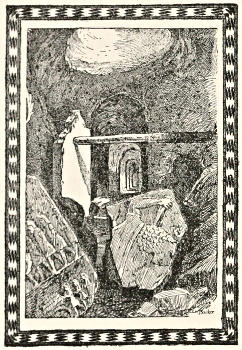
Excavations at Kuyunjik
(Layard)
Whilst detained by unexpected
circumstances at Constantinople, I
entered into correspondence with a
gentleman in England on the subject
of excavations; but, with this
exception, no one seemed inclined
to assist or take any interest in such
an undertaking. I also wrote to
M. Botta, encouraging him to proceed,
notwithstanding the apparent
paucity of results, and particularly
calling his attention to the mound
of Nimrud, which, however, he declined
to explore on account of its
distance from Mosul and its inconvenient
position. I was soon
called away from the Turkish
capital to the provinces; and for
some months numerous occupations
prevented me turning my attention
to the ruins and antiquities
of Assyria.
In the meanwhile M. Botta, not discouraged by the want of success which had
attended his first essay, continued his excavations in the mound of Kuyunjik:
and to him is due the honour of having found the first Assyrian monument.
This remarkable discovery owed its origin to the following circumstances.
The small party employed by M. Botta were at work on Kuyunjik, when a
peasant from a distant village chanced to visit the spot. Seeing that every
fragment of brick and alabaster uncovered by the workmen was carefully
preserved, he asked the reason of this, to him, strange proceeding. On being
informed that they were in search of sculptured stones, he advised them to
try the mound on which his village was built, and in which, he declared,
many such things as they wanted had been exposed on digging for the foundations
of new houses. M. Botta, having been frequently deceived by similar
stories, was not at first inclined to follow the peasant’s advice, but subsequently
sent an agent and one or two workmen to the place.
After a little opposition from the inhabitants, they were permitted to sink
a well in the mound; and at a small distance from the surface they came to
the top of a wall which, on digging deeper, they found to be built of sculptured
slabs of gypsum. M. Botta, on receiving information of this discovery,
went at once to the village, which was called Khorsabad. He directed a
wider trench to be formed, and to be carried in the direction of the wall.
He soon found that he had opened a chamber, which was connected with
others, and constructed of slabs of gypsum covered with sculptured representations
of battles, sieges, and similar events. His wonder may be easily
imagined.
A new history had been suddenly opened to him—the records of an
unknown people were before him. He was equally at a loss to account for
the age and the nature of the monument. The art shown in the sculptures,
the dresses of the figures, the mythic forms on the walls, were all new to
him, and afforded no clew to the epoch of the erection of the edifice, and to
the people who were its founders. Numerous inscriptions, accompanying
the bas-reliefs, evidently contained the explanation of the events thus
recorded in sculpture. They were in the cuneiform, or arrow-headed,
character. The nature of these inscriptions was at least evidence that the
building belonged to a period preceding the conquest of Alexander; for it
was generally admitted that after the subjugation of the west of Asia by the
Macedonians, the cuneiform writing ceased to be employed. But too little
was then known of this character to enable M. Botta to draw any inference
from the peculiar arrangement of the wedges, which distinguishes the varieties
used in different countries. However, it was evident that the monument
appertained to a very ancient and very civilised people; and it was
natural from its position to refer it to the inhabitants of Nineveh—a city,
which, although it could not have occupied a site so distant from the Tigris,
must have been in the vicinity of the place. M. Botta had discovered an
Assyrian edifice, the first, probably, which had been exposed to the view of
man since the fall of the Assyrian Empire.
M. Botta was not long in perceiving that the building which had been
thus partly excavated, unfortunately owed its destruction to fire; and that
the gypsum slabs, reduced to lime, were rapidly falling to pieces on exposure
to the air. No precaution could arrest this rapid decay; and it was to be
feared that this wonderful monument had only been uncovered to complete
its ruin. The records of victories and triumphs, which had long attested
the power and swelled the pride of the Assyrian kings, and had resisted the
ravages of ages, were now passing away forever. They could scarcely be
held together until an inexperienced pencil could secure an imperfect evidence
of their former existence.
Almost all that was first discovered thus speedily disappeared; and the
same fate has befallen nearly everything subsequently found at Khorsabad.
A regret is almost felt that so precious a memorial of a great nation should
have been thus exposed to destruction, when no precaution could keep entire
or secure the greater part of it; but as far as the object of the monument is
concerned, the intention of its founders will be amply fulfilled, and the records
of their might will be more widely spread, and more effectually preserved,
by modern art, than the most exalted ambition could have contemplated.
M. Botta lost no time in communicating his remarkable discovery to the
principal scientific body in France. Knowing the interest I felt in his
labours, he allowed me to see his letters and drawings as they passed through
Constantinople; and I was amongst the first who were made acquainted with
his success. And here I gladly avail myself of the opportunity of mentioning,
with the acknowledgment and praise which they deserve, his disinterestedness
and liberality, so honourable to one engaged in the pursuit of knowledge.
During the entire period of his excavations, M. Botta regularly sent me not
only his descriptions, but copies of the inscriptions, without exacting any
promise as to the use I might make of them. That there are few who would
have acted thus liberally, those who have been engaged in a search after antiquities
in the East will not be inclined to deny.
M. Botta’s communications were laid before the “Académie,” by M. Mohl;
and that body, perceiving at once the importance of the discovery, lost no
time in applying to the Minister of Public Instruction for means to carry on
the researches. The recommendation was attended to with that readiness
and munificence which almost invariably distinguished the French government
in undertakings of this nature. Ample funds to meet the cost of extensive
excavations were at once assigned to M. Botta, and an artist of
acknowledged skill was placed under his orders to draw such parts of the
monument discovered as could not be preserved or removed.
Bas-relief of Fish, Hills, and Trees
With the exception of a few interruptions on the part of the local authorities,
who were suspicious of the objects of the excavations, the work was
carried on with activity and success, and by the beginning of 1845 the
monument had been completely uncovered. The researches of M. Botta
were not extended beyond Khorsabad; and having secured many fine specimens
of Assyrian sculpture for his country, he returned to Europe with a
rich collection of inscriptions, the most important result of his discovery.b
It is indeed a matter for regret there is not the space to continue Layard’s
own account of his discoveries. Professor Hommel has summarised this,
however, in an exceedingly satisfactory manner, and his account is here given.
Brilliant as Botta’s achievements had been, they were quite cast into
the shade by what the English statesman, Sir (then Mr.) A. H. Layard, the
sole discoverer of Nineveh, had accomplished for all branches of investigation
and knowledge of Assyrian antiquity, by means of the excavations, principally
in Kuyunjik and Nimrud, but also in Neby Yunus, Kalah Shergat,
and other mounds of ruins in the neighbourhood of Nineveh; these excavations
were made with the assistance of Hormuzd Rassam, who subsequently
continued them. We remember how, from as far back as the year 1840, it
was Layard’s ardent desire to be able to undertake some excavations. He
had hailed Botta’s lucky find without envy, and was indeed the first who, in
some letters in the Malta Times which afterwards went the rounds of many
European newspapers, directed public attention to the newly discovered
Assyrian royal palace, which Botta at first assigned to the Sassanian period.
Then, in the autumn of 1845, the eagerly-looked-for funds were at last
obtained by the munificence of the English ambassador at Constantinople,
Sir Stratford Canning (afterwards Lord Stratford de Redcliffe), to whom
the British Museum already owed the acquisition of the costly marbles of
Halicarnassus. Thus, towards the end of the year 1845, Layard was able to
begin the excavations. He set to work on the Nimrud pile of ruins, which
lies a distance of five hours to the south of Mosul, and had previously
attracted his attention when Botta was still in Mosul. He laboured under
the greatest difficulties, far greater than those which Botta had to overcome—to
see how far this statement is from exaggeration, Layard’s own account
should be perused—the work having at first to be carried on in profound
secrecy so as to excite as little suspicion as possible in the Turkish authorities
and in the population.
It was not to be long before Layard’s efforts were crowned with success.
By the end of November several bas-reliefs were laid bare, whose execution
appeared to surpass even those of the sculptures of Khorsabad, and which
were accompanied by cuneiform inscriptions. In spite of many interruptions
the work proceeded rigorously, and manifold were the discoveries
thus brought to light. One deserving of special interest was that of the
gigantic head of one of the colossal winged lions, with men’s heads, which the
Assyrians placed at the entrance of their palaces for the sake of spreading terror
amongst the inhabitants of surrounding districts. For it was everywhere
whispered and believed that none other than Nimrod in person had risen
from the earth. All this had occurred in the spring of the year 1846. The
funds for the excavations lasted till the middle of June 1847; and when
Layard returned to Europe he had laid bare in Nimrud no less than three
great Assyrian royal palaces, namely: the grand northwestern palace,
which Asshurnazirpal had built (884-861 B.C.) on the ruins of an ancient
structure (dating from Shalmaneser I, the founder of Calah, circa
1300 B.C.?); the central palace, probably built by Asshurnazirpal’s successor,
Shalmaneser II (a predecessor of the biblical Shalmaneser), where
was found the famous black obelisk; and lastly, Esarhaddon’s once magnificent
southwestern palace (681-669 B.C.). The northwestern palace
yielded the richest spoil: it was also far better preserved than the contents
of Sargon’s palace at Khorsabad, where Botta had made his excavations.
As Sir Stratford Canning had presented the British Museum with everything
moveable which Layard had discovered and brought to light, even at the end
of this first expedition of Layard’s, a collection of Assyrian antiquities
(principally bas-reliefs and inscriptions), such as existed nowhere else, was
despatched to London. The unwearied energy of the discoverer of Nineveh
succeeded in taking it unhurt, first to Bassorah, from whence the valuable
freight was forwarded to the ship—truly not the smallest part of the task
he had begun so gloriously, and now still more gloriously accomplished.
The period which followed was employed by Layard in summarising the
results obtained in a vigorous narrative, furnished with many illustrations,
the work called Nineveh and its Remains, which was published just as
Layard was on the point of going to Assyria for the second time—on this
occasion at the expense of the British Museum. The sensation which the
book created in England was enormous, and its most important result was
that henceforth the government turned its attention to the excavations. So
in 1849 Layard was given leave of absence from his diplomatic post at Constantinople
for the purpose of making new discoveries on Assyrian soil, and
Hormuzd Rassam, who had already been his assistant and happened just
then to be in London, was sent after him (also officially).
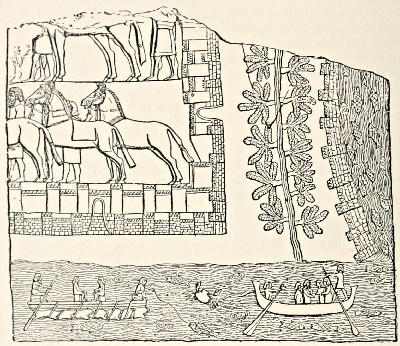
Bas-relief representing a Fortified City, a River with a Boat and Raft, and a Canal
(Found at Kuyunjik.—Layard)
If on the first expedition Layard had done little more than explore Nimrud
(the ancient Calah), the labours of the second (1849-1851), were on
the contrary practically limited to the mounds of ruins of Kuyunjik with
Neby Yunus, the site of Nineveh itself. Here Botta had first begun his
excavations, but entirely without success, for he had merely caused diggings
to be made to the depth of a few feet, and without any method, instead of
making his chief object the remains of the platform, on which the buildings
he was seeking had been erected. And it was here that Layard, at the end
of his first expedition, and after having been obliged to dig twenty feet
down, had discovered Sennacherib’s southwestern palace (705-682 B.C.).
But the real fruits of this discovery were now the object of the second undertaking.
For if in this Layard was still occupied with Nimrud, the work
there was only a species of gleaning, the excavations and discoveries in
Arban, on the Khabur and in Bavian were, in comparison with the rest, only
a short trial-trip, and the main thing still remained the minute investigation
and laying bare of the great southwestern palace in Kuyunjik. It was not
till this was finished that he employed the rest of his time and money in a
visit to Babylonia (at the end of 1850), of which, however, Layard himself
says “that they (i.e. the discoveries amongst the ruins of ancient Babylon)
were far fewer and of far less importance than he had expected”; he also
gave the first exact description of the mounds of Niffer, the ancient Nippur,
southeast of Babylon. All his experiences and all the results of this second
expedition were set down by Layard in the Discoveries in the Ruins of Nineveh
and Babylon, a work, seven hundred pages in length and with many
illustrations, besides plans and maps, which appeared in London as early as
the beginning of the year 1853.
This popular book had, like the former one, a prodigious success, and was
shortly after translated into German; as a supplement to it Layard’s great
publications were announced, namely, that magnificent work, the Monuments
of Nineveh, and a volume of inscriptions which was the forerunner
to the great work on inscriptions published by the British Museum in five
volumes (1861-1884).
But to return to Layard’s excavations which he resumed in the middle of
October, 1849, at the place where he had interrupted them two years before.
It is simply impossible within a short space to give a clear idea of what Layard
and his workmen, assisted by Hormuzd Rassam, brought to light before the middle
of the year 1850 in that southwestern palace of Sennacherib which Asshurbanapal
restored. Any one who would form a clear idea of it must peruse
Layard’s magnificent descriptions of it for himself. Assyrian antiquity
rose from the earth and grew more and more distinct, and so intelligible was
the language of the hundreds of bas-reliefs, that, even without understanding
the inscriptions, every one was in a position to construct for himself a tolerably
clear picture of the manners and customs, the life and occupations, in
short, the whole civilisation of the ancient Assyrians, and this merely from
the illustrations in Layard’s two popular books. But the most important discovery
made in this palace, indeed the most important in its results of all the
Assyrian excavations, was the remains of a regular library of thousands of
clay tablets, which were heaped up in two chambers, covering the floor a foot
thick. These the restorer of the palace, the accomplished king Asshurbanapal
(668 B.C., the Sardanapalus of the Greeks, and Asnapper of the
Bible) had had collected, and had deposited them, partly here, partly (probably
in duplicate) in other palaces, as in particular in the northern palace,
which was also in Kuyunjik, and was discovered by Rassam. The tablets
of gray and yellow clay found in the so-called Lion Room of Asshurbanapal’s
northern palace, were in most cases broken into smaller or larger
fragments, probably because in the general ruin they had fallen down from
the upper story into the space in which they covered the ground; many,
however, were still whole. Of course only later investigation could succeed
in bringing the broken fragments together again, and then only
partially; one of these tablets, restored by piecing together sixteen fragments,
gives the Babylonian story of the Flood, which George Smith
successfully recognised from amongst the thousands of scattered fragments;
the reader will appreciate the condition in which most of these
clay book-pages (to use a paradoxical expression) have come down to us.
The size of the tablets seldom exceeds nine by six and a half inches; but
many, especially tablets containing contracts, were considerably smaller.
The greater number bore the inscription, “Series of tablets …, tablet
number …; Palace of Asshurbanapal, king of the universe, king of
Assyria …,” after which came a series of phrases, mostly stereotyped,
which indicates the tablet in question as belonging to the library of Asshurbanapal,
the great collector of ancient Babylonian literature in Assyrian
character. In the restored tablet of the Flood, the place of the signature
is clearly recognisable on the first of the columns; it is the last of the
columns, for they are always to be counted from right to left (instead of
from left to right). But especially clear to the eye of a layman is the
addition to the signature, which represents a kind of library mark, unlike
that of the specially prized Ishtar hymn in two languages (S. M. 954, British
Museum); the latter differs somewhat from the ordinary tenor of these
signatures, inasmuch as a whole genealogy is put, instead of the sentence
usual elsewhere; translated literally it runs:
“(series:) ir shimma dimmir Ninna.”—Complaint to the goddess Ishtar.
(The usual number of the tablet is not placed here.)
He has written and engraved it like its original.
“Palace of Asshurbanapal, king of Assyria,
Son of Esarhaddon, king of the universe, king of Assyria, ruler of Babylon,
King of Sumer and Accad, king of the kings of Ethiopia and Egypt,
King of the four regions, son of Sennacherib,
King of the universe, king of Assyria, who puts his trust in the god Asshur and the goddess Ninlil, in Nabu and Tashmit.
May the god Nabu be thy guide!”
In general, however, these signatures ran as follows:
(The first word of the tablet following.)
“Xth tablet (of the series beginning thus:).…
“Palace of Asshurbanapal, the king of the universe, the king of Assyria, to whom Nabu
and Tashmit had given ear, who took clear eyes for the preparation (?) of the writing of
tablets, whilst under the kings my predecessors nothing of the kind (nin shipru shu’ atu)
was attempted—the wisdom of Nabu, (tikip santakki), a fullness of beauty, did I write,
arrange, and engrave on tablets; to see and read it I placed it in my palace.”
After which, in some examples, there follows:
“May the light of Asshur, the king of the gods, be thy guide!
Whosoever shall write his name by my name,
May Asshur and Ninlil (Beltis) destroy him and root his name and his seed out of the land!”
The contents of the tablets in which Asshurbanapal caused the wisdom of
the god Nabu (identified by the ancients with Mercury) to be written of in
this fashion, were varied to an extent scarcely conceivable. They contained
the primitive spells and formulas for oaths of the people of Sumer, as well
as the somewhat later hymns to the gods, and penitential psalms of the Accadian
population of northern Babylonia, almost all of them with interlinear
translations into the Semitic language of ancient Babylon; also legends of
Semitic character and epic poems almost as old as the Accadian hymns;
astronomical and astrological texts; historical inscriptions (as, for instance,
those of Agum-kakrime and the ancient Sargon); chronological lists, calendars,
and a great deal besides; all of which was collected by Asshurbanapal and by
him handed down to posterity. It is hard to say in what direction the
literary pieces thus preserved fail to cast a light on the ancient Babylonians
into whose cultivation the Assyrians were, indeed, once initiated, and to
whom they were in all essentials indebted for their own; it is certain that
we should now be acquainted with no single one of those primitive magic
verses, had not Asshurbanapal had them written out afresh. And what
should we know of the Sumerians and Accadians without these songs? But
this is not enough. A great part of the Asshurbanapal library consists
of philosophical aids to the knowledge and acquisition of the Sumerio-Accadian
language, as well as of the Semitic Assyrio-Babylonian, and
to the writing (the so-called syllabary) as well as to the spoken language;
these aids include vocabularies, grammatical paradigms, and even collections
of phrases in two languages.
Whilst Layard was exploring the southwestern palace at Kuyunjik,
adding undreamt-of treasures to those acquired in his first expedition to the
country, and finding quantities of new cuneiform texts of the so-called third
species of the Assyrian genus, so that he seemed to have been the first to
gather the materials for the deciphering of this kind of cuneiform writing, it
had been already completed, at least in the main, by the labours of Saulcy
(1849) and, above all, by those of Henry Rawlinson (1847-1851). Layard’s
book, Nineveh and its Remains, which appeared in 1849, had already introduced
us into the midst of Assyrian antiquity, although the inscriptions which
accompanied the sculptures could not yet give us any further information
elucidating them. But in the Discoveries in the Ruins of Nineveh and
Babylon, which appeared in the beginning of 1853, we already find the
correct interpretation of several Assyrian names of kings, countries, towns,
and gods, and even the correct rendering of the substance of connected historical
inscriptions, which Layard owed to the information communicated in
the interval by Henry Rawlinson and the Irishman, E. Hincks, who had also
brought great acuteness to bear on this department of study. The numerous
fresh historical documents which Layard brought with him could not have
appeared at a more favourable time; above all, the first of the chests containing
Asshurbanapal’s library could not have entered London at a better
moment. For, once a basis was established for the reading of the cuneiform
writing of the Babylonian and Assyrian languages, all that was needed to
advance along the path so successfully entered upon was new texts, and
these now began to flow in, in abundance.c
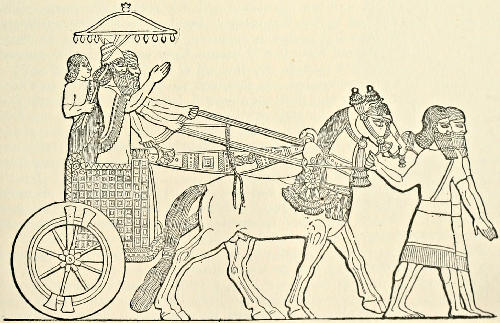
Bas-relief representing Tiglathpileser III
(Found at Nimrud.—Layard)
The work of exploration rested entirely between the years 1855 and
1872. Great progress was made, however, in the decipherment of inscriptions
and the popularisation of the results, and the mind of the public was
prepared to appreciate the greatness of the work that was to follow.
The importance of George Smith’s decipherment in 1872 of the Babylonian
story of the Deluge was at once recognised, and led to his being sent
to Nineveh in January, 1873, under the auspices of the Daily Telegraph.
As soon as he had discovered some further fragments of the deluge story,
however, the newspaper was satisfied, and he was recalled. On a second
expedition, sent out in the same year by the British Museum, Smith made
no startling discoveries. Smith’s work, while small in amount when compared
with that of the early explorers, brought to light much valuable
material, and aroused great enthusiasm in England. The British Museum
sent him on a third expedition in 1876; but he was prevented from making
any excavations, and died of fever on his way back.
The next expedition, that of Hormuzd Rassam in 1877, resulted, among
other things, in the identification of the site of Sippar, and the discovery
of numerous interesting inscriptions and of some beautifully ornamented
inscribed bronze plates that had adorned the gates of the palace of
Shalmaneser II.
In this same year, 1877, M. Ernest de Sarzec, then just appointed French
consul at Bassorah on the Persian Gulf, began that series of brilliant
explorations which he has carried on more or less continuously ever since.
His enthusiasm for archæological research was backed by an extensive
knowledge of the conditions of the country, and his efforts were rewarded
with an unusual degree of success from the very start.
The first four years were devoted to an extensive and systematic excavation
of Telloh, a great mound about five miles from the Shatt-el-khai,
in southern Babylonia, and now identified with the ancient Shirpurla. The
first season was marked by the discovery of two large terra-cotta cylinders,
twenty-four inches long and twelve in diameter. The inscriptions on these
cylinders, which contained fully two thousand lines each, were the longest
then known from an early period. By the end of the four seasons of work a
great temple had been uncovered, one hundred and seventy-five by one hundred
feet in dimensions, and built on a mound from sixteen to twenty feet
high. The bricks of the outer wall, which was five feet thick, were one foot
square and bore the name Gudea. The objects found in the interior of the
temple have proved very important to early Babylonian history. One room
contained eight statues of an early period, all headless, however, having been
mutilated by barbarians of a later time.
Scarcely less important was De Sarzec’s discovery in 1894 of a chamber
in which were found thirty thousand tablets. While a considerable proportion
of them were religious documents, most of these tablets were
commercial, agricultural, and industrial archives.
The Louvre has profited greatly by the work of De Sarzec, for a large
part of his discoveries has found its way thither.
The American expeditions have been among the most successful ones
in this field. The Wolfe expedition of 1884-1885—so called from Miss
Catherine Lorillard Wolfe, who defrayed its expenses—confined its work
to a thorough exploration of the whole field, not only visiting the sites
of previous excavations, but examining many new mounds as well. The
succeeding expeditions have been sent out under the auspices of the University
of Pennsylvania. The first one, in 1888-1889, under the direction of
Dr. John P. Peters, with Professors H. V. Hilprecht and R. F. Harper as
Assyriologists, began excavations at Niffer, the site of ancient Nippur.
They had many difficulties with native tribes and Turkish officials, but
succeeded in making a trigonometrical survey of all the mounds and obtaining
a great number of antiquities of all sorts. Dr. Peters, however, modestly
characterises the expedition as “more or less of a failure.”
In 1890 work was begun again. Thousands of tablets and various
kinds of objects were obtained, and were all sent to the Imperial Museum
at Constantinople. Professor Hilprecht was sent to Constantinople to
catalogue the finds. He did the work with great skill and tact, and the
Sultan repaid the University of Pennsylvania for his services by the gift of
a large part of the collection.
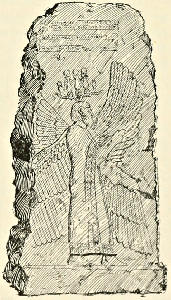
Assyrian Stele
The third expedition was sent out in 1893 under the direction of Mr.
J. H. Haynes, who had been the business manager of the first two. With
a single brief interruption of two months in 1894 he carried on the work
steadily until 1896, accomplishing what no European had ever ventured to
attempt before. This expedition and the fourth one, which set out under
Haynes in 1899 and was joined by Hilprecht in 1900, procured many
thousands of tablets and antiquities of other kinds. These finds have
enriched the store of Babylonian literature with vast quantities of texts,
religious, commercial, and historical.
The first German expedition, in 1897, like the first American, simply
explored Babylonia and Assyria. Then in 1899 Dr. Robert Koldewey, who
had been a member of the first expedition, accompanied
by Dr. Bruno Meissner, went out under
the auspices of the German Orient Society. They
went to work at the mound of El-Kasr, Babylon,
which covers the remains of the palace of Nebuchadrezzar.
Their first success was in the finding
of a new Hittite inscription and many tablets
of the Neo-Babylonian period. Great results may
be expected from their future work.
The Turks, themselves, have naturally the best
opportunity for carrying on the work of exploration,
for they can count upon the support instead
of the opposition of the officials, and can keep the
natives under control. Thus far one expedition
has been sent out. It was under the direction
of Father Scheil, a distinguished Assyriologist, a
French Dominican. Its complete success shows
that if the Turkish government can once be
aroused to the importance of the work, greater
discoveries may be expected.
One of the most important discoveries of cuneiform
inscriptions was made at Tel-el-Amarna in Egypt in 1888. From these
tablets, which are letters and despatches of Amenhotep III and Amenhotep
IV and of many monarchs of western Asia, much valuable chronological
material has been obtained, as well as much light upon social relations.
The great discoveries of the past thirty years are but an inspiration to
further exploration. The work is bound to be carried on until the buried
cities have been completely brought to light again.ad
We have followed the story of the excavations in Babylonia and Assyria
with some detail because of the unique character of the record. It remains
now to examine the results of these excavations in their bearings upon the
story of history. For, of course, it is the material supplied by the workers
in this field rather than the work itself which has pertinence in the present
connection.
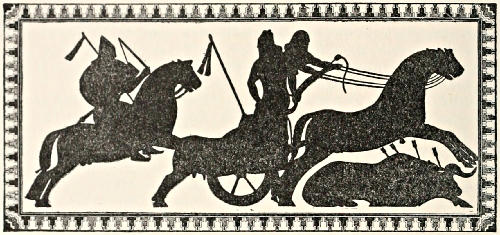
Hunting Scene from a Bas-relief in the Palace of Asshurnazirpal
Great numbers of historical documents have been restored to us, sufficing,
as has already been suggested, to rebuild the history of the all but forgotten
nations. Such historical documents as are not to be found in connection
with Greece or Rome, or even of the civilisation of the Middle Ages down
to about the tenth century A.D., are supplied us from the ruins of the
Babylonian and Assyrian cities. These documents, as already pointed out,
are in the form of inscriptions on fragments of brick. These inscriptions,
in an altogether unknown character, were at first enigmatic, but oriental
scholarship soon availed to decipher them. The story of this decipherment
must be outlined here for comparison with the account of the decipherment
of the Egyptian hieroglyphics, which has already been presented. In no
other cases except these two has the historian been called upon to deal with
a great mass of documents written in an absolutely dead language. It must
be remembered that the so-called dead languages of the classical world were
never really forgotten. All through the Middle Ages there were numberless
scholars who had an expert knowledge of Greek and Latin. Indeed,
these languages were the current medium of scholarly intercourse throughout
the dark ages. But the Babylonian and Assyrian languages, like the
Egyptian, were dead in the fullest significance of the term; that is to say,
they were utterly unknown to any human being for a period of more than
two thousand years. Their restoration was one of the marvels of nineteenth-century
scholarship; and while the details of this feat of scholarship do not
properly come within the province of the historian in the narrower sense,
they have such universal interest that we shall do well to present at least
their outline here.
Before turning to the story of decipherment, however, it will be well to
gain an idea as to the number and the variety and character of the historical
documents in question. And perhaps the best way to do this will be to
take a glance at the contents of the Assyrian collections in the British
Museum, giving particular attention to the marvellous library of King
Asshurbanapal, one of the last of the great rulers of Assyria—a remarkable
collection of books, the discovery of which has been already referred to in
the previous section. Nothing could give one a more vivid realisation of
the character of this ancient oriental civilisation than the most casual
glance at the sample books from this old library. Having inspected, however
casually, this marvellous set of documents, one is prepared to take up
the chronological history of the Babylonians and the Assyrians with a fresh
interest based upon the comprehension that this people, so long regarded as
scarcely more than mythical, possessed a civilisation strangely comparable
in many essential features to the civilisation of our own time.a
The most casual wanderer in the British Museum can hardly fail to
notice two pairs of massive sculptures, in the one case winged bulls, in the
other, winged lions, both human-headed, which guard the entrance to the
Egyptian hall, close to the Rosetta stone. Each pair of these weird creatures
once guarded an entrance to the palace of a king in the famous city of
Nineveh. As one stands before them his mind is carried back over some
twenty-seven intervening centuries, to the days when the “Cedar of
Lebanon” was “fair in his greatness” and the scourge of Israel. A wave
of emotion sweeps over one when he first sees them, and Byron’s stirring
lines, reminiscent of school-day oratory, ring in the memory:
The Assyrian came down like the wolf on the fold,
And his cohorts were gleaming in purple and gold,
And the sheen of their spears was like stars on the sea,
When the blue wave rolls nightly on deep Galilee.
The Assyrian! The ruler of Nineveh! For two thousand five hundred
years he was only a name and a memory; yet here stand great monuments
to testify to the reality of his sometime greatness.
These huge lions are pertinent in the present connection because of the
inscriptions that are graven across their pedestals. A glance reveals the
strange characters in which these records are written, graven neatly in
straight lines across the stone, and looking, to casual inspection, like nothing
else so much as random flights of arrow-heads. The resemblance is so striking
that this is sometimes called the arrow-headed character, though it is
more generally known as the wedge or cuneiform character. A strange
writing this. It seems almost incredible that it can really be susceptible of
interpretation and translation into a modern language. And, indeed, the
feat of interpreting it was one of the greatest achievements of nineteenth-century
scholarship; but of this we shall have more to say in a moment.
But importance aside, what an interest must now attach to objects with
such a history as belongs to these! The very sculptures before us, for
example, were perhaps seen by Jonah when he made that famous voyage to
Nineveh some seven or eight hundred years B.C. A little later the Babylonian
and the Mede revolted from Assyrian tyranny, and descended upon the
fair city of Nineveh, and almost literally levelled it to the ground. But
these great sculptures, among other things, escaped destruction, and at once
hidden and preserved by the accumulating débris of the centuries, they
stood there age after age, their very existence quite forgotten. When
Xenophon marched past their site with the ill-starred Expedition of the Ten
Thousand, in the year 400 B.C., he saw only a mound which seemed to
mark the site of some ancient ruin; but so ephemeral is fame that the Greek
did not suspect that he looked upon the site of that city which only two
centuries before had been the mistress of the world.
So ephemeral is fame! And yet the moral scarcely holds in the sequel;
for we of to-day, in this new, undreamed-of Western world, behold these
mementoes of Assyrian greatness, fresh from their twenty-five hundred
years of entombment, and with them records which restore to us the history
of that long-forgotten people in such detail as it was not known to any
previous generation since the fall of Nineveh. For two thousand five hundred
years no one saw these treasures or knew that they existed. One
hundred generations of men came and went without once pronouncing the
names of Kings Asshurnazirpal or Asshurbanapal. And to-day, after centuries
of oblivion, these names are restored to history, and, thanks to the
character of their monuments, are assured a permanency of fame that can
almost defy time itself. It would be nothing strange, but rather in keeping
with their previous mutations of fortune, if the names of Asshurnazirpal
and Asshurbanapal should be familiar household words to future generations
that have forgotten the existence of an Alexander, a Cæsar, and a
Napoleon. For when Macaulay’s prospective New Zealander explores the
ruins of the British Museum, the records of the ancient Assyrians will presumably
be there unscathed, to tell their story as they have told it to our
generation, although every manuscript and printed book may have gone the
way of fragile textures.
But the past of the Assyrian sculptures is quite necromantic enough
without conjuring for them a necromantic future. The story of their restoration
is like a brilliant romance of history. Prior to the middle of the
nineteenth century the inquiring student could learn in an hour or so all
that was known in fact and in fable of the renowned city of Nineveh. He
had but to read a few chapters of the Bible and a few pages of Diodorus to
exhaust the important literature of the subject. If he turned also to the
pages of Herodotus and Xenophon, of Justin and Ælianus, these served
chiefly to confirm the suspicion that the Greeks themselves knew almost
nothing more of the history of their famed oriental forerunners.
The current fables told of a first king Ninus and his wonderful queen,
Semiramis; of Sennacherib, the conqueror; of the effeminate Sardanapalus,
who neglected the warlike ways of his ancestors, but perished gloriously at
the last, with Nineveh itself, in a self-imposed holocaust. And that was all.
How much of this was history, how much myth, no man could say; and
for all any one suspected to the contrary, no man could ever know. And
to-day the contemporary records of the city are before us in such profusion
as no other nation of antiquity, save Egypt alone, can at all rival. Whole
libraries of Babylonian documents are at hand that were written twenty or
even thirty centuries before our era. These, be it understood, are the original
books themselves, not copies. The author of that remote time speaks to
us directly, hand to eye, without intermediary transcriber. And there is
not a line of any Hebrew or Greek inscriptions of a like age that has been
preserved to us; there is little enough that can match these ancient books
by a thousand years. When one reads of Moses or Isaiah, Homer, Hesiod,
or Herodotus, he is but following the transcription—often unquestionably
faulty, and probably never in all parts perfect—of successive copyists of
later generations. The oldest known copy of the Bible, for example, dates
from the fourth century A.D.—1000 years after the last Assyrian records
were made, and read, and buried, and forgotten.
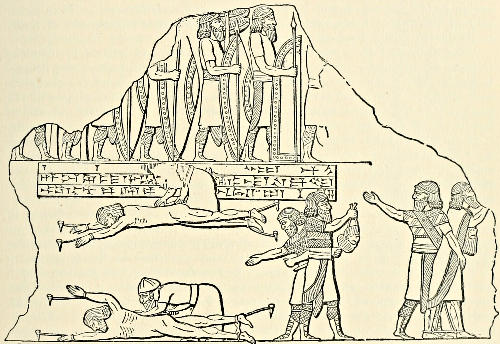
Bas-relief from an Assyrian Palace, showing Assyrian Soldiers, Prisoners being flayed
alive, Cuneiform Inscriptions, etc.
As to the earlier Mesopotamian records, they date back some 5000—perhaps
7000—years B.C.: at least 1000 years before the period assigned
by Archbishop Usher’s long-accepted Chronology for the creation of the
world itself. Solomon, who lived about 1000 B.C., is accredited with the
declaration that “of the making of many books there is no end.” Modern
exegesists tell us that it was not Solomon, but a later Alexandrian interloper,
who actually coined the phrase; but nevertheless it appears that the
saying would have been perfectly intelligible, in Mesopotamia, not merely
to Solomon’s contemporaries, but to generations that lived long before the
Jewish nation, as such, came into existence. At all events, there was at
least one king of Assyria—namely, Asshurbanapal—who lived only a few
generations after Solomon, and whose palace boasted a library of some
10,000 volumes—a library, if you please, in which the books were numbered
and shelved systematically, and classified, and cared for by an official
librarian. From this library, records have come to us during the past half-century
that have reconstructed the history of Asiatic antiquity.
If you would care to see some of these strange documents, you have but
a little way to go from the site of the winged lion here in the British Museum.
Meantime, there are other sculptures here which you can hardly pass unnoticed.
As we pass the human-headed lions and enter the hall of Asshurnazirpal,
we shall see other evidences of Assyrian greatness that might easily
lead our thoughts astray from the writing. Here, forming the wall, are bas-reliefs
on which the famous scene of the lion hunt is shown; a little farther
on are all manner of war scenes; and there some domestic incidents, the
making of bread or a like comestible, and its baking in an oven; and there
again is the interior of a stable with a man gravely grooming a horse much
as it might be done in any stable to-day.
All these must not be allowed to distract our attention, for these graphic
illustrations have nothing directly to do with writing. Here, however, at
the end of the hall, are some other bas-reliefs more pertinent to our present
inquiry. That winged god, for example, carrying a fawn, has a fine flight
of arrows across the background and figures alike, differing in the latter regard
from the lion we have just left. In the hall just beyond are some illustrations
of a different combination of picture and text. Here is the famous
obelisk of Shalmaneser, which, like all the things thus far noted in the Assyrian
collection, was found by Sir Henry Layard at Nineveh. It is virtually
an illustrated book, telling in word and text of the conquest of many
countries by King Shalmaneser II.
The figures of the upper row report the payment of tribute by “Sua of
Gilzani, who brought silver, gold, lead, vessels of copper, horses, and dromedaries.”
It will be observed, of course, that only one side of the obelisk is
here shown. The other three sides in each case depict other phases of the
payment of the tribute by the same conquered enemy. The second tier of
figures is of peculiar interest, because it shows the payment of tribute by
“Yaua, the son of Khumri.” This is, as the Bible student interprets
it, “Jehu, the son of Omri.” The conquered Israelite brings “silver
and gold, lead and bowls, dishes, cups, and other vessels of gold,” and
the forms of these vessels, as well as the costumes of the Hebrews themselves,
are well shown in the illustrations. The third row of figures represents
the “payment of the tribute of the land of Musri, consisting of
dromedaries, buffaloes, elephants, apes, and other animals.” The grotesque
figures of the alleged apes, with their altogether human heads, are suggestive
as showing how these strange foreign animals appealed to the imagination
of the Assyrian artist, causing him to depart from that fine realism which
he brought to bear upon the delineation of more familiar animals. The
fourth set of pictures shows the payment of tribute of the land of Sukhi,
and the fifth a not dissimilar tribute from the country of Patin. The inscriptions
at the top and base of the obelisk give details of the conquests,
recording among other things how Shalmaneser captured 1121 chariots and
470 battle horses and the whole camp of Hazael, king of Damascus.
Perhaps the most curious example of economy of material in a makeshift
book that the Assyrian collection at the British Museum has to show, is
illustrated in the figure of the god Nabu, which forms part of the Nineveh
collection, and which stands in the hall just beyond the obelisk of Shalmaneser.
Here, as a glance at the illustration will show, the skirt of the
robe of the human figure is used as a ground for an elaborate inscription.
The effect is rather decorative and distinctly unique. This figure has the
further interest of affording an illustration of what the Assyrian artist
could do when he adopted the expedient, for him unusual, of working in
the round. The great masterpieces of Assyrian art were modelled in bas-relief.
Occasionally, however, the artist attempted the full figure, as in
the present case; but it can hardly be claimed that the success of this is
at all comparable with that attained by the other method. There are low
reliefs in the hunting scenes contained in the dining-hall of Asshurbanapal,
as represented here in the British Museum, that are real works of art. The
wounded lioness dragging her haunches, the hunted goats, the pacing wild
asses, are veritable masterpieces. No such claim can be made for the god
Nabu or for any other full statue that the excavations of Nineveh have
revealed. But on the other hand the texture of the skirt of this god gives
it an abiding interest of a unique character.
A further interest attaches to this statue, as to many others of the
Assyrian monuments, because of its bearing upon the religion of that
famous people. Until the discovery of these long-buried monuments, practically
all that was known of the religion of the Babylonians and Assyrians
was contained in the pages of Herodotus. Strange
tales he tells of what he saw in the temples of Babylon,
where, as he alleges, all the women of the city,
of whatever class or rank, were obliged at least once
in a lifetime to prostitute themselves for hire. The
inscriptions on the monuments tell us nothing of
such practical phases of worship as this, but they
do show that the Assyrians were an intensely religious
people, closely comparable in that regard to
their cousins the Hebrews. Their religion, too, it
would appear, was of that firmly grasped self-sufficient
kind which puts aside all doubt; which
assumes as a primordial fact that one’s own view
is right; that one’s gods are the only true gods, and
that all the outside world must be regarded as one’s
proper prey. A further illustration of this phase
of the subject will claim our attention when we
come to examine the religious writings of the Assyrians
a little more in detail.
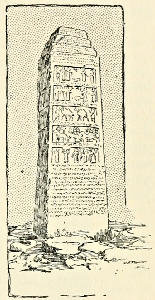
Obelisk of Shalmaneser II
(Now in the British Museum)
Another illustration of a curiously Assyrian combination
of art and letters is shown in the sculptured
lion that guards the entrance to the next hall. This
lion is a memento of the same reign as that human-headed
one at the other doorway, but it is very different in workmanship,
and clearly the product of another artist. For one thing it is a
veritable lion, not a mythical compound beast, except, indeed, that it shares
with the other the peculiarity of a fifth leg. Assyrian tastes seem to have
required that four legs should be visible from whatever point of view the
statue of an animal was regarded; hence the anomaly. For the rest, this
gigantic beast shows many points of realistic delineation, and it is artistically
full of interest. The head in particular expresses feeling in a most
unequivocal way.
But the most curious characteristic of this sculpture is the way in which
the writing is carried from the slab right across the body of the animal
itself, and also across its front legs. Perhaps this was done at the command
of the king, merely as a convenient expedient that all the desired records of
the conquest might be given a place, but the effect at a little distance is
curiously as if the artist had striven to get the feeling of hair in a stiff and
formal manner, in keeping with the conventional rendering of the mane.
Again it has been suggested that the writing has been carried across the
body of the lion to safeguard it. There was a not unusual custom among
ancient monarchs of scraping out the inscription of a predecessor and supplanting
it with one’s own. So great a monarch as Ramses II, in Egypt,
did not scruple to do this, and a remarkable case is shown on an Arabian
temple where the conscienceless monarch actually substitutes his own name
for the correct one of the builder, in a tablet claiming authorship of the
temple of which the tablet is a part. That the kings of Assyria had occasion
to fear such jugglery is shown by the inscriptions on the book tablets in the
royal library at Nineveh, where Asshurbanapal, after telling that the books
are of his library, calls a curse upon any one who shall ever put another
name beside his own. Perhaps, then, King Asshurnazirpal thought to
transmit a record of his deeds more securely to posterity by inscribing them
across the back of this lion, for doubtless the sculpture was considered a
masterpiece, and the king felt, we may suppose, that artistic taste might
prevent a sacrilege which mere conscience would not interdict.
We come now to the place in the British Museum in which some of these
treasures of the old Assyrian king are guarded. They occupy part of the
series of cases placed down the centre of the room known as the Nineveh
Gallery. Perhaps it is not too much to speak of these collections as forming
the most extraordinary set of documents of all the rare treasures of the British
Museum, for it includes not books alone, but public and private letters,
business announcements, marriage contracts—in a word, all the species of
written records that enter into the everyday life of an intelligent and cultured
community.
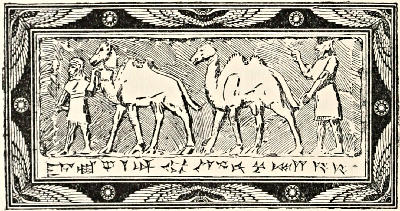
Detail from the Obelisk of Shalmaneser II
But by what miracle have such documents been preserved through all
these centuries? A glance makes the secret evident. It is simply a case of
time-defying materials. Each one of these Assyrian documents appears to
be, and in reality is, nothing more or less than an inscribed fragment of
brick, having much the colour and texture of a weathered terra-cotta tile
of modern manufacture. These slabs are usually oval or oblong in length,
and an inch or so in thickness. Each of them was originally a portion of
brick clay, on which the scribe indented the flights of arrow-heads with some
sharp-cornered instrument, after which the document was made permanent
by baking. They are somewhat fragile, of course, as all bricks are, and many
of them have been more or less crumbled in the destruction of the palace at
Nineveh; but to the ravages of mere time they are as nearly invulnerable as
almost anything in nature. Hence it is that these records of a remote civilisation
have been preserved to us, while the similar records of such later
civilisations as the Grecian have utterly perished; much as the flint implements
of the cave-dweller come to us unchanged, while the iron implements
of a far more recent age have crumbled away.
Consider even in the most casual way the mere samples that are exhibited
here in the museum. This first case, the label tells us, contains tablets—sample
leaves, if you will—from the famous “Creation” and “Deluge”
series. That is to say, from the book which has been called the Chaldean
Genesis, and which excited such a furor of attention when George Smith of
the British Museum first deciphered part of its contents, because it seemed
to give so striking a clew to the origin of the sacred book of the Hebrews.
The Hebrew legends are very differently received to-day from what they
were even fifty years ago, thanks to the advance of science; but these Chaldean
stories of the creation and destruction of mankind still have absorbing
interest as historical documents in the story of the mental evolution of our
race, both for what they teach of the ideas of remote generations of men, and
for what they taught the generation of our immediate predecessors about the
true status of comparative mythology.
It will be recalled that the Assyrians were Semites closely related to the
Hebrews. Indeed, tradition held that Father Abraham, in common with the
ancestors of the Assyrians, came from the land of the Chaldeans. It is not
surprising, therefore, to find that these sacred books of the Assyrians are
replete with the same traditions and give expression to much the same cast
of thought as the sacred books of the Hebrews. Thus, here we have a closely
comparable account of the creation of the world out of primeval chaos and of
the destruction of all but a favoured few in a universal deluge. Even the
story of the sending out from the ark of first one bird and then another,
until finally the raven found a place to alight, when the ark itself had
stranded on a mountain top, is reproduced with such closeness of detail as
practically to demonstrate a common origin of the two traditions.
Here, again, is a story of how Sargon, an early king of Agade, was cast
away, Moses-like, in a basket, to be rescued from the waters of the Euphrates
by a compassionate discoverer of his plight. There is even a tablet which
gives intimations of the story of the building of the Tower of Babel. And
with it all there is imbued the same black, dreadful view of life that actuated
the authors of the Old Testament. Always we are made to feel the threat
of the angry deity; always this religion is a religion of fear. Generosity,
brotherly love, compassion, morality—in a broad sense these words play but
little part in the terminology of the Semite. The Semitic conqueror was
notorious for his cruelty. He loved to persecute his victim, to crucify him,
to flay him alive. The writers of the Hebrew and of the Assyrian books
alike record these deeds without a shudder. They show to the psychologist
a race lacking in imagination, which is the mother of sympathy, but imbued
through and through with egotism. The legends of the sacred books give
further evidence of these same traits. Here before us, among the other tablets
just noted, are the famous stories of the descent of Ishtar, the Goddess
of Love, into the nether regions, and of the trials and perils which she
encountered there, and those that fell upon the outside world because of her
absence. It is recorded that when finally a messenger was sent from a superior
power demanding her release, the powers of the nether world gave her
up unwillingly, but retained the innocent messenger to torture in her stead;
and it probably never occurred to the mind of the Assyrian soothsayer that
it might have been within the power of the superior gods to release the innocent
messenger as well.
Another famous set of tablets records the adventures of Gilgamish, whose
heroic trials and mighty deeds suggest the Hercules of the Greeks. All in
all, these religious and mythological texts give us the closest insight into
the moral nature of the Assyrian, not merely during the period of Asshurbanapal,
but for many generations before, since these sacred books are in
the main but copies of old Babylonian ones, dating from the most remote
periods of antiquity.
The tablets of the next case illustrate a different phase of Assyrian
mental activity. They are virtually books of reference, and schoolbooks—that
is, “Grammatical Tablets, Lists of Cuneiform Signs, Explanatory
Lists of Words, etc.—drawn up for use in the Royal Library at Nineveh.”
They include a tablet of “words and phrases used in legal documents, to
serve as grammatical examples; one column being in the Sumero-Accadian
language, the other an Assyrian translation; also lists of a verbal formation,
and an explanatory list of words”—a dictionary, if you please! Even more
remarkable is a tablet giving a list of picture characters with the archaic
forms of cuneiform signs to which they were thought to correspond; this
list being supplemented by another in which the archaic forms themselves
are interpreted with the “modern” equivalent. This tablet shows that,
in the belief of the ancient Assyrian, the cuneiform character had been
developed, at a remote epoch, from a purely historical writing (as was
doubtless the case), but that the exact line of this development had faded
from the memories of men in the latter-day epoch of the seventh century B.C.
In the case beyond are tablets with lists of “Names of Birds, Plants,
Bronze Objects, Articles of Clothing, etc., for reference as an aid to writing
literary compositions.” Then lists of officials, and other documents relating
to the history of Babylonia-Assyria, including historical inscriptions of Sennacherib.
Beyond, a set of letters, public and private, mostly inscribed on
oval bits of clay, three or four inches long, and sometimes provided with
envelopes of the same material. Of this numerous collection of letters, the
one that attracts most popular attention is that in which King Sennacherib
refers to certain objects given by him to his son Esarhaddon. This is commonly
known as the “will of Sennacherib.” Near this is another letter that
is interesting because it is provided with a baked-clay envelope, into which
the letter slipped as a kernel of a nut into its shell. The envelope bears the
inscription, “To the King, my Lord, from Asshur Ritsua,” and it is authenticated
by two impressions of the writer’s seal.
This use of seals, by-the-bye, is quite general, particularly in the case of
official documents. Sometimes, as in the case of a contract tablet shown
here, the witness, in lieu of seal, gives the stamp of his finger nail, this being
equivalent, I suppose, to “John Doe, his mark.” It is hardly to be supposed
that the average Assyrian could write any more than the average
Greek or Roman could, or, for that matter, the average European of a
century ago. The professional scribe did the writing, of course, whence the
necessity for seals to assure authenticity of even ordinary letters. Doubtless
the art of gem engraving, which the old Chaldeans carried to amazing perfection,
followed by the Greeks and Romans, has been allowed to decline in
recent generations largely because the increasing spread of education—not
to mention gummed envelopes—made seals less and less a necessity.
Perhaps the art may be revived in the age of the typewriter. But if one
stops to speak of seals, he could hardly be restrained from rushing off to the
wonderful collection in the gem department of the British Museum, where
the Græco-Roman intaglios would drive all thought of other collections
from his head,—though even there the Cyprian finds would lead him back
irrevocably to the Babylonian model,—whereas, for the moment, our true
concern is not with seals of any sort, but with the documents they are
purposed to authenticate.
These documents are of the strangest assortment; and yet not strange,
so precisely similar are they to the official records of modern communal
existence. Thus here is one tablet, of about the year 650 B.C., recording
the sale of a house. There another tells of the leasing of certain property,
for a term of six years, for twelve shekels of silver. And, capping the
climax, here are tablets recording the loan of money, veritable notes, with
even the rate of interest—twenty per cent—carefully prescribed. One
learns that the money broker did a thriving business in old Nineveh. How
near to us those days are, after all!
And nearer yet they seem when we pass to the cases of the tablets of
omens and forecasts based upon the position of the stars and planets, the
actions of animals and reptiles, the flight of birds, and the appearance of
newly born offspring. For when superstition is in question all races are
kin, and all times are contemporary. The European of to-day who shudders
when he sees the moon over his left shoulder, is brother in spirit to the
Assyrian astrologer who used this “astrolabe” to forecast the events of his
own immediate future. And these incantations, religious and magical rites,
prayers, hymns, litanies—do they not make it clear that the Assyrian was
indeed our elder brother? Does this lifted veil then show us a vista of three
millennia, or only of as many generations? At least it serves to bring home
to us—and I doubt if any other exhibit could do it as forcibly—how slow,
how snail-like is the rate of human progress. Yet, after all, how vain this
moralising; for who does not know that the day when Nineveh saw its
prime was only the yesterday of human civilisation? If one doubted it
before, he can doubt no longer, since he has wandered down the rooms in
which the relics from the library of Asshurbanapal are exhibited, glancing
thus casually at the accommodating English labels.
Naturally, the stock of material bearing upon this topic has been constantly
increased by new explorations, notably by those of Oppert at Nineveh,
and of De Sarzec at Telloh, by which the French Government has supplemented
the early collections of the pioneer of the work, Botta; by various
German exploring companies; and, more recently, by the American exploring
expedition of the University of Pennsylvania, under Dr. John P. Peters,
which secured such important results at Nippur. But the greatest repository
of all still remains that which Layard and his assistant and successor in the
work, Rassam, followed by George Smith, secured for the British Museum.
The other collections afford important sidelights; but the main story of
Assyrian life and history, as at present known to us, is told only by the books
from the wonderful library of the palace of Asshurbanapal at Nineveh; and
these can be studied only in the British Museum, or in the publications which
the workers of that institution have from time to time given to the world.
After glancing at these documents for the first time, none but a heedless
person can fail to have brought home to him a more vivid picture of the life
of antiquity, and a truer historical perspective than he can previously have
possessed. For more than two thousand years Greek culture has dominated
the world, and it has been the custom to speak of the Greek as if he were the
veritable inventor of art and of culture; but these documents have led
to a truer view. Here one looks back, as it were, over the heads of the
Greeks, and catches glimpses of a people that possessed a high civilisation
when the Greeks were still an upstart nation, only working their way out of
barbarism.
Now it appears to be nothing less than a law of nature that every nation
should look with contempt upon every other nation which it regards as
contemporary. With a highly artistic people, whose chief pride is their
artistic taste, this feeling reaches its climax. The Greek attitude in this
regard is proverbial. But it is just as fixed a law of nature that every nation
should look with reverence upon some elder civilisation. The Romans
adopted the Greek word “barbarian,” and applied it to all other nations—except
the Greeks. The Greeks did not return the compliment. For them
the Romans were parvenus—parvenus to be looked on with hatred and contempt.
I doubt not the Athenian child gave the deadliest possible insult to
his playfellow when he called him a Roman; just as the Parisian child of
to-day reserves the appellation “anglais” as the bitterest anathema of his
vocabulary. But when the Greek turned his eyes in the other direction, and
looked out upon Egyptian and Babylonian civilisation, he was gazing into
the past, and his contempt changed to reverence, precisely as with the
Frenchman of to-day, who looks back with reverence upon the civilisation
of ancient Greece and Rome, while utterly contemning all phases of the
nineteenth-century civilisation save his own.
It was gladly admitted by the Greeks that these oriental civilisations
had flowered while Greek culture was yet in the bud. Solon, the law-giver,
was reported to have travelled in Egypt, and to have been mildly patronised
by the Egyptian priests as the representative of an infant race. Herodotus,
though ostensibly writing of the Persian war, devotes whole sections of his
history to Egypt, and accepts, as did his countrymen, the Egyptian claims
to immense antiquity without a scruple. Plato even resided for some years
in Egypt, as Diodorus tells us, in the hope of gaining an insight into the
mysteries of oriental philosophy.
Regarding the Assyrio-Babylonians, apparently hardly any story was too
fanciful to gain a measure of credence with the classical world. Herodotus,
to be sure, only credits the Assyrians with ruling for five hundred and
twenty years before the overthrow of Nineveh; and Diodorus, following
Ctesias, raises the figure only to about one thousand four hundred years.
But these figures were probably based on a vague comprehension that
Assyria proper had a relatively late period of flowering, as was, indeed, the
fact; and the rumours regarding the age of Babylonian civilisation as a whole
may be best illustrated by recalling that Cicero thought it necessary to
express his scepticism regarding a claim, seemingly prevalent in his time,
that Babylonian monuments preserve astronomical observations dating back
over a period of two hundred and seventy thousand years. Pliny, on the
other hand, quoting “Epigenes, a writer of first-rate authority,” claims for
the astronomical records only a period of seven hundred and twenty years,
noting also that Berosus and Critodemus still further limit the period to
four hundred and eighty years. But the very range of numbers shows how
utterly vague were the notions involved; and Pliny himself draws the
inference of “the eternal use of letters” among the Babylonians, indicating
that even the minimum period took the matter beyond the range of western
history.
But for that matter nothing could be more explicit than the testimony of
Diodorus, who, writing some three centuries after what we now speak of as
the “golden age” of Greece, plainly indicates that not Greece but Mesopotamia
was looked to in his day as the classic land of culture. And we
of to-day are enabled—the first of any generation in our era—to catch
glimpses of the data on which that estimate was based, and to understand,
by the witness of our own eyes, that the fabled glory of ancient Assyria
was no myth, but a very tangible reality.

Assyrian Letter of Baked Clay and Fragment of its Broken Envelope
(Now in the British Museum)
But all along we have followed the story of these strange books, taking
for granted their meaning as interpreted on the labels, and ignoring for
the moment the great marvel about them, which is not that we have the
material documents themselves, but that we have a knowledge of their
actual contents. The flights of arrow-heads on wall, on slab, or tiny brick
have surely a meaning; but how has any one guessed that meaning?
These must be words—but what words? The hieroglyphics of the
Egyptians were mysterious in all conscience; yet, after all, their symbols
have a certain suggestiveness, whereas there is nothing that seems to
promise a mental leverage in the unbroken succession of these cuneiform
dashes. Yet the Assyrian scholar of to-day can interpret these strange
records almost as readily and as surely as the classical scholar interprets a
Greek manuscript. And this evidences one of the greatest triumphs of
nineteenth-century scholarship; for, since almost two thousand years, no
man has lived, previous to our century, to whom these strange inscriptions
would not have been as meaningless as they are to the most casual stroller
who looks on them with vague wonderment here in the museum to-day.
For the Assyrian language, like the Egyptian, was veritably a dead language;
not, like Greek and Latin, merely passed from practical everyday use to
the closet of the scholar, but utterly and absolutely forgotten by all the
world. Such being the case, it is nothing less than marvellous that it
should have been restored.
It is but fair to add that this restoration probably never would have
been effected with Assyrian or with Egyptian had the language, in dying,
left no cognate successor; for the powers of modern linguistry, though
great, are not actually miraculous. But, fortunately, a language once developed
is not blotted out in toto; it merely outlives its usefulness and is
gradually supplanted, its successor retaining many traces of its origin. So,
just as Latin, for example, has its living representatives in Italian and the
other Romance tongues, the language of Assyria is represented by cognate
Semitic languages. As it chances, however, these have been of aid rather
in the later stages of Assyrian study than at the very outset; for the first
clew to the message of the cuneiform writing came through a slightly
different channel.
Curiously enough, it was a trilingual inscription that gave the clew, as
in the case of the Rosetta stone; though with a very striking difference
withal. The trilingual inscription now in question, instead of being a
small portable monument, covers the surface of a massive bluff at Behistun,
in western Persia. Moreover, all three of its inscriptions are in cuneiform
character, and all three are in languages that, at the beginning of the nineteenth
century, were absolutely unknown. This inscription itself, as a
striking monument of unknown import, had been seen by successive generations.
Tradition ascribed it, as we learn from Ctesias, through Diodorus, to
the fabled Assyrian queen, Semiramis. Tradition is quite at fault in this;
but it is only recently that knowledge has availed to set it right. The
inscription, as is now known, was really written about the year 515 B.C., at
the instance of Darius I, king of Persia, some of whose deeds it recounts in
the three chief languages of his widely scattered subjects.
The man who, at the actual risk of life and limb, copied this wonderful
inscription, and, through interpreting it, became the veritable “Father of
Assyriology,” was the English general, Sir Henry Rawlinson. His feat was
another British triumph over the same rivals who had competed for the
Rosetta stone; for some French explorers had been sent by their government,
some years earlier, expressly to copy this inscription, and had reported
that to reach the inscription was impossible. But British courage did not
find it so, and in 1835 Rawlinson scaled the dangerous height and made
a paper cast of about half the inscription. Diplomatic duties called him
away from the task for some years, but in 1848 he returned to it, and completed
the copy of all parts of the inscription that have escaped the ravages
of time. And now the material was in hand for a new science, which
General Rawlinson, assisted by a host of others, soon began to elaborate.
The key to the value of the Behistun inscription lies in the fact that its
third language is ancient Persian. It appears that the ancient Persians had
adopted the cuneiform character from their western neighbours, the Assyrians,
but in so doing had made one of those essential modifications and improvements
which are scarcely possible to accomplish except in the transition
from one race to another. Instead of building with the arrow-heads a multitude
of syllabic characters, including many homophones, as had been, and
continued to be, the custom of the Assyrians, the Persians selected a few of
these characters, and ascribed to them phonetic values that were almost
purely alphabetical. In a word, while retaining the wedge as the basal
stroke of their script, they developed an alphabet; making that last wonderful
analysis of phonetic sounds which even to this day has escaped the
Chinese, which the Egyptians had only partially effected and which the
Phœnicians were accredited by the Greeks with having introduced into the
western world. In addition to this all-essential step, the Persians had introduced
the minor, but highly convenient, custom of separating the words of
a sentence from one another by a particular mark, differing in this regard
not only from the Assyrians and the Egyptians, but from the early Greek
scribes as well.
Thanks to these simplifications, the old Persian language has been practically
restored about the beginning of the nineteenth century, through the
efforts of the German, Grotefend; and further advances in it were made
just at this time by Burnouf in France, and Lassen in Germany, as well as by
Rawlinson himself, who largely solved the problem of the Persian alphabet
independently. So the Persian portion of the Behistun inscription could at
last be partially deciphered. This, in itself, however, would have been no
very great aid towards the restoration of the languages of the other portions,
had it not chanced fortunately that the inscription is sprinkled with proper
names. Now, proper names, generally speaking, are not translated from one
language to another, but transliterated as nearly as the genius of the language
will permit. It was the fact that the Greek word “Ptolemaios” was
transliterated on the Rosetta stone, that gave the first clew to the sounds
of the Egyptian characters. Had the upper part of the Rosetta stone been
preserved, on which, originally, there were several other names, Young
would not have halted where he did in his decipherment.
But fortune, which had been at once so kind, and so tantalising in the
case of the Rosetta stone, had dealt more gently with the Behistun inscription;
for no fewer than ninety proper names were preserved in the Persian
portion, and duplicated, in another character, in the Assyrian inscription.
A study of these gave a clew to the sounds of the Assyrian characters.
The decipherment of this character, however, even with this aid, proved
enormously difficult, for it was soon evident that here it was no longer a
question of a nearly perfect alphabet of a few characters, but of a syllabary
of several hundred characters, including many homophones, or different
forms for representing the same sound. But with the Persian translation
for a guide on the one hand, and the Semitic languages, to which family the
Assyrian belonged, on the other, the appalling task was gradually accomplished,
the leading investigators being General Rawlinson, Professor Hincks,
and Mr. Fox Talbot, in England; Professor Jules Oppert in Paris; and
Professor Eberhard Schrader in Germany; though a host of other scholars
soon entered the field.
This great linguistic feat was accomplished about the middle of the century.
But so great a feat was it, that many scholars of the highest standing,
including Ernest Renan in France, and Sir George Cornwall Lewis in England,
declined at first to accept the results, contending that the Assyriologists had
merely deceived themselves by creating an arbitrary language. The matter
was put to the test in 1855, at the suggestion of Mr. Fox Talbot, when four
scholars, one being Mr. Talbot himself, and the others General Rawlinson,
Professor Hincks, and Professor Oppert, laid before the Royal Asiatic Society
their independent translations of an hitherto untranslated Assyrian text.
A committee of the society, including England’s greatest historian of the
century, George Grote, broke the seals of the four translations, and reported
that they found them unequivocally in accord as regards their main purport,
and even surprisingly uniform as regards the phraseology of certain passages;
in short, as closely similar as translations from the obscure texts of
any difficult language ever are. This decision gave the work of Assyriologists
an official status, so to say, and the reliability of their method has never
since been in question.
Thus it has come about that these inscribed bricks from the palace of
Asshurbanapal, which, when the first of them was discovered, were as meaningless
as so many blank slabs, have been made to deliver up their message.
And a marvellous message it is, as we have already seen.
Merely to have satisfied a vague curiosity as to the past traditions, however,
would be but a small measure of the intellectual work which the
oriental antiquities have had a large share in accomplishing. Their message
has been one of truly world-historic import. Thanks to these monuments
from Egypt and Mesopotamia, the student of human civilisation has to-day
a sweep of view that hitherto has been utterly withheld from him. Until
the crypts by the Nile and the earth mounds by the Tigris and Euphrates
gave up their secrets, absolutely nothing was known to scholarship of the
main sweep of civilisation more anciently than about the sixth century B.C.
Beyond that all was myth, fable, unauthenticated tradition. And now
the indubitable monuments of civilisation carry us back over a period at
least three times as great. Archbishop Usher’s famed Chronology, which so
long dominated the ideas of men, is swept away, and we learn from evidence
graven in stone and baked indelibly in bricks that in the year 4004 B.C.,
which our Bible margins still point out as the year of Creation, vast communities
of people, in widely separated portions of the earth, had attained a
high degree of civilisation. In the year when the proverbial first man wandered
naked in Eden, the actual man lived with thousands of his fellow-men
in vast cities, where he built houses and temples, erected wonderful monuments,
practised such arts as glass-making, sculpture, and painting, and
recorded his thoughts in written words. And from that day to this
stretches the thread of civilisation, unbroken by any universal flood or other
cataclysm.
Now, to be sure, we are told that Archbishop Usher and his kith and
kin were but gullible and misguided enthusiasts, to have thought they detected
chronological sequence where none such existed; but it was rank
heresy to have propounded such a view until the new monuments gave us
the rudiments of a true chronology. Other evidence had, indeed, proven
the antiquity of the earth and of man himself, but the antiquity of civilisation
still depends upon these oriental monuments alone for its demonstration.
The chronology of ancient history has no other authenticated source; and
chronology, as Professor Petrie has said, is “the backbone of history.” To
be sure, the exact chronology of remote antiquity is not by any means as
fixed and secure as might be desired. The antiquarian in dealing with the
remoter epochs must count by centuries rather than by years. But the
broad outlines of the question are placed beyond cavil. So long as the danger
mark of the flood year stared the investigator in the face, every foot of
earlier chronology was controversial ground, and each remoter century must
battle for recognition. But now, thanks to the accumulation of evidence,
all that is past, and the most ardent partisans of Hebrew records vie with
one another in tracing back the evidences of civilisation in Egypt and Mesopotamia,
by centuries and by millennia. It is thought by Professor Hilprecht,
that the more recent excavations by the Americans at the site of
Nippur have carried the evidence back to 6000 or perhaps even 7000 years
B.C., and no one’s equanimity is disturbed by the suggestion, except, possibly,
that of the Egyptologist, whose records as yet pause something like a
thousand years earlier, and who feels a certain jealousy lest his Egyptian of
seven thousand years ago should be proven an uninteresting parvenu.
But note how these new figures disturb the balance of history. If our
forerunners of eight or nine thousand years ago were in a noonday glare of
civilisation, where shall we look for the much-talked-of “dawnings of history”?
By this new standard the Romans seem our contemporaries in
latter-day civilisation; the “golden age” of Greece is but of yesterday;
the Pyramid builders are only relatively remote. The men who built the
temple of Bel, at Nippur, in the year, let us say, 5000 B.C., must have felt
themselves at a pinnacle of civilisation and culture. As Professor Mahaffy
has suggested, the time of the Pyramids may have been the veritable autumn
of civilisation. Where, then, must we look for its spring-time? The answer
to that question must come, if it comes at all, from what we now speak of as
prehistoric archæology; the monuments from Memphis and Nippur and
Nineveh, covering a mere 10,000 years or so, are records of later history.j
[The letter a is reserved for Editorial Matter]
b G. Weber, Allgemeine Weltgeschichte.
c Eduard Meyer, Geschichte des Alterthums.
d F. Hommel, Geschichte Babyloniens und Assyriens.
e R. W. Rogers, History of Babylonia and Assyria.
f J. P. Peters, Nippur.
b Hugo Radau, Early Babylonian History down to the IVth Dynasty of Ur.
c A. H. Sayce, from the article “Babylonia and Assyria,” in the New Volumes of the Ninth Edition of
the Encyclopædia Britannica.
d E. A. T. W. Budge, Babylonian Life and History.
b H. Winckler, Geschichte Babyloniens und Assyriens.
c Eduard Meyer, Geschichte
des Alterthums.
d E. Babelon, Histoire de l’Orient.
e C. P. Tiele, Babylonisch-Assyrische
Geschichte.
b C. P. Tiele, Babylonisch-Assyrische Geschichte.
c Herodotus, The History of Herodotus
(translated from the Greek by William Beloe).
g E. A. T. W. Budge, Annals of Shalmaneser
II, Sennacherib, and Asshurbanipal.
b R. W. Rogers, History of Babylonia and Assyria.
c C. P. Tiele, Babylonisch-Assyrische
Geschichte.
b F. Hommel, Geschichte Babyloniens und Assyriens.
b A. H. Layard, Nineveh and its Remains.
c Herodotus, The History of Herodotus
(translated from the Greek by William Beloe).
d Strabo, The Geography of Strabo (translated
from the Greek by J. Falconer and H. C. Hamilton).
e A. H. L. Heeren, Historical
Researches into the Politics, Intercourse, and Trade of the Principal Nations of Antiquity
(Asiatic Nations).
f Joachim Menant, La Bibliothèque du Palais de Ninive.
b Joachim Menant, La Bibliothèque du Palais de Ninive.
c L. W. King, Babylonian
Religion and Mythology.
h P. Jensen, Cosmologie der Babylonier.
i H. Gunkel, Schöpfung
und Chaos in Urzeit und Endzeit.
j L. W. King, Seven Tablets of Creation.
m Eberhard
Schrader, Die Keilinschriften und Das Alte Testament, 3rd edition.
n A. Jeremias,
Izdubar Nimrod.
o C. P. Tiele, Babylonisch-Assyrische Geschichte.
b A. H. Layard, Nineveh and its Remains.
c Henry Smith Williams, “The Influence
of Modern Research on the Scope of World History,” Prefatory Essay in Volume III of the
New Volumes of the Ninth Edition of the Encyclopædia Britannica.
d Diodorus Siculus,
The Historical Library (translated from the Greek by G. Booth).
e Eduard Meyer,
Geschichte des Alterthums.
f Edward Hincks, from an article “On the Assyrio-Babylonian
Measures of Time,” in Volume XXIV of the Transactions of the Royal Irish Academy, 1874.
g Joachim Menant, La Bibliothèque du Palais de Ninive.
h C. P. Tiele, Babylonisch-Assyrische
Geschichte.
i G. Nagel, in Beiträge zur Assyriologie, Vol. IV.
j M. Montgomery,
Briefe aus der Zeit Hammurabis.
k C. Johnston, in the “Epistolary Literature of the
Assyrians and Babylonians” in the Journal of the American Oriental Society, Vol. XVIII.
l Friedrich Delitzsch, article “Beiträge zur Erklärung der babylonisch-assyrischen Brieflitteratur”
in Beiträge zur Assyriologie, Vol. I.
m F. Lenormant, Histoire ancienne de
l’Orient.
b Isaac Preston Cory, Ancient Fragments.
c Diodorus Siculus. The Historical Library,
(translated from the Greek by G. Booth).
d Claudius Ælianus, The Variable History of
Ælianus (translated from the Greek by A. Fleming).
b A. H. Layard, Nineveh and its Remains.
c F. Hommel, Geschichte Babyloniens und
Assyriens.
d R. W. Rogers, History of Babylonia and Assyria.
j Henry Smith Williams,
The History of the Art of Writing.
Ælianus, Claudius, The Variable History of Ælianus. Translated by A. Fleming.
London, 1576.—Ainsworth, W., Researches in Assyria, Babylonia, and Chaldea. London,
1842; Chaldeans of Central Kurdestan.—Amiaud, A., in de Sarzec’s Découvertes en
Chaldée. Paris, 1814, 2 vols.; (in collab. with F. Scheil) Les inscriptions de Salmanasar.
Paris, 1890.—Aures, A., Traité de métrologie assyrienne. Paris, 1891.
Babelon, E., Manuel d’archéol. orientale. Paris, 1888.—Bertin, G., Babylonian
Chronology and History. London, 1892; The Pre-Akkadian Semites. London, 1886.—Bewsher,
Lieut., Mesopotamia: Sheriat-el-Beyta to Tell Ibrahim.—Bezold, C., The Tell-el-Amarna
Tablets in the British Museum. London, 1892; Catalogue of the Cuneiform
Tablets in the Kuyunjik collection in the British Museum. London, 1889; Überblick
über die babylonisch-assyrische Literatur. Leipsic, 1886.—Billerbeck, A., Susa. Leipsic,
1893.—Birch, S., Records of the Past. London, 1873, 12 vols.—Bonavia, E., Flora of the
Assyrian Monuments. London, 1894.—Boscawen, W. St. C., Lectures on the History of
Assyria. London, 1886; Assyria and Babylonia. London, 1836.—Botta, P. E., and
Flandrin, E., Monuments de Ninive. Paris, 1849-1850, 5 vols.
Paul Émil Botta was born at Turin December 6, 1802, and died at Achères, near
Poissy, France, March 29th, 1870. He was French consul at Alexandria, and in 1842 was
transferred to the office of vice-consul at Mosul, of which he was the first titulary consul.
In December, 1842, he studied the tumulus which covered the right bank of the Tigris
opposite Mosul; superficially explored Kuyunjik; and then at Khorsabad discovered
(from March to October, 1843) the remains of the town and palace of Doursaryonkin,
founded by Sargon II, king of Assyria. The objects found during these discoveries were
transported to France in 1846, and form the main contents of the Musée Assyrien of the
Louvre.
Brandis, J., Über den historischen Gewinn aus der Entzifferung der Assyr. Inschriften.
Berlin, 1856.—Brown, F. T., Assyriology. New York, 1885.—Bruce, P., Three Inscriptions
of Nabopolassar, King of Babylonia, B.C. 625-604; In Amer. Jour. of Sem. Lang.,
vol. 16, p. 178. Chicago, 1900.—Brünnow, R. E., Classified List of All Simple and Compound
Cuneiform Ideographs. Leyden, 1887-1889.—Bruston, C. A., Les inscriptions assyriennes
et l’Ancien Testament. Paris, 1875.—Budge, E. A. W., Babylonian Life and
History. London, 1884; The History of Esar-Haddon. London, 1880; Annals of Shalmanasser
II, Sennacherib and Assurbani-Pal. London, 1880; A Guide to the Babylonian
and Assyrian Antiq. of the British Museum. London, 1900.
Cara, P. C. de, Gli Hethei-Pelasgi. Rome, 1895.—Cartwright, J., Travels through
Syria, Mesopotamia, etc. London, 1911.—Cassas, L. F., Voyage Pittoresque en Syrie.
Paris, 1799.—Cavaniol, H., Les monuments en Chaldée, en Assyrie et à Babylone. Paris,
1870.—Clercq, L. de, Antiquités assyriennes. Paris, 1888.—Cloquet, L., L’art monumental
des égyptiens et des assyriens. Paris, 1896.
Delattre, A. J., Esquisse de géographie assyrienne. Paris, 1883; Les inscriptions historiques
de Ninive, etc. Paris, 1879; L’Asie occid. dans les inscriptions assyriennes.
Brussels, 1885; L’assyriologie depuis onze ans. Paris, 1891; L’exactitude en histoire
d’après un Assyriologiste. Louvain, 1888.—Delitzsch, Friedrich, Die Entstehung des
ältestens Schriftsystems. Leipsic, 1897; Handel, Recht und Sitte im alten Babylonien (in
Velhagen and Klasing’s Monatshefte, Jahr. 13, Vol. II, p. 47. Berlin, 1899); Assyrische
Studien. Leipsic, 1874.
Friedrich Delitzsch, the son of Franz Delitzsch, was born at Erlangen, September 3, 1850.
Professor of Assyriology in the University of Berlin, he devoted himself to the study of
Assyriology, and attained a wide reputation as an Assyriologist. He was appointed Professor
of Assyriology at the University of Leipsic. His writings have been mostly upon
the subject of Assyria and ancient Assyrian life, and he has made some translations from
the works of other historians, notably George Smith’s Chaldean Account of Genesis. He
made a deep sensation in Germany in 1902 by his lecture on “Babel and the Bible,” in
which he pointed out the similarity of the story of Moses in the bulrushes to the ancient
legend of the birth of Sargon I, king of Babylon; noted the Babylonian custom of resting
every seventh day, the word being shabattu (whence Sabbath), and many other points in
which the Babylonian influence is shown in the Bible.
Dieulafoy, J., La Perse et la Chaldée. Paris, 1887.—Diodorus, S., The Historical
Library, London, 1700.—Duncker, M., Geschichte des Alterthums. Leipsic, 1878, 6 vols.
English translation: The History of Antiquity. London, 1880, 6 vols.
Edwards, C., The Witness of Assyria. London, 1893.—Epping, C., Astronomisches
aus Babylon. Freiburg, 1889.—Evans, G., An Essay on Assyriology. London, 1883.—Evetts,
B. T. A., Cylinders of Sennacherib. London, 1889; Inscription of the Reign of
Evil-Merodach, Neriglissar and Laborosoarchod. Leipsic, 1892.
Feer, H. L., Les Ruines de Ninive. Paris, 1864.—Ferguson, J., The Palaces of Niniveh
and Persepolis Restored. London, 1857.—Fontane, M., Histoire Universelle. Paris, 1881-1889,
6 vols.
Marius Fontane was born at Marseilles, September 4, 1838. He was destined to follow
a commercial career, and was sent by a French house in Marseilles to represent it in the
Orient. While there he was brought into relations with M. Ferdinand de Lesseps, and
became his private secretary. Through the efforts of M. de Lesseps, Fontane was successively
associated as secretary-general to the Suez and Panama Canal Companies. M. Fontane
was early drawn into literary work, and in spite of his official duties found time to devote
much attention to political economy, religion, learning, and history in all its branches. In
his Universal History he devotes much space to questions of race and primitive religions in
the historical evolution of humanity. Marius Fontane has come into prominence largely
through his writings on the subject of history, but also through his explorations in the
countries lying about the Isthmus of Suez.
Fradenburg, J. N., Fire from Strange Altars. Cincinnati, 1891.—Fraser, J. B., Mesopotamia
and Assyria, from the Earliest Ages to the Present Time. New York, 1892.
Gatschet, A. S., Historic Documents from the XIVth Century B.C. (In Amer. Anthropologist,
vol. 10, p. 121. Washington, 1897.)—Ginzel, F. K., Die astronomischen Kentnisse der
Babylonier und ihre culturhistorische Bedeutung. Leipsic, 1901.—Goss, W. H., Hebrew
Captives of the Kings of Assyria. London, 1890.—Guyard, S., Mélanges d’Assyriologie.
Paris, 1883.—Goodspeed, George S., A History of Babylonia and Assyria. New York, 1903.
Halévy, J., Documents religieux de l’Assyrie. Paris, 1882; La nouvelle évolution de
l’accadisme. Paris, 1878; Aperçu grammatical sur l’allographie assyro-babylonienne. Paris,
1885; Essai sur les inscriptions du Safa. Paris, 1882; Recherches critiques sur l’origine de
la civilisation babylonienne. Paris, 1876.
Joseph Halévy, of Jewish origin, was born at Adrianople, December 15, 1827. He came
to study at Paris, and became a naturalised Frenchman. In 1868 he visited northern
Abyssinia to study the Jewish religion of the Falashas. (The Falashas are a Hamitic
tribe which professes the Jewish religion, and claims descent from Hebrew immigrants who
followed the queen of Sheba.) In 1869 he was sent to Yemen on a mission of the Académie
des Inscriptions et Belles Lettres. He remained there two years, and brought back six
hundred and eighty-three Sabaic inscriptions. In 1872 he received a gold medal from the
Société de Géographie and the Volney prize from the Institut. He afterwards became
Professor of Ethiopian at the École pratique des hautes études. He was one of the most
active collaborators in the Journal Asiatique, and wrote frequently on the most disputed
questions concerning the philology and the archæology of the East to the Académie des
Inscriptions. His theories as to the origins of the Mesopotamian peoples and languages
made a profound impression on all the scholarly world, and while they have met with
bitter opposition they are entitled to all the consideration that is due to such deep and
tireless research.
Harkness, M. E., Assyrian Life and History. London, 1883.—Harper, R. F., Assyrian
and Babylonian Letters. London, 1892-1902, 8 vols.—Havet, E., Mémoire sur la date des
écrits. Paris.—Heeren, A. H. L., Historical Researches, etc. Oxford, 1839, 2nd ed., 5 vols.—Hegel,
G. W. F., Lectures on the Philosophy of History. London, 1857.—Helm, O. (in
collab. with Hilprecht, H. V.), Chemische Untersuchung von altbabylonischen Kupferund
Bronze-Gegenständen und deren Alters-Bestimmung (in Berl. Gesellsch. f. Anthrop.
Verh.). Berlin, 1901.—Herder, J. G. von, Outlines of the Philosophy of History of Man.
London, 1803, 2 vols.
Johann Gottfried von Herder was born at Mohrungen, East Prussia, August 25, 1744.
His education was mostly private. His first writings appeared when he was about twenty
years of age. His first considerable work, Fragmente über die neure deutsche Literatur,
appeared in 1767. This work attracted the favourable attention of Lessing, and made him
widely known. In 1776 he obtained the post of upper court preacher and upper member of
the Consistory at Weimar. At this post he passed the rest of his life. “He possessed
a power of intuition which must be considered in many cases as prophetic, and which made
him a pathfinder whose traces are followed up to the present day.” His Study of the
Philosophy of History will naturally be compared with the work on the same subject by his
contemporary Hegel. It created almost a furor of excitement in its day, and may still be
read with interest and profit by every earnest student of history. Its essential attitude of
mind appears peculiarly archaic in our day, evidencing the utterly changed point of view
from which history is regarded in our generation. Herder, like most other philosophical
historians of his time, saw everywhere the hand of God in history, and was firmly imbued
with the idea that all human events were but the working out of a divine plan, the broad
outlines of which had been fully revealed to man. The modern historian tries to be a scientist
rather than a philosopher, and he finds scant proof of this basis on which Herder worked,
but views or attempts to view the course of world-history as a candid or impartial investigator
of facts and of rational human motives, feeling by no means sure that he grasps the
full import of any metaphysical theological bearings of these facts and motives, if such there
be. Yet for this very reason the writings of Herder have a peculiar value, as they not alone
evidence the mental grasp of the age in which they were written, but serve at the same
time to point out a significant difference between that time and our own.
Herodotus, The History of Herodotus. London, 1806, 2nd ed., 4 vols.—Heuzey, L.,
Un palais chaldéen. Paris, 1888. La construction du roi Our-Nina d’après les levés et les
notes de M. de Sarzec (in Rev. d’Assyr. et d’Archéol., vol. 4, p. 87. Paris, 1898).—Hilprecht,
H. V., The Babylonian Expedition of the University of Pennsylvania (Old Babylonian
Inscriptions), Am. Phil. Soc. Philadelphia, 1896; Recent Researches in the Bible Lands.
Philadelphia, 1896; The Recent Excavations of the University at Nippur (in Univ. of Pennsylvania
Bul., vol. 2, p. 87, and vol. 3, p. 373, Philadelphia, 1899).
Hermann Hilprecht was born at Hohenerxleben, Germany, June 28, 1859. He is at present
professor in the University of Pennsylvania. Professor Hilprecht was interested from the
outset in the expedition of the University of Pennsylvania to Babylonia, to which we have
more than once referred. At a later stage he was curator and scientific director of the
expedition, in which Mr. Haynes had charge of the field-work, 1893-95 and 1897-1900, after
Dr. Peters’ retirement. Though he spent but a month in actual field-work, he spent several
years in working up at Constantinople or Philadelphia the ample supply of materials which
the various expeditions procured, and his results, as published from time to time, have been
noted everywhere as distinct and important additions to our technical knowledge of Assyriology.
The greatest popular interest in these discoveries perhaps grows out of the light that
they throw on the extreme antiquity of Babylonian history. Dr. Peters and Professor
Hilprecht both assure us that the secure records gained by the excavations of Nippur carry
the history of Babylonia back to a period at least a thousand years earlier than the date
ascribed by Archbishop Usher’s long-famed chronology for the creation of the world, and
Professor Hilprecht’s latest investigations justify the belief that the earliest records from
Nippur are not newer than the year 7000 B.C.
Hincks, E., On the Assyrio-Babylonian Measures of Time. Dublin, 1874.—Hird,
W. G., Monumental Records. London, 1889.—Hoefer, J. C. F., Mémoires sur les ruines de
Ninive. Paris, 1850.—Hommel, F., Geschichte Babyloniens und Assyriens. Berlin, 1885;
Semitische Völker und Sprachen. Leipsic, 1881; Abriss der babylonisch-assyrischen und israel.
Gesch. Leipsic, 1880; Der babylonische Ursprung der aegypt. Kultur. München, 1892.
Fritz Hommel was born at Ansbach, July 31, 1854. Professor of Semitic Languages in the
University of Munich. Professor Hommel is a distinguished member of that band of German
students who have made orientalism their life-work. His particular studies have had to
do chiefly with the Semitic race. His history of Babylonia and Assyria is one of the most
recent and certainly among the most comprehensive and authoritative works on the subject
that have yet been written. As Professor Hommel is yet a comparatively young man, he very
naturally belongs to the advanced school of Assyriologists, and his work may be looked to
with confidence for an expression of the furthest present advance of research. In particular,
Professor Hommel is distinguished as an ardent champion of the Babylonian or Chaldean
origin of the Phœnician alphabet in opposition to the theory of de Rougé, which ascribed
to it an Egyptian origin. Most of Hommel’s publications are to be had only in the original
German.
Howorth, H. H., The Early History of Babylonia (in Engl. Hist. Rev., vol. 13, pp. 1,
209, vol. 14, p. 625, vol. 16, p. 1); On the Earliest Inscriptions from Chaldea (in Proc. Soc.
Bibl. Archeol., vol. 21, p. 289, London, 1899).
Jastrow, M., The Religion of Babylonia and Assyria. Boston, 1898; Nabopolassar and
the Temple to the Sun-god at Sippar (in Amer. Jour, of Sem. Lang.; Chicago, 1899, vol. 15,
p. 65).—Jensen, P., Kish (in Ztschr. für Assyriologie; Berlin, 1901, vol. 15): Assyrisch-babylon,
Mythen und Epen (in Keilschrftl. Bibl.; Berlin, 1900, vol. 6): Die Cosmologie der
Babylonier. Strassburg, 1890.—Johnson, C., The Fall of the Assyrian Empire (in studies
in honour of B. L. Gildersleeve; Baltimore, 1902, p. 113): The Fall of Nineveh (in Amer.
Orient. Soc. Journ.; New Haven, 1901, vol. 22, pt. 1, p. 20).—Justinius, Justin’s History
of the World. London, 1875.—Jeremias, A., Hölle und Paradies bei den Babyloniern.
Leipsic, 1900.
Kaulen, F., Assyrien und Babylonien, nach den neuesten Entdeckungen. Freiburg,
1891, 4th ed.—Kennedy, J., Early Commerce of Babylonia with India, etc. London, 1898.—King,
L. W., Babylonian Religion and Mythology, London, 1899; Letters and Inscriptions
of Hammurabi, etc. London, 1898-1900, 3 vols.
Leonard William King was born in London, December 8, 1869, and educated at Rugby
and King’s College, Cambridge. As assistant in the department of Egyptian and Assyrian
Antiquity of the British Museum, he has made very extensive studies in the literature of
Babylonia and Assyria. He has collected and arranged many series of cuneiform inscriptions,
besides adding much to the literature on both Babylonia and Assyria. His writings
are for the most part rather technical.
Kinns, S., Graven in the Rock. London, 1891.—Knudtzon, J. A., Assyr. Gebete an
den Sonnengott. Leipsic, 1893, 2 vols.—Kohler, J., and Peisser, F. E., Aus dem babylonischen
Rechtleben. Leipsic, 1890.—Koldewey, R., in Zeitschrift für Assyriologie.
Dec., 1887.—Krall, J., Grundriss der altorientalischen Geschichte. Wien, 1899.—Krüger,
J., Geschichte der Assyrier und Iranier, vom XIII, bis zum V. Jahrh. v. C.
Frankfurt, 1856.
Langlois, V., Le Dunuk-Dasch, tombeau de Sardanapale à Tarsovo (in Rev. Archéol.;
Paris, 1853, vol. 10).—Laurent, A., La Magie et la Divination de l’Orient. Paris, 1894.—Layard,
A. H., Nineveh and its Remains. London, 1849, 2 vols.; Nineveh and Babylon.
London, 1853; Early Adventures in Persia, Susiana and Babylonia. London, 1887; Monuments
of Nineveh. London, 1849-1854.
Sir Austin Henry Layard was born in Paris, of English parentage, March 5, 1817. He
spent the years of his early youth in Florence. On returning to England he began the study
of law. In 1839 he took an extended tour, chiefly within the Turkish Empire. Here he
learned Persian and Arabic. In 1842 he spent some months in exploring the antiquities of
southwestern Persia. It was during this expedition that he became interested in the excavations
being made at the supposed site of Nineveh by M. Botta. In 1845 he returned to
Mosul and began his series of researches. The material that he gathered in this expedition
greatly enriched the oriental department of the British Museum; and by means of the
cuneiform inscriptions found the ancient oriental history was completely reconstructed. In
1852 he made a second series of excavations in Assyria, adding largely to his former discoveries.
The same year he was elected to Parliament. In 1854 he visited Crimea, witnessing
some battles there. He was chosen lord rector of Aberdeen University in 1855, and in
1866 became a trustee of the British Museum. Shortly after this he was elected foreign
member of the Institute of France. In 1869, Ambassador to Spain; in 1878, to Constantinople.
He died July 5, 1894. The name of this famous Englishman will always be indelibly
associated with the origin of the science of Assyriology. To Layard it was chiefly due that
the once famous but long almost forgotten city of Nineveh was exhumed and its buried
treasures given to the world. The story of these exhumations is a part of the history of
Assyria-Babylonia, and has already been told.
Lehmann, C., Altbabylon, Maass und Gewicht. Berlin, 1889; Beiträge zur alten
Geschichte. Leipsic, 1901; Shamasshumukin, König von Babylonia, 668-669 v. C. Leipsic,
1892; Zwei Hauptprobleme der altorientalischen Chronologie und ihre Lösung. Leipsic,
1898.—Lenormant, F., Les dieux de Babylone et de l’Assyrie. Paris, 1877; Lettres
assyriologiques, 2nd series; Études accadiennes. Paris, 1879-1880; Chaldean Magic: Origin
and Development. London, 1877; Premières civilisations. Paris; in collab. with Chevalier,
E., A Manual of the Ancient History of the East. London, 1869-1870, 2 vols.; in
collab. with Babelon, E., Histoire ancienne de l’Orient. Paris, 1881-1886.
François Lenormant was born in Paris 17th January, 1837; died there 10th December, 1883.
His education was private. Early in life he showed a special aptitude and liking for the
study of the oriental languages. He travelled extensively in Egypt, Turkey, and Greece,
and became prominent for his researches in the Accadian languages. In 1874 he was
appointed Professor of Archæology at the Bibliothèque, Paris. The son of an archæologist
of distinguished merit, Lenormant grew up in an atmosphere of scholarship, and early
evinced a keen taste for all that pertained to archæology. He entered the field of Assyriology
in its infancy, and soon became known as a leader among the masters in that field,
and his early death was regarded everywhere as one of the severest blows which oriental
archæology could have received. Lenormant was regarded by his fellow-workers as having
a peculiar genius for his task, and his taste for literary work was no less keen than his
scholarship. The fact that his great work on Oriental History was at once translated into
English vouches for its popular interest. Unfortunately he did not live to complete his still
more important work on the same subject, to which the last years of his life were devoted.
Lincke, A. A., Bericht über die Fortschritte der Assyriologie, 1886-1893. Leipsic, 1894.—Lindl,
E., Die Datenliste der ersten Dynastie von Babylon; in Beiträge zur Assyriologie.
Leipsic, 1901.—Loftus, W. K., Chaldea and Susiana. London, 1857.—Lotz, W., Die
Imschriften Tiglathpileser I. Leipsic, 1880.—Lyon, G., Keilschrifttexte Sargon’s, Königs
von Assyrien, 722-705 v. C. Leipsic, 1883.
Maccalester, S. H., Babylon and Nineveh. Boston, 1892.—Macphail, S. E., Monumental
witness to Old Testament History. London, 1879.—Martin, G., La campaigne de
Sennakerib en Palestine, etc. Montauban, 1892.—Martin, F., Textes religieux assyriens
et babyloniens. Paris, 1900.—Maspero, G. C. C., Histoire ancienne des peuples de l’Orient.
Paris, 1886; The Struggle of the Nations. London, 1896; The Dawn of Civilisation. London,
1897; Life in Ancient Assyria. London, 1892.—Meissner, B., Beiträge zum altbabylonischen
Privatrecht. Leipsic, 1893.—Menant, J., Babylone et la Chaldée. Paris, 1875;
Découvertes assyriennes. La Bibliothèque du palais de Ninive. Paris, 1880; Empreintes
de cachets assyrio-chaldéens relevés au Musée britannique sur des contrats d’intériet privé.
Paris, 1883; Les pierres gravées de la Haute-Asie. Recherches sur la glyptique orientale.
Paris, 1883, 1886; Les noms propres assyriens; recherches sur la formation des expressions
idéographiques. Paris, 1861; Hammourabi (King of Babylon) Inscriptions. Paris, 1873;
Les langues perdues de la Perse et de l’Assyrie. Paris, 1890; Annales des rois d’Assyrie.
Paris, 1874; Ninive et Babylone. Paris, 1888; Les fausses antiquités de l’Assyrie. Paris, 1888.
Joachim Menant was born at Cherbourg, France, 16th April, 1820. The life of this famous
orientalist furnishes yet another illustration of the practical man of affairs who finds also
time for the most abstruse scholarship. Throughout a long life until 1890, when at the ripe
age of three score years and ten, he was retired with the title of Honorary Councillor.
Menant lived the practical everyday life of a magistrate, and practised this profession with
such assiduity and judgment as to attain the highest distinction. Yet, at the same time, he
found leisure hours enough to make himself everywhere recognised as one of the most
accomplished of Assyriologists. A comparatively young man, when the discoveries of
Botta and Layard and their successors first brought the Assyrian treasures to the attention
of the world, Menant seemed from the very first to have been seized with a desire to investigate
the strange inscriptions from Nineveh. He was among the first who undertook the
investigation of the strange cuneiform writing and from then till now he has kept well in
the van of the constantly growing company of Assyriologists. The list of his works is
little more than a succession of papers on one or another of the subjects most intimately
connected with this field. Most of them are of a technical character, and, therefore, have
necessarily appeared only to a limited audience. In one or two instances, however, and
notably in the case of the little book on the library of Asshurbanapal, he has descended to the
popular level, and has shown himself capable of handling the most abstruse topics in a way
to make them delightfully interesting to the least scholarly of readers. Strange to say, this
beautiful little book has never been hitherto translated into English, and a like neglect has
attended nearly all the other publications of the author. It is difficult to find an explanation
of this neglect unless it be the author’s well-known attitude towards the status of the ancient
Hebrew records. On more than one occasion he has expressed the opinion that to single
out the Jews among the peoples of antiquity as the one important race of their time is
wofully to distort the perspective of history. Needless to say such an opinion as this
throws one counter to the prejudices of a large proportion of people, including the mass of
Assyriologists among the rest.
Ménard, L., Histoire des anciens peuples de l’Orient. Paris, 1883.—Meyer, E.,
Geschichte des Alterthums. Stuttgart, 1884, etc., 5 vols., in progress.—Monaco, A.,
Orientalia. Rome, 1891.—Muecke, Ch., Von Euphrat zum Tiber. Untersuchungen zur
alten Geschichte. Leipsic, 1899.—Mueller-Simonis, P., Relations des missions scientifiques.
Washington, 1892.—Mürdter, F., Gesch. Babyloniens und Assyriens. Stuttgart,
1891.
Niebuhr, B. G., Lectures on Ancient History. London, 1852, 2 vols.—Niebuhr, M.,
Geschichte Assurs und Babels. Berlin, 1854.—Niebuhr, C., Die erste Dynastie von
Babel (in Vorderasiat. Ges. Mitt., vol. 3, p. 43). Berlin, 1897; Studien zur Geschichte des
alten Orientes. Leipsic, 1894; Die Chronologie der Geschichte Israels, Aegyptens, Babyloniens
und Assyriens von 2000-700 v. Chr. Leipsic, 1895.—Nikel, J., Herodot und die
Keilschriftforschung. Paderborn, 1896.
Oppert, J., Babylone et Chaldée. Paris, 1874; L’immortalité de l’âme chez les Chaldéens.
Paris, 1875; The Real Chronology of the Babylonian Dynasties. London, 1888 (in collab.
with J. Menant); Documents juridiques de l’Assyrie et de la Chaldée. Paris, 1877; Histoire
des empires de Chaldée et d’Assyrie. Versailles, 1865 (in collab. with J. Menant); Fastes
de Sargon. Paris, 1863; Expédition scientifique en Mésopotamie. Paris, 1859-1863, 2 vols.;
Fragments mythologiques. Paris, 1882; Fragments de cosmogonie chaldéenne. Paris, 1879;
La fixation de la Chronologie des derniers rois de Babylone. Paris, 1893; La condition des
esclaves à Babylone. Paris, 1888; Les inscriptions assyriennes des Sargonides et les fastes
de Ninive. Paris, 1863.
Jules Oppert was born at Hamburg, 9th July, 1825. Professor Oppert is a German by birth
but a Parisian by adoption. His whole oriental studies have been not alone made in Paris,
but many of them under the direct auspices of the French Government, so that Frenchmen
are perhaps justified in claiming him almost as a fellow-countryman. Professor Oppert has
that comprehensive scholarship which is characteristic rather of the German than the
Frenchman. He is a philologist and linguist of the broadest type. Unfortunately for the
general public the German cast of his mind shows itself still further in his apparent contempt
for the literary graces. He is a scholar who works for scholars, and it is but seldom
that he has written anything which comes well within the grasp of the general public. His
is, therefore, a name which one meets everywhere in pursuing the literature of Assyriology,
but the results of whose investigations must usually come to the general reader, as it were,
through an interpreter.
Peiser, F. E., Keilinschriftliche Aktenstücke. Berlin, 1890; Studien zur Oriental.
Alterthumskunde. Berlin, 1897. (In Vorderasiat, Ges. Mitt. 1897, 4 vols.); Babylon,
Verträge. Berlin, 1890; A Sketch of Babylonian Society (in Smithsonian Institute. Annual
Report, 1898. Washington, 1899).—Perrot, G., A History of Art in Assyria. London,
1884.—Peters, J. P., Nippur, or Explorations and Adventures, etc. New York and London,
1897, 2 vols.; Some Recent Results of the University of Pennsylvania, Excavations
at Nippur (in Amer. Jour. of Archeol., vol. 10, pp. 13, 352, 439, Princeton, 1895); The
Seat of the Earliest Civilisation in Babylon and the Date of its Beginnings (in Amer.
Orient. Soc. Jour., New Haven, 1896).
Dr. John Punnett Peters was formerly professor of Hebrew in the University of Pennsylvania;
at present rector of St. Michael’s Protestant Episcopal Church, New York City.
For more than a generation after the discoveries of Botta and Layard and their successors
in Mesopotamia had been furthered by companies of English and French and
German explorers, America had taken no part in the work, but in 1880, the University
of Pennsylvania determined to make amends for this neglect by sending out a fully
equipped exploring party. The leader of this movement, and the man who personally
conducted the explorations of the first two years in the field, was Professor J. P. Peters.
Through his energetic efforts the numberless difficulties that such an enterprise involves
were overcome, and some most important discoveries were made. The chief of these was
the location of the Babylonian city of Nippur, the site of that ancient temple of Bel, which
was, as Dr. Peters points out, to many generations of old Babylonians and Assyrians what
the temple of Jerusalem has been to the peoples of Christendom. His discoveries at Nippur
have added greatly to the work that has been carried on at Babylon and Nineveh, and
“helped to carry our knowledge of civilised man two thousand years farther back than was
known less than half a century ago.” At Nippur he discovered what is probably the oldest
known temple in the world. Both his expeditions met with very bitter and determined
opposition from government officials and wandering inhabitants in the vicinity of Nippur,
and it is mainly due to his fearless determination that successful excavations were finally
made.
Pinches, T. G., Religious Ideas of the Babylonians. London, 1893; Notes. London,
1892; Sumerian or Cryptography (in Royal Asiatic Soc. Jour.; 1900, p. 75, 1900); The
Babylonian and Assyrian Cylinder-Seals of the British Museum (in Jour. Brit. Archeol.
Assoc.; vol. 41, p. 396, London, 1885). The Bronze Gates of Balawat in Assyria (in Jour.
Brit. Archeol. Assoc.; vol. 35, p. 233, London, 1879); The Temples of Ancient Babylonia
(in Proc. Soc. Bibl. Archeol., vol. 22, p. 358, London, 1900).—Place, V., Ninive et l’Assyrie.
Paris, 1867-1890.—Pognon, H., Inscription de Meron-Nerar, roi d’Assyrie. Paris, 1884.
Les inscriptions babyloniennes du Wadi Brissa. Paris, 1887.—Prévost-Paradol, L. A.,
Essai sur l’histoire universelle. Paris, 1890, 2 vols.
Radau, H., Early Babylonian History. New York, 1900.—Ragozin, Z. A., The Story
of Chaldea (Stories of the Nations). London, 1888; Media, Babylon and Persia. London,
1889; Assyria. London, 1888.—Ranwolf, L., Journey into Syria, Armenia, Mesopotamia.—Rassam,
H., Excavations and Discoveries in Assyria. London; Asshur and the Land
of Nimrod. Cincinnati, 1897; Babylonian Cities. London, 1883.
Hormuzd Rassam was born of Chaldean Christian parents at Mosul, Turkey, in 1826.
In 1845 he became acquainted with Austin H. Layard, who was then exploring Assyrian
ruins, and becoming much interested in the work of Layard, he accompanied him to
England in 1847, continuing his studies in that country. In 1864 he was sent by the British
Government on a mission to Abyssinia to secure the release of several Europeans who were
held prisoners by King Theodore, but he was himself imprisoned for two years by that
king. Shortly after securing his release he visited the Babylonian-Assyrian region for
the British Museum, and while on this expedition and others following, he made many
important discoveries. Notable among these discoveries are the bronze gates of Balawat,
from the time of Shalmaneser II (858-824 B.C.), and the Abu-Habba tablet, recording the
restoration of the temple by Nabu-apal-iddin, a contemporary of Shalmaneser II. The name
of Rassam is associated with that of Layard, and with the early history of Assyriology.
Rassam was primarily an explorer; he assisted Layard in his earlier work at Nineveh,
and himself carried on the investigations for the British Government after Layard had
been called to other fields. Rassam has never become an Assyriologist in the technical
acceptance of the term, contenting himself generally with securing the material on which
the investigations of numerous scholars have been based. The greatest single feat which he
accomplished was the discovery of the now famous library of Asshurbanapal. He has himself
told the story of his discoveries in books that are not so widely known as they deserve to be.
Rawlinson, G., The Five Great Monarchies of the Ancient World. 2nd ed. London,
1871; A Manual of Ancient History. Oxford, 1869; Herodotus. London, 1858-75, 4 vols.;
Papers in Jour. Royal Asiatic Soc.; vols. X, XI, XII. London, 1885; The Cuneiform
Inscriptions of Western Asia. London, 1861-1891.
George Rawlinson (brother of Sir Henry Rawlinson) was born at Chadlington, Oxfordshire,
England, in 1815. He was educated at Swansea and at Ealing School. He graduated
from Trinity College, Oxford, with classical honours, in 1838. He was elected Fellow of
Exeter College in 1840. In 1859, as Bampton Lecturer, he delivered his famous lecture on
Historical Evidences of the Truth of the Scriptural Records. He was chosen Camden Professor
of Ancient History in 1861, and in 1872 was made Canon of Canterbury. His
historical writings cover nearly the entire history of the Ancient Orient. Some one has
said of Canon Rawlinson that his scholarship is of a peculiarly German type, and the
criticism would seem to be essentially just. Few other Englishmen of our generation have
covered so wide a field of history, and covered it so thoroughly as has Professor Rawlinson.
The whole field of southwestern Asia in antiquity he has made peculiarly his own,
and in a series of widely circulated books he has imparted his knowledge to the world,
some of them, as that on the Parthian Monarchy, dealing with nations that other historians
had very much neglected. All of this work, as has been said, is based upon
scholarly investigations that might justly be said to be profound. If in his estimate of
certain portions of this history, in particular as regards the newer ideas of the chronology
of the remoter periods, Professor Rawlinson has hardly kept pace with the leaders of the
newest generation, this is certainly not more than one should expect in one whose memories
carry him back to the very beginnings of the “time” controversy. The Canon died in 1902.
Rawlinson, H. C., Outline of the History of Assyria. London, 1852.—Records of
the Past (Birch, S.). London, 1873, 12 vols.—Revue d’Assyriologie. Paris, 1886, etc.—Rich,
C. I., Babylonia and Persepolis: Memoirs on the Ruins of Babylon. London, 1818.—Robertson,
H. S., Voices of the Past from Assyria and Babylonia. London, 1900.—Rogers,
R. W., History of Babylonia and Assyria. London, 1901, 2 vols.
Sachau, E., Reise in Syrien und Mesopotamien. Leipsic, 1885; Am Euphrat und Tigris.
Leipsic, 1900.—Sarzec, G. C. E., de, Découvertes en Chaldée. Paris, 1884-1893, 2 vols.
Gustave Charles Ernest Chocquin de Sarzec was born 11th August, 1836. After the discoveries
of Botta and Layard had shown the scientific world what neglected treasure-houses
were to be found in Mesopotamia, it was natural that explorers should seek out the other
fields of ancient activity, in particular those to the south in Old Babylonia, and yet older
Chaldea. Among those who went into the latter field most successfully was M. de Sarzec.
His explorations at Tello, one of the oldest seats of Mesopotamian civilisation revealed a vast
quantity of most interesting antiquities of a type in many ways different from those of the
comparatively recent Assyrian period. In particular the statues in the round, which seem
to have been a common form of artistic expression with the ancient Chaldeans, have interest
because of their difference from the bas-reliefs that were the favourite sculptures of the
artists of Nineveh. In the interpretation of the large store of material which De Sarzec
secured he had had the assistance of M. Layon Heuzey and M. Amiaud.
Sayce, A. H., Lectures on the Religions of Ancient Assyria and Babylonia. London,
1888; Ancient Empires of the East. London, 1884; Assyria: its Princes, Priests, and
People. London, 1882; Babylonians and Assyrians: Life and Customs. New York, 1899;
Social Life among the Assyrians. London, 1893; Primer of Assyriology. London, 1894;
The Races of the Old Testament. London, 1891; Fresh Light from the Ancient Monuments.
London, 1884.
Archibald Henry Sayce, born at Shirehampton, near Bristol, 25th September, 1846. Deputy
Professor of comparative Philology at Oxford from 1876 to 1890; at present Professor of Assyriology
at Oxford. The well-known Oxford Professor has been one of the most versatile and
active of orientalists. He seems equally at home whether the field be Egypt, Mesopotamia,
or Assyria, and he is a writer of such indefatigable industry that scholarly works on one subject
or another are constantly coming from his pen. Professor Sayce is by no means a closet
student only but is a traveller of wide experience, and latterly it has become his custom to
spend his winters and springs house-boating in Egypt. He has a rare merit of combining the
utmost scholarship with a capacity for clear presentation of his subject, and his works are
therefore almost as well known to the general reader as they are to the specialist. In each
generation there are but a few men who combining these traits act as interpreters between
the land of scholarship and the abiding place of ordinary mortals and among these in our
generation Professor Sayce takes a foremost rank.
Saulcy, L. F. J. C., de, Recherches sur la chronologie des empires de Ninive, de
Babylone et d’Ekbatane. Paris, 1854.—Schäfer, B., Die Entdeckungen in Assyrien und
Aegypten in ihrer Beziehung zur heiligen Schrift. Wien, 1896.—Schmidt, V., Assyriens
of Aegyptens gamle Historie. Copenhagen, 1872-1877.—Schrader, E., Cuneiform Inscriptions
and the Old Testament. London, 1873, 2 vols.; Die Höllenfahrt der Istar ein
altbabylon. Epos; Giessen, 1874; Eine Sammlung von Übersetzungen der wichtigsten
Texte (Keilinschriftliche Bibliothek). Berlin, 1889-1901, vols. 1-6; Keilinschriften und
Geschichtsforschung. Giessen, 1878.
Eberhard Schrader was born at Brunswick, Germany, 5th January, 1836. He studied at the
gymnasium in Brunswick and in the University at Göttingen. Shortly after finishing his
studies in Göttingen he was appointed Professor of Hebrew and Semitic Languages at
Zürich, and later he filled corresponding chairs at Giessen and Jena. In 1875 he was given
a professorship and made a member of the Royal Academy at Berlin. He also edited
Keilinschriftliche Bibliothek. Only a few of his works have been translated into English,
most notable among these being The Cuneiform Inscriptions and the Old Testament.
Smith, G., Assyrian Discoveries. London, 1875; Assyria, from the Earliest Times.
London, 1875; The Chaldean Genesis. London, 1881; The History of Babylon. London,
1877; History of Sennacherib (from inscriptions). London, 1878; History of Asshurbanipal
(from inscriptions). London, 1871; Assyria from the Earliest Times to the Fall of
Nineveh. New York, 1876.
George Smith was born in London, England, 26th March, 1840. He is said to have first
become interested in Assyriology from having to engrave some cuneiform plates for publication.
He at once took up the study, and a little later was appointed to a position in
the Assyrian department of the British Museum. He very soon became one of the great
promoters of Assyriology. With Sir Henry Rawlinson he edited vols. III-IV of The
Cuneiform Inscriptions of Western Asia. In 1872 he discovered among the clay books of
the British Museum fragments of a story of the Deluge, similar to the biblical version. Soon
after this he visited Nineveh to make further search for clay books in Asshurbanapal’s
palace, and his expedition was very successful. The Deluge story proved to be part of
a great poem written on twelve tablets. He made two other expeditions for the Museum,
but on the last one was stricken with fever and died at Aleppo, 19th August, 1876. George
Smith was known among orientalists as a man who had a peculiar instinct for the translation
of obscure texts. He devoted his entire life to oriental studies, and came to be
recognised as one of the foremost of orientalists.
Spiegel, F., Die altpersischen Keilinschriften 2nd ed. Leipsic, 1881.—Strabo, The
Geography of Strabo. London, 1854, 3 vols.—Strassmaier, J. N., Babylonische Texte.
Leipsic, 1889; Inschriften von Nabuchodonosor, König von Babylon (609-561). Leipsic,
1889.—Streck, M., Die alte Landschaft Babylonien nach den arabischen Geographen.
Leyden, 1900, 2 vols.
Talbot, W. H. Fox (in Records of the Past). London, 1856, 18 vols.; Inscription of
Tiglath Pileser I, King of Assyria, B.C. 1150 (in Jour. Royal Asiatic Soc.). London, 1857.
William Henry Fox Talbot was born 11th February, 1800, at Laycock Abbey, near Chippenham,
England. He was educated at Harrow and at Trinity College, Cambridge, gaining the
Porson prize there in 1820. Contributed papers to the Royal Society in 1822, and in the same
year began a series of optical researches and experiments which afterward played an important
part in photography. In connection with his scientific studies he devoted much of his
time to the study of archeology, and in later life gave his entire time to it. He shares the
honour with Sir Henry Rawlinson and Dr. Hincks of being one of the first to decipher
the cuneiform inscriptions of Nineveh. He died at Laycock Abbey, 17th September, 1877.
Talbot was a master in the field of Assyriology. He was, indeed, one of the first to gain
distinction in this line, and in a peculiar sense one of the founders of the science.
Taylor, W. C., Students’ Manual of Ancient History. London, 1882.—Tiele, C. P.,
History of Assyria. London, 1886; Eastern Asia according to the most recent Discoveries.
London, 1894; Comparative History of Egyptian and Mesopotamian Religion; Babyl.-assyr.
Geschichte. Gotha, 1886-1888, 2 vols. (in Records of the Past). London, 1873, 18 vols.
Cornelis Petrus Tiele was born at Leyden, Holland, 16th December, 1830. He was educated
in the university of that city, giving especial attention to the study of philosophy and history.
In 1877 he was appointed to the chair of History and Religion in the University of Leyden.
His numerous publications on history and philosophy have been widely translated. Professor
Tiele enjoys the distinction somewhat rare among his countrymen of a quite cosmopolitan
reputation. As an authority on ancient religions he has no superior, and his
writings are almost as well known in Germany, France, England, and America as in his
native Holland.
Valbuena, R. F., Egipto y Asiria resucitados la parte. Madrid, 1895.—Van den
Berg, E., Petite histoire ancienne des peuples de l’Orient. Paris, 1883.—Vaux, W. G. W.,
Nineveh and Persepolis. London, 1880.—Vigoroux, F., La Bible et les découvertes en
Assyrie. Paris, 1887.
Wachsmuth, C., Einleitung in das Studium d. alten Geschichte. Leipsic, 1895.—Wahrmund,
A., Babylonierthum und Christenthum. Leipsic, 1882.—Ward, W. H.,
Notes on Original Antiquities. Baltimore, 1887; Report on the Wolfe Expedition to
Babylonia. Boston, 1886; The Babylonian Caduceno (in Amer. Orient. Soc. Jour., vol. 14).
New Haven, 1890; The Story of the Serpent and the Tree (in Amer. Antiq. and Orient.
Jour., vol. 20, p. 211). Chicago, 1898.—Weber, G., Allgemeine Weltgeschichte. Leipsic,
1857-1880, 15 vols.—Weiss, J. B. von, Geschichte des Orients. 1886.—Weissbach,
F. H., Zur Lösung der sumerischen Frage. Leipsic, 1897; Über einige neuere Arbeiten zur
babyl. pers. Chronologie (in Deutsche Morgenland. Ges. Zeitch., vol. 55, p. 195. Leipsic,
1901).—Wernicke, C., Geschichte des Alterthums. 1890.—Wilberforce, R. F., The Five
Empires. London, 1899.—Winckler, H., Sammlung von Keilschrifttexten. Leipsic,
1893-1894; Untersuchungen zur altorientalischen Geschichte. Leipsic, 1889; Geschichte
Babyloniens und Assyriens. Leipsic, 1892; Altorientalische Forschungen, Leipsic, 1893-1897;
Völker und Staaten des alten Orients. Leipsic, 1900.—Woltmann, A. K., History
of Painting. London, 1880, 2 vols.—Wood, R., The Ruins of Palmyra.
Zimmern, H., The Babylonian and the Hebrew Genesis. London, 1901.
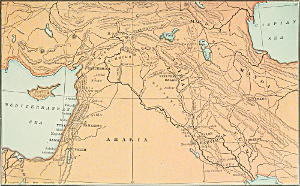
BABYLONIA AND ASSYRIA.
BORMAY & CO.