THE LADY OF SHADOWS
 IT was early on the following day when Francesco took the direction of
the palace. The city appeared gay and bright; the beautiful isles of
Ischia and Capri, like twin outposts guarding an earthly paradise. He
had arrived at the hour of dusk, which had soon faded into the swift
southern night, and much of the magic of the scene had thus been
veiled before his gaze. Now he saw and marvelled.
IT was early on the following day when Francesco took the direction of
the palace. The city appeared gay and bright; the beautiful isles of
Ischia and Capri, like twin outposts guarding an earthly paradise. He
had arrived at the hour of dusk, which had soon faded into the swift
southern night, and much of the magic of the scene had thus been
veiled before his gaze. Now he saw and marvelled.
All around stretched the bay in its azure immensity, its sweeping
curves bounded on the left by the rocky Sorrentine promontory, with
Sorrento, Meta and a cluster of little fishing villages, nestling on
the olive-clad precipices, half hidden by orange groves and vineyards
and the majestic form of Monte Angelo towering above. Farther along
the coast rose Vesuvius, the tutelary genius of the scene, its
vine-clad lower slopes presenting a startling contrast to the dark
smoke-wreathed cone of the mountain. On the right the graceful
undulations of the Camaldoli hills descended to the beautifully
indented bay of Putcoli, while Naples herself, with Portici and Torre
del Greco, reposed as a marble quarry between the blue waters of the
bay. Beyond, in the far background, the view was shut in by a phantom
range of snowy peaks, an offshoot of the Abruzzi mountains, faintly
discerned in the purple haze of the horizon.
As Francesco strode along his wonder increased step by step. He seemed
to have invaded the realms of the sun, who sent his unrelenting light
rays down upon glistening pavements composed of lava, reflecting the
beams with all the brilliancy of mosaic. Notwithstanding the glare of
August, balconies, casements, terraces and galleries were enlivened by
a gay and merry crowd. The gloomy fronts of marble and granite had
disappeared under silken hangings and garlands of flowers. Everywhere
there was joy and gladness, and the bells from Santa Chiara rang as
joyously over the city and gulf as if the papal Inderdict held no
terrors for these children of an azure sky.
The situation was nevertheless acute. A Clementine court and a
Ghibelline populace, who defied alike the Pontiff and their
self-imposed ruler. Excommunication was hanging black over the leaders
of this movement; the court was in evil moral repute, and it was
difficult to foresee whither matters were drifting under these
sun-fraught, cloudless skies.
Francesco requested and obtained immediate audience of the Duke of
Lerma, Anjou's representative in the kingdom of Sicily. The interview
being terminated, and his duties outlined, he strode out into the
palace gardens, which sloped in picturesque terraces down towards the
bay.
With fevered pulses he leaned against the parapet of the broad stone
wall which encircled the gardens, his eyes resting on the enchanted
landscape, the clustered towers of Naples, beyond which rose the
smoke-wreathed cone of Vesuvius. Thence his gaze wandered to the sea,
which glowed from rose to violet and sapphire, all melting into unity
of lapis lazuli, and finally down into the Parthenopean fields, where
the atmosphere heaved with the pulsing intensity of high noon.
On all sides the spell of Circé enfolded him triumphantly. Truly, here
all painful broodings might be forgotten, where thought and sight
were alike suffused with the radiance of sea and sky. It was a place
of dawns and sunsets, of lights rising amber in the East over purple
hills and amethystine waters; of magic glows at evening in the west
with cypresses and yews carven in ebony against primrose skies, while
the terraces blazed with flower-filled urns, and roses overspread the
balustrade with crimson flame.
How vivid the life of the past weeks stood out before Francesco's
eyes, a life crowned by the memory of his arrival in this Siren City,
and his strange meeting with Ilaria. It seemed like a mocking dream;
yet, the pain in his heart informed him, it was true!
How long he had stood there, he did not know, when he suddenly gave a
start.
An opening door,—a light foot-fall—he stood face to face with
Ilaria.
She paused; stately, unsmiling, reserved. A white silence seemed to
enfold her as their eyes met.
"There is some error," she said, with a retrograde movement. "I will
withdraw—"
"There is no error!" the words leaped from Francesco's lips. "Or
perchance there is! Well,—is it true?"
The words were uttered almost brutally.
"I do not understand!" she replied icily.
"Why are you at Naples?"
His face was a mere whiteness amid shadows.
"Why are you here?" she replied, straightening with a sharp lifting of
the head.
"Perhaps I am here to spy on you!"
"The office does you honor! First, a traitor—then, a spy—"
Her words were fierce and bitter.
"What are you saying?" he flashed. "Betrayal is not man's prerogative
alone!"
She shuddered. His words bit brutally into the truth. For a moment she
stood rigid, searching his eyes and the very depths of his soul.
And so, for a brief space, they faced each other in silence. Francesco
acknowledged anew, and with a mortal pang, that here was a woman for
whom a man might give his life and count it naught. A woman to gain
whose love, a man might sell his soul. Ilaria had come into her own,
as never in her earlier youth. Like all great beauty, hers was
serious. It had acquired a touch of majesty and mystery, a depth of
intensity and significance.
"Is Raniero at Naples?" Francesco spoke at last.
She faced him defiantly, as if resenting his attitude.
"I knew not you were concerned in your former rival!"
Her utterance seemed part of the incomprehensible cruelty of life. His
face was hard and white as he regarded her.
"Perchance my concern is all for my present one!"
"I do not understand—" she faltered, her hands over her bosom. Yet
her tone had lost its defiant ring.
As in mute questioning her eyes were on his face.
"As I passed down the Via Forinara last night, I passed a woman and a
man. The woman was garbed in crimson, and there was no sign of
recognition in her eyes. The woman I knew. Who was the man?"
Ilaria's face was very pale.
"What is he to you,—the monk?"
He came a step nearer.
"Who was the man?"
She gave a little nervous laugh.
"Stefano Maconi,—one of the nobles of the court!" she said, with a
drooping of the head. Then with a quick touch of resentment: "Have you
heard the name before?"
Francesco ignored the irony of her tones.
"What is he to you?" he queried sternly. His face looked pale and
drawn, his eyes shone with an almost supernatural lustre.
"Really," she squirmed, "I knew not that I stood in need of a
confessor. I have one already,—and I do not intend to supplant him
with another!"
"You have not answered my question!" he insisted. "To the office of
your confessor I do not aspire. I am not suited for that exalted
position!"
There was something in his eyes that frightened her.
"And why?"—she faltered.
"I should not prove so passive a listener!"
For a moment she faced him in silence. Then, with a sudden return of
her old hauteur, she flashed:
"Of what do you accuse me?"
He did not speak. But the look he gave her sent the hot blood curdling
to her cheeks; ebbing back, it left them paler than before.
"You have not answered my question!" he said at last.
She lifted heavy lids and eyed him wondering, as one waking from a
dream.
"What do you want of me?"
"What is Stefano Maconi to you?" he queried more fiercely, grasping
her wrists, and compelling her to raise her eyes to his.
"Stefano Maconi is nothing to me!" she replied hoarsely.
Never had he spoken thus to her. As their eyes met, she noted that he
had changed. With a quick pang she saw how thin and haggard he had
grown.
"Is this the truth?" Gropingly her hands went out to him, her
witch-like eyes held his own and like the cry of a tortured soul it
came from her lips:
"It is the truth!"
Her voice died in a sob; her whole body was shaken with convulsive
tremors, when she found herself caught up in his arms.
For a moment she abandoned herself wholly to his embrace, while terms
of endearment fell deliriously from his lips. Again and again he
kissed the pale lips, the eyes of the woman he loved better than life.
How long, it seemed to Ilaria, since she had leaned over the parapets
of Avellino, had watched the sunset light fade into the night! And one
night of all, how slowly the moon had risen! How white the magnolias
had shimmered, while the distant Liris sang his slumber song! How the
red roses burned in the moonlight, as she stole down the path to meet
him!
How long ago was it? Now, she could remember every detail of that
night; how she started when a sleeping bird uttered a dream note among
the leafy boughs, how she listened to her own heart-beats, how she
found herself caught up in Francesco's arms.
All her youth, all her days had been poisoned by the thought of what
she had done. Resolutely, day after day, month after month, had she
fought against the demon of remorse. She had shut eyes and ears to the
haunting spectre of the past. And now, steadily, pitilessly, she went
back, step for step, through the hell of her past life, the mockery
that was bitterer than death, the horror of loneliness, the slow,
grinding, relentless agony of her nights and days.
The crowding phantoms of the past would not release her from their
shadowy grip. Why had he again come into her life? Why had he again
crossed her path?
Staggering, he released her at last, took a backward step and covered
his face with his hands.
"I have tried not to lay hands on a thing that it is not mine to
touch."
She pointed to his garb. A wondering look passed into her eyes.
At first he noted it not, in the thrall of his own emotions. Then, as
she touched him lightly upon the arm, he understood.
"I am here, the legate of Clement, carrying the Interdict, unless
Naples acknowledges the supremacy of the Church! For this I have laid
aside the cowl!"
Ilaria shivered. He was still a monk,—after all.
There was nothing she could do to help him. That was the bitterest
thing of all!
Silence seemed to bind the world into a golden swoon.
"Francesco," she cried, almost with a sob.
He came nearer and took her hands again.
"Let us go down among the terraces!" she said in a whisper. "Let us
forget the loud, insistent clamor of the world. Let us be quite
still,—as if we were among the poppy-flowers!"
By some strange echoing of the mind the idyls of past days woke like
the songs of birds after a storm of rain. Her whole soul yearned out
with a wistfulness borne of infinite regret.
Silently they walked down the flower-bordered path.
The panorama from the spot was enchanting. Far below lay the blue
waters of the bay; out to seaward lay ancient Baiae with her thousand
palaces and the forest of masts at Puteoli; beyond these Sorento and
the shimmering islands, bathed by the boundless sea. The vaporous
cloud from Vesuvius hung like a cone of snow in the still blue
atmosphere.
The foreground was no less enchanting. All round the pavilion lay a
verdant, luxuriant wilderness. The mysterious silence of noon brooded
over the whole landscape; only a faint hum of life came up from the
city. All else was still. Not a living creature seemed to breathe
within ear-shot.
He led her to where a fountain plashed in the sun and stone steps
ringed a quiet pool.
In the silence she bent over him, her hand on his dark hair.
The tonsure burned her fingers like living fire.
"Why have you done this thing?"
He felt the scorn in her voice; he felt the swift repellence of her
body.
Francesco raised his face to that of the woman. It was very pale from
the fierceness of the struggle to keep down even the suspicion of
emotional sentimentality.
"You ask why I have done this thing?" he spoke dryly at last. "The
hour has come when I must tell you, Ilaria! Not that it can steer the
vessel of our lives into different channels,—but that at last I may
stand vindicated in your sight. I am the son of Gregorio Villani,
Grand Master of the Order of St. John. My mother died at my birth. I
was raised at the Court of Avellino. So powerful was the influence of
my father, that, notwithstanding the protests of the Holy See, he
placed his offspring at a Ghibelline court. There came a day when I
was summoned to the bedside of my father at San Cataldo. What passed
between us during that interview, neither you nor any one on earth may
know. I went into his room a happy, care-free youth. I came out the
shadow of my former self,—a monk. One year I lived among shadows in
the Benedictine monastery at Monte Cassino. There I took the vows
which made me a prisoner, far more closely bound than you can know;
for death alone shall release me from a life which has grown to be a
torture. I became a monk half from pity, half from fear. The pity is
almost gone; the fear has left me long ago. After a time I was called
to Rome. The Church I love not! I am unfit to remain in her service.
The monks are to me a hateful body. Willingly, gladly, would I see my
scapular replaced by the tunic for my coffin. Yet death is not for me
to hope for, or even to dream of,—and in vain I ask, what holds the
future?"
Ilaria's head had drooped over his; her eyes wandered blindly over the
ground. Then a warm drop fell to the stone at her feet.
During his recital the very soul in Francesco seemed to have withered
with dread, and he seemed to shrivel up bodily and to grow feeble and
old and wilted, as a leaf that the frost has touched.
"The memory pains you," she said at last.
He bit his lips.
"Deem you, I forget when I am silent? But it is not the thing itself
that haunts me! It is the fact that I have lost the power over
myself—"
"You have suffered—"
"It is the fact that I have come to the end of my courage,—to the
point where I find myself a coward!"
"Surely there is a limit to what one may bear—"
"And he who has once reached that limit never knows when he may reach
it again!"
He looked up with a sudden piteous catching of the breath.
"What will you do?" she spoke after a pause.
He held her hands in a close, passionate clasp. A silence that seemed
to have no end had fallen about them.
"My allotted task," he said at last, in a voice more dead than alive.
"No,—no,—no—!" she started up suddenly. "Cannot you see,—will you
never understand—oh! the bitterness, the misery of it all!"
She clung to him with all her might.
"Come away with me! What have you to do with this dead world of
priests and monks! They are full of the dust of bygone ages! Come out
of this plague-ridden Church,—come with me into the sunlight! I love
you—I have always loved you,—always—"
She bent blindly towards him.
"Take me away from here,—Francesco,—take me away from here! Since I
came here my feet seem to have grown heavy with this lotus-laden air.
At times it sweeps over me like desperation,—I lose the faculty of
thinking, I lose the power over myself!"
"I thought you were at Astura!" he said tentatively, the affair in the
Red Tower flashing through his consciousness.
She gave a quick start.
"I am a woman, and I stand alone! I have lived in hell ever since I
set foot in Astura. Almost have I lost the courage to look life in the
face. How I have wanted you!" she continued, with a wan, wistful
smile. "Ever I see you standing against the background of a great
silence, a silence that engulfs, that maddens, that kills! And you
will go from me, leave me a prey to this gray, suffocating loneliness,
which hovers as a pall over my soul! I am nothing to Raniero! He seeks
his pleasures elsewhere! The lure of the body drove him to me,—it has
vanished,—thank God even for that! I should die in his embrace. He
knows that I loathe him, that my soul spurns him! And he knows that I
love you! Yet, though he has forfeited every right, human and divine,
he grudges my love to another. For days and days he left me alone
within the gray walls of Astura, until in a fit of desperation I left
one night, and came here, to forget. His insults began in Rome. He
went so far as to bring his mistress to the Frangipani palace. I have
heard it whispered there is a curse on Astura. 'Astura—mala
terra,—maledetta!' A beggar uttered these words, whom Raniero struck
for obstructing his path, on the day when we arrived!"
A sudden blood-red cloud seemed to come before Francesco's eyes. With
a voice bare of intonation, he recited his own adventure in the Red
Tower, voicing his suspicions and fears.
Ilaria betrayed no surprise.
"He has never forgiven Fonté Gaia," she said, with drooping head. "And
yet he was untrue to me even then! From that hour matters began to
grow worse. Recklessly he cast the last semblance of decorum to the
winds. When I protested against living under the same roof with his
mistress, he smilingly brought me to Astura, leaving me, as he said,
in undisturbed possession. My youth destroyed, my soul poisoned, I
accepted my fate! I am the lady of the Frangipani! Sold, and bought,
and paid for!"
Ilaria had made mere truth of the matter, neither justifying nor
embellishing. Her clear, bleak words were the more pathetic for their
very simpleness.
With a great cry, he took her in his arms, kissed her dusky tresses,
kissed her flower-soft face. The dimmed sunlight, falling in upon
them, enveloped them as with a halo.
"And you are happy here?" he spoke at last.
She gave a shrug.
"Here as elsewhere it is a phantom scene," she said, with her wan
smile. "But if the fellowship of phantoms be ordained, it is well that
they be like those of Naples, radiant."
"Am I too, then, a phantom like the rest?"
Like an echo a voice said:
"A phantom—like the rest."
"And is he—a phantom too?"
She looked up into his eyes.
"Raniero—"
"That other—"
Her face was very pale.
"Why do you dwell on him?"
"Are you not Queen of Phantoms,—Proserpina,—Lady of Shadows, you—as
in the masque at Avellino?"
She shivered in his arms. He pressed her more closely to his heart.
"It was a long time ago!"
"And then as now you moved in a masque, in which I have no part."
A long silence enfolded them. She nestled close to him.
"I am tired,—very tired," she crooned, as a child about to fall
asleep. "Francesco, help me to forget the years! I am afraid!"
"Afraid?"
"Of myself! Sometimes I dare not be alone at night! No,—no,—it is
not that! The inner darkness! There is no weeping there,—only
silence,—silence,—and the gathering gloom!"
She held his hands in her own.
"But for this," she cried with passionate pressure, "I should long
have cursed God and died—"
Her voice died away in the empty stillness without response.
"It is peace I crave," she said wearily, "a peace, such as broods over
a sunset world!"
"The peace of a dying day!" he replied. "The peace I seek is of a day
that stoops not to evening."
"And this peace,—have you found it?"
Her eyes were fixed gravely on his own.
"I am as one who gropes in twilight by a path half seen, towards a
goal he does not know. Not for me the peace of the goal! But there is
peace also of the quest: a peace I would not forego!"
They had arisen and walked for a time in silence, seeking the remoter
regions of the garden. The softened siesta lights gave to the distant
hills an aspect of pearl and jasper.
It was drawing towards sunset; red banners streaked the amethyst of
the western sky.
A saffron mist enveloped the curves of Vesuvius, shot with gold and
crimson, merging in dusky purple. In the plains the fertile fields
reclaimed round the base of Castiglioné gleamed russet with vines,
gray with olives. Beyond the grim walls of distant Astura stretched
the chalk-lands of Torre del Greco.
As they walked side by side, Francesco felt the rhythmic life in
Dana's body. The wan, appealing face was close to his. An instant,
and the passion of the sky leaped into it. Theirs was the calm of a
still pool, which hovers till the wind breaks it into the myriad
agitations of life. He drew her towards him; her head resting on his
shoulder, as if there she had found a home.
The evening star shone out in the fading sky.
The dusk was travelling towards the night.
Creation shivered towards a deeper dream.
The summer moon had risen, shedding its magic light over the Gulf of
Naples.
The very soul of Francesco was thrilled by the harmony around him; the
harmony in the moon's golden trail, which fell upon the waters, a
blazing path, reaching from Posilippo to the rim of the horizon,
harmony in the soft murmur of the sea, and the light breeze which
carried, together with the salt freshness of the sea-air, sweet
perfumes from the shores of Sorento with their lemon and orange
groves; harmony in the silvery curves of Vesuvius, wrapped in luminous
mists, its rugged cone emitting a white smoke, which trailed along the
upper zones of the air, the summit of the mountain flaring up from
time to time, like dying embers consecrated to the gods, the gods who
had died, had risen again, and had again expired.
"How wondrous lovely the night!" Francesco at last turned to his
silent companion. "All nature seems as one magic blossom—"
"My blossom-season is past," she answered very lightly.
"It is always blossom-season where Proserpina treads," said Francesco,
his eyes fixed on the face he loved so well.
"You look almost as you did, when we were both happy."
"Is it so long ago? Yes, I am old, Ilaria. Our youth seems far, far
away!"
"Perhaps I too am not old enough, to be young! Our youth—" she paused
with a sob.
Francesco gazed at her solicitously.
"Even here?"
She gave him a wan, small smile.
"Just now, one might forget!"
"It is a great art, to forget," said Francesco tenderly. "You need it,
Ilaria! What sufferings have been yours!"
She returned his look.
He understood.
Ilaria saw the pain written on his brow, as he looked at her with
tenderness undisguised. She felt his spirit lying openly before her,
as when they were both at the Court of Avellino.
"From the look on your forehead," she said softly, "you have lived
long in your cell, since last we met! So it was meant, I think, from
the beginning!"
"Assuredly so it was meant," he replied. "But I am very sorrowful, for
I see not what was meant for you!"
She smiled at him, as if to reassure.
"If Fate has guided my life ill, not yours the fault," she said
soothingly.
In her, reserve still obtained, yet without a trace of her late
perplexing defiance. Asperity had given way to a great gentleness.
"Yet," Francesco hesitated,—"I am tormented by one thought: that for
you it had perchance been better, if—"
He paused with drooping eyes, then continued:
"I could not profit by the dispensation of Clement and remain a true
man. But you—" and again he paused.
A flash of her old-time perverseness lighted up Ilaria's sad eyes.
"Why pause?" she asked, arching her brow. "You mean that which is
moral disaster for one, might be salvation for the other? And that,
since my salvation should be dearer to you than your own—"
She broke out into quizzical mirth. But she was swiftly grave again,
though tremulous.
"I, too, have lost myself in the quest of happiness," she said,
clasping and unclasping her white fingers. "Dread and desire have
beaten me hither and thither! Great waves have tossed me! On the very
day of your departure from Avellino the Viceroy asked me whom I would
wed! Your name leaped to my lips. I told him I would have none other.
Even as I spoke the dread seized me! I said to myself: this thing can
never be! Then you went away—and I was engulfed in darkness. When we
met at Rome I realized what I had done! Yet in the very effort to keep
you far, I drew you near! Thus Fate had willed it! When we met at
Fonté Gaia, I knew what in one sunset of Avellino I had merely
dreamed: my love for you lived—in all my life the one abiding light.
Longing and horror racked me! She is cold, and foul, and false, that
White Lady—and the gifts she offers turn to poison in the grasp. But
it was that other who conquered,—your White Lady,—not mine! She was
ever a generous enemy, and in taking you from me, she has given me
back my love!"
She had been looking at him with wide piteous eyes, even as a child
might do. On a sudden she covered her face, dropped into a seat among
the bays and myrtles, and broke into wild weeping.
The strong sense of bondage came back with a fuller force as though to
menace her with the fateful realism of her lot. A hand seemed to sweep
down and wave her back with a meaning so sinister that she had the
feeling of standing on the brink of a mysterious sea, whose waves sang
to her a song of peril, of misery and desire in the dim green twilight
of some coral dungeon. The lure of the unknown beat upon her eyes,
while love and hate, like attendant spirits, beckoned her onward with
a weird, perpetual clamor.
Francesco tried in vain to soothe her, calling her by all the
endearing names of the past, and pressing her closely to his heart.
"I do not understand," she cried, sobbing convulsively. "I have wished
no one ill! Ever have I desired only fairness and love, and fullness
of sweet life. And the beauty I seek is befouled by my seeking, my
love has stained my beloved; and when I clutch at life, life crumbles
within my grasp. Wherein has my quest been wrong?"
"Not wrong," he said unsteadily—"not wrong,—I trust!"
She looked at him bewildered.
"I, too, would turn from that agonizing God upon the Cross to paths
where roses bloom," Francesco replied, heavy-hearted. "I have been
walking amid shadows, and I have lost the way."
She caught at his hand and drew it piteously to her lips, but made no
attempt to retain it.
"I am that Proserpina who has lost the spring," she said, raising her
haunting eyes to his. "Yet one comfort is left me still,—one stay,
that shall not fail!"
"And that?"
There was a strange expression about her face, but she was silent.
A shudder seized him with the swift suspicion of her meaning.
"You shall not!" he cried almost roughly. "You shall not! I, too,—did
I give way to that fierce longing,—you shall not yield to that
crawling weakness!"
But Ilaria interrupted him.
"Oh! my dear, I meant not that!" she said. "Of weakness I might reck
little, of the hurt to you I should reck much. There is that in my
heart for you which shall keep me safe henceforth from what would
grieve you!"
"What is it then?" he asked relieved. "The comfort,—the stay,—of
which you spoke?"
She smiled through her tears; the old-time smile.
"I do not see your life," he said anxiously. "What is it—what shall
it be? Till that be known to me, Ilaria, I shall not know rest or
peace. You are beautiful,—too beautiful for this licentious court!
Here you cannot remain—alone!"
"I fear the twilight," she said, with a shudder. "There is but one
goal for me, and, when the hour comes, you shall lead me there.
Proserpina will turn Lady of Shadows in very truth, and move veiled
through her rose garden."
"But why must this thing be?" he queried with a choking sensation. "I,
too, have sinned—"
"Of sin I know nothing," said Ilaria mournfully, "I apprehend neither
the word, nor the thing!"
"Then why this last extremity?"
"Will you not understand?" she interposed petulantly. "Your presence
here has shown me once for all that I may not continue to walk in the
old way; I may not walk in yours, and I would not have you walk in
mine! You wavered towards it of late! Once upon a time I should have
rejoiced; now my spirit is full of fear."
She crept close to him and looked up at him with tremulous lids.
He caught her to him with all the old-time love in his eyes. All
fears, all misgivings, all doubts of the woman he loved, were utterly
blotted out in their embrace, and over Ilaria's features there flitted
the gleam of a long forgotten happiness.
Her look was far away. Of a sudden she turned to Francesco.
"Will you remain at Naples?"
He gave a shrug.
"Days—weeks—who can tell? A Ghibelline victory may turn the tide."
"I have something to say to you," she said, her face very close to
his. "I have long wished to say it: beware of Raniero!"
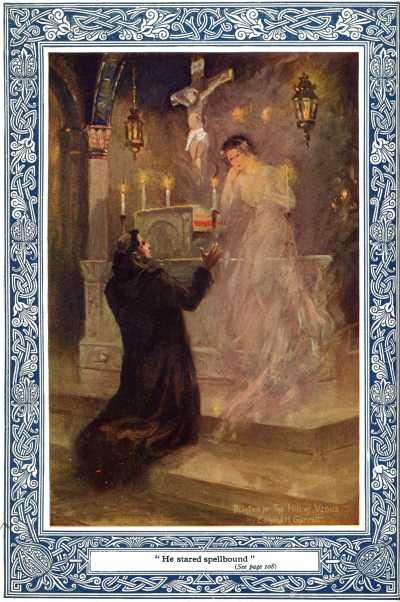
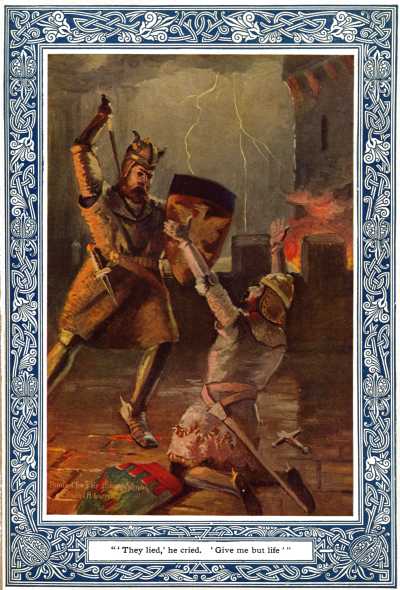
"He caught her to him with all the old-time love"
"I have done him no wrong!"
She made a gesture as one throwing up a libation.
"Fonté Gaia!"
He felt her breath fanning his cheek.
Seized with a sudden madness he threw his arms about her, and kissed
her.
Where the roads branched off they parted, after a long passionate
embrace. Ilaria returned to the palace, while Francesco bent his
footsteps towards the bay, shimmering in the light of the higher risen
moon.
He heard her go singing through the garden, a soft chant d'amour that
would have gone wondrously to flute and cithern. It died away slowly
amid the trees like an elf's song coming from woodlands in the
moonlight.
His soul was sobbing within him. He felt his purpose, his resolutions
waver. The crisis of his life had come. Alone with Ilaria at Naples!
Raniero away,—indulging his lusts!
He had feared this meeting, feared it above all things in heaven or
earth!
Again they were abroad, the gods of yore. They rode the wind; they
laughed in the far reaches of the sky; they whispered in his heart.
To love her! To possess her!
The thought had suddenly leaped into his brain, taking its first
clearly defined form, recoiling upon him, dazzling his eyes.
For this he had lived; for this he had suffered!
And now?
A deeper question came, like a wind in a fog; a fearsome thing. Why
should this love be sin? This love,—the one pure emotion in all his
life?
In the spiritual darkness which encompassed Francesco, the fire of his
old love for Ilaria had leaped high upon the altar of his sacrifice.
For her he had kept himself pure, for her he had starved his soul,
while his love smouldered in the dark chambers of his heart.
For hours Francesco was as a man possessed, moving through them
drearily, as through crowding phantoms, struggling to suppress an
imperious craving that tormented him for release.
It was late when he retraced his steps towards his inn.
Gigantic cypresses bordered the way, ranged like dark torch-bearers at
a funeral. Their entwined tips, continually caught by the wind from
the sea, remained bent like heads drooped in sorrow. White statues of
gods gleamed spectre-like in the dark shades. In the laurel thickets
glow-worms flickered like funeral tapers. The heavy scent of the
magnolias recalled the odor of balsam used for anointing the dead. The
waters of the fountain, trickling from an overhanging rock, fell into
the sea, drop by drop, like silent tears, as though a nymph were
weeping in the cave above, bewailing her sisters, some dark Elysium,
the subterranean groves of shadows, the burial grounds of dead gods.
But even sleep brought only one persistent vision to Francesco: a
reach of laughing waters, now turquoise, now sapphire, now upheaving
into a mighty translucent wave, that curled swiftly towards him, and,
quivering within, the face of Ilaria, upturned to his own.