So eager was Fred to write his father about Mr. Bronson's change of
front, that he actually grudged the time necessary to escort Margie
home, and several times he hurried her so fast that at last she
poutingly suggested he let her go by herself if he were so anxious to
get back to his study.
"It isn't that, Marg," he explained contritely. "I've got some news for
father that will please him more than almost anything he could hear."
Then, acting on impulse, he related the incident of his father's visit
to the famous lawyer, the latter's refusal to handle the case, and the
development of the evening.
"And all this time, knowing his father's action, you've been kind and
courteous to that Clothespin? I never heard anything so fine," breathed
the girl proudly. But though her admiration of his attitude toward his
classmate was sincere, it was the realization that Fred had once again
restored her to his confidence, as indicated by his telling her of the
Bronson matter, that made the girl most happy.
Bitterly she reproached herself for having by her manner added to the
boy's suffering, and eagerly she strove to make amends.
"Remember what you asked me the day we quarrelled?" she exclaimed, her
voice scarcely more than a whisper.
"Do I remember? Well, I should say I did. I've gone over our talk
two or three times a day to see what I had said that could give you
offense."
"You foolish boy! It was all my fault, and—and now I want you to ask
me again."
"So you can pick another quarrel?"
"Don't be silly. I was just a jealous little goose. I might have known
it was only your consideration for others that led you to speak of
Alice as you did."
This confession gave both the young people happiness, and it was much
later than even Fred had supposed when he returned to his home, and,
going to his room, wrote the tidings to his father that were destined
to effect great changes.
At the cheery greetings with which Fred hailed them the next morning,
his schoolmates were first amazed, then delighted, and by the time
classes were over all memories and bitterness caused by the breach
were healed over and forgotten.
Indeed, so delighted were the Seconds to recognize in the boy the jolly
companion of old, that Taffy even asked Fred to go to the campus to
coach the back field of the Form team.
"But Bart might not like it," objected the boy, though the light in his
eyes showed his eagerness to place the benefit of his experience at the
service of the eleven.
"Sure he will. He'll be tickled to death," insisted Taffy. "Only last
night he told me he'd give anything if there was only some way you
could be persuaded to play. Between you and me, Buttons is fierce."
"Well, I can't play," sighed Fred. "But I'll do this much—I'll take
Buttons in hand, if you think that will help."
"That'll be the next best thing to having you in the line-up," declared
the boy joyfully, and he hurried away to carry to the desponding
captain and his coterie the tidings of Fred's agreement to coach
Buttons.
And Bart needed assistance. There were not enough of his clique to fill
all the positions on the eleven, and he had been obliged to draft some
of his rival's followers. In consequence, there had been a lack of
harmony, which the rich bully did not have the characteristics to stamp
out; and to make matters worse, the Lower Formers, having overheard
some of the Firsts discussing the prospects of the Second eleven,
openly declared Bart did not have the knowledge of the game possessed
by Fred.
At first, Taffy, Lefty and the others of his intimates had loyally
resented the charge, but as the season progressed with little or no
improvement in the eleven, in their hearts they were beginning to fear
its truth.
Accordingly, Taffy's tidings were joyously received, and when the
fair-haired boy appeared on the campus that afternoon, he was given an
ovation.
Such a demonstration was gall and wormwood to the rich bully, but,
realizing that if he were to obtain the wish of his heart and lead the
Baxter Seconds to their first victory over Landon in five years, he
must control himself, he managed to force a smile.
"Will you get in the game?" he asked, approaching his rival.
"Not to-day; thank you. Just run them through a few signals till I get
a line on their faults."
Quickly Bart did so, and as a result of the exhibition, Fred called
Buttons from the line-up and passed the remainder of the afternoon in
giving him personal coaching, the benefit of which was evident in the
scrimmage of the next day.
Fred's coöperation thus assured, the team improved rapidly. Moreover,
to his surprise, the boy found that instead of proving a handicap to
his class work, his lessons seemed to be mastered with less effort.
The scene of the annual contest between the Form elevens of Baxter and
Landon alternated between the two towns, and this year chanced to be
the one when the games were played at Landon. As the day approached,
Fred was importuned to go. But though it cost him many a pang, he was
obliged to decline, finally announcing the truth to Taffy, who came as
an emissary from Bart—that he could not afford the expense.
"If that's the only reason you're staying at home, I'll lend you the
money gladly," returned Taffy.
"Much obliged, but under my circumstances it would not be right to
borrow money for pleasure," responded Fred, and that he might get away
from the temptation, he turned on his heel and walked off.
When the result of Taffy's entreaties had been made known to the rest
of the team, the boys went into council, the result of which was that
they agreed to raise a subscription among themselves sufficient to
defray Fred's expenses.
But when Buttons sounded him on the proposition, Fred refused to accept
it.
"I'm not an object of charity," he exclaimed hotly.
"But it's not charity," protested his chum. "We shall need your advice
between halves. Because of that, the boys are willing to pay your way.
It's for the good of Baxter."
"No, it isn't, Buttons. I'm obliged to you all, of course. But you
ought to know that if my expenses are paid I'll be practically in the
position of a professional coach. That would prevent my playing on the
School Team next year—and I want to do that."
Before this new angle in the case Buttons was silent, and in despair
the boys gave up trying to persuade Fred to go with the team.
At last the eventful day of the contests arrived. Bright and early the
boys and girls, some accompanied by their fathers and mothers, flocked
to the station. And with their school flags and colors they presented a
brilliant scene, laughing and talking merrily.
As the members of the different teams arrived, they were greeted with
hearty cheers, and were immediately surrounded by their friends, who
offered advice and good wishes.
Attracting as little attention as he could, Fred moved among the happy
throng until he caught sight of Taffy, to whom he beckoned.
Walking with him to one end of the platform, he was talking to him
earnestly when several of the students espied him and surged toward
him, declaring they would take him with them by force.
Good-naturedly, Fred was trying to escape from them, when Bart suddenly
forced his way close to his rival.
"The boys seem to want you to go with them, but I understand you're too
poor. Here's ten dollars—enough to carry you down and back and leave
you something besides," he exclaimed, at the same time extending a bill
to Fred.
A gasp of amazement ran through the crowd of students and their elders,
then in expectant silence they stared at the fair-haired boy.
Flushing scarlet, Fred quivered as though he would leap at the brutal
bully, then turned on his heel and resumed his talk with Taffy.
"As I was saying," he began, his voice trembling with emotion, "you
must watch out for Phil Thomas, the Landon left guard. He'll try to
make Bart's nose bleed—the way he did last year. If he does, Bart'll
lose his head and the game will be lost."
More than two score of people were within earshot of these words, and
as they realized that the boy who had been so wantonly insulted in
public had not allowed his personal feelings to outweigh his desire to
have Baxter win, they broke into hearty cheers, many of them pressing
forward to shake Fred's hands.
"Ouch! this hurts more than the other!" he exclaimed, and, wriggling
like an eel, he slipped from the crowd with the same skill that made
him so hard a runner to tackle on the football gridiron.
But though the students were prevented from showing their sympathy to
Fred, they were able to let the rich bully know in what light they
regarded his action—which they did in no uncertain manner, turning
their backs on him, as with one accord, and paying no further attention
to him whatsoever.
Though they strove to regain their former lightheartedness, the
incident had cast a damper on their spirits, and many of Baxter's
supporters considered it an omen of disaster for the various teams.
Realizing the prolongation of such feeling would have a bad effect upon
the morale of the various elevens, Sandow, Hal and several other Firsts
went through the train rallying the students. And with such good effect
that when the train arrived at Landon they had practically regained
their former high spirits.
That both schools might be able to witness the game between the First
Teams, the contests between the Third and Second Forms were always
held in the morning.
But that the Baxter students were still determined to let Bart
understand they resented his treatment of Fred, was evident when the
elevens lined up. Only a handful were present to watch the contest
between the Seconds, the rest flocking to watch the Thirds.
The result of this wholesale boycott of the Second team was that it was
defeated by the overwhelming score of 30 to 4—despite brilliant work
by Buttons, who proved himself the star of the game—while the Thirds,
encouraged by the cheering of their schoolmates, won their game, 12 to
6.
Elated by their victory of their Seconds, which they had conceded to
Baxter, the Landon students declared the game between the Firsts was
already won—and such proved to be the case, for Sandow and Hal were
unable to defeat the entire Landon eleven, though the game was a tie, 0
to 0, until the last fifteen minutes of play, when the captain of the
Baxter team was obliged to leave the game, after which Landon scored a
touch-down, and won, to the score of 6 to 0.
Although it was a glum trainload of students who returned to Baxter in
the evening, the sting of defeat was soon forgotten.
In due course, the Christmas holidays came and passed, and with the
resumption of the session interest centered in the contest for
the Scholarship of Science, which would be decided on the tenth of
February, the first day of the mid-winter examinations.
Thanks to Fred's diligence and hard work, he was making rapid strides
toward mastering the subject, and as the school settled down after the
Christmas holidays, it soon became evident the Scholarship lay between
Fred, Bronson and Alice Montgomery.
As the day of the examinations approached, the excitement over the
award grew.
In some way, though Soda and Buttons declared they were innocent, word
had leaked out that Fred was working for the money rather than the
honor, and the presence of Alice in the contest gave the flavor of a
second rivalry between Fred and the Montgomerys.
Yet had they known that instead of seeking to take the prize from Fred,
Alice was, in reality, trying to make him win it, spending hours at
Margie's house explaining problems to him, rehearsing recitations and
coaching him in every way of which she could think, they would have
been amazed.
But in their ignorance of the secret friendship, they saw only the
family rivalry.
The wagering of money was strictly forbidden—and severely punished
when discovered—at Baxter, but the resourceful students had devised
a method to back their favorites, by agreeing to work problems in
mathematics or translate Greek, Latin, Spanish, French and German for
varying periods.
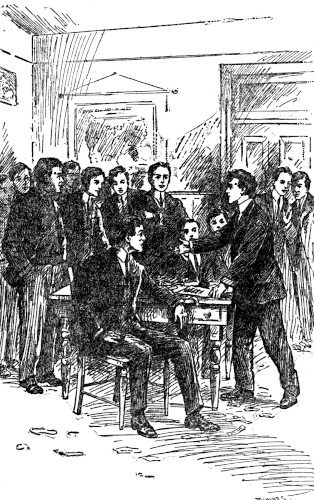
On the day previous to the examinations, Bart stalked haughtily into
the gymnasium during recess.
"I'll do mathematics, French, Spanish and German for the entire Second
semester against the same for a month that Alice wins over Fred," he
announced.
"Greek and Latin the same," cried Lefty.
"I'll give mathematics," announced Taffy.
"Wow! What a cinch!" cried Buttons, Soda and Shorty in chorus. "We'll
each take the three of you. No more worry about baseball and lessons.
Hooray!"
The eagerness with which the wagers were accepted rather surprised
Bart and his chums. But they had made the odds tempting on purpose,
and so confident were they of Alice's ability, that they bound the
agreements—according to Baxter tradition—by shaking hands.
At breakfast the next morning, Mrs. Montgomery announced to the rich
bully that Alice was ill in bed.
Instantly Bart rushed to her room and urged her to get up and take the
examination.
"But we've no end of wagers on you," he growled when she turned a deaf
ear to his entreaties.
"You ought to be ashamed of yourself, Bart," exclaimed Mrs. Montgomery,
who had followed him. "The idea of you're caring more about your wagers
than your sister's health. Now go away, and mind you do not bother
Alice any more."
When Bart reported the indisposition of his sister at school, his chums
were in consternation.
"Serves you right," chuckled Shorty. "No one with sense would have
wagered such periods."
"But they're off," announced the bully.
"Not much!" exclaimed Buttons. "It's just the same as though Alice
failed to win. You made no conditions."
And with this decision, Bart and his chums were forced to be content.
"Oh, well, Bronson may beat Fred," suggested Taffy. "That'll let us
out."
As the four contestants came out of the examination room, they were
surrounded by their classmates, but in accordance with a suggestion
from the headmaster, they refused to discuss the examination, and went
immediately to their homes.
Realizing that the interval of suspense would prove hard on her son,
Mrs. Markham had asked Margie, Grace and Buttons to spend the afternoon
and evening with Fred. But despite their attempts to divert him, the
boy was silent and unresponsive.
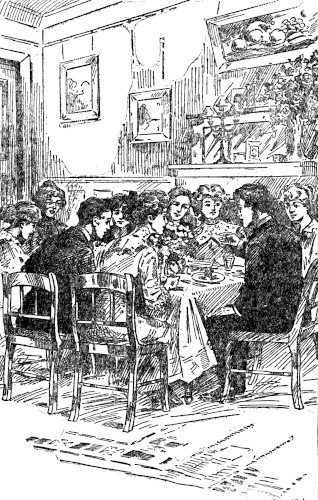
Just as they sat down to supper, however, there came a rap at the door.
Opening it, Fred was surprised to see Bronson standing on the porch.
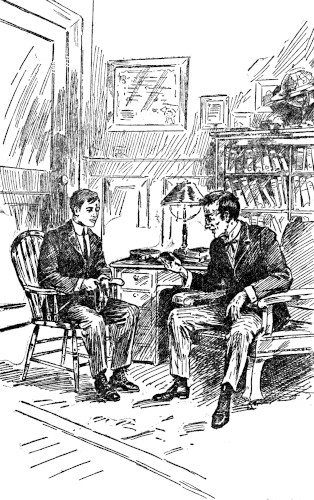
"Hello, Clothespin! Come in. You're just in time to eat," invited Fred.
"Thank you, but I can't. I'm going home to-night. I came over to bring
this note from Mr. Vining."
And before Fred could say anything, Bronson had hurried away.
A moment the boy turned the envelope over and over.
"Open it! Open it!" called the others.
In obedience, Fred did so.
And as he unfolded the letter, two bank notes fluttered to the floor.