Obvious typographical errors have been silently corrected. Variations
in hyphenation have been standardised but all other spelling and
punctuation remains unchanged.
The cover has been prepared by the transcriber and is placed
in the public domain.
Endpaper
The
High
Place
BOOKS by MR. CABELL
Biography:
Beyond Life
Figures of Earth
Domnei
Chivalry
Jurgen
The Line of Love
The High Place
Gallantry
The Certain Hour
The Cords of Vanity
From the Hidden Way
The Rivet in Grandfather’s Neck
The Eagle’s Shadow
The Cream of the Jest
Scholia:
The Lineage of Lichfield
Taboo
Joseph Hergesheimer
The Jewel Merchants
Jurgen and the Law
(Edited by Guy Holt)
THE HIGH PLACE: A COMEDY OF DISENCHANTMENT BY JAMES BRANCH CABELL WITH ILLUSTRATIONS AND DECORATIONS BY FRANK C. PAPÉ
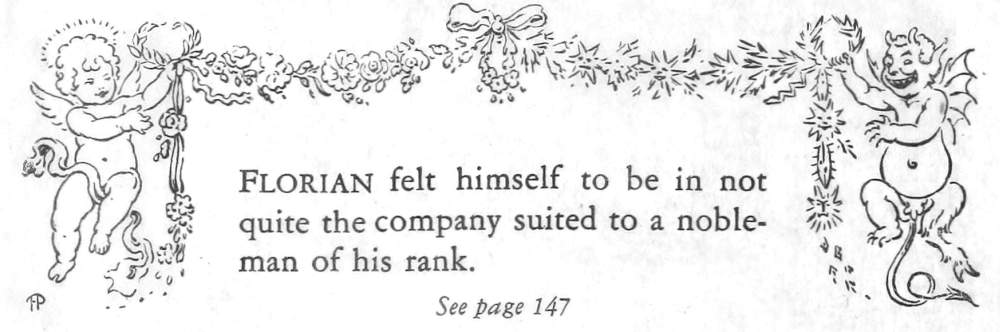
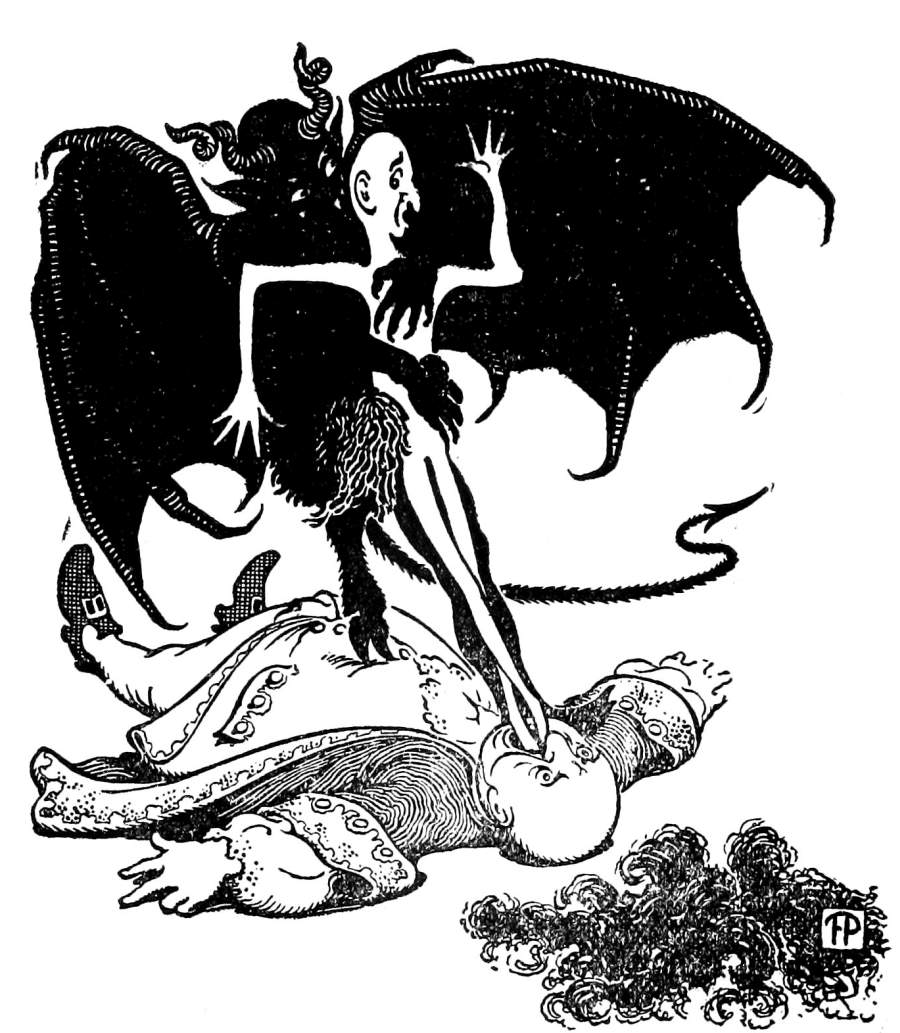
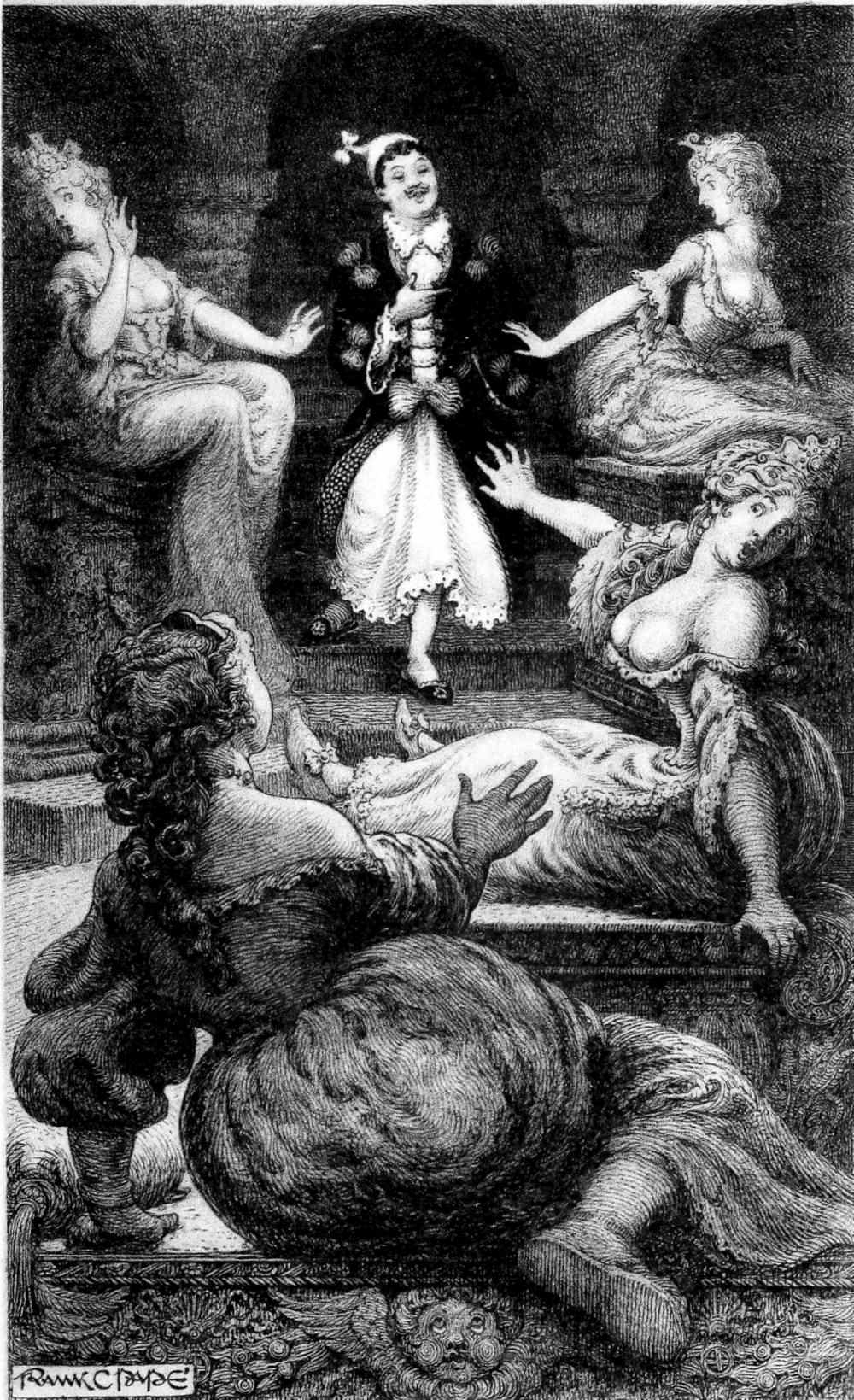
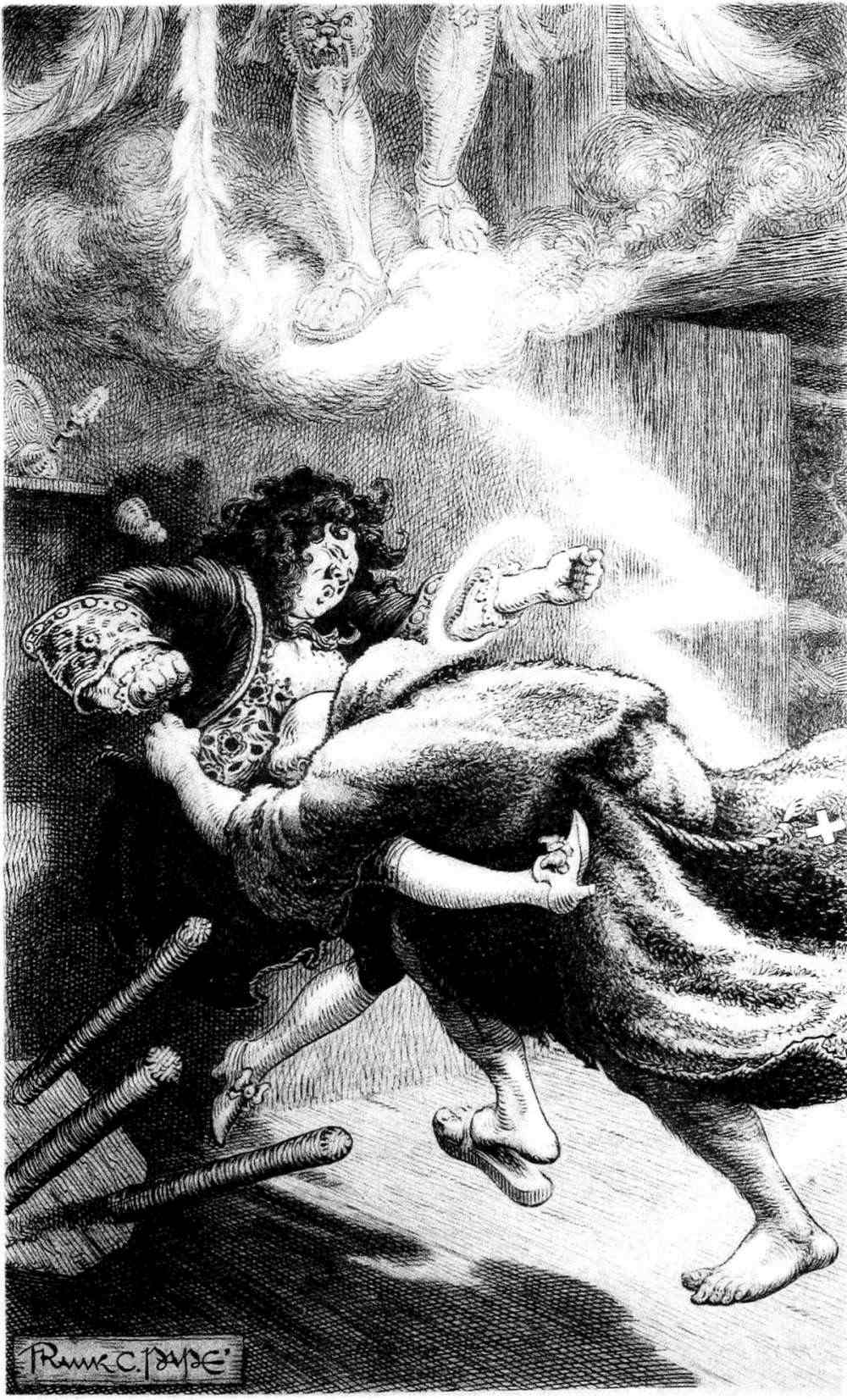
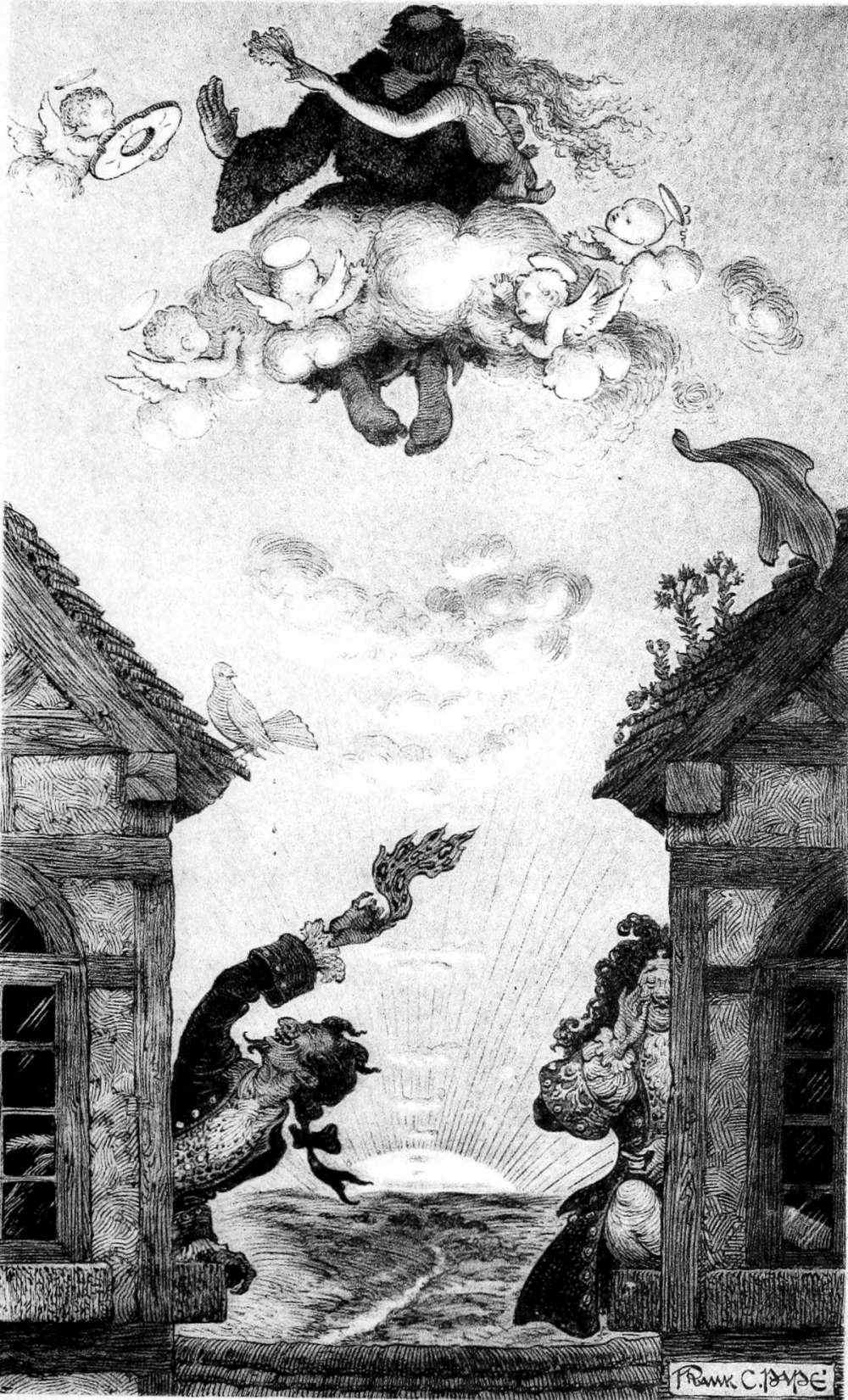
Florian felt himself to be in not
quite the company suited to a nobleman of his rank.
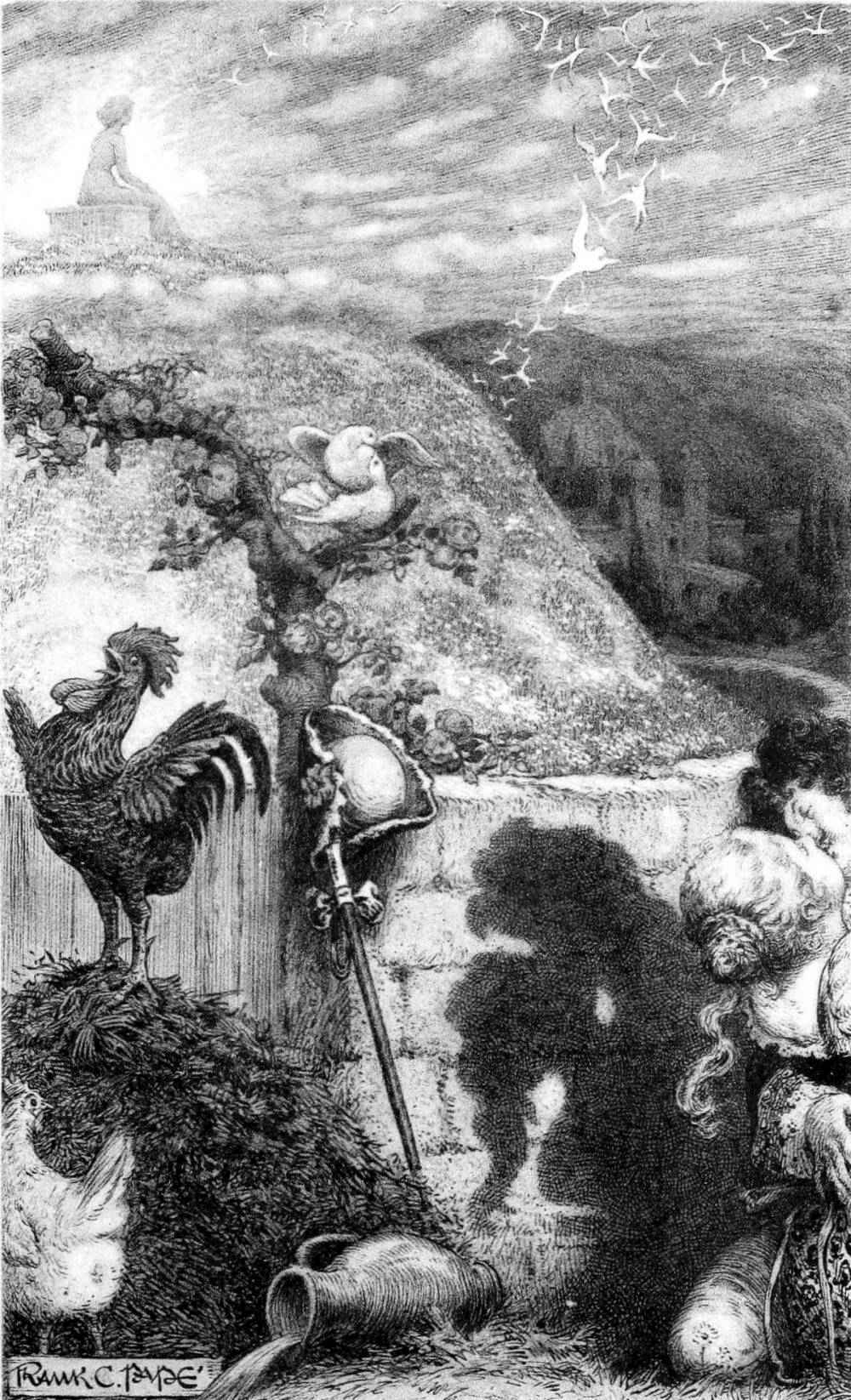
See page 147
“Build on high place for Chemosh, the abomination
of Moab, and for horned Ashtoreth, the
abomination of Zidon, and for Moloch, the
abomination of the children of Ammon.”
ROBERT M. McBRIDE & COMPANY
NEW YORK: 1923
Contents — Illustrations
Copyright, 1923, by James Branch Cabell
Printed in the
United States of America
This First Edition of THE
HIGH PLACE is limited to
two thousand numbered copies,
of which this is
PART ONE THE END OF LONG WANTING — 1. The Child Errant
“Lever un tel obstacle est à moy peu de chose. Le Ciel défend, de vray, certains contentemens; Mais on trouve avec luy des accommodemens.”
ROBABLY Florian would never have
gone into the Forest of Acaire had he
not been told, over and over again, to
keep out of it. Obedience to those
divinely set in authority was in 1698
still modish: none the less, such orders,
so insistently repeated to any
normal boy of ten, even to a boy not
born of the restless house of Puysange,
must make the venture at one
time or another obligatory.
Moreover, this October afternoon
was of the sun-steeped lazy sort which
shows the world as over-satisfied with
the done year’s achievements, of the
sort which, when you think about it so long, arouses
a dim dissent from such unambitious aims. It was
not that the young Prince de Lisuarte—to give
Florian his proper title,—was in any one point dissatisfied
with the familiar Poictesme immediately
about him: he liked it well enough. It was only
that he preferred another place, which probably
existed somewhere, and which was not familiar or
even known to him. It was only that you might—here
one approximates to Florian’s vague thinking,
as he lay yawning under the little tree from the
East,—that you might find more excitement in some
place which strove toward larger upshots than the
ripening of grains and fruits, in a world which did
not every autumn go to sleep as if the providing
of food-stuffs and the fodder for people’s cattle
were enough.
To-day, with October’s temperate sunlight everywhere,
the sleek country of Poictesme was inexpressibly
asleep, wrapped in a mellowing haze. The
thronged trees of Acaire, as Florian now saw them
just beyond that low red wall, seemed to have golden
powder scattered over them, a powder which they
stayed too motionless to shake off. Yet logic told
him these still trees most certainly veiled wild excitements
of some sort, for otherwise people would
not be at you, over and over again, with exhortations
to keep out of that forest.
Nobody was watching. There was nothing in
especial to do, for Florian had now read all the
stories in this curious new book, by old Monsieur
Perrault of the Academy, which Florian’s father
had last month fetched back from Paris: and, besides,
nobody at Storisende had, for as much as a
week, absolutely told Florian not to leave the gardens.
So he adventured: and with the achievement
of the adventure came a strengthening of Florian’s
growing conviction that his elders were in their notions,
as a rule, illogical.
For in Acaire, even when you went as far as
Brunbelois, the boy found nothing hurtful. It was
true that, had he not at the beginning of his wandering
met with the small bright-haired woman who
guided him thereafter, he might have made mistakes:
and mistakes, as Mélusine acknowledged,
might have turned out awkwardly in approaching
the high place, since monsters have to be handled
in just the right way. She explained to Florian,
on that warm long October afternoon, that sympathy
is the main requisite, because the main trouble
with such monsters as the bleps and the strycophanês
and the calcar (she meant only the gray one,
of course) is that each is unique, and in consequence
lonely.
The hatred men feel for every ravening monster
that wears fangs and scales, she pointed out, is due
to its apparel being not quite the sort of thing to
which men are accustomed: whereas people were
wholly used to having soldiers and prelates and
statesmen ramping about in droves, and so viewed
these without any particular wonder or disapproval.
All that was needed, then, was to extend to the
bleps and the strycophanês a little of the confidence
and admiration which men everywhere else accorded
to the destroyers of mankind; and you would soon
see that these glittering creatures—as well as the
tawny eale, and the leucrocotta, with its golden
mane and whiskers, and the opal-colored tarandus,—were
a great deal nicer to look at than the most
courted and run-after people, and much less apt to
destroy anybody outside of their meal hours.
In any event, it was Mélusine who had laid an
enchantment upon the high place in the midst of the
wood, and who had set the catoblepas here and the
mantichora yonder to prevent the lifting of her
spell, so that Florian could not possibly have found
a better guide than Mélusine. She was kindly, you
saw, but not very happy: and from the first, Florian
liked and, in some sort, pitied her. So he rode
with her confidingly, upon the back of the queerest
steed that any boy of ten had ever been privileged
to look at, not to speak of riding on it: and the
two talked lazily and friendlily as they went up
and up, and always upward, along the windings
of the green way which long ago had been a
road.
As they went, the body of this sweet-smelling
Mélusine was warm and soft against his body, for
Mélusine was not imprisoned in hard-feeling clothes
such as were worn by your governesses and aunts.
The monsters stationed along the way drew back as
Mélusine passed; and some purred ingratiatingly,
like gigantic kettles, and others made obeisances:
and you met no other living creatures except three
sheep that lay in the roadway asleep and very dingy
with the dust of several hundred years. No self-respecting
monster would have touched them. Thus
Florian and Mélusine came through the forest without
any hindrance or trouble, to the cleft in the
mountain tops where the castle stood beside a lake:
and Florian liked the stillness of all things in this
high place, where the waters of the lake were without
a ripple, and the tall grass and so many mist-white
flowers were motionless.
He liked it even more when Mélusine led him
through such rooms in the castle as took his fancy.
He was glad that Mélusine did not mind when
Florian confessed the sleeping princess—in the room
hung everywhere with curtains upon which people
hunted a tremendous boar, and stuck spears through
one another, and burst forth into peculiarly solid-looking
yellow flames,—seemed to him even more
lovely than was Mélusine. They were very much
alike, though, the boy said: and Mélusine told him
that was not unnatural, since Melior was her sister.
And then, when Florian asked questions, Mélusine
told him also of the old unhappiness that had been
in this place, and of the reasons which had led her
to put an enduring peacefulness upon her parents
and her sister and all the other persons who slept
here enchanted.
Florian had before to-day heard century-old tales
about Mélusine’s father, Helmas the Deep-Minded.
So it was very nice actually to see him here in bed,
with his scarlet and ermine robes neatly folded on
the armchair, and his crown, with a long feather in
it, hung on a peg in the wall, just as the King had
left everything when he went to sleep several hundred
years ago. The child found it all extremely
interesting, quite like a fairy tale such as those
which he had lately been reading in the book by
old Monsieur Perrault of the Academy.
But what Florian always remembered most
clearly, afterward, was the face of the sleeping
princess, Melior, as he saw it above the coverlet of
violet-colored wool; and she seemed to him so lovely
that Florian was never wholly willing, afterward,
to admit she was but part of a dream which had
come to him in his sleeping, on that quiet haze-wrapped
afternoon, in the gardens of his own home.
Certainly his father had found him asleep, by the
bench under the little tree from the East, and
Florian could not clearly recollect how he had got
back to Storisende: but he remembered Brunbelois
and his journeying to the high place and the people
seen there and, above all, the Princess Melior,
with a clarity not like his memories of other dreams.
Nor did the memory of her loveliness quite depart
as Florian became older, and neither manhood nor
marriage put out of his mind the beauty that he
in childhood had, however briefly, seen.
2. Sayings about Puysange
HEN Florian awakened he was lying
upon the ground, with the fairy tales
of Monsieur Perrault serving for
Florian’s pillow, in the gardens of
Storisende, just by the little tree
raised from the slip which his great-uncle,
the Admiral, had brought from the other side
of the world. Nobody knew the right name of this
tree: it was called simply the tree from the East.
Caterpillars had invaded it that autumn, and had
eaten every leaf from the boughs, and then had gone
away: but after their going the little tree had optimistically
put forth again, in the mild October
weather, so that the end of each bare branch was
now tipped with a small futile budding of green.
It was upon the bench beneath this tree that
Florian’s father was sitting. Monsieur de Puysange
had laid aside his plumed three-cornered hat, and
as he sat there, all a subdued magnificence of dark
blue and gold, he was looking down smilingly at
the young lazibones whom the Duke’s foot was
gently prodding into wakefulness. The Duke was
wearing blue stockings with gold clocks, as Florian
was to remember....
Not until manhood did Florian appreciate his
father, and come properly to admire the exactness
with which the third Duke of Puysange had kept
touch with his times. Under the Sun King’s first
mistress Gaston de Puysange had cultivated sentiment,
under the second, warfare, and under the
third, religion: he had thus stayed always in the
sunshine. It was Florian’s lot to know his father
only during the last period, so the boy’s youth as
spent dividedly at the Duke’s two châteaux, at
Storisende and at Bellegarde, lacked for no edifying
influence. The long summer days at Storisende
were diversified with all appropriate religious instruction.
In winter the atmosphere of Versailles
itself—where the long day of Louis Quatorze
seemed now to be ending in a twilight of stately
serenity through which the old King went deathward,
handsomely sustained by his consciousness of
a well-spent life and by the reverent homage of all
his bastards,—was not more pious than was that
of Bellegarde.
Let none suppose that Monsieur de Puysange affected
superhuman austerities. Rather, he exercised
tact. If he did not keep all fast-days, he never
failed to secure the proper dispensations, nor to see
that his dependants fasted scrupulously: and if he
sometimes, even now, was drawn into argument,
Monsieur de Puysange was not ever known after
any lethal duel to omit the ordering of a mass, at
the local Church of Holy Hoprig, for his adversary’s
soul. “There are amenities,” he would declare,
“imperative among well-bred Christians.”
Then too, when left a widower at the birth of his
second legitimate son, the Duke did not so far yield
to the temptings of the flesh as to take another
wife; for he confessed to scruples if marriage,
which the Scriptures assert to be unknown in
heaven, could anywhere be a quite laudable estate:
but he saw to it that his boys were tended by a
succession of good-looking and amiable governesses.
His priests also were kept sleek, and his confessor
unshocked, by the Duke’s tireless generosity to the
Church; and were all of unquestioned piety, which
they did not carry to excess. In fine, with youth
and sentiment, and the discomforts of warfare also,
put well behind him, the good gentleman had
elected to live discreetly, among reputable but sympathetic
companions....
When Florian told his father now about Florian’s
delightful adventure in Acaire, the Duke smiled:
and he said that, in this dream begotten by Florian’s
late reading of the fairy tales of Monsieur Perrault,
Florian had been peculiarly privileged.
“For Madame Mélusine is not often encountered
nowadays, my son. She was once well known in
this part of Poictesme. But it was a long while
ago she quarreled with her father, the wise King
Helmas, and imprisoned him with all his court in
the high place that ought not to be. Yet Mélusine,
let me tell you, was properly punished for her unfilial
conduct; since upon every Sunday after that,
her legs were turned to fishes’ tails, and they stayed
thus until Monday. This put the poor lady to great
inconvenience: and when she eventually married, it
led to a rather famous misunderstanding with her
husband. And so he died unhappily; but she did
not die, because she was of the Léshy, born of a
people who are not immortal but are more than
human—”
“Of course I know she did not die, monsieur my
father. Why, it was only this afternoon I talked
with her. I liked her very much. But she is not
so pretty as Melior.”
It seemed to Florian that the dark curls of his
father’s superb peruke now framed a smiling which
was almost sad. “Perhaps there will never be in
your eyes anybody so pretty as Melior. I am sure
that you have dreamed all this, jumbling together
in your dreaming old Monsieur Perrault’s fine story
of the sleeping princess—La Belle au Bois Dormant,—with
our far older legends of Poictesme—”
“I do not think that it was just a dream, monsieur
my father—”
“But I, unluckily, am sure it was, my son. And
I suspect, too, that it is the dream which comes in
varying forms to us of Puysange, the dream which
we do not ever quite put out of mind. We stay, to
the last, romantics. So Melior, it may be, will
remain to you always that unattainable beauty toward
which we of Puysange must always yearn,—just
as your patron St. Hoprig will always afford
to you, in his glorious life and deeds, an example
which you will admire and, I trust, emulate. I admit
that such emulation,” the Duke added, more
drily, “has not always been inescapable by us of
Puysange.”
“I cannot hope to be so good as was Monseigneur
St. Hoprig,” Florian replied, “but I shall endeavor
to merit his approval.”
“Indeed, you should have dreamed of the blessed
Hoprig also, while you were about it, Florian. For
he was a close friend of your Melior’s father, you
may remember, and performed many miracles at the
court of King Helmas.”
“That is true,” said Florian. “Oxen brought him
there in a stone trough: and I am sure that Monseigneur
St. Hoprig must have loved Melior very
much.”
And he did not say any more about what his
father seemed bent upon regarding as Florian’s
dream. At ten a boy has learned to humor the notions
of his elders. Florian slipped down from the
bench, and tucked his book under his arm, and
agreed with his father that it was near time for
supper.
None the less, though, as the boy stood waiting
for that magnificent father of his to arise from the
bench, Florian reflected how queer it was that, before
the falling of the Nis magic, this beautiful
Melior must have known and talked with Florian’s
heavenly patron, St. Hoprig of Gol. It was to
Holy Hoprig that Florian’s mother had commended
the boy with her last breath, and it was to Holy
Hoprig that Florian’s father had taught the boy to
pray in all time of doubt or peccadillo, because this
saint was always to be the boy’s protector and advocate.
And this made heaven seem very near and
real, the knowledge that always in celestial courts
this bright friend was watching, and, Florian hoped,
was upon occasion tactfully suggesting to the good
God that one must not be too severe with growing
boys. Melior—Florian thought now,—was remotely
and half timidly to be worshipped: Hoprig,
the friend and intercessor,—a being even more
kindly and splendid than was your superb father,—you
loved....
Florian had by heart all the legends about Holy
Hoprig. Particularly did Florian rejoice in the tale
of the saint’s birth, in such untoward circumstances
as caused the baby to be placed in a barrel, and cast
into the sea, to be carried whither wind and tide
directed. Florian knew that for ten years the barrel
floated, tossing up and down in all parts of the
ocean, while regularly an angel passed the necessary
food to young Hoprig through the bung-hole.
Finally, at Heaven’s chosen time, the barrel rolled
ashore near Manneville, on the low sands of Fomor
Beach. A fisherman, thinking that he had found a
cask of wine, was about to tap it with a gimlet;
then from within, for the first time, St. Hoprig
speaks to man: “Do not injure the cask. Go at
once to the abbot of the monastery to which this
land belongs, and bid him come to baptize me.”
It seemed to Florian that was a glorious start in
life for a boy of ten, a boy of just the same age as
Florian. All the later miracles and prodigies appeared,
in comparison with that soul-contenting moment,
to be compact of paler splendors. Nobody,
though, could hear unenviously of the long voyage
to the Red Islands and the realm of Hlif, and to
Pohjola, and even to the gold-paved Strembölgings,
where every woman contains a serpent so placed as
to discourage love-making,—of that pre-eminently
delightful voyage made by St. Hoprig and St. Hork
in the stone trough, which, after its landing upon
the coasts of Poictesme, at mid-winter, during a
miraculous shower of apple-blossoms, white oxen
drew through the country hillward, with the two
saints by turns preaching and converting people all
the way to Perdigon. For that, Florian remembered,
was the imposing fashion in which Holy
Hoprig had come to the court of Melior’s father,—and
had wrought miracles there also, to the discomfiture
of the abominable Horrig. But more
important, now, was the reflection that St. Hoprig
had in this manner come to Melior and to the unimaginable
beauty which, in the high place, a coverlet
of violet stuff just half concealed....
Certainly Monseigneur St. Hoprig must have
loved Melior very much, and these two must have
been very marvelous when they went about a more
heroic and more splendid world than Florian could
hope ever to inhabit. It was of their beauty and
holiness that the boy thought, with a dumb yearning
to be not in all unworthy of these bright, dear
beings. That was the longing—to be worthy,—which
possessed Florian as he stood waiting for his
father to rise from the bench beneath the little tree
from the East. There, the Duke also seemed to
meditate, about something rather pleasant.
“You said just now, monsieur my father,” Florian
stated, a trifle worried, “that we of Puysange have
not always imitated the good examples of St. Hoprig.
Have we been very bad?”
Monsieur de Puysange had put on his plumed
hat, but he stayed seated. He appeared now, as
grown people so often do, amused for no logical
or conceivable reason: though, indeed, the Duke
seemed to find most living creatures involuntarily
amusing.
He said: “We have displayed some hereditary
foibles. For it is the boast of the house of Puysange
that we trace in the direct male line from
Poictesme’s old Jurgen. That ancient wanderer,
says our legend, somehow strayed into the bed-chamber
of Madame Félise de Puysange; and the
result of his errancy was the vicomte who flourished
under the last Capets.”
Young Florian, in accord with the quaint custom
of the day, had been reared without misinformation
as to how or whence children came into
the world. So he said only, if a little proudly,
“Yes,—he was another Florian, I remember, like
me.”
“There were queer tales about this first Florian,
also, who is reputed to have vanished the moment
he was married, and to have re-appeared here, at
Storisende, some thirty years later, with his youth
unimpaired. He declared himself to have slept out
the intervening while,—an excuse for remissness in
his marital duties which sceptics have considered
both hackneyed and improbable.”
“Well,” Florian largely considered, “but then
there is Sir Ogier still asleep in Avalon until France
has need of him; and John the Divine is still sleeping
at Ephesus until it is time to bear his witness
against Antichrist; and there is Merlin
in Broceliande, and there is St. Joseph of Arimathæa
in the white city of Sarras—and really,
monsieur my father, there is Melior, and all the
rest of King Helmas’ people up at Brunbelois.”
“Are you still dreaming of your Melior, tenacious
child! Certainly you are logical, you cite
good precedents for your namesake, and to adhere
to logic and precedent is always safe. I hope you
will remember that.”
“I shall remember that, monsieur my father.”
“Certainly, too, this story of persons who sleep
for a miraculous while is common to all parts of
the world. This Florian de Puysange, in any
event, married a granddaughter of the great Dom
Manuel; so that we descend from the two most
famous of the heroes of Poictesme: but, I fancy,
it is from Jurgen that our family has inherited the
larger number of its traits.”
“Anyhow, we have risen from just being
vicomtes—”
Florian’s father had leaned back, he had put off
his provisional plan of going in to supper. You
could not say that the good gentleman exactly took
pride in his ancestry: rather, he found his lineage
worthy of him, and therefore he benevolently approved
of it.
So he said now, complacently enough: “Yes,
our house has prospered. Steadily our fortunes
have been erected, and in dignity too we have been
erected. Luck seems to favor us, however, most
heartily when a woman rules France, and it is to
exalted ladies that we owe most of our erections.
Thus Queen Ysabeau the Bavarian notably advanced
the Puysange of her time, very much as
Anne of Beaujeu and Catherine de Medici did afterward.
Many persons have noted the coincidence.
Indeed, it was only sixty years ago that Marion de
Lorme spoke privately to the Great Cardinal, with
such eloquence that the Puysange of the day—another
Florian, and a notably religious person,—had
presently been made a duke, with an appropriate
estate in the south—”
“I know,” said Florian, not a bit humble about
his erudition. “That is how we came to be here
in Poictesme. Mademoiselle de Lorme was a very
kind lady, was she not, monsieur my father?”
“She was so famed, my son, for all manner of
generosity that when my grandfather remodeled
Bellegarde, and erected the Hugonet wing of the
present château, he sealed up in the cornerstone, just
as people sometimes place there the relics of a saint,
both of Mademoiselle de Lorme’s garters. Probably
there was some salutary story connected with his
acquiring of them; for my pious grandfather cared
nothing for such vanities as jeweled garters, his
mind being wholly set upon higher things.”
“I wish we knew that story,” said Florian.
“But nobody does. My grandfather was discreet.
So he thrived. And his son, who was my honored
father, also thrived under the regency of Anne of
Austria. He thrived rather unaccountably in the
teeth of Mazarin’s open dislike. There was some
story—I do not know what,—about a nightcap
found under the Queen’s pillow, and considered by
his eminence to need some explaining. My honored
father was never good at explaining things. But
he was discreet, and he thrived. And I too, my
son, was lucky in Madame de Montespan’s time.”
Now Madame de Montespan’s time antedated
Florian’s thinking: but about the King’s last mistress,—and
morganatic wife, some said,—Florian
was better informed.
“Madame de Maintenon also is very fond of you,
monsieur my father, is she not?”
The Duke slightly waved his hand, as one who
disclaims unmerited tribute. “It was my privilege
to know that incomparable lady during her first
husband’s life. He was a penniless cripple who
had lost the use of all his members, and in that time
of many wants I was so lucky as to comfort Madame
Scarron now and then. Madame de Maintenon
remembers these alleviations of her unfortunate
youth, and notes with approval that I have
forgotten them utterly. So Madame is very kind.
In short,—or, rather, to sum up the tale,—the lords
of Puysange are rumored, by superstitious persons,
to have a talisman which enables them to go farther
than may most men in their dealings with
ladies.”
“You mean, like a magic lamp or a wishing cap?”
said Florian, “or like a wizard’s wand?”
“Yes, something in that shape,” the Duke answered,
“and they tell how through its proper employment,
always under the great law of living, our
house has got much pleasure and prosperity. And
it is certain the Collyn aids us at need—”
“What is the Collyn?”
“Nothing suitable for a boy of ten to know about.
When you are a man I shall have to tell you, Florian.
That will be soon enough.”
“And what, monsieur my father, is this great law
of living?”
The Duke looked for a while at his son rather
queerly. “Thou shalt not offend,” the Duke replied,
“against the notions of thy neighbor.”
With that he was silent: and, rising at last from
the bench, he walked across the lawn, and ascended
the broad curving marble stairway which led to the
south terrace of Storisende. And Florian, following,
was for an instant quiet, and a little puzzled.
“Yes, monseigneur my father, but I do not see—”
The Duke turned, an opulent figure in dark blue
and gold. He was standing by one of the tall vases
elaborately carved with garlands, the vases that in
summer overflowed with bright red and yellow
flowers: these vases were now empty, and the gardeners
had replaced the carved lids.
“Youth never sees the reason of that law, my son.
I am wholly unprepared to say whether or not this
is a lucky circumstance.” The Duke again paused,
looking thoughtfully across the terrace, toward the
battlemented walls and the four towers of the southern
façade. His gazing seemed to go well beyond
the fountain and the radiating low hedges and
gravelled walkways of the terrace, to go beyond, for
that matter, the darkening castle. Twilight was rising:
you saw a light in one window. “At all events,
we are home again, young dreamer. I too was once
a dreamer. And at all events, there is Little
Brother waiting for us.”
3. Widowers Seek Consolation
ITTLE brother was indeed waiting
for them, at the arched doorway,
impatient of his governess’ restraint.
At sight of them he began telling,
coincidently, of how hungry he was,
and of how he had helped old Margot
to milk a cow that afternoon, and of how a
courier was waiting for Monsieur my Father in
great long boots, up to here. The trifold tale was
confusing, for at eight little Raoul could not yet
speak plainly. His sleeve was torn, and he had a
marvelously dirty face.
Behind him stood pallid pretty Mademoiselle
Berthe, the governess who a trifle later, during the
next winter, killed herself. She had already begun
bewailing her condition to the Duke, even while she
obstinately would have none of the various husbands
whom her kindly patron recommended, from
among his dependants, as ready to make that condition
respectable. There seemed no pleasing the
girl, and Florian could see that his father, for all
his uniform benevolence, regarded her as a nuisance.
But the Duke now gazed down, at the pale
frightened-looking creature, with that fine condescending
smile which he accorded almost everybody.
“Mademoiselle, children are a grave responsibility.
I have just found Florian asleep in the mud yonder,
whereas you have evidently just plucked this other
small pest from the pig-sty. It is lucky that we
have no more brats to contend with, Mademoiselle,
for the present, is it not?”
Florian wondered, long afterward, how Mademoiselle
had looked, and what she replied. He could
not recollect. But he did remember that at this
instant Little Brother ran from her and hugged first
one of his father’s superb legs and then Florian.
Little Brother was warm and tough-feeling and
astonishingly strong, and he smelled of clean earth.
Florian loved him very much, and indeed the affection
between the two brothers endured until the
end of their intercourse. Florian was always consciously
the elder and wiser, and felt himself the
stronger long after Raoul had become taller than
Florian. Even after Raoul was well on in his thirties,
and both the boys had boys of their own,
Florian still thought of the Chevalier de Puysange
as a little brother with a dirty face and a smell of
clean earth, whom you loved and patronized, and
from whom you had one secret only. For of course
you never told Raoul about Melior.
You spoke to nobody about Melior. You found
it wiser and more delicious to retain all knowledge
of her loveliness for entirely private consideration,
and thus not be bothered with people’s illogical notion
that Melior was only a dream.
For the memory of the Princess Melior’s loveliness
did not depart as Florian became older, and
neither manhood nor marriage could put quite out
of mind the beauty that he had in childhood, however
briefly, seen. Other women came and in due
season went. His wives indeed seemed to die with
a sort of uniform prematureness in which the considerate
found something of fatality: nor did the
social conventions of the day permit a Puysange to
shirk amusing himself with yet other women.
Florian amused himself so liberally, once his father
was dead, and the former Prince de Lisuarte had
succeeded to the major title and to his part of the
estates, that they of Bellegarde were grieved when
it was known that the fourth Duke of Puysange
now planned to marry for the fifth time.
At Florian’s château of Bellegarde, affairs had
sped very pleasantly since the death of his last wife,
and the packing off of his son to Storisende.
Storisende, by the old Duke’s will, had fallen to
Raoul. Affairs had sped so pleasantly, they said at
Bellegarde, that it seemed a deplorable risk for
monseigneur to be marrying a woman who might,
conceivably, be forthwith trying to reclaim him
from all fashionable customs. Besides, he was
upon this occasion marrying a daughter of the house
of Nérac, just as his brother the Chevalier had done.
And this was a ruiningly virtuous family, a positively
dowdy family who hardly seemed to comprehend—they
said at Bellegarde,—that we were now
living in the modern world of 1723, and that fashions
had altered since the old King’s death.
“For how long, little monster, will this new toy
amuse you?” asked Mademoiselle Cécile. It appears
unfair here to record that at nine o’clock in
the morning they were not yet up and about the
day’s duties, without recording also, in palliation of
such seeming laziness, that there was no especial
need to hurry, for all of mademoiselle’s trunks had
been packed overnight, and she was not to leave
Bellegarde until noon.
“Parbleu, one never knows,” Florian replied, as
he lay smiling lazily at the smiling cupids who held
up the bed-canopies. “It is a very beautiful feature
of my character that at thirty-five I am still the
optimist. When I marry I always believe the ceremony
to begin a new and permanent era.”
“Oh, very naturally, since everywhere that frame
of mind is considered appropriate to a bridegroom.”
The girl had turned her sleek brown head a little,
resting it more comfortably upon the pillow, and
she regarded Florian with appraising eyes. “My
friend, in this, as in much else, I find your subserviency
to convention almost excessive. It becomes
a notorious mania with you to do nothing
whatever without the backing of logic and good
precedent—”
“My father, mademoiselle, impressed upon me a
great while ago the philosophy of these virtues.”
“Yes, all that is very fine. Yet I at times suspect
your logic and your precedents to be in reality
patched-up excuses for following the moment’s
whim: or else I seem to see you adjusting them,
like colored spectacles, to improve in your eyes the
appearance of that which you have in hand.”
“Now you misjudge me, mademoiselle, with the
ruthlessness of intimate personal acquaintance—”
“But indeed, indeed, those precedents which you
educe are often rather far-fetched. You are much
too ready to refer us to the customs of the Visigoths,
or to cite the table-talk of Aristotle, or to appeal
to the rulings of Quintilian. It sounds well: I concede
that. Yet these, and the similar sonorous
pedantries with which you are so glib to justify
your pranks, do not, my friend, let me assure you,
seem always wholly relevant to the conditions of
modern life—”
“My race descends from a most notable scholar,
mademoiselle, and it well may be the great Jurgen
has bequeathed to me some flavor of his unique
erudition. For that I certainly need not apologize—”
“No, you should rather apologize because that
ancient hero appears also to have bequeathed to
you a sad tendency to self-indulgence in matrimony.
Now to get married has always seemed to me an
indelicate advertising of one’s intentions: and I assuredly
cannot condone in anybody a selfish habit
which to-day leads to my being turned out of
doors—”
“A pest! you talk as if I too did not sincerely
regret those social conventions which make necessary
your departure—”
“Yet it is you who evoke those silly conventions
by marrying again.”
“—But in a grave matter like matrimony one
must not be obstinate and illiberal. Raoul assures
me, you conceive, that his little sister-in-law is a
delightful creature. He thinks that as a co-heiress
of Nérac, without any meddlesome male relatives,
she is the person logically suited to be my wife.
And I like to indulge the dear fellow’s wishes.”
“Behold a fine sample of your indulgence of
others, by marrying a great fortune! After all,
though,” Cécile reflected, philosophically, “I would
not change shoes with her. For it is not wholesome,
my friend, to be your wife. But it has been
eminently pleasant to be your playfellow.”
Florian smiled. And Florian somewhat altered
his position.
“Bels dous amicx,” sang Florian, softly, “fassam
un joc novel—!”
“I must ask for some explanation of, at least,”
Cécile stated, with that light, half-muffled laugh
which Florian found adorable, “your words.”
“I was about to sing, mademoiselle, a very ancient
aubade. I was beginning a morning-song such
as each lover in the days of troubadours was used,
here in Poictesme, to sing to his mistress at arising.”
“So that, now you are, as I perceive, arising, you
plan to honor the old custom? That is well enough
for you, who are a Duke of Puysange, and who
have so much respect for precedent and logic. But
I am not logical, I am, as you can see, a woman.
Moreover, I am modern in all, I abhor antiquity. I
find it particularly misplaced in a bedroom. And
so, my friend, I must entreat you, whatever you do,
not to sing any of those old songs, which may,
for anything I know, have some improper significance.”
Florian humored this young lady’s rather strict
notions of propriety, and they for a while stopped
talking. Then they parted with a friendly kiss, and
they dressed each for travelling: and Mademoiselle
Cécile rode south upon a tentative visit to Cardinal
Borgia, whose proffered benefactions had thus
far been phrased with magniloquence and vagueness.
This fair girl had the religious temperament,
and she delighted in submitting herself to her spiritual
fathers, but she required some daily comforts
also.
Florian next sent for the boy Gian Paolo, who
had now for seven months been Florian’s guest. “I
am marrying,” said Florian. “We must part, Gian
Paolo.”
“Do you think so?” the boy said. “Ah, but you
would regret me!”
“Regretting would become a lost art if people did
not sometimes do their duty. Now that I am about
to take a wife, you comprehend, I shall for the
while be more or less pre-empted by my bride. It
is unlikely that I shall be able, at all events during
the first ardors of the honeymoon, to entertain my
friends with any adequacy. Let us be logical, dear
Gian Paolo! I find no fault in you, beloved boy, I
concede you to be fit friend for an emperor. It is
merely that the advent of my new duchess now compels
me to ensure the privacy of our honeymoon by
parting, however regretfully, with Mademoiselle
Cécile and with you also.”
“Your decision does not surprise me, Florian, for
they say that you have parted with many persons
who loved you, and who left you—”
“Yes?” said Florian.
“—Very suddenly—”
“Yes?” Florian said, again.
“—And yet without their departure surprising
you at all, dear Florian.”
“Oh, it is merely that in moments of extreme
anguish I attempt to control my emotions, and to
give them no undignified display,” said Florian.
“Doubtless, I was as surprised as anybody. Well,
but this foolish gossip of this very censorious neighborhood
does not concern us, Gian Paolo: and, now
that you too are about to go, I can assure you that
all your needs”—here for an instant Florian hesitated,—“have
been provided for.”
“Indeed, I see that you have wine set ready. Is
it”—and the boy smiled subtly, for he was confident
of his power over Florian,—“is it my stirrup-cup,
dear Florian?”
Florian now looked full upon him. “Yes,”
Florian said, rather sadly. Then they drank, but
not of the same wine, to the new Duchess of Puysange.
And the boy Gian Paolo died without pain.
“It is better so,” said Florian. “Time would
have spoiled your beauty. Time would have spoiled
your joy in life, Gian Paolo, and would have
shaken your fond belief that I was your slave in
everything. Time lay in wait to travesty this velvet
chin with a harsh beard, to waken harsh doubtings
in the merry heart, and to abate your lovely
perversities with harsh repentance. For time ruins
all, but you escape him, dear Gian Paolo, unmarred.”
Now Florian was smiling wistfully, for he found
heartache in this thinking of the evanescence of
beauty everywhere, and heartache too in thinking of
the fate of that charming old lady, La Tophania,
who had been so kind to him in Naples. For
Florian could rarely make use of her recipes without
recollecting how cruelly the mob had dealt with
his venerable instructress: that was, he knew, a sentimental
side to his nature, which he could never
quite restrain. So he now thought sadly of this
stately old-world gentlewoman, so impiously dragged
from a convent and strangled, now four years ago,
because of her charity toward those who were afflicted
by the longevity of others. Yes, life was
wasteful, sparing nobody, not even one who was so
wise and amiable as La Tophania, nor so lovable
as Gian Paolo. The thought depressed him: such
wastefulness was illogical: and it seemed to Florian,
too, that this putting of his household into fit order
for the reception of his bride was not wholly a merry
business.
Then Florian, stroking the dead hand which was
as yet soft and warm, said gently: “And though I
have slain you, dear Gian Paolo, rather than see
you depart from me to become the friend of another,
and perhaps to talk with him indiscreetly
after having learned more about me than was wise,
I have at worst not offended against convention,
nor have I run counter to the fine precedents of the
old time. Just so did the great Alexander deal with
his Clitus, and Hadrian with his Antinous; nor did
divine Apollo give any other parting gift to Hyacinthos,
his most dear friend. Now the examples
afforded us by ancient monarchs and by the heathen
gods should not, perhaps, be followed blindly. Indeed,
we should in logic remember always that all
these were pagans, unsustained by the promptings
of true faith, and therefore liable to err. None
the less, they at least establish an arguable precedent,
they afford people of condition something
to go by: and to have that is a firm comfort.”
He kissed the dead lips fondly; and he bade his
lackeys summon Father Joseph to bury Gian Paolo,
with due ceremony, in the Chapel, next to Florian’s
wives.
“We obey. Yet, it will leave room for no more
graves,” one told him, “in the alcove wherein monseigneur’s
wives are interred.”
“That is true. You are an admirable servant,
Pierre, you think logically of all things. Do you
bury the poor lad in the south transept.”
Then Florian took wine and wafers into the secret
chamber which nobody else cared to enter, and
he made sure that everything there was in order.
All these events happened on the feast day of St.
Swithin of Winchester, which falls upon the fifteenth
of July: and on that same day Florian left
Bellegarde, going to meet his new wife, and traveling
alone, toward Storisende.
4. Economics of an Old Race
LORIAN rode alone, spruce and staid
in a traveling suit of bottle-green
and silver, riding upon a tall white
horse, riding toward Storisende,
where his betrothed awaited him,
and where the wedding supper was
already in preparation. He went by the longer
route, so that he might put up a prayer, for the
success of his new venture into matrimony, at the
church of Holy Hoprig. Nobody was better known
nor more welcome at this venerable shrine than was
Florian, for the Duke of Puysange had spared nothing
to evince his respect for the fame and the
favorable opinion of his patron saint. Whether in
the shape of candles or a handsome window, or a
new chapel or an acre or two of meadow land,
Florian was always giving for the greater glory of
that bright intercessor who in heaven, Florian assumed,
was tactfully suggesting that such generosity
should not be overlooked. So it was that
Florian kept his accounts balanced, his future of a
guaranteeable pleasantness, and his conscience clear.
Having prayed for the success of this new marriage
and for the soul of Gian Paolo, and having
confessed to all the last month’s irregularities,
Florian went eastward. He passed Amneran and
a spur of the great forest, now that he went to
ford the Duardenez. As he neared Acaire he
thought, idly, and with small shrugs, of a boy’s
adventuring to the sleeping princess in the midst of
these woods, and of the beauty which he had not
ever forgotten utterly: and his heart was troubled
with that worshipful and hopeless longing which
any thinking about this Melior would always evoke
in Florian, because he knew that his “dream,” as
people would call it, was a far more true and vital
thing than Florian’s daily living.
Then on a sudden he reined up his horse, and
Florian waited there, looking down upon the dark
woman who had come out of this not over-wholesome
forest. Florian did not speak for some while,
but he smiled, and he shook his head in a sort of
humorous disapprobation.
This woman was his half-sister, whom Florian’s
father had begotten, with the co-operation of the
bailiff of Ranec’s daughter, some while before middle
age and the coming into extreme fashion of
continence had made such escapades criticizable.
Marie-Claire Cazaio was thus of an age with
Florian, being his senior by only three months. In
their shared youth these two had not been strangers,
for the old Duke had handsomely recognized his
responsibility for this daughter, and had kept Marie-Claire
about his household until the girl had outraged
propriety by bearing an illegitimate child.
After this the Duke had no choice except to turn
her out of doors. She had since then taken up
with companions whose repute was not even dubious:
and her manner of living was esteemed intemperate
by the most broad-minded persons in
Poictesme, where sorcery was treated with all reasonable
indulgence.
“My dear,” said Florian, at last, still shaking his
head, “I must tell you, however little good it does,
that there was another deputation of peasants and
declamatory grocers at me, only last week, to have
you seized and burned. You are too careless,
Marie-Claire, about offending against the notions
of your neighbors. You should persuade your unearthly
lovers to curb their ardors until after dark.
You should at least induce them not to pass over
Amneran in such shapes as frighten your neighbors
in the twilight, and so provoke their very natural
desire to burn you at broad noon.”
“These little peasants will not burn me yet,” she
answered. “My term is not yet run out—” You
saw that Marie-Claire was thinking of quite other
matters. She said, “So, they tell me, you are to
marry again?”
She had lifted to him now that half-pensive, half-blind
staring which he uneasily recognized. Florian
had always under this woman’s gaze the illogical
feeling that, where he was, Marie-Claire saw some
one else, or, to be exact, saw some one a slight distance
behind him. Her eyes could not be black.
Florian knew that nobody’s eyes were really black.
But this woman’s small eyes were very dark, they
had such extraordinarily thick lashes upon both upper
and lower lids, that these little eyes most certainly
seemed blobs of infernal ink. There was in
his sister’s eyes a discomfortable knowingness.
Puysange looked at Puysange.
He answered, quietly, “Yes, Mademoiselle de
Nérac is now about to make me the happiest of
men.”
“Unhappy child! for she too is flesh and blood.”
“And what does that anatomical truism signify
when it is so cryptically uttered, Marie-Claire?”
“It means that you and I are not enamored of
flesh and blood.”
Florian did not reply to this in words. But he
smiled at his half-sister, for he was really fond of
her, even now, and they understood each other
excellently.
So he stayed silent, still looking at her. By and
by he said: “You come out of a wood that is not
often visited by abbots and cherubim, and you carry
a sieve and shears. Who is yonder?”
Marie-Claire replied, “How should I know the
real name of the adversary of all the gods of men?”
“Pardieu!” said Florian, “so it is company of
such sinister grandeur that you entertain nowadays.
You progress, my sister, toward a truly notable
damnation.”
“In these parts, to be sure, they call him
Janicot—”
“Yes, I know,” said Florian, “and, certainly, his
local name does not matter in the least.” Florian
smiled benevolently, and said, “Good luck to you,
my dear!”
Then he rode on, into the pathway from which
Marie-Claire had just emerged. He was interested,
for it might well be rather amusing to overtake
this whispered-about Janicot in the midst of
his sombre work: but, even so, the thoughts of
Florian were not wholly given over to Janicot, or
to Marie-Claire either. Instead, he was still thinking
of the sleeping woman’s face which he had not
ever forgotten utterly: and this dark sullen sister
of his—who had once been so pretty too, he recollected,—and
all her injudicious traffic seemed, somehow,
rather futile.
No, he reflected, Marie-Claire was not pretty now.
Her neck remained wonderful: it was still the only
woman’s neck familiar to Florian that really justified
comparison with a swan’s neck by its unusual
length and roundness and flexibility. But her head
was too small for that superb neck: she had taken
on the dusky pallor of a Puysange: she was, in
fine, thirty-five, and looked rather older. It showed
you what irregular and sorcerous living might lead
to. Florian at thirty-five looked—at most, he estimated,—twenty-eight.
Yes: it was much more sensible
to adhere to precedent, and to keep all one’s
accounts in order, through St. Hoprig’s loving care,
and to retain overhead a thrifty balance in one’s
favor.
5. Friendly Advice of Janicot
HEN he had entered a little way into
Acaire, Florian came to an open
place, where seven trees had been
hewn down. A brown horse was
tethered here, and here seven lilies
bloomed with a surprising splendor
of white and gold. These stood waist-high about
a sedate looking burgess, unostentatiously but very
neatly dressed in some brown stuff, which was just
the color of his skin. At his feet was a shrub covered
with crimson flowers: no sun shone here, the
sky was clouded and cast down a coppery glow.
Such was Janicot. Florian saluted him, quite
civilly, but with appropriate reserve.
“Come,” Janicot said, smiling, “and is this the
rapturous countenance of a bridegroom? I am not
pleased with you, Monsieur the Duke, I must have
happy faces among my friends.”
“So you also have heard of my approaching marriage!
Well, I am content enough, and for me to
marry the co-heiress of Nérac seems logical: but
in logic, too, I cannot ignore that I ride toward a
disappointing business. There is magic in the curiously
clothed woman who is mistress of herself, the
hour and you: but the prostrate, sweating and submissive
meat in a tangle of bed-clothing—!”
Florian shrugged.
“In fact,” said Janicot, as if pensively, “I have
observed you. You do not enter wholly into the
pleasures suitable for men and women: you do not
avoid these agreeabilities, but your sampling of
them is without self-surrender, and there is something
else which you hold more desirable.”
“That is true.” Florian for an instant meditated.
Florian shrugged. Then Florian dismounted from
his white horse, and tethered it. Here was the one
being in whom you might confide logically. Florian
told Janicot the story of how, in childhood, Florian
had ascended to the high place, and had seen the
Princess Melior, whom always since that time his
heart had desired.
And Janicot heard him through, with some marks
of interest. Janicot nodded.
“Yes, yes,” said Janicot. “I do not frequent high
places. But I have heard of this Melior, from men
a long while dead, and they said that she was beautiful.”
“Then they spoke foolishly,” replied Florian, “because
they spoke with pitiable inadequacy. Now I
do not say that she is beautiful. I do not speak
any praise whatever of Melior, because her worth
is beyond all praising. I am silent as to the unforgotten
beauty of Melior, lest I cry out against
that which I love. When I was but a child her
loveliness was revealed to me, and never since then
have I been able to forget the beauty of which all
dreams go envious. I jest with women who are
lovable and nicely colored; they have soft voices,
and their hearts are kind: but presently I yawn and
say they are not as Melior.”
“Ah, but in fact,” said Janicot, “in fact, you
do—without caring to commit yourself formally,—believe
that this Melior is beautiful?”
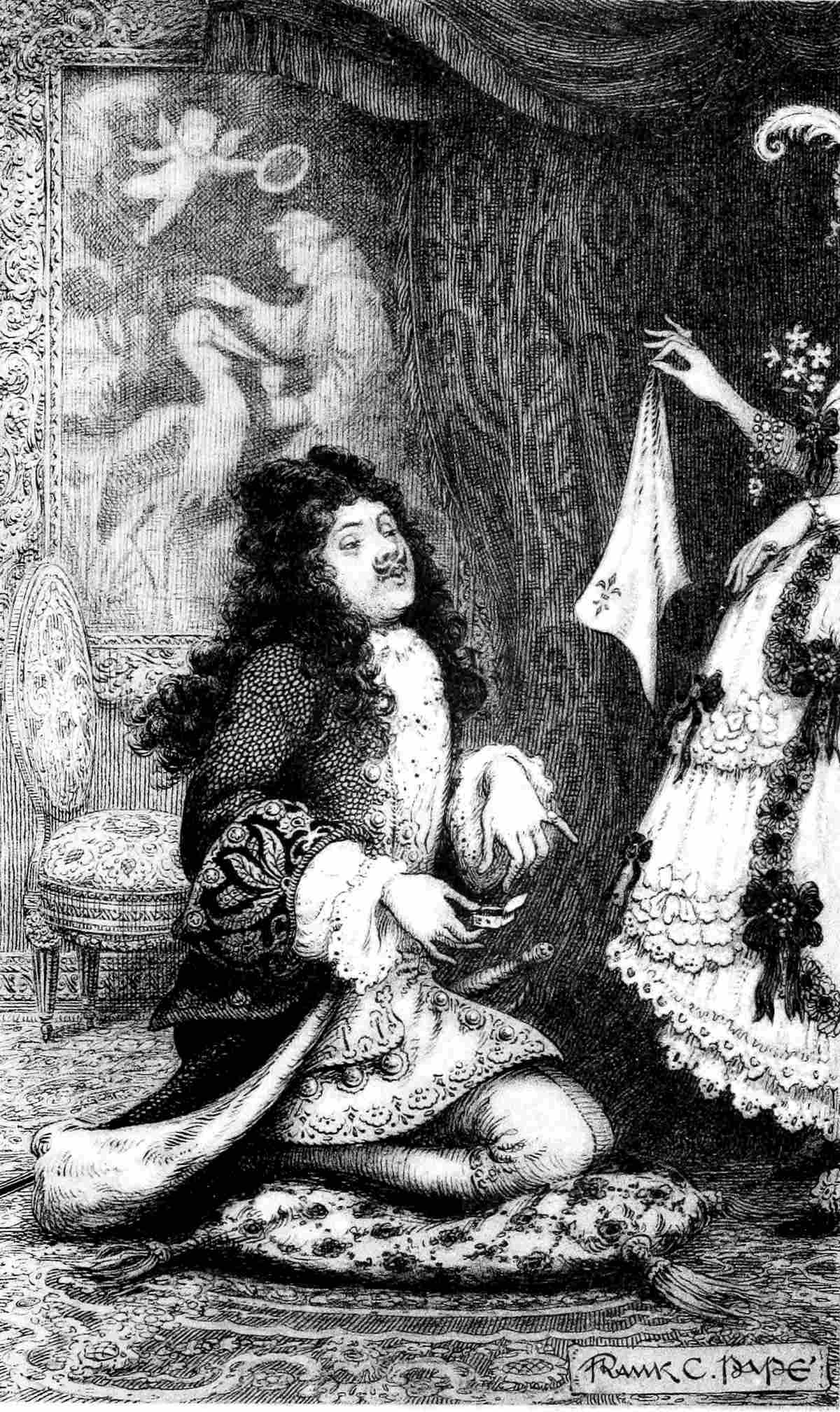
Now Florian’s plump face was altered, and his
voice shook a little. He said:
“Her beauty is that beauty which women had in
the world’s youth, and whose components the old
world forgets in this gray age. It may be that
Queen Helen possessed such beauty, she for whom
the long warring was. It may be that Cleopatra
of Egypt, who had for her playmates emperors and
a gleaming snake, and for her lovers all poets that
have ever lived, or it may be that some other royal
lady of the old time, in the world’s youth, wore
flesh that was the peer of Melior’s flesh in loveliness.
But such women, if there indeed was ever
Melior’s peer, are now vague echoes and blown dust.
I cry the names that once were magic. I cry to
Semiramis and to Erigonê and to Guenevere, and
there is none to answer. Their beauty has gone
down into the cold grave, it has nourished grasses,
and cattle chew the cud which was their loveliness.
Therefore I cry again, I cry the name of Melior:
and though none answers, I know that I cry upon
the unflawed and living beauty which my own eyes
have seen.”
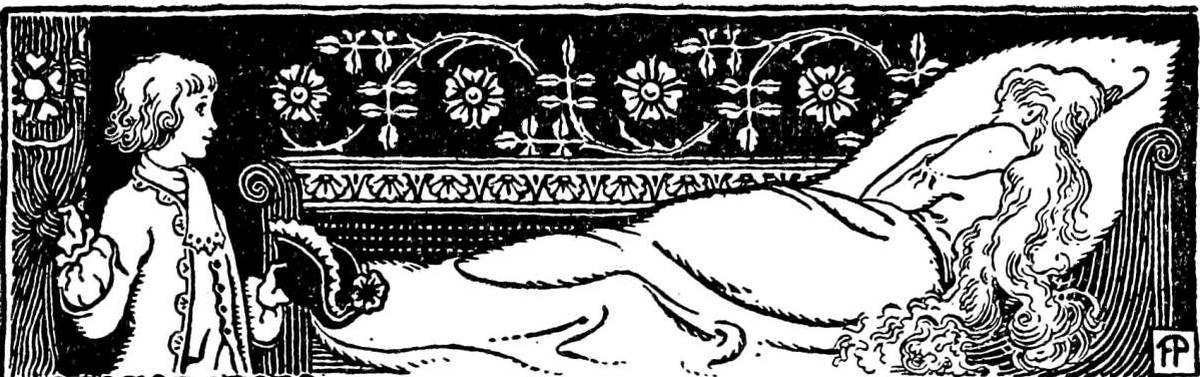
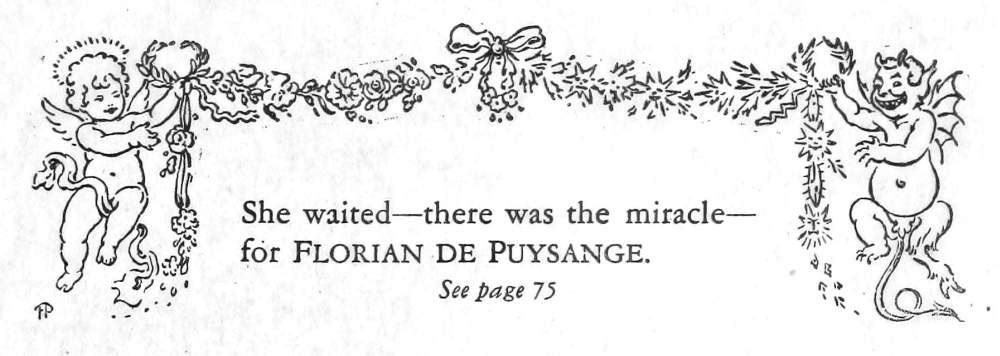
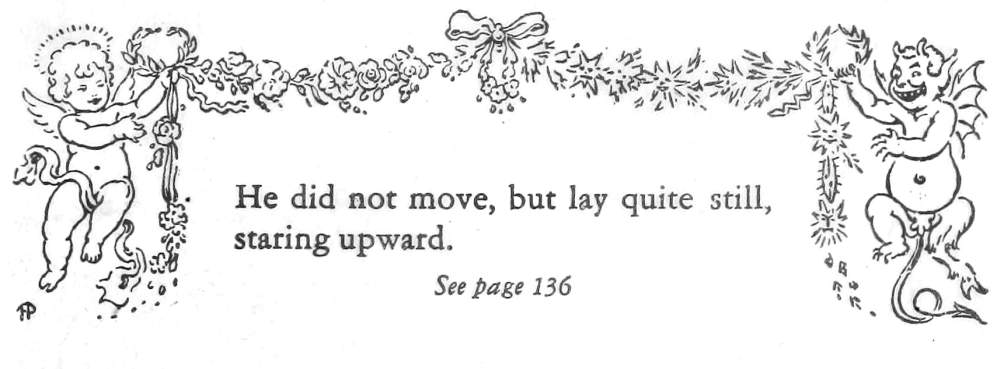
She waited—there was the miracle—for
Florian de Puysange. See page 75
Janicot sat on a tree-stump, stroking his chin with
thumb and fore-finger. He was entirely brown,
with white and gold about him, and the flowering
at his neatly shod feet was more red than blood.
He said:
“In that seeing, denied to all other living persons,—in
that, at least, you have been blessed.”
“In that,” said Florian, bitterly, “I was accursed.
Because of this beauty which I may not put out of
mind, the tinsel prettiness of other women becomes
grotesque and pitiable and hateful. I strive to mate
with them, and I lie lonely in their arms. I seek
for a mate, and I find only meat and much talking.
Then I regard the tedious stranger in whose arms
I discover myself, and I wonder what I am doing in
this place. I remember Melior, and I must rid myself
of the fond foolish creature who is not as
Melior.”
“Ah, ah!” said Janicot then, “so that is how it is.
I perceive you are a romantic. The disorder is
difficult to cure. Yet we must have you losing no
more wives: there must be an end to the ill luck
which follows your matrimonial adventures and
causes hypercritical persons to whisper. Yes, since
you are a romantic, since all other women upset your
equanimity and lead you into bereavements which
people, let me tell you, are festooning with ugly
surmises, you certainly must have this Melior.”
“No,” Florian said, wistfully, “there is an etiquette
in these matters. Even if I cared to dabble
in sorcery, it would not be quite courteous for me
to interfere with the magic which Madame Mélusine
has laid upon the high place and her blood relations.
It would be meddling in her family affairs,
it would be an incivility without precedent, to her
who was so kind to me in my childhood.”
“You think too much about precedent, Monsieur
the Duke. In any event, Mélusine has half forgotten
the matter. So much has happened to her, in
the last several hundred years, that her mind has
quite gone. She cares only to wail upon battlements
and to pass through dusky corridors at twilight,
predicting the deaths of her various descendants.
You can see for yourself that these are not
the recreations of a logical person. No, Florian,
you are considerate, and it does you great credit, but
you would not annoy Madame Mélusine by releasing
Brunbelois.”
Said Florian, gently: “My intimates, to be sure,
address me as Florian. But our acquaintance,
Monsieur Janicot, however delightful, remains as
yet of such brevity that, really, whether you be human
or divine—”
“Oh, but, Monsieur the Duke,” replied the other,
“but indeed I entreat your pardon for my inadvertence.”
And Florian too bowed. “It is merely a social
convention, of course. Yet it is necessary to respect
the best precedents even in trifles. Well, now,
and as to your suggestion, I confess you tempt
me—”
“Only, you could not free Brunbelois unaided, nor
could any living sorcerer. For Mélusine’s was the
Old Magic that is stronger than the thin thaumaturgy
of these days. Yet I desire to have happy
faces about me, so I will give you this Melior for
a while.”
“And at what price?”
“I who am the Prince of this World am not a
merchant to buy and sell. I will release the castle,
and you may have the girl as a free gift. I warn
you, though, that, since she is of the Léshy, at the
year’s end she will vanish.”
Florian shook his head, smilingly. He knew of
course that marriage with one of the Léshy could
not be permanent. But this fiend must believe him
very simple indeed, if Janicot thought Florian so
uninformed as not to know that whoever accepts
a gift from hell is thereby condemned to burn eternally:
and to perceive this amused Florian.
“Ah, Monsieur Janicot, but a Puysange cannot
take alms from anybody. No, let us be logical!
There must be a price set and paid, so that I
may remain under no distasteful and incendiary
debts.”
Janicot hid excellently the disappointment he must
have felt. “Then suppose we fix it that she is yours
until you have had a child by her? And that then
she will vanish, and that then the child is to be given
me, as my honorarium, by”—Janicot explained,—“the
old ritual.”
“Well,” Florian replied, “I may logically take
this to be a case of desperate necessity, since all my
happiness depends upon it. Now in such cases
Paracelsus admits the lawfulness of seeking aid
from—if you will pardon the technical term, Monsieur
Janicot,—from unclean spirits. He is supported
in this, as I remember it, by Peter Ærodius,
by Bartolus of Sassoferato, by Salecitus, and by
other divines and schoolmen. So I have honorable
precedents, I do not offend against convention. Yes,
I accept the offer; and the child, whatever my paternal
pangs, shall be given, as your honorarium, by
the old ritual.”
“Of course,” said Janicot, reflectively, “if there
should be no child—”
“Monsieur, I am Puysange. There will be a
child.”
“Why, then, it is settled. Now I think of it, you
will need the sword Flamberge with which to perform
this rite, since Melior is of the Léshy, and
that sword alone of all swords may spill their
blood—”
“But where is Flamberge nowadays?”
“There is one at home, in an earthen pot, who
could inform you.”
“Let us not speak of that,” said Florian, hastily,
“but do you tell me where is this sword.”
“I have no notion as to the present whereabouts
of Flamberge. Nor, since you stickle for etiquette,
is it etiquette for me to aid you in finding this sword
until you have made me a sacrifice.”
“Why, but you offered Melior as a free gift!”
said Florian, smiling to see how obvious were the
traps this Janicot set for him. “Is a princess of
smaller importance than a sword?”
“A princess is easier to get, because a princess is
easier to make. A sword, far less a magic sword
like Flamberge, cannot be fashioned without long
training and preparation and special knowledge.
But no man needs more than privacy and a queen’s
goodwill to make a princess.”
“I confess, Monsieur Janicot, that your logic is
indisputable. Well, when at the winter solstice you
hold your Festival of the Wheel, I shall not sacrifice
to you. That would be to relapse into the old evil
ways of heathenry, a relapse for which is appointed
an agonizing reproof, administered in realms unnecessary
to mention, but doubtless familiar to you.
However, I shall be glad to tender you a suitable
Christmas present, since that sacred season falls at
the same time.”
“You may call it whatever you prefer. But it
must be a worthy gift that one offers me at my Yule
Feast.”
“You shall have—not as a sacrifice, you understand,
but as a Christmas present,—the greatest man
living in France. You shall have no less a gift
than the life of that weasel-faced prime-minister
who now rules France, the all-powerful Cardinal
Dubois. For the rest, your bargain is reasonable:
it contains none of those rash mortgagings of the
soul, about which—if you will pardon my habitual
frankness, Monsieur Janicot,—one has to be careful
in all business dealings with your people. So
let us subscribe this bond.”
Janicot laughed: his traffic was not in souls, he
said; and he said also that Florian, for a nobleman,
was deplorably the man of business. None the less,
Janicot now produced from his pocket a paper upon
which the terms of their bargain happened, rather
unaccountably, to be neatly written out: and they
both signed this paper, with the pens and ink which
Florian had not previously noticed to be laid there
so close at hand, upon one of the tree-stumps.
Then Janicot put up the paper, and remarked:
“A thing done has an end. For the rest, these fellows
will escort you to Brunbelois.”
“And of what fellows do you speak?” asked
Florian.
“Why, those servants of mine just behind you,”
replied Janicot.
And Florian, turning, saw in the roadway two
very hairy persons in an oxcart, drawn by two
brown goats which were as large as oxen; and
yet Florian was certain no one of these things had
been in that place an instant before. This Janicot,
however easy to see through had been his traps for
Florian, was beyond doubt efficient.
Florian said: “The liveries of your retainers
tend somewhat to the capillary. None the less, I
shall be deeply honored, monsieur, to be attended
by any servants of your household.”
Janicot replied: “Madame Mélusine has ordained
against men and the living of mankind eternal
banishment from the high place. Very well!”
He drew his sword, and without any apparent
effort he struck off the head of his brown horse.
He set this head upon a stake, and he thrust the
other end of the stake into the ground, so that the
stake stood upright.
“I here set up,” said Janicot, “a nithing post. I
turn the post. I turn the eternal banishment against
Madame Mélusine.”
He waited for a moment. He was entirely
brown: about him lilies bloomed, with a surprising
splendor of white and gold: and the flowering at
his feet was more red than blood.
He moved the stake so that the horse’s head now
faced the east, and Janicot said: “Also I turn this
post against the protecting monsters of the high
place, in order that they may all become as witless
as now is this slain horse. I send a witlessness
upon them from the nithing post, which makes witless
and takes away the strength of the rulers and
of the controlling gods of whatever land this nithing
post be turned against. I, who am what I am, have
turned the post. I have sent forth the Seeing of
All, the Seeing that makes witless. A thing done
has an end.”
6. Philosophy of the Lower Class
lorian parted from brown Janicot
for that while, and mounted his
white horse, and rode upward toward
the castle of Brunbelois, without
further thought of the girl at
Storisende whom logic had picked
out to be his wife. Florian was followed by the
oxcart which Janicot had provided. Florian found
all the monsters lying in a witless stupor. So he
fearlessly set upon and killed the black bleps and
the crested strycophanês and the gray calcar.
He passed on upward, presently to decapitate the
eale, which writhed its movable horns very remarkably
in dying. Florian went on intrepidly, and despatched
the golden-maned and-whiskered leucrocotta.
The tarandus, farther up the road, proved
more troublesome: this monster had, after its sly
habit, taken on the coloring of the spot in which it
lay concealed, so that it was hard to find; and, when
found, its hide was so tough as to resist for some
while the edge of Florian’s sword. The thin and
flabby neck of the catoblepas was in contrast gratifyingly
easy to sever. Indeed, this was in all respects
a contemptible monster, dingily colored, and
in no way formidable now that its eyes were shut.
Florian’s heroic butchery was well-nigh over: so
he passed on cheerily to the next turn in the road;
and in that place a moment later the bright red
mantichora was impotently thrusting out its sting in
the death agony, a sudden wind came up from the
west, and the posture of the sun was changed.
Having dauntlessly performed these unmatched
feats, the champion paused to reward himself with
a pinch of snuff. The lid of his snuff-box bore the
portrait of his dear friend and patron, Philippe
d’Orléans, and it seemed odd to be regarding familiar
features in these mischancy uplands. Then
Florian, refreshed, looked about him. Three incredibly
weather-beaten sheep were grazing to his
right: to the left he saw, framed by the foliage
upon each side of and overhanging the green roadway,
the castle of Brunbelois.
Thus one by one did Florian cut off the heads
of the seven wardens, with real regret—excepting
only when he killed the catoblepas,—that his needs
compelled him to destroy such colorful and charming
monsters. The two remarkably hairy persons,
without ever speaking, lifted each enormous head,
one by one, into the cart. The party mounted
within eyeshot of Brunbelois thus triumphantly.
And at Brunbelois, where the old time yet lingered,
the hour was not afternoon but early morning: and
at the instant Florian slew the mantichora all the
persons within the castle had awakened from what
they thought was one night’s resting.
Now the first of the awakened Peohtes whom
Florian encountered was a milkmaid coming down
from Brunbelois with five cows. What Florian
could see of her was pleasurably shaped and tinted.
He looked long at her.
“To pause now for any frivolous reason,” reflected
Florian, “or to disfigure in any way the moment
in which I approach my life’s desire, is of
course unthinkable—”
Meanwhile the milkmaid looked at Florian.
She smiled, and her naturally high coloring was
heightened.
“—So I do not pause for frivolous reasons. I
pause because one must be logical. For, now that
I think of it, to rescue people from enchantment is
a logical proceeding only when one is certain that
this rescuing involves some positive gain to the
world. Do you drive on a little way, and wait for
me,” said Florian, aloud, to his hirsute attendants,
“while I discover from this enticing creature what
sort of persons we have resurrected.”
The hairy servants of Janicot obeyed. Florian,
very spruce in bottle-green and silver, dismounted
from his white horse, and in the ancient roadway
now overgrown with grass, held amicable discourse
with this age-old milkmaid. She proved at bottom
not wholly unsophisticated. And when they
parted, each had been agreeably convinced that the
persons of one era are much like those of another.
Florian thus came to the gates of Brunbelois logically
reassured that he had done well in reviving
such persons, even at the cost of destroying charming
monsters and of the labor involved in removing
so many heads. He counted smilingly on his finger-tips,
but such was his pleased abstraction that he
miscalculated, and made the total eight.
He found that, now the enchantment was lifted,
Brunbelois showed in every respect as a fine old
castle of the architecture indigenous to fairy tales.
Flags were flying from the turrets; sentinels, delightfully
shiny in the early morning sunlight, were
pacing the walls, on the look-out for enemies that
had died many hundred years ago; and at the gate
was a night-porter, not yet off duty. This porter
wore red garments worked with yellow thistles, and
he seemed dejected but philosophic.
“Whence come you, in those queer dusty clothes?”
inquired the porter, “and what is your business
here?”
“Announce to King Helmas,” said Florian, as he
brushed the dust from his bottle-green knees, and
saw with regret that nothing could be done about
the grass-stains, which, possibly, had got there when
he knelt to cut off the tarandus’ head,—“announce
to King Helmas that the lord of Puysange is at
hand.”
“You are talking, sir,” the porter answered, resignedly,
“most regrettable nonsense. For the knife
is in the collops, the mead is in the drinking-horn,
the eggs are upon the toast, the minstrels are in
the gallery, and King Helmas is having breakfast.”
“None the less, I have important business with
him—”
“Equally none the less, nobody may enter at this
hour unless he is the son of a king of a privileged
country or a craftsman bringing his craft.”
“Parbleu, but that is it, precisely. For I bring in
that wagon very fine samples of my craft.”
The porter left his small grilled lodge. He looked
at the piled heads of the monsters, he poked them
with his finger, and he said mildly, “Why, but did
you ever!” Then he returned to the gate.
“Now, my friend,” said Florian, with the appropriate
stateliness, “I charge you, by all the color
and ugliness of these samples of my craft, to announce
to your king that the lord of Puysange is
at the gate with tidings, and with proof, that the
enchantment is happily lifted from this castle.”
“So there has been an enchantment. I suspected
something of the sort when I came to, after nodding
a bit like in the night, and noticed the remarkably
thick forest that had grown up everywhere around
us.”
Florian observed, to this degraded underling who
seemed not capable of appreciating Florian’s fine
exploits, “Well, certainly you take all marvels very
calmly.”
The sad porter replied that, with a reigning family
so given to high temper and sorcery, the retainers
of Brunbelois were not easily astounded. Something
in the shape of an enchantment had been predicted
in the kitchen last night, he continued, after
the notable quarrel between Madame Mélusine and
her father.
“My friend,” said Florian, “that was not last
night. You speak of a disastrous family jar in
which the milk of human kindness curdled several
centuries ago. Since then there has been an enchantment
laid upon Brunbelois: and the spell was
lifted only to-day.”
“Do you mean, sir, that I am actually several
hundred and fifty-two years old?”
“Somewhere in that November neighborhood,”
said Florian. And he steeled himself against the
other’s outburst of horror and amazement.
“To think of that now!” said the porter. “I certainly
never imagined it would come to that. However,
it is always a great comfort to reflect it hardly
matters what happens to us, is it not, sir?”
You could not but find, in this stubborn unwillingness
to face the magnitude of Florian’s exploits,
something horribly prosaic and callous. Yet, none
the less, Florian civilly asked the man’s meaning.
And the dejected porter replied:
“It is just a sort of fancying, sir, that one wanders
into after watching the stars, as I do in the
way of business, night after night. One gets to
reading them and to a sort of glancing over of the
story that is written in their courses. Yes, sir, one
does fall into the habit, injudiciously perhaps, but
then there is nothing else much to do. And one
does not find there quite, as you might put it, the
excitement over the famousness of kings and the
ruining of empires that one might reasonably look
for. And one does not find anything at all there
about porters, I can assure you, sir, because they
are not important enough to figure in that story.
There is no more writing in the stars about night-porters
than there is about bumble-bees; and that
is always a great comfort, sir, when one feels low-spirited.
Because I would not care to be in that
story, myself, for it is not light pleasant reading.”
“A pest! so you inform me, with somewhat the
gay levity of an oyster, that you can read the stars!”
The porter admitted dolefully, “One does come
to it, sir, in my way of business.”
“And how many chapters, I wonder, are written
in the heavens about me?”
The porter looked at Florian for some while.
The porter said, now even more dolefully: “I would
not be surprised if there was a line somewhere about
you, sir. For your planet is Venus, and her people
do get written about in an excessive way, there is
no denying it. And I would not care to be one of
them, myself, but of course there is no accounting
for tastes, even if anybody anywhere had any say
in the matter.”
“Parbleu, you may be right about my planet,”
said Florian, smiling for reasons of his own. “Yet,
as an artless veteran of the first and second Pubic
Wars, I do not see how you can be certain.”
“Because of your corporature, sir,” replied the
porter. “He that is born under this planet is of
fair but not tall stature, his complexion being white
but tending a little to darkness. He has fine black
hair, the brows arched, the face pretty fleshy, a
cherry lip, a rolling wandering eye. He has a love-dimple
in his cheek, and shows in all as one desirous
of trimming and making himself neat and
complete in clothes and body. Now these things I
see in your corporature and in the fretfulness with
which you look at the grass-stains on your knees.
So your planet is evident.”
“That is possible, your speech has a fine ring of
logic, and logic is less common than hens’ teeth.
Upon what sort of persons does this honorable planet
attend?”
“If you could call it attending, sir—For I must
tell you that these planets have a sad loose way of
not devoting their really undivided attention to
looking after the affairs of any one particular gentleman,
not even when they see him most magnificent
in bottle-green and silver.”
“They are as remiss, then, as you are precise.
So do you choose your own verb, and tell me—”
“Sir,” replied the porter, “I regret to inform you
that the person whom Venus governs is riotous, expensive,
wholly given to dissipation and lewd companies
of women and boys. He is nimble in entering
unlawful beds, he is incestuous, he is an adulterer,
he is a mere skip-jack, spending all his means
among scandalous loose people: and he is in nothing
careful of the things of this life or of anything
religious.”
Florian brightened. “That also sounds quite
logical,—in the main,—for you describe the ways
of the best-thought-of persons since the old King’s
death. And one of course endeavors not to offend
against the notions of one’s neighbors by seeming
a despiser of accepted modes. But I must protest
to you, my friend, you are utterly wrong in the
article of religion—”
“Oh, if you come hither to dispute about religion,”
said the porter, “the priests of Llaw Gyffes
will attend to you. They love converting people
from religious errors, bless you, with their wild
horses and their red-hot irons. But, for one, I
never argue about religion. You conceive, sir, there
is an entire chapter devoted to the subject, in the
writing we were just talking over: and I have read
that chapter. So I say nothing about religion. I
like a bit of fun, myself: but when you find it there,
of all places, and on that scale—” Again the dejected
porter sighed. “However, I shall say no
more. Instead, with your permission, Messire de
Puysange, I shall just step in, and send up your
news about the enchantment.”
This much the porter did, and Florian was left
alone to amuse himself by looking about. Through
the gateway he saw into a court paved with cobble-stones.
Upon each side of the gate was an octagonal
granite tower with iron-barred windows:
each tower was three stories in height, and the battlements
were coped with some sort of bright red
stone.
Then Florian, for lack of other diversion, turned
and looked idly down the valley, toward Poictesme.
There he saw something rather odd. A mile-long
bridge was flung across the west, and over it passed
figures. First came the appearance of a bear waddling
upon his hind legs, followed by an ape, and
then by a huddled creature with long legs. Florian
saw also an unclothed woman, who danced as she
went: over her head fluttered a bird, and by means
of a chain she haled after her a sedentarily disposed
pig. An incredibly old man followed, dressed in
faded blue, and he carried upon his arm an open
basket. Last came a shaggy dog, barking, it
seemed, at all.
These figures were like clouds in their station and
in their indeterminable coloring and vague outline,
but their moving was not like the drifting of clouds:
it was the walking of living creatures. Florian for
an instant wondered as to the nature and the business
of these beings that were passing over and
away from Poictesme. He shrugged. He believed
the matter to be no concern of one whose interests
overhead were all in the efficient hands of Holy
Hoprig.
7. Adjustments of the Resurrected
hey brought Florian to Helmas the
Deep-Minded, where the King sat
on a daīs with his Queen Pressina.
The King was stately in scarlet and
ermine: his nose too was red, and
to his crown was affixed the Zhar-Ptitza’s
silvery feather. Florian found his appearance
far more companionable than was that of the
fat Queen (one of the water folk), whose skin was
faintly blue, and whose hair was undeniably green,
and whose little mouth seemed lost and discontented
in her broad face.
Beside them, but not upon the dark red daīs, sat
the high-priest of Llaw Gyffes, a fine looking and
benevolent prelate, in white robes edged with a purple
pattern of quaint intricacies: he wore a wreath
of mistletoe about his broad forehead; and around
and above this played a pulsing radiancy.
To these persons Florian told what had happened.
When he had ended, the Queen said she had never
heard of such a thing in her life, that it was precisely
what she had predicted time and again, and
that now Helmas could see for himself what came
of spoiling Mélusine, and letting her have her own
way about everything. The wise King answered
nothing whatever.
But the high-priest of Llaw Gyffes asked, “And
how did you lift this strong enchantment?”
“Monsieur, I removed it by the logical method of
killing the seven monsters who were its strength
and symbol. That they are all quite dead you can
see for yourself,—if I may make so bold as to employ
her Majesty’s striking phrase,—by counting
the assortment of heads which I fetched hither with
me.”
“Yes, to be sure,” the priest admitted. “Seven
is seven the world over: everywhere it is a number
of mystic potency. It follows that seven severed
heads must predicate seven corpses; and such proofs
are indisputable, as far as they go—”
Still, he seemed troubled in his mind.
Then Helmas, the wise King, said, “It is my
opinion that the one way to encounter the unalterable
is to do nothing about it.”
“Yes,” answered his wife, “and much that will
help matters!”
“Nothing, my dear,” said the wise King, “helps
matters. All matters are controlled by fate and
chance, and these help themselves to what they have
need of. These two it is that have taken from me
a lordship that had not its like in the known world,
and have made the palaces that we used to be feasting
in, it still seems only yesterday, just little piles
of rubbish, and have puffed out my famousness the
way that when any man gets impudent a widow
does a lamp. These two it is that leave me nothing
but this castle and this crevice in the hills where
the old time yet lingers. And I accept their sending,
because there is no armor against it, but I shall
keep up my dignity by not letting even fate and
chance upset me with their playfulness. Here the
old time shall be as it has always been, and here I
shall continue to do what was expected of me yesterday.
And about other matters I shall not bother,
but I shall leave everything, excepting only my self-respect,
to fate and chance. And I think that
Hoprig will agree with me it is the way a wise man
ought to be acting.”
“Hoprig!” reflected Florian, looking at the halo.
“But what the devil is my patron saint doing here
disguised as the high-priest of Llaw Gyffes?”
“I am thinking over some other matters,” replied
Hoprig, to the King, “and it is in my thinking
that nobody could manage to kill so many monsters,
and to release us from our long sleeping, unless
he was a sorcerer. So Messire de Puysange
must be a sorcerer, and that is very awkward, with
our torture-chamber all out of repair—”
“Ah, monsieur,” said Florian, reproachfully, “and
are these quite charitable notions for a saint to be
fostering? And, oh, monsieur, is it quite fair for
you to have been sleeping here this unconscionable
while, when you were supposed to be in heaven attending
to the remission of people’s sins?”
Hoprig replied: “What choice had I or anybody
else except to sleep under the Nis magic? For the
rest, I do not presume to say what a saint might
or might not think of the affair, because in our
worship of Llaw Gyffes of the Steady Hand—”
“But I, monsieur, was referring to a very famous
saint of the Christian church, which has for some
while counted the Dukes of Puysange among its
communicants, and is now our best-thought-of form
of worship.”
“Oh, the Christians! Yes, I have heard of them.
Indeed I now remember very well how Ork and
Horrig came into these parts preaching everywhere
the remarkable fancies of that sect until I discouraged
them in the way which seemed most salutary.”
Florian could make nothing of this. He said,
“But how could you, of all persons, have discouraged
the spreading of Christianity?”
“I discouraged them with axes,” the saint replied,
“and with thumbscrews, and with burning them at
the stake. For it really does not pay to be subtle
in dealing with people of that class: and you have
to base your appeal to their better nature upon quite
obvious arguments.”
“My faith, then, how it came about I cannot say,
Monsieur Hoprig; but for hundreds upon hundreds
of years you have been a Christian saint.”
“Dear me!” observed the saint, “so that must be
the explanation of this halo. I noticed it of course.
Still, our minds have been rather pre-empted since
we woke up—But, dear me, now, I am astounded,
and I know not what to say. I do say, though,
that this is quite extraordinary news for you to be
bringing a well-thought-of high-priest of Llaw
Gyffes.”
“Nevertheless, monsieur, for all that you have
never been anything but a high-priest of the heathen,
and a persecutor of the true faith, I can assure you
that you have, somehow, been canonized. And I
am afraid that during the long while you have been
asleep your actions must have been woefully misrepresented.
Monsieur,” said Florian, hopefully,
“at least, though, was it not true about your being
in the barrel?”
“Why, but how could ever you,” the saint marveled,
“have heard about that rain-barrel? The incident,
in any case, has been made far too much of.
You conceive, it was merely that the man came
home most unexpectedly; and since all husbands are
at times and in some circumstances so unreasonable—”
“Ah, monsieur,” said Florian, shaking his head,
“I am afraid you do not speak of quite the barrel
which is in your legend.”
“So I have a legend! Why, how delightful!
But come,” said the saint, abeam with honest pleasure,
and with his halo twinkling merrily, “come, be
communicative; be copious, and tell me all about
myself.”
Then Florian told Hoprig of how, after Hoprig’s
supposed death, miracles had been worked at
Hoprig’s putative tomb, near Gol, and this legend
and that legend had grown up around his memory,
and how these things had led to Hoprig’s being
canonized. And Florian alluded also, with perfect
tact but a little ruefully, to those fine donations he
had been giving, year in and year out, to the
Church of Holy Hoprig, under the impression that
all the while the saint had been, instead of snoring
at Brunbelois, looking out for Florian’s interests in
heaven. And Hoprig now seemed rather pensive,
and he inquired particularly about his tomb.
“I shall take this,” the saint said, at last, “to be
the fit reward of my tender-heartedness. The tomb
near Gol of which you tell me is the tomb in which
I buried that Horrig about whom I was just talking,
after we had settled our difference of opinion
as to some points of theology. Ork was so widely
scattered that any formal interment was quite out
of the question. My priests are dear, well-meaning
fellows. Still, you conceive, they are conscientious,
and they enter with such zeal into the performance
of any manifest if painful duty—”
Florian said: “They exhibited the archetypal
zeal becoming to the ministers of an established
church in the defence of their vested rights. They
were, with primitive inadequacy, groping toward
the methods of our Holy Inquisition and of civilized
prelates everywhere—”
“—So they were quite tired out when we passed
on to Horrig’s case. I do not deny that I was perhaps
unduly lenient about Horrig. It was the general
opinion that, tired as we were, this blasphemer
against the religious principles of our fathers ought
to be burned at the stake, and have his ashes scattered
to the winds. But I was merciful. I had
eaten an extremely light breakfast. So I merely
had him broken on the wheel and decapitated, and
we got through our morning’s work, after all, in
good time for dinner: and I gave him a very nice
tomb indeed, with his name on it in capital letters.
Dear me!” observed Holy Hoprig, with a marked
increase of his benevolent smile, “but how drolly
things fall out! If the name had not been in capital
letters, now, I would probably never have been
wearing this halo which surprised me so this morning
when I went to brush my hair—”
“But what has happened?” said the Queen.
“Why, madame,” replied the saint, “I take it that,
with the passage of years, the tail of the first R
in the poor dear fellow’s name was somewhat worn
away. So when such miracles began to occur at
his tomb as customarily emanate from the tombs of
martyrs to any faith which later is taken up by
really nice people, here were tangible and exact
proofs, to the letter, of the holiness of Hoprig. In
consequence, this Christian church has naturally
canonized me.”
“That was quite civil of them of course, if this
is considered the best-thought-of church. But,
still,” the Queen said, doubtfully, “the miracles
must have meant that Horrig was right, and you
were wrong.”
“Certainly, madame, it would seem so, as a matter
of purely academic interest. For now that his
church is so well-thought-of everywhere and has
canonized me, I must turn Christian, if only to
show my appreciation of the compliment. So there
is no possible harm done.”
“But in that case, it was Horrig that ought to
have been made a saint of.”
“Now I, madame, for one, cherish humility too
much to dare assert any such thing. For the ways
of Providence are proverbially inscrutable: and it
well may be that the abrasion of the tail of that R
was also, in its quiet way, a direct intervention of
Heaven to reward my mercifulness in according
Horrig a comparatively pleasant martyrdom.”
“Yes, but it was he, after all, who had to put up
with that martyrdom, on a dreadfully depressing
rainy morning, too, I remember, whereas you get
sainthood out of the affair without putting up with
anything.”
“Do I not have to put up with this halo? How
can I now hope to go anywhere after dark without
being observed? Ah, no, madame, I greatly fear
this canonization will cost me a host of friends by
adorning my visits with such conspicuous publicity.
Nevertheless, I do not complain. Instead, I philosophically
recognize that well-bred women must
avoid all ostentation, and that the ways of Providence
are inscrutable.”
“That is quite true,” observed King Helmas, at
this point, “and I think that nothing is to be gained
by you two discussing these ways any more. The
poets and the philosophers in every place have for
a long while now had a heaviness in their minds
about Providence, and the friendly advice they have
been giving is not yet all acted upon. So let us
leave Providence to look out for itself, the way we
would if Providence had wisdom teeth. And let
us turn to other matters, and to hearing what reward
is asked by the champion who has rescued us
from our long sleeping.”
“I too,” replied Florian, “if I may make so bold
as to borrow the phrase used by your Majesty just
now—that phrase by which I was immeasurably
impressed, that phrase which still remains to me a
vocalisation of supreme wisdom in terms so apt
and striking—”
“Wisdom,” said the King, “was miraculously bestowed
upon me a great while ago as a free gift,
which I had done nothing to earn and deserve no
credit for not having been able to avoid. And my
way of talking, and using similes and syntax,—along
with phraseology and monostiches and aposiopesis
and such-like things,—is another gift, also,
which I employ without really noticing the astonishment
and admiration of my hearers. So do you
not talk so much, but come to the point.”
“I too, then, in your Majesty’s transcendent
phrase, shall do what was expected of me yesterday.
I ask the hand of the King’s daughter in marriage.”
“That is customary,” wise Helmas said, with approval,
“and you show a very fine sense of courtesy
in adhering to our perhaps old-fashioned ways.
Let the lord of Puysange be taken to his betrothed.”
8. At the Top of the World
OU will find her,” they had said,
“yonder,”—and, pointing westerly,
had left him. So Florian went unaccompanied
through the long pergola
overgrown with grape-vines,
toward the lone figure at the end of
this tunnel of rustling greenness and sweet odors.
A woman waited there, in an eight-sided summer-house,
builded of widely-spaced lattice-work that
was hidden by vines. Through these vines you
could see on every side the fluttering bright gardens
of Brunbelois, but no living creature. This woman
and Florian were alone in what was not unlike a
lovely cage of vines. Florian seemed troubled. It
was apparent that he knew this woman.
“I am flesh and blood,” the woman said,—“as
you may remember.”
“Indeed, I have been singularly fortunate—But
upon reflection, I retract the adverb. I have
been marvelously fortunate; and I have no desire
to forget it.”
“She also, the girl yonder, is flesh and blood.
You will be knowing that before long.”
Florian looked at this woman for some while.
“Perhaps that is true. I think it is not true. I
have faith in the love which has endured since I
was but a child. If that fails me, I must die.
And I shall die willingly.”
He bowed low to this woman, and he passed on,
through the summer-house, and out into the open
air. He came thus to a wall, only breast high, and
opened the gate which was there, and so went on
in full sunlight, ascending a steepish incline that
was overgrown with coarse grass and with much
white clover. Thus Florian came to the unforgotten
princess and to the beauty which he had in childhood,
however briefly, seen. There was in this
bright and windy place, which smelled so pleasantly
of warm grass, nothing except a low marble bench
without back or carving. No trees nor any
bushes grew here: nothing veiled this place from
the sun. Upon this sunlit mountain-top was only
the bench, and upon the bench sat Melior, waiting.
She waited—there was the miracle,—for Florian
de Puysange.
Behind and somewhat below Florian were the
turrets and banners of Brunbelois, a place now disenchanted,
but a fair place wherein the old time yet
lingered. Before him the bare hillside sank sheer
and unbroken, to the far-off tree-tops of Acaire:
and beyond leagues of foliage you could even see,
not a great number of miles away, but quite two
miles below you, the open country of Poictesme,
which you saw not as anything real and tangible
but as a hazed blending of purples and of all the
shades that green may have in heaven. Florian
seemed to stand at the top of the world: and with
him, high as his heart, stood Melior....
And it was a queer thing that he, who always noticed
people’s clothes, and who tended to be very
critical about apparel, could never afterward, in
thinking about this extraordinary morning, recollect
one color which Melior wore. He remembered
only a sense of many interwoven brilliancies, as if
the brightness of the summer sea and of the clouds
of sunset and of all the stars were blended here to
veil this woman’s body. She went appareled with
the splendor of a queen of the old days, she who
was the most beautiful of women that have lived
in any day. For, if so far as went her body, one
could think dazedly of analogues, nowhere was
there anything so bright and lovely as was this
woman’s countenance. And it was to the end that
he might see the face of Melior raised now to him,
he knew, that Florian was born. All living had
been the prologue to this instant: God had made
the world in order that Florian might stand here,
with Melior, at the top of the world.
And it seemed to Florian that his indiscretions in
the way of removing people from this dear world,
and of excursions into strange beds, and of failures
to attend mass regularly, had become alienate to
the man who waited before Melior. All that was
over and done with: he had climbed past all that
in his ascent to this bright and windy place. Here,
in this inconceivably high place, was the loveliness
seen once and never forgotten utterly, the loveliness
which had made seem very cheap and futile the
things that other men wanted. Now this loveliness
was, for the asking, his: and Florian found
his composure almost shaken, he suspected that the
bearing suitable to a Duke of Puysange was touched
with unbecoming ardors. He feared that logic
could not climb so high as he had climbed.
Besides, it might be, he had climbed too near to
heaven. For nothing veiled this unimaginably high
place: God, seeing him thus plainly, would be envious.
That was the thought which Florian put
hastily out of mind....
He parted his lips once or twice. This was, he
joyously reflected, quite ridiculous. A woman
waited: and Florian de Puysange could not speak.
Then words came, with a sort of sobbing.
“My princess, there was a child who viewed you
once in your long sleeping. The child’s heart moved
with desires which did not know their aim. It is not
that child who comes to you.”
“No, but a very gallant champion,” she replied,
“to whom we all owe our lives.”
He had raised a deprecating hand. It was trembling.
And her face seemed only a blurred shining,
for in his eyes were tears. It must be, Florian
reflected, because of the wind: but he did not believe
this, nor need we.
“Princess, will you entrust to me, such as I am,
the life I have repurchased for you? I dare make
no large promises, in the teeth of a disastrously
tenacious memory. Yet, there is no part in me but
worships you, I have no desire in life save toward
you. There has never been in all my life any real
desire save that which strove toward you.”
“Oh, but, Messire Florian,” the girl replied, “of
course I will be your wife if you desire it.”
He raised now both his hands a little toward her.
She had not drawn back. He did not know whether
this was joy or terror which possessed him: but it
possessed him utterly. His heart was shaking in
him, with an insane and ruthless pounding. He
thought his head kept time to this pounding, and
was joggling like the head of a palsied old man.
He knew his finger-tips to be visited by tiny and
inexplicable vibrations.
“If I could die now—!” was in his mind. “Now,
at this instant! And what a thought for me to be
having now!”
Instead, he now touched his disenchanted princess.
Yet their two bodies seemed not to touch, and
not to have moved as flesh that is pulled by muscles.
They seemed to have merged, effortlessly and without
volition, into one body.
In fine, he kissed her. So was the affair concluded.
9. Misgivings of a Beginning Saint
hat Florian remembered, afterward,
about Brunbelois seemed
rather inconsequential. It was, to
begin with, a high place, a remarkably
high place. In the heart of the
Forest of Acaire, arose a mountain
with three peaks, of which the middle and lowest
was cleared ground. Here stood the castle of
Brunbelois, beside a lake, a lake that was fed by
springs from the bottom, and had no tributaries and
no outlet. Forests thus rose about you everywhere
except in the west, where you looked down and yet
further down, over the descending tree-tops of
Acaire, and could see beyond these the open country
of Poictesme.
Now in this exalted and cleared space wherein
stood Brunbelois, there was nothing between you
and the sky. You were continually noting such a
hackneyed matter as the sky. You saw it no longer
as dome-shaped, but as, quite obviously now, an interminable
reach of space. You saw the huge
clouds passing in this hollowness, each inconceivably
detached and separate as one cloud would pass
tranquilly above and behind the other, sometimes at
right angles, sometimes travelling in just the opposite
direction. It troubled you to have nothing
between you and a space that afforded room for
all those currents of air to move about in, so freely,
so utterly without any obstruction. It made a Puysange
seem small. And at night the stars also
no longer appeared tidily affixed to the sky, as they
appeared to be when viewed from Bellegarde or
Paris: the stars seemed larger here, more meltingly
luminous, and they glowed each in visible isolation,
with all that space behind them. It had not ever
before occurred to Florian that the sky could be terrible:
and he began somewhat to understand the notions
of the gray-haired porter who had watched
this sky from Brunbelois, night after night, alone.
And Florian remembered Brunbelois as being a
silvery and rustling place. A continuous wind
seemed to come up from the west. The forests
rising about you everywhere except in the west were
never still, you saw all day the gray under side of
the leaves twinkling restlessly, and you heard always
their varying but incessant murmur. And
small clouds too were always passing, borne by this
incessant wind, very close to you, drifting through
the porches of the castle, trailing pallidly over the
grass, and veiling your feet sometimes, so that you
stood knee-deep in a cloud: and the sunlight was
silvery rather than golden. And under this gentle
but perpetual wind the broad lake glittered ceaselessly
with silver sparklings.
Moreover, the grass here was thick with large
white blossoms, which grew singly upon short stalks
without any leaves, and these white flowers nodded
in an unending conference. They loaned the very
ground here an unstable silveriness, for these flowers
were not ever motionless. Sometimes they
seemed to nod in sleepy mutual assent, sometimes
the wind, in strengthening, would provoke them to
the appearance of expressing diminutively vigorous
indignation. And humming-birds were continually
flashing about: these were too small for you to perceive
their coloring, they went merely as gleams.
And white butterflies fluttered everywhither as if in
an abstracted light reconnoitering for what they
could not find. And you were always seeing large
birds high in the air, drifting and wheeling, as it
seemed, in an endless searching for what they never
found.
He did not move, but lay quite still,
staring upward. See page 136
So Florian remembered, afterward, in the main,
the highness and the silveriness and the instability
of the place that he now went about exultingly with
nothing left to wish for. He hardly remembered,
afterward, what he and Melior did or talked of,
during the days wherein Brunbelois prepared for
their wedding: time and events, and people too,
seemed to pass like bright shining vapors; all living
swam in a haze of happiness. Florian now
thought little of logic, he thought nothing of precedent;
he thrust aside the implications of his depressing
discovery as to his patron saint: he stayed
in everything light-headedly bewildered through
hourly contemplation of that unflawed loveliness
which he had for a quarter of a century desired.
He was contented now; he went unutterably contented
by that beauty which he in childhood had,
however briefly, seen, and which nothing had since
then availed ever quite to put out of his mind. He
could not, really, think about anything else. He
cared about nothing else.
Still, even now, he kept some habit of circumspection:
no man should look to be utterly naīf
about his fifth wife. So when St. Hoprig contrived
to talk in private with Melior, down by the
lake’s border, Florian, for profoundly logical reasons,
had followed Hoprig. Florian, for the same
reasons, stood behind the hedge and listened.
“It is right that you should marry the champion
who rescued us all,” said the voice of Hoprig,
“for rules ought to be respected. But I am still of
the opinion that nobody could have disposed of so
many monsters without being an adept at sorcery.”
“Why, then, it seems to me that we ought to be
very grateful for the sorcery by which we profit,”
said the sweet voice of Melior. “For, as I so often
think—”
“As goes the past, perhaps. The future is another
matter. It is most widely another matter,
for us two in particular.”
“You mean that as his wife I must counsel my
husband to avoid all evil courses—”
“Yes, of course, I mean that. Your duty is plain
enough, since a wife’s functions are terrestrial.
But I, madame! I am, it appears, this young man’s
patron saint, and upon his behavior depends my
heavenly credit. You will readily conceive I thus
have especial reason to worry over the possibility
that Messire de Puysange may be addicted to diabolic
practises.”
“Is it certain, my poor Hoprig, that you are actually
a Christian saint? For, really, when one
comes to think—!”
“There seems no doubt of it. I have tried a few
miracles in private, and they come off as easily as
old sandals. It appears that, now I am a saint, I
enjoy, by approved precedents, all thaumaturgic
powers, with especial proficiency in blasting, cursing
and smiting my opponents with terrible afflictions;
and have moreover the gift of tongues, of vision
and of prophecy, and the power of expelling demons,
of healing the sick, and of raising the dead. The
situation is extraordinary, and I know not what to
do with so many talents. Nor can anybody tell me
here. In consequence, I must go down into this
modern world of which Messire de Puysange brings
such remarkable reports, and there I can instruct
myself as to the requirements of my new dignity.”
“So you will leave Brunbelois with us, I suppose,
and then we shall all—”
“I do not say that: I do not promise you my
company. Probably I shall establish a hermitage
somewhere, once I have seen something of this later
world, and shall live in that hermitage as becomes
a Christian saint. Here, you conceive, everyone
knows me too well. Quite apart from the conduct
of my private affairs,—in which I could not anticipate
that sanctity might be looked for,—people
would be remembering how I preached against these
Christian doctrines, exposed them by every rule of
logic, and exterminated their upholders. There
would be a depressing atmosphere of merriment.
But down yonder, I daresay, I might manage tolerably
well.”
“I hope you will let depraved women alone,” said
the voice of Melior, “because, as you ought with
proper shame to remember—”
“My princess, let us not over-rashly sneer at depraved
women. They very often have good hearts,
they have attested their philanthropy in repeated instances,
and I have noticed that the deeper our research
into their private affairs, the more amiable
we are apt to find their conduct. In any case, as
touches myself, a saint is above all carnal stains
and, I believe, diseases also. But it was about other
matters I wished to speak with you. I am, I repeat,
suspicious of this future husband of yours.
Sorcerers have an ill way with their wives, and deplorable
habits with their children; and your condition,
in view of your fine health and youth, may
soon be delicate. I shall ask for a revelation upon
these points. Whatever impends, though, I shall be
at hand to watch over you both.”
“So you will establish your hermitage at Bellegarde?
For in that event—”
“Again, madame, you go too fast. I do not
know about that either. In the environs of Bellegarde,
they tell me, is a church devoted to my worship,
and Messire de Puysange considers—inexplicably,
I think,—that it might unsettle the faith of
my postulants to have me appear among them. It
seems more to the point that this Bellegarde is a
retired place in the provinces, with no gaming parlors,
and, Messire de Puysange assures me, but one
respectable brothel—”
“Then Bellegarde would not suit you—”
“No, of course not: for I would find ampler opportunities
to put down the wicked, and to implant
good seed, in large cities, which are proverbially
the haunts of vice. In any case, do you take this
ring. It was presented to me as a token of not unearned
esteem and admiration, by a lady who had
hitherto found men contemptible: and at my request—tendered
somewhat hastily, but to the proper
authorities,—this ring has been endowed with salutary
virtues. The one trait of the holy ring which
concerns us just now is its recently acquired habit
of giving due warning whenever danger threatens
its wearer. Dear me, now, how complete would
have been my relaxation if only in my pagan days
I had possessed such a talisman to put on whenever
I undressed for bed! In any case, should the ring
change, then do you invoke me.”
“And you will come with your miracles and your
blightings and your blastings! My poor Hoprig, I
think you do Messire de Puysange a great wrong,
but I will keep the ring, for all that. Because,
while you may be utterly mistaken, and no doubt
hope you are as much as I do, still, the ring is
very handsome: and, besides, as I so often think—”
“Do not be telling me your thoughts just now,”
replied the voice of the saint, “for I can hear the
bugle calling us to supper. There is another precaution
I would recommend, a precaution that I
will explain to you this evening, after we have
eaten and drunk,” said Hoprig, as they went away
together.
Florian, after waiting a discreet while, came from
behind the hedge. Florian looked rather thoughtful
as he too walked toward the castle.
Sunset was approaching. The entire heavens,
not merely the west, had taken on a rose-colored
glare. Unbelievably white clouds were passing very
rapidly, overhead but not far-off, like scurrying
trails of swans’ down and blown powder puffs.
The air was remarkably cool, with rain in it. The
diffused radiancy of this surprising sunset loaned
the gravelled walkway before him a pink hue: the
lawns about him, where the grass was everywhere
intermingled with white blossoms, had, in this
roseate glowing which flooded all, assumed a coldly
livid tinge. To Florian’s left hand, piled clouds
were peering over the mountain like monstrous
judges, in tall powdered wigs, appraising the case
against someone in Florian’s neighborhood.
He shrugged, but his look of thoughtfulness remained.
It was distinctly upsetting to have one’s
patron saint, in place of contriving absolution for
the past,—a function which that recreant Hoprig
had never, after all, attended to,—now absolutely
planning mischief for the future.
10. Who Feasted at Brunbelois
LORIAN had been married so often
that he had some claim to be considered
a connoisseur of weddings:
and never, he protested, had assembled
to see him married a more delightful
company than the revellers
who came from every part of Acaire now that the
magic was lifted from these woods.
Acaire was old, it had been a forest since there
was a forest anywhere: and all its denizens came
now to do honor to the champion who had released
them from their long sleeping. The elves came, in
their blue low-crowned hats; the gnomes, in red
woolen clothes; and the kobolds, in brown coats
that were covered with chips and sawdust. The
dryads and other tree spirits of course went verdantly
appareled: and after these came fauns with
pointed furry ears, and the nixies with green teeth
and very beautiful flaxen hair, and the duergar,
whose loosely swinging arms touched the ground
when they walked, and the queer little rakhna, who
were white and semi-transparent like jelly, and the
Bush Gods that were in Acaire the oldest of living
creatures and had quite outlived their divinity.
From all times and all mythologies they came, and
they made a tremendous to-do over Florian and the
might which had rescued them from their centuries
of sleeping under Mélusine’s enchantment.
He bore his honors very modestly. But Florian
delighted to talk with these guests, who came of
such famous old families: and they told him strange
tales of yesterday and of the days before yesterday,
and it seemed to him that many of these stories
were not quite logical. Few probabilities thrived
at Brunbelois. Meanwhile the Elm Dwarfs danced
for him, pouring libations from the dew pools; the
Strömkarl left its waterfall in the forest, to play
very sweetly for Florian upon the golden harp
whose earlier music had been more dangerous to
hear; and the Korrid brought him tribute in the
form of a purse containing hair and a pair of scissors.
And it was all profoundly delightful.
“I approve of the high place,” said Florian, upon
the morning of his marriage: “for here I seem to
go about a more heroic and more splendid world
than I had hoped ever to inhabit.”
“Then, why,” asked Helmas, “do you not remain
at Brunbelois, instead of carrying off my daughter
to live in that low sort of place down yonder?
Why do you two not stay at Brunbelois, and be
the King and Queen here after I am gone?”
Florian looked down from the porch where they
were waiting the while that Queen Pressina finished
dressing. From this porch Florian could see a part
of the modern world, very far beneath them. He
saw the forests lying like dark flung-by scarves
upon the paler green of cleared fields; he saw the
rivers as narrow shinings. In one place, very far
beneath them, a thunderstorm was passing like—of
all things, on this blissful day,—a drifting bride’s-veil.
Florian saw it twinkle with a yellow glow,
then it was again a floating small white veil. And
everywhere the lands beneath him bathed in graduations
of vaporous indistinction. Poictesme seemed
woven of blue smokes and of green mists. It afforded
no sharp outline anywhere as his gazing
passed outward toward the horizon. And there all
melted bafflingly into a pearl-colored sky: the eye
might not judge where, earth ending, heaven began
in that bright and placid radiancy.
It was droll to see this familiar, everyday, quite
commonplace Poictesme in that guise, to see it as
so lovely, when one knew what sort of men and
women were strutting and floundering through what
sort of living down there. It would be pleasant to
remain here at high Brunbelois, and to be a king
of the exalted old time that lingered here and nowhere
else in all the world. But Florian remembered
his bargain with brown Janicot, and he knew
that in this high place it could not be performed:
and it was as if with the brightness of Florian’s
day-dreaming already mingled the shining of the
sword with which Florian was to carry out his part
of the bargain. Flamberge awaited him somewhere
in those prosaic lowlands of 1723, down yonder.
Therefore, as became a man of honor, Florian
said, resolutely: “No, your majesty, my kingdom
may not be of this world. For my duty lies yonder
in that other world, wherein I at least shall yet have
many months of happiness before that happens
which must happen.”
“So you are counting upon many months of happiness,”
the King observed. “Your frame of mind,
my son-in-law, is so thoroughly what it should be
that to me it is rather touching.”
“A pest! and may one ask just what, exactly,
moves your majesty toward sadness?”
“The reflection that there is no girl anywhere
but has in her much of her mother,” the King answered,
darkly. “But my dear wife is already
dressed, I perceive, and is waiting for us, after having
detained us hardly two hours. So let us be
getting to the temple.”
“Very willingly!” said Florian. He wondered a
little at the blindness of fathers, but he was unutterably
content. And straightway he and Melior were
married, in the queer underground temple of the
Peohtes, according to the marriage rites of Llaw
Gyffes.
Melior wore that day upon her lovely head a
wreath of thistles, and about her middle a remarkable
garment of burnished steel fastened with a small
padlock: in her hand she carried a distaff, flax and
a spindle. And the marriage ceremony of the
Peohtes, while new to Florian, proved delightfully
simple.
First Melior and Florian were given an egg and
a quince pear: he handed her the fruit, which she
ate, and the seeds of which she spat out; he took
from her the egg and broke it. Holy Hoprig, who
had tendered his resignation as the high-priest of
Llaw Gyffes, but whose successor had not yet been
appointed, then asked the bridegroom a whispered
question.
Florian was astonished, and showed it. But he
answered, without comment, “Well, let us say, nine
times.”
Hoprig divided a cake into nine slices, and placed
these upon the altar. Afterward Hoprig cut the
throat of a white hen, and put a little of its blood
upon the feet of Melior and Florian. The trumpets
sounded then, as King Helmas came forward, and
gave Florian a small key.
PART TWO THE END OF LIGHT WINNING
“En femme, comme en tout, je veux suivre ma mode....
Et j’ay beny le Ciel d’avoir trouvé mon faict,
Pour me faire une femme au gré de mon souhait.”
11. Problems of Beauty
T was conceded even by the younger
and most charming ladies of the
neighborhood that the new Duchess
of Puysange was quite good looking.
The gentlemen of Poictesme appeared,
literally, to be dazzled by
any prolonged consideration of Melior’s loveliness:
otherwise, as Florian soon noted, there was no logical
accounting for the discrepancy in their encomia.
Enraptured pæeans upon her eyes, for example, he
found to differ amazingly and utterly in regard to
such an important factor as the color of these eyes.
This was, at mildest, a circumstance provocative of
curiosity.
Florian therefore listened more attentively to
what people said of his wife; and he discovered
that his fellows’ ecstasies over Melior’s hair and
shape and complexion were not a whit less inconsistent.
These envious babblers were at one in acclaiming
as flawless the beauty which he had intrepidly
fetched down from the high place: but in
speaking of any constituent of this loveliness they
seemed not to be talking of the same woman.
Either her perfection actually did dazzle men so
that they were bewilderedly aware of much such a
beguiling and intoxicating brightness as Florian, on
looking back, suspected Melior to have been in his
own eyes before he married her, or else the appearance
of this daughter of the Léshy was not to all
persons the same. Well, this was queer: but it was
not important. Florian at least was in no doubt of
his wife’s appearance nor of his right to glory in it.
So Florian tended to let this riddle pass unchallenged,
and to quarrel with nothing, for Florian
was very happy.
He could not have said when or why awoke the
teasing question if, after all, this happiness was
greater than or different from that which he had
got of Aurélie or Hortense or Marianne or Carola?
Being married to a comparative stranger was, as
always, pleasant; it was, in fact, delightful: but
you had expected, none the less, of the love which
had miraculously triumphed over time and all natural
laws some sharper tang of bliss than ordinarily
flavored your honeymoons. Still, at thirty-five, you
were logical about the usual turning-out of expectations.
And you were content: and Melior was
beautiful; and among the local nobility this new
Duchess of Puysange had made friends everywhere,
and she was everywhere admired, however puzzlingly
men seemed to word their praise of her loveliness.
The newly married pair had journeyed uneventfully
from Brunbelois to Florian’s home. The
mute hairy persons brought Melior’s trunks in their
cart; and St. Hoprig too came with them through
Acaire, but no further. Florian had at last persuaded
him of how untactful it would be for Hoprig
to disrupt a simple and high-hearted faith that
had thrived for so many hundred years, by appearing
at Bellegarde in person. Florian had pointed
out the attendant awkwardnesses, for the fetich no
less than for the devotees. And Hoprig, upon reflection,
had conceded that for a saint in the prime
of life there were advantages in travelling incognito.
So the holy man left them at the edge of the
forest. “We shall meet again, my children,” the
saint had said, with a smile, just as he vanished
like a breaking bubble. It seemed to Florian that
his heavenly patron had become a little ostentatious
with miracles, but Florian voiced no criticism. Still,
he considered the evanishment of the two hairy persons
and their monstrous goats, an evanishment
quite privately conducted in the stable to which they
had withdrawn after uncarting Melior’s trunks, to
be in much better taste.
But Florian picked no open fault with Hoprig
nor with anyone, for Florian was content enough
just now. He began to see that his notions about
Melior had been a trifle extravagant, that the
strange loveliness which he had been adoring since
boyhood was worn by a creature whose brilliance
was of the body rather than of the intellect: however,
he had not married her in order to discuss
philosophy; and, with practise, it was easy
enough to pretend to listen without really hearing
her.
All this was less worrying, less imminent, than
the trouble he seemed in every likelihood about to
have with his brother, on account of Raoul’s damnable
wife. For Madame Marguerite de Puysange,
as Florian now heard, was infuriated by his failure
to appear at Storisende upon the twentieth of July,
the day upon which he had been due to marry her
sister: nor by learning that he had married somebody
else was the unconscionable virago soothed.
She considered a monstrous affront had been put
upon them all, a deduction which Florian granted
to be truly drawn, if that mattered. What certainly
mattered was that the lean woman had no living
adult male relatives. She would be at her husband
to avenge this affront by killing Florian: and dear,
plastic, good-natured Raoul so hated to deny anybody
anything that the result of her coaxing and
tears and nagging would probably be a decided
nuisance....
“That ring with the three diamonds in it,”
Florian had said, “is deplorably old-fashioned—”
“Yes, I suppose it is, sweetheart: but it was given
me by a dear friend, and you know the sort of things
they pick out, and, besides, I like to have it keeping
me in mind of how ridiculously the best-meaning
people may be sometimes,” his Melior had answered,—very
happily, and nuzzling a very wonderfully
soft cheek against his cheek.
So he had let the matter stand....
It was a nuisance, too, this news which Florian
had received as to the great Cardinal Dubois, whom
Florian had promised—as he regretted now to remember,
in carelessly loose terms,—to offer as a
Christmas present to Janicot. It appeared that
during Florian’s stay at Brunbelois the over-gallant
cardinal had been compelled to submit to an operation
which deprived him of two cherished possessions
and shortly afterward of his life. His death
was a real grief to Florian, not as in itself any loss,
but because, with Dubois interred at St. Roch, the
greatest man living in France when Christmas came
would be the Duc d’Orléans.
Florian had long been fond of Philippe d’Orléans,
and Florian loathed the thought of making a present
of his friend’s life to a comparatively slight and
ambiguous acquaintance like Janicot. There seemed
no way out of it, however, for Florian had in this
matter given his word. But he regretted deeply
that he had thus recklessly promised the greatest
man in the kingdom instead of specifically confining
himself to that selfish Dubois, who could without
real self-denial have lived until December, and
who could so easily have furthered everybody’s
well-being by restricting his amours to ladies of such
known piety and wholesomeness and social position
as made them appropriate playfellows for a high
prince of the Church.
But all this was spilt milk. What it came to in
the upshot was that Florian, through his infatuation
for Melior, was already in a fair way to lose
his most intimate and powerful friend and his only
legitimate brother. It was a nuisance, for Florian
disliked annoying either one of them, and thus to
be burdened with the need of bereaving yourself of
both appeared a positive imposition. But we cannot
have all things as we desire them in this world,
his common-sense assured him: and, in the main, as
has been said, the incidental disappointments, now
that he had attained his life’s desire, were tepid and
not really very deep.
For Melior was beautiful; after months of intimacy
and fond research he could find no flaw in
her beauty: and in other respects she proved to be
as acceptable a wife as any of his own marrying
that he had ever had. If she was not always reasonable,
if sometimes indeed she seemed obtuse, and
if she nagged a little now and then, it was, after
all, what past experience had led him to expect alike
in marriage and in liaisons. The rapture which he
had known at first sight of her, the rapture of the
mountain-top, was not, he assured himself, a delusion
of which he had ever expected permanence....
“But this remarkably carved staff, my darling—?”
“Oh, it was one of my sister Mélusine’s old things.
I would not be in the least surprised if it were
magical—And while we are speaking about sisters,
Florian, I do wish that black-faced one of
yours would not look at me so hard and then shrug,
because she has done it twice, in quite a personal
way—”
“Marie-Claire is a strange woman, my pet.”
But that fretted him. He knew so well why
Marie-Claire had shrugged....
No, he had never, really, expected the rapture of
the mountain-top to be permanent. Besides, he
need not expect permanency of Melior. It was
sad, of course, that when she had borne him a child,
the child must be disposed of, and the mother must
vanish, in accordance with Florian’s agreement with
Janicot. But there was always some such condition
attached to marriage between a mortal and any
of the Léshy, or some abstention set like a trap
whereinto the unwary mortal was sure to flounder,
and so lose the more than mortal helpmate. The
union must always, in one way or another, prove
transitory, as was shown by the sad history of the
matrimonial ventures of Melior’s own sister, and
of the knight Helias, and by many other honorable
old precedents.
And Florian now began to see that if the Melior
whom he had adored since boyhood were thus lost
to him in the fulltide of their love and happiness,—for
these were still at fulltide, he here assured himself,—then
he would retain only pleasant and heart-breaking
and highly desirable memories. A great
love such as his for his present wife ought, by all
the dictates of good taste, to end tragically: to have
it dwindle out into the mutual toleration of what
people called a happy marriage would be anti-climax,
it would be as if one were to botch a sublime and
mellifluous sonnet with a sestet in prose.
Melior, so long as she stayed unattainable, had
provided him with an ideal: and Melior, once lost to
him, once he could never hear another word of that
continuous half-witted jabbering,—or, rather, he
emended, of this bright light creature’s very diverting
chat,—then his high misery would afford him
even surer ground for a superior dissatisfaction
with the simple catering of nature. So the company
of his disenchanted princess, her company just
for the present, could be endured with a composure
not wholly saddened by that dreadful and permanent
bereavement which impended.
He reasoned thus, and was in everything considerate
and loving. His devotion was so ardent
and unremittent, indeed, that, when Florian left
Bellegarde, Melior was forehandedly stitching and
trimming baby-clothes. This was at the opening
of December, and he was going to court in answer
to a summons from the great Duke of Orléans.
“It is rather odd,” observed Florian, “that it is
at Philippe’s expressed desire I go to him. Eh,
but one knows that shrewd old saying as to the gods’
preliminary treatment of those whom they wish to
destroy.”
“Still, if you ask me,” observed his wife,—not
looking at him, but at her sewing,—“I think it is
much better not to talk about the gods any more
than is necessary, and certainly not in that exact
tone of voice—” The break in speech was for the
purpose of biting a thread.
You saw, as she bent over this thread, the top of
her frilly little lace cap efflorescent with tiny pink
ribbons. You saw, as she looked up, that Melior
was especially lovely to-day in this flowing pink
robe à la Watteau over a white petticoat and a
corsage of white ribbons arranged in a sort of
ladder-work. There was now about her nothing
whatever of the mediæval or the outré: from the
boudoir cap upon her head to the pink satin mules
upon her feet, this Melior belonged to the modern
world of 1723: and the whiteness and the pinkness
of her made you think of desserts and confectionery.
“But what exact tone of voice,” asked Florian,
smiling with lenient pride in his really very pretty
duchess, “does my darling find injudicious?”
“Why, I mean, as if you were looking at something
a great way off, and smelled something you
were not quite certain you liked. To be sure, now
that we are both good Christians, we know that the
other gods are either devils or else illusions that
never existed at all—Father Joseph has the nicest
possible manners, and just the smile and the way
of talking that very often reminds me of Hoprig,
and qualifies him to teach any religion in the world,
even without stroking both your hands all the time,
but in spite of that, as I told him only last Saturday,
he will not ever speak out quite plainly about
them—”
“About your lovely hands, madame?”
“Now, monsieur my husband, what foolish questions
you ask! I mean, about whether they are
devils or illusions. Because, as I told him
frankly—”
“Ah, now I comprehend. Yet, surely, these abstruse
questions of theology—”
She was looking at him in astonishment. “Why,
but not in the least! I am not interested in theology,
I merely say that a thing is either one way
or the other: and, as I so often think, nothing whatever
is to be gained by beating about the bush instead
of being our own candid natural selves, and
confessing to our ignorance, even if we happen to
be priests, where ignorance is no disgrace—”
“Doubtless, my dearest, you intend to convey to
me—”
“Oh, no, not for one instant!” And this bewitching
seamstress was virtually giggling, quite as
if there were some logical cause for amusement.
“Anybody who called that dear old soft-soaper
stupid would be much more mistaken, monsieur my
husband, than you suspect. I merely mean that is
one side of the question, a side which is perfectly
plain. The other is that, as I have told him over
and over again, it is not as if I had ever for a
moment denied that Father and Mother are conservative,
but quite the contrary—”
Florian said: “Dearest of my life, I conjecture
you are still referring to your confessor, the good
Father Joseph. Otherwise, I must admit that,
somehow, I have not followed the theme of your
argument with an exactness which might, perhaps,
have enabled me to form some faint notion as to
what you are talking about.”
And again the loveliest face in the world was
marveling beneath that very pleasing disorder of
little pink ribbons. “Why, I was talking about
Father Joseph, of course, and about my wanting to
know how my parents at their time of life could
be expected to take up with new ideas. Oh, and
I kept at him, too: because, even if they are worshipping
devils up at Brunbelois, and doing something
actually wicked when they sacrifice to Llaw
Gyffes a few serfs that are past their work and are
of no use to anybody, and no real pleasure to themselves,—which
is a side you have to look at,—it
would be a sort of comfort to be certain of the
worst. Whereas, as for them, the poor dears, as
I so often say, what you do not know about does
not worry you—”
“I take it, that you mean—”
“Exactly!” Melior stated, with the most sagacious
of nods. “Though, for my part, I feel it is only
justice to say that such devils as my sister Mélusine
used to have in now and again, in the way of
sorcery, were quite civil and obliging. So far as
looks go, it is best to remember in such cases that
handsome is as handsome does, and I am sure they
did things for her that the servants would never
have so much as considered—”
“But, still—”
“Oh, yes, of course, we all know what a problem
that is, at every turn, with your kindness and your
consideration absolutely wasted: and in fact, as I so
often think, if I could just have two rooms somewhere,
and do my own cooking—” Another thread
was bitten through by the loveliest teeth in the
world.
“You aspire to such simple pleasures, my wife,
as are denied to a Duchess of Puysange. No, one
must be logical. We have the duties of our estate.
And among these duties, as I was just saying, I
now discover the deplorable need of absenting myself
from the delights of your society and conversation—”
“I shall miss you, monsieur my husband,” replied
Melior, abstractedly holding up a very small
undershirt, and looking at it as if with the very
weightiest of doubts, “of course. But still, it is
not as if I cared to be travelling now, and, besides,
there really is a great deal of sewing to be done for
months to come. And with everything in this upset
condition, I do hope that—if by any chance you
are sitting on that other pair of scissors? I thought
they must be there. Yes, I do hope that you will be
most careful in this affair, because I already have
enough to contend with. You ought to send the lace
at once, though: and I suppose we might as well
have pink yarn and ribbons, since the chances are
equal in any event—”
“But in what affair, delight of my existence, are
you requesting me to be careful?”
“Why, how should I know?” And Melior, he
perceived, had still the air of one who is dealing
patiently with an irrational person. “It is probably
a very good thing that I do not, since you are
plainly up to something with your friend Orléans
which you want nobody to find out about. All men
are like that: and, for my part, I have no curiosity
whatever, because, as I so often think, if everybody
would just attend to their own affairs—”
He bowed and, murmuring “Your pardon, madame!”
he left her contentedly sewing. It seemed
to Florian a real pity that a creature in every way
so agreeable to his eye should steadily betray and
tease his ear. He did not find that, as wives average,
his Melior was especially loquacious: it was,
rather, that when she discoursed at any length, with
her bewildering air of commingled self-satisfaction
and shrewdness, he could never make out quite
clearly what she was talking about: and as went
intelligence, his disenchanted princess seemed to
him to rank somewhere between a magpie and a
turnip.
This, upon the whole, adorable idiocy might have
made it appear, to some persons, surprising that
Melior should divine, as she had so obviously divined,
that Florian, in going to Philippe d’Orléans,
was prompted by motives which discretion preferred
to screen. But Florian had learned by experience
that your wives very often astound you by striking
the target of your inmost thinking, fair and full,
with just such seemingly irrational shots of surmise.
You might call it intuition or whatever else you preferred:
no husband of any at all lengthy standing
would be quick to call it accident. Rather, he would
admit this to be a faculty which every married
woman manifested now and then: and he would rejoice
that, for the health of the world’s peace, such
clairvoyancy was intermittent. Florian esteemed it
to be just one of the inevitable drawbacks of matrimony
that the most painstaking person must sometimes
encounter discomfortable moments when his
wife appears to be looking over his secret thoughts
somewhat as one glances over the pages of a not
particularly interesting book. So the experienced
husband would shrug and would await this awkward
moment’s passing, and the return of his wife’s
normal gullibility and charm.
Melior, too, then, had her instants of approach
to wifely, if not precisely human, intelligence. And
Melior was beautiful. There was no flaw anywhere
in her beauty. This Florian repeated, over and
over again, as he prepared for travel. Here, too,
one must be logical. That ideal beauty which he
had hopelessly worshipped, and had without hope
hungered for, ever since his childhood, was now
attained: and the goddess of his long adoration was
now enshrined in, to be exact, the next room but
one, already hemming diapers for their anticipated
baby. Nobody could possibly have won nearer to
his heart’s desire than Florian had come; he had
got all and more than his highest dreaming had
aspired to: and so, if he was now sighing over the
reflection, it must be, he perceived, a sigh of content.
Then he kissed his wife, and he rode away from
Bellegarde, toward the vexatious duties which
awaited him at court. Florian stopped, of course, to
put up a prayer, for the success of his nearing venture
into homicide, at the Church of Holy Hoprig.
That ceremonial Florian could not well have omitted
without provoking more or less speculation as to
why the Duke of Puysange should be defaulting
in a pious custom of long standing; nor, for that
matter, without troubling his conscience with doubts
if he was affording the country-side quite the good
example due from one of his rank.
Through just such mingled considerations of expediency
and duty had Florian, since his return from
Brunbelois, continued his giving to this church with
all the old liberality, if with somewhat less comfort
to himself. It was a nuisance to reflect that so
many irregularities which Florian had believed compounded,
to everybody’s satisfaction, had never been
attended to at all by his patron saint. It was annoying
to know that the church had got, and was
continuing to get, from the estate of Puysange so
many pious offerings virtually for nothing. Even
so, replied logic, what was to be gained by arousing
criticism or by neglecting your religious duties
in a manner that was noticeable? Let us adhere
to precedent, and then, if we can no longer count
assuredly on bliss in the next world, we may at least
hope for tranquillity in this one.
So Florian, for the preservation of the local
standards, now put up a fervent prayer to his patron
saint in heaven; and reflected that, after all, the
actual whereabouts, and the receptivity to petitions,
of Holy Hoprig was none of Florian’s affair. A
little wonder, however, about just where the saint
might be doing what, was, Florian hoped, permissible,
since he had found such wondering not to be
avoided.
12. Niceties of Fratricide
OW that Florian came out of the
provinces, he wished to take matters
in order. Not merely a snobbish
pride of race led him to give his
family affairs precedence to those of
the Bourbons. It was, rather, that
Florian yet had a day to wait before the coming
of the winter solstice. He was unwilling to waste
these twenty-four hours, because Florian looked
with some uneasiness toward the inevitable encounter
with his wife-ridden brother, and Florian was
desirous to get this worry off his mind. For, a
thing done, as Janicot had mentioned, has an
end....
Florian therefore made inquiries as to where
Raoul was passing that evening; and the two
brothers thus met, as if by chance, at the home of
the Duc de Brancas. The circle of Monsieur de
Brancas was not gallant toward women, and his
guests were gentlemen in middle age, the most of
whom came each with a boy of seventeen or thereabouts.
Florian was grieved when, as he approached the
group clustered about the big fireplace, he saw with
what ceremony Raoul bowed. Raoul had fattened,
he seemed taller, he was to-night superb in this
crimson coat, with huge turned-back cuffs,—that
must be the very latest mode,—and in this loose
gold-laced white waistcoat, descending to the knees,
and unfastened at the bottom. Raoul had the grand
air of their father: a tall man was always so much
more impressive. For the rest, it was fully apparent
that the dear fellow’s abominable wife had been at
her mischief-making.
“Monsieur the Duke,” Raoul began, “this encounter
is indeed fortunate.”
“To encounter Monsieur the Chevalier,” replied
Florian, with quite as sweet a stateliness, but feeling
rather like a bantam cock beside this big Raoul,
“is always a privilege.”
People everywhere were listening now: this
gambit hardly seemed fraternal. The well-bred
elderly friends of Monsieur de Brancas, to be sure,
made a considerate pretence at going on with their
talk, but most of the scented and painted boys had
betrayed their lower social degree by gaping openly:
and Florian knew he was in for an unpleasant
business.
“—For I am wondering if you have heard, monsieur,”
the Chevalier went on, “that the Comte
d’Arnaye has spread the report that at Madame de
Nesle’s last ball I appeared with two buttons missing
from my waistcoat?”
“I really cannot answer for the truth of such
gossip, monsieur,”—thus Florian, with high civility,—“since
I have not seen my uncle for some
time.”
“Ah, ah! so the Comte d’Arnaye is your uncle!”
Raoul seemed gravely pleased. “That is excellent,
for, inasmuch as I cannot readily obtain satisfaction
for this calumny from your uncle, who has retired
into the provinces for the winter, I can apply to
you.”
Florian said, with careful patience: “I am delighted,
monsieur, to act as his representative. In
that capacity I can assure you whoever asserted
Monsieur d’Arnaye declared the waistcoat in which
you attended the last ball of Madame de Nesle to
be deficient in two buttons, or in one button, or in
a half-stitch of thread, has told a lie.”
Raoul de Puysange frowned. “Diantre! it was
my own cousin, the Count’s youngest son, who was
my informant; and since my cousin, monsieur, as
you are well aware, is little more than a child—”
“You should have the less trouble, then,” said
Florian, vexed by his brother’s pertinacity, “in
horsewhipping the brat for his silly falsehood.”
“Come, Monsieur the Duke, but I cannot have my
cousin called a liar, far less listen to this talk of
horsewhipping one who is of my blood. I must
ask satisfaction for these affronts, and I will send
a friend to wait upon you.”
Florian looked sadly at his brother. But the Duc
de Puysange shrugged before a meddlesome and
quite unimportant person.
Florian answered: “I am well content, Monsieur
the Chevalier. Only, to save time, I would suggest
that your friend go direct to the Vicomte de
Lautrec, since he is here to-night, and since I have
promised him that he should second me in my next
affair.”
The two brothers bowed and parted decorously,
having thus arranged a public quarrel in which
Mademoiselle de Nérac was in no way involved.
The instant’s tension was over, and the guests of
Monsieur de Brancas thronged hastily through the
corridor,—which was rather chilly, because all the
outer side of this corridor was builded of stained
glass,—and went into the little private theatre, where
the fiddles were already tuning for the overture of
a new and tuneful burletta that dealt with The Fall
of Sodom. The curtain by and by rose on the civic
revels, and the rest of the evening passed merrily.
After the first act, while the scenery was being
shifted so as to represent Lot’s cave in the mountains,
all details of the fraternal duel were arranged
by Messieurs de Lautrec and de Soyecourt. Tall
lean Monsieur de Soyecourt had, as a cousin, been
prompt to insist upon his right to act for Raoul in
an encounter so sure to be discussed everywhere.
Shortly after midnight,—at which hour the other
guests of Monsieur de Brancas went into the Salon
des Flagellants to amuse themselves at a then very
fashionable game which you played with little
whips,—the two brothers left the hôtel with their
seconds. A surgeon had been sent for, and he accompanied
them and the five girls, whom the
Vicomte de Lautrec had caused to be fetched from
La Fillon’s, to a house near the Port Maillot, where
all indulged in various pleasantries until morning.
The wine here proved so good, the girls were
so amiable and accomplished, that by daylight
Florian had mellowed into an all-embracing benevolence,
and he proposed to compound the affair.
The suggestion roused an almost angry buzz of
protest.
Lautrec was demanding, of the company at large,
would you have me, who was married only last
week, staying out all night, with no better excuse
than that I was drunk with these charming girls?
Why, I was committed to three rendezvous last
night, and if there be no duel I shall have trouble
with a trio of ladies of the highest fashion. Nor
is it, put in the Marquis de Soyecourt,—whose
speaking was always somewhat indistinct, because
of the loss of all his upper front-teeth,—nor is it
kind of you, my dear, to wish to deprive us of
taking part in a business which will make so much
noise in the world: brothers do not fight every day,
this affair will be talked about. I quite agree with
Lautrec that your whim is foolish and inconsiderate.
Besides, Raoul was saying reprovingly, the honor
of our house is involved. To have a Puysange cry
off from a duel would be a reflection upon our blood
that I could not endure—
“What is honor,” replied Florian, “to the love
which has been between us?”
The Chevalier looked half-shocked at this sort of
talk: but he only answered that Hannibal and
Agamemnon had been very pretty fellows in their
day while it lasted; so too the boys who had loved
each other at Storisende and Bellegarde. Let the
dead rest. No, to go back now was impossible,
without creating a deal of adverse comment, in
view of the publicity of their quarrel.
Florian sighed, half wearied, half vexed, by the
remote sound of his brother’s talking, and he replied:
“That is true. One must be logical. You
three are better advised than I, and we dare not
offend against the notions of our neighbors.”
The gentlemen went into the park. They walked
toward the old Château de Madrid. There had
been a very light fall of snow. It felt like sand
underfoot as you walked. Florian reflected it was
droll that oak-trees should retain so many bronze
leaves thus late in winter. They quite overshadowed
this place, and made the snow look bluish.
The gentlemen prepared for their duel, each of
the four being armed with two pistols and a sword.
When all was ready, Raoul fired at once, and
wounded Florian in the left arm. It hurt. The
little brother whose face was always grimy would
never have hurt you.
At Florian’s side Lautrec had fallen, dead. The
bullet of the Marquis de Soyecourt had by an incredible
chance struck the Vicomte full in the right
eye, piercing the brain.
“Name of a name!” observed the Marquis, who
was unwounded, “but here is another widow to be
consoled,—when I had aimed too at his ear! That
is the devil of this carousing all night, and then coming
to one’s duels with shaken nerves. But how
fare our sons of Œdipus?”
The Marquis turned, and what he saw was sufficiently
curious.
Florian’s plump face was transfigured,
as he knelt before his Melior. See page 222
Florian had winced when hit, thus for an instant
spoiling his aim, but he at once lowered his pistol,
and he shot this tall man who had nothing to do
with his little brother, neatly through the breast.
Raoul de Puysange fired wildly with his second pistol,
and drew his sword as if to rush upon Florian,
who merely shifted the yet loaded pistol to his uncrippled
right hand, and waited. But Raoul had
not advanced two paces when Raoul fell.
Florian dropped the undischarged pistol, and went
to his brother. This thin snow underfoot was like
scattered sand, and your treading in it was audible.
“You have done for me, my dear,” declared the
Chevalier.
And Florian was perturbed. He wished, for all
that his arm was hurting him confoundedly, to reply
whatever in the circumstances was the correct
thing, but he could think of no exact precedent.
So he put aside the wild fancy of responding, “Am
I my brother’s keeper?” and to this stranger at his
feet he said, with a quite admirable tremor wherein
anguish blended nicely with a manly self-restraint:
“Raoul, you are the happier of us two. Do you
forgive me?”
“Yes,” replied the other, “I forgive you.” Raoul
gazed up fondly at his brother. Raoul said, with
that genius for the obviously appropriate which
Florian always envied, “I feel for you as I know
you do for me.”
Thus speaking, Raoul de Puysange looked of a
sudden oddly surprised. His nostrils dilated, he
shivered a little, and so died.
Florian turned sadly to the gaunt Marquis de
Soyecourt. “You spoke of the sons of Œdipus,
Antoine. But many other eminent persons have
been fratricides. There was Romulus, and Absalom
in Holy Writ, and Sir Balen of Northumberland,
and several of the Capets and the Valois.
King Henry the First of England, a very wise
prince, also put his brother out of the way, as did
Constantius Chlorus, a most noble patron of the
Church. Whereas all Turkish emperors—”
“Oh, have done with your looking for precedents!”
said the Marquis. “What we should look
for now, my dear, is horses to get us away from
this sad affair. For one, I am retiring into the
provinces, to spend Christmas at my venerable
father’s chateau at Beaujolais, where I shall be
more comfortable than in the King’s prison of the
Bastile. And I most strongly advise you to imitate
me.”
“No,” Florian said, gently, “these are but the
first fruits of the attainment of my desire. For,
as you remind me, Antoine, Christmas approaches,
and I have still unfinished business at court.”
13. Débonnaire
HEREAFTER Florian went to the
Duke of Orléans, with two motives.
One was the obvious necessity of
obtaining a pardon for having killed
the Chevalier: Florian’s other motive
was the promise given to brown
Janicot that he should have for his Christmas present,
upon this day of the winter solstice, the life of
the greatest man in the kingdom. The greatest man
in the kingdom, undoubtedly, was Philippe of
Orléans, the former Regent, now prime minister,
and the next heir to the throne. The King was
nobody in comparison: besides, the King was not
a man but a child of thirteen. One must be logical.
Florian regretted the loss of his friend, for
he was unfeignedly fond of Orléans, but a promise
once given by a Puysange was not to be evaded.
He must get the pardon first. Florian foresaw
that the granting of a pardon out of hand for his
disastrous duel would seem to the Duke of Orléans
an action liable to involve the prime minister in
difficulties. Florian thought otherwise, in the light
of his firm belief that to-morrow Orléans would be
oblivious of all earthly affairs, but this was not an
argument which Florian could tactfully employ.
Rather, he counted upon the happy fact that Florian’s
services in the past were not benefits which
any reflective statesman would care to ignore. Yes,
the pardon would certainly be forthcoming, Florian
assured himself, this afternoon, as he rode forth
in his great gilded coach, for his last chat, as he
rather vexedly reflected, with all-powerful Philippe
of Orléans, whom people called Philippe the
Débonnaire.
“So!” said the minister, when they had embraced,
“so, they tell me that you have married again, and
that you killed your brother this morning. I am
not pleased with you, Florian. These escapades
will come to no good end.”
“Ah, monseigneur, but I like to take a wife occasionally,
whereas you prefer always to borrow
one. It is merely a question of taste, about which
we need not quarrel. As to this duel, I lamented
the necessity, your highness, as much as anybody.
But these meddling women—”
“Yes, yes, I know,” replied Orléans, “your sister-in-law
talks too much. In fact, as I recall it, she
talks even in her sleep.”
“Monseigneur, and will you never learn discretion?”
“I am discreet enough, in any event, to look upon
fratricide rather seriously. So I am sending you
to the Bastile for a while, Florian, and indeed the
lettre de cachet ordering your imprisonment was
made out an hour ago.”
Florian at this had out the small gold box upon
whose lid was painted a younger and far more
amiable looking Orléans than frowned here in the
flesh,—in a superfluity of flesh,—and Florian took
snuff. It was always a good way of gaining time
for reflection. Wine and cakes were set ready upon
the little table. Philippe was probably expecting
some woman. There had been no lackeys in the
corridor which led to this part of the château.
Philippe always sent them away when any of his
women were to come in the day-time. Yes, one
was quite alone with this corpulent, black-browed
and purple-faced Philippe, in this quiet room, which
was like a great gilded shell of elaborately carved
woodwork, and which had bright panels everywhere,
upon the walls and the ceiling, representing, very
explicitly indeed, The Triumphs of Love. Such
solitude was uncommonly convenient; and one
might speak without reticence.
Florian put up his snuff-box, dusted his finger-tips,
and said: “I regret to oppose you in anything,
monseigneur, but for me to go to prison
would be inconvenient just now. I have important
business at the Feast of the Wheel to-morrow
night.”
Since Philippe had lost the sight of his left eye
he cocked his head like a huge bird whenever he
looked at you intently. “You had best avoid these
sorceries, Florian. I have not yet forgotten that
fiend whom your accursed lieutenant evoked for us
in the quarries of Vaugirard—” Orléans paused.
He said in a while, “Before that night and that
vision of my uncle’s death-bed, I was less ambitious,
Florian, and more happy.”
“Ah, yes, poor old Mirepoix!” said Florian, smiling.
“What a preposterous fraud he was, with his
absurd ventriloquism and stuffed crocodiles and
magic lanterns! However, he foretold very precisely
indeed the extraordinary series of events
which would leave you the master of this kingdom:
and I had not the heart to see the faithful fellow
exposed as an ignoramus who talked nonsense.
So I was at some pains to help his prophesying come
true, and to make you actually the only surviving
male relative at the old King’s death-bed.”
“Let us speak,” said Orléans, with a vexed frown,
“of cheerier matters. Now, in regard to your imprisonment—”
“I was coming to your notion of a merry topic.
This visit to the Feast of the Wheel is about a
family matter, your highness, and is imperative.
So I must keep my freedom for the while: and I
must ask, in place of a lettre de cachet, a pardon
in full.”
“Instead, Florian, let us have fewer ‘musts’ and
more friendliness in this affair.” Orléans now put
his arm about Florian. “Come, I will put off your
arrest until the day after to-morrow; you shall
spend the night here, my handsome pouting Florian;
and you shall be liberated at the end of one little
week in the Bastile.”
Florian released himself, rather petulantly.
“Pardieu! but I entreat you to reserve these endearments
for your bed-chamber! No, you must
find some other playfellow for to-night. And I
really cannot consent to be arrested, for it would
quite spoil my Christmas.”
Orléans, rebuffed, said only, “But if I continue
to ignore your misbehaviors, people will talk.”
“That is possible, your highness. It is certain
that, under arrest, I also would become garrulous.”
“Ah! and of what would you discourse?”
Florian looked for a while at his red-faced friend
beyond the red-topped writing-table.
Florian said: “I would talk of the late Dauphin’s
death, monseigneur; of the death of the
Duc de Bourgogne; of the death of the little Duc
de Bretagne; and of the death of the Duc de Berri.
I would talk of those inexplicable fatal illnesses
among your kinsmen which of a sudden made you,
who were nobody of much consequence, the master
of France and the next heir to the throne.”
Orléans said nothing for a time. Speaking, his
voice was quiet, but a little hoarse. “It is perhaps
as well for you, my friend, that my people have
been dismissed. Yes, I am expecting Madame de
Phalaris, who is as yet amusingly shame-faced
about her adulteries. So there is nobody about, and
we may speak frankly. With frankness, then, I
warn you that it is not wholesome to threaten a
prince of the blood, and that if you continue in this
tone you may not long be permitted to talk anywhere,
not even in one of the many prisons at my
disposal.”
“Ah, your highness, let us not speak of my death,
for it is a death which you would deplore.”
“Would I deplore your death?” Orléans’ head
was now cocked until it almost lay upon his left
shoulder. “It is a fact of which I am not wholly
persuaded.”
“Monseigneur, mere self-respect demands that
one’s death should rouse some grief among one’s
friends. So I have made certain that your grief
would be inevitable and deep. For I am impatient
of truisms—”
“And what have truisms to do with our affair?”
“The statement that dead men tell no tales, your
highness, is a truism.”
“Yes, and to be candid, Florian, it is that particular
truism of which I was just thinking.”
“Well, it is this particular truism I have elected
to deride. My will is made, the disposing of my
estate is foreordered, and every legacy enumerated.
One of these legacies is in the form of a written
narrative: it is not a romance, it is an entirely
veracious chronicle, dealing with the last hours of
four of your kinsmen; and it is bequeathed to a fifth
kinsman, to your cousin, the Duc de Bourbon.
Should I die in one of your prisons, monseigneur,—a
calamity which I perceive to be already fore-shadowed
in your mind,—that paper would go to
him.”
The Duke of Orléans considered this. There
had been much whispering; mobs in the street had
shouted, “Burn the poisoner!” when Orléans passed:
but this was different. Once Bourbon had half the
information which Florian de Puysange was able
to give, there would be of course no question of
burning Orléans, since one does not treat a prince
of the blood like fuel: but there would be no doubt,
either, of his swift downfall nor of his subsequent
death by means of the more honorable ax.
Orléans knew all this. Orléans also knew Florian.
In consequence Orléans asked, “Is what you
tell me the truth?”
“Faith of a gentleman, monseigneur!”
Orléans sighed. “It is a pity. By contriving
this conditional post-mortem sort of confession to
the devil-work you prompted, you have contrived
an equally devilish safeguard. Yes, if you are telling
the truth, for me to have you put out of the
way would be injudicious. And you do tell the
truth, confound you! Broad-minded as you are in
many ways, Florian, you are a romantic, and I
have never known you to break your given word or
to voice any purely utilitarian lie. You are positively
queer about that.”
“I confess it,” said Florian, frankly. “Puysange
lies only for pleasure, never for profit. But what
do my foibles matter? Let us be logical about this!
What does anything matter except the plain fact
that we are useful to each other? I do not boast,
but I think you have found me efficient. You
needed only a precipitating of the inevitable, a little
hastening here and there of natural processes, to
give you your desires. Well, four of these accelerations
have been brought about through the recipes
of a dear old friend of mine, through invaluable
recipes which have made you the master of this
kingdom. It is now always within your power,
without any real trouble, to remove the scrofulous
boy whose living keeps you from being even in title
King of France. Yes, I think I have helped you.
Some persons would in my position be exigent.
But all I ask is your name written upon a bit of
paper. I will even promise you that your mercifulness
shall create no adverse comment, and that to-morrow
people shall be talking of something quite
different.”
And Florian smiled ingratiatingly, the while that
he fingered what was in his waistcoat pocket, and
reflected that all France would very certainly have
more than enough to talk about to-morrow.
“This dapper imp, in his eternal bottle-green and
silver, will be the ruin of me,” Orléans observed.
But he had already drawn a paper from the top
drawer: and he filled it in, and signed it, and he
pushed it across the red-topped writing-table, toward
Florian.
“I thank you, monseigneur, for this favor,” said
Florian, then, “and I long to repay it by making
you King of France. Let us drink to Philippe the
Seventh!”
“No,” said Orleans,—“let us drink if you will,
but i have no thirst for kingship. I play with the
idea, of course. To be a king sounds well, and I
once thought—But it would give me no more
than I already have of endless nuisances to endure.
As matters stand, I can make shift with the discomforts
of being a great personage, because I
know that I can, whenever I like, lay aside my
greatness. I can at will become again a private
person, and I can find a host of fools eager to fill
my place. But from the throne there is no exit
save into the vaults of St. Denis. So I procrastinate,
I play with the idea of putting the boy out
of the way, but I do nothing definite until to-morrow.”
“There are many adages that speak harshly of
procrastination,” said Florian, as he poured and,
with his back to Orléans, flavored the wine which
was set ready. “Logic is a fine thing, monseigneur:
and logic informs me that no man is sure of living
until to-morrow.”
“But it is no fun being a great personage,”
Orléans lamented, as he took the tall, darkly glowing
glass. “I have had my bellyful of it: and I
find greatness rather thin fare. I am master of
France, indeed I may with some show of reason
claim to be master of Europe. I used to think it
would be pleasant to rule kingdoms; but you may
take my word for it, Florian, the game is not
worth the candle. There are times,” said Orléans,
as lazily he sipped the wine which Florian had just
seasoned, “there are times when I wish I were dead
and done with it all.”
“That, your highness, will come soon enough.”
“Yes, but do you judge what I have to contend
with.” Orléans launched into a bewailing of his
political difficulties. Florian kept a polite pose of
attention, without exactly listening to these complaints
about Parliament’s obstinacy, about Alberoni’s
and Villeroy’s plottings in their exile, about
the sly underminings of Fréjus, about what the
legitimated princes were planning now, about Bourbon,
about Noailles, about the pig-headedness of the
English Pretender, about the empty Treasury—Of
these things Philippe was talking, in a jumble
of words without apparent end or meaning. But
Florian thought of a circumstance unrelated to any
of these matters, with a sort of awed amusement.
“All this to make a maniac of me,” the minister
went on, “and with what to balance it? Anything
I choose to ask for, of course. But then, Florian,
what the deuce is there in life for one to ask for
at forty-nine? I was once a joyous glutton: now I
have to be careful of my digestion. I used to stay
drunk for weeks: now one night of virtually puritanic
debauchery leaves me a wreck to be patched
up by physicians who can talk about nothing but
apoplexy. Women no longer rouse any curiosity.
I know so well what their bodies are like that an
investigation is tautology: and half the time I go
to bed with no inclination to do anything but sleep.
Not even my daughters, magnificent women that
you might think them—”
“I know,” said Florian, with a reminiscent smile.
“—Not even they are able to amuse me any more.
No, my friend, I candidly voice my opinion that
there is nothing in life which possession does not
discover to be inadequate: we are cursed with a
tyrannous need for what life does not afford: and
we strive for various prizes, saying ‘Happiness is
there,’ when in point of fact it is nowhere. They
who fail in their endeavors have still in them the
animus of desire: but the man who attains his will
cohabits with an assassin, for, having it, he perceives
that he does not want it; and desire is dead
in him, and the man too is dead. No, Florian, be
advised by me; and do you avoid greatness as you
should—and by every seeming do not,—the devil!”
So Philippe d’Orléans also, thought Florian, had
got what he wanted, only to find it a damnable
nuisance. Probably all life was like that. Over-high
and over-earnest desires were inadvisable. It
was a sort of comfort to reflect that poor Philippe
at least would soon be through with his worries.
A bell rang; and Florian, rising, said: “I shall
heed your advice, monseigneur—But that bell perhaps
announces an arrival about which I should remain
in polite ignorance?”
“Yes, it is Madame de Phalaris. We are to try
what Aretino and Romano can suggest for our
amusement, before I go up to my hour’s work with
the King. So be off with you through the private
way, for it is a very modest little bitch.”
Florian passed through the indicated door, but he
did not quite close it. Instead, he waited there, and
he saw the entrance of charming tiny Madame de
Phalaris, whom Orléans greeted with tolerable
ardor.
“So you have come at last, you delicious rogue,
to end my expounding of moral sentiments. And
with what fairy tale, bright-eyed Sapphira, will you
explain your lateness?”
“Indeed, your highness,” said the lady, who had
learned that in these encounters the Duke liked to be
heartened with some gambit of free talk, “indeed,
your question reminds me that only last night I
heard the most diverting fairy tale. But it is somewhat—”
“Yes?” said the Duke.
“I mean, that it is rather—”
“But I adore that especial sort of fairy story,”
he announced. “So of course we must have it, and
equally of course we must spare our mutual blushes.”
Thus speaking, Orléans sat at her feet, and leaned
back his head between her knees, so that neither
could see the face of the other. Her lithe white
fingers stroked his cheeks, caressing those great
pendulous red jaws: and her sea-green skirts, flowered
with a pattern of slender vines, were spread
like billows to each side of him.
“There was once,” the lady began, “a king and
a queen—”
“I know the tale,” Orléans said,—“they had
three sons. And the two elder failed in preposterous
quests, but the third prince succeeded in everything,
and he was damnably bored by everything.
I know the tale only too well—”
He desisted from speaking. But he was making
remarkable noises.
“Highness—!” cried Madame de Phalaris.
She had risen in alarm; and as she rose, the
Duke’s head fell to the crimson-covered footstool at
her feet. He did not move, but lay quite still, staring
upward, and his foreshortened face, as Florian
saw it, was of a remarkable shade of purple among
the elaborate dark curls of Orléans’ peruke.
There was for a moment utter silence. You
heard only the gilded clock upon the red chimney-piece.
Then Madame de Phalaris screamed.
Nobody replied. She rang wildly at the bell-cord
beside the writing-table. You could hear a
remote tinkling, but nothing else. The shaking
woman lifted fat Orléans, and propped him against
the chair in which she had just been sitting.
Philippe of Orléans sprawled thus, more drunken
looking than Florian had ever seen him in life: the
corpse was wholly undignified. The head of him
whom people had called Philippe the Débonnaire
had fallen sideways, so that his black peruke was
pushed around and hid a third of his face. The
left eye, the eye with which Philippe had for years
seen nothing, yet leered at the woman before him.
She began again to scream. She ran from the
room, and Florian could now just hear her as she
ran, still screaming, about the corridors in which
she could find nobody. It sounded like the squeaking
of a frightened rat.
Florian came forward without hurry, for there
was no pressing need of haste. Florian quite understood
that Orléans had dismissed all his attendants,
so that Madame de Phalaris might come
to him unobserved: her husband was a notionary
man. After a little amorous diversion with the
lady, Orléans had meant to go up that narrow staircase
yonder, for an hour’s work with the young
King. It was odd to reflect that poor Philippe
would never go to the King nor to any woman’s
bed, not ever any more; odd, too, that anyone could
be thus private in this enormous château wherein
lived several thousand persons. At all events, this
privacy was uncommonly convenient.
So Florian reflected for an instant, after his usual
fashion of fond lingering upon what life afforded
of the quaint. It was certainly very quaint that history
should be so plastic. He had, with no especial
effort or discomfort, with no real straining of
his powers, changed the history of all Europe when
he transferred this famous kingdom of France and
the future of France from the keeping of Philippe
to guardians more staid. Probably Monsieur de
Bourbon would be the next minister. But whoever
might be minister in name, the Bishop of
Fréjus, the young King’s preceptor, would now be
the actual master of everything. Well, to have
taken France from a debauchee like this poor staring
gaping Philippe here,—Florian abstractedly
straightened the thing’s peruke,—to give control of
France to such an admirable prelate as André de
Fleury was in all a praiseworthy action. It was a
logical action.
Then Florian performed unhurriedly the rite
which was necessary, and there was a sign that
Janicot accepted his Christmas present. It was not
a pleasant sign to witness, nor did they who served
Janicot appear to be squeamish. After this came
two hairy persons, not unfamiliar to Florian, and
these two removed as much as their master desired
of Philippe d’Orléans. They answered, too, in a
fashion no whit less impressive because of their
not speaking, the questions which Florian put as
to the proper manner of his coming to Janicot and
the Feast of the Wheel. Then they were not in
this room: and Florian, somewhat shaken, also went
from this room, not as they had gone but by way
of the little private door.
It was a full half-hour, Florian learned afterward,
before Madame de Phalaris returned with a
cortége of lackeys and physicians. These last attempted
to bleed Duke Philippe, but found their
endeavors wasted: La Tophania’s recipes were reliable,
and to all appearance he had for some while
been dead of apoplexy. The obscene toy discovered,
hanging about his neck, when they went to
undress him, surprised nobody: the Duke had affected
these oddities. When the physicians made
yet other discoveries, a trifle later, they flutteringly
agreed this death must, without any further discussion,
be reported to have arisen from natural
causes. “Monsieur d’Orléans,” said one of them,
jesting with rather gray lips, “has died assisted by
his usual confessor.”
Florian had of course not needed to amass good
precedents for putting out of life anybody who was
to all intents a reigning monarch. As he glanced
back at history, this seemed to him almost the favorite
avocation of estimable persons. So, as
Florian rode leisurely away in his great gilded
coach, leaving behind him the second fruits of the
attainment of his desire, if he lazily afforded a sidethought
to Marcus Brutus and Jacques Clément and
Aristogeiton and Ehud the Benjaminite, and to a
few other admirable assassins of high potentates, it
was through force of habit rather than any really
serious consideration. For the important thing to
be considered now was how to come by the sword
Flamberge, for which Florian had, that day, paid.
14. Gods in Decrepitude
OT one of the ambiguous guardians
of the place in any way molested
Florian in that journey through
which he hoped to win the sword
Flamberge. His bearing, which
combined abstraction with a touch
of boredom, discouraged any advances from phantoms,
and made fiends uneasily suspect this little
fellow in bottle-green and silver to be one of those
terrible magicians who attend Sabbats only when
they are planning to kidnap with strong conjurations
some luckless fiend to slave for them at unconscionable
tasks. That sort of person a shrewd
fiend gives a wide berth: and certainly nobody who
was not an adept at magic would have dared venture
hereabouts, upon this night of all nights in the
year, the guardians reasoned, without considering
that this traveler might be a Puysange. So Florian
passed to the top of the hill, without any molestation,
in good time for the beginning of the Feast
of the Wheel.
When Florian came quietly through the painted
gate, the Master was already upon the asherah stone
receiving homage. The place was well lighted with
torches which flared bluishly as they were carried
about by creatures that had the appearance of huge
dark-colored goats: each of these goats bore two
torches, the first being fixed between its horns, and
the second inserted in another place. Florian stood
aside, and watched these venerable rites of unflinching
osculation and widdershins movings and all the
rest of the ritual. One respected of course the motives
which took visible form in these religious ceremonies,
but the formulæ seemed to Florian rather
primitive.
So he sat upon a secluded grassbank, beyond the
light of the blue torches, and waited. It was quaint,
and pathetic too in a way, now that the communicants
were reporting upon their unimaginative doings
since the last Sabbat. The Master listened and
advised upon each case. To Florian it appeared a
rather ridiculous pother over nothing, all this to-do
about the drying up of a cow or the unfitting of a
bridegroom for his privileges or the sapping away
of someone’s health. Florian inclined to romanticism
even in magic, whose proper functions he
did not consider to be utilitarian or imitative of
real life. It seemed to him mere childish petulancy
thus to cast laborious spells to hasten events which
would in time have happened anyhow, through nature’s
unprompted blunderings, when the obvious
end of magic should be to bring about chances
which could not possibly happen. But the Master
had an air of taking it all quite seriously.
Nor were the initiations much more diverting,
however dreadfully painful they must be to the virgin
novitiates. Florian could not but think that
some more natural paraphernalia would be preferable,
would be more logical, than that horrible, cold
and scaly apparatus. It was interesting, though, to
note what disposition was made of the relics of
Philippe d’Orléans: and in the giving of four infants
also, by the old ritual, Florian took a sort of
personal concern, and he watched closely, so as to
see just how it was done. He was relieved to find
it a simple enough matter, hardly more difficult than
the gutting of a rabbit, once you had by heart the
words of the invocation. Florian assumed that
Janicot would in due course supply the woman
whose body must serve as the altar, and Florian
put the matter out of mind.
Besides, to one with his respect for ancient custom
and precedent, the fertility rites now in full
course were interesting: he imagined that to a professed
and not prudish antiquary they would be of
absorbing interest, coming down, as these ceremonies
did unaltered, from the dwarf races that
preceded mankind proper. Still, as a whole, the
Feast of the Wheel was rather tedious, Florian declared
to his large neighbor. Florian had just noticed
that others sat on this secluded grassbank, to
both sides of him, in a twilight so vague that he
could only see these other watchers of the feast
were of huge stature and had unblinking shining
eyes.
Yes, this dim person assented, these modern ways
lacked fervor and impressiveness: and matters had
been infinitely better conducted, he said, in the good
old days when the Sabbat was held in blasphemy
against him.
Florian, really interested at last, asked questions.
It developed that this shadowy watcher was called
Marduk. He had once been rather widely esteemed,
by he had no notion how many millions of men,
as the over-lord of heaven and all living creatures,
in whose hands were the decrees of fate, and as
the bright helper and healer from whom were hid
no secrets. Apsu yonder had in those fine days conducted
his blasphemies, Marduk repeated, with considerably
more splendor and display. Yes, the
times worsened, the thing was now done meagrely.
Apsu had never been really the same, said Marduk,—with
a dry chuckle, like the stirring of a dead
leaf,—since Apsu lost his wife. She was called
Tiamat: and, say what you might about her—
“I quite agree with you. He was a far more
dashing rogue,” put in another half-seen shape, “in
the good times when I was the eternal source of
light, the upholder of the universe, all-powerful and
all-knowing, and when nobody anywhere except
that rascal Anra-Mainyu was bold enough to talk
back to Ahura-Madza. Yes, the times worsen in
every way: and even his effrontery flags, if that is
any comfort.”
“Oh, for that matter,” said a third, “this Vukub-Kakix
was at hand with his impudence when the
Old Ones covered with Green Feathers first came
out of the waters and tried to make men virtuous.
He was then a splendid rogue. I found him annoying,
of course, but wonderfully amusing. Now the
times worsen: and the adversary of all the gods of
men no longer has such opponents as used to keep
him on his mettle.”
“Each one of you,” marvelled Florian, “gives the
Master a new and harder christening! And what,
monsieur,” asked Florian, of the last speaker, “may
be your name?”
The third dim creature answered, “Xpiyacoc.”
“Ah, now I understand why you should be the
most generous to the Master in the matter of
cacophony! I take it that you also have retired
from a high position in the church. And I am
wondering if all you veteran gods are assembled
upon half-pay”—here Florian discreetly jerked a
thumb skyward,—“to conspire?”
“No,” said a fourth,—who, like that poor
Philippe, had only one eye,—“it is true we look to
see put down the gods who just now have men’s
worship. But we do not conspire. We are too
feeble now, and the years have taken away from
us even anger and malevolence. It was not so in
the merry days when the little children came to me
upon spear points. Now the times worsen: and
they can but make the best of very poor times up
yonder, as we do here.” He seemed to listen to
the thing in the appearance of a raven perched on
his shoulder, and then said: “Besides, wise Huginn
tells me that the reign of any god is an ephemeral
matter hardly worth fretting over. I fell. They
will fall. But neither fact is very important, says
wise Huginn.”
And about the Master these dim watchers preferred
not to talk any more. He had denied them,
they said, when they were kings of heaven and of
man’s worship and terror: and the Master had always
maintained his cult against whatever god was
for the moment supreme. He had never been formidable,
he had never shown any desire toward
usurping important powers. He had remained
content to assert himself Prince of this World, whoever
held the heavens and large stars: and while
he had never meddled with the doings of any god
in other planets, here upon earth he had displayed
such pertinacity that in the end most rulers of the
universe let him alone. And now their omnipotence
had passed, but the Master’s little power—somehow—endured.
The old gods found it inexplicable;
but they were under no bonds to explain it;
and it was not worth bothering about: nor was anything
else worth bothering about, said they, whom
time had freed of grave responsibilities.
And Florian mildly pitied their come-down in
life, and their descent into this forlorn condition,
but felt himself, none the less, to be sitting among
ne’er-do-wells, and to be in not quite the company
suited to a nobleman of his rank. So it was really
a relief when the Master’s religious services were
over, and when, with the coming of red dawn, his
servants departed, trooping this way and that way,
but without ever ascending far above earth as they
passed like sombre birds. The Master now stood
unattended upon the asherah stone.
Florian then nodded civilly to the fallen gods,
and left them. Florian came forward and, removing
his silver-laced green hat with a fine stately
sweep, he gave Janicot that ceremonious bow which
Florian reserved for persons whose worldly estate
entitled them to be treated as equals by a Duke of
Puysange.
15. Dubieties of the Master
OME,” said Janicot, yawning in the
dawn of Christmas Day, “but here
is our romantic lordling of Puysange,
to whom love is divine, and
the desired woman a goddess.”
Florian did not at once reply.
He had for the instant forgotten his need of the
sword Flamberge. For on account of the requirements
of the various ceremonies, Janicot, except for
a strip of dappled fawn-skin across his chest, was
not wearing any clothes, not even any shoes.
Florian had just noticed Janicot’s feet. But Florian
was too courteous to comment upon personal peculiarities:
for this only is the secret of all good-breeding,
he reflected, not ever to wound the feelings
of anybody, in any circumstances, without premeditation.
So his upsetment was but momentary,
and was not shown perceptibly, he felt sure, by the
gasp which politeness had turned into a sigh.
“But what the deuce,” said Janicot then, “is this
a proper groan, is this the appropriate countenance,
for one whose love has overridden the by-laws of
time and nature and even of necromancy?”
“Ah, Monsieur Janicot,” answered Florian,
“gravity everywhere goes arm-in-arm with wisdom,
and I am somewhat wiser than I was when we
last talked together. For I have been to the high
place, and my desires have been gratified.”
“That is an affair of course, since all my friends
have all their desires in this world. What cannot
be with equal readiness taken for granted is the
fact that you appear on that account to be none
the happier.”
“Merriment,” replied Florian, “is a febrile passion.
But content is quiet.”
“So, then, you are content, my little duke?”
“The word ‘little,’ Monsieur Janicot, has in its
ordinary uses no uncivil connotations. Yet, when
applied to a person—”
“I entreat your pardon, Monsieur the Duke, for
the ill-chosen adjective, and I hastily withdraw it.”
“Which pardon, I need hardly say, I grant with
even more haste. I am content, then, Monsieur
Janicot. I have achieved my heart’s desire, and I
find it”—Florian coughed,—-“beyond anything I
ever imagined. But now, alas! the great love between
my wife and me draws toward its sweet
fruition, and one must be logical. So I comprehend—with
not unnatural regret,—that my adored
wife will presently be leaving me forever.”
“Ah, to be sure! Then you have already, in this
brief period, passed from the pleasures of courtship
to the joys of matrimony—?”
“Monsieur, I am a Puysange. We are ardent.”
“—And she is already—?”
“Monsieur, I can but repeat my remark.”
“Eh,” replied Janicot, “you have certainly spared
no zeal, you have not slept, in upholding the repute
of your race: and this punctilious and loving adherence
to the fine old forthright customs of your
fathers affects me. There remains, to be sure, our
bargain. Yet I am honestly affected, and since
this parting grieves you so much, Florian, some
composition must be reached—”
“It is undeniable,” said Florian, with a reflective
frown, “that my most near acquaintances address
me—”
“I accept the reproof, I withdraw the vocative
noun, and again I entreat your pardon, Monsieur
the Duke.”
“I did not so much voice a reproof, Monsieur
Janicot, as a sincere lament that I have never enjoyed
the privilege of your close friendship.” And
Florian too bowed. “I was about to observe, then,
that a gentleman adheres in all to all his bargains.
So I can in logic consider no alteration of our terms,
though you comprehend, I trust, how bitter I find
their fulfilment.”
“Yes,” Janicot responded, “it is precisely the
amount of your grief which I begin to comprehend.
Its severity has even brought on a bronchial
irritation which prevents your speaking freely: and
indeed, one might have foreseen this.”
“—So I have come to inquire how I am to get
the sword Flamberge, which, as you may remember,
must figure in the ceremony of—your pardon, but
I really do appear to have contracted a quite obstinate
cough in the night air,—of giving you your
honorarium, by the old ritual.”
Janicot for a moment reflected. “You have
sacrificed—”
“Monsieur, pray let us be logical! I have offered
you no sacrifice. I have participated in no such
inadvisable custom of heathenry. I must remind
you that this is Christmas; and that I, naturally,
elect to follow our Christian custom of exchanging
appropriate gifts at this season of the year.”
“I again apologize, I withdraw the verb. You
have made me a Christmas present, then, of the life
of a person of some note and mightiness, as your
race averages. So it is your right to demand my
aid. Yet there is one at your home, in an earthen
pot, who could have procured for you the information,
and very probably the sword too, without your
stirring from your fireside and adored wife. It
appears to me odd that, with so few months of
happiness remaining, you should absent yourself
from the sources of your only joy.”
Florian’s hand had risen in polite protest. “Ah,
but, Monsieur Janicot, but in mere self-respect, one
would not employ the power of which you speak,
unless there were some absolute need. Now, for
my part, I have always found it simple enough to
get what I wanted without needing to thank anyone
for help except myself. And Flamberge too is a
prize that I prefer to win unaided, at the trivial
price of a slight token of esteem at Christmas. I
prefer, you conceive,” said Florian, as smilingly he
reflected upon the incessant carefulness one had to
exercise in dealing with these fiends, “to settle the
affair without incurring humiliating and possibly
pyrotechnic obligations to anybody.”
Janicot replied: “Doubtless, such independent
sentiments are admirable. And it shall be as you
like—”
“Still, Monsieur Janicot,” said Florian, with just
the proper amount of heartbreak in his voice, “is
it not regrettable that this cruel price should be
exacted of me?”
“Old customs must be honored, and mine are
oldish. Besides, as I recall it, you suggested the
bargain, not I.”
“Yes, because I know that gifts from you are
dangerous. Why, but let us be logical! Would
you have me purchase an ephemeral pleasure at the
price of my own ruin, when I could get it at the
cost of somewhat inconveniencing others?”
“You say that my gifts are dangerous. Yet,
what do you really know about me, Florian? Again
I entreat your pardon, Monsieur the Duke, but,
after all, our acquaintance progresses.”
“I know nothing about you personally, Monsieur
Janicot, beyond the handsomeness of your generosity.
I only know the danger of accepting a
free gift from any fiend; and you I take to be,
in cosmic politics, a leader of the party in opposition.”
Janicot looked grave for a moment. He said:
“No, I am not a fiend, Monsieur the Duke; nor,
for that matter, does your current theology afford
me any niche.”
“Well, then,” asked Florian, with his customary
fine frankness, “if you are not the devil, what the
devil are you?”
Janicot answered: “I am all that has been and
that is to be. Never has any man been able to
imagine what I am.”
“Ah, monsieur, that sounds well, and, quite possibly,
it means something. Of that I know no
more than a frog does about toothache, but I do
know they call you the adversary of all the gods
of men—”
“Yes,” Janicot admitted, rather sadly, “I have
been hoping, now for a great while, that men would
find some god with whom a rational person might
make terms, but that seems never to happen.”
“Monsieur, monsieur!” cried Florian, “pray let
us have no scepticism—!”
“Scepticism also is a comfort denied to me. Men
have that refuge always open. But I have in my
time dealt at close grips with too many gods to
have any doubt about them. No, I believe, and I
shudder with distaste.”
“Come, now, Monsieur Janicot, religion and
somewhere to go on Sundays are quite necessary
amenities—”
Janicot was surprised. “Why, but, Monsieur the
Duke, can it be true that you, as a person of refinement,
approve of worshipping goats and crocodiles
and hawks and cats and hippopotami after the Egyptian
custom?”
“Parbleu, not in the least! I, to the contrary—”
“Oh, you admire, then, the monkeys and tigers,
in whose honor the men of India build temples?”
“Not at all. You misinterpret me—”
“Ah, I perceive. You approve, instead, of those
gods of Greece and Rome, who went about earth
as bulls and cock cuckoos and as sprinklings of
doubloons and five franc pieces, when they were
particularly desirous of winning affection?”
“Now, Monsieur Janicot, you very foolishly affect
to misunderstand me. One should be logical
in these grave matters. One should know, as the
whole world knows, that the Dukes of Puysange
care nothing for the silly fables of paganism, and
that for five centuries we of Puysange have been
notable and loyal Christians.”
Janicot said: “For five whole centuries! Jahveh
also, being so young a god, must think that a
long while; and doubtless he feels honored by these
five centuries of patronage.”
“Well, of course,” said Florian, modestly, “as
one of the oldest families hereabouts, we find that
our example is apt to be followed. But we ourselves
think little of our long lineage, we have grown
used to it, we think that logically it is only the man
himself who matters: and I confess, Monsieur
Janicot, that it seems almost droll to see you impressed
by our antiquity.”
“I!” said Janicot. Then he said: “For all that,
I am impressed. Yes, men are really wonderful.
However, let that pass. So it is Jahveh of whom
you approve. You confess it. Why, then, I ask
you, as one logical person addressing another—”
“A pest! logic is a fine thing, but let us not put
these matters altogether upon the ground of logic,”
said Florian, recoiling just perceptibly, as a large
tumble-bug climbed on the rock, and sat beside
Janicot.
“—I ask you,” Janicot continued, “as one person
of good taste addressing another—”
“It is not wholly an affair of connoisseurs. Let
us talk about something else.”
“—For you have this Jahveh’s own history of his
exploits all written down at his own dictation. I
allow him candor, nor, for one so young, does he
write badly. For the rest, do these cruelties, these
double-dealings, these self-confessed divine blunders
and miscalculations, these subornings of murders
and thefts and adulteries, these punishments of the
innocent, not sparing even his own family—”
Florian yawned delicately, but without removing
his eyes from the tumble-bug. “My dear Monsieur
Janicot, that sort of talk is really rather naïve: it is,
if you will pardon my frankness, quite out of date
now that we have reached the eighteenth century.”
“Yes, but—”
“No, Monsieur Janicot, I can consent to hear no
more of these sophomoric blasphemies. I must tell
you I have learned that in these matters, as in all
matters, it is better taste to recognize some drastic
regeneration may be necessary without doing anything
about it, and certainly without aligning ourselves
with the foul anarchistic mockers of everything
in our social chaos which is making for
beauty and righteousness—”
“Why, but, Monsieur the Duke,” said Janicot,
“but what—!”
“I must tell you I perceive, in honest sorrow, that
with a desire for fescennine expression you combine
a vulgar atheism and an iconoclastic desire to
befoul the sacred ideas of the average man or
woman, collectively scorned as the bourgeoisie—”
“Yes, doubtless, this is excellent talking. Still,
what—?”
“I must tell you also that I very gravely suspect
you to be one of those half-baked intellectuals who
confuse cheap atheism, and the defiling of other
men’s altars, with deep thinking; one of those moral
and spiritual hooligans who resent all forms of order
as an encroachment upon their diminutive, unkempt
and unsavory egos; one of the kind of people
who relish nasty books about sacred persons and
guffaw over the amours of the angels.”
“Yes, I concede the sonority of your periods;
but what does all this talking mean?”
“Why, monsieur,” said Florian, doubtfully, “I
do not imagine that it means anything. These are
merely the customary noises of well-thought-of persons
in reply to the raising of any topic which they
prefer not to pursue. It is but an especially dignified
manner of saying that I do not care to follow
the line of thought you suggest, because logic here
might lead to uncomfortable conclusions and to
deductions without honorable precedents.”
“Ah, now I understand you,” said Janicot, smiling.
He looked down, and stroked the tumble-bug,
which under his touch shrank and vanished. “I
should have noticed the odor before; and as it is,
I confess that, in this frank adhesion to your folly
without pretending it is anything else, I recognize
a minim of wisdom. So let us say no more about
it. Let us return to the question of that sword
with which the loyal servant of him who also came
not to bring peace, but a sword, has need to sever
his family ties. Those persons just behind you
were very pretty swordsmen in their day: and I
imagine that they can give you all the necessary
information as to the sword Flamberge.”
16. Some Victims of Flamberge
T was really no affair of Florian’s,
how these five vaguely-hued and
quaintly appareled persons happened
to be standing just behind him.
They had not been there a moment
ago: but Janicot seemed partial to
these small wonder-workings, and such foibles,
while in dubious taste, did not greatly matter.
So Florian was off again with his silver-laced hat,
and Florian saluted these strangers with extreme
civility. And Florian inquired of the gray and
great-thewed champion if he knew of the whereabouts
of Flamberge; and this tall man answered:
“No. It was a fine sword, and I wore it once
when I had mortal life and was very young. But
I surrendered this sword to a woman, in exchange
for that which I most desired. So I got no good
of Flamberge, nor did anyone else so far as I could
ever hear, for there is a curse upon this sword.”
“A curse, indeed!” said Florian, somewhat astonished.
“Why, but I have always been told, monsieur,
that the wearer of Flamberge is unconquerable.”
“That I believe to be true. Thus the wearer of
Flamberge can get all his desires, and he usually
does so: and, having them, he understands that
the sword is accursed.”
“And did you too get your desire in this world,
monsieur, and perceive the worth of it?”
“My boy, there is a decency in these matters, and
an indecency. I got my desire. And having it, I
did not complain. Let that suffice.”
With that, the speaker picked up his shield, upon
which was blazoned a rampant and bridled stallion,
and this tall gray squinting soldier was there no
longer.
Then came a broad and surly man, in garments of
faded scarlet, and with gems dangling from his
ears, and he said: “From him, who was in his day
a Redeemer, the sword came to my mother, and
from her to me, and with it I slew my father, as
was foreordained. And the sword made me unconquerable,
and I went fearing nobody, and I ruled
over much land, and I was dreaded upon the wide
sea. And the sword won for me the body of that
woman whom I desired, and the sword won for
me long misery and sudden ruin.”
“A pest!” said Florian. “So you also, monsieur,
were the victim of your own triumph!”
“Not wholly,” the other answered. “For I
learned to envy and to admire that which I could
not understand. That is something far better worth
learning than you, poor shallow-hearted little posturer,
are ever likely to suspect.”
And now came a third champion, who said:
“From him, who was in his day a most abominable
pagan and a very gallant gentleman as well, the
sword came to me. And I cast it into the deep sea,
because I meant to gain my desire unaided by sorcery
and with clean hands. And I did get my
desire.”
“And did you also live unhappily ever afterward?”
“Our marriage was as happy as most marriages.
My love defied Time and Fate. Because of my
love I suffered unexampled chances and ignominies,
and I performed deeds that are still rhymed about;
and in the end, through my unswerving love, I
got me a wife who was as good as most wives. So
I made no complaint.”
And Florian nodded. “I take your meaning.
There was once a king and a queen. They had three
sons. And the third prince succeeded in everything—Your
faces and your lives are strange to
me. But it is plain all four of us have ventured
into the high place, that dreadful place wherein a
man attains to his desires.”
Then said another person: “That comes of
meddling with Flamberge. Now my weapon was,
at least upon some occasions, called Caliburn. And
I ventured into a great many places, but I was careful
of my behavior in all of them.”
“And did you never attain to your desire, monsieur?”
“Never, my lad, although I had some narrow
shaves. Why, once there was only a violet coverlet
between me and destruction, but I was poet enough
to save myself.”
“Parbleu, now that is rather odd! For I first
saw my wife—I mean, my present duchess,—asleep
beneath a violet coverlet.”
“Ah,” said the other, drily, “so that is where you
sought a woman to be, of all things, your wife!
Then you are braver than I: but you are certainly
not a monstrous clever fellow.”
“Well, well!” said Florian, “so the refrain of
this obsolescent quartet is a jingle-jangle of shallow
and cheap pessimism: and the upshot of the matter
is that Flamberge is lost somewhere in the old
time, and that I know not how to come to it.”
“That is easy,” said the fifth person, the only one
who now remained. “You must adventure as they
once adventured, who were your forefathers, and
you must go with me, who am called Horvendile,
into Antan.”
“Were those evaporating gentlemen my forefathers?”
asked Florian. “And how does one go
into Antan?”
“They were,” answered Horvendile. “And one
goes in this way.” He explained the way, and the
need for traveling on it.
And Florian looked rather dubious and took snuff.
He saw that Janicot had vanished from the asherah
stone, with that ostentatious simplicity the brown
creature seemed to affect. Then Florian shrugged,
and said he would go wherever Horvendile dared
go, since this appeared now the only chance of coming
by the sword Flamberge.
“And as for those who were my forefathers, and
begot me, I would of course have said something
civil to express my appreciation of their exertions,
if I had known. But between ourselves, Monsieur
Horvendile, I would have preferred to meet some
of the more imposing progenitors of Puysange,—say,
heroic old Dom Manuel or the great Jurgen,—instead
of these commonplace people. It is depressing
to find any of one’s own ancestors just ordinary
persons, persons too who seem quite down
in the mouth, and with so little life in them—”
“To be quite ordinary persons,” replied Horvendile,
“is a failing woefully common to all men and
to the daughters of all men, nor does that foible
shock anybody who is not a romantic. As for having
very little life in them, what more do you expect
of phantoms? The life that was once in these
persons to-day endures in you. For it is a truism—preached
to I do not, unluckily, know how many
generations,—that the life which informed your ancestor,
tall Manuel the Redeemer, did not perish
when Manuel passed beyond the sunset, but remained
here upon earth to animate the bodies of
his children and of their children after them.”
“But by this time Manuel must have the progeny
of a sultan or of a town bull—”
“Yes,” Horvendile conceded, “in a great many
bodies, and in countless estates, that life has known
a largish number of fruitless emotions. At least,
they appear to me to have been rather fruitless.
And to-day that life wears you, Monsieur de Puysange,
as its temporary garment or, it may be, as
a mask: to-morrow you also will have been put by.
For that is always the ending of the comedy.”
“Well, so that the comedy wherein I figure be
merry enough—”
“It is not ever a merry comedy,” replied Horvendile,
“though, for one, I find it amusing. For I
forewarn you that the comedy does not vary. The
first act is the imagining of the place where contentment
exists and may be come to; and the second
act reveals the striving toward, and the third act
the falling short of, that shining goal,—or else the
attaining of it to discover that happiness, after all,
abides a thought farther down the bogged, rocky,
clogged, befogged heart-breaking road.”
“Ah, but,” said Florian, “these reflections are
doubtless edifying, since they combine gloom with
verbosity and no exact meaning. Still, it is not
happiness I am looking for, but a sword to which
all this philosophizing brings us no step nearer.
No, it is not happiness I seek. For through that
sword, when I have got it, will come such misery
as I cannot bear to think of, since its sharp edge
must sever me irrevocably from that perfect beauty
which I have adored since boyhood. None the less,
I have given my word; and these old phantoms
have unanimously reassured me that it is better to
have love end at fulltide. So let us be logical, and
let us go forward, Monsieur Horvendile, as merrily
as may be possible.”
17. The Armory of Antan
HE way to Antan was made difficult
by darkness and obstacles and illusions,
and the three that guarded the
cedar-shadowed way were called
Glam of the Haunting Eyes and
Ten-jo of the Long Nose and Maya
of the Fair Breasts. But these warders did not
greatly bother Horvendile, who passed them by the
appointed methods and through means which
Florian found remarkable if not actually indelicate.
In no other way than through these cedar-groves
and the local customs might you win to Freydis,
whom love brought out of Audela to suffer as a
mortal woman, and whom the druids and satirists
had brought, through Sesphra’s wicked aid, to
Antan. Thus had she come to reign in Antan, and
to attest, with many dreadful instances, her ardor
to do harm and work great mischief.
Now this Antan was a queer place, all cloudiness
and grayness, but full of gleamings which reminded
you of sparks that linger insecurely among ashes:
and there were no real noises, not even when you
talked. And when Horvendile had departed, you
asked this gray and dimly golden woman if the
sword Flamberge was to be come by anywhere in
madame’s most charming and tasteful residence?
She replied, a shadow speaking with the shadow of
a voice, that it was very probably somewhere in her
armory: and she led the way into a misty place
wherein were the famous swords whereby came
many deaths and a little fame.
Very curious it was to see them coldly shining in
the mistiness, and to handle them. Here was long
Durandal, with which Sir Roland split a cleft in
the Pyrenees; and beside it hung no less redoubtable
Haulte-Claire, with which Sir Oliver had held
his own against Durandal and Durandal’s fierce
master, in that great battling which differed from
other military encounters by resulting in something
memorable and permanent, in the form of a proverb.
Here was Lancelot’s sword Aroundight, here was
Ogier’s Courtain, and Siegfried’s Balmung. One
saw in this dim place the Cid’s Colada, Sir Bevis’s
Morglay, the Crocea Mors of Cæsar, and the
Joyeuse of Charlemagne. Nor need one look in
vain for Curtana and Quernbiter, those once notable
guardians of England and Norway, nor for Mistelstein,
nor Tizona, nor Greysteel, nor Angurvadel,
nor any other charmed sword of antiquity. All
were here: and beside Joyeuse was hung Flamberge;
for Galas made both of them.
Well, you estimated, Flamberge was by no means
the handsomest of the lot: but it would serve your
turn, you did not desire to seem grasping. And
since madame appeared somewhat oversupplied with
cutlery—
Indeed that was the truth, as Freydis could not
deny, in the thin tones which people’s voices had in
Antan, since not only these patrician murderers harbored
here. Here too were death’s plebeian tools
in every form. Here were Italian stilettoes heaped
with Malay krisses, the hooked Turkish scimitar
with the Venetian schiavona; curved Arab yataghans,
sabres that Yoshimitzu had tempered, the
Albanian cutlass, and the notched blades of Zanzibar;
the two-handed claymores of Scotland, the
espada of the Spanish matador, the scalping-knives
of the Red Indians and the ponderous glaives of
executioners: swords from all cities and all kingdoms
of the world, from Ferrara and Toledo and
Damascus, from Dacia and Peru and Muscovy and
Babylon.
To which you replied that, while you had never
greatly cared for the cataloguing method in literature,
you allowed its merits in conversation. These
crisp little résumés indicated a really firm grasp of
the subject. For the rest, it was most interesting to
note what ingenuity people had displayed in contriving
how to kill one another.
Freydis assented as to men’s whole-heartedness
in malignity, but was disposed to view without
optimism the support it got from human ingenuity.
She considered these swords in any event to be outmoded
lumber, as concerned the needs of anybody
who really desired to do harm and work any actually
great mischief.
Still, you, whose speaking seemed even to you a
whisper in the grayness, declined to be grasping:
and Flamberge would serve your turn. Therefore
it was vexatious that, instead of gracefully presenting
you with the sword, the Queen of Antan went
through a gray vague corridor, wherein upon a
table lay a handful of rusty iron nails and a spear,
and then into another twilit place.
Here, as you hastily observed, were madame’s
pistols, cannons, culverins, grenades, musketoons,
harquebusses, bombs, petronels, siege-guns, falconets,
carbines, and jingals, and swivels. Yes, it
was most interesting.
Freydis looked at you somewhat queerly: and it
was, again, as outmoded lumber that she appraised
this arsenal. Then Freydis almost proudly showed
the weapons she had in store for men’s needs when
men should go to war to-morrow, and such assistants
would further every patriot’s desire to do
harm and work great mischief. And you felt rather
uncomfortable to see the sleek efficiency of these
gleaming things in this ambiguous place.
Yes, they were very interesting, and beside them,
Flamberge certainly seemed inadequate. Still, you
admitted, you had never been grasping: and Flamberge
would serve your turn.
It was really maddening how the woman kept
turning to irrelevant matters. These engines of
destruction, although ingenious and devastating toys
within their limits, should not be regarded overseriously.
A million or so of persons, or at most a
few nations, could be removed with these things,
but that was all. So speaking, she passed into a
room wherein were books,—but not many books,—and
four figures modelled in clay, as she told you,
by old Dom Manuel very long ago. It was more
important, her thin talking went on, that as occasion
served she was sending into the world these figures,
to follow their six predecessors, to all whom she
had given a life empoisoned with dreams, with
dreams that were immortal and contagious; and so
would infect others and yet others eternally, and
would make living as unhappy and detestable a business
as dying. What were these dreams? she was
asked: and she in turn asked, Why should I tell
you? Your dream is different, nor may you escape
it. This must suffice: that these dreams are the
most subtle and destructive of poisons, and do harm
and work great mischief, in that they enable men
to see that life and all which life can afford is inadequate
to men’s desires.
This seemed rather morbid talk. To evade it
tactfully, the four changelings as yet unborn were
examined, with civil comments: and indeed there
was about one little hook-nosed figure a something
which quite took the fancy. He reminds me of a
parrot, was your smilingly tendered verdict: and
Freydis, with her habitual tired shrugging, replied
that others, later, would detect, without much reticence,
a resemblance to that piratical and repetitious
bird.
Now then, all this was very interesting, most interesting,
and you really regretted having to return
to the topic of the sword Flamberge—Freydis had
not made up her mind: she might or might not give
the sword, and her deciding must pivot upon what
harm you meant to do with it. Her visitor from
the more cheery world of daylight was thus forced
to make a clean breast of why he needed Flamberge,
the only sword that may spill the blood of the Léshy,
so that he might give, by the old ritual, his unborn
child, and rid himself of his wife.
Whereon Queen Freydis expressed frank indignation,
because the child would by this plan be rescued
from all, and the woman from much, sorrow.
Could even a small madman in bottle-green and silver
suppose that the Queen of Antan, after centuries
of thriving malevolence, was thus to be beguiled
into flagrant philanthropy?
But it was not, in the long run, philanthropy, you
insisted. It was depressing to have to argue about
anything in this gray, vague, gleaming, endless
place, wherein you seemed only to whisper: and you
were, privately, a little taken aback by the unaccustomed
need to prove an action, not amply precedented
and for the general good, but the precise
contrary. Aloud,—though not actually aloud, but
in the dim speech one uses in Antan,—you contended
that when a man thus rid himself of his wife he
did harm and worked great mischief, because the
spectacle made all beholders unhappy. Women of
course had obvious reasons for uneasiness lest the
example be followed generally: and men were
roused to veritable frenzies of pious reprovings
when they saw the thing they had so often thought
of doing accomplished by somebody else.
Did married men, then, at heart always desire to
murder their wives? was what Freydis wondered.
No, you did not say that: not always; some wives
let weeks go by without provoking that desire. And
to appearances, most men became in the end more
or less reconciled to having their wives about. Still,
let us not go wholly by appearances. Let us be
logical! Whom does any man most dislike?
Freydis had settled down, with faint golden
shimmerings, upon a couch that was covered with
gray cushions, and she meditated. What person
does any man most dislike? Why, Freydis estimated,
the person who most frequently annoys him,
the person with whom he finds himself embroiled
in the most bitter quarrels, the person whose imperfections
are to him most glaringly apparent, and,
in fine, the person who most often and most poignantly
makes him uncomfortable.
Just so, you assented: and in the life of any possible
married man, who was that person? The
question was rhetorical. You did not have to answer
it, any more than did most husbands. None
the less, you esteemed it a question which no married
man had failed to consider, if gingerly and as
if from afar, with the mere tail of his mental eye,
in unacknowledged reveries. It was perhaps the
memory of these cloistered considerations which
made married men acutely uncomfortable when any
other man disposed of his wife without all this half-hearted
paltering with the just half-pleasant notion
that some day she would go so far as to make justifiable—A
gesture showed what, as plainly as one
could show anything in this vague endlessness of
grays and gleamings. No, madame might depend
upon it, to assist any gentleman in permanently disposing
of his wife was not, in the long run, philanthropy.
It really did make the majority of other
husbands uncomfortable, whether through envy or
though a conscience-stricken recalling of unacknowledged
reveries, you did not pretend to say.
All that might be true enough, Freydis admitted,
from her dim nook among the gray cushions, without
alluring her into the charitable act of preventing
a child’s enduring the sorrows and fatigues of
living.
Ah, but here again, madame must not reason so
carelessly, nor be misled by specious first appearances.
Let us, instead, be logical! The child,
knowing nothing, would not know what it was escaping:
and it would not be grateful, it would derive
no æsthetic pleasure from the impressive ceremony
of giving by the old ritual, it would even resent
the moment’s physical pain. But the beholders
of the deed, and all that heard of it, would be
acutely uncomfortable, since the father that secured
for his child immunity from trouble and annoyance,
did harm and worked great mischief by setting an
example which aroused people to those frenzies
evocable by no other prodigy than a display of
common-sense.
For people would turn from this proof of paternal
affection, to the world from which the child was
being removed: and people would be unhappy, because,
with all their natural human propensity for
fault-finding tugging them toward denunciation, nobody
would be able to deny the common-sense of
rescuing a child from discomforts and calamities.
What professional perjurer anywhere, madame,
whether in prison or politics or the pulpit, could
muster the effrontery to declare life other than a
long series of discomforts diversified only by disasters?
What dignity was possible in an arena we
entered in the manner of urine and left in the
shape of ordure? What father endowed with any
real religious faith could, after the most cursory
glancing over of the sufferings he had got gratis in
this life and had laboriously earned in the next,—could
then appraise without conscience-stricken remorse
the dilemma in which he had placed his offspring?
Well, to see thus revealed the one sure way of
rescuing the child from this disastrous position, and
to know himself too much a poltroon to follow the
example of which his judgment and all his better
instincts approved, was a situation that, madame,
must make every considerate parent actually and
deeply miserable, through self-contempt. In one
manner alone might every man be made really miserable,—by
preventing him from admiring himself
any longer.
For people would look, too, toward the nearest
police officer and toward the cowardice in their own
hearts: and these commingled considerations would
prevent many fathers from doing their plain duty.
They would send many and it might be the hapless
majority of fathers to bed that night with clean
hands, with the pallid hands of self-convicted dastards:
and self-contempt would make these fathers
always unhappy. No, here again, madame might
depend upon it that to assist a gentleman in this
giving, by the old ritual, of his offspring was not,
in the long run, and whatever the deed might seem
to a first glance, philanthropy. It did some good:
one could not deny that: but, after all, the child
was absolutely the only person who profited, and
through the benefits conferred upon the child was
furthered the greatest ill and discomfort for the
greatest number, who, here as in every other case,
replied to any display of common-sense with frenzies
that did harm and everywhither splutteringly
worked mischief.
And you spoke with such earnestness, and so
much logic, that in the end the vaguely golden
Queen of Antan smiled through the gray mist, and
said that you reminded her of her own children.
You were enamored of words, you delighted in any
nonsense which was sonorous. You were like all
her children, she told you, the children whom,
in spite of herself, she pitied. Here Freydis sighed.
Pity has kindred, you stated. Freydis leaned
back among the gray cushions of her couch, so as
to listen in perfect ease, and bade you explain that
saying.
And as you sat down beside her, Puysange arose
to the occasion. Here was familiar ground at last,
the ground on which Puysange thrust forward with
most firmness. And you reflected that it would be
inappropriate to lament, just now, that not even in
Antan did a rigidity of logic seem to get for anyone
the victory which you foresaw to be secured by
your other gifts....
When Florian left Antan, the needed sword
swung at his thigh.
18. Problems of Holiness
HUS it was not until Handsel Monday
that Florian took the serious
step which led from the realm in
which Queen Freydis ruled, to the
world of every day: and Florian
found there, standing on the asherah
stone upon which Janicot had received homage, no
other person than Holy Hoprig.
“So I catch you creeping out of Antan,” observed
the saint, and his halo glittered rather
sternly. “I shall not pry into your actions there,
because Antan is not a part of this world, and it is
only your doings in this world which more or less
involve my heavenly credit. Upon account of that
annoying tie I now admonish you. For now we enter
a new year, and this is the appropriate season
for making good resolutions. It would be wise for
you to make a great many of them, my son, for I
warn you that I am a resolute spiritual father, and
do not intend to put up with any wickedness now
that you return to the world of men.”
This was to Florian a depressing moment. He
had been to a deal of trouble to get the sword
Flamberge, upon whose powers depended his whole
future. And the instant he had it, here in his path
was a far stronger power, with notions which bid
fair to play the very devil with Florian’s plans.
Now one could only try what might be done with
logic and politeness.
“Your interest in my career, Monsieur Hoprig,
affects me more deeply than I can well express; and
I shall treasure your words. Still, Monsieur
Hoprig, in view of your own past, and in view
of all your abominable misdeeds as a priest of
heathenry, one might anticipate a little broad-mindedness—”
“My past is quite good enough for any saint in
eternity, and so, my son, ought not to be sneered
at by any whippersnapper of a sorcerer—”
“Putting aside your delusion as to my necromantic
accomplishments, I had always supposed, monsieur,
that the living of a saint would be distinguished
by meritorious actions, by actions worthy
of our emulation. And so—!”
Hoprig sat down, sitting where Janicot had sat,
and Hoprig made himself comfortable. “That is
as it may be. People get canonized in various ways,
and people, if you have ever noticed it, are human—”
“Still, for all that, monsieur—”
“—With human frailties. Now my confrères, I
find since the extension of my acquaintance in
heavenly circles, are no exception to this rule. St.
Afra, the patroness of Augsburg, was for many
years a courtesan in that city, conducting a brothel
in which three other saints, the blessed Digna,
Eunomia and Eutropia, exerted themselves with
equal vigor and viciousness. St. Aglae and St.
Boniface for a long while maintained an illicit
carnal connection. St. Andrea of Corsini conducted
himself in every respect abominably until his mother
dreamed that she had given birth to a wolf, and so,
of course, converted him. As for St. Augustine, I
can but blush, my dear son, and refer you to his
Confessions—”
“Still, monsieur, I think—”
“You are quite wrong. St. Benedict led for fifteen
years a sinful life, precisely as St. Bavon was a
profligate for fifty. St. Bernard Ptolemei was a
highly successful lawyer, than which I need say no
more—”
“Yet, monsieur, if I be not mistaken—”
“You are mistaken,” replied Hoprig. “The
Saints Constantine and Charlemagne committed
every sort of atrocity and abomination, excepting
only that of parsimony to the Church. St. Christopher
made a pact with Satan, and St. Cyprian of
Antioch was, like you, my poor child, a most iniquitous
sorcerer until he was converted through his
lust for the very holy Justina—”
“Let us go no further in the alphabet, for there
are twenty-six letters, of which, I perceive, you have
reached only the third. I was merely about to observe,”
said Florian, at a venture, “that you, after
living dishonestly—”
“Now, if you come to that, St. George of Cappadocia
was an embezzler, St. Guthlac of Croydon
was by profession a cut-throat and a thief—”
“—After,” continued Florian, where guessing
seemed to thrive, “I know not how many escapades
with women—”
“Whom I at worst accompanied in just the physical
experiments through which were graduated into
eternal grace St. Margaret of Cortona, St. Mary
the Egyptian, St. Mary the Penitent, St. Mary Magdalene,
and I cannot estimate how many other ladies
now canonized.”
“—And, worst of all, after your persecuting and
murdering of real Christians—”
“St. Paul stoned Stephen the Protomartyr, St.
Vitalis of Ravenna and St. Torpet of Pisa both
served under Nero, that arch-persecutor of the
faithful, and St. Longinus conducted the Crucifixion.
No, Florian: no, I admit that at first I
was a trifle uncertain. For I did remember some
incidents that were capable of misconstruction and
exaggeration, and people talk too much upon this
side of the grave for burial quite to cure them of
the habit. But since moving more widely among
the elect, it has been extremely gratifying to find
my past as blameless as that of most other holy
persons.”
“—You, after all these enormities, I say, have
been canonized by the lost tail of an R, and through
mistake have been fitted out with a legend in which
there is no word of truth—”
“The histories of many of my more immaculate
confrères have that same little defect. St. Hippolytus,
who never heard of Christianity, since he
lived, if at all, several hundred years before the
Christian era, was canonized by a mistake. St.
Filomena’s legend rests upon nothing save the
dreams of a priest and an artist, who were thus
favored with unluckily quite incompatible revelations.
The name of St. Viar was presented for
beatification because of a time-disfigured tombstone,
like mine, a stone upon which remained only part
of the Latin word viarum: and two syllables of a
road-inspector’s vocation were thus esteemed worthy
of being canonized. The record of St. Undecimilla
was misread as relating to eleven thousand virgins,
and so swelled the Calendar with that many saints
who were later discovered never to have existed.
No, Florian, mistakes seem to occur everywhere, in
awarding the prizes of celestial as well as earthly
life: but not even those of the elect who have without
any provocation been thrust into the highest
places of heaven ought to complain, for one never
really gains anything by being hypercritical.”
“Why, then, monsieur, I say that all these legends—”
“You are quite wrong. They are excellent legends.
I know that, for one, I have been moved
to tears and to the most exalted emotions of every
kind through considering my own history. What
boy had ever a more edifying start in life than that
ten years of meditation in a barrel? It was not a
beer barrel either, I am sure, for stale beer has a
vile odor. No, Florian, you may depend upon it,
that barrel had been made aromatic by a generous
and full-bodied wine, by a rather sweetish wine, I
think—”
“Yes, but, monsieur—”
Still Hoprig’s rolling voice went on, unhurriedly
and very nobly, and with something of the stateliness
of an organ’s music: and in the saint’s face
you saw unlimited benevolence, and magnanimity,
and such deep and awe-begetting wisdom as seemed
more than human.
And Hoprig said: “Wonder awakens in me
when I consider my travels, and stout admiration
when I regard the magnificence of my deeds. Why,
but, my son, I defied two emperors to their pagan
faces, I sailed in a stone trough beyond the sunset,
I killed five dragons, I forget how many barbarous
tribes I converted, and I intrepidly went down into
Pohjola and into the fearful land of Xibalba, among
big tigers and blood-sucking bats, to the rescue of
my poor friend Hork! Now I consider these things
with a pride which is not selfish, but with pride in
the race and in the religion which produces such
heroism: and I consider these things with tears also,
when I think of my steadfastness under heathen
persecution. Do you but recall, my dear child, what
torments I endured! I was bound to a wheel set
with knives, I was given poison to drink, I was
made to run in red-hot iron shoes, I was cast into
quicklime—But I abridge the list of my sufferings,
for it is too harrowing. I merely point out
that the legend is excellent.”
“But, monsieur, this legend is not true.”
“The truth, my son,” replied the saint, “is that
which a person, for one reason or another, believes.
Now if I had really been put to the horrible inconvenience
of doing all these splendid things, and
they had been quite accurately reported, my legend
would to-day be precisely what it is: it would be no
more or less than the fine legend which piety has
begotten upon imagination. You will grant that, I
hope?”
“Nobody denies that. It is only—”
“Then how can it to-day matter a pennyworth
whether or not I did these things?” asked the saint,
reasonably.
“Well, truly now, Monsieur Hoprig, the way you
put it—”
“I put it, my son, in the one rational way. We
must zealously preserve those invigorating stories
of the heroic and virtuous persons who lived here
before our time so gloriously, because people have
need of these excellent examples. It would be a
terrible misfortune if these stories were not known
everywhere, and were not always at hand to hearten
everybody in hours of despondency by showing what
virtuous men can rise to at need. These examples
comfort the discouraged with a sentiment of their
importance as moral beings and of the greatness of
their destinies. So, since the actual living of men
has at no time, unluckily, afforded quite the necessary
examples, the philanthropic historian selects,
he prunes, he colors, he endeavors, like any other
artist, to make something admirable out of his raw
material. The miracles which the painter performs
with evil-smelling greases, the sculptor with mud,
and the musician with the intestines of a cat, the
historian emulates through the even more unpromising
medium of human action. And that is as it
should be: for life is a continuous battle between
the forces of good and evil, and news from the front
ought to be delivered in the form best suited to
maintain our morale. Yes, it is quite as it should
be, for fine beliefs do everybody good.”
“Parbleu, monsieur, I cannot presume to argue
with you; but this sort of logic is unsettling. It
is also unsettling to reflect that all the magnificent
gifts I have been offering to your church were sheer
waste, since you have not been at your post attending
to the forgiveness of my irregularities. You
conceive, monsieur, I had kept very exact accounts,
with an equitable and even generous assessment for
every form of offence; and to find that all this
painstaking has gone for nothing has upset my conscience.”
“That is probable. Still, I suspect that famous
conscience of yours is as much good to you upset as
in any other position.”
“Well, but, monsieur, now that my other troubles
seem in every likelihood to approach a settlement,”
said Florian, caressing the pommel of Flamberge,
“what would you have me do about rectifying my
unfortunate religious status?”
The saint looked now at Florian for a long while.
In the great shining pale blue eyes of Hoprig was
much of knowledge and of pity. “You must repent,
my son. What are good works without repentance?”
“A pest! if that is all which is needful, I shall put
my mind to it at once,” said Florian, brightening.
“And doubtless, I shall find something to repent of.”
“I think that more than probable. What is certain
is that I have no more time to be wasting on
you. I have given you my fair warning, in the
most delicate possible terms, without even once alluding
to my enjoyment of thaumaturgic powers
and my especial proficiency in blasting, cursing and
smiting people with terrible afflictions. I prefer,
my dear child, to keep matters on a pleasant footing
as long,” the saint said meaningly, “as may
prove possible. So I have not in any way alluded
to these little personal gifts. I have merely warned
you quite affably that, for the sake of my celestial
credit, I intend to put up with no wickedness from
you; and I have duly called you to repentance.
With these duties rid of, I can be off to Morven.
After having seen, during the last five months, as
much of this modern world as particularly appeals
to a saint in the prime of life, I am establishing a
hermitage upon Morven.”
“And for what purpose, may one ask?” Florian
was reflecting that Morven stood uncomfortably
near to Bellegarde.
The saint regarded Florian with some astonishment.
“One may ask, to be sure, my son: but why
should one answer?”
“Well, but, monsieur, Morven is a place of horrible
fame, a place which is reputed still to be given
over to sorcery—”
“I would feel some unavoidable compassion for
any sorcerer that I caught near my hermitage: but,
none the less, I would do my duty as a Christian
saint with especial proficiency—”
“—And, monsieur, you would be terribly lonely
upon Morven.”
It appeared to Florian that the saint’s smile was
distinctly peculiar. “One need never be lonely,”
St. Hoprig stated, “when one is able to work
miracles.”
With that he slightly smacked his lips and vanished.
And Florian remained alone with many and firm
grounds for depression, and with forebodings which
caused him to look somewhat forlornly at the sword
Flamberge. For there seemed troubles ahead with
which Flamberge could hardly cope.
19. Locked Gates
LORIAN did not at once set forth
for Bellegarde, to make the utmost
of the four months of happiness
he might yet hope to share with
Melior. Instead, he despatched a
very loving letter to his wife, lamenting
that business matters would prevent his returning
before February.
Meanwhile he had gone to the Hôtel de Puysange.
Along with Clermont, Simiane, the two Belle-Isles,
and all the rest of Orléans’ fraternity of roués,
Florian found himself evicted from Versailles. His
rooms there had already been assigned to the de
Pries, by the new minister, Monsieur de Bourbon,
whom Florian esteemed to have acted with unbecoming
promptness and ingratitude.
Florian, in any event, went to the Hôtel de Puysange,
where he lived rather retiredly for a month.
He did not utterly neglect his social duties between
supper-and breakfast-time. But during the day he
excused himself from participation in any debauchery,
and save for three trivial affairs of honor,—in
which Florian took part only as a second, and killed
only one of his opponents, an uninteresting looking
young Angevin gentleman, whose name he did not
catch,—with these exceptions, Florian throughout
that month lived diurnally like an anchorite.
Nobody could speak certainly of what went on
in the day-time within the now inhospitable gates
of the Hôtel de Puysange, but the rumors as to
Florian’s doings were on that account none the less
numerous.
It was public, in any event, that he had retained
Albert Aluys, the most accomplished sorcerer then
practising in the city. What these two were actually
about at this time, behind the locked gates of
the Hôtel de Puysange, remains uncertain, for
Florian never discussed the matter. Aluys, when
questioned,—though the value of his evidence is
somewhat tempered by his known proficiency and
ardor at lying,—reported that Monsieur the Duke
made use of his services only to evoke the most
famous and beautiful women of bygone times.
That was reasonable enough: but, what the deuce!
once these marvelous creatures were materialized
and ready for all appropriate employment, monseigneur
asked nothing of the loveliest queens and empresses
except to talk with him. It was not as if
he got any pleasure from it, either: for after ten
minutes of the prettiest woman’s talking about how
historians had misunderstood her with a fatuity
equalled only by that of her husband and his relatives,
and about what had been the true facts in
her earthly life,—after ten minutes of these friendly
confidences, monseigneur would shake his head, and
would sometimes groan outright, before he requested
that the lady be returned to her last home.
Monseigneur, in point of fact, seemed put out
by the circumstance that these ladies manifested so
little intelligence. As if, a shrugging Aluys demanded
of Heaven’s common-sense, it were not for
the benefit of humanity at large that all beautiful
women were created a trifle stupid. The ladies
whom one most naturally desired to seduce were
thus made the most apt to listen to the seducer:
for the good God planned the greatest good for the
greatest number.
When February had come, and Florian might
hope to share with Melior only three more months
of happiness, Florian sent a letter to his wife to
bewail the necessity of his remaining away from
home until March. The rumors as to his doings
were now less colorful but equally incredible. Yet
nothing certainly was known of his pursuits, beyond
the fact that Aluys reported they were evoking the
dead persons who had been most famed for holiness
and other admirable virtues. And with these also
Monsieur de Puysange seemed unaccountably disappointed.
For he seemed, Aluys lamented, really not to
have comprehended that when men perform high
actions or voice impressive sentiments, this is by
ordinary the affair of a few moments in a life of
which the remainder is much like the living of all
other persons. Monsieur de Puysange appeared to
have believed that famous captains won seven battles
every week, that authentic poets conversed in
hexameters, and that profound sages did not think
far less frequently about philosophy than their family
affairs. As if too, Aluys cried out, it were not
very pleasant to know the littlenesses of the great
and the frailties of the most admirable! Æschylus
had confessed to habitual drunkenness, the prophet
Moses stuttered, and Charlemagne told how terribly
he had suffered with bunions. Monsieur de Puysange
ought to be elated by securing these valuable
bits of historical information, but, to the contrary,
they seemed to depress him. He regretted, one
judged, that his colloquies with the renowned dead
revealed that human history had been shaped and
guided by human beings. A romantic! was Aluys’
verdict: and you cannot cure that. The gentleman
will have an unhappy life.
“His wives die quickly,” was hazarded.
“They would,” Aluys returned: “and it makes
for the benefit of all parties.”
Upon the first day of March, when Florian could
hope at most to share only two more months of
happiness with Melior, Florian sent a letter to his
wife announcing the postponement until April of
his homecoming. And throughout this month too
he lived in equal mystery, except that toward the
end of March he entertained a party of young persons
at a supper followed by the debauch just then
most fashionable, a fête d’Adam.
“Let us not be epigrammatic,” Florian had said,
at outset. “Love differs from marriage; and men
are different from women; and a restatement of
either of these facts is cleverness. It is understood
that we are all capable of such revamping. So let
us, upon this my birthnight, talk logically.”
They discussed, in consequence, the new world
and the new era that was upon them. For Europe
was just then tidying up the ruin into which the
insane ambition of one man, discredited Louis
Quatorze, had plunged civilization. All the conventions
of society had given way under the strain
of war, so that the younger generation was left
without any illusions. Those older people, who had
so boggled matters, had been thrust aside in favor
of more youthful and more vigorous exponents of
quite new fallacies, and everyone knew that he was
privileged to live at a period in the world’s history
hitherto unparalleled. So they had a great deal to
talk over at supper, with the errors of human society
at last triumphantly exposed, and with the
younger generation at last permitted utter freedom
in self expression, and with recipes for all the needful
social regeneration obtainable everywhere.
“We live,” it was confidently stated, “in a new
world, which can never again become the world we
used to know.”
Thus it was not until the coming of spring that
Florian rode away from the Hôtel de Puysange,
wherein he had just passed the first actually unhappy
period of Florian’s life. For this man had
long and fervently cherished his exalted ideals: and
since his boyhood the beauty of Melior and the
holiness of Hoprig had been at once the criteria
and the assurance of human perfectibility. To
think of these two had preserved him in faith and
in wholesome optimism: for here was perfect beauty
and perfect holiness attained once by mankind, and
in consequence not unattainable. To dream of these
two had kept Florian prodigally supplied with lofty
thoughts of human excellence. And these two had
thus enriched the living of Florian with unfailing
streams of soothing and ennobling poesy, of exactly
the kind which, in Hoprig’s fine phrase, was best
suited to impress him with a sentiment of his importance
as a moral being and of the greatness of
man’s destiny.
Now all was changed. Now in the saint he
found, somehow, a sort of ambiguity; not anything
toward which one could plump a corporeal fore-finger,
but, rather, a nuance of some indescribable
inadequacy. Florian could not but, very respectfully
and with profound unwillingness, suspect that
any daily living, hour in and hour out, with Holy
Hoprig—in that so awkwardly situated hermitage
upon Morven,—would bear as fruitage discoveries
woefully parallel to the results of such intimacy
with Melior.
And of Melior her husband thought with even
more unwillingness. At Bellegarde he had found
her, to the very last, endurable. But now that
Florian was again at court, the exigencies of his
social obligations had drawn him into many boudoirs.
One could not be uncivil, nobody would
willingly foster a reputation for being an eccentric
with a mania for spending every night in the same
bed. In fact, a husband who had lost four wives
in a gossip-loving world had obvious need to avoid
the imputation of being a misogynist. So Florian
followed the best-thought-of customs; and in divers
bedrooms had, unavoidably and logically, drawn
comparisons.
For at this time Florian was brought into quite
intimate contact with many delightful and very various
ladies: with Madame de Polignac, just then
in the highest fashion on account of her victory in
the pistol duel she had fought with Madame de
Nesle; with La Fillon, most brilliant of blondes,—though,
to be sure, she was no longer in her first
youth,—who was not less than six feet in height;
with Madame du Maine (in her Cardinal’s absence),
who was the tiniest and most fairy-like
creature imaginable; with La Tencin, the former
nun, and with Emilie and La Souris, those most
charming actresses; with Madame de Modena and
the Abbess de Chelles, both of whom were poor
Philippe’s daughters; with dashing Madame de Prie,
who now ruled everything through her official lover,
Monsieur de Bourbon, and who in the apartments
from which Florian had been evicted accorded him
such hospitality as soon removed all hard feeling;
and with some seven or eight other ladies of the
very finest breeding and wit. These ladies now
were Florian’s companions night after night: it was
as companions that he compared them with Melior:
and his deductions were unavoidable.
He found in no tête-à-tête, and through no personal
investigation, any beauty at all comparable to
the beauty of Melior. This much seemed certain:
she was the most lovely animal in existence. But
one must be logical. She was also an insufferable
idiot: she was, to actually considerate eyes, a garrulous
blasphemer who profaned the shrine of
beauty by living in it: and Florian was tired of
her, with an all-possessing weariness that troubled
him with the incessancy of a physical aching.
Time and again, in the soft arms of countesses
and abbesses of the very highest fashion, even there
would Florian groan to think how many months
must elapse before he could with any pretence of
decency get rid of that dreadful woman at Bellegarde.
For the methods formerly available would
not serve here: his pact with brown Janicot afforded
to a man of honor no choice except to wait
for the birth of the child that was to be Janicot’s
honorarium, of the dear child, already beloved with
more than the ordinary paternal fondness, whose
coming was to ransom its father from so much
discomfort. No, it was tempting, of course, to have
here, actually in hand, the requisite and unique
means for killing any of the Léshy. But to return
to Bellegarde now, and to replace that maddening
idiotic chatter by the fine taciturnity of death, would
be a reprehensible action in that it would impugn
the good faith of a Puysange. For to do this
would be to swindle Janicot, and to evade an explicit
bargain. One had no choice except to wait
for the child’s birth.
So Florian stood resolutely, if rather miserably,
upon his point of honor. He must—since a Puysange
could not break faith, not even with a fiend,—carry
out his bargain with Janicot, so far as went
the reach of Florian’s ability. He could foresee a
chance of opposition. Melior might perhaps have
other views as to the proper disposal of the child:
and Melior certainly had the charmed ring which
might, if she behaved foolishly with it, overspice
the affair with a tincture of Hoprig’s officiousness.
And this at worst might result in some devastating
miracle that would destroy Florian; and at best
could not but harrow his conscience with the spectacle
of a Duke of Puysange embroiled in unprecedented
conflict with his patron saint.
His conscience, to be sure, was already in a sad
way. Ever since the awakening of Hoprig, Florian
had stayed quite profoundly conscience-stricken by
the discovery that all the irregularities of his past
remained unforgiven. That was from every aspect
a depressing discovery. It had not merely a personal
application: it revealed that in this world the
most painstaking piety might sometimes count for
nothing. It was a discovery which troubled your
conscience, which darkened your outlook deplorably,
and which fostered actual pessimism.
Presently the COLLYN of PUYSANGE
had opened her yellow eyes and was
licking daintily her lips. See page 237
For what was he to do now? “Repent!” the
saint had answered: it was the sort of saying one
expected of a saint, and indeed, from Hoprig, who
was secure against eternity, such repartees were natural
enough. The serene physician had prescribed,
but who would compound, the remedy? Florian
himself was ready to do anything at all reasonable
about those irregularities which had remained unforgiven
through, as he must respectfully point out
to inquirers, no remissness of his; he quite sincerely
wanted to spare Heaven the discomfort of
having a Duke of Puysange in irrevocable opposition:
but he did not clearly see how repentance was
possible. The great majority of such offences as
antedated, say, the last two years had, after putative
atonements, gone out of his mind, just as one
puts aside and forgets about receipted bills: he could
not rationally be expected to repent for misdemeanors
without remembering them. That was the
deuce of having placed unbounded faith in this—somehow—ambiguous
Hoprig and in Hoprig’s celestial
attorneyship.
Even such irregularities as Florian recalled
seemed unprolific of actual repentance. Florian
now comprehended that he—perhaps through a too
careful avoidance of low company, perhaps, he
granted, through a tinge of pharisaism,—had never
needed to incite the funerals of any but estimable
and honorable persons who were upon the most excellent
footing with the Church. He could not,
with his rigid upbringing, for one instant doubt that
all these had passed from this unsatisfactory world
to eternal bliss. He could not question that he had
actually been the benefactor of these persons. The
only thing he could be asked to repent of here was
a benevolent action, and to do that was, to anyone
of his natural kindliness, out of all thinking.
His irregularities in the way of personal friendship,
too, appeared, upon the whole, to have resulted
beneficially. Girls and boys that he had
raised from sometimes the most squalid surroundings,
even rescuing them in some cases from houses
of notorious ill fame, had passed from him to other
friends, and had prospered. Louison had now her
duke, Henri his prince, and little Sapho her princess
of the blood royal,—and so it went. All were
now living contentedly, in opulence, and they all
entertained the liveliest gratitude for their discoverer.
You could not repent of having given the
ambitious and capable young a good start in life.
Among Florian’s married friends of higher condition,
among a host of marquises and duchesses and
countesses, his passing had tinged the quiet round
of matrimony with romance, had left a plenitude of
pleasant memories, and not infrequently had improved
the quality of that household’s progeny.
Here too he had in logic to admit he had scattered
benefactions, of which no kindly-hearted person
could repent.
He had never, he rather wistfully reflected, either
coveted or stolen anything worth speaking of: he
might have had some such abominable action to
repent of, if only he had not always possessed a
plenty of money to purchase whatever he fancied.
That over-well filled purse had also kept him from
laboring upon the Sabbath, or any day. And it
had, by ill luck, never even occurred to him to worship
a graven image.
Nor had it ever occurred to him to break his
given word. Philippe, he remembered, had referred
to that as being rather queer, but it did not
seem queer to Florian: this was simply a thing that
Puysange did not do. The word of honor of a
Puysange, once given, could not in any circumstances
be broken: to Florian that was an axiom
sufficiently obvious.
He had told many falsehoods, of course. For
an instant the reflection brightened him: but he
found dejectedly, on looking back, that all these
falsehoods appeared to have been told either to
some woman who was chaste or to some husband
who was suspicious, entirely with the view of curing
these failings and making matters more pleasant
for everybody. A Puysange did not lie with
the flat-footed design of getting something for himself,
because such deviations from exactness, somehow,
made you uncomfortable; nor through fear,
because a Puysange, quite candidly, did not understand
what people meant when they talked about
fear.
No, one must be logical. Florian found that his
sins—to name for once the quaint term with which
so many quaint people would, he knew, label the
majority of his actions,—seemed untiringly to have
labored toward beneficence. Florian was not prepared
to assert that this established any general rule:
for some persons, it well might be that the practise
of these technical irregularities produced actual unhappiness:
but Florian was here concerned just with
his own case. And it did not, whatever a benevolent
saint advised,—and ought, of course, in his exalted
position to advise,—it did not afford the material
for any rational sort of repentance. And to prevaricate
about this deficiency, or to patch up with
Heaven through mutual indulgence some not quite
candid compromise, was not a proceeding in which
Florian cared to have part, or could justify with
honorable precedents. Say what you might, even
though you spoke from behind the locked gates of
paradise, Puysange remained Puysange, and wholly
selfish and utilitarian lying made Puysange uncomfortable.
In fine, Florian earnestly wanted to repent, where
repentance was so plainly a matter of common-sense,
and seemed his one chance for an inexcruciate future:
but the more he reflected upon such of his
irregularities as he could for the life of him recollect,
the less material they afforded him for repentance.
No, one must be logical. And logic
forced him to see that under the present divine
régime there was slender hope for him. So his
conscience was in these days in a most perturbed
state: he seemed to be deriving no profit whatever
from a wasted lifetime of pious devotion: and the
more widely he and Aluys had conducted their
investigations, the less remunerative did Florian
everywhere find the pursuit of beauty and holiness.
20. Smoke Reveals Fire
HUS it was not until the coming in
of spring that Florian rode away
from the Hôtel de Puysange, riding
toward Bellegarde and the business
which must be discharged.
Florian went by way of Storisende,
the home of his dead brother, for Florian’s son
still lived there, and Florian now felt by no means
certain he would ever see the boy again, now that
Holy Hoprig roosted over the Bellegarde to which
Florian returned.
Florian came to Storisende unannounced, as was
his usage. Madame Marguerite de Puysange and
Raoul’s children kept her chamber, with a refusal
to see Florian which the steward, to all appearance,
had in transmission considerably censored. Florian
thought that this poor fellow faced somewhat inadequately
the problem of the proper demeanor toward
a great peer who had very recently killed your
master; and that too much fidgeting marred his endeavor
to combine the politeness appropriate to a
duke with the abhorrence many persons feel to be
demanded by fratricide.
Meanwhile the father wished to know of his
son’s whereabouts. Monsieur the Prince de Lisuarte
had left the house not long after breakfast, it was
reported, and might not return until evening.
Florian shrugged, dined alone, and went out upon
the south terrace, walking downward, into gardens
now very ill tended. Raoul had let the gardens fall
from their old, well remembered, sleek estate....
So much of Florian’s youth had been passed here
that with Florian went many memories. He had
made love to a host of charming girls in this place,
in these gardens which were now tenantless and
half ruined: and none of these girls had he been
able to love utterly, because of his mad notions
about Melior. He comprehended now of how much
he had been swindled by this lunacy. His dislike
of Melior—of that insufferable bright-colored imbecile,—rose
hot and strong.
So many women had been to him only the vis-à-vis
in a pleasurable coupling, when he might have
got from them the complete and high insanity which
other lads got out of loving! He remembered, for
example, another April afternoon in this place, the
April before his first marriage.... Yes, it had
happened just yonder.
Florian turned to the right, passing the little tree
from the East, which seemed no bigger now than
he remembered it in boyhood; and then trampled
through a thick undergrowth which hid what he
remembered as a trim lawn. Raoul had really let
the gardens fall into a quite abominable state. A
person who had taken no better care of Storisende
had not deserved to inherit such a fine property:
and Florian remembered now with some compunction
how easily, when he disposed of their father,
he could also have disposed of their father’s foolish
will. But Florian too, as he admitted, had always
spoiled Raoul.
Florian came to a boulder some four feet in
height, before which stood a smaller rock that was
flat-topped and made a natural seat. Both were
overgrown with patches of gray-green lichen. He
looked downward. Against the boulder, partly
hidden by old withered leaves, lay two flat stones
which were each near a foot in length and about an
inch thick, two valueless unextraordinary stones
which he remembered.
He lifted these stones. Where they had lain, the
ground showed dark and wet, and was perforated
with small holes. The raising of the first stone
disclosed a bloodless yellow centipede, which flustered
and wavered into hiding among the close-matted
dead leaves. Under the other stone, a great
many ants were hastily carrying their small white
eggs into those holes in the ground. Some twenty
gray winged ants remained clustering together futilely.
There was adhering to the under side of
this second stone a clotted web. Florian saw the
evicted spider, large and clumsy looking but very
quick of movement, trundling away from molestation
much as the centipede had fled.
It seemed to him that no life ought to be in this
place; not even the life of insects should survive
in this ruined haunt of memories. He set the two
rocks at right angles to the boulder, just as he and
a girl, who no longer existed anywhere, had placed
them eighteen years ago. Moss had grown upon
the boulder, so that the rocks did not fit against it
so snugly as they had done once, but they stood upright
now a foot apart. Florian gathered five
fallen twigs, broke them, and piled the fragments
in this space. From his pocket he took a letter,
from the Abbess de Chelles, which he crumpled and
thrust under the twigs. He took out flint and steel,
and struck a spark, which fell neatly into the crevice
between his left thumb and the thumbnail. The
pensive gravity of his face was altered as he said
“Damn!” and sucked at his thumb. Then he tried
again, and soon had there just such a tiny fire as
he and that dark-haired girl had once kindled in
this place.
He sat there, feeding the small blaze with twigs
and yet more twigs: and through his thinking flitted
thoughts not wholly seized. But this fire was to
him a poem. So went youth, and by and by, life.
Brief heat and bluster and brilliancy, a little noise,
then smoke and ashes: then youth was gone, with
all its sparkle and splutter. You were thirty-six:
you still got love-letters from abbesses of the blood
royal, but your heart was a skuttle of cold cinders.
And all that which had been, in these gardens and
in so many other places, did not matter to you. It
probably did not matter to anybody, and never had
mattered. Yes, like this tiny blazing here, so went
youth, and by and by, life....
“Why, what the devil, my friend—!”
Someone was speaking very close at hand.
Florian looked up, strangely haggard, looked into
the face of his son Gaston. The young Prince de
Lisuarte was not alone, for a little behind him stood
a dark-haired staring peasant girl. She was rather
pretty, in a fresh and wholesome way that acquitted
her of rational intelligence; and her bodice, Florian
noted, had been torn open at the neck. Well, after
all, Gaston was sixteen.
“My father!” the boy said now. But Florian
observed with approval that the embarrassment was
momentary. “This is in truth a delightful surprise,
monsieur,” Gaston continued. “We saw the smoke,
and could not imagine what caused it here in the
park—”
“So that,” said Florian, “you very naturally investigated—”
He was reflecting that, after all, he was not answerable,
and owed no explanation, to his son for
making a small fire in the spring woods. That
was lucky, for the boy would not understand the
poetry of it. Florian saw too with approval that
the young woman had disappeared. For her to
have remained would have been wholly tactless,
since it would have committed him to some expression
of elevated disapproval. As it was, he needed
only to rise and shake hands with this tall son of
his, and then sit down again.
Gaston was rather picturesquely ugly: he indeed
most inconsiderately aspersed his grandmother’s
memory by this injudicious resemblance to the late
King of England whom rumor had credited with
the begetting of Gaston’s mother. Carola, though,
had been quite pretty. Florian thought for a while
of his first wife with less dislike than he had entertained
toward her for years. Still, he perceived,
he did not actually like this tall boy who waited
before him, all in black. That would be for
Raoul....
“My son,” said Florian, slowly, “I am on my
way homeward to dispose of an awkward business
in which there is an appreciable likelihood of my
getting my death. So the whim took me to see you,
it may be, for the last time.”
“But, monsieur, if there is danger you should
remember that I count as a man now that I am
seventeen next month. I have already two duels
to my credit, I must tell you, in which I killed nobody,
to be sure, but gave very handsome wounds.
So may I not aid in this adventure?”
“Would you fight then in my defence, Gaston?”
“Assuredly, monsieur.”
“But why the devil should you? Let us be logical,
Gaston! You loved that handsome hulking
uncle of yours, not me, as people are customarily
supposed to love their fathers: and I have recently
killed him. Your damned aunt, I know, has been
telling you that I ill-treated and murdered your
mother also. To cap all, you have a great deal to
gain by my death, for you are my heir. And I am
too modest to believe that my engaging qualities
have ever ensnared you into any personal affection.”
The boy reflected. “No, there has been no love
between us. And they say you are wicked. But
I would fight for you. I do not know why.”
Florian smiled. He nodded his head, in a sort
of unwilling approval. “We come of a queer race,
my son. That is the reason you would fight in my
cause. It is also a reason why we may speak
candidly.”
“Is candor, monsieur, quite possible between
father and son?”
Florian liked that too, and showed as much. He
said: “All eccentricities are possible to our race.
There are many quaint chronicles to attest this, for
there has always been a Puysange somewhere or
another fluttering the world. To-day I am Puysange.
To-morrow you will be Puysange. So I
sit here with my little blaze of spluttering twigs already
half gray ashes. And you stand there, awaiting
my leisure, I will not ask how patiently.”
“I regard you, monsieur, with every appropriate
filial sentiment. But you can remember, I am
afraid, just what that comes to.”
“I remember most clearly. In these matters we
are logical. So it is the defect of our race not ever
to love anybody quite whole-heartedly; and certainly
we are not so ill-advised as to squander adoration
upon one another. Rather, we must restively seek
everywhither for our desire, even though we never
discover precisely what is this desire. That also,
Gaston, is logic: for we of Puysange know, incommunicably
but very surely, that this unapprehended
desire ought to be gratified. It is this lean
knowledge which permits us no rest, no complacent
living in the usual drowsiness....”
“They tell me, monsieur, that we derive this trait
from that old Jurgen who was our ancestor, and
from tall Manuel too, whose life endures in us of
Puysange.”
“I do not know. I talked lately with a Monsieur
Horvendile, who had extreme notions about an Author
who compiles an endless Biography, of the
life that uses us as masks and temporary garments.
But I do not know. I only know that this life was
given me by my father, without any knowledge as
to what use I should preferably make of the unsought
gift. I only know that I have handed on
this life to you, on the same terms. Do with the
life I gave you whatever you may elect. Now that
I see you for the last time, my premonitions tell me,
I proffer no advice. I shall not even asperse the
effects of vice and evil-doing by protesting that I
in person illustrate them. No, I am conscious of
a little compassion for you, but that is all: I do
not really care what becomes of you. So I proffer
no advice.”
“Therein, monsieur, at least, you do not deal with
me as is the custom of fathers.”
“No,” Florian replied. “No, I find you at sixteen
already fighting duels and tumbling wenches
in the spring woods: and I spare you every appropriate
paternal comment. For one thing, I myself
had at your age indulged in these amusements; in
fact, at your age, with my wild oats sown, I was
preparing to settle down to quiet domesticity with
your mother: and for another thing, I cannot see
that your escapades matter. It is only too clear to
me as I sit here, with my little blaze of spluttering
twigs already half gray ashes, that in a while you
and your ardors and your adversaries and your
plump wenches will be picked bones and dust about
which nobody will be worrying. These woods will
then be as young as ever: and nobody anywhere will
be thinking about you nor your iniquities nor your
good actions, or about mine either; but in this place
every April will still be anemones.”
“Meanwhile I have my day, monsieur—”
“Yes,” Florian agreed,—“the bustling, restless
and dissatisfying day of a Puysange. That is your
right, it is your logical inheritance. Well, there has
always been a Puysange, since Jurgen also made the
most of day and night,—a Puysange to keep his
part of the world atwitter until he had been taught,
with bruises and hard knocks, to respect the great
law of living. Yes, there has always been a Puysange
at that schooling, and each in turn has mastered
the lesson: and I cannot see how, in the end,
this, either, has mattered.”
“But what, monsieur, is this great law of living?”
Florian for a moment stayed silent. He could
see yonder the little tree from the East, already
budding in the spring. He was remembering how,
a quarter of a century ago, another boy had asked
just this question just here. And living seemed to
Florian a quite futile business. Men’s trials and
flounderings got them nowhither. A wheel turned,
that was all. Too large to be thought about, a
wheel turned, without haste and irresistibly. Men
clung a while, like insects, to that wheel. The
wheel had come full circle. Now it was not Florian
but Florian’s son who was asking of his father,
“What is this great law of living?” And no response
was possible except the old, evasive and
cowardly answer. So Florian gave it. One must
be logical, and voice what logic taught.
“Thou shalt not offend against the notions of
thy neighbor,” Florian replied,—“or not, at least,
too often or too openly. I do not say, mark you,
my son, but that in private, and with the exercise
of discretion, one may cultivate one’s faculties.”
“Yes, but, monsieur, I do not see—”
“No,” Florian conceded, with a smiling toward
his tall son which was friendly but a little sad, “no,
naturally you do not. How should you, infamous
seducer of the peasantry, when this is a law which
no young person anywhere is able to believe? Yet
it is certain, dear child, that if you openly offend
against these notions you will be crushed: and it
is certain that if you honor them,—with, I am presupposing,
a suitable appreciation of the charms of
privacy and sympathetic companions,—then all
things are permitted, and nobody will really bother
about your discreet pursuing of your desires. A
wise man will avoid, though, for his comfort’s
health, all over-high and over-earnest desires....
This is the knowledge, Gaston, which every father
longs to communicate to his son, without caring to
confess that his own life has been such as to permit
the acquiring of this knowledge.”
And the boy shook his head. “I understand your
words. But your meaning, monsieur, I do not
see....”
PART THREE THE END OF LEAN WISDOM
“Ne point aller chercher ce qu’on fait dans la lune, Et vous mesler un peu de ce qu’on fait chez vous, Où nous voyons aller tout sans-dessus-dessous.”
21. Of Melior Married
OW Florian returned to Bellegarde
to face the disillusion appointed for
every husband in passing from infatuation
to paternity. His disenchanted
princess now was hardly
recognizable. Her face was like
dough, her nose seemed oddly swollen; under and
about the blood-shot eyes were repulsive yellow
splotches. As for the bloated body, he could not
bear to look at it. He was shaken with hot and
sick disgust when he saw this really perfectly
dreadful looking creature.
Perhaps, though, Florian reflected, he saw her
through emotions which exaggerated every blemish
unfairly. He knew all other pregnant women had
seemed to him unattractive rather than actually
loathsome. But here, here was the prize he had so
long and fervently desired, the prize to gain which
he had sacrificed those dearest to him in this world,
and had parted with the comforting assurances of
religion.... For, Melior, then, had flawless and
unequalled beauty. So he had bought, at an exceedingly
stiff price, this shining superficies, to
learn almost immediately thereafter that she possessed
not one other desirable quality. And now
Melior had not even the thin mask of loveliness.
Worse still, the beauty which he had worshipped
since boyhood now existed nowhere. To
purchase an hour or two of really not very remarkable
entertainment, he had himself destroyed
this beauty....
“My love,” said Florian, “now if only I were a
conceited person, I would dare to hope that the
long months since I last saw you have passed as
drearily with you as with me.”
He kissed her tenderly. Even the woman’s
breath was now unpleasant. It seemed to Florian
that nothing was being spared him.
“Yes, that sort of talk is all very well,” replied
Melior, fretfully. “But I do think that at a time
when I have every right to expect particular attention
and care, you might at least have made an
effort to get home sooner, and not leave everything
upon my shoulders, especially with all the neighbors
everywhere pretending, whenever I come into the
room, that they were not talking about your having
killed your brother—”
“Yes, yes, a most regrettable affair! But what,
sweetheart, has been going amiss at Bellegarde?”
“That is a pretty question for you to ask, with
me in my condition, with all these other worries on
top of it, about your friend Orléans. Because,
knowing you as well as I do, Florian, and not being
able to feel as you do that a prime minister is
no more than a house fly or a flea,—and seeing quite
well, too, how little you consider what my feelings
naturally would be if they cut off your head—”
“Ah, but let us take one thing at a time, and for
the present leave my head where it is. Do you
mean that you have been unwell, my pet?”
“Have you no eyes in the head you keep talking
about just to keep me upset! But I do not wonder
you prefer not to look at me, now I am such a
fright, and that is you men all over. Still, you
might at least have the decency to remember who
is responsible for it, and that much I must say.”
“But, dearest, I have both the eyes about which
you inquire, and in those doubtless partial orbs you
happen not to look a fright. So I cannot quite
follow you. No, let us be logical! There is a
slight pallor, to be sure—But, no! No, dear
Melior, upon the whole, I never saw you looking
lovelier, and I wonder of what you are talking.”
“I mean, you fool, that I am sick and miserable
because now almost any day I am going to have
a baby.”
Florian was honestly shocked. He could remember
no precedent among his mistresses of anybody’s
having put this news so bluntly: and when he recalled
the behavior of his first wife in precisely these
circumstances, he could not but feel that women
were deteriorating. A wife endowed with proper
sensibility would have hidden her face upon his
shoulder, just as Carola had done, and would in
this posture have whispered her awed surmise that
Heaven was shortly to consign them a little cherub.
But this big-bellied vixen appeared to have no sensibilities.
“You fool, now almost any day I am going
to have a baby!” was neither a loving nor a
dignified way of announcing the nearness of his
freedom.
But Florian’s plump face was transfigured, as he
knelt before his Melior, and very reverently lifted
to his lips her hand. He slipped a cushion under
his knee, made himself comfortable, and, kneeling
still, went on to speak of his bliss and of his love
for her and of how sacred in his eyes appeared the
marks of her condition. She listened: he could see
that Melior was pleased; and he in consequence continued
his gallant romanticizing.
For Florian really wanted to be pleasant to the
woman; and was resolved politely to ignore even
this last disillusionment, and to condone as far as
was humanly possible, the lack of consideration
through which this dreadful creature had now added
to stupidity and garrulity even physical ugliness.
But while Florian was talking he could see, too,
that the central diamond in the charmed ring that
Melior wore was to-day quite black, like an onyx,
so that he took care to keep it covered with his hand
all the while he was talking about his adoration.
Here was an appalling omen, a portent, virtually, of
open conflict between Florian and his patron saint.
The central stone of this ring had become as black
and as bright and as inimical looking as though, he
reflected, one of the small eyes of Marie-Claire
Cazaio stared thence. This was a depressing sight:
and it seemed to Florian quite vexingly illogical
that the ring should change in this fashion when,
after all, he was planning no harm against Melior.
When she had borne her child, he meant of course
to carry out his bargain with brown Janicot,—a
bargain that Florian considered an entirely private
matter, and an affair with which Hoprig could not
meddle without exhibiting absolute ill breeding.
Then Melior would disappear, Florian did not know
whither, to be sure, but her destination would be
none of his selecting or responsibility. A really
logical ring would not call that contriving any harm
against Melior. Even Holy Hoprig must be reasonable
enough to see that much. So Florian for
the while put aside his foreboding, and assured himself
that, with anything like fair luck, he was on
the point of getting rid of this dreadful woman forever.
The reflection spurred him to eloquence and
to the kindliness which Florian had always felt to
be due his wives in their last hours.
22. The Wives of Florian
LORIAN watched his Melior with a
not unnatural care. She remained,
to the eye, unperturbed, and was
her usual maddening self throughout
the evening: it seemed to him
she must inevitably have noticed the
changing of her ring; and in that event, he granted
the woman’s duplicity at least to be rather magnificent.
For Melior talked, on and on and on,—with that
quite insupportable air of commingled self-satisfaction
and shrewdness,—about Monsieur du Belloc’s
new liveries, which were the exact color, my dear,
of Madame des Roches’ old wig, the one she was
wearing that day she drove in here in all that rain;
and about how that reminded Melior of what a
thunderstorm had come up only last Thursday without
the least warning; and about how Marie-Claire
had been looking at Melior again in that peculiar
way and ought not to be permitted to raise storms
and cast spells that dried up people’s cows.
Even so, Melior continued, milk was fattening
and was not really good for you in large quantities,
and, for one, she meant to give it up, though if you
were intended to be fat you had in the end simply
to put up with it, just as some persons got bald
sooner than others, and no hair-dresser could help
you, not even if he was as airy and as pleased with
himself as that high-and-mighty François over at
Manneville. Oh, yes, but Florian must certainly
remember! He was the very skinny one whom she
had in two or three times last autumn, and who
had turned out to be a Huguenot or a Jansenist or
something of that sort, so that, people did say, the
dear old Bishop was going to take the proper steps
the very instant he was out again. That was the
trouble, though, with colds at his age, you never
knew what they might lead to at the moment you
were least expecting it—
So her talking went, on and on and on, while
Florian looked at the woman,—who was repulsive
now even to the eye,—and he reflected: “And it
was for this that I intrepidly assailed the high place,
and slaughtered all those charming monsters! It
was for this that I have sacrificed poor Philippe
and my dear Raoul!”
Bed-time alone released him from listening to
her; but not from prudent watchfulness.
That night he roused as Melior slipped from
their bed. Through discreetly half-closed eyelids
Florian saw her take from the closet that queer
carved staff which had once belonged to her sister
Mélusine. Now Melior for a while regarded this
staff dubiously. She replaced it in the closet. She
took up the night-light from the green-covered table
beside the bed, and she passed out of the room.
He lay still for a moment, then put on his dressing-gown
and slippers, and followed her. Melior
turned, with her lamp, at the second corridor, and
went out into the enclosed Thoignet Court-yard,
skirted the well, and so disappeared through the
small porch into the Chapel. Florian followed,
quite noiselessly. The paved court was chilly underfoot:
as he went into the porch a spray of ivy
brushed his cheek in the dark.
Inside the Chapel three hanging lamps burned
before the altar, like red stars, but they gave virtually
no illumination. Florian saw that Melior
had carried her yellow lamp into the alcove where
his earlier wives were buried. She knelt there.
She was praying, no doubt, for the intercession of
that meddlesome Hoprig. Florian was rather interested.
Then his interest was redoubled, for of a
sudden the place was flooded with a wan throbbing
bluish luminousness. The effigies upon the tombs
of Florian’s wives were changed; and the recumbent
marble figures yawned and stretched themselves.
Thus, then, began the unimaginative working of
Hoprig’s holy ring, with a revamping of the affliction
put upon Komorre the Cursed in the old nursery
tale, Florian decided; and these retributory resurrections
were rather naïve. He drew close his
dressing-gown, and got well into the shadow of his
great-grandfather’s tomb, the while that his four
earlier wives sat erect and looked compassionately
at Melior.
“Beware, poor lovely child,” said the likeness of
Aurélie, “for it is apparent that Florian intends to
murder you also.”
“I was beginning to think he had some such
notion,” Melior replied, “for otherwise, of course,
he would hardly be fetching home the sword Flamberge.”
She had arisen from her knees, and there was in
the composure with which she now sat sociably beside
the ghost of Carola, on top of Carola’s tomb,
something that Florian found rather admirable.
And he recalled too with admiration the innocence
and the unconcern with which Melior had commented
upon his having acquired such a delightfully
quaint and old-fashioned looking sword....
“Yes, for, my dear,” said Carola, “you have permitted
him to get tired of you. It was for that
oversight he murdered all of us.”
“But I have no time to put up with the man’s
foolishness just now, when I am going to have a
baby,” said Melior, with unconcealed vexation.
“Go seek protection of St. Hoprig,” advised
Hortense.
“And how may she escape,” asked Marianne,
“when Florian’s lackeys are everywhere, and Florian’s
great wolfhounds guard the outer courts?”
“She can give them the sweet-scented poison
which destroyed me,” said Carola. “But all the
gates of Bellegarde are locked fast; and how could
anyone climb down the unscalable high walls of the
outer fortress?”
“By means of the strong silken cord which
strangled me,” answered Marianne.
“But who would guide her through the dark to
sorcerous Morven?”
“The molten lead which was poured into my
ear,” replied Aurélie, “will go before her glowing
like a will-o’-the-wisp.”
“And how can she, in her condition, make so long
a journey?”
“Let her take the fine ebony cane which broke my
skull,” rejoined Hortense. “For now the cup of
Florian’s iniquity runs over, and all the implements
of his wickedness revolt against him.”
“Come now,” said Melior, “there has been a
great deal of nonsense talked. But you have at last,
poor ghost, suggested something really practical, and
something that had occurred to me also. Yes, you
are entirely right, and your suggestion is most sensible,
though, to be sure, it can hardly be ebony:
for now that I am quite certain about Florian I
simply owe it to my self-respect to leave him before
he murders me too, and the easiest way to do that
of course is to use my unfortunate and misguided
sister’s staff. But ebony, you know, is perfectly
black—”
“Now of what staff can you be talking?”
“Why, but, my dear! As anybody at Brunbelois,
even the veriest tidbits of children, could tell you, it
was presented to Mélusine by one of the most fearful
and ruthless demons resident in the Red Sea. It
was the staff the poor darling always rode on. I
do not, of course, mean him: in fact, I only saw
him once, on a Saturday, when I was the merest
child. And with all those scales, he could hardly
expect anybody to call him a darling, even if you
overlooked his having a head like a cat. Only
much more so, of course, on account of his being
larger. No, I meant that Mélusine rode on it—”
Now Florian was reflecting, “With what a lovely
air of innocence she lied to me about that staff!”
And Aurélie was saying, ineffectively, “Yes, but—”
“—Not as a steady thing, of course, but when
she was about some particularly important enchantment,
and wanted to make an impression. Mélusine
was accomplished, and all that, and nobody denies
it, but, if you ask me about being vain, then I can
only say that, sister or not, I believe in being truthful.
And as for leaving her things about helter-skelter,
even the crown jewels—for Mélusine was
the oldest of us girls, and Father always spoiled her
quite terribly, and Mother never cared especially for
dressing up,—why, we all know what clever people
are in that way: and I need only say that I found
this very staff stuck away in a cupboard, like an old
worn-out broom—”
Said Marianne, “Yes, but—”
“—When I was getting my things together to
leave Brunbelois. And, much as I hate to contradict
anybody, it has a distinctly red tinge, so that it
could not possibly be ebony. So, what with all the
talk, and Hoprig’s suspicions about Florian, it simply
occurred to me that this staff was not the sort of
thing my dear father would care to be stirring up
unpleasant old memories with, by seeing it, after all
his trouble with Mélusine. For, even if Hoprig had
been quite wrong, still, marriage, as I so often
think, is really just a lottery—”
“Yes, but,” said Hortense, “but, but, but! one
needs to know the charm that controls the staff—”
“My dear creature! But you are Hortense, are
you not? Yes, I remember Florian told me all
about you: and after the manner in which he has
behaved to me, I am perfectly willing to believe
that he misrepresented you in every way. Even if
you used to make it a regular habit of flying at
people’s throats like that, I know how many perfectly
well meaning women simply do not realize
what an annoyance it is for any one person to want
to do all the talking—”
“I think so too, but—”
“Oh, I am not in the least offended, my dear. It
is merely that, as I was telling you, Hortense, my
sister Mélusine was one of the most potent sorceresses
in the known world, and so utterly devoted
to her art that hardly a day passed without at any
rate a little parlor conjuring. And I used often to
be playing in the corner with my building blocks
and my dolls when she was at her practising. If I
were to tell you half the things I have witnessed with
my own eyes, you simply would not believe a word
of it. Yes, Mélusine was quite accomplished, there
is no denying that. And as I was saying, you know
how children are, and how often they surprise you
when you had no notion they were paying the least
attention. Yes, as I often think, it is the littlest
pitchers that have the largest ears—”
“If you know how the cantraps run, then, to be
sure—”
“Why, but,” said Melior, now with her air of
one who is dealing patiently with an irrational person,
“but everybody knows if it is not the Eman
hetan charm, it has to be either the Thout tout a tout
or the Horse and hattock one. And so, I do hope,
you see my feeling in the matter. Because, of
course, appreciating as I do the perfectly well-meant
suggestions of every one of you, still nobody in my
delicate condition exactly likes to go about sliding
down ropes and poisoning the servants, not to speak
of the dogs, who, after all, are not responsible for
their master’s doings, and walking nobody knows
how many miles in the dark. So I shall go to Hoprig
more carefully, and quickly too, upon the demon’s
staff, vexatious as it is not to be remembering his
name. I distinctly remember there was a Z in it, because
there always seemed to me something romantic
about a Z, and that he had talons like an eagle;
but it was not Bembo, or Celerri, or El-Gabal—No,
it has quite gone out of my mind, but, in any
event, I am much obliged to all of you. And no
doubt it will come back to me the moment I stop
trying to remember—”
Thus speaking, Melior arose from the tomb, and
left the Chapel reflectively. A brief silence followed,
a silence that was broken by Marianne. She
said, “Poor Florian!”
“He had his faults of course,” assented Hortense,
“but really, to a person of any sensibility—Do
peep, my love, and tell me if my skirts are down
properly—”
Now Florian came forward, as statelily as anybody
can walk in bedroom slippers, just as his wives
were settling back upon their various tombs.
“Dear ladies,” said he, “I perceive with real regret
that not even death is potent enough to allay your
propensities for mischief making.”
“Oh, oh!” they cried, each sitting very erect,
“here is the foul murderer!”
“Parbleu, my pets, what grievance, after all, have
you against me? Are you not happier in your
present existence than when you lived with me?”
“I should think so, indeed!” replied Carola, indignantly.
“Why, wherever do you suppose we
went to?”
“I do not inquire. It is a question raised by no
widower of real discretion: he merely inclines in this,
as in most matters, to be optimistic. Yet come now,
let us be logical! Is it quite right for you four to
complain against me, and to harbor actual animosity,
on account of what was in the beginning just the
natural result of my rather hasty disposition, and in
the end my quadruple misfortune? Do you, Carola,
for example, honestly believe that, after having been
blessed with your affection, I could ever be actually
satisfied with Melior?”
“For one, I certainly see nothing in her. And I
really do think, Florian—”
“Nor I, either,” said Aurélie, “nor could any rational
person. And for your own good, I must
tell you quite frankly, Florian—”
“Though, heaven knows,” said Marianne, “it
is not as if any of us could envy the poor idiot for
being your wife—”
“It is merely that one cannot help wondering,”
said Hortense, “that even you should have had no
more sense or good taste—”
So for an instant the sweet voices were like a
choir of birds in fourfold descant: and they thrilled
him with remembered melodies, vituperative and
plaintive and now strangely dear. Then came the
changing. All, Florian saw in that queer bluish
light, were pitiably eager to talk about Melior, and
to explain to him exhaustively just what a fool he
had been, and how exactly like him was such behavior.
But the magic of Hoprig’s revivifying
ring was spent: and color and flexibility were going
away from the pretty bodies, so that their lips could
but move stiffly and feebly now, without making the
least noise. It was really heart-breaking, Florian
thought, to see these lovely women congeal into
stone, and be thus petrified upon the verge of candors
which would have completely freed their minds.
Then that strange throbbing bluish light was
gone: and Florian was alone in the dark Chapel
where only three dim lamps were glowing like red
stars. An ordinary person would have estimated
that this gloom did but very inadequately prefigure
Florian’s future. But a Puysange knew perfectly
where next to apply for help against any and all
saints.
23. The Collyn in the Pot
LORIAN went from the Chapel to
the secret chamber which nobody else
cared to enter. At this last pinch he
was resolved to enlist in his defence
that power which was at least as
strong as Hoprig’s power. So Florian
carried with him wine and wafers.
He opened a wicker basket, wherein was an
earthen pot. Inside this pot lay, upon strips of
white and black wool, a small, very smooth dun-colored
creature that had the appearance of a cat.
Florian with a green-handled little knife pricked
the end of his ring-finger until he got the necessary
blood; and presently the Collyn of Puysange had
opened her yellow eyes and was licking daintily her
lips so as to lose no drop of the offering. Florian
fed her also with the wine and wafers.
“Whither,” asked Florian then, “will the staff
carry Melior?”
The Collyn answered, in a tiny voice: “To the
hut which is between Amneran and Morven. For
that hut is the outpost of romance, and is as near as
the demon’s staff may dare approach to the hermitage
of Holy Hoprig.”
“Where is that hermitage?”
“Upon Morven, upon the highest uplands of
Morven, between a thorn-tree and an ash-tree, and
beneath an oak-tree.”
“What is my patron saint doing in this place?”
“Master, I also keep away from these saints.
But it is rumored that this Hoprig is now somewhat
recklessly exercising the privileges of sainthood;
that his doings are not very favorably looked down
upon; and that the angels, in particular, are complaining
because of his frequent demands on them.”
“That does not sound at all well,” said Florian,
“and certainly there is no precedent for the wife of
a Puysange consorting with people who annoy the
angels.”
The Collyn yawned: and for a while she looked
at Florian somewhat as ordinary cats regard a
mouse-hole.
“Master, I would not bother about this last wife.
Why should you count so scrupulously one woman
more or less on the long list?”
“It is not the woman I wish to keep. Faith of
a gentleman, no! But I must keep my plighted
word.”
“Master,” said the cool and tiny voice, “you are
thrusting yourself into a dangerous business. For
this woman is now under Hoprig’s protection, and
the powers of these saints are not to be despised.”
“That is true, but I must hold to my bargain with
Monsieur Janicot. The pious old faith that made
my living glad has been taken away from me, the
dreams that I preserved from childhood have been
embodied for my derision. I see my admirations
and my desires for what they are, and this is a
spectacle before which crumbles my self-conceit.
The past, wherein because of these empoisoned
dreams I stinted living, has become hateful: and of
my hopes for the future, the less said the better.
All crumbles, Collyn: but Puysange remains Puysange.”
“I wonder, now,” the cat asked, innocently, “if
that means anything?”
“Yes, Collyn,” Florian answered: “it means that
I shall keep my own probity unstained, keep honor
at least, whatever else goes by the board. One
must be logical. My quiet unassuming practise of
religion and my constant love which once derided
time and change—and in fact, the entire code of
ideals by which I have lived so comfortably for
all of thirty-six years,—appear to have been founded
everywhere upon delusion and half-knowledge.
Yet Helmas, I find, was truly wise. I also shall
keep up my dignity by not letting even fate and
chance upset me with their playfulness, and I shall
continue to do what was expected of me yesterday.
For the code by which I have lived contents me, or,
rather, I am subdued to it. So I must go on living
by it while living lasts.”
“Yet if this romantic code of yours be based upon
nothing—”
“If I have wholly invented it, without the weaving
into its fabric of one strand of fact,—why, then,
all the more reason for me to be proud of and to
cherish what is peculiarly mine. Do my dreams
fail me? That is no reason why I should fail my
dreams, which indeed, Collyn, have erred solely in
contriving a more satisfactory world than Heaven
seems able to construct.”
“And does all this, too, mean something?”
“A pest! it seems to mean at least my destruction,
since it is an article of my code that a gentleman
may not in any circumstances break his word. For
the rest, I find that abstract questions of right and
wrong are too deep for me, too wholly based upon
delusion and half-knowledge, so I shall meddle with
them no more. Good and evil must settle their own
vaporous battles, with which I am no longer concerned.”
“To fling down your cards in a rage profits nobody.”
“But do I indeed rage? Do I speak bitterly?
Well, for thirty-six years I have taken sides, and
for thirty-six years I have been the most zealous
of churchmen, only to find at the last that not one of
my irregularities has been charged off. I can assure
you, Collyn, that it is quite vexing to have the
business credit of one’s religion thus shaken by the
news that so much piety has ended with more debts
than assets.”
The small predatory beast still waited warily: and
never for an instant did her unwinking tilted yellow
eyes leave looking at Florian.
“So many of you I have served! your father, and
your grandfather, and all the others that for a brief
while were here. And in the end you all come to
nothing.”
“Ah, Collyn, if the life of a Puysange be of no
account,—although that is an unprecedented contention,
let me tell you,—then so much the more
reason for me to shape what remains of that life
to my own liking.”
Florian thought for a while. Florian shrugged.
That was the deuce of listening to yourself when
you were talking. Florian, who had come hither
to purchase aid from the Collyn, had logically convinced
himself, through this sad trick of heeding his
own words, that Puysange must stand or fall unaided.
Yes, vexing as it was, that which he had
spoken with so much earnestness was really true.
“All these years,” said Florian, rather sadly, “you
have lain here at my disposal, prepared to serve me
in my need, with no small power. And I, unlike
the others of my race, have bought of you nothing.
What I have wanted I have taken, asking no odds of
anyone, whether here or below. It is true I have
made to Heaven some civil tenders, in the shape of
good works and church-windows, just as I have
been at pains to supply you with blessed wine and
wafers. It seemed well in logic to preserve a
friendly relation with both sides. For the rest,
whatever I felt my life to lack I have myself fetched
into it, even holiness and beauty, even”—Florian
smiled,—“even Melior and Hoprig. It is perhaps
for this self-sufficiency that I am punished in a
world wherein people are expected to live and to
act in herds because of their common distrust of
the future and of one another. I do not complain;
and I remain self-sufficient.”
“In fact, with me to aid you, master, you need
lack for nothing.”
That was precisely what Florian had been thinking
when he came hither. But Florian had since
then been listening to that most insidious of counsellors,
himself. He was utterly convinced; and
one must be logical.
So Florian replied languidly:
“My dear creature! but I do not require your
aid. Instead, I am come to declare you free from
your long bondage to the house of my fathers. Yes,
you are free, with no claim upon me, alone of all
my race, since now that I renounce good I shall put
away evil also. For I am Puysange: I dare to look
into my own heart, and I can find there no least
admiration for Heaven or for Heaven’s adversaries.
It may be I am fey: I speak under correction, since
that is not a condition with which I have had any
experience. But it seems to me that gods and devils
are poor creatures when compared to man. They
live with knowledge. But man finds heart to live
without any knowledge or surety anywhere, and
yet not to go mad. And I wonder now could any
god endure the testing which all men endure?”
At this sort of talking the Collyn purred.
“Master, you shall evade that testing, for you
shall have unbounded knowledge. Ah, but what
secrets and what powers I will give you, my proud
little master, for a compact and a price.”
“No: I have no doubt the powers you offer are
very pleasant, very amusing to exercise, and all
that; but I have had quite enough of compacts.”
“I will give you the master-word of darkness,
that single word which death speaks to life, and
which none answers. I will give you the power
of the crucified serpent, and the spell which draws
the sun and the moon to bathe in a silver tub and
do your will. There is wealth in that spell, the
wealth which purchases kingdoms. And I will give
you, who have smiled so long, the power to laugh. I
will do more, my proud little master: for I will
give you the bravery to weep—”
But Florian answered: “You cannot give me
anything worthy of comparison with that which
I once had, and now have lost. I had my dreams
of beauty and of holiness. I had the noblest dreams
imaginable. These dreams I have embodied as no
other man has ever done before me: these dreams
I have made vital things, and I have introduced them
into my living, full measure. No, you can give me
nothing worthy of comparison with what I have
lost. And you are free. In all these years the
one service I have asked of you, who have been so
long the mainstay and the destroyer of Puysange,
is now at the last to reveal to me the shortest way
to my patron saint.”
“From these saints you will get a quick and ugly
shrift: from me long years of ease and wisdom,
master,—utter wisdom, and no more restless doubtings
about anything.”
Florian felt of a sudden that this small fawning
creature was loathsome: and just as suddenly,
Florian too was weary of all things that are and
of all that was ever to happen anywhere.
“No, Collyn, I repudiate your wicked aid; and
I set you free, not really hating evil or good either.
But I honestly prefer to owe allegiance to nobody
except myself. Because of that preference I shall
go undefended to yet another high place in quest of
my embodied dreams,—now for a second time, and
now with a somewhat different intent.”
“You march toward death and toward utter destruction,
my proud little master, when even now
my power might save you. There is no other
power that would befriend you now, for you march
up against Heaven.”
“Yes, yes! that is regrettable of course, it tends
to establish a bad precedent. But it is my ill luck
to be both a gentleman and a poet,—a poet who, I
can assure you,” Florian said, hastily, “has never
written any verses. That, at least, nobody can
charge me with. Now to a gentleman destruction
is preferable to dishonor: and to a married poet,
Collyn, there are worse things than death.”
24. Marie-Claire
LORIAN left Bellegarde at dawn.
For once, he did not travel in his
favorite bottle-green and silver.
Good taste suggested that a plain
black suit with his best Mechlin ruffles,
was the appropriate wear in
which to court destruction. Thus clad, he girded
on Flamberge, and set out as merrily as might be,
afoot: no horse could come to the top of Morven,
where once had stood the grove of Virbius.
Florian journeyed first to Amneran, and went
to a very retired cottage built of oak and plaster
upon a stone foundation. Here was his last hope
of aid, and of succour which he might accept without
any detriment to the pride of Puysange, for this
was the ill spoken-of home of his half-sister, Marie-Claire
Cazaio. She was alone at her spinning
when he came into the room. He took her hand.
He kissed it.
“You told me once, dear Marie-Claire, a long
while since, that in the end I would come to you in
an old garden where dead leaves were falling, and
would kiss your hand, and tell you I had loved you
all my life. I wonder, Marie-Claire, if you remember
that?”
“I have forgotten,” she said, “nothing.”
“You were wrong as to the garden and as to the
dead leaves. But in all else you were right. This
is the end, Marie-Claire. And in the end I fulfill
your prophecy.”
She looked at him, for no brief while, with
those small darkened eyes which seemed to see beyond
him. “Yes, you are speaking the truth. I
had thought that when this happened it would matter.
And it does not matter.”
“Only one thing has mattered in all our lives,
Marie-Claire. I was at Storisende last week. I
remembered you and our youth.”
“And were you”—she smiled faintly,—“and were
you properly remorseful?”
“No. I have regretted many of my doings. But
I can find nowhere in me any of the highly requisite
repentance for those of my actions which people
would describe as criminal. I suppose it is because
we of Puysange are so respectful of the notions
of others that we do not commit crimes rashly. We
enter into no illegal turpitude until rather careful
reflection has assured us of its expediency. I, in
any event, have sometimes been virtuous with unthinking
levity, and with depressing upshots: but
my vices, which my judgment had to endorse before
prudence would venture on them, have resulted
well enough. So I can regret no irregularities,
and certainly not the happiness of our far-off
youth.”
Again Marie-Claire was in no hurry to reply.
When she spoke, it was without any apparent conviction
either one way or the other. “Our happiness
involved, they say, considerable misdoing.”
This stirred him to mild indignation. “And is
love between brother and sister a misdoing? Come,
Marie-Claire, but let us be logical! All scientists
will tell you that endogamy is natural to mankind
as long as men stay uncorrupted by over-civilization.
The weight of history goes wholly one way. The
Pharaohs and the Ptolemies afford, I believe, precedents
that are tolerably ancient. Strabo is explicit
as to the old Irish, Herodotus as to the Persians.
In heaven also Osiris and Zeus and I know
not how many other supreme gods have, in cherishing
extreme affection for their sisters, set the example
followed upon earth by the Kings of Siam
and of Phœnicia, and by the Incas of Peru—”
She shook that small dark head. “But, none the
less—”
“—An example followed by the Sinhalese, the
Romans of the old Republic, the Tyrians, the
Guanches of the Canary Islands—”
“Let us say no more about it—”
“—An example, in short, of the best standing in
all quarters of the globe. In the Rig-Veda you
will find Yami defending with unanswerable eloquence
the union of brother and sister. In Holy
Writ we see Heaven’s highest blessings accorded
to the fruit of Abraham’s affection for his sister
Sarah, nor need I allude to the marriage of Azrun
with her two brothers, Abel and Cain. And in the
Ynglinga Saga—”
She laid her hand upon his mouth. “Yes, yes,
you have your precedents: and in your eyes, I know,
that is the main thing, because of your dread of
being unconventional and offending the neighbors.
We were not wicked, then, whatever our less well-read
father thought: we were merely”—and here
she smiled,—“we were merely logical in our youth.
In any event, we wasted our youth.”
“Yes,” Florian admitted, “for I was then logical,
but not sufficiently logical. I could, as easily at
that time as later, have cured our father of his habit
of meddling with my affairs. But I turned unthinkingly
away from the contented decades of
technical criminality which we might have shared.
For I was in those days enamored of the beauty that
I in childhood had, however briefly, seen: even
while my body rioted, my thoughts remained bewilderedly
aware of a beguiling and intoxicating
brightness which stayed unwon to; and I could care
whole-heartedly about nothing else.”
“I know,” she answered. “You were a dear boy.
And it does not matter, now, that you went away
from me, and played at being a man about whom
I knew nothing and cared nothing. For old times’
sake my sending followed you to Brunbelois, and
even there for old times’ sake I warned you. But
you would not heed—”
“I cared for nothing then save the beauty of
Melior. And now her beauty,” he said, with a wry
smile, “is gone. And that also does not matter.
For months her beauty has been the one thing about
her I never think of.”
“She is flesh and blood,” said Marie-Claire, as
if that explained everything. “It is a combination
which does not long detain Puysange. What is
this peril that you go to encounter to-day?”
“I go up upon Morven to keep my word as frankly
and as utterly as I gave it; and thereby to be embroiled,
I am afraid, in open conflict with my
patron saint.”
“That is bad. You must keep your word of
course, because favoritism to anybody is wrong.
But these saints do not understand this; they build
all upon Heaven’s favoritism: and these holy persons
are stronger than we, precisely because they
are immune to such clear seeing as we are cursed
with.”
He closed upon FLORIAN, straightforwardly,
without any miracle-working. See page 281
“But your powers of sending and perverting and
blighting and so on,” he said,—“are none of these
to be enlisted in my favor?”
“Not against Hoprig,” she replied, “for the elect
have that invincible unreason and stupidity against
which alone our powers are feeble. No, my dearest,
I cannot aid you. For these saints are stronger
than we are: and in the end, whatever grounds they
may afford us for contempt or for laughing at them,
they conquer us.”
It was in some sort a relief to know there was not
hope anywhere. Florian spoke now with more animation.
“No, Marie-Claire. Even at the last let
us adhere to logic! These saints do not conquer;
they destroy us, that is all. The ruthless power of
holiness is strong enough for that, but it is not strong
enough to hold me, not for one instant, in subjection.”
“Ah, and must you still be playing, dear boy that
was, at being a most tremendous fellow?” she said,
still smiling very tenderly. “Heaven will destroy
you, then: and this is the hour of your return, the
hour which I once prophesied, the hour which comes—so
unportentously!—to end our living. So let us
not waste that hour in quibbles.”
“You are so practical,” he lamented, “and with
all that is lovable you combine such a dearth of admirable
sentiments. In brief, you are Puysange.”
She said pensively: “You were not lonely in my
little time of happiness. You would not ever have
been lonely with me.”
“Have you divined that also, Marie-Claire? Yes,
it has been lonely. I have had many friends and
wives and mistresses. Perhaps I have had everything
which life has to give—”
Florian sat looking moodily at two queer drawings
done in red and black upon the plaster of the
wall: one represented a serpent swallowing rods, the
other a serpent crucified. Beneath these drawings
was a dark shining stone, and in its gleaming he saw
figures move.
Florian turned, and said without any apparent
emotion: “But I have lived quite alone, with no
comprehension of anyone, and with so much distrust
of everybody! And now it is too late.”
She considered this: she spread out her hands,
smiling without mirth. “Yes, it is too late, even
with me. Nothing is left, where all was yours once,
Florian. I seem a husk. I do not either love or
hate you any longer. Only,”—again that dark
blind staring puzzled over him,—“only, it is not
you who wait here in this fine black suit.”
That made him too smile, and shrug a little. “It
is what remains of me, my dear,—all that remains
anywhere to-day. Such is the end of every person’s
youth and passion. I sometimes think that
we reside in an ill-managed place. For look, Marie-Claire!”
He waved toward the window, made up
of very small panes of leaded glass, through which
you saw the first vaporous green of the low fruit
trees and much sunshine. “Look, Marie-Claire!
spring is returning now, on every side. That seems
so tactless.”
But Marie-Claire replied, with more tolerance:
“That is Their notion of humor. I suppose it
amuses the poor dears, so let us not complain.”
Then they fell to talking of other matters, and
they spoke of shared small happenings in that spring
of eighteen years ago, talking quite at random as
one trifle reminded them of another. The son of
Marie-Claire, young Achille Cazaio, was away from
home in the way of business: for at seventeen he
had just set up as a brigand, and he was at this
time only a hopeful apprentice in the trade through
which he was to prosper and to win success and some
fame. So they were undisturbed; and Florian that
day saw nothing of the stripling bandit, whom gossip
declared remarkably to resemble his half-uncle.
And Florian stayed for some while in this neat
sparsely furnished room. He was content. At
the bottom of his mind had always been the knowledge
that by and by he would return to Marie-Claire.
Such events as had happened since he left
her, and the things that people had said and thought
and done because of him, and in particular the responsibilities
with which he had been entrusted,—his
dukedom, his wives, his order of the Holy
Ghost, a whole château to do with whatever he
pleased,—were the materials of a joke which he was
to share with his sister some day, when the boy
that had left her came back after having hoodwinked
so many persons into regarding him as mature and
efficient and unprincipled and all sorts of other
amusing things. Marie-Claire alone knew that
this fourth Duke of Puysange was still the boy who
had loved her; and her blind gazing seemed always
to penetrate the disguise.
Well! he had come back to her, to find that both
of them were changed. The fact was sad, because
it seemed to him that boy and girl had been rather
wonderful. But it did not matter. Probably nothing
mattered. Meanwhile he was again with Marie-Claire.
It was sufficient to be home again, for the
little while which remained before his destruction
by that pig-headed and meddlesome Hoprig. And
Florian was content....
Toward mid-day Florian parted with his sister
for the last time. He found it rather appalling that
neither she nor he was moved by this leave-taking.
Then he reflected: “But we are dead persons, dead
a great while ago. This is the calm of death.”
He saw that this was true, and got from it the
comfort which he always derived from logic.
Nevertheless, he went back very softly, and he
peered through the door he had left not quite closed.
Marie-Claire now knelt before the dark polished
stone in whose gleaming moved figures.
“Lalle, Bachera, Magotte, Baphia—” she had begun.
Florian shrugged as, this time, he really went
away from the house of oak and plaster. He knew
whom she invoked. But that did not matter either.
And in fact, for Marie-Claire to pass from him to
that other was profoundly logical.
25. The Gander That Sang
LORIAN followed the brook. Florian
went hillward, walking upon
what seemed a long-ruined roadway.
As he went upstream, the brook was
to his left hand: to his right was the
hillside thick with trees. Florian,
whose familiarity with rural affairs was limited,
was perforce content to recognize among these trees
the maples, the oaks, the pines and the chestnuts.
“Only, I should by every precedent, now that I
go to inevitable destruction, be observing everything
with unnatural vividness,” he reflected: “and to
have about me so many familiar looking but to me
anonymous trees and bushes makes my impression
of the scenery quite unbecomingly vague.”
Midges danced vexatiously about his face, and
now and again he slapped at them without gaining
the least good. So much of the ruined roadway
had collapsed into the brook, in disorderly jumbles
of stones and clay and splintered slate, that what remained
was very awkward to walk on: your right
foot was always so much higher up the hill than
your left. All was peculiarly still this afternoon:
it startled you, when, as happened once or twice,
a grasshopper sprang out of your way, rising from
between your feet with vicious unexpected whirrings.
That did not seem wholly natural, in April.
Florian came at last to a log hut beside three
trees. Here then was the hermitage of Holy Hoprig,
wherein Florian was to encounter the unpredictable.
Florian regarded this hut with disfavor. He
had never thought to be destroyed in such an unimpressive
looking building.
He shrugged, he loosened Flamberge in the scabbard,
he went forward, and he pushed open the door.
“Now if only,” he reflected, “I had the height and
the imposing appearance of Raoul!” Florian made
the most of every inch; and entered with the bearing
becoming to a Duke of Puysange.
The hut was unoccupied, save that in one corner
was a cage painted brown; and inside this sat, upon
a red silk cushion, a large gander.
“Do not disturb me,” said this bird, at once, “for
I have had quite enough to upset me already.”
Florian for an instant stayed silent and somewhat
confused. For this evidently was not the
saint’s hermitage, and a talking gander seemed not
wholly natural. Then Florian recollected that Morven
had always been the home of sorcery. So
Florian replied, with great civility, that he had not
meant to intrude, but merely happened to be passing.
And Florian then talked with this gander,
who told of the quite disgusting scene he had witnessed
when a woman, riding upon a magic staff,
had come into the hut, and had there been delivered
of a child.
“Children are not usually acquired so,” said the
gander, “for as a rule, a stork brings them, and that
is a much nicer method.”
“But where,” said Florian, “is now this honorarium?”
“I do not know what that means,” the bird replied,
“but I do know that if it means anything
objectionable it has almost certainly been in here to-day
to annoy me.”
And the bird told of how a dove had come and
had carried off in its beak the ring the woman had
given it. He told how presently had come a fine
looking man with a shining about his head, not flying
but luxuriously riding through the air upon a
gold cloud, with cherubs’ heads floating about him;
and how the woman and the child had gone away
upon this same cloud, surrounded by, the gander
thought, extremely fretful looking cherubs.
“The whole affair has upset me very much,” said
the gander, “for I was composing, and I can never
bear to be interrupted.”
And the gander sang to Florian of the proper
way in which children should be born and should
live thereafter. About the glory of love and the
felicities of marriage, about patriotism and success in
business and about the high assurances of religion,
the gander sang, and about optimism and philanthropy
and about the steady advancing of every kind
of social improvement. And of man that is the
child and heir of God, and of the splendor of man’s
works, and of the magnanimity of human nature,
and of the wonder of man’s living upon earth, the
gander sang also.
“Parbleu, but let us be logical about this!” said
Florian. “Your art is very pleasing; but it embellishes
a lazar-house with pastels. For human
living is not at all like the song you have made
concerning it.”
“So much the worse for human living,” the gander
answered. “It does not bother me here in my
cage. Besides, the purpose and the effect of my
singing, like that of all great singing, is to fill my
fellows with a sentiment of their importance as
moral beings and of the greatness of their destinies.
So I do not mimic. I create.”
Florian looked at the gander for some while, and
Florian sighed. This creature too had in it nothing
of the realist, Florian reflected, and it preferred to
live by its own code; but its æsthetic theories coincided
with Hoprig’s. And the hermitage of that—somehow—ambiguous
Hoprig was still to seek.
Florian left the imprisoned gander singing very
gloriously, and Florian went now across Morven,
that place of abominable fame. These uplands were
thickly overgrown with a queer vine that had large
oval leaves, the green of which was mottled with
red, somewhat like the skin of snakes. Here also
grew strawberry vines. As he walked this undergrowth
was continually catching in the buckles of
Florian’s shoes. Everywhere were inexplicable soft
noises, and about his face danced a small cloud of
midges.
There was no other sign of life except that once
five large black and white birds rose from the ground
immediately before him, seeming to rise from between
his feet as the grasshoppers had done. This
did not frighten Florian, exactly, but the suddenness
of it, in this lonely place, gave him a shock
not wholly delightful. These birds, he saw, had
been feeding there upon the berries of a small bush,
upon purple berries which were about the size of a
wren’s egg, and whose outer sides had been pecked
away by the birds, leaving the seeds exposed. All
this was natural enough until you reflected that in
these latitudes no bush produced berries as early as
April.
Now toward twilight Florian came to clumps of
big and vividly yellow toad-stools, which seemed fat
and poisonous and very evil. He passed among
these, breaking many of them with his feet, and
reflecting that the tiny screams which appeared to
be uttered by these broken, loathsomely soft things
must be the cry of some other sort of queer bird
hidden somewhere near at hand. And he presently
saw the appearance of a man coming toward him,
and about the head of this man was a shining, as
Florian perceived from afar, and was so assured
that this was Hoprig.
Florian went forward intrepidly, once he had
loosened Flamberge in the scabbard. But this was
not Hoprig. It was, instead, an incredibly old
man in faded blue, who carried upon his arm an
open basket filled with small roots. At his heel
came a blue and white dog. The old man looked
once at Florian, with peculiarly bright eyes, like
the eyes of those who had watched the Feast of the
Wheel, and he passed without speaking. The dog
paused, and without making any noise, sniffed about
Florian’s legs once or twice, as if this inspection
were a matter of duty, and then followed this old
man who had about his head a shining. It was
odd, but the dog made no noise when he sniffed
thus close to you; and neither the man in blue nor
the blue and white dog made any least noise as
they passed through the thick and tangled vines
underfoot; nor did their passing at all move these
vines which caught at the buckles of Florian’s
shoes so that he was continually tripping. These
things rendered it difficult to believe that the man
and the dog could be wholly natural.
And still those pertinacious midges danced before
Florian’s eyes: and he was tired of slapping at
them without ever driving them away. Morven did
not appear a merry place, upon this the last day of
April, as Florian toiled through Morven’s thickening
twilight, in search of Holy Hoprig’s hermitage,
wherein was now the child that Florian had need of.
26. Husband and Wife
OWARD evening Florian came into
the saint’s hermitage. Inside, it
proved a most comfortable hermitage,
having walls builded of logs
with the interstices filled with plaster.
It seemed rather luxuriously
furnished, to Florian’s glance, which took exact
note of nothing more specific than the skull upon
the lectern and the three silver-gilt candelabra.
These twelve candles, as you came in from the twilight,
made the room quite cosy. Florian did not,
however, look at the room’s equipment with the interest
he reserved for his wife.
Melior sat there, alone except for the newborn
child in her lap. At the sound of Florian’s entrance
she had drawn the child closer, raising her blue
mantle about it in an involuntary movement of protection:
and as she faced him thus, Florian could
see, without any especial interest, that with motherhood
all her lost beauty had returned. It seemed
inexplicable, but Melior was, if anything, more
lovely than she had ever been: it was probably one
of Hoprig’s miracles: and Florian found time to
wonder why he should be, so unquestionably and so
actively, irritated by the sight of a person in everything
so pleasing.
Neither spoke for a while.
“I thought that you would be here before long:
and all I have to say is that I wonder how you can
look me in the face,” observed Melior, at last.
“Still, that you should be so bent upon your own
destruction that you have followed us even here,
does, I confess, astonish me. Why, Florian, have
you no sense at all!”
“My dearest, you underestimate the power of
paternal affection.” Florian came to her, and gently
uncovered the child’s face. The baby, having supped,
was asleep. Florian looked at it for a moment
and for yet another moment. He shrugged. “No:
I am aware of none of the appropriate emotions.
The creature merely seems to me unfinished. Its
head, in particular, has been affixed most unsatisfactorily;
and I lament the general appearance of
having been recently boiled. No, I sacrifice little.”
Melior put the sleeping child into the cradle yonder,
a cradle which Florian supposed that Hoprig
must have created extempore and miraculously when
a cradle was needed. It hardly seemed the most
natural appurtenance of an anchorite’s retreat.
Then Melior turned, and she regarded Florian
with her maddening air of dealing very patiently
with an irrational person.
“Do you actually think, Florian, that, now, you
can harm the little pet? Florian, that is one fault
you have, though I am far from saying it is the only
one. Still, as I so often think, no one of us is
perfect: and perpetual fault-finding never gets you
anywhere, does it? Even so, Florian, there is no
denying you do not like to take a common-sense view
of the most self-evident facts when the facts are
not quite what you want them to be, and that much
I feel I ought to tell you frankly. Otherwise, Florian,
you would comprehend at once that I have only
to cry out to St. Hoprig, who is back yonder chopping
the wood to cook our supper, after those
cherubs were positively rude about being asked to
do it, and then he will blast you with a miracle.”
She had gone back to her outlandish mediæval
clothing. He recognized, now, the dreadful gown
she was wearing the morning he first came to her
upon the mountain top,—that glaring, shiny,
twinkling affair, which reminded you of an Opera
dancer’s costume in some spectacular ballet. For a
Duchess of Puysange to be thus preposterously attired
was unbecoming, and was in quite abominable
taste.
“First, madame,” said Florian, with a vexed,
rather tired sigh, “let us explain matters. I have
loved you since my boyhood, Melior, with a love
which no woman, I think, can understand. For I
loved you worshipfully, without hope, without any
actual desire: and I loved you, by ill-luck, with a
whole-heartedness which has prevented my ever
loving anything else. It is droll that a little color
and glitter and a few plump curves, seen once and
very briefly, should be able to make all other things
not quite worth troubling about. But the farce is
old. They used to call us nympholepts; and they
fabled that the beauty which robbed us of all normal
human joys was divine. Well, I have no desire
to discuss the nature of divinity, madame, nor to
bore you with any further talking about what no
woman understands. It suffices that I loved you in
this pre-eminently ridiculous fashion; and that a way
was offered me by which I might very incredibly
win to you.”
To which Melior replied: “You mean about your
bargaining with Janicot, I suppose, and I am sure
I never heard of such nonsense in my life. Why,
Florian, to think that the moment I let you out of my
sight, even if it was a little while before I first
actually saw you, because that does not in the least
alter the principle of the thing,—quite apart from its
happening the same morning, anyhow,—that you
should be mixing yourself up with such people! It
is positively incredible! But, as for your supposing
that I am going to let you and your Janicots lay
one finger on my precious lamb—!”
“Madame,” he replied, “let us be logical! I can
conceive of no possible reason why you should especially
value this child. It may be no more repulsive
looking than other babies: that is a point upon
which I cannot pretend to speak with authority.
But it is certainly not in itself an attractive animal.
And your acquaintance with it, dating only from this
morning, is far too brief to have permitted the forming
of any personal attachment. For the rest, this
bargain with Monsieur Janicot is an affair in which
I have given my word. I can say no more. It
is in your power, of course, to summon my patron
saint, who, from what I know of him, will probably
attempt to coerce me into rank dishonesty;
and in that case the issue remains doubtful. The
most probable outcome—need I say?—in view of his
boasted proficiency in blasting, cursing and smiting,
seems my annihilation. Would you, madame, who
are of royal blood and are born of a race that is
more than human,—would you have me, on that account,
hold back in an affair in which my honor is
involved?”
“Why, Florian, since you are asking my advice,
I think it is not quite nice to speak of the power
of a saint as being at all doubtful. We both know
perfectly well that he would resent any impudence
from you with a palsy or an advanced case of leprosy
or perhaps a thunderbolt, and make things
most unpleasant for everybody. And besides, it is
just as well to avoid the subject of doubtfulness,
because after talking with your other wives, I confess,
Florian, that I have the very gravest doubts
as to what you are planning to have become of
me.”
“You will vanish, madame, after the usual custom
of your race. I am sure I do not know whither
the Léshy usually vanish.”
“I decline to vanish. Now that I am a Christian,
Florian, I should think that even you would know
I must decline to take any part in any such silly and
irreligious proceedings—”
To which he answered patiently, “But I have
given my word, madame.”
And still this obstinate woman clung to her pretence
that he was behaving irrationally. She said,
with an effect of being almost sorry for him:
“My poor Florian! now but let us be perfectly
friendly about this. I am disposed to bear no
malice, because, as I so often think, what is the
odds? In the long run, I mean—”
“Madame, it is my misfortune never quite to
know what you mean.”
“Why, I mean that we all make mistakes, and
that it is to be expected, and the least said about it,
the soonest mended. Besides, as I was telling you,
I do not know of course who it was that first set
women upon a pedestal, and even if I did, I would
be willing to overlook his mistakes too—”
“But you have not been telling me about this over-imaginative
unmarried person! You were talking
about malice and vanishing—”
“—Still, I certainly would not thank him, because
I have had to pay for that mistake, even more
heavily than women do now. Ah, Florian, as I so
often think, it is always the woman who pays!
For, you conceive, in my first life, back at Brunbelois,
I mean, in those perfectly awful days of
chivalry, I used to be worshipped, or at least that
was what it came to in practise, as a symbol of
heavenly excellence—”
Florian said, with an attempt at gallantry, “I
can well imagine—”
“Oh, it was without any actually personal application,
you understand: it was just that all ladies
were regarded in that light. It was considered that
in making women Heaven had revealed the full extent
of Heaven’s powers. So they made us sit upon
uncomfortable thrones at their tournaments—”
“But,” Florian protested, “these honorable and
extremely picturesque customs—”
“My dear, that is all very well! but they used to
last for a week sometimes. And there we would
have to sit, from six to seven hours a day, with
canopies but no cushions, and with no toilet conveniences,
and with nothing whatever to do except
to watch them sticking and poking and chopping
one another in order to show how they respected
us,—though I could never understand just how that
came in, because my back hurt me too much, apart
from my other troubles—”
“But as a symbol—” This horrible woman
seemed resolved to leave him no one last shred of his
dream.
“It was not the symbolism I objected to, Florian,
but the endless inconvenience. The tournaments
were only a part of it; and of course even after them
you could get liniment, and you soon learned not to
drink anything with your breakfast. But they
walked off with your sleeves and handkerchiefs,
with or without your leave: and when you go to
put on your gloves, let me tell you, it is most annoying
to find that the other one is several miles away
in somebody’s helmet—”
“Now,” Florian said, yet more and more shocked,
“you illogically apply prosaic standards to the entirely
poetic attitude of chivalry—”
“Oh, as for their poetry, telling what marvelous
creatures they thought us, they were all over the
place with it. That was trying enough in the day-time:
but when it came to being waked up long
before dawn, and prevented from getting a wink
of beauty-sleep at night, by their aubades and serenas
about how wonderful you were, I do assure you, it
was really very tiresome—”
“I can see that.” Logic compelled the admission,
however repulsive it was to find a woman blundering
into logic. “But, still, madame—”
“Yes, you can see that, Florian, now, because you
now comprehend you have been as foolishly exaggerative
as any of them. Florian, you are a
romantic: and from the first that has been the trouble,
because it was that which made you fall in love
with your notion of Melior. That was just what
you did, without even having talked with me—”
“Parbleu, but certainly it was without having
heard you talk—”
“And as far as it went, it was quite nice of you,
Florian, for you appear even to have imperilled
your soul—which, to be sure, must have been in a
rather dangerous way already,—through your desire
to have me for your wife. Nobody thinks of
denying that was a very pretty compliment, but,
if you ask me, it was a mistake—”
This seemed to Florian such a masterpiece in the
art of understatement that he said almost sullenly,
“We needs must love the highest—”
“Nonsense, Florian, I am far from being the
highest. And so, let me tell you, is any other
woman. After a month or two of sleeping with
and mooning around me,—who, you must do me the
justice to admit, never laughed at you once, though
I do not deny that I was tempted, for, Florian, my
dear, it seems only fair to tell you that at times
you are simply—! But then, it is not as if other
men were very different—”
“Let us,” said Florian,—who was reflecting that
he had never really detested anybody before he met
this woman,—“let us turn to more profitable topics
than masculine romanticism—”
“So you made the appalling discovery that I did
not belong upon a pedestal. That was inevitable,
though I must say it was not as if I had endeavored
to hide it from you. And you resented it fiercely.
That too, I suppose, was only you romantic men all
over, though it was just as foolish as the mooning.
And from what I can gather, you appear to have
been equally rash and—if you do not mind my saying
so, dear,—equally inconsiderate, in your treatment
of your other wives. Though, to be sure,
whatever you could see in those women, even at the
first—!”
“I am a Puysange. We are ardent—”
“In any event, it is not as if anything could be
done about them now. So, really, Florian, taking
one consideration with another, I do not see why,
now that we have talked it over amicably, and you
have more or less explained yourself,—and, I am
willing to believe, are quite properly sorry,—we
should not get on tolerably well. And about men
I say nothing, because one does want to be kind,
but I doubt if any woman anywhere really hopes for
more than that when she marries.”
Melior had stopped talking. Not that fact alone
had roused Florian to chill amazement. He said,
“You plan, madame—?”
“Why, first of all, I plan for both of us to appeal,
in a suitably religious and polite manner, to your
patron saint. That is the plain duty of a Christian.
For if this Janicot has any real claim upon the little
darling, you surely must see how much nicer it
would be, in every way, for Hoprig to be working
miracles against him instead of smiting you with
something unpleasant. And besides, I do not see
how he can have any real claim—”
Florian resolutely thrust aside the suspicion that
this obstinate and shiny and gross-minded woman
was now planning, among other enormities, to return
to living with him. He said only:
“I am astounded. I am grieved. You would
have me meanly crawl out of my bargain by invoking
the high powers of Heaven to help me in a
swindle, very much as one hears of dishonest persons
repudiating fair debts through the chicanery
of a death-bed repentance. Pardieu, madame!
since you suggest such infamies, and since you will
not hear reason, I can but leave you, to defy this
Hoprig to his ugly nose, and to perish, if necessary,
upon his woodpile with untarnished faith.”
He turned sadly from this woman who appeared
to have no sense of logic or honor, not even any
elementary notion of fair-dealing. And as Florian
turned, he saw the door open, and through the doorway
came first an armful of faggots and behind it
the flushed but still benevolent face of Hoprig.
27. The Forethought of Hoprig
OME now,” said St. Hoprig, as he
laid down the wood, “but here is that
abominable ward of mine! and upon
the point of defying me too!”
Whereon he shook hands cordially
with Florian.
“Ah, but, monsieur,” said Florian, “be logical!
We meet as enemies.”
“Frequently,” observed the saint, “that is the
speediest way of reaching a thorough understanding.
I suppose that you have come about your
foolish bargain with Janicot.”
“Upon my word,” replied Florian, “but all my
business affairs appear to be well known to everybody
upon Morven!”
The saint had turned to Melior, with a wise nod.
“So, you perceive, madame, our precautions were
justified. Now, my dear son, do not worry any
more about your contract with the powers of evil,
but off with your things, and have some supper with
us. For I have excellent news for you. You were
to sacrifice to Janicot the first child that you and
Madame Melior might have, and she was then to
vanish. Your bargain is void, or, rather, the terms
have not yet been fulfilled.”
Florian looked forlornly at his wife, then toward
the cradle, and he said, “I fail to perceive the omission,
Monsieur Hoprig.”
“Luckily for human society, my son, a great many
persons are similarly obtuse.”
“Ah,” said Florian, “but let us have no daring
coruscations of wit where plain talking is needed.”
“I must tell you, then,” the saint continued, “that,
when my suspicions were aroused at Brunbelois, I
communicated with higher powers, and the Recording
Angel obliged me with a fair copy of your first
interview with Janicot. He objected to giving it:
but I stood up for my rights as a saint, and in the
end, after some little unpleasantness, he did give it.
One really has to be firm with these angels, I find,
in order to get the least bit of service. After that,
at all events, the way to foil your wicked scheme
was clear enough: in fact, it was the one possible
way to prevent, without open scandal, your begetting
of a child upon your wife for deplorable purposes.
I advised the Princess to follow this way,
and to make sure before marrying you that you
should win to her embraces a bit too late to be the
father of her child.”
“That seems to be unprecedented advice,” said
Florian, sternly, “to have come from a saint of the
Calendar.”
He tried, at least, to speak sternly: but a dreadful
thought had smitten him, and Florian knew that he,
who had wondered what people meant when they
talked about fear, had done with wondering.
“It was for your own good and eternal salvation,”
observed Melior, “though, to be sure, all men
are like that, and, as I often think, the more you do
for them the less they seem to appreciate your
trouble—”
Florian said only, “May I inquire, madame, without
appearing unduly intrusive, who was your collaborator
in arranging this infant’s début?”
“Why, but of course she received all the necessary
assistance,” replied St. Hoprig, “from me. I never
grudge the efforts necessary to a good action of this
sort: and all night long, my son, I labored cheerfully
for your salvation. For it was my plain duty as
your celestial patron to save you, at any cost, from
falling into grave sin: and, besides, it was a matter
hardly to be entrusted to any other gentleman without
considerable possibilities of scandal.”
Florian looked from one to the other. “So it was
to prevent scandal that my wife and my patron saint
have put together their heads: and beauty and holiness—they
also!—must combine to avoid offending
against the notions of the neighbors. You will
permit the remark that here is ambiguous logic.”
“Ah, but my dear,” replied Melior, “can you with
logic deny that we did it for your own good? So
often, when affairs look wrong, if you will just regard
the spirit of the thing—”
“Madame,” said Florian, without unkindliness,
“let us not argue about that. I am sure you were
persuaded as to the spirit of the thing, when no
doubt Monsieur Hoprig went into it at full length—”
Yet Florian spoke perturbedly, for in his heart
remained despair and terror. To find that he had
been hoodwinked was not a discovery to upset a person
used to the ways of the world and of more wives
than he had ever married: to be hoodwinked was the
métier of husbands. Moreover, reflection had already
suggested that the saint had followed the
honorable old tradition of various nations who
deputed exactly the task which Hoprig had spared
Florian to their most holy persons.
Florian took snuff. With his chin well up, he inhaled
luxuriously....
Yes, Florian reflected, there were priests everywhere,—the
Brahmans of Malabar, the Piaches of
the Arawaks, the Dedes of Lycia, the Chodsas of
the Dersim uplands, and the Ankuts of the Esquimaux,—to
all these priests was formally relegated
the performing of this task when a woman was
about to marry. Every part of the world wherein
mankind remained unspoiled by civilization, reflected
Florian, afforded an exact and honorable precedent:
and he could advance no ground for complaint.
For one was logical. Certain physical reservations
were made much of, to be sure, in Holy Writ and
in the sermons preached in convents to auditories
of schoolgirls. And this theory perhaps did no great
harm. But, after all, there was a grain of folly in
this theory that to-day’s letters still in the post contained
of necessity more virtuous matter than did
yesterday’s letters, whose seals had been broken.
No, let us be logical about this theory.
He closed his snuff-box. The lid bore the portrait
of poor Philippe. He regretted Philippe, who had
been destroyed with no real gain to anybody. Florian
slipped the box into his waistcoat pocket....
Hoprig’s painstaking forethought, then, gave a
philosopher no ground for wonder or dissatisfaction.
But none the less, in the heart of Florian was
despair and terror. The terms of his bargain had
not been fulfilled, and the one course open to a
gentleman who held by his word was to go on living
with his disenchanted princess for, at the very least—he
estimated, appalled,—another full year.
Florian extended his right hand, dusting the
fingers one against the other. He liked those long
white fingers. But this was simply dreadful: and
he would have to speak now, he would have to say
something. They were both waiting. Negligently
he straightened the Mechlin ruffles at his throat....
Then with a riotous surge of joy, he recollected
that the current conventions of society afforded him
a colorable pretext to provoke the saint into annihilating
him. As against continuing to live within
earshot of Melior’s insufferable jabbering,—as
against a year of hourly frettings under a gross-minded
idiot’s blasphemies against the bright and
flawless shrine of beauty which she inhabited,—the
everywhere betrayed romantic had still the refuge
of bodily destruction in this world and damnation
in the next. And all because of a graceful social
convention! all because of one of those fine notions
which, precisely as he had always contended, made
human living among the amenities of civilization so
much more comely and more satisfying than was the
existence of such savages as lived ignobly with no
guide except common-sense. The Piaches and the
Brahmans and the Ankuts were all savages, and
their obscene notions were wholly abominable.
“Madame,” said Florian, with his best dignity,
“whatever the contrast between the purity of your
intentions and of your conduct, I shall cling to the
old simple faith of my ancestors. I am a Puysange.
I do not care for airdrawn abstractions, I do not
palter with such dangerous subtleties as you suggest.
I act with the forthright simplicity which becomes a
gentleman, and I avenge my wounded honor.”
Whereupon, with due respect for the possible incandescence
of a halo, Florian struck Hoprig on
the jaw.
“Now, holy Michael aid me!” cried the saint, and
he closed upon Florian, straightforwardly, without
any miracle-working.
And as Hoprig spoke, there was a great peal of
thunder. The crash, with its long shuddering
reverberations was utterly appalling, but Hoprig
was not appalled. Instead, he had drawn away
from Florian, and Hoprig was now smiling deprecatingly.
“Dear me!” the saint observed, “but I am always
forgetting. And now, I suppose, they will be vexed
again.”
28. Highly Ambiguous
ND then as the last shaken note of
thunder died away, and as Melior
fell to comforting the awakened
baby, a tall warrior entered. He
wore the most resplendent of ancient
corselets, and embossed greaves
protected his legs, but no helmet hid his flaxen curls.
He now laid down an eight-sided shield, emblazoned
argent with a cross gules, and he rustled his wings
rather indignantly.
“Really, Hoprig,” said the new-comer, “this is
carrying matters entirely too far; and you must not
summon the princes of Heaven from their affairs to
take part in your fisticuffs.”
“What more can you expect, good Michael, of
misguided efforts to make saints of my people?”
This was a voice which was not unknown to
Florian. And he saw that Janicot too had come,—not
in that unreserved condition in which Florian
had last seen him, but discreetly clothed and showing
in everything as the neat burgess of Florian’s first
encounter. And it was evident that this Janicot
was not a stranger to St. Michael, either, when the
archangel answered:
“It is well enough for you to grin, but with us the
matter is no joke. This Hoprig has been duly
canonized. When he invokes any of us we are under
formal obligations to minister unto him, for
he is entitled to all the perquisites of a saint: and he
puts them to most inappropriate uses. For I must
tell you—”
“Come, Monseigneur St. Michael,” observed
Hoprig, waving toward Melior’s back, where she
was comforting the mewing baby without the least
attention to anything else,—“come, let us remember
that a lady is present.”
“And for that matter, upon how many nights
since you began going about earth—But I shall
say no more upon a topic so painful. It is sufficient
to state that the entire affair is most unsettling, and
has displeased those high in authority. The Church
has canonized you, and we have of course to stand
by the Church, with which our relations have for
some while been, in the main, quite friendly. I do
not deny that if anything could have been done
about you, just quietly—But we find the Church
has provided no method whatever for removing
saints from the Calendar—”
“You might remove him from earth, however,”
Janicot suggested, helpfully. “A thunderbolt is
not expensive.”
“It has been considered. But the effect, we believe,
would not upon the whole be salutary. It
would discourage the pious in their efforts toward
sanctity to observe that bolt coming from, of all
quarters, heaven. Besides, as a saint, he must, directly
after being killed, ascend to eternal glory.
You ought to understand that we would be the last
persons actually to hurry him.”
“I think I see,” said Janicot. “You are bound to
stand by the Church as faithfully as I do, if not
through quite the same motives. Now, I hold no
brief for this saint. He has swindled me,—cleverly
enough, but with that lack of common honesty
which as a rule lends ambiguity to pious actions,—out
of Madame Melior’s child. I name only the
mother, because, as I understand—?”
He had turned to Florian, and Janicot’s raised
eyebrows were sententious.
Florian answered them, “Yes, Monsieur Janicot;
it appears that I have acquired an increase of grace
through works of supererogation.”
“Ah! and I had thought you were ardent! The
child, in any event, is a detail about which there is
no hurry. I am not fond of children myself—”
And Florian marvelled. “Then, why—?”
“It is merely that my servants have a use for
them. Yes, my servants make them quite useful,
by adding the juice of water parsnip and soot and
cinquefoil and some other ingredients. And I endeavor
to supply my servants’ needs. However!”—and
Janicot waved the matter aside,—“when I am
beaten I acknowledge it. The disenchanted princess
remains yours: and I shall have no claim upon you
until”—here Janicot smiled again,—“until the great
love between your wife and you has approached a
somewhat more authentic fruition.”
“Monsieur Janicot,” replied Florian, “you set the
noble example of confessing when one is beaten.
I was very careful when we made the compact
which secured me this flawlessly beautiful lady as
my wife. I am no longer careful. I cannot live
with her for another year, not for a month, not for
a half-hour! As you perceive, at the bare thought I
grow hysterical. I tell you I cannot face the thought
that this is the woman whom I have worshipped so
long! I am a broken man, and I repent of every
crime I committed in order to get her. Therefore
let us make a second compact, my dear Monsieur
Janicot, a compact by which she will be taken away
from me! And you may name your own terms.”
“Ah, but you are all alike!” sighed Janicot. “You
palter and haggle about the securing of your desires:
but once you have your desires, no price appears
too high to rid you of them. I cannot understand
my people, and my failure quite to comprehend
them troubles me: yet I could have told you,
Florian, the first day we met, that it would come to
this. But you were that droll creature the romantic,
the man who cherishes superhuman ideals. And
I really cannot put up with ideals—” Janicot
ceased from talking half as if in meditation. He
now glanced from one to another of the company
with a sort of friendly petulance. “However, why
is everybody looking so solemn? I like to have
happy faces about me.”
“It is well enough for you to philosophize and
grin,” Michael returned, in lordly indignation.
“But grinning settles few religious difficulties, and
philosophy muddles them worse than ever. Yet, if
you ask why I look solemn, it is because this saint
here has become a scandal on earth, a nuisance in
heaven, and an impossibility in hell. And after all
our conferences we can find no place for him anywhere
to-day.”
“Yet the affair is really very simple,” replied
Janicot. “Let Hoprig and Melior, and their child
too, return to Brunbelois and to the old time before
he was a saint. Let them return to the high place
and to the old time that is overpast now everywhere
except at Brunbelois. Thus earth will be rid of
your scandal-breeding saint, and Hoprig of his halo
and Florian of his threatened hysteria. And this
Melior and this Hoprig will no longer be real persons,
but will once more blend into an ancient
legend of exceeding beauty and holiness. And nobody
anywhere will be dissatisfied. This I suggest
because I like to have happy faces about me, and
happy faces everywhere, even in heaven.”
“—And this is the last cloud going
west.” See page 291
Michael said: “You are subtle. That is not
our strong point, of course. Still, I really do wonder
why, after so many conferences, we never
thought of such an obvious solution as to antedate
him at Brunbelois.”
And Michael looked at Hoprig.
Hoprig smiled, benevolently as always, but not
in the least repentantly, and Hoprig said: “Why,
after all, I have seen quite as much of this modern
world as interests a saint in the prime of life; this
halo certainly is, in ways we need not go into, sometimes
in inconvenience; and there is no real pleasure
in being ministered unto by unwilling angels. So
that I am ready to leave it to the lady.”
Now Melior arose from beside the cradle, wherein
the child was now once more asleep. And Melior
looked at Florian, without saying anything: but she
was smiling rather sadly; and Florian knew that
nowhere in this world, at any time, had there been
any person more lovely than was his disenchanted
princess.
And Florian said: “A pest! but, in the name of
earth and sky and sea, in the name of Heaven and
all the fiends, let this be done! For the moment
you are again a legend, madame, I shall recapture
the dear misery of my love for you and for that
perfect beauty which should be seen and not heard.”
“Indeed,” she replied, “I daresay that is the truth.
So, for all our sakes, Hoprig and I will go back to
the time before I married you: and then, on account
of the baby, I suppose I will have to marry Hoprig,
who at least takes women as he finds them.”
“You speak, I assume, metaphorically,” observed
the saint, “but, in any case, I believe you exhibit
good sense. So let us be going.”
Then Florian said farewell to Melior and to Hoprig
also. Florian had put aside his dapper look:
he had quite lost his usual air of tolerating a mixture
of vexation and mirth: and for that moment he
did not show in anything as a jaunty little person
of the very highest fashion.
“Now that you two,” said Florian, “become again
a legend and a symbol, I can believe in and love and
worship you once more. It is in vain, it is with
pitiable folly, that any man aspires to be bringing
beauty and holiness into his daily living. These
things are excellent for dilettanti to admire from
afar. But they are not attainable, in any quantity
that suffices. We needs believe in beauty: and
there needs always flourish the notion that beauty
exists in human living, so long as memory transfigures
what is past, and optimism what is to come.
And sometimes one finds beauty even in the hour
which is passing, here and there, at wide intervals:
but it is mixed—as inextricably as is mixed your
speaking, bright-colored enemy of all romance,—with
what is silly and commonplace and trivial.”
“It seems so very vexatious,” Melior stated, as if
from depths of long deliberation, “when you can
distinctly remember having brought your hat, to be
quite unable—Yes, go on talking, Florian. It
is on the peg by the door, and we are all listening.”
“And I would like to believe,” continued Florian,
“that there is holiness in human living; but I at
least have always found this also mixed with, I do
not say hypocrisy, but ambiguity.... Mankind
have their good points, but—to my knowledge,—no
firm claim of any sort on admiration. I have
been familiar with no person without finding that
intimacy made some liking inevitable and any real
respect preposterous. I deduce that in no virtue,
and in no viciousness, does man excel: his endowments,
either way, are inadequate. So holiness and
beauty must remain to me just notions very pleasant
to think about, and quite harmless to aim at if you
like, if only because such aiming makes no noticeable
difference anywhere. But they remain also unattained
by mortal living. I do not know why this
should be the law. I merely know that I overrode
the law which says that only mediocrity may thrive
in any place; and that I have been punished, with
derision and with too clear seeing.”
“Yes, but,” said Janicot, “you are punishing
everybody else with verbosity—”
“I also can perceive no reason, my son,” declared
St. Hoprig, “for talking highflown bombast and attempting
to drag an apologue from the snarls of a
most annoying affair. It should be sufficient to
reflect that your romantic hankerings have upset
heaven, and have given rise—I gather from the
sneers of this brown fiend,—to unfavorable comment
even in hell. And there is simply no telling
into what state my temple of Llaw Gyffes may
have got during the months you have held me in
this frivolous modern world.”
“Your temple of Llaw Gyffes!” said Florian,
sadly. “But can it be, monsieur, that, after having
been a saint of the Calendar, now that you return to
heathen Brunbelois and the old time—?”
“My son, in any time,” Hoprig replied, “and in
any place, my talents are such as qualify me only
for the best-thought-of church. My nature craves
stability and the support of tradition and of really
nice people. New faiths sometimes allure unthinking
hot-heads like that poor dear Horrig, but not
ever me: for I find that any religion, when once it is
endowed and made respectable, works out in its
effect upon human living pretty much like any other
religion. Meanwhile, of course, one naturally prefers
to retain a solid position in society. So that
really it does seem foolish to quarrel, in any time
or place, with the best-thought-of faith. No, Florian,
creeds shift and alter in everything except
in promising salvation through church-work: but
the prelate remains immortal. And I will tell you
another thing, Florian, that you should remember
when we are gone: and it is that all men and all
women are human beings, and that nothing can be
done about it.” And Hoprig at this point regarded
Florian for some while with a sort of pity. “In any
case,” the saint said then, “do you look out for
another celestial patron, and for a second father in
the spirit, now that sunset approaches, and this is
the last cloud going west.”
And Melior took up the still sleeping child, without
saying anything, but smiling very lovelily at
Florian: and she and Hoprig entered into a golden
cloud, and these two went away from Florian forever.
And they went as a blurred shining: for
Florian was recollecting a child’s desire to be not
in all unworthy of these bright, dear beings; and
Florian somewhat wistfully recalled that brave aspiring,
and that glad ignorance, which nothing now
could ever reawaken any more.
29. The Wonder Words
UT now,” said Florian, “what now
is to become of me, who have no
longer any standards of beauty and
holiness?” And he looked expectantly
from Janicot to the archangel,
and back again, to see when they
would begin their battling for possession of the
Duke of Puysange. Both spirits seemed almost
unflatteringly unbellicose.
“I have no instructions about you,” replied
Michael. “I did not come hither in the way of official
duty, but only at the summons of that fellow—It
is really a very great comfort to reflect that, now
he has gone back to the old time before he was canonized,
he is no longer a saint! Still, as for you,
your ways have been atrocious, and it is hardly
doubtful that your end should be the same.”
Florian at that had out the magic sword Flamberge.
“Then, Monseigneur St. Michael, logic
prompts one to make the best of this: and I entreat
that you do me the honor of crossing blades with
me, so that I may perish not ignobly.”
“Come,” Michael said, “so this shrimp challenges
an archangel! That is really a fine gesture.”
“Yes, there is spirit in this romantic,” Janicot
declared. “It seems to take the place of his intelligence.
I cannot see it matters what becomes of the
creature, but, after all, old friends will welcome any
excuse to chat together. See, here is excellent wine
in the saint’s cupboard, and over a cup of it let us
amicably decide what we should do with this little
Florian.”
“It is well thought of,” Michael estimated, “for
I have been working all day upon the new worlds
behind Fomalhaut, with the air full of comet dust.
Yes, that rapscallion Hoprig fetched me a long way,
and I am thirsty.”
So these two sat down at the table to settle the
fate of Florian. Janicot poured for Florian also:
and Florian took the proffered cup, and a chair too,
which he modestly placed against the log-and-plaster
wall at some distance from his judges.
Florian’s judges made an odd pair. For resplendent
Michael showed in everything as divine, and in
his face was the untroubled magnanimity of a great
prince of Heaven. But Janicot had the appearance
of a working man, all a sober and practical brown,
which would show no stains after the performance
of any necessary labor, and his face was the more
shrewd.
“First,” said Janicot, “let us drink. That is the
proper beginning of any dispute, for it makes each
think his adversary a splendid fellow, it promotes
confidence and candor alike.”
“Nobody should lack confidence and candor when
it comes to dealing with sin,” replied Michael: and
with one heroic draught he emptied his cup.
Florian sipped his more tentatively: for this
seemed uncommonly queer wine.
“Sin,” Janicot said now, as if in meditation, “is
a fine and impressive monosyllable.”
“Sin,” Michael said, with sternness, “is that which
is forbidden by the word of God.”
“But, to be sure!” Florian put in. “Sin is a
very grave matter: and to expiate it requires stained
windows and candles and, above all, repentance—”
“Ah, but a word,” said Janicot, “has no inherent
meaning, it has merely the significance a mutual
agreement arbitrarily attaches to that especial sound.
Let me refill your cup, which I perceive to be empty:
and, Monsieur the Duke, do you stop talking to your
judges. That much—to resume,—is true of all
words. And the word of your god has been so
variously pronounced, my good Michael, it has been
so diversely interpreted, that, really, men begin
to wonder—”
“I did not sit down,” cried Michael, “to hear
blasphemies, but to settle the doom of this sinner.
Nor will I chop logic with you. I am a blunt soldier,
and you are subtle. Yes, the world knows
you are subtle, but how far has your subtlety got
you? Why, it has got you as far as from heaven
to hell.”
Florian vastly admired that just and pious summing-up
as he leaned back in his chair, and looked
toward Janicot. Florian was feeling strangely
complacent, though, for Hoprig’s wine was extraordinarily
potent tipple to have come from the
cupboard of a saint.
“Ah, friend,” returned Janicot, smiling, “and do
you really put actual faith in that sensational modern
story that I was an angel who rebelled against your
Jahveh?”
“It was before my time, of course,” Michael conceded.
“I only know that my Lord created me
with orders to conquer you, who call yourself the
Prince of this World. So I did this, though, to give
the devil his due, it was no easy task. But that is
far-off stuff: a soldier bears no malice when the
fighting is over: and I drink to you.”
“Your health, bright adversary! Yet what if I
were not conquered, but merely patient? Why
should not I, who have outlived so many gods, remain
as patient under the passing of this tribal god
come out of Israel as I stayed once under Baal and
Beltane? Both of these have had their adorers and
tall temples hereabouts: and Mithra and Zeus and
Osiris and I know not how many thousands of other
beautiful and holy deities have had their dole of
worship and neglect and oblivion. Now I have
never been omnipotent, I am not worshipped in any
shining temple even to-day; but always I have been
served.”
Florian, through half-closed eyelids,—for he felt
a trifle drowsy after that extraordinary wine,—was
admiring the curious proud look which had come
into the brown face of Janicot. Florian began complacently
to allow this fiend had his redeeming
points. This Janicot was quite distinguished looking.
“For I,” said Janicot, “am the Prince of this
World, not to be ousted: and I have in my time, good
Michael, had need to practise patience. You think
with awed reverence of your Jahveh: and that in
your station is commendable. Yet you should remember,
too, that to me, who saw but yesterday your
Jahveh’s start in life as a local storm-god upon
Sinai, he is just the latest of many thousands of
adversaries whom I have seen triumph and pass
while I stayed patient under all temporary annoyances.
For in heaven they keep changing dynasties,
and every transient ruler of heaven is bent upon
making laws for my little kingdom. Oh, I blame
nobody! The desire is natural in omnipotence: and
many of these laws I have admired, as academic
exercises. The trouble seemed to be that they were
drawn up in heaven, where there is nothing quite
like the nature of my people—”
“A very sinful people!” said Michael.
“There, as in so many points, bright adversary,
our opinions differ. You perceive only that they
are not what, in accordance with your master’s
theories, they ought to be. I am more practical: I
accept them as they are, and I make no complaint.
That which you call their lust and wantonness, I
know to be fertility—” And Janicot spread out
both hands. “But it is an old tale. God after god
has set rules to bridle and to change the nature of
my people. Meanwhile I do not meddle with their
natures, I urge them to live in concord with their
natures, and to make the most of my kingdom. To
be content and to keep me well supplied with subjects,
is all that any reasonable prince would require.
And as for sin, I have admitted it is a fine word.
But the wages of sin—in any event, very often,”
said Janicot, and with a smile he illuminated the
parenthesis,—“is life.”
“To all this,” said Michael, extending his empty
cup, “the answer is simple. You are evil, and you
lie.”
“Before your days, before there were men like
those of to-day,” said Janicot, indulgently, as he
poured sombre wine, “and when the dwarf peoples
served me in secret places, even they had other official
gods. When your Jahveh is forgotten, men will
yet serve me, if but in secrecy. Creeds pass, my
friend, just as that little Hoprig said. And it is
true, too, that the prelate remains always, as my
technical opponent. But the lingham and the yoni
do not pass, they do not change, they keep their
strong control of all that lives: and these serve me
alone.”
“If my Lord passes,” Michael answered, very
nobly and very simply, “I pass with Him. We that
love Him could then desire no other fate. Meanwhile
I have faith in Him, and in His power and
in His wisdom, and my faith contents me.”
“Faith!” Janicot said, rather wistfully. “Ah,
there we encounter another fine word, a wonder
word: and I admit that your anodyne is potent. But
it is not to my taste. However, this wine here is
emphatically to my taste. So let us drink!”
“It is a good wine. But it begets a treacherous
softness of heart and an unsuitable, a quite un-Hebraic
tendency to let bygones be bygones. I
mean, unsuitable for one in my service. For, after
all, old adversary, without intending any disrespect,
of course, we were originally for martial law and
military strictness, for smiting hip and thigh when
the least thing went wrong: and in spite of our recent
coming over to these new Christian doctrines—And,
by the way, that reminds me of this sinner
here. We seem to keep wandering from the point.”
They had looked toward Florian, who discreetly
remained lying back in his chair, watching them
between nearly closed lids.
“Indeed, we have so utterly neglected him that he
has gone to sleep. So let us drink, and be at ease,”
said Janicot, “now that we are relieved of his eavesdropping.
This little Florian annoys me, rather.
For he makes something too much of logic: so he
rebels against your creed of faith and of set laws
to be obeyed, asking Why? Did you never hear
the creature crying out, Let us be logical! in, of all
places, this universe? And he rebels against my
creed, which he believes a mere affair of the lingham
and the yoni, saying This is not enough. Such men
as he continue to dream, my friend, and I confess
such men are dangerous: for they obstinately aspire
toward a perfectibility that does not exist, they will
be content with nothing else; and when your master
and I do not satisfy the desire which is in their dreams,
they draw their appalling logical conclusions. To
that humiliation, such as it is, I answer Drink!
For the Oracle of Bacbuc also—that oracle which
the little curé of Meudon was not alone in misunderstanding,—that
oracle speaks the true wonder
word.”
Michael had listened, with one elbow on the table,
and with one hand propping his chin. Michael had
listened with a queer mingling, in his frank face,
of admiration and distrust.
The archangel now slightly raised his head, just
free of his hand, and he asked rather scornfully,
“But what have we to do with their dreams?”
“A great deal. Men go enslaved by this dream
of beauty: but never yet have they sought to embody
it, whether in their wives or in their equally
droll works of art, without imperfect results, without
results that were maddening to the dreamer.
Men are resolved to know that which they may
whole-heartedly worship. No, they are not bent
upon emulating what they worship: it is, rather, that
holiness also is a dream which allures mankind resistlessly.
But thus far,—by your leave, good
Michael,—they have found nothing to worship which
bears logical inspection much better than does Hoprig.
The dangerous part of all this is that men,
none the less, still go on dreaming.”
“They might be worse employed.” Michael himself
refilled his cup. “For I could tell you—”
“Pray spare my blushes! Yes, they obstinately
go on dreaming. Your master is strong, as yet, and
I too am strong, but neither of us is strong enough
to control men’s dreams. Now, the dreaming of
men—mark you, I do not say of humankind, for
women are rational creatures,—has an aspiring
which is ruthless. It goes beyond decency, it aspires
to more of perfectibility than any god has
yet been able to provide or even to live up to. So
this quite insane aspiring first sets up beautiful and
holy gods in heaven, then in the dock; and, judging
all by human logic, decrees this god not to be good
enough. Thus their logic has dealt with Baal and
Beltane and Mithra; thus it will deal—” Janicot
very courteously waved a brown and workmanlike
hand. “But let us not dwell upon reflections that
you may perhaps find unpleasant. In the meanwhile,
me too this human dreaming thrusts aside, as
not good enough.”
It was plain that Michael distrusted Janicot in all
and yet in some sort admired him most unwillingly.
Michael asked, with a reserved smiling, “What follows,
O subtle one?”
“It follows that all gods must pass until—perhaps—a
god be found who satisfies the requirements of
this disastrously exigent human dreaming. It follows
that I must perforce go quietly about my kingdom
because of this insane toplofty dreaming.”
And Janicot sighed. “Yes, it is humiliating: but
I also have my anodyne, I have my wonder word.
And it is Drink!”
“Of course it would be,” Michael replied, with
the most dignified of hiccoughs, “since drunkenness
is a particularly low form of sin.”
“The drinking I advocate is not merely of the
grape. No, it is from the cup of space that I would
have all drink, accepting all that is, in one fearless
draught. Some day, it may be, my people here will
attain to my doctrine: and even these fretful little
men will see that life and death, and the nature of
their dreams, and of their bodies also, are but ingredients
in a cup from which the wise drink fearlessly.”
Janicot had risen now. He came toward Florian,
and stood there, looking down. And Florian discreetly
continued his mimicry of untroubled slumber.
“Meanwhile he does not drink, he merely dreams,
this little Florian. He dreams of beauty and of
holiness fetched back by him to an earth which
everywhere fell short of his wishes, fetched down
by him intrepidly from that imagined high place
where men attain to their insane desires. He dreams
of aspiring and joy and color and suffering and
unreason, and of those quaint taboos which you and
he call sin, as being separate things, not seeing how
all blends in one vast cup. Nor does he see, as
yet, that this blending is very beautiful when properly
regarded, and very holy when approached without
human self-conceit. What would you have,
good Michael? He and his like remain as yet just
fretted children a little rashly hungry for excitement.”
Michael stood now beside Janicot. Michael also
was looking at Florian, not unkindlily.
“Yes,” Michael said. “Yes, that is true. He is
yet a child.”
Then the two faces which bent over Florian were
somehow blended into one face, and Florian knew
that these two beings had melted into one person,
and that this person was prodding him very gently.
30. The Errant Child
IS father, after all these years, was
still wearing the blue stockings with
gold clocks. Florian noted that
first, because his father’s foot was
gently prodding Florian into wakefulness,
as Florian’s father sat there
under the little tree from the East. Beyond the
Duke’s smiling countenance, beyond the face which
was at once the face of Michael and of Janicot,
Florian could now see a criss-crossery of stripped
boughs, each one of which was tipped with a small
bud of green.
“Come, lazibones, but you will get your death of
cold, sleeping here on the bare ground, at harvest-time.”
“At harvest-time—I have been dreaming—”
Florian sat erect, rubbing at his eyes with a hand
whose smallness he instantly noted with wonder.
The ground, too, seemed surprisingly close to him,
the grass blades looked bigger than was natural. He
could feel sinking away from him such childish
notions about God and wickedness, and about being
a grown man, as the little boy—who was he, as he
now recollected,—had blended in his callow dreaming:
and Florian sat there blinking innocent and
puzzled eyes. He was safe back again, he reflected,
in the seventeenth century: Louis Quatorze was
King once more: and all the virtues were again
modish. And this really must be harvest-time, for
the sleek country of Poictesme appeared inexpressibly
asleep, wrapped in a mellowing haze.
Florian said, “It was a very queer dream, monsieur
my father—”
“A pleasant dream, however, I hope, my son. No
other sort of dream is worth inducing by sleeping
under what, they used to tell me, is a charmed tree,
and by using for your pillow a book that at least
is charming.”
And the Duke pointed to the book by Monsieur
Perrault of the Academy, in which Florian had that
very morning read with approving interest about
the abominable Bluebeard and about the Cat with
Boots and about the Sleeping Beauty and about
Cendrillon and about a variety of other delightful
persons.
But Florian just now was not for fairy tales,
rather all his thoughts still clung to his queer dream.
And the child said, frowning:
“It was pleasant enough. But it was puzzling.
For there were beautiful ladies that nobody could
stand living with, and a saint that was an out-and-out
fraud, and”—Florian slightly hesitated,—“and
a wicked man, as bad almost as Komorre the Cursed,
that did everything he wanted to, without ever being
exactly punished, or satisfied either—”
“Behold now,” Monsieur de Puysange lamented,
“how appalling are the advances of this modern
pessimism! My own child, at ten, advises me that
beauty and holiness are delusions, and that not
even in untrammeled wickedness is to be found contentment.”
“No: that was not the moral of my dream. That
is what bothers me, monsieur my father. There was
not any moral: and nothing seemed to be leading up
to anything else in particular. I seemed to live a
long while, monsieur my father, I had got to be
thirty-six and over, without finding any logic and
reasonableness anywhere—”
“Doubtless, at that advanced age, your faculties
were blunted, and you had become senile—”
“—And the people that wanted things did not
want them any longer once they had got them.
They seemed rather to dislike them—”
“From your pronominal disorder,” the Duke
stated, “I can deduce fancies which are not a novelty
here in Poictesme. Such was the crying, in a
somewhat more poetic and grammatical version, of
our reputed begetters, men say,—of Dom Manuel
and of Jurgen also,—in the old days before there
was ever a Puysange.”
“Yes, but that was so long ago! when people
were hardly civilised. And what with all the
changes that have been since then—! Well, but it
really seems to me, monsieur my father, that—just
taking it logically,—now that we have almost reached
the eighteenth century, and all the nations have
signed that treaty at Ryswick to prevent there ever
being any more wars, and people are riding about
peaceably in sedan chairs, and are living in America,
and even some of the peasants have glass windows
in their houses—”
“Undoubtedly,” said the Duke, “we live in an
age of invention and of such material luxury as the
world has never known. All wonders of science
have been made our servants. War, yesterday our
normal arbiter, has now become irrational, even to
the most unreflective, since one army simply annihilates
the other with these modern cannons that shoot
for hundreds of feet. To cross the trackless Atlantic
is now but the affair of a month or two in our
swift sailing ships. And we trap and slaughter
even the huge whale to the end that we, ignoring
the sun’s whims, may loan to nights of feverish dissipation
the brilliancy of afternoon, with our oillamps.
We have perhaps exhausted the secrets of
material nature. And in intellectual matters too we
have progressed. Yet all progress, I would have
you note, is directed by wise persons who discreetly
observe the great law of living—”
“And what is that law, monsieur my father?”
“Thou shalt not offend,” the Duke replied,
“against the notions of thy neighbor. Now to the
honoring of this law the wise person will bring
more of earnestness than he will bring to the weighing
of discrepancies between facts and well-thought-of
ideas about these facts. So, at most, he will
laugh, he will perhaps cast an oblique jest with
studied carelessness: and he will then pass on, upon
the one way that is safe—for him,—without ever
really considering the gaucherie of regarding life
too seriously. And his less daring fellows will follow
him by and by, upon the road which they were
going to take in any event. That is progress.”
“Thou shalt not offend against the notions of thy
neighbor!” Florian repeated. “Yes, I remember.
That was a part of my dream, too.” He was silent
for an instant, glancing eastward beyond the gardens
of his home. The thronged trees of Acaire,
as Florian now saw them just beyond that low
red wall, seemed to have golden powder scattered
over them, a powder which they stayed too motionless
to shake off. “But—in my dream, you know,—
that had been learned by living wickedly. And you
have always taught Little Brother and me to be very
good and religious—”
“My son, my son! and have I reared an errant
child, an actual atheist, who doubts that in the next
world also we have—a Neighbor?”
“Do you mean the good God, monsieur my
father?”
“Eh,” said the Duke, “I would distinguish, I
would avoid anthropomorphology, I would speak
here with exactness. I mean that in this world we
must live always in subjection to notions which a
moment’s thought shows always to be irrational;
and that nothing anywhere attests the designer of
this world, however high His place or whatever
His proper title, to be swayed at all by what we
describe as justice and logic.”
“I can see that,” said Florian: “though I have
been thinking about another sort of high place—”
But the Duke was still speaking: and now, to
Florian’s ear, his father’s tone was somewhat of a
piece with this sun-steeped and tranquil and ineffably
lazy October afternoon, which seemed to show the
world as over-satisfied with the done year’s
achievements.
“So life, my son, must always display, to him
who rashly elects to think about it, just the incoherency
and the inconclusiveness of a child’s dreammaking.
No doubt, this is to be explained by our
obtuseness: I design, in any event, no impiety, for
to be impious is unwise. I merely mean that I
assume Someone also to be our neighbor, in His
high place, and that I think His notions also should
be treated with respect.”
“I see,” said Florian. But all that was youthful
in him seemed to stir in dim dissent from unambitious
aims.
“I mean, in short, that the wise person will conform—with,
it may be, a permissible shrug,—to each
and every notion that is affected by those neighbors
whose strength is greater than his. I would also
suggest that, if only for the sake of his own comfort,
the wise person will cultivate a belief that these
notions, however incomprehensible, may none the
less be intelligent and well-meaning.”
“I see,” the boy said, yet again. He spoke abstractedly,
for he was now thinking of brown Janicot
and of resplendent Monseigneur St. Michael, in
that queer dream. His father appeared in some
sort to agree with both of them.
And as the Duke continued, speaking slowly, and
with something of the languor of this surrounding
autumnal world,—which seemed to strive toward
no larger upshots than the ripening of grains and
fruits,—it occurred to Florian, for the first time in
Florian’s life, that this always smiling father of his
was, under so many graces, an uneasy and baffled
person.
The Duke said: “To submit is the great lesson.
I too was once a dreamer: and in dreams there are
lessons. But to submit, without dreaming any
more, is the great lesson; to submit, without either
understanding or repining, and without demanding
of life too much of beauty or of holiness, and without
shirking the fact that this universe is under no
least bond ever to grant us, upon either side of the
grave, our desires. To do that, my son, does not
satisfy and probably will not ever satisfy a Puysange.
But to do that is wisdom.”
The boy for some while considered this. He considered,
too, the enigmatic, just half-serious face of
his father, the face that was at once the face of
Michael and of Janicot. To accept things as they
were, in this world which was now going to sleep as
if the providing of food-stuffs and the fodder for
people’s cattle were enough; and to have faith without
reasoning over-logically about it: all these grown
persons seemed enleagued to proffer him this stupid
and unaspiring advice.
But Florian, at ten, had learned to humor the
notions of his elders. So he said affably, if not
quite without visible doubtfulness, “I see....”
EXPLICIT
It is gratifying to relate that, in a world wherein most
moral lessons go to waste, young Florian duly honored the
teaching of his dream. Therefore, as the boy grew toward
maturity, he reduplicated in action all the crimes he had committed
in fancy, and was appropriately grateful for his fore-knowledge
that all would turn out well. But, when he had
reached the thirty-sixth year of his living and the fourth chapter
of this history, he then, at the conclusion of his talking
with Marie-Claire Cazaio, decorously crossed himself, and he
shrugged.
“Let sleeping ideals lie,” said Florian: “for over-high and
over-earnest desires are inadvisable.”
Thereafter he rode, not into Acaire, but toward the Duardenez.
He forded this river uneventfully; and four days later,
at Storisende, was married, en cinquièmes noces, to Mademoiselle
Louise de Nérac.
It is likewise pleasant to know that this couple lived together
in an amity sufficient to result in the begetting of
three daughters, and to permit, when the fourth Duke of
Puysange most piously and edifyingly quitted this life, in the
November of 1736, the survival of his widow.... The moral
of all which seems to be that no word of this book, after the
fourth chapter, need anybody regard with any least seriousness,
unless you chance to be one of those discomfortable
folk who contend that a fact is something which actually, but
only, happens. A truth—so these will tell you,—does not
merely “happen,” because truth is unfortuitous and immortal.
This rather sweeping statement ought to be denied—outright—by
none who believe that immortals go about our world
invisibly.