I have told you of a hero who fought with wild beasts and with
wild men; but now I have a tale of heroes who sailed away into a
distant land, to win themselves renown for ever, in the adventure
of the Golden Fleece.
Whither they sailed, my children, I cannot clearly tell.
It all happened long ago; so long that it has all grown dim, like
a dream which you dreamt last year. And why they went I
cannot tell: some say that it was to win gold. It may be
so; but the noblest deeds which have been done on earth have not
been done for gold. It was not for the sake of gold that
the Lord came down and died, and the Apostles went out to preach
the good news in all lands. The Spartans looked for no
reward in money when they fought and died at Thermopylæ;
and Socrates the wise asked no pay from his countrymen, but lived
poor and barefoot all his days, only caring to make men
good. And there are heroes in our days also, who do noble
deeds, but not for gold. Our discoverers did not go to make
themselves rich when they sailed out one after another into the
dreary frozen seas; nor did the ladies who went out last year to
drudge in the hospitals of the East, making themselves poor, that
they might be rich in noble works. And young men, too, whom
you know, children, and some of them of your own kin, did they
say to themselves, ‘How much money shall I earn?’
when they went out to the war, leaving wealth, and comfort, and a
pleasant home, and all that money can give, to face hunger and
thirst, and wounds and death, that they might fight for their
country and their Queen? No, children, there is a better
thing on earth than wealth, a better thing than life itself; and
that is, to have done something before you die, for which good
men may honour you, and God your Father smile upon your work.
Therefore we will believe—why should we not?—of
these same Argonauts of old, that they too were noble men, who
planned and did a noble deed; and that therefore their fame has
lived, and been told in story and in song, mixed up, no doubt,
with dreams and fables, and yet true and right at heart. So
we will honour these old Argonauts, and listen to their story as
it stands; and we will try to be like them, each of us in our
place; for each of us has a Golden Fleece to seek, and a wild sea
to sail over ere we reach it, and dragons to fight ere it be
ours.
And what was that first Golden Fleece? I do not know,
nor care. The old Hellens said that it hung in Colchis,
which we call the Circassian coast, nailed to a beech-tree in the
war-God’s wood; and that it was the fleece of the wondrous
ram who bore Phrixus and Helle across the Euxine sea. For
Phrixus and Helle were the children of the cloud-nymph, and of
Athamas the Minuan king. And when a famine came upon the
land, their cruel step-mother Ino wished to kill them, that her
own children might reign, and said that they must be sacrificed
on an altar, to turn away the anger of the Gods. So the
poor children were brought to the altar, and the priest stood
ready with his knife, when out of the clouds came the Golden Ram,
and took them on his back, and vanished. Then madness came
upon that foolish king, Athamas, and ruin upon Ino and her
children. For Athamas killed one of them in his fury, and
Ino fled from him with the other in her arms, and leaped from a
cliff into the sea, and was changed into a dolphin, such as you
have seen, which wanders over the waves for ever sighing, with
its little one clasped to its breast.
But the people drove out King Athamas, because he had killed
his child; and he roamed about in his misery, till he came to the
Oracle in Delphi. And the Oracle told him that he must
wander for his sin, till the wild beasts should feast him as
their guest. So he went on in hunger and sorrow for many a
weary day, till he saw a pack of wolves. The wolves were
tearing a sheep; but when they saw Athamas they fled, and left
the sheep for him, and he ate of it; and then he knew that the
oracle was fulfilled at last. So he wandered no more; but
settled, and built a town, and became a king again.
But the ram carried the two children far away over land and
sea, till he came to the Thracian Chersonese, and there Helle
fell into the sea. So those narrow straits are called
‘Hellespont,’ after her; and they bear that name
until this day.
Then the ram flew on with Phrixus to the north-east across the
sea which we call the Black Sea now; but the Hellens call it
Euxine. And at last, they say, he stopped at Colchis, on
the steep Circassian coast; and there Phrixus married Chalciope,
the daughter of Aietes the king; and offered the ram in
sacrifice; and Aietes nailed the ram’s fleece to a beech,
in the grove of Ares the war-God.
And after awhile Phrixus died, and was buried, but his spirit
had no rest; for he was buried far from his native land, and the
pleasant hills of Hellas. So he came in dreams to the
heroes of the Minuai, and called sadly by their beds, ‘Come
and set my spirit free, that I may go home to my fathers and to
my kinsfolk, and the pleasant Minuan land.’
And they asked, ‘How shall we set your spirit
free?’
‘You must sail over the sea to Colchis, and bring home
the golden fleece; and then my spirit will come back with it, and
I shall sleep with my fathers and have rest.’
He came thus, and called to them often; but when they woke
they looked at each other, and said, ‘Who dare sail to
Colchis, or bring home the golden fleece?’ And in all
the country none was brave enough to try it; for the man and the
time were not come.
Phrixus had a cousin called Æson, who was king in Iolcos
by the sea. There he ruled over the rich Minuan heroes, as
Athamas his uncle ruled in Boeotia; and, like Athamas, he was an
unhappy man. For he had a step-brother named Pelias, of
whom some said that he was a nymph’s son, and there were
dark and sad tales about his birth. When he was a babe he
was cast out on the mountains, and a wild mare came by and kicked
him. But a shepherd passing found the baby, with its face
all blackened by the blow; and took him home, and called him
Pelias, because his face was bruised and black. And he grew
up fierce and lawless, and did many a fearful deed; and at last
he drove out Æson his step-brother, and then his own
brother Neleus, and took the kingdom to himself, and ruled over
the rich Minuan heroes, in Iolcos by the sea.
And Æson, when he was driven out, went sadly away out of
the town, leading his little son by the hand; and he said to
himself, ‘I must hide the child in the mountains; or Pelias
will surely kill him, because he is the heir.’
So he went up from the sea across the valley, through the
vineyards and the olive groves, and across the torrent of
Anauros, toward Pelion the ancient mountain, whose brows are
white with snow.
He went up and up into the mountain, over marsh, and crag, and
down, till the boy was tired and footsore, and Æson had to
bear him in his arms, till he came to the mouth of a lonely cave,
at the foot of a mighty cliff.
Above the cliff the snow-wreaths hung, dripping and cracking
in the sun; but at its foot around the cave’s mouth grew
all fair flowers and herbs, as if in a garden, ranged in order,
each sort by itself. There they grew gaily in the sunshine,
and the spray of the torrent from above; while from the cave came
the sound of music, and a man’s voice singing to the
harp.
Then Æson put down the lad, and whispered—
‘Fear not, but go in, and whomsoever you shall find, lay
your hands upon his knees, and say, “In the name of Zeus,
the father of Gods and men, I am your guest from this day
forth.”’
Then the lad went in without trembling, for he too was a
hero’s son; but when he was within, he stopped in wonder to
listen to that magic song.
And there he saw the singer lying upon bear-skins and fragrant
boughs: Cheiron, the ancient centaur, the wisest of all things
beneath the sky. Down to the waist he was a man, but below
he was a noble horse; his white hair rolled down over his broad
shoulders, and his white beard over his broad brown chest; and
his eyes were wise and mild, and his forehead like a
mountain-wall.
And in his hands he held a harp of gold, and struck it with a
golden key; and as he struck, he sang till his eyes glittered,
and filled all the cave with light.
And he sang of the birth of Time, and of the heavens and the
dancing stars; and of the ocean, and the ether, and the fire, and
the shaping of the wondrous earth. And he sang of the
treasures of the hills, and the hidden jewels of the mine, and
the veins of fire and metal, and the virtues of all healing
herbs, and of the speech of birds, and of prophecy, and of hidden
things to come.
Then he sang of health, and strength, and manhood, and a
valiant heart; and of music, and hunting, and wrestling, and all
the games which heroes love: and of travel, and wars, and sieges,
and a noble death in fight; and then he sang of peace and plenty,
and of equal justice in the land; and as he sang the boy listened
wide-eyed, and forgot his errand in the song.
And at the last old Cheiron was silent, and called the lad
with a soft voice.
And the lad ran trembling to him, and would have laid his
hands upon his knees; but Cheiron smiled, and said, ‘Call
hither your father Æson, for I know you, and all that has
befallen, and saw you both afar in the valley, even before you
left the town.’
Then Æson came in sadly, and Cheiron asked him,
‘Why camest you not yourself to me, Æson the
Æolid?’
And Æson said—
‘I thought, Cheiron will pity the lad if he sees him
come alone; and I wished to try whether he was fearless, and dare
venture like a hero’s son. But now I entreat you by
Father Zeus, let the boy be your guest till better times, and
train him among the sons of the heroes, that he may avenge his
father’s house.’
Then Cheiron smiled, and drew the lad to him, and laid his
hand upon his golden locks, and said, ‘Are you afraid of my
horse’s hoofs, fair boy, or will you be my pupil from this
day?’
‘I would gladly have horse’s hoofs like you, if I
could sing such songs as yours.’
And Cheiron laughed, and said, ‘Sit here by me till
sundown, when your playfellows will come home, and you shall
learn like them to be a king, worthy to rule over gallant
men.’
Then he turned to Æson, and said, ‘Go back in
peace, and bend before the storm like a prudent man. This
boy shall not cross the Anauros again, till he has become a glory
to you and to the house of Æolus.’
And Æson wept over his son and went away; but the boy
did not weep, so full was his fancy of that strange cave, and the
centaur, and his song, and the playfellows whom he was to
see.
Then Cheiron put the lyre into his hands, and taught him how
to play it, till the sun sank low behind the cliff, and a shout
was heard outside.
And then in came the sons of the heroes, Æneas, and
Heracles, and Peleus, and many another mighty name.
And great Cheiron leapt up joyfully, and his hoofs made the
cave resound, as they shouted, ‘Come out, Father Cheiron;
come out and see our game.’ And one cried, ‘I
have killed two deer;’ and another, ‘I took a wild
cat among the crags;’ and Heracles dragged a wild goat
after him by its horns, for he was as huge as a mountain crag;
and Coeneus carried a bear-cub under each arm, and laughed when
they scratched and bit, for neither tooth nor steel could wound
him.
And Cheiron praised them all, each according to his
deserts.
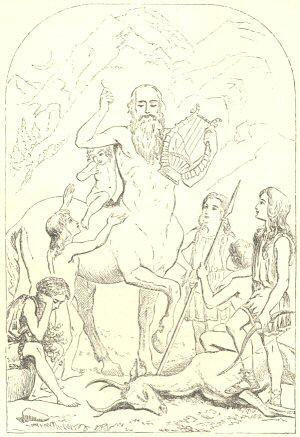
Only one walked apart and silent, Asclepius, the too-wise
child, with his bosom full of herbs and flowers, and round his
wrist a spotted snake; he came with downcast eyes to Cheiron, and
whispered how he had watched the snake cast its old skin, and
grow young again before his eyes, and how he had gone down into a
village in the vale, and cured a dying man with a herb which he
had seen a sick goat eat.
And Cheiron smiled, and said, ‘To each Athené and
Apollo give some gift, and each is worthy in his place; but to
this child they have given an honour beyond all honours, to cure
while others kill.’
Then the lads brought in wood, and split it, and lighted a
blazing fire; and others skinned the deer and quartered them, and
set them to roast before the fire; and while the venison was
cooking they bathed in the snow-torrent, and washed away the dust
and sweat.
And then all ate till they could eat no more (for they had
tasted nothing since the dawn), and drank of the clear spring
water, for wine is not fit for growing lads. And when the
remnants were put away, they all lay down upon the skins and
leaves about the fire, and each took the lyre in turn, and sang
and played with all his heart.
And after a while they all went out to a plot of grass at the
cave’s mouth, and there they boxed, and ran, and wrestled,
and laughed till the stones fell from the cliffs.
Then Cheiron took his lyre, and all the lads joined hands; and
as be played, they danced to his measure, in and out, and round
and round. There they danced hand in hand, till the night
fell over land and sea, while the black glen shone with their
broad white limbs and the gleam of their golden hair.
And the lad danced with them, delighted, and then slept a
wholesome sleep, upon fragrant leaves of bay, and myrtle, and
marjoram, and flowers of thyme; and rose at the dawn, and bathed
in the torrent, and became a schoolfellow to the heroes’
sons, and forgot Iolcos, and his father, and all his former
life. But he grew strong, and brave and cunning, upon the
pleasant downs of Pelion, in the keen hungry mountain air.
And he learnt to wrestle, and to box, and to hunt, and to play
upon the harp; and next he learnt to ride, for old Cheiron used
to mount him on his back; and he learnt the virtues of all herbs
and how to cure all wounds; and Cheiron called him Jason the
healer, and that is his name until this day.
And ten years came and went, and Jason was grown to be a
mighty man. Some of his fellows were gone, and some were
growing up by his side. Asclepius was gone into Peloponnese
to work his wondrous cures on men; and some say he used to raise
the dead to life. And Heracles was gone to Thebes to fulfil
those famous labours which have become a proverb among men.
And Peleus had married a sea-nymph, and his wedding is famous to
this day. And Æneas was gone home to Troy, and many a
noble tale you will read of him, and of all the other gallant
heroes, the scholars of Cheiron the just. And it happened
on a day that Jason stood on the mountain, and looked north and
south and east and west; and Cheiron stood by him and watched
him, for he knew that the time was come.
And Jason looked and saw the plains of Thessaly, where the
Lapithai breed their horses; and the lake of Boibé, and
the stream which runs northward to Peneus and Tempe; and he
looked north, and saw the mountain wall which guards the
Magnesian shore; Olympus, the seat of the Immortals, and Ossa,
and Pelion, where he stood. Then he looked east and saw the
bright blue sea, which stretched away for ever toward the
dawn. Then he looked south, and saw a pleasant land, with
white-walled towns and farms, nestling along the shore of a
land-locked bay, while the smoke rose blue among the trees; and
he knew it for the bay of Pagasai, and the rich lowlands of
Hæmonia, and Iolcos by the sea.
Then he sighed, and asked, ‘Is it true what the heroes
tell me—that I am heir of that fair land?’
‘And what good would it be to you, Jason, if you were
heir of that fair land?’
‘I would take it and keep it.’
‘A strong man has taken it and kept it long. Are
you stronger than Pelias the terrible?’
‘I can try my strength with his,’ said Jason; but
Cheiron sighed, and said—
‘You have many a danger to go through before you rule in
Iolcos by the sea: many a danger and many a woe; and strange
troubles in strange lands, such as man never saw
before.’
‘The happier I,’ said Jason, ‘to see what
man never saw before.’
And Cheiron sighed again, and said, ‘The eaglet must
leave the nest when it is fledged. Will you go to Iolcos by
the sea? Then promise me two things before you
go.’
Jason promised, and Cheiron answered, ‘Speak harshly to
no soul whom you may meet, and stand by the word which you shall
speak.’
Jason wondered why Cheiron asked this of him; but he knew that
the Centaur was a prophet, and saw things long before they
came. So he promised, and leapt down the mountain, to take
his fortune like a man.
He went down through the arbutus thickets, and across the
downs of thyme, till he came to the vineyard walls, and the
pomegranates and the olives in the glen; and among the olives
roared Anauros, all foaming with a summer flood.
And on the bank of Anauros sat a woman, all wrinkled, gray,
and old; her head shook palsied on her breast, and her hands
shook palsied on her knees; and when she saw Jason, she spoke
whining, ‘Who will carry me across the flood?’
Jason was bold and hasty, and was just going to leap into the
flood: and yet he thought twice before he leapt, so loud roared
the torrent down, all brown from the mountain rains, and
silver-veined with melting snow; while underneath he could hear
the boulders rumbling like the tramp of horsemen or the roll of
wheels, as they ground along the narrow channel, and shook the
rocks on which he stood.
But the old woman whined all the more, ‘I am weak and
old, fair youth. For Hera’s sake, carry me over the
torrent.’
And Jason was going to answer her scornfully, when
Cheiron’s words came to his mind.
So he said, ‘For Hera’s sake, the Queen of the
Immortals on Olympus, I will carry you over the torrent, unless
we both are drowned midway.’
Then the old dame leapt upon his back, as nimbly as a goat;
and Jason staggered in, wondering; and the first step was up to
his knees.
The first step was up to his knees, and the second step was up
to his waist; and the stones rolled about his feet, and his feet
slipped about the stones; so he went on staggering, and panting,
while the old woman cried from off his back—
‘Fool, you have wet my mantle! Do you make game of
poor old souls like me?’
Jason had half a mind to drop her, and let her get through the
torrent by herself; but Cheiron’s words were in his mind,
and he said only, ‘Patience, mother; the best horse may
stumble some day.’
At last he staggered to the shore, and set her down upon the
bank; and a strong man he needed to have been, or that wild water
he never would have crossed.
He lay panting awhile upon the bank, and then leapt up to go
upon his journey; but he cast one look at the old woman, for he
thought, ‘She should thank me once at least.’
And as he looked, she grew fairer than all women, and taller
than all men on earth; and her garments shone like the summer
sea, and her jewels like the stars of heaven; and over her
forehead was a veil woven of the golden clouds of sunset; and
through the veil she looked down on him, with great soft
heifer’s eyes; with great eyes, mild and awful, which
filled all the glen with light.
And Jason fell upon his knees, and hid his face between his
hands.
And she spoke, ‘I am the Queen of Olympus, Hera the wife
of Zeus. As thou hast done to me, so will I do to
thee. Call on me in the hour of need, and try if the
Immortals can forget.’
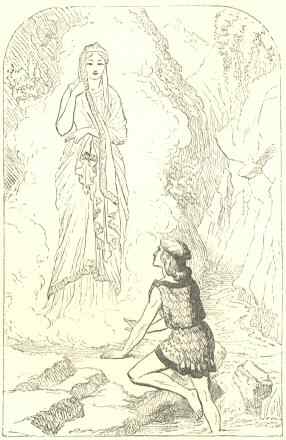
And when Jason looked up, she rose from off the earth, like a
pillar of tall white cloud, and floated away across the mountain
peaks, toward Olympus the holy hill.
Then a great fear fell on Jason: but after a while he grew
light of heart; and he blessed old Cheiron, and said,
‘Surely the Centaur is a prophet, and guessed what would
come to pass, when he bade me speak harshly to no soul whom I
might meet.’
Then he went down toward Iolcos; and as he walked he found
that he had lost one of his sandals in the flood.
And as he went through the streets, the people came out to
look at him, so tall and fair was he; but some of the elders
whispered together; and at last one of them stopped Jason, and
called to him, ‘Fair lad, who are you, and whence come you;
and what is your errand in the town?’
‘My name, good father, is Jason, and I come from Pelion
up above; and my errand is to Pelias your king; tell me then
where his palace is.’
But the old man started, and grew pale, and said, ‘Do
you not know the oracle, my son, that you go so boldly through
the town with but one sandal on?’
‘I am a stranger here, and know of no oracle; but what
of my one sandal? I lost the other in Anauros, while I was
struggling with the flood.’
Then the old man looked back to his companions; and one
sighed, and another smiled; at last he said, ‘I will tell
you, lest you rush upon your ruin unawares. The oracle in
Delphi has said that a man wearing one sandal should take the
kingdom from Pelias, and keep it for himself. Therefore
beware how you go up to his palace, for he is the fiercest and
most cunning of all kings.’
Then Jason laughed a great laugh, like a war-horse in his
pride. ‘Good news, good father, both for you and
me. For that very end I came into the town.’
Then he strode on toward the palace of Pelias, while all the
people wondered at his bearing.
And he stood in the doorway and cried, ‘Come out, come
out, Pelias the valiant, and fight for your kingdom like a
man.’
Pelias came out wondering, and ‘Who are you, bold
youth?’ he cried.
‘I am Jason, the son of Æson, the heir of all this
land.’
Then Pelias lifted up his hands and eyes, and wept, or seemed
to weep; and blessed the heavens which had brought his nephew to
him, never to leave him more. ‘For,’ said he,
‘I have but three daughters, and no son to be my
heir. You shall be my heir then, and rule the kingdom after
me, and marry whichsoever of my daughters you shall choose;
though a sad kingdom you will find it, and whosoever rules it a
miserable man. But come in, come in, and feast.’
So he drew Jason in, whether he would or not, and spoke to him
so lovingly and feasted him so well, that Jason’s anger
passed; and after supper his three cousins came into the hall,
and Jason thought that he should like well enough to have one of
them for his wife.
But at last he said to Pelias, ‘Why do you look so sad,
my uncle? And what did you mean just now when you said that
this was a doleful kingdom, and its ruler a miserable
man?’
Then Pelias sighed heavily again and again and again, like a
man who had to tell some dreadful story, and was afraid to begin;
but at last—
‘For seven long years and more have I never known a
quiet night; and no more will he who comes after me, till the
golden fleece be brought home.’
Then he told Jason the story of Phrixus, and of the golden
fleece; and told him, too, which was a lie, that Phrixus’
spirit tormented him, calling to him day and night. And his
daughters came, and told the same tale (for their father had
taught them their parts), and wept, and said, ‘Oh who will
bring home the golden fleece, that our uncle’s spirit may
rest; and that we may have rest also, whom he never lets sleep in
peace?’
Jason sat awhile, sad and silent; for he had often heard of
that golden fleece; but he looked on it as a thing hopeless and
impossible for any mortal man to win it.
But when Pelias saw him silent, he began to talk of other
things, and courted Jason more and more, speaking to him as if he
was certain to be his heir, and asking his advice about the
kingdom; till Jason, who was young and simple, could not help
saying to himself, ‘Surely he is not the dark man whom
people call him. Yet why did he drive my father
out?’ And he asked Pelias boldly, ‘Men say that
you are terrible, and a man of blood; but I find you a kind and
hospitable man; and as you are to me, so will I be to you.
Yet why did you drive my father out?’
Pelias smiled, and sighed. ‘Men have slandered me
in that, as in all things. Your father was growing old and
weary, and he gave the kingdom up to me of his own will.
You shall see him to-morrow, and ask him; and he will tell you
the same.’
Jason’s heart leapt in him when he heard that he was to
see his father; and he believed all that Pelias said, forgetting
that his father might not dare to tell the truth.
‘One thing more there is,’ said Pelias, ‘on
which I need your advice; for, though you are young, I see in you
a wisdom beyond your years. There is one neighbour of mine,
whom I dread more than all men on earth. I am stronger than
he now, and can command him; but I know that if he stay among us,
he will work my ruin in the end. Can you give me a plan,
Jason, by which I can rid myself of that man?’
After awhile Jason answered, half laughing, ‘Were I you,
I would send him to fetch that same golden fleece; for if he once
set forth after it you would never be troubled with him
more.’
And at that a bitter smile came across Pelias’ lips, and
a flash of wicked joy into his eyes; and Jason saw it, and
started; and over his mind came the warning of the old man, and
his own one sandal, and the oracle, and he saw that he was taken
in a trap.
But Pelias only answered gently, ‘My son, he shall be
sent forthwith.’
‘You mean me?’ cried Jason, starting up,
‘because I came here with one sandal?’ And he
lifted his fist angrily, while Pelias stood up to him like a wolf
at bay; and whether of the two was the stronger and the fiercer
it would be hard to tell.
But after a moment Pelias spoke gently, ‘Why then so
rash, my son? You, and not I, have said what is said; why
blame me for what I have not done? Had you bid me love the
man of whom I spoke, and make him my son-in-law and heir, I would
have obeyed you; and what if I obey you now, and send the man to
win himself immortal fame? I have not harmed you, or
him. One thing at least I know, that he will go, and that
gladly; for he has a hero’s heart within him, loving glory,
and scorning to break the word which he has given.’
Jason saw that he was entrapped; but his second promise to
Cheiron came into his mind, and he thought, ‘What if the
Centaur were a prophet in that also, and meant that I should win
the fleece!’ Then he cried aloud—
‘You have well spoken, cunning uncle of mine! I
love glory, and I dare keep to my word. I will go and fetch
this golden fleece. Promise me but this in return, and keep
your word as I keep mine. Treat my father lovingly while I
am gone, for the sake of the all-seeing Zeus; and give me up the
kingdom for my own on the day that I bring back the golden
fleece.’
Then Pelias looked at him and almost loved him, in the midst
of all his hate; and said, ‘I promise, and I will
perform. It will be no shame to give up my kingdom to the
man who wins that fleece.’ Then they swore a great
oath between them; and afterwards both went in, and lay down to
sleep.
But Jason could not sleep for thinking of his mighty oath, and
how he was to fulfil it, all alone, and without wealth or
friends. So he tossed a long time upon his bed, and thought
of this plan and of that; and sometimes Phrixus seemed to call
him, in a thin voice, faint and low, as if it came from far
across the sea, ‘Let me come home to my fathers and have
rest.’ And sometimes he seemed to see the eyes of
Hera, and to hear her words again—‘Call on me in the
hour of need, and see if the Immortals can forget.’
And on the morrow he went to Pelias, and said, ‘Give me
a victim, that I may sacrifice to Hera.’ So he went
up, and offered his sacrifice; and as he stood by the altar Hera
sent a thought into his mind; and he went back to Pelias, and
said—
‘If you are indeed in earnest, give me two heralds, that
they may go round to all the princes of the Minuai, who were
pupils of the Centaur with me, that we may fit out a ship
together, and take what shall befall.’
At that Pelias praised his wisdom, and hastened to send the
heralds out; for he said in his heart, ‘Let all the princes
go with him, and, like him, never return; for so I shall be lord
of all the Minuai, and the greatest king in Hellas.’
So the heralds went out, and cried to all the heroes of the
Minuai, ‘Who dare come to the adventure of the golden
fleece?’
And Hera stirred the hearts of all the princes, and they came
from all their valleys to the yellow sands of Pagasai. And
first came Heracles the mighty, with his lion’s skin and
club, and behind him Hylas his young squire, who bore his arrows
and his bow; and Tiphys, the skilful steersman; and Butes, the
fairest of all men; and Castor and Polydeuces the twins, the sons
of the magic swan; and Cæneus, the strongest of mortals,
whom the Centaurs tried in vain to kill, and overwhelmed him with
trunks of pine-trees, but even so he would not die; and thither
came Zetes and Calais, the winged sons of the north wind; and
Peleus, the father of Achilles, whose bride was silver-footed
Thetis, the goddess of the sea. And thither came Telamon
and Oileus, the fathers of the two Aiantes, who fought upon the
plains of Troy; and Mopsus, the wise soothsayer, who knew the
speech of birds; and Idmon, to whom Phoebus gave a tongue to
prophesy of things to come; and Ancaios, who could read the
stars, and knew all the circles of the heavens; and Argus, the
famed shipbuilder, and many a hero more, in helmets of brass and
gold with tall dyed horse-hair crests, and embroidered shirts of
linen beneath their coats of mail, and greaves of polished tin to
guard their knees in fight; with each man his shield upon his
shoulder, of many a fold of tough bull’s hide, and his
sword of tempered bronze in his silver-studded belt; and in his
right hand a pair of lances, of the heavy white ash-staves.
So they came down to Iolcos, and all the city came out to meet
them, and were never tired with looking at their height, and
their beauty, and their gallant bearing and the glitter of their
inlaid arms. And some said, ‘Never was such a
gathering of the heroes since the Hellens conquered the
land.’ But the women sighed over them, and whispered,
‘Alas! they are all going to their death!’
Then they felled the pines on Pelion, and shaped them with the
axe, and Argus taught them to build a galley, the first long ship
which ever sailed the seas. They pierced her for fifty
oars—an oar for each hero of the crew—and pitched her
with coal-black pitch, and painted her bows with vermilion; and
they named her Argo after Argus, and worked at her all day
long. And at night Pelias feasted them like a king, and
they slept in his palace-porch.
But Jason went away to the northward, and into the land of
Thrace, till he found Orpheus, the prince of minstrels, where he
dwelt in his cave under Rhodope, among the savage Cicon
tribes. And he asked him, ‘Will you leave your
mountains, Orpheus, my fellow-scholar in old times, and cross
Strymon once more with me, to sail with the heroes of the Minuai,
and bring home the golden fleece, and charm for us all men and
all monsters with your magic harp and song?’
Then Orpheus sighed, ‘Have I not had enough of toil and
of weary wandering, far and wide since I lived in Cheiron’s
cave, above Iolcos by the sea? In vain is the skill and the
voice which my goddess mother gave me; in vain have I sung and
laboured; in vain I went down to the dead, and charmed all the
kings of Hades, to win back Eurydice my bride. For I won
her, my beloved, and lost her again the same day, and wandered
away in my madness, even to Egypt and the Libyan sands, and the
isles of all the seas, driven on by the terrible gadfly, while I
charmed in vain the hearts of men, and the savage forest beasts,
and the trees, and the lifeless stones, with my magic harp and
song, giving rest, but finding none. But at last Calliope
my mother delivered me, and brought me home in peace; and I dwell
here in the cave alone, among the savage Cicon tribes, softening
their wild hearts with music and the gentle laws of Zeus.
And now I must go out again, to the ends of all the earth, far
away into the misty darkness, to the last wave of the Eastern
Sea. But what is doomed must be, and a friend’s
demand obeyed; for prayers are the daughters of Zeus, and who
honours them honours him.’
Then Orpheus rose up sighing, and took his harp, and went over
Strymon. And he led Jason to the south-west, up the banks
of Haliacmon and over the spurs of Pindus, to Dodona the town of
Zeus, where it stood by the side of the sacred lake, and the
fountain which breathed out fire, in the darkness of the ancient
oakwood, beneath the mountain of the hundred springs. And
he led him to the holy oak, where the black dove settled in old
times, and was changed into the priestess of Zeus, and gave
oracles to all nations round. And he bade him cut down a
bough, and sacrifice to Hera and to Zeus; and they took the bough
and came to Iolcos, and nailed it to the beak-head of the
ship.
And at last the ship was finished, and they tried to launch
her down the beach; but she was too heavy for them to move her,
and her keel sank deep into the sand. Then all the heroes
looked at each other blushing; but Jason spoke, and said,
‘Let us ask the magic bough; perhaps it can help us in our
need.’
Then a voice came from the bough, and Jason heard the words it
said, and bade Orpheus play upon the harp, while the heroes
waited round, holding the pine-trunk rollers, to help her toward
the sea.
Then Orpheus took his harp, and began his magic
song—‘How sweet it is to ride upon the surges, and to
leap from wave to wave, while the wind sings cheerful in the
cordage, and the oars flash fast among the foam! How sweet
it is to roam across the ocean, and see new towns and wondrous
lands, and to come home laden with treasure, and to win undying
fame!’
And the good ship Argo heard him, and longed to be away
and out at sea; till she stirred in every timber, and heaved from
stem to stern, and leapt up from the sand upon the rollers, and
plunged onward like a gallant horse; and the heroes fed her path
with pine-trunks, till she rushed into the whispering sea.
Then they stored her well with food and water, and pulled the
ladder up on board, and settled themselves each man to his oar,
and kept time to Orpheus’ harp; and away across the bay
they rowed southward, while the people lined the cliffs; and the
women wept, while the men shouted, at the starting of that
gallant crew.
And what happened next, my children, whether it be true or
not, stands written in ancient songs, which you shall read for
yourselves some day. And grand old songs they are, written
in grand old rolling verse; and they call them the Songs of
Orpheus, or the Orphics, to this day. And they tell how the
heroes came to Aphetai, across the bay, and waited for the
south-west wind, and chose themselves a captain from their crew:
and how all called for Heracles, because he was the strongest and
most huge; but Heracles refused, and called for Jason, because he
was the wisest of them all. So Jason was chosen captain;
and Orpheus heaped a pile of wood, and slew a bull, and offered
it to Hera, and called all the heroes to stand round, each
man’s head crowned with olive, and to strike their swords
into the bull. Then he filled a golden goblet with the
bull’s blood, and with wheaten flour, and honey, and wine,
and the bitter salt-sea water, and bade the heroes taste.
So each tasted the goblet, and passed it round, and vowed an
awful vow: and they vowed before the sun, and the night, and the
blue-haired sea who shakes the land, to stand by Jason faithfully
in the adventure of the golden fleece; and whosoever shrank back,
or disobeyed, or turned traitor to his vow, then justice should
minister against him, and the Erinnues who track guilty men.
Then Jason lighted the pile, and burnt the carcase of the
bull; and they went to their ship and sailed eastward, like men
who have a work to do; and the place from which they went was
called Aphetai, the sailing-place, from that day forth.
Three thousand years and more they sailed away, into the unknown
Eastern seas; and great nations have come and gone since then,
and many a storm has swept the earth; and many a mighty armament,
to which Argo would be but one small boat; English and
French, Turkish and Russian, have sailed those waters since; yet
the fame of that small Argo lives for ever, and her name
is become a proverb among men.
So they sailed past the Isle of Sciathos, with the Cape of
Sepius on their left, and turned to the northward toward Pelion,
up the long Magnesian shore. On their right hand was the
open sea, and on their left old Pelion rose, while the clouds
crawled round his dark pine-forests, and his caps of summer
snow. And their hearts yearned for the dear old mountain,
as they thought of pleasant days gone by, and of the sports of
their boyhood, and their hunting, and their schooling in the cave
beneath the cliff. And at last Peleus spoke, ‘Let us
land here, friends, and climb the dear old hill once more.
We are going on a fearful journey; who knows if we shall see
Pelion again? Let us go up to Cheiron our master, and ask
his blessing ere we start. And I have a boy, too, with him,
whom he trains as he trained me once—the son whom Thetis
brought me, the silver-footed lady of the sea, whom I caught in
the cave, and tamed her, though she changed her shape seven
times. For she changed, as I held her, into water, and to
vapour, and to burning flame, and to a rock, and to a black-maned
lion, and to a tall and stately tree. But I held her and
held her ever, till she took her own shape again, and led her to
my father’s house, and won her for my bride. And all
the rulers of Olympus came to our wedding, and the heavens and
the earth rejoiced together, when an Immortal wedded mortal
man. And now let me see my son; for it is not often I shall
see him upon earth: famous he will be, but short-lived, and die
in the flower of youth.’
So Tiphys the helmsman steered them to the shore under the
crags of Pelion; and they went up through the dark pine-forests
towards the Centaur’s cave.
And they came into the misty hall, beneath the snow-crowned
crag; and saw the great Centaur lying, with his huge limbs spread
upon the rock; and beside him stood Achilles, the child whom no
steel could wound, and played upon his harp right sweetly, while
Cheiron watched and smiled.
Then Cheiron leapt up and welcomed them, and kissed them every
one, and set a feast before them of swine’s flesh, and
venison, and good wine; and young Achilles served them, and
carried the golden goblet round. And after supper all the
heroes clapped their hands, and called on Orpheus to sing; but he
refused, and said, ‘How can I, who am the younger, sing
before our ancient host?’ So they called on Cheiron
to sing, and Achilles brought him his harp; and he began a
wondrous song; a famous story of old time, of the fight between
the Centaurs and the Lapithai, which you may still see carved in
stone. [96] He sang how his brothers came to
ruin by their folly, when they were mad with wine; and how they
and the heroes fought, with fists, and teeth, and the goblets
from which they drank; and how they tore up the pine-trees in
their fury, and hurled great crags of stone, while the mountains
thundered with the battle, and the land was wasted far and wide;
till the Lapithai drove them from their home in the rich
Thessalian plains to the lonely glens of Pindus, leaving Cheiron
all alone. And the heroes praised his song right heartily;
for some of them had helped in that great fight.
Then Orpheus took the lyre, and sang of Chaos, and the making
of the wondrous World, and how all things sprang from Love, who
could not live alone in the Abyss. And as he sang, his
voice rose from the cave, above the crags, and through the
tree-tops, and the glens of oak and pine. And the trees
bowed their heads when they heard it, and the gray rocks cracked
and rang, and the forest beasts crept near to listen, and the
birds forsook their nests and hovered round. And old
Cheiron claps his hands together, and beat his hoofs upon the
ground, for wonder at that magic song.
Then Peleus kissed his boy, and wept over him, and they went
down to the ship; and Cheiron came down with them, weeping, and
kissed them one by one, and blest them, and promised to them
great renown. And the heroes wept when they left him, till
their great hearts could weep no more; for he was kind and just
and pious, and wiser than all beasts and men. Then he went
up to a cliff, and prayed for them, that they might come home
safe and well; while the heroes rowed away, and watched him
standing on his cliff above the sea, with his great hands raised
toward heaven, and his white locks waving in the wind; and they
strained their eyes to watch him to the last, for they felt that
they should look on him no more.
So they rowed on over the long swell of the sea, past Olympus,
the seat of the Immortals, and past the wooded bays of Athos, and
Samothrace the sacred isle; and they came past Lemnos to the
Hellespont, and through the narrow strait of Abydos, and so on
into the Propontis, which we call Marmora now. And there
they met with Cyzicus, ruling in Asia over the Dolions, who, the
songs say, was the son of Æneas, of whom you will hear many
a tale some day. For Homer tells us how he fought at Troy,
and Virgil how he sailed away and founded Rome; and men believed
until late years that from him sprang our old British
kings. Now Cyzicus, the songs say, welcomed the heroes, for
his father had been one of Cheiron’s scholars; so he
welcomed them, and feasted them, and stored their ship with corn
and wine, and cloaks and rugs, the songs say, and shirts, of
which no doubt they stood in need.
But at night, while they lay sleeping, came down on them
terrible men, who lived with the bears in the mountains, like
Titans or giants in shape; for each of them had six arms, and
they fought with young firs and pines. But Heracles killed
them all before morn with his deadly poisoned arrows; but among
them, in the darkness, he slew Cyzicus the kindly prince.
Then they got to their ship and to their oars, and Tiphys bade
them cast off the hawsers and go to sea. But as he spoke a
whirlwind came, and spun the Argo round, and twisted the
hawsers together, so that no man could loose them. Then
Tiphys dropped the rudder from his hand, and cried, ‘This
comes from the Gods above.’ But Jason went forward,
and asked counsel of the magic bough.
Then the magic bough spoke, and answered, ‘This is
because you have slain Cyzicus your friend. You must
appease his soul, or you will never leave this shore.’
Jason went back sadly, and told the heroes what he had
heard. And they leapt on shore, and searched till dawn; and
at dawn they found the body, all rolled in dust and blood, among
the corpses of those monstrous beasts. And they wept over
their kind host, and laid him on a fair bed, and heaped a huge
mound over him, and offered black sheep at his tomb, and Orpheus
sang a magic song to him, that his spirit might have rest.
And then they held games at the tomb, after the custom of those
times, and Jason gave prizes to each winner. To
Ancæus he gave a golden cup, for he wrestled best of all;
and to Heracles a silver one, for he was the strongest of all;
and to Castor, who rode best, a golden crest; and Polydeuces the
boxer had a rich carpet, and to Orpheus for his song a sandal
with golden wings. But Jason himself was the best of all
the archers, and the Minuai crowned him with an olive crown; and
so, the songs say, the soul of good Cyzicus was appeased and the
heroes went on their way in peace.
But when Cyzicus’ wife heard that he was dead she died
likewise of grief; and her tears became a fountain of clear
water, which flows the whole year round.
Then they rowed away, the songs say, along the Mysian shore,
and past the mouth of Rhindacus, till they found a pleasant bay,
sheltered by the long ridges of Arganthus, and by high walls of
basalt rock. And there they ran the ship ashore upon the
yellow sand, and furled the sail, and took the mast down, and
lashed it in its crutch. And next they let down the ladder,
and went ashore to sport and rest.
And there Heracles went away into the woods, bow in hand, to
hunt wild deer; and Hylas the fair boy slipt away after him, and
followed him by stealth, until he lost himself among the glens,
and sat down weary to rest himself by the side of a lake; and
there the water nymphs came up to look at him, and loved him, and
carried him down under the lake to be their playfellow, for ever
happy and young. And Heracles sought for him in vain,
shouting his name till all the mountains rang; but Hylas never
heard him, far down under the sparkling lake. So while
Heracles wandered searching for him, a fair breeze sprang up, and
Heracles was nowhere to be found; and the Argo sailed
away, and Heracles was left behind, and never saw the noble
Phasian stream.
Then the Minuai came to a doleful land, where Amycus the giant
ruled, and cared nothing for the laws of Zeus, but challenged all
strangers to box with him, and those whom he conquered he
slew. But Polydeuces the boxer struck him a harder blow
than he ever felt before, and slew him; and the Minuai went on up
the Bosphorus, till they came to the city of Phineus, the fierce
Bithynian king; for Zetes and Calais bade Jason land there,
because they had a work to do.
And they went up from the shore toward the city, through
forests white with snow; and Phineus came out to meet them with a
lean and woful face, and said, ‘Welcome, gallant heroes, to
the land of bitter blasts, the land of cold and misery; yet I
will feast you as best I can.’ And he led them in,
and set meat before them; but before they could put their hands
to their mouths, down came two fearful monsters, the like of whom
man never saw; for they had the faces and the hair of fair
maidens, but the wings and claws of hawks; and they snatched the
meat from off the table, and flew shrieking out above the
roofs.
Then Phineus beat his breast and cried, ‘These are the
Harpies, whose names are the Whirlwind and the Swift, the
daughters of Wonder and of the Amber-nymph, and they rob us night
and day. They carried off the daughters of Pandareus, whom
all the Gods had blest; for Aphrodite fed them on Olympus with
honey and milk and wine; and Hera gave them beauty and wisdom,
and Athené skill in all the arts; but when they came to
their wedding, the Harpies snatched them both away, and gave them
to be slaves to the Erinnues, and live in horror all their
days. And now they haunt me, and my people, and the
Bosphorus, with fearful storms; and sweep away our food from off
our tables, so that we starve in spite of all our
wealth.’
Then up rose Zetes and Calais, the winged sons of the
North-wind, and said, ‘Do you not know us, Phineus, and
these wings which grow upon our backs?’ And Phineus
hid his face in terror; but he answered not a word.
‘Because you have been a traitor, Phineus, the Harpies
haunt you night and day. Where is Cleopatra our sister,
your wife, whom you keep in prison? and where are her two
children, whom you blinded in your rage, at the bidding of an
evil woman, and cast them out upon the rocks? Swear to us
that you will right our sister, and cast out that wicked woman;
and then we will free you from your plague, and drive the
whirlwind maidens to the south; but if not, we will put out your
eyes, as you put out the eyes of your own sons.’
Then Phineus swore an oath to them, and drove out the wicked
woman; and Jason took those two poor children, and cured their
eyes with magic herbs.
But Zetes and Calais rose up sadly and said, ‘Farewell
now, heroes all; farewell, our dear companions, with whom we
played on Pelion in old times; for a fate is laid upon us, and
our day is come at last, in which we must hunt the whirlwinds
over land and sea for ever; and if we catch them they die, and if
not, we die ourselves.’
At that all the heroes wept; but the two young men sprang up,
and aloft into the air after the Harpies, and the battle of the
winds began.
The heroes trembled in silence as they heard the shrieking of
the blasts; while the palace rocked and all the city, and great
stones were torn from the crags, and the forest pines were hurled
earthward, north and south and east and west, and the Bosphorus
boiled white with foam, and the clouds were dashed against the
cliffs.
But at last the battle ended, and the Harpies fled screaming
toward the south, and the sons of the North-wind rushed after
them, and brought clear sunshine where they passed. For
many a league they followed them, over all the isles of the
Cyclades, and away to the south-west across Hellas, till they
came to the Ionian Sea, and there they fell upon the Echinades,
at the mouth of the Achelous; and those isles were called the
Whirlwind Isles for many a hundred years. But what became
of Zetes and Calais I know not, for the heroes never saw them
again: and some say that Heracles met them, and quarrelled with
them, and slew them with his arrows; and some say that they fell
down from weariness and the heat of the summer sun, and that the
Sun-god buried them among the Cyclades, in the pleasant Isle of
Tenos; and for many hundred years their grave was shown there,
and over it a pillar, which turned to every wind. But those
dark storms and whirlwinds haunt the Bosphorus until this
day.
But the Argonauts went eastward, and out into the open sea,
which we now call the Black Sea, but it was called the Euxine
then. No Hellen had ever crossed it, and all feared that
dreadful sea, and its rocks, and shoals, and fogs, and bitter
freezing storms; and they told strange stories of it, some false
and some half-true, how it stretched northward to the ends of the
earth, and the sluggish Putrid Sea, and the everlasting night,
and the regions of the dead. So the heroes trembled, for
all their courage, as they came into that wild Black Sea, and saw
it stretching out before them, without a shore, as far as eye
could see.
And first Orpheus spoke, and warned them, ‘We shall come
now to the wandering blue rocks; my mother warned me of them,
Calliope, the immortal muse.’
And soon they saw the blue rocks shining like spires and
castles of gray glass, while an ice-cold wind blew from them and
chilled all the heroes’ hearts. And as they neared
they could see them heaving, as they rolled upon the long
sea-waves, crashing and grinding together, till the roar went up
to heaven. The sea sprang up in spouts between them, and
swept round them in white sheets of foam; but their heads swung
nodding high in air, while the wind whistled shrill among the
crags.
The heroes’ hearts sank within them, and they lay upon
their oars in fear; but Orpheus called to Tiphys the helmsman,
‘Between them we must pass; so look ahead for an opening,
and be brave, for Hera is with us.’ But Tiphys the
cunning helmsman stood silent, clenching his teeth, till he saw a
heron come flying mast-high toward the rocks, and hover awhile
before them, as if looking for a passage through. Then he
cried, ‘Hera has sent us a pilot; let us follow the cunning
bird.’
Then the heron flapped to and fro a moment, till he saw a
hidden gap, and into it he rushed like an arrow, while the heroes
watched what would befall.
And the blue rocks clashed together as the bird fled swiftly
through; but they struck but a feather from his tail, and then
rebounded apart at the shock.
Then Tiphys cheered the heroes, and they shouted; and the oars
bent like withes beneath their strokes as they rushed between
those toppling ice-crags and the cold blue lips of death.
And ere the rocks could meet again they had passed them, and were
safe out in the open sea.
And after that they sailed on wearily along the Asian coast,
by the Black Cape and Thyneis, where the hot stream of Thymbris
falls into the sea, and Sangarius, whose waters float on the
Euxine, till they came to Wolf the river, and to Wolf the kindly
king. And there died two brave heroes, Idmon and Tiphys the
wise helmsman: one died of an evil sickness, and one a wild boar
slew. So the heroes heaped a mound above them, and set upon
it an oar on high, and left them there to sleep together, on the
far-off Lycian shore. But Idas killed the boar, and avenged
Tiphys; and Ancaios took the rudder and was helmsman, and steered
them on toward the east.
And they went on past Sinope, and many a mighty river’s
mouth, and past many a barbarous tribe, and the cities of the
Amazons, the warlike women of the East, till all night they heard
the clank of anvils and the roar of furnace-blasts, and the
forge-fires shone like sparks through the darkness in the
mountain glens aloft; for they were come to the shores of the
Chalybes, the smiths who never tire, but serve Ares the cruel
War-god, forging weapons day and night.
And at day-dawn they looked eastward, and midway between the
sea and the sky they saw white snow-peaks hanging, glittering
sharp and bright above the clouds. And they knew that they
were come to Caucasus, at the end of all the earth: Caucasus the
highest of all mountains, the father of the rivers of the
East. On his peak lies chained the Titan, while a vulture
tears his heart; and at his feet are piled dark forests round the
magic Colchian land.
And they rowed three days to the eastward, while Caucasus rose
higher hour by hour, till they saw the dark stream of Phasis
rushing headlong to the sea, and, shining above the tree-tops,
the golden roofs of King Aietes, the child of the Sun.
Then out spoke Ancaios the helmsman, ‘We are come to our
goal at last, for there are the roofs of Aietes, and the woods
where all poisons grow; but who can tell us where among them is
hid the golden fleece? Many a toil must we bear ere we find
it, and bring it home to Greece.’
But Jason cheered the heroes, for his heart was high and bold;
and he said, ‘I will go alone up to Aietes, though he be
the child of the Sun, and win him with soft words. Better
so than to go altogether, and to come to blows at
once.’ But the Minuai would not stay behind, so they
rowed boldly up the stream.
And a dream came to Aietes, and filled his heart with
fear. He thought he saw a shining star, which fell into his
daughter’s lap; and that Medeia his daughter took it
gladly, and carried it to the river-side, and cast it in, and
there the whirling river bore it down, and out into the Euxine
Sea.
Then he leapt up in fear, and bade his servants bring his
chariot, that he might go down to the river-side and appease the
nymphs, and the heroes whose spirits haunt the bank. So he
went down in his golden chariot, and his daughters by his side,
Medeia the fair witch-maiden, and Chalciope, who had been
Phrixus’ wife, and behind him a crowd of servants and
soldiers, for he was a rich and mighty prince.
And as he drove down by the reedy river he saw Argo
sliding up beneath the bank, and many a hero in her, like
Immortals for beauty and for strength, as their weapons glittered
round them in the level morning sunlight, through the white mist
of the stream. But Jason was the noblest of all; for Hera,
who loved him, gave him beauty and tallness and terrible
manhood.
And when they came near together and looked into each
other’s eyes the heroes were awed before Aietes as he shone
in his chariot, like his father the glorious Sun; for his robes
were of rich gold tissue, and the rays of his diadem flashed
fire; and in his hand he bore a jewelled sceptre, which glittered
like the stars; and sternly he looked at them under his brows,
and sternly he spoke and loud—
‘Who are you, and what want you here, that you come to
the shore of Cutaia? Do you take no account of my rule, nor
of my people the Colchians who serve me, who never tired yet in
the battle, and know well how to face an invader?’
And the heroes sat silent awhile before the face of that
ancient king. But Hera the awful goddess put courage into
Jason’s heart, and he rose and shouted loudly in answer,
‘We are no pirates nor lawless men. We come not to
plunder and to ravage, or carry away slaves from your land; but
my uncle, the son of Poseidon, Pelias the Minuan king, he it is
who has set me on a quest to bring home the golden fleece.
And these too, my bold comrades, they are no nameless men; for
some are the sons of Immortals, and some of heroes far
renowned. And we too never tire in battle, and know well
how to give blows and to take: yet we wish to be guests at your
table: it will be better so for both.’
Then Aietes’ race rushed up like a whirlwind, and his
eyes flashed fire as he heard; but he crushed his anger down in
his breast, and spoke mildly a cunning speech—
‘If you will fight for the fleece with my Colchians,
then many a man must die. But do you indeed expect to win
from me the fleece in fight? So few you are that if you be
worsted I can load your ship with your corpses. But if you
will be ruled by me, you will find it better far to choose the
best man among you, and let him fulfil the labours which I
demand. Then I will give him the golden fleece for a prize
and a glory to you all.’
So saying, he turned his horses and drove back in silence to
the town. And the Minuai sat silent with sorrow, and longed
for Heracles and his strength; for there was no facing the
thousands of the Colchians and the fearful chance of war.
But Chalciope, Phrixus’ widow, went weeping to the town;
for she remembered her Minuan husband, and all the pleasures of
her youth, while she watched the fair faces of his kinsmen, and
their long locks of golden hair. And she whispered to
Medeia her sister, ‘Why should all these brave men die? why
does not my father give them up the fleece, that my
husband’s spirit may have rest?’
And Medeia’s heart pitied the heroes, and Jason most of
all; and she answered, ‘Our father is stern and terrible,
and who can win the golden fleece?’ But Chalciope
said, ‘These men are not like our men; there is nothing
which they cannot dare nor do.’
And Medeia thought of Jason and his brave countenance, and
said, ‘If there was one among them who knew no fear, I
could show him how to win the fleece.’
So in the dusk of evening they went down to the river-side,
Chalciope and Medeia the witch-maiden, and Argus, Phrixus’
son. And Argus the boy crept forward, among the beds of
reeds, till he came where the heroes were sleeping, on the
thwarts of the ship, beneath the bank, while Jason kept ward on
shore, and leant upon his lance full of thought. And the
boy came to Jason, and said—
‘I am the son of Phrixus, your Cousin; and Chalciope my
mother waits for you, to talk about the golden fleece.’
Then Jason went boldly with the boy, and found the two
princesses standing; and when Chalciope saw him she wept, and
took his hands, and cried—‘O cousin of my beloved, go
home before you die!’
‘It would be base to go home now, fair princess, and to
have sailed all these seas in vain.’ Then both the
princesses besought him; but Jason said, ‘It is too
late.’
‘But you know not,’ said Medeia, ‘what he
must do who would win the fleece. He must tame the two
brazen-footed bulls, who breathe devouring flame; and with them
he must plough ere nightfall four acres in the field of Ares; and
he must sow them with serpents’ teeth, of which each tooth
springs up into an armed man. Then he must fight with all
those warriors; and little will it profit him to conquer them,
for the fleece is guarded by a serpent, more huge than any
mountain pine; and over his body you must step if you would reach
the golden fleece.’
Then Jason laughed bitterly. ‘Unjustly is that
fleece kept here, and by an unjust and lawless king; and unjustly
shall I die in my youth, for I will attempt it ere another sun be
set.’
Then Medeia trembled, and said, ‘No mortal man can reach
that fleece unless I guide him through. For round it,
beyond the river, is a wall full nine ells high, with lofty
towers and buttresses, and mighty gates of threefold brass; and
over the gates the wall is arched, with golden battlements
above. And over the gateway sits Brimo, the wild
witch-huntress of the woods, brandishing a pine-torch in her
hands, while her mad hounds howl around. No man dare meet
her or look on her, but only I her priestess, and she watches far
and wide lest any stranger should come near.’
‘No wall so high but it may be climbed at last, and no
wood so thick but it may be crawled through; no serpent so wary
but he may be charmed, or witch-queen so fierce but spells may
soothe her; and I may yet win the golden fleece, if a wise maiden
help bold men.’
And he looked at Medeia cunningly, and held her with his
glittering eye, till she blushed and trembled, and
said—
‘Who can face the fire of the bulls’ breath, and
fight ten thousand armed men?’
‘He whom you help,’ said Jason, flattering her,
‘for your fame is spread over all the earth. Are you
not the queen of all enchantresses, wiser even than your sister
Circe, in her fairy island in the West?’
‘Would that I were with my sister Circe in her fairy
island in the West, far away from sore temptation and thoughts
which tear the heart! But if it must be so—for why
should you die?—I have an ointment here; I made it from the
magic ice-flower which sprang from Prometheus’ wound, above
the clouds on Caucasus, in the dreary fields of snow.
Anoint yourself with that, and you shall have in you seven
men’s strength; and anoint your shield with it, and neither
fire nor sword can harm you. But what you begin you must
end before sunset, for its virtue lasts only one day. And
anoint your helmet with it before you sow the serpents’
teeth; and when the sons of earth spring up, cast your helmet
among their ranks, and the deadly crop of the War-god’s
field will mow itself, and perish.’
Then Jason fell on his knees before her, and thanked her and
kissed her hands; and she gave him the vase of ointment, and fled
trembling through the reeds. And Jason told his comrades
what had happened, and showed them the box of ointment; and all
rejoiced but Idas, and he grew mad with envy.
And at sunrise Jason went and bathed, and anointed himself
from head to foot, and his shield, and his helmet, and his
weapons, and bade his comrades try the spell. So they tried
to bend his lance, but it stood like an iron bar; and Idas in
spite hewed at it with his sword, but the blade flew to splinters
in his face. Then they hurled their lances at his shield,
but the spear-points turned like lead; and Caineus tried to throw
him, but he never stirred a foot; and Polydeuces struck him with
his fist a blow which would have killed an ox, but Jason only
smiled, and the heroes danced about him with delight; and he
leapt, and ran, and shouted in the joy of that enormous strength,
till the sun rose, and it was time to go and to claim
Aietes’ promise.
So he sent up Telamon and Aithalides to tell Aietes that he
was ready for the fight; and they went up among the marble walls,
and beneath the roofs of gold, and stood in Aietes’ hall,
while he grew pale with rage.
‘Fulfil your promise to us, child of the blazing
Sun. Give us the serpents’ teeth, and let loose the
fiery bulls; for we have found a champion among us who can win
the golden fleece.’
And Aietes bit his lips, for he fancied that they had fled
away by night: but he could not go back from his promise; so he
gave them the serpents’ teeth.
Then he called for his chariot and his horses, and sent
heralds through all the town; and all the people went out with
him to the dreadful War-god’s field.
And there Aietes sat upon his throne, with his warriors on
each hand, thousands and tens of thousands, clothed from head to
foot in steel chain-mail. And the people and the women
crowded to every window and bank and wall; while the Minuai stood
together, a mere handful in the midst of that great host.
And Chalciope was there and Argus, trembling, and Medeia,
wrapped closely in her veil; but Aietes did not know that she was
muttering cunning spells between her lips.
Then Jason cried, ‘Fulfil your promise, and let your
fiery bulls come forth.’
Then Aietes bade open the gates, and the magic bulls leapt
out. Their brazen hoofs rang upon the ground, and their
nostrils sent out sheets of flame, as they rushed with lowered
heads upon Jason; but he never flinched a step. The flame
of their breath swept round him, but it singed not a hair of his
head; and the bulls stopped short and trembled when Medeia began
her spell.
Then Jason sprang upon the nearest and seized him by the horn;
and up and down they wrestled, till the bull fell grovelling on
his knees; for the heart of the brute died within him, and his
mighty limbs were loosed, beneath the steadfast eye of that dark
witch-maiden and the magic whisper of her lips.
So both the bulls were tamed and yoked; and Jason bound them
to the plough, and goaded them onward with his lance till he had
ploughed the sacred field.
And all the Minuai shouted; but Aietes bit his lips with rage,
for the half of Jason’s work was over, and the sun was yet
high in heaven.
Then he took the serpents’ teeth and sowed them, and
waited what would befall. But Medeia looked at him and at
his helmet, lest he should forget the lesson she had taught.
And every furrow heaved and bubbled, and out of every clod
arose a man. Out of the earth they rose by thousands, each
clad from head to foot in steel, and drew their swords and rushed
on Jason, where he stood in the midst alone.
Then the Minuai grew pale with fear for him; but Aietes
laughed a bitter laugh. ‘See! if I had not warriors
enough already round me, I could call them out of the bosom of
the earth.’
But Jason snatched off his helmet, and hurled it into the
thickest of the throng. And blind madness came upon them,
suspicion, hate, and fear; and one cried to his fellow,
‘Thou didst strike me!’ and another, ‘Thou art
Jason; thou shalt die!’ So fury seized those
earth-born phantoms, and each turned his hand against the rest;
and they fought and were never weary, till they all lay dead upon
the ground. Then the magic furrows opened, and the kind
earth took them home into her breast and the grass grew up all
green again above them, and Jason’s work was done.
Then the Minuai rose and shouted, till Prometheus heard them
from his crag. And Jason cried, ‘Lead me to the
fleece this moment, before the sun goes down.’
But Aietes thought, ‘He has conquered the bulls, and
sown and reaped the deadly crop. Who is this who is proof
against all magic? He may kill the serpent
yet.’ So he delayed, and sat taking counsel with his
princes till the sun went down and all was dark. Then he
bade a herald cry, ‘Every man to his home for
to-night. To-morrow we will meet these heroes, and speak
about the golden fleece.’
Then he turned and looked at Medeia. ‘This is your
doing, false witch-maid! You have helped these
yellow-haired strangers, and brought shame upon your father and
yourself!’
Medeia shrank and trembled, and her face grew pale with fear;
and Aietes knew that she was guilty, and whispered, ‘If
they win the fleece, you die!’
But the Minuai marched toward their ship, growling like lions
cheated of their prey; for they saw that Aietes meant to mock
them, and to cheat them out of all their toil. And Oileus
said, ‘Let us go to the grove together, and take the fleece
by force.’
And Idas the rash cried, ‘Let us draw lots who shall go
in first; for, while the dragon is devouring one, the rest can
slay him and carry off the fleece in peace.’ But
Jason held them back, though he praised them; for he hoped for
Medeia’s help.
And after awhile Medeia came trembling, and wept a long while
before she spoke. And at last—
‘My end is come, and I must die; for my father has found
out that I have helped you. You he would kill if he dared;
but he will not harm you, because you have been his guests.
Go then, go, and remember poor Medeia when you are far away
across the sea.’ But all the heroes cried—
‘If you die, we die with you; for without you we cannot
win the fleece, and home we will not go without it, but fall here
fighting to the last man.’
‘You need not die,’ said Jason. ‘Flee
home with us across the sea. Show us first how to win the
fleece; for you can do it. Why else are you the priestess
of the grove? Show us but how to win the fleece, and come
with us, and you shall be my queen, and rule over the rich
princes of the Minuai, in Iolcos by the sea.’
And all the heroes pressed round, and vowed to her that she
should be their queen.
Medeia wept, and shuddered, and hid her face in her hands; for
her heart yearned after her sisters and her playfellows, and the
home where she was brought up as a child. But at last she
looked up at Jason, and spoke between her sobs—
‘Must I leave my home and my people, to wander with
strangers across the sea? The lot is cast, and I must
endure it. I will show you how to win the golden
fleece. Bring up your ship to the wood-side, and moor her
there against the bank; and let Jason come up at midnight, and
one brave comrade with him, and meet me beneath the
wall.’
Then all the heroes cried together, ‘I will go!’
‘and I!’ ‘and I!’ And Idas the rash
grew mad with envy; for he longed to be foremost in all
things. But Medeia calmed them, and said, ‘Orpheus
shall go with Jason, and bring his magic harp; for I hear of him
that he is the king of all minstrels, and can charm all things on
earth.’
And Orpheus laughed for joy, and clapped his hands, because
the choice had fallen on him; for in those days poets and singers
were as bold warriors as the best.
So at midnight they went up the bank, and found Medeia; and
beside came Absyrtus her young brother, leading a yearling
lamb.
Then Medeia brought them to a thicket beside the
War-god’s gate; and there she bade Jason dig a ditch, and
kill the lamb, and leave it there, and strew on it magic herbs
and honey from the honeycomb.
Then sprang up through the earth, with the red fire flashing
before her, Brimo the wild witch-huntress, while her mad hounds
howled around. She had one head like a horse’s, and
another like a ravening hound’s, and another like a hissing
snake’s, and a sword in either hand. And she leapt
into the ditch with her hounds, and they ate and drank their
fill, while Jason and Orpheus trembled, and Medeia hid her
eyes. And at last the witch-queen vanished, and fled with
her hounds into the woods; and the bars of the gates fell down,
and the brazen doors flew wide, and Medeia and the heroes ran
forward and hurried through the poison wood, among the dark stems
of the mighty beeches, guided by the gleam of the golden fleece,
until they saw it hanging on one vast tree in the midst.
And Jason would have sprung to seize it; but Medeia held him
back, and pointed, shuddering, to the tree-foot, where the mighty
serpent lay, coiled in and out among the roots, with a body like
a mountain pine. His coils stretched many a fathom,
spangled with bronze and gold; and half of him they could see,
but no more, for the rest lay in the darkness far beyond.
And when he saw them coming he lifted up his head, and watched
them with his small bright eyes, and flashed his forked tongue,
and roared like the fire among the woodlands, till the forest
tossed and groaned. For his cries shook the trees from leaf
to root, and swept over the long reaches of the river, and over
Aietes’ hall, and woke the sleepers in the city, till
mothers clasped their children in their fear.
But Medeia called gently to him, and he stretched out his long
spotted neck, and licked her hand, and looked up in her face, as
if to ask for food. Then she made a sign to Orpheus, and he
began his magic song.
And as he sung, the forest grew calm again, and the leaves on
every tree hung still; and the serpent’s head sank down,
and his brazen coils grew limp, and his glittering eyes closed
lazily, till he breathed as gently as a child, while Orpheus
called to pleasant Slumber, who gives peace to men, and beasts,
and waves.
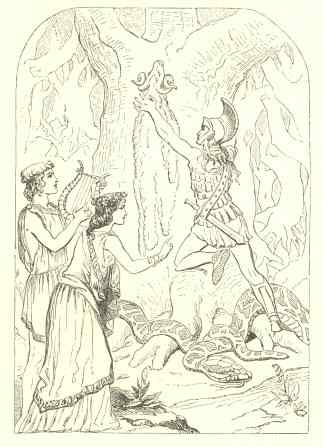
Then Jason leapt forward warily, and stept across that mighty
snake, and tore the fleece from off the tree-trunk; and the four
rushed down the garden, to the bank where the Argo
lay.
There was a silence for a moment, while Jason held the golden
fleece on high. Then he cried, ‘Go now, good
Argo, swift and steady, if ever you would see Pelion
more.’
And she went, as the heroes drove her, grim and silent all,
with muffled oars, till the pine-wood bent like willow in their
hands, and stout Argo groaned beneath their strokes.
On and on, beneath the dewy darkness, they fled swiftly down
the swirling stream; underneath black walls, and temples, and the
castles of the princes of the East; past sluice-mouths, and
fragrant gardens, and groves of all strange fruits; past marshes
where fat kine lay sleeping, and long beds of whispering reeds;
till they heard the merry music of the surge upon the bar, as it
tumbled in the moonlight all alone.
Into the surge they rushed, and Argo leapt the breakers
like a horse; for she knew the time was come to show her mettle,
and win honour for the heroes and herself.
Into the surge they rushed, and Argo leapt the breakers
like a horse, till the heroes stopped all panting, each man upon
his oar, as she slid into the still broad sea.
Then Orpheus took his harp and sang a pæan, till the
heroes’ hearts rose high again; and they rowed on stoutly
and steadfastly, away into the darkness of the West.
So they fled away in haste to the westward; but Aietes manned
his fleet and followed them. And Lynceus the quick-eyed saw
him coming, while he was still many a mile away, and cried,
‘I see a hundred ships, like a flock of white swans, far in
the east.’ And at that they rowed hard, like heroes;
but the ships came nearer every hour.
Then Medeia, the dark witch-maiden, laid a cruel and a cunning
plot; for she killed Absyrtus her young brother, and cast him
into the sea, and said, ‘Ere my father can take up his
corpse and bury it, he must wait long, and be left far
behind.’
And all the heroes shuddered, and looked one at the other for
shame; yet they did not punish that dark witch-woman, because she
had won for them the golden fleece.
And when Aietes came to the place he saw the floating corpse;
and he stopped a long while, and bewailed his son, and took him
up, and went home. But he sent on his sailors toward the
westward, and bound them by a mighty curse—‘Bring
back to me that dark witch-woman, that she may die a dreadful
death. But if you return without her, you shall die by the
same death yourselves.’
So the Argonauts escaped for that time: but Father Zeus saw
that foul crime; and out of the heavens he sent a storm, and
swept the ship far from her course. Day after day the storm
drove her, amid foam and blinding mist, till they knew no longer
where they were, for the sun was blotted from the skies.
And at last the ship struck on a shoal, amid low isles of mud and
sand, and the waves rolled over her and through her, and the
heroes lost all hope of life.
Then Jason cried to Hera, ‘Fair queen, who hast
befriended us till now, why hast thou left us in our misery, to
die here among unknown seas? It is hard to lose the honour
which we have won with such toil and danger, and hard never to
see Hellas again, and the pleasant bay of Pagasai.’
Then out and spoke the magic bough which stood upon the
Argo’s beak, ‘Because Father Zeus is angry,
all this has fallen on you; for a cruel crime has been done on
board, and the sacred ship is foul with blood.’
At that some of the heroes cried, ‘Medeia is the
murderess. Let the witch-woman bear her sin, and
die!’ And they seized Medeia, to hurl her into the
sea, and atone for the young boy’s death; but the magic
bough spoke again, ‘Let her live till her crimes are
full. Vengeance waits for her, slow and sure; but she must
live, for you need her still. She must show you the way to
her sister Circe, who lives among the islands of the West.
To her you must sail, a weary way, and she shall cleanse you from
your guilt.’
Then all the heroes wept aloud when they heard the sentence of
the oak; for they knew that a dark journey lay before them, and
years of bitter toil. And some upbraided the dark
witch-woman, and some said, ‘Nay, we are her debtors still;
without her we should never have won the fleece.’ But
most of them bit their lips in silence, for they feared the
witch’s spells.
And now the sea grew calmer, and the sun shone out once more,
and the heroes thrust the ship off the sand-bank, and rowed
forward on their weary course under the guiding of the dark
witch-maiden, into the wastes of the unknown sea.
Whither they went I cannot tell, nor how they came to
Circe’s isle. Some say that they went to the
westward, and up the Ister [130a] stream, and so
came into the Adriatic, dragging their ship over the snowy
Alps. And others say that they went southward, into the Red
Indian Sea, and past the sunny lands where spices grow, round
Æthiopia toward the West; and that at last they came to
Libya, and dragged their ship across the burning sands, and over
the hills into the Syrtes, where the flats and quicksands spread
for many a mile, between rich Cyrene and the Lotus-eaters’
shore. But all these are but dreams and fables, and dim
hints of unknown lands.
But all say that they came to a place where they had to drag
their ship across the land nine days with ropes and rollers, till
they came into an unknown sea. And the best of all the old
songs tells us how they went away toward the North, till they
came to the slope of Caucasus, where it sinks into the sea; and
to the narrow Cimmerian Bosphorus, [130b] where the Titan
swam across upon the bull; and thence into the lazy waters of the
still Mæotid lake. [130c] And thence
they went northward ever, up the Tanais, which we call Don, past
the Geloni and Sauromatai, and many a wandering shepherd-tribe,
and the one-eyed Arimaspi, of whom old Greek poets tell, who
steal the gold from the Griffins, in the cold Riphaian hills. [131a]
And they passed the Scythian archers, and the Tauri who eat
men, and the wandering Hyperboreai, who feed their flocks beneath
the pole-star, until they came into the northern ocean, the dull
dead Cronian Sea. [131b] And there
Argo would move on no longer; and each man clasped his
elbow, and leaned his head upon his hand, heart-broken with toil
and hunger, and gave himself up to death. But brave Ancaios
the helmsman cheered up their hearts once more, and bade them
leap on land, and haul the ship with ropes and rollers for many a
weary day, whether over land, or mud, or ice, I know not, for the
song is mixed and broken like a dream. And it says next,
how they came to the rich nation of the famous long-lived men;
and to the coast of the Cimmerians, who never saw the sun, buried
deep in the glens of the snow mountains; and to the fair land of
Hermione, where dwelt the most righteous of all nations; and to
the gates of the world below, and to the dwelling-place of
dreams.
And at last Ancaios shouted, ‘Endure a little while,
brave friends, the worst is surely past; for I can see the pure
west wind ruffle the water, and hear the roar of ocean on the
sands. So raise up the mast, and set the sail, and face
what comes like men.’
Then out spoke the magic bough, ‘Ah, would that I had
perished long ago, and been whelmed by the dread blue rocks,
beneath the fierce swell of the Euxine! Better so, than to
wander for ever, disgraced by the guilt of my princes; for the
blood of Absyrtus still tracks me, and woe follows hard upon
woe. And now some dark horror will clutch me, if I come
near the Isle of Ierne. [132] Unless you
will cling to the land, and sail southward and southward for
ever, I shall wander beyond the Atlantic, to the ocean which has
no shore.’
Then they blest the magic bough, and sailed southward along
the land. But ere they could pass Ierne, the land of mists
and storms, the wild wind came down, dark and roaring, and caught
the sail, and strained the ropes. And away they drove
twelve nights, on the wide wild western sea, through the foam,
and over the rollers, while they saw neither sun nor stars.
And they cried again, ‘We shall perish, for we know not
where we are. We are lost in the dreary damp darkness, and
cannot tell north from south.’
But Lynceus the long-sighted called gaily from the bows,
‘Take heart again, brave sailors; for I see a pine-clad
isle, and the halls of the kind Earth-mother, with a crown of
clouds around them.’
But Orpheus said, ‘Turn from them, for no living man can
land there: there is no harbour on the coast, but steep-walled
cliffs all round.’
So Ancaios turned the ship away; and for three days more they
sailed on, till they came to Aiaia, Circe’s home, and the
fairy island of the West. [133]
And there Jason bid them land, and seek about for any sign of
living man. And as they went inland Circe met them, coming
down toward the ship; and they trembled when they saw her, for
her hair, and face, and robes shone like flame.
And she came and looked at Medeia; and Medeia hid her face
beneath her veil.
And Circe cried, ‘Ah, wretched girl, have you forgotten
all your sins, that you come hither to my island, where the
flowers bloom all the year round? Where is your aged
father, and the brother whom you killed? Little do I expect
you to return in safety with these strangers whom you love.
I will send you food and wine: but your ship must not stay here,
for it is foul with sin, and foul with sin its crew.’
And the heroes prayed her, but in vain, and cried,
‘Cleanse us from our guilt!’ But she sent them away,
and said, ‘Go on to Malea, and there you may be cleansed,
and return home.’
Then a fair wind rose, and they sailed eastward by Tartessus
on the Iberian shore, till they came to the Pillars of Hercules,
and the Mediterranean Sea. And thence they sailed on
through the deeps of Sardinia, and past the Ausonian islands, and
the capes of the Tyrrhenian shore, till they came to a flowery
island, upon a still bright summer’s eve. And as they
neared it, slowly and wearily, they heard sweet songs upon the
shore. But when Medeia heard it, she started, and cried,
‘Beware, all heroes, for these are the rocks of the
Sirens. You must pass close by them, for there is no other
channel; but those who listen to that song are lost.’
Then Orpheus spoke, the king of all minstrels, ‘Let them
match their song against mine. I have charmed stones, and
trees, and dragons, how much more the hearts of men!’
So he caught up his lyre, and stood upon the poop, and began his
magic song.
And now they could see the Sirens on Anthemousa, the flowery
isle; three fair maidens sitting on the beach, beneath a red rock
in the setting sun, among beds of crimson poppies and golden
asphodel. Slowly they sung and sleepily, with silver
voices, mild and clear, which stole over the golden waters, and
into the hearts of all the heroes, in spite of Orpheus’
song.
And all things stayed around and listened; the gulls sat in
white lines along the rocks; on the beach great seals lay
basking, and kept time with lazy heads; while silver shoals of
fish came up to hearken, and whispered as they broke the shining
calm. The Wind overhead hushed his whistling, as he
shepherded his clouds toward the west; and the clouds stood in
mid blue, and listened dreaming, like a flock of golden
sheep.
And as the heroes listened, the oars fell from their hands,
and their heads drooped on their breasts, and they closed their
heavy eyes; and they dreamed of bright still gardens, and of
slumbers under murmuring pines, till all their toil seemed
foolishness, and they thought of their renown no more.
Then one lifted his head suddenly, and cried, ‘What use
in wandering for ever? Let us stay here and rest
awhile.’ And another, ‘Let us row to the shore,
and hear the words they sing.’ And another, ‘I
care not for the words, but for the music. They shall sing
me to sleep, that I may rest.’
And Butes, the son of Pandion, the fairest of all mortal men,
leapt out and swam toward the shore, crying, ‘I come, I
come, fair maidens, to live and die here, listening to your
song.’
Then Medeia clapped her hands together, and cried, ‘Sing
louder, Orpheus, sing a bolder strain; wake up these hapless
sluggards, or none of them will see the land of Hellas
more.’
Then Orpheus lifted his harp, and crashed his cunning hand
across the strings; and his music and his voice rose like a
trumpet through the still evening air; into the air it rushed
like thunder, till the rocks rang and the sea; and into their
souls it rushed like wine, till all hearts beat fast within their
breasts.
And he sung the song of Perseus, how the Gods led him over
land and sea, and how he slew the loathly Gorgon, and won himself
a peerless bride; and how he sits now with the Gods upon Olympus,
a shining star in the sky, immortal with his immortal bride, and
honoured by all men below.
So Orpheus sang, and the Sirens, answering each other across
the golden sea, till Orpheus’ voice drowned the
Sirens’, and the heroes caught their oars again.
And they cried, ‘We will be men like Perseus, and we
will dare and suffer to the last. Sing us his song again,
brave Orpheus, that we may forget the Sirens and their
spell.’
And as Orpheus sang, they dashed their oars into the sea, and
kept time to his music, as they fled fast away; and the
Sirens’ voices died behind them, in the hissing of the foam
along their wake.
But Butes swam to the shore, and knelt down before the Sirens,
and cried, ‘Sing on! sing on!’ But he could say
no more, for a charmed sleep came over him, and a pleasant
humming in his ears; and he sank all along upon the pebbles, and
forgot all heaven and earth, and never looked at that sad beach
around him, all strewn with the bones of men.
Then slowly rose up those three fair sisters, with a cruel
smile upon their lips; and slowly they crept down towards him,
like leopards who creep upon their prey; and their hands were
like the talons of eagles as they stept across the bones of their
victims to enjoy their cruel feast.
But fairest Aphrodite saw him from the highest Idalian peak,
and she pitied his youth and his beauty, and leapt up from her
golden throne; and like a falling star she cleft the sky, and
left a trail of glittering light, till she stooped to the Isle of
the Sirens, and snatched their prey from their claws. And
she lifted Butes as he lay sleeping, and wrapt him in golden
mist; and she bore him to the peak of Lilybæum, and he
slept there many a pleasant year.
But when the Sirens saw that they were conquered, they
shrieked for envy and rage, and leapt from the beach into the
sea, and were changed into rocks until this day.
Then they came to the straits by Lilybæum, and saw
Sicily, the three-cornered island, under which Enceladus the
giant lies groaning day and night, and when he turns the earth
quakes, and his breath bursts out in roaring flames from the
highest cone of Ætna, above the chestnut woods. And
there Charybdis caught them in its fearful coils of wave, and
rolled mast-high about them, and spun them round and round; and
they could go neither back nor forward, while the whirlpool
sucked them in.
And while they struggled they saw near them, on the other side
the strait, a rock stand in the water, with its peak wrapt round
in clouds—a rock which no man could climb, though he had
twenty hands and feet, for the stone was smooth and slippery, as
if polished by man’s hand; and halfway up a misty cave
looked out toward the west.
And when Orpheus saw it he groaned, and struck his hands
together. And ‘Little will it help us,’ he
cried, ‘to escape the jaws of the whirlpool; for in that
cave lives Scylla, the sea-hag with a young whelp’s voice;
my mother warned me of her ere we sailed away from Hellas; she
has six heads, and six long necks, and hides in that dark
cleft. And from her cave she fishes for all things which
pass by—for sharks, and seals, and dolphins, and all the
herds of Amphitrite. And never ship’s crew boasted
that they came safe by her rock, for she bends her long necks
down to them, and every mouth takes up a man. And who will
help us now? For Hera and Zeus hate us, and our ship is
foul with guilt; so we must die, whatever befalls.’
Then out of the depths came Thetis, Peleus’
silver-footed bride, for love of her gallant husband, and all her
nymphs around her; and they played like snow-white dolphins,
diving on from wave to wave, before the ship, and in her wake,
and beside her, as dolphins play. And they caught the ship,
and guided her, and passed her on from hand to hand, and tossed
her through the billows, as maidens toss the ball. And when
Scylla stooped to seize her, they struck back her ravening heads,
and foul Scylla whined, as a whelp whines, at the touch of their
gentle hands. But she shrank into her cave
affrighted—for all bad things shrink from good—and
Argo leapt safe past her, while a fair breeze rose
behind. Then Thetis and her nymphs sank down to their coral
caves beneath the sea, and their gardens of green and purple,
where live flowers bloom all the year round; while the heroes
went on rejoicing, yet dreading what might come next.
After that they rowed on steadily for many a weary day, till
they saw a long high island, and beyond it a mountain land.
And they searched till they found a harbour, and there rowed
boldly in. But after awhile they stopped, and wondered, for
there stood a great city on the shore, and temples and walls and
gardens, and castles high in air upon the cliffs. And on
either side they saw a harbour, with a narrow mouth, but wide
within; and black ships without number, high and dry upon the
shore.
Then Ancaios, the wise helmsman, spoke, ‘What new wonder
is this? I know all isles, and harbours, and the windings
of all seas; and this should be Corcyra, where a few wild
goat-herds dwell. But whence come these new harbours and
vast works of polished stone?’
But Jason said, ‘They can be no savage people. We
will go in and take our chance.’
So they rowed into the harbour, among a thousand black-beaked
ships, each larger far than Argo, toward a quay of
polished stone. And they wondered at that mighty city, with
its roofs of burnished brass, and long and lofty walls of marble,
with strong palisades above. And the quays were full of
people, merchants, and mariners, and slaves, going to and fro
with merchandise among the crowd of ships. And the
heroes’ hearts were humbled, and they looked at each other
and said, ‘We thought ourselves a gallant crew when we
sailed from Iolcos by the sea; but how small we look before this
city, like an ant before a hive of bees.’
Then the sailors hailed them roughly from the quay,
‘What men are you?—we want no strangers here, nor
pirates. We keep our business to ourselves.’
But Jason answered gently, with many a flattering word, and
praised their city and their harbour, and their fleet of gallant
ships. ‘Surely you are the children of Poseidon, and
the masters of the sea; and we are but poor wandering mariners,
worn out with thirst and toil. Give us but food and water,
and we will go on our voyage in peace.’
Then the sailors laughed, and answered, ‘Stranger, you
are no fool; you talk like an honest man, and you shall find us
honest too. We are the children of Poseidon, and the
masters of the sea; but come ashore to us, and you shall have the
best that we can give.’
So they limped ashore, all stiff and weary, with long ragged
beards and sunburnt cheeks, and garments torn and
weather-stained, and weapons rusted with the spray, while the
sailors laughed at them (for they were rough-tongued, though
their hearts were frank and kind). And one said,
‘These fellows are but raw sailors; they look as if they
had been sea-sick all the day.’ And another,
‘Their legs have grown crooked with much rowing, till they
waddle in their walk like ducks.’
At that Idas the rash would have struck them; but Jason held
him back, till one of the merchant kings spoke to them, a tall
and stately man.
‘Do not be angry, strangers; the sailor boys must have
their jest. But we will treat you justly and kindly, for
strangers and poor men come from God; and you seem no common
sailors by your strength, and height, and weapons. Come up
with me to the palace of Alcinous, the rich sea-going king, and
we will feast you well and heartily; and after that you shall
tell us your name.’
But Medeia hung back, and trembled, and whispered in
Jason’s ear, ‘We are betrayed, and are going to our
ruin, for I see my countrymen among the crowd; dark-eyed Colchi
in steel mail-shirts, such as they wear in my father’s
land.’
‘It is too late to turn,’ said Jason. And he
spoke to the merchant king, ‘What country is this, good
sir; and what is this new-built town?’
‘This is the land of the Phæaces, beloved by all
the Immortals; for they come hither and feast like friends with
us, and sit by our side in the hall. Hither we came from
Liburnia to escape the unrighteous Cyclopes; for they robbed us,
peaceful merchants, of our hard-earned wares and wealth. So
Nausithous, the son of Poseidon, brought us hither, and died in
peace; and now his son Alcinous rules us, and Arete the wisest of
queens.’
So they went up across the square, and wondered still more as
they went; for along the quays lay in order great cables, and
yards, and masts, before the fair temple of Poseidon, the
blue-haired king of the seas. And round the square worked
the ship-wrights, as many in number as ants, twining ropes, and
hewing timber, and smoothing long yards and oars. And the
Minuai went on in silence through clean white marble streets,
till they came to the hall of Alcinous, and they wondered then
still more. For the lofty palace shone aloft in the sun,
with walls of plated brass, from the threshold to the innermost
chamber, and the doors were of silver and gold. And on each
side of the doorway sat living dogs of gold, who never grew old
or died, so well Hephaistos had made them in his forges in
smoking Lemnos, and gave them to Alcinous to guard his gates by
night. And within, against the walls, stood thrones on
either side, down the whole length of the hall, strewn with rich
glossy shawls; and on them the merchant kings of those crafty
sea-roving Phæaces sat eating and drinking in pride, and
feasting there all the year round. And boys of molten gold
stood each on a polished altar, and held torches in their hands,
to give light all night to the guests. And round the house
sat fifty maid-servants, some grinding the meal in the mill, some
turning the spindle, some weaving at the loom, while their hands
twinkled as they passed the shuttle, like quivering aspen
leaves.
And outside before the palace a great garden was walled round,
filled full of stately fruit-trees, gray olives and sweet figs,
and pomegranates, pears, and apples, which bore the whole year
round. For the rich south-west wind fed them, till pear
grew ripe on pear, fig on fig, and grape on grape, all the winter
and the spring. And at the farther end gay flower-beds
bloomed through all seasons of the year; and two fair fountains
rose, and ran, one through the garden grounds, and one beneath
the palace gate, to water all the town. Such noble gifts
the heavens had given to Alcinous the wise.
So they went in, and saw him sitting, like Poseidon, on his
throne, with his golden sceptre by him, in garments stiff with
gold, and in his hand a sculptured goblet, as he pledged the
merchant kings; and beside him stood Arete, his wise and lovely
queen, and leaned against a pillar as she spun her golden
threads.
Then Alcinous rose, and welcomed them, and bade them sit and
eat; and the servants brought them tables, and bread, and meat,
and wine.
But Medeia went on trembling toward Arete the fair queen, and
fell at her knees, and clasped them, and cried, weeping, as she
knelt—
‘I am your guest, fair queen, and I entreat you by Zeus,
from whom prayers come. Do not send me back to my father to
die some dreadful death; but let me go my way, and bear my
burden. Have I not had enough of punishment and
shame?’
‘Who are you, strange maiden? and what is the meaning of
your prayer?’
‘I am Medeia, daughter of Aietes, and I saw my
countrymen here to-day; and I know that they are come to find me,
and take me home to die some dreadful death.’
Then Arete frowned, and said, ‘Lead this girl in, my
maidens; and let the kings decide, not I.’
And Alcinous leapt up from his throne, and cried,
‘Speak, strangers, who are you? And who is this
maiden?’
‘We are the heroes of the Minuai,’ said Jason;
‘and this maiden has spoken truth. We are the men who
took the golden fleece, the men whose fame has run round every
shore. We came hither out of the ocean, after sorrows such
as man never saw before. We went out many, and come back
few, for many a noble comrade have we lost. So let us go,
as you should let your guests go, in peace; that the world may
say, “Alcinous is a just king.”’
But Alcinous frowned, and stood deep in thought; and at last
he spoke—
‘Had not the deed been done which is done, I should have
said this day to myself, “It is an honour to Alcinous, and
to his children after him, that the far-famed Argonauts are his
guests.” But these Colchi are my guests, as you are;
and for this month they have waited here with all their fleet,
for they have hunted all the seas of Hellas, and could not find
you, and dared neither go farther, nor go home.’
‘Let them choose out their champions, and we will fight
them, man for man.’
‘No guests of ours shall fight upon our island, and if
you go outside they will outnumber you. I will do justice
between you, for I know and do what is right.’
Then he turned to his kings, and said, ‘This may stand
over till to-morrow. To-night we will feast our guests, and
hear the story of all their wanderings, and how they came hither
out of the ocean.’
So Alcinous bade the servants take the heroes in, and bathe
them, and give them clothes. And they were glad when they
saw the warm water, for it was long since they had bathed.
And they washed off the sea-salt from their limbs, and anointed
themselves from head to foot with oil, and combed out their
golden hair. Then they came back again into the hall, while
the merchant kings rose up to do them honour. And each man
said to his neighbour, ‘No wonder that these men won
fame. How they stand now like Giants, or Titans, or
Immortals come down from Olympus, though many a winter has worn
them, and many a fearful storm. What must they have been
when they sailed from Iolcos, in the bloom of their youth, long
ago?’
Then they went out to the garden; and the merchant princes
said, ‘Heroes, run races with us. Let us see whose
feet are nimblest.’
‘We cannot race against you, for our limbs are stiff
from sea; and we have lost our two swift comrades, the sons of
the north wind. But do not think us cowards: if you wish to
try our strength, we will shoot, and box, and wrestle, against
any men on earth.’
And Alcinous smiled, and answered, ‘I believe you,
gallant guests; with your long limbs and broad shoulders, we
could never match you here. For we care nothing here for
boxing, or for shooting with the bow; but for feasts, and songs,
and harping, and dancing, and running races, to stretch our limbs
on shore.’
So they danced there and ran races, the jolly merchant kings,
till the night fell, and all went in.
And then they ate and drank, and comforted their weary souls,
till Alcinous called a herald, and bade him go and fetch the
harper.
The herald went out, and fetched the harper, and led him in by
the hand; and Alcinous cut him a piece of meat, from the fattest
of the haunch, and sent it to him, and said, ‘Sing to us,
noble harper, and rejoice the heroes’ hearts.’
So the harper played and sang, while the dancers danced
strange figures; and after that the tumblers showed their tricks,
till the heroes laughed again.
Then, ‘Tell me, heroes,’ asked Alcinous,
‘you who have sailed the ocean round, and seen the manners
of all nations, have you seen such dancers as ours here, or heard
such music and such singing? We hold ours to be the best on
earth.’
‘Such dancing we have never seen,’ said Orpheus;
‘and your singer is a happy man, for Phoebus himself must
have taught him, or else he is the son of a Muse, as I am also,
and have sung once or twice, though not so well as he.’
‘Sing to us, then, noble stranger,’ said Alcinous;
‘and we will give you precious gifts.’
So Orpheus took his magic harp, and sang to them a stirring
song of their voyage from Iolcos, and their dangers, and how they
won the golden fleece; and of Medeia’s love, and how she
helped them, and went with them over land and sea; and of all
their fearful dangers, from monsters, and rocks, and storms, till
the heart of Arete was softened, and all the women wept.
And the merchant kings rose up, each man from off his golden
throne, and clapped their hands, and shouted, ‘Hail to the
noble Argonauts, who sailed the unknown sea!’
Then he went on, and told their journey over the sluggish
northern main, and through the shoreless outer ocean, to the
fairy island of the west; and of the Sirens, and Scylla, and
Charybdis, and all the wonders they had seen, till midnight
passed and the day dawned; but the kings never thought of
sleep. Each man sat still and listened, with his chin upon
his hand.
And at last, when Orpheus had ended, they all went thoughtful
out, and the heroes lay down to sleep, beneath the sounding porch
outside, where Arete had strewn them rugs and carpets, in the
sweet still summer night.
But Arete pleaded hard with her husband for Medeia, for her
heart was softened. And she said, ‘The Gods will
punish her, not we. After all, she is our guest and my
suppliant, and prayers are the daughters of Zeus. And who,
too, dare part man and wife, after all they have endured
together?’
And Alcinous smiled. ‘The minstrel’s song
has charmed you: but I must remember what is right, for songs
cannot alter justice; and I must be faithful to my name.
Alcinous I am called, the man of sturdy sense; and Alcinous I
will be.’ But for all that Arete besought him, until
she won him round.
So next morning he sent a herald, and called the kings into
the square, and said, ‘This is a puzzling matter: remember
but one thing. These Minuai live close by us, and we may
meet them often on the seas; but Aietes lives afar off, and we
have only heard his name. Which, then, of the two is it
safer to offend—the men near us, or the men far
off?’
The princes laughed, and praised his wisdom; and Alcinous
called the heroes to the square, and the Colchi also; and they
came and stood opposite each other, but Medeia stayed in the
palace. Then Alcinous spoke, ‘Heroes of the Colchi,
what is your errand about this lady?’
‘To carry her home with us, that she may die a shameful
death; but if we return without her, we must die the death she
should have died.’
‘What say you to this, Jason the Æolid?’
said Alcinous, turning to the Minuai.
‘I say,’ said the cunning Jason, ‘that they
are come here on a bootless errand. Do you think that you
can make her follow you, heroes of the Colchi—her, who
knows all spells and charms? She will cast away your ships
on quicksands, or call down on you Brimo the wild huntress; or
the chains will fall from off her wrists, and she will escape in
her dragon-car; or if not thus, some other way, for she has a
thousand plans and wiles. And why return home at all, brave
heroes, and face the long seas again, and the Bosphorus, and the
stormy Euxine, and double all your toil? There is many a
fair land round these coasts, which waits for gallant men like
you. Better to settle there, and build a city, and let
Aietes and Colchis help themselves.’
Then a murmur rose among the Colchi, and some cried ‘He
has spoken well;’ and some, ‘We have had enough of
roving, we will sail the seas no more!’ And the chief
said at last, ‘Be it so, then; a plague she has been to us,
and a plague to the house of her father, and a plague she will be
to you. Take her, since you are no wiser; and we will sail
away toward the north.’
Then Alcinous gave them food, and water, and garments, and
rich presents of all sorts; and he gave the same to the Minuai,
and sent them all away in peace.
So Jason kept the dark witch-maiden to breed him woe and
shame; and the Colchi went northward into the Adriatic, and
settled, and built towns along the shore.
Then the heroes rowed away to the eastward, to reach Hellas,
their beloved land; but a storm came down upon them, and swept
them far away toward the south. And they rowed till they
were spent with struggling, through the darkness and the blinding
rain; but where they were they could not tell, and they gave up
all hope of life. And at last touched the ground, and when
daylight came waded to the shore; and saw nothing round but sand
and desolate salt pools, for they had come to the quicksands of
the Syrtis, and the dreary treeless flats which lie between
Numidia and Cyrene, on the burning shore of Africa. And
there they wandered starving for many a weary day, ere they could
launch their ship again, and gain the open sea. And there
Canthus was killed, while he was trying to drive off sheep, by a
stone which a herdsman threw.
And there too Mopsus died, the seer who knew the voices of all
birds; but he could not foretell his own end, for he was bitten
in the foot by a snake, one of those which sprang from the
Gorgon’s head when Perseus carried it across the sands.
At last they rowed away toward the northward, for many a weary
day, till their water was spent, and their food eaten; and they
were worn out with hunger and thirst. But at last they saw
a long steep island, and a blue peak high among the clouds; and
they knew it for the peak of Ida, and the famous land of
Crete. And they said, ‘We will land in Crete, and see
Minos the just king, and all his glory and his wealth; at least
he will treat us hospitably, and let us fill our water-casks upon
the shore.’
But when they came nearer to the island they saw a wondrous
sight upon the cliffs. For on a cape to the westward stood
a giant, taller than any mountain pine, who glittered aloft
against the sky like a tower of burnished brass. He turned
and looked on all sides round him, till he saw the Argo
and her crew; and when he saw them he came toward them, more
swiftly than the swiftest horse, leaping across the glens at a
bound, and striding at one step from down to down. And when
he came abreast of them he brandished his arms up and down, as a
ship hoists and lowers her yards, and shouted with his brazen
throat like a trumpet from off the hills, ‘You are pirates,
you are robbers! If you dare land here, you die.’
Then the heroes cried, ‘We are no pirates. We are
all good men and true, and all we ask is food and water;’
but the giant cried the more—
‘You are robbers, you are pirates all; I know you; and
if you land, you shall die the death.’
Then he waved his arms again as a signal, and they saw the
people flying inland, driving their flocks before them, while a
great flame arose among the hills. Then the giant ran up a
valley and vanished, and the heroes lay on their oars in
fear.
But Medeia stood watching all from under her steep black
brows, with a cunning smile upon her lips, and a cunning plot
within her heart. At last she spoke, ‘I know this
giant. I heard of him in the East. Hephaistos the
Fire King made him in his forge in Ætna beneath the earth,
and called him Talus, and gave him to Minos for a servant, to
guard the coast of Crete. Thrice a day he walks round the
island, and never stops to sleep; and if strangers land he leaps
into his furnace, which flames there among the hills; and when he
is red-hot he rushes on them, and burns them in his brazen
hands.’
Then all the heroes cried, ‘What shall we do, wise
Medeia? We must have water, or we die of thirst.
Flesh and blood we can face fairly; but who can face this red-hot
brass?’
‘I can face red-hot brass, if the tale I hear be
true. For they say that he has but one vein in all his
body, filled with liquid fire; and that this vein is closed with
a nail: but I know not where that nail is placed. But if I
can get it once into these hands, you shall water your ship here
in peace.’
Then she bade them put her on shore, and row off again, and
wait what would befall.
And the heroes obeyed her unwillingly, for they were ashamed
to leave her so alone; but Jason said, ‘She is dearer to me
than to any of you, yet I will trust her freely on shore; she has
more plots than we can dream of in the windings of that fair and
cunning head.’
So they left the witch-maiden on the shore; and she stood
there in her beauty all alone, till the giant strode back red-hot
from head to heel, while the grass hissed and smoked beneath his
tread.
And when he saw the maiden alone, he stopped; and she looked
boldly up into his face without moving, and began her magic
song:—
‘Life is short, though life is sweet; and even men of
brass and fire must die. The brass must rust, the fire must
cool, for time gnaws all things in their turn. Life is
short, though life is sweet: but sweeter to live for ever;
sweeter to live ever youthful like the Gods, who have ichor in
their veins—ichor which gives life, and youth, and joy, and
a bounding heart.’
Then Talus said, ‘Who are you, strange maiden, and where
is this ichor of youth?’
Then Medeia held up a flask of crystal, and said, ‘Here
is the ichor of youth. I am Medeia the enchantress; my
sister Circe gave me this, and said, “Go and reward Talus,
the faithful servant, for his fame is gone out into all
lands.” So come, and I will pour this into your
veins, that you may live for ever young.’
And he listened to her false words, that simple Talus, and
came near; and Medeia said, ‘Dip yourself in the sea first,
and cool yourself, lest you burn my tender hands; then show me
where the nail in your vein is, that I may pour the ichor
in.’
Then that simple Talus dipped himself in the sea, till it
hissed, and roared, and smoked; and came and knelt before Medeia,
and showed her the secret nail.
And she drew the nail out gently, but she poured no ichor in;
and instead the liquid fire spouted forth, like a stream of
red-hot iron. And Talus tried to leap up, crying,
‘You have betrayed me, false witch-maiden!’ But
she lifted up her hands before him, and sang, till he sank
beneath her spell. And as he sank, his brazen limbs clanked
heavily, and the earth groaned beneath his weight; and the liquid
fire ran from his heel, like a stream of lava, to the sea; and
Medeia laughed, and called to the heroes, ‘Come ashore, and
water your ship in peace.’
So they came, and found the giant lying dead; and they fell
down, and kissed Medeia’s feet; and watered their ship, and
took sheep and oxen, and so left that inhospitable shore.
At last, after many more adventures, they came to the Cape of
Malea, at the south-west point of the Peloponnese. And
there they offered sacrifices, and Orpheus purged them from their
guilt. Then they rode away again to the northward, past the
Laconian shore, and came all worn and tired by Sunium, and up the
long Euboean Strait, until they saw once more Pelion, and
Aphetai, and Iolcos by the sea.
And they ran the ship ashore; but they had no strength left to
haul her up the beach; and they crawled out on the pebbles, and
sat down, and wept till they could weep no more. For the
houses and the trees were all altered; and all the faces which
they saw were strange; and their joy was swallowed up in sorrow,
while they thought of their youth, and all their labour, and the
gallant comrades they had lost.
And the people crowded round, and asked them ‘Who are
you, that you sit weeping here?’
‘We are the sons of your princes, who sailed out many a
year ago. We went to fetch the golden fleece, and we have
brought it, and grief therewith. Give us news of our
fathers and our mothers, if any of them be left alive on
earth.’
Then there was shouting, and laughing, and weeping; and all
the kings came to the shore, and they led away the heroes to
their homes, and bewailed the valiant dead.
Then Jason went up with Medeia to the palace of his uncle
Pelias. And when he came in Pelias sat by the hearth,
crippled and blind with age; while opposite him sat Æson,
Jason’s father, crippled and blind likewise; and the two
old men’s heads shook together as they tried to warm
themselves before the fire.
And Jason fell down at his father’s knees, and wept, and
called him by his name. And the old man stretched his hands
out, and felt him, and said, ‘Do not mock me, young
hero. My son Jason is dead long ago at sea.’
‘I am your own son Jason, whom you trusted to the
Centaur upon Pelion; and I have brought home the golden fleece,
and a princess of the Sun’s race for my bride. So now
give me up the kingdom, Pelias my uncle, and fulfil your promise
as I have fulfilled mine.’
Then his father clung to him like a child, and wept, and would
not let him go; and cried, ‘Now I shall not go down lonely
to my grave. Promise me never to leave me till I
die.’
And now I wish that I could end my story pleasantly; but it is
no fault of mine that I cannot. The old songs end it sadly,
and I believe that they are right and wise; for though the heroes
were purified at Malea, yet sacrifices cannot make bad hearts
good, and Jason had taken a wicked wife, and he had to bear his
burden to the last.
And first she laid a cunning plot to punish that poor old
Pelias, instead of letting him die in peace.
For she told his daughters, ‘I can make old things young
again; I will show you how easy it is to do.’ So she
took an old ram and killed him, and put him in a cauldron with
magic herbs; and whispered her spells over him, and he leapt out
again a young lamb. So that ‘Medeia’s
cauldron’ is a proverb still, by which we mean times of war
and change, when the world has become old and feeble, and grows
young again through bitter pains.
Then she said to Pelias’ daughters, ‘Do to your
father as I did to this ram, and he will grow young and strong
again.’ But she only told them half the spell; so
they failed, while Medeia mocked them; and poor old Pelias died,
and his daughters came to misery. But the songs say she
cured Æson, Jason’s father, and he became young, and
strong again.
But Jason could not love her, after all her cruel deeds.
So he was ungrateful to her, and wronged her; and she revenged
herself on him. And a terrible revenge she took—too
terrible to speak of here. But you will hear of it
yourselves when you grow up, for it has been sung in noble poetry
and music; and whether it be true or not, it stands for ever as a
warning to us not to seek for help from evil persons, or to gain
good ends by evil means. For if we use an adder even
against our enemies, it will turn again and sting us.
But of all the other heroes there is many a brave tale left,
which I have no space to tell you, so you must read them for
yourselves;—of the hunting of the boar in Calydon, which
Meleager killed; and of Heracles’ twelve famous labours;
and of the seven who fought at Thebes; and of the noble love of
Castor and Polydeuces, the twin Dioscouroi—how when one
died the other would not live without him, so they shared their
immortality between them; and Zeus changed them into the two twin
stars which never rise both at once.
And what became of Cheiron, the good immortal beast?
That, too, is a sad story; for the heroes never saw him
more. He was wounded by a poisoned arrow, at Pholoe among
the hills, when Heracles opened the fatal wine-jar, which Cheiron
had warned him not to touch. And the Centaurs smelt the
wine, and flocked to it, and fought for it with Heracles; but he
killed them all with his poisoned arrows, and Cheiron was left
alone. Then Cheiron took up one of the arrows, and dropped
it by chance upon his foot; and the poison ran like fire along
his veins, and he lay down and longed to die; and cried,
‘Through wine I perish, the bane of all my race. Why
should I live for ever in this agony? Who will take my
immortality, that I may die?’
Then Prometheus answered, the good Titan, whom Heracles had
set free from Caucasus, ‘I will take your immortality and
live for ever, that I may help poor mortal men.’ So
Cheiron gave him his immortality, and died, and had rest from
pain. And Heracles and Prometheus wept over him, and went
to bury him on Pelion; but Zeus took him up among the stars, to
live for ever, grand and mild, low down in the far southern
sky.
And in time the heroes died, all but Nestor, the
silver-tongued old man; and left behind them valiant sons, but
not so great as they had been. Yet their fame, too, lives
till this day, for they fought at the ten years’ siege of
Troy: and their story is in the book which we call Homer, in two
of the noblest songs on earth—the ‘Iliad,’
which tells us of the siege of Troy, and Achilles’ quarrel
with the kings; and the ‘Odyssey,’ which tells the
wanderings of Odysseus, through many lands for many years, and
how Alcinous sent him home at last, safe to Ithaca his beloved
island, and to Penelope his faithful wife, and Telemachus his
son, and Euphorbus the noble swineherd, and the old dog who
licked his hand and died. We will read that sweet story,
children, by the fire some winter night. And now I will end
my tale, and begin another and a more cheerful one, of a hero who
became a worthy king, and won his people’s love.


