In the beginning of ages there lived a cow, whose
breath was sweet, and whose milk was bitter. This
cow was called Audhumla, and she lived all by
herself on a frosty, misty plain, where there was
nothing to be seen but heaps of snow and ice
piled strangely over one another. Far away to the
north it was night, far away to the south it was
day; but all around where Audhumla lay a cold,
grey twilight reigned. By-and-by a giant came out
of the dark north, and lay down upon the ice near
Audhumla. "You must let me drink of your milk,"
said the giant to the cow; and though her milk
was bitter, he liked it well, and for him it was
certainly good enough.
After a little while the cow looked all round her
for something to eat, and she saw a very few grains
of salt sprinkled over the ice; so she licked the
salt, and breathed with her sweet breath, and then
long golden locks rose out of the ice, and the
southern day shone upon them, which made them
look bright and glittering.
The giant frowned when he saw the glitter of the
golden hair; but Audhumla licked the pure salt
again, and a head of a man rose out of the ice.
The head was more handsome than could be
described, and a wonderful light beamed out of
its clear blue eyes. The giant frowned still more
when he saw the head; but Audhumla licked the
salt a third time, and then an entire man arose—a
hero majestic in strength and marvellous in beauty.
Now, it happened that when the giant looked
full in the face of that beautiful man, he hated him
with his whole heart, and, what was still worse, he
took a terrible oath, by all the snows of Ginnungagap,
that he would never cease fighting until either
he or Bur, the hero, should lie dead upon the
ground. And he kept his vow; he did not cease
fighting until Bur had fallen beneath his cruel blows.
I cannot tell how it could be that one so wicked
should be able to conquer one so majestic and so
beautiful; but so it was, and afterwards, when the
sons of the hero began to grow up, the giant and
his sons fought against them, too, and were very
near conquering them many times.
But there was of the sons of the heroes one of
very great strength and wisdom, called Odin, who,
after many combats, did at last slay the great old
giant, and pierced his body through with his keen
spear, so that the blood swelled forth in a mighty
torrent, broad and deep, and all the hideous giant
brood were drowned in it excepting one, who ran
away panting and afraid.
After this Odin called round him his sons, brothers,
and cousins, and spoke to them thus: "Heroes,
we have won a great victory; our enemies are dead,
or have run away from us. We cannot stay any
longer here, where there is nothing evil for us to
fight against."
The heroes looked round them at the words of
Odin. North, south, east, and west there was no
one to fight against them anywhere, and they called
out with one voice, "It is well spoken, Odin; we
follow you."
"Southward," answered Odin, "heat lies, and
northward night. From the dim east the sun
begins his journey westward home."
"Westward home!" shouted they all; and westward
they went.
Odin rode in the midst of them, and they all paid
to him reverence and homage as to a king and
father. On his right hand rode Thor, Odin's strong,
warlike, eldest son. On his left hand rode Baldur,
the most beautiful and exalted of his children; for
the very light of the sun itself shone forth from his
pure and noble brow. After him came Tyr the
Brave; the Silent Vidar; Hödur, who, alas! was
born blind; Hermod, the Flying Word; Bragi,
Hœnir, and many more mighty lords and heroes;
and then came a shell chariot, in which sat Frigga,
the wife of Odin, with all her daughters, friends,
and tirewomen.
Eleven months they journeyed westward, enlivening
the way with cheerful songs and conversation,
and at the twelfth new moon they pitched their
tents upon a range of hills which stood near the
borders of an inland sea. The greater part of one
night they were disturbed by mysterious whisperings,
which appeared to proceed from the sea-coast,
and creep up the mountain side; but as Tyr, who
got up half a dozen times, and ran furiously about
among the gorse and bushes, always returned
saying that he could see no one, Frigga and her
maidens at length resigned themselves to sleep,
though they certainly trembled and started a good
deal at intervals. Odin lay awake all night, however;
for he felt certain that something unusual
was going to happen. And such proved to be the
case; for in the morning, before the tents were
struck, a most terrific hurricane levelled the poles,
and tore in pieces the damask coverings, swept
from over the water furiously up the mountain
gorges, round the base of the hills, and up again
all along their steep sides right in the faces of the
heroes.
Thor swung himself backwards and forwards, and
threw stones in every possible direction. Tyr sat
down on the top of a precipice, and defied the winds
to displace him; whilst Baldur vainly endeavoured
to comfort his poor mother, Frigga. But Odin
stepped forth calm and unruffled, spread his arms
towards the sky, and called out to the spirits of the
wind, "Cease, strange Vanir (for that was the name
by which they were called), cease your rough play,
and tell us in what manner we have offended you that
you serve us thus."
The winds laughed in a whispered chorus at the
words of the brave king, and, after a few low titterings,
sank into silence. But each sound in dying
grew into a shape: one by one the strange, loose-limbed,
uncertain forms stepped forth from caves,
from gorges, dropped from the tree tops, or rose
out of the grass—each wind-gust a separate Van.
Then Niörd, their leader, stood forward from the
rest of them, and said, "We know, O mighty Odin
how you and your company are truly the Æsir—that
is to say, the lords of the whole earth—since you
slew the huge, wicked giant. We, too, are lords,
not of the earth, but of the sea and air, and we
thought to have had glorious sport in fighting one
against another; but if such be not your pleasure,
let us, instead of that, shake hands." And, as he
spoke, Niörd held out his long, cold hand, which
was like a windbag to the touch. Odin grasped
it heartily, as did all the Æsir; for they liked the
appearance of the good-natured, gusty chief, whom
they begged to become one of their company, and
live henceforth with them.
To this Niörd consented, whistled good-bye to
his kinsfolk, and strode cheerfully along amongst
his new friends. After this they journeyed on
and on steadily westward until they reached the
summit of a lofty mountain, called the Meeting
Hill. There they all sat round in a circle, and
took a general survey of the surrounding neighbourhood.
As they sat talking together Baldur looked up
suddenly, and said, "Is it not strange, Father Odin,
that we do not find any traces of that giant who
fled from us, and who escaped drowning in his
father's blood?"
"Perhaps he has fallen into Niflheim, and so
perished," remarked Thor.
But Niörd pointed northward, where the troubled
ocean rolled, and said, "Yonder, beyond that sea,
lies the snowy region of Jötunheim. It is there
the giant lives, and builds cities and castles, and
brings up his children—a more hideous brood even
than the old one."
"How do you know that, Niörd?" asked Odin.
"I have seen him many times," answered Niörd,
"both before I came to live with you, and also
since then, at night, when I have not been able to
sleep, and have made little journeys to Jötunheim,
to pass the time away."
"This is indeed terrible news," said Frigga;
"for the giants will come again out of Jötunheim
and devastate the earth."
"Not so," answered Odin, "not so, my dear
Frigga; for here, upon this very hill, we will build
for ourselves a city, from which we will keep guard
over the poor earth, with its weak men and women,
and from whence we will go forth to make war
upon Jötunheim."
"That is remarkably well said, Father Odin,"
observed Thor, laughing amidst his red beard.
Tyr shouted, and Vidar smiled, but said nothing;
and then all the Æsir set to work with their
whole strength and industry to build for themselves
a glorious city on the summit of the mountain.
For days, and weeks, and months, and years they
worked, and never wearied; so strong a purpose
was in them, so determined and powerful were they
to fulfil it. Even Frigga and her ladies did not
disdain to fetch stones in their marble wheelbarrows,
or to draw water from the well in golden
buckets, and then, with delicate hands, to mix the
mortar upon silver plates. And so that city rose by
beautiful degrees, stone above stone, tower above
tower, height above height, until it crowned the hill.
Then all the Æsir stood at a little distance, and
looked at it, and sighed from their great happiness.
Towering at a giddy height in the centre of
the city rose Odin's seat, called Air Throne, from
whence he could see over the whole earth. On
one side of Air Throne stood the Palace of Friends,
where Frigga was to live; on the other rose the
glittering Gladsheim, a palace roofed entirely with
golden shields, and whose great hall, Valhalla, had
a ceiling covered with spears, benches spread with
coats of mail, and five hundred and forty entrance-gates,
through each of which eight hundred men
might ride abreast. There was also a large iron
smithy, situated on the eastern side of the city,
where the Æsir might forge their arms and shape
their armour. That night they all supped in
Valhalla, and drank to the health of their strong,
new home, "The City of Asgard," as Bragi, their
chief orator, said it ought to be called.
In the morning Odin mounted Air Throne, and
looked over the whole earth, whilst the Æsir
stood all round waiting to hear what he thought
about it.
"The earth is very beautiful," said Odin, from
the top of his throne, "very beautiful in every
part, even to the shores of the dark North Sea;
but, alas! the men of the earth are puny and
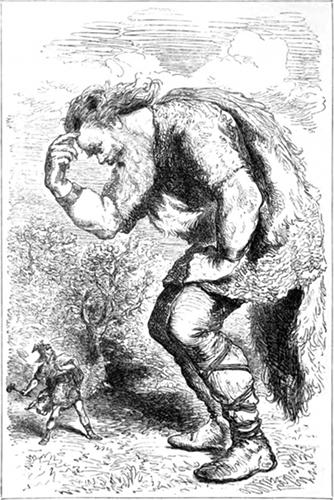
fearful. At this moment I see a three-headed
giant striding out of Jötunheim. He throws a
shepherd-boy into the sea, and puts the whole of
the flock into his pocket. Now he takes them out
again one by one, and cracks their bones as if
they were hazel-nuts, whilst, all the time, men
look on, and do nothing."
"Father," cried Thor in a rage, "last night I
forged for myself a belt, a glove, and a hammer,
with which three things I will go forth alone to
Jötunheim."
Thor went, and Odin looked again.
"The men of the earth are idle and stupid,"
said Odin. "There are dwarfs and elves, who live
amongst them, and play tricks which they cannot
understand, and do not know how to prevent. At
this moment I see a husbandman sowing grains of
wheat in the furrows, whilst a dwarf runs after
him, and changes them into stones. Again, I see
two hideous little beings, who are holding under
water the head of one, the wisest of men, until he
dies; they mix his blood with honey; they have
put it into three stone jars, and hidden it
away."
Then Odin was very angry with the dwarfs, for
he saw that they were bent on mischief; so he
called to him Hermod, his Flying Word, and
despatched him with a message to the dwarfs and
light elves, to say that Odin sent his compliments,
and would be glad to speak with them, in his palace
of Gladsheim, upon a matter of some importance.
When they received Hermod's summons the
dwarfs and light elves were very much surprised,
not quite knowing whether to feel honoured or
afraid. However, they put on their pertest manners,
and went clustering after Hermod like a
swarm of ladybirds.
When they were arrived in the great city they
found Odin descended from his throne, and sitting
with the rest of the Æsir in the Judgment Hall
of Gladsheim. Hermod flew in, saluted his master,
and pointed to the dwarfs and elves hanging like
a cloud in the doorway to show that he had fulfilled
his mission. Then Odin beckoned the little people
to come forward. Cowering and whispering they
peeped over one another's shoulders; now running
on a little way into the hall, now back again, half
curious, half afraid; and it was not until Odin had
beckoned three times that they finally reached his
footstool. Then Odin spoke to them in calm, low,
serious tones about the wickedness of their mischievous
propensities. Some, the very worst of
them, only laughed in a forward, hardened manner;
but a great many looked up surprised and a little
pleased at the novelty of serious words; whilst the
light elves all wept, for they were tender-hearted
little things. At length Odin spoke to the two
dwarfs by name whom he had seen drowning the
wise man. "Whose blood was it," he asked,
"that you mixed with honey and put into jars?"
"Oh," said the dwarfs, jumping up into the air,
and clapping their hands, "that was Kvasir's blood.
Don't you know who Kvasir was? He sprang up
out of the peace made between the Vanir and yourselves,
and has been wandering about these seven
years or more; so wise he was that men thought
he must be a god. Well, just now we found him
lying in a meadow drowned in his own wisdom; so
we mixed his blood with honey, and put it into
three great jars to keep. Was not that well done,
Odin?"
"Well done!" answered Odin. "Well done!
You cruel, cowardly, lying dwarfs! I myself saw
you kill him. For shame! for shame!" and then
Odin proceeded to pass sentence upon them all.
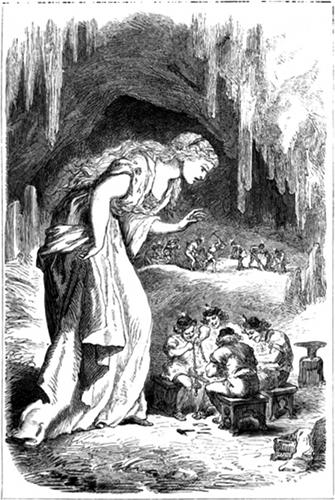
Those who had been the most wicked, he said,
were to live, henceforth, a long way underground,
and were to spend their time in throwing fuel upon
the great earth's central fire; whilst those who had
only been mischievous were to work in the gold
and diamond mines, fashioning precious stones and
metals. They might all come up at night, Odin
said; but must vanish at the dawn. Then he
waved his hand, and the dwarfs turned round,
shrilly chattering, scampered down the palace-steps,
out of the city, over the green fields, to their unknown,
deep-buried earth-homes. But the light
elves still lingered, with upturned, tearful, smiling
faces, like sunshiny morning dew.
"And you," said Odin, looking them through
and through with his serious eyes, "and you——"
"Oh! indeed, Odin," interrupted they, speaking
all together in quick, uncertain tones; "Oh! indeed,
Odin, we are not so very wicked. We have never
done anybody any harm."
"Have you ever done anybody any good?"
asked Odin.
"Oh! no, indeed," answered the light elves,
"we have never done anything at all."
"You may go, then," said Odin, "to live
amongst the flowers, and play with the wild bees
and summer insects. You must, however, find
something to do, or you will get to be mischievous
like the dwarfs."
"If only we had any one to teach us," said the
light elves, "for we are such foolish little people."
Odin looked round inquiringly upon the Æsir;
but amongst them there was no teacher found for
the silly little elves. Then he turned to Niörd,
who nodded his head good-naturedly, and said,
"Yes, yes, I will see about it;" and then he strode
out of the Judgment Hall, right away through the
city gates, and sat down upon the mountain's
edge.
After awhile he began to whistle in a most
alarming manner, louder and louder, in strong
wild gusts, now advancing, now retreating; then
he dropped his voice a little, lower and lower,
until it became a bird-like whistle—low, soft, enticing
music, like a spirit's call; and far away
from the south a little fluttering answer came,
sweet as the invitation itself, nearer and nearer
until the two sounds dropped into one another.
Then through the clear sky two forms came
floating, wonderfully fair—a brother and sister—their
beautiful arms twined round one another,
their golden hair bathed in sunlight, and supported
by the wind.
"My son and daughter," said Niörd, proudly,
to the surrounding Æsir, "Frey and Freyja,
Summer and Beauty, hand in hand."
When Frey and Freyja dropped upon the hill
Niörd took his son by the hand, led him gracefully
to the foot of the throne, and said, "Look
here, dear brother Lord, what a fair young instructor
I have brought for your pretty little elves."
Odin was very much pleased with the appearance
of Frey; but, before constituting him king and
schoolmaster of the light elves, he desired to know
what his accomplishments were, and what he considered
himself competent to teach.
"I am the genius of clouds and sunshine,"
answered Frey; and as he spoke, the essences of
a hundred perfumes were exhaled from his breath.
"I am the genius of clouds and sunshine, and if
the light elves will have me for their king I can
teach them how to burst the folded buds, to set
the blossoms, to pour sweetness into the swelling
fruit, to lead the bees through the honey-passages
of the flowers, to make the single ear a stalk of
wheat, to hatch birds' eggs, and teach the little
ones to sing—all this, and much more," said Frey,
"I know, and will teach them."
Then answered Odin, "It is well;" and Frey
took his scholars away with him to Alfheim, which
is in every beautiful place under the sun.
Now, in the city of Asgard dwelt one called Loki,
who, though amongst the Æsir, was not of the Æsir,
but utterly unlike to them; for to do the wrong, and
leave the right undone, was, night and day, this wicked
Loki's one unwearied aim. How he came amongst
the Æsir no one knew, nor even whence he came.
Once, when Odin questioned him on the subject,
Loki stoutly declared that there had been a time
when he was innocent and noble-purposed like the
Æsir themselves; but that, after many wanderings
up and down the earth, it had been his misfortune,
Loki said, to discover the half-burnt heart of a
woman; "since when," continued he, "I became
what you now see me, Odin." As this was too
fearful a story for any one to wish to hear twice
over Odin never questioned him again.
Whilst the Æsir were building their city, Loki,
instead of helping them, had been continually running
over to Jötunheim to make friends amongst
the giants and wicked witches of the place. Now,
amongst the witches there was one so fearful to
behold in her sin and her cruelty, that one would
have thought it impossible even for such an one
as Loki to find any pleasure in her companionship:
nevertheless, so it was that he married her, and
they lived together a long time, making each
other worse and worse out of the abundance of
their own wicked hearts, and bringing up their
three children to be the plague, dread, and misery
of mankind. These three children were just what
they might have been expected to be from their
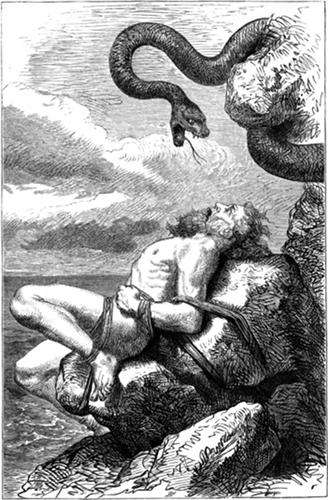
parentage and education. The eldest was Jörmungand,
a monstrous serpent; the second Fenrir,
most ferocious of wolves; the third was Hela, half
corpse, half queen. When Loki and his witch-wife
looked at their fearful progeny they thought
within themselves, "What would the Æsir say if
they could see?" "But they cannot see," said
Loki; "and, lest they should suspect Witch-wife, I
will go back to Asgard for a little while, and salute
old Father Odin bravely, as if I had no secret
here." So saying, Loki wished his wife good-morning,
bade her hide the children securely in-doors,
and set forth on the road to Asgard.
But all the time he was travelling Loki's children
went on growing, and long before he had reached
the lofty city Jörmungand had become so large,
that his mother was obliged to open the door to
let his tail out. At first it hung only a little way
across the road; but he grew, Oh, how fearfully
Jörmungand grew! Whether it was from sudden
exposure to the air, I do not know; but, in a single
day he grew from one end of Jötunheim to the
other, and early next morning began to shoot out
in the direction of Asgard. Luckily, however, just
at that moment Odin caught sight of him, when,
from the top of Air Throne, the eyes of this vigilant
ruler were taking their morning walk. "Now,"
said Odin, "it is quite clear, Frigga, that I must
remain in idleness no longer at Asgard, for monsters
are bred up in Jötunheim, and the earth has need
of me." So saying, descending instantly from
Air Throne, Odin went forth of Asgard's golden
gates to tread the earth of common men, fighting
to pierce through Jötunheim, and slay its
monstrous sins.
In his journeyings Odin mixed freely with the
people of the countries through which he passed;
shared with them toil and pleasure, war and grief;
taught them out of his own large experience, inspired
them with his noble thoughts, and exalted
them by his example. Even to the oldest he could
teach much; and in the evening, when the labours
of the day were ended, and the sun cast slanting
rays upon the village green, it was pleasant to
see the sturdy village youths grouped round that
noble chief, hanging open mouthed upon his words,
as he told them of his great fight with the
giant of long ago, and then pointing towards
Jötunheim, explained to them how that fight was
not yet over, for that giants and monsters grew
round them on every side, and they, too, might
do battle bravely, and be heroes and Æsir of
the earth.
One evening, after thus drinking in his burning
words they all trooped together to the village
smithy, and Odin forged for them all night arms
and armour, instructing them, at the same time,
in their use. In the morning he said, "Farewell,
children; I have further to go than you can come;
but do not forget me when I am gone, nor how
to fight as I have taught you. Never cease to be
true and brave; never turn your arms against one
another; and never turn them away from the giant
and the oppressor."
Then the villagers returned to their homes and
their field-labour, and Odin pressed on, through
trackless uninhabited woods, up silent mountains,
over the lonely ocean, until he reached that strange,
mysterious meeting-place of sea and sky. There,
brooding over the waters like a grey sea fog, sat
Mimer, guardian of the well where wit and wisdom
lie hidden.
"Mimer," said Odin, going up to him boldly,
"let me drink of the waters of wisdom."
"Truly, Odin," answered Mimer, "it is a great
treasure that you seek, and one which many have
sought before, but who, when they knew the price
of it, turned back."
Then replied Odin, "I would give my right
hand for wisdom willingly."
"Nay," rejoined the remorseless Mimer, "it is
not your right hand, but your right eye you must
give."
Odin was very sorry when he heard the words
of Mimer, and yet he did not deem the price too
great; for plucking out his right eye, and casting
it from him, he received in return a draught of
the fathomless deep. As Odin gave back the horn
into Mimer's hand he felt as if there were a
fountain of wisdom springing up within him—an
inward light; for which you may be sure he never
grudged having given his perishable eye. Now,
also, he knew what it was necessary for him to do
in order to become a really noble Asa,[1] and that
was to push on to the extreme edge of the earth
itself, and peep over into Niflheim. Odin knew
it was precisely that he must do; and precisely
that he did. Onward and northward he went over
ice-bound seas, through twilight, fog, and snow,
right onward in the face of winds that were like
swords until he came into the unknown land, where
sobs, and sighs, and sad, unfinished shapes were
drifting up and down. "Then," said Odin, thoughtfully,
"I have come to the end of all creation,
and a little further on Niflheim must lie."
Accordingly he pushed on further and further
until he reached the earth's extremest edge, where,
lying down and leaning over from its last cold peak,
he looked into the gulf below. It was Niflheim. At
first Odin imagined that it was only empty darkness;
but, after hanging there three nights and
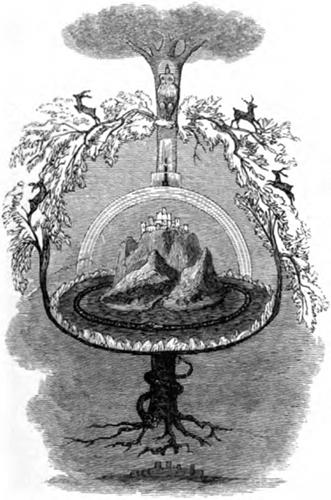
days, his eye fell on one of Yggdrasil's mighty
stems. Yggdrasil was the old earth-tree, whose
roots sprang far and wide, from Jötunheim, from
above, and this, the oldest of the three, out of
Niflheim. Odin looked long upon its time-worn,
knotted fibres, and watched how they were for ever
gnawed by Nidhögg the envious serpent, and his
brood of poisonous diseases. Then he wondered
what he should see next; and one by one spectres
arose from Naströnd, the Shore of Corpses—arose
and wandered pale, naked, nameless, and without
a home. Then Odin looked down deeper into the
abyss of abysses, and saw all its shapeless, nameless
ills; whilst far below him, deeper than Naströnd,
Yggdrasil, and Nidhögg, roared Hvergelmir,
the boiling cauldron of evil. Nine nights and days
this brave wise Asa hung over Niflheim pondering.
More brave and more wise he turned away from
it than when he came. It is true that he sighed
often on his road thence to Jötunheim; but is it
not always thus that wisdom and strength come
to us weeping.
When, at length, Odin found himself in the land of
giants—frost giants, mountain giants, three-headed
and wolf-headed giants, monsters and iron witches
of every kind—he walked straight on, without
stopping to fight with any one of them, until he
came to the middle of Jörmungand's body. Then
he seized the monster, growing fearfully as he
was all the time, and threw him headlong into
the deep ocean. There Jörmungand still grew,
until, encircling the whole earth, he found that
his tail was growing down his throat, after which
he lay quite still, binding himself together;
and neither Odin nor any one else has been
able to move him thence. When Odin had thus
disposed of Jörmungand, henceforth called the
Midgard Serpent, he went on to the house of
Loki's wife. The door was thrown open, and the
wicked Witch-mother sat in the entrance, whilst on
one side crouched Fenrir, her ferocious wolf-son,
and on the other stood Hela, most terrible of
monsters and women. A crowd of giants strode
after Odin, curious to obtain a glance of Loki's
strange children before they should be sent away.
At Fenrir and the Witch-mother they stared with
great eyes, joyfully and savagely glittering; but
when he looked at Hela each giant became as
pale as new snow, and cold with terror as a mountain
of ice. Pale, cold, frozen, they never moved again;
but a rugged chain of rocks stood behind Odin, and
he looked on fearless and unchilled.
"Strange daughter of Loki," he said, speaking to
Hela, "you have the head of a queen, proud forehead,
and large, imperial eyes; but your heart is
pulseless, and your cruel arms kill what they
embrace. Without doubt you have somewhere a
kingdom; not where the sun shines, and men
breathe the free air, but down below in infinite
depths, where bodiless spirits wander, and the cast-off
corpses are cold."
Then Odin pointed downwards towards Niflheim,
and Hela sank right through the earth, downward,
downward, to that abyss of abysses, where she
ruled over spectres, and made for herself a home
called Helheim, nine lengthy kingdoms wide and
deep.
After this, Odin desired Fenrir to follow him,
promising that if he became tractable and obedient,
and exchanged his ferocity for courage, he should
not be banished as his brother and sister had been.
So Fenrir followed, and Odin led the way out of
Jötunheim, across the ocean, over the earth, until
he came to the heavenly hills, which held up the
southern sky tenderly in their glittering arms.
There, half on the mountain-top and half in air,
sat Heimdall, guardian of the tremulous bridge
Bifröst, that arches from earth to heaven.
Heimdall was a tall, white Van, with golden teeth,
and a wonderful horn, called the Giallar Horn, which
he generally kept hidden under the tree Yggdrasil;
but when he blew it the sound went out into all
worlds.
Now, Odin had never been introduced to Heimdall—had
never even seen him before; but he
did not pass him by without speaking on that
account. On the contrary, being altogether much
struck by his appearance, he could not refrain
from asking him a few questions. First, he requested
to know whom he had the pleasure of
addressing; secondly, who his parents were, and
what his education had been; and thirdly, how
he explained his present circumstances and occupation.
"My name is Heimdall," answered the guardian
of Bifröst, "and the son of nine sisters am I.
Born in the beginning of time, at the boundaries
of the earth, I was fed on the strength of the earth
and the cold sea. My training, moreover, was so
perfect, that I now need no more sleep than a
bird. I can see for a hundred miles around me
as well by night as by day; I can hear the grass
growing and the wool on the backs of sheep. I
can blow mightily my horn Giallar, and I for ever
guard the tremulous bridge-head against monsters,
giants, iron witches, and dwarfs."
Then asked Odin, gravely, "Is it also forbidden to
the Æsir to pass this way, Heimdall? Must you
guard Bifröst, also, against them?"
"Assuredly not," answered Heimdall. "All
Æsir and heroes are free to tread its trembling,
many-coloured pavement, and they will do well to
tread it, for above the arch's summit I know that
the Urda fountain springs; rises, and falls, in a
perpetual glitter, and by its sacred waters the
Nornir dwell—those three mysterious, mighty
maidens, through whose cold fingers run the golden
threads of Time."
"Enough, Heimdall," answered Odin. "Tomorrow
we will come."
Odin departed from Heimdall, and went on his
way, Fenrir obediently following, though not now
much noticed by his captor, who pondered over the
new wonders of which he had heard. "Bifröst,
Urda, and the Norns—what can they mean?"
Thus pondering and wondering he went, ascended
Asgard's Hill, walked through the golden
gates of the City into the palace of Gladsheim, and
into the hall Valhalla, where, just then, the Æsir
and Asyniur[2] were assembled at their evening meal.
Odin sat down to the table without speaking, and,
still absent and meditative, proceeded to carve the
great boar, Sæhrimnir, which every evening eaten,
was every morning whole again. No one thought of
disturbing him by asking any questions, for they
saw that something was on his mind, and the Æsir
were well-bred. It is probable, therefore, that the
supper would have been concluded in perfect
silence if Fenrir had not poked his nose in at the
doorway, just opposite to the seat of the lovely
Freyja. She, genius of beauty as she was, and
who had never in her whole life seen even the
shadow of a wolf, covered her face with her hands,
and screamed a little, which caused all the Æsir
to start and turn round, in order to see what was
the matter. But Odin directed a reproving glance
at the ill-mannered Fenrir, and then gave orders
that the wolf should be fed; "after which," concluded
he, "I will relate my adventures to the
assembled Æsir."
"That is all very well, Asa Odin," answered
Frey; "but who, let me ask, is to undertake the
office of feeding yon hideous and unmannerly
animal?"
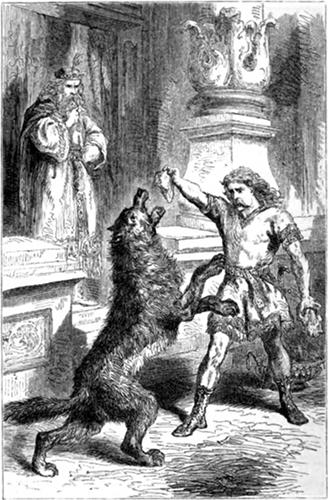
"That will I, joyfully," cried Tyr, who liked
nothing better than an adventure; and then, seizing
a plate of meat from the table, he ran out of the
hall, followed by Fenrir, who howled, and sniffed,
and jumped up at him in a most impatient, un-Æsir-like
manner.
After the wolf was gone Freyja looked up again,
and when Tyr was seated once more, Odin began.
He told them of everything that he had seen, and
done, and suffered; and, at last, of Heimdall, that
strange white Van, who sat upon the heavenly
hills, and spoke of Bifröst, and Urda, and the
Norns. The Æsir were very silent whilst Odin
spoke to them, and were deeply and strangely
moved by this conclusion to his discourse.
"The Norns," repeated Frigga, "the Fountain
of Urd, the golden threads of time! Let us go,
my children," she said, rising from the table, "let
us go and look at these things."
But Odin advised that they should wait until
the next day, as the journey to Bifröst and
back again could easily be accomplished in a
single morning.
Accordingly, the next day the Æsir and Asyniur all
rose with the sun, and prepared to set forth. Niörd
came from Noatun, the mild sea-coast, which he had
made his home, and with continual gentle puffings
out of his wide, breezy mouth, he made their
journey to Bifröst so easy and pleasant, that they
all felt a little sorry when they caught the first
glitter of Heimdall's golden teeth. But Heimdall
was glad to see them; glad, at least, for their
sakes. He thought it would be so good for them
to go and see the Norns. As far as he himself
was concerned he never felt dull alone. On the top
of those bright hills how many meditations he had!
Looking far and wide over the earth how much he
saw and heard!
"Come already!" said Heimdall to the Æsir,
stretching out his long, white hands to welcome
them; "come already! Ah! this is Niörd's doing.
How do you do, cousin," said he; for Niörd and
Heimdall were related.
"How sweet and fresh it is up here!" remarked
Frigga, looking all round, and feeling that it would
be polite to say something. "You are very happy,
Sir," continued she, "in having always such fine
scenery about you, and in being the guardian of
such a bridge."
And in truth Frigga might well say "such a
bridge;" for the like of it was never seen on the
ground. Trembling and glittering it swung across
the sky, up from the top of the mountain to
the clouds, and down again into the distant sea.
"Bifröst! Bifröst!" exclaimed the Æsir, wonderingly;
and Heimdall was pleased at their surprise.
"At the arch's highest point," said he, pointing
upward, "rises that fountain of which I spoke.
Do you wish to see it to-day?"
"That do we, indeed," cried all the Æsir in a
breath. "Quick, Heimdall, and unlock the bridge's
golden gate."
Then Heimdall took all his keys out, and fitted
them into the diamond lock till he found the right
one, and the gate flew open with a sound at the
same time sad and cheerful, like the dripping
of leaves after a thunder-shower.
The Æsir pressed in; but, as they passed him,
Heimdall laid his hand upon Thor's shoulder, and
said "I am very sorry, Thor; but it cannot be
helped. You must go to the fountain alone by
another way; for you are so strong and heavy,
that if you were to put your foot on Bifröst, either
it would tremble in pieces beneath your weight,
or take fire from the friction of your iron heels.
Yonder, however, are two river-clouds, called Körmt
and Ermt, through which you can wade to the
Sacred Urd, and you will assuredly reach it in
time, though the waters of the clouds are strong
and deep."
At the words of Heimdall Thor fell back from
the bridge's head, vexed and sorrowful. "Am I
to be sent away, then, and have to do disagreeable
things," said he, "just because I am so strong?
After all, what are Urda and the Norns to me,
and Körmt and Ermt? I will go back to Asgard
again."
"Nay, Thor," said Odin, "I pray you, do not
anything so foolish. Think again, I beseech you,
what it is that we are going to see and hear.
Körmt and Ermt lie before you, as Bifröst before
us. It is yonder, above both, that we go. Neither
can it much matter, Thor, whether we reach
the Fountain of Urd over Bifröst or through the
cloud."
Then Thor blushed with shame at his own
weakness, which had made him regret his strength;
and, without any more grumbling or hanging
back, he plunged into the dreadful river-clouds,
whose dark vapours closed around him and covered
him. He was hidden from sight, and
the Æsir went on their way over the glittering
bridge.
Daintily and airily they trod over it; they swung
themselves up the swinging arch; they reached its
summit on a pale, bright cloud. Thor was there
already waiting for them, drenched and weary,
but cheerful and bold. Then, all together, they
knocked at the door of the pale, bright cloud; it
blew open, and they passed in. Oh! then what
did they see! Looking up to an infinite height
through the purple air, they saw towering above
them Yggdrasil's fairest branches, leafy and of
a tender green, which also stretched far and wide;
but, though they looked long, the Æsir could distinguish
no topmost bough, and it almost seemed
to them that, from somewhere up above, this mighty
earth-tree must draw another root, so firmly and
so tall it grew. On one side stood the Palace of
the Norns, which was so bright that it almost
blinded them to look at it, and on the other the
Urda fountain plashed its cool waters—rising, falling,
glittering, as nothing ever glitters on this side
the clouds. Two ancient swans swam under the
fount, and around it sat Three. Ah! how shall I
describe them—Urd, Verdandi, Skuld. They were
mighty, they were wilful, and one was veiled.
Sitting upon the Doomstead, they watched the
water as it rose and fell, and passed golden threads
from one to another. Verdandi plucked them
with busy fingers from Skuld's reluctant hand,
and wove them in and out quickly, almost carelessly;
for some she tore and blemished, and
some she cruelly spoiled. Then Urd took the
woof away from her, smoothed its rough places,
and covered up some of the torn, gaping holes;
but she hid away many of the bright parts, too,
and then rolled it all round her great roller,
Oblivion, which grew thicker and heavier every
moment. And so they went on, Verdandi drawing
from Skuld, and Urd from Verdandi; but
whence Skuld drew her separate bright threads
no one could see. She never seemed to reach
the end of them, and neither of the sisters ever
stopped or grew weary of her work.
The Æsir stood apart watching, and it was a
great sight. They looked in the face of Urd,
and fed on wisdom; they studied the countenance
of Verdandi, and drank bitter strength; they
glanced through the veil of Skuld, and tasted
hope. At length, with full hearts, they stole away
silently, one by one, out by the pale, open door,
re-crossed the bridge, and stood once more by
the side of Heimdall on the heavenly hills; then
they went home again. Nobody spoke as they
went; but ever afterwards it was an understood
thing that the Æsir should fare to the Doomstead
of the Nornir once in every day.
Now upon a day it happened that Odin sat silent
by the Well of Urd, and in the evening he mounted
Air Throne with a troubled mind. Allfather could
see into Dwarf Home from his high place, as well
as over man's world; his keen eye pierced, also, the
mountains and darkness of Jötunheim.
On this evening, a tear, the fate-sisters' gift, swam
across his vision, and—behold, is that an answering
tear which he sees down there in Dwarf Home, large,
luminous, golden, in the dark heart of the earth?
"Can dwarfs weep?" exclaimed Allfather, surprised
as he looked a second and a third time, and went on
looking. Fialar and Galar, the cunning dwarfs who
had killed Kvasir, were kneeling beside the tear.
"Is it theirs?" said Allfather again, "and do they
repent?" No; it was not a tear; Odin knew
it at last. More precious still, it was Kvasir's
blood—golden mead now, because of the honey-drops
from Earth's thousand bees and flowers which
these thoughtless mischief-schemers, but wonder
workers, had poured into it. "It is three," said
Odin, "three precious draughts!—Odhærir is its name—and
now the dwarfs will drink it, and the life and
the light, and the sweetness of the world will be spilt,
and the heart of the world will die!" But the dwarfs
did not drink it; they could only sip it a little, just
a drop or two at a time. The Father of Hosts
watched how they were amusing themselves.
Fialar and Galar, and a whole army of the little
blackfaced, crooked-limbed creatures, were tilting the
big jars over to one side, whilst first one, and then
another, sucked the skim of their golden sweetness,
smacking their lips after it, grinning horribly,
leaping up into the air with strange gestures;
falling backwards with shut eyes some of
them, as if asleep; tearing at the earth and
the stones of their cavern homes others, like
wild beasts; rolling forth beautiful, senseless, terrible
words.
It was Fialar and Galar who did that; and behold,
in a little while, one after another, the dwarfs gathered
round them as they spoke, and listened, open-mouthed,
with clenched fists, stamping, and roaring applause
until at last they seized the weapons that lay
near, cocked their earth caps, each alit with
a coloured star, and marched in warlike fashion,
led on by Fialar and Galar, straight up through
their cavernous ways, to Manheim, and across
it into the Frozen Land.
Giant Vafthrûdnir, that "Ancient Talker," he who
sits ever in his Hall weaving new and intricate questions
for the gods, saw them; and looking up towards
the brooding heavens, he exchanged glances with
the Father of Hosts. But the dwarfs did not come
near Vafthrüdnir's Halls; they never looked aside at
him, nor up to the Air Throne of the Asa; only
rushed heedlessly on till they stumbled over the Giant
Gilling, who was taking a nap upon the green bank
of Ifing. Ifing looks a lazy stream; one can
hardly see at first sight that it flows at all; but it
flows, and flows quietly, unceasingly, and is so
deep that neither god nor giant has ever yet been
able to fathom it. It is, in fact, that stream which
divides for ever the Jötuns from the Gods, and of it
Odin himself once said:—
"Open shall it run
Throughout all time,
On that stream no ice shall be."
So the dwarfs found Gilling asleep; they knew
how deep Ifing was, they knew that if they could
once roll the giant Gilling in there he would never
get out again, and then they should have done
something worth speaking about.
"I have killed a giant," each dwarf might say,
and, who knows, even the Æsir might begin to
feel a little afraid of them.
"It all comes from drinking Kvasir's blood," they
said, and then with their thousand little swords and
spears, and sticks and stones, they worked away
until they had plunged the sleeping giant into the
stream. Allfather's piercing eye saw it all, and
how the silly dwarfs jumped and danced about
afterwards, and praised themselves, and defied the
whole world, gods, giants and men.
"It is not for us," they said, "any more to run
away before Skinfaxi the shining horse that draws
day over humankind, whose mane sheds light
instead of dew; we will dance before him and
crown ourselves with gold, as the gods and as men
do every morning."
But, in the midst of all their gleeful folly, the
ground they stood upon began to shake under
them, and an enormous darkness grew between
them and the sky. Then the dwarfs stopped their
rejoicing as if a spell had fallen upon them, dropping
their weapons, huddling close to one another, cowering,
whispering. Giant Suttung, son of that Gilling
whom they had just slain, was coming upon them
in great fury to avenge his father's death. They
were dreadfully frightened; Giant Gilling asleep
had been easy to manage, but a giant awake, a
giant angry—they were not the same dwarfs that
they had seemed half an hour ago—and so it
happened that they quite easily let Suttung carry
them all off to a low rock in the sea which was
dry just then, but would be washed over by the
morning tide. "There you are," said Suttung as he
threw them all down upon the rock, "and there you
shall stay until the hungry grey wave comes." "But
then we shall be drowned," they all screeched at
once, and the seamews started from their nests
ashore and swooped round the lonely rock, and
screeched as well. Suttung strode back to the
shore and sat on the high rocks over the
seamews' nests, and poked his fingers into the nests
and played with the grey-winged birds, and paddled
his feet in the breakers, and laughed and echoed
the dwarfs and the seamews. "Drowned, drowned,
yes, then you will be drowned." Then the dwarfs
whispered together and consulted, they all talked
at once, and every one of them said a different
thing, for they were in fact a little intoxicated still
by the sips they had taken of Odhærir. At last
Fialar and Galar said the same same thing over
so often that the others began to listen to them.
"The sky is getting quite grey," they said, "and the
stars are going out, and Skinfaxi is coming, and
the waves are gathering and gathering and gathering;
hoarse are the voices of the Seaking's daughters;
but why do we all sit chattering here instead of
getting away as we might easily do if we did but
bribe the giant Suttung with a gift." "Yes, yes,
yes," shouted the silly little people, "shall we give
him our cap jewels, or our swords, or our pick-axes,
or our lanterns, or shall we promise to make him
a necklace out of the fire of the sun and the flowers
of the earth, or shall we build him a ship of ships?"
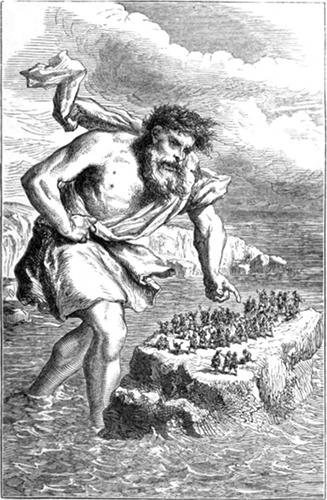
Giant Suttung and the dwarfs.
"Nonsense," said Fialar and Galar; "How should
a giant care for such things as these? Our swords
could not help him; he does not want pick-axes
nor lanterns who lives amongst the mountain snows,
nor ships who can stride across the sea, nor necklaces—Bah!
A giant loves life, he drinks blood,
he is greedy besides and longs to taste the gold
mead of the gods."
Then all the dwarfs shouted together, "Let us
give him our gold mead, our wondrous drink,
Odhærir, our Kvasir's blood in the three stone jars."
Odin heard from Air Throne's blue deep. He
brooded over the scene. "The sweetness, and the
life, and the light of the world, then," he said, "are to
satiate a giant's greediness of food and blood"—and it
was for mankind that he became Terror in the trembling
Height. Allfather feared nothing for the gods at
that time: could he not pierce into Jötunheim, and
Svartheim, and Manheim alike? Suttung heard also
from the Rock.—"And what may this Odhærir be worth
that you boast of so much?" he shouted to the dwarfs.
"Wisdom, and labour, and fire, and life, and love," said
the dwarfs. "Tut, tut, tut!" answered Suttung.
"Does it taste well?" "Honey and wine; like the
blood of a God and the milk of the Earth." Then
Suttung got up slowly from the rock, pressing it down
with his hands into two little dells as he rose, and
strode to the island, from which he took up all the
dwarfs at a grasp—they clinging to his fists and wrists
like needles to a magnet; and, with one swoop, threw
them ashore just as the hungry waves began to lap and
wash about the dwarf's-peril. So the dwarfs jumped,
and leaped, and laughed, and sang, and chattered
again, and ran on before Suttung, to fetch him the
golden mead, Odhærir. Three big stone jars, all full.
The Spirit-mover, the Peace-offer, the Peace-kiss.
Suttung lifted the lids, and looked into the jars. "It
doesn't look much," he said; "and, after all, I don't
know that I shall care to taste it; but I'll take the
jars home to my daughter Gunnlöd, and they will
make a pretty treasure for her to keep."
Odin brooded over the scene. It was a grey winter's
morning in Jötunheim—ice over all the rivers,
snow upon the mountains, rime-writing across the
woods, weird hoar letters straggling over the bare
branches of the trees, writing such as giants and gods
can read, but men see it only as pearl-drops of the
cold. Suttung could read it well enough as he
trudged along to his Mountain Home—better than
he had ever read it before; for was he not bearing
upon his shoulders the wondrous Kvasir's life-giving
blood, Odhærir. Odin read it, "This is ominous,
Odin; this is dark. Shall the gold mead be
made captive in frozen halls?" For behold,
the life-tear becomes dark in the dark land, as
Suttung's huge door opened to let him in, him
and his treasure, and then closed upon them both,
Suttung gave the mead to his daughter Gunnlöd to
keep, to guard it well, and—the heart of Manheim
trembled, it was empty and cold. Then Odin looked
north and south and east and west, over the whole
world. "Come to me," he said, and two swift-winged
ravens flew towards him. It seemed as if they came
out of nothing; for in a moment they were not there
and they were there. Their names were Hugin and
Munin, and they came from the ends of the earth,
where Odin sent them every morning. Every evening
he was wont to say of them,—
"I fear me for Hugin,
Lest he come not back,
But much more for Munin."
Yet they never failed to come back, both of them, at
the dim hour in which they recounted to the Father
of Hosts the history of the day that was past, and the
hope of the day that was to come. On this evening,
Munin's song was so terrible that only the strength
of a god could possibly have endured to its end.
Hugin struck another note, profounder and sweet.
Then said Odin, when cadence after cadence had
filled his ears, and he had descended from Air
Throne, "Night is the time for new counsels; let
each one reflect until the morrow who is able to give
advice helpful to the Æsir."
But when the jewelled horse ran up along the sky,
from whence his mane shed light over the whole
world, when giants and giantesses, and ghosts and
dwarfs crouched beneath Yggdrasil's outer Root, when
Heimdall ran up Bifrost and blew mightily his horn in
Heaven's height, there was only one found who gave
counsel to Odin, and that was Odin himself. "Odhærir,"
he said, "which is a god-gift, must come up to
men's earthly dwellings. Go forth, Hugin, go forth,
Munin," said the Asa, and he also went forth alone,
none knowing where he went, nor how.
So Odin journeyed for a long, long while towards
Suttung's Hall, across the windy, wintry ways of Jötunheim,
seeing well before him the yellow mead as he
went, through rocks, and woods, and rivers, and
through night itself, until at last it happened that
Odin came into a meadow upon a summer morning
in Giant Land. Nine slaves were mowing in the
meadow, whetting some old rusty scythes which they
had, working heavily, for they were senseless fellows,
and the summer day grew faster upon them than their
labour grew to completion. "You seem heavy-hearted,"
said Odin to the thralls; and they began to
explain to him how rusty and old their scythes were,
and that they had no whetstone to sharpen them with.
Upon this Odin offered to whet their scythes for them
with his whetstone: and no sooner had he done so than
the scythes became so sharp that they could have cut
stones as easily as grass. Instead of mowing, however,
the thralls began to clamour round Odin, beseeching
him to give his whetstone to them. "Give it to
me! give it to me: give it to me!" cried one and
another; and all the time Odin stood quietly amongst
them, throwing his whetstone up in the air, and
catching it as it fell. Then the thralls tried if they
could catch it, leaning stupidly across one another,
with their scythes in their hands. Was Allfather
surprised at what happened next? He could
hardly have been that; but he was sorry when,
looking down as the whetstone fell, he saw all the
thralls lying dead at his feet, killed by each other's
sharpened weapons. "This is an Evil Land," said
Odin, as he looked down on the dead thralls, "and
I am a bringer of evil into it."
So he journeyed on till he came to the house of
Suttung's brother, Baugi. Odin asked Baugi to give
him a night's lodging, and Baugi, who knew no more
than the thralls had done who this traveller was,
consented, and began to talk to Odin of the trouble
he was in. "This is hay harvest," he said, "as you
must have seen, walking here through the meadows;
and I have a mighty field to gather in, but how to
do it puzzles me, because my nine slaves whom I
sent out sound and well this morning, all fell dead
about the middle of the day. How they managed
it, I can't imagine, and it puts me out sadly, for
summer days don't last long in Jötunheim."
"Well," said Odin, "I'm not a bad hand at mowing,
and I don't mind undertaking to do the work of nine
thralls for you, Baugi, for a certain reward you may
give me, if you will." "What is that?" inquired
Baugi, eagerly. "A draught of that golden mead,
Odhærir, which Suttung obtained from the dwarfs, and
which his daughter Gunnlöd keeps for him." "Oh!
that," said Baugi, "isn't so good as my homebrewed
for a thirsty mower; but you shall have it. It is a
bargain between us." So Odin worked for Baugi the
whole summer through with the labour of nine instead
of with the labour of one; and when the last field was
reaped, and wintry mists were gathering, the god and
the giant began to talk over their bargain again.
"We will come together to Suttung's house," said
Baugi, "and my brother shall give you the draught
which you desire so much." But when the two came
to Suttung's house, and asked him for the mead,
Suttung was exceedingly angry, and would not hear a
word about it from either of them. "You don't
drink it yourself, brother," pleaded Baugi, "although
you might do so every day if you liked, without asking
anybody's leave, or doing one stroke of work for it,
whilst this man has toiled night and day for nine
months that he might taste it only once." "Odhærir
is for us giants, nevertheless," answered Suttung, "and
well does my daughter Gunnlöd guard it from dwarfs
and from men, from spectres, from Asyniur, and from
Æsir. Have I not sworn that so it shall be guarded
by all the snows of Jötunheim, and by the stormy
waves, and by the yawning chasm of the abyss."
Then Baugi knew that nothing more was to be said,
and he advised Odin to go back with him at once,
and drink beer. But Odin was not to be turned
from his purpose so easily. "You promised me a
draught of the gold mead, Baugi," he said, "and I
can see it through the rock in its three treasure jars;
sit down by me and look through the rock till
you can see it too." So Odin and Baugi sat down
together, and pierced the rock with their glances all
that day until they had made a small hole in it; and at
night, when Suttung was asleep, and when Gunnlöd
was asleep, and whilst the gold mead shone steadily
in the heart of the cave, Odin looked up towards
Asgard, and said,—
"Little get I here by silence:
Of a well-assumed form I will make good use;
For few things fail the wise."
And then this strong wise Asa picked up from the
ground the little, mean, wriggling form of a worm
and put it on and crept noiselessly into the hole
which he and Baugi had made,—
"The giant's ways are under me,
The giant's ways are over me,"
said Odin as he wriggled through the stone, but
when he had got quite through to the inner side,
to Gunnlöd's room, Odin took his proper form again.
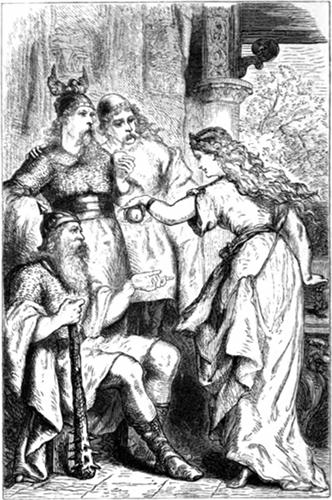
"I see her upon her golden seat," he said as he
looked upon the sleeping Gunnlöd where she lay,
and Odin was surprised to see a giant-maid so
beautiful. Surprised and sorry. "For I must
leave her weeping," he mused. "How shall she
not weep, defrauded of her treasure in an Evil
Land." And Odin loved and pitied the beautiful
maiden so much, that he would have returned
to Asgard without the mead had that
been possible. Alas for Gunnlöd, it was less
possible than ever since Allfather had seen her.
For Gunnlöd awoke in the light of Odin's glance
and trembled, she did not know why, she did not
know at first that he was an Asa, but, when he
asked her for her treasure she could not keep it
from him, she could not have kept anything from
him. She rose from her golden couch, her blue
eyes melted into the tenderness of a summer sky,
she undid the bars and bolts and coverings of
Odhærir, which she had guarded so faithfully till
then, and knelt before Odin and stretched her
hands towards him and said, "Drink, for I think
you are a god."
A draught, a draught, a long, deep draught, and
the spirit of the Asa was shaken through its height
and through its depth, and again a draught of
love flowing forth to the outermost, to the abysses,
and one draught again—peace—in rushing, still.
Why are you weeping so, Gunnlöd? Oh! Why
do you weep? Did you not give him your whole
treasure, "your fervent love, your whole soul;" you
kept nothing back, and Odhærir is for ever the
inheritance of the gods. The dwarfs sold it for their
lives, the giantess lost it of her love, gods win it
for the world.
"It is for the Æsir, it is for men," said Odin.
"It is Odin's booty, it is Odin's gift;" and immediately,
in haste to share it, the Asa spread eagle's
wings, and flew far up, away from the barren rock,
and the black, cold halls of Suttung, towards his
heavenly home. Alas for Gunnlöd! she has lost her
treasure and her Asa too. How cold the cavern is
now in which she sits! her light is gone out; she is
left alone; she is left weeping upon her golden throne.
But Odin soared upwards—flew on toward Asgard,
and the Æsir came crowding upon the city's jewelled
walls to watch his approach. And soon they perceived
that two eagles were flying towards the city,
the second pursuing the first. The pursuing eagle
was Suttung, who, as soon as he found that his mead
was gone, and that Odin eagle-wise had escaped his
vengeance, spread also his eagle's wings, very strong
and very swift, in pursuit. Suttung appeared to gain
upon Odin. Frigga feared for her beloved. The
Asyniur and the Æsir watched breathlessly. Frost
giants and Storm giants came crowding up from the
deeps to see. "Does Odin return amongst the gods?"
they asked, "or will Suttung destroy him?" It was
not possible, however, that the struggle should end in
any way but one. The Divine bird dropped from the
height upon his Hall—the High One's Hall—and
then there burst from him such a flood of song that
the widest limits of Æsir Land were overflowed—some
sounds even spilt themselves upon the common
earth. "It is Poetry herself, it is Odin's booty, it is
Odin's gift. It is for the Æsir, it is for the Æsir,"
said a thousand and a thousand songs. "And for
men," answered Allfather, with his million ringing,
changing voices; "it is for men." "Such as have
sufficient wit to make a right use of it," said Loki.
And this was the first discordant note that troubled
Asgard after Odin's return.
In this tale, or rather in this arrangement of tales,
most of the chief gods are named, and one or two
of the myths concerning them are hinted at. The
sweet mixture made out of Kvasir's blood, and
given to the giant Suttung to keep, was called,
as we have seen, Odhærir. It was kept in three
jars, and though the name of it as a whole was
Odhærir, the portion in the second jar was also
called "Sohn," and that in the third jar "Bohn."
Odhærir is mentioned in two of the Elder Edda
Songs, and in the Younger Edda an account is
given of Odin bringing it up to Asgard. Neither
of the Eddas, it must be remarked, mentions the
banishment of the dwarfs and elves in connection
with Kvasir's death. The golden mead, Odhærir,
is supposed to signify poetry. The first syllable
of the name means mind and feeling. Odhærir,
spirit mover. "Sohn" means reconciliation, or
the offer of peace. "Bohn" means the acceptance
of peace,—these two latter names referring to
the origin of Kvasir, who was created out of the
peace made between the Æsir and the Vanir.
Simrock thinks that "Kvasir," meaning fermentation,
implies the excitement necessary to poetry;
that Odin, labouring for a draught of the precious
mead, suggests that poetry can only be possessed
through labour, and that his receiving it from
the beautiful Gunnlöd, expresses it as the gift and
crown of love. Odin drinking it three times signifies
the intensity through which poetry lives,—it is intoxication.
Odin appears to have felt very wise after
his three draughts; for he is made to say—
"Potent songs I learned,
And a draught obtained
Of the precious mead,
Then I began to bear fruit
And to know many things.
Word by word
I sought out words,
Fact by fact
I sought out facts.
Runes I graved,
Very large characters,
Very potent characters."
One of the Edda songs is called the "High
One's Lay." So we may conclude it was inspired
by Suttung's mead. One or two of the strophes
are worth quoting, just to show what the lay
is like. The following are selected from different
places and have no connection with one another.
"At eve the day is to be praised,
A sword after it is proved;
Ice after it has passed away,
Beer after it is drunk."
"Cattle die,
Kindred die,
We ourselves also die;
But I know one thing
That never dies—
Judgment on each one dead."
"I was once young,
I was journeying alone,
And lost my way;
Rich I thought myself
When I met another.
Man is the joy of man."
Here is a contrast—
"Two are adversaries;
The tongue is the bane of the head;
Under every cloak
I expect a hand."
"A firmer friend
No man ever gets
Than great sagacity."
"Givers and requiters
Are longest friends."
"A worse provision
No man can carry
Than too much beer-bibbing;
So, good is not, as it is said,
Beer for the sons of men."
"My garments in a field
I gave away
To two wooden men;
Heroes they seemed to be
When they got cloaks."
"Much too early
I came to many places
But too late to others;
The beer was drunk,
Or not ready
The disliked seldom hits the moment."
We often read of Odin disguising himself, sometimes
in animal, more frequently in human form. He
wanders about the world, and very curious stories
are told about his adventures. Sometimes he asks
his wife's leave before setting off,—
"Counsel thou me now, Frigg!
As I long to go
An all-wise giant to visit."
And Frigg answers,—
"In safety mayest thou go,
In safety return;
In safety on thy journeyings be;
May thy wit avail thee
When thou, father of men! shalt
Hold converse with the giant."
But Odin was not obliged to take long journeys
himself when he wanted to know what was going on
in the world,—he had, as we have seen, two
messengers whom he sent out daily,—the Ravens
Hugin and Munin, thought and memory,—
"Hugin and Munin
Each dawn take their flight
Earth fields over;
I fear me for Hugin
Lest he come not back,
But much more for Munin."
Perhaps because of Munin being memory he was
expected to fail first.
Odin looking over into Niflheim, is thus alluded to
in an old song. The god is made to say,—
"I know that I hung
On a wind-rocked tree
Nine whole nights.
Downward I peered,
To runes applied myself,
Wailing learnt them,
Then fell down thence."
The next strophe tells how he got the draught of
the precious mead. In this myth, it seems as if Odin
hung upon Yggdrassil. Simrock mentions a singular
little German tale which may possibly have some
connection with it, and has evidently an Eastern
origin. "A man," it says, "in danger of falling into a
brook, held fast with one hand to a shrub whilst his
feet rested on a small piece of grass. In this
predicament, he saw two mice (day and night)
gnawing at the root of the shrub, and the grass
undermined by four worm heads. Then a dragon
appeared and opened his mouth to swallow him up,
whilst an elephant reached his trunk towards him.
At the same time he seized with eager mouth some
honey which dropt from the tree." Simrock says
that the eating of the honey is like people being
occupied with frivolity whilst the world-battle goes
on, but may not the story possibly have a little to do
with Odin and Yggdrassil and Odhærir.
We heard before that Odin was connected with
Air. We see him here on his High Throne looking
over all worlds, wandering over the earth, piercing
even to the deep, giving his eye to Mimer for
wisdom—consequently having only one eye, one Sun
in Heaven—some suppose that the pledged eye
means the setting of the Sun nightly. Mimer, who
guards the well, means the remembrance of the origin
of things which was water—the strange waves that
flowed into Ginnungagap. An odd story is told of
Mimer, who was originally a giant though received
by the Æsir, viz., that he was sent as a hostage to
the Vanir, who cut off his head and sent it back to
Odin. The head remained so wise that the father of
the gods used to consult it on all important occasions;
as the lay says—
"Odin speaks
With Mim's head."
Heimdall, guardian of the Bridge (whose exact
name was "trembling rest") was perhaps the most
important of the Vanir. He is represented in one
old lay as travelling about the world by himself,
which is a sure sign that he was originally a very
great god indeed. Upon this journey he became the
father of the three races of men, the Thralls, the
Karls and the Jarls. The way in which these three
races are compared with one another is very curious.
The Thralls are described with "shrivelled skin,
knotty knuckles, thick fingers, hideous faces, curved
backs and protruding heels, they are made to erect
fences, manure fields, tend swine, keep goats and dig
turf." The Karls' children are said to be clothed in
linen, to be ruddy headed and have twinkling eyes,
and they grow up to "tame oxen, make ploughs,
build houses, make carts and farm;" but the favoured,
useless Jarls, "Light of hair, bright cheeks, eyes
piercing as a serpent's," grow up to "shake the shield,
to brandish spears,
"Horses to ride,
Dogs to slip,
Swords to draw,
Swimming to practise."
Heimdall keeps the bridge alike from thunder god
and frost giants, but at Ragnarök, the swarthy god
Surtur, who lives on the borders of Muspellheim,
will ride over it and shatter it to pieces. Heimdall's
horn is mentioned,—this is supposed to mean the
crescent moon, and Mimer's drinking horn also
means the moon. Later, when the stories of the
gods had dwindled down into weird, unholy legends,
and Odin had sunk into the wild Huntsman, the
crescent moon was his horn. One of Heimdall's
names was Irmin, and this means "Shining." The
milky way is called Irmin strasse or Irmin's way,
and the wild hunt was supposed to go over the milky
way, which is also called Waldemar's way in
Denmark, and Waldemar is a common name of
hunters.
Loki and his children in these myths are evidently
the destructive principle, either physically, or morally,
or both. Jörmungand and Fenrir are much alike.
Jörmungand means "the universal Wolf," and of
Fenrir it is said "he goes about revengeful, with
open jaws devouring all things." Hela had originally
another side to her character, but here as Loki's
daughter she has only the nature of his other children.
The myth about Loki finding the half-burnt heart
of a woman is said to be a very young one; and so
perhaps it is not worth considering the meaning of.
The god about whom, next to Odin, most stories
are told, is Thor. In some parts of the north he was
a more prominent object of worship even than Odin,
Norway and Iceland being especially devoted to his
service.
Let us now hear how Thor went to Jötunheim.