The life of Antony, by Athanasius,
is perhaps the most important of all these biographies; because
first, Antony was generally held to be the first great example
and preacher of the hermit life; because next, Athanasius, his
biographer, having by his controversial writings established the
orthodox faith as it is now held alike by Romanists, Greeks, and
Protestants, did, by his publication of the life of Antony,
establish the hermit life as the ideal (in his opinion) of
Christian excellence; and lastly, because that biography
exercised a most potent influence on the conversion of St.
Augustine, the greatest thinker (always excepting St. Paul) whom
the world had seen since Plato, whom the world was to see again
till Lord Bacon; the theologian and philosopher (for he was the
latter, as well as the former, in the strictest sense) to whom
the world owes, not only the formulizing of the whole scheme of
the universe for a thousand years after his death, but Calvinism
(wrongly so called) in all its forms, whether held by the
Augustinian party in the Church of Rome, or the
“Reformed” Churches of Geneva, France, and
Scotland.
Whether we have the exact text of the document as Athanasius
wrote it to the “Foreign Brethren”—probably the
religious folk of Trêves—in the Greek version
published by Heschelius in 1611, and in certain earlier Greek
texts; whether the Latin translation attributed to Evagrius,
which has been well known for centuries past in the Latin Church,
be actually his; whether it be exactly that of which St. Jerome
speaks, and whether it be exactly that which St. Augustine saw,
are questions which it is now impossible to decide. But of
the genuineness of the life in its entirety we have no right to
doubt, contrary to the verdicts of the most distinguished
scholars, whether Protestant or Catholic; and there is fair
reason to suppose that the document (allowing for errors and
variations of transcribers) which I have tried to translate, is
that of which the great St. Augustine speaks in the eighth book
of his Confessions.
He tells us that he was reclaimed at last from a profligate
life (the thought of honourable marriage seems never to have
entered his mind), by meeting, while practising as a rhetorician
at Trêves, an old African acquaintance, named Potitanius,
an officer of rank. What followed no words can express so
well as those of the great genius himself.
“When I told him that I was giving much attention to
those writings (the Epistles of Paul), we began to talk, and he
to tell, of Antony, the monk of Egypt, whose name was then very
famous among thy servants: [23] but was unknown to
us till that moment. When he discovered that, he spent some
time over the subject, detailing his virtues, and wondering at
our ignorance. We were astounded at hearing such
well-attested marvels of him, so recent and almost
contemporaneous, wrought in the right faith of the Catholic
Church. We all wondered: we, that they were so great; and
he, that we had not heard of them. Thence his discourse ran
on to those flocks of hermit-cells, and the morals of thy
sweetness, and the fruitful deserts of the wilderness, of which
we knew nought. There was a monastery, too, at Milan, full
of good brethren, outside the city walls, under the tutelage of
Ambrosius, and we knew nothing of it. He went on still
speaking, and we listened intently; and it befell that he told us
how, I know not when, he and three of his mess companions at
Trêves, while the emperor was engaged in an afternoon
spectacle in the circus, went out for a walk in the gardens round
the walls; and as they walked there in pairs, one with him alone,
and the two others by themselves, they parted. And those
two, straying about, burst into a cottage, where dwelt certain
servants of thine, poor in spirit, of such as is the kingdom of
heaven; and there found a book, in which was written the life of
Antony. One of them began to read it, and to wonder, and to
be warned; and, as he read, to think of taking up such a life,
and leaving the warfare of this world to serve thee. Now,
he was one of those whom they call Managers of Affairs. [24] Then, suddenly filled with holy
love and sober shame, angered at himself, he cast his eyes on his
friend, and said, ‘Tell me, prithee, with all these labours
of ours, whither are we trying to get? What are we
seeking? For what are we soldiering? Can we have a
higher hope in the palace, than to become friends of the
emperor? And when there, what is not frail and full of
dangers? And through how many dangers we do not arrive at a
greater danger still? And how long will that last?
But if I choose to become a friend of God, I can do it here and
now.’ He spoke thus, and, swelling in the
labour-pangs of a new life, he fixed his eyes again on the pages
and read, and was changed inwardly as thou lookedst on him, and
his mind was stripped of the world, as soon appeared. For
while he read, and rolled over the billows of his soul, he
shuddered and hesitated from time to time, and resolved better
things; and already thine, he said to his friend, ‘I have
already torn myself from that hope of ours, and have settled to
serve God; and this I begin from this hour, in this very
place. If you do not like to imitate me, do not oppose
me.’ He replied that he would cling to his companion
in such a great service and so great a warfare. And both,
now thine, began building, at their own cost, the tower of
leaving all things and following thee. Then Potitianus, and
the man who was talking with him elsewhere in the garden, seeking
them, came to the same place, and warned them to return, as the
sun was getting low. They, however, told their resolution,
and how it had sprung up and taken strong hold in them, and
entreated the others not to give them pain. They, not
altered from their former mode of life, yet wept (as he told us)
for themselves; and congratulated them piously, and commended
themselves to their prayers; and then dragging their hearts along
the earth, went back to the palace. But the others, fixing
their hearts on heaven, remained in the cottage. And both
of them had affianced brides, who, when they heard this,
dedicated their virginity to thee.”
The part which this incident played in St. Augustine’s
own conversion must be told hereafter in his life. But the
scene which his master-hand has drawn is not merely the drama of
his own soul or of these two young officers, but of a whole
empire. It is, as I said at first, the tragedy and suicide
of the old empire; and the birth-agony of which he speaks was not
that of an individual soul here or there, but of a whole new
world, for good and evil. The old Roman soul was dead
within, the body of it dead without. Patriotism, duty,
purpose of life, save pleasure, money, and intrigue, had
perished. The young Roman officer had nothing left for
which to fight; the young Roman gentleman nothing left for which
to be a citizen and an owner of lands. Even the old Roman
longing (which was also a sacred duty) of leaving an heir to
perpetuate his name, and serve the state as his fathers had
before him—even that was gone. Nothing was left, with
the many, but selfishness, which could rise at best into the
desire of saving every man his own soul, and so transform
worldliness into other-worldliness. The old empire could do
nothing more for man; and knew that it could do nothing; and lay
down in the hermit’s cell to die.
Trêves was then “the second metropolis of the
empire,” boasting, perhaps, even then, as it boasts still,
that it was standing thirteen hundred years before Rome was
built. Amid the low hills, pierced by rocky dells, and on a
strath of richest soil, it had grown, from the mud-hut town of
the Treviri, into a noble city of palaces, theatres, baths,
triumphal-arches, on either side the broad and clear
Moselle. The bridge which Augustus had thrown across the
river, four hundred years before the times of hermits and of
saints, stood like a cliff through all barbarian invasions,
through all the battles and sieges of the Middle Age, till it was
blown up by the French in the wars of Louis XIV., and nought
remains save the huge piers of black lava stemming the blue
stream; while up and down the dwindled city, the colossal
fragments of Roman work—the Black Gate, the Heidenthurm,
the baths, the Basilica or Hall of Justice, now a Lutheran
church—stand out half ruined, like the fossil bones of
giants amid the works of weaker, though of happier times; while
the amphitheatre was till late years planted thick with vines,
fattening in soil drenched with the blood of thousands.
Trêves had been the haunt of emperor after emperor, men
wise and strong, cruel and terrible;—of Constantius,
Constantine the Great, Julian, Valentinian, Valens; and lastly,
when Potitianus’s friends found those poor monks in the
garden [27] of Gratian, the gentle hunter who
thought day and night on sport, till his arrows were said to be
instinct with life, was holding his military court within the
walls of Trêves, or at that hunting palace on the northern
downs, where still on the bath-floors lie the mosaics of hare and
deer, and boar and hound, on which the feet of Emperors trod full
fifteen hundred years ago.
Still glorious outwardly, like the Roman empire itself, was
that great city of Trêves; but inwardly it was full of
rottenness and weakness. The Roman empire had been, in
spite of all its crimes, for four hundred years the salt of the
earth: but now the salt had lost its savour; and in one
generation more it would be trodden under foot and cast upon the
dunghill, and another empire would take its place,—the
empire, not of brute strength and self-indulgence, but of
sympathy and self-denial,—an empire, not of Cæsars,
but of hermits. Already was Gratian the friend and pupil of
St. Ambrose of Milan; already, too, was he persecuting, though
not to the death, heretics and heathens. Nay, some fifty
years before (if the legend can be in the least trusted) had St.
Helena, the mother of Constantine the Great, returned from
Palestine, bearing with her—so men believed—not only
the miraculously discovered cross of Christ, but the seamless
coat which he had worn; and, turning her palace into a church,
deposited the holy coat therein: where—so some
believe—it remains until this day. Men felt that a
change was coming, but whence it would come, or how terrible it
would be, they could not tell. It was to be, as the prophet
says, “like the bulging out of a great wall, which bursteth
suddenly in an instant.” In the very amphitheatre
where Gratian sat that afternoon, with all the folk of
Trêves about him, watching, it may be, lions and antelopes
from Africa slaughtered—it may be criminals tortured to
death—another and an uglier sight had been twice seen some
seventy years before. Constantine, so-called the Great, had
there exhibited his “Frankish sports,” the
“magnificent spectacle,” the “famous
punishments,” as his flattering court-historians called
them: thousands of Frank prisoners, many of them of noble, and
even of royal blood, torn to pieces by wild beasts, while they
stood fearless, smiling with folded arms; and when the wild
beasts were gorged, and slew no more, weapons were put into the
hands of the survivors, and they were bidden to fight to the
death for the amusement of their Roman lords. But fight
they would not against their own flesh and blood: and as for
life, all chance of that was long gone by. So every man
fell joyfully upon his brother’s sword, and, dying like a
German man, spoilt the sport of the good folk of
Trêves. And it seemed for a while as if there were no
God in heaven who cared to avenge such deeds of blood. For
the kinsmen, it may be the very sons, of those Franks were now in
Gratian’s pay; and the Frank Merobaudes was his
“Count of the Domestics,” and one of his most
successful and trusted generals; and all seemed to go well, and
brute force and craft to triumph on the earth.
And yet those two young staff officers, when they left the
imperial court for the hermit’s cell, judged, on the whole,
prudently and well, and chose the better part when they fled from
the world to escape the “dangers” of ambition, and
the “greater danger still” of success. For they
escaped, not merely from vice and worldliness, but, as the event
proved, from imminent danger of death if they kept the loyalty
which they had sworn to their emperor; or the worse evil of
baseness if they turned traitors to him to save their lives.
For little thought Gratian, as he sat in that amphitheatre,
that the day was coming when he, the hunter of game—and of
heretics—would be hunted in his turn; when, deserted by his
army, betrayed by Merobaudes—whose elder kinsfolk were not
likely to have kept him ignorant of “the Frankish
sports”—he should flee pitiably towards Italy, and
die by a German hand; some say near Lyons, some say near
Belgrade, calling on Ambrose with his latest breath. [29] Little thought, too, the good
folk of Trêves, as they sat beneath the vast awning that
afternoon, that within the next half century a day of vengeance
was coming for them, which should teach them that there was a God
who “maketh inquisition for blood;” a day when
Trêves should be sacked in blood and flame by those very
“barbarian” Germans whom they fancied their
allies—or their slaves. And least of all did they
fancy that, when that great destruction fell upon their city, the
only element in it which would pass safely through the fire and
rise again, and raise their city to new glory and power, was that
which was represented by those poor hermits in the garden-hut
outside. Little thought they that above the awful arches of
the Black Gate—as if in mockery of the Roman Power—a
lean anchorite would take his stand, Simeon of Syracuse by name,
a monk of Mount Sinai, and there imitate, in the far West, the
austerities of St. Simeon Stylites in the East, and be enrolled
in the new Pantheon, not of Cæsars, but of Saints.
Under the supposed patronage of those Saints, Trêves
rose again out of its ruins. It gained its four great
abbeys of St. Maximus (on the site of Constantine’s
palace); St. Matthias, in the crypt whereof the bodies of the
monks never decay; [30] St. Martin; and St. Mary of the Four
Martyrs, where four soldiers of the famous Theban legion are said
to have suffered martyrdom by the house of the Roman
prefect. It had its cathedral of St. Peter and St. Helena,
supposed to be built out of St. Helena’s palace; its
exquisite Liebfrauenkirche; its palace of the old Archbishops,
mighty potentates of this world, as well as of the kingdom of
heaven. For they were princes, arch-chancellors, electors
of the empire, owning many a league of fertile land, governing,
and that kindly and justly, towns and villages of Christian men,
and now and then going out to war, at the head of their own
knights and yeomen, in defence of their lands, and of the saints
whose servants and trustees they were; and so became, according
to their light and their means, the salt of that land for many
generations.
And after a while that salt, too, lost its savour, and was, in
its turn, trodden under foot. The French republican wars
swept away the ecclesiastical constitution and the wealth of the
ancient city. The cathedral and churches were stripped of
relics, of jewels, of treasures of early art. The
Prince-bishop’s palace is a barrack; so was lately St.
Maximus’s shrine; St. Martin’s a china manufactory,
and St. Matthias’s a school. Trêves belongs to
Prussia, and not to “Holy Church;” and all the old
splendours of the “empire of the saints” are almost
as much ruinate as those of the “empire of the
Romans.” So goes the world, because there is a living
God.
“The old order changeth, giving place to the
new;
And God fulfils himself in many ways,
Lest one good custom should corrupt the world.”
But though palaces and amphitheatres be gone, the gardens
outside still bloom on as when Potitianus his friends wandered
through them, perpetual as Nature’s self; and perpetual as
Nature, too, endures whatever is good and true of that
afternoon’s work, and of that finding of the legend of St.
Antony in the monk’s cabin, which fixed the destiny of the
great genius of the Latin Church.
The story of St. Antony, as it has been handed down to us, [32] runs thus:—
The life and conversation of our holy Father Antony, written
and sent to the monks in foreign parts by our Father among the
saints, Athanasius, Archbishop of Alexandria.
You have begun a noble rivalry with the monks of Egypt, having
determined either to equal or even to surpass them in your
training towards virtue; for there are monasteries already among
you, and the monastic life is practised. This purpose of
yours one may justly praise; and if you pray, God will bring it
to perfection. But since you have also asked me about the
conversation of the holy Antony, wishing to learn how he began
his training, and who he was before it, and what sort of an end
he made to his life, and whether what is said of him is true, in
order that you may bring yourselves to emulate him, with great
readiness I received your command. For to me, too, it is a
great gain and benefit only to remember Antony; and I know that
you, when you hear of him, after you have wondered at the man,
will wish also to emulate his purpose. For the life of
Antony is for monks a perfect pattern of ascetic training.
What, then, you have heard about him from other informants do not
disbelieve, but rather think that you have heard from them a
small part of the facts. For in any case, they could hardly
relate fully such great matters, when even I, at your request,
howsoever much I may tell you in my letter, can only send you a
little which I remember about him. But do not cease to
inquire of those who sail from hence; for perhaps, if each tells
what he knows, at last his history may be worthily
compiled. I had wished, indeed, when I received your
letter, to send for some of the monks who were wont to be most
frequently in his company, that I might learn something more, and
send you a fuller account. But since both the season of
navigation limited me, and the letter-carrier was in haste, I
hastened to write to your piety what I myself know (for I have
often seen him), and what I was able to learn from one who
followed him for no short time, and poured water upon his hands;
always taking care of the truth, in order that no one when he
hears too much may disbelieve, nor again, if he learns less than
is needful, despise the man.
Antony was an Egyptian by race, born of noble parents, [33] who had a sufficient property of their
own: and as they were Christians, he too was Christianly brought
up, and when a boy was nourished in the house of his parents,
besides whom and his home he knew nought. But when he grew
older, he would not be taught letters, [34] not wishing to mix with other boys; but
all his longing was (according to what is written of Jacob) to
dwell simply in his own house. But when his parents took
him into the Lord’s house, he was not saucy, like a boy,
nor inattentive as he grew older; but was subject to his parents,
and attentive to what was read, turning it to his own
account. Nor again (as a boy who was moderately well off)
did he trouble his parents for various and expensive dainties,
nor did he run after the pleasures of this life; but was content
with what he found, and asked for nothing more. When his
parents died, he was left alone with a little sister, when he was
about eighteen or twenty years of age, and took care both of his
house and of her. But not six months after their death, as
he was going as usual to the Lord’s house, and collecting
his thoughts, he meditated as he walked how the Apostles had left
all and followed the Saviour; and how those in the Acts brought
the price of what they had sold, and laid it at the
Apostles’ feet, to be given away to the poor; and what and
how great a hope was laid up for them in heaven. With this
in his mind, he entered the church. And it befell then that
the Gospel was being read; and he heard how the Lord had said to
the rich man, “If thou wilt be perfect, go, sell all thou
hast, and give to the poor; and come, follow me, and thou shalt
have treasure in heaven.” Antony, therefore, as if
the remembrance of the saints had come to him from God, and as if
the lesson had been read on his account, went forth at once from the
Lord’s house, and gave away to those of his own village the
possessions he had inherited from his ancestors (three hundred
plough-lands, fertile and very fair), that they might give no
trouble either to him or his sister. All his moveables he
sold, and a considerable sum which he received for them he gave
to the poor. But having kept back a little for his sister,
when he went again into the Lord’s house he heard the Lord
saying in the Gospel, “Take no thought for the
morrow,” and, unable to endure any more delay, he went out
and distributed that too to the needy. And having committed
his sister to known and faithful virgins, and given to her
wherewith to be educated in a nunnery, he himself thenceforth
devoted himself, outside his house, to training; [35] taking heed to himself, and using
himself severely. For monasteries were not then common in
Egypt, nor did any monks at all know the wide desert; but each
who wished to take heed to himself exercised himself alone, not
far from his own village. There was then in the next
village an old man, who had trained himself in a solitary life
from his youth. When Antony saw him, he emulated him in
that which is noble. And first he began to stay outside the
village; and then, if he heard of any earnest man, he went to
seek him, like a wise bee; and did not return till he had seen
him, and having got from him (as it were) provision for his
journey toward virtue, went his way. So dwelling there at
first, he settled his mind neither to look back towards his
parents’ wealth nor to recollect his relations; but he put
all his longing and all his earnestness on training himself more
intensely. For the rest he worked with his hands, because
he had heard, “If any man will not work, neither let him
eat;” and of his earnings he spent some on himself and some
on the needy. He prayed continually, because he knew that
one ought to pray secretly, without ceasing. He attended,
also, so much to what was read, that, with him, none of the
Scriptures fell to the ground, but he retained them all, and for
the future his memory served him instead of books. Behaving
thus, Antony was beloved by all; and submitted truly to the
earnest men to whom he used to go. And from each of them he
learnt some improvement in his earnestness and his training: he
contemplated the courtesy of one, and another’s assiduity
in prayer; another’s freedom from anger; another’s
love of mankind: he took heed to one as he watched; to another as
he studied: one he admired for his endurance, another for his
fasting and sleeping on the ground; he laid to heart the meekness
of one, and the long-suffering of another; and stamped upon his
memory the devotion to Christ and the mutual love which all in
common possessed. And thus filled full, he returned to his
own place of training, gathering to himself what he had got from
each, and striving to show all their qualities in himself.
He never emulated those of his own age, save in what is best; and
did that so as to pain no one, but make all rejoice over
him. And all in the village who loved good, seeing him
thus, called him the friend of God; and some embraced him as a
son, some as a brother.
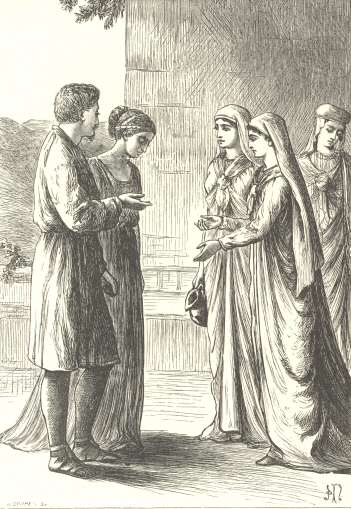
But the devil, who hates and envies what is noble, would not
endure such a purpose in a youth: but attempted against him all
that he is wont to do; suggesting to him the remembrance of his
wealth, care for his sister, relation to his kindred, love of
money, love of glory, the various pleasures of luxury, and the
other solaces of life; and then the harshness of virtue, and its
great toil; and the weakness of his body, and the length of time;
and altogether raised a great dust-cloud of arguments in his
mind, trying to turn him back from his righteous choice.
But when the enemy saw himself to be too weak for Antony’s
determination, but rather baffled by his stoutness, and
overthrown by his great faith, and falling before his continual
prayers, then he attacked him with the temptations which he is
wont to use against young men; . . . . but he protected his body
with faith, prayers, and fastings, . . . setting his thoughts on
Christ, and on his own nobility through Christ, and on the
rational faculties of his soul, . . . and again on the terrors of
the fire, and the torment of the worm, . . . and thus escaped
unhurt. And thus was the enemy brought to shame. For
he who thought himself to be equal with God was now mocked by a
youth; and he who boasted against flesh and blood was defeated by
a man clothed in flesh. For the Lord worked with him, who
bore flesh on our account, and gave to the body victory over the
devil, that each man in his battle may say, “Not I, but the
grace of God which is with me.” At last, when the
dragon could not overthrow Antony even thus, but saw himself
thrust out of his heart, then gnashing his teeth (as is written),
and as if beside himself, he appeared to the sight, as he is to
the reason, as a black child, and as it were falling down before
him, no longer attempted to argue (for the deceiver was cast
out), but using a human voice, said, “I have deceived many;
I have cast down many. But now, as in the case of many, so
in thine, I have been worsted in the battle.” Then
when Antony asked him, “Who art thou who speakest thus to
me?” he forthwith replied in a pitiable voice, “I am
the spirit of impurity.”. . .
Then Antony gave thanks to God, and gaining courage, said,
“Thou art utterly despicable; for thou art black of soul,
and weak as a child; nor shall I henceforth cast one thought on
thee. For the Lord is my helper, and I shall despise my
enemies.” That black being, hearing this, fled
forthwith, cowering at his words, and afraid thenceforth of
coming near the man.
This was Antony’s first struggle against the devil: or
rather this mighty deed in him was the Saviour’s, who
condemned sin in the flesh that the righteousness of the Lord
should be fulfilled in us, who walk not after the flesh, but
after the Spirit. But neither did Antony, because the
dæmon had fallen, grow careless and despise him; neither
did the enemy, when worsted by him, cease from lying in ambush
against him. For he came round again as a lion, seeking a
pretence against him. But Antony had learnt from Scripture
that many are the devices of the enemy; and continually kept up
his training, considering that, though he had not deceived his
heart by pleasure, he would try some other snares. For the
dæmon delights in sin. Therefore he chastised his
body more and more, and brought it into slavery, lest, having
conquered in one case, he should be tripped up in others.
He determined, therefore, to accustom himself to a still more
severe life; and many wondered at him: but the labour was to him
easy to bear. For the readiness of the spirit, through long
usage, had created a good habit in him, so that, taking a very
slight hint from others, he showed great earnestness in it.
For he watched so much, that he often passed the whole night
without sleep; and that not once, but often, to the astonishment
of men. He ate once a day, after the setting of the sun,
and sometimes only once in two days, often even in four; his food
was bread with salt, his drink nothing but water. To speak
of flesh and wine there is no need, for such a thing is not found
among other earnest men. When he slept he was content with
a rush-mat: but mostly he lay on the bare ground. He would
not anoint himself with oil, saying that it was more fit for
young men to be earnest in training, than to seek things which
softened the body; and that they must accustom themselves to
labour, according to the Apostle’s saying, “When I am
weak, then I am strong;” for that the mind was strengthened
as bodily pleasure was weakened. And this argument of his
was truly wonderful. For he did not measure the path of
virtue, nor his going away into retirement on account of it, by
time; but by his own desire and will. So forgetting the
past, he daily, as if beginning afresh, took more pains to
improve, saying over to himself continually the Apostle’s
words, “Forgetting what is behind, stretching forward to
what is before;” and mindful, too, of Elias’ speech,
“The Lord liveth, before whom I stand this
day.” For he held, that by mentioning to-day, he took
no account of past time: but, as if he were laying down a
beginning, he tried earnestly to make himself day by day fit to
appear before God, pure in heart, and ready to obey his will, and
no other. And he said in himself that the ascetic ought for
ever to be learning his own life from the manners of the great
Elias, as from a mirror. Antony, having thus, as it were,
bound himself, went to the tombs, which happened to be some way
from the village; and having bidden one of his acquaintances to
bring him bread at intervals of many days, he entered one of the
tombs, and, shutting the door upon himself, remained there
alone. But the enemy, not enduring that, but rather
terrified lest in a little while he should fill the desert with
his training, coming one night with a multitude of dæmons,
beat him so much with stripes, that he lay speechless from the
torture. For he asserted that the pain was so great that no
blows given by men could cause such agony. But by the
providence of God (for the Lord does not overlook those who hope
in him), the next day his acquaintance came, bringing him the
loaves. And having opened the door, and seeing him lying on
the ground for dead, he carried him to the Lord’s house in
the village, and laid him on the ground; and many of his kinsfolk
and the villagers sat round him, as round a corpse. But
about midnight, Antony coming to himself, and waking up, saw them
all sleeping, and only his acquaintance awake, and, nodding to
him to approach, begged him to carry him back to the tombs,
without waking any one. When that was done, the doors were
shut, and he remained as before, alone inside. And, because
he could not stand on account of the dæmons’ blows,
he prayed prostrate. And after his prayer, he said with a
shout, “Here am I, Antony: I do not fly from your stripes;
yea, if you do yet more, nothing shall separate me from the love
of Christ.” And then he sang, “If an host be
laid against me, yet shall not my heart be afraid.”
Thus thought and spoke the man who was training himself.
But the enemy, hater of what is noble, and envious, wondering
that he dared to return after the stripes, called together his
dogs, and bursting with rage,—“Ye see,” he
said, “that we have not stopped this man by the spirit of
impurity; nor by blows: but he is even growing bolder against
us. Let us attack him some other way.” [41] For it is easy for the devil to
invent schemes of mischief. So then in the night they made
such a crash, that the whole place seemed shaken, and the
dæmons, as if breaking in the four walls of the room,
seemed to enter through them, changing themselves into the shapes
of beasts and creeping things; [42] and the place was
forthwith filled with shapes of lions, bears, leopards, bulls,
and snakes, asps, scorpions, and wolves, and each of them moved
according to his own fashion. The lion roared, longing to
attack; the bull seemed to toss; the serpent did not cease
creeping, and the wolf rushed upon him; and altogether the noises
of all the apparitions were dreadful, and their tempers
cruel. But Antony, scourged and pierced by them, felt a
more dreadful bodily pain than before: but he lay unshaken and
awake in spirit. He groaned at the pain of his body: but
clear in intellect, and as it were mocking, he said, “If
there were any power in you, it were enough that one of you
should come on; but since the Lord has made you weak, therefore
you try to frighten me by mere numbers. And a proof of your
weakness is, that you imitate the shapes of brute
animals.” And taking courage, he said again,
“If ye can, and have received power against me, delay not,
but attack; but if ye cannot, why do ye disturb me in vain?
For a seal to us and a wall of safety is our faith in the
Lord.” The dæmons, having made many efforts,
gnashed their teeth at him, because he rather mocked at them,
than they at him. But neither then did the Lord forget
Antony’s wrestling, but appeared to help him. For,
looking up, he saw the roof as it were opened and a ray of light
coming down towards him. The dæmons suddenly became
invisible, and the pain of his body forthwith ceased, and the
building became quite whole. But Antony, feeling the
succour, and getting his breath again, and freed from pain,
questioned the vision which appeared, saying, “Where wert
thou? Why didst thou not appear to me from the first, to
stop my pangs?” And a voice came to him,
“Antony, I was here, but I waited to see thy fight.
Therefore, since thou hast withstood, and not been worsted, I
will be to thee always a succour, and will make thee become
famous everywhere.” Hearing this, he rose and prayed,
and was so strong, that he felt that he had more power in his
body than he had before. He was then about thirty-and-five
years old. And on the morrow he went out, and was yet more
eager for devotion to God; and, going to that old man aforesaid,
he asked him to dwell with him in the desert. But when he
declined, because of his age, and because no such custom had yet
arisen, he himself straightway set off to the mountain. But
the enemy again, seeing his earnestness, and wishing to hinder
it, cast in his way the phantom of a great silver plate.
But Antony, perceiving the trick of him who hates what is noble,
stopped. And he judged the plate worthless, seeing the
devil in it; and said, “Whence comes a plate in the
desert? This is no beaten way, nor is there here the
footstep of any traveller. Had it fallen, it could not have
been unperceived, from its great size; and besides, he who lost
it would have turned back and found it, because the place is
desert. This is a trick of the devil. Thou shalt not
hinder, devil, my determination by this: let it go with thee into
perdition.” And as Antony said that, it vanished, as
smoke from before the face of the fire. Then again he saw,
not this time a phantom, but real gold lying in the way as he
came up. But whether the enemy showed it him, or whether
some better power, which was trying the athlete, and showing the
devil that he did not care for real wealth; neither did he tell,
nor do we know, save that it was real gold. Antony,
wondering at the abundance of it, so stepped over it as over
fire, and so passed it by, that he never turned, but ran on in
haste, until he had lost sight of the place. And growing
even more and more intense in his determination, he rushed up the
mountain, and finding an empty inclosure full of creeping things
on account of its age, he betook himself across the river, and
dwelt in it. The creeping things, as if pursued by some
one, straightway left the place: but he blocked up the entry,
having taken with him loaves for six months (for the Thebans do
this, and they often remain a whole year fresh), and having water
with him, entering, as into a sanctuary, into that monastery, [44] he remained alone, never going forth,
and never looking at any one who came. Thus he passed a
long time there training himself, and only twice a year received
loaves, let down from above through the roof. But those of
his acquaintance who came to him, as they often remained days and
nights outside (for he did not allow any one to enter), used to
hear as it were crowds inside clamouring, thundering, lamenting,
crying—“Depart from our ground. What dost thou
even in the desert? Thou canst not abide our
onset.” At first those without thought that there
were some men fighting with him, and that they had got in by
ladders: but when, peeping in through a crack, they saw no one,
then they took for granted that they were dæmons, and being
terrified, called themselves on Antony. But he rather
listened to them than cared for the others. For his
acquaintances came up continually, expecting to find him dead,
and heard him singing, “Let the Lord arise, and his enemies
shall be scattered; and let them who hate him flee before
him. As wax melts from before the face of the fire, so
shall sinners perish from before the face of God.”
And again, “All nations compassed me round about, and in
the name of the Lord I repelled them.” He endured
then for twenty years, thus training himself alone; neither going
forth, nor seen by any one for long periods of time. But
after this, when many longed for him, and wished to imitate his
training, and others who knew him came, and were bursting in the
door by force, Antony came forth as from some inner shrine,
initiated into the mysteries, and bearing the God. [45] And then first he appeared out of
the inclosure to those who were coming to him. And when
they saw him they wondered; for his body had kept the same habit,
and had neither grown fat, nor lean from fasting, nor worn by
fighting with the dæmons. For he was just such as
they had known him before his retirement. They wondered
again at the purity of his soul, because it was neither
contracted as if by grief, nor relaxed by pleasure, nor possessed
by laughter or by depression; for he was neither troubled at
beholding the crowd, nor over-joyful at being saluted by too
many; but was altogether equal, as being governed by reason, and
standing on that which is according to nature. Many
sufferers in body who were present did the Lord heal by him; and
others he purged from dæmons. And he gave to Antony
grace in speaking, so that he comforted many who grieved, and
reconciled others who were at variance, exhorting all to prefer
nothing in the world to the love of Christ, and persuading and
exhorting them to be mindful of the good things to come, and of
the love of God towards us, who spared not his own son, but
delivered him up for us all. He persuaded many to choose
the solitary life; and so thenceforth cells sprang up in the
mountains, and the desert was colonized by monks, who went forth
from their own, and registered themselves in the city which is in
heaven.
And when he had need to cross the Arsenoite Canal (and the
need was the superintendence of the brethren), the canal was full
of crocodiles. And having only prayed, he entered it; and
both he and all who were with him went through it unharmed.
But when he returned to the cell, he persisted in the noble
labours of his youth; and by continued exhortations he increased
the willingness of those who were already monks, and stirred to
love of training the greater number of the rest; and quickly, as
his speech drew men on, the cells became more numerous; and he
governed them all as a father. And when he had gone forth
one day, and all the monks had come to him desiring to hear some
word from him, he spake to them in the Egyptian tongue,
thus—“That the Scriptures were sufficient for
instruction, but that it was good for us to exhort each other in
the faith.” . . .
[Here follows a long sermon, historically important, as being
the earliest Christian attempt to reduce to a science
dæmonology and the temptation of dæmons: but its
involved and rhetorical form proves sufficiently that it could
not have been delivered by an unlettered man like Antony.
Neither is it, probably, even composed by St. Athanasius; it
seems rather, like several other passages in this biography, the
interpolation of some later scribe. It has been, therefore,
omitted.]
And when Antony had spoken thus, all rejoiced; and in one the
love of virtue was increased, in another negligence stirred up,
and in others conceit stopped, while all were persuaded to
despise the plots of the devil, wondering at the grace which had
been given to Antony by the Lord for the discernment of
spirits. So the cells in the mountains were like tents
filled with divine choirs, singing, discoursing, fasting,
praying, rejoicing over the hope of the future, working that they
might give alms thereof, and having love and concord with each
other. And there was really to be seen, as it were, a land
by itself, of piety and justice; for there was none there who did
wrong, or suffered wrong: no blame from any talebearer: but a
multitude of men training themselves, and in all of them a mind
set on virtue. So that any one seeing the cells, and such
an array of monks, would have cried out, and said, “How
fair are thy dwellings, O Jacob, and thy tents, O Israel; like
shady groves and like parks beside a river, and like tents which
the Lord hath pitched, and like cedars by the
waters.” He himself, meanwhile, withdrawing,
according to his custom, alone to his own cell, increased the
severity of his training. And he groaned daily, considering
the mansions in heaven, and setting his longing on them, and
looking at the ephemeral life of man. For even when he was
going to eat or sleep, he was ashamed, when he considered the
rational element of his soul; so that often, when he was about to
eat with many other monks, he remembered the spiritual food, and
declined, and went far away from them; thinking that he should
blush if he was seen by others eating. He ate,
nevertheless, by himself, on account of the necessities of the
body; and often, too, with the brethren, being bashful with
regard to them, but plucking up heart for the sake of saying
something that might be useful; and used to tell them that they
ought to give all their leisure rather to the soul than to the
body; and that they should grant a very little time to the body,
for mere necessity’s sake: but that their whole leisure
should be rather given to the soul, and should seek her profit,
that she may not be drawn down by the pleasures of the body, but
rather the body be led captive by her. For this (he said)
was what was spoken by the Saviour, “Be not anxious for
your soul, what ye shall eat; nor for your body, what ye shall
put on. And seek not what ye shall eat, nor what ye shall
drink, neither let your minds be in suspense: for after all these
things the nations of the world seek: but your Father knoweth
that ye need all these things. Rather seek first his
kingdom; and all these things shall be added unto you.”
After these things, the persecution which happened under the
Maximinus of that time, [49] laid hold of the
Church; and when the holy martyrs were brought to Alexandria,
Antony too followed, leaving his cell, and saying, “Let us
depart too, that we may wrestle if we be called, or see them
wrestling.” And he longed to be a martyr himself,
but, not choosing to give himself up, he ministered to the
confessors in the mines, and in the prisons. And he was
very earnest in the judgment-hall to excite the readiness of
those who were called upon to wrestle; and to receive and bring
on their way, till they were perfected, those of them who went to
martyrdom. At last the judge, seeing the fearlessness and
earnestness of him and those who were with him, commanded that
none of the monks should appear in the judgment-hall, or haunt at
all in the city. So all the rest thought good to hide
themselves that day; but Antony cared so much for the order, that
he all the rather washed his cloak, and stood next day upon a
high place, and appeared to the General in shining white.
Therefore, when all the rest wondered, and the General saw him,
and passed by with his array, he stood fearless, showing forth
the readiness of us Christians. For he himself prayed to be
a martyr, as I have said, and was like one grieved, because he
had not borne his witness. But the Lord was preserving him
for our benefit, and that of the rest, that he might become a
teacher to many in the training which he had learnt from
Scripture. For many, when they only saw his manner of life,
were eager to emulate it. So he again ministered
continually to the confessors; and, as if bound with them,
wearied himself in his services. And when at last the
persecution ceased, and the blessed Bishop Peter had been
martyred, he left the city, and went back to his cell. And
he was there, day by day, a martyr in his conscience, and
wrestling in the conflict of faith; for he imposed on himself a
much more severe training than before; and his garment was within
of hair, without of skin, which he kept till his end. He
neither washed his body with water, nor ever cleansed his feet,
nor actually endured putting them into water unless it were
necessary. And no one ever saw him unclothed till he was
dead and about to be buried.
When, then, he retired, and had resolved neither to go forth
himself, nor to receive any one, one Martinianus, a captain of
soldiers, came and gave trouble to Antony. For he had with
him his daughter, who was tormented by a dæmon. And
while he remained a long time knocking at the door, and expecting
him to come to pray to God for the child, Antony could not bear
to open, but leaning from above, said, “Man, why criest
thou to me? I, too, am a man, as thou art. But if
thou believest, pray to God, and it comes to pass.”
Forthwith, therefore, he believed, and called on Christ; and went
away, with his daughter cleansed from the dæmon. And
many other things the Lord did by him, saying, “Ask, and it
shall be given you.” For most of the sufferers, when
he did not open the door, only sat down outside the cell, and
believing, and praying honestly, were cleansed. But when he
saw himself troubled by many, and not being permitted to retire,
as he wished, being afraid lest he himself should be puffed up by
what the Lord was doing by him, or lest others should count of
him above what he was, he resolved to go to the Upper Thebaid, to
those who knew him not. And, in fact, having taken loaves
from the brethren, he sat down on the bank of the river, watching
for a boat to pass, that he might embark and go up in it.
And as he watched, a voice came to him: “Antony, whither
art thou going, and why?” And he, not terrified, but
as one accustomed to be often called thus, answered when he heard
it, “Because the crowds will not let me be at rest;
therefore am I minded to go up to the Upper Thebaid, on account
of the many annoyances which befall me; and, above all, because
they ask of me things beyond my strength.” And the
voice said to him, “Even if thou goest up to the Thebaid,
even if, as thou art minded to do, thou goest down the cattle
pastures, [52a] thou wilt have to endure more, and
double trouble; but if thou wilt really be at rest, go now into
the inner desert.” And when Antony said, “Who
will show me the way, for I have not tried it?” forthwith
it showed him Saracens who were going to journey that road.
So, going to them, and drawing near them, Antony asked leave to
depart with them into the desert. But they, as if by an
ordinance of Providence, willingly received him; and, journeying
three days and three nights with them, he came to a very high
mountain; [52b] and there was water under the
mountain, clear, sweet, and very cold; and a plain outside; and a
few neglected date-palms. Then Antony, as if stirred by
God, loved the spot; for this it was what he had pointed out who
spoke to him beside the river bank. At first, then, having
received bread from those who journeyed with him, he remained
alone in the mount, no one else being with him. For he
recognised that place as his own home, and kept it
thenceforth. And the Saracens themselves, seeing
Antony’s readiness, came that way on purpose, and joyfully
brought him loaves; and he had, too, the solace of the dates,
which was then little and paltry. But after this, the
brethren, having found out the spot, like children remembering
their father, were anxious to send things to him; but Antony saw
that, in bringing him bread, some there were put to trouble and
fatigue; and, sparing the monks even in that, took counsel with
himself, and asked some who came to him to bring him a hoe and a
hatchet, and a little corn; and when these were brought, having
gone over the land round the mountain, he found a very narrow
place which was suitable, and tilled it; and, having plenty of
water to irrigate it, he sowed; and, doing this year by year, he
got his bread from thence, rejoicing that he should be
troublesome to no one on that account, and that he was keeping
himself free from obligation in all things. But after this,
seeing again some people coming, he planted also a very few
pot-herbs, that he who came might have some small solace after
the labour of that hard journey. At first, however, the
wild beasts in the desert, coming on account of the water, often
hurt his crops and his tillage; but he, gently laying hold of one
of them, said to them all, “Why do you hurt me, who have
not hurt you? Depart, and, in the name of the Lord, never
come near this place.” And from that time forward, as
if they were afraid of his command, they never came near the
place. So he was there alone in the inner mountain, having
leisure for prayer and for training. But the brethren who
ministered to him asked him that, coming every month, they might
bring him olives, and pulse, and oil; for, after all, he was
old. And while he had his conversation there, what great
wrestlings he endured, according to that which is written,
“Not against flesh and blood, but against the dæmons
who are our adversaries,” we have known from those who went
in to him. For there also they heard tumults, and many
voices, and clashing as of arms; and they beheld the mount by
night full of wild beasts, and they looked on him, too, fighting,
as it were, with beings whom he saw, and praying against
them. And those who came to him he bade be of good courage,
but he himself wrestled, bending his knees, and praying to the
Lord. And it was truly worthy of wonder that, alone in such
a desert, he was neither cowed by the dæmons who beset him,
nor, while there were there so many four-footed and creeping
beasts, was at all afraid of their fierceness: but, as is
written, trusted in the Lord like the Mount Zion, having his
reason unshaken and untost; so that the dæmons rather fled,
and the wild beasts, as is written, were at peace with him.
Nevertheless, the devil (as David sings) watched Antony, and
gnashed upon him with his teeth. But Antony was comforted
by the Saviour, remaining unhurt by his craft and manifold
artifices. For on him, when he was awake at night, he let
loose wild beasts; and almost all the hyænas in that
desert, coming out of their burrows, beset him round, and he was
in the midst. And when each gaped on him and threatened to
bite him, perceiving the art of the enemy, he said to them all,
“If ye have received power against me, I am ready to be
devoured by you: but if ye have been set on by dæmons,
delay not, but withdraw, for I am a servant of
Christ.” When Antony said this, they fled, pursued by
his words as by a whip. Next after a few days, as he was
working—for he took care, too, to labour—some one
standing at the door pulled the plait that he was working.
For he was weaving baskets, which he used to give to those who
came, in return for what they brought him. And rising up,
he saw a beast, like a man down to his thighs, but having legs
and feet like an ass; and Antony only crossed himself and said,
“I am a servant of Christ. If thou hast been sent
against me, behold, here I am.” And the beast with
its dæmons fled away, so that in its haste it fell and
died. Now the death of the beast was the fall of the
dæmons. For they were eager to do everything to bring
him back out of the desert, but could not prevail.
And being once asked by the monks to come down to them, and to
visit awhile them and their places, he journeyed with the monks
who came to meet him. And a camel carried their loaves and
their water; for that desert is all dry, and there is no
drinkable water unless in that mountain alone whence they drew
their water, and where his cell is. But when the water
failed on the journey, and the heat was most intense, they all
began to be in danger; for going round to various places, and
finding no water, they could walk no more, but lay down on the
ground, and they let the camel go, and gave themselves up.
But the old man, seeing them all in danger, was utterly grieved,
and groaned; and departing a little way from them, and bending
his knees and stretching out his hands, he prayed, and forthwith
the Lord caused water to come out where he had stopped and
prayed. And thus all of them drinking took breath again;
and having filled their skins, they sought the camel, and found
her; for it befell that the halter had been twisted round a
stone, and thus she had been stopped. So, having brought
her back, and given her to drink, they put the skins on her, and
went through their journey unharmed. And when they came to
the outer cells all embraced him, looking on him as a
father. And he, as if he brought them guest-gifts from the
mountain, gave them away to them in his words, and shared his
benefits among them. And there was joy again in the
mountains, and zeal for improvement, and comfort through their
faith in each other. And he too rejoiced, seeing the
willingness of the monks, and his sister grown old in maidenhood,
and herself the leader of other virgins. And so after
certain days he went back again to the mountain.
And after that many came to him; and others who suffered dared
also to come. Now to all the monks who came to him he gave
continually this command: To trust in the Lord and love him, and
to keep themselves from foul thoughts and fleshly pleasures; and,
as is written in the Parables, not to be deceived by fulness of
bread; and to avoid vainglory; and to pray continually; and to
sing before sleep and after sleep; and to lay by in their hearts
the commandment of Scripture; and to remember the works of the
saints, in order to have their souls attuned to emulate
them. But especially he counselled them to meditate
continually on the Apostle’s saying, “Let not the sun
go down upon your wrath;” and this he said was spoken of
all commandments in common, in order that not on wrath alone, but
on every other sin, the sun should never go down; for it was
noble and necessary that the sun should never condemn us for a
baseness by day, nor the moon for a sin or even a thought by
night; therefore, in order that that which is noble may be
preserved in us, it was good to hear and to keep what the Apostle
commanded: for he said: “Judge yourselves, and prove
yourselves.” Let each then take account with himself,
day by day, of his daily and nightly deeds; and if he has not
sinned, let him not boast, but let him endure in what is good and
not be negligent, neither condemn his neighbour, neither justify
himself, as said the blessed Apostle Paul, until the Lord comes
who searches secret things. For we often deceive ourselves
in what we do, and we indeed know not: but the Lord comprehends
all. Giving therefore the judgment to Him, let us
sympathise with each other; and let us bear each other’s
burdens, and examine ourselves; and what we are behind in, let us
be eager to fill up. And let this, too, be my counsel for
safety against sinning. Let us each note and write down the
deeds and motions of the soul as if he were about to relate them
to each other; and be confident that, as we shall be utterly
ashamed that they should be known, we shall cease from sinning,
and even from desiring anything mean. For who when he sins
wishes to be harmed thereby? Or who, having sinned, does
not rather lie, wishing to hide it? As therefore when in
each other’s sight we dare not commit a crime, so if we
write down our thoughts, and tell them to each other, we shall
keep ourselves the more from foul thoughts, for shame lest they
should be known. . . . And thus forming ourselves we shall
be able to bring the body into slavery, and please the Lord on
the one hand, and on the other trample on the snares of the
enemy.” This was his exhortation to those who met
him: but with those who suffered he suffered, and prayed with
them. And often and in many things the Lord heard him; and
neither when he was heard did he boast; nor when he was not heard
did he murmur: but, remaining always the same, gave thanks to the
Lord. And those who suffered he exhorted to keep up heart,
and to know that the power of cure was none of his, nor of any
man’s; but only belonged to God, who works when and
whatsoever he chooses. So the sufferers received this as a
remedy, learning not to despise the old man’s words, but
rather to keep up heart; and those who were cured learned not to
bless Antony, but God alone.
For instance, one called Fronto, who belonged to the palace,
and had a grievous disease (for he gnawed his own tongue, and
tried to injure his eyes), came to the mountain and asked Antony
to pray for him. And when he had prayed he said to Fronto,
“Depart, and be healed.” And when he resisted,
and remained within some days, Antony continued saying,
“Thou canst not be healed if thou remainest here; go forth,
and as soon as thou enterest Egypt, thou shalt see the sign which
shall befall thee.” He, believing, went forth; and as
soon as he only saw Egypt he was freed from his disease, and
became sound according to the word of Antony, which he had learnt
by prayer from the Saviour . . .
[Here follows a story of a girl cured of a painful complaint:
which need not be translated.]
But when two brethren were coming to him, and water failed
them on the journey, one of them died, and the other was about to
die. In fact, being no longer able to walk, he too lay upon
the ground expecting death. But Antony, as he sat on the
mountain, called two monks who happened to be there, and hastened
them, saying, “Take a pitcher of water, and run on the road
towards Egypt; for of two who are coming hither one has just
expired, and the other will do so if you do not hasten. For
this has been showed to me as I prayed.” So the monks
going found the one lying dead, and buried him; and the other
they recovered with the water, and brought him to the old
man. Now the distance was a day’s journey. But
if any one should ask why he did not speak before one of them
expired, he does not question rightly; for the judgment of that
death did not belong to Antony, but to God, who both judged
concerning the one; and revealed concerning the other. But
this alone in Antony was wonderful, that sitting on the mountain
he kept his heart watchful, and the Lord showed him things afar
off.
For once again, as he sat on the mountain and looked up, he
saw some one carried aloft, and a great rejoicing among some who
met him. Then wondering, and blessing such a choir, he
prayed to be taught what that might be; and straightway a voice
came to him that this was the soul of Ammon, the monk in Nitria,
[60] who had persevered as an ascetic to his
old age; and the distance from Nitria to the mountain where
Antony was, is thirteen days’ journey. Those then who
were with Antony, seeing the old man wondering, asked the reason,
and heard that Ammon had just expired, for he was known to them
on account of his having frequently come thither, and many signs
having been worked by him, of which this is one. . . .
[Here follows the story (probably an interpolation) of
Ammon’s being miraculously carried across the river Lycus,
because he was ashamed to undress himself.]
But the monks to whom Antony spoke about Ammon’s death
noted down the day; and when brethren came from Nitria after
thirty days, they inquired and learnt that Ammon had fallen
asleep at the day and hour in which the old man saw his soul
carried aloft. And all on both sides wondered at the purity
of Antony’s soul; how he had learnt and seen instantly what
had happened thirteen days’ journey off.
Moreover, Archeleas the Count, finding him once in the outer
mountain praying alone, asked him concerning Polycratia, that
wonderful and Christ-bearing maiden in Laodicea; for she suffered
dreadful internal pain from her extreme training, and was
altogether weak in body. Antony, therefore, prayed; and the
Count noted down the day on which the prayer was offered.
And going back to Laodicea, he found the maiden cured; and asking
when and on what day her malady had ceased, he brought out the
paper on which he had written down the date of the prayer.
And when she told him, he showed at once the writing on the
paper. And all found that the Lord had stopped her
sufferings while Antony was still praying and calling for her on
the goodness of the Saviour.
And concerning those who came to him, he often predicted some
days, or even a month, beforehand, and the cause why they were
coming. For some came only to see him, and others on
account of sickness, and others because they suffered from
dæmons, and all thought the labour of the journey no
trouble nor harm, for each went back aware that he had been
benefited. And when he spoke and looked thus, he asked no
one to marvel at him on that account, but to marvel rather at the
Lord, because he had given us, who are but men, grace to know him
according to our powers. And as he was going down again to
the outer cells, and was minded to enter a boat and pray with the
monks, he alone perceived a dreadfully evil odour, and when those
in the boat told him that they had fish and brine on board, and
that it was they which smelt, he said that it was a different
smell; and while he was yet speaking, a youth, who had an evil
spirit, had gone before them and hidden in the boat, suddenly
cried out. But the dæmon, being rebuked in the name
of our Lord Jesus Christ, went out of him, and the man became
whole, and all knew that the smell had come from the evil
spirit. And there was another man of high rank who came to
him, having a dæmon, and one so terrible, that the
possessed man did not know that he was going to Antony, but
[showed the common symptoms of mania]. Those who brought
him entreated Antony to pray over him, which he did, feeling for
the young man, and he watched beside him all night. But
about dawn, the young man, suddenly rushing on Antony, assaulted
him. When those who came with him were indignant, Antony
said, “Be not hard upon the youth, for it is not he, but
the dæmon in him; and because he has been rebuked, and
commanded to go forth into dry places, he has become furious, and
done this. Glorify, therefore, the Lord for his having thus
rushed upon me, as a sign to you that the dæmon is going
out.” And as Antony said this, the youth suddenly
became sound, and, recovering his reason, knew where he was, and
embraced the old man, giving thanks to God. And most of the
monks agree unanimously that many like things were done by him:
yet are they not so wonderful as what follows. For once,
when he was going to eat, and rose up to pray about the ninth
hour, he felt himself rapt in spirit; and (wonderful to relate)
as he stood he saw himself as it were taken out of himself, and
led into the air by some persons; and then others, bitter and
terrible, standing in the air, and trying to prevent his passing
upwards. And when those who led him fought against them,
they demanded whether he was not accountable to them. And
when they began to take account of his deeds from his birth, his
guides stopped them, saying, “What happened from his birth
upwards, the Lord hath wiped out: but of what has happened since
he became a monk, and made a promise to God, of that you may
demand an account.” Then, when they brought
accusations against him, and could not prove them, the road was
opened freely to him. And straightway he saw himself as if
coming back and standing before himself, and was Antony once
more. Then, forgetting that he had not eaten, he remained
the rest of the day and all night groaning and praying, for he
wondered when he saw against how many enemies we must wrestle,
and through how many labours a man must traverse the air; and he
remembered that it is this which the Apostle means with regard to
the Prince of the power of the air; for it is in the air that the
enemy has his power, fighting against those who pass through it,
and trying to hinder them. Wherefore, also he especially
exhorts us: “Take the whole armour of God, that the enemy,
having no evil to say about us, may be ashamed.” But
when we heard this, we remembered the Apostle’s saying,
“Whether in the body I cannot tell, or out of the body I
cannot tell: God knoweth.” But Paul was caught up
into the third heaven, and, having heard unspeakable words,
descended again; but Antony saw himself rapt in the air, and
wrestling till he seemed to be free.
Again, he had this grace, that as he was sitting alone in the
mountain, if at any time he was puzzled in himself, the thing was
revealed to him by Providence as he prayed; and the blessed man
was, as Scripture says, taught of God. After this, at all
events, when he had been talking with some who came to him
concerning the departure of the soul, and what would be its place
after this life, the next night some one called him from without,
and said, “Rise up, Antony; come out and see.”
So coming out (for he knew whom he ought to obey), he beheld a
tall being, shapeless and terrible, standing and reaching to the
clouds, and as it were winged beings ascending; and him
stretching out his hands; and some of them hindered by him, and
others flying above him, and when they had once passed him, borne
upwards without trouble. But against them that tall being
gnashed his teeth, while over those who fell, he rejoiced.
And there came a voice to Antony, “Consider what thou
seest.” And when his understanding was opened, he
perceived that it was the enemy who envies the faithful, and that
those who were in his power he mastered and hindered from
passing; but that those who had not obeyed him, over them, as
over conquerors, he had no power. Having seen this, and as
it were made mindful by it, he struggled more and more daily to
improve. Now these things he did not tell of his own
accord; but when he was long in prayer, and astonished in
himself, those who were with him questioned him and urged him;
and he was forced to tell; unable, as a father, to hide anything
from his children; and considering, too, that his own conscience
was clear, and the story would be profitable for them, when they
learned that the life of training bore good fruit, and that
visions often came as a solace of their toils.
But how tolerant was his temper, and how humble his spirit;
for though he was so great, he both honoured exceedingly the
canon of the Church, and wished to put every ecclesiastic before
himself in honour. For to the bishops and presbyters he was
not ashamed to bow his head; and if a deacon ever came to him for
the sake of profit, he discoursed with him on what was
profitable, but in prayer he gave place to him, not being ashamed
even himself to learn from him. [65] For he often
asked questions, and deigned to listen to all present, confessing
that he was profited if any one said aught that was useful.
Moreover, his countenance had great and wonderful grace; and this
gift too he had from the Saviour. For if he was present
among the multitude of monks, and any one who did not previously
know him wished to see him, as soon as he came he passed by all
the rest, and ran to Antony himself, as if attracted by his
eyes. He did not differ from the rest in stature or in
stoutness, but in the steadiness of his temper, and purity of his
soul; for as his soul was undisturbed, his outward senses were
undisturbed likewise, so that the cheerfulness of his soul made
his face cheerful, and from the movements of his body the
stedfastness of his soul could be perceived, according to the
Scripture, “When the heart is cheerful the countenance is
glad; but when sorrow comes it scowleth.” . . . And he was
altogether wonderful in faith, and pious, for he never
communicated with the Meletian [66a] schismatics,
knowing their malice and apostasy from the beginning; nor did he
converse amicably with Manichæans or any other heretics,
save only to exhort them to be converted to piety. For he
held that their friendship and converse was injury and ruin to
the soul. So also he detested the heresy of the Arians, and
exhorted all not to approach them, nor hold their misbelief. [66b] In fact, when certain of the
Ariomanites came to him, having discerned them and found them
impious, he chased them out of the mountain, saying that their
words were worse than serpent’s poison; and when the Arians
once pretended that he was of the same opinion as they, he was
indignant and fierce against them. Then being sent for by
the bishops and all the brethren, he went down from the mountain,
and entering Alexandria he denounced the Arians, saying, that
that was the last heresy, and the forerunner of Antichrist; and
he taught the people that the Son of God was not a created thing,
neither made from nought, but that he is the Eternal Word and
Wisdom of the Essence of the Father; wherefore also it is impious
to say there was a time when he was not, for he was always the
Word co-existent with the Father. Wherefore he said,
“Do not have any communication with these most impious
Arians; for there is no communion between light and
darkness. For you are pious Christians: but they, when they
say that the Son of God and the Word, who is from the Father, is
a created being, differ nought from the heathen, because they
worship the creature instead of God the Creator. [67] Believe rather that the whole
creation itself is indignant against them, because they number
the Creator and Lord of all, in whom all things are made, among
created things.” All the people therefore rejoiced at
hearing that Christ-opposing heresy anathematized by such a man;
and all those in the city ran together to see Antony and the
Greeks, [68a] and those who are called their priests
[68b] came into the church, wishing to see
the man of God; for all called him by that name, because there
the Lord cleansed many by him from dæmons, and healed those
who were out of their mind. And many heathens wished only
to touch the old man, believing that it would be of use to them;
and in fact as many became Christians in those few days, as would
have been usually converted in a year. And when some
thought that the crowd troubled him, and therefore turned all
away from him, he quietly said that they were not more numerous
than the fiends with whom he wrestled on the mountain. But
when he left the city, and we were setting him on his journey,
when we came to the gate a certain woman called to him:
“Wait, man of God, my daughter is grievously vexed with a
devil; wait, I beseech thee, lest I too harm myself with running
after thee.” The old man hearing it, and being asked
by us, waited willingly. But when the woman drew near, the
child dashed itself on the ground; and when Antony prayed and
called on the name of Christ, it rose up sound, the unclean
spirit having gone out; and the mother blessed God, and we all
gave thanks: and he himself rejoiced at leaving the city for the
mountain, as for his own home.
Now he was very prudent; and what was wonderful, though he had
never learnt letters, he was a shrewd and understanding
man. Once, for example, two Greek philosophers came to him,
thinking that they could tempt Antony. And he was in the
outer mountain; and when he went out to them, understanding the
men from their countenances, he said through an interpreter,
“Why have you troubled yourselves so much, philosophers, to
come to a foolish man?” And when they answered that
he was not foolish, but rather very wise, he said, “If you
have come to a fool, your labour is superfluous, but if ye think
me to be wise, become as I am; for we ought to copy what is good,
and if I had come to you, I should have copied you; but if you
come to me, copy me, for I am a Christian.” And they
wondering went their way, for they saw that even dæmons
were afraid of Antony.
And again when others of the same class met him in the outer
mountain, and thought to mock him, because he had not learnt
letters, Antony answered, “But what do you say? which is
first, the sense or the letters? And which is the cause of
the other, the sense of the letters, or the letters of the
sense?” And when they said that the sense came first,
and invented the letters, Antony replied, “If then the
sense be sound, the letters are not needed.” Which
struck them, and those present, with astonishment. So they
went away wondering, when they saw so much understanding in an
unlearned man. For though he had lived and grown old in the
mountain, his manners were not rustic, but graceful and urbane;
and his speech was seasoned with the divine salt, so that no man
grudged at him, but rather rejoiced over him, as many as came. .
. .
[Here follows a long sermon against the heathen worship,
attributed to St. Antony, but of very questionable authenticity:
the only point about it which is worthy of note is that Antony
confutes the philosophers by challenging them to cure some
possessed persons, and, when they are unable to do so, casts out
the dæmons himself by the sign of the cross.]
The fame of Antony reached even the kings, for Constantinus
the Augustus, and his sons, Constantius and Constans, the
Augusti, hearing of these things, wrote to him as to a father,
and begged to receive an answer from him. But he did not
make much of the letters, nor was puffed up by their messages;
and he was just the same as he was before the kings wrote to
him. And he called his monks and said, “Wonder not if
a king writes to us, for he is but a man: but wonder rather that
God has written his law to man, and spoken to us by his own
Son.” So he declined to receive their letters, saying
he did not know how to write an answer to such things; but being
admonished by the monks that the kings were Christians, and that
they must not be scandalized by being despised, he permitted the
letters to be read, and wrote an answer; accepting them because
they worshipped Christ, and counselling them, for their
salvation, not to think the present life great, but rather to
remember judgment to come; and to know that Christ was the only
true and eternal king; and he begged them to be merciful to men,
and to think of justice and the poor. And they, when they
received the answer, rejoiced. Thus was he kindly towards
all, and all looked on him as their father. He then betook
himself again into the inner mountain, and continued his
accustomed training. But often, when he was sitting and
walking with those who came unto him, he was astounded, as is
written in Daniel. And after the space of an hour, he told
what had befallen to the brethren who were with him, and they
perceived that he had seen some vision. Often he saw in the
mountain what was happening in Egypt, and told it to Serapion the
bishop, who saw him occupied with a vision. Once, for
instance, as he sat, he fell as it were into an ecstasy, and
groaned much at what he saw. Then, after an hour, turning
to those who were with him, he groaned and fell into a trembling,
and rose up and prayed, and bending his knees, remained so a long
while; and then the old man rose up and wept. The
bystanders, therefore, trembling and altogether terrified, asked
him to tell them what had happened, and tormented him much, that
he was forced to speak. And he groaning
greatly—“Ah! my children,” he said, “it
were better to be dead before what I have seen shall come to
pass.” And when they asked him again, he said with
tears, that “Wrath will seize on the Church, and she will
be given over to men like unto brutes, which have no
understanding; for I saw the table of the Lord’s house, and
mules standing all around it in a ring and kicking inwards, as a
herd does when it leaps in confusion; and ye all perceived how I
groaned, for I heard a voice saying, ‘My sanctuary shall be
defiled.’”
This the old man saw, and after two years there befell the
present inroad of the Arians, [72a] and the plunder of
the churches, when they carried off the holy vessels by violence,
and made the heathen carry them: and when too they forced the
heathens from the prisons to join them, and in their presence did
on the holy table what they would. [72b] Then we all
perceived that the kicks of those mules presignified to Antony
what the Arians are now doing without understanding, like the
brutes. But when Antony saw this sight, he exhorted those
about him, saying, “Lose not heart, children; for as the
Lord has been angry, so will he again be appeased, and the Church
shall soon receive again her own order and shine forth as she is
wont; and ye shall see the persecuted restored to their place,
and impiety retreating again into its own dens, and the pious
faith speaking boldly everywhere with all freedom. Only
defile not yourselves with the Arians, for this teaching is not
of the Apostle but of the dæmons, and of their father the
devil: barren and irrational and of an unsound mind, like the
irrational deeds of those mules.” Thus spoke
Antony.
But we must not doubt whether so great wonders have been done
by a man; for the Saviour’s promise is, “If ye have
faith as a grain of mustard-seed, ye shall say to this mountain,
Pass over from hence, it shall pass over, and nothing shall be
impossible to you;” and again, “Verily, verily, I say
unto you, if ye shall ask my Father in my name, he shall give it
you. Ask, and ye shall receive.” And he himself
it is who said to his disciples and to all who believe in him,
“Heal the sick, cast out devils; freely ye have received,
freely give.” And certainly Antony did not heal by
his own authority, but by praying and calling on Christ; so that
it was plain to all that it was not he who did it, but the Lord,
who through Antony showed love to men, and healed the
sufferers. But Antony’s part was only the prayer and
the training, for the sake whereof, sitting in the mountain, he
rejoiced in the sight of divine things, and grieved when he was
tormented by many, and dragged to the outer mountain.
For all the magistrates asked him to come down from the
mountain, because it was impossible for them to go in thither to
him on account of the litigants who followed him; so they begged
him to come, that they might only behold him. And when he
declined they insisted, and even sent in to him prisoners under
the charge of soldiers, that at least on their account he might
come down. So being forced by necessity, and seeing them
lamenting, he came to the outer mountain. And his labour
this time too was profitable to many, and his coming for their
good. To the magistrates, too, he was of use, counselling
them to prefer justice to all things, and to fear God, and to
know that with what judgment they judged they should be judged in
turn. But he loved best of all his life in the
mountain. Once again, when he was compelled in the same way
to leave it, by those who were in want, and by the general of the
soldiers, who entreated him earnestly, he came down, and having
spoken to them somewhat of the things which conduced to
salvation, he was pressed also by those who were in need.
But being asked by the general to lengthen his stay, he refused,
and persuaded him by a graceful parable, saying, “Fishes,
if they lie long on the dry land, die; so monks who stay with you
lose their strength. As the fishes then hasten to the sea,
so must we to the mountain, lest if we delay we should forget
what is within.” The general, hearing this and much
more from him, said with surprise that he was truly a servant of
God, for whence could an unlearned man have so great sense if he
were not loved by God?
Another general, named Balacius, bitterly persecuted us
Christians on account of his affection for those abominable
Arians. His cruelty was so great that he even beat nuns,
and stripped and scourged monks. Antony sent him a letter
to this effect:—“I see wrath coming upon thee.
Cease, therefore, to persecute the Christians, lest the wrath lay
hold upon thee, for it is near at hand.” But
Balacius, laughing, threw the letter on the ground and spat on
it; and insulted those who brought it, bidding them tell Antony,
“Since thou carest for monks, I will soon come after thee
likewise.” And not five days had passed, when the
wrath laid hold on him. For Balacius himself, and
Nestorius, the Eparch of Egypt, went out to the first station
from Alexandria, which is called Chæreas’s.
Both of them were riding on horses belonging to Balacius, and the
most gentle in all his stud: but before they had got to the
place, the horses began playing with each other, as is their
wont, and suddenly the more gentle of the two, on which Nestorius
was riding, attacked Balacius and pulled him off with his teeth,
and so tore his thigh that he was carried back to the city, and
died in three days. And all wondered that what Antony had
so wonderfully foretold was so quickly fulfilled. These
were his warnings to the more cruel. But the rest who came
to him he so instructed that they gave up at once their lawsuits,
and blessed those who had retired from this life. And those
who had been unjustly used he so protected that you would think
he and not they was the sufferer. And he was so able to be
of use to all; so that many who were serving in the army, and
many wealthy men, laid aside the burdens of life and became
thenceforth monks; and altogether he was like a physician given
by God to Egypt. For who met him grieving, and did not go
away rejoicing? Who came mourning over his dead, and did
not forthwith lay aside his grief? Who came wrathful, and
was not converted to friendship? What poor man came wearied
out, and when he saw and heard him did not despise wealth and
comfort himself in his poverty? What monk who had grown
remiss, was not strengthened by coming to him? What young
man coming to the mountain and looking upon Antony, did not
forthwith renounce pleasure and love temperance? Who came
to him tempted by devils, and did not get rest? Who came
troubled by doubts, and did not get peace of mind? For this
was the great thing in Antony’s asceticism, that (as I have
said before), having the gift of discerning spirits, he
understood their movements, and knew in what direction each of
them turned his endeavours and his attacks. And not only he
was not deceived by them himself, but he taught those who were
troubled in mind how they might turn aside the plots of
dæmons, teaching them the weakness and the craft of their
enemies. How many maidens, too, who had been already
betrothed, and only saw Antony from afar, remained unmarried for
Christ’s sake! Some, too, came from foreign parts to
him, and all, having gained some benefit, went back from him as
from a father. And now he has fallen asleep, all are as
orphans who have lost a parent, consoling themselves with his
memory alone, keeping his instructions and exhortations.
But what the end of his life was like, it is fit that I should
relate, and you hear eagerly. For it too is worthy of
emulation. He was visiting, according to his wont, the
monks in the outer mountain, and having learned from Providence
concerning his own end, he said to the brethren, “This
visit to you is my last, and I wonder if we shall see each other
again in this life. It is time for me to set sail, for I am
near a hundred and five years old.” And when they
heard that they wept, and embraced and kissed the old man.
And he, as if he was setting out from a foreign city to his own,
spoke joyfully, and exhorted them not to grow idle in their
labours or cowardly in their training, but to live as those who
died daily, and (as I said before) to be earnest in keeping their
souls from foul thoughts, and to emulate the saints, and not to
draw near the Meletian schismatics, for “ye know their evil
and profane determinations, nor to have any communion with the
Arians, for their impiety also is manifest to all. Neither
if ye shall see the magistrates patronising them, be troubled,
for their phantasy shall have an end, and is mortal and only for
a little while. Keep yourselves therefore rather clean from
them, and hold that which has been handed down to you by the
fathers, and especially the faith in our Lord Jesus Christ which
ye have learned from Scripture, and of which ye have often been
reminded by me.” And when the brethren tried to force
him to stay with them and make his end there, he would not endure
it, on many accounts, as he showed by his silence; and especially
on this:—The Egyptians are wont to wrap in linen the
corpses of good persons, and especially of the holy martyrs, but
not to bury them underground, but to lay them upon benches and
keep them in their houses; [77] thinking that by
this they honour the departed. Now Antony had often asked
the bishops to exhort the people about this, and in like manner
he himself rebuked the laity and terrified the women; saying that
it was a thing neither lawful nor in any way holy; for that the
bodies of the patriarchs and prophets are to this day preserved
in sepulchres, and that the very body of our Lord was laid in a
sepulchre, and a stone placed over it to hide it, till he rose
the third day. And thus saying he showed that those broke
the law who did not bury the corpses of the dead, even if they
were holy; for what is greater or more holy than the Lord’s
body? Many, then, when they heard him, buried thenceforth
underground; and blessed the Lord that they had been taught
rightly. Being then aware of this, and afraid lest they
should do the same by his body, he hurried himself, and bade
farewell to the monks in the outer mountain; and coming to the
inner mountain, where he was wont to abide, after a few months he
grew sick, and calling those who were by—and there were two
of them who had remained there within fifteen years, exercising
themselves and ministering to him on account of his old
age—he said to them, “I indeed go the way of the
fathers, as it is written, for I perceive that I am called by the
Lord.” . . .
[Then follows a general exhortation to the monk, almost
identical with much that has gone before, and ending by a command
that his body should be buried in the ground.]
“And let this word of mine be kept by you, so that no
one shall know the place, save you alone, for I shall receive it
(my body) incorruptible from my Saviour in the resurrection of
the dead. And distribute my garments thus. To
Athanasius the bishop give one of my sheepskins, and the cloak
under me, which was new when he gave it me, and has grown old by
me; and to Serapion the bishop give the other sheepskin; and do
you have the hair-cloth garment. And for the rest,
children, farewell, for Antony is going, and is with you no
more.”
Saying thus, when they had embraced him, he stretched out his
feet, and, as if he saw friends coming to him, and grew joyful on
their account (for, as he lay, his countenance was bright), he
departed and was gathered to his fathers. And they
forthwith, as he had commanded them, preparing the body and
wrapping it up, hid it under ground: and no one knows to this day
where it is hidden, save those two servants only. And each
(i.e. Athanasius and Serapion) having received the
sheepskin of the blessed Antony, and the cloak which he had worn
out, keeps them as a great possession. For he who looks on
them, as it were, sees Antony; and he who puts them on, wears
them with joy, as he does Antony’s counsels.
Such was the end of Antony in the body, and such the beginning
of his training. And if these things are small in
comparison with his virtue, yet reckon up from these things how
great was Antony, the man of God, who kept unchanged, from his
youth up to so great an age, the earnestness of his training; and
was neither worsted in his old age by the desire of more delicate
food, nor on account of the weakness of his body altered the
quality of his garment, nor even washed his feet with water; and
yet remained uninjured in all his limbs: for his eyes were
undimmed and whole, so that he saw well; and not one of his teeth
had fallen out, but they were only worn down to his gums on
account of his great age; and he remained sound in hand and foot;
and, in a word, appeared ruddier and more ready for exertion than
all who use various meats and baths, and different dresses.
But that this man should be celebrated everywhere and wondered at
by all, and regretted even by those who never saw him, is a proof
of his virtue, and that his soul was dear to God. For
Antony became known not by writings, not from the wisdom that is
from without, not by any art, but by piety alone; and that this
was the gift of God, none can deny. For how as far as
Spain, as Gaul, as Rome, as Africa, could he have been heard,
hidden as he was in a mountain, if it had not been for God, who
makes known his own men everywhere, and who had promised Antony
this from the beginning? For even if they do their deeds in
secret, and wish to be concealed, yet the Lord shows them as
lights to all, that so those who hear of them may know that the
commandments suffice to put men in the right way, and may grow
zealous of the path of virtue.
Read then these things to the other brethren, that they may
learn what the life of monks should be, and may believe that the
Lord Jesus Christ our Saviour will glorify those who glorify him,
and that those who serve him to the end he will not only bring to
the kingdom of heaven, but that even if on earth they hide
themselves and strive to get out of the way, he will make them
manifest and celebrated everywhere, for the sake of their own
virtue, and for the benefit of others. But if need be, read
this also to the heathens, that even thus they may learn that our
Lord Jesus Christ is not only Lord and the Son of God, but that
those who truly serve him, and believe piously on him, not only
prove that those dæmons whom the Greeks think are gods to
be no gods, but even tread them under foot, and chase them out as
deceivers and corrupters of men, through Jesus Christ our Lord,
to whom be glory and honour for ever and ever. Amen.
Thus ends this strange story. What we are to think of
the miracles and wonders contained in it, will be discussed at a
later point in this book. Meanwhile there is a stranger
story still connected with the life of St. Antony. It
professes to have been told by him himself to his monks; and
whatever groundwork of fact there may be in it is doubtless
his. The form in which we have it was given it by the
famous St. Jerome, who sends the tale as a letter to Asella, one
of the many noble Roman ladies whom he persuaded to embrace the
monastic life. The style is as well worth preserving as the
matter. Its ruggedness and awkwardness, its ambition and
affectation, contrasted with the graceful simplicity of
Athanasius’s “Life of Antony,” mark well the
difference between the cultivated Greek and the ungraceful and
half-barbarous Roman of the later Empire. I have,
therefore, given it as literally as possible, that readers may
judge for themselves how some of the Great Fathers of the fifth
century wrote, and what they believed.


