AFTER the strange meeting with Bernard Herbert, his imprisonment on the
lonely island no longer felt irksome to Tom Talisker.
Indeed, for a time at all events, he was in no hurry for “the ship” to
come. Had it arrived the first week even, I daresay Tom would have been
a little disappointed. O, it was bound to appear some day or other; all
three prisoners felt sure of that. For they were young and healthy, and
therefore they were happy and hopeful. Why should they not enjoy life as
thoroughly as possible, therefore? They did so anyhow.
They hunted, they fished, they roamed through the woods and wild glens,
and studied nature in its every phase and form, and in fact really felt
part and parcel of the living joys and wonders all around them.
“It is very well being a Crusoe, for a short time all by yourself,” Tom
said one day to Bernard; “but it is doubly delightful to have a
companion.”
The very flowers seemed more beautiful now, the trees looked greener,
and the sky and sea a deeper blue.
Strange to say, neither Tom nor Bernard thought twice of the buried
treasure. It was there waiting them when they wanted it. Far more in
gold alone than would purchase all the lands of Craigielea, and half the
parish besides. They did not even trouble themselves to wonder how it
had come there. A dying convict had told Bernard its whereabouts—a
convict that he had befriended—and doubtless it had been concealed long
years ago by the buccaneers who infested these seas in the good old
times.
The huge tame tortoises were a source of endless amusement to the
Crusoes. They even managed to domesticate them. Two of these especially
were great pets and favourites. Both were old males—bulls Bernard
called them; and there is really no saying how long they might not have
crawled about the island—probably a hundred years if not two. Tortoises
are animals that take life wondrously easy. They never hurry, and most
assuredly never worry; and thus they manage to exist for a whole
century, and live happy ever afterwards.
One would think that during such a long innings the Galapagos tortoise
would amass a vast deal of wisdom. Perhaps they do; but, if so, they
keep it to themselves. They seem to know that silence is golden, and
consequently stick to it. These two giants, Peter and John the Crusoes
called them, knew well enough what was good for them; and that is more
than some boys do. Their food was collected for them, and they stopped
eating at once when nature was satisfied; and they never touched
anything that was left, a second time. If stale food were offered to
them, they snorted and drew in their heads at once; but as soon as the
half-dry stuff was taken away, and some nice juicy morsels of cacti
placed about a yard off, out came the heads again. Not quickly; O, no,
they did not even hurry themselves in putting their heads out; though
they always managed to draw them in with a jerk
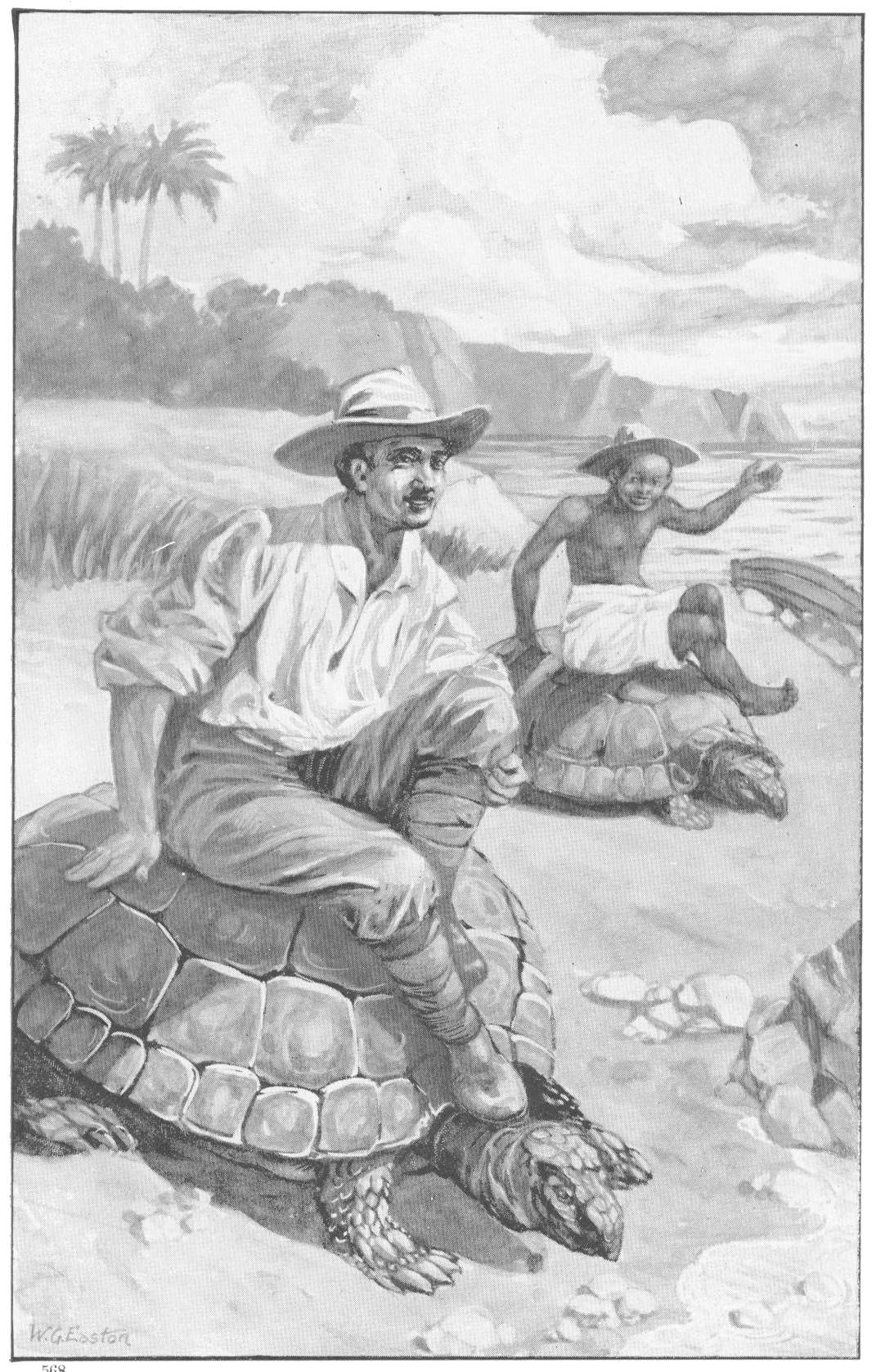 GIANT TORTOISE RIDING
when offended. Black Tom was their particular aversion. I cannot
understand why, but as soon as he appeared, “Pshaw!” they would shout,
and in went their heads in a moment; and away Black Tom would fly, with
his tail on end and like a bottle brush. The cat could growl and hiss
pretty well himself; but not in the terribly startling way the tortoises
did. John was the better-natured of these two race-horses. That is the
reason they call him John. The other was a little crotchety so they
called him Peter. Peter did not like anyone to point a stick or even a
finger at him. If you did so, you offended him at once. “Pshaw!” he
would cry, and draw in his head, and one could not help feeling mean.
But you might have pointed a finger all day long at John, and he would
not have troubled himself.
Is it possible, I wonder, for huge ungainly monsters like these to
possess affection? I myself believe it is; and that John grew really
fond of Tom. For sometimes after eating his dinner, instead of drawing
in his neck and going quickly to sleep as his brother Peter did, John
started looking or staring at Tom, if he happened to be lying reading
out of doors. It was a long, steady, stony stare, that lasted for
perhaps half an hour at a time. Bernard used to say that he saw a smile
on John’s face; but Tom would not admit that. However, there was no
mistake about the staring; for Tom used to shift his position, and the
head and neck followed him slowly round. But John never turned his body
round. That would have been far too much trouble. When Tom got tired of
being stared at like this he used to call for pussy. That was enough for
John. “Pshaw!” he would cry, and in would go the neck.
. . . . . . .
In about a month’s time Bernard Herbert, though still dressed in
garments made of skin, was as thoroughly civilized as could be wished,
and his English was now unexceptionably good. But though a handsome man,
he was a terribly red-brown one. The tanning his skin had received in
the wilds of the eastern lands of Ecuador would probably never leave it;
only there was surely nothing to be sorry for on this account.
Tom had commenced to teach Bernard to read, and, partly because his
heart was in it, and partly because he really was very clever, he soon
made excellent progress.
One forenoon when Brandy was away in the woods Tom had just sat down to
give Brother Bernard, as he called him, a lesson, when they heard a
distant shout, and looking up beheld the negro boy coming rushing wildly
over the plain.
Tom ran for his rifle, then hastened to meet him, not knowing what might
be the matter. He hailed the lad when near enough; but Brandy had no
voice now, he could only point away seawards and make faces.
“Is it a ship?” cried Tom.
Brandy signalled assent, and back ran Tom, shouting wildly, madly,
exultantly—
“A ship! A ship!”
And Bernard threw his goat-skin cap in the air and joined the chorus,
for Brandy had recovered his breath, and the very woods and welkin rang
with—
“A ship! A ship!”
Then away they all hurried together to the look-out station.
The vessel was standing steadily in towards the land, with all sail set.
But Tom had only to look at her once before he exclaimed:
“O, Bernard, it is the Caledonia! It is your father’s ship!”
Bernard smiled faintly, then pressed both hands to his heart, as if in
sudden pain. Strong man though he was, the joyful and sudden news was
almost too much for him.
He recovered in a moment though; then, as if by some sudden impulse, the
three joined hands and danced and capered there until they were fain to
desist from sheer exhaustion. They quieted down after this. They had
allayed their excitement, blown off their steam. But for the time being
surely no madder, dafter dance had ever been danced on a hilltop.
Brandy, with his black face and white rolling eyes, the wild red man in
his skins, and honest Tom Talisker in his rags-a comical trio!
I think when the dance was over they were all a little ashamed of it;
but after all what else could they have done under the circumstances?
“Well, sah,” said Ginger Brandy, “I’se ’llayed my feelings plenty
proper.”
“And I’ve allayed mine,” said Tom.
“I think,” said Bernard, “that dance has saved my reason.”
“And now,” cried Tom, “look, yonder goes the anchor down. Let us run and
meet them.”
Well, surely there is truth in the old saying that wonders will never
cease, for who should Tom meet near the shore coming panting up the
tortoise-path but Uncle Robert himself.
“O, may the Lord be praised, my boy, we have found you.”
And for one moment Tom in his rags was pressed to the old man’s heart,
and, will it be believed, he was sobbing like a child.
Uncle Robert saw he could not speak, though he was trying hard to, so he
wisely forestalled his questions.
“Your mother and father, sister and brothers are all well, and ’Theena
is here on board the Caledonia.”
About the same time an earnest-eyed red man in goat skins had rushed up
to Captain Herbert on the beach.
“Father,” he said. “Do not start, I am your boy, Bernard!”
But wonders had not ceased even yet. For coming along the path,
clambering over lumps of scoriæ and kicking away cinders, was Barnaby
Blunt himself.
“I tell you what it is, friends, this is about the prettiest bit of an
ending to a drama that ever I see’d in all my born days, and I reckon
nobody’ll care to contradict me. Here was Captain Barnaby Blunt
foundered at sea, and took to boats, separated from his dinghy and
finally picked up by a whaler, who landed him at Buenos Ayres. Here five
months afterwards was Captain Herbert, and my young friend’s Uncle
Robert, come out from England to look for their runaway boys, and here
we all meet again as unexpected as if we had dropped out of a balloon.
If it ain’t about the strangest and queerest thing that ever happened,
then may Barnaby Blunt never command a ship of his own again, nor meet
his dear old wife, ’Liza Ann. And here’s Brandy himself.”
Then this queer old Quaker Yankee got serious all at once.
“I say, men and boys,” he said, “don’t you think we’ve all got a deal to
be thankful for. Then let us just kneel down here among the cinders and
praise God’s holy name.”
They did kneel down—just there, where they had been standing, and if
Barnaby Blunt’s prayer was brief it was heartfelt.
. . . . . . .
Reader, my story is all but ended, and I am not the one to keep the
curtain up a single minute longer than is necessary.
Just as they were then, in their rags and skins, Captain Herbert
insisted on bundling them on board the Caledonia. “Bundling” is the
right word in the right place.
When Tom Talisker saw advancing to meet him on the quarter-deck a
beautiful girl of some seventeen summers—we should always call it
summers when talking of a lady’s age—he felt inclined to hang fire, and
Bernard was half afraid too.
But Tom soon screwed up his courage, took Brother Bernard by the hand,
and both advanced; and when she looked at them ’Theena first smiled and
then laughed right heartily, though the tears were rolling over her face
all the time. And everybody joined in the laugh, even the Crusoes
themselves.
. . . . . . .
The treasure was safely loaded and stowed, and let me say to his credit
that Barnaby Blunt was not a bit jealous of the young men’s luck.
“’Liza Ann and me has eno’, praised be His name,” said Barnaby, “and I
wish you long life and luck to spend your fortune, boys.”
When boats at Guayaquil brought off Tom’s treasures of natural history,
and brought off at the same time his old friend Samaro to see Uncle
Robert, the latter was indeed a proud and happy man. And his parting
with his quondam guide was quite affecting.
“My boy Tom may see you again, Samaro,” he said, “he is a rover born;
but I never shall till we meet up bye. Farewell!”
“A dios, my good señor. A dios.”
These were Samaro’s last words as he went slowly over the side.
. . . . . . .
It was many months after this ere the good ship Caledonia was towed up
the Clyde; but the long voyage had been a very happy one, almost idyllic
indeed, and ere it was all ended ’Theena had one evening under the
silvery stars promised Tom Talisker that she would take a longer voyage
with him—the voyage through life.
They are living now at Craigielea; Tom’s parents still keep the fine old
farm, but Tom himself lives at Craigie Castle, and owns the shootings.
Black Tom, the cat, is also alive and very living like. Uncle Robert has
rooms at the castle too. The place would not be complete without Uncle
Robert.
Bernard is still a bachelor and likely to be, but he has bought a fine
estate not far from Tom’s place.
Between them they own a very beautiful yacht, with decks white as snow
and sails like sea-bird’s wings; but only their most intimate friends
know the reason why she is named the Southern Hope.
“English boys owe a debt of gratitude to Mr. Henty.”—Athenæum.
Blackie & Son’s
Illustrated Story Books
Large Crown 8vo, Cloth Extra, Olivine Edges
G. A. HENTY
On the Irrawaddy: A Story of the First Burmese War. New Edition.
3s. 6d.
“Stanley Brooke’s pluck is even greater than his luck, and he is
precisely the boy to hearten with emulation the boys who read his
stirring story.”—Saturday Review.
—A March on London: A Story of Wat Tyler’s insurrection. New Edition.
3s. 6d.
“The story is set forth with a degree of cunning that may always be
looked for in the work that comes from this practised hand.”—Daily
Telegraph.
—Through the Sikh War: A Tale of the Conquest of the Punjaub. New
Edition. 3s. 6d.
“On the whole we have never read a more vivid and faithful narrative of
military adventure in India.”—Academy.
—In Greek Waters: A Story of the Grecian war of Independence. New
Edition. 3s. 6d.
“There are adventures of all kinds for the hero and his friends, whose
pluck and ingenuity in extricating themselves from awkward fixes are
always equal to the occasion.”—Journal of Education.
—Maori and Settler: A Story of the New Zealand War. New Edition.
3s. 6d.
“This is a first-rate book, brimful of adventure.”—Schoolmaster.
—St. Bartholomew’s Eve: A Tale of the Huguenot Wars. New Edition.
3s. 6d.
“A really good story.”—Bookman.
—Under Drake’s Flag: A Tale of the Spanish Main. New Edition. 3s.
6d.
“A stirring book of Drake’s time.”—Daily Telegraph.
—Orange and Green: A Tale of the Boyne and Limerick. New Edition.
3s. 6d.
“Orange and Green is an extremely spirited story.”—Saturday
Review.
—A Final Reckoning: A Tale of Bush Life in Australia. New Edition.
3s. 6d.
“Mr. Henty has never published a more readable, a more carefully
constructed, or a better-written story than this.”—Spectator.
—By Right of Conquest: or, With Cortez in Mexico. New Edition. 3s.
6d.
“Mr. Henty’s skill has never been more convincingly displayed than in
this admirable and ingenious story.”—Saturday Review.
—With Cochrane the Dauntless: A Tale of his Exploits. New Edition.
3s. 6d.
“This tale we specially recommend, for the career of Lord Cochrane and
his many valiant fights in the cause of liberty deserve to be better
known than they are.”—St. James’s Gazette.
—A Jacobite Exile: or, In the Service of Charles XII of Sweden. New
Edition. 3s. 6d.
“Full of life, adventure, movement, and admirably
illustrated.”—Scotsman.
—With Frederick the Great: A Tale of the Seven Years’ War. New
Edition. 3s. 6d.
“It is a good deal to say, but this prolific and admirable writer has
never done better than this story.”—British Weekly.
—With Moore at Corunna: A Tale of the Peninsular War. New Edition.
3s. 6d.
“A very spirited story.”—Spectator.
—Facing Death: or, The Hero of the Vaughan Pit. New Edition. 3s.
6d.
“If any father, godfather, clergyman, or schoolmaster is on the lookout
for a good book to give as a present to a boy who is worth his salt,
this is the book we would recommend.”—Standard.
—The Dragon and the Raven: or, The Days of King Alfred. New Edition.
3s. 6d.
“A well-built superstructure of fiction on an interesting substratum of
fact.”—Athenæum.
—One of the 28th: A Tale of Waterloo. New Edition. 3s. 6d.
“Contains one of the best descriptions of the various battles which
raged round Waterloo which it has ever been our fate to read.”—Daily
Telegraph.
—Cat of Bubastes: A Story of Ancient Egypt. New Edition. 3s. 6d.
“Full of exciting adventures.”—Saturday Review.
—With Clive in India: or, The Beginnings of an Empire. New Edition.
3s. 6d.
“Those who know something about India will be the first to thank Mr.
Henty for giving them this instructive volume to place in the hands of
their children.”—Academy.
—Condemned as a Nihilist: A Story of Escape from Siberia. New
Edition. 3s. 6d.
“His narrative is more interesting than many of the tales with which
the public is familiar of escape from Siberia.”—National Observer.
—Under Wellington’s Command: A Tale of the Peninsular War. New
Edition. 3s. 6d.
“An admirable exposition of Mr. Henty’s masterly method of combining
instruction with amusement.”—World.
—The Young Carthaginian: A Story of the Times of Hannibal. New
Edition. 3s. 6d.
“From first to last nothing stays the interest of the
narrative.”—Saturday Review.
—By England’s Aid: or, The Freeing of the Netherlands (1585-1604). With
4 Maps. New Edition. 3s. 6d.
“Boys know and love Mr. Henty’s books of adventure, and will welcome
his tale of the freeing of the Netherlands.”—Athenæum.
—The Lion of the North: A Tale of Gustavus Adolphus. New Edition.
3s. 6d.
“A clever and instructive piece of history. As boys may be trusted to
read it conscientiously, they can hardly fail to be profited as well as
pleased.”—Times.
—The Lion of St. Mark: A Tale of Venice. New Edition. 3s. 6d.
“Every boy should read The Lion of St. Mark.”—Saturday Review.
—Both Sides the Border: A Tale of Hotspur and Glendower. New Edition.
3s. 6d.
“Mr. Henty retains the reader’s interest throughout the story, which he
tells clearly and vigorously.”—Daily Telegraph.
—Captain Bayley’s Heir: A Tale of the Gold Fields of California. New
Edition. 3s. 6d.
“Told with that vigour which is peculiar to Mr. Henty.”—Academy.
—By Pike and Dyke: A Tale of the Rise of the Dutch Republic. New
Edition. 3s. 6d.
“Told with a vividness and skill worthy of Mr. Henty at his
best.”—Academy.
—A Chapter of Adventures: or, Through the Bombardment of Alexandria.
New Edition. 3s. 6d.
“Their chapter of adventures is so brisk and entertaining we could have
wished it longer than it is.”—Saturday Review.
—For the Temple: A Tale of the Fall of Jerusalem. New Edition. 3s.
6d.
“Many an ‘old boy’, as well as the younger ones, will delight in this
narrative of that awful page of history.”—Church Times.
—Through the Fray: A Story of the Luddite Riots. New Edition. 3s.
6d.
“This is one of the best of the many good books Mr. Henty has
produced.”—Record.
—The Young Colonists: A Tale of the Zulu and Boer Wars. New Edition.
3s. 6d.
“It is vigorously written.”—Standard.
—In Freedom’s Cause: A Story of Wallace and Bruce. New Edition. 3s.
6d.
“His tale is full of stirring action and will commend itself to
boys.”—Athenæum.
—When London Burned: A Story of Restoration Times. 6s.
“A handsome volume, and boys will rejoice to possess it....”—Record.
—The Treasure of the Incas: A Tale of Adventure in Peru. With a Map.
5s.
“The interest never flags for one moment, and the story is told with
vigour.”—World.
—With Roberts to Pretoria: A Tale of the South African War. With a Map.
6s.
“In this story of the South African war Mr. Henty proves once more his
incontestable pre-eminence as a writer for boys.”—Standard.
—Bonnie Prince Charlie: A Tale of Fontenoy and Culloden. 6s.
“A historical romance of the best quality.”—Academy.
—Through Russian Snows: or, Napoleon’s Retreat from Moscow. 5s.
“Very graphically told.”—St. James’s Gazette.
—The Tiger of Mysore: A Story of the War with Tippoo Saib. 6s.
“A thrilling tale.”—Athenæum.
—Wulf the Saxon: A Story of the Norman Conquest. 6s.
“We may safely say that a boy may learn from it more genuine history
than he will from many a tedious tome.”—Spectator.
—With Kitchener in the Soudan: A Tale of Atbara and Omdurman. With 3
Maps. 6s.
“Characterized by those familiar traits which endear Mr. Henty to
successive generations of schoolboys.”—Pall Mall Gazette.
—At the Point of the Bayonet: A Tale of the Mahratta War. With 2 Maps.
6s.
“A brisk, dashing narrative.”—Bookman.
—Through Three Campaigns: A Story of Chitral, the Tirah, and Ashanti.
With 3 Maps. 6s.
“Every true boy will enjoy this story of plucky
adventure.”—Educational News.
—St. George for England: A Tale of Cressy and Poitiers. 5s.
“A story of very great interest for boys.”—Pall Mall Gazette.
—With the British Legion: A Story of the Carlist Wars. 6s.
“It is a rattling story told with verve and spirit.”—Pall Mall
Gazette.
—True to the Old Flag: A Tale of the American War of Independence.
6s.
“Mr. Henty undoubtedly possesses the secret of writing eminently
successful historical tales.”—Academy.
—At Aboukir and Acre. 5s.
“For intrinsic interest and appropriateness, At Aboukir and Acre
should rank high.”—Spectator.
—Redskin and Cow-Boy: A Tale of the Western Plains. 6s.
“A strong interest of open-air life and movement pervades the whole
book.”—Scotsman.
—With Buller in Natal: or, A Born Leader. With a Map. 6s.
“Just the sort of book to inspire an enterprising boy.”—Army and Navy
Gazette.
—By Conduct and Courage: A Story of the Days of Nelson. 6s.
“As it is the last it is good to be able to say that it shows no
falling off in the veteran’s vigour of style or in his happy choice of a
subject.”—Globe.
—With the Allies to Pekin: A Story of the Relief of the Legations. With
a Map. 6s.
“The author’s object being to interest and amuse, it must be admitted
that he has succeeded.”—Guardian.
—By Sheer Pluck: A Tale of the Ashanti War. 5s.
“Written with a simple directness, force, and purity of style worthy of
Defoe.”—Christian Leader.
—With Lee in Virginia: A Story of the American Civil War. With 6 Maps.
6s.
“The story is a capital one and full of variety.”—Times.
—To Herat and Cabul: A Story of the First Afghan War. With Map. 5s.
“We can heartily commend it to boys, old and young.”—Spectator.
—A Knight of the White Cross: A Tale of the Siege of Rhodes. 6s.
“Quite up to the level of Mr. Henty’s former historical
tales.”—Saturday Review.
—In the Heart of the Rockies: A Story of Adventure in Colorado. 5s.
“Mr. Henty is seen here at his best as an artist in lightning
fiction.”—Academy.
—The Bravest of the Brave: or, With Peterborough in Spain. 5s.
“Lads will read this book with pleasure and profit.”—Daily
Telegraph.
—A Roving Commission: or, Through the Black Insurrection of Hayti.
6s.
“May be confidently recommended to schoolboy readers.”—Guardian.
—For Name and Fame: or, To Cabul with Roberts. 5s.
“The book teems with spirited scenes and stirring adventures.”—School
Guardian.
—In the Reign of Terror: The Adventures of a Westminster Boy. 5s.
“May fairly be said to beat Mr. Henty’s record.”—Saturday Review.
—Beric the Briton: A Story of the Roman Invasion of Britain. 6s.
“One of the most spirited and well-imagined stories Mr. Henty has
written.”—Saturday Review.
—No Surrender! A Tale of the Rising in La Vendée. 5s.
“A vivid tale of manly struggle against oppression.”—World.
—The Dash for Khartoum: A Tale of the Nile Expedition. 6s.
“It is literally true that the narrative never flags a
moment.”—Academy.
—With Wolfe in Canada: or, The Winning of a Continent. 6s.
“A moving tale of military exploit and thrilling adventure.”—Daily
News.
—Out With Garibaldi: A Story of the Liberation of Italy. 5s.
“It is a stirring tale.”—Graphic.
—Held Fast for England: A Tale of the Siege of Gibraltar. 5s.
“There is no cessation of exciting incident throughout the
story.”—Athenæum.
—Won by the Sword: A Tale of the Thirty Years’ War. 6s.
“As fascinating as ever came from Mr. Henty’s pen.”—Westminster
Gazette.
—In the Irish Brigade: A Tale of War in Flanders and Spain. 6s.
“A stirring book of military adventure.”—Scotsman.
—At Agincourt: A Tale of the White Hoods of Paris. 6s.
“Cannot fail to commend itself to boys of all ages.”—Manchester
Courier.
Blackie & Son’s
Story Books for Boys
Large Crown 8vo, Cloth Extra. Illustrated
Capt. F. S. BRERETON
The Hero of Panama: A Tale of the Great Canal. Illustrated by W.
Rainey, R.I.Olivine edges, 6s.
—Under the Chinese Dragon: A Tale of Mongolia. Illustrated by Charles
M. Sheldon. Olivine edges, 5s.
—Tom Stapleton, the Boy Scout: With a commendation by Lieut.-General
Sir R. S. S. Baden-Powell, and illustrated with coloured frontispiece
and in black-and-white by Gordon Browne, R.I.3s. 6d.
“A rousing piece of story-telling.”—Westminster Gazette.
—The Great Aeroplane: A Thrilling Tale of Adventure. 6s.
“The story is a bracing one.”—Outlook.
—Indian and Scout: A Tale of the Gold Rush to California, 5s.
“A dashing narrative of the best quality.”—British Weekly.
—A Hero of Sedan: A Tale of the Franco-Prussian War. 6s.
“The exciting events of the book are developed in a manly spirit and
healthy tone.”—Academy.
—John Bargreave’s Gold: A Tale of Adventure in the Caribbean. 5s.
“The book is full of breathless happenings.”—Daily Graphic.
—How Canada was Won: A tale of Wolfe and Quebec. 6s.
“Will make the strongest appeal to the juvenile fancy.”—Outlook.
—Roughriders of the Pampas: A Tale of Ranch Life in South America.
5s.
“The interest is unflagging throughout the well-written
tale.”—World.
—With Wolseley to Kumasi: A Story of the First Ashanti War. 6s.
“Boys will want nothing better.”—Daily Graphic.
—Jones of the 64th: A Tale of the Battles of Assaye and Laswaree. 5s.
“The story is full of dash and spirit.”—Birmingham Post.
—Roger the Bold: A Tale of the Conquest of Mexico. 6s.
“The tale forms lively reading, the fighting being especially
good.”—Athenæum.
—With Roberts to Candahar: A Tale of the Third Afghan War. 5s.
“A very tried author, who improves with each book he writes, is Captain
F. S. Brereton.”—Academy.
—A Soldier of Japan: A Tale the Russo-Japanese War. 5s.
“The pages bristle with hairbreadth escapes and gallantry.”—Graphic.
—Foes of the Red Cockade: A Story of the French Revolution. 6s.
“A stirring picture of a fearful time.”—World.
—With the Dyaks of Borneo: A Tale of the Head Hunters. 6s.
“Young readers must be hard to please if With the Dyaks does not suit
them.”—Spectator.
—A Hero of Lucknow: A Tale of the Indian Mutiny. 5s.
“Full of action and picturesque adventure.”—British Weekly.
—A Knight of St. John: A Tale of the Siege of Malta. New Edition.
3s. 6d.
“Would enthral any boy reader.”—World.
—In the Grip of the Mullah: A Tale of Somaliland. New Edition. 3s.
6d.
“A more spirited tale could not be wished for.”—British Weekly.
—With Rifle and Bayonet: A Story of the Boer War. New Edition. 3s.
6d.
—A Gallant Grenadier: A Story of the Crimean War. New Edition. 3s.
6d.
—One of the Fighting Scouts. New Edition. 3s. 6d.
—The Dragon of Pekin. New Edition. 3s. 6d.
—With Shield and Assegai. 3s. 6d.
SIR HARRY JOHNSTON, G.C.M.G., K.C.B.
Pioneers in West Africa. With 8 coloured illustrations by the author,
and maps and other illustrations in black-and-white. Demy 8vo, cloth
extra, 6s.
—Pioneers in Canada. With 8 coloured illustrations by E. Wallcousins,
and maps and other illustrations in black-and-white. Demy 8vo, cloth
extra, 6s.
These two volumes are the first of a series, the object of which is to
provide reading of “real adventures” of those pioneers who have helped
to lay the foundations of the British Empire. The story is truthfully
told in a picture of splendid colouring, and with great accuracy.
ALEXANDER MACDONALD
Through the Heart of Tibet:
A Tale of a Secret Mission to Lhasa. 6s.
“A rattling story.”—British Weekly.
—The White Trail: A Story of the Early Days of Klondike. 6s.
“Should satisfy any boy’s mental appetite.”—Outlook.
—The Pearl Seekers: A Story of Adventure in the Southern Seas. 6s.
“This is the kind of story a boy will want to read at a
sitting.”—Schoolmaster.
—The Invisible Island: A Story of the Far North of Queensland. 5s.
“A well-told story.”—World.
—The Quest of the Black Opals: A Story of Adventure in the Heart of
Australia. 5s.
“An admirable tale.”—Westminster Gazette.
—The Lost Explorers: A Story of the Trackless Desert. 6s.
“As vivid a narrative as any boy could wish to read.”—Daily Graphic.
HARRY COLLINGWOOD
A Middy of the King: A Romance of the Old British Navy. Illustrated by
E. S. Hodgson. Olivine edges, 5s.
—The Adventures of Dick Maitland: A Tale of Unknown Africa. Illustrated
by Alec Ball. Olivine edges, 3s. 6d.
—A Middy of the Slave Squadron: A West African Story. 5s.
“An up-to-date sea story.”—Truth.
—Overdue: or, The Strange Story of a Missing Ship. 3s. 6d.
“A story of thrilling interest.”—British Weekly.
—The Cruise of the Thetis: A Tale of the Cuban Insurrection. 5s.
“A good, stirring book.”—Times.
STAFF SURGEON T. T. JEANS, R.N.
On Foreign Service: or, The Santa Cruz Revolution. Illustrated by W.
Rainey, r.i. 6s.
“It is a rousing good yarn.”—Athenæum.
—Ford of H.M.S. Vigilant: A Tale of Adventure in the Chusan
Archipelago. 5s.
“A distinctly good story.”—Naval and Military Record.
—STAFF SURGEON T. T. JEANS, R.N.
Mr. Midshipman Glover, R.N.: A Tale of the Royal Navy of To-day. 5s.
“Full of exciting adventures and gallant fighting.”—Truth.
HERBERT STRANG
The Adventures of Harry Rochester: A Story of the Days of Marlborough
and Eugene. 6s.
“One of the best stories of a military and historical type we have seen
for many a day.”—Athenæum.
—Boys of the Light Brigade: A Story of Spain and the Peninsular War.
6s.
Professor Oman (Chichele Professor of Modern History at Oxford, and
author of A History of the Peninsular War) writes: “I can’t tell you
what a pleasure and rarity it is to the specialist to find a tale on the
history of his own period in which the details are all right ... accept
thanks from a historian for having got historical accuracy combined with
your fine romantic adventures.”
—Brown of Moukden: A Story of the Russo-Japanese War. 5s.
“The book will hold boy readers spellbound.”—Church Times.
—Tom Burnaby: A Story of Uganda and the Great Congo Forest. 5s.
“A delightful story of African adventure.”—Spectator.
—Kobo: A Story of the Russo-Japanese War. 5s.
“For vibrant actuality there is nothing to come up to Mr. Strang’s
Kobo.”—Academy.
ROBERT M. MACDONALD
The Rival Treasure Hunters:A Tale of the Debatable Frontier of British
Guiana. 6s.
“A story which every schoolboy would probably describe as ‘simply
ripping’.”—Daily Graphic.
—The Great White Chief: A Story of Adventure in Unknown New Guinea.
6s.
“A rattling story told with spirit and vigour.”—British Weekly.
DAVID KER
Under the Flag of France: A Tale of Bertrand du Guesclin. 5s.
“Full of vigour and movement.”—British Weekly.
Among the Dark Mountains: or, Cast away in Sumatra. 3s. 6d.
“A glorious tale of adventure.”—Educational News.
ERNEST GLANVILLE
The Diamond Seekers: A Story of Adventure in South Africa. 6s.
“We have seldom seen a better story for boys.”—Guardian.
—In Search of the Okapi: A Story of Adventure in Central Africa. 6s.
“An admirable story.”—Daily Chronicle.
MEREDITH FLETCHER
Every Inch a Briton:A School Story. 3s. 6d.
“Mr. Meredith Fletcher has scored a success.”—Manchester Guardian.
—Jefferson Junior: A School Story. 3s. 6d.
“A comical yarn.”—Yorkshire Daily Observer.
FREDERICK P. GIBBON
The Disputed V.C. A Tale of the Indian Mutiny. 3s.
“A good, stirring tale, well told.”—Graphic.
G. MANVILLE FENN
The Boys at Menhardoc: A Story of Cornish Nets and Mines. 3s.
“The story is well worth reading.”—British Weekly.
—Bunyip Land: Among the Blackfellows in New Guinea. 3s.
“One of the best tales of adventure produced by any living
writer.”—Daily Chronicle.
—In the King’s Name. 3s. 6d.
“This is, we think, the best of all Mr. Fenn’s productions.”—Daily
News.
—Dick o’ the Fens: A Romance of the Great East Swamp. 3s. 6d.
“We conscientiously believe that boys will find it capital
reading.”—Times.
Dr. GORDON STABLES, R.N.
The Naval Cadet: A Story of Adventure on Land and Sea. 3s. 6d.
“An interesting travellers’ tale, with plenty of fun and incident in
it.”—Spectator.
—For Life and Liberty: A Tale of the Civil War in America. 3s.
“The story is lively and spirited.”—Times.
—To Greenland and the Pole: A story of the Arctic Regions. 3s.
“One of the best books Dr. Stables has ever written.”—Truth.
FRED SMITH
The World of Animal Life. A Natural History for Little Folk. With eight
full-page coloured Illustrations and numerous black-and-white
Illustrations. Crown 4to, 11¼ inches by 9½ inches. Handsome cloth cover.
Gilt top, 5s.
“An admirable volume.”—Birmingham Gazette.
A. J. CHURCH
Lords of the World: A Tale of the Fall of Carthage and Corinth. 3s.
6d.
“As a boys’ book, Lords of the World deserves a hearty
welcome.”—Spectator.
G. I. WHITHAM
The Nameless Prince: A Tale of Plantagenet Days. Illustrated by Charles
M. Sheldon. 2s. 6d.
—The Red Knight: A Tale of the Days of King Edward III. Illustrated.
2s. 6d.
“It holds the imagination from beginning to end.”—British Weekly.
ESCOTT LYNN
When Lion-Heart was King: A Tale of Robin Hood and Merry Sherwood.
3s. 6d.
“A lively tale.”—Birmingham Post.
WILLIAM BECK
Hawkwood the Brave: A Tale of Mediæval Italy. 3s. 6d.
“A good story for boys.”—Literary World.
DOROTHEA MOORE
God’s Bairn: A Story of the Fen Country. 3s. 6d.
“An excellent tale, most dainty in execution and fortunate in
subject.”—Globe.
—The Luck of Ledge Point: A Tale of 1805. 2s. 6d.
“We thoroughly recommend it as a giftbook.”—Schoolmaster.
WALTER C. RHOADES
For the Sake of His Chum: A School Story. 3s. 6d.
“There is a breeziness about the book which is sure to commend
it.”—Athenæum.
—Two Scapegraces: A School Story. 3s. 6d.
“A school story of high merit.”—Liverpool Mercury.
PAUL DANBY
The Red Army Book. With many Illustrations in colour and in
black-and-white. 6s.
“Every boy would glory in the keeping and reading of such a
prize.”—Daily Telegraph.
J. CUTHBERT HADDEN
The Nelson Navy Book. With many Illustrations in colour and in
black-and-white. 6s.
“A stirring, heartening tale, bold and bracing as the sea
itself.”—Standard.
PERCY F. WESTERMAN
The Quest of the Golden Hope: A Seventeenth century Story of Adventure.
Illustrated by Frank Wiles. 2s. 6d.
| Typographical errors corrected by the etext transcriber: |
|---|
|
for Samoro now told=> for Samaro now told {pg 114}
Barnably Blunt looked=> Barnaby Blunt looked {pg 156}
see the the negro=> see the negro {pg 172}
|