THE SURPLICE AND “THE CLOTH”—THE CIVIL ORIGIN OF
VESTMENTS—SPECIAL VESTMENTS—PROCESSIONAL VESTMENTS,
SO CALLED—NUNS’ DRESS—THE CHOKER
The dress worn by clergy when conducting
religious ceremonies offers many opportunities
for studying the development of garments, and illustrates
at the same time how the dress used by a
special class may evolve more slowly and on different
lines from the same clothes that may be worn by the
people at large. The case is similar to that of animals
or plants which are isolated from the other members
of their species, and in course of time come to differ
very markedly from their far-away relatives who
flourish in the old home.
We shall see that many of the ecclesiastical vestments
can be traced to civil dress; but for the moment
we may discuss those which are in use at the present
time, and which afford additional evidence in support
of our statement that the more important the ceremonial,
the more ancient the costume. At the present
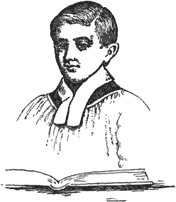
day we find that the clergy of the Church of England
preach either in a white surplice or in a black gown.
We can trace the black gown to an order made by
James I, but at the present day the vestments worn
by the clergy of the Presbyterian Churches are rather
professional, or academical like a barrister’s gown,
than properly ecclesiastical. We have already mentioned
the bands (see p. 44) which are worn with the
black gown, and here we might mention that when
the preacher ministers to a recognized congregation
he wears them, though if he is ordained but is conducting
an occasional service he does not.
Charles I gave instructions that the surplice should
be worn, and had an Act passed giving him power to
regulate clerical costume. But the clergy sent in a
petition that matters should be left as they were, and
this request seems to have been granted, as some of
the ministers at the time expressed the fear that
His Majesty would order them to wear hoods and
bells. Mr. Macalister25 says that the surplice was
originally invented to take the place of the albe,
which was made so small that it was difficult to put
it over the cassock when the latter garment was thick
and lined with fur.
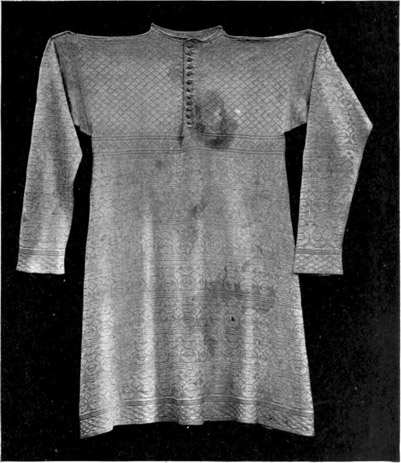
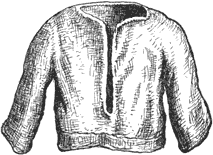
Originally the surplice was put on over the head, in
the same way as the albe, the place of which it took,
but some two hundred years ago the surplice was
made open in front and fastened at the neck with a
button. The reason for this is that in this way the
surplice could be put on without disarranging the
enormous wigs which were worn during the seventeenth
and eighteenth centuries. The cassock, to
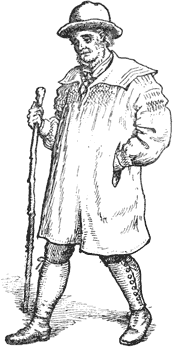
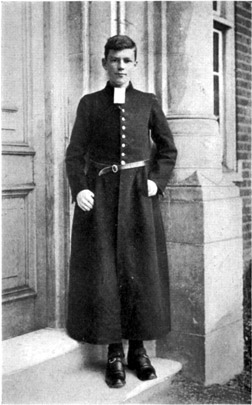
which we have already alluded, was a long, loose coat
or gown, which was worn by both sexes from the
eleventh century onwards. The name was applied to
the coat adopted by foot soldiers in the time of
Elizabeth. In the case of the laity, it was abandoned
in favour of the shorter and more convenient coat.
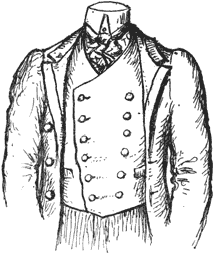
The black coat of the modern clergy, whom we
term “the cloth,” no doubt represents it, while it
is of course worn ordinarily by many Roman Catholic
clergy, and some High Churchmen, as an everyday
garment, for which it was originally intended. The
row of buttons which now fasten the long cassocks
from neck to the foot have been humorously compared
by Lord Grimthorpe to the close row of rivets
on a boiler.
With regard to the development of the more ornamental
dress of the clergy there is a great deal to be
said. In the past, two separate origins for it have
been suggested, and to pursue either of these would
be to take us far back into history. It has been
claimed, in the first place, that modern church vestments
have been derived from those of the Levitical
priesthood. The other idea is that the ceremonial
dress of the clergy was derived from the civil costume
of the Romans. It appears, however, that careful
researches have shown that the decorations which
have given ecclesiastical vestments their highly ornamented
character—in which they resemble certainly
those used by the Jews in Temple worship—have
been gradually acquired.
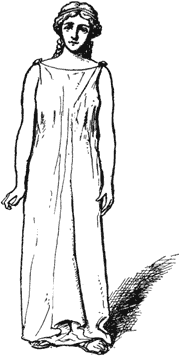
The dress of the ancient Christians was simple, and
it seems likely that owing to the poverty of the early
Church rich clothing could hardly have been adopted.
Besides, for many centuries there is no mention of
such vestments as we are considering, and no records
as to their having been derived from Jewish models.
On the other hand, everything points to a more
natural origin of the raiment concerned. Flowing
garments, as we have already seen, give dignity, and
we find that among the Romans such were used in
dignified leisure or on occasions of state, in contradistinction
to the dress of active existence, which
consisted of a short tunic or chiton. It is with the
first kind of dress that we have to deal.
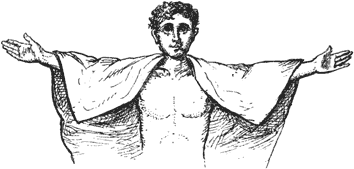
It consisted of a tunic either short or long, over
which was worn the toga which was capable of the
same variety of arrangement as the plaid which still
survives. Even when the toga was given up by the
people generally, on the founding of the Roman
Empire, it continued to be used in certain cases.
It was etiquette to wear a toga when dining with
the Emperor or going to court; advocates wore it,
as did clients when they visited their patrons, and
it was also adopted at funerals and when sacrifices
were being made.
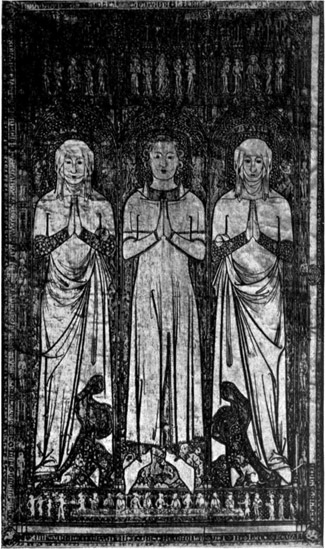
On the face of it, it would appear likely that those
who ministered to the early Christian Church would
follow the general custom. Nothing, perhaps, affords
better evidence of this having taken place than an
illustration which is considered authentic of St.
Gregory the Great with his father and mother. As
Mr. Marriott26 points out, if it were not for the Papal
pallium—that is to say, the band round his shoulders—on
which crosses are embroidered, and the book of
the Gospels which he holds in his hand, it would be
hard to distinguish which was the bishop and which
the senator. (See Figure 128.)
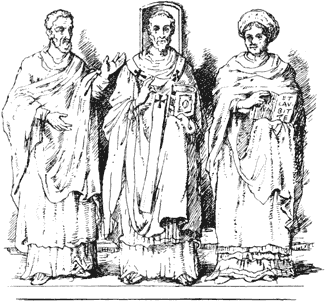
Fig. 128.—St. Gregory the Great with his father Gordianus, who was a
senator, on his right, and his mother Sylvia on his left. This shows the
similarity between ecclesiastical and civil costume in early times. From
an authentic picture (after Marriott).
From this dress it is claimed, by those who have
carefully gone into the question, that ecclesiastical
vestments have been developed. In connection with
this, Mr. Macalister27 makes the following remarks:
“Fashion in dress or ornaments is subject to constant
changes, which, though perhaps individually
trifling, in time amount to complete revolutions; but
the devotees of any religion, true or false, are by
nature conservative of its doctrines or observances.
At first the early Christians wore the same costume
both at worship and at home. Fashion,” Mr.
Macalister continues, “would slowly change unchecked
from year to year, while ecclesiastical conservatism
would retard such changes as far as they
concern the dress worn at divine service; small
differences would spring into existence between everyday
dress and the dress of the worshipper. These
differences, at first hardly perceptible, would increase
as the process went on, until the two styles of
costume became sharply distinguished from one
another.” In this connection it will be interesting
to mention those vestments which antiquarians have
traced to Roman costume.
The albe takes its name from the tunica alba, which
was used as a purely secular garment until the ninth
century. It was worn by all the ministers and
deacons, but as the latter had no vestment above the
albe, it came to be the special characteristic of the
deacons. Usually, as the name implies, the albe was
white, but in this country coloured albes were sometimes
used.
We have already seen that the surplice was derived
from the albe, and Mr. Marriott has brought forward
all the evidence that he can to show that white was
the colour of the vestments at the earliest times in
the history of the Church. His arguments, however,
do not seem to be conclusive, and his inferences do
not commend themselves to Mr. Macalister. The
latter thinks, however, that the view that white was
the colour appropriated in primitive times to the dress
of the Christian ministry is preferable to the theory
that the early vestments were of the same elaborate
description as their mediæval successors. He is of
opinion, nevertheless, that the passages upon which
Mr. Marriott bases his arguments are quite consistent
with a third alternative, namely, that no distinctive
vestments were set apart for the exclusive use of the
Christian minister during the first four centuries of
the Christian era.
The dalmatic was a wide gown or tunic with long
full sleeves, which was derived apparently from the
albe and used by persons in high secular positions
before it was adopted by the Church. In the
mediæval period the dalmatic was slit for a short
distance up either side and fringes were added to
decorate the slits, the hems, and the ends of the
sleeves. In this style the garment was worn by a
bishop. There were, however, only fringes on the
left sleeves and along the left side in the form of this
vestment which was appropriated to a deacon.
Most elaborate explanations were offered by mediæval
writers for this difference, which seems merely
to be a matter of convenience for the deacon, who
served at the altar. It was important that he should
have his right side free, and the heavy fringes would
have got into his way. One of the ideas with regard
to the fringe was that the absence from the right side
symbolizes our freedom from care in the world to
come; but why, Mr. Macalister asks, was not the
bishop to be exempt from care in the future world? In
connection with the coronation of English sovereigns
the dalmatic is still used, as well as representatives
of other ecclesiastical vestments, but to these we shall
refer again.
It is not at all unlikely that the stole which a
clergyman wears after the fashion of an untied tie,
and which hangs from his neck nearly to the ground,
is really the same thing as our handkerchief, and it is
certain that it was employed originally as a scarf or
orarium. In many Roman monuments which are not
of an ecclesiastical character, scarves are worn over
the rest of the dress. They pass over the left shoulder,
diagonally, towards the right side, and are fastened
under the right arm. They are not to be confounded with
the two bands of purple (or clavi) which on the tunics
of senators and other important men ran round the
sides of the neck openings and down to the lower hem.
It is probable that the scarves were used in the same
way as favours and “colours” among ourselves. It
is recorded that Aurelian was the first emperor who
distributed “oraria” as presents to the people to be
worn as favours. In this connection we must not
forget the ribbons of the Knightly Orders, which we
have already mentioned when speaking of the baldric.
The Fourth Council of Toledo enacted that deacons
should wear their stoles over their left shoulder so
that their right arm might be free to facilitate the
execution of their duties in divine service. An
English church vestment actually goes by the name
of the scarf, and is a broad black band of silk worn in
the same way as the stole. It is probably a modification
of some article of university costume, possibly
the tippet (see p. 212), and is worn by Doctors of
Divinity and the clerical authorities of Collegiate and
Cathedral bodies.
The outdoor garment which replaced the toga took
several forms. One of these had already been in use
for some time as part of the dress of the lower classes
and of slaves. Speaking briefly, it rose in the world,
and emperors even wore it when they were travelling.
One form, called the casula, is of interest to us because
it is the forerunner of the chasuble.
So much attention has been drawn to ecclesiastical
vestments of recent years, owing to the adoption by
English High Church clergy of those in which Roman
Catholic priests celebrate Mass, that it may be perhaps
of interest, even at the risk of recapitulation, to
consider them. It should be said at the outset that the
stripes of embroidery, which are often very elaborate
and enriched with jewels, which appear on vestments
such as the amice and albe, are called apparels.
To garments which are white and have at times to
be washed, these ornaments are sewn or otherwise
attached, so that they can be removed when it is
necessary and replaced. The amice we have not yet
mentioned, as it is of mediæval origin and did not
come into our consideration of the evolution of modern
vestments from Roman dress. It was a rectangular
piece of linen, about thirty-six inches by twenty-five
inches, with an apparel sewn along one edge and a
cross embroidered in the centre. This the priest at
the present time wears round his neck. The outer
garment or chasuble, which is richly ornamented,
we have traced to the garment which replaced the
Roman toga, and as it is without sleeves and has
become heavier, it has been found necessary to slit
up the sides. Under this the stole is worn over the
albe, and only its ends appear beneath the chasuble.
(See Figure 129.) There is ornamentation on the
sleeves of the albe, where they show, and on the back
and front of it where it shows below the chasuble.
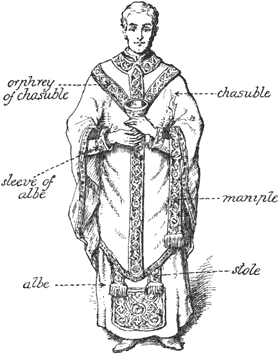
Fig. 129.—A priest in the vestments now worn at the celebration
of the Eucharist.
The apparels, according to Druitt, are possibly the
remains of the purple bands and other ornamentations
of the Roman tunic, from which we have seen that
the albe was derived. Over the left arm the priest
carries a maniple which is something like a stole.
This was originally made of linen, and worn over the
fingers of the left hand. There is no doubt but that
it was once a napkin and, according to Mr. G.
C. Coulton,28 originally used in the fashion of a
modern pocket-handkerchief. That it was a napkin
is shown by quotations from ancient writers, and
there seems no doubt also that many refinements of
Roman civilization, of which the pocket handkerchief
was one, were lost in the later Middle Ages. In fact,
the handkerchief only began to come into general use
in polite society about Henry VIII’s reign, and the
maniple of the ministrant at the altar must have lost
its original use, or Bernard would not have twice
warned him against blowing his nose on his chasuble
or surplice.
When speaking of the handkerchief, there is
another use which we may mention. It was often
employed for ceremonial purposes in connection with
the giving of presents, and this idea seems to have
come from Eastern lands, where gifts are wrapped in
highly ornamental covers. In the parable of the
talents, one of them, it will be remembered, was wrapped
in a napkin, and even to-day the labourer has his
dinner taken to him in a brightly coloured cotton
handkerchief.
Among the special vestments of bishops are the
dalmatic, which we have already described, and the
tunicle, which originally did not differ from it, and
began to be worn beneath it about the twelfth century.
Others are the buskins or stockings (which were
originally reserved for the pope), sandals, ring, gloves,
and mitre, together with a pastoral staff adapted from
the shepherd’s crook.
Archbishops have a cross staff and a pallium or
pall which is probably derived from the same ancestor
as the stole, namely the orarium, which, we have seen,
was a favour or distinction granted by the Roman
Emperor.
The word pallium has been applied to a number of
garments in the past, many of which were of a flowing
character, and some writers have seen in the
archbishop’s pall a small vestige of what was once
an ample vestment. Early pictures, however, show
the pall looped round the shoulders with one end
hanging in front of the body and one behind. Mr.
Macalister says that it was difficult sometimes to distinguish
between it and the stole, and that the next
step in its evolution was to knot the free ends to the
loops as shown in the eighth, ninth, and tenth
centuries. From this it was but an easy step to the
final form which consists of an oval loop with a long
tail pendent from each of its ends, so that when it is
worn on the person it makes a capital “Y” on the
back and another on the chest. It should be pointed
out that the pall must not be confounded with the
apparel of the chasuble called the orphrey, which also
has a “Y” shape.
In connection with the manufacture of the pall
there are some interesting proceedings. It is made
from the wool of two lambs, and they are solemnly
blessed on Saint Agnes’s day in the church dedicated
in the name of that saint at Rome. The
animals are chosen with special reference to their
whiteness and goodness, and are carried into Rome
in separate baskets, which are slung over a horse’s
back.
On the way to the church the Pope makes the sign
of the cross from a window over the lambs, and they,
after Mass has been celebrated and they have been
blessed by the celebrant, go back to the Pope, who
sends them to a nunnery, where they are shorn and
the wool made into palls by the nuns.
The modern pall has six black crosses on it, but
previous to the eighth century it had sometimes four,
sometimes eight, worked in purple.
At first the pall was fastened by gold pins to the
chasuble to keep it in place, but just as ladies now
use little lead weights to keep parts of their dress in
position, so lead was used to hold the archbishop’s pall
in place. The effigy of Albrect von Brandenburg in
1555, at Mayence, shows two palls, which probably
indicate that he was Archbishop of Magdeburg as
well as of Mayence. This repetition can hardly be
strictly correct, as the pall could only be worn within
the Archbishop’s province.
Archbishops in olden days appeared to have had
no authority to act until they received their pall from
the Pope. The honour was, however, bestowed
occasionally on bishops. The pall is generally
shown on the coats of arms of archbishops. (See
Figure 130.)
The cope is one of the so-called processional vestments.
It does not appear before the ninth century,
and is apparently connected with Roman dress. It
was an outer cloak without sleeves, and originally was
used as a protection from the weather at open-air
processions in Rome, its ancestor probably being the
lacerna. In a similar way the almuce was a hood to
protect the head, and such articles, as Mr. Macalister
says, the clergy would continue to adopt in their cold
and draughty churches or in open-air processions.
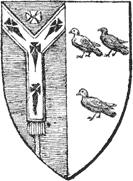
Fig. 130.—The coat of arms of Thomas à Becket.
Showing an archbishop’s pall.
Of monastic habits the earliest was the Benedictine,
consisting of a cassock over which was worn the cowl—a
large, loose gown, with hanging sleeves and a
hood attached to it. In the old times the costume of
abbesses and nuns resembled the mourning habit of
widows, who often retired to end their days in a convent.
When the English Church was reformed, the
Mass vestments practically disappeared. The first
Prayer Book of Edward VI prescribed for the Holy
Communion a white albe, without any apparels, with
a vestment or cope, while the assistant priest or
deacons were to wear albes with tunicles. The cope
was also to be worn with a plain albe or surplice on
Wednesdays and Fridays when there was no communion.
The bishop was to wear a rochet, a surplice
or albe, and a cope or vestment. The second
Prayer Book prohibited the use of the albe, vestment,
or cope to the minister, allowing him only a surplice,
while the archbishop or bishop was allowed a rochet.
The Act of Uniformity upheld the ornaments rubric
of the first Prayer Book of Edward VI, and this has
never been superseded.
The lawn sleeves of the modern bishop developed
from the rochet, which was a kind of modified albe,
which at first had a kind of tight-fitting sleeves or
none at all. Over this rochet is worn a black satin
chimere, and as it was difficult to get this over the
bishop’s sleeves, they were removed from the rochet
and are now fastened to the chimere. The black
scarf we have already considered.
It is customary at the present day for clergy of the
English Church to wear the academical hood of their
university degree over their surplices. This is ordained
by the fifty-eighth canon, but ministers who are
not graduates are permitted to wear, instead of hoods,
“some decent tippet of black, be it not silk.” It
appears that in the time of Elizabeth, in everyday
dress, ministers wore a gown and some of them a silk
hood. The tippet is a survival of the almuce, which
we mentioned in connection with the cope, and is one
of the so-called processional dresses. It must therefore
not be confounded with the amice, which is a
truly ecclesiastical vestment.
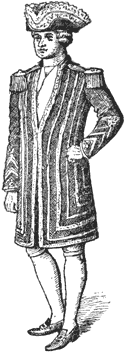
As bearing on the conservatism of the Church in
matters of dress, we may mention that in Holland,
until recent times, the clergy wore a very old-fashioned
dress, or perhaps it may better be described as
a picturesque uniform, consisting of an old three-cornered
hat, and a coat resembling the ordinary
evening dress-coat, having a long pleated strip called
“the mantle” hooked on the neck, and obviously
being a survival from an early and more ample gown
of some kind. They wore knee-breeches buckled at
the knees, and buckled shoes, but this costume was
only used when the minister was officiating at service.
Some of the heads of the churches in Scotland
still adopt a kind of Court dress.
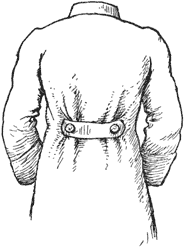
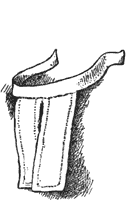
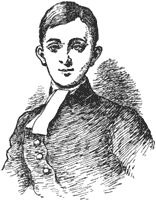
In turning for a moment again to the everyday
dress of the clergy, the method of fastening the
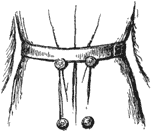
characteristic white choker at the back seems to have
come from the bands. Thackeray in “The Newcomes”
uses the name choker as meaning a white necktie,
and it was also applied to the old leather stocks
which the clerical collar, in its stiffness, resembles.
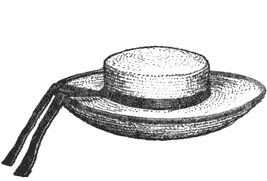
The bishop’s hat we have already alluded to, as
showing the stage in a process of cocking, the brim
being tied to the crown by strings. The clerical
gaiters we can derive from the old episcopal buskins,
while the apron appears to be a vestige of the
cassock to which we have before referred.
The dress of monks usually consists of a tunic or
closed gown and scapular, while there may be one or
more open gowns with a hood at the back.
Nuns or Sisters of Mercy are so commonly seen in
our streets, and they do so much for the benefit of the
poor, and take such a part in educational matters,
that their dress is very familiar to us. It is difficult
to say how old it may not be, and though stiff hoods
similar to those which are now in use by nuns were
adopted by women generally in Tudor times, we
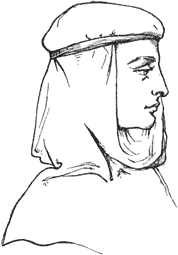
find in the head-dress of Henry II’s reign the counterpart
of the linen bands which surround the face and
hide the hair. The other garments of nuns may have
the same origin as ecclesiastical vestments, for the
dress of the Roman women was very much like that
of the men. (See Figures 128 and 131-133.)
There are, of course, many orders, congregations,
and communities of nuns, but we may describe the
dress of one of the latter, and then make a few
additional remarks. In the case of the Kilburn
Sisters of the Church, who are English Catholics—but
who have dedicated their lives to religion in the
same way as the Roman Catholic nuns—the indoor
dress consists of a white cap, the descendant of the
Norman chin-band, which fits tightly round the head—as
the hair of all nuns is, of course, cut close—and
it is gathered round the face with a string. This cap,
if it comes down low on the forehead, correspondingly
covers the chin, but in many cases the latter is
free. Over the white cap in indoor dress a black veil
is worn in the case of professed nuns, a blue veil by
novices, while postulants, who may be taken as
corresponding to probationers in a hospital, wear only
a cap, though in chapel they have a white veil as
well. Round the neck of the Sister is a white collar,
which in this case is separate from the cap and
buttons on to it at one side.
This collar, which like the veil may be traced to
the wimple of Norman and later ladies, is also called
a breast cloth or a gremial, and may be, as we have
indicated, made in one piece with the cap.
In outdoor dress a stiff white hood is placed over
the indoor head-dress, and over that again comes the
outdoor black veil.
It should be mentioned that the Kilburn Sisters
now pin their veils to the sides of their linen caps in
exactly the same way that the dame in the time of the
early Plantagenets did her wimple to the sides of her
chin-band.
For working Sisters, the rest of the costume is
a habit with skin-tight sleeves, though there are
also most voluminous outer sleeves which are detachable
and can be removed. A small cape is buttoned
across the chest, and the number of buttons corresponds
with the letters in the word “Obedience.” An
apron is also worn and a thick girdle, to one of the
hanging ends of which a cross is attached. Other
Sisters wear a scapular with shoulder-straps, over a
white cape. Nuns are not allowed to wear gloves,
and some orders use sandals, though absolutely barefooted
orders exist.

Fig. 131.—The head-dress of a nun showing the veil and breast-cloth
derived from the wimple, the cap which represents the chin-cloth,
together with the frontal and the hood.

Fig. 132.—The head-dress of a lady
of the time of Henry II. The
wimple is shown covering the chin-
and head-bands (after Calthrop).
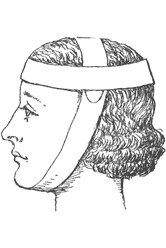
Fig. 133.—The chin-band and forehead
strap after the wimple has
been removed (after Calthrop).
The lay sisters of the community under consideration
wear a blue habit and a white cap with flaps.
Some orders, in addition to the white cap, wear a plain
band round the forehead over it, which is called a
frontal, and is seen in the dress of Henry II’s
time. (See Figures 131 and 133.)
Professed sisters wear a wedding ring on the
third finger of their right hand. The white outdoor
stiffened hoods often stand right up from the head in
a very striking way, and sometimes no veils are worn.
Some of the caps, which are made in one piece
with the collar, are fastened under the chin by two
strings, and the goffered edges of the collar recall the
bands of the Stuart period.