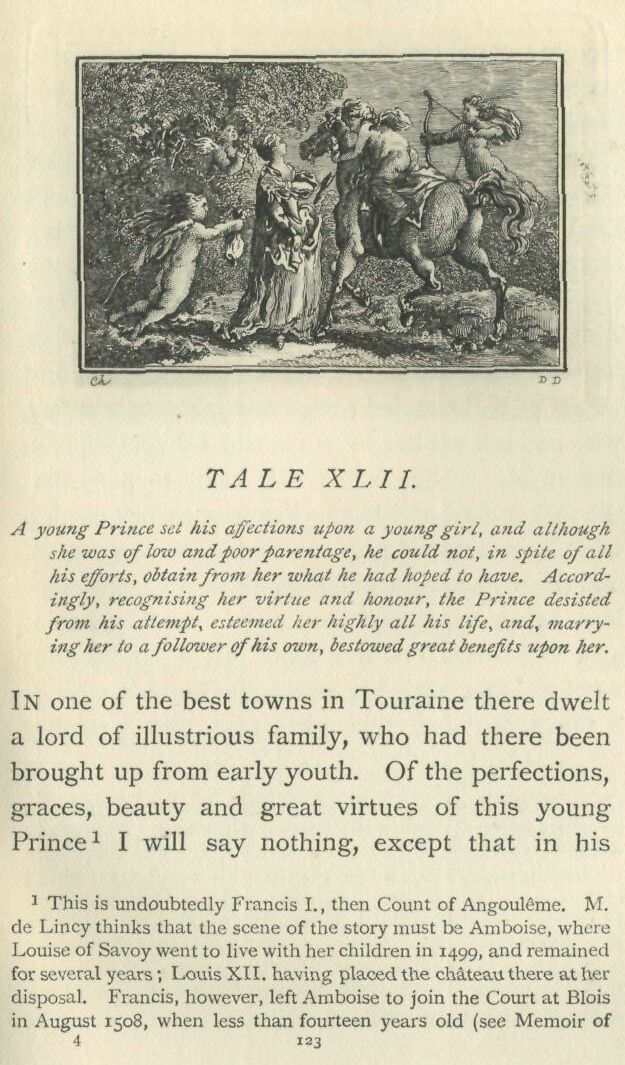
A young Prince set his affections upon a young girl, and
     although she was of low and poor parentage, he could not, in
     spite of all his efforts, obtain from her what he had hoped
     to have. Accordingly, recognising her virtue and honour, the
     Prince desisted from his attempt, esteemed her highly all
     his life, and, marrying her to a follower of his own,
     bestowed great benefits upon her.
In one of the best towns in Touraine there dwelt a lord of illustrious
family, who had there been brought up from early youth. Of the
perfections, graces, beauty and great virtues of this young Prince (1) I
will say nothing, except that in his time his equal could not be found.
Being fifteen years of age, he had more pleasure in hunting and hawking
than in looking at beautiful ladies.
     1  This is undoubtedly Francis I., then Count of Angoulême.
     M. de Lincy thinks that the scene of the story must be
     Amboise, where Louise of Savoy went to live with her
     children in 1499, and remained for several years; Louis XII.
     having placed the château there at her disposal. Francis,
     however, left Amboise to join the Court at Blois in August
     1508, when less than fourteen years old (see Memoir of Queen
     Margaret, vol. i. p. xxiii.), and in the tale, above, he is
     said to have been fifteen at the time of the incidents
     narrated. These, then, would have occurred in the autumn of
     1509. It will be seen that in the tale the young Prince’s
     sister (Margaret) is described as residing at the castle.
     Now Margaret married Charles of Alençon at Blois, in October
     1509, and forthwith removed to Alençon. Possibly Francis,
     who was very precocious, especially in matters of gallantry,
     engaged in the love affair narrated by his sister at a yet
     earlier age than she asserts, in which case the town she
     refers to would undoubtedly be Amboise.—Ed.
One day in a church he beheld a young maiden who formerly, during her
childhood, had been bred in the castle where he dwelt; but after her
mother’s death, her father having married again, she had withdrawn into
Poitou with her brother. This maiden, who was called Frances, had a
bastard sister whom her father dearly loved, and whom he had married to
the young Prince’s butler, who maintained her in as excellent a condition
as that of any of her family. It came to pass that the father died and
left to Frances as her portion what he possessed near the town
aforementioned, and thither she returned after his death; nevertheless,
being unmarried and only sixteen years of age, she would not live alone in
her house, but went to lodge with her sister, the butler’s wife.
On perceiving this girl, who was passably beautiful for a light brunette,
and possessed a grace beyond her condition (for, indeed, she seemed rather
a lady or princess than a towns-woman), the young Prince gazed at her for
a long time, and he, who never yet had loved, now felt in his heart an
unwonted delight. On returning to his apartment he inquired concerning the
maiden he had seen in the church, and then recollected that formerly in
her youth she had come to the castle to have dolls’ play with his sister.
He reminded the latter of her; and his sister sent for her, received her
kindly, and begged her to come often to see her. This she did whenever
there was a feast or entertainment; and the young Prince was so pleased to
see her that he had in mind to be deeply in love with her, and, knowing
her to be of low and poor parentage, hoped easily to obtain what he
sought.
Having no means of speaking with her, he sent a gentleman of his chamber
to her to conduct his intrigue. But she, being discreet and fearing God,
told the gentleman that she did not believe so handsome and honourable a
Prince as his master could have pleasure in looking upon one so ugly as
herself, since he had so many beautiful ladies in the castle where he
lived, that he had no need to search through the town; and she added that
in her opinion the gentleman was speaking of his own authority, and
without his master’s command.
When the young Prince received this reply, love, which becomes the more
eager the more it meets with resistance, caused him to pursue his
enterprise more hotly than before, and to write her a letter in which he
begged that she would believe all the gentleman had told her.
Being well able to read and write, she read the letter through, but, in
spite of all the gentleman’s entreaties, she would never send an answer to
it. It was not for one of such low degree, she said, to write to so noble
a Prince, and she begged the gentleman not to deem her foolish enough to
believe that the Prince had so much love for her. Moreover, he was
deceived if he thought that he could have her at his will by reason of her
humble condition; for her heart was as virtuous as that of the greatest
Princess in Christendom, and she looked upon all the treasures in the
world as naught in comparison with honour and a good conscience. She
therefore entreated him not to try to hinder her from keeping these
treasures safe her whole life long, for she would never change her mind
even were she threatened with death.
The young Prince did not find this reply to his liking, nevertheless he
loved her dearly for it, and never failed to have his chair set in the
church to which she went to hear mass, where, during the service, he would
ever turn his eyes upon the same image. When she perceived this, she
changed her place and went to another chapel—not indeed to flee the
sight of him, for she would not have been a reasonable being had she not
found pleasure in beholding him—but because she dreaded to be seen
by him. She did not deem herself worthy to be loved by him in honour or
marriage, and, on the other hand, she would not be loved wantonly and for
pleasure. When she found that, in whatever part of the church she placed
herself, the Prince heard mass close by, she would no longer go to the
same church, but repaired every day to the remotest that she could find.
And when there was feasting at the castle, although the Prince’s sister
often sent for her, she would no longer go thither, but excused herself on
the plea of sickness.
Finding that he could not have speech with her, the Prince had recourse to
his butler, and promised him great rewards if he would lend assistance in
the matter. This the butler, for the sake both of pleasing his master and
of the gain that he expected, readily promised to do. Every day he would
relate to the Prince what she said or did, telling him that she was
especially careful to shun all opportunities of seeing him. However, the
great desire that the Prince had of speaking with her at his ease,
prompted him to devise the following plan.
One day he took his chargers, which he was beginning to manage excellently
well, to a large open space in the town opposite to his butler’s house, in
which Frances lived. After making many courses and leaps which she could
easily see, he let himself fall from his horse into some deep mire, but so
softly that he was not hurt. Nevertheless he uttered passably loud groans,
and asked whether there was a house near in which he might change his
dress. Every one offered his own, but on some one saying that the butler’s
was the nearest and worthiest, it was chosen before all the others.
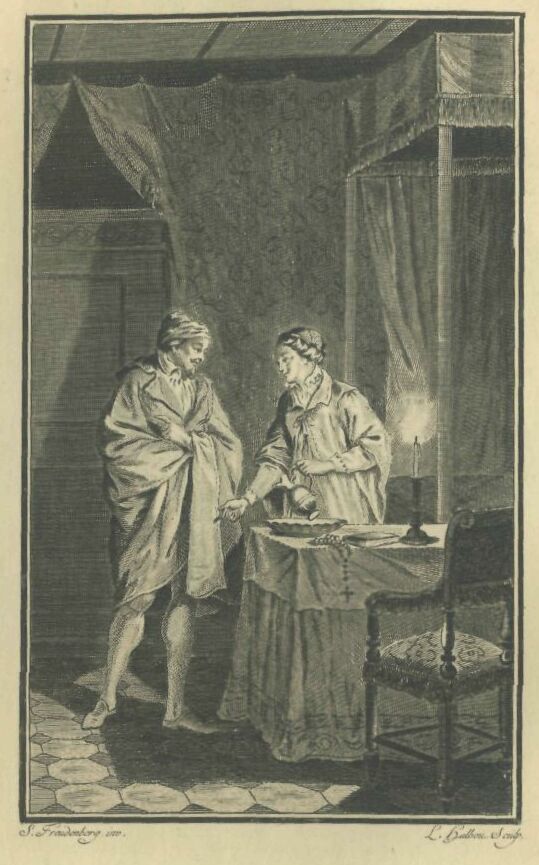
He found the room well furnished, and, as all his garments were soiled
with the mud, he stripped himself to his shirt, and got into a bed. Then,
when he saw that, except the gentleman aforementioned, every one was gone
to bring him some clothes, he called his host and hostess and asked them
where Frances was. They had much ado to find her, for, as soon as she had
seen the young Prince coming in, she had gone to hide herself in the most
retired nook in the house. Nevertheless her sister found her, and begged
her not to be afraid to speak to so worshipful and virtuous a Prince.
“What! sister,” said Frances, “do you, whom I look upon as my mother,
advise me to go and speak with a young lord, of whose purpose, as you are
aware, I cannot be ignorant?”
However, her sister addressed so many remonstrances to her, and promised
so often not to leave her alone, that she at last went with her, showing
so pale and sorry a face that she seemed more likely to beget compassion
than desire.
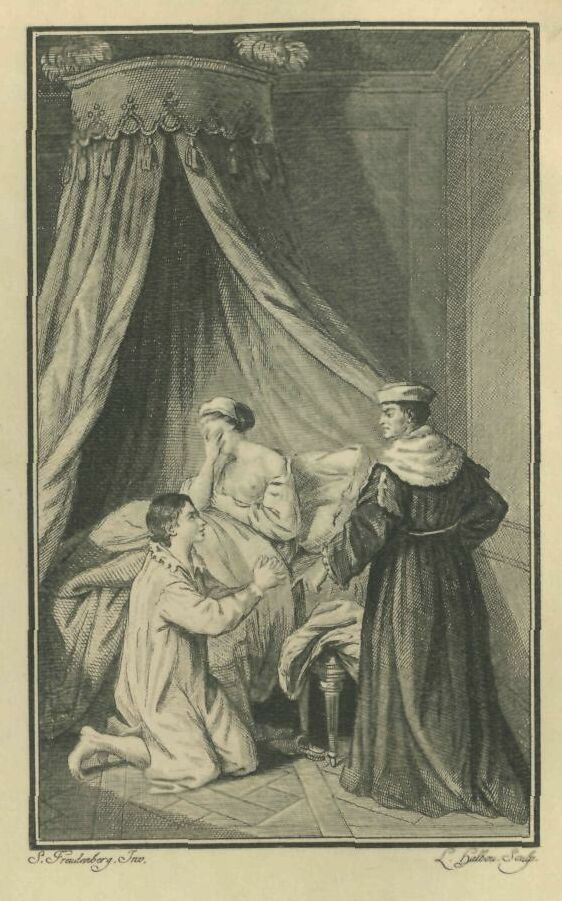
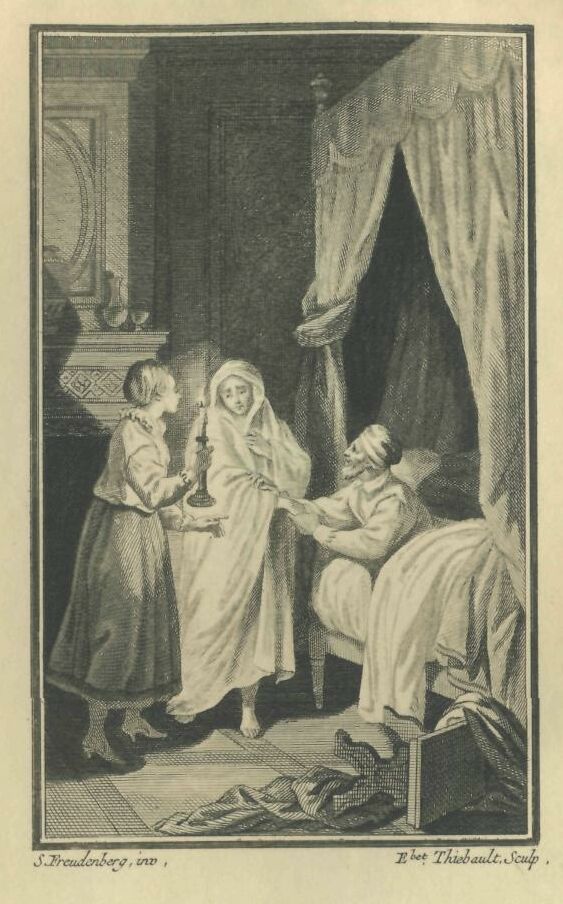
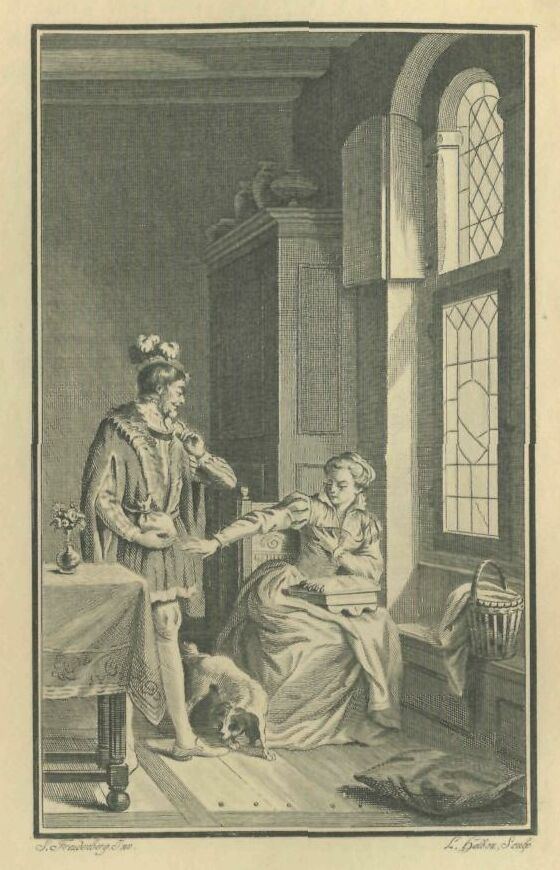
When the young Prince saw her by his bedside, he took hold of her hand,
which was cold and trembling, and said to her—
“Frances, do you deem me so wicked a man, and so strange and cruel, that I
eat the women I look upon? Why have you come to be so afraid of me who
seek only your honour and profit? You know that I have sought to hold
converse with you in all possible places, but all in vain; and, to grieve
me still more, you have even shunned the places where I had been wont to
see you at mass, so that my eyes might bring me as little gladness as my
tongue. But all this has availed you naught, for I have never rested until
I came hither in the manner you have seen, and I have risked my neck, in
allowing myself to fall, in order that I might have the joy of speaking to
you without hindrance. I therefore entreat you, Frances, that the
opportunity gained by so much toil may not be thrown away, and that my
deep love may avail to win your own.”
After waiting a long time for her reply, and seeing that her eyes were
full of tears and fixed upon the ground, he drew her to him as closely as
he could, and tried to embrace and kiss her. But she said to him—
“No, my lord, no; what you desire cannot be, for although I am but a worm
of the earth compared with you, I hold my honour dear, and would rather
die than lessen it for any pleasure that the world can give. And the dread
I have lest those who have seen you come in should suspect the truth,
makes me tremble and be afraid as you see. And, since it pleases you to do
me the honour of speaking to me, you will also forgive me if I answer you
according as my honour requires. I am not so foolish, my lord, nor so
blind as not to perceive and recognise the comeliness and grace that God
has given you, or not to consider that she who shall possess the person
and love of such a Prince must be the happiest woman alive. But what does
all this avail me, since it is not for me or any woman of my condition,
and since even to long for it would, in me, be utter folly? What reason
can I believe to be yours in addressing yourself to me except that the
ladies in your house, whom you must love if you have any love for beauty
and grace, are so virtuous that you dare not seek or expect from them what
the lowliness of my condition has led you to expect from me? I am sure
that if you obtained your desire from one such as I, it would afford
matter for entertainment to your mistress during two good hours, to hear
you tell her of your conquests over the weak. But, my lord, be pleased to
bear in mind that I shall never be of their number. I have been brought up
in your house, where I have learned what it is to love; my father and my
mother were your faithful servants. Since, therefore, God has not made me
a Princess to marry you, nor of sufficient rank to be your mistress and
love, you will be pleased not to try to number me with the unfortunate,
seeing that I deem and would have you to be one of the happiest Princes in
Christendom. If for diversion you would have women of my condition, you
will find in this town many who are beyond compare more beautiful than I,
and who will spare you the pains of so many entreaties. Content yourself,
then, with those to whom you will give pleasure by the purchase of their
honour, and cease to trouble one who loves you more than she loves
herself. For, indeed, if either your life or mine were required of God
this day, I should esteem myself fortunate in offering mine to save yours.
It is no lack of love that makes me shun your presence, but rather too
great a love for your conscience and mine; for I hold my honour dearer
than life. I will continue, my lord, if it please you, in your good grace,
and will all my life pray God for your health and prosperity. And truly
the honour that you have done me will lend me consideration among those of
my own rank, for, after seeing you, where is the man of my own condition
upon whom I could deign to look? So my heart will continue free save for
the duty which shall always be mine of praying to God on your behalf. But
no other service can you ever have of me.”
On hearing this virtuous reply, contrary though it was to his desires, the
young Prince could not but esteem her as she deserved. He did all that he
could to persuade her that he would never love another woman, but she was
too prudent to suffer so unreasonable a thought to enter her mind. While
they were talking together, word was often brought that his clothes were
come from the castle, but such was his present pleasure and comfort, that
he caused answer to be given that he was asleep. And this continued until
the hour for supper was come, when he durst not fail to appear before his
mother, who was one of the discreetest ladies imaginable.
Accordingly, the young man left his butler’s house thinking more highly
than ever of the maiden’s virtue. He often spoke of her to the gentleman
that slept in his room, and the latter, who deemed money to be more
powerful than love, advised his master to offer her a considerable sum if
she would yield to his wishes. The young Prince, whose mother was his
treasurer, had but little money for his pocket, but, borrowing as much as
he was able, he made up the sum of five hundred crowns, which he sent by
the gentleman to the girl, begging her to change her mind.
But, when she saw the gift, she said to the gentleman—
“I pray you tell my lord that I have a good and virtuous heart, and that
if it were meet to obey his commands his comeliness and grace would ere
now have vanquished me; but, since these have no power against my honour,
all the money in the world can have none. Take it, therefore, back to him
again, for I would rather enjoy virtuous poverty than all the wealth it
were possible to desire.”
On beholding so much stubbornness, the gentleman thought that violence
must needs be used to win her, and threatened her with his master’s
authority and power. But she laughed, and said—
“Make those fear him who have no knowledge of him. For my part, I know him
to be so discreet and virtuous that such discourse cannot come from him,
and I feel sure that he will disown it when you repeat it to him. But even
though he were what you say, there is neither torment nor death that would
make me change my mind; for, as I have told you, since love has not turned
my heart, no imaginable evil or good can divert me one step from the path
that I have chosen.”
The gentleman, who had promised his master to win her, brought him back
this reply in wondrous anger, and counselled him to persevere in every
possible way, telling him that it was not to his honour to be unable to
win a woman of her sort.
The young Prince was unwilling to employ any means but such as honour
enjoins, and was also afraid that if the affair made any noise, and so
came to his mother’s ears, she would be greatly angered with him. He
therefore durst make no attempt, until at last the gentleman proposed to
him so simple a plan that he could already fancy her to be in his power.
In order to carry it into execution he spoke to the butler; and he, being
anxious to serve his master in any way that might be, begged his wife and
sister-in-law one day to go and visit their vintages at a house he had
near the forest. And this they promised to do.
When the day was come, he informed the Prince, who resolved to go thither
alone with the gentleman, and caused his mule to be secretly held in
readiness, that they might set out at the proper time. But God willed it
that his mother should that day be garnishing a most beautiful cabinet,
(2) and needed all her children with her to help her, and thus the young
Prince lingered there until the hour was past.
There was, however, no hindrance to the departure of the butler, who had
brought his sister-in-law to his house, riding behind him, (3) and had
made his wife feign sickness, so that when they were already on horseback
she had come and said that she could not go with them. But now, seeing
that the hour at which the Prince should have come was gone by, he said to
his sister-in-law—
“I think we may now return to the town.”
     2  The French word here is cabinet, which some English
     translators have rendered as “little room.” We think,
     however, with the Bibliophile Jacob, that the allusion is to
     an article of furniture, such as we ourselves still call a
     cabinet in England, though in France the word has virtually
     lost that sense.—Ed.

     3  The MSS. do not say whether she rode on a pillion, or
     simply bestrode the horse. This last fashion was still
     common at this period and long afterwards, even among women
     of high degree. See, for instance, several of the enamels in
     the Louvre, notably one which depicts Henry II. of France
     with Diana of Poitiers riding behind him. The practice is
     also referred to in a sixteenth century ballad. “La
     Superfluity des habitz des Dames” (Anciennes Poésies
     Françaises. Bib. Elzev. 1858, p. 308).—M.
“What is there to hinder us from doing so?” asked Frances.
“Why,” said the butler, “I was waiting here for my lord, who had promised
me that he would come.”
When his sister-in-law heard this wickedness, she replied—
“Do not wait for him, brother, for I know that he will not come to-day.”
The brother-in-law believed her and brought her back again, and when she
had reached home she let him know her extreme anger, telling him that he
was the devil’s servant, and did yet more than he was commanded, for she
was sure that the plan had been devised by him and the gentleman and not
by the young Prince, whose money he would rather earn by aiding him in his
follies, than by doing the duty of a good servant. However, now that she
knew his real nature, she would remain no longer in his house, and
thereupon indeed she sent for her brother to take her to his own country,
and immediately left her sister’s dwelling.
Having thus failed in his attempt, the butler went to the castle to learn
what had prevented the arrival of the young Prince, and he had scarcely
come thither when he met the Prince himself sallying forth on his mule,
and attended only by the gentleman in whom he put so much trust.
“Well,” the Prince asked of him, “is she still there?”
Thereupon the butler related all that had taken place.
The young Prince was deeply vexed at having failed in his plan, which he
looked upon as the very last that he could devise, but, seeing that it
could not be helped, he sought out Frances so diligently that at last he
met her in a gathering from which she could not escape. He then upbraided
her very harshly for her cruelty towards him, and for having left her
brother-in-law, but she made answer that the latter was, in regard to
herself, the worst and most dangerous man she had ever known, though he,
the Prince, was greatly beholden to him, seeing that he was served by him
not only with body and substance, but with soul and conscience as well.
When the Prince perceived by this that the case was a hopeless one, he
resolved to urge her no more, and esteemed her highly all his life.
Seeing this maiden’s goodness, one of the said Prince’s attendants desired
to marry her, but to this she would not consent without the command and
license of the young Prince, upon whom she had set all her affection; and
this she caused to be made known to him, and with his approval the
marriage was concluded. And so she lived all her life in good repute, and
the young Prince bestowed great benefits upon her. (4)
     4  We take this concluding paragraph from MS. 1520; it is
     deficient in ours.—L.
“What shall we say to this, ladies? Have we hearts so base as to make our
servants our masters—seeing that this woman was not to be subdued
either by love or torment? Let us, I pray you, take example by her conduct
and conquer ourselves, for this is the most meritorious conquest that we
can make.”
“I see but one thing to be regretted,” said Oisille, “which is that these
virtuous actions did not take place in the days of the old historians.
Those who gave so much praise to their Lucretia would have neglected her
to set down at length the virtues of this maiden.”
“They are indeed so great,” said Hircan, “that, were it not for the solemn
vow that we have taken to speak the truth, I could not believe her to have
been what you describe. We have often seen sick persons turn in disgust
from good and wholesome meats to eat such as are bad and hurtful, and in
the same way this girl may have had some gentleman of her own estate for
whose sake she despised all nobility.”
But to this Parlemente replied that the girl’s whole life showed that she
had never loved any living man save him whom she loved more than her very
life, though not more than her honour.
“Put that notion out of your head,” said Saffredent, “and learn the origin
of the term ‘honour’ as used among women; for perhaps those that speak so
much of it are ignorant of how the name was devised. Know then that in the
earliest times, when there was but little wickedness among men, love was
so frank and strong that it was never concealed, and he who loved the most
perfectly received most praise. But when greed and sinfulness fastened
upon heart and honour, they drove out God and love, and in their place set
up selfishness, hypocrisy and deceit. Then, when some ladies found that
they fostered in their hearts the virtue of true love but that the word
‘hypocrisy’ was hateful among men, they adopted instead the word ‘honour.’
At last, too, even those who could feel no honourable love said that
‘honour’ forbade them, and cruelly made this a law for all, so that now
even those who love perfectly use concealment, holding virtue for a vice.
But such as have an excellent understanding and a sound judgment never
fall into any such error. They know the difference between darkness and
light, and are aware that true honour consists in manifesting the purity
of their hearts, (which should live upon love alone), and not in priding
themselves on the vice of dissimulation.”
“Yet,” said Dagoucin, “it is said that the most secret love is the most
worthy of praise.”
“Ay, secret,” said Simontault, “from the eyes of those who might misjudge
it, but open and manifest at least to the two persons whom it concerns.”
“So I take it,” said Dagoucin, “but it would be better to have one of the
two ignorant of it rather than have it known to a third. I believe that
the love of the woman in the story was all the deeper for not being
declared.”
“Be that as it may,” said Longarine, “virtue should be esteemed, and the
highest virtue is to subdue one’s own heart. Considering the opportunities
that the maiden had of forgetting conscience and honour, and the virtue
she displayed in all these opportunities and temptations by subduing her
heart, will, and even him whom she loved better than herself, I say that
she might well be called a strong woman. And, since you measure virtue by
the mortification of self, I say that the lord deserved higher praise than
she, if we remember the greatness of his love, his opportunities, and his
power. Yet he would not offend against that rule of true love which
renders prince and peasant equal, but employed only such means as honour
allows.”
“There are many,” said Hircan, “who would not have acted in the same way.”
“So much the more is he to be esteemed,” said Longarine, “in having
subdued the common craftiness of men. He who can do evil and yet does it
not is happy indeed.”
“Your words,” said Geburon, “remind me of one who was more afraid of doing
wrong in the eyes of men than of offending against God, her honour and
love.”
“Then I pray you tell us the story,” said Parlamente, “for I give you my
vote.”
“There are some persons,” said Geburon, “who have no God, or, if they
believe in one, think Him so far away that He can neither see nor know the
wicked acts that they commit; or, if He does, imagine that He pays no heed
to things here below, and is too careless to punish them. Of this opinion
was a lady, whose name I will alter for the sake of her family, and whom I
will call Jambicque.( 5) She used often to say that a woman who had only
God to deal with was very fortunate, if for the rest she was able to
maintain her honour among men. But you will see, ladies, that her prudence
and her hypocrisy did not prevent her secret from being discovered, as
will appear from her story, wherein the truth shall be set forth in full,
except that the names of persons and places will be changed.”
     5  Some of the MSS. give the name as Camele or Camille,
     which is also that adopted by Boaistuau.—L.
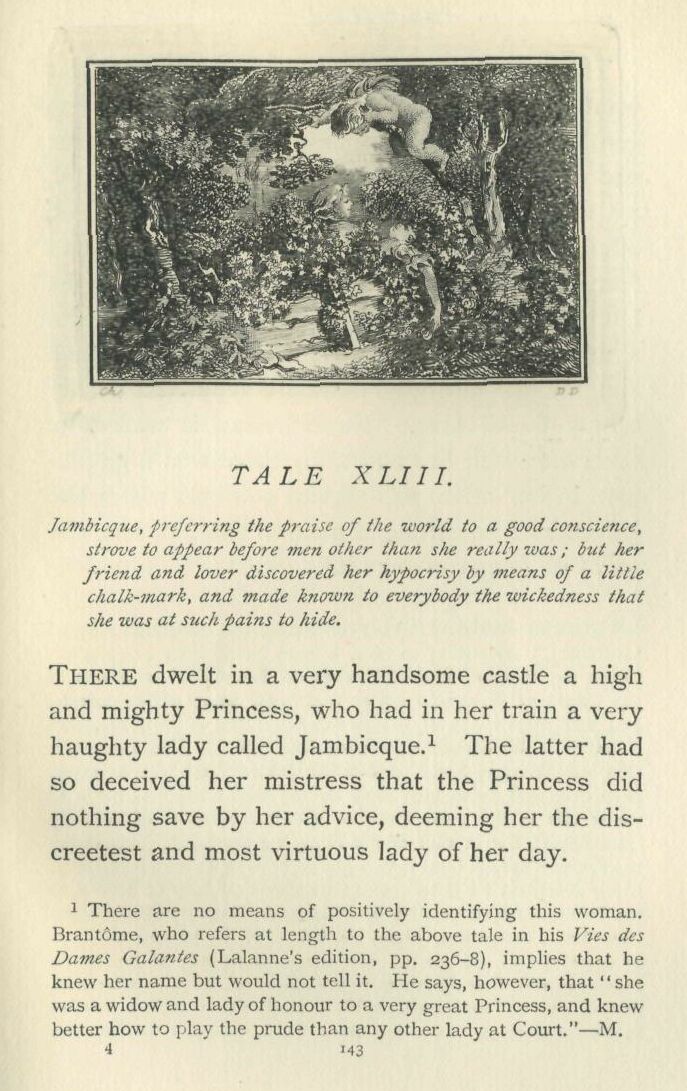
TALE XLIII .
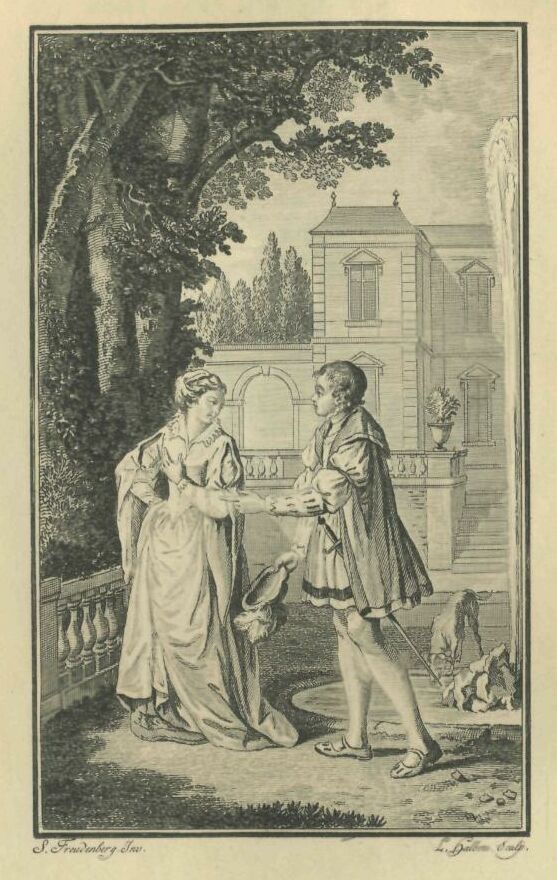
     Jambicque, preferring the praise of the world to a good
     conscience, strove to appear before men other than site
     really was; but her friend and lover discovered her
     hypocrisy by means of a little chalk-mark, and made known to
     everybody the wickedness that she was at such pains to
     hide.
There dwelt in a very handsome castle a high and mighty Princess, who had
in her train a very haughty lady called Jambicque. (1) The latter had so
deceived her mistress that the Princess did nothing save by her advice,
deeming her the discreetest and most virtuous lady of her day.
     1  There are no means of positively identifying this woman.
     Brantôme, who refers at length to the above tale in his
     Vies des Dames Galantes (Lalanne’s edition, pp. 236-8),
     implies that he knew her name but would not tell it. He
     says, however, that “she was a widow and lady of honour to a
     very great Princess, and knew better how to play the prude
     than any other lady at Court.”—M.
This Jambicque used greatly to inveigh against wanton passion, and
whenever she perceived any gentleman in love with one of her companions,
she would chide them with much harshness, and, by making ill report of
them to her mistress, often cause them to be rebuked; hence she was feared
far more than she was loved by all the household. As for herself, she
never spoke to a man except in a loud voice, and with much haughtiness,
and was therefore reputed a deadly enemy to all love. Nevertheless, it was
quite otherwise with her heart, for there was a gentleman in her
mistress’s service towards whom she entertained so strong a passion that,
at last, she could no longer endure it. (2)
     2  Brantôme writes as follows concerning the gentleman
     referred to above: “According to what I have heard from my
     mother, [Anne de Vivonne, wife of Francis de Bourdeille],
     who was in the Queen of Navarre’s service and knew some of
     her secrets, and was herself one of the narrators [of the
     Heptameron, i.e., Ennasuite], this gentleman was my late
     uncle La Chastàigneraye, who was brusque, hasty, and rather
     fickle. The tale, however, is so disguised as to hide this,
     for my said uncle was never in the service of the great
     Princess, who was mistress of the lady [Jambicque], but in
     that of the King her brother.” This shows the Princess to
     have been Queen Margaret herself; and Jambicque, being
     described by Brantôme as a widow and lady of honour to the
     Princess, might possibly be Blanche de Tournon ( Madame de
     Chastillon), concerning whom see vol. i. of the present
     work, p. 84 (note 7) and pp. 122-4. Her successor as lady of
     honour to Margaret was Brantôme’s own grandmother, of whom
     he says that she was not so shrewd, artful, or ready-witted
     in love matters as her predecessor. On the other hand,
     Blanche de Tournon must have been over forty when La
     Chastàigneraye engaged in this adventure, even allowing that
     he was only a youth at the time.—Ed.
The regard which she had for honour and good name caused her to conceal
her affection, but after she had been consumed by this passion for a full
year, being unwilling to find relief as other lovers do in look and
speech, she felt her heart so aflame that, in the end, she sought the
final cure. And she resolved that it were better to satisfy her desire
with none but God in the secret of her heart, rather than speak of it to a
man who might some time make it known.
After taking this resolve, she chanced to be one day in her mistress’s
apartment, when, looking out upon a terrace, she perceived walking there
the man whom she so dearly loved. She gazed upon him until the falling
darkness was hiding him from her sight, when she called a little page of
hers, and pointing to the gentleman, said—
“Do you see yonder that gentleman who wears a crimson satin doublet and
cloak of lynx fur? Go and tell him that one of his friends would speak
with him in the garden gallery.”
As soon as the page was gone, she herself passed through her mistress’s
wardrobe and into the gallery, having first put on her low hood and
half-mask. (3)
3 See ante, vol. iii. p. 27.
When the gentleman was come to where she was waiting, she immediately shut
the two doors by which they might have been surprised, and then, without
taking off her mask, embraced him very closely, and in the softest whisper
imaginable said—
“For a long time, sweetheart, the love I bear you has made me desire time
and place for speaking with you, but fearfulness for my honour was for a
while so strong as to oblige me, in my own despite, to conceal my passion.
Albeit, in the end, the strength of love has vanquished fear, and, in the
knowledge that I have of your honour, I protest to you that if you will
promise to love me without ever speaking of the matter to any one, or
asking of me who I am, I will be your true and faithful sweetheart, and
will never love any man but you. But I would rather die than that you
should know who I am.”
The gentleman promised her what she asked, which made her very ready to do
as much for him, namely, to refuse him nothing he might desire to have. It
was between five and six o’clock in winter-time, so that he could see
nothing of the lady, but by the touch of her dress he perceived that it
was of velvet, which at that time was not worn every day except by ladies
of high and mighty lineage. And so far as his hand could let him judge of
what was beneath, there was nothing there that was not excellent, trim,
and plump. Accordingly, he was at pains to entertain her as well as he was
able. She on her part did no less, and the gentleman readily perceived
that she was a married woman.
She desired afterwards to return immediately to the place whence she had
come, but the gentleman said to her—
“I esteem greatly the undeserved favour that you have shown me, but I
shall esteem still more that which you may bestow at my request. So well
pleased am I by this your kindness, that I would fain learn whether I may
not look for more of the same sort, and, also, in what manner you would
have me act; for, knowing you not, I shall be powerless to woo.”
“Have no concern,” said the lady, “about that. You may rest assured that
every evening, before my mistress sups, I shall not fail to send for you,
and do you be in readiness on the terrace where you were just now. I shall
merely send you word to remember what you have promised, and in this way
you will know that I am waiting for you here in the gallery. But if you
hear talk of going to table, you may withdraw for that day or else come
into our mistress’s apartment. Above all things, I pray you will never
seek to know me, if you would not forthwith bring our friendship to an
end.”
So the lady and the gentleman went their several ways. And although their
love affair lasted for a great while, he could never learn who she was. He
pondered much upon the matter, wondering within himself who she might be.
He could not imagine that any woman in the world would fain be unseen and
unloved; and, having heard some foolish preacher say that no one who had
looked upon the face of the devil could ever love him, he suspected that
his mistress might be some evil spirit.
In this perplexity he resolved to try and find out who it was that
entertained him so well, and when next she sent for him he brought some
chalk, and, while embracing her, marked the back of her shoulder without
her knowledge. Then, as soon as she was gone, the gentleman went with all
speed to his mistress’s apartment, and stood beside the door in order to
look from behind at the shoulders of those ladies that might go in.
He saw Jambicque enter among the rest, but with so haughty a bearing that
he feared to look at her as keenly as at the others, and felt quite sure
that it could not have been she. Nevertheless, when her back was turned,
he perceived the chalk mark, whereat he was so greatly astonished that he
could hardly believe his eyes.
However, after considering both her figure, which was just such a one as
his hands had known, and her features, which he recognised in the same
way, he perceived that it was indeed none other than herself. And he was
well pleased to think that a woman who had never been reputed to have a
lover, and who had refused so many worthy gentlemen, should have chosen
himself alone.
But Love, which is ever changeful of mood, could not suffer him to live
long in such repose, but, filling him with self-conceit and hope, led him
to make known his love, in the expectation that she would then hold him
still more dear.
One day, when the Princess was in the garden, the lady Jambicque went to
walk in a pathway by herself. The gentleman, seeing that she was alone,
went up to converse with her, and, as though he had never elsewhere met
her, spoke as follows—
“Mistress, I have long borne towards you in my heart an affection which,
through dread of displeasing you, I have never ventured to reveal. But now
my pain has come to be such that I can no longer endure it and live, for I
think that no man could ever have loved you as I do.”
The Lady Jambicque would not allow him to finish his discourse, but said
to him in great wrath—
“Did you ever hear or see that I had sweetheart or lover? I trow not, and
am indeed astonished to find you bold enough to address such words to a
virtuous woman like me. You have lived in the same house long enough to
know that I shall never love other than my husband; beware, then, of
speaking further after this fashion.”
At this hypocrisy the gentleman could not refrain from laughing and saying
to her—
“You are not always so stern, madam, as you are now. What boots it to use
such concealment towards me? Is it not better to have a perfect than an
imperfect love?”
“I have no love for you,” replied Jambicque, “whether perfect or
imperfect, except such as I bear to the rest of my mistress’s servants.
But if you speak further to me as you have spoken now, I shall perhaps
have such hatred for you as may be to your hurt.”
However, the gentleman persisted in his discourse.
“Where,” said he, “is the kindness that you show me when I cannot see you?
Why do you withhold it from me now when the light suffers me to behold
both your beauty and your excellent and perfect grace?”
Jambicque, making a great sign of the cross, replied—
“Either you have lost your understanding or you are the greatest liar
alive. Never in my life have I to my knowledge shown you more kindness or
less than I do at this moment, and I pray you therefore tell me what it is
you mean.”
Then the unhappy gentleman, thinking to better his fortune with her, told
her of the place where he had met her, and of the chalk-mark which he had
made in order to recognise her, on hearing which she was so beside herself
with anger as to tell him that he was the wickedest of men, and that she
would bring him to repent of the foul falsehood that he had invented
against her.
The gentleman, knowing how well she stood with her mistress, sought to
soothe her, but he found it impossible to do so; for, leaving him where he
stood, she furiously betook herself to her mistress, who, loving Jambicque
as she did herself, left all the company to come and speak with her, and,
on finding her in such great wrath, inquired of her what the matter was.
Thereupon Jambicque, who had no wish to hide it, related all the
gentleman’s discourse, and this she did so much to the unhappy man’s
disadvantage, that on the very same evening his mistress commanded him to
withdraw forthwith to his own home without speaking with anyone and to
stay there until he should be sent for. And this he did right speedily,
for fear of worse. (4)
     4  It has been mentioned in note 2 that the gentleman in
     question was Brantôme’s uncle La Chastaigneraye. Born,
     according to most accounts, in 1520, Francis de Vivonne,
     Lord of La Chastaigneraye, was a godson of Francis I., and
     early displayed marked skill and prowess in all bodily
     exercises and feats of arms. He was, however, of a very
     quarrelsome disposition, and had several duels. A dispute
     arising between him and Guy de Chabot, Lord of Jarnac, they
     solicited permission to fight, but Francis I. would not
     accord it, and it was only after the accession of Henry II.
     that the encounter took place. The spot fixed upon was the
     park of St. Germain-en-Laye, and the King and the whole
     Court were present (July 10, 1547)—In the result, La
     Chastaigneraye was literally ham-strung by a back-thrust
     known to this day as the coup de Jarnac. The victor
     thereupon begged the King to accept his adversary’s life and
     person, and Henry, after telling Jamac that “he had fought
     like Cæsar and spoken like Cicero,” caused La Chastaigneraye
     to be carried to his tent that his wound might be dressed.
     Deeply humiliated by his defeat, however, the vanquished
     combatant tore off his bandages and bled to death.—Ed.
So long as Jambicque dwelt with her mistress, the gentleman returned not
to the Princess’s house, nor did he ever have tidings of her who had vowed
to him that he should lose her as soon as he might seek her out. (5)
     5  After referring to this tale Brantôme adds that he had
     heard tell of another Court lady who was minded to imitate
     Jambicque, but who, “every time she returned from her
     assignation, went straight to her room, and let one of her
     serving maids examine her on all sides to see if she were
     marked. By this means she guarded herself against being
     surprised and recognised, and indeed was never marked until
     at her ninth assignation, when the mark was at once
     discovered by her women. And thereupon, for fear of scandal
     and opprobrium, she broke off her intrigue and never more
     returned to the appointed spot. Some one said ‘twould have
     been better if she had let her lover mark her as often as he
     liked, and each time have had his marks effaced, for in this
     wise she would have reaped a double pleasure—contentment in
     love and satisfaction at duping her lover, who, like he who
     seeks the Philosopher’s Stone, would have toiled hard to
     discover and identify her, without ever succeeding in doing
     so.”—(Lalanne’s OEuvres de Brantôme, pp. 236-8).—M.
“By this tale, ladies, you may see how one who preferred the world’s
esteem to a good conscience lost both the one and the other. For now may
the eyes of all men read what she strove to hide from those of her lover,
and so, whilst fleeing the derision of one, she has incurred the derision
of all. Nor can she be held excused on the score of simplicity and artless
love, for which all men should have pity, but she must be condemned twice
over for having concealed her wickedness with the twofold cloak of honour
and glory, and for making herself appear before God and man other than she
really was. He, however, who gives not His glory to another, took this
cloak from off her and so brought her to double shame.”
“Her wickedness,” said Oisille, “was without excuse. None can defend her
when God, Honour, and even Love are her accusers.”
“Nay,” said Hircan, “Pleasure and Folly may; they are the true chief
advocates of the ladies.”
“If we had no other advocates,” said Parlamente, “than those you name, our
cause would indeed be ill supported; but those who are vanquished by
pleasure ought no longer to be called women but rather men, whose
reputation is merely exalted by frenzy and lust. When a man takes
vengeance upon his enemy and slays him for giving him the lie, he is
deemed all the more honourable a gentleman for it; and so, too, when he
loves a dozen women besides his own wife. But the reputation of women has
a different foundation, that, namely, of gentleness, patience and
chastity.”
“You speak of the discreet,” said Hircan.
“Yes,” returned Parlamente, “because I will know none others.”
“If none were wanton,” said Nomerfide, “those who would fain be believed
by all the world must often have lied.”
“Pray, Nomerfide,” said Geburon, “receive my vote, and forget that you are
a woman, in order that we may learn what some men that are accounted
truthful say of the follies of your sex.”
“Since virtue compels me to it, and you have made it my turn, I will tell
you what I know. I have not heard any lady or gentleman present speak
otherwise than to the disadvantage of the Grey Friars, and out of pity I
have resolved to speak well of them in the story that I am now about to
relate.”
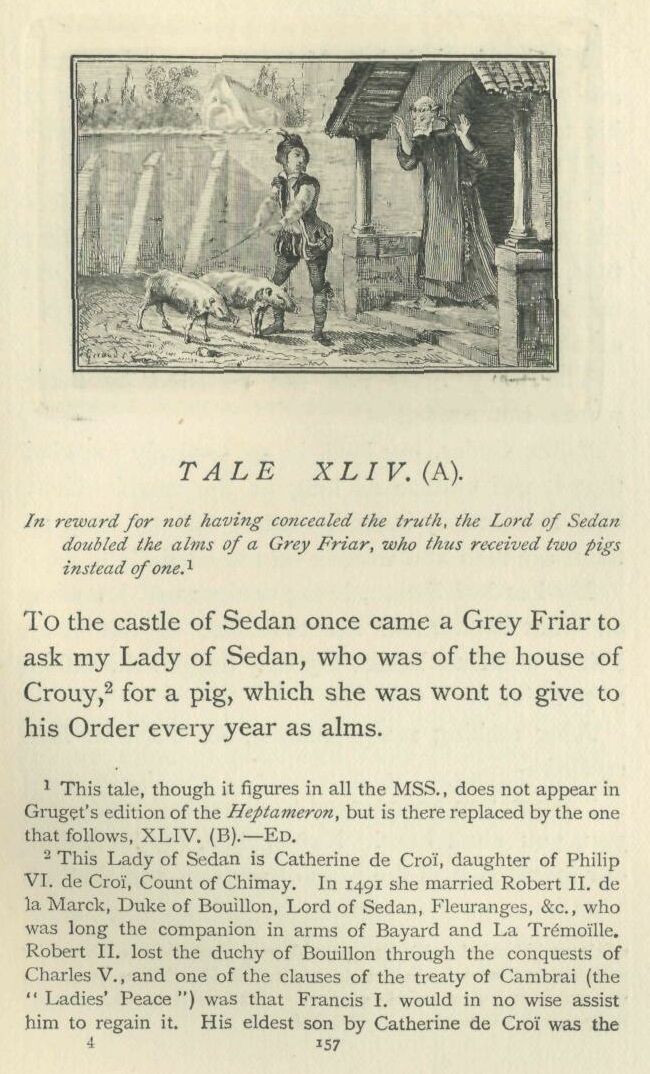
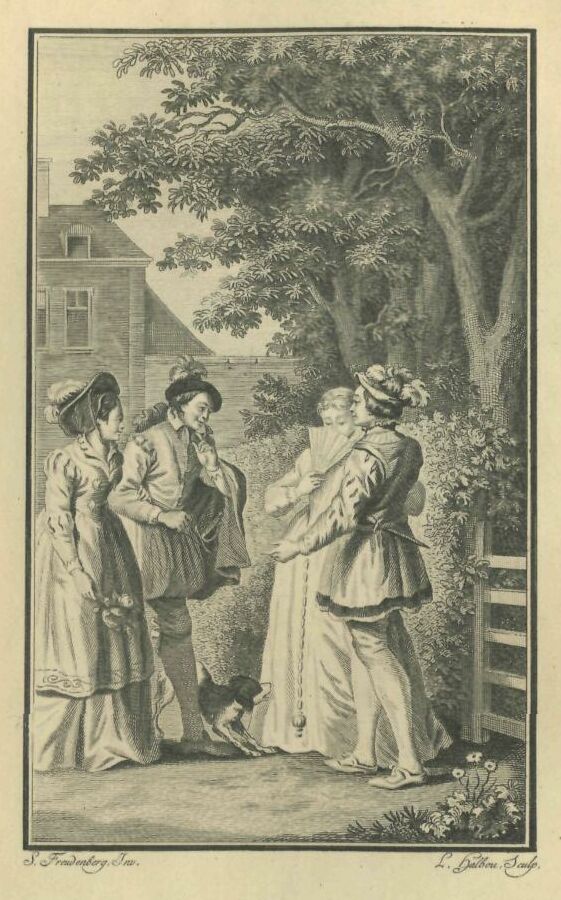
TALE XLIV.(A) . — [The Lovers returning from their Meeting in the Garden]
     In reward for not having concealed the truth, the Lord of
     Sedan doubled the alms of a Grey Friar, who thus received
     two pigs instead of one. (1)
To the castle of Sedan once came a Grey Friar to ask my Lady of Sedan, who
was of the house of Crouy, (2) for a pig, which she was wont to give to
his Order every year as alms.
     1  This tale, though it figures in all the MSS., does not
     appear in Gruget’s edition of the Heptameron, but is there
     replaced by the one that follows, XLIV. (B).—Ed.

     2  This Lady of Sedan is Catherine de Croï, daughter of
     Philip VI. de Croï, Count of Chimay. In 1491 she married
     Robert II. do la Marck, Duke of Bouillon, Lord of Sedan,
     Fleuranges, &c., who was long the companion in arms of
     Bayard and La Trémoïlle. Robert II. lost the duchy of
     Bouillon through the conquests of Charles V., and one of the
     clauses of the treaty of Cambrai (the “Ladies’ Peace”) was
     that Francis I. would in no wise assist him to regain it.
     His eldest son by Catherine de Croï was the celebrated
     Marshal de Fleuranges, “the young adventurer,” who left such
     curious memoirs behind him. Robert II. died in 1535, his son
     surviving him a couple of years.—Anselme’s Histoire
     Généalogique, vol. vii. p. 167.—L. and B. J.
My Lord of Sedan, who was a prudent man and a merry talker, had the good
father to eat at his table, and in order to put him on his mettle said to
him, among other things—
“Good father, you do well to make your collection while you are yet
unknown. I greatly fear that, if once your hypocrisy be found out, you
will no longer receive the bread of poor children, earned by the sweat of
their fathers.”
The Grey Friar was not abashed by these words, but replied—
“Our Order, my lord, is so securely founded that it will endure as long as
the world exists. Our foundation, indeed, cannot fail so long as there are
men and women on the earth.”
My Lord of Sedan, being desirous of knowing on what foundation the
existence of the Grey Friars was thus based, urgently begged the father to
tell him.
After making many excuses, the Friar at last replied—
“Since you are pleased to command me to tell you, you shall hear. Know,
then, my lord, that our foundation is the folly of women, and that so long
as there be a wanton or foolish woman in the world we shall not die of
hunger.”
My Lady of Sedan, who was very passionate, was in such wrath on hearing
these words, that, had her husband not been present, she would have dealt
harshly with the Grey Friar; and indeed she swore roundly that he should
not have the pig that she had promised him; but the Lord of Sedan, finding
that he had not concealed the truth, swore that he should have two, and
caused them to be sent to his monastery.
“You see, ladies, how the Grey Friar, being sure that the favour of the
ladies could not fail him, contrived, by concealing nothing of the truth,
to win the favour and alms of men. Had he been a flatterer and dissembler,
he would have been more pleasing to the ladies, but not so profitable to
himself and his brethren.”
The tale was not concluded without making the whole company laugh, and
especially such among them as knew the Lord and Lady of Sedan. And Hircan
said—“The Grey Friars, then, should never preach with intent to make
women wise, since their folly is of so much service to the Order.”
“They do not preach to them,” said Parlamente, “with intent to make them
wise, but only to make them think themselves so. Women who are altogether
worldly and foolish do not give them much alms; nevertheless, those who
think themselves the wisest because they go often to monasteries, and
carry paternosters marked with a death’s head, and wear caps lower than
others, must also be accounted foolish, for they rest their salvation on
their confidence in the holiness of wicked men, whom they are led by a
trifling semblance to regard as demigods.”
“But who could help believing them,” said Enna-suite, “since they have
been ordained by our prelates to preach the Gospel to us and rebuke our
sins?”
“Those who have experienced their hypocrisy,” said Parlamente, “and who
know the difference between the doctrine of God and that of the devil.”
“Jesus!” said Ennasuite. “Can you think that these men would dare to
preach false doctrine?”
“Think?” replied Parlamente. “Nay, I am sure that they believe anything
but the Gospel. I speak only of the bad among them; for I know many worthy
men who preach the Scriptures in all purity and simplicity, and live
without reproach, ambition, or covetousness, and in such chastity as is
unfeigned and free. However, the streets are not paved with such as these,
but are rather distinguished by their opposites; and the good tree is
known by its fruit.”
“In very sooth,” said Ennasuite, “I thought we were bound on pain of
mortal sin to believe all they tell us from the pulpit as truth, that is,
when they speak of what is in the Holy Scriptures, or cite the expositions
of holy doctrines divinely inspired.”
“For my part,” said Parlamente, “I cannot but see that there are men of
very corrupt faith among them. I know that one of them, a Doctor of
Theology and a Principal in their Order, (3) sought to persuade many of
the brethren that the Gospel was no more worthy of belief than Cæsar’s
Commentaries or any other histories written by learned men of authority;
and from the hour I heard that I would believe no preacher’s word unless I
found it in harmony with the Word of God, which is the true touchstone for
distinguishing between truth and falsehood.”
     3  In MS. No. 1520 this passage runs, “a Doctor of Theology
     named Colimant, a great preacher and a Principal in their
     Order.” However, none of the numerous works on the history
     of the Franciscans makes any mention of a divine called
     Colimant.—B. J.
“Be assured,” said Oisille, “that those who read it constantly and with
humility will never be led into error by deceits or human inventions; for
whosoever has a mind filled with truth cannot believe a lie.”
“Yet it seems to me,” said Simontault, “that a simple person is more
readily deceived than another.”
“Yes,” said Longarine, “if you deem foolishness to be the same thing as
simplicity.”
“I affirm,” replied Simontault, “that a good, gentle and simple woman is
more readily deceived than one who is wily and wicked.”
“I think,” said Nomerfide, “that you must know of one overflowing with
such goodness, and so I give you my vote that you may tell us of her.”
“Since you have guessed so well,” said Simontault, “I will indeed tell you
of her, but you must promise not to weep. Those who declare, ladies, that
your craftiness surpasses that of men would find it hard to bring forward
such an instance as I am now about to relate, wherein I propose to show
you not only the exceeding craftiness of a husband, but also the
simplicity and goodness of his wife.”
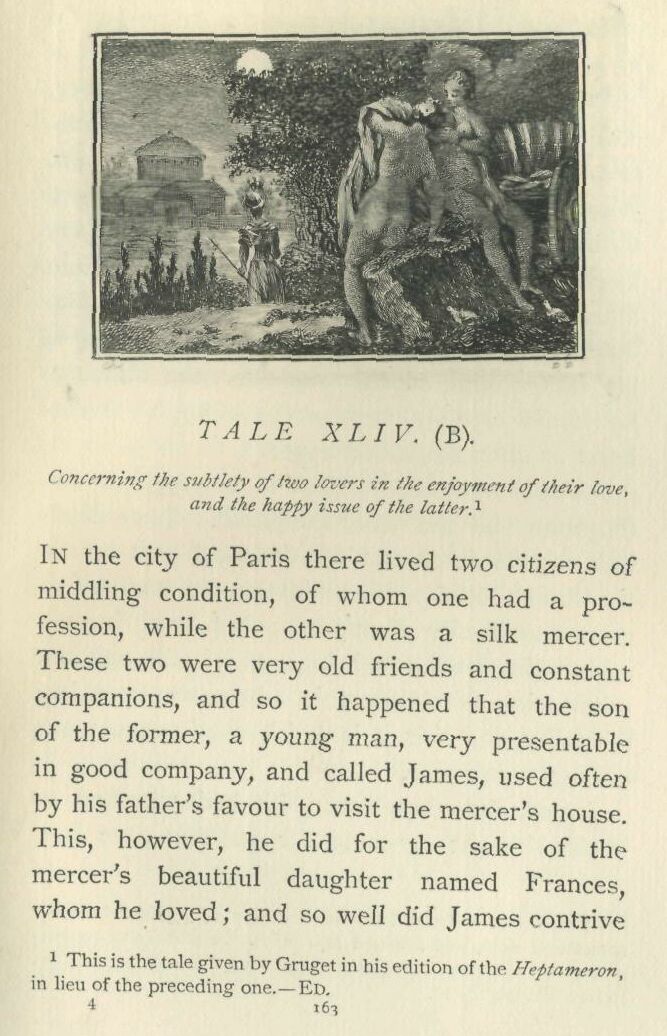
TALE XLIV. (B) . — [The Man of Tours and his Serving-maid in the Snow]
     Concerning the subtlety of two lovers in the enjoyment of
     their love, and the happy issue of the latter. (1)

     1  This is the tale given by Gruget in his edition of the
     Heptameron, in lieu of the preceding one.—Ed.
In the city of Paris there lived two citizens of middling condition, of
whom one had a profession, while the other was a silk mercer. These two
were very old friends and constant companions, and so it happened that the
son of the former, a young man, very presentable in good company, and
called James, used often by his father’s favour to visit the mercer’s
house. This, however, he did for the sake of the mercer’s beautiful
daughter named Frances, whom he loved; and so well did James contrive
matters with her, that he came to know her to be no less loving than
loved.
Whilst matters were in this state, however, a camp was formed in Provence
in view of withstanding the descent of Charles of Austria, (2) and James,
being called upon the list, was obliged to betake himself to the army. At
the very beginning of the campaign his father passed from life into death,
the tidings whereof brought him double sorrow, on the one part for the
loss of his father, and on the other for the difficulty he should have on
his return in seeing his sweetheart as often as he had hoped.
     2  Charles V. entered Provence by way of Piedmont in the
     summer of 1536, and invested Marseilles. A scarcity of
     supplies and much sickness among his troops compelled him,
     however, to raise the siege.—M.
As time went on, the first of these griefs was forgotten and the other
increased. Since death is a natural thing, and for the most part befalls
the father before the children, the sadness it causes gradually
disappears; but love, instead of bringing us death, brings us life through
the procreation of children, in whom we have immortality, and this it is
which chiefly causes our desires to increase.
James, therefore, when he had returned to Paris, thought or cared for
nothing save how he might renew his frequent visits to the mercer’s house,
and so, under cloak of pure friendship for him, traffic in his dearest
wares. On the other hand, during his absence, Frances had been urgently
sought by others, both because of her beauty and of her wit, and also
because she was long since come to marriageable years; but whether it was
that her father was avaricious, or that, since she was his only daughter,
he was over anxious to establish her well, he failed to perform his duty
in the matter. This, however, tended but little to her honour, for in
these days people speak ill of one long before they have any reason to do
so, and particularly in aught that concerns the chastity of a beautiful
woman or maid. Her father did not shut his ears or eyes to the general
gossip, nor seek resemblance with many others who, instead of rebuking
wrongdoing, seem rather to incite their wives and children to it, for he
kept her with such strictness that even those who sought her with offers
of marriage could see her but seldom, and then only in presence of her
mother.
It were needless to ask whether James found all this hard of endurance. He
could not conceive that such rigour should be without weighty reason, and
therefore wavered greatly between love and jealousy. However, he resolved
at all risks to learn the cause, but wished first of all to know whether
her affection was the same as before; he therefore set about this, and
coming one morning to church, he placed himself near her to hear mass, and
soon perceived by her countenance that she was no less glad to see him
than he was to see her. Accordingly, knowing that the mother was less
stern than the father, he was sometimes, when he met them on their way to
church, bold enough to accost them as though by chance, and with a
familiar and ordinary greeting; all, however, being done expressly so that
he might the better work his ends.
To be brief, when the year of mourning for his father was drawing to an
end, he resolved, on laying aside his weeds, to cut a good figure and do
credit to his forefathers; and of this he spoke to his mother, who
approved his design; for having but two children, himself and a daughter
already well and honourably mated, she greatly desired to see him suitably
married. And, indeed, like the worthy lady that she was, she still further
incited his heart in the direction of virtue by countless instances of
other young men of his own age who were making their way unaided, or at
least were showing themselves worthy of those from whom they sprang.
It now only remained to determine where they should equip themselves, and
the mother said—
“I am of opinion, James, that we should go to our friend Master Peter,”—that
is, to the father of Frances—“for, knowing us, he will not cheat
us.”
His mother was indeed tickling him where he itched; however, he held firm
and replied—
“We will go where we may find the cheapest and the best. Still,” he added,
“for the sake of his friendship with my departed father, I am willing that
we should visit him first.”
Matters being thus contrived, the mother and son went one morning to see
Master Peter, who made them welcome; for traders, as you know, are never
backward in this respect. They caused great quantities of all kinds of
silk to be displayed before them, and chose what they required; but they
could not agree upon the price, for James haggled on purpose, because his
sweetheart’s mother did not come in. So at last they went away without
buying anything, in order to see what could be done elsewhere. But James
could find nothing so handsome as in his sweetheart’s house, and thither
after a while they returned.
The mercer’s wife was now there and gave them the best reception
imaginable, and after such bargaining as is common in shops of the kind,
during which Peter’s wife proved even harder than her husband, James said
to her—
“In sooth, madam, you are very hard to deal with. I can see how it is; we
have lost my father, and our friends recognise us no longer.”
So saying, he pretended to weep and wipe his eyes at thought of his
departed father; but ‘twas done in order to further his design.
The good widow, his mother, took the matter in perfect faith, and on her
part said—
“We are as little visited since his death as if we had never been known.
Such is the regard in which poor widows are held!”
Upon this the two women exchanged fresh declarations of affection, and
promised to see each other oftener than ever. While they were thus
discoursing, there came in other traders, whom the master himself led into
the back shop. Then the young man perceived his opportunity, and said to
his mother—
“I have often on feast days seen this good lady going to visit the holy
places in our neighbourhood, and especially the convents. Now if, when
passing, she would sometimes condescend to take wine with us, she would do
us at once pleasure and honour.”
The mercer’s wife, who suspected no harm, replied that for more than a
fortnight past she had intended to go thither, that, if it were fair, she
would probably do so on the following Sunday, and that she would then
certainly visit the lady at her house. This affair being concluded, the
bargain for the silk quickly followed, since, for the sake of a little
money, ‘twould have been foolish to let slip so excellent an opportunity.
When matters had been thus contrived, and the merchandise taken away,
James, knowing that he could not alone achieve so difficult an enterprise,
was constrained to make it known to a faithful friend named Oliver, and
they took such good counsel together that nothing now remained but to put
their plan into execution.
Accordingly, when Sunday was come, the mercer’s wife and her daughter, on
returning from worship, failed not to visit the widow, whom they found
talking with a neighbour in a gallery that looked upon the garden, while
her daughter was walking in the pathways with James and Oliver.
When James saw his sweetheart, he so controlled himself that his
countenance showed no change, and in this sort went forward to receive the
mother and her daughter. Then, as the old commonly seek the old, the three
ladies sat down together on a bench with their backs to the garden,
whither the lovers gradually made their way, and at last reached the place
where were the other two. Thus meeting, they exchanged some courtesies and
then began to walk about once more, whereupon the young man related his
pitiful case to Frances, and this so well that, while unwilling to grant,
she yet durst not refuse what he sought; and he could indeed see that she
was in a sore strait. It must, however, be understood that, while thus
discoursing, they often, to take away all ground for suspicion, passed and
repassed in front of the shelter-place where the worthy dames were seated—talking
the while on commonplace and ordinary matters, and at times disporting
themselves through the garden.
At last, in the space of half-an-hour, when the good women had become well
accustomed to this behaviour, James made a sign to Oliver, who played his
part with the girl that was with him so cleverly, that she did not
perceive the two lovers going into a close rilled with cherry trees, and
well shut in by tall rose trees and gooseberry bushes. (3) They made show
of going thither in order to gather some almonds which were in a corner of
the close, but their purpose was to gather plums.
     3  Large gardens and enclosures were then plentiful in the
     heart of Paris. Forty years ago, when the Boulevard
     Sebastopol was laid out, it was found that many of the
     houses in the ancient Rues St. Martin and St. Denis had, in
     their rear, gardens of considerable extent containing
     century-old trees, the existence of which had never been
     suspected by the passers-by in those then cramped and dingy
     thoroughfares.—M.
Accordingly, James, instead of giving his sweetheart a green gown, gave
her a red one, and its colour even came into her face through finding
herself surprised sooner than she had expected. And these plums of theirs
being ripe, they plucked them with such expedition that Oliver himself had
not believed it possible, but that he perceived the girl to droop her gaze
and look ashamed. This taught him the truth, for she had before walked
with head erect, with no fear lest the vein in her eye, which ought to be
red, should take an azure hue. However, when James perceived her
perturbation, he recalled her to herself by fitting remonstrances.
Nevertheless, while making the next two or three turns about the garden,
she would not refrain from tears and sighs, or from saying again and again—“Alas!
was it for this you loved me? If only I could have imagined it! Heavens!
what shall I do? I am ruined for life. What will you now think of me? I
feel sure you will respect me no longer, if, at least, you are one of
those that love but for their own pleasure. Alas, why did I not die before
falling into such an error?”
She shed many tears while uttering these words, but James comforted her
with many promises and oaths, and so, before they had gone thrice again
round the garden, or James had signalled to his comrade, they once more
entered the close, but by another path. And there, in spite of all, she
could not but receive more delight from the second green gown than from
the first; from which moment her satisfaction was such that they took
counsel together how they might see each other with more frequency and
convenience until her father should see fit to consent.
In this matter they were greatly assisted by a young woman, who was
neighbour to Master Peter; she had some kinship with James, and was a good
friend to Frances. And in this way, from what I can understand, they
continued without scandal until the celebration of the marriage, when
Frances, being an only child, proved to be very rich for a trader’s
daughter. James had, however, to wait for the greater part of his fortune
until the death of his father-in-law, for the latter was so grasping a man
that he seemed to think one hand capable of robbing him of that which he
held in the other. (4)
     4  This reminds one of Moliere’s Harpagon, when he requires
     La Flèche to show him his hands. See L’Avare, act i. sc.
     iii.—M.
“In this story, ladies, you see a love affair well begun, well carried on,
and better ended. For although it is a common thing among you men to scorn
a girl or woman as soon as she has freely given what you chiefly seek in
her, yet this young man was animated by sound and sincere love; and
finding in his sweetheart what every husband desires in the girl he weds,
and knowing, moreover, that she was of good birth, and discreet in all
respects, save for the error into which he himself had led her, he would
not act the adulterer or be the cause of an unhappy marriage elsewhere.
And for this I hold him worthy of high praise.”
“Yet,” said Oisille, “they were both to blame, ay, and the third party
also who assisted or at least concurred in a rape.”
“Do you call that a rape,” said Saffredent, “in which both parties are
agreed? Is there any marriage better than one thus resulting from secret
love? The proverb says that marriages are made in heaven, but this does
not hold of forced marriages, nor of such as are made for money or are
deemed to be completely sanctioned as soon as the parents have given their
consent.”
“You may say what you will,” said Oisille, “but we must recognise that
obedience is due to parents, or, in default of them, to other kinsfolk.
Otherwise, if all were permitted to marry at will, how many horned
marriages should we not find? Is it to be presumed that a young man and a
girl of twelve or fifteen years can know what is good for them? If we
examined into the happiness of marriages on the whole, we should find that
at least as many love-matches have turned out ill as those that were made
under compulsion. Young people, who do not know what is good for them,
attach themselves heedlessly to the first that comes; then by degrees they
find out their error and fall into others that are still greater. On the
other hand, most of those who act under compulsion proceed by the advice
of people who have seen more and have more judgment than the persons
concerned, and so when these come to feel the good that was before unknown
to them, they rejoice in it and embrace it with far more eagerness and
affection.”
“True, madam,” said Hircan, “but you have forgotten that the girl was of
full age and marriageable, and that she was aware of her father’s
injustice in letting her virginity grow musty rather than rub the rust off
his crown pieces. And do you not know that nature is a jade? She loved and
was loved; she found her happiness close to her hand, and she may have
remembered the proverb, ‘She that will not when she may, when she will she
shall have nay.’ All these things, added to her wooer’s despatch, gave her
no time to resist. Further, you have heard that immediately afterwards her
face showed that some noteworthy change had been wrought in her. She was
perhaps annoyed at the shortness of the time afforded her to decide
whether the thing were good or bad, for no great pressing was needed to
make her try a second time.”
“Now, for my part,” said Longarine, “I can find no excuse for such
conduct, except that I approve the good faith shown by the youth who,
comporting himself like an honest man, would not forsake her, but took her
such as he had made her. In this respect, considering the corruption and
depravity of the youth of the present day, I deem him worthy of high
praise. I would not for all that seek to excuse his first fault, which, in
fact, amounted to rape in respect to the daughter, and subornation with
regard to the mother.”
“No, no,” said Dagoucin, “there was neither rape nor subornation.
Everything was done by mere consent, both on the part of the mothers, who
did not prevent it (though, indeed, they were deceived), and on that of
the daughter, who was pleased by it, and so never complained.”
“It was all the result,” said Parlamente, “of the great kindliness and
simplicity of the mercer’s wife, who unwittingly led the maiden to the
slaughter.”
“Nay, to the wedding,” said Simontault, “where such simplicity was no less
profitable to the girl than it once was hurtful to one who suffered
herself to be readily duped by her husband.”
“Since you know such a story,” said Nomerfide, “I give you my vote that
you may tell it to us.”
“I will indeed do so,” said Simontault, “but you must promise not to weep.
Those who declare, ladies, that your craftiness surpasses that of men,
would find it hard to bring forward such an instance as I will now relate,
wherein I propose to show you not only the great craftiness of a husband,
but the exceeding simplicity and goodness of his wife.”
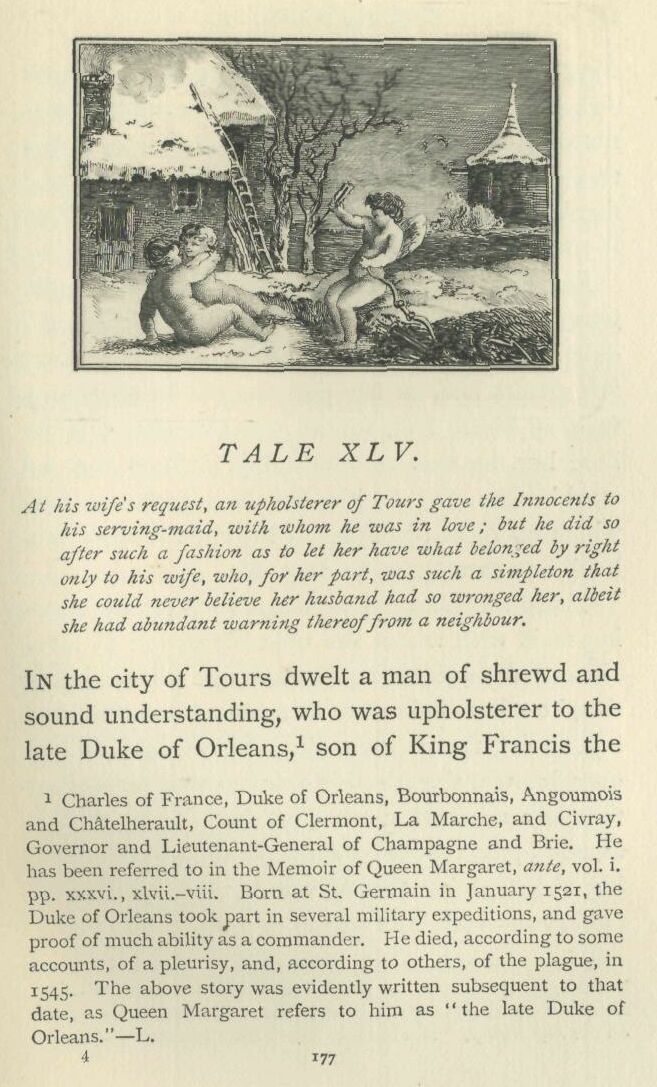
TALE XLV .
     At his wife’s request, an upholsterer of Tours gave the
     Innocents to his serving-maid, with whom he was in love; but
     he did so after such a fashion as to let her have what
     belonged by right only to his wife, who, for her part, was
     such a simpleton that she could never believe her husband
     had so wronged her, albeit she had abundant warning thereof
     from a neighbour.
In the city of Tours dwelt a man of shrewd and sound understanding, who
was upholsterer to the late Duke of Orleans, (1) son of King Francis the
First; and although this upholsterer had, through sickness, become deaf,
he had nevertheless lost nothing of his wit, which, in regard both to his
trade and to other matters, was as shrewd as any man’s. And how he was
able to avail himself of it you shall hear.
     1  Charles of France, Duke of Orleans, Bourbonnais,
     Angoumois and Châtelherault, Count of Clermont, La Marche,
     and Civray, Governor and Lieutenant-General of Champagne and
     Brie. He has been referred to in the Memoir of Queen
     Margaret, ante, vol. i. pp. xxxvi., xlvii.-viii. Born at
     St. Germain in January 1521, the Duke of Orleans took part
     in several military expeditions, and gave proof of much
     ability as a commander. He died, according to some accounts,
     of a pleurisy, and, according to others, of the plague, in
     1545. The above story was evidently written subsequent to
     that date, as Queen Margaret refers to him as “the late Duke
     of Orleans.”—L.
He had married a virtuous and honourable woman, with whom he lived in
great peace and quietness. He was very fearful of displeasing her, whilst
she, on her part, sought in all things to obey him. But, for all the
affection that he bore her, he was so charitably inclined that he would
often give to his female neighbours that which by right belonged to his
wife, though this he did as secretly as he was able.
There was in their house a very plump serving-maid with whom the
upholsterer fell in love. Nevertheless, dreading lest his wife should know
this, he often made show of scolding and rebuking her, saying that she was
the laziest wench he had ever known, though this was no wonder, seeing
that her mistress never beat her. And thus it came to pass that one day,
while they were speaking about giving the Innocents, (2) the upholsterer
said to his wife—
“It were a charity to give them to that lazy wench of yours, but it should
not be with your hand, for it is too feeble, and in like way your heart is
too pitiful for such a task. If, however, I were to make use of mine, she
would serve us better than she now does.”
     2  Prior to the Reformation it was the custom, not only in
     France but throughout Europe, to whip children on the
     morning of Innocents’ Day (December 28), in order, says
     Gregory in his treatise on the Boy Bishop, “that the
     memory of Herod’s murder of the Innocents might stick the
     closer.” This custom (concerning which see Haspinian, De
     Orig. Festor, Christianor. fol. 160) subsequently
     degenerated into a jocular usage, so far as the children
     were concerned, and town-gallants and country-swains
     commonly sought to surprise young women in bed, and make
     them play the part of the Innocents, more frequently than
     otherwise to the loss of their virtue. A story is told of a
     French nobleman who in taking leave of some ladies to join a
     hunting party, heard one of them whisper, “We shall sleep at
     our ease, and pass the Innocents without receiving them.”
      This put the nobleman, a certain Seigneur du Rivau, on his
     mettle. “He kept his appointment,” we are told, “galloped
     back twenty leagues at night, arrived at the lady’s house at
     dawn on Innocents’ Day, surprised her in bed, and used the
     privilege of the season.” (Bonn’s Heptameron, p. 301).
     Verses illustrative of the custom will be found in the works
     of Clement Marot, Jannet’s edition, 1868, vol iii. p. 7, and
     in those of Cholières, Jouaust’s edition, 1879, vol. i. p.
     224-6.—L. and Ed.
The poor woman, suspecting no harm, begged him to do execution upon the
girl, confessing that she herself had neither strength nor heart for
beating her.
The husband willingly accepted this commission, and, playing the part of a
stern executioner, had purchase made of the finest rods that could be
found. To show, moreover, how anxious he was not to spare the girl, he
caused these rods to be steeped in pickle, so that his poor wife felt far
more pity for her maid than suspicion of her husband.
Innocents’ Day being come, the upholsterer rose early in the morning, and,
going up to the room where the maid lay all alone, he gave her the
Innocents in a different fashion to that which he had talked of with his
wife. The maid wept full sore, but it was of no avail. Nevertheless,
fearing lest his wife should come upon them, he fell to beating the
bed-post with the rods which he had with him in such wise that he barked
and broke them; and in this condition he brought them back to his wife,
saying—
“Methinks, sweetheart, your maid will remember the Innocents.”
When the upholsterer was gone out of the house, the poor servant threw
herself upon her knees before her mistress, telling her that her husband
had done her the greatest wrong that was ever done to a serving-maid. The
mistress, however, thinking that this merely had reference to the flogging
which she believed to have been given, would not suffer the girl to
finish, but said to her—
“My husband did well, and only what I have for more than a month been
urging him to do. If you were hurt I am very glad to hear it. You may lay
it all at my door, and, what is more, he did not even do as much as he
ought to have done.”
The serving-maid, finding that her mistress approved of the matter,
thought that it could not be so great a sin as she had imagined, the more
so as it had been brought to pass by a woman whose virtue was held in such
high repute. Accordingly she never afterwards ventured to speak of it.
Her master, however, seeing that his wife was as content to be deceived as
he was to deceive her, resolved that he would frequently give her this
contentment, and so practised on the serving-maid, that she wept no more
at receiving the Innocents.
He continued this manner of life for a great while, without his wife being
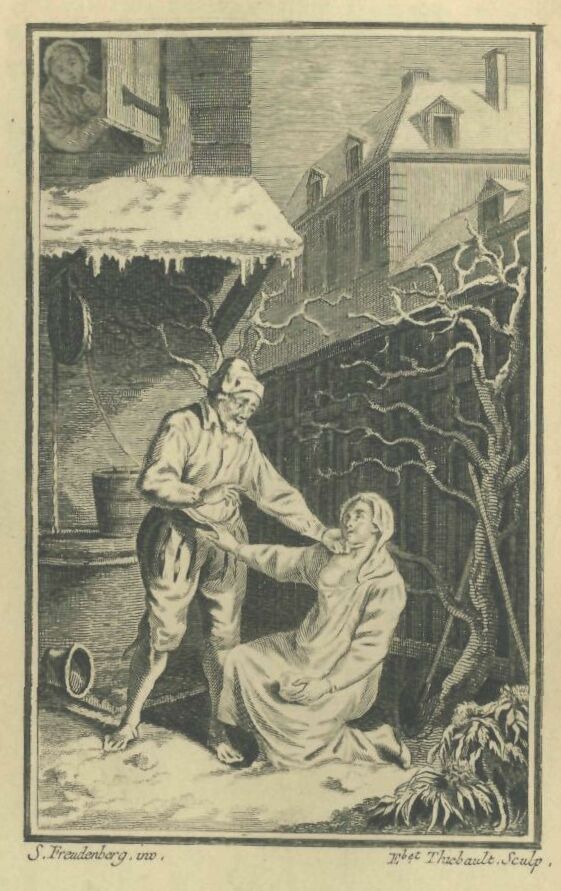
any the wiser, until there came a time of heavy snow, when, having already
given the girl the Innocents on the grass in his garden, he was minded to
do the same in the snow. Accordingly, one morning before any one in the
house was awake, he took the girl clad in nothing but her shift to make
the crucifix in the snow, and while they were pelting each other in sport,
they did not forget the game of the Innocents.
This sport, however, was observed by one of their female neighbours who
had gone to her window, which overlooked the garden, to see what manner of
weather it was, and so wrathful was she at the evil sight, that she
resolved to tell her good gossip of it, to the end that she might no
longer suffer herself to be deceived by a wicked husband or served by a
wanton jade.
After playing these fine pranks, the upholsterer looked about him to see
whether any one could perceive him, and to his exceeding annoyance
observed his neighbour at her window. But just as he was able to give any
colour to his tapestry, so he bethought him to give such a colour to what
he had done, that his neighbour would be no less deceived than his wife.
Accordingly, as soon as he had gone back to bed again, he made his wife
rise in nothing but her shift, and taking her into the garden as he had
taken his serving-maid, he played with her for a long time in the snow
even as he had played with the other. And then he gave her the Innocents
in the same way as he had given them to the maid, and afterwards they
returned to bed together.
When the good woman went to mass, her neighbour and excellent friend
failed not to be there, and, while unwilling to say anything further,
zealously begged of her to dismiss her serving-maid, who was, she said, a
very wicked and dangerous wench. This, however, the other would not do
without knowing why she thought so ill of the girl, and at last her
neighbour related how she had seen the wench that morning in the garden
with her husband.
At this the good woman fell to laughing heartily, and said—
“Eh! gossip dear, ‘twas myself!”
“What, gossip? Why she wore naught but her shift, and it was only five
o’clock in the morning.”
“In faith, gossip,” replied the good woman, “‘twas myself.”
“They pelted each other with snow,” the other went on, “on the breasts and
elsewhere, as familiarly as could be.”
“Eh! gossip, eh!” the good woman replied, “‘twas myself.”
“Nay, gossip,” said the other, “I saw them afterwards doing something in
the snow that to my mind is neither seemly nor right.”
“Gossip,” returned the good woman, “I have told you, and I tell you again,
that it was myself and none other who did all that you say, for my good
husband and I play thus familiarly together. And, I pray you, be not
scandalised at this, for you know that we are bound to please our
husbands.”
So the worthy gossip went away, more wishful to possess such a husband for
herself than she had been to talk about the husband of her friend; and
when the upholsterer came home again his wife told him the whole story.
“Now look you, sweetheart,” replied the upholsterer, “if you were not a
woman of virtue and sound understanding we should long ago have been
separated the one from the other. But I hope that God will continue to
preserve us in our mutual love, to His own glory and our happiness.”
“Amen to that, my dear,” said the good woman, “and I hope that on my part
you will never find aught to blame.” (3)
     3  This tale is accounted by most critics and commentators
     to be the best in the Heptameron. Dunlop thinks it may
     have been borrowed from a fabliau composed by some
     Trouvère who had travelled in the East, and points out
     that it corresponds with the story of the Shopkeeper s
     Wife in Nakshebi’s Persian Tales (Tooti Nameh). Had it
     been brought to France, however, in the manner suggested it
     would, like other tales, have found its way into the works
     of many sixteenth-century story-writers besides Queen
     Margaret. Such, however, is not the case, and curiously
     enough, so far as we can find, the tale, as given in the
     Heptameron, was never imitated until La Fontaine wrote his
     Servante Justifiée (Contes, livre ii. No. vi.), in the
     opening lines of which he expressly acknowledges his
     indebtedness to the Queen of Navarre.—Ed.
“Unbelieving indeed, ladies, must be the man who, after hearing this true
story, should hold you to be as crafty as men are; though, if we are not
to wrong either, and to give both man and wife the praise they truly
deserve, we must needs admit that the better of the two was worth naught.”
“The man,” said Parlamente, “was marvellously wicked, for he deceived his
servant on the one side and his wife on the other.”
“Then you cannot have understood the story,” said Hircan. “We are told
that he contented them both in the same morning, and I consider it a
highly virtuous thing, both for body and mind, to be able to say and do
that which may make two opposites content.”
“It was doubly wicked,” said Parlamente, “to satisfy the simplicity of one
by falsehood and the wickedness of the other by vice. But I am aware that
sins, when brought before such judges as you, will always be forgiven.”
“Yet I promise you,” said Hircan, “that for my own part I shall never
essay so great and difficult a task, for if I but render you
content my day will not have been ill spent.”
“If mutual love,” said Parlamente, “cannot content the heart, nothing else
can.”
“In sooth,” said Simontault, “I think there is no greater grief in the
world than to love and not be loved.”
“To be loved,” said Parlamente, “it were needful to turn to such as love.
Very often, however, those women who will not love are loved the most,
while those men who love most strongly are loved the least.”
“You remind me,” said Oisille, “of a story which I had not intended to
bring forward among such good ones.”
“Still I pray you tell it us,” said Simontault. “That will I do right
willingly,” replied Oisille.
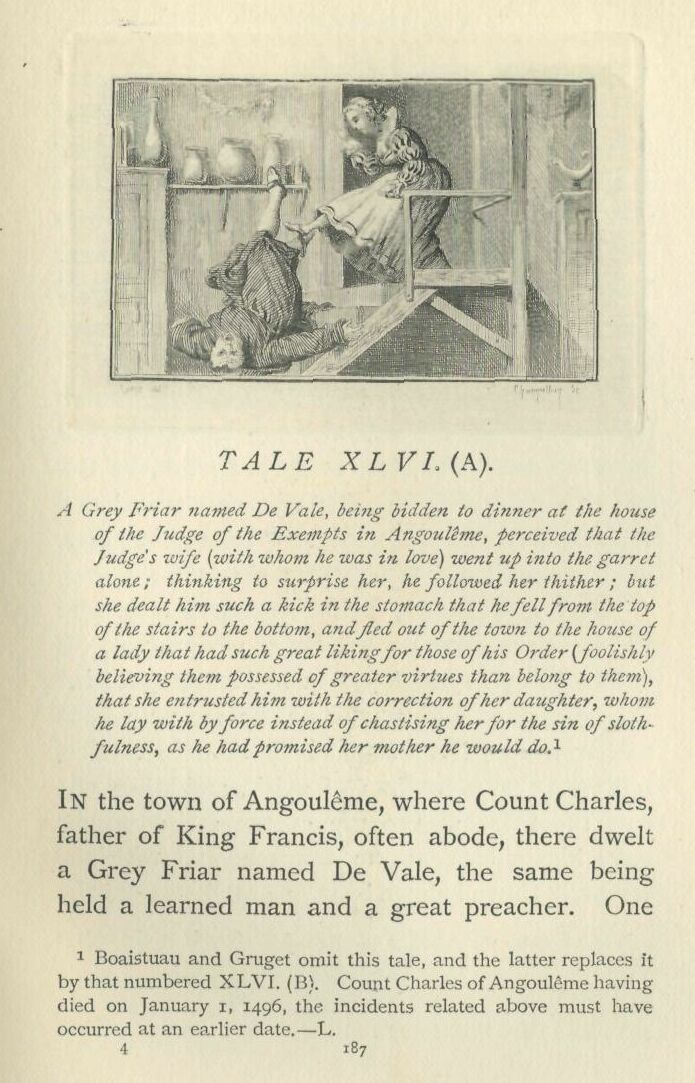
TALE XLVI. (A) . — [The Young Man beating his Wife]
     A Grey Friar named De Vale, being bidden to dinner at the
     house of the Judge of the Exempts in Angoulême, perceived
     that the Judge’s wife (with whom he was in love) went up
     into the garret alone; thinking to surprise her, he followed
     her thither; but she dealt him such a kick in the stomach
     that he fell from the top of the stairs to the bottom, and
     fled out of the town to the house of a lady that had such
     great liking for those of his Order (foolishly believing
     them possessed of greater virtues than belong to them), that
     she entrusted him with the correction of her daughter, whom
     he lay with by force instead of chastising her for the sin
     of sloth-fulness, as he had promised her mother he would
     do. (1)

     1  Boaistuau and Gruget omit this tale, and the latter
     replaces it by that numbered XLVI. (B). Count Charles of
     Angoulême having died on January i, 1496, the incidents
     related above must have occurred at an earlier date.—L.
In the town of Angoulême, where Count Charles, father of King Francis,
often abode, there dwelt a Grey Friar named De Vale, the same being held a
learned man and a great preacher. One Advent this Friar preached in the
town in presence of the Count, whereby he won such renown that those who
knew him eagerly invited him to dine at their houses. Among others that
did this was the Judge of the Exempts (2) of the county, who had wedded a
beautiful and virtuous woman. The Friar was dying for love of her, yet
lacked the hardihood to tell her so; nevertheless she perceived the truth,
and held him in derision.
     2  The Exempt was a police officer, and the functions of
     the Juge des Exempts were akin to those of a police
     magistrate.—Ed.
After he had given several tokens of his wanton purpose, he one day espied
her going up into the garret alone. Thinking to surprise her, he followed,
but hearing his footsteps she turned and asked whither he was going. “I am
going after you,” he replied, “to tell you a secret.”
“Nay, good father,” said the Judge’s wife. “I will have no secret converse
with such as you. If you come up any higher, you will be sorry for it.”
Seeing that she was alone, he gave no heed to her words, but hastened up
after her. She, however, was a woman of spirit, and when she saw the Friar
at the top of the staircase, she gave him a kick in the stomach, and with
the words, “Down! down! sir,” (3) cast him from the top to the bottom. The
poor father was so greatly ashamed at this, that, forgetting the hurt he
had received in falling, he fled out of the town as fast as he was able.
He felt sure that the lady would not conceal the matter from her husband;
and indeed she did not, nor yet from the Count and Countess, so that the
Friar never again durst come into their presence.
     3  The French words here are “Dévaliez, dévaliez,
     monsieur,” whilst MS. No. 1520 gives, “Monsieur de Vale,
     dévalés.” In either case there is evidently a play upon the
     friar’s name, which was possibly pronounced Vallès or
     Vallès. Adrien de Valois, it maybe pointed out, rendered his
     name in Latin as Valesius; the county of Valois and that
     of Valais are one and the same; we continue calling the old
     French kings Valois, as their name was written, instead of
     Valais as it was pronounced, as witness, for instance, the
     nickname given to Henry III. by the lampooners of the
     League, “Henri dévalé.” See also post, Tale XLVI. (B),
     note 2.—M. and Ed.
To complete his wickedness, he repaired to the house of a lady who
preferred the Grey Friars to all other folk, and, after preaching a sermon
or two before her, he cast his eyes upon her daughter, who was very
beautiful. And as the maiden did not rise in the morning to hear his
sermon, he often scolded her in presence of her mother, whereupon the
latter would say to him—“Would to God, father, that she had some
taste of the discipline which you monks receive from one another.”
The good father vowed that if she continued to be so slothful, he would
indeed give her some of it, and her mother earnestly begged him to do so.
A day or two afterwards, he entered the lady’s apartment, and, not seeing
her daughter there, asked her where she was.
“She fears you so little,” replied the lady, “that she is still in bed.”
“There can be no doubt,” said the Grey Friar, “that it is a very evil
habit in young girls to be slothful. Few people think much of the sin of
sloth, but for my part, I deem it one of the most dangerous there is, for
the body as for the soul. You should therefore chastise her for it, and if
you will give me the matter in charge, I will take good care that she does
not lie abed at an hour when she ought to be praying to God.”
The poor lady, believing him to be a virtuous man, begged him to be kind
enough to correct her daughter, which he at once agreed to do, and, going
up a narrow wooden staircase, he found the girl all alone in bed. She was
sleeping very soundly, and while she slept he lay with her by force. The
poor girl, waking up, knew not whether he were man or devil, but began to
cry out as loudly as she could, and to call for help to her mother. But
the latter, standing at the foot of the staircase, cried out to the Friar—“Have
no pity on her, sir. Give it to her again, and chastise the naughty jade.”
When the Friar had worked his wicked will, he came down to the lady and
said to her with a face all afire—“I think, madam, that your
daughter will remember my discipline.”
The mother thanked him warmly and then went upstairs, where she found her
daughter making such lamentation as is to be expected from a virtuous
woman who has suffered from so foul a crime. On learning the truth, the
mother had search made everywhere for the Friar, but he was already far
away, nor was he ever afterwards seen in the kingdom of France.
“You see, ladies, with how much security such commissions may be given to
those that are unfit for them. The correction of men pertains to men and
that of women to women; for women in the correction of men would be as
pitiful as men in the correction of women would be cruel.”
“Jesus! madam,” said Parlamente, “what a base and wicked Friar!”
“Say rather,” said Hircan, “what a foolish and witless mother to be led by
hypocrisy into allowing so much familiarity to those who ought never to be
seen except in church.”
“In truth,” said Parlamente, “I acknowledge that she was the most foolish
mother imaginable; had she been as wise as the Judge’s wife, she would
rather have made him come down the staircase than go up. But what can you
expect? The devil that is half-angel is the most dangerous of all, for he
is so well able to transform himself into an angel of light, that people
shrink from suspecting him to be what he really is; and it seems to me
that persons who are not suspicious are worthy of praise.”
“At the same time,” said Oisille, “people ought to suspect the evil that
is to be avoided, especially those who hold a trust; for it is better to
suspect an evil that does not exist than by foolish trustfulness to fall
into one that does. I have never known a woman deceived through being slow
to believe men’s words, but many are there that have been deceived through
being over prompt in giving credence to falsehood. Therefore I say that
possible evil cannot be held in too strong suspicion by those that have
charge of men, women, cities or states; for, however good the watch that
is kept, wickedness and treachery are prevalent enough, and the shepherd
who is not vigilant will always be deceived by the wiles of the wolf.”
“Still,” said Dagoucin, “a suspicious person cannot have a perfect friend,
and many friends have been divided by suspicion.”
“If you know any such instance,” said Oisille, “I give you my vote that
you may relate it.”
“I know one,” said Dagoucin, “which is so strictly true that you will
needs hear it with pleasure. I will tell you, ladies, when it is that a
close friendship is most easily severed; ‘tis when the security of
friendship begins to give place to suspicion. For just as trust in a
friend is the greatest honour that can be shown him, so is doubt of him a
still greater dishonour. It proves that he is deemed other than we would
have him to be, and so causes many close friendships to be broken off, and
friends to be turned into foes. This you will see from the story that I am
minded to relate.”
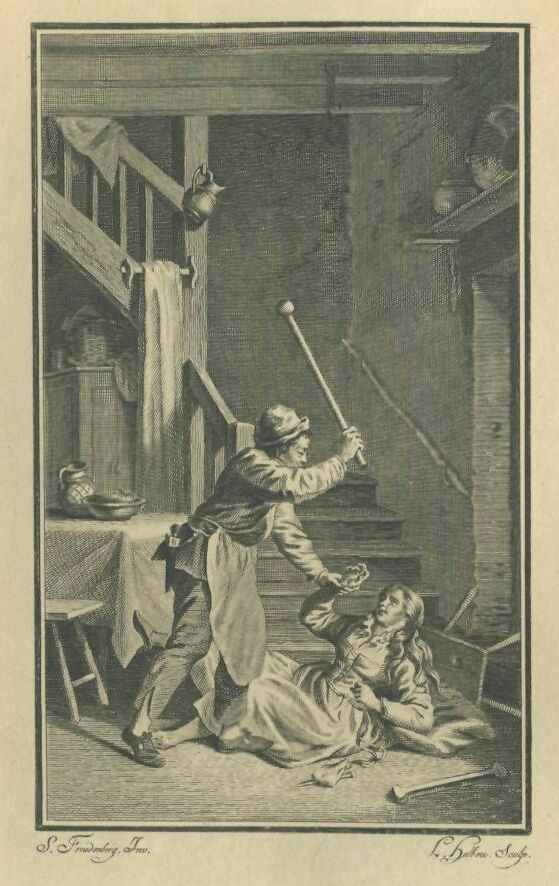
TALE XLVI.(B) . — [The Gentleman reproaching his Friend for his Jealousy]
     Concerning a Grey Friar who made it a great crime on the
     part of husbands to beat their wives. (1)
In the town of Angoulême, where Count Charles, father of King Francis,
often abode, there dwelt a Grey Friar named De Vallès, (2) the same being
a learned man and a very great preacher. At Advent time this Friar
preached in the town in presence of the Count, whereby his reputation was
still further increased.
     1  This is the tale inserted in Gruget’s edition in lieu of
     the previous one.—Ed.

     2  We had thought that Friar Vallès might possibly be Robert
     de Valle, who at the close of the fifteenth century wrote a
     work entitled Explanatio in Plinium, but find that this
     divine was a Bishop of Rouen, and never belonged to the Grey
     Friars. In Gessner’s Biographia Universalis, continued by
     Frisius, mention is made of three learned ecclesiastics of
     the name of Valle living in or about Queen Margaret’s time:
     Baptiste de Valle, who wrote on war and duelling; William de
     Valle, who penned a volume entitled De Anima Sorbono; and
     Amant de Valle, a Franciscan minorité born at Toulouse, who
     was the author of numerous philosophical works, the most
     important being Elucidationes Scoti.—B. J.
It happened also that during Advent a hare-brained young fellow, who had
married a passably handsome young woman, continued none the less to run at
the least as dissolute a course as did those that were still bachelors.
The young wife, being advised of this, could not keep silence upon it, so
that she very often received payment after a different and a prompter
fashion than she could have wished. For all that, she ceased not to
persist in lamentation, and sometimes in railing as well; which so
provoked the young man that he beat her even to bruises and blood.
Thereupon she cried out yet more loudly than before; and in a like fashion
all the women of the neighbourhood, knowing the reason of this, could not
keep silence, but cried out publicly in the streets, saying—
“Shame, shame on such husbands! To the devil with them!”
By good fortune the Grey Friar De Vallès was passing that way and heard
the noise and the reason of it. He resolved to touch upon it the following
day in his sermon, and did so. Turning his discourse to the subject of
marriage and the affection which ought to subsist in it, he greatly
extolled that condition, at the same time censuring those that offended
against it, and comparing wedded to parental love. Among other things, he
said that a husband who beat his wife was in more danger, and would have a
heavier punishment, than if he had beaten his father or his mother.
“For,” said he, “if you beat your father or your mother you will be sent
for penance to Rome; but if you beat your wife, she and all the women of
the neighbourhood will send you to the devil, that is, to hell. Now look
you what a difference there is between these two penances. From Rome a man
commonly returns again, but from hell, oh! from that place, there is no
return: nulla est redemptio” (3)
After preaching this sermon, he was informed that the women were making a
triumph of it, (4) and that their husbands could no longer control them.
He therefore resolved to set the husbands right just as he had previously
assisted their wives.
     3  This was the Pope’s expression apropos of Messer Biagio,
     whom Michael Angelo had introduced into his “Last
     Judgment.”—M.

     4  The French expression is faisaient leur Achilles, the
     nearest equivalent to which in English would probably be
     “Hectoring” It is curious that the French should have taken
     the name of Achilles and we that of Hector to express the
     same idea of arrogance and bluster.—Ed.
With this intent, in one of his sermons he compared women and devil
together, saying that these were the greatest enemies that man had, that
they tempted him without ceasing, and that he could not rid himself of
them, especially of women.
“For,” said he, “as far as devils are concerned, if you show them the
cross they flee away, whereas women, on the contrary, are tamed by it, and
are made to run hither and thither and cause their husbands countless
torments. But, good people, know you what you must do? When you find your
wives afflicting you thus continually, as is their wont, take off the
handle of the cross and with it drive them away. You will not have made
this experiment briskly three or four times before you will find
yourselves the better for it, and see that, even as the devil is driven
off by the virtue of the cross, so can you drive away and silence your
wives by virtue of the handle, provided only that it be not attached to
the cross aforesaid.”
“You have here some of the sermons by this reverend De Vallès, of whose
life I will with good reason relate nothing more. However, I will tell you
that, whatever face he put upon the matter—and I knew him—he
was much more inclined to the side of the women than to that of the men.”
“Yet, madam,” said Parlamente, “he did not show this in his last sermon,
in which he instructed the men to ill-treat them.”
“Nay, you do not comprehend his artifice,” said Hircan. “You are not
experienced in war and in the use of the stratagems that it requires;
among these, one of the most important is to kindle strife in the camp of
the enemy, whereby he becomes far easier to conquer. This master monk well
knew that hatred and wrath between husband and wife most often cause a
loose rein to be given to the wife’s honour. And when that honour frees
itself from the guardianship of virtue, it finds itself in the power of
the wolf before it knows even that it is astray.”
“However that may be,” said Parlamente, “I could not love a man who had
sown such division between my husband and myself as would lead even to
blows; for beating banishes love. Yet, by what I have heard, they [the
friars] can be so mincing when they seek some advantage over a woman, and
so attractive in their discourse, that I feel sure there would be more
danger in hearkening to them in secret than in publicly receiving blows
from a husband in other respects a good one.”
“Truly,” said Dagoucin, “they have so revealed their plottings in all
directions, that it is not without reason that they are to be feared; (5)
although in my opinion persons who are not suspicious are worthy of
praise.”
     5  From this point the dialogue is almost word for word the
     same as that following Tale XLVI. (A).—Ed.
“At the same time,” said Oisille, “people ought to suspect the evil that
is to be avoided, for it is better to suspect an evil that does not exist
than by foolish trustfulness to fall into one that does. For my part, I
have never known a woman deceived by being slow to believe men’s words,
but many are through being too prompt in giving credence to falsehood.
Therefore I say that possible evil cannot be too strongly suspected by
those that have charge of men, women, cities or states; for, however good
may be the watch that is kept, wickedness and treachery are prevalent
enough, and for this reason the shepherd who is not vigilant will always
be deceived by the wiles of the wolf.”
“Still,” said Dagoucin, “a suspicious person cannot have a perfect friend,
and many friends have been parted by bare suspicion.”
“If you should know any such instance,” thereupon said Oisille, “I will
give you my vote that you may relate it.”
“I know one,” said Dagoucin, “which is so strictly true that you will hear
it with pleasure. I will tell you, ladies, when it is that close
friendship is most readily broken off; it is when the security of
friendship begins to give place to suspicion. For just as to trust a
friend is the greatest honour one can do him, so is doubt of him the
greatest dishonour, inasmuch as it proves that he is deemed other than one
would have him to be, and in this wise many close friendships are broken
off and friends turned into foes. This you will see from the story that I
am now about to relate.”
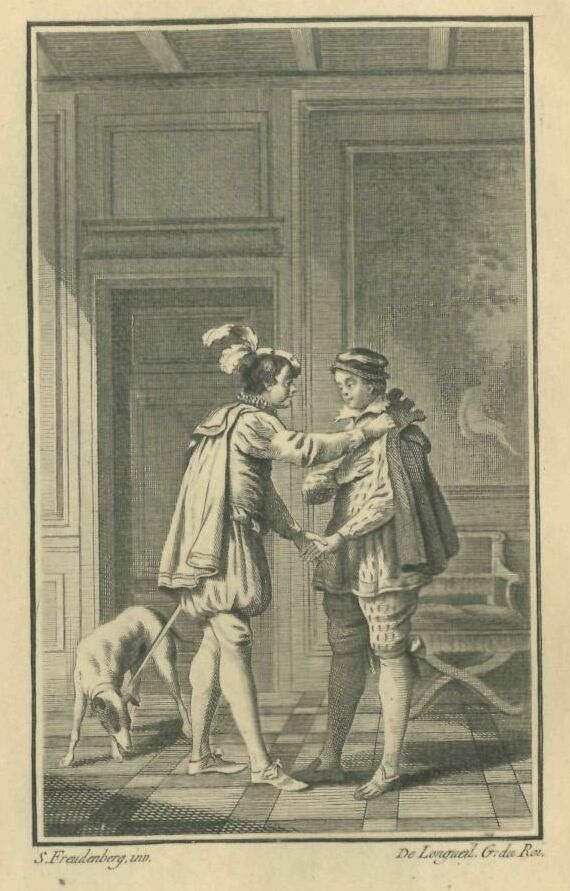
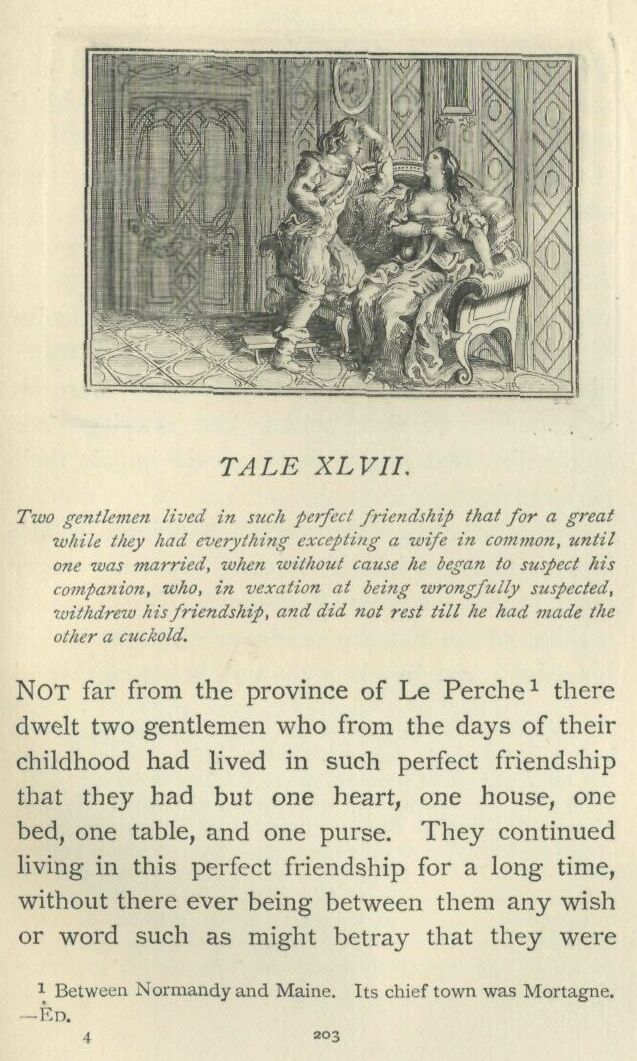
TALE XLVII . — [The Grey Friars Caught and Punished]
     Two gentlemen lined in such perfect friendship that for a
     great while they had everything excepting a wife in common,
     until one was married, when without cause he began to
     suspect his companion, who, in vexation at being wrongfully
     suspected, withdrew his friendship, and did not rest till he
     had made the other a cuckold.
Not far from the province of Le Perche (1) there dwelt two gentlemen who
from the days of their childhood had lived in such perfect friendship that
they had but one heart, one house, one bed, one table, and one purse. They
continued living in this perfect friendship for a long time, without there
ever being between them any wish or word such as might betray that they
were different persons; so truly did they live not merely like two
brothers but like one individual man.
1 Between Normandy and Maine. Its chief town was Mortagne.
Of the two one married, yet did not on that account abate his friendship
for his fellow or cease to live with him as had been his wont. And
whenever they chanced to lodge where room was scanty, he failed not to
make him sleep with himself and his wife; (2) though he did, in truth,
himself lie in the middle. Their goods were all in common, so that neither
the marriage nor aught else that might betide could impair their perfect
friendship.
     2  To do honour to a guest it was then a common practice to
     invite him to share the same bed as one’s self and one’s
     wife. In this wise, long after Queen Margaret s time, we
     find Louis XIII. sharing the bed of the Duke and Duchess of
     Luynes. Tale vii. of the Cent Nouvelles Nouvelles
     (imitated in Malespini’s Ducento Novelle and the Joyeuses
     Adventures et nouvelles récréations) relates what befell a
     Paris goldsmith who took a carter to bed with him and his
     spouse, and neglected to follow the usual custom of sleeping
     in the middle. In Queen Margaret’s time, it may be added,
     the so-called “beds of honour” in the abodes of noblemen and
     gentlemen were large enough to accommodate four or five
     persons.—B. J. and Ed.
But after some time, worldly happiness, which is ever changeful in its
nature, could no longer abide in this too happy household. The husband,
without cause, lost the confidence that he had in his friend and in his
wife, and, being unable to conceal the truth from the latter, spoke to her
with angry words. At this she was greatly amazed, for he had charged her
in all things save one to treat his friend as she did himself, and now he
forbade her to speak with him except it were before others. She made the
matter known to her husband’s friend, who did not believe her, knowing as
he well did that he had never purposed doing aught to grieve his comrade.
And as he was wont to hide nothing from him, he told him what he had
heard, begging him not to conceal the truth, for neither in this nor in
any other matter had he any desire to occasion the severance of the
friendship which had so long subsisted between them.
The married gentleman assured him that he had never thought of such a
thing, and that those who had spread such a rumour had foully lied.
Thereupon his comrade replied—
“I well know that jealousy is a passion as insupportable as love, and were
you inclined to jealousy even with regard to myself, I should not blame
you, for you could not help it. But there is a thing that is in your power
of which I should have reason to complain, and that is the concealment of
your distemper from me, seeing that never before was thought, feeling or
opinion concealed between us. If I were in love with your wife, you should
not impute it to me as a crime, for love is not a fire that I can hold in
my hand to do with it what I will; but if it were so and I concealed it
from you, and sought by demonstration to make it known to your wife, I
should be the wickedest comrade that ever lived.
“As far as I myself am concerned, I can truly assure you that, although
she is an honourable and virtuous woman, she is the last of all the women
I have ever seen upon whom, even though she were not yours, my fancy would
light. But even though there be no occasion to do so, I ask you, if you
have the smallest possible feeling of suspicion, to tell me of it, that I
may so act as to prevent a friendship that has lasted so long from being
severed for the sake of a woman. For, even if I loved her more dearly than
aught in the world beside, I would never speak to her of it, seeing that I
set your honour before aught else.”
His comrade swore to him the strongest oaths he could muster, that he had
never thought of such a thing, and begged him to act in his house as he
had been used to do.
“That will I,” the other replied, “but if after this should you harbour an
evil opinion of me and conceal it or bear me ill-will, I will continue no
more in fellowship with you.”
Some time afterwards, whilst they were living together as had been their
wont, the married gentleman again fell into stronger suspicion than ever,
and commanded his wife to no longer show the same countenance to his
friend as before. This she at once made known to her husband’s comrade,
and begged that he would of his own motion abstain from holding speech
with her, since she had been charged to do the like towards him.
The gentleman perceived from her words and from divers tokens on the part
of his comrade that the latter had not kept his promise, and so said to
him in great wrath—
“If, comrade, you are jealous, ‘tis a natural thing, but, after the oaths
you swore to me, I must needs be angered that you have used such
concealment towards me. I had always thought that neither obstacle nor
mean intervened between your heart and mine, but to my exceeding sorrow,
and with no fault on my part, I see that the reverse is true. Not only are
you most jealous of your wife and of me, but you seek to hide your
distemper from me, until at last it must wholly turn to hate, and the
dearest love that our time has known become the deadliest enmity.
“I have done all I could to avoid this mishap, but since you suspect me of
being so wicked and the opposite of what I have always proved towards you,
I give you my oath and word that I will indeed be such a one as you deem
me, and that I will never rest until I have had from your wife that which
you believe I seek from her. So I bid you beware of me henceforward, for,
since suspicion has destroyed your friendship for me, resentment will
destroy mine for you.”
Although his comrade tried to persuade him of the contrary, he would no
longer believe him, but removed his portion of the furniture and goods
that had been in common between them. And so their hearts were as widely
sundered as they had before been closely united, and the unmarried
gentleman never rested until, as he had promised, he had made his comrade
a cuckold. (3)
     3  The idea developed in this tale, that of bringing to pass
     by one’s own actions the thing one fears and seeks to avoid
     or prevent, has much analogy with that embodied in the
     “novel of the Curious Impertinent” which Cervantes
     introduces into Don Quixote (Part I. chaps, xxviii.,
     xxix). In this tale it will be remembered Anselmo and
     Lothario are represented as being two such close friends as
     the gentlemen who figured in Queen Margaret’s tale. Anselmo
     marries, however, and seized with an insane desire to test
     the virtue of his wife, Camilla, by exposing her to
     temptation, urges Lothario to pay court to her. Lothario at
     first resists these solicitations, pointing out the folly of
     such an enterprise, but his friend entreats him so
     pressingly that he finally consents, and in the sequel the
     passion which he at first simulates for Camilla becomes a
     real one and leads to his seducing her and carrying her
     away, with the result that both the wretched Anselmo and his
     wife soon die of grief, whilst Lothario betakes himself to
     the wars and perishes in battle.—M. & Ed.
“Thus, ladies, may it fare with those who wrongfully suspect their wives
of evil. Many men make of them what they suspect them to be, for a
virtuous woman is more readily overcome by despair than by all the
pleasures on earth. And if any one says that suspicion is love, I give him
nay, for although it results from love as do ashes from fire, it kills it
nevertheless in the same way.”
“I do not think,” said Hircan, “that anything can be more grievous to
either man or woman than to be suspected of that which is contrary to
fact. For my own part, nothing could more readily prompt me to sever
fellowship with my friends than such suspicion.”
“Nevertheless,” said Oisille, “woman is without rational excuse who
revenges herself for her husband’s suspicion by her own shame. It is as
though a man should thrust his sword through his own body, because unable
to slay his foe, or should bite his own fingers because he cannot scratch
him. She would have done better had she spoken to the gentleman no more,
and so shown her husband how wrongly he had suspected her; for time would
have softened them both.”
“Still ‘twas done like a woman of spirit,” said Ennasuite. “If many women
acted in the same way, their husbands would not be so outrageous as they
are.”
“For all that,” said Longarine, “patience gives a woman the victory in the
end, and chastity brings her praise, and more we should not desire.”
“Nevertheless,” said Ennasuite, “a woman may be unchaste and yet commit no
sin.”
“How may that be?” said Oisille.
“When she mistakes another man for her husband.”
“And who,” said Parlamente, “is so foolish that she cannot clearly tell
the difference between her husband and another man, whatever disguise the
latter may wear?”
“There have been and still will be,” said Ennasuite, “a few deceived in
this fashion, and therefore still innocent and free from sin.”
“If you know of such a one,” said Dagoucin, “I give you my vote that you
may tell us about her, for I think it very strange that innocence and sin
can go together.”
“Listen, then,” said Ennasuite. “If, ladies, the foregoing tales have not
sufficiently warned you of the danger of lodging in our houses those who
call us worldly and consider themselves as something holy and far worthier
than we, I will give you yet a further instance of it, that you may see by
the errors into which those fall who trust them too much that not only are
they human like others, but that there is something devilish in their
nature, passing the ordinary wickedness of men. This you will learn from
the following story.”
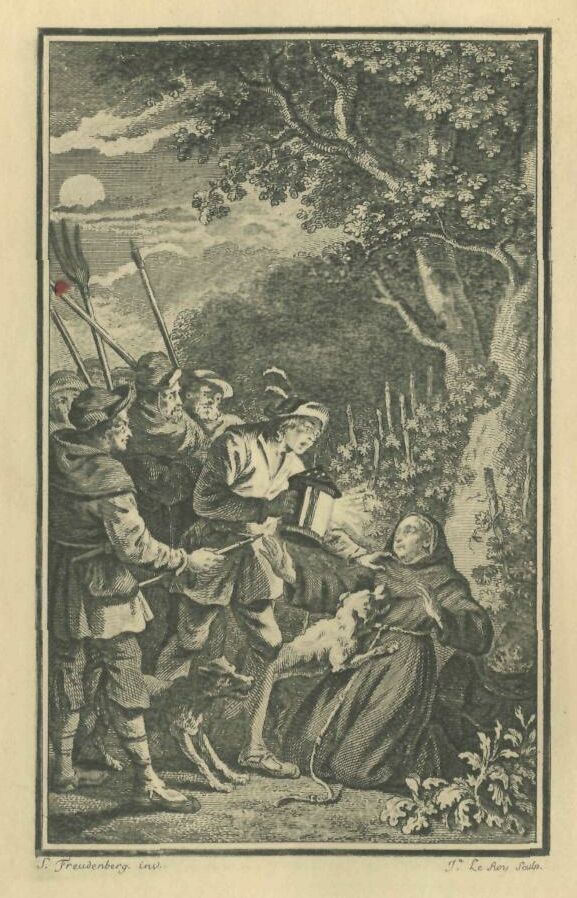
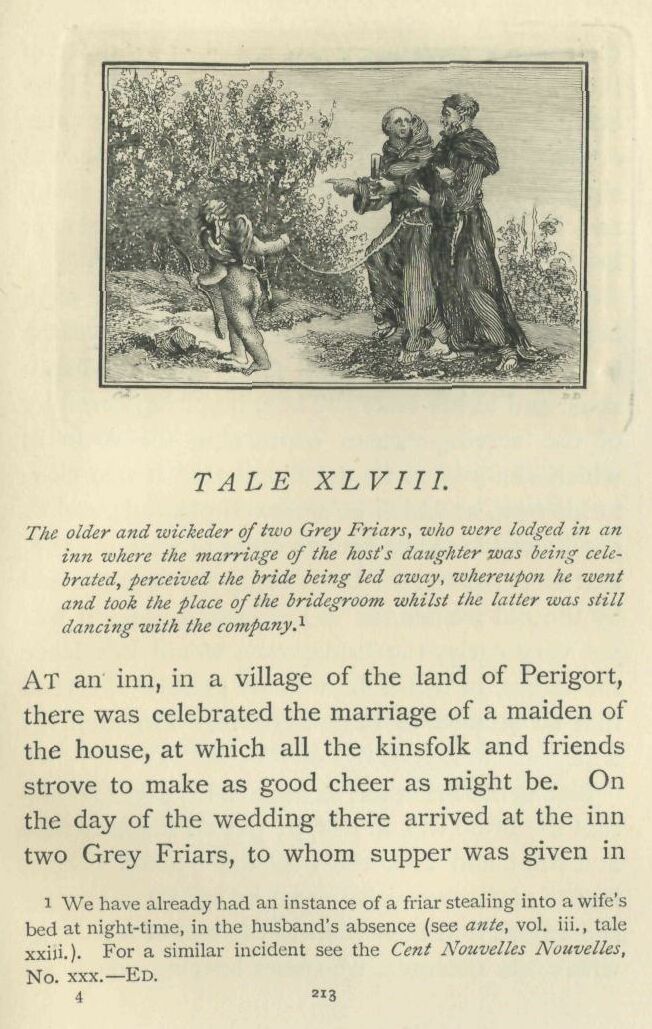
TALE XLVIII . — [The Countess facing her Lovers]
     The older and wickeder of two Grey Friars, who were lodged
     in an inn where the marriage of the host’s daughter was
     being celebrated, perceived the bride being led away,
     whereupon he went and took the place of the bridegroom
     whilst the latter was still dancing with the company. (1)

     1  We have already had an instance of a friar stealing into
     a wife’s bed at night-time, in the husband’s absence (see
     ante, vol. iii., tale xxili.). For a similar incident see
     the Cent Nouvelles Nouvelles, No. xxx.—Ed.
At an inn, in a village of the land of Perigort, there was celebrated the
marriage of a maiden of the house, at which all the kinsfolk and friends
strove to make as good cheer as might be. On the day of the wedding there
arrived at the inn two Grey Friars, to whom supper was given in their own
room, since it was not meet for those of their condition to be present at
a wedding. However, the chief of the two, who had the greater authority
and craft, resolved that, since he was shut out from the board, he would
share the bed, and in this way play them one of the tricks of his trade.
When evening was come, and the dances were begun, the Grey Friar continued
to observe the bride for a long time, and found her very handsome and to
his taste. Then, inquiring carefully of the serving-woman concerning the
room in which she was to lie, he found that it was close to his own, at
which he was well pleased; and so good a watch did he keep in order to
work his end, that he perceived the bride being led from the hall by the
old women, as is the custom. As it was yet very early, the bridegroom
would not leave the dance, in which he was so greatly absorbed that he
seemed to have altogether forgotten his wife.
Not so the Friar, for, as soon as his ears told him that the bride was in
bed, he put off his grey robe and went and took the husband’s place. Being
fearful of discovery, however, he stayed but a very short time, and then
went to the end of a passage where his comrade, who was keeping watch for
him, signed to him that the husband was dancing-still.
The Friar, who had not yet satisfied his wicked lust, thereupon went back
to bed with the bride, until his comrade gave him a signal that it was
time to leave.
The bridegroom afterwards came to bed, and his wife, who had been so
tormented by the Friar that she desired naught but rest, could not help
saying to him—
“Have you resolved never to sleep or do anything but torment me?”
The unhappy husband, who had but just come in, was greatly astonished at
this, and asked what torment he had given her, seeing that he had not left
the dance.
“A pretty dance!” said the poor girl. “This is the third time that you
have come to bed. I think you would do better to sleep.”
The husband was greatly astonished on hearing these words, and set aside
thought of everything else in order that he might learn the truth of what
had passed.
When his wife had told him the story, he at once suspected the Grey Friars
who were lodged in the house, and forthwith rising, he went into their
room, which was close beside his own.
Not finding them there, he began to call out for help in so loud a voice
that he speedily drew together all his friends, who, when they had heard
the tale, assisted him with candles, lanterns, and all the dogs of the
village to hunt for the Grey Friars.
Not finding them in the house, they made all diligence, and so caught them
among the vines, where they treated them as they deserved; for, after
soundly beating them, they cut off their arms and legs, and left them
among the vines to the care of Bacchus and Venus, of whom they had been
better disciples than of St. Francis.
“Be not amazed, ladies, if such folk, being cut off from our usual mode of
life, do things of which adventurers (2) even would be ashamed. Wonder
rather that they do no worse when God withdraws his hand from them, for so
little does the habit make the monk, that it often unmakes him through the
pride it lends him. For my own part, I go not beyond the religion that is
taught by St. James, who has told us to ‘keep the heart pure and unspotted
toward God, and to show all charity to our neighbours.’”(3)
     2 This is an allusion to the dismissed French Swiss, and
     German lansquenets who roamed about France in little bands,
     kidnapping, plundering, and at times hiring themselves out
     as spadassins. These men, the pests of the country, were
     commonly known by the name of adventurers.—B. J.

     3  “Pure religion and undefiled before God and the Father is
     this, To visit the fatherless and widows in their affliction
     and to keep himself unspotted from the world.”—James i.
     27.—Ed.
“Heavens!” said Oisille, “shall we never have done with tales about these
tiresome Grey Friars?”
Then said Ennasuite—
“If, ladies, princes and gentlemen are not spared, the Grey Friars, it
seems to me, are highly honoured by being noticed. They are so useless
that, were it not that they often do evil things worthy of remembrance,
they would never even be mentioned; and, as the saying goes, it is better
to do evil than to do nothing at all. Besides, the more varied the flowers
the handsomer will our posy be.”
“If you will promise not to be angry with me,” said Hircan, “I will tell
you the story of a great lady whose wantonness was so extreme that you
will forgive the poor friar for having taken what he needed, where he was
able to find it, seeing that she, who had enough to eat, nevertheless
sought for dainties in too monstrous a fashion.”
“Since we have sworn to speak the truth,” said Oisille, “we have also
sworn to hear it. You may therefore speak with freedom, for the evil
things that we tell of men and women are not uttered to shame those that
are spoken of in the story, but to take away all trust in created beings,
by revealing the trouble to which these are liable, and this to the end
that we may fix and rest our hope on Him alone who is perfect, and without
whom every man is only imperfection.”
“Well then,” said Hircan, “I will relate my story without fear.”
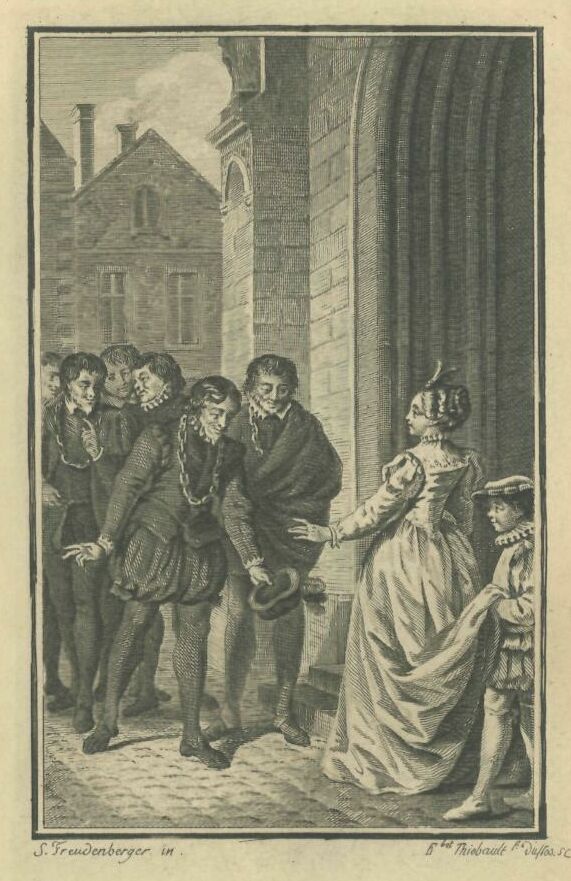
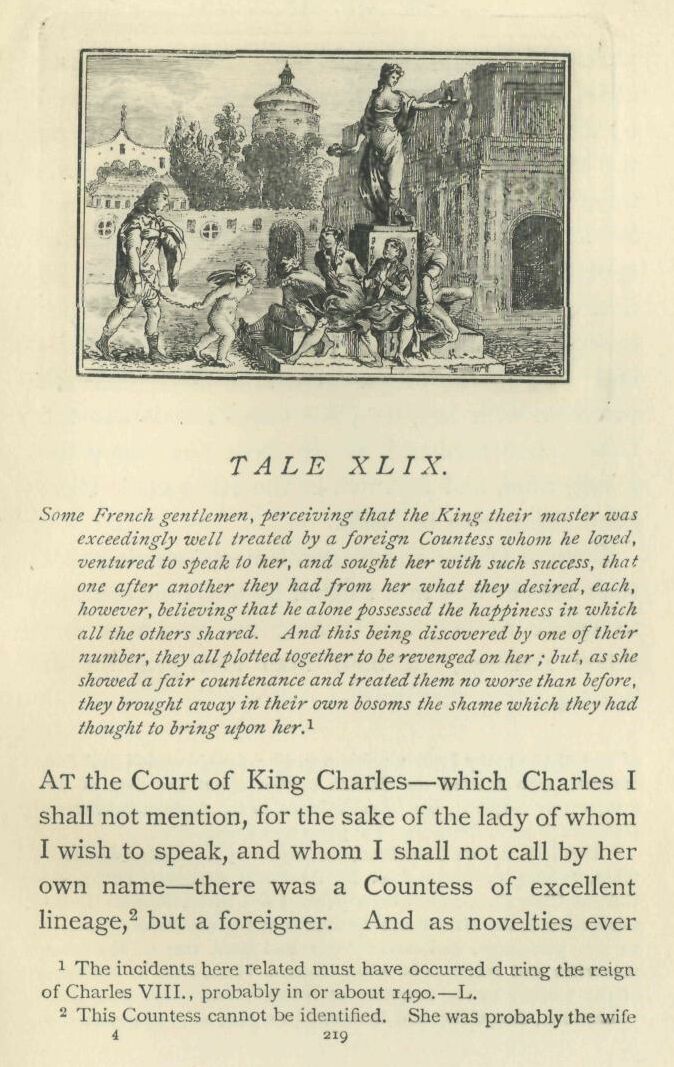
TALE XLIX . — [The Lady killing herself on the Death of her Lover]
     Same French gentlemen, perceiving that the King their
     master was exceedingly well treated by a foreign Countess
     whom he loved, ventured to speak to her, and sought her with
     such success, that one after another they had from her what
     they desired, each, however, believing that he alone
     possessed the happiness in which all the others shared. And
     this being discovered by one of their number, they all
     plotted together to be revenged on her; but, as she showed a
     fair countenance and treated them no worse than before, they
     brought away in their own bosoms the shame which they had
     thought to bring upon her. (1)
At the Court of King Charles—which Charles I shall not mention, for
the sake of the lady of whom I wish to speak, and whom I shall not call by
her own name—there was a Countess of excellent lineage, (2) but a
foreigner. And as novelties ever please, this lady, both for the
strangeness of her attire and for its exceeding richness, was observed by
all. Though she was not to be ranked among the most beautiful, she
possessed gracefulness, together with a noble assurance that could not be
surpassed; and, moreover, her manner of speech and her seriousness were to
match, so that there was none but feared to accost her excepting the King,
who loved her exceedingly. That he might have still more intimate converse
with her, he gave some mission to the Count, her husband, which kept him
away for a long time, and meanwhile the King made right good cheer with
his wife.
     1  The incidents here related must have occurred during the
     reign of Charles VIII., probably in or about 1490.—L.

     2  This Countess cannot be identified. She was probably the
     wife of one of the many Italian noblemen, like the
     Caraccioli and San Severini, who entered the French service
     about the time of the conquest of Naples. Brantôme alludes
     to the story in his Dames Galantes (Fourth Discourse) but
     gives no names.—Ed.
Several of the King’s gentlemen, knowing that their master was well
treated by her, took courage to speak to her, and among the rest was one
called Astillon, (3) a bold man and graceful of bearing.
     3  This is James de Chastillon, not, however, J. Gaucher de
     Chastillon, “King of Yvetot,” as M. de Lincy supposes, but
     J. de Coligny-Chastillon, as has been pointed out by M.
     Frank. Brantôme devotes the Nineteenth Discourse of his
     Capitaines françois to this personage, and says: “He had
     been one of the great favourites and mignons of King
     Charles VIII., even at the time of the journey to the
     kingdom of Naples; and ‘twas then said, ‘Chastillon,
     Bourdillon and Bonneval [see post, note 5] govern the royal
     blood.’” Wounded in April 1512 at the battle of Ravenna,
     “the most bloody battle of the century,” he was removed to
     Ferrara, where he died (May 25). He was the second husband
     of Blanche de Tournon, Lady of Honour to Queen Margaret,
     respecting whom see ante, vol. i. pp. 84-5, 122-4, and
     vol. iv. p. 144, note 2.—L., F. and Ed.
At first she treated him so seriously, threatening to tell of him to the
King his master, that he well-nigh became afraid of her. However, as he
had not been wont to fear the threats even of the most redoubtable
captains, he would not suffer himself to be moved by hers, but pressed her
so closely that she at last consented to speak with him in private, and
taught him the manner in which he should come to her apartment. This he
failed not to do, and, in order that the King might be without suspicion
of the truth, he craved permission to go on a journey, and set out from
the Court. On the very first day, however, he left all his following and
returned at night to receive fulfilment of the promises that the Countess
had made him. These she kept so much to his satisfaction, that he was
content to remain shut up in a closet for five or six days, without once
going out, and living only on restoratives.
During the week that he lay in hiding, one of his companions called
Durassier (4) made love to the Countess. At the beginning she spoke to
this new lover, as she had spoken to the first, with harsh and haughty
speech that grew milder day by day, insomuch that when the time was come
for dismissing the first prisoner, she put the second into his place.
While he was there, another companion of his, named Valnebon, (5) did the
same as the former two, and after these there came yet two or three more
to lodge in the sweet prison.
     4  This in all probability is the doughty James Galliot de
     Genouillac, who—much in the same way as in our own times
     the names of the “Iron Duke” and the “Man of Iron” have been
     bestowed on Wellington and Bismarck—was called by his
     contemporaries the “Seigneur d’Acier” or “Steel Lord,”
      whence “Durassier”—hard steel. Born in Le Quercy in or
     about 1466, Genouillac accompanied Charles VIII. on his
     Italian expeditions, and, according to Brantôme, surpassed
     all others in valour and influence. He greatly distinguished
     himself at the battle of Fornova (1495), and in 1515 we find
     him one of the chief commanders of the French artillery. For
     the great skill he displayed at Marignano he was appointed
     Grand Master of the Artillery and Seneschal of Armagnac, and
     he subsequently became Grand Equerry of France. At Pavia,
     where he again commanded the artillery, he would have swept
     away the Spaniards had not the French impetuously charged
     upon them, preventing him from firing his pieces. Most of
     the latter he contrived to save, severe as was the defeat,
     and he effectually protected the retreat of the Duke of
     Alençon and the Count of Clermont into France. Genouillac
     died in 1546, a year after he had been appointed Governor of
     Languedoc.—B. J. and Ed.

     5  Valnebon is an anagram of the name Bonneval, and Queen
     Margaret evidently refers here to a member of the Bonneval
     family. In the time of Charles VIII. this illustrious
     Limousin house had two principal members, Anthony, one of
     the leading counsellors of that king (as of his predecessor
     Louis XI. and his successor Louis XII.), and Germain, also a
     royal counsellor and chamberlain. The heroes of the above
     story being military men and old friends and comrades, it is
     probable that the reference is to Germain de Bonneval, he,
     like Chastillon and Genouillac, having accompanied Charles
     VIII. on his expedition into Italy. Germain de Bonneval,
     moreover, was one of the seven noblemen who fought at the
     battle of Fornova, clad and armed exactly like the French
     king. He perished at the memorable defeat of Pavia in 1525.
     From him descended, in a direct line, the famous eighteenth
     century adventurer, Claud Alexander, Count de Bonneval.—B.
     J. and Ed.
This manner of life continued for a long time, and was so skilfully
contrived that none of the lovers knew aught of the others; and although
they were aware of the love that each of them bore the lady, there was not
one but believed himself to be the only successful suitor, and laughed at
his comrades who, as he thought, had failed to win such great happiness.
One day when the gentlemen aforesaid were at a banquet where they made
right good cheer, they began to speak of their several fortunes and of the
prisons in which they had lain during the wars. Valnebon, however, who
found it a hard task to conceal the great good fortune he had met with,
began saying to his comrades—
“I know not what prisons have been yours, but for my own part, for love of
one wherein I once lay, I shall all my life long give praise and honour to
the rest. I think that no pleasure on earth comes near that of being kept
a prisoner.”
Astillon, who had been the first captive, had a suspicion of the prison
that he meant, and replied—
“What gaoler, Valnebon, man or woman, treated you so well that you became
so fond of your prison?”
“Whoever the gaoler may have been,” said Valnebon, “my prisonment was so
pleasant that I would willingly have had it last longer. Never was I
better treated or more content.”
Durassier, who was a man of few words, clearly perceived that they were
discussing the prison in which he had shared like the rest; so he said to
Valnebon—
“On what meats were you fed in the prison that you praise so highly?”
“What meats?” said Valnebon. “The King himself has none better or more
nourishing.”
“But I should also like to know,” said Durassier, “whether your keeper
made you earn your bread properly?”
Valnebon, suspecting that he had been understood, could not hold from
swearing.
“God’s grace!” said he. “Had I indeed comrades where I believed myself
alone?”
Perceiving this dispute, wherein he had part like the rest, Astillon
laughed and said—
“We all serve one master, and have been comrades and friends from boyhood;
if, then, we are comrades in the same good fortune, we can but laugh at
it. But, to see whether what I imagine be true, pray let me question you,
and do you confess the truth to me; for if that which I fancy has befallen
us, it is as amusing an adventure as could be found in any book.”
They all swore to tell the truth if the matter were such as they could not
deny.
Then said he to them—
“I will tell you my own fortune, and you will tell me, ay or nay, if yours
has been the same.”
To this they all agreed, whereupon he said—
“I asked leave of the King to go on a journey.”
“So,” they replied, “did we.”
“When I was two leagues from the Court, I left all my following and went
and yielded myself up prisoner.”
“We,” they replied, “did the same.”
“I remained,” said Astillon, “for seven or eight days, and lay in a closet
where I was fed on nothing but restoratives and the choicest viands that I
ever ate. At the end of a week, those who held me captive suffered me to
depart much weaker in body than I had been on my arrival.”
They all swore that the like had happened to them.
“My imprisonment,” said Astillon, “began on such a day and finished on
such another.”
“Mine,” thereupon said Durassier, “began on the very day that yours ended,
and lasted until such a day.”
Valnebon, who was losing patience, began to swear.
“‘Sblood!” said he, “from what I can see, I, who thought myself the first
and only one, was the third, for I went in on such a day and came out on
such another.”
Three others, who were at the table, swore that they had followed in like
order.
“Well, since that is so,” said Astillon, “I will mention the condition of
our gaoler. She is married, and her husband is a long way off.”
“‘Tis even she,” they all replied.
“Well, to put us out of our pain,” said Astillon, “I, who was first
enrolled, shall also be the first to name her. It was my lady the
Countess, she who was so extremely haughty that in conquering her
affection I felt as though I had conquered Cæsar.”
[Said Valnebon—(6)]
     6  It is probable that the angry Valnebon is speaking here,
     and that his name has been accidentally omitted from the
     MSS. At all events the three subsequent paragraphs show that
     these remarks are not made by Astillon, who declines the
     other speaker’s advice, and proposes a scheme of his own.—
     Ed.
“To the devil with the jade, who gave us so much toil, and made us believe
ourselves so fortunate in winning her! Never was there such wantonness,
for while she kept one in hiding she was practising upon another, so that
she might never be without diversion. I would rather die than suffer her
to go unpunished.”
Each thereupon asked him what he thought ought to be done to her, saying
that they were all ready to do it.
“I think,” said he, “that we ought to tell the King our master, who prizes
her as though she were a goddess.
“By no means,” said Astillon; “we are ourselves able to take vengeance
upon her, without calling in the aid of our master. Let us all be present
to-morrow when she goes to mass, each of us wearing an iron chain about
his neck. Then, when she enters the church, we will greet her as shall be
fitting.”
This counsel was highly approved by the whole company, and each provided
himself with an iron chain. The next morning they all went, dressed in
black and with their iron chains twisted like collars round their necks,
to meet the Countess as she was going to church. And as soon as she saw
them thus attired, she began to laugh and asked them—
“Whither go such doleful folk?”
“Madam,” said Astillon, “we are come to attend you as poor captive slaves
constrained to do your service.”
The Countess, feigning not to understand, replied—
“You are not my captives, and I cannot understand that you have more
occasion than others to do me service.”
Thereupon Valnebon stepped forward and said to her—
“After eating your bread for so long a time, we should be ungrateful
indeed if we did not serve you.”
She made excellent show of not understanding the matter, thinking by this
seriousness to confound them; but they pursued their discourse in such
sort that she saw that all was discovered. So she immediately devised a
means of baffling them, for, having lost honour and conscience, she would
in no wise take to herself the shame that they thought to bring upon her.
On the contrary, like one who set her pleasure before all earthly honour,
she neither changed her countenance nor treated them worse than before,
whereat they were so confounded, that they carried away in their own
bosoms the shame they had thought to bring upon her.
“If, ladies, you do not consider this story enough to prove that women are
as bad as men, I will seek out others of the same kind to relate to you.
Nevertheless I think that this one will suffice to show you that a woman
who has lost shame is far bolder to do evil than a man.”
There was not a woman in the company that heard this story, who did not
make as many signs of the cross as if all the devils in hell were before
her eyes. However, Oisille said—
“Ladies, let us humble ourselves at hearing of so terrible a circumstance,
and the more so as she who is forsaken by God becomes like him with whom
she unites; for even as those who cleave to God have His spirit within
them, so is it with those that cleave to His opposite, whence it comes
that nothing can be more brutish than one devoid of the Spirit of God.”
“Whatever the poor lady may have done,” said Ennasuite, “I nevertheless
cannot praise the men who boasted of their imprisonment.”
“It is my opinion,” said Longarine, “that a man finds it as troublesome to
conceal his good fortune as to pursue it. There is never a hunter but
delights to wind his horn over his quarry, nor lover but would fain have
credit for his conquest.”
“That,” said Simontault, “is an opinion which I would hold to be heretical
in presence of all the Inquisitors of the Faith, for there are more men
than women that can keep a secret, and I know right well that some might
be found who would rather forego their happiness than have any human being
know of it. For this reason has the Church, like a wise mother, ordained
men to be confessors and not women, seeing that the latter can conceal
nothing.”
“That is not the reason,” said Oisille; “it is because women are such
enemies of vice that they would not grant absolution with the same
readiness as is shown by men, and would be too stern in their penances.”
“If they were as stern in their penances,” said Dagoucin, “as they are in
their responses, they would reduce far more sinners to despair than they
would draw to salvation; and so the Church has in every sort well
ordained. But, for all that, I will not excuse the gentlemen who thus
boasted of their prison, for never was a man honoured by speaking evil of
a woman.”
“Since they all fared alike,” said Hircan, “it seems to me that they did
well to console one another.”
“Nay,” said Geburon, “they should never have acknowledged it for the sake
of their own honour. The books of the Round Table (7) teach us that it is
not to the honour of a worthy knight to overcome one that is good for
naught.”
     7  Queen Margaret was well acquainted with these (see
     ante, vol. iii. p. 48). In a list drawn up after her
     father’s death, of the two hundred volumes of books in his
     library, a most remarkable one for the times, we find
     specified several copies of “Lancelot,” “Tristan,” &c, some
     in MS. with miniatures and illuminated letters, and others
     printed on parchment. Besides numerous religious writings,
     volumes of Aristotle, Ovid, Mandeville, Dante, the
     Chronicles of St. Denis, and the “Book of the Great Khan,
     bound in cloth of gold,” the library contained various works
     of a character akin to that of the Heptameron. For
     instance, a copy of the Cent Nouvelles Nouvelles in print;
     a French translation of Poggio’s Facetio, also in print,
     and two copies of Boccaccio in MS., one of them bound in
     purple velvet, and richly illuminated, each page having a
     border of blue and silver. This last if still in existence
     would be very valuable.—Eu.
“I am amazed,” said Longarine, “that the unhappy woman did not die of
shame in presence of her captives.”
“Those who have lost shame,” said Oisille, “can hardly ever recover it,
excepting, however, she that has forgotten it through deep love. Of such
have I seen many return.”
“I think,” said Hircan, “that you must have seen the return of as many as
went, for deep love in a woman is difficult to find.”
“I am not of your opinion,” said Longarine; “I think that there are some
women who have loved to death.”
“So exceedingly do I desire to hear a tale of that kind,” said Hircan,
“that I give you my vote in order to learn of a love in women that I had
never deemed them to possess.”
“Well, if you hearken,” said Longarine, “you will believe, and will see
that there is no stronger passion than love. But while it prompts one to
almost impossible enterprises for the sake of winning some portion of
happiness in this life, so does it more than any other passion reduce that
man or woman to despair, who loses the hope of gaining what is longed for.
This indeed you will see from the following story.”
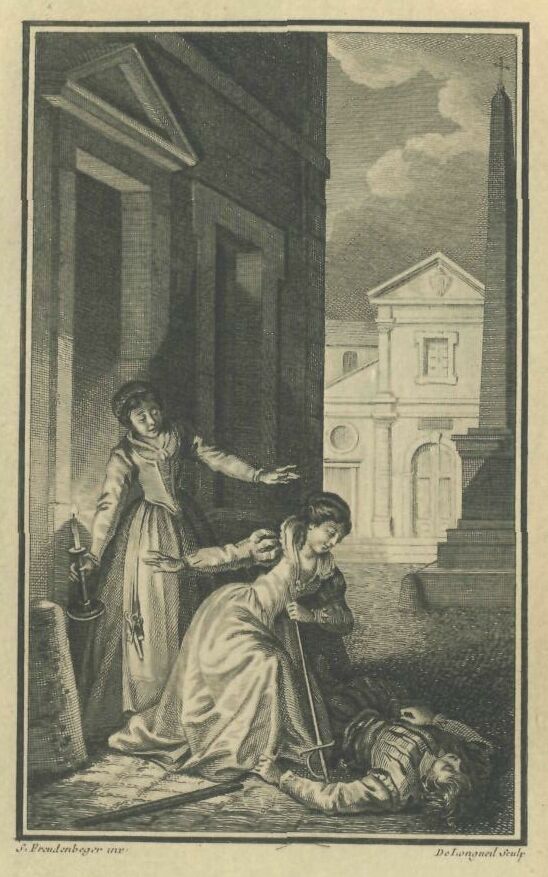
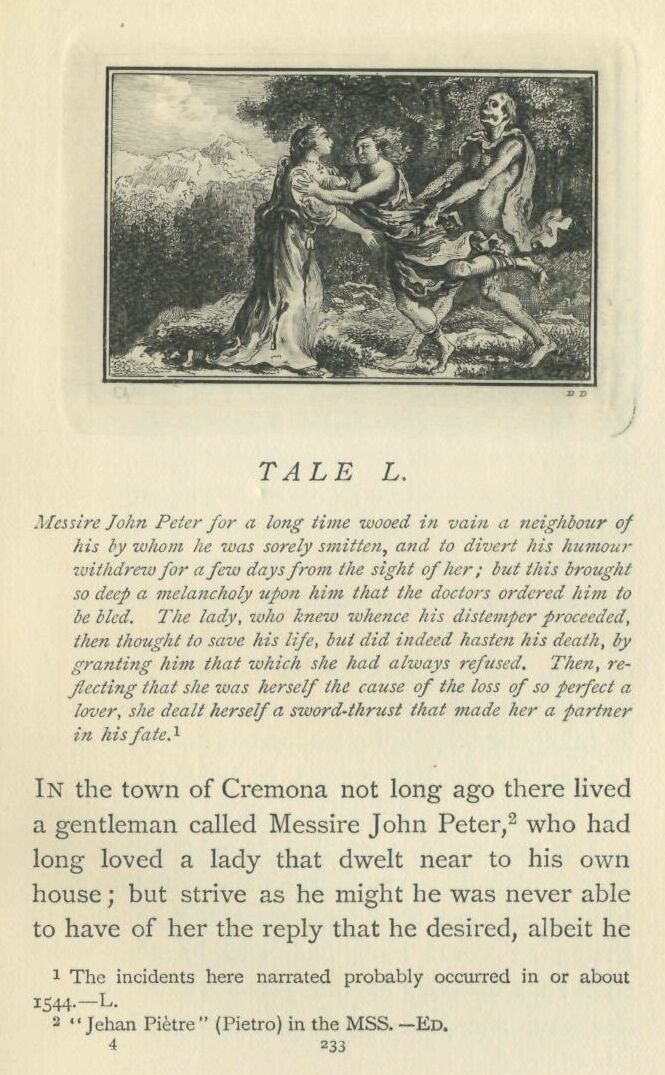
TALE L .
     Messire John Peter for a long time wooed in vain a
     neighbour of his by whom he was sorely smitten, and to
     divert his humour withdrew for a few days from the sight of
     her; but this brought so deep a melancholy upon him that the
     doctors ordered him to be bled. The lady, who knew whence
     his distemper proceeded, then thought to save his life, but
     did indeed hasten his death, by granting him that which she
     had always refused. Then, reflecting that she was herself
     the cause of the loss of so perfect a lover, she dealt
     herself a sword-thrust that made her a partner in his fate.
     (1)
In the town of Cremona not long ago there lived a gentleman called Messire
John Peter, (2) who had long loved a lady that dwelt near to his own
house; but strive as he might he was never able to have of her the reply
that he desired, albeit he loved her with his whole heart. Being greatly
grieved and troubled at this, the poor gentleman withdrew into his lodging
with the resolve that he would no longer vainly pursue the happiness the
quest of which was devouring his life; and accordingly, to divert his
humour, he passed a few days without seeing her. This caused him to fall
into deep sadness, so that his countenance was no longer the same. His
kinsfolk summoned the doctors, who, finding that his face was growing
yellow, thought that he had some obstruction of the liver and ordered a
blood-letting.
     1  The incidents here narrated probably occurred in or about
     1544.—L.

     2  “Jehan Piètre” (Pietro) in the MSS.—Ed.
The lady, who had dealt so sternly with him, knew very well that his
sickness was caused by her refusal alone, and she sent to him an old woman
in whom she trusted, to tell him that, since she saw his love to be
genuine and unfeigned, she was now resolved to grant him all that which
she had refused him so long. She had therefore devised a means to leave
her house and go to a place where he might privately see her.
The gentleman, who that same morning had been bled in the arm, found
himself better cured by this message than by any medicine or bloodletting
he could have had, and he sent word that he would be at the place without
fail at the hour she had appointed. He added that she had wrought an
evident miracle, since with one word she had cured a man of a sickness for
which all the doctors were not able to find a remedy.
The longed-for evening being come, the gentleman repaired to the appointed
place with such extreme joy as must needs come soon to an end, since
increase of it were not possible. He had waited but a short time after his
arrival, when she whom he loved more dearly than his own soul came to meet
him. He did not occupy himself with making long speeches, for the fire
that consumed him prompted him to seek with all speed that which he could
scarcely believe to be at last within his power. But whilst, intoxicated
beyond measure with love and joy, he was in one direction seeking a cure
that would give him life, he brought to pass in another the hastening of
his death; for, heedless of himself for his sweetheart’s sake, he
perceived not that his arm became unbound, and that the newly-opened wound
discharged so much blood that he was, poor gentleman, completely bathed in
it. Thinking, however, that his weakness had been caused by his excess, he
bethought himself of returning home.
Then love, which had too closely united them, so dealt with him that, as
he was parting from his sweetheart, his soul parted from his body, and, by
reason of his great loss of blood, he fell dead at his lady’s feet.
She, on her side, stood there in astonishment, contemplating the loss of
so perfect a lover, of whose death she had herself been the sole cause.
Reflecting, on the other hand, on the shame and sorrow that would be hers
if the dead body were found in her house, she carried it, with a
serving-woman whom she trusted, into the street in order that the matter
might not be known. Nevertheless, she felt that she could not leave it
there alone. Taking up the dead man’s sword, she was fain to share his
fate, and, indeed, to punish her heart, which had been the cause of all
his woe, she pierced it through and through, so that her dead body fell
upon that of her lover.
When her father and mother came out of their house in the morning, they
found this pitiful sight, and, after making such mourning as was natural,
they buried the lovers together.
“Thus, ladies, may it be seen that excessive love brings with it other
woe.”
“This is what I like to see,” said Simontault, “a love so equal that when
one died the other could not live. Had I, by the grace of God, found such
a mistress, I think that none could ever have ioved her more perfectly
than I.”
“Yet am I of opinion,” said Parlamente, “that you would not have been so
blinded by love as not to bind up your arm better than he did. The days
are gone when men were wont to forget their lives for the ladies’ sake.”
“But those are not gone,” said Simontault, “when ladies are apt to forget
their lovers’ lives for their pleasure’s sake.”
“I think,” said Ennasuite, “that there is no living woman that can take
pleasure in the death of a man, no, not even though he were her enemy.
Still, if men will indeed kill themselves, the ladies cannot prevent
them.”
“Nevertheless,” said Saffredent, “she that denies the gift of bread to a
poor starving man is held to be a murderess.”
“If your requests,” said Oisille, “were as reasonable as those of a poor
man seeking to supply his needs, it would be over cruel of the ladies to
refuse you. God be thanked, however, your sickness kills none but such as
must of necessity die within the year.”
“I do not understand, madam,” said Saffredent, “that there can be any
greater need than that which causes all others to be forgotten. When love
is deep, no bread and no meat whatsoever can be thought of save the glance
and speech of the woman whom one loves.”
“If you were allowed to fast,” said Oisille, “with no other meat but that,
you would tell a very different tale.”
“I acknowledge,” he replied, “that the body might fail, but not so the
heart and will.”
“Then,” said Parlamente, “God has dealt very mercifully with you in
leading you to have recourse to a quarter where you find such little
contentment that you must needs console yourself with eating and drinking.
Methinks in these matters you acquit yourself so well, that you should
praise God for the tenderness of His cruelty.”
“I have been so nurtured in torment,” he replied, “that I am beginning to
be well pleased with woes of which other men complain.”
“Perhaps,” said Longarine, “our complaints debar you from company where
your gladness makes you welcome; for nothing is so vexatious as an
importunate lover.”
“Say, rather,” answered Simontault, “as a cruel lady ———‘”
“I clearly see,” said Oisille, “now that the matter touches Simontault,
that, if we stay until he brings his reasonings to an end, we shall find
ourselves at complines (3) rather than vespers. Let us, therefore, go and
praise God that this day has passed without graver dispute.”
3 The last division in the Roman Catholic breviary.—Ed.
She was the first to rise, and all the others followed her, but Simontault
and Longarine ceased not to carry on their quarrel, yet so gently that,
without drawing of sword, Simontault won the victory, and proved that the
strongest passion was the sorest need.
At this point they entered the church, where the monks were waiting for
them.
Having heard vespers, they went to sup as much off words as meat, for
their converse lasted as long as they were at table, and throughout the
evening also, until Oisille told them that they might well retire and give
some rest to their minds. The five days that were past had been filled
with such brave stories, that she had great fear lest the sixth should not
be equal to them; for, even if they were to invent their tales, it was not
possible to tell any better than those true ones which had already been
related in the company.
Geburon, however, told her that, so long as the world lasted, things would
happen worthy of remembrance.
“For,” said he, “the wickedness of wicked men is always what it has been,
as also is the goodness of the good. So long as wickedness and good reign
upon earth, they will ever fill it with fresh actions, although it be
written that there is nothing new under the sun. (4) But we, who have not
been summoned to the intimate counsels of God, and who are ignorant of
first causes, deem all new things noteworthy in proportion as we would not
or could not ourselves accomplish them. So, be not afraid that the days to
come will not be in keeping with those that are past, and be sure that on
your own part you perform well your duty.”
4 Ecclesiastes i. 9, 10.—M.
Oisille replied that she commended herself to God, and in His name she
bade them good-night.
So all the company withdrew, thus bringing to an end the Fifth Day.