WITH SOME NOTICE OF PRECEDENT COLLECTIONS OF TALES IN FRANCE, OF THE
AUTHOR, AND OF HER OTHER WORKS.
It is probable that every one who has had much to do with the study of
literature has conceived certain preferences for books which he knows not
to belong absolutely to the first order, but which he thinks to have been
unjustly depreciated by the general judgment, and which appeal to his own
tastes or sympathies with particular strength. One of such books in my own
case is THE HEPTAMERON of Margaret of Navarre. I have read it again
and again, sometimes at short intervals, sometimes at longer, during the
lapse of some five-and-twenty years since I first met with it. But the
place which it holds in my critical judgment and in my private affections
has hardly altered at all since the first reading. I like it as a reader
perhaps rather more than I esteem it as a critic; but even as a critic,
and allowing fully for the personal equation, I think that it deserves a
far higher place than is generally accorded to it.
Three mistakes, as it seems to me, pervade most of the estimates, critical
or uncritical, of the Heptameron, the two first of old date, the
third of recent origin. The first is that it is a comparatively feeble
imitation of a great original, and that any one who knows Boccaccio need
hardly trouble himself to know Margaret of Navarre. The second is that it
is a loose if not obscene book, disgraceful for a lady to have written (or
at least mothered), and not very creditable for any one to read. The third
is that it is interesting as the gossip of a certain class of modern
newspapers is interesting, because it tells scandal about distinguished
personages, and has for its interlocutors other distinguished personages,
who can be identified without much difficulty, and the identification of
whom adds zest to the reading. All these three seem to me to be mistakes
of fact and of judgment. In the first place, the Heptameron borrows
from its original literally nothing but plan. Its stories are quite
independent; the similarity of name is only a bookseller’s invention,
though a rather happy one; and the personal setting, which is in Boccaccio
a mere framework, has here considerable substance and interest. In the
second place, the accusation of looseness is wildly exaggerated. There is
one very coarse but not in the least immoral story in the Heptameron;
there are several broad jests on the obnoxious cloister and its vices,
there are many tales which are not intended virginibus puerisque,
and there is a pervading flavour of that half-French, half-Italian
courtship of married women which was at the time usual everywhere out of
England. The manners are not our manners, and what may be called the moral
tone is distinguished by a singular cast, of which more presently. But if
not entirely a book for boys and girls, the Heptameron is certainly
not one which Southey need have excepted from his admirable answer in the
character of author of “The Doctor,” to the person who wondered whether he
(Southey) could have daughters, and if so, whether they liked reading. “He
has daughters: they love reading: and he is not the man I take him for if
they are not ‘allowed to open’ any book in his library.” The last error,
if not so entirely inconsistent with intelligent reading of the book as
the first and second, is scarcely less strange to me. For, in the first
place, the identification of the personages in the framework of the Heptameron
depends upon the merest and, as it seems to me, the idlest conjecture;
and, in the second, the interest of the actual tittle-tattle, whether it
could be fathered on A or B or not, is the least part of the interest of
the book. Indeed, the stories altogether are, as I think, far less
interesting than the framework.
Let us see, therefore, if we cannot treat the Heptameron in a
somewhat different fashion from that in which any previous critic, even
Sainte-Beuve, has treated it. The divisions of such treatment are not very
far to seek. In the first place, let us give some account of the works of
the same class which preceded and perhaps patterned it. In the second, let
us give an account of the supposed author, of her other works, and of the
probable character of her connection with this one. In the third, without
attempting dry argument, let us give some sketch of the vital part, which
we have called the framework, and some general characteristics of the
stories. And, in the fourth and last, let us endeavour to disengage that
peculiar tone, flavour, note, or whatever word may be preferred, which, as
it seems to me at least, at once distinguishes the Heptameron from
other books of the kind, and renders it peculiarly attractive to those
whose temperament and taste predisposes them to be attracted. For there is
a great deal of pre-established harmony in literature and literary tastes;
and I have a kind of idea that every man has his library marked out for
him when he comes into the world, and has then only got to get the books
and read them.
Margaret herself refers openly enough to the example of the Decameron,
which had been translated by her own secretary, Anthony le Maçon, a member
of her literary coterie, and not improbably connected with the writing or
redacting of the Heptameron itself. Nor were later Italian
tale-tellers likely to be without influence at a time when French was
being “Italianated” in every possible way, to the great disgust of some
Frenchmen. But the Italian ancestors or patterns need not be dealt with
here, and can be discovered with ease and pleasure by any one who wishes
in the drier pages of Dunlop, or in the more flowery and starry pages of
Mr. Symonds’ “History of the Renaissance in Italy.” The next few pages
will deal only with the French tale-tellers, whose productions before
Margaret’s days were, if not very numerous, far from uninteresting, and
whose influence on the slight difference of genre which
distinguishes the tales before us from Italian tales was by no means
slight.
In France, as everywhere else, prose fiction, like prose of all kinds, was
considerably later in production than verse, and short tales of the kind
before us were especially postponed by the number, excellence, and
popularity of the verse fabliaux. Of these, large numbers have come
down to us, and they exactly correspond in verse to the tales of the Decameron
and the Heptameron in prose, except that the satirical motive is
even more strongly marked, and that touches of romantic sentiment are
rarer. This element of romance, however, appears abundantly in the long
prose versions of the Arthurian and other legends, and we have a certain
number of short prose stories of the thirteenth and fourteenth centuries,
of which the most famous is that of Aucassin et Nicolette. These
latter, however, are rather short romances than distinct prose tales of
our kind. Of that kind the first famous book in French, and the only
famous book, besides the one before us, is the Cent Nouvelles Nouvelles.
The authorship of this book is very uncertain. It purports to be a
collection of stories told by different persons of the society of Louis
XI., when he was but Dauphin, and was in exile in Flanders under the
protection of the Duke of Burgundy. But it has of late years been very
generally assigned (though on rather slender grounds of probability, and
none of positive evidence), to Anthony de la Salle, the best French prose
writer of the fifteenth century, except Comines, and one on whom, with an
odd unanimity, conjectural criticism has bestowed, besides his
acknowledged romance of late chivalrous society, Petit Jehan de Saintré
(a work which itself has some affinities with the class of story before
us), not only the Cent Nouvelles Nouvelles, but the famous
satirical treatise of the Quinze Joyes du Mariage, and the still
more famous farce of Pathelin. Some of the Nouvelles,
moreover, have been putatively fathered on Louis XI. himself, in which
case the royal house of France would boast of two distinguished
taletellers instead of one. However this may be, they all display the
somewhat hard and grim but keen and practical humour which seems to have
distinguished that prince, which was a characteristic of French thought
and temper at the time, and which perhaps arose with the misfortunes and
hardships of the Hundred Years’ War. The stories are decidedly amusing,
with a considerably greater, though also a much ruder, vis comica
than that of the Heptameron; and they are told in a style unadorned
indeed, and somewhat dry, lacking the simplicity of the older French, and
not yet attaining to the graces of the newer, but forcible, distinct, and
sculpturesque, if not picturesque. A great license of subject and
language, and an enjoyment of practical jokes of the roughest, not to say
the most cruel character, prevail throughout, and there is hardly a touch
of anything like romance; the tales alternating between jests as broad as
those of the Reeve’s and Miller’s tales in Chaucer (themselves exactly
corresponding to verse fabliaux, of which the Cent Nouvelles
are exact prose counterparts, and perhaps prose versions), and examples of
what has been called “the humour of the stick,” which sometimes trenches
hard upon the humour of the gallows and the torture-chamber. These
characteristics have made the Cent Nouvelles Nouvelles no great
favourites of late, but their unpopularity is somewhat undeserved. For all
their coarseness, there is much genuine comedy in them, and if the
prettiness of romantic and literary dressing-up is absent from them, so
likewise is the insincerity thereof. They make one of the most
considerable prose books of what may be called middle French literature,
and they had much influence on the books that followed, especially on this
of Margaret’s. Indeed, one of the few examples to be found between the
two, the Grand Paragon de Nouvelles Nouvelles of Nicolas de Troyes
(1535), obviously takes them for model. But Nicolas was a dull dog, and
neither profited by his model nor gave any one else opportunity to profit
by himself.
Rabelais, the first book of whose Pantagruel anticipated the Paragon
by three years, while the Gargantua coincided with it, was a great
authority at the Court of Margaret’s brother Francis, dedicated one of the
books (the third) of Pantagruel to her, before her death, in
high-flown language, as esprit abstrait, ravy et ecstatic, and must
certainly have been familiar reading of hers, and of all the ladies and
gentlemen, literary and fashionable, of her Court. But there is little
resemblance to be found in his style and hers. The short stories which
Master Francis scatters about his longer work are, indeed, models of
narration, but his whole tone of thought and manner of treatment are
altogether alien from those of the “ravished spirit” whom he praises. His
deliberate coarseness is not more different from her deliberate delicacy
than his intensely practical spirit from her high-flown romanticism (which
makes one think of, and may have suggested, the Court of La Quinte), and
her mixture of devout and amatory quodlibetation from his cynical
criticism and all-dissolving irony. But there was a contemporary of
Rabelais who forms a kind of link between him and Margaret, whose work in
part is very like the Heptameron, and who has been thought to have
had more than a hand in it. This was Bonaventure Despériers, a man whose
history is as obscure as his works are interesting. Born in or about the
year 1500, he committed suicide in 1544, either during a fit of insanity,
or, as has been thought more likely, in order to escape the danger of the
persecution which, in the last years of the reign of Francis, threatened
the unorthodox, and which Margaret, who had more than once warded it off
from them, was then powerless to avert. Despériers, to speak truth, was in
far more danger of the stake than most of his friends. The infidelity of
Rabelais is a matter of inference only, and some critics (among whom the
present writer ranks himself) see in his daring ridicule of existing
abuses nothing inconsistent with a perfectly sound, if liberally
conditioned, orthodoxy. Despériers, like Rabelais, was a Lucianist, but
his modernising of Lucian (the remarkable book called Cymbalum Mundï),
though pretending to deal with ancient mythology, has an almost
unmistakable reference to revealed religion. It is not, however, by this
work or by this side of his character at all that Despériers is brought
into connection with the work of Margaret, who, if learned and liberal,
and sometimes tending to the new ideas in religion, was always devout and
always orthodox in fundamentals. Besides the Cymbalum Mundi, he has
left a curious book, not published, like the Heptameron itself,
till long after his own death, and entitled Nouvelles Récréations et
Joyeux Devis. The tales of which it consists are for the most part
very short, some being rather sketches or outlines of tales than actually
worked-out stories, so that, although there are no less than a hundred and
twenty-nine of them, the whole book is probably not half the bulk of the
Heptameron itself. But they are extremely well written, and the
specially interesting thing about them is, that in them there appears, and
appears for the first time (unless we take the Heptameron itself as
earlier, which is contrary to all probability), the singular and, at any
rate to some persons, very attractive mixture of sentiment and satire, of
learning and a love of refined society, of joint devotion to heavenly and
earthly love, of voluptuous enjoyment of the present, blended and shadowed
with a sense of the night that cometh, which delights us in the prose of
the Heptameron, and in the verse not only of all the Pléiade poets
in France, but of Spenser, Donne, and some of their followers in England.
The scale of the stories, which are sometimes mere anecdotes, is so small,
the room for miscellaneous discourse in them is so scanty, and the absence
of any connecting links, such as those of Margaret’s own plan, checks the
expression of personal feeling so much, that it is only occasionally that
this cast of thought can be perceived. But it is there, and its presence
is an important element in determining the question of the exact
authorship of the Heptameron itself.
It can hardly be said that, except translations from the Italian (of which
the close intercourse between France and Italy in the days of the later
Valois produced many), Margaret had many other examples before her. For
such a book as the Propos Rustiques of Noël du Fail, though
published before her death, is not likely to have exercised any influence
over her; and most other books of the kind are later than her own. One
such (for, despite its bizarre title and its distinct intention of
attacking the Roman Church, Henry Estienne’s Apologie pour Hérodote
is really a collection of stories) deserves mention, not because of its
influence upon the Queen of Navarre, but because of the Queen of Navarre’s
influence upon it. Estienne is constantly quoting the Heptameron,
and though to a certain extent the inveteracy with which the friars are
attacked here must have given the book a special attraction for him, two
things may be gathered from his quotations and attributions. The first is
that the book was a very popular one; the second, that there was no doubt
among well-informed persons, of whom and in whose company Estienne most
certainly was, that the Heptameron was in more than name the work
of its supposed author.
From what went before it Margaret could, and could not, borrow certain
well-defined things. Models both Italian and French gave her the scheme of
including a large number of short and curtly, but not skimpingly, told
stories in one general framework, and of subdividing them into groups
dealing more or less with the same subject or class of subject. She had
also in her predecessors the example of drawing largely on that perennial
and somewhat facile source of laughter—the putting together of
incidents and phrases which even by those who laugh at them are regarded
as indecorous. But of this expedient she availed herself rather less than
any of her forerunners. She had further the example of a generally
satirical intent; but here, too, she was not content merely to follow, and
her satire is, for the most part, limited to the corruptions and abuses of
the monastic orders. It can hardly be said that any of the other stock
subjects, lawyers, doctors, citizens, even husbands (for she is less
satirical on marriage than encomiastic of love), are dealt with much by
her. She found also in some, but chiefly in older books of the Chartier
and still earlier traditions, and rather in Italian than in French, a
certain strain of romance proper and of adventure; but of this also she
availed herself but rarely. What she did not find in any example (unless,
and then but partially, in the example of her own servant, Bonaventure
Des-périers) was first the interweaving of a great deal not merely of
formal religious exercise, but of positive religious devotion in her work;
and secondly, the infusing into it of the peculiar Renaissance contrast,
so often to be noticed, of love and death, passion and piety, voluptuous
enjoyment and sombre anticipation.
But it is now time to say a little more about the personality and work of
this lady, whose name all this time we have been using freely, and who was
indeed a very notable person quite independently of her literary work. Nor
was she in literature by any means an unnotable one, quite independently
of the collection of unfinished stories, which, after receiving at its
first posthumous publication the not particularly appropriate title of Les
Amants Fortunés, was more fortunately re-named, albeit by something of
a bull (for there is the beginning of an eighth day as well as the full
complement of the seven), the Heptameron.
Few ladies have been known in history by more and more confusing titles
than the author of the Heptameron, the confusion arising partly
from the fact that she had a niece and a great-niece of the same charming
Christian name as herself. The second Margaret de Valois (the most
appropriate name of all three, as it was theirs by family right) was the
daughter of Francis I., the patroness of Ronsard, and, somewhat late in
life, the wife of the Duke of Savoy—a marriage which, as the bride
carried with her a dowry of territory, was not popular, and brought some
coarse jests on her. Not much is said of her personal appearance after her
infancy; but she inherited her aunt’s literary tastes, if not her literary
powers, and gave Ronsard powerful support in his early days. The third was
the daughter of Henry II., the “Grosse Margot” of her brother, Henry III.,
the “Reine Margot” of Dumas’ novel, the idol of Brantôme, the first wife
of Henry IV., the beloved of Guise, La Mole, and a long succession of
gallants, the rival of her sister-in-law Mary Stuart, not in misfortunes,
but as the most beautiful, gracious, learned, accomplished, and amiable of
the ladies of her time. This Margaret would have been an almost perfect
heroine of romance (for she had every good quality except chastity), if
she had not unluckily lived rather too long.
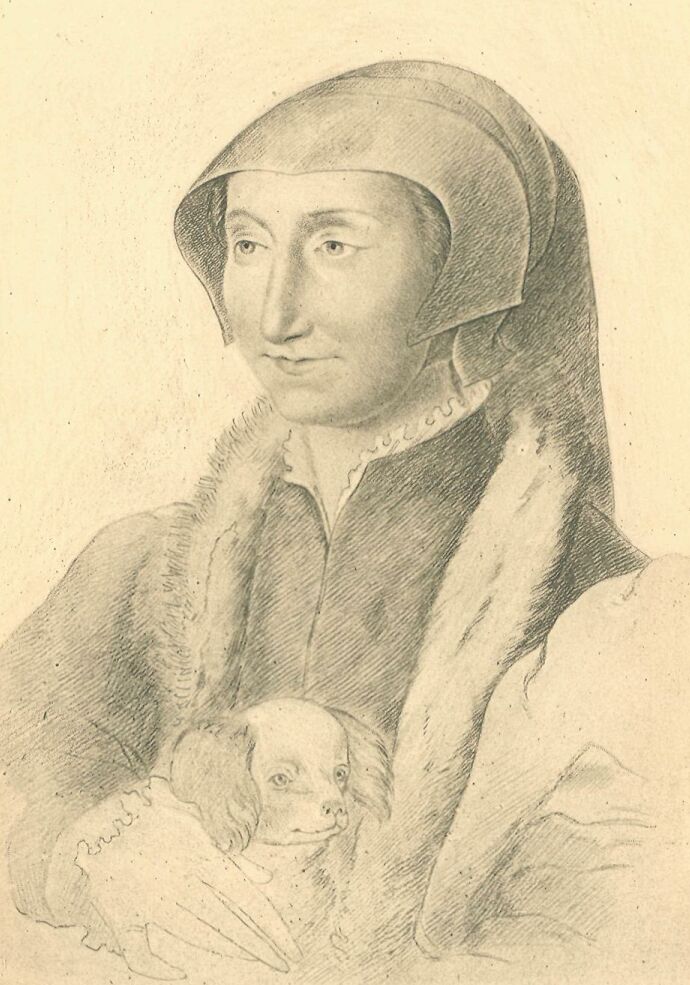
Her great-aunt, our present subject, was not the equal of her great-niece
in beauty, her portraits being rendered uncomely by a portentously long
nose, longer even than Mrs. Siddons’s, and by a very curious expression of
the eyes, going near to slyness. But the face is one which can be imagined
as much more beautiful than it seems in the not very attractive
portraiture of the time, and her actual attractions are attested by her
contemporaries with something more than the homage-to-order which literary
men have never failed to pay to ladies who are patronesses of letters.
Besides Margaret of Valois, she is known as Margaret of Angoulême, from
her place of birth and her father’s title; Margaret of Alençon, from the
fief of her first husband; Margaret of Navarre, of which country, like her
grand-niece, she was queen, by her second marriage with Henry d’Albret;
and even Margaret of Orleans, as belonging to the Orleans branch of the
royal house. She was not, like her nieces, Margaret of France, as her
father never reigned, and Brantôme properly denies her the title, but
others sometimes give it. When it is necessary to call her anything
besides the simple “Margaret,” Angoulême is at once the most appropriate
and the most distinctive designation. She was born on the 11th or 12th of
April 1492, her father being Charles, Count of Angoulême, and her mother
Louise of Savoy. She was their eldest child, and two years older than her
brother, the future King Francis. According to, and even in excess of, the
custom of the age, she received a very learned education, acquiring not
merely the three tongues, French, Italian, and Spanish, which were all in
common use at the French Court during her time, but Latin, and even a
little Greek and a little Hebrew. She lived in the provinces both before
and after her marriage, in 1509, to her relation, Charles, Duke of
Alençon, who was older than herself by three years, and though a fair
soldier and an inoffensive person, was apparently of little talents and
not particularly amiable. The accession of her brother to the throne
opened a much more brilliant career to her. She and her mother jointly
exercised great influence over Francis; and the Duchess of Alençon, to
whom her brother shortly afterwards gave Berry, was for many years one of
the most influential persons in the kingdom, using her influence almost
invariably for good. Her husband died soon after Pavia, and in the same
year (September 1525) she undertook a journey to Spain on behalf of her
captive brother. This journey, with some expressions in her letters and in
Brantôme, has been wrested by some critics in order to prove that her
affection for Francis was warmer than it ought to have been—an
imputation wanton in both senses of the word.
She was sought in marriage by or offered in marriage to divers
distinguished persons during her widowhood, and this was also the time of
her principal diplomatic exercise, an office for which—odd as it now
seems for a woman—she had, like her mother, like her niece Catherine
of Medicis, like her namesake Margaret of Parma, and like other ladies of
the age, a very considerable aptitude and reputation. When she at last
married, the match was not a brilliant one, though it proved, contrary to
immediate probability, to be the source of the last and the most glorious
branch of the royal dynasty of France. The bridegroom bore indeed the
title of King of Navarre and possessed Bearn, but his kingdom had long been
in Spanish hands, and but for his wife’s dowry of Alençon and appanage of
Berry (to which Francis had added Armagnac and a large pension) he would
have been but a lackland. Furthermore, he was eleven years younger than
herself, and it is at least insinuated that the affection, if there was
any, was chiefly on her side. At any rate, this earlier Henry of Navarre
seems to have had not a few of the characteristics of his grandson,
together with a violence and brutality which, to do the Vert Galant
justice, formed no part of his character. The only son of the marriage
died young, and a girl, Jane d’Albret, mother of the great Bourbon race of
the next two centuries, was taken away from her parents by “reasons of
state” for a time. The domestic life of Margaret, however, concerns us but
little, except in one way. Her husband disliked administration, and she
was the principal ruler in their rather extensive estates or dominions.
Moreover, she was able at her quasi-Court to extend the literary coteries
which she had already begun to form at Paris. The patronage to men of
letters for which her brother is famous was certainly more due to her than
to himself; and to her also was due the partial toleration of religious
liberty which for a time distinguished his reign. It was not till her
influence was weakened that intolerance prevailed, and she was able even
then for a time to save Marot and other distinguished persons from
persecution. It is rather a moot-point how far she inclined to the
Reformed doctrines, properly so called. Her letters, her serious and
poetical work, and even the Heptameron itself, show a fervently
pietistic spirit, and occasionally seem to testify to a distinct
inclination towards Protestantism, which is also positively attested by
Brantôme and others; but this Protestantism must have been, so far as it
was consistent and definite at all, the Protestantism of Erasmus rather
than of Luther, of Rabelais rather than of Calvin. She had a very strong
objection to the coarseness, the vices, the idleness, the brutish
ignorance of the cloister; she had aspirations after a more spiritual form
of religion than the ordinary Catholicism of her day provided, and as a
strong politician she may have had something of that Gallicanism which has
always been well marked in some of the best Frenchmen, and which at one
time nearly prevailed with her great-great-grandson, Louis XIV. But there
is no doubt that, as her brother said to the fanatical Montmorency, she
would always have been and always was of his religion, the religion of the
State. The side of the Reformation which must have most appealed to her
was neither its austere morals, nor its bare ritual, nor its doctrines,
properly so called, but its spiritual pietism and its connection with
profane learning and letters; for of literature Margaret was an ardent
devotee and a constant practitioner.
Her best days were done by the time of her second marriage. After the
King’s return from Spain persecution broke out, and Margaret’s influence
became more and more weak to stop it. As early as 1533 her own Miroir
de l’Ame Pécheresse, then in a second edition, provoked the fanaticism
of the Sorbonne, and the King had to interfere in person to protect his
sister’s work and herself from gross insult. The Medici marriage increased
the persecuting tendency, and for a time there was even an attempt to
suppress printing, and with it all that new literature which was the
Queen’s delight. She was herself in some danger, but Francis had not sunk
so low as to permit any actual attack to be made on her. Yet all the last
years of her life were unhappy, though she continued to keep Court at
Nérac in Pau, to accompany her brother in his progresses, and, as we know
from documents, to play Lady Bountiful over a wide area of France. Her
husband appears to have been rather at variance with her; and her
daughter, who married first, and in name only, the Duke of Cleves in 1540,
and later (1548) Anthony de Bourbon, was also not on cordial terms with
her mother. By the date of this second marriage Francis was dead, and
though he had for many years been anything but wholly kind, Margaret’s
good days were now in truth done. Her nephew Henry left her in possession
of her revenues, but does not seem to have been very affectionately
disposed towards her; and even had she been inclined to attempt any
recovery of influence, his wife and his mistress, Catherine de Medici and
Diana of Poitiers, two women as different from Margaret as they were from
one another, would certainly have prevented her from obtaining it. As a
matter of fact, however, she had long been in ill-health, and her
brother’s death seems to have dealt her the final stroke. She survived it
two years, even as she had been born two years before him, and died on the
21 st December 1549, at the Castle of Odos, near Tarbes, having lived in
almost complete retirement for a considerable time. Her husband is said to
have regretted her dead more than he loved her living, and her literary
admirers, such of them as death and exile had spared, were not ungrateful.
Tombeaux, or collections of funeral verses, were not lacking, the
first being in Latin, and, oddly enough, nominally by three English
sisters, Anne, Margaret, and Jane Seymour, nieces of Henry VIII.‘s queen
and Edward VI.‘s mother, with learned persons like Dorât, Sainte-Marthe,
and Baïf. This was re-issued in French and in a fuller form later.
Some reference has been made to an atrocious slur cast without a shred of
evidence on her moral character. There is as little foundation for more
general though milder charges of laxity. It is admitted that she had
little love for her first husband, and it seems to be probable that her
second had not much love for her. She was certainly addressed in gallant
strains by men of letters, the most audacious being Clement Marot; but the
almost universal reference of the well-known and delightful lines
beginning—
“Un doux nenny avec un doux sourire,”
to her method of dealing not merely with this lover but with others,
argues a general confidence in her being a virtuous coquette, if somewhat
coquettishly virtuous. It may be added that the whole tone of the Heptameron
points to a very similar conclusion.
Her literary work was very considerable, and it falls under three
divisions: letters, the book before us, and the very curious and
interesting collection of poems known by the charming if fantastic title
of Les Marguerites de la Marguerite des Princesses, a play on the
meanings, daisy, pearl, and Margaret, which had been popular in the
artificial school of French poetry since the end of the thirteenth century
in a vast number of forms.
The letters are naturally of the very first importance for determining the
character of Margaret’s life as a woman of business, a diplomatist, and so
forth. They show her to us in all these capacities, and also in that of an
enlightened and always ready patroness of letters and of men of letters.
Further, they are of value, though their value is somewhat affected by a
reservation to be made immediately, as to her mental and moral
characteristics. But they are not of literary interest at all equal to
that of either of the other divisions. They are, if not spoilt, still not
improved, by the fact that the art of easy letter-writing, in which
Frenchwomen of the next century were to show themselves such proficients,
had not yet been developed, and that most of them are couched in a heavy,
laborious, semiofficial style, which smells, as far as mere style goes, of
the cumbrous refinements of the rhétoriqueurs, in whose flourishing
time Margaret herself grew up, and which conceals the writer’s sentiments
under elaborate forms of ceremonial courtesy. Something at least of the
groundless scandal before referred to is derived in all probability, if
not in all certainty, from the lavish use of hyperbole in addressing her
brother; and generally speaking, the rebuke of the Queen to Polonius,
“More matter with less art,” is applicable to the whole correspondence.
Something of the same evil influence is shown in the Marguerites. It must
be remembered that the writer died before the Pléiade movement had been
fully started, and that she was older by five years than Marot, the only
one of her own contemporaries and her own literary circle who attained to
a poetic style easier, freer, and more genuine than the cumbrous rhetoric,
partly derived from the allegorising style of the Roman de la Rose
and its followers, partly influenced by corrupt following of the
re-discovered and scarcely yet understood classics, partly alloyed with
Flemish and German and Spanish stiffness, of which Chastellain, Crétin,
and the rest have been the frequently quoted and the rarely read exponents
to students of French literature. The contents of the Marguerites,
to take the order of the beautiful edition of M. Félix Frank, are as
follows: Volume I. contains first a long and singular religious poem
entitled Le Miroir de l’Ame Pécheresse, in rhymed decasyllables, in
which pretty literal paraphrases of a large number of passages of
Scripture are strung together with a certain amount of pious comment and
reflection. This is followed (after a shorter piece on the contest in the
human soul between the laws of the spirit and of the flesh) by another
poem of about the same length as the Miroir, and of no very
different character, entitled Oraison de L’Ame Fidèle à son Seigneur
Dieu, and a shorter Oraison à Notre Seigneur Jésus Christ
completes the volume. The second volume yields four so-called “comedies,”
but really mysteries on the old mediæval model, only distinguishable from
their forerunners by slightly more modern language and a more scriptural
tone. The subjects are the Nativity, the Adoration of the Three Kings, the
Massacre of the Innocents, and the Flight into Egypt. The third volume
contains a third poem in the style of the Miroir, but much
superior, Le Triomphe de l’Agneau, a considerable body of spiritual
songs, a miscellaneous poem or two, and some epistles, chiefly addressed
to Francis. These last begin the smaller and secular division of the Marguerites,
which is completed in the fourth volume by Les Quatre Dames et les
Quatre Gentilhommes, composed of long monologues after the fashion of
the Froissart-Chartier school, by a “comédie profane,” a farce
entitled Trop, Prou [much], Peu, Moins; a long love poem, again in
the Chartier style, entitled La Coche, and some minor pieces.
Opinion as to these poems has varied somewhat, but their merit has never
been put very high, nor, to tell the truth, could it be put high by any
one who speaks critically. In the first place, they are written for the
most part on very bad models, both in general plan and in particular style
and expression. The plan is, as has been said, taken from the long-winded
allegorical erotic poetry of the very late thirteenth, the fourteenth, and
the fifteenth centuries—poetry which is now among the most difficult
to read in any literature. The groundwork or canvas being transferred from
love to religion, it gains a little in freshness and directness of
purpose, but hardly in general readableness. Thus, for instance, two whole
pages of the Miroir, or some forty or fifty lines, are taken up
with endless playings on the words mort and vie and their
derivatives, such as mortifiez, and mort fiez, mort vivifiée and vie
mourante. The sacred comedies or mysteries have the tediousness and
lack of action of the older pieces of the same kind without their naïveté;
and pretty much the same may be said of the profane comedy (which is a
kind of morality), and of the farce. Of La Coche, what has been
said of the long sacred poems may be said, except that here we go back to
the actual subject of the models, not on the whole with advantage: while
in the minor pieces the same word plays and frigid conceits are
observable.
But if this somewhat severe judgment must be passed on the poems as
wholes, and from a certain point of view, it may be considerably softened
when they are considered more in detail. In not a few passages of the
religious poems Margaret has reached (and as she had no examples before
her except Marot’s psalms, which were themselves later than at least some
of her work, may be said to have anticipated) that grave and solemn
harmony of the French Huguenots of the sixteenth century, which in Du
Bartas, in Agrippa d’Aubigné, and in passages of the tragedian
Montchrestien, strikes notes hardly touched elsewhere in French
literature. The Triomphe de l’Agneau displays her at her best in
this respect, and not unfrequently comes not too far off from the
apocalyptic resonance of d’Aubigné himself. Again, the Bergerie
included in the Nativity comedy or mystery, though something of a Dresden
Bergerie (to use a later image), is graceful and elegant enough in
all conscience. But it is on the minor poems, especially the Epistles and
the Chansons Spirituelles, that the defenders of Margaret’s claim
to be a poet rest most strongly. In the former her love, not merely for
her brother, but for her husband, appears unmistakably, and suggests
graceful thoughts. In the latter the force and fire which occasionally
break through the stiff wrappings of the longer poems appear with less
difficulty and in fuller measure.
It is, however, undoubtedly curious, and not to be explained merely by the
difference of subject, that the styles of the letters and of the poems,
agreeing well enough between themselves, differ most remarkably from that
of the Heptameron. The two former are decidedly open to the charges
of pedantry, artificiality, heaviness. There is a great surplusage of
words and a seeming inability to get to the point. The Heptameron
if not equal in narrative vigour and lightness to Boccaccio before and La
Fontaine afterwards, is not in the least exposed to the charge of
clumsiness of any kind, employs a simple, natural, and sufficiently
picturesque vocabulary, avoids all verbiage and roundabout writing, and
both in the narratives and in the connecting conversation displays a very
considerable advance upon nearly all the writers of the time, except
Rabelais, Marot, and Despériers, in easy command of the vernacular. It is,
therefore, not wonderful that there has, at different times (rather less
of late years, but that is probably an accident), been a disposition if
not to take away from Margaret all the credit of the book, at any rate to
give a share of it to others. In so far as this share is attempted to be
bestowed on ladies and gentlemen of her Court or family there is very
little evidence for it; but in so far as the pen may be thought to have
been sometimes held for her by the distinguished men of letters just
referred to (there is no reason why Master Francis himself should not have
sometimes guided it), and by others only less distinguished, there is
considerable internal reason to favour the idea. At all times and in all
places—in France perhaps more than anywhere else—kings and
queens, lords and ladies, have found no difficulty (we need not use the
harsh Voltairian-Carlylian phrase, and say in getting their literary work
“buckwashed,” but) in getting it pointed and seasoned, trimmed and
ornamented by professional men of letters. The form of the Heptameron
lends itself more than any other to such assistance; and while I should
imagine that the setting, with its strong colour, both of religiosity and
amorousness, is almost wholly Margaret’s work, I should also think it so
likely as to be nearly certain that in some at least of the tales the
hands of the authors of the Cymbalum Mundi and the Adolescence
Clémentine, of Le Maçon and Brodeau, may have worked at the devising,
very likely re-shaped and adjusted by the Queen herself, of the actual
stories as we have them now.
The book, as we have it, consists of seven complete days of ten novels
each, and of an eighth containing two novels only. The fictitious scheme
of the setting is somewhat less lugubrious than that of the Decameron,
but still not without an element of tragedy. On the first of September,
“when the hot springs of the Pyrenees begin to enter upon their virtue,” a
company of persons of quality assembled at Cauterets, we are told, and
abode there three weeks with much profit. But when they tried to return,
rain set in with such severity that they thought the Deluge had come
again, and they found their roads, especially that to the French side,
almost entirely barred by the Gave de Béarn and other rivers. So they
scattered in different directions, most of them taking the Spanish side,
either along the mountains and across to Roussillon or straight to
Barcelona, and thence home by sea. But a certain widow, named Oisille,
made her way with much loss of men and horses to the Abbey of Notre Dame
de Serrance. Here she was joined by divers gentlemen and ladies, who had
had even worse experiences of travel than herself, with bears and
brigands, and other evil things, so that one of them, Longarine, had lost
her husband, murdered in an affray in one of the cut-throat inns always
dear to romance. Besides this disconsolate person and Oisille, the company
consisted of a married pair, Hircan and Parlamente; two young cavaliers,
Dagoucin and Saffredent; two young ladies, Nomerfide and Ennasuite;
Simontault, a cavalier-servant of Parlamente; and Geburon, a knight older
and discreeter than the rest of the company except Oisille.(1)
     1 These names have been accommodated to M. Le Roux de
     Lincy’s orthography, from MS. No. 1512; but for myself I
     prefer the spellings, especially “Emarsuitte,” more usual in
     the printed editions.—G. S.
These form the party, and it is to be noted that idle and contradictory as
all the attempts made to identify them have been (for instance, the most
confident interpreters hesitate between Oisille and Parlamente, an aged
widow and a youthful wife, for Margaret herself), it is not to be denied
that the various parts are kept up with much decision and spirit. Of the
men, indeed, Hircan is the only one who has a very decided character, and
is represented as fond of his wife, Parlamente, but a decided libertine
and of a somewhat rough and ruthless general character—points which
have made the interpreters sure that he must be Henry d’Albret. The
others, except that Geburon is, as had been said, older than his
companions, and that Simontault sighs vainly after Parlamente, are merely
walking gentlemen of the time, accomplished enough, but not individual.
The women are much more distinct and show a woman’s hand. Oisille is, as
our own seventeenth-century ancestors would have said, ancient and sober,
very devout, regarded with great respect by the rest of the company, and
accepted as a kind of mistress both of the revels and of more serious
matters, but still a woman of the world, and content to make only an
occasional and mild protest against tolerably free stories and sentiments.
Parlamente, considerably younger, and though virtuous, not by any means
ignorant of or wholly averse to the devotion of Simontault, indulging
occasionally in a kind of mild conjugal sparring with her husband, Hircan,
but apparently devoted to him, full of religion and romance and refinement
at once, is a very charming character, resembling Madame de Sévigné as she
may have been in her unknown or hardly known youth, when husband and
lovers alike were attracted by the flame of her beauty and charm, only to
complain that it froze and did not burn. Longarine is discreetly unhappy
for her dead husband, but appears decidedly consolable; Ennasuite is a
haughty damsel, disdainful of poor folk, and Nomerfide is a pure madcap, a
Catherine Seyton of the generation before Catherine herself, the feminine
Dioneo of the party, and, if a little too free-spoken for prudish modern
taste, a very delightful girl.
Now when this good company had assembled at Serrance and told each other
their misadventures, the waters on inquiry seemed to be out more widely
and more dangerously than before, so that it was impossible to think of
going farther for the time. They deliberated accordingly how they should
employ themselves, and, after allowing, on the proposal of Oisille, an
ample space for sacred exercises, they resolved that every day, after
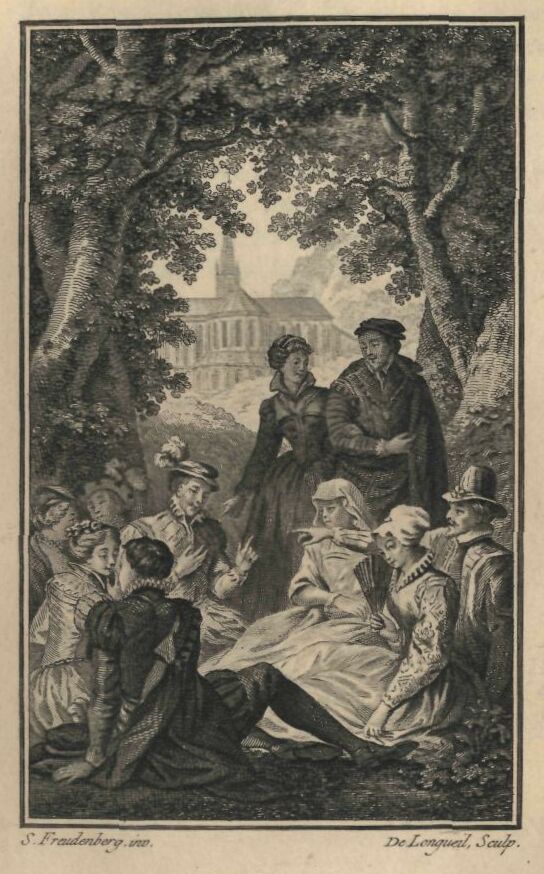
dinner and an interval, they should assemble in a meadow on the bank of
the Gave at midday and tell stories. The device is carried out with such
success that the monks steal behind the hedges to hear them, and an
occasional postponement of vespers takes place. Simontault begins, and the
system of tale-telling goes round on the usual plan of each speaker naming
him or her who shall follow. It should be observed that no general subject
is, as in the Decameron, prescribed to the speakers of each day,
though, as a matter of course, one subject often suggests another of not
dissimilar kind. Nor is there the Decameronic arrangement of the “king.”
Between the stories, and also between the days, there is often a good deal
of conversation, in which the divers characters, as given above, are
carried out with a minuteness very different from the chief Italian
original.
From what has been said already, it will be readily perceived that the
novels, or rather their subjects, are not very easy to class in any
rationalised order. The great majority, if they do not answer exactly to
the old title of Les Histoires des Amants Fortunés, are devoted to
the eternal subject of the tricks played by wives to the disadvantage of
husbands, by husbands to the disadvantage of wives, and sometimes by
lovers to the disadvantage of both. “Subtilité” is a frequent word in the
titles, and it corresponds to a real thing. Another large division,
trenching somewhat upon the first, is composed of stories to the discredit
of the monks (something, though less, is said against the secular clergy),
and especially of the Cordeliers or Franciscans, an Order who, for their
coarse immorality and their brutal antipathy to learning, were the special
black (or rather grey) beasts of the literary reformers of the time. In a
considerable number there are references to actual personages of the time—references
which stand on a very different footing of identification from the puerile
guessings at the personality of the interlocutors so often referred to.
Sometimes these references are avowed: “Un des muletiers de la Reine de
Navarre,” “Le Roi François montre sa générosité,” “Un Président de
Grenoble,” “Une femme d’Alençon,” and so forth. At other times the
reference is somewhat more covert, but hardly to be doubted, as in the
remarkable story of a “great Prince” (obviously Francis himself) who used
on his journeyings to and from an assignation of a very illegitimate
character, to turn into a church and piously pursue his devotions. There
are a few curious stories in which amatory matters play only a subordinate
part or none at all, though it must be confessed that this last is a rare
thing. Some are mere anecdote plays on words (sometimes pretty free, and
then generally told by Nomer-fide), or quasi-historical, such as that
already noticed of the generosity of Francis to a traitor, or deal with
remarkable trials and crimes, or merely miscellaneous matters, the best of
the last class being the capital “Bonne invention pour chasser le lutin.”
In so large a number of stories with so great a variety of subjects, it
naturally cannot but be the case that there is a considerable diversity of
tone. But that peculiarity at which we have glanced more than once, the
combination of voluptuous passion with passionate regret and a mystical
devotion, is seldom absent for long together. The general note, indeed, of
the Heptameron is given by more than one passage in Brantôme—at
greatest length by one which Sainte-Beuve has rightly quoted, at the same
time and also rightly rebuking the sceptical Abbé’s determination to see
in it little more than a piece of précieuse mannerliness (though,
indeed, the Précieuses were not yet). Yet even Sainte-Beuve has
scarcely pointed out quite strongly enough how entirely this is the
keynote of all Margaret’s work, and especially of the Heptameron.
The story therefore may be worth telling again, though it may be found in
the “Cinquième Discours” of the Vies des Dames Galantes.
Brantôme’s brother, not yet a captain in the army, but a student
travelling in Italy, had in sojourning at Ferrara, when Renée of France
was Duchess, fallen in love with a certain Mademoiselle de la Roche. For
love of him she had returned to France, and, visiting his own country of
Gascony, had attached herself to the Court of Margaret, where she had
died. And it happened that Bourdeilles, six months afterwards, and having
forgotten all about his dead love, came to Pau and went to pay his
respects to the Queen. He met her coming back from vespers, and she
greeted him graciously, and they talked of this matter and of that. But,
as they walked together hither and thither, the Queen drew him, without
cause shown, into the church she had just left, where Mademoiselle de la
Roche was buried. “Cousin,” said she, “do you feel nothing stirring
beneath you and under your feet?” But he said, “Nothing, Madame.” “Think,
cousin,” then said she once again. But he said, “Madame, I have thought
well, but I feel nought; for under me there is but a stone, hard and
firmly set.” “Now, do I tell you,” said the Queen, leaving him no longer
at study, “that you are above the tomb and the body of Mademoiselle de la
Roche, who is buried beneath you, and whom you loved so much in her
lifetime. And since our souls have sense after our death, it cannot be but
that this faithful one, dead so lately, felt your presence as soon as you
came near her; and if you have not perceived it, because of the thickness
of the tomb, doubt not that none the less she felt it. And forasmuch as it
is a pious work to make memory of the dead, and notably of those whom we
loved, I pray you give her a pater and an ave, and likewise
a de profundis, and pour out holy water. So shall you make acquist
of the name of a right faithful lover and a good Christian.” And she left
him that he might do this.
Brantôme (though he had an admiration for Margaret, whose lady of honour
his grandmother had been, and who, according to the Bourdeilles tradition,
composed her novels in travelling) thought this a pretty fashion of
converse. “Voilà,” he says, “l’opinion de cette bonne princesse; laquelle
la tenait plus par gentillesse et par forme de devis que par créance à mon
avis.” Sainte-Beuve, on the contrary, and with better reason, sees in it
faith, graciousness, feminine delicacy, and piety at once. No doubt; but
there is something more than this, and that something more is what we are
in search of, and what we shall find, now in one way, now in another,
throughout the book: something whereof the sentiment of Donne’s famous
thoughts on the old lover’s ghost, on the blanched bone with its circlet
of golden tresses, is the best known instance in English. The madcap
Nomerfide indeed lays it down, that “the meditation of death cools the
heart not a little.” But her more experienced companions know better. The
worse side of this Renaissance peculiarity is told in the last tale, a
rather ghastly story of monkish corruption; its lighter side appears in
the story, already referred to, of the “Grand Prince” and his pious
devotions on the way to not particularly pious occupation. But touches of
the more poetical and romantic effects of it are all over the book. It is
to be found in the story of the gentleman who forsook the world because of
his beloved’s cruelty, whereat she repenting did likewise (“he had much
better have thrown away his cowl and married her,” quoth the practical
Nomerfide); in that of the wife who, to obtain freedom of living with her
paramour, actually allowed herself to be buried; in that (very
characteristic of the time, especially for the touch of farce in it) of
the unlucky person to whom phlebotomy and love together were fatal; and in
not a few others, while it emerges in casual phrases of the intermediate
conversations and of the stories themselves, even when it is not to be
detected in the general character of the subjects.
And thus we can pretty well decide what is the most interesting and
important part of the whole subject. The question, What is the special
virtue of the Heptameron? I have myself little hesitation in
answering. There is no book, in prose and of so early a date, which shows
to me the characteristic of the time as it influenced the two great
literary nations of Europe so distinctly as this book of Margaret of
Angoulême. Take it as a book of Court gossip, and it is rather less
interesting than most books of Court gossip, which is saying much. Take it
as the performance of a single person, and you are confronted with the
difficulty that it is quite unlike that other person’s more certain works,
and that it is in all probability a joint affair. Take its separate
stories, and, with rare exceptions, they are not of the first order of
interest, or even of the second. But separate the individual purport of
these stories from the general colour or tone of them; take this general
colour or tone in connection with the tenor of the intermediate
conversations, which form so striking a characteristic of the book, and
something quite different appears. It is that same peculiarity which
appears in places and persons and things so different as Spenser, as the
poetry of the Pléiade, as Montaigne, as Raleigh, as Donne, as the group of
singers known as the Caroline poets. It is a peculiarity which has shown
itself in different forms at different times, but never in such vigour and
precision as at this time. It combines a profound and certainly sincere—almost
severe—religiosity with a very vigorous practice of some things
which the religion it professes does not at all countenance. It has an
almost morbidly pronounced simultaneous sense of the joys and the sorrows
of human life, the enjoyment of the joys being perfectly frank, and the
feeling of the sorrows not in the least sentimental. It unites a great
general refinement of thought, manners, opinion, with an almost
astonishing occasional coarseness of opinion, manners, thought. The
prevailing note in it is a profound melancholy mixed with flashes and
intervals of a no less profound delight. There is in it the sense of
death, to a strange and, at first sight, almost unintelligible extent.
Only when one remembers the long night of the religious wars which was
just about to fall on France, just as after Spenser, Puritan as he was,
after Carew and Herrick still more, a night of a similar character was
about to fall on England, does the real reason of this singular
idiosyncrasy appear. The company of the Heptameron are the latest
representatives, at first hand, and with no deliberate purpose of
presentment, of the mediaeval conception of gentlemen and ladies who
fleeted the time goldenly. They are not themselves any longer mediaeval;
they have been taught modern ways; they have a kind of uneasy sense (even
though one and another of themselves may now and then flout the idea) of
the importance of other classes, even of some duty on their own part
towards other classes. Their piety is a very little deliberate, their
voluptuous indulgence has a grain of conscience in it and behind it, which
distinguishes it not less from the frank indulgence of a Greek or a Roman
than from the still franker naïveté of purely mediaeval art, from the
childlike, almost paradisiac, innocence of the Belli-cents and Nicolettes
and of the daughter of the great Soldan Hugh in that wonderful serio-comic
chanson of the Voyage à Constantinople. The mark of
modernity is on them, and yet they are so little conscious of it, and so
perfectly free from even the slightest touch of at least its
anti-religious influence. Nobody, not even Hircan, the Grammont of the
sixteenth century; not even Nomerfide, the Miss Notable of her day and
society; not even the haughty lady Ennasuite, who wonders whether common
folk can be supposed to have like passions with us, feels the abundant
religious services and the periods of meditation unconscionable or
tiresome.
And so we have here three notes constantly sounding together or in
immediate sequence. There is the passion of that exquisite rondeau
of Marot’s, which some will have, perhaps not impossibly, to refer to
Margaret herself—
     En la baisant m’a dit: “Amy sans blasme,
     Ce seul baiser, qui deux bouches embasme,
     Les arrhes sont du bien tant espéré,”
      Ce mot elle a doulcement proféré,
     Pensant du tout apaiser ma grand flamme.
     Mais le mien cour adonc plus elle enflamme,
     Car son alaine odorant plus que basme
     Souffloit le feu qu’Amour m’a préparé,
     En la baisant.

     Bref, mon esprit, sans congnoissance d’âme,
     Vivoit alors sur la bouche à ma dame,
     Dont se mouroit le corps énamouré;
     Et si la lèvre eust guères demouré
     Contre la mienne, elle m’eust succé l’âme,
     En la baisant.
There is the devout meditation of Oisille, and that familiarity with the
Scriptures which, as Hircan himself says, “I trow we all read and know.”
And then there is the note given by two other curious stories of Brantôme.
One tells how the Queen of Navarre watched earnestly for hours by the
bedside of a dying maid of honour, that she might see whether the parting
of the soul was a visible fact or not. The second tells how when some
talked before her of the joys of heaven, she sighed and said, “Well, I
know that this is true; but we dwell so long dead underground before we
arise thither.” There, in a few words, is the secret of THE HEPTAMERON:
the fear of God, the sense of death, the voluptuous longing and voluptuous
regret for the good things of life and love that pass away.
George Saintsbury.(1)
London, October 1892.
     1 As I have spoken so strongly of the attempts to identify
     the personages of the Heptameron, it might seem
     discourteous not to mention that one of the most
     enthusiastic and erudite English students of Margaret,
     Madame Darmesteter (Miss Mary Robinson), appears to be
     convinced of the possibility and advisableness of
     discovering these originals. Everything that this lady
     writes is most agreeable to read; but I fear I cannot say
     that her arguments have converted me.—G. S.
DEDICATIONS AND PREFACE , — PREFIXED TO THE FIRST TWO EDITIONS OF THE TALES OF THE QUEEN OF NAVARRE.
To the most Illustrious, most Humble, and most Excellent Princess,
Madame Margaret de Bourbon,
Duchess of Nevers, Marchioness of Illes, Countess of Eu, of Dreux,
Rételois, Columbiers, and Beaufort, Lady of Aspremont, of Cham-Regnault,
of Arches, Rencaurt, Monrond, and La Chapelle-d’Angylon, Peter Boaistuau
surnamed Launay, offers most humble salutation and perpetual obedience.(1)
     1 This dedicatory preface appeared in the first edition of
     Queen Margaret’s Tales, published by Boaistuau in 1558 under
     the title of Histoires des Amans Fortunez. The Princess
     addressed was the daughter of Charles, Duke of Vendôme; she
     was wedded in 1538 to Francis of Cleves, Duke of Nevers, and
     by this marriage became niece to the Queen of Navarre.—Ed.
Madam, That great oracle of God, St. John Chrysostom, deplores with
infinite compassion in some part of his works the disaster and calamity of
his century, in which not only was the memory of an infinity of
illustrious persons cut off from among mankind, but, what is more, their
writings, by which the rich conceptions of their souls and the divine
ornaments of their minds were to have been consecrated to posterity, did
not survive them. And certainly with most manifest reason did this good
and holy man address such a complaint to the whole Christian Republic,
touched as he was with just grief for an infinity of thousands of books,
of which some have been lost and buried in eternal forgetfulness by the
negligence of men, others dispersed and destroyed by the cruel incursions
of war, others rotted and spoiled as much by the rigour of time as by
carelessness to collect and preserve them; whereof the ancient Histories
and Annals furnish a sufficient example in the memorable library of that
great King of Egypt, Ptolemy Phila-delphus, which had been formed with the
sweat and blood of so many notable philosophers, and maintained, ordered,
and preserved by the liberality of that great monarch. And yet in less
than a day, by the monstrous and abominable cruelty of the soldiers of
Cæsar, when the latter followed Pompey to Alexandria, it was burned and
reduced to ashes. Zonarius, the ecclesiastical historian, writes that the
same happened at Constantinople in the time of Zeno, when a superb and
magnificent palace, adorned with all sorts of manuscript books, was burnt,
to the eternal regret and insupportable detriment of all those who made a
profession of letters. And without amusing ourselves too curiously in
recounting the destruction among the ancients, we have in our time
experienced a similar loss—of which the memory is so recent that the
wounds thereof still bleed in all parts of Europe—namely, when the
Turks besieged Buda, the capital of Hungary, where the most celebrated
library of the good King Matthias was pillaged, dispersed, and destroyed;
a library which, without sparing any expense, he had enriched with all the
rarest and most excellent books, Greek, Latin, Hebrew, and Arabic, that he
had been able to collect in all the most famous provinces of the earth.
Again, he who would particularise and closely examine things will find
that Theophrastes, as he himself declares, wrote and composed three
hundred volumes, Chrysippus sixty, Empedocles fifty, Servus Sulpicius two
hundred on civil law, Gallienus one hundred and thirty on the art of
medicine, and Origenes six thousand, all of which St. Jerome attests
having read; and yet, of so many admirable and excellent authors, there
now remain to us only some little fragments, so debased and vitiated in
several places, that they seem abortive, and as if they had been torn from
their author’s hands by force.
On account of which, my Lady, since the occasion has offered, I have been
minded to present all these examples, with the object of exhorting all
those who treasure books and keep them sequestered in their sanctuaries
and cabinets, to henceforth publish them and bring them to light, not only
so that they may not keep back and bury the glory of their ancestors, but
also that they may not deprive their descendants of the profit and
pleasure which they might derive from the labour of others.
In regard to myself, I will set forth more amply in the notice which I
will give to the reader the motive that induced me to put my hand to the
work of the present author, who has no need of trumpet and herald to exalt
and magnify her(1) greatness, inasmuch as there is no human eloquence that
could portray her more forcibly than she has portrayed herself by the
celestial strokes of her own brush; I mean by her other writings, in which
she has so well expressed the sincerity of her doctrines, the vivacity of
her faith, and the uprightness of her morals, that the most learned men
who reigned in her time were not ashamed to call her a prodigy and miracle
of nature. And albeit that Heaven, jealous of our welfare, has snatched
her from this mortal habitation, yet her virtues rendered her so admirable
and so engraved her in the memory of every one, that the injury and lapse
of time cannot efface her from it; for we shall ceaselessly mourn and
lament for her, like Antimachus the Greek poet wept for Lysidichea, his
wife, with sad verses and delicate elegies which describe and reveal, her
virtues and merits.
     1  In the French text Boaistuau invariably refers to the
     author as a personage of the masculine sex, with the evident
     object of concealing the real authorship of the work.
     Feminine pronouns have, however, been substituted in the
     translation, as it is Queen Margaret who is referred to.
     —Ed.
Therefore, my Lady, as this work is about to be exposed to the doubtful
judgment of so many thousands of men, may it please you to take it under
your protection and into your safe keeping; for, whereas you are the
natural and legitimate heiress of all the excellencies, ornaments, and
virtues which enriched the author while she adorned by her presence the
surprise of the earth, and which now by some marvellous ray of divinity
live and display themselves in you, it is not possible that you should be
defrauded of the fruit of the labour which justly belongs to you, and for
which the whole universe will be indebted to you now that it comes forth
into the light under the resplendent shelter of your divine and heroic
virtues.
May it therefore please you, my Lady, to graciously accept of this little
offering, as an eternal proof of my obedience and most humble devotion to
your greatness, pending a more important sacrifice which I prepare for the
future.