New original cover art included with this eBook is granted to the public domain.
BY
William L. Laurence
1951 NEW YORK
ALFRED A. KNOPF
Copyright 1950 by The Curtis Publishing Co. Copyright 1950 by
William L. Laurence. All rights reserved. No part of this book
may be reproduced in any form without permission in writing
from the publisher, except by a reviewer who may quote brief
passages in a review to be printed in a magazine or newspaper.
Manufactured in the United States of America. Published simultaneously
in Canada by McClelland & Stewart Limited.
FIRST AND SECOND PRINTINGS
BEFORE PUBLICATION
THIRD PRINTING, JANUARY 1951
To FLORENCE
FOREWORD
vii
The material in this book falls into two categories:
(1) a popular version in terms understandable
to the layman of technical data published in
scientific literature in this country and abroad, and
widely known among scientists everywhere; and
(2) technical conclusions reached by deduction
based on these published facts and theory, for
which I assume the sole responsibility. In doing
so, I wish to make it emphatically clear that I have
had no access to any classified information on the
current hydrogen-bomb program, and also that
whatever access I had to H-bomb information during
my stay at Los Alamos in the spring and summer
of 1945 was strictly limited to the somewhat
vague and general discussions carried on there in
1945 and earlier.
I hereby take the opportunity to express my profound
appreciation to Dr. James G. Beckerley,
Director of Classification, Atomic Energy Commission,
Washington, D. C., and to Mr. Corbin
Allardice, Director, Public Information Service, of
the AEC’s New York Operations Office, for their
generous cooperation in clearing this manuscript
for publication. It must be strictly understood that
any such clearance merely means that the AEC
viiihas “no objection to publication” on the grounds
of security. It does not in any way vouch for the
accuracy or correctness of the book’s contents.
“It is most important in our democracy that our
government be frank and open with the citizens. In
a democracy it is only possible to have good government
when the citizens are well informed. It is difficult
enough for them to become well informed when the
information is easily available. When that information
is not available, it is impossible. While there may be
some cases in which the information which the citizen
needs, in order to make an intelligent judgment of
national policy, must be kept secret, so that military
potential will not be jeopardized, the present use of
secrecy far exceeds this minimum limit. These are the
methods of an authoritarian government and should
be vigorously opposed in our democracy....
“The citizen must choose insofar as that is possible.
Today, if he tries to come to some conclusion about
what should be done to increase the national security,
the citizen runs up against a high wall of secrecy. He
can, of course, take the easy solution and say that these
are questions which should be left to the upper echelons
of the military establishment to decide. But these
questions are so important today, that to leave them
to the military men to decide is for the citizen essentially
to abrogate his basic responsibility. If, in time
of peace, questions on which the future of our country
depends are left to any small group, not representative
xiiof the people, to decide, we have gone a long way
toward authoritarian government.
“The United States has grown to be a strong nation
under a constitution which wisely has laid great emphasis
upon the importance of free and open discussion.
Urged by a large number of people who have
fallen for the fallacy that in secrecy there is security,
and, I regret, encouraged by many, including eminent
scientists, to prophesy doom just around the corner, we
are dangerously close to abandoning those principles
of free speech and open discussion which have made
our country great. The democratic system depends on
making intelligent decisions by the electorate. Our
democratic heritage can only be carried on if the citizen
has the information with which to make an intelligent
decision.”
(From a talk on the hydrogen bomb, March 27,
1950, at Town Hall, Los Angeles, by Professor
Robert F. Bacher, head of the Physics Department,
California Institute of Technology. Professor
Bacher served as the first scientific member of the
Atomic Energy Commission and was one of the
major architects of the atomic bomb at Los Alamos,
New Mexico.)
THE HELL BOMB
I THE TRUTH ABOUT THE HYDROGEN BOMB
3
I first heard about the hydrogen bomb in the
spring of 1945 in Los Alamos, New Mexico, where
our scientists were putting the finishing touches on
the model-T uranium, or plutonium, fission bomb.
I learned to my astonishment that, in addition to
this work, they were already considering preliminary
designs for a hydrogen-fusion bomb, which
in their lighter moments they called the “Superduper”
or just the “Super.”
I can still remember my shock and incredulity
when I first heard about it from one of the scientists
assigned to me by Dr. J. Robert Oppenheimer
as guides in the Dantesque world that was Los
Alamos, where the very atmosphere gave one the
sense of being in the presence of the supernatural.
It seemed so fantastic to talk of a superatomic
bomb even before the uranium, or the plutonium,
bomb had been completed and tested—in fact,
even before anybody knew that it would work at
all—that I was inclined at first to disbelieve it.
Could anything be more powerful, I found myself
thinking, than a weapon that, on paper at least,
promised to release an explosive force of 20,000
tons of TNT? It was a screwball world, this world
4of Los Alamos, I kept saying to myself, and this
was just a screwball notion of my younger scientific
mentors.
So at the first opportunity I put the question to
Professor Hans A. Bethe, of Cornell University,
one of the world’s top atomic scientists, who
headed the elite circle of theoretical physicists at
Los Alamos. Dr. Bethe, I knew, was the outstanding
authority in the world qualified to talk about
the subject, since he was the very man who first
succeeded in explaining how the fusion of hydrogen
in the sun is the source of energy that will
make it possible for life to continue on earth for
billions of years.
“Is it true about the superbomb?” I asked him.
“Will it really be as much as fifty times as powerful
as the uranium or plutonium bomb?”
I shall never forget the impact on me of his quiet
answer as he looked away toward the Sangre de
Cristo (Blood of Christ) mountain range, their
peaks turning blood-red in the New Mexico twilight.
“Yes,” he said, “it could be made to equal a
million tons of TNT.” Then, after a pause: “Even
more than a million.”
The tops of the mountains seemed to catch fire
as he spoke.
Long before it was discovered that vast amounts
of energy could be liberated by the fission (splitting)
of the nuclei of a twin of the heaviest element
in nature—namely, uranium of atomic mass 235
5(235 times the mass of the hydrogen atom, lightest
of all the elements)—scientists had known that
truly staggering amounts of energy would be released
if one could fuse together four atoms of
hydrogen, the first element on the atomic table,
into one atom of helium, element number two on
that table, which weighs about four times as much
as hydrogen. In December 1938—three weeks before
the discovery of uranium fission was announced
in Germany—Dr. Bethe had published
his famous hypothesis about the fusion of four
hydrogen atoms in the sun to form helium. This
provided the first satisfactory explanation of the
mechanism that enables the sun to radiate away
in space every second a quantity of light and heat
equivalent to the energy content of nearly fifteen
quadrillion tons of coal. And while Dr. Bethe was
the first to work out the fine details of the process,
scientists had been speculating for more than
twenty years on the likelihood of hydrogen fusion
in the sun as source of the sun’s eternal radiance.
American audiences first heard about hydrogen
as the solar fuel in a lecture, on March 10, 1922,
at the Franklin Institute, Philadelphia, by Professor
Francis William Aston, famous British Nobel-Prize-winning
chemist, who even at that early date
warned mankind against what he called “tinkering
with the angry atoms.” His words on that occasion
have a strange prophetic ring, though most of
what he said is now known to be wrong. “Should
6the research worker of the future discover some
means of releasing this energy [from hydrogen]
in a form which could be employed,” he predicted,
“the human race will have at its command powers
beyond the dreams of scientific fiction, but the remote
possibility must always be considered that
the energy, once liberated, will be completely uncontrollable
and by its violence detonate a neighboring
substance. If this happens, all of the hydrogen
on earth might be transformed [into helium]
at once, and this most successful experiment might
be published to the rest of the universe in the form
of a new star of extraordinary brilliance, as the
earth blew up in one vast explosion.”
By 1945 we had learned that many things were
wrong in Professor Aston’s prophecy. It had been
definitely established, for example, that it would
be impossible to “transform all the hydrogen on
earth at once,” no matter how many superduper
hydrogen bombs were to be exploded. In fact, we
had learned that, under conditions as they exist on
earth, we could never use common hydrogen, the
element that makes up one ninth by weight of all
water, either in a superduper bomb or as an atomic
fuel for power. On the other hand, ten years after
Dr. Aston’s lecture a new type of hydrogen was
discovered to exist in nature. It was found to constitute
one five-thousandth part of the earth’s
waters, including the water in the tissues of plants
and animals. It was shown to have an atomic
7weight of two—double the weight of common hydrogen—and
was named deuterium. The nucleus,
or center, of the deuterium atom was named the
deuteron, to distinguish it from the nucleus of
common hydrogen, known as the proton. Deuterium
also became popularly known as “heavy
hydrogen.” Water containing two deuterium atoms
in place of the two atoms of light hydrogen
became known as “heavy water.”
The most startling fact learned about deuterium
soon after its discovery in 1932 was that it offered
potentialities as an atomic fuel, or an explosive,
of tremendous energy, provided one condition
could be met. This condition was a “match”
to light it with. And here was the catch. The flame
of this match, it was found, would have to have a
temperature of the order of 50,000,000 degrees
centigrade, two and a half times the temperature
in the interior of the sun.
Oddly enough, the discovery of the principle
that made the atomic bomb possible also brought
with it the promise that a “deuterium fire” might,
after all, be lighted on earth. Early studies had revealed
that the explosion of an atomic bomb, if it
lived up to expectations, would generate a central
temperature of about 50,000,000 degrees centigrade.
Here, at last, was the promise of realization
of the impossible—the 50,000,000 degree match.
The men of Los Alamos thus knew that if the
atomic bomb they were just completing for its
8first test worked as they hoped it would, it could
be used as the match to light the deuterium fire.
They could build a superduper bomb of a thousand
times the power of the atomic bomb by incorporating
deuterium in the A-bomb, the explosion
of which would act as the trigger for the
superexplosion. And they also knew that the
deuterium bomb held such additional potentialities
of terror, beyond its vastly greater blasting
and burning power, that the step from the duper
to the super would be just as great as the step
from TNT to the duper.
The hydrogen bomb, H-bomb, or hell bomb, as
the fusion bomb had become popularly known,
thus became a reality in the flash of the explosion
of the first atomic bomb at 5:30 of the morning of
July 16, 1945, on the New Mexico desert. As the
men of Los Alamos, of whom I was at that time a
privileged member, watched the supramundane
light and the apocalyptic mushroom-topped mountain
of nuclear fire rising to a height of more than
eight miles through the clouds, they did not have
to wait until they checked with their measuring
instruments to know that a match sparking a flame
of about 50,000,000 degrees centigrade had been
lighted on earth for the first time. The size of the
fire mountain and the end-of-the-world-like thunder
that reverberated all around, told the tale better
than any puny man-made instruments.
And there in our midst, as we learned only recently,
9stood a Judas, Klaus Fuchs, a name that
“will live in infamy” along with that of other archtraitors
of history. By the greatest of ironies, there
he was, this spy, standing right in the center of
what we believed at the time to be the world’s
greatest secret, waiting at that very moment to
tell the Russians of our success and how we
achieved it. As he confessed five years later, he
betrayed to them the most intimate details not
only about the A-bomb but about the H-bomb as
well—details that he learned as a member of the
innermost of inner circles. For, alas, he was a
trusted member of the theoretical division, the
sanctum sanctorum of Los Alamos. This select
group of scientists, behind doubly and triply
locked doors, discussed in whispers their ideas
about the superduper.
His associates at Los Alamos, who should know,
sadly admit that Fuchs made it possible for Russia
to develop her A-bomb at least a year ahead of
time. It is my own conviction that the information
he gave the Russians made it possible for their
scientists to attain their goal at least three, and
possibly as much as ten, years sooner than they
could have done it on their own. Yet, though
Fuchs confessed everything he told the Russians,
the content of his confession is still kept a top
secret from the American people, who sadly need
information on one of the greatest problems facing
mankind. The reason given is that we cannot
10actually be sure that Fuchs told the Russians all
that he says he did, and, if published, his confession
might, by his tricky design, give the Russians
additional information. Of course, anything is possible
for a warped mind such as that of Fuchs.
Nevertheless, it seems highly implausible that this
traitor, who went to the Russians voluntarily,
should withhold any vital information from them
for as long as five years. The best evidence that he
didn’t is the Russian A-bomb.
Yet some good comes even of the greatest evil.
All the circumstantial evidence points to the fact
that during the five-year period following the end
of the war our work on the hydrogen bomb had
stopped completely. The A-bomb was the mightiest
weapon in the world, we seem to have reasoned,
and it would take Russia many years before
she would get an A-bomb of her own. Why spend
great efforts on a superbomb?
The shock when Russia exploded her first
A-bomb much sooner than we expected, topped
by the second shock that Fuchs had handed Moscow
all our major secrets on a platter—including,
as must be surmised, those of the H-bomb—awakened
us to the facts of life. It is no accident that
President Truman’s official announcement of the
order to build “the so-called hydrogen bomb or
superbomb” came within three days of the announcement
of Fuchs’s arrest and confession. The
President gave his order with full knowledge of
11Fuchs’s confession, which made it evident that the
Russians were already at work on the hydrogen
bomb and had probably been working on it uninterruptedly
since 1945. The tragic prospect is
that instead of the Russians catching up with us,
it is we who may have to catch up with them.
Five years after the first announcement of the
explosion of the A-bomb over Hiroshima, even
the most intelligent Americans still have only the
vaguest idea about the facts. Yet these facts are
within the understanding of the average man. If
we keep the earlier analogy of the match in mind,
it becomes simple to understand the principles underlying
both the A-bomb, now more correctly
identified as the “fission bomb,” and the hydrogen
bomb, more properly described as the “fusion
bomb.”
Our principal fuel is coal, which, as everyone
knows, is “bottled sunshine,” stored up in plants
that grew about two hundred million years ago.
When we apply the small amount of heat energy
from a match, the bottled energy is released in the
form of light and heat, which we can use in a
great variety of ways. The point here is that it requires
only the application of a very small amount
of energy from a match to release a very large
amount of energy that has been stored for millions
of years in the ancient plants we know as coal.
Now, during the past half century we discovered
that the nuclei, or centers, of the smallest
12units of which the ninety-odd elements of the
material universe are made up—units we know as
atoms—had stored up within them since the beginning
of creation amounts of energy millions of
times greater than is stored up by the sun in coal.
But we had no match with which to start an
atomic fire burning.
Then, in January 1939, came the world-shaking
discovery of the phenomenon known as uranium
fission. In simple language, we had found a proper
“match” for lighting a fire with a twin of uranium,
the ninety-second, and last, natural element. This
twin is a rare form of uranium known as uranium
235—the figure signifying that it is 235 times heavier
than common hydrogen. Doubly phenomenal,
the discovery of uranium fission meant that to
light the atomic fire, with the release of stored-up
energy three million times greater than that of
coal and twenty million times that of TNT (on an
equal-weight basis) would require no match at
all. When proper conditions are met, the atomic
fire would be lighted automatically by spontaneous
combustion.
What are these proper conditions? In the presence
of certain chemical agencies, spontaneous
combustion will take place when an easily burning
substance, such as sawdust, for example, accumulates
heat until it reaches the kindling temperature
at which it ignites. The chemical agencies here
are the equivalent of a match.
13The requirement to start the spontaneous combustion
of uranium 235, and also of two man-made
elements named plutonium and uranium 233 (all
three known as fissionable materials or nuclear
fuels), is just as simple. In this operation you do
not need a critical temperature, but what is known
as a critical mass. This simply means that spontaneous
combustion of any one of the three atomic
fuels takes place as soon as you assemble a lump
of a certain weight. The actual critical mass is a
top secret. But the noted British physicist, Dr.
M. L. E. Oliphant, of radar fame, published in
1946 his own estimate, which places its weight between
ten and thirty kilograms. If so, this would
mean that a lump of uranium 235 (U-235), plutonium,
or U-233, weighing ten or thirty kilograms,
as the case may be, would explode automatically
by spontaneous combustion and release
an explosive force of 20,000 tons of TNT for each
kilogram undergoing complete combustion. In the
conventional A-bomb a critical mass is assembled
in the last split second by a timing mechanism that
brings together, let us say, one tenth and nine
tenths of a critical mass. The spontaneous combustion
that followed such a consummation on August
6 and 9, 1945 destroyed Hiroshima and
Nagasaki.
Thus, if we substitute the familiar phrase “spontaneous
combustion” for the less familiar word “fission,”
we get a clear understanding of what is
14known in scientific jargon as the “fission process,”
a “self-multiplying chain reaction with neutrons,”
and similar technical mumbo-jumbo. These terms
simply mean the lighting of an atomic fire and the
release of great amounts of the energy stored in
the nuclei of U-235 since the beginning of the universe.
The two so-called man-made elements are
not really created. They are merely transformed
out of two natural heavy elements in such a way
that their stored energy is liberated by the process
of spontaneous combustion.
Why, one may ask, does not spontaneous combustion
of U-235 take place in nature? Why, indeed,
has not all the U-235 in nature caught fire
automatically long ago? To this also there is a
simple answer. Just as in the spontaneous combustion
of sawdust the material must be dry enough
to burn, so must the U-235. Only in place of the
word “dry” we must use the word “concentrated.”
The U-235 found in nature is very much diluted
with another element that makes it “wet.” It therefore
must be separated first, by a very laborious
and costly process, from the nonfissionable, or
“wetting,” element. Even then it won’t catch fire,
and could not be made to burn by any means, until
the amount separated (“dried”) reaches the critical
mass. When these two conditions—conditions that
do not exist in nature—are met, the U-235 catches
fire just as sawdust does when it reaches the critical
temperature.
15The fact that as soon as a critical mass is assembled
the three elemental atomic fuels burst into
flame automatically thus puts a definite limit to the
amount of material that can be used in the conventional
A-bomb. The best you can do is to incorporate
into a bomb two fragments, let us say, of
nine tenths of a critical mass each. To enclose more
than two such fragments would present difficulties
that appear impossible to overcome. It is this
limitation of size, an insurmountable roadblock
put there by mother nature, that makes the basic
difference between the A-bomb and the H-bomb.
For, as we have already seen, to light an atomic
fire with deuterium it is necessary to strike a match
generating a flame with a temperature of about 50,000,000
degrees centigrade. As long as no such
match is applied, no fire can start. It thus becomes
obvious that deuterium is not limited by nature to
a critical mass. A quantity of deuterium a thousand
times the amount of the U-235, and hence a
thousand times more powerful, can therefore be
incorporated in an ordinary A-bomb, where it
would remain quiescent until the A-bomb match
is struck. Weight for weight, deuterium has only a
little more energy content than U-235, so that a
bomb incorporating a 1,000 kilograms (one ton)
of deuterium would thus have an energy of 20,000,000
tons of TNT.
Here must be mentioned another form of hydrogen,
named tritium. It has long ago disappeared
16from nature but it is now being re-created in
ponderable amounts in our atomic furnaces. Tritium,
the nucleus of which is known as a triton,
weighs three times as much as the lightest form of
hydrogen. It has an energy content nearly twice
that of deuterium. But it is very difficult to make
and is extremely expensive. Its cost per kilogram at
present AEC prices is close to a billion dollars, as
compared with no more than $4,500 for a kilogram
of deuterium. A combination of deuterons and
tritons would release the greatest energy of all,
3.5 times the energy of deuterons alone. It would
reduce the amount of tritons required to half the
volume and three fifths of the weight required in
a pure triton bomb, thus making the cost considerably
lower.
But why bother with such fantastically costly
tritons when we can get all the deuterium we want
at no more than $4,500 a kilogram, while we can
make up the difference in energy by merely incorporating
two to three and a half times as much
deuterium? Here we are dealing with what is
probably the most ticklish question in the design
of the H-bomb.
To light a fire successfully, it is not enough
merely to have a match. The match must burn for
a time long enough for its flame to act. If you try
to light a cigarette in a strong wind, the wind
may blow out your match so fast that your cigarette
will not light. The same question presents itself
17here, but on a much greater scale. The match
for lighting deuterium—namely, the A-bomb—burns
only for about a hundred billionths of a
second. Is this time long enough to light the “cigarette”
with this one and only “match”?
It is known that the time is much too slow for
lighting deuterium in its gaseous form. But it is
also known that the inflammability is much faster
when the gas is compressed to its liquid form, at
which its density is 790 times greater. At this
density it would take only seven liters (about 7.4
quarts) per one kilogram (2.2 pounds), as compared
with 5,555 liters for gaseous deuterium. And
it catches fire in a much shorter time.
Is this time long enough? On the answer to this
question will depend whether the hydrogen bomb
will consist of deuterium alone or of deuterium and
tritium, for it is known that the deuteron-triton
combination catches fire much faster than deuterons
or tritons alone.
We were already working with tritium in Los
Alamos as far back as 1945. I remember the time
when Dr. Oppenheimer, wartime scientific director
of Los Alamos, went to a large safe and brought
out a small vial of a clear liquid that looked like
water. It was the first highly diluted minute sample
of superheavy water, composed of tritium and
oxygen, ever to exist in the world, or anywhere in
the universe, for that matter. We both looked at it
in silent, rapt admiration. Though we did not
18speak, each of us knew what the other was thinking.
Here was something, our thoughts ran, that
existed on earth in gaseous form some two billion
years ago, long before there were any waters or
any forms of life. Here was something with the
power to return the earth to its lifeless state of two
billion years ago.
The question of what type of hydrogen is to be
used in the H-bomb therefore hangs on the question
of which one of the possible combinations will
catch fire by the light of a match that is blown out
after an interval of about a hundred billionths of
a second. On the answer to this question will also
depend the time it will take us to complete the
H-bomb and its cost. To make a bomb of a thousand
times the power of the A-bomb would require
a 1,000 kilograms of deuterium at a cost of $4,500,000,
or 171 kilograms of tritium and 114 kilograms
of deuterium at a total cost of more than $166,000,000,000
at current prices, not counting the cost of
the A-bomb trigger. Large-scale production of tritium,
however, will most certainly reduce its cost
enormously, possibly by a factor of ten thousand
or more, while, as will be indicated later, the
amount of tritium, if required, may turn out to be
much smaller.
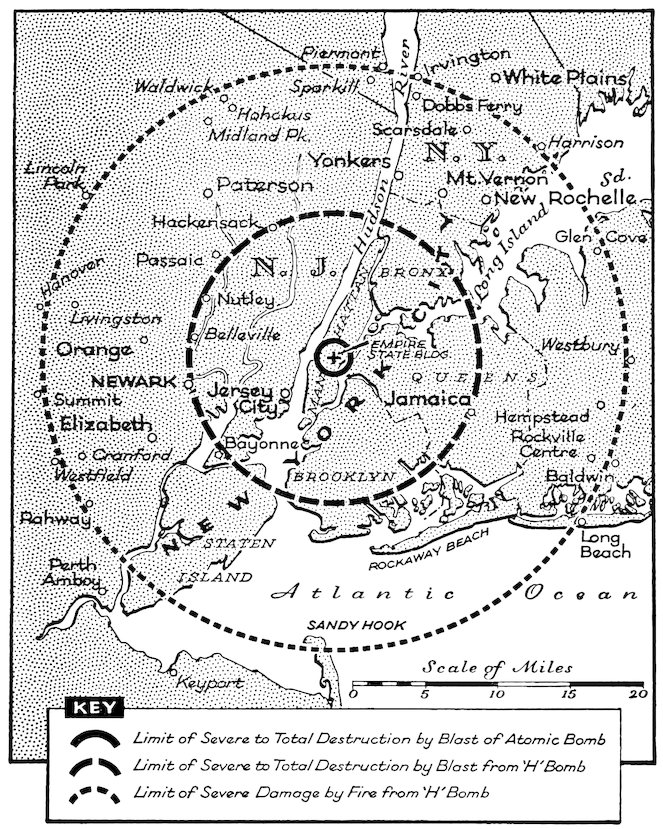
MAP BY DANIEL BROWNSTEIN
19We can thus see that if deuterium alone is found
to be all that is required to set off an H-bomb it
will be cheap and relatively easy to make in a
short time—both for us and for Russia. Furthermore,
such a deuterium bomb would be practically
limitless in size. One of a million times the power of
the Hiroshima bomb is possible, since deuterium
can be extracted in limitless amounts from plain
water. On the other hand, if sizable amounts of
tritium are found necessary, the cost will be much
higher and it will take a considerably longer time,
since the production of tritium is very slow and
costly. This, in turn, will place a definite limit on
the power of the H-bomb, since, unlike deuterium,
the amounts of tritium will necessarily always be
limited. As will be shown later, we are at present
in a much more advantageous position to produce
tritium than is Russia, so that if tritium is found
necessary, we have a head start on her in H-bomb
development.
The radius of destructiveness by the blast of
a bomb with a thousand times the energy of the
A-bomb will be only ten times greater, since the
increase goes by the cube root of the energy. The
radius of total destruction by blast in Hiroshima
was one mile. Therefore the radius of a superbomb
a thousand times more powerful will be ten miles,
or a total area of 314 square miles. A bomb a
million times the power of the Hiroshima bomb
would require 1,000 tons of deuterium. Such a
super-superduper could be exploded at a distance
from an abandoned, innocent-looking tramp ship.
It would have a radius of destruction by blast of
100 miles and a destructive area of more than 30,000
20square miles. The time may come when we
shall have to search every vessel several hundred
miles off shore. And the time may be nearer than
we think.
The radius over which the tremendous heat
generated by a bomb of a thousandfold the energy
would produce fatal burns would be as far as
twenty miles from the center of the explosion.
This radius increases as the square root, instead of
the cube root, of the power. The Hiroshima bomb
caused fatal burns at a radius of two thirds of a
mile.
The effects of the radiations from a hydrogen
bomb are so terrifying that by describing them I
run the risk of being branded a fearmonger. Yet
facts are facts, and they have been known to
scientists for a long time. It would be a disservice
to the people if the facts were further denied to
them. We have already paid too high a price for
a secrecy that now turns out never to have been
secret at all.
I can do no better than quote Albert Einstein.
“The hydrogen bomb,” he said, “appears on the
public horizon as a probably attainable goal....
If successful, radioactive poisoning of the atmosphere,
and hence annihilation of any life on earth,
has been brought within the range of technical
possibilities.”
What Dr. Einstein meant by “radioactive poisoning
of the atmosphere, and hence the annihilation
21of any life on earth,” was explained in realistic
detail by such eminent physicists as Dr. Bethe, Dr.
Leo Szilard, Dr. Edward Teller, and others. All of
them may even now be engaged on work on the
hydrogen bomb.
Here is how “poisoning of the atmosphere” may
result from the explosion of a hydrogen bomb:
Tremendous quantities of neutrons, which can
enter any substance in nature and make it radioactive,
are liberated. In the case of a deuterium
bomb, one eighth of the mass used—125 grams per
kilogram—is liberated. In the case of a deuteron-tritium
bomb, fully one fifth of the mass—200
grams per kilogram—is released, while in a bomb
using pure tritium, fully one third of the mass—333
grams per kilogram—is liberated as free neutrons.
There are 600,000 billion billion neutrons in
each gram, each capable of producing a radioactive
atom in its environment. The neutron is one
of the two building blocks of the nuclei of all
atoms.
These neutrons can be used to make any element
radioactive, Professor Szilard and his colleagues
point out. It follows that the casing of the
bomb could be selected with a view to producing,
after the neutrons enter it, an especially powerful
radioactive substance. Since each artificially made,
radioactive element gives out a specific type of
radiation and has a definite life span, after which
it decays to one half of its radioactivity, the designer
22of the bomb could rig it in such a way that
its explosion would spread into the air a tremendous
cloud of specially selected radioactive substances
that would give off lethal radiations for a
definite period of time. In such a way a large area
could be made unfit for human or animal habitation
for a definite period of time, months or years.
Take, for example, the very common element
cobalt. When bombarded with neutrons, it turns
into an intensely radioactive element, 320 times
more powerful than radium. Any given quantity of
neutrons would produce sixty times its weight in
radioactive cobalt. If the bomb contains a ton of
deuterium, 250 pounds would come out as neutrons.
On the assumption that every neutron enters
a cobalt atom, this would produce 7.5 tons of
radioactive cobalt. That quantity would give out
as much radioactivity as 2,400 tons of radium.
Now, this radioactive cobalt has a half-life of
five years, meaning that it loses half of its radioactive
power at every five-year period. So after a
lapse of that period of time its radioactivity would
be equal to 1,200 tons of radium, in ten years to
600 tons, and so on. If used as a bomb-casing it
would be pulverized and converted into a gigantic
radioactive cloud that would kill everything in the
area it blankets. Nor would it be confined to a
particular area, since the winds would take it
thousands of miles, carrying death to distant
places.
23The radioactivity produced by the Bikini bombs
was detected within one week in the United States.
In that short time the westerly winds swept the
radioactive air mass from Bikini, 4,150 miles away,
to San Francisco. When it reached our shores, the
activity was weak and completely harmless, but it
was still detectable. That, by the way, was how we
learned that the Russians had exploded their first
atomic bomb.
But, in the words of Professor Teller, one of the
Los Alamos men who made the preliminary studies
on the hydrogen bomb, “if the activity liberated at
Bikini were multiplied by a factor of a hundred
thousand or a million, and if it were to be released
off our Pacific Coast, the whole of the United
States would be endangered.” He added that “if
such a quantity of radioactivity should become
available, an enemy could make life hard or even
impossible for us without delivering a single bomb
into our territory.”
One limitation to such an attack, Professor Teller
points out, is the boomerang effect of these
gases on the attacker himself. The radioactive
gases would eventually drift over his own country,
too. He adds, however, that since these gases have
different rates of decay—some faster, some slower—the
attacker is in a position to choose those
radioactive products best suited to his attack.
“With the proper choice he could ensure that his
victim would be seriously damaged by them, and
24that they would have decayed by the time they
reached his own country.”
“It is not even impossible to imagine,” in the
words of Professor Teller, “that the effects of an
atomic war fought with greatly perfected weapons
and pushed by utmost determination will endanger
the survival of man.... This specific possibility
of destruction may help us realize more
clearly the probable consequences of an atomic
war for our civilization and the possible consequences
for the whole human race.”
On this point Professor Szilard is much more
specific. “Let us assume,” he said at a University of
Chicago Round Table, “that we make a radioactive
element which will live for five years and that we
just let it go into the air. During the following
years it will gradually settle out and cover the
whole earth with dust. I have asked myself, ‘How
many neutrons or how much heavy hydrogen do
we have to detonate to kill everybody on earth by
this particular method?’ I come up with about fifty
tons of neutrons as being plenty to kill everybody,
which means about 400 tons of heavy hydrogen”
(deuterium).
Now, obviously Professor Szilard was stating the
extreme case. He merely called attention to the
scientific fact that man now has at his disposal,
or soon will have, means that not only could wipe
out all life on earth, but could also make the earth
itself unfit for life for many generations to come,
25if not forever. Here we have indeed what is probably
the greatest example of irony in man’s history.
The very process in the sun that made life possible
on earth, and is responsible for its being maintained
here, can now be used by man to wipe out
that very life and to ruin the earth for good.
It is inconceivable that any leaders of men today,
or in the near future, would resort to such an
extreme measure. But the fact remains that such
a measure is possible. And it is by no means unthinkable
that a Hitler, faced with certain defeat,
would not choose to die in a great Götterdämmerung
in which he would pull down the whole of
humanity with him to destruction. And who can
be bold enough to guarantee that another Hitler
might not arise sometime, somewhere, possibly in
a rejuvenated Germany making another bid for
world domination or total annihilation?
It is more likely, of course, that an attacker,
particularly if he is otherwise faced with certain
defeat, might choose the less drastic method outlined
by Professor Teller, selecting for his weapon
a short-lived radioactive element that would have
spent itself by the time it reached his shores. If he
is the sole possessor of the hydrogen bomb, he may
not even have to use it, a threat of its use being
sufficient to end the war on terms to his liking. In
the face of such a threat, as Professor Szilard
pointed out, who would dare take the responsibility
of refusing?
26These are the stark, unvarnished facts about the
“so-called hydrogen bomb.” They raise many questions
to which the American people as a whole
will have to find the answer. It is possible, and the
odds here are more than even, that the very possession
of the hydrogen bomb by both ourselves
and Russia will make war unthinkable, since neither
side could be the winner. This would be a
near certainty if we had the answer to Russia’s
Trojan Horse method of taking over nations by
first taking over their governments, as was done in
Poland, Czechoslovakia, Hungary, and the Balkan
countries. Suppose the Communists take over
Italy, then Germany, by the same method. What
would we do then? The answer is, of course, that
if we wait until “then,” everything would be lost,
no matter what we did. It therefore becomes
obvious that our very existence may depend on
what we do here and now to prevent such an
eventuality.
Now that the hydrogen bomb has come out into
the open after five years as a super-top secret, the
authorities, and particularly the Atomic Energy
Commission, may be called upon to answer some
embarrassing questions. “Why,” we may ask, “was
the work on the hydrogen bomb apparently
dropped altogether during the past five years?”
According to Professor Bethe, it would take about
three years to develop it. This means that, had we
27continued working on it in 1945 and thereafter,
we would have had it as far back as 1948. We have
thus lost five precious years, our loss being Russia’s
gain.
Some scientists and others contend that, because
of our great harbor and industrial cities, the hydrogen
bomb would be a greater threat to us than
to the Soviet, because most Russian cities are much
smaller than ours, while her industries are much
more dispersed. There may be some truth in this.
But on the other hand there are some great advantages
on our side. With a strong Navy and good
submarine-detecting devices we may have control
of the seas and be able to prevent the delivery of
the hydrogen bomb by ship or submarine. With a
strong Air Force and radar system we could prevent
the delivery of hydrogen bombs from the air.
By far the most important advantage the possession
of the hydrogen bomb would give us against
Russia is its possible use as a tactical weapon
against huge land armies. Since they can devastate
such large areas, one or two hydrogen bombs,
depending on their size, could wipe out entire
armies on the march, even before they succeeded
in crossing the border of an intended victim. The
H-bomb would thus counterbalance, if not completely
nullify, the one great advantage Russia
possesses—huge land armies capable of overrunning
western Europe. The bomb might thus serve
28as the final deterrent to any temptation the Kremlin’s
rulers may have to invade the Atlantic Pact
countries.
Yet no matter how one looks at it, the advent of
the H-bomb constitutes the greatest threat to the
survival of the human race since the Black Death.
One is reminded of a dinner conversation in
Paris in 1869, recorded in the Journal of the Goncourt
brothers. Some of the famous savants of the
day were crystal-gazing into the scientific future
a hundred years away. The great chemist Pierre
Berthelot predicted that by 1969 “man would
know of what the atom is constituted and would
be able, at will, to moderate, extinguish, and light
up the sun as if it were a gas lamp.” (This prophecy
has almost come true.) Claude Bernard, the
greatest physiologist of the day, saw a future in
which “man would be so completely the master of
organic law that he would create life [artificially]
in competition with God.”
To which the Goncourt brothers added the
postscript: “To all of this we raised no objection.
But we have the feeling that when this time comes
to science, God with His white beard will come
down to earth, swinging a bunch of keys, and will
say to humanity, the way they say at five o’clock
at the salon: ‘Closing time, gentlemen!’”
II THE REAL SECRET OF THE HYDROGEN BOMB
29
Can the hydrogen bomb actually be made? If
so, how soon? How much will it cost in money and
vital materials? Above all, will it, if made, add
enough to our security to make the effort worth
while?
As was pointed out by Prof. Robert F. Bacher of
the California Institute of Technology, one of the
chief architects of the wartime atomic bomb and
the first scientific member of the Atomic Energy
Commission, “since the President has directed the
AEC to continue with the development [‘of the so-called
hydrogen, or super bomb’] we can assume
that this development is regarded as both possible
and feasible.” Many eminent physicists believe
that it can be made, and the use by the President
of the word “continue” suggests that this belief is
based on more than theory. No less an authority
than Albert Einstein has stated publicly that he regards
the H-bomb as “a probably attainable goal.”
On the other hand, there are scientists of high
eminence, such as Dr. Robert A. Millikan, our
oldest living Nobel-Prize-winner in physics, who
doubt whether the H-bomb can be made at all.
And there are also those who express the view
30that, while it probably could be made, it would not
offer advantages great enough, if any, to justify
the cost in vital strategic materials necessary for
our security.
Fortunately, facts mostly buried in technical
literature make it possible for us to go behind the
scientific curtain and look intimately at the reasons
for these differences in opinion. More important
still, these facts not only provide us with a
clearer picture of the nature of the problem but
also enable us to make some reasonable deductions
or speculations. The scientists directly involved
do not feel free to discuss these matters
openly, not because they would be violating security,
but because of the jittery atmosphere that
acts as a damper on open discussion even of subjects
known to be non-secret.
We already know that the so-called hydrogen
bomb, if it is to be made at all, cannot be made of
the abundant common hydrogen of atomic mass
one, and that there are only two possible materials
that could be used for such a purpose: deuterium,
a hydrogen twin twice the weight of common
hydrogen, which constitutes two hundredths of one
per cent of the hydrogen in all waters; and a man-made
variety of hydrogen, three times the weight
of the lightest variety, known as tritium. We also
know that to explode either deuterium or tritium
(also known, respectively, as heavy and superheavy
hydrogen) a temperature measured in millions
31of degrees is required. This is attainable on
earth only in the explosion of an A-bomb, and
therefore the A-bomb would have to serve as the
fuse to set off an explosion of deuterium, tritium, or
a mixture of the two.
These facts, fundamental as they are, merely
give us a general idea of the conditions required
to make the H-bomb. All concerned, including Dr.
Millikan, fully accept the validity of these facts.
But there is one other factor at the very heart of
the problem—the extremely short time at our
disposal in which to kindle the hydrogen bomb
with the A-bomb match. According to statements
attributed to him in the press, Dr. Millikan believes
that the time is too short; in other words, he
seems to be convinced that the A-bomb match will
be blown out before we have time to light the fire.
Those of opposite view believe that methods can
be devised for “shielding the match against the
wind” for just long enough to light the fire. As we
shall presently see, it is these methods for shielding
the match that lead some to doubt whether
the game would be worth the candle, or the match,
if you will. These honest doubts are based on the
possibility that, even if successful, the shielding
might exact too high a price in terms of vital materials,
particularly the stuff out of which A-bombs
are made—plutonium. According to this view, we
may at best be getting but a very small return for
our investment in materials vitally important in
32war as well as in peace. Even though the price in
dollars were to be brought down to a negligible
amount.
A closer look at the details of the problem may
enable us to penetrate the thick fog that now envelops
the subject. We may begin with a quotation
from Dr. Bacher, who outlined the principle involved
with remarkable clarity. “The real problem
in developing and constructing a hydrogen bomb,”
he said in a notable address before the Los Angeles
Town Hall,
is, “How do you get it going?” The heavy hydrogens,
deuterium and tritium, are suitable substances if somehow
they could be heated hot enough and kept hot.
This problem is a little bit like the job of making a fire
at 20 degrees below zero in the mountains with green
wood which is covered with ice and with very little
kindling. Today, scientists tell us that such a fire can
probably be kindled.
Once you get the fire going, of course, you can pile
on the wood and make a very sizeable conflagration.
In the same way with the hydrogen bomb, more heavy
hydrogen can be used and a bigger explosion obtained.
It has been called an open-ended weapon, meaning
that more materials can be added and a bigger explosion
obtained.
The phrase that goes to the very heart of the
problem is “very little kindling,” which is another
way of illustrating the difficulty of lighting a fire
in a high wind when you have only one match. We
33know that to ignite deuterium, by far the cheaper
and more abundant of the two H-bomb elements,
a temperature comparable to those existing in the
interior of the sun, some 20,000,000 degrees centigrade,
is necessary. This temperature can be realized
on earth only in the explosion of an A-bomb.
We also know that the wartime model A-bombs
generated a temperature of about 50,000,000 degrees,
more than enough to light a deuterium fire.
The trouble lies in the extremely short time interval,
of the order of a millionth of a second (microsecond),
and a fraction thereof, during which the
A-bomb is held together before it flies apart. In
the words of Professor Bacher, we must make our
green, ice-covered wood catch fire in the subzero
mountain weather before the “very little kindling”
we have is burned up.
The times at which deuterium will ignite at any
given temperature, in both its gaseous and its
liquid form, are widely known among nuclear
scientists everywhere, including Russia, through
publication in official scientific literature of a
well-known formula, originally worked out by two
European scientists as far back as 1929, and more
recently improved upon by Professor George
Gamow and Professor Teller. By this formula,
derived from actual experiments, it is known that
deuterium in its gaseous form will require as long
as 128 seconds to ignite at a temperature of 50,000,000
degrees centigrade, well above 100,000,000
34times longer than the time in which our little
kindling is used up. This obviously rules out deuterium
in its natural gaseous form as material for
an H-bomb.
How about liquid deuterium? We know that the
more atoms there are per unit volume (namely,
the greater the density), the faster is the time of
the reaction. The increase in the speed of the reaction
(in this case the ignition of the deuterium) is
directly proportional to the square of the density.
For example, if the density, (that is, the number
of atoms per unit volume) is increased by a factor
of 10, the time of ignition will be speeded up by
the square of 10, or 100 times faster. Since liquid
deuterium has a density nearly 800 times that of
gaseous deuterium, this means that liquid deuterium
(which must be maintained at a temperature
of 423 degrees below zero Fahrenheit at a
pressure above one atmosphere) would ignite 640,000
times faster (namely, in 1/640,000th part of
the time) than its gaseous form. Arithmetic shows
that the ignition time for liquid deuterium at 50,000,000
degrees centigrade will be 200 microseconds,
still 200 times longer than the period in
which our kindling is consumed.
The same formula also reveals the time it would
take liquid deuterium to ignite at higher temperatures,
the increase of which shortens the ignition
time. These figures show that the ignition time for
liquid deuterium at 75,000,000 degrees centigrade
35is 40 microseconds. At 100,000,000 degrees the
time is 30 microseconds; at 150,000,000 degrees,
15 microseconds; and at 200,000,000 degrees on
the centigrade scale, about 4.8 millionths of a
second. Doubling the temperature speeds up the
ignition time for liquid deuterium by a factor of
about six.
The problem thus is a dual one: to raise the
temperature at which the A-bomb explodes, and
to extend the time before the A-bomb flies apart.
It is also obvious that if the liquid deuterium is to
be ignited at all, it must be done before the bomb
has disintegrated—that is, during the incredibly
short time interval before it expands into a cloud
of vapor and gas, since by then the deuterium
would no longer be liquid.
Can we increase the A-bomb’s temperature
fourfold to 200,000,000 degrees and literally make
time stand still while it holds together for nearly
five millionths of a second? To get a better understanding
of the problem we must take a closer look
at what takes place inside the A-bomb during the
infinitesimal interval in which it comes to life.
This life history of the A-bomb is an incredible
tale, from the time its inner mechanisms are set in
motion until its metamorphosis into a great ball of
fire. As explained earlier, the A-bomb’s explosion
takes place through a process akin to spontaneous
combustion as soon as a certain minimum amount
(critical mass) of either one of two fissionable
36(combustible) elements—uranium 235 or plutonium—is
assembled in one unit. The most obvious
way it takes place is by bringing together two
pieces of uranium 235 (U-235), or plutonium,
each less than a critical mass, firing one of these
into the other with a gun mechanism, thus creating
a critical mass at the last minute. If, for example,
the critical mass at which spontaneous
combustion takes place is ten kilograms (the actual
figure is a top secret), then the firing of a
piece of one kilogram into another of nine kilograms
would bring together a critical mass that
would explode faster than the eye could wink—in
fact, some thousands of times faster than TNT.
Just as an ordinary fire needs oxygen, so does an
atomic fire require the tremendously powerful
atomic particles known as neutrons. Unlike oxygen,
however, neutrons do not exist in a free state
in nature. Their habitat is the nuclei, or hearts, of
the atoms. How, then, does the spontaneous combustion
of the critical mass of U-235 or plutonium
begin? All we need is a single neutron to start
things going, and this one neutron may be supplied
in one of several ways. It can come from the
nucleus of an atom in the atmosphere, or inside
the bomb, shattered by a powerful cosmic ray that
comes from outside the earth. Or the emanation
from some radioactive element in the atmosphere,
or from one introduced into the body of the bomb,
may split the first U-235 or plutonium atom, knock
37out two neutrons, and thus start a chain reaction
of self-multiplying neutrons.
To understand the chain reaction requires only
a little arithmetic. The first atom split releases, on
the average, two neutrons, which split two atoms,
which release four neutrons, which split four
atoms, which release eight neutrons, and so on, in
a geometric progression that, as can be seen, doubles
itself at each successive step. Arithmetic
shows that anything that is multiplied by two at
every step will reach a 1,000 (in round numbers)
in the first ten steps, and will multiply itself by a
1,000 at every ten steps thereafter, reaching a
million in twenty steps, a billion in thirty, a trillion
in forty, and so on. It can thus be seen that after
seventy generations of self-multiplying neutrons
the astronomical figure of two billion trillion (2
followed by 21 zeros) atoms have been split.
At this point let us hold our breath and get set
to believe what at first glance may appear to be
unbelievable. The time it takes to split these two
billion trillion atoms is no more than one millionth
of a second (one microsecond). If we keep this
time element in mind we can arrive at a clear understanding
of the tremendous problem involved
in exploding an A- or an H-bomb.
And while we are recovering from the first shock
we may as well get set for another. That unimaginable
figure of two billion trillion atoms represents
the splitting (explosion) of no more than one
38gram (1/28th of an ounce) of U-235, or plutonium.
Now, the energy released in the splitting of one
gram of U-235 is equivalent in power to the explosive
force of 20 tons of TNT, or two old-fashioned
blockbusters. Since we know from President Truman’s
announcement following the bombing of
Hiroshima that the wartime A-bomb “had more
power than 20,000 tons of TNT,” it means that the
atoms in an entire kilogram (1,000 grams) of
U-235 or plutonium must have been split. In other
words, after the A-bomb had reached a power of
20 tons of TNT, it had to be kept together long
enough to increase its power a thousandfold to
20,000 tons. This, as we have seen, requires only
ten more steps. It can also be seen that it is these
ten final crucial steps that make all the difference
between a bomb equal to only two blockbusters,
which would have been a most miserable two-billion-dollar
fiasco, and an atomic bomb equal in
power to two thousand blockbusters.
With the aid of these facts we are at last in a
position to grasp the enormousness of the problem
that confronted our A-bomb designers at Los Alamos
and is confronting them again today. It can
be seen that for a bomb to multiply itself from 20
to 20,000 tons in ten steps by doubling its power
at every step, it has to pass successively the stages
of 40, 80, 160, 320, and so on, until it reaches an
explosive power of 2,500 tons at the seventh step.
Yet it still has to be held together for three more
39steps, during which it reaches the enormous power
of 5,000 and 10,000 tons of TNT, without exploding.
Here was an irresistible force, and the problem
was to surround it with an immovable body, or at
least a body that would remain immovable long
enough for the chain reaction to take just ten additional
steps following the first seventy. There is
only one fact of nature that makes this possible, or
even thinkable—the last ten steps from 20 to 20,000
tons take only one tenth of a millionth of a
second. The problem thus was to find a body that
would remain immovable against an irresistible
force for no longer than one tenth of a microsecond,
100 billionths of a second.
This immovable body is known technically as a
“tamper,” which pits inertia against an irresistible
force that builds up in 100 billionths of a second
from an explosive power of 20 tons of TNT to
20,000 tons. The very inertia of the tamper delays
the expansion of the active substance and makes
for a longer-lasting, more energetic, and more efficient
explosion. The tamper, which also serves as
a reflector of neutrons, must be a material of very
high density. Since gold has the fifth highest density
of all the elements (next only to osmium,
iridium, platinum, and rhenium), at one time the
use of part of our huge gold hoard at Fort Knox
was seriously considered.
With these facts and figures in mind, it becomes
40clear that an H-bomb made of deuterium alone is
not feasible. It is certainly out of the question with
an A-bomb of the Hiroshima or Nagasaki types,
which generate a temperature of about 50,000,000
degrees, since, as we have seen, it would take fully
200 microseconds to ignite it at that temperature.
It is one thing to devise a tamper that would hold
back a force of 20 tons for 100 billionths of a second,
and thus allow it to build up to 20,000 tons.
It is quite another matter to devise an immovable
body that would hold back an irresistible force of
20,000 tons for a time interval 2,000 times larger,
particularly if one remembers that in another
tenth of a microsecond the irresistible force would
increase again by 1,000 to 20,000,000 tons. Obviously
this is impossible, for if it were possible we
would have a superbomb without any need for
hydrogen of any kind.
It is known that we have developed a much
more efficient A-bomb, which, as Senator Edwin
C. Johnson of Colorado has inadvertently blurted
out, “has six times the effectiveness of the bomb
that was dropped over Nagasaki.” We are further
informed by Dr. Bacher that “significant improvements”
in atomic bombs since the war “have resulted
in more powerful bombs and in a more efficient
use of the valuable fissionable material.” It
is conceivable and even probable that the improvements,
among other things, include better
tampers that delay the new A-bombs long enough
41to fission two, four, or even eight times as many
atoms as in the wartime models. But since, as we
have seen, the ten steps of the final stages require
only an average of 10 billionths of a second per
step, increasing the power of the new models even
to 160,000 tons (eight times the power of the Hiroshima
type) would take only three steps, in an
elapsed time of no more than 30 billionths of a
second. And even if we assume that the improved
bomb generates a temperature of 200,000,000 degrees,
it would still be too cold to ignite the deuterium
during the interval of its brief existence,
since, as we have seen, it would take 4.8 microseconds
to ignite it at that temperature. In fact, calculations
indicate that it would require a temperature
in the neighborhood of 400,000,000 degrees
to ignite deuterium in the time interval during
which the assembly of the improved A-bomb appears
to be held together, which, as may be surmised
from the known data, is within the range of
1.2 microseconds.
From all this it may be concluded with practical
certainty that an H-bomb of deuterium only is out
of the question. Equally good, though entirely different,
reasons also rule out an H-bomb using only
tritium as its explosive element.
There are several important reasons why an
H-bomb made of tritium alone is not feasible. The
most important by far, which alone excludes it
from any serious consideration, is the staggering
42cost we would have to pay in terms of priceless
A-bomb material, as each kilogram of tritium produced
would exact the sacrifice of eighty times
that amount in plutonium. The reason for this is
simple. Both plutonium and tritium have to be
created with the neutrons released in the splitting
of U-235, each atom of plutonium and each atom
of tritium made requiring one neutron. Since an
atom of plutonium has a weight of 239 atomic
mass units, whereas an atom of tritium has an
atomic weight of only three, it can be seen that a
kilogram, or any given weight, of tritium would
contain eighty times as many atoms as a corresponding
weight of plutonium, and hence would
require eighty times as many neutrons to produce.
In other words, we would be buying each kilogram
of tritium at a sacrifice of eighty kilograms
of plutonium, which, of course, would mean a considerable
reduction in our potential stockpile of
plutonium bombs.
We would cut this loss by more than half because
a kilogram of tritium would yield about two
and a half times the explosive power of plutonium.
But even this advantage would soon be lost, since
tritium decays at the rate of fifty per cent every
twelve years, so that a kilogram produced in 1951
would decay to only half a kilogram by 1963. Plutonium,
on the other hand, can be stored indefinitely
without any significant loss, since it changes
43slowly (at the rate of fifty per cent every twenty-five
thousand years) into the other fissionable element,
U-235, which in turn decays to one half in
no less than nine hundred million years. What is
more, plutonium, if the day comes when we can
beat our swords into plowshares, will become one
of the most valuable fuels for industrial power, the
propulsion of ships, globe-circling airplanes, and
even, someday, interplanetary rockets. It holds
enormous potentialities as one of the major power
sources of the twenty-first century. Tritium, on the
other hand, can be used only as an agent of terrible
destruction. It will yield its energy in a fraction
of a millionth of a second or not at all. The
only other possible uses it may have would be as a
research tool for probing the structure of the atom,
and as a potential new agent in medicine, in which
it may be used for its radiations.
How much tritium would it take to make an
H-bomb 1,000 times the power of the wartime model
A-bombs? Since tritium has about 2.5 times
the power per given weight of U-235 or plutonium,
it would take 400 kilograms (about 1,880
quarts of the liquid form) of tritium to make a
bomb that would equal the power of 1,000 kilograms
of plutonium. Such a bomb, we can see,
would have to be made at the sacrifice of 32,000
kilograms of plutonium. In other words, we would
be getting a return, in terms of energy content, of
441,000 kilograms for an investment of 32,000. And
we would be losing fully half of even this small
return every twelve years.
How many A-bombs would we be sacrificing
through this investment? On the basis of Professor
Oliphant’s estimate that the critical mass of an
A-bomb is between 10 and 30 kilograms, we would
sacrifice at least 1,066, and possibly as many as
3,200, if we take the lower figure. And we must
not forget that a bomb a thousand times the power
will produce only ten times the destructiveness by
blast and thirty times the damage by fire of an
A-bomb of the old-fashioned variety.
These cold facts make it clear that a tritium
bomb, particularly one a thousand times the power
of the A-bomb, is completely out of the picture.
But, one may ask, if a deuterium bomb is not
possible and a tritium bomb is not feasible, and
these are the only two substances that can possibly
be used at all, isn’t all this talk about a superbomb
sheer moonshine? And if so, how explain President
Truman’s directive “to continue” work on it?
To find the answer let us go back for a moment
to Dr. Bacher’s man in the mountains, confronted
with the problem of lighting a fire with green, ice-covered
wood at twenty degrees below zero with
“very little kindling.” Obviously the poor fellow
would be doomed to freeze to death were it not
for one little item he had almost forgotten. Somewhere
in his belongings he discovers a container
45filled with gasoline, which increases the inflammability
of the wet wood to the point at which it
will catch fire with a quantity of kindling that
would otherwise be much too small.
Something closely analogous is true with the
H-bomb. It so happens that a mixture of deuterium
and tritium is the most highly inflammable
atomic fuel on earth. It yields 3.5 times the energy
of deuterium and about twice the energy of
tritium when they are burned individually. Most
important of all, the deuterium-tritium mixture,
known as D-T, ignites much faster than either
deuterium or tritium by themselves. For example,
the D-T combination ignites 25 times faster than
deuterium alone at a temperature of 100,000,000
degrees, and the ignition time is fully 37.5 times
faster than for deuterium at 150,000,000 degrees.
The published technical data show that at a
temperature of 50 million degrees the D-T mixture
ignites in only 10 microseconds, or 20 times faster
than deuterium alone. At 75 million degrees it takes
only 3 microseconds, as against 40 for deuterium,
while at 100 million degrees it needs only 1.2
microseconds to catch fire, a time, as we have seen,
only 0.1 microsecond longer than it took the wartime
A-bomb to fly apart. Since the latter held together
for 1.1 microseconds at a temperature of
about 50 million degrees, it is reasonable to assume
that the improved and more efficient models generate
a temperature at least twice as high, and that
46this is done by holding them together for about
1.2 microseconds.
It can thus be deduced that the only feasible
H-bomb is one in which a relatively small amount
of a deuterium-tritium mixture will serve as additional
superkindling, to boost the kindling supplied
by the improved model A-bomb, for lighting
a fire with a vast quantity of deuterium. This, it
appears, is the real secret of the H-bomb, which
is really no secret at all, since all the deductions
here presented are arrived at on the basis of data
widely known to scientists everywhere, including
Russia. And since it is no secret from the Russians,
whom the arch-traitor Fuchs has supplied with the
details still classified top secret, the American people
are certainly entitled to the known facts, so
vitally necessary for an intelligent understanding
of one of the most important problems facing them
today.
A deuterium bomb with a D-T booster would
become a certainty if the temperature of the
A-bomb trigger could be raised to 150 million or,
better still, to 200 million degrees. At the former
temperature the D-T superkindling ignites in 0.38
microseconds; at the higher temperature the ignition
time goes down to as low as 0.28 microseconds.
Now, the D-T mixture releases four times as
much energy as plutonium, and the faster the time
in which energy is released, the higher goes the
temperature. Since four times as much energy is
47released at a rate four times faster than in the wartime
model A-bomb, it is not unreasonable to assume
that the temperature generated would be
high enough to ignite the green wood in the bomb—its
load of deuterium.
How much tritium would be required for the
kindling mixture? On this we can only speculate
at present. Since the D-T kindling calls for the fusion
of one atom of tritium with one atom of deuterium,
and the atomic weight of tritium is three
as compared with two for deuterium, the weight
of the two substances will be in the ratio of 3 for
tritium to 2 for deuterium. Thus if the amount to
be used for the kindling mixture is to be one kilogram,
it will be made up of 600 grams of tritium
and 400 grams of deuterium. Since, as we have
seen, it would take eighty kilograms of plutonium
to produce one kilogram of tritium, we would have
to use up only 48 kilograms of plutonium to create
the 600 grams, or the equivalent of one and a half
to about five A-bombs, according to Dr. Oliphant’s
estimate.
But would we need as much as 600 grams of
tritium? Such an amount, mixed with 400 grams
of deuterium, would yield an explosive power
equal to 80,000 tons of TNT, an energy equivalent
of 100 million kilowatt-hours. A twentieth part of
this amount would still be equal in power to 4,000
tons of TNT, equivalent in terms of energy to
5,000,000 kilowatt-hours. Now one twentieth of
48600 grams, just 30 grams of tritium, could be made
at a cost of no more than 2.4 kilograms of plutonium.
Thus we would be paying only one twelfth
to one fourth of an A-bomb (in addition to the one
used as the trigger) to get the equivalent of ten
A-bombs in blasting power and of thirty times the
incendiary power, which would totally devastate
an area of more than 300 square miles by blast and
of more than 1,200 square miles by fire.
Would 30 grams of tritium be enough to serve
as the superkindling for exploding, let’s say, 1,000
kilograms (one ton) of deuterium? We shall probably
not know until we actually try it. It will
largely depend on the temperature generated by
our more powerful A-bomb models. If it is true, as
Senator Johnson informed his television audience,
that they have “six times the effectiveness of the
bomb that was dropped over Nagasaki” (which,
by the way, had more than twice the effectiveness
of the Hiroshima model), it is quite possible that
their temperature is as high as 150 million, or even
200 million, degrees. In that case, the extra kindling
of a 20–30 gram D-T mixture, with its tremendous
burst of 5,000,000 kilowatt-hours of energy
in 0.28 to 0.38 microseconds (added to the
vast quantity already being liberated by the exploding
plutonium, or U-235), might well heat the
deuterium to the proper ignition temperature and
keep it hot long enough for its mass to explode
well within 1.2 microseconds. In any case it would
49appear logical to expect that a mixture of 150
grams of tritium and 100 grams of deuterium,
which would release an energy equal to that of the
Hiroshima bomb, should be able to do the job with
plenty of time to spare.
We thus have a threefold answer to the question:
Can the H-bomb actually be made? As we
have seen, the deuterium bomb is definitely not
possible. The tritium bomb is theoretically possible,
but definitely not practicable. But a large deuterium
bomb using a reasonably small amount of
a deuterium and tritium mixture as extra kindling
is both possible and feasible.
We now also stand on solid ground in dealing
with the questions of cost and of the time it would
take us to get into production. With these questions
answered, we can then decide whether the
H-bomb, if made, will add enough to our security
to make the effort worth while.
We know at this stage that the H-bomb requires
three essential ingredients. It needs, first of all, an
A-bomb to set if off. We have a sizable stockpile of
them. It needs large quantities of deuterium. We
have built several deuterium plants during the
war, and they should be large enough to supply
our needs. Since it is extracted from water, the raw
material will cost us nothing. The only item of cost
will be the electric power required for the concentration
process, and this should not be above $100
per kilogram, and probably less. The third vital
50ingredient, tritium, can be made in the giant plutonium
plants at Hanford, Washington. Thus it
can be seen that all the essential ingredients of the
H-bomb, the costliest and those that would take
longest to produce, as well as the multimillion-dollar
plants required for their production, are already
at hand.
This means that as far as the essential materials
are concerned, we are ready to go right now. And
as for the cost, it would appear to require hardly
any new appropriations by Congress, or, at any
rate, only appropriations that would be mere
chicken feed compared with the five billion we
have already invested in our A-bomb program.
The raw material out of which tritium is made
is the common, cheap light metal lithium, the
lightest, in fact, of all the metals. It has an atomic
weight of six, its nucleus consisting of three protons
and three neutrons. When an extra neutron
invades its nucleus, it becomes unstable and
breaks up into two lighter elements, helium (two
protons and two neutrons) and tritium (one proton
and two neutrons). They are both gases and
they are readily separated. And while lithium of
atomic weight six constitutes only 7.5 per cent of
the element as found in nature (it comes mixed
with 92.5 per cent of lithium of atomic weight
seven), there is no need to separate it from its
heavier twin, since the latter has no affinity for
51neutrons and nearly all of them are gobbled up by
the lighter element.
The production of tritium, even in small
amounts, will nevertheless be a formidable process.
As we have seen, it takes eighty times as many
neutrons to produce any given amount of tritium
as to produce a corresponding amount of plutonium.
Since the lithium will have to compete
with uranium 238 (parent of plutonium) for the
available supply of neutrons, and since the number
of atoms of U-238 per given volume is nearly forty
times greater than the number of lithium atoms,
the rate of tritium production would be very much
slower than that of plutonium. On the other hand,
even if it took as much as two hundred times as
long to produce a given quantity of tritium, the
handicap would be considerably overcome because
of the relatively small amounts that may be
required. If, for example, we should need only 30
to 150 grams of tritium per bomb, it would take
our present plutonium plants only six to thirty
times longer to produce these quantities than it
takes them to produce one kilogram of plutonium.
A hypothetical plant such as the one mentioned in
the official Smyth Report, designed to produce one
kilogram of plutonium per day, would thus yield
30 grams of tritium in six days.
How much tritium would be needed for an adequate
stockpile of H-bombs? Since our primary
52reasons for building it are to deter aggression, to
prevent its use against us or our allies, and as a
tactical weapon against large land armies, it would
appear that as few as twenty-five, or fifty at the
most, would be adequate for the purpose. On the
basis of the larger figure (assuming 30 to 150
grams of tritium per bomb), it would mean an
initial stockpile of only 1.5 to 7.5 kilograms of
tritium, which would entail the sacrifice of about
120 to 600 kilograms of plutonium. Once this initial
outlay had been made, however, our plutonium
sacrifice would be reduced annually to only
one twenty-fourth of the original respective
amounts—namely, 5 to 25 kilograms a year—just
enough to make up for the decay of the tritium at
the rate of fifty per cent every twelve years.
One of the major problems to be solved, in addition
to the main problem of designing the assembly,
arises from the fact that the deuterium and
the tritium booster will have to be in liquid form.
Liquid hydrogen boils (that is, reverts to gas) at
a temperature of 423 degrees below zero Fahrenheit
under a pressure of one atmosphere (fifteen
pounds per square inch). To liquefy it, it is necessary
to cool it in liquid air (at 313.96 below zero
F.) while keeping it at the same time under a
pressure of 180 atmospheres. To transport it, it
must be placed in a vacuum vessel surrounded by
an outer vessel of liquid air. This would point to
the need of giant refrigeration and storage plants,
53as well as of refrigerator planes for transporting
large quantities of liquid deuterium and its tritium
spark plug.
Will the H-bomb, if made, add enough to our
security to make the effort worth while? We have
seen that the required effort may, after all, not be
very great. In fact, it may turn out to be a relatively
small one, in view of the fact that all the
basic ingredients and plants are already at hand
and fully paid for. But supposing even that the
effort turns out to be much more costly than it
now appears? The question we must then ask ourselves
is: Can we afford not to make the effort?
It is true, of course, as some have pointed out,
that ten or even fewer A-bombs could destroy the
heart of any metropolitan city, while only one
would be quite enough, as we know, for cities the
size of Hiroshima or Nagasaki. But that neglects
to take into consideration the fact that one
H-bomb concentrates within itself the power of
thirty A-bombs to destroy by fire and by burns an
area of more than 1,200 square miles at one blow.
Nor does it take into consideration the military advantage
of delivering the power of a combination
of ten and thirty A-bombs in one concentrated
package, which would make it a tremendous tactical
weapon against a huge land army scattered
over many miles, or its possible enormous psychological
effect against such an army.
Most important of all, this view grossly minimizes
54the apocalyptic potentialities of the H-bomb
for poisoning large areas with deadly clouds of
radioactive particles. It is a monstrous fact that an
H-bomb incorporating one ton of deuterium, encased
in a shell of cobalt, would liberate 250
pounds of neutrons, which would create 15,000
pounds of highly radioactive cobalt, equivalent in
their deadliness to 4,800,000 pounds of radium.
Such bombs, according to Professor Harrison
Brown, University of Chicago nuclear chemist,
could be set on a north-south line in the Pacific
approximately a thousand miles west of California.
“The radioactive dust would reach California in
about a day, and New York in four or five days,
killing most life as it traverses the continent.”
“Similarly,” Professor Brown stated in the American
Scholar, “the Western powers could explode
H-bombs on a north-south line about the longitude
of Prague which would destroy all life within a
strip 1,500 miles wide, extending from Leningrad
to Odessa, and 3,000 miles deep, from Prague to
the Ural Mountains. Such an attack would produce
a ‘scorched earth’ of an extent unprecedented
in history.”
Professor Szilard, one of the principal architects
of the A-bomb, has estimated, as already stated,
that four hundred one-ton deuterium bombs
would release enough radioactivity to extinguish
all life on earth. Professor Einstein, as we have
seen, has publicly stated that the H-bomb, if successful,
55will bring the annihilation of all life on
earth within the range of technical possibilities.
The question we must therefore ask ourselves is:
Can we allow Russia to be the sole possessor of
such a weapon?
There can be no question that Russia is already
at work on an H-bomb. Like ourselves, she already
has the plutonium plants for producing both
A-bombs and tritium. She can produce deuterium
in the same quantities as we can. In Professor Peter
Kapitza she has the world’s greatest authority
on liquid hydrogen.
Furthermore, she has great incentives to produce
H-bombs. Since she is still behind us in her
A-bomb stockpile, she can, in a sense, catch up
with us much more quickly by converting her
fewer A-bombs into H-bombs that would be the
equivalents of ten to thirty A-bombs each, thus increasing
the power of her stockpile ten to thirty
times. Equally if not more important from Russia’s
point of view is the stark fact that an H-bomb
could be much more easily exploded near a coastal
city from a submarine or innocent-looking tramp
steamer, since most of our great cities are on the
seacoast, whereas Russia practically has no coastal
cities.
Even if we openly announced that we would
not make any H-bombs, it would not deter Russia
from making them as fast as she could, not only
because she would not believe us but also because
56her sole possession would greatly weight the scales
in her favor. If, God forbid, she finds herself one
day with a stockpile of H-bombs when we have
none, she would be in a position to send us an
ultimatum similar to the one we sent to the Japanese
after Hiroshima: “Surrender or be destroyed!”
Valuing their liberty more than their lives, the American
people will never surrender. But while there
is time, would anyone advocate that we run the
risk of ever facing such a choice?
III SHALL WE RENOUNCE THE USE OF THE H-BOMB?
57
A few days after President Truman announced
that he had directed work “to continue”
on “the so-called hydrogen, or super bomb,” a
group of twelve eminent physicists, including half
a dozen of the major architects of the atomic bomb
at Los Alamos, who, no doubt, are playing a similar
role in the development of the H-bomb, issued
a statement urging the United States to make “a
solemn declaration that we shall never use the
bomb first,” and “that the only circumstances
which might force us to use it would be if we or
our allies were attacked by this bomb.” They
added that “there can be only one justification for
our development of the hydrogen bomb, and that
is to prevent its use.”
Signers of the statement, unprecedented in the
annals of science (with the possible exception of
a secret memorandum submitted to the government
just before the A-bomb was used), included
such outstanding physicists as Hans A. Bethe of
Cornell; Kenneth T. Bainbridge of Harvard;
Samuel K. Allison, University of Chicago; Dean
George B. Pegram, Columbia; C. C. Lauritsen,
California Institute of Technology; Bruno Rossi
58and Victor F. Weisskopf, Massachusetts Institute
of Technology; F. W. Loomis and Frederick
Seitz, University of Illinois; Merle A. Tuve, Carnegie
Institution of Washington; R. B. Brode, University
of California; and M. G. White, Princeton—all,
with the exception of Dr. Tuve, professors of
physics at their respective universities. Those
among them who did not directly participate in
the development of the A-bomb played major
parts in other scientific wartime projects, such as
radar and the proximity fuse.
Implicit in their statement was the first confirmation—indeed,
the most authoritative we have
had so far from scientists with first-hand knowledge
of the subject—that a hydrogen bomb of a
thousand times the power of the A-bomb could be
made. More than that, they informed us that Russia
may complete the H-bomb in less than four
years, meaning, of course, that we too could
achieve the same goal in the same period. We were
thus provided by the experts with a time-table on
which we must act if we are not to run the risk of
Russia’s getting the H-bomb ahead of us, and so
being in a position to use it, or threaten its use,
against the nations of western Europe, as the
greatest blackmail weapon in history.
The statement summarizes in essence the principal
points of view that have been advanced so far
on what policy we should adopt on the H-bomb,
and since it was promulgated by men known to
59have definite inside knowledge of the subject, it
deserves closer scrutiny than it has hitherto received.
“It was stated correctly,” they inform us at the
outset,
that a hydrogen bomb, if it can be made, would be
capable of developing a power 1,000 times greater
than the present atomic bomb. New York, or any of
the greatest cities of the world, could be destroyed by
a single hydrogen bomb.
We believe that no nation has the right to use such
a bomb, no matter how righteous its cause. The bomb
is no longer a weapon of war, but a means of extermination
of whole populations. Its use would be a
betrayal of morality and of Christian civilization itself.
Senator Brien McMahon has pointed out to the
American people that the possession of the hydrogen
bomb will not give positive security to this country.
We shall not have a monopoly of this bomb, but it is
certain that the Russians will be able to make one,
too. In the case of the fission bomb the Russians required
four years to parallel our development. In the
case of the hydrogen bomb they will probably need
a shorter time.
We must remember that we do not possess the
bomb but are only developing it, and Russia has received,
through indiscretion, the most valuable hint
that our experts believe the development possible.
Perhaps the development of the hydrogen bomb has
already been under way in Russia for some time. But
if it was not, our decision to develop it must have
60started the Russians on the same program. If they had
already a going program, they will redouble their
efforts.
Statements in the press have given the power of the
H-bomb as between two and 1,000 times that of the
present fission bomb. Actually, the thermonuclear reaction
on which the H-bomb is based is limited in its
power only by the amount of hydrogen which can be
carried in the bomb. Even if the power were limited
to 1,000 times that of a present atomic bomb, the step
from an A-bomb to an H-bomb would be as great as
that from an ordinary TNT bomb to the atom bomb.
To create such an ever-present danger for all the
nations of the world is against the vital interests of
both Russia and the United States. Three prominent
Senators have called for renewed efforts to eliminate
this weapon and other weapons of mass destruction
from the arsenals of all nations. Such efforts should
be made, and made in all sincerity from both sides.
In the meantime, we urge that the United States,
through its elected government, make a solemn declaration
that we shall never use this bomb first.
Before discussing in detail the merits of the
proposal that the United States renounce the use
of the H-bomb, “no matter how righteous its
cause,” except in retaliation for its use against us
or our allies, it behooves us to examine the effect
of our decisions to proceed with the development
of the H-bomb on Russia’s A-bomb progress.
We know that the H-bomb requires an A-bomb
for its trigger. We also have strong grounds for
61assuming that, in addition to the A-bomb, an
H-bomb will require certain quantities of tripleweight
hydrogen, or tritium, as extra superkindling
to boost the A-bomb. We know, furthermore, that
it takes eighty times as many neutrons to make a
given quantity of tritium as it does to make a corresponding
amount of plutonium, which, of course,
means a reduction in A-bombs.
Hence, should Russia decide to embark on an
H-bomb program of her own, or to “redouble her
efforts,” it would lead inevitably to a serious curtailment
in her stockpile of A-bombs. While we
would have to make the same sacrifice of plutonium,
it is obvious that we can afford the sacrifice
much better than Russia, since we already have a
sizable stockpile of both plutonium and uranium
bombs, whereas she has just begun building her
stockpile. The situation for her would be much
worse if she has put all her atomic eggs in the plutonium
basket without bothering to build the
much more complicated and costly uranium separation
plants, as the incomplete evidence available
would seem to indicate. In that case she would be
faced with a serious dilemma indeed, for you cannot
have H-bombs without A-bombs, and you cannot
have A-bombs without plutonium, and if, as
the evidence indicates, she has built her A-bomb
program exclusively around plutonium, she would
have to sacrifice quantities she could ill afford to
spare, at this stage of her development, of the only
62element she desperately needs for building up her
A-bomb stockpile.
How do we know that Russia’s A-bomb is made
of plutonium? We have the testimony of Senator
Johnson of Colorado, who assured us in his famous
television broadcast of November 1, 1949 that
“there’s no question at all that the Russians have
a bomb more or less similar to the bomb that we
dropped at Nagasaki, a plutonium bomb.” In this
single sentence the Senator from Colorado, who as
a member of the Joint Congressional Committee
on Atomic Energy has access to such information,
inadvertently let at least three cats out of the bag.
He confirmed that the Nagasaki bomb was made
of plutonium (though, in fairness, it must be said
that this had been known unofficially for some
time); he told us that we had found out not only
that “an atomic explosion had occurred in the
U.S.S.R.,” as the President had announced in carefully
chosen words, but that the explosion was that
of an atomic bomb and that, more important still,
the bomb was made of plutonium. And in doing so
he, furthermore, gave away the secret of how we
had obtained that information, something the Russians
very much wanted to know. Not being a
scientist, Senator Johnson obviously did not realize
that the split fragments (fission products) of a
plutonium bomb differ from those given off by the
explosion of a uranium bomb, so that in revealing
that we knew what the bomb was made of he
63would also be revealing at the same time that we
found it out by examining radioactive air samples
and finding them to contain fission fragments of
plutonium, as well as whole plutonium atoms that
escaped fission.
There is thus no doubt that the Russians have
built nuclear reactors for producing plutonium
from nonfissionable uranium 238. We cannot, of
course, be sure that they have not at the same time
also built plants for concentrating uranium 235,
but the odds favor the negative. We built uranium
separation plants at Oak Ridge, Tennessee, and
plutonium plants at Hanford, Washington, during
the war because we didn’t know at the time which
method would work, and we gambled on the
chance that, by building plants for producing fissionable
materials by four different methods, at
least one of them might work. Had we known at
the time that the plutonium plants were practical,
it is quite likely that we would not have invested
a billion dollars in building the uranium separation
plants. Since the Russians have obviously decided
on plutonium plants as the simplest and cheapest
(three plutonium plants cost us a total of $400,000,000,
whereas a single large uranium separation
plant cost half a billion), it is hardly likely that
they would consider it worth while to invest in the
much more costly uranium separation plants.
As Senator Johnson said in the same broadcast:
“We tried out four different methods of making a
64bomb and all of them succeeded, but one of these
methods was superior to all the others in simplicity
and effectiveness, and we told the Russians and
we told the world that fact. Of course, they didn’t
have to make the experiments that we had to make
to find out by elimination which method was the
most effective and which the one that they should
follow.”
The evidence is thus strongly in favor of the assumption
that Russia has only plutonium plants as
her sole source of A-bomb material, whereas we
have both plutonium plants and gigantic uranium
plants in full operation. If that is so, then our
forcing Russia to embark on an H-bomb program,
at a time when her A-bomb program is barely
started, will place her under a double handicap in
her race to catch up with us in A-bombs, and at
least to keep abreast of us, if not ahead, in
H-bombs. For in this grim race we have a dual if
not a triple advantage: our much superior stockpile,
both in numbers and no doubt in quality, and
our gigantic plants for concentrating U-235, the
production of which would not have to be curtailed
at all, since tritium can be made only in
plutonium plants. In fact, we are now in the process
of construction of two great additions to the
uranium plant at Oak Ridge.
One may visualize the masters of the Kremlin
gnashing their teeth in impotent rage at what they
no doubt regard as a diabolical plot on our part
65to sabotage their A-bomb effort. Indeed, there can
be no question that our decision to proceed with
the H-bomb was an answer to Russia’s challenge
to our atomic supremacy, and it appears quite
plausible that one of the motives behind the decision
was the knowledge that it would force Russia
either to build great additions to her atomic
plants, at great expense in money and materials
and at the loss of considerable precious time, or to
curtail her production of A-bomb material. And
while any such motive could not possibly have
been the determining factor, the ultimate effect of
our decision was the same as though we had succeeded
in getting a team of expert saboteurs behind
the Iron Curtain to plant a good-sized monkey
wrench in the Soviet atomic machinery.
With this in mind we begin to appreciate how
dangerous a move it would be, to ourselves and to
world peace, if we were to make a solemn declaration
at the outset, even before we have a single
H-bomb, that we will never use it, “no matter how
righteous our cause,” unless it is used first against
us or our allies. By making such a unilateral declaration,
without even making it conditional upon
Russia issuing a similar solemn renunciation, we
would, in effect, be saying to Russia: “We humbly
beg your pardon. We did not realize that we
would be putting a nasty monkey wrench in the
machinery of your vital A-bomb program. We
shall remove the wrench at once so that you may
66proceed with your program unhindered by us in
any way.”
The masters of the Kremlin would, indeed, have
every right to laugh long and loud, and to take
such foolhardy action on our part as further evidence
of what they call “the decadence of the
bourgeois democracies.” For, once we make such
a magnanimous unilateral solemn renunciation of
the one weapon that promises to become the
greatest single deterrent against war, without even
bothering to ask Russia publicly to do likewise,
Russia could then proceed calmly at her leisure to
build up her A-bomb stockpile, with the complete
assurance from us that she need not worry about
our H-bomb as long as she does not use one
against us or our allies. After she has accumulated
an adequate A-bomb stockpile—and fifty to one
hundred would be adequate from her standpoint—she
would then be in a position, already attained
by us now, to proceed with her H-bomb program,
knowing full well that we would never use
H-bombs against her while she is still without
them. And while she obviously could not use anything
she does not have, she could well afford to
make aggressive war even before she has an
H-bomb, or to bide her time until she does, the
choice being entirely hers. And if she waits until
she has the H-bomb, the decision whether to use
it or not would still be entirely hers, so that she
67could use it whenever she decides it is to her advantage
to do so, whereas we should have to wait
on her pleasure, having morally bound ourselves,
without qualification, not to use it first, even if our
very existence depended on it.
It can thus be easily seen that this “after you,
my dear Alphonse” gesture on our part in a matter
that may involve our very existence would be
more than quixotic. It is likely to prove suicidal. It
will not improve the prospects of world peace; on
the contrary it will weaken them. It will not enhance
our moral stature, since the world does not
have much respect for starry-eyed dreamers with
their heads in the clouds.
But while we must keep our feet planted on the
ground, we need not lose sight of the stars. Our
refusal to expose ourselves by giving Russia the
great advantages mentioned, does not mean that
we retain the right to use the H-bomb indiscriminately
as though it were just another weapon.
There are, I shall presently show, both legitimate
and illegitimate uses to which the H-bomb can be
put, and it is the failure so far, even by eminent
scientists, to distinguish between these two types
of possible uses that is responsible for a great deal,
if not all, of the confusion and much futile debate
that have followed the President’s announcement
of his directive to continue work on the hydrogen
bomb, and for the flood of verbiage that will continue
68to plague and bewilder us until we take time
to acquaint ourselves with the facts about the
H-bomb.
One of the major difficulties in our approach to
the subject stems from the general tendency to
talk about the H-bomb as though it were just one
weapon, which obviously it is not. As we know, it
is several weapons in one package, which can be
designed for various uses, depending on the intent
of its designer. It is, on the one hand, a weapon
that can cause total destruction by blast over a
radius of ten miles, or an area of more than 300
square miles, with graduated lesser damage over a
much larger area. Secondly, it is a weapon that
can produce fires and severe flash burns over a
radius of twenty miles—that is, over an area of
more than 1,200 square miles. These two functions,
destruction by blast and by fire, go together.
They are inseparable as far as the bomb itself is
concerned, though their relative effects can be
regulated by the height from which the bomb is
dropped, by the terrain over which it is used, and
by its mode of delivery other than by air.
Then, of course, there is the third weapon of
terror, the tremendous quantities of deadly radioactive
particles that the H-bomb may release in
the atmosphere, which, as Dr. Einstein said, would
bring within the range of technical possibilities
“the annihilation of life on earth.” This, however,
would depend on the choice and purpose of the
69designer. If he so chooses, he can design an
H-bomb that would produce only slightly greater
radioactivity than its A-bomb trigger. Or he can
rig it in such a manner that one bomb would release
into the atmosphere the equivalent of nearly
five million pounds of radium that would poison
the atmosphere for thousands of miles, killing all
life wherever it goes. The catchword here is “rig,”
and the rigging depends entirely, not on the contents
of the bomb itself, but on the material of
which its outer shell is composed. If, for example,
the casing chosen is a material such as steel, the
radioactivity produced would be practically harmless.
If the shell is made of cobalt, the radiations
released would cause untold havoc. The reason for
the vast difference is not difficult to understand.
The H-bomb, when it explodes, releases tremendous
quantities of neutrons, the most penetrating
particles in nature. As soon as it is liberated, a neutron
enters the nucleus of the nearest element at
hand. This may produce a wide variety of changes
in the nature of the element penetrated by the
neutron, the changes depending on the element.
Some elements, such as cobalt, become intensely
radioactive, others only mildly so, and still others
not at all. Furthermore, each element thus made
radioactive has its own characteristic decay period,
lasting from seconds to many years, so that
the designer of the bomb has a great variety to
choose from.
70From this it can be seen that, instead of one,
there are actually two types of H-bombs—the
non-rigged and the rigged. With this vital distinction
in mind the problem of its use becomes much
more simplified. We are in a position to reach full
agreement with the scientists that no nation has
the right to use such a “rigged” bomb, no matter
how righteous its cause. For the rigged H-bomb
would add nothing to the military value of the
non-rigged H-bomb, which is already more than
enough to achieve any military objective. It would
merely be piling horror upon horror for no purpose
beyond wanton destruction for its own sake. Its
use even in small numbers would ruin large segments
of the earth for years. It would, as the scientists
said, “be a betrayal of morality and of Christian
civilization itself.” There can therefore be no
question that when this distinction between the
non-rigged and the rigged H-bomb is made clear
to the American people—something the scientists
failed to do—they would overwhelmingly lend
their support to a move on the part of our government
solemnly declaring that we would never use
the rigged H-bomb first; that our only aim in
building it is to prevent its use, and that the only
circumstances under which we would find ourselves
forced to use it would be in retaliation for
its use against us or our allies.
We can, and should, make such a solemn declaration
unilaterally, regardless of whether Russia
71makes a similar declaration. We would lose nothing
by doing so from a military or strategic point
of view, and we would gain enormously in moral
stature and on the battlefront of ideas if we were
to do it now. Otherwise we run the risk that Russia
might do it first. If she takes advantage of this lost
opportunity of ours, we shall have handed her a
great moral victory. In fact, the law of nations
compels us to make such a declaration. Unlike the
A-bomb, in which the radioactivity is part and
parcel of the bomb itself, the rigged H-bomb is
purposely designed to produce radioactive poisoning
in the atmosphere. Since it has to be specially
incorporated into the casing of the bomb, it comes
under the international convention outlawing the
use of poison gas. For there can be no question
that a radioactive cloud that may lay waste to
whole areas is the most diabolical and deadly
poison gas so far invented.
But the twelve scientists do not seem to be satisfied
with the mere renunciation of the rigged
H-bomb. They ask us to declare that we would
not be the first to use even the non-rigged bomb,
on the grounds that it “is no longer a weapon of
war, but a means of extermination of whole populations.”
This requires closer scrutiny.
It has become customary to think of the
A-bomb, and now of the H-bomb, as purely strategic
weapons for destroying industrial centers
producing war materials, thus depriving the armies
72at the front of the vital sinews of war. It is
also regarded as a weapon of superterror to bring
a nation to its knees, as the A-bomb did in Japan.
Since industrial centers, particularly in the United
States, are densely populated areas, and since, conversely,
all large cities are also important industrial
centers, it has become almost axiomatic that the
A-bomb and the H-bomb could be used only in
strategic bombing of large centers of population,
which, of course, means the wholesale slaughter
of millions of civilians and the wiping out of cities
with populations of more than 200,000.
But to think along such lines would be thinking
of World War III, which we must do our utmost
to prevent, in terms of World War II, which would
be just as fatal as thinking in terms of World War I
was to the French in World War II. For even a
cursory examination of the situation should reveal
that strategic bombing of cities may, and very
likely would be, as obsolete in the next war as
trench warfare was in the last. One does not have
to be a military expert to know the reason why.
In the last war strategic bombing was resorted to
in order to deprive the army at the front of weapons
and supplies. Obviously, if you had a superweapon
that could wipe out an entire army in the
field or on the march at one blow, there would be
no further need of depriving an army that was no
longer in being.
That is exactly what the non-rigged H-bomb is.
73As a blast weapon, we have seen, it can cause total
destruction of everything within an area of more
than 300 square miles. As an incinerator it would
severely burn everything within an area of more
than 1,200 square miles. It is thus the tactical
weapon par excellence. No army in the field or on
the march could stand up against it. Had we possessed
it at the Battle of the Bulge, just one could
have wiped out the entire Bulge. If the Nazis had
had it before D-Day, one would have been enough
to wipe out our entire invasion army even before
it landed; or they could have waited and wiped
out our entire Normandy beachhead. In a word,
the non-rigged H-bomb has produced a major revolution
in tactics and strategy. It has made strategic
bombing of cities as obsolete as the trench
of World War I, except as a weapon of pure terror
and wanton wholesale destruction of life and property.
It would be absolutely useless to the victor
as well as to the vanquished, as the victor would
have no spoils of victory left and would have to
rebuild what he had needlessly destroyed.
Viewed in this light, the non-rigged H-bomb,
just because it is the weapon for the annihilation
of armies, becomes vis-à-vis Russia, the greatest
deterrent against war that could possibly be devised
in the present state of affairs. For, after all,
the only great advantage Russia has over us today
is her land army and her great reserve of manpower.
The non-rigged H-bomb, supported by a
74large and up-to-date air force capable of delivering
it either by air or from a seized airhead behind
the lines, could nullify that advantage in a few
hours. At least the threat of such a possibility will
always be there. It is therefore doubtful, to say
the least, that any group of men would willingly
take such a risk.
Since the greatest and most effective use of the
non-rigged H-bomb would thus be as a tactical
weapon against armies in the field, while its strategic
use against civilian populations would be
simple wanton destruction from the point of view
of both victor and vanquished, then not only morality
and Christian civilization but plain common
sense would dictate the wisdom of our solemnly
declaring right now that we will never be the first
to use either the non-rigged H-bomb or even the
A-bomb against civilian populations, and that the
only circumstance that would compel us to use
them so would be in retaliation for their use against
us or our allies. In fact, we could renounce strategic
bombing altogether. By doing so we would
gain one of the greatest moral victories, for then if
Russia failed to make a similar declaration, as she
most likely would, she would stand before the
world as a nation bent on wholesale slaughter of
civilian populations. We have nothing to lose and
everything to gain by such a declaration, and the
sooner we make it the better.
Should we make such a declaration, it would
75place Russia in an embarrassing position indeed.
For while as a tactical weapon the non-rigged H-bomb
offers us great advantages as a counterforce
to neutralize her huge army, she can use the H-bomb,
both the rigged and the non-rigged, as a
constant threat against our densely populated
cities. As Senator Brien McMahon, of Connecticut,
chairman of the Joint Congressional Committee on
Atomic Energy, has warned, an H-bomb attack
“might incinerate 50,000,000 Americans—not in
the space of an evening but in the space of a few
minutes.” We have eleven cities of one million or
more inhabitants, whereas Russia has only three or
four. We have forty cities of 200,000 and over,
inhabited by 40,000,000, or 27 per cent of our
population, whereas Russia has only twenty cities
of 200,000 and over, inhabited by only 20,000,000,
or 10 per cent of her population. Furthermore, her
industries are now largely dispersed, whereas our
industries are highly centralized. Russia would
thus get much the worse of the bargain if she were
to accept our challenge to renounce the use of
strategic bombing, particularly that of the A- and
H-bombs, while we still retain the right to use
them in tactical bombing against her armies.
Suppose Russia in this dilemma, and recognizing
the need to avoid the moral opprobrium of the
peoples of the world that her refusal to meet our
renunciation would entail, comes forth with a
counterproposal to renounce the use of both
76A- and H-bombs altogether, as strategic as well as
tactical weapons, thus exchanging the elimination
of the threat of the annihilation of our teeming
cities and industries, for the removal of the threat
of destruction to her armies. Suppose that at the
same time she repeats her demand, frequently
voiced by her in the United Nations, that all stockpiles
of A- and H-bombs be destroyed and a convention
signed to outlaw their uses. The world
already knows the answer, for we have already
made it again and again.
Immediately after the close of the last war we
declared our readiness to give up the A-bomb. In
1946, at a time when we were the sole possessor
of the bomb, when we had every reason to believe
that our monopoly would last for a number of years,
we submitted a far-reaching plan for the international
control of atomic energy, the most generous
offer by far ever made by any nation in history. In
this historic plan we not only declared our readiness
to give up our stockpile of A-bombs and to
agree to refrain from further production; we even
offered to give up our sovereignty over our multibillion-dollar
atomic plants to an international
agency. We further agreed to submit to unhindered,
free inspection by such an agency to assure
the world, and Russia in particular, that we were
not manufacturing A-bombs, or A-bomb materials,
in secret. No nation in history had ever gone so far
in its desire to show its goodwill and its peaceful
77intentions as to make a voluntary offer to surrender
the world’s most powerful weapon of war, and an
important part of its sovereignty to boot. The offer
still stands. It has been enthusiastically endorsed
by all the members of the United Nations except
Russia and her satellites. After three years of futile
negotiations and discussions Russia still insists that
she would not surrender any part of her sovereignty
or submit to the only kind of inspection that
could assure the world against clandestine production
of atomic bombs and materials.
Hence, should Russia demand that we renounce
the right to use the A- and H-bombs not only as
strategic but also as tactical weapons against her
armies in exchange for a similar offer on her part,
it would on the face of it be a mere repetition of
her earlier efforts to trick us into giving up our
greatest weapons while she remained free to produce
them in secret, since she insists upon her right
to retain ownership of the atomic plants and
materials and upon the inspection of only those
plants she acknowledges to exist, thus making it
impossible to find plants whose existence she does
not admit. To accept such an offer would be tantamount
to surrender, since our giving up the right to
use the H-bomb as a tactical weapon against her
armies would leave her free to march into the
countries of western Europe. It would then be too
late to stop her, for we could not drop the H-bomb
on the cities of western Europe. The only time to
78stop Russia’s armies is before they cross into the
territory of our allies, during the crucial period
when they are mobilized in large numbers and on
the march.
The American people, and the other free peoples
of the world, could not agree to such a scheme
to disarm them in advance and thus give the masters
of the Kremlin a free hand. To do so would not
prevent war, it would encourage it. It would not
even delay it, it would hasten it. Instead of being
preventable, it would become inevitable. We
wouldn’t even save our cities from the fate of
strategic bombing with A- and H-bombs, since the
Kremlin has never kept its promises when they
did not suit its purposes. When we had lost our
greatest chance to wipe out her armies in one
mighty blow, Russia would be in a position to
trade our industries and cities for her dispersed
and still primitive industrial plants and cities. If at
that stage she should offer us, as well as our neighbors
to the south and Britain and her Dominions,
independence and complete sovereignty, while she
assumed hegemony over all of Europe and Asia,
could we then refuse, at the risk of the lives of our
millions? Supposing the nations of western Europe,
overrun by the Red Army, become “people’s democracies,”
Russian style, would we risk our millions
to liberate nations whose governments would
by then have joined the ranks of our enemy?
These are the brutal facts that would confront
79us were we to renounce the right to use A- and
H-bombs as tactical weapons against armies in the
field. As long as we retain that right, the chances
are good that we could prevent global war, for no
nation would be likely to risk such a war in the
face of the possibility that the main bulk of its
armies might be wiped out at the outset. If we give
up that right, we would also prevent war—by
surrendering in advance. Russia, of course, might
figure that she could still make war, when she
decides the time is ripe, taking the calculated risk
that we would not use the A- and H-bombs against
her armies for fear of her retaliation against our
cities and industries. But whether she would consider
that calculated risk worth taking would
depend on how good our defenses were. Senator
McMahon’s warning that an H-bomb attack “might
incinerate 50,000,000 Americans ... in the space
of a few minutes” would become a possibility only
if we allowed ourselves to be surprised for a second
time by a “super Pearl Harbor,” which, of course,
is inconceivable. While it is generally agreed that
it is impossible to decentralize our cities and industries,
because of the tremendous cost (estimated
at $300 billion) and the short time at our
disposal between now and the ultimate showdown,
when Russia is expected to be ready to make
major moves at the risk of “accepting” war, we
have many advantages not possessed by Britain
and Germany during the last war as far as defenses
80against strategic bombing were concerned. Britain,
as well as Poland, Holland, and Belgium—little,
densely populated countries—were within
very short range of Germany’s airfields. So was
Germany, in her turn, within easy range from Britain.
Radar, as compared with its modern types,
was primitive in quality and inadequate in quantity.
Automatic antiaircraft guns, interceptor
planes, and night fighters were either nonexistent
in the early days of the blitz or in a crude stage of
development compared with present equivalents.
How vastly different is our situation today vis-à-vis
Russia! Instead of a short hop across the
English Channel she would have to cross the Atlantic
or the Pacific to reach our continent, whereas
we can reach her heartland from bases all around
her borders. It is unthinkable that any of her
bombers can cross either ocean without being detected
hundreds of miles before they reach our
shores. With modern radar devices, which are constantly
being improved, and fleets of fast interceptors
far in advance of anything Russia could develop,
we would destroy them long before they
would do us any harm. If she attempts to fly over
the North Pole, she will still have to cross all of
Canada before she can reach us, and if we and our
Canadian friends are on the alert, as we must and
shall be, any hostile planes could be detected and
destroyed over the Arctic.
There is, of course, the possibility of exploding
81an H-bomb some distance off shore from a submarine
or from a tramp steamer, but here, too,
eternal vigilance will be the price of our liberties
and our lives. There can be no question that we
shall succeed in finding the answer to the detection
of the Snorkel-type submarine and master it just
as we mastered the earlier types. American ingenuity
and superior technology have never failed
yet in the face of an emergency, and it is unthinkable
that they should fail now.
We often hear it said that an enemy could
smuggle an A-bomb in small parts into this country
and assemble it here. While such an operation
is possible, its successful execution against a nation
fully on guard is highly improbable. As for the
H-bomb, it requires large quantities of liquefied
gas, which must be kept in a vacuum surrounded
by large vessels of liquid air. In addition it must
have its A-bomb trigger and other complicated
devices. All this makes its surreptitious smuggling
into a country such as ours even more improbable.
We have had it dinned into our ears for so long
that there is no defense against the atomic bomb,
and that the only choice confronting us is “one
world or none,” without anyone taking the trouble
to challenge these two pernicious catch-phrases,
that we have accepted them as gospel truth, particularly
since they were uttered by some of our
more articulate atomic scientists. That scientists
should at last step out from their laboratories and
82classrooms to take an active interest in public
affairs is highly commendable and welcome. But
that does not give them the right to take advantage
of the great respect and confidence the public
has for them with utterances that serve only to
create fear and hysteria and a sense of helplessness,
while at the same time offering remedies they
know to be unattainable.
The truth of the matter is that there can be and
there is a defense against atomic weapons, as
against any other weapon. Basically it is the same
as the defense against submarines or enemy bombers:
detect them and destroy them before they
reach you. The difference is largely a matter of
degree. Since the atomic-bomb carrier can do
greater damage, the measures of defense against
it must be correspondingly greater. With the aid
of the vast stretches of the Atlantic and the Pacific,
augmented by an effective radar and interceptor
system, on the one hand; and with effective
counter-submarine measures on the other, the odds
would be against a single A- or H-bomb reaching
our shores.
Faced with such an impregnable system of defense,
and with a threat of the swift annihilation of
its armies as soon as they begin marching for war,
the Kremlin could no longer, unless its masters
went completely berserk, regard war, or even a
challenge to war, a risk worth taking. The cold
war may get warmer, as it did in Korea, but as
83long as we keep our heads and don’t give way to
fear and hysteria, trusting in God and keeping our
H-bombs “wet,” it may never reach the boilingpoint.
And we have in addition a weapon even more
powerful than the H-bomb or any other physical
weapon, which instead of bringing misery and
death would bring new life and new hope to
hundreds of millions now enslaved. We have not
yet even begun to fight on the battlefield of ideas,
in which we can match freedom against tyranny,
friendship against class hatred, truth against lies,
a society based on the respect and dignity of the
individual and the giving of full scope to human
aspirations against a society modeled after the
beehive and the ant-heap.
“Real peace,” former Assistant Secretary of
State Adolf A. Berle, Jr., said in the New Leader,
“is deeper than absence of war. That will be won
in the realm of philosophy and ideas. Indeed, the
great reason for preventing war is to permit ideas to
meet ideas on their own merits.... The statesman’s
business is to keep the conflagration at bay
and give ideas their chance, relying on the moral
strength of the ideals he represents to bring to
their support the masses throughout the world.” In
such a war of ideas, he adds, there could be no
doubt about the outcome, as the West can oppose
all its positives against Moscow’s negatives. We
meet “a betrayed revolution, in a decadent, imperialist,
84dictatorial phase, building an empire on
the negatives of human behavior. Such empires
engage no permanent loyalties; they invariably
break up. War would defeat this empire in any
case. First rate statesmanship can avoid that war.”
In the words of General George C. Marshall,
“the most important thing for the world today is
a spiritual regeneration.... We must present
democracy as a force holding within itself the
seeds of unlimited progress for the human race.
We should make it clear that it is a means to a
better way of life within nations and to a better
understanding among nations. Tyranny inevitably
must fall back before the tremendous moral
strength of the gospel of freedom and self-respect
for the individual.”
As an advance army in this war of ideas we
already have a fifth column of millions waiting for
our signal to march, the millions of the enslaved
satellite countries—Poland, Czechoslovakia, the
Baltic countries, Hungary, Bulgaria, Rumania—as
well as millions upon millions behind the Iron
Curtain in Russia itself. The greatest mistake made
by Hitler was his failure to utilize the readiness
and eagerness of a large percentage of the Russian
masses to turn against their oppressors. When the
Nazi armies marched into the Ukraine, large numbers
of Ukrainians, who had been longing for independence
for centuries, greeted them as their
85liberators with the traditional bread and salt, symbol
of welcome. Russian soldiers surrendered by
the thousands and they, along with the men of the
villages, volunteered in great numbers to fight
against their enslavers. In the hearts of millions of
Russians behind the front, the longing for liberty,
never extinguished, was given its greatest stimulus
since the days when they overthrew the Czarist
regime. They, too, were waiting for the Germans
to give them back the revolution the Communists
had stolen from them with lies and deceit.
With the stupidity characteristic of all criminals,
Hitler and Himmler proclaimed that the Russians
were to be treated as an “inferior race.” Everywhere
their armies went they burned and pillaged
and raped. Instead of liberators they turned out
to be most savage barbarians, who behaved even
worse than the commissars. It was this inconceivable
folly of Hitler, as well as our Lend-Lease,
that played a major role in enabling the Kremlin to
win the war.
The Russian masses and those of the enslaved
satellite countries are still waiting for their liberators.
The masters of the Kremlin know it, but
they hope that, like the Nazis, we will be too
stupid to take advantage of it. If a war ever breaks
out, we shall have millions joining our ranks provided
we do not destroy these millions, those not
in uniform, with A- or H-bombs in the strategic
86bombing of their cities. But we should not wait
until a war breaks out. We must begin mobilizing
them right now for the war of ideas.
The so-called Iron Curtain is a fake, like the rest
of the Communist set-up. It is made of tinsel and
is full of thousands of holes, through which we
can pass if we will. Those thousands of miles of
border ringing the vast Russian Empire could be
utilized as great thoroughfares of ideas, to be
smuggled to the millions waiting for them. There
isn’t a guard on those borders who couldn’t, with
the proper approach and inducements, be enlisted
in our army of ideas. In addition to flooding the
air over Russia with tiny balloons, each carrying
a message of freedom and hope, we could also
smuggle into the country small radio receiving sets
by the millions to bring the Voice of America to
millions of Russian homes. We could attach to
those balloons small loaves of bread, packages of
cigarettes, little trinkets for babies, nylon stockings
for women, on a scale that no police could cope
with. Nor could the Kremlin risk forbidding it, as
that would place it in the position of further depriving
its starved and hungry people of things
they badly need and want.
With these weapons on the battlefront in the
war of ideas, and with the A- and H-bomb to give
the Kremlin pause, we would be well on the way
to win any war, cold or hot. Our justification for
building the hydrogen bomb is thus not merely to
87prevent its use, but to prevent World War III, and
to win it if it comes. We are not building it to
bring Russia to her knees. We are building it to
bring her to her senses. We must make the Kremlin
realize with General Marshall that “tyranny
inevitably must fall back before the tremendous
moral strength of the gospel of freedom and self-respect
for the individual.”
IV KOREA CLEARED THE AIR
88
As this is being written, the Korean war is just
one month old. By the time these lines appear in
print we may know whether the naked Communist
aggression on the Republic of South Korea was an
episode, a prelude, or the first act of World War
III. But whatever history records, the first flash
of the Communist guns, supplied by the Kremlin,
has revealed to the free world at last the face of
the enemy in all its hideousness. It brought the
first phase of the so-called cold war to a definite
end. It aroused freedom-loving peoples everywhere
and put them on the alert. It served as a
powerful headlight in the night, revealing many
dangerous curves on the road ahead. It has given
the United Nations its first great opportunity to
display its vitality for all the world to see.
Among other things, the flash of the North
Korean guns has illumined for us more clearly than
ever before the path we must follow in our policy
on atomic weapons, both the A-bomb and the
H-bomb. It has revealed the extreme danger lurking
in any plan to outlaw production and use of
atomic weapons in a world constantly threatened
by a savage dictatorship, ready to pounce on it at
the first sign of weakening in its armor.
89The flash of the Red guns, in the first place,
made it clear to free men everywhere that to renounce
our right to the production of atomic
weapons as potentially the greatest deterrents
against the further spread of Communist aggression,
and as the most powerful defenders of the
spiritual and moral values without which our way
of life would become meaningless, would allow
the Red Army to overrun what remains of the free
world. Such a move on our part, for the present
and the foreseeable future, may herald the last
appearance of free men on the stage of history. It
would be, as the Goncourt brothers feared, “closing
time, gentlemen!”
In addition to warning us what we must not do,
the Red guns also gave warning of a more positive
nature. They warned us to make all haste in the
construction of the hydrogen bomb, to get it ready
as soon as possible, against the eventuality that
Russia may decide it would be to her advantage to
precipitate World War III before our H-bomb is
ready. Instead of the estimated pre-Korea time-table
of three years, it now becomes a vital necessity
for us to complete our H-bomb, and facilities
for its production at a speedy rate, within a year.
And if the history of our development of the
A-bomb may serve as an example, it almost becomes
a certainty that we shall do so. While we
may not announce it to the world, we have good
reason to expect that the first H-bomb will be
90ready for testing sometime in 1951, possibly in
early summer.
This forecast is not based on merely guesswork.
When we decided to go all out in developing the
A-bomb—and we didn’t really go to work in
earnest until May 1943—nobody knew that it
could be successfully made. There were two enormous
major problems to be solved, and solved in
time to be of use in winning the war. One was to
produce unheard-of quantities of fissionable materials
(U-235 and plutonium), literally in quantities
billions of times greater than had ever been
produced before. Nobody knew whether it could
be done or how it could be done. Three gigantic
plants were built, at a cost of $1,500,000,000, on
the mere chance, “calculated risk” we called it,
that one of them would work. As it turned out,
they all worked, some more efficiently than others,
though all contributed to the shortening of the
war. The second major problem, among a host of
smaller ones, all important to the successful attainment
of the goal, was how to assemble the materials
produced in the billion-dollar plants into a
bomb that would live up to expectations. Both
major problems had to be solved simultaneously.
The designing of the bomb went on for more than
two years with only trickles of the active material.
Yet despite all these enormous difficulties the
A-bomb was completed for testing in about two
years and three months after the beginning of the
91large-scale effort. Compared with the enormousness
of the problems that had to be solved, and
were solved successfully in this remarkably short
time, the problems still to be solved for building
the hydrogen bomb appear relatively simple, since
all the materials required and the plants to produce
them are already built, paid for, and operating
successfully. As already pointed out, we have
the A-bombs to serve as triggers, large stockpiles
of deuterium, and the refrigeration equipment and
techniques to liquefy it. We have an adequate
supply of lithium for the production of tritium,
which, as explained earlier, would be used as the
extra kindling to the A-bomb match. And we have,
of course, our gigantic plutonium factories at Hanford,
Washington, in which the lithium could be
converted into tritium in the desired amounts.
Thus, instead of having to start from scratch as
we were forced to do with the A-bomb, we have at
hand all the necessary ingredients for the H-bomb
with the possible exception of sufficient tritium,
and since we have the plutonium plants, greatly
expanded and improved since the end of the war,
it is reasonable to make a “guestimate,” to use a
word popular in wartime, that a few months
should suffice for them, if they are employed exclusively
for that purpose, to produce tritium in
proper amounts.
That we have decided to complete the construction
of the H-bomb in the shortest possible
92time was made clear on July 7, two weeks following
the Communist attack on South Korea, when
President Truman asked Congress to furnish $260,000,000
in cash “to build additional and more efficient
plants and related facilities” for materials
that can be used either for weapons or for fuels
potentially useful for power purposes. The appropriation,
he said, was required “in furtherance of
my directive of January 31, 1950,” in which he had
ordered the Atomic Energy Commission “to continue
its work on the so-called hydrogen bomb”;
and this was further clarified in a letter to the
President by the Budget Director, Frederick J.
Lawton, recommending the money request, to the
effect that the materials to be produced in the
proposed plants could be used for either atomic
bombs or hydrogen bombs. Since the only type of
plant that could produce materials for both the
A-bomb and the H-bomb is a nuclear reactor for
producing plutonium, and since tritium is the only
H-bomb element that could be produced in a
plutonium plant, the request by the President may
be interpreted as the first, though indirect, official
confirmation that tritium is looked upon as one of
the ingredients necessary for a successful H-bomb.
We were given a hint of a possible time-table
when it was revealed that the all-cash request
would have to be obligated in one year though its
actual disbursal could be spread over four years.
This suggests the possibility that the nuclear reactors
93for the large-scale production of tritium
might be rushed to completion within one year.
While these new reactors for the production of
tritium are being built, we can convert all our
Hanford reactors for that purpose so that no time
need be lost. Whatever amounts of plutonium
would have to be sacrificed by diverting the Hanford
plants from plutonium to tritium would be
offset by the new uranium concentration plants at
Oak Ridge, and by the fact that we already have
a large stockpile of both U-235 and plutonium
accumulated over a period of five years.
The one and only major problem to be solved is
how to assemble into an efficient H-bomb the materials
we already have at hand or will have in a
few months. Here, too, we are much farther advanced
than we were at the time we decided to
build the A-bomb, as we are not called upon to
start from scratch. For whereas in the early days
of the A-bomb development scientists were doubtful
whether it could be made at all and were actually
hoping that their investigations would prove
that it was impossible, for the Nazis as well as for
us, no such doubts seem to exist in the minds of
those most intimately associated with the problem.
On this score we have had more than hints from a
number of those in the know, among them Senator
McMahon. “The scientists,” he said in a historic
address to the United States Senate on February
2, 1950, “feel more confident that this most horrible
94of armaments [the hydrogen bomb] can be
developed successfully than they felt in 1940 when
the original bomb was under consideration. The
hydrogen development will be cheaper than its
uranium forerunner. Theoretically, it is without
limit in destructive capacity. A weapon made of
such material would destroy any military or other
target, including the largest city on earth.”
What is this confidence based on? Scientists are
a very conservative lot, not given to jumping to
conclusions without experimental evidence on
which to base them. I remember well the agonizing
hours preceding the test of the first A-bomb in
New Mexico, when everyone present, particularly
the intellectual hierarchy that was most responsible,
was beset by grave doubts whether the
A-bomb would go off at all, and if it did, whether
it would live up to expectations or turn out to be
no more than an improved blockbuster. Very few,
if any, felt confident that it would be as good as it
finally turned out to be. For example, in a pool in
which everyone bet a dollar to guess the ultimate
power of the bomb in terms of TNT, Dr. Oppenheimer
placed his bet on 300 tons. This makes it
evident that the scientists were not very confident
even as late as 1945, up to the very last minute,
when “the brain child of many minds came forth
in physical shape and performed as it was supposed
to do.”
If the scientists are more confident today than
95they were in 1940, and even, it would seem, in
1945, when the bomb stood on its steel tower
ready for its first test, it can only mean that their
confidence is based on innumerable experiments
carried out during the five years that have elapsed
since Hiroshima. By the semiannual reports to
Congress by the Atomic Energy Commission, and
reports presented before the American Physical
Society, or published in official publications, by
members of the Los Alamos Scientific Laboratory
and other leading institutions, we have been officially
informed of many experiments that have
been carried out on nuclear reactions between
deuterons and deuterons, tritons and tritons, and
deuterons and tritons—namely, the very reactions
to be expected in an H-bomb using deuterium,
tritium, or a mixture of the two. This makes it obvious
that during the five years since Hiroshima
we have accumulated a vast body of knowledge
about the reactions necessary for a successful
H-bomb. Furthermore, this gives us the assurance
that we are five years ahead of Russia on the
H-bomb as well as the A-bomb, since we have had
plutonium plants in which to make tritium for at
least five years, whereas she has just placed her
plutonium plants in operation and, as we have
seen, can ill afford to sacrifice the vital plutonium
she needs for building up her A-bomb stockpile to
begin experiments we had most likely carried out
five years ago.
96The best evidence so far that we have made
much progress during the past five years on the
design of the H-bomb—evidence strongly indicating
that it had passed the blueprint stage and
was ready for construction—was supplied recently
by Lewis L. Strauss, a member of the original
Atomic Energy Commission, when he revealed
that “the greatest issue of division” (between himself
and other members of the AEC) “was whether
or not to proceed with the hydrogen bomb, as for
some time I had strongly urged to do.” Now,
Strauss, who went into the Navy in World War II
as a lieutenant commander and rose to be a rear
admiral, is a leading financier of wide experience,
so it may be taken for granted that if for some time
he had “strongly urged” proceeding with the hydrogen
bomb, it must have been because he had
been assured by the scientific experts that it was
feasible. Men of his background and experience
do not “strongly urge” the diversion of resources
to projects unless they are strongly convinced that
the project is both practical and feasible. His
words, when read in the light of statements by
other members of the AEC, suggest that the division
of opinion on this score among the members
of the Commission was not over the feasibility of
the H-bomb but over the belief that the A-bomb
was good enough as long as we were its sole possessors
and that we could maintain our advantage
97for a long time by building more and better
A-bombs.
On the other hand, the fact that the majority of
the AEC did not agree with Strauss on the necessity
of proceeding with the hydrogen bomb must
certainly not be interpreted to mean that they
halted all studies on the subject, for that would be
charging them with gross negligence. It is much
more reasonable to assume that the “greatest issue
of division” (mark the use of the word “greatest,”
which indicates many a heated debate) was
whether or not to proceed at once with the actual
building of the bomb, after it had been fully designed
and shown to be feasible in a host of painstaking
studies over a period of at least four years.
There can therefore be no question that as soon
as the President issued his directive to the AEC “to
continue” its work on the hydrogen bomb, the first
item on the program was to proceed at once with
the production of tritium in sizable amounts, since
all known facts point to the need of tritium as extra
kindling for the A-bomb trigger. We can also be
sure that the production of whatever other auxiliary
paraphernalia may be necessary was at once
placed on the top-priority list. By the end of 1950,
if not earlier, we should thus have all the necessary
materials ready in the desired amounts. Meantime,
we can be sure that our top scientists have been
putting the finishing touches on designs for assembling
98the materials—the finishing touches, since
there can be no doubt that the blueprints for a
successful H-bomb have been completed for at
least a year and possibly for three or four. It would
be unthinkable that we were so careless as to drop
all work on such a vital matter, which as far back
as 1945 appeared to be a definite possibility.
For this we have no less an authority than Dr.
Oppenheimer. In an article in the book One World
or None, published late in 1945, discussing atomic
weapons of the future, he described bombs “that
would reduce the cost of destruction per square
mile probably by a factor of 10 or more,” which, as
we now know, would be a bomb of a thousand
times the power that destroyed Hiroshima—namely,
a hydrogen bomb. “Preliminary investigations”
of proposals for such a bomb, Dr. Oppenheimer
wrote at that early date, “appeared
sound.” If the preliminary investigations “appeared
sound” to scientists such as Dr. Oppenheimer
in 1945, and bearing in mind President
Truman’s orders to the AEC in 1950 “to continue
its work,” we can only conclude that the interim
years produced results far beyond the preliminary
stage, when they merely “appeared” to be sound.
Judging by the reaction of some leading physicists
to the President’s order, the H-bomb appears to
be an ominous reality, a completed architectural
plan requiring only a few polishing touches. In a
word, we are almost ready to go.
99And while Dr. Bethe estimated that it would
take three years to complete the first H-bomb, we
must remember that he spoke several months before
the guns of Korea gave the alarm. And we
must not forget that had it not been for the threat
of the Nazis we might not have had the A-bomb
in less than twenty-five and possibly fifty years,
according to the best estimates, though the present
Communist threat might have reduced the time
considerably.
Furthermore, we also have the word of Senator
McMahon, who should know, that “the hydrogen
development will be cheaper than its uranium
forerunner.” This lends weight to the earlier deduction
that only relatively small amounts of tritium
will be necessary, since, as we have seen, large
amounts would be prohibitively costly in terms of
vast quantities of plutonium. Small amounts of
tritium, in turn, mean that it would take a relatively
short time to produce them. A reasonable
“guestimate,” assuming that 150 to 300 grams of
tritium would be required, is that such amounts
could be produced within a few months, particularly
if we employ all our huge plutonium plants
at Hanford on the task of producing tritium.
It is therefore within the realm of possibility
that when we carry out the announced tests of the
latest models of our A-bombs at Eniwetok, sometime
in the spring or summer of 1951, one of them
will be the first H-bomb. It may not be the best
100model, and it need not be the equal in power to a
thousand wartime model A-bombs. In fact, it
would be highly inadvisable to use such a bomb
in a mere test. It will be an H-bomb, nevertheless,
and from it we shall learn how to make bigger and
better ones, which is all that a test is supposed to
do. For unlike the A-bomb, which cannot be made
below or above a certain size, the H-bomb can be
made as small or as large as the designer wants it
to be. As Professor Bacher has pointed out, the
H-bomb is “an open-ended weapon.”
One of the major outcomes of the Korean aggression
instigated by the Kremlin has thus been
to bring the H-bomb into being much sooner than
it would otherwise have been. And that is only one
branch of the chain reaction that the Korean guns
have set in motion.
In addition to unmasking completely the Kremlin’s
ultimate intentions to enslave mankind, and
alerting the free nations of the world to the danger
facing them as they had not been alerted since
Hitler’s attack on Poland, the flash of the Korean
guns has also shed new light on the Politburo’s
strategy of conquest. The best-informed opinion
in the summer of 1950 holds that the Kremlin has
decided on a series of little wars that would slowly
drain our lifeblood and ruin our economy, and
thus bring about the collapse and ruin of the rest
of the world’s free nations, rather than force a
global war, German style. Among other reasons for
101such a strategy—and there are many logical reasons
for it from Russia’s point of view—is the fact,
already become evident in Korea, that in such little
wars, fought with Russian equipment and other
people’s blood, we would not use atomic weapons
of any kind, not only because there are no suitable
targets, but because dictates of humanity make the
use of such weapons on little peoples, caught in
the net of Communism, wholly inconceivable. By
deciding on a series of little wars, over a prolonged
period, one following the other or coming simultaneously,
Russia may thus figure that she could
gain her ultimate objective in the cheapest possible
way, while at the same time making sure that
our atomic-bomb stockpile is wholly neutralized.
If this turns out to be true, we would at least
escape atomic warfare, and since we, and the rest
of the civilized world, fervently wish to avoid being
forced to use atomic weapons, this would be
all to the good. But we must also take into consideration
the possibility that the very decision on
Russia’s part to wage little wars and avoid a global
war may have been greatly influenced by the fact
that we have a large stockpile of A-bombs while
her stockpile is still negligible, forcing her to adopt
a strategy in which our superiority would be nullified.
It is also possible that after her first experience
with the production of A-bombs she may
have realized that it would be much too costly to
try to catch up with us and have therefore decided
102on a strategy in which atomic weapons could not
possibly play any part. On the other hand, it may
also mean that she will not risk a global war until
she has built up an adequate stockpile of her own,
meantime softening us up with a series of little
wars.
With all this in mind, it behooves us to take a
closer look at our program for the outlawing of
atomic weapons and the placing of atomic energy
under international control. It was a noble ideal,
one of the noblest conceived by man: the most
powerful nation in the world voluntarily offered to
give up the right to produce or use the greatest
weapon ever designed. Alas, it almost died at
birth, and now, after four years of nursing in an
incubator, the Korean guns have given it a fatal
blow. We might as well face the facts squarely:
the majority plan for the international control of
atomic energy, the only acceptable plan possible,
is dead, one of the first casualties of the Korean
guns.
We still talk about trying to find ways for compromise
between our plan, accepted by all the
nations outside the Iron Curtain, and that of Russia.
We are still talking, at least officially, as
though somehow a compromise can and will be
found. The truth of the matter is that the plan as
it stands today is completely out of tune with the
times. As we look on it by the light of the North
103Korean guns, it becomes clear that it is wholly visionary,
without any relation to the realities.
We still talk as though our original offer still
stands. The truth of the matter is that even were
the impossible to happen and Russia were to say
to the world: “We have been mistaken. We accept
the American and the majority plan in toto without
any reservations,” we should be forced to say:
“Sorry, it is too late, you have missed your chance.
Your actions have made the plan unworkable,
since it cannot possibly work in an atmosphere of
mutual distrust and the constant threat of little
wars!”
And even if wise diplomacy prevented us from
saying it in such blunt language, and though we
may still find it expedient to pay lip service to the
majority plan, so that Russia could not use it in
her propaganda war as evidence that we were insincere
from the very beginning, we would have to
wriggle to get out of the very serious predicament
in which Russia’s acceptance would place us. And
even if diplomacy dictated that we sign a convention
with Russia to outlaw production and use of
all atomic weapons, to destroy our stockpiles and
hand over all our atomic plants to an international
atomic authority, as our present plan calls for,
there can be no question that such a convention
could never muster the approval of even a majority
of the Senate, and certainly not the required
104consent of two thirds of the Senate called for by
the Constitution. What is more, such a rejection
would have the overwhelming approval of American
people, once the facts were made clear to
them, and any administration daring to enter such
a pact would be overwhelmingly defeated.
All this has been so evident for more than two
years that it is remarkable that the Russians have
failed so far to take advantage of our potential
embarrassment and thus win one of their greatest
victories on the propaganda front. In fact, their
failure to do so, with the sure knowledge that they
would risk nothing by accepting a plan that would
most certainly be rejected by our own people, not
only reveals lack of subtlety on their part, but appears
on the surface as crass stupidity, the same
type of stupidity displayed by Hitler, which appears
to be an inevitable trait of all monolithic
dictatorships that must lead to their ultimate undoing.
The time has come for us to stop talking about
giving away our greatest weapons, the only ones,
as President Truman and Winston Churchill have
told us, that have kept the Red Army hordes from
overrunning the free world. It is time for us to face
reality and place the blame where it belongs. The
evil does not lie in weapons per se. It lies in war
itself. It is no evil to build and possess the most
powerful weapons at our command with which to
defend ourselves against a ruthless aggressor. On
105the contrary, it would be an evil thing to throw
away the principal weapon standing between us
and possible defeat. It is no evil to use a weapon
to destroy your enemy just because your weapon
happens to be the most powerful in existence. It
is no greater evil to destroy thousands of your enemy
in one great flash than to destroy them by
goring them with bayonets. The real evildoer is
the nation that starts an aggressive war. Those attacked
have the right and duty to defend themselves
by all means at their command.
Our confusion has been the result of our first
use of the A-bomb to destroy a city with thousands
of its civilian population. Let us admit that the
mass bombing of large populated cities (which, by
the way, was started by the Nazis) is wholly inexcusable
with any kind of weapons, and that we
should never resort to such strategic bombing
again. That does not mean that we should renounce
our right to use A-bombs to destroy an
enemy’s armies, navies, and airfields, his transportation
facilities and his oil wells—in a word, his
capacity to make war against us. And as long as
we use the A-bomb and the H-bomb only as weapons
of tremendous power to destroy by blast and
by fire, they are no different from ordinary blockbusters
or incendiaries except that they concentrate
their power in a small package. Is there any
difference, morally speaking, between the use of
thousands of blockbusters and tens of thousands of
106incendiaries and a weapon that concentrates all
their power in one?
Probably the main reason for the confused
thinking that has singled out atomic weapons as a
greater evil than other weapons of mass destruction
has been their radioactivity. But even the
A-bombs exploded over Japan were purposely
dropped from a height that carried most of the
radioactivity away into the upper atmosphere. Nor
will the H-bomb, as explained earlier, release great
quantities of radioactivity unless it is purposely
rigged to do so. We should, therefore, lose nothing
and gain much if we renounced the use of A- and
H-bombs as radioactive weapons except in retaliation
against the use of such weapons on us or our
allies. But to renounce their use altogether would
be tantamount not only to physical but to spiritual
suicide as well, for it would mean condoning the
advance of the Red Army.
It has become customary to talk about Russia’s
atom bomb as though she already was, or soon will
be, on a par with us. It is true that eventually she
will catch up with us in the development of a large
stockpile of her own and in designing more efficient
models. But that is only one side of the picture.
As of 1950, and for at least until 1952, years
that may well be crucial, our superiority in
A-bombs will remain unchallenged, not only qualitatively
but quantitatively. By that time we shall
have greatly increased our lead by the possession
107of an effective stockpile of H-bombs. Since Russia
cannot build H-bombs at the present stage without
sacrificing quantities of plutonium she needs
to build up her A-bomb stockpile, she will find herself
compelled to build additional plutonium
plants, which not only will greatly strain her resources
but, more important from our point of
view, will gain us additional time.
How many A-bombs can Russia make? Former
Secretary of War Henry L. Stimson has told us
that the A-bombs we dropped on Japan “were the
only ones we had ready.” Counting the test bomb
at Alamogordo, we had thus produced three
bombs by mid-August 1945. This represented the
total output of a two-billion-dollar plant, employing
three major methods of production, after the
plants had been in operation for an average of
about six months. In other words, it took our two-billion-dollar
plant about six months to produce
three A-bombs—a rate of six A-bombs a year.
Now all the evidence at hand, as already
pointed out, indicates that, instead of building
three different types of plants for producing
A-bomb materials, Russia is concentrating entirely
on plutonium. Hence, if we assume that she built
a plutonium plant equal in output to the total capacity
of our wartime uranium and plutonium
plants, and further assuming that her methods for
producing plutonium are as efficient as ours, the
best she could do at present would be at the rate
108of six plutonium bombs a year. At this rate she
would have about eighteen by the middle of 1952.
This would be a sizable stockpile for a nation in
sole possession of such a weapon. But would any
nation with such a stockpile dare challenge a nation
with a stockpile many times bigger, consisting
of bombs many times more powerful, and possessing
a few hydrogen bombs to boot?
Russia will, no doubt, improve her production
methods. But to improve them to the extent of producing,
let us say, two bombs per month, she
would have to step up her production by four hundred
per cent. It is doubtful if such a step-up
could be achieved in less than three years.
Then there are other factors to be considered
that greatly balance the scales in our favor. To
produce plutonium bombs requires tremendous
quantities of uranium, something that cannot be
conjured up by just dialectic materialism. It so
happens that we have access to the only two rich
uranium deposits known in the world: the Belgian
Congo, and the Great Bear Lake area in Canada.
There were no known rich uranium deposits in
Russia proper or in the territories of her satellites,
with the possible exception of Czechoslovakia. We
know this from the fact that she never competed
for the world markets for radium, extracted economically
only from rich uranium ores, which sold
before the war at $25,000 per gram, or at the rate
of nearly $12,000,000 a pound. The best evidence,
109however, that she does not have at her command
rich uranium deposits either in Russia or elsewhere
is her ruthless exploitation, at the cost of thousands
of human lives, of the depleted uranium
mines in the mountains of Saxony, which had long
been abandoned by their German owners. The
only other known source of pitchblende (the mineral
richest in uranium) under Russian control is
Joachimsthal (Jachymov) in Bohemia, from which
came the first radium sample isolated by Mme
Curie about fifty years ago. This mine, too, has
been largely depleted, though much of its uranium
may possibly be recoverable from the dump-heaps,
if they have not in the meantime been disposed of.
Now, every ton of pure uranium metal contains
just fourteen pounds of the fissionable element
uranium 235. The latter, when split, releases the
neutrons that create plutonium out of nonfissionable
uranium 238. On the basis of one hundred per
cent efficiency, impossible in this operation, the
yield of plutonium would thus be fourteen pounds
per ton. Since the plutonium must be extracted
long before all the U-235 atoms have been split,
however, the likelihood is that the yield would be
no more than two to four pounds per ton. Russia
would thus need tens of thousands of tons of uranium
ore to build up a sizable stockpile of
A-bombs, and while she may be able to process
low-grade ores, it would take her much longer to
produce a given quantity of plutonium than it
110takes us to produce it from our much richer ores.
For example, an ore containing fifty per cent uranium
would yield a given quantity of plutonium
ten times faster than an ore containing only five
per cent, unless a refining plant ten times the size
is built at ten times the cost of construction and of
operation.
If we take Professor Oliphant’s published estimate
that the critical mass (that is, the minimum
amount) needed for an A-bomb is between 10 and
30 kilograms (22 and 66 pounds), we get a clear
picture of the enormous difference there is between
rich ores and poor ores for the building up
of an A-bomb stockpile, and a further concept of
the difficulties that Russia will face in trying to
produce an H-bomb.
According to the best available prewar information,
the pitchblende of the Belgian Congo has a
uranium content as high as 60 to 80 per cent; the
Canadian ore yields from 30 to 40 per cent. A conservative
estimate would thus place the average
uranium content of Belgian and Canadian ores at
somewhere around 50 per cent. This contrasts
sharply with a prewar figure of around 3 per cent
uranium for the pitchblende of Czechoslovakia,
and the ore in the mountains of Saxony is of even
lower grade.
Hence on the basis of two to four pounds of plutonium
per ton of uranium metal, it would require
the mining and processing of only 2 tons of Belgian
111and Canadian ore to obtain that amount as
compared with 34 tons for the ore from Czechoslovakia,
and a larger amount for the Saxon ore. To
make a bomb containing 22 pounds of plutonium
would thus require us to mine and process from
11 to 22 tons of ore, whereas Russia would need
from 187 to 374 tons. For a bomb requiring 66
pounds, the amount, of course, would be correspondingly
tripled, reaching a possible figure of
1,122 tons of ore to produce one A-bomb, as compared
with a maximum of no more than 66 tons
of the ores available to us. In a state employing
slave labor and heedless of the wastage of human
lives, the production cost does not count. But even
Russia’s manpower is not unlimited, and workers
removed from other lines of production must inevitably
hurt the economy. This factor must put a
definite limit to Russia’s capacity to produce
A-bombs and will make it very difficult, if not impossible,
for her to produce a large stockpile in a
short time.
When it comes to producing an H-bomb, the
disparity between ourselves and Russia assumes
astronomical proportions. It takes 80 pounds of
uranium 235 to produce one pound of tritium.
Since, as we have seen, there are only 14 pounds
of U-235 in a ton of natural uranium metal, this
means that 5.7 tons of uranium metal would be
required, assuming one hundred per cent efficiency
of utilization, which is out of the question.
112On the basis of figures already given, it can be seen
that we would require the mining and processing
of only 11.4 tons of ore whereas Russia would have
to use as much as 194 tons to produce that single
pound of the element which, as the facts cited
earlier appear to demonstrate, is vital for the construction
of a successful H-bomb.
All these basic facts, never presented before,
should convince us that, despite the fact that Russia
has exploded her first A-bomb, we still have
tremendous advantages over her that she will find
extremely difficult to overcome. And we must not
forget other advantages on our side that may
prove decisive even after Russia succeeds in building
up a sizable stockpile. Bombs can be delivered
against us at present only by airplane or by submarine.
A look at the map will show that whereas
the Atlantic and Pacific Oceans stand between us
and Russia’s nearest bases, we are in a much better
position to deliver A-bombs to her vital centers,
such as the oil fields in the Caucasus, for example,
from bases close by. It is, furthermore, not unreasonable
to assume that we, as the most advanced
industrial nation in the world, will manage
to maintain our lead not only in methods of delivery
by superior and faster airplanes, or by guided
missiles, but also in the development of radar,
sonar, and other detection devices, as well as of
superior interceptors and other defensive measures,
which would make delivery of A-bombs
113against us much more difficult than it would be
for us to deliver them against Russia.
For the next three years, it can thus be seen, and
possibly for a considerably longer period, the initiative,
as far as atomic weapons are concerned,
will remain with us. Let us therefore be done with
all visionary plans for destroying the shield that
now protects civilization as we know it, and proceed
to build bigger and better shields, hoping
that by our very act of doing so we can prevent the
ultimate cataclysm. Right now the outlook is not
bright, but our strength, physical and spiritual,
should give us faith that the forces of good will
prevail in the end over the forces of evil, as they
have always done throughout history; that the four
freedoms will triumph over the Four Horsemen of
the Apocalypse.
V A PRIMER OF ATOMIC ENERGY
114
The material universe, the earth and everything
in it, all things living and non-living, the sun
and its planets, the stars and the constellations, the
galaxies and the supergalaxies, the infinitely large
and the infinitesimally small, manifests itself to
our senses in two forms, matter and energy. We do
not know, and probably never can know, how the
material universe began, and whether, indeed, it
ever had a beginning, but we do know that it is
constantly changing and that it did not always
exist in its present form. We also know that in
whatever form the universe may have existed,
matter and energy have always been inseparable,
no energy being possible without matter, and no
matter without energy, each being a form of the
other.
While we do not know how and when matter
and energy came into being, or whether they ever
had a beginning in time as we perceive it, we do
know that while the relative amounts of matter
and energy are constantly changing, the total
amount of both, in one form or the other, always
remains the same. When a plant grows, energy
from the sun, in the form of heat and light, is converted
into matter, so that the total weight of the
115plant is greater than that of the elementary material
constituents, water and carbon-dioxide gas,
out of which its substance is built up. When the
substance of the plant is again broken up into its
original constituents by burning, the residual ashes
and gases weigh less than the total weight of the
intact plant, the difference corresponding to the
amount of matter that had been converted into
energy, liberated once again in the form of heat
and light.
All energy as we know it manifests itself through
motion or change in the physical or chemical state
of matter, or both, though these changes and motions
may be so slow as to be imperceptible. As the
ancient Greek philosopher Heraclitus perceived
more than two thousand years ago, all things are
in a constant state of flux, this flux being due to an
everlasting conversion of matter into energy and
energy into matter, everywhere over the vast
stretches of the material universe, to its outermost
and innermost limits, if any limits there be.
Each manifestation of energy involves either
matter in motion or a change in its physical state,
which we designate as physical energy; a change
in the chemical constitution of matter, which we
know as chemical energy; or a combination of the
two. Physical energy can be converted into chemical
energy and vice versa. For example, heat and
light are forms of physical energy, each consisting
of a definite band of waves of definite wave
116lengths in violent, regular, rhythmic oscillations. A
mysterious mechanism in the plant, known as
photosynthesis, uses the heat and light energy
from the sun to create complex substances, such as
sugars, starches, and cellulose, out of simpler substances,
such as carbon dioxide and water, converting
physical energy, heat, and light into the
chemical energy required to hold together the
complex substances the plant produces. When we
burn the cellulose in the form of wood or coal
(coal is petrified wood), the chemical energy is
once again converted into physical energy in the
form of the original heat and light. As we have
seen, the chemical energy stored in the plant manifested
itself by an increase in the plant’s weight as
compared with that of its original constituents.
Similarly, the release of the energy manifests itself
through a loss in the total weight of the plant’s
substance.
It can thus be seen that neither matter nor energy
can be created. All we can do is to manipulate
certain types of matter in a way that liberates
whatever energy had been in existence, in one
form or another, since the beginning of time. All
the energy that we had been using on earth until
the advent of the atomic age had originally come
from the sun. Coal, as already said, is a petrified
plant that had stored up the energy of the sun in
the form of chemical energy millions of years ago,
before man made his appearance on the earth. Oil
117comes from organic matter that also had stored up
light and heat from the sun in the form of chemical
energy. Water power and wind power are also
made possible by the sun’s heat, since all water
would freeze and no winds would blow were it
not for the sun’s heat energy keeping the waters
flowing and the air moving, the latter by creating
differences in the temperature of air masses.
There are two forms of energy that we take advantage
of which are not due directly to the sun’s
radiations—gravitation and magnetism—but the
only way we can utilize these is by employing energy
derived from the sun’s heat. In harnessing
Niagara, or in the building of great dams, we
utilize the fall of the water because of gravitation.
But as I have already pointed out, without the
sun’s heat water could not flow. To produce electricity
we begin with the chemical energy in coal
or oil, which is first converted into heat energy,
then to mechanical energy, and finally, through
the agency of magnetism, into electrical energy.
The radiations of the sun, of the giant stars millions
of times larger than the sun, come from an
entirely different source, the greatest source of
energy in the universe, known as atomic or, more
correctly, nuclear energy. But even here the energy
comes as the result of the transformation of
matter. The difference between nuclear energy
and chemical energy is twofold. In chemical energy,
such as the burning of coal, the matter lost
118in the process comes from the outer shell of the
atoms, and the amount of matter lost is so small
that it cannot be weighed directly by any human
scale or other device. In nuclear energy, on the
other hand, the matter lost by being transformed
into energy comes from the nucleus, the heavy inner
core, of the atom, and the amount of matter
lost is millions of times greater than in coal, great
enough to be weighed.
An atom is the smallest unit of any of the elements
of which the physical universe is constituted.
Atoms are so small that if a drop of water
were magnified to the size of the earth the atoms
in the drop would be smaller than oranges.
The structure of atoms is like that of a minuscule
solar system, with a heavy nucleus in the center as
the sun, and much smaller bodies revolving
around it as the planets. The nucleus is made up
of two types of particles: protons, carrying a positive
charge of electricity, and neutrons, electrically
neutral. The planets revolving about the nucleus
are electrons, units of negative electricity, which
have a mass about one two-thousandth the mass
of the proton or the neutron. The number of protons
in the nucleus determines the chemical nature
of the element, and also the number of planetary
electrons, each proton being electrically balanced
by an electron in the atom’s outer shells. The total
number of protons and neutrons in the nucleus is
known as the mass number, which is very close to
119the atomic weight of the element but not quite
equal. Protons and neutrons are known under the
common name “nucleons.”
There are two important facts to keep constantly
in mind about protons and neutrons. The
first is that the two are interchangeable. A proton,
under certain conditions, loses its positive charge
by emitting a positive electron (positron) and
thus becomes a neutron. Similarly, a neutron,
when agitated, emits a negative electron and becomes
a proton. As we shall see, the latter process
is taken advantage of in the transmutation of nonfissionable
uranium into plutonium, and of thorium
into fissionable uranium 233. The transmutation
of all other elements, age-old dream of the
alchemists, is made possible by the interchangeability
of protons into neutrons, and vice versa.
The second all-important fact about protons and
neutrons, basic to the understanding of atomic energy,
is that each proton and neutron in the nuclei
of the elements weighs less than it does in the free
state, the loss of weight being equal to the energy
binding the nucleons. This loss becomes progressively
greater for the elements in the first half of
the periodic table, reaching its maximum in the
nucleus of silver, element 47. After that the loss
gets progressively smaller. Hence, if we were to
combine (fuse) two elements in the first half of
the periodic table, the protons and the neutrons
would lose weight if the newly formed nucleus is
120not heavier than that of silver, but would gain
weight if the new nucleus thus formed is heavier
than silver. The opposite is true with the elements
in the second half of the periodic table, the protons
and neutrons losing weight when a heavy element
is split into two lighter ones, and gaining
weight if two elements are fused into one.
Since each loss of mass manifests itself by the
release of energy, it can be seen that to obtain energy
from the atom’s nucleus requires either the
fusion of two elements in the first half of the periodic
table or the fission of an element in the second
half. From a practical point of view, however, fusion
is possible only with two isotopes (twins) of
hydrogen, at the beginning of the periodic table,
while fission is possible only with twins of uranium,
U-233 and U-235, and with plutonium, at
the lower end of the table.
The diameter of the atom is 100,000 times
greater than the diameter of the nucleus. This
means that the atom is mostly empty space, the
volume of the atom being 500,000 billion times the
volume of the nucleus. It can thus be seen that
most of the matter in the universe is concentrated
in the nuclei of the atoms. The density of matter
in the nucleus is such that a dime would weigh
600 million tons if its atoms were as tightly packed
as are the protons and neutrons in the nucleus.
The atoms of the elements (of which there are
ninety-two in nature, and six more man-made elements)
121have twins, triplets, quadruplets, etc.,
known as isotopes. The nuclei of these twins all
contain the same number of protons and hence all
have the same chemical properties. They differ,
however, in the number of neutrons in their nuclei
and hence have different atomic weights. For example,
an ordinary hydrogen atom has a nucleus
of one proton. The isotope of hydrogen, deuterium,
has one proton plus one neutron in its nucleus.
It is thus twice as heavy as ordinary hydrogen.
The second hydrogen isotope, tritium, has one
proton and two neutrons in its nucleus and hence
an atomic mass of three. On the other hand, a
nucleus containing two protons and one neutron is
no longer hydrogen but helium, also of atomic
mass three.
There are hundreds of isotopes, some occurring
in nature, others produced artificially by shooting
atomic bullets, such as neutrons, into the nuclei
of the atoms of various elements. A natural isotope
of uranium, the ninety-second and last of the natural
elements, contains 92 protons and 143 neutrons
in its nucleus, hence its name U-235, one of
the two atomic-bomb elements. The most common
isotope of uranium has 92 protons and 146 neutrons
in its nucleus and hence is known as U-238.
It is 140 times more plentiful than U-235, but cannot
be used for the release of atomic energy.
Atomic, or rather nuclear, energy is the cosmic
force that binds together the protons and the neutrons
122in the nucleus. It is a force millions of times
greater than the electrical repulsion force existing
in the nucleus because of the fact that the protons
all have like charges. This force, known as the
coulomb force, is tremendous, varying inversely as
the square of the distance separating the positively
charged particles. Professor Frederick Soddy, the
noted English physicist, has figured out that two
grams (less than the weight of a dime) of protons
placed at the opposite poles of the earth would
repel each other with a force of twenty-six tons.
Yet the nuclear force is millions of times greater
than the coulomb force. This force acts as the
cosmic cement that holds the material universe
together and is responsible for the great density of
matter in the nucleus.
We as yet know very little about the basic
nature of this force, but we can measure its magnitude
by a famous mathematical equation originally
presented by Dr. Einstein in his special theory
of relativity in 1905. This formula, one of the
great intellectual achievements of man, together
with the discovery of the radioactive elements by
Henri Becquerel and Pierre and Marie Curie, provided
the original clues as well as the key to the
discovery and the harnessing of nuclear energy.
Einstein’s formula, E = mc², revealed that matter
and energy are two different manifestations
of one and the same cosmic entity, instead of being
two different entities, as had been generally believed.
123It led to the revolutionary concept that
matter, instead of being immutable, was energy in
a frozen state, while, conversely, energy was matter
in a fluid state. The equation revealed that any
one gram of matter was the equivalent in ergs
(small units of energy) to the square of the velocity
of light in centimeters per second—namely,
900 billion billion ergs. In more familiar terms, this
means that one gram of matter represents 25,000,000
kilowatt-hours of energy in the frozen state.
This equals the energy liberated in the burning of
three billion grams (three thousand tons) of coal.
The liberation of energy in any form, chemical,
electrical, or nuclear, involves the loss of an equivalent
amount of mass, in accordance with the Einstein
formula. When 3,000 metric tons of coal are
burned to ashes, the residual ashes and the gaseous
products weigh one gram less than 3,000 tons; that
is, one three-billionth part of the original mass will
have been converted into energy. The same is true
with the liberation of nuclear energy by the splitting
or fusing (as will be explained later) of the
nuclei of certain elements. The difference is
merely that of magnitude. In the liberation of
chemical energy by the burning of coal, the energy
comes from a very small loss of mass resulting
from the rearrangement of electrons on the surface
of the atoms. The nucleus of the coal atoms is not
involved in any way, remaining exactly the same
as before. The amount of mass lost by the surface
124electrons is one thirtieth of one millionth of one
per cent.
On the other hand, nuclear energy involves vital
changes in the atomic nucleus itself, with a consequent
loss of as high as one tenth to nearly eight
tenths of one per cent in the original mass of the
nuclei. This means that from one to nearly eight
grams per thousand grams are liberated in the
form of energy, as compared with only one gram
in three billion grams liberated in the burning of
coal. In other words, the amount of nuclear energy
liberated in the transmutation of atomic nuclei is
from 3,000,000 to 24,000,000 times as great as the
chemical energy released by the burning of an
equal amount of coal. In terms of TNT the figure
is seven times greater than for coal, as the energy
from TNT, while liberated at an explosive rate, is
about one seventh the total energy content for an
equivalent amount of coal. This means that the
nuclear energy from one kilogram of uranium 235,
or plutonium, when released at an explosive rate,
is equal to the explosion of twenty thousand tons
of TNT.
Nuclear energy can be utilized by two diametrically
opposed methods. One is fission—the splitting
of the nuclei of the heaviest chemical elements
into two uneven fragments consisting of
nuclei of two lighter elements. The other is fusion—combining,
or fusing, two nuclei of the lightest
elements into one nucleus of a heavier element. In
125both methods the resulting elements are lighter
than the original nuclei. The loss of mass in each
case manifests itself in the release of enormous
amounts of nuclear energy.
When two light atoms are combined to form a
heavier atom, the weight of the heavier is less than
the total weight of the two light atoms. If the
heavier atom could again be split into the two
lighter ones, the latter would resume their original
weight. As explained before, however, this is true
only with the light elements, such as hydrogen,
deuterium, and tritium, in the first half of the periodic
table of the elements. The opposite is true
with the heavier elements of the second half of the
periodic table. For example, if krypton and barium,
elements 36 and 56, were to be combined to
form uranium, element 92, the protons and the
neutrons in the uranium nucleus would each
weigh about 0.1 per cent more than they weighed
in the krypton and barium nuclei. It can thus be
seen that energy could be gained either through
the loss of mass resulting from the fusion of two
light elements, or from the similar loss of mass resulting
from the fission of one heavy atom into two
lighter ones.
In the fusion of two lighter atoms, the addition
of one and one yields less than two, and yet half
of two will be more than one. In the case of the
heavy elements the addition of one and one yields
more than two, yet half of two makes less than
126one. This is the seeming paradox of atomic energy.
Three elements are known to be fissionable.
Only one of these is found in nature: the uranium
isotope 235 (U-235). The other two are man-made.
One is plutonium, transmuted by means of
neutrons from the nonfissionable U-238, by the addition
of one neutron to the 146 present in the
nucleus, which leads to the conversion of two of
the 147 neutrons into protons, thus creating an
element with a nucleus of 94 protons and 145 neutrons.
The second man-made element (not yet in
wide use, as far as is known) is uranium isotope
233 (92 protons and 141 neutrons), created out of
the element thorium (90 protons, 142 neutrons)
by the same method used in the production of
plutonium.
When the nucleus of any one of these elements
is fissioned, each proton and neutron in the two
resulting fragments weighs one tenth of one per
cent less than it weighed in the original nucleus.
For example, if U-235 atoms totaling 1,000 grams
in weight are split, the total weight of the fragments
will be 999 grams. The one missing gram is
liberated in the form of 25,000,000 kilowatt-hours
of energy, equivalent in explosive terms to 20,000
tons of TNT. But the original number of protons
and neutrons in the 1,000 grams does not change.
The fission process, the equivalent of the “burning”
of nuclear fuels, is maintained by what is
known as a chain reaction. The bullets used for
127splitting are neutrons, which, because they do not
have an electric charge, can penetrate the heavily
fortified electrical wall surrounding the positively
charged nuclei. Just as a coal fire needs oxygen to
keep it going, a nuclear fire needs the neutrons to
maintain it.
Neutrons do not exist free in nature, all being
tightly locked up within the nuclei of atoms. They
are liberated, however, from the nuclei of the
three fissionable elements by a self-multiplication
process in the chain reaction. The process begins
when a cosmic ray from outer space, or a stray
neutron, strikes one nucleus and splits it. The first
atom thus split releases an average of two neutrons,
which split two more nuclei, which in turn
liberate four more neutrons, and so on. The reaction
is so fast that in a short time trillions of neutrons
are thus liberated to split trillions of nuclei.
As each nucleus is split, it loses mass, which is converted
into great energy.
There are two types of chain reactions: controlled
and uncontrolled. The controlled reaction
is analogous to the burning of gasoline in an automobile
engine. The atom-splitting bullets—the
neutrons—are first slowed down from speeds of
more than ten thousand miles per second to less
than one mile per second by being made to pass
through a moderator before they reach the atoms
at which they are aimed. Neutron-“killers”—materials
absorbing neutrons in great numbers—keep
128the neutrons liberated at any given time under
complete control in a slow but steady nuclear fire.
The uncontrolled chain reaction is one in which
there is no moderator—and no neutron-absorbers.
It is analogous to the dropping of a match in a
gasoline tank. In the uncontrolled chain reaction
the fast neutrons, with nothing to slow them down
or to devour them, build up by the trillion and
quadrillion in a fraction of a millionth of a second.
This leads to the splitting of a corresponding number
of atoms, resulting in the release of unbelievable
quantities of nuclear energy at a tremendously
explosive rate. One kilogram of atoms split
releases energy equivalent to that of 20,000,000
kilograms (20,000 metric tons) of TNT.
It is the uncontrolled reaction that is employed
in the explosion of the atomic bomb. The controlled
reaction is expected to be used in the production
of vast quantities of industrial power. It
is now being employed in the creation of radioactive
isotopes, for use in medicine and as the most
powerful research tool since the invention of the
microscope for probing into the mysteries of nature,
living and non-living.
In the controlled reaction the material used is
natural uranium, which consists of a mixture of
99.3 per cent U-238 and 0.7 of the fissionable
U-235. The neutrons from the U-235 are made to
enter the nuclei of U-238 and convert them to the
fissionable element plutonium, for use in atomic
129bombs. The large quantities of energy liberated by
the split U-235 nuclei in the form of heat is at too
low a temperature for efficient utilization as
power, and is at present wasted. To be used for
power, nuclear reactors capable of operating at
high temperatures are now being designed.
In the atomic bomb only pure U-235, or plutonium,
is used.
In both the controlled and the uncontrolled reactions
a minimum amount of material, known as
the “critical mass,” must be used, as otherwise too
many neutrons would escape and the nuclear fire
would thus be extinguished, as would an ordinary
fire for lack of oxygen. In the atomic bomb two
masses, each less than a critical mass, which together
equal or exceed it, are brought in contact
at a predetermined instant. The uncontrolled reaction
then comes automatically, since, in the absence
of any control, the neutrons, which cannot
escape to the outside, build up at an unbelievable
rate.
Whereas the fission process for the release of
nuclear energy entails making little ones out of big
ones, the fusion process involves making big ones
out of little ones. In both processes the products
weigh less than the original materials, the loss of
mass coming out in the form of energy. According
to the generally accepted hypothesis, the fusion
process is the one operating in the sun and the
stars of the same family. The radiant energy given
130off by them, it is believed, is the result of the fusion
of four hydrogen atoms into one atom of
helium, two of the protons losing their positive
charge, thus becoming neutrons. Since a helium
atom weighs nearly eight tenths of one per cent
less than the total weight of the four hydrogen
atoms, the loss of mass is thus nearly eight times
that produced by fission, with a corresponding
eightfold increase in the amount of energy liberated.
This process, using light hydrogen, is not
feasible on earth.
The nuclei of all atoms are thus vast storage
depots of cosmic energy. We must think of them
as cosmic safe-deposit vaults, in which the Creator
of the universe, if you will, deposited at the time
of creation most of the energy in the universe for
safekeeping. The sun and the other giant stars that
give light have, as it were, drawing accounts in
this “First National Bank and Trust Company of
the Universe,” whereas we on this little planet of
ours in the cosmic hinterland are much too poor to
have such a bank account. So we have been forced
all these years we have been on earth to subsist
on small handouts from our close neighbor the sun,
which squanders millions all over space, but can
spare us only nickels, dimes, and quarters (depending
on the seasons of the year) for a cup of
coffee and a sandwich. We are thus in the true
sense of the word cosmic beggars, living off the
bounty of a distant relative.
131The discovery of fission in 1939 meant that after
a million years of exclusive dependence on the sun
we had suddenly managed to open a modest drawing
account of our own in this bank of the cosmos.
We were enabled to do it by stumbling upon two
special master keys to five of the cosmic vaults.
One of these keys we call fission; the other, which
allows us entry into a much richer chamber of
the vault, we call fusion. We can get a lot of the
stored-up cosmic treasure by using the key to the
fission vaults alone, but, as with our terrestrial
bank vaults, which generally require two keys before
they can be opened, it is not possible to use
the key to the fusion vault unless we first use the
fission key.
Except for the payment of our heat and light
bill, the sun gives us nothing directly in cash. Instead
it deposits a very small pittance in the plants,
which serve as its major terrestrial banks. The animals
then rob the plants and we rob them both.
When we eat the food we live by we thus actually
eat sunshine.
The sun makes its deposits in the plant through
an agent named chlorophyll, the stuff that makes
the grass green. Chlorophyll has the uncanny ability
to catch sunbeams and to hand them over to
the plant. A chemical supergenius inside the plant
changes the sunlight energy into chemical energy,
just as a bank teller changes bills into silver. With
this chemical energy at their disposal, a great
132number of devilishly clever chemists in the plants’
chemical factory go to work building up many
substances to serve as vaults in which to store up
a large part of the energy, using only part of it for
their own subsistence.
The building materials used by these chemists
inside the plants consist mainly of carbon-dioxide
gas from the atmosphere, and water from the soil,
plus small amounts of minerals either supplied by
the good earth or by fertilizers. Carbon dioxide, by
the way, composed of one atom of carbon and two
atoms of oxygen, is the stuff you exhale. In solid
form it is what we know as dry ice, used in efforts
to make rain. It is present in the atmosphere in
large amounts.
Out of the carbon dioxide and water the chemists
in the plants build cellulose, starch, sugar, fat,
proteins, vitamins, and scores of other substances,
all of which serve as vaults for the sun’s rays
caught by the chlorophyll. The biggest vaults of
all, storing most of the energy, are the cellulose,
sugars and starches, fats and proteins. There the
stored energy remains until it is released by processes
we call burning or digestion, both of which,
as we shall see, are different terms for the same
chemical reaction. When we burn wood, or the
petrified ancient wood we know as coal, we burn
largely the cellulose, the chief component of the
solid part of plants. When we eat the plants, or
the animals in whom the plant tissues are transformed
133into flesh by the solar energy stored within
them, it is the sugars, starches, fats, and proteins
that give us the energy we live by.
In the process of burning wood or coal the large
cellulose vaults, composed of carbon, hydrogen,
and oxygen, are broken up, thus allowing the original
solar energy, stored up within them as chemical
energy, to escape in the form of heat and
light. This is the same heat and light deposited
there by the sun many years before—in the case
of coal, some two hundred million years back. The
process of burning thus transforms the chemical
energy in the plants back to its original form of
light and radiant heat energy. The complex carbon
and hydrogen units in the cellulose are broken up,
each freed carbon atom uniting within two oxygen
atoms in the air to form carbon dioxide again,
while two hydrogen atoms unite with one of oxygen
to form water. Thus we see that the cellulose
vaults are broken up once more into the original
building bricks out of which the chemists in the
plants had fashioned them.
When we eat plant or animal food to get the
energy to live by, exactly the same process takes
place except at a lower temperature. The sunlight
deposit vaults of sugar, starch, and fat, also composed,
like cellulose, of carbon, hydrogen, and oxygen,
are broken up by the digestive system into
their component parts, thus allowing the original
solar energy stored within them to get free in the
134form of chemical energy, which our body uses in
its essential processes. Here, too, the end products
are carbon dioxide, which we exhale, and water.
About half the energy we thus obtain is used by us
for the work we do. The other half is used by the
body for building up the tissues burned up as part
of the regular wear and tear of life.
We thus burn food for our internal energy as
we burn cellulose for our external energy. The interesting
thing here is that, in both types of burning,
fission as well as fusion processes take place.
The fission is the splitting of the cellulose, sugar,
fats, starches, and proteins into carbon and hydrogen
atoms. The fusion part is the union of the
carbon and the hydrogen with oxygen to form
carbon dioxide and water. The fusion part is just
as necessary to release the stored-up solar energy
in the wood or coal as is the fission part, for, as
everyone knows, unless there is oxygen for the
carbon to fuse with, no combustion (burning) can
take place and hence no release of energy. The
plant vaults would remain closed absolutely tight.
At this point two things become clear. We see,
in the first place, that whenever we get any kind
of energy in any form we do not in any way create
any of it. All we do is merely draw on something
that is already stored up; in the case of coal and
wood by the sun, in the case of uranium and hydrogen
by the same power that created the sun
and all energy. We draw water from the spring,
135but we do not make the water. On the other hand,
we cannot draw the water unless we first find the
spring, and even then we cannot draw it unless we
have a pitcher.
And we also see, in the second place, that fission
and fusion are common everyday phenomena that
occur any time you burn anything. Both are
essential whenever energy is released, whether
it is the chemical energy from coal or the atomic
energy from the nuclei of uranium, deuterium, or
tritium. When you light a cigarette you employ
both fission and fusion or you don’t smoke. The
first fission and fusion take place in the lighting of
the match, the cellulose in the match (whether it
is wood or paper) being fissioned (that is, split
into its component atoms of carbon and hydrogen).
These atoms are then fusioned with the
oxygen in the air. The same thing happens when
the tobacco catches fire. In each case the fusion
with the oxygen makes possible the fission of the
cellulose. When we burn U-235, or plutonium, we
again get both fission and fusion, except that, instead
of oxygen, the nuclei of these elements first
fuse with a neutron before they are split apart.
Thus we see that the process of burning U-235, or
plutonium, requires not only fission but fusion as
well, without which they could not burn. This is
true also in hydrogen fusion. When you burn deuterium
by fusing two deuterons (nuclei of deuterium)
to form helium of atomic weight three,
136plus a neutron, one of the two deuterons is split in
half in the process. Similarly, when you burn tritium
by fusion two tritons (nuclei of tritium), one
of the tritons splits into two neutrons and a proton,
the one proton joining the other triton to form
helium of atomic weight four.
Thus we see that fission and fusion are the cosmic
firebrands that are always present whenever a
fire is lighted, chemical or atomic, whether the fuel
is wood, coal, or oil, or uranium, plutonium, deuterium,
or tritium. Both, with some variations, are
essential for opening the cosmic safe where the energy
of the universe is kept in storage. The only
reason you get much more energy in the fission
and fusion of atomic nuclei is that so much more
had been stored in them than in the cellulose vaults
on this planet.
The same reason that limits our ability to obtain
stored chemical energy to a few fuels also limits
our ability to obtain atomic energy. Coal, oil, and
wood are the only dividend-paying chemical-energy
stocks. Similarly only five elements, uranium
233 and 235, plutonium, deuterium, and tritium are
the only dividend-paying atomic-energy stocks,
and of these only two (U-235 and deuterium) exist
in nature. The other three are re-created from other
elements by modern alchemical legerdemain. What
is more, we know for a certainty that it will never
be possible to obtain atomic energy from any other
element, by either fission or fusion.
137This should put to rest once and for all the notion
of many, including some self-styled scientists,
that the explosion of a hydrogen bomb would set
the hydrogen in the waters, and the oxygen and
the nitrogen in the air, on fire and thus blow up the
earth. The energy in common hydrogen is locked
up in one of those cosmic vaults which only the
sun and the stars that shine can open and which no
number of H-bombs could blow apart. Oxygen and
nitrogen are locked even for the sun. As for the
deuterium in the water, it cannot catch fire unless
it is highly concentrated, condensed to its liquid
form, and heated to a temperature of several hundred
million degrees. Hence all this talk about
blowing up the earth is pure moonshine.
But while we know that we have reached the
limit of what can be achieved either by fission or
by fusion, that by no means justifies the conclusion
that we have reached the ultimate in discovery
and that fission and fusion are the only possible
methods for tapping the energy locked up in matter.
We must remember that fifty years ago we did
not even suspect that nuclear energy existed and
that until 1939 no one, including Dr. Einstein, believed
that it would ever become possible to use
it on a practical scale. We simply stumbled upon
the phenomenon of fission, which in its turn opened
the way to fusion.
If science tells us anything at all, it tells us that
nature is infinite and that the human mind, driven
138by insatiable curiosity and probing ever deeper
into nature’s mysteries, will inevitably find ever
greater treasures, treasures that are at present beyond
the utmost stretches of the imagination—as
far beyond fission and fusion as these are beyond
man’s first discovery of how to make a fire by striking
a spark with a laboriously made flint. The day
may yet come, and past history makes it practically
certain that it will come, when man will look upon
the discovery of fission and fusion as we look today
upon the crudest tools made by primitive man.
A great measure of man’s progress has been the
result of serendipity, the faculty of making discoveries,
by chance or sagacity, of things not sought
for. Many an adventure has led man to stumble
upon something much better than he originally set
out to find. Like Columbus, many an explorer into
the realms of the unknown has set his sights on a
shorter route to the spices of India only to stumble
upon a new continent. Unlike Columbus, however,
the explorers in the field of science, instead of being
confined to this tiny little earth of ours, have
the whole infinite universe as the domain of their
adventures, and many a virgin continent, richer by
far than any yet discovered, still awaits its Columbus.
Roentgen and Becquerel were exploring what
they thought was an untrodden path in the forest
and came upon a new road that led their successors
to the very citadel of the material universe. Young
139Enrico Fermi was curious to find out what would
happen if he fired a neutron into the nucleus of
uranium, hoping only to create a heavier isotope of
uranium, or at best a new element. His rather modest
goal led five years later to the fission of uranium,
and in another six years to the atomic bomb.
Yet, as we have seen, in both fission and fusion
only a very small fraction of the mass of the protons
and neutrons in the nuclei of the elements used is
liberated in the form of energy, while 99.3 to 99.9
per cent of their substance remains in the form of
matter. We know of no process in nature which
converts 100 per cent of the matter in protons and
neutrons into energy, but scientists are already
talking about finding means for bringing about
such a conversion. They are seeking clues for such
a process in the mysterious cosmic rays that bombard
the earth from outer space with energies billions
of times greater than those released by fission
or fusion, great enough to smash atoms of oxygen
or nitrogen, or whatever other atoms they happen
to hit in the upper atmosphere, into their component
protons and neutrons. Luckily, their number
is small and most of their energy is spent long before
they reach sea level.
But we have already learned how to create secondary
cosmic-ray particles of relatively low energies
(350,000,000 electron-volts) with our giant
cyclotrons. The creation of these particles, known
as mesons, which are believed to be the cosmic
140cement responsible for the nuclear forces, represents
the actual conversion of energy into matter.
This is the exact reverse of the process taking place
in fission and fusion, in which, as we have seen,
matter is converted into energy. And we are now
about to complete multibillion-volt atom-smashers
that will hurl atomic bullets of energies of from
three to ten billion volts at the nuclei of atoms.
With these gigantic machines, known as the cosmotron
(at the Brookhaven National Laboratory of
the Atomic Energy Commission) and the bevatron
(at the University of California), we shall be able
to smash nuclei into their individual component
protons and neutrons and thus get a much more
intimate glimpse of the forces that hold the nuclei
together. What is more, instead of creating only
mesons, particles with only 300 electron masses, we
shall be able for the first time to convert energy
into protons and neutrons, duplicating, as far as is
known, an act of creation that has not taken place
since the beginning of the universe. Man at last
will be creating the very building blocks out of
which the universe is made, as well as the cosmic
cement that holds them together.
What new continents will our first glimpse into
the mechanism of the very act of creation of matter
out of energy reveal? What new secrets will be
uncovered before the dazzled eyes and mind of
man when he takes the nucleus of the atom completely
apart at last? Not even Einstein could tell
141us. But, as Omar Khayyám divined, “a single Alif”
may provide “the clue” that, could we but find it,
leads “to the Treasure-House, and peradventure to
the Master too.” The fact is that we already have
opened the door to the anteroom of the treasure-house,
and we are about to unlock the door to one
of its inner chambers. What shall we find there?
No one as yet knows. But we do know that every
door man has opened so far has led to riches beyond
his wildest dreams, each new door bringing
greater rewards than the one before. On the other
hand, we also know that the treasure-house has
many mansions, and that no matter how many
chambers he may enter, he will always find new
doors to unlock. For we have learned that the solution
of any one secret always opens up a thousand
new mysteries.
We also have learned, to our sorrow, that any
new insight gained into nature’s laws and forces
can be used for great good and for equally great
evil. The greater the insight, the greater the potentialities
for good or evil. The new knowledge he
is about to gain by his deeper insight into the heart
of matter, and by his ability to create it out of energy,
may offer man the means to make himself
complete master of the world he lives in. It is
equally true, alas, that he could use it to destroy
that world even more thoroughly than with the
hydrogen bomb.
As already stated, scientists are even now discussing
142the possibility of finding means for the
complete annihilation of matter by the conversion
of the entire mass of protons and neutrons into
energy, instead of only 0.1 to 0.7 per cent. And
while the total annihilation of protons and neutrons
still seems highly speculative, we already know that
such a process actually does take place in the realm
of the electron. This is the phenomenon already
achieved numerous times on a small scale in the
laboratory, in which a positive electron (positron)
and an electron with a negative charge completely
destroy each other, their entire mass being converted
into energy. Luckily, this is at present only
a laboratory experiment, in which each positron
must be individually produced, since there are
hardly any positive electrons in our part of the universe.
But suppose the new knowledge we are
about to pry loose from the inner citadel of matter
reveals to us a new process, at present not even
suspected, that would release positrons in large
numbers, just as the fission and fusion processes
made possible for the first time the liberation of
large quantities of neutrons. Such an eventuality,
by no means beyond the realm of the possible,
would open potentialities of horror alongside which
those of the H-bomb, even the rigged one, would
be puny. For any process that would release large
numbers of positrons in the atmosphere, in a chain
reaction similar to the one now liberating neutrons,
may envelop the earth in one deadly flash of radioactive
143lightning that would instantly kill all sensate
things. And although this is admittedly purely
speculative, no one dare say that such a discovery
will not be made, not when one remembers how
remote and unlikely a process such as fission
seemed to be just before it was made.
Though many of the great discoveries came
about as the result of chance, they came because,
as Pasteur said, “chance favors the prepared mind.”
Actually they came largely through the intellectual
synthesis of what had originally appeared as unrelated
phenomena or concepts. When Faraday discovered
the principle of electromagnetic induction,
he established for the first time that electricity
and magnetism, looked upon since prehistoric
times as two separate and distinct phenomena,
were actually only two aspects of one basic natural
force, which we know today as electromagnetism.
This great intellectual synthesis led directly to the
age of electricity and all its wonders. About thirty
years later the great Scottish physicist James Clerk
Maxwell demonstrated that electromagnetic action
traveled through space in the form of transverse
waves similar to those of light and having the same
velocity. This revealed the existence in nature of
electromagnetic waves, better known to us today
as radio waves. About a quarter century later the
great German-Jewish physicist Heinrich Hertz not
only produced these electromagnetic waves but
showed that they are propagated just as waves of
144light are, possessing all other properties of light,
such as reflection, refraction, and polarization. This
led directly to wireless telegraphy and telephony,
radio and television, radiophotography and radar.
When Einstein, in his special theory of relativity
of 1905, united matter and energy in one basic cosmic
entity, the road was opened to the atomic age.
Yet Einstein was never satisfied and has devoted
more than forty-five years of his life to the search
for a greater, all-embracing unity underlying the
great diversity of natural phenomena. In his general
theory of relativity of 1915 he formulated a
concept that encompasses the universal law of
gravitation in his earlier synthesis of space and
time, of which matter and energy were an integral
part. This synthesis, wrote Bertrand Russell in
1924, “is probably the greatest synthetic achievement
of the human intellect up to the present time.
It sums up the mathematical and physical labors
of more than two thousand years. Pure geometry
from Pythagoras to Riemann, the dynamics and
astronomy of Galileo and Newton, the theory of
electromagnetism as it resulted from the researches
of Faraday, Maxwell, and their successors,
all are absorbed, with the necessary modifications,
in the theories of Einstein, Weyl, and Eddington.
“So comprehensive a synthesis,” he continued,
“might have represented a dead end, leading to no
further progress for a long time. Fortunately, at
145this moment quantum theory [the theory applying
to the forces within the atom] has appeared, with
a new set of facts outside the scope of relativity
physics [which applies to the forces governing the
cosmos at large]. This has saved us, in the nick of
time, from the danger of supposing that we know
everything.”
Yet Einstein, working away in majestic solitude,
has been trying all these years to construct a vast
intellectual edifice that would embrace all the laws
of the cosmos known so far, including the quantum,
in one fundamental concept, which he designates
as a “unified field theory.” Early in 1950 he
published the results of his arduous labors since
1915. This he regards as the crowning achievement
of his life’s work, a unified theory that bridges the
vast gulf that had existed between relativity and
quantum, between the infinite universe of the stars
and galaxies and the equally infinite universe
within the nucleus of the atom. If he is right, and
he has always been right before, his latest contribution
will prove to be a greater synthetic achievement
of the human intellect than ever before, embracing
space and time, matter and energy, gravitation
and electromagnetism, as well as the nuclear
forces within the atom, in one all-encompassing
concept. In due time this concept should lead to
new revelations of nature’s mysteries, and to triumphs
even greater than those which followed as
146a direct consequence of all earlier intellectual syntheses.
If the synthesis of matter and energy led to the
atomic age, what may we expect of the latest, all-inclusive
synthesis? When Einstein was asked
about it he replied: “Come back in twenty years!”
which happens to coincide with the end of the
hundred-year period recorded by the brothers
Goncourt: God swinging a bunch of keys, and saying
to humanity: “Closing time, gentlemen!”
The search for new intellectual syntheses goes
on, and no doubt new relationships between the
diverse phenomena of nature will be found, regardless
of whether Einstein’s latest theory stands or
falls in the light of further discovery. Physicists,
for example, are speculating about a fundamental
relationship between time and the electronic
charge, one of the most basic units of nature, and
there are those who believe that this relationship
will turn out to be much more fundamental than
that between matter and energy. Should this be
found to be true, then the discovery of the relationship
between time and charge may lead to
finding a way for starting a self-multiplying positron-electron
chain reaction, just as the relationship
between matter and energy led inevitably to
the self-multiplying chain reaction with neutrons.
If this comes about, then closing time will come
much closer.
147Yet the sound of the swinging keys need not necessarily
mean closing time for man at the twilight
of his day on this planet. It could also mean the
opening of gates at a new dawn, to a new earth—and
a new heaven.
APPENDIX — THE HYDROGEN BOMB AND INTERNATIONAL CONTROL — A SIGNIFICANT EVENTS IN THE HISTORY OF INTERNATIONAL CONTROL OF ATOMIC WEAPONS — B THE INTERNATIONAL CONTROL OF ATOMIC WEAPONS: A BRIEF HISTORY OF PROPOSALS AND NEGOTIATIONS — The Truman-Attlee-King declaration — The Acheson-Lilienthal report — The Baruch proposals to the United Nations — The first Soviet proposals—Gromyko’s statement of June 19, 1946 — The Soviet Proposals of June 11, 1947 — The Second and Third Reports of the United Nations Atomic Energy Commission—September 11, 1947, and May 17, 1948 — Atomic energy negotiations since 1948 — C THE ATOMIC IMPASSE — International Inspection — International ownership and management — Strategic balance (quotas) — Sanctions — D POSSIBLE QUESTIONS REGARDING H-BOMBS AND INTERNATIONAL CONTROL [1] — 1. Is the hydrogen bomb a more or less important weapon than the atomic bomb? Might hydrogen bombs prove to be decisive in war, or has their significance been exaggerated? — 2. If the H-bomb is deemed to be decisive or far more dangerous than the A-bomb, should international control of hydrogen weapons take priority over control of ordinary atomic weapons? Should the United States propose a separate plan exclusively designed to regulate H-bombs? — 3. Is the existing United Nations plan technically adequate to control H-bombs? — 4. Is control over fissionable materials sufficient to prevent the production of hydrogen bombs? If so, is the existing UN plan adequate to this task? — 5. Must H-bomb controls relate to deuterium and tritium as well as to fissionable material? If they must, can the present UN plan fully provide for these controls or does it require revision or changes in emphasis? — 6. Is it technically possible to detect the manufacture of heavy water and deuterium through international inspection? Would an international agreement flatly prohibiting production in quantity be desirable? — 7. Should the provisions of the present un plan relating to inspection, surveys, and explorations be modified to control heavy water and deuterium production? — 8. What safeguards are necessary to prevent clandestine production of tritium? Would an international agreement flatly prohibiting production in quantity be desirable? — 9. Should a world-wide geological survey cover concentrated lithium deposits? — 10. Do the technical facts of the H-bomb mean that now, more than ever, the United Nations plan is the correct approach to international control? — 11. How does the H-bomb affect the problem of “stages”? — 12. How does the H-bomb bear upon the problem of disposition of existing stocks of fissionable material? — 13. How does the H-bomb bear upon “quotas”? — 14. How does the H-bomb bear upon research to be performed by the United Nations control agency? — 15. Should technical information regarding the H-bomb be transmitted to the United Nations as a basis for a discussion of hydrogen control? — 16. Should a new panel of experts analogous to the Acheson-Lilienthal Board be appointed to study the H-bomb in relation to international control?
149
In the fall of 1949 Senator McMahon directed the
staff of the Joint Congressional Committee on Atomic
Energy to study the hydrogen bomb in relation to
international control of atomic energy. The material
in the following pages, with the exception of the comments
in Appendix D, was prepared by the staff at
the chairman’s request to assist the joint committee in
considering the problem.
It is my belief that this valuable material, until
now unavailable in such excellent summary form, will
also assist Americans in general in considering this
vital problem. Readers of this volume should find it
helpful in arriving at conclusions of their own, particularly
in the light of the facts and discussion presented
in Chapters III and IV. I further believe that a
careful perusal of the following material will lend
strong support to my view that the international control
of atomic weapons, as envisaged in the majority
plan of the United Nations,—the only plan that may
give assurance against a surprise atomic attack—had
become wholly impractical even before the entry of
the H-bomb into the picture, and that the imminent
development of the H-bomb has made it so unworkable
that any further plan to revive it would be futile.
150This material makes it clear (a) that Russia never
had any intention of reaching any agreement on international
control and had set out to sabotage any plan
from the very beginning; and (b) that no plan, no
matter how foolproof, could hope to succeed in the
absence of complete mutual trust and confidence.
Events in Korea, I am convinced, have driven the last
nail into the coffin of the UN control plan.
151
May 1945: Secretary of War Stimson appoints interim
Committee to study problem of atomic energy.
August 6, 1945: Hiroshima.
October 3, 1945: President’s message to Congress
outlines necessity for international control of
atomic energy and proposes conversations with
Canada and United Kingdom.
November 15, 1945: Three-nation agreed declaration
on atomic energy (Truman-Attlee-King declaration).
Calls for United Nations Commission to
make proposals for international control plan.
Proposals should provide safeguards “by way of
inspection and other means.” (Wherever used in
the following pages, italics are supplied.)
December 27, 1945: U.S.-U.K.-U.S.S.R. Foreign Minister
communiqué on results of Moscow Conference.
Proposes that Canada, China, and France
join with Big Three in sponsoring resolution calling
for United Nations Atomic Energy Commission
with terms of reference stipulated in Truman-Attlee-King
declaration.
January 24, 1946: General Assembly resolution establishing
United Nations Commission on Atomic
Energy. Composed of members of Security Council
plus Canada.
152March 28, 1946: Acheson-Lilienthal report. Urges that
mines and “dangerous” atomic-energy facilities be
put under international ownership and management
of Atomic Development Authority. Additional
safeguards in the form of inspection. Nations
to operate “safe” plants under ADA license.
Plants to be distributed among nations in keeping
with strategic balance. Control plan to be implemented
by stages.
June 14, 1946: Baruch proposals to United Nations.
Closely follow Acheson-Lilienthal recommendations.
Ask “condign punishment,” for violations,
and request agreement that UN Charter veto
clause not apply to sanctions for stipulated violations
of atomic-energy treaty.
June 19, 1946: Soviet Union counterproposals. Demand
prohibition of atomic weapons and destruction
of existing stockpiles before international
control plan is negotiated. Soviet proposals provide
no safeguards against evasion.
December 31, 1946: First Report of UNAEC. Incorporates
essential features of Baruch proposals into
statement of principles for plan for international
control of atomic energy. Adopted 10 to 0, with
U.S.S.R. and Poland abstaining.
June 11, 1947: U.S.S.R. control proposals. Soviets assent
to periodic inspection, but this would apply
only to declared plants.
August 11, 1947: Soviets consent in principle to concept
of quotas.
September 11, 1947: Second Report of UNAEC. Outlines
powers, functions, and limitations thereon of
153any international agency in implementing effective
control plan.
May 17, 1948: Third Report of UNAEC. Reports impasse
because Soviets refuse to accept majority
plan and persist in refusing to put forward effective
proposals of their own. Concludes that further
work in UNAEC is fruitless until Soviet cooperation
in broader fields of policy is secured.
Recommends that Commission’s work be suspended
until sponsoring powers find that basis for
agreement exists.
September 25, 1948: Soviets modify position by asking
that conventions for prohibition of atomic
weapons and for international control go into
effect simultaneously.
November 4, 1948: By vote of 40 to 6, UN General
Assembly endorses majority control plan. Calls
upon UNAEC to continue work and requests that
sponsoring powers consult to explore possible
basis of agreement.
August 9, 1949: First meeting of sponsoring powers
of UNAEC.
September 23, 1949: President Truman’s announcement
of Soviet atomic explosion.
October 25, 1949: Canada, China, France, United
Kingdom, United States statement reveals Soviet
attitude still prevents agreement.
November 23, 1949: General Assembly resolution
calls upon sponsoring powers to continue consultations.
November 23, 1949: Soviets reverse position on quotas,
abandoning previous assent in principle.
154January 19, 1950: U.S.S.R. walks out of sponsoring
powers consultations over China recognition
issue.
January 31, 1950: President Truman announces that
United States will proceed with development of
hydrogen bomb.
155
Early steps looking toward international control
Even before the test explosion at Alamogordo,
N. Mex., had ushered in the atomic age, the United
States Government was studying methods of making
atomic energy a socially constructive force.
In May 1945 an Interim Committee appointed by
Secretary of War Stimson commenced investigating
the problem. The Committee recognized “that the
means of producing the atomic bomb would not forever
remain the exclusive property of the United
States....” Therefore, “Secretary of War Stimson
was one of the first to recommend a policy of international
supervision and control of the entire field of
atomic energy....”
When on August 6, 1945, President Truman made
the first public statement on the atomic bomb, he
made clear that “under present circumstances it is not
intended to divulge the technical process of production
or all the military application, pending further
examination of possible methods of protecting us and
the rest of the world from the danger of sudden destruction.”
He assured the American people that he
156would “make further recommendations to the Congress
as to how atomic power can become a powerful
and forceful influence toward the maintenance of
world peace.”
The President’s recommendations were transmitted
to the Congress on October 3, 1945. He spoke of the
necessity for “international arrangements looking, if
possible, to the renunciation of the use and development
of the atomic bomb, and directing ... atomic
energy ... toward peaceful and humanitarian ends.”
So great a challenge could not await the full development
of the United Nations. The President, therefore,
proposed initiating discussions “first with our associates
in this discovery, Great Britain and Canada, and
then with other nations....”
In the three nations agreed declaration of November
15, 1945—frequently called the Truman-Attlee-King
declaration—was recorded the concerted objectives of
the three nations that had developed the atomic bomb.
According to the declaration, any international arrangements
should have a dual goal: Preventing the
use of atomic energy for destructive purposes, and
promoting its use for peaceful and humanitarian ends.
To reach these objectives, the signatory nations proposed
a United Nations Commission empowered to
make recommendations to the parent body. It was
asked that the Commission make specific proposals
“for effective safeguards by way of inspection and
other means to protect states against the hazards of
157violations and evasions.” It was further suggested that
the Commission’s work “proceed by separate stages,
the successful completion of each of which will develop
the necessary confidence of the world before
the next stage is undertaken.”
Contained in the agreed declaration was the genesis
of the basic feature of the control proposals subsequently
advanced by the United States, and accepted
by a large majority of the United Nations: safeguards
through inspection and other means. It was recognized
even at this early date that “effective, reciprocal, and
enforceable safeguards” against evasion represented
the minimum prerequisite of a satisfactory international
arrangement.
At the Moscow meeting of the Council of Foreign
Ministers, held in December 1945, the Truman-Attlee-King
proposals received the Soviet Union’s endorsement.
The United States, Great Britain, and the Soviet
Union agreed to invite Canada, China, and France to
join with them in sponsoring a resolution calling for
a United Nations Atomic Energy Commission. Such a
Commission would consist of the 11 members of the
Security Council plus Canada when that state was
not sitting on the Council. It is noteworthy that the
Commission’s proposed terms of reference were exactly
those suggested by the Truman-Attlee-King declaration.
In its first substantive resolution, the United Nations
General Assembly unanimously adopted the recommendations
of the Moscow Conference and established
the United Nations Commission on Atomic
Energy on January 24, 1946.
158
In order to inquire into the nature of the “effective,
reciprocal, and enforceable safeguards” called for in
the Truman-Attlee-King declaration, Secretary of State
Byrnes in January 1946 appointed a Committee
headed by Under Secretary of State Dean Acheson.
The Committee in turn enlisted the aid of a Board of
Consultants under the chairmanship of David Lilienthal.
The findings of the two groups were made public
on March 28, 1946, in the Report on the International
Control of Atomic Energy, commonly called the
Acheson-Lilienthal report. It was advanced “not as a
final plan but as a place to begin, a foundation on
which to build.”
The report concluded that no security against
atomic attack could be found in an agreement that
merely “outlawed” these weapons. Nor was it considered
feasible to control atomic energy “only by a
system which relies on inspection and similar police-like
methods.” Instead, inspection must be supplemented
by international ownership and management
of raw materials and key installations. “Dangerous”
operations—those of potential military consequence—would
be carried out by an Atomic Development
Authority, an international agency under the United
Nations. Only “safe” activities—those of no military
importance—would be conducted by the individual
nations, under licenses from the Atomic Development
Authority. Any plan finally agreed upon would
159be implemented by stages with the United States
progressively transferring its fund of theoretical and
technological knowledge to an international authority
as safeguards were put into effect.
The report amplified the Truman-Attlee-King proposals
in two important respects.
First, it stated that international ownership—not
specifically mentioned in the earlier declaration—was
a necessary adjunct of international inspection. Second,
it advanced the concept of “strategic balance” or
“quotas.” The Report held that an acceptable plan
must be “such that if it fails or the whole international
situation collapses, any nations such as the United
States will still be in a relatively secure position, compared
to any other nation.” To help attain this end, it
was proposed that the Atomic Development Authority’s
stock piles and plants be well distributed geographically.
Less than 3 months after the publication of the
Acheson-Lilienthal report, the United States Government
gave the world its proposals for the international
control of atomic energy. On June 14, 1946, Bernard
Baruch presented them to the United Nations Atomic
Energy Commission “as a basis for beginning our discussion.”
Mr. Baruch stated that:
When an adequate system for control of atomic energy,
including the renunciation of the bomb as a weapon, has
160been agreed upon and put into effective operation and
condign punishments set up for violations of the rules of
control which are to be stigmatized as international crimes,
we propose that:
1. manufacture of atomic bombs shall stop;
2. existing bombs shall be disposed of pursuant to the
terms of the treaty; and
3. the Authority shall be in possession of full information
as to the know-how for the production of atomic
energy.
The methods suggested for achieving international
control were the following:
The United States proposes the creation of an International
Atomic Development Authority, to which should be
entrusted all phases of the development and use of atomic
energy, starting with the raw material and including—
1. Managerial control or ownership of all atomic energy
activities potentially dangerous to world security.
2. Power to control, inspect, and license all other atomic
activities.
3. The duty of fostering the beneficial uses of atomic
energy.
4. Research and development responsibilities of an affirmative
character intended to put the Authority in the
forefront of atomic knowledge and thus to enable it to
comprehend, and therefore to detect—misuse of atomic
energy. To be effective, the Authority must itself be the
world’s leader in the field of atomic knowledge and development
and thus supplement its legal authority with the
great power inherent in possession of leadership in knowledge.
161These proposals represented a broadening—rather
than essential modification—of the Acheson-Lilienthal
recommendations. The additional features concerned
(1) condign punishment, and (2) the so-called power
of veto of the United Nations Charter.
Whereas the Acheson-Lilienthal report had not
dealt with the subject of sanctions, Mr. Baruch held
that a realistic agreement must provide for penalties
“of as severe a nature as the nations may wish and
as immediate and certain in their execution as possible....”
Such “condign punishment” would be
meted out if previously stipulated violations of a control
plan occurred.
This problem, Mr. Baruch stated, was intimately
related with the veto provisions of the United Nations
Charter. Under the Charter, sanctions can be invoked
only with the concurrence of the five permanent members
of the Security Council, i.e., China, France,
United Kingdom, United States, and the Soviet Union.
Mr. Baruch maintained, however, that “there must be
no veto to protect those who violate their solemn
agreements not to develop or use atomic energy for
destructive purposes.... The bomb does not wait on
debate.” He pointed out that the United States was
“concerned here with the veto power only as it affects
this particular problem.”
A United States memorandum of July 12, 1946,
stressed that “Voluntary relinquishment of the veto
on questions relating to a specific weapon previously
outlawed by unanimous agreement because of its
uniquely destructive character, in no wise involves any
162compromise of the principle of unanimity of action
as applied to general problems or to particular situations
not foreseeable and therefore not susceptible of
advance unanimous agreement.”
A week after the American plans were put forward,
the Soviet Union announced its own proposals.
They were marked chiefly by Soviet insistence that
the United States agree to stop the production of
atomic weapons and destroy existing bombs before
international control arrangements were negotiated.
Although they called for “an international convention
for outlawing weapons based on the use of atomic
energy,” the Soviet proposals did not provide “effective
safeguards by way of inspection and other means
to protect complying states against the hazards of
violations and evasions.” They proposed that the “rule
of unanimity” in the Security Council apply to atomic-energy
matters. Hence if one of the permanent members
of the Security Council or a friend violated a control
scheme, the other members of the United Nations
would have no legal means, under the Charter, of invoking
sanctions against it.
Throughout 1946 the United Nations Atomic Energy
Commission continued its investigations of the
control problem. On December 31, 1946, the Commission
issued its First Report. It revealed that the essential
features of the Baruch proposals had won the
support of all the members of the Commission except
the Soviet Union and Poland.
163
A year after it suggested a convention for “outlawing”
atomic weapons, the Soviet Union came forward
with a set of control proposals.
A chief point of interest in the plan was the fact
that the Soviets now assented to “periodic inspection
of facilities for mining and production of atomic materials”
by an international inspectorate. In answer to
a United Kingdom inquiry, however, the Russians
stated that “normally, inspectors will visit only declared
plants”—with this supplemented by special
investigations when there were “grounds for suspicion”
of violation of the convention for the prohibition
of atomic weapons. The power of the Control Commission
would be further limited to making recommendations
to governments and to the Security Council.
On other matters that separated the Soviet Union
from the majority position—such as international ownership
and management, and the veto question—there
was no change in the Russian position.
The subsequent half-year brought one sign of a
further modification of the U.S.S.R. stand. On August
11, 1947, Mr. Gromyko seemingly brought the
Soviets closer to the majority position by agreeing that
“the idea of quotas deserves attention and serious consideration
by the Atomic Energy Commission....”
The Second Report of the Atomic Energy Commission
spelled out in detail the precise powers and
164functions and the limitations thereon of any international
agency in implementing an effective control
plan. When the Report was approved by the General
Assembly by a vote of 40 to 6, the plan developed
in the UNAEC became a world plan—to which
only the Soviet Union and her satellites took exception.
By the spring of 1948 the UNAEC became convinced
that the Soviet Union’s refusal to accept any
plan that met the technical requirements of controlling
atomic energy was symptomatic of broader differences
which made further negotiations on the Commission
level fruitless.
The Third Report stated that “the majority of the
Commission has been unable to secure the agreement
of the Soviet Union to even those elements of effective
control from the technical point of view, let alone their
acceptance of the nature and extent of participation in
the world community required of all nations in this
field....”
It appeared to the Commission that the atomic
deadlock was but one manifestation of the more widespread
dispute between the Soviet Union and the rest
of the world. In view of this, the Commission majority
recommended that negotiations in the Commission be
suspended until the permanent members of the
UNAEC found that “there exists a basis for agreement
on the international control of atomic energy....”
The following were regarded as the basic considerations
which, even on a technical level, made the
U.S.S.R. position untenable:
165I. The powers provided for the International Control
Commission by the Soviet Union proposals, confined as
they are to periodic inspection and special investigations,
are insufficient to guarantee against the diversion of dangerous
materials from known atomic facilities, and do not
provide the means to detect secret activities.
II. Except by recommendations to the Security Council
of the United Nations, the International Control Commission
has no powers to enforce either its own decisions or
the terms of the convention or conventions on control.
III. The Soviet Union Government insists that the convention
establishing a system of control, even so limited
as that contained in the Soviet Union proposals, can be
concluded only after a convention providing for the prohibition
of atomic weapons and the destruction of existing
atomic weapons has been “signed, ratified, and put into
effect.” [Italics in original.]
The Commission’s work had come to a standstill.
Meeting in Paris in the fall of 1948 the General
Assembly, by a vote of 40 to 6, approved the general
findings and recommendations of the FIRST REPORT and
the specific proposals of part II of the SECOND REPORT
“as constituting the necessary basis for the establishing
of an effective system of international control of
atomic energy.” However, it called upon the UNAEC
to continue its work and to study such subjects as it
deemed “practicable and useful,” and asked that the
permanent members of the Commission “consult in
order to determine if there exists a basis for agreement....”
The permanent members were requested
166to transmit the results of their consultations to the
General Assembly.
In the meanwhile, the Soviet Union had served
notice of what appeared to be a significant change in
its position. In a draft resolution dated September 25,
1948, the Soviets proposed—
To elaborate draft conventions for the banning of atomic
weapons and conventions for the establishment of international
effective control over atomic energy, taking into
account that the convention for the banning of atomic
weapons and the convention for the establishment of international
control over atomic energy must be signed and
implemented and entered into force simultaneously.
It was the last word of this resolution that marked
a change in the U.S.S.R. stand. Previously, the Soviets
had demanded that atomic weapons production
be prohibited and stock piles be destroyed before a
control plan was discussed.
Nonetheless, the new Soviet proposal gave no indication
that the Soviets would accede to what the
majority regard as an effective control plan. Furthermore,
the proposal for simultaneous prohibition and
control was considered to be physically impossible to
implement. “The development of atomic energy is the
world’s newest industry, and already is one of the
most complicated. It would not be reasonable to
assume that any effective system of control could
be introduced and enforced overnight. Control and
prohibition must, therefore, go into effect over a period
of time and by a series of stages.”
167The record of negotiations from the fall of 1948
to the present is largely one of inaction.
On September 23, 1949, President Truman announced
that an atomic explosion had occurred in
the Soviet Union. One month later, the sponsoring
powers of the UNAEC revealed that the consultations
between them “had not yet succeeded in bringing
about agreement between the U.S.S.R. and the
other five powers.”
Despite this, the General Assembly, on November
23, 1949, asked that the permanent members of the
Commission continue their consultations and keep the
Commission and the General Assembly informed of
their work. On the same day, Vishinsky revealed that
the Soviets no longer entertained favorably the principle
of quotas.
On January 19, 1950, consultations came to an end
when the Soviet Union withdrew from the discussions
over the question of recognition of the Chinese Government.
168
Regarded in fundamental terms, the deadlock in international
control negotiations reflects diametrically opposed
notions of the responsibilities of individual
nations in a world of atomic energy.
All nations except the Soviet Union and her satellites
“put world security first, and are prepared to
accept innovations in traditional concepts of international
cooperation, national sovereignty, and economic
organization where these are necessary for
security. The government of the U.S.S.R. puts its
sovereignty first and is unwilling to accept measures
which may impinge upon or interfere with its
rigid exercise of unimpeded state sovereignty.”
This basic variance in the objectives of the Soviet
Union and the other members of the United Nations
is mirrored in the majority and minority control proposals.
The specific differences in the two plans may be
summarized as follows:
United Nations.—Complete and continuing inspection
by international personnel, including aerial and
ground surveys, and inspection of atomic facilities.
Soviet Union.—Periodic inspection of declared plants.
Special investigations when there exist “grounds
169for suspicion”—not that the control agreement
has been violated—but that the convention outlawing
atomic weapons has been violated. (This
could mean that only if a nation were subjected
to surprise atomic attack would the necessary
“grounds for suspicion” enter into existence.)
United Nations.—International ownership or management
of dangerous facilities and international
ownership of source materials and their fissionable
derivatives—in order to prevent diversion
of such material from existing plants.
Soviet Union.—Complete opposition to international
ownership or management provisions.
United Nations.—National quotas to be incorporated
into international control treaty.
Soviet Union.—Sees in quotas an instrument for
“American domination.”
United Nations.—No veto to protect those who violate
stipulated provisions of international agreement.
Soviet Union.—All decisions require unanimous consent
of permanent members of Security Council.
The permanent members of the UNAEC have
summarized the differences between the Soviet plan
and the world plan in the following fashion:
170“The Soviet Union proposes that nations should
continue to own explosive atomic materials.
“The other five Powers feel that under such conditions
there would be no effective protection
against the sudden use of these materials as
atomic weapons.
“The Soviet Union proposes that nations continue,
as at present, to own, operate, and manage facilities
making or using dangerous quantities of such materials.
“The other five Powers believe that, under such
conditions, it would be impossible to detect or
prevent the diversion of such materials for use
in atomic weapons.
“The Soviet Union proposes a system of control
depending on periodic inspection of facilities the existence
of which the national government concerned
reports to the international agency, supplemented by
special investigations on suspicion of treaty violations.
“The other five Powers believe that periodic inspection
would not prevent the diversion of
dangerous materials and that the special investigations
envisaged would be wholly insufficient
to prevent clandestine activities.”
171
The answers to many of the questions which follow
are obvious. The answer to other questions are less
obvious. Each question has been selected to suggest
and to illustrate the kind of problem which may be
involved, whether easy or difficult of solution. It
should be emphasized that the original United States
proposals and the existing United Nations plan foresee
and carefully take into account the possibility of an
H-bomb, as evidenced by the language they contain.
The same is true of the McMahon Act for domestic
control of atomic energy within the United States.
1. All material in this appendix, except those paragraphs
headed “Author’s Comments,” has been prepared by the staff of
the Joint Committee on Atomic Energy.
Dr. Harold Urey, a Nobel Prize winner in [chemistry],
has suggested that the H-bomb would be militarily
decisive; Dr. Hans Bethe, [and other noted
physicists, have] indicated that the step from A-bombs
to H-bombs is as great as the original step from conventional
172to atomic explosives. However, Dr. Robert
F. Bacher, a former AEC Commissioner, states that—
while it [the H-bomb] is a terrible weapon, its military
effectiveness seems to have been grossly overrated in the
minds of laymen.
Some of the questions which may bear upon this
difference of opinion are as follows:
(1) Shock effect.—To what extent do H-bombs
excel A-bombs in permitting a highly destructive
attack to be compressed in time?
(2) Comparative numbers.—What quantity of A-bombs
are required to do the same job as a given
number of H-bombs?
(3) Neutron economy.—How much fissionable
material for A-bombs is sacrificed by using the neutrons
available in reactors for making H-bomb materials?
(4) Deliverability.—Under various combat conditions,
is the delivery of H-bombs cheaper and surer
than delivery of an “equivalent” number of A-bombs?
(5) Aiming accuracy.—How superior is a weapon
which need strike only within a number of miles in
order to destroy its target over one which must strike
within 1 or 2 miles?
(6) Psychology.—As compared with the A-bomb,
to what extent might the H-bomb impair an enemy’s
will to resist and accelerate recognition of defeat?
(7) Tactical employment.—What is the relative
value of A-bombs and H-bombs in tactical situations—when
used against troops in the field, guerrilla
fighters, forces preparing for amphibious invasion, a
173fleet, a string of air strips or submarine bases, atomic
facilities, underground installations, etc.?
(8) Definition of “military effectiveness.”—Would
the use of H-bombs to destroy large urban centers
containing no armaments plants have no “military
effectiveness,” or would such destruction aid the
attacker and therefore represent “militarily effective”
use of the weapon? Is it possible to distinguish, in an
era of total war, between “military” and “nonmilitary”
targets?
AUTHOR’S COMMENT
The answer to (1) becomes obvious in light of the
answers to (2), (3), (4), (5), and (6), all of which
must be considered together. We know that a standard
H-bomb would be the equal to ten nominal A-bombs
in its power to destroy by blast and to as many as
thirty A-bombs in its incendiary effects. In terms of
total area, the H-bomb can destroy by blast an area
of more than 300 square miles, as compared with an
area of only ten square miles for the nominal A-bomb,
and more than 1,200 square miles by fire and burns,
as compared with only four square miles for the early
A-bomb model. As for neutron economy, we have
seen that this vast increase in power could be achieved
at a cost in fissionable A-bomb material possibly as
low as one twelfth, and no higher, at the most, than
the plutonium required (according to Professor Oliphant’s
estimate) for just one A-bomb. It thus becomes
obvious that such a weapon not only is much
cheaper, in terms of destruction and cost of materials,
than the conventional A-bomb, but is much more
174easily and safely delivered, since it would still be
highly effective as a blasting weapon if exploded more
than five miles from its target, while as an incendiary
it would still be highly effective as far as fifteen miles
away. Hence there can be no question that H-bombs
vastly excel A-bombs in permitting a highly destructive
attack to be compressed in time, and that its
psychological effect in impairing an enemy’s will to
resist is also incalculably greater.
Its vastly greater range of destructiveness, its economy
of material, and its surer delivery also make the
H-bomb vastly superior to the A-bomb as a tactical
weapon. Neither the H-bomb nor the A-bomb appears
to be practical for use against guerrilla fighters, except
possibly as a threat.
As already discussed at length in Chapter III, there
could be no possible justification, on moral as well
as military grounds, for using the H-bomb as a strategic
weapon to destroy large urban centers, especially
those containing no armaments plants, except in retaliation
for such use against us or our allies.
The official United Nations proposals for international
control of atomic energy apparently involve the
175assumption that A-bombs are so unique technically
and so menacing as to set them apart from conventional
weapons and to justify separate consideration
in the United Nations and a separate regulatory system.
If the step from A-bombs to H-bombs is considered
to be as great as the step from conventional
weapons to A-bombs, does it follow that hydrogen
warfare should become the subject of a separate
control proposal and should receive separate consideration
in the United Nations?
Are the technical facts of atomic and hydrogen
weapons so intimately related that both must be controlled
if either is to be controlled? Are the political
facts such that the two problems must be regarded
inseparably?
AUTHOR’S COMMENT
Since the H-bomb requires the A-bomb as a trigger,
it becomes obvious that the two problems are inseparable.
The United Nations plan has been couched in such
a manner that an international agency would possess
discretionary authority in defining and controlling
materials and processes that may be employed to manufacture
nuclear weapons of mass destruction.
For instance, the Second Report of the United Nations
Atomic Energy Commission defines “atomic
176energy” as including “all forms of energy released in
the course of, or as a result of, nuclear fission or of
other nuclear transformation.” “Source material” is
taken to mean “any material containing one or more
key substances in such concentration as the international
agency may by regulation determine.” “Key substance”
is defined to mean “uranium, thorium and any
other element from which nuclear fuel can be produced,
as may be determined by the international
agency.” (p. 71). Similarly, the report defines “nuclear
fuel” as “plutonium, U-233, U-235, uranium enriched
in U-235, material containing the foregoing, and any
other material which the international agency determines
to be capable of releasing substantial quantities
of atomic energy through nuclear chain reaction of the
material.” (p. 71.) The report likewise observes that:
“Dangerous activities or facilities are those which are
of military significance in the production of atomic
weapons. The word “dangerous” is used in the sense
of potentially dangerous to world security.” (p. 70).
[Italics supplied throughout.]
Does such breadth of phraseology mean that manufacturing
processes and source materials needed in
the production of H-bombs could be properly controlled,
through the existing UN plan?
Since nearly 2 years of work were required to
formulate the UN plan, can this plan be regarded
as adequate for hydrogen weapons so long as the control
measures for the atomic energy industry are not
explicitly elaborated with the same detail as the arrangements
evolved for controlling U-235 and plutonium?
177It may also be pointed out that the existing UN
plan contains no provision for physically protecting
informants who advise the international agency of
violations. Might potential informants keep silent for
fear of being punished by their national governments?
Is this factor important if the existing UN plan were
subjected to the added strain of controlling hydrogen
weapons as well as atomic weapons?
What safeguards would assure that the employees
of an international control agency would be faithful
and loyal to the objectives of the agency and that they
would not work purely in the interests of some national
government—perhaps a national government
other than that of their own country?
AUTHOR’S COMMENT
The language makes it obvious that the United
Nations plan “foresees and carefully takes into account
the possibility of an H-bomb.” In view of Russia’s
attitude, however, and to leave no room for future
quibbling, the present plan should be explicitly elaborated
to include hydrogen weapons. On the other
hand, since Russia will have none of the plan, such
elaboration would at best be purely academic.
As for protecting informants, certainly no plan
could contemplate that citizens would act as spies
against their own country, even if they find that their
country is violating an international agreement. The
plan is designed so that such violations could be
detected by the official employees of the international
control agency. Obviously, such official employees
stationed in any country should not be nationals of
178that country and should be protected by diplomatic
immunity. Each country, in selecting its representatives
to the control agency, would naturally subject
them to a most careful screening as to their character
and loyalty, and would use all necessary checks to
make certain that they are faithful and loyal to the
objectives of the agency.
The technical facts suggest that H-bombs may be
regulated in at least two ways: (1) Control over the
fissionable material usable as a “trigger” and (2) control
over deuterium and tritium.
Perhaps control over all fissionable material would
give effective control over hydrogen weapons. However,
by way of specific example, the introduction to
volume VI of the Scientific Information Transmitted
to the United Nations Atomic Energy Commission,
June 14, 1946-October 14, 1946 (see State Department
Publication 2661, pp. 151–152), comments as follows:
It is difficult to define the amount of activity in the
illicit production of atomic weapons which is significant.
The illicit construction of a single atomic bomb by means
of a decade of successful evasion would not provide an
overwhelming advantage, if it can be assumed that it
would take another decade to produce a second bomb.
But the secret production of one bomb per year would
179create a definite danger, and the secret production of five
or more per year would be disastrous. This report assumes
arbitrarily that the minimum unit of noncompliance is the
secret production of one atomic bomb per year or a total
of five bombs over any period of time. [This example is
chosen because UN documents published later omit concrete
illustrations, although the stress which these documents
place upon international ownership, operation, and
management clearly reflects a determination to reduce to
the rock-bottom minimum any illicit mining or production.]
Considering that five illicit A-bombs might, under
certain circumstances, lead to five illicit H-bombs,
what margin of inefficiency—if any—in controlling
source and fissionable material is permissible? Is absolute
protection against illegal diversion of source and
fissionable material technically possible? Does the existing
UN plan provide absolute or near-absolute protection?
Can greater technical protection be secured
than under the present UN plan?
AUTHOR’S COMMENT
It can be stated unequivocally that, in the absence
of complete mutual faith and goodwill on the part
of all concerned, neither the existing UN plan nor
any other technical plan that can be devised will provide
absolute or near-absolute protection. No plan
could be devised that would provide assurance against
the diversion of enough material in any one year to
make at least one atomic bomb. In five years this
would mean the secret production of five hydrogen
bombs.
180
Should control over both fissionable material and
deuterium and tritium call for the same emphasis and
consideration which the United Nations Atomic
Energy Commission has already given to control of
U-235 and plutonium? Would surveillance of deuterium
and tritium manufacture furnish better insurance
against illicit H-bomb construction than surveillance
of U-235 and plutonium, or is the reverse more apt to
be true? Are added safeguards necessary to regulate
deuterium and tritium? Or is the UN plan, as now
constituted, sufficiently flexible and comprehensive to
take care of light-element control?
AUTHOR’S COMMENT
Since H-bombs require either U-235 or plutonium,
as well as deuterium and tritium, and since absolute or
near-absolute control of U-235 or plutonium is not
possible, it becomes obvious that H-bomb controls
must relate to both deuterium and tritium as well as
to fissionable material. Since the UN plan does not
mention them by name, added safeguards are necessary
to regulate deuterium and tritium. No safeguards,
however, could be devised even in this respect
to provide absolute or near-absolute protection.
181
The manufacture of heavy water and the separation
of deuterium are relatively simple processes. They
may be carried out in small plants which can exist in a
variety of locales.
The Second Report of the UN Commission comments
as follows:
The international agency shall have the authority to
require periodic reports from nations regarding the production,
shipment, location, and use of specialized equipment
and supplies directly related to the production and
use of atomic energy, such as mass spectrometers, diffusion
barriers, gas centrifuges, electromagnetic isotope separation
units, very pure graphite in large amounts, heavy
water, and beryllium or beryllium compounds in large
amounts. In addition, the agency shall have authority to
require reports as specified of certain distinctive facilities
and construction projects having features of size and design,
or construction or operation, which, in combination
with their location and/or production or consumption of
heat or electricity, are peculiarly comparable to those of
known atomic facilities of dangerous character (p. 54).
Would inspectors possessing freedom of movement
be able to locate deuterium and heavy water plants?
Would aerial surveys and aerial photographs of industrial
areas help detect processes which produce
hydrogen as a byproduct and which might therefore
182be concerned with the manufacture of heavy water or
deuterium? Should quantity production of deuterium
be prohibited even though it is used in certain types
of peacetime reactors such as the Canadian reactor at
Chalk River, the French reactor at Chatillon, Swedish
reactors under construction, and a research reactor at
the Argonne National Laboratory? Is it possible on
technical grounds to enforce such a prohibition?
AUTHOR’S COMMENT
It would not be desirable to prohibit production of
heavy water and deuterium in quantity since heavy
water is the best moderator of neutrons in the large-scale
production of atomic power for industrial uses.
Furthermore, such a prohibition could never be enforced,
since, as stated, the manufacture of heavy
water and the separation of deuterium are relatively
simple processes that “may be carried out in small
plants which can exist in a variety of locales.” What
makes it even more difficult, if not impossible, to detect
any violation of such a prohibition is the fact that
the raw material for heavy water or deuterium is just
plain water.
The United Nations plan assumes that the production
of fissionable material cannot be regulated without
183strict supervision over the mining of source materials
such as uranium and thorium:
Without the control of raw materials, any other controls
that might be applied in the various processes of
atomic energy production would be inadequate because
of the uncertainty as to whether or not the international
agency has knowledge of the disposition of all raw material.
(Second Report, p. 30.)
Whereas uranium and thorium are needed to produce
U-235, [U-233] and plutonium, the production of
deuterium is not subject to such limitation of source
materials. Only water, the existence of power, and
comparatively simple plants are needed for the manufacture
of heavy water and deuterium. In view of
these facts, can the existing United Nations plan cope
with the problem of regulating deuterium production?
In commenting upon spot aerial surveys, for example,
the Second Report recommends that “the [international]
agency shall conduct spot aerial surveys
in each period of 2 years over areas not exceeding
5 percent of the territory under the control of each
nation or areas not to exceed 2,000 square miles,
whichever is the larger. (These area limitations apply
to spot aerial surveys only)” (p. 68). If aerial surveys
were to be used not only in controlling raw materials
but also to help in spotting deuterium and heavy water
plants, must they be carried out more frequently than
is provided in the existing plan?
The Second Report also indicates that a UN inspectorate
should be compelled to secure permission,
through a warrant procedure, before inspecting “private
184and restricted property not open to visitation by
the population in the locality, and in the case of certain
ground surveys and aerial surveys which are
additional to others which the agency may conduct
without warrant or other special authorization” (p.
60). Do the technical facts surrounding heavy water
and deuterium production suggest that such a restriction
on an international agency’s authority would have
to be modified?
AUTHOR’S COMMENT
See comment on question 6.
U-235 and plutonium may be used either in weapons
or as fuels for peacetime reactors. Here is the
reason most frequently cited for requiring that international
control include not only inspection but also
such further guaranties as United Nations ownership,
operation, and management of “dangerous” plants.
The potentiality, both for good and evil, that characterizes
fissionables does not appear to characterize
tritium, which has no known peacetime uses except as
a laboratory research tool. Is it therefore possible that
the reason for requiring inspection plus other guaranties
as regards U-235 and plutonium does not apply to
tritium and that inspection alone would answer?
If quantity production of tritium were altogether
185forbidden—as having no peacetime purpose—the
mere act of preparing lithium (the tritium raw material)
for irradiation and the mere act of inserting it in
a nuclear reactor might be considered a violation.
Would such action be impossible to conceal from managers
and inspectors stationed at each reactor permitted
under the control agreement? Would an illegal
reactor itself be impossible to conceal from inspectors
enjoying freedom of movement?
A few private commentators have argued that the
UN plan fundamentally errs in assuming industrial
power to be around the corner. They estimate that this
goal is actually a decade or two away and that meanwhile
the control problem would be simplified if all
high-powered reactors were dismantled. Does the
role of reactor-produced tritium in H-bomb production
strengthen such an argument?
The UN plan distinguishes between atomic facilities
which are sufficiently “dangerous” to require UN
management and facilities which may be operated by
national governments and merely require international
inspection. Since all reactors produce neutrons and
hence might be useful in some degree—however small—in
manufacturing tritium, is it now necessary to regard
certain reactors formerly considered to be “non-dangerous”
as now being in the “dangerous” category?
Are there other methods, apart from reactors, for
producing tritium? If so, how can they be controlled?
Would the right of the international control agency to
own, operate, and manage “dangerous” plants and to
own and regulate both fissionable materials and “fusionable
materials” meet such a situation?
186
AUTHOR’S COMMENT
The most efficient and rapid method for producing
tritium is by inserting lithium metal into a large nuclear
reactor, thus exposing it to irradiation by neutrons,
which transmute the lithium into tritium and
helium. Tritium could also be produced in a similar
manner in the smaller nuclear reactors used for research
purposes, and though these smaller reactors
would produce it at a considerably slower rate, the
fact that the amounts of tritium required may be
rather small would inevitably shift these reactors from
the “non-dangerous” to the “dangerous” category.
Such small reactors are essential for research, and
their prohibition would strike a vital blow at the
progress of science. Furthermore, they could be much
more easily hidden than large reactors. This fact,
therefore, weakens, rather than strengthens the argument
for the dismantling of all high-powered reactors,
as such dismantling would not prevent the production
of tritium.
There are other, though less efficient, methods for
producing tritium, however, that do not require any
reactors at all. A good neutron source can be provided
by exposing beryllium to radium, radon, or
polonium. These neutrons could then be used to bombard
lithium and convert it into tritium. Nor is lithium
necessary, for at least four other elements, including
deuterium, helium 3, boron, and nitrogen, can be
transmuted by neutrons from the beryllium into
tritium. What is more, even neutrons are not absolutely
essential, since deuterons (nuclei of deuterium)
187and beryllium could be made to yield tritium by
bombarding them with other deuterons. The latter
method, however, would require the use of giant cyclotrons
and would be very slow.
All this would indicate that it would be extremely
difficult, if not impossible, to provide safeguards
against the clandestine production of tritium.
A key feature of the United Nations plan is the
provision for a world-wide geological survey of uranium
and thorium—the raw materials potentially usable
in A-bombs. This survey is considered necessary
in order to permit tracing of materials as they progress
from the mines through various processing phases and
finally enter a nuclear reactor. Does the same kind of
logic apply to lithium—raw material for tritium? How
formidable is the technical problem of locating and
controlling deposits of lithium?
Pegmatite minerals constitute a principal source of
lithium ores, which are currently produced as a byproduct
of the nonmetallic mineral industry. Commercial
deposits of lithium are known to exist in the Black
Hills of North Dakota; northern New Mexico; Saskatchewan,
Canada; and southwest Africa. Production
of ores rose to about 900 tons of lithium oxide in 1944
and is now about 200 tons. So long as requirements do
not exceed byproduct production, supply does not
appear to present a problem. If requirements exceed
188byproduct supply, the cost of the excess might be
high. Lithium is now used commercially in glass, as a
compound in welding fluxes, in storage batteries, in
fluorescent light tubes, and as an alloying element.
Are the quantities of lithium ore required on an
order of magnitude that makes control feasible?
AUTHOR’S COMMENT
Such a world-wide geological survey would be
futile, as only a few hundred pounds of lithium would
be necessary to produce enough tritium for a relatively
large H-bomb stockpile, and such amounts
could be hidden right now from available stocks.
Various critics of the UN plan have denied that
management control over “dangerous” plants is essential
to protect against violations. High-power reactors
are among the plants to be classified as “dangerous”
under the UN plan, and these same reactors are the
ones which might produce not merely plutonium but
tritium in quantity. Likewise, an international agency
would possess authority to check the design of any
isotope separation unit and to assume the right of construction
and operation if these fall into the “dangerous”
category. Deuterium may be obtained through
isotopic separation. Do such facts as these refute the
189critics and demonstrate that managerial and material
control by the United Nations, over and above inspection,
is more than ever necessary in order to prevent
diversion of nuclear fuel or illegal irradiation of lithium?
AUTHOR’S COMMENT
In the light of the technical facts about the
H-bomb, the argument as to whether managerial control
over “dangerous” plants is essential to protect
against violations becomes wholly academic. We have
seen that even managerial control would not offer
either absolute or near-absolute protection. No plan
that does not offer at least near-absolute protection
against the clandestine production of even one
H-bomb per year could be trusted when a nation’s
very existence may be at stake.
The United Nations plan would take effect by
“stages”—one stage to include, among other projects,
a world-wide geological survey, another stage, to involve,
among other projects, the taking over of atomic
installations, and still another to bring about the disposition
of fissionable materials.
At what point in some such progression would national
stockpiles of deuterium and tritium be placed
under control? When this point was reached, would
they be destroyed or be held in storage under United
Nations auspices? If a nation pretended to make
190known its entire stockpile of tritium and deuterium
while actually it kept hidden a substantial portion,
how would the international agency discover such a
violation?
AUTHORS COMMENT
See comment on questions 12 and 13.
When a control plan takes effect, what should be
done with supplies of U-235 and plutonium in excess
of a quantity immediately usable for peacetime purposes?
This problem has received relatively little consideration
in the United Nations Atomic Energy Commission.
If excess stocks were destroyed, a valuable
future source of energy and storehouse of neutrons
would be lost. On the other hand, if the stocks were
kept in existence under UN guard, seizure by an aggressor
state might rapidly permit it to attack with
atomic bombs—and innocent countries might have
relatively little warning.
Such seizures might quickly lead, under certain
circumstances, to the construction of “triggers” for
H-bombs. Does this fact tip the balance in favor of
destroying excess U-235 and plutonium? Or are these
substances still too valuable and too difficult to replace
to justify destruction? Is there a third alternative—possibly
involving partial destruction or the use of
“denaturants” or the construction of many power reactors,
191regardless of cost factors—to keep excess stocks
of fissionables contaminated with fission products?
AUTHORS COMMENT
The problem of the disposition of existing stocks
of fissionable materials was given little consideration
because it was too hot to handle. From the very beginning
Russia insisted that all atomic bombs be destroyed,
and she left no doubt that she meant the destruction
of the fissionable materials with which
bombs could be quickly assembled. Even before the
H-bomb, such destruction might have meant suicide
to nations that complied, since they would have been
at the complete mercy of noncomplying nations. The
advent of the H-bomb makes all talk of such destruction,
wholly apart from the waste of a priceless, irreplaceable
natural resource, completely unrealistic, as
any such act would be tantamount to abdication, a
prelude to a super-Munich by the free nations. Denaturing,
which makes fissionable materials temporarily
useless for bombs, is also out of the question, since it
would take a long time to reconcentrate them, giving
nations with a hidden stock of nondenatured material
a tremendous advantage that might well mean the
difference between survival and annihilation for a
nation that acted in good faith. All this also applies
to the destruction of stocks of deuterium and tritium.
The United Nations plan envisages that reactors
and other atomic facilities will be distributed among
192the nations according to “quotas” and a “strategic balance”—whereby
no one nation, by seizing the plants
within or near its borders, could gain an undue military
advantage over innocent nations. This “quota”
feature has been criticized as unnecessary and as likely
to hinder individual countries in developing the peacetime
uses of atomic energy to the maximum extent.
Does the fact that reactor fuels, if seized by an aggressor,
might make available H-bomb “triggers” tend
to render all the more desirable the “quota” idea? How
long a time would an aggressor require to make
enough deuterium and tritium for H-bombs in seized
plants? Could a world control authority, by requiring
that certain design features be incorporated in the
plants under its control, extend this time period? What
should be done with plants in existence at the time a
control agreement takes effect and well suited to
H-bomb production but poorly suited to peacetime
uses? How should such plants, if they were not dismantled,
figure in “quota” allotments?
AUTHOR’S COMMENT
From its very inception the quota system was
totally impossible of realization. Today it is likely to
prove a snare and a delusion, giving a false sense of
security, since it could not guarantee against the
clandestine production of at least one H-bomb a year.
The plutonium for the trigger could be produced in
hidden small reactors, while the deuterium and tritium
could be produced in other small plants that could be
equally hidden. As we have seen, tritium production
does not even require a nuclear reactor.
193Like the “quota system,” the system of “stages” has
also become completely out of date, since it was predicated
on the control system taking effect before
Russia developed her own atomic bombs or had built
her own nuclear reactors. Today there is no longer
any logical reason for any stages, since any delay
would make effective control more difficult. Even today,
if an international agency were to take over stockpiles,
it could never be certain that considerable
amounts had not been hidden away. In other words,
even if the UN plan were to be adopted today, it
would not give security against a surprise atomic attack,
which is the very purpose of the plan.
Under the United Nations plan, individual nations
would be forbidden to engage in atomic weapons research,
but such research would be performed by the
world control agency itself, as a means of keeping it
at the forefront of knowledge in this field and thereby
enabling it to detect violations which might otherwise
pass unnoticed through ignorance. Is research upon
H-bombs so dangerous that not even the world control
agency should be allowed to undertake it?
AUTHOR’S COMMENT
If an international agency is ever established, it is
obvious that it would have to carry on research on
194H-bombs for the same reason that would make it vital
for it to carry on research on A-bombs—“to keep at
the forefront of knowledge” so that it would be in a
position to “detect violations.” This would become all
the more imperative just because the H-bomb is so
much more dangerous.
In 1946 the United States transmitted six volumes
of technical information on atomic energy to the
United Nations. This was one important means of
providing members of the United Nations Atomic Energy
Commission with sufficient basic data to discuss
international control.
No similar body of material on hydrogen bombs
has been transmitted to the United Nations. Can the
Commission now discuss the control of hydrogen warfare
without further official information on its technical
aspects? If such information is to be provided,
who should be the provider, the United States or the
Soviet Union, or both?
AUTHOR’S COMMENT
All the information so far has come from the
United States. In fact, the Smyth Report, the six volumes
of technical information submitted to the UN,
the testimony by scientists at the Congressional hearings
195on the McMahon Act, and much declassified information
have been of invaluable aid to Russia in
developing her own atomic bomb. It is about time that
this one-way flow of information came to a stop. Not
a trickle has so far come out of Russia—not even an
official acknowledgment that she has exploded her
first A-bomb—and until she shows her willingness to
co-operate fully, we must stop playing Santa Claus.
It is now more than 4 years since the Acheson-Lilienthal
Board made its recommendations on international
control. Their findings have since been
largely incorporated into the UN plan.
Do the events of the last 4 years make it desirable,
for technical reasons, to rethink the control problem?
Are the technical data of hydrogen bombs such, as to
demand a recasting and change of emphasis in the
existing UN plan? Have the prospects of large-scale
peacetime applications of atomic energy sufficiently
changed that a different orientation in control measures
is desirable?
If re-examination of the control question is indicated,
should this inquiry be undertaken in the first
instance by a group of qualified Americans? Or should
the United States suggest that an internationally constituted
board initially take on this assignment?
196Considering the strong Soviet opposition to the UN
plan, is it useful to consider the problem of control?
Is the Soviet attitude at all likely to change in the foreseeable
future? Would a rethinking of the control
problem contribute to a solution unless Soviet representatives
participated? Would the appointment of a
new “Acheson-Lilienthal Board” raise false hopes?
AUTHOR’S COMMENT
As indicated in Chapter IV and in the preceding
comments, the UN plan for the international control
of atomic energy is wholly out of date, and the sooner
we realize it, the better for us and for the world. It
was at best a noble ideal, which did not have the
slightest chance of realization from the very start. A
re-examination of the entire problem, even before the
advent of the H-bomb, had been long overdue. Today
it is all the more imperative. Since such a re-examination
requires, or at least implies, the withdrawal of the
plan, originally sponsored by this country, it should be
done by an international board, preferably at the suggestion
of some nation other than the United States.
The new board, in considering the whole problem
anew, should avoid our original error of regarding
control of atomic weapons as a problem wholly separate
from that of other weapons of mass destruction.
It should recognize the facts of life and not aim at
bringing the millennium overnight. It should not seek
absolute security, since the facts show it to be unattainable.
Rather should it accept as a wise maxim that
even partial security is better than none.
If the board set for itself certain limited objectives,
197they would have a much better chance of universal
acceptance than if its aims were too high, as they were
in the original United States plan, now the plan of the
majority of United Nations. Its first limited objective
should be a general agreement to outlaw the use of
all weapons of mass destruction against civilian populations.
This would mean outlawing the use not only
of A- and H-bombs against large urban centers of
population, but also of all other conventional weapons
for the mass killing of noncombatants.
A second limited objective should be the outlawing
of radiological warfare in all forms, which should include
the use of the rigged H-bomb as well as the use
of A-bombs in a manner that takes advantage of their
radioactive effects. This would mean the prohibition
of the explosion of A- or H-bombs from a low altitude,
or their explosion underwater in a harbor.
These limited objectives would still permit nations
to manufacture atomic weapons and to use them as
tactical weapons against military personnel, while they
would eliminate their use as strategic weapons against
large urban centers. The very possession of atomic
weapons by both sides, however, may in itself prevent
their use even tactically. In fact, there would still be
the hope that they would serve as effective deterrents
against war itself.
The advantage of such a plan of limited objectives
is the likelihood, or at least the possibility, that even
Russia would not dare to turn it down and thus stand
before the world as preventing the prohibition of the
use of atomic weapons against civilian populations.
And once we reached agreement with Russia on one
198set of limited objectives, the door may possibly have
been opened for further agreement on other limited
objectives.
Peace, step by step, appears to be the only alternative
to possible catastrophe. One limited objective
after another must become our major policy.
A NOTE ON THE TYPE IN WHICH THIS BOOK IS SET
The text of this book is set in Caledonia, a Linotype face
designed by W. A. Dwiggins. This type belongs to the
family of printing types called “modern face” by printers—a
term used to mark the change in style of type-letters
that occurred about 1800. Caledonia borders on the general
design of Scotch Modern, but is more freely drawn
than that letter.
The book was composed, printed, and bound by Kingsport
Press, Inc., Kingsport, Tennessee.
Also byWilliam L. Laurence
DAWN OVER ZERO
[1946, 1947]
This is a Borzoi Book, published in New York by Alfred A. Knopf