As all the world is beginning to realize, that portion of the country
immortalized by Thomas Hardy, in his great romances of rural life,
lies in one of the most delectable regions of south-west England; and
although, for the purpose of giving variety to his scenic backgrounds,
Mr. Hardy has occasionally gone far beyond the narrow boundaries of
his home county, yet for general purposes his Wessex is synonymous
with the county of Dorset. Historically considered the Wessex of the
novels is but partially conterminous with that wherein, after
centuries of bloodshed, our Saxon ancestors established their
Octarchy, and the novelist has explained his reasons for the adoption
of the name "Wessex", which did not appear in any of the novels until
the publication, in 1874, of Far from the Madding Crowd. "The
series of novels I projected," he writes, "being mainly of the kind
called local, they seemed to require a territorial definition of some
sort to lend unity to their scene. Finding that the area of a single
county did not afford a canvas large enough for the purpose, and that
there were objections to an invented name, I disinterred the old one.
The press and the public were kind enough to welcome the fanciful
plan, and willingly joined me in the anachronism of imagining a Wessex
population living under Queen Victoria, a modern Wessex of railways,"
&c.
As Professor Windle says: "Whilst peopling these scenes with the
creatures of his imagination, Mr. Hardy has achieved a feat which he
was probably far from contemplating when he first commenced his series
of novels. For incidentally he has resuscitated, one may even say
re-created, the old half-forgotten kingdom of Wessex."
Although there is scarcely any portion of the county that does not
figure in one or other of Mr. Hardy's novels or poems, yet by far the
greater number of scenes lie in the portion called South Dorset,
around and below an imaginary line drawn from a little to the west of
Dorchester to Poole Harbour, and it is mainly with this portion of the
Hardy country that it is proposed to deal in this volume.
Like all the true beauty spots of England, increasing familiarity with
these south-country landscapes deepens their ineffaceable impression
as it multiplies their alluring charms; and, small as is the
geographical extent of this strip of rural England, it yet fills our
thoughts as it delights our eyes; and it is large enough to attract us
by a thousand threads of history and romance, by a hundred beauties of
rolling downs and grassy vales, and of steep chalk cliffs where the
blue waters of the Channel break with a splutter of spray.
For miles one can wander amid such scenes in this fair Wessex land,
where the roses of dawn fade into the infinite azure of a cloudless
sky, and the cool salt breath of the sea-borne air is an elixir of
life. Moreover, these soft sea breezes, that temper the dazzling heat
of the summer sun, waft in their train an unfading wreath of memories
of that antique civilization which existed long before the prows of
the Roman galleys clove the ethereal mists that fringe the Dorsetian
seas.
Mr. Hardy is unique among English novelists in that he writes of
ecclesiastical and domestic architecture with the eye and the
knowledge of a trained architect, and one who took high honours in
this profession before he abandoned it for literature. To this no
doubt are due the descriptions he has given us of the homes and haunts
of his heroes and heroines. Occasionally we find that a house of the
novels has been made up of two or more neighbouring dwellings, at
other times there is some slight transposition of site or locality;
but to all intents and purposes Mr. Hardy's Wessex of romance is the
Dorset of reality, with regard both to its natural scenery and to the
buildings that accompany it. Thus it is that the novelist's
architectonic settings, and his literal descriptions of natural
scenery, make identification a simple task, and lend interest to
numerous old houses and cottages, just as they have immortalized a
thousand scenes of their author's native land.
A few of Mr. Hardy's critics have cavilled at the insistence of the
architect's point of view, just as some of his readers fail to
perceive the genius that lies behind his detailed treatment of
buildings; but there is little doubt that the novelist's artistic use
of technical material has endowed his romances with a personal note of
deep interest, and an architectural one of great value.
Although Dorset has a host of literary associations other than those
furnished by the Wessex novels, and notwithstanding that William
Barnes sang of its charms to deaf ears as sweetly as ever Burns piped
of the North Country, it was left to Thomas Hardy to reveal Dorset to
those who knew it not; although he was writing for a great many years
before his novels began to draw people to the land of Gabriel Oak,
Tess, and Ethelberta.
HANGMAN'S COTTAGE, DORCHESTER
As the tourist must have a centre, a starting-off place for his
various excursions, the visitor to the Hardy country cannot do better
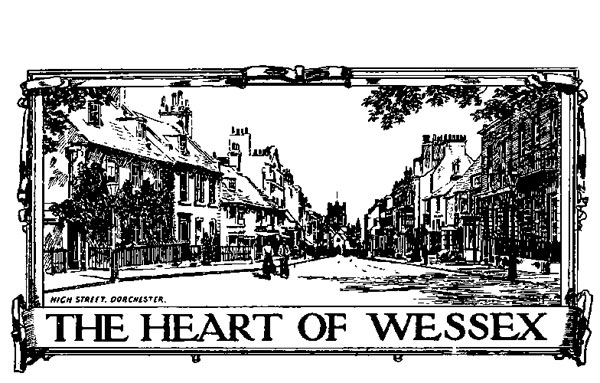
than make his headquarters at Dorchester, the Durnovaria of the Romans
and the "Casterbridge" of the novels.
Alighting at either of the railway stations, for the town is well
served by both the Great Western and the South Western Companies, the
visitor who has learned that Dorchester occupies the site of an
important town of the Romans will probably receive a shock at the
prevailing note of modernity that confronts him on every side. It is
only when one begins to understand the planning of the streets, and
has visited the town's outlying earthworks of Maumbury and Poundbury,
that the mind can realize the possibility of a Roman town being buried
a few feet beneath the houses that line the narrow thoroughfares. It
has been said that one cannot plant a shrub in a Dorchester garden
without unearthing some link with the legions of imperial Rome, an
excusable exaggeration if we think of the vast number of treasures
that have been discovered wherever the layer of surface soil has been
penetrated; and there is every reason to believe that the foundations
of Roman Dorchester lie just below the gardens, houses, and pavements
of the bright and modern town.
Excavation in the scientific sense the town has happily been spared,
but the accidental finds are of great value, as proving that the
town's historic past recedes into that twilight of dreamland and myth
which veils the infancy of our island in a golden haze of mystery. All
around this capital of Dorset lies a storied land, wherein memories of
the Durotriges, of the Roman legions, and of the ruthless march of the
Saxon through the beautiful land of Britain jostle with modern
associations of poetry, literature, and art.
Proceeding along South Street, as the narrow thoroughfare that
connects the stations with the centre of the town is called, the first
building to claim attention is the Grammar School, founded in the
sixteenth century by a Thomas Hardy, and rebuilt in the same style in
1879. Adjoining the school is "Napper's Mite", a small
seventeenth-century almshouse with a picturesque open gallery and a
clock bracket, copied from the one that adorns the old George Inn at
Glastonbury. The almshouse clock came from the old workhouse near by
when it was pulled down. Farther along the street, but on the opposite
side, is the Antelope Hotel, a Jacobean building whose beauties are
concealed behind nineteenth-century walls, although some interior
panelling and carving remain in situ.
Just beyond the hotel the street joins the main thoroughfare of the
town, and at this intersection, where four roadways diverge towards
the cardinal points of the compass, historical memories and literary
associations clamour for recognition. The curious stone obelisk in the
centre of the near roadway, and for many years used as the Town Pump,
marks the site of the old Octagon, and was erected in 1784, which date
is carved in characteristic Georgian figures on the coping stone. It
also marks the site of two houses that stood close together with their
upper rooms built over the street.
Facing us are the Town Hall and St. Peter's Church, the latter of
which is conjectured by some authorities to stand on the site of a
Roman temple. It is a stately Perpendicular building with an imposing
tower and a remarkable set of gargoyles. The Transition-Norman
door-arch of the south porch is a survival of an older church that
once occupied the same spot. Outside the church is Roscoe Mullins's
lifeless-looking bronze statue of William Barnes, the Dorset poet,
who, until his death in 1886, was the near neighbour and literary
friend of Thomas Hardy. The pedestal of Barnes's monument bears the
following verse from his poem, Culver Dell and the Squire:—
"Zoo now I hope this kindly feäce
Is gone to vind a better pleäce;
But still wi' vo'k a-left behind,
He'll always be a-kept in mind."
Within the sacred edifice are several interesting monuments, including
two cross-legged effigies of the "camail" period, but neither of these
is in situ. In the porch of this church John White, one of the
four founders of Salem and the virtual founder of Massachusetts, lies
buried.
Opposite the eastern end of the church is the Corn Exchange, where the
fickle Bathsheba displayed her sample bags of corn to the astonished
farmers, "adopting the professional pour into the hand, holding up the
grains in her narrow palm for inspection in perfect Casterbridge
manner". It was in a neighbouring shop that this "Queen of the Corn
Market" purchased the fatal valentine that aroused the amatory
instincts of Farmer Boldwood; while it was but a short distance away
that, a little later in the story, Far from the Madding Crowd,
Bathsheba and her husband, Sergeant Troy, met the piteous figure of
Fanny Robin on her painful journey to the Casterbridge workhouse. By
way of Mellstock (Stinsford) and Durnover (Fordington), Boldwood came
to Casterbridge, where, turning into Bull-Stake Square, he "halted
before an archway of heavy stonework which was closed by an
iron-studded pair of doors", and gave himself up for the murder of
Troy. Here also came Gabriel Oak in search of the licence which was to
procure for Bathsheba "the most private, secret, plainest wedding that
it is possible to have".
In the Mayor of Casterbridge the town naturally figures
largely, although the opening scenes of the novel are laid at Weydon
Priors (Weyhill, Hants). In Casterbridge Susan Henchard and
Elizabeth-Jane sought for Henchard
"What an old-fashioned place it seems to be!" exclaimed
Elizabeth-Jane, "it is huddled all together; and it is shut in
by a square wall of trees like a plot of garden ground with a
box-edging."
It is in this novel that its author gives us, in a few masterly
touches, the architectural details of the town's houses, the
"brick-nogging" and the "tile roofs patched with slate"; and indicates
the everyday life of its inhabitants. The whole town, in fact, teems
with Hardy scenes and characters, and particularly with the story of
the Man of Character who was its Mayor. To Casterbridge came Stephen
Smith when he commenced that study of architecture which led to his
meeting the blue-eyed Elfrida. Bob Loveday, brother to the
Trumpet-Major, came hither to meet his Matilda; and in the courthouse
Raye sat when on the Western Circuit, after he had parted with Anna at
Melchester (Salisbury).
Walking down High East Street the most unobservant eye could not fail
to notice the beautiful distant view of the Frome Valley and the
Yellowham Woods, and to note the number of the hostels on either side
of the short length of street. Prominent among them is the King's
Arms, with a spacious and noble Georgian window projecting over the
main portico. This window, that is at once the delight and the despair
of the modern architect, gave light to the room wherein was held "the
great public dinner of the gentle-people and such like leading
folk—wi' the Mayor in the chair".
Just below this still fashionable hotel is the "Three Mariners" with
its "four-centred Tudor arch over the entrance". The original inn has
vanished, but the present one occupies its site. On the opposite side
of the way stands the "Phoenix", but risen again from her ashes since
it was the scene of Jenny's last dance in one of the Wessex
Poems:—
"'Twas Christmas and the Phœnix Inn
Was lit by tapers tall,
For thirty of the trooper men
Had vowed to give a ball,
As "Theirs" had done (fame handed down)
When lying in the self-same town,
Ere Buonaparte's fall".
PUDDLETOWN
At the end of the street, and standing a little way back from the
roadway, is the White Hart, once a famous coaching inn, and one which,
although somewhat modernized, still carries its emblem, a large white
hart, above the main entrance. To this hostelry came Sergeant Troy
after appearing at Greenhill Fair as the Great Cosmopolitan Equestrian
who played the part of "Dick Turpin" at the circus; and here, too, the
carrier Burthen conveyed the story-tellers, the "Crusted Characters".
This inn is also mentioned in connection with Gertrude Lodge of The
Withered Arm.
Although the glories of its coaching days are but memories of the
past, and notwithstanding that the motorists pass so unpretentious a
building for the more attractive-looking King's Arms, the despised of
the modern traveller has retained a portion of its old-time custom and
prosperity, by reason of its being the inn at which the carriers'
carts deposit their morning and take up their evening passengers. The
loading of a "tranter's" cart with men, women, and children, not to
mention the immense packages of millinery, garden produce, and
poultry, is a fine art that could have been evolved only by centuries
of experience. To watch one of these caravans from the heart of Dorset
disgorge its contents reminds one of nothing so much as the conjuror's
hat at our first "grown-up" Christmas party. How so many human beings
can be squeezed into the few cubic feet left over from the merchandise
is a mystery, the knowledge of which would make the fortune of an
enterprising omnibus company. When meeting one of these Noah's Arks in
the country one would think at first sight that it contained men only,
although the incessant chattering that proceeds from the cavernous
depths of the vehicle has a distinctly feminine note. The reason for
this is that the "gaffers" occupy the front seats, where they smoke,
make sarcastic and distinctly personal remarks to their stay-at-home
neighbours, who gaze with envious eyes from their doorsteps, and keep
a keen eye on the various crops that grow along the sides of the
route. No matter what the weather, and whatever the season of the
year, the men sit over the horse's tail, the gloomy interior of the
vehicle, being allotted to the women and children, garden produce, and
occasional live stock. The return journey affords the travellers no
relief, for the "imports" of the morning journey have merely been
exchanged for "exports", and so the tired but happy parties return to
their secluded village homes, carrying with them a pungent odour in
which beer, oranges, and pepper mints are curiously mingled. All
readers of Mr. Hardy's novels will remember Tranter Dewy in Under
the Greenwood Tree.
At the Swan Bridge, which crosses the Frome just below the White Hart,
we can leave the busy thoroughfare and proceed along a pleasant and
shady walk that lines the bank of the stream. On our left is the town,
with the gardens of the houses coming down to the water's edge; and on
our right the green luscious meadows, watered by many streams, stretch
away until lost to sight in the distance. Very cool and refreshing are
these paths by the rippling brooks that flow around this side of the
town. Everyone loves running water, and there is a strange fascination
about gurgling streams and swirling brooks that is difficult to
define. Our ancestors built their towns and directed their roads by
the waterways, and for reasons other than those attached primarily to
defence or commerce. Masses of brambles and sedges sway over deep
crystal pools, the haunt of the trout, and the peculiar reflected
light from the water enhances the visionary loveliness of the glade.
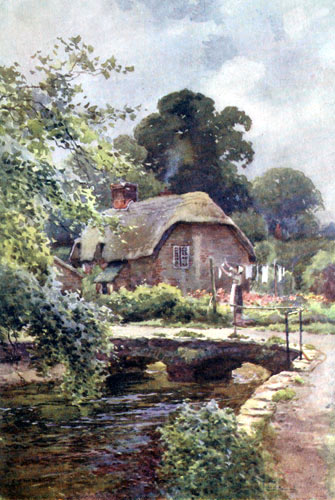
At the end of this walk is the Hangman's Cottage, a small brick
building with a roof-covering of thatch. There is nothing in its
present appearance to suggest the abode of the public hangman and the
town scavenger. The upper floor was reached originally by an external
stone stairway, the holes once occupied by the supporting stanchions
still being visible. Within this picturesque little dwelling Gertrude
Lodge questioned the hangman when in search of a remedy for her
"Withered Arm". The public executions took place on a roof over the
prison gateway, and in the County Museum the visitor will see two
leaden weights, each of which is inscribed with the word "Mercy".
These gruesome objects were supplied by a tender-hearted governor to
shorten the agony of a prisoner of light weight.
From the Hangman's Cottage a delightful walk through the low-lying
meadows, towards Charminster, passes by Wolfeton, an historic Tudor
house wherein Thomas Trenchard entertained Philip of Austria and
Joanna, after their fleet had put into Weymouth Harbour for shelter.
It was in the grounds of this house that the Lady Penelope, in A
Group of Noble Dames, pacified the three suitors for her hand with
the roguish remark: "Have patience, have patience, you foolish men!
only bide your time quietly, and, in faith, I will marry you all in
turn!"—a remark made in jest that was afterwards fulfilled in
earnest.
From Wolfeton the return journey can be made by way of the main road
that trends in a northerly direction somewhat beyond our present
limits—to Maiden Newton (Chalk Newton), the Hintock Country, and the
Blackmore Vale (the Vale of Little Dairies), all of which figure in
the novels. Nearing Dorchester again one notices that the sidepath is
raised a considerable height above the level of the roadway, being one
of many such tree-planted walks that mark the site and extent of the
ancient circumvallation of the town, the greater part of which is
still intra muros.
Proceeding down High West Street, the western counterpart of the
thoroughfare we joined at the Corn Exchange and left at the White
Hart, we pass on our left the Shire Hall, a reminder, if such were
needed, that we are in the county town. Farther on is the Dorset
County Museum, within which are exhibited the remarkable relics of
Celtic and Roman days that have been discovered in the town and its
immediate environs. Nearly opposite the Museum is the house (now a
shop) wherein Judge Jeffreys was lodged when he opened his Bloody
Assize at Dorchester. The house has retained its little gallery and
the greater part of its original woodwork, while several
stone-mullioned windows look out on the pretty garden at the back. In
Glydepath Road, near the Shire Hall, may be seen the "leering mask"
that formed the keystone of the doorway arch of Lucetta's house.
Our American cousins, who make their pilgrimage to the Hardy country
in ever-increasing numbers, may be glad to be reminded that it was in
the environs of this Dorset Dorchester that John Lothrop Motley, the
celebrated historian, made his English home, he having been born,
curiously enough, in the younger Dorchester of Massachusetts. He died,
in 1877, at Kingston Russell, the home of his daughter, Lady Vernon
Harcourt, and was buried near his wife in Kensal Green Cemetery.
No visitor should leave the town without paying a brief visit to the
great earthworks of Maumbury Rings and Poundbury Camp, the former of
which is undergoing a series of scientific excavations by Mr. St.
George Gray, engaged for the purpose by a joint committee of the
Dorset Field Club and the British Archæological Association. Thomas
Hardy, whose Dorchester home is but a short distance away, describes
Maumbury as "a huge circular enclosure, with a notch at opposite
extremities of its diameter, north and south. It was to Casterbridge
what the ruined Coliseum is to modern Rome, and was nearly of the same
magnitude." It has been estimated that the enclosure could accommodate
13,000 spectators, and over 10,000 are said to have assembled here in
1705, when Mary Channing was strangled and burned, on very slight
evidence, for the murder of her husband. Both of these historic
earthworks were nearly destroyed in the early days of railway
enterprise, and Poundbury was saved only at the last moment by Brunel
consenting to tunnel beneath instead of taking his line right through
it, as he had at first intended. In the Wessex novels and poems it
figures as "Square Pummerie", the place where Henchard's
"merry-making" occurred.
BERE REGIS
One of the most delightful of the numerous walks from Dorchester is
that which leaves the town by the two bridges near the White Hart, the
spot where the local High Street merges imperceptibly into the great
London Road. Journeying along this great chalk highway a fine view is
obtained of the suburb of Fordington, the "Durnover" of The Mayor
of Casterbridge.
"Here wheat ricks overhung the old Roman street, and thrust
their eaves against the church tower; green-thatched barns, with
doorways as high as the gates of Solomon's temple, opened directly
upon the main thoroughfare…. Here lived burgesses who daily
walked the fallow—shepherds in an intramural squeeze."
A mile or so of pleasant, if somewhat dusty, walking brings us to
Stinsford crossroads, where a right-hand turn leads to Stinsford
House, with its terraced garden, and a very pretty church, the
Mellstock Church of Under the Greenwood Tree. In this pleasing
little church Tranter Dewy and his family attended service, and here
the valiant Thomas Leaf listened to the sermons of "His Holiness". It
was at Mellstock that Elizabeth-Jane and her mother caught their first
glimpse of the town of Casterbridge.
From Stinsford a charming walk through the park of Kingston House, the
Knapwater House of Desperate Remedies, brings us to the
junction of the roads that lead to Higher and Lower Bockhampton
respectively.
We are now near a portion of the "Tess" locality, for a short distance
to the right stands Norris Mill, the "Talbothays" of the novel, while
the Frome Valley, in which it is situated, is the "Vale of Great
Dairies", the "valley in which milk and butter grew to rankness".
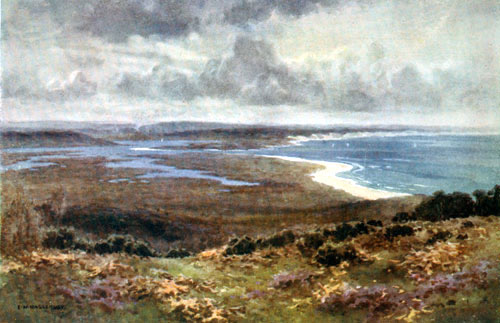
Here, too, is the western extremity of the far-famed "Egdon Heath",
that succession of wild unenclosed moorlands that stretch in unbroken
continuity from near Dorchester to Poole Harbour; but a description of
this vast heathland must be deferred for the moment, for a short walk
leads to Higher Bockhampton, a most charming and secluded hamlet, at
the farther end of which is the birthplace of the Wessex novelist, a
small thatched house embowered in a world of rural opulence. Mr.
Hardy's childhood's days were impregnated with rustic peace and
solitude, and the formative influences of his early environment have
left their mark on his great romances. From the birthplace a most
pleasant ramble over Bockhampton Heath leads into the Yellowham Woods,
the "Great Yalbury" wood, in the depths of which Fancy Day resided
when living in her father's cottage. Here, too, as told in Far from
the Madding Crowd, Joseph Poorgrass had the experience, the
re-telling of which always put this most modest of men to the blush.
"Once he had been working late at Yalbury Bottom, and had had a
drop of drink, and lost his way as he was coming home along
through Yalbury Wood…. And as he was coming along in the middle
of the night, much afeared, and not able to find his way out
nohow, a' cried out, 'Man-a-lost! man-a-lost!' A owl in a tree
happened to be crying 'whoo-whoo-whoo!' as owls do you know,
Shepherd, and Joseph, all in a tremble, said, 'Joseph Poorgrass,
of Weatherbury, sir!'" "No, no, now, that's too much," said the
timid man…. "I didn't say sir … I never said sir
to the bird, knowing very well that no man of a gentleman's rank
would be hollerin' there at that time o' night. 'Joseph Poorgrass,
of Weatherbury,' that's every word I said, and I shouldn't ha'
said that if't hadn't been for keeper Day's metheglin."
Out on to the main road again, the same one that we left at Stinsford
crossroads, a short walk past the little hamlet of Troy Town, and we
enter Puddletown (strictly Piddleton, from the A.S. piddle, a
small stream), the old home of the de Pydels, and the "Weatherbury" of
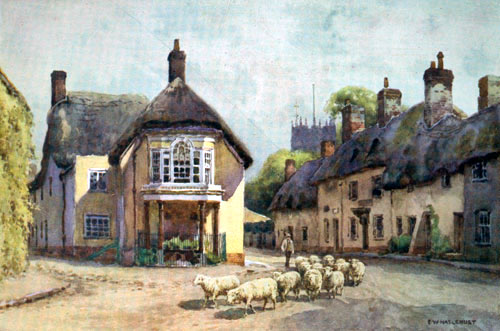
romance. Occupying a prominent position facing the village square
where used to stand the maypole, stocks, and Hundred house, is a
thatched house with a projecting window supported on columns, which
architects consider to be one of the finest Georgian windows in the
country. This was, in the eighteenth century, the private residence of
the Boswells.
"Weatherbury" is a most interesting place, although somewhat altered
since Far from the Madding Crowd was penned. The old malthouse,
wherein the villagers gave such a warm welcome to Gabriel Oak on his
taking service with Bathsheba, has vanished completely, but the
church, of which a proposed rebuilding of an Elizabethan chancel on
the lines of a larger original chancel has caused a fierce and bitter
controversy in the press, has met with little molestation. It contains
the Athelhampton Chapel, with a panelled entrance arch, in which are
some remarkable monuments and brasses, the former of which include a
magnificent recumbent effigy in alabaster, with a "vizored salade",
and a fluted shield, commemorating a member of the Martin family, who
lived at the neighbouring Athelhampton Hall, a fine ancestral home,
and the "Athel Hall" of the Wessex Poems. The Norman font in
the church is worth inspection, as also are the fifteenth-century
panelled roof of Spanish chestnut of the nave, and the Carolean
gallery where Gabriel Oak sang in the choir.
Very simple were the old services in these village churches, with the
farm hands attending service on Sunday afternoons as regularly as they
went to work on Monday mornings. Now and then maybe a bucolic rustic
would doze off to sleep, until his slumbers were disturbed by the
beadle; and many of the old natives can remember when this
ecclesiastical official would rap his long wand of office on the skull
of a sleeping rustic, with a crack that echoed through the sacred
edifice. In the north porch of the church Sergeant Troy passed the
night after Fanny Robin's funeral.
A short distance away is Lower Waterson, "a hoary building of the
Jacobean stage of classic renaissance", and the home of Bathsheba
Everdene, where the great "Shearing Barn", so delightfully described
by Mr. Hardy, may still be seen, although the novelist had in his
mind's eye the far more spacious and magnificent tithe barn at
Abbotsbury. While at Waterson it is worth while to mount Waterson
Ridge, the scene of Time's Laughingstocks, a poem that appeared
in the Fortnightly of August, 1904.
From Puddletown through Tolpuddle (one of the numerous villages to
which the Puddle or Piddle gives name), and we are quickly at Bere
Regis, which Dr. Stukeley identified with the Roman Ibernium.
This is the "Kingsbere" of the novels and the ancient seat of the
Turbervilles, a family that flourishes still in Glamorgan, and of whom
Tess was a fictitious descendant. Within the church, which has a
remarkable carved roof, the gift of Cardinal Morton, who was born at
Milborne Stileham, three or four miles away, are two canopied tombs of
the Turbervilles. Half a mile to the north-east is Woodbury Hill,
where was held the great sheep fair, the "Greenhill Fair" where Troy
performed the part of "Dick Turpin" at the circus. At Bere the
smuggler Owlett was hidden after his struggle with the excise
officers, and it was selected as a hiding place for the women by
Miller Loveday, should Napoleon's threatened invasion prove
successful. Here, too, beneath the Cardinal's noble gift, Yeobright's
father put such power into his playing of the bass viol as to cause
the windows to rattle, and "old Pa'son Gibbons to lift his hands in
his great holy surplice as natural as if he'd been in common clothes,
and seem to say to himself, 'oh for such a man in our parish!'"
Apart from its historical and literary associations Bere Regis is as
charming a spot as exists in rural England, and one where the modern
cultivation which demolishes the hedgerows and stubbs up the copses
has not yet shown its evil presence. The old manor house of the
Turbervilles has vanished, with the exception of a portion that still
remains in Court Farm; and times have changed since the old race of
manorial lords and squires were laid to rest in their family vaults.
Here, as in most Dorset villages, the ancient families have died out
or, owing to agricultural depression, have been driven into bankruptcy
or exile. The manor houses have fallen into decay, with the exception
perhaps, as here, of a solitary wing which serves as a modern
farmhouse. On the tombstones in the churchyard you may read names once
honoured in the countryside, and far beyond it, names that are rapidly
becoming extinct, except as what Grant Allen would have called "verbal
fossils".
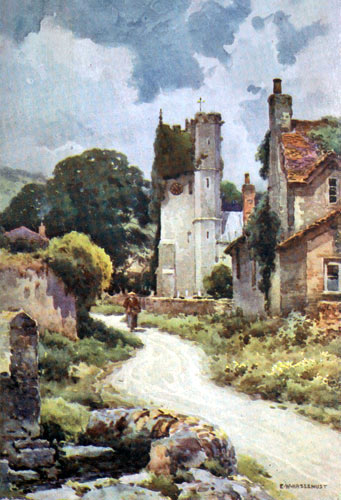
PORTISHAM
It is generally thought that the untitled landed gentry represent a
longer connection with land than the nobility, whose estates have
constantly been added to by purchase or inheritance. It is, however,
quite otherwise; for of all the squirearchy there are very few
families who can show an unbroken succession since the termination of
an event so comparatively recent as the Wars of the Roses. True, there
are a certain and a not inconsiderable number of Englishmen with large
landed estates who are descended from ancestors who held land sometime
before them; but it will generally be found that the ancestors were
yeomen. It has been estimated by an eminent authority that an analysis
of modern landowners in any English county will prove that not more
than a dozen descend from forbears owning 3000 acres (the minimum
qualification for a great landowner) in the time of Elizabeth; and
that the peers, comparatively modern as the majority of them are,
represent a much larger average of old families than the country
squires.
If possible, the return journey from Bere Regis to Dorchester should
be made by way of "Egdon Heath", of which we get so impressive a
description in the opening chapters of The Return of the
Native. If the weather be fine, what could be better than a long
tramp over the moor? especially as our most lasting memories of a
landscape are those we gain afoot. Blue skies and green fields are
things we are all familiar with; but there is assuredly nothing in the
wide world that appeals to us so much as our English moorlands, and
"Egdon", aglow with yellow gorse, and afire with purple heather, is as
fine a sight as can be offered by these southern lands that fringe the
Channel seas. It is not pretended, of course, that these combined
Dorset heathlands can rival in extent or grandeur the great Devonian
moorland that gives birth to the romantic River Dart; but in their own
peculiar way they have no rival.
In Domesday this tract of country is called a "heathy, furzy,
briary wilderness", and the antiquary Leland writes of it as being
"overgrown with heth and moss". Mr. Hardy characterizes it finely in
eight words as "singularly colossal and mysterious in its swarthy
monotony." His description of it could have been penned only by one
who was familiar with all its various moods, and whose mind had become
absorbed with its mysterious and subtle influences.
"Ever since the beginning of vegetation its soil has worn the same
antique brown dress, the natural and invariable garment of the
peculiar formation…. It is unchanged and unchangeable, with a
wild, weird beauty all its own…. It was a spot which returned
upon the memory of those who loved it with an aspect of peculiar
and kindly congruity…. Twilight combined with the scenery of
Egdon Heath to evolve a thing majestic without severity,
impressive without showiness, emphatic in its admonitions, grand
in its simplicity."
It was among the solitudes of these moorlands, and amid the fragrant
meadow-lands of Dorchester, that William Barnes made himself sweet
imageries the livelong day; and here Thomas Hardy has thought out his
great prose romances, and clothed them with beautiful description.
Certainly both of these great writers have revived much of the
forgotten wealth of our language, and wander where you will in their
beloved Dorset homeland, by winding stream or breezy down, the shade
of the dead poet and the presence of the living novelist accompany you
on your way.
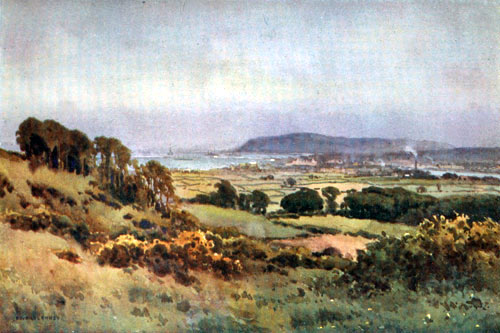
Eight miles to the south of Dorchester is Weymouth, backed, as seen
from the landward side, by the great promontory of Portland, lying
like some stranded whale upon the waters. The quickest and easiest way
to reach this "Budmouth" of the novels is by train, but by far the
more interesting way is to walk or cycle. True, the rail motor has
many "halts", at which one can alight, but those who do the sights of
a place between the trains miss a hundred natural beauties and a
thousand healthy pleasures granted to the pedestrian and the cyclist.
Leaving the county town by the Weymouth Road, and passing the "Rings"
where Henchard and his wife met to discuss future arrangements, the
first definite turning towards the right leads to Maiden Castle, where
rise the steep and grassy tiers of the most stupendous prehistoric
earthwork we possess, and one that was in existence for centuries
before it was strengthened, and, for a short period, occupied probably
by the Romans. A whole day is scarce sufficient in which to explore
this great camp, with an area of 160 acres, that occupies the summit
of a natural hill, and where the entrenchments and fortifications are
of a most elaborate character.
Emerging from this prehistoric fortress, camp, and cattle-station at
its western extremity, a short but hilly walk leads to the charming
village of Upwey, nestling at the foot of a well-wooded hill where
rises a spring of water, the source of the little River Wey. Upwey
Church is a very interesting one of Perpendicular date. Some portions
of the picturesque old mill here are introduced into the
Trumpet-Major, but their locality has been moved to Sutton
(Overcombe), a few miles away. Beyond the mill a sharp turn to the
left joins the main road we left to reach Maiden Castle. Here, on the
old vicinal way of the Romans, stands the "Ship" inn, the hostel
wherein Dick Dewy and Fancy Day became definitely engaged after their
accidental meeting by the King's statue at Budmouth. Close at hand is
the Ridgeway, the place where the Overcombe folk waited all night to
see the King arrive; and where the opening scene of the first act of
The Dynasts is laid. Adjoining the Ridgeway is Bincombe Down,
with its steep, grass-covered sides rising sheer from the straggling
village below. Mr. Hardy writes: "The eye of any observer who cared
for such things swept over the wave-washed town (Weymouth) and the bay
beyond, and the Isle, with its pebble bank, lying on the sea to the
left of these, like a great crouching animal tethered to the
mainland".
On this hill the soldiers were encamped in readiness to repel
Napoleon's threatened invasion, and here came the Mill party in the
Trumpet-Major, to see the review, and to overhear the
exclamations of the excited rustics: "There's King Jarge!" "That's
Queen Sharlett!" "Princess Sophiar and Mellyer!" In the Melancholy
Hussar Blagdon is depicted as the spot whereon Tina and Christoph
were shot as deserters.
From Upwey a fine walk along the Waddon Valley, the scene of The
Lacking Sense; past Corton Church, with its pre-Reformation stone
altar, and the Jacobean farmhouse of Waddon; and through the charming
hamlet of Coryates, leads to Portisham, or Po'sham, one of the most
interesting of the villages that lie at the back of the Chesil Beach.
On the outskirts of the village a little stone-roofed house, almost
covered with creepers, was the home of Thomas Masterman Hardy, the
Flag-captain of the Victory, in whose arms Nelson died. The
house is still occupied by the descendants of the gallant seaman, one
of three Dorset captains at Trafalgar, and many relics of their famous
ancestor are preserved within the dwelling. It was to this house that
Bob Loveday came to visit Captain Hardy when he thought of joining the
crew of the Victory.
High above the village, on Blackdown or Blagdon Hill, stands the Hardy
Monument that forms a conspicuous land- and sea-mark for many miles
around.
Portisham is one of the most charming of Dorset's villages; the church
having many points of interest that include a leaden roof and a very
good tower; while grouped around it are old-fashioned thatched
cottages, and ancient Tudor houses with the heavy dripstones and
massive mullions so characteristic of their era. Portisham was the
birthplace of Sir Andrew Riccard, "President of the East India and
Turkey Companies". He left an only daughter, who became successively
the wife of Lord Kensington and Lord Berkeley of Stratton.
WEYMOUTH AND PORTLAND
Just beyond Portisham is Abbotsbury, where are some considerable
remains of a monastic building founded originally, circa 1044,
for secular canons, and converted, in later days, into a noble
Benedictine Abbey, of which the tithe barn, a very beautiful example,
still exists. The little chapel perched on the summit of St.
Catherine's Hill is an architectural gem of the Perpendicular period,
and one that should not be missed by anyone with antiquarian tastes.
The village church is also a good piece of building, with a curious
representation of the Trinity let into the wall of the tower, and a
fine Jacobean pulpit. While here, a visit should be paid to Lord
Ilchester's famous Swannery and Decoy.
As we are now a good deal out of the direct-road route from Dorchester
to Weymouth, the visitor may be advised to take the rail motor from
Abbotsbury to the maritime town, especially as, after passing through
the Waddon Vale, the road leading thither is bare, treeless, and
devoid of interest.
Weymouth has been described a thousand times, and it is not unworthy
of it, lying as it does in a long curve with the whole town visible
from the sea. It is artistically placed, and is a brilliant if
somewhat old-fashioned jewel set amid a sea of amethyst and turquoise.
Modern Weymouth is made up of two distinct boroughs, Weymouth and
Melcombe Regis, which were united by Queen Elizabeth. It is a town
whose beginnings are lost in obscurity, although its early history is
not of a very engrossing kind. After passing through various phases of
fortune and misfortune, with a preponderance of the latter, the place
was nothing but a decayed seaport until George III and his Court,
coming here to reside in the closing years of the eighteenth century,
instilled new life into the town, which has retained, despite the
modern builder, considerable architectural remains of this period of
its greatest prosperity. The shops have unfortunately been modernized,
but the greater number of the old Georgian rows of dwelling houses are
intact. Gloucester Lodge, now the Gloucester Hotel, was the royal
residence, before which "a picket of a thousand men mounted guard
every day". Queen Charlotte's Second Keeper of the Robes was Fanny
Burney, who, in her Diary, has left us a very interesting
account of the Court life at Weymouth.
With the exception of Casterbridge, Budmouth figures more frequently
in the Wessex novels than any other place, and is especially prominent
in The Trumpet-Major. By the statue of King George,
"wonderfully and fearfully made", Dick Dewy met Fancy Day; and the
bridge over the harbour is mentioned in the Well-Beloved. Bob
Loveday was familiar with its harbour, and his brother John knew its
barracks; and here Anne Garland studied the latest fashions. It was on
the esplanade that Festus Derriman cut "a fine figure of a soldier",
and here Jocelyn Pierston was staying when he met with two
incarnations of the Well-Beloved. In The Dynasts, the interview
between King George and Pitt takes place at Gloucester Lodge, and in
the Old Rooms Inn across the harbour the Battle of Trafalgar was
discussed.
Some four miles to the south of Weymouth lies the "Isle of Slingers"
(Portland), the pleasantest way to reach which is by one of the
numerous steamers that make the trip. Entering an opening in the great
breakwater that encloses the mighty roadstead of Portland, the visitor
will notice the ruins of an old castle that stand on the edge of a
sandy and rapidly disappearing cliff. This is all that is left of
Sandsfoot Castle, built in the time of Henry VIII, and the "right
goodlie Castel" of Leland's day. This was the place appointed by
Pierston for his farewell to Avice. Our little craft threads her way
quickly through the mighty battleships and cruisers that lie securely
within this murally enclosed basin of sea, and we glide into the
little harbour at the base of the mighty rock. The first aspect of the
place, owing partly to the absence of trees, is stern and rather
uninviting, but, for those who know it, the rocky mass of Portland has
many attractions. From the high land a fine view is obtained of the
Chesil Beach, that extraordinary bank of pebbles that connects the
"island" with the mainland at Abbotsbury, ten miles away. Farther west
is Bridport, the "Port Bredy" of the novels, and a pleasantly situated
town, whose marine suburb of West Bay contains a useful little harbour
wherein vessels of a small tonnage can enter at high tides. Six miles
to the north of Bridport is Beaminster (Emminster), the home of Angel
Clare, whither Tess made her way in the hope of obtaining news of her
husband.
Interesting as is the rock of Portland as seen from the Bill or from
the sandy little cove of Church Ope, the seaward faces of the
promontory are best observed from the deck of a boat, when all the
elements that go usually to form a picture on a level surface are here
raised nearly to the perpendicular, and, by reflecting the sun's rays
at a slight angle, produce effects as violent in their nature as they
are startling in their novelty of colour. In The Souls of the
Slain, the Bill or Beal of Portland is well described:
"The thick lids of night closed upon me
Alone at the Bill
Of the Isle by the Race—
Many-caverned, bald, wrinkled of face—
And with darkness and silence the spirit was on me
To brood and be still."
From this wild spot Ann Garland watched the Victory depart with
Bob Loveday on board. Turning inland we see Pennsylvania Castle. This
was the home of Pierston, and near it is the cottage wherein Avice
dwelt; while, in the adjoining Ope Churchyard, Jocelyn wooed the
granddaughter of the first Avice. The castle is comparatively modern,
having been built by John Penn in 1800, from designs by Wyatt.
From numberless points on the tableland of Portland many exquisite
views may be obtained, some looking seaward to where the distant St.
Aldhelm's Head marks the eastern limit of Weymouth Bay. Inland, the
prospect includes the town of Weymouth, with the heights of Dorset
stretching into the heart of the county. Away to the west the waves of
the Channel moan unceasingly, where Chesil lifts her pebbly ridge, and
Golden Cap, with its summit of yellow sand, marks the site of Lyme
Regis, with its memories of Charles II, Monmouth, Jane Austen, and
Mary Mitford. Westward, too, over an expanse of southern sea, the sun
sinks behind the belt of blue, and flushes the golden glow of sky with
varying hues of rose and amethyst, until the overarching heaven seems
etherealized into a transparent canopy that veils the mystic radiance
of some hidden glory.