O child of that white-crested mountain whose springs
Gush forth in the shade of the cliff-eagle's wings,
Down whose slopes to the lowlands thy wild waters shine,
Leaping gray walls of rock, flashing through the dwarf-pine!
Whittier.
PLYMOUTH lies at the entrance to the Pemigewasset Valley, like an
encampment pitched to dispute its passage. At present its design is to
facilitate the ingress of tourists.
I am sitting at the window this morning looking down the Pemigewasset
Valley. It is a gray, sad morning. Wet clouds hang and droop heavily
over. In the distance the frayed and tattered edges are rolled up,
half-disclosing the humid outlines of the hills on the other side of
the valley. The trees are budded with rain-drops. Through a lattice
of bordering foliage I look down upon the river, shrunken by drought
to half its usual breadth, and exposing its parched bed of sand and
pebbles. It gives an expiring gurgle in its stony throat. It is one of
those mornings that, in spite of our philosophy, strangely affect the
spirits, and are like a presentiment of evil. The clouds are funereal
draperies; the river chants a dirge.
In this world of ours, where events push each other aside with such
appalling rapidity, perhaps it is scarcely remembered that Hawthorne
breathed his last in this house on the night of May 18th, 1864. He who
was born in sight of these mountains had come among them to die.
In company with his old college mate and loving friend, General Pierce,
he came from Centre Harbor to Plymouth the day previous to the sad
event. Devoted friends--and few men have known more devoted--had for
some time seen that his days were numbered. The fire had all but gone
out from his eye, which seemed interrogating the world of which he was
already more than half an inhabitant. A presentiment of his approaching
end seemed foreshadowed in the changed look and faltering step of
Hawthorne himself: he walked like a man consciously going to his grave.
Still, much was hoped--it could hardly be that much was expected--from
this journey, and from the companionship of two men grown gray with
care, each standing on the pinnacle of his ambition, each disappointed,
but united, one to the other, by the ties of life-long friendship;
turning their backs upon the gay world, and walking hand-in-hand among
the sweet groves and pleasant streams like boys again. It was like a
dream of their lost youth: the reality was no more.
On this journey General Pierce was the watchful, tender, and sympathetic
nurse. Without doubt either of these men would have died for the other.
But these hopes, these cares, alas! proved delusive. The angel of death
came unbidden into the sacred companionship; the shadow of his wings
hovered over them unseen. In the night, without a sigh or a struggle, as
he himself wished it might be, the hand of death was gently and kindly
laid on the fevered brain and fluttering heart. In the morning his
friend entered the chamber to find only the lifeless form of Nathaniel
Hawthorne plunged in the slumber that knows no awakening. Great heart
and mighty brain were stilled forever.
While the weather gives such inhospitable welcome let us employ the
time by turning over a leaf from history. According to Farmer, the
intervales here were formerly resorted to by the Indians for hunting
and fishing. At the mouth of Baker's River, which here joins the
Pemigewasset, they had a settlement. Graves, bones, gun-barrels, besides
many implements of their rude husbandry, have been discovered. Here, it
is said, the Indians were attacked by a party of English from Haverhill,
Massachusetts, led by Captain Baker, who defeated them, killed many, and
destroyed a large quantity of fur. From him Baker's River receives its
name.
Before the French and Indian war broke out this region was debatable
ground, into which only the most celebrated and intrepid white hunters
ventured. Among these was a young man of twenty-three, named Stark, who
lived near the Amoskeag Falls, in what is now Manchester. In April,
1752, Stark was hunting here with three companions, one of whom was
his brother William. They had pitched their camp on Baker's River,
in the present limits of Rumney, and were prosecuting their hunt with
good success, when they suddenly discovered the presence of Indians in
their vicinity. Though it was a time of peace, they were not the less
apprehensive on that account, and determined to change their position.
But the Indians had also discovered the white hunters, and prepared to
entrap them. When Stark went out very early the next morning to collect
the traps he was intercepted and made prisoner. The Indians then took a
position on the bank of the river to ambush his companions as they came
down. Eastman, who was on the shore, next fell into their hands; but
the two others were in a canoe floating quietly down the stream out of
reach. Stark was ordered to hail and decoy them to the shore. He obeyed;
but, instead of lending himself to the treachery, shouted to his friends
that he was taken, and to save themselves. They instantly steered for
the opposite shore, receiving a volley as they did so. Stinson, one of
those in the boat, was shot dead; but William Stark escaped through the
heroism of his brother, who knocked up the guns of the savages as they
covered him with fatal aim.
Stark and his fellow-prisoner were taken to St. Francis by Actæon and
his prowling band, with whom they had had the misfortune to fall in. At
St. Francis the Indians set Stark hoeing their corn. At first he cut up
the corn and spared the weeds; but this expedient not serving to relieve
him of the drudgery, he threw his hoe into the river, telling his
captors that hoeing corn was the business of squaws, not of warriors.
This answer procured him recognition among them as a spirit worthy of
themselves. He was adopted into the tribe, and called the "Young Chief."
The promise of youth was fulfilled. The young hunter of the White
Mountains and the conqueror of Bennington are the same.
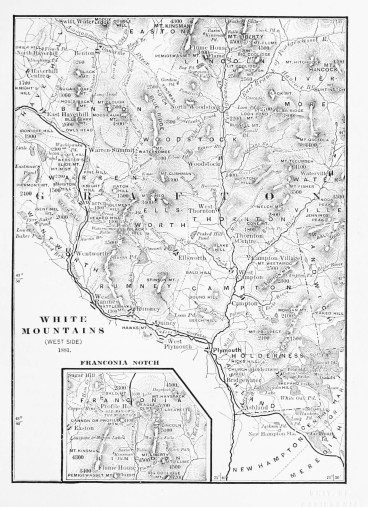
The choice is open to leave the railway here and enter the mountains by
the Pemigewasset Valley, or to continue by it the route which conducts
to the summit of Mount Washington, by Bethlehem and Fabyan's. To journey
on by rail to the Profile House is seventy-five miles, while by the
common road, following the Pemigewasset, the distance is only thirty
miles. A daily stage passes over this route, which I risk nothing in
saying is always one of the delightful reminiscences of the whole
journey. Deciding in favor of the last excursion, my first care was to
procure a conveyance.
At three in the afternoon I set out for Campton, seven miles up the
valley, which the carriage-road soon enters upon, and which by a few
unregarded turnings is presently as fast shut up as if its mountain
gates had in reality swung noiselessly together behind you. Hardly had I
recovered from the effect of the deception produced by seeing the same
mountain first in front, next on my right hand, and then shifted over to
the other side of the valley, when I saw, spanned by a high bridge, the
river in violent commotion far down below me.
The Pemigewasset, confined here between narrow banks, has cut for
itself two deep channels through its craggy and cavernous bed; but
one of these being dammed for the purpose of deepening the other, the
general picturesqueness of the fall is greatly diminished. Still, it is
a pretty and engaging sight, this cataract, especially if the river be
full, although you think of a mettled Arabian harnessed in a tread-mill
when you look at it. Livermore Fall, as it is called, is but two miles
from Plymouth, the white houses of which look hot in the same brilliant
sunlight that falls so gently upon the luxuriant green of the valley.
The feature of this fall is the deep water-worn chasm through which it
plunges.
By crossing the bridge here the left bank of the stream may be followed,
the valley towns of Campton, Thornton, and Woodstock being divided by it
into numerous villages or hamlets, frequently puzzling the uninitiated
traveller, who has set out in all confidence, but who is seized by
the most cruel perplexity, upon hearing that there are four villages
in Campton, each several miles distant from the other. One would have
pleased him far better.
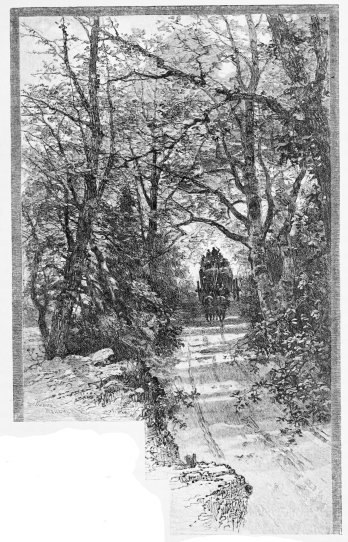
ON THE PROFILE ROAD.
Crossing this bridge, and descending to the level meadow below the
falls, I made a brief inspection of the establishment for breeding and
stocking with trout and salmon the depleted mountain streams of New
Hampshire. The breeding-house and basins are situated just below the
falls, on the banks of the river. This is a work undertaken by the
State, with the expectation of repeopling its rivers, brooks, and ponds
with their finny inhabitants. All those streams immediately accessible
from the villages are so persistently fished by the inhabitants as to
afford little sport to the angler from a distance, who is compelled
to go farther and fare worse; but the State is certainly entitled to
much credit for its endeavor to make two trout grow where only one grew
before. It is feared, however, that the experiment of stocking the
Pemigewasset with salmon will not prove successful. The farmers who live
along the banks say that one of these fish is rarely seen, although the
fishery is protected by the most rigid regulations. No one who has not
visited the mountains between May 1st—the earliest date when fishing
is permitted—and the middle of June, can have an idea of the number
of sportsmen every year resorting to the trout streams, or of the
unheard-of drain upon those streams. Not the least of many ludicrous
sights I have witnessed was that of a man, weighing two hundred pounds,
excitedly swinging aloft a trout weighing less than two ounces, and this
trophy he exhibited to me with unfeigned triumph—the butcher! This is
mere slaughter, and ought not to be tolerated. A pretty sight is to see
the breeding-trout follow you in your walk around the margin of their
little basin to be fed from your hand. They are tame as pigeons and
ravenous as sharks.
Mount Prospect, in Holderness, is the first landmark of note. It is
seen, soon after leaving Plymouth, rising from the opposite side of the
valley, its green crest commanding a superb view of the lake region
below, and of the lofty Franconia Mountains above. It is worth ascending
this mountain were it only to see again the beautiful islet-spotted
Squam Lake and far-reaching Winnipiseogee quivering in noonday splendor.
The beautiful valley is now open throughout its whole extent. Of
course I refer only to that portion lying above Plymouth. But it is an
anomaly of mountain valleys. Its length is about twenty-five miles, and
its greatest width, I should judge, not more than three or four. For
twenty miles it is almost as straight as an arrow. There is nothing to
hinder a perfectly free and open view up or down. Contrast this with
the wilful and tortuous windings of the Ammonoosuc, or the Saco, which
seem to grope and feel their way foot by foot along their cramped and
crooked channels. The angle of ascent, too, is here so gradual as to be
scarcely noticed until the foot of the mountain wall, at its head, is
reached. True, this valley is not clothed with a feeling of overpowering
grandeur, but it is beautiful. It is not terrible, but bewitching.
The vista of mountains on the east side of the valley becomes every
moment more and more extended, and more and more interesting. A long
array of summits trending away to the north, with detached mountains
heaved above the lower clusters, like great whales sporting in a frozen
sea, is gradually uncovered. Green as a carpet, level as a floor, the
valley, adorned with clumps of elms, groves of maples, and strips of
tilled land of a rich chocolate brown, makes altogether a picture which
sets the eye fairly dancing. Even the daisies, the clover, and the
buttercups which so plentifully spangle the meadows seem far brighter
and sweeter in this atmosphere, nodding a playful welcome as you pass
them by. We are in the country of flowers.
Since passing Blair’s and the bridge over the river to Campton Hollow I
was on the alert for that first and most engaging view of the Franconia
Mountains which has been so highly extolled. Perhaps I should say
that one poetic nature has revealed it to a thousand others. Without
doubt this landscape is the more striking because it is the first, and
consequently deepest, impression of grand mountain scenery obtained
by those upon whom at a turn of the road, and without premonition, it
flashes like the realization of some ecstatic vision.
Half a mile below the little hamlet of West Campton the road crosses
the point of a hill pushed well out into the valley. It is here that
the circlet of mountains is seen enclosing the valley on all sides
like a gigantic palisade. In one place, far away in the north, this
wall is shattered to its centre, like the famous Breach of Roland;
and through this enormous loop-hole we see golden mists rising above
the undiscovered country beyond. We are looking through the far-famed
Franconia Notch. On one side the clustered peaks of Lafayette lift
themselves serenely into the sky. On the left a silvery light is
playing on the ledges of Mount Cannon, softening all the asperities of
this stern-visaged mountain. The two great groups now stand fully and
finely exposed; though the lower and nearer summits are blended with
the higher by distance. Remark the difference of outline. A series of
humps marks the crest-line of the group, which culminates in the oblique
wall of Mount Cannon. On the contrary, that on the right, culminating
in Lafayette, presents two beautiful and regular pyramids, older than
Cheops, which sometimes in early morning exactly resemble two stately
monuments, springing alert and vigorous as the day which gilds them. At
a distance of twenty miles it demands good eyes and a clear atmosphere
to detect the supporting lines of these pyramidal structures, which in
reality are two separate mountains, Liberty and Flume. This exquisite
landscape seldom fails of producing a rapturous outburst from those who
are making the journey for the first time.
There are many points of resemblance between this view and that of the
White Mountains from Conway Corner. Both unfold at once, and in a single
glance, the principal systems about which all the subordinate chains
seem manœuvring under the commanding gaze of Washington or Lafayette.
Soon after starting it was evident that my driver’s loquaciousness was
due to his having “crooked his elbow” too often while loitering about
Plymouth. The frequent plunge of the wheels into the ditches by the
roadside, accompanied with a shower of mud, was little conducive to the
calm and free enjoyment of the beauties of the landscape. The driver
alone was unconcerned, and as often as good fortune enabled him to steer
clear of upsetting his passengers would articulate, thickly, “Don’t be
alarmed, Cap’: no one was ever hurt on this road.”
Silently committing myself to that Providence which is said to watch
over the destinies of tipplers, I breathed freely only when we drew up
at the hospitable door of the village inn, bespattered with mud, but
with no broken bones.
Sanborn’s, at West Campton, is the old road-side inn that long ago swung
the stag-and-hounds as its distinctive emblem. A row of superb maples
shades the road. Here we have fairly entered the renowned intervales,
that gleam among the darker forests or groves like patches of blue in
a storm-clouded sky. Looking southward, across the level meadows, the
hills of Rumney flinging up smooth, firm curves, and the more distant,
downward-plunging outline of Mount Prospect, in Holderness, close the
valley. Upon the left, where the clearings extend quite to the summits
of the near hills, the maple groves interspersed among them resemble
soldiers advancing up the green slopes in columns of attack. Following
this line a little, the valley of Mad River is distinguished by the deep
trough through which it descends from the mountains of Waterville. And
here, peering over the nearer elevations, the huge blue-black mass of
Black Mountain flings two splendid peaks aloft.
For a more intimate acquaintance with these surroundings the hillside
pasture above the school-house gives a perspective of greater breadth;
while that from the Ellsworth road is in some respects finer still.
About two miles up this road the valley of the East Branch, showing the
massive Mount Hancock, cicatriced with one long, narrow scar, is lifted
into view. The other features of the landscape remain the same, except
that Mount Cannon is now cut off by the hill rising to the north of us.
As often as one of these hidden valleys is thus revealed we are seized
with a longing to explore it.
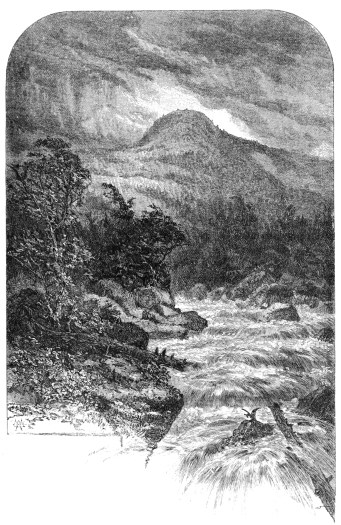
WELCH MOUNTAIN, FROM MAD RIVER.
One need not push inquiry into the antecedents of Campton or the
neighboring villages very far. The township was originally granted to
General Jabez Spencer, of East Haddam, Connecticut, in 1761. In 1768 a
few families had come into Campton, Plymouth, Hebron, Sandwich, Rumney,
Holderness, and Bridgewater. No opening had been made for civilized men
on this side of Canada except for three families, who had gone fifty
miles into the wilderness to begin a settlement where Lancaster now
is. The name is derived simply from the circumstance that the first
proprietors built a camp when they visited their grant. The different
villages are much frequented by artists, who have spread the fame of
Campton from one end of the Union to the other. But a serpent has
entered even this Eden—the villagers are sighing for the advent of the
railway.
Having dedicated one day to an exploration of the Mad River Valley, I
can pronounce it well worth any tourist’s while to tarry long enough
in the vicinity for the purpose. It is certainly one of the finest
exhibitions of mountain scenery far or near. Here is a valley twelve
miles long, at the bottom of which a rapid river bruises itself on a bed
of broken rock, while above it are heaped mountains to be picked out
of a thousand for peculiarity of form or structure. The Pemigewasset
is passed by a ford just deep enough at times to invest the journey
with a little healthy excitement at the very beginning. The ford has,
however, been carefully marked by large stones placed at the edge of the
submerged road.
Fording the river and climbing the hill which lies across the entrance
to this land-locked valley, I was at once ushered upon a scene of
great and varied charm. Right before me, sunning his three peaks four
thousand feet above, was the prodigious mass of Black Mountain. Far up
the valley it stretched, forming an unbroken wall nearly ten miles long,
and apparently sealing all access from the Sandwich side. A nipple,
a pyramid, and a flattened mound protruding from the summit ridge
constitute these eminences, easily recognized from the Franconia highway
among a host of lesser peaks. At the southern end of this mountain
the range is broken through, giving passage to a rough and straggling
road—fourteen hundred feet above the sea-level—to Sandwich Centre, and
to the lake towns south of it. This pass is known as Sandwich Notch.
Campton Village lies along the hill-slope opposite to Black Mountain.
Completely does it fill the artistic sense. Its situation leaves nothing
to be desired in an ideal mountain village. So completely is it secluded
from the rest of the world by its environment of mountains, that you
might pass and repass the Pemigewasset Valley a hundred times without
once surprising the secret of its existence. All those houses, half hid
beneath groves of maples, bespeak luxurious repose. Opposite to Black
Mountain, whose dark forest drapery hides the mass of the mountain, is
the immense whitish-yellow rock called Welch Mountain. Only a scanty
vegetation is suffered to creep among the crevices. It is really
nothing but a big excrescent rock, having a principal summit shaped
somewhat like a Martello tower; and, indeed, resembling one in ruins.
The bright ledges brilliantly reflect the sun, causing the eye to turn
gratefully to the sombre gloom of the evergreens crowding the sides of
the neighboring mountains. Welch Mountain reminded me, I hardly know
why, of Chocorua; but the resemblance can scarcely extend farther than
to the meagreness, mutually characteristic, and to the blistered, almost
calcined ledges, which in each case catch the earliest and latest beams
of day. In fact, I could think only of a leper sunning his scars, and in
rags.
At the head of the vale, alternately coming into and retreating from
view—for we are still progressing—is the mysterious triple-crowned
mountain known on the maps as Tripyramid. When first seen it seems
standing solitary and alone, and to have wrapped itself in a veil of
thinnest gauze. As we advance it displays the white streak of an immense
slide, which occurred in 1869. This mountain is visible from the shore
of the lake at Laconia. It is one of the first to greet us from the
elevated summits, though from no point is its singularly admirable and
well-proportioned architecture so advantageously exhibited as when
approaching by this valley. Its northern peak stands farthest from the
others, yet not so far as to mar the general grace and harmony of form.
Hail to thee, mountain of the high, heroic crest, for thy fortunate name
and the gracious, kingly mien with which thou wearest thy triple crown!
Prince thou art and potentate. None approach thy forest courts but do
thee homage.
The end of the valley was reached in two hours of very leisurely
driving. The road abruptly terminated among a handful of houses
scattered about the bottom of a deep and narrow vale. This is, beyond
question, the most remarkable mountain glen into which civilization has
thus far penetrated. On looking up at the big mountains one experiences
a half-stifled feeling; and, on looking around the scattered hamlet, its
dozen houses seem undergoing perpetual banishment.
This diminutive settlement, in which signs of progress and decay stand
side by side—progress evidenced by new and showy cottages; decay by
abandoned and dilapidated ones—is at the edge of a region as shaggy and
wild as any in the famed Adirondack wilderness. It fairly jostles the
wilderness. It braves it. It is really insolent. Yet are its natural
resources so slender that the struggle to keep the breath in it must
have been long and obstinate. A wheezy saw-mill indicates at once its
origin and its means of livelihood; but it is evident that it might
have remained obscure and unknown until doomsday, had not a few anglers
stumbled upon it while in pursuit of brooks and waters new.
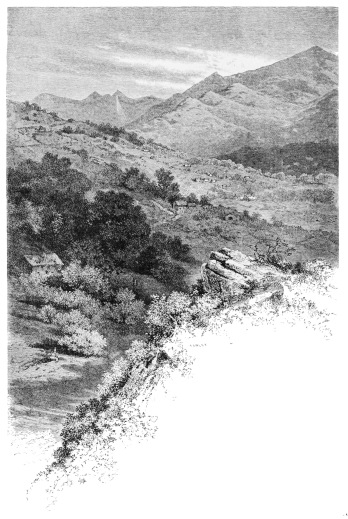
BLACK AND TRIPYRAMID MOUNTAINS.
The glen is surrounded by peaks that for boldness, savage freedom,
and power challenge any that we can remember. They threaten while
maintaining an attitude of lofty scorn for the saucy intruder. The
curious Noon Peak—we have at length got to the end of the almost
endless Black Mountain—nods familiarly from the south. It long stood
for a sun-dial for the settlement; hence its name. Tecumseh, a noble
mountain, and Osceola, its worthy companion, rise to the north. A
short walk in this direction brings Kancamagus[31] and the gap between
this mountain and Osceola into view. All these mountains stand in the
magnificent order in which they were first placed by Nature; but never
does the idea of inertia, of helpless immobility, cross the mind of the
beholder for a single moment.
The unvisited region between Greeley’s, in Waterville, and the Saco is
destined to be one of the favorite haunts of the sportsman, the angler,
and the lover of the grand old woods. It is crossed and recrossed by
swift streams, sown with lakes, glades, and glens, and thickly set
with mountains, among which the timid deer browses, and the bear and
wildcat roam unmolested. Fish and game, untamed and untrodden mountains
and woods, welcome the sportsman here. With Greeley’s for a base,
encampments may be pitched in the forest, and exploration carried into
the most out-of-the-way corners. The full zest of such a life can
only be understood by those to whom its freedom and unrestraint, its
healthful and vigorous existence, have already proved their charm. The
time may come when the mountains shall be covered with a thousand tents,
and the summer-dwellers will resemble the tribes of Israel encamped by
the sweet waters of Sion.
Waterville maintains unfrequent communication with Livermore and the
Saco by a path twelve miles long—constructed by the Appalachian
Mountain Club—over which a few pedestrians pass every year. I have
explored this path for several miles beyond Beckytown while visiting
the great slide which sloughed off from the side of Tripyramid, and
the cascades on the way to it. Osceola, Hancock, and Carrigain, three
remarkably fine mountains, offer inviting excursions to expert climbers.
I was reluctantly compelled to renounce the intention of passing over
the whole route, which should occupy, at least, two days or parts of
days, one night being spent in camp.
The Mad River drive is a delightful episode. In the way of mountain
valley there is nothing like it. Bold crag, furious torrent, lonely
cabin, blue peak, deep hollow, choked up with the densest foliage,
constitute its varied and ever-changing features. The overhanging
woods looked as if it had been raining sunshine; the road like an
endless grotto of illuminated leaves, musical with birds, and exhaling a
thousand perfumes.
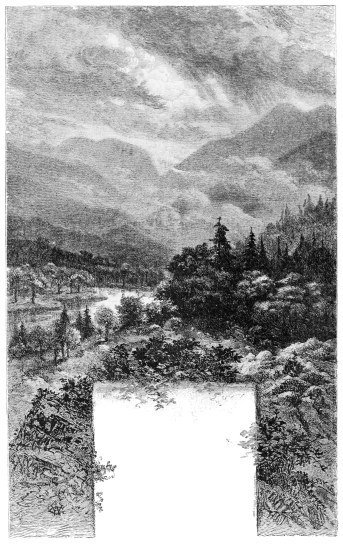
FRANCONIA NOTCH, FROM THORNTON.
The remainder of the route up the Pemigewasset is more and more a
revelation of the august summits that have so constantly met us
since entering this lovely valley. Boldly emerging from the mass of
mountains, they present themselves at every mile in new combinations.
Through Thornton and Woodstock the spectacle continues almost without
intermission. Gradually, the finely-pointed peaks of the Lafayette group
deploy and advance toward us. Now they pitch sharply down into the
valley of the East Branch. Now the great shafts of stone are crusted
with silvery light, or sprayed with the cataract. Now the sun gilds the
slides that furrow, but do not deface them. Stay a moment at this rapid
brook that comes hastening from the west! It is an envoy from yonder
great, billowy mountain that lords it so proudly over
“many a nameless slide-scarred crest
And pine-dark gorge between.”
That is Moosehillock. Facing again the north, the road is soon swallowed
up by the forest, and the forest by the mountains. A few poor cottages
skirt the route. Still ascending, the miles grow longer and less
interesting, until the white house, first seen from far below, suddenly
stands uncovered at the left. We are at the Flume House, and before the
gates of the Franconia Notch.
Beyond them, like a sun-rimmed cloud,
The great Notch Mountains shone,
Watched over by the solemn-browed
And awful face of stone!—Whittier.
WHEN Boswell exclaimed in ecstasy, “An immense mountain!” Dr. Johnson
sneered, “An immense protuberance!” but he, the sublime cynic, became
respectful before leaving the Hebrides. Charles Lamb, too, at one time
pretended something approaching contempt for mountains; but, after a
visit to Coleridge, he made the amende honorable in these terms:
“I feel I shall remember your mountains to the last day of my life.
They haunt me perpetually. I am like a man who has been falling in love
unknown to himself; which he finds out when he leaves the lady.”
Notwithstanding their prepossessions against nature, and their
undisguised preference for the smoke and dirt of London, the mountains
awoke something in these two men which was apparently a revelation of
themselves unto themselves. I have felt a higher respect for both since
I knew that they loved mountains, as I pity those who have only seen
heaven through the smoke of the city. It is not easy to explain two
ideas so essentially opposite as are presented in the earlier and later
declarations of these widely famous authors, unless we agree, keeping
“Elia’s” odd simile in mind, that in the first case they should, like
woman, be taken, not at what she says, but what she means.
The Flume House is the proper tarrying-place for an investigation of the
mountain gorge from which it derives both its custom and its name. It
is also placed opposite to the Pool, another of those natural wonders
with which the pass is crowded, and which tempt us at every step to turn
aside from the travelled road.
Fronting the hotel is a belt of woods, with two massive mountains
rising behind. In the concealment of these woods the Pemigewasset,
contracted to a modest stream, runs along the foot of the mountains.
A rough, zigzag path leads through the woods to the river and to the
Pool. Now raise the eyes to the summit-ridge of yonder mountain. The
peak finely reproduces the features of a gigantic human face, while
the undulations of the ridge fairly suggest a recumbent human figure
wrapped in a shroud. The outlines of the forehead and nose are curiously
like the profile of Washington; hence the colossal figure is called
Washington Lying in State. This immortal sculpture gave rise to the idea
that the tomb of Washington, like that of Desaix, on the St. Bernard,
should be on the great summit that bears his name.
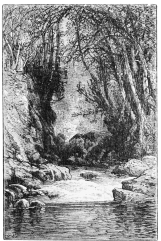 A GLIMPSE OF THE POOL.
From the Flume House I looked up through the deep cleft of the Notch—an
impressive vista. To the left is Cannon, or Profile Mountain; to the
right the beetling crags of Eagle Cliff; then the pointed, shapely peaks
of Lafayette; and so the range continues breaking off and off, bending
away into lesser mountains that finally melt into pale-blue shadows.
Now a stray cloud atop a peak gives it a volcanic character. Now a puff
scatters it like thistle-down. It is a sultry summer’s morning, and
banks of film hang like huge spider’s-webs in the tree-tops. Soon they
detach themselves, and, floating lazily upward, are seized by a truant
breeze, spun mischievously round, and then settle quietly down on the
highest peaks like young eaglets on their nest.
Let us first walk down to the Pool. This Pool is a caprice of the river.
Imagine a cistern, deeply sunk in granite, receiving at one end a weary
cascade, which seems to crave a moment’s rest before hurrying on down
the rocky pass. In the mystery and seclusion of ages, and with only the
rude implements picked up by the way, the river has hollowed a basin
a hundred feet wide and forty deep out of the stubborn rock. Without
doubt Nature thus first taught us to cut the hardest marble with sand
and water. Cliffs traversed by cracks rise a hundred feet higher.
The water is a glossy and lustrous sea-green, and of such marvellous
transparency that you see the brilliant pebbles sparkling at the bottom,
shifting with the waves of light like bits of glass in a kaleidoscope.
Overtopping trees lean timidly over and peer down into the Pool, which
coldly repulses their shadows. Only the colorless hue of the rocks
is reflected; and the stranger, seeing an old man with a gray beard
standing erect in a boat, has no other idea than that he has arrived on
the borders and is to be accosted by the ferryman of Hades.
The Flume is reached by going down the road a short distance, and then
diverging to the left and crossing the river to the Flume Brook. A
carriage-way conducts almost to the entrance of the gorge. Then begins
an easy and interesting promenade up the bed of the brook.
This is a remarkable rock-gallery, driven several hundred feet into
the heart of the mountain, through which an ice-cold brook rushes. The
miracle of Moses seems repeated here sublimely. Some unknown power smote
the rock, and the prisoned stream gushed forth free and lightsome as
air. You approach it over broad ledges of freckled granite, polished
by the constant flow of a thin, pellucid sheet of water to slippery
smoothness. Proceeding a short distance up this natural esplanade, you
enter a damp and gloomy fissure between perpendicular walls, rising
seventy feet above the stream, and, on lifting your eyes suddenly,
espy an enormous bowlder tightly wedged between the cliffs. Now try to
imagine a force capable of grasping the solid rock and dividing it in
halves as easily as you would an apple with your two hands.
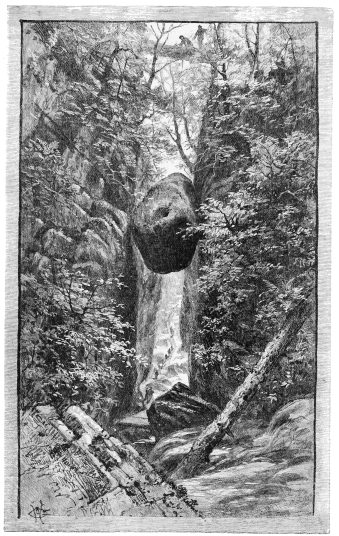
THE FLUME, FRANCONIA NOTCH.
At sight of the suspended bowlder, which seems, like Paul Pry, to have
“just dropped in,” I believe every visitor has his moment of hesitation,
which he usually ends by passing underneath, paying as he goes with a
tremor of the nerves, more or less, for his temerity. But there is no
danger. It is seen that the deep crevice, into which the rock seems
jammed with the especial purpose of holding it asunder, also hugs the
intruder like a vise; so closely, indeed, that, according to every
appearance, it must stay where it is until doomsday, unless released by
some passing earthquake from its imprisonment. Sentimental tourists do
not omit to find a moral in this curiosity, which really looks to be on
the eve of dropping, with a loud splash, into the torrent beneath. On
top of the cliffs I picked up a visiting-card, on which some one with
a poetic turn had written, “Does not this bowlder remind you of the
sword of Damocles?” To a civil question, civil reply: No; to me it looks
like a nut in a cracker.
Over the gorge bends an arcade of interlaced foliage shot through and
through with sunshine; and wherever cleft or cranny can be found young
birches, sword-ferns, trailing vines, insinuating their long roots in
the damp mould, garland the cold granite with tenderest green. The
exquisite white anemone blooms in the mossy wall wet with tiny streams
that do not run but glide unperceived down. What could be more cunning
than the persistency with which these hardy waifs, clinging or drooping
along the craggy way, draw their sustenance from the rock, which seems
to nourish them in spite of itself? Underneath your feet the swollen
torrent storms along the gorge, dashing itself recklessly against
intruding bowlders, or else passing them with a curl of disdain. How
gallantly it surmounts every obstacle in its way! How crystal-clear are
its waters! On it speeds, scattering pearls and diamonds right and left,
like the prodigal it is; unpolluted, as yet, by the filth of cities, or
turned into a languid, broken-spirited drudge by dams or mill-wheels.
“Stop me?” it seems exclaiming. “Why, I am offspring of the clouds,
their messenger to the parched earth, the mountain maid-of-all-work!
Stay; step aside here in the sun and I will show you my rainbow-signet!
When I rest, do you not behold the mother imaged in the features of the
child? Stop me! Put your hand in my bosom and see how strong and full
of life are my pulse-beats. To-morrow I shall be vapor. Thought is not
freer. I do not belong to earth any more than the eagle sailing above
yonder mountain-top.”
Overhead a fallen tree-trunk makes a crazy bridge from cliff to cliff.
The sight of the gorge, with the flood foaming far below, the glitter
of falling waters through the trees, the splendid light in the midst of
deepest gloom, the solemn pines—the odorous forest, the wildness and
the coolness—impart an indescribable charm to the spot that makes us
reluctant to leave it. Many ladies ascend to the head of the gorge and,
crossing on the rude bridge, leave their visiting-cards on the other
side; one had left her pocket-handkerchief, with the scent fresh upon
it. I picked it up, and out hopped a toad.
After the Pool and the Flume, an ascent of the mountain behind the hotel
will be found conducive to enjoyment of another kind. This mountain
commands delicious views of the valley of the Pemigewasset. A short hour
is usually sufficient for the climb. It was a very raw, windy morning
on which I climbed it, but the uncommon purity of the air and the
exceeding beauty of the landscape were most rarely combined with cloud
effects seen only in conjunction with a brisk north-west wind. I had
taken a station similar to that occupied by Mount Willard with respect
to the Saco Valley, now opening a vista essentially different from
that most memorable one in my mountain experience. The valley is not
the same. You see the undulating course of the river for many leagues,
and but for an intercepting hill, which hides them, might distinguish
the houses of Plymouth. The vales of Woodstock, Thornton, and Campton,
spotted with white houses, lie outspread in the sun, between enclosing
mountains; and the windings of the Pemigewasset are now seen dark and
glossy, now white with foam, appearing, disappearing, and finally lost
to view in the blended distance. The sky was packed with clouds. Over
the vivid green of the intervales their black shadows drifted swiftly
and noiselessly, first turning the light on, then off again, with
magical effect. To look up and see these clouds all in motion, and then,
looking down, see those weird draperies darkly trailing over the land,
was a reminiscence of
“The dim and shadowy armies of our unquiet dreams—
Their footsteps brush the dewy fern and paint the shaded streams.”
The mountain ridges flowed southward with marvellous smoothness to the
vanishing-point, on one side of the valley bright green, on the other
indigo blue. This picture was not startling, like that from the Crawford
Notch, but, in its own way, was incomparable. The sunsets are said to be
beautiful beyond description.
One looks up the Notch upon the great central peaks composing
the water-shed—Cannon, Lafayette, Lincoln, and the rest—to see
crags, ridges, black forests, rising before him in all their gloomy
magnificence.
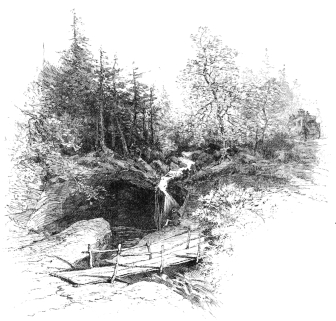
THE BASIN.
On one side all is beauty, harmony, and grace; on the other, a packed
mass of bristling, steep-sided mountains seem storming the sky with
their gray turrets. Could we but look over the brawny shoulders of the
mountains opposite to us, the eye would take in the vast, untrodden
solitudes of the Pemigewasset forests cut by the East Branch and
presided over by Mount Carrigain—a region as yet reserved for those
restless and adventurous spirits whom the beaten paths of travel have
ceased to charm or attract. But an excursion into this “forest primeval”
is to be no holiday promenade. It is an arduous and difficult march
over slippery rocks, through tangled thickets, or up the beds of
mountain torrents. Hard fare and a harder bed of boughs finish the day,
every hour of which has been a continued combat with fresh obstacles.
At this price one may venture to encounter the virgin wilderness or, as
the cant phrase is, “try roughing it.” It is a curious feeling to turn
your back upon the last cart-path, then upon the last foot-path; to hear
the distant baying of a hound grow fainter and fainter—in a word, to
exchange at a single step the sights and sounds of civilized life, the
movement, the bustle, for a silence broken only by the hum of bees and
the murmur of invisible waters.
I left the Flume House in company with a young-old man, whom I met
there, and in whom I hoped to find another and a surer pair of eyes,
for, were he to have as many as Argus, the sight-seer would find
employment for them all.
While gayly threading the green-wood, we came upon a miniature edition
of the Pool, situated close to the highway, called the Basin. A basin
in fact it is, and a bath fit for the gods. It is plain to see that
the stream once poured over the smooth ledges here, instead of making
its exit by the present channel. A cascade falls into it with hollow
roar. This cistern has been worn by the rotary motion of large pebbles
which the little cascade, pouring down into it from above, set and
kept actively whirling and grinding at its own mad caprice. But this
was not the work of a day. Long and constant attrition only could have
scooped this cavity out of the granite, which is here so clean, smooth,
and white, and filled to the brim with a grayish-emerald water, light,
limpid, and incessantly replenished by the effervescent cascade. In the
beginning this was doubtless an insignificant crevice, into which a few
pebbles and a handful of sand were dropped by the stream, but which,
having no way of escape, were kept in a perpetual tread-mill, until what
was at first a mere hole became as we now see it. The really curious
feature of the stone basin is a strip of granite projecting into it
which closely resembles a human leg and foot, luxuriously cooling itself
in the stream. Such queer freaks of nature are not merely curious,
but they while away the hours so agreeably that time and distance are
forgotten.
As we walked on, the hills were constantly hemming us in closer and
closer. Suddenly we entered a sort of crater, with high mountains all
around. One impulse caused us to halt and look about us. In full view
at our left the inaccessible precipices of Mount Cannon rose above a
mountain of shattered stones, which ages upon ages of battering have
torn piecemeal from it. Its base was heaped high with these ruins.
Seldom has it fallen to my lot to see anything so grandly typical
of the indomitable as this sorely battered and disfigured mountain
citadel, which nevertheless lifts and will still lift its unconquerable
battlements so long as one stone remains upon another. Hewed and
hacked, riven and torn, gashed and defaced in countless battles, one
can hardly repress an emotion of pity as well as of admiration. I do
not recollect, in all these mountains, another such striking example
of the denuding forces with which they are perpetually at war. When we
see mountains crumbling before our very eyes, may we not begin to doubt
the stability of things that we are pleased to call eternal? Still,
although it seems erected solely for the pastime of all the powers of
destruction, this one, so glorious in its unconquerable resolve to die
at its post—this one, exposing its naked breast to the fury of its
deadliest foes—so stern and terrific of aspect, so high and haughty,
so dauntlessly throwing down the gauntlet to Fate itself—assures us
that the combat will be long and obstinate, and that the mountain will
fall at last, if fall it must, with the grace and heroism of a gladiator
in the Roman arena. The gale flies at it with a shriek of impotent
rage. Winter strips off its broidered tunic and flings white dust in
its aged face. Rust corrodes, rains drench, fires scorch it; lightning
and frost are forever searching out the weak spots in its harness; but,
still uplifting its adamantine crest, it receives unshaken the stroke
or the blast, spurns the lightning, mocks the thunder, and stands fast.
Underneath is a little lake, which at sunset resembles a pool of blood
that has trickled drop by drop from the deep wounds in the side of the
mountain.
We are still advancing in this region of wonders. In our front soars an
insuperable mass of forest-shagged rock. Behind it rises the absolutely
regal Lafayette. Our footsteps are stayed by the glimmer of water
through trees by the road-side. We have reached the summit of the pass.
Six miles of continued ascent from the Flume House have brought us to
Profile Lake, which the road skirts. Although a pretty enough piece of
water, it is not for itself this lake is resorted to by its thousands,
or for being the source of the Pemigewasset, or for its trout—which
you take for the reflection of birds on its burnished surface—but for
the mountain rising high above, whose wooded slopes it so faithfully
mirrors. Now lift the eyes to the bare summit! It is difficult to
believe the evidence of the senses! Upon the high cliffs of this
mountain is the remarkable and celebrated natural rock sculpture of a
human head, which, from a height twelve hundred feet above the lake,
has for uncounted ages looked with the same stony stare down the pass
upon the windings of the river through its incomparable valley. The
profile itself measures about forty feet from the tip of the chin to
the flattened crown which imparts to it such a peculiarly antique
appearance. All is perfect, except that the forehead is concealed by
something like the visor of a helmet. And all this illusion is produced
by several projecting crags. It might be said to have been begotten by a
thunder-bolt.
Taking a seat within a rustic arbor on the high shore of the lake,
one is at liberty to peruse at leisure what, I dare say, is the most
extraordinary sight of a lifetime. A change of position varies more or
less the character of the expression, which is, after all, the marked
peculiarity of this monstrous alto relievo; for let the spectator
turn his gaze vacantly upon the more familiar objects at hand—as he
inevitably will, to assure himself that he is not the victim of some
strange hallucination—a fascination born neither of admiration nor
horror, but strongly partaking of both emotions, draws him irresistibly
back to the Dantesque head stuck, like a felon’s, on the highest
battlements of the pass. The more you may have seen, the more your
feelings are disciplined, the greater the confusion of ideas. The moment
is come to acknowledge yourself vanquished. This is not merely a face,
it is a portrait. That is not the work of some cunning chisel, but a
cast from a living head. You feel and will always maintain that those
features have had a living and breathing counterpart. Nothing more,
nothing less.
But where and what was the original prototype? Not man; since, ages
before he was created, the chisel of the Almighty wrought this sculpture
upon the rock above us. No, not man; the face is too majestic, too
nobly grand, for anything of mortal mould. One of the antique gods may,
perhaps, have sat for this archetype of the coming man. And yet not man,
we think, for the head will surely hold the same strange converse with
futurity when man shall have vanished from the face of the earth.
This gigantic silhouette, which has been dubbed the Old Man of the
Mountain, is unquestionably the greatest curiosity of this or any other
mountain region. It is unique. But it is not merely curious; nor is
it more marvellous for the wonderful accuracy of outline than for the
almost superhuman expression of frozen terror it eternally fixes on the
vague and shadowy distance—a far-away look; an intense and speechless
amazement, such as sometimes settles on the faces of the dying at the
moment the soul leaves the body forever—untranslatable into words, but
seeming to declare the presence of some unutterable vision, too bright
and dazzling for mortal eyes to behold. The face puts the whole world
behind it. It does everything but speak—nay, you are ready to swear
that it is going to speak! And so this chance jumbling together of a few
stones has produced a sculpture before which Art hangs her head.
I renounce in dismay the idea of reproducing the effect on the reader’s
mind which this prodigy produced on my own. Impressions more pronounced,
yet at the same time more inexplicable, have never so effectually
overcome that habitual self-command derived from many experiences of
travel among strange and unaccustomed scenes. From the moment the
startled eye catches it one is aware of a Presence which dominates the
spirit, first with strange fear, then by that natural revulsion which
at such moments makes the imagination supreme, conducts straight to
the supernatural, there to leave it helplessly struggling in a maze of
impotent conjecture. But, even upon this debatable ground, between two
worlds, one is not able to surprise the secret of those lips of marble.
The Sphinx overcomes us by his stony, his disdainful silence. Let the
visitor be ever so unimpassioned, surely he must be more than mortal to
resist the impression of mingled awe, wonder, and admiration which a
first sight of this weird object forces upon him. He is, indeed, less
than human if the feeling does not continually grow and deepen while
he looks. The face is so amazing, that I have often tried to imagine
the sensations of him who first discovered it peering from the top of
the mountain with such absorbed, open-mouthed wonder. Again I see the
tired Indian hunter, pausing to slake his thirst by the lake-side,
start as his gaze suddenly encounters this terrific apparition. I
fancy the half-uttered exclamation sticking in his throat. I behold
him standing there with bated breath, not daring to stir hand or foot,
his white lips parted, his scared eyes dilated, until his own swarthy
features exactly reflect that unearthly, that intense amazement stamped
large and vivid upon the livid rock. There he remains, rooted to the
spot, unable to reason, trembling in every limb. For him there are no
accidents of nature; for him everything has its design. His moment of
terrible suspense is hardly difficult to understand, seeing how careless
thousands that come and go are thrilled, and awed, and silenced,
notwithstanding you tell them the face is nothing but rocks.
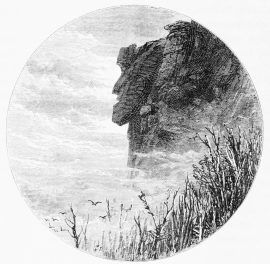
THE OLD MAN OF THE MOUNTAIN.
If the effect upon minds of the common order be so pronounced, a first
sight of the Great Stone Face may easily be supposed to act powerfully
upon the imaginative and impressible. The novelist, Hawthorne, makes
it the interpreter of a noble life. For him the Titanic countenance is
radiant with majestic benignity. He endows it with a soul, surrounds the
colossal brow with the halo of a spiritual grandeur, and, marshalling
his train of phantoms, proceeds to pass inexorable judgment upon them.
Another legend—like its predecessor, too long for our pages—runs to
the effect that a painter who had resolved to paint Christ sitting in
judgment, and who was filled with the grandeur of his subject, wandered
up and down the great art palaces, the cathedrals of the Old World,
seeking in vain a model which should in all things be the embodiment of
his ideal. In despair at the futility of his search he hears a strange
report, brought by some pious missionaries from the New World, of a
wonderful image of the human face which the Indians looked upon with
sacred veneration. The painter immediately crossed the sea, and caused
himself to be guided to the spot, where he beheld, in the profile of the
great White Mountains, the object of his search and fulfilment of his
dream. The legend is entitled Christus Judex.
Had Byron visited this place of awe and mystery, his “Manfred,” the
scene of which is laid among the mountains of the Bernese Alps, would
doubtless have had a deeper and perhaps gloomier impulse; but even among
the eternal realms of ice the poet never beheld an object that could
so arouse the gloomy exaltation he has breathed into that tragedy. His
line—
“Bound to earth, he lifts his eye to heaven”—
becomes descriptive here.
Again and again we turn to the face. We go away to wonder if it is still
there. We come back to wonder still more. An emotion of pity mingles
with the rest. Time seems to have passed it by. It seems undergoing some
terrible sentence. It is a greater riddle than the gigantic stone face
on the banks of the Nile.
All effects of light and shadow are so many changes of countenance or of
expression. I have seen the face cut sharp and clear as an antique cameo
upon the morning sky. I have seen it suffused, nay, almost transfigured,
in the sunset glow. Often and often does a cloud rest upon its brow. I
have seen it start fitfully out of the flying scud to be the next moment
smothered in clouds. I have heard the thunder roll from its lips of
stone. I recall the sunken cheeks, wet with the damps of its night-long
vigil, glistening in the morning sunshine—smiling through tears. I
remember its emaciated visage streaked and crossed with wrinkles that
the snow had put there in a night; but never have I seen it insipid or
commonplace. On the contrary, the overhanging brow, the antique nose,
the protruding under-lip, the massive chin, might belong to another
Prometheus chained to the rock, but whom no punishment could make lower
his haughty head.
I lingered by the margin of the lake watching the play of the clouds
upon the water, until a loud and resonant peal, followed by large, warm
drops, admonished me to seek the nearest shelter. And what thunder!
The hills rocked. What echoes! The mountains seemed knocking their
stony heads together. What lightning! The very heavens cracked with the
flashes.
“Far along
From peak to peak the rattling crags among
Leaps the live thunder! not from one lone cloud,
But every mountain now hath found a tongue,
And Jura answers, through her misty shroud,
Back to the joyous Alps, who call to her aloud!”
Hills draw like heaven
And stronger, sometimes, holding out their hands
To pull you from the vile flats up to them.
E. B. Browning.
AT noon we reached the spacious and inviting Profile House, which is
hid away in a deep and narrow glen, nearly two thousand feet above
the sea. No situation could be more sequestered or more charming. The
place seems stolen from the unkempt wilderness that shuts it in. An
oval, grassy plain, not extensive, but bright and smiling, spreads its
green between a grisly precipice and a shaggy mountain. And there, if
you-will believe me, in front of the long, white-columned hotel, like a
Turkish rug on a carpet, was a pretty flower-garden. Like those flowers
on the lawn were beauties sauntering up and down in exquisite morning
toilets, coquetting with their bright-colored parasols, and now and then
glancing up at the grim old mountains with that air of elegant disdain
which is so redoubtable a weapon—even in the mountains. Little children
fluttered about the grass like beautiful butterflies, and as unmindful
of the terrors that hovered over them so threateningly. Nurses in their
stiff grenadier caps and white aprons, lackeys in livery, cadets in
uniform, elegant equipages, blooded horses, dainty shapes on horseback,
cavaliers, and last, but not least, the resolute pedestrian, or the
gentlemen strollers up and down the shaded avenues, made up a scene as
animated as attractive. There is tonic in the air: there is healing in
the balm of these groves. Even the horses step out more briskly. Peals
of laughter startle the solemn old woods. You hear them high up the
mountain side. There go a pair of lovers, the gentleman with his book,
whose most telling passages he has carefully conned, the lady with her
embroidery, over which she bends lower as he reads on. Ah, happy days!
What is this youth, which, having it, we are so eager to escape, and,
when it is gone, we look back upon with such longing?
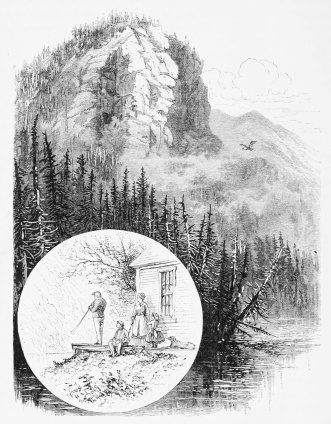
EAGLE CLIFF AND THE ECHO HOUSE.
The lofty crag opposite the hotel is Eagle Cliff, a name at once
legitimate and satisfying, although it is now untenanted by the eagles
which formerly made their home in the security of its precipitous
rocks. The cliff is also seen to great advantage from Echo Lake, half a
mile farther on, of which it constitutes a striking feature. In simple
parlance it is an advanced spur of Mount Lafayette. The high and curving
wall of this cliff encloses on one side the Profile Glen, while Mount
Cannon forms the other. The precipices tower so far above the glen that
large trees look like shrubs. Behind Eagle Cliff, almost isolating it
from the mountain, of which it is the barbacan, a hideous ravine yawns
upon the pass. Here and there, among the thick-set evergreen trees,
beech and birch and maple, spread masses of rich green, and mottle it
with softness. The purple rock bulges daringly out, forming a parapet of
adamant.
The turf underneath the cliff was most beautifully and profusely
spangled with the delicate pink anemone, the fleur des fées, that
pale darling of our New England woods, to which the arbutus resigns the
sceptre of spring. It is a moving sight to see these little drooping
flowers, so shy and modest, yet so meek and trustful, growing at the
foot of a bare and sterile rock. The face hardened looking up; grew
soft looking down. “Don’t tread on us!” “May not a flower look up at a
mountain?” they seem to plead. Lightly fall the dews upon your upturned
faces, dear little flowers! Soft be the sunshine and gentle the winds
that kiss those sky-tinted cheeks! In thy sweet purity and innocence
I see faces that are beneath the sod, flowers that have blossomed in
Paradise.
We see also, from the hotel, the singular rock that occasioned the
change of name from Profile to Cannon Mountain. It nearly resembles a
piece of heavy ordnance protruding, threateningly, from the parapet of a
fortress.
Taking one of the well-worn paths conducting to the water-side, a few
minutes’ walk brings us to the shore of Echo Lake, with Eagle Cliff now
rising grandly on our right. Nowhere among the White Hills is there a
fuller realization of a mountain lake than this. Light flaws frost it
with silver. Sharp keels cut it as diamonds cut glass. The water is so
transparent that you see fishes swimming or floating indolently about.
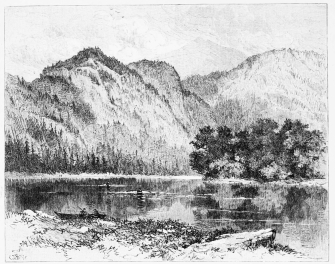
ECHO LAKE.
Echo Lake is somewhat larger than Profile Lake, and is only a step
from the road. Its sources are in the hundred streams that descend the
surrounding mountains, and its waters are discharged by the valley,
lying between us and the heights of Bethlehem, into the Ammonoosuc.
Therefore, in coming from one lake to the other we have crossed the
summit of the pass. On one side the waters flow to the Merrimac, on the
other to the Connecticut. An idle fancy tempted me to bring a cup of
water from Profile and cast it into Echo Lake, forgetting that, although
divided in their lives, the twin lakes had yet a common destiny in the
abyss of the ocean. I found the outlook from the boat-house on the whole
the most satisfying, because one looks back directly through the deep
chasm of the Notch.
In this beautiful little mountain-tarn the true artist finds his ideal.
The snowy peak of Lafayette looked down into it with a freezing stare.
Cannon Mountain now showed his retreating wall on the right. The huge,
castellated rampart of Eagle Cliff lifted on its borders precipices
dripping with moisture, and glistening in the sun like casements.
Except for the lake, the whole aspect would be irredeemably savage
and forbidding—a blind landscape; but when the sun sinks behind the
long ridge of Mount Cannon, purpling all these grisly crags, and the
cloaked shadows, groping their way foot by foot up the ravines, seem
spectres risen from the depths of the lake, you see, underneath the
cliffs, long and slender spears of golden light thrust deep into its
black and glossy tide, crimsoning it as with its own life-blood. Then,
too, is the proper moment for surprising these vain old mountains
viewing themselves in their mountain mirror, in which the bald, the
wrinkled, and the decrepit appear young, vigorous, and gloriously fair;
to see them gloating over their swarthy features like the bandit in
“Fra Diavolo.” Their ragged mantles are changed to gaudy cashmeres,
picturesquely twisted about their brawny shoulders, their snows to
laces. Oh the pomp, the majesty of these sunsets, which so glorify
the upturned faces of the haggard cliffs; which transmute, as in the
miracle, water into wine; which instantly transform these rugged
mountain walls into gates of jasper, and ruby, and onyx—glowing,
effulgent, enrapturing! And then, after the sun drops wearily down the
west, that gauze-like vapor, spun from the breath of evening, rising
like incense from the surface of the lake, which the mountains put on
for the masque of night; and, finally, the inquisitive stars piercing
the lake with ice-cold gleams, or the full-moon breaking in one great
burst of splendor on its level surface!
The echo adds its feats of ventriloquism. The marvel of the phonograph
is but a mimicry of Nature, the universal teacher. Now the man blows
a strong, clear blast upon a long Alpine horn, and, like a bugle-call
flying from camp to camp, the martial signal is repeated, not once, but
again and again, in waves of bewitching sweetness and with the exquisite
modulations of the wood-thrush’s note. From covert to covert, now here,
now there, it chants its rapturous melody. Once again it glides upon
the entranced ear, and still we lean in breathless eagerness to catch
the last faint cadence sighing itself away upon the palpitating air. A
cannon was then fired. The report and echo came with the flash. In a
moment more a deep and hollow rumbling sound, as if the mountains were
splitting their huge sides with suppressed laughter, startled us.
The ascent of Mount Lafayette fittingly crowns the series of excursions
through which we have passed since leaving Plymouth. This mountain
dominates the valleys north and south with undisputed sway. It is the
King of Franconia.
At seven in the morning I crossed the little clearing, and, turning into
the path leading to the summit, found myself at the beginning of a steep
ascent. It was one of the last and fairest days of that bright season
which made the poet exclaim,
“And what is so fair as a day in June?”
The thunder-storm of the previous afternoon, which continued its furious
cannonade at intervals throughout the night, had purified the air and
given promise of a day favorable for the ascension. No clouds were upon
the mountains. Everything betokened a pacific disposition.
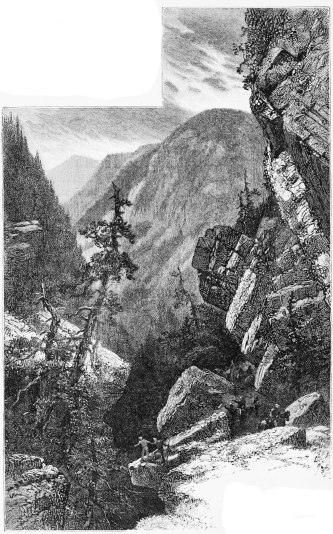
MOUNT CANNON, FROM THE BRIDLE-PATH, LAFAYETTE.
The path at once attacks the south side of Eagle Cliff. A short way up,
openings afford fine views of Mount Cannon and its weird profile, of the
valley below, and of the glen we have just left. The stupendous mass of
Eagle Cliff, suspended a thousand feet over your head, accelerates the
pace.
After an hour of steady, but not rapid, climbing, the path turned
abruptly under the shattered, but still formidable, precipices of the
cliff, which rose some distance higher, skirted it awhile, and then
began to zigzag among huge rocks along the narrow ridge uniting the
cliff with the mass of the mountain. Two deep ravines fall away on
either side. For two or three hundred yards, from the time the shoulder
of the cliff is turned until the mountain itself is reached, the walk
is as romantic an episode of mountain climbing as any I can recall,
except the narrow gully of Chocorua. But this passage presents no such
difficulties as must be overcome there. Although heaped with rocks, the
way is easy, and is quite level. In one place, where it glides between
two prodigious masses of rock dislodged from the cliff, it is so narrow
as to admit only a single person at a time. When I turned to look back
down the black ravine, cutting into the south side of the mountain, my
eye met nothing but immense rocks stopped in their descent on the very
edge of the gulf. It is among these that a way has been found for the
path, which was to me a reminiscence of the high defiles of the Isthmus
of Darien; to complete the illusion, nothing was now wanting except the
tinkling bells of the mules and the song of the muleteer. I climbed upon
one of the high rocks, and gazed to my full content upon the granite
parapet of Mount Cannon.
In a few rods more the path encountered the great ravine opening into
the valley of Gale River. Through its wide trough brilliant strips of
this valley gleamed out far below. The village of Franconia and the
heights of Lisbon and Bethlehem now appeared on this side.
I think that the perception of a distance climbed is greater to one who
is looking down from a great height than to one looking up. Doubtless
the imagination, which associates the plunging lines of a deep gorge
with the horror of a fall, has much to do with this impression. Upon
crossing a bridge of logs, the peak of Lafayette leaped up; yet so
distant as to promise no easy conquest. Somewhere down the gorge I heard
the roar of a brook; then the report of the cannon at Echo Lake; but up
here there was no echo.
The usual indications now assured me that I was nearing the top. In
three-quarters of an hour from the time of leaving the natural bridge,
joining Eagle Cliff with the mountain, I stood upon the first of the
great billows which, rolling in to a common centre, appear to have
forced the true summit a thousand feet higher.
The first, perhaps the most curious, thing that I noticed—for one
hardly suspects the existence of considerable bodies of water in these
high regions, and, therefore, never comes upon them except unawares—was
two little lakelets, nestling in the hollow between me and the main
peak. Reposing amid the sterility of the high peaks, these lakes
surround themselves with such plants as have survived the ascent from
below, or, nourished by the snows of the summit, those that never do
descend into temperate climates. Thus an appearance of fertility—one
of those deceptions that we welcome, knowing it to be such—greets us
unexpectedly. But its appearance is weird and forbidding. Here the
extremes of arctic and temperate vegetation meet and embrace; here the
flowers of the valley annually visit their pale sisters, banished by
Nature to these Siberian solitudes; and here the rough, strong Alpine
grass, striking its roots deep among the atoms of sand, granite, or
flint, lives almost in defiance of Nature herself; and when the snows
come and the freezing north winds blow, and it can no longer stand
erect, throws itself upon the tender plants, like a brave soldier
expiring on the body of his helpless comrade, saved by his own devotion.
But these Alpine lakes always provoke a smile. When some distance
beyond the Eagle Lakes, as they are called, and higher, I caught,
underneath a wooded ridge of Cannon, the sparkle of one hidden among
the summits on the opposite side of the Notch. The immense, solitary
Kinsman Mountain overtops Cannon as easily as Cannon does Eagle Cliff.
In its dark setting of the thickest and blackest forests this lake
blazed like one of the enormous diamonds which our forefathers so firmly
believed existed among these mountains. They call this water—only to
be discovered by getting above it—Lonesome Lake, and in summer it is
the chosen retreat of one well known to American literature, whom the
mountains know, and who knows them.
I descended the slope to the plateau on which the lakes lie, soon
gaining the rush-grown shore of the nearest. Its water was hardly
drinkable, but your thirsty climber is not apt to be too fastidious.
These lakes are prettier from a distance; the spongy and yielding moss,
the sickly yellow sedge surrounding them, and the rusty brown of the
brackish water, do not invite us to tarry long.
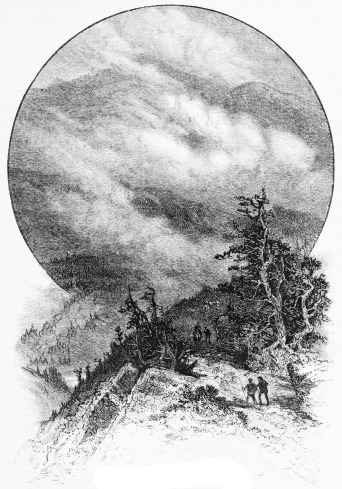
CLOUD EFFECTS ON MOUNT LAFAYETTE.
The ascent of the pinnacle now began. It is too much a repetition,
though by no means as toilsome, of the Mount Washington climb to merit
particular description. This peak, too, seems disinherited by Nature.
The last trees encountered are the stunted firs with distorted little
trunks, which it may have required half a century to grow as thick as
the wrist. I left the region of Alpine trees to enter that of gray
rocks, constantly increasing in size toward the summit, where they were
confusedly piled in ragged ridges, one upon another, looming large and
threateningly in the distance. But as often as I stopped to breathe
I scanned “the landscape o’er” with all the delight of a wholly new
experience. The fascination of being on a mountain-top has yet to be
explained. Perhaps, after all, it is not susceptible of analysis.
After gaining the highest visible point, to find the real summit
still beyond, I stopped to drink at a delicious spring trickling from
underneath a large rock, around which the track wound. I was now among
the ruin and demolition of the summit, standing in the midst of a vast
atmospheric ocean.
Had I staked all my hopes upon the distant view, no choice but
disappointment was mine to accept. Steeped in the softest, dreamiest
azure that ever dull earth borrowed from bright heaven, a hundred peaks
lifted their airy turrets on high. These castles of the air—for I will
maintain that they were nothing else—loomed with enchanting grace,
the nearest like battlements of turquoise and amethyst, or, receding
through infinite gradations to the merest shadows, seemed but the dusky
reflection of those less remote. The air was full of illusions. There
was bright sunshine, yet only a deluge of semi-opaque golden vapor.
There were forms without substance. See those iron-ribbed, deep-chested
mountains! I declare it seemed as if a swallow might fly through them
with ease! Over the great Twin chain were traced, apparently on the air
itself, some humid outlines of surpassing grace which I recognized for
the great White Mountains. It was a dream of the great poetic past: of
the golden age of Milton and of Dante. The mountains seemed dissolving
and floating away before my eyes.
Stretched beneath the huge land-billows, the valleys—north, south, or
west—reflected the fervid sunshine with softened brilliance, and all
those white farms and hamlets spotting them looked like flakes of foam
in the hollows of an immense ocean.
Heaven forbid that I should profane such a scene with the dry recital
of this view or that! I did not even think of it. A study of one of
Nature’s most capricious moods interested me far more than a study of
topography. How should I know that what I saw were mountains, when the
earth itself was not clearly distinguishable? Alone, surrounded by all
these delusions, I had, indeed, a support for my feet, but none whatever
for the bewildered senses.
I found the mountain-top untenanted except by horse-flies, black gnats,
and active little black spiders. These swarmed upon the rocks. I also
found buttercups, the mountain-cranberry, and a heath, bearing a little
white flower, blossoming near the summit. There were the four walls of a
ruined building, a cairn, and a signal-staff to show that some one had
been before me. This staff is 5259 feet above the ocean, or 3245 feet
above the summit of the Franconia Pass.
The ascent required about three, and the descent about two hours. The
distance is not much less than four miles; but, these miles being a
nearly uninterrupted climb from the base to the summit of the mountain,
haste is out of the question, if going up, and imprudent, if coming
down. There are no breakneck or dangerous places on the route; nor any
where the traveller is liable to lose his way, even in a fog, except
on the first summit, where the new and old paths meet, and where a
guide-board should be erected.
Believe if thou wilt that mountains change their places, but
believe not that men change their dispositions.—Oriental Proverb.
ALTHOUGH one may make the journey from the Profile House to Bethlehem
with greater ease and rapidity by the railway recently constructed along
the side of the Franconia range, preference will unquestionably be given
to the old way by all who would not lose some of the most striking views
the neighborhood affords. Beginning near the hotel, the railway skirts
the shore of Echo Lake, and then plunges into a forest it was the first
to invade. By a descent of one hundred feet to the mile, for nine and
a half miles, it reaches the Ammonoosuc at Bethlehem station. I have
nothing to say against the locomotive, but then I should not like to go
through the gallery of the Louvre behind one.
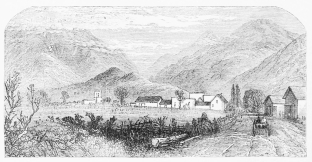
FRANCONIA IRON WORKS AND NOTCH.
From Echo Lake the high-road to Franconia, Littleton, and Bethlehem
winds down the steep mountain side into the valley of Gale River. To
the left, in the middle distance, appear the little church-tower and
white buildings constituting the village of Franconia Iron Works. This
village is charmingly placed for effectively commanding a survey of the
amphitheatre of mountains which isolates it from the neighboring towns
and settlements.
As we come down the three-mile descent, from the summit of the pass
to the level of the deep valley, and to the northern base of the
notch-mountains, an eminence rises to the left. Half-way up, occupying
a well-chosen site, there is a hotel, and on the high ridge another
commands not only this valley, but also those lying to the west of it.
On the opposite side to us rise the green heights of Bethlehem, Mount
Agassiz being conspicuous by the observatory on its summit. Those
farm-houses dotting the hill-side show how the road crooks and turns to
get to the top. Following these heights westward, a deep rift indicates
the course of the stream dividing the valley, and of the highway to
Littleton. Between these walls the long ellipse of fertile land beckons
us to descend.
I am always most partial to those grassy lanes and by-ways going no one
knows where, especially if they have well-sweeps and elm-trees in them;
but here also is the old red farm-house, with its antiquated sweep,
its colony of arching elms, its wild-rose clustering above the porch,
its embodiment of those magical words, “Home, sweet home.” It fits the
rugged landscape as no other habitation can. It fits it to a T, as
we say in New England. More than this, it unites us with another and
different generation. What a story of toil, privation, endurance these
old walls could tell! How genuine the surprise with which they look down
upon the more modern houses of the village! Here, too, is the Virginia
fence, on which the king of the barn-yard defiantly perches. There is
the field behind it, and the men scattering seed in the fallow earth.
Yonder, in the mowing-ground, a laborer is sharpening his scythe, the
steel ringing musically under the quick strokes of his “rifle.”
Over there, to the left, is the rustic bridge, and hard by a clump of
peeled birches throw their grateful shade over the hot road. Many stop
here, for the white-columned trunks are carved with initials, some
freshly cut, some mere scars. But why mutilate the tree? What signify
those letters, that every idler should gratify his little vanity by
giving it a stab? Do you know that the birch does not renew its bark,
and that the tree thus stripped of its natural protection is doomed?
Cease, then, I pray you, this senseless mutilation; nor call down the
just malediction of the future traveller for destroying his shade.
Unable to escape its fate, the poor tree, like a victim at the stake,
stoically receives your barbarous strokes and gashes. Refrain, then,
traveller, for pity’s sake! Have a little mercy! Know that the ancients
believed the tree possessed of a soul. Remember the touching story
of Adonis, barbarously wounded, surviving in a pine, where he weeps
eternally. Consider how often is the figure of “The Tree” used in the
Scriptures as emblematic of the life eternal! Who would wish to inhabit
a treeless heaven?
The stream—which does not allow us to forget that it is here—is a
vociferous mountain brook. Hardly less forward is the roadside fountain
gushing into a water-trough its refreshing abundance for the tired and
dusty wayfarer. It makes no difference in the world whether he goes
on two legs or on four. “Drink and be filled” is the invitation thus
generously held out to all alike. With what a sigh of pleasure your
steaming beast lifts his reluctant and dripping muzzle from the cool
wave, and after satisfying again and again his thirst, luxuriously
immersing his nose for the third and fourth time, still pretends to
drink! How deliciously light and limpid and sparkling is the water, and
how sweet! How it cools the hot blood! You quaff nectar. You sip it as
you would champagne. It tastes far better, you think, pouring from this
half-decayed, moss-crusted spout than from iron, or bronze, or marble.
Come, fellow-traveller, a bumper! Fill high! God bless the man who
first invented the roadside fountain! He was a true benefactor of his
fellow-man.
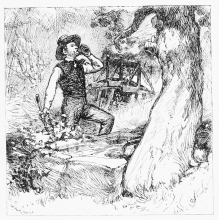 THE ROADSIDE SPRING.
Turn once more to the house. A little girl tosses corn, kernel by
kernel, to her pet chickens. There go a flight of pigeons: they curvet
and wheel, and settle on the ridge-pole, where they begin to flirt, and
strut, and coo. The men in the field look up at the top of the mountain,
to see if it is not yet noon. And now a woman, with plump bare arms,
coming briskly to the open door, puts the dinner-horn to her lips with
one hand while placing the other lightly upon her hip. She does not know
that act and attitude are alike inviting. How should she?
Let us follow the pretty stream that is our guide. Franconia has the
reputation of being the hottest in summer and in winter the coldest of
the mountain villages. It is hot. The houses are strung along the road
for a mile. People may or may not live in them: you see nobody. One
modest church-tower catches the eye for a moment, and then, as we enter
the heart of the village, a square barrack of a building, just across
the stream, is pointed out as the old furnace, which in times past gave
importance to this out-of-the-way corner. But the old furnace is now
deserted except by cows from the neighboring pastures, who come and go
through its open doors in search of shade. At present the river, which
brings its music and its freshness to the very doors of the villagers,
is the only busy thing in the place.
During the Rebellion the furnace was kept busy night and day, turning
out iron to be cast into cannon. The very hills were melted down for
the defence of the imperilled Union. In the adjoining town of Lisbon
the discovery of gold-bearing quartz turned the heads of the usually
steady-going population. The precious deposits were first found on the
Bailey farm, in 1865, and similar specimens were soon detected on the
farms adjoining. It is said the old people could scarcely be made to
credit these reports until they had seen and handled the precious metal;
for the country had been settled nearly a century, and the presence of
any but the baser ores was wholly unsuspected and disbelieved.
There is one peculiarity, common to all these mountain villages,
to which I must allude. A stranger is not known by any personal
peculiarity, but by his horse. If you ask for such or such a person,
the chances are ten to one you will immediately be asked in return if
he drove a bay horse, or a black colt, or a brown mare with one white
ear; so quick are these lazy-looking men, that loll on the door-steps or
spread themselves out over the shop-counters, to observe what interests
them most. The girls here know the points of a horse better than most
men, and are far more reckless drivers than men. To a man who, like
myself, has lived in a horse-stealing country, it does look queerly to
see the barn-doors standing open at night. But then every country has
its own customs.
One seeks in vain for any scraps of history or tradition that might
shed even a momentary lustre upon this village out of the past. Yet its
situation invites the belief that it is full of both. Disappointed in
this, we at least have an inexhaustible theme in the dark and tranquil
mountains bending over us.
Mount Lafayette presents toward Franconia two enormous green billows,
rolled apart, the deep hollow between being the great ravine dividing
the mountain from base to summit. Over this deep incision, which,
from the irregularity of one of its ridges, looks widest at the top,
presides, with matchless dignity, the bared and craggy peak whose dusky
brown gradually mingles with the scant verdure checked hundreds of feet
down. With what hauteur it seems to regard this effort of Nature to
place a garland on its bronzed and knotted forehead! One can never get
over his admiration for the savage grace with which the mountain, which
at first sight seems literally thrown together, develops a beauty, a
harmony, and an intelligence giving such absolute superiority to works
of Nature over those of man.
The side of Mount Cannon turned toward the village now elevates two
almost regular triangular masses, one rising behind the other, and
both surmounted by the rounded summit, which, except in its mass, has
little resemblance to a mountain. It is seen that on two-thirds of these
elevations a new forest has replaced the original growth. Twenty-five
years ago a destructive fire raged on this mountain, destroying all the
vegetation, as well as the thin soil down to the hard rock. Even that
was cracked and peeled like old parchment. This burning mountain was a
scene of startling magnificence during several nights, when the village
was as light as day, the sky overspread an angry glow, and the river
ran blood-red. The hump-backed ridges, connecting Cannon with Kinsman,
present nearly the same appearance from this as from the other side of
the Notch—or as remarked when approaching from Campton.
The superb picture seen from the upper end of the valley, combining, as
it does, the two great chains in a single glance of the eye, is extended
and improved by going a mile out of the village to the school-house on
the Sugar Hill road. It is a peerless landscape. I have gazed at it for
hours with that ineffable delight which baffles all power of expression.
It will have no partakers. One must go there alone and see the setting
sun paint those vast shapes with colors the heavens alone are capable of
producing.
Distinguished by the beautiful groves of maple that adorn its crest,
Sugar Hill is destined to grow more and more in the popular esteem. No
traveller should pass it by. It is so admirably placed as to command
in one magnificent sweep of the eye all the highest mountains; it is
also lifted into sun and air by an elevation sufficiently high to
reach the cooler upper currents. The days are not so breathless or
so stifling as they are down in the valley. You look deep into the
Franconia Notch, and watch the evening shadows creep up the great east
wall. Extending beyond these nearer mountains, the scarcely inferior
Twin summits pose themselves like gigantic athletes. Passing to the
other side of the valley, we see as far as the pale peaks of Vermont,
and those rising above the valley of Israel’s River. But better than
all, grander than all, is that kingly coronet of great mountains set on
the lustrous green cushion of the valley. Nowhere, I venture to affirm,
will the felicity of the title, “Crown of New England,”[32] receive
more unanimous acceptance than from this favored spot. Especially when
a canopy of clouds overspreading permits the pointed peaks to reflect
the illuminated fires of sunset does the crown seem blazing with jewels
and precious stones. All the great summits are visible here, and all the
ravines, except those in Madison, are as clearly distinguished as if not
more than ten instead of twenty miles separated us.
The high crest of Sugar Hill unfolds an unrivalled panorama. This is but
faint praise. Yet I find myself instinctively preferring the landscape
from Goodenow’s; for those great horizons, uncovered all at once, like
a magnificent banquet, are too much for one pair of eyes, however good,
or however unwearied with continued sight-seeing. As we cannot look
at all the pictures of a gallery at once, we naturally single out the
masterpieces. The effort to digest too much natural scenery is a species
of intellectual gluttony the overtaxed brain will be quick to revenge,
by an attack of indigestion or a loss of appetite.
I was very fond of walking, in the cool of the evening, either in this
direction or to the upper end of the village, on the Bethlehem road.
There is one point on this road, before it begins in earnest its ascent
of the heights, that became a favorite haunt of mine. Emerging from the
concealment of thick woods upon a sandy plain, covered here with a thick
carpet of verdure, and skirted by a regiment of pines seemingly awaiting
only the word of command to advance into the valley, a landscape second
to none that I have seen is before you. At the same time he would be
an audacious mortal who attempted to transfer it to page or canvas.
Nothing disturbs the exquisite harmony of the scene. To the left of
you are all the White Mountains, from Adams to Pleasant; in front, the
Franconia range, from Kinsman to the Great Haystack. Here is the deep
rent of the Notch from which we have but lately descended. Here, too,
overtopped and subjugated by the superb spire of Lafayette, the long
and curiously-distorted outline of Eagle Cliff pitches headlong down
into the half-open aperture of the pass. Nothing but an earthquake could
have made such a breach. How that tremendous, earth-swooping ridge seems
battered down by the blows of a huge mace! Unspeakably wild and stern,
the fractured mountains are to the valley what a raging tempest is to
the serenest of skies: one part of the heavens convulsed by the storm,
another all peace and calm. Thus from behind his impregnable outworks
Lafayette, stern and defiant, keeps eternal watch and ward over the
valley cowering at his feet.
From this spot, too, sacred as yet from all intrusion, the profound
ravine, descending nearly from the summit of Lafayette, is fully
exposed. It is a thing of cracks, crevices, and rents; of upward
curves in brilliant light; of black, mysterious hollows, which the eye
investigates inch by inch, to where the gorge is swallowed up by the
thick forests underneath. The whole side of the principal peak seems
torn away. Up there, among the snows, is the source of a flashing stream
which comes roaring down through the gorge. Storms swell it into an
ungovernable and raging torrent. Thus under the folds of his mantle the
lordly peak carries peace or war for the vale.
After the half-stifled feeling experienced among the great mountains,
it is indeed a rare pleasure to once more come forth into full
breathing-space, and to inspect at leisure from some friendly shade
the grandeur magnified by distance, yet divested of excitements that
set the brain whirling by the rapidity of their succession. If the
wayfarer chances to see, as I did, the whole noble array of high
summits presenting a long, snowy line of unsullied brilliance against
a background of pale azure, he will account it one of the crowning
enjoyments of his journey.
The Bridal Veil Falls, lying on the northern slope of Mount Kinsman,
will, when a good path shall enable tourists to visit them, prove one
of the most attractive features of Franconia. Truth compels me to say
that I did not once hear them spoken of during the fortnight passed in
the village, although fishermen were continually bringing in trout from
the Copper-mine Brook, on which these falls are situated. The height of
the fall is given at seventy-six feet, and its surroundings are said
to be of the most romantic and picturesque character. Its marvellous
transparency, which permits the ledges to be seen through the gauze-like
sheet falling over them, has given to it its name.
From Franconia I took the daily stage to Littleton, which lies on both
banks of the Ammonoosuc, and, turning my back upon the high mountains,
ran down the rail to Wells River, having the intention of cultivating a
more intimate acquaintance with that most noble and interesting entrance
formed by the meeting of the Ammonoosuc with the Connecticut.
Say, have the solid rocks
Into streams of silver been melted,
Flowing over the plains,
Spreading to lakes in the fields?
Longfellow.
THE Connecticut is justly named “the beautiful river,” and its valley
“the garden of New England.” Issuing from the heart of the northern
wilderness, it spreads boundless fertility throughout its stately march
to the sea. It is not a rapid river, but flows with an even and majestic
tide through its long avenue of mountains. Radiant envoy of the skies,
its mission is peace on earth and good-will toward men. As it advances
the confluent streams flock to it from their mountain homes. On one side
the Green Mountains of Vermont send their hundred tributaries to swell
its flood; on the other side the White Hills of New Hampshire pour their
impetuous torrents into its broad and placid bosom. Two States thus vie
with each other in contributing the wealth it lavishes with absolutely
impartial hand along the shores of each.
Unlike the storied Rhine, no crumbling ruins crown the lofty heights
of this beautiful river. Its verdant hill-sides everywhere display the
evidences of thrift and happiness; its only fortresses are the watchful
and everlasting peaks that catch the earliest beams of the New England
sun and flash the welcome signal from tower to tower. From time to time
the mountains, which seem crowding its banks to see it pass, draw back,
as if to give the noble river room. It rewards this benevolence with
a garden-spot. Sometimes the mountains press too closely upon it, and
the offended stream repays this temerity with a barrenness equal to the
beneficence it has just bestowed. Where it is permitted to expand the
amphitheatres thus created are the highest types of decorative nature.
Graciously touching first one shore and then the other, making the
loveliest windings imaginable, the river actually seems on the point of
retracing its steps; but, yielding to destiny, it again resumes its
slow march, loitering meanwhile in the cool shadows of the mountains, or
indolently stretching itself at full length upon the green carpet of the
level meadows. Every traveller who has passed here has seen the Happy
Valley of Rasselas.[33]
Such is the renowned Ox-Bow of Lower Coös. Tell me, you who have seen
it, if the sight has not caused a ripple of pleasurable excitement?
Here the Connecticut receives the waters of the Ammonoosuc, flowing from
the very summit of the White Hills, and, in its turn, made to guide
the railway to its own birthplace among the snows of Mount Washington.
Here the valley, graven in long lines by the ploughshare, heaped with
fruitful orchards and groves, extends for many miles up and down its
checkered and variegated floor. But it is most beautiful between the
villages of Newbury and Haverhill, or at the Great and Little Ox-Bow,
where the fat and fecund meadows, extending for two miles from side
to side of the valley, resemble an Eden upon earth, and the villages,
prettily arranged on terraces above them, half-hid in a thick fringe of
foliage, the mantel-ornaments of their own best rooms. Only moderate
elevations rise on the Vermont side; but the New Hampshire shore is
upheaved into the finely accentuated Benton peaks, behind which,
like a citadel within its outworks, is uplifted the gigantic bulk of
Moosehillock—the greatest mountain of all this valley, and its natural
landmark—keeping strict watch over it as far as the Canadian frontiers.
The traveller approaching by the Connecticut Valley holds this exquisite
landscape in view from the Vermont side of the river. The tourist
who approaches by the valley of the Merrimac enjoys it from the New
Hampshire shore.
The large village of Newbury, usually known as the “Street,” is built
along a plateau, rising well above the intervale, and joined to the
foothills of the Green Mountains. The Passumpsic Railway coasts the
intervale, just touching the northern skirt of the village. The
village of Haverhill is similarly situated with respect to the skirt
of the White Mountains; but its surface is much more uneven, and it
is elevated higher above the valley than its opposite neighbor. The
Boston, Concord, and Montreal Railway, having crossed the divide between
the waters of the Merrimac and the Connecticut, now follows the high
level, after a swift descent from Warren Summit. These plateaus, or
terraces, forming broken shelves, first upon one side of the valley,
then upon the other, strongly resemble the remains of the ancient bed of
a river of tenfold the magnitude of the stream as we see it to-day. They
give rise at once to all those interesting conjectures, or theories,
which are considered the special field of the geologist, but are also
equally attractive to every intelligent observer of Nature and her
wondrous works.
Of these two villages, which are really subdivided into half a dozen,
and which so beautifully decorate the mountain walls of this valley,
it is no treason to the Granite State to say that Newbury enjoys a
preference few will be found to dispute. It has the grandest mountain
landscape. Moosehillock is lifted high above the Benton range, which
occupies the foreground. The whole background is filled with high
summits—Lafayette feeling his way up among the clouds, Moosehillock
roughly pushing his out of the throng. Meadows of emerald, river
of burnished steel, hill-sides in green and buff, and etched with
glittering hamlets, gray mountains, bending darkly over, cloud-detaining
peaks, vanishing in the far east—surely fairer landscape never brought
a glow of pleasure to the cheek, or kindled the eye of a traveller,
already sated with a panorama reaching from these mountains to the Sound.
We are now, I imagine, sufficiently instructed in the general
characteristics of the famed Ox-Bow to pass from its picturesque and
topographical features into the domain of history, and to summon from
the past the details of a tragedy in war, which, had it occurred in
the days of Homer, would have been embalmed in an epic. Our history
begins at a period before any white settlement existed in the region
immediately about us. No wonder the red man relinquished it only at the
point of the bayonet. It was a country worth fighting for to the bitter
end.
“L’histoire à sa vérité; la legende a la sienne.”
IN the month of September, 1759, the army of Sir Jeffrey Amherst
was in cantonments at Crown Point. A picked corps of American
rangers, commanded by Robert Rogers, was attached to this army. One
day an aide-de-camp brought Rogers an order to repair forthwith to
head-quarters, and in a few moments the ranger entered the general’s
marquee.
“At your orders, general,” said the ranger, making his salute.
“About that accursed hornet’s-nest of St. Francis?” said the general,
frowning.
“When I was a lad, your excellency, we used to burn a hornet’s-nest, if
it became troublesome,” observed Rogers, significantly.
“And how many do you imagine, major, this one has stung to death in the
last six years?” inquired General Amherst, fumbling among his papers.
“I don’t know; a great many, your excellency.”
“Six hundred men, women, and children.”
The two men looked at each other a moment without speaking.
“At this rate,” continued the general, “his Majesty’s New England
provinces will soon be depopulated.”
“For God’s sake, general, put a stop to this butchery!” ejaculated the
exasperated ranger.
“That’s exactly what I have sent for you to do. Here are your orders.
You are commanded, and I expect you to destroy that nest of vipers,
root and branch. Remember the atrocities committed by these Indian
scoundrels, and take your revenge; but remember, also, that I forbid the
killing of women and children. Exterminate the fighting-men, but spare
the non-combatants. That is war. Now make an end of St. Francis once and
for all.”
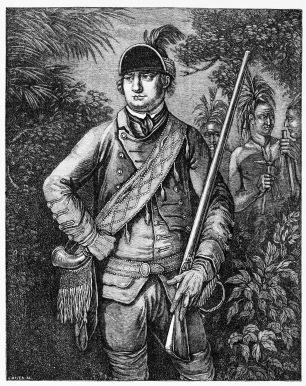
ROBERT ROGERS.
Nearly a hundred leagues separated the Abenaqui village from the
English; and we should add that once there, in the heart of the enemy’s
country, all idea of help from the army must be abandoned, and the
rangers, depending wholly upon themselves, be deprived of every resource
except to cut their way through all obstacles. But this was exactly the
kind of service for which this distinctive body of American soldiers was
formed.
Sir Jeffrey Amherst had said to Rogers, “Go and wipe out St. Francis for
me,” precisely as he would have said to his orderly, “Go and saddle my
horse.”
But this illustrates the high degree of confidence which the army
reposed in the chief of the rangers. The general knew that this
expedition demanded, at every stage, the highest qualities in a leader.
Rogers had already proved himself possessed of these qualities in a
hundred perilous encounters.
That night, without noise or display, the two hundred men detailed for
the expedition left their encampment, which was habitually in the van of
the army. On the evening of the twenty-second day since leaving Crown
Point a halt was ordered. The rangers were near their destination. From
the top of a tree the doomed village was discovered three miles distant.
Not the least sign that the presence of an enemy was suspected could
be seen or heard. The village wore its ordinary aspect of profound
security. Rogers therefore commanded his men to rest, and prepare
themselves for the work in hand.
At eight in the evening, having first disguised himself, Rogers took
Lieutenant Turner and Ensign Avery, and with them reconnoitred the
Indian town. He found it the scene of high festivity, and for an
hour watched unseen the unsuspecting inhabitants celebrating with
dancing and barbaric music the nuptials of one of the tribe. All this
marvellously favored his plans. Not dreaming of an enemy, the savages
abandoned themselves to unrestrained enjoyment and hilarity. The fête
was protracted until a late hour under the very eyes of the spies, who,
finding themselves unnoticed, crept boldly into the village, where they
examined the ground and concerted the plan of attack.
At length all was hushed. The last notes of revelry faded on the still
night air. One by one the drowsy merry-makers retired to their lodges,
and soon the village was wrapped in profound slumber—the slumber of
death. This was the moment so anxiously awaited by Rogers. Time was
precious. He quickly made his way back to the spot where the rangers
were lying on their arms. One by one the men were aroused and fell into
their places. It was two in the morning when he left the village. At
three the whole body moved stealthily up to within five hundred yards
of the village, where the men halted, threw off their packs, and were
formed for the assault in three divisions. The village continued silent
as the grave.
St. Francis was a village of about forty or fifty wigwams, thrown
together in a disorderly clump. In the midst was a chapel, to which the
inhabitants were daily summoned by matin and vesper bell to hear the
holy father, whose spiritual charge they were, celebrate the mass. The
place was enriched with the spoil torn from the English and the ransom
of many miserable captives. We have said that these Indians had slain
and taken, in six years, six hundred English: that is equivalent to one
hundred every year.
The knowledge of numberless atrocities nerved the arms and steeled the
hearts of the avengers. When the sun began to brighten the east the
three bands of rangers, waiting eagerly for the signal, rushed upon the
village.
A deplorable and sickening scene of carnage ensued. The surprise was
complete. The first and only warning the amazed savages had were the
volleys that mowed them down by scores and fifties. Eyes heavy with the
carousal of the previous night opened to encounter an appalling carnival
of butchery and horror. Two of the stoutest of the rangers—Farrington
and Bradley—led one of the attacking columns to the door where the
wedding had taken place. Finding it barred, they threw themselves so
violently against it that the fastenings gave way, precipitating Bradley
headlong among the Indians who were asleep on their mats. All these were
slain before they could make the least resistance.
On all sides the axe and the rifle were soon reaping their deadly
harvest. Those panic-stricken, half-dazed wretches who rushed pell-mell
into the streets either ran stupidly upon the uplifted weapons of the
rangers or were shot down by squads advantageously posted to receive
them. A few who ran this terrible gauntlet plunged into the river
flowing before the village, and struck boldly out for the opposite
shore; but the avengers had closed every avenue of escape, and the
fugitives were picked off from the banks. The same fate overtook those
who tumbled into their canoes and pushed out into the stream. The frail
barks were riddled with shot, leaving their occupants an easy target for
a score of rifles. The incessant flashes, the explosions of musketry,
the shouts of the assailants, and the yells of their victims were all
mingled in one horrible uproar. For two hours this massacre continued.
Combat it cannot be called. Rendered furious by the sight of hundreds of
scalps waving mournfully in the night-wind in front of the lodges, the
pitiless assailants hunted the doomed savages down like blood-hounds.
Every shot was followed by a death-whoop, every stroke by a howl of
agony. For two horrible hours the village shook with explosions and
echoed with frantic outcries. It was then given up to pillage, and then
to the torch, and all those who from fear had hid themselves perished
miserably in the flames. At seven o’clock in the morning all was over.
Silence once more enveloped the hideous scene of conflagration and
slaughter. The village of St. Francis was the funeral pyre of two
hundred warriors. Rogers had indeed taken the fullest revenge enjoined
by Sir Jeffrey Amherst’s orders.
From this point our true history passes into the legendary.
While the sack of St. Francis was going on a number of the Abenaquis
took refuge in the little chapel. Their retreat was discovered. A few
of their assailants having collected in the neighborhood precipitated
themselves toward it, with loud cries. Others ran up. Two or three blows
with the butt of a musket forced open the door, when the building was
instantly filled with armed men.
An unforeseen reception awaited them. Lighted candles burnt on the high
altar, shedding a mild radiance throughout the interior, and casting
a dull glow upon the holy vessels of gold and silver upon the altar.
At the altar’s foot, clad in the sacred vestments of his office, stood
the missionary, a middle-aged, vigorous-looking man, his arms crossed
upon his breast, his face lighted up with the exaltation of a martyr.
Face and figure denoted the high resolve to meet fate half-way. Behind
him crouched the knot of half-crazed savages, who had fled to the
sanctuary for its protection, and who, on seeing their mortal enemies,
instinctively took a posture of defence. The priest, at two or three
paces in advance of them, seemed to offer his body as their rampart. The
scene was worthy the pencil of a Rembrandt.
At this sight the intruders halted, the foremost even falling back a
step, but the vessels of gold and silver inflamed their cupidity to
the highest pitch; while the hostile attitude of the warriors was a
menace men already steeped in bloodshed regarded a moment in still more
threatening silence, and then by a common impulse recognized by covering
the forlorn group with their rifles.
Believing the critical moment come, the priest threw up his hands in
an attitude of supplication, arresting the fatal volley as much by
the dignity of the gesture itself, as by the resonant voice which
exclaimed, in French, “Madmen, for pity’s sake, for the sake of Him on
the Cross, stay your hands! This violence! What is your will? What seek
ye in the house of God?”
A gunshot outside, followed by a mournful howl, was his sole response.
The priest shuddered, and his crisped lips murmured an ave. He
comprehended that another soul had been sent, unshriven, to its final
account.
“Hear him!” said a ranger, in a mocking undertone; “his gabble minds me
of a flock of wild geese.”
A burst of derisive laughter followed this coarse sally.
In fact, they had not too much respect for the Church of Rome, these
wild woodsmen, but were filled with ineradicable hatred for its
missionaries, domesticated among their enemies, in whom they believed
they saw the real heads of the tribes, and the legitimate objects,
therefore, of their vengeance.
“Yield, Papist! Come, you shall have good quarter; on the word of a
ranger you shall,” cried an authoritative voice, the speaker at the same
time advancing a step, and dropping his rifle the length of his sinewy
arms.
“Never!” answered the ecclesiastic, crossing himself.
A suppressed voice from behind hurriedly murmured in his ear, “Écoutez:
rendez-vous, mon père: je vous en supplie!”
“Jamais! mieux vaut la mort que la miséricorde de brigands et
meurtriers!” ejaculated the missionary, rejecting the counsel also,
with a vehement shake of the head.
“Grand Dieu! tout, donc, est fini,” sighed the voice, despairingly.
The rangers understood the gesture better than the words. An officer,
the same who had just spoken, again impatiently demanded, this time in a
higher and more threatening key,
“A last time! Do you yield or no? Answer, friar!”
The priest turned quickly, took the consecrated Host from the altar,
elevated it above his head, and, in a voice that was long remembered by
those who heard it, exclaimed,
“To your knees, monsters! to your knees!”
What the ranger understood of this pantomime and this command was that
they conveyed a scornful and a final refusal. Muttering under his
breath, “Your blood be upon your own head, then,” he levelled his
gun and pulled the trigger. A general discharge from both sides shook
the building, filling it with thick and stifling smoke, and instantly
extinguishing the lights. The few dim rays penetrating the windows, and
which seemed recoiling from the frightful spectacle within, enabled the
combatants vaguely to distinguish each other in the obscurity. Not a cry
was heard; nothing but quick reports or blows signaled the progress of
this lugubrious combat.
This butchery continued ten minutes, at the end of which the rangers,
with the exception of one of their number killed outright, issued from
the chapel, after having first stripped the altar, despoiled the shrine
of its silver image of the Virgin, and flung the Host upon the ground.
While this profanation was enacting a voice rose from the heap of dead
at the altar’s foot, which made the boldest heart among the rangers stop
beating. It said,
“The Great Spirit of the Abenaquis will scatter darkness in the path of
the accursed Pale-faces! Hunger walks before and Death strikes their
trail! Their wives weep for the warriors that do not return! Manitou is
angry when the dead speak. The dead have spoken!”
The torch was then applied to the chapel, and, like the rest of the
village, it was fast being reduced to a heap of cinders. But now
something singular transpired. As the rangers filed out from the
shambles the bell of the little chapel began to toll. In wonder and
dread they listened to its slow and measured strokes until, the flames
having mounted to the belfry, it fell with a loud clang among the ruins.
The rangers hastened onward. This unexpected sound already filled them
with gloomy forebodings.
After the stern necessities of their situation rendered a separation
the sole hope of successful retreat, the party which carried along
with it the silver image was so hard pressed by the Indians, and by a
still more relentless enemy, famine, that it reached the banks of the
Connecticut reduced to four half-starved, emaciated men. More than once
had they been on the point of flinging their burden into some one of the
torrents every hour obstructing their way; but as one after another fell
exhausted or lifeless, the unlucky image passed from hand to hand, and
was thus preserved up to the moment so eagerly and so confidently looked
for, during that long and dreadful march, to end all their privations.
But the chastisement of heaven, prefigured in the words of the expiring
Abenaqui, had already overtaken them. Half-crazed by their sufferings,
they mistook the place of rendezvous appointed by their chief, and,
having no tidings of their comrades, believed themselves to be the sole
survivors of all that gallant but ill-fated band. In this conviction, to
which a mournful destiny conducted, they took the fatal determination
to cross the mountains under the guidance of one of their number who
had, or professed, a knowledge of the way through the Great Notch of the
White Hills.
For four days they dragged themselves onward through thickets, through
deep snows and swollen streams, without sustenance of any kind, when
three of them, in consequence of their complicated miseries, aggravated
by finding no way through the wall of mountains, lost their senses.
What leather covered their cartouch-boxes they had already scorched
to a cinder and greedily devoured. At length, on the last days of
October, as they were crossing a small river dammed by logs, they
discovered some human bodies, not only scalped, but horribly mangled,
which were supposed to be some of their own band. But this was no
time for distinctions. On them they accordingly fell like cannibals,
their impatience being too great to await the kindling of a fire to
dress their horrid food by. When they had thus abated somewhat the
excruciating pangs they before endured, the fragments were carefully
collected for a future store.
My pen refuses to record the dreadful extremities to which starvation
reduced these miserable wretches. At length, after some days of
fruitless wandering up and down, finding the mountains inexorably
closing in upon them, even this last dreadful resource failed, and,
crawling under some rocks, they perished miserably in the delirium
produced by hunger and despair, blaspheming, and hurling horrible
imprecations at the silver image, to which, in their insanity, they
attributed all their sufferings. One of them, seizing the statue,
tottered to the edge of a precipice, and, exerting all his remaining
strength, dashed it down into the gulf at his feet.
Tradition affirms that the first settlers who ascended Israel’s River
found relics of the lost detachment near the foot of the mountains; but,
notwithstanding the most diligent search, the silver image has thus far
eluded every effort made for its recovery.
And so, when restless and adrift, I keep
Great comfort in a quietness like this,
An awful strength that lies in fearless sleep,
On this great shoulder lay my head, nor miss
The things I longed for but an hour ago.
Sarah O. Jewett.
MOOSEHILLOCK, or Moosilauke,[34] is one of four or five summits from
which the best idea of the whole area of the White Mountains may be
obtained. It is not so remarkable for its form as for its mass. It is an
immense mountain.
Lifted in solitary grandeur upon the extreme borders of the army of
peaks to which it belongs, and which it seems defending, haughtily
over-bearing those lesser summits of the Green Mountains confronting
it from the opposite shores of the Connecticut, which here separates
the two grand systems, like two hostile armies, the one from the other,
Moosehillock resembles a crouching lion, magnificent in repose, but
terrible in its awakening.
This immense strength, paralyzed and helpless though it seems, is
nevertheless capable of arousing in us a sentiment of respectful
fear—respect for the creative power, fear for the suspended life we
believe is there. The mountain really seems lying extended under the sky
listening for the awful command, “Arise and walk!”
This mountain received a name before Mount Washington, and is in
some respects, as I hope to point out, the most interesting of the
whole group. In the first place, it commands a hundred miles of the
Connecticut Valley, including, of course, all the great peaks of the
Green Mountain and Adirondack chains. Again, its position confers
decided advantages for studying the configuration of the Franconia
group, to which, in a certain sense, it is allied, and of the ranges
enclosing the Pemigewasset Valley, which it overlooks. Moosehillock
stands in the broad angle formed by the meeting waters of the
Connecticut and the Ammonoosuc. In a word, it is an advanced bastion
of the whole cluster of castellated summits, constituting the White
Mountains in a larger meaning.
Therefore no summit better repays a visit than Moosehillock; yet it is
astonishing, considering the ease of access, how few make the ascent.
The traveller can hardly do better than begin here his experiences of
mountain adventure, should chance conduct him this way; or, if making
his exit from the mountain region by the Connecticut Valley, he may,
taking it in his way out, make this the appropriate pendant of his
tours, romantic and picturesque.
Having been so long known to and frequented by the Indian as well as
white hunters, the mountain is naturally the subject of considerable
legend,[35] which the historian of Warren has scrupulously gathered
together. One of these tales, founded on the disaster of Rogers,
recounts the sufferings of two of his men, hopelessly snared in the
great Jobildunk ravine. But that tale of horror needs no embellishment
from romance. This enormous rent, equally hideous in fact as in name,
cut into the vitals of the mountain so deeply that a dark stream gushes
from the gaping wound, conceals within its mazes several fine cascades.
Owing to long-continued drought, the streams were so puny and so languid
when I visited the mountain that I explored only the upper portion of
the gorge, which bristles with an untamed forest, levelling its myriad
spears at the breast of the climber.
The greater part of the mountain lies in the town of Benton, or,
perhaps, it would be nearer the truth to say that fully half the
township is appropriated by its prodigious earthwork. But, to reach it
without undergoing the fatigues of a long march through the woods,
it is necessary to proceed to the village of Warren, which is twenty
miles north of Plymouth, and about fourteen south of Haverhill. Behind
the village rises Mount Carr. Still farther to the north the summits
of Mounts Kineo, Cushman, and Waternomee, continuing this range now
separating us from the Pemigewasset Valley, form also the eastern wall
of the valley of Baker’s River, which has its principal source in the
ravines of Moosehillock. There is a bridle-path opening communication
with the mountain from the Benton side, on the north; and so with Lisbon
and Franconia. A carriage-road is also contemplated on that side, which
will render access still more feasible for a large summer population;
while a bridle-path, lately opened between two peaks of the Carr range,
facilitates ingress from the Pemigewasset side.
I set out from the village of Warren on one of the hottest afternoons
of an intensely hot and dry summer. The five miles between the village
and the base of the mountain need not detain the sight-seer. At the
crossing of Baker’s River I remarked again the granite-bed honey-combed
with those curious pot-holes sunk by whirling stones, first set in
motion and then spun around by the stream, which here, breaking up into
several wild pitches, pours through a rocky gorge. But how gratefully
cool and refreshing was even the sound of rushing water in that still,
stifling atmosphere, coming, one would think, from a furnace! Then for
two miles more the horse crept along the road, constantly ascending the
side of the valley, until the last house was reached. Here we passed a
turnpike-gate, rolled over the crisped turf of a stony pasture through a
second gate, and were at the foot of Moosehillock.
In a trice we exchanged the sultriness, the dryness, the dust, parching
or suffocating us, of a shadeless road, for the cool, moist air of the
mountain-forest and the delectable sound of running water. A brook shot
past; then another; then the horse, who stopped when he liked, and as
often as he liked, like a man forced to undertake a task which he is
determined shall cost his task-masters dearly, began a languid progress
up the increasing declivity before us. His sighs and groans, as he
plodded wearily along, were enough to melt a heart of stone. I therefore
dismounted and walked on, leaving the driver to follow as he could. The
question was, not how the horse should get us up the mountain, but how
we should get the horse up.
They call it four and a half miles from the bottom to the top. The
distances indicated by the sign-boards, nailed to trees, did not appear
to me exact. They are not exact; and the reason why they are not is
sufficiently original to merit a word of explanation. Having long
observed the effect of imagination, especially in computing distances,
the builder of the road, as he himself informed me, adopted a truly
ingenious method of his own. He lengthened or shortened his miles
according as the travelling was good or bad. For example: the first
mile, being an easy one, was stretched to a mile and a quarter. The
last mile is also very good travelling. That, too, he lengthened to a
mile and a half. In this way he reduced the intervening two and a half
miles of the worst road to one and three-fourth miles. This absolutely
harmless piece of deception, he averred, considerably shortened the most
difficult part of the journey. No one complained that the good miles
were too long, while the bad ones were now passed over with far less
grumbling than before they were abbreviated by this simple expedient,
which very few, I am convinced, would have thought of. In fact, the sum
of the whole distance being scrupulously adhered to, it is the most
civil piece of engineering of which I have any knowledge.
The road up is rough, tedious, and, until the ridge at the foot of the
south peak is reached, uninteresting. It crooks and turns with absolute
lawlessness while climbing the flanks of the southern peak, skirting
also the side of the profound ravine eating its way into the mountain
from the south. Nearing this summit we obtained through an opening a
glimpse of Mount Washington, veiled in the clouds. The trees now visibly
dwindled. Just before reaching the ridge, where it joins this peak, a
fine spring, deliciously cold, gushed from the mountain side. A few
rods more of ascent brought us quite out upon the long, narrow, curving
backbone of the mountain, uplifting its sharp edge between two profound
gorges, connecting the peaks set at its two extremes, between which
Nature has decreed a perpetual divorce. The sun was just setting as we
emerged upon this natural way conducting from peak to peak along the
airy crest of the mountain.
Although this, it will be remembered, is one of the longest miles,
according to the scale of computation in vogue here, the unexpected
speed which the horse now put forth, the sight of the squat, little
Tip-Top House, clinging to the summit beyond, the upper and nether
worlds floating or fading in splendor, while the night-breezes sweeping
over cooled our foreheads, and rudely jostled the withered trees, drawn
a little apart to the right and left to let us pass, quickly replaced
that weariness of mind and body which the mountain exacts of all who
pass over it on a sultry midsummer’s day.
At the extremity of the ridge, which is only wide enough for the road,
a gradual ascent led to the high summit and to a level plateau of a
few acres at its top. This was treeless, but covered with something
like soil, smooth, and, being singularly free from the large stones
found everywhere else, affords good walking in any direction. The
house is built of rough stone, and, though of primitive construction,
is comfortable, and even inviting. Furthermore, its materials being
collected on the spot, one accepts it as still constituting a part of
the mountain, which, indeed, at a little distance it really seems to
be. In the evening I went out, to find the mountain blindfolded with
clouds. Soon rain began to drive against the window-panes in volleys.
At a late hour we heard wheels grinding on the rocks outside, and then
a party of tourists drove up to the door, dripping and crestfallen at
having undertaken the ascent with a storm staring them in the face. But
they had only this one day, they said, and were “bound” to go up the
mountain. So up they toiled through pitch darkness, through rain and
cloud, passed the night in a building said to be on the summit, and
returned down the mountain in the morning, to catch their train, through
as dense a fog as ever exasperated a hurried tourist. But they had been
to the top! Are there anywhere else in the world people who travel two
hundred miles for a single day’s recreation?
It is very curious, this being domesticated on the top of a mountain. We
go to bed wondering if the scene will not all vanish in our dreams. It
was very odd, too, to see the tourists silently mount their buck-board
in the morning, and disappear, within a stone’s throw, in clouds.
Detaching themselves to all intents from earth, they began a flight in
air. Walking a short distance, perhaps a gunshot, from the house, I
groped my way back with difficulty. The case seemed desperate.
But grandest scene of all was the breaking up of the storm. Shortly
after noon the high sun began to exert a sensible influence upon the
clouds. A perceptible warmth, replacing the chill and clammy mists,
began to pervade the mountain-top. Presently a dim sun-ray shot through.
Then, as if a noiseless explosion had suddenly rent them, the whole
mass of clouds was torn in ten thousand tatters flying through space.
All nature seemed seized with sudden frenzy. Here a summit and there a
peak was seen, struggling fiercely in the grasp of the storm. Coming up
with rushing noise, the west wind charged home the routed storm-clouds
with fresh squadrons. What indescribable yet noiseless tumult raged in
the heavens! Even the mountains seemed scarcely able to stem the tide
of fugitives. A panic seized them. Fear gave them wings. They rushed
pell-mell into the ravines and clung to the tree-tops; they dashed
themselves blindly against the adamant of Lafayette, only to fall
back broken into the deep fosse beneath. Bolts of dazzling sunshine
continually tore through them. The gorges themselves seemed heaped with
the wounded and the dying. But the rushing wind, trampling the fugitives
down, dispersed and cut them mercilessly to pieces. One was irresistibly
carried away by this rage of battle. In ten minutes I looked around upon
a clear sky. One cloud, impaled on the gleaming spear of Lafayette,
hung limp and lifeless; another floated like a scarf from the polished
casque of Chocorua; a third, taken prisoner en route, humbly held the
train of Washington. All the rest of the phantom host, using its power
to render itself invisible, vanished from sight as if the mountains had
swallowed it up.
The landscape being now fully uncovered, I enjoyed all its rare
perfection. It is a superb and fascinating one, invested with a
powerful individuality, surrounded by a charm of its own. You wish to
see the two great chains? There they are, the greater rising over the
lesser, in the order fixed by Nature. That sunny space in the softened
coloring of old tapestry, more to the right, is the Pemigewasset Valley,
and the spot from where not long ago we looked up at this mountain
looming large in the distance. We raise our eyes to glance up the East
Branch upon Mount Hancock and the peaks of Carrigain peeping over.
We touch with magic wand the faint cone of Kearsarge, so dim that it
seems as if it must rise and float away; then, continuing to call the
roll of mountains, Moat, Tripyramid, Chocorua, and all our earlier
acquaintances rise or nod among the Sandwich peaks. Some draw their
cloud-draperies over their bare shoulders, some sun their naked and
hairy breasts in savage luxury. We alight like a bird upon the glassy
bosom of Winnepiseogee the incomparable, and, like the bird, again rise,
refreshed, for flights still more remote. We sweep over the Uncanoonucs
into Massachusetts, steadying the eye upon far Wachusett as we pass from
the Merrimac Valley. Now come thronging in upon us the mountains of the
Connecticut Valley. We rest awhile upon the transcendently beautiful
expanse of the Ox-Bow, and its playthings of villages, strung along
the glittering necklace of the river. Across this valley, lifting our
eyes, we wander among the loftiest peaks of the Green Mountains—those
colossal verd-antiques—exchanging frozen glances across the placid
expanse of Champlain with the haughtiest summits of the Adirondacks.
We grow tired of this. One last look, this time up the valley, reveals
to us the wide and curious gap between two distant mountains, and far
beyond Memphremagog, where these mountains rise, we scan all the route
travelled by Rogers, the perils of which are fresh in our memory. We
pass on unchallenged into the dominions of Victoria.
Is not this a landscape worth coming ten miles out of one’s way to see?
And yet the half is not told. I have merely indicated its dimensions.
Now let the reader, drawing an imaginary line from peak to peak, go
over at leisure all that lies between. I merely prick the chart for
him. Moosehillock, not quite five thousand feet high, overlooks all
New Hampshire, pushes investigation into Maine and Massachusetts, is
familiar with Vermont, distant with New York, and has an eye upon
Canada. It is said the ocean has been seen, but I did not see it.
Circumstances compelled me to drive the old horse, who has made more
ascensions of the mountain than any living thing, back to Warren. No
other was to be had for love or money. Had there been time I would have
preferred walking, but there was not. This horse measured sixteen hands.
His thin body and long legs resembled a horse upon stilts. He looked
dejected, but resigned. I argued that he would be able to get down the
mountain somehow; and, once out of the woods, I could count on his
eagerness to get home, to some extent, perhaps. I was not deceived in
either expectation.
The road, as I have said, is for most of the way a rough, steep, and
stony one. In order to check the havoc made by sudden showers, and
to hold the thin soil in place, hemlock-boughs were spread over it,
artfully concealing those protruding stones which the scanty soil
refused to cover. He who intrusted himself to it did not find it a
bed of roses. The buck-board was the longest, clumsiest, and most
ill-favored it has ever been my lot to see. This vehicle, being peculiar
to the mountains, demands, at least, a word. It is a very primitive and
ingenious affair, and cheaply constructed. Naturally, therefore, it
originated where the farmers were poor and the roads bad. But what is
the buck-board? Every one has seen the spring-board of a gymnasium or of
a circus. A smooth plank, ten feet long, resting upon trestles placed
at either end, assists the acrobat to vault high in the air. Each time
he falls the rebound sends him up again. This is the principle of the
buck-board. Remove the trestles, put a pair of wheels in the place of
each, and you have the vehicle itself, minus shafts or pole, according
as one or two horses are to draw it. Increased weight bends the board or
the spring more and more until it is in danger of touching the ground.
The passengers sit in the hollow of this spring, the natural tendency of
which is to shoot them into the air.
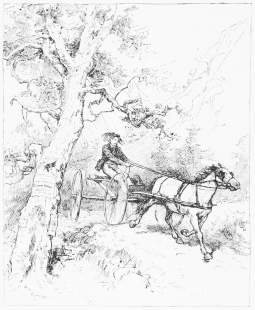
THE BUCK-BOARD WAGON.
I am justified in speaking thus of the road and the vehicle. But
who shall describe the horse? That animal was possessed of a devil,
and, like the swine of the miracle, ran violently all the way down
the mountain, without stopping for water or breath. Fortunate indeed
for me was it that the sea was not at the bottom. In three-quarters
of an hour, half of which was spent in the air, I was at the foot
of the mountain which had required two tedious hours to ascend. How
the quadruped managed to avoid falling headlong fifty times over
the concealed stones I have no idea. How I contrived to alight,
when a wheel, coming violently against one of these stones, put the
spring-board in play—how I contrived to alight, I remark, during this
game of battledoor and shuttlecock, never twice in the same place, is to
this day an enigma.
The houses of ancient Rome frequently bore the inscription for the
benefit of strangers, “Cave canem.” This could be advantageously
replaced here, upon the first turnpike-gate, at the mountain’s foot,
with the warning, “Beware of the horse!”
Ros. O Jupiter! how weary are my spirits!
Touch. I care not for my spirits, if my legs were not weary.
As You Like It.
HAVING finished with the western approach to the White Mountains, I
was now at liberty to retrace my route up the Ammonoosuc Valley, which
so abounds in picturesque details—farms, hamlets, herds, groups of
pines, maples, torrents, roads feeling their way up the heights—to
that anomaly of mountain towns, Bethlehem. Thanks to the locomotive,
the journey is short. The villages of Bath, Lisbon, Littleton, are
successively entered; the same flurry gives a momentary activity to each
station, the same faces crowd the platforms, and the same curiosity is
exhibited by the passengers, whose excitement receives an increase with
every halt of the laboring train.
Bethlehem is ranged high up, along the side of a mountain, like the
best china in a cupboard. The crest of Mount Agassiz[36] rises behind
it. Beneath the village the ground descends, rather abruptly, to the
Ammonoosuc, which winds, through matted woods, its way out of the
mountains. There are none of those eye-catching gleams of water which so
agreeably diversify these interminable miles of forest and mountain land.
It is only by ascending the slopes of Mount Agassiz that we can secure
a stand-point fairly showing the commanding position of Bethlehem, or
where its immediate surroundings may be viewed all at once. It is so
situated, with respect to the curvature of this mountain, that at one
end of the village they do not know what is going on at the other.
One end revels in the wide panorama of the west, the other holds the
unsurpassed view of the great peaks to the east.
Bethlehem has risen, almost by magic, at the point where the old highway
up the Ammonoosuc is intersected by that coming from Plymouth, the
Pemigewasset Valley, and the Profile House. In time a small roadside
hamlet naturally clustered about this spot. Dr. Timothy Dwight, the
pioneer traveller for health and pleasure among these mountains,
passed through here in 1803. Speaking of the appearance of Bethlehem,
he says: “There is nothing which merits notice, except the patience,
enterprise, and hardihood of the settlers which have induced them to
stay upon so forbidding a spot; a magnificent prospect of the White
Mountains; and a splendid collection of other mountains in their
neighborhood, particularly on the south-west.” It was then reached by
only one wretched road, which passed the Ammonoosuc by a dangerous ford.
The few scattered habitations were mere log-cabins, rough and rude.
The few planting-fields were still covered with dead trees, stark and
forbidding, which the settlers, unable to fell with the axe, killed by
girdling, as the Indians did.
From this historical picture of Bethlehem in the past, we turn to
the Bethlehem of to-day. It is turning from the post-rider to the
locomotive. Not a single feature is recognizable except the splendid
prospect of the White Mountains, and the magnificent collection of
other mountains, which call forth the same admiration to-day. Fortunate
geographical position, salubrity, fine scenery—these, and these alone,
are the legitimate cause of what may be termed the rise and progress
of Bethlehem. All that the original settlers seem to have accomplished
is to clear away the forests which intercepted, and to make the road
conducting to the view.
It is the position of Bethlehem with respect to the recognized points
or objects of interest that gives to it a certain strategic advantage.
For example, it is admirably situated for excursions north, south,
east, or west. It is ten miles to the Profile, twelve to the Fabyan,
seventeen to the Crawford, fifteen to the Waumbek, and eighteen to the
base of Mount Washington. One can breakfast at Bethlehem, dine on Mount
Washington, and be back for tea; and he can repeat the experience with
respect to the other points named as often as inclination may prompt.
Moreover, the great elevation exempts Bethlehem from the malaria and
heat of the valleys. The air is dry, pure, and invigorating, rendering
it the paradise of those invalids who suffer from periodical attacks of
hay-fever. Lastly, it is new, or comparatively new, and possesses the
charm of novelty—not the least consideration to the thousands who are
in pursuit of that and that only.
Bethlehem Street is the legitimate successor of the old road. This is
a name sui generis which seems hardly appropriate here, although it
is so commonly applied to the principal thoroughfares of our inland New
England villages. It has a spick-and-span look, as if sprung up like
a bed of mushrooms in a night. And so, in fact, it has; for Bethlehem
as a summer resort dates only a few years back its sudden rise from
comparative obscurity into the full blaze of popular fame and favor.
The guide-book of fifteen years ago speaks of the one small but
comfortable hotel, kept by the Hon. J. G. Sinclair. In fact, very little
account was made of it by travellers, except to remark the magnificent
view of the White Mountains on the east, or of the Franconia Mountains
on the south, as they passed over the then prescribed tour from North
Conway to Plymouth, or vice versa.
But this newness, which you at first resent, besides introducing here
and there some few attempts at architectural adornment, contrasts
very agreeably with the ill-built, rambling, and slip-shod appearance
of the older village-centres. They are invariably most picturesque
from a distance. But here there is an evident effort to render the
place itself attractive by making it beautiful. Good taste generally
prevails. I suspect, however, that the era of good taste, beginning with
the incoming of a more refined and intelligent class of travellers,
communicated its spirit to two or three enterprising and sagacious
men,[37] who saw in what Nature had done an incentive for their own
efforts. We walk here in a broad, well-built thoroughfare, skirted on
both sides with hotels, boarding-houses, and modern cottages, in which
three or four thousand sojourners annually take refuge. All this has
grown from the “one small hotel” of a dozen years ago. Shade-trees and
grass-plots beautify the way-side. An immense horizon is visible from
these houses, and even the hottest summer days are rendered endurable
by the light airs produced and set in motion by the oppressive heats of
the valley. The sultriest season is, therefore, no bar to out-of-door
exercise for persons of average health, rendering walks, rambles, or
drives subject only to the will or caprice of the pleasure-seeker.
But in the evening all these houses are emptied of their occupants.
The whole village is out-of-doors, enjoying the coolness or the
panorama with all the zest unconstrained gratification always brings.
The multitudes of well-dressed promenaders surprise every new-comer,
who immediately thinks of Saratoga or Newport, and their social
characteristics. Bethlehem, he thinks, must be the ideal of those who
would carry city or, at least, suburban life among the mountains; who do
not care a fig for solitude, but prefer to find their pleasures still
connected with their home life. They are seeing life and seeing nature
at the same time.
Sauntering along the street from the Sinclair House, a strikingly large
and beautiful prospect opens as we come to the Belleview. Here the
road, making its exit from the village, descends to the Ammonoosuc. The
valley broadens and deepens, exposing to view all the town of Littleton,
picturesquely scattered about the distant hill-sides. Its white houses
resemble a bank of daisies. The hills take an easy attitude of rest.
Six hundred feet below us the bottom of the valley exhibits its rich
savannas, interspersed with cottages and groves. Above its deep hollow
the Green Mountains glimmer in the far west. “Ah!” you say, “we will
stop here.”
Let us now again, leaving the Sinclair House behind, ascend the
road to the Profile. It is not so much travelled as it was before
the locomotive, in his coat-of-mail, sounded his loud trumpet at
the gates of Franconia. A mile takes us to the brow of the hill. We
hardly know which way to look first. Two noble and comprehensive views
present themselves. To the left Mount Agassiz rears his commanding
peak. In front of us, across a valley, is the great, deeply-cloven
Franconia Notch. Lafayette is superb here. Now the large, compact
mass of Moosehillock looms on the extreme right, together with all
those striking objects lately studied or observed from the village of
Franconia, which so quietly reposes beneath us. But this landscape
properly belongs to the environs of Bethlehem, and never is it so
incomparably grand as when the summits are fitfully revealed, battling
fiercely with storm-clouds. Every phase of the conflict is watched with
eager attention. Seeing all this passion above, it calls up a smile to
look down at the unbroken and unconscious tranquillity of the valley.
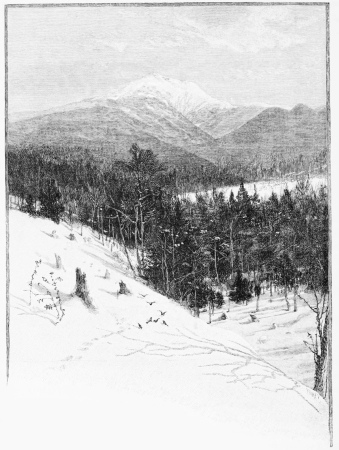
MOUNT LAFAYETTE, FROM BETHLEHEM.
Facing now in the direction of Bethlehem, the eye roves over the
broad basin of the Ammonoosuc for many miles up and down. The hills of
Littleton, Whitefield, Dalton, Carroll, and Jefferson bend away from
the opposite side; and over the last the toothed Percy Peaks[38] rise
blue and clear at the point where the waters of the Connecticut and the
Androscoggin, approaching each other, conduct the Grand Trunk Railway
out of the mountains. The west is packed with the high summits of the
Green Mountain chain. The great White Mountains are concealed, as yet,
by the swell of the mountain down whose side the road conducts to the
village. “This,” you exclaim, “this is the spot where we will pitch
our tents!” But there is no public-house here, and we are reluctantly
forced to descend. In proportion as we go down, this seemingly limitless
panorama suffers a partial eclipse. The landscape changes from the
high-wrought epic to the grand pastoral, if such a distinction may
be applied to differing forms of mountain scenery. This approach is,
without doubt, the most striking introduction to Bethlehem. It is
curiously instructive, too, as regards the relative merits of successive
elevations, each higher than the other, as proper view-points.
A third ramble is altogether indispensable before we can say that we
know Bethlehem of the Hills. The direction is now to the east, by the
road to the Crawford House, or Fabyan’s, or the Twin. We continue along
the high plateau, in the shade of sugar-maples or Lombardy poplars,
to the eastern skirt of the village, the houses getting more and more
unfrequent, until we come upon the edge of the slope to the Ammonoosuc,
where the road to Whitefield, Lancaster, and Jefferson, leaving the main
thoroughfare, drops quietly down into Bethlehem Hollow. No envious hill
now obstructs the truly “magnificent view.” Through the open valley the
lordly mountains again inthrall us with the might of an overpowering
majesty.
This locality has taken the name of the great hotel erected here
by Isaac Cruft, whose hand is visible everywhere in Bethlehem. The
Maplewood, as it is called, easily maintains at its own end the prestige
of Bethlehem for rapid growth. When I first visited the place, in
1875, I found a modest roadside hostelry accommodating sixty guests;
five years later a mammoth structure, in which six hundred could be
accommodated, had risen, like Aladdin’s palace, on the same spot.
Instead of our little musical entertainment, our mock-trial, our quiet
rubber of whist, of an evening, there were readings, lectures, balls,
masquerades, theatricals, musicales, for every day of the week.
But Bethlehem is emphatically the place of sunsets. In this respect no
other mountain resort can pretend to equal it. From no other village
are so many mountains visible at once; at no other has the landscape
such length and breadth for giving full effect to these truly wonderful
displays. More because the sublimity of the scene deserves a permanent
chronicle than from any confidence in my own ability to reproduce it, I
attempt in black and white to describe one of unparalleled intensity of
color, one that may never be repeated, certainly never excelled, while
the sun, the heavens, and the mountains shall last.
A cold drizzle having set in on the day of my arrival, the mountains
were invisible when I rose in the morning. I looked, but they were no
longer there. I was much vexed at the prospect of being storm-bound,
or of making under compulsion a sojourn I had beforehand resolved
to make at my own good will and pleasure. So strongly is the spirit
of resistance developed in us. After a critical investigation of
the weather, it crossed my mind like an intuition that something
extraordinary was preparing behind the enormous masses of clouds
clinging like wet draperies to the skirts of the mountains, forming
an impenetrable curtain, now and then slowly lifted by the fresh
north wind, now suddenly distended or collapsing like huge sails, but
noiselessly and mysteriously as the ghostly canvas of the Flying
Dutchman.
Toward the middle of the afternoon, the wind having freshened, the
lower clouds broke apart here and there—just enough to reveal to us
that ever-new picture of the White Mountains, beautifully robed in
fresh snow, above the darker line of forest; but so thoroughly were
the high summits blended with the dull silver-gray of upper sky that
the true line of separation defied the keenest scrutiny to detect it.
This produced a curious optical illusion. Extended sumptuously along
the crest-line, rivalling the snow itself, a bank of white clouds
rendered the deception perfect, since just above them began that heavy
and dull expanse which overspread and darkened the whole heavens,
thus imperfectly delineating a second line of summits mounting to a
prodigious height. They seemed miles upon miles high.
Up stretched this gigantic and shadowy phantasm of towers, domes,
and peaks, illimitably, as if mountains and heavens were indeed come
together in eternal alliance. At the same time the finger dipped in
water could trace a more conclusive outline on glass than the eye could
find here. The summits, a little luminous, emitted a cold, spectral
glare. It gave you a chill to look at them. No sky, no earth, no deep
gorges, no stark precipices—no anything except that dead wall, so
sepulchral in its gray gloom that equally mind and imagination failed to
find one familiar outline or contour. The true peaks seemed clouds, and
the clouds peaks. But this phantasm was only the prologue.
At the hour of sunset all the lower clouds had disappeared. The
upper heavens now wore that deep grape-purple impervious to light
or warmth, and producing the effect of a vast dome hung with black.
The storm replaced the azure tint of the sky with the most sombre
color in its laboratory. The light visibly waned. The icy peaks still
reflected a boreal glitter. But in the west these funereal draperies
fell a little short of touching the edge of the horizon—a bare
hand’s-breadth—leaving a crevice filled with golden light, pure and
limpid as water, clear and vivid as winnowed sunshine. The sun’s eye
would soon be applied to this peep-hole. A feverish impatience seized
us. We could see the people at their doors and in the street standing
silent and expectant, with their faces turned to the heavens. From a
station near Cruft’s Ledge we watched intently for the moment when this
splendid light, concentrated in one level sheet, should fall upon the
great mountains.
In a few seconds a yellow spot of piercing brilliancy appeared in this
narrow band of light. One look at it was blinding; a second would have
paralyzed the optic nerve. Mechanically we put up our hands to shut
it out. Imagine a stream of molten iron—hissing-hot and throwing off
fiery spray—gushing from the side of a furnace! Even that can give
but a feeble idea of the unspeakable intensity of this last sun-ray.
It blazed. It flooded us with a suffocating effulgence. Suppose now
this cataract of liquid flame suddenly illuminating the pitchy darkness
of a cavern in the bowels of the earth. The effect was electrifying.
Confined between the upper and nether expanse—dull earth and brooding
sky—rendered tenfold more dazzling by the blackness above, beneath, the
sun poured upon the great mountains one magnificent torrent of radiance.
In an instant the broad land was deluged with the supreme glories of
that morning when the awful voice of God uttered the sublime command,
“Let there be light, and there was light.”
An electric shock awoke the torpid earth, transfigured the mountains. On
swept the mighty wave, shedding light, and warmth, and splendor where a
moment before all was dark, cold, and spiritless. Like Ajax before Troy,
the giant hills braced on their dazzling armor. Like Achilles’s shield,
they threw back the brightness of the sun. Every tree stood sharply out.
Every cavern disclosed its inmost secrets. Twigs glittered diamonds,
leaves emitted golden rays. All was ravishingly beautiful.
This superb exhibition continued while one might count a hundred. Then
all the lower mountains took on that ineffable purple that baffles
description. Starr King, Cherry Mountain, were resplendent. As if the
livid and thick-clustered clouds above had been trodden by invisible
feet, these peaks seemed drenched with the juice of the wine-press.
The high summits, buried in snow and cloud, were yet coldly impassive,
but presently, little by little, the light crept up and up. Now it
seized the topmost pinnacles. Heavens, what a sight! Ineffable glory
seemed quenched in the sublime terrors of that moment. On our right the
Twin and Franconia mountains glowed, from base to summit, like coals
of fire. The lower forests were wrapped in flame. Then all the snowy
line of peaks, from Adams to Clinton, turned blood-red. No pale rose
or carnation tints, as in those enrapturing summer sunsets so often
witnessed here. The stupendous and flaming mountains of hell seemed
risen before us, clothed with immortal terrors. We stood rooted to
the spot, like men who saw the judgment-day dawning, the solid earth
consuming, before their doubting eyes. Everlasting, unquenchable fires
seemed encompassing us about. Nothing more weird, more unearthly,
or more infernal was ever seen. Even the country-people, stolid and
indifferent as they usually are, regarded it with mingled stupefaction
and dismay.
The drama approached its climax. Before we were aware, the valley grew
dark. But still, the granite peaks of Lafayette, and of that admirable
pyramid, Mount Garfield, which even the greater mountain cannot reduce
to impotence, glowed like iron drawn from the fire. Their incandescent
points, thrust upward into the black gulf of the heavens, towered
above the blacker gulfs below unspeakably. By degrees the scorching
heat cooled. The great Franconia spires successively paled. But long
after they seemed reduced to ashes, the red flame still lingered upon
the snows of Mount Washington. At last that, too, faded out. Life was
extinct. The great summit took on a wan and livid hue. Night kindly
spread her mantle over the lifeless form of the mountain, which still
disclosed its larger outlines rigid, majestic, even in death.
Twilight succeeded—twilight steeped in silence and coolness, in the
thousand odors exhaled by the teeming earth. One by one the birds hushed
their noisy twitter. Overcome by their own perfumes, flowers shut their
dewy petals and drooped their tender little heads. The river seemed a
drowsy voice rising from the depths of the forest, complaining that
it alone should toil on while all else reposed. With night comes the
feeling of immensity. With sleep the conviction that we are nothing,
and that the order of nature disturbs itself in nothing for us. If we
awake, well; if not, well again. What if we should never wake? One such
splendid pageant as I have attempted to describe instinctively quenches
human pride. It is true, a sunset is in itself nothing, but it compels
you to admit that the world moves for itself, not for you. Believe it
not a gorgeous display in which you, the critical spectator, assist, but
the signal that the day ends and the night cometh. A spectacle that can
arouse the emotions of joy, fear, hope, suspense—nothing? Perhaps. God
knows.
There are very pleasant walks, affording fine views of all the highest
mountains, around the eastern slope or to the summit of the mountain
rising at the back of the hotel. The bare but grassy crest of this
mountain, one of my favorite haunts, enabled me to reconnoitre my route
in advance up the valley, and to look over into the yet unvisited
region of Jefferson, or back again, at the environs of Franconia. The
glory that pours down upon these hills, the vales they infold, the wild
streams, the craggy mountain spurs, the soft, velvety clearings that
turn their dimpled cheeks to be kissed by the sunshine, may all be seen
and fully enjoyed from this spot.
The heights behind us are well-wooded on the summits, but below this
belt of woodland extends a broad band of sunny clearings checkered with
fields of waving grain. These fields are among the highest cultivated
lands in New England. Long tillage was necessary to reduce this
refractory soil to subjection. Farther down, toward the railway-station,
the pastures are so encumbered with stones that a sheep would turn from
them in dismay. To mow among these stones a man would have to go down on
his knees.
There is a beautiful orchard of sugar-maples down the road to the
Hollow; but it always makes me sad to see these trees standing with
their naked sides pierced and bleeding from gaping wounds.
At the corner of this road my attention was arrested by a sign-board
planted in front of an unpainted cottage, behind which rose a clump
of magnificent birches. I walked over to see what it could mean. The
sign-board bore the name “Sir Isaac Newton Gay,” in large black letters.
Here was a spur to curiosity! A knight, or at least a baronet, living
in humble seclusion, yet parading his quality thus in the face of the
world! Going to the gate, my perplexity increased upon seeing the
grass-plot in front of the dwelling literally covered with broken glass,
lamp-chimneys, bits of colored china, bottles of every imaginable shape
and size stuck upright upon sticks, interspersed with lumps of white
quartz. Some cabalistic meaning, doubtless, attached to the display.
This brilliant rubbish sparkled in the sun, filling the enclosure with
the cheap glitter of a pawnbroker’s shop-window. The thing so far
announced a little eccentricity, at least, so I made bold to push my
investigation still farther, and was rewarded by finding, piled against
the trunk of a tree, at the back of the house, a heap of skulls of
animals as high as my head. The recluse’s intent was now plain. Here
was a lesson that he who ran might read. The rubbish in the front yard
illustrated the pomp, glitter, and emptiness of life; the monument of
skulls its true estate, divested of all false show or pretence. Without
doubt this was a philosopher worthy of his name.
I was admitted by a singular-looking being, with dry, straight, lank
hair, weak features, watery eyes, and a shuffling gait. Some accident
having partially closed one eye, gave him a look of preternatural
wisdom. He was ready to give an opinion on any subject under the sun,
no matter how difficult or abstruse, as soon as broached, and stroked
his scanty beard while doing so with evident self-complacency. I had a
moment to see that the walls were papered with old handbills of county
fairs, travelling shows, and the like, the floor covered with patches of
carpet as various as Joseph’s coat, when my man began a formula similar
to what the Bearded Lady drawls out or the Tattooed Man recites through
his nose to gaping rustics at a country muster, at ten cents a head.
He told where he was born, how old he was, and how long he had lived
in Bethlehem. At the proper moment I put my hand in my pocket and took
out a dime, which he thankfully accepted, and dropped inside a broken
coffee-pot.
“Sir,” I observed, “seeing you are American-born, I infer your title
must have been conferred by some foreign potentate?”
“No; that is my name.”
“But,” I pursued, “has it not an unrepublican sound in a country where
titles are regarded with distrust, not to say aversion?”
“I tell you it is my name,” with some heat; “I was named for the great
Sir Isaac Newton.”
“Your pardon, Sir Isaac. May I ask if you inherit the genius of your
distinguished namesake?”
“Well, yes, to some extent I do; I philoserphize a good deal. I read a
good many books folks leaves here, besides what newspapers I can pick
up; but you see it costs a lifetime to get knowledge.”
Jaques, the misanthrope, wandering in the Forest of Arden, was not more
astonished at Touchstone’s philosophy than I at this answer. “Very
true,” I assented. “What is your philosophy of life?”
He tapped his forehead with his forefinger, but it was only too evident
the apartment was untenanted. He remained a moment or two as if in deep
thought, and then began,
“Well, I’m eighty-six years of age, come next July.”
My flesh began to creep: he was beginning, for the third time, his
eternal formula. The hermit, fumbling a red handkerchief, resumed,
“I can say I’ve never wanted for necessaries, and don’t propose to give
myself any trouble about it.” And then he expatiated on the folly of
fretfulness.
The Hermit of Bethlehem, as he is called, but who opens his door wide
for the world to enter, is a very ordinary sort of hermit indeed.
Still, his very feebleness of intellect, his vanity even, should be a
shield instead of a target for those who, like myself, are lured by the
unmeaning trumpery at his door, which has no other significance in the
world than a childish passion for objects that glitter in the sun.
The constituents of hotel life do not belong to any locality: they
are universal. It is curious to see here people who have spent half
their lives in India, or China, or Australia moving about among the
untravelled with the well-bred ease and adaptation to circumstances that
newly-fledged tourists can neither understand nor imitate. It is very
droll, too, that people who have lived ten years in the same street, at
home, without knowing each other, meet here for the first time.
I beg to introduce another acquaintance picked up by the roadside while
walking from the Twin Mountain House to Bethlehem. Had I been driving,
the incident would still have waited for a narrator.
Climbing the hill-side at a snail’s pace was a peddler’s cart, drawn by
a scrubby little white horse, and bearing a new broom for an ensign,
which seemed to symbolize that this petty trader meant to sweep the road
clean of its loose cash. The sides of the cart were gayly decorated
with pans, basins, dippers by the dozen, and bristled with knickknacks
for barter or ready money, from a gridiron to a door-mat. The movement
of the vehicle over the stony road kept up a lively clatter, which
announced its coming from afar. There being for the moment, no house in
sight, the proprietor was engaged in picking raspberries by the roadside.
The peddler—well, he was little, and stubby too, like his horse,
for whom he had dismounted to lighten the pull up-hill. The animal
seemed to know his business, for he stopped short as often as he came
to a water-bar, blew a cloud from his nostrils, champed his bit, and
distended his sides so alarmingly with a long, deep respiration, that
the patched-up harness seemed in danger of bursting. He then glanced
over his shoulder toward his master, shook his head deprecatingly, and,
with a deep sigh, moved on.
The little merchant of small wares and great had on a rusty felt hat,
rakishly set on one side of his bullet head, and a faded olive-green
coat, rather short in the skirts, to conceal two patches in his
trousers. The latter were tucked into a pair of dusty boots very much
turned up at the toes. His face was a good deal sunburnt, and his
hair, eyebrows, and mustache were the color of the road—sandy. Except
a pair of scissors, the points of which protruded from his left-hand
vest-pocket, I perceived no weapon offensive or defensive about him. He
was a very innocent-looking peddler indeed.
As I was passing him he held out a handful of ripe fruit. The hand was
disfigured with an ugly cicatrice: it was rather dirty. He accompanied
the offer with an invitation to “hop on” his cart and ride. This double
civility emanated from a gentleman and a peddler.
The walk from Crawford’s to Bethlehem is rather fatiguing; but I said,
as in duty bound, “No” (I said it because the thought of riding through
Bethlehem Street on the top of a peddler’s cart appeared ridiculous in
my eyes—with shame I confess it), “thank you; your horse already has
all he can pull, and I have only a mile or two farther to go.”
The peddler then fell into step with me, taking a long, even stride that
brought back old recollections. I said,
“You have been a soldier.”
“How know you dat?”
“By your gait—you do not walk, you march: by that sabre-cut on your
right hand.”
“Ha! you goot eyes haf; but it a payonet vas.”
Believing I saw a veteran of our great civil war, I asked, with
undisguised interest,
“Where did you serve? Where were you wounded?”
“Von year und half in war mit Danemark, von year und half mit Oustria,
und two mit Vrance.”
I looked at him again. What! That undersized, insignificant appearing
little chap, whom I could easily have pitched into the ditch, he a
soldier of Sadowa, of Metz, of Paris. Bah!
“So, the wars over, you emigrated to America?”
“Right avay. Ven I get home from Baris I tell Linda, my vife, ‘Look
here, Linda: I been soldier six year. Now I plenty fighting got. Dere’s
two hunder thaler in the knapsack. Shut your mouth tight, open your eye
close, and we get out of dis double-quig.’ She say ‘Where I go?’ und I
tell her the U-nited States, by hell, befor anoder var come. She begin
to cry, I begin to schwear, und we settle it right avay.”
I asked if he minded telling how he came by the wound in his hand. This
is what he told me in his broken English:
When Marshal Bazaine made his last desperate effort to shake off the
deadly gripe the Prussians had fastened upon Metz, a battalion of
tirailleurs suddenly surrounded an advanced post established by
the Germans in the suburbs. The morning was foggy, and the surprise
complete. The picket had hardly the time to run to their arms before
they were driven back pell-mell on the reserve, amid a shower of balls.
The reserve took refuge in a stone building surrounded by a thick hedge,
maintaining an irregular fire from the windows. One of the last to cross
the court-yard, with the French at his heels, was our German. Before
he could gain the friendly shelter of the house he stumbled and fell
headlong, his gun flying through the air as he came to the ground, so
that he was not only prostrate but disarmed.
Half-stunned, he scrambled to his knees just as his nearest pursuer
made a savage lunge with his sabre-bayonet. The Prussian instinctively
grasped it. While trying thus to parry the deadly thrust, the keen
weapon pierced his hand, and he was a second time borne to the earth,
or, rather, pinned to it by his adversary’s bayonet.
“Rendez-vous Allemand, cochon!” screamed the Frenchman, bestriding the
little Prussian with a look of mortal hatred.
“Je ne fous combrends,” replied the wounded man, drawing a revolver
with his free hand and shooting his enemy dead. “I couldn’t helb it,
I vas so mad,” finished the ex-soldier, running to serve two of his
customers, who stood waiting for him at a gate by the roadside. I left
him exhibiting ribbons, edgings, confectionery—heaven knows what!—with
all the volubility of an experienced shopman.
Through the valley runs a river, bright and rocky, cool and swift,
Where the wave with many a quiver plays around the pine-tree’s drift.
Good Words.
IT remains to introduce the reader into the valley watered by Israel’s
River, and for this purpose we take the rail from Bethlehem to
Whitefield, and from Whitefield to Jefferson.
Like Bethlehem, Jefferson lies reposing in mid-ascent of a mountain.
Here the resemblance ends. The mountain above it is higher, the valley
beneath more open, permitting an unimpeded view up and down. The
hill-side upon which the clump of hotels is situated makes no steep
plunge into the valley, but inclines gently down to the banks of the
river. Instead of crowding upon and jostling each other, the mountains
forming opposite sides of this valley remain tranquilly in the alignment
they were commanded not to overstep. The confusion there is reduced to
admirable order here; the smooth slopes, the clean lines, the ample
views, the roominess, so to speak, of the landscape, indicate that
everything has been done without haste, with precision, and without
deviation from the original plan, which contemplated a paradise upon
earth.
Issuing from the wasted sides of Mount Jefferson and Mount Adams,
Israel’s River runs a short north-westerly course of fifteen miles into
the Connecticut at Lancaster. This beautiful stream received its name
from Israel Glines, a hunter, who frequented these regions long before
the settlement of the country. The road from Lancaster to Gorham follows
the northern highlands of its valley to its head, then crossing the
dividing ridge which separates its waters from those of Moose River,
descends this stream to the Androscoggin at Gorham.
On the north side Starr King Mountain rises 2400 feet above the valley
and 3800 feet above the sea. On the south side Cherry Mountain lifts
itself 3670 feet higher than the tide-level. These two mountains form
the broad basin through which Israel’s River flows for more than half
its course. The village of Jefferson Hill lies on the southern slope
of Starr King, and, of course, on the north side of the valley. Cherry
Mountain, the most prominent object in the foreground, is itself a
fine mountain study. It looks down through the great Notch, greeting
Chocorua. It is conspicuous from any elevated point north of the
Franconia group—from Fabyan’s, Bethlehem, Whitefield, Lancaster, etc.
Owl’s Head is a conspicuous protuberance of this mountain. Over the
right shoulder of Cherry Mountain stand the great Franconia Peaks, and
to the right of these, its buildings visible, is Bethlehem. Now look up
the valley.
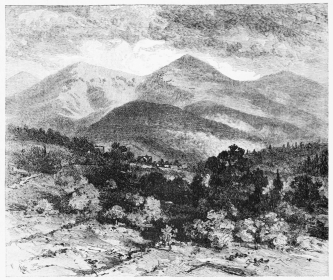
THE NORTHERN PEAKS FROM JEFFERSON.
We see that we have taken one step nearer the northern wing of the
great central edifice whose snowy dome dominates New England. We are
advancing as if to turn this magnificent battle-line of Titans, on
whose right Madison stands in an attitude to repel assault. Adams next
erects his sharp lance, Jefferson his shining crescent, Washington his
broad buckler, and Monroe his twin crags against the sky. Jefferson,
as the nearest, stands boldly forward, showing its tremendous ravines,
and long, supporting ridges, with great distinctness. Washington loses
something of its grandeur here; at least it is not the most striking
object; that must be sought for among the sable-sided giants standing at
his right hand. The southern peaks, being foreshortened, show only an
irregular and flattened outline which we do not look at a second time.
From Madison to Lafayette, our two rallying points, the distance can
hardly be less than forty miles as the eye travels: the entire circuit
it is able to trace cannot fall short of seventy or eighty miles. As
at Bethlehem, the view out of the valley is chiefly remarkable for its
contrast with every other feature.
I took a peculiar satisfaction in these views, they were so ample,
so extensive, so impressive. Here you really feel as if the whole
noble company of mountains were marshalled solely for your delighted
inspection. At no other point is there such unmeasured gratification
in seeing, because the eye roves without hinderance over the grandest
summits, placed like the Capitol at the head of its magnificent avenue.
It alights first on one pinnacle, then flits to another. It interrogates
these immortal structures with a calm scrutiny. It dives into the cool
ravines; it seeks to penetrate, like the birds, the profound silence
of the forests. It toils slowly up the broken crags, or loiters by
the cascades, hanging like athletes from dizzy brinks. It shrinks, it
admires, it questions; it is grave, gay, or thoughtful by turns. I do
not believe the man lives who, looking up to those mountains as in the
face of the Deity, can deliberately utter a falsehood: the lie would
choke him.
Furthermore, you get the best idea of height here, because the long
amphitheatre of mountains is seen steadily growing in stature toward
the great central group; and comparison is, by all odds, the best of
teachers for the eye.
If for no other reason than the respect due to age, Jefferson deserves a
moment to itself. It was granted, October 3d, 1765, to John Goffe, under
the name of Dartmouth. The road diverging here, and crossing Cherry
Mountain to Fabyan’s, is the oldest, as it long was the only highway
through the White Mountains. In those early times the travelled way
was by the Connecticut River and Lancaster through this valley to the
White Mountain Notch. The divergent road is the old turnpike between
Vermont and Portland. Gradually, as settlements were pushed farther and
farther up the Ammonoosuc, a way was made by Bath, Lisbon, Littleton,
and Dalton, to Lancaster; but to pass beyond it was still necessary to
follow the old route; nor was it until after the settlement of Bethlehem
cleared the way that an execrable horse-path was made over the present
great highway up the Ammonoosuc. In 1803 President Dwight passed over
this new road on his second excursion to the great Notch. Few travellers
would now be willing to undergo what he did to see the mountains.
There were then only three or four houses in the sixteen miles between
Bethlehem and the Notch.
One of the first settlers of Jefferson was Colonel Joseph Whipple,
mentioned in the narrative of Nancy, the ill-starred mountain-maid, who
died while following her faithless lover in his flight from Jefferson
out of the mountains. Colonel Whipple lived on the road to Cherry
Mountain, near the mill. In 1797 his was the only house on the road.
During the Revolution a party of Indians, led by a white man, surrounded
the house, and made Whipple their prisoner. Inventing some pretext, the
colonel obtained leave to go into another room, from which he made his
escape by a window and fled to the woods, where he successfully eluded
pursuit.
Finding myself already well advanced toward the summit of Starr King,
I finished the ascent of this mountain during an afternoon’s stroll.
Nothing worthy of remark, except the exquisite view from the summit,
presented itself. Here I met again a throng of old acquaintances, and
encountered a crowd of new ones. Here I saw something like a shadow
darken the side of Mount Washington, and watched it creep steadily up
and up to the summit. The shadow was the smoke of the locomotive making
its last ascent for the day, under the eyes of thousands of spectators,
who look at it to turn away with a smile, a shrug, or a shake of the
head.
The name of Starr King has become a household word with all travellers
in the White Mountains. It was most fitting that he who interpreted
Nature so well and so truly should receive his monument at her hands. To
him the mountains were emblematic of her highest perfection. He loved
them. His tone when speaking of them is always tender and caressing.
They appealed to his rare and exquisite perception of the beautiful,
to his fine and sensitive nature, capable of detecting intuitively
what was hid from common eyes. He felt their presence to be ennobling
and uplifting. He opened for us the charmed portal. We accompanied him
through an earthly paradise then first revealed to us by the fervor
and wealth of his description. He led us to the shadiest retreats, the
coolest groves, the most secluded glens. He guided our footsteps up the
steep mountain-side to the bleak summit. Thrice fitting was it that a
mountain should perpetuate the name of Thomas Starr King. As was said at
the grave of Gautier, he too dated “from the creation of the beautiful.”
I have now rested four days at Ethan Crawford’s, who lives on the side
of Boy Mountain, five miles east of Jefferson Hill, on the road to
Gorham. This Ethan is a son of the celebrated guide and host so well
known to former travellers by the sobriquet of Keeper of the Mountains.
I go to the window, and facing toward the setting sun look down the
broadening valley of Israel’s River, over the glistening house-tops
of Whitefield, into and beyond the Connecticut Valley. I have Mitten
Mountain and Cherry Mountain, both heavily wooded, just over the way,
although the view of these elevations is in part intercepted by a nearer
mountain, also covered with a vigorous forest. At this moment I hear the
rush of the stream far down in the Hollow; and, following the serpentine
line its dark course makes among the press of hills, am confronted by
the massive slopes of Madison and Adams, the sombre ravine and castled
crags of Jefferson, and the hoary crest of Washington. I am really in
the heart of the mountains.
Swiftly from these mountains descend, with exquisite grace, enormous
billows of deep sea-green, which do not subside but lift themselves
proudly at the foot of those great overhanging walls of olive and
malachite. Here rolling together, their foliage, bright or dark, repeats
the effect of flaws sweeping over a sunny sea. Their deep hollows,
arching sides, and limpid crests perfect the resemblance to the moment
when, having exerted its utmost energy, the panting ocean stands
exhausted and motionless in the grasp of the north wind.
These lower mountains, interposing a barrier between the two valleys
of the Ammonoosuc and of Israel’s River, seem, you think, pushed up
from the yielding earth simply by the enormous weight of the higher
and neighboring mountains whose keen summit-lines cut New England in
halves. At this hour these lines are edged with dull gold. All along
the wavering heights I can detect with the naked eye isolated black
crags, and can plainly see the deep dents in the broken cornices and
capitals of the grand old mountains—those vestiges of their primordial
architecture. Here the inclined ridge of the plateau, connecting the
pinnacle of Washington with the peaks of Monroe, is traced along its
whole extent. At this distance its craggy outline breaks in light
ripples, announcing nothing of that wilderness of stones assailing the
climber. All the asperities are softened into capricious harmonies.
Below yawn the ravines.
The tracks of old slides and torrents in the side of Monroe remind
you of the branches of a gigantic fossil tree, exposed by a fracture
dividing the mountain in two. Such is, in fact, the impression received
by looking at this mountain; but the object which most excites my
attention is the broad and deep rent in the side of Jefferson, over
which hang on one side the crumbling counterfeits of towers and
battlements, while on the other cataracts, like necklaces, are suspended
over its unfathomed abysses. Cloud-shadows drift noiselessly along the
warm steeps. Cataracts glisten brightly in the sun. The grave peaks look
down unmoved on the play of the one and the sport of the other.
The picture of life in East Jefferson would not be complete without the
old hound dozing in the sun, the turkey-cocks strutting consequentially
up and down, the barn-swallows darting swiftly in and out, the ring of
young Ethan’s anvil, and the bleating of sheep far up the mountain-side.
I see them nibbling the fresh herbage, and watch the gambols of the
lambs like a child—only the child laughs aloud, and I do not laugh.
Voices come down the hillside, and I see the slow movement of a hammock
and the flutter of a dress in the maple-grove. Poetry and perfume mingle
with the scent of wild-flowers and songs of golden-mouthed birds.
Evening does not drive us within doors, the nights are so enchanting.
Day fades imperceptibly out. Even the stars seem disconcerted. One by
one they peep, and then flit from view. We watch the slow mustering of
the celestial host in silence. A meteor leaps from heaven to earth.
The fire-flies resemble a shower of sparks, or, as darkness deepens,
a phosphorescent sea. Dorbeetles hurtle the still air, and frogs sing
barcarolles in the misty fens. Now the mountains put on their sable
armor that is to render them invisible. Here the poet must assist us:
“It is the hush of night; and all between
Thy margin and the mountains, dusk, yet clear,
Mellowed and mingling, yet distinctly seen—
Save darkened Jura, whose capped heights appear
Precipitously steep.”
Light seems reluctant to leave the summits. It does not wholly fade
out of the west until a late hour. In a clear and starry night all the
surrounding mountains can be distinguished long after the valley is
steeped in darkness. At half-past nine I could easily tell the time by
my watch; and even at this hour a pale, nebulous light still lingered
where the sun had gone down. So at near two thousand feet above the full
sea one peers over into that deeper horizon where twilight and dawn meet
and embrace on the dusky threshold of midnight.
While in the neighborhood, I devoted a day to an exploration of the
Ravine of the Cascades. This ravine is entered from a point on the
Gorham road about three miles distant from the Mount Adams House. A
cart-way crosses the meadow here to an abandoned mill which is on the
stream coming from the ravine, and by which you must ascend. A more
beautiful example of a mountain brook it has never been my lot to see.
The ascent is, however, tedious and toilsome in the extreme over the
smooth and slippery rocks in its bed. Four hours of this brought me to
the region of low trees, and to the foot of the first fall, which, I
judged, descended about thirty feet. This way to the summit is open only
to the most vigorous climbers. Even then it is better to descend into
the ravine from the gap between Adams and Jefferson in order to visit
these cascades.
The two most profitable excursions to be made here are undoubtedly the
ascent of Mount Adams and the drive to the top of Randolph Hill. I have
found on the first summit irrefragable evidence that, next to Washington
and Lafayette, Adams is the peak which summer tourists are most desirous
of ascending. A good path, on which there is a camp, leads to the
summit. Having other views in regard to this mountain, which I had so
often admired from a distance, I made a third reconnoisance of its
outworks and its remarkable ravine, while en route for Randolph Hill.
Unquestionably fine as the views are along this road, on which you are
at one time rolling smoothly over meadow or upland, with the great
northern peak rising to its full height, or again toiling up a stony
hill-side to obtain a much better idea of its real character and
prodigious dimensions, the climax is reserved until, turning from the
highway, you begin a slow advance up the long hill-side that makes an
almost uninterrupted descent for five miles to the Androscoggin. Here
I saw from a balcony what I had before seen from the ground-floor.
The view is large and expansive. You look down the surging land into
the Androscoggin. You look over among the mountains circling its
head, huddled together like a frightened herd. You look down into the
valley of the Moose, and through the gap in the great chain you again
see the valley of the Peabody and the Carter Notch. Now you hold the
great northern peaks admiringly at arm’s-length, as you would an old
friend. Putting an imaginary hand on each broad shoulder, you scan them
from head to foot. They submit calmly and with condescension to your
lengthened scrutiny. Presently the low sun floods them with royal purple
and gilds the topmost crags with refined gold. You glance up the valley.
The little river comes like a stream of fire which the huge mountains
seem crowding forward to trample out. Now look down. The same mountains
seem spurning the glittering serpent away from their feet.
King’s Ravine is as well seen from this point, perhaps, as any. It
is a huge natural niche excavated high up the mountain. You see
everything—grizzled spruces, blackened shafts of stone, rifted walls,
tawny crags—all in one glance. It is formidable and forbidding, though
a way has been made through it by which to ascend Mount Adams. Now that
there is a good path skirting the ravine and avoiding it, that look will
usually suffice to deter sensible people from attempting to reach the
summit by it. It is far better to descend into it and grope one’s way
down through and underneath the bowlders. The same, and even greater,
obstacles are encountered as in Tuckerman’s. In early spring the walls
of the ravine are streaked with slowly-melting snows. These gulches, all
converging toward the bottom, send a torrent roaring down with noise
equal to surf on a hard sea-beach. This torrent is the principal source
of the Moose.
Well do I remember my first venture here. I had walked from Gorham.
Seeing a man chopping wood by the side of the road, I entered into
conversation with him; but at the first suggestion I let fall of an
intention to climb to the ravine he gaped open-mouthed. To ascend
the brook to the ravine, the escarpment of the ravine to the high
precipices, the precipices to the gate-way, was an exploit in those
days. But this was long ago. A good climber now puts King’s Ravine down
in his list of excursions with the same nonchalance that a belle of the
ball-room enters an additional waltz on her card of engagements.[39]
One day I had fished along the Moose without success. Nothing could
give a better idea of a mountain stream than this one, fed by snows and
gushing from the breached side of Mount Adams. But either the water was
too cold or the trout too wary. They persistently refused my fly. I
tried red and brown hackle, then a white moth-miller; all to no purpose.
Feeling downright hungry, I determined to seek a dinner elsewhere.
Unjointing my rod, I returned, rather crestfallen, down the mountain
into the road.
I knocked at the first house. Pretty soon the curtain of the first
window at my left hand was partly drawn aside. I felt that I was under
the fire of a pair of very black eyes. An instant after the door was
half-opened by a woman past middle life, who examined me with a scared
look while wiping her hands on a corner of her apron. Two or three white
heads peeped out from the folds of her dress like young chickens from
the old hen’s wing, and as many pairs of widely-opened eyes surveyed me
with innocent surprise.
Perceiving her confusion, I was on the point of asking some indifferent
question, about the distance, the road—I knew not what—but my stomach
gave me a twinge of disdain, and I stood my ground. Hunger has no
conscience: honor was at stake. In two words I made known my wants, I
confess with confidence oozing away at my fingers’ ends.
Her confusion became still greater—so evident, indeed, that I took a
backward step and stammered, quite humbly, “A hunch of bread-and-cheese
or a cup of milk—” when the good-wife nailed me to the threshold.
Quoth she, “The men folks have all et their dinners, and there hain’t
no more meat; but if you could put up with a few trout?”
Put up with trout! Did I hear aright? The word made my mouth water.
I softly repeated it to myself—“Trout!”—would I put up with trout?
Not to lower myself in this woman’s estimation, I replied that, seeing
there was nothing else in the house, I would put up with trout. Let it
suffice that I made a repast fit for a prince, and, like a prince, being
served by a bashful maiden with cheeks like the arbutus, which everybody
knows shows its most delicate pink only in the seclusion of its native
woods.
My hours of leisure in Jefferson being numbered, having now made the
circuit of the great range by all the avenues penetrating or environing
it, the reader’s further indulgence is craved while his faithful guide
points his well-worn alpenstock to the last stage of our mountain
journeys.
Behold us at last, after many capricious wanderings, after calculated
avoidance, approaching the inevitable end. We are en route for
Fabyan’s by the road over Cherry Mountain. This road is twelve miles
long. As we mount with it the side of Cherry Mountain the beautiful
vistas continually detain us. We are now climbing the eastern wall of
the valley, so long the prominent figure from the heights of Jefferson.
We now look back upon the finely-traced slopes of Starr King, with the
village luxuriously extended in the sun. For some time we are like two
travellers going in opposite directions, but who turn again and again
for a last adieu. Now the forest closes over us and we see each other no
more.
Noonday found me descending that side of the mountain overlooking the
Ammonoosuc Valley. Where the Cherry Mountain road joins the valley
highway the White Mountain House, an old-time tavern, stands. The
railway passes close to its door. A mile more over the level brings us
to Fabyan’s, so called from one of the old mountain landlords, whose
immortality is thus assured. Now that mammoth caravansary, which seems
all eyes, is reached just as the doors opening upon the great hall
disclose a long array of tables, while permitting a delicious odor to
assail our nostrils.
To speak to the purpose, the Fabyan House really commands a superb front
view of Mount Washington, from which it is not six miles in a bee-line.
All the southern peaks, among which Mount Pleasant is undoubtedly the
most conspicuous for its form and its mass, and for being thrown so
boldly out from the rest, are before the admiring spectator; but the
northern peaks, with the exception of Clay and Jefferson, are cut off
partly by the slopes of Mount Deception, which rises directly before the
hotel, partly by the trend of the great range itself to the north-east.
The view is superior from the neighborhood of the Mount Pleasant House,
half a mile beyond Fabyan’s, where Mount Jefferson is fully and finely
brought into the picture.
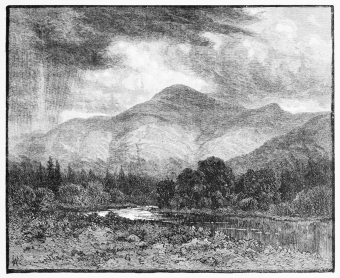
MOUNT WASHINGTON, FROM FABYAN’S.
The railway is seen mounting a foot-hill, crossing a second and
higher elevation, then dimly carved upon the massive flanks of Mount
Washington itself, as far as the long ridge which ascends from the
north in one unbroken slope. It is then lost. We see the houses upon
the summit, and from the Mount Pleasant House the little cluster of
roofs at the base. A long and well-defined gully, exactly dividing the
mountain, is frequently taken to be the railway, which is really much
farther to the left. The smoke of a train ascending or descending still
further indicates the line of iron, which we admit to the category of
established facts only under protest.
Sylvester Marsh, of Littleton, New Hampshire, was the man who dreamed
of setting aside the laws of gravitation with a puff of steam. Like
all really great inventions, his had to run the gauntlet of ridicule.
When the charter for a railway to the summit of Mount Washington was
before the Legislature a member moved that Mr. Marsh also have leave
to build one to the moon. Had the motion prevailed, I am persuaded Mr.
Marsh would have built it. Really, the project seemed only a little
more audacious. But in three years from the time work was begun (April,
1866) the track was laid and the mountain in irons.[40] The summit which
the superstitious Indian dared not approach, nor the most intrepid
white hunter ascend, is now annually visited by thousands, without more
fatigue than would follow any other excursion occupying the same time.
The excitement of a first passage, the strain upon the nerves, is quite
another thing.
In a little grass-grown enclosure, on the other side of the Ammonoosuc,
is a headstone bearing the following inscription:
IN MEMORY OF
CAP ELIEZER ROSBROOK
WHO DIED SEP. 25
1817
In the 70 Year
Of His Age.
When I lie buried deep in dust,
My flesh shall be thy care
These withering limbs to thee I trust
To raise them strong and fair.
WIDOW
HANNAH ROSEBROOK
Died May 4, 1829
Aged 84
Blessed are the dead who die in the Lord. For they rest from their labors
And their works do follow them.
So far as is known Rosebrook was the first white settler on this spot.
One account[41] says he came here in 1788, another fixes his settlement
in 1792.[42] His military title appears to have been derived from
services rendered on the Canadian frontier during the Revolutionary
War. Rosebrook was a true pioneer, restless, adventurous, and fearless.
He was a man of large and athletic frame. From his home in Massachusetts
he had first removed to what is now Colebrook, then to Guildhall, Vt.,
and lastly here, to Nash and Sawyer’s Location, exchanging the comforts
which years of toil had surrounded him with, abandoning the rich and
fertile meadow-lands of the Connecticut, for a log-cabin far from any
human habitation, and with no other neighbors than the bears and wolves
that prowled unharmed the shaggy wilderness at his door. With his axe
this sturdy yeoman attacked the forest closely investing his lonely
cabin. Year by year, foot by foot, he wrested from it a little land
for tillage. With his gun he kept the beast of prey from his little
enclosure, or provided venison or bear’s meat for the wife and little
ones who anxiously awaited his return from the hunt. Hunger and they
were no strangers. For years the strokes of Rosebrook’s axe, or the
crack of his rifle, were the only sounds that disturbed the silences
of ages. Little by little the circle was enlarged. One after another
the giants of the forest fell beneath his blows. But years of resolute
conflict with nature and with privation found him at last in the
enjoyment of a dearly-earned prosperity. Travellers began to pass his
doors. The Great White Mountain Notch soon became a thoroughfare, which
could never have been safely travelled but for Rosebrook’s intrepidity
and Rosebrook’s hospitality. In this way began the feeble tide of travel
through these wilds. In this way the splendidly equipped hotel, with its
thousands of guests the locomotive every hour brings to its door, traces
its descent from the rude and humble cabin of Eleazer Rosebrook.
Cradled and rocked by wind and cloud,
Safe pillowed on the summit proud,
Steadied by that encircling arm
Which holds the Universe from harm,
I knew the Lord my soul would keep,
Upon His mountain-tops asleep!
Lucy Larcom.
THUS I found myself again at the base of Mount Washington, but on the
reverse, opposed to the Glen. Before the completion of the railway from
Fabyan’s to the foot of the mountain I had passed over the intervening
six miles by stage—a delightful experience; but one now steps on
board an open car, which in less than half the time formerly occupied
leaves him at the point where the mountain car and engine wait for him.
The route lies along the foaming Ammonoosuc, and its justly admired
falls, cut deep through solid granite, into the uncouth and bristling
wilderness which surrounds the base of the mountain. The peculiarity
of these falls does not consist in long, abrupt descents of perturbed
water, but in the neatly excavated caves, rock-niches, and smoothly
rounded cliffs and basins through which for some distance the impatient
stream rears and plunges like a courser feeling the curb. Imperfect
glimpses hardly give an idea of the curious and interesting processes
of rock-cutting to one who merely looks down from the high banks above
while the train is in rapid motion. It is better, therefore, to visit
these falls by way of the old turnpike.
The advance up the valley which has first given us an outlook through
the great Notch, on our right, presents for some time the huge green
hemisphere of Mount Pleasant as the conspicuous object. The track then
swerves to the left, bringing Mount Washington into view, and in a few
minutes more we are at the ill-favored clump of houses and sheds at its
base.
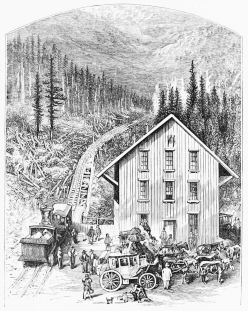
MOUNTAIN RAILWAY-STATION IN STAGING TIMES.
The mechanism of the road-way is very simple. The track is formed of
three iron rails, firmly clamped to stout timbers, laid lengthwise upon
transverse pieces, or sleepers. These are securely embedded, where the
surface will allow, or raised upon trestles, where its inequalities
would compel a serious deflection from a smooth or regular inclination.
One of these, about half-way up the mountain, is called Jacob’s Ladder.
Here the train achieves the most difficult part of the ascent. After
traversing the whole line on foot, and inspecting it minutely and
thoroughly, I can candidly pronounce it not only a marvel of mechanical
skill, but bear witness to the scrupulous care taken to keep every
timber and every bolt in its place. In two words, the structure is
nothing but a ladder of wood and iron laid upon the side of the
mountain.[43]
The propelling force employed is equally simple. The engine and car
merely rest upon and are kept in place by the two outer rails, while
the power is applied to the middle one, which we have just called a
rail, but is, more properly speaking, a little ladder of steel cogs,
into which the corresponding teeth of the locomotive’s driving-wheel
play—a firm hold being thus secured. The question now merely is, how
much power is necessary to overcome gravity and lift the weight of the
machine into the air? This cogged-rail is the fulcrum, and steam the
lever. Mr. Sylvester Marsh has not precisely lifted the mountain, but he
has, nevertheless, with the aid of Mr. Walter Aiken, reduced it, to all
intents, to a level.
The boiler of the locomotive, inclined forward so as to preserve a
horizontal position when the engine is ascending, the smoke-stack
also pitched forward, give the idea of a machine that has been in a
collision. Everything seems knocked out of place. But this queer-looking
thing, that with bull-dog tenacity literally hangs on to the mountain
with its teeth, is capable of performing a feat such as Watt never
dreamed of, or Stephenson imagined. It goes up the mountain as easily as
a bear climbs a tree, and like a bear.
I had often watched the last ascension of the train, which usually
reaches the summit at sunset, and I had as often pleased myself with
considering whether it then most resembled a big, shining beetle
crawling up the mountain side, or some fiery dragon of the fabulous
times, dragging his prey after him to his den, after ravaging the
valley. My own turn was now come to make the trial. It was a cold
afternoon in September when I entered the little carriage, not much
larger than a street-car, and felt the premonitory jerk with which the
ascent begins. The first hill is so steep that you look up to see the
track always mounting high above your head; but one soon gets used to
the novelty, and to the clatter which accompanies the incessant dropping
of a pawl into the indentures of the cogged-rail, and in which he
recognizes an element of safety. The train did not move faster than one
could walk, but it moved steadily, except when it now and then stopped
at a water-tank, standing solitary and alone upon the waste of rocks.
By the time we emerged above the forest into the chill and wind-swept
desolation above it—a first sight of which is so amazing—the sun
had set behind the Green Mountain summits, showing a long, serrated
line of crimson peaks, above which clouds of lake floated in a sea
of amber. It grew very cold. Great-coats and shawls were quickly
put on. Thick darkness enveloped the mountain as we approached the
head of the profound gulf separating us from Mount Clay, which is the
most remarkable object seen at any time either during the ascent or
descent. Into this pitchy ravine, into its midnight blackness, a long
and brilliant train of sparks trailed downward from the locomotive, so
that we seemed being transported heavenward in a chariot of fire. This
flaming torch, lighting us on, now disclosed snow and ice on all sides.
We had successfully attained the last slope which conceals the railway
from the valley. Up this the locomotive toiled and panted, while we
watched the stars come out and emit cold gleams around, above, beneath.
The light of the Summit House twinkled small, then grew large, as,
surmounting the last and steepest pitch of the pinnacle, we were pushed
before a long row of lighted windows crusted thick with hoar-frost.
Stiffened with cold, the passengers rushed for the open door without
ceremony. In an instant the car was empty; while the locomotive,
dripping with its unheard-of efforts, seemed to regard this desertion
with reproachful glances.
Reader, have you ever sat beside Mrs. Dodge’s fire after such a passive
ascension as that just described? After a two hours’ combat with the
instinct of self-preservation, did you dream of such comforts, luxuries
even, awaiting you on the bleak mountain-top, where nothing grows, and
where water even congeals and refuses to run? Could you, in the highest
flights of fancy, imagine that you would one day sit in the courts of
heaven, or feast sumptuously amid the stars? All this you either have
done or may do. And now, while the smartly-dressed waiter-girl, who
seems to have donned her white apron as a personal favor, brings you the
best the larder affords, pinch yourself to see if you are awake.
In several ascensions by the railway I have always remarked the same
symptoms of uneasiness among the passengers, betrayed by pale faces,
compressed lips, hands tightening their grasp of the chairs, or subdued
and startled exclamations, quickly repressed. To escape the influence of
such weird surroundings one should be absolutely stolid—a stock or a
stone. So for all it is an experience more or less acute, according to
his sensibility, strength of nerve, and power of self-control. However
well it may be disguised, the strong equally with the weak, and more
deeply than the weak, feel the strain which ninety minutes’ combat with
gravitation, attraction, ponderosity, engenders. The mind does not for a
single instant quit its hold of this defiance of Nature’s laws. As long
as iron and steel hold fast, there is no danger; but you think iron and
steel are iron and steel, and no more. An anecdote will illustrate this
feeling.
After pointing out to a lady-passenger the skilful devices for stopping
the engine—the pawl, the steam, and the atmospheric brakes—and after
patiently explaining their mechanism and uses, the listener asked the
conductor, with much interest,
“Then, if the pawl breaks while we are going up?”
“The engine will be stopped by means of these powerful brakes, applied
directly to the axles, which will, of course, render the train
motionless. As the locomotive has two driving-wheels, the engineer can
bring a double power to bear, as you see. Each is independent of the
other, so that if one gives way the other is still more than sufficient
to keep the engine stationary.”
“Thank you; but the car?”
“Oh, the car is not attached to the engine at all; and should the
engineer lose the control of his machine, which is not at all likely,
the car can be brought to a stand-still by independent brakes of its
own. You see the engine goes up behind, and in front, down; and the car
is simply pushed forward, or follows it.”
“So that you consider it—.”
“Perfectly safe, madam, perfectly safe.”
“Thank you. One question more. Suppose all these things break at once.
What then? Where would we go?”
“That, madam, would depend on what sort of a life you had led.”
I have still a consolation for the timid. Ten years’ trial has confirmed
the declaration of its projectors, that they would make the road as safe
or safer than the ordinary railway. No life has been lost by an injury
to a passenger during that time. Besides, what is the difference? After
its day, the railway will pass like the stage-coach—that is, unless you
believe, as you do not, that the world and all progress are to stop with
ourselves.
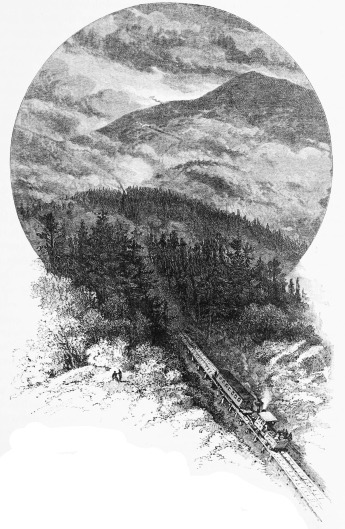
ASCENT BY THE RAILWAY.
The affable lady hostess told me that she paid an annual rental of ten
thousand dollars for her palace of ice; nominally for a year, but really
for a term of only seventy-six days, this being the limit of the season
upon the summit. During the remaining two hundred and eighty-nine
days the house is closed. During four or five months it is buried, or
half-buried, in a snow-drift. Of this large sum, three thousand dollars
go to the Pingree heirs. These facts may tend to modify the views of
those who think the charges exorbitant, if such there are.
Raising my eyes to look out of the window, the light from within
fell upon a bank of snow. A man was stooping over it as if in search
of something. Going out, I found him feeling it with his hands, and
examining it with childish wonder and curiosity. I approached this
eccentric person very softly; but he, seeing my shadow on the snow
beside him, looked up.
“Can I assist you in recovering what you have lost?” I inquired.
“Thank you; no. I have lost nothing. Ah! I see,” he continued, laughing
quietly, “you think I have lost my wits. But it is not so. I am a native
of the East Indies, and I assure you this is the first time in my life I
have ever seen snow near enough to handle it. Imagine what an experience
the ascent of Mount Washington is for me!”
We took a turn down the hard-frozen Glen road together in order to see
the moon come up. The telegraph-poles, fantastically crusted with ice to
the thickness of a foot, stretched a line of white-hooded phantoms down
the dark side of the mountain. From successive coatings of frozen mist
the wires were as thick as cables. Couches of snow lay along the rocks,
and fresh snow had apparently been rubbed into all the inequalties of
the cliffs rising out of the Great Gulf. The scene was supremely weird,
supremely desolate.
From here we crossed over to the railway, and, ascending by it, shortly
came upon the heap of stones, surmounted by its tablet, erected on
the spot where Miss Bourne perished while ascending the mountain, in
September, 1855. The party, of which she was one, setting out in high
spirits in the afternoon from the Glen House, was overtaken near the
summit by clouds, which hid the house from view, and among which they
became bewildered. It was here Miss Bourne declared she could go no
farther. Overcome by her exertions, she sunk exhausted and fainting
upon the rocks. Her friends were scarcely awakened to her true
condition when, amid the surrounding darkness and gloom, this young
and lovely maiden of only twenty expired in the arms of her uncle. The
mourners wrapped the body in their own cloaks, and, ignorant that a
few rods only separated them from the summit, kept a vigil throughout
the long and weary night. We hasten over this night of dread. In the
morning, discovering their destination a few rods above them, they bore
the lifeless form of their companion to it with feelings not to be
described. A rude bier was made, and she who had started up the mountain
full of life now descended it a corpse.
The evening treated us to a magnificent spectacle. The moon, in
full-orbed splendor, moved majestically up the heavens, attended by her
glittering retinue of stars. Frozen peaks, reflecting the mild radiance,
shone like beaten silver. But the immense hollows between, the deep
valleys that had been open to view, were now inundated with a white and
luminous vapor, from which the multitude of icy summits emerged like a
vast archipelago—a sea of islands. This spectral ocean seemed on the
point of ingulfing the mountains. This motionless sea, these austere
peaks, uprising, were inconceivably weird and solemnizing. An awful hush
pervaded the inanimate but threatening host of cloud-girt mountains.
Upon them, upon the sea of frozen vapor, absorbing its light, the clear
moon poured its radiance. The stars seemed nearer and brighter than
ever before. The planets shone with piercing brilliancy; they emitted
a sensible light. The Milky Way, erecting its glittering nebula to the
zenith, to which it was pinned by a dazzling star, floated, a glorious,
star-spangled veil, amid this vast sea of gems. One could vaguely catch
the idea of an unpeopled desolation rising from the fathomless void of
a primeval ocean. The peaks, incased in snow and ice, seemed stamped
with the traces of its subsidence. Pale and haggard, they lifted their
antique heads in silent adoration.
Going to my room and extinguishing the light, I stood for some time
at the window, unable to reconcile the unwonted appearance of the
stars shining far below, with the fixed idea that they ought not to be
there. Yet there they were. To tell the truth, my head was filled with
the surpassing pomp I had just witnessed, of which I had not before
the faintest conception. I felt as if I was silently conversing with
all those stars, looking at me and my petty aspirations with such
inflexible, disdainful immobility. When one feels that he is nothing,
self-assurance is no great thing. The conceit is taken out of him. On a
mountain the man stands naked before his Maker. He is nothing. That is
why I leave him there.
That night I did not sleep a wink. Twenty times I jumped out of bed and
ran to the window to convince myself that it was not all a dream. No;
moon and stars were still bright. Over the Great Gulf, all ghastly in
the moonlight, stood Mount Jefferson in his winding-sheet. I dressed
myself, and from the embrasure of my window kept a vigil.
Sunrise did not produce the startling effect I had anticipated. The
morning was fine and cloudless. A gong summoned the inmates of the
hotel to the spectacle. Without dressing themselves, they ran to their
windows, where, wrapped in bed-blankets, they stood eagerly watching the
east. To the pale emerald of early dawn a ruddy glow succeeded. Before
we were aware, the rocky waste around us grew dusky red. The crimsoned
air glided swiftly over the neighboring summits. Now the brightness
was upon Adams and Jefferson and Clay, and now it rolled its purpled
flood into the Great Gulf, to mingle with the intense blackness at the
bottom. For some moments the mountain-tops held the color, then it was
transfused into the clear sunshine of open day; while the vapors, heavy
and compact, stretched along the valleys, still smothering the land,
retained their leaden hue.
It was still early when I descended the carriage-road on my way to Mount
Adams. The usual way is to keep the railway as far as the old Gulf Tank,
near which is a house of refuge, provided with a cooking-stove, fuel,
and beds. I continued, however, to coast the upper crags of the Great
Gulf, until compelled to make directly for the southern peak of Mount
Clay. The view from this col is imposing, embracing at once, and
without turning the head, all the southern summits of the chain. Here I
was joined by two travellers fresh from Mont Blanc and the Matterhorn.
Each choosing a route for himself, we pushed on to the high summit of
Clay, from which we looked down into the deep gap dividing this mountain
from Jefferson. Arrived there, we resolutely attacked the eastern slopes
of this fine peak, whose notched summit rose more than seven hundred and
fifty feet above our heads. Patches of Alpine grasses, of reindeer-moss,
interspersed with irregular ridges of stones, extended quite up to the
summit, which was a mere elongated stone-heap crowning the apex of its
cone. Those undulating masses encircling its bulk, half hid among the
grass, were like an immense python crushing the mountain in its deadly
folds. We picked our way carefully among this chaotic débris, which the
Swiss aptly call “cemeteries of the devil,” tripping now and then in the
long, wiry grass, or burying our feet among the hummocks of dry moss,
which were so many impediments to rapid progress. This appearance and
this experience were common to the whole route.
At each summit we threw ourselves upon the ground, to feast upon the
landscape while regaining breath. Each halt developed more and more
the grand and stupendous mass of Washington receding from the depths
of the Great Gulf, along whose edge the carriage-road serpentined
and finally disappeared. We saw, a little softened by distance, the
horribly mutilated crags of the head wall stripped bare of all verdure,
presenting on its knobbed agglomerates of tempest-gnawed granite a
thousand eye-catching points and detaining as many shadows. Nothing—not
even the glittering leagues of mountains and valleys shooting or
slumbering above, beneath—so riveted the attention as this apparently
bottomless pit of the five mountains. It was a continued wonder. It drew
us by a strange magnetism to its dizzy brink, chained us there, and
then abandoned us to a physical and moral vertigo, in which the power
of critical investigation was lost. An invisible force seemed always
dragging us toward it. Whence comes this horrible, this uncontrollable
desire to throw ourselves in?
Out of the death-like torpor which eternally shrouds the ravine
the smiling valley seems escaping. The crystal air of the heights
grows thick in its depths. Beasts and birds of prey haunt its gloomy
solitudes. An immense grave seems yawning to receive the mountains. The
aged mountains seem standing with one foot in the grave.
This gulf makes an impression altogether different from the others.
It is an immense ravine. Each of the five mountains pushes down into
it massive buttresses of granite, forming lesser ravines between of
considerable extent. Through these streams trickle down from invisible
sources. But these buttresses, which fall lightly and gracefully as
folds of velvet from summit to base of the highest mountains, these
ravines, are hardly noticed. The insatiable maw of the gulf swallows
them as easily as an anaconda a rabbit. In immensity, which you do not
easily grasp, in grandeur, which you do not know how to measure, this
has no partakers here. Even the great Carter Mountain, rising from the
Peabody Valley, seems no more than a stone rolled away from the entrance
of this enormous sepulchre.
Our first difficulties were encountered upon the reverse of Mount
Jefferson, from whose side rocky spurs detached themselves, and, jutting
out from the side of the mountain, formed an irregular line of cliffs
of varying height, in the way we had selected for the descent. But
these were no great affair. We now had the Ravine of the Castles upon
our left, the stately pyramid of Adams in front, and, beneath, the deep
hollow between this mountain and the one we were descending. We had the
little hamlet of East Jefferson at the mouth of the ravine, and that
crowd of peaks, tightly wedged between the waters of the Connecticut and
the Androscoggin, looming above it.
A deviation to the left enabled us to approach the Castellated Ridge,
which is, beyond dispute, the most extraordinary rock-formation the
whole extent of the range can show. As it is then fully before you, it
is seen to much better advantage when approached from Mount Adams. I
do not know who gave it this name, but none could be more felicitous
or expressive. It is a sloping ridge of red-brown granite, broken at
its summit into a long line of picturesque towers and battlements,
rising threateningly over an escarpment of débris. Such an illusion is
too rarely encountered to be easily forgotten. It is hardly possible
to doubt you are really looking at an antique ruin. One would like to
wander among these pre-Adamite fortifications, which curiously remind
him of the old Spanish fortresses among the Pyrenees. From the opposite
side of the ravine—for I had not the time requisite for a closer
examination—the rock composing the most elevated portion of the ridge
appears to have been split perpendicularly down, probably by frost,
allowing these broken columns and shafts to stand erect upon the verge
of the abyss. In the warm afternoon light, when the shadows fall, it is
hardly possible to conceive a finer picture of a crumbling but still
formidable mountain fortress. Bastions and turrets stand boldly out.
Each broken shaft sends a long shadow streaming down into the ravine,
whose high and deeply-furrowed sides are thus beautifully striped with
dusk-purple, while the sunlit parts retain a greenish-gray.
At the foot of Jefferson we found, concealed among rushes, a spring,
which refreshed us like wells of the desert the parched and fainting
Arab. From here two routes offered themselves. One was by keeping the
curved ridge, rising gradually to a subordinate peak (Samuel Adams),[44]
and to the foot of the summit itself; a second was by crossing the
ground sloping downward from this ridge into the Great Gulf. We chose
the latter, notwithstanding the dwarf-spruce, advancing well up to the
foot of the ridge, promised a warm reception.
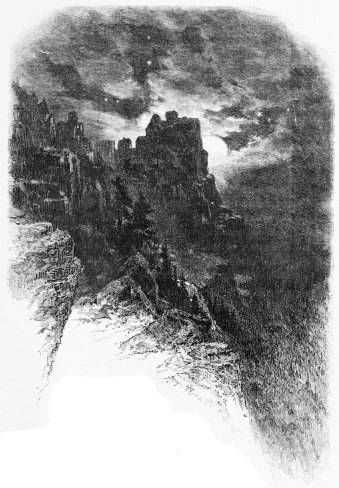
THE CASTELLATED RIDGE.
At last, after sustaining a vigorous tussle with the scrub-firs, and
stopping to unearth a brook whose waters purred underneath stones,
I stood at the foot of the pointed shaft I had so often seen wedged
into the sky. Five hundred feet or more of the apex of this pyramid
is apparently formed of broken rocks, dropped one by one into place.
Nothing like a ledge or a cliff is to be seen: only these ponderous,
sharp-edged masses of cold gray stone, lifted one above another to the
tapering point. Up this mutilated pyramid we began a slow advance. It
was necessary to carefully choose one step before taking another, in
order to avoid plunging into the deep crevasses traversing the peak in
every direction. At last I placed my foot upon the topmost crag.
No one can help regarding this peak with the open admiration which is
its due. You conceive that every mountain ought to have a pinnacle.
Well, here it is. We could easily have stood astride the culminating
point. But how came these rocks here? and what was the primitive
structure, if these fragments we see are its relics? One hardly believes
that an ice-raft could have first transported and then deposited such
misshapen masses in their present symmetrical form. Still less does
he admit that the original shaft, crushed in a thousand pieces by
the glacier itself, fell with such grace as to rise again, as he now
sees it, from its own ruins. If, again, it proceeds from the eternal
hammering of King Frost, what was the antique edifice that first rose so
proudly above the frozen seas of the great primeval void? But to science
the things which belong to science. We have a book describing heaven,
but not one that resolves the problems of earth. The “Veni, vidi,
vici,” of the Book of Genesis leaves us at the beginning. We are still
staring, still questioning, still vacillating between this theory and
that hypothesis.[45]
We had from the summit an inspiring though not an extensive view. A
bank of dun-colored smoke smirched the fair western sky as high as the
summits of the Green Mountains. At fifty miles mountains and valleys
melted confusedly into each other. Water emitted only a dull glimmer.
Here a peak and there a summit surveyed us from afar. All else was
intangible; almost imaginary. At twenty-five miles the land, resuming
its ordinary appearance, was bathed in the soft brilliance caused by the
sun shining through an atmosphere only half transparent.
Upon this obscure mass we traced once more the well-known objects
environing the great mountain. To the south Mount Washington divided
the landscape in two. For some time we stood admiring its magnificent
torso, its amplitude of rock-land, its easy preponderance over every
other summit. Again we followed the road down the great north-east
spur. Once more we caught the white specks which denote the line of
the railway. We plunged our eyes down into the Great Gulf, and lifted
them to the shattered protuberances of Clay, which seemed to mark the
route where the glacier crushed and ground its way through the very
centre of the chain. A second time we descended Jefferson to the deep
dip, opening like a trough between two enormous sea-waves, where we
first saw the little Storm Lake glistening. Following now the long,
rocky ridge, rolling downward toward the hamlets of Jefferson and
Randolph, the mountains yawned wide at our feet. We were looking over
into King’s Ravine—to its very bottom. We peered curiously into its
remotest depths, traced the difficult and breathless ascent through
the remarkable natural gateway at its head out upon a second ridge,
on which a little pond (Star Lake) lies hid. We then crossed the gap
communicating with Mount Madison, whose summit, last and lowest of the
great northern peaks, dominates the Androscoggin Valley with undisputed
sway. To-day it made on us scarcely an impression. Its peak, which from
the valley holds a rough similitude with that of Adams, is dwarfed here.
You look down upon it.
More applicable to Adams than to any other, for our eyes grow dazzled
with the glitter and sparkle of countless mica-flakes incrusting the
hard granite with clear brilliancy as from the facets of a diamond; more
applicable, again, from the stern, unconquerable attitude of the great
gray shaft itself, lifted in such conscious pride beyond the confines
of the vast ethereal vault of blue—a tower of darkness invading the
bright realms of light; a defiance flung by earth in the face of high
heaven—is the magnificent description of the Matterhorn from the pen of
Ruskin:
“If one of these little flakes of mica-sand, hurried in tremulous
spangling along the bottom of the ancient river, too light to sink,
too faint to float, almost too small for sight, could have had a mind
given to it as it was at last borne down with its kindred dust into
the abysses of the stream, and laid (would it not have thought?) for a
hopeless eternity in the dark ooze, the most despised, forgotten, and
feeble of all earth’s atoms; incapable of any use or change; not fit,
down there in the diluvial darkness, so much as to help an earth-wasp
to build its nest, or feed the first fibre of a lichen—what would it
have thought had it been told that one day, knitted into a strength as
of imperishable iron, rustless by the air, infusible by the flame, out
of the substance of it, with its fellows, the axe of God should hew that
Alpine tower;—that against it—poor, helpless mica-flake!—the snowy
hills should lie bowed like flocks of sheep, and the kingdoms of the
earth fade away in unregarded blue; and around it—weak, wave-drifted
mica-flake!—the great war of the firmament should burst in thunder, and
yet stir it not; and the fiery arrows and angry meteors of the night
fall blunted back from it into the air; and all the stars in the clear
heaven should light, one by one, as they rose, new cressets upon the
points of snow that fringed its abiding-place on the imperishable spire!”
Myself and my companions set out on our return to the Summit House early
in the afternoon, choosing this time the ridge in preference to the
scrubby slope. From this we turned away, at the end of half an hour,
by an obscure path leading to a boggy pool, sunk in a mossy hollow
underneath it, crossed the area of scattered bowlders, strewn all around
like the relics of a petrified tempest, and, filling our cups at the
spring, drank to Mount Adams, the paragon of mountain peaks.
As we again approached the brow of Mount Washington the sun resembled
a red-hot globe of iron flying through the west and spreading a
conflagration through the heavens. Again the colossal shadow of the
mountain began its stately ascension in the east. One moment the burning
eye of the great luminary interrogated this phantom, sprung from the
loins of the hoary peak. Then it dropped heavily down behind the Green
Mountains, as it has done for thousands of years, the landscape fading,
fading into one vast, shadowy abyss, out of which arose the star-lit
dome of the august summit.
GEOGRAPHY.—The White Mountains are in the northern central part of the
State of New Hampshire. They occupy the whole area of the State between
Maine and Vermont, and between Lake Winnipiseogee and the head-streams
of the Connecticut and Androscoggin rivers.
Two principal chains, having a general direction from south-west to
north-east, constitute this great water-shed of New England. These are
the Franconia and the White Mountains proper, sometimes called the
“Presidential Range.”
Grouped on all sides of the higher summits are a great number of
inferior ridges, among which, as in the Sandwich Range, rise some very
fine peaks, widely extending the mountainous area, and diversifying it
with numerous valleys, lakes, and streams.
Two principal rivers, the Saco and Merrimack, flowing from these two
chief clusters, form the two great valleys of the White Mountain system;
and by these valleys the railways enter the mountains from the seaboard.
Lake Winnipiseogee, which washes the southern foot of the mountains,
is also a thoroughfare, as are the valleys of the Connecticut and
Androscoggin rivers.
DISTANCES.—It is 430 miles from Philadelphia to Fabyan’s; 340 from New
York, via Springfield; 190 from Montreal, via Newport; 208 via
Groveton; 169 from Boston, via North Conway (Eastern R.R.); 208 via
Concord (B., C., & M. R.R.); 91 from Portland, via North Conway (P.
& O. R.R.); 91 from Portland to Gorham (G. T. R.); 199 from Boston to
Gorham, via Eastern and Grand Trunk roads; and 206 via Boston and
Maine and Grand Trunk roads.
ROUTES.—Procure, before starting, the official time-tables of the
railroads running to the mountains or making direct connection with
them, by application to local agents, by writing to the ticket-agents of
the roads, or by consulting a railway guide-book. The roads reaching the
mountains are—
From Washington: The Pennsylvania, and New York & New England.
From Philadelphia: The Pennsylvania, and New York & New England.
From Montreal: The Grand Trunk, and The South-eastern.
From Quebec: The Grand Trunk Railway.
From Saratoga: The Delaware & Hudson Canal Co.
From New York: New York, New Haven, & Hartford (all rail via
Springfield, White River Junction, and Wells River to Fabyan’s; or all
rail via Springfield, Worcester, Nashua, and Concord, N. H.; or all
rail via “Shore Line,” Boston & Albany, or New York & New England
roads to Boston); or by Fall River, Norwich, or Stonington “Sound Lines”
to Boston; thence by either of the following railroads:
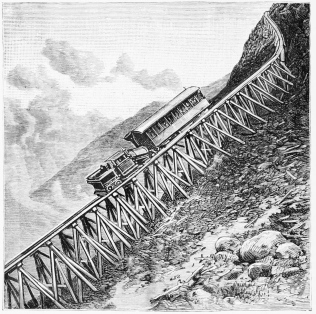
JACOBS LADDER, MOUNT WASHINGTON RAILWAY.
From Boston: Eastern R.R., via Beverly (18 miles, branch to Cape Ann);
Hampton (46 miles, Boar’s Head and Rye Beaches); Portsmouth (56 miles,
Newcastle and Isles of Shoals and York Beach); Kittery (57 miles);
Wolfborough Junction (98 miles, branch to Lake Winnipiseogee); North
Conway (138 miles; connects with Portland and Ogdensburg); Intervale
(139 miles); Glen Station (144 miles, for Jackson and Glen House);
Crawford’s (165 miles); Fabyan’s (169 miles; connects with B., C., & M.
for Summit of Mount Washington, Bethlehem, Profile House, and Jefferson;
or by same route to Portland, thence by P. & O. R.R. to North Conway, or
Grand Trunk Railway to Gorham).
Boston, Lowell & Concord, and Boston, Concord & Montreal Railroads,
via Lowell (26 miles); Nashua, Manchester, Concord (75 miles);
Plymouth (123 miles); Woodsville (166 miles, Wells River); Littleton
(185 miles, for Sugar Hill); Wing Road (192 miles, branch to Jefferson);
Bethlehem (196 miles, branch road to Profile House, also to “Maplewood,”
and Bethlehem Street); Twin Mountain House, Fabyan’s (208 miles, branch
to Summit of Mount Washington, 217 miles); connects at Fabyan’s with P.
& O. and Eastern roads for North Conway, Portland, and Boston.
Boston & Maine R.R. via Lawrence (26 miles); Haverhill, Exeter (50
miles); Dover (68 miles); Rochester (78 miles); Alton Bay (96 miles),
connecting with steamer for Wolfborough and Centre Harbor, on Lake
Winnipiseogee; or by the same road to Portland, thence by P. & O. to
North Conway and Fabyan’s, or Grand Trunk to Gorham and Glen House.
From Portland: Portland & Ogdensburg R.R. via Sebago Lake (17 miles);
Fryeburg (49 miles); Conway Centre, North Conway (60 miles); Glen
Station (66 miles, Jackson and Glen House); Bartlett (72 miles);
Crawford’s (87 miles); Fabyan’s (91 miles; connects with B., C., & M.
R.R. for Summit of Mount Washington, Bethlehem, Profile House, Sugar
Hill, Jefferson, etc.).
Grand Trunk Railway: Danville Junction (27 miles); Bethel (70 miles);
Shelburne (86 miles); Gorham (91 miles, for Glen House).
A good way to do the mountains by rail is to buy an excursion-ticket
over the route entering on the west, and, passing through, leave them
by the roads on the east side via Boston or Portland, or vice versa.
At Fabyan’s, where the two great routes meet, the traveller coming from
either direction may pursue his journey without delay. From Boston to
Boston, Portland to Portland, there is continuous rail without going
twice over the same line.
Lake Winnipiseogee.—At Alton Bay, Wolfborough, and Weirs steamer is
taken for Centre Harbor, at the head of the lake. Here the traveller may
either take the daily stages for West Ossipee (E. R.R.) or steamer to
Weirs (B., C., & M.), and thus be again on the direct rail routes.
HOW TO CHOOSE A LOCATION.—Do you wish a quiet retreat, off the
travelled routes, where you may have rest and seclusion, or do you
desire to fix yourself in a position favorable to exploring the whole
mountain region?
In either case consult (1) some friend who has visited the mountains;
(2), consult the maps in this volume; (3), consult the landlord in any
place you may fancy for a limited or a lengthened residence; (4), apply
to the agents of the Eastern, Portland, & Ogdensburg, Boston, Concord, &
Montreal, Boston & Maine, or Grand Trunk Railways, for books or folders
containing a list of the mountain hotels reached by their lines, and the
charge for board by the day and week. (The Eastern, and B., C., & M.
print revised lists every year, for gratuitous distribution.)
Wolfborough, Weirs, Centre Harbor, and Sandwich (all on or near
Lake Winnipiseogee); Blair’s, Sanborn’s, Campton Village, Thornton,
and Woodstock, in the Pemigewasset Valley; Tamworth, Conway Corner,
Fryeburg, the Intervale (North Conway), Jackson, the Glen House, Bethel
(Me.), Shelburne, Randolph, East Jefferson, Jefferson Hill, Lancaster,
Littleton, Franconia, Sugar Hill, Haverhill, and Newbury (Vt.)—all come
within the category first named; while the second want will be supplied
at such points as North Conway, Crawford’s, Fabyan’s, Twin Mountain
House, Bethlehem, and the Profile House. North Conway and Bethlehem are
the keys to the whole mountain region. Fabyan’s and the Glen House are
the proper points from which to ascend Mount Washington.
To aid in locating these places on the map, refer constantly to the
Index at the end of the volume.
Leaving Boston or Portland in the morning, any of the points named may
be reached in from four to eight hours.
HINTS FOR TOURISTS.—Select your destination, if possible, in advance;
and if you require apartments, telegraph to the hotel where you mean
to stop, giving the number of persons in your party, thus avoiding
the disappointment of arriving, at the end of a long journey, at an
over-crowded hotel.
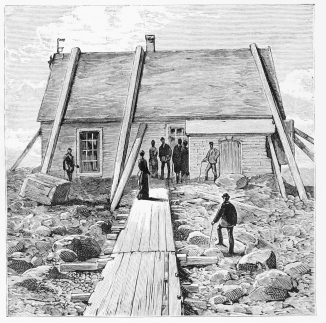
U. S. METEOROLOGICAL STATION, MOUNT WASHINGTON, IN
SUMMER.
Should you fix upon a particular locality for a long or short stay,
write to one (or more) of the landlords for terms, etc.; and if his
house is off the line of railway, inform him of the day and train you
mean to take, so that he may meet you with a carriage at the nearest
station. But if you do not go upon the day named, remember to notify the
landlord.
Always take some warm woollen clothing (inside and outside) for mountain
ascensions. It is unsafe to be without it in any season, as the nights
are usually cool even in midsummer.
From the middle of June to the middle of October is the season of
mountain travel. The best views are obtained in June, September, and
October. From the middle of September to the middle of October the air
is pure and invigorating, the mountain forests are then in a blaze of
autumnal splendor, the cascades are finer, and out-of-door jaunts are
less fatiguing than in July and August.
Should you wish merely to make a rapid tour of the mountain region, it
will be best so to arrange your route before starting that the first day
will bring you where there is something to be seen, to a comfortable
hotel, and from which your journey may be continued with an economy of
time and money.
The three journeys described in this volume will enable you to see all
that is most desirable to be seen; but the excellent facilities for
traversing the mountains render it immaterial whether these routes
are precisely followed, taken in their reverse order, or adopted as
a general plan, with such modifications as the tourist’s time or
inclination may suggest.
Upon arriving at his destination the traveller naturally desires to
use his time to the best advantage possible. But he is ignorant how to
do this. “What shall I do?” “Where shall I go?” are the two questions
that confront him. Let us suppose him arrived, first, at North
Conway.
As he stands gazing up the Saco Valley, Moat Mountain is on his left,
Kearsarge at his right, and Mount Washington in front. (Refer to the
Chapter and Index articles on North Conway.) The high cliffs on the side
of Moat are called the Ledges. This glorious view may be improved by
going a mile up the railroad, or highway, to the Intervale. The Ledges
contain the local celebrities. Taking a carriage, or walking, one may
visit them in an afternoon, seeing in turn Echo Lake, the Devil’s Den,
the Cathedral, and Diana’s Baths. The picturesque bits of river, meadow,
and mountain seen going and returning will make the way seem short, and
are certain to detain the artistic traveller. Artists’ Falls, on the
opposite side of the valley, will repay a visit, if the stream is in
good condition. Artists’ Brook, on which these falls are, runs from the
hills east of the village. A carriage-road leads to the Artists’ Falls
House, from which a short walk brings one to the falls. This excursion
will require not more than two hours. Then there are the drives to
Kearsarge village, under the mountain, and back by the Intervale; to
Jackson, over Thorn Hill, and back by Goodrich Falls (three to four
hours each); to Bartlett Bowlder, by the west, and back by the east side
of the valley; to Fryeburg and Mount Chocorua—the last two requiring
each half a day at least. The ascent of Kearsarge (from Kearsarge
village) or of the Moats (from Diana’s Baths) each demands a day to
itself. But by starting early in the morning a good climber may ascend
and descend Kearsarge, getting back to the village by two o’clock in the
afternoon.
At the Intervale he can easily repeat all these experiences, as this
is a suburb of North Conway. Let him take his first stroll over the
meadows to the river, or among the grand old pines in the forest near
the railway station, while preparing for more extended excursions.
At Glen Station.—While waiting for the luggage to be put on, if the
day is perfectly clear, the traveller, by going up the track a few
rods, to the bridge over the Ellis, may get a glimpse of the summit of
Mount Washington, with the hotel upon the apex; also of Carter Notch.
On the way to Jackson he will pass over Goodrich Falls by a bridge. He
should not fail to remark the fine cliffs of Iron Mountain, at his left
hand, before entering the village. Should he be en route for the Glen
House, let him be on the lookout for the Giant’s Stairs, on the left,
after leaving Jackson, and then for the grand view of Pinkham Notch,
with Mount Washington at the left, about four miles beyond Jackson. The
summit of Spruce Hill—the scene of the highway robbery in 1881—is the
top of the long rise beyond the bridge over Ellis River.
At Jackson we have moved eight miles nearer Mount Washington, in
the direction of the Glen House (12 miles) and Gorham (20 miles), and
also toward the Carter Notch, distant from the village 9 miles. The
excursions back to North Conway are similar to those described from
that place. The first thing to do here is to stroll up the Wildcat, and
pass an hour or two among the falls on this stream, which begin at the
village. A walk or drive up this valley to Fernald’s Farm, and back
by the opposite side, or over Thorn Hill, are two tempting half-day
excursions. In an hour one may walk to Goodrich Falls (road to Glen
Station) and back to the village. He may start after breakfast, and
drive to Glen Ellis Falls (road to Glen House), eight miles, returning
to the hotel for dinner; or, lunching at Glen Ellis, go on one mile
farther to the Crystal Cascade; then, dining at the Glen House (3
miles), return at leisure. But it is a mistake to take two such pieces
of water in one day. The pedestrian whose base is Jackson, and who
makes this trip, should pass the night at the Glen House and return by
the Carter Notch, the distance being about the same as by the highway.
But he should never try this alone, for fear of a disabling accident.
Or he may take the Glen House stage at Jackson early in the afternoon,
and, letting it drop him at Glen Ellis, make his own way to the hotel
(4 miles) on foot, after a visit to the falls. Apply to Mr. Osgood, the
veteran guide, at the Glen House, for services, or directions how to
enter the Carter Notch from the Glen House side; and to Jock Davis, who
lives at the head of the Wildcat Valley, if going in from the Jackson
side.
Ladies who are accustomed to walking can reach Carter Notch with a
little help now and then from the gentlemen. But the fatigue of going
and returning on the same day would be too great. A party could enter
the Notch in the afternoon, pass the night in Davis’s comfortable cabin,
and return the next morning. The path in is much easier and plainer from
the Jackson than from the Glen House side; but there is no difficulty
about keeping either. Davis will take up everything necessary for
camping out, except food, which may be procured at your hotel before
starting. There is plenty of water in the Notch.
At the Glen House one may finish the afternoon by walking back a mile
on the Jackson road to the Emerald Pool; or, if he is in the vein, go
one mile farther on to Thompson’s Falls, and, ascending to the top, look
over the forest into Tuckerman’s Ravine. The Crystal Cascade (3 miles)
and Glen Ellis (4 miles) from the hotel, ought to occupy half a day, but
three hours (driving) will suffice, if one is in a hurry. The drive to
Jackson, or march into the Notch, are just noted under Jackson. To go
into Tuckerman’s Ravine by the Crystal Cascade, or by Thompson’s Path
(Mount Washington carriage-road), will take a whole day. Ladies have
been into Tuckerman’s; but the trial cannot be recommended except for
the most vigorous and courageous. The Appalachian Club has a camp near
Hermit Lake, where a party going into the ravine in the afternoon may
pass a comfortable night, ascend to the Snow Arch in the morning, and
return to the hotel for dinner.
A three-mile walk on the Gorham road, crossing the Peabody River to the
Copp Farmhouse, gives a view of the celebrated “Imp” profile, on the
top of the opposite mountain. This walk is an affair of two hours and
a half. (See art. “Imp” in Index.) The Garnet Pool (one mile from the
hotel) may be taken on the way. Or, for a short and interesting stroll,
go down this road a half-mile to where the Great Gulf opens wide before
you its immense wall of mountains. The carriage-road to the summit
requires four hours for the ascent by stage; a good climber can do it
on foot in about the same time. Should a storm overtake him above the
woods, he can find shelter in the Half-way House, just at the edge of
the forest.
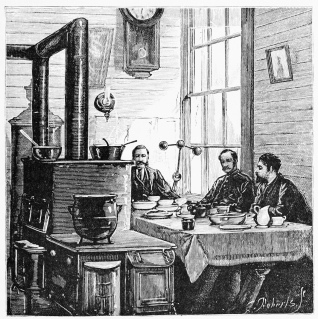
INTERIOR OF THE METEOROLOGICAL STATION, MOUNT WASHINGTON.
At Crawford’s one can saunter into the woods at the left of the
hotel, and enjoy himself in the sylvan retreat, “Idlewild;” or, going
down the road, ascend the Elephant’s Head by a path turning in at the
left (sign-board), obtaining the view down the Notch; or, continuing
on a short distance, enter and examine the Gate of the Notch. All
these objects are in full view from the hotel. Other rambles of an
hour are to Gibbs’ Falls, entering the woods at the left of the hotel
(guide-board), or, crossing the bridge over the railroad track on the
right, to Beecher’s Cascades. The ascent of Mount Willard (3 miles)
should on no account be omitted. Good carriage-road all the way, and
vehicles from the hotel. The celebrated Crawford Trail to the Summit
of Mount Washington, the scene of many exploits, begins in the grove
at the left of this hotel. The distance is fully nine miles, and six
or seven hours will be none too many for the jaunt. Four intervening
mountains, Clinton, Pleasant, Franklin, and Monroe, are crossed. There
is a shelter-hut in the woods near the summit of Clinton.
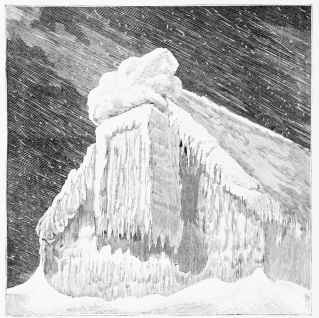
METEOROLOGICAL STATION, MOUNT WASHINGTON, IN WINTER.
At Fabyan’s.—Three or four hours may be profitably spent on Mount
Deception, opposite the hotel. The first summit is as much as one would
care to undertake in an afternoon, to get the extended and magnificent
view of the great range at sunset. Opposite the hotel is a cosy little
cottage, kept open by the railroads for the use of travellers, and to
give them information respecting routes, hotels, distances, fares, etc.
The Upper Ammonoosuc Falls (3½ miles) are well worth a visit. They
are on the Old Turnpike to the base of Mount Washington. The traveller
has now at command all the important points in the mountains.
He is 9 miles from the Summit, 4 from Crawford’s, 29 from North Conway,
13 from Bethlehem, 22 from the Profile, and 18 from Jefferson—all
reached by rail in one or two hours.
At Bethlehem.—If the tourist locates himself at the “Maplewood,” the
walk up the mountain to the Observatory, or to Cruft’s Ledge, at sunset,
or to the village (1½ miles), or down the Whitefield road to The
Hollow, is a good introduction. At “The Street” he will find the busiest
thoroughfare in the mountains, leading him on to a beautiful panorama
of the Ammonoosuc Valley, with Littleton in its lap; or, ascending the
old Profile House road above the Sinclair House for a mile, will see the
great Franconia mountains from the best view-point. Bethlehem is 9 miles
from the Profile House, 13 from Fabyan’s, 17 from Crawford’s, 42 from
North Conway, 15 from Jefferson, and 22 from the Summit.
At Profile House.—If you arrive by rail via Bethlehem, you have
crossed the broad flank and great ravine of Mount Lafayette to the
shores of Echo Lake, a mile from the hotel. But the opposite side
of this lake is a more eligible site for views of the surrounding
mountains; and the summit of Bald Mountain, at its north end, is still
better. From the long piazza of the Profile House the great Notch
mountains close in toward the south. Cannon Mountain is on your right,
with the peculiar rocks giving it this name thrust out from the highest
ridge in full view. The woods at the foot of this mountain, filling
the pass in front of you, conceal the beautiful Profile Lake, the
twin-sister of Echo Lake. The enormous rock at your left is Eagle Cliff,
a spur of Mount Lafayette, the mountain being ascended on the south side
of this cliff. Improve the first hour of leisure by walking directly
down the road to Profile Lake. In a few minutes you will reach the shore
near a rustic arbor (guide-board), furnished with seats, and here you
command the best view of the renowned “Old Man of the Mountain.” Boats
may be had here for a sail upon the lake. Return to the hotel by the
path through the woods. Walk next up the pass one mile to Echo Lake
(boats and fishing-gear at the boat-house); or, extending your jaunt
as far as Bald Mountain, obtain, by following the old path through the
woods at the right, the best observation of the pass from the north. The
trip to the Flume House (including the Basin, Pool, and Flume) is next
in order, and will occupy a half day, although the distance is only six
miles, and the road excellent. If the forenoon is taken, a party can
either return to the hotel for dinner or dine well at the Flume House.
The Pool is reached by a path half a mile long, entering the woods
opposite the Flume House. It will take an hour to drive to the Flume;
and an hour to go into the chasm itself and return is little enough;
allowing another hour for the Pool makes four hours for the excursion.
The ascent of Mount Lafayette (3¾ miles) demands three to four hours.
Saddle-horses can be procured at the hotel. Those unwilling to undertake
the whole climb may, by ascending Eagle Cliff (1 mile on same path),
secure a grand view of the Notch and lakes, the Profile, the ravines,
and the Pemigewasset Valley. A stage leaves the Profile House every
morning for Plymouth, connecting with trains for Boston and New York,
and permitting the tourist to enjoy the beauties of the Pemigewasset
Valley. But it is better to ascend this valley.
At the Flume House (refer to the preceding article).—It is a
comparatively easy climb of an hour and a half to the top of Mount
Pemigewasset, behind the hotel. See, from the hotel, the outline of the
mountain ridge opposite, called Washington Lying in State.
At Jefferson.—The branch railway from Whitefield (B., C., & M. R.R.)
leaves its passengers about three miles from the cluster of hotels and
boarding-houses called Jefferson Hill, or five from East Jefferson
(E. A. Crawford’s, Highland, or Mount Adams House); but carriages
are usually in waiting for all these houses. The walks and drives up
and down this valley are numerous and interesting, especially so in
the direction of Mount Adams and Randolph Hill, Cherry Mountain and
Lancaster. The trip over Cherry Mountain, reaching Fabyan’s (13 miles)
by sunset, or from Fabyan’s, reaching Jefferson at this hour, is a
memorable experience of mountain beauty. Excursions to Mount Washington,
Profile House, Glen House, or Gorham, demand a day. The ascent of Starr
King, Owl’s Head, Ravine of the Cascades, King’s Ravine, or Mount Adams
are the pièces de résistance for this locality.
ITINERARY OF A WALKING TOUR.—Two weeks of fine weather will enable
a good pedestrian to traverse the mountains from Plymouth to North
Conway, or vice versa, following the great highways throughout the
whole journey, and giving time to see what is on the route. Good hotel
accommodation will be found at the end of each day. Should bad weather
unsettle his plans, he will nearly always be able to avail himself of
regular stage or railway conveyance for a less or greater distance.
Thus: First day, Plymouth to Woodstock (dine at Sanborn’s, West
Campton), 16 miles; second day, Flume House (visiting Flume and Pool),
8 miles; third day, Profile House (visiting Basin and “Old Man”), 5½
miles; fourth day, Bethlehem (via Echo Lake and Franconia), 9 miles;
fifth day, Whitefield, 8 miles; sixth day, East Jefferson, 13 miles;
seventh day, Glen House, 14 miles; eighth day, for vicinity of Glen
House; ninth day, Summit of Mount Washington by carriage-road, 8 miles;
tenth day, descent by mountain railway to Crawford’s, 13 miles; eleventh
day, through the Notch to Bartlett, 13 miles; twelfth day, Jackson and
vicinity, 9 miles; thirteenth day, North Conway, 8 miles. Total, 124
miles.
Advice for Climbers.—Don’t hurry when on a level road—keep your
strength for the ascent. Always take the long route up a mountain, if it
be the easier one. Be careful where you plant the foot in gullied trails
or on icy ledges—a sprain is a serious matter if you are alone. Carry
in your pocket a flask, fitted with a tumbler or cup; matches that will
ignite in the wind, half a dozen cakes of pitch-kindling, a good glass,
and a luncheon; in your hand a stout walking-stick; and upon your feet
shoes that can be trusted—none of your gimcracks—but broad-soled ones,
shod with steel nails. On a long march a rubber overcoat, a haversack,
and an umbrella will be needed. Cold tea slakes thirst more effectually
than water; but when you are exposed to wet and cold something stronger
will be found useful. Should you have a palpitation of the heart, or an
inclination to vertigo, do not climb at all. Take quiet rambles instead.
My word for it, they are better for you than scaling breathless ascents
or looking down over dizzy precipices. If you feel nausea, stop at once
until you recover from it. If caught on the Crawford trail between
Mounts Clinton and Washington, go back to the hut on the first-named
mountain.
Newspapers for Tourists, at Bethlehem (The Echo) and on the Summit
(Among the Clouds) are published during the season of travel,
giving hotel arrivals, information concerning rail and stage routes,
excursions, and whatever may be of interest to the summer population in
general.
Telegraphic and telephone communication may be had at all the principal
hotels and railway-stations.
The Appalachian Mountain Club prints every year a periodical made up of
scientific and literary contributions from its members. Address the club
at Boston.
Trout, pickerel, and black bass are found in all the mountain
waters. The State stocks the ponds and streams with trout, bass, and
salmon from its breeding-houses at Plymouth. Fishing legally begins May
1. There is good trout-fishing on Swift River (Albany), with Conway for
head-quarters. From Jackson, or Glen House, the Wildcat and Ellis are
both good trout streams; so are Nineteen-Mile Brook and the West Branch
of Peabody; but the Wild River region (from Shelburne, Glen House, or
Jackson) affords better sport, because less visited. To go in from
Jackson or Glen House a guide will be necessary, and Davis, of Jackson,
is a good one. From Jefferson and Randolph the upper waters of the
Moose, and Israel’s River (especially in the Mount Jefferson ravine),
are fished with good success. E. A. Crawford, of East Jefferson, knows
the best spots. From Bartlett there should be good fishing on Sawyer’s
River, above the Livermore mills. Consult Frank George, the veteran
landlord of the Bartlett House. From Crawford’s the best fishing-ground
is Ethan’s Pond, behind Mount Willey. At Franconia the writer has
seen some fine strings brought from the Copper-mine Brook (back of
Mount Kinsman). Fair fishing may also be had on Lafayette Brook—ask
Charles Edson, of the Edson House. Profile Lake is stocked with trout
for the benefit of guests of the hotel. The upper streams of the
Pemigewasset are all good fishing-ground. Apply to Mr. D. P. Pollard,
North Woodstock, or Merrill Greeley, Waterville. The houses of both are
resorted to by experienced fishermen who track the East Branch or Mad
River tributaries. Pickerel and bass are caught in Lakes Winnipiseogee,
Squam, Chocorua, Ossipee, and Silver, besides scores of ponds lying
chiefly in the lake region.
N.B.—Those going exclusively to fish should go early in the season for
the best sport.
Guides.—The landlords will either accompany you or procure a suitable
person.
Camping Out.—A wall tent is preferable, but two persons get along
comfortably in one of the “A” pattern. Get one with the fly, which
can be spread behind the tent, thus giving an additional room, in
which the cooking and eating may be done under cover. Set up your tent
where there is natural drainage—where the surface water will run off
during wet weather. Dig a shallow trench around it, on the outside,
for this purpose, and if you can obtain them, lay boards for a floor.
A kerosene-oil stove, with its utensils, folding cot-bed, camp-chairs,
and mess-chest, containing dishes (tin is best), constitute a complete
outfit, to be reduced according to convenience or pleasure. To make a
woods-man’s camp, first set up two crotched posts five feet high, and
six or eight apart (according to number). On these lay a pole. From this
pole three or four others extend to the ground. Then cut brush or bark
for the roof and sides, and build your fire in front. For a camp of this
sort a hatchet and packet of matches only are necessary. But always
pitch your encampment in the vicinity of wood and water.
Mount Washington Railway.—Length, from base to summit, 3 miles. Rise
in the three miles, 3,625 feet. Steepest grade, 13½ inches in three
feet, or 1980 feet to the mile. Begun in 1866; completed in 1869.
Mount Washington Carriage-road.—Length, 8 miles. Average grade, one
foot in eight. Steepest grade, one foot in six. Begun in 1855; finished
in 1861.
Mount Washington Signal Station.—The Summit was first occupied for
scientific purposes in the winter of 1870-’71. Since then it has been
attached to the Weather Bureau at Washington, and occupied by men
detailed from the United States Signal Corps, the men volunteering for
the service.
ALTITUDES.—The following list of altitudes of the more important
and well-known points has been compiled from the publications of the
Geological Survey of New Hampshire and of the Appalachian Mountain Club.
The figures in heavy-face type are the results either of actual
levelling or of trigonometrical survey, while the remainder depend upon
barometrical measurement. Where the mean of two not widely-differing
authorities is given, the fact is denoted by the letter “m” preceding
the figures:
| MOUNTAIN SUMMITS. |
| Adams | m 5785 |
| Ascutney (Vermont) | 3186 |
| Black (Sandwich Dome) | 3999 |
| Boott’s Spur | 5524 |
| Cannon | 3850 |
| Carrigain | m 4651 |
| Carter Dome | m 4827 |
| Chocorua | 3540 |
| Clay | 5553 |
| Clinton | m 4315 |
| Crawford | 3134 |
| Giant’s Stairs | 3500 |
| Gunstock | 2394 |
| Iron | about 2000 |
| Jefferson | 5714 |
| Kearsarge, S. (Merrimack County) | 2943 |
| Kearsarge, N. (Carroll County) | 3251 |
| Lafayette | 5259 |
| Madison | m 5350 |
| Moat (North peak) | 3200 |
| Monadnock | m 3177 |
| Monroe | m 5375 |
| Moosilauke | 4811 |
| Moriah | 4653 |
| Osceola | m 4408 |
| Passaconnaway | 4200 |
| Percy (North peak) | 3336 |
| Pleasant (Great range) | m 4768 |
| Pleasant (Maine) | 2021 |
| Starr King | m 3872 |
| Twin | about 5000 |
| Washington | 6293 |
| Webster | 4000 |
| Whiteface | 4007 |
| Willey | 4300 |
| VILLAGES AND HOTELS. |
| Bartlett (Upper) | 660 |
| Bethlehem (Sinclair House) | m 1454 |
| Franconia | 921 |
| Crawford House | 1899 |
| Fabyan “ | 1571 |
| Flume “ | 1431 |
| Glen “ | 1632 |
| Gorham | 812 |
| Jackson | 759 |
| Jefferson Hill | 1440 |
| Jefferson Highlands (Mt. Adams House) | 1648 |
| Lancaster | 870 |
| North Conway | 521 |
| Plymouth | 473 |
| Profile House | 1974 |
| Sugar Hill (Post Office) | 1351 |
| Waterville (Greeley’s Hotel) | m 1544 |
| Willey House | 1323 |
| NOTCHES. |
| Carter Notch | 3240 |
| Cherry Mt. Road (summit) | m 2180 |
| Crawford or White Mt. Notch | 1914 |
| Dixville Notch | 1831 |
| Franconia Notch | m 2015 |
| Pinkham Notch (south of Glen House) | 2018 |
| Carrigain Notch | 2465 |
| MISCELLANEOUS. |
| Ammonoosuc Sta. (base of Mt. Washington) | 2668 |
| Camp of Appalachian Mountain Club, on the Mt. Adams path | 3307 |
| Echo Lake (Franconia) | m 1928 |
| Lake of the Clouds | 5053 |
| Lake Winnipiseogee | 500 |
Distant Points Visible from Mount Washington (taken from
“Appalachia”).—Mount Megantic (Canada), 86 miles, seen between
Jefferson and Adams; Mount Carmel, 65 miles, just over Mount Adams;
Saddleback, 60 miles, head of Rangely Lakes; Mount Abraham, 68
miles, N., 47° E.; Ebene Mountain, 135 miles, vicinity of Moosehead
Lake (rarely seen, even with a telescope); Mount Blue, 57 miles,
near Farmington, Me.; Sebago Lake, 43 miles, over Mount Doublehead;
Portland, 67 miles, over Lake Sebago; Mount Agamenticus, 79 miles,
between Kearsarge and Moat Mountains; Isles of Shoals, 96 miles, to
the right of Agamenticus (rarely seen); Mount Monadnock, 104 miles,
between Carrigain and Sandwich Dome; Mount Ascutney (Vt.), 81 miles,
S., 45° W.; Killington Peaks (near Rutland, Vt.), 88 miles, on the
horizon between Moosilauk and Lincoln; Camel’s Hump (Vt), 78 miles, over
Bethlehem Street; Mount Whiteface (Adirondack chain, N.Y.), 130 miles,
over the right slope of Camel’s Hump; Mount Mansfield (highest of Green
Mountains), 77 miles, between Twin Mountain House and Mount Deception;
Mount Wachusett (Mass.), 126 miles, is also visible under favorable
conditions, just to the right of Whiteface (N. H.).
MOUNTAIN PATHS. [Those with an asterisk (*) were built by the
Appalachian Mountain Club.] Chocorua.—There are three or four paths.
The best leads from the Hammond Farm, 2½ miles from the Chocorua Lake
House, and 14 miles from North Conway. The ascent, as far as the foot of
the final peak, is feasible for ladies. From this point the easiest way
is to flank the peak to the left until an old watercourse is reached,
which may be followed nearly to the summit.
*Moat.—An old path leads from the Swift River road to the summit of
the South Peak. Another, from the clearings on an old road which extends
along the base of the South Peak, leads to the top of the middle ridge;
but the best path for tourists is the one from Diana’s Baths, on Cedar
Brook, following the stream to the foot of the ridge, thence over the
ridge to the summit of the North Peak. Path well made, and plainly
marked with signs and cairns; about 3½ miles in length.
*Middle Mountain, North Conway.—Beginning at the ice-ponds near
Artists’ Falls House, the path extends around the base of Peaked
Mountain, thence to the bare ledges which reach to the summit. Distance,
1⅝ miles. Path well marked, and the view very beautiful.
Kearsarge, North Conway.—A bridle-path starts from a farm-house near
Kearsarge Village, and extends to the summit. Distance, nearly 3 miles.
Route plain, and not difficult.
*Mount Bartlett.—The path starts near the Pequawket House, Lower
Bartlett, follows old logging roads for some distance, runs thence
directly to the summit. From the summit the path extends along the ridge
until it joins the bridle-path to Kearsarge.
*Carrigain.—The route leads from the mills at Livermore, which are
reached by a road leaving the P. & O. R.R. at Livermore Station. From
the mills, logging roads are followed—crossing Duck Pond and Carrigain
Brooks—to the base; thence by a plain path through a fine forest to
“Burnt Hat Ridge,” from which it is only a short distance to the summit.
From mills to summit is about 5 miles. Station to mills, 2 miles.
*Livermore-Waterville Path.—This is intended for a bridle-path.
Starting from the mills at Livermore, a logging-road is followed nearly
two miles on the southerly side of Sawyer’s River. Here the path begins
and runs along the north-west base of Green’s Cliff, crosses Swift River
at a beautiful fall, thence through the Notch south of Mount Kancamagus
to Greeley’s, in Waterville. The path is well marked by painted signs.
Distance from Livermore to Swift River, 5 miles; to Greeley’s, 12 miles.
*Mount Willey.—Path leaves the P. & O. R.R. a little south of Willey
Station. The rise is rapid until the Brook Kedron is reached; this
brook is then followed to its source, thence the path leads direct to
the summit. Distance, 1½ miles. The climb is steep; but the view
unsurpassed.
Crawford Bridle-path leads from the Crawford House to the summit of
Washington. Path is plain, and the travelling along the ridge is easy;
but it is not in condition for horses. See pp. 325, 326.
*Carter Notch.—Path begins near the end of the Wildcat Valley road,
about 5½ miles from Jackson; thence it follows the valley of the
brook to the ponds in the Notch. From the ponds it follows Nineteen Mile
Brook to the clearing back of the Glen House. The travelling is easy;
the view in the Notch grand.
Distance from the road to the ponds, about 4 miles; from the ponds to
the Glen House, about the same.
*Carter Dome.—The path starts from the larger pond in the Notch, and
is well marked to the summit. It is very steep, and about 1½ miles in
length.
Great Gulf.—A path beginning near the Glen House goes through this
gorge. From the end of the path the carriage-road or railroad on Mount
Washington may be reached by a severe climb up the side of the ravine.
Tuckerman’s Ravine.—The Glen House path leaves the Mount Washington
carriage-road about 2 miles up, then crosses through the forest to
Hermit Lake.
*Via Crystal Cascade.—The Mountain Club path begins about 3 miles
from the Glen House, on the Jackson road, ascending the stream until it
joins the Glen House path near Hermit Lake. Here the Club has a good
camp for the use of travellers. Beyond, a single path extends to the
Snow-field; and a feasible route has been marked with white paint on the
rocks—up the head wall of the ravine, and thence to the summit.
*Mount Adams.—This path starts opposite the residence of Charles
E. Lowe, on the road from Jefferson Hill to Gorham, about 8½ miles
from either town, and climbs the steep spur forming one wall of King’s
Ravine, following over the ledges to the westerly peak, thence to the
summit. Distance, about 4 miles. Nearly half way up the spur a good
camp has been built for the use of climbers. The way over the ledges is
marked by cairns. Mount Jefferson may be reached by turning to the right
before reaching the summit of the westerly peak; Madison by turning to
the left.
*King’s Ravine.—The path branches from the Mount Adams path about
1½ miles from Lowe’s. The bowlders in the Ravine are reached without
great difficulty. From the bowlders up the head-wall, and through the
gate-way, the climb is arduous; and the way is not very distinctly
marked. From the gate-way, Madison and the several peaks of Adams may be
reached.
Mount Madison.—There are several routes up Madison, but the best
is probably that leading up the ridge from “Dolly” Copp’s, on the Old
Pinkham Road. The climb is tedious, and the path somewhat overgrown. The
Mountain Club will probably clear and keep this path in good condition.
*Bridal Veil Falls.—Path starts from Horace Brooks’s, on the road
from Franconia to Easton—2 to 3 miles from Sugar Hill and Franconia
Village. It follows an old road across the clearings to Copper-mine
Brook, thence by the brook to the foot of the Falls. Distance, 2½
miles from Brooks’s. Walking easy.
The path to the Flume on Mount Kinsman leads from the same highway about
a mile beyond Brooks’s.
Mount Lafayette.—The bridle-path begins near the Profile House,
turning Eagle Cliff, and crossing over to the main ridge. It leads
nearly to the summit of the ridge, thence across the col by the lakes,
and up the main peak. Distance, 3½ to 3¾ miles.
Mount Cannon.—The path enters the forest near the cottages in front
of the Profile House. The summit is reached by a steep climb of 1½
miles. The Cannon Rock is a short distance down the mountain-side, to
the left of the path as it emerges from the forest; the forehead rock of
the Profile can be reached by bearing down the mountain diagonally to
the right from Cannon Rock until the edge of the cliff is reached. It is
a hard scramble to the latter.
Black Mountain, Waterville.—The new path leaves the highway 2 miles
below Greeley’s, near Drake’s Brook. It runs near the edge of the ravine
of Drake’s Brook, crosses the ridge between Noon and Jennings’ Peaks—to
each of which a branch path leads—thence up the northerly slope of the
main summit. Distance from the road to the summit is 3¼ miles. The
views are very fine, and the climb easy for ordinary walkers.
Osceola.—Path leaves the Greeley-pond path beyond the saw-mill above
Greeley’s, bearing to the left. Ascent easy. Distance, about 4 miles.
Tecumseh.—Path branches from the Osceola path at the crossing of
the west branch of Mad River, ⅞ of a mile from Greeley’s. The grade
is easy, except for a short distance near the summit. Distance from
Greeley’s, 3 miles.
Tri-Pyramid.—The great slide on Tri-Pyramid may be reached from
Greeley’s by a path across the pasture to the right from the rear of the
house, thence about 1½ miles through fine old woods to a deserted
clearing known as Beckytown. From here the stream may be followed by
clambering over the débris of the slide nearly 2 miles to the base of
the South Peak. The summit is reached by climbing to the apex of the
slide, thence bearing up to the right a short distance through low woods.
*Thornton-Warren Path.—This path was built to enable visitors in the
Upper Pemigewasset Valley or in Warren to cross from one locality to
the other, avoiding the long détour via Plymouth. It starts from the
Profile House stage-road at the junction of the Tannery road, in West
Thornton, crosses Hubbard Brook at this point, and passes over a long
stretch of pasture until the woods are reached. At this point, and at
all doubtful points, signs have been placed. For much of the distance
the path follows Hubbard Brook, and passes out through the Notch between
Mounts Kineo and Cushman to an old road-way leading to clearings on
Baker’s River, near the mountain-houses at the foot of Mount Moosilauke.
Distance from the stage-road to the road-way in Warren, 8 miles. A
permanent camp has been built half-way on Hubbard Brook.
A trail has been spotted from a point in the path about 1 mile north of
the camp to the summit of Kineo.
Refer to a mountain, lake, or river, under its proper name,
thus: Washington (Mount); Squam (Lake); Saco (River).
The abbreviations in parentheses show that the town or village
is on the line of a railway: (E. R.R.) stands for Eastern; (P. &
O.), Portland and Ogdensburg; (B., C., & M.), Boston, Concord, and
Montreal; (G. T. R.), Grand Trunk; (Pass.), Passumpsic.
A,
B,
C,
D,
E,
F,
G,
H,
I,
J,
K,
L,
M,
N,
O,
P,
R,
S,
T,
V,
W.
Adams, Mount, from North Conway, 55;
from Thorn Hill, 122;
from Wildcat Valley, 133;
from Carter Dome, 142;
from the Glen House, 145;
from Mount Washington carriage-road, 181;
ascent by King’s Ravine, 298;
ascent from Mount Washington, 312-315;
the apex, 315;
view from, 316.
Adirondacks, from Moosehillock, 273.
Agassiz, Mount, from Profile House Road, 249, 276.
Agiochook, or Agiockochook (Indian name for the White Mountains), 120.
Amherst, Sir Jeffrey (Gen.), in the French War, 259.
Ammonoosuc, Falls of, 304.
Ammonoosuc River, source of, 179.
Ammonoosuc Valley, from Mount Clinton, 98;
at Bethlehem, 277;
at Fabyan’s, 300.
Androscoggin River, at Gorham, 170;
at Berlin, 174;
at Shelburne, 176;
at Bethel, 177.
Appalachian Mountain Club, 62, 221.
Artists’ Falls (North Conway), 46, 47.
Autumn foliage, 66, 67.
Baker’s River (branch of Pemigewasset, branch of the Merrimack), 210;
falls on, 269.
Bald Mountain, an inferior summit of Chocorua, 26.
Ball, B. L., lost on Mount Washington, 186.
Bartlett Bowlder, 58.
Bartlett (P. & O. R.R.), mountains surrounding, 61, 62;
ascent of Mount Carrigain from, 62-65.
Basin (Franconia Pass), 231.
Beecher’s Cascade (near Crawford House), 89.
Belknap, Jeremy, D.D. (historian of New Hampshire), quoted, 69.
Belknap, Mount (Lake Winnipiseogee), 8.
Bemis, Dr. Samuel A., home of, 69, 70.
Berlin (G. T. R.), 172;
the Falls, 174, 175.
Bethel, Maine (G. T. R.), 177.
Bethlehem (B., C., & M. R.R.), 276;
admirable position of as a centre, 277;
Bethlehem Street, 278, 279;
fine views from, 280, 281;
a sunset from the “Maplewood,” 282-284;
White Mountains from, 284;
the Hermit, 286;
the peddler, 288.
Bigelow’s Lawn (Mount Washington), 198.
Black Mountain (Sandwich Dome), from West Campton, 216;
Noon Peak, 220;
from Waterville (Greeley’s), 221.
Boott’s Spur (Mount Washington), 146;
from the plateau, 198.
Bourne, Lizzie, death of, on Mount Washington, 310.
Bridal Veil Falls (Mount Kinsman), 255.
Brown, George L. (painter), referred to, 253.
Buck-board wagon described, 273.
Campton, 211;
Campton Hollow, 214;
West Campton, and view from, 215;
Sanborn’s, 216;
annals of Campton, 216.
Campton Village (Pemigewasset Valley), 218.
Cannon (or Profile) Mountain, from West Campton, 215;
from the clearing below the Profile, 231;
remarkable profile on, 232;
from Franconia, 252.
Carrigain, Mount, from Chocorua, 30;
from Bartlett, 62;
ascent from Bartlett, 62-64;
view from summit, 64, 65.
Carrigain Notch, from Mount Chocorua, 30;
from Mount Carrigain, 64.
Carter Dome, 133;
the Pulpit, 136;
ascent of, and view from, 140, 141.
Carter Mountains, from Gorham, 170.
Carter Notch, from Chocorua, 31;
from North Conway, 40;
from Thorn Hill, 122, 132;
way into, from Jackson, 132;
impressive desolation of the interior, 137;
the Giants’ Barricade, 137, 138;
the lakes, 139;
way out to Glen House, 143.
Castellated Ridge (Mount Jefferson), 314.
Cathedral (North Conway), 46.
Cathedral Ledge (North Conway), 41, 42.
Cathedral Woods (North Conway), 55.
Centre Harbor, approach to, by Lake Winnipiseogee, 8-10;
settled, 10;
route by stage to West Ossipee via Sandwich and Tamworth, 18-21.
Chandler, Benjamin, lost on Mount Washington, 186.
Cherry Mountain (Valley of Israel’s River), 291;
Owl’s Head, 292;
road to Fabyan’s, 300.
Chocorua, Lake, from the mountain, 29, 31, 32.
Chocorua (Sho’kor’ua), Mount, from Lake Winnipiseogee, 9;
from Red Hill, 16;
legend of, 21;
ascent from Tamworth, 25-28;
landscapes from, 29-31;
from Mount Willard, 92.
Clay, Mount (next north of Washington), 169;
ascent of, 312.
Clinton, Mount (near Crawford House), 97;
view from summit, 100. (First mountain ascended by Crawford Path.)
Connecticut Ox-Bow, 256-258.
Conway, or Conway Corner (E. R.R.), superb view of the great chain from, 33.
Copp Farm (view-point for seeing “The Imp”), 165.
Copp, Nathaniel, his adventurous deer-hunt, 167.
Copper-mine Brook (branch of Gale River), 255.
Crawford, Abel, described, 70-72.
Crawford, Ethan Allen, 71, 72;
his burial-place, 302.
Crawford bridle-path, opened, 89;
march to the summit (see Chapter X.);
Mount Clinton first, 117;
the crystal forests, 98;
Liliputian wood, 99;
fine view from summit, 100;
frost-work, 100;
Mount Pleasant next, 102;
in a snow-storm, 102;
crossing the ridge, 103;
Oakes’s Gulf, 103;
Mount Franklin next, 103;
(water here) weird objects by the way, 104;
Mount Monroe next (two peaks, with shallow ponds near the path);
the plateau, 105;
base of the cone reached, 105;
ascent of the cone, 107;
the stone corral, 107;
the summit, 108.
Crawford Glen (Saco Valley), 69.
Crawford House (summit of Crawford Notch), its surroundings, 87-94.
Crawford, Mount (Saco Valley, east side), 69;
Davis Path to Mount Washington, 73;
view of from Frankenstein Bridge, 74.
Crawford Notch (see Great Notch of the White Mountains).
Crawford, T. J., opens a bridle-path to the summit, 89.
Crystal Cascade (Pinkham Notch), 149, 150.
Dartmouth, see Jefferson.
Davis Path (to Mount Washington), 73;
junction with Crawford Path, 198.
Deception, Mount (near Fabyan’s), 300.
Destruction of mountain forests, 172.
Devil’s Den (North Conway), 45, 46.
Diana’s Baths (North Conway ), 46.
Douglass, William, M.D., quoted, on the origin of the name White Mountains, 121, note.
Dwight, Timothy, L.L.D., 71 (see his “Travels in New England,” and journeys through the mountains).
Eagle Cliff (Franconia Pass), from Flume House, 225;
from Profile House, 238, 239;
ascent by the bridle-path, 243;
from Franconia, 254.
Eagle Lakes (Mount Lafayette), 244. (Also called Cloud Lakes.)
Eagle Mountain (Eagle Mountain House), Wildcat Valley, Jackson, 133.
Early settlements by white people, 216, 217, 293.
Echo Lake (Franconia Pass), 239.
Echo Lake (North Conway), 45.
Elephant’s Head (Crawford Notch), 87.
Ellis River (branch of the Saco; rises in Pinkham Notch), see Goodrich Falls, 125;
Glen Ellis Falls, 151;
incident connected with, 153.
Emerald Pool (near Glen House, Pinkham Notch), 147, 148.
Endicott Rock, a surveyor’s monument at the outlet of Lake Winnipiseogee, 10.
Fabyan’s (B., C., & M. and P. & O. R.R.), view at, 300;
Mount Washington Railway, 301;
Eleazer Rosebrook and E. A. Crawford, 302, 303.
Fall of a Thousand Streams, 162.
Farmer, John (historian), quoted, 210.
Field, Darby, makes the first ascent of Mount Washington, 116-119;
second ascent, 119, see note.
Flume (Franconia Pass), way to and description of, 226-228.
Flume Cascade, see description by Dr. T. Dwight, in his “Travels in New England.”
Flume House (Franconia Pass), 224.
Franconia Mountains, from West Campton, 215;
from Bethlehem, 280;
from Jefferson, 292.
Franconia Pass (Chapters II. and III., Third Journey), Flume House, 224;
the Pool, 225;
the Flume, 226;
the Basin, 231;
Mounts Cannon and Lafayette, 231, 232;
the “Old Man,” 232;
Profile Lake, 232;
Profile House, 237;
Eagle Cliff, 238;
Echo Lake, 239;
sunset in the pass, 240;
from Bethlehem heights, 279.
Franconia village (Iron Works), from Mount Lafayette, 243;
general view of, 251;
fine views in, 253, 254.
Frankenstein Cliff (Saco Valley), named, 73;
appearance of, from the valley, 73, 74;
the bridge, 74.
Fryeburg, Maine (P. & O. R.R.), 33-38.
Gale River (branch of the Ammonoosuc, branch of the Connecticut), 243.
Garfield, Mount (see Haystack), 284.
Giant’s Stairs (Saco Valley, east side), 73;
from Jackson, 123, 129.
Gibbs’s Falls (near Crawford House), 97.
Glen Ellis Falls, 151, 152; legend of, 152.
Glen House, way to, by Jackson and Carter Notch, 131;
its surroundings, 144;
carriage-road to the summit, 144;
Mount Washington from, 144, 145;
Emerald Pool, 147, 148;
Thompson’s Falls, 146;
Crystal Cascade, 149;
Glen Ellis Falls, 151;
Tuckerman’s Ravine, 155;
The Imp, 165;
to or from Gorham, 165, 170;
from Mount Washington carriage-road, 181.
Goodenow’s, see Sugar Hill.
Goodrich Falls (Ellis River), 125.
Gorham (G. T. R.), its situation, 169.
Grand Monadnock, from Red Hill, 17;
from Mount Washington, 192.
Great Gulf, from Glen House, 165;
from Mount Washington carriage-road, 181, 185;
from Mount Clay, 313.
Great Notch of the White Mountains (Crawford Notch), from Mount Chocorua, 31;
from Mount Carrigain, 64, 65;
approach to, by the Saco Valley, 76;
the mountains forming it, 77;
Willey, or Notch House, 77;
landslip of 1826, 79, 80;
the Cascades, 84, 85, 89, 97;
Gate of the Notch, 86;
summit of the Notch (Crawford House), 86;
Elephant’s Head, 87;
discovery of the Pass, 88, 89;
the Notch from Mount Willard, 91;
from Mount Clinton, 100.
Greeley’s, see Waterville.
Green Mountains, from Mount Washington, 190;
from Moosehillock, 273.
Gyles, John (Capt.), quoted on the Indian name for the White Mountains, 120.
Hancock, Mount, from the Ellsworth road (Campton), 216;
from Moosehillock, 272.
Hart’s Ledge (Saco Valley, east side, near Bartlett), 62.
Haverhill (B., C., & M. R.R.), 257.
Hawthorne, Nathaniel, origin of his story of “The Great Carbuncle,” 119;
death of, 209;
legend of “The Great Stone Face,” 235.
Hayes, Mount (Gorham, New Hampshire), 169-171.
Haystack, Mount (now Mount Garfield), 254.
Hermit Lake (Tuckerman’s Ravine, Mount Washington), 159.
Hitchcock, C. H. (geologist), 197.
Humphrey’s Ledge (near Glen Station), 41.
Hunter, Harry W., lost on Mount Washington, 199, note.
Huntington’s Ravine, from Carter Dome, 142.
Idlewild (near Crawford House), 89.
Imp, The (rock profile near Glen House), 166.
Indians, customs of mountain tribes, 10;
Sokokis, or Pigwackets, or Pequawkets, destruction of by Love-well, 34-38;
Indian names, 24, 25, note;
superstitions regarding the high summits, traditions, etc. (see Chapter I., Second Journey);
attack Shelburne, 177;
at Plymouth, 210;
attack Dartmouth (Jefferson), 294.
Intervale (North Conway, E. R.R. and P. & O. R.R.), superb panorama from, 55-57;
see art. North Conway.
Israel’s River (branch of the Connecticut), 291.
Jackson (see Chapters II. and III., Second Journey), 122-143;
how to get there from North Conway, 122;
its topography, 123;
Jackson Falls (on Wildcat River), 124;
Fernald’s Farm, 130;
Wildcat Valley, 133;
to Carter Notch, 133-140.
Jackson, C. T. (geologist), quoted, 197, note.
Jackson Falls (Wildcat River), 124.
Jefferson, Mount, from Jefferson Hill, 293;
Ravine of the Cascades, 297;
ascent from Mount Washington, 312;
Ravine of the Castles, 313;
Castellated Ridge, 314.
Jefferson (branch R.R. from Whitefield), 291;
Jefferson Hill, 292;
antecedents of, 293;
Indian attack on, 294;
East Jefferson, 295;
to Randolph Hill, 297;
to Fabyan’s, 300.
Jockey Cap (Fryeburg, Maine), 34.
Josselyn, John (author of “New England’s Rarities”), ascends Mount Washington, 119.
Kearsarge, Mount, from North Conway, 39, 40, 41;
winter ascent of, 47-54;
view from summit, 51, 52;
from Bartlett, 62;
from Carter Dome, 141.
King, Thomas Starr, tribute to, 294, 295.
King’s Ravine (Mount Adams), from Randolph Hill, 298;
from Mount Adams, 317.
Kinsman, Mount (next south of Cannon, Franconia group), 244, 252.
Lafayette, Mount, from West Campton, 215;
see Chapter III., Third Journey;
Eagle Cliff, 238, 239;
from Echo Lake, 240;
ascent from the Profile House, 243-247;
the Notch, 243;
the ravines, 243-254;
Eagle Lakes, 244;
summit and view, 246, 247;
from Franconia Iron Works, 252;
from Newbury, Vermont, 258;
from Bethlehem heights, 279.
Lake of the Clouds (Mount Washington), 198.
Lary’s (Gorham, New Hampshire), 171.
Lead Mine Bridge (Shelburne, G. T. R.), grand view from, 175, 176.
Legends of General Hampton and the Devil, 11-14;
of Mount Chocorua, 21-24;
of Passaconnaway, 24, 25, note;
Indian tradition of the Deluge, 114;
the Indian’s heaven, 115;
the Great Carbuncle, 115;
the war party and its prisoners, 127, 128;
the youthful lovers, 128;
of Glen Ellis Falls, 152;
of the Silver Image, 263.
Lion’s Head (Tuckerman’s Ravine), 142, 146, 159.
Lisbon (B., C., & M. R.R.), discovery of gold ores in, 251.
Littleton (B., C., & M. R.R.), from Bethlehem, 279.
Livermore (P. & O. R.R.), Saco Valley, logging hamlet of, 63;
way to the Pemigewasset, 221.
Livermore Falls (Pemigewasset River), 212.
Logging on the Androscoggin, 173, 174.
Lonesome Lake (Mount Kinsman), 244.
Long Island, Lake Winnipiseogee, east shore, 9.
Lovewell, John (captain of colonial rangers), battle with the Sokokis, 34-38.
Lovewell’s Pond (scene of Lovewell’s fight), 34.
Lowell, Mount (Saco Valley), slide on, 64.
Mad River and Valley (branch of Pemigewasset), 218.
Madison, Mount (next north of Adams), 165.
Marsh, Sylvester, projector of Mount Washington railway, 301.
Merrimack River, source of, 65.
Moat Range, position of, 39;
cliffs of, 40, 41, 44;
the ascent, 47;
from Jackson Falls, 124.
Monroe, Mount, from Tuckerman’s Ravine, 160.
Moose River (branch of Androscoggin), 171.
Moosehillock, or Moosilauke, from Lake Winnipiseogee, 10;
from Chocorua, 30;
from Pemigewasset Valley, 223;
from Newbury, Vermont, 258;
see Chapter VII., Third Journey, 269-275;
how to reach the mountain, 269;
the mountain’s top, 271;
view from, 273;
from Bethlehem, 279.
Moriah, Mount (Carter Chain, near Gorham), 169.
Mountain Butterfly, 202.
Nancy’s Brook (Saco Valley), story of, 67-69.
Newbury, Vermont (Pass. R.R.), 257.
Nineteen Mile Brook (branch of the Peabody River, a branch of the Androscoggin; rises in Carter Notch), 143.
North Conway (E. R.R. and P. & O. R.R.), topographical features of, 39-41;
excursions from, 57;
see Intervale, White Horse Ledge, Cathedral Ledge, Humphrey’s Ledge, Echo Lake, Diana’s Baths, Artists’ Falls, Kearsarge and Moat Mountains, etc.
Oake’s Gulf (in great range), 103.
Old Man of the Mountain (Franconia Pass), 231-236;
legends of, 235.
Ossipee Mountains, from Lake Winnipiseogee, 8.
Owl’s Head (Lake Memphremagog), from Moosehillock, 273;
Cherry Mountain, 292.
Peabody River (branch of the Androscoggin; rises in Pinkham Notch), 144, 154, note.
Pemigewasset River, branch of Merrimack, 210;
Livermore Falls, 211;
East Branch, 223.
Pemigewasset, Mount (near Flume House), ascent and view, 229.
Pemigewasset Valley (Chapter I., Third Journey), 210-223;
villages of, 212.
Pemigewasset Wilderness, way through, 221, 229.
Percy Peaks, 280, note.
Perkins Notch, position of, 133.
Pilot Mountains from Gorham, 170;
origin of name, 170, 171.
Pine Mountain (Gorham, New Hampshire), 170.
Pinkham Notch from Thorn Hill, 122;
from the road between Jackson and Glen House, 129;
from Glen House, 144;
see Thompson’s Falls, Emerald Pool, Crystal Cascade, Tuckerman’s Ravine, Glen Ellis Falls, etc., 144-164.
Pleasant, Mount, from Fabyan’s, 300.
Plymouth (B., C., & M. R.R.), 209;
routes through the mountains, 211.
Pool, The (Franconia Pass), 225.
Portland and Ogdensburg Railroad, passage of the White Mountains Notch, 93.
Prime, W. C., referred to, 244.
Profile House (Franconia Pass), its attractions, 237-240;
see Old Man, Profile Lake, Mounts Cannon and Lafayette, Eagle Cliff, Echo Lake, etc.;
to Bethlehem by the old highway via Franconia, 248;
by rail, 248.
Profile Lake (Franconia Pass), 232.
Prospect, Mount (Holderness), 214.
Randolph Hill, drive to, and view from, 297, 298.
Ravine of the Castles (Mount Jefferson), 313.
Raymond’s Cataract, from Carter Dome, 142;
from Pinkham Notch, 147;
see Tuckerman’s Ravine.
Red Hill from Lake Winnipiseogee, 10;
ascent of, from Centre Harbor, and view from summit, 14-17.
Ripley Falls (on Cow Brook, Saco Valley), 89.
Rogers’s, Robert (Major), account of the White Mountains, 119, 121, note;
destroys St. Francis, 259;
see Chapter VI., Third Journey.
Rosebrook, Eleazer, sketch of, 302, 303.
Saco Valley (Chapters IV. to IX., inclusive), from Mount Chocorua, 31;
at Fryeburg (Maine), 33;
at North Conway, 39;
at Bartlett, 61-65;
from Mount Carrigain, 64, 65;
source of the Saco, 88;
historical incident, 153.
Sandwich Mountains from Lake Winnipiseogee, 8;
from Sandwich Centre, 19;
from Tamworth (Nickerson’s), 24.
Sandwich (town of), mountains near, 19.
Sandwich Notch, position of, 218.
Sawyer’s River (branch of the Saco), valley of, 62, 63.
Sawyer’s Rock (Saco Valley, west side, near Bartlett), 62.
Schoolcraft, Henry Rowe, quoted on the Indian name for the White Mountains, 120.
Silver Cascade (Crawford Notch), 85.
Snow Arch (Tuckerman’s Ravine), 161, 162.
Spencer, Jabez (General), settles Campton, 216.
Squam Lake from Red Hill, 16.
St. Francis de Sales, sacked by Rogers, 259;
see Chapter VI., Third Journey.
Star Lake (Mount Adams), 317.
Stark, John (General), captured by Indians, 210, 211.
Stark, William, 210, 211.
Starr King Mountain, 291.
Storm Lake (between Madison and Adams), 317.
Sugar Hill, from Profile House road, 249;
view from, 252, 253.
Sullivan, James (Governor of Massachusetts), his authority for the story of “The Great Carbuncle,” 116;
quoted, 153.
Swift River (branch of the Saco), from Mount Chocorua, 30.
Tamworth Iron Works (point from which Chocorua is usually ascended), 21, 25.
Thompson’s Falls (near Glen House), 146.
Thorn Mountain, from North Conway, 40;
walk over Thorn Hill (lower spur of Thorn Mountain) to Jackson, 122, 132.
Tripyramid Mountain, from Mad River Valley, 219;
slide on, 221.
Trout-breeding, State establishment at Plymouth, 212.
Trout-fishing begins in New Hampshire May 1, 213.
Trumbull, J. Hammond, LL.D., quoted on the Indian names for the White Mountains, 120, note.
Tuckerman’s Ravine from Mount Kearsarge, 51;
from Carter Dome, 142;
from Thompson’s Falls, 146;
way into from Glen House, 156;
appearance from Glen House, 156;
Hermit Lake and Lion’s Head Crag, 159;
Snow Arch, 161;
head wall, 162;
out by the path to Crystal Cascade, 164.
Views, from Red Hill, 14-17;
from Chocorua, 29-31;
from Jockey Cap, 34;
from Conway Corner, 33;
from North Conway, 40;
from Mount Kearsarge, 51;
from the Intervale (North Conway), 55-57;
from Mount Carrigain, 64, 65;
from above Bemis’s, 74;
from Mount Willard, 91;
from Mount Clinton, 100;
from Carter Dome, 141;
from Glen House, 145;
from Gorham, 169;
from Berlin, 172, 175;
from Shelburne (Lead Mine Bridge), 176;
from Mount Washington carriage-road, 181, 185;
from the summit, 189-192;
from West Campton, 215;
from the Ellsworth road (Pemigewasset valley), 216;
from Mount Pemigewasset (Flume House), 229;
from Mount Lafayette, 246;
from Sugar Hill, 252;
from the foot of Bethlehem heights (Gale River valley), 254;
from Moosehillock, 272;
from Bethlehem, 280, 281;
from Jefferson Hill, 292;
from East Jefferson, 295;
from Randolph Hill, 297;
from Mount Adams, 316.
Warren (B., C., & M. R.R.), point from which to ascend Moosehillock, 269.
Washington, Mount, River (formerly Dry River), grand view of the high summits up this valley from P. & O. R.R., 74;
the valley from Mount Clinton, 100.
Washington, Mount, carriage-road, 178;
Half-way House and the Ledge, 180;
Great Gulf, 181;
accident on, 183;
Willis’s Seat, and the view 185;
Cow Pasture, 186;
Dr. Ball’s adventure, 186;
fate of a climber, 186;
up the pinnacle, 186;
United States Meteorological Station, 187;
the summit, 188.
Washington, Mount, from Lake Winnipiseogee, 9;
from Mount Chocorua, 31;
from Conway, 33;
from North Conway, 40;
from Mount Kearsarge, 51;
from Mount Carrigain, 65;
first path to, 71;
Davis path, 73;
view near Bemis’s (P. & O. R.R.), 74;
Crawford bridle-path opened, 89;
from Mount Willard, 93;
from Mount Clinton, 100;
first ascension, 116-119;
Indian traditions of, see Chapter I., Second Journey;
from Thorn Hill, 122;
from the Wildcat Valley, 133;
from Carter Dome, 142;
from Glen House, 144;
from the Glen House and Gorham road, 168;
carriage-road, see Chapter VII., Second Journey;
the Signal Station, 187, 196;
a winter tornado on the summit, 192-194;
shadow of the mountain, 195;
the plateau—its floral and entomological treasures, 197, 198;
transported bowlders on, 197;
Lake of the Clouds, 198;
from Mount Lafayette, 246;
travellers lost on, 186, 199, 310;
from Moosehillock, 270;
from Bethlehem, 281, 282;
from Fabyan’s, 300;
railway to summit, 301-306;
moonlight on the summit, 311;
sunrise, 312;
sunset, 318.
Washington, Mount, Railway, from Fabyan’s, 301;
to the base, 304;
its mechanism, 305;
Jacob’s Ladder, 305;
up the mountain, 306, 307;
the Summit Hotel, 307.
Waterville (Mad River valley), the neighborhood, 219;
path to Livermore, 221.
Webster, Daniel, at Fryeburg, Maine, 33.
Webster, Mount, approach to, 75;
from Mount Willard, 92.
Weirs (B., C., & M. R.R.), Lake Winnipiseogee, west shore, 10, see note.
Welch Mountain (Pemigewasset valley), 218.
Whipple, Joseph (Colonel), settles at Jefferson, 294.
White Horse Ledge (North Conway), 41.
White Mountains, general view of, from Conway, 33;
from North Conway, 40;
from Mount Carrigain (in mass), 65;
legends of, see Chapter 1., Second Journey;
first ascensions, 116-119;
how named, 119, 120;
appearance from the coast, 120, 121;
from Mount Lafayette, 246;
from Bethlehem, 281;
from Fabyan’s, 300.
Wildcat River (branch of the Ellis, a branch of the Saco; rises in Carter Notch), Jackson Falls on, 124;
disappearance of, 136.
Wildcat Mountain (one of Carter Notch and Pinkham Notch Mountains), position of, 123;
avalanche of bowlders, 136;
appearance from Carter Notch, 141;
from Glen House, 145.
Wildcat Valley (Jackson to Carter Notch), 133-140.
Willard, Mount, 77;
ascent of, from Crawford House, 91.
Willey family, burial-place of, 55;
destruction of, by a landslip, 77-80.
Willey, Mount, from Carrigain, 65;
approach to by the valley, 75;
from Mount Willard, 92.
Winnipiseogee, Lake, sail up, from Wolfborough to Centre Harbor, 8-10;
Indian occupation and customs, 10;
sunset view of, from Red Hill. 16, 17.
Winnipiseogee River (outlet of the lake), Indian remains on, 10;
Endicott Rock in, 10, note.
Wolfborough ( E. R.R. branch ), Lake Winnipiseogee, 8.
THE END
NEW YORK & NEW ENGLAND RAILROAD.
THIS IS THE MOST CONVENIENT LINE BETWEEN
Boston, Philadelphia, Baltimore, and Washington,
AS IT IS THE ONLY LINE RUNNING
THROUGH PULLMAN CARS WITHOUT CHANGE.
The train leaving Washington, Baltimore, and Philadelphia in
the afternoon, arrives in Boston the following morning in season
to connect with trains on the Eastern, Boston & Maine, and Boston
& Lowell Railroads, for points in the White Mountains and shore
resorts. The morning trains from the White Mountains and shore
resorts arrive in Boston in sufficient time to cross the city and
take the 7 P.M. train for the South.
Berths in Pullman Sleepers can be secured in advance on
application to the Company’s Office,
322 Washington St., Boston, and Depot, foot of Summer St.; and at
Pennsylvania Railroad Ticket Offices in Philadelphia, Baltimore, and
Washington.
==>Ask for Tickets via New England and Str. Maryland Lines.
S. M. FELTON, Jr., General Manager. A. C. KENDALL, General Passenger Agent.
WILLIAM S. BUTLER & CO.
90 & 92 Tremont Street,
(Opposite Tremont House), BOSTON, MASS.
DEALERS IN
Ribbons, Laces, Flowers, Montures, Velvets, Nets,
FEATHERS, SPRAYS, &c.
HATS, for Ladies and Misses; CORSETS—the Best Fitting and
Most Sensible: KID GLOVES A SPECIALTY—Latest Styles, Lowest
Prices; BUTTONS, TRIMMINGS, &c., in endless variety; HOSIERY and
UNDERWEAR, for Ladies and Misses—an admirable assortment at low
rates.
FANCY GOODS, PERFUMERY, TOILET ARTICLES, &c.
AND MANY OTHER NOVELTIES.
Ladies visiting Boston, or gentlemen wishing to make purchases
for absent wives, sisters, or lady friends, will do well to inspect
the admirably selected stock of Gloves, Laces, Velvets, Ribbons,
Flowers, Millinery Goods, Hats, Hosiery, Small Wares, and Fancy
Goods generally, offered by William S. Butler & Co., at
90 and 92 Tremont Street (opposite the Tremont House). This firm
has won an enviable reputation for the excellence of its goods, its
courteous attendance, and the moderation of its prices; while its
location renders it most convenient of access by horse cars, either
from the hotels or from any of the railroad depots.
==>Orders by mail or express will receive prompt attention.
WILLIAM S. BUTLER & CO.,—90 and 92 Tremont Street, Boston.
SHORE LINE ROUTE.
NEW YORK AND BOSTON.
Trains leave GRAND CENTRAL DEPOT, New York, for Boston, at
8.05 A.M., 1 and 10 P.M.; arriving in Boston
at 6 and 8.05 P.M., and 6.20 A.M.
Sundays for Boston at 10 P.M.
WAGNER DRAWING-ROOM CARS
On 1 P.M. trains from Boston and New York.
WAGNER SLEEPING CARS
On night trains from Boston and New York.
Leave BOSTON and PROVIDENCE STATION, Boston, at 8 A.M.,
1 and 10.30 P.M.; arriving in the Grand Central
Depot, New York, at 4.22 and 7.40 P.M., and 6.38
A.M.
Sundays for New York at 10.30 P.M.
For further information, apply to
J. W. RICHARDSON, Agent, State Street, Corner Washington;
Or at Providence Railroad Station, Columbus Avenue, near Boston Common.
A. A. FOLSOM, Superintendent.
HARPER’S CYCLOPEDIA
OF
BRITISH AND AMERICAN POETRY.
EDITED BY
EPES SARGENT.
Large 8vo, nearly 1000 pages, Illuminated Cloth, with Colored Edges,
$4.50; Half Leather, $5.00.
Mr. Sargent was eminently fitted for the preparation of a work
of this kind. Few men possessed a wider or more profound knowledge
of English literature; and his judgment was clear, acute, and
discriminating. * * * The beautiful typography and other exterior
charms broadly hint at the rich feast of instruction and enjoyment
which the superb volume is eminently fitted to furnish.—N.Y.
Times.
We commend it highly. It contains so many of the notable poems
of our language, and so much that is sound poetry, if not notable,
that it will make itself a pleasure wherever it is found.—N.Y.
Herald.
The selections are made with a good deal of taste
and judgment, and without prejudice against any school or
individual. An index of first lines adds to the usefulness of the
volume.—N.Y. Sun.
The collection is remarkably complete. * * * Mr. Sargent’s
work deserves special commendation for the exquisite justice it
does to living writers but little known. It is a volume of rare and
precious flowers culled because of their intrinsic value, without
regard to the writer’s fame. The selections are prefaced by a brief
biographical notice of the author, with a critical estimate of the
poetry. * * * A valuable acquisition to the literary treasures of
American households.—N.Y. Evening Express.
He seems to have culled the choicest and the best from the
broad field. * * * Mr. Sargent had the fine ear to detect the pure,
true music of the heart and imagination wherever it was voiced. * *
* The elegant volume is a household treasure which will be highly
prized.—Evangelist, N.Y.
Published by HARPER & BROTHERS, New York.
==>Sent by mail, postage prepaid, to any part of the United States, on
receipt of the price.
DRAKE’S NEW ENGLAND COAST.
NOOKS AND CORNERS OF THE NEW ENGLAND COAST. By Samuel
Adams Drake. With numerous Illustrations. Square 8vo, Cloth,
$3 50; Half Calf, $5 75.
#/ My dear Sir,—I laid out your new and beautiful
book to take with me to-day to my summer home, but before I go I
wish to thank you for preparing a volume which is every way so
delightful. All summer I shall have it at hand, and many a pleasant
hour I anticipate in the enjoyment of it. I have read far enough
in it already to feel how admirably you have done your part of it,
and I have seen, in turning over the delectable pages, what a
panorama of lovely nooks and rocky coast your artist has prepared
for the pleasure of your readers. May they be a good many thousand
this year, and continue to increase time onward. If I am not
greatly out in my judgment, edition after edition will be called
for. Truly yours,
James T. Fields.
Thy “Nooks and Corners of the New England Coast” is a delightful book,
and one of most frequent reference in my library. Thy friend,
John G. Whittier.
I take this opportunity of acknowledging the pleasure I have received
from your interesting book on our New England coast. It was my companion
last summer on the coast of Maine. Yours truly,
F. Parkman.
Mr. Samuel Adams Drake does for the New England coast such service as
Mr. Nordhoff has done for the Pacific. His “Nooks and Corners of the
New England Coast”—a volume of 459 pages—is an admirable guide both
to the lover of the picturesque and the searcher for historic lore, as
well as to stay-at-home travellers. The “Preface” tells the story of the
book; it is a sketch-map of the coast, with the motto, “On this line, if
it takes all summer.” “Summer” began with Mr. Drake one Christmas-day
at Mount Desert, whence he went South, touching at Castine, Pemaquid,
and Monhegan; Wells and “Agamenticus, the ancient city” of York;
Kittery Point; “The Shoals;” Newcastle; Salem and Marblehead; Plymouth
and Duxbury; Nantucket; Newport; Mount Hope; New London, Norwich, and
Saybrook. What nature has to show and history to tell at each of these
places, who were the heroes and worthies—all this Mr. Drake gives in
pleasant talk—N.Y Tribune.
My dear Mr. Drake,—I have given your beautiful book, “Nooks
and Corners of the New England Coast,” a pretty general perusal. It is
one “after my own heart,” and I thank you very much for it. Your Preface
is an admirable “hit” in more ways than one. Like Grant, whom you have
quoted, it took you, I imagine, all winter as well as all summer
to accomplish your victory, for you speak of experiences with snow and
sleet.
You have gathered into your volume, in the most attractive form, a vast
amount of historical and descriptive matter that is exceedingly useful.
I hope your pen will not be stayed. Your friend and brother of the pen,
Benson J. Lossing.
To-morrow I leave home for a week or two in Maine, and shall take your
beautiful volume, “Nooks and Corners of the New England Coast,” with
me to read and enjoy at leisure. I am sure it cannot fail to be very
interesting.
Yours faithfully,
Henry W. Longfellow.
I need not tell you with how much interest both my husband and
myself—lovers of the valley—look forward to your work, nor how much
pleasure your “Nooks and Corners” has already afforded us.
With most cordial regards,
Harriet P. Spofford.
His style is at once simple and graphic, and his work as conscientious
and faithful to fact as if he were the dullest of annalists instead of
one of the liveliest of essayists and historians. The legitimate charm
of variety—characteristic of a work of this kind—makes the book more
entertaining than any volume of similar size devoted exclusively to
chronology, biography, essays, or anecdotes.—John G. Saxe, in
the Brooklyn Argus.
Mr. Drake’s “Nooks and Corners of the New England Coast” ought to be in
the hands of every one who visits our sea-side resorts. The artistic
features serve to embellish a very interesting description of our New
England watering-places, enlivened with anecdotes, bits of history
connected with the various places, and pleasant gossip about people and
things in general.—Saturday Evening Gazette, Boston.
Published By HARPER & BROTHERS, New York.
==>Harper & Brothers will send the above work by mail, postage
prepaid, to any part of the United States, on receipt of the price.
GLOWING TRIBUTES TO AMERICAN ART.
WHAT LEADING ENGLISH PAPERS
SAY OF
“PASTORAL DAYS;
OR,
MEMORIES OF A NEW ENGLAND YEAR.”
By W. HAMILTON GIBSON.
4to, Illuminated Cloth, Gilt Edges, $7 50.
FROM “THE TIMES,” LONDON.
The title of this very beautifully illustrated book conveys
but a very faint idea of its merits, which lie, not in the
descriptions of the varied beauties of the fields and fens of New
England, but in the admirable wood-engravings, which on every
page picture far more than could be given in words. The author
has the rare gift of feeling for the exquisitely graceful forms
of plant life and the fine touch of an expert draughtsman, which
enables him both to select and to draw with a refinement which few
artists in this direction have ever shown. Besides these essential
qualities in a painter from nature, Mr. Gibson has a fine sense
of the poetic and picturesque in landscape, of which there are
many charming pieces in this volume, interesting in themselves as
pictures, and singularly so in their resemblance to the scenery
of Old England. Most of the little vignette-like views might be
mistaken for Birket Foster’s thoroughly English pictures, and some
are like Old Crome’s vigorous idyls. One of the most striking—a
wild forest scene with a storm passing, called “The Line Storm”—is
quite remarkable in the excellent drawing of the trees swept by the
gale and in the general composition of the picture, which is full
of the true poetic conception of grandeur in landscape beauty. But
all Mr. Gibsons’s good drawing would have been nothing unless he
had been so ably aided by the artist engravers, who have throughout
worked with such sympathy with his taste, and so much regard for
the native grace of wild flowers, grasses, ferns, insects, and
all the infinite beauties of the fields, down to the mysterious
spider and his silky net spread over the brambles. These cuts are
exceptional examples of beautiful work. Nothing in the whole round
of wood-engraving can surpass, if it has even equalled, these
in delicacy as well as breadth of effect. Much as our English
cutters pride themselves on belonging to the school which Bewick
and Jackson founded, they must certainly come to these American
artists to learn the something more which is to be found in their
works. In point of printing, too, there is much to be learned in
the extremely fine ink and paper, which, although subjected to
“hot-pressing,” are evidently adapted in some special condition for
wood-printing. The printing is obviously by hand-press,[46] and in
the arrangement of the type with the cuts on each page the greatest
ingenuity and invention are displayed. This, too, has been designed
with a sort of a Japanesque fancy; here is a tangled mass of
grasses and weeds, with a party of ants stealing out of the shade,
and there the dragon-flies flit across among the blossoms of the
reeds, or the feathery seeds of the dandelion float on the page.
Each section of the seasons has its suggestive picture: Springtime,
with a flight of birds under a may-flower branch that hangs across
the brook: Summer, a host of butterflies sporting round the wild
rose: Autumn, with the swallows flying south and falling leaves
that strew the page; while for Winter the chrysalis hangs in the
leafless bough, and the snow-clad graves in the village church-yard
tell the same story of sleep and awakening. As many as thirty
different artists, besides the author and designer, have assisted
in producing this very tastefully illustrated volume, which
commends itself by its genuine artistic merits to all lovers of the
picturesque and the natural.
FROM “THE SATURDAY REVIEW,” LONDON.
This pleasant American book has brought to our remembrance,
though without any sense of imitation, two old-fashioned favorites.
In the first place, its descriptions of rural humanity, its rustic
sweetness and humor, have a certain analogy with the delicately
pencilled studies of life in Miss Mitford’s “Our Village;” but the
relation it bears to the second book is much closer. It is more
than forty years since Mr. P. H. Gosse published the first of those
delightful sketches of animal life at home which have led so many
of us with a wholesome purpose into the woods and lanes. It was in
the Canadian Naturalist that he broke this new ground; and though
we do not think this has ever been one of his best-known books, we
cannot but believe that there are still many readers who will be
reminded of it as they glance down Mr. Gibson’s pages.
People must be strangely constituted who do not enjoy such
pages as Mr. Gibson has presented to us here. It is not merely that
he writes well, but the subject itself is irresistibly fascinating.
We plunge with him into the silence of a New England village in a
clearing of the woods. The spring is awakening in a flush of tender
green, in a fever of warm days and shivering nights, and we hasten
with our companion through all the bustle and stir of the few busy
hours of light so swiftly that the darkness is on us before we are
aware. Then falls on the ear a pathetic, an intolerable silence;
a deep mist covers the ground, a few lights twinkle in scattered
farms and cottages, and all seems brooding, melting, in the deep
and throbbing hush of the darkness. * * * The wailing of the great
owl upon the maple-tree takes our author back in memory to the
scenes of his youth, where the owl was looked upon as a creature of
most sinister omen, and his own partiality to it, as a proof that
there was something uncanny or even “fey” about him. All this is
described with great sympathy and delicacy; but perhaps Mr. Gibson
is most felicitous in his little touches of floral painting. He
has a few words about the earthy, spicy fragrance of the arbutus
that might have been said in verse by the late Mr. Bryant; his
description of the effect of biting the bulbs of the Indian turnip,
or “Jack-in-the-pulpit,” is inimitable in its quiet way; while the
phrase about the fading dandelions—“the golden stars upon the
lawn are nearly all burned out; we see their downy ashes in the
grass”—is perhaps the best thing ever said about a humble flower,
whose vulgarity, in the literal sense, blinds us to the beauty of
its evolution and decay.
In his studies of life and country manners Mr. Gibson is a
very agreeable and amusing, if not quite so novel, a companion.
Not seldom he reminds us not merely of Miss Mitford, but sometimes
of Thoreau and of Hawthorne. The story of Aunt Huldy, the village
crone who sustained herself upon simples to the age of a hundred
and three, is one of those little vignettes, half humorous, half
pathetic, and altogether picturesque, in which the Americans excel.
Aunt Huldy was an old witch in a scarlet hood, whose long white
hair flowing behind her was wont to frighten the village children
who came upon her in the woods; but she was absolutely harmless, a
crazy old valetudinarian, who was always searching for the elixir
of life in strange herbs and decoctions. At last she thought
she had found it in sweet-fern, and she spent her last years in
grubbing up every specimen she could find, smoking it, chewing it,
drinking it, and sleeping with a little bag of it tied round her
neck.
But although Mr. Gibson writes so well, he modestly disclaims
all pretension as a writer, and lets us know that he is an artist
by profession. His book is illustrated by more than seventy designs
from his pencil, engraved in that beautiful American manner to
which we have often called attention. The scenes designed are
closely analogous to those described in the text. We have an
apple-orchard in full blossom, with a group of idlers lounging
underneath the boughs; scenes in the fields so full of mystery and
stillness that we are reminded of Millet, or of our own Mason;
clusters of flowers drawn with all the knowledge of a botanist and
the sympathy of a poet. It is hard to define the peculiar pleasure
that such illustrations give to the eye. It is something that
includes and yet transcends the mere enjoyment of whatever artistic
excellence the designs may possess. We are directly reminded by
them of such similar scenes as have been either the rule or the
still more fascinating exception of every childish life, and at
their suggestion the past comes back; in the familiar Wordsworthian
phrase, “a river flows on through the vale of Cheapside.”
We know so little over here of the best American art that
it may chance that Mr. Gibson is very well known in New York.
We confess, however, that we never heard of him before; but his
drawings are so full of delicate fancy and feeling, and his writing
so skilful and graceful, that, in calling attention to his book, we
cannot but express the hope that we soon may hear of him again, in
either function, or in both.
==>“PASTORAL DAYS” is published by Harper & Brothers, New York,
who will send the work, postage prepaid, to any part of the United
States, on receipt of $7 50.
HARPER’S GUIDE TO EUROPE.
HARPER’S HAND-BOOK FOR TRAVELLERS IN EUROPE AND THE EAST: being a Guide
through Great Britain and Ireland, France, Belgium, Holland, Germany,
Italy, Egypt, Syria, Turkey, Greece, Switzerland, Tyrol, Spain, Russia,
Denmark, Norway, Sweden, United States, and Canada. By W. Pembroke
Fetridge. With Maps and Plans of Cities. In Three Volumes. 12mo,
Leather, Pocket-Book Form, $3 00 per vol. The volumes sold separately.
Vol. I. Great Britain, Ireland, France, Belgium,
Holland.
Vol. II. Germany, Austria, Italy, Sicily and Malta, Egypt,
The Desert, Syria and Palestine, Turkey, Greece.
Vol. III. Switzerland, Tyrol, Denmark, Norway, Sweden,
Russia, Spain, United States and Canada.
It has stood the test of trying experience, and has proved the
traveller’s friend in all emergencies. Each year has added to its
attractions and value, until it is about as near perfect as it is
possible to make it.—Boston Post.
Personal use of this Guide during several visits to
various portions of Europe enables us to attest its merits. No
American is fully equipped for travel in Europe without this
Hand-Book.—Philadelphia North American.
Take “Harper’s Hand-Book,” and read it carefully through;
then return to the parts relating to the places you have resolved
to visit; follow the route on the maps, and particularly study the
plans of cities. So you will start with sound pre-knowledge, which
will smoothen the entire course of travel.—Philadelphia Press.
The book is not only unrivalled as a guide-book, for which
it is primarily intended, but it is a complete cyclopædia of
all that relates to the countries, towns, and cities which are
described in it—their curiosities, most notable scenes, their
most celebrated historical, commercial, literary, and artistic
centres. Besides general descriptions of great value, there are
minute and detailed accounts of everything that is worth seeing
or knowing relative to the countries of the Old World. The great
value of the book consists in the fact that it covers all the
ground that any traveller may pass through—being exhaustive not
only of one country or two, but comprising in its ample pages exact
and full information respecting every country in Europe and the
East.—Christian Intelligencer, N. Y.
It is a marvellous compendium of information, and the author
has labored hard to make his book keep pace with the progress of
events. * * * It forms a really valuable work of reference on all
the topics which it treats, and in that way is as useful to the
reader who stays at home as to the traveller who carries it with
him abroad.—N. Y. Times.
I have received and examined with lively interest the new
and extended edition of your extremely valuable “Hand-Book for
Travellers in Europe and the East.” You have evidently spared no
time or pains in consolidating the results of your wide travel,
your great experience. You succeed in presenting to the traveller
the most valuable guide and friend with which I have the good
fortune to be acquainted. With the warmest thanks, I beg you to
receive the most cordial congratulations of yours, very faithfully,
John Meredith Read. Jr., United States Minister of
Greece.
From having travelled somewhat extensively in former years
in Europe and the East. I can say with entire truth that you have
succeeded in combining more that is instructive and valuable for
the traveller than is contained in any one or series of hand-books
that I have ever met with.—T. Bigelow Lawrence.
To make a tour abroad without a guide-book is impossible.
The object should be to secure that which is most complete and
comprehensive in the least compass. The scope, plan, and execution
of Harper’s makes it, on the whole, the most satisfactory that can
be found.—Albany Journal.
Published by HARPER & BROTHERS, New York.
==>Harper & Brothers will send the above work by mail, postage
prepaid, to any part of the United States, on receipt of the price.
ENGLISH MEN OF LETTERS.
EDITED BY JOHN MORLEY.
The following volumes are now ready:
| JOHNSON, | Leslie Stephen. |
| GIBBON, | J. C. Morison. |
| SCOTT, | R. H. Hutton. |
| SHELLEY, | J. A. Symonds. |
| HUME, Professor | Huxley. |
| GOLDSMITH, | William Black. |
| DEFOE, | William Minto. |
| BURNS, Principal | Shairp. |
| SPENSER, The | Dean of St. Paul’s. |
| THACKERAY, | Anthony Trollope. |
| BURKE, | John Morley. |
| MILTON, | Mark Pattison. |
| SOUTHEY, Professor | Dowden. |
| CHAUCER, Professor | A. W. Ward. |
| BUNYAN, | J. A. Froude. |
| COWPER, | Goldwin Smith. |
| POPE, | Leslie Stephen. |
| BYRON, | John Nichol. |
| LOCKE, | Thomas Fowler. |
| WORDSWORTH, | F. W. H. Myers. |
| DRYDEN, | G. Saintsbury. |
| LANDOR, Professor | Sidney Colvin. |
| DE QUINCEY, Professor | D. Masson. |
| LAMB, The Rev. | Alfred Ainger. |
| BENTLEY, Professor | Jebb. |
| 12mo, Cloth, 75 cents per volume. |
| HAWTHORNE. By | Henry James, Jr 12mo, Cloth, $1 00. |
| VOLUMES IN PREPARATION: |
| SWIFT, | John Morley. |
| GRAY, | E. W. Gosse. |
| ADAM SMITH, | Leonard H. Courtney. |
| DICKENS, Professor | A. W. Ward. |
| Others will be announced. |
| Published by HARPER & BROTHERS, | New York. |
==>Harper & Brothers will send any of the above works by mail,
postage prepaid, to any part of the United States, on receipt of the
price. |
ENGLISH CLASSICS.
EDITED, WITH NOTES,
By WM. J. ROLFE, A.M.
SHAKESPEARE’S PLAYS.
- The Merchant of Venice.
- The Tempest.
- Julius Cæsar.
- Hamlet.
- As You Like It.
- Henry the Fifth.
- Macbeth.
- Henry the Eighth.
- Midsummer-Night’s Dream.
- Richard III.
- Richard the Second.
- Much Ado About Nothing.
- Antony and Cleopatra.
- Romeo and Juliet.
- Othello.
- Twelfth Night.
- The Winter’s Tale.
- King John.
- Henry IV. Part I.
- Henry IV. Part II.
- King Lear.
- Taming of the Shrew.
- All’s Well that Ends Well.
- Coriolanus.
- Comedy of Errors.
- Cymbeline.
- Merry Wives of Windsor.
- Measure for Measure.
- Two Gentlemen of Verona.
- Love’s Labour’s Lost.
- Timon of Athens.
SELECT POEMS OF OLIVER GOLDSMITH.
SELECT POEMS OF THOMAS GRAY.
ILLUSTRATED.
16mo, Cloth, 50 Cents per Volume; Paper, 40 Cents per Volume.
In the preparation of this edition of the English Classics it has been
the aim to adapt them for school and home reading, in essentially
the same way as Greek and Latin Classics are edited for educational
purposes. The chief requisites are a pure text (expurgated, if
necessary), and the notes needed for its thorough explanation and
illustration.
Each of Shakespeare’s plays is complete in one volume, and is preceded
by an introduction containing the “History of the Play,” the “Sources of
the Plot,” and “Critical Comments on the Play.”
Published by HARPER & BROTHERS, New York.
==>Harper & Brothers will send any of the above work by mail,
postage prepaid, to any part of the United States, on receipt of the
price.
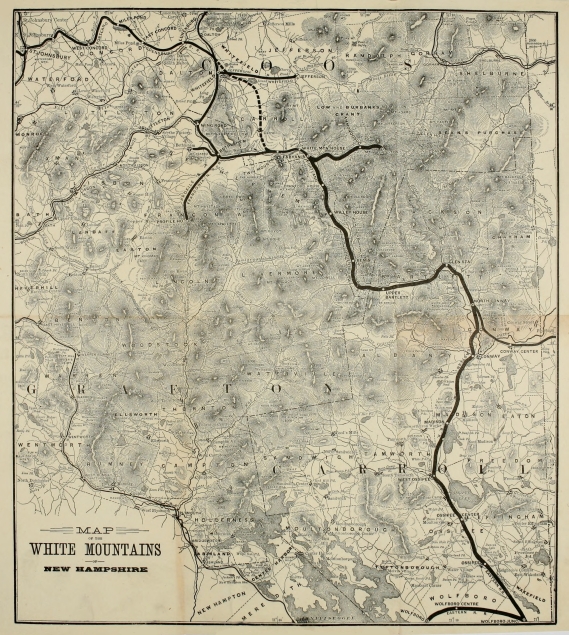
[larger view]
[largest view]
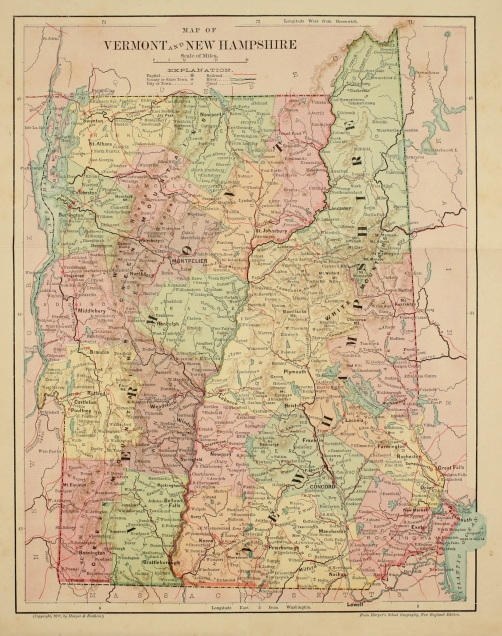
[larger view]
[largest view]
| Typographical errors corrected by the etext transcriber: |
|---|
| griping his arm=> gripping his arm {pg 103} |
| more and more drouth=> more and more drought {pg 173} |
| turned to looked back=> turned to look back {pg 243} |
| Moosilauk 4881=> Moosilauke 4881 {pg 330} |