Throughout the succeeding
winter Dave managed to visit the
clearing two or three times in the course
of each month, but he could not see that
he made any progress in Miranda’s favour.
As at first, she was sometimes friendly,
sometimes caustically indifferent. Only
once did he perceive in her the smallest
hint of gratification at his coming. That
was the time when he came on his snow-shoes
through the forest by moonlight,
the snow giving a diffused glimmer that
showed him the trail even through the
densest thickets. Arriving in the morning,
he surprised her at the door of the
cow stable, where she had been foddering
the cattle. Her face flushed at the sight
of him; and a look came into her wide,
dark eyes which even his modesty could
204
not quite misunderstand. But his delight
quickly crumbled: Miranda was loftily
indifferent to him during all that visit, so
much so that after he had gone Kirstie
reproached her with incivility.
“I can’t help it, mother!” she explained.
“I don’t want to hate him, but
what better is he than a butcher? His
bread is stained with blood. Pah! I
sometimes think I smell blood, the blood
of the kind wood creatures, when he’s
around.”
“But you don’t want him not to come,
girl, surely,” protested her mother.
“Well, you know, it’s a pleasure to
you to have him come once in a while,”
said the girl, enigmatically.
Dave continued his visits, biding his
time. He lost no chance of familiarizing
Miranda’s imagination with the needs of
man as he imagined them, and with a
rational conception of life as he conceived
it. This he did not directly, but through
the medium of conversation with Kirstie,
to whom his words were sweetness. He
was determined to break down Miranda’s
205
prejudice against his calling, which to him
was the only one worth a man’s while,—wholesome,
sane, full of adventure, full of
romance. He was determined, also, to
overcome her deep aversion to flesh food.
He felt that not till these two points were
gained would Miranda become sufficiently
human to understand human love or any
truly human emotions. In this belief he
strictly withheld his wooing, and waited till
the barriers that opposed it should be undermined
by his systematic attacks. He
was too little learned in woman to realize
that with Miranda his best wooing was
the absence of all wooing; and so he
builded better than he knew.
During the cold months he was glad to
be relieved of the presence of Kroof, who
had proved, in her taciturn way, quite
irreconcilable. He had tried in vain to
purchase her favour with honey, good
hive bees’ honey in the comb, carried all
the way from the Settlement. She would
have nothing to do with him at any price;
and he felt that this discredited him in
Miranda’s eyes. He hoped that Kroof
206
would sleep late that spring in her lair
under the pine root.
But while Dave was labouring so assiduously,
and, as he fancied, so subtly, to
mould and fashion Miranda, she all unawares
was moulding him. Unconsciously
his rifle and his traps were losing zest for
him; and the utter solitude of his camp
beyond the Quah-Davic began to have
manifest disadvantages. Once he hesitated
so long over a good shot at a lynx,
just because the creature looked unsuspecting,
that in the end he was too late,
and his store of pelts was the poorer by
one good skin. Shooting a young cow
moose in the deep snow, moreover, he
felt an unwonted qualm when the gasping
and bleeding beast turned upon him a look
of anguished reproach. His hand was
not quite so steady as usual when he gave
her the knife in the throat. This was
a weakness which he did not let himself
examine too closely. He knew the flesh
of the young cow was tender and good,
and after freezing it he hung it up in his
cold cellar. Though he would not for
207
an instant have acknowledged it, even to
himself, he was glad that bears were not
his business during the winter, for he
would almost certainly have felt a sense
of guilt, of wrong to Miranda, in shooting
them. For all this undercurrent of qualm
in the hidden depths of his heart, however,
his hunting was never more prosperous
than during the January and February
of that winter; and fox, lynx, wolverine,
seemed not only to run upon his gun, but
to seek his traps as a haven. He killed
with an emphasis, as if to rebuke the waking
germ of softness in his soul. But
he had little of the old satisfaction, as he
saw his peltries accumulate. His craft
was now become a business, a mere routine
necessity. For pleasure, he chose to
watch Miranda as her feathered pensioners—snowbirds,
wrens, rose grosbeaks,
and a glossy crow or two—gathered
about her of a morning for their
meal of grain and crumbs. They alighted
on her hair, her shoulders, her arms; and
the round-headed, childlike grosbeaks
would peck bread from her red lips; and
208
a crow, every now and then, would sidle
in briskly and give a mischievous tug at
the string of her moccasin. To the girl,
his heart needed no warming,—it burned
by now with a fire which all his backwood’s
stoicism could but ill disguise,—but
to the birds, and through them to all
the furry folk of the wood, his heart
warmed as he regarded the beautiful sight.
He noted that the birds were quite unafraid
of Kirstie, who also fed them; but
he saw that toward Miranda they showed
an active, even aggressive ardour, striving
jealously for the touch of her hand or foot
or skirt when no tit-bits whatever were
in question. And another sight there was,
toward shut of winter’s evening, that
moved him strangely. The wild, white
hares (he and Kirstie and Miranda called
them rabbits) would come leaping over
the snow to the cabin door to be fed, with
never cat or weasel on their trail. They
would press around the girl, nibbling
eagerly at her dole of clover, hay, and
carrots; some crouching about her feet,
some erect and striking at her petticoat
209
with their nervous fore paws, all twinkling-eared,
and all implicitly trustful of
this kind Miranda of the clover.
Toward spring Miranda began to be
troubled about Kirstie’s health. She saw
that the firm lines of her mother’s face
were growing unwontedly sharp, the bones
of her cheek and jaw strangely conspicuous.
Then her solicitous scrutiny took
note of a pallor under the skin, a greyish
whiteness at the corners of her eyes, a lack
of vividness in the usually brilliant scarlet
of the lips; for up to now Kirstie had
retained all the vital colouring and tone
of youth. Then, too, there was a listlessness,
a desire to rest and take breath after
very ordinary tasks of chopping or of
throwing fodder for the cattle. This
puzzled the girl much more than Kirstie’s
increasing tendency to sit dreaming over
the hearth fire when there was work to be
done. Miranda felt equal to doing all
the winter work, and she knew that her
mother, like herself, was ever a dreamer
when the mood was on. But even this
brooding abstraction came to worry her
210
at last, when one morning, after a drifting
storm which had piled the snow halfway
up the windows, her mother let her shovel
out all the paths unaided, with never a
comment or excuse. Miranda was not
aggrieved at this, by any means; but she
began to be afraid, sorely afraid. It was
so unlike the alert and busy Kirstie of
old days. Of necessity, Miranda turned
to Dave for counsel in her alarm, when
next he came to the clearing.
The conference took place in the warm
twilight of the cow stable, where Dave,
according to his custom, was helping
Miranda at the milking, while Kirstie got
supper. The young hunter looked serious,
but not surprised.
“I’ve took note o’ the change this two
month back, Mirandy,” he said, “an’
was a-wonderin’ some how them big eyes
of yourn, that can see things us ordinary
folks can’t see, could be blind to what
teched ye so close.”
“I wasn’t blind to it, Dave,” protested
the girl, indignantly; “but I didn’t see
how you could help any. Nor I don’t
211
see now; but there was no one else I
could speak to about it,” she added, with
a break in her voice that distantly presaged
tears.
“I could help some, if you’d let me,
Mirandy,” he hesitated, “for I know
right well what she’s needin’.”
“Well, what is it?” demanded the
girl. There was that in his voice which
oppressed her with a vague misgiving.
“It’s good, fresh, roast meat she
wants!” said Dave.
There was a pause. Miranda turned
and looked out through the stable door,
across the glimmering fields.
“It’s her blood’s got thin an’ poor,”
continued Dave. “Nothin’ but flesh
meat’ll build her up now, an’ she’s jest
got to have it.” He was beginning to
feel it was time that Miranda experienced
the touch of a firm hand.
“I don’t believe you!” said the girl,
and turned hotly to her milking.
“Well, we’ll see,” retorted Dave. In
Miranda’s silence he read a tardy triumph
for his views.
212
That evening he took note of the fact
that Kirstie came to supper with no appetite,
though every dish of it was tempting
and well cooked. Miranda observed this
also. Her fresh pang of apprehension on
her mother’s account was mixed with a
resentful feeling that Dave would interpret
every symptom as a confirmation of
his own view. She was quite honest in her
rejection of that view, for in her eyes flesh
food was a kind of subtle poison. But
she was too anxious about her mother’s
health to commit herself in open hostility
to anything, however extreme, which
might be suggested in remedy. On this
point she was resolved to hold aloof, letting
the decision rest between her mother
and Dave.
Aroused by the young hunter’s talk,
Kirstie was brighter than usual during the
meal; but, to her great disappointment,
Dave got up to go immediately after
supper. He would take no persuasion,
but insisted that he had come just to see
if she and Miranda were well, and declared
that affairs of supreme importance
213
called him straight back to the camp.
Kirstie was not convinced. She turned a
face of reproach on Miranda, so frankly
that the girl was compelled to take her
meaning.
“Oh! it isn’t my fault, mother,” she
protested, with a little vexed laugh.
“I’ve not been doing anything ugly to
him. If he goes, it’s just his own obstinacy,
for he knows we’d like him to stay
as he always does. Let him go if he
wants to!”
“Mirandy,” said her mother, in a voice
of grave rebuke, “I wish you would not
be so hard with Dave. If you treated
your dumb beasts like you treat him, I
reckon they would never come to you a
second time. You seem to forget that
Dave and his father are our only friends,—and
just now, Dave’s father being in
the lumber camp, we’ve nobody but Dave
here to look to.”
“Oh! I’ve nothing against Dave,
mother, except the blood on his hands,”
retorted the girl, turning her face away.
The young hunter shrugged his shoulders,
214
deprecatingly, smiled a slow smile
of understanding at Kirstie, and strode to
the door.
“Good night, both of ye,” he said
cheerfully. “Ye’ll see me back, liker’n
not, by this time to-morrow.”
As he went, Miranda noticed with
astonishment and a flush of warmth that
for once in his career he was without his
inseparable rifle. Kirstie, in the vacant
silence that followed his going, had it on
her tongue to say, “I do wish you could
take to Dave, Miranda.” But the woman’s
heart within her gave her warning in time,
and she held her peace. Thanks to this
prudence, Miranda went to bed that night
with something of a glow at her heart.
Dave’s coming without the rifle was a direct
tribute to her influence, and to some
extent outweighed his horrible suggestion
that her mother should defile her mouth
with meat.
The next evening the chores were all
done up; the “rabbits” had come and
gone with their clover and carrots; and
Kirstie and Miranda were sitting down
215
to their supper, when in walked Dave.
He carried a package of something done
up in brown sacking. This time, too, he
carried his rifle. Kirstie’s welcome was
frankly eager, but Miranda saw the rifle,
and froze. He caught her look, and with
a flash of intuition understood it.
“Had to bring it along, Mirandy,” he
explained, with a flush of embarrassment.
“Couldn’t ha’ got here without it. The
wolves have come back again, six of ’em.
They set on to me at my own camp
door.”
“Oh, wolves!” exclaimed Miranda, in
a tone of aversion. “They’re vermin.”
Since that far-off day when, with her
childish face flattened against the pane,
her childish heart swelling with wrath and
tears, she had watched the wolves attack
Ten-Tine’s little herd, she had hated the
ravening beasts with a whole-souled hate.
“I hope to goodness you killed them
all!” said Kirstie, with pious fervour.
“Two got off; got the pelts of the
others,” answered Dave.
“Not too bad, that,” commented
216
Kirstie, with approval; “now come and
have some supper.”
“Not jest yet, Kirstie,” he replied, undoing
his package. “I’ve noticed lately
ye was looking mighty peaked, an’ hadn’t
much appetite, like. Now when folks has
anything the matter with ’em I know as
much about it as lots of the doctors, and
I know what’s goin’ to set ye right up.
If ye’ll lend me the loan of yer fire, an’
a frying-pan, I’ll have something for yer
supper that’ll do ye more good than a
bucketful of doctor’s medicine.”
Miranda knew what was coming. She
knew Dave had been all the way back to
the camp, beyond the Quah-Davic, for
meat, that he might run no risk of killing
any of the beasts that were under
her protection. She knew, too, that to
make such a journey in the twenty-four
hours he could scarce have had one hour’s
sleep. None the less, she hardened her
heart against him. She kept her eyes on
her plate and listened with strained intensity
for her mother’s word upon this vital
subject.
217
Kirstie’s interest was now very much
awake. “There’s the fire, Dave,” she
said, “and there’s the frying-pan hanging
on the side of the dresser. But what
have you got? I’ve felt this long
while I’d like a bit of a change—not
but what the food we’re used to, Miranda
and me, is real good food and wholesome.”
“Well, Kirstie,” he answered, taking a
deep breath before the plunge, and at the
same time throwing back the wrapping
from a rosy cut of venison steak, “it’s
jest nothin’ more nor less than fresh meat.
It’s venison, clean an’ wholesome; and
I’ll fry ye right now this tender slice I’m
cuttin’ for ye.”
Kirstie was startled quite out of her
self-possession. The rule of the cabin
against flesh meat was so long established,
so well known at the Settlement, so fenced
about with every sanction of principle and
prejudice, that Dave’s words were of the
nature of a challenge. She felt that she
ought to be angry; but, as a matter of
fact, she was only uneasy as to how
Miranda would take so daring a proposal.
218
At the same time she was suddenly conscious
of an unholy craving for the forbidden
thing. She glanced anxiously
at Miranda, but the girl appeared to be
wrapped up in her own thoughts.
“But you know, Dave,” she protested
rebukingly, “we neither of us ever touch
meat of any kind. You know our opinions
on this point.”
The words themselves would have satisfied
Miranda had she not detected a certain
irresolution in the tone. They did
not affect Dave in the least. For a moment
he made no reply, for he was busy
cutting thin slices off the steak. He
spread them carefully in the hot butter,
now spluttering in the pan over the coals;
and then, straightening himself up from
the task, knife in hand, he answered cheerfully:
“That’s all right. But, ye see,
Kirstie, all the folks reckon me somethin’
of a doctor, an’ this here meat I’m cookin’
for ye ain’t rightly food at all. It’s medicine;
’tain’t right ye should hold off now,
when ye need it as medicine. ’Tain’t fair
to Mirandy. I can see ye’ve jest been
219
pinin’ away like, all winter. It’s new
blood, with iron in it, ye need. It’s flesh
meat, an’ flesh meat only, that’ll give ye
iron an’ new blood. When ye’re well, an’
yer old strong self agin, ye can quit meat
if ye like,—an’ kick me out o’ the cabin
for interferin’; but now—”
He paused dramatically. He had talked
right on, contrary to his silent habit, for a
purpose. He knew the power of natural
cravings. He was waiting for Kirstie’s
elemental bodily needs to speak out in
support of his argument. He waited just
time for the savoury smell of the steak to
fill the cabin and work its miracle. Now
the spell was abroad. He looked to
Kirstie for an answer.
The instant she smelled that savour
Kirstie knew that he was right. Steak,
venison steak fried in butter, was what
she required. For weeks she had had no
appetite; now she was ravenous. Moreover,
a thousand lesser forces, set in motion
by Dave’s long talks, were impelling
her to just such a change as the eating
of flesh would symbolize to her. But—Miranda?
220
Kirstie stared at her in nervous
apprehension, expecting an outburst of
scorn. But Miranda was seemingly oblivious
of all that went on in the cabin.
Her unfathomed eyes, abstractedly wide
open, were staring out through the white
square of the window. She was trying
hard to think about the mysterious blue-white
wash of radiance that seemed to
pour in palpable floods from the full
moon;—about the furred and furtive
creatures passing and repassing noiselessly,
as she knew, across the lit patches
of the glades;—about the herd of moose
down in the firwoods, sleeping securely
between walls of deep snow in the “yard,”
which they had trodden for themselves a
fortnight back;—of Kroof, coiled in her
warm den under the pine root, with five
feet of drift piled over her. But in reality
she was steeling herself, with fierce desperation,
against a strange appetite which was
rising within her at the call of that insidious
fragrance. With a kind of horror she
realized that she was at war with herself—that
one half her nature was really more
221
than ready to partake of the forbidden
food.
Dave noticed the look of question which
Kirstie had turned upon Miranda.
“Oh, ye needn’t look to her, Kirstie, to
back ye up in no foolishness,” he went on.
“I spoke to her last night about it, an’ she
hadn’t a word to say agin my medicine.”
Still there was no comment from Miranda.
If Miranda, to whom abstinence
from flesh was a religion, could tolerate a
compromise, why she herself, to whom it
was merely a prejudice and a preference,
might well break an ancient rule for an
instant’s good. She had been inwardly
anxious for months about her condition.
After a second or two of doubt, her mind
was made up; and when Kirstie made up
her mind, it was in no halfway fashion.
“I’ll try your doctoring, Dave,” she
said slowly. “I’ll give it a fair trial.
But while you’re about it, why don’t you
cook enough for yourself, too? Have
you put salt in the pan? And here’s a
dash of pepper.”
“No,” answered the young hunter,
222
concealing his elation as he sprinkled the
steak temperately with the proffered salt
and pepper, “I don’t want none myself,
I need meat onct in a while, er I git weak
an’ no good. But there’s nothin’ suits my
taste like the feeds I git here,—the pipin’
hot riz buckwheat cakes, with lots o’ butter
an’ molasses, an’ the johnny-cake, an’
the potater pie, an’ the tasty ways ye cook
eggs. I often think when I’m here that
I wouldn’t care if I never seen a slice o’
fresh meat, er even bacon, agin. But our
bodies is built a certain way, an’ there’s
no gittin’ over Nature’s intention. We’ve
got the teeth to prove it, an’ the insides,
too,—I’ve read all about it in
doctors’ books. I read a heap in camp.
Fact is, Kirstie, we’re built like the bear,—to
live on all kinds of food, includin’
flesh,—an’ if we don’t git all kinds onct
in a while, somethin’s bound to go wrong.”
Never had Dave talked so much before;
but now he was feverishly eager to
have no opening for discussion. While
he talked the venison was cooked and
served. Kirstie ate it with a relish, which
223
convinced him of the wisdom of his
course. She ate all that he had fried;
and he wisely refrained from cooking
more, that her appetite might be kept on
edge for it in the morning. Then she
ate other things, with an unwonted zest.
Miranda returned to the table, talking
pleasantly of everything but health, and
food, and hunting. Against herself she
was angry; but on Dave, to his surprise,
she smiled with a rare graciousness. She
was mollified by his tact in characterizing
the steak as medicine; and, moreover, by
his statement of a preference for their ordinary
bloodless table, he seemed in some
way to range himself on her side, even
while challenging her principles. But—oh,
that savoury smell! It still enriched
the air of the cabin; it still stirred riotous
cravings in her astonished appetite.
She trembled with a fear and hatred of
herself.
When Kirstie, with a face to which the
old glow was already venturing back, laid
down her knife and fork, and explained to
her guest, “You’re a good doctor, and
224
no mistake, Dave Titus; I declare I feel
better already,” Miranda got up and
went silently out into the moonlight to
breathe new air and take counsel with
herself.
Dave would have followed her, but
Kirstie stopped him. “Best let her
be,” she said meaningly, in a low voice.
“She’s got a heap to think over in the
last half hour.”
“But she took it a sight better’n I
thought she would,” responded Dave.
And all on account of a venison steak,
his hopes soared higher than they had
ever dared before.
225
Chapter XVI Death for a Little Life
Thenceforward Kirstie twice
or thrice a week medicined herself
with fresh venison, provided assiduously
by Young Dave, and by the time spring
was fairly in possession of the clearing,
she was her old strong self again. But
as for Dave’s hopes, they had been reduced
to desolation. Miranda had taken
alarm at her sudden carnivorous craving,
and in her effort to undo that moment’s
weakness she had withdrawn herself to
the utmost from Dave’s influence. She
had been the further incited to this by an
imagined aloofness on the part of her
furred and feathered pensioners. A pair
of foxes, doubtless vagrants from beyond
her sphere, had spread slaughter among
the hares as they returned from feeding
at the cabin. The hungry raiders had
laid an ambush at the edge of the clearing
226
on two successive nights. They had
killed recklessly. Then they vanished,
doubtless driven away by the steady residents
who knew how to kill discreetly and
to guard their preserves from poachers.
But the hares had taken alarm, and few
came now o’ nights for Miranda’s carrots
and clover. Miranda, with a little ache
at her heart, concluded from this that
she had forfeited her ascendency among
the kin of the ancient wood. There had
been a migration, too, among the squirrels,
so that now these red busybodies
were perceptibly fewer about the cabin
roof. And the birds—they were nearly
all gone. An unusually early spring, laying
bare the fields in the lower country,
and bringing out the insects before their
wont, had scattered Miranda’s flocks a
fortnight earlier than usual. No crumbs
could take the place of swelling seeds
and the first fat May-fly. But Miranda
thought they were fled through distrust
of her. Kroof, old Kroof the constant,
was all unchanged when she came from
her winter’s sleep; but this spring she
227
brought an unusually fine cub with her,
and the cub, of necessity, took a good
deal of her time and attention away from
Miranda. When Miranda was with her,
roaming the still, transparent corridors,
all the untroubled past came back, crystalline
and flawless as of old. Once more
the furtive folk went about their business
in the secure peace of her neighbourhood;
once more she revelled with a
kind of intoxication in the miraculous
fineness of her vision; once more she
felt assured of the mastery of her look.
But this was in the intervals between
Dave’s visits. When he was at the clearing,
everything was different. She was
no longer sure of herself on any point.
And the worst of it was that the more
indifference to him she feigned, the less
she felt. She was quite unconscious, all
the while, that her mother was shrewdly
watching her struggles. She was not unconscious,
however, of Dave’s attitude.
She saw that he seemed dull and worried,
which gratified her, she knew not why,
and confirmed her in her coolness. But
228
at last, with a slow anger beginning to
burn at his heart, he adopted the policy
of ignoring her altogether, and giving all
his thought to Kirstie, whereupon Miranda
awoke to the conclusion that it
was her plain duty to be civil to her
mother’s guest.
This change, not obtrusive, but of great
moment to Dave, came over the girl in
June, when the dandelions were starring
the pasture grass. The sowing and the
potato planting were just done. The lilac
bushes beside the cabin were a mass of
purple enchantment. It was not a time
for hard indifference; and Dave was quick
to catch the melting mood. His manner
was such, however, that Miranda could
not take alarm.
“Mirandy,” said he, with the merest
good comradeship in tone and air, “would
ye take a little trip with me to-morrow, now
that the crops can spare ye a bit?”
“Where to, Dave?” interposed Kirstie,
fearful lest the girl should refuse out of
hand, before she knew what Dave proposed
to do.
229
“Why, I’ve got to go over the divide
an’ run down the Big Fork in my canoe to
Gabe White’s clearin’, with some medicine
I’ve brought from the Settlement for his
little boy what’s sick. He’s a leetle mite of
a chap, five year old, with long, yaller curls,
purty as a picture, but that peaked an’
thin, it goes to yer heart to see him. Gabe
came in to the Settlement yesterday to
see the doctor about him an’ git medicine;
but he’s had to go right on to the city to
sell his pelts, an’ git some stuff the doctor
says the little feller must hev, what can’t
be got in the Settlement at all. So Gabe
give me this” (and he pulled a bottle out
of the inside pocket of his hunting shirt)
“to take to him right now, coz the little
feller needs it badly. It’s a right purty
trip, Mirandy, an’ the Big Fork’s got some
rapids ’at’ll please ye. What ye say?”
Dave was growing subtle under Miranda’s
discipline. He knew that the
picture of the small boy would draw her;
and also that the sight of the ailing child,
acting upon her quick sympathies, would
awaken a new human interest and work secretly
230
in favour of himself. The beauty of
the scenery, the excitement of the rapids,—these
were a secondary influence, yet he
knew they would not be without appeal
to the beauty-worshipping and fearless
Miranda.
The girl’s deep eyes lightened at the
prospect. She would see something a
little different, yet not alien or hostile,—a
new river, other hills and woods, a
deeper valley, a ruder cabin in a remoter
clearing, a lonely woman,—above all, a
little sick boy with long, yellow hair.
“But it must be a long way off, Dave,”
she protested, in a tone that invited contradiction.
“Not so far as to the Settlement,”
answered Dave; “an’ it don’t take half
so long to go because o’ the quick run
down river. I reckon, though, we’d best
stay over night at White’s clearin’ and
come back easy nex’ day—if you don’t
mind, Kirstie! Sary Ann White’s a powerful
fine woman, an’ Mirandy’s sure to like
her. It’ll do her a sight of good, poor
thing, to hev Mirandy to talk to a bit.”
231
He wanted to say that just a look at
Miranda’s wild loveliness would do Mrs.
White a lot of good; but he had not quite
the courage for such a bold compliment.
“No, I don’t mind, if Miranda likes to
go,” said Kirstie; “I shan’t be lonesome,
as Kroof’ll be round most of the time.”
It had come to be understood, and accepted
without comment, that when Dave
went anywhere with Miranda the jealous
old bear remained at home.
Until they were fairly off, Dave was in
a fever of anxiety lest Miranda should
change her mind. But this venture had
genuinely caught her interest, and no whim
tempted her to withdraw. After a breakfast
eaten so early that the early June
dawn was still throwing its streaks of cool
red through the cabin window and discouraging
the fire upon the hearth, Dave
and Miranda set out. They followed the
path to the spring among the alders, and
then plunged direct into the woods, aiming
a little to the east of north. The dew
was thick in silver globules on the chips
of the yard and on the plantain leaves. It
232
beaded the slender grasses about the spring,
and the young foliage of the alders, and
the dazzling veils of the gossamer spiders.
This time Dave took his rifle with him,
and Miranda paid no heed to it.
The woods were drenching wet, but
unusually pervaded with light. The new
risen sun sent its fresh rays far up the
soundless vistas, and every damp leaf or
shining facet of bark diffused its little dole
of lustre to thin the gloom. As the sun
got higher and the dew exhaled away, the
twilight slightly deepened, the inexpressible
clarity of the shadowed air returned,
and the heart of the ancient wood resumed
its magic. The awe, as of an enchantment
working unseen, the meaning and
expectant stillness, the confusion of near
and far, the unreality of the familiar,—all
this gripped the imagination of the two
travellers just as sharply as if they had
not been all their lives accustomed to it.
The mystery of the ancient wood was not
to be staled by use. These two, sensitive
to its spell as a surface of glass to a breath,
lay open to it in every nerve, and a tense
233
silence fell upon their lips. In the silence
was understanding of each other. It was
Dave’s most potent wooing, against which
Miranda had no warning, no defence.
As they walked thus noiselessly, light-footed
as the furtive folk themselves, suddenly
from a bit of open just ahead of
them there came the slender, belling cry
of a young deer. They had arrived now,
after three hours’ rapid walking, at a part
of the forest unknown to Miranda. The
open space was rock thinly covered with
mosses and vines, an upthrust of the
granite foundations of a hill which towered
near by.
It was an unheard-of thing for a young
deer to give cry so heedlessly amid the
perilous coverts of the wood. Both the
travellers instinctively paused, and then
stole forward with greater caution, peering
through the branches. To the forest
dwellers, beast or human, the unusual is
always the suspicious, and therefore to be
investigated. A few paces carried them
both to a point where Miranda caught
sight of the imprudent youngling.
234
“Hush!” she whispered, laying her
hand on Dave’s arm, “Look! the poor
little thing’s lost. Don’t frighten it!”
“There’ll be something else’ll frighten
it afore long,” muttered Dave, “if it don’t
quit its bla’tin’.”
The words were hardly out of his
mouth when the little animal jumped,
trembled, started to run, and then looked
piteously from side to side, as if uncertain
which way to flee and from what peril.
An instant more and the greyish-brown
form of a lynx shot like lightning from the
underbrush. It caught the young deer
by the throat, dragged it down, tore it
savagely, and began drinking its blood.
“Kill it! kill it!” panted Miranda,
starting forward. But Dave’s hand
checked her.
“Wait!” he said firmly. “The little
critter’s dead; we can’t do it no good.
Wait an’ we’ll git both the varmints.
There’ll be a pair of ’em.”
Under ordinary circumstances, Miranda
would have resented the idea of getting
“both the varmints”; but just now she
235
was savage with pity for the young deer,
and she chose to remember vindictively
that far-off day when Ganner had come to
the clearing, and only the valour of Star,
the brindled ox, had saved herself and
Michael, the calf, from a cruel death. She
obeyed Dave’s command, therefore, and
waited.
But there was another who would not
wait. The mother doe had heard her
lost little one’s appeal. In wild haste,
but noiseless on the deep carpet of the
moss, she came leaping to the cry. She
saw what Miranda and Dave saw. But
she did not pause to calculate, or weigh the
odds against her. With one bound she
was out in the open. With the next she
was upon the destroyer. The hungry
lynx looked up just in time to avoid the
fair impact of her descending hooves,
which would have broken his back. As
it was, he caught a glancing blow on the
flank, which ripped his fine fur and hurled
him several paces down the slope.
Before he could fully recover, the deer
was upon him again; and Miranda, her
236
eyes glowing, her cheeks scarlet with
excitement and exultation, clutched her
companion’s arm with such a grip that
her slim fingers hurt him deliciously.
The lynx, alarmed and furious, twisted
himself over and fixed both claws and
teeth in his adversary’s leg, just below the
shoulder. Fierce and strong as he was,
he was nevertheless getting badly punished,
when his mate appeared bounding
down the slope, and with a sharp snarl
sprang upon the doe’s neck, bearing her
to her knees.
“Shoot! shoot!” cried Miranda, springing
away from Dave’s side to give him
room. But his rifle was at his shoulder
ere she spoke. With the word his shot
rang out; and the second assailant dropped
to the ground, kicking. Immediately
Dave ran forward. The male lynx, disentangling
himself, darted for cover; but
just as he was disappearing, Dave gave
him the second barrel, at short range, and
the bullet caught him obliquely across the
hind quarters, breaking his spine. Dave
was noted as the best shot in all that
237
region; but the marksmanship which he
had just displayed was lost on Miranda.
She took it for granted that to shoot was
to hit, and to hit was to kill, as a matter
of course. Dave’s first shot had killed.
The animal was already motionless. But
the writhings of the other lynx, prone in
the bush, tore her heart.
“Oh, how it’s suffering! Kill it,
quick!” she panted. Dave ran up,
swung his rifle in a short grip, and struck
the beast a settling blow at the base of
the skull. The deer, meanwhile, limping
and bleeding, but not seriously the worse
for her dreadful encounter, hobbled back
to where the body of her young lay
stretched upon the moss. She sniffed at
it for a moment with her delicate nose,
satisfied herself that it was quite dead,
then moved off slowly into the shadows.
Miranda went to each of the three
slain animals in turn, and looked at them
thoughtfully, while Dave waited in silence,
uncertain what to do next. He felt that
it behooved him to step warily while
Miranda was wrestling with emotions.
238
At last she said, with a sob in her voice,
and her eyes very bright and large,—
“Come, let’s get away from this horrid
place!”
Dave experienced a certain mild pang
at the thought of leaving two good pelts
behind him to be gnawed by foxes; but
he followed Miranda without a word. It
would have been a fatal error to talk of
furs at that moment. As soon, however,
as they were out of sight of the open
slope, he turned aside and headed their
course toward a rocky knoll which was
visible through the trees.
“What are you going that way for?”
asked Miranda.
“Likely the lou’-cerfies had their den
in the rocks yonder,” was the reply; “we
must find it.”
“What do we want of their den?”
queried the girl in surprise.
“There’ll be a couple of lou’-cerfie kittens
in it, I reckon,” said Dave, “an’ we
must find ’em.”
“What for?” demanded Miranda, suspiciously.
239
Dave looked at her.
“You’ve had me shoot the father an’
mother, Mirandy,” he said slowly, “for
the sake of the deer. An’ now would ye
hev the little ones starve to death?”
“I never thought of that, Dave,”
answered the girl, smitten with remorse;
and she looked at him with a new approval.
She thought to herself that he,
hunter and blood-stained as he was,
showed yet a readier and more reasonable
tenderness for the furry kindred than she
herself.
For nearly half an hour they searched
the hollows of the rocky knoll, and at
last came upon a shallow cave overhung
darkly by a mat of dwarf cedar. There
were bones about the entrance, and inside,
upon a bed of dry moss, were two small
rusty brown, kitten-like objects curled
softly together. Miranda’s discerning
vision perceived them at once, but it took
Dave’s eyes some seconds to adapt themselves
to the gloom. Then the furry ball
of “lou’-cerfie” kittens looked to him
very pretty—something to be fondled
240
and protected. He knew well how their
helplessness would appeal to Miranda’s
tender heart. Nevertheless, with a firmness
of courage which, under the circumstances,
few heroes would have arisen
to, he stepped forward, stooped, untangled
the soft ball, and with the heavy handle
of his hunting-knife struck each kitten
just one sharp stroke on the neck, killing
it instantly and easily.
“Poor little critters!” he muttered;
“it was the only thing to do with ’em,”
and he turned to Miranda.
The girl had backed out of the cave
and now stood, with flushed face, staring
at him fiercely.
“You brute!” she exclaimed.
Dave had been prepared for some discussion
of his action. But he was not prepared
for just this. He drew himself up.
“I did think ye was a woman grown;
an’ for all yer idees were kind of far-fetched,
I’ve respected ’em a heap; an’ I
won’t say but what they’ve influenced
me, too. But now I see ye’re but a silly
child an’ don’t reason. Did ye think,
241
maybe, these here leetle mites o’ things
could live an’ take keer o’ themselves?”
He spoke coldly, scornfully; and there
was a kind of mastery in his voice that
quelled her. She was astonished, too.
The colour in her face deepened, but
she dropped her eyes.
“I wanted to take them home, and tame
them,” she explained, quite humbly.
Dave’s stern face softened.
“Ye’d never ’a’ been able to raise ’em.
They’re too young, a sight too young.
See, their eyes ain’t open. They’d have
jest died on yer hands, Mirandy, sure an’
sartain!”
“But—how could you!” she protested,
with no more anger left, but a sob of pity
in her throat.
“It was jest what you do to the fish ye
ketch, Mirandy, to stop their sufferin’.”
Miranda looked up quickly, and her
eyes grew large.
“Do you know, I never thought of
that before, Dave,” she replied. “I’ll
never catch a fish again, long as I live!
Let’s get away from here.”
242
“Ye see,” began Dave, making up his
mind to sow a few seeds of doubt in
Miranda’s mind as to the correctness of
her theories, “ye see, Mirandy, ’tain’t
possible to be consistent right through in
this life; but what ye’ll find, life’ll make
a fool o’ ye at one point or another. I
ain’t a-goin’ to say I think ye’re all wrong,
not by no means. Sence I’ve seen the
way ye understand the live critters of the
woods, an’ how they understand you,
I’ve come to feel some different about
killin’ ’em myself. But, Mirandy, Nature’s
nature, an’ ye can’t do much by
buckin’ up agin her. Look now, ye told
me to shoot the lou’-cerfie coz he killed
the deer kid. But he didn’t go to kill it
for ugliness, nor jest for himself to make
a dinner off of—you know that. He
killed it for his mate, too. Lou’-cerfie
ain’t built so’s they can eat grass. If the
she lou’-cerfie didn’t git the meat she
needed, her kittens’d starve. She’s jest
got to kill. Nature’s put that law onto
her, an’ onto the painters, an’ the foxes
an’ wolves, the ’coons an’ the weasels.
243
An’ she’s put the same law, only not so
heavy, onto the bears, an’ also onto
humans, what’s all built to live on all
kinds of food, meat among the rest. An’
to live right, and be their proper selves,
they’ve all got to eat meat sometimes,
for Nature don’t stand much foolin’ with
her laws!”
“I’m well,” interrupted Miranda,
eagerly, with the obvious retort.
“Maybe ye won’t be always!” suggested
Dave.
“Then I’ll be sick—then I’ll die
before I’ll eat meat!” she protested passionately.
“What’s the good of living,
anyway, if it’s nothing but kill, kill, kill,
and for one that lives a lot have got to
die!”
Dave shook his head soberly.
“That’s what nobody, fur’s I can see,
Mirandy, has ever been able to make out
yet. I’ve thought about it a heap, an’
read about it a heap, alone in camp, an’ I
can’t noways see through it. Oftentimes
it’s seemed to me all life was jest like a
few butterflies flitterin’ over a graveyard.
244
But all the same, if we don’t go to too
much foolish worryin’ ’bout what we can’t
understand, we do feel it’s good to be
alive; an’ I do think, Mirandy, this
life might be somethin’ finer than the
finest kind of a dream.”
Something in his voice, at these last
words, thrilled Miranda, and at the same
time put her on her guard.
“Well,” she exclaimed positively, if
not relevantly, “I’m never going to catch
another fish.”
The answer not being just what Dave
needed for the support of his advance,
he lost courage, and let the conversation
drop.
245
Chapter XVII In the Roar of the Rapids
A little before noon, when the
midsummer heat of the outside
world came filtering faintly down even
into the cool vistas of the forest, and here
and there a pale-blue butterfly danced
with his mate across the clear shadow,
and the aromatic wood smells came out
more abundantly than was their wont, at
the lure of the persuasive warmth, the
travellers halted for noonmeat. Sitting
on a fallen hemlock trunk beside a small
but noisy brook, it was a frugal meal they
made on the cheese and dark bread which
Kirstie had put in Dave’s satchel. Their
halt was brief; and as they set out again,
Dave said:—
“’Tain’t a mile from here to the Big
Fork. Gabe’s canoe’s hid in the bushes
just where this here brook falls in.
Noisy, ain’t it?”
246
“I love the sound,” exclaimed Miranda,
stepping quickly and gaily, as if the light,
musical clamour of the stream had got
into her blood.
“Well, the Big Fork’s a sight noisier,”
continued Dave. “It’s heavy water, an’
just rapids on rapids all the ways down to
Gabe’s clearing. Ye won’t be skeered,
Mirandy?”
The girl gave one of her rare laughs,
very high-pitched, but brief, musical, and
curiously elusive. She was excited at the
prospect.
“I reckon you know how to handle a
canoe, Dave,” was all she said. The
trust in her voice made Dave feel measurably
nearer his purpose. He durst not
speak, lest his elation should betray itself.
In a little while there came another
sound, not drowning or even obscuring the
clear prattle of the brook, but serving as a
heavy background to its brightness. It
was a large, yet soft, pulsating thunder,
and seemed to come from all sides at once;
as if far-off herds, at march over hollow
lands, were closing in upon them. Dave
247
looked at Miranda. She gave him a shining
glance of comprehension.
“It’s the rapids!” she cried. “Do we
go through those?”
Dave laughed.
“Not those! Not by a long chalk!
That’s the ‘Big Soo’ ye hear, an’ it’s
more a fall than a rapid. Ther’s an eddy
an’ a still water jest below, an’ that’s where
we take to the canoe.”
As they went on, the great swelling
noise seemed to Miranda to fill her soul,
and worked a deep yet still excitement
within her. Nevertheless, rapidly as its
volume increased, the light chatter of the
brook was upborne distinctly upon the
flood of it. Then, suddenly, as the forest
thinned ahead, and the white daylight confronted
them, the voice of the brook was
in an instant overwhelmed, utterly effaced.
The softly pervasive thunder burst all at
once into a trembling roar, vehement, conflicting,
explosive; and they came out full
in face of a long, distorted slope of cataract.
White, yellow, tawny green, the waves
bounded and wallowed down the loud
248
steep; and here and there the black bulks
of rock shouldered upward, opposing them
eternally.
Spellbound at the sight, Miranda stood
gazing, while Dave fetched from the bushes
a ruddy-yellow canoe of birch bark, and
launched it in a quiet but foam-flecked
back-water at their feet. In the bow he
placed a compact bundle of bracken for
Miranda to sit upon, with another flat
bundle at her back, that the cross-bar
might not gall her.
“Best fer ye to sit low, Mirandy, ’stead
o’ kneelin’,” he explained, “coz I’ll be
standin’ up, with the pole, goin’ through
some o’ the rips, an’ ye’ll be steadier sittin’
than kneelin’.”
“But I paddle better kneeling,” protested
Miranda.
“Ye won’t need to paddle,” said Dave,
a little grimly. “Ye’ll jest maybe fend a
rock now an’ agin, that’s all. The current
an’ me’ll do the rest.”
The fall of the “Big Soo” ended in a
basin very wide and deep, whose spacious
caverns absorbed the fury of the waters
249
and allowed them to flow off sullenly.
Dave knelt in the stern, paddle in hand,
and the long pole of white spruce sticking
out behind the canoe, where he could lay
his grasp upon it in an instant. A couple
of strokes sent the little craft out into the
smooth, purplish-amber swirls of the deep
current, whereon the froth clusters wheeled
slowly. A few minutes more and a green
fringed overhang of rock was rounded,
the last energy of the current spent itself
in a deep and roomy channel, the uproar
of the cataract mellowed suddenly to that
pulsating thunder which they had heard at
first, and the canoe, under Dave’s noiseless
propulsion, shot forward over a surface
as of dark brown glass. There was a
mile of this still water, along which Miranda
insisted upon paddling. The rocks
rose straight from the channel, and the
trees hung down from their rim, and the
June sun, warmly flooding the trough of
rock and water, made its grimness greatly
beautiful. Then the rocks diminished,
and the steep, richly green slopes of the
hillsides came down to the water’s edge,
250
and a rushing clamour began to swell in
the distance. The currents awakened
under the canoe, which darted forward
more swiftly. The shouting of the “rips”
seemed to rush up stream to meet them.
The surface of the river began to slant
away before them, not breaking yet, but
furrowing into long, thready streaks. Then,
far down the slant, a tossing white line of
short breakers, drawn right across the channel,
clambered toward them ravenously.
“Ye’d better not paddle now, Mirandy,”
said Dave, in a quiet voice, standing
up for a moment to survey the channel,
while the canoe slipped swiftly down toward
the turmoil. “There’s rapids now
all the way down to Gabe’s clearing. An’
we won’t be long goin’, neither.”
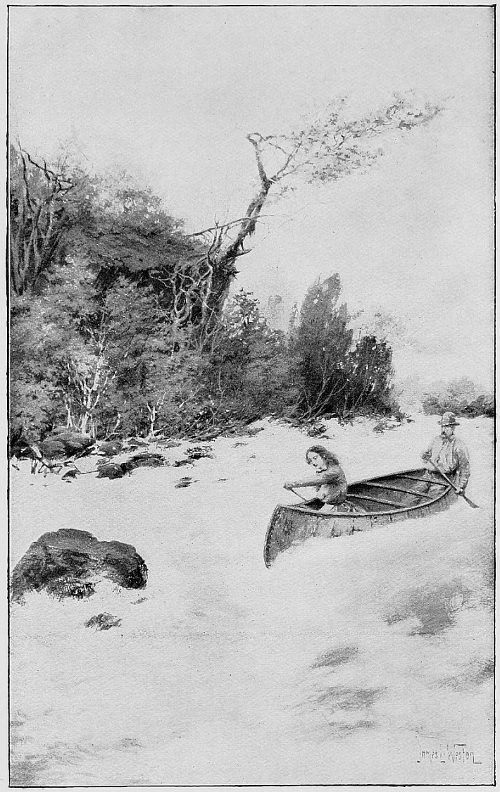
‘Stroke on the right!’ came Dave’s sharp order
251
A moment more, and to Miranda it
seemed that the leafy shores ran by her,
that the gnashing phalanx of the waves
sprang up at her. She had never run a
rapid before. Her experience of canoeing
had all been gained on the lake. She
caught her breath, but did not flinch as
the tumbling waters seethed and yammered
around her. Then her blood ran hot with
the excitement of it; her nerves tingled.
She wanted to cry out, to paddle wildly
and fiercely. But she held herself under
curb. She never moved. Only the grip
of her hands on the paddle, which lay idle
before her, tightened till the knuckles
went white. There was no word from
Dave; no sign of his presence save that
the canoe shot straight as an arrow, and
bit firmly upon the big surges, so that she
knew his wrist of steel was in control.
Suddenly, just ahead, sprang a square black
rock, against which the mad rush of water
upreared and fell back broken to either
side. The canoe leaped straight at it, and
Miranda held her breath.
“Stroke on the right!” came Dave’s
sharp order. She dipped her paddle
strenuously, twice—thrice—and, swerving
at the last moment, while the currents
seethed up along her bulwarks, the canoe
darted safely past.
Miranda stopped paddling. There was
a steeper slope in front, but a clear channel,
the waves not high but wallowing inward
252
toward the centre. Straight down
this centre rushed the canoe, the surges
clutching at her on both sides, yellow
green, with white foam-streaks veining
their very hearts. At the foot of the
slope, singing sharply and shining in the
sun, curved a succession of three great
“ripples,” stationary in mid-channel, their
back-curled crests thin and prismatic.
Straight through these Dave steered.
The three thin crests, thus swiftly divided,
one after another, slapped Miranda coldly
in the face, drenching her, and leaving
a good bucketful of water in the
canoe.
“Oh!” gasped Miranda, at the shock,
and shook her hair, laughing excitedly.
There was gentler water now for a
hundred yards or so, and Dave steered
cautiously for shore.
“We’ll hev to land an’ empty her out,”
said he. “Ther’s no more big ‘ripples’
like them there on the whole river; an’
we won’t take in water agin ’twixt here
an’ Gabe’s.”
“I don’t care if we do!” exclaimed
253
Miranda, fervently. “It was splendid,
Dave! And you did it just fine!”
This commendation took him aback
somewhat, and he was unable to show his
appreciation of it except by a foolish grin,
which remained on his face while he turned
the canoe over and while he launched it
again. It was still there when Miranda
resumed her place in the bow; and,
strangely enough, she felt no disposition
to criticise him for it.
The rest of the journey, lasting nearly an
hour longer, was a ceaseless succession of
rapids, with scant and few spaces of quiet
water between. None were quite so long
and violent as the first; but by the time the
canoe slowed up in the reach of still water
that ran through the interval meadow of
Gabe’s clearing, Miranda felt fagged from
the long-sustained excitement. She felt
as if it had been she, not Dave, whose
unerring eye and unfailing wrist had
brought the canoe in triumph through
the menace of the roaring races.
They landed on the blossoming meadow
strip, and Dave turned the canoe over
254
among the grasses, under the shade of an
elm that would serve to keep the afternoon
sun from melting the rosin off the
seams. Gabe’s cabin stood a stone’s throw
back from the meadow, high enough up
the slope to be clear of the spring freshets.
It was a bare, uncared-for place, with black
stumps still dotting all the fields of buckwheat
and potatoes, a dishevelled-looking
barn, and no vine or bush about the house.
It gave Miranda a pang of pity to look
at it. Her own cabin was lonely enough,
but with a high, austere, clear loneliness
that seemed to hold communion with the
stars. The loneliness of this place was a
shut-in, valley loneliness, without horizons
and without hope. She felt sorry almost
to tears for the white and sad-eyed woman
who appeared in the cabin door to welcome
them.
“Sary Ann, this is Mirandy I spoke to
ye about.”
The two women shook hands somewhat
shyly, and, after the silent fashion of their
race, said nothing.
“How’s Jimmy?” asked Dave.
255
“’Baout the same, thank ye, Dave,” replied
the woman, wearily, leading the way
into the cabin.
In a low chair near the window, playing
listlessly with a dingy red-and-yellow rag
doll, sat a thin-faced, pallid little boy with
long, pale curls down on his shoulders.
He lifted sorrowful blue eyes to Miranda’s
face, as she, with a swift impulse of tenderness
and compassion, rushed forward and
knelt down to embrace him. Her vitality
and the loving brightness of her look won
the child at once. His wan little face
lightened. He lifted the baby mouth to
be kissed. Miranda pressed his fair head
to her bosom gently, and had much ado
to keep her eyes from running over, so
worked the love and pity and the mothering
hunger in her heart.
“He takes to ye, Mirandy,” said the
woman, smiling upon her. And Dave,
his passion almost mastering him, blurted
out proudly,—
“An’ who wouldn’t take to her, I’d like
to know?”
He felt at this moment that Miranda was
256
now all human, and could never quite go
back to her mystic and uncanny wildness,
her preference for the speechless, furry kin
over her own warm, human kind. He produced
the medicine from his satchel; and
from Miranda’s attentive hand Jimmy
took the stuff as if it had been nectar.
Jimmy’s mother looked on with undisguised
approval of the girl. Had she
thought Miranda was going to stay any
length of time, her mother-jealousy would
have been aroused; but as it was she was
only exquisitely relieved at the thought
of Jimmy’s being in some one else’s care
for a few hours. She whispered audibly—a
mere chaffing pretence of a whisper
it was—to Dave:—
“It’s a right purty an’ a right smart
little wife she’ll make fer ye, Dave Titus,
an’ she’ll know how to mind yer babies.
Ye’re a lucky man, an’ I hope ye understand
how lucky ye air!”
Poor Dave! She might as well have
thrown a bucket of cold water in his face.
For an instant he could have strangled the
kindly, coarse-grained, well-meaning, silly
257
woman, who stood beaming her pale goodwill
upon them both. He cursed himself
for not having warned her that Miranda
could not be chaffed like a common Settlement
girl. He saw Miranda’s face go
scarlet to the ears, though she bent over
Jimmy and pretended to have heard nothing;
and he knew that in that moment
his good work was all undone. For a few
seconds he could say nothing, and the
silence grew trying. Then he stammered
out:—
“I’m afeard ther’s no sich luck fer me,
Sary Ann, though God knows I want her.
But Mirandy don’t like me very well.”
The woman stared at him incredulously.
“Lord sakes, Dave Titus, then what’s
she doin’ here alone with you?” she exclaimed,
the weariness coming back into
her voice at the last of the phrase. “Oh,
you go ’long! You don’t know nothin’
about women!”
This was quite too much for Dave, whose
instincts, fined by long months in the companionship
of only the great trees, the great
258
winds, and the grave stars, had grown unerringly
delicate. His own face flushed
up now for Miranda’s sake.
“I’d take it kindly of ye, Sary Ann, if
ye’d quit the subject right there,” he said
quietly. But there was a firmness in his
voice which the woman understood.
“The both of ye must be nigh dead
for somethin’ to eat,” she said. “I must
git ye supper right off.” And she turned
to the fireplace and filled the kettle.
Thereafter, through supper, and through
the short evening, Miranda had never a
word for Dave. She talked a little, kindly
and without showing her resentment, to
Mrs. White; but her attentions were entirely
absorbed in little Jimmy. Indeed,
she had Jimmy very much to herself, for
Mrs. White got Dave to help with the
chores and the milking. Afterward, about
the hearth-fire,—maintained for its cheer
and not for warmth,—Mrs. White confined
her conversation largely to Dave.
She was not angry at him on account of
his rebuke—but vaguely aggrieved at
Miranda as the cause of it. She began
259
to feel that Miranda was different from
other girls, from what she herself had been
as a girl. Miranda’s fineness and sensitiveness
were something of an offence to
her, though she could not define them at
all. She characterized them vaguely by
the phrase “stuck up”; and became
presently inclined to think that a fine fellow
like Dave was too good for her. Still,
she was a fair-minded woman in her worn,
colourless way; and she could not but
allow there must be a lot in Miranda if
little Jimmy took to her so—“For a
child knows a good heart,” she said to
herself.
Next morning, soon after dawn, the
travellers were off, Miranda tearing herself
with difficulty from little Jimmy’s embrace,
and leaving him in a desolation of
tears. She was quite civil and ordinary
with Dave now, so much so that good,
obtuse, weary Mrs. White concluded that
all was at rights again. But Dave felt the
icy difference; and he was too proud, if
not for the time too hopeless, to try to
thaw it. During all the long, laborious
260
journey upward through the rapids, by
poling, he did wonders of skill and
strength, but in utter silence. His feats
were not lost upon Miranda, but she
hardened her heart resolutely; for now a
shame, which she had never known before,
gave tenacity to her anger. Through
it all, however, she couldn’t help thrilling
to the strife with the loud rapids, and
exulting in the slow, inexorable conquest
of them. The return march through the
woods was in the main a silent one, as
before; but how different a silence! Not
electric with meaning, but cold, the silence
of a walled chamber. And, as if the spirits
of the wood maliciously enjoyed Dave’s
discomfiture, they permitted no incident,
no diversion. They kept the wood-folk
all away, they emptied of all life and significance
the forest spaces. And Dave
grew sullen.
Arriving back at the clearing just before
sundown, they paused at the cabin door.
Dave looked into Miranda’s eyes with
something of reproach, something of appeal.
Kirstie’s voice, talking cheerfully
261
to Kroof, came from the raspberry brambles
behind the house. Miranda stretched
out her hand with a cool frankness, and
returned his look blankly.
“I’ve had a real good time, thank you,
Dave,” she said. “You’ll find mother
yonder, picking raspberries.”
262
Chapter XVIII The Forfeit of the Alien
All through the summer and early
autumn Dave continued his fortnightly
visits to the cabin in the clearing,
and always Miranda treated him with the
same cold, casual civility. She felt, or
pretended to herself that she felt, grateful
now to the blunt-fingered, wan woman
over at Gabe White’s, who had rudely
jostled her back to her senses when she
was on the very edge of giving up her
freedom and her personality to a man—a
strong man, who would have absorbed
her. She flung herself passionately once
more into the fellowship of the furtive
folk, the secrecy and wonder of the wood.
As it was a human love which she was
crushing out, and as she felt the need
of humanity cravingly, though not understandingly,
at her heart, she lavished upon
263
Kirstie a demonstrativeness of affection
such as she had never shown before. It
pleased Kirstie, and she met it heartily
in her calm, strong way; but she saw
through it, and smiled at the back of her
brain, scarcely daring to think her thought
frankly, lest the girl’s intuition should
discern it. She made much of Dave, but
never before Miranda; and she kept
encouraging the rather despondent man
with the continual assertion: “It’ll be all
right, Dave. Don’t fret, but bide your
time.” To which Dave responded by
biding his time with a quiet, unaggressive
persistence; and if he fretted, he took
pains not to show it.
If Dave had an ally in Kirstie, he had
consistent antagonists in all the folk of
the wood; for never before in all Miranda’s
semi-occult experience had the
folk of the wood come so near to her.
Kroof was her almost ceaseless companion,
more devoted, if possible, than ever, and
certainly more quick in comprehension
of Miranda’s English. And Kroof’s cub,
a particularly fine and well-grown young
264
animal, was well-nigh as devoted as his
mother. When these two were absent on
some rare expedition of their own, undertaken
by Kroof for the hardening of the
cub’s muscles, then the very foxes took
to following Miranda, close to heel, like
dogs; and one drowsy fall afternoon,
when she had lain down to sleep on a
sloping patch of pine needles, the self-same
big panther from whom she had
rescued Dave came lazily and lay down
beside her. His large purring at her ear
awoke her. He purred still more loudly
when she gently scratched him under the
throat. She was filled with a curious
exaltation as she marked how her influence
over the wild things grew and widened.
Nothing, she vowed, should ever
lure her away from these clear shades,
these silent folks whom she ruled by hand
and eye, and this mysterious life which
she alone could know. When Old Dave,
for whom she cared warmly, made his
now infrequent visits to the clearing, she
had an inclination to avoid him, lest he
should attack her purpose; and the
265
thought of little Jimmy’s white face and
baby mouth she put away obstinately, as
most dangerous of all. And so it came
that when October arrived, and all the
forest everywhere was noiselessly astir
with falling leaves, and the light of the
blue began to peer in upon the places
which had been closed to it all summer,
by that time Miranda felt quite secure in
her resolve; and Dave’s fight now was to
keep the despair of his heart from writing
itself large upon his face.
Toward the end of that October Dave’s
hunting took him to the rocky open
ground where, in the previous June, he
and Miranda had encountered the lynxes.
He was looking for fresh meat for Kirstie,
and game, that day, had kept aloof. Just
as he recognized, with a kind of homesick
ache of remembrance, the spot where he
and Miranda had seemed, for a brief
space, to be in perfect accord with each
other,—how long ago and how unbelievable
it appeared to him now!—his
hunter’s eye caught a sight which brought
the rifle to his shoulder. Just at the
266
edge of the open a young bear stood
greedily stripping blueberries from the
laden bushes, and grunting with satisfaction
at the sweet repast.
“A bit of bear steak,” thought Dave,
“will be jest the thing for Kirstie. She’s
gittin’ a mite tired o’ deer’s meat!”
An unhurried aim, a sharp, slapping
report, and the handsome cub sank forward
upon his snout, and rolled over,
shot through the brain. Dave strode up
to him. He had died instantly—so instantly
and painlessly that his half-open
mouth was still full of berries and small,
dark green leaves. Dave felt his soft and
glossy dark coat.
“Ye’re a fine young critter,” he muttered
half regretfully. “It was kind o’
mean to cut ye off when ye was havin’
such a good time all to yerself.”
But Dave was not one to nurse an idle
sentimentality. Without delay he skinned
the carcase, and cached the pelt carefully
under a pile of heavy stones, intending to
return for it the first day possible. He
was going to the clearing now, and could
267
not take a raw pelt with him, to damn
him finally in Miranda’s eyes; but the
skin was too fine a one to be left to the
foxes and wolverines. When it was safely
bestowed, he cut off the choicest portions
of the carcase, wrapped them in leaves
and tied them up in birch bark, slung the
package over his shoulder, and set out in
haste for the clearing. He was anxious
that Kirstie should have bear steaks for
supper that night.
He had been but a little while gone
from the rocky open, where the red carcase
lay hideously affronting the sunlight,
when another bear emerged in leisurely
fashion from the shadows. It was an
animal of huge size and with rusty fur
that was greying about the snout. She
paused to look around her. On the
instant her body stiffened, and then she
went crashing through the blueberry
bushes to where that dreadful thing lay
bleeding. She walked around it twice,
with her nose in the air, and again with
her nose to the ground. Then she backed
away from it slowly down the slope, her
268
stare fixed upon it as if she expected it
might rise and follow. At the edge of
the wood she wheeled quickly, and went
at a savage gallop along the trail which
Dave had taken.
It was old Kroof; and Dave had killed
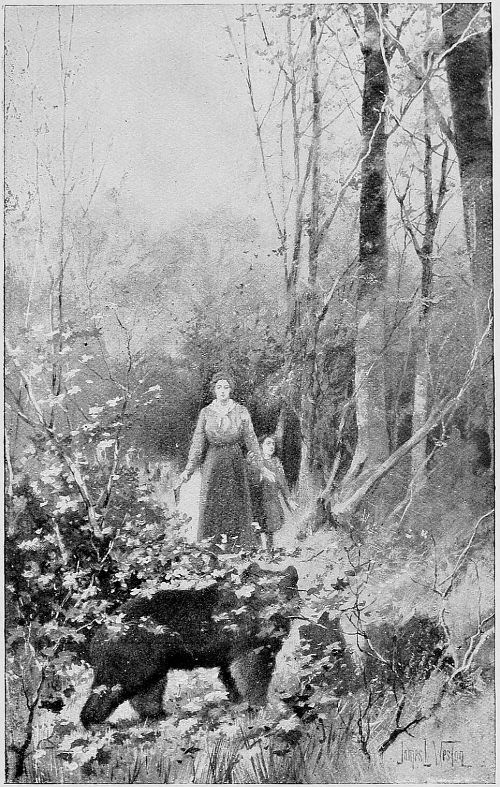
her cub.
She rushed on madly, a terrible avenger
of blood; but so fast was Dave journeying
that it was not much short of an hour
before her instinct or some keen sense told
her that he was close at hand. She was
not blinded by her fury. Rather was she
coolly and deliberately set upon a sufficing
vengeance. She moderated her pace, and
went softly; and soon she caught sight
of her quarry some way ahead, striding
swiftly down the brown-shadowed vistas.
There was no other bear in all the forests
so shrewd as Kroof; and she knew that
for the hunter armed all her tremendous
strength and fury were no match. She
waited to catch him at a disadvantage.
Her huge bulk kept the trail as noiselessly
as a weasel or a mink. Young
Dave, with all his woodcraft, all his alertness
269
of sense, all his intuition, had no
guess of the dark Nemesis which was so
inexorably dogging his stride. He was in
such haste that in spite of the autumn
chill his hair clung moistly to his forehead.
When he reached the rivulet flowing
away from the cabin spring, he felt that
he must have a wash-up before presenting
himself. Under a big hemlock he dropped
his bundle, threw off his cap, his belt, his
shirt, and laid down his loaded rifle. Then,
bare to the waist, he went on some twenty
paces to a spot where the stream made a
convenient pool, and knelt down to give
himself a thorough freshening.
Kroof’s little eyes gleamed redly. Here
was her opportunity.
She crept forward, keeping the trunk
of the hemlock between herself and her
foe, till she reached the things which Dave
had thrown down under the tree. She
sniffed at the rolled-up package and turned
it over with her paw. Then, with one
short, grunting cough of rage and pain,
she launched herself upon the murderer
of her cub.
270
That savage cry was Dave’s first hint of
danger. He looked up quickly, his head
and shoulders dripping. He recognized
Kroof. There was no time for choice.
The huge animal was just upon him; but
in that instant he understood the whole
tragedy. His heart sickened. There
was a great beech tree just across the
pool, almost within arm’s length. With
one bound he reached it. With the next
he caught a branch and swung himself up,
just eluding the vengeful sweep of Kroof’s
paw.
Nimbly he mounted, seeking a branch
which would lead him to another tree and
so back to the ground and his rifle; and
Kroof, after a moment’s pause, climbed
after him. But Dave could not find what
he sought. Few were the trees in the
ancient wood whose topmost branches did
not twine closely with their neighbour
trees. But with a man’s natural aversion
to bathing in water that is not enlivened
and inspirited by the direct sunlight, Dave
had chosen a spot where the trees were
scattered and the blue of the sky looked
271
in. He climbed to a height of some forty
or fifty feet from the ground before he
found a branch that seemed to offer any
hope at all. Out upon this he stepped,
steadying himself by a slenderer branch
above his head. Following it as far as the
branch would support him, he saw that his
position was all but hopeless. He could
not, even by the most accurate and fortunate
swing, catch the nearest branch of the
nearest tree. He turned back, but Kroof
was already at the fork. Her claws were
already fixed upon the branch; she was
crawling out to him slowly, inexorably;
she had him in a trap.
Dave stood tense and moveless, awaiting
her. His face was white, his mouth
set. He knew that in all human probability
his hour was come; yet what might
be done, he would do. Far below, between
him and the mingling of rock and
moss which formed the ground (he looked
down upon it, chequered with the late
sunlight), was a stout hemlock branch.
At the last moment he would drop; and
the branch—he would clutch at it—might
272
perhaps break his fall, at least in
part. It was a meagre chance, but his only
one. He was not shaken by fear, but he
felt aggrieved and disappointed at such a
termination of his hopes; and the deadly
irony of his fate stung him. The branch
bent lower and lower as Kroof’s vast
weight drew near. The branch above, too
frail to endure his weight alone, still served
to steady him. He kept his head erect,
challenging death.
It chanced that Miranda, not far off, had
heard the roar with which Kroof had rushed
to the attack. The fury of it had brought
her in haste to the spot, surprised and apprehensive.
She recognized Dave’s rifle
and hunting-shirt under the hemlock tree,
and her heart melted in a horrible fear.
Then she saw Dave high up in the beech
tree, his bare shoulders gleaming through
the russet leaves. She saw Kroof, now
not three feet from her prey. She saw the
hate in the beast’s eyes and open jaws.
“Kroof!” she cried, in a tone of fierce
command; and Kroof heeded her no more
than if she had been the wind whispering.
273
“Kroof! Kroof!” she cried again, in anguished
appeal, in piercing terror, as the
savage animal crept on. Dave did not
turn his head, but he called down in a
quiet voice: “Ye can’t do it this time,
Mirandy. I guess it’s good-by now, for
good!”
But Miranda’s face had suddenly set
itself to stone. She snatched up the
rifle. “Hold on!” she cried, and taking
a careful, untrembling aim she pulled first
one trigger, then the other, in such quick
succession that the two reports came almost
as one. Then she dropped the
weapon, and stood staring wildly.
The bear’s body heaved convulsively
for a moment, then seemed to fall together
on the branch, clutching at it. A
second later and it rolled off, with a leisurely
motion, and came plunging downward,
soft, massive, enormous. It struck
the ground with a sobbing thud. Miranda
gave a low cry at the sound, turned
away, and leaned against the trunk of the
hemlock. Her face was toward the tree,
and hidden in the bend of her arm.
274
Dave knew now that all he had hoped for
was his. Yet, after the first overwhelming,
choking throb of exultation, his heart
swelled with pity for the girl, with pity
and immeasurable tenderness. He descended
from his refuge, put on his hunting-shirt
and belt, looked curiously at the
empty rifle where it lay on the moss, and
kicked the corded package of meat into a
thicket. Then he went and stood close
beside Miranda.
After a moment or two he laid an arm
about her shoulders and touched her with
his large hand, lightly firm. “Ye wonderful
Mirandy,” he said, “you’ve give
me life over agin! I ain’t a-goin’ to
thank ye, though, till I know what ye’re
goin’ to do with me. My life’s been jest
all yours since first I seen ye a woman
grown. What’ll ye do with the life ye’ve
saved, Mirandy?”
He pressed her shoulder close against
his heart, and leaned over, not quite daring
to kiss the bronze-dark hair on which
he breathed. The girl turned suddenly,
with a sob, and caught hold of him,
275
and hid her face in his breast. “Oh,
Dave!” she cried, in a piteous voice,
“take mother and me away from this
place; I don’t want to live at the clearing
any more. You’ve killed the old life I
loved.” And she broke into a storm of
tears.
Dave waited till she was quieter. Then
he said: “If I’ve changed your life, Mirandy,
ye’ve changed mine a sight, too.
I’ll hunt and trap no more, dear, an’ the
beasts’ll hev no more trouble ’long o’ me.
We’ll sell the clearin’, an’ go ’way down
onto the Meramichi, where I can git a
good job surveyin’ lumber. I’m right
smart at that. An’ I reckon—oh, I
love ye, an’ I need ye, an’ I reckon I
can make ye happy, ye wonderful Mirandy.”
The girl heard him through, then
gently released herself from his arms.
“You go an’ tell mother what I’ve done,
Dave,” she said, in a steady voice, “and
leave me here a little while with Kroof.”
That evening, after Miranda had returned
to the cabin, Kirstie and Dave
276
came with spades and a lantern to the
beech tree by the pool. Where they
could find room in the rocky soil, they
dug a grave; and there they buried old
Kroof deeply, that neither might the claws
of the wolverine disturb her, nor any lure
of spring suns waken her from her sleep.
PLYMOUTH
WILLIAM BRENDON AND SON, PRINTERS