If thou art worn and hard beset
With sorrows that thou would’st forget,
If thou would’st read a lesson that will keep
Thy heart from fainting and thy soul from sleep,
Go to the woods and hills!—No tears
Dim the sweet look that Nature wears.
Longfellow.
 AINLY the mountaineers beside the ancient stage-road,
up the Blue Ridge from McDowell county into Buncombe may listen for the
old-time winding of the driver’s bugle, the rumbling of strong-spoked
wheels, and the rattling of trace-chains; or wait to see the familiar
outlines of four gray horses, hallooing reinsman and loaded Concord
stage swinging round some bold cliff, and drawing nearer up the rich
green avenue of the forest: the days of staging by this route into
Asheville are over. But “Jehu” with his prancing steeds and swaying
coach is not, in this region, a being of the past; for the whistle of
the locomotive has only served to drive him further into the mountains.
To those who are little familiar with stage-riding, there is in it
something of pleasing novelty. I never see the old red vehicle lumbering
along without having awakened in my mind some one of Dickens’ many vivid
pictures of rapid drives, where, in his words:—“Houses in twos and
threes pass by us, solitary farms, ruinous buildings, dye-works,
tanneries and the like, open country, avenues of leafless trees. The
hard uneven pavement is under us, the soft deep mud on either side.
Sometimes, we strike into the skirting mud, to avoid the stones that
clatter us and shake us; sometimes, we strike into ruts and stick there.
The wind is rushing after us, and the clouds are flying after us, and
the moon is plunging after us, and the whole wild night is in pursuit of
us.”
One of the stage routes, now in operation, is from the present terminus
of the Western North Carolina railroad at Pigeon River, to Waynesville,
ten miles distant. If the time-table is the same it was when we last
traveled over the new-laid rails from Asheville, up the Hominy valley,
over dizzy trestle-works, and burst through a narrow mud-cut between the
hills into the wide valley of the Pigeon;—if it is this way, I say, the
tourist will take a late dinner at a large brick farm-house beside the
station, and then secure a place with the colored driver on the top of
the stage. A jolly crowd is packed away inside. Perhaps, if you are an
agreeable fellow, one of the young ladies may prefer a perch outside
with you, and thus help to fill up the boot and hinder the spread of the
reinsman’s elbows as he rounds some of the coming curves. Trunks and
band-boxes are piled up behind you. You wave your hand to the landlord;
the driver gives a parting wink at the cook who is peering through the
shutters of the kitchen; and then, responsive to the crack of the whip,
the horses start, and whirling behind it a cloud of dust, the stage
begins its journey.
There is nothing particularly enchanting about the landscape for the
next ten miles. The road beneath is beaten hard, and smooth as a floor.
It is not always so agreeable riding over, however, for it is of red
clay; and in winter, with snows, thaws, and rains, it becomes almost
impassible. They tell of empty wagons being stalled in places during the
inclement seasons. I have a vivid recollection of helping, one dark
April night, to unload a light Jersey wagon, drawn by two stout horses,
in order to release the hub-deep sunken wheels, and allow us to proceed
on our way from Waynesville.
Now a broad valley is whirled through, with humble cottages along the
way; then a hill is ascended, the stage rising slowly, and then rattling
on behind the lively trotting of the horses as you pass down the
opposite declivity. The driver over mountain roads always trots his
horses going down hill. It is necessary in order to make up for the
delay incurred in the long, wearisome ascents, and the horses, in
contradiction to first principles, appear to stand up well under it.
Again you strike the Big Pigeon. Concealed by its wood-bordered banks,
it has passed through the valley, and now through vistas of vines,
azaleas, chinquapin bushes, locust and beech trees, reveals its limpid
waters, swift and slow, in turns, as the basin is deep, or a
pebble-shingled bottom throws it in splashing rapids. Pairs of whistling
sand-pipers run teetering over the sands, and then fly on down the river
at your noisy approach; turtle doves, with “shocking tameness,” only
rise from the road when some of the pebbles, struck up by the horses,
shower around them; a surly dog, from a weather-worn dwelling, leaps
through the broken pickets of the fence, and for a hundred yards
follows, barking, close to the wheels; long open fields extend on one
side; and then the driver, with foot on the break, with loud “whoa,”
stops the sweating horses before a country store. He reaches down under
his feet, into the giant pocket of the stage, and draws forth a
pad-locked leather mail-bag which he tosses down into the outstretched
arms of the bare-headed post-master, grocer, and township magistrate
combined.
“How yer to-day, squire?” asks the driver.
“Good. How’s yourself?”
“Bettah.”
“Who you got inside?”
“Party from Alabam’, I reckon.”
“Where they going?”
“White Sulphur; an’ say, look a heah, foh dis in-foh-ma-shun bring me
out a twist o’ backer.”
The recipient of the bag passes through a crowd of six or eight men
about the door-way, and enters the store. A few minutes elapse in which
the “Jehu” fires some tongue shots at the loungers; then the mail-bag is
returned, the foot is taken from the break, the whip cracks, and away
you go. Another store is passed with a saw-mill opposite to it, and the
river, blocked until it spreads to twice its customary breadth, pouring
and thundering over a substantial dam. The noise of waters and the saw
is deafening; then, in a twinkling, it is all still, and you are
trotting along between green hedges, and great clouds of dust envelope
the barking dogs which follow.
Along the way is seen the prepared trail for the iron horse which is to
supersede stage-travel;—the great yellow dirt embankments through the
fields; the deep grading sinking dizzily close at the roadside; the
short curves through narrow valleys, and the swallowing of it all by the
solitary woods.
If you are fortunate enough to ride with the same good-natured driver
whom we had, and he is in mellow mood, you may be interested for an hour
by a story which he is fond of telling. For fear that you might get the
wrong man, I will tell it in condensed form.
In the fall of 1877, the driver was employed on the stage route from
Asheville to Henry’s. He was an old reinsman, but the road was
unfamiliar to him from the fact of his being only lately transferred
from another branch. One afternoon in November, with the highway
slippery under-foot from a cold sleet, he left Asheville with the heavy
stage and a party of five persons inside,—an old, white-haired man and
four women. He was unavoidably delayed at different points, so that,
when he began the actual descent of the Blue Ridge, a black, cold night
enveloped the landscape. With his teeth chattering, he lighted the
lamps, drew on his gloves again, mounted to his place, and began
rumbling downward. Over-head the trees creaked and groaned in the hollow
blast; the horses slipped in turns as they pushed along, and the huge
stage would occasionally slide, in spite of the locked brake, down on
the flanks of the rear span. Even with this uncomfortable state of
affairs, he could have driven along without much hazard, but suddenly
the lamps went out. Through strange carelessness he had forgotten to
refill them when he left the stables. The darkness was like that of a
soundless mine: it was almost palpable. Staggered with the situation, he
checked his horses. He must go on, but how could he? Near at hand he
knew was the most dangerous place in the whole road, where even a slight
pull to one side would send the stage and its occupants rolling down a
declivity, steep, deep and rugged enough to smash the former, and kill
every one of the latter. The horses, accustomed to the way, might
possibly be trusted; but then that possibility! It was too slippery to
lead them, and besides his foot must be on and off the break in turns.
It was imperative for him to be at Henry’s that night, both on account
of his express duties and his passengers, who would freeze before
morning. He sat shivering on the stage top.
He heard the stage door open below, but knew not for what reason, nor
whose feet were striking the ground, until a voice came up out of the
pitchy darkness:
“Why don’t you go on?”
It was the old gentleman who spoke.
“Can’t. Don’t you see de lamps ar’ out?”
“What of that? We must go on.”
“Dar’s a bad pitch right yeh, an’ I wouldn’t risk hit foh no money.”
“Do you know exactly where we are? I can’t distinguish anything.”
“Yes, at de cliff spring.”
“The cliff spring. I remember it. All right;” and, saying this, the
elderly passenger was climbing up beside the driver. “Let me take the
reins,” he continued.
“You!” exclaimed the driver.
“Yes. I know this road like a book. I’ve driven over it many as dark
nights as this, during forty years of my life.”
And as the driver told it to me: “I done jist let dat ole man pull dem
ribbans outer my han’s, an’ I hel’ onter de brake, while he put dose
hosses down aroun’ dat ben’; an’ in less ’en an houh we wuz stannin’
afoah de Henry hotel. Hit beat de debbil how dat wrinkled, rich-lookin’
ole fellah driv! Couldn’t fine out a ting ’bout him; no one peered ter
know him. An’ I’m done badgered ter know who he wuz, enny how. He’d a
made a crackin’ ole stage drivah; an’ dar’s no use talkin’ on dat pint!”
So went the story. Meanwhile your journey is progressing. The stage has
rattled around a bend, leaving the neat, home-like, brick dwelling of
Dr. Samuel Love, on the top of a wooded hill, beside the road; and then,
before you, stretches an enchanting mountain landscape. On the summit of
a plateau-like expanse, in the center of the scene, is a picturesque
village. You see the clustered white frame and brick buildings, with the
smoke curling above them from home fires; the modest church steeples,
and, perhaps, if it is growing dusky, you may hear the mellow chiming
of bells through the evening air. Majestic mountains rise on all sides
into the blue sky. Afar, Old Bald, his brethren Balsams, Lickstone
mountain, and Mount Serbal, lift their heads. In lofty outlines, the
Junaluska group of Balsams stand black against the glowing western sky.
Across a low, plank bridge, which covers a little stream coming from the
rabbit-haunted hedges of a valley meadow,—up a mild declivity of
hill,—through a long, yellow street with dwellings, a church, a
court-house, a jail, hotels, and stores, on either side,—and you are in
the center of Waynesville.
Waynesville, the county-seat of Haywood, is 2,756 feet above the ocean.
Of the peaks in sight around it, five attain a height of 6,000 feet and
upwards. Every mountain is clothed from base to summit with heavy woods.
That chain arising in the south in lofty outlines, black with firs, is
the Balsam. The Haywood mountains, bounding the northern line of vision,
are, owing to their distance, arrayed in purple, and usually crowned
with white masses of clouds, which at sunset turn to orange, run to
molten gold and then blazing with scarlet resolve into darkness. The
village occupies the most elevated portion of the plateau. Two parallel
streets, crossed by four or five shorter ones, make up the general
ground-work of the town. Interspersed with vacant, weed-grown lots, the
dwellings and buildings, occupied by about 300 people, face on these
winding thoroughfares. A few locust trees border the rough, stony walks.
Apple and peach trees hang over thickly-planted gardens within the
unpainted long board fences before many of the houses.
The head-center for daily congregation seems to be the postoffice. Its
red-mud-splattered front and porch-posts whisper of a rainy season and
stamping horses to the tourist who stands on the hard level road. The
mosses on the porch roof also speak of dampness and age. Opposite the
post-office, in 1882, was still standing, intact and in use, the
county’s venerable hall of justice. To some it may appear a sarcasm to
use that title for it: still, justice is no less likely to preside in
pristine purity within battered, worm-eaten doors, above a tan-bark
floor, under a low ceiling, and surrounded by dingy walls, than within
frescoed ceilings, stone walls and chiseled columns!
“For Justice
All place a temple, and all season, summer!”
However, the court days for the old hall are past. A new and imposing
brick structure has just been erected at the north end of the village.
That an air of enterprise is circulating is evident. Numerous new
buildings, with fresh-painted or brick fronts have lately arisen in
place, making striking contrasts with the old rookeries of fifty years
existence standing here and there.
The village was named in honor of “Mad Anthony” Wayne in the long gone
years of its birth. Until the last half decade of years it has rested in
a quiet little less profound than that of the dreamy valleys around it.
Of late new energy has been infused into it. The world beyond the
mountain limits of this hidden hamlet is beginning to hear of it as a
summer resort. Acting upon this knowledge, the tourists with every
season now come trooping up from the low-lands. The grading, bridges,
and embankments for the railroad are all completed, and even before many
months Waynesville will have the cars within its corporate boundaries.
In all the mountain towns court-week is the marked event of the year.
There is a spring and fall term. As the counties increase in population,
the two terms are frequently lengthened into weeks. At such times the
village streets are packed with a mass of humanity. The court might well
be likened to a magnet, the limit to its attraction being the boundaries
of the county; and within that circle, during the periods of its
operation, having an irresistible, invisible power to draw every
citizen into the county-seat. They are all there at some interval of its
proceedings.
As a court-day in any one of the villages is typical of what is seen at
such times in all the others, the writer will use as an illustration one
which he spent in Waynesville. It was at the time of the fall term; the
month being October. On the Sunday preceding the opening Monday, the
honorable judge, having closed court in the neighboring county, drove
into the village. The usual number of lawyers from scattered villages
who go on the circuit soon came straggling in on horse-back not far in
his honor’s wake. Later in the evening and the next morning others of
the profession entered on foot, pursuing this method of traveling as
though desirous of saving a little money, or perhaps having none either
to save or spend. The days of the circuit are interesting ones for this
legal coterie. It has its jovial, crusty, bumptious, bashful, boyish,
and bald-headed members; old pettifoggers, young shysters, and the
brilliant and erudite real attorney. The active out-door exercise
enjoyed in following the court in his rounds tends to make the village
lawyer a good-natured fellow, and besides, even if his practice is poor,
he has no exorbitant office rent to worry him. He ought certainly to be
a healthy, contented specimen of humanity.
Even before all the shop-keepers had opened their doors and swung back
their shutters to exhibit newly stocked counters, the farming population
began pouring in. Now and then the broad hat of a man on foot would
appear above the crest of the hill; then would follow a strong team of
horses drawing a white-covered, Pennsylvania wagon; next, a slow-moving
ox team with hooped and canvassed vehicle. These tents on wheels would
disgorge into the street either a whole family or a crowd of men
evidently from the same neighborhood. On other occasions they (the
wagons) loaded with apples and possibly a barrel of hard cider, would
be longer in getting relieved of their contents. The Jerseys of
independent valley farmers came rattling in at a later hour. The general
way of coming to town, however, is in the saddle. Horses and mules, with
good, easy gait, are always in demand through this country, and the
number of them ranged along the street fences appears strange to the
Northerner.
That morning I saw on the street several Indians from the banks of Soco
creek twenty miles distant. They were not arrayed in the picturesque
pomp of the savage, but in the garb of civilization—home-spun coats and
pantaloons, muslin shirts, and black hats. One of them, mounted on a
stout little bay pony, was trying to sell his animal to some one in a
crowd of horse-traders. Ponies can be purchased of the Cherokees at
prices ranging from forty to seventy-five dollars. At present, however,
there are very few of the full-blooded stock in the reservation. The
other aborigines whom I chanced to see were, with moccasined feet,
threading their ways through the crowds of lighter-complexioned,
blue-clothed dwellers of the forests.
The strongest drink sold openly during court-week is cider. Several
wagons, holding barrels containing it, occupy stations close by the
court-house door. A supply of ginger cake is sold with the cider.
Whiskey can be procured at the drug store, but only on prescription. To
the uninitiated it is a mystery where so many prescriptions come from;
but perhaps a certain judge from a lower county, who some time since
presided in this court, might rise and explain. The judge in question
was exhausted from travel, and badly under the weather. Upon his arrival
in the village he dispatched a negro to the drug store for a bottle of
this singularly accredited panacea for all evils. The druggist refused
to comply with the request, sending back word that he was obliged in all
cases to conform to the requirements of the law, and that his honor
should consult a physician. Later in the day the judge himself appeared
at the drug store, and taking a package of paper from his pocket, cooly
counted off sixteen prescriptions. Said he:
“I have consulted my physician. You may fill one of these now; hang the
others on your hook, and fill them as I send my order.”
Whether the judge called for them all during the time he presided on
that bench, is no part of the story.
In the practice before the bar of the tribunal there is no marked
difference between the proceedings of the mountain county court and
those of the courts of other states practicing under the code. It has a
peculiar but beneficent feature, however, in the rapidity with which
cases are disposed of. One great end of justice, too frequently
neglected—that wrongs shall be promptly righted—is hereby secured. A
false and irreversible judgment of the court occurring, as may be, upon
too hasty examination of a case, is no worse for the litigant than the
trial of the heart between hope and despair for long, weary years before
a decision is rendered, even though that decision be just.
I witnessed one murder case disposed of in two days, when, anywhere in
the North, the same trial would have occupied as many weeks. The call of
the crier from an upstairs window announced that the court was open.
During the course of the morning I went in. Seats arranged on a scale
ascending from the lawyers’ tables to the rear wall were crowded to
overflowing. The single aisle was filled so that one could hardly elbow
one’s way in. The crowd changed considerably in its make-up during the
morning session; for uninterested auditors were continually sliding out
of one of the handy windows and others crawling in to fill the
vacancies. Some wormed their way out through the aisle.
In regular routine, cases were called, facts stated by attorneys, usual
examination and brow-beating of witnesses, wrangling of counsel,
hammering for order by the sheriff, the old practitioner’s quiet and
plausible argument to the drowsy jury, the spread-eagle burst of oratory
on the part of the fresh blossomed sprig of the law, the charge of the
judge (which, in truth, is generally the settlement of the whole
proceeding), and then the departure of the twelve confused peers to a
house on a back street, or a vacant lot near by, where, on a pile of
lumber, they resolve the abstruse questions involved and bring in a
verdict according to the facts.(?) Judgment pronounced forthwith, or
suspended on motion.
At 12 o’clock the court adjourned, and the crier appearing at the front
door gave vent in high-strung monotone to the following: “Hear ye! hear
ye! This honorable court is now adjourned.” Here he took breath and went
on again: “The good people of Haywood will take notice that at 2 o’clock
the Honorable General Clingman will address them on the issues of the
day!”
This sounded queer to a stranger; court adjourning to give way for a
political speech. A number of elections were to take place in November.
It was fit that the people should be prepared to cast their ballots with
discretion. In accordance with this view, during that fall term of
court, the respective candidates of either party for the offices of
solicitor, representative, senator, and state offices were given the
afternoons of the session to enlighten the populace with their wisdom on
state and municipal affairs, and sway them with their eloquence. With
the afternoon speeches, ended the court day.
The White Sulphur Spring Hotel is three-quarters of a mile from the
village. It was by the stage line that we approached it in the summer of
1882. The mail-bags had been flung down to the good-natured-looking
post-master, and several passengers distributed at the hotels on the
village street, when we turned down a hill toward Richland creek, first
passing several plain dwellings and two churches. One of the churches
(the Episcopal) is a well-built little house of worship. The creek must
be forded, and then follows a delightful stretch of road along its
banks, until, after swinging around several corners, rattling over
rivulet bridges, speeding by a house or two on knolls in fields, we
passed through a frame gate into the grounds of the Sulphur Spring.
The grounds are naturally adapted for a summer resort. A grand forest,
principally of oaks, covers about eight acres of level ground, through
which, with green sward on either hand, winds the road toward the hotel.
The hotel is a large farmhouse, remodeled and added to until its
original proportions and design are lost. Near it, at the foot of a low
wooded hill, is a line of cottages connected with the main structure
simply by a graveled walk, which also leads to the sulphur spring
bubbling up in a stone basin within a small summer-house. There is a
comfortable, healthy air about the hotel and its surroundings.
Close in the rear of the resort buildings rises a line of mountains,
lofty in height, but forming only the foot-hills to the Junaluska group.
The highest pinnacle of the foot-hill range is Mount Maria, so named in
honor of the wife of Major W. W. Stringfield, the proprietor of the
Spring property. From the wide porches of the hotel sublime mountain
prospects can be obtained. A smooth, cultivated valley, a mile or more
in length, by a half-mile wide, fills the foreground to these views.
Some portions of it are covered with corn, and in the meadows are
generally grazing a hundred head of cattle. A pleasant pastoral air
pervades this foreground picture set in the emerald frame of the
forests. And then in the distance is discerned the green front of Mount
Serbal, and beyond it the black summits of the Richland Balsam
mountains. Just across the creek, which flows outside the grounds, lies
the prepared railroad bed. It is only a minute’s walk from it to the
hotel.
Of all country roads for quiet rambles or delightful horseback rides,
there are none in the mountains to excel the one up Richland creek, from
the White Sulphur Spring, to the base of Old Bald. The forests all along
the stream are cool and refreshing. Where the road comes down to its
fords under the concealing chestnuts and oaks, long foot-logs reach from
bank to bank. The old mill at one of these fords presents a picture for
the artist—the brilliant beech that rustles around it; the crystal
race; the roar in the flume; the piles of old logs and scattered timber;
and the open, dingy front of the structure itself.
On crossing the state road, the Richland creek road enters a large,
unfenced forest, where nearly every evening, in spring, summer, or fall,
teamsters, who are either farmers or root buyers, encamp for the night.
Their Pennsylvania wagons are like great white-covered scows strangely
mounted on wheels. At night, with the light of camp fires thrown on
them, they are spectral in their whiteness. Often, in the darkness of
the forest, while on our way from the village to our temporary home in
the country, we have suddenly run upon these encampments after their
fires have smouldered, and only been awakened to a knowledge of their
presence by the sharp barking of wakeful dogs.
One particular night, well worth remembering, I was returning on foot
from Waynesville after a late wait there for the irregular evening mail.
It was cloudy and quite dark, even where the state road, which I was
trudging over, runs between open fields. On branching into the Richland
creek road and into the forest just mentioned, the change to still
deeper darkness would have made it difficult for me to avoid stumbling
over the rocks that here and there are scattered on the way, and even to
keep clear of tree boles, if the bright light of a high fire had not
illuminated the outer margin of the wood. Under a gigantic poplar two
large white wagons were visible, and between them was the fire. A group
of men was seated near it. At my approach two dogs sprang up growling
from the scattered hay where the horses were feeding, but at the warning
yell of some one who was evidently their master, they became quiet
again. The group consisted of four men seated on the end boards taken
from the wagons, and laid on the ground. They were playing cards, and
having a good time. I was about to pass on, but recognizing the face and
voice of one member of the party, I stepped up to them, and was in turn
recognized by him.
“Wal, glad to see you,” said he, dropping the pack of cards he was
dealing, and jumping to his feet.
“Howdy!” exclaimed the others in turn as I spoke to each. “Why, what are
you skulking round the woods so late at night for?” continued the first
speaker.
He was a good-natured and intelligent young man, by name Upson, whom I
had met once before in an adjoining county at a country store, where he
was exchanging dry-goods and tinware for ginseng, Solomon’s snake roots,
herbs and mica. I answered his question, and upon urgent invitation
seated myself by the fire. Two of the party were going to Asheville to
attend Federal court. The elderly man and owner of one wagon was
journeying in company with the young trader and his wagon to the
Asheville market. The interrupted game of seven-up was never resumed. In
the course of conversation Upson spoke of mica mining, and after stating
that he was a Georgian, and had been in the mountains only a few years,
he related a thrilling story, which I will give as nearly as possible in
his own words, and call it
THE HAUNTED CABIN.
On one of the highest ridges of the Nantihala mountains, twenty-five
miles from Franklin, Tabal and I had been out prospecting for mica for
several days. With a blanket apiece, a pick, a spade and a quantity of
provisions we had left the valley, intending to open a spot on the
mountain, where mica had been discovered cropping out. All the afternoon
of the 26th of February, and all day of the 27th, we worked at the
surface mica, and had followed a promising vein of the mineral for
several feet into the crumbling rock. The weather had been fine, and the
night of the last mentioned date came on with fair and clear skies.
Wrapped in our blankets, we slept by a roaring fire, under a shelving
rock, in a thicket of black firs. By morning the weather had changed; a
cold wet wind was sighing through the pines; the sky was overcast with
dull heavy clouds, and the last day of February bid fair to end in a
snow storm.
Tabal was rather uneasy, and wished to start for the settlement
immediately; but with a nicely sorted-out pile of mica at our feet, and
a solid block twelve inches square shining from the bottom of the
excavation, I insisted on remaining until there was a decided change for
the better or worse; so, after our morning repast, we went steadily to
work again.
We did not notice the increasing coldness of the wind, and were only
awakened to a sense of our dangerous position, when snow began to fall.
To be caught on a mountain summit over 6,000 feet high in a snow storm
was something little to be desired; and, with that idea, Tabal threw
down his pick and proposed starting with haste for the settlement.
Affairs did look threatening, and I concluded that his proposition was
not to be despised. Hiding our tools and mica, with our blankets over
our shoulders, we struck out on the trail for the valley.
The snow fell thicker and faster around us; and at the end of our first
mile it was an inch deep. The way-worn path beneath our feet was of the
same appearance as the forest slopes, all seeming one open wilderness,
with nothing but occasional blazes on the scrub-oak tree trunks to mark
the path of descent. Tabal needed nothing of the kind to find his way.
So familiar is he with the whole range that, in the darkest night he
could reach the valley without a wandering footstep. After two hours of
slow travel the snow lay shoe-mouth deep, and the bitter wind, as it
swept across the ridges, chilled and buffeted us, until, half frozen,
with wet and benumbed feet, exhausted by ten miles of wading, and
bruised by falls and slides, I felt my strength giving way. It was then
half-past four by my watch; the snow was a foot in depth, and still
falling.
“Only three mile further,” said my companion, when he noticed how I was
lagging in my pace, “and we’ll fetch up at Ramear’s cabin. Cheer up,
man, an’ in a few minutes we’ll be all right, I ’low.”
With this encouragement I quickened my footsteps and struggled on.
Another mile had been slowly reeled out behind us; we had left the ridge
and were in a hollow or cove, when a cabin suddenly appeared before us.
The place was one of the wildest and dreariest of the mountains. On one
side rose a forest of balsams; with somber foliage covered with the
white mantle of the storm; almost perpendicularly upward it trended.
Tangled laurel spread over the bottom land, and interwoven with the ivy,
hedged the banks of a stream fresh from its sources. On the other side a
rocky bluff, crowned with snow and clad in evergreen vines, loomed up
like the crumbling wall of some ancient castle, with its summit lost in
the veil of the falling snow.
The cabin was jammed into a niche of this wall some twenty feet above
the path we were following. It was a log hut of the humblest
pretensions, tottering from age and decay on its rock foundation. In
the shadow of the precipice, most gloomy it appeared, with its
snow-burdened roof, moss-grown front, rough-plastered log chimney, and
doorless entrance opening into a black interior. It looked to have been
deserted a score or more of years, and its surroundings, unkept by the
hand of man, by Nature were again being trained into primitive wildness.
A cataract came pouring down by the cabin’s site. A regular ascent of
steps led up to it through the laurel.
In spite of the place’s uninviting aspect, I welcomed it as a safe
refuge from the storm and the night. Tabal seemed not to see it, and was
plodding steadily ahead a few feet in advance of me.
“Hold on!” I called. “Here is a shelter for the night. No need of going
further.”
He turned with a strange expression in his face.
“For God sake, don’t stop hyar! We must go on. Nothin’ could hire me to
stop in thet ’air shell.”
His set determined way of speaking, together with his words, I could not
at that time account for, and without waiting for an explanation,
replied: “Stop here we must, in half an hour ’twill be night,” and
pushing through the snow-burdened laurel, in a few steps I gained the
cabin door.
A violent hand was laid on my shoulder that instant. My blanket was
almost torn from my grasp, and I reeled backward, with difficulty
rescuing myself from falling.
It was Tabal who had thus struck me. Taken by surprise at his
uncalled-for action, I could but listen to what he said.
“Come, come, we must make tracks from this place! You’d better die in
the snow a peaceful death than be toted away by hants. Thar be a power
’o hants hyar. I’ve seed ’em an’ seed blood, blood! on the floor and
nary man in the settlement but what’s heerd ’em. Don’t for all ye love
in the world, don’t stop hyar, but foller me and in two mile we’ll be
at Ramear’s.”
As he finished his excited remarks, with one hand still on my shoulder,
he was standing partly in the cabin; while I, puzzled at his
extraordinary statement, and with the earnest, almost desperate, manner
in which he urged me to leave the spot, had sunk down on a half-rotten
log that lay across the doorway. I really could have gone no further if
I had wished, and instead of what I had heard from him awakening my
fears and strengthening me to travel on, it aroused my curiosity to
remain and see upon what his superstition was based.
On making known to him my exhausted condition and determination to
remain, an abject terror overspread the mountaineer’s face, and for
several minutes there was a struggle within him whether to stay and
brave the well known horrors of the place, or to expose his cowardice by
leaving and pushing on alone in the darkness and driving snow. The
latter alternative did not hold out very bright prospects, and in spite
of professed superstition, mountaineers dread nothing much more than
being called cowards. Meanwhile I laughed down and shamed his fears, and
the bribe of a half gallon of “moonshine” completed the business.
The gloom of the continuing storm, and the rapidly approaching night,
rendered the gorge almost destitute of light. Every minute it grew
darker, but objects about the interior of the cabin were still
distinguishable. There was but one room, with rotten board floor,
strewed with the mouldering leaves of several autumns, and grown with
moss along the edges of the walls. Fungi choked the interstices between
the logs, and over them snow had sifted, and fallen in streaks upon the
floor. An unboarded window opposite to the solitary door looked out upon
the grim, stony cliff that rose not ten feet away. A fire-place, filled
with snow, was at the end of the room, and over three-fourths of the
apartment was a loft, rather shaky in appearance.
We scraped the snow from the hearth; Tabal, under my instructions, tore
off a pile of well-seasoned boards from the loft floor, and soon a
crackling fire brightened and cheered the interior of the cabin. My
companion was now more at his ease, and spreading our blankets, we laid
down with our feet to the grateful fire.
As I spread out my blanket I noticed a pool of fresh blood, fully two
feet in diameter on the floor by my hand. I covered it instantly,
fearful that Tabal might see it. How did it come there?
“Tabal,” I said, “tell me now what you meant by this hut having ghosts
or ‘hants’ as you term them; and why do you think it so haunted?”
He responded with a long story which I will make short: The cove had
been cleared thirty years before by Cummings, a denizen of the
mountains. One night when he was on a spree in the settlement, his wife,
in a crazy fit, hung herself to a cabin rafter. Cummings, with his
household property and progeny, deserted the premises, and for many
years the cabin remained unoccupied, until a party of hunters made a
night’s lodging there, and in an altercation a man named Gil True was
instantly killed by an enraged companion. Strange sights and sounds were
connected with it after the first death, and more after the second.
Every superstitious old woman told some terrible tale about it, until it
had become known throughout the country as the “haunted” cabin.
After this narrative the train of thoughts which it awakened and the
strangeness of my situation prevented me from going immediately to
sleep, and hours elapsed before I was in the arms of “Nature’s fond
nurse.” Tabal’s regular snoring I suppose put me in that condition.
How long I slept I know not, but I awoke with a start. Terrible,
blood-curdling cries, like those from a woman or child in distress, came
from the end of the room opposite the chimney.
The fire was still blazing, and by it I saw that Tabal was awake, lying
half raised from his blanket, and with eyes fixed on the back of the
room, was intent on listening. Several piercing cries, with intervals
between, rang out, and the last one had just died down, when there was a
sound of some heavy body falling on the roof, a rumble, then a terrific
crash, after which all was darkness, blackest darkness in the room.
Successive creakings of the cabin, and sputterings and hissings from the
fire-place ensued.
I attempted to call out but could not.
I leaned over and reached, in the darkness, for my companion. He was not
there—nowhere on his blanket, which I felt still unrolled. I groped
around the room.
Nothing!
The room was deserted, and I was alone in the haunted cabin.
I leaned out of the door. It was as black outside as in. Again I
attempted to call, and then my voice broke from me. The halloo rang out,
echoed along the cliff, and instantly seemed swallowed by the night; but
no answer came.
With these efforts courage returned, and I stepped back into the center
of the apartment. As I did so, I heard a fall on the window, then one on
the floor, and the pit-pat of feet sounded plainly as something brushed
against my legs, and shot with sudden velocity out of the cabin door.
“What else,” I thought; “what other unaccountable things were to happen?
Tabal was right; the cabin is haunted.”
I drew out a large clasp-knife from my pocket, opened it, and retreated
to one corner of the room. I stirred not, scarcely breathed. For hours I
stood there, as rigid as a statue. Again the foot-falls resounded
through the room; again a fall on the window by the cliff—then
death-like stillness again intervened.
In the black, unbroken silence, I heard nothing but the action of my
heart, thumping, thumping, till it seemed it would beat the breath from
my chest, and all the while I was, in vain, seeking a solution for these
mysteries of the night. Where was Tabal? What caused the blood spots,
the horrible cries, the crash, the fire’s extinguishment, and the
foot-falls?
Gray light began to sift in. It grew stronger, brighter, and the light
of morning filled the room. Black objects assumed regular outlines,
became distinct, regained their natural shapes, and everything around me
was revealed. There lay the tumbled blankets; the fire-place filled a
foot high with snow. I started. The crash and following darkness were
explained. A snow slide off the cliff had struck the roof and then
fallen down the chimney.
I went to the door. A man’s footprints long and far between, led from
the door-step down through the laurel. Tabal had disappeared in that
direction. I expected to see footprints besides those of the
mountaineer,—the footprints of the owner of the footfalls in the
night,—but none were there, at least, no human tracks, but, instead, in
the snow were prints like those of a dog. What did this mean?
I ran to the window. The same impressions were on the snow-covered sill,
and then beyond on the near ledge of the cliff. Some animal had entered
by the window, rushed through the cabin, and then re-entering, had
retreated by the same way to the cliff. That it was a wild-cat or
panther I was convinced; and this conviction was strengthened when my
mind reverted to the cries, which were similar to those made by the cat
species.
The whole mystery seemed cleared up. The wild, rugged precipice held on
its face a den of panthers; the cabin was another retreat of theirs,
and the bloody pool on the floor was the mark of some recent feast.
Gathering up the blankets I followed in Tabal’s footprints for half a
mile, when I met him coming towards me with the settler he had remained
with during a part of the previous night. My appearance to him was like
one raised from the dead. We returned to the cabin, and my conclusions
were confirmed by their immediate affirmations that, “nairy varmint but
a painter hed made them tracks, an’ they ’lowed the cabin mought not be
hanted arter all.”
Soon after this night’s adventure, a systematic hunt was organized; and
in the chase four panthers which had had their hereditary den in the
cliff’s face were killed. With this slaughter all reasonable fears of
the cabin’s being haunted vanished, and now it is made the usual
rendezvous for hunters driving bears or deer in that locality.
“Wal,” exclaimed one of the Federal court witnesses, “thet’s a blamed
good way to git red o’ hants!”
“Now,” said Upson, directing his speech toward me, “we would like to
hear from you.”
“I have no personal experience to relate,” I replied, “but can tell you
something, similar in nature to your story, as it was told me by an old
resident of Graham county.”
Immediately there was a hearty invitation extended me to begin; so
without ceremony I preluded what follows with the announcement that the
tale was the one of
THE PHANTOM MILLERS.
Three years ago, while taking a tramp through the wilderness of the
Santeetlah and Unaka mountains, I stopped for a few days with an
intelligent, elderly farmer on the bank of Cheowah river. One pleasant
afternoon, during the time of my visit, I took a ramble with my host
over his extensive farm. Through the cool woods, upward along the
roaring stream, we slowly walked for probably half a mile, when suddenly
the rough wagon-trail we were following led away from the river; and,
looking through the thick undergrowth in the direction where with
redoubled roar the waters still kept their way, I saw the outlines of an
old building.
“What ancient looking structure is that?” I asked, pointing toward it.
“That,” my companion answered, “is a worn out mill.”
“Why,” I returned, “this is the first mill I have noticed on the river.
It does, in fact, appear dilapidated; but, looking at the heavy thickets
and tall trees that stand so close to it, I should think that at the
time it was abandoned it might have been in pretty good condition. See,
there’s a tree apparently fifteen years old thrusting its whole top
through a window, and the casements that are around it are not yet
rotted away.”
“You are a close observer,” said Mr. Staley, “but, nevertheless, we quit
running that mill because it couldn’t be worked.”
“Why so?” I asked with interest.
“Because it was haunted!”
“Haunted! A haunted mill!”
“Yes, sir; the subject is one I don’t like to commence on, but I suppose
now you must hear it.”
“Yes, by all means, but wait first till I see the mill.”
I pushed through the tangled thickets under the scrubby oaks, and a
minute after stood before the structure. It was a mill which even at
this date would, if new, have been suited to a more open country. The
side that faced us was farthest from the river. One door, up to which
rotten steps led, and two windows, through one of which the tree before
mentioned, spread its heavy limbs, were on the front. The siding was
falling and hanging loosely in places from the upright timbers, and the
entire structure was fast becoming a skeleton, for all the clapboards
had been torn by the wind or thievish hands from the three remaining
sides. The roof, in part, had fallen in, but had been caught by the
shaky stringers of the upper, half-story floor. The spot on the river
bank was peculiarly suited for a mill site. The channel of the stream
above was rock bound, the banks being steep and narrow. Just before it
reached the mill the body of waters compressed into an impetuous volume,
shot over a fall of twenty feet. An outlet had been blasted through the
solid rock close by the side of the fall, and a wooden race set up
leading to the mill. This race had long since disappeared, worn away by
time and water. The old wheel, though, hung in its place beside the
structure almost under the fall, and above the mad waters, boiling and
foaming below.
Going around to one of the sides, we managed to clamber in and on the
plank floor. There was half a partition through the center, forming on
either side two rooms, each about 20 X 25 feet in dimensions. The
mill-stones were yet in place, but the hopper and grain bins were
missing.
We seated ourselves on the floor at the back side of the building, and
with our feet hanging over the green, rotten wheel, with the thin spray
of the cataract now and then touching us, and the turbulent river
sweeping onward below, he began as follows:
“When I came here from Charleston, South Carolina, and settled, in the
spring of 184-, the first thing I found necessary, after building my
house, was a mill. As many families, apparently, lived in these valleys
then as live here now. I was compelled to go to Murphy, a distance of
eighteen miles, to get my flour and meal, or take my grain to a
primitive hopper, two miles below on this river, and wait a day for it
to grind a bushel. Either was an exasperating procedure. This site
seemed the best adapted one along the river. The race was formed, a
foundation laid, and, by the aid of a temporary saw, enough lumber was
gotten out to finish this mill complete by the following summer.
“Well, time went by; the mill run smoothly, and with it I managed to
make enough to keep my family. One morning, however, on entering here I
saw that the wheel, which I left running for the night, in order to
grind out an extra amount of meal, had stopped, while the water was
still pouring on it. On examination I found the dead body of a young
man, a farmer, who lived on the slope of Deer mountain, hanging fastened
to the lowest paddle of the wheel. All that could be learned of his
untimely end was that he had left home for an evening’s trout-fishing
the day before. He had undoubtedly fallen into the deep, swift stream
above; had been drowned; swept through the race down on to the wheel;
and, his clothes catching on the splintered paddle, he had hung there.
“A short time after the last sad occurrence, a neighbor’s boy fell
through the trap door and broke his neck. Superstitious people then
began to whisper that a spell was on the place. They had had, as yet, no
ocular demonstration of what they imagined and reported, but such was
the influence that my mill was avoided at night, travelers beating a new
path around it through the forest. Of course, this talk had no effect
upon me, and in fact I rather liked it, for, as far as I was able to
perceive, it kept a class of indigent mountaineers away from the mill,
whom I had reason before to suspect of grinding their corn
surreptitiously at night.
“But in the spring of 1861 something really strange did occur. My
youngest brother was one day with me at the mill. I had left him inside
here while I had gone some distance back into the woods to get a
second-growth hickory. Probably half an hour had passed and I was
returning, when just before coming in sight of the mill I heard angry
voices. One voice was that of my brother, the other I could not
recognize; neither had I time to consider, for suddenly the report of a
fire-arm sounded in that direction. I hallooed loudly at the moment I
heard it, and at the same time came out of the wood. A comparatively
clear space, with the exception of a few large trees, was between me and
the mill. I saw no one near but my brother, and he was leaning partly
out the front window there, where now grows the red maple.
“ ‘Halloo! what have you shot?’ I shouted.
“There was no answer.
“The day was growing terribly dark. Black clouds, heavy with moisture,
were filling and piling deep the entire face of the sky between these
circling mountains. The lightning had not yet begun to play, but it
would not have taken a prophet to tell of its speedy coming.
“I was somewhat surprised at hearing no return to my salute; and as I
drew nearer I noticed that his face was deadly pale. I ran up the steps.
I caught hold of him. He had fainted. I laid him in the doorway. My
first thought was that he had been shot by some one and was in a death
faint. I tore his shirt open, discovering a small red mark under the
nipple. Five minutes after he was a corpse. But where was he who fired
the fatal shot? I had seen no one, and in vain I looked around the mill.
“Meanwhile the storm burst with appalling fury. One of the first flashes
of lightning struck a monarch ash, whose decaying stump stands just over
there, not thirty feet from the mill’s front. In some manner it struck
the tree and ran down its bark, then cut through its base, or struck the
bole at once; for the whole body of the ash fell with a resounding
crash. I was knocked down and blinded for an instant by the electricity.
It was the hardest rain that has drenched these mountains since 1840.
All night long it continued, and I remained in the mill with my dead
brother.
“It must have been past midnight when, in the pitchy darkness, I heard
hoarse cries, hollow shouts, and groans, that seemed to proceed from
without the mill, but which swept through the open rooms with chilling
and horrible earnestness. The building shook in the wind and storm; the
doors rattled on their hinges; the cataract’s roar increased with the
swelling flood; but yet above all these deafening sounds, at intervals,
rang this muffled voice. I must confess that I laid it to the
supernatural.
“Morning and calm came together, and with the first streaks of light two
of my farm-hands appeared. The storm had made a havoc before the mill.
Lengthways, and down the center of the road the ash had fallen, the body
of the tree lying close against the base of that great hollow oak you
see still standing. We carried the body home. Who had killed him was the
unanswered question on every one’s lips. Well, we buried the
mysteriously murdered man in the old churchyard down the river, and the
day after I went on business to Murphy. As fortune would have it I was
just in time to be drafted into the Confederate army. I had only a day
to spare to go to my house and return.
“The occurrences of that stormy night had unavoidably kept me away from
the mill, and on my flying visit home before taking a long departure, I
had no time to go to it. My wife told a strange story of ghostly cries,
strange flames and apparitions which had been heard and seen at the mill
for two nights by one of the farm-hands and a neighbor. Nothing could
hire any of the men in the neighborhood to go near the place, even in
the daytime. The description of the sounds coincided singularly with
what I had heard. Having no time to investigate, and thinking these
fears would wear away, I left orders for one of the hired men to run
the mill during my absence.
“Four years passed, and I had returned from the war. What changes had
taken place is not my intention to relate only to speak of the mill. The
fears of the mountaineers had caused it to be abandoned. The one whom I
had designed to work it had wholly disregarded my orders. By a train of
petty circumstances connected with this man’s refusal to run the mill,
together with the superstitious ideas of the people, all the
mountaineers began to take their grain to the lower “corn-cracker.” This
course was not adopted by all until several of the more venturesome ones
had actual, unexplainable encounters with ghosts at my mill.
“A few days after my return I went up to look at the forsaken place. I
found the underbrush rather heavy, fair-sized trees springing up, the
old ash lying undisturbed where it had been struck down, and
consequently the old road was lost. Everything within the mill, though,
was in excellent condition. What struck me as curious was that the mill
appeared never to have stopped running; for the stones were not mossed
in the least, but on the contrary were still white with flour. The floor
was also white, and a close observer would at once have declared that a
supply of wheat had been ground there that week.
“ ‘Jist so,’ said an old neighbor who was with me. ‘In course these hyar
stones never quit runnin’ at night, ez I tole yer; but hit ain’t no
humin bein’s ez runs ’em. Many a night I’ve cum up the new road over
yander, an’ stopped an’ shivered as I heered the ole wheel splashin’
round, seed lights an’ seed yer brother standin’ right hyar at this
winder, I’ll swar! Why didn’t I sarch into the matter? Didn’t I though!
But the hants all fled when I cum near, and nuthin’ but an owl hooted
overhead; an’ one night I war knocked flat by some devil unseen, an’
next thing I knowed I woke up a mile from hyar. Ye don’t catch me
foolin’ round sich things.’
“He went on to tell how the meal, which he had ground in the daytime,
had made persons sick, and also helped to stop business. That night I
determined to watch the ghostly millers in their midnight toils. A man
named Bun volunteered to stay with me. Just after dark we came up here
and ensconced ourselves in a close thicket near the fall, and about
fifty feet from the mill. The hours passed by monotonously. It was late
in the night, when suddenly, above the dull roar of the fall, I heard an
owl’s hoot up the river road. This would not have attracted my
attention, had not another hoot sounded at once from down the road, and
then another came from just before the mill. Nothing further was heard
to these calls, which I deemed were signals; but, a few moments after, a
light flared up in the mill, and through the unboarded side we saw two
figures in white garments.
“ ‘Let’s steal out of this,’ whispered Bun, in a trembling voice. ‘Didn’t
I say it war ha’nted?’
“I commanded him to remain silent if he loved his life. The wheel was
started, and the two ghosts began to pour corn from a bag into the
hopper. I had no idea that they were anything but living men; but the
light was faint. Their faces were covered with some white substance, and
I failed to recognize them. A little reason began to creep into Bun’s
superstitious brain. We crept closer. Then we saw that they were
talking, and their voices reached us. The sounds dazed me, and I started
as if shot. It was not our language these shadows conversed in; it was a
strange tongue, but I recognized it. It was the dialect of the
Cherokees!
“Under the impulse of the discovery, I leveled my rifle, aimed the
barrel in the darkness, and fired. Both millers stopped in their work,
and in an instant an intense darkness wrapped the scene, followed by a
crashing in the thickets on the farther side of the mill. Several owl
hoots ensued, then all was silent. Having no means of procuring a light,
we did not venture to enter the mill that night, but quickly found our
way home. The next morning I returned here at an early hour. A bag of
corn, some ground meal, and a few drops of blood on the floor, were what
I discovered in the grinding-room; these were enough to convince the
most skeptical of the mountaineers of the truth of what Bun and I
related of our night’s adventure.
“The conclusion drawn was this: A settlement of half-civilized Cherokees
over the mountains, being in need of a mill, taking advantage of this
one being unused, and also of the mountaineers’ fears, had, by managing
to play the role of spectres, secured a good mill, rental free, for two
or three years.
“My shot that night, together with a sharp watch kept up for some time,
during which we fired, on two occasions, at parties approaching the
place after dark, had the desired effect, and the mill was run no more.”
“But who killed your brother? What were the cries that you heard? And
why was the mill, after you discovered who the millers were, deserted?”
I asked.
“The murder remained a mystery until a few days after we drove out the
Indians. The discovery occurred in this way: I determined to have the
old road cleared out and go to working again. The fallen ash was first
attacked. As we rolled away a severed part of it from before the hollow
in that oak, standing there, one of the choppers noticed a pair of boots
in the rotten wood within the hollow. He pulled them out and a full
skeleton was dragged with them. Part of the clothes was still preserved
on this lately securely-sepulchred corpse. A revolver was also scraped
out the rubbish. It was the body of a man who had disappeared four years
since, as believed up to that time, for the war.
“Of course, I had no doubt but he was the murderer of my brother. He had
fired the shot; heard my rapid approach, and, knowing that to step from
behind the tree would reveal himself, he squeezed up into the hollow
trunk of the old oak. The lightning played the part of a slow
executioner. It was probably some time before he attempted to make exit
from his confinement. His endeavors, of course, were fruitless. Then he
began calling in his terror for help. These were the cries I heard
during that stormy night. Afterwards he probably became unconscious
through fright. His dreadful cries at intervals for a few days were what
startled the mountaineers, who, had they been less superstitious, might
have rescued him from a horrible lingering death. His motive in taking
the life of my brother remains a mystery.
“This revelation sickened me, and reviving, as it did, sad
recollections, I had the men stop work for a few days. In that time a
heavy flood aided in breaking down and sweeping away the worn-out race.
I never attempted to repair it, and the old mill was left to rot and
molder in solitary idleness.”
We had been so engaged with the stories that the rising of the wind had
passed unnoticed, and suddenly a few rain drops fell upon us and the
fire. I was about to resume my walk, but was prevailed upon to remain,
because of the storm. It began pouring in a few minutes; and, crawling
with two of the party into one of the wagons, in spite of the novelty of
the situation, I enjoyed a sound sleep on a pile of herb bags and under
the rain-beaten wagon-cover.
The valley watered by that prong of Richland creek, which rises in the
balsams of the Great Divide and beech groves of Old Bald, is one of
great beauty. It is quite narrow. The stream flows through its center,
overhung with oaks, buckeyes, beeches, maples, black gums, and a dozen
other varieties of trees, and fringed with laurel, ivy, and the alder;
while at intervals cleared lands roll back to the mountains. Lickstone,
with gentle slope, walls it on one side; a lofty ridge on the other, and
the black front of the Balsams shuts off at its southern end all
communication with what lies beyond, except by a steep winding trail and
unfinished dug road over a mountain 5,786 feet in altitude. The road
along the creek’s bank, upward from the place of nightly encampments,
possesses all the charms of a woodland way. At places the umbrageous
branches of monarch trees cross themselves overhead; beautiful vistas of
a little stream, streaked with silver rapids and losing itself under the
bending laurels, are presented at every turn; at intervals, branch roads
wind away into some mountain cove; and here and there, disappearing into
leafy coverts, are smooth-beaten by-paths, which tell of a log
school-house back in the grove, a hill-side meadow, or some hidden
lonely cabin. Wayside log cabins and a few frame farm-houses, all widely
separated, are occasionally seen; the noise from a sooty blacksmith shop
attracts attention; a weird mill rises amid the chestnut trees; while
the roar of waters in its rotten flume awakes the landscape.
The most picturesque location for a house in this valley, is owned and
dwelt upon by W. F. Gleason, at present United States commissioner for a
portion of the western district. It is an old homestead site on the
round top of a little hill, which forms a step, as it were, to the
wooded mountain ridge towering above it. Before the front of the
dwelling, 100 yards away, down the hill and across a level strip of
land, runs the Richland around the edge of a chestnut grove which
springs on its opposite bank. Through the shady grove, beyond the
rivulet bridges, is the Richland road, up which the traveler will come,
and (unless he notices the branch path and turns under the trees) which
he will follow through woodland scenery like that described. From the
door-yard of the commissioner’s unpretentious dwelling, a
mountain-walled picture is presented. Old Bald, the Balsams, Lickstone,
Wild Cat, Wolf’s Pen, and the ridge in the rear of the house, whose
highest point is the Pinnacle, bend around the valley like the
ragged-brimmed sides of a bowl with one rather deeply-broken nick in the
rim through which are visible the purple fronts of the Haywood
mountains. The valley view is too confined to be interesting, and only
one cabin, the indistinct outlines of an old farm-house, and a few acres
of cleared land amid the forests, are to be seen. It was at this
sequestered country home where, for several seasons while sojourning in
the Alleghanies, we made our head-quarters. Of the gorgeous sun-rises
over Lickstone, witnessed by us from the low porch of the cottage; of
the full-moon ascents above the night-darkened rim of the same
mountain,—we might write with enthusiasm, but with perhaps too tedious
detail for the reader.
During one of these sojourns, we roomed in an old frame house in the
valley, distant about three hundred yards from the hill-side place just
described. In the early October mornings, our way when going to
breakfast, was along a beaten path through the chestnut grove, where the
ground would be covered with nuts larger than any which ever find their
way to the market. Those short walks in the bright, clear mornings are
indelibly stamped in memory. Again the creaking, wood-latched gate of
the unpainted mansion closes with a rattle; the great piles of waste
mica around the shops gleam in the sunshine; the birds twitter in the
green vines so heavily clustered in the buckeyes that the limbs of
contiguous trees meeting, form overhead rich arbors for the passers
beneath; the rough planks of the bridge across one smooth branch of the
stream shake under our footsteps; the chestnut woods, turning yellow,
drop their dry burrs in our path; the two long, hewn-top logs, with
their crooked hand-rail, bridging one of the maddest and most musical of
mountain streams, tremble as we run across them; the bordering alders
sparkle with dew-drops; the frame farm-yard gate stands shut before us.
Over this we leap and go chasing up the hill. If the family is still
slumbering, a gun is taken from its stand beside the chimney; a whistle
given for a dog, whose quick appearance, bright eyes, and wagging tail
show his pleasure; and at the foot of the hill the black-berry thickets
are beaten, until before the yelping dog a shivering rabbit bounds out
in sight, whose race is perhaps ended rather abruptly.
For mountain parties both Lickstone and Old Bald offer exceptional
attractions. The ascent of the latter peak and the character of the
views from its summit are described in the sketch on bear hunting.
Lickstone can be easily ascended on foot or on horse-back, and is
admirably situated for the observer to bring within his ken the most
prominent peaks of eight surrounding counties, and see unrolled below
him a mountain-bounded landscape of beauty and grandeur beyond the power
of delineation by poet or painter. Lickstone takes its curious name from
a huge flat rock near the summit of the mountain, whereon the
cattle-herders used formerly to place the salt brought by them to the
stock which range the summit meadows. On the east slope are located
valuable mica mines.
An interesting day’s journey, from Waynesville, is to and from Soco
Falls. The road can be traveled over by carriage, and leads up
Jonathan’s creek to its source. The falls are on the distant slope of
the mountain, sixteen miles from the village. The headwaters of the Soco
rise in a dark wilderness. At the principal fall, two prongs of the
stream, coming from different directions, unite their foaming waters by
first leaping over a series of rocky ledges, arranged like a stairway.
Into a boiling basin, fifty feet below, the stream whirls and eddies
around, and then, with renewed impetuosity, rushes down the gradual
descent to the valley. By following down the road, the traveler will
soon find himself in the Indian reservation.
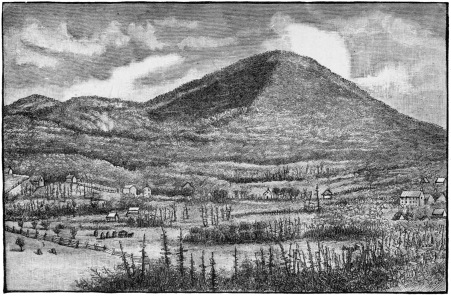
One mile from Waynesville, on the state road toward Webster, is a level
and well-cultivated farm of about one hundred acres, forming a portion
of the wide, cleared valley between the base of the hills, on one side,
and the wood-fringed Richland on the other. It is the property of
Sanborn and Mears, two young men who have lately moved into the
mountains. With enlarged ideas on farming, they are bringing the
naturally rich soil into a state of perfection for grain and grazing. A
cheery, comfortable farm-house stands under the door-yard trees beside
the driveway. Behind the house the ground rises gradually to the oak
woods along the summit of the hill. In the front, visible from the
doorway, is a wide-sweeping mountain prospect. The valley, broad, open,
level, diversified with farms and forests, crossed by winding fences and
roads hidden by green hedges, extends away for two miles or more, to the
steep fronts of lofty mountains. It is these mountains which so enhance
the picture, giving it, morning and evening, soft shadows, sunlight
intensified by shooting through the gap between the Junaluskas and Mount
Serbal, and a peaceful, pleasing slumber, like that of a noble grayhound
at the feet of his trusted master. A portion of this prospect is given
in the accompanying illustration.
From Waynesville to Webster, twenty miles distant, there was no regular
hack or stage line running in 1882, but either saddle-horses or
carriages can be obtained at reasonable rates in Waynesville. There are
no scenes along the route that the traveler would be likely to retain in
memory. Hills, mountains, woods, and farms fill up the way, with no
particularly striking features. Dr. Robert Welch’s farm, about two miles
from the village, is one which will not be passed unnoticed. The large,
white residence, white flouring mill opposite, high solid fences formed
from rocks picked from the roads and fields, and level lands of several
hundred acres, make up a pleasant homestead.
Webster is an antiquated village, on the summit of a red hill, silently
overlooking the Tuckasege river. It has a population of about 200, and
is the county-seat of a large and fertile section of the mountains.
About forty-five miles south of the village, by the way of the river
road, is Highlands, an objective point for the tourist. East La Porte is
one of the points passed on the river. It is a country post, with two
stores, a school-house or academy, and a few houses. The academy,
resembling a Tell chapel, is situated on a hill-top in a bend of the
Tuckasege. As this structure rises from the forest-crowned hill, around
whose base sweeps the sparkling river, with a line of distant mountains
for its back ground, it is extremely picturesque.
The road up Shoal Creek mountain, on the way to Cashier’s Valley and
Highlands, is noted for its wild scenery. Frail wooden bridges span deep
ravines echoing with the roar of waters; the road winds at times around
the steep side of the wooded mountain; then again it dips down to the
margin of the stream. The falls of Grassy creek are close in full view
at one point. The water of this stream in order to empty into the larger
stream, flings itself over a perpendicular cliff, falling through space
with loud roar and white veil-like form.
The stupendous falls of the Tuckasege are near this Shoal creek road,
but it is not advisable for the tourist to attempt the tramp to them by
this wild approach. In our last pilgrimage up the mountain we attempted
it. A few incidents which occurred on this trip may prove interesting to
the reader. The artist was with me. Stopping at McCall’s lonely cabin,
we hired a twelve-year-old boy for a quarter to act as our guide. The
day was uncomfortably warm. We led our horses up a mile ascent, so
steep, that in scaling it not a dry spot remained on our underclothes.
Then we tied the panting animals and walked and slid down a mountain
side whose steepness caused us to grow pale when we contemplated the
return. When we reached the dizzy edge of the precipice above the
thundering cataract, the artist, unused to so arduous a journey, was in
such a state of prostration, that he could not hold a pencil between
his thumb and fingers. To sketch was impossible; to breathe was little
less difficult for him. We rested a few minutes, viewing from above the
mad plunge of white waters, and then, with the small boy’s help, I
carried, pushed, and pulled my exhausted companion up the ascent to the
horses. How many times he fell prostrate on that desolate mountain
slope, stretching wide his arms and panting like a man in his last
agony, we failed to keep account of.
The last spoonfull of medicine in a flask taken from the saddle-bags
enabled him to mount his horse, and we rode off around a flinty mountain
with warm air circling through the trees and the hollow voice of the
upper falls of the Tuckasege, seen below us in the distance, sounding in
our ears. We dragged our horses after us down a steep declivity; passed
a muddy-looking cabin; wended through a deserted farm under an untrimmed
orchard, with rotten peaches hanging to the limbs; startled several
coveys of quails from the rank grass; entered a green, delicious forest
alive with barking gray squirrels; and then, through several rail fences
and troublesome gates, reached the sandy road leading into Hamburg,—a
store with a post office. It is the ancient site of a fort of that name
erected for use in case of Indian depredations.
Here we tried to get something to more fully resuscitate the still
trembling artist, but everything had gone dry; and all the encouragement
we received was a cordial invitation, from a man who was hauling a log
to a neighboring saw-mill, to come and spend a week at his house, and he
would have a keg of blockade on hand for us. This manner of the
mountaineers of inviting strangers to visit them is illustrative of
their warm-hearted natures. W. N. Heddin was the logger who extended
this invitation. I had met him once before while on a tramp through
Rabun county, Georgia, where he was then living. A minute’s stop at his
house, on that occasion to procure a drink of water, was the extent of
our acquaintance. His farm was situated at the base of a frowning, rocky
wall called Buzzard cliffs, and although just outside the North Carolina
line deserves some mention, because of certain interest connected with
it. This interest is gold.
The sand in the beds of some of the smooth-flowing rivulets down the
sultry southern slope of the Blue Ridge have, as regards the precious
mineral, panned out well in the past. Over thirty years ago the stream
through Heddin’s property was discovered to contain gold; and for a
time, as he related, was worked at the rate of ten pennyweights a day
per man. After living with the gold fever for many years, he lately sold
his property, and removed across the Blue Ridge.
Declining Heddin’s proffered hospitality we pushed on, gradually but
imperceptibly ascending the Blue Ridge. I was riding on ahead. Suddenly
my companion called to me.
“Say, I’ve lost my overcoat.”
“Too bad! Shall we return and search for it?”
“No; but it’s strange how I’m losing everything.”
“Yes. You lost your pipe yesterday; your breath this morning, and now
it’s your coat.”
“Just so; and do you know, I’m getting demoralized. Something worse is
going to happen. Say!”
“What?”
“If you hear anything weighing about one hundred and ten pounds fall off
my horse, turn and come back, will you?”
“Yes. Why?”
“You’ll know I’m lost. Hang me, but I feel cut up!”
The overcoat was not recovered by its owner; and fortunately the fall,
of which forewarning had been given, did not occur.
We easily ascended the Ridge. Luxuriant forests—perfect tropical
tangles—spread over the last portion of the way. A stream with water
the color of a pure topaz flows under the rich green rhododendron
hedges. Down the slope toward Cashier’s Valley the road is of white
sand, beaten as level as a floor. A drive in easy carriage over it with
the broad-sweeping limbs of the cool trees overhead, would be
delightful. These woods were filled with insects termed “chatteracks” by
the natives. Their shrill chirping toward evening is much louder than
the noise of the locust, and fairly deafens the traveler. Locusts also
joined in the chorus, giving a concert as melodious as it was singular
and primeval.
Cashier’s Valley is a mountain plateau of the Blue Ridge, 3,400 feet in
altitude, from four to five miles long and a mile and a half wide.
Attracted by its climate, freedom from dampness, its utter isolation
from the populated haunts of man, the rugged character of its scenery,
and deer and bear infested wildwoods, years since, wealthy planters of
South Carolina drifted in here with each recurring summer. Now, a few
homes of these people are scattered along the highland roads. One
residence, the pleasant summer home of Colonel Hampton, the earliest
settler from South Carolina, is situated, as it appears from the road,
in the gap between Chimney Top and Brown mountain, through which, twenty
miles away, can be seen a range of purple mountains. A grove of pines
surrounds the house. Governor Hampton formerly spent the summers here,
engaged, among other pastimes, in fishing for trout along the head
streams of the Chatooga, which have been stocked with this fish by the
Hampton family.
The sun had hidden himself behind the western ranges, but daylight still
pervaded the landscape, when through a break of the forest of the
hill-side around which the road winds, we came out before the massive
front of a peculiar mountain. Whiteside, or in literal translation of
the Cherokee title, Unakakanoos, White-mountain, is the largest exposure
of perpendicular, bare rock east of the Rockies. It is connected,
without deeply-marked intervening gaps, with its neighboring peaks of
the Blue Ridge; but from some points of observation it appears
isolated—a majestic, solitary, dome-shaped monument, differing from all
other mountains of the Alleghanies in its aspect and form. The top line
of its precipitous front is 1,600 feet above its point of conjunction
with the crest of the green hill, which slopes to the Chatooga, 800 feet
lower. The face of the mountain is gray, not white; but is seared by
long rifts, running horizontal across it, of white rock. With the
exception of a single patch of green pines, half-way up its face, no
visible verdure covers its nakedness.
Below the eastern foot of the mountain spreads away rolling valley-land,
with hills forest-crowned, fertile depths drained by the Chatooga’s
headwaters, and portions of it laid out in cultivated fields, and dotted
with farm-houses. At the base of Whiteside, on one of a series of green
rounded hills, lives an independent, elderly Englishman, named
Grimshawe; and near by, in a commodious, sumptuously-furnished dwelling,
partially concealed by a hill and its natural grove, resides his son, a
pleasant man, with a healthy, English cast of countenance. In the dark
we passed unseen the latter place; and, pushing along on our dejected
and dispirited steeds, fording the cold, splashing streams, disappearing
from each other under the funereal shadows of the melancholy forests,
climbing the cricket-sounding hills, we at length drew rein before the
almost imperceptible outlines of a low building arising under some gaunt
trees.
I dismounted, tossed my bridle to my companion, felt my way through a
trembling gate, stumbled upon a black porch and approached a door
through whose latch-string hole and gaping slits rays of light were
sifting. My rattling knock was responded to by a savage growl from an
animal whose sharpness of teeth I could easily imagine, and whose
presence I felt relieved in knowing was within. Then the door opened,
and a queer looking man stood before me. He was very short in stature.
His face was thin and colorless. A neglected brown moustache adorned his
upper lip. His hair was long and uncombed; and his person, attired in an
unbleached, unstarched shirt and dirty pantaloons, was odorous with
tallow. This was Picklesimer.
“Can my friend and I stay here all night?” I asked.
“I reckon. Our fare’s poor, but you’re welcome.”
The door swung wider. Several children, fac similes of their sire, and a
woman were eating at a table lighted by a tallow dip,—a twisted woolen
rag laid in a saucer of tallow and one end of it ablaze. There was
nothing inviting in this picture; but a shelter, however miserable, was
better than the night; and rest, in any shape, preferable to several
miles more of dark riding. In a few minutes our supper was ready.
Picklesimer sat opposite to us and to keep us company, poured out for
himself a cup of black coffee.
“Coffee is good fer stimilation,” said he.
“That’s so,” said the artist.
“When I drinks coffee fer stimilation,” he continued, running his
fingers back through his hair, “I drinks it without sugar or milk.”
We had evidently struck a coffee toper.
“Do you drink much of it?” inquired my companion, as Picklesimer began
pouring out another cup full.
“I drinks three and four cups to a meal. Hits powerful stimilation;” and
then he rolled his dark, deep-sunken eyes at us over the rim of his
saucer as he tipped the contents into the cavity under his moustache.
Evidently he drank coffee as a substitute for unattainable blockade. Our
host had no valuable information to impart; so, soon after supper we
retired to a room set apart for us, and sank away for a sound night’s
sleep in a high bed of suffocating feathers.
After our breakfast the next morning we went out on the porch. We
supposed Picklesimer, too, had finished his repast, but were deceived. A
minute after, he followed us with a full cup of steaming coffee which he
placed on the window-sill, as it was too hot to hold steadily in his
fingers, and interlarded his remarks with swallows of the liquid. His
charges were one dollar apiece for our lodging, fare, and the stabling
and feed for our horses. We then shook hands and departed. For days his
short figure, with a steam-wreathing coffee-cup in hand, was before my
eyes, and in my ears the words:
“I drinks hit fer stimilation.”
Horse cove lies in the extreme southern part of Jackson county, and
within only three or four miles of the Georgia line. Its name is about
as euphonious as Little Dutch creek, and is applied to this charming
valley landscape for no other reason than that a man’s horse was once
lost in it. Black Rock, with bold, stony, treeless front, looms up on
one border, and on another, Satoola, with precipitous slope,
wood-covered, forms a sheltering wall for the 600 acres of fertile,
level land below. A hotel keeps open-doors in summer within the cove.
The picturesqueness is heightened by the sight of an elegant and
substantial residence, strangely but romantically situated, on the very
brow of Black Rock. It is the property of Mr. Ravenel, a wealthy
Charlestonian.
Through Horse cove there is a road leading to Walhalla, South Carolina,
the nearest railroad depot, twenty-five miles away. It is a decidedly
interesting route to be pursued by a tourist. You will follow the
Chatooga river, into Rabun county, Georgia, along a picturesque course
of falls and rapids, by primitive saw-mills, unworked and decaying,
through a wild and cheerless tract of uncultivated mountain country,
where miserable farm-houses, and none others, but seldom show
themselves, and where the unbroken solitude breeds blockade whisky
stills, in its many dark ravines and pine forests. It would bother any
officer, in penetrating this section, to definitely ascertain when his
feet were on North Carolina, Georgia, or South Carolina soil.
The road, however, which we wish to take the traveler over, leads up the
Blue Ridge, in zigzag course, through the forested aisles of Black Rock.
Three miles and a half is the distance from its base to the hamlet of
Highlands. The engineering of the road is so perfect that, in spite of
the precipitousness of the mountain, the ascent is gradual. Let the man
on horse-back pay particular attention to his saddle-blankets while
ascending or descending a mountain. If he wishes to keep under him a
horse with a sound back, he will have to dismount every few minutes,
unbuckle the girth, and slip the blankets in place. Among the worst of
uncomfortable situations for the horseman, is that of being a hundred
miles from his destination with a sore-backed saddle animal, which will
kick or kneel at every attempt to mount. Imagine yourself, at every
stopping-place, morning and noon, leading that horse to a fence upon
which you, in the manner of a decrepit old fossil, are obliged to climb,
to throw yourself with one leap into the saddle. The rosy-cheeked
mountaineer’s daughter will most assuredly laugh at you, and ascribe to
inactivity the fact of your inability to mount from the ground. A sorry
figure! In every mountain stream forded, your steed will kneel to let
the water lave his back. No chance for dreaming on your part. But worst
of all, how disagreeable must a man’s sensations be, over the knowledge
of the sufferings of the animal under him. Get down and walk would be my
advice.
A word more on the subject of saddles and the beasts they cover. If it
is a mule, see that you have a crupper on him. In descending a mountain
it is impossible to keep a saddle, without the restraint of a crupper,
from running against a mule’s ears. At such times, if you have
objections to straddling a narrow neck which need not necessarily be
kept stiff, you must walk. A breast-strap is often a valuable piece of
harness to have with you for either horse or mule.
On gaining the gap of the mountain the traveler will find himself on a
lofty table-land of the Blue Ridge, about 4,000 feet above ocean level.
Whiteside, Satoola, Fodderstack, Black Rock, and Short-off support it on
their shoulders, while their massive heads rise but little above the
level. From the center of the plateau, such of these mountains as are
visible appear insignificant hills when compared with their stupendous
fronts and azure-lancing summits as seen from the contiguous valleys at
the base of the Blue Ridge. This table-land contains 7,000 acres of rich
land, shaded by forests of hard-wood trees and the sharp
pyramidal-foliaged pines. The streams that drain it are of the color of
topaz, except where sleepless mills have dammed the waters, and, giving
them depth without apparent motion, have left dark, reflecting expanses,
unrippled except when, at your approach, the plunging bull-frog leaves
his widening rings, or a startled muskrat betrays by a silvery wake his
flight to a sequestered home among the roots of the stream-ward-leaning
hemlock.
In the most elevated portion of the center of the plateau is situated a
thriving hamlet of one hundred or more people; a colony, strictly
speaking, above the clouds, and appropriately called Highlands. It was
founded in 1874 by Mr. Kelsey and Mr. Hutchinson, men of the same
enterprising and enthusiastic mould that all founders of towns in
primitive countries are cast in. Our first sojourn at Highlands was with
Mr. Kelsey in 1877. Only a few dwellings and as many green clearings
were to be seen; still, with an arder which to us seemed savoring of
monomania, the projector had already laid out by means of stakes,
streets of an incipient city, and talked as though the imaginary avenues
of the forests were already lined with peaceful homes and shadowed by
the walls and spires of churches. His aspirations are being slowly
realized. The village, with a nucleus of men of the spirit of its
founders, is rapidly assuming respectable proportions. Along the
principal thoroughfare and parallel side streets are many pleasant
dwellings, culminating with one of the cross streets in headquarters
comprising a good hotel kept by a genial landlord, several stores, the
post-office, two churches, and a school-house which is kept open for
full and regular terms. A wide-awake newspaper, on a sound financial
basis, made its first issue in January, 1883.
The farming lands surrounding the village are being settled principally
by northern families. A railroad at no distant day will penetrate this
plateau. A practicable route has been surveyed along the summit of the
Blue Ridge from where the Rabun Gap Short Line crosses at the lowest gap
in the range. A subscription list, in the form of enforceable contracts
wherein each signer has bound himself to grade ready for the ties and
rails certain sections of the route, has been completed. The prospects
for the coming of the iron horse are of an encouraging character. The
most convenient route to reach Highlands for the traveler who has not
already entered the mountains for the summer, is from Walhalla, South
Carolina, distant twenty-eight miles, on the Blue Ridge railroad.
The lofty altitude of this plateau, and the precipitous fronts of its
rimming mountains, bespeak, for its neighborhood, scenes of
grandeur,—waterfalls, gorges, mad streams, crags, and forests which,
when looked upon from above, with their appalling hush, wave back the
observer. Whiteside, a few miles from the village, is a point which no
sojourner in the mountains should fail to visit. A sight down a
precipice’s “headlong perpendicular” of nearly 2,000 feet has something
in it positively chilling. As the observer to secure a fair view lies
flat on the ground with part of his head projected over a space of dread
nothingness, the horrible sensations created, which in some minds
culminate in an overpowering desire to gently slip away and out in air,
are fancifully attributed to the influences of a “demon of the abyss.”
The pure, apparently tangible air of the void, and the soft moss-like
bed of the deep-down forest bordered by a silver stream, have an
irresistible fascination, especially over one troubled with ennui. Get
the guide to hold your feet when you crawl to the verge.
There is a grand mountain prospect from the summit of Whiteside. The
landmarks of four states are crowded within the vision. Mount Yonah,
lifting its head in clouds, is the most marked point in Georgia; a white
spot, known as the German settlement of Walhalla, is visible in the
level plains of South Carolina; the Smoky Mountains bounding Tennessee
line the northwestern horizon, and on all sides lie the valleys and
peaks of the state, in which the feet of Whiteside are rooted.
The falls of Omakaluka creek, three miles west of Highlands, are a
succession of cascades, 400 feet in descent. The most noteworthy
cataract, of the plateau region, is located about four miles from
Highlands, and known as the Dry Fall of the Cullasaja. The name was
given, not for the reason of the fall being dry, but because of the
practicability of a man walking dry-shod between the falling sheet of
water and the cliff over which it plunges. The way to reach it is by the
turnpike wending toward Franklin twenty-two miles from Highlands. This
road is smooth as a floor, and runs for miles through unfenced forests,
principally of oak and hemlock. After pursuing it for three miles, a
sign board will direct you to turn to your left down a slope. You can
ride or walk, as suits your convenience. It is a pleasant ramble along a
wooded ridge, before you reach the laureled bank of the river.
Meanwhile the solemn and tremendous roar of the cataract has been
resounding in your ears; and it is therefore with a faint foreshadowing
of what is to be revealed that you pass between the shorn hedge of
laurel, to the edge of a cliff, below which, between impending cañon
walls, fringed with pines, leaps the waters of the Cullasaja, in a sheer
descent of ninety feet.
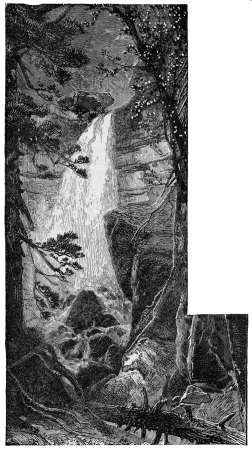
The descent from Highlands into the level valley of the Cullasaja is one
possessing panoramic grandeur to an extent equalled by but few highways
in the Alleghanies.
Six waterfalls lie in its vicinity. Down the wooded slope winds the
road, at times sweeping round points, from which, by simply halting your
horse in his tracks, can be secured deep valley views of romantic
loveliness.
On this descent a series of picturesque rapids and cascades enlivens the
way; and, in a deep gorge, where, on one precipitous side the turnpike
clings, and the other rises abruptly across the void, tumbles the lower
Sugar Fork falls. They are heard, but unseen, from the narrow road. The
descent is arduous, but all difficulties encountered are well repaid by
the sight from the bottom of the cañon.
From the foot of the mountain, on toward Franklin there is little of the
sublime to hold the attention. From this village the traveler en route
for iron ways would better travel toward the Georgia state line, which
runs along the low crest of the Blue Ridge. The road winds beside the
Little Tennessee, following it through wide alluvial bottoms until this
stream which, thirty miles below, is a wide and noble river, has
dwindled to an insignificant creek. At Rabun gap you pass out of North
Carolina.
The scenery of the southern slope of the Blue Ridge, in Northern
Georgia, is justly celebrated for its sublimity and wildness. Although
outside the prescribed limit of this volume, its proximity alone to the
picturesque regions of the high plateau of the Alleghanies, should
entitle it to some notice.
From Rabun gap it is four miles to Clayton, a dilapidated village,
consisting of a few houses grouped along a street which runs over a low
hill. On the north it is vision-bounded by the wooded heights of the
Blue Ridge; on the south, a stretch of low land, somewhat broken by
ridges, rolls away. It is the capital of Rabun county.
Twelve miles from Clayton are the cataracts of Tallulah. A comfortable
hotel stands near them. The scenery in their vicinity is of wild
grandeur. Through a cañon, nearly 1,000 feet deep, and several miles
long, the waters of the Tallulah force their way. The character of the
scenery of the chasm is thus described:
“The walls are gigantic cliffs of dark granite. The heavy masses,
piled upon each other in the wildest confusion, sometimes shoot
out, overhanging the yawning gulf, and threatening to break from
their seemingly frail tenure, and hurl themselves headlong into its
dark depths. Along the rocky and uneven bed of this deep abyss, the
infuriated Terrora frets and foams with ever-varying course. Now,
it flows in sullen majesty, through a deep and romantic glen,
embowered in the foliage of the trees, which here and there spring
from the rocky ledges of the chasm-walls. Anon, it rushes with
accelerated motion, breaking fretfully over protruding rocks, and
uttering harsh murmurs, as it verges a precipice—
‘Where, collected all,
In one impetuous torrent, down the steep
It thundering shoots, and shakes the country round:
At first, an azure sheet, it rushes broad;
Then whitening by degrees as prone it falls,
And from the loud-resounding rocks below
Dashed in a cloud of foam, it sends aloft
A hoary mist, and forms a ceaseless shower.’ ”
The other points of interest are the valley of Nacoochee, Mount Yonah,
the cascades of Estatoa visible from Rabun gap, and the Toccoa Falls,
five or six miles from Tallulah. At Toccoa the journey can be ended by
the traveler striking the Atlanta & Charlotte Air Line.