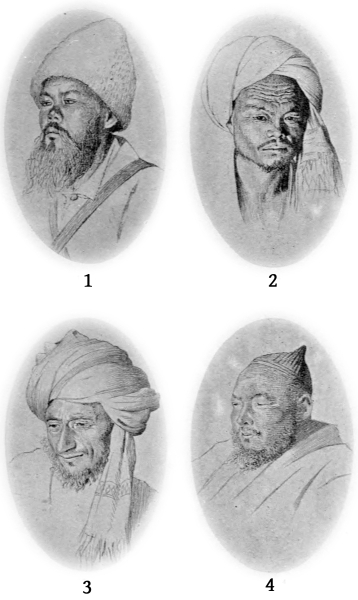
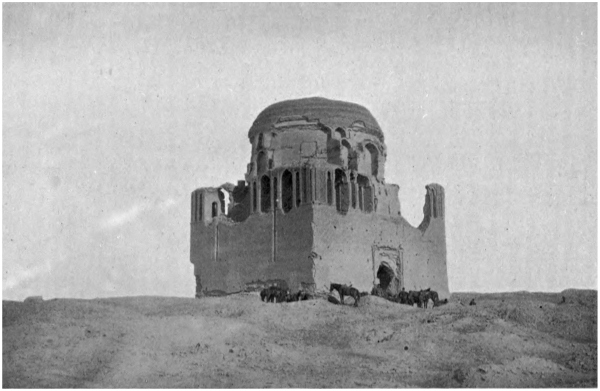
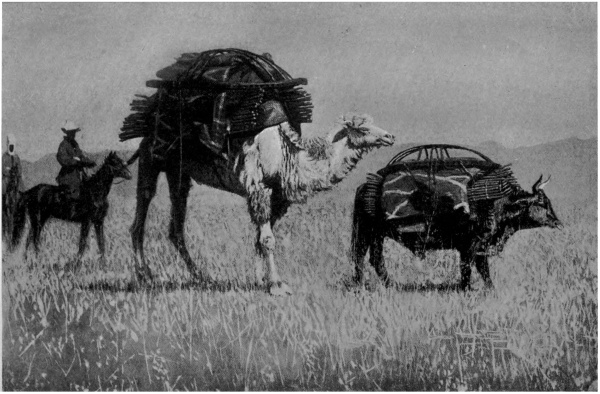
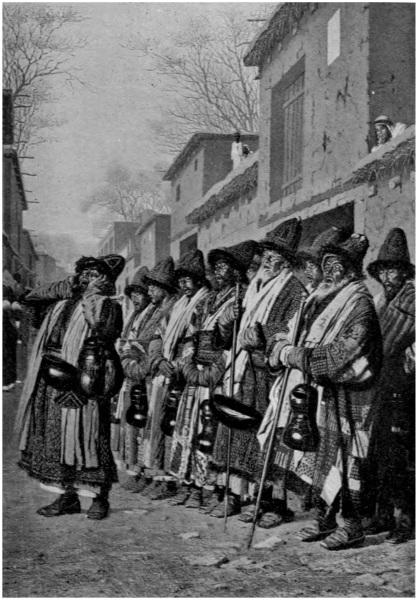
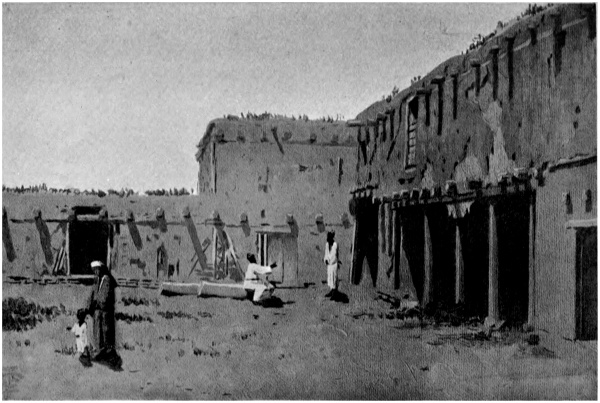
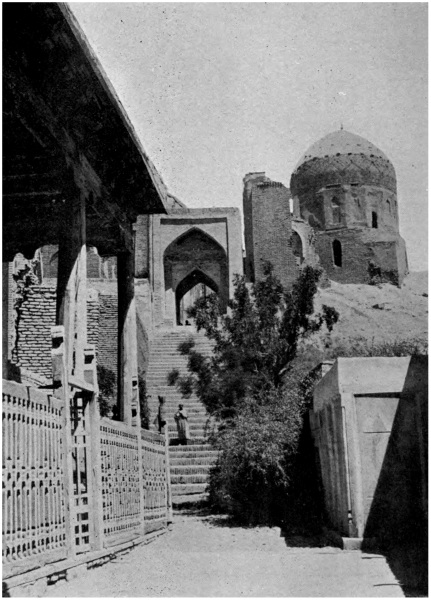
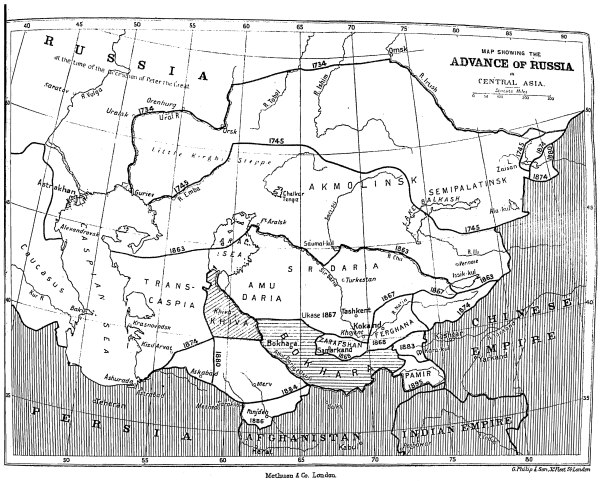
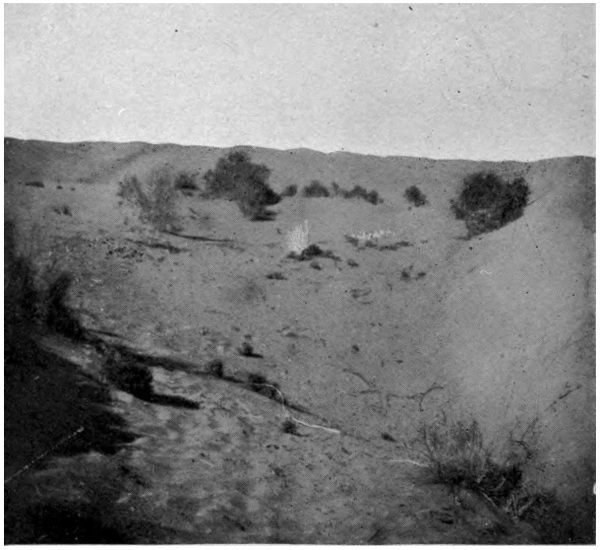
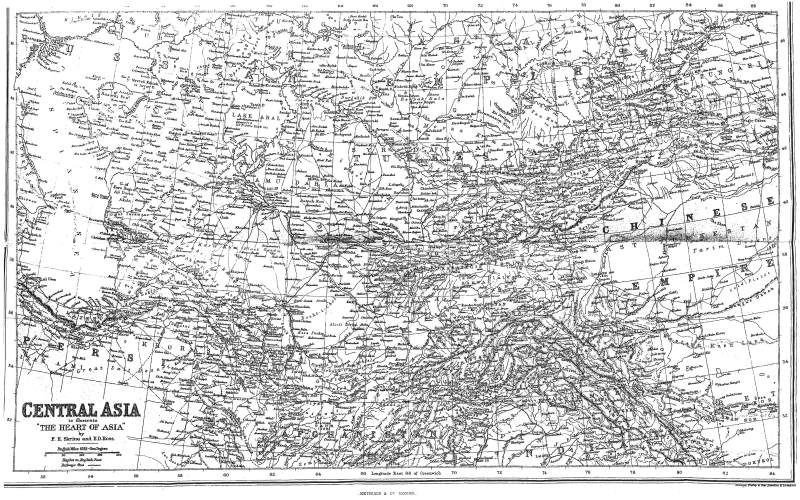
The 141 miles which separate Merv from the Bokhāran
frontier were the costliest and the most depressing
section of the Transcaspian Railway. It includes that
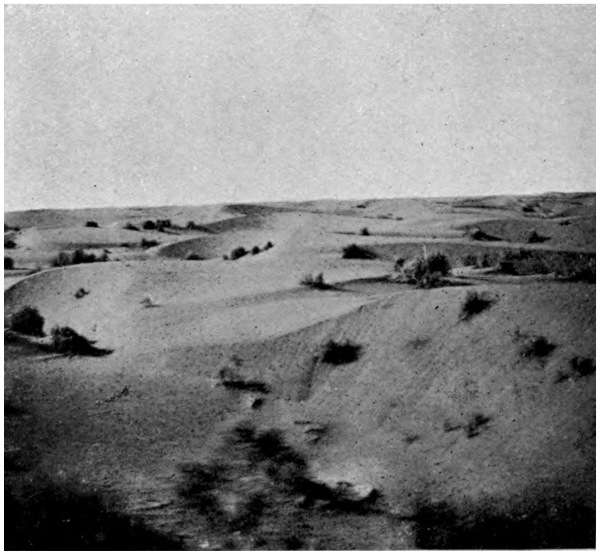
terror of Russian engineers known as the Sandy Tract,684
and no trace of cultivation is met with until the weary
eye finds solace in the restful green which marks the
course of the mighty Oxus. The border stronghold,
Charjūy, crowns a hill to the south of the railway line,
and bears in its rugged outlines a faint resemblance
to Edinburgh Castle. The little town which nestles at
its foot is garrisoned by a Russian force consisting of a
battalion of Turkestān Rifles and a squadron of Cossacks.
At Kerki, 110 miles up stream, three more rifle battalions
and a regiment of Cossacks serve as a reminder of the
power of Russia. The source of the Amū Daryā is
Lake Victoria, a beautiful sheet of water embosomed in
the Pamirs 15,600 feet above sea-level, which was visited
by Marco Polo, and rediscovered in 1838 by Captain
Wood of the Indian Marine.685 The bed of the great
river is 350 yards wide at the point where it leaves the
hills at Khwāja Sālih, 90 miles north-west of Balkh; and
200 miles down stream it swells to 650 yards. The
mean velocity is 3½ miles an hour, the average depth
9 feet, increasing to a maximum of 29 in August
after the annual rains. The course of the Oxus in our
day is north-westerly, and it discharges into the Sea of
Aral above Khiva. The stream once before bifurcated at
Kohna Urganj, 70 miles south of the great inland lake;
and one branch flowed south-westwards, entering the
Caspian by the Balkhan Bay. At some period in the
fifteenth or sixteenth century the Khivans attempted to
restrain the course by a dam, and so caused a diversion
of the western channel, which can still be traced through
the Turkoman Desert.686 To restore it has been the dream
of the Russians since the days of Peter the Great.
Elaborate surveys have demonstrated that the operation
is perfectly practicable; and those who advocated it
urged with truth that the canalisation of the river would
turn many thousands of square miles of desert into a
garden. The railway has, however, won the day; and
the only use made of the Amū Daryā by the Russian
authorities is to support a steam flotilla. This service
was inaugurated in 1887,687 and is now carried on by
steel-built steamers drawing 2 feet of water, and carrying
200 tons of cargo. Its chief value lies in the
means it gives for the transport of troops and munitions
of war, for the river is navigable up to the Afghan
frontier, 700 miles from its mouth. The Amū Daryā,
however, cannot be made to serve the needs of commerce,
for the channel is constantly shifting, sand-banks
are thrown up and disappear in a few hours, and the
navigating officers are in the hands of native pilots, who
divine obstructions by observing the colour of the water.
We have already described the great viaduct which
spans the Amū Daryā near Charjūy. It is admittedly
but a make-shift, and will soon be replaced by a girder
bridge. The traveller glances uneasily at the current
swirling round the slender piers, and feels inwardly
relieved when his train has crept safely to the opposite
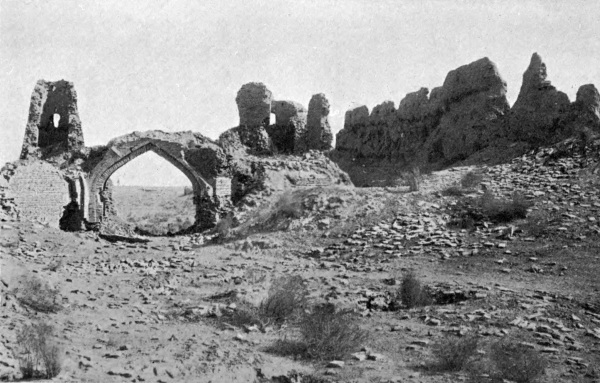
bank. On either side of the line there now stretches a
dead level of parched-up loam, broken here and there
by hillocks covered with the outlines of some ancient
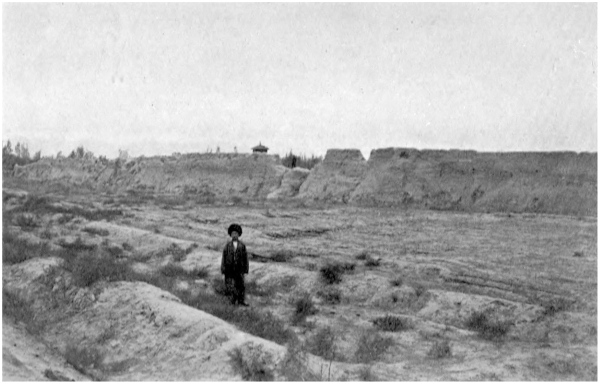
citadel. There are many of these Central Asian
Pompeiis, deserted owing to the failure of the water-supply,
or overwhelmed by the ever-encroaching sand.
Mosques, market-places, and palaces stand as they did
centuries back, but the narrow streets show no signs of
human life. But the desert yields again to cultivation,
and the train speeds through fields of cotton and millet,
overshadowed by splendid trees. The fair domains
irrigated from the river Zarafshān have been reached,
and its centre, Bokhārā the Noble, comes into view. A
canon of Russian policy ordains that the European
quarters shall be placed at a considerable distance from
the great cities. Thus the effect of sudden waves of
fanaticism, which are always to be feared in Mohammedan
countries, is lessened, and time is given to organise
defence. The railway station is eight miles by road
from the capital, and is the centre of a Russian town
called New Bokhārā. Its broad thoroughfares are destitute
of trees and flowers, for nothing will grow in this
ill-chosen site. Among many mean buildings of the
bungalow type are some with architectural pretensions—a
handsome residency, built by M. P. Lessar during his
term of office as representative at the Bokhāran Court, a
palace in a hybrid Byzantine style lately erected for
the Amīr, the new buildings of the Imperial Bank, and
the offices of the 3rd Railway Battalion. The Russian
quarter already numbers 6000 inhabitants, and is daily
growing in importance at the expense of its older rival.
The highway leading to the latter passes through
a country which is evidently much subdivided, and
cultivated with extreme care. The fertile belt is watered
by distributories from the Zarafshān,688 which passes
Samarkand and pours a flood of wealth into Bokhārā’s
lap. These canals are popularly attributed to Alexander
the Great and Tīmūr, heroic figures which serve as a
spur to the imagination of poets and professional story-tellers
throughout Central Asia. They are, in point of
fact, the inevitable result of the natural conditions encountered.
The soil in Bokhārā is either a rich yellow
loam or sandy waste, and the latter is ever encroaching.
The rainfall is scanty; and, but for the help of
irrigation, mankind would long since have given up
the incessant struggle for existence. Nowhere in the
world are the contrasts between desolation and plenty
more startling. A caravan approaching the capital finds
itself, after weary months spent in the sands, suddenly
surrounded by waving crops, and trees laden with
luscious fruit, while its ears are greeted by the ripple of
water. The mechanism by which this wondrous change
is effected would excite the derision of a European
engineer. The surveyor lies prone upon his back in the
direction from which he wishes to bring water, looks
over his forehead, and notes the point when ground is
last seen. This rude substitute for the theodolite involves
a great deal of misplaced labour, but its results
are as marvellous as those of the Egyptian irrigation
department. The precious fluid is brought from the
mountains in canals, carried round spurs, and crossing
ravines in pipes, which, like those of our old London
water companies, are often mere hollow trees. When
the plain is reached the gradient is very slight; and
so tenacious is the soil that streams 30 feet in breadth
are restrained by banks 3½ feet high and 3 feet broad
at the base. The whole adult village population are
the labourers, their only implements being a clumsy
hoe, the lap of their long flowing robe, and a hurdle
of plaited branches. The administration of the canals
is on a popular basis. The superintendents, called
“aksakāls,” are elected by the cultivators; and every
village has its own “mīrāb,” who watches over the
repairs and distributories, and is remunerated by a fixed
proportion of the harvests. In years of plenty the
task is an easy one; but it is far otherwise at the
critical weeks which precede the spring melting of the
snows. Every drop of water is then worth its weight
in gold, and it must be so divided that each plot
may get its just proportion. Complications, too, occur
owing to the privileges which certain villages enjoy
by royal grant or immemorial prescription, and by the
absence of any satisfactory method of measuring discharges.689
The Russians have shown wisdom in leaving
the canals in native hands in the territory administered
by them. In Bokhārā, of course, there has never been
any question of introducing reform. The Bokhāran
cultivator manures his fields heavily after harvest, and
until they receive the life-giving water. In the city
streets, old men and boys may be seen gathering every
particle of refuse; and, in spite of the constant supply,
the hungry soil is still unequal to the incessant demands
upon it. Then the task of preparation begins. The
fields are turned up lengthways and again transversely
by a plough clumsily built of wood, its share only being
tipped with iron. A pair of oxen can plough rather
more than one acre during the cool hours between
midnight and 9 a.m.690 The soil is then manured and
drenched with water. Spots which show effervescence,
that curse of irrigated soil,691 are dug up by hand and
dressed with lime picked out of the ruins which abound
in these ancient seats of population. The harrow, a
plank two feet wide studded with iron nails, is next
passed over the sodden soil in two directions. The enumeration
of the crops thus raised would be as tedious
as Homer’s catalogue of men of war. The stand-by of
the poor is juwārī (holcus sorghum vel saccharatum), a
species of millet which yields two hundredfold of coarse
grain. Cotton is amongst the most lucrative; and a vast
impetus has been given to its growth by the railway,
which carries the raw material to Russian mills. Wheat,
barley, and pulse are also staples, and the vine is made
to produce a heady fluid, like immature sherry, by
Armenians and Jews, who have the monopoly of a
manufacture forbidden to true believers. The entire
cultivated area of Bokhārā is not much in excess of
8000 square miles, and the population which it maintains
is at least 2½ millions. Thus the price of land
is high, and it is much subdivided.692
When viewed from a height the country resembles
a huge shawl of a specially intricate pattern. The eight
miles of dusty road which separate the capital from the
Russian quarter run through fields which are exact
replicas of those of Upper India, and the parallel extends
to the villages of flat-roofed houses with wooden
verandahs, and the shops displaying piles of sticky
sweetmeats. The traveller’s progress is impeded by
rows of ponies tethered in the narrow streets. In Bokhārā
everyone rides. The poorest can afford the hire
of a moiety of a donkey, and beggars on horseback
excite no remark. The approach to the city is lined
with the gardens in which Bokhāran citizens delight.
They are walled in or sheltered from the wintry blast
by rows of silver poplars. A quadrangular pond marks
the centre of four paths at right angles connected by
smaller ones, and overshadowed by fruit trees which are
a mass of tender hues when spring showers bring out
the blossom. Flowers are few: the rose, the blue iris,
sunflower, and poppy well-nigh exhaust the list. The
cultivation of fruit is well understood. The melons
have a more delicate aroma than those of any Eastern
country. Dried apricots are known in India as the
“Ālū-i-Bokhārā”; and every variety of fruit familiar to
the European palate is to be had in a perfection and at
prices which would excite wonder in Covent Garden.
This setting of brilliant vegetation adds dignity to
the crumbling ramparts of Bokhārā. The town-wall, 28
feet high and 7½ miles in circuit, encloses an area of 1760
acres, which seems disproportionate to the dwindling
population, now amounting to no more than 65,000
souls.693 Entering one of the eleven gates,694 unchallenged
by the slouching sentry, the traveller finds himself in a
dædalus of narrow lanes, swarming with human beings
more suggestive of the unadulterated East than any
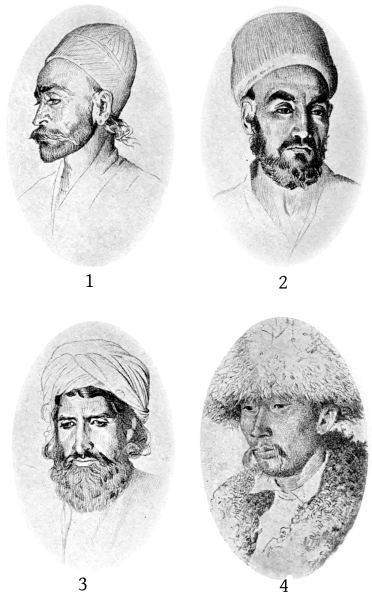
other city in Asia can show. Sart is the Russian term
for the sedentary population throughout Central Asia;
but the variety of types which it includes is immense.
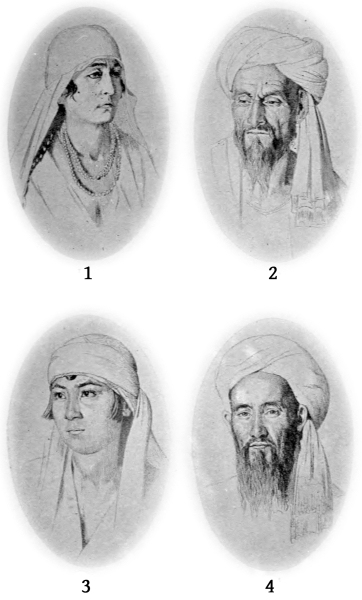
The Tājiks are a tall well-favoured race, with clear olive
complexions and black eyes and hair.695 Their origin is
the subject of much controversy; but, according to a
tradition among them, they migrated to Bokhārā from
the west, and reclaimed a reedy swamp which became the
city’s site.696 They were subdued by the fierce Arabs in
the eighth century, and adopted the Mohammedan religion.
As each tide of conquest swept the country the
Tājiks bent their necks, and acquired all the vices of a
race inured to foreign dominion. They are polished,
laborious, and intelligent, with a genius for commerce,
but their greed and faithlessness are as notorious as their
cowardice.697 Thus the Tājik is regarded with supreme
contempt by the Uzbegs, who for three centuries have
been the dominant race.698 They are a stem of the great
Turkish family which, starting from the steppes north of
the Gobi Desert, brought half the world under their
sway. They are middle-sized but sturdy, with high
cheek-bones, ruddy complexions, and dark auburn hair.
In character they resemble the Osmānlīs—not the scum
of the Levant now encountered at Constantinople, but
the rude warriors who supplanted the Cross by the
Crescent there in the fifteenth century. They are brave
and independent, with the grossness of manners and
something of the inborn dignity of the unadulterated
Turk. Like the Kirghiz, who are also met with in
Bokhārā,699 and the Turkomans, Uzbegs are either sedentary
or nomads. The first class resemble the Tājiks in
their greed for gain, but they are not so civilised; the
second tend their flocks and herds, dwelling in tents of
dark grey felt hung with bright carpets. The reigning
dynasty is of this race, and belongs to a division of the
Mangit, the chief of the 97 clans700 into which Uzbegs
are divided. At the opposite pole stand the Jewish
community, which is traditionally believed to have
migrated hither from Baghdād. Half a century ago
they numbered 10,000,701 but they have dwindled to
perhaps half as many under the grinding persecution to
which they have been subjected. Bokhārā is not a whit
in advance of mediæval Europe in its treatment of this
forlorn colony. The time, indeed, has gone by when
Jews might be savagely assaulted by a true believer, and
even killed with impunity. But they are still relegated
to a filthy and crowded Ghetto. They are forbidden to
ride in the streets, and must wear a distinctive costume,
a small black cap edged with two fingers’ breadth of
sheep-skin, a dark dressing-gown of camels’ hair, and a
rope girdle, a survival of a time when it might at any
moment be required for its wearer’s execution. This
tyranny, tenfold worse than that endured by the Tājiks,
has ranged the Jew on the side of the white man.
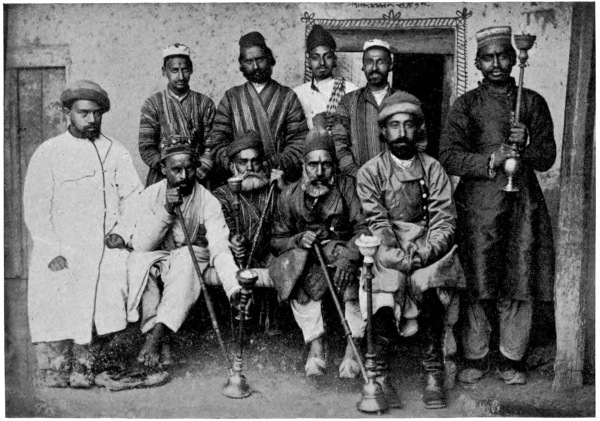
HINDUS OF BOKHĀRĀ
In the earlier days of their empire in Central Asia
the Russians received a good deal of valuable information
as to popular feeling from these despised auxiliaries.
The blind hatred which superiority excites in minds of
the lower type is universal in Bokhārā, and the Jews of
the Khānate still groan under disabilities which are more
degrading to their oppressors than to themselves. The
Persian element is a strong one, and the slim figures,
dark eyes, and regular features of the children of poor
worn-out Irān are conspicuous in the motley crowd that
fills the streets. They are descended from slaves sold
by Turkoman raiders, or from 40,000 Persian families
transplanted from Merv by Amīr Murād in 1784.
Being Shī`as, they cordially detest the Uzbegs and Tājiks,
who belong to the rival Sunni sect.702 Under former
Amīrs, notably the treacherous Nasrullah, who murdered
our countrymen Stoddart and Conolly, the Persians
gained commanding influence.703 They are now peaceable
traders, whose patriotism stops at day-dreams of reviving
the glories of the greatest and most ruthless of their
royal line, Nādir Shāh. Broad-shouldered Afghans,
lithe bright-eyed Arabs, who have the secret of dressing
the real Astrakhan lamb-skin, and Indian subjects of Her
Majesty, are common in Bokhārā. The latter are styled
by the natives Multānis, though most of them hail from
Haydarābād in Sindh. They are betrayed by their dark
complexion and the flame-shaped caste-marks on their
swarthy brows. The Hindu shares with the Jew the
immense profits derived from money-lending, which is
forbidden to true believers, and they are eager and
rapacious traders. The large commerce in tea is in the
hands of some wealthy Peshawar Mohammedans. The
Indian colony devote a few years to money-grabbing,
living the while in serais of their own, consisting of a
courtyard surrounded with unfurnished cells, in which
the traveller spreads his bedding, while his goods and
camels occupy the centre of the square. They profess
to be well satisfied with the existing order of things at
Bokhārā, but have some reason to complain of the
absence of any British consular agency.704
The variety of features shown by a Bokhāran crowd
hardly extends to the costumes. The wealthier wear
gorgeous khal`ats, or long dressing-gowns of cashmere or
cloth of gold. In the middle class the universal garment
is of coloured silk, with a curious pattern of concentric
lines; while the populace is content with blue or striped
cotton. All have huge turbans of white muslin, the size
of which is an evidence of their wearers’ rank. Sometimes
as many as twenty yards are used. It is a curious fact
that, in spite of crushing protective duties, the produce of
Manchester looms is preferred by all who can afford the
luxury.705 The feminine element, which gives the greatest
charm to the crowds of Western cities, is entirely absent
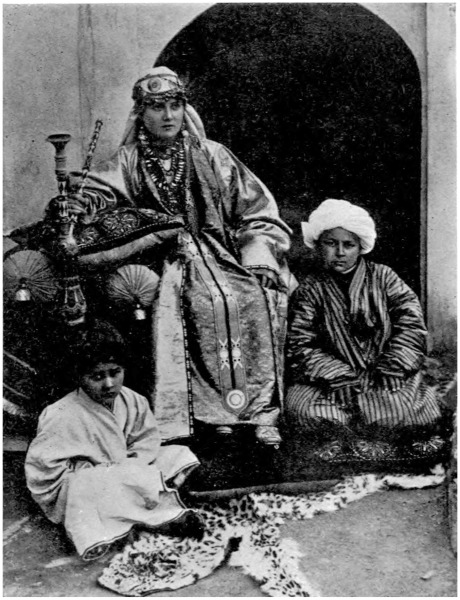
in Bokhārā. Such women as venture into the streets are
muffled in a hideous smock706 and a thick horse-hair veil.
It must be admitted that the beauties thus concealed lie
chiefly in splendid dark eyes, the lustre of which owes
much to the aid of henna, and arched eyebrows which
are deemed indicators of passion, and therefore heightened
by artificial means. The emancipation of women has
not begun in Bokhārā. Marriage is a sale conducted
with as little delicacy as the cattle-dealer imports into
his transactions. The child-wife never gains her husband’s
love or confidence, and is deserted while her
charms are at their zenith. Custom, in fact, moulds
the Bokhāran’s inmost being, and the degraded position
assigned to women by its teaching places him beyond
the pale of civilisation. Home-life in the Central Asian
Khānates exists no more than it did in ancient Rome.
The citizens’ houses are ranges of dark and cheerless
cells surrounding a central courtyard, and presenting
blind walls to the street. The intense cold of the winter
months is mocked rather than mitigated by charcoal
braziers.707 Music is unknown in the cheerless interior,
and tobacco was till lately tabooed by the arrogant
priests. When an envoy of the Sultan of Turkey made
his state entry into the city his use of a long amber-tipped
pipe caused universal consternation. Nor do the
pleasures of a refined table solace the tedium of life.
After attending morning prayers at his mosque the
citizen swallows a mess of tea boiled into the consistency
of thick soup, with salt and milk, and at his second meal,
taken at 5 p.m., the standing dish is the pillau of mutton,
rice, and vegetables. The craving for amusement so
deeply implanted in human nature finds an outlet in the
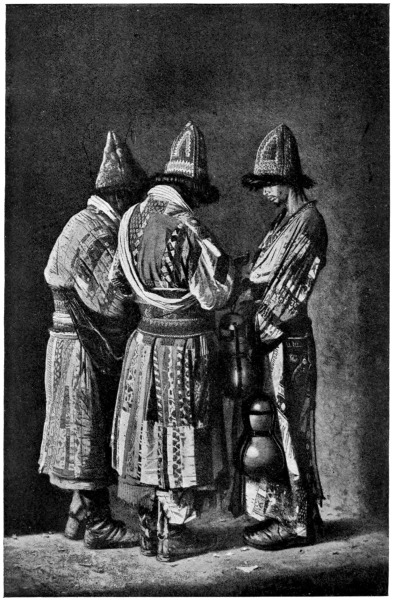
performances of bachas708—lads of between eight and
fifteen with long flowing locks, who dance, posture,
and sing with a brio which excites frenzy in Bokhāran
spectators. They supply the place of our opera-singers,
ballet-girls, and actresses. The names of bachas pre-eminent
for beauty and languishing graces are as often
pronounced as those of the extinct race of Divas were by
Englishmen of the last generation. They sometimes
rise to high positions in the state, and oftener amass
great wealth after a few years’ practice of their degrading
trade. The Amīr maintains a troupe of bachas; and
without their aid an entertainment of any description
would be as a performance of Hamlet without the Prince
of Denmark. The European who attends one of these
ceremonies feels instinctively how wide is the gulf between
East and West, when he remarks the enthusiasm excited
by the phases of passion depicted by these children.
To Englishmen an exhibition of the national game of
baigha is more interesting. It is a scramble by mounted
players for the carcass of a goat. When all are ready
for the fray, the umpire beheads the creature and throws
its bleeding body into the arena. Then follows a scrimmage
which reminds one of Rugby football. The goat’s
remains become the centre of a dense mass of men and
horses locked in a desperate struggle, in which, wonderful
to relate, players are rarely unseated, and still more seldom
do the animals injure each other. The object of each is
to monopolise the Bokhāran substitute for a ball, and carry
it far from the scene of action, outstripping all competitors.
The great bazaar of Bokhārā makes some amends
for the dulness long drawn out of domestic life. It is,
indeed, a relief to pass from the garish sunshine into the
cool gloom of these lofty arcades, which extend for at
least seven miles in all their ramifications. The roof is
generally of beaten clay, laid upon undressed timber;
and on either side is an endless vista of booths, displaying
every article of luxury and use in demand among Asiatic
people. Carpets and rugs of harmonious tone, piles of
gaudy shawls and dress pieces, snuff-boxes of polished
gourd to hold the pungent green powder affected by the
Bokhārans, and cutlery and trinklets of every description.
Europe here struggles with Asia for mastery, and seems
about to gain the battle; for though all the European
goods bear Russian labels, the great bulk is the produce
of German workshops. The stimulus given to the trade
of the Fatherland by the payment of the French indemnity
in 1871 has led to a constant movement of Teutons
across the Russian frontier. They retain their German
citizenship, while they turn out cheap and nasty wares
under the ægis of a protective fiscal system. One section
of the vast bazaar, roofed by a dome of ancient brickwork,
is sacred to literature, and the counters of its shops
are piled high with standard works in lithograph editions,
and here and there a manuscript. Great bargains may
sometimes be obtained by connoisseurs, though there are
still enough native bibliophils in Bokhārā to render good
finds by Europeans exceptional. Money-changers’ stalls
are frequent, with tempting heaps of silver and copper
discs for exchange against Russian money. The state
has been allowed to retain its own coinage, a prerogative
more valued than any other by Eastern sovereigns. The
unit is the tanga, a silver piece which fluctuates as
violently as did the Indian rupee before Sir David
Barbour closed the mints. It is at present worth 15
kopeks, but sudden oscillations of a kopek and even
more are common.709 The gold coin in circulation is
styled tilā, and is of unusual purity. It is worth 21
tangas. For the needs of the proletariat there are tiny
brass dumps, 44 of which go to the tanga. Another
quarter of the bazaar displays the silks and velvets for
which Bokhārā was once so famous. The trade is a
dwindling one, owing to the prevalence of disease among
the worms; and the chief beauty of the fabrics lies in
their faintly stamped, flowered patterns.710 The vast
crowd of loungers in these arcades shows none of the
loathing for the Giaur which the appearance of one in
this hotbed of fanaticism once excited. They civilly
make way for the European’s droshky, and his eyes rarely
encounter an unfriendly glance in those of the shopkeepers
squatting impassively in a setting of rich carpets
and dazzling weapons, or the throng of customers who
watch every phase of the bargaining. But the old spirit
has been scotched, not killed, by Russification. The
European who allows his shadow to flit on a mullā
lolling on his pile of cushions will be roundly cursed for
his impudence. The crowd intent on buying and selling
find the wherewithal to assuage their hunger in the
eating-houses, which exhibit huge caldrons of bubbling
pillau, flat cakes of unleavened bread, and heaps of coarse
sweetmeats made from Russian beet-sugar. The samovar,
which hisses in every eating-house, reveals the Bokhāran’s
predilection for tea. The green variety is alone
consumed, and it retails at 2s. 10d. per pound, in spite of a
Russian import duty of 1s. 10d. In pre-railway days it
was imported through Afghanistān, but the line connecting
Bokhārā with the Caspian has superseded the old
camel caravans, with their leisurely movements and liability
to pillage and exactions. Tea now comes into Bokhārā
by way of Bombay and Batum. China still supplies
the great bulk of the demand; but Indian and Ceylon
teas are slowly making their way even in remote Bokhārā.
Their progress would be far more rapid but for the
crushing import duty levied by the Russian Government.
The Transcaspian Railway has, in point of fact, robbed
Peter to pay Paul. Russians and Russo-Germans find
a ready sale in Central Asia for their wares, but Bokhārā
is no longer a great centre for the distribution of English
and Indian goods, as it was a quarter of a century back.
They will live in the memory of the denizen of the
prosaic West, those Bokhārā bazaars, with their long lines
of shops rich in dazzling colours, the blue sky peeping
through rents in the time-worn vaulting, and the sunshine
flecking the kaleidoscopic crowd in the galleries below.
Though the chief interest of Bokhārā centres in its
bazaars, it has many public buildings which repay
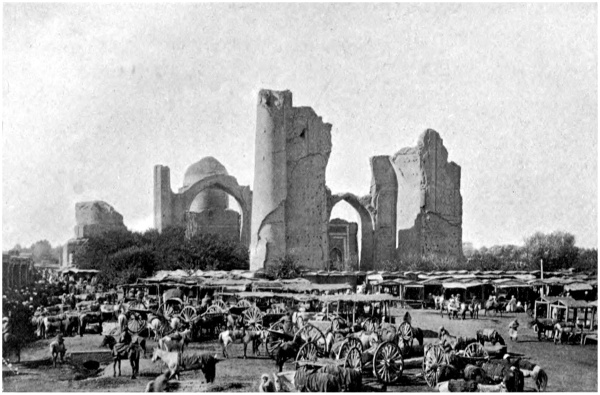
examination. In the north-west quarter is the Rīgistān,
a market-place surrounded by shops which are cleared of
their contents at nightfall. On its west side is a tank
overshadowed by trees, which are as rare in Bokhārā as
in the city of London, and surrounded by tea and barbers’
shops, the resort of a host of idlers during the daylight
hours. One side of the Rīgistān is occupied by the Ark,
or citadel, which stands on a vast artificial mound, and is
walled by crenellated ramparts forming a square of 450
yards. It dates from the era of the Sāmānides. The
great gate, built by Rahīm Khān in 1742, is flanked by
towers 100 feet high showing traces of faience; and
opens on a vaulted corridor leading to the Amīr’s palace,
treasury, and state prison. In old days this was a loathsome
dungeon full of ticks and other vermin; but the
story so oft repeated, that the insects received rations
of raw meat in the absence of human victims, is probably
untrue.711 Here dwells the Kushbegi, or prime minister,
of whom more anon; but the buildings of the citadel are
by no means imposing in size or architectural merit. In
a shed on the right of the gateway is the Artillery Park,
containing about fifty pieces, all of antiquated make. A
smaller market-place, which serves for dealings in raw
cotton, is surrounded by the most imposing of Bokhārā’s
public edifices.
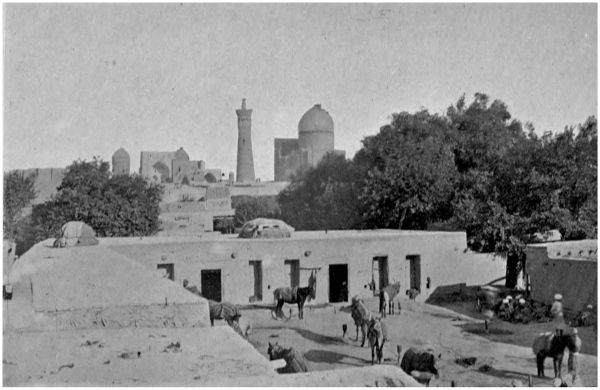
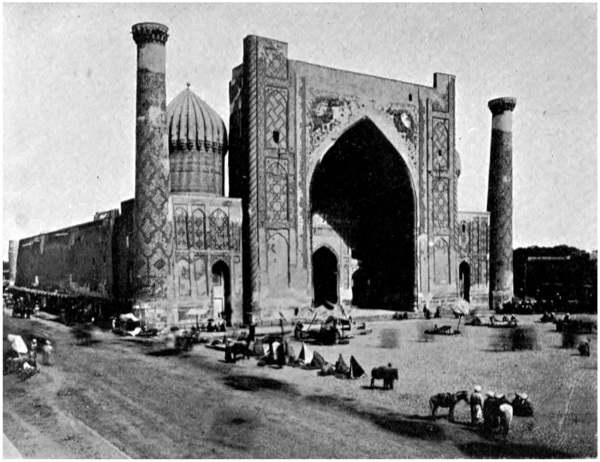
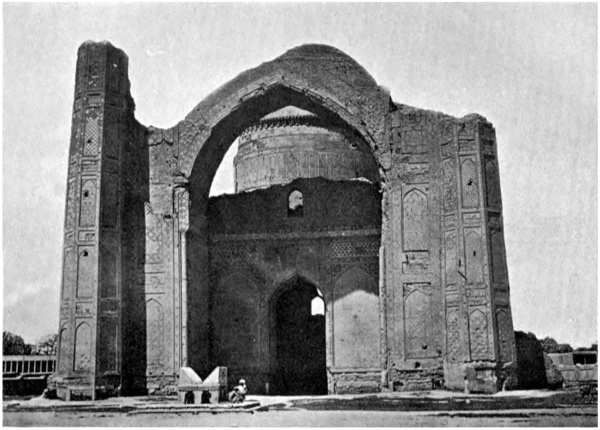
On one side is the great mosque, called the Masjid-i-Jāmi`,
as are those of Delhi and Agra, because it was
built to hold the immense crowd attending a Jum`a, or
Friday service. The front is a vast recessed portal
covered with arabesques in faience; its gates give access
to a courtyard spacious enough to contain 10,000
worshippers,712 surrounded by a vaulted cloister. Near it
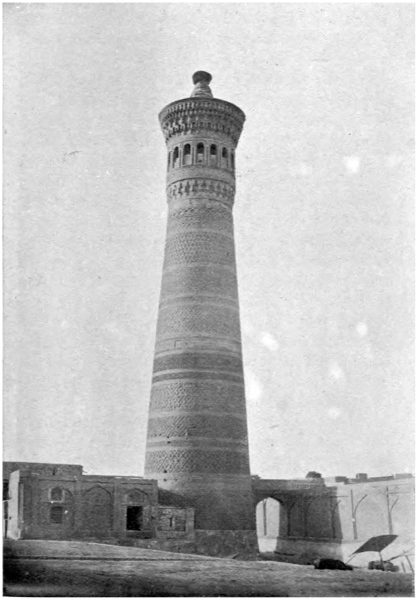
is the Minār Kalān, or Great Minār, a round tower 36 feet
at the base, and tapering upwards to a height of 210.
The whole surface is covered with beautiful designs in
carved brick, which show that it dates from Bokhārā’s
golden age. From the summit criminals were precipitated
into the market-place beneath; but access to
it is now forbidden, lest curious visitors should pry into
the scores of courtyards which it commands. Opposite
to the city mosque is the Madrasa Mīr-i-`Arab, a stately
college with a tall recessed gateway, which ranks first
among the 103 of which Bokhārā boasts. The entrance
is through a door on the left, which opens on a vaulted
corridor leading to a quadrangle surrounded by a double
tier of cells, called hujrats, in which the pupils reside.
Each has its bed-place on a dais spread with carpets and
pillows, and niches in the wall for his books and clothes.
Here the more promising lads from the elementary
schools spend fifteen or twenty years in mastering the
legal and religious system of Islām. This education is so
alien to all that is associated with the process in Western
countries, and its results are so far-reaching, that a description
of its mysteries will interest those who aim at
reading aright the signs of the times in Central Asia.
Primary schools are to be found in every Bokhāran
village, and they abound in the capital. They may be
known from afar by the hum of childish voices, which
resounds from morn till dewy eve in the narrow sunless
streets. The course of teaching embraces the Koran,
the Farz-i-`Ayn, and other books of a religious tendency,
written in Tājikī, a dialect of Persian, and Turkī, the
language of the Uzbegs. Those who wish to pursue
their studies further pass into the Madrasas, which are
maintained from the rents of great landed estates
assigned to them by rulers of past ages. The curriculum
here embraces theology, Arabic, law, and “worldly
wisdom.”713
THE MINAR KATAN AT BOKHĀRĀ
Students who are conscious of a vocation for the priesthood
are subjected to a probation severer than that
which is prescribed to candidates for admission to La
Trappe or Chartreuse. They must obey all the precepts
of Mohammed’s code, and learn by long and painful
practice to pronounce the shibboleth, Lā Allāh ill Allāh,
thousands of times without drawing breath. Thus they
attain to the coveted degree of Ishān, are qualified to
instruct others, and receive the blindest devotion from
the lower orders. No training can be conceived which
is more calculated to inspire self-conceit and fanaticism.
Now the priesthood of Bokhārā and the other cities of
Central Asia have all been subjected to these sinister
influences at a period of their lives when the plastic mind
receives impressions which can never be effaced; and the
schools and colleges are officered exclusively from the
sacerdotal caste. Before the advent of the Russians to
power, the mullās directed the whole mechanism of
government. The most cruel and treacherous of the old
Amīrs respected their lives and liberties and shaped his
conduct on their counsels. The mullās’ political influence
has been destroyed by the Russians’ advent to
power, for the theory on which Mohammedan states are
ruled is utterly at variance with Western conceptions;
and the insidious energies of the priesthood are restricted
to education and religious observances. There can be
little doubt that the wave of sedition which is sweeping
over Central Asia714 is due to the teachings of men who
desire the restoration of Islām as a predominant factor
in government. The Russian masters of Central Asia,
like we ourselves in India, are stepping per ignes suppositos
cineri doloso, and a mistaken educational policy is, in both
cases, at the bottom of the mischief that is brewing.
The other Madrasas of Bokhārā are more remarkable for
size than architectural merit. One of them was erected
at the end of last century, at the cost of the Empress
Catherine of Russia, who came under Voltaire’s influence
and displayed a catholicism which outran that of the
philosopher of Ferney.715 Adjoining the Great Minār is
the only public building in Bokhārā which has not seen
the march of centuries—the Baths of the Chief Justice,
thrown open to the public in 1897 by the generosity of the
official who held that rank. The innermost chamber is
a huge oven surrounded by marble divans, on which the
bather reclines while an attendant cracks every joint in
his body, scours him with a piece of hair-cloth, and
sluices him with cold water. Thence he passes to a room
heated to a temperature of about 80 degrees, where he
dresses and proceeds to a spacious hall opening on the
street. Here, reclining on a dais spread with carpets and
pillows, he sips his tea in the blissful lassitude which
follows the Turkish bath. The Zindān, or state jail, is a
dilapidated structure of brick, perched on a mound to the
east of the citadel. The entrance is through a dirty
guardroom which gives on a courtyard. A door to the
left leads to the abode of petty offenders—a smoke-stained
shed, tapestried with bundles containing the
property of the inmates. The latter squat on the floor
apparently in good health and spirits, albeit that their
rations would not be approved of at Wormwood Scrubbs.
They receive from Government 1½ pounds of bread every
other day, but visitors are allowed to distribute as much
food as they please. On the right of the courtyard is a
vaulted room lit by a barred opening in the ceiling,
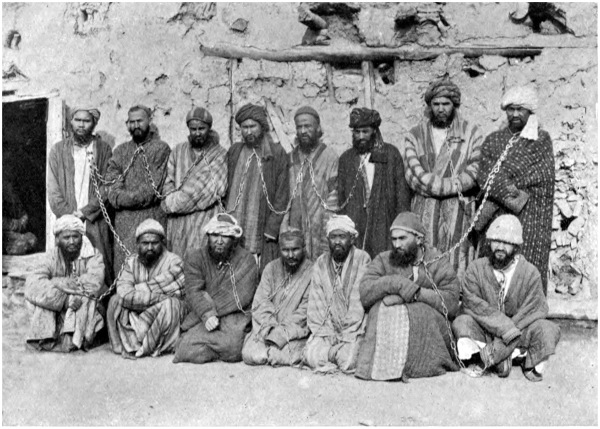
which serves as a ward for heinous offenders. Here will
generally be found twenty or thirty wretches fastened
together by a heavy chain attached to an iron ring on
the neck of each. They are all murderers or banditti
under trial or awaiting the Amīr’s confirmation of the
death sentence; and their sullen despair is but too
evident. Punishments were terribly severe in pre-Russian
days. Prisoners were riveted to the wall by iron collars
for years together, and shrunk under the torture to living
skeletons. Twice a week they were dragged to the
Rīgistān, where the Amīr in person pronounced sentence;
and the spectacle of the poor half-naked wretches
shivering in the snow was piteous indeed.716 Happy were
those condemned to decapitation, which was always performed
with the knife, to the gratification of the market
crowd. Empalement and flinging from the summit of
the Great Minār were usual forms of destruction, and
women taken in adultery were stoned. The prison, bad
as it is when judged by European standards, is an abode
of bliss when compared with those of the native régime.
Beneath the Zindān is a deep vault, now filled up, which
hardly a decade back served as an oubliette for human
beings condemned to a lingering death, attended by
horrors which no pen can describe. Truly, these dark
places of the earth owe much to the softening influence
of a higher civilisation.
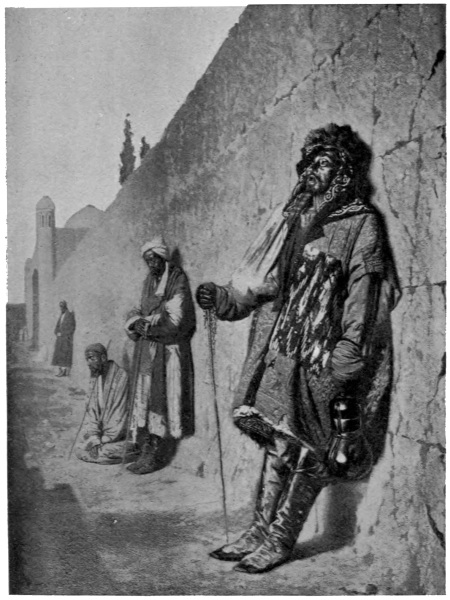
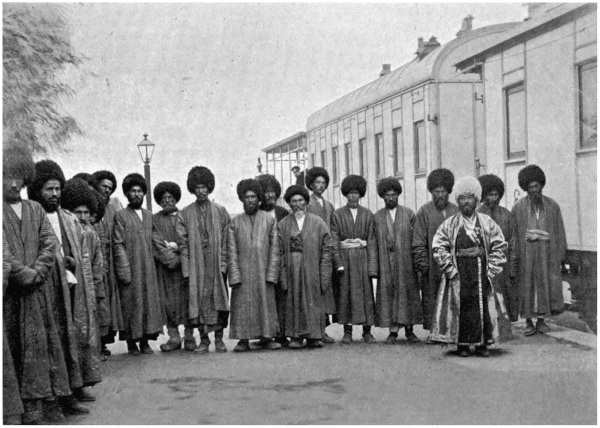
PRISONERS OF THE AMIR OF BOKHĀRĀ
Slavery is another practice which has lost its terrors
since the advent of the Russians. Bokhārā was once the
greatest market in Asia for the produce of Turkoman
and Kirghiz raids. Eighty years ago 40,000 Persians
and more than 500 subjects of the Tsar were detained
there in bondage. There was a regular tariff for
these human cattle. A labourer fetched £29, a skilled
artisan £64, and a pretty girl nearly £100. The treatment
meted out to them by Bokhāran taskmasters was
more atrocious than anything recorded by Mrs. Beecher
Stowe. Meyendorff met a Russian who had endured
unheard-of tortures, inflicted in order to make him reveal
the route by which a comrade in affliction had escaped.717
Half a century later the effect of European precept and
example was already evident. Mr. Schuyler found the
traffic in human flesh conducted with some approach to
secrecy, but, after much bargaining and intrigue, he was
able to purchase the freedom of a Persian lad for a sum
equivalent to £25. It would be saying too much to
aver that the “peculiar institution” is extinct in Bokhārā.
The needs of the harem and the profound mystery with
which wealthy families enshroud their domestic life render
it impossible that slavery should be stamped out in any
Mohammedan country. India itself is not free from
the canker-spot, though every possible means have been
taken to eradicate it. But the great source of supply
was cut off when the Turkomans were forbidden to raid
into Persia, and the lot of those who have been held in
slavery is rendered endurable by the vigilance of the
Russian Resident. His influence has been limited to
the correction of flagrant abuses, and Bokhārā is the
only Mohammedan state in Russian Asia which has
been permitted to retain intact its own system of
administration.
The sovereign, whose official style and title is Khān
of Bokhārā and Commander of the Faithful,718 is nominally
absolute master of his realm and of the lives and fortunes
of his subjects. In practice his power is subject to
considerable limitations. As a Mohammedan prince he
is bound to obey the injunctions of the Koran and the
canonical law of Islām.719 The clergy were all-powerful
under the last independent Amīr, and their influence is
still widely felt, the more so in that it is occult. The ruler
is surrounded by greedy and venal followers, and his Court
is a centre of intrigues. His prime minister, answering
to the vezīr of the Turkish monarchy, is here styled
Kushbegi, and stands next in rank to the sovereign. He
is official guardian of the state jewels, which, to judge
by the display made by the Amīr on state occasions,
must rival the figments of the Arabian Nights.720 He is
responsible for the collection of taxes and customs duties,
and is master of the palace, where he always resides, and
keeps the keys of the city gates. Beneath him is a vast
hierarchy of executive and Court officials, whose rank is
bestowed by patents under the Amīr’s seal, or symbols
such as horse-tails, hatchets, flags, and maces.721 The
struggle for these baubles amongst the crowd of courtiers
versed in all the arts of fawning and flattery would
arouse our pity and contempt, were we not conscious that
such sordid aims are still the levers of human action
nearer home.
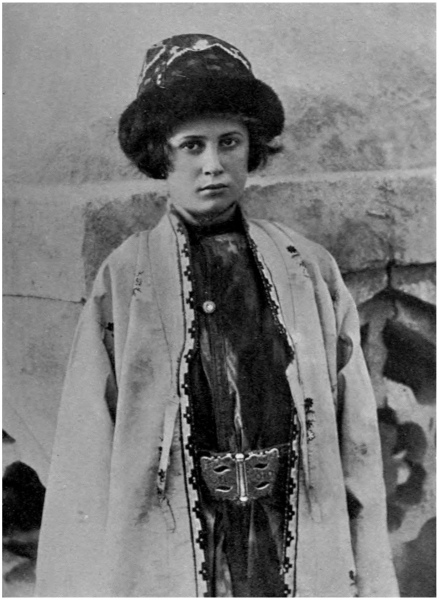
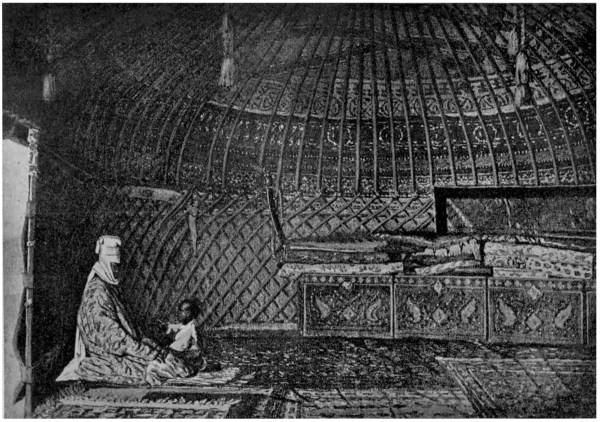
A BOKHĀRĀN BEAUTY AND HER TWO CHILDREN
For administrative purposes the Khānate is divided
into thirty-six provinces, each under its governor, called
Beg, who is intrusted with the collection of revenue and
the execution of judicial decrees. He reports as to the
state of his charge weekly, and submits death sentences
for the Amīr’s confirmation. Below the Beg are the
Amlākdārs; who exercise similar functions in the amlāks,
or districts. The state is, in theory, the owner of the
soil, and the bulk of its revenue is derived from the land
tax, an impost which has many features common with
feudalism. Estates belong to four categories. Milk
lands are free of rent, because they were originally
bestowed by the sovereign in fee simple on successful
generals. Milk-i-Khārāj are tenures which, at the period
of conquest, were owned by non-Mohammedans, and
remained in their possession subject to the payment of a
land tax. This, in the case of irrigated soil, amounts to
one-fifth, and in that of dry fields to one-tenth of the
gross produce. The third description is Dash Yak, so
styled because one-tenth of the produce is set apart for
the support of a mosque; and the fourth Vakf, which is
an endowment wholly devoted to religious uses. The
Amīr’s proportion of the fruits of the soil is assessed by
the Amlākdārs and their underlings, after actual inspection
of each field just before the harvest is gathered in. If
the cultivator objects to the Government estimate he
may demand a re-measurement. The other sources of
revenue are one-fortieth of the value of goods exposed
for sale; and the jazya, or infidel tax, from which
Russian subjects are exempt, ranging, according to the
assessee’s wealth, between one and four tangas. The
administration of justice is in the hands of Kāzīs—native
judges appointed by the Amīr after an examination
in the laws of Islām, who are assisted by Muftis, or
registrars in charge of the Court’s seal. The Kāzī
posted at Bokhārā has two of these subordinates, and is
styled Kalān, or chief, though he has no power to revise
his colleagues’ decisions. Legal procedure is cumbrous
and ineffectual, and litigants in Bokhārā learn by sad
experience what “hell it is in suing long to bide.”
Public morals and the due observance of religious rites
are supposed to be safeguarded by an official styled
Rā´īs. This censor’s insignia of office are a scimetar-shaped
strip of leather, with which he is legally empowered
to administer “forty stripes save one” to evil-doers,
without, however, raising his arm above the
shoulder. He drives the faithful to public prayers like a
flock of sheep, meddles in family affairs, levies blackmail,
and has elevated delation to the rank of a science.
With the Kāzī he serves as a spy on the executive
officers, and is an object of universal dread. These social
pests have been abolished by the Russians in the districts
under their administration, and they have won
more gratitude by this obvious measure than by any of
their reforms. It has been often said that an Eastern
prince’s rule is tempered by the fear of assassination.
In Bokhārā the permanent army was once the skeleton at
the Amīr’s banquet. In order to maintain his authority
and overawe turbulent neighbours he was compelled to
pay a large standing force, of which he stood in as much
dread as the Cæsars did of their Pretorian Guard. In
the days of independence the regulars mustered 10,000
men, armed with matchlocks, and there were about
40,000 men on an irregular footing, of whom perhaps a
third carried serviceable weapons.722 At the present time
the army is little more than a plaything, for the “Great
White Tsar” has garrisons at the principal strategic
points, and Bokhārā under his ægis is secure from foreign
aggression. The troops now number only 10,000 men,
of whom 1000 are armed with Berdan rifles, presented to
the Amīr some years ago by the Russians, and the rest
with percussion muskets. They are drilled and clad on
European models, but here the parallel ceases. Inefficient
as is the Bokhāran army, the paramount power is anxious
to effect a deduction in its strength, which will ultimately
not exceed 3000 men. It is a significant fact that while
the civil officers, from the Kushbegi down to the Amīn
who measures the crops, receive no remuneration beyond
what they can squeeze from the people, the Amīr’s
forces are well and regularly paid. The company officers
draw about £5 per mensem; the private soldiers, 6s. 6d.
in our money. In the official intercourse between the
Amīr and his suzerain we detect the influence of Anglo-Indian
example. For many years the Khānates were
represented at Tashkent, the administrative capital of
Turkestān, by envoys selected from their own subjects;
but the growth of commerce with Russia, and the necessity
of drawing closer the bonds uniting the protected
state with its master, led to the appointment of a
Russian officer of rank as Resident with the Amīr. His
political relations with the latter are nominally confined
to tendering advice in administrative matters. When,
some years back, frauds were prevalent in the packing of
cotton for export to Russia,723 the Resident approached
the Amīr through an unofficial channel as to the means
of checking practices ruinous to trade. The outcome of
these negotiations was the appointment of three cotton
inspectors, whose function it is to visit the markets and
report to the Kāzī all cases in which they suspect that
rubbish is inserted in bales exposed for sale. Again, the
Russians have deemed it to be their duty to foster the
production of wine. The grapes of Bokhārā are as fine
as her peaches and apricots—which is saying a good
deal—and a potent fluid resembling Amontillado, with a
pleasant sub-acid after-taste, is retailed at fourpence a
bottle. But intoxicants are denounced in the Koran as
things accursed, and the prohibition has much worldly
wisdom, because Asiatics drink, not in order to cheer the
heart of man, but to drown the senses in brutish oblivion.
A compromise between religious duty and worldly interest
has been arrived at. Bokhārans may not make wine
themselves, but they are at liberty to sell the grapes
to Armenians and Jews, who have a monopoly of the
manufacture. A dealer vending wine or spirits to a
Mohammedan is punished with a fine of 1000 roubles.
The Resident has a court of his own for the decision of
civil and criminal cases in which the injured party is a
foreigner. His jurisdiction is unlimited, and his sentences
without appeal. Documentary evidence is insisted on as
a basis of money claims. The Russian law is administered,
as modified by local custom, and no advocate is
allowed to intervene between the tribunal and the parties.
Where the defendant belongs to that category, the case
comes before a judge of the peace, who is independent
of the Resident and a subordinate of the Ministry of
Justice at St. Petersburg. His sentences run through a
gamut of appeals, precisely as those tried by the courts
of the mother country. This alien jurisdiction is highly
popular, and subterfuges are adopted in order to bring
cases triable by the native judges within its purview.
The post and telegraph services are in Russian hands;
and a hospital is maintained, under European management,
which costs the Amīr £2000 annually. Those
who are cognisant of the perennial friction between Chief
and Resident at many Indian courts will be surprised to
learn that the relations between suzerain and vassal in
Bokhārā have invariably been cordial. The Amīr, Sayyid
`Abd ul-Ahad, is now in his thirty-seventh year.724 He is
tall and muscular, and would be handsome but for
growing corpulence, that curse of Eastern princes. He
is still devoted to hawking and other forms of sport,
affable and dignified. Every year he visits one of the
hot springs in the Caucasus, and often winters in the
Crimea. The heir-apparent, Sayyid Mīr `Alīm, has been
educated in St. Petersburg, and holds the rank of
lieutenant in a Cossack regiment. In early youth the
Amīr had convincing proof of the resistless power of
Russia. He saw his haughty father die broken-hearted
of the humiliation entailed by his abortive effort to roll
back the tide of European aggression. He knows, too,
that the capital is at the Russians’ mercy, for they own
the rich province of Samarkand, through which the
Zarafshān flows to fertilise his thirsty fields, and that it
would be an easy matter to divert its course; and so he
is always ready to anticipate his master’s wishes. There
was a spice of truth in the late governor-general’s
remark, “the Amīr of Bokhārā is the most zealous of
my lieutenants.” While a ruler so pliant continues to
sit on the throne of Bokhārā he need not fear annexation.
The Russians are well aware that the people of the
Khānate prize the measure of national life allowed them,
and prefer the rough-and-ready methods of an Amīr of
their own race to the highly developed mechanism
imported from the West. They dread the responsibility
of granting citizenship to two and a half millions of
Asiatics, spread over an area of 80,000 square miles,
which costs them nothing to administer, while its
products swell the growing volume of the empire’s
commerce.