IV
“We live in a world of unseen realities, the world of thoughts and feelings.
But ‘thoughts are things,’ and frequently they weigh more and obtain
far more in the making of a man than do all the tangible realities which
surround him. Thoughts and feelings are the stuff of which life is made.
They are the language of the soul. By means of them we follow the
development of character, the shaping of the soul which is the one great
purpose of life.”
Appreciation of Art. Loveridge.
Every year a large number of young men and women go
in quest of a singing teacher. The impulse to sing, which is
inborn, has become so insistent and irrepressible that it must
be heeded; and the desire to do things well, which is a part of
the mental equipment of every normal human being, makes
outside assistance imperative. Wherever there is a real need
the supply is forthcoming, so there is little difficulty in finding
some one who is ready, willing, in fact rather anxious, to undertake
the pleasant task of transforming these enthusiastic
amateurs into full-fledged professionals.
The meeting of the teacher and student always takes place
in the studio, and it is there that all vocal problems are solved.
Let no one imagine that any vocal problem can be solved in a
physics laboratory. Why? Because not one of the problems
confronting the vocal student is physical. They are all mental.
The writer has reached this conclusion not from ignoring the
physical, but from making a comprehensive study of the vocal
mechanism and its relation to the singer.
The anatomy and physiology of the vocal mechanism are
absorbing to one who is interested in knowing how man,
through untold centuries of growth has perfected an instrument
through which he can express himself; but no matter how far
we go in the study of anatomy and physiology all we really
learn is what mind has done. If man has a more perfect and
highly organized vocal instrument than the lower animals it
is because his higher manifestation of mind has formed an instrument
necessary to its needs.
When man’s ideas and needs were few and simple his vocabulary
was small, for language is the means by which members
of the species communicate with each other. Whenever
man evolved a new idea he necessarily invented some way of
communicating it, and so language grew. A word is the
symbol of an idea, but invariably the idea originates the word.
The word does not originate the idea. The idea always arrives
first. All we can ever learn from the study of matter is
phenomena, the result of the activity of mind.
Thus we see that so called “scientific study” of the vocal
mechanism is at best, but a study of phenomena. It
creates nothing. It only discovers what is already taking
place, and what has been going on indefinitely without conscious
direction will, in all probability, continue.
The value attached by some to the study of vocal physiology
is greatly overestimated. In fact its value is so little as to be
practically negligible. It furnishes the teacher nothing he can
use in giving a singing lesson, unless, perchance he should be
so unwise as to begin the lesson with a talk on vocal mechanism,
which, by the way, would much better come at the last lesson
than the first. All we can learn from the study of vocal
physiology is the construction of the vocal instrument, and this
bears the same relation to singing that piano making bears to
piano playing. The singer and his instrument are two different
things, and a knowledge of the latter exerts very little
beneficial influence on the former.
To reach a solution of the vocal problem we must understand
the relation existing between the singer and his instrument.
The singer is a mentality, consequently everything he does
is an activity of his mentality. Seeing, hearing, knowing,
is this mentality in action. The two senses most intimately
associated with artistic activity are seeing and hearing, and
these are mental. In painting, sculpture, and architecture
we perceive beauty through the eye. In music it reaches us
through the ear; but the only thing that is cognizant is the mind.
To man the universe consists of mental impressions, and that
these impressions differ with each individual is so well understood
that it need not be argued. Two people looking at the
same picture will not see exactly the same things. Two people
listening to a musical composition may hear quite different
things and are affected in different ways, because it is the mind
that hears, and as no two mentalities are precisely the same, it
must be apparent that the impressions they receive will be
different. The things these mentalities have in common they
will see and hear in common, but wherein they differ they will
see and hear differently. Each will see and hear to the limit
of his experience, but no further.
To be a musician one must become conscious of that particular
thing called music. He must learn to think music. The
elements of music are rhythm, melody, harmony, and form,
and their mastery is no less a mental process than is the study
of pure mathematics.
The human mind is a composite. It is made up of a large
number of faculties combined in different proportions. The
germs of all knowledge exist in some form and degree in every
mind. When one faculty predominates we say the individual
has talent for that particular thing. If the faculty is abnormally
developed we say he is a genius, but all things exist as
possibilities in every mind. Nature puts no limitations on
man. Whatever his limitations, they are self imposed, nature
is not a party to the act.
Now this is what confronts the teacher whenever a student
comes for a lesson. He has before him a mentality that has
been influenced not only by its present environment, but by
everything that has preceded it. “Man is,” as an old philosopher
said, “a bundle of habits,” and habits are mental trends.
His point of view is the product of his experience, and it will be
different from that of every one else. The work of the teacher
is training this mentality. Understanding this it will be seen
how futile would be a fixed formula for all students, and how
necessarily doomed to failure is any method of voice training
which makes anatomy and physiology its basis. Further,
there is much to be done in the studio beside giving the voice
lesson. Whistler said that natural conditions are never right
for a perfect picture. From the picture which nature presents
the artist selects what suits his purpose and rejects the rest.
It is much the same in the training of a singer. In order that
the lesson be effective the conditions must be right. This only
rarely obtains in the beginning. The student’s attitude toward
the subject must be right or the lesson will mean little to
him. The lesson to be effective must be protected by honesty,
industry and perseverance. If these are lacking in various
degrees, as they often are, little progress will be made. If the
student is studying merely for “society purposes,” not much
can be expected until that mental attitude is changed. Students
always want to sing well, but they are not always willing
to make the sacrifice of time and effort; consequently they lack
concentration and slight their practice. Sometimes the thought
uppermost in the student’s mind is the exaltation of the ego,
in other words, fame. Sometimes he measures his efforts
by the amount of money he thinks he may ultimately earn, be
it great or small. Sometimes he overestimates himself, or
what is equally bad, underestimates himself. It is a very common
thing to find him putting limitations on himself and telling
of the few things he will be able to do and the large number he
never will be able to do, thus effectually barring his progress.
Then there is always the one who is habitually late. She feels
sure that all of the forces of nature are leagued in a conspiracy
to prevent her from ever being on time anywhere. She,
therefore, is guiltless. There is another one who is a riot of
excuses, apologies and reasons why she has not been able to
practice. Her home and neighborhood seem to be the special
object of providential displeasure, which is manifested in an
unbroken series of calamitous visitations ranging from croup
to bubonic plague, each one making vocal practice a physical
and moral impossibility.
All of these things are habits of mind which must be corrected
by the teacher before satisfactory growth may be expected.
In fact he must devote no inconsiderable part of his time to
setting students right on things which in themselves are no
part of music, but which are elements of character without
which permanent success is impossible.
A great musical gift is of no value unless it is protected by
those elements of character which are in themselves fundamentally
right. Innumerable instances could be cited of
gifted men and women who have failed utterly because their
gifts were not protected by honesty, industry and perseverance.
I have spoken at some length of the importance of the right
mental attitude toward study and the necessity of correcting
false conceptions. Continuing, it must be understood that the
work of the teacher is all that of training the mind of his student.
It is developing concepts and habits of mind which
when exercised result in beautiful tone and artistic singing.
It must also be understood that the teacher does not look at
the voice, he listens to it. Here voice teachers automatically
separate themselves from each other. No two things so
diametrically opposite as physics and metaphysics can abide
peaceably in the same tent.
Let me emphasize the statement that the teacher does not look
at the voice, he listens to it. The teacher who bases his teaching
on what he can see, that is, on watching the singer and detecting
his mistakes through the eye, is engaged in an activity that is
mechanical, not musical. No one can tell from observation
alone whether a tone is properly produced. A tone is something
to hear, not something to see, and no amount of seeing
will exert any beneficial influence on one’s hearing.
The process of learning to read vocal music at sight is that of
learning to think tones, to think in the key, and to think all
manner of intervals and rhythmic forms. It is altogether mental,
and it is no less absurd to hold that a knowledge of anatomy is
necessary to this than it is essential to the solution of a mathematical
problem. The formation of tone quality is no less
a mental process than is thinking the pitch. If the student
sings a wrong pitch it is because he has thought a wrong pitch,
and this is true to a large extent at least, if his tone quality
in not good. He may at least be sure of this, that he never will
sing a better tone than the one he thinks.
A large part of the vocal teacher’s training should be learning
how to listen and what to listen for. This means training
the ear, which is the mind, until it is in the highest degree
sensitive to tone quality as well as to pitch. When there is a
failure in voice training it may be counted upon that the teacher’s
listening faculty is defective. The gist of the whole thing
is what the teacher’s ear will stand for. If a tone does not
offend his ear he will allow it to continue. If it does offend his
ear he will take measures to stop it.
More is known of vocal mechanism today than at any other
time in the world’s history, and yet who dares to say that voice
teaching has been improved by it? Is voice teaching any more
accurate now than it was a hundred years ago? Did the invention
of the laryngoscope add anything of value to the voice
teacher’s equipment? No. Even the inventor of it said that
all it did was to confirm what he had always believed. An
enlarged mechanical knowledge has availed nothing in the
studio. The character of the teacher’s work has improved to
the degree in which he has recognized two facts—first, the
necessity of developing his own artistic sense as well as that of
his pupil, second, that the process of learning to sing is psychologic
rather than physiologic.
When the student takes his first singing lesson what does the
teacher hear? He hears the tone the student sings, but what
is far more important, he hears in his own mind the tone the
student ought to sing. He hears his own tone concept and this
is the standard he sets for the student. He cannot demand of
him anything beyond his own concept either in tone quality
or interpretation.
Young teachers and some old ones watch the voice rather
than listen to it. At the slightest deviation from their standard
of what the tongue, larynx, and soft palate ought to do they
pounce upon the student and insist that he make the offending
organ assume the position and form which they think is necessary
to produce a good tone. This results in trying to control
the mechanism by direct effort which always induces tension
and produces a hard, unsympathetic tone.
The blunder here is in mistaking effect for cause. The
tongue which habitually rises and fills the cavity of the mouth
does so in response to a wrong mental concept of cause. The
only way to correct this condition is to change the cause.
The rigid tongue we see is effect, and to tinker with the effect
while the cause remains is unnecessarily stupid. An impulse
of tension has been directed to the tongue so often that the
impulse and response have become simultaneous and automatic.
The correction lies in directing an impulse of relaxation
to it. When it responds to this impulse it will be found to
be lying in the bottom of the mouth, relaxed, and ready to respond
to any demand that may be made upon it. To try to
make the tongue lie in the bottom of the mouth by direct
effort while it is filled with tension is like trying to sweep back
the tide with a broom. The only way to keep the tide from
flowing is to find out what causes it to flow and remove the
cause. The only way to correct faulty action of any part of
the vocal mechanism is to go back into mentality and remove
the cause. It will always be found there.
In view of the generally understood nature of involuntary
action and the extent to which it obtains in all good singing
it is difficult to understand why any teacher should work from
the basis of direct control. It is a fact, however, that teachers
who have not the psychological vision find it difficult to work
with a thing they cannot see. To such, direct control seems
to be the normal and scientific method of procedure.
Let me illustrate: A student comes for his first lesson. I
“try his voice.” His tone is harsh, white, throaty and unsympathetic.
It is not the singing tone and I tell him it is “all
wrong.” He does not contradict me but places himself on the
defensive and awaits developments. I question him to find
out what he thinks of his own voice, how it impresses him, etc.
I find it makes no impression on him because he has no standard.
He says he doesn’t know whether he ought to like his voice or
not, but rather supposes he should not. As I watch him I discover
many things that are wrong and I make a mental note
of them. Suppose I say to him as a very celebrated European
teacher once said to me: “Take a breath, and concentrate
your mind on the nine little muscles in the throat that control
the tone.” This is asking a good deal when he does not know
the name or the exact location of a single one of them, but he
seems impressed, although a little perplexed, and to make it
easier for him I say as another famous teacher once said to me:
“Open your mouth, put two fingers and a thumb between your
teeth, yawn, now sing ah.” He makes a convulsive effort
and the tone is a trifle worse than it was before. I say to him,
“Your larynx is too high, and it jumps up at the beginning of
each tone. You must keep it down. It is impossible to produce
good tone with a high larynx. When the larynx rises,
the throat closes and you must always have your throat open.
Don’t forget, your throat must be open and you can get it
open only by keeping the larynx low.” He tries again with the
same result and awaits further instructions. I take another
tack and say to him, “Your tongue rises every time you sing
and impairs the form of the vocal cavity. Keep it down below
the level of the teeth, otherwise your vowels will be imperfect.
You should practice a half hour each day grooving your
tongue.” I say these things impressively and take the opportunity
to tell him some interesting scientific facts about fundamental
and upper partials, and how different combinations
produce different vowels, also how these combinations are affected
by different forms of the vocal cavities, leading up to the
great scientific truth that he must hold the tongue down and
the throat open in order that these great laws of acoustics may
become operative. He seems very humble in the presence of
such profound erudition and makes several unsuccessful attempts
to do what I tell him, but his tone is no better. I tell
him so, for I do not wish to mislead him. He is beginning to
look helpless and discouraged but waits to see what I will do
next. He vexes me not a little, because I feel that anything
so simple and yet so scientific as the exercises I am giving him
ought to be grasped and put into practice at once; but I still
have resources, and I say to him, “Bring the tone forward,
direct it against the hard palate just above the upper teeth, send
it up through the head with a vigorous impulse of the diaphragm.
You must always feels the tone in the nasal cavities.
That is the way you can tell whether your tone is right or not.”
He tries to do these things, but of necessity fails.
This sort of thing goes on with mechanical instructions for
raising the soft palate, making the diaphragm rigid, grooving
the tongue, etc., etc., and at the end of the lesson I tell him to
go home and practice an hour a day on what I have given him.
If he obeys my instructions he will return in worse condition,
for he will be strengthening the bad habits he already has and
forming others equally pernicious.
This is a sample of teaching by direct control. It is not
overdrawn. It is a chapter from real life, and I was the
victim.
You will have observed that this lesson was devoted to
teaching the student how to do certain things with the vocal
mechanism. The real thing, the tone, the result at which all
teaching should aim was placed in the background. It was
equivalent to trying to teach him to do something but not letting
him know what. It was training the body, not the mind,
and the result was what invariably happens when this plan is
followed.
In the lesson given above no attempt was made to give the
student a correct mental picture of a tone, and yet this is the
most important thing for him to learn, for he never will sing a
pure tone until he has a definite mental picture of it. A tone is
something to hear and the singer himself must hear it before he can
sing it.
Not one of the suggestions made to this student could be of
any possible benefit to him at the time. Not even the sensation
of feeling the tone in the head can be relied upon, for
physical sensations are altogether uncertain and unreliable.
As I have observed in numberless instances, there may be a
sensation in the head when there are disagreeable elements in
the tone. If the ear of the teacher does not tell him when the
tone is good and when it is bad he is hopeless. If his ear is reliable,
why resort to a physical sensation as a means of deciding?
In the properly produced voice there is a feeling of vibration
in the head cavities, especially in the upper part of the voice,
but that alone is not a guaranty of good tone.
This teaching from the standpoint of sensation and direct
control will never produce a great singer so long as man inhabits
a body. It is working from the wrong end of the proposition.
Control of the mechanism is a very simple matter
when the mental concept is formed. It is then only a question
of learning how to relax, how to free the mechanism of tension,
and the response becomes automatic.
Is there no way out of this maze of mechanical uncertainties?
There is. Is voice culture a sort of catch-as-catch-can with the
probabilities a hundred to one against success? It is not. Is
singing a lost art? It is not. Let us get away from fad, fancy
and formula and see the thing as it is. The problem is psychologic
rather than physiologic. The fact that one may learn
all that can be known about physiology and still know nothing
whatever about voice training should awaken us to its uselessness.
Man is a mental entity. When I speak to a student it is his
mind that hears, not his body. It is his mind that acts. It is
his mind that originates and controls action. Therefore it
is his mind that must be trained.
Action is not in the body. In fact, the body as matter has
no sensation. Remove mind from the body and it does not
feel. It is the mind that feels. If you believe that the body
feels you must be prepared to explain where in the process of
digestion and assimilation the beefsteak and potato you ate
for dinner become conscious, because to feel they must be conscious.
We know that the fluids and solids composing the
body have no sensation when they are taken into the body, nor
do they ever become sentient. Therefore the body of itself
has no initiative, no action, no control. All of these are the
functions of mind, hence the incongruity of attempting to
solve a problem which is altogether psychological, which demands
qualities of mind, habits of mind, mental concepts of a
particular kind and quality, by a process of manipulation of
the organ through which mind expresses itself, making the
training of the mind a secondary matter; and then absurdly
calling it scientific.
In every form of activity two things are involved: first, the
idea: second, its expression. It must be apparent then, that
the quality of the thing expressed will be governed by the
quality of the idea. Or, to put it in another way: In the activity
of art two things are involved—subject-matter and technic.
The subject-matter, the substance of art, is mental.
Technic is gaining such control of the medium that the subject-matter,
or idea, may be fully and perfectly expressed. Ideas
are the only substantial things in the universe, and that there
is a difference in the quality of ideas need not be argued.
Two men of the same avoirdupois may be walking side by side
on the street, but one of them may be a genius and the other a
hod carrier.
I have dwelt at some length on this because I wish to show
where the training of a singer must begin, and that when we
understand the real nature of the problem its solution becomes
simple.
What is meant by indirect control? It means, in short,
the automatic response of the mechanism to the idea. By way
of illustration. If I should ask my pupil to make her vocal
cords vibrate at the rate of 435 times per second she could not
do it because she would have no mental concept of how it should
sound: but if I strike the A above middle C and ask her to
sing it her vocal cords respond automatically at that rate of
vibration. It is the concept of pitch which forms the vocal
instrument, gives it the exact amount of tension necessary to
vibrate at the rate of the pitch desired, but the action is automatic,
not the result of direct effort.
It may be said that in artistic singing everything is working
automatically. There can be no such thing as artistic singing
until everything involved is responding automatically to the
mental demands of the singer.
Mention has been made of the automatic response of the
vocal cords to the thought of pitch. That part of the mechanism
which is so largely responsible for tone quality, the pharynx
and mouth, must respond in the same way. This it will do
unerringly if it is free from tension. But if the throat is full of
rigidity, as is so often the condition, it cannot respond;
consequently the quality is imperfect and the tone is throaty.
The vocal cavity must vibrate in sympathy with the pitch in
order to create pure resonance. It can do this only when it is
free and is responding automatically to the concept of tone
quality. To form the mouth and throat by direct effort and
expect a good tone to result thereby, is an action not only certain
of failure but exceedingly stupid.
There is a belief amounting to a solid conviction in the public
mind that the training of the voice is so difficult that the probabilities
of success are about one in ten. What is responsible
for this? Doubtless the large number of failures. But this
calls for another interrogation. What is the cause of these
failures? Here is one. All students have done more or less
singing before they go to a teacher. During that time they
have, with scarcely an exception, formed bad habits. Now
bad habits of voice production are almost invariably some
form of throat interference, referred to as tension, rigidity,
resistance, etc. Instances without number could be cited
where students have been told to keep right on singing and
eventually they would outgrow these habits. Such a thing
never happened since time began. One may as well tell a
drunkard to keep on drinking and eventually he will outgrow
the habit. No. Something definite and specific must be done.
The antidote for tension is relaxation. A muscle cannot respond
while it is rigid, therefore the student must be taught
how to get rid of tension.
There is nothing in voice training that is necessarily mysterious
and inscrutable. On the contrary, if one will acquaint
himself with its fundamental principles he will find that the
truth about voice training, like all truth, is simple and easily
understood, and when understood the element of uncertainty
is eliminated. These principles are few in number, in fact
they may all be brought under two general heads. The first
is KNOW WHAT YOU WANT. The second is HAVE THE
CONDITIONS RIGHT. The meaning of these statements
can never be learned from a study of vocal physiology; nevertheless
they contain all of the law and the prophets on this
subject. Any musician may be a successful teacher of singing
if he will master them. I use the word musician advisedly,
because musical sense is of such vital importance that no
amount of mechanical knowledge can take its place. To undertake
the training of voices with only a mechanical knowledge
of the subject is a handicap which no one can overcome.
It is universally true that the less one knows of the art of
singing the more he concerns himself with the mechanism; and
it is also true that the more one is filled with the spirit of song
the less he concerns himself with the construction of the vocal
instrument. People with little or no musicianship have been
known to wrangle ceaselessly on whether or not the thyroid
cartilage should tip forward on high tones. It is such crude
mechanics masquerading under the name of science that has
brought voice training into general disrepute. The voice
teacher is primarily concerned with learning to play upon the
vocal instrument rather than upon its mechanical construction,
two things which some find difficulty in separating.
This means much. In voice production it means the perfect
tone concept. It means far more than knowing what one likes.
What one likes and what he ought to like are usually quite different
things. What one likes is the measure of his taste at that particular
time and may or may not be an argument in its favor. I
have never seen a beginner whose taste was perfectly formed, but
the great majority of them know what they like, and because
they like a certain kind of tone, or a certain way of singing,
they take it for granted that it is right until they are shown
something better. This error is by no means confined to beginners.
If your pupil does not produce good tone one of two things
is responsible for it. Either he does not know a good tone or
else the conditions are not right. In the beginning it is usually
both. Your pupil must create his tone mentally before he
sings it. He must create its quality no less than its pitch. In
other words he must hear his tone before he sings it and then
sing what he hears. Until he can do this his voice will have no
character. His voice will be as indefinite as his tone concept,
and it will not improve until his concept, which is his taste,
improves. Inasmuch as everything exists first as idea, it
follows that everything which is included in the rightly produced
voice and in interpretation are first matters of concept.
The singer uses a certain tone quality because he mentally
conceives that quality to be right. He delivers a word or
phrase in a certain way because that is his concept of it.
A word at this point on imitation. One faculty of a musical
mind is that of recording mentally what it hears and of producing
it mentally whenever desired. Most people possess this
in some degree, and some people in a marked degree. Almost
any one can hear mentally the tone of a cornet, violin, or any
instrument with which he is acquainted. In the same way the
vocal student must hear mentally the pure singing tone before
he can sing it. It is the business of the teacher to assist him in
forming a perfect tone concept, and if he can do this by example,
as well as by precept, he has a distinct advantage over the one
who cannot.
Arguments against imitation are not uncommon, and yet the
teachers who offer them will advise their students to hear the
great singers as often as possible. Such incongruities do not
inspire confidence.
On this human plane most things are learned by imitation.
What language would the child speak if it were never allowed
to hear spoken language? It would never be anything but
“An infant crying in the night.
And with no language but a cry.”
There are but few original thinkers on earth at any one time.
The rest are imitators and none too perfect at that. We are
imitators in everything from religion to breakfast foods. Few
of us ever have an original idea. We trail along from fifty to
a hundred years behind those we are trying to imitate.
When there is little else but imitation going on in the world
why deny it to vocal students? The argument against imitation
can come from but two classes of people—those who
cannot produce a good tone and those who are more interested
in how the tone is made than in the tone itself.
The following are the qualities the teacher undertakes to
develop in the student in preparing him for artistic singing.
They are fundamental and must be a part of the singer’s
equipment no matter what method is employed. They are
what all musicians expect to hear in the trained singer. They
all exist first as concepts.
An even scale from top to bottom of the voice.
Every tone full of strength and character.
A sympathetic quality.
Ample power.
A clear, telling resonance in every tone.
A pure legato and sostenuto.
Perfect freedom in production throughout the compass.
A perfect swell, that is, the ability to go from
pianissimo to full voice and return, on any tone in the
compass, without a break, and without sacrificing the
tone quality.
The ability to pronounce distinctly and with ease to
the top of the compass.
Equal freedom in the delivery of vowels and consonants.
Sufficient flexibility to meet all technical demands.
An ear sensitive to the finest shades of intonation.
An artistic concept or interpretive sense of the highest
possible order.
The process of acquiring these things is not accretion but
unfoldment. It is the unfoldment of ideas or concepts. The
growth of ideas is similar to that of plants and flowers. The
growth of expression follows the growth of the idea, it never
precedes it. From the formation of the first vowel to the
perfect interpretation of a song the teacher is dealing with
mental concepts.
At the Gobelin Tapestry works near Paris I was told that
the weavers of those wonderful tapestries use twenty-four
shades of each color, and that their color sense becomes so
acute that they readily recognize all of the different shades.
Now there are about as many shades of each vowel, and the
mental picture of the vowel must be so definite, the mental ear
so sensitive, that it will detect the slightest variation from the
perfect form. Direct control could never accomplish this.
Only the automatic response of the mechanism to the perfect
vowel concept can result in a perfect vowel.
All of those qualities and elements mentioned above as constituting
the artist come under the heading KNOW WHAT
YOU WANT.
The second step HAVE THE CONDITIONS RIGHT means,
in short, to free the mechanism of all interference and
properly manage the breath. This getting rid of interference
could be talked about indefinitely without wasting time. It is
far more important than most people suspect. Few voices are
entirely free from it, and when it is present in a marked degree
it is an effectual bar to progress. So long as it is present in
the slightest degree it affects the tone quality. Most students
think they are through with it long before they are.
This interference, which is referred to as tension, rigidity,
throatiness, etc., is in the nature of resistance to the free emission
of tone. It is not always confined to the vocal cords,
but usually extends to the walls of the pharynx and the body of
the tongue. The vocal cavities, the pharynx and mouth,
exert such a marked influence on tone quality that the least degree
of rigidity produces an effect that is instantly noticeable
to the trained ear. These parts of the vocal mechanism which
are so largely responsible not only for perfect vowels, but for
perfect tone quality as well, must at all times be so free from
tension that they can respond instantly to the tone concept.
If they fail to respond the tone will be imperfect, and these imperfections
are all classed under the general head “throaty.”
Throaty tone means that there is resistance somewhere, and
the conditions will never be right until the last vestige of it is
destroyed. The difficulty in voice placing which so many
have, lies in trying to produce the upper tones without first
getting rid of resistance. This condition is responsible for a
number of shop-worn statements, such as “bring the tone
forward,” “place the tone in the head,” “direct the tone into
the head,” etc. I recall a writer who says that the column of
breath must be directed against the hard palate toward the
front of the mouth in order to get a resonant tone. Consider
this a moment. When the breath is properly vocalized its
power is completely destroyed. Any one may test this by
vocalizing in an atmosphere cold enough to condense the moisture
in his breath. If he is vocalizing perfectly, he will observe
that the breath moves lazily out of the mouth and curls upward
not more than an inch from the face. The idea that this breath,
which has not a particle of force after leaving the vocal cords, can
be directed against the hard palate with an impact sufficient to
affect tone quality is the limit of absurdity. If the writer had
spoken of directing the sound waves to the front of the mouth
there would have been an element of reasonableness in it, for
sound waves can be reflected as well as light waves; but breath
and sound are quite different things.
What does the teacher mean when he tells the pupil to place
the tone in the head? He doubtless means that the student
shall call into use the upper resonator. If one holds a vibrating
tuning-fork before a resonating tube, does he direct the vibrations
into that resonating cavity? No. Neither is it necessary
to try to drive the voice into the cavities of the head.
Such instructions are of doubtful value. They are almost
sure to result in a hard unsympathetic tone. They increase
rather than diminish the resistance. The only possible way to
place the tone in the head is to let it go there. This will always
occur when the resistance is destroyed and the channel is free.
In numerous instances the resistance in the vocal cords is
so great that it is impossible to sing softly, or with half voice.
It requires so much breath pressure to start the vibration, that
is, to overcome the resistance, that when it does start it is
with full voice. In a majority of male voices the upper tone
must be taken either with full chest voice or with falsetto.
There is no mezza voce. This condition is abnormal and is
responsible for the “red in the face” brand of voice production
so often heard.
Of this we may be sure, that no one can sing a good full tone
unless he can sing a good mezza voce. When the mechanism
is sufficiently free from resistance that a good pianissimo can
be sung then the conditions are right to begin to build toward a
forte.
Further, when the mechanism is entirely free from resistance
there is no conscious effort required to produce tone. The
singer has the feeling of letting himself sing rather than of
making himself sing.
The engineer of a great pumping station once told me that
his mammoth Corliss engine was so perfectly balanced that
he could run it with ten pounds of steam. When the voice is
free, and resting on the breath as it were, it seems to sing itself.
An illustration of the opposite condition, of extreme resistance
was once told me by the president of a great street railway
system that was operated by a cable. He said it required
eighty-five per cent of the power generated to start the machinery,
that is, to overcome the resistance, leaving but fifteen
per cent for operating cars. It is not at all uncommon to hear
singers who are so filled with resistance that it requires all of
their available energy to make the vocal instrument produce
tone. Such singers soon find themselves exhausted and the
voice tired and husky. It is this type of voice production
rather than climatic conditions, that causes so much chronic
laryngitis among singers. I have seen the truth of this statement
verified in the complete and permanent disappearance
of many cases of laryngitis through learning to produce the
voice correctly.
The second step in securing right conditions is the proper
management of the breath.
An extremist always lacks the sense of proportion. He allows
a single idea to fill his mental horizon. He is fanciful,
and when an idea comes to him he turns his high power imagination
upon it, and it immediately becomes overwhelming in
magnitude and importance. Thereafter all things in his
universe revolve around it.
The field of voice teaching is well stocked with extremists.
Everything involved in voice production and many things
that are not, have been taken up one at a time and made the
basis of a method.
One builds his reputation on a peculiar way of getting the
tone into the frontal sinuses by way of the infundibulum canal,
and makes all other things secondary.
Another has discovered a startling effect which a certain
action of the arytenoid cartilages has on registers, and sees a
perfect voice as the result.
Another has discovered that a particular movement of the
thyroid cartilage is the only proper way to tense the vocal cords
and when every one learns to do this all bad voices will disappear.
Another has discovered something in breath control so revolutionary
in its nature that it alone will solve all vocal problems.
Perhaps if all of these discoveries could be combined they
might produce something of value; but who will undertake
it? Not the extremists themselves, for they are barren of the
synthetic idea, and their sense of proportion is rudimentary.
They would be scientists were it not for their abnormal imaginations.
The scientist takes the voice apart and examines it
in detail, but the voice teacher must put all parts of it together
and mold it into a perfect whole. The process is synthetic
rather than analytic, and undue emphasis on any one element
destroys the necessary balance.
The immediate danger of laying undue emphasis on any
one idea in voice training lies in its tendency toward the
mechanical and away from the spontaneous, automatic response
so vitally necessary. Here the extremists commit a
fatal error. To make breath management the all-in-all of
singing invariably leads to direct control, and soon the student
has become so conscious of the mechanism of breathing that
his mind is never off of it while singing; he finds himself
becoming rigid trying to prevent his breath from escaping,
and the more rigid he becomes the less control he has. A
large number of examples of this kind of breath management
have come under my observation. They all show the evil
results of over working an idea.
But the followers of “the-breath-is-the-whole-thing” idea
say “You can’t sing without breath control.” Solomon never
said a truer thing, but the plan just mentioned is the worst
possible way to secure it.
Every one should know that not a single one of the processes
of voice production is right until it is working automatically,
and automatic action is the result of indirect, never of direct
control.
The profession has become pretty thoroughly imbued with
the idea that deep breathing, known as abdominal, or diaphragmatic
is the best for purposes of singing. But how deep?
The answer is, the deeper the better. Here again it is easy to
overstep the bounds. I have in mind numerous instances
where the singer, under the impression that he was practicing
deep breathing tried to control the breath with the lower
abdominal muscles, but no matter how great the effort made
there was little tonal response, for the reason that the pressure
exerted was not against the lungs but against the contents of
the abdomen. The diaphragm is the point of control. The
lungs lie above it, not below it. To concentrate the thought
on the lower abdominal muscles means to lose control of the
diaphragm, the most important thing involved in breath
management.
The process of breathing is simple. The lungs are enclosed
in an air tight box of which the diaphragm is the bottom. It
rests under the lungs like an inverted saucer. In the act of
contracting it flattens toward a plane and in so doing it moves
downward and forward, away from the lungs. The ribs move
outward, forward and upward. The lungs which occupy this
box like a half compressed sponge follow the receding walls,
and a vacuum is created which air rushes in to fill. In exhalation
the action is reversed. The ribs press against the
lungs and the diaphragm slowly returns to its original position
and the breath is forced out like squeezing water out of a
sponge.
The one important thing in breath management is the diaphragm.
If the student has the right action of the diaphragm
he will have no further trouble with breath control. In my
Systematic Voice Training will be found a list of exercises
which thoroughly cover the subject of breath control and if
properly used will correct all errors. Let this be understood,
that there is nothing in correct breathing that should make one
tired. On the contrary the practice of breathing should leave
one refreshed. Above all, the student should never make himself
rigid when trying to control the flow of breath. This is not
only of no advantage, but will effectually defeat the end for
which he is striving.
In securing right conditions the teacher is often confronted
with the problem of registers. The literature on this subject
is voluminous and varied. Opinions are offered without stint
and the number of registers which have been discovered in the
human voice ranges from none to an indefinite number. How
one scientist can see two, and another one five registers in the
same voice might be difficult to explain were it not a well
known fact that some people are better at “seeing things”
than others.
But here again the teacher soon learns that laboratory work
is of little value. His view point is so different from that of
the physicist that they can hardly be said to be working at the
same problem. The physicist tries to discover the action of
the mechanism, in other words, how the tone is made. The
voice teacher is concerned primarily with how it sounds. One
is looking at the voice, the other is listening to it, which things,
be it known, are essentially and fundamentally different; so
different that their relationship is scarcely traceable. The
ability to train the voice comes through working with voices
where the musical sense, rather than the scientific sense, is the
guide. It is a specific knowledge which can be gained in no
other way. It begins when one takes an untrained voice and
attempts to make it produce a musical tone.
The problem of registers is, in short, how to make an even
scale out of an uneven one. It must be solved in the studio.
Anatomical knowledge is of no avail. The teacher who has
learned how to produce an even scale possesses knowledge which
is of more value to the student than all of the books ever written
on vocal mechanism.
The depressions in the voice known as “changes of register”
result from tension. With one adjustment of the vocal cords
the singer can, by adding tension, make a series of four or five
tones, then by a change of adjustment he can produce another
similar series, and so on to the top of his compass. These
changes occur when there is such an accumulation of tension
that no more can be added to that adjustment without discomfort.
The solution of this problem lies in gaining such
freedom from tension in the vocal instrument that it automatically
readjusts itself for each tone. The tension is then
evenly distributed throughout the scale and the sudden changes
disappear. This is precisely what happens when the singer
has learned to produce an even scale throughout his compass;
his voice production is not right until he can do this.
The statement is frequently made in public print that there
are no registers in the trained voice. This order of wisdom is
equally scintillating with that profound intellectual effort which
avers that a bald headed man has no hair on the top of his head,
or that hot weather is due to a rise in the temperature. These
statements may be heavy-laden with truth, but to the voice
teacher they are irrelevant. His work is at least seven-eighths
with untrained voices. By the time he has worked out
an even scale with all of the other problems that go hand in
hand with it, for a great deal of the art of singing will naturally
accompany it, a large majority of his pupils are ready to move
on. Only a small per cent prepare for a musical career.
Most of his work is with voices that still need to be perfected.
It is for voices of this kind that the teacher lives. It is for
such voices that vocal methods are evolved and books written.
A lighthearted, easy going assurance is not sufficient alone
to compass the problems that present themselves in the studio.
If the teacher is conscientious there will be times when he will
feel deeply the need of something more than human wisdom.
The work in the studio has more to do with the future than
with the immediate present. The singing lesson is a small
part of what the student carries with him. The atmosphere
of the studio, which is the real personality of the teacher, his
ideals, aims, the depth of his sincerity, in short, his concept
of the meaning of life, goes with the student and will be remembered
when the lesson is forgotten.

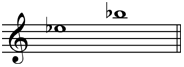 and
altos who learn to use the real head voice will have no
difficulty in vocalizing that high.
and
altos who learn to use the real head voice will have no
difficulty in vocalizing that high.
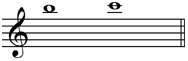
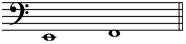
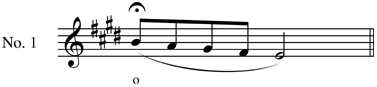
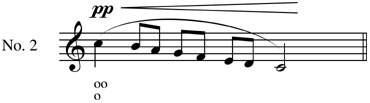
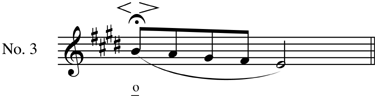
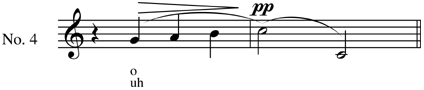
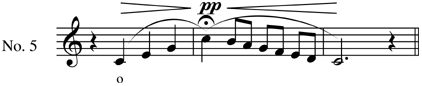
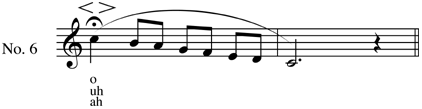
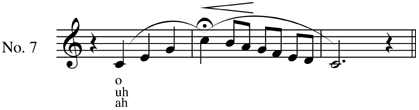

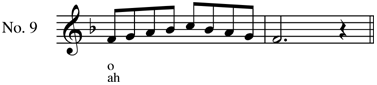


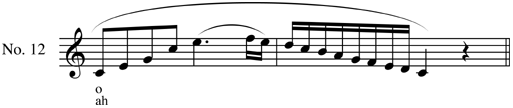
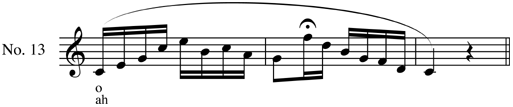
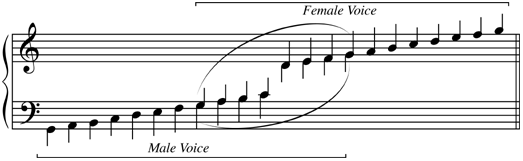
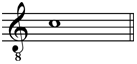 using what is
often called mixed voice. When the pitches
using what is
often called mixed voice. When the pitches 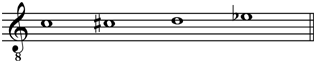 are practiced with a sufficiently relaxed
throat the tone runs naturally into the head resonator with
a feeling almost the equivalent of that of a nasal tone, but
this tone will be in no sense nasal. It will be head voice.
are practiced with a sufficiently relaxed
throat the tone runs naturally into the head resonator with
a feeling almost the equivalent of that of a nasal tone, but
this tone will be in no sense nasal. It will be head voice.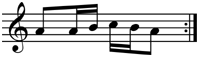 by the hour, while a company of his unlaundered
brethren dance, until exhausted, in dust to their ankles,
with the temperature near the boiling point. This musical
monosyllable is ample to satisfy his artistic craving. In other
words it is the complete musical expression of himself.
by the hour, while a company of his unlaundered
brethren dance, until exhausted, in dust to their ankles,
with the temperature near the boiling point. This musical
monosyllable is ample to satisfy his artistic craving. In other
words it is the complete musical expression of himself. The repetition
of this figure may continue for hours. If it were
inflicted on a metropolitan audience it would result in justifiable
homicide, but to the Australian it furnishes just the
emotional stimulus he desires.
The repetition
of this figure may continue for hours. If it were
inflicted on a metropolitan audience it would result in justifiable
homicide, but to the Australian it furnishes just the
emotional stimulus he desires. This one from Tongtoboo,
played Allegro, would set the heels of any company, ancient
or modern, in motion.
This one from Tongtoboo,
played Allegro, would set the heels of any company, ancient
or modern, in motion.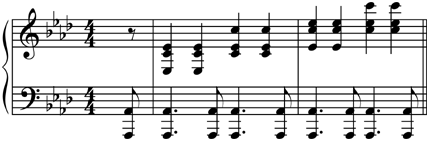
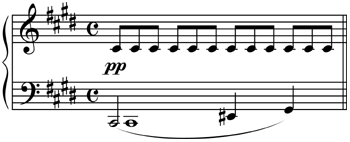
 be said to use his voice in
the same way as one who begins his head voice at
be said to use his voice in
the same way as one who begins his head voice at  ?
?