A TALE.
BY MRS. HUGHS.
One cold bleak morning, in the latter end of March,
before winter had quite determined to resign
his tyrannical sway, though he had occasionally permitted
a few soft breezes to woo the opening buds of
the willow and the horse-chestnut, and scatter a few
of the earliest spring flowers over the fields, Farmer
Early happened, on his way to the place where his
labourers were at work, to pass a field in which he
had a number of sheep. Two or three times, as he
proceeded along, by the side of the fence, he thought
he heard a very feeble bleat, and stopped to see if
there was any youngling in need of more aid than
was in its mother's power to render. For some
time, however, he looked in vain, but at length the
sound became more distinct, and soon guided him to
a corner of the field, where he discovered a sheep
lying stretched out on its side, and a lamb, evidently
just born, lying near it. He hastened immediately to
the aid of the little complainer, and found that the
mother was stiff and cold, and that it was itself nearly
dead, for its feeble frame had been exposed to the
cold bleak wind and occasional falls of snow, without
having any tender mother to protect it from the
withering blast. He immediately took it in his arms
and returned home, though with but little hope that
any thing that could now be done for it would be of
any avail.
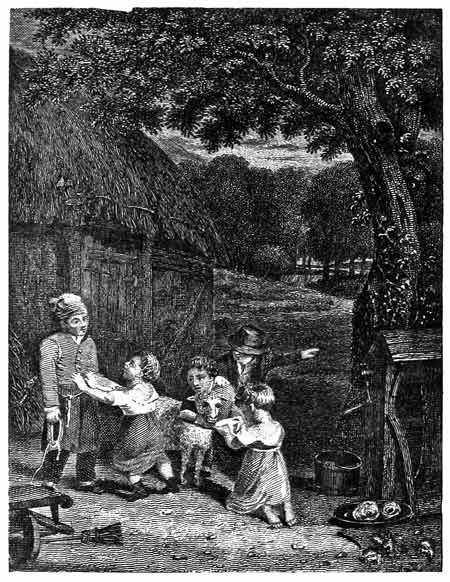
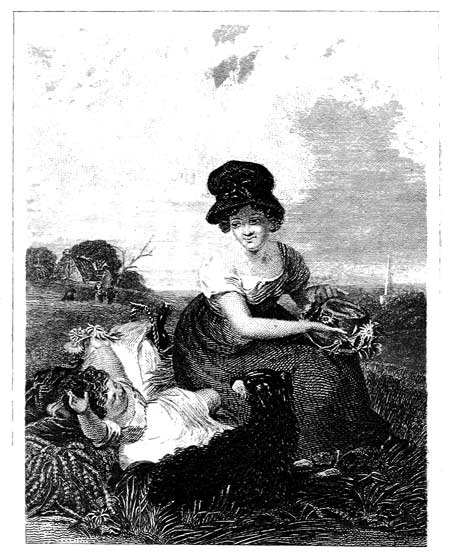
W. Collins Del. F. Kearny Sc.
THE PET LAMB.
"Here, Sally! Sally!" cried he, as he entered
the door of his own house, and immediately his eldest
daughter came forward, on hearing the summons,
"I have brought you something to be kind to. Here
is a poor little lamb that has lost its mother, and you
must try to supply the place of one to it: I am afraid
it will be impossible to save it, but you must see what
you can do." Sally, whose heart overflowed with
tenderness toward every living thing, took the little
trembling creature in her arms, and summoning her
little sisters to partake of the pleasing task, and
indeed to share the fatigue which she was herself
but ill able to bear, she immediately began to prepare
a bed for it by the fire, and to warm some milk
for it.
"Do you think it will live, Sally?" said Peggy, as
she stood by her elder sister's side, "do you think
you can keep it from dying?"
"I hope so," answered Sally, holding the warm
milk to its mouth as she spoke.
"I won't let it die," said Kitty, with great earnestness.
"Will you, Sally?"
"Not if I can help it."
"And if it lives, won't you let me feed it sometimes?"
added Peggy, "and won't you let it be part
mine?"
"Yes, it shall be part yours, and you shall help
me to take care of it."
"And when it can walk, won't you let me take it
out and teach it to run about the green?"
"I rather think it will be more likely to teach you
to skip," returned her elder sister.
"I can run about already," said Kitty, and as she
spoke, she gave several bounds across the floor to
prove the truth of her assertion.
"What will you call it, Sally?" asked Peggy.
"I think we must call it Croppy, for you know
how the little lambs crop the short grass. How glad
I shall be if we can rear it. I never had a pet in my
life, and a pet lamb, of all things in the world, is
what I shall like the best."
"You always said I was your little pet," said
Kitty, looking up in her sister's face with an expression
of disappointment.
"And so you are," answered Sally, kissing her
affectionately; "but Croppy, if it live, will be a pet
to all of us."
"And it will live—I know it will," said Peggy.
"Only see how much better it looks, now that it is
warm, and has got some good milk."
The fact was, that little Croppy very soon began
to show signs of the good effects of the kind treatment
it had received; and before the day was over,
it could stand, and in a few days more it began to
trot about, and was very soon able to commence the
business of giving the little girls lessons in running.
And here we shall leave him for a while, to give a
short account of the family in which he was now an
inmate.
Farmer Early's family consisted of Sally, whom
we have just introduced to our readers, and who was
fifteen years old, George, who was about one, and
Tom, who was rather more than two years younger
than she. Besides these, there were two little girls,
Peggy, who was seven, and Kitty, five years old.
They were all rather pretty and very pleasant looking
children; but Sally and George were the most
conspicuously interesting, both in appearance and
manners. George was of a more serious and thoughtful
cast than boys of his age generally are. He was
active, and always willing to do any thing in his
power to assist his father and those around him; but
these duties fulfilled, his chief delight was in reading,
and he would sit for hours together on the top of
a box in the garret, whither he was in the habit of
going for the sake of being out of the noise of the
other children, and would devour with the greatest
eagerness the contents of every book on which he
could lay his hands; and a strange mixture, it must
be confessed, it had been his fate to get hold of. He
had read "The Whole Duty of Man;" "Gulliver's
Travels;" "Cook's Voyages;" "Pilgrim's Progress;"
two or three odd volumes of some of the
Waverley novels, which he had bought for a few
cents a piece at an auction in the neighbouring town,
when sent there on an errand; but of all the treasures
of which he had ever become possessed, and
which seemed likely to have the most powerful influence
over his future character, was the Life of Franklin,
which he likewise purchased for a few cents at
an auction. Eagerly, nay, greedily, did he read this
interesting little volume. And when he rose from
the fascinating task, and recollected that he, who had
become one of the most distinguished philosophers
either of his own, or any other country, who had
been a negotiator with kings, and had done more,
perhaps, for his country than any other man, with
the exception of Washington alone, had once been a
poor, portionless, uneducated boy; and that all the
attainments, all the honours of which he afterwards
became possessed, were entirely the fruits of his
industry and economy, he drew himself up with a
noble feeling of pride and emulation, and said, "I
too, perhaps, may some time or other be a great
man; for every body has the power of being industrious,
economical, and good; and I never can be
much poorer than Franklin was when he first entered
Philadelphia with only a dollar in his pocket, and
when he went and bought a two-penny loaf and
made his dinner off it."
George had not derived his love of reading from
either his father or mother; for though respectable,
they were very ignorant people, and were much
more disposed to regret the disposition of their son
to spend his time, as they conceived, so unprofitably,
than to attempt to supply him with the means of indulging
his prevailing propensity. He was not, however,
without one affectionate and sympathizing
friend, who delighted in aiding him in every laudable
undertaking, and joined with interest in all his praise-worthy
pursuits. His sister Sally was, like himself,
gentle, affectionate, and thoughtful. She was not so
great a reader as George, for, indeed, the instruction
that she had received had been so very limited, and
she had always been kept so constantly employed in
assisting her mother in the household work, and in
taking care of the younger children, that she had
never learned to read with sufficient facility to make
the employment agreeable; but she delighted to listen
to George's accounts of the books he had read,
and was always ready to add her mite to the small
stock of money which he was able to save for the
purchase of more. Fondly, too, would she encourage
all his ardent aspirings after knowledge and virtue,
and all his sanguine anticipations of future eminence;
for to her he could breathe out his thoughts
almost before they were formed in his mind, conscious
as he did so, that they would meet no repulsive check,
no chilling reception, to nip the embryo blossom, and
prevent its ripening into fruit. There was yet another
circumstance which served to unite this affectionate
brother and sister in still closer bonds. Sally had
all her life been exceedingly delicate, and as she
advanced in age, that delicacy evidently rather increased
than diminished; and there was no one of
the whole family that showed so much consideration,
and so tender a sympathy for her weakness, as her
brother George; and the grateful girl never seemed
to think she could make a sufficient return for such
kindness.
We have spent so much time in dwelling on the
characters of the two elder branches of farmer
Early's family, that we can spare but little more for
the others; nor, indeed, is there much required; for
Tom was, like other boys, active, playful, and careless;
fond of guns, and dogs, and horses; priding
himself upon managing a horse better, and shooting
a partridge with truer aim than any boy in the neighbourhood;
and as to the little girls, they were like
most children of their age, sometimes troublesome,
but more generally good and engaging, and always
interesting to their parents and sister, who repeated
their sayings, and watched their sports with pride and
pleasure, and persuaded themselves that they were
the smartest and prettiest children that were ever seen.
Had the little Kitty, however, been at all less delighted
with their new inmate, Croppy, than she really
was, she might, perhaps, have been a little jealous of
the attention which he gained from the whole family,
but more especially from Sally, who, as she said,
had never before had any living thing that she could
call her own; and as it soon learned to know her
voice, and would come bounding at her call from the
furthest point of the common before the door, or
would trot by her side to the dairy, anxiously looking
for his usual allowance, she almost wondered at herself
for the fondness which she felt for it. "It is
very silly of me, I know, to be so fond of this little
creature," she would sometimes say, as she mused
over her little pet; "for though he likes me better
than any body else at present, I know very well that
any other person who took the same care of him
would just do as well for him, and I should be forgotten
directly; but yet he seems as if he loved me,
and it is so delightful to be loved, that the attachment
of a little dumb animal makes me feel happy." As
Sally was thus musing, her hands were occupied with
tying together a number of wild flowers which the
children had just brought from the woods, and forming
them into a wreath.
"What is that for?" asked Kitty, who had sat
looking on so earnestly, that she had been insensible
to the many challenges which Croppy had given her
to a race over the common. "Who are you making
that for, Sally?"
"You shall see," answered her sister, and immediately
she called "Croppy! Croppy!" and in an
instant, Croppy, though he had been almost out of
sight at the moment of her calling, was again at her
side. Sally hung the wreath round his neck, but was
obliged to tie it so tight that he could not reach it
with his mouth, or the display of Sally's taste would
soon have been in vain. "Now keep quiet, Croppy,
and do not spoil your garland before George comes
home from the field, because I have dressed you up
in honour of his birth-day. Now be quiet, good Croppy,"
continued she, as the little creature, less gratified
by being so ornamented, than worried by the unusual
incumbrance, tried, by rolling himself on the
grass, to disengage himself from it.
"Oh! here comes George," cried Peggy. "I'll
run and meet him, and bring him to see Croppy
before his birth-day dress is spoiled." But at the
same moment a voice was heard, calling in an
angry tone, "Sally! Sally! how can you think of
setting there on the damp grass, when you have
been so sick all day! I know well enough how it
will be—you will get cold, and will be laid up instead
of helping me to-morrow with the washing."
Poor Sally rose in an instant with a feeling of self-condemnation
at her own carelessness, but her heart
and eyes, at the same time, filling at the manner in
which her mother had upbraided her. As she returned
to the house, she met George hastening to admire
Croppy's finery; but he had heard his mother's
rebuke, and seeing the large tears standing in his
sister's eyes, Croppy was immediately forgotten, and
turning round with Sally, he devoted himself the rest
of the evening to cheering and amusing her. "It
only wants a few days now, Sally," said he, seeking,
in the subject the most interesting to himself, the
most probable means of amusing his sister, "it only
wants a few days now to the time of my going to
school. Father has promised me a month's schooling
before the harvest begins, and another when it is
over; and if I am diligent, I can learn a great deal
in that time. Oh, how I long to begin! I dream
about being at school every night; and I always
think that I am learning something that compels me
to study very hard, and I am always so glad, because
I think then I am learning the way to be a wise and
good man. Franklin had very little more schooling
than I shall have had by that time, and as to money,
he was as poor as I am, every bit; for when he first
came to Philadelphia, he had only a single dollar in
his pocket, and yet you see he got to be a very
great man."
"Yes," said Sally, "but he had to study and
work very hard for a great many years first."
"To be sure he had," returned the brother with
animation; "but then so can I work, and so can I
study; I am not afraid of either. Did not I walk ten
miles yesterday, when I went that errand for the
squire, because he said he would give me a quarter
of a dollar? and here it is," he added, taking the
money out of his pocket, and looking at it with great
complacency, "and I mean to get up by day break
in the morning, and go to buy a book with it that I
saw the other day, and that I want to read; I can get
it, I think, for a quarter of a dollar. And I'll tell
you another thing, Sally; I expect by the time I have
finished my month of schooling, you will be a great
deal stronger than you are now, and then I can teach
you every thing that I have learnt, and we shall be
so happy—shan't we, Sally?" Sally smiled assent,
but it was a languid smile, for the ardour of her
youthful mind was checked by the enfeebling influence
of disease.
The next morning Sally felt very forcibly the ill
effects of her imprudence in sitting on the damp
grass the night before; and though she still recollected
the severe manner in which her mother had
reproved her, she could not but be conscious that the
reproof was deserved. This made her very unwilling
to complain, though she rose with a severe pain
in her side, a burning fever in her veins, and a cough
which was always troublesome, but was now more
than usually distressing. Determined, however, not
to complain, and anxious, if possible, to conceal her
indisposition, she prepared to assist her mother in
every way in her power; and though she felt it
would be impossible for her to stand at the washing
tub, she washed and dressed her little sisters, prepared
the breakfast, and did a variety of offices equally
useful, and was in hopes it would escape the observation
of every one, that what she did was performed
under the pressure of more pain and debility than
usual. She was assisted in this concealment by the
absence of George, who had not, at breakfast time,
returned from the town to which he had gone for the
purchase of the book of which he had spoken the
evening before; for had he been present, his watchful
eye, she well knew, would soon have discovered
the oppression under which she laboured. Breakfast,
however, was entirely over before he returned, and
when he did come, he only stayed to eat a piece of
dry bread and take a drink of water, a kind of fare
which would at any time have been sufficient to satisfy
him, but which he had now become extremely
fond of, since he found that Franklin ascribed so
much of his alacrity in business, and his facility in
study, to his adherence to that simple diet; and then
hastened to assist his father in the field. Sally sometimes
almost persuaded herself that her little pet
Croppy saw and understood that all was not right
with his young mistress; for instead of frisking about
the common as usual with the little girls, he kept
almost constantly trotting by her side, every now and
then rubbing his little head tenderly against her, and
appearing quite happy when she stooped down to pat
his head and speak to him in a tone of kindness.
Yet even this slight indulgence seemed almost more
than she had either time or spirits to bestow, and the
continual repetition of Sally do this, and Sally do
that, kept her incessantly occupied till late in the
afternoon, when the chief of the business being over,
and she too much exhausted to support herself any
longer on her feet, had just sunk upon a seat, and was
patting the head which Croppy had come and laid on
her lap, when her father and brothers returned from
the field. "Sally," said the farmer, in a tone of
reproach, "you sit patting that lamb as if there was
nothing else to be done. Come, girl," he continued,
taking up a milking bucket as he spoke, "get your
bucket, and let us go and milk the cows." George,
who, at the moment his father spoke, had taken up
his newly purchased treasure, and had got half across
the room on the way to his private retreat, cast a
glance at his sister, and perceiving in an instant that
she was ill, he threw down his book, and saying, "Sit
still, Sally, for I am going to milk this evening," he
took the bucket and hastened after his father. Sally's
heart glowed with affection and gratitude. She had
always loved her brother, but never had he been half
so dear to her as at this moment. "Croppy, you
must love George for being so kind to your mistress,"
said she, addressing herself to the lamb for want of
a more sympathizing auditor, "you must love
George for my sake;" and she watched for his return,
impatient to let him know that she understood
and felt his kindness.
At length, the business of milking over, George
again appeared, but no longer with the glow of animation
on his countenance with which he had returned
from his day's labour, nor yet with the spirit and
alacrity with which he had left the house on his office
of kindness. "Is he sorry now, that he went?"
thought Sally, as she examined his countenance.
"Has he begun to think what a great deal he might
have read in the time that he has been milking?"
"Why don't you go to your book now, George?"
asked she, as she saw that, after disposing of the milk
bucket, her brother placed himself at the end of the
large table, on which he put up his arm, and rested
his head upon it with a look of great distress.
"Why don't you go and read now?" again she
inquired; "there is nothing to hinder you now."
"Because I don't want to," answered George, in
a tone very different from his usual cheerful, good
tempered voice.
"George, come here beside me," said Sally, tenderly,
for she began to feel alarmed at the expression
of her brother's countenance.
"Oh! I can't," returned the boy; "do let me
alone, I don't want to speak."
Sally's eyes filled with tears. "He is vexed at
me," thought she, "for he thinks I am always in
the way of his improving himself." George got up
and moved towards the stairs. "You are leaving
your book behind you, George," said Sally, glad to
think that he was going at last to his favourite employment.
"I don't want it," he replied; "I am
going to bed."
"George, do tell me what is the matter before you
go; are you sick?"
"No, I am not sick, but I don't want to talk; so
do let me alone." So saying, he went to bed, and
Sally soon after retired also, but not to sleep. Uneasiness
at the sudden and unaccountable change in her
brother's manner, added double violence to the disease
which was throbbing in her veins; and after a
restless and sleepless night, she attempted to rise in
the morning, but finding herself entirely unable to
do so, she was obliged to lay her head again upon
her pillow. "Aye, this is just what I thought would
be the case," said her mother, who coming up to
see why Sally had not made her appearance, found
her too ill to sit up; "I told you what you would
bring upon yourself by playing and idling your time
away with that little useless pet lamb of yours."
Mrs. Early did not mean to be an unkind mother,
but she, like many other people, had an unfortunate
manner of showing her affection, and generally vented
the uneasiness which the sight of her daughter's
indisposition occasioned, in a tone of reproach, for
which she had not always so much cause as on the
present occasion.
"I know I was wrong, mother, for sitting upon the
grass," said Sally, mildly, "but say no more about
it, for it cannot be helped; and ask George to come
up and see me."
"George has been out at work these two hours,"
replied her mother, "and here am I with all the
ironing to do, and every thing else to attend to, and
to nurse you into the bargain."
"No, indeed, mother, I don't need any nursing,"
returned the poor girl, who, though convinced her
mother did not mean any unkindness by this manner
of speaking, was yet unable to repress the tears
which filled her eyes and forced themselves down her
cheek as she spoke. "Only tell Peggy to bring me
up some water to drink, and I want nothing else."
"Aye, it's fine talking. But do you think I can
have you lying sick in bed, without coming to look
after you? And I'm sure I don't know how I'm to
find time to do it, and to do all the work besides.
But I will send Peggy up with a drink for you, and
will come up myself as often as I can," added the
mother, as she closed the door after her.
When left to herself, Sally's mind dwelt continually
on the thought of George's melancholy the night
before, which she was sure was still unremoved, or
he would never have thought of going to work without
first coming to inquire after her. Anxiety to
know the cause only increased the longer she dwelt
upon the subject. In vain did her little sisters try
their utmost efforts to amuse her, for which purpose,
even little Croppy was brought up stairs, and introduced
into the bed room; she looked at it with pleasure,
and gave the little girls strict injunctions to be
kind and attentive to it whilst she was unable to be
so herself; but again her mind recurred to the recollection
that something was amiss with her favourite
brother; and this idea, much more than the bodily
pain that she suffered, made every hour appear like
two, till he came home to his dinner. At length she
heard her father's voice below, and knowing that
George was in all probability there also, she knocked
down for her little attendant Peggy, and desired her
to ask George to come up and see her. He came
immediately, and the moment Sally saw him, she
perceived that the same expression of melancholy
remained on his countenance.
"George," said she, in a gentle, affectionate voice,
as he came toward her bed-side, "I wanted to see
you, to know if you have forgiven me."
"Forgiven, you, Sally! what had I to forgive?"
asked he, in a tone of surprise.
"For being the means of keeping you from going
up stairs to read last night."
"Oh! Sally, you surely do not think that I was
angry at you for being sick?"
"No, not angry at me for being sick, but angry
at me for having made myself sick by my own imprudence,
and so keeping you from the only enjoyment
you have."
"And don't you think, Sally, that I would rather
help you than read any book whatever?"
"I know you have always been very kind in helping
me, but still what made you so sorrowful when
you came in from milking, if it was not that?"
"It was not that, at any rate," answered George.
"Then what was it? Do tell me, George, for I
know there is something amiss, and I cannot tell
what it is."
"It is nothing that you can help, Sally, so keep
yourself easy, and get well again, for that will sooner
bring back my spirits than any thing else."
"George, do tell me what is the matter. I am
very sick, and it only makes me worse to think of
your being so sorrowful, and I not know the cause."
"Oh! I am not sorrowful," returned George, endeavouring
to speak cheerfully, "I am only disappointed,
but I shall soon get over it; for my father
told me last night whilst we were milking, that he
has had so many losses this season, both in sheep,
and cows, and horses, that he will not be able to send
me to school as he had promised to do."
But though George began his speech with an
assumed cheerfulness, he was unable to keep it up;
and as he pronounced the last words, the tears, in
spite of his utmost efforts, filled his eyes, and were
about to force themselves down his cheeks, when the
voice of his mother calling him from below, checked
their course, and he hastened down stairs to obey the
summons.
"Tom, Sally wants you to go up stairs to her,"
said Peggy, in the evening, when the family were all
assembled to supper.
"Wants me!" said Tom, in surprise. "What
does she want me for? She surely does not expect
that I can read to her, or talk to her about books, as
George does."
"I don't know, but she said I must tell you to come
up and speak to her."
Tom went up stairs, but when he came down
again, though questioned by all around about the
business for which he had been sent, he refused to
gratify their curiosity; but after eating his supper in
silence, a very uncommon circumstance for him, for
he generally had some exploit to recount that he had
achieved with his gun, his horse, or his dog, he took
his hat and went out, without making any remark
about whither he was going, or what he was going
to do; nor on his return was he any more communicative,
though the curiosity of all was considerably
excited about the nature of the business he had been
upon.
In the mean time, Sally's illness increased in so
alarming a manner, that even her mother ceased to
talk about herself, and was anxious only for the health
of her child.
The poor girl, as if conscious that her sufferings
were only a just penance for the imprudence of which
she had been guilty, uttered no complaints, though
she tossed about the whole night in all the restlessness
of a burning fever, and was, by the time that
day-light arrived, so ill, that George was despatched
in haste for the physician from the neighbouring
town, whose arrival was waited for with an impatience
that only those can understand who have
known what it is to watch by the side of a beloved
one, and count the minutes till the sufferer is relieved,
and strength is given to their sinking hopes.
"What can George be about?" said the mother,
looking out of the window, and straining her anxious
eyes in hopes of catching a glimpse of him as he
came across the common; "he never was so long on
an errand before. He surely might have managed
to come back himself before this time, whether the
doctor could come with him or not."
"Keep yourself easy, mother," said Sally, gently,
who was the only one that was not impatient, "I
am sure he will come back as soon as he possibly
can."
"Peggy, run along as far as the stable yonder,
and try if you can see any thing of him," added her
mother, "and come back directly and tell me if you
do."
Away went Peggy, followed by the little Kitty,
and having caught a sight of her elder brother, was
about to do as she had been ordered, and hasten to
the house to announce the intelligence, when her
curiosity was excited, and her steps arrested, by the
sight of another object, for whose presence she was
unable to account. "Why, who can that be that is
coming along the road with Tom? I declare it is
Ben, the butcher's boy. What can he want here, I
wonder?" At that moment Tom was heard calling
Croppy! Croppy! and in an instant Croppy came
bounding across the common to meet him. George,
too, had arrived at the same time from an opposite
direction, and eagerly inquired what he wanted with
Croppy; but the next moment, like a stroke of lightning,
the truth flashed across his mind, and, throwing
himself down by the side of the lamb, he clasped
his arms around its neck. "I know what is the matter—I
know it all," he exclaimed. "Sally is going to
sell Croppy, for the sake of paying for my schooling;
but its innocent life shall not be taken away for
any such thing. I can read and teach myself, and
Croppy shall not be killed."
"Hush, George, give over making that noise,
man. Don't you hear mother calling you? Get
up, I tell you, and don't make such a rout about a
lamb; it's not the first lamb that has been killed, I
am sure."
Peggy now caught the alarm, and bursting into
tears, she ran to the butcher's boy. "You must not
take Croppy away. Oh! you shall not kill our dear
little Croppy," she exclaimed, pushing the boy back
with her little hands as she spoke, while Kitty,
scarcely able to understand the meaning of what was
going forward, and anxious only to show kindness to
their little favourite, had got some water from a
bucket that stood near her, and was trying to coax
the little creature to drink. But Croppy, as if conscious
of the fate that awaited him, was insensible
to all her solicitations. At this moment, the sound of
horses' feet was heard, and the next, the doctor rode
up to them, and struck with the expression of grief on
George's countenance, and with Peggy's distress,
inquired what was the matter. The story was soon
told. "Oh, cheer up, my good boy," said he, addressing
himself to George, whose sensibility and
anxiety for improvement struck him with equal admiration,
"keep yourself easy, for the lamb shall
live, and you shall go to school into the bargain."
So saying, he gave the butcher's boy a piece of
money to reconcile him to going back without the
lamb; then turning to George, he assured him that
he would take the expense of his schooling upon
himself, and that instead of a month, he should stay
a year, or more, if he found that he continued to set
as high a value as he at present did upon being furnished
with the means of improvement. "And now,"
added he, "I must go and see after this kind sister of
yours, whose health I shall be doubly anxious to
restore after this proof of her amiable and affectionate
disposition." But though he was on horseback,
George was at the house before him, and was making
his way immediately to Sally's room, when he
was stopped by his mother, who met him, and, in an
agony of tears, told him that Sally was too ill to be
spoken to. Disappointed at not being able either to
express his gratitude for the proof of affection which
she had given, or to make her a sharer of his own
happiness, he sunk down on a seat, and waited the
return of the doctor, whom his mother now conducted
to the sick chamber. After waiting a long time,
he at length heard the sound of his footsteps on the
stairs, and his voice, as he spoke in a soft tone to his
mother. George fixed his eyes on the face of the
physician as he entered the room where he was, and
endeavoured to read in it what he thought of his patient,
but felt afraid to inquire.
"May I go up now?" asked he, in a timid voice.
"Yes. Go up, she is anxious to have you with
her, and I am sure I need not tell you to pay her all
the attention in your power."
George did not wait to make any reply, but was,
in an instant, by Sally's bed-side. But how great,
how alarming, was the change that he saw in her
from the time that he had last left her!
"Sally! dear Sally, I am come to thank you,"
said he. Sally raised her eyes and smiled on him
affectionately. "How kind it was to give up your
little pet to pay for my schooling. But, though I am
going to school, you will still have Croppy to be kind
to."
"Croppy will not be taken from me, but I shall
soon be taken away from him. George, I am going
to leave you all very soon."
"Oh! Sally, don't talk that way," said George, in
a tone of extreme agitation. "What has the doctor
been doing to frighten you so?"
"The doctor has not frightened me. He told me
that he hoped he should make me well again, but I
know better; I know that I am dying; but I am not
frightened, for I know that I am going to a kind father.
I am sorry to part with you all, especially you, George,
but it must be, and we shall meet again soon."
"Oh, don't talk about dying, Sally," cried the
afflicted boy, the tears streaming down his cheeks as
he spoke, "don't talk about leaving us. I cannot
bear to think of parting with you."
"George," said Sally, and an almost heavenly expression
brightened her countenance as she spoke,
"you have read a great deal, but your reading will
be of little use if you have not learnt to know that it
is our duty to submit with patience to the will of our
Heavenly Father. I like to be with you, and am
sorry to think of leaving you, but I know we shall meet
again, and then there will be no more parting. But
we will talk no more about it now. Mother is coming,
and I don't want to distress her."
George looked at Sally, and tried to persuade
himself that she was mistaken in imagining herself
so ill. But the more he examined her countenance
on which the indelible stamp of death was already
impressed, the more he was convinced that she was
right. From that moment, he scarcely quitted her
bed-side, but watched over her, read portions of the
scriptures to her whenever she was able to listen,
and even prayed with her. Her composure and benignity
were gradually communicated to his mind, so
that though the one of all the family who was the most
fondly attached to her, he was the only one who could
view her approaching death with sufficient calmness
to be able to listen to her when she talked about it.
Short was the time, however, that he was called upon
to exercise this self-command, for the vital torch was
nearly extinguished, and her short, but innocent life,
was nearly drawn to a close. George, whose affectionate
offices seemed to become more and more
grateful to her as the time approached nearer when
she must resign them altogether, had sat up with her
all night; and her mother, toward morning, was prevailed
upon to go and take a little rest, under the
assurance from Sally, that she did not need any thing
that her brother could not do for her. Just as her
mother left the room, the first beam of the morning
sun glanced through the window. "Put out the lamp,
George," said she, "and draw back the window curtain,
that I may see the sun rise. It is the last time that
I shall ever see it rise, and oh! it is a glorious sight.
I should have been glad, if I had been permitted to
live longer, for this world is beautiful, and I wanted to
see you a wise and good man, but that I hope you
will be, though I am not here to see it; and always
remember me, George, and think how dearly I loved
you. Raise me up a little, and put the pillows under
my shoulders—there, that will do. Oh! George, I
can't see! Take hold of my hand." George took
her hand, she pressed his gently; and he watched,
scarcely venturing to breathe, lest it should prevent
him from hearing her words when she should next
speak. But gradually he felt her hand relax from the
pressure of his; he looked at her lips, but they were
still; he put his face to her mouth, but no breath
escaped from it; all was motionless. He was conscious
that she was dead, but so sweet, so placid was
the repose into which she was sunk, that he was unwilling
to stir, lest he should destroy the heavenly
feeling. How long he thus hung over her, he was
himself unconscious; but when, at length, he was interrupted
by the entrance of some of the family, he
left the room, and hastened into the open air, as if
unwilling to mingle the hallowed feelings which pervaded
his mind with the more boisterous grief of the
other members of the family.
Violent grief, for such a death, George felt to be
impossible; and though he never ceased to think of
her loss but with the most affectionate regret, his
sorrow was so blended with the conviction that the
change was a happy one for her, that it soon softened
down to a holy and tender remembrance, which served
only to stimulate his mind to virtue and piety; and
the sweet proof that she had given so short a time
before her death of her affection for him, made him
cherish with grateful pleasure the recollection of
the Pet Lamb.