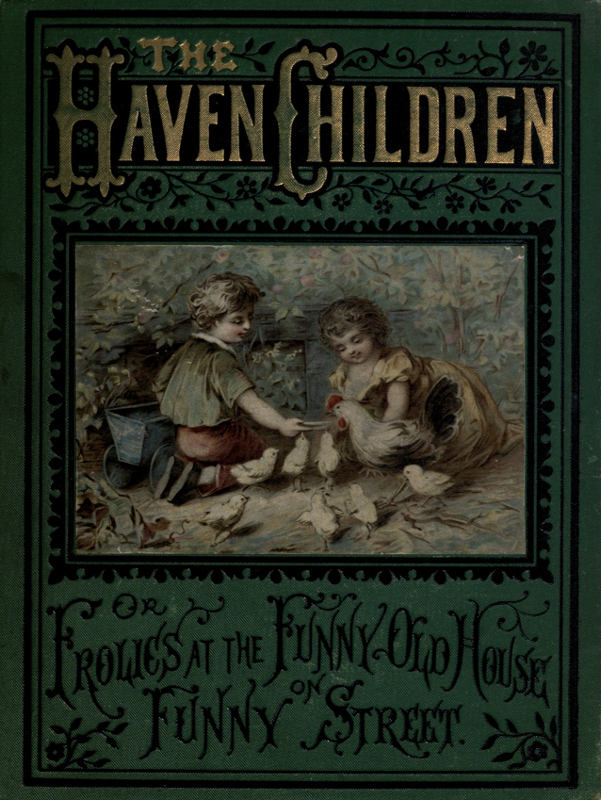
THE HAVEN CHILDREN
OR FROLICS AT THE FUNNY OLD HOUSE ON
FUNNY STREET
BY EMILIE FOSTER
“Johnny Black
Who always came back”
NEW YORK E. P. DUTTON & COMPANY 713 Broadway
1876
Entered, according to Act of Congress, in the year 1875, by
E. P. DUTTON & COMPANY,
In the Office of the Librarian of Congress, at Washington.
To CHRISTIAN BAYARD BÖRS,
Who, for Four Years, gave to The Funny House
on Funny Street,
so much of its Life and Brightness,
and
A Merry Band
of Nieces and Nephews,
This Little Book is Inscribed, by their loving Aunt,
OR, FROLICS AT THE FUNNY OLD HOUSE ON
FUNNY STREET.
“A dreary place would be this earth,
Were there no little people in it;
The song of life would lose its mirth,
Were there no children to begin it.”
Daisy Havens was awakened from a
sound sleep, one bright June morning,
by a fearful banging on her bedroom door,
and as she rubbed her sleepy eyes, and
curled herself up for another nap, there came
a shrill volley of boy’s talk through the key-hole.
“I say, Daisy Havens, I’d be ashamed to
be such a sleepy-head. There’s no end of
fun going on in the nursery. The Menagerie
are all up and dressed, and Mamma has
invited them to feed in the dining-room. I
say, sleeping beauty, open your ears, if your
eyes are shut. Mamma has a letter from Papa,
with a surprise for us. So there—sleep on
now, as much as you can. I’m off, for one.”
The last shot through the key-hole has
taken effect, and Daisy’s bare feet patter
quickly across the hall, where, leaning over
the bannisters, she catches a glimpse of Artie’s
blue sailor-suit, disappearing through the
nursery door, from whence proceeds a merry
clangor of high-pitched young sopranos and
the deeper tones of desperate nurses.
Daisy hastens back, almost forgetting the
surprise in store, for very vexation that “Artie
couldn’t just wait a minute.”
What trials await her now! Those little
elves from the “city of mischief,” so prone to visit
children all agog with excitement about some
expected pleasure, are all about and around
her; now tangling her crimped locks, and cruelly
waylaying her comb in its way through
them, now whisking off a button or the tin of
a boot-lace, now shaking her arm and tumbling
her tooth-brush into the slop-jar. Poor
Daisy! tears are in her eyes, as she bends
over to fish for the troublesome little brush.
Alas! her trials are not over, for turning hastily
around, she forgets the full pitcher, which,
in her bewilderment, she placed on the floor,
and now a cool douche reminds her of its
presence.
“There’s water, water all around,
But not a drop to drink.”
The pretty rose-buds and fern-leaves on
the new carpet are completely drowned. Daisy’s
neat boots are weighed down with their
additional weight of water, and Daisy herself
stands upon a chair, “sending coals to Newcastle,”
as the torrent pours from her blue
eyes. Just then the door bursts open, and
Jacko, the little monkey, escaped from the
family menagerie keeper, shouts out, “Oh,
Daisy, ain’t you coming to the exprise?” then
lowering his tones as he catches sight of the
catastrophe and tearful Daisy on her high
perch, cries—
“Was you shipwrecked, Daisy dear, and was
you throwed on the rocks? Oh, isn’t it fun to
paddle? I think water is the best fun of anything.”
“Dais-y! where is the child?” sounds out a
loud, ringing voice, as Rosie, the companion
monkey of the family collection, appears on the
threshold. “Doesn’t she know what’s going on?
Oh, dear, dear, what a awful splash! What
ever’ll happen to you, Miss Daisy?”
With this crumb of doubtful comfort dropped,
Rosie runs off panting to the nursery, to tell how
“Miss Daisy, that’s always preaching to us children,
is behaving a purpose.”
Now Daisy, be it known, is the family owl,
and has the habit of looking very grave and
wise, and using those aggravating words, “I told
you so,” to the younger members of the family,
so Daisy’s misfortune, this morning, is rather
“nuts” for the companion monkeys to crack.
The news of the “shipwreck” reaches the
nursery, and Charlotte, who has a very soft
spot in her heart for little folks in distress,
and whose office it is to mend the family jars
and straighten out the family tangles, hastens
to the floating island, rescues the family owl,
dries the dripping feathers, and then marshals
the chattering group to the dining-room for
the rare pleasure of a “high breakfast” with
Mamma and Aunt Lellie.
A smiling greeting there awaits them, and
then Mamma bids Artie take Papa’s place at
the head of the table, and after a simple grace,
enters into the general fun.
“Mamma,” pleads one, “need nobody count
our cakes this morning, and may we make
our own spread of marmalade?”
“Mamma, dear, can’t we have two helps
of strawberries. They are so very delicious, and
Charlotte will give us peppermint and sugar
if they hurt.”
Aunt Lellie’s suggestion that, by way of
preventive, the strawberries should be seasoned
with peppermint and sugar, was received with
merry laughter, and then the clamor went on.
“Oh, Mamma, just look at Rosie!”
“Bee’s in the honey-pot
Up to its eyes,”
quoted Artie.
“Oh, I ain’t either, I was just peering to
see if the honey would last for another ‘go-round,’”
indignantly replied Rosie, whilst the delicate
touches of sweets on the end of her
“tip-tilted” little nose, and on her round forehead,
produced a merry laugh from all, and
proved nearly fatal to Jacko, with his mouth
full of buttered cakes.
The din of mingled voices, with their interrogations
and exclamations, re-echoed by
Baby Mocking-Bird’s accompaniment of Pap-spoon
Tatto on her plate, began to grow terrific,
so Mamma, by a single word, summoned
the little ones to perfect quiet, whilst
she unfolded “the surprise” in Papa’s letter.
Let us pass over the pleas used to convince
Mamma, to the single sentence—
“I want you to send on the whole Menagerie
(little Birdie excepted) with one of
the nurses, by the Shore-line train, to Providence,
Saturday, to accept Aunt Emma’s kind
invitation to visit her. Hugh and I will meet
them at the station.”
The reading of the letter was followed by
an almost painful calm. Its meaning was too
great to be taken in all at once, but gradually
it dawned upon their bewildered little
intellects that this was Saturday, and in less
than four hours they would be on their journey
to the far-away city and “Aunt Emma,”
who was, to them, a sort of good fairy, who
always remembered the six birthdays, and
seemed a kind of familiar friend of Santa
Claus, or, as Rosie said—“She guessed they
had growed up together, and been to the
same school.”
However that may be, certain fact it was,
that whatever wishes they had whispered up
the dark chimney the week before, were sure
to be realized when, Christmas morning,
the Adams Express wagon left a huge box
marked “Providence,” with Aunt Emma’s card
fastened on to the plum pudding, so sure to
form the first layer, with the good Auntie’s
assurance to Mamma, “It was made, by
Celia, very weak, to suit the children.”
The nurses now appeared to carry off
the younger folk to the nursery, thereby
making short work of Jack’s series of joy-speaking
somersaults, whose chief feature, much
to his elder brother’s scarcely veiled contempt,
seemed to be, that the heels never
reached their destination, but remained dangling
in the air.
Whilst the little ones, in the nursery, are
riding astride the trunks which had appeared
there, or tumbling over the piles of clean
clothes spread out by Kitty; Artie and Daisy,
as eldest son and daughter, are listening to
some good advice from Mamma, who is putting
the younger members of her flock under
their care, urging Artie not to tease poor little
Bear, who is really not well, and apt
sometimes to be a little tiresome, and—cross,
if we must say it. Daisy, too, is to try to
be more gentle and patient with her little sister
and brother. Then she bids them remember
the verse which formed the subject
of last Sunday evening’s talk,—“Be ye kindly
affectionate one toward another, in honor preferring
one another.”
She had then told them in how many ways
they might bring sunshine into their own homes,
the great outside world, and into their own
hearts too, if they were constantly striving to
be “kindly affectionate” and studying how
they might
“Yield their way to others’ way,”
not selfishly seeking for themselves the best.
She begged them to keep this little verse ever
in their childish hearts, that so, with the dear
Lord’s blessing, its echo might be found in
their lives.
Mamma did not make her sober talk very
long, for she knew the little heads and hearts
had just about enough to fill them now, and
she saw Artie’s big blue eyes were growing
hazy, for with all his faults, he was a boy of
loving heart, where Mamma reigned supreme,
and just then a little cloud was drifting over
the bright sunny prospect before him, as he
thought of leaving her without Papa or eldest
son to care for her.
Little boys know how soon their sailor-coat-sleeves
will dry up tearful eyes and let
bright sunshine again into boy-hearts (for
mammas and nurses well know that a little
boy’s handkerchief is a myth), and Artie was
soon chasing his sister up the stairs, “two
steps at a time,” to hunt for his fishing-line,
which, in New York, had only caught such
fish as might present themselves, whilst angling
over the bannisters, or from between
the bars of nursery windows, but now the
young fisherman’s eyes sparkled as he thought
of squirming perch, silvery scup and tautog
to be caught in old Narragansett Bay, as his
Papa had done in his boy-days.
CHAPTER II.
“I pray you hear my song of this nest,
For it is not long.”
I suppose I must follow the fashion of
all story-tellers, and introduce my young
readers to the Haven family, one by one.
I grant it is rather tiresome, but you know,
the first thing in the study of grammar is to
get some knowledge of all the little parts
which make up the great Family of Speech;
so, in your Geography, you must make the
separate acquaintance of little streams and
bays as well as of great rivers and oceans,
tiny capes, huge promontories, and continents,
before you can have much idea of the great
world; so, in every-day life, we get on better,
and feel much more at our ease with
new acquaintances, after we have learned something
about them, so I will begin by telling
you that Mr. and Mrs. Havens lived in a
brown stone house on Madison avenue, and
if you had chanced to pass Forty-second street
early some Spring morning, and looked up
to the third story windows of one of the
houses on your left, you, most likely, would
have seen six little faces looking out, six little
noses and six pairs of chubby cheeks
flattened against the window-panes, earnestly
studying the movements of that little girl in
soiled dress. Poor child! her tatters, flapping
apart with the motion of the warm south wind,
show two thin, stockingless, shoeless legs, telling
a tale of want and neglect at home, as her little
iron hook clinks against the curb-stones,
seeking to find hidden treasures of rags or
bread-crust to fill the bag she bears. Do you
guess why the thin, soiled, childish face looks
up so earnestly at the window of No. 310,
as she passes? It is because there she finds
the one little rift of cheer which steals into
the poor heart, the day long. Child as she
is, knowing nothing of a true home and mother’s
tenderness, she reads, with a child’s instinct,
the sympathy and companionship in
those bright young faces, and well remembers
how, early every Sunday morning, a little basket
is let down from those windows filled
with nice bits which the children have saved
from their Saturday’s dinner and Sunday’s
breakfast, gifts costing them often a little
self-denial, for which they are well repaid by
the bright look in the girl’s face as she draws
out the apple or the orange which, yesterday,
was handled over so many times, and wistfully
gazed at before its owner could quite
willingly consign it to the little basket. Can
you not see, now, why Papa and Mamma,
gazing from the windows, regard that poor
child’s bag with so much interest, nay, almost
reverence? They feel as if, somehow, it became
the little altar on which, each Lord’s
day, their dear ones offered up their gifts of
that which had cost them something of self-denial,
and they prayed that the Holy Dove
might ever nestle in their young hearts,
prompting to love and kindly deeds which, offered
to those little neglected city waifs, is indeed
offered to Him who has said, “Inasmuch
as ye have done it unto one of the least of
these little ones, ye have done it unto Me.”
Those third-story windows let in, too, a
deal of sunlight to the Family Menagerie, in
the nursery, where the Keeper, Master Artie,
a bright boy of ten, when not engaged—as,
very sorry I am to say it, he sometimes is—in
teasing the little animals in the nursery
cage, is often to be found quirled up in the
wide window-seat, following Napoleon Bonaparte
through his snowy Russian marches, or
on the bloody, fatal field of Waterloo, or
reading aloud to the never-wearied trio of
the wonderful content and skilful management
of that remarkable Swiss Family Robinson,
who seem to have borrowed the brains as
well as the daring of the great Crusoe.
Daisy, the family Owl, has a wise look
beaming from her large full eyes. Seldom
does eight years bring such a deal of wisdom
to a young mind, such wonderful acuteness in
discovering family faults, and such readiness in
reproving the same; but Daisy is loving, perfectly
truthful, and really a great help to the
nurses in the care of the little ones. She is
a most devoted mother to two wax, two china,
and one large rag doll. Patiently and uncomplainingly,
has she watched over their sick-beds,
nursing them tenderly through their
various stages of whooping cough, measles,
and scarlet fever, and the nurses tell “how
pale Miss Daisy looked, one morning, when,
on going to Felicie’s little bed, she saw the
face of the young French beauty quite disfigured
with what was, probably, the very disease
which was then raging in New York.”
Poor Felicie was taken, for fear of infection,
to the attic, and even now, bears traces
of the sad disease. It was a most curious
fact that Master Artie, too, was kept, that
very day, in solitary confinement by Mamma
for some reason, and it was whispered among
the servants that he could tell, better than
any one else, just how and where Felicie
caught the disease. Two kittens claim Daisy
as their Mamma also; she is very careful of
them, fearful that their lives may be brief, like
those of most of her pets; and it is strange
that kittens, grown in the same house with
small boys, are not generally long-lived.
There is quite a miniature cemetery at
the farther end of the little garden. A thrifty
fish geranium shelters the grave of three
little pets who once inhabited the aquarium
in the nursery and delighted the little ones
by their golden flashes, as they gayly tossed
about.
One morning the little lake was very, very
smooth and still. No more golden rays flashed
forth. Three little fishes lay quite dead!
Somehow, for a careful search revealed the
fact, their bill of fare had been changed, and
Papa’s science proved very clearly that their
new diet had been too rich for them.
A little farther on, tiny rose-bushes adorn
the graves of kittens numberless whose life’s
tales had been very short. Two tiny tablets
mark the graves of a lovely bullfinch and
a rare canary, whose last resting-places have
been moistened by true mourners’ tears.
In the attic, a miniature house may be
seen. Daisy alone keeps the key, and rarely
allows visitors to enter. Peeping through the
little windows, the invalid chairs and snow-white
beds reveal the fact that this is the
“Doll Hospital.” Incurables are admitted too,
for there is a headless doll, apparently standing
to look out of the window. There lies
a patient with an abscess or hole in her side.
I can guess what young surgeon’s knife explored
there. By this poor, thin dolly sits
another, with bandaged head slightly turned
on one side. In the male ward there are no
end of patients, one-legged, no-legged, armless,
toothless, eyeless, noseless.
“Ah, it is pitiful!
In this whole housefull,
Sound-limbed—not one.”
A little vase of flowers on a white covered
table, and various other little tokens plainly
show that the little “Sister of Mercy’s” visits
to the Hospital are very frequent.
I have wandered far from the nursery,
and now must quickly retrace my steps, for
still there is Rosie’s round, chubby face, whose
archness is partly veiled by the shower of
golden curls which screen the mischief their
owner is sure to be hatching, and funny,
laughing Jack, the companion monkey. These
two little folk are, generally, to be found with
their heads together, conscious that the eyes
of the two nurses are on the watch for their
schemes.
Beg pardon Bear, or Master Harry, your
six years, with their little burden of hours of
pain and languor, which give your dark eyes
such a wistful look, as of longing for the
great health-gift which makes child-life such
“A thing of joy and beauty,”
entitle you to be introduced before the pair of
rollicking young monkies. Dear little Bear,
do you know why Mamma and nurses deal
so gently with your impatience, and Sister
Daisy soothes you with such loving tones?
Ah me! there is a cloud-fleck somewhere in
the bluest sky,—a shadow on each sun-lit path,
a withered leaf on every plant,—the dear
Lord places a cross in every Eden, side by
side with richest earthly blessings.
One more little figure attracts us, whose
sunny ringlets, like a golden setting, encircle
the fair face of the peerless little Lily, the
Nursery Queen, at whose shrine brothers and
sisters bow most loyal subjects.
Yes, little Mocking-bird, your sway is undisputed,
you may pull off Aunt Kitty’s cap-strings,
wring young Jacko’s saucy nose, tear
the leaves of Artie’s book, or even, unrebuked,
hurl your rattle at poor little Bear’s
pale face. It is all right! The acts of Queen
Baby are never questioned by her willing
subjects.
CHAPTER III.
“Whirled on with shriek and whistle.”
Let us draw a curtain over the scenes of
the last hour at home, for partings,
though some have called them
“Such sweet sorrow,”
have a deal of the bitter mingled with them,
when a dear Mamma and baby-sisters have
to be left behind.
The last bell has sounded, the last trunk
been hurled into the baggage-car, the last
“All aboard” has been shouted, and the “Shore-Line
Express Train,” with its precious load of
human life, is steaming out from under the
shelter of the Grand Central, rushing through
the Forties, Fifties, Sixties, and past the beautiful
Park, with hasty glimpses at its trees, Casino,
lakes, and glittering equipages.
The little travelling party have a section
in the Palace Car, and there they are sitting
very demurely; they are not used to travelling,
for Mamma’s idea has always been that
“Home is the best place for little folk,” and
now they are somewhat stunned by the strangeness
and excitement; but suddenly Rosie, who
is not apt to stay “stunned,” screams—
“O, childerns, do look out of the window.
We are riding on nothing, with all the world
both sides of us.”
The sight which met the young, eager eyes
was indeed wonderful. Ignorant of any danger,
they seemed held in the air by some
magic spell. They are fairly roused now;
their spirits rise to the highest point, as they
chatter of bridges, rocks, tiny men, women,
and houses beneath, when suddenly, without
any preparation, a “horror of great darkness”
comes over them. What can it mean? The
cold, damp dungeon, and the loud, clanging
sounds? The little faces look ghastly white
by the light of the flickering lamps above
them, as they cling close to good Charlotte.
With the feeling of terror, to the older
ones, comes back, in the twinkling of an eye,
thoughts of Him to whom they have been
taught “the darkness and the light are both
alike.” Half unconsciously, little prayers linger
on their lips, thoughts of dear Mamma, with
resolves to be more “kindly affectioned,”
and then they come out again into the welcome
light, and as the heavy weight of fear
is lifted from their childish hearts, their spirits
rise with every advancing mile, till their merry
peals and funny speeches call forth smiles
from many travellers in the car without.
Still on they go, with the ceaseless jarring
and unearthly whistle’s shriek, through towns
and villages, woods and meadows; now journeying
side by side with the blue waters of the
Sound, with its grateful breezes, its tiny craft
and pebbly shore; now hiding behind some
hill or grove to come springing upon the
smiling water-view again.
Little eyes are growing weary of sight-seeing.
To little ears the cries of conductors, pop-corn
and prize-package venders have lost their
freshness; the sun seems suddenly to grow
very hot. The cage seems very narrow. Artie
is crowding Daisy, and Bear “thinks the
Monkies might stop their chatter, for his head
aches.” Suddenly a cool, fresh sea-breeze
blows through the heated car,—a loud bell
peals, a heavy jolt shakes the train, and Jack
screams—
“Oh, childerns the cars is riding in a steamboat,”
and Daisy reminds Charlotte—
“This is the time Mamma said we were to
dine.”
What a merry pic-nic now! Hannah,
the cook’s, preparation of that basket was, indeed,
a labor of love.
Such rolls, with a “plenty of butter!”
Such “a many chicken-wings” and “drumsticks”
to be picked!
Oh, Mamma! could you have the heart to
deny poor Hannah the pleasure of “smuggling”
in those tiny gooseberry tartlets?
Good old Hannah! it was the thought of
the pleasure those unusual dainties would give
the tired travellers, which moistened your eye
as you stowed the basket in the carriage at
the door, for you dearly love those bairnies,
and have welcomed each one into the world
of sorrow and gladness as you did the Mother-bird,
in your younger days; and those
dainty morsels are messages from your
big heart, your own simple way of telling
them how dear they are to those they have
left behind. How you would have enjoyed the
little dialogue which followed the swallowing
of the last crumb!
Jack speaks: “Rosie, if I was a great
King, I would have Hannah for my wife, and
eat gooseberry tarts all day long, and Sundays
too, and never stop.”
“Sister Daisy,” breaks in Rosie, “do you
suspect if the misshenries should give the
heathen-crocodiles plenty of gooseberry tarts,
they would eat such a many childerns?”
Sister Daisy is, just now, occupied in peering
under the napkin’s folds, if, perchance, an
extra tart might be there concealed, and wondering
if it would be her duty to divide it
with all the little ones, so she replied, with
some tartness in her tones,—
“How foolish! if you will talk sense, I will
answer you,” and Jack replies meekly for his
companion—
There is one more package, marked, “From
Mamma; not to be opened till an hour after
dinner,” and when the hour passed, there were
found bright golden bananas and oranges,
with their luscious juiciness, to refresh and
amuse the weary little travellers.
That fruit did a double duty, for the children
braided the banana rinds, made “gums”
of the orange-peel, and filliped the pits out of
the window, till nothing was left of their feast;
then, as the sun went down behind the far-away
hills, the little limbs grew weary, little
tempers fretful. Daisy then remembered “to
be kindly affectionate one toward another,”
and with a half-suppressed sigh, closed that
interesting book, “Cushions and Corners,” just
at that thrilling part when the two children “are
making wine jelly, or rather spilling wine
jelly on the kitchen floor,” and taking Rosie
and Jack, one on either side, she tells them
the story of the little Cushions who ever were
and remained Cushions, and the little Corners
that became Cushions, after much tribulation.
Daisy is well paid for her self-denial by the
interest the little upturned faces show, and
soothed by her gentle tones, Bear droops his
tired head on the shawl-pillow Artie has fixed
on Charlotte’s knee.
The kind elder sister’s power of story-telling
was at last quite exhausted, and her spirit
ready to rebel at Jack’s continued plea.
“Do, Sister Daisy, do tell another. It’s so
hot and tired here.”
Just then a pleasant face looked out of
the opposite section, and a kindly voice called
out—
“Come, little folk, come into my den, and
I’ll tell you no end of stories.”
There was no hesitation then. Cushions
and Corners, nurse, dolls, and sleeping brother
were all left behind.
That section must have been made of India
rubber; originally, it held but two, and its
occupant, the clergyman of —— Church, Providence,
who formed the centre figure of the
group, was no shadowy outline, but real flesh
and bones, and a great deal of both, yet
there was room for Artie and Daisy on either
side, whilst for Rosie and Jack, there was a
knee apiece, and a shoulder, too, for each
tired head; for the clergyman had well conned
the lesson of his Master—
“As ye have done it unto one of these
little ones, ye have done it unto Me,” and so
it was that the shrill whistle shrieked out
their near approach to Providence, tired
travellers took down their wraps and bundles
from the racks above, and Bear started, with a
fretful cry, before the children had thought of
growing weary of the stories of Narragansett
Bay, the Indians who once inhabited its shore,
with hosts of boy-adventures so frightful as to
make them shiver, or so funny as to make
them hold their wearied sides.
The kind clergyman lifted poor little Bear,
too tired to resist, and tenderly placed him in
Papa’s arms, who gratefully pressed the stranger’s
hand, whilst his quick eye searched for
each household darling to make them over to
Hugh’s care, to be piloted through the line
of noisy hack and baggage-men, to the waiting
carriage.
Little Jack remembered to lift his hat, as
he again caught sight of the stranger clergyman
disappearing in the crowd, and cried out,
to his lady-like Sister Daisy’s horror—
“Good-bye, Mister Story Teller.”
Barnum’s animals, in their cages, passing
through a city’s crowded streets, are remarkably
quiet and well-behaved, but many an inhabitant
of the good city looked up, that night,
as a large, old-fashioned family carriage and
two bay horses, driven by the blackest of
coachmen, displaying, in a very pleased and
harmless way, the whitest of teeth, bearing the
noisy little Madison Avenue Menagerie, rattled
over the curb-stones of Exchange Place,
right under the shadow of the Soldiers’ monument,
through Westminster street, in its fearful
narrowness, and over the Great Bridge.
The carriage halted here a moment that the
little animals might catch a breath of the fresh
sea air coming up from the bay, through the
little river which forms the lungs of Providence,
and gives this beautiful city its Venetian aspect.
With mingled feelings of enjoyment and
terror, the young folk see themselves ascending
the steep hill-side, and are nothing loath to
find the carriage halting before a quaint, old
house, whose every window sends out a stream
of light to welcome them.
A cheery-looking old colored woman, with
a brightly-turbaned head, appears at the door,
whilst a younger one peeps over her shoulder.
Papa calls out in a proud, glad tone—
“Here, Celia and Nan, come get these poor,
stray, hungry little creatures. I found them at
the station and took pity on them. I make
them over to you and wish you joy in your
bargain—
“So give them a supper of water and bread,
Then whip them all soundly and send them to bed.”
Papa’s jokes were always well received
and the little folk forgot the strangeness, as
they were unpacked by him and Hugh, to be
handed over to Celia and Nan’s tender care.
Little Jack seemed to grow an inch taller at
hearing Celia cry out—
“Now then, Mister John, this child be’s
your werry own self. Them feeters is just
your own. Bless the creeter. He’s my
mans.”
Papa looked at Jack’s saucy little pug
nose, and felt his own Grecian feature, evidently
very much struck with the great resemblance,
then passed on, with Bear in his
arms, to the library door, where good Aunt
Emma was hugging and being hugged by
the other three.
Dear old Auntie, with your plain, kindly
face, and silver, corkscrew curls! The tears
of joy which sprang to your eyes when you
greeted your favorite nephew’s treasures, well
up and course rapidly down your thin cheeks
as your heart goes out in sympathy for the
tired little boy with the melancholy, wistful
look.
Old Celia now appears, with Jack’s fat
legs dangling over her arms, whilst the round
face is very rosy, partly from suffocation in
her tight clasp, and partly from mortification
at being thus publicly “babied.”
No sooner were the greetings finished, than
Celia cried out—
“Come, children to the nursery, we’ll just
give a shake to them gowns and trowsers,
and wipe off a bit of the dust from your little
faces, and then have a bit of somethin’.
Bread and water! Did ye hear tell? I guess
it’s likely in this yer house, and old Celia in
it! Allers Mister John must have his little
joke.”
The nursery looked so cool and pleasant,
and the little table with its tempting feast so
inviting, that even Bear submitted without resistance
to a cool face-sponging and hair-dressing.
Papa and Aunt Emma came up to see the
little ones at the table enjoying the good things
Celia had provided.
Papa shook his head, more than once, as
tiny, light biscuits, cold chicken, and strawberries
disappeared, much to Celia and Nan’s satisfaction.
Refreshed by the rest and pleasant meal,
everything was “merry as a marriage bell.”
Daisy thought “How easy it is going to be,
here, to be ‘Cushions’ all the time, in such
a nice, cool place as Providence.”
The Monkey chattered over their famous
jokes, and Bear’s laugh thrilled Papa’s soul
as no strain of sweet music could have done.
The older ones bade the young party “Good-night,”
and left them to their nurses, Papa
whispering to Aunt Emma, as they left the
room—
“I am afraid we shall hear from that feast,
Auntie. I shall have to spend the night reading
‘Dewees on Children’s Diseases.’ I suspect
Fanny would think me very unfit to be trusted
with her bairns.”
“Never fear,” merrily replied Aunt Emma,
“they are breathing sea air, and are so happy,
their food will do them no harm, I am quite
sure, and if Celia and I can help it, they
shan’t see hominy or oat-meal whilst they are
here. Bless the darlings!”
CHAPTER IV.
“Dippity dash, dippity dash,
Wash his face with a merry splash!
Polish it well with a towel fine,—
Oh, how his eyes and his cheeks will shine!
Dippity dash, dippity dash.”
Sunday morning’s sun peered long into
the windows of the quaint house on
Funny street; the milkmen,
“All dressed in their Sunday suits,”
completed their rounds, Grace Church chimes
rang out “Jerusalem the Golden,” and the
“Old Baptist” bell sent forth its loud, full
tones, before the heavy eyelids of three little
travellers had opened wide enough to take in
any idea of their whereabouts.
Artie and Daisy, in snow-white suits, have
breakfasted down stairs, and are now curled
up in comfortable sofa-corners, reading the
“Children’s Magazine.” Hugh’s voice is heard
through the open window, as he sings—
“I am passing, passing, passing over Jordan,”
to the accompaniment of jingling spoons and
clattering dishes, whilst Celia and Nan have
stolen up to the nursery for a half-hour’s chat
with Charlotte, and to aid at the morning
bath.
Little Bear wakes languid and fretful, entirely
unwilling that good old Celia should aid,
or even touch him, whilst the two Monkeys
chatter and splash in their bath, good-natured
and merry, as if they had only travelled to
the Park and back.
Splashed and bathed, rubbed and scrubbed,
brushed and flushed, the little folk draw around
the waiting table, and can scarcely eat for
laughing at the prodigious joke that they,—
“Have real-for-fair beef-steak, like grown-up
folk, and buttered toast.”
Suddenly, the door opens to admit Papa,
and then the laugh has to be repeated with
him, so funny it is that “little Monkeys and
Bears should go to visit, and be fed on cooked
beef-steak and buttered toast.”
“Papa is all drest
In his Sunday best,
so, carefully avoids the little buttered fingers,
soon waving good-bye, for the bells are tolling
Church-time, and Aunt Emma, Daisy, and
Artie are waiting below.
“Do they have Sundays up here to my
Aunt Emma’s house all the time, Nan, and
week-days too?” anxiously asks little Jack,
with mouth full of buttered toast.
“That we don’t, childy,” she replies; “we
don’t have Sundays here more than common,
and never on a week-day as I remember;
but I am just going to stop home from Church
to-day and help amuse you. Let me wipe
your little fingers and then I’ll just get the
very same Noah’s Ark your Papa used to have
when he was a child, for Miss Emma keeps
it precious as gold.”
“Nan, I guess it’s best not,” timidly interrupted
Bear. “Mamma lets us have picture-books
and stories and pencils, but she’d a
little rather we wouldn’t have out our toys
Sundays. Only Lily has hers.”
“But I don’t think,” said Nan, “your Mamma
would object to a Noah’s Ark, it is such
a very pious toy, and I could be telling you
the Scripture-story, whilst the family and animals
are being walked out.”
“Yes, do, Nan dear,” burst in Rosie, whilst
Jack stood listening eagerly, convinced first by
one party, and again by the other. “It would
just do for a Bible lesson, you know, like
Sunday-school.”
“But, Rosie,” remonstrated Bear, “when we
are away from our Mamma, we ought to do
what she likes, and you know how many times
she tells us if we give up our toys on Sunday,
it will be the same as a
“Little work of love and praise
That we may do for Jesus’ sake;”
but we might play Sunday-school, with chairs,
if Charlotte would be teacher, and she can
tell stories good as any book, except Mamma.”
The Sunday-school idea was eagerly seized
upon, and the chairs were soon arranged in
Sunday-school order. Then Nan and her class
of little ones stood up in most proper order
whilst they sang Charlotte’s favorite hymn—
“All hail the power of Jesus’ name,
Let angels prostrate fall,
Bring forth the royal diadem,
And crown Him Lord of all.”
Bear’s sweet treble blended nicely with the
two women’s clear notes, whilst Rosie and
Jack sang true to their own idea of time, and
enjoyed the discord very much.
Then followed a mild amount of Catechism,
and Bear chose, “Jerusalem the Golden,” for
another “sing,” then Jack asked—
“Miss Sunday-school teacher, can’t we each
another tell a true Bible story, and me begin?”
The teacher assented, and Jack began, at
first, very confidently—
“Well, now, there was a little fellow, so
big as me, and his name was Jofef, and his
Papa made him a coat, very buful one, blue
and red and buful brass buttons, like Fourth
of July soldiers’ coats, only there wasn’t no
pantaloons with stripes, and—and two little
pockets like mine with hankshef, his Mamma
put in, with his name Jack (I mean Jofef) in
the corner, and he took and—and popped
some corn and—er, and—er, I guess it’s your
turn, Rosie.”
“Well, then, I’ll finish it. He took the popped
corns out to his brethren, ten nine or
twelve of them, making hay in the field, and
the wicked lots of brethren just ran and tossed
the poor little fellow into a pit, and took the
span new coat his Papa made him, and got
some dreadful-for-fair blood and dipt it in, so
as to make bl’eve to their father that his dear
little son was dead, and killed by the wild animals
that’s raging in the dark, wild wood.—Nan,
I hope there’s no wild woods in Providence.
No? Well, I’m glad of it.”
“Rosie, child, what are you about?” impatiently
asked Bear; “don’t you know this is
Sunday-school.”
“Oh, oh yes, I forgot. Well, then, where
was I? Oh, I know; the father was very
sad, there was nothing to eat in the pantries,
nor in the barns, only there was something
about a silver cup in a bag, but, and, well—a
pin seems sticking in me, Charlotte, and I
believe my new little bronze boot pinches a
little right behind the heel. Isn’t it most
Bear’s turn?”
Bear’s story was so well and truly told, that
the children’s interest was fairly roused, and
Celia stole in upon them quite unobserved, with
something hid under her apron.
The little Monkeys were the first to spy out
the suspicious little heap, and the promise of
something, speaking in old Celia’s eyes, so
grew very restless during the last hymn, and
whether by accident or otherwise, we don’t
feel able to say, Jack sang out Amen at the
end of the second verse, and fairly put an
end to the Sunday-school by tipping over one
of the chairs, in his eagerness to reach Celia’s
lap, and stealing in his little chubby thumb
“He drew out a plum,”
in the form of a fine, red-cheeked cherry, and
Celia apologized for interrupting their exercises
by saying—
“I thought may be you’d just like to finish
up with a Sunday-school pic-nic, so I brought
you a few cherries.”
The little folk were quite ready for any
change. The cherries were ripe and very
delicious, and found a ready market amongst
the little scholars. Then Nan good-naturedly
assented to Jack’s request, who doubtfully
watched Bear’s countenance as he uttered it,—
“Please, Nan, to make each of us a Sunday
tea-kettle out of a stem-cherry?”
A few moments later Daisy enters the room
and inquires, in a very eldest-sisterish tone,—
“Well, what have you young folks been
doing since I left you?”
“Been singing, and telling stories, and going
to pic-nics, Miss Daisy,” quickly replied Rosie.
“Oh Rosie Havens, what a naughty child
to be telling a story, on Sunday too!”
“Sister Daisy, is a story worser on Sundays
nor on Tuesdays and Fridays?” quickly asked
Jack.
Daisy pays no attention to the eager little
face upturned to hers, but hurriedly passes out
of the room, saying—
“I was just going to tell you about the
beautiful church I went to, but I shan’t now, I
will go down stairs and read instead.”
Rosie Havens is a proud little creature, and
shrugs her saucy shoulders, saying,—
“Miss Daisy is so very stylish in her new
Polyness dress, she can’t understand children.”
Jack, however, is unwilling to lose the chance
of hearing about the beautiful church, so he
runs to call over the bannisters,—
“Sister Daisy, do come and tell us all about
it. Rosie was only squizzing you. It was only
but a cherry pic-nic, and meant no harm, and
here’s a Sunday stem-cherry tea-kettle you may
have for your own self.”
Sister Daisy makes no reply, then the little
voice over the bannisters takes a more pleading
tone,—
“Won’t you only please just to come, sister?
We will be so good as ever we can.”
Surely, if Daisy would only turn and see that
little chubby face flattened against the stair-railing,
looking so flushed and entreating, that very
little face that always has such a merry good-natured
look, and is always ready to smile
assent when asked to run her many older sister
errands, surely she could not still pursue
her down-stairs journey.
When she left church, touched and softened
by what she had there heard and seen, like
many an older person, she resolved to be “so
good to-day, so kindly affectioned,” and as the
soft south wind gently brushed her ringlets,
and sweet odors from summer flowers in the little
door-yards she passed, greeted her, the impressions
deepened, and she longed to be
“Good and holy, pure and true.”
Then came thoughts of home and the nursery
group where she might do her “little deeds
of kindness,” and Daisy said,—
“Soon as I have taken off my things, I
will go and stay with the children and help
amuse them.”
I think Daisy fairly meant to do this, but
as she passed through the dining-room for a
drink of ice-water, the cool sound of vine-leaves
rustling called her attention to such a
nice shaded window-ledge, where she might
rest her book, enjoy her “Goldy” story, and
watch the busy insects and the floating clouds,
by turn. The nursery path of duty didn’t look
very inviting now, besides, “wasn’t she very
tired, scarcely rested indeed, after yesterday’s
long journey?” Then Daisy uttered aloud
these not very gracious words,—
“Well, I suppose I’ve got to go and be
shut up with those three troublesome children;
I wish they had been left at home.”
So Daisy slowly went up stairs. She thought
she was conquering self, that troublesome little
enemy, but that was her mistake. She had
not calculated how powerful her little enemy
was, nor all the weapons he could bring to
defend himself. She had, it is true, made a
slight thrust at him when she said,—
“I suppose I’ve got to,” and still another
and a surer, when she turned her back and
started to go up stairs, but still she had not
wounded him mortally, so the little fellow
limped up stairs after her, all unknown to the
confident Daisy.
When Rosie triumphantly announced the
good time “pic-nicking and story-telling,” and
Daisy saw no prospect of cherries saved for
her, her good resolutions grew fainter; then—then
was the time for “self” to assert himself,
and that time he conquered fully, and so uproarious
did the little fellow grow, as Daisy
turned her back upon the nursery path of
duty, that Jack’s voice was nearly drowned, as
little “self” hurled back his tiny cannon-balls of
“good reasons” why in reply.
Somehow, the window-ledge with the story-book
on it isn’t quite satisfying, after all.
Goldy’s girlish face seems to turn, ever and
anon, into that of a pleading little boy, and
Daisy herself seems, in some strange manner,
to be accountable for Goldy’s tribulations. A
golden butterfly lights on her book, and as
her eyes follow its upward course, they rest
on the pure blue of the sky, and follow the
floating summer clouds in their God-directed
way. Then comes to the little Christian child,
a remembrance of Him who can read our
every thoughts, and then self seems to shrink
lower and lower, and the upward glance becomes
a little prayer for
“Grace to conquer and to help us to the end,”
and the still, small voice of conscience repeats
the verse of the lesson heard in Church that
very morning—
“Not rendering evil for evil, but contrariwise,
blessing,” and Daisy listens to the voice;
she thrusts aside the book, and a moment
later enters the nursery with bright, kindly
face, saying,—
“Charlotte, wouldn’t you like to go down
stairs and rest with Celia and Nan? I’ll amuse
the children.”
Daisy’s kindly spirit seems to affect all
the little folk. Artie takes “slippery Jack,” as
he likes to call him, upon his knee, little
Bear leans against his sister’s shoulder, and
Rosie takes a cushion at her feet.
First, she tells them of the sound of many
voices singing their favorite hymn—
“Jerusalem the Golden,”
which sounded far away at first, and then became
louder, as a procession of men and boys
came in the church, some of whom were no
bigger than Artie, and yet sang the hymn
very nicely.
“Then there were such lovely windows!
One, where St. Stephen stood holding stones.
It seemed to me just as if he must love
them, he was holding them so close to his
heart, and when I told Aunt Emma so, she
said in these very words—
“‘Perhaps you are right, Daisy. Our greatest
trials, if borne meekly for the dear Lord’s
sake, may become our greatest blessings. In
every pain or trouble we may hear God telling
us of His love for us.’”
“Say that again, Sister Daisy,” whispered
little Bear; “that about pain and trouble, and
sit a little closer, please.”
“There was a picture of St. Lawrence,
side by side with St. Stephen. They were
such great friends, and he was burned to
death on hot irons because he loved the Lord
so dearly. There were pictures of St. Peter
and Moses, and David too. I liked so much
to look at them, and Aunt Emma said Hugh
should take you all up there to see them after
the service.”
“Oh, goody, goody,” began little Jack, but
Artie clapped his hands over his mouth, and
caught his flying feet, that his sister’s story
might not be interrupted.
“There was one window in the church
where a woman was giving clothes and bread
to poor people. It was in memory of a dear,
good lady, whom everybody loved, for she
spent her whole life in visiting the sick and
poor, and doing kind deeds and saying comforting
words. The tears stood in Aunt Emma’s
eyes as she looked at that window, for
she had known and loved the gentle lady,
and she told me that some of those very poor
people would still walk miles to visit her
grave, and then she said, ‘God grant, little
daughter, that you may grow to be such a
lovely, Christian woman. You must begin by
faithfully doing, with God’s help, the little every-day
duties nearest you.’ Then, oh! there were
lovely windows of little children, and one you
must surely look at, for a dear little girl, no
bigger than Rosie, is kneeling at Christ’s feet.
She has lain down her cross there, which
means some trouble or pain she had patiently
borne, and the dear Lord was holding out
for reward a lovely crown for her head. Then
there was a city, and the moon was rising
over it, and a white angel was going up into
the moonlit sky, carrying, so tenderly, a little
child.”
“Daisy, do you suppose,” interrupted
little Bear, “that little child that bore the
cross, ever felt fretful, and spoke cross to
her sisters, and brothers, and didn’t mean
to?”
“Yes, little brother; don’t you remember
Mamma told us we were young Christian soldiers,
and would have our little battles with
our sinful nature to fight every day and hour
till our life’s end? But there’s the dinner-bell,
and I must go down stairs; and I forgot to
tell you, Auntie wants you all to come down
to dessert to-day.”
“Wait, sister darling,” pleaded Rosie, for
Daisy’s kindly spirit had broken down the little
wall of pride which had risen between the
sisters. “I wanted to give you a sailor kiss.
You are a darling dear, and beautiful as a—as
a—”
“Baboon’s sister,” mischievous Artie interposed.
Daisy’s gentleness took no offence
at the rather impolite quotation, and
Rosie, knowing only the very few animals
included in the Family Menagerie, supposed
the phrase to be very complimentary, and
added,—
“You are not looking one bit stylish in
your new Pollyness dress, and I was only
funnin’ to say so, darling pet.”
CHAPTER V.
“O children! come and look at me!
Was ever rain in such a glee
As I have been all day?
Drop chasing drop most merrily,
Jostling each other clumsily,
You’d think we were in play.
“And yet see how much work we’ve done,
And then you’ll see we’re not in fun,
Whate’er you thought before.
We’ve driven the sun out of the sky,
Made all the trees and bushes cry,
And tightly closed the door.”
Alas for the best-laid plans of children,
mice, and maiden aunties! Even in
Providence (though only forty miles from Boston)
the sun does not always shine, and so
it was that the first sounds that greeted the
waking ears of the little folk in the Funny
house on Funny street, were the patter, patter,
on the window panes, drip, drip, from
the house eaves,
“The splashing, dashing,
Hurrying, skurrying,”
of the stream of water, which, starting from
College Hill, plunges down Funny street in
its mad race to empty itself into the river
basin, before its hundred fellow-streams should
outstrip it.
“Why didn’t this rain put in an appearance
yesterday, I should like to know? Of all
the dry, poky days in a boy’s life, I do think
a rainy day is just the dryest. Why couldn’t
we have had a rainy Sunday and done with
it?” petulantly demanded the Keeper, and
even the wisdom of the Owl failed to find answer.
The Keeper’s state of mind was not favorable
to the peace and well-being of the little
animals in his care, and he hid Bear’s
stockings, flung the soapy sponge into Jacko’s
eyes, and interrupted Rosie’s eighty times of
“Rain, rain, go to Spain,
Never, never, come again;”
which was sure to bring sunshine, till at last
Charlotte’s patience was quite exhausted, so
Papa was appealed to, and the Keeper summoned
to sit in the Library corner a full hour,
without even a book to relieve the tiresomeness;
but when Papa’s morning visit to the
nursery revealed the fact that the same mischievous
spirit had thickly powdered the children’s
strawberries, and flavored their goblets of
milk with salt, Master Keeper was sentenced
to solitary confinement in his own room, and
in order to confuse the plans of the Evil
Spirit,
“Who finds mischief still
For idle minds to brew,”
Papa administered a check in the shape of a
poem to be learned before the young gentleman
should dine, and poor Master Artie feasted
on a few of his own salt tear-drops, whilst
searching ruefully for the ne’er-to-be-found handkerchief,
and muttering—
“I wish I was out of this mean, old, rainy,
gloomy town. Mamma would have understood
how I just went in for a little fun. I’ll have
it out of Charlotte yet, for this mess. She
shall pay well for serving me this shabby trick.
Pshaw! I do despise tell-tales. She shall hear
from me. See if she don’t.”
I am afraid the rounds of Aunt Emma’s
nice chairs were not improved in their appearance
by the Keeper’s state of mind, so strong
is the sympathy between little boys’ hearts
and their feet; whilst the latter help to flee
from coming danger or evil, they also seem
to help them to bear present discomfort. Now,
we don’t, for a moment, mean to recommend
little boys in trouble to relieve themselves by
disfiguring furniture—far from that—but we believe
many a boy’s battle has been fought successfully,
with angry, bitter feelings, many a
troubled mood dispelled during a good, stirring
game of foot-ball in the fresh, clear air.
Try it, boys, the next time everything “bothers”
and life seems “just one tangle,”—everybody
saying, “Don’t do this,” or, “Why do you
do that?” Sometimes it must seem to you
as if there was no place for boys, so apt are
we, old folk, with our nerves and nice surroundings,
to forget our own “long ago.” If
the foot-ball plan be not possible, then make
your own place for boys, by doing some helpful
deed for others, stifling your love of mischief,
which, if you will stop to think, you will
soon find has its root in thoughtlessness and
love of self. All about and around you, may
be found, if you earnestly seek, plenty of material
to make for yourselves places in good
people’s hearts, memories, and sympathies.
Try it, boys, only test the scheme, the
very effort will discover the means.
Let us go back to the Keeper caged. Is
he dashing still, in fury, against the bars?
No. There he sits, quietly studying his
task, with a sunlit face which bears tokens of
showers lately passed.
It may be that, in fancy, he had caught a
glimpse of Mamma’s sad, disappointed face;
very true it is that Mamma’s teaching has
come to his mind, and then the morning
prayer, so hurriedly said, “Deliver us from
evil.” Then Artie looks upward, the promised
Spirit descends as a Dove, stilling the troubled
waters of the passionate boy nature, breathing
in repentant feelings and helps to right doing.
The “nearest duty must first be done;”
and Artie takes up the dreaded task to find
his Papa has kindly chosen
“How do the waters come down at Ladore?”
and very soon troubles, vexations, and the pattering
drops without, are all forgotten in the
bright meaning and jolly rhythm of the
“Poet laureate to you and the Queen.”
In the nursery fair weather prevailed, for
Nan has made her beds and dusted her rooms
in the twinkling of an eye, for her heart is in
the “nussry,” and there she sits on the floor,
introducing to the delighted children, Shem,
Ham, and Japheth, with their wives, in their
stiff red and yellow waterproof clothes, for you
know, children, the wardrobe of Noah’s family
must have been a very scanty one.
Nan had her own stories to tell, as the
“two by twos” joined the procession, stories
so well and confidently told, that the little folk
feel as if they were standing on Mount Ararat
itself, watching the procession go by.
Presently Jack’s bright eyes discover a pale,
wistful face pressed against the window-pane
of the next house, and immediately, Shem,
Ham, and Japheth, and the “two by twos”
are deserted for the new acquaintance.
The little boy disappears for a few moments,
and then returns with a paper, on
which is printed, in large inky letters,
WHO ARE YOU?
Jack makes great endeavors to communicate
to his new friend his name, street, and
number; and the “neighborhood boy,” as he
calls him, seems content to continue the acquaintance,
and brings to the window toys and
picture-books for Jack’s approval.
Nan seems suddenly to be struck with a
new idea, which sends her flying down the back
stairs, and soon after the small boy disappears
from the window, greatly to the grief of the
nursery party.
Presently a heavy tread is heard, and Hugh
enters the room and deposits on the floor a
large bundle carefully done up in waterproof
cloth, which Nan, who closely follows, proceeds
to unpack.
I wish you could have heard the merry
shouts and clapping of hands, when slowly
emerged from that huge bundle the very
same smiling little fellow who had so few moments
before disappeared from the other window.
What a Nan!
Just listen to what she has to tell:
“Mistress has given me the day to help
amuse you, and here’s the key of the big garret.”
Do you wonder that Jack’s heels were flying
in the air, and Rosie dancing around and
around, and Artie’s rhyming genius inspired
him to cry out:
“O Nan of Nans, O Nan the Nanniest,
O plan of plans, O plan the planniest;”
and then he rushed to call Daisy to
“Leave her girl’s flummery and make tracks
for the garret stairs.”
Daisy scarcely remembered to shut Aunt
Emma’s great piece-box, with its no end of
remnants for dolls’ dresses, which had so captivated
her.
Poor, poor little New York children, in
your four-story brown stone fronts, with their
flat roofs, and six feet which make a city
yard! Little you know of the pleasure in a
real-for-fair garret on a rainy day!
Come climb with me to the top of the
funny old house on Funny street! Don’t be
afraid! There are no bats to flap their dismal
wings in those shadowy corners. “It is but
the first step that costs.” Plunge boldly in!
What huge, strong beams for swings!
What unsuspected corners for hide-and-seek!
Those great smooth inclined planes for
storing bedding are the jolliest places for sliding,
second only to Winter ice-hills, and a
great deal warmer and safer, too.
See those huge, broad chimneys! Your
breath comes quickly as you think of what
may be behind them—goblins, elves, or blackest
of cats, with their green, glaring eyes,
ready to spring out and chill your blood
with terror.
There is all this to be said about an old
garret, and yet it seems to us peopled with
the ghosts of the past, the rafters still reëchoing
the childish shouts of the “long,
long ago,” and the very old trunks telling
their musty tale of the children who had
once sported here, now old men and women,
with tottering step and silvery locks.
Little thought our frolicsome party of all
this. Drip, drip, drip, sounded the rain on
the roof without, but child-life brought sunlight
within, as holding tightly to Nan’s and
Charlotte’s dresses, at first, they peer curiously
and cautiously into all the shadowy corners,
then, grown bolder, drag out from their hiding
places the old trunks, dress themselves in
pointed slippers, white wigs, laced bodice,
ball dresses, and short clothes.
Jack rides astride an old crutch, whilst
Artie, mounted on stilts, with curled wig and
flying scarlet cloak, chases the screaming party
into the darkest corners, or sends them climbing
up the smooth shelves, where, on secure perch,
they, with pillows, pelt their stilted pursuer, till
his uncertain gait makes him cry out for
mercy.
Charlotte and Nan may sit on high perch and
gossip by the hour, for there are no disputes
to be settled, wounds to be bound up, or new
plays to be invented. The old garret supplies
merriment enough, and the dinner-hour comes
too soon, and the twilight gloom, stealing in
through the oval windows, finds the little party
very unwillingly groping down the dark, narrow
staircase on their way to nursery tea.
Aunt Emma, sitting with Papa in the Library,
a little later, hears, through the key-hole,
snatches of a whispered conversation, and
occasionally, loud tones.
“Oh, I can’t; you are the oldest. You
ought to be the one.”
“Oh, pshaw! Don’t be such a spooney;
it’s girls’ business to ask favors of women,
and you know if I ask they’ll be sure to think
it’s a lark.”
Papa looks comically at Aunt Emma, over
the top of his paper, saying—
“Some mischief is brewing. So Auntie be
prepared to shake your head and look grave.
But mum, I see, is the word.”
Here the door slowly opened, and Daisy
appeared, looking very shy and ill at ease.
“Please, Auntie, may we have a little
fun?”
“Pleasure,” was loudly whispered through
the key-hole.
“Oh! I meant pleasure. Could we have a
little pleasure?”
“What else have you been having all day
long, I should like to know?” asked Papa.
“Yes, Papa; I know, but we want, I believe—”
and Daisy, quite at loss for words,
looked wistfully toward the key-hole.
“To amuse the children,” prompted Artie.
“Oh, yes, Papa! Artie and I want to
amuse the children.”
“I should think Charlotte would rather be
excused from having Artie’s help, but Daisy,
you have our full and free permission to
amuse the children to your heart’s content;”
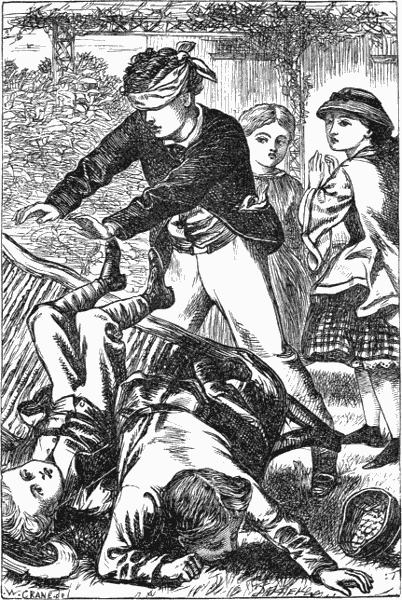
saying this, Papa very suddenly opened the
door, and Artie fell in the room, headlong,
whilst old Carlo, dressed in Celia’s spectacles
and cap, with black shawl and white apron
on, leaped over the prostrate form and sprang
to his mistress’s side.
When Artie, with face very red, rose from
the floor, he felt very much relieved to see
Papa and Aunt Emma looking much amused
at the picture Carlo presented, standing on
his hind feet, as if begging to be relieved of
his womanly attire.
“Papa, may we not take Carlo to the nursery,
to make the children laugh?” ventured
Artie.
“Yes, my boy; but the next time you
have any not very pleasant duty to do, don’t
put it off on your sister, and shield yourself
behind the door. It doesn’t look quite manly.
Indeed, to use your own, not-at-all elegant
words, ‘it looks rather spooney.’ You may
run along now.”
Through the open door the library party
heard the creeping up stairs, the suppressed
titter and the loud knock, followed by such
a screaming and scampering that the Funny
house on Funny street seemed to shake on
its very foundations. The sound of the uproar
reached Celia in the kitchen, who, armed with
toasting-fork, accompanied by Hugh with the
carving-knife, rushed to the rescue.
The fun lasted till Daisy, Artie, and the
dog were turned out by the nurses, that the
little folk might be quieted before bed-time.
CHAPTER VI.
“So many birds live in the tree,
We do not want for fun.”
Tuesday morning dawns brightly, and
Tuesday’s sun soon dries up the gravelled
garden walks and shady croquet ground
of Aunt Emma’s pleasant, roomy garden, where
the merry party of young folk are feasting,
like the bees, tasting the various cups of
pleasure which nature offers, in most tempting
freshness, to little city children in their visits
to the country.
The Funny house on Funny street, though
almost in the centre of the city’s trade and
bustle, is surrounded by a large, old-fashioned
garden, where still may be seen those grand
floral sentinels, the gay hollyhocks and the
rich golden lily, whilst their lowly companions,
the larkspur, sweet pea, and marigold still
grace the garden borders, disdaining the urns
and hanging baskets which confine their modern
sisters.
The humming-bird and the golden butterfly
still hover about this festive spot, and the fattest
of scarlet-vested robin gentry still sing
out their siren song, “Cherry ripe, cherry ripe,”
from the great cherry and old pear-trees which
have escaped the woodman’s axe.
Did you ever notice, children, how pert the
robins are in such old city gardens?
They seem to think they are indeed privileged
guests.
Aunt Emma, sitting under the shady arbor,
with its drapery of clematis and honeysuckle,
told the children that, one June morning, she
had discovered that the robins were greedily
devouring her choicest strawberries, so she
told Hugh to hang a bell on a stick planted
in the midst of the strawberry-bed, and fasten
to it a long cord which should reach to her
sitting-room window.
The next morning she laughed to herself
as she heard the “Cherry ripe, cherry ripe,” of
the early morning pillagers, saying—
“Ha, ha! my gay visitors. For your naughtiness
you shall lose your dainty breakfast.
Stealing my finest berries without so much as
‘By your leave, ma’am.’”
Presently a whole flock of birdies descended
upon the bed.
“‘Tinkle, tinkle,’ sounded the bell, and then
such a fluttering of wings and spreading out
of scarlet vests, and away flew the frightened
birdies, far out of sound and sight of bells and
berries.
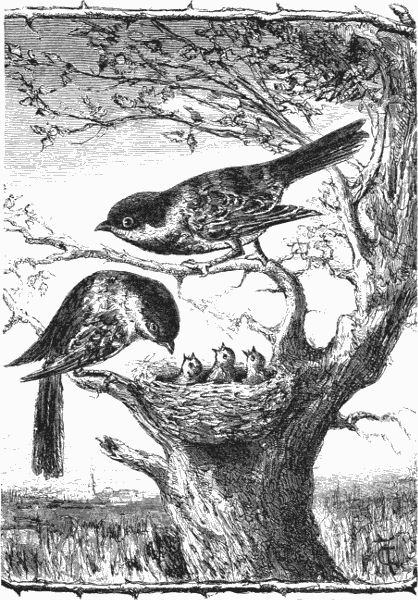
Robin’s Nest in the Old Pear-tree. Page 89.
“I was quite satisfied with my plan,” continued
Aunt Emma, “and the next morning
seated myself with my work at my window.
“‘Cherry ripe, cherry ripe,’ sounded out
their notes, but I fancied less boldly this time.
The bell tinkled, and away flew my gay visitors,
but this time they perched themselves on
the old pear-tree, and chirped and twittered
loudly, evidently complaining of their treatment,
and studying, from their high perches, their enemy’s
ground.
“I told my tale triumphantly to some of my
friends, and the next morning they came to
visit me and see the fun themselves.
“‘Cherry ripe, cherry ripe,’ sounded out
loud and clear, and oh! what a bevy of birds
had come for the morning’s visit!
“‘Tinkle, tinkle, tinkle,’ sounded the bell,
and would you believe it? The knowing birds
turned toward the window, bobbed their saucy
heads at me, and went on helping themselves
with easy manners indeed.
“‘Tinkle, tinkle, tinkle, tinkle, tinkle,’ pealed
the bell, and again the saucy fellows dived and
dodged, winked and blinked their little bright
eyes, and nodded ‘It’s all right.’
“I was completely conquered; so now I let
them take their breakfast first, and then I feast
on what they leave behind. Very often I find
marks of their little beaks in the ruddiest berries
on my plate, but they, in return, cheer me
with their fullest, choicest notes, give life and
brightness to my quiet garden, and guard my
young plants from the ravages of devouring
insects, and attract other birds, with their
richer notes, to their banqueting spot.”
“Aunt Emma,” said Artie, “do you think
those little thieving fellows knew you?”
“Indeed, I flatter myself, Artie, that they
consider me their best friend. There is
scarcely a morning, from the time when the
last snow-flakes of Winter melt away, that
some one or more of these gay fellows do
not come to the window-sill of my sewing-room,
chirp about me, and tell a long story
of joy or grievance. Sometimes I fancy it’s
a complaint of some fickle Jenny Wren who
has left her true love for a gay English
Sparrow, and again another has won for his
mate a saucy Mattie Martin, and comes to
me for my best wishes and the promise of
my ends of thread and bits of wool to furnish
the snug little home he is going to build
for his little bride, up in the branches of my
apple tree.”
“And does they tell you of the poor little
Cock Robin that the naughty Sparrow
killed with his bow-arrow?” questioned Rosie.
“I will tell you, Pet, if you are not already
tired of my stories, a tale something
like your Cock Robin.”
“Oh, do, do, please, Auntie, we’d never
be tired of stories;” and the children stowed
themselves in a little heap on the grass, at
their Auntie’s feet, leaned their elbows on
their knees, and rested their chubby cheeks
on their hands, ready for any given quantity
of tales.
“One day,” continued Aunt Emma, “having
a bad headache, I sat in the part of my
room farthest from the window, to be away
from the light. Presently I heard a mournful
sort of song, which soon became quite
pitiful, and then came a quick, sharp pecking
at my window-pane. I could not resist
that appeal, and as I opened my window a
Robin flew quickly in, fluttered in circles
over my head, uttering pitiful cries. I followed
him out into the garden till, near the
old apple-tree, he disappeared under a bush.
Carefully putting aside, with my hands, the
leaves and branches, I found a poor, tiny,
half-dressed Robin baby, uttering such little,
sick, feeble peeps, I seem to hear them now.
I think from the twinkle I afterward used to
see in his eyes, that he was rather an adventurous
young spirit, and very likely his
Papa was a widower, for I never saw but
the one parent.
“I fancy Papa Robin had gone out that
morning to do the day’s marketing, after
charging the younglings to stay quietly at
home, and this daring little spirit had taken
advantage of his absence to step out on
their balcony and see the world for himself;
then he must have become giddy and fallen
under the rose-bush, where his Papa had
found him, and not knowing what to do
with his wee, wounded birdie, had flown to
tell me his trouble.”
“Oh! Auntie, what did you do with the
poor little thing?” cried tender-hearted Daisy.
“I made a soft cotton bed for it, in a little
basket, and put it on a chair near my window,
in the sun, then fed it crumbs of bread
wet with wine.”
“Did it live, Auntie, dear?”
“Yes, children; and now for the wonderful
part of my story. Every morning the parent
bird used to make a visit, bringing in his
beak to his sick birdie, a bit of caterpillar, a
juicy worm, or a ripe berry. I grew very
fond of my pet, and that I might know it, if
at some distant day it should leave me, I
wound a bit of silver wire about its leg.
Birdie grew stronger and saucier, and its peep
fuller every day. At last one bright morning—you
may imagine my surprise—on entering
the little sewing-room, to find my pet
gone; and as I thrust my head out of the
window, a loud burst of glad song, from the
top of the old apple-tree, told me that birdie
was—
“Safe, safe, at home.”
“Did you ever see the bird again, Auntie?”
“One morning, weeks afterward, I was in
my usual place, and suddenly a bird appeared,
from whose tiny leg dangled my thread of
silver wire; lower and lower he descended
without uttering a note, then something dropped
upon the window-sill, and judge of my surprise,
to find the very ruby ring I had lost
in the garden some days before. I had mourned
its loss, for it had been given me by your
Papa’s own dear Mamma, on my tenth birthday.
I had, for years, worn it on my watch-chain,
and lost it whilst planting some seeds,
as I supposed, in the mignonette bed. It
might have been that the saucy robins had
watched me, as I stowed away my seeds,
winking their little eyes and bobbing their
round heads as they marked their larder for
the morrow. What a surprise to them, when,
instead of a tiny seed, this bright jewel appeared.
Some time after this, in my garden-walks,
I found a few red and yellow feathers,
a bird’s claw, and a bit of silver wire, which
told the sad tale that my pet had been sacrificed
by a strange cat.
“My story is ended. You have been patient
little listeners for a full half hour, so, run
away, dears, for a morning play.”
The merry children hasten off to welcome
their little friend Charlie Leonard, who was
coming to spend the day with them.
CHAPTER VII.
“How the heart of childhood dances,
Upon a sunny day!
It has its own romances,
And a wide, wild world have they!”
“Hallo! Charlie boy. Come along,
here’s all kinds of fun. Shall we
have blind-man’s-buff on the grass-plat, or
will you play croquet with Daisy and me?”
“No, no, Charlie,” sounded Rosie’s beseeching
tones, “come and help me gather mullein-leaves
for dollies’ blankets, and these cunning
pot-cheeses to play store with. See, Celia
has lent her for-true scales. Only look! and
Hugh has given us four cents and two ginger-snaps
that weigh a pound.”
“I want Charlie to come help me chase
those darling little yellow butterflies that’s
‘gathering honey from the opening flower’ to
make butter of,” screamed Jack.
“Oh, Artie, just listen to that child,” said
Daisy. “His mind is all askew. He’s talking
about making butter of honey.”
“I guess the little chap remembers how
the buckwheat cakes and honey made the
butterfly last winter,” replied the Keeper, as
he gave a most satisfactory send through the
second wicket.
“Will you just listen to that, Charlotte?” said
Nan, who, under the old pear-tree’s shade,
was helping take out grass-stains from the
dainty city linen.
“I tell you I never did see such sense in children
in my born days. Just you wait till I run
and tell Hugh and my mother ’fore it slips.”
Nan found ready listeners in the kitchen,
for old Celia laid aside her soap and sand—Hugh
ceased his psalm-singing, with knife-scraping
accompaniment, and stood with knife
and cork in either hand, and mouth and eyes
opened wide to take in the “uncommon sense
of Mister John’s wonderful children.”
“Well, now! only look at that, will ye?”
“Only jest to hear, if that ain’t Mister
John his werry self—Oh, my! It appears to
me, Nan, them childerns will be the werry
death of me yet. What with peerin’ and listenin’
and laughin’, my work’s all in the drags.
The werry pots and kettles seem just turnin’
into boys and girls. Oh, my! Oh, my! I
say, you Nan, just go long, and if you come
this yer way tellin’ any more about them childerns’
perform, I’ll harpoon you with the toasting
fork,—so off with you.”
Nan hurried back to the grass-stains, only
looking once over her shoulder to find her
mother and Hugh “peerin’” stealthily from behind
the porch, to catch, if possible, a few more
crumbs from the children’s table; but,
dutiful daughter as she was, she didn’t look
again, but wider and wider stretched her
mouth, brighter shone its ivory gems, and
louder sounded out her clear, rich notes, while
she sang—
“Carry me back to old Virginny,
To old Virginny’s shore,”
as she renewed her zeal in the cause of grass-stain
cleaning, which was just now bringing
wrinkles to Charlotte’s anxious brow, which
was ever like a page in a school-mistress’s report-book.
There were wrinkles small, which
meant grass-stains, bumps, rents, and childish
disputes; there were wrinkles many, which told
of mischief wrought; but these were soon dispelled.
There were deeper ones which told of
graver faults,—disobedience or falsehood, and
others like them, which days of anxious watching
and fears of future ills had left, which could
be effaced only by His hand who can truly—
“Smooth the troubled brow,
And drive away our fears.”
Little Bear, in the meantime, was finding
pleasant pastime in making larkspur wreaths
and dandelion curls for his little sister’s “store,”
whilst he kept an eye on Artie’s successful
game, only wishing—
“It might have been,
His favorite Daisy’s lot to win,”
and pitying her, as her brother sent her balls
flying to remotest parts of the garden, to be
hunted out from behind currant and gooseberry
bushes’ thick shade.
It was a great pleasure to this little feeble
city boy, with the love of the beautiful in Nature,
which so often accompanies weakness of
limb, to lie back on the cushions spread by his
careful nurses under the old apple-tree’s shade,
and drink in all the beauties of the scene.
Like a picture-gallery seemed the quaint
garden, as, looking upward, between the opening
in the leafy roof above, he caught glimpses
of the blue sky, and his eye followed the
islets of fleecy clouds in their fleeting passage.
The thick, grassy carpet at his feet brought
out, in all their brightness, the colors of the
golden lily and the many-tinted ladyslippers
which formed borders to the broad grass-plots.
Butterflies, golden and russet-brown, were flitting
all around him, whilst robins and bluebirds,
from their air-swung perches, sang sweetly
their morning hymns, and from the earth beneath,
locusts and tiny crickets joined the glad
chorus.
How true it is that our Father in Heaven
has given a voice to every thing in Nature to
praise and tell of His great Love! Can
you wonder that this little feeble child, unable
to join in the careless play of the merry group,
taught by a Christian mother that God was all
about and around him, should seem to hear
His voice speaking in the beauty of the scene,
and gently folding his thin, white hands, should
sing, in low, sweet notes, the Morning Hymn?
“Now the dreary night is done,
Comes again the glorious Sun:
Crimson clouds and silver-white,
Wait upon his breaking light.
“Glistening in their garden beds,
Flowers lift up their dewy heads,
And the shrill cock claps his wings,
And the merry lark upsprings.
“Child of Mary! Thou dost know
What of danger, joy, or woe
Shall to-day my portion be,
Let me meet it all in Thee.
“Fretful feeling, passion, pride,
Never did with Thee abide:
Make me watch myself to-day,
That they lead me not astray.”
Lulled by the soft music of his own notes,
little Bear closes his heavy eyelids; the crickets
lend their aid to sing his lullaby, while soft
zephyrs whisper in his ears themes for sweetest,
purest dreams.
Daisy’s watchful ear missed the murmured
song, and her quick eye saw the little sleeper
under his leafy canopy,—so she slips away from
the merry game of blind-man’s-buff, which had
taken the place of croquet, and hastes to
mount guard over her precious charge, and
wage war against the persistent flies, whose
chief delight seems to be tickling the faces of
summer sleepers.
Pretty soon Jack appears with rather a rueful
face, for the merry game of blind-man’s-buff
has ended in his and Charlie’s tumbling headlong
over one of the garden-seats, in their haste
to get away from the blind man, and poor
Jack’s head has made the acquaintance of a stone
which has proved anything but soft.
A Grave Ending to a Gay Game. Page 106.
Daisy could not find it in her heart to
laugh at the funny little picture her wounded
brother presented. His sailor straw hat had
come to grief in the fall, and from between the
parted straws, hung out tufts of fair, tangled
hair, buttons had flown away, and a wide crack,
in the seat of his short pants, revealed a hanging
of gauze drapery; but oh, the face! It was a
kind of Mosaic pattern of grass, fruit, and dust-stains,
all blended together by the few tears
which would run down in spite of the efforts of
the little dusty hand to keep them back.
Jack’s sobs ceased as he caught sight of his
sleeping brother, and thoughts of aching head
and scratched knees, left him, as a childish
fancy sprang to his mind.
“Oh, Daisy, isn’t he just like babes in the
woods? Childerns, let’s ’spose we cover him up
with leaves.”
Rosie and Charlie think it would be “lovely,”
and off they scamper to gather leaves and
flowers, whilst Sister Daisy drops them over
the sleeping child, and weaves a little wreath
to rest on his pale brow, and Rosie runs to
the kitchen to ask Celia and Hugh to come
to see “The butifullest picture that ever was,”
and wonders why Hugh turns quickly back,
and Celia’s apron finds tears in the kindly eyes
as she murmurs out her—
“Blessings on the angel boy,”
then sobs aloud as Charley Leonard whispers,
“But Celia, don’t you know angels have
wings?”
To the merry children, the picture of their
sleeping brother, on the flower-decked couch,
has only beauty and brightness, as they check
their merry tones and gather around in silent
admiration.
Presently Artie whispers:
“Oh, wouldn’t it be fun to spread out a
little feast by his side, so when he wakes up
he may think the Fairies have truly visited
him? I say, Daisy Duck, let’s do it.”
“It’s just the very thing. Oh, Artie boy!
however could you have thought of such a
nice idea?”
A rustic table was soon made of a box
nicely covered with a snow-white towel. Then
each child brought a contribution of currants,
gooseberries, or strawberries, for which Daisy
made pretty, leafy baskets, then ran to beg
good Delia for a very little white sugar, for
Fairies liked their berries powdered nicely.
What a surprise for Daisy!
Out of the grim oven’s mouth, that same
Celia was drawing a pan of the weest cookies,
dainty enough for any fairy cook-shop,
with the “lovely bit of citron on top” to
take away the plainness and look like a real
tea-party dish.
Daisy couldn’t speak for very joy, as
Celia stowed the inviting morsels on a plate
hidden by grape leaves, and filled a glass
with powdered sugar for “fairy snow,” while
Hugh, who had disappeared a few moments
before, suddenly stood before the delighted
child with a package of fresh barley sticks
and a paper of peppermint hearts, which he
said, in his judgment,—
“Wouldn’t hurt nobody nohow, and was
just a set-off ’gainst that sour fruit.”
Then Hugh took pity on Daisy, as the
little maid stood “embarrassed by her riches,”
and offered to carry out the cakes, following
soon after with a little salver bearing a pitcher
of golden milk and six tiny glasses.
The excitement was now intense. Poor
Jack, ignorant of the view in his rear, attempted
his heels-over-head antics, but was
prudently pinioned by the Keeper. Daisy
holds tight hold of Charlie Leonard, whilst
Rosie ran and kissed the skirt of Hugh’s
linen coat to relieve herself of some of her
pent-up feeling.
Then came the trying time. The fairies
were all ready, but the little guest still slept.
The gentle zephyrs were teasing the leafy
decorations to fly away and sport with them.
The summer flies seemed to think the Fairy
elves had placed the golden milk for their
refreshment, and who could guard the feast?
The waking guest must see no trace of human
form, so the children have hidden behind
the tall lilac’s leafy screen.
The Children Hide Behind the Lilac Bush. Page 111.
Was there ever such a five minutes?
Was there ever such a sleeper?
Jack, knowing his own weakness, is cramming
his mouth with grass-tufts; Rosie has
clapped both hands over hers to keep back
the ringing laugh.
What a little picture! The merriment
oozes out of the corners of the pent-up
mouth, dances in the bright blue eyes, shimmers
in the shaking golden curls, and quivers
in the chubby shoulders.
Charlie Leonard is repeating
“Old Mother Hubbard went to her cupboard,”
the only feather from his worn-out Mother
Goose which “sticks” in his memory, and
poor Artie, yielding to the temptations of
the idle hour, is just about to tickle the
sleeper’s nostrils with a grassy “horsetail,”
when the Family Owl, who sees by day as
well as by night, spies out his sly intent in
time to check the roguish act.
Perhaps it was the good-natured little
“scuffle” which ensued, or perhaps the sportive
zephyrs were too loudly coaxing the
leafy covers, or perhaps the greedy flies
might have followed Artie’s bad example, and
having no good elder sister-fly to call them
off, might have tickled the little quivering
nostrils, and made a play-ground of the fair,
dewy brow; whichever or whatever the cause,
we cannot tell. Elf-land secrets are not written
on printed page, and we have no time
to seek them from tiny flower petals, murmuring
brooklets, or transparent dewdrops.
Slowly, but surely, Bear at last came out
of Dreamland, to the children’s great delight,
and, oh, how they enjoyed his bewilderment,
the questioning look, the pleasure his face
showed as, little by little, the true state of
things dawned upon his waking mind, as the
little Fairies took the forms of loving brothers,
sisters, and friend!
How he laughed out as he caught sight of
Rosie’s pink skirt shining among the green
branches of the old lilac bush! The little human
fairies joined hands and danced a wild,
elfin dance around the tardy guest, then seated
themselves to enjoy with him the fairy feast.
CHAPTER VIII.
“And when they next do go abroad,
May I be there to see.”
It is four o’clock, and a lively scene is taking
place before the Funny house on
Funny street. The roomy carriage, drawn up
before the door, is being packed by Papa,
whilst Hugh stands at his horses’ heads, whispering
lessons of patience.
A nurse, a coachman, four boys, two girls,
three dolls, a bundle of wraps, and a large
basket! Who ever saw such a load for a
pleasure drive? What would Fifth avenue
think of such a turn out? Why, the very
carriage-sides creak out their remonstrance,
and Jerry horse whispers to Fash, “to turn
his head, and did he ever see the like?” and
Fashion answers “Neigh.”
Hugh gathers up his reins and seizes his
whip, whilst Papa helps Aunt Emma into a
light carriage waiting near.
At the door stands Celia, watching to see
that no stray foot finds its way into the depths
of that basket, whose contents none knew better
than she, whilst Nan looks wistfully on.
Suddenly Papa calls out:
“Nan, could you put on your bonnet in
three seconds, and stow yourself in the cracks
between the Monkeys?” then turning to his
companion, says,—
“Beg pardon, Auntie, for interfering with
your servants, but, really, I could not withstand
the wistful looks in the face of my dark old
playmate.”
“It is just what I was wishing, John, but
I confess I couldn’t see the possible crack.”
“Nor I, Auntie; but I have full faith in
the old saying, ‘There’s always room for one
more,’ and Nan will be sure to find it.”
How ever that Nan got up to her attic
nest, donned her best sack and bonnet, and
was out in that carriage before Papa’s watch
told the third second past,
“Nor you, nor I, nor nobody’ll know;”
perhaps the old creaking garret stairs had a
slight idea, but they will be sure to keep
dark.
Then the reins were fairly tightened.
Hugh’s long lash made a great circle in the
air, ending in a terrific crack, and off started
the merry, noisy party. Surely such a load
did never coach convey since the ride of
“My sister and my sister’s child,
Myself and children three,”
when the coach was a chaise and Gilpin John,
on frantic steed, vainly tried to follow.
My young reader, do you know anything
about the Providence hill-side streets?
If you do, you will not wonder that Bear
winced, Charlotte “oh, oh’d,” the Monkeys
screamed, and Artie’s “Pshaw! don’t be foolish,”
from the coachman’s box, had a little bit
of a quaver in it.
Poor old Roger Williams! your weary
spirit is at rest! There’s no more up-hill work
for you, but in the steep hill-sides your descendants
must daily climb, they may find fitting
emblem of your life-work here below.
It was a great relief to Charlotte and her
bairns, to see the horses’ heads turned into the
pleasant, level Prospect street, with its veteran
college buildings, so severely respectable and
yet so very shabby, which arrested Artie’s attention,
and prompted him to call out:
“Papa, what sort of a manufactory is this
one on our right?”
“For making brains, my boy.”
“But where, sir, is the engine kept?”
Papa points with his whip toward a pretty
house on the corner.
“But I see no smoke.”
“No, my son; during the Summer months
the steam-engine and the firemen rest.”
The trembling of the coachman’s box causes
Artie to look up at his companion’s face, and
there learns from the glittering ivories that he
is a victim to one of Papa’s jokes.
Now it is a very curious fact, that young
folk, yea, and old folk too, who are very fond
of “quizzing” others, seldom like the ball returned;
and so Master Artie refrained from
further questions, and cast a stealthy glance
behind to see if
“That little Leonard chap knew he had
been quizzed;” but the little “chap” is busy
whispering to the Monkeys:
“I do believe Aunt Emma is going to surprise
us all by a visit to the old Brown Farm,
with its cows, and pigs, and chickens, and old
Poll the Parrot, and the kind Grandma that
gives children berries and milk out under a
big, big tree. Now be sure,” he adds, “you
are surprised, ’cause if you are not, Aunt
Emma will be disappointed, and, after all, Jack,
you needn’t say ‘Goody, goody,’ for like as
not I don’t know anything about it, and we are
going to the Asylum, or somewhere another.”
“Charlie, if we do go to the Brown Farm,
will we be sure to see Silly-chick and the old
Portulak that bit off the little Singing Bird’s
head, ’cause it didn’t know manners?”
“Daisy, what is the little fellow talking
about? He speaks so fast I can’t know
what he means.”
“Why, he thinks, Charlie, that everything
in Artie’s Wonder Book is true and for fair,
like you believe your Mother Goose.”
“Oh, but Daisy, Mother Goose is real
for fair. I have seen her at a party, and
the very ‘old woman that lived in her shoe
and had the many children;’ there they
were, sure enough, Daisy, for one of them,
who was peeping out of the bursted toe of
the shoe, was eating bread and butter, and
winked his eye at me, and another little fellow
sneezed and seemed to have a dreadful
cold in his head. What was that but sure-enough-alive,
I should like to know?”
“But, Charlie,” Daisy reasoned, “don’t you
know that was a tableau-party, and they were
playing ‘The Old Woman in her Shoe?’”
“Well, perhaps it was; only I believe
Mother Goose was real-for-fair. Why, Daisy,
don’t you know Auntie’s picture of your
father that hangs in the dining-room? Well,
isn’t he sure-enough-alive, I should like to
know?”
“Oh, but Charlie,” remonstrated little Jack,
“you ought to believe my sister Daisy.
Papa says it isn’t nice manners to conterdict
a lady, and ’sides that, my Daisy ought
to know, for she studies French and definitions.”
Where this hot little dispute would have
ended, is not very clear, for Charlie was always
loath to be convinced against his will,
and the Owl had no idea of having her superior
wisdom questioned by a youngling,
but just then a sudden jolt, as the carriage-wheel
passed over a stone, caused a scream
of fright from the little Monkeys, and Mother
Goose, Singing Bird, and ugly Portulak,
were all forgotten as the young city folk
gazed admiringly at the country landscape
before them.
A few moments before, they had seen
blocks of houses, and pretty villas, with their
well-kept lawns, bright with midsummer glories,
whilst pillars of cloudy smoke loomed up
from the many manufactories in the distance.
Now they are travelling at quick pace
along the smoothest of roads. Meadows of
deepest green, gemmed with gay dandelions
and wild daisies, with a background of woodland,
are hemmed in by old fences, whose
defects are changed to beauties by the Eglantine
and Grape-vines which cling about
them.
Behind these draped old fences graze gay
goats, ungainly young colts, with their bright
eyes and long stilty legs; and little calves,
with their sweet “June breath” and shaggy
coats, who spring up to greet the travellers,
and follow them to the full extent of their tether.
Hugh’s gentle horses drink in refreshment
from the pure country air, whose perfumes
whisper to them of abundant pastures and well-filled
barns, while their pricked ears and quivering
nostrils give promise of a breezy pace,
very different from their languid walk through
the heated city streets.
A few moments later, and the merry party
near that bit of woody road, the joy and pride
of every true Nature-loving inhabitant of Providence.
Do you know it, young reader? No? Well,
then, there’s room for one more, for omnibuses,
and Narragansett Bay excursion boats have
clearly proved to the public that “two or more
bodies can occupy the same space at the same
time,” whatever your Natural Philosophy may
have to say to the contrary; so jump into the
old carriage, and by force of imagination, stow
yourself away in one of the “cracks.”
We are just turning an unexpected corner,
and now we find ourselves suddenly transported
from the unshaded road, into a long woody aisle
where the interlacing branches of the trees on
either side form a high leafy arch, through
which, only rarely, you can gain a peep at
the sky above.
The busy world is all shut out here. There
is nothing to tell of ceaseless labor and sordid
gain. Only Nature’s voice speaks.
The damp, cool air, the woody smell; the
rustling of branches, the quivering of leaves,
the trickling of the little rills in the distance,
the noiseless flitter of the yellow butterfly, the
katydid’s ceaseless chatter, and the broad, cool
surfaces of the glorious ferns, reflecting the
rare bits of sunlight which pierce through the
dense arch above, all contribute to the delicious
feeling of repose and refreshment which
steal over languid city folk, tarrying in this
grateful shade.
This woody aisle reëchoes many times a day
with the prattle of childhood and the silvery
laugh of light-hearted youth; but, ah! there is
rarely a day that it does not reëcho, too, the
heavy tread of funeral coach and the mourners’
quivering sob, as through the sweet quiet of this
woodland road, they bear their dearly loved to
the “City of the Dead,” that lies just beyond.
Sometimes it seems as if this quiet woody
road must whisper words of soothing to those
aching hearts, and that the glimpses, they sometimes
catch, of a bright sun behind the leafy
screen, must bring, to faithful hearts, thoughts
of “the Sun of Righteousness with healing in
its beams,” which, ere long, will in mercy dispel
the mists of sadness and shine into their
aching hearts.
The little spot of light, so scarcely seen, at
the far-away end of the leafy corridor, grows
wider with each advancing rod, and soon, with a
shout of joy, the spell-bound children hail the
blue sky and the smooth, light road before them.
Another turn in the road, and Charlie Leonard
cries out—
“Oh, I smell my fun, I smell my fun!
Hoorah! Hoorah! Oh, thank you, Miss kind
Aunt Emma!”
Swinging Under the Old Elm. Page 127.
Such a hurrahing, hat-waving, and hand-clapping
as went up from that Menagerie van,
as the hospitable old gates swung out their
giant arms to welcome the noisy party to the
“old Brown Farm,” Papa’s young Paradise,—the
theme of many a thrice-told nursery tale.
The horses, too, “smell their fun,” as they
plunge through the open gateway, and, halting
under an elm-tree’s shade, bend their
glistening necks to seek the sweet morsels at
their feet.
Papa looks almost a “boy again,” as with
bright, glistening eyes he unpacks and deposits
on the soft turf the “two girls, two nurses,
three boys, and two dolls.”
Just one minute to straighten out the
cramped limbs, one minute of oh! oh! ohing at
the gigantic size and wonderful beauty of “the
Old Elm” of the “old, old story,” and then
Charlie Leonard, whose frequent visits here
with Aunt Emma, in her quest of cream and
butter, have made him quite at home, gives the
marching order, and away fly the “two girls and
three boys,” with nurses in the rear, first to
the old well, for a drink from the very same
“Moss-covered bucket,”
their Papa had so often uplifted in the days
of his boyish thirst,—then for a few high
swings to explore the elm’s upper stories,—and
then another flutter, and away they all
flew, like a flock of chattering magpies, to find
out for themselves the beauties and pleasures
of the
“Old Brown Farm.”
CHAPTER IX.
“A sunshiny world, full of laughter and pleasure.”
“Oh, Auntie dear, isn’t this most like
Heaven,” breaks out little Bear, lying
by his Auntie’s side, on soft cushions, under
the great Elm’s leafy canopy, drinking in the
soft country air, laden with the sweet perfume
it steals from the meadows and woodlands
it journeys through, whilst his blue eyes glisten
with delight at the prospect before him.
The softest of blue skies was varied by
piled-up masses of fleecy clouds; fields of
young corn waved their shining green leaves
in answer to the balmy zephyr’s greeting,
whilst in the distant meadows hay-makers
tossed about their light load to the music of
the mower’s wheels.
At the right stood the quaint old farm-house,
with its festoons of trumpet and honeysuckle
vine, and its gay setting of lady-slippers
and marigold, interspersed with the housewifely
marjoram and balsam.
Papa, standing on the old porch, waiting for
an answer to the huge lion’s paw, which serves
as knocker, sees with pleasure the same old
grindstone he used so proudly to turn in his
childhood,—the long tell-tale array of shining
milk-pans hung upon the picket-fence, looking
quite the same, but Juba, the sportive companion
of those boyish days, lies basking in the sun,
snapping maliciously at the teasing flies and
eying the visitor with suspicious glance.
“Juba, old fellow, have you forgotten me?
Can’t you give an old playfellow a better welcome
than this?”
Was it something in the ring of the manly
voice which sounded familiar to the old dog’s
ears, or was it the hospitality and courtesy of a
well-bred old family servant that led Juba, once
so frolicsome and lithe, slowly to rear up his
heavy, rheumatic body, and languidly crawl along
to reply to the friendly salutation?
“Juba, poor old fellow,” said papa, kindly
patting the dog’s head, “are you and I indeed so
old? Come, good doggie, and see my little boy.
Don’t be afraid, darling, this is the very same
Juba that pulled your papa out of the duck-pond
yonder, where he had fallen in, whilst ‘paddling
his own canoe.’”
The stiff old doggie responded kindly to
Bear’s caresses, and to the child’s great delight,
immediately crouched at his side, whilst papa,
discouraged by his efforts with the old knocker,
which never before had failed to procure for him
a warm welcome, sat down by his side.
“Papa, will you please tell me again about
the tree?”
“Yes, my son. It is more than a hundred years
old, and was planted, when a little sapling, by
one of the old inhabitants who gave to the farm
its name. There is the date, on the old board
fastened on the body of the tree. You see how
those grand old branches touch the ground on
all sides?
“This tree casts a shadow of one hundred
feet. What stories, Auntie, it could tell of those
who have sported under its shade, now old men
and women! The young lovers of old now bring
their children and grandchildren to feast here on
the fruits, which to them have lost their sweetness.
How many times those huge old furniture
wagons have halted here, and deposited
their burden of merry boys and girls for their
yearly “school feast of berries and cream!”
“Papa, are there any more such trees in the
world so large as this elm?”
“Oh! yes, my son, even very near Providence,
in a little village called Johnston, there is one
much larger; indeed, I think it is the largest in
the country. A small house could be placed in
the body very easily. Then, in California, I have
seen cedar trees, whose trunks were so enormous
that they were used as dancing halls.
Fancy, Harry, how it must seem to be dancing to
merry music in a huge room within a tree!
There is one tree which has a world-wide reputation—the
English have named it Wellingtonia—after
your favorite Duke, but we Americans
claim for it the name of Washingtonia. The
Californians are justly proud of this old patriarch,
and well they may be. Think of its being high
as Trinity steeple, and a thousand years old!”
“But, Papa, how can anybody tell how old a
tree is?—there are no people a thousand years
old to tell when it was planted.”
“No, dear boy, but God tells us in this way.
Have you never noticed in a piece of wood—but
here is one just at hand. Do you see those
different rings?”
“Yes, papa.”
“Well, Harry, each of those rings show the
growth of the tree during one year; for each year
a new ring or layer of wood and a ring of bark is
formed.”
“But, papa, I only see one bark!”
“Yes, my boy, as the new wood and bark is
formed the old bark is pushed further out to
make room for the ring, and soon the old bark
sheds its coat; that is, part of its skin drops off.”
Papa’s tree talk was just then interrupted by
a merry shout from the hay-field, and poor Bear
looked up so wistfully, yet patiently, in his
father’s face, that he said,—
“Dear boy, you would so like to join them.
It seems cruel to keep you here.”
“Oh! no, Papa, I don’t so much mind. It’s so
sweet and beautiful here, and the wind blows so
soft on my forehead, it seems as if it was God’s
breath. No, I really don’t mind much, and sister
Daisy will tell me all about it. Oh, Papa, you
don’t know about Daisy! Every night, after I
go to bed, she comes and sits by my side till I
am asleep, so I won’t miss Mamma, and she
smooths my hair and says softly in my ear,
‘Daisy’s own little comfort,’ and then, somehow,
my back doesn’t seem to ache, and I go straight
to sleep, and just to think of it, she hasn’t said
‘I told you so,’ not one single time! Oh, Papa!
our Daisy is so kindly affectioned one to another.
Why, there’s Hugh hurrying back from the field.
What can the matter be?”
“Mr. John, can I speak a moment alone with
you?”
“Certainly, Hugh.”
“Well, sir, Nan is going on like she was mad,
to have Master Harry down yon in the hay-field
with the children. Cried like a baby she did, one
spell, to think the poor little fellow was missing
such fun, and that set the children off, and
they’ve give me no peace till I said ‘I’d see what
could be done,’ and then Farmer Brown came
along and says he—
“‘Did you say, Hugh Crummell, those
youngsters belonged to Mr. Havens? You
can’t mean our master, John Havens?’
“‘The very same,’ says I. ‘Came on
last Saturday from New York.’
“‘Now I want to know,’ says he. ‘I
can’t leave my team, and my folk have gone
to town for a few notions ’gainst the Fourth,
but they’ll be along shortly; now if you’ll
just go to the further barn you’ll find Old
Meg, the lightest steppin’, gentlest old mare
ever you laid eyes on. We set great store
by our old Meg, we do, wife and me. Do
you mind, Hugh, now him that’s gone, and
Meg, was like colts together. Ah! ah! ah!
Well, just take the old creeter, and put the
little sick youngling on the saddle, and I
give you my word for it, old Meg has that
sense she’ll steer clear off from every stone
to spare jolting the bairnie, and if you’d just
say to Master John as I ain’t able to leave
my team, but if he wouldn’t mind stepping
across here, I’d gin him the heartiest grip
these old horny hands could wring out, and
show him as pretty a piece of meadow-land
as he’ll see this side of York State; and
Hugh,’ he called out, ‘bear my manners to
Miss Emma, and tell her our folks will never
forgive, if I don’t prevail on her to stay and
take a dish of tea with us, and say I should
admire to have her look at us down here.’”
“That’s a capital idea of good Farmer
Brown’s, Hugh, so trot out old Meg, and my
patient little boy shall ride off in fine style,
and visit all the old farm’s nooks and corners.”
Little Bear could scarcely believe his own
eyes when Hugh appeared, leading with great
delight the dapple-flanked, mild-eyed old Meg,
the farmer’s pride; and when he learned that
on the gentle horse’s back, with Papa and
Hugh on either side, he was to make the tour
of the old Brown Farm, and visit his sisters
and brothers in the hay-field, his cup of
happiness was brimming. Dear little fellow!
Big tears of joy stood in his eyes and rolled
down his thin cheeks, now flushed with pleasure,
as proudly gathering up the reins he
bent over and whispered to his father,—
“Oh, if only dear Mamma could see me
now! But you’ll write it all to her, Papa,
won’t you?”
Papa assented, and off started the party;
and very difficult would it have been to have
told which of the three was the happiest.
Meg’s careful pace was directed first to the
hay-field, where the little cavalier was met
with a glad, noisy welcome from the young
haymakers, and Meg’s smooth sides patted
gently for her kind office, then the sport began;
and little Bear almost tumbled off his
steed’s back with laughter, to see the Monkeys
slowly rising from under the huge pile of hay
Artie and Charlie had thrown upon them.
Like young porcupines they looked, with the
straws sticking upon them in all directions,
and such heads of hair! Poor, poor Charlotte,
what work for you in the next toilette!
Then Papa headed the procession and introduced
them, one by one, to old Farmer
Brown, and the old man wrung Master John’s
hand, and laughed till the tears would come,
and then the old red-stained handkerchief
must.
The orchards next must be visited, the old
Rhode Island greening, from whose branches
Papa fell and broke his arm, when climbing
up to count the eggs in a Bluebird’s nest;
the old russet where his initials were plainly
to be seen; the pear-trees laden with fruit,
which as young saplings he had planted.
Then came the very same old duck-pond,
but those ducks had gone
“Where all good ducks go,”
and a most ill-bred set of fowls had taken
possession, who quacked and shook their wet
feathers in the children’s faces, in a most
offensive manner, and fairly drove them
away.
Then came the poultry-yards, where the
country geese hissed at the city goslings, and
the turkey-cocks gobbled out their doubtful
welcome, and the hens clucked the impolite
notice that it was time for younglings to go to
roost.
The barnyard was lively enough, for it was
nearly six, and the milkmaids, with their shining
buckets, are drawing streams of milk from
the patient, mild-eyed cows. Sorry am I to
say that a sad thing occurred here, for Artie
was tempted to tickle, with a long straw, the
quivering nostrils of Brindle, who, supposing
the milkpail had something to do with the
affront, gave a sudden kick, which threw over
milkmaid, stool, and half-filled bucket. Artie
turned whiter than the milk itself, when he
saw the mischief he had done, and flushed
again as he met Papa’s serious gaze. How
different the Brown Farm looked through the
misty eyes as Papa began:
“I am ashamed of you, my son. Instantly
pick up that pail and apologize for
your unpardonable mischief. I repeat that I
am ashamed of you.”
It was rather hard for the Keeper to
ask the milkmaid’s pardon before Charlie
Leonard and his young brothers and sisters,
but Papa’s will was law, and besides, the boy
was already heartily ashamed of himself, and
distressed at the trouble he had caused, so
he made his apology in so earnest a manner
that the tender heart of the milkmaid was
touched, and she heartily forgave him, and assured
him, with Irish warmth,—
“That he was a rale little jintleman, and
’twas Brindle as ought to ax the pardon, as
had been tached kicking was not genteel for
his likes.”
Aunt Emma remained sitting under the
“Elm,” for she had caught a glimpse of the
old Brown carryall coming up the road, and
wanted to prepare Mrs. Brown for the surprise
which awaited her.
The carryall stopped at the side-door of
the carriage, and Mrs. Brown and Norah,
her “help,” descended, and proceeded to unpack
their city purchases; then, as Norah
led off the horse to the barn, the good
farmer’s wife, for the first time, discovered
Aunt Emma coming to meet her.
The kindly round face, with its crown of
silver locks, grew radiant with delight, as, with
both hands extended, she hasted to greet
her guest.
“Well, now, I want to know! However
did you get here, Miss Emma, and not a living
soul to meet you and say a word of welcome?
Please just step into my cool parlor, and I’ll
have a cup of tea and a bit of somewhat to
refresh you.”
“Certainly I will go in; but, my good Mrs.
Brown, you must hear my story first. My
nephew and his four children are with me for
a week, and John’s heart was set on showing
his young folk ‘the old Brown Farm’ and
his good friends, and I thought it would be
a novelty to those city children to have
an out-of-door tea under these trees. Now,
stop, Mrs. Brown, I know what you want to
say, but you must only give us a pitcher of
your rich milk and a pot of tea, for Celia
has packed a basket. I have brought the two
women who will wait on us, so you and
your husband must take tea with us. Here
come Nan and Charlotte to set the table.”
“Well, really Miss Emma, I shall admire to
join you, and so will father, but you must let me
bring out a pan of my molasses cake that Master
John was so fond of, dear boy! I can see him
now. He’d never ask for a thing, not he, but
when he put his head of a Saturday in at my kitchen
door, I could seem to read ‘molasses cake’
in the twinkle of his eyes, and it was our joke,—his
and mine,—I would say ‘Johnnie boy, could
you worry down a bit of my molasses cake?’
“‘I’ll try, Ma’am,’ he would answer so dutiful
like, ‘and if I can’t, I’ll hide it where no human
eye can see it.’
“My poor Father, him that’s sleepin’ now in
yonder buryin’ ground, he’d be a sittin’ behind
the door, for fear of the draught, and he’d be
took with such a fit of coughin’. Don’t you see,
Miss Emma, he was one of them good Puritans,
and it’s part of their religion, bless their
dear souls, not to laugh at jokes, and so they
take to coughin’? But I’ll just stop my gossip
and put on my best sewin’ meetin’ cap with
bright ribands. These gray old locks, mayhap,
might give Mr. John a sort of far-away feelin’,
for you know, Miss Emma, before my great
sorrow came, years agone, there was ne’er a
white hair on my head. He’d a been just
two years older than Mr. John, and maybe
his own bairnies would have been sportin’
round the farm cheerin’ the old folks’ hearts.
Ah! well-a-day! We’ve had our cup of joys,
and now ’tis fittin’ we should be helpin’ put
the cup brimmin’ to the young folks’ lips. I
won’t be gone a second, Ma’am.”
CHAPTER X.
“Wee folk, old folk,
Chatting altogether.”
Aunt Emma and good Mrs. Brown sat
in the cool cottage parlor talking, when,
suddenly, the door was thrown hurriedly open,
and the two little boys dashed in, whilst Roly-poly
Rosy followed near.
The three flushed, young faces, with their
coronet of hay straws, looked as if they had
something very startling to tell, but their poor
little breaths had to be recovered first. Then
came—
“Oh, dear! oh, dear! Aunt Emma.”
“Mrs.—eh,—eh,—Brown—eh,—eh,—in a
minute I’ll get my breath.”
Waiting for a Pinch of Salt. Page 149.
“Miss, good Miss Brown, I—I—I mean Artie,
Daisy and ——”
“Wait a moment, dearies,” interrupted the
kind farmer’s wife, feeling relieved from her
fears that Artie had fallen into the duck-pond
or Daisy from the hay-mow, “you’ve run all
the little breaths out of your pipes. Just rest
yourselves, and then tell your Auntie and me.”
“Can’t wait, Ma’am, we’re losing time,” said
Charlie.
“Oh, good Mr. Brown’s wife, won’t you
please to give me, I mean Artie and my
sister Daisy, a peck of salt?”
“No, Jack, ’tis a pinch of salt to put on
the horse’s,—oh, dear! I mean”—and Rosie
stopped.
“She means Artie’s and Daisy’s birds’
tails they are catching; that is, they are
going to, when they get the salt.”
“Yes, yes, Pets, I understand,” and in
less time than it takes me to tell it, the
children were off, with generous “pinches”
of salt, on the way to a large tree in the
next meadow, where Artie and Daisy were
guarding a little song sparrow.
The pinches must have fallen a little short
of the tail, or else the wary song sparrow
had another engagement, and couldn’t wait,
for when the breathless little messengers
returned, they found the state of things quite
changed, for the sparrow on his airy perch,
on a neighboring tree-top, was pouring out
a defiant little song, and the elder brother
and sister quite out of sight. The little Salt
Hunters agreed,—
“Best thing to do was just to pile up the
pinches under this plantain leaf, and maybe
the birds’ tails will get in ’out their
knowing it, and they’ll be just catched same
as Artie and Daisy would have done, if
they had did it.”
Daisy just now approaches, with an anxious
face, and a sad tale she has to tell,—
“Artie had come across a French boy,
who could not speak any American words
but bad ones, whose father was dressed in
dirty shirt-sleeves and no stockings, hoeing
corn, and the French boy had a long branch,
and he said he was going to de duck-pond
for thrash it to scare de bull frogs.”
Artie had immediately seized the idea,
and a long stick, too, and said he would indeed
go in for such a “jolly lark,” and when
the little Frenchman had explained that after
the poor bull-frogs had been driven, from
very fright, out upon the duck-pond’s banks,
they were to have their “back legs” chopped
off at the wood-pile to make a savory
supper for the young Frenchman and his
“dirty shirt-sleeved” Father; then Daisy hesitated
no longer to warn Artie against such
shameful, cruel sport. Master Artie had
naughtily retorted,—
“He should do as he liked, and not be
tied to a girl’s apron-string,”—which was insulting,
indeed, as Daisy’s dress was made
with a Polonaise, and aprons, she had long
laid aside. Now, Daisy was hurrying on to
Charlotte, and trying not to hear some
odious words, the soft breezes were wafting
across that sweet meadow from a young rebel’s
mouth, words which sounded very much, I am
sorry to say, like—
“Tell-tale, tell-tale; hurry home before
your shoes wear out.”
The welcome sound of a loud bugle’s
clear notes, which told of a waiting supper,
rescued Artie from the Tempter’s snare,
saved the duck-pond its “thrashing,” and the
poor little bull-frogs their back legs. The
young rebel runs off his ill-humor, and overtaking
his little sister-monitor, links his arm
in hers, and hurries with her to the old
farm-house porch. Clean towels and spring
water brought to light a group of merry
young faces, around the table, spread under
the old Elm, whilst Papa, and the good
Farmer and his Wife, look “happy as happy
can be.”
Bear says, “It is a funny dining-room,
it is papered with blue, and got a green
carpet on, and live crickets to put our feet
on.”
Then the wee folk clapped their hands
loudly. Mrs. Brown looked admiringly toward
Aunt Emma, and Farmer Brown “thought
he should have died,” but did not, or he
would have lost many a little joke from the
younger folk, and some so big from Papa,
that even solemn Hugh was obliged to lean
against the tree to hold himself together,
whilst the tea-cups he carried on a waiter
rattled out faint applause. There was something
besides joking to be done, for Celia
had provided for country appetites, and some
Fairy’s wand had changed Mrs. Brown’s promised
“molasses cake and milk” into glass bowls
of strawberries, with creamy cottage cheese,
and blocks of currant cake.
“A dainty feast enough, I ween,
To set before a King or Queen.”
Whereabouts those little folk stowed away
“such a many” plates of cream and berries,
and yet found room for ham, biscuit, and cake,
is beyond my ken; nor do I know how long
that feast would have continued, had not a
sudden explosion taken place, and one of
Jack’s waist-buttons flew over into Papa’s cup,
which frightened Mr. Havens so much that he
sprang like a squirrel up into the tree above;
and soon after down upon the children, table,
ground, Mrs. Brown’s cap, and Hugh’s shining
bald head, came a most startling shower of
torpedoes. That was a signal indeed, and
away flew the screaming magpies across the
meadow to take another look at the sty where
dwelt the pigs that gave the ham that Farmer
Brown might well be proud of.
Then they paid a visit to the old back
shed, where from her high perch, old Madam
Poll Parrot eyed them carefully, first turning
her head on one side, and then on the other,
and finally, startling them all by saying,—
“Polly wants her supper. Had yours?”
Little Jack was so entirely surprised by
the salutation, that he demurely answered,
“Yes, ma’am, thank you,” which threw the
children into fits of laughter. Madam Poll
laughed too, and mortified poor Jack by
screaming long after he had got out of her
sight:
“Ha! ha! ha! Silly boy! Ha! ha! ha!”
A stranger, on the road, was attracted by
the group about Poll, and calling them to
him, said,
“I can tell you, children, of a more wonderful
Parrot than that. A Clergyman once
went on board a ship which had just made
the return voyage from Cuba, to try to get a
Parrot for his children.
“The Captain said he knew of one man in
the forecastle, who had a very unusually imitative
bird, so the Clergyman went in search of
the sailor, and offered him quite a liberal price
for his pet. To his surprise the sailor replied:
“‘I want to sell her bad, but she won’t suit
the like of you, sir.’
“‘Oh,’ said the other, ‘I am the best
judge of that, and am ready to take all risks.’
“‘But, indeed, your reverence, if you must
have the truth out of me, you know we sailors
are apt, the more shame for us, to let
slip bad words often, and you see the bird
has got into our ways.’
“‘That is indeed a sad thing,’ said the
Clergyman, ‘but I will engage soon to cure
him of that fault.’
“The bargain was concluded, and Poll soon
found, instead of being laughed at and admired
when she said her bad words, she was instantly
plunged into a cold bath, from which she came
out so uncomfortable that she had to fly to
the warm kitchen, and sit in the chimney-corner.
“One day a poor, shivering little chicken
sought shelter in the kitchen from a heavy
shower. Poll was there, too, in disgrace, and,
as she caught sight of the dripping feathers,
she said to her companion bird, ‘You say bad
words, too?’
“Now, children, I have been told that this
story is true; but, however that may be, never
utter a word you would shrink to hear this
poor, soulless creature repeat after you.”
The children thanked the traveller for his
story, and ran off for another chat with Poll.
Mr. Havens, in the meantime, has lighted
his cigar, and is talking on the porch steps
with Farmer Brown, whose wife is showing
Miss Emma her poultry-yard and dairy, whilst
Hugh, Nan, Charlotte, and Norah are enjoying
their meal under the tree.
Then the deepening twilight reminds Papa
it is time for the homeward flitting; the bugle
sounds its loud notes, the horses, refreshed
by their country supper, come gayly prancing
up to the cottage door; kisses and kind words
are exchanged,—neglected dollies, recovered
from their resting-place under the bushes, the
“two nurses, two girls, three dollies, and two
boys,” are again packed in; the coachman’s
whip makes its airy circles, then a crack, and
homeward hie the chattering party, just as the
silvery moon’s face, peeping from behind the
piled-up summer clouds, seemed to say to
those fairy lanterns, the fire-flies twinkle, “You
may go now, there is no further occasion for
you.”
CHAPTER XI.
“Here blooming fields and fertile hills appear.
Below the harbor, bay and islands lay,
And there the ocean rolls wide-stretching to the sky.”
Mr. Havens and his aunt were sitting
in the garden on their return from
their country excursion; the little ones were
sound asleep in their nests, and Artie and his
sister were chasing fire-flies to put under
glasses, when suddenly a loud ring at the front
door was followed by Hugh’s appearance with
a letter for Mr. Havens, who, after reading it,
called the young folk to him—
“Children, do you think you could possibly
manage to endure another day’s frolic?”
“Oh, yes, Papa, we are not one bit tired,”
they eagerly replied; “we could run all night
long.”
“I don’t intend to try you; but listen to
this letter I have just received, and see if you
can make anything out of it.”
“Dear old Friend and College Mate:
I learned to-day that you and yours were in the city;
but, unluckily for me, had gone this afternoon to the old
Brown Farm. The last train for Bristol is almost due, so I
write hurriedly, to ask you with your good Aunt, nurses, and
little folk, to come to us to-morrow afternoon, by the boat,
to spend the Fourth. I have invited a few gentlemen to
pass the day on my yacht, but Gertrude will be at home as
care-taker, and the bairns will have a merry time.”
“Now, children, wait till we hear what Aunt
Emma says.”
“I think, John, it will be a delightful excursion
for you all, and am only sorry I cannot
join your merry party, but my old friend, Mary
Graham, always passes that day with me, and I
do not like to disappoint her.”
“Miss Mary Graham! Oh, Auntie, I
remember her nerves, and it will be a great
mercy to her, if I remove my noisy collection
from the house before she comes, so I
will telegraph ‘yes,’ at once. Now, children,
you can run back to your fire-flies.”
“Oh, papa,” said Daisy, “I can only stand
still and pinch myself, to see if it is truly
myself. It seems to me as if everything
was getting to be just like fairy-land. Such
loads of pleasure coming all at once!”
“And think of it, Daisy, duck, that’s the
very same jolly old place Mamma has told
us about so many, many times, rainy nights,
around the Library fire, where they have no
end of pets, and water running close to the
house, and clam-bakes and everything.”
“And Alice, and Kit, and May, and Gracie,
and good Jem that’s such a hand at telling
funny stories! Oh, Artie, man, how ever
shall we live till to-morrow? I feel as if I
should fly to pieces this instant.”
“I will tell you, Daisy, daughter, the best
way to prepare for to-morrow’s pleasure is
to run off your excitement now, so take
another fire-fly chase and then to bed for a
good sleep.”
Mr. Haven’s dreams were disturbed at
early dawn by two half-dressed figures leaning
over him, coughing violently, and as
soon as he opened his sleepy eyes, the
figures asked,—
“Papa, had we not better begin to pack
now, and dig our worms for bait?”
“Pack yourselves off to bed, you night-walkers,”
said the voice from the high pillow,
and the command was enforced by a huge
shot in the form of a pillow that sent the
laughing children upon their knees. Thence,
they started off to the Nursery, when Daisy
remembered Papa had said “the little ones
were to know nothing yet of the plan lest
they should grow restless,” so they wisely
concluded to sit and read till it was time
to dress for breakfast.
As the children were hurrying from the
breakfast-room, Papa said,—
“Artie and Daisy, I did not read you the
postscript to my letter, last night, lest you
should have been entirely upset by it, so
here it is:
“‘Can you not bring down your Aunt’s
pet, the little Leonard boy? “The more the
merrier,” and Gertrude’s motherly heart, as well
as house, has always room for one more.’
“So, children, you may carry this note
from me to Mr. Leonard, to see if he is
willing Charlie should go with you.”
Mr. Leonard was just coming down the
steps of his house, and stopped to read the
note, then looking up, much pleased, said,—
“Will you thank your Papa for me, for
so kindly offering to take care of my lonely
little boy? I shall be very glad to have him
enjoy such a treat. His Aunt Julia came on
from New Orleans last night, and you will find
them both in the front room, in the second
story.”
Arrived at the door of Mr. Leonard’s parlor,
Artie did, indeed, try to give a genteel
knock, but somehow the nervous little fist
tightened itself into a young sledge-hammer,
and the sound startled the inmates of the
room and dyed Daisy’s face with crimson
blushes, as the French maid opened the door
with a surprised look, as she said,—
“Oh, est-ce-vous, petits? Voila un grand
tappage!”[A]
Aunt Julia came to meet them, with a pleasant
smile, for Charlie had talked to her of
little else besides “his new splendid New
York friends.” Then Charlie laughed out his
merry greeting, and showed them his treasures
from Aunt Julia’s trunk. A regular fort, with
soldiers and cannon, and dried-peas-cannon balls,
and a scrap-book, and heaps of colored pictures
to paste in, and Charlie screamed with laughter,
as he showed them how he had cut off
Louis Napoleon’s head with Nannette’s big
scissors, when Artie’s heavy knock startled
them so, and Artie apologized, saying—
Charlie Leonard’s Scrap Book. Page 166.
“I did not mean to give such a banger, but
somehow, the fun in my mind seemed to run
right down into my fist, for only think, Charlie,
we have come to invite you to go with all
of us, to stay two nights and the Fourth of
July at Bristol, where there’s an Indian pony
and used to be true Indians in King Philip’s
time, and is now a bay for fishing and clam-bakes,
and two squirrels and a cart, and your
father said you might.”
Charlie looked bewilderingly from one to
the other, but when Daisy explained the grand
plan, in her more quiet manner, Charlie’s delight
became intense, and to the children’s
great surprise, he ran and hid his head on
his Aunt’s shoulder, and they were still more
astonished when, a moment after, his Aunt
loosened her clasp about him, to see tears in
both their eyes, for how could they know that
the little fellow’s great joy made him long
for the dear Mamma, who had passed away
with the coming of the June roses she had
longed for; a Mother who was never too
feeble to sympathize in his child-joys, or help
him bear his child-griefs.
A good old poet has truly said—
“The tear down childhood’s cheek that flows,
Is like the dew-drop on the Rose;
When next the summer breeze pass by,
And wafts the bush, the flower is dry;”
so in a few moments, the three children were
having a merry game of Fort-siege, pelting
down with their fatal pea-shot, the brave little
soldiers who never winced or offered to run
away.
Nannette has returned, with Aunt Emma’s
permission, for the children to spend the morning,
which was hailed with great delight, for
sieging forts is the work of time, and the
young folk thought they could well afford to
lose their Croquet and garden sports, to capture
such booty as the fort promised.
Three o’clock did come that afternoon, though
there seemed to be every reason to suppose
it never would, for the hands of Aunt Emma’s
tall, old-fashioned clock, which stood in
the upper hall, seemed to have grown, suddenly,
stiff and rheumatic; the “here she goes,
and there she goes,” of the old pendulum,
were, surely, never before so deliberate, and
as for the old moon-face above the dial, it
seemed to take such pleasure in the children’s
impatience, that Artie fairly forgot his reverence
for old Father Time’s faithful servant,
and shook his fist at it, and was just about
to assist the old pendulum to take a higher
flight, when the barn-yard mischief and Papa’s
stern face came to mind, and he turned away
for a slide down the bannisters instead, when
he remembered Mamma had forbidden that,
so the boy sat down on the stair landing,
leaned his elbow on his knee, his cheek on
his hand, and tried hard to think—
“Whatever under the sun there was a boy
could safely do?” and the only thing seemed
to be “to behave!”
As we have said before, three o’clock did
come at last, and found Charlotte and Harry
in the ladies’ saloon, Papa on the upper deck,
holding Jack on his knee, watching the rest
of the party, under Nan’s protection, at the
side of the boat, holding on with both hands
to their hats, which the stiff sea-breeze seemed
coaxing away very hard. Whatever sea-breezes
want of straw hats is a mystery to us. The
saucy fellows don’t stop for small boys’ hats
alone, but Narragansett sailors do tell of a party
of grave and learned clergymen coming from a
Newport meeting, how the careless, saucy sea-breezes
teased those reverend gentlemen, and
at last, when fairly out of port, the boldest of
them helped himself to the Bishop’s hat, and
then ran off to “blow” about it. What that
Bishop did, History doesn’t say; whether he
made a soldier-cap of his Providence Journal,
or a night-cap of his pocket-handkerchief, we
cannot confidently say; but, you may rest assured,
he made the best of it.
Charlie Leonard, as the most experienced
sailor of the party, is explaining to them
the nature of the foaming water about them.
“You see, Daisy, you think it’s all for fair
white soap-suds, but you see it isn’t so, but
the bottom of the bay is all white salt, and
when the keel of the boat rubs it, you see
it makes that white salt water, just like
when you rub your wet hands on soap. One
time, when I was quite small, I thought just
as you do, but I found out afterward the
truth of it myself.”
Charlie seemed a little disappointed, when
Mr. Havens called the group to him and explained—
“Children, you recollect when you blow
through your bubble-pipe into your soap and
water, how many bubbles are formed by the
air rushing through the water; just so the
paddle-wheel of the boat acts as your pipe;
it agitates or puts in violent motion the water,
dashing air down into the water and dashing
water up into the air, thus forming multitudes
of bubbles which, when driven together, look,
as Charley says, like ‘for-fair soap-suds.’ If
you could see the paddle-wheel, you would
find it covered with those bubbles.”
“But, Papa,” said Artie, “why do we have
to put soap in the water to make our bubbles?”
“Anything which thickens or makes the
water firmer, makes the bubbles last longer,
Artie; and the oil in your soap does that.
You have often seen men along the streets
with those bright-colored balloons you are so
fond of; those are gum-elastic bubbles, and the
sides of which are quite firm.
“I have given you quite a lecture, now
you can go back to your ‘soapy waves.’”
“I will be boat-manager,” said Charlie,
proudly, “and tell you all the places as we
go along. You see that wire bridge? well, in
a minute our whistle will scream to it to
swing round the half of it, and you see when
we get to it, we will go through just as
easy!
“That large, white house is where they
make good boys out of bad ones, and the
name of it is the ‘Reform School.’ That high
frame on the shore is a ‘Grain Elevator.’ It
takes the grain right out of the boats and
swings it up into stores; that great brick
building, with the smooth lawn, is the ‘Hospital.’
I have been there with Aunt Emma to
take some toys to a poor little boy who had
to have his leg cut off.”
The suspension bridge was passed through,
just “as easy” as Charlie had predicted,—the
dingy docks and gloomy coal vessels were
left behind; and stiffer, bolder sea-breezes
loudly-flapped awnings, made sport of women’s
and girls’ dresses, and, at last, fairly drove
the merry party into the shelter of the upper
saloon, from whence they could safely admire
the pretty villages and country-seats which
dotted both sides of Narragansett Bay.
Charlie pointed out “Squantum Club-House,”
famous for its weekly summer clam-bakes, where
the wise men, the rich men, the learned men, and
the witty men of Providence meet to eat so
many clams, and make so many jokes, that
the clams which were so happy as to survive
those bakes, had swallowed so many of their
crumbs of worldly wisdom and knowledge that,
it is said, last summer they formed themselves
into a manufacturer’s club, and a literary club,
too. One learned Doctor gained such an intimate
acquaintance with them that they let
him into some of their secrets, and lent him
some verses they had composed, which were
read at the next learned clam-bake,—and all
were clamorous for copies.
Rocky Point’s high tower now loomed up
in the distance, and as the boat passed, Charlie
told off the swinging boats, the miniature
railway, the flying horses, and cages of monkeys,
which attracted such hosts of men and
women, boys, girls, and babies, day after day.
Then the bay grew wider, and little islands
rose out of its waters, and one little rock,
with a stone light-house, where, Mr. Havens
told them, the Keeper, whose business it was
always to keep the lamp lighted at night, to
warn vessels off the rocks, lived with his little
son, in a small house; and one severe winter
night the water rose and the ice carried away
little house, man, and boy, who were fortunately
rescued by a life-boat.
The children’s attention was next arrested
by a school of black porpoises, see-sawing on
the waves’ tops, and Jack asked—
“Why they went to school, when they had
no heads nor book-straps?”
Papa explained, as well as he could, “That
they went to school to learn to catch small
fish, and Dame Nature was their teacher;” at
which the children laughed merrily, and were
interested in Papa’s account of some gentleman’s
experience in raising and training fish.
How they would come to get their dinner
when the bell was rung for them, and of little
gold rings being fastened on their fins
when they were tiny fish, which were found
long after upon large fish, caught in nets,
showing what good sailors they were that, after
going off to strange waters, they were
able to find their way back to their own
homes again.
The pretty villas of Newport Harbor were
now visible, then the steeples of Fall River,
and very soon the boat slackened its speed,—the
bell rung,—the sailors rushed to throw
the huge cables over the dock’s posts, and
the children see Papa waving his hat to a
gentleman in a large beach wagon, on the
wharf, who returns the salute with such a
bright, pleased look, as promises well for the
longed-for visit at Bristol.
CHAPTER XII.
“Over the river and through the wood,
To have a first-rate play.
Over the river and through the wood,
And straight through the barn-yard gate
We seem to go
Extremely slow,—
It is so hard to wait.
Hurrah for the fun!
Our ride is done,
And our frolics are just begun!”
“Now,” said Mr. Harwood, when the Menagerie
were safely packed, “we will
start for the station, where Jem, my oldest, is
due from boarding-school. Come, ponies, do
your best, we won’t keep the dear boy waiting.”
There, upon the station steps, guarding his
trunk and packages, stood a tall boy of fifteen,
in gray uniform, looking eagerly up the road.
Mr. Harwood tightly grasped the boy’s brown
hand as he presented him to his friend.
Jem’s first words were an inquiry after his
Mamma, and then, without ceremony, he
plunged in among the young folk, and before
a single mile of the long road which lay between
Bristol and his country home was passed,
Jem Harwood was regarded by all the little
party as just the best fellow that ever lived.
How patiently that big boy, who had travelled
all day in a heated rail-car, answered all
those little questions! Yes! and put away
from his mind pleasant thoughts of the longed-for
meeting with the darling mother, to repeat
to them the stories they had heard so many,
many times. How little Alice was missed
one Saturday afternoon at “Tub” time, as
they called the bathing-hour, and was found
bare-footed, in the brook, with the new little
Indian pony, giving him his Saturday bath,
scrubbing him down with her little pocket-handkerchief,
and smoothing out his long,
glossy mane with her own comb, whilst her
tooth-brush, powder-box, and toilet-soap were
lying, ready for use, in a little basket, suspended
from her neck. “The squirrel” was as playful
as ever, and one day he had hidden in Ned’s
overcoat, quite unknown to its owner, who
had hung it up in the school-room hall, and
was surprised enough, when prayers were
over, to see the squirrel hopping upon the
master’s table.
How the children screamed with fun to see
how spryly Johnny Black sprung away from
the master’s long arm, till, at last, the teacher
was fairly tired out, and Johnny Black gained
for the boys a good hour’s play, hunting him
from pillar to post, and finally catching him
by the aid of a slip-noose. “The fun,” Jem
said, “did not appear half so funny when the
recess brought to light the fact that Johnny
Black, always so well-behaved at home, had
spent the prayer-time in pilfering nuts from
the boys’ dinner-baskets, and nibbling their
crackers and cheese. Poor Ned felt he was
somehow to blame for the theft, and coaxed
Mamma into giving him a basket of “goodies”
to make a regular “spread” for the next day’s
nooning.
“Johnny Black is a funny name for a gray
squirrel, Jem,” said little Bear, who was taking
a lively interest in the stories.
“Oh! we had two squirrels, and the other,
whose name was Dandy Jim, was lost. We
got the names from some funny verses in
May’s Rhyme Book.”
“Do say them, Jem, dear,” begged Rosie.
“Well, then, here goes—
“Two little squirrels lived in a wood,
One was naughty and one was good;
The naughty one’s name was Dandy Jim,
(His mother was very fond of him;)
The good one’s name was Johnny Black,
He had beautiful fur all down his back,
And he never went near the railroad track.
But Dandy Jim (alas for him!)
Would not heed what his mother did say,
But far away from his home would stray
Over the hills and far away.
And one bright summer day
He never came back!
For, going too near the railroad track,
The locomotive ran over him,
And that was the end of Dandy Jim.
But Johnny Black,
He always came back.
He never went far from his home astray,
He thought that at home was the place to stay,
He minded his Mother, where’er he might be;
He thought that his Mother knew better than he.”
The children clapped their hands so loudly,
when Jem finished, that the horses pricked up
their ears and started off on a brisk gallop.
Presently, a gay sight met the eyes of
the party.
Coming up the road to meet them, was a
little cart, drawn by a solemn-looking Indian
pony, whose head and harness were decked
with small flags; the cart was filled to overflowing
with merry-faced boys and girls, with
flags and streamers fastened to their hats, and
bearing a banner with the words “Welcome
Home,” in large letters, upon its face.
Mr. Harwood reined in the impatient horses
as the gay cavalcade came near, whilst Jem
stood up and raised his hat. Then came such
a hurrahing and clapping of hands, and flapping
of streamers, in which the Haven children
joined so heartily that Artie’s hands were
blistered, and Jack’s voice hoarse as a young
raven’s for hours after.
The good-natured elder brother had to get
down from the wagon, and submit to be smothered
with kisses, and then it was arranged
that all the boys, except Harry, should ride
together in the cart, and the little girls were
lifted up into the beach wagon, where, at first,
they felt a little shy, till May discovered a dolly’s
head peeping from under Daisy’s wrap,
and then the young mothers “found their
tongues,” and very soon everybody was talking,—and
nobody was listening,—and every little
body thought every other little body “ever
so nice.”
Presently, the pony-cart drew up to the
wagon-side, and Jem called out—
“Mr. Havens, and Papa, is there any
objection to our stopping a few moments at
Sam Colt’s, the blacksmith’s? It seems these
city children have never seen a horse shod,
and I see Mike taking in Farmer Boyce’s
gray.”
“Thank you for the thought, Jem,” called
Papa; “and the little girls would enjoy it,
too.”
Sam Colt Shoeing Farmer Boyce’s Gray. Page 186.
The old tumble-down blacksmith’s shop, at
the fork of the roads, was a picture indeed.
The red-hot iron, throwing out its shower of
golden sparks, Farmer Boyce’s gray, bending
his proud, arched neck, and meekly yielding
his fore foot to the clasp of the smith’s sinewy
arm! Little Jack thought it must be “so nice
to sleep in your shoes, and have no bother
with shoe-butnens and laces,” but timidly shrank
back at the nailing part, and could not be
made to understand that it was not painful
to the horny hoof.
Now, the road, for a short distance, lies
close along the shore of Bristol Bay, where
the setting sun has just given a golden “tipping”
to the wavelets, whose soft lapping
sound is new music to the city children’s
ears.
A huge farm-gate, at the end of this bit
of shore road, swings open to receive the gay
cavalcade; a thick grove of chestnut trees
was passed through, then beach wagon and
pony cart halted at the door of a large, old-fashioned
farm-house, over whose broad porch
rose-bushes and honeysuckles climbed at will,
even boldly venturing to peer into the very
windows of the chambers above, whilst buttercups
and white daisies, quite at home, nestling
in the green grass of the smooth lawn,
laughed out their bright welcome to the little
folk, and bade them make themselves at home,
too, for this was Liberty Hall.
Jem gives a spring, and is in the lovely-looking
lady’s arms, who stands waiting on
the porch, whilst shy little Bessie hides her
curly head in the folds of her mother’s dress,
half afraid and half eager for the stranger
brother’s kiss.
Mrs. Harwood needs no introduction to her
dear friend’s children, for Mamma’s letters
have long ago made “Artie, Daisy, Rosie,
Harry, and Jack,” household words at Harmony
Hall.
The bread and butter on the waiting tea-table
was capital, never milk more golden,
Lady Bee at home, and Busy Bee in her hive,
have helped to spread the table with dainties, and
salt sea is the best sauce in the world; but
still the ten children found it a tedious meal,
and wondered whether good Jem had been
quite starved at school,—that he could stow
away such a quantity of food, and whether he
had not, may be, lost his teeth, that he took
such a while.
Kind Mr. Harwood, at last, read the wistful
look in their faces, and bade them take a
run to the shore before it grew too late, and
good Jem left such a bit of cocoanut cake
on his plate as boarding-school boys only
dream of, to marshal the excited little crowd
down the sloping lawn to the nice sanded
floor of their shore parlor, and out to the
edge of the little wharf where lay Psyche, Mr.
Harwood’s yacht, with its gay streamers, in anticipation
of the morrow’s sport. The good-natured
yachtsmen helped all the little ones on
board, and enjoyed the eagerness with which
they examined sails, anchor, cable, compass,
cabin, deck, and pantry, and peered into the
well-filled hampers. Then, on shore again,
Jem and his brothers exhibited rare powers of
“skipping” stones, and the younger ones
splashed and dashed with bits of wood and
pebbles, to their hearts’ content. Ned suddenly
cried—
“Halloo! men alive, if there isn’t old Sam,
the blind clam-man, and his cart, coming up
our road. What does that mean, I should like
to know? Let’s find out.”
“The men alive,” consisting of Ned, Artie,
Charlie, and Kit, with little Jack toiling in their
rear, started off on a quick run to find out
for themselves the “meaning” of Black Sam’s
clam-cart paying them a visit at that time of
night. Mamma explained the mystery thus—
“You know, children, to-morrow is the
Fourth, and as your Papa and his friends are
to be gone all day on the yacht, I thought
the greatest pleasure I could give you was an
out-of-door fish dinner, which you are to prepare
entirely yourselves. I will be your guest.
I know you like to dig your own clams; but,
as you will need many, Papa thought it best
for Sam to bring some to-night, with oysters,
too.”
“Thank you, Mamma; clam-bakes are the
best of fun,” screamed Ned, and Jem, coming
near with the little girls, called out—
“Three cheers for the best Mamma in the
world!” That was a signal; and I am sure
the clams in Bristol Bay must have heard
those cheers, and opened their mouths in astonishment,
and am quite certain the fishes
must have popped up their heads to ask if
the Fourth of July had really come. Oh, wasn’t
it well for those soft-shelled clams and simple
fishes that they could not know what the morrow
was to bring forth?
CHAPTER XIII.
“Forward, Light Brigade!”
Mr. Havens could hardly believe his
sleepy eyes, as, wakened at sunrise by
the sound of booming cannon and distant church
bells, he parted his curtains and saw—yes, really
saw,—a procession of children, bearing drums,
guns, and banners, whilst gay barn-yard feathers
tipped their three-cornered soldier hats. There
they all were—Artie, Ned, Daisy, Kit, Alice,
Charlie, May, Rosie, Jack, Grace, with Nan in
their rear.
“Is Charlotte crazy,” yawns Papa, “to let
those children out at such an hour? I must
speak seriously to her about this.”
But Papa did not speak “seriously” to
Charlotte about this, for the next moment he
caught sight of Jem dragging a little wagon, in
which Bear was seated most comfortably, waving
a flag, and leading by a long string the family
pet lamb, with gay streamers floating from his
snowy neck, and as Papa saw the look of delight
on his sick boy’s face, all thoughts of displeasure
vanished, and his heart thrilled with pleasure.
Faithful Charlotte walked close beside her little
charge, and Ranger, the great mastiff, solemnly
kept her company.
Bright eyes soon discover Papa peeping
through the curtains. Captain Ned gives orders
to “Halt! Turn! About face! Fire!”
And the drums beat, guns fire, and flags
wave a salute, and then comes the marching
order, whilst Yankee Doodle is famously played
on combs and Jew’s harp.
Tramp, tramp, tramp! and the second halt
is made at the barn-yard, where each member of
the regiment, including the lamb, is refreshed
by a drink of warm milk in the little cup which
each has fastened to his or her waist; then the
new Alderney calf, with its bright gazelle eyes
and sweet June breath, comes gayly up to meet
them, and be duly smoothed and admired, whilst
the anxious mother watches Jem a little doubtfully
whilst he celebrates the calf’s first national
birthday by tying a flag to her tail. Next in
order comes the poultry-yard with its new
brood of tiny sebrights—Gracie’s special
charge—the pure white bantams with their
scarlet topknots and feather pantalettes, and
the quacking ducks with clumsy waddling gait.
Old Zero, the cross game-cock, eyes the visitors
with some displeasure, betrays a little disposition
to “show fight,” and refuses stoutly to
“turn tail,” that the saucy rogues may rob him
of some of his glorious plumage. Very likely
the far-seeing bird recognized some of his own
feathers, gayly waving in the morning breeze,
from the top of the soldiers’ caps, and this accounts
for the party not being in “high feather”
with him.
Ned discovers to Artie the secrets of the
nests, and the two boys come out triumphant
with hands full of eggs and hair full of straws,
which suggests further sport in that direction,
and the regiment disbands for a roll on the
haymow, which ends by Artie’s finding himself
suddenly lying in the manger, where Nero and
Zantippe, from their stalls, survey him with
huge, surprised eyes, as if wondering at which
end they should begin to nibble. Our young
master was a good deal terrified at his situation,
and not much relieved when roguish Kit Harwood
offered “to help him out with a pitchfork;”
but good Jem, who had warned the
children to beware of the hole where the horses’
food was thrown down to them, soon came to
the rescue, and lent a helping hand. The
pigeon-house at the top of the barn was next
resorted to, and Jem stayed with little Bear,
and brought a chickling, which had lately burst
his shell, and laid the little peeping chick in the
thin hand which could only be tender in its
touch. Cæsar, the coachman, lifts Jack upon
Nero’s high back, whilst the children watch the
horses eating their morning meal so solemnly
and slowly too.
Jack runs to wash his little fat hands in the
morning dew, for Cæsar does it, and so it must
be “the thing.”
Suddenly the large bell in the hall rings
loudly, and this welcome message from the
waiting breakfast finds ready echo in their
willing ears, and a general stampede follows.
That was a merry morning meal. Papa
and his friends had sailed an hour ago in the
trim Psyche, from its little harbor at the wharf,
and there were so many pleasures, past and yet
to come, that a great deal of talking had to be
done, besides their exercise in the cool morning
air seemed to have turned each little body into
a huge hamper, where a marvellous amount of
soft-boiled eggs, muffins, and cold ham had to
be packed out of sight for the day’s needs.
Mamma was just proposing they should
remain near the house till midday, keeping the
shore pleasures for a later hour, when the little
pony suddenly came walking into the dining-room
through the low porch! He had heard
the merry voices, and knew Alice had a bit of
sugar for him. What could be the matter?
Hadn’t he waited out by the window, nibbled
off the leaves of the rose-bush, and finally
thrust in his head, all in vain? Alice is listening
to one of Jem’s boarding-school tales, and
has no eyes or ears for pony this morning; so,
of course, there was nothing else for pony to
do but to walk upon the clean porch, after
having, it is hoped, carefully cleaned his shoes
on the scraper, then step lightly into the hall,
and thence to the dining-room. Jem must
stop his tale now, and let the old school-bell
hang without its pillaged clapper, for never
before was Harmony Hall honored by such
a guest. Pony had thought it could be no
harm to take such a liberty, just for once, and
wasn’t this a free country, and weren’t we all
independent citizens? If not, pony would like
to know why the cannons, bells, pistols, and
squibs had been saying so ever since daylight.
Pony was right, Mamma seemed to think—for
she herself picked out the largest lump
of sugar, which the old silver claw could grasp,
and fed him with it, gently reminding Coco
that only on the Fourth of July could such liberties
be permitted. Nan came in the room,
in the midst of the scene, with Baby Bess in
her arms, who screamed with delight at seeing
Coco in the dining-room, and called so loudly,
“Me yide, me yide,” that Jem held her on his
back, whilst he turned him out on the lawn.
The rabbit-hutch is the next place to be
visited, for Jem said “he had not yet paid his
respects to his ‘bunnies,’” and as everybody
agreed to everything in Harmony Hall, off
started the noisy band.
The rabbits were a little shy at first, but
were very soon lured from their burrows by
the smell of the dewy clover and cabbage
leaves Jem had carried for them, who showed
the children the different marks called “smut”
upon their faces, which told their value.
The finest specimen had a black “smut,”
or patch of dark fur. The single smut was a
patch on one side of the nose; the double, on
each side, and the butterfly, a patch on either
side, and one on the ridge of the nose. Then
he exhibited the “dew laps and long laps,”
and told them how bravely they would defend
their young. Jem said,—
“Our French teacher, at school, is from
Poland, where the snow lies long and is very
deep. He says that in his country the hares
choose spots in the snow to lie down in, and
let the snow fall all around and about them,
thus forming a cave for their winter house.
Their warm breath thaws the snow about their
nose so as to make air-holes to breathe through.
Hunters know of this, and train their dogs to
search for these air-holes, and stand guard till
they arrive to shoot them. Then, they have a
funny trait, like some children: they are always
looking behind them, and so often, whilst
looking for danger in their rear, rush right in
among hunters and their dogs without seeing
them.”
“Now, Jem,” said Artie, as they left the
rabbit-hutch, “what is the next animal to be
seen? I like your menagerie a great deal better
than ours. I mean, real animals are a
great deal more fun than boys and girls, shut
up in a city house, with scarcely a tree or bit
of sky that seems to belong to you.”
“However, boy,” said Kit, “did you get to
call yourselves The Menagerie?”
“Why, this is how: One rainy day, Papa
was ill with a cold, and Mamma got a letter
from your mother telling about your pets, and
we were discontented because we had none
but a dog and cat; so Papa proposed we
should form ourselves into a Home Menagerie,
and we had such regular fun that day making
cages, feeding and performing, that we have
kept up our names ever since.”
“Oh, Jem dear,” said Gracie, “if you are
not too tired to-night won’t you please play
elephant and old cat, like you used to? It’s
such a while since we have seen them.”
“Yes, little sister, I will certainly do it if you
are all good children. Now we will go to
visit the old dormouse.”
“What a nice brother to have, Jem is!”
said Daisy, taking Alice’s hand as they walked
along. “He seems so ready to do everything
you ask him.”
“Yes,” said solemn-eyed little Alice, as her
eyes proudly followed the tall boy in gray
uniform, with boys on either side; boys and
girls before and behind, and small boy riding
on his back. “Yes, we all like Jem. He is
so generous and wise to us.”
“Why is the fellow called Dormouse?”
asked Daisy.
“Because,” Jem answered, “the word means
sleepy-mouse, and he spends most of his time
napping. Just feel, Daisy, how soft and delicate
his long hair is! You need not squirm
so, he won’t jump at you. He is too much
of a sleepy-head to take any trouble; see, I
can tumble him right over without waking
him.”
“Oh, Jem, tell the story Mamma read us
about the English lady and the dormice,” said
Kit, “it is so famous.”
“An English lady was invited to take tea
one night with an old lady who had a pair
of pet dormice; after tea, the visitor went to
an evening concert, and on her return home
found a note from the old lady, saying,—that
immediately after she left the house, one of
the dormice was missing, and begged she
would carefully examine her clothes,—for sometimes
her pets would hide away in the folds
of a dress for hours. The lady searched in
vain; no pet dormouse appeared, so she began
to prepare for bed, when, to her great astonishment,
on combing out her long hair, she found
the mouse hiding in a thick curl. How he
got up there, or when, or how he managed to
hang on, was always a mystery.”
“That was funny enough,” agreed the children,
and turned their attention to the squirrel
in his cage. Jem threw in a handful of nuts,
and it was curious to see how daintily he turned
them all over, throwing aside those that were
not perfectly good, and when he found one
just to his taste, sat himself on his hind legs,
cushioning his seat with his tail, then holding
the nut in the fore paws, he chiselled out the
tip with his front teeth, then broke off the
shell, and slowly nibbled the kernel. Jem told
the children how useful that great bushy tail
was—as cushion by day, and warm blanket
at night.
Next on the list came the pigs. But pig-sties,
in summer, are not places to tarry long
near, so the children started for home, when,
suddenly, a loud scream was heard, and Jem
darted back in the direction from which the
sound came, and soon learned its cause. The
two Monkeys had slipped away from the party,
to take another look at the pigs, and climbed
to the top of the fence, with long sticks in
their hands, “to worry the pigs.” The old
Lady of the Sty was so indignant that, at the
first thrust, she had rushed toward the fence,
making such a fearful noise, that the terrified
Rosie had lost her balance, and something or
somebody (Rosie, in her fright, could not tell
which, but rather thought it was herself) fell
over into the sty, right under the quivering
nostrils of the angry pigs. There stood Rosie,
screaming and stamping outside, whilst roguish
Jack was running away as fast as his little
short legs could carry him, and Jem found, to
his great relief, that what Rosie, in her fright,
had supposed to be her little self, was really only
her pretty straw hat which piggies were devouring,
daisy, wreath and all.
Kind-hearted Jem sat down on the trunk
of a tree, near, and, taking the sobbing child
on his knee, tenderly soothed her, first promising
one of Alice’s sunbonnets for her future
use, then, as the children gathered anxiously
about him, the boy proposed to tell them a
Family Pig Story.
“Do, Jem,” half sobbed, half laughed little
Rosie, “I really think it would make my scare
better.”
“Do, Jem, old fellow,” chimed in Ned and
Kit; “stories of animals never seem to grow
rusty.”
“Mamma ought really to tell this,” said
Jem, “for she has a kind of a way, when she
tells her stories, of seeming to make everything
and everybody walk right before your eyes;
but I’ll do the best I can.”
“Once upon a time, in the History of the
Harwood Family, news came to the house
that one of the Madame Pigs had died in the
night, and left behind her a poor little baby-pig,
which had no one to pity and take care
of him. So the family finished their breakfast,
in a great hurry, and started off for the sty,
or, rather, for the sake of ears polite, we will
say the pig parlor.”
“Oh, Jem, don’t be a goose, go on,” impatiently
cried Kit.
“There, sure enough, was found a white-skinned,
pink-nosed little piggie, looking very
disconsolate, ‘whilst the salt tear-drops streamed
down piggie’s eyes.’ Papa said we must bring
her up by hand, and from that hour, Piggie
Pink, as we called her, was our special pet,
and the lawn her play-ground. Alice and
Grace spent all their money in ribbons for her.
You may imagine she was a beauty, she kept
herself very clean, and Gracie tied pink ribbons
about her neck and a pink sash around
her waist, and a rosette upon her tail, every
birthday or festival. We used to coax Mamma
to let us bring Piggie Pink into the house,
but to that she would never consent. One
Fourth of July, every one but Mamma had
gone to the village to see the goings-on there—even
the servants had gone, for Mamma
said she would enjoy the quiet, and not feel
lonely. She seated herself upstairs, with a
book, when the thought came into her head,
‘I will first go downstairs and make the children
a nice loaf of their favorite citron cake;
they will come home very hungry, and enjoy
it so much.’ So the nice loaf of cake was
made and put in the tin box in the pantry,
and the kind Mamma sat down again to her
story. Once or twice, she fancied she heard
funny little noises; but as she wasn’t afraid of
ghosts, and knew Ranger would keep off robbers,
she paid no attention to the noise at
first; at last her curiosity was aroused, and off
she started, to find out what company she
was entertaining. The parlor was empty, and
so was the library, but as she stepped through
the open door of the dining-room, she found
her pantry door open,—the tin cake-box she
had put on the shelf was open, too, on the
floor,—outside of it were two little white legs
and a little quirled tail, with a pink rosette
on it, and over the edge of the tall cake-box
hung a pink sash, whilst two fore paws and
a pink head were buried in her nice, soft
warm cake. Mamma was sorry to have no
cake to offer us when we got home, but she
said she had had a very hearty laugh. Piggie
Pink had seemed so unconscious that she was
not doing the proper thing, and never once
offered to run away. That’s all my story, says
Peter Parley.”
“Jem,” asked Rosie, who had quite forgotten
her recent adventure, “what is a
ghost?”
“Well, really, my little maid, you bother
me there,” said Jem, thoughtfully, “I should
say it was a—a—”
“Isn’t it really a kind of a live nothing,
Jem?” asked Charlie Leonard.
“Well, yes, Charlie,” Jem answered. “I
should say you had just about got the
idea.”
The children next bent their steps to the
house, where Mamma gave them a nice lunch
of bread and fruit, and then sent the little
ones off with the nurse, for a nap to rest them
before the great frolic of the day.
The older boys threw themselves into the
hammocks, under the shady trees, while Mrs.
Harwood, in the cool library, read some of
Hans Andersen’s bewitching tales to the little
girls, who sat dressing their dolls in their sea-side
suits, to be in readiness for the shore
dinner.
CHAPTER XIV.
“How happy are they
Who have clams every day!”
One o’clock finds the girls, boys, nurses,
dollies, and big Ranger escorting Mamma
to the shore, where Jem, Ned, and Kit
threw off their coats, which Artie saw meant
work, and so immediately followed their example.
Now, fresh water must be brought, in
pails, from the little spring which rippled from
a rock near the water’s edge. A large iron
bar had next to be run through a hole in
one of the fence-posts, and upon it an iron
pot was hung. To the small boys was given
the privilege of picking up pieces of brush in
the grove and piling them up under the kettle,
all ready for Jem to kindle a grand fire. Then
shoes and stockings had to be pulled off, and
the four older boys, with shovels, rakes, and
baskets, waded in the shallow water for the
great work of digging clams. Artie thought
it about the most prodigious sport he had ever
dreamed of, and shouted loudly to all his brothers
and sisters to look at every clam he was
fortunate enough to bring to light, whilst Jack,
always true to his belief that “paddling in the
water was the best fun of anything,” sat on
a rock, looking wistfully on and digging up
the sand around him with his impatient little
toes.
Then the baskets of clams were set down
in the water, that the tide might wash through
them and carry away some of the mud and
sand which clings to them; and whilst this
process was going on, Kit good humoredly
brought a small part of the coveted Bay to
the little ones. Oh, what a Kit! May runs
to the house for the little wooden pails and
shovels, and oh, how those little beavers work!
What cannot be made out of sand and water
I should like to know? Beautiful gardens
appear, with rows of little trees, and
walks paved with tiny shells and glittering
pebbles. Old Lottie, who sprang to life from
the family rag-bag, is condemned to be buried
alive, whilst for Maude and Evangeline, dainty
city dolls, fine thrones are piled up, from
which they may look down on the dirty
hands and aprons of their young mothers
and uncles. Dr. Kit prescribes for Euphemia,
who has fits of not being able to
stand on her feet, continued “hot sand baths.”
Then dollies are left in peace, whilst all turn
their hands to manufacturing sand pies, and
then wells must be dug and filled with water
for future use.
Presently the children see Artie and Ned
rushing to the house to harness Coco to the
little cart to bring down black Sam’s loads of
oysters and clams. Alice sets the example of
cleanliness to her companions by going down
to the water’s edge to wash her hands, and
instantly the fashion takes, and Bristol Bay is
turned into a huge water basin, and its sandy
shores into a dressing-room.
Nan, Charlotte, and the Haven servants
now came down from the house, in merry
mood, bearing brown bread, a pail of butter
packed in ice, chickens dressed for the gridiron,
and a huge Indian pudding. Artie and
Kit tumble over the Princesses Maude and
Evangeline, making their thrones things of the
past, in their haste to get over into the next
field to dig the fresh, new potatoes. Gracie,
under Sarah, the cook’s, direction, with Daisy
for her assistant, prepares the chowder. First
into the iron pot she places slices of pork,
which she heats to a crisp brown; then go in
layers of well-seasoned clams, shorn of their
ugly shells by Jem’s jack-knife; layers of
sliced potatoes, and onions and crackers.
Then layers of clams again till the pot is
quite filled. I assure you very delicious is
the steamy odor which soon fills the air and
quickens the appetite. Two wooden horses
are saddled with boards and blanketed with
snow-white table cloths, to bear the burden of
the day’s feast. In the middle stands the
grand Indian pudding, with a flag springing
up from the centre to mark the day, and
guarded on each side by great piles of brown-bread.
Jem carefully brings the rich green
watermelon from the spring where it has been
cooling, and with deft hands and valuable
jack-knife, cuts it up into most bewitching
mitre forms. Sarah, the cook, ladles out, on
huge platters, the smoking, savory chowder.
Then Jem, with Mamma’s permission, gives
the order to “Fall in!” and in much less time
than it takes me to tell it, the little Madison
Avenue Menagerie make the acquaintance of
the Rhode Island shore dinner which has made
the tiny State so famous.
Little Jack, with mouth full of brown-bread,
says,—
“I always frought bakes was in ovens and
boils was in pots,” which makes the Harwood
children laugh as they explain it is not yet time
for “the bake;” there is fishing to be done first.
When the rods were brought out, wasn’t
Artie pleased to find his so admired! Jem,
himself, had never seen one so fine—even Jem,
who showed him how to cut clams and put
them on the hook, as better bait than worms,—told
him from just what spot on the wharf
he must fling out his line, and watched that
line as well as his own, telling him just how
long to let the fish nibble and just when to
draw in.
When, finally, the prize came to land, it
proved to be a large-sized, silvery scup, and
then the city boy was almost wild with joy.
Oh, wouldn’t that be a story to tell his children’s
children, how their grandfather, at the
age of ten, caught a regular scup, and a “two-pounder
at that!”
“For he looked at the scales and found it so,
Just as his friend, Jem, had told him, oh!”
How Artie longed to lay the squirming
trophy at his Mamma’s feet, and claim a loving
kiss as best reward!
But, look! this is no time for dreaming!
Jem’s “bob” has disappeared entirely, and
“Jem is having a tricky one to deal with,”
Ned whispers,—
Ha! ha! Master Fish, you have got your
match at the other end of the line. Our Jem
is an “old hand,” he knows all your wiles,
and even now is pretending not to have the
least idea you are in his power. Now he
loosens; now tightens gently his line; slowly
winds up; and now, with dexterous jerk,
swings upon the sand a fine tautog, Newporters’
dainty breakfast. Yes; there is the
poor fellow, with his fine, bright eyes, white
skin and black scales, leaping in the air!
The sport went on. Tautog, scup, and
sometimes a striped bass, lie quivering on the
sand.
Bear asks Aunt Gertrude,—
“Why do they give the fish such a queer
name as tautog?”
“It is from two Indian words—taut, which
means rocks, and og, fish. This tautog hides
among the rocks, when the tide comes in, to
get away from the larger fish, who would eat
him up. He lives mostly on sea plants and
insects.”
“But don’t you think it seems cruel to kill
the poor things?”
“Scarcely that, dear, for God has made
them for our use. Don’t you remember our
Saviour’s feeding the hungry multitude with
loaves and fishes in the wilderness? The
fish, in their turn, devour insects, and as they
peep their heads above the waters to catch
them, the instinct of the birds, which seems
God’s voice in them, teaches them to watch
for their appearance, dart down upon and
devour them. But, see, Artie is beckoning
for us, and here comes Nan to carry you up
to the bake.”
For the sake of far-away children, who
have never visited Narragansett shores, let
me explain, that upon stones, which have been
thoroughly heated, large quantities of sea-weed
are thrown, and upon that, clams, oysters,
and sometimes lobsters, chickens, sweet-potatoes,
and corn are put.
After Jem had placed his clams and oysters
on the sea-weed, the boys covered them
up with more weed, and over the smoking
mass placed a large piece of sail-cloth, from
whose seams and cracks, ere long, came an
odor which was well worth a journey from
New York to inhale, for certainly there is
nothing just like it. It will not be strange if
ere long enterprising Rhode Island druggists
send to the far-away cities bottles marked
“Clam-bake Perfume,” which shall rival that
of “Heliotrope” or “New Mown Hay.”
The table has been neatly prepared,
Sarah’s broiled chickens are smoking there,
and now every boy,
“Be he great or be he small,”
has the pleasure of raking over the smoking
seaweed, to bring to light the steaming clams
and oysters, and filling the great earthen pudding-dishes
with them, ready for the eating.
How the Haven children looked to see the
Harwood boys, yes, and girls too, eating clams
as if “fingers had, indeed, been made before
forks!” Aunt Gertrude read their look of
astonishment, and explained to them that picking
out clams with the fingers at a clam-bake
was quite allowable, and that she herself
always did it; and so the children quickly
followed her example. It really was great fun
for the boys with appetites sharpened by hard
work, to run races eating clams,—striving to
see who could soonest get a pile of shells he
could not look over. This sounds to city ears,
unused to clam-bake tastes, very, very strange,
almost very improper; but we can only
plead—
“’Tis a way we have in Rhode Island, boys!
To drive dull care away.”
The children’s attention was presently diverted
from their Bake by the sight of a
large bird hovering over them, holding something
in her beak.
Their eyes followed the bird as she made
great circles in the air,—descending lower and
lower, till just as she was within shot, something
dropped heavily upon the table, which
proved to be a poor bleeding fish. Mrs.
Harwood said—
“This bird is a Fish Hawk, and has its
nest in one of our old pear trees, which you
will presently see. It hovers over the water
to watch for fish, coming to the surface to get
their dinner of insects, and then pounces down
upon them. You see, to-day she has caught
a poor little bass, and, as she was carrying
it through the air to her nest, the little fish’s
tender flesh has been torn away, and he has
dropped from his enemy’s beak upon the
table before us. The Fish Hawk nest was
built here before my husband’s birth, and is
more than fifty years old. It is about as
large in size as a half barrel, but none of us
have ever seen the inside, for, generally, it has
a very bad odor of stale fish. The Hawk
has a great time every spring, house-cleaning,
and putting down their fresh carpets of twigs
and pebbles.”
“Why don’t you climb up, Jem, and see
the inside of the nest for yourself?” asked
Artie.
“For three good reasons, sir: First and
foremost, Papa would not allow it; second,
the tree would not, for it is quite dead, and
unsafe for climbing; and, lastly, because I am
so fortunate as to have a nose.”
“Daisy,” said Kit, “do look over the fence
into the next field, and see those solemn cows
watching us over the bars. They always come
and stare at us when we have our Bakes,
and generally, when we are fishing or digging
clams on the shore, they come and stand in
the water, and watch us by the hour, with
their big, serious eyes.”
Rosie asked Aunt Gertrude if she might
give the good cows some clam-bake?
“Yes, dear,” she replied, “I think they
would enjoy the melon-rind and bread-crusts,
very much.”
Rosie filled a basket with the remnants
of the feast, and emptied it between the bars
right at the feet of a “baby-cow,” as she
called it, when, to her terror, just as the little
calf put her head down to taste the nice
morsels, two of the old cows came running
toward her in a most furious manner, lowering
their horns as if they were going to
toss her; at which the baby-cow galloped off
as fast as possible, and the selfish old animals
ate up the whole feast, and went off
leisurely, chewing their cud as if they had
been doing the most well-behaved and proper
thing in the world.
Jem told Rosie to “never mind, it was
their way;” and Aunt Gertrude said—
“Cows are very sensitive; they will not
stand any disrespect from the young ones.
In a herd of cattle the eldest always takes
the lead, and none of the young dare leave
the pasture till the older ones have set the
example.
“It is quite funny to see with how much
contempt a new calfie is treated, when she
makes her first appearance in the barn-yard.
She is pushed aside by her elders, and not
allowed to go near the feeding-trough till
they have finished their meal, sometimes losing
her supper altogether; but when another
calf comes in, calfie the first turns tyrant, and
treats her in the same manner. When I have
seen young people push past older persons,
in going out from a room, or choose for
themselves the most comfortable seats, I have
said to myself, ‘Even the little calves have
been better trained.’ Indeed, I assure you,
there is a deal of etiquette observed in the
barn-yard parlor.”
“Do cows ever hurt children, Aunt Gertie,”
asked little Bear.
“Sometimes, dear, but very rarely. A very
short while ago a friend of mine, the widow
of a clergyman, went with her only child, a
lovely, bright boy of eight, to live in a quiet
little mountain village. Here Spencer, for
that was his name, soon won the love of all
the villagers, by his gentle manners and helpful
ways. His mother playfully wrote me that
it seemed as if the child looked upon the village
as ‘his father’s parish, and the villagers
as parishioners left to his charge by that
father.’ Day after day the little fellow might
be seen wending his way through the village
streets with his little pail of soup, or basket of
dainties, for some sick person. Other days,
the cottagers would stand at their doors watching
the ‘minister’s boy,’ as he was always
called, dragging out, in his little wagon, a
neighbor’s sick baby, whilst the mother rested
her weary back; and from this child of eight,
those simple folk learned lessons of charity
never to be forgotten.
“One summer morning, his mother heard
him, at daylight, passing her bedroom door.
She called, him to come to her, and he came
in with his little box of tools, saying, ‘I did
not mean to waken you, mother dear, but
last night, when I passed poor old widow
Sampson’s, I saw a board loose on her steps,
and I kept waking up in the night and worrying
for fear the poor old lady might fall
and badly hurt herself before I could get there
to fix it.’
“Just as he was about to leave the room,
he said, ‘Oh, mother, in my hurry, I have forgotten
my morning prayer; may I kneel here
by your bed, and say it?’ His mother heard
him whispering the Lord’s Prayer, till he came
to the words, ‘Thy will be done.’ There he
stopped, then slowly repeated the petition, and
finishing his prayer, stooped over and kissed
his mother many times, and then ran off, humming
a favorite song.
“An hour after, distressed villagers brought
back little Spencer’s lifeless body. A farmer
had called to ask him if he would stand and
hold open a gate, whilst his cattle were driven
through, and as he stood there, a cross animal
lowered its horns suddenly, and tossed the
little fellow in the air, killing him instantly.
Little Spencer Gathering Brush for Widow Sampson’s Fire.
Page 233.
“The whole village mourned the child, and
poor Widow Sampson came to tell the mother
how she had been the little fellow’s care during
all the last winter. Every snow-storm
brought Spencer to her door with his little
barrow, filled with bits of brush he had gathered,
and when ill, he came every day to minister
to her wants.
“I have been told that the farmer immediately
killed the treacherous cow, and when
he sent its flesh to the poor people, they all
sent back, saying, ‘they thanked him kindly,
but that meat they could not eat.’
“I am afraid my story has saddened you,
but I see the Psyche is in sight, and Papa is
making signals. I know he wanted to give us a
little sail when he returned, so we must hurry.”
CHAPTER XV.
“To bravest heart, the tenderest touch belongs.”
It is evening, and the family party, young
and old, are gathered on the porch, talking
over the pleasures of the past day,
whilst Ranger lies close at Mr. Harwood’s
feet.
Mr. Haven remarks, “That’s a grand mastiff,
Fred, but what has become of my old
friend Tiger? How much he used to enjoy
your yachting parties! How his tail showed
the interest he took in our fishing, and how
frantic he became whenever a fine fish was
drawn on board! He was a nice fellow, I
should like to see him again.”
“His disappearance has never fully been
accounted for,” replied Mr. Harwood. “Perhaps,
Artie, you and Daisy have never heard
how Ranger came to us?”
“No, sir,” eagerly answered the children.
“Is there a story about it?”
“You may be sure, youngsters,” Papa laughingly
interposed, “that where there’s a dog
there’s sure to be a tale.”
“Yes, sir,” quickly added Jem, “but it isn’t
every dog that leaves a tale behind him.”
“You are right, Jem, I yield the point, and
ask the company’s pardon for keeping the tale
hanging.”
“Your Aunt Gertrude,” continued Mr.
Havens, “has a brother, an Army Surgeon,
who was at one time stationed at a Florida
fort close by the Everglades.”
“Papa,” said Kit, “hadn’t you better explain
to the children what Everglades are?—one
time I didn’t know myself.”
“That is right, Kit. There is a part of
Florida, as large, I should think, as the whole
State of Massachusetts, which is covered with
water. Tall grass and reeds grow up in this
water, and occasionally small islands are
found, covered with trees and tangled vines.
Some of our most beautiful flowering vines,
such as the Wisteria, with its purple clusters
of blossoms, which you see hanging from
the posts of our back piazza, and the sweet-scented
jessamine, are brought from those
islands which are homes for snakes, alligators,
wild boars, and wolves. Indians used often to
hide themselves in these Everglades, and
come down in their canoes by night and
attack the neighboring settlements. In order
to protect the lives of the people near, the
United States erected a fort close by, and the
soldiers were constantly sent out from it into
these Everglades to hunt out the Indians. It
was soon found that some other plan must be
adopted, for soldiers died rapidly, as those
places were filled with a very unhealthy atmosphere
called miasma, much like that of
the jungles you have heard of in India,
where the only paths are those which the wild
beasts make on their way to find water.
Wolves and tigers hide there in the dark
thickets to spring out upon travellers, and
huge boa-constrictors hang from the branches
of the trees ready to spring down, wind themselves
around their victims, and crush them
instantly.
“There are fierce wild animals in the
Florida Everglades, but the atmosphere is
just about as fatal to life.
“The soldiers having died in great numbers,
large mastiffs, or bloodhounds, were sent
in the Everglades to do the work, but the
hounds would not serve the soldiers. Perhaps
the Indians made friends with them, or they
liked the wild life and plenteous game of the
glades; however that may be, the hounds all
disappeared, and nothing was heard of them
for a long time, excepting an occasional baying
during the stillness of the night.
“One day, one of them, this very Ranger,
came back to the fort, terribly mangled, his
body torn open by the polished tusks of the
wild boar, and, with what seemed human
reason, the poor, suffering creature made his
way directly up to the surgeon’s quarters,
and presented his case to Uncle Lee, who always
had a great fondness for animals of
every sort. He examined the wound carefully,
and found it would be necessary to sew
it up at once; but this his brother officers
entreated him not to attempt. They said it
would be foolhardy, for at the first prick of
the needle, the animal would, of course, turn
upon the hand that gave the pain, and fearfully
injure him.
“Uncle Lee hesitated; but the dog looked
up piteously in his face, as if saying,
“‘You are my only hope,’ and he could
not resist that look of entreaty.
“The officers, seeing he was determined,
surrounded the animal; one stood with loaded
musket aimed at his head, so that at the first
attempt on his part to injure the surgeon, he
could shoot him instantly.
“It must have been a thrilling scene, that
savage bloodhound standing so patient, Uncle
Lee, with face white as a sheet, and his friends
silent from dread and terror. An officer present,
wrote me of it in these words:
“‘Only for a moment was Lee’s face pale,
and then the man was forgotten in the surgeon.
Moment after moment the sharp steel
pierced the hound’s quivering flesh. The animal
was mute, only once turning his head
toward the surgeon; but there was no need
of pistol then; he had only turned to lick the
surgeon’s hand, as if to encourage him to
proceed. He remained at the fort till the
wound had perfectly healed, and then, one day,
disappeared, to the great grief of all the garrison,
with whom he had become a great pet.’
“He was gone about two days, and on the
evening of the second, knocked with his huge
paw at the surgeon’s door, lay down by his
bed, and from that hour has been his most devoted
servant. The soldiers thought he must
have gone back to the Everglades to settle up
some old debts, and then returned for a quiet
life of devotion to his kind friend.
“When Lee came to visit us, the hound
took a great fancy to your Aunt Gertrude,
and was content to let his master go to Europe
without him. Think how that creature,
once so bloodthirsty, boys, has been changed
by kind treatment, and then tell me what there
is that kindness and gentleness cannot accomplish.
He guards our little Bessie’s cradle
carefully now, and licks her soft cheeks with
gentle affection.”
“But, Papa,” broke in the two boys, “you
mustn’t forget to tell about Tiger’s disappearance.”
“You must know,” continued Papa, “our
old dog had never had a rival in the dog line,
and when he came in the house the day of
Uncle Lee’s arrival, and found Ranger, quite
at home in the hall, surrounded by the children,
all admiring and stroking his glossy
skin, a look of anger and great disgust came
over his face, and then he ran quickly out of
the house, across the lawn, and out of the
gate, up on the public road. In vain the tender-hearted
children followed him, calling him
to come back; he never once turned.
“He has been gone now two years, and
we have not yet discovered his home; but
very often we see him watching us through
the fence, and if the children are on the way
to the shore, and Ranger is not with them,
he will follow them, but always remaining in
the lane, and keeping the fence between him
and them.”
“Except once, Papa, you remember—don’t
you?”
“Yes, children; I shall not soon forget
that day. Kit and Larry Holmes, a neighbor’s
child, were launching their toy boats
down in the little cove yonder. Kit had been
up to the house to get his knife, and scrambling
hastily down the steep bank, lost his
footing and fell several feet, striking his head
upon a sharp rock.
“Larry was a timid boy, and was so terrified
by the sight of his companion lying as if dead,
and covered with blood, that he ran away as
far and fast as possible.
“Tiger must have been watching near, for
Mamma, sitting in her room, was startled by
a heavy knocking at her door, and opening it,
found old Tiger, leaping about as if to show
his joy; but when she stooped to fondle him,
he impatiently broke from her and started for
the hall-door, looking back to see if she followed,
and if she stopped, he pulled her dress,
and seemed imploring. Suddenly Mamma remembered
she had seen from her window Kit
and Larry going toward the shore with their
gayly-painted ship. Just then her eye caught
sight of the tiny vessel wrecked on a small rock,
a little way out, but her heart sank as she saw
no trace, heard no sound of the little captains.
“Presently she saw Tiger plunge down a
steep bank, and following his lead, found poor
Kit lying insensible on the shore, covered
with blood.
“Your aunt lifted the boy’s head upon her
lap, and bathed it with cold water, then looked
about in hope some one might be on the
shore whom she might hail to come and help
her. No one was in sight; then suddenly
came the thought, as she noticed Tiger whining
and pulling at the boy’s jacket.
“‘Why, Tiger is of the St. Bernard breed—dogs
trained to carry on their backs travellers
exhausted in their efforts to cross the
snowy Alps—I will try to make him of
use.’
“The dog stood perfectly quiet whilst she
laid the boy upon his back, and then off they
started, Tiger walking slowly along the shore
till he came to a gentle slope of the bank,
and then he turned toward home.
“At the door stood the pony-cart, with Jem
and his sisters, just returned from the village;
so pony’s head was instantly turned
toward Bristol to summon Dr. Jones and myself.
“In the confusion, Tiger was for a moment
forgotten, and when remembered, the
most careful search could not reveal his
whereabouts. He still visits the lane, and
thrusts his nose through the bars, or follows
the children to the shore, but no amount
of coaxing can persuade him to come into the
lawn.”
As Mr. Harwood finished his account of
Tiger’s disappearance, a rattling of wheels on
the gravel road was heard, and from behind
the house appeared a most distressed-looking
old man, with slouched hat drawn over his
eyes, and coat and pants hanging in tatters
about him, dragging a wagon in which was
seated an immense gray cat, with a dark-brown
tail dragging over the wagon’s back.
Upon her head was a broad-frilled cap, and
green goggles hid her eyes. The old cat
bowed, first on one side, and then on the
other, waving as she did so a lighted torch
she held in her hand.
The man halted in the centre of the lawn,
and sang, with cracked voice, a few verses
of a comic song, and suddenly ended with a
loud “Ha! ha!” and jumped right over
pussy-cat, wagon, and lighted torch. Then
came such a whizzing, buzzing, crackling, and
banging, as is seldom heard either side of the
Fourth of July, whilst the old man dashed
wildly about, showers of sparks flying in all
directions from his coat and hat.
Rosie and Jack would have been frightened
had they not been safely held on Papa’s
lap, and Aunt Gertrude, who had her arm
tightly clasped about Charlie Leonard, had
whispered some words which had made him
quite ready to join the general clapping that
followed, for was not the giant, gray puss,
with long, black tail, our own “Ned,” his
face covered with a fur mask, and body by
an old fur cape, whilst the long tail was
Mamma’s boa, which the saucy rogue had
helped himself to. Sarah laughed till the
tears run down her cheeks, as, seated upon
the carriage-block, she tells Charlotte and
Nan,
“How this werry night she had hunted
for them glasses from Dan to Beersheby, and
had she a had ’em she should have ’spied her
Sunday stay-at-home-from-meeting cap was a-missin’.
But if it gives them young uns a
saffishfacthun, as is got such tender hearts
allers, Sarah Jenkins’ll not say the first word
if the cap be used up entirely. For if young
folks can’t take their liberties on the Fourth
of July, she’d like, for one, to know what freedom
was fought for, anyway.”
Papa explained that Jem, the man so “tattered
and torn,” had privately fastened pin-wheels
on his hat, and sewed several packs
of fire-crackers to the lining of the coat, and
pussy-cat had taken good care that when he
leaped over her, his coat-tails should brush
against the lighted torch and give a voice to
the many squibs.
CHAPTER XVI.
“The world of waters is our home,
And merry boys are we.”
At breakfast the next morning, Mr. Havens
said, “Children, I have still another
pleasure to announce to you!”
“Oh, what can it be! What can come
next?” cried they.
“You are to have a couple of hours more
for your country frolics, and then, just think
of it, this kind Uncle Fred proposes to take
us all, on our homeward journey, in his yacht,
as far as Rocky Point.”
“Oh, isn’t that beautiful, elegant, splendid,
delicious?” chimed in many voices; and May
slipped her hand into her father’s as she
whispered—
“Oh, Papa, if we only but just could,
too!”
“Well, little daughter,” he replied, “you
only just are to, all of you, with Mamma to
keep you steady. No, boys, no clapping,—you
must quietly enjoy the fact.”
The boys obeyed their father’s words, but
somehow the soft eggs in their glasses needed
an unusual amount of violent spoon-stirring, and
Mr. Havens heard little Alice, his next neighbor,
repeating to herself, over and over again, one
of Kit’s favorite couplets—
“Says Aaron to Moses, let’s cut off our noses,
Says Moses to Aaron, it’s the fashion to wear ’em.”
in order to restrain her impatience, for the
child’s appetite had quite left her, when she
heard of the good time that was coming,
and breakfast seemed like such a long meal.
“Those boys never know when to stop,”
she said to herself, more than once.
The boys did “stop,” however, and directly
after were seen trooping down the lawn to
the shore, for a boat launch. May, Gracie,
and Daisy were soon busy at work, making
wreaths with Harry’s help, to deck the pretty
lamb, whilst Alice, with Mamma’s permission,
carried Rosie off to Farmer Shedd’s, to see
the Donkeys in the old stable, first stopping
to fill their aprons with fresh clover and buttercups.
Rosie had never seen donkeys, and
when, through the half-opened stable door,
the pair thrust out their shaggy necks, and
pricked up their long ears, Rosie was tempted
to retreat; but when she heard Alice’s petting
words, as she stroked the peaceable animals,
and saw how daintily they ate all the
nice grass she had brought, without once offering
to bite the white apron she held out,
Rosie grew bolder, and emptied many times
the little cart of its load of grass, which shy
Tommy Shedd brought to them, and fed the
good donkeys, even venturing to pat their
shaggy manes and tell the homely animals
what “regular beauties” they were.
Alice and Rosie visit Farmer Shedd’s Donkeys. Page 253.
The walk home didn’t prove a pleasant
one, for, in an unlucky moment, Charlotte
had dressed Rosie in a scarlet flannel sack,
because the morning air was fresh and chill,
and this very gay sack attracted a Turkey
Gobbler’s eye, as he strutted through Farmer
Shedd’s yard, and immediately he gobbled out
a warning to Rosie to leave the premises,
and then started off in hot pursuit. Alice
saw his Lordship’s meaning, and began to run,
pulling Rosie so hard to get her off the Gobbler’s
grounds, that roly-poly Rosie tripped
her foot over a pan of chicken’s food and fell
upon the ground, screaming with terror.
Then shy Tommy Shedd showed what stuff
he was made of, for, catching up an old broom,
he gave the wrathful turkey such a chase,
that he flew on the high branch of a cherry
tree, and there gobbled out to his children’s
children the tale of his rights and wrongs,
whilst Alice picked Rosie up and ran with
her to the shelter of the home nest for comfort
and cleansing.
Two hours later, the Psyche gracefully glides
out of its little harbor at the foot of the lawn,
and spreads her trim sails to coax the strong
breeze to help her bear her merry party fairly
out to the beautiful Narragansett Bay.
Yacht decks do not afford much space for
young people to run about; but the boys
found a great deal to interest them in watching
the steersman managing the sails and rudder,
as a rider his gay steed’s motions, whilst
the good-natured sailor spun many a yarn to
while away the time. Artie thought it great
fun to hail the passing boats and receive salutes
in return; but the crowning bliss was
when, gliding along in a steamer’s wake, the
spray showered them well, and drove them,
screaming with laughter, to the little cabin,
whence they were driven out again by their
sisters, who were dressing their dolls for a
wedding at sea; for Daisy and May had agreed
that, as they were so soon to be parted, “it
would be a comfort to know their dolls were
relations to one another, and even if the bride
left for New York the next day, letters could
be written, and perhaps an occasional visit
made, if either pined for the other.”
Jem was presently “whispered” down to
perform the ceremony, for the girls all were
agreed if Kit, Ned, or Artie got an inkling
of what was going on, they were sure to turn
everything into fun, and Gracie and May had
an instinctive idea that, somehow, getting married
was not a joke, but a very, very serious
thing. Daisy had herself been with Mamma
at a church-wedding in New York, where
some of the bridal guests shed tears, so she
thought that was the proper thing, and instructed
the girls to do the same, taking upon
herself the duty of wiping Jack’s and Charlie
Leonard’s eyes, who, as privileged guests,
were allowed to be present, but were sure
Daisy said, “to have no pocket-handkerchiefs.”
Whilst the wedding was taking place, the
boys, on deck, attempted a game of Jackstraws,
but in the midst of it, whilst Kit was
excitedly declaring that “Artie’s hand shook
the least bit in the world,” and Artie as
warmly contending—
“It was only the tilting of the yacht,” a
fresh breeze coolly settled the hot little dispute
by whisking away the straws, and provoking
a merry laugh.
The gay party was just in the midst of
their luncheon when the tower of Rocky Point
appeared, and very soon the Psyche lay beside
the long wharf, the steersman its only
occupant, whilst its chattering passengers were
climbing in advance of their elders up the steep
hill path, at the side of the hotel, in search of
that greatest of diversions, the “Monkey’s
Cage.” An excursion boat had just landed
hundreds of pleasure-seekers, and they, too,
with few exceptions, crowded about the huge
wire house. Red-faced Germans with wives,
children of all sizes and ages, and huge baskets
of provisions, Irish military men, with
shamrock on their caps, and sweetheart or
wife on one arm, and the always present basket
on the other, Frenchmen, Englishmen,
Portuguese, all crowding around, chattering
their various languages—made this inclosure a
very Tower of Babel. It seemed queer enough
that the objects of so much attention should
seem so utterly unconscious of it all. There
sat those little specimens of mock humanity,
nibbling the nuts thrown at them, combing their
short hair before their looking-glasses, or climbing
up huge poles to tumble down again, making
grimaces at the lookers on, or slyly jumping
up to bite the tip of a fellow monkey’s
tail, hanging invitingly from the perch above.
Week after week, month after month, year after
year, crowds gather about the monkey
play-ground,—rich and poor, old and young,
grave and gay. The middle-aged college professor,
wending his way to the cool groves,
where he may sit to read or think, fanned by
soft sea breezes, and refreshed by odors of
fresh foliage and sweet wild flowers,—halts
here, and then goes smiling on his way to
wonder “whether monkeys are not, perhaps,
his cousins after all.”
Gay city damsels gather up their flounces,
as they pass the dusty throng, but are seen
to cast a stealthy look, exclaiming as they do
so—
“What can people see so fascinating in
monkeys!” and yet these same monkeys daily
attract to their performances, crowds of spectators,
and win shouts of applause on every
side.
We have only two hours to stay at Rocky
Point, so we take off our hats and wave our
adieu to the chattering Jackos, and wend our
way to peep in the cave so gloomy, and thence
to the inclined railway for a ride in the little
passenger car; now we stop for a moment to see
the dancing Bear uncork and drink his bottle
of soda water; thence a hurried look at the
cage of birds, with their glorious plumage,—but
we cannot stop, for the younger children
are clamoring loudly for a “ride on the steam-horses,”
so we hasten through the field to the
inclosed yard, where a dozen pairs of ponies,
large and small, stand ready harnessed for action.
Hurrying through the little gate we lay
down our pile of clean ten-cent pieces,—seize
our riding-whips, mount the gay ponies, then
a bell rings, the engine puffs, and away gallop
the pairs of ponies with their shouting
riders. Papa and his companions, sitting on a
rustic bench near, find even the beautiful water-view
has less attraction for them than the
bright faces of the ten young riders, waving
their whips, as they catch sight of the Papas
and Mammas. Nan and Charlotte press close to
the scene of action, resting their chins on the
pickets which guard the enclosure, looking as
if they, too, would fain be young again. Soon
Papa gives the signal that it is nearly boat hour,
and very reluctantly ponies and steam engine
are left behind, and all wend their way to the
great piazza to watch the steamboat’s approach,
and as it comes puffing to the wharf, the
young faces lengthen as they bid “good-by,”
and utter hopes of another speedy meeting;
then some climb down the little ladder to the
yacht’s deck, and the rest of the party press
with the multitude through the gate, and thence
to the saloon of the Morning Star, on their
return voyage to Providence.
It was a pretty well-fagged and drowsy
party that tumbled into the old family carriage
that waited on the dock, and tumbled out
again as the horses stopped at the door of
the Funny old house in Funny street, and
soon after, too tired to enjoy the nursery tea,
tumbled into their little beds to dream of bright
green meadows, sandy parlors, clam-bakes, and
chattering monkeys.
CHAPTER XVII. CONCLUSION. — FOOTNOTES: — Transcriber's Note:
“It was nine years back, or more—if I don’t forget;
But as to the children, Fannie, they’re all about me yet.
Often they come to the door, in a pleasant kind of dream,
They come and sit by my chair, they hover about my bed,—
I am not always certain if they be alive or dead.”
Aunt Emma came into the garden on
the last morning of the children’s visit,
and calling them into the little arbor, said,
“I feel sorry, dears, to interrupt your
merry games, but I think, as you are to
travel all the afternoon, it is best you should
rest now, so I propose sitting with you for
a quiet talk, and that you may remain in
the garden till the last moment, Celia will
have lunch for us under the trees.”
“Oh! isn’t that nice, Auntie? We don’t
mind one bit giving up, I Spy, and Lady
Queen Annie she sits in the Sun, she
sends you three letters and prays you
read one,” cried Artie; and little Bear
looking up eagerly said,
“Would it be too much trouble, Auntie,
for you to tell us a good-bye story?”
“Certainly not, darling, but what shall it
be about? You shall choose, Harry.”
“Well, I think I’d a little rather hear a
story about animals than most anything I can
think of.”
“Have I ever told you about Old
Whitey?”
“No, indeed,” cry all, “will you do it
now?”
“Some years ago, I went to board for a
few weeks in a quiet mountain village in
Connecticut. The Farmer’s wife, with whom
I stayed, was a simple body who loved her
cows, pigs and chickens next to her boys; but
above all of their out-of-door pets Old Whitey
Cow reigned chief. One day, I went into the
barnyard, with Mrs. May, to watch the milking.
Whitey’s turn always came first, but for
some wise reason of her own, that morning,
Madam Whitey kept out of the way, till her
patient Mistress could wait no longer, so
called Speckled Sides to come to her. Just
as the white stream began to flow into the
shining pail, Old Whitey appeared, looking
very much excited. Trotting briskly up to
Speckled Sides, she pushed her away with
her horns, kicked over the pail of milk, and
then stood demurely before her Mistress, as
if she had only done the most proper thing
in the world.
“One rainy morning, as I pushed my
window-curtain aside, I saw Tom May and
his Brother coming up the lane, with a
large umbrella over their heads, from under
which Whitey’s broad flanks and bushy tail
appeared. Mrs. May told me whenever the
boys came into the pasture with an umbrella,
Whitey would come trotting up and put her
head under its shelter, and walk along as the
village people used to say, ‘just like folks.’
“One day the good old creature strayed
away from home and visited the village,
where she surprised a fine city lady who was
boarding there for the Summer, by suddenly
thrusting her head under her silk sun-umbrella
and showing her intention to join in the
promenade. When the lady indignantly
stamped her foot and scolded, Old Whitey
retreated as if subdued, but, a moment after,
ran up behind her, thrust her horns under
the umbrella, and, to the great amusement of
the lookers on, and greatly to the indignation
of the umbrella’s owner, bore it triumphantly
off through the principal street of the village.
“Fancy the surprise of the May family,
when they saw Old Whitey coming up the
lane, with her head sheltered by a silk umbrella
through which her horns were sticking.
“Mrs. May tells another story about her
favorite’s intelligence. She had an Irish girl
living with her, who had a lover, a stable
boy, living near. One day Mike visited his
Biddie as she was preparing to milk Whitey,
and Biddie became so engaged in her talk
that she forgot her business.
“In vain Whitey whisked her bushy tail in
the milk-maid’s face; Biddie had eyes and
ears for no one but Mike. At last the impatient
animal turned slowly around to see
what was the trouble, and immediately rushed
up to poor Mike, and fairly drove him from
the barn yard, then took her place before
the astonished Biddie, who did not need to
be again reminded of her duty.”
That is the end of the Whitey story, and
there is Papa coming to join us, and Hugh
follows with the table.
“Oh, isn’t this a regular Pic-Nic,” said the
children, as they gathered around the little
table which Celia had taken pains should be
covered with her daintiest dishes.
“And Auntie dear,” said thoughtful Daisy,
“I don’t think we can ever thank you enough
for giving us such a lovely time. I don’t
think any children ever had so much pleasure.”
“I wish,” said little Jack, with mouth full,
as usual, “I wish there was out of doors in
New York ’cept the Park.”
In spite of the parting so near, that was a
pleasant meal. The old apple tree spread
its branches protectingly over the young heads,
choice flowers perfumed the air about them,
and Robins, Locusts and Crickets formed an
Orchestra to supply sweet music.
Papa’s watch at last told the parting near,
and very sad were the little faces that Aunt
Emma saw looking back from the open carriage,
at the Funny House on Funny Street.
“God bless and keep my darlings,” the
old Auntie murmured, “and bring us all to
meet one day in that bright land where partings
are unknown.”
Then the kind old Aunt, taking Charlie
Leonard with her, went to see a poor sick
girl, and whilst she spoke words of comfort
to the sufferer, the ache left her own heart,
and all was peace and joy within.
Thrusting aside the Library curtains at
310 Madison Avenue, for we fain would have
another glance at the Little Menagerie, we
see them all gathered about Mamma, all so
eager to tell of the rare pleasures they have
enjoyed, and all so happy to be at home
again, that there is no room in their young
hearts for regrets for past pleasures.
Farewell, little folk! The Funny Old
House on Funny Street no longer reëchoes
with your merry voices and frolicsome steps,
but the sunshine you brought there still
seems to linger in its every apartment, but
most of all in the loving hearts you have
left behind.
[A] “Oh, is it you, little one? That was a great knocking.”
Every effort has been made to replicate this text as faithfully as
possible, including inconsistent hyphenation. Some minor corrections
of spelling and punctuation have been made.