The road to Hastings is measured from what, in
these times, seems the unlikely starting-point of
London Bridge, and is identical with the Dover
Road as far as New Cross, where it turns to the
right and goes through Lewisham, the Dover
Road continuing by Deptford and Blackheath.
Few would now choose such a starting-point
for a journey to Hastings, but there is reason in
most things, and when this road was first travelled
there was a very special reason for this choice.
London Bridge was, until 1750, the only bridge
that crossed the Thames between London and
Putney, and the sole way to the southern counties
therefore lay through Southwark.
But in those comparatively early times the
historian finds no mention of the “Hastings”
Road at all. Travellers very rarely wanted to
journey from London to that fisher village; and
it is the road to Rye for which the inquirer after
these things must look in the classic seventeenth-century
pages of Ogilby’s “Britannia.” In that
very elaborate and accurate work, published in
1675, the Hastings Road appears as the “road
to Rye,” and thus, after Flimwell, 44¾ miles
down, where it makes as straight as may be for
that once-busy port, the chance pilgrim for
Hastings had to find his way across country as
best he could by the directions of the country
folk.
It is twenty miles from Flimwell to Hastings,
and as I do not suppose the rustics were nearly
so well informed then as now as to routes and
distances, and as their knowledge on those matters
is even now not profound, I think we shall do
well to feel sorry for that wayfarer of long ago,
thus left without a guide.
By the time the coaching age had arrived, and
the road-books of Cary and Paterson and a host
of others began to be published, the “Hastings”
Road, rather than the road to Rye, had been
invented, but still the way lay over London
Bridge, and was measured from the south side
of it, whence the distance is 63½ miles.
The traveller of to-day would probably find
Westminster Bridge Road, St. George’s Road, and
the New Kent Road the best way out of London,
but it will be allowed that the best is bad.
As the imagination—whatever may be the
facts—refuses to associate the Borough High
Street and the Old Kent Road with the sylvan
beauties of the road to Hastings, I do not propose
here to recount the description of those beginnings,
given already in the pages of the Dover Road;
but will, as Astley of the Circus suggested to the
mere dramatist, literally “cut the cackle and
come to the ’osses,” i.e., a consideration of the
coaching history of the road.
The history of coaching on the Hastings Road
will never be fully written. There are too few
materials for it. None of the great critics of
coaching—men of the eminence of “Nimrod” or
“Viator Junior”—ever wrote about the Hastings
Road, for it was a road of many pair-horse coaches,
and “pair-horse concerns” were considered beneath
the notice of those lofty writers. Even the Royal
Mail was a “pair-horse concern,” and was looked
down upon accordingly.
It is as the road to Sevenoaks, to Tonbridge,
and to the “Wells” that we first hear of this
route in the coaching way; and, as ever, we hear
first of the carriers and their waggons. Goods were
conveyed on wheels long before travellers, and the
heavy, cumbrous wains, drawn by eight or ten
horses, and rarely going three miles an hour,
carried heavy merchandise and the poorest kind
of wayfarers quite a century before the horsemen,
riding singly or with their ladies on a pillion
behind them, took to what was at first considered
the “effeminate” practice of riding in coaches.
Thus the early glimpses of the road reveal
Nathaniel Field, carrier, plying in 1681 between
Tonbridge and the “Queen’s Head” Inn, Southwark,
once a week, together with another carrier,
unnamed, a competitor in the business. In the
same year “Richard Cockett’s Waggon” came
twice weekly to the “Spur,” Southwark, from
“Sunnock, in Kent”; and from “Brumly in
Kent” came thrice a week “Widow Ingerham’s
Waggon,” to the “King’s Arms in Barnaby Street,
Southwark,” together with “William and Daniel
Woolf’s Waggon,” on the same days.
There is sufficient evidence in the diary of
Samuel Jeake, junior, of Rye, that there was no
coach further than Tonbridge, or Tunbridge Wells,
in 1682; for he tells us that, journeying from
Rye to London on May 22nd of that year, “I rode
with my wife and mother-in-law for diversion, and
came thither on the 23rd; had hot and dry
weather.” Returning on June 23rd, they went
“from London in the stage-coach to Tonbridge;
and on the 24th, Saturday, came to Rye at night.”
On January 23rd, 1686, he went to London by
himself. Starting from Rye at 8.30 a.m., he rode
the twenty-three miles to Lamberhurst by 2 p.m.
Refreshing there for an hour, he resumed his
journey, in company with others, for the security
afforded by numbers, and between Woodgate and
Tonbridge, in the moonlight, the tracks being very
bad and uneven, he and another became separated
from the party, and immediately lost themselves.
It was freezing hard. He alighted and led his
horse, until at last, coming to a pretty good track,
he remounted, and by the grace of God and at
a very late hour came into Tonbridge.
Whether this adventure was due partly to the
good cheer of the “Chequers” at Lamberhurst, or
wholly to the uncertainty of the track, it would be
rash to say. But it is all very vivid to me: the
brushwood alleys, the rimy branches of the shrouded
woods, the clear, cold radiance of the frosty moon,
the iron-hard ruts, and the breath arising like
steam from Mr. Samuel Jeake and his horse; but
most real to me his joy when he saw at last, at the
foot of Somerhill, the lights of Tonbridge town.
Next morning he left Tonbridge for London,
and—being by himself—rode horseback all the
way, performing the journey of thirty miles in
ten hours.
The stage-coach of 1682, in which the worthy
Samuel Jeake brought his wife and mother-in-law,
went no further than Tunbridge Wells. It was
probably, even at that date, no new thing, for the
“happy springs of Tunbridge” had long been
known, and had for some years been gaining
popularity among real or fancied invalids. We
may well suppose it to have been started somewhere
about 1650.
With the dawn of the nineteenth century the
service of coaches between London and Hastings
begins to take some definite shape. In 1807
Robert Gray, of the “Bolt-in-Tun,” Fleet Street,
horsed the Hastings Mail, and continued for many
years. In 1828 it was jointly run by Gray and by
Benjamin Worthy Horne, of the “Golden Cross.”
Being only a “pair-horse” mail, it was, like its
fellows in the same category, very slow. The
Brighton, Portsmouth, and Hastings mails were,
in fact, the three slowest in the kingdom, and of
these the Brighton was the worst laggard. The
mails, it should be explained, to correct the impression
created by the eloquence of De Quincey
and Hazlitt, were not necessarily faster than the
stage-coaches. In some instances they were: in
others they were not. Everything depended upon
individual cases, and much upon distance. Where
great distances had to be covered the speed would
be very high, as in the Bristol, Devonport (“Quicksilver”),
and Birmingham mails, of which the first
averaged considerably over ten miles an hour; but
in cases such as these of Hastings, Portsmouth,
and Brighton, all the night lay before them, and
the short distance could be taken very easily
with pair-horse teams; while the four-horse teams
running to the West and North were always upon
their mettle, to keep their time-bills. The speed
of the Hastings Mail in 1837, its best period,
averaged eight miles an hour; and that in itself
was a great advance from 1828, when the pace
was under seven miles an hour.
Mail-coaches were, therefore, not always the
most dashing public equipages of the King’s
Highway. From about 1825, when the “fast”
day-coaches and the post-coaches began to set the
pace, the mail on the Hastings Road was for a
time left hopelessly behind. In 1826 the “Royal
William,” starting from the “George and Blue
Boar,” Holborn, at 9 a.m., was at Hastings by
5 o’clock: speed rather more than eight miles
an hour. Prodigious!
But that rate was very poor in comparison with
the stage-coaches of almost every other road, and
even in 1828, the Golden Age of coaching, proprietors,
in announcing “Hastings to London in
Eight Hours” appear to have considered themselves
wonderful fellows. Indeed, on the old coaching
bills of this period, discovered in 1893, during some
alterations, on the walls of a building in Castle
Street, Hastings, one coach-proprietor had the
impudence (as we must think it) of setting forth
“Hastings to London in 9 hours!” He did well
to conclude with that exclamation-mark, although
he placed it there in a different sense from that in
which we read it.
There were then, among others, the Royal Mail,
in 9¾ hours; the “Express” (a misnomer, indeed),
in nine hours, from the “Golden Cross,” by
Tunbridge Wells; “Paragon,” in eight hours,
by Tunbridge Wells; and “Regulator,” by Tonbridge.
Hastings, therefore, was always badly
served, and must have grumbled quite as much
in the coaching era as it does under the dilatory
service of the South Eastern Railway.
The last years of the Hastings Mail, or, as
it was known in its two ultimate decades, the
“Hastings and St. Leonards,” were signalised by
a successful attempt on the part of Horne and
Gray and their country partners to screw an extra
mileage rate out of the tight-fisted Post Office
for carrying the mails. It seems that the Mail
had not been keeping time, and that the partners
had received some remonstrances on the subject
from St. Martin’s-le-Grand. It was a fine opening
for a revision, and accordingly, in December, 1841,
they informed the Postmaster-General that they
really could not keep strictly to the terms laid
down by the contract they had signed in 1835,
unless the mileage rate were raised from 1-3/8d. a
mile to 3-3/8d. The extra allowance would permit
of four horses being used instead of two: a thing
not only desirable, they said, but really necessary
on so hilly a road. In January, 1842, the Postmaster-General
graciously acceded to this request,
and for its expiring years the Mail rose to this
unwonted dignity.
The “Bolt-in-Tun” coach-office in Fleet Street
still stands at the corner of Bouverie Street, somewhat
altered, and now the offices of Black and
White. The walls are the same, and the archway
depicted in the curious business-card, reproduced
here, may yet be noticed.
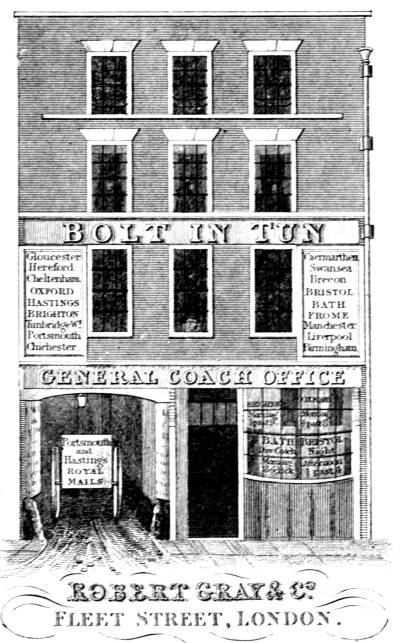
BUSINESS-CARD OF THE “BOLT-IN-TUN” COACH OFFICE.
Of the coachmen on the road to Tunbridge
Wells and Hastings we know as little as—nay even
less than—of the coaches, and almost the only
touch of character is that drawn by a writer
in the Sporting Magazine of 1830, in describing
one Stockdale, who drove some coach unnamed.
He was, we are told, “a good whip.” He
was also, like poor old Cross, on the King’s Lynn
road, something of a literary character, and
“beguiled the time on the road with Cockney
slang and quotations from Pope!” He drove to
London and back six days a week—the Sunday,
he said, he spent at home studying the Greek
Testament and translating Οἱ οἱ τυφοὶ ὁδηοί into
“Wo, wo, ye blind leaders!”
But coaches were by no means the only public
conveyances along this road. There were, indeed,
in 1838, many vans and waggons to Tunbridge
Wells and to Hastings. Bennett’s vans and
waggons plied to Tunbridge Wells four times a
week; those of Jarvis thrice, Diggen’s five times,
Barnett’s four, Shepherd’s three, Young’s and
Harris’s twice, and Wickin’s once: twenty-seven
vans and waggons weekly to “the Wells.” To
Hastings the waggons respectively of Moore & Co.,
Shepherd & Co., Stanbury & Co., and Richardson
journeyed daily.
The electric tramcars that nowadays take you all
the way to Lewisham from Westminster Bridge
for threepence, and occupy incidentally forty
minutes in performing the journey of six miles,
travel on the average at the same speed as those
old coaches; but, of course, this not very brilliant
rate of progression is determined by the crowded
traffic of Walworth and Camberwell. When New
Cross is reached, and the comparative solitudes
of St. John’s, they bring you at a good twelve
miles an hour along those switchback roads to the
journey’s end. They are not looked upon with
favour by that suburban neighbourhood, for, worse
than the burglars’ “villainous centre-bits” in
Maud they not only
Grind on the wakeful ear in the hush of the moonless night,
but noisily disturb every night.
It is a hilly district, revealed in these times
by ascending and descending vistas of roads and
roof-tops, instead of the grass and fields of
yore; and Loampit Hill—the “Loam Pit Hole”
of Rocque’s map of 1745—is just a little interlude
in the commonplace, where an old retaining-wall
in the hill-top sliced through in a bygone era
serves to keep the banks and the houses now built
hazardously on them from settling in the roadway.
A number of old hollies give the spot something
of an old-world look.
Here, then, having come through all the
hazards and chances of New Cross and the
Lewisham High Road, we are arrived at the
Ravensbourne and Lewisham. The Ravensbourne,
although not a stream of great size, and
with a course of but twelve miles, from its fountain-head
on Keston Common to its mouth amid
the mud of Deptford Creek, is yet a river of considerable
historic, or legendary, importance, and—more
important still—it is due to the Ravensbourne
that the last surviving beauties of
Lewisham are so beautiful. Legends tell how
the river obtained its distinguished name, and in
the telling take us back to those very distant days
of Cæsar’s second invasion, B.C. 54. The story
seems to support the theory of one school of antiquaries,
that the lost Roman station of Noviomagus
was at Keston; for it declares that Cæsar’s legions
were encamped on what we now call Keston
Common, and suffered greatly from lack of water
until the constant visits of a raven to one particular
spot attracted attention and aroused the hope
that it was water which attracted him. The expectation
proved correct, for there they discovered
the spring forming the source of the stream. A
well, called “Cæsar’s,” on that common still
serves to keep the tradition alive.
We may, therefore, well look upon the Ravensbourne
with interest, although it is true that a
glance into it, over the bridge which here carries
the busy London street across, sadly disappoints
romantic anticipations. Deposits of mud, vestiges
of pails past their prime, and outworn boots which
the veriest tramp would scorn to own, line a discoloured
stream, and grimy backyards abut upon
it. To such a pass has civilisation brought the
lower reaches of this once silvery watercourse,
which is not so small but that it has tributaries
of its own. Such an one is the river Quaggy,
which embouches hereabouts into it. “Hereabouts,”
I say, because only the local sewer
authority could readily point out the exact spot;
the Quaggy being, in fact, at the actual confluence,
embedded in an underground pipe. But if you
may not see the actual meeting of the streams,
you may at least see the Quaggy on the other side
of the road, a little distance before it joins forces
with the Ravensbourne. There you shall perceive
how only a little lesser indignity than a pipe has
befallen it. Its little trickle still flows on in the
eye of day, but it is made to flow in a formal concrete
bed, here and there spanned by long stretches
of pavement. A little higher up “Lee Bridge”
crosses it, and there be those lesser Stanleys and
Livingstones who have traced it to its source, even
as those great explorers sought the beginnings of
the Nile. A certain disappointment seems, however,
to await those who seek the origin of the
Quaggy, for those who have essayed, and accomplished,
the feat describe how it rises on Shooter’s
Hill “at the back of the Police-station”! Shooter’s
Hill is well enough, but that last little piece of
particularity destroys any lingering shred of
romance.
I should not be greatly surprised to find the
Quaggy the object of police suspicion, for that
name is merely an alias, its real ancient title
being the Ket Brook, whence the district of
Kidbrook derives its name. The “Quaggy” is a
later title, conferred descriptively by those who
observed the quags, or marshy places, through
which it descended from Shooter’s Hill to these
levels.
Here, as already remarked, we are come to
Lewisham. Many thousands of people remember
Lewisham as still something of a village; and
yet so quick-presto are the suburban changes
around London that they now behold it not
merely a thronged town, but much less distinguished
even than that—just a limb of great,
sprawling London, and thus stripped of most of its
old-time individuality.
The place changes while you look. You turn
your back awhile upon the few surviving fields,
the hedgerows, the ditches, and when you glance
upon the scene again they are gone, and carts are
delivering loads of slack-baked place-bricks for
the foundations of little £25 houses that will
begin to settle down unsteadily and crack all
down their fronts almost before the roofs are on.
Change is rampant here, and Lewisham, that
was once “Lewisham Village,” is a village no
longer. The proverbial saying, “Long, lazy, lousy
Lewisham,” that once attached to the place—a
saying which, I doubt not, owed its existence more
to easy alliteration than to actual fact—is, in one
respect at any rate, out of date, for it is now
become a very strenuous place indeed, where
tradesfolk hustle for business and crowds throng
the pavements. Modernity marches all over the
place in its hobnailed fashion, and scarifies the
soul out of existence. It cannot survive in a
modern populous suburb of wage-earners who go
forth at unconscionable hours of the morning to
earn the means of existence and come home to
their brick boxes, exhausted, merely to sleep; and
so come to their prime, joylessly, and decline
greyly to an obscure end. The spectacle frightens
and saddens the observer who goes beneath the
surface of things. He wonders what lies in the
lap of futurity for the race thus dissociated from
nature, nurtured on the pavements, and condemned
to lifelong comings and goings in the restricted
outlook of streets; and, looking upon old representations
of what Lewisham was like in what he
is apt to think the halcyon days of the “20’s” of
the nineteenth century, he grieves for the spacious
rusticities of days gone by.
How many, or how few, of Lewisham’s myriads
ever idly speculate whence came the name of the
place? According to authorities who are now, in
these more scientific times, largely discredited, it
comes from Anglo-Saxon words meaning “the
dwelling among the meadows,” or the leas—the
“leas home”—and was anciently spelled
Levesham and Lewesham. Just a few vestiges
of this ancient rurality remain, in the strips of
meadows—now converted into what are shaping
as beautiful parks—that fringe the course of the
Ravensbourne on either bank, from Catford Bridge
to Ladywell; but we are now bidden disregard
those meadows in any relationship with the name
of Lewisham. The place is first mentioned in a
charter of Ethelbert of Wessex, dated A.D. 862,
in which it is called “Liofshema”; and fifty-six
years later, in a charter granted by Ethelswitha,
daughter of Alfred the Great, it assumes the
form of “Lieuesham,” which gives us exactly
the modern pronunciation. This, it has been
remarked, has nothing to do with meadows, leas,
or pastures, but means literally “dear son’s home.”
But, having reached that point, we come to a full
stop, for no one can tell us who was that “dear
son”; and the theory that the name of Leveson
similarly derives from Liof-or Leof-suna, seems to
have little bearing upon the history of the place.
Ladywell, just mentioned, is itself the name of
a great crowded district, and it is thus curious to
reflect that the name was utterly unknown until
modern times. It arose from one of two closely
neighbouring wells—one reputed to be medicinal—situated
in what is now the road turning off the
highway, past Lewisham old vicarage, to Ladywell
railway-station and Brockley, which name itself—meaning,
as it does, the “badger’s meadow”—enshrines
the former rustic appearance of these
parts. Ancient records and county histories may
be searched in vain for mention of the “Lady
Well,” which, oddly enough, seems to have acquired
its name about the end of the eighteenth century.
It was, about 1820, the subject of a published plate,
showing it with a circular stone kerb, placed by
the wayside of a pretty rustic road, embowered in
trees. Thus it remained, amid ever deteriorating
surroundings, until 1866, when it was destroyed
in the course of sewer-making operations for the
newly risen suburb that had grown around the
South-Eastern railway-station of “Ladywell,”
opened in January, 1857.
The well had long become a thing of the past,
and its very site was merely a matter of vague
tradition, when, in 1881, its stones were discovered
in the course of repairs to the bridge over the
railway. A signalman rescued them from being
again covered over, and removed them to a position
beside his cabin, where they remained until 1896,
when the following notice appeared in a local
paper: “It has now been decided by the Lewisham
Baths Commissioners to re-erect the stones by the
side of the public baths, where they will be used
to surround a public fountain to which the youths
and maidens of to-day may once more resort, and
there whisper their hearts’ desire.” Accordingly,
they may be seen to this day in the Ladywell Road.
It seems likely, under the circumstances thus
recounted, that the well was given its name about
a century ago by some forgotten fanciful local
antiquary who, bethinking himself that the parish
church of St. Mary, Lewisham, was but a hundred
yards or so distant, dignified the hitherto unnamed
spring by the name of Our Lady.
That parish church is a singular, and in general
an unbeautiful, structure, built in 1777 on the site
of an older, and enlarged at the east end, in the
same hybrid “classic” style, in 1881. It has a
great south porch, unmistakably Corinthian, though
it would puzzle an architect to put a name to the
rest. But the tower has a character all its own.
Equally nondescript, it yet owns an engaging
quaintness which one would with sorrow see
improved away for the sake of something more
pure in style. The lower stages of this tower are
obviously the remains of the old Gothic building,
for the buttresses, some of the windows, and a good
deal of the old facing are left, while the upper
part has either been rebuilt or re-cased in a style
resembling the practice of the brothers Adam.
Sculptured garlands in the famous manner of
those architects give a daintily decorative effect,
and, together with the four stone balls which
occupy the places usually given to pinnacles,
render Lewisham church-tower memorable and
unmistakable among its fellows.
It is now, in short, with the neighbouring Colfe
Almshouses, the most characteristic and distinctive
thing left to Lewisham. The surrounding churchyard
is very large, and the approach is made beautiful
by a long arched yew walk, still charmingly
rustic in appearance.
The almshouses, it seems, are doomed to
destruction. They are relics of the times when
it could yet be said with truth of Lewisham that
“its convenient distance from the metropolis and
its beautiful situation have rendered it a favourite
place of residence, and the neighbourhood is thickly
studded with gentlemen’s seats, many of which
are splendid mansions, and with numerous handsome
villas, the country residences of opulent
merchants.”
Abraham Colfe, who founded these quaint old
almshouses, was vicar of Lewisham about the
middle of the seventeenth century. He died in
1657, and left property in trust for the purpose to
the Leathersellers’ Company, who accordingly built
them, as a tablet over the main entrance informs
the passer-by, in 1664.
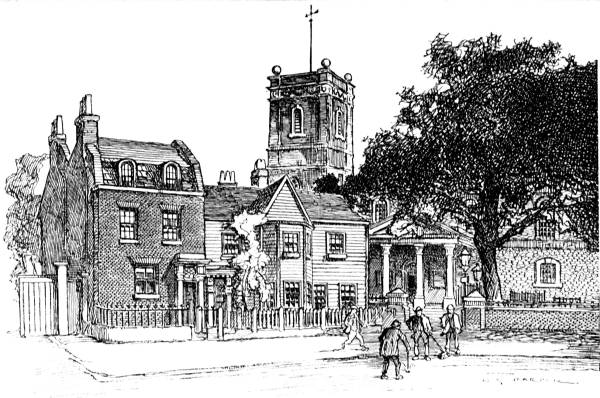
LEWISHAM.
Another survival is the handsome old late
seventeenth-century vicarage, already mentioned,
standing a little out of its element, as it were,
beside the high road. It was built in 1692-3 by
Dr. Stanhope, the then vicar, and, as his surviving
accounts tell us, it cost him £739 13s. to build.
Dr. Stanhope, if we may accept the estimate of his
character given by his monument in the church,
was one of the best, for (inter alia) his “piety was
real and rational, his charity great and universal....
His learning was elegant and comprehensive,
his conversation polite and delicate, Grave without
Preciseness, Facetious without Levity. The good
Christian and solid Divine and the fine gentleman
in him were happily united.”
That, I think, is the ne plus ultra, the last
word, in monumental eulogy. You cannot get
better than the best, unless indeed you visit
modern Lewisham and do your shopping at its
popular “stores,” where a searching glance may
discover “best fresh eggs” at one shilling and
sixpence a dozen, and “superior” at two shillings.
For the rest, a few strips of garden here and
there border the high road through modern urban
Lewisham, sometimes owning elms that in the
old days were tall wayside trees. Here a giant
workhouse, neighbouring the Colfe Almshouses,
serves by its presence to underline and emphasise
the social distance travelled—whether it be upwards
or downwards let those decide who will—between
the seventeenth century and the
twentieth, and a few scattered weather-boarded
cottages are left, showing what manner of buildings
were those that fringed the road in days for ever
gone. Midway between the date of those humble
old dwellings and the modern shops is one old-fashioned
shop where they sell hay, corn, straw,
beans, and sweet-smelling seeds of all kinds.
The name over the fascia is “Shove,” singularly
inapplicable to this quiet, unassuming frontage.1
To gaze upon its small-paned windows, to see and
scent the hay and the fragrant contents of its
bins of beans, peas, and varied seeds, must surely,
with the coming of every spring, set the prisoned
wage-earners of Lewisham longing keenly for the
banished country whose breath comes fragrant
from within.
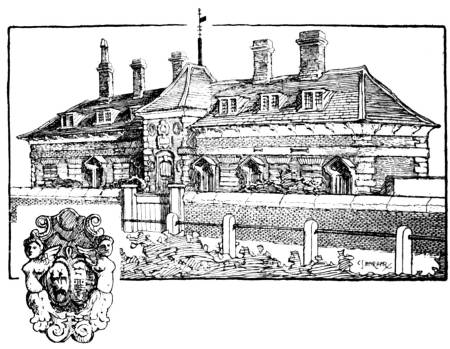
THE COLFE ALMSHOUSES.
The streets of Lewisham the long end, in the
present year of grace, a little beyond Rushey
Green, where a side-road comes in from Forest
Hill and Catford Bridge. Shall we pluck the
rushes of Rushey Green, wander awhile in the
groves of Forest Hill, or gather primroses by
the river’s brim at Catford Bridge? God bless
you, ye innocent, there are no forests but forests
of chimneys at Forest Hill, and the rushes of
Rushey Green have long been replaced by macadam
and York stone pavements; and although, I doubt
not, you can find primroses in their season at
Catford Bridge, they are only those that are sold
by the flower-girls outside the railway-station, at
what they style, in their Cockney twang, “one
punny a morky barnch,” a phrase which has been
translated into English by the learned as meaning
“one penny a market bunch.”
Although the road onwards from Rushey Green
becomes in a little distance rural, or at the worst
dotted only here and there sporadically with new
houses, there are marked signs that the fields and
the remaining hedgerows are doomed. Among
these unmistakable portents is the new railway-station
of Bellingham, placed at the present time
lonely, in the midst of fields, near the solitary
Bellingham Farm. No railway company builds
a large station for the express purpose of serving
one farmhouse, and this is simply another instance
of that intelligent anticipation of events for which
railway companies are now showing an unwonted
aptitude. Time was when the companies would
tardily provide station accommodation ten years
or so after the appearance of a thronged suburb,
and then only after being memorialised to do so;
but a different policy now rules: it is the policy
suggested by the depleted pocket.
If, however, the main road remains rural,
things are far otherwise over to the eastward,
between this and Burnt Ash, where the octopus
arms of the Corbett Estate are spreading out and
embracing the fields in a deadly grip. The long
lines of streets and roofs, ascending the hillside,
may be discerned from the highway, and it is
abundantly evident that London is making a
sly flank march that way, into Kent. The Corbett
Estate is, it should be said, a building estate of
cheap houses, chiefly for working men, and is
administered on “temperance” lines, public-houses
for the sale of drink being forbidden.
Here, then, we see the working of one of those
many fads for the making of a perfect community
which distinguishes the present age. Here it is
a Community of the Pump that is aimed at; there
a Garden City, and elsewhere other nostrums are
on trial, all directed towards the hastening of the
millennium. But the wheels of progress towards
perfection are not to be set rolling at anything
above their normal speed by even the best
intentioned, armed with the most exceptional
opportunities, and this thirsty Sahara among
suburbs irrigates itself just the same, albeit with
considerable trouble.
D—n his eyes, whoever tries
To rob a poor man of his beer,
in effect says the working man of the Corbett
Estate, and, to show his independence on those
occasions when he journeys a weariful distance
across the boundary of this drinkless district in
order to get his supper beer, takes more than he
ordinarily would, returning home a discredit to
the good people who want to dragoon him into an
avoidance of Bung and all his vats, in preparation
for their new Heaven and new Earth.
The net result, and one wholly unlooked for,
is that this prohibition policy has practically
conferred an immense endowment upon the inns
of Rushey Green, which, once modest enough,
have blossomed forth as immense public-houses,
doing a roaring trade with the unregenerate.
The road, coming to South End, comes really
and truly to the end of London and its suburbs,
and is at present prettily rural. Only those who
know the district well are aware that, a short way
off to the right hand, there is a little Erebus at
Bell Green, where the gasworks are. If our old
vituperative Cobbett were back again, taking his
rural rides, I have no doubt he would call the
place Hell Green, and he would not be altogether
unjustified in doing so. But for my own part,
I prefer to dwell rather upon South End, and feel
inclined to curse the exploratory activity that led
me to discover that awful place at the back of the
road; so abject, so unutterably vile.
South End owes much—almost everything, in
fact—to the beneficent Ravensbourne, which flows
beside the road, and long ago was enlarged into a
lake at this point. It is a pretty lake, the prettier
because unexpected, and there are those who
actually fish in it; not for the lordly salmon, nor
even for grayling or dace. No, it is rather the
humble “tiddler” who makes sport for the small
boy with a twig, a piece of cotton and a pickle-bottle;
and I declare that no fisherman in india-rubber
waders, up to his thighs in the middle of
a stream and at grips with a salmon, experiences
a wilder ardour than that of these sportsmen of
the neighbouring streets. I feel sorry, however,
for the tiddlers, thus slain in their thousands.
They do not long survive the water of the pickle-bottle,
and presently, giving up the ghost, collapse
and develop those extraordinary spikinesses
which, I suppose, give them their proper name
of “sticklebacks.”
It is a long, long rise from South End to
Bromley, which stands among the breezy heights
near Keston and Hayes. Half way up it there
are still traces of the deep dingle that gave the
spot the name “Holloway,” by which it was
known to the road-books of the coaching age.
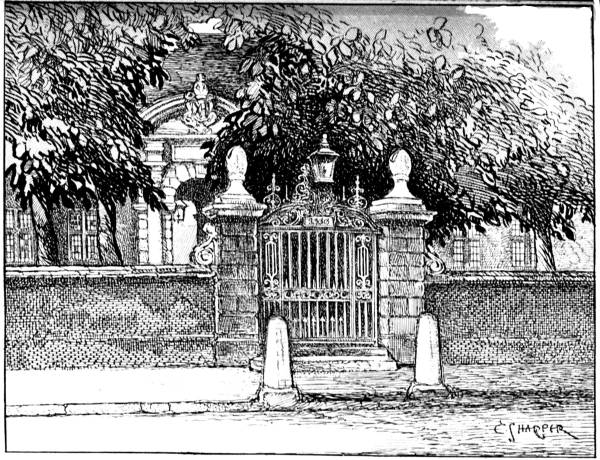
ENTRANCE TO THE WIDOWS’ COLLEGE.
It was an ominous place, suitable for the footpad’s
leap in the dark upon the traveller’s back,
and those wayfarers who were obliged to pad the
hoof alone through Holloway when night was
come wished they had eyes in the back of the
head, in addition to the usual pair. Near by
stood, and still stands, Bromley Hill House, once
the seat of Charles Long, afterwards Lord Farnborough.
In the dairy at that place one John
Clarke, gardener, murdered Elizabeth Mann, a
dairy-maid, and over against Holloway there was
erected a gallows, and on it John Clarke, brought
in a cart from Maidstone gaol, in due time swung.
At the threshold of Bromley stands the College,
not an educational establishment, but a superior
kind of almshouse, whose purpose is explained by
the inscription set up over the doorway:
Deo et Ecclesiæ
This College for Twenty poore
widowes (of orthodox and Loyall
Clergymen) & A Chaplin was
given by Iohn Warner late Ld.
Bishop of Rochester
1666
John Warner, Bishop of Rochester, was a staunch
supporter of Church and King, in times when
both the Establishment and the Monarchy were
in a bad way. Charles the First was not wholly
responsible for the troubles and tragedies of his
reign. An acrid Puritanism was in the air, and
had already manifested itself, very unpleasantly, in
his father’s time. It was the inevitable reaction
from the Renaissance gaieties under Elizabeth.
The times were such that, even in the first year
of Charles the First’s rule, Warner found it
necessary to deliver a bitter sermon directed
against the politico-religious activities of the
Puritans, based upon the text, Matt. xxi. 38:
“This is the heir; come, let us kill him, and
let us seize on his inheritance.” No one had in
those early days of strife thought of beheading
Charles, and we must therefore count Warner
among the prophets.
The bishop came very near being impeached
before Parliament for this exploit, and only
escaped by the King stepping in and “pardoning”
him in advance of Parliamentary action.
It is not surprising to find that, when the
troubles culminated in war, the House was swift
to sequestrate the bishop from his see, and even
to seize his property. They proved the innuendo
of his discourse at his own expense, he was
forced to leave his palace at Bromley in disguise,
fearing for his personal safety at the hands of the
saints, and for years he wandered in poverty in the
West Country. Like other survivors of the dispossessed
clergy, high-placed and low, he came
to his own again at the Restoration in 1661, but
he was then an old man of eighty. Five years
later he was dead.
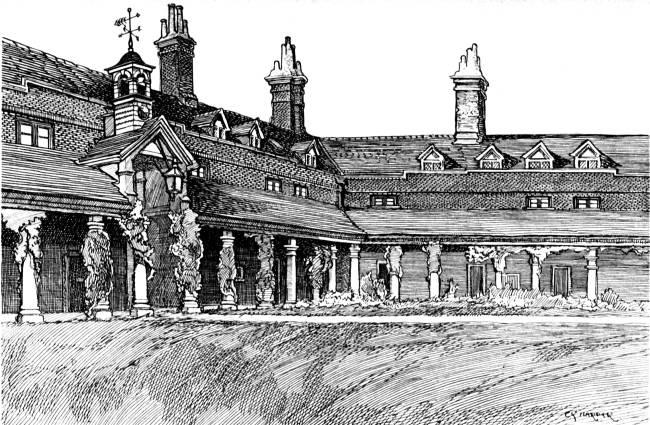
IN THE FIRST QUADRANGLE, WIDOWS’ COLLEGE, BROMLEY.
A many-sided benefactor, he was not without
his critics, who declared him mean. He seems to
have somewhat keenly felt the charge, for he
repelled it by remarking that he “did eat the
scragg ends of the neck of mutton, that he might
leave the poor the shoulder.” We do not learn
whether those critics had the grace to be ashamed.
His College was a noble thought. He bequeathed
£8,500 to establish it, and left a perpetual rent-charge
of £450 per annum, secured upon his
manor of Swayton, Lincolnshire, to provide
pensions of £20 per annum for each of its twenty
destined inmates, who were to be poor widows of
clergymen, preferably, but not exclusively, of
the see of Rochester. The odd £50 was for the
chaplain’s stipend.
The College stands within six acres of beautifully
wooded grounds, with lovely lawns and
gardens, and is very thoroughly fenced off from
the clatter of the outside world by an ancient
brick wall, tall and thick. Through the wrought-iron
gateway, dated 1666, flanked by piers surmounted
with sculptured mitres, glimpses of the
front are caught behind the blossoming horse-chestnuts.
The little houses surround the quadrangle,
which has its lawn, its covered walk, like an
up-to-date and domesticated cloister, and its
climbing-plants twisting round the pillars of the
Jacobean colonnade. They are very desirable
little houses, with basement kitchens, a quaint
little hall, a fine sitting-room, and, on the first
and attic floors, from two to four bedrooms.
Those fortunate enough to secure such a haven
for life are fortunate indeed, and in this sheltered
backwater of existence often live to be centenarians.
But probably no one would resent being styled
“poor” more than these collegians themselves.
Poverty is a matter of comparison, and many
would be content to “endure” it on terms of a
dainty house, free of rent, repairs, and taxes, with
from £38 to £44 a year thrown in—for many later
bequests have rendered it possible to raise the
pension to those sums. Moreover, to qualify for
admission, a “poor” widow has now to be already
rich enough to possess an income of at least £40,
and probably most of them have much more.
Bromley College is therefore a kind of a minor
Hampton Court, and great is the competition to
win to it when a vacancy occurs. Well-dressed
and well cared for in every way, the collegians
are not to be pitied.
The occasional artist who comes to sketch the
buildings finds the place delightful. There are
pretty girls reading novels or presiding over
dainty tea-tables: there are poverty-stricken
widows in lace-caps, silk gowns, and gold chains—all
well known stigmata of a plentiful lack of
pence—and there is sometimes good music from
soft-toned pianos.
The chapel provided for by the good bishop
was rebuilt, at a cost of £6,000, in 1860, by the aid
of subscriptions. The Jacobean building it replaces
is said to have been extremely ugly, but that is
easily said of anything already marked for destruction;
and the ’60’s were scarce sufficiently
well-disposed towards architecture of that period
to be able to determine fairly what was ugly and
that which was merely not at that time fashionable
in bricks and mortar.
There are now forty widows in the College, and
a second quadrangle was added and endowed about
1790, from funds provided jointly by William
Pearce, brother of Bishop Zachary Pearce, and
Mrs. Bettinson.
There has been in the past a good deal of
nepotism in the government of the College, and
father has succeeded son in the chaplaincy, often
held by greedy pluralists, and often thrown in
as a kind of extra sop for the vicar of Bromley.
Things like these must surely vex the spirit of
that truly pious benefactor, who, when raised to
be bishop, could not endure to hold his many
preferments, and accordingly resigned them, much
against the spirit of his age.
An even later addition to this institution was
made in 1840, when the “Sheppard College” was
built in the grounds. It consists of five houses,
endowed with £44 each per annum, for the benefit
of daughters who have lived with and attended
upon their mothers in the original College.
Bromley, in the days when it was only a small
thing, was in the diocese of Rochester. It has
long since been transferred to Canterbury, and
the manor that had belonged to the Bishops of
Rochester ever since the eighth century, when
it was given to them by King Ethelbert, was
sold with the palace into private hands in 1845.
Those who will may see the exterior of it to this
day, but it is not the palace that the Norman
Gundulf built, nor even that whence Bishop
Warner escaped, for it was several times rebuilt,
lastly in 1775. The site of the once Holy Well of
St. Blaise, the woolcombers’ saint, formerly much
resorted to for its chalybeate waters, is still to be
seen in the grounds.
There are pitfalls for the stranger on every
road in the way of pronouncing place-names.
Bromley-by-Bow is (or was until recently, but
there is a constant flux in these things) “Brumley,”
and accordingly this should have the like sound;
but you will not hear this Kentish town so named.
The natives will not change the “o” into “u.”
But aborigines are somewhat difficult to find
here, for the Bromley that was a little market town
with two fairs a year and a weekly market granted
by Henry the Sixth is a thing of the buried past.
Bromley is now suburban. It has grown from the
little place of 1801, with 2,700 inhabitants, to a
populous town which in 1901 numbered 27,358.
Much of the old town has vanished, but it will
never be like an ordinary suburb that grew potatoes
last year, and has within six months grown streets
of houses “fitted with electric light, hot and cold
water-supply, and drained in accordance with the
latest improvements,” thus to quote advertisements.
The town, in common with other places, has all
those modern features, but it has also a surviving
proportion of ancient houses, and even when they
are gone it will still have its history. By virtue
of that past it keeps to-day a larger air and a
greater disunity than it could command merely as
the dormitory of City men who leave early in the
morning and return at night, and pay rent, rates,
and taxes, but can have little of the sense of
belonging to the place.
Bromley, precisely like an assertive person who
has “got on” in the world, signalised its recent
expansion by acquiring a coat-of-arms; but not
the most magnificent parvenu would dare sport
a display so elaborate and comprehensive as
that which alone would serve Bromley. In the
recondite terminology affected by heralds it is
“quarterly, gules and azure; on a fesse wavy
argent three ravens volant proper between, in
the first quarter, two branches slipped of the
third: in the second a sun in splendour; in
the third an escallop shell or; and in the fourth
a horse forcené, also argent: and for the crest,
on a wreath of the colours, upon two bars wavy
azure and argent, an escallop shell, as in the arms,
between two branches of broom proper.”
It sounds like the description by a maniac of
the contents of a shop-window, set up by a compositor
who had misplaced the punctuation; but it
is clear and pellucid reading to a herald. At any
rate, there is no difficulty in discovering what it
all means, for the device is proudly and abundantly
displayed in Bromley itself.
These many charges are not without their
significance. The escallop shell is in allusion
to the time when the palace of the Bishops of
Rochester was situated here; the broom refers to
the planta genista, the broom that gave, in the
long ago, its name to Bromley, and still flourishes
in the district; the sun in splendour indicates
Sundridge, whose name itself by no means alludes
to the sun; and the white horse is, of course, the
familiar unconquered horse of Kent. The ravens
recall the legendary history of the Ravensbourne.
Beneath all this display is a Latin motto, to the
effect that “While I grow I hope.”
Gravely aloof from all these things, the old
parish church of Bromley stands indeed in the
centre of the town, but in a quiet lane leading
to a pretty little public garden on the edge of
a height overlooking all South London and its
sea of roof-tops. It need scarcely be said that the
long body and the apocalyptic towers of the Crystal
Palace are prominent in the view. They brood
like an obsession over all the southern suburbs.
The exterior of the church looks very venerable
and rustic, and has even been improved by a tasteful
new chancel built in recent times. In the churchyard,
built into the south wall, is a small and
modest tablet inscribed:
Here lyeth interred ye body of Martine French of this
parish, with four of his wives and two daughters. He
departed this life 12 January anno 1661, being aged 61,
and his last wife died ye 13th of ye same month, leaving
behind him one sonne Martine and two daughters, Sarah
and Mary.
But Martin French is a very minor person
beside the neighbouring
- ELIZABETH MONK
- who departed this Life on the 27th Day of August 1753
- Aged 101
- She was the Widow of John Monk late of this Parish,
- Blacksmith,
- her second Husband,
- To whom she had been a Wife near 50 Years:
- By whom she had no Children:
- And of the Issue of her first Marriage none lived to the second.
- But Virtue
- would not suffer her to be childless:
- An infant to whom and to whose Father & Mother she had
- been Nurse
- (such is the uncertainty of temporal Prosperity)
- became dependent upon Strangers for the Necessaries of Life.
- To him she afforded the Protection of a Mother.
- This parental Charity was returned with filial Affection:
- And she was supported in the feebleness of Age
- By him whom she had cherished in the Helplessnesss of Infancy.
- Let it be Rememb’red
- That there is no Station in which Industry will not obtain
- Power to be Liberal:
- Nor any Character on which Liberality will not
- Confer Honour.
- She had been long prepared by a simple and unaffected Piety
- for that awful Moment, which however delayed
- is universally sure.
- How few are allowed an equal Time of Probation:
- How many by their Lives appear to presume upon more:
- To preserve the Memory of this Person,
- but yet more to perpetuate the Lesson of her Life,
- This Stone was erected by voluntary Contribution.
For lavish use of capital letters, adjectives, and
copybook sentiments this would be difficult to beat.
The interior of the church is injured by the
galleries built round it, to accommodate a crowded
congregation, and is otherwise of little interest;
the tombs of the Bishops of Rochester consisting
merely of a mangled relic of that supposed to be
for Richard de Wendover, who died in 1350, and
the slab and the tablet, respectively, to John
Yonge, 1605, and Zachary Pearce, 1774.
But in the pavement near the font, covered
with a mat, is the ledger-stone marking the
resting-place of Dr. Samuel Johnson’s wife, who
died in 1753. It bears, of course, a Latin epitaph,
for that great literary giant of the eighteenth
century was violently of opinion that the English
language was no fitting medium for the conveyance
of monumental honours. His arguments in
support of that opinion are unfortunately not
recorded. They would doubtless be amusing, but
it would require a very robust argument to convince
most people that an inscription in a foreign
language, and that a dead one, not to be understood
except by the comparatively few who are
well versed in it, is the best vehicle for the purpose.
There seems, however, to have been in
Johnson’s time, and before, and for some while
after it, an odd feeling that the mother-tongue
of the Englishman was, applied to monuments,
vulgar. To be classic, even at the risk of not
being understood, was the only resort of those who
at all risks desired to dissociate themselves from
the vulgar herd. Johnson shared this feeling to
the full, and thus the epitaph to his “Tetty” is
couched in the language that Cæsar spoke. It
extols the charms of her person and manners,
and thus gives point to Macaulay’s description
of Johnson’s singular infatuation for a woman
twenty-one years older than himself. “Every
eye makes its own beauty,” truly says the old
proverb, and here is an instance. It was in 1736,
when he was twenty-seven years of age, that
Johnson met the widowed Mrs. Elizabeth Porter,
fell in love with her, and married her. She was
then forty-eight, and had children as old as himself.
Macaulay, in his broad, expressive, rather cruel way,
says: “To ordinary spectators the lady appeared
to be a short, fat, coarse woman, painted half an
inch thick, dressed in gaudy colours, and fond of
exhibiting provincial airs and graces which were
not exactly those of the Queensberrys and Lepels.”
She was, continues Macaulay, “a silly, vain old
woman. To Johnson, however, whose passions
were strong, and whose eyesight was too weak
to distinguish cerise from natural bloom, his Tetty
was the most beautiful, graceful, and accomplished
of her sex. That his admiration of her was unfeigned
cannot be doubted, for she was as poor as
himself.”
There are many tablets on the walls of this
much-galleried building: one to a Mr. Thomas
Chase, of the Rookery, who was nearly swallowed
up by the great earthquake at Lisbon in 1755.
He seems to have been born there in 1729, and
after his nerve-shaking experience to have removed
to this country. He died in 1788, aged fifty-nine.
One harrowing inscription meets the eye on
leaving the building. It tells how, on Saturday,
September 10th, 1904, a peal of grandsire triples
of 5,040 changes was rung upon the bells. They
took 3 hours 6 minutes, and then quiet came to
the suffering town. Bromley has my respectful
sympathy.
The way through Bromley is not straight and it
is not broad. This is so much of a truism at
Bromley that the statement is calculated to make
its inhabitants smile indulgently, as do those good-natured
people who are told what they already
know. The early nineteenth-century roadmakers
strove to remedy these defects, and did what they
could to widen and straighten the way, and incidentally
to abolish the picturesqueness of the
place; but those “vested interests” that are a
part of every civilisation forbade much alteration,
and the road still trickles and meanders through
the town and divides into two channels and unites
again, like some sluggish, undecided river. It is
an infirmity of purpose that can be carried back
to a very remote origin: to the time, in fact, when
Bromley was only beginning to be a settlement
amid the then widespreading wastes; when the
prehistoric tribesmen drove their herds across the
broomy heaths to water at the Ravensbourne, and
tracked deviously to avoid boulders, trees, or boggy
places. These were the circumstances that fixed
throughout the ages the windings of Bromley’s
streets. One somewhat important change was,
however, made under the Improvement Act of
1830. A new road was cut to one side of the
Market Place, starting just beyond the “Bell”
and ending just short of the “White Hart.”
The historian seeking something of the old
coaching days at Bromley pities himself. He
finds the “Swan” very gay and attractive in
summer with displays of geraniums, calceolarias,
and lobelia, but he does not find the old house,
and when he has found the “Bell,” in the centre
of the town, he has come to a very beautiful building;
but it is modern. The alleged fact that its
doorway is on a level with the cross of St. Paul’s
Cathedral does not seem to have the significance
it would possess were the old house standing.
The old inn is the subject of a slight reference
in Jane Austen’s “Pride and Prejudice,” where she
makes Lady Catherine say: “Where shall you
change horses? Oh, Bromley, of course. If you
mention my name at the ‘Bell’ you will be
attended to.” The passage does not make my
pulses leap.
Only the “White Hart” remains; appropriately
enough white-faced, cool and clean-looking,
with the white hart himself “couchant regardant,
collared or,” as a herald might say, over the
portico. Unhappily, gigantic modern red-brick
buildings encompass the inn, rising to four times
the height of it, and presently the old house itself
will inevitably go.
Beyond this point is South Bromley, where the
railway runs and modern expansion is most evident.
You descend to it, and having descended immediately
ascend again, up the not very Andean
slope of Mason’s Hill.
At the time these lines are being written
Mason’s Hill still remains old-fashioned. A few
of its dignified Queen Anne mansions, standing
with an old-world detachment behind their palisade
of formal iron railings, are left; but they are
to be sold for clearance and rebuilding, and so also
are a group of ancient dormer-windowed sixteenth-
and seventeenth-century houses of a humbler type.
They have all the added importance that comes
from being situated above a footpath which itself
is in places raised more than head and shoulders
above the road for wheeled traffic. Old wooden
railings protect children, boozy wayfarers, and
sheer wool-gathering, star-gazing folk from falling
off the pavement into the hollow road.
Having wriggled its way through Bromley
and climbed Mason’s Hill, the Hastings Road sets
out across Bromley Common, broad and straight
and forceful, in a splendid forthright manner,
about its ultimate business of getting to the coast.
Most other roads show plentiful evidences of
having, like Topsy, grown; but this, you can
see at a glance, was obviously made. It occupies
a ridge. Villas front upon it on leaving the town
behind: villas of every type since such things
began to be, and a leisurely walk past them is
therefore something in the nature of a generous
education in the varying ideals in domestic architecture
since the days of the Regency.
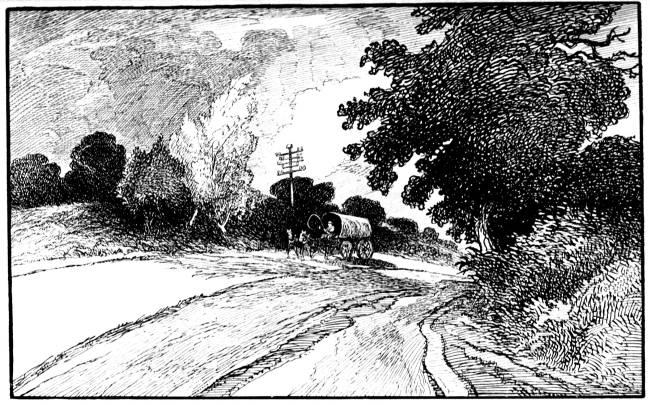
THE ROAD ACROSS BROMLEY COMMON.
But presently these are all left behind, and the
fields on either side of this modern road with an
ancient Roman inflexibility are broken only by
the house and grounds of that most beautiful
and noble early eighteenth-century mansion, the
Rookery, built of the most exquisite red brick.
The Rookery belongs to a time before this fine
road came into being: to that time when travellers
came painfully up the hill to that open common
much dwelt upon by old county historians.
Opposite the mansion in those days stood the
two polled elms known from time immemorial
as Great and Little Beggars’ Bush, and known
most unfavourably, for in the shade cast by them
at night not merely beggars, but those highwaymen
of the meaner sort called footpads, lurked.
Time has a sardonic trick of turning the
matter-of-fact descriptions of the old topographers
into absurdly misleading statements. Thus, reading
Lysons’ description of Bromley, written in
1796, we smile at his remarks that “the Anglo-Saxon
Brom-leag signifies a field, or heath, where
broom grows,” and that “the great quantity of
that plant on all the waste places near the town
fully justifies this etymology.”
Bromley Common was in great part enclosed
soon after the middle of the eighteenth century,
and most of the remaining two hundred and fifty
acres were cut up and partitioned in 1822, amid
much local satisfaction. With it went the broom
near the town; although, to be sure, it is still
plentifully to be found on the further commons
towards Keston.
A piece of beautiful common-land through
which the road runs at the extremity of the parish
is still called “Bromley Common.” Down below
it, in a hollow, is Lock’s Bottom, a hamlet whose
pretty scenery is rather vainly endeavouring to
bear up, under the infliction of some commonplace
houses and a prominent police-station.
There are picturesque alders in front of the
“White Lion,” but the blue lamp of the police-station
spoils the sentiment of it all. Why, you
ask yourself, that in a place by way of being so
pretty and so rural? A few steps onward give
the answer, in the great workhouse and the casual-ward,
and the expectant tramps reclining, more
pictorially than they know, by the pond under the
tall fir-trees opposite.
The road in the neighbourhood of Lock’s Bottom
seems, in the old days, to have been particularly
dangerous. It ran, in the middle of the seventeenth
century and for long afterwards, through a wide
district of unenclosed common-land, and was
just one of those lonely highways where the footpads
and highwaymen had matters very much
their own way.
An unpleasant adventure of this sort happened
just here, beside a vanished landmark once known
to wayfarers as the “Procession Oak,” to John
Evelyn, the diarist, on May 23rd, 1652.
Leaving his wife to take the waters at Tunbridge
Wells, he set out on horseback for London.
In his “Diary” we learn what befell him on the
way:
“The weather being hot, and having sent my
man on before me, I rode negligently under favour
of the shade till within three miles of Bromley.
At a place call’d the Procession Oake, two cut-throates
started out, and striking with long staves
at the horse and taking hold of the reines, threw
me downe, took my sword, and haled me into a
deepe thickett some quarter of a mile from the
highway, where they might securely rob me, as
they soone did. What they got of money was not
considerable, but they took two rings, the one an
emerald with diamonds, the other an onyx, and a
pair of bouckles set with rubies and diamonds,
which were of value, and, after all, bound my
hands behind me, and my feete, having before
pull’d off my bootes; they then set me up against
an oake, with most bloudy threats to cutt my
throat if I offer’d to crie out or make any noise,
for they should be within hearing, I not being the
person they looked for. I told them, if they had
not basely surpriz’d me, they should not have had
so easy a prize, and that it would teach me never
to ride neere an hedge, since had I been in the
mid-way they durst not have adventur’d on me;
at which they cock’d their pistols, and told me
they had long guns too, and were fourteen companions.
I begg’d for my onyx, and told them it
being engraven with my armes would betray them,
but nothing prevail’d. My horse’s bridle they
slipt, and search’d the saddle, which they pull’d
off, but let the horse graze, and then, turning
againe, bridled him and tied him to a tree, yet
so as he might graze, and thus left me bound.
My horse was perhaps not taken because he was
mark’d and cropt on both eares, and well known
on that roade.
“Left in this manner, grievously was I tormented
with flies, ants, and the sunn, nor was my
anxiety little how I should get loose in that
solitary place, where I could neither heare nor
see any creature but my poore horse and a few
sheepe stragling in the copse. After neere two
houres attempting, I got my hands to turn palm
to palm, having been tied back to back, and then
it was long before I could slip the cord over my
wrists to my thumb, which at last I did, and then
soone unbound my feete, and saddling my horse
and roaming awhile about, I at last perceiv’d dust
to rise, and soone after heard the rattling of a cart,
towards which I made, and by the help of two
country men I got back into the high way.
“I rode to Coll. Blount’s, a greate justiciarie of
the times, who sent out hue and cry immediately.
The next morning, sore as my wrists and armes
were, I went to London and got 500 tickets printed
and dispers’d by an officer of Goldsmiths Hall, and
within two daies had tidings of all I had lost,
except my sword, which had a silver hilt, and
some trifles. The rogues had pawn’d one of my
rings for a trifle to a goldsmith’s servant, before
the tickets had come to the shop, by which meanes
they scap’d; the other ring was bought by a
victualler, who brought it to a goldsmith, but
be, having seen the ticket, seiz’d the man. I
afterwards discharg’d him, on his protestation of
innocence. Thus,” he concludes, “did God deliver
me from these villains, and not onely so, but
restor’d what they tooke, as twice before He had
graciously don, both at sea and land ... for
which, and many, many signal preservations, I am
extreamely oblig’d to give thanks to God my
Saviour.”
This incident of impudent highway robbery
in midday sufficiently illustrates the general
insecurity of the times and the risks that
travellers ran.
But let it not be thought that all highwaymen
were brutal and lacking in bowels of compassion.
We know, from the stirring annals of Hounslow
Heath, that a Duval could act a courtly part when
a lady was in the case; and here records tell of a
very perfect, gentle knight of the road, who could
be polite and considerate even to one of his own
sex. But hear what the London newspapers of
1773 said: “Last night Mr. Delves, whalebone
merchant, being taken ill at Hayes in Kent, and
coming to town in a postchaise, was stopped by a
highwayman, who robbed him of his money; but
finding him greatly indisposed and not able to
help himself, civilly wrapped him up warm,
wished him better health and a good evening,
gave the postboy a shilling, and ordered him to
drive gently on.” We do not find that he returned
the money. He doubtless thought it enough to
rob with civility and to wish the invalid well
again.
Beyond this, one comes in a mile to the casual,
disjointed, and scattered collection of houses called
Farnborough, once a spruce and busy “thoroughfare”
hamlet in the days of coaching: now a
rather seedy place of resident market-gardeners
and tramping hop-pickers. The old “George and
Dragon” inn, that in the Queen Annean sort faces
you on approach and, as it were, plants its considerable
bulk half-way into the road, as though to
dare your passing, has been furbished up in the
public-house kind, and without difficulty stops the
passage of most. It has a portico with pillars
painted and grained to resemble real marble;
but the veins are too preposterous, and the much
more real compo underneath peeps out, like the
obvious advertisement in a badly written puff.
If I were an amateur of ugly houses—which
the Lord forbid—I would turn to the right-hand
here and make for Downe, which is two miles
distant. For there, by the pond of that pretty
village, stands the hideous mansion in which
Darwin lived, and where, in 1882, he died of a
chill caught in prowling at night on the lawn
with a dark lantern, studying earthworms. A
carpenter near by preserves the coffin, with
inscription all complete, in which the great
naturalist was to have been laid (but for some
reason was not), and strangely morbid people,
with gruesome ideas of sight-seeing, go numerously
to see it.
Keeping, however, to the main road and on to
Green Street Green, we cannot altogether avoid
the ugly, which appears, very large and brutal,
in the Oak Brewery. I am told it is a famous
brewing firm, but one willingly forgets their name,
and only knows that their buildings are ugly and
sooty, and look dry and make one feel thirsty.
Perhaps there is more in that than meets the eye.
Green Street Green really has a green: a thing
which in a world where New College, Oxford, and
the numerous Newports throughout the country
are among the oldest of institutions and places,
and where villages with the prefix “Great” are
almost inevitably among the smallest, was by no
means to be counted upon as a certainty. And
not only has Green Street Green a green, but it is
rather a large and a not unbeautiful specimen.
But perhaps its most striking feature is the extraordinary
number of old City of London cast-iron
posts, indicating the boundaries of the old Coal
and Wine Dues area. It seems as though the
City, having delimited those bounds in a fifteen-miles
radius from London, and come at last, full
circle, to Green Street Green, found itself with a
surplus stock of posts, and so set them up here,
rather than be at the trouble of taking them
home again.
It was somewhere near here that, about 1783,
a malefactor who had robbed the mail was hanged
in chains, upon the scene of his crime. A house
was formerly pointed out, with a window bricked
up at that time in order to shut out the view
of the blackened body of the robber swinging and
circling on his gibbet.
Pratt’s Bottom, the next of the hamlets strung
so numerously, like beads, upon this portion of the
Hastings Road, is a mile and a half ahead.
It was here, on the night of August 27th, 1841,
that the down Hastings Mail met with the first of
the two misadventures that befell it on this occasion.
The coach had passed through the toll-gate that then
stood here, and was going at about eight miles
an hour, when it ran over an old woman seated
in the middle of the road, helplessly drunk. The
apparent truth of the old saying that Providence
especially looks after fools, drunkards, and children
lost none of its point here, for the coach and
horses, in some marvellous way, passed over her
without doing her any injury except a slight bruise
on the forehead, supposed to have been caused
by the drag-chain. By some almost miraculous
interposition, the horses seem to have dashed past
on either side of her. The coach was stopped, and
the passengers and guard, naturally thinking her
days were ended by her being run over or kicked
to death, got nervously down to remove what they
thought was at least a dying, if not an already
dead, creature, when they were assailed by a
vigorous torrent of abuse. Somewhat relieved by
this evidence that she could not be very seriously
hurt, they picked her up, and, as she was much
too drunk to walk, placed her on the grass by the
roadside, out of the way of the traffic. Then the
coach started again; but they had not gone beyond
two miles when, through the clear air of a very
beautiful night, the coachman saw a number of
waggons ahead, approaching. He called to the
guard to blow his horn, which the guard accordingly
did, when the waggons drew off to one side.
Unfortunately they were drawn to their off-side,
directly into the path of the on-coming mail,
which dashed into Barnett’s Tunbridge van, at
the head of them. The van was hurled violently
into the hedge, and the coach, going off at an angle
from this terrific impact, then went full tilt into a
hay-wain. The splinter-bar ran under the shafts
of the wain and so, happily for the passengers,
kept the coach from crashing over; but the shock
of the encounter flung the coachman from his seat
and the wheels went over his body. He rolled
over and moaned piteously, but never spoke again.
Carried into the “Polhill Arms,” he shortly
expired there.
Rough-and-ready roadside repairs were effected
and the coach went on to Riverhead, but the
passengers, thoroughly unnerved by the chances
and disasters of this ominous night, preferred to
walk on to that village, three miles and a half
away, where, at the “White Hart,” they rested.
The surviving toll-house at Pratt’s Bottom
is neighboured by a signpost which directs to
Knockholt, to Sevenoaks, to Chelsfield, and—to
the Workhouse: i.e. the workhouse we have just
passed at Lock’s Bottom. That way also leads to
London, but that is merely an incidental matter.
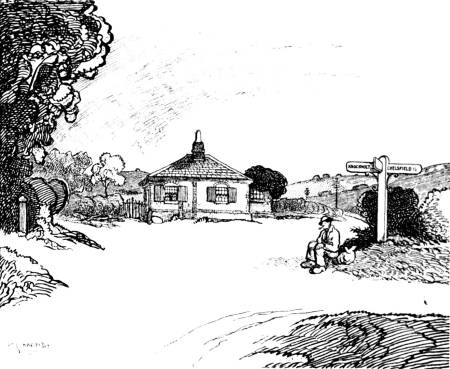
THE OLD TOLL-HOUSE, PRATT’S BOTTOM.
The gently swelling hills at this point are
composed of a stratum of pebbles, mixed with a
proportion of flints: the product of vastly remote
geological ages. These pebbles have given its
Saxon name to the neighbouring village of Chelsfield,
which is Cealch-field or Chesilfield = the field
of pebbles; just as the not far distant Chelsham
and Chiselhurst, with similar pebbles, are, in the
same way, Pebble Home and Pebble Wood.
At Pratt’s Bottom there is an interesting parting
of the ways. The straight road on to Sevenoaks,
by way of Polhill, is modern, having been made
in 1836. Before that time the route lay up along
by the dangerously acute turning to the right,
where the old toll-house stands, to the weary
ascent of Rushmore, or Richmore Hill, and to
Knockholt Pound. Ogilby, in his “Britannia” of
1675 shows a map of this road to “Nokeholt,” as
he calls it, with “Ye Porcupine inne” on the
right-hand, near the summit; and a “Porcupine”
inn is there to this day.
At the foot of the rise stands the “Bull’s Head”
inn, itself of a considerable age, picturesquely
faced by a row of old elms, and just beyond you
may notice in the hollow on the right hand, where
the modern schools stand, an unreformed piece
of the original old road, going very steeply and
stonily in a loop, and rejoining the present route
a quarter of a mile onwards. A white house, now
a farmhouse, just before reaching the “Porcupine,”
is still sometimes called by the older rustics
“New Stables.” It was a posting-house in the
old days. At Knockholt, where, having reached
the topmost eyrie of the downs, the road turns
left, the “Harrow” inn, that was once the house
of call for the carriers and waggoners of the
Sevenoaks road, still stands.
When the chronicler of these things has explored
the old way to Sevenoaks and the new it remains
more than ever a mystery why this circuitous way
was ever followed, and why so many generations
of travellers should have been content to continue
along it when a considerable distance might have
been saved, a less arduous climb encountered, and
a much less dangerous descent made by following
the line of country now covered by the modern
road.
At Knockholt one has come to a very bleak and
inhospitable place, as may be seen by that famous
landmark, Knockholt Beeches, not far from the
ancient route. The Beeches, it is well known,
are situated on the loftiest view-point of the North
Downs, and form as windy an outlook as it is
possible to conceive; but in those days travellers
did not travel for the sake of the views on the
way.
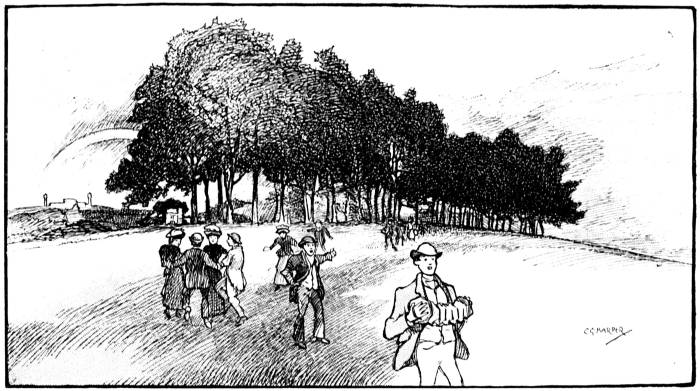
KNOCKHOLT BEECHES.
It is de rigueur among the circles that frequent
the site of the Beeches to call it “Knock’olt.”
To pronounce the name in any other way would
seem to them the sheerest affectation. The spot
is, in fact, dedicated by common consent to the
beanfeaster on week-days and to the sporting
publican on Sundays, who drives his best barmaid
out in a flashy trap, and has lunch at the neighbouring
inn, known to the vulgar herd as the
“Crahn.” Whether it be due to the strong liquors
of the “Crown” or to the bracing quality of the
breezes I do not know, but the sheer abandonment
of the merry-making at the Beeches can excel
even that of the ’Eath
on a Bank Holiday.
“The ’Eath?” you ask.
Why, yes; there is only
one possible ’Eath in
this connection—that
of ’Ampstead.
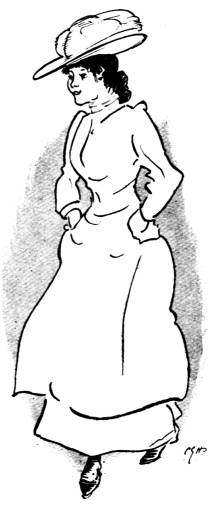
A PHYLLIS OF KNOCKHOLT.
From Knockholt
Beeches the eye ranges
to the Crystal Palace,
the enormity of it a
little excused by distance;
and the Tower
Bridge and the dome
of St. Paul’s are easily
to be identified. But
those familiar objects
soon pall, and the
yearnful music of the
concertina and the
mazy dance commonly
occupy the all-too-swiftly
fading afternoon.
’Arry and
’Arriet exchange hats in the spirit of fellowship
that has come down to them from the remote
ages when semi-savage ancestors swapped headgear
at their feasts to typify equality one with the
other; although I suspect that if you told ’Arry
and his “donah” that they do what they do because
their ancient ancestors were accustomed to do it,
they would promptly tell you to “shut it, guv’nor.”
And they would properly be resentful, for every
one prefers to think “I am I,” self-actuated,
automobilous, self-contained, and patterned on
no model.
And at last, arms round waists, ’Arriet crowned
with a bowler, and ’Arry’s cheeks swept by the
“ostridge” feathers of her hat, they go back in
the solemn twilight to the waggonettes, singing
the latest songs of the Halls.
But to resume the old road, interrupted too
long by this interlude.
A stark, forbidding plateau of swede and
mangold-wurtzel fields follows from the hamlet of
Knockholt Pound, through which the road runs,
unfenced, like a footpath. Then it plunges, with
little warning, down the southern face of the hills
and goes hazardously corkscrewing to the levels,
far below. Down there, on the right hand,
through the hedges, is Chevening, and you look
down, like the rooks and crows, upon the roofs of
church and mansion, situated, as Mr. Thomas
Hardy would say, in his sesquipedalian fashion,
“as in an isometric drawing.”
This, indeed, is the well-known “Madamscourt”
Hill, so styled from time immemorial, although
the name derives from the estate of Morant’s
Court, at the foot. There is, at any rate, no lady
in this case, and the direction, cherchez la femme,
is entirely out of order.
The cyclist passes in a flash a large white house
on the left hand, half-way down, and is too
engrossed upon the problem of whether he will
succeed in reaching the bottom safely to notice it.
The house, now a villa, was in the old days of the
road a very fine inn, called the “Star,” and from
it the hill is still known to many of the country-folk
as “Star Hill.” The exceeding steepness of
the hill gave the “Star” the excellent custom it
enjoyed until the way was diverted, and thus
abolished the jolly days of the old road.
The coaches wagged so slowly to the summit
that the passengers commonly walked quicker to
the hill-top, and were already enjoying the very
choice fare provided when the weary team pulled
up at the door. The horses had, of course, to
be rested, and as no one in those hospitable
days could think of not offering coachman and
guard some liquid token of their esteem, it was
often a considerable time before the journey was
resumed.
Just below the old inn the “Pilgrim’s Way”
from Winchester to Canterbury crossed the road,
making for Otford, along the sunny southern
slopes of the downs.
At last, gaining the level, the old coach-road
joins the modern route at the “Rose and Crown,”
Dunton Green.
The present road to Sevenoaks from Pratt’s Bottom
is closely neighboured by the South Eastern Railway,
running in a deep chalk cutting and then
disappearing in the grim mouth of Polhill Tunnel,
one and-a-half mile long. The mephitic breath
of the tunnel, bellying sulphureously out and
flying in noisome wisps over the road, would be
a good converting agent for those who, believing
in eternal punishment and the Pit, have not yet
ordered their lives accordingly; and you who look
down there think it rather surprising that railways
with dreadful tunnels have not yet been pressed
into missionary service by those who will not
renounce the traditional Hell of sulphur and fire.
Believers, convey your awful examples hither.
Bring them to a belief in an Eternity of that, only
hotter, and you shall have them instantaneously
on their knees, earnestly making resolutions to
turn from their wickedness, and live.
A station, now called “Knockholt,” is planted
here. It was formerly styled “Halstead,” from
the village of that name, half a mile away; but,
to avoid any possibility of confusion with another
Halstead, in Essex, it was given this name, although
Knockholt is nearly three miles distant.
The felled trees, wooden shanties, and sawmills
here beside the road, at May’s Farm, give the place
rather the air of some scene of backwoods activity
in America.
From here the road gradually rises to the crest
of Polhill, on the commanding range of the North
Downs. The “Polhill Arms,” standing on the
left hand, marks the beginning of the long descent
into the Weald, very thoroughly masked and the
magnificent view down to Sevenoaks hidden by a
dense screen of beeches and firs. Something else
is masked by those trees: a great modern fort,
with emplacements for heavy guns, built up here
for the defence of London, as part of a scheme
comprising some sixteen forts forming an irregular
circle around the metropolis at a radius of about
twenty miles, and designed to check a sudden
descent of any possible enemy upon the capital.
London has been held by military experts to
be peculiarly open to such a danger; hence the
forts of Polhill, Farningham, Dartford, Merstham,
Box Hill, Pewley Hill, Esher, and others. But
Englishmen, official or otherwise, are so used to
considering the likelihood of invasion remote that,
although many of the sites for forts have been
purchased, it has been found impracticable to
obtain sufficient money from Parliament to complete
the ring and to thoroughly fortify these
approaches. Parliament looks with suspicion upon
Service proposals, and since the scandals of the
great Boer War those suspicions have been very
generally shared by the nation at large, which
looks upon the methods of the War Office as those
of a war office in comic opera.
It is a tawny-coloured roadway that swoops
down from the summit of Polhill, between the
sandy banks of a wooded cutting, to Dunton
Green. Half-way down, the trees and the cutting
give place to open country, and the hill itself
goes by another name: that of Sepham Hill.
Down by Dunton Green, looking backwards,
the hills, those noble North Downs, are seen to
go terracing away beautifully east and west, their
great, green, rounded shoulders dimpled with folds
and gullies, shaggy here and there with belts of
trees, or scarred outrageously with great gashes
of chalk-pits, where the lime-burners every day
demolish yet another fragment of picturesque
scenery and roast it in limekilns, to the end that
it may go towards the making of mortar and mean
streets. There goes Old England, in mortar, to
feed the spreading tentacles of the towns.
Just such a chalk-pit is that huge scar, beside
the hill we have just descended, where who shall
say how many tons are excavated weekly? What
would Ruskin have said of it? Something superlative,
without doubt. I think I hear him:
“accursed,” “damnable,” he says, and Dr. Samuel
Johnson, in the spirit-world, discussing the question
with him, decides magisterially, after his
wont: “The point is, sir, whether you are to use
the materials Nature has given us for the improvement
of man’s condition in the world, or to neglect
them in order to preserve the savage wastes of a
desolate country-side, to gratify the diseased fancies
of people who call themselves artists. Sir, let us
take a walk down the Elysian equivalent of Fleet
Street!”
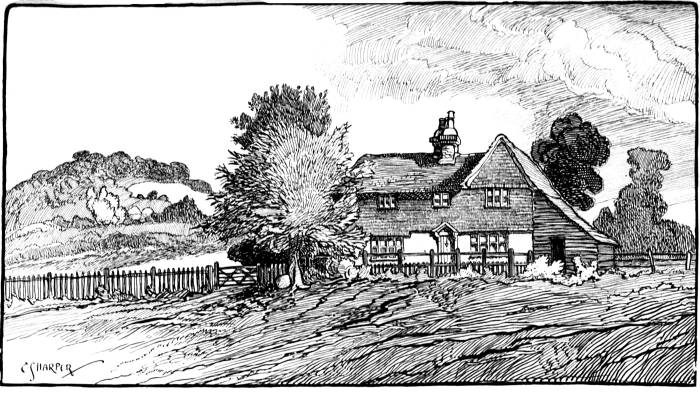
AN OLD WAYSIDE COTTAGE, BELOW POLHILL.
Dunton Green, formerly Donington, is a rather
Cockneyfied hamlet that is at present halting
between expansion and a few regretful reminiscences
of a past rural state. It is very populous,
and the children live and have their playground in
the open road.
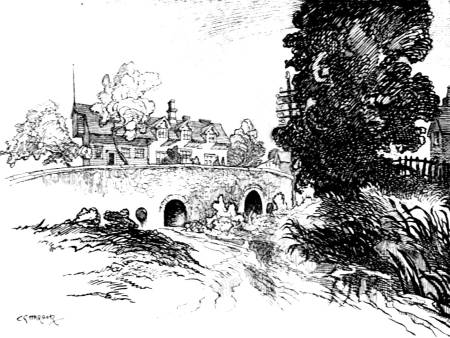
LONGFORD.
At Longford, to which we come after Dunton
Green, the river Darenth is crossed, at an early
stage of its career, by a bridge that long ago
superseded the ford. It is still a narrow bridge,
with a roadway only twenty feet wide, but it has
been already once widened and once renewed, as
two tablets, built into the wall on either side,
declare:
This Bridge was renewed by order of the Commissioners
of Sevenoakes Turnpike.
William Covell, Mason.
And
This Bridge was Widen’d in March a.d. 1813 by order of
the Seven Oaks Turnpike Road.
J. Smith, Archt.
The Darenth rises at Westerham, only five
miles away; but there is already a sufficient head
of water in the infant stream to serve the purpose
of a large flour-mill standing here.
Beyond it, a dusty stretch leads into Riverhead,
past a strange little outlying group of houses lying
back from the road and fronted with the rows of
lime-trees that give it the name of Linden Square.
Local gossip declares the place to have once been
a coaching inn, but exact information is utterly
unprocurable.
That the village of Riverhead belongs very largely
to Lord Amherst is obvious enough, in the highly
ornate terra-cotta tablets on the houses, bearing a
gigantic A crowned with an earl’s coronet and
ensigned with a shield charged with three spears.
Also the “Amherst Arms,” with its sign exhibiting
two Red Indians and the motto, “Constantia et
Virtute,” proclaims the lordship.
Riverhead is a pretty little village, with a
puzzling number of branching roads, situated at
the foot of the long steep rises to Sevenoaks. Its
name comes from the source of the Darenth
being near at hand. The church that looks so
picturesque in the illustration is, in fact, a piece
of very bad early nineteenth-century Gothic,
designed and built in 1831 by Decimus Burton,
whose sympathies were entirely with the classic
styles, as will be acknowledged when it is said
that he it was who designed the Arch and screen
at Hyde Park Corner and the lodges at the various
gates of Hyde Park.
The corner of Riverhead selected for illustration
here includes old and new. The gabled houses on
the left are recent; the weathered wall on the
right, with the curious little two-spouted fountain,
is old; and very old and weather-worn is the
almost entirely illegible notice-board declaring
that something will be done to somebody doing
something or other, followed by “£5.” It is very
vague and terrifying.
“Montreal,” a beautiful park on the right hand
of the ascent to Sevenoaks, is an historic place,
the seat of Lord Amherst (Earl Amherst and
Baron Holmesdale), descendant of that great
soldier of the eighteenth century, Sir Jeffrey
Amherst, Field-Marshal and Commander-in-Chief.
The estate of Montreal came to this family in
the seventeenth century, when a Jeffrey Amherst
of that period, a barrister, acquired it. The place,
then called “Brooks,” had been a seat of the
ancient Colepepper family. The famous soldier
was born here, and it is not a little curious to
observe that his equally great contemporary,
Wolfe, whose most renowned exploits were performed
in the same series of campaigns in Canada,
was born close at hand, at Westerham.
Amherst was born in 1717, and commenced his
career as page to the first Duke of Dorset at Knole,
afterwards learning the profession of arms in
Germany, then, as now, the military school par
excellence. How he fought in the victory of
Dettingen or in the defeat of Fontenoy does not
concern us here. His chance came when Pitt,
alarmed at the policy of the French in Canada,
gave him high command in those territories; and
he justified the selection.
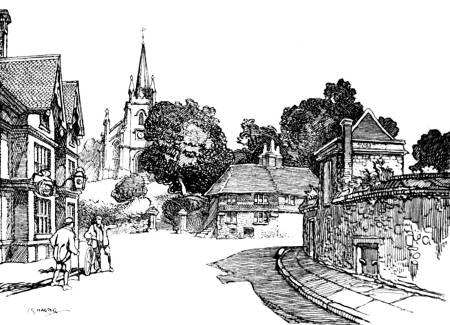
RIVERHEAD.
He was no kid-glove warrior. Sentiment was
no portion of his equipment in the field, and if
there were any in his composition he reserved it
until his campaigns were fought to a finish.
To some of his doings or proposals the term
“methods of barbarism,” shamefully applied by
Little Englanders to the rosewater conduct of our
modern campaigns in South Africa, might well
have been attached. In warfare with the Indians
he was so enraged with the atrocities committed
by them upon captured officers that he contemplated
employing bloodhounds and spreading
smallpox among the redskins. That last horror
was, fortunately, sternly vetoed, not only for the
sake of humanity, but from the very reasonable
fear that the scourge, once let loose, might destroy
not merely the “noble red man,” but the white
man as well.
Probably no one fully informed ever applied
to Amherst the term of “dashing.” His methods
as a general were calculating and deliberate; he
was, indeed, the very antithesis of the meteoric,
impulsive Wolfe. Those qualities served his
country quite as well, and himself better; for
although he was not idolised as a hero, he succeeded,
on his return home, in obtaining the post
of Commander-in-Chief.
To be regarded as a hero, it is generally considered
necessary to be killed in the performance
of the heroic deed, which does not seem altogether
satisfactory, and is indeed rather discouraging.
However that may be, a grateful country, in
the person of George the Third, eventually offered
Amherst an earldom. He refused it, and accepted
a barony instead. He held the post of Commander-in-Chief
for many years, and only resigned, under
pressure, in 1795 in favour of the Duke of York,
the king’s son, whose military exploits are summed
up in the once-popular lines:
The brave old Duke of York,
He had ten thousand men:
He marched them up to the top of a hill,
And marched them down again;
a specimen of minstrelsy which concludes with the
obvious statements that—
When they were up, they were up,
And when they were down, they were down,
And when they were half-way up
They were neither up nor down.
Amherst lived but two years after the close of
his public career, dying in 1797, at the age of
eighty-one.
He it was who, demolishing the old house at
Riverhead, built the present exceedingly plain
stone mansion, and re-named house and park
“Montreal.” There was, in fact, something in
the scenery around Sevenoaks that reminded him
vividly of those great northern pine-clad territories
of America, where he had warred with such distinction
against the French and the redskins; and
there is a spot on the road from Sevenoaks to
Ightham, where the red-stemmed pines grow thick
and a mysterious woodland hush enshrouds the
place, so keenly reminiscent of the scene of his
action at Crown Point in 1759, that he rechristened
it by that name. The spot—in the woodlands of
Seal Chart—may readily be found to-day, for it is
marked by the Crown Point inn, whose sign, the
“Sir Jeffrey Amherst,” exhibiting a picture of
the warrior himself brooding over the scene of his
exploit, depends picturesquely from a tree-trunk.
A tall obelisk, built rather precariously of
rubble, stands on a rabbit-infested mound in the
park of “Montreal,” in a vista opening from the
house, and is itself surrounded by weird pine-trees.
It bears long inscriptions reviewing those
military operations. One side is dedicated to a
“most able statesman” (by whom William Pitt,
Earl of Chatham, is indicated), and another commemorates
the meeting here of Amherst with his
two younger brothers—John, Admiral of the Blue,
and William, Lieutenant-General.
It was an era when England was fighting all
the world, and had need of such commanders.
The long list of military successes is stupendous:
- Dedicated
- to that most able
- Statesman
- during whose Administration
- Cape Breton and Canada were conquered,
- and from whose Influence
- the British Arms derived
- a Degree of Lustre
- unparallell’d in past Ages.
- Fort Levi surrendered 25th August 1760
- Isle au Noix abandoned 28th August 1760
- Montreal surrendered
- and with it all Canada and
- Ten French Battalions lay’d
- down their Arms 8th Sept. 1760
- St. John’s, Newfoundland
- retaken 18th Sept. 1762.
- Louisbourg surrendered
- and Six French Battalions
- Prisoners of War, 26th July 1758
- Port du Quesne taken possession of 24th Nov. 1758
- Niagara surrendered 25th July 1759
- Tonderoga2 taken possession of 26th July 1759
- Crown Point taken possession of 4th August 1759
- Quebec capitulated 18th Sept. 1759.
- To commemorate
- the providential and happy meeting
- of three Brothers
- on this, their Paternal Ground
- on the 25th January 1764
- after a six Years glorious War
- in which the three were successfully engaged
- in various Climes, Seasons and Services.
The long, long ascent to Sevenoaks, which crowns
a ridge seven hundred feet above the sea-level,
does not lack beauty, lined as it is for a considerable
distance with hedgerow elms. But it puts on
another kind of beauty at night, for as you come
past the railway-station, and look down in the
darkness upon the galaxy of red and green signal
lights, it seems like a lavish Arabian Nights
display of rubies and emeralds spread out there,
in the black cutting.
The name of the railway-station, on the other
hand, is vulgarity itself. It is known as “Tub’s
Hill,” to distinguish it from the other Sevenoaks
station known (from the public-house outside) as
“Bat and Ball.”
Sevenoaks is greatly indebted to the South
Eastern Railway for a matter quite outside railway
accommodation. The town had long and
vainly been seeking a good water-supply, and
was still upon that quest when this branch of
the South-Eastern was under construction in
1867. What the town wished to find, and could
not, the contractors for the Riverhead Tunnel
found, very much against their will. They struck
a spring which for a time drowned them out and
cost enormous sums to divert; but it gave to the
town its present abundant supply.
There can be no place with more divergent
roads than those at the entrance to Sevenoaks.
They branch off singly, in pairs and triply,
acutely and gradually, and all with a specious
artfulness leading the unwary anywhere but into
the town, and by choice into suburban roads that
presently end in wastes of shingle, heaps of
building materials, and uncompleted houses.
The old Sevenoaks of coaching days is mostly
gone, or disguised out of recognition. There was
then a “cage,” or lock-up, in the town, with a
pond in front of it and a ducking-stool for nagging
wives or scolding neighbours. There was also a
toll-gate and a weigh-bridge, where heavy waggons
paid according to their showing in tare and tret.
Sevenoaks was, in short, fully equipped with the
engines of civilisation as understood at that
period.
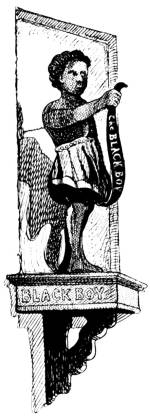
SIGN OF THE “BLACKBOY”
INN.
The “Chequers” inn, which still projects a
somewhat old-fashioned front beyond the general
building line, is a kind of “Jack o’ Both Sides,”
for it has another, and quite different, frontage
on to the parallel street. It was in those days
the starting and arrival point of a coach to and
from London, supported by a
select few who had business in
the metropolis, and from that
circumstance was called the
“United Friends.” Peacock, the
coachman, was said to bear a
striking resemblance to Tony
Weller, which is not remarkable
when we consider that Dickens
constructed that plethoric, red-cheeked
person from the typical
stage-coachman of his age. There
were then, in fact, “Tony
Wellers,” like “Samivel’s”
father, on every road. The coach
was jointly owned by Benjamin
Worthy Horne, John Stephens,
and John Newman.
The “Wheatsheaf” has long
since been transformed into offices, and the
“Crown,” that once owned a gallows-sign
stretching across the road, has been given a
modernised grey stucco front, and looks rather
like a banking establishment. Among minor
inns, the “Blackboy,” displaying the effigy of
a little nigger, is of considerable age, and takes
its name from the now extinct local Blackboy
family who flourished greatly in Sevenoaks during
the sixteenth and seventeenth centuries. The
more modern inns include the “Bricklayers’
Arms,” whose device—not granted by the College
of Arms—is an ingenious arrangement of plumb-board
and trowel.
SIGN OF THE “BRICKLAYERS’ ARMS.”
But all Sevenoaks inns, past or present, yield
in interest to the fine old mansion facing the high
road near the church,
and known as “The
Old House.” All details
of its history have
been lost, and it is only
known that it was once
the “Three Cats”—probably
“The Cats”—inn,
celebrated by
that late seventeenth-and early eighteenth-century
poet, Tom Durfey, who was kept by his patron,
the sixth Earl of Dorset, at Knole as a mirth-maker
and general bacchanalian laureate. You
cannot imagine a poet with the Christian name of
Tom being other than a bard of the barrel; and as
for Tom Durfey, he was the most bacchic songster,
and the dirtiest rhymester of all the dirty dogs of
his age: which is why he is so reprobated by the
good—and so read.
In his song in praise of the “Incomparable
Strong Beer of Knoll,” he says:
There’s Adams, in hoping to pleasure his town,
Declares the best French wine is sold at the “Crown,”
And well it may be, for he takes good rates,
And so does my jolly sleek friend at the “Cats.”
But to strong beer my praises must come,
Leave them to isinglass, egg-whites, and stum.
Beer, fine as Burgundy, lifts high my soul
When Joudrain perks up for the honour of Knoll.
The “Cats” of course derived its sign from the
arms of the lords of the manor, the Sackvilles of
Knole, whose “supporters” are two leopards
argent spotted sable, easily to be mistaken by
the rustics of a land where leopards are not
among the native fauna, for cats. It must have
been an aristocrat among inns, for it remains still
one of the noblest houses in Sevenoaks, with handsome
red brick frontage of the time of William
the Third or Queen Anne, with beautiful gardens
in the rear, and others, equally beautiful, in front,
on the opposite side of the road. It must have
ceased to be an inn shortly after Tom Durfey
wrote, for it has been in occupation as a private
residence of the Austen family since about the
middle of the eighteenth century.
Opposite is the very beautiful, characteristically
“Queen Anne”-style house, “The Chantry,”
standing next the church and on the site of a
demolished ecclesiastical building. It has lately
been most exquisitely restored.
The church itself, a large building with a tall
tower, is of a somewhat uninteresting Perpendicular
design. The curious may notice in the churchyard
a stone to “Milenda,” wife of one Joseph
Kennard.
A monument in the north aisle to William
Lambarde, who wrote the “Perambulation of
Kent,” and died in 1601, was removed from Greenwich.
Among the others, there are singularly
modest tablets to the Amhersts. The most important
is that to the charitable Lady Boswell, who died
1692, aged apparently thirty-seven, for the inscription
says: “During xxxvii years she conversed
amõg us mortals.” She left sums for
“fifteen of the poorest Children to be instructed
in ye Catechism of ye Church of England,” and
for the much more practical purpose of teaching
them to “write and cast accompts” and to
apprentice them to “handycraft trades or employments.”
Her school is a prominent, and very
grim, object on entering the town.
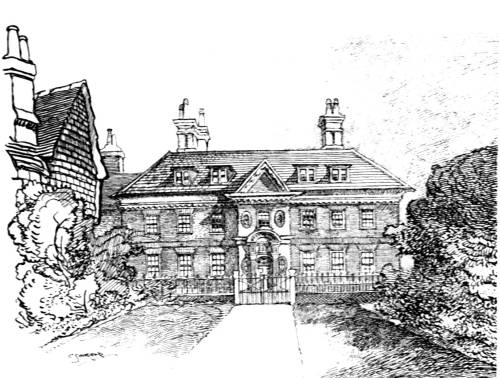
OLD MANSION, FORMERLY THE “CATS” INN.
The most famous native of Sevenoaks is undoubtedly
the mediæval Sir William Sevenoke,
whose career was remarkably romantic. According
to all received accounts, he was a foundling,
discovered as a baby in the hollow of a tree in the
immediate neighbourhood of the town by one Sir
William Rumpstede, who named him “William”
after himself, and “Sevenoke,” or “Sevenoaks,”
after the town; brought him up, and apprenticed
him to Hugh de Bois, citizen and ferrer (or
ironmonger), of London.
Let us linger a moment to consider how popular
in ancient times was this finding of neglected
children in casual places by charitable knights.
The frequency of it is a little suspicious. The
most famous foundling incident (after that of
Moses) is the finding, early in the fourteenth
century, of one of the ancestors of the Stanleys.
According to the legend, Sir Thomas de Latham
was walking with his lady, who was childless, in
his park, when they drew near to a wild and
lonely spot where they found a baby boy, dressed
in rich swaddling clothes, in an eagle’s nest. The
knight acted astonishment; the good unsuspecting
lady looked upon the baby as a present from
heaven. It was adopted and educated in the
name of Latham, eventually succeeding to his
father’s and his adopted mother’s property. In
the course of years this foundling’s daughter
Isabel married Sir John Stanley, who adopted
the Eagle and Child crest still borne by the Earls
of Derby.
But to return to William Sevenoke. He became
a grocer, and eventually, in 1418, Lord Mayor
of London, became Member of Parliament, was
knighted, and was granted for coat of arms seven
acorns. To him Sevenoaks owes its endowed
Grammar School and almshouses. Whether they
were descendants of his whose name became
corrupted into Sennocke is not quite clear, but it
is quite certain that
the unlovely name of
Snooks derives from
a further debasement
of it.
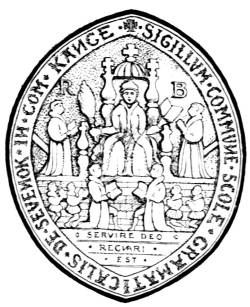
SEAL OF SEVENOAKS
GRAMMAR SCHOOL.
The schools and
almshouses were rebuilt
in 1727, and are
generally thought by
passing strangers to
be a workhouse or a
penitentiary. It will
thus be gathered that
they are not beautiful.
If strict discipline may
be read into the ancient seal of the school, then
it was in old times governed on the principle
of Winchester, “learn or be whopped,” for that
device exhibits a gigantic, Jove-like master presiding
over a number of scholars, evidently in fear
of the immense birch he holds in his right hand.
A resolute application of the weapon represented
here would undoubtedly result in abolishing
laziness in the scholar given a taste of it.
When you know Sevenoaks well, have learned its
geographical situation, and have inquired into
its surroundings, you will begin to perceive that
it was once very humbly dependent upon the
great historic residence of Knole, whose park it
on one side fringes. Knole divides with the not
far distant Penshurst the reputation of being the
finest baronial pile in England. If their ancient
lords could return to Penshurst and Knole they
would still find there many of the buildings and
appointments they knew; and if the less ancient
Elizabethans and Jacobeans were permitted to
revisit their homes they would see them very
much as they were, and so come back without
any sense of strangeness.
Knole, of course, takes its name from its hilly
situation. There are dim and fragmentary records
of a former house, away back in the reign of King
John. At that time it belonged to a great historical
personage, William Mareschal, Earl of Pembroke,
to whom it came as part of his wife’s dowry.
Eventually it fell to the family of de Say, who
for more than a hundred years ruled the estate,
when for an interval it passed into other hands,
only to be repurchased by a Fiennes, who was
on his mother’s side a de Say. This unfortunate
Fiennes had the ill luck to live in the troubled time
of Henry the Sixth, and was further unfortunate
in attracting the favour of that ill-starred King,
who heaped many distinctions upon him, all to
his undoing. He was created Lord Saye and Sele,
Lord Warden of the Cinque Ports, Constable of
Dover Castle, member of the King’s Council,
Lord Chamberlain, and Lord Treasurer of England;
and, in fact, closely resembled in real life Pooh
Bah, the “Lord High Everything Else” of The
Mikado.
The title of Lord Saye and Sele, which still
exists as a barony, re-created in 1603, in the
Fiennes family, has a fine sound of irrevocability
about it—a kind of “do and dare,” “what I have
said I have said” connotation—to which it has
really no sort of right. Saye, as we have seen,
was a family name, and Sele has in this connection
nothing to do with sealing, signing, and delivering
as act and deed. It comes from the village of
Seal, on the other side of Knole Park.
The amazing prosperity and court favour shown
to Lord Saye and Sele raised up many enemies for
him, and the King was obliged, first to sequester
him from the office of Lord Treasurer, and then
to commit him to the Tower of London, merely to
secure him from the violence of the discontented
people, then seething in the rebellion of Jack
Cade, in 1450. That insurrection brought an
exciting moment to Sevenoaks, for Cade and his
army, pursued by some twenty thousand of the
King’s troops from their riotous place of assemblage
on Blackheath, turned at bay upon them, and
in the disastrous skirmish of Sole Fields, within
sight of Knole, slew the King’s commander, Sir
Humphrey Stafford. Cade, assuming the armour
of the fallen knight, marched to London, where,
according to Shakespeare, he struck the historic
London Stone with his sword and proclaimed
himself “lord of this city.” He did more than
that, for he brought the unhappy Lord Saye and
Sele forth from his hiding-hole in the Tower, and
hacked his head off at the Standard in Cornhill,
afterwards offering revolting barbarities to his
body.
It was the son of this victim of popular revolt
who, six years later, reduced to extremities in the
troubles of the time, sold Knole to Bourchier,
Archbishop of Canterbury, for a sum representing
£2,500 at the present day. The manor-house of
that time was old and dilapidated, and Bourchier
pulled it down and built the gatehouse and the
principal front of the present group of buildings.
Thirty years later he died and left Knole to the
See; and, with all other archbishops, was ex officio,
so to speak, collated to the Realms of the Blest.
He was succeeded by Archbishop Morton, who
reigned fourteen years; by Henry Dene (two
years), by Warham for thirty years; and then by
Cranmer, who in 1537, from motives of policy,
surrendered it to the Crown.
Politic indeed, for the Archbishops of Canterbury
at that time owned no fewer than sixteen
palaces, and men were beginning to inquire by
what right lords spiritual were so gorged with
things temporal; just as in these times of ours
the phenomenal wealth of great landowners is
beginning to arouse an inconvenient criticism.
Knole came to the Sackvilles, whose collateral
descendants still own it, from Queen Elizabeth,
who in 1567 gave it to Thomas Sackville, a cousin
on her mother’s side. He already owned Buckhurst,
and she created him therefore Baron
Buckhurst; which is, as every one will acknowledge,
a fruity-flavoured title. “Baron Buckhurst:”
how finely it trips off the tongue! The
Queen gave as a reason for her gift the “keeping
him near her court and councils, that he might
repair thither on any emergency with more expedition
than he could from his seat of Buckhurst in
Sussex, the roads to which county were at times
impassable.”
Lord Buckhurst was, in fact, a persona grata at
court: a man of wit, a poet, a dramatist. Also a
man of tact and management, for in his old age, in
1603, he was created Earl of Dorset by Gloriana’s
successor, James the First.
And so the descent continued from first to
seventh earl, who succeeded like chapters in a
history, of which a new volume opened with the
seventh earl being created a duke.
The fourth duke, George John Frederick
Sackville, came to a tragic end in 1815, in his
twenty-second year. He was an adventurous
horseman, and on a visit to Lord Powerscourt,
in Ireland, fell with his horse in the hunting-field
at Killiney. The horse fell on him and crushed
in his chest.
They brought his body home with every circumstance
of mortuary pomp, as befitted a duke; he
lay in state at many inns on the several stages of
the Holyhead Road, from Ireland to London, and
finally was laid to rest with his fathers in the
Sackville vault at Withyham, in Sussex.
With the widow of his cousin and successor in
the title, the fifth and last duke, another volume
ended, in 1825.
The ownership of Knole devolved upon Lady
Elizabeth Sackville, sister of the unfortunate fourth
duke. She married the fifth Earl De La Warr,
and thus changed the name of the lords of Knole
to that of Sackville-West. Her eldest son became
in due course Lord De La Warr: to the younger
sons she left Knole, and in their favour the barony
of Sackville was created, in 1876.
The long street of Sevenoaks acts, as it were, the
office of screen to the leafy glades, the hills and
dells of Knole Park, to which you come along
an alley between the houses. It is an extremely
large park, and in many places peculiarly beautiful.
To set down in this place its acreage and its
circumference of six miles would convey a very
dim impression of its proportions, but if we say it
is two-thirds the size of Richmond Park its extent
will be more generally understood. The house
itself—if it be no derogation to style Knole merely
a house—stands quite half a mile within the park,
on a height, and looks, with its ranges of gables,
towers, roofs, and chimney-pots, like some mediæval
town. Great herds of red and fallow deer browse
amid the bracken, or shelter under the great
beeches, and regard the many visitors with an
amiable and fearless expression, except in the
“fence months,” October and November, when
they are quite ferocious, and bellow day and night
like the bulls of Bashan.
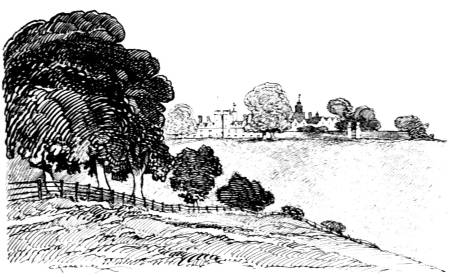
KNOLE, FROM THE ROAD.
Knole is a “show place.” You may roam
where you please in the park, and on most days,
within easily ascertainable hours, you can be
shown over the vast place on payment of two
shillings. You would not be permitted so much
in the millionaires’ palaces of democratic America.
In this gigantic place Lord Sackville and his
family occupy a small suite of rooms furnished in
modern style, and, if you consider it closely, are
practically the caretakers of a vast museum of
antiquities maintained at their own expense. The
place is so extensive, and the maintenance and
repairs so costly, that it would require the revenue
of one of the great landlords of London to keep it
up, and, in addition, to live in fitting state, and
the Sackville-Wests have not those resources.
Some day a paternal Government will come to
the rescue of owners of historic houses of public
interest. There is a widely prevalent idea that all
governments are paternal to one class, and act in
a dominie and minatory manner to the others.
Conservatives, in this belief, play the beneficent
father to the aristocracy and their fringe, and
waggle weapons of punishment at the lower
classes; while the Liberals (in the accepted idea)
pat the middle classes and the working men on
the head and give them something to go away and
play with; and then, turning up their sleeves and
selecting a fine birch-rod, bid dukes and earls to
come here this instant moment and take their
trousers down. It is not really precisely like
that, but Sir William Harcourt did something
of the kind with his Death Duties. At any
rate, those are the respective aspirations of free
and enlightened voters on either side.
A fatherly Conservative Government may,
therefore, some day be expected to come handsomely
to the rescue of the owners of historic
mansions: owners with acres of reception-rooms,
picture-galleries, and baronial halls; owners with
long pedigrees but slim purses, who can scarcely
afford even to keep their many windows cleaned,
let alone maintain floors and roofs and keep the
moth out of priceless ancient tapestries and silken
hangings. Such a Government will allocate grants
annually to those proprietors who habitually admit
sightseers, and who make application for aid; and
surely the principle would be just, for it certainly
is scarcely fair to the proprietors of such places as
Knole, if witness to their good nature, that they
should expend their substance chiefly for the delight
of the tourist and sightseer.
The next step would be a competitive measure
introduced by the inevitable Liberal Government
ordained by the well-known fickleness of the electorate,
by which all historic mansions would be
scheduled and administered as to their “show”
parts by a Department responsible for the safe and
careful keeping of artistic and historic treasures,
endangered by the carelessness, the poverty, or
even the uninstructed enthusiasm of their owners.
It will all some day come to pass.
It is obvious that a great range of buildings
like Knole, covering nearly four acres, dating
back, in part, four hundred years, and filled to
overcrowding with things precious intrinsically
and by association, must involve the existence of a
large staff; and it must be at least equally obvious
that no lord of Knole could without great physical
effort use even a respectable proportion of his
three hundred and sixty-five rooms, traverse his
fifty-two staircases, or look forth daily from more
than ten per cent. of his five hundred and forty
windows.
The house stands in what is probably the least
attractive portion of the park, where the grass is
tough and wiry, and like that of some untended
prairie. The long, dark-grey, stone front, pierced
with mullioned windows, is like that of an ancient
Oxford college. You are personally struck with
the resemblance, and, reading the impressions of
bygone visitors, you find they have all been impressed
in the same way. Every gable is surmounted
by the leopard “sejant affronté” of the
Sackville coat of arms, looking like so many tomcats
obeying the instruction of some unseen drill-master:
“Eyes right.”
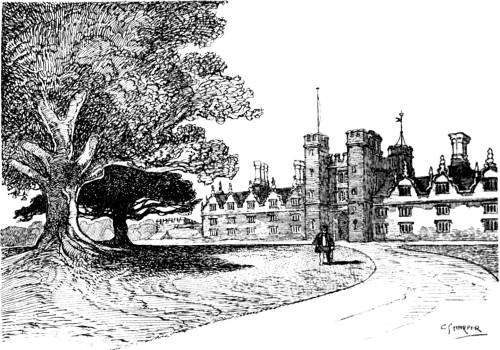
THE GATEWAY, KNOLE.
The sternly walled-in character of Knole would
discourage a burglar, just as it was intended to
give pause to any hostile visitor; for the times
when it was built were halting between the necessity
for fortresses and the liking for magnificence
and display. Thus Knole partakes of the character
of both castle and palace.
No armed guard meets you now: only a porter.
There are many kinds of porters. There is the
fish-porter of Billingsgate; there are also the railway-porter
and the warehouse-porter, to name
none others; but it is unthinkable to class the
porter of Knole with these. Porters, I should
suppose, by the etymology of their name, to be
bearers of burdens, carriers, humpers of grievous
loads; but this dignified person is rather of the
bank-porter variety, own brother to those of the
Bank of England, and carries nothing but a highly
respectable suit of clothes and an aristocratic air.
I am quite sure he is more dignified than even
Lord Sackville himself, and his portly presence,
his black swallow-tailed coat, his silk hat, and his
red waistcoat give a more soothing effect of the
permanence of things than even the grey walls of
Knole can manage to impart.
The porter’s lodge itself is a little museum
of antiquities. There are the flint-lock muskets,
the torch-holders, the brass-bound leather skullcaps,
the cartridge-boxes, halberds, and other
weapons of offence and defence belonging to the
Earls and Dukes of Dorset from Jacobean to Mid-Georgian
times: necessary equipments for the
bodyguard of my lords and their visitors in those
“good” old days. Here, too, you see the ancient
horn-lanterns and the silver maces that were part
of the display and the feeble illumination of those
trains; and on the whole you are very glad that
this is the twentieth century, and that these are
outworn relics whose use has long since passed.
The gatehouse tower and porter’s lodge lead
into the first, or Green Court, one of the seven
quadrangles included within the group of buildings,
and so called from its lawns and to distinguish
it from the next, flagged with pavement, and styled
the Stone Court. The first is graced by two classic
bronze statues: the “Venus Anadyomene” and the
“Gladiator Repellens.” The Stone Court leads
by an insignificant loggia, supported on Jacobean
pillars, to the Great Hall, built between the years
1603-8 by that magnificent person the first Earl
of Dorset, who in all those years gave constant
employment to two hundred men, in his alterations
and repairs, and spent £20,000 on furnishing a
bedroom for the expected visit of James the First
to him.
The Great Hall was the banqueting-room. It
has a boldly carved oak screen, in the characteristic
Jacobean taste, but painted and grained, in
some barbaric period, to resemble oak! Oak, you
will observe, painted to resemble itself! To paint
the lily and to gild refined gold were no greater
works of supererogation. It is difficult to understand
why it was done, here and elsewhere.
Ascending by the Painted Staircase, you come,
in succession, to the Ball-room, the Reynolds
Room, the Cartoon Gallery, the King’s Bedroom,
the Chapel Room, Organ Room, Brown Gallery,
Lady Betty Germaine’s rooms, old Billiard-room,
Spangled Bedroom, Crimson Drawing-room, and
so forth; seventeen in all, filled with the most
wonderful old furniture, gigantic bedsteads, priceless
china, paintings by the most revered masters,
and portraits of a long dignified line of Sackvilles,
Earls and Dukes of Dorset: great gentlemen and
great patrons of the arts.
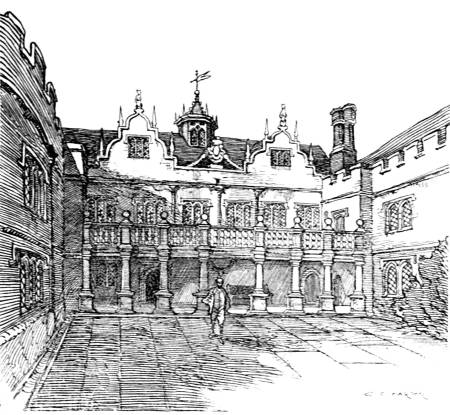
THE STONE COURT, KNOLE.
There they hang; rows of them. Grave-faced,
dignified personages, whom not all the feminine
frippery that characterised masculine costume in
Elizabethan, Carolean, and Jacobean times can
make look foolish. They look responsible persons,
weighted with the mellow gravity that could not
well be absent in times when the headsman’s axe
was an institution. But they could not all be
so wise as they look; something—and that not
in small or grudging measure—must be due to
courtly palettes. The thought is treason towards
the Muse of History, of course; but surely we of
this day, rich as we are in the little tin gods of
politics, have not the monopoly of them, and may
find an invertebrate Balfour or so amid these
reverend seigneurs who look so inscrutably wise.
The Dukes of Dorset were not merely men with
titles; they were ducal Dukes, who lived up to
their strawberry-leaves, and had a ducal way with
them; were dukes first and men a very long way
after. There are none such now. The mould is
broken, the recipe forgotten, the pattern mislaid.
How sad! That must be a degenerate age whose
dukes are so uncharacteristic of their order;
whose aldermen, who macerate on charcoal biscuits,
are lean dyspeptics, talk art criticism, and
shudder at the idea of a banquet; who are no
longer those rotund, well-larded figures of convention
that drank incredible quantities of fruity
port and turtle-soup. That must be an effete
generation whose new-rich no longer strew their
way with dropped aitches; whose paupers, instead
of skilly, dine royally off the best joints, and eat
the finest bread, and when they ask for more—get
it. In short, your typical pauper, millionaire,
alderman, or duke no longer exists in real life.
Even the novelists have learned their lesson and
know better. Only on the stage shall you find
those outmoded figures still strutting, and even
there they are on their last legs. The stage is the
last ditch of convention; but the time is at hand
when some dramatist will give us a stout and
haughty workhouse inmate, a humble and cringing
duke, and an alderman virtuoso; and he will be
quite as loudly hailed for an emancipator as ever
was Robertson.
The Dukes of Dorset lived up to the fine alliteration
of their title, and when that became
impossible, they died out, like the oxyrhincus and
the mastodon, who could not survive their environment.
There is scarce a modern duke who,
in the spectacular way, is worthy his title. Some
are bored men and commonplace; most of them
“splendidly null,” as Tennyson might say. I
know an undersized duke with a limp and a falsetto
voice, who takes photographs with a hand-camera
and an apologetic manner; and another with the
appearance and carriage of an unsuccessful commercial
traveller. They would be ashamed to be
ducal in their behaviour; and it is quite certain
that their forbears would be ashamed of them.
To view Knole intimately is not given to the
many. What are seventeen rooms out of three
hundred and sixty-five, even though they be rooms
of State! In fact it is rather in the more ordinary
rooms, if any of those at Knole can so be styled,
that you read its everyday story of old. After all,
the Lords of Knole were not always entertaining
kings and great nobles. Sometimes they had a
“day off,” no less than the British workman of
this era of ours, and then they were a thought
more easy and less splendid, and occupied the
second-best rooms, just as the ordinary Briton of
to-day does, when he is not wanting to “show
off.”
I am afraid we all want to impress the visitor
with a magnificence that is not kept up when he
is gone. The lower-class parlour, the drawing-room
of the upper strata, are the superstitions
not only of to-day, or of one or two classes. They
probably go back to the beginning of things,
when even Prehistoric Man had his ordinary cave
to live in and his extraordinary, in which his wife
“received.”
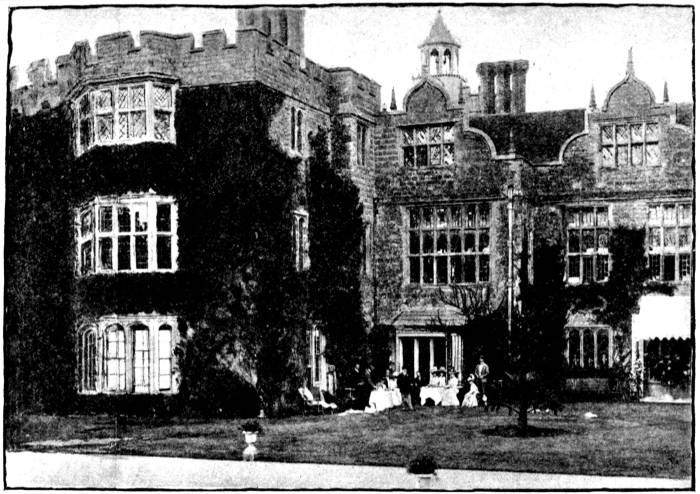
THE SOUTH FRONT, KNOLE.
Photo by C. Essenhigh Corke & Co.
There are thus whole suites of ancient rooms at
Knole, now silent and deserted; and overhead,
above the long galleries of stately magnificence,
are interminable attics, called “wardrobes,” not
because of being storerooms of clothes, old or
new; but presumably the playrooms of the boys
and lads of good family who, after the old English
custom, were sent to Knole under wardship of
the noble owners, to learn the usages of good
society and the duties of chivalrous knights. In
short, Knole, and every other castle or stately
mansion, was, as it were, a training-college, a
seminary of deportment and knightly devoirs;
and in them one learned that good form whose
inculcation is supposed to be the only value of
Oxford and Cambridge at this day.
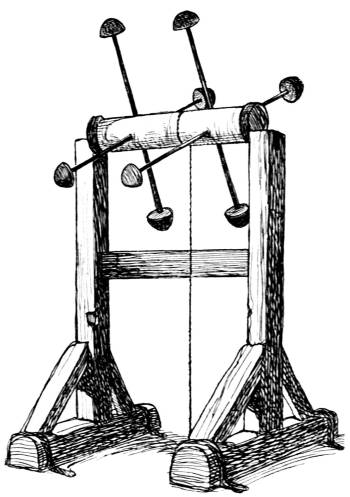
THE “DUMB BELL.”
An odd surviving relic of Knole as a College
of Good Manners is the curious contrivance known
as the “Dumb Bell,” in that one of these wardrobes
styled the “Dumb Bell Gallery.” It very
closely resembles the windlass seen over old
country wells, with a roller on which is wound
a rope that descends through a hole cut in the
floor, into the billiard-room. The arms projecting
from the roller are iron, tipped with lead. This
machine, which appears to date back to about the
beginning of the seventeenth century, is thought
to have been in the nature of a “home exerciser,”
and to have been suggested by the bell-ropes and
the exercise of bell-ringing in church towers.
Here, however, the athlete could bring up his
muscles without being a nuisance to every one
within earshot. From this originated the name
of those very different objects, used however for
the same purpose of exercising—the modern
“dumb-bells.”
And so, farewell Knole, mausoleum of a departed
condition of things, treasure-house of art and
tradition, puppet-show for the summer throng.
One looks for it, topping the sky-line, expectantly,
and leaves it with regret; unlike those two tramps
seen and heard on this very road by the present
writer. One of them listlessly noticed its towers
and gables. “Wot’s thet?” he asked his mate:
not that he was interested, but for the sake of
something to say. How can you be interested in
anything when you are footsore but your feet?
“Corsel,” replied the other, shortly; “carm
on.” But he need not have bidden his fellow
“come on,” for he had not given the “castle”
another glance, and had never halted a moment.
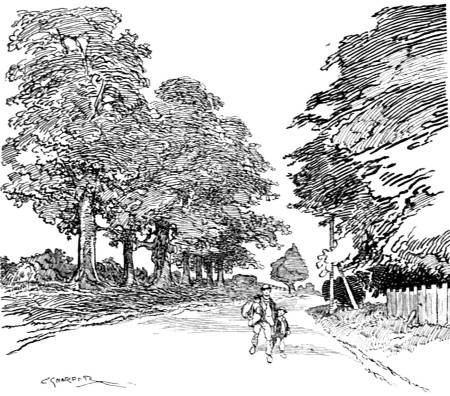
THE SEVEN OAKS.
The road descending steeply from Sevenoaks
and having Knole Park on its left is the coaching
highway, improved upon the ancient road. It is
steep now, but how much steeper, how rugged
and how narrow may be seen towards the bottom
of the dip, where a little gate admits through the
oaken palings of the park, and leads down a
hollow lane whose banks are thickly set with
ancient thorns and other trees. It is, or was
before the embanked road was made, known locally
by the names of “Shangden,” “Shand End,” or
“Chene Dene,” in delightful incertitude.
This is the original road, preserved for the
last seventy years or so in the bottom, where the
modern highway was slightly deviated and constructed
at a higher level. It is a surviving
portion of that road Archbishop Islip, travelling
horseback to Tonbridge in 1362, found so extremely
bad. He struggled persistently, but at
last fell from his horse and became “wet through
all over.” In that pitiable condition he mounted
again and rode on, without any change of clothes,
and so was seized with paralysis.
An archway under the modern road, seen even
more distinctly from a bye-road branching off to
the right, was made for the especial purpose of
maintaining unbroken the old line of an even
more ancient cross-road—a pack-horse way—which
crossed the old road from Sevenoaks to Tonbridge
in the hollow, at right angles. The arch, however,
has long been blocked up with timbering, and the
pack-horse route is scarcely discernible in the park
and the meadows.
Coming to the next rise, crowned by the
“White Hart” inn, a line of seven trees is seen
in the hedgerow on the right hand. These are
the comparatively modern seven oaks planted at
some uncertain time to commemorate those that
are supposed to have originated the name of the
neighbouring town. There is considerable difference
in the size of the trees, and it is thus to be
presumed that some of the seven were, from some
cause or other, destroyed, and replaced later. The
oldest may date back two centuries, the others
sixty years or so later. No information exists as
to who planted them, or when; even the site of
the old original seven oaks that gave the town
of Sevenoaks its name, away back in the dark
ages, is unknown.
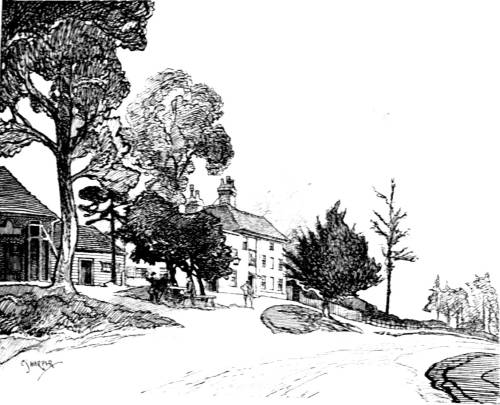
THE “WHITE HART” INN.
This is the summit of River Hill: a place which
figures in an early sixteenth-century trust-fund
that offers some entertaining history.
The road to Hastings, or to Rye, was the beneficiary
of a bequest left in 1526 by James Wilford,
a successor of those “pious benefactors” who from
the earliest times, for the good of their souls less
than for love of their kind, had been wont to
repair highways, build bridges and causeways, and
perform the like services, either by direct gifts or
through the intermediary of the Church.
Of the practical piety of James Wilford I
think there can be little doubt. In the times
when he lived, Reformation was in the air. The
religious houses were moribund, and had Henry
the Eighth not disestablished and suppressed
them, another would have done so. People rather
scoffed at the idea of purchasing salvation by
bequests, just as you in modern times insure
against fire. Wilford, therefore, in that he does
not appear to have left his money with any ulterior
object of saving his soul, was really more pious
than he knew, and perhaps saved it the more
certainly. Let us trust he is enjoying the full
credit of his good deed.
This public benefactor, a “rippier” of Rye,
and said to have been an alderman of London, in
his will of 1526 stated that he had actually made
the road from River Hill to Northiam church, a
length of some twenty-six miles; and for the
perpetual repair of the ruinous parts he left an
annuity of £7, charged upon the “Saracen’s
Head,” Friday Street, Cheapside, belonging to the
Merchant Taylors’ Company.
There had been sufficient reasons in his lifetime
for him to make or amend this road; for by
the term “rippier” a fish-carrier was meant, and
James Wilford would appear to constantly have
travelled it in his business of supplying London
with fish, carried on horseback in panniers. That
it should have been possible to convey fish this
distance in the early part of the sixteenth century
so expeditiously that it arrived in good condition
is a somewhat striking testimony to the enterprise
of an age commonly thought to have been ignorant
of speedy communications.
The Merchant Taylors were by the terms of
this will to pay the £7 annually to the executors
and relatives bearing the name of Wilford, and
after their death were to make payment to the
vicar and churchwardens of Rye. In the event
of those authorities neglecting their duty of applying
the money for the benefit of the road, the
annuity was to be paid to the vicar and churchwardens
of Northiam; and, should they default,
was then to devolve upon Newenden.
These cautious provisions seem to have been
prophetic, for Rye did actually at some uncertain
time lose the money, which was then received by
Northiam until Midsummer, 1799, when, from
some dereliction of duty, it passed, as directed, to
Newenden. Disputes then appear to have arisen,
for in 1804 the Merchant Taylors, not quite sure
of their position, refused any longer to pay the
amount until a legal decision was arrived at. The
whole matter then remained in abeyance, as probably
being too small a sum to worry about, until
1819. By that time the twenty years’ accumulation
was worth having, and the inhabitants of
Rye, Northiam, and Newenden accordingly joined
forces and petitioned the Merchant Taylors,
praying them to disburse the money to Rye, which
was done, the vicar and churchwardens of that
town in turn handing it over to the commissioners
of the turnpike road from Flimwell to Rye. The
sum of £140 was then paid over, from which the
Land Tax authorities sweated £28, twenty years’
land-tax, at 28s. a year.
Flimwell is the point where the road to Rye
branches from the Hastings Road. Nineteen and
a half miles of road, therefore, appear by this
decision to have been cut off from these small
mercies.
The trifling sum now trickles into the revenue
of the Kent County Council.
River Hill was once—in the days of inefficient
brake-power—a terror to cyclists. A terror with
reason, for it is three-quarters of a mile long, and
not straight; and it has notoriously been the scene
of many accidents at the two sharp turns in its
course—one left and one right. A joint C.T.C.
and N.C.U. danger-board at the beginning is
supplemented by the notice that it is unrideable
without a brake; but that is as may be. When
the first chapter of cycling was being enacted,
an early wheelman rode it, quite inadvertently,
and lived to tell the tale, in picturesque
fashion.
In the ancient days of cycling, when it had
not long ceased to he “velocipeding” and was
still in the intermediate stage of “bicycling,” this
greatly daring person decided to ride from Greenwich
to Burwash—some fifty miles—on what was
then, with the most exquisite appropriateness,
called a “bone-shaker.” It was so unusual and
adventurous a thing to do that he wrote an account
of it, and it duly appears in the records of that
time. He thought how splendid a thing it would
be to run hundreds of miles about the country at
“a speed of from ten to fourteen miles an hour,”
as in the advertisements, and so purchased what
he thought to be a very camelopard of a machine,
with 45-in. wheels.
In two days he had so mastered this fearsome
contrivance that he decided to start, and did so, in
the evening. He had not gone more than a mile
or two when he met a butcher standing in the
middle of the road, who continued to stand there
until he was run into, when both were upset.
The bicyclist was pitched over the handles and cut
his knee, and the butcher abused him until the
cyclist—I mean the bicyclist—showed fight, when
he made off.
By the time this early wheelman had reached
Bromley he was almost exhausted, and realised
that he, at any rate, was not a fourteen-mile-an-hour
rider. There was also, he discovered, an
undue proportion of hills to be climbed—a discovery
still being re-discovered daily by thousands
of his descendants in straddling two wheels.
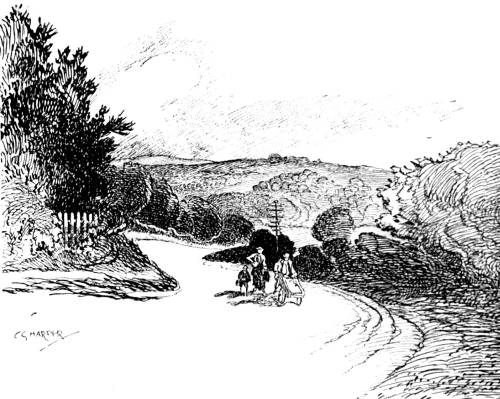
RIVER HILL AND THE KENTISH WEALD
At Bromley he rested and refreshed; and
again, at 9 p.m. at Sevenoaks, where his exertions
had given him such an appetite that, when he had
finished discussing the cold beef, he dared not look
at the waiter. At River Hill—even in these days
to be descended with extra caution—the rough
road broke his primitive brake, and then at last—oh,
happiness!—he found himself going fourteen
miles an hour—and a bit over. There was no
stopping, and the only thing to be done was to
keep in the middle of the road, continually shouting,
and in the hope nothing was in the way.
Not even nowadays would a cyclist care to descend
River Hill in this manner, in the dark, brakeless;
but this adventurous one found the level, and,
passing through Tunbridge Wells, at last reached
his destination with only an incidental attack upon
him by a foxhound on the way.
The view from River Hill is delightful, ranging
across the wooded valley of the Medway to the
heights where Tunbridge Wells is situated. So
wooded is it that even Tonbridge itself, near
at hand, is invisible, and the little village of
Hildenborough—with scarcely more houses to it
than there are letters in its name—might be
non-existent.
A green, smiling woodland vale: just that.
Not a profound, romantic depth, but a widespread,
all-embracing view of meadows, corn-fields, parks,
and hop-gardens: suave, well-ordered, appealing
even more to the farmer than to the landscape-painter.
Such is the Weald of Kent. Remote
from the vulgar herd, who—
“Gawblimee!”
“What was that? Hark! there it is again.”
“’Strewth! ’Fyaint leff me blooming pipe
beyine.”
“Leavyer bloomined beyine nex’ time, fatted.”
“Garn, fatted yer bloomin’ self.”
Hop-pickers, tramping and quarrelling their
way down to the Kentish hop-gardens. And not
always quarrelling, for their moods are even as
those of an April day, wherein sunshine and clouds
are for ever alternating. Listen to them as they
go “piping down the valley wild, singing songs of
pleasant glee”:
Skoylork, skoylork, upin ther skoy so oi,
If ermong ther aingils muvver you should see,
Awsk ‘er if she’ll come dahn agine
To pussy, daddy, an’ me.
Here are your true sentimentalists.
At the foot of the hill lies Hildenborough, a
tiny hamlet with a modern church, until comparatively
recent years figuring merely as Hilden, or
Hilden Green. The meaning of “Hilden” is
obvious here. It is simply descriptive of the
situation of the place: in the dene, or valley,
beneath River Hill.
Borough, as commonly understood, is a ridiculous
misnomer in this place, but it appears to have
been brought into use as some way of indicating
the existence here of a manor separate from, and
independent of, Tonbridge, whose suburban houses
now begin to mingle with it.
The town of Tonbridge lies in the valley of the
Medway, and the river itself runs through what is
now the centre of the borough. Originally, however,
the town was situated on the north bank
only; and all that portion—now an intimate part
of the place—over the bridge was in the open
country.
There are but two bridges across the Medway
nowadays, one large and one other very small; but
in the early days of Tonbridge there were no fewer
than five, for if you look at the maps you will
perceive the Medway spreading out from Yalding
into five tributaries, like the fingers of your hand,
over the two miles’ breadth of flat country between
River Hill and the foothills of Hildenborough and
the heights of Somerhill and Quarry Hill, on the
way to Tunbridge Wells.
According to some authorities, it was to these
bridges that Tonbridge owed its name, but it seems
probable that those channels were not bridged, but
were merely fords, at the time when the town was
baptized; and we must seek for the origin of the
name rather in “Ton-burig”—the great Saxon
“burh” or artificial mound on which the keep
of Tonbridge Castle stood from the earliest times,
guarding the passage of the river. Thus the place-name
should properly have become “Tonbury,” but
the bridges in the meanwhile got themselves built
and, becoming the most striking feature of the
place, crept illegitimately, at a very early period,
into the name of it. In this way we find “Tonebridge”
mentioned in 1088, and afterwards meet
such variants as “Tunebricgia,” “Tunebregge,”
“Tunebrugge,” and “Tonebryge.”
Mediæval Tonbridge was a walled town and
moated, both as to town in general and castle in
particular. It was, accordingly, in its own special
way, as strongly defensible as though situated on
some craggy height. You could not come into it
save by water, and not then except by favour and
permission of those who guarded the gates.
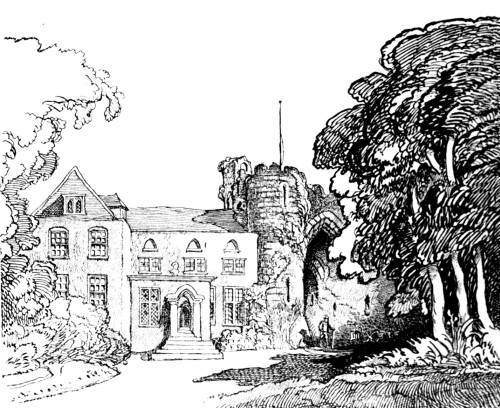
TONBRIDGE CASTLE.
This stronghold was successively the lordship
of the Fitz Gilberts, the great Earls of Clare, the
Earls of Gloucester, and the Staffords and Dukes
of Buckingham: all of whom were, in respect of
it, chief butlers and stewards of his Grace the
Right Reverend Father in God, the Archbishop of
Canterbury for the time being. Of those prelates
they held the place by the grand sergeantry of
serving in those capacities at the enthronisation
of their Graces.
Those great earls left nothing to chance. They
not only walled and embattled their town, and
moated it, but on the prehistoric mound by the
river they reared a keep and around it built a high
wall with towers, and moated that as well. This
was their castle; and although the ditches they
dug are dried up and filled in, and the walls are
for the most part gone, there yet remains the great
Gateway of their hold to tell us something of
its strength. It is a most worshipful Gateway:
strong and tall and massive, so that one cannot, in
naming it, do else than give it a capital G. There
is scarce a more impressive Gateway in England.
It was built somewhere about 1290, in the reign of
Edward the First, as the architecture of its great
drum-towers shows, and was the last word in
massive fortification of that time: the walls ten
feet thick and fifty-three feet high, the gloomy
entrance arch ribbed with immense ribs of stone,
the outer face of the towers relieved only by
narrow slits for arrows. The workmanship was
superb, and although more than six hundred years
have passed since these stones were wrought so
well and jointed so neatly, they remain perfect
to this day.
There are dungeons in those towers; there is a
hidden watergate to the river; there is, in fact,
every circumstance of romance. Little wonder
that in their Castle the lords of Tonbridge felt
sometimes defiant. There was, indeed, one lord,
Roger de Clare, who, even before this grim Gateway
was built, and before his position could be so
secure, felt strong enough to defy his liege, to
defy even the great Archbishop, Thomas à Becket
himself, and to treat his messenger with contempt.
His Grace’s pursuivant came with archiepiscopal
parchments, formidably engrossed and alarmingly
sealed, but what did that haughty castellan do?
He made the unhappy man eat the documents,
“especially,” we are told, “the seals.” Well for
that miserable man that he came merely from
the Archbishop, and not with deeds from the
King, given under the Great Seal! He survived
the light repast, but he could scarce have
stomached such a banquet as that would have
made.
It would be an unprofitable exercise to trace
the ownership of the Castle through the centuries;
“suffice it to say,” as the Early Victorian novelists
were wont to remark—that it came in course of
time to one John Hooker. In 1797, that worthy
demolished most of it, and with the materials
thus obtained built the curious house that now
adjoins the Gateway, which he probably would
have destroyed as well, but that the work would
have been very costly.
Later, the house was a school, to which period,
doubtless, the bust of the anonymous tutelary
genius over the porch belongs. Quite recently,
the Castle has been acquired by the town, and in
the beautiful gardens there are flower-shows, and,
I believe, even a band-stand and penny-in-the-slot
machines.
From the Castle the pilgrim naturally seeks
the church, expecting to see many and stately
memorials of those ancient lords. But he will
find no trace of them. At some remote period,
even before the church was “thoroughly restored”
in 1870, improving besoms came and swept them
out of existence. We may well pause here and
consider with what astonishing completeness
things venerable have vanished from Tonbridge.
There was once, for example, south of the
town, the Augustinian Priory founded by the
de Clares. Wolsey seized its revenues and
squelched it, on behalf of his proposed “Cardinal
College” at Oxford, and the last few remains
were abolished in 1839, when the South Eastern
Railway came. The goods-station stands on the
site.
Tonbridge church is disappointing, and it is
not improved by the large churchyard, filled with
dense files of tombstones, around it. They are so
many that it is impossible to verify the existence
of the scandalous epitaph alleged to be there, on
a drunkard:
Hail!
This stone marks the spot
Where a notorious sot
Doth lie;
Whether at rest or not
It matters not
To you or I.
Oft to the “Lion” he went, to fill his horn,
Now to the grave he’s gone, to get it warm.
Beered by public subscription by his hail and stout companions,
who deeply lament his absence.
The presumption is that it is a sheer invention,
like a very large proportion of such things printed
in collections of epitaphs.
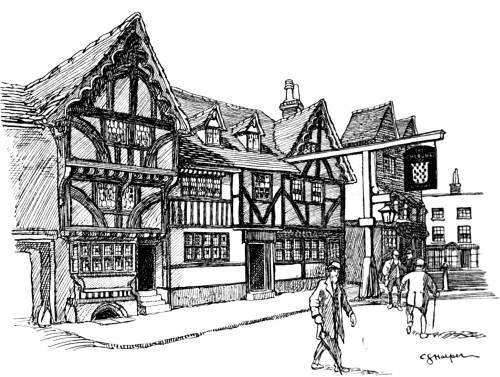
THE “CHEQUERS,” TONBRIDGE.
The general impression of Tonbridge (which elects
to spell its “ton” with an “o,” in contradistinction
from the “u” of Tunbridge Wells) is one of
meanness and squalor. There is the fine Grammar
School at the entrance to it, and handsome estates
surround the town, but that impression lasts, and
seems rather to be intensified by the gradual
widening of the High Street and the replacing
of the picturesque old houses by flashy modern
buildings. That highly sketchable old inn, the
“Chequers,” remains, and so does the so-styled
“Old Ivy House,” or “Old Toll House,” in East
Street, a fine gabled timber-and-plaster building
of the fifteenth century, where the Portreeve’s
duties, or tolls on cattle and goods entering the
town, were paid.
Very observant persons, too, may notice the
queer weathervane over the old shop of a firm
of furnishing ironmongers, representing an old-fashioned
sportsman out with his dog, partridge-shooting.
I will not swear it is partridge; it may
be grouse, or perhaps even pigeon; but any one
will declare it is not a pheasant.
A SPORTING WEATHER-VANE.
The way out of Tonbridge lies over the railway
bridge, past the station, where the banging
of trucks and the screaming of whistles are
continuous, and South-Eastern trains are, like
practical jokers, for ever pretending to go off,
just to flurry and excite nervous passengers, and
then coming back and casually shunting up and
down the sidings when they ought to be miles
distant on their journeys; so while away the
hours.
Contemplative persons will notice with delight
as they pass that the lamp over the station door
says “Railway-station.” It is a lesson in the
obvious, information for the already fully informed,
as little needed as a label on the parish
church.
At a very acute angle right and left the roads
respectively to Pembury and Tunbridge Wells
leave Tonbridge and proceed immediately to climb
steep hills out of the Vale of Medway. On the
right goes the road to “the Wells,” up Quarry
Hill, and to the left, up Somerhill, ascends the
Hastings Road. At the summit of this very considerable
eminence, where a road on the right-hand
leads to Tunbridge Wells, once stood the toll-house,
known (incorrectly) as Wood’s Gate. Its
real name was Woodgate, the spot where that
early traveller, Mr. Samuel Jeake, lost himself
so effectually on that January night of long
ago.
Tunbridge Wells is not on the direct road to
Hastings, but it gave so distinctive a feature to
the first half of the road, and lies so near at hand,
that it will simply not be disregarded.
The father of Tunbridge Wells was Dudley, Lord
North, a dissolute young nobleman, who in 1605
“fell into a consumption,” and was advised by his
doctors to try the country air and that remedy at
the present moment so much talked of but little
practised, unless empty pockets and the lack of
credit compel—the “simple life.”
Suffering from “the pleasures of town,” as to
whose nature we need not inquire too closely lest
we be shocked, my lord resorted to Eridge, on a
visit to Lord Abergavenny. But the bracing air
did him little good, and he was returning, despondent,
to London in his carriage across the
then lonely woods and heaths, when he noticed a
pool of water by the way, covered with a slimy
mineral scum. The idea occurred to him that
here was his remedy. He drank of the water,
felt better, and returned as soon as possible, to
drink again and be well. He clearly did not
deserve his good fortune, for he had no sooner
recovered his tone than he “again gave himself
up to all the gallantries of the age.” But medicinal
waters—fortunately—make no discrimination
between the deserving and others, and so, by
carefully alternating his debaucheries with spells
of fresh air and “taking the waters,” Lord North
lived to the age of eighty-five, and died in 1666,
an example to his fellows of how much you can
dare and do if only you do and dare with
discretion.
He published a work to show the advantages
of the place to his brother libertines, and in this
curious book, entitled “A Forest Promiscuous of
Several Seasons’ Production,” he in this manner
claims their discovery: “The use of Tunbridge
and Epsom waters for health and cure I first made
known to London and the King’s people. The
Spaw,” that is, the Spa in Belgium, “is a chargeable
and inconvenient journey to sick bodies,
besides the money it carries out of the kingdom
and inconvenience to religion. Much more I
could say, but I rather hint than handle—rather
open the door to a large prospect than give it.”
Already, in 1630, twenty-four years after his
discovery, he had seen the place stamped with the
approval of royalty, when Henrietta Maria, Queen
of Charles the First, stayed six weeks here under
canvas. It was then quite uncertain what name
would find favour among all those proposed for it.
“Queen’s Wells” was suggested, “Frant Wells,”
“Speldhurst Wells”; but the circumstances of
travel finally resolved the choice. Visitors from
London not only approached the health-giving
springs by way of Tonbridge, but were originally,
in the absolute lack of accommodation, obliged to
lodge in that town, nearly six miles distant. Thus
the springs, by dint of association, became “Tunbridge
Wells,” the spot being actually in the
three separate parishes of Speldhurst, Frant, and
Tonbridge.
That famous promenade afterwards known as
the Pantiles was first made in 1638, when the
sloping side of a meadow was levelled and
embanked to afford a recreative walk for those
who took the waters. Two buildings only stood
on the spot, the Ladies’ and the Gentlemen’s
Coffee-houses. Things remained very much the
same through the long years of the Commonwealth.
The “wells” were not deserted, for there
were ailing bodies even among the elect; but the
coffee-houses were not so gay, and the religious
cast that came over the scene was reflected in the
names then first given to the encircling hills.
The Puritans named them after some fancied
resemblance to Jerusalem, and thus Mount
Ephraim and Mount Sion were christened, and
the neighbouring Calverley is in like manner
supposed to derive from “Calvary.”
With the Restoration “the happy springs of
Tonbridge” began to grow merry again, and the
card-playing, the dicing, the dancing that were
all ended under Puritan rule grew again furious.
There was still no town, and the men and women
of fashion who did not choose to lodge at Tonbridge
had to find rustic accommodation in the
cottages of Speldhurst. Presently wooden huts
on wheels appeared on the common, and were
moved from place to place, as the fancy of the
fashionables, playing at rustics, dictated.
To add to the Arcadian delights of that most
primitive and pleasant period in the existence
of Tunbridge Wells, a daily fair went forward at
the spring-head. Rosy-cheeked farmers’ daughters
brought chickens, cherries, and cream and sold
them with great profit to town gallants, much
too taken with the unspoiled graces of those rustic
beauties to be able to drive bargains; and soon
a bazaar became established under the trees, where
milliners designed “rustic” dresses at town prices
for ruralising London fair ladies. You might lose
or win a fortune at basset under those innocent
trees, and wind up the summer evening with open-air
dances on the green. It was the “open-air
life,” if not the simple one, that then prevailed,
and for at least a century that was the especial
note of Tunbridge Wells. Evelyn describes it as
“a very sweet place, private and refreshing,” but
that privacy may be questioned, for when houses
were so few it was impossible to be other than
public, and at a later period, when the town came
into existence around the spring, it was especially
ordained by the autocratic Nash that “every
visitor should live in public.”
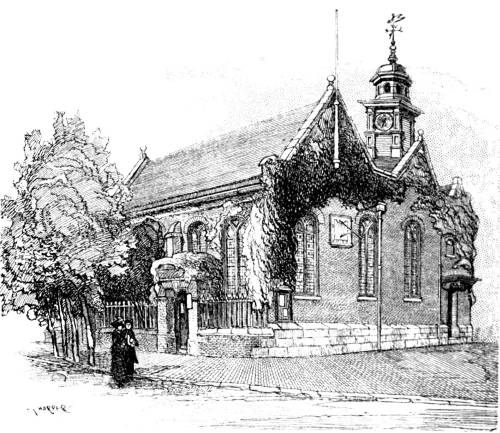
CHURCH OF KING CHARLES THE MARTYR.
One of the earliest evidences of the permanence
of this settlement was the building of
a chapel, in 1684. This is the existing church,
dedicated by the then ascendant Royalists to
“King Charles the Martyr.” It and the Pantiles—and
of course the Common—are the only
vestiges of the Tunbridge Wells of that time.
It is to Queen Anne that we owe the name
of the Pantiles. She had come here while still
the Princess Anne, for the health of herself and
her ailing son, the Duke of Gloucester, and gave
a hundred pounds for paving the walk, so that
no other little boy, duke or commoner, should
stumble there, as hers had done. When she
returned, the next season, her hundred pounds
had been expended in some mysterious way totally
unconnected with pavements, and so, very rightly
offended, she left the place, never to revisit it,
even though the authorities at last hastened to
lay the walk with those pantiles that gave it so
distinctive a title. Stone slabs, in 1793, replaced
those red tiles, and for a lengthy period the
stupidity of the local governing body rechristened
the famous walk “the Parade,” but it has now
reverted to its original style.
Tunbridge Wells of to-day bears not the
slightest resemblance, apart from these three
landmarks of Church, Common, and Pantiles, to
the resort of long ago. It is unlike in appearance
and manners. To-day you see an overgrown town
with suburban roads climbing up all the hillsides,
and continued, if you explore them, on the corresponding
descent. It is an effect of grey sobriety,
for the greatest period of its expansion was in the
’60’s and ’70’s, when plaster was prevalent; and
its chief hotel was built in the days before
architects could be made to understand that
comfort is desired by guests more than grandeur.
To climb up flights of stairs to enter the front
door is a weariness, and bedrooms twice as lofty
as they are broad or long outrage one’s sense of
proportion.
Socially, too, Tunbridge Wells of to-day is the
antipodes of what it was. The traveller of old
who “took the waters,” presently arriving “by the
grace of God,” in his chariot, or by public coach,
did no sooner come up from Tonbridge within
sight of the Spa, than he was assailed by a swarm
of touts who thrust their heads into the windows,
eager to bespeak his custom:
Soon as they set eyes on you, off flies the hat:
Does your honour want this? does your honour want that?
To-day you enter from the railway-station, and
the only people who take any interest in you are
the cabmen. That is distinctly a gain, for touts
are an abomination; but the public life once insisted
upon by Nash is as distinctly a loss. The
fact is that the English have no genius for it, and
the climate really forbids. Moreover the local
conditions are different. It is a great residential
town now, and visitors are in the minority.
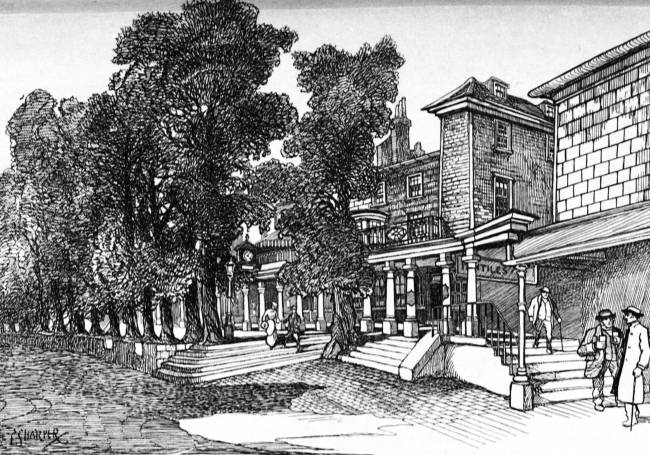
THE PANTILES, TUNBRIDGE WELLS.
Still you see the Pantiles, with the quaint
colonnade and the overshadowing limes, now
grown very reverend trees indeed, but it is not
a scene of gaiety, and when on summer nights the
place is beautifully illuminated with coloured
electric lights, and open-air concerts are held
there, it is a crowd of servants and of shopkeepers’
assistants that listens.
Alas! for the red-heeled, red-faced voluptuaries,
the patched and powdered beauties, the
morris-dancers, the fiddlers! They have all danced
or hobbled off, and have been long since ferried
over to the other side of Styx. And where they
leered and ogled and minced, “protested,” and
“stopped their vitals,” in their eighteenth-century
way, there are a few inquisitive tourists peering
about in corners, and really wondering if all those
tales of eld are so much moonshine.
The waters of Tunbridge Wells and the Roman
Catholic clergy have, according to Mrs. Malaprop,
one quality in common: both are “chalybeate.”
Perhaps they owed much of their old-time popularity
to being described as “salutiferous,” and
certainly they were likely to impress people
more, and to do more imaginary good, under
that title than if merely “health-giving.”
But the good wrought by the water is undoubted.
It will not mend broken bones, nor
set up an altogether shattered constitution; it is
not Lethean, and at a draught you do not forget
sorrows; but it is an excellent tonic, and—experto
crede—good for incipient dyspepsia. Modern
scepticism looks upon the fine air of Tunbridge
Wells, rather than the water, as author of the
beneficial effects upon visitors, and so it is less
taken than formerly. It is safe to say that the
majority of those who taste it are impelled by
curiosity, and to all the taste suggests ink.
You come past the Church of King Charles,
with its sundial inscribed, “You may Waste
but cannot Stop me,” to the Pantiles and the
spring. The water is, by an old Act of Parliament,
free to all, but there are two granite basins: one,
with a gigantic utensil like a pantomime soup-ladle,
with which, bending down, you scoop up
the water, in company with Lazarus and the
vulgar herd; another where, in more genteel
fashion, you pay a penny and are handed a glassful
by one of the two old ladies known as
“Dippers.” If you please, you can commute your
payments by subscribing 2s. a week, 3s. 6d. for
two weeks, or 30s. for a year. By that time the
three grains of iron contained in every gallon of
the water should have strung the participant up to
concert-pitch, and have plated his teeth with a
coating of iron, unless he adopts the old custom
of cleaning them with sage-leaves, after drinking.
No one would dream of describing Tunbridge
Wells as a “manufacturing town,” but it has,
and has had for considerably over two hundred
years, a peculiar industry. Few are those who
have not heard of “Tunbridge ware,” a species
of delicate inlay work in coloured woods, which
may be described as mosaic work, something in
the nature of tesselated pavement reduced to terms
of wood; the tesseræ in this case being very thin
strips, fillets, and roundels applied in patterns to
work-boxes, inkstands, backs of brushes, and a
large variety of fancy articles.
Any attempt to describe the ware, or the process
of its manufacture, seems at the first blush
a rather hopeless enterprise. We may, however,
give another analogy, and compare it with parquetry
flooring in miniature and in many colours.
That it is no mushroom fashion may be discovered
by the visitor to South Kensington, who
in the Museum will discover a backgammon-board
designed by the Comte de Grammont and made
for him in 1664. He presented it to Mary Kirke,
Maid of Honour to the Queen of Charles the
Second, during a royal visit to “the Welles.”
This interesting evidence of the antiquity of the
ware is decorated with forget-me-nots, interlacing
the Count’s initials and those of Mary
Kirke, and shows that the art was even then
fully developed.
Fashions change, and in all those years Tunbridge
ware has had many vicissitudes. In the
beginning of Queen Victoria’s reign a very large
trade was done in a cheap line of articles in light
woods—commonly sycamore—printed upon from
transfers, not inlaid in any way, and thus, strictly
speaking, not the true ware at all. Examples of
this period are still to be met with in curiosity
shops, with views, not only of Tunbridge Wells,
but of every other place then of popular resort,
and the sight of them brings faint reminiscences
of times when girls wore bonnets and book-muslin
dresses and gentlemen still dared to appear in
public in white duck trousers. The ware of that
age was, in fact, as popular then as the little fancy
china articles with local armorial bearings are now.
That fashion passed, and the true manufacture
regained its vogue. The prominent makers for
generations had been Fenner & Nye, established
on Mount Ephraim in 1720, succeeded in turn by
Edmund Nye, and finally by Thomas Barton, in
1863. Barton’s showrooms were in the Pantiles
until recent years, but the business, conducted on
the old time-honoured lines of making the best
possible article and charging for it accordingly,
could not survive the modern rage for cheapness
at the sacrifice of excellence, and as Barton grew
old the business declined with him and finally
gave place to another, where you can still purchase
Tunbridge ware in innumerable forms at popular
prices, and be perfectly satisfied, until it is compared
with that of sixty years ago. The public
has no cause for complaint. It pays only for what
it gets; but there is, and can only be, the most
superficial resemblance between the costly work
of a bygone age and that of the present era.
A partial knowledge of these things has led
some writers to describe this manufacture as a
“doomed industry”; but, like so many “doomed”
people, institutions, and trades, it maintains an
astonishing vitality, and there is probably more
Tunbridge ware made now than in the times when
an article cost twice as much.
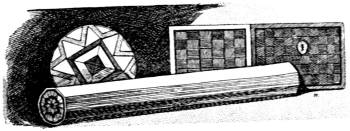
TUNBRIDGE WARE.
The methods employed are of some interest.
Radiating, star-like patterns are produced ingeniously
by building up in long sticks glued together
around a central core, afterwards to be sawn off in
veneer-like strips: a hundred to a stick. These
are then mounted on to the articles to be decorated.
In the case of more ambitious and
pictorial efforts, such as a view of the Pantiles
(a favourite subject) in coloured woods, the craftsman
works to a coloured sketch, divided up like
a Berlin wool pattern. In such cases the little
wooden cubes are of necessity extremely minute.
Mounted on to the wooden surface of workbox
or other article, the work has then to undergo
many sandpaper scrubbings, with sandpaper of
increasing fineness, and is at last polished to an
exquisite finish.
To the true artistic eye these ingenious imitations
of drawings or paintings scarcely commend
themselves, and Tunbridge ware finds its best
exposition in the boxes inlaid with squares of
various woods, in which you can see the grain
and colour natural to each.
Great expense and care were formerly taken
to secure beautiful varieties of wood, and no fewer
than eighty, English and foreign, were in constant
use. It was found that no wood naturally gave
green or silver-grey, and it was therefore necessary
to procure those colours artificially. Green
was obtained from “decayed oak,” the fallen
boughs of oak-trees stained green by fungoid
growths. To get grey, bird’s-eye maple and
Hungarian ash were steeped in the chalybeate
waters of “the wells”; and a beautiful white
was produced by boiling holly.
The fine upland Common of Tunbridge Wells is
one of the town’s greatest assets. Extraordinary
outcrops of rock occur on it, and away to where
it merges into Rusthall Common is that bourne
of many a pilgrimage—the famous Toad Rock: an
immense mass of sandstone really very like a toad
squatting on its haunches, and not by any means
of so uncertain a shape as that of so many of those
queer rocks in which you see just what you please,
like Hamlet’s cloud, “almost in shape of a camel,”
“like a weasel,” and finally “very like a whale.”
The Toad Rock has not so many imaginary incarnations,
and looks only like a toad. In these days
it has been found necessary to protect it with a
defensive iron railing, but this precaution has not
served to exclude the usual fools who carve their
folly deeply into everything capable of being
marked with a penknife.
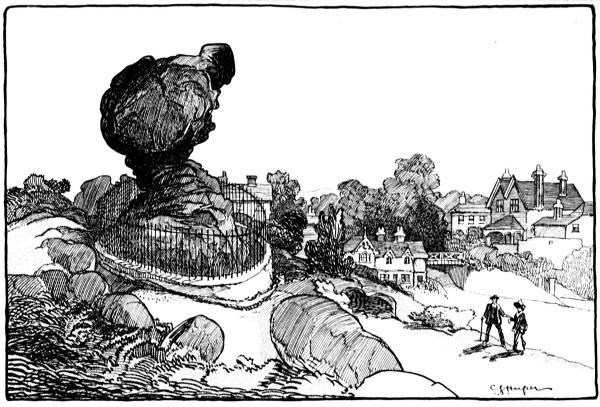
THE TOAD ROCK.
The natural gorge close by, known as Gibraltar
Rocks, still is marked by one of the houses built
on the Common by a sentimental English Government
for the French priests exiled from France
at the Revolution. In addition, the Government
made them an allowance for their maintenance.
The population of Rusthall, to judge from the
language and behaviour of its boys and young men,
must be in a very primitive stage of civilisation.
The stupid foulness and vileness of their conduct
in the neighbourhood of that public resort, the
Toad Rock, any day and every day deserve the
attention of the police.
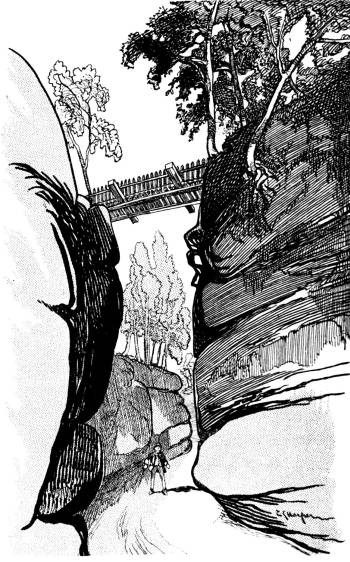
SCENE AT “HIGH ROCKS.”
Tunbridge Wells is a neighbourhood of rocks,
but none others approach the weird scene at the
spot appropriately called High Rocks, less than
two miles distant, on the way to Groombridge.
It is not the “Finest Scenery in England,” as
claimed by Mr. Thomas Coster, proprietor of the
“High Rocks Hotel,” who charges sixpence to
enter; but it is highly curious. Many ingenious
and enterprising sightseers, chiefly active cyclists,
resenting the being clicked through a turnstile at
sixpence a head, take Mr. Coster and his encircling
fences in the rear, and, entering a little wood,
insinuate themselves into his domain and see his
rocks for nothing. His rocks! On the whole,
their enterprise has my respectful admiration, for
it seems absurd to treat Nature as if she had made
this scene in the infancy of the world for the
purpose of providing a showman with an income.
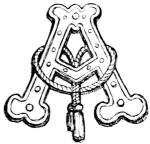
THE MARQUIS OF
ABERGAVENNY’S
“A.”
The writer of a guide-book published in 1810
describes the “High Rocks” as “romantic
scenery,” and says that, “combining with the
wish to please and be pleased,” the spot “tended
to create an agreeable relief to that tædium which
will frequently encroach on
a place of public resort.”
There is a specious plausibility
about this which leads
the reader at first to idly
agree; but the muzziness of
thought and woolliness of
expression very soon lead
one to the opinion that the
writer, although he may have
had an inkling of what he meant when he set out,
very soon lost himself on the way.
The High Rocks cover a space of about two
acres, and consist of a great wooded bluff hanging,
cliff-like, over the road, and intersected in innumerable
directions with fissures, gullies, and
ravines from fifty to seventy feet deep. These
ravines are crossed by numerous wooden bridges,
and ascended or descended by rustic stairs. There
is the Bell Rock, which gives forth a metallic
sound when struck; the Warning Rock, and all
sorts of other rocks, fantastically named; and there
are swings and brake-loads of excursionists, and
mazes. Altogether, the place is pretty well exploited,
and the penknife has been busy on every
spot within reach.
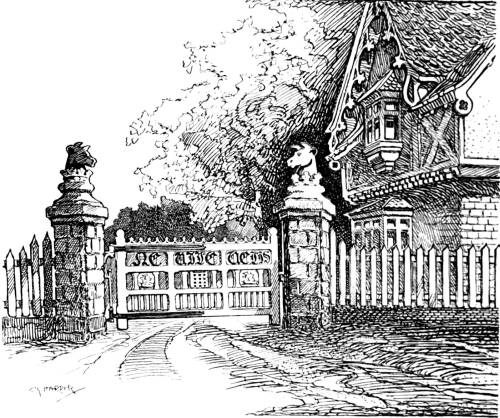
THE NEVILLE GATE, FRANT.
A way to Hastings by Tunbridge Wells lay in
coaching days through Frant, Wadhurst, and Ticehurst,
emerging upon the direct road again at
Stone Crouch. It is a wildly beautiful wooded
district, passing through a line of country where
an immense upholstered letter A is noticeable on
almost every cottage, sometimes in company with
the Neville portcullis, indicating the ownership of
the Marquis of Abergavenny in the country-side.
Near Frant an extraordinary gateway into the
park of Eridge abuts upon the wayside, flanked
by his Bull’s Head crest and adorned with the
punning motto, Ne vile celis: “Wish nothing
base.” A proud motto, woefully smirched by Lord
William Neville in recent years, when he was
sentenced to a term of imprisonment for forgery.
The main road is more quickly regained at Pembury
Green, where the last suburbs of Tunbridge
Wells end.
Pembury Green is an old hamlet reared in
modern times up to the status of a separate parish,
with a tall-spired church built where it has no
business to be—on the green that gives the place
its distinguishing name. There are plenteous
evidences, in the number of inns and Cyclists’
Rests, that Pembury Green is a favourite resort
in the long days of summer.
The number of refreshment places along the
Hastings Road catering for cyclists is more marked
than even on that very much exploited highway,
the road to Brighton. Perhaps on a road so hilly
as this those pushers of the reluctant pedal require
more frequent halts and more sustenance.
Most wayside inns nowadays express their
readiness to entertain wheelmen by exhibiting
the modest announcement, “Accommodation for
Cyclists,” hinged on to their old signs; but, apart
from these, the keeping of “Cyclists’ Rests” along
the main roads has become an industry as congested
as the close professions.
The natural history of Cyclists’ Rests affords
interest to the peripatetic philosopher. They
range from the cheap boudoir-like kind, a couple
or so miles out from a town, where the articles
most in demand are weak tea and hairpins, down to
the sometimes bare, sometimes grubby little dens
in remoter places, labelled in illiterate fashion,
“CYCLIƧT REƧT”
designed to suit the shallow pockets of the long-distance-riding
club cyclist; where, in discomfort,
you eat off delf plates laid on tables covered
with slimy “American cloth,” and get a good
“blow-out” and a shakedown in an attic with
precipitous floor and sloping roof for an incredibly
small sum.
The first variety are fully furnished for feminine
cyclists with materials for tea, with the
hairpins already mentioned, with chocolates, a
carafe of weary-looking home-made lemonade with
a lemon stuck in the neck of it, the usual fizzy
“minerals,” and sixpennyworth of buns. Wonders
may be wrought on a basis so slight.
The other kind is of sterner stuff. Who rides
far must feed well. Tea for the hard rider, no
less than for the ambling lady cyclist, is essential,
but it must be tea with a tang to it, and plenty of
it; and it gets mixed, in course of feeding, with
such meats as the “Rest” affords, with the result—a
medical expert would say—that the interior of
that cyclist is converted into a tannery, and his
food turned to leather by the tannic acid of his
drink. And yet I never heard of a healthy, active
cyclist being inconvenienced, much less laid low,
by such immoral feeding.
THE “BLUE BOYS” INN.
It is a solitary road beyond Pembury Green,
varied only by a few scattered houses, all the way
to Lamberhurst. Kipping’s Cross is the first of
these intervals, and there stands the “Blue Boys”
inn, with an oast-house for only neighbour. The
“Blue Boys” is practically dated by its odd
picture sign, showing two blue-jacketed postboys
shaking hands and lifting each a convivial glass,
whether to their noble selves or to George the
Fourth, whose medallion portrait is below, cannot
be said.
Beyond the inn is the cross-road leading to
Goudhurst, scene of many incidents in the history
of smuggling. Between this point and Lamberhurst,
four miles distant, there were, in the once-upon-a-time
of coaching days, two turnpike-gates.
The pikeman’s house remains at both places.
The level tract of land at this point was known
to old road-books as “Lindridge Causeway,” and
owed its name, according to John Harris, who
wrote a “History of Kent” in 1719, to one Lindridge,
who was born in 1560, lived in a house adjacent
to Lamberhurst, and “built a handsome causeway
here, called after him.” At that time there was
still a stone to his memory in the porch of
Lamberhurst church.
The name of “Lamberhurst Quarter,” given to
the district on this hill-top above Lamberhurst
village, is one of those many mysteries of place-names
that now can never be authoritatively
explained; but it is supposed to derive from some
ancient partition of the manor into four parts—quarters
of a knight’s fee.
Down below, on the right hand, are spread out
the many-serried ranks of the hop-gardens. You
look down upon them as a commanding officer
might upon his phalanxed battalions.
Hops are grown in the neighbourhood of Lamberhurst
almost as extensively as around Maidstone
itself, which every one knows to be the metropolis
of the cultivation. The hop-gardens are the vineyards
of England, and so marked a feature that it
surprises the inquirer who learns that the brewer’s
hop was not introduced to this country until the
reign of Henry the Eighth. “Hops and heresy
came in together,” the Roman Catholics were
wont to remark.
There is no certainty about hops, and a hop-grower
will readily admit that his trade is little
better than gambling. Knowledge, capital, industry
are all insufficient to arm him against fate
in the shape of red spider, mould, fly, or bad
markets, and he is commonly content if he can
secure one good crop at average prices in three
years. It is a costly cultivation, coming, with
rent, rates, taxes, materials, and labour, to an
average of £25 per acre.
Only land “just so” will serve. A little too
heavy, a little too light, or not being drained to
perfection, will spell failure, and a hop-garden
must be drained, with pipes or tiles, at least as
well as a house.
The hop-grower’s year begins in March, when
the “hills,” or stools, are uncovered and dressed
by pruning. Then the poles are set up: from two
to four to each “hill.” The “hills” being six feet
apart, it is a simple calculation to arrive at the
number of poles to the acre. There are 3,600,
forming a considerable item in the grower’s
accounts. Made of ash, alder, chestnut, larch,
or oak, of from ten to twelve years’ growth, the
great and constant demand for them has given
their characteristic appearance to large tracts of
land in Kent and Sussex, where the young woodlands
are as much a feature as the hop-gardens
and the oast-houses themselves. Poles are from
thirteen to fourteen feet long, and cost from twelve
shillings to a guinea a hundred, larch being the
most lasting. To preserve them as long as possible,
they are often dipped in creosote.
Early in May the hop-gardens begin to give
employment to the women. The young shoots
are tied with rushes to the poles, and constantly
thinned out, and the poles themselves tied together
with a maze of interlacing string for the support
of the climbing bine.
All through the summer the alleys between
the plants must be kept well weeded, and only
when August ends does the grower begin to see
his reward in sight; but then rain may bring the
“mould,” or the “fly” may come, and all his toil
be wasted. Only one thing will cure the “fly,”
and that is something utterly beyond control—the
coming of the “ladybird.”
Most people know the ladybird or “lady-cow,”
as it is sometimes called: the little winged insect
with the hard shell of a post-office red, subject
of the old rustic rhyme, in which, placing it on
the tip of the finger, it would be addressed in
this wise:
Ladybird, ladybird, fly away home:
Your house is all burnt, and your children all gone.
Little pop-pop sits on the cold stone,
Crying for mammy, and mammy don’t come.
I heard that rhyme very early, and shall never
quite lose the forlorn sense of tragedy in it.
The ladybird is the deadly foe of the “fly,”
and seems by some extraordinary instinct to know
when and where that pest is rampant; for there is
nothing more certain than that a plague of “fly”
will be followed by an incursion of ladybirds in
countless millions, coming even across the Channel,
as steamboat passengers, plentifully covered with
them, have testified. The sky rains ladybirds,
come vengefully to exterminate the hop-grower’s
enemy and to ensure that British beer shall be
properly bittered.
If the hops survive all these dangers and
chances and are a generally abundant crop, the
grower is sometimes in almost as bad a case as
if they had been a failure, for prices then rule
so ruinously low that they do not pay the cost
of growing. Hops have been so high as £25 a
hundredweight in times of scarcity, when those
fortunate enough to be favoured with a good crop,
while their neighbours’ were failures, have retired
with fortunes. On the other hand, they have been
so low as fifty shillings.
A less anxious, but infinitely more busy time
has come when the picking arrives. Responsible
gangers have to be employed, and hop-cutters.
The hop-cutter cuts through the bines, pulls up
the poles, and lays them across the bins of sacking
into which the pickers strip the flowers of the hop.
The ganger measures out the stripped hops, and
in his note-book credits each picker with the
amount of his picking, at the rate of eight bushels
a shilling.
The hopper’s hut is not the last word in convenience,
although for the occasion, and by way of
change from the hopper’s native slum, it may be
comfortable enough. It is usually one of a long
row of little brick dens, not altogether unlike
some of the wild animals’ lairs at the Zoological
Gardens, and is whitewashed inside in the manner
of a cattle-pen. There are—is it necessary to
add?—no pictures on the walls and no domestic
knick-knacks. There is not even any furniture,
nor a bed. If you are a hopper you doss on the
floor, luxuriating in clean straw provided by the
hop-grower, and wrapped in the not over-clean
blankets brought by yourself; and you and yours
“clean yourselves”—in these circles you do not
merely “wash”—in the open, at buckets and tins.
In the open, too, you dress and get shaved, and
cook and eat; and if the August and September
days be kind, there is enjoyment rather than
discomfort in it. Sometimes barns and tents
supplement the huts: sometimes, too, it rains,
and then, on a really wet day, when work is at
a standstill and the women and the children are
miserable and sulky and cry, the male hopper—who,
although as a rule he uses dreadful language,
is not a bad fellow at heart—goes off to the nearest
pub. and soaks on four-ale, and there is trouble.
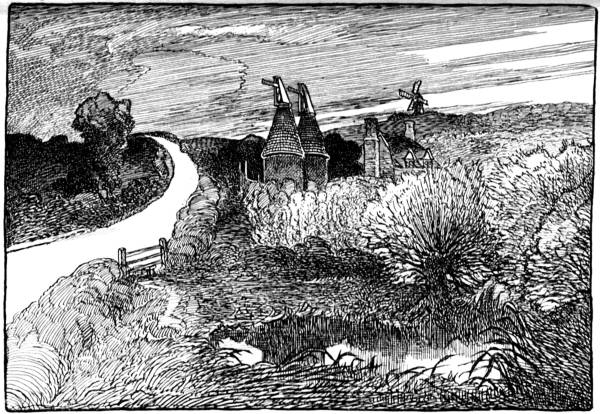
KENT.
There are, every year, some 50,000 hop-pickers,
picking from 35,000 to 40,000 acres of hop-gardens.
Of these the larger proportion is contributed by the
villagers; but the railways convey about 20,000
from London by the “hopper specials” at very low
rates, and many, who cannot afford even those very
cheap fares, tramp down.
The special trains would make the patrons of
the Continental expresses stare. They set out
at midnight, or thereabouts, and are filled with
a motley crowd, bringing mattresses, blankets,
frying-pans, kettles, and a host of small domestic
requirements for a fortnight or three weeks.
They book to whatever station they fancy as
the likeliest point whence to seek a job; for while
some hop-pickers, during a steady succession of
years, know where they will be welcome, many
of them go on sheer speculation, and tramp from
village to village until they find vacancies. In
later years, and in bad or wet seasons, the number
of the unsuccessful claiming admission at the
casual wards, especially at Maidstone, has seriously
embarrassed the workhouse authorities and those
good folk who not only missionise the hoppers with
Bible and Prayer Book, but feed and clothe their
bodies in this world as well as showing anxiety for
their souls in the next.
Hop-picking is for many poor Londoners the
only holiday they get throughout the year. It is
that best of holidays, change of work and of scene.
Its chief merits are that it requires no skill, and
that the whole family can take part in it, except
the baby, who is at any rate brought into the hop-garden
to look on, and left to amuse himself or to
sleep under an umbrella, while grandfather, grandmother,
father, mother, uncles and aunts, and
brothers and sisters are all busily filling the bins
and earning, according to their degrees of “slippiness,”
a shilling to two shillings the day.
Each hop-grower is his own dryer: hence the
kilns, the strangely cowled “oast-houses” attached
to every hop-garden. To these the hops are taken,
to be dried. Most oast-houses are circular, that
form being considered to distribute the heat more
evenly than the square. The interior is instructive,
and would not be at all unwelcome on one
of those wet and chilly days that are not unknown
to the English summer, were it not for the
universal practice of mixing sulphur with the
coke fires, which, to a stranger, results in an
inconvenient hoarseness and sore throat. The
reason for the sulphur is that the fumes it throws
off give a yellowish colour to the dried hops, a
tint conventionally required by the factors, although
it makes them neither better nor worse.
The fires are on the ground level. Above, the
hops are spread on the drying-floor, formed of
wire-netting, covered with hair-cloth. Through
this the warm air ascends, and in twelve hours
some 1,050 lb. weight of hops are dried, and
incidentally reduced by the evaporation of the
moisture in them to 200 lb. The heat ascends
and leaves the oast-house by the cowl, which
turns on bearings, according to the direction of
the wind.
From the drying-floor to the cooling-floor the
hops are transferred with a wooden shovel, and
then packed into the “pockets.” “Pockets”
are sacks, and are nowadays filled by being
suspended from a hole in the floor, and filled with
the light feathery dried hops; and then repeatedly
pressed down, re-filled and re-pressed by a heavy
iron screw-press. In the result, a pocket of hops
is as hard and unyielding to the touch as a mass
of iron, and samples cut from it hold together
like so much cake-tobacco. The older method of
packing was for a “jumper” to press the hops
down by his own unaided efforts.
Those who would find Lamberhurst church must
diligently seek it, for it lies quite away from the
village, on the hill-top, beside the manor-house,
which you approach past a long line of pyramidical
yew-trees, so like those of toy Noah’s Arks that
you look instinctively for their wooden stands.
Like most manor-houses in Kent, this is styled
the “Court Lodge.” The Court Lodge itself is
a stone building of considerable age, with the
desolating gaunt exterior of a workhouse; and the
church, standing behind it, is in appearance—and
in some sort in fact—an appanage of the lord of
the manor, for it stands, with the residence, in the
middle of his park.
It is a very charming old church, with a
shingled spire, and deeply embowered in dark
heavy trees, as though Nature herself had put on
a solemn mood, in deference to the spirit of the
place. Most prominent in the approach is a fine
eighteenth-century monument, like a tea-caddy,
with an epitaph starting off suddenly in this
wise:
- Virgil Pomfret, Gent
- Livd so Respected
- That when the Sable Train of Mourning Friends
- Attended his breathless Corps
- Here to be Entombd
- Each tear ful Eye seem’d thus to Say
- There Goes an Honest Man
- 1765 Aged 77
This is followed by an inscription stating how
Virgil Pomfret’s wife was “Virtuous and Discreet,”
and this by another that tells us how, in the same
year, Virgil Pomfret, junior, was “snatch’d away
By the Small Pox,” aged 28.
I think it gives that dreadful disease an added
terror to personify it in this larcenous way.
At the foot of the hill lies quiet, beautiful
Lamberhurst. Mr. Rudyard Kipling has not
inaptly named it “Slumberhurst,” and Cobbett,
not given to indiscriminate praise, spoke of it as
“a very pretty place, lying in a valley with
beautiful hills round it.”
Old writers gave it as their opinion that the
place-name came from “the Anglo-Saxon Lam,
meaning ‘loam,’” and supported their contention
by referring to the sticky clay of the neighbourhood;
but Lamberhurst probably took the first
part of its name from the Saxon genitive plural
for lambs. The second part means, of course, a
wood. Most surrounding places take their names,
in this manner, from natural objects.
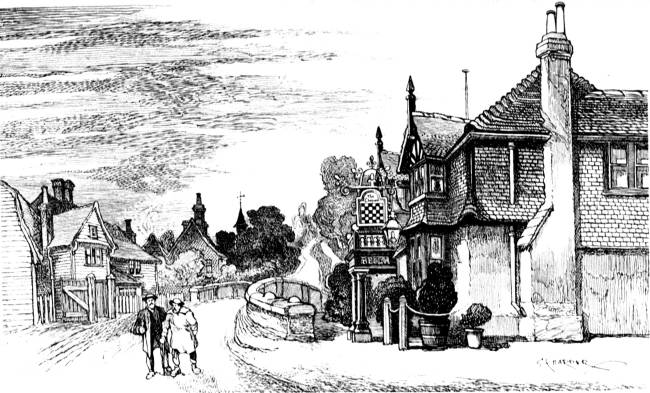
LAMBERHURST.
Kent and Sussex here march together, and the
village was, until 1894, in both counties, the
dividing-line being the little river Teise that flows
under the picturesque and narrow bridge in the
village street. In that year, however, Lamberhurst
was transferred wholly to Kent. The old
“Chequers” inn, type of an old English hostelry,
has lately been neighboured by an upstart hotel,
disturbing with its raw newness the ancient peace
of this Sleepy Hollow.
It was once a busy enough place, and black
and smoky, for close by were the famous furnaces,
or “bloomeries,” where iron-ore was smelted and
cannon cast, and where the famous iron railings
that now partly, and once wholly, surrounded
St. Paul’s Cathedral, were made. Great outcry
was made when the railings were removed from
the west front of the cathedral in 1873, but we
need not lack in admiration of them to realise that
the open space thus created is a better sight than
the strictly enclosed approach to London’s chief
place of worship. The railings originally weighed
200 tons, cost £11,202, and were considered to be
the finest, as they certainly were the heaviest, in
the world.
The site of the furnace is half a mile from
Lamberhurst, on the way to Bayham Abbey. It
is distinguished by a hammer-pond and a mouldy
old house almost smothered in trees and creepers.
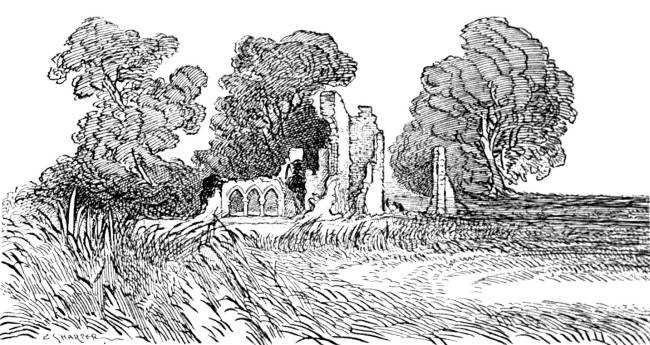
BAYHAM ABBEY: ACROSS THE WATER-MEADOWS.
Along the valley of the stream that feeds this
pond lie the ruins of Bayham Abbey, a remote
home of Premonstratensian Canons, whose simple
life was to the last in great contrast with the
dissolute conduct of the great majority of the
religious houses rightly abolished in the time of
Henry the Eighth. But they had to suffer for the
sins of the many, and although a crowd of rustics
and others of better estate assembled in disguise
and reinstated the canons, after they had been
expelled by the Commissioners, it was only a
temporary victory. Abbey and estates fell to Sir
Anthony Browne, of whom we shall hear more at
Battle; but what became of the wonderful bed
upon which the blessed St. Richard of Chichester
had slept, history sayeth not. It should have
been presented to the most deserving hospital, for
it wrought cures upon all who slept in it, no
matter what the disease. But the Age of Faith
was past, and the Blessed Bed was doubtless
chopped up for firewood and its bedding dispersed:
an inestimable loss to an ailing world. Imagine
a bed sovran for every ill! How compute the
value of it?
If the curse upon sacrilege were not such a
chancy and fortuitous thing, one might look confidently
for terrible happenings to the owners of
the Bayham Abbey lands, the Pratts, Marquises
Camden, who bought the estates from Viscount
Montagu in 1714. But their elephant’s-head crest
remains on all the cottages for miles around, and
they continue to “live long and brosber.”
The ruins are visible from the road, lying amid
rich water-meadows, and they are to be seen more
intimately at the end of a phenomenally muddy
lane. But you may not view them from within
the enclosure except on one day of the week and
at a fee of sixpence.
Restrictions upon sight-seeing in this neighbourhood
are particularly severe. On the rising ground
out of Lamberhurst, for example, lies Scotney
Castle, a lovely, sequestered ruin partly surrounded
by a great, lake-like moat, and only a little less
romantic than Bodiam itself. To reach it you go
past a very modern lodge and along a half-mile of
wooded drive, chiefly of laurels and sweet chestnuts.
But permission is granted on only one day
of the week, doubtless in the hope that the precise
day will not be remembered. On any summer’s
day numerous vehicles and parties, some of them
come from long distances, may be seen turned
back by the lodge-keeper.
Scotney was ever the home of romance, for one
of its earliest owners, Walter de Scotney, was
executed at Winchester in 1259 for administering
poison to the Earl of Gloucester and others. The
humour of it is that Walter de Scotney was
probably quite innocent. The Earl recovered, but
his brother, William de Clare, died, as also did
the Abbot of Westminster. The Earl himself
seems to have had a narrow escape, for he lost
hair, nails, teeth, and skin, and must have been
one vast comprehensive ache, and in a more painful
condition than that of a chicken plucked alive.
Scotney then passed to the Darrells, who led a
finely dramatic life here until they ended, to an
effective and tragical “curtain.”
The old castle lies in a watery hollow beneath
the modern Gothic mansion, and itself consists
of two distinct portions: the castellated building
erected about 1418 by Archbishop Chicheley, and
the later manor-house of the Darrells, who in
Queen Elizabeth’s time were Roman Catholics,
maintaining their religion and its observances in
spite of the laws, ordinances, and penalties levelled
against Papist recusants.
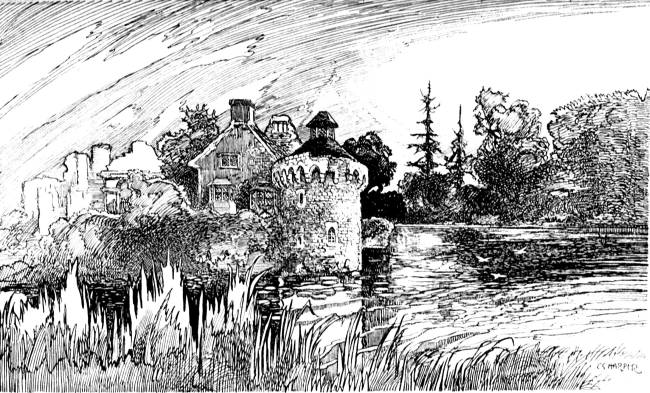
SCOTNEY CASTLE.
To secure their officiating priests against arrest
the Darrells contrived a highly ingenious hiding-hole
in their mansion, and it was speedily found
useful. It was the Christmas night of 1598,
towards the end of Elizabeth’s long reign, and
Father Blount, a well-known and keenly sought
priest, was in the house with his servant when the
party were surprised by a search-expedition, who,
having got wind of Blount’s presence, were bent
on capturing him.
While the enemy were demanding admittance,
Blount and his servant were hurried into the
courtyard, where a huge stone in the wall, turning
upon a pivot, gave entrance to the hiding-place.
Unluckily for them, a portion of a girdle-strap was
caught between the stone and the rest of the wall,
and showed plainly. Meanwhile the search-party
had been admitted, and, securing the inmates of
the house in one room, proceeded to search the
place.
While they were thus engaged an outside
servant of the family chanced to see the girdle,
and promptly cut it off, calling as loudly as he
dared to the fugitives to pull in the fragment
that was still visible. The sharp-eared search-party,
hearing a voice in the courtyard, rushed
out and sounded the walls all round, without
making any discovery, but kept it up until the
rain, which had set in, disgusted them, when they
retired, intending to resume the search on the
morrow.
As Blount’s own record of the adventure tells
us, he and his servant were concealed for days
under a staircase. At last, afraid to risk the result
of another day’s proceedings, they escaped under
cover of night. Barefooted they crossed the courtyard,
climbed the walls and swam the moat, then
covered with thin ice. They did well to fly, for
next day their hiding-place was discovered.
In later years the castle and manor-house, by
that time ruined, was the haunt of smugglers,
among whom the Darrells themselves were reputed
to be prominent. To-day the beautiful
spot is surrounded not only by the moat, but by
exquisite gardens. The two remaining towers of
the mediæval castle rise picturesquely from the
still waters, and within the wreck of the Elizabethan
mansion there are rooms contrived for the
gamekeeper.
Weird oast-houses of a gigantic size raise their
lofty cowls against the sky-line outside Lamberhurst,
and, with their vanes decorated with images
of the Kentish Horse, look like the architecture of
Nightmare.
Half a mile onwards, an old toll-house, added
to in later years, has the appearance of a lodge.
Beyond it, the road has at some distant period
been raised from a very deep dingle, as may be
judged from the farm in the neighbouring hollow,
and from the Bewl Bridge, under whose arch the
little Bewl stream rushes, with a hoarse voice, far
below.
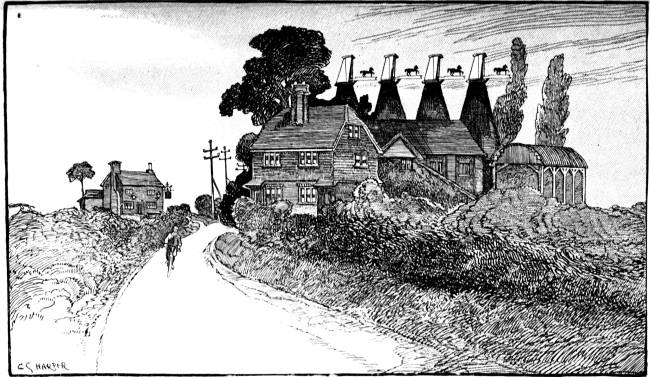
WEIRD OAST-HOUSES, LAMBERHURST.
In another mile is Stone Crouch, whose name
of “crouch,” meaning merely a cross—probably a
cross-road—prepares one for that most solitary and
most rustic hamlet, with a farmhouse and its
dependent cottages and barns, all in the old
Kentish style. The farmhouse was once a coaching
inn, and appears to have borne the sign of the
“Postboy,” now taken by a house on the way
from Lamberhurst, half a mile before the hamlet
is reached.
On the left is the great park of Bedgebury, the
seat until 1887, when he died, of A. J. B. Beresford-Hope,
once prominent in the House of
Commons. He was the descendant of one John
Hope, a Hollander, of Amsterdam, whose son
settled in England about 1800. That origin was
the subject of a curious allusion in Parliament,
during the debate of April 12th, 1867, on the
Representation of the People Bill: a measure
vehemently opposed by Beresford-Hope, whose
clumsy, burly form and grotesque mannerisms
in speaking were often commented upon. He
spoke with emphasis of voice and gesture against
that proposal of Disraeli’s, and declared, rather
offensively, that he “would vote with whole heart
and conscience against the Asian mystery.”
To this the “Asian mystery” himself rejoined
that “all the honourable member’s exhibitions
in the House are distinguished by a prudery which
charms me, and when he talks of Asian mysteries,
I may, perhaps, by way of reply, remark that
there is a Batavian grace about his exhibition
which takes the sting out of what he has said.”
He might even have said batrachian grace,
for Beresford-Hope on his legs in the House was
something froglike.
The house at Bedgebury, originally built in
1688 by Sir James Hayes, from sources romantically
drawn out of treasure recovered from a sunken
Spanish galleon, has been twice remodelled, lastly
in the ’60’s, and is typical of the taste then prevailing
for French architecture of what we may
term the Alexandra Palace, Grosvenor Place,
and Buckingham Palace Hotel type: which is
to a Londoner an easier method of comparison
than by naming it the “Louis the Fourteenth
style.” It is a type distinguished by scaly
Mansard roofs and spiky crestings, and has long
been outmoded.
Beresford-Hope was a connoisseur of sorts, with
a ready purse for church-restoration, conducted
sometimes with that “zeal not according to knowledge”
St. Paul laments, and exemplified in the
little church of Kilndown, outside Bedgebury Park.
At Flimwell, which is merely a hamlet at the
cross-roads, formed into a parish in 1839 by annexing
portions of the neighbouring parishes of
Etchingham, Ticehurst, and Hawkhurst, the road
finally enters Sussex. “Flimwell Vent” is the
style by which the place is known to old Turnpike
Acts. The name sounds mysterious, but is only
a strangely perverted version of “went,” the old
rustic word for a cross-road. This, where roads
go in four different directions, would be a “four-went
way.” The draughtsmen who drew up those
acts simply did not understand the term, and
spelled it, as Mr. Tony Weller did his name, with
a “we.”
The place is not unknown to history. In 1265,
Henry the Third having, after a short siege, seized
Tonbridge Castle, marched south, and, passing
Combwell, a nunnery in the parish of Goudhurst,
found the dead body of his cook, Master Thomas,
who had incautiously strayed from the main body.
According to contemporary records, the enraged
King ordered three hundred and fifteen archers to
be beheaded “at the place which is called Flimerwelle,”
and here accordingly “they were surrounded
like so many innocent lambs in a field,
and butchered.”
The Angevin kings had no sense of proportion,
and a perverted one of justice.
The left-hand road at Flimwell is the way to
Rye, leading over what was once the wild and
lonely region of Seacox Heath, haunt of the
desperate smugglers then infesting this part of
the country. The heath is now a thing of the
past. Enclosure and farming have abolished it,
and perhaps the only fragment of it left is a
delightful little patch of brilliant heather preserved
in the gardens of Lord Goschen’s mansion
of “Seacox Heath.” Portions remain of old buildings
once belonging to a house traditionally said
to have been used as a warehouse by the half-mythical
smuggler, Arthur Grey, but the present
house was built in 1871 by Mr. (afterwards Lord)
Goschen. It is a rather severe and formal Renaissance
building, in a pale yellow sandstone quarried
on the estate, and defies the canons of proportion
suited to a country house, running to height rather
than ground-space—a fashion imposed in streets
where houses are built shoulder to shoulder, but
unnecessary and undesirable on sites such as this.
It is a beautiful site; a lofty ridge facing
south and overlooking many miles of lovely
country. Ornate gardens, in which the most
brilliant flowers predominate, surround the house,
and beyond them are dense plantations of the
choicest conifers, collected from all parts of the
world.
Between Flimwell and Hastings, a distance of
18¾ miles, there were no fewer than six turnpike-gates
levying tribute upon road-users, but in spite
of these heavy exactions—perhaps even because of
them—the expenditure of the Flimwell and Hastings
Turnpike Trust largely exceeded its income,
and in 1835 it was £11,000 in debt. In the end
Parliament abolished turnpikes, and the bondholders
who had lent money on the security of the
tolls and the good faith of the Government lost
their capital, not only here but all over the
country.
A farmhouse one mile on the road beyond
Flimwell, with brick-and-tile front and weather-boarded
back, and with oast-houses and hop-gardens
attached to it, is known, for some
inscrutable reason, as “Mountpumps.” In another
two miles the road comes to Hurst (i.e. Wood)
Green.
Hurst Green is a large hamlet, and an offshoot
of Etchingham; created by the road travel of the
last hundred years. It is in two most distinct
parts: one unmistakably Georgian, the other just
as distinctly Late Victorian, shading off into Early
Edwardian. Although one continuous street,
divided only by a cross-road, the two parts of
Hurst Green are very different in appearance, and
look so antagonistic that it would not be surprising
to learn that the inhabitants of either will have no
dealings with those of the other.
The traveller comes first to the more recent
portion: very red and raw, and there he finds a
reason for much of these developments, in a large
and highly ornate Police-station, which is not
merely that, but a Court-house as well. Hurst
Green, it seems, is the headquarters of a Petty
Sessional division of the county of Sussex: much
to the advantage of the great neighbouring
“George” inn and its rival over the way, the
“Queen’s Head.” When the railway came, and
the custom fell off and the great stables were
deserted, the two old inns were in grave danger
of extinction. Only the Petty Sessions saved the
situation. To-day, when the awful majesty of the
Bench has dealt with the crimes and misdemeanours
of the district—awarding fine or imprisonment
for poaching or the juvenile rifling
of orchards—the upholders of law and order and
the rights of property in ground-game adjourn for
refreshment, and in the “George” drink confusion
to the illegal midnight sportsman and the youthful
apple-stealers, while the friends and relations of
those hardened criminals drown their sorrows at
the “Queen’s Head.”
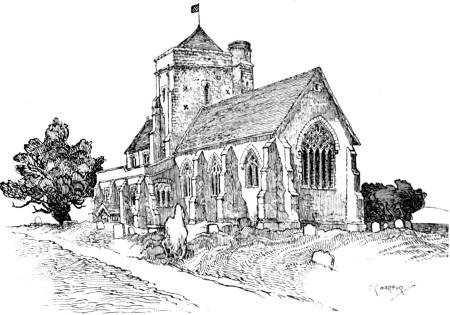
ETCHINGHAM CHURCH.
Although the call of nature may be attended to,
and thirst and hunger handsomely appeased at
Hurst Green, the æsthetic sense is unlikely to be
full fed. Satisfaction of that kind—but none of
the other—is amply obtained at Etchingham, one
mile distant, down a bye-road.
Travellers to and from Hastings by South
Eastern Railway are familiar with Etchingham,
as a place with a station where no train appears
ever to stop; and indeed to the ordinary mind
there seems, not merely no reason for stopping,
but none for a station at all. For Etchingham
is just what you see from the passing train: a
great, impressive church, and one or two ancient
farmsteads. There was no village when the
station was built, in 1847, and the place was,
except for that beautiful church and those farms,
a solitude. A solitude, too, it remained until
1904, when an entirely new village was begun.
There it blooms to-day, in red brick, like a scarlet
geranium, and the South Eastern Railway is at
last, after close upon two generations, justified of
its prescience.
There seems never to have been a village at
Etchingham. Only a manor-house of the de
Etchinghams; and that disappeared so long ago
that little is known of it. Its last traces were
erased when the railway came, and the station
stands on the site. There is something so typical
of the age in that circumstance that one cannot
but stand and admire the dramatic completeness,
the colossal audacity of it.
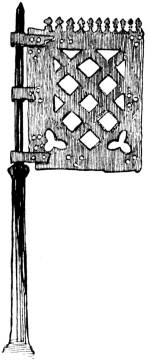
THE ANCIENT VANE,
ETCHINGHAM.
But a something greater than the manor-house
of those ancient lords remains; in the great church
they built. It stands so near the railway that one
might pitch a stone from the train into the churchyard;
and, as it is one of the finest churches
in Sussex, it never fails to hold the glance of
those who pass this way. It was built, on the
site of an earlier, by Sir William de Etchingham,
in 1365, and is a cruciform building, with
massive central tower, in the Late Decorated style—that
large and bold phase of Gothic which comes
between Early English and Perpendicular, and
looks lovingly back upon the grace of the earlier
and forward to the lofty emptiness of the later, with
a richness of detail peculiar to itself. A special
note of this church is the fine tracery of its east
window, in the easy flowing style, common in
France but comparatively rare in this country,
known as Flamboyant. The low
pyramidical spire of the tower
still supports the original copper
weathervane, in the form of a
banneret displaying the fretty
coat of arms of the de Etchinghams,
and on the floor of the
chancel are the almost life-sized
figures, in engraved brass, of
the founder himself, and his
son and grandson. Sir William,
the builder of the church, died
in 1387. He still darkly, in
obscure Norman-French and
black-letter, begs the prayers of
all: “I was made and formed
of Earth; and now have I returned
to Earth. William de
Etchingham was my name. God have pity on
my soul; and all you who pass by, pray to Him
for me.”
If salvation be found in church-building—and
there are yet those who seek it that way—then, in
those many mansions beyond, William de Etchingham
is well-housed, for he built not only a large
church, but a beautiful.
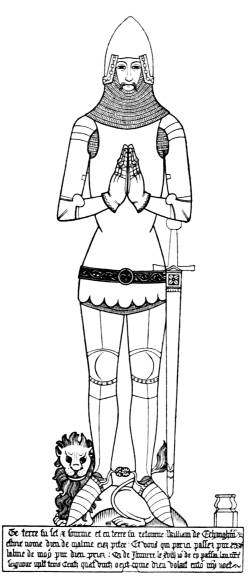
BRASS OF SIR WILLIAM DE ETCHINGHAM.
He endowed
it, too,
and the
eighteen
carved miserere
stalls yet
remain where
the priests
sang their
office. If you
turn up those
hinged seats,
you will find
odd carvings
on the under
side; among
them the
biting satire,
disloyal in
such a place,
of the fox in
the habit of a
priest, preaching
to geese.
A tablet
on the wall
records in
Latin that the
chancel was
restored at
the expense
of the rector,
Dr. Hugh Totty, who died, aged 101, in 1857. In
the south aisle hangs a tilting-helmet and the
erminois banner of Sir George Strode; and a
mural monument to Henry Corbould, artist and
ancestor of artists, who died, aged 57, in 1844, is a
a shocking example of “Gothic,” as understood
towards the middle of the nineteenth century.
Even this, however, is not so bad as the tablet,
with marble profile portrait medallion, to one
“John Snepp, gent,” 1823.
The churchyard was once surrounded by a
moat, in which, according to an ancient legend,
there lay a great bell. How it came there the
story did not say; but it was never to be drawn
from its hiding-place until six yoke of white oxen
should be brought for the purpose. The moat was
drained long since; but legend was for once at
fault, for no bell was found.
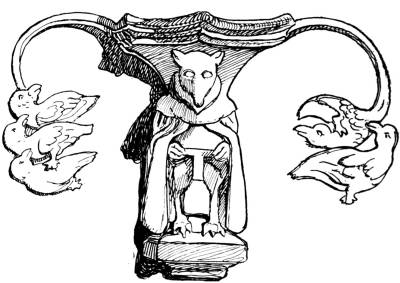
THE FOX PREACHING TO THE GEESE.
Returning to Hurst Green, and resisting the
temptation to turn aside for the purpose of seeing
the farmhouse called “Squibs,” we come presently
to Silver Hill, an eminence described by Horace
Walpole, who in 1752 travelled Kent and Sussex
with Mr. Chaloner Chute on antiquarian pilgrimage:
“The roads grew bad beyond all badness, the
night dark beyond all darkness, our guide frightened
beyond all frightfulness. However, without being
at all killed, we got up, or down—I forget which,
it was so dark—a famous precipice called Silver
Hill, and about ten at night arrived at a wretched
village called Rotherbridge.”
He forgot which! That is—like the hill—rather
steep. But he must have known by the
time they returned, for he speaks of the view from
the crest, on the homeward journey, as “the
richest blue prospect you ever saw.” It is indeed
very beautiful, and the fact has been recognised
by some enthusiastic person who, in a field beside
the road to the left, has erected a tall staging,
known as “The Beacon,” for sightseers.
The hill is steep: not too steep for a determined
cyclist to ride up it on the return, but still
a very respectable gradient. It looks by no means
so terrible as Walpole’s description would prepare
the stranger for; but the roadway is, in fact, not
that which gave these tourists and their guide
such qualms, for it was reconstructed about 1830.
Occasional lengths of deserted hollow road at the
side are surviving portions of the old road, and are
quite steep and rugged enough to acquit Walpole
of unnecessary alarm.
Robertsbridge is a long, long village of old-fashioned
houses huddled together on either side
of a narrow street in the flats that form the valley
of the Rother. Although Robertsbridge is so
undeniably old it is not an independent village,
being in the parish of the much smaller Salehurst,
seen across the levels, a mile away.
It has never been determined whether Robertsbridge
acquired its name from Robert de Saint
Martin, who founded the Cistercian Abbey “de
Ponte Roberti” here in 1176, or from a corrupted
version of “Rotherbridge.” “Much,” as Sir
Roger de Coverley says in The Spectator, “might
be said on both sides.”
At any rate, it is unquestionably a place of
bridges. There are seven in all, in a line along
the road; but no one of them is at all considerable,
and only three span any water, save in seasons
of flood.
The beginning of the village, officially styled
“Northbridge Street,” is generally styled “the
Bridges”; but was in turnpike days, when a gate
existed here, “the Clapper.”
The Abbey, long since demolished, lay one mile
from the village, beside the Rother. Fragments
of it are picturesquely built into the Abbey Farm,
and serve as substantial walls for oast-houses.
The most perfect relic is the crypt, inside the
house, forming an ideally cool dairy.
To this has come the Abbey that gave hospitality
to Edward the First and his successor;
whose Abbot in 1193, in company with the Abbot
of Boxley, was of sufficient importance to be
entrusted with the mission of discovering the
whereabouts on the Continent of the imprisoned
Richard Cœur de Lion. All that is left of it,
beside these fragments, is a manuscript volume in
the Bodleian Library at Oxford, inscribed: “This
book belongs to St. Mary of Robertsbridge:
whosoever shall steal it or sell it, or in any way
alienate it from this house, let him be Anathema
Maranatha.”
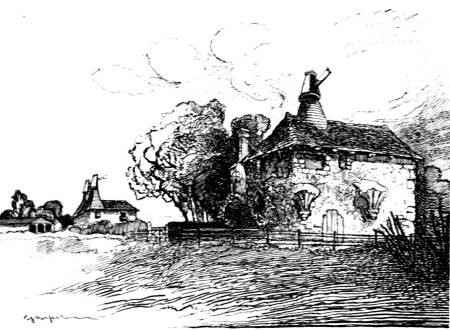
THE ABBEY FARM.
Notwithstanding this comprehensive curse,
some one did steal it. A further inscription,
written, it is thought, by John Grandison, Bishop
of Exeter, 1327-1369, declares: “I, John, Bishop
of Exeter, know not where the aforesaid house is;
nor did I steal this book, but acquired it in a
lawful way.” It is quite surprising to find the
old Churchmen believing in the efficacy of their
curses, and thus seeking to turn them aside.
The site of the Abbey was granted by Henry
the Eighth to Sir William Sidney, and there are
those who like to think that his grandson, Sir
Philip, would not have been killed at Zutphen,
nor Algernon Sidney beheaded, had it not been for
the curse upon sacrilege, sleeping in one generation
to work woe in another.
For over one hundred and fifty years Robertsbridge
Abbey was an iron and steel foundry, where
cannon and shot were cast. In the garden of the
farmstead a heap of cannon-balls, found about
the premises, reminds the visitor of this closed
chapter.
When Horace Walpole and his companion,
descending Silver Hill in the dark, came to “the
wretched village called Rotherbridge,” they would
have stayed the night, if they could have found
any decent accommodation. “But alas! there,
was only one bed to be had. All the rest were
inhabited by smugglers, whom the people of the
house called ‘mountebanks,’ and with one of
whom the lady of the den told Mr. Chute he
might lie.” That was rather too much for
Mr. Chute, who was a very great person indeed
when he was at home at his stately seat, “The
Vyne,” near Basingstoke, and he declined the
fellowship.
So, with links and lanthorns, they continued
their journey, and arrived at Battle, hardly six
miles away, at two o’clock in the morning, to
a “still worse” inn, “and that crammed with
excise officers, one of whom had just shot a
smuggler. However, as we were neutral powers,
we have passed safely through both armies
hitherto.”
One would like to identify that “den.” The
term would scarcely apply to the “George,” then,
as now, the principal house, and a good specimen
of the old English inn, whose proprietor, according
to an advertisement in The General Evening Post
of 1784, when the house was to let, had a “part-share”
in the post-coach on the road to Hastings,
described as a “favourite place for sea-bathing.”
Was it the “Seven Stars”? Or was it not the
“Stag’s Head” of other days, a shy-looking cottage
lying low down on the right of the “George,” and
well remembered locally to have been the haunt
of the smugglers of Darvell Wood?
Robertsbridge is pure Sussex, and pronounces
local place-names in a manner peculiar to itself.
In the result those names do not appear any the
more poetic—Udiham becoming “Udjem,” Bodiam
“Bodjem,” Northiam “Norjem,” and Horsmonden
“Ors’nd’n.” The story is even told of a stranger
asking an inhabitant of Heathfield the way to that
place, and of that unlettered person for long
declaring he had “niver ’eared of sech a name in
these parts.” At last a light broke in upon him.
“You means Efful,” he said.
Robertsbridge has now two railway-stations—that
of the South Eastern, opened in 1851, and a
newer, on the Kent and East Sussex Light Railway,
recently made; but it is as old-fashioned as
ever, and the subject-matter of the inns at night
is apt to be of such recollections as that of how,
seventy years ago, there were only three pairs of
top-boots in the parish, and how farmers going up
to London to cut an occasional dash would borrow
them for the jaunt.
It would be unthinkable to leave Robertsbridge
without visiting its mother church of Salehurst;
or, when there, to return without having seen
Bodiam Castle, two miles onward.
Salehurst Church stands picturesquely above
the Rother, on the opposite bank from the Abbey.
On the north side of it there stands an aged stone
recording the incredible age of one “Peter Sparkes,
who died October 8th, 1683, aged 126 years.” He
is referred to in the registers of Wadhurst as
“being above 126 years old by his own computation.”
Within the church there are several
seventeenth-and eighteenth-century cast-iron slabs
to Peckhams and Stevens: relics of the forgotten
iron-founding industry of the district.
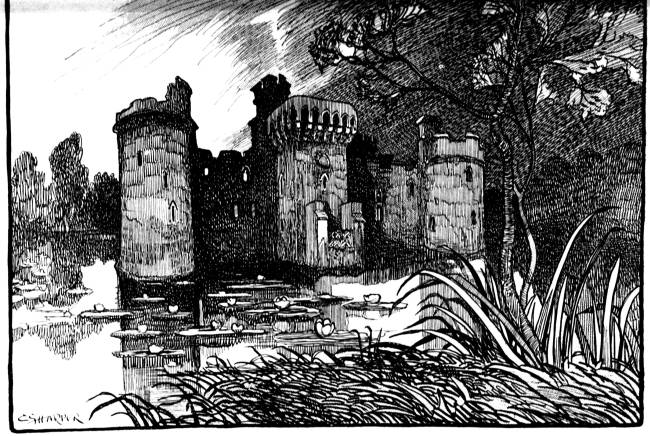
THE MOATED CASTLE OF BODIAM.
The contemplative person, for whom antiquity
is not everything, who finds interest in things of
the present as well as those of the past, may
discover some entertainment in noticing how
exquisitely the accommodation in the House of
God shades off in fine distinctions, from the
cushioned seats and carpeted floors in front, to
the strips of carpet and the fibre matting of the
intermediate, and lastly to the bare seats and naked
boards of those nearest the door—and the draughts.
He notices how things religious and things secular
are all ordered in these beautiful gradations: the
three classes on railways, and the more than three
orders of seats in theatres; and he wonders—that
contemplative person—whether the “many mansions”
prepared in the Father’s house partake of
the like subtleties.
The road to Bodiam—spelled “Bodiham” on
old maps—is hilly and circuitous; but it brings
you at last to that tiny village overlooking the
Rother marshes, and to that castle which, more
than any other ancient fortress in England,
figures the fairy home of the Sleeping Beauty.
Bodiam Castle stands on the hillside, beautifully
rural, and is surrounded by a very broad and very
clear moat of running water, fed from the never-failing
springs that flow from the higher ground
and are dammed at this point. The grey and
lichened walls of the castle rise sheer from the
water, amid a wealth of the loveliest water-lilies.
It is mediævalism incarnated. The walls and
the eight towers, alternately round and square,
are almost perfect, and the wooden gate yet hangs
on its hinges across the bridge, where the portcullis
grins and the holes in the masonry remain
above, to show how, by flinging molten lead,
boiling water, hot pitch, and domestic abominations
upon the heads of the enemy, the garrison
were prepared to hold their own.
But history tells us nothing of sieges or conflicts
here. Possibly Sir Edward Dalyngruge,
warrior of Crecy and Poictiers, who in the fourteenth
century built it, was too strong a castellan,
and his moated fortalice more than a thought too
formidable. At any rate, it is a castle without
a story.
The story is still told at Robertsbridge, and with
appropriate awe, how a ploughman on Taylor’s
Farm, Mountfield, ploughed up £1,100 worth of
gold, and sold it for five shillings, as old brass.
That happened so long ago as 1862 and the tale
has lost nothing, since then, in the re-telling.
Mountfield was long a place of pilgrimage after
that event, and the ploughmen on its fields
drove the share deeper than ever they had done
before; but if they made any more discoveries
they were wise enough to keep the fact to themselves.
Although it all happened so long ago, almost
the first thing the stranger hears of in Robertsbridge
to this day is that mystic gold. Reduced
to plain facts, it seems that during his work in
Barn Field, on Taylor’s Farm, January 12th, 1862,
a ploughman suddenly drove his plough into an
entangled mass of metal that brought him up with
a jerk. He threw the pieces on the baulk, and
when his day’s work was done showed them to his
master, who thought they were brass, and gave
them to him. They were really, from the description
afterwards given of them, gold torques and
other Early British ornaments, and had lain there
two thousand years. The metal weighed no less
than thirteen pounds.
After vainly endeavouring to sell the “old
brass” to one dealer after another, a Hastings
man more wideawake than the rest, suspecting it
to be the more precious metal, gave the ploughman
6d. a pound for it—liberal man! He lost
no time in travelling to London, where he sold it
to a refiner, who melted it down and paid him
£529 12s. 7d. for the resultant 153 oz. 12 gr. of
fine gold. A piece had already been sold to a
Hastings jeweller for £18.
Rumours of this extraordinary find soon spread,
and in the end the ploughman and the sharp
dealer were arraigned at the Winter Sessions at
Lewes, December 1862, on the charge of illegally
disposing of treasure-trove, the property of Her
Majesty the Queen. They were each fined £265,
half-value of the metal disposed of, or ordered
to be imprisoned until the money was paid.
Fairy gold has ever brought trouble upon those
who find it.
It is useless to speculate upon the possible
antiquarian value of the ancient ornaments thus
destroyed; but it must have been many times that
of the mere metal.
The other main staples of talk are cattle, hops,
and wool. If you cannot talk wool, hops, or
cattle at Robertsbridge without some knowledge
of those subjects, you are self-condemned. There
is a fortnightly cattle-market; “ship” browse in
many flocks on the surrounding pastures, but everywhere
are the hop-gardens and their inseparable
oast-houses.
Out of Robertsbridge and the Rother valley the
road ascends steeply to John’s Cross, where the
old coach-road bears to the left in a circuitous
route to Battle, by Vine Hall and Whatlington,
three-quarters of a mile longer than the absolutely
straight modern highway.
The “John’s Cross” inn, the old toll-house, and
a few cottages sum up the hamlet, and the rest of
the way to Battle is of almost unbroken loneliness,
except for the railway level-crossing, mid-way.
If, before we come into the town of Battle, we
re-read the stirring story of the Norman invasion
of 1066, and of the Battle of Senlac, known more
generally to the world as the Battle of Hastings,
fought on Saturday, October 14th, in that year,
so fatal to English liberties, on the spot where
Battle Abbey stands,—if, I say, before approaching
Battle, we read anew the story of that history-making
day of carnage, we shall come into the
quiet town with highly exalted feelings, and shall
find it a place of many and deep significances
to us.
With the tale of that historic struggle thus
freshened in our memories, it is not merely the
quiet little Sussex country town to which we now
come, but to the commanding hill of Senlac, overlooking
the seven miles of wooded lesser hills and
vales by which the Norman host advanced from
Hastings.
The Norman invasion of England, the catastrophe
of Senlac, and the woes that then befell the
English may all be traced to the weak character
and foolish policy of Edward the Confessor, a
king whose reputation for piety has, during all
these intervening centuries, glozed over his lack
of the first qualities of kingship. Firm rule, wise
and far-seeing policy at home and abroad—those
are the qualities, above all others, we look for in
a king, and mere saintliness of character in a
ruler has never yet, nor ever will, serve the turn
of any nation. Edward the Confessor has, time
beyond the memory of man, been held up as a
pattern of all the virtues. We are told how he
founded the Abbey of St. Peter, which we now
call Westminster Abbey, on Thorney Isle; we
listen, with what faith we may, to the story of how
successfully he prayed away the nightingales who
were disturbing his orisons at Havering-atte-Bower.
We know that Rome, in the fulness of
time, canonised him; but we know also that,
however fitted he was in life for the cloister,
however unaffected his piety, however mild and
urbane his rule, certainly, from the patriotic
view-point, his métier was not d’être roi, for he it
was who brought over the Normans to his court,
and by his favours to them showed them how
desirable a country was this England.
Edward was, in short, a Normanised Englishman.
The long years of exile he had passed oversea
in Normandy, before he was called upon to rule
over Saxon England, had set their seal upon him,
and his favourite courtiers were of Norman-French
nationality. He had, certainly, married Editha,
daughter of the great Saxon Earl Godwin, and
sister of Harold; but his quarrels with her family
go largely toward making up the story of his
reign. The head and front of his offending is
undoubtedly the alleged bequest, at a comparatively
early period, of his crown to William, Duke
of Normandy. Apart from the fact that the
succession was not his to give, and would in any
case have been the business of the Witan, this
devising of crown and country to an alien whose
ways were not those of the Saxons, and between
whose people and Edward’s people the keenest
jealousy and animosity already existed, was
unpatriotic to the last degree; and had the
“Confessor” been made to suffer the terrible fate
that befell the second Edward, himself the patron
of alien courtiers, that fate had been better
deserved. Nay, were justice done the memory
of that traitor to his country, his shrine in
Westminster Abbey would be torn down and
demolished.
But clearer and wiser views at last prevailed
with the cloistered King, and in that clarified and
enlarged vision, he, drawing towards his end,
designated the Saxon Harold, his brother-in-law,
his successor. Wisdom, however, was vouchsafed
him too late: the mischief was done. The fates
were working in those years against England and
for Duke William of Normandy, whom history
knows, ad nauseam, as “William the Conqueror.”
That historic personage was a great captain,
strong in battle and in strategy, but he had also
the mind of an attorney, which could quirk you
and quibble you, and chouse you as efficiently as
the sharpest practitioner that ever misused the law.
It was no matter to that acute and ambitious
brain that the sanctimonious “Confessor” had
revoked his bequest in favour of Harold; to him,
at least, it held good. And events marvellously
aided him. Somewhere about 1064, Earl Harold,
already king-designate, was voyaging down
channel, when his ships were driven ashore on
the coast of Ponthieu, in territory tributary to
William. Those were times when to be cast ashore
was to suffer, not only the discomforts incidental
to shipwreck, but to be seized and held to ransom
by the scarce more than robber-lords of that age.
Such an one was Count Guy of Ponthieu, who
speedily seized Harold and imprisoned him in his
castle of Beaurain, and would have held him
there, over against the arrival of that ransom, had
it not been for the Duke, who, hearing of this odd
freak of fate, and with a keen eye to how the
incident could be used to his own advantage,
demanded his release. But Harold’s enlargement
from an acknowledged and undisguised prison
was merely an exchange for a gilded captivity.
Nominally, he was now become the guest of the
Duke, in his palace at Rouen, but in reality he
was his prisoner, only to be released on terms.
Those terms were soon disclosed, and the English
Earl, already marked as the successor of Edward,
was made to swear, at Bayeux, as the price of
his liberty, to become the guardian of William’s
supposed interests in England, and to receive him,
on Edward’s death, as King. These oaths he took,
with others, upon a chest which William had
secretly filled with the choicest saintly relics that
Normandy contained. It does not become us,
with our later knowledge of the very unsaintly
character of the old bones usually palmed off in
those times as the relics of saints, to scoff at
Harold turning pale when the tremendous character
of the contents of that chest was revealed to him.
The credulity of that age did not permit him the
assumption that the alleged relics were probably
no more than the mere ordinary unsanctified
plebeian bones and teeth and fragments of skin
we may readily presume them to have been, with
the same relation to the genuine articles as that
of a Bank of Engraving note to one issued by the
Bank of England. Harold accepted them, as he
could not choose but do, at their face value, so to
speak, and trembled.
Such is the story handed down to us. The
oath taken, Harold was free to return; and, as his
own conscience later told him, and as ours must
needs tell us, was free to disregard an oath,
however solemn, taken under circumstances of
compulsion.
In two years from that time, January 5th,
1066, the Confessor died, with his latest breath
naming Harold his successor—a choice later
ratified by the council of the English realm.
Harold was elected and proclaimed King, and
the warrior-lawyer over in Normandy was left
out in the cold. William, however, could not
have been surprised at this, and set to work upon
the next step in his scheme, which was to obtain
the support of the Pope against “the perjurer,” as
he was pleased to style Harold. All these things
had been thought out long in advance by that
wily brain. William, as claimant to the English
throne, could be effectively aided by William as
champion of the Church’s might; and William
had ever been concerned, from motives of policy,
to figure as one of the Church’s most devout sons.
If you consider it, religion has ever, from the earliest
times, been made the stalking-horse of scoundrels:
a fact so patent that your playwright or your
novelist is commonly concerned to furnish forth
his villain with a text or a psalm, and thus moral
sentiments on the stage are the stigmata of the
wrong-doer.
The Pope, Alexander the Second, placing his ghostly
terrors at the disposal of William, declared Harold
an usurper, and William the lawful heir. Thus
early had Englishmen to remember Rome for a
disservice. It then remained only for William to
collect his forces for an invasion of England. He
set about the work with business-like promptitude
and a settled determination which, by comparison,
make the great Napoleon’s projected invasion of
over seven hundred years later seem like the wayward
fancy of an infant. The forests of Normandy
were felled and converted into timber, and all the
summer of 1066 thousands of shipwrights were
busily employed in Norman havens building the
vast fleet designed to invade our shores. When
we form a mind’s-eye picture of a fleet, we necessarily
visualise nowadays something very different
from the flotilla prepared by the Duke of Normandy
for the invasion of England; but we must go far
back, beyond even the small ships with which
Edward the First waged war in foreign parts, if
we would see what William’s navy, made of the
green timber that had been growing six months
before, was like. His “ships” numbered, according
to the lowest computation, six hundred and
ninety-six: according to the highest, there were
over three thousand; but if we turn to the indisputable
evidence of the famous Bayeux Tapestry
it will be seen that they were craft more in the
nature of galleys—open boats with one mast.
The same want of exact figures meets the
inquirer who seeks to learn the number of that
invading army. Contemporary chroniclers are at
great variance, the numbers, by their accounts,
ranging from 14,000 up to 60,000. From February
onwards to September those craft were building
and that army collecting. Meanwhile King Harold
was not idle. He had long been skilled in warfare,
and was as able a general as William himself, and
by sea and land he was gathering a force together
that in all human probability would have annihilated
the Norman host had it not been for the
happening that at this juncture divided his
attention.
That happening was the invasion of northern
England by the Norwegian king, Harald Hardrada,
in conjunction with Harold’s own brother, the
banished rebel Tostig, in September, at the very
time when the Duke of Normandy’s expedition
was lying ready to sail, only waiting upon a
southern wind. The Norwegian host landed in
the Ouse and the Humber, and the English had
been defeated at Fulford and Hardrada received
in York as a conqueror before the English Harold
could march from London to the scene. But when
he arrived victory attended him, and in the Battle
of Stamford Bridge, September 25th, he not only
defeated the invaders, and killed Hardrada and
his brother, Tostig, but almost annihilated the
foreigners. It was the supreme victory of a
great military career, and the last ever gained
by the Saxon English. In the midst of the
rejoicings and the absolutely necessary rest at
York, Harold received the tidings of the Norman
landing at Pevensey, near Hastings.
Fate had indeed dealt hardly with that brave
heart. He had marched full two hundred miles to
meet one foe, and he was now to march back to
face another, already established on the coast he
had been so concerned to guard. For the south
wind that had been denied William for near a
month of waiting at the Dive and at St. Valery
had, in this hour of his need, played Harold false
and had wafted the Norman sails across the
Channel. William landed unopposed on the deserted
coast at Pevensey, twelve miles to the west
of Hastings, in the early morning of September
28th, and the next day marched to Hastings,
which he made the base of his operations. From
that place he ravaged and laid waste all the surrounding
country, with the intention of drawing
Harold down to the sea-coast, to attack him in
defence of his plundered and ill-treated subjects.
He reasoned, as an invader even in these times
must needs reason, that the chances were more in
his favour if he could meet the English by the
shore. Were he obliged to march inland to the
attack, grave considerations of provisioning his
army must be contended with, and in the event of
defeat his difficulties would have increased with
every mile he had advanced into the interior. He
thus lay at Hastings, within reach of his ships,
while Harold was marching southwards, and organising
his army in London. There were not wanting
those who at this time warned William earnestly
against what they considered the folly of his
enterprise. The might of the Saxons was no mere
tale, and messengers, coming southward with news
of how Harold had defeated the Norwegian
invaders, and was now marching to repeat his
victory upon the Norman host, might well have
made even so tried and fearless a soldier as
William retrace his steps. But he had come to
victory or to death, and had staked all upon this
one throw for that magnificent prize, the crown of
England. Had he recrossed the Channel, it is
certain that never again would the opportunity of
landing on an unguarded coast be afforded him;
and on all counts, now or never was his time. He
had taken a high moral ground for his invasion,
and was come, by his own claim, not as Conqueror,
but as one claiming his legal rights, secured on the
most sacred of oaths and hallowed by the blessing
of the Church. Legal rights are the great standby
of the plunderer and the spoiler, and the stirrup
for William’s vaulting ambition was legality. It
was, as we have seen, the kind of legality we
associate rather with the pettifogging attorney
than with justice; but he had wrung the blessing
of Rome on it, and beside his banner floated the
standard consecrated by the Pope.
William “the Conqueror,” as history styles him,
never so styled himself. His astute mind thrust
such a warlike thing into the background. He had
only come to claim his own, and was unfortunately
obliged to fight for it
against the perjurer!
One can almost in
imagination hear the
pietistic snuffle of a
Pecksniff in this mixture
of legal and religious
motives.
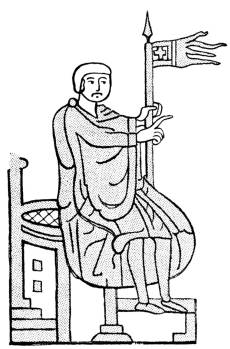
WILLIAM THE CONQUEROR.
Bayeux Tapestry.
It was about October
5th that Harold reached
London. He lay there
six days, awaiting the
promised reinforcements
from his northern Earls,
which never came, and
in the meanwhile calling
in his levies from the
near counties. But before he set out for Sussex
he paid a last visit to his abbey of Waltham,
which he had dedicated to the Holy Cross and
had enriched with many gifts—evidences of his
piety. For we must by no means believe that
William, the self-constituted champion of sacred
relics and the Church, alone practised, or professed,
religion. Harold’s piety was at least as
marked, and it is perhaps not altogether the
Englishman’s sympathy for an Englishman, or his
chivalrous regret for the vanquished, which sees in
the ill-fated King’s abasement before the Holy
Rood of Waltham on the eve of that fatal struggle
a more sincere approach to the Most High. He
lay prostrate upon the pavement in supplication,
and the dark, wonder-loving legends of that time
tell us that, as he did so, the hitherto raised head of
the sacred image bowed itself upon the Cross, as
though enacting again the tragedy of Calvary: in
token, as the belief of that age ran, that the career
of Harold was finished.
The English army set forth from London on
Thursday, October 12th, and marched inevitably,
it being the most direct route, by the line of
country through which runs the Hastings Road of
our own day. So speedily did the troops set out to
meet their foe, that by Friday night Harold had
pitched his camp on this hill of Senlac, eight miles
from Hastings, on the site of this town of Battle.
A very ancient oak, known as the “Watch
Oak,” stands in the private garden of a house on
the bye-road to the right entering Battle. It is
traditionally the spot whence Harold’s scouts
watched for the approach of the invaders.
No one is skilled to tell us whence came this
name of Senlac, nor what it meant. It was the
“hill called Senlac.” Around it on three sides
were hollows, marshy with the feeders of little
streams. The Normans gave the name a French
twist and called it “Sanglac” or “Sanguelac,” the
Lake of Blood; but although their perversion of
the name is ingenious, it will not serve our turn,
since we see that the name of Senlac existed prior
to the battle. Nor will yet another Gallicised
version—that of Saintlache, or Holy Lake, do;
and the meaning of the old name belonging to
this place of battle must of necessity be left in
obscurity.
Harold chose his own battle-ground, and chose
it with the trained, unerring eye of one who had
been the victor in many hard-fought campaigns.
Electing to take up a defensive position in a spot
where the menace of his presence must needs make
William fight, or remain disastrously inactive on
the coast, he ranged his army on the summit of
this long spur of hill that then thrust out boldly
from the wooded surroundings and commanded
a view over gorse-covered folds of down, away
to the sea. He had every reason for this plan
of awaiting attack, chief among them the
totally different characteristics of the two armies:
the Norman army being strong in cavalry, the
Saxons fighting wholly on foot, from King Harold
and his two brothers, Gurth and Leofwin, down to
the merest churl; while on the Norman side there
was a strong force of archers, and on the Saxon
none whatever. The Saxons, or the English, as
we perhaps should more properly name them, were
armed with javelins and with the two-handed battle-axe.
The battle-axe, carried over the shoulder
and wielded from it with a two-handed grasp and
a swing of the whole body, was a terrible weapon
in the hands of a body of men acting purely on the
defensive, but it was ill-adapted for pursuit. A blow
from it was easily capable of cleaving, not only
through the helmet and head of a horseman, but
of felling both him and his horse. Such was the
weapon upon which the English chiefly relied in
standing their ground and to withstand the onset
of the Norman horse, which, owing to Harold’s
strategy in seizing this commanding eminence,
would be under the necessity of charging uphill.
To render the position additionally secure,
opportunity was taken, ere night fell, to fortify
the edge of the plateau with a palisade cut from
the surrounding woodlands, and to wattle it with
twigs and boughs so closely interwoven that it was
impossible for a single person to creep through.
Here, then, the English army lay athwart where
now runs the road to the sea, but where at that
time, beside a landmark named in the old English
Chronicle “the hoar apple-tree,” there was apparently
no other salient object save the rough track
which must even then have existed, leading down
to the port of Hastings.
The night before the battle seems to us, and
must even have seemed to the opposing armies,
a tremendously fateful interlude. Political and
other considerations were such that all must have
known the fate of England to depend, not upon
a long campaign and a series of marches and fights,
but solely upon the issue of the great contest now
impending. How, then, did they pass the eve
of battle? The Normans are our chief, and almost
sole, authorities here, and were concerned, as inevitably
they would be, to picture the Norman army
as a host of Christian soldiers going forth to war
with a dissolute, drink-sodden rabble. According
to this partisan view, the Battle of Senlac, or
Hastings, was lost by the English chiefly owing
to the effects upon them of an all-night orgie of
wassailing. When morning came, and with it
the great struggle that was to decide the fate of
England, the English host were still muzzy with
their potations of the night before, and had not
the clear vision and cool judgment that are as
necessary on the battlefield as elsewhere. What
a fine theme for a Temperance Lecturer, hot on
the subject of “the cursed drink”! Such an one
might fitly show by this instance how indulgence
in it destroys not only the individual but the
nation itself; but no one seems ever to have
fastened upon this very eloquent illustration.
The Saxons certainly were mighty topers, and
it is by no means too much to say that they were
a nation of drunkards. Ancient chroniclers at
all points fully support this sweeping statement;
amongst them William of Malmesbury, who tells
us that the Anglo-Saxon rule was bad, and the
monks and nobility corrupt. “Drinking in parties,”
he says, “was an universal practice, in which
occupation they passed entire nights, as well as
days.”
Coming to a description of the night before the
battle, he tells us, in the original Latin in which
he wrote: “Angli, ut accepimus, totam noctem
insomnem cantibus potibusque ducentes.” That
is to say, in plain English, they kept awake all
night, singing, and drinking innumerable drinks—which
is a very fine, fearless way of preparing to
meet the foe, and one highly expressive of contempt
for him; but it is not a wise way.
He then proceeds to expand his argument by
saying: “The vices attendant on drunkenness
which enervate the human mind followed; hence
it arose that, engaging William more with rashness
and precipitate fury than military skill, they
doomed themselves and their country to slavery
by one, and that an easy, victory.”
The Normans spent the night after a very different
fashion—in prayer and in the confession of their
sins—for they knew that many must fall on that
eventful day. The Bishops of Coutances and
Bayeux received their confessions, and recorded
their vows on this Friday night that if they were
spared on the morrow they would fast on Saturdays
for the remainder of their lives. William,
for his part, registered a solemn vow that if he
gained the victory he would found a great church
on the battlefield, in gratitude for the divine aid.
The Normans, in short, made all due preparation;
and as they prayed well, so did they fight, on that
fatal morrow.
Another, and a highly picturesque, chronicler
tells us delightfully of the alleged actual Saxon
debauch on the battlefield, on the night before the
fray. This account is by Wace, the author of
several romances and narrative-poems in Norman-French.
Wace wrote his jingling metrical narrative
about 1170, more than a hundred years after
the battle was fought, but probably incorporated
the floating traditions of that great occasion,
doubtless still plentiful in his time.
Here is his picture of the Saxon orgies:
Quant la bataille dut joster,
La nuit avant, ço oï conter,
Furent Engleiz forment haitiez,
Mult riant è mult enveisiez;
Tote nuit mangierent è burent
Unkes la nuit et lit ne jurent.
Mult les véissiez demener,
Treper, è saillir è chanter.
The Norman-French in which Wace writes is
somewhat puzzling, but the general sense of it is
that “the night before the battle was fought, as
I am told, the English were joyous, laughing
much and skylarking. They ate and drank all
night, refusing to take any repose, and skipped
about, dancing and singing.”
Then he gives us the English shouts, as heard
by the Normans:
Bublie crient è weissel,
E laticome è drincheheil,
Drinc Hindrewart è Drintome,
Drinc Helf è drinc Tome.
or, as we may put it, “Bubble it up!” they cried,
and “Wassail!” and “Let it come,” and “Drink
hail!” “Drink hinderwards and drink to me,
drink health and drink to me!” Modernised, and
applied to beer, which is to our times what mead
or metheglin was to the Saxons, “Bubble it up!”
would appear to mean “Froth it up,” or “Put
a good head on it”; while “Let it come” and
“Drink hail!” are simply “Pass the bottle”
and “Here’s your health!” But how you drink
“hinderwards,” unless it means “Pass the bottle
back again,” I cannot conceive.
At any rate, it is quite evident, by this account,
that these English warriors had each a thoroughly
good skinful of booze overnight. They seem to
have almost wallowed in it, and were precisely
the men who would have appreciated the bibulous
spirit of that drinking ballad of modern times,
which ran something after this style:
Beer, beer, glorious beer;
Fill yourself right up to ’ere.
Up with the sale of it,
Down with a pail of it,
Glorious, glorious beer.
Up with the trade of it,
Drink till you’re made of it,
and so forth, in a style eminently calculated to
win the hearts of my lords Ardilaun, Iveagh,
Hindlip, and Burton.
But the Saxon mead, which may still be discovered
in remote parts of the country as the
home-brewed “metheglin,” a sweet and sickly
liquor made from honey, is a heady drink, a
great deal more likely to result in a splitting
headache the next morning than the clearer brew
of the barley; and the Norman libellers would
have us believe that, because of that matutinal
headache, and an enlarged vision which led the
English to see two, or three, Normans for every
one—and to strike at the ones that were not
there—they lost the Battle of Hastings.
The historical facts do not quite fit in with that
view. Doubtless the English and the Norman
methods of passing the battle-eve were different.
For one thing, the Norman wolf was posing, until
he almost deceived himself, as the injured party,
and one fighting the battle of religion as well as
of personal wrongs; and he acted fully up to
those parts. The English, on the other hand,
were elated with their recent victory in the north,
and felt a not unnatural confidence in their ability
to repeat it. Therefore, they went into battle
with less solemnity than the Normans. But we
nowhere read that the English battle-axes were
swung with the less terrible effect because of the
revels which may or may not have passed overnight
in the English camp, and nothing seems
more certain than that victory only fell to the
Normans because of the mistaken warlike ardour
of a portion of the English army, which broke its
ranks in order to pursue a panic-stricken section
of the Norman array, and thus afforded William’s
cavalry a footing on that bitterly contested hill of
Senlac.
The battle began about nine o’clock in the
morning, the Norman army marching from
Hastings by the spot where Crowhurst Park is
now seen, to Telham Hill, the “Hetheland” of
the chroniclers. Here the Norman knights put
on their armour, and here William made his vow
that if victory were given him he would build
a great abbey on the spot where he saw the
emblazoned English banner of the Fighting Man
flung proudly upon the morning breeze. His
army then advanced to the attack, the archers
on foot in the front rank, the swordsmen behind
them, and in the rear the cavalry. William himself
was armed with an iron mace, the weapon
also carried by his brother, Odo, Bishop of
Bayeux.
The fight began with a discharge of arrows
from the Norman ranks, followed by the singular
interlude provided by Taillefer, the Norman
jongleur, or minstrel, who rode forth from the
ranks singing songs of chivalry, and of the knightly
doings of Roland and Charlemagne. He had
begged from William the privilege of striking
the first blow, but as he went out into the space
between the confronting armies he assumed first
his character of a juggler, throwing his sword into
the air, and then catching it, to the astonishment
of the English, who doubtless wondered what
manner of warrior was this. But, ceasing his
tricks, he suddenly rushed upon the English ranks,
and piercing one Englishman with his lance and
striking down another with his sword, was thereupon
himself slain. It was the bravest, or, if you
will, the most foolhardy, act of the battle, for he
went forth to certain death. But his action did
this much: it heated the blood of both sides, and
those who might have fought at the beginning
without the full fury of enthusiasm, now fell to
it in frenzy, fired by his example. It heartened
William’s second line, the infantry, to their heavy
task of advancing, under the showers of English
stones and javelins, up the hill to the attempted
destruction of the palisade; but although they
strove, the effort was too great. All who approached
within the reach of English arms and English
axes were struck down, almost cleaved asunder,
and although the rear ranks filled the air with
Dieu aide! they wavered from that first onset,
the English shouting “Out, out!” as they thrust
back every one from their defences, varying that
cry with the pious invocations, “Holy Rood,”
“Holy Cross,” and “God Almighty!”
Wace tells us of those battle-cries in his quaint
renderings of the English the Normans heard:
Olicrosse sovent crioent,
E Godemite reclamoent;
Olicrosse est en engliez
Ke Sainte Croix est en franceiz,
Et Godemite altretant
Com en franceiz Dex tot poissant.
Or, translated:
Holy Cross they often cried,
And shouted God Almighty;
Holy Cross is in English
What Sainte Croix is in French,
And God Almighty is, otherwise,
As they say in French, Dieu tout puissant.
If the English really did say “’Oly Cross,” it
shows us that the letter “h” was as slighted in
the eleventh century as it is in the twentieth.
The Norman infantry had now recoiled, and
the turn of the cavalry was come. The choicest
chivalry of Normandy, however, strove in vain
uphill against the English defences, and many
a horse and his mail-clad rider fell beneath the
axes. Harold’s choice of a battle-ground and his
defensive tactics were fully justified, and the
Battle of Senlac would have been his but for
the fatal impetuosity of a portion of his less
disciplined troops, who, seeing the panic and headlong
flight of the Norman army, broke their ranks
in pursuit. The temptation was great, for everywhere
the Normans were in flight, and the awful
cry had been raised among them that William
himself was dead. It was only by removing his
helmet and disclosing his face that his men were
assured of his existence. “Madmen!” he cried.
“Why flee ye? Death is behind, victory before
you. I live, and by God’s grace I will conquer,”
and so saying he forced those immediately around
him back into the fray.
This incident has been carefully pictured in
the Bayeux Tapestry, where we see “the Duke
comforting his young soldiers” by disclosing his
face, while his standard-bearer draws attention to
him. The impressiveness of the scene is perhaps
a little marred by the grotesque drawing, and by
the extraordinary likeness of “the Duke” to
Mr. Arthur Roberts, and of one of the “young
soldiers” to accepted caricatures of Mr. Austen
Chamberlain.
“DUKE WILLIAM COMFORTS HIS YOUNG SOLDIERS.”
Central incident of the Battle of Hastings. From the Bayeux Tapestry.
Meanwhile the flying Norman infantry had in
other parts of the field turned upon their pursuers,
and here the sword proved the better weapon, for
the rash English were cut to pieces. Then, somewhere
about three o’clock in the afternoon, began
the most terrible attack of that dreadful day, in
the desperate charge made by William, his
brothers Odo and Robert, and their attendant
knights, against the sturdy group around Harold
and the English standard. William, on horseback,
sought out the English King, and might have met
him face to face, had not the King’s brother,
Gurth, flung a spear at him, which, although it
missed the greater mark, brought down his horse.
Unlucky, ill-aimed blow! It brought Gurth and
William face to face, afoot, and presently the
English Earl was lying dead from a blow of the
Duke’s mace. Near by, and almost at the same
time, fell Harold’s other brother, Leofwin. The
English fortunes were indeed running low, but
the battle was not yet decided. Still that devoted
phalanx of axemen hewed down most of those
who approached, and the day was neither lost nor
won. It was then that the ill-judged pursuit
made by the English a little earlier bore bitter
fruit—the sorrow of it! William had noted its
effect, and now that his direct attacks were like
to fail, he had recourse to the wily trick of a
feigned flight. Accordingly, to his instructions,
a wing of his army turned tail and fled, as though
in panic; and immediately, learning nothing from
that earlier disaster, a portion of the English
came down after them. It was the turning-point
of the day, for the ground the English had left
was just the one end of the hill where the rise
was appreciably less steep, and more easily to be
charged up by the Norman cavalry. The fight
down in the valley between the pretended fugitives
and their pursuers meanwhile went forward with
varying fortunes. The flying Frenchmen turned,
as before, but this time the English seized on an
outlying hill, and although they fell, they fell in
company with their foes. In their turn, they
inveigled the French horsemen into charging upon
them into an unsuspected ravine, where they fell
in a mass and were despatched to the last man, so
that the old chroniclers tell us, and the Bayeux
Tapestry shows, how the hollow was filled with the
dead.
LAST STAND OF THE ENGLISH.
Bayeux Tapestry.
William and the pick of his army now beset
the hill from its western slope, thus left open by the
descent of the pursuing English, and here, and
along the ridge to the very spot where Harold stood,
wielding his axe with the best of them beneath
his standard, the fight stubbornly continued. The
autumn day was now fast drawing to its close,
and the battle might have been still undecided
that night, had it not been for an inspiration that
seized William. His archers had hitherto not
made any great impression. He now ordered
them to shoot their arrows into the air, so that
they might descend with terrific force upon the
heads of the English; and this done, the execution
was dreadful. Many were struck in the eye
by the falling shafts, among them Harold, the
English King himself. An arrow pierced his right
eye, and as he agonisedly strove to withdraw it,
the shaft broke. Let us not enlarge upon this
dreadful end of the patriot King, who was
presently discovered and slain by the Norman
knights as he lay upon the ground at the foot of
his royal banner.
FLIGHT OF THE ENGLISH CHURLS.
Bayeux Tapestry.
Thus fell Harold, in his prime, for he was but
forty-four years of age. It happened long, long
ago; but although much else has turned to dry-as-dust
in that vast interval, and although many
historical figures and the deeds they wrought are
mere vacuities, emptinesses, and parchment-like
bogles, the heroic death of Harold in defence of
his country still calls up bitter sorrow in those
of us to whom history is not merely the printed
page, or a glass-covered case in a museum.
When Harold fell England fell with him. All
who fought with him that day knew it must be
so, yet the fight, although it was by now a hopeless
cause, went on until the evening deepened into
night; and although those of meaner estate may
have fled when the fortunes of the day were
obviously lost, those of higher sort plied their
axes to the death. Few of them escaped, or sought
to do so. Yet, even as the last streaks of waning
day faded into night the defeated and fleeing
English turned once more upon their foes, and in
the marshy hollow in the rear of the battle-ground,
then eloquently called “Malfosse,” slew
in great numbers the Norman horsemen who incautiously
pursued them. It was the last expiring
effort of the day, but so sturdy an one that the
Normans were for awhile stricken again with a
temporary panic, thinking that English reinforcements
had arrived. But no fresh troops were
come to save that situation; and not even at this
last moment had the northern Earls, Edwin and
Morcar, sent aid to redeem their characters. They
live in history in company with Judas and many
another perjured traitor. By their treachery
England was lost.
The battle was over, after more than nine hours’
continued fighting; and now William’s tent was
pitched upon the spot where the English standard
had been planted. There he supped, and there,
amid the thousands of dead and dying, he slept.
On the morrow the mutilated body of Harold was
found; but neither the bribes nor the entreaties of
his aged mother, Gytha, who had now lost all her
sons in battle, could induce William to yield it to
her or any other. The perjurer, the excommunicate,
he swore, should not have religious sepulture.
Harold’s body should rest in unhallowed ground,
beneath a cairn of stones on the rocks of Hastings,
and should thus in death guard the Saxon shore
he had guarded in life. And so to the shore at
Hastings, wrapped in a purple robe, his body was
borne. And truly, no other burial could be so
fitting for the hero whose life was given for his
trust. The Duke of Normandy was no sentimentalist,
and to the minds of that age unconsecrated
interment was a thing to be thought of
only with a shudder; but he was chivalrously
poetic here, without a suspicion of it himself, for
no hero was ever laid in more fitting place than
Harold, by the salt selvedge of the coast he had
sworn to protect, and did protect to his last
moment: and as for consecration—why, there be
those who dare to think that the laying there of
this man’s body, who shed his life-blood for the
land that gave him birth, was itself hallowing and
consecration transcendent for that rocky marge.
But the epic fitness of Harold’s resting-place
was not perceived by that age, or was thought a
thing of lesser moment than that he should be
accorded religious burial; and thus it happened
that, when the fury of the Conqueror’s first rage had
died down, permission was accorded for Harold’s
body to be translated to Waltham Abbey, the
great minster himself had founded in Essex. The
last days of the terrible year of 1066 were drawing
in when that re-interment took place, and Sussex
lost the bones of her patriot.
This is pre-eminently the era of national
memorials, when heroes of to-day and of yesterday
and other personages whom we are not all agreed
to call heroes are honoured in effigies of bronze.
’Tis but yester-year since Alfred the Great was
duly, and properly, commemorated in this shape,
in his city of Winchester, and a statue of William
of Orange—our William the Third—was erected,
not so long since, on the spot where he landed, at
Brixham, in Tor Bay; but Harold yet awaits his
turn. For the why of it, I know not; unless
indeed it be that we English are ever a thought
too practical, and honour, not so much endeavour,
as success. Alfred was successful; Harold in the
end was crushed, and his England broken. Yet
it was not himself was lacking; it was his rash
irregulars, who, by their headlong zeal, lost him
the day. He strove his utmost, and that utmost
was, beyond rivalry, noble.
To say, “He did his best,” is the noblest
epitaph we can give any man, and none should
grudge Harold posthumous honour. We “Englishmen,”
as we may still call ourselves, are not
yet so indisputably the masters of the world that
we can afford to disregard our national heroes,
and Harold’s statue, of appropriate heroic size,
surely should stand prominently over Hastings, to
show newer generations how we can honour even
endeavour that has won to no position, and that
we can remember even our defeated heroes.
The Conqueror, as we must call him, despite
his studied avoidance of that title, inimical to his
“legal” claim, fully redeemed his vow to build a
great abbey upon the field of battle. He built the
Abbey, which he dedicated to St. Martin of the
Place of Battle, on the place where so many had
been slain to satisfy his ambition, rearing the High
Altar, the holiest spot, on the exact position where
Harold had fallen. William Faber, that Fabricius,
or smith, turned monk, who was present at the
great battle, and had been at the Duke’s side when
he vowed the Abbey here, would, when it came to
the actual building of it, have chosen another site;
for here, he urged, on the hill-top, water was
lacking. Let him and his brethren from the Abbey
of Marmoutiers build in the valley, where the
springs were never dry. But this suggestion
outraged the Conqueror’s sense of the dramatic
fitness of things, which, as we have already seen
in his selection of Harold’s seashore resting-place,
was a very keen sense indeed. No: he would
build upon the actual field of battle, or not at all;
and if the Almighty spared his life, wine should
be more plentiful in that Abbey than water
elsewhere.
Battle Abbey very soon began to rise on that
field of blood. The King of England, as he was
now become, spent money freely on it from his
treasury; ship-loads of the fine building-stone
of Caen came continually across Channel from
Normandy, until, by one of those miraculous
dreams dreamt at need in those times, a bed of
stone was discovered, and a quarry opened, in
the neighbourhood. The rising Abbey was richly
endowed with manors far and near, and was made
the centre of a three miles’ circuit exempted from
all other jurisdictions, ecclesiastical or civil. Its
abbots, moreover, were mitred and seated in the
councils of the realm, and beside holding the
privilege of sanctuary, theirs were the rights of
free warren, inquest, and treasure-trove. Were
they merciful men and pitiful, then those dispositions
could be humoured to the full, for they were
given the prerogative of pardoning any criminal
they met on his way to execution: a prerogative
that meant much in those days, when execution
was done upon criminals for a large variety of
offences.
More interesting than all others among William’s
gifts to the Abbey were his sword and his coronation
robes, which, stripped of their gold and silver
chains and amulets in the reign of Rufus, for
centuries remained objects of the greatest curiosity.
But the Abbey was long a-building, and twenty-eight
years had flown since the battle and William
himself had been seven years in his grave, before
it was completed and finally consecrated.
And then it stood in this noble situation for well
over four hundred and fifty years, growing in
architectural splendour and worldly wealth, but
decaying in religious life and morals, in common
with all other monasteries. Its income was equal
to £10,000 per annum of our money: the Abbot
entertained guests of the noblest, and the brethren’s
indiscriminate charity made Battle a centre for
all the “mighty beggaris, sturdye vagrantes,
idle mychers, and foule cozeners” in Sussex. It
was rotten-ripe and full fit to be plucked when
Henry the Eighth ended the monasteries and
when his Commissioners appeared before its doors
on May 27th, 1538.
To sentimentalise over the suppression of places
like Battle Abbey would be excusable in the
ignorant; in those fully informed it would be
criminal. It cannot be too often repeated that
the work undertaken by Henry the Eighth was
no mere capricious act of tyranny, was no
unwarrantable or unprovoked attack upon the
religious houses. Wyclif had long before, at
the close of the fourteenth century, declared
that the rotting trunk of the monastic establishments
cumbered the ground. In 1414 over one
hundred alien priories were suppressed. In 1489
Pope Innocent the Eighth issued to the Archbishop
of Canterbury a commission for a general
investigation. Parliament itself had petitioned
Henry the Fourth for seizure of the possessions
they administered so ill. Wolsey had from within
the Church seen the decadence of the Abbeys and
Priories, and himself suppressed a number of the
smaller houses and devoted their property to the
better use of education.
It is a cloud of witness to the general and
cumulative disgust of the times with the enclosed
life.
The Commissioners came to Battle, dressed
fantastically in the plunder of other religious
houses they had ransacked on their way, “decked
in the spoils of the desecrated chapels, with copes
for doublets, tunics for saddle-cloths, and the
silver relic-cases hammered into sheaths for their
daggers.” They, in short, committed on their
side almost as many excesses as the foul-living,
blasphemous monastic brethren had on theirs; but
they had this excuse: that if they indeed made a
mockery of religion, it was the monks themselves
first showed them the way of it.
The report of Dr. Layton, Chief Commissioner,
described the conduct of Battle as “the worst that
ever I see in all other places, whereat I see specially
the blake sort of dyvellyshe monks.” Their doings,
however, had not been so bad as those of establishments
subsequently visited, whose sins will scarce
bear mention.
But the monks of Battle had always been
prepared to go considerable lengths for money.
In the monastery was hung the famous “Roll
of Battle Abbey,” purporting to be the roll-call
of the Norman knights on the morning of the
Battle of Hastings, to which they answered
“Here,” or “Ici,” or “Adsum,” as might be.
This historical parchment is reported to have been
removed to Cowdray, where it perished in the fire
of 1793, but it had, centuries before, been so
tampered with by the monks that all its value
had been destroyed. It early became a foible
among noble or wealthy families to declare that
their ancestors “came over with the Conqueror,”
and Battle Abbey was always ready to oblige a
liberal patron by adding his name to the Roll.
In the words of Dugdale: “Such hath been the
subtility of some Monks of old, that, finding it
acceptable unto most to be reputed descendants to
those who were companions with Duke William in
that memorable Expedition whereby he became
Conqueror of this Realm, as that, to gratify them
(but not without their own advantage) they inserted
their Names into this antient Catalogue”;
and Camden repeats the charge. “Whosoever,”
he says, “considers well shall find them always
to be forged, and those names inserted which were
never mentioned in that authenticated record.”
On the surrender of Battle Abbey, it and its
lands were granted by the King to Sir Anthony
Browne, in 1538. The knight did not come into
his property with the good will of the neighbourhood,
which, pauperised by and dependent on the
monks, with anger saw them thrust forth into
the world, and loved to tell how the last of the
brethren to issue from the gate turned and cursed
him with the doom of the sacrilegious. “By fire
and water,” he declared, his line should end. We
are not told whether Sir Anthony Browne quailed—as
on the stage he certainly would have done—or
if he merely laughed; but there can be no doubt
that the people of Battle awaited the issue with
great interest, and that, when nothing happened,
they were disappointed. Instead of Sir Anthony
Browne or any of his family being cut off
untimely, they flourished exceedingly, and his
son became a peer, under the title of Viscount
Montagu.
The estates of Battle passed from the family
in the time of the sixth Viscount, who in 1719
sold them to Sir Thomas Webster, the first of
a long line of Baronets who (with an interval from
1857 to 1901) have held them ever since. In all
that time the curse slept, and possibly when the
sixth Viscount Montagu parted with Battle and
retired wholly to his great mansion and beautiful
park of Cowdray, he thought the spell had been
effectually broken by this severance.
But the long-dormant curse woke up and
worked itself out in 1793, when the beautiful
mansion of Cowdray was destroyed by fire. In
the following month the eighth Lord Montagu,
while yet ignorant of this disaster, met his death
by drowning in the Falls of Lauffen, near Schaffhausen,
when attempting to shoot the rapids in
a boat. He was but twenty-four years of age.
The next heir to the estates of Cowdray, the
ninth and last Viscount, was a Roman Catholic
priest, who died childless, in 1797, in spite of the
fact that he was dispensed from his vows in order
that he might marry and continue the line. The
property was then inherited by his sister, Mrs.
Stephen Poyntz, whose two sons were shortly
afterwards drowned at Bognor. Her husband
then sold Cowdray.
All this proves how very careful it behoves
those to be who launch curses on roving commissions.
Even the Websters seem to have shared
to some degree in this malediction, for the fourth
Baronet committed suicide, June 3rd, 1800, by
shooting himself with a pistol at his London
house in Tenterden Street, Hanover Square. He
had been embarrassed by heavy losses at cards.
This eccentric and unfortunate man, Sir Godfrey
Webster, married Elizabeth Vassall, a great
Jamaican heiress, who in 1795, at Florence, while
her husband was away in England on business,
left him and her two children for the third Lord
Holland. Lord Stavordale, in his memoir, skates
cautiously over the thin ice of this affair. He
says the meeting of that guilty pair “was destined
to alter the whole course of their lives. They
became deeply attached to one another, and after
many months spent in various parts of the Continent,
returned to England in 1796.”
Sir Godfrey obtained a divorce in July, 1797,
and two days later Lord Holland married the lady,
known to diarists and writers of memoirs as “the
celebrated Lady Holland.” Had she been less rich
she would doubtless have been merely “the notorious.”
Her entertainments and her biting wit
(she was a kind of female Douglas Jerrold)
absolved her from the ostracism that would have
been the lot of one less wealthy, less acid, and
less hospitable. She lived a long life in the centre
of political and social functions, and died in 1845.
This Sir Godfrey Webster is “the very worthy
Baronet” referred to by “Thomas Ingoldsby” in
the preface to the second edition of the “Ingoldsby
Legends” as “protesting against a defamatory
placard at a general election”:
Who steals my purse steals stuff!—
’Twas mine—’tisn’t his—nor nobody else’s!
But he who runs away with my Good Name,
Robs me of what does not do him any good,
And makes me deuced poor:
a novel reading of Iago’s passionate declaration,
Othello, Act iii., Scene 3:
Who steals my purse steals trash; ’tis something, nothing;
’Twas mine, ’tis his, and has been slave to thousands;
But he, that filches from me my good name,
Robs me of that, which not enriches him,
And makes me poor indeed.
His also was the reading:
Pray, who can hold a fire in his hand
By thinking on the frosty cock-horses?—
a new version of Bolingbroke’s speech in Richard
the Second:
Oh, who can hold a fire in his hand
By thinking on the frosty Caucasus?
A DESCENDANT OF THE SAXON CHURLS.
Sir Godfrey Webster, sixth Baronet, in 1857
sold Battle Abbey to Lord Harry Vane, afterwards
Duke of Cleveland, chiefly because of the extraordinary
situation brought about by there being
at that time no fewer than five dowager Lady
Websters drawing jointures from the already
impoverished property. It had long been a
cherished dream of the Websters to repurchase
their old home, and this was realised in 1901
by Sir Augustus Webster, the present and eighth
Baronet, on the death of the Duchess of Cleveland.
But although he effected that aim, he could not
maintain the Abbey itself, and accordingly let it
to Mr. Grace, the wealthy American who resides
there now and lords it over this historic spot and
this beautiful park occupied by English gentlemen
when the place whence he came was the primeval
forest roamed by the North American redskin. It
is a picturesque example of the newer conquering
of England by the dollar, over eight hundred
years after the famous battle that won it with the
sword.
It is in a remote and picturesque corner of the
park, in Powder Mill House, that Sir Augustus
Webster resides; in a house which, as indicated
by its name, was one of those gunpowder factories
whose numerous accidents, according to Horsfield,
historian of Sussex, “it would be harrowing to
relate and uncharitable to publish.”
The manufacture is a thing of the past at
Battle, but the great pond, used in the work,
remains, and so do those brushwood thickets that
contributed charcoal to the industry. Brushwood
coppices are still one of the character-touches of
the place, and those “leather-legged chaps, the
clay and coppice people,” as Cobbett names them,
are, as they have been from Saxon times, the
greater proportion of the inhabitants. Any day
their rustic and toil-worn figures, bent under huge
faggots, may be seen in Battle street, and they
serve to show how, although the Normans and
the monks in turn have gone, the rural Saxon
people remain.
When Sir Anthony Browne came into possession
of Battle, he lost no time in demolishing the
church of the Abbey and many of its domestic
surroundings. The Abbot’s great hall and apartments
he converted into a mansion, and with a
portion of the stones from the demolished church
added other rooms.
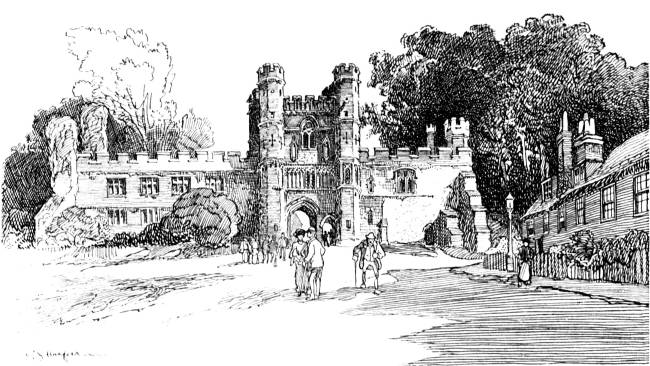
BATTLE ABBEY.
All these things are enclosed within the massive
walls and the great Gateway that face the open
market-place of Battle town as though the Abbey
itself were still perfect behind them. Once a
week great crowds of visitors come from Hastings,
by rail, by waggonette, or a-foot, and pay their
sixpences to be conducted over the place. They
see the wooden beam projecting from the walls
of the Gatehouse, and learn that it was a gallows;
they are bidden look through the windows of
the modern drawing-room that was the monastic
“locutorium,” or parlour, for the reception of
strangers; they stand on the terrace, and look
down upon the valley of Senlac and the corresponding
heights of Telham, the way the Conqueror’s
army advanced to the attack. Then the
guide conducts to the site of the High Altar, the
spot where Harold fell, to the gardens, once
the Cloisters; then to the great roofless Refectory.
Beneath it are the three fine crypts. One of them
the guide calls the Scriptorium, but the name has
little meaning for him. If you ask him to point
out the site of the Œsophagus, the Pericardium,
or the Cerebellum, he will look puzzled for a
moment; but, rallying, will declare them to have
been destroyed so long ago that their sites are
uncertain. At last, with evident relief, he
conducts the crowd to the gate, and saying,
“That’s all I can show you to-day, ladies and
gentlemen,” dismisses them.
A relic of more savage times than these of ours
still exists in the market-place, in the iron ring
to which the bull was tethered when bull-baiting
was a popular sport. It has recently been covered
over with earth.
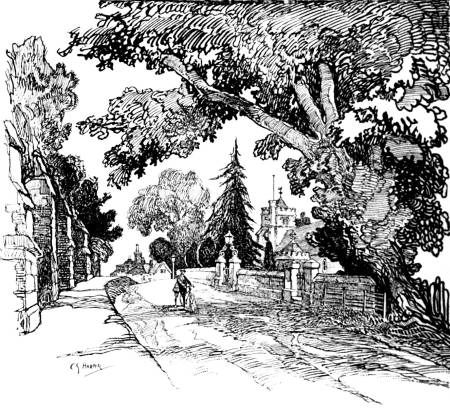
BATTLE CHURCH.
The parish church of Battle, standing beside the
road on the way out of the town, was a “peculiar,”
i.e. independent of ecclesiastical control. Its
incumbent is not merely a vicar or a rector, but
a dean, and is appointed by the owner of Battle
Abbey, still the lay Abbot. In the chancel lie
Sir Anthony Browne and his wife, with a magnificent
tomb over them, and in the churchyard is
the humble stone to Isaac Ingall, who died after
ninety years’ service at the Abbey, in 1798, aged
120. Beginning as postilion, he ended as major-domo.
At the age of 107, resentful of some
indignity—perhaps some one had called him
“old”—he went off in quest of another situation.
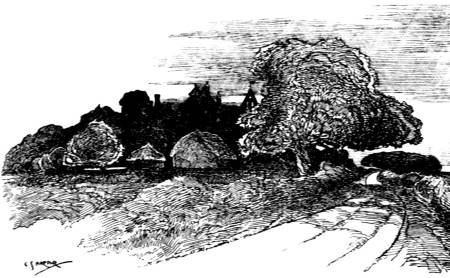
A BYE-ROAD AT BATTLE.
Beneath the town and the church, the road
crosses the railway. The allotment gardens,
squalid with little sheds, after their kind, stand
below Harold’s centre, on the spot where the fight
raged fiercest. But the finest idea of the battlefield
is to be obtained from the bye-road that here
turns to the right, and, skirting the park, runs to
the site of the old Powder Mills. It is far better
than looking down, with the crowd, from the
terrace of the Abbey, and hearing the parrot-talk
of a guide. Here you are in the spirit-company
of the invaders, and can appreciate better their
task of charging up to that ridge where Harold
and his warriors stood then, where the Abbey
buildings stand now.
It is magnificent. The park-like landscape,
dotted with clumps of trees in the uplands; a line
of oaks and undergrowth following the course of
the stream in the bottom; the town nested in
woods, and Caldbeck windmill on the right, where,
the rustics say, William “called ’em back.”
Away down by Powder Mill House, in the
coppices, one may still see the rocky ravine in
whose depths the Norman cavalry fell in the fierce
rally after their pretended flight. The ledges still
drip red, as they needs must do, for the ground is
rich in iron; but, although the explanation of the
old legend that the soil weeps blood is prosaic
enough, yet the sight is not without its impressiveness,
and vividly recalls the magnificent opening
lines of Maud:
I hate the dreadful hollow behind the little wood,
Its lips in the field above are dabbled with blood-red heath;
The red-ribb’d ledges drip with a silent horror of blood,
And Echo there, whatever is ask’d her, answers “Death.”
Over Telham Hill to Starr’s Green, past Crowhurst
Park, where an ancient tumulus peeps over
the palings, lies the way to Hastings. On the
left-hand is the beautiful, but neglected, Beauport
Park, fast going back to wildness. Here a fork
in the road is furnished with a signpost directing
both ways to Hastings. This puzzler for strangers
is explained by the right-hand and shorter route
being the “New London Road,” made when St.
Leonards came into existence, and that to the
left the “Old London Road,” in exclusive use in
days before St. Leonards was thought of.
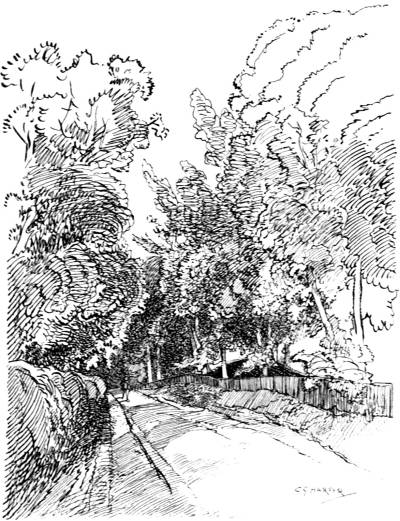
THE ROAD PAST CROWHURST PARK.
The “new” road leads down to Hollington, a
suburban village almost entirely swallowed up by
expansion of the town. One of the old-established
sights of Hastings is, or was, Old Roar, half a
mile or so to the left-hand of it.
Old Roar was a waterfall, and the ravine
through which it roared exists to this day, as
those who seek it, after tracing several fields and
pathways hemmed in between villas, shall find.
Even so far back as 1827 it was described as “not
so considerable as thirty years ago,” and sceptical
writers of that time declared there never had been
a period when it was not said of Old Roar that
“he is not so good as last season.” In 1841
Mrs. Mozley, sister of Cardinal Newman, wrote
a novel called “The Lost Brooch,” which no one
has ever succeeded in reading, and in it she
describes Old Roar as possessing “all the points
necessary for a very good cataract, except one—water:
rather a serious want in a waterfall.”
Yet there was a time when its hoarse voice was
to be distinctly heard a mile away. Pause to-day
on the wooden bridge that spans the gorge, and
only a dampness that discolours the stones is seen
through the trees that spring from the sides.
This is typical of much else around Hastings or
any other town that has equally expanded. To the
right of the road lies Hollington church: the
“Church in the Wood,” famous in all this country-side
as a romantic solitude. There are woods here
now, but not so extensive as before, and the church
is no longer in them, but on the fringe of what
remains. The church itself, restored and practically
rebuilt, is utterly and absolutely without
interest; and the churchyard is now nothing but
a cemetery filled with costly and pretentious
monuments. Yet, such is the force of habit and
tradition, it will be found, on examining the huge,
ledger-like visitors’ book kept in the porch, that
an average of five hundred people make pilgrimage
to the spot daily in the holiday season. They see
nothing worth the trouble, and having seen it go
away again not displeased, for to visit the “Church
in the Wood” is a duty laid upon the holiday-maker,
and will be, even when there is no wood
remaining. The way to and from it is by “Old
Church Road,” where you find houses named with
even more than the usual want of propriety.
Thus “Sea View” does not look upon the sea,
“Fair View” is opposite a manure-heap, and
from “Old Church View” you cannot view the
church.
It is not worth the while exploring the New
London Road. It is dispiriting, and those electric
tramways that are the tyrants of the roads for
miles around Hastings and St. Leonards render the
way of the cyclist down Silverhill hazardous in the
extreme. It is true the map shows the attractive
name of “Bohemia” here, but it is only a mean—the
meanest and miserablest—suburb. Henri
Murger, Bohemian of that artistic and literary
Bohemia that is not mapped, died, disillusioned,
exclaiming against his wasted life in that land of
rosy visions, “pas de Bohème,” and we may adopt
his saying and, appropriating it to this drab purlieu,
turn back and make for Hastings by the Old
London Road, itself not particularly attractive
in these times.
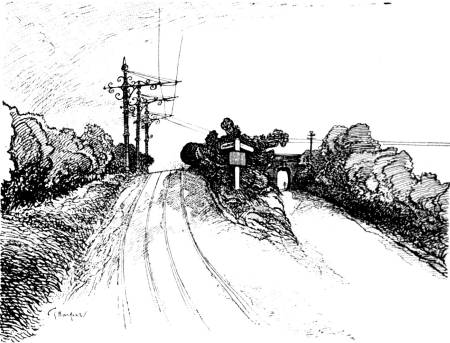
JUNCTION OF ROADS SPOILED BY TRAMWAYS, BALDSLOW.
You come along it, at the beginning of Baldslow,
to a weird corner where a road comes up from
Sedlescomb and, cutting under the Old London
Road in an archway, makes for St. Leonards.
Here the tramway poles and wires are insistently
ugly, and the village or hamlet of Baldslow itself
is scarce prepossessing. A roadside public-house,
a gaunt windmill, a few ugly cottages, and a tin
tabernacle church are its component parts. But
immediately beyond that corrugated and galvanised
ecclesiastical horror the road grows beautiful,
overhung with trees. Here, at the entrance to a
country house in the domestic-gothic sort, are two
very fine clipped yew-trees. It is Holmhurst, and
the trees are those christened by Mr. Hare “Huz
and Buz.”
Holmhurst is not historic, in the larger way,
but to those who are familiar with the literary
work of Augustus J. C. Hare, it is a place to be
regarded with interest and affection. Augustus Hare
wrote many books. His “Walks in Rome” and
“Walks in London” are the best known of them, but
his “Story of my Life” is of course the most intimate,
and it is the most endearing. His own half-humorous
declaration that it is “a ponderous
autobiography of a nobody” was heartily and
unkindly endorsed by reviewers, but, at any rate,
no one can read those six volumes without conceiving
an affection for the author of them. He
was a lovable man.
Augustus Hare, born 1834, died January 22nd,
1903, never married. He came of the family
of Hares of Hurstmonceaux, a family at one
time so numerous and so abundantly intermarried
with the titled and landed classes
that he could claim cousinship in different
degrees with a very large circle in Society. But
to call him a Society man would be as unjust as it
would be to style him a dilettante in literature and
the arts, for he had no vices, was no idler, and
earned a very excellent literary repute. The
“Story of my Life,” made up, as it is, largely from
letters and journals, recounting his visits and the
people he met, earned him with some sour critics
of his work, the opprobrious title of “literary
valet,” but it is so sincere and without artifice that
the reproach is most undeserved, although his
artistic, friendly, and family sympathies certainly
often led him into praises which amusingly remind
one of the famous epitaph on that Lady Jones who
was “bland, passionate, and deeply religious. She
was a niece of Horace Walpole and painted in
water-colours, and of such is the Kingdom of
Heaven.”
A welcome guest at country-house parties, he
generally figured at them as a family connection,
as a literary man and artist, and as an accomplished
narrator of ghost stories. He indeed “called
cousins” with so many people of note that the
Crown Prince of Sweden, to whom he became
bear-leader for a time, when asked what astonished
him most in England, replied “the number of
Mr. Hare’s cousins.” He was, in fact, the human
exemplar of the fabled “hare with many friends.”
The story of his life is a strange one. He tells
how, as the third son, and most unwelcome
addition to his parents’ growing family, he was,
at the age of eighteen months, given away by his
father and mother to a recently widowed and
childless aunt, as eager to adopt, as his unnatural
parents were keen to be rid of him. The aunt
was Maria (Leycester) Hare, widow of his uncle
Augustus; and thus, in the similarity of Christian
names at least, there was a peculiar appropriateness
in this adoption, which was undertaken in
what seems a very cold-blooded way: the parents
to have no claim upon their son and the aunt to be
called “mother”; as indeed, throughout the story
of his life, she is styled. She brought him up and
sent him to Oxford, and for thirty years they lived
together, as mother and son. He wrote a panegyric
on her, in the “Memorials of a Quiet Life,”
and in the long story of his own is seen to have
been very much more affectionate than many real
sons are. Yet the reader of his pages cannot help
coming to the conclusion that the “sweet mother,”
as he constantly styles her, was not only afflicted
with a very dour religiosity, but was a tyrant in
his infancy, and an exacting invalid, and an incredibly
mean, parsimonious and suspicious creature
during his youth and early manhood. But,
for all that, no real mother ever had so good a son,
so tender and constant a nurse in sickness, as he.
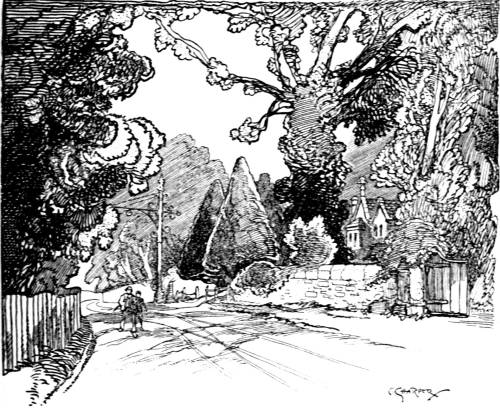
“HUZ AND BUZ”: ENTRANCE TO HOLMHURST.
When, in 1860, it became necessary for his
adopted mother to leave Lime and seek a new home,
they long sought the ideal home of their fancy,
which they named, in advance, “Holmhurst.”
All through that summer they inspected innumerable
small estates in the south of England, but
none were in the least like that ideal “Holmhurst,”
and they were on the point of abandoning the
quest for awhile, and going abroad, when a
neighbour sent a Hastings paper with the humble
advertisement, “At Ore, a house with thirty-six
acres of land, to be let or sold.”
“What a horrible place this must be,” I said, “for they
cannot find one word of description”; for the very ugliest
places we had seen had often been described in the advertisements
as “picturesque manorial residences,” “beautiful
villas with hanging woods,” &c. But my mother rightly
thought that the very simple description was perhaps in
itself a reason why we should see it.... Long before we
could arrive at Ore, we passed under a grey wall overhung
by trees. “It looks almost as if there might be a Holmhurst
inside that wall,” I said. Then we reached a gate
between two clipped yew-trees, and a board announced,
“This house is to be let or sold.” We drove in. It was a
lovely day. An arched gateway was open towards the
garden, showing a terrace, vases of scarlet geraniums, and
a background of blue sea. My mother and I clasped each
other’s hands and simultaneously exclaimed—“This is
Holmhurst!”
We found that the name of the place was Little Ridge.
There were six places called Ridge in the neighbourhood,
and it was very desirable to change the name, to prevent
confusion at the post-office and elsewhere. Could we call
it anything but Holmhurst? Afterwards we discovered that
Holmhurst meant an ilex wood, and our great tree is an
ilex.
And here they made their home. Ten years
later his adopted mother died here, and here he
passed out of these shadows and unrealities, suddenly
and painlessly, when another thirty-two
years had gone, little more than two years after
he had, in writing the concluding words of the
story of his life, said:
When I look at the dates of births and deaths in our
family in the Family Bible, I see that I have already
exceeded the age which has usually been allotted to the
Hares. Can it be that, while I still feel so young, the
evening of life is closing in? Perhaps it may not be so;
perhaps long years may still be before me. I hope so;
but the lesson should be the same, for “man can do no
better than live in eternity’s sunrise.”
It would be unpardonable to leave unmentioned
the additions to the house he loved so well and the
gardens and shrubberies he delighted in. Still
stands the sundial on the lawn, that sundial which
had been placed by his great-great-grandfather,
Bishop Hare, on his house of the Vatche, at
Chalfont St. Giles, Buckinghamshire, and was
presented to him in 1859 by the then owners of
the Vatche. Still one looks delightfully across
these uplands down to the sea, where the craggy
ruins of Hastings Castle cut across the horizon,
and the streets of Hastings come crawling dimly
up out of the vale; but the Hospice in the grounds,
where he continually housed and entertained his
pensioners, is empty, and the garden-paths have
lost their trimness and become overgrown with
grass since strangers have come and reduced the
staff.
Even Queen Anne, whom he brought down
from London and set up in the meadow, looks
neglected.
Every Londoner is familiar with the white
marble group of figures in front of St. Paul’s
Cathedral, representing Queen Anne (now, alas!
deceased) presiding over four seated effigies,
emblematic of England, France, Ireland, and the
North American Colonies of her days; but few
recollect that this group is not the original of the
one sculptured by Bird in 1712. Bird’s work had
for many years fallen into a disgraceful state of
neglect. Her Majesty’s nose had long been chipped
off and her forearms had disappeared, while the four
seated figures, with scarce a complete set of limbs
among them, more nearly resembled the victims
of a railway accident than the highly respectable
allegorical group they really were. The whole
composition was therefore cleared away, and an
entirely new and scrupulously exact replica was
made by the afterwards notorious Richard Belt,
and placed in its stead.
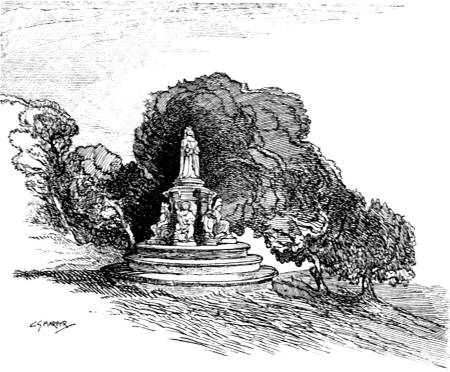
QUEEN ANNE, AT HOLMHURST.
The battered and grimy original disappeared
from public ken, and was wholly forgotten, when
Mr. Hare in 1893 discovered its component parts
lying in a heap in the City of London stoneyard,
on the point of being broken up, and greatly
coveted them for the embellishment of Holmhurst.
He found that the poor relics were jointly
owned by the Archbishop of Canterbury, the
Bishop of London, and the Lord Mayor, and
eventually persuaded all those eminent personages
to make him a present of the remains, which
were removed by road to Holmhurst, “at great
expense,” as he says, with the aid of twenty-eight
horses, four trucks, four trollies, and sixteen men.
He re-erected them in his grounds, at a still
greater expense, on a circular stone pedestal,
similar to the original, which he had quarried
from the outcroppings of stone on this little
estate.
Beyond Holmhurst comes the long-drawn parish
of Ore, heralded by its modern church, rather
overloaded with ornament. It replaces the old
church of St. Helen, lying hidden away to the
right, across a field and within a belt of trees.
Augustus Hare thought the ruins of the old
church “rather picturesque”: an instance of how
an everyday familiarity may blunt appreciation,
for they are picturesque without any minimising
qualification. To the active and enterprising it is
no difficult matter to climb the tall locked gate of
the enclosure that keeps out the swarming mischievous
children that come destructively up out
of Hastings, and easy to avoid the plentiful nails
and savage barbed wire that would induce others
to seek the keys at Ore Place.
It is a melancholy ruin of a fine church in the
Perpendicular style, built over five hundred years
ago, and left to moulder away because the neighbourhood
lusted for the brand new building beside
the road, yonder. The roof is entirely gone, and
part of the walls, covered in places with ivy.
Neglect is the note of the place. A curious relic
is fixed on the wall in the tower in the shape of a
“pitch-pipe,” an instrument used by parish clerks
in the old days to give the key of tunes to congregations.
The unusual name of “Lavender” is
seen on one of the old tombstones.
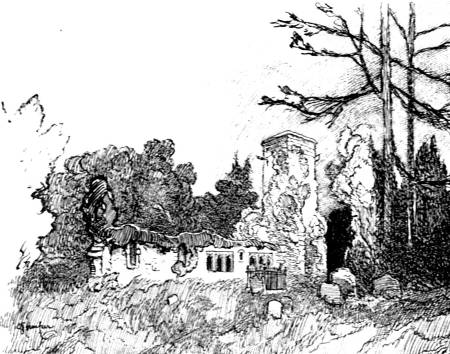
RUINS OF THE OLD CHURCH, ORE.
Ore is a scattered parish: neither good town
nor decent country. The road passes the Hastings
cemetery and the isolated suburb of St. Helen’s
Down, and comes to the enclosing wall and gates
of Coghurst Park, where an elaborately sculptured
coat of arms, surmounted by the crest of a hare
and hound, looks down with contempt upon the
poor specimens of houses that have sprung up
opposite.
And then you come to Ore itself, that used to
be, not so very long ago, a pleasant place—half
village, half suburb. It is now a good deal more
like a slum, and the incursion of the electric
tramways has not improved it. The tram-lines are
to be avoided by bearing to the right, down the
long and steeply descending Harold Road, which,
like too many of the modern developments of
Hastings, is a road of mean and paltry houses,
built cheaply and faced with stucco that seems to
have been made of dirt, rather than of honest
materials. There is a woeful “respectability”
about these roads that desolates the stranger. He
sees it clinging, ineffectual on insufficient means,
to the bayed windows and to the doors, painted
and grained to resemble good woods, that will
insist upon warping. It resides in the long flights
of steps up to those doors, and is on outpost duty
at the little brick entrance-piers, too flimsy to
hold up the not very great weight of the iron
gates that scream dismally on their hinges.
The Old London Road, however, continues
down through Halton, and, although it does not
get rid of the tram-lines, comes, at the beginning
of Hastings, to a very pleasant hollow where the
old elms still make an avenue introductory to
the town.
This is the most striking part of that valley
between the east and west hills in which the Old
Town of Hastings lies. It was in the coaching
days a supremely beautiful entrance to the town,
and travellers of that time never tired of praising
it. In front of them, in the V-like cleft, sparkled
the sea, with the trees surrounding the hoary red-capped
roof of All Saints’ in the foreground, and
on either side steep grassy slopes, as yet but
thinly built upon. On the left-hand rose the
Minnis Rock (“Minnis” is Cantise for a rough,
stony common), a stony outcrop on the hillside
that was the site of a hermitage until about
1436, when the “new church of All Saints’ of
Hastynges” was built, and gave the death-blow
to the hermits who had lived there upon the
charity of passers-by. The Rock is there to this
day, and the rough chambers in it, but they are
choked with rubbish. The last occupants were
very much post-Reformation anchorites. They
were an old couple who left the local workhouse
in 1783, and, in a secular way, subsisted upon alms
which the original hermits received for religion’s
sake.
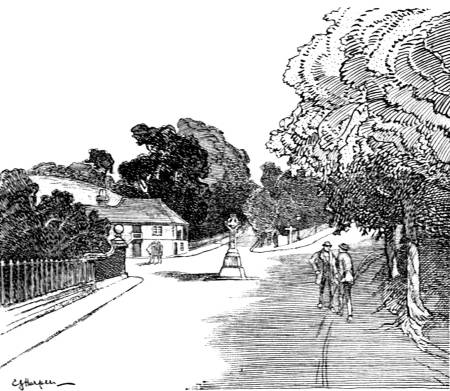
THE OLD LONDON ROAD.
The modern terrace of High Wickham crowns
the Minnis heights at this day, and great masses
of houses have encroached upon the natural beauty
of the scene; but still there is a very special
charm in it.
It is the old town you see there before you, for
whose sake we have come these last three miles
by the Old London Road: the only Hastings there
was, until the beginning of the nineteenth century.
The site selected for the town was sheltered, as
the traveller viewing it from this point may see.
It lay in the deep and not very broad ravine
between the East and West Hills, and while the
one protected it from the winds of one quarter,
the other served the like office in the opposite
direction. And through the centuries, the Castle
crowning the West Hill kept watch and ward
over it against other foes. There you see the
few shattered walls of it, against the sky-line,
and down in the hollow St. Clement’s, the mother-church
of Hastings.
Rising from amid the trees immediately before
you, at the entrance to the town and the branching
of High Street and All Saints’ Street, is All Saints’
Church, the other of the two old churches of the
Old Town. It stands immediately at the foot of
that great chalky down which drops sheer to the
sea and is known as East Cliff; and its crowded
churchyard, hemmed in with grimy houses, runs
at a steep angle up the hillside. I am not greatly
impressed with the interior of the church, but
its tower is altogether admirable. It has that
best thing in towers, sturdiness, and with its
deeply splayed buttresses, strongly marked stringcourses,
and general air of refined emphasis, is
the embodiment of strength and beauty. I feel
especially grateful to it, for it stands just where
it should for pictorial composition, at the head
of the old street, and it and the old “White Hart”
inn form excellent foils to one another, as Church
and Inn should do. They are as antithetic, in the
sentiment of the scene, as light and shade are in
the rendering of it.
Let those who are desirous of immortal fame
see that an eccentric epitaph marks the spot where
they lie. There is no surer passport to eternal
recollection. Thus, apart from “Old Humphrey,”
a local celebrity who lies here, the hundreds of
the dear departed might be anonymous for all
any one cares; excepting three only. Even the
casual, unobservant stranger entering the church
can scarce help seeing the epitaph on “John
Archdeacon,” who died in 1820, aged nine; but if
he did not see it, it is quite certain his attention
would soon be drawn that way, for it is a cherished
local curiosity:
Here lies an only darling Boy
Who was his widow’d Mother’s joy;
Her grief and sad affliction prove
How tenderly she did him love.
In childish play he teas’d a mule
Which rag’d its angry owner’s soul,
And through whose angry blows and spleen
This child so soon a corpse was seen.
His Mother now is left to mourn
The loss of her beloved Son.
Though sighs and tears will prove in vain,
She hopes in Heaven to meet again.
The name of a modern public-house in the
town, the “Kicking Donkey,” near St. Clement’s
Church, would appear to have derived from this,
although the pictorial sign represents the quite
different scene of a seaside holiday-maker trying
to keep his seat on the back of a restive jackass.
The second unusual epitaph is to a smuggler:
- This Stone
- Sacred to the memory of
- Joseph Swain, Fisherman
- was erected at the expence of
- the members of the friendly
- Society of Hastings
- in commiseration of his cruel and
- untimely death and as a record of
- the public indignation at the needless
- and sanguinary violence of
- which he was the unoffending Victim
- He was shot by Geo. England, one
- of the Sailors employ’d in the Coast-blockade
- service in open day on the
- 13th March 1821 and almost instantly
- expir’d, in the twenty ninth Year of
- his age leaving a Widow and five
- small children to lament his loss.
The third immortal is Edward Alldridge, “who
was Maliciously shot, April 23rd, 1806. Aged 41
years.” It is curious that his son Edward was,
according to the same stone, “accidentally shot,
May 13th, 1810. Aged 15 years.”
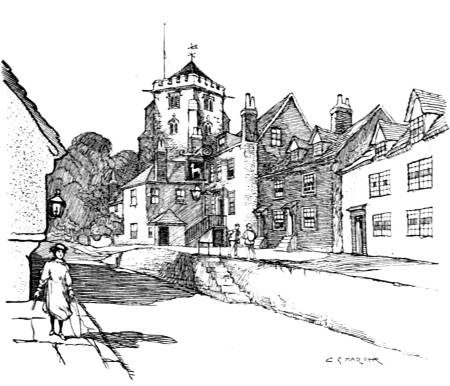
ALL SAINTS’.
There is little time in this age for brooding
over historical celebrities or notorieties, but if
Hastings dwelt much upon the past, it could
find little pleasure in the recollection that it was
the birthplace of Titus Oates, whose baptism is
registered in 1619, in the books of All Saints’,
of which his father was afterwards rector. Titus
was himself curate here.
Much, indeed, might be written of the clergy
of All Saints’, but not a large proportion of it
to their credit. I do not know if we may fairly
include him who was hanged at Tyburn in 1586
for the crime of forging his presentation to the
living. He was not properly rector. As he had
to be hanged in any case, it seems a pity they
did not suspend him from the tower of All
Saints’; it would have been much more picturesque.
He was practically wasted at Tyburn,
where executions were an everyday dish.
Then there was the Reverend Mr. Hinson,
royalist, who, busily denouncing the Roundheads
in his sermon of Sunday, July 9th, 1643, was told
that the subjects of his abuse were in the town,
and the stern Colonel Morley even then on the
way to make him prisoner. He left his discourse
at a loose end and bunked, hooked it, vamoosed,
cut his stick, fled, or merely went—just as you
please. Only, perhaps, to say he “went” hardly
meets the case, for he departed with such celerity
that he had not time even to shift his surplice.
The Roundheads thereupon occupied the church,
made it a dormitory, preached burlesque sermons
from the pulpit, and generally behaved like
blasphemous blackguards, finally making off with
all the surplices they could find.
Mr. Hinson was arrested three days later and
lodged in a filthy gaol, with a tinker to match,
who was not only dirty but rude, and, declaring
he was the elder of the two, and therefore
privileged, took the one bench in the place,
leaving the curate the cold, cold floor. He had
three weeks’ imprisonment at Hastings, and how
much beside would have been awarded him in
London, whither he was removed, we do not
know, for he escaped and joined his King at
Oxford, and so is heard of no more.
A tablet in the church to a former rector with
the humorous name of Webster Whistler, a connection
of Sir Whistler Webster, of Battle Abbey,
reminds one of a curious incident. He died at the
great age of eighty-four in 1831. A distinguished
pluralist, he held the rather distant benefice of
Newtimber, on the Brighton Road, in addition to
this in Hastings. A quarrel with the squire of
Newtimber led to the living of that tiny place
being put up to auction in 1817. The clergyman
was interested enough to be in London when the
sale took place, and to his disgust heard the
auctioneer describe Newtimber as held by an
infirm and hoary vicar with one foot in the
grave, and that consequently the reversion would
soon fall in. The Reverend Whistler was then
but seventy, and as hale and hearty as a ploughman.
He arose in wrath, and so convinced the
room of his being good for another twenty years
that the advowson found no purchaser.
The much-beneficed Whistler was no ill friend
to the smugglers, who then formed a considerable
part of the population of Hastings, and passively
lent his church to them for a cellar. It was told
of him that, hearing movements one night in his
garden, and preparing to fire upon those he thought
to be burglars, a voice reassured him with the
whisper, “Hush, your reverence, it’s the brandy!”
It was the smugglers’ thank-offering. The only
flaw in this story is the circumstance that the
clergyman would not have mistaken his smuggling
friends for midnight marauders, for he was used to
find such gifts brought to his door. Later, when
this kind of friendly understanding became too
notorious, the kegs were deposited in the crowded
churchyard, and visitors at his table sometimes
heard him tell his man to “go and see if there’s
any brandy in old Swain”: “old Swain” being
one of the numerous clan of that very common
name at Hastings, and lying in a table-like tomb
which made an excellent and unsuspected cellar.
When this picturesque cleric happened to find
his cellar low, he was not averse from hinting at
the fact in the texts of his sermons. Discourses
upon the “wine that maketh glad the heart of
man” and on the miracle of turning water into
wine, with applications readily understood by his
congregation, rarely failed in their object; for
we must by no means suppose that a smuggler
was necessarily a lawless and an impious, or even
an ungrateful man: and a fervent piety was no
bar to “free trading.”
The most striking thing in All Saints’ Church is
a curious notice in the belfry, with words and letters
running together like those of an ill-read proof:
This is a belfry that is free
for all those that can civil be
and if you please to chime or ring
it is a very pleasant thing
There is no musick playd or sung
like unto Bells when they rwell rung
then ring your bells well if you can
Silence is best for every man.
But if you ring in Spur or hat
sixpence you pay besure of that
and if a bell you overthrow
pray pay a groat before you go
People who are commonly civil are not, as a
rule, enjoined to show civility, and it is therefore
fair to assume that there had been disturbances,
and sweet bells jangled, before this old notice
was set up.
All Saints’ Street is the most picturesque in
the old town. Its houses are for the most part
ancient, and rarely are two alike. Many are
gabled, some lean heavily forward or against their
neighbours, others have latticed casements and
great heavy timber frames; few are those that are
not sketchable, and in between them goes the long
narrow street, deep down below the raised pavements,
towards the sea. The most picturesque of
these ancient tenements, and perhaps also the
oldest, is certainly the most famous, for it was
the home of the aged mother of Admiral Sir
Cloudesley Shovel at the time when his squadron
came cruising off the Sussex coast. We are told
how, coming off Hastings, the Admiral, saying
he had business ashore, was rowed to the Stade.
Walking up All Saints’ Street, to the house
pictured here, a humble old woman came forth,
and he kissed her, called her “Mother,” and asked
her blessing.
If improving frenzy will permit, the old house,
already well on into its fifth century, is sound
enough to last centuries more; and when modern
iron and steel have rusted, or become brittle, its
stout oaken timbering will be as sturdy as ever.
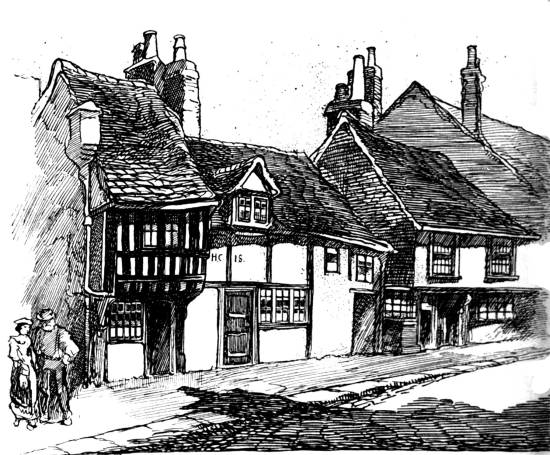
OLD HOUSE, ALL SAINTS’ STREET.
Between All Saints’ Street and High Street
formerly ran the Bourne stream to the sea. Its
course is now marked by Bourne Street, running,
narrow and steep, to the shore.
And there is the sea. Not something outside
the picture, as it seems to the road-farer who,
tracing the road to Brighton, comes at last to the
Aquarium, and finds the beach and the sea, as it
were, “side-shows,” but an intimate part of the
place—great waves slapping down vigorously upon
a narrow shore, and, when the stormy winds do
blow, spouting in great clouds of spray overhead,
bringing with them tons of shingle or taking away
many cubic yards of Parade and sea-wall.
No one could ever entertain the remotest doubt
of Hastings being, in the most intimate sense, the
seaside. The roadway of the front, especially the
front of the Old Town, is so narrow, and
the groyne-protected beach in general of such
meagre proportions that, to be housed on the front,
is to enjoy every sea-salty benefit of an ocean
voyage, without its accompanying miseries of
sickness. But the situation is not without its own
peculiar drawbacks. Just as some great vessel,
ploughing through heaving billows, will, in sailor
language, “ship it green,” so do the more exposed
houses take full measure when waves run high,
cataracts flowing down basement steps and converting
coal-cellars into impromptu marine tanks.
The elements at Hastings are at odds with the
Board of Trade, which has forbidden the Corporation
to take beach from the foreshore. Winds,
waves, and currents deposit shingle in the roadway,
and it has then to be cleared up; and, since the
Government Department cannot require it to be
replaced, it is sold. According to the town
accounts for 1904, the Town Council in that year
made £24 out of 120 tons of beach washed up in
this way.
The sea in this Old Town corner of Hastings
is undoubtedly the “ever fresh, the ever free” of
the poet: the rolling ocean, the heaving billow,
and everything adjectival in the marine sort. It
is unquestionably that which you fail in many
places of the Eastbourne type quite to realise:
the home of little sprats and great whales; the
cruising-ground of fisher-boats, steamships, and
navies, no less than of the Albertine, the New
Albertine, and the Favourite sailing-yachts, on
which you get very seasick for the ridiculous sum
of a shilling an hour.
The sea is that which your point of view
makes it: home of the guardian fleets; a course
upon which steamships earn dividends for their
owners; the grave of thousands of drowned sailors;
or fishing-ground for trawlers and seiners.
For what were you created? Answer, wild
waves! For the delight of the midsummer child,
with spade and bucket, and clothes tucked up;
to enable the railway companies to run excursions
to the “resorts” risen by the edge of you? What,
on balance, are you: blessing or curse? You
render our shores inviolate, but your sundering
straits and oceans perpetuate Babel and maintain
conflicting nationalities.
Were it not for you and St. George’s Channel
there would be no Ireland, and consequently no
Home Rule Question. For that, at any rate, we
owe you a grudge—and must, since we cannot yet
shift to fill that Channel up—continue to owe it.
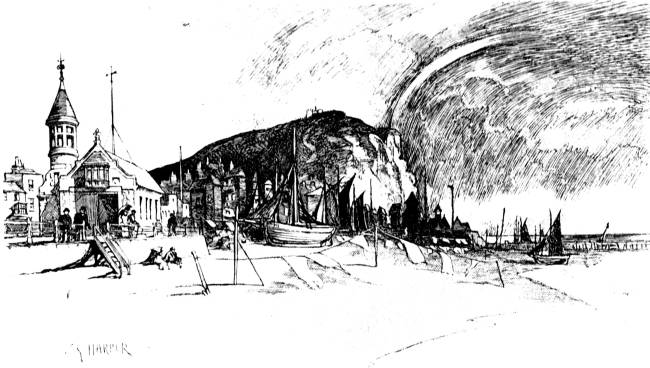
HASTINGS OLD TOWN.
This is the Stade, where the fisher-town exists,
sufficient to itself, self-contained, and quite as
apart in feeling, manners and customs, from the
modern town and St. Leonards as though it were
sundered by gulfs and distances, instead of just adjoining.
Not a gulf, in fact, but something in the
way of a mountain—the West Hill—intervenes,
and only by the narrow line of George Street,
Pelham Place, and Castle Street is ready communication
open. It is sufficiently ready, but
new town and old have different ideals in life,
and agree to mingle over that thoroughfare
threshold only when business calls. In the
unconventional streets of the Old Town you
lounge in the sunshine at open windows, or squat
in unconcerned deshabille on doorsteps, gossiping
across the width of the road; in modern Hastings
the streets are of a greater width, but the manners
are more strait, and you do not gaze forth from
windows or exchange scandal with the house
opposite.
The grandest view of Hastings is that of the
Old Town from hard by the modern, but picturesque,
Lifeboat House, whence you see the great
East Hill looming magnificently up above the
huddled houses that, whether they be of old red
brick or tarred wood, are all, in the mass, artistically
“right.” It is, in the summer, a crowded
quarter, for the excursionists who feel a little
abashed by the stucco magnificences and primnesses
of newer Hastings and St. Leonards, and
cannot elsewhere come into close communion with
the untamed sea, find here an ideal dumping-ground
for babies and provision-baskets. Here,
thanks to modern masonry groynes, a fine mass of
beach is gradually accumulating, in heaped-up
plenty.
But it is not a crowded beach and a sunny sky
that give the artist his chance at this point. His
opportunity comes at those times when most folk
would choose to be under shelter; when the
rainbow arches in the leaden sky, the domestic
washing of the Old Town flaps wetly in the
squalls, and the distant tackle-boxes and the bell-turret
of the Fishermen’s Church stand out almost
in the blackness of silhouettes. Then the East
Hill looks all its size, and more.
Unhappily, brutal things have been done in
modern times to East Hill and West, in the
cutting of shafts through the chalk for lifts; and
the scar thus made in the face of the East Hill is,
from many points, atrociously prominent; while
day-trippers have even been known to mistake the
embattled lift-station on the sky-line up there for
the Castle.
But sketchable at every turn is the Stade: the
very reverse of St. Leonards, whose formal houses
and formal people no one would choose to sketch
or interest one’s self in. Here is the “Dolphin”
inn, the “House for sea-wonders,” with an
amazing fish from some distant clime hanging,
very goggle-eyed and finny, and very dry, by the
door; and, no doubt, stranger sights within. Beside
it are “Tamarisk Steps.” Who is there would not,
for sheer love of their names, explore Tamarisk
Steps and Tackleway, that goes inland, parallel
with All Saints’ Street, to the back of All Saints’
itself?
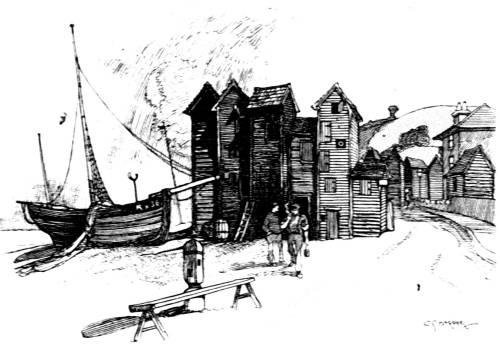
OLD TACKLE-BOXES, HASTINGS.
The “tackle-boxes” on the beach at Rock-a-Nore
are a peculiar feature of the fisherman’s
quarter. They are tall, tower-like, black-tarred
wooden sheds of four or five storeys’ height, built
in rows at right-angles to the sea, and identified
by letters of the alphabet. In them are stored
the nets and miscellaneous gear of the smacks.
Generally groups of depressed, guernseyed,
weather-beaten smacksmen may be seen and
spoken with while mending their tackle, and are
as unlike the fishermen and longshore folk of the
comic artists as well may be. They are not so
phenomenally broad in the “starn,” so pot-bellied,
nor so patchy; and, instead of having that little
dense patch of spade-beard, like the chin-beards
of Rameses and other typical Egyptian statues, as
inseparable from the conventional fisherman as a
nimbus from the head of a saint, they are either
very full-whiskered or quite clean-shaven. But
the conventional fisherman will no more become
obsolete than the conventional burglar with his
ankle-jacks, his fur cap, and his furtive glance; or
the conventional John Bull. There is nothing
like them on earth, but they are necessary
abstractions for the feeding of unimaginative
minds.
You may read in the guide-books how the term
“Chop-back” will rouse a Hastings fisherman to
fury, and timid, yet inquiring people, approach
the subject with them apologetically; but I
declare they turn a puzzled look upon you, and
seem hardly to comprehend the meaning of what
is supposed to be a very offensive name—“Hastings
Chop-backs,” deriving from the supposed descent
of the Hastingers from those Norse rovers whose
terrible axes cleaved their enemies down the back
from skull to chine. Traditions of this undoubted
antiquity are deserving of all respect, and probably
the Hastings fisherfolk are descendants of those
fierce rovers, but they are the mildest vikings it
is possible to conceive, and would no more think
of chopping any one down the back than they
would dream of refusing a drink, even though the
Blue Ribbonites of the Mission Church are active
among them.
“Fishin’ ain’t wot it wur” is the general verdict;
neither for “hur’n”—that is to say, “herring”—in
the fore-part of the year, nor for mackerel in
the after; yet the fish-market on the Stade seems
busier than ever in the mornings, and over a
thousand people subsist upon the proceeds of the
harvest of the sea. But the fisherman is forced
to cruise greater distances than before, the
Channel being fished out and clean-swept by
trawlers. Indeed, to listen to the doleful talk of
a Hastings fisherman, one might think that not
a single sprat or mackerel swam the English
Channel between the North Foreland and the
Lizard.
Those who explore this corner of old Hastings
will acquire odd pieces of information from the
fisherfolk. Rock-a-Nore, it will be found from
them, and from one’s own personal experience, is
the coldest place in the town; and, although they
are not responsive to “Chop-backs,” they tell you
that “Bourne” (i.e. Eastbourne) men are
“Winnicks.” They look with disapproval on the
new harbour-works; and are, indeed, true Conservatives,
for they instinctively think any change
to be inevitably for the worse.
Were I a fisherman I should, at any rate,
resent the inference of the Mission Church planted
on the beach, in their midst, as though an outpost
of Christianity among the heathen. And such
a mildewed, blue-mouldy, repellent building!
But perhaps the situation, at the remote end—the
cul-de-sac—of the beach, suggested the idea of
paganism, piracy, and all sorts of unchristian
things, at Rock-a-Nore; but if it be true that
Labore est orare, then the fishermen are on more
certain ground than many of the prayerful people
who missionise them.
This is indeed, geographically, a dead-end,
under the grey-white cliffs of East Hill; and
being so, the Hastings Corporation have planted
here those undesirable things—a mortuary and a
dust-shoot. Next door to the mortuary you see
the grim, unconscious humour of a warehousing
firm’s announcement, “Tapner and Co. for Removals,”
and at the end of all things, where a
gigantic stone and concrete groyne projects into
the sea, there is the town dust-destructor. Beyond
is the perilous beach to Ecclesbourne, where the
toppling cliffs above and the treacherous tide
below often offer the unwary the unwelcome
choice of being crushed or drowned.
On the way from Old Town to New, passing a
flagrant music-hall and the hideous stucco semicircle
of Pelham Crescent, you perceive, up aloft,
on the craggy cliff’s edge, the ragged ruins of the
old Norman Castle of Hastings, whose grey and
mouldering walls are craggy as those chalk cliffs
themselves. It is a long, a circuitous, and an
arduous climb to the eyrie where that battered
stronghold is perched, and although superior
persons scorn and abuse the lift that brings you
swiftly and without toil to that height, the elderly
and the unduly fleshy, Hamlet-like persons among
them, “fat and scant of breath,” take advantage
of it, and archæologise easefully by the aid of
modern mechanism. But little remains to arouse
enthusiasm or to employ the pencil of the artist,
and that which might have been, from its situation,
as imposing as the Castle of Dover itself, is but
the matter of a few speculative arches and grizzled
masonry.
Ever since the historic period, and doubtless
long before the era of recorded things began,
there existed a castle, or a fortified post, on this
lofty cliff-top, where the shattered ruins of
Hastings Castle still stand, few and almost formless—the
long superannuated warden of the town
that has grown so great and has now absolutely
no defences against the foreign foe.
When the Normans came, they found defences
of some nature here, and hastened from their
landing-place at Pevensey to seize and to more
strongly fortify them, as scenes in that graphic
record, the Bayeux Tapestry, show. The wooden
walls, palisades, and outworks thus hastily constructed
by the Conqueror’s men were speedily
discarded for a permanent building of stone, and
the grim hold thus erected was given into the
custody of the Norman Counts d’Eu; who, jointly
with the Abbots of Fécamp, were responsible for
keeping open the sea-passage between England
and Normandy. This duty was laid upon those
secular and ecclesiastical personages in consideration
of the rights granted to the Count d’Eu in the
Castle and the Old Town, and the lordship over
the “New Burgh” bestowed upon the Abbot of
Fécamp.
Time has worked odd changes with Hastings
and very thoroughly obscured the ancient names,
so that what was then the “old town” has been
so long and so utterly swept away and built over
that its very existence at any former time is
unknown to all save Dryasdust and his brethren.
The old original “old town” stood, in fact, where
the new town of Hastings stands to-day, and the
Old Town of the present time is the “New Burgh”
referred to in Domesday Book as the property
of the Abbot of Fécamp. Dryasdust, who is a
very estimable person and a learned, will tell
you all you want to know about it—and much
more; but he is always so fully informed, and
diverges so abundantly and promiscuously into
notes, parentheses, sub-heads, and innumerable
asides of that kind that he presently lands you in
topographical swamps and mazes, and, feeding you
overfull of knowledge, gives you a severe literary
and antiquarian indigestion.
In short, to make a plain story of it, where
modern Hastings stands, practically level with
the water, there spread, at the time when the
Battle of Hastings was fought, a quiet inlet of
the sea. This was the haven, the natural harbour
of refuge against winds and waves, that originally
caused the site of Hastings to be selected for a
port. It would never have been chosen and
settled had it been without shelter, as it is now;
and Hastings of to-day is merely an artificial
growth, like Brighton, Eastbourne, and many
another seaside town, sprung up to serve a century
or more of holiday-making by the sea. The
town, as we see it to-day, would have been impossible
had the place depended merely upon
fishing and shipping; for on this stark-naked
foreshore, swept by gales and raging seas, there
is no shelter for vessels.
It was, in fact, the early silting up of this
haven that led to the utter obliteration of the
original old town dependent upon it. When the
tide no longer flowed up to its ancient quays and
wharves, their use, of course, vanished, and they
eventually disappeared. In those long-departed
days the Castle cliffs and a long reef of rocks
extended a considerable distance out to sea, and
formed the natural protection for this inlet; but
in the course of centuries the sea made such
inroads that the protection at last disappeared,
and the shingle, in its easterly march, instead of
being kept out in the Channel and on its course,
found entrance, and steadily, and by no means
slowly, cut off the haven from the outer waters.
Thus was the chief port of the famous Cinque
Ports finally ruined by the then irresistible forces
of nature. Already, in 1205, it had suffered
political ruin; for, as the chief port in the intercourse
between England and Normandy, its trade
became extinct on the severance of the Dukedom
of Normandy and the Kingdom of England, in the
reign of King John. Five years before even that
event the port was far gone to decay, for it could
furnish but six of the twenty-one ships that in
its prime formed its contribution to the nation’s
defence.
Apparently the inhabitants of the Hastings
that bordered this haven early realised its inevitable
doom; and those of the neighbouring New
Burgh—the Old Town of our time—did not shift
for themselves, to form a harbour, until the reign
of Queen Elizabeth. And even then they were
reduced to “sending round the hat” for contributions
and donations from more prosperous places.
Pity the sorrows of a poor old port!
They were led to this course by the destruction
of their old wooden pier; but it was not until
seventeen years had passed that sufficient funds
had been accumulated and a beginning was
made in the spring of 1595. Even so, fate dealt
hardly with the place; for although the new
pier was built “all of huge rocks, artificially
pyled, edge-long, one close by another,” so that
it was considered highly permanent, it needed
only the first storm of the following winter to
overthrow it.
Something daunted by this mischance, but not
beaten, the Hastings people built the pier anew,
and of a different construction, with “tymbor
braces and barres, crosse dogges, and suchlike
up to the top: bowtyfull to behold,” and much
else in that quaint way. Woe, woe! This
much-admired work had not stood a year when,
like the earlier, it was washed completely away.
It happened on “All saints’ daie, 1597,” when
“appeared the mighty force of God, who, with
the finger of his hand, at one greate and
exceeding high spring tyde, with a south-east
wynd, overthrew this huge worke in lesse than
an hower, to the greate terrour and abashment
of all beholders.”
The inhabitants this time acknowledged defeat,
and, recognising the futility of further endeavour,
folded their hands and did—that easiest of things
to accomplish—nothing. So, finally, ended the
active existence of Hastings as a Cinque Port.
It is true that projects were from time to time
raised, but they were never translated from words
to deeds. At the beginning of the reign of Charles
the First a very promising scheme was reported,
by which a Dutch engineer, one Cranhalls, proposed
to excavate and reopen the ancient haven at
a cost of £220,000; but the beginning of that
reign was also the beginning of trouble, and, as
the condition of the country at the time was
unfavourable for the prosecution of public works,
nothing, again, was done.
Had it been possible to undertake those proposed
works, Hastings at this time would be a
vastly different place from what it is. You are to
picture the scene—the bygone haven restored, and
all that space now occupied by the very centre of
the modern town—the Queen’s Hotel, the Albert
Memorial, and Queen’s Road—a basin, with quays,
wharves, and warehouses. The thing could be
accomplished to-day, were it thinkable that the
valuable house-property covering the site could
be removed; but what might have been done with
vacant land has long become impossible in a
crowded town.
Yet, as the merest glance will show the casual
visitor, the port and harbour idea is not dead.
In these days of questing after the seemingly
impossible—of eating your cake and having it too,
of having things all ways and every way to your
own advantage, an aim which worries individuals
and corporations alike—it is not to be supposed
that Hastings should be content with its present
condition. If it were, it would be exceptional.
But it is not. In the eyes of many who know
Hastings well and love it much, it is well enough;
but the town will never be content until it has
acquired a harbour. It calls aloud for a harbour,
just as the proverbial baby cries for the moon, but
with this very important difference, that if it calls
loud enough and long enough it will eventually
get that harbour.
Time was, as we have seen, when it had such
a haven, duly provided by Nature, and it now has,
or had, a prospect of a newer, provided by private
enterprise; not on or near the old site, but to
be formed by building concrete piers out to sea
from the East Hill and the fishermen’s quarters.
One such arm has for some years been completed,
but the works now appear to be finally abandoned,
and all there is to show for the expenditure of the
matter of a hundred thousand pounds is that long,
unrelieved wall where the melancholy surges still
sweep toward an unprotected shore.
Modern Hastings, like Brighton, dates its rise
from the ultimate quarter of the eighteenth
century, and its emergence from the status of
a fisher town is due to the same prime cause:
the discovery by the medical profession of fresh
air and sea-bathing as specifics for that mysterious
eighteenth-century malaise, “the vapours,” and
all manner of other ailments. No royal favour,
however, helped Hastings; only the recommendations
of Dr. Baillie in the first instance, and
secondly the fine brisk air of the place itself.
Indeed, the climate of Hastings is a matter of as
great concern to the town as her looks to a
woman: it is her chief asset. You may read
strange things of the Hastings climate, and indeed
of that of any seaside town whose business is to
attract visitors; and you will find, as a matter
of curiosity, that Hastings claims not one climate,
but several, according to height and position.
Like the artful sinner who tried to get the best
of both this world and the next, Hastings wants
it both ways, and would have you believe it has
actually got it, too. Thus, with a reminiscent
shiver at the thought of the winds we have faced
elsewhere, we read appreciatively of how the
town is “screened from the biting blasts of the
north and east winds,” and open to the “healthful
and uncontaminated vapours” from the south and
west, is saved from “the unwelcome calms which
envelop some holiday resorts.” This, I take it,
is one in the eye for Bath, for example, where in
summer the visitor is stewed as effectively as
any prune, or for Torquay, whose “gridiron” even
St. Lawrence might on occasion find uncomfortably
warm; while I think, on the other count,
the withers of Brighton and of Weymouth—among
other places where the east wind is capable
of freezing your very marrow—are severely
wrung.
In short, Hastings, by her own showing, is
one of those favoured (not to say miraculous)
places each of which has the better climate than
any other, where the sun shines just so long and
so brilliantly as you please, where the winds are
never rude and the air never stagnant, and there
are four hundred fine days (at the very least of it)
to the three hundred and sixty-five of every year.
When Hastings really did begin to rise it
grew quickly, and speedily overspread, not merely
the old-time site, but brought into existence the
twin town of St. Leonards as well. Theodore
Hook was as it seems to us—strangely enthusiastic
on the subject of those never-ending
terraces, squares, and streets of stucco, new in
his day. Says he: “Under the superintendence
of Mr. Burton, a desert has become a thickly
peopled town. Buildings of an extensive nature
and elegant character rear their heads”—he
meant, in plainer English, that they had been
built, only perhaps a phrase without those
eloquent frills would not have been “literature”
as then understood—“where but a few years since
the barren cliffs presented their chalky fronts to
the storm and wave; and rippling streams and
hanging groves adorn the valley which twenty
years since was a sterile and shrubless ravine.”
Something is decidedly wrong in that description.
The “extensive”—might he not equally
well have said the “expensive”(?)—buildings
and the “thickly peopled town” we allow, but
those “hanging groves” and “rippling streams”
are just the delightful objects the coming of the
octopus streets abolished, and Hook sacrificed
truth to a showy antithetical outburst.
I do not think Hook was sincere. I hope he
was not, for surely one would sooner forgive literary
insincerity than such a perverse taste. Lamb,
who wrote of Hastings in 1823, we know was
sincerity itself when he said he loved town or
country; “but,” he says, “if this detestable Cinque
Port is neither. I hate these scrubbed shoots,
thrusting out their starved foliage from between
the horrid fissures of dusty, innutritious rocks,
which the amateur calls ‘verdure to the edge of
the sea.’ I require woods, and they show me
stunted coppices. I cry out for the water-brooks,
and pant for fresh streams, and inland murmurs.”
He, at any rate, saw nothing of Theodore
Hook’s “rippling streams and hanging groves.”
“There is,” continues Lamb, “no sense of
home at Hastings. It is a place of fugitive
resort, an heterogeneous assemblage of sea-mews
and stockbrokers, Amphitrites of the town, and
misses that coquet with the ocean, if it were
what it was in its primitive shape, and what it
ought to have remained, a fair honest fishing-town,
and no more, it were something—with a
few straggling fishermen’s huts scattered about,
artless as its cliffs, and with their materials filched
from them, it were something.”
True; but all that is merely a memory.
Something of that vanished Hastings may be
recalled by those who discover the Brassey
Institute in the centre of the town, and climb to
where the collection of local prints and paintings
is housed; and something more of it may be seen,
still in being, by those others who prowl inquisitively
in rear of High Street, and there discover
the old parish church of St. Clement, fellow to
All Saints. It stands in a tightly wedged corner,
on rising ground, surrounded by houses and
puzzling alleys, and looks very reverend. It is,
in fact, over five hundred years old. An ancient
cannon-ball wedged into the western face of its
tower is a relic of one or other of the several
hostile appearances off the town that were not
uncommon in the old days; but whether it be the
evidence of Dutch good marksmanship in the
seventeenth century, or of French gunnery in
in the early eighteenth, there is no evidence
to show. The corresponding ball on the other
side of the belfry window is by no means
a miraculous follow-on shot, but is an instance
of the eminently British passion for the pendant,
for things to match and balance. Just as the
average householder must needs have a vase or
a statuette on either side of the clock on the
dining-room or drawing-room mantelpiece, or else
feel uncomfortably one-sided, so the burgesses
of Hastings were uneasy until they had duplicated
the insult some passing privateer had put upon
their town; and so one of these warlike objects
is a sham.
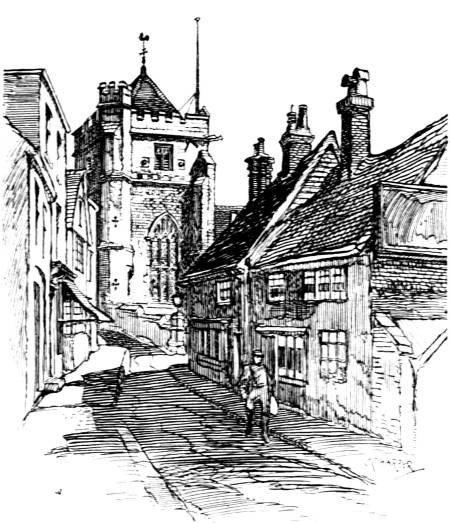
ST. CLEMENT’S CHURCH.
I am told that Hastings discourages the “tripper,”
and that no longer do cheap day-tickets for weekdays
or Sundays prevail. He is discouraged
because he brings his nose-bag with him, because
his children grow fretful and annoy the select,
and because he brings no trade into the town and
is off again by nightfall. Thus, paradoxically,
he is required not to come because he goes so soon.
But perhaps the delays and the peculiar methods
of the railways serve more certainly to discourage
that variety of holiday-maker. However that
may be, no one can deny the “popular” character
of the holiday-making in August, which is not
the select season at Hastings.
Sunday cheap trips to Hastings were early
and for long a feature, and eventually roused the
wrath of the Working Men’s Lord’s Day Rest
Association. We need not here go into the rights
and wrongs of Sunday tripping; but should
any one discover a little book called “The Story
of our Sunday Trip to Hastings,” published on
behalf of that excellent body, let him read it,
and find therein a fund of unconscious humour.
The whole and sole intent and purpose of the book
is to show, not merely how sinful it is to take a
cheap Sunday trip by railway—and especially,
it would appear, to Hastings—but how inevitably
uncomfortable and even disastrous it will be. It
is a tale of how, one August, a decent working
man and his wife and little girl, and an assortment
of friends, tripped one Sunday to this seaside.
They started betimes—arising at four o’clock in the
morning—probably with some foreboding sense
that if you want to journey anywhere by South
Eastern Railway it is well to get up in advance
of the early bird, if not even to start the day
before. They drove to Charing Cross in a cab,
and it was already very warm. The cabman,
indeed, “used a strong expression” to enforce
his opinion that they would find it very hot.
I think we all know the poetical phrase that
cabman made use of.
Of course, the object being to paint this trip
in very strong colours, mischances early began;
but the party need not have been quite such fools
as they are described. Passing over the inevitable
dispute with the cabman, we follow them on to
the platform, where they saw a porter slip and
nearly get killed, whereupon “a sickening horror
came over them at the thought of the scene they
might have witnessed.” As for that, if you are
to speculate upon the grisly “might be,” the
blood-boltered “if,” the catastrophic “may
happen,” why then there is no peace of mind for
you at all, week-day or Sunday.
Friends who were to have been met on the
platform were all but missed, and when found
insisted upon quarrelling with strangers and
quizzing other members of the party, until at
length the train “ceased to move, and we were
at our journey’s end.” It did not just “stop,”
as ordinarily it does.
See now our party at Hastings. The day was
blazing hot, and no shelter was to be found.
The glare off the sea seared their eyes, and they
took refuge in the streets, with the bitter reflection
that they need not have left their home in happy
Islington to see pavements and closed shops.
Dinner was suggested, and they resorted to a
dining-room, rich in the mingled odours of sage
and onions and tobacco-smoke, where they dined
off what purported to be gosling, but was really
an old and half-starved fowl. If the dishes
were lukewarm, the room, on the other hand, was
blazing hot. “Mr. Peters,” one of the party,
called for “malt liquor”—could it by any chance
have been “beer”?—and saw that somebody else
paid for it; and, this princely and elegant meal
over, the party dispersed in various directions.
Then the brilliant idea occurred to one who
claimed to know Hastings that a breeze and shady
trees would be found in the Castle gardens, on the
cliff-top. They climbed that “terrible” road, only
to find that the gardens were closed on Sundays,
and that, even had they been open, no trees and
no shade existed there. Finding at last some
stunted, insufficient trees, they rested awhile,
descending only to give the girl a chance of
fainting in the heat.
And so the weary day dragged on until it was
time to return home. They all assembled at the
railway-station, much to the reader’s surprise.
Why had not some of them taken a boat and been
drowned, or been eaten by a sea-serpent? Why
had they not even missed the train? We shall
learn.
“Fate cannot harm me, I have dined to-day,”
says the poet; but disasters seem inevitably to
wait upon those who “trip, trip, trip it” to the
sea on Sunday; especially if they dine upon
emaciated fowl sinfully masquerading as a young
goose.
No appalling disaster happened to the swift
South Eastern train. It did not, strange to say,
break down, and still less did it come into
collision with another. Nor even were train-wreckers
prowling along the line, to place
obstructions upon the metals and so bring the
sinful to an appropriately ghastly end. No:
nothing of that kind happened; but when two-thirds
of the journey had been accomplished a
thunderstorm broke. “Never mind, we’ll soon
be at home,” said Martha. “Alas! it seemed as
if home grew more distant than nearer.”
But at last London was reached and an
omnibus with difficulty found. On the way,
however, a horse, overworked with Sunday labour,
fell dead, and the journey had to be miserably
finished in the rain. What, by the way, would
have been made to happen to a motor-omnibus?
That could not fall dead.
The party reached home at last, but Martha
fell ill, and eventually died of consumption.
“Never,” declares the supposed narrator of this
elegant piece of fiction, “shall I forget our
Sunday Trip to Hastings.”
I should think not, indeed!
Let us therefore go to Hastings by road: and
be sure it is not on a Sunday.
A SLAIN NORMAN.
Bayeux Tapestry.