A HAPPY NEW YEAR!
Words repeated by how many myriads,
in how many zones—tropic, temperate,
frigid, wherever the English tongue is
spoken! Words said commonly with
more of meaning and sincerity than fall
to the lot of many almost-of-course salutations. Words in
which there is a shade of melancholy, and a gleam of gladness;
a lingering of regret, with the very new birth of anticipation.
“A Happy New Year.”
Ah, but it is not unlike parting with an old friend, the
saying good-bye to the Old Year. And it seems unkind
to turn from him who has so long dwelt with us, and to
take up too jauntily with a new friend.
He had his faults: but, at any rate, we know them; and
those of the new-comer have yet to be discovered. And his
virtues seem to stand out in bolder relief, now that we feel that
we shall never see him again. Such experiences, too, we have
had together! we have been sad and merry in company, and
the days of our past society come with a warm rush to our
heart:—
“Though his eyes are waxing dim,
And though his foes speak ill of him,
He was a friend to me.”
And so we keep hold still of his hand, loth, very loth indeed
to part—as we sit in silence by the flickering fire, and listen to
the sudden bursts and sinking of the bells.
It is our habit—(I speak in the name of myself, and of many
of my readers)—it is an immemorial custom with us, to
assemble, all that can do so, in the old home, from which we
have at different times taken wing—to gather together there
again, on the last night of the Old Year. I have heard the
plan objected to, but I never heard any objections that to my
mind seemed weighty ones. True, the gaps that must come
from time to time, are perhaps most of all brought prominently,
sadly before us, at such a gathering as this. We miss the
husband, the brother, the sweet girl-daughter, the little one’s
pattering feet—ah, sorely, sorely then! Last year the familiar
face was here, and now, now, far away, under the white sheet
of snow. This is sad, but it is not a mere unstarlit night of
gloom. Nay, I maintain that, to those who look at it rightly,
more and brighter stars of comfort shine out then than at
other times to compensate for the deepening dark. There is
the comfort of sympathy, and of seeing in all surrounding faces
how the lost one was loved. But, especially, it seems as though,
when all are met again, he may not be far away from the circle
that was so unbroken upon earth:—
“Nor count me all to blame if I
Conjecture of a stiller guest,
Perchance, perchance, among the rest,
And, though in silence, wishing joy.”
And most of all, there is the old-fashioned, but ever new
comfort—balm, indeed, of Gilead, for every bereaved heart.
“I would not have you to be ignorant, brethren, concerning them which
are asleep, that ye sorrow not, even as others which have no hope.
“For if we believe that Jesus died and rose again, even so them
also which sleep in Jesus will God bring with him.”
And these home gatherings, yearly growing more incomplete,
and yearly increasing, lead the heart to glad thought of that
reunion hereafter, in that House of our Father in which the
mansions are many, the Home, one.
Well, you are gathered, my friend and reader, you and your
dear ones, about your father’s fireside on this last night of the
Old Year. The hours have stolen on: at ten o’clock the
servants came in, and the last family prayers have been offered
up, and the last thanksgiving of the assembled household for
this year; and the chamber candlesticks have been set out, and
the father has drawn his chair near the fire, and another log
cast upon it crackles and flashes; and each and all announce
the intention of seeing the Old Year out and the New Year in.
Cheery talk, reminiscent talk, pensive talk, thankful talk;
a little silence. The wind flaps against the window, and throws
against it a handful of the Old Year’s cast-off leaves. The
clock on the mantelpiece gives eleven sharp, clear tings. The
year has but an hour to live. And now the wind brings
up a clear ring of bells; and then sinks, that the Old
Year may die in peace, and his requiem be well heard over
the waking land.
But an hour to live! And the burden of depression that
ever comes with the exceeding sweetness of bells, loads, grain
after grain, the descending scale of your spirits. It is a
solemn time, a time for quiet: a time in which it is well
to leave even the dear faces, and to get you apart alone
with God.
So you steal away from the fireside blaze; and ascend the
creaking stairs, and enter your own room; and close the door,
even as a dear Friend long ago advised; and offer the last
worship of the year—confessions, supplications, intercessions,
praises. You go over the dear names, sweet beads of the
heart’s rosary, telling them one by one to God, with their
several wants and needs. You mention once more the special
blessings to them and to yourself of the past year. You put,
once more, all the future for them and for you into that kind,
wise Father’s hand; and you feel rested then, and at peace.
A few words read, for the last time this year, in the Book of
books; and now there is yet a little space for quiet thought
about the dying year, before his successor enters at the door.
And it is then, as you sit pensively before the dancing fire,
alone in your silent room—while the bell music now comes in
bursts, and now dies in whispers—that a sort of abstract of
many thoughts that have hovered about you all day is
summoned up before your mind. It is the hour of soft regret,
helped, I say, by those merry, melancholy bells, which
“Swell up and fail, as though a door
Were shut between you and the sound.”
You have had your sad times in the year that is so nearly
dead; you have shed your bitter tears; you have had your
lonely hours, your weariness of this unsatisfying, disappointing
world. Unkindness, estrangement, bereavement, intense
solitariness of the spirit, when it is conscious that not another
being than the Creator can ever understand, far less supply,
its want, or heal its woe—these experiences, these wearing,
shaping, refining operations of the kind Father are part of
your memories of the dying year. While their bitterness was
present with you, you would have said that it was impossible
that you could ever regret to part with the year that brought
them. “Ring out,” you would have said, “ring out, wild
bells, this unkind and bitter year; this year that hath brought
a blight over my life; this year that hath dispelled the dreams
of youth, and changed into a wilderness that which did blossom
as the rose. Ring out, and let this hard year die. Fleet, hours
and days and weeks and months, and set a distance between me
and what I long to call the past. Ring out, wild bells, to the
wild sky; gladly would I say now, even now, while I listened
to you—
“The year is dying—let it die!”
But those hours of bitterness are now, even now, of the past.
That sharp pain, or that weary ache, is dulled, perhaps removed.
Perhaps you have learned God’s lesson in it, and can thank
Him, though the ache still dwells in the heart’s heart; at any
rate, the Old Year is passing away; the sad Old Year, the glad
Old Year; on the whole—yes, on the whole, the dear Old Year.
He is with you but for a few minutes more; he has come to say
good-bye.
Who does not unbend at such a time? In all the friendships,
in all the ties of life, there comes up surely all the warmth, all
the kindly feeling of the heart, when the time comes which is
to end that connection for ever. There may have been some
old grudges, discontents, heart-burnings, jealousies, disappointments.
But they are forgotten now, and the eyes have a kindly
light, and the lips a tender word, and the hand a hearty shake,
when it has indeed come to saying good-bye.
And so with the Old Year, whatever he has been to us,
whatever little disagreements we may have had, whatever heart-burnings,
they are not much remembered now.
It is a friend that is leaving you, you are not glad to part
with him; good-bye, Old Year, good-bye.
Another regretful thought, as the twilight flickers and dances
on the blind, and those bells still dance hand-in-hand, row
after row, close up to the window, and still pass away hardly
perceived into the distant fields. The dying Year brought
some happiness, some love; this is now warm and safe in the
nest of the heart; the coming time may fledge it, and it may,
some summer day, take sudden wing and fly.
“He brought me a friend, and a true, true love,
And the New Year will take ’em away.”
Youth is especially the time, perhaps, for a sort of tender
prophetic hint of the evanescence and passing away of hopes,
loves, dreams. It is indeed but a rose-leaf weight on the
heart, but a gossamer passing across the sun; yet there it
frequently is. The iron hand of real crushing bereavement, of
actual anguish, has never yet had the heart in its gripe, to
crush out all that more tender sentiment. Yet some soft, faint
shadows of darker hours do, unaccountably, fall early across
the daisy fields of youth. And thus in youth a certain foreshadowing,
in mature years a stern experience, brings into the
heart at this time a thoughtful dread of losing what we already
have; an undefinable apprehension of the future. This time
next year, when the New Year has become the Old, and its
time has come round to say good-bye, what changes may have
come to us, to our circle, to our home! Will all be then as it
is now? Will love, perhaps newly-acquired, still nestle in our
heart, or will it have even taken wings like a dove, and have
left it—
“Like a forsaken bird’s nest filled with snow”?
Oh, who shall tell? Answer, quiet heart, that hast learned to
trust in God; and rest, rest peacefully, brightly, hopefully, on
the answer that God hath taught thee!
But a quarter of an hour left now of the Old Year’s life! and
the wind brings the bells in a sudden burst like rain against
the window. Before you join the group downstairs there is yet
another, the saddest subject for regretful thought. The past
hours of the past days of the year nearly past might have been
better spent, oh, how much so, than they have been!
“Whatsoever thy hand findeth to do, do it with thy might.”
Has that been the rule of the past year? Ah, if it had been,
how different a year to look back upon! How many
opportunities neglected altogether! How many but weakly
and slackly employed! Opportunities that can never come
again, that, employed or neglected, are past now. The word
that might have done infinite good, but that was not spoken—cowardice,
weak complaisance, in a word, worldliness, God’s
enemy, fettered the tongue: excuses were ready, though the
heart did not believe them, and God’s soldier failed, and the
devil had the better of that field. Again, actions, that sloth or
love of worldly ease caused to die out into smoke when they
should have been eager leaping fire. An opportunity came,
once and again, of doing something for God. The duty was
a laborious one, a painful one; nevertheless, however painful,
it must be done; you had resolved that it should be done; you
had even sought help upon your knees for the work. But
mark the carnal coward spirit creeping over the spiritual
manly resolve: a friend came in, a persuasion turned you;
your heart, alas! hardly really in earnest, did not set itself as
a flint to its purpose; too willing to be turned aside, it basely
accepted the tempting excuse, and laboured thereupon to
believe itself really acquitted from the duty. Those opportunities
passed away, the noble action was not done, the
faithful word was never spoken, the heart’s reproaches became
dull, and the duty ceased its ceaseless gnawing at the
conscience. But amid the fitful sinking and falling of the
firelight and the bells as you sit on the rug, hand-shading your
eyes—the neglected opportunity comes back, with all its
reproach, even newer and keener than at the first; back again
to accuse your faint-heartedness, to upbraid your lukewarm
love; to tell you of One who died for you, and yet for whom
you shirk the least distasteful labour, the least taking up the
cross, and denying yourself to follow Him.
And, besides all this, when you think of the whole past year,
even of its hours (how few, and how grudged!) when you have
tried to do the work which the Master put into your power to
perform for Him, how conscious you are of the want of heart in
even your best endeavours; you cannot but feel how hard the
world’s votaries have been working for their master, and how
slackly you have been labouring for your Master and only
Saviour—how they have been running, with eyes fixed on the
goal; and how you have been hobbling and limping, looking
behind, and on this side and on that, not with single purpose,
pressing towards the mark—ah, no!
And you think, then, what this life might have been—might
be. A life that looked straight forward, that turned not to the
right hand nor to the left, that paused for no alluring of
pleasure, for no constraining of business—
“This way and that dividing the swift mind,”
and wasting its energy and powers. A life that set God first,
utterly first; that shouldered aside the world’s jostling,
distracting importunities; that left the little concerns, the
little loves, the little jealousies of this brief life, staring after
its eager, swift, stedfast advance, whenever they would have
interposed to hinder it. A life that really and in good earnest,
not half-heartedly and in pretence, should leave all to follow
Christ. Something of the unflinching, unswerving, unpausing
persistency of those old Jesuits; only in the service of Christ,
and not in that of the Pope and the Inquisition. You think
of a St. Paul, and his onward, onward still, “in weariness and
painfulness, in watchings often, in hunger and thirst, in
fastings often, in cold and nakedness,” and you think of your
lagging, loitering——!
Ah, well, that is best: on your knees once more, for pardon
and for grace—grace to love Him more and serve Him better
in the year so near at hand! God shall wipe away all those
tears that love for Him made to flow, and the blessed Saviour’s
perfect righteousness shall hide all our vile and miserable
rags; yet even the saved, we can almost fancy, will wish with
a feeling akin to regret, to have loved the blessed Lord more;
and he who has gained but five pounds will surely wish that
it had been ten. For our opportunities, it often seems to me,
are such as angels might long to have. Where all are serving
God, and we have no longer a sinful nature dragging us back,
nor a glittering world around us, nor a subtle tempter at our
ear—it will seem little, methinks, to serve God then and there.
But now, and here, in a world lying in wickedness, where the
more part are not on Christ’s side, but rather leagued with or
deserters to the devil, the world, and the flesh—oh, what an
Abdiel opportunity to stand up, a speaking, living protest in
life’s least and greatest thought, word, and act; a burning
and a shining light, reflecting the beams of the Sun of
Righteousness in a dark and naughty world!
Ah, may this quiet hour of thought, of regretful meditation,
by God’s grace, be the point on which you have collected your
powers and energies for a forward spring, that shall not grow
slack through eternity!
Five minutes to twelve now. The hour of Regret is near its
close. The hour of Anticipation is close at hand. The Old
Year’s bells are running down, and the Old Year’s life is
passing with them. Five minutes more. First you bow your
head, and adore the Almighty and the All-loving—God the
Father, God the Son, and God the Holy Ghost—for the
Past, for the Present, and for the Future. Then you go
downstairs, according to old custom, to join the rest of the
dear circle at the open window, and to listen for the ceasing
of the bells.
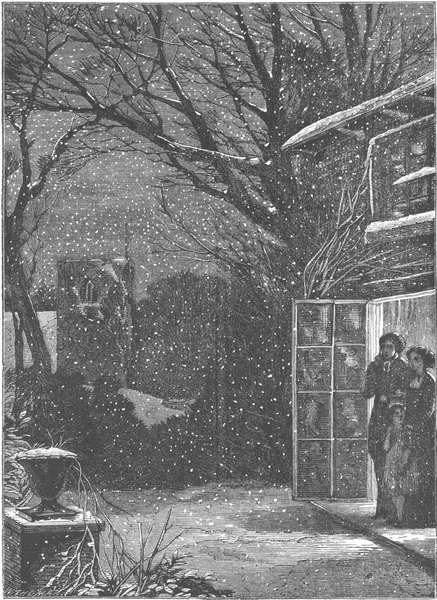
They are gathered at the window, standing quietly and
thoughtfully; those that are nearest and dearest linked with
loving arms; they are silent, or speak in a subdued tone. You
might almost think that they were indeed standing by some
bedside, watching the last breathing of a friend; for a solemn
thing it is, the passing from one to another of these stepping-stones
in the brook of life, and seeing the other shore seem
to gather a more distinct shape through the mist of the future.
You join the group. A cold, moist air, full of films
of snow, comes out of the dark night into the warm, bright
room. The bells are running away; you might almost fancy
them the sands, the last few grains of the Old Year’s life.
Suddenly they stop, and in the breathing silence a deep clang
falls from the church tower,—another,—ten more yet,—and
the Old Year is dead.
“A happy New Year!—a happy New Year!” Warm
kisses, and hearty shakes of the hand, and, like the crash of
a great breaker that has seemed to pause for a moment in the
air, down bursts the glad, the melancholy ring of bells again,
and floods the bare shore of silence,—still lingering, seething,
receding, gathering into new bursts again, and yet again.
A happy New Year! The Past is past, the Old Year is dead,
the hour of Regret is gone by, the time of Anticipation is here;
not good-bye now, but welcome; not lingering retrospect, but
earnest advance. Life is too short for long mourning; not
much time can be spared to meditate by the fresh grave of
the past. Forward, towards the unknown future: grasp its
opportunities, its sorrows, its joys, to be woven into some fabric
for the Master’s use! On, towards the untried future, bravely,
trustfully, hopefully, cheerfully; but remember you can never
overtake it. It changes into the present even as you come up
with it; and it is now, or never, that you must be serving God.
“Trust no future, howe’er pleasant,
Let the dead past bury its dead;
Act, act in the living present,
Heart within, and God o’erhead.”
But good night to all, or good morning—which?—and then
upstairs, and tired, to bed. When you wake, things will go on
much as usual, though the Old Year be dead, and sentry
January have relieved sentry December. Only for a time you
will find yourself dating still 18—, and, if untidy, you will
have to smear, if tidy, to erase, the last figure, and substitute
the number of your new friend.
* * * * *
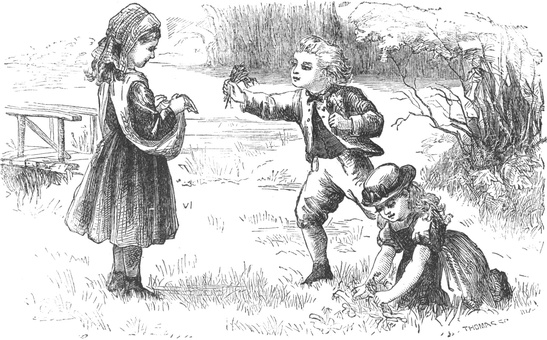
Anticipation. This is especially the dower of the young, if
Regret be often the possession of the old. What a strange,
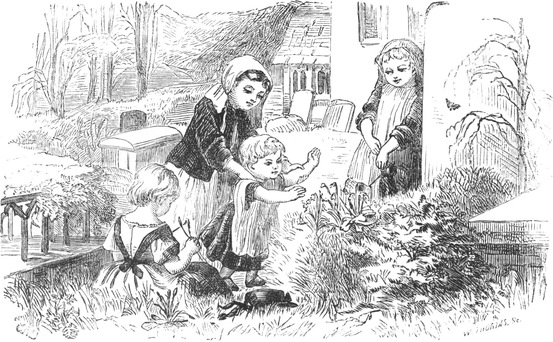
glorious thing a New Year is to the child! Little of the
feelings that I have been describing find place in the breast
of the boy and girl, that were fast asleep and warm in their
beds, while you and the bells were at conference: little of
such musings trouble them, as they bound out of bed in the
morning, and scuttle off in their night-gowns, patter patter,
in a race, to be the first to wish father and mother a happy
New Year. They are growing out of childhood: that is the
joy for them: another of those vast periods has passed.
Happy Spring, that does but long to shed and cast away
her myriad white blossoms; and to rush on towards the
full-grown Summer:—unknowing in the least, of the sober,
misty, tear-strung, if fruitful, Autumn boughs! A happy
New Year, little ones! Far be it from me to strip Spring
boughs in order to imitate the Autumn which they cannot
know! God keep you, my children; God teach you, and
God bless you!
* * * * *
A little farther on. Anticipation is glowing warmly in the
heart of the young man and the young woman. The time
of childhood is left behind. The time of independence, the
time of manhood, is drawing near: that time which shall
transform into realities the great things,—the noble, world-stirring
deeds, that have hitherto been only schemes. That
time when the loves that are budding in the heart shall burst
into exquisite blossoms, and never a frost nip them, and never
a rude wind carry at unawares a loose petal away.
A happy New Year. The heart accepts this wish, fearlessly,
without doubt, before the strife; before the rough work of a
field or two in the scarce-tried warfare of life has smirched the
glittering armour, and shorn the gay plumes, and changed the
song before the battle into hard labouring sobs, in the stern
hand-to-hand tussle with sin and with sorrow, with disappointment
and dismay. Before many a scheme overturned, many a
brave effort fallen dead as bullets against a stone wall, many a
seeming hopeful struggle forced back by the sheer dead weight
of evil, has made the heart sick and the knees to tremble, and
brought an early weariness and hint of despair over the amazed
Recruit; a touch of that felt by the Sage of old: “It is
enough: evil is too strong for me: I can do no more than
others have done before: my schemes have come to nothing,
my bubbles have burst: now let me die.” But the Recruit
becomes the Veteran, and is content to wait, where he was
once ready to despair. He does not hope so much, and
therefore is not so much dismayed; he relies now not so
much on earthquake efforts, as on the still small voice
uttered to the world by the life which is given to God.
He is content to labour,—and to leave it to the Master to
give the increase.
Yes, the young heart, even when lit with heavenly love, and
full of great designs for God, must submit to the overthrow
of the bright visions that anticipation set before it. How
much more, when its fire was lit from earth; and earth’s loves,
or fame, or pleasure, or power, were the prizes for which life’s
battle was to be fought. Vanity and vexation of spirit,
disappointment, dismay, despair; these are the ruins that
shall be won for Moscows, if that battle be fought to the
end!
A happy New Year. That glad wish of youth may come to
sound, to the man, nothing but bitter irony. But much of the
early hope, and more than the early peace, comes back to the
veteran worker for God.
“Who, but the Christian, through all life
That blessing may prolong?
Who, through the world’s sad day of strife,
Still chant his morning song?”
A happy New Year, young man and young woman! God
grant it you, in the one true sense of the word. It need not
be a freedom from sorrow: this is an ennobling, useful
discipline, that I may not wish you to avoid. But, to be
happy, it must be free from sloth and wilful sin.
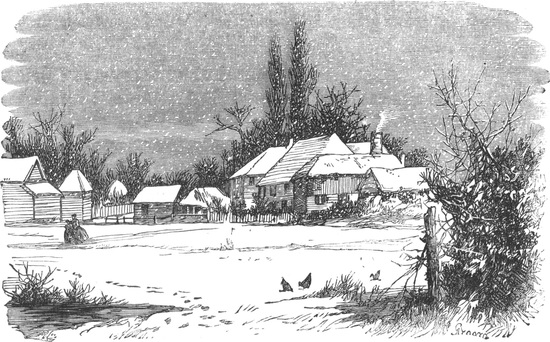
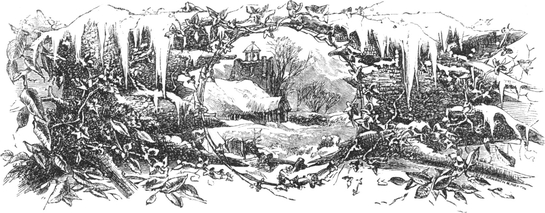
Look out from your window again, at the snow sheet which
has silently, deeply, fallen upon the earth. Let it be very
early in the morning, while the world is asleep and the broad
moon and the glittering stars watch alone over the smooth,
sparkling, white face of the land. Not a footstep, so far as
you see, has impressed the smooth, pure snow; not a dark cart-track
has yet left a long stain on the spotless road. No
thawing penitential drippings have made dark wells in it
here and there; no rude sweeping has piled the snow in
stained heaps hither and thither by the path. All is yet
pure, untouched, undefiled.
This is the New Year upon which we have entered, as we
look at it from the casement of the Old Year, before yet one
step has been placed on its first moment. All as yet unstained,
and white, and calm.
For how short a time to remain so! Can we set our first
step upon it without somewhat marring its virgin beauty?
And then the traffic, the hurrying of many feet, the crushing
of many wheels; thought, word, and deed, too often unwatched
and unsanctified by prayer; oh, what a change soon, and how
short a time that purity and calm has lasted!
New Year; clean New Year; how dark, how defiled, how
changed will you be, when you also are now waxing old,
and ready to vanish away! The white virgin opportunity
all passed by, leaving dark, dreary, sodden fields, and roads
churned up into yellow mud. The clinging spotless moments—flakes
that, in innumerable combination, made up the great
stainless carpet of the untrodden New Year; for them there
will be many a trickling rivulet of penitential tears; and the
steam and mist of heavy sighs that go up to God because of
life’s work too faintly, slackly done. Well then, that is well.
Better, of course, if this could have been, that the pure year
had remained unstained.
“My little children, these things write I unto you, that ye sin not.”
But well, if we are indeed humbly striving, and if hearty
repentance, and a true, lively, cleansing faith follow upon our
many, many sad failings, faults, and shortcomings. For,
sweet words!—
“If any man sin, we have an Advocate with the Father, Jesus Christ
the righteous: and He is the propitiation for our sins.”
And, glorious thought! if we are indeed loving and seeking
after purity and holiness, striving because of the hope within
us, to purify ourselves, even as He is pure—then know this, we
shall not love, and seek, and strive in vain.
“When He shall appear, we shall be like Him.”
Think of that! So that, when our last hour comes, and the
bellringers are ready for us, to ring out the Old Year of this
life, and to ring in the New Year of the next; and we are
looking (our near and dear ones still by us) out of the casement
of the Old Year of TIME, what may we then see? There shall
be stretched out before us the immeasurable unstained tract of
the New Year of ETERNITY, unsullied, spotless, pure and white;
and we need not then be afraid to enter upon that. The blood
of Jesus, which cleanseth from all sin, will have so cleansed
us, that even our footprints will not stain nor mar it. The
spots and the defilements, the tears and the sighs, they will lie
all behind us then, in the Old Year which is dead. Ring out,
oh, ringers, then—toll not, but ring out the year of sadness and
of sin, of weak strivings, cold hearts, and dull love! Ring out
the year of partings and estrangements, of death and tears!
And ring in—oh, that it might be so for every reader of this
chapter!—ring with none but joy-notes, ring in that everlastingly
happy New Year!