To all who love our venerable and beneficent
profession the spectacle of our predecessors in early
ages striving in darkness and difficulty to acquire
that hidden knowledge to which we have partially
attained is interesting and should awaken our
sympathy. As was remarked by the learned
Harveian Orator of 1896: ‘The past is worth our
study and ever more so the further we advance.’[1]
The information which archaeological research
has of late afforded, though in a fitful and
partial manner, as to the earliest history of
medicine, and particularly in regard to that department
in which our founder laboured, is not
unworthy of our attention.
4
The first evidence of definite inquiry, in any
degree worthy to be called scientific by a body of
men specially educated for, and devoting their
lives to medical service, occurs in the early history
of Egypt. The ability, learning, and artistic skill
shown during the early dynasties, which all
Egyptologists recognize, are paralleled by the
remarkable interest then manifested in medicine.
Works on anatomy and medicine are stated to have
been written even by the early sovereigns of
Egypt. Athothis, the son of Menes, who lived
six thousand years ago,[2] is stated in the Berlin
papyrus to have written a book on medicine, and
I shall soon have to quote from the anatomical
writings of the Pharaoh Usaphais, one of his
successors; Semti, the seventh monarch of the
same dynasty, pursued similar investigations. It
is clear that, like the Greeks, these men in the
childhood of the world believed that ὑγιαίνειν μὲν ἄριστον ἐστιν,
sanitation was to them the first of the sciences.
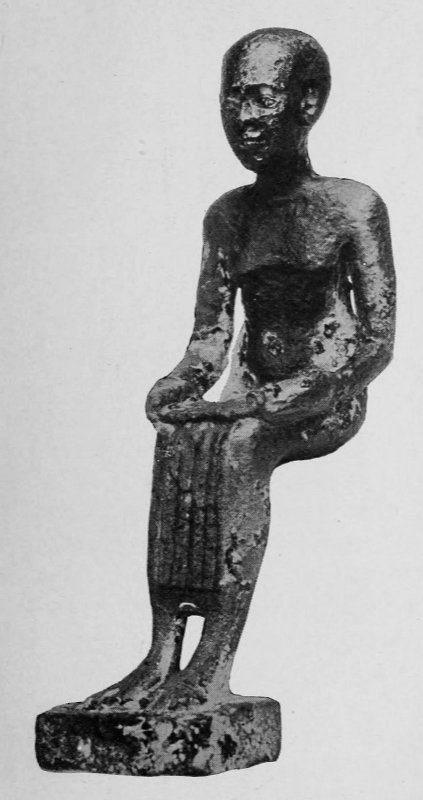
PLATE I
Ancient bronze figure of I-em-hotep, the Egyptian God of Medicine
(By the kind permission of the Committee and Curator of the Liverpool Museum)
5
During the third dynasty, about the year
3,500 B.C. there lived a learned physician (probably
a priest of Ra, the sun-god) the founder of
a cult, whose eminence was such that in course
of ages he is deified and becomes for later generations
the special god of medicine. His temples
were places of healing for the people. His name
is I-em-hotep, meaning ‘he who cometh in peace.’
According to ancient inscriptions he was the son
of a certain architect named Kanofer, but when
raised in popular esteem to the rank of a demi-god
he is called the son of the supreme god Ptah,
the Hephaistos of Egypt, and he becomes one of
the great god-triad of Memphis. I-em-hotep is
described as ‘the good physician of gods and men,
a kind and merciful god, assuaging the sufferings
of those in pain, healing the diseases of men,
giving peaceful sleep to the restless and suffering’;
he is called ‘the creative god who giveth life to all
men, who comes unto them who call upon him
in every place, and who gives sons to the childless.’[3]
He was great in magic and all learning.
He and his followers had to do with the embalming
of the body, and he protected the soul of the dead
man from all spiritual enemies after it had left the
body. In the ritual of embalmment the dead man
was encouraged by these words, ‘Thy soul uniteth
itself to I-em-hotep; while thou art in the funeral
valley thy heart rejoiceth because thou dost not
go into the dwelling of Sebek, but thou are like
a son in the house of his father.’[4]
From the testimony of temple inscriptions
and papyri, as well as from the writings of Manetho,
it is clear that the cult of the medicine-god
6
I-em-hotep was established first in early times at
Memphis. In, or adjacent to, some temple—perhaps
that of Ra—I-em-hotep and his assistant
priests gave advice and medical aid to multitudes
of the sick and ailing. It is evident that he gained
great renown for his skill and learning. When
at length he died he was buried in or near the
temple. The priests whom he had taught
continued there the work of healing, always in
association with his name. Just as the Greeks
came to Epidaurus to be healed by Asklepios, so
did the Egyptians, many centuries earlier, visit
Memphis to seek help from I-em-hotep. It seems
probable that in course of time the temple
formerly dedicated to some well-known Egyptian
god ceased to be known by his name, and in
popular speech became the house of I-em-hotep.
There is the clearest evidence of the existence of
an important temple in later times dedicated to
I-em-hotep at Memphis.
A hieroglyphic inscription describes I-em-hotep
appearing in a vision to the high priest of
Memphis, and addressing him thus:—‘I desire
that a great building be erected in the holy place
at Anche-tewej (a part of Memphis), where my
body is hidden, for building it I will give thee
the reward of a son.’[5] We know this temple was
built. Later again, similar temples were erected
elsewhere; doubtless priest physicians were
transferred from Memphis to new centres, just as to
7
Greece and Magna Graecia Epidaurus sent forth
trained priests to establish Asklepieia at Athens,
Cos, or Pergamos.
As the centuries and millenniums passed on
the cult of I-em-hotep seems to have become
more and more popular. In later times, when
Greek colonists appeared in Egypt, they gave him
the name Imouthes, and applied to his temples
the Greek term ‘Asklepieia,’ clearly regarding
him as alike in kind to the Greek Asklepios and
his temples as hospitals for the sick. The
following phrase occurs in the Serapeum Greek
papyrus:—
‘τὸ πρὸς Μέμφιν μέγα Ἀσκληπιείον’[6]
The great temple stood outside the eastern
wall of Memphis close to the Serapeum. We
may reasonably hope that a careful examination
of the site may yet reveal to us traces of the
temple and perhaps even the tomb and remains
of I-em-hotep himself. Some of those who are
present to-day when visiting the site of the temple
of I-em-hotep have been impressed by the thought
that on this spot, long before Asklepios, the source,
or Hippocrates, commonly called the father of
medicine, were born, probably before the Homeric
poems were written, before the Israelites were in
Egypt, before the Stone Age had passed, learned
men here devoted themselves to the consideration
8
of the nature of human life, strove to prolong it,
to assuage suffering, and to cure disease. They
studied and treated many of the ailments familiar
to us, such as tubercle, leprosy, plague, anaemia,
and other diseases prevalent in Egypt to-day.
Near the site of this temple, securely sealed in an
earthen vessel which had been hidden in the sand,
was found one of the medical papyri from which
I shall quote some passages; doubtless it belonged
to an early physician who sought, perhaps during
the invasion of Ethiopian or other barbarians, to
preserve for mankind the precious knowledge
that seemed in danger of extinction.
As we should naturally expect in the case of
one so eminent, the Egyptian artists made many
drawings and bronze figures of I-em-hotep; they
usually represent him as a man rather than as a
god, with few mystic or metaphorical emblems
excepting those related to learning or human life.
He is represented in art as a bald-headed man,
usually in a sitting posture, bearing on his knees
an open papyrus scroll, and sometimes holding in
his hand the symbol of life.[7]
I-em-hotep rises before us as one of those
intellectual giants who take all knowledge for their
province. In his comprehensiveness he surpasses
Leonardo da Vinci or our own Linacre; he is
distinguished as a physician, a minister of the
king, a priest, a writer, an architect, an alchemist,
and an astronomer—great in all, but greatest in
medicine; so eminent that in the view of Egypt
he is a god.
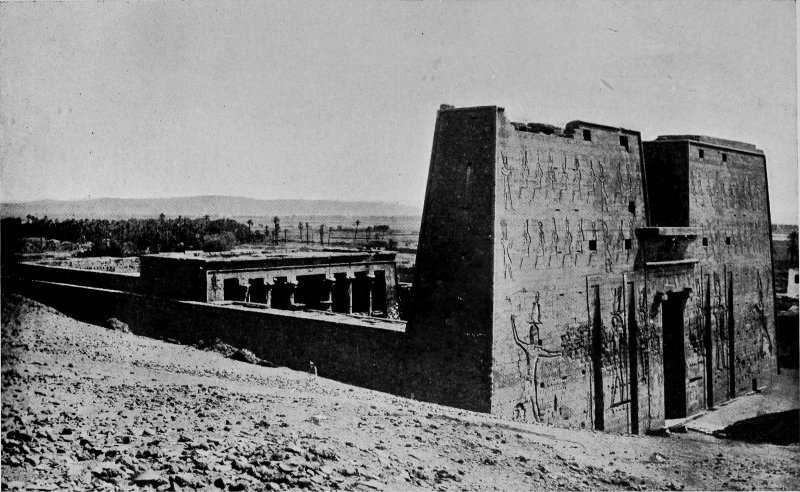
PLATE II
The Temple of Edfu
The earliest portions of which are believed to have been built by I-em-hotep.
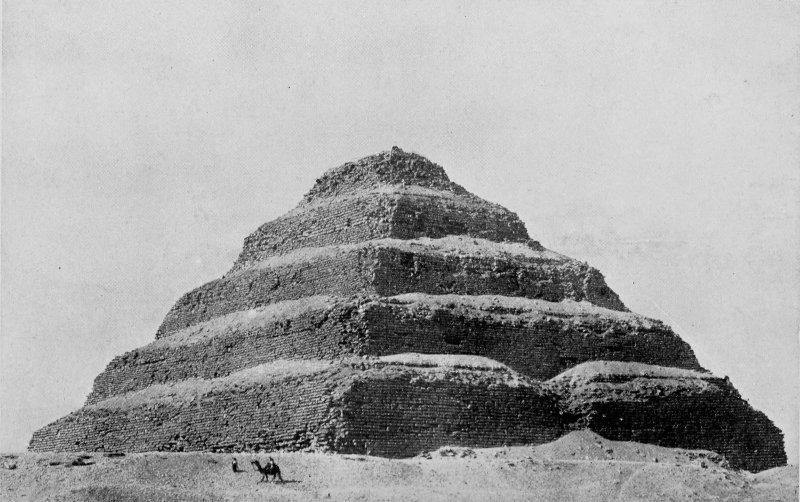
PLATE III
The Step-pyramid of Sakkara
Supposed to have been built by I-em-hotep for the Pharaoh Tosorthros.
9
In the reign of Tosorthros, of the third
dynasty, five or six thousand years ago, we meet
with the wise I-em-hotep in an inscription referring
to the seven years of famine which befell
Egypt in consequence of a succession of low Niles.
He is there the adviser of Pharaoh; to him the
king applies in his trouble for counsel and help.[8] In
the inscriptions in the temple of Edfu[9] he is described
at length as the great priest I-em-hotep,
the son of Ptah, who speaks or lectures.[10] Perhaps
his discourses or lectures were on medicine. Elsewhere
he is described as the writer of the divine
books. It may here be remarked that probably
Ebers’ papyrus was one of the six divine books
attributed to Thoth ceremonially, but not
improbably in large part the work of I-em-hotep.
Manetho, while speaking of his eminence as a
physician, refers to him also as an architect, the
first to build with hewn stone.[11] Not improbably
he built the step pyramid of Sakkara, the tomb
of his patron Tosorthros.[12] Manetho also suggests
that I-em-hotep improved and completed the
10
hieroglyphic script of Egypt. In the Hermetic
literature he is famed for his knowledge of
astronomy or astrology; the Westcar papyrus
describes him further as an alchemist and magician.[13]
These powers were always associated with
medicine, and even to-day in the popular view
they are not entirely dissociated from it. What
share I-em-hotep may have had in those early
discoveries of the movement of the blood, to which
I am about to advert, we do not know. It does,
however, seem clear that either through the
labours of I-em-hotep or of other priest physicians,
the Egyptians had discovered certain elementary
facts and knew as much as the Greeks, as much
as we find in the Hippocratic writings, or in those
of Aristotle and the later Alexandrian school, and
the hypothesis seems a natural one that the knowledge
possessed by the Greeks was acquired from
Egypt.
It is of some interest to note that these priests
of I-em-hotep, themselves learned men, not only
saw and prescribed daily for vast numbers of sick
persons but also performed innumerable necropsies.
They removed the heart, large blood-vessels,
viscera, and brain from the bodies of deceased
persons, also from the bodies of sacred animals,
prior to embalmment; the heart was placed in a
11
separate jar by itself and the remainder of the
viscera in a larger vessel. We are told by Pliny
that in later times an examination of the body
was made after death in order to ascertain the
nature of the disease which was the cause of death.[14]
Thus these men had an opportunity of learning
something of anatomy and pathology. They
may have gained some insight into the intricate
problem of the action of the heart, the movement
of the blood, and the changes of heart and vessels
produced by disease; no nation of antiquity had
such opportunities. Did they discover anything?
I think I can demonstrate to you that they did
obtain a partial knowledge of the circulation;
they did not solve the problem, but they
approached it as nearly as did the Greeks, and
probably from them the Greeks obtained such
knowledge as they possessed in early times.
Certain of the contents of the medical papyri
are at present almost incomprehensible, partly on
account of the difficulty of translating technical
terms; these parts I shall not refer to at all;
those portions which are more easily understood
still present difficulties, and translations must
necessarily be free and at times vague. It must
be remembered that the hieratic script was not
12
a good medium for the clear and definite statement
of facts, also that the modes of thought and
forms of expression of the time were far removed
from our own, even far remote from those of the
Hellenes. We enter a different world when we
try to comprehend the beliefs and conceptions of
the ancient Egyptian, the platform of thought on
which he built is imperfectly known to us.
Furthermore, the philosophic conceptions which
the Greeks gave to mankind and their lucidity
of expression had not then come into existence.
In addition to these negative aspects of
difference there are positive ones. The Egyptian
believed himself to dwell in a universe peopled
by spirits and demons, good and evil, whose
influence must be propitiated or averted by charms
and spells. It will, therefore, be understood that
a hieratic papyrus is vastly more difficult to
interpret than a Greek manuscript.
The references in various papyri to the
circulation, though somewhat vague, are not
without interest. Where the sense is important
I have had the help of one or two learned living
Egyptologists, and here I must express my
acknowledgments to Dr. Budge, Professor Kurt
Sethe, Dr. Brugsch, Dr. Joachim, Dr. Leemans,
Dr. Withington, Dr. Grant Bey, Dr. Sandwich,
Mr. Garstang, Professor Carrington Bolton, Professor
Flinders Petrie, Mr. Percy E. Newberry,
and others, for help orally, or from their writings,
without which, in my ignorance, I should have
13
done little. I am especially indebted to Professor
Kurt Sethe’s work on ‘Imhotep’ and to Dr. H.
Joachim’s ‘Papyros Ebers.’
Let me read you one or two extracts from
the work of the Pharaoh Usaphais quoted in
Ebers’ papyrus[15]: ‘Man hath twelve vessels proceeding
from his heart which extend to his body
and limbs; two vessels go to the contents of his
chest, two vessels go to each leg, two to each
arm, two vessels go to the back of the head, two
to the front of the head, two branches go to the
eyes, two to the nose, two vessels go to the right
ear, the breath of life goes through them, two go
to the left ear, and through them passes the
breath of death; they all proceed from the heart.’
The concluding sentence is the earliest example
I know of the ancient superstition that the left
side of the body is sinister and evil. This is very
early anatomy, professing to be at least six thousand
years old; we must not expect it to be quite
accurate.
Turning to a comparatively recent period,
I shall quote from other parts of Ebers’ papyrus;
the only existing copy of this papyrus (found in
a tomb at Thebes) was written in or before the
sixteenth century B.C. No doubt most, if not all,
its contents are much older than that date.[16] The
extracts which I am about to read commence
thus: ‘From the secret book of the physician,
14
a description of the action of the heart and of
the heart itself. From the heart arise the vessels
which go to the whole body ... if the physician
lays his finger on the head, on the neck, on the
hand, on the epigastrium, on the arm or the leg,
everywhere the motion of the heart touches him,
coursing through the vessels to all the members’
[the reference is clearly to the pulse]; ‘thus the
heart is known as the centre of all the vessels.
Four vessels go to the nasal chambers, of which
two convey mucus and two convey blood. There
are four vessels within the temples or skull, from
these the eyes obtain their blood.... The four
vessels divide inside the head and spread towards
the hinder part.’ The Berlin papyrus speaks of
the division into thirty-two vessels within the
skull, and implies that air traverses, at any rate,
some of them.
Returning to Ebers’ papyrus[17]—‘When the
breath enters the nostrils it penetrates to the
heart and to the internal organs, and supplies the
whole body abundantly.’ This idea that certain
of the vessels convey air, you will observe, is
identical with the Greek conception and probably
was its source. ‘Three vessels traverse the arms
and extend to the fingers, three vessels also pass
down the leg and are distributed to the sole of
the foot, a vessel goes to each testis and one to
each kidney. Four vessels enter the liver, conveying
fluid and air; these may be the seat of
15
various diseases as they are mixed with the blood;
four vessels convey fluid and air to the intestine
and spleen; two go to the bladder and from them
the renal secretion is produced. Four vessels
convey fluid and air to the lower abdomen, going
to the right and left sides; from them is formed
the alvine excretion.’[18] These vessels here described
are clearly the iliac arteries and veins.
‘When the heart is diseased its work is imperfectly
performed: the vessels proceeding from the heart
become inactive, so that you cannot feel them’
[no doubt this is a reference to changes in the
pulse], ‘they become full of air and water....
When the heart is dilated the vessels from it
contain effete matter. If a suppurative or putrefactive
disease occur in the body’ [abscess, I
imagine, for which various sites are suggested]
‘then the heart causes it’ [it being probably
purulent or septic material] ‘to traverse the
vessels, fever or inflammation of various kinds
occur in the body, the heart is in a morbid state
while the fever continues.’ [It may be noted in
passing that the septic infection is asserted to
enter the body by the left eye]. ‘In heart disease
there is either disturbance of the action of the
heart or the heart is congested or overfilled with
blood, the heart is moved downwards, comes
nearer the praecordia, and weakness and nausea
occur....[19] When the disease affects the basic
16
region or lower mass of the heart there is shortness
of breath, the heart is displaced on account
of the volume of blood from the abdomen’
[probably the old idea of the rush of blood entering
the heart from the liver]. ‘There may be
fever or inflammation of the heart.’ At this point
comes a passage of some therapeutic interest.
‘The heart during such disease must be made to
rest to some extent if it be possible.’ Here we
have wise advice from the ancient Egyptians,
advice the importance of which we have scarcely
as yet recognized, and which we may to-day
follow with advantage. ‘If the heart is atrophied
(or wastes itself) there will be an accumulation
of blood within it. When the disease of the
substance of the heart is accompanied by dropsy
there is a lessening’ [in strength probably] ‘in
the ventricle or cavity.... When the weakness
of the heart is due to old age there is dropsy.
When there is raising or increase of the heart it
presses towards the left side, it is increased by its
own fat, and is displaced; there may be much
fat contained within its covering or pericardium.
If in a suppurative disease the heart is pushed
forward it floats or sinks in the fluid and is displaced.’
Here we surely have a reference to
pericardial effusion.... ‘If the heart trembles
or palpitates, has little power, and sinks downwards,
the disease is advancing. When there is
much beating at the praecordia, with a feeling of
weight, when the mouth is hot and languid, and
17
the heart is exhausted the disease is a fever or
inflammation.’ In another place (folio 102) the
heart is spoken of as being full of blood which
comes or flows from it again. In folio 39, after
a description of symptoms, follows a statement to
the effect that the heart is distended, the sick
man is short of breath because the blood has
stagnated and does not circulate. This is an
interesting expression, but judging from other
parts of the papyrus the word translated circulate
can only have a vague meaning, implying movement
to and fro, just like the expression ‘περίοδος αἴματος’
in the Hippocratic writings, which seems
to imply the circuit of the blood, but in reality
has only a similar indefinite meaning. It is
evident that the Egyptians knew that blood flowed
from the heart, but, like the Greeks, they never
seem to have realized that the heart is a pump,
nor did they recognize valves.
The Leyden medical papyrus speaks of a
paralysis or disturbance of some sort in the blood-vessels
of the head, causing blindness and disorder
in the body and in the limbs; this seems to be a
description of the results of cerebral haemorrhage.
Remedies are suggested to subdue the vascular
activity occurring in certain diseases.[20]
The Passalaqua papyrus is rather interesting.
It was found in an earthen jar at Thebes, and
deals largely with leprosy (which prevailed greatly
18
in ancient Egypt). This papyrus appears to date
from the time of Mencheres of the fourth dynasty,
and for many centuries was enclosed in a case or
box beneath the feet of the figure of the god
Anubis, and forgotten for ages. It was rediscovered
in the reign of a later monarch, and recopied on
to a new roll of papyrus.[21] The British Museum
papyrus dates back, as regards the major part of
its contents, to the time of Khufu or Cheops the
pyramid builder. It bears some evidence of
Semitic influence. In the section on the treatment
of wounds it contains the following prayer:—‘Oh
Ra, creator of the gods, pass ye me along,
renew ye me, avert from me all evil things, all
evil maladies, all wounds in the flesh of these
limbs.’[22] In earlier times these prayers are much
more common than during the later dynasties,
when the physician seems to have relied more
upon treatment.
The various papyri from which I quote deal
of course with practical medicine and not with
physiology; no distinct definition as to structure
or function is to be looked for in them; only as
associated with diagnosis, prognosis, or treatment
do we get statements as to the nature of the heart,
the vessels, and the movement of the blood.
19
It is clear from the study of these medical
papyri that medicine advanced considerably
amongst the Egyptians, and from them medical
and sanitary knowledge has descended to us by
two channels—namely, by the Greeks and through
the Jewish race, while probably much of it was
lost irrecoverably. Josephus quotes from Manetho
a statement that Osarsiph, who Josephus says
was the great Hebrew leader Moses, was a priest
at Heliopolis, where medicine was taught.[23] It
is highly probable that the sanitary laws of the
Jews were derived from the Egyptians. Just as
the Jews remembered the diseases of Egypt
(Deut. xxviii, 60) so they also remembered the
sanitary and remedial measures they had learnt
there. Those of us who have seen in the later
excavations at Knossos the evidences of sanitary
knowledge of a somewhat high type, possessed
by the Cretans at a remote period, exemplified
among other things by drainage pipes, scarcely
excelled by our own to-day, knowing as we do
the close connexion between Crete and Egypt,
may well believe that here we have an example
of sanitation derived from Egyptian sources.
In England we have overlooked the importance
of Egypt as a primary source of the
science and art of medicine. If we regard with
reverence the dim traditional form of Asklepios
20
as a founder of our art, and the Asklepieia where
throughout Greece and Magna Graecia medicine
was practised and taught, in greater degree
should we reverence the much more venerable
I-em-hotep and view with interest the primaeval
medicine temples and hospitals of Egypt. The
evidence of this priority from Egyptian sources is
absolutely conclusive, but in addition we have
corroborative evidence from European authorities.
In the ancient writings of the pseudo-Apuleius
Hermes is described as speaking to the
youthful Asklepios as follows[24]:—‘Thine ancestor,
the first discoverer of medicine, hath a
temple consecrated to him in the Libyan mountains
near the Nile, where his body lies, while his
better part, the spiritual essence, hath returned
to the heavens, whence he still by his divine
power helps feeble men as he formerly on earth
succoured them by his art as a physician.’
In the Cairo Museum probably many of
the present audience have seen the sepulchral
stele of Shemkhetnankh, a great physician of the
fifth dynasty, who was contemporary with King
Sahura, and who is described in the stele as the
principal physician of the Royal Hospital. His
name, which is doubtless a title given to him by
the monarch, means ‘He who possesses the
things that give life.’ It is interesting to find
that five thousand years ago a hospital should
exist associated with, and under the patronage
of, the Pharaoh and having its own staff of
physicians. And it is manifest that our calling
held a distinguished position at the time when
art and learning in Egypt were at their zenith.
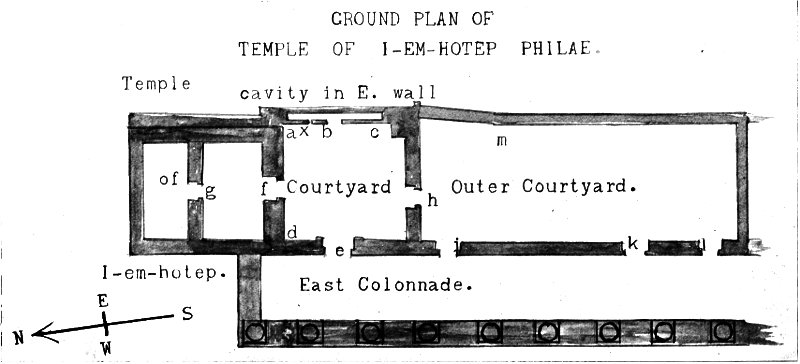
PLATE IV
Plan of part of Eastern Colonnade of Philae with temple of I-em-hotep and courtyards adjacent.
21
Few of the temples of I-em-hotep remain.
When viewing the ruins of Heliopolis, the ‘On’
of the Bible, the visitor naturally wonders in what
part of the wide area the great halls were situated
in which Horus was healed after being wounded
by Typhon, those halls which, as Ebers tells us,
had from mythical times been used for clinical
purposes by the celebrated faculty of medicine
of Heliopolis. A small temple of I-em-hotep
still exists at Philae, with certain adjacent courtyards,
which were probably employed for
medical purposes. I subjoin a ground plan and
three photographs of these remains at Philae.
This temple is contemporary with the earlier
Ptolemies; the hieroglyphics are of the date of
Ptolemy IV, but the inscription in Greek on the
cornice of the southern door (see Plate VI) is
later, dating from the reign of Ptolemy Epiphanes,
two centuries before the Christian era.[25] The
colonnade (Plate V) and also the courtyard in
front of the temple appear to be still later additions.
Since the Coptic houses and much accumulated
rubbish have been cleared away, and certain
necessary restorations made by Captain Lyons, on
behalf of the Public Works Department of Egypt,
all details of the temple can be examined with ease.
22
From the colonnade a door marked e on
the plan (Plate IV) leads into a square courtyard,
the north side of which, marked ad in the plan,
is formed by the façade of the temple proper.
Here some of the hieroglyphs refer to I-em-hotep
and his work (Plate VI). In the centre of this
façade a door marked f leads into the larger
anterior chamber of the temple. From this the
door g communicates with the inner sanctuary.
The eastern wall of the courtyard has a curious
elongated recess, many yards in length but only
a foot-and-a-half in depth, marked ac in the plan,
a narrow door, b, gives access to it. Between
a and b a small aperture in the wall marked x
communicates with this curious recess, and the
remains of a second aperture exist further to the
left. It is difficult to understand the purpose of
this structure.[26] Plate VII represents the wall ac
with the doorway and apertures referred to. A
door marked h leads into a larger courtyard which
again communicates by three doors on its western
side with the colonnade.
Whether this further courtyard was a portion
of the purlieus of the temple is uncertain, no doubt
a considerable space would be required for the
medical work of the priest physicians.
Plate V represents the west wall of the temple
(shewing a mediaeval Coptic doorway broken
through into the sanctuary), also a part of the
colonnade. To the left is a portion of the great
pylon of the temple of Isis.
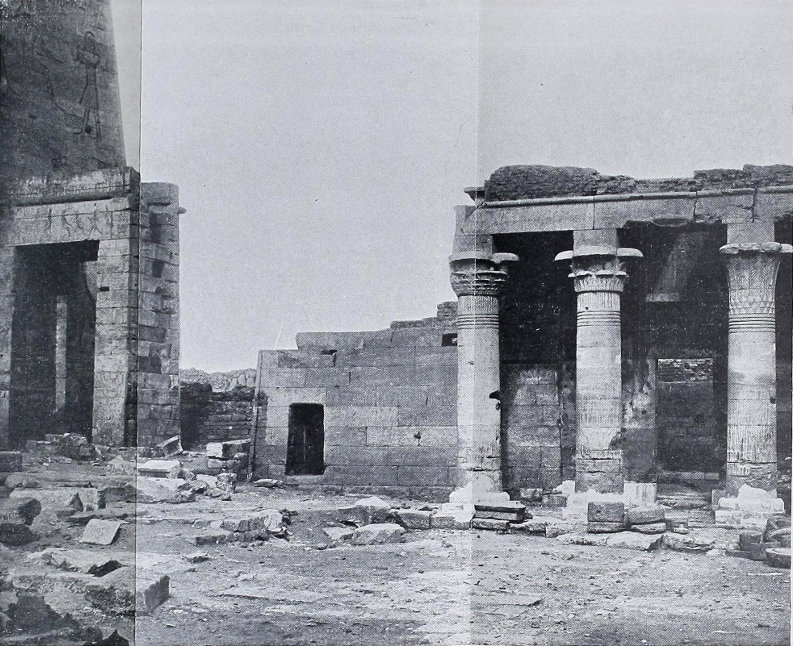
PLATE V
Eastern Colonnade, Island of Philae, with entrance (on right) to courtyard of temple of I-em-hotep. The western wall of the temple (with mediaeval Coptic doorway) occupies the centre of the picture.
23
I am indebted to the courtesy of the Egyptian
Public Works Department and to Captain Lyons
for the privilege of reproducing these views of the
temple of I-em-hotep at Philae.[27]
I may mention in passing that, although the
medical papyri which have come down to us are
no doubt only an insignificant fraction of those
possessed by the Egyptians, we, nevertheless, find
in them abundant reference to medicine and
surgery. In the Kahun papyrus obstetrics is
dealt with. Gynaecology, also ophthalmology,
materia medica, diseases of the ear, tongue, and
nerves, also dentistry, are the subjects of others,
and even veterinary medicine was treated of in a
papyrus, a fragment of which was found by
Professor Flinders Petrie.
According to Herodotus, Egyptian physicians
specialized to a considerable extent, ‘Each
physician applies himself to one disease only.’
‘Some,’ he says, ‘are for the eyes alone, others
for the head, others for the teeth, others for
diseases of the abdomen, others again for special
internal diseases.’[28] As to dentistry it may be
remarked that the ancient Egyptians were probably
24
the first to stop decayed teeth with gold. I may
add that Ebers states that twenty distinct diseases
of the eye are referred to in the papyri, and Dr.
Grant Bey asserts that the operation for cataract
was practised in ancient Egypt.[29]
As regards materia medica the Egyptians
possessed the following drugs:—lactuca, various
salts of lead, such as the sulphate, with the action
of which in allaying local inflammation they were
well acquainted; pomegranate and acanthus pith
as vermifuges; peppermint, sulphate and acetate
of copper, oxide of antimony, sulphide of mercury,
petroleum, nitrate of potash, castor oil, opium,
coriander, absinthe, juniper (much used as a
diuretic), caraway, lotus, gentian, mustard, ox-gall,
aloes, garlic, and various bitter infusions; mandragora,
linseed, squills, saffron, resin, and various
turpentine products; cassia, certain species of
cucumis, cedar-oil, yeast, colchicum, nasturtium,
myrrh, tamarisk, powdered lapis lazuli, vinegar,
indigo; the oasis onion, mastic and various gums,
mint, fennel, hebanon or hyoscyamus, magnesia,
sebeste (a tonic and a cough medicine), lime, soda,
iron, and a great number of other agents, the names
of which no one can at present translate.
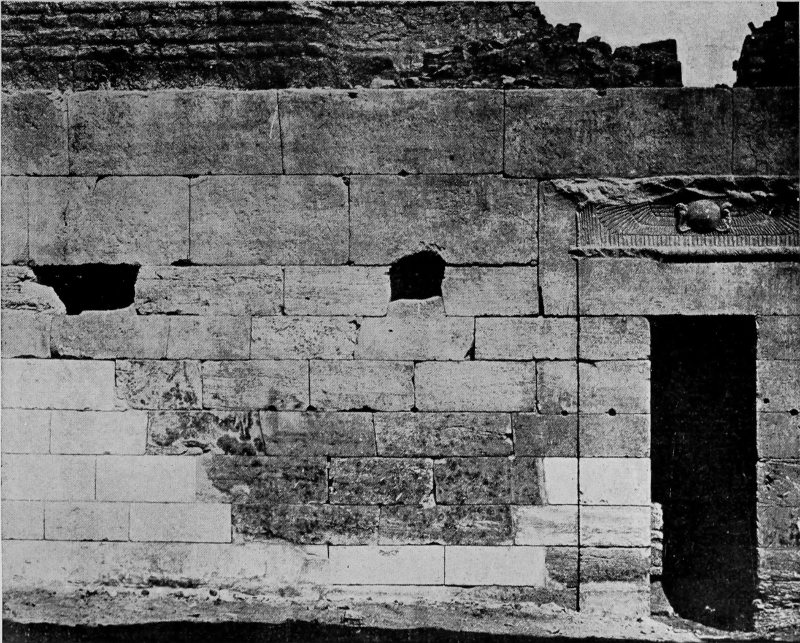
PLATE VI
Front of the temple of I-em-hotep, Island of Philae
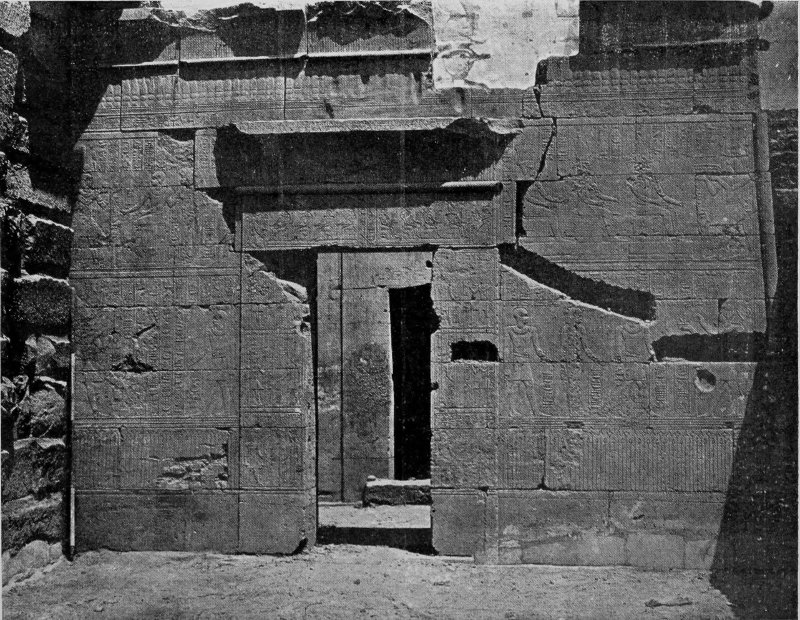
PLATE VII
Eastern wall of courtyard of temple of I-em-hotep, Philae; showing door and apertures into narrow wall chamber
25
In reading this very imperfect list one does
not wonder that Homer speaks of ‘the abundant
herbs of Egypt, healing and baneful, used by men
more skilled in medicine than any of human
kind.’[30] The Berlin Medical papyrus alone mentions fifty
medicines of vegetable origin. Some
of the prescriptions in Ebers’ papyrus are stated
to have come from the great medical temples of
Sais and Heliopolis. The copy of Ebers’ papyrus
has evidently been in use by the priest physicians,
for various notes have been added on the margin
by later hands in reference to the prescriptions—‘Good,’
‘Very good,’ ‘Try this,’ etc.
It is an interesting fact that upon the walls
of some of the ancient temples hieroglyphic
records have been cut referring to medicine, and
containing, in some instances, prescriptions; in
other cases descriptions of various chemical processes;
some of the temples seem to have had
laboratories attached to them. The hieroglyphic
name for the land of Egypt was Khami, whence
are derived the words ‘Alchemy’ and ‘Chemistry.’[31]
Surgical instruments and the actual cautery
were in use, also steam inhalations, massage, ointments,
plasters, poultices, suppositories, injections,
and emetics, and the importance of temperature
in disease was to some extent recognized.
Prescriptions were written out in due form
and sometimes at great length, fully equalling
those of the most enthusiastic therapeutist of our
own day. Some hundreds of prescriptions have
come down to us in papyri. The longest prescription
which I have read contained thirty-five
ingredients. To read it was a formidable task;
to take it I should think a much more formidable
one. Some prescriptions are wise and rational,
a few strange and repulsive, and some are associated
with charms and spells.
26
Human nature is the same in all ages; hence
one was not surprised to meet with hair invigorators,
hair dyes, cosmetics, pain killers,
insect powders, and a soothing syrup for small
children containing opium in use three thousand
five hundred years ago. It was rather interesting
to find that the symbol for a half tenat often
used in their prescriptions is identical with that
indicating a drachm with us, though the amounts
are not the same. I trust that the drachm will
soon be as obsolete as the tenat.
The writings of Dr. Grant Bey contain the
information that during the Hyksos period a law
was enacted to the effect that if any physician
adopted a method of treatment not authorized
by the sacred books and in case the patient died
under that treatment, the life of the physician
should also be forfeited. It is to be hoped that
a principle so absolutely fatal to all progress was
not permitted long to remain in operation.[32]
27
II A Suggestion in Regard to Preventive Treatment of Valvular Disease — Joints recover: Why does the Endocardium fail to do so? — The Rheumatic Joint rests, but not the Rheumatic Heart — Disastrous results of Valvulitis if not specially treated — The work of the Rheumatic Heart must for a time be minimised — Two Objections to the Proposed Method — Successful Results obtained
I have referred to certain facts, mostly of
recent discovery, bearing on the existence of our
profession in the remote past and in reference to
the partial knowledge to which the priests of
I-em-hotep attained as to the circulation of the
blood, a subject not without a certain interest,
but the advances of that knowledge made subsequently,
which have on more than one occasion
been dealt with in this room, those now making,
and those yet to be made in the future are of
more practical importance to us.
The genius and the marvellous industry of
Harvey first clearly unfolded the great secret of
the course of the circulation, thus opening a
wide door for the work of others, physiological
and therapeutic. A recognition of the principles
of blood pressure, and of the action of vasomotor
nerves, and other advances have followed. We
have attained to a larger, though I believe as yet
only to a partial and provisional, hold of truth in
these matters. As such we shall regard our
knowledge if we are wise. The great mistake
in all times has been that of believing that the
truth already attained is the whole and that nothing
remained behind.
28
Our Egyptian and our Greek predecessors
seem to have believed that they had attained
to absolute and final knowledge on these subjects.
While we smile at their error, let us be humble
in estimating our own position and ever remember
that we ourselves may be yet barely on the
threshold.
Our father, Harvey, has exhorted us ever to
search and to study out the secrets of nature by
the way of experiment. Will you pardon me if I
devote the remainder of this paper to an account
of a humble attempt to carry out his mandate,
if I narrate briefly an experiment dealing with
a yet unsolved problem in the pathology of the
circulation, to which I have devoted twenty-five
years of my life?
I may plead the usage of speakers and
writers who follow a tale or narrative by a moral
or practical application, and perhaps I may also
be allowed to say that the discovery that ancient
Egyptian physicians advocated rest in certain
forms of heart disease suggested to me the propriety
of supporting this doctrine by a brief
narration of my own experience in the same
direction.
As the Egyptians were probably ignorant as
to the action of the valves of the heart, they can
only have known the fact that rest was beneficial,
but not the reason.
29
Valvular defect is one of the most important
and perhaps the most common of circulatory
diseases. It is one which probably we shall
never be able to cure, and is thus likely to remain
one of the opprobia of medicine. Is it possible
to treat it by prevention? This is the problem
upon which I wish to speak a few words. I am
the more encouraged to do this because I know
that various Fellows and Members of this
College hold similar views to those which I
desire to unfold.
There are in this audience many who have
treated cases of acute rheumatism and cases of
valvular disease in hundreds of instances. We are
all aware that in acute rheumatism, however
severe the joint lesion may be, however great the
swelling, the pain, the local pyrexia, and the
effusion, in the large majority of cases, after the
usual treatment all these grave symptoms subside,
or if they linger in any joint many of us know
how certainly they will vanish if we stimulate the
trophic and vasomotor nerves by small blisters
applied to the adjacent skin, the final issue in
most cases being the restoration of every joint to
a normal condition. But, alas, we also know that
when the endocardium covering the mitral or
aortic valve cusps is in like manner attacked, a
like restoration does not take place spontaneously
30
excepting in few and rare instances. When
regurgitation through the valve, shown by an
apex bruit with accentuation of the second
pulmonary sound, has occurred in acute rheumatism,
if after treating the rheumatism we leave
the affected heart to its own course, and the
patient to his, persistent bruit, persistent pulmonary
accentuation, hypertrophy, dilatation—in fact,
life-long heart disease and its train of attendant
evils follow in a large majority of cases, and mar
or shorten life. Why should the rheumatic heart
be so much more intractable than the rheumatic
joint?
No doubt the reason is that the joint can
rest. The merciful influence of pain in the part
affected insures repose for each affected joint.
Suppose it were otherwise. Imagine pain absent
and conceive for a moment that we could flex and
extend an acutely rheumatic knee or elbow sixty
or eighty times per minute continuously, what
would be the fate of the joint? Is there any
probability that restoration to the normal condition
would follow? Few of us, I think, would expect
it, for it is a physiological law that repair in a
diseased organ cannot coincide with full functional
activity. When the endocardium and valve
cusps are inflamed pain does not give the signal
for rest, for, indeed, pain or no pain, the toiling
heart cannot intermit its labours.
31
During my thirty-five years of experience as
a hospital physician and in private I have watched
with special interest the fate of the numerous
cases of endocarditis which came under my charge,
endeavouring as far as possible to trace the later
history of such cases for a lengthened period.
During the earlier years I merely treated the
rheumatism, believing, as I had been taught, that
little or nothing could be done to prevent disaster
to the heart. I had the pain of discovering that
many, indeed most, of these cases merged into
permanent valvular disease. This distressing
experience induced me to experiment on various
methods of preventive treatment. Of these, one
has proved successful and has been constantly
employed by me for twenty years.
The method is very simple; it is merely to
give the heart the same advantages, the same
opportunities for repair, so far as we can, that the
joints enjoy; in other words, by every means in
our power we lessen the work to be done by the
heart. The most absolute quiet is enjoined, the
patient lies with his head at a low level, pain and
fever are subdued, no excitement is permitted,
the patient is made as comfortable as we can make
32
him, and sleep is encouraged—in fact, we seek to
attain physiological rest. We follow the precept
of our ancient Egyptian brother, declared so many
thousand years ago: we give the ailing heart the
nearest approach to rest that is practicable. In
addition we administer sodium or potassium
iodide, partly to help in the absorption of morbid
exudations but chiefly to lower vascular tension,
just as we give these drugs in cases of internal
aneurism. Lastly, we endeavour to influence the
cardiac vasomotor and trophic nerves reflexly by
gentle and almost painless stimulation of those
cutaneous nerves which we know from physiological
data, and from the evidence of the referred
pains of angina to be in close relation with the
heart—viz., the first four dorsal nerves.
I believe, however, that by far the most
important factor in the abortive treatment of
endocarditis is rest, rest for many weeks, the
slowing of the heart, the lengthening of the
diastole, which is the only rest-time possible, the
careful avoidance of high blood pressures, which
the weakened and softened valve cusps cannot
sustain without peril, and the diminution of the
volume of the blood to be moved.
Only then, when functional activity is
minimised, can we hope for repair of mischief,
re-formation of destroyed endothelia and absorption
of effusion in the valve cusps. Moreover,
repair is only possible during the early stages
of endocarditis; later the mischief is permanent,
33
unalterable by any form of treatment. The
method fails if from any reason it is found
impracticable to slow down the heart, for example,
if asthma, bronchitis, or pneumonia, or great
nervous excitability co-exist.
I submit that these measures are rational,
their objects being by affording rest to give
opportunity for the exercise of the vis medicatrix
naturae which is our sheet anchor, nay, indeed,
to stimulate that natural reparative process which
alone can effect restoration.
It may be objected that there are two
difficulties in our path. First, in regard to
diagnosis, how are we to distinguish the signs of
commencing endocarditis from those of mere
dilatation? In the great majority of instances
in which marked and continuing bruit occurs,
endocarditis is present and not mere dilatation,
but I admit that in some cases discrimination is
difficult. The wisest course is, if in doubt, to
treat as endocarditis. Secondly, some physicians
complain, as those at the Johns Hopkins Hospital
have recently done, that they find difficulty in
inducing private and hospital patients to submit
to a sufficiently long period of rest. Occasionally
that is so in the case of foolish or thoughtless
persons, but in general, if the danger to which
the heart is exposed be calmly and plainly stated
34
to the patient, and also if the hope of perfect
recovery be held out to him through the agency
of prolonged rest, he will agree to give this
method a fair trial. Such, at least, has been my
experience.
For twenty years continuously this method
has been carried out. The results have been
striking. The comparative absence of permanent
heart disease after endocarditis has been in marked
contrast to its frequency prior to the adoption of
the treatment by rest. So striking indeed is the
change that I confess it now seems to me that it
would be an immoral act on my part to omit
these measures in any recent case of endocardial
disease.
If we make it a rule to watch carefully for
incipient valvulitis and if, when we find it, we
secure for the heart prolonged rest, I believe that
it is in our power to diminish, in a most material
degree, the frequency of chronic valvular disease
of the heart.