Of all things, living or lifeless, upon this strange earth,
there is but one which, having reached the mid-term of appointed
human endurance on it, I still regard with unmitigated
amazement. I know, indeed, that all around me is
wonderful—but I cannot answer it with wonder:—a dark
veil, with the foolish words, NATURE OF THINGS, upon it,
casts its deadening folds between me and their dazzling
strangeness. Flowers open, and stars rise, and it seems to
me they could have done no less. The mystery of distant
mountain-blue only makes me reflect that the earth is of necessity
mountainous;—the sea-wave breaks at my feet, and I
do not see how it should have remained unbroken. But one
object there is still, which I never pass without the renewed
wonder of childhood, and that is the bow of a Boat. Not
of a racing-wherry, or revenue cutter, or clipper yacht; but
the blunt head of a common, bluff, undecked sea-boat, lying
aside in its furrow of beach sand. The sum of Navigation is
in that. You may magnify it or decorate as you will: you do
not add to the wonder of it. Lengthen it into hatchet-like
edge of iron,—strengthen it with complex tracery of ribs of
oak,—carve it and gild it till a column of light moves beneath
it on the sea,—you have made no more of it than it was at
first. That rude simplicity of bent plank, that can breast its
way through the death that is in the deep sea, has in it the
soul of shipping. Beyond this, we may have more work, more
men, more money; we cannot have more miracle.
For there is, first, an infinite strangeness in the perfection
of the thing, as work of human hands. I know nothing else
that man does, which is perfect, but that. All his other
doings have some sign of weakness, affectation, or ignorance
in them. They are overfinished or underfinished; they do not
quite answer their end, or they show a mean vanity in answering
it too well.
But the boat's bow is naïvely perfect: complete without an
effort. The man who made it knew not he was making anything
beautiful, as he bent its planks into those mysterious,
ever-changing curves. It grows under his hand into the image
of a sea-shell; the seal, as it were, of the flowing of the great
tides and streams of ocean stamped on its delicate rounding.
He leaves it when all is done, without a boast. It is simple
work, but it will keep out water. And every plank thence-forward
is a Fate, and has men's lives wreathed in the knots
of it, as the cloth-yard shaft had their deaths in its plumes.
Then, also, it is wonderful on account of the greatness of
the thing accomplished. No other work of human hands ever
gained so much. Steam-engines and telegraphs indeed help
us to fetch, and carry, and talk; they lift weights for us,
and bring messages, with less trouble than would have been
needed otherwise; this saving of trouble, however, does not
constitute a new faculty, it only enhances the powers we
already possess. But in that bow of the boat is the gift of
another world. Without it, what prison wall would be so
strong as that "white and wailing fringe" of sea. What
maimed creatures were we all, chained to our rocks, Andromeda-like,
or wandering by the endless shores; wasting our
incommunicable strength, and pining in hopeless watch of
unconquerable waves? The nails that fasten together the
planks of the boat's bow are the rivets of the fellowship of the
world. Their iron does more than draw lightning out of
heaven, it leads love round the earth.
Then also, it is wonderful on account of the greatness of
the enemy that it does battle with. To lift dead weight; to
overcome length of languid space; to multiply or systematize
a given force; this we may see done by the bar, or beam, or
wheel, without wonder. But to war with that living fury of
waters, to bare its breast, moment after moment, against the
unwearied enmity of ocean,—the subtle, fitful, implacable
smiting of the black waves, provoking each other on, endlessly,
all the infinite march of the Atlantic rolling on behind them
to their help,—and still to strike them back into a wreath of
smoke and futile foam, and win its way against them, and
keep its charge of life from them;—does any other soulless
thing do as much as this?
I should not have talked of this feeling of mine about a
boat, if I had thought it was mine only; but I believe it to be
common to all of us who are not seamen. With the seaman,
wonder changes into fellowship and close affection; but to all
landsmen, from youth upwards, the boat remains a piece of
enchantment; at least unless we entangle our vanity in it,
and refine it away into mere lath, giving up all its protective
nobleness for pace. With those in whose eyes the perfection
of a boat is swift fragility, I have no sympathy. The glory
of a boat is, first its steadiness of poise—its assured standing
on the clear softness of the abyss; and, after that, so much
capacity of progress by oar or sail as shall be consistent with
this defiance of the treachery of the sea. And, this being
understood, it is very notable how commonly the poets, creating
for themselves an ideal of motion, fasten upon the charm
of a boat. They do not usually express any desire for wings,
or, if they do, it is only in some vague and half-unintended
phrase, such as "flit or soar," involving wingedness. Seriously,
they are evidently content to let the wings belong to
Horse, or Muse, or Angel, rather than to themselves; but they
all, somehow or other, express an honest wish for a Spiritual
Boat. I will not dwell on poor Shelley's paper navies, and
seas of quicksilver, lest we should begin to think evil of boats
in general because of that traitorous one in Spezzia Bay; but
it is a triumph to find the pastorally minded Wordsworth
imagine no other way of visiting the stars than in a boat "no
bigger than the crescent moon";[I] and to find Tennyson—although
his boating, in an ordinary way, has a very marshy
and punt-like character—at last, in his highest inspiration,
enter in where the wind began "to sweep a music out of sheet
and shroud."[J] But the chief triumph of all is in Dante. He
had known all manner of traveling; had been borne through
vacancy on the shoulders of chimeras, and lifted through
upper heaven in the grasp of its spirits; but yet I do not
remember that he ever expresses any positive wish on such
matters, except for a boat.
"Guido, I wish that Lapo, thou, and I,
Led by some strong enchantment, might ascend
A magic ship, whose charmed sails should fly
With winds at will where'er our thoughts might wend,
So that no change nor any evil chance
Should mar our joyous voyage; but it might be
That even satiety should still enhance
Between our souls their strict community:
And that the bounteous wizard then would place
Vanna and Bice, and our Lapo's love,
Companions of our wandering, and would grace
With passionate talk, wherever we might rove,
Our time, and each were as content and free
As I believe that thou and I should be."
And of all the descriptions of motion in the Divina Commedia,
I do not think there is another quite so fine as that in
which Dante has glorified the old fable of Charon by giving
a boat also to the bright sea which surrounds the mountain
of Purgatory, bearing the redeemed souls to their place of
trial; only an angel is now the pilot, and there is no stroke of
laboring oar, for his wings are the sails.
"My preceptor silent yet
Stood, while the brightness that we first discerned
Opened the form of wings: then, when he knew
The pilot, cried aloud, 'Down, down; bend low
Thy knees; behold God's angel: fold thy hands:
Now shalt thou see true ministers indeed.
Lo! how all human means he sets at nought;
So that nor oar he needs, nor other sail
Except his wings, between such distant shores.
Lo! how straight up to heaven he holds them reared,
Winnowing the air with those eternal plumes,
That not like mortal hairs fall off or change.'
"As more and more toward us came, more bright
Appeared the bird of God, nor could the eye
Endure his splendor near: I mine bent down.
He drove ashore in a small bark so swift
And light, that in its course no wave it drank.
The heavenly steersman at the prow was seen,
Visibly written blessed in his looks.
Within, a hundred spirits and more there sat."
I have given this passage at length, because it seems to me
that Dante's most inventive adaptation of the fable of Charon
to Heaven has not been regarded with the interest that it
really deserves; and because, also, it is a description that
should be remembered by every traveler when first he sees
the white fork of the felucca sail shining on the Southern Sea.
Not that Dante had ever seen such sails;[K] his thought was
utterly irrespective of the form of canvas in any ship of the
period; but it is well to be able to attach this happy image to
those felucca sails, as they now float white and soft above the
blue glowing of the bays of Adria. Nor are other images
wanting in them. Seen far away on the horizon, the Neapolitan
felucca has all the aspect of some strange bird stooping
out of the air and just striking the water with its claws; while
the Venetian, when its painted sails are at full swell in
sunshine, is as beautiful as a butterfly with its wings half-closed.[L]
There is something also in them that might remind
us of the variegated and spotted angel wings of Orcagna,
only the Venetian sail never looks majestic; it is too quaint
and strange, yet with no peacock's pride or vulgar gayety,—nothing
of Milton's Dalilah:
"So bedecked, ornate and gay
Like a stately ship
Of Tarsus, bound for the Isles
Of Javan or Gadire
With all her bravery on and tackle trim,
Sails filled and streamers waving."
That description could only have been written in a time of
vulgar women and vulgar vessels. The utmost vanity of dress
in a woman of the fourteenth century would have given no
image of "sails filled or streamers waving"; nor does the
look or action of a really "stately" ship ever suggest any
image of the motion of a weak or vain woman. The beauties
of the Court of Charles II., and the gilded galleys of the
Thames, might fitly be compared; but the pomp of the Venetian
fisher-boat is like neither. The sail seems dyed in its
fullness by the sunshine, as the rainbow dyes a cloud; the
rich stains upon it fade and reappear, as its folds swell or
fall; worn with the Adrian storms, its rough woof has a kind
of noble dimness upon it, and its colors seem as grave, inherent,
and free from vanity as the spots of the leopard, or
veins of the seashell.
Yet, in speaking of poets' love of boats, I ought to have
limited the love to modern poets; Dante, in this respect, as
in nearly every other, being far in advance of his age. It
is not often that I congratulate myself upon the days in which
I happen to live; but I do so in this respect, that, compared
with every other period of the world, this nineteenth century
(or rather, the period between 1750 and 1850) may not improperly
be called the Age of Boats; while the classic and
chivalric times, in which boats were partly dreaded, partly
despised, may respectively be characterized, with regard to
their means of locomotion, as the Age of Chariots, and the
Age of Horses.
For, whatever perfection and costliness there may be in
the present decorations, harnessing, and horsing of any English
or Parisian wheel equipage, I apprehend that we can
from none of them form any high ideal of wheel conveyance;
and that unless we had seen an Egyptian king bending his
bow with his horses at the gallop, or a Greek knight leaning
with his poised lance over the shoulder of his charioteer, we
have no right to consider ourselves as thoroughly knowing
what the word "chariot," in its noblest acceptation, means.
So, also, though much chivalry is yet left in us, and we
English still know several things about horses, I believe that
if we had seen Charlemagne and Roland ride out hunting
from Aix, or Cœur de Lion trot into camp on a sunny evening
at Ascalon, or a Florentine lady canter down the Val
d'Arno in Dante's time, with her hawk on her wrist, we
should have had some other ideas even about horses than the
best we can have now. But most assuredly, nothing that ever
swung at the quay sides of Carthage, or glowed with crusaders'
shields above the bays of Syria, could give to any contemporary
human creature such an idea of the meaning of the
word Boat, as may be now gained by any mortal happy
enough to behold as much as a Newcastle collier beating
against the wind. In the classical period, indeed, there was
some importance given to shipping as the means of locking a
battle-field together on the waves; but in the chivalric period,
the whole mind of man is withdrawn from the sea, regarding
it merely as a treacherous impediment, over which it was
necessary sometimes to find conveyance, but from which the
thoughts were always turned impatiently, fixing themselves
in green fields, and pleasures that may be enjoyed by land—the
very supremacy of the horse necessitating the scorn of
the sea, which would not be trodden by hoofs.
It is very interesting to note how repugnant every oceanic
idea appears to be to the whole nature of our principal
English mediæval poet, Chaucer. Read first the Man of
Lawe's Tale, in which the Lady Constance is continually
floated up and down the Mediterranean, and the German
Ocean, in a ship by herself; carried from Syria all the way
to Northumberland, and there wrecked upon the coast; thence
yet again driven up and down among the waves for five years,
she and her child; and yet, all this while, Chaucer does not
let fall a single word descriptive of the sea, or express any
emotion whatever about it, or about the ship. He simply
tells us the lady sailed here and was wrecked there; but
neither he nor his audience appear to be capable of receiving
any sensation, but one of simple aversion, from waves, ships,
or sands. Compare with his absolutely apathetic recital, the
description by a modern poet of the sailing of a vessel, charged
with the fate of another Constance:
"It curled not Tweed alone, that breeze—
For far upon Northumbrian seas
It freshly blew, and strong;
Where from high Whitby's cloistered pile,
Bound to St. Cuthbert's holy isle,
It bore a bark along.
Upon the gale she stooped her side,
And bounded o'er the swelling tide
As she were dancing home.
The merry seamen laughed to see
Their gallant ship so lustily
Furrow the green sea foam."
Now just as Scott enjoys this sea breeze, so does Chaucer
the soft air of the woods; the moment the older poet lands,
he is himself again, his poverty of language in speaking of
the ship is not because he despises description, but because
he has nothing to describe. Hear him upon the ground in
Spring:
"These woodes else recoveren greene,
That drie in winter ben to sene,
And the erth waxeth proud withall,
For sweet dewes that on it fall,
And the poore estate forget,
In which that winter had it set:
And then becomes the ground so proude,
That it wol have a newe shroude,
And maketh so queint his robe and faire,
That it had hewes an hundred paire,
Of grasse and floures, of Inde and Pers,
And many hewes full divers:
That is the robe I mean ywis
Through which the ground to praisen is."
In like manner, wherever throughout his poems we find
Chaucer enthusiastic, it is on a sunny day in the "good green-wood,"
but the slightest approach to the sea-shore makes him
shiver; and his antipathy finds at last positive expression, and
becomes the principal foundation of the Frankeleine's Tale,
in which a lady, waiting for her husband's return in a castle
by the sea, behaves and expresses herself as follows:—
"Another time wold she sit and thinke,
And cast her eyen dounward fro the brinke;
But whan she saw the grisly rockes blake,
For veray fere so wold hire herte quake
That on hire feet she might hire not sustene
Than wold she sit adoun upon the grene,
And pitously into the see behold,
And say right thus, with careful sighes cold.
'Eterne God, that thurgh thy purveance
Ledest this world by certain governance,
In idel, as men sain, ye nothing make.
But, lord, thise grisly fendly rockes blake,
That semen rather a foule confusion
Of werk, than any faire creation
Of swiche a parfit wise God and stable,
Why han ye wrought this werk unresonable?'"
The desire to have the rocks out of her way is indeed severely
punished in the sequel of the tale; but it is not the less
characteristic of the age, and well worth meditating upon,
in comparison with the feelings of an unsophisticated modern
French or English girl among the black rocks of Dieppe or
Ramsgate.
On the other hand, much might be said about that peculiar
love of green fields and birds in the Middle Ages; and of all
with which it is connected, purity and health in manners and
heart, as opposed to the too frequent condition of the modern
mind—
"As for the birds in the thicket,
Thrush or ousel in leafy niche,
Linnet or finch—she was far too rich
To care for a morning concert to which
She was welcome, without a ticket."[M]
But this would lead us far afield, and the main fact I have
to point out to the reader is the transition of human grace and
strength from the exercises of the land to those of the sea in
the course of the last three centuries.
Down to Elizabeth's time chivalry lasted; and grace of
dress and mien, and all else that was connected with chivalry.
Then came the ages which, when they have taken their due
place in the depths of the past, will be, by a wise and clear-sighted
futurity, perhaps well comprehended under a common
name, as the ages of Starch; periods of general stiffening and
bluish-whitening, with a prevailing washerwoman's taste in
everything; involving a change of steel armor into cambric;
of natural hair into peruke; of natural walking into that
which will disarrange no wristbands; of plain language into
quips and embroideries; and of human life in general, from
a green race-course, where to be defeated was at worst only to
fall behind and recover breath, into a slippery pole, to be
climbed with toil and contortion, and in clinging to which,
each man's foot is on his neighbor's head.
But, meanwhile, the marine deities were incorruptible. It
was not possible to starch the sea; and precisely as the stiffness
fastened upon men, it vanished from ships. What had once
been a mere raft, with rows of formal benches, pushed along
by laborious flap of oars, and with infinite fluttering of flags
and swelling of poops above, gradually began to lean more
heavily into the deep water, to sustain a gloomy weight of
guns, to draw back its spider-like feebleness of limb, and
open its bosom to the wind, and finally darkened down from
all its painted vanities into the long, low hull, familiar with
the overflying foam; that has no other pride but in its daily
duty and victory; while, through all these changes, it gained
continually in grace, strength, audacity, and beauty, until
at last it has reached such a pitch of all these, that there is
not, except the very loveliest creatures of the living world,
anything in nature so absolutely notable, bewitching, and,
according to its means and measure, heart-occupying, as a
well-handled ship under sail in a stormy day. Any ship,
from lowest to proudest, has due place in that architecture
of the sea; beautiful, not so much in this or that piece
of it, as in the unity of all, from cottage to cathedral, into
their great buoyant dynasty. Yet, among them, the fisher-boat,
corresponding to the cottage on the land (only far more
sublime than a cottage ever can be), is on the whole the thing
most venerable. I doubt if ever academic grove were half
so fit for profitable meditation as the little strip of shingle
between two black, steep, overhanging sides of stranded fishing-boats.
The clear, heavy water-edge of ocean rising and
falling close to their bows, in that unaccountable way which
the sea has always in calm weather, turning the pebbles over
and over as if with a rake, to look for something, and then
stopping a moment down at the bottom of the bank, and coming
up again with a little run and clash, throwing a foot's
depth of salt crystal in an instant between you and the round
stone you were going to take in your hand; sighing, all the
while, as if it would infinitely rather be doing something else.
And the dark flanks of the fishing-boats all aslope above, in
their shining quietness, hot in the morning sun, rusty and
seamed with square patches of plank nailed over their rents;
just rough enough to let the little flat-footed fisher-children
haul or twist themselves up to the gunwales, and drop back
again along some stray rope; just round enough to remind us,
in their broad and gradual curves, of the sweep of the green
surges they know so well, and of the hours when those old
sides of seared timber, all ashine with the sea, plunge and
dip into the deep green purity of the mounded waves more
joyfully than a deer lies down among the grass of spring, the
soft white cloud of foam opening momentarily at the bows,
and fading or flying high into the breeze where the sea-gulls
toss and shriek,—the joy and beauty of it, all the while, so
mingled with the sense of unfathomable danger, and the
human effort and sorrow going on perpetually from age to
age, waves rolling forever, and winds moaning forever, and
faithful hearts trusting and sickening forever, and brave lives
dashed away about the rattling beach like weeds forever;
and still at the helm of every lonely boat, through starless
night and hopeless dawn, His hand, who spread the fisher's
net over the dust of the Sidonian palaces, and gave into the
fisher's hand the keys of the kingdom of heaven.
Next after the fishing-boat—which, as I said, in the architecture
of the sea represents the cottage, more especially the
pastoral or agricultural cottage, watchful over some pathless
domain of moorland or arable, as the fishing-boat swims,
humbly in the midst of the broad green fields and hills of
ocean, out of which it has to win such fruit as they can give,
and to compass with net or drag such flocks as it may find,—next
to this ocean-cottage ranks in interest, it seems to me,
the small, over-wrought, under-crewed, ill-caulked merchant
brig or schooner; the kind of ship which first shows its couple
of thin masts over the low fields or marshes as we near any
third-rate sea-port; and which is sure somewhere to stud the
great space of glittering water, seen from any sea-cliff, with
its four or five square-set sails. Of the larger and more
polite tribes of merchant vessels, three-masted, and passenger-carrying,
I have nothing to say, feeling in general little
sympathy with people who want to go anywhere; nor caring
much about anything, which in the essence of it expresses a
desire to get to other sides of the world; but only for homely
and stay-at-home ships, that live their life and die their death
about English rocks. Neither have I any interest in the
higher branches of commerce, such as traffic with spice
islands, and porterage of painted tea-chests or carved ivory;
for all this seems to me to fall under the head of commerce
of the drawing-room; costly, but not venerable. I respect in
the merchant service only those ships that carry coals, herrings,
salt, timber, iron, and such other commodities, and that
have disagreeable odor, and unwashed decks. But there are
few things more impressive to me than one of these ships
lying up against some lonely quay in a black sea-fog, with
the furrow traced under its tawny keel far in the harbor slime.
The noble misery that there is in it, the might of its rent and
strained unseemliness, its wave-worn melancholy, resting there
for a little while in the comfortless ebb, unpitied, and claiming
no pity; still less honored, least of all conscious of any
claim to honor; casting and craning by due balance whatever
is in its hold up to the pier, in quiet truth of time; spinning
of wheel, and slackening of rope, and swinging of spade, in
as accurate cadence as a waltz music; one or two of its crew,
perhaps, away forward, and a hungry boy and yelping dog
eagerly interested in something from which a blue dull
smoke rises out of pot or pan; but dark-browed and silent,
their limbs slack, like the ropes above them, entangled as
they are in those inextricable meshes about the patched
knots and heaps of ill-reefed sable sail. What a majestic
sense of service in all that languor! the rest of human limbs
and hearts, at utter need, not in sweet meadows or soft air,
but in harbor slime and biting fog; so drawing their breath
once more, to go out again, without lament, from between the
two skeletons of pier-heads, vocal with wash of under wave,
into the gray troughs of tumbling brine; there, as they can,
with slacked rope, and patched sail, and leaky hull, again to
roll and stagger far away amidst the wind and salt sleet,
from dawn to dusk and dusk to dawn, winning day by day
their daily bread; and for last reward, when their old hands,
on some winter night, lose feeling along the frozen ropes,
and their old eyes miss mark of the lighthouse quenched in
foam, the so-long impossible Rest, that shall hunger no more,
neither thirst any more,—their eyes and mouths filled with
the brown sea-sand.
After these most venerable, to my mind, of all ships, properly
so styled, I find nothing of comparable interest in any
floating fabric until we come to the great achievement of the
19th century. For one thing this century will in after ages
be considered to have done in a superb manner, and one thing,
I think, only. It has not distinguished itself in political
spheres; still less in artistical. It has produced no golden age
by its Reason; neither does it appear eminent for the constancy
of its Faith. Its telescopes and telegraphs would be
creditable to it, if it had not in their pursuit forgotten in
great part how to see clearly with its eyes, and to talk honestly
with its tongue. Its natural history might have been creditable
to it also, if it could have conquered its habit of considering
natural history to be mainly the art of writing Latin
names on white tickets. But, as it is, none of these things will
be hereafter considered to have been got on with by us as well
as might be; whereas it will always be said of us, with unabated
reverence,
"THEY BUILT SHIPS OF THE LINE."
Take it all in all, a Ship of the Line is the most honorable
thing that man, as a gregarious animal, has ever produced.
By himself, unhelped, he can do better things than ships
of the line; he can make poems and pictures, and other such
concentrations of what is best in him. But as a being living
in flocks, and hammering out, with alternate strokes and
mutual agreement, what is necessary for him in those flocks,
to get or produce, the ship of the line is his first work. Into
that he has put as much of his human patience, common
sense, forethought, experimental philosophy, self-control,
habits of order and obedience, thoroughly wrought handwork,
defiance of brute elements, careless courage, careful patriotism,
and calm expectation of the judgment of God, as can well
be put into a space of 300 feet long by 80 broad. And I am
thankful to have lived in an age when I could see this thing
so done.
Considering, then, our shipping, under the three principal
types of fishing-boat, collier, and ship of the line, as the great
glory of this age; and the "New Forest" of mast and yard
that follows the windings of the Thames, to be, take it all
in all, a more majestic scene, I don't say merely than any of
our streets or palaces as they now are, but even than the best
that streets and palaces can generally be; it has often been a
matter of serious thought to me how far this chiefly substantial
thing done by the nation ought to be represented by
the art of the nation; how far our great artists ought seriously
to devote themselves to such perfect painting of our ships as
should reveal to later generations—lost perhaps in clouds of
steam and floating troughs of ashes—the aspect of an ancient
ship of battle under sail.
To which, I fear, the answer must be sternly this: That
no great art ever was, or can be, employed in the careful
imitation of the work of man as its principal subject. That
is to say, art will not bear to be reduplicated. A ship is a
noble thing, and a cathedral a noble thing, but a painted ship
or a painted cathedral is not a noble thing. Art which reduplicates
art is necessarily second-rate art. I know no principle
more irrefragably authoritative than that which I had long
ago occasion to express: "All noble art is the expression of
man's delight in God's work; not in his own."
"How!" it will be asked, "Are Stanfield, Isabey, and
Prout necessarily artists of the second order because they
paint ships and buildings instead of trees and clouds?" Yes,
necessarily of the second order; so far as they paint ships
rather than sea, and so far as they paint buildings rather
than the natural light, and color, and work of years upon those
buildings. For, in this respect, a ruined building is a noble
subject, just as far as man's work has therein been subdued
by nature's; and Stanfield's chief dignity is his being a
painter less of shipping than of the seal of time or decay
upon shipping.[N] For a wrecked ship, or shattered boat, is
a noble subject, while a ship in full sail, or a perfect boat, is
an ignoble one; not merely because the one is by reason of its
ruin more picturesque than the other, but because it is a
nobler act in man to meditate upon Fate as it conquers his
work, than upon that work itself.
Shipping, therefore, in its perfection, never can become the
subject of noble art; and that just because to represent it in
its perfection would tax the powers of art to the utmost. If
a great painter could rest in drawing a ship, as he can rest in
drawing a piece of drapery, we might sometimes see vessels
introduced by the noblest workmen, and treated by them with
as much delight as they would show in scattering luster over
an embroidered dress, or knitting the links of a coat of mail.
But ships cannot be drawn at times of rest. More complicated
in their anatomy than the human frame itself, so far
as that frame is outwardly discernible; liable to all kinds of
strange accidental variety in position and movement, yet in
each position subject to imperative laws which can only be
followed by unerring knowledge; and involving, in the roundings
and foldings of sail and hull, delicacies of drawing
greater than exist in any other inorganic object, except perhaps
a snow wreath,[O]—they present, irrespective of sea or
sky, or anything else around them, difficulties which could
only be vanquished by draughtsmanship quite accomplished
enough to render even the subtlest lines of the human face
and form. But the artist who has once attained such skill
as this will not devote it to the drawing of ships. He who
can paint the face of St. Paul will not elaborate the parting
timbers of the vessel in which he is wrecked; and he who can
represent the astonishment of the apostles at the miraculous
draught will not be solicitous about accurately showing that
their boat is overloaded.
"What!" it will perhaps be replied, "have, then, ships
never been painted perfectly yet, even by the men who have
devoted most attention to them?" Assuredly not. A ship
never yet has been painted at all, in any other sense than men
have been painted in "Landscapes with figures." Things
have been painted which have a general effect of ships, just
as things have been painted which have a general effect of
shepherds or banditti; but the best average ship-painting no
more reaches the truth of ships than the equestrian troops in
one of Van der Meulen's battle-pieces express the higher
truths of humanity.
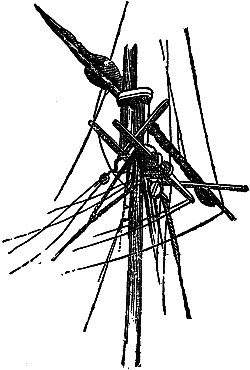 Fig. 1
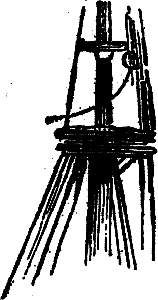 Fig. 2.
Take a single instance. I do not know any work in which,
on the whole, there is a more unaffected love of ships for their
own sake, and a fresher feeling of sea breeze always blowing,
than Stanfield's "Coast Scenery." Now, let the reader take
up that book, and look through all the plates of it at the way
in which the most important parts of a ship's skeleton are
drawn, those most wonderful junctions of mast with mast,
corresponding to the knee or hip in the human frame, technically
known as "Tops." Under its very simplest form, in
one of those poor collier brigs, which I have above endeavored
to recommend to the readers affection, the junction of the
top-gallant-mast with the topmast, when the sail is reefed,
will present itself under no less complex and mysterious form
than this in Fig. 1, a horned knot of seven separate pieces of
timber, irrespective of the two masts and the yard; the whole
balanced and involved in an apparently inextricable web of
chain and rope, consisting of at least sixteen ropes about the
top-gallant-mast, and some twenty-five crossing each other
in every imaginable degree of slackness and slope about the
topmast. Two-thirds of these ropes are omitted in the cut,
because I could not draw them without taking more time and
pains than the point to be illustrated was worth; the thing,
as it is, being drawn quite well enough to give some idea of
the facts of it. Well, take up Stanfield's "Coast Scenery,"
and look through it in search of tops, and you will invariably
find them represented as in Fig. 2, or even with fewer lines;
the example Fig. 2 being one of the tops of the frigate running
into Portsmouth harbor, magnified to about twice its
size in the plate.
"Well, but it was impossible to do more on so small a
scale." By no means: but take what scale you choose, of
Stanfield's or any other marine painter's most elaborate painting,
and let me magnify the study of the real top in proportion,
and the deficiency of detail will always be found
equally great: I mean in the work of the higher artists, for
there are of course many efforts at greater accuracy of
delineation by those painters of ships who are to the higher
marine painter what botanical draughtsmen are to the landscapists;
but just as in the botanical engraving the spirit and
life of the plant are always lost, so in the technical ship-painting
the life of the ship is always lost, without, as far as
I can see, attaining, even by this sacrifice, anything like
completeness of mechanical delineation. At least, I never
saw the ship drawn yet which gave me the slightest idea of
the entanglement of real rigging.
Respecting this lower kind of ship-painting, it is always
matter of wonder to me that it satisfies sailors. Some years
ago I happened to stand longer than pleased my pensioner
guide before Turner's "Battle of Trafalgar," at Greenwich
Hospital; a picture which, at a moderate estimate, is simply
worth all the rest of the hospital—ground—walls—pictures
and models put together. My guide, supposing me to be
detained by indignant wonder at seeing it in so good a place,
assented to my supposed, sentiments by muttering in a low
voice: "Well, sir, it is a shame that that thing should be there.
We ought to 'a 'ad a Uggins; that's sartain." I was not surprised
that my sailor friend should be disgusted at seeing the
Victory lifted nearly right out of the water, and all the sails
of the fleet blowing about to that extent that the crews might
as well have tried to reef as many thunder-clouds. But I
was surprised at his perfect repose of respectful faith in
"Uggins," who appeared to me—unfortunate landsman as
I was—to give no more idea of the look of a ship of the line
going through the sea, than might be obtained from seeing
one of the correct models at the top of the hall floated in a
fishpond.
Leaving, however, the sailor to his enjoyment, on such
grounds as it may be, of this model drawing, and being
prepared to find only a vague and hasty shadowing forth of
shipping in the works of artists proper, we will glance briefly
at the different stages of excellence which such shadowing
forth has reached, and note in their consecutive changes the
feelings with which shipping has been regarded at different
periods of art.
1. Mediæval Period. The vessel is regarded merely as a
sort of sea-carriage, and painted only so far as it is necessary
for complete display of the groups of soldiers or saints on
the deck: a great deal of quaint shipping, richly hung with
shields, and gorgeous with banners, is, however, thus incidently
represented in 15th-century manuscripts, embedded
in curly green waves of sea full of long fish; and although
there is never the slightest expression of real sea character,
of motion, gloom, or spray, there is more real interest of
marine detail and incident than in many later compositions.
2. Early Venetian Period. A great deal of tolerably careful
boat-drawing occurs in the pictures of Carpaccio and
Gentile Bellini, deserving separate mention among the marine
schools, in confirmation of what has been stated above, that
the drawing of boats is more difficult than that of the human
form. For, long after all the perspectives and fore-shortenings
of the human body were completely understood, as well
as those of architecture, it remained utterly beyond the power
of the artists of the time to draw a boat with even tolerable
truth. Boats are always tilted up on end, or too long, or too
short, or too high in the water. Generally they appear to
be regarded with no interest whatever, and are painted merely
where they are matters of necessity. This is perfectly natural:
we pronounce that there is romance in the Venetian
conveyance by oars, merely because we ourselves are in the
habit of being dragged by horses. A Venetian, on the other
hand, sees vulgarity in a gondola, and thinks the only true
romance is in a hackney coach. And thus, it was no more
likely that a painter in the days of Venetian power should
pay much attention to the shipping in the Grand Canal than
that an English artist should at present concentrate the
brightest rays of his genius on a cab-stand.
3. Late Venetian Period. Deserving mention only for its
notably negative character. None of the great Venetian
painters, Tintoret, Titian, Veronese, Bellini, Giorgione,
Bonifazio, ever introduce a ship if they can help it. They
delight in ponderous architecture, in grass, flowers, blue
mountains, skies, clouds, and gay dresses; nothing comes
amiss to them but ships and the sea. When they are forced
to introduce these, they represent merely a dark-green plain,
with reddish galleys spotted about it here and there, looking
much like small models of shipping pinned on a green board.
In their marine battles, there is seldom anything discernible
except long rows of scarlet oars, and men in armor falling
helplessly through them.
4. Late Roman Period. That is to say, the time of the
beginning of the Renaissance landscape by the Caracci,
Claude, and Salvator. First, in their landscapes, shipping
begins to assume something like independent character, and
to be introduced for the sake of its picturesque interest;
although what interest could be taken by any healthy human
creature in such vessels as were then painted has always
remained a mystery to me. The ships of Claude, having hulls
of a shape something between a cocoa-nut and a high-heeled
shoe, balanced on their keels on the top of the water, with
some scaffolding and cross-sticks above, and a flag at the top
of every stick, form perhaps the purest exhibition of human
inanity and fatuity which the arts have yet produced. The
harbors also, in which these model navies ride, are worthy
of all observation for the intensity of the false taste which,
endeavoring to unite in them the characters of pleasure-ground
and port, destroys the veracity of both. There are
many inlets of the Italian seas where sweet gardens and
regular terraces descend to the water's edge; but these are
not the spots where merchant vessels anchor, or where bales
are disembarked. On the other hand, there are many busy
quays and noisy arsenals upon the shores of Italy; but
Queen's palaces are not built upon the quays, nor are the
docks in any wise adorned with conservatories or ruins. It
was reserved for the genius of Claude to combine the luxurious
with the lucrative, and rise to a commercial ideal, in
which cables are fastened to temple pillars, and lighthouses
adorned with rows of beaupots. It seems strange also that
any power which Salvator showed in the treatment of other
subjects utterly deserts him when he approaches the sea.
Though always coarse, false, and vulgar, he has at least
energy, and some degree of invention, as long as he remains
on land; his terrestrial atrocities are animated, and his rock-born
fancies formidable. But the sea air seems to dim his
sight and paralyze his hand. His love of darkness and destruction,
far from seeking sympathy in the rage of ocean,
disappears as he approaches the beach; after having tortured
the innocence of trees into demoniac convulsions, and shattered
the loveliness of purple hills into colorless dislocation,
he approaches the real wrath and restlessness of ocean without
either admiration or dismay, and appears to feel nothing at
its shore except a meager interest in bathers, fishermen, and
gentlemen in court dress bargaining for state cabins. Of all
the pictures by men who bear the reputation of great masters
which I have ever seen in my life (except only some by
Domenichino), the two large "Marines" in the Pitti Palace,
attributed to Salvator, are, on the whole, the most vapid and
vile examples of human want of understanding. In the folly
of Claude there is still a gleam of grace and innocence; there
is refreshment in his childishness, and tenderness in his
inability. But the folly of Salvator is disgusting in its very
nothingness: it is like the vacuity of a plague-room in an
hospital, shut up in uncleansed silence, emptied of pain and
motion, but not of infection.
5. Dutch Period. Although in artistical qualities lower
than is easily by language expressible, the Italian marine
painting usually conveys an idea of three facts about the sea,—that
it is green, that it is deep, and that the sun shines on
it. The dark plain which stands for far away Adriatic with
the Venetians, and the glinting swells of tamed wave which
lap about the quays of Claude, agree in giving the general
impression that the ocean consists of pure water, and is open
to the pure sky. But the Dutch painters, while they attain
considerably greater dexterity than the Italian in mere delineation
of nautical incident, were by nature precluded from
ever becoming aware of these common facts; and having, in
reality, never in all their lives seen the sea, but only a shallow
mixture of sea-water and sand; and also never in all their
lives seen the sky, but only a lower element between them and
it, composed of marsh exhalation and fog-bank; they are not
to be with too great severity reproached for the dullness of
their records of the nautical enterprise of Holland. We only
are to be reproached, who, familiar with the Atlantic, are yet
ready to accept with faith, as types of sea, the small waves
en papillote, and peruke-like puffs of farinaceous foam, which
were the delight of Backhuysen and his compeers. If one
could but arrest the connoisseurs in the fact of looking at
them with belief, and, magically introducing the image of a
true sea-wave, let it roll up to them through the room,—one
massive fathom's height and rood's breadth of brine, passing
them by but once,—dividing, Red Sea-like, on right hand
and left,—but at least setting close before their eyes, for
once in inevitable truth, what a sea-wave really is; its green
mountainous giddiness of wrath, its overwhelming crest—heavy
as iron, fitful as flame, clashing against the sky in long
cloven edge,—its furrowed flanks, all ghastly clear, deep in
transparent death, but all laced across with lurid nets of
spume, and tearing open into meshed interstices their churned
veil of silver fury, showing still the calm gray abyss below;
that has no fury and no voice, but is as a grave always open,
which the green sighing mounds do but hide for an instant as
they pass. Would they, shuddering back from this wave of
the true, implacable sea, turn forthwith to the papillotes?
It might be so. It is what we are all doing, more or less,
continually.
Well, let the waves go their way; it is not of them that we
have here to reason; but be it remembered, that men who
cannot enter into the Mind of the Sea, cannot for the same
reason enter into the Mind of Ships, in their contention with
it; and the fluttering, tottering, high-pooped, flag-beset fleets
of these Dutch painters have only this much superiority over
the caricatures of the Italians, that they indeed appear in
some degree to have been studied from the high-pooped and
flag-beset nature which was in that age visible, while the
Claude and Salvator ships are ideals of the studio. But the
effort is wholly unsuccessful. Any one who has ever attempted
to sketch a vessel in motion knows that he might as easily
attempt to sketch a bird on the wing, or a trout on the dart.
Ships can only be drawn, as animals must be, by the high instinct
of momentary perception, which rarely developed itself
in any Dutch painter, and least of all in their painters of
marine. And thus the awkward forms of shipping, the shallow
impurity of the sea, and the cold incapacity of the painter,
joining in disadvantageous influence over them, the Dutch
marine paintings may be simply, but circumstantially, described
as the misrepresentation of undeveloped shipping in
a discolored sea by distempered painters. An exception
ought to be made in favor of the boats of Cuyp, which are
generally well floated in calm and sunny water; and, though
rather punts or tubs than boats, have in them some elements
of a slow, warm, square-sailed, sleepy grandeur—respectable
always, when compared either with the flickering follies of
Backhuysen, or the monstrous, unmanly, and à fortiori,
unsailorly absurdities of metaphysical vessels, puffed on their
way by corpulent genii, or pushed by protuberant dolphins,
which Rubens and the other so-called historical painters of
his time were accustomed to introduce in the mythology of
their court-adulation; that marvelous Faith of the 18th
century, which will one day, and that not far off, be known
for a thing more truly disgraceful to human nature than the
Polynesian's dance round his feather idol, or Egyptian's
worship of the food he fattened on. From Salvator and
Domenichino it is possible to turn in a proud indignation,
knowing that theirs are no fair examples of the human mind;
but it is with humbled and woful anger that we must trace
the degradation of the intellect of Rubens in his pictures of
the life of Mary of Medicis.[P]
6. Modern Period. The gradual appreciation of the true
character both of shipping and the ocean, in the works of the
painters of the last half century, is part of that successful
study of other elements of landscape, of which I have long
labored at a consistent investigation, now partly laid before
the public; I shall not, therefore, here enter into any general
inquiry respecting modern sea-painting, but limit myself to
a notice of the particular feelings which influenced Turner in
his marine studies, so far as they are shown in the series of
plates which have now been trusted to me for illustration.
Among the earliest sketches from nature which Turner
appears to have made, in pencil and Indian ink, when a boy
of twelve or fourteen, it is very singular how large a proportion
consists of careful studies of stranded boats. Now,
after some fifteen years of conscientious labor, with the
single view of acquiring knowledge of the ends and powers
of art, I have come to one conclusion, which at the beginning
of those fifteen years would have been very astonishing to
myself—that, of all our modern school of landscape painters,
next to Turner, and before the rise of the Pre-Raphaelites,
the man whose works are on the whole most valuable, and
show the highest intellect, is Samuel Prout. It is very
notable that also in Prout's early studies, shipping subjects
took not merely a prominent, but I think even a principal,
place.
The reason of this is very evident: both Turner and Prout
had in them an untaught, inherent perception of what was
great and pictorial. They could not find it in the buildings
or in the scenes immediately around them. But they saw
some element of real power in the boats. Prout afterwards
found material suited to his genius in other directions, and
left his first love; but Turner retained the early affection to
the close of his life, and the last oil picture which he painted,
before his noble hand forgot its cunning, was the Wreck-buoy.
The last thoroughly perfect picture he ever painted,
was the Old Téméraire.
The studies which he was able to make from nature in
his early years, are chiefly of fishing-boats, barges, and other
minor marine still life; and his better acquaintance with this
kind of shipping than with the larger kind is very marked
in the Liber Studiorum, in which there are five careful
studies of fishing-boats under various circumstances; namely,
Calais Harbor, Sir John Mildmay's Picture, Flint Castle,
Marine Dabblers, and the Calm; while of other shipping,
there are only two subjects, both exceedingly unsatisfactory.
Turner, however, deemed it necessary to his reputation at
that period that he should paint pictures in the style of Vandevelde;
and, in order to render the resemblance more
complete, he appears to have made careful drawings of the
different parts of old Dutch shipping. I found a large
number of such drawings among the contents of his neglected
portfolios at his death; some were clearly not by his own hand,
others appeared to be transcripts by him from prints or
earlier drawings; the quantity altogether was very great, and
the evidence of his prolonged attention to the subject more
distinct than with respect to any other element of landscape.
Of plants, rocks, or architecture, there were very few careful
pieces of anatomical study. But several drawers were
entirely filled with these memoranda of shipping.
In executing the series of drawings for the work known
as the Southern Coast, Turner appears to have gained many
ideas about shipping, which, once received, he laid up by
him for use in after years. The evidence of this laying by
of thought in his mind, as it were in reserve, until he had
power to express it, is curious and complete throughout his
life; and although the Southern Coast drawings are for the
most part quiet in feeling, and remarkably simple in their
mode of execution, I believe it was in the watch over the
Cornish and Dorsetshire coast, which the making of those
drawings involved, that he received all his noblest ideas
about sea and ships.
Of one thing I am certain; Turner never drew anything
that could be seen, without having seen it. That is to say,
though he would draw Jerusalem from some one else's
sketch, it would be, nevertheless, entirely from his own
experience of ruined walls: and though he would draw
ancient shipping (for an imitation of Vandevelde, or a
vignette to the voyage of Columbus) from such data as he
could get about things which he could no more see with his
own eyes, yet when, of his own free will, in the subject of
Ilfracombe, he, in the year 1818, introduces a shipwreck, I
am perfectly certain that, before the year 1818, he had seen
a shipwreck, and, moreover, one of that horrible kind—a
ship dashed to pieces in deep water, at the foot of an inaccessible
cliff. Having once seen this, I perceive, also, that
the image of it could not be effaced from his mind. It
taught him two great facts, which he never afterwards forgot;
namely, that both ships and sea were things that broke to
pieces. He never afterwards painted a ship quite in fair
order. There is invariably a feeling about his vessels of
strange awe and danger; the sails are in some way loosening,
or flapping as if in fear; the swing of the hull, majestic as
it may be, seems more at the mercy of the sea than in triumph
over it; the ship never looks gay, never proud, only warlike
and enduring. The motto he chose, in the Catalogue of the
Academy, for the most cheerful marine he ever painted, the
Sun of Venice going to Sea, marked the uppermost feeling
in his mind:
"Nor heeds the Demon that in grim repose
Expects his evening prey."
I notice above the subject of his last marine picture, the
Wreck-buoy, and I am well persuaded that from that year
1818, when first he saw a ship rent asunder, he never beheld
one at sea, without, in his mind's eye, at the same instant,
seeing her skeleton.
But he had seen more than the death of the ship. He had
seen the sea feed her white flames on souls of men; and heard
what a storm-gust sounded like, that had taken up with it,
in its swirl of a moment, the last breaths of a ship's crew.
He never forgot either the sight or the sound. Among the
last plates prepared by his own hand for the Liber Studiorum,
(all of them, as was likely from his advanced knowledge,
finer than any previous pieces of the series, and most of them
unfortunately never published, being retained beside him
for some last touch—forever delayed,) perhaps the most
important is one of the body of a drowned sailor, dashed
against a vertical rock in the jaws of one merciless, immeasurable
wave. He repeated the same idea, though more feebly
expressed, later in life, in a small drawing of Grandville,
on the coast of France. The sailor clinging to the boat in
the marvelous drawing of Dunbar is another reminiscence of
the same kind. He hardly ever painted a steep rocky coast
without some fragment of a devoured ship, grinding in the
blanched teeth of the surges,—just enough left to be a token
of utter destruction. Of his two most important paintings
of definite shipwreck I shall speak presently.
I said that at this period he first was assured of another
fact, namely, that the Sea also was a thing that broke to
pieces. The sea up to that time had been generally regarded
by painters as a liquidly composed, level-seeking consistent
thing, with a smooth surface, rising to a water-mark on sides
of ships; in which ships were scientifically to be embedded,
and wetted, up to said water-mark, and to remain dry
above the same. But Turner found during his Southern
Coast tour that the sea was not this: that it was, on the contrary,
a very incalculable and unhorizontal thing, setting its
"water mark" sometimes on the highest heavens, as well
as on sides of ships;—very breakable into pieces; half of
a wave separable from the other half, and on the instant
carriageable miles inland;—not in any wise limiting itself
to a state of apparent liquidity, but now striking like a steel
gauntlet, and now becoming a cloud, and vanishing, no eye
could tell whither; one moment a flint cave, the next a
marble pillar, the next a mere white fleece thickening the
thundery rain. He never forgot those facts; never afterwards
was able to recover the idea of positive distinction between
sea and sky, or sea and land. Steel gauntlet, black rock,
white cloud, and men and masts gnashed to pieces and disappearing
in a few breaths and splinters among them;—a little
blood on the rock angle, like red sea-weed, sponged away by
the next splash of the foam, and the glistering granite and
green water all pure again in vacant wrath. So stayed by
him, forever, the Image of the Sea.
One effect of this revelation of the nature of ocean to him
was not a little singular. It seemed that ever afterwards his
appreciation of the calmness of water was deepened by what
he had witnessed of its frenzy, and a certain class of entirely
tame subjects were treated by him even with increased affection
after he had seen the full manifestation of sublimity.
He had always a great regard for canal boats, and instead of
sacrificing these old, and one would have thought unentertaining,
friends to the deities of Storm, he seems to have returned
with a lulling pleasure from the foam and danger of the
beach to the sedgy bank and stealthy barge of the lowland
river. Thenceforward his work which introduces shipping
is divided into two classes; one embodying the poetry of
silence and calmness, the other of turbulence and wrath. Of
intermediate conditions he gives few examples; if he lets the
wind down upon the sea at all, it is nearly always violent,
and though the waves may not be running high, the foam is
torn off them in a way which shows they will soon run higher.
On the other hand, nothing is so perfectly calm as Turner's
calmness. To the canal barges of England he soon added
other types of languid motion; the broad-ruddered barks
of the Loire, the drooping sails of Seine, the arcaded barks
of the Italian lakes slumbering on expanse of mountain-guarded
wave, the dreamy prows of pausing gondolas on
lagoons at moon-rise; in each and all commanding an intensity
of calm, chiefly because he never admitted an instant's rigidity.
The surface of quiet water with other painters becomes
{lt}FIXED. With Turner it looks as if a fairy's breath would
stir it, but the fairy's breath is not there. So also his boats
are intensely motionless, because intensely capable of motion.
No other painter ever floated a boat quite rightly; all other
boats stand on the water, or are fastened in it; only his float
in it. It is very difficult to trace the reasons of this, for the
rightness of the placing on the water depends on such subtle
curves and shadows in the floating object and its reflection,
that in most cases the question of entirely right or entirely
wrong resolves itself into the "estimation of an hair": and
what makes the matter more difficult still, is, that sometimes
we may see a boat drawn with the most studied correctness in
every part, which yet will not swim; and sometimes we may
find one drawn with many easily ascertainable errors, which
yet swims well enough; so that the drawing of boats is something
like the building of them, one may set off their lines
by the most authentic rules, and yet never be sure they will
sail well. It is, however, to be observed that Turner seemed,
in those southern coast storms, to have been somewhat too
strongly impressed by the disappearance of smaller crafts
in surf, and was wont afterwards to give an uncomfortable
aspect even to his gentlest seas, by burying his boats too
deeply. When he erred, in this or other matters, it was not
from want of pains, for of all accessories to landscape, ships
were throughout his life those which he studied with the
greatest care. His figures, whatever their merit or demerit,
are certainly never the beloved part of his work; and though
the architecture was in his early drawings careful, and continued
to be so down to the Hakewell's Italy series, it soon
became mannered and false whenever it was principal. He
would indeed draw a ruined tower, or a distant town, incomparably
better than any one else, and a staircase or a bit of
balustrade very carefully; but his temples and cathedrals
showed great ignorance of detail, and want of understanding
of their character. But I am aware of no painting from the
beginning of his life to its close, containing modern shipping
as its principal subject, in which he did not put forth his
full strength, and pour out his knowledge of detail with a
joy which renders those works, as a series, among the most
valuable he ever produced. Take for instance:
- Lord Yarborough's Shipwreck.
- The Trafalgar, at Greenwich Hospital.
- The Trafalgar, in his own gallery.
- The Pas de Calais.
- The Large Cologne.
- The Havre.
- The Old Téméraire.
I know no fourteen pictures by Turner for which these
seven might be wisely changed; and in all of these the shipping
is thoroughly principal, and studied from existing ships.
A large number of inferior works were, however, also
produced by him in imitation of Vandevelde, representing
old Dutch shipping; in these the shipping is scattered,
scudding and distant, the sea gray and lightly broken. Such
pictures are, generally speaking, among those of least value
which he has produced. Two very important ones, however,
belong to the imitative school: Lord Ellesmere's, founded on
Vandevelde; and the Dort, at Farnley, on Cuyp. The latter,
as founded on the better master, is the better picture, but still
possesses few of the true Turner qualities, except his peculiar
calmness, in which respect it is unrivaled; and if joined with
Lord Yarborough's Shipwreck, the two may be considered as
the principal symbols, in Turner's early oil paintings, of his
two strengths in Terror and Repose. Among his drawings,
shipping, as the principal subject, does not always constitute
a work of the first class; nor does it so often occur. For the
difficulty, in a drawing, of getting good color is so much less,
and that of getting good form so much greater, than in oil,
that Turner naturally threw his elaborate studies of ship
form into oil, and made his noblest work in drawing rich in
hues of landscape. Yet the Cowes, Devonport, and Gosport,
from the England and Wales (the Saltash is an inferior
work), united with two drawings of this series, Portsmouth
and Sheerness, and two from Farnley, one of the wreck of
an Indiaman, and the other of a ship of the line taking
stores, would form a series, not indeed as attractive at first
sight as many others, but embracing perhaps more of Turner's
peculiar, unexampled, and unapproachable gifts than any
other group of drawings which could be selected, the choice
being confined to one class of subject.
I have only to state, in conclusion, that these twelve drawings
of the Harbors of England are more representable by
engraving than most of his works. Few parts of them are
brilliant in color; they were executed chiefly in brown and
blue, and with more direct reference to the future engraving
than was common with Turner. They are also small in size,
generally of the exact dimensions of the plate, and therefore
the lines of the compositions are not spoiled by contraction;
while finally, the touch of the painter's hand upon the wave-surface
is far better imitated by mezzotint engraving than
by any of the ordinary expedients of line. Take them all in
all, they form the most valuable series of marine studies
which have as yet been published from his works; and I hope
that they may be of some use hereafter in recalling the ordinary
aspect of our English seas, at the exact period when the
nation had done its utmost in the wooden and woven strength
of ships, and had most perfectly fulfilled the old and noble
prophecy—
"They shall ride
Over ocean wide,
With hempen bridle, and horse of tree."
Thomas of Ercildoune.


