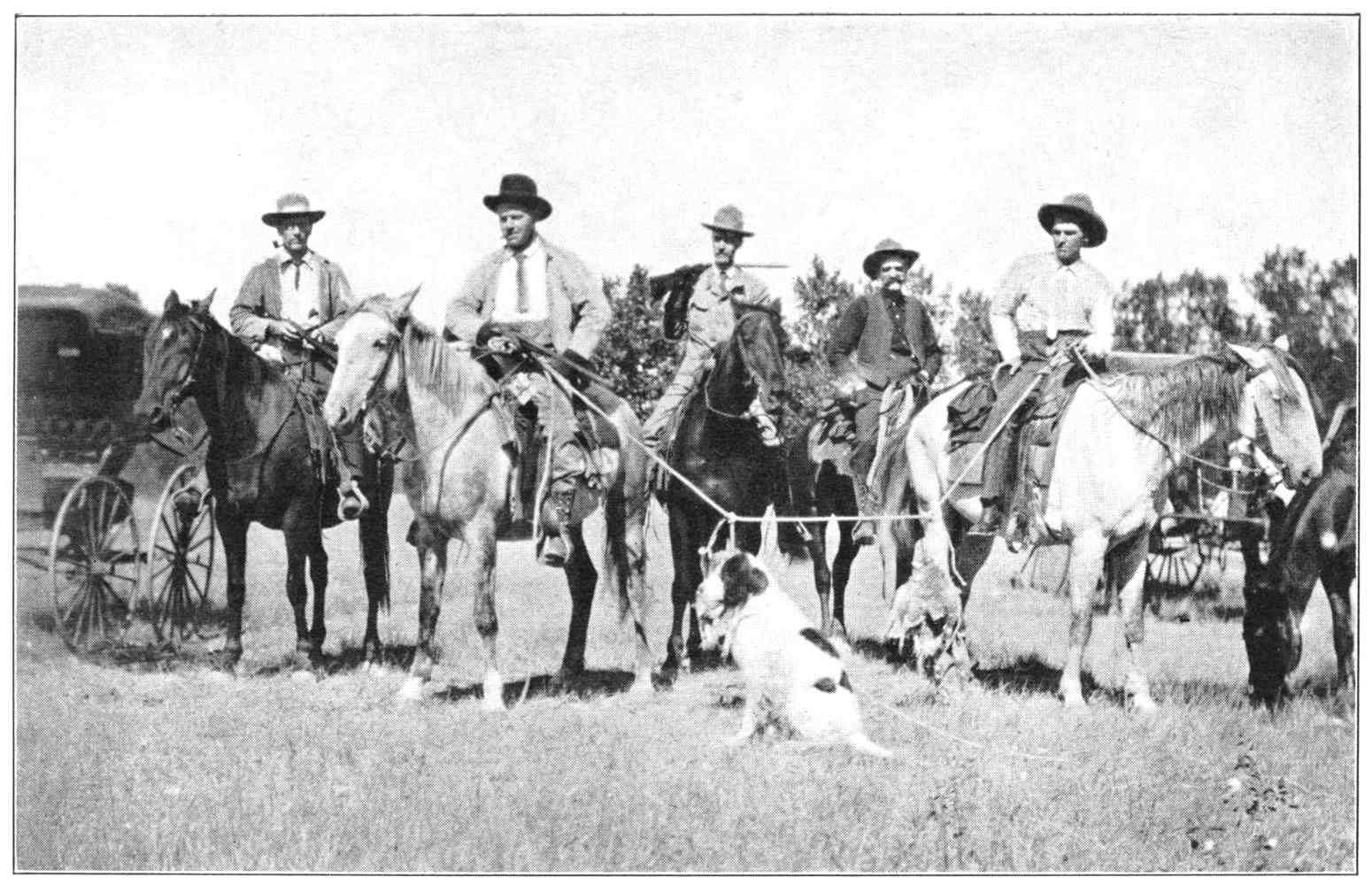
I THE HAPPY HUNTING-GROUNDS — II IN QUEST OF SABLE ANTELOPE
There is a universal saying to the effect
that it is when men are off in the wilds that
they show themselves as they really are. As
is the case with the majority of proverbs there
is much truth in it, for without the minor comforts
of life to smooth things down, and with
even the elemental necessities more or less
problematical, the inner man has an unusual
opportunity of showing himself—and he is not
always attractive. A man may be a pleasant
companion when you always meet him clad in
dry clothes, and certain of substantial meals at
regulated intervals, but the same cheery individual
may seem a very different person when
you are both on half rations, eaten cold, and
have been drenched for three days—sleeping
from utter exhaustion, cramped and wet.
My father had done much hunting with
many and varied friends. I have often heard
him say of some one whom I had thought an
ideal hunting companion: “He’s a good fellow,
but he was always fishing about in the
pot for the best piece of meat, and if there was
but one partridge shot, he would try to roast
it for himself. If there was any delicacy he
wanted more than his share.” Things assume
such different proportions in the wilds; after
two months living on palm-tree tops and
monkeys, a ten-cent can of condensed milk
bought for three dollars from a rubber explorer
far exceeds in value the greatest delicacy of
the season to the ordinary citizen who has a
varied and sufficient menu at his command
every day in the year.
Even as small children father held us responsible
to the law of the jungle. He would
take us out on camping trips to a neck of land
four or five miles across the bay from home.
We would row there in the afternoon, the boats
laden with blankets and food. Then we
would make a driftwood fire on which to fry
our supper—usually bacon and chicken. I
do not know whether it was the, to us, wild
romance of our position, or the keen appetite
from the row, but never since then have I
eaten such bacon. Not even the smallest
child was allowed to show a disposition to
grab, or select his pieces of chicken—we were
taught that that was an unpardonable offense
out camping, and might cause the culprit to
be left behind next time. And woe to any one
who in clumsily walking about kicked sand
into the frying-pan. After supper we would
heap more driftwood on the fire, and drape
ourselves in our blankets. Then we would
stretch ourselves out in the sand while father
would tell us ghost stories. The smallest of
us lay within reach of father where we could
touch him if the story became too vivid for
our nerves and we needed the reassuring feel
of his clothes to bring us back to reality.
There was, however, a delicious danger in being
too near him. In stories in which the
“haunt” seized his victim, father generally
illustrated the action by making a grab at
the nearest child. After the stories were finished
we rolled up in our blankets and, thoroughly
permeated with sand, we slept until the
first faint light of dawn. Then there was the
fire to be built up, and the breakfast cooked,
and the long row home. As we rowed we
chanted a ballad, usually of a seafaring nature;
it might be “The Rhyme of the Three
Sealers,” or “The Galley Slave,” or “Simon
Danz.” Father taught us these and many
more, viva voce, when he was dressing for
dinner. A child was not taken along on these
“campings out” until he was six or seven.
They took place three or four times a summer,
and continued until after the African expedition.
By that time we were most of us
away at work, scattered far and wide.
Father always threw himself into our plays
and romps when we were small as if he were
no older than ourselves, and with all that he
had seen and done and gone through, there was
never any one with so fresh and enthusiastic
an attitude. His wonderful versatility and
his enormous power of concentration and absorption
were unequalled. He could turn from
the consideration of the most grave problems
of state to romp with us children as if there
were not a worry in the world. Equally could
he bury himself in an exhaustive treatise on
the History of the Mongols or in the Hound
of the Baskervilles.
Until father sold his ranches in North Dakota
he used to go out West each year for a month
or so. Unfortunately, we were none of us
old enough to be taken along, but we would
wait eagerly for his letters, and the recipient of
what we called a picture letter gloried in the
envy of the rest until another mail placed a
substitute upon the pedestal. In these picture
letters father would sketch scenes and incidents
about the ranch or on his short hunting trips.
We read most of them to pieces, unluckily,
but the other day I came across one of the
non-picture letters that father wrote me:
August 30, ’96.
Out on the prairie.
I must send my little son a letter too, for his father
loves him very much. I have just ridden into camp
on Muley,[1] with a prongbuck strapped behind the
saddle; I was out six hours before shooting it. Then
we all sat down on the ground in the shade of the wagon
and had dinner, and now I shall clean my gun, and then
go and take a bath in a big pool nearby, where there
is a large flat stone on the edge, so I don’t have to get
my feet muddy. I sleep in the buffalo hide bag and
I never take my clothes off when I go to bed!
By the time we were twelve or thirteen we
were encouraged to plan hunting trips in the
West. Father never had time to go with us,
but we would be sent out to some friend of his,
like Captain Seth Bullock, to spend two or
three weeks in the Black Hills, or perhaps we
would go after duck and prairie-chicken with
Marvin Hewitt. Father would enter into all
the plans and go down with us to the range
to practise with rifle or shotgun, and when we
came back we would go over every detail of the
trip with him, revelling in his praise when he
felt that we had acquitted ourselves well.
Father was ever careful to correct statements
to the effect that he was a crack shot. He
would explain how little being one had to do
with success and achievement as a hunter.
Perseverance, skill in tracking, quick vision,
endurance, stamina, and a cool head, coupled
with average ability as a marksman, produced
far greater results than mere skill with a rifle—unaccompanied
to any marked extent by
the other attributes. It was the sum of all
these qualities, each above the average, but
none emphasized to an extraordinary degree,
that accounted for father’s great success in
the hunting-field. He would point out many
an excellent shot at a target who was of no use
against game. Sometimes this would be due
to lack of nerve. Father himself was equally
cool and unconcerned whether his quarry was a
charging lion or a jack-rabbit; with, when it
came to the question of scoring a hit, the resultant
advantage in the size of the former as
a target. In other instances a good man at
the range was not so good in the field because
he was accustomed to shooting under conventional
and regulated conditions, and fell down
when it came to shooting under disadvantageous
circumstances—if he had been running
and were winded, if he were hungry or wet,
or tired, or feeling the sun, if he were uncertain
of the wind or the range. Sometimes, of
course, a crack shot possesses all the other
qualities; such is the case with Stewart Edward
White, whom Cuninghame classified as the
best shot with whom he had hunted in all his
twenty-five years in the wilds. Father shot
on a par with Cuninghame, and a good deal
better than I, though not as well as Tarleton.
I have often heard father regret the fact
that he did not care for shooting with the shotgun.
He pointed out that it was naturally
the most accessible and least expensive form
of hunting. His eyesight made it almost
impossible for him to attain much skill with a
shotgun, and although as a boy and young
man he went off after duck for sport, in later
years he never used a shotgun except for
collecting specimens or shooting for the pot.
He continually encouraged us to learn to shoot
with the gun. In a letter he wrote me to Europe
when I was off after chamois he said: “I
have played tennis a little with both Archie
and Quentin, and have shot with the rifle with
Archie and seen that he has practised shotgun
shooting with Seaman.”
When my brother and myself were ten and
eight, respectively, father took us and four of
our cousins of approximately the same ages to
the Great South Bay for a cruise, with some
fishing and bird-shooting thrown in, as the
guest of Regis Post. It was a genuine sacrifice
on father’s part, for he loathed sailing,
detested fishing, and was, to say the least, lukewarm
about bird-shooting. Rowing was the
only method of progression by water for which
he cared. The trip was a great success, however,
and father enjoyed it more than he anticipated,
for with the help of our host he instructed
us in caring for ourselves and our
firearms. I had a venerable 12-bore pin-fire
gun which was the first weapon my father ever
owned. It was usually known in the family as
the “rust bore” because in the course of its
eventful career it had become so pitted and
scarred with rust that you could put in as much
time as you wished cleaning and oiling without
the slightest effect. I stood in no little awe of
the pin-fire because of its recoil when fired, and
as I was in addition a miserably poor shot, my
bag on the Great South Bay trip was not
large. It consisted of one reedbird, which
father with infinite pains and determination
at length succeeded in enabling me to shoot.
I am sure he never spent more time and effort
on the most difficult stalk after some coveted
trophy in the West or in Africa.
Father’s hunting experiences had been confined
to the United States, but he had taken
especial interest in reading about Africa, the
sportsman’s paradise. When we were small he
would read us incidents from the hunting books
of Roualeyn Gordon Cumming, or Samuel
Baker, or Drummond, or Baldwin. These we
always referred to as “I stories,” because they
were told in the first person, and when we were
sent to bed we would clamor for just one more,
a petition that was seldom denied. Before
we were old enough to appreciate the adventures
we were shown the pictures, and through
Cornwallis Harris’s beautiful colored prints
in the Portraits of Game and Wild Animals of
Southern Africa we soon learned to distinguish
the great beasts of Africa. The younger
Gordon Cumming came to stay with us at
Sagamore, and when father would get him to
tell us hunting incidents from his own varied
career, we listened enthralled to a really living
“I story.” To us he was known as the “Elephant
Man,” from his prowess in the pursuit of
the giant pachyderm.
Then there was also the “Shark Man.”
He was an Australian who told us most thrilling
tales of encounters with sharks witnessed
when among the pearl-divers. I remember
vividly his description of seeing a shark attack
one of the natives working for him. The
man was pulled aboard only after the shark
had bitten a great chunk from his side and exposed
his heart, which they could see still
beating. He said, “Master, master, big fish,”
before he died.
The illustrations in Millais’s Breath from the
Veldt filled us with delight, and to this day I
know of no etching that affects me as does the
frontispiece by the author’s father. It is
called the “Last Trek.” An old hunter is lying
dead beside his ox-wagon; near him squat
two of his Kafir boys, and in the distance graze
herds of zebra and hartebeeste and giraffe.
Of the mighty hunters that still survived
at that time, father admired most Mr. F. C.
Selous. His books he knew almost by heart.
Whenever Selous came to the United States
he would stay with us, and father would sit
up till far into the night talking of wild life
in the open. Selous, at sixty-five, enlisted in
the late war as a private; he rose to be captain,
and was decorated with the D. S. O. for gallantry,
before he fell, fighting the Germans
in East Africa. No one could have devised a
more fitting end for the gallant old fellow than
to die at the head of his men, in a victorious
battle on those plains he had roamed so often
and loved so well, fighting against the worst
and most dangerous beast of his generation.
In 1887 father founded a hunting club
called the “Boone and Crockett” after two
of the most mighty hunters of America. No
one was entitled to membership who had not
brought down in fair chase three species of
American big game. The membership was
limited to a hundred and I well remember my
father’s pride when my brother and I qualified
and were eventually elected members. The
club interests itself particularly in the conservation
of wild life, and the establishment
of game refuges. Mr. Selous and other English
hunters were among the associate members.
In the summer of 1908 my father told me
that when his term in the White House ended
the following spring, he planned to make a
trip to Africa, and that if I wished to do so I
could accompany him. There was no need
to ask whether I wanted to go. At school
when we were writing compositions, mine almost
invariably took the form of some imaginary
journey across the “Dark Continent.”
Still, father had ever made it a practice to talk
to us as if we were contemporaries. He would
never order or even tell us to follow a certain
line; instead, he discussed it with us, and let
us draw our own conclusions. In that way we
felt that while we had his unreserved backing,
we were yet acting on our own initiative, and
were ourselves responsible for the results. If
a boy is forced to do a thing he often makes
but a half-hearted attempt to succeed, and lays
his failure to the charge of the person who
forced him, although he might well have come
through with flying colors had he felt that he
was acting on his own responsibility. In his
discussions with us, father could of course
shape our opinions in what he thought the
proper mould.
In like manner, when it came to taking me
to Africa father wanted me to go, but he also
wanted me to thoroughly understand the pro’s
and con’s. He explained to me that it was a
holiday that he was allowing himself at fifty,
after a very busy life—that if I went I would
have to make up my mind that my holiday
was coming at the beginning of my life, and
be prepared to work doubly hard to justify
both him and myself for having taken it. He
said that the great danger lay in my being unsettled,
but he felt that taken rightly the experience
could be made a valuable asset instead
of a liability. After we had once finished the
discussion and settled that I was to go, father
never referred to it again. He then set about
preparing for the expedition. Mr. Edward
North Buxton was another African hunter
whom he greatly admired, and it was to him
and to Selous that he chiefly turned for aid
in making his plans. It was often said of
father that he was hasty and inclined to go
off at half-cock. There was never any one who
was less so. He would gather his information
and make his preparations with painstaking
care, and then when the moment came
to act he was thoroughly equipped and prepared
to do so with that lightning speed that
his enemies characterized as rash hot-headedness.
Father always claimed that it was by discounting
and guarding against all possible
causes of failure that he won his successes.
His last great battle, that for preparedness for
the part that “America the Unready” would
have to play in the World War, was true to
his life creed. For everything he laid his
plans in advance, foreseeing as far as was
humanly possible each contingency to be encountered.
For the African expedition he made ready
in every way. I was at the time at Harvard,
and almost every letter brought some reference
to preparations. One day it would be: “The
Winchester rifles came out for trial and all
of them were sighted wrong. I sent them
back with rather an acid letter.” Then again:
“You and I will be so rusty when we reach
Sir Alfred Pease’s ranch that our first efforts
at shooting are certain to be very bad. In
March we will practise at Oyster Bay with the
30-30 until we get what I would call the
‘rifle sense’ back again, and this will make it
easier for us when, after a month’s sea trip, we
take up the business of hunting.”
A group of thirty or forty of the most famous
zoologists and sportsmen presented my father
with a heavy, double-barrelled gun. “At last
I have tried the double-barrelled Holland
Elephant rifle. It is a perfect beauty and it
shoots very accurately, but of course the recoil
is tremendous, and I fired very few shots.
I shall get you to fire it two or three times at a
target after we reach Africa, just so that you
shall be thoroughly familiar with it, if, or when,
you use it after big game. There is no question
that except under extraordinary circumstances
it would be the best weapon for elephant,
rhino, and buffalo. I think the 405
Winchester will be as good for everything
else.”
“About all my African things are ready now,
or will be in a few days. I suppose yours are
in good trim also [a surreptitious dig at a
somewhat lackadaisical son.] I am pursuing
my usual plan of taking all the precautions in
advance.”
A few days later came another reference to
the Holland & Holland: “The double-barrelled
four-fifty shot beautifully, but I was
paralyzed at the directions which accompanied
it to the effect that two shots must always be
fired in the morning before starting, as otherwise
from the freshly oiled barrels the first
shot would go high. This is all nonsense and
I shall simply have to see that the barrels are
clean of the oil.” The recoil of the big gun
was so severe that it became a standing joke
as to whether we did not fear it more than a
charging elephant!
Father gave the closest attention to every
detail of the equipment. The first provision
lists prepared by his friends in England were
drawn up on a presidential scale with champagne
and pâté de foies gras and all sorts of
luxuries. These were blue-pencilled and two
American staples substituted—baked beans
and canned tomatoes. Father always retained
the appreciation of canned tomatoes gained in
the early ranching days in the West. He would
explain how delicious he had found it in the
Bad Lands after eating the tomatoes to drink
the juice from the can. In hunting in a temperate
climate such as our West, a man can
get along with but very little, and it is difficult
to realize that a certain amount of luxury is
necessary in the tropics to maintain oneself
fit. Then, too, in Africa the question of transportation
was fairly simple—and almost everywhere
we were able to keep ourselves and the
porters amply supplied with fresh meat. Four
years later during the descent of the Dúvida—the
“River of Doubt”—we learned to our bitter
cost what it meant to travel in the tropics as
lightly equipped as one could, with but little
hardship, in the north. It was not, however,
through our own lack of forethought, but due
rather to the necessities and shifting chances
of a difficult and dangerous exploring expedition.
Even if it is true as Napoleon said, that an
army marches on its belly, still, it won’t go far
unless its feet are properly shod, and since my
father had a skin as tender as a baby’s, he
took every precaution that his boots should
fit him properly and not rub. “The modified
duffle-bags came all right. I suppose we will
get the cotton-soled shoes, but I do not know.
How do you like the rubber-soled shoes?
Don’t you think before ordering other pairs
it would be as well to wait until you see the
army shoes here, which are light and somehow
look as if they were more the kind you ordinarily
use? How many pairs have you now
for the African trip, and how many more do
you think you want?”
Father was fifty years old in the October before
we left for Africa, and the varied experiences
of his vigorous life had, as he used to
say, battered and chipped him. One eye was
to all intents useless from the effects of a
boxing-match, and from birth he had been so
astigmatic as to be absolutely unable to use a
rifle and almost unable to find his way in the
woods without his glasses. He never went off
without eight or ten pairs so distributed
throughout his kit as to minimize the possibility
of being crippled through any ordinary
accident. Even so, any one who has worn
glasses in the tropics knows how easily they
fog over, and how hopeless they are in the
rains. It was a continual source of amazement
to see how skilfully father had discounted this
handicap in advance and appeared to be unhampered
by it.
Another serious threat lay in the leg that
had been injured when the carriage in which
he was driving was run down by a trolley-car,
and the secret service man with him was
killed. In September, 1908, he wrote me from
Washington: “I have never gotten over the
effects of the trolley-car accident six years ago,
when, as you will remember, they had to cut
down to the shin bone. The shock permanently
damaged the bone, and if anything
happens there is always a chance of trouble
which would be serious. Before I left Oyster
Bay, while riding, I got a rap on the shin
bone from a branch. This was either the cause
or the occasion of an inflammation, which had
grown so serious when I got back here that
Doctor Rixey had to hastily take it in hand.
For a couple of days it was uncertain whether
we would not have to have another operation
and remove some of the bones of the leg, but
fortunately the doctor got it in hand all right,
and moreover it has enabled me to learn just
what I ought to do if I am threatened with
similar trouble in Africa.”
His activity, however, was little hampered
by his leg, for a few weeks later he wrote:
“I have done very little jumping myself, and
that only of the small jumps up to four feet,
because it is evident that I have got to be
pretty careful of my leg, and that an accident
of at all a serious character might throw me
out of gear for the African trip. This afternoon
by the way, Archie Butt and I took a
scramble down Rock Creek. It was raining
and the rocks were slippery, and at one point
I slipped off into the creek, but merely bruised
myself in entirely safe places, not hurting my
leg at all. When we came to the final and
stiffest cliff climb, it was so dark that Archie
couldn’t get up.” From which it may be
seen that neither endurance nor skill suffered
as a result of the accident to the leg. Still, as
Bret Harte says, “We always wink with the
weaker eye,” and when anything went wrong,
the leg was sure to be implicated. Father
suffered fearfully with it during the descent
of the River of Doubt. One of the most constant
pictures of father that I retain is at Sagamore
after dinner on the piazza. He would
draw his chair out from the roofed-over part
to where he could see the moon and the
stars. When things were black he would often
quote Jasper Petulengro in Borrow’s Lavengro:
“Life is sweet, brother.... There’s day and
night, brother, both sweet things; sun, moon,
and stars, all sweet things; ... and likewise
there’s a wind on the heath,” and would add:
“Yes, there’s always the wind on the heath.”
From where he sat he looked across the fields
to the dark woods, and over the tree-tops to
the bay with the changing twinkling lights of
the small craft; across the bay to the string
of lamps along the causeway leading to Centre
Island, and beyond that again Long Island
Sound with occasionally a “tall Fall Steamer
light.” For a while father would drink his
coffee in silence, and then his rocking-chair
would start creaking and he would say: “Do
you remember that night in the Sotik when
the gun-bearers were skinning the big lion?”
or “What a lovely camp that was under the
big tree in the Lado when we were hunting the
giant eland?”
We get three sorts and periods of enjoyment
out of a hunting trip. The first is when the
plans are being discussed and the outfit assembled;
this is the pleasure of anticipation. The
second is the enjoyment of the actual trip itself;
and the third is the pleasure of retrospection
when we sit round a blazing wood-fire
and talk over the incidents and adventures of
the trip. There is no general rule to know
which of the three gives the keenest joy. I
can think of a different expedition in which
each sort stands out in pre-eminence. Even
if the trip has been exceptionally hard and the
luck unusually bad, the pleasures of anticipation
and preparation cannot be taken away,
and frequently the retrospect is the more satisfactory
because of the difficulties and discomforts
surmounted.
I think we enjoyed the African trip most in
the actuality, and that is saying a great deal.
It was a wonderful “adventure” and all the
world seemed young. Father has quoted in the
foreword to African Game Trails: “I speak
of Africa and golden joys.” It was a line
that I have heard him repeat to himself many
times. In Africa everything was new. He
revelled in the vast plains blackened with herds
of grazing antelope. From his exhaustive
reading and retentive memory he knew already
the history and the habits of the different
species of game. When we left camp
in the early morning we never could foretell
what we would run into by nightfall—we were
prepared for anything from an elephant to
a dik-dik—the graceful diminutive antelope
no larger than a hare. In the evening, after
we had eaten we would gather round the camp-fire—for
in the highlands the evenings were
chilly—and each would tell the adventures of
his day, and discuss plans for the morrow.
Then we would start paralleling and comparing.
Father would illustrate with adventures
of the old days in our West; Cuninghame
from the lore gathered during his twenty years
in Africa would relate some anecdote, and
Mearns would talk of life among the wild
tribes in the Philippines.
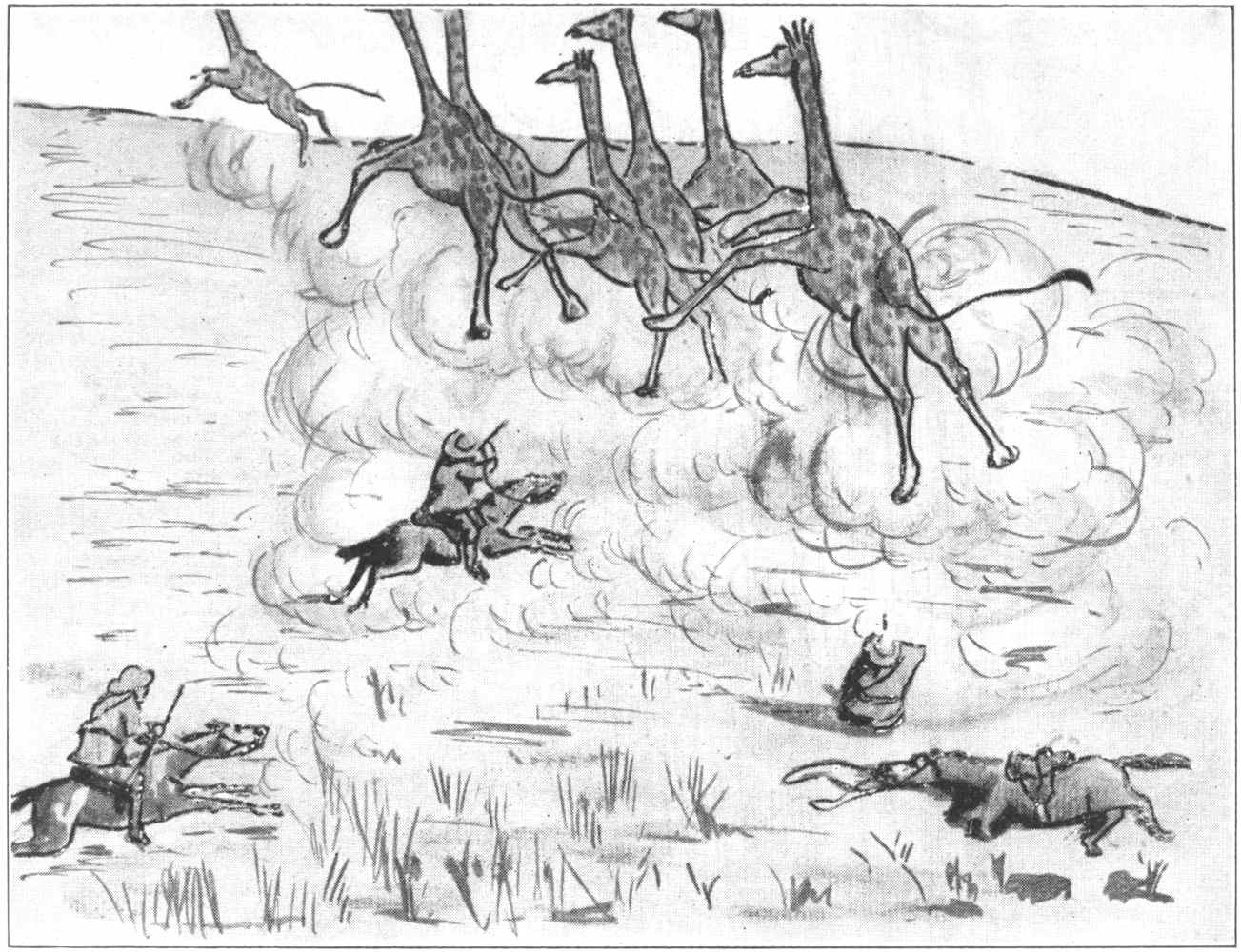
Sir Alfred Pease’s sketch of our first giraffe hunt
Colonel Mearns belonged to the medical
corps in the army. He had come with us as
an ornithologist, for throughout his military
career he had been actively interested in sending
specimens from wherever he was serving
to the Smithsonian National Museum in Washington.
His mild manner belied his fearless
and intrepid disposition. A member of the
expedition once came into camp with an account
of the doctor, whom he had just run
across—looking too benevolent for this world,
engaged in what our companion described as
“slaughtering humming-birds, pursuing them
from bush to bush.” One of his Philippine
adventures filled us with a delighted interest
for which I don’t believe he fully appreciated
the reason. He told us how with a small force
he had been hemmed in by a large number of
Moros. The Americans took refuge in a
stockade on a hilltop. The Moros advanced
time and again with the greatest gallantry,
and Mearns explained how sorry he felt for
them as they fell—some under the very walls
of the stockade. In a musing tone at the
end he added: “I slipped out of the stockade
that night and collected a most interesting
series of skulls; they’re in the Smithsonian
to-day.”
Father was the rare combination of a born
raconteur—with the gift of putting in all the
little details that make a story—and an equally
good listener. He was an adept at drawing
people out. His interest was so whole-hearted
and obvious that the shyest, most tongue-tied
adventurer found himself speaking with
entire freedom. Every one with whom we came
in contact fell under the charm. Father invariably
thought the best of a person, and for
that very reason every one was at his best with
him—and felt bound to justify his confidence
and judgment. With him I always thought
of the Scotch story of the MacGregor who,
when a friend told him that it was an outrage
that at a certain banquet he should have been
given a seat half-way down the table, replied:
“Where the MacGregor sits is the head of the
table!” Where father sat was always the head
of the table, and yet he treated every one with
the same courtesy and simplicity, whether it
was the governor of the Protectorate or the
poorest Boer settler. I remember how amazed
some were at the lack of formality in his relationship
with the members of the expedition.
Many people who have held high positions
feel it incumbent on them to maintain a certain
distance in their dealings with their less
illustrious fellow men. If they let down the
barrier they feel, they would lose dignity.
They are generally right, for their superiority
is not innate, but the result of chance. With
father it was otherwise. The respect and
consideration felt for him could not have been
greater, and would certainly not have been
so sincere, had he built a seven-foot barrier
about himself.
He was most essentially unselfish, and wanted
no more than would have been his just due if
the expedition, instead of being owing entirely
to him, both financially and otherwise, had
been planned and carried out by all of us.
He was a natural champion of the cause of
every man, and not only in his books would he
carefully give credit where it was due, but he
would endeavor to bring about recognition
through outside channels. Thus he felt that
Colonel Rondon deserved wide acknowledgment
for the years of exploring in the Brazilian
Hinterland; and he brought it to the attention
of the American and British Geographical
Societies. As a result, the former awarded
the gold medal to Colonel Rondon. In the
same way father championed the cause of
the naturalists who went with him on his expeditions.
He did his best to see that the
museums to which they belonged should appreciate
their services, and give them the opportunity
to follow the results through. When
an expedition brings back material that has
not been described, the museum publishes
pamphlets listing the new species, and explaining
their habitats and characteristics. This
is rarely done by the man who did the actual
collecting. Father, whenever it was feasible,
arranged for the naturalists who had accompanied
or taken part in the collecting to have
the credit of writing the pamphlets describing
the results of their work. To a layman this
would not seem much, but in reality it means
a great deal. Father did all he could to encourage
his companions to write their experiences,
for most of them had led eventful lives
filled with unusual incident. When, as is
often the case, the actor did not have the power
of written narrative, father would be the first
to recognize it, and knew that if inadequately
described, the most eventful careers may be
of no more interest than the catalogue of ships
in the Odyssey, or the “begat” chapters in the
Bible. If, however, father felt that there existed
a genuine ability to write, he would spare
no efforts to place the articles; in some cases
he would write introductions, and in others,
reviews of the book, if the results attained to
that proportion.
One of the most careful preparations that
father made for the African expedition was
the choosing of the library. He selected as
wide a range as possible, getting the smallest
copy of each book that was obtainable with
decent reading type. He wanted a certain
number of volumes mainly for the contrast
to the daily life. He told me that he had
particularly enjoyed Swinburne and Shelley
in ranching days in the Bad Lands, because
they were so totally foreign to the life and the
country—and supplied an excellent antidote
to the daily round. Father read so rapidly
that he had to plan very carefully in order to
have enough books to last him through a
trip. He liked to have a mixture of serious
and light literature—chaff, as he called the
latter. When he had been reading histories
and scientific discussions and political treatises
for a certain length of time, he would plunge
into an orgy of detective stories and novels
about people cast away on desert islands.
The plans for the Brazilian expedition came
into being so unexpectedly that he could
not choose his library with the usual care.
He brought Gibbon’s Decline and Fall of the
Roman Empire in the Everyman’s edition,
and farmed out a volume to each of us, and
most satisfactory it proved to all. He also
brought Marcus Aurelius and Epictetus, but
when he tried to read them during the descent
of the Rio da Dúvida, they only served to fill
him with indignation at their futility. Some
translations of Greek plays, not those of Gilbert
Murray, for which he had unstinted praise,
met with but little better success, and we were
nearly as badly off for reading matter as we
were for provisions. I had brought along a
selection of Portuguese classics and a number
of French novels. The former were useless
to father, but Henri Bordeaux and Maurice
Leblanc were grist to the mill. It was father’s
first introduction to Arsène, and he thoroughly
enjoyed it—he liked the style, although for
matter he preferred Conan Doyle. Father
never cared very much about French novels—the
French books that he read most were
scientific volumes—histories of the Mongols—and
an occasional hunting book, but he afterward
became a great admirer of Henri Bordeaux.
At last the time came when there was
nothing left but the Oxford books of English
and French verse. The one of English verse
he had always disliked. He said that if there
were to be any American poetry included, it
should be at any rate a good selection. The
choice from Longfellow’s poems appealed to
him as particularly poor, and I think that it
was for this reason that he disapproved of the
whole collection. Be that as it may, I realized
how hard up for something to read father must
be when he asked me for my Oxford book of
English verse. For French verse father had
never cared. He said it didn’t sing sufficiently.
“The Song of Roland” was the one exception
he granted. It was, therefore, a still greater
proof of distress when he borrowed the Oxford
book of French verse. He always loved to
tell afterward that when he first borrowed it
he started criticising and I had threatened to
take it away if he continued to assail my
favorites. In spite of all this he found it infinitely
preferable to Epictetus and Marcus
Aurelius, and, indeed, became very fond of
some of the selections. Villon and Ronsard
particularly interested him.
When riding along through the wilderness
father would often repeat poetry to himself.
To learn a poem he had only to read it through
a few times, and he seemed never to forget
it. Sometimes we would repeat the poem together.
It might be parts of the “Saga of King
Olaf,” or Kipling’s “Rhyme of the Three
Sealers,” or “Grave of a Hundred Head,” or,
perhaps, “The Bell Buoy”—or again it might
be something from Swinburne or Shelley or
Keats—or the “Ballad of Judas Iscariot.” He
was above all fond of the poetry of the open,
and I think we children got much of our love
for the outdoor life, not only from actual example,
but from the poetry that father taught
us.
There was an indissoluble bond between
him and any of his old hunting companions,
and in no matter what part of the world he
met them, all else was temporarily forgotten
in the eager exchange of reminiscences of old
days. On the return from Africa, Seth Bullock,
of Deadwood, met us in London. How
delighted father was to see him, and how he
enjoyed the captain’s comments on England
and things English! One of the captain’s first
remarks on reaching London was to the effect
that he was so glad to see father that he
felt like hanging his hat on the dome of Saint
Paul’s and shooting it off. We were reminded
of Artemus Ward’s classic reply to the guard
who found him tapping, with his cane, an inscription
in Westminster Abbey: “Come,
come, sir, you mustn’t do that. It isn’t permitted,
you know!” Whereupon Artemus
Ward turned upon him: “What, mustn’t do
it? If I like it, I’ll buy it!” It was never
difficult to trail the captain. When my sister
and I were going through Edinburgh Castle,
the local guide showed us an ancient gun,
firing a cluster of five or six barrels. With
great amusement he told us how an American
to whom he was showing the piece a few days
previously had remarked that to be shot at
with that gun must be like taking a shower-bath.
A few questions served to justify the
conclusion we had immediately formed as to
the identity of our predecessor. Father had
him invited to the dinner given by the donors
of the Holland & Holland elephant rifle.
Of the hunting comrades of his early days,
he told me that Mr. R. H. Munro Ferguson
was the most satisfactory of all, for he met
all requirements—always good-humored when
things went wrong, possessing a keen sense of
humor, understanding the value of silent companionship,
and so well read and informed as
to be able to discuss appreciatively any of the
multitudinous questions of literature or world
affairs that interested my father.
In Washington when an old companion
turned up he would be triumphantly borne off
to lunch, to find himself surrounded by famous
scientists, authors, senators, and foreign diplomats.
Father would shift with lightning rapidity
from one to the other—first he might
be discussing some question of Indian policy
and administration, next the attitude of a
foreign power—then an author’s latest novel—and
a few moments later, he would have led
on Johnny Goff to telling an experience with
the cougar hounds.
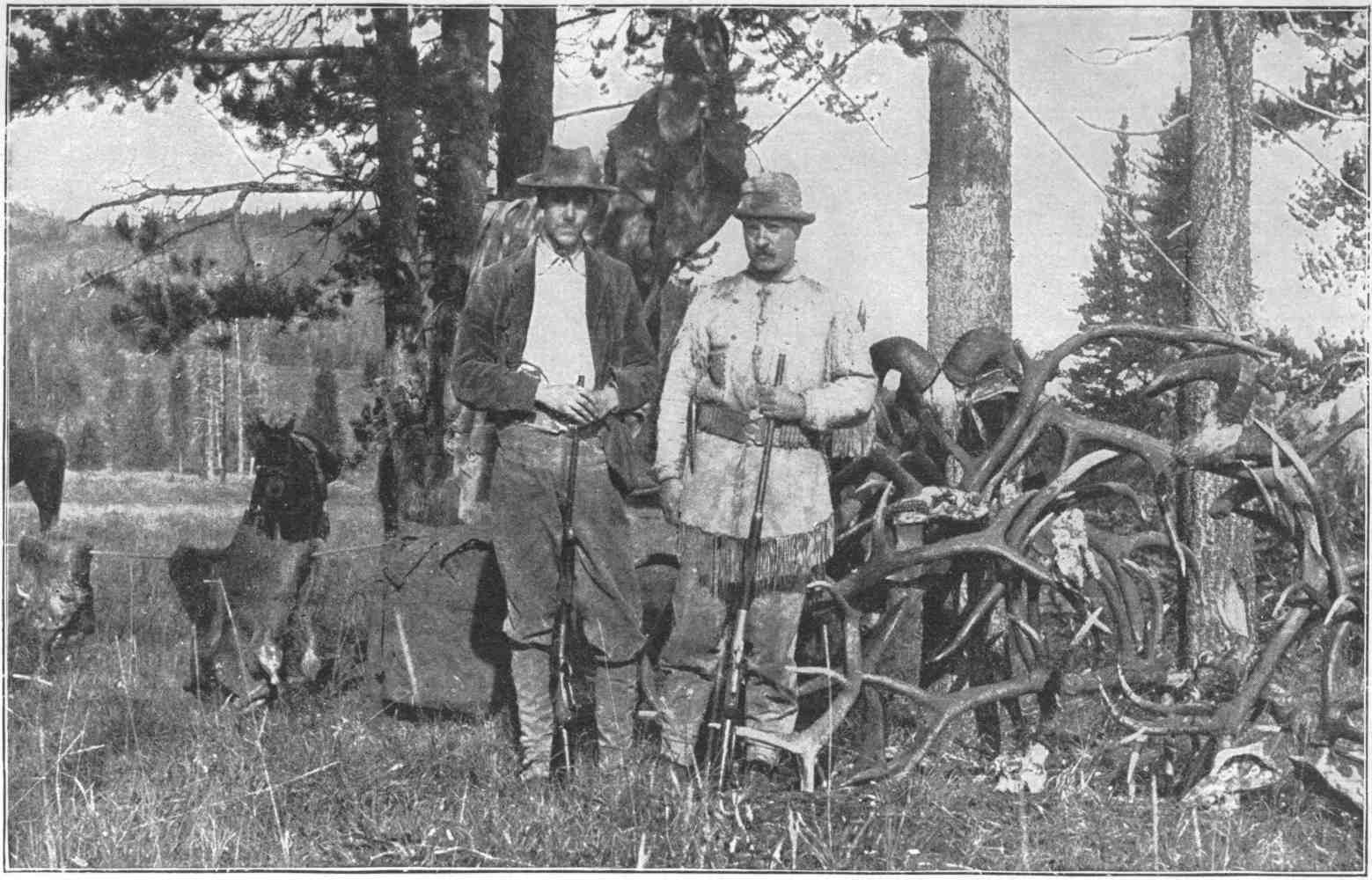
Father and R. H. Munro Ferguson at the Elkhorn Ranch, after the return from a successful
hunting trip
Any man who had hunted with father was
ready to follow him to the ends of the earth,
and no passage of time could diminish his
loyalty. With father the personal equation
counted for so much. He was so whole-heartedly
interested in his companions—in
their aspirations and achievements. In every
detail he was keenly interested, and he would
select from his library those volumes which
he thought would most interest each companion,
and, perhaps, develop in him the love
of the wonderful avocation which he himself
found in reading. His efforts were not always
crowned with success. Father felt that
our African companion, R. J. Cuninghame, the
“Bearded Master,” as the natives called him,
being Scotch should be interested in Scott’s
novels, so he selected from the “Pigskin Library”
a copy of one of them—Waverley, I
think it was. For some weeks Cuninghame
made progress, not rapid, it is true, for he
confessed to finding the notes the most interesting
part of the book, then one day when
they were sitting under a tree together in a
rest during the noonday heat, and father in
accordance with his invariable custom took out
a book from his saddle-pocket, R. J. produced
Waverley and started industriously to work on
it. Father looked over his shoulder to see
where he had got to, and to his amused delight
found that Cuninghame had been losing
ground—he was three chapters farther back
than he had been two weeks before!
We more than once had occasion to realize
how largely the setting is responsible for much
that we enjoy in the wilds. Father had told
me of how he used to describe the bellowing
of the bull elk as he would hear it ring out in
the frozen stillness of the forests of Wyoming.
He thought of it, and talked of it, as a weird,
romantic call—until one day when he was
walking through the zoological gardens accompanied
by the very person to whom he had
so often given the description. As they passed
the wapitis’ enclosure, a bull bellowed, and
father’s illusions and credit were simultaneously
shattered, for the romantic call he had
so often dwelt upon was, in a zoological park,
nothing more than a loud and discordant sort
of bray.
In spite of this lesson we would see something
among the natives that was interesting
or unusual and get it to bring home, only to
find that it was the exotic surroundings that
had been responsible for a totally fictitious
charm. A wild hill tribe in Africa use anklets
made from the skin of the colobus, a graceful,
long-haired monkey colored black and white.
When father produced the anklets at home,
the only thing really noticeable about them
was the fact that they smelt!
Another equally unfortunate case was the
affair of the beehives. The same hill tribe
was very partial to honey. An individual’s
wealth was computed in the number of beehives
that he possessed. They were made
out of hollowed logs three or four feet long
and eight or ten inches in diameter. A wife
or a cow was bought for an agreed upon number
of beehives, and when we were hunting, no
matter how hot the trail might be, the native
tracker would, if we came to a clearing and
saw some bees hovering about the forest flowers,
halt and offer up a prayer that the bees
should deposit the honey in one of his hives.
It seemed natural to bring a hive home, but
viewed in the uncompromising light of the
North Shore of Long Island it was merely a
characterless, uninteresting log.
Not the least of the many delights of being
a hunting companion of father’s was his
humor. No one could tell a better story,
whether it was what he used to call one of
his “old grouse in the gunroom” stories, or
an account, with sidelights, of a contemporaneous
adventure. The former had to do
with incidents in his early career in the cow-camps
of the Dakotas, or later on with the
regiment in Cuba—and phrases and incidents
of them soon became coin-current in the expedition.
Father’s humor was never under
any circumstances ill-natured, or of such a
sort as might make its object feel uncomfortable.
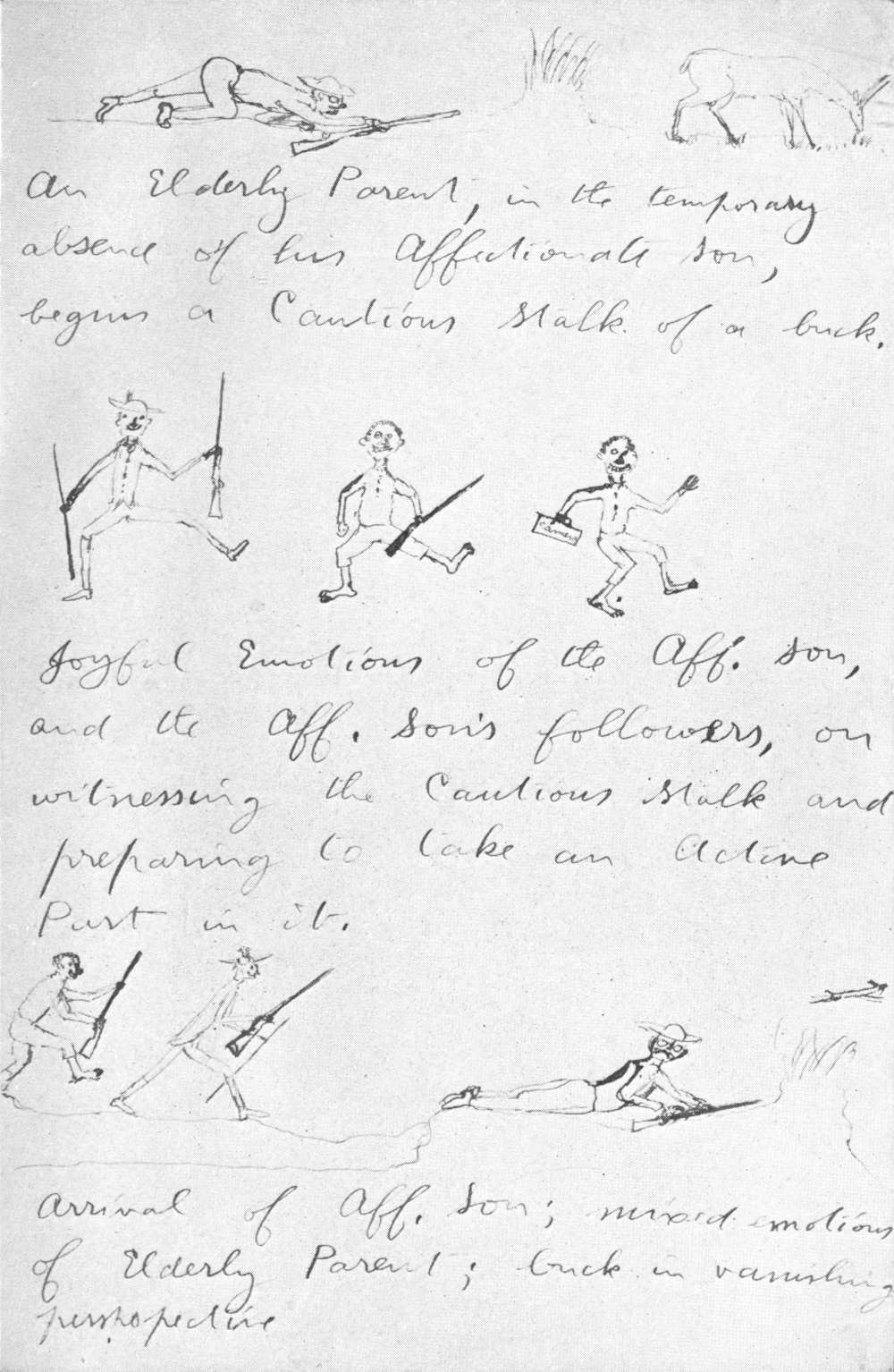
If anything amusing occurred to a member
of the expedition, father would embroider
the happening in inimitable fashion, but always
in such a way that the victim himself was
the person most amused. The accompanying
drawing will serve as illustration. Father and
I had gone out to get some buck to eke out the
food-supply for the porters. We separated,
but some time later I caught sight of father
and thought I would join him and return to
camp. I didn’t pay particular attention to
what he was doing, and as he was some way
off I failed to notice that he was walking
stooped to keep concealed by a rise of ground
from some buck he was stalking. The result
was the picture.
Before we started on the serious exploring
part of the Brazilian trip, we paid visits to
several fazendas or ranches in the state of
Matto Grosso, with the purpose of hunting
jaguar, as well as the lesser game of the country.
One of the fazendas at which we stayed
belonged to the governor of the state. When
we were wakened before daylight to start off
on the hunt we were given, in Brazilian fashion,
the small cup of black coffee and piece of bread
which constitutes the native Brazilian breakfast.
We would then sally forth to return
to the ranch not before noon, and sometimes
much later, as the hunting luck dictated.
We would find an enormous lunch waiting for
us at the house. Father, who was accustomed
to an American breakfast, remarked regretfully
that he wished the lunch were divided,
or that at least part of it were used to supplement
the black coffee of daybreak. The second
morning, as I went down the hall, the
dining-room door was ajar, and I caught sight
of the table laden with the cold meats and
salads that were to serve as part of our elaborate
luncheon many dim hours hence. I
hurried back to tell father, and we tiptoed
cautiously into the dining-room, closing the
door noiselessly behind us. While we were
engaged in making rapid despatch of a cold
chicken, we heard our hosts calling, and the
next minute the head of the house popped in
the door! As father said afterward, we felt
and looked like two small boys caught stealing
jam in the pantry.
The Brazilian exploration was not so carefully
planned as the African trip, because
father had not intended to make much of an
expedition. The first time he mentioned the
idea was in April, 1913, in reply to a letter I
wrote from São Paulo describing a short hunting
expedition that I had made. “The forest
must be lovely; some time I must get down to
see you, and we’ll take a fortnight’s outing,
and you shall hunt and I’ll act as what in the
North Woods we used to call ‘Wangan man,’
and keep camp!”
Four months later he wrote that he was
planning to come down and see me; that he
had been asked to make addresses in Brazil,
Argentina, and Chile, and “I shall take a
naturalist with me, if, as I hope, I return via
Paraguay and the Amazon.” At the time it
did not look as if it would be possible for me to
go on the trip. In father’s next letter he said
that after he left me, “instead of returning in
the ordinary tourist Bryan-Bryce-way, I am
going to see if it is possible to work across from
the Plata into the valley of the Amazon, and
come out through the Brazilian forest. This
may not be possible. It won’t be anything like
our African trip. There will be no hunting
and no adventures, so that I shall not have the
pang I otherwise would about not taking you
along.” These plans were amplified and extended
a certain amount, but in the last letter
I received they didn’t include a very serious
expedition.
“I shall take the Springfield and the Fox
on my trip, but I shall not expect to do any
game-shooting. I think it would need the
Bwana Merodadi, [My name among the natives
in Africa] and not his stout and rheumatic
elderly parent to do hunting in the Brazilian
forest. I shall have a couple of naturalists
with me of the Heller stamp, and I shall hope
to get a fair collection for the New York
Museum—Fairfield Osborn’s museum.”
It was at Rio that father first heard of the
River of Doubt. Colonel Rondon in an exploring
expedition had crossed a large river
and no one knew where it went to. Father
felt that to build dugouts and descend the
river offered a chance to accomplish some genuine
and interesting exploration. It was more
of a trip than he had planned for, but the
Brazilian Government arranged for Colonel
Rondon to make up an accompanying expedition.
When father went off into the wilds he was
apt to be worried until he had done something
which would in his mind justify the expedition
and relieve it from the danger of being
a fiasco. In Africa he wished to get at least
one specimen each of the four great prizes—the
lion, the elephant, the buffalo, and the
rhinoceros. It was the lion for which he was
most keen—and which he also felt was the
most problematical. Luck was with us, and
we had not been hunting many days before
father’s ambition was fulfilled. It was something
that he had long desired—indeed it is
the pinnacle of most hunters’ ambitions—so
it was a happy cavalcade that rode back to
camp in the wake of the natives that were
carrying the lioness slung on a long pole.
The blacks were chanting a native song of
triumph, and father was singing “Whack-fa-lal
for Lannigan’s Ball,” as a sort of “chant pagan.”
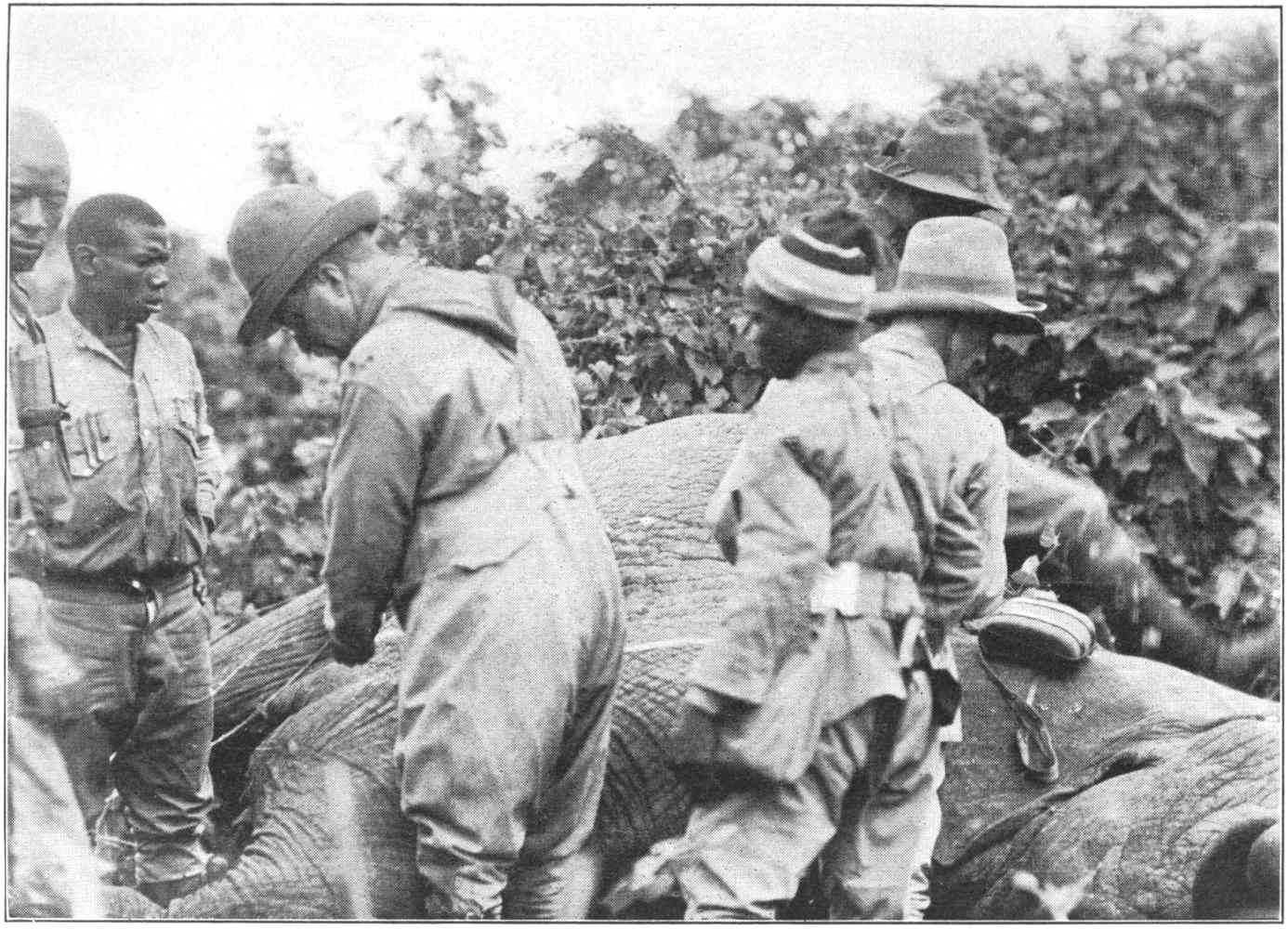
Putting the tape on a tusker
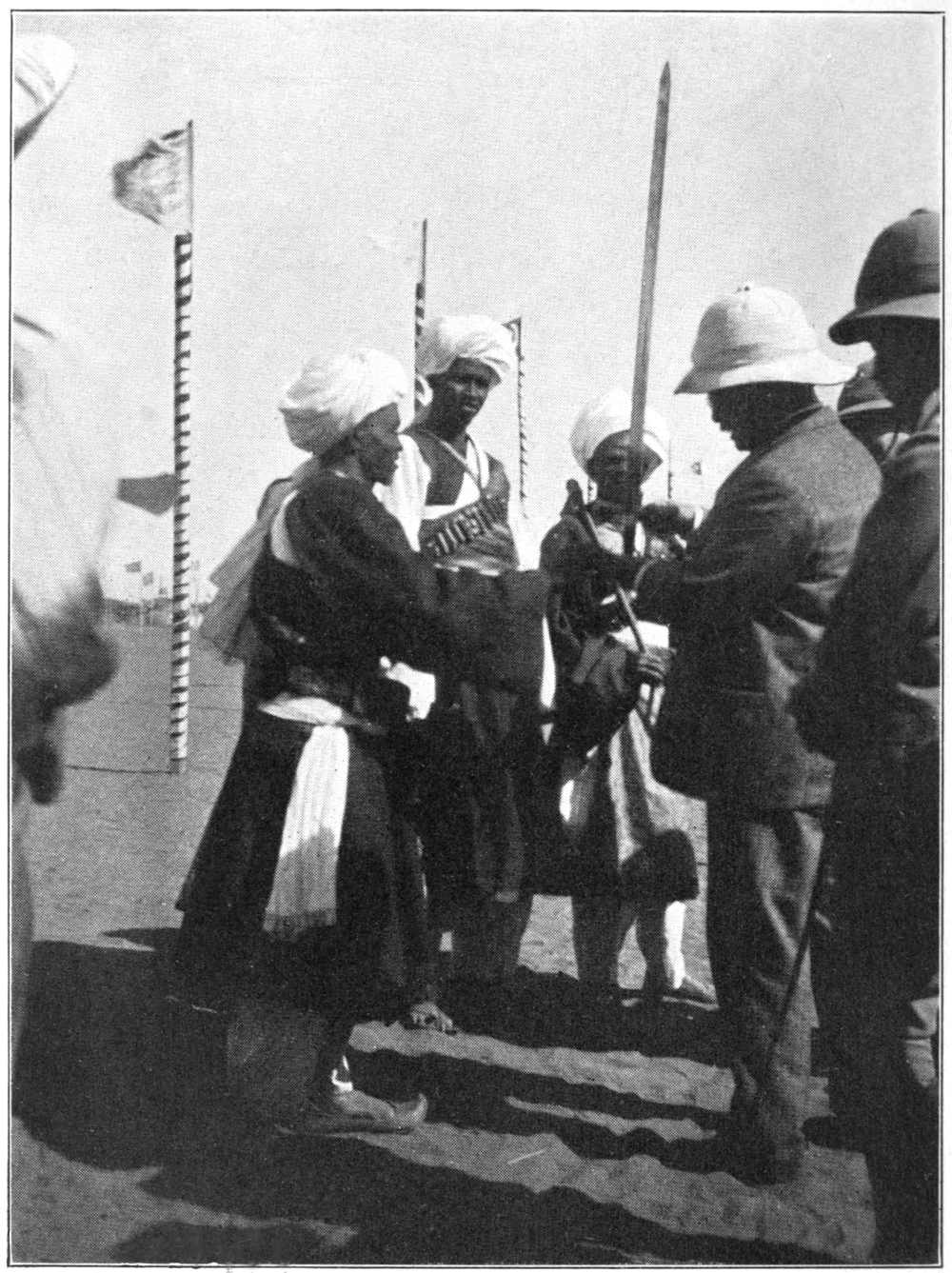
Reading from left to right: unknown gun-bearer, Kasitura, Father, Juma Johari, Tarlton, Cuninghame
Father was more fluent than exact in expressing
himself in foreign languages. As he
himself said of his French, he spoke it “as if
it were a non-Aryan tongue, having neither gender
nor tense.” He would, however, always
manage to make himself understood, and never
seemed to experience any difficulty in understanding
his interlocutor. In Africa he had
a most complicated combination of sign-language
and coined words, and though I could
rarely make out what he and his gun-bearer
were talking about, they never appeared to
have any difficulty in understanding each other.
Father could read Spanish, and he had not
been in Brazil long before he could make out
the trend of any conversation in Portuguese.
With the Brazilians he always spoke French,
or, on rare occasions, German.
He was most conscientious about his writing.
Almost every day when he came in from hunting
he would settle down to work on the articles
that were from time to time sent back to
Scribner’s. This daily task was far more
onerous than any one who has not tried it
can imagine. When you come in from a long
day’s tramping, you feel most uninclined to
concentrate on writing a careful and interesting
account of the day’s activities. Father
was invariably good-humored about it, saying
that he was paying for his fun. In Brazil
when the mosquitoes and sand-flies were intolerable,
he used to be forced to write swathed
in a mosquito veil and with long gauntlets to
protect hands and wrists.
During the descent of the River of Doubt in
Brazil there were many black moments. It
was impossible to hazard a guess within a
month or more as to when we would get through
to the Amazon. We had dugout canoes,
and when we came to serious rapids or waterfalls
we were forced to cut a trail around to
the quiet water below. Then we must make
a corduroy road with the trunks of trees over
which to haul the dugouts. All this took a
long time, and in some places where the river
ran through gorges it was almost impossible.
We lost in all six of the ten canoes with which
we started, and of course much of our food-supply
and general equipment. It was necessary
to delay and build two more canoes—a
doubly laborious task because of the axes
and adzes which had gone down in the shipwrecks.
The Brazil nuts upon which we had
been counting to help out our food-supply had
had an off year. If this had not been so we
would have fared by no means badly, for these
nuts may be ground into flour or roasted or
prepared in a number of different ways. Another
source upon which we counted failed
us when we found that there were scarcely
any fish in the river. For some inexplicable
reason many of the tributaries of the Amazon
teem with fish, while others flowing through
similar country and under parallel conditions
contain practically none. We went first onto
half rations, and then were forced to still
further reduce the issue. We had only the
clothes in which we stood and were wet all
day and slept wet throughout the night.
There would be a heavy downpour, then out
would come the sun and we would be steamed
dry, only to be drenched once more a half-hour
later.
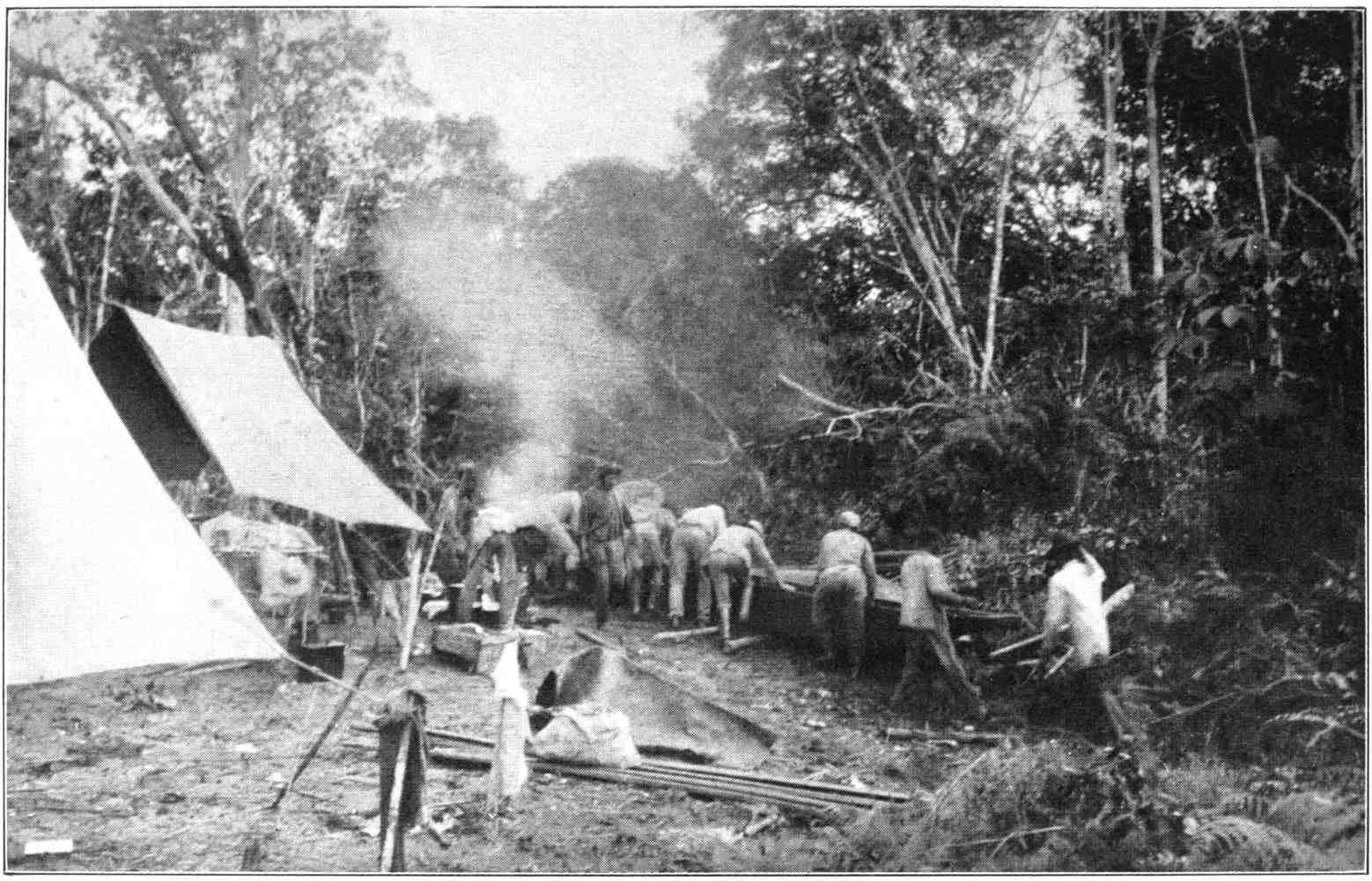
Launching a newly made dugout on the Dúvida
Working waist-deep in the water in an attempt
to dislodge a canoe that had been thrown
upon some rocks out in the stream, father
slipped, and, of course, it was his weak leg that
suffered. Then he came down with fever, and
in his weakened condition was attacked with
a veritable plague of deep abscesses. It can
be readily understood that the entourage and
environment were about as unsuitable for a
sick man as any that could be imagined. Nothing
but father’s indomitable spirit brought
him through. He was not to be downed by
anything, although he knew well that the
chances were against his coming out. He
made up his mind that as long as he could, he
would go along, but that once he could no
longer travel, and held up the expedition, he
would arrange for us to go on without him.
Of course he did not at the time tell us this,
but he reasoned that with our very limited
supply of provisions, and the impossibility of
living on the country, if the expedition halted
it would not only be of no avail as far as he
was concerned, but the chances would be
strongly in favor of no one coming through.
With it all he was invariably cheerful, and in
the blackest times ever ready with a joke.
Sick as he was, he gave no one any trouble.
He would walk slowly over the portages, resting
every little while, and when the fever was
not too severe we would, when we reached the
farther end with the canoes, find him sitting
propped against a tree reading a volume of
Gibbon, or perhaps the Oxford book of verse.
There was one particularly black night;
one of our best men had been shot and killed
by a useless devil who escaped into the jungle,
where he was undoubtedly killed by the Indians.
We had been working through a series
of rapids that seemed interminable. There
would be a long carry, a mile or so clear going,
and then more rapids. The fever was
high and father was out of his head. Doctor
Cajazeira, who was one of the three Brazilians
with us, divided with me the watch during the
night. The scene is vivid before me. The
black rushing river with the great trees towering
high above along the bank; the sodden
earth under foot; for a few moments the stars
would be shining, and then the sky would
cloud over and the rain would fall in torrents,
shutting out sky and trees and river. Father
first began with poetry; over and over again
he repeated “In Xanadu did Kubla Khan a
stately pleasure dome decree,” then he started
talking at random, but gradually he centred
down to the question of supplies, which was, of
course, occupying every one’s mind. Part of
the time he knew that I was there, and he
would then ask me if I thought Cherrie had
had enough to eat to keep going. Then he
would forget my presence and keep saying to
himself: “I can’t work now, so I don’t need
much food, but he and Cherrie have worked
all day with the canoes, they must have part
of mine.” Then he would again realize my
presence and question me as to just how much
Cherrie had had. How good faithful Cajazeira
waked I do not know, but when his
watch was due I felt him tap me on the shoulder,
and crawled into my soggy hammock to
sleep the sleep of the dead.
Father’s courage was an inspiration never to
be forgotten by any of us; without a murmur
he would lie while Cajazeira lanced and drained
the abscesses. When we got down beyond
the rapids the river widened so that instead of
seeing the sun through the canyon of the trees
for but a few hours each day, it hung above us
all the day like a molten ball and broiled us
as if the river were a grid on which we were
made fast. To a sick man it must have been
intolerable.
It is when one is sick that one really longs
for home. Lying in a hammock all unwashed
and unshaven, suffocating beneath a mosquito-net,
or tortured by mosquitoes and sand-flies
when one raises the net to let in a breath
of air—it is then that one dreams of clean
pajamas and cool sheets and iced water. I
have often heard father say when he was
having a bout of fever at home, that it was
almost a pleasure to be ill, particularly when
you thought of all the past discomforts of
fever in the wilds.
Father’s disappointment at not being able to
take a physical part in the war—as he has
said, “to pay with his body for his soul’s desire”—was
bitter. Strongly as he felt about
going, I doubt if his disappointment was much
more keen than that of the British and French
statesmen and generals, who so readily realized
what his presence would mean to the Allied
cause, and more than once requested in Washington
that he be sent. Marshal Joffre made
such a request in person, meeting with the
usual evasive reply. Father took his disappointment
as he had taken many another in
his life, without letting it harm his usefulness,
or discourage his aggressive energy. “In the
fell clutch of circumstance he did not wince
or cry aloud.” Indeed, the whole of Henley’s
poem might well apply to father if it were
possible to eliminate from it the unfortunate
marring undercurrent of braggadocio with
which father’s attitude was never for an instant
tinged. With the indomitable courage
that knew no deterrent he continued to fight
his battle on this side to make America’s
entry no empty action, as it threatened to be.
He wrote me that he had hoped that I would
be with him in this greatest adventure of all,
but that since it was not to be, he could only
be thankful that his four boys were permitted
to do their part in the actual fighting.
When in a little town in Germany my brother
and I got news of my father’s death, there kept
running through my head with monotonous
insistency Kipling’s lines:
“He scarce had need to doff his pride,
Or slough the dress of earth,
E’en as he trod that day to God
So walked he from his birth,
In simpleness and gentleness and honor and clean mirth.”
That was my father, to whose comradeship
and guidance so many of us look forward in
the Happy Hunting-Grounds.
II
In Quest of Sable Antelope
It was a bright, sunny day toward the end
of October, and I was walking along the streets
of the old Portuguese town of Mombasa on the
east coast of Equatorial Africa. Behind me,
in ragged formation, marched some twenty-five
blacks, all but four of them with loads
on their heads; the four were my personal
“boys,” two gun-bearers, a cook, and a tent-boy.
They were scattered among the crowd,
hurrying up those that tried to lag behind
for a last farewell to the wives and sweethearts
who were following along on either side, clad
in the dark-blue or more gaudily colored sheets
that served them for clothes.
At length our heterogeneous assembly
reached the white sands of the harbor, and
amid much confusion we stowed away into a
couple of long, broad dugouts and were ferried
out to a dhow that lay moored not far from the
shore. We set sail amid the shrill cries of the
women and a crowd of small children who, on
our approach, had scurried out of the water
like so many black monitor lizards.
We steered out across the bay toward a
headland some two miles distant. There was
just enough breeze to ruffle the water, but the
dhow sped along at a rate that belied appearances.
Sprawling among their loads the men
lit cigarettes and chatted and joked, talking
of the prospects of the trip, or the recent gossip
of Mombasa. The sailors, not knowing that
I understood Swahili, began to discuss me
in loud tones. An awkward silence fell upon
the porters, who didn’t quite know how to
tell them. Mali, my tent-boy, who was
sitting near me, looked toward me and smiled.
When the discussion became a little too personal,
I turned to him and made a few pertinent
remarks about the crew. The porters
grinned delightedly, and rarely have I seen
more shamefaced men than those sailors.
In far too short a time for all of us the dhow
grounded on the other side and we jumped
out and started to unload. A giant baobab-tree
stood near the beach; a cluster of huts
beneath it were occupied by some Swahilis
who fished, and ran a small store, where my
porters laid in a final supply of delicacies—sugar
and tobacco.
It is customary to have a native head man,
but on this short trip I had decided to do without
one, for though the porters were new, my
personal boys were old friends. Accordingly,
when all the loads were ready and neatly arranged
in line, I shouted “Bandika!” Great
muscular black arms caught the packs and
swung them up into place on the head, and off
we started, along the old coast trail, worn deep
with the traffic of centuries, and leading on
for several hundred miles with native villages
strung along its length. Behind me strode
my two gun boys, then came the porters, all
in single file, their present regular order a
strong contrast with our disordered progress
through the streets of Mombasa. Mali and
Kombo, the cook, brought up the rear to look
out for stragglers, and help unfortunates to
rearrange their loads more comfortably.
A little way from the shore we passed an
old Arab well; some women were drawing
water from it, but at our approach they deserted
their earthen jars and hurried away
with shrill ejaculations. Fresh from the more
arid interior, I imagined that the men would
fill their gourds, but they filed past without
stopping, for this was a land of many streams.
We continued on our way silently, now
through stretches of sandy land covered with
stunted bushes, now through native shambas,
or cultivated fields, until we came upon a
group of natives seated under a gigantic wide-spreading
tree. It was a roadside shop, and
the porters threw down their loads and shouldered
their way to where the shopkeeper was
squatting behind his wares—nuts, tobacco,
tea, bits of brass wire, beads, and sweetmeats
of a somewhat gruesome appearance.
He was a striking-looking old fellow with a
short gray beard. Pretty soon he came to
where I was sitting with a measure of nuts
for the white man; so in return I took out
my tobacco-pouch and presented him with
some of the white man’s tobacco.
After a few minutes’ rest we set out again
and marched along for some time until we
came to a cocoanut-palm grove, where I decided
to camp for the night. The natives we
were among were called the WaNyika—the
“children of the wilderness.”
Leaving the men to arrange camp under
the supervision of the gun-bearers, I strolled
over to a nearby village where there was a
dance in full swing. The men were regaling
themselves with cocoanut-wine, an evil-tasting
liquid, made from fermented cocoanut-milk,
they told me. The moon, almost at
full, was rising when I returned to camp, and
after supper I sat and smoked and watched
“the night and the palms in the moonlight,”
until the local chief, or Sultani, as they called
him, came up and presented me with some
ripe cocoanuts, and sitting down on the ground
beside me he puffed away at his long clay
pipe, coughing and choking over the strong
tobacco I had given him, but apparently enjoying
it all immensely. When he left I remained
alone, unable for some time to make
up my mind to go to bed, such was the spell
of the tropic moonlight and the distant half-heard
songs of the dancing “children of the
wilderness.”
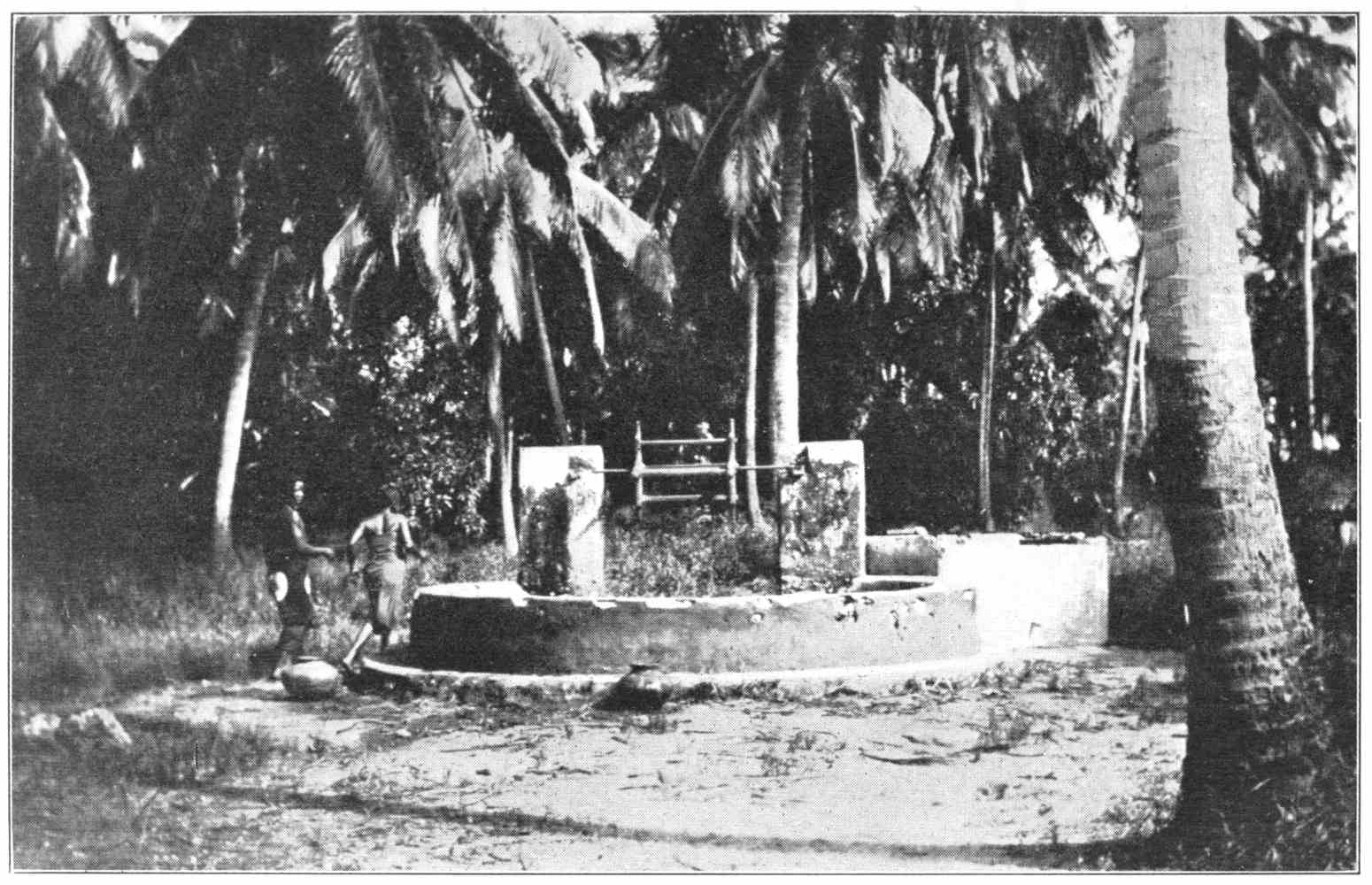
A relic of the Portuguese occupation; an old well beside the trail
Early next morning we were on our way,
and that night were camped a few hundred
yards from the village of a grizzled old Sultani,
whose domains lay in the heart of the sable
country, for it was in search of these handsome
antelopes that I had come. In southern Africa
the adult males of the species are almost black,
with white bellies, but here they were not so
dark in color, resembling more nearly the
southern female sable, which is a dark reddish
brown. Both sexes carry long horns that
sweep back in a graceful curve over the shoulders,
those of the male much heavier and
longer, sometimes, in the south, attaining five
feet in length. The sable antelope is a savage
animal, and when provoked, will attack man
or beast. The rapier-like horns prove an effective
weapon as many a dog has learned to its
cost.
My tent was pitched beneath one of the large
shade-trees in which the country abounds.
This one was the village council-tree, and when
I arrived the old men were seated beneath it
on little wooden stools. These were each
hacked out of a single log and were only five
or six inches high. The owner carried his
stool with him wherever he went, slinging it
over his shoulder on a bit of rawhide or a
chain.
There was trouble in the village, for after
the first formal greetings were over the old
chief told me that one of his sons had just
died. There was about to be held a dance in
his memory, and he led me over to watch it.
We arrived just as the ceremony was starting.
Only small boys were taking part in it, and it
was anything but a mournful affair, for each
boy had strung round his ankles baskets filled
with pebbles that rattled in time with the
rhythm of the dance. In piping soprano they
sang a lively air which, unlike any native
music I had hitherto heard, sounded distinctly
European, and would scarcely have been
out of place in a comic opera.
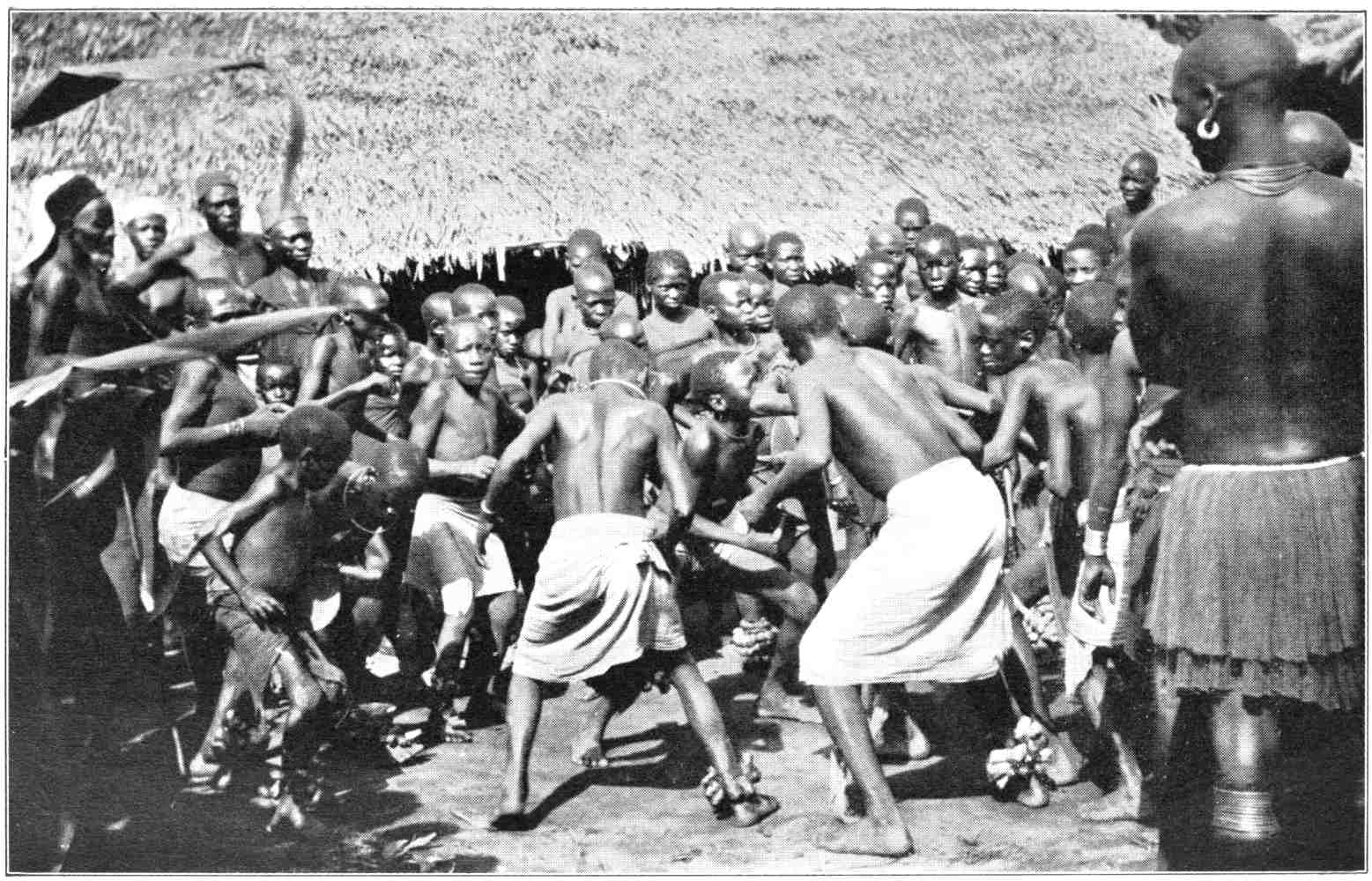
The Death Dance of the Wa Nyika children in memory of the chieftain’s little son
When the dance was finished the Sultani
came back with me to my tent, and sitting
down on his stool beside me, we gossiped until
I was ready to go to bed. I had given him a
gorgeous green umbrella and a most meritorious
knife, promising him further presents should
success attend me in the chase. He, in addition
to the customary cocoanuts, had presented
me with some chickens and a large
supply of a carrot-shaped root called mihogo;
by no means a bad substitute for potatoes,
and eaten either raw or cooked; having in
the former state a slight chestnut flavor.
The first day’s hunting was a blank, for although
we climbed hill after hill and searched
the country with my spy-glasses, we saw nothing
but some kongoni (hartebeeste), and I had
no intention of risking disturbing the country
by shooting at them, much as the men would
have liked the meat. It was the rainy season,
and we were continually getting drenched
by showers, but between times the sun would
appear and in an incredibly short time we
would be dry again. The Sultani had given
me two guides, sturdy, cheerful fellows with
no idea of hunting, but knowing the country
well, which was all we wanted. We loaded
them down with cocoanuts, for in the middle
of the day when one was feeling tired and hot
it was most refreshing to cut a hole in a cocoanut
and drink the milk, eating the meat afterward.
The following day we made a very early
start, leaving camp amid a veritable tropical
downpour. For half an hour we threaded
our way through the semi-cultivated native
shambas; the rain soon stopped, the sun rose,
and we followed an overgrown trail through a
jungle of glistening leaves. Climbing a large
hill, we sat down among some rocks to reconnoitre.
Just as I was lighting my pipe I
saw Juma Yohari, one of my gun-bearers,
motioning excitedly. I crept over to him
and he pointed out, three-quarters of a mile
away, a small band of sable crossing a little
open space between two thickets. The country
was difficult to hunt, for it was so furrowed
with valleys, down the most of which there ran
streams, that there was very little level land,
and that little was in the main bush country—the
Bara, as the natives called it. There were,
however, occasional open stretches, but during
the rainy season, as at present, the grass
was so high everywhere that it was difficult
to find game. We held a hurried consultation,
Juma, Kasitura—my other gun-bearer—and
myself; after a short disagreement we decided
upon the course, and set out as fast as we
safely could toward the point agreed on. It
was exhausting work: through ravines, up
hills, all amid a tangle of vines and thorns;
and once among the valleys it was hard to
know just where we were. When we reached
what we felt was the spot we had aimed at, we
could find no trace of our quarry, though we
searched stealthily in all directions. I led
the way toward a cluster of tall palms that
were surrounded by dense undergrowth. A
slight wind rose, and as I entered the thicket
with every nerve tense, I heard a loud and most
disconcerting crackle that caused me to jump
back on to Yohari, who was close behind me.
He grinned and pointed to some great dead
palm-leaves pendant along the trunk of one
of the trees that the wind had set in motion.
The next instant I caught sight of a pair of
horns moving through the brush. On making
out the general outline of the body, I fired.
Another antelope that I had not seen made off,
and taking it for a female I again fired, bringing
it down with a most lucky shot. I had
hoped to collect male, female, and young for
the museum, so I was overjoyed, believing that
I had on the second day’s hunting managed to
get the two adults. Yohari and Kasitura
thought the same, but when we reached our
quarry we found them to be both males; the
latter a young one, and the former, although
full grown in body, by no means the tawny
black color of an old bull. We set to work on
the skins, and soon had them off. Juma took
one of the Shenzies[2] and went back to camp
with the skins, while Kasitura and I went on
with the other. We returned to camp by
moonlight that night without having seen
any more game. The porters had gone out
and brought in the meat and there was a grand
feast in progress.
After some antelope-steak and a couple of
cups of tea I tumbled into bed and was soon
sound asleep. The next thing I knew I was
wide awake, feeling as if there were fourscore
pincers at work on me. Bounding out of
bed, I ran for the camp-fire, which was still
flickering. I was covered with ants. They
had apparently attacked the boys sleeping
near me at about the same time, for the camp
was in an uproar and there was a hurrying of
black figures, and a torrent of angry Swahili
imprecations. There was nothing for it but
to beat an ignominious retreat, and we fled
in confusion. Once out of reach of reinforcements
we soon ridded ourselves of such of our
adversaries as were still on us. Fortunately
for us the assault had taken place not long before
dawn, and we returned to camp safely by
daylight.
That day we moved camp to the top of a
neighboring hill, about a mile from the village.
I spent the morning working over the
skins which I had only roughly salted the night
before; but in the afternoon we sallied forth
again to the hunt.
We went through several unsuccessful days
before I again came up with sable. Several
times we had met with fresh tracks, and in
each case Kasitura, who was a strapping Basoga
from a tribe far inland and an excellent tracker,
took up the trail and did admirable work.
The country was invariably so dense and the
game so wary that in spite of Kasitura’s remarkable
tracking, only on two occasions did
we sight the quarry, and each time it was only
a fleeting glimpse as they crashed off. I could
have had a shot, but I was anxious not to kill
anything more save a full-grown female or an
old master bull; and it was impossible to determine
either sex or age.
On what was to be our last day’s hunting
we made a particularly early start and pushed
on and on through the wild bushland, stopping
occasionally to spy round from some vantage-point.
We would swelter up a hill, down into
the next valley among the lovely tall trees
that lined the brook, cross the cool, rock-strewn
stream, and on again. The sable fed
in the open only in the very early morning
till about nine o’clock, then they would retreat
into the thickets and doze until four or five
in the afternoon, when they would again come
out to feed. During the intervening time our
only chance was to run across them by luck,
or find fresh tracks to follow. On that particular
day we climbed a high hill about noon to
take a look round and have a couple of hours’
siesta. I found a shady tree and sat down with
my back against the trunk. Ten miles or so
away sparkled and shimmered the Indian
Ocean. On all sides stretched the wonderful
bushland, here and there in the distance
broken by little patches of half-cultivated
land. There had been a rain-storm in the
morning, but now the sun was shining
undimmed. Taking from my hunting-coat
pocket Borrow’s Wild Wales, I was soon climbing
far-distant Snowdon with Lavengro, and
was only brought back to realities by Juma,
who came up to discuss the afternoon’s campaign.
We had scarcely begun when one of
the Shenzies, whom I had sent to watch from a
neighboring hill, came up in great excitement
to say that he had found a large sable bull.
We hurried along after him, and presently he
pointed to a thicket ahead of us. Leaving
the rest behind, Juma and I proceeded cautiously
toward the thicket. We found two
sable cows, which Juma felt sure were all
that there were in the thicket, whereas I could
not help putting some faith in the Shenzi
who had been very insistent about the “big
bull.” I was convinced at length that Juma
was right, so I took aim at the better of the
cows. My shooting was poor, for I only
crippled her, and when I moved up close for a
final shot she attempted to charge, snorting
savagely, but too badly hit to cause any
trouble.
We had spent some time searching for the
bull, so that by the time we had the skin off,
the brief African twilight was upon us. We
had been hunting very hard for the last week,
and were all of us somewhat fagged, but as we
started toward camp I soon forgot my weariness
in the magic of the night. Before the
moon rose we trooped silently along, no one
speaking, but all listening to the strange
noises of the wilderness. We were following a
rambling native trail, which wound along a
deep valley beside a stream for some time
before it struck out across the hills for camp.
There was but little game in the country, still
occasionally we would hear a buck that had
winded us crashing off, or some animal splashing
across the stream. In the more open
country the noise of the cicadas, loud and
incessant, took me back to the sound of the
katydids in summer nights on Long Island.
The moon rose large and round, outlining the
tall ivory-nut palms. It was as if we were
marching in fairyland, and with real regret I
at length caught the gleam of the camp-fire
through the trees.
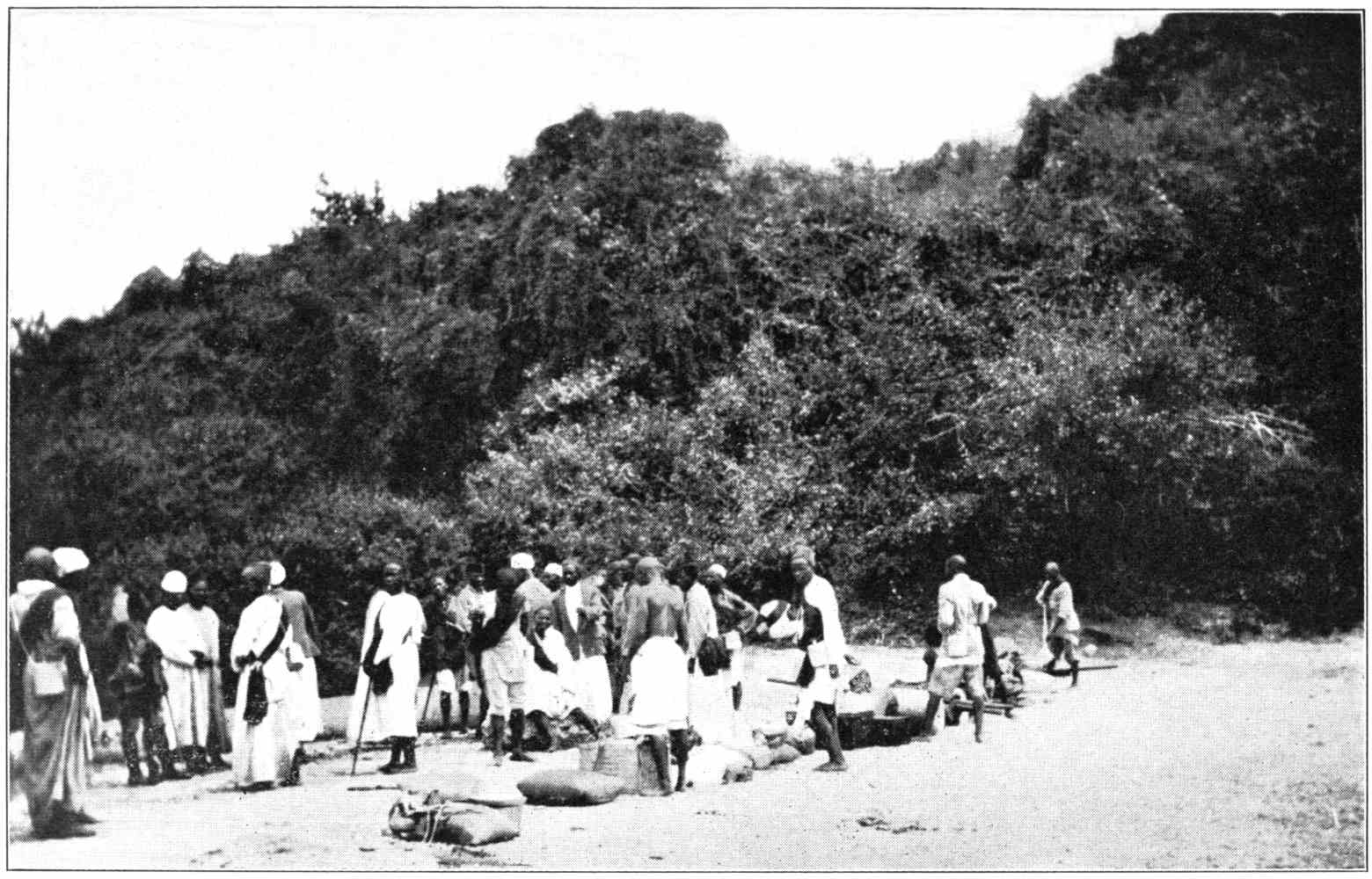
Across the bay from Mombasa; the porters ready to shoulder loads and march
It was after ten o’clock, when we had had
something to eat, but Juma, Kasitura, and I
gathered to work on the sable, and toiled until
we began to nod off to sleep as we skinned.
Next morning I paid my last visit to the old
Sultani, rewarding him as I had promised and
solemnly agreeing to come back and live with
him in his country. The porters were joyful,
as is always the case when they are headed
for Mombasa. Each thought of the joyous
time he would have spending his earnings,
and they sang in unison as they swung along
the trail—careless, happy children. I, too,
was in the best of spirits, for my quest had been
successful, and I was not returning empty-handed.
III
The Sheep of the Desert