Going to the Fair
KATIE LAWRENCE was much steadier for some time after the day on which
she lost the reel of cotton, and her mother began to hope that she had
really turned over a new leaf. Mrs. Lawrence had a great deal of plain
sewing to do, and found Katie a real help to her.
One morning, however, she received a message which obliged her to go
directly to Hazelbrook Hollow, to take an order for some needlework
from a lady who was staying there on a visit. She left Katie some work
to do in her absence, and the day being hot and sultry, she told her
she might sit in a little arbour in the garden if she preferred it.
This arbour had been made by Ben, who was very proud, and not without
cause, of his work. It was formed of thin ash branches, bent over to
form an arch, and was covered with gay scarlet runners, now in full
bloom. Katie delighted in this bower, and was glad at her mother's
permission to work there.
Nelly had occasionally been able to recline on some pillows in the
arbour, but for some days past, the invalid child had been suffering
more pain than usual, and could not leave her little couch by the
cottage window. So Katie sat alone, with little Esther on the ground
at her feet, playing with some daisies. A hedge, which separated Mrs.
Lawrence's garden from that of her next-door neighbour, formed the back
of the arbour; and Katie had not been working long, when she heard a
voice whispering to her through the hedge, which was very thick during
the summer.
"Katie, Katie," said the voice, "are you alone?"
"There's only little Esther with me, Fanny; what do you want? Why don't
you come round into our garden?"
"Hush! Don't speak so loud. I came on this side of the hedge so that no
one should see me. Is your mother at home?"
"No."
"That's right; Bessie Thompson, and Lucy and I, and three or four more,
are going over to Oakfield to see the fair, and we want you to come
with us."
"I can't, Fanny; mother's not at home, and—"
"That's the very reason you can," said Fanny; "she need know nothing
at all about it. We shan't be gone more than two or three hours at
the most; and oh, Katie! There are such fine shows, and a real live
elephant, and I do not know what beside."
"But I know mother would not like me to go to a fair," answered Katie;
"you know how particular she is."
"Yes, I'm glad she is not my mother," said Fanny, in a rude tone.
"She's a very good mother, though," replied Katie, colouring, for she
could not bear to hear Fanny speak thus.
"I've no doubt of it," said Fanny, sneeringly, "and you are a wonderful
pattern daughter, to be sure; I'm sorry I took the trouble to come
round here, that's all: only I thought you were really old enough to
see a little of the world, unless you mean to be tied for ever to your
mother's apron string."
Katie was like many older and wiser than herself; she was more afraid
of the ridicule of the world than of displeasing God and disobeying her
mother. She hesitated. The temptation to go was very strong. She ought
at once to have refused. But she listened to the tempter.
Fanny saw the advantage she had gained, and continued,—
"I know if I were in your place, Katie, I should feel quite ashamed to
be so little my own mistress as you are. And as to there being any harm
in going to Oakfield, I should like to know what there can be wrong in
going for a walk across the fields."
"It isn't that, Fanny; it is the fair," said Katie.
"Well, just as you please," said Fanny, making a movement as if she
were going away. "I only meant to give you a little pleasure; you have
little enough, I'm sure."
"Stop, Fanny, don't go just yet; I do not think we shall be home in
three hours!"
"Quite certain we shall. We can get there easily across the fields in
three-quarters of an hour, and reckoning the same time for coming back,
that will leave us an hour and a half to see the fair. When do you
expect your mother?"
"Not till the evening. Whenever she goes to Hazelbrook Hollow, she
always has her dinner there."
"That's well; then I'll go and tell the others you are coming, and you
can meet us at the cross-road, by the bridge. You'll be sure and come?"
"I'll come, never fear," said Katie. And with an uneasy feeling on her
mind, she folded up her work and prepared to leave the arbour.
The next moment she heard Fanny's step returning.
"Oh, Katie, I forgot, if you have any money, bring it with you, because
you will have to pay to see the shows."
"I have only one shilling in the world, Fanny."
"That will be better than nothing; be sure and bring it."
Mrs. Lawrence was in the habit of giving Katie a few pence for every
piece of work she finished, and this shilling Katie had saved up
towards buying herself a warm shawl against the winter. She kept her
money under a little china teacup on the mantelpiece in the cottage.
And as Nelly's couch was close to it, Katie pondered how she should
contrive to get the shilling without her sister's knowledge. For Katie
dared not tell Nelly what she was about to do, knowing well that she
would be of her mother's opinion, and would advise Katie by all means
not to go to Oakfield.
It is a bad sign when we are ashamed that a fellow-creature should see
and know our actions, and yet not be ashamed of performing them in the
sight of a just and holy God. There was Esther, likewise—what should
she do with her? She would ask their next-door neighbour to look after
her, so that was soon settled. But how to get the money was not so
easy. If young people would only consider that the first downward step
from the plain path of duty is sure to involve them in a maze of deceit
and lies, that to hide "one" fault they will have, in nine cases out
of ten, to commit many more, surely they would pause before they do a
wrong act.
Katie took little Esther in her arms, and went into their neighbour's
cottage.
"Mrs. Morton, will you look after Esther a bit for me? I have to go
into the village, and mother is out, and Nelly is not so well to-day
and cannot take charge of her."
"I'm busy washing, Katie, and can't promise to see much to her; but you
can leave her here a bit, if you like. I suppose you will not be long.
I saw one of those Price girls—I think it was Fanny—run down my garden
a short time since; I wish I'd caught her, that's all. I should like
to know what business she had here. I hope you have nothing to do with
her, Katie; if I had girls of my own, I'd rather they never spoke to a
creature than have such a companion as Fanny Price."
Katie felt very uncomfortable, and was in a great hurry to get away;
but Mrs. Morton still went on: she was a great talker when once she
began.
"I know your mother thinks as I do about Fanny, and indeed most of
the village girls. They are a bad set, Katie, and you will learn
no good from them, mark my words. My good man told me this morning
that he heard they were all agoing over to Oakfield to the fair this
afternoon—a nice place for young girls, certainly. Well, you may be
thankful, Katie, that you have such a mother as you have; you'll know
her value some day, my girl. Be back as soon as you can, Katie, for I
can't promise to look much after Esther."
Katie began to wish she had not promised to join the girls. But she
silenced her conscience by saying that it was too late now to draw
back, so she hurried towards her mother's cottage, fearing lest she
should be keeping Fanny waiting, and that some of them would be coming
after her.
"How hot you look, Katie?" said Nelly. "Have you been running?"
"Only a little with Esther, Nelly." And as she spoke, she went towards
the mantelshelf, and appeared as if looking for something very intently.
"I cannot find any needles," said she, "and I have just broken mine. I
think mother must have taken her case with her; but I know there were
scarcely any in it, so I shall go down to the shop and buy a paper. I
heard mother say she should want some soon."
And Katie lifted up the little teacup, and took her shilling from under
it.
"What will you do with Esther, Katie?" asked Nelly.
"Oh, she's in at Mrs. Morton's," answered Katie, as, putting on her
bonnet and cape, she hurried away, fearful lest Nelly should ask any
more questions.
Katie hastened along to the place of meeting. Fanny and her companions
were there, and were quite angry with Katie for having kept them
waiting so long.
"We might have been halfway to Oakfield by this time," said Fanny.
Oakfield was about two miles from Hazelbrook, and the way lay through
fields of rich grass. In some, the mowers were already at work, and
the sweet fragrance of the new-mown grass was borne along on the soft
summer breeze. At another time, Katie would have delighted in such a
scene, for she had a true taste for the beauties of nature; but now
everything seemed changed. The sight which she had so often before
admired, now seemed to have no charm for her. Her one thought, her one
object, was to get to Oakfield and back, without her mother knowing
where she had been.
Poor short-sighted Katie! She forgot that one all-seeing Eye is ever
about our paths, and "spieth out all our ways." Her companions laughed
at her for her "low spirits," as they called it, and Bessie Thompson
asked her if she expected to meet her mother at the fair.
Over and over again did Katie wish herself at home, and yet a false
feeling of shame, and a dread of being laughed at, prevented her from
following her conscience, which even then was striving within her. So
at last, they reached Oakfield, and amid the novelty of all she saw
there, Katie, for a time, forgot all her fears.
When they came to the show in which the elephant was exhibited, Fanny
Price said to Katie,—
"Did you bring your money with you?"
"Yes, here it is," answered Katie, showing her the shilling.
"Give it to me, then; there are just six of us, and the shilling will
pay for us all; I can pay you again by-and-by."
Katie gave Fanny the shilling, and the girls entered the show.
Katie was pleased to see the elephant and the other animals, but
thought they looked very miserable, cooped up in their close, small
cages. They looked quite different in the gay pictures outside the
show; and like many other people, Katie felt sorry she had thus thrown
away her money. Fanny, too, never said a word about repaying her, but
only asked her if she had no more money; and when she found that she
had not, she and her companions paid very little more attention to her.
Katie was two or three years younger than Fanny and her friends, and
looked younger than she really was, owing to the simple neatness of her
dress; whilst Fanny and the other girls were attired in a good deal of
tawdry finery, and looked like anything but respectable village lasses.
After they had seen the show, they loitered about the fair, looking at
all the stalls. Bessie Thompson met an acquaintance, a young man whose
father kept the alehouse at Hazelbrook. Katie knew him to be anything
but a steady young man; she had often heard her mother speak about him.
He had a drinking and dancing tent at the fair, and asked Bessie and
her party to come in, saying he would treat them, and that they should
have a good dance afterwards.
There was a band of music playing in the tent, and people were sitting
drinking and smoking at one end. Katie shrank back with horror;
everybody had such a coarse, bold look, so different from anything
she had ever seen before. And her own knowledge of right and wrong,
and the modest way in which she had been brought up, at once warned
her not to accept the invitation. She was already beginning heartily
to repent having come to Oakfield. Her head ached with all the noise
and excitement; and she felt the truth of the saying that unlawful
pleasures can never bring true happiness. She fancied she had more
influence with Fanny than with the rest, and hastily drew her on one
side.
"Dear Fanny, don't go in there; pray, pray don't; I am sure it is not
a fit place. Let us go home at once; it must be time to do so, or we
shall be very late back."
"What nonsense, Katie! As if I was going home now, when all the fun is
just about to begin."
"What does that child say?" asked Bessie Thompson.
"She wants to go home," said Fanny, in a mocking tone.
"Why did you bring her with you at all?" asked Dan Carter, the owner of
the tent.
Bessie whispered something to him in reply.
And although Katie could not hear all that was said, she caught the
words "money," and "pay for the show." She coloured up indignantly.
"This," then, was all they had asked her to join them for. Humbled
and mortified as she felt, she yet made one other attempt to persuade
Fanny, at all events, to return with her. But all her efforts were
useless.
And Dan Carter cut them short by saying, rudely,—
"The sooner you take yourself off, if you're not going to be sociable,
the better; your room is better than your company. You'll repent of
your folly, though, before you get halfway to Hazelbrook, or I'm vastly
mistaken in those clouds yonder."
Katie scarcely heard the end of the sentence, for no sooner did she
find that it was useless trying to persuade Fanny to come with her,
than she set off at a quick pace, fearful almost that, by delaying
another moment, she should lose the power of escape. Hot and agitated,
frightened at the scenes and noise everywhere around her, she threaded
her way through the din and uproar of the fair. She had never been in
such a crowd before, and people pushed her about in an unfeeling manner.
At last, she got out of the fair, and hastening along, sat down to rest
for a moment on the stile leading into the first meadow on the way to
Hazelbrook. Then the clouds of which Dan Carter had spoken first caught
her attention. They were very black and lowering, and the distant
thunder, which the noise of the fair had prevented her from hearing
before, was distinctly heard now in the stillness of the meadow. Katie
hastened on, hoping that she might reach home before the storm burst.
She tried to pray to God to bring her safe to her mother's cottage—oh
that she had never left it!—but her thoughts were too confused, and her
brain whirled with feverish excitement.
She had reached the third field, about halfway to her home, when a
bright flash of lightning, followed by a crackling peal of thunder,
caused her to utter a scream. She had never felt afraid of a storm
before. Hitherto she had been taught to feel that the God of the
thunder is able and willing to protect His people; but now she almost
looked upon the storm as a judgment sent to punish her for her
disobedience, and scarcely knowing what she did, she ran to shelter
herself beneath some large trees in the meadow.
Had Katie thought for a moment, she would not have done so, for her
mother had always cautioned her never, on any account, to take refuge
under trees in a thunder-storm. Many persons have lost their lives from
doing so; for trees are great conductors of lightning, and attract
the electric fluid. But Katie thought of nothing. And as the thunder
pealed, and the vivid lightning flashed, and the rain descended in
perfect sheets of water, she leaned against the trunk of one of the
trees to keep herself from falling.
Then a more vivid flash than any before lighted up the sky with a lurid
glare. A peal of thunder followed, which seemed to rend the very air;
and one of the fine spreading elms near that beneath which Katie was
standing was riven from top to bottom. Katie heard and saw no more; she
had fallen senseless on the ground.
The fury of the storm had spent itself; and the mowers, who had taken
shelter in a barn not far off, were passing through the meadow on their
way to the village.
"That's a fine tree that's been struck yonder," said one; "but surely
there's some one lying under that other tree hard by."
"No one can be alive there after such a storm," exclaimed another of
the men.
And they all hastened across the meadow to the tree under which Katie
was lying.
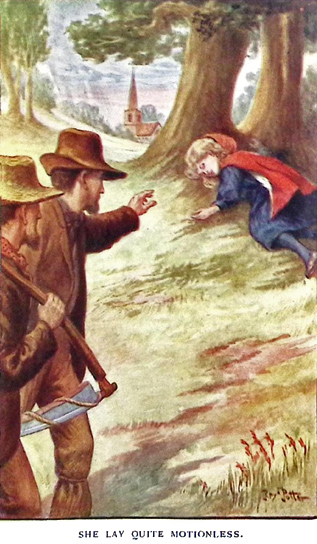
She was stretched with her face downwards on the ground, and lay quite
motionless.
"Dead, quite dead!" said the mower who had first spoken, as he brushed
his rough hand across his face, for he had young ones of his own at
home.
They lifted her up very tenderly, those rough, rude men.
"Why, it's Widow Lawrence's daughter!" they cried, as they began to
carry her to her mother's cottage.
Half an hour afterwards, Katie was lying on her own little bed at home,
and the doctor was using all his efforts to restore animation—with what
success will be told in the next chapter.