In the rivers it is customary to fish in 10 to 14 feet of
water, and the shortness of the swims necessitates the line being
heavily weighted, in order that it may sink rapidly. The
floats are necessarily large, particularly when used for the
lower reaches, where there is a considerable tidal current.
The boats are moored in a line with the stream, not across it, as
on the Thames, and the swims are thus very short. For the
upper and clearer waters, the Nottingham system of angling might
be advisable, but in the more turbid lower reaches the Norfolk
style is practically the best. Worms are used for bream,
and paste for roach. Worms are procurable at some of the
tackle shops, but anglers will do well to provide them for
themselves if possible.
Boats
are charged for at the rate of from 1s. to 2s. a-day, but are
rather rough concerns, except at Oulton.
Ground-bait, consisting chiefly of meal and clay, is largely
used, but a place is rarely baited beforehand. As there is
ample choice of stations, always moor so that the wind is at your
back, and you will thus have smooth water in front of you.
Small roach as bait for pike, are procurable at most of the
waterside inns, at 1s. to 1s. 6d. a score, but to get the best
sport obtain fish from other waters, particularly dace and
gudgeon.
Pike are, of course, the chief fish in Norfolk, and are
plentiful everywhere. In the rivers they do not run very
large, a ten-pound fish being considered a good one, but in a few
years’ time, with the freedom from netting the rivers now
enjoy, we may expect some very large ones to be caught in the
rivers. In private waters there are veritable monsters, but
the stranger is not likely to make acquaintance with them.
Live-baiting and spinning with a spoon, or artificial bait
trailed behind a boat, are the usual modes of fishing for pike in
Norfolk. Trolling with a dead gorge, and spinning with a
dead bait by casting, as in the Thames, are comparatively rarely
practised, although I believe that in some portions of the rivers
these methods would “pay.” I have seen
fly-fishing for pike practised with success here, and I firmly
believe that on some of the shallower Broads it would be very
deadly.
Perch
are only locally common wherever there is a suitable bottom for
them, as at Irstead Shoals and Hickling, and in some portions of
the Bure and Waveney, but they run to a large size, and are
sometimes caught between three and four pounds in weight.
Bream are most common of all, and may be caught by hundreds
and the stone weight. They run up to five and six pounds in
weight, and a take by two rods in a day of 150, averaging
half-a-pound apiece, is not a rare event.
Roach are very numerous and large, many running close to two
pounds in weight.
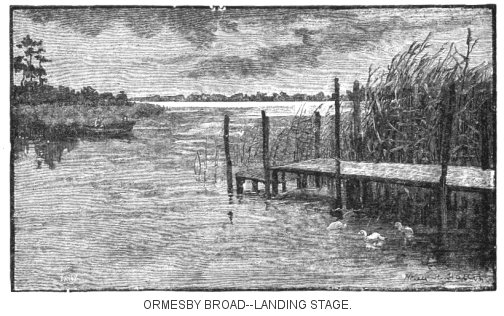
Rudd are beautiful game fish, common in some of the Broads,
particularly Ormesby, and give rare sport if you get among a
shoal of them.
Eels are, of course, present in any number, and
“babbing” for them, with a bunch of worms threaded on
to worsted, is not a bad way of passing a warm night.
Tench are common, but are not often caught with a rod and
line. They are taken in bow nets, and run very large.
In hot weather, in June, they may be taken by the hand as they
bask in the shallow water among the weeds. Some fishermen
are very skilful in this particular mode of catching them.
Carp are caught sometimes, but not often, although there are
plenty of them.
Dace and gudgeon are not so frequently caught in the navigable
waters as other fish.
Chub
and barbel are unknown in the Broad District.
The bream are so excessively abundant that they spoil the
fishing for other fish, notably for perch, and I think it would
be an excellent thing if the different preservation societies
would set apart a few days each year for systematic netting to
thin the bream, replacing the other fish, and selling those
retained. What is the good to anglers of catching thousands
of small bream? Are not a score over a pound weight each
better than ten-score fingerlings? Judicious thinning out,
under proper supervision, would have a most beneficial effect on
the size of the fish generally.
There are several preservation societies, of which the Yare
Preservation Society is the chief. Mr. C. J. Greene, of
London Street, Norwich, Fishing Tackle Maker, is the honorary
secretary. The objects of these societies are to abolish
netting and poaching, and protect the river for fair
angling. The subscriptions are nominal (5s.), and yet they
are supported entirely by local efforts. As a rule, none of
the anglers from London and other distant parts, who come down to
Norfolk and have the best of sport, contribute anything to the
societies which are instrumental in furnishing them with
sport. This is exceedingly shabby of visitors here, and I
trust that those who have been induced to visit the Broads
through my writings will at least make the small return to
Norfolk anglers of assisting them in their efforts to make these
waters the best public fishing places in the kingdom.
There
are a few professional fishermen to be hired by the angler.
“Professor” Day, of Richmond Hill, Norwich, is one of
the best, and knows every inch of water, and there are some good
men at Oulton.
Strangers frequently complain that they cannot meet with the
excellent sport which falls to the lot of the local anglers, and
I remember Mr. Cholmondeley Pennel being immensely dispirited at
his non-success on our waters. I lately interviewed a local
gentleman who is well known as a successful fisherman, and I
append my questions and his remarks thereon, which will afford
some valuable information.
1. Where found at different periods of the
year?
Throughout the summer the entire length of our local streams
where the water is fresh and not salt or brackish; the finest
fish and greatest number between Cantley and Coldham Hall, on the
Yare; large numbers also in the dyke leading from Oulton
Broad. In winter they appear generally to retire to the
deep waters, and are sometimes found in good quantity about
Thorpe Broad, and may be angled for with success in deep spots on
the Bure and other waters.
2. Best periods to fish for them?
July to October, but good catches may often be had in
November, and during the winter and early spring months by any
expert angler who doesn’t mind the cold.
3. What time of day at different
seasons?
As a rule, but few fish are caught during the middle of the
day; this is especially the case in bright warm weather. On
dull, “close” days, however, they will often bite
freely throughout the day. The morning up to about 11.30,
and from 3 to 6 or 7 p.m. are undoubtedly the best times to fish
during summer, and in winter almost any time up to sunset.
4. What depth of water?
As a rule, the best fish are found during summer in the
deepest water, and should not be angled for on the Yare at a less
depth than nine or ten feet. On the Bure the deepest spots
that can be found. In March or April shallower waters
should be tried.
5. How affected by the tide?
Variously. Sometimes an angler gets all his fish on the
up tide, and at other times on the ebb. I, however, suspect
that certain local formations of the river bed, have much to do
with this.
6. What ground-bait?
The best I have ever used is composed of bran, bread, and
boiled wheat, in fair proportions, made up into firm balls about
the size of an orange. One of these thrown in occasionally,
and now and then a few grains of boiled wheat will generally
suffice to keep a good quantity of fish about your boat.
7. Are places ever baited beforehand?
Not often for roach. Believe this is done occasionally
by some, but have never practised it myself.
8. What baits are most successful?
During summer the most successful baits are well-boiled wheat
and paste, red or white, in such clear waters as the Waveney and
the upper reaches of Bure, etc. White paste is best on the
Yare, the red always kills the best fish. In autumn,
gentles, and later on brandlings and gentles, or better still,
small red worms, “blood.” There are many other
baits used with good success occasionally, but these are by far
the most reliable.
9. What kind of rod?
For tight-line fishing in the deep waters of the Yare, the rod
should be light, stiff, and from 15 to 18 feet in length.
For running tackle a shorter rod will do, and for this I prefer
one of hickory. Should recommend cane for the longer
kind.
10. Number of hook?
When the fish are of fair size, I use No. 9, at other times
Nos. 10 or 12. Those known amongst anglers as
“Crystal,” are excellent for roach fishing.
11. Is running tackle advisable?
Running tackle is decidedly preferable for such deep, strong
waters as those between Coldham Hall and Reedham. For the
slower waters of the Bure and the upper reaches of the Yare, I do
not consider that running tackle has any advantages worth
naming.
12. Do you use gut or hair, and what kind of
line?
For deep-water fishing I always attach nine feet of gut to my
line; six feet moderately stout and three feet fine drawn.
Line, a fine braided silk. A light, well-shotted
line of this kind has many advantages, especially on a windy
day.
13. What kind of float?
Quill at all times. For deep swift waters, a large
pelican or swan quill, for slower and shallower waters a much
smaller one.
14. Is line heavily shotted?
For deep waters I use a float carrying upwards of 20
medium-sized shot. These are placed on a space of about a
foot, the bottom one not nearer than about three feet from the
hook, with just one shot on the gut attached to hook. This
arrangement ensures the bait being carried swiftly to the bottom
and kept steady, very important items in roach fishing.
15. Is float best attached by lower end only?
Yes, this plan which has been in practice with the
“Norwich School” for many years past is decidedly the
best, and admits of much more neatness and accuracy in striking a
fish than when the float is attached by upper end as well as
lower.
16. Do you strike at first dip?
When good fish are on the feed, the float is first affected by
a slight tremulous movement, and almost immediately settles down,
generally in a slanting direction; the moment to strike is just
as the settling down commences. This, however,
requires a large amount of practice and some keen observation
before an angler becomes expert. Sudden perky bites
indicate small fish, and these are often the most difficult to
catch.
17. Are the fish much affected by change of wind,
rain, thick water, etc., and is there any rule on this
head?
Have always found a S.W. to N.W. wind the most favourable,
especially when the water is “grey” or thick, and
have had capital sport with a moderate east wind, but never when
it has blown strongly from that quarter, and the old maxim
“When the wind blows from the east
The fish bite the least,
When the wind’s from the west
The fish bite the best,”
contains a great truth in small compass. Fish may
undoubtedly be taken in clear water and in good quantity, but
running tackle and fine, and extreme caution are necessary.
18. Do you find that movement in the boat, noise, or
loud talking frightens the fish?
Loud talking or laughter in the boat does not appear to
intimidate the fish, but knocking or any disturbance which
communicates a vibration to the water is decidedly objectionable,
especially in shallower streams, and often causes a great
interruption to the fishing. Have found a pair of
lawn-tennis shoes or slippers very good to wear in a boat when
fishing, for this reason.
19. Name some of the best catches you have
made or know of.
I do not chronicle my catches, so can give no dates; but have
had some fine catches within the past five or six years,
principally on the Yare. On one occasion, at Buckenham,
with a friend, six stone [160] between 2.30 and 7
p.m.; another time upwards of five stone in about the same space
of time, and numerous catches of from two to four stone in an
afternoon’s fishing; also more than a bushel by measure one
afternoon with a friend fishing in the dyke leading to Oulton
Broad. This was in the first week of September, 1879.
20. What is the reason of the non-success of strange
anglers which is so noticeable?
Ignorance of the general requirements of tackle suitable for
fishing in our waters, and also of the modus operandi, one
of the chief reasons being a want of knowledge of the right depth
at which to fish, which could easily be known by simply
“plumbing” the depth. By way of instance, I
have on several occasions found strangers fishing on the Yare in
12 or 14 feet of water, with their baits only about four or five
feet below the surface, and at the same time wondering that
anglers close by should be catching plenty of fish when they
could get none. Baits, too, are doubtless used which,
although very good for some streams or waters, are of very little
use with us.
N.B.—“When the wind blows strong and the
waves roll high,” it is often very difficult to fish or
even to detect a bite. This is very tantalising, and not
infrequently happens through a shift in the wind when you are in
a capital “swim.” The remedy for this is to put
on a nice light ledger, with about three hooks, and with which
excellent sport may sometimes be had when it would be impossible
to fish in any other way.
In float fishing for roach, the bait should be just touching
the bottom. A good plan adopted by some is to fish with two
hooks, the bottom one dragging on the bottom, and the upper one
about three or four inches clear of the bottom. This is an
advantage in fast streams, as it retards the onward motion of the
float, the bait is more easily taken, and the swims are not
passed so rapidly.
1. Where found at different periods of the
year?
During summer, on the Yare, principally between Langley Dyke
and Reedham; in winter often found in good quantity in the
vicinity of Thorpe Broad and about Carrow and Trowse Hythe.
On the Bure they appear to congregate in the deep waters of the
Broads in winter, and make their appearance about the end of May
and through the summer on the river.
2. Best periods to fish for them?
July and August.
3. What time of day at different
seasons?
Good catches of bream are often had in early morning. I
have, on the other hand, had capital sport by moonlight.
For further notes, see answer to same question on
“Roach.”
4. What depth of water?
The deepest waters and quietest eddies are, as a rule, the
best; but I have caught large quantities of fine bream at
Wroxham, on the Bure, in not more than four feet and a half of
water.
5. How affected by the tide?
Generally speaking, the most fish are taken from about half an
hour before high water to half an hour after. For further
notes, see “Roach.”
6. What ground-bait?
Boiled maize, boiled barley grains, barley meal made up into
balls, chopped worms, boiled rice. This latter and grains I
have found very killing on the Bure.
7. Are places ever baited beforehand?
Mostly overnight, where there is a fair opportunity of doing
so. This mode is very telling on Broads and other still
waters.
8. What baits are most successful?
For large fish at Cantley, Reedham, Somerleyton, and other
deep swift waters, ledger fishing, with the tail end of a lobworm
on the hook, is a capital bait. Generally speaking,
however, I have found “brandlings” the most killing,
and have found a brandling with a gentle placed on the point of
the hook will sometimes be taken readily when no other bait would
be touched. Red paste is often very killing on the
Bure.
9. What kind of rod?
Strong and stiff cane or hickory, 15 to 18 feet long, with a
good stout top joint, on the Yare. Shorter will do on the
Bure.
10. Number of hook?
The finest catch I ever had was with No. 12 hooks. This
was, however, in comparatively shallow water. Should say
that No. 7 or 8 would be very good sizes for bream fishing
generally.
11. Is running tackle advisable?
See “Roach.”
12. Do you use gut or hair, and what kind of
line?
See “Roach.”
13. What kind of float?
See “Roach.”
14. Is line heavily shotted?
In a similar way to that recommended for roach, but having the
bulk of shot placed nearer the hook, it being necessary that the
bait should “drag” the bottom.
15. Is float best attached by lower end only?
As the bream bites more slowly and certain than the roach,
this is quite immaterial. I prefer float attached top and
bottom.
16. Do you strike at first dip?
A bream bite affects the float with a slight bobbing motion
for a few seconds, he then runs off with it, and slides it down
slantingly; strike as he runs off with the bait or the float is
about to disappear, and you are sure of him.
17. Are the fish much affected by change of
wind, rain, thick water, etc., and is there any rule on this
head?
Bream are rarely taken in any quantity when the waters are
very clear. See “Roach.”
18. Is legering successfully practised for
large bream, and what is the best modus operandi?
In such rapid waters as those at Reedham, Somerleyton,
etc.—no other mode of fishing for bream can be practised
with any success worth naming—ledgers for attaching to line
may be purchased at any tackle shop at 1s. each, and the modus
operandi is very simple, and by no means scientific.
The rod requires to be very strong and of fair length, and three
or four rods may be used from one boat at the same time.
19. Do you find that movement in the boat, noise, or
loud talking frightens the fish?
Bream are very sensitive to noise, especially knocking in the
boat, which invariably sends them off for an indefinite period,
and should therefore be most carefully avoided.
20. Name some of the best catches you have made or
known of.
About
ten years ago, had, in company with a friend, a catch of 17 stone
in one day on Wroxham Broad, and with only one rod each.
Have heard of many catches from time to time of from 4 to 10 or
12 stone, but am unable now to give names or dates.
21. What is the reason of the non-success of strange
anglers which is so noticeable?
See “Roach.”
N.B. In fishing for bream, the bait should always drag
on the bottom.


