“Bestimmt Die Gestalt die Lebensweise des Thieres
Und die Weise zu leben sie wirkt auf alle Gestalten
Mächtig Zurück.”—Göthe, Metamorphose der Thiere.
The most simple observation renders at
once apparent a correspondence between the
external form of animals, the general direction
of their tendencies, and their habits.
Let us examine this question at somewhat
greater length. From the age of Aristotle
to the present time, zoologists have arranged
the almost countless tribes of animals into a
number of groups or divisions, more or less
related in general habits and structure. All
the classifications which have been hitherto
proposed may be referred to one or the
other of two general principles. Either the
colour of the blood (Aristotle), the conformation
of the heart (Hunter), the arrangement
of the nervous system (Owen), or some
other peculiarity of internal structure, has
been selected as the basis of arrangement;
or the animal creation has been grouped
according to certain definite circumstances
connected with outward form and configuration.
As regards their internal organisation,
the variations in the structure and
arrangement of the nervous system affords by
far the best means of classifying animals,
and the whole animal world has accordingly
been divided into five primary divisions. We
have already endeavoured to prove that
the manifestations of mind are only made
known to us through the medium of corporeal
organs, whatever may be the nature
of its essence. By the state of the nervous
system volition is modified or controlled, the
operation of the senses accelerated or retarded,
the muscular movements rendered
feeble and uncertain, or strong, vigorous, and
energetic; in fine, the chief manifestations
of life, thought, volition, and independent
motion, are all regulated by the condition
and structure of the central nervine masses.
The appendages to the trunk, like the
arrangement of the nervous system, furnish
also a leading peculiarity of structure, and
they may be selected as the basis of a classification
founded upon outward form. For
the most part, destined either for the purposes
of locomotion, or to assist in the procuring
of food, they must of necessity be in
perfect accordance with the nervous and
nutritive systems. Hence the capacities,
powers, and general habits of an animal,
must be in correspondence with this part of
its organisation; so that when we are acquainted
with the form and arrangement of
the extremities of an animal, a key is thereby
afforded to its entire organisation. Both its
external configuration, its mode of life, and
its internal structure, must harmonise, and
be in accordance with the arrangement of
the extremities. Its breathing and vascular
apparatus, its nutritive and generative systems,
are thus all indicated to us; and from
a knowledge of one particular we may safely
and surely predicate the nature of the rest.
Annelida.—Thus in the worms (Annelida),
creatures exhibiting but few of the
higher manifestations of life, we find the appendages
to the trunk in their simplest form,—that
of fine, minute bristles attached to
the several rings or segments of the body.
In the sea-mouse (Aphrodita), their bristles
attain a somewhat higher developement, each
of them being connected with a distinct elevation,
or mammillary process, with which it
is, as it were, articulated.
Myriapoda.—In the Centipedes, the first
evidence of a well-formed extremity makes its
appearance in the form of numerous articulated
legs terminated by simple points.
These legs, rudimentary in the lowest species
(Iulidæ), in harmony with their retiring
habits and vegetable diet, are divided into
distinct joints, and provided with proper
muscles, in the strong and carnivorous varieties
(Scolopendridæ). In these latter
animals, the ventral nervous ganglia are also
increased in size, in a ratio proportioned to
the higher and more complex structure of
the appendages to the trunk.
Insects.—In insects, creatures distinguished
by so many and such admirable
instincts, and endowed with such active
powers of locomotion, the appendages to the
body, both legs and wings, are perfectly and
beautifully formed. The former, six in
number, are attached to the three first thoracic
segments of the body, composed of
distinct articulations, connected by ligaments
and muscles, and furnished with a series of
minute breathing tubes, or tracheal ramifications,
extending throughout their entire
substance. The latter—the wings—vary
much in their number, form, and arrangement;
and it is upon characters furnished
by them that the nearest approximation to
a perfect classification of insects—that of
Burmeister—is based. Thus, the legs are
typical of the class, the wings characterise
the orders.
Arachnida.—In the spider tribe (Arachnida)
the legs, in their general structure,
resemble those of insects; but they are
eight in number, and, in addition to them,
these creatures are provided with remarkable
claw-like appendages to their jaws—mere
organs of feeling in the mites, but
strong and powerful instruments of prehension
in the scorpion tribe.
Crustacea.—The crab and lobster tribe
(Crustaceans) are likewise accurately characterised
by the appendages to the trunk,
the number and disposition of these parts
having been employed by Milne Edwards
for the purpose of dividing these creatures
into a number of orders.
Mollusca.—Among the mollusks, the
classes are nearly all named from the peculiarities
in form or the position of the feet.
We have the barnacles (Cirrhopoda), animals
with six pair of articulated flexible
arms, composed of a series of small pieces
studded with minute hairs, and which form,
when they are extended, a species of net
by means of which the animal catches its
prey. The Branchiopoda—creatures such
as the Terebratula—with two long fleshy
arms placed near the mouth, which are
hollow, muscular, and disposed in spiral
folds. We have the Tunicata, such as
Ascidians and the Conchifera, as the
oyster and mussel, beings which are destitute
of members, and all but incapable of
locomotion. The Gasteropoda, of which the
slug and snail afford familiar examples, and
that are furnished with a locomotive apparatus
peculiar to the whole class, and
termed the foot or ventral disc. The Pteropoda,
nearly allied to the Gasteropoda in
their internal organisation, but differing
from them in the possession of two broad
fleshy expansions, resembling fins, which
are attached to the side of the neck, and
are well adapted for swimming. And, lastly,
we have the Cephalopoda, such as the nautilus
and cuttle-fish, creatures with numerous
strong muscular arms attached around
the head, and in some species provided with
sucking discs, by means of which they are
enabled successfully to attack and capture
the strongest and most active prey. In all
these instances we clearly see that the appendages
characterise the class, and that,
from an acquaintance with their number and
arrangement, a naturalist could readily come
to a conclusion as to the affinities, structure,
and general habits of any animal in the
series.
Fishes.—The fishes are divided into two
great natural orders—those furnished with
a bony skeleton and those in which the
framework of the body is cartilaginous. The
former division are distinguished by the
possession of a swimming bladder, and by
the nearly equal developement of the parts
corresponding to the extremities—the pectoral
and ventral fins. The pectoral fins,
situated immediately behind the head, are
present in all the osseous fishes, traces of
them being found even where they might be
supposed to be entirely wanting, as in the
eel; they do not, however, attain any very
considerable size, rarely equalling, and never
surpassing, the magnitude of the ventral
fins. In the cartilaginous fishes, on the
contrary, not only in those which ordinarily
remain quiet at the bottom of the water,
as the skate, the sole, the flounder, and
other flat fishes, but even in the active and
voracious sharks we find no swimming-bladder.
In these cases, its place is supplied
and its duty performed by the enormously
developed anterior member or pectoral
fin, which greatly surpasses the ventral
fin in size; and it is by means of the active
movements of this large hand that these
creatures raise themselves from the bottom
of the water to the surface.
Reptiles.—In the class of reptiles the
characters afforded by the form of the extremities
are not less important. Of the
four orders into which this class is divided,
one—that of the serpents (Ophidia)—is
altogether destitute of members, with the
exception of the rudimentary traces of extremities
met with in some few species
(Anguis, Bimanes, and Seps). In another
order, that of amphibious animals (Batrachia),
as the frogs, toads, &c., the extremities
are still typical of certain peculiarities
of organisation. Some of these
creatures may be said to remain in an imperfectly
developed or embryonic condition
during their whole existence. Instead of
breathing in adult life by means of lungs,
as do the more perfectly organised of the
batrachia, they retain throughout existence
that peculiar structure of the respiratory apparatus—the
branchial tufts—which in the
latter are present but in the embryo condition.
In those of the amphibious animals
which breathe by means of permanent branchia
(Perenni-branchiata), such as the Lepidosiren
and the Proteus, the extremities
are either mere filamentary appendages, or
at most but very imperfectly-formed organs,
and always typical of their comparatively
inferior organisation; while, in the higher
species, that is, those provided with lungs,
and losing their branchiæ in the adult state
(Caduci-branchiata), as the frog, the salamander, &c.,
the extremities are well formed
and perfectly developed. The third order of
reptiles—that of the lizard tribe (Sauria)—is
made up of members very dissimilar
both in their appearance and general habits.
In the aquatic crocodiles the toes are connected
by means of a membrane; like ducks
and other aquatic animals, these creatures
are web-footed. The alligator, so nearly
allied to the crocodile in structure and habits,
with the exception that it is more terrestrial
in its nature, is furnished with a foot the
toes of which are only webbed in half their
length, the other half being free and unconnected
by membrane, their amphibious
mode of life being indicated by their foot.
If we compare the foot of these creatures
with that of the true lizards, the difference
of structure will be found to be considerable.
The foot of the true lizard is provided with
five toes to both the fore and hind members,
while attached to the hinder members of
crocodiles and alligators we find but four
toes. The toes of the lizard are not connected
by a membrane, but are separate,
and armed with nails, for these creatures
live on land, and have need of well-constructed
locomotive organs to enable them
to catch their active prey. Among lizards,
that remarkable animal the chameleon, that
is provided with a particular structure of
the skin, whereby its change of colour is
effected, is distinguished by the possession
of a member, the structure of which is not
less peculiar. The toes are arranged in
two packets, which are capable of being
brought into opposition—a structure admirably
adapted to the mode of life of the
animal—the climbing of trees and shrubs in
pursuit of insects. The ichthyosaurus and
plesiosaurus, creatures of the lizard tribe
which have now become extinct, are both
characterised by the form of their extremities.
The former has four members like
paddles, each composed of nearly a hundred
small bones of an irregular polygonal shape
and arranged in a pavement-like form. The
latter has also four paddle-shaped extremities,
but the number of bones of which each
is composed is much less than in the ichthyosaurus—not
above fifty, the pieces being at
the same time of a different shape, and not
arranged in a tessellated form.
Birds.—Among birds the foot is a most
important organ, serving at once for support,
prehension, and locomotion. Its modifications
are accordingly very numerous, and
ornithologists have employed the characters
presented by it as a basis of classification.
Scopoli, in his Introduction to Natural History
(1777), proposed a systematic distribution of
birds into two divisions founded upon the
form of the scales covering the foot; thus,
some are furnished with scales, small and
polygonal (Retepedes), while others (Scutipedes)
have the legs covered in front with
unequal semicircular plates. So, again, in
the division of birds proposed by Nitzsch,
viz. into the aerial, terrestrial, and aquatic,
the foot will at once serve to indicate the
different orders. We will proceed to examine
the special characters afforded by the
foot of birds in each of the groups or orders,
adopting the classification of Kirby, one of
the most recent.
In the first order, the birds of prey (Raptores),
which includes the eagle, the vulture,
the owl, &c., for the purpose of striking
their quarry, and of securing it by a firm
grasp, a strong muscular foot is necessary,
and we consequently find that the foot is
provided with four short muscular toes,
three placed before, and one behind, all
armed with long, sharp, hooked talons, those
of the thumb and innermost toe being the
longest, as the great duty of grasping is
mainly performed by them. The claws are
also capable of being drawn back, they are
retractile like those of the cat; and the
scales upon the upper surface of the foot, as
well as the skin covering it below, are strong
and tough for the purpose of protecting
the member from the attacks of the living
prey upon which these creatures feed. The
foot is also broadly marked, the kind of
marking and the size of the scales being especially
characteristic of the different genera
and families. In the vultures, which from
their feeding on carrion do not require such
strength of foot, we find a notable deviation
from this general character, the toes
becoming longer and slighter and the claws
much weaker.
In the second order of birds, the perchers
(Passeres of Linnæus), which comprehends
sparrows, thrushes, larks, &c., the
foot is constructed for another and a very
different purpose. Its chief office is to support
the bird in a horizontal position upon
the boughs and branches of trees and shrubs;
hence the foot is long, the toes slender, very
flexible, and armed with long, straight, weak
claws, which are not at all retractile. All
the birds of this order possess four toes, one
of which, the hind toe (hallux), is placed
straight out behind, the others being in front,
and those situated externally are connected
to the middle ones at their bases. The
scales covering the foot are regularly disposed,
and as they are not needed for the
purpose of defence, they are thin and tender,
resembling ordinary scarf skin. Even in the
shrikes,—the birds of prey of this order, who
feed upon living creatures and use the foot
for securing them, the claws are not sharp,
nor is the foot formed in such a manner as to
ensure a very secure grasp, and we accordingly
find that they merely press this organ
upon their prey for the purpose of holding
it. In a few other families of this order, as
the todies, the kingfishers, &c., the foot is
called upon to assist in feeding, and we consequently
find certain modifications of structure
indicative of this office. In order to
strengthen the foot and to secure a firmer
grasp, the external and middle toes are
united almost to the apex, and the strength
of the hind toe is considerably increased.
In the third order, the climbers (Scansores),
or, as they have been sometimes
termed, the yoke-footed, to which the woodpecker
and the parrot tribe belong, the
structure of the foot is modified for the important
purpose of enabling the creature to
support itself in all positions upon the stems
and branches of trees. In order to effect
this the foot is made strong, short, and muscular,
the claws sharp and curved, and the
toes are placed in a very different position
to that which they occupy in other orders,
two of them being situated in front and two
behind. By such a disposition, a strong,
secure grasp is afforded; and thus it is that
most birds belonging to this order are enabled
to climb in a vertical position, and to
effect movements like animals of the monkey
tribe. In general these birds move very
awkwardly upon a level surface, but in one
or two species the structure of the foot is so
modified that they can run upon the ground
with great speed. This is the case with the
travellers’ friend of South America, and with
the ground parrot of New South Wales; and
these creatures have accordingly slender toes
so constructed, that one of the two placed
behind can be brought in front at will, so
that a larger and more secure basis of support
is thus afforded.
In the fourth order the scratchers (Rasores),
to which the common fowl, the pheasant,
and the pigeon belong, the foot is
adapted for an instrument of active locomotion,
as well as for the purpose of procuring
food by scratching in the earth. Hence we
find it strong, with a long muscular leg, and
four toes, three before and one behind, covered
with broad scales and armed with
short claws. The thumb, so necessary for
perching and climbing, is in birds of this
order short, rudimentary, and attached high
up in the leg, so that the whole foot being
placed flat upon the ground, affords a very
firm support to the animal.
In the fifth order of birds, the runners
(Cursores), to which the ostrich, the emu,
and the cassowary belong, the structure of
the foot is wholly that of a powerful instrument
of locomotion. The leg is long, the
thigh strong and muscular, and the foot
short and compact. The toes which never
exceed two or three in number, and of which
the second is the largest, are placed all in
front, and armed with very short claws, or,
as in the African ostrich, with the outer toe
destitute of a claw. The scales are limited
to the upper surface of the foot, the under
surface being flexible and occupied by an
elastic pad upon which the member rests.
Such a conformation of limb, which would
be wholly useless for perching or climbing,
is admirably fitted for running—witness the
swiftness of the ostrich—a creature equalling
and even surpassing the fleetest horse in
speed.
In the sixth order, the waders (Grallatores),
or stilt birds, as the stork, the crane,
the heron, &c., the leg is long and slender,
and the foot weak and covered with shield-shaped
scales. The toes, four in number,
are long and straight, three being placed
anteriorly, and a shorter one (wanting in the
plovers and lapwings) behind; they are
frequently palmated at their base, as in the
stork; or, as in the middle claw of the heron,
toothed or notched like a saw; while sometimes
they have a narrow-winged appendage,
running along the side, as in the sandpipers.
In search of their food, insects and small fish,
the individuals of this order frequent marshy
places and shallow waters, and many of them,
as the stork and heron, are remarkable for
the unerring certainty with which they strike
and seize their small finny prey.
In the last order, the swimmers (Natatores),
called also web-footed birds, to which
the goose, duck, and gull belong, the foot is
modified to assist in swimming. The legs
are short; the four toes, all placed in front,
are united by a broad membranous expansion,
and armed with claws, the thumb being
likewise brought in front, so that a greater
extent of surface may be given to this oar-like
member. A foot thus constructed would
be wholly unsuited for perching, running, or
grasping, but it is well adapted to the wants
and habits of these aquatic birds.
Mammals.—It is but in animals who
suckle their young (Mammalia) that the
extremities attain their greatest state of
developement, and it is in the higher orders
alone that they become useful as organs of
prehension, their office being limited in most
of the lower tribes to support and locomotion.
In the lowest order of the series, or whale
tribe (Cetacea), the members, in the number
of pieces of which they are composed, bear a
considerable resemblance to the fins of fishes,
though they are somewhat differently constructed,
according as the animal may be
destined exclusively for an aquatic existence,
like the common sperm whale, or be more
or less herbivorous, and consequently terrestrial
in its habits, like the dugong. In the
former case, the extremities are converted
into broad paddles adapted for swimming,
and the feet are webbed; in the latter, the
members are better developed, the toes being
free, and furnished with nails at their termination.
Of those orders of Mammalia which are
provided with four members—the ordinary
quadrupeds—some are furnished with a foot
which appears to be entirely without toes,
their place being supplied by a mass of
horny tissue—the hoof. This is the case
with the ruminants—animals that chew the
cud—as the cow, and with the horse; but
in the latter, as the name of the order implies
(Solidungula), the hoof is solid, while in
the ruminants it is cleft; and hence by some
naturalists these latter animals have been
termed Bisulca. Some slight differences are
perceptible in the construction of the feet of
ruminants: thus the chamois, the antelope,
and other of the deer tribe, are furnished
with an additional toe, which, projecting
backwards, affords a firmer support to the
body. In the thick-skinned animals (Pachydermata)
the toes can hardly be said to be
free, being still partially enclosed in the
tough skin. It is from characters afforded
by the foot that several tribes of animals
belonging to this order are mainly characterised:
thus the elephant has five toes to
each foot, the rhinoceros three, and the hog
and hippopotamus four. Among those of
the mammalia which are characterised by
the presence of four members with distinct
and separate toes and nails, but few are furnished
with a true hand—that is, a member
with a thumb capable of being brought into
apposition with the other fingers. Carnivorous
animals have either a foot with sharp
recurved and retractile claws, as the cat and
tiger, or with straight blunt claws, not retractile,
as the bear; or the feet are small,
almost completely enveloped in the skin, and
furnished with a membranous expansion
connecting the toes, as in the aquatic seal
and walrus, or river-horse: but in all these
animals, although the fore-legs may be more
or less employed as instruments of prehension,
they are not used for the purpose of
conveying food to the mouth. In some of
the gnawing animals, as the squirrel, the
anterior extremity commences to assume the
function of a hand; and in a few of the
kangaroo tribe, such as the opossum, the
hinder extremities are provided with a
thumb capable of being brought into apposition
with the other toes. The hand of
bats, which serves these animals not merely
for flying, but also supplies the place of eyes
and ears, enabling them to avoid objects
during the obscurity of night, is furnished
with a sense of touch extremely delicate. It
is in man and the monkey tribe only that we
meet with a true and perfect hand. In
the latter, both the fore and hind extremities
are constructed upon the same general
principle as the hand of man; and hence
these animals have been styled four-handed
(Quadrumana).
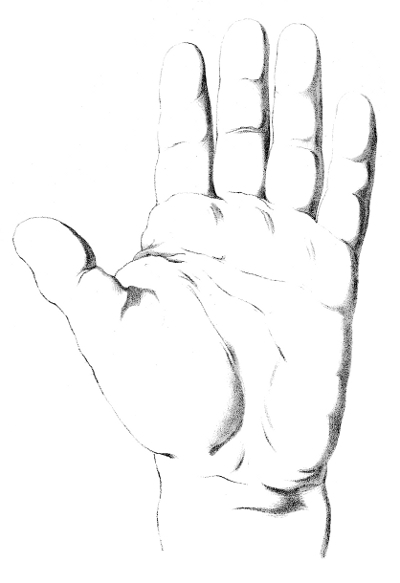
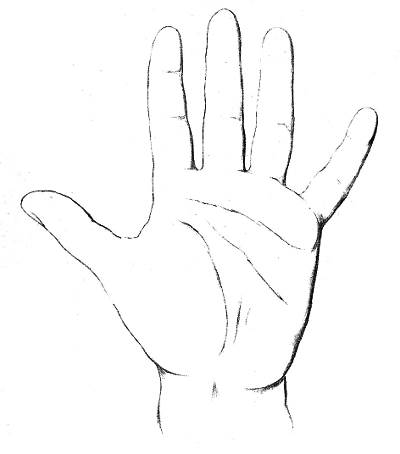
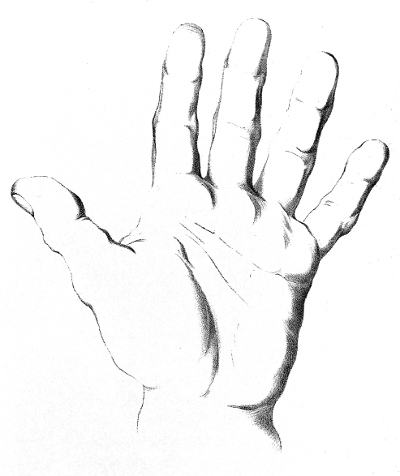
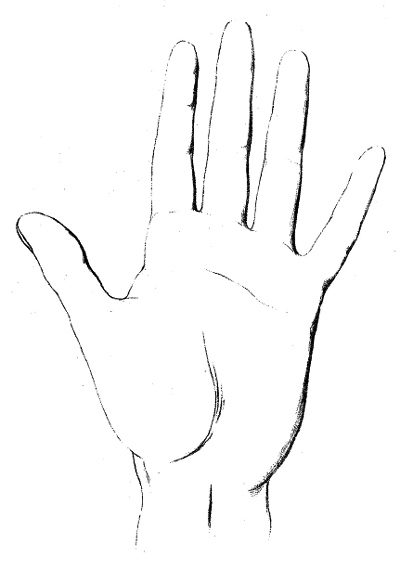
“In man the upper members are disposed
in a manner the most favourable for the exercise
of their functions as organs of prehension
and of touch: the fingers are long and
flexible; they have all, with the occasional
exception of the ring-finger, separate movements,
which other animals (even those provided
with hands) have not; the thumb,
which is apposable to these latter, is longer
in proportion to the fingers than in monkeys,
and consequently can more readily apply
itself to the extremity of their palm or surface,
and better seize small objects. The
nails, which are large and flat, cover the
back part only of the extremity of the fingers,
so as to furnish a support to the organs of
touch without in the least depriving them of
their delicacy. The entire hand can execute
rotatory movements the most extended; and
to the arm which supports it is afforded a
solid attachment by means of a large shoulder
or blade-bone and a long collar-bone.” The
statement of Milne Edwards,3 then, does
not appear far removed from the truth,
“That the faculties of the Mammalia are the
more elevated in proportion as their members
are the better constructed for prehension and
for touch.”
A knowledge of the form of the appendages
to the trunk of animals is of great service
to the geologist, for it has been well and
truly said, that the organic remains imbedded
in rocks are as medals struck in
commemoration of the great revolutions
which the earth has undergone, and so
small a portion as the extremity of an animal
is sufficient to indicate its nature, and
to enable us to ascertain the class and order
to which it belongs. Let us take a few
examples. Some fossil bones were discovered
by General Washington near his
seat in Virginia. Mr. Jefferson, by whom
they were examined, stated that they had
belonged to an enormous carnivorous animal,
which from the size of its claws he named
the Megalonyx. Upon an examination more
carefully conducted by Cuvier, it was found
that in the paw the second bone of the toe
was symmetrical, while in animal feeders
furnished with retractile claws it is curved,
and not symmetrical; the first bone, too, was
the shortest, whereas in the lion and others
of the feline tribe it is the longest. Whence
Cuvier was led to conclude that the creature
in question was a sloth of large dimensions,
which fed only upon plants.
Upon another occasion, from a careful
consideration of the form and size of a toe
found in the Palatinate, near Eppelsheim,
Cuvier was able to determine that the animal
to which it belonged was of the edentate
tribe of Pangolins. It was from an examination
of the hand that Cuvier decided upon
the nature of the Pterodactylus. This curious
animal partook of the nature of both
the reptile and the bird. Like the bird, it
was furnished with a long neck and a horny
beak, but in its jaws and teeth it resembled
the crocodile. It had not, however, like
the bird, feathered wings without fingers to
strengthen them, nor had it a wing in which
the thumb alone is free, like that of the bat.
Instead of the bony pieces of all the fingers
being equally prolonged, the second finger
only was extended to a great length, and
from it the wing spread out, the other fingers
being short and furnished with nails like the
toes of ordinary animals. Collini, its discoverer,
supposed it to be of marine origin;
Soemmerring contended that it was a mammal;
but its true place in the animal series
was first assigned to it by Cuvier, who has
satisfactorily shewn that it is in fact intermediate
between a bird and a reptile.
A knowledge of the form of the extremities
of animals has been of great service to palæontology
in another way—in proving the
existence of certain species of animals at
given periods of the earth’s formation, from
the print of their footsteps left upon the sand
or other material of the strata while it was
yet in a soft state. Such traces were first
observed by Dr. Duncan in Dumfries-shire.
On examining a sandstone quarry, he found
these prints not on one only, but on several
successive layers of the stone; so that they
must have been made at periods distant from
each other. Similar impressions have been
since observed in the Forest marble-beds
near Bath, at Hessburg in Saxony, in the
State of Connecticut, and in some other
parts of the world.
“The marks found in Dumfries-shire, of
which there were as many as twenty-four
upon a single slab, formed as it were a regular
track, with six distinct repetitions of
each foot, the fore and hind feet having left
different impressions, and even the marks of
the claws being discernible. They appear
to have been made by some animal of the
tortoise kind. At Hessburg the impressions
were discovered in quarries of grey and red
sandstone alternating; and the marks were
both larger and more distinct than those
found in Scotland. In one the hind foot
measured twelve inches in length, and the
fore foot always appeared much smaller than
the hind. From this circumstance, and from
the distance between the two being only fourteen
inches, it is conjectured that the animal
was a marsupial like the kangaroo, and it
has been termed by Dr. Kaup Chirotherium,
from the supposed resemblance of the four
toes and turned-out thumb to a hand. In
the State of Connecticut, near Northampton,
footsteps differing exceedingly in size have
been found in inclined strata of sandstone.
They were evidently made before it assumed
its present position. The marks are always
in pairs, and the tracts cross each other like
those of ducks on the margin of a muddy
pond. One is of the length of fifteen or sixteen
inches, and a feathery spur or appendage
appears to have been attached to the
heel, eight or nine inches long. The distance
between the steps is proportioned to
their length, but in every case the pace
appears to have been longer than that of the
existing species of birds to which they approach
nearest—the ostrich, and the animal
must consequently have been proportionably
larger. How much larger he was than the
ostrich may be gathered from this, that the
large African ostrich has only a foot ten
inches long, less than two-thirds that of this
bird, and yet stands nine feet high. These
proportions would give a height of fourteen
feet to the extinct animal.”4
The characters afforded by the foot have
recently enabled Mr. Strickland to determine
that the dodo, a bird now extinct, is
not related either to the gallinaceous birds,—the
vulture or the ostriches as some have
conjectured,—but is closely allied to the
pigeons.
From this cursory examination of the animal
world we may gather the important
conclusion, that from the structure of an
extremity we may obtain a complete insight
into the entire organisation of an animal;
and thus the paws furnished with sharp retractile
claws of the lion indicate at once
to a naturalist its strong teeth, its powerful
jaws, and its muscular strength of limb;
while from the cleft foot of the cow, the
complicated structure of its stomach, the
definite peculiarities of its jaws, and its
vegetable diet, may with equal certainty be
predicated.
Thus, as Paley justly observes, “In the
swan, the web foot, the spoon bill, the long
neck, the thick down, the graminivorous
stomach, have all a relation to one another,
inasmuch as they all concur in one design,
that of supplying the occasions of an aquatic
fowl, floating upon the surface of shallow
parts of water, and seeking its food at the
bottom. Begin with any one of these peculiarities
of structure, and observe how the
rest follow it. The web foot qualifies the
bird for swimming, the spoon bill enables it
to graze. But how is an animal, floating
upon the surface of pools of water, to gaze at
the bottom except by the mediation of a
long neck? And a long neck is accordingly
given to it. Again, a warm-blooded animal,
which was to pass its life upon water, required
a defence against the coldness of that
element. Such a defence is furnished to the
swan in the muff in which its body is
wrapped. But all this outward apparatus
would have been in vain if the intestinal
system had not been suited to the digestion
of vegetable substances.”5
And, again, of the mole: “The form of the
feet fixes the character of the animal. They
are so many shovels; they determine its
action to that of rooting in the ground; and
every thing about its body agrees with this
destination. The cylindrical figure of the
mole, as well as the compactness of its form,
arising from the terseness of its limbs, proportionally
lessens its labour; because, according
to its bulk, it thereby requires the
least possible quantity of earth to be removed
for its progress. It has nearly the same
structure of the face and jaws as a swine,
and the same office for them. The nose is
sharp, slender, tendinous, strong; with a
pair of nerves going down to the end of it.
The plush covering, which, by the smoothness,
closeness, and polish of the short piles
that compose it, rejects the adhesion of almost
every species of earth, defends the
animal from cold and wet, and from the
impediment which it would experience by
the mould sticking to its body. From soils
of all kind the little pioneer comes forth
bright and clean. Inhabiting dirt, it is of
all animals the neatest.”