"What time is it, miss?"
Marian put down the gallon tin with which she
had bailed steadily, and looked at her watch.
"Almost midnight."
"Only midnight!"
The steersman gave a weary yawn and turned
back to his wheel. Inwardly Marian echoed his
discouraged word. It seemed to her that she had
crouched for years in the stern of the crazy little
motor-boat. Rain and spray had drenched her
to the skin. She ached in every half-frozen bone.
Yet she sat, wide awake and alert, watching her
pilot keenly.
He was a poor helmsman, she thought. However,
an expert would have found trouble in taking
an overloaded launch up-stream against that swollen
current and in pitch darkness. Worse, the
weight of the heavy dredge-bail weighed the launch
down almost to water level. Every tiny wave
splashed over the gunwale. Marian bailed on
mechanically.
She had had hard work to bribe the owner to
risk the trip up-stream. The men at Grafton had
warned her, moreover, that she was running a narrow
chance of swamping the launch, and thus of
losing her precious piece of machinery, to say
nothing of the danger to her own life. But all
Marian's old timidity had fled, forgotten. Nothing
else mattered if just she might serve her brother
in his supreme need.
Through these four dreary hours the old commodore's
quaint, frank words had echoed in her
mind. And the commodore had been right, she
owned, with a quiver of shame. Always, since
their mud-pie days, Rod had done his part by
her in full measure, generously, lovingly. Never,
until these last days, had she even realized what
doing her own part by Roderick might mean.
"Although I have been slower than my blessed
old Slow-Coach himself in realizing what my life
ought to count for. Well, as the commodore said,
I have waked up at last. And mind this, Marian
Hallowell! You stay awake! Never, never let me
catch you dozing off again!"
"There's the camp light yonder," the steersman
spoke at last, with a sigh of satisfaction.
Marian peered ahead through the cold, blinding
mist. Away up-stream shone a feeble glimmer,
then a second light; a third.
"Good! And—there are the dredge search-lights!
Only a minute more and we'll be there."
Only a minute it seemed till the launch wheezed
up to the landing and swung with a thud against
the posts. Marian stumbled ashore.
"Mulcahy!" she called to the dark figure standing
on the dredge deck. "Send two men to unload
the bail for us."
"Marian Hallowell! Where under the shining
sun did you come from?" Roderick leaped from
the deck to the shore and confronted his sister.
Then, in his horrified surprise at her daring risk,
he pounced upon her and administered a scolding
of such vigor that it fairly made her gasp.
"Of all the outrageous, reckless——"
"There, there, Rod! Look!"
Still breathing threatenings and slaughter, Roderick
turned. Then he saw the huge new bail
which the men were hoisting ashore.
"So that's what it all means! That's why you
came up on the early train! You brought that
bail yourself, all the way. You risked your life in
that groggy little boat! All on purpose to help
us out! Marian Hallowell, I'd like to shake you
hard. And for two cents I'd kiss you right here
and now. You—you peach!"
Burford, awakened by the launch whistle, was
hurrying down the bank. Reaching the landing
his eye fell on the precious new bail.
Utterly silent, he stared at it for a long rapt
minute. Then, rubbing his sleepy eyes, he turned
to Marian and Rod with a grin that fairly lighted
up the dock.
"Now," he said, with slow exultation, "now—we've
got our chance to win."
And win they did.
True, the water had already risen close to the
dreaded three-foot danger-mark. True, neither
of the boys had had half a dozen hours of sleep in
three days. As for the laborers, they were fagged
and overworked to the limit of their endurance.
But not one of these things counted. Not a grumbling
word was spoken. This was their company's
one chance. Not a man held back from seizing
that chance and making good. Not a man
but felt himself one with the company, a living
vital element of that splendid struggling whole.
Marian and Sally Lou stood on the shore watching
the dredge as the great dipper crunched its
way through the last submerged barrier. The
canal rolled bank full. Little waves swashed over
the platform on which they stood. Pools of seep-water
already gathered behind the mud embankment,
which was crumbling into miry avalanches
with every sweep of rising water against it. Not
by any chance could the levee stand another hour.
But even as the dredge cut that narrow passage,
the heavy overflow boiled outward into the river
beyond. Minute by minute the rough surface of
the canal was sinking before their watching eyes.
Now it had fallen from six inches above to high-water
mark; now to three inches below; now to
mid-stage—and safety.
As the freed stream rolled out into the river, a
great cheer rose from the laborers crowded alongshore.
Roderick and Burford stayed aboard the
dredge until it was warped alongside the dock and
safely moored. Then they crossed to land and
joined the girls. Neither of the boys spoke one
word. They did not seem to hear the shouts and
cheers behind them. There was no glow of success
on their sober faces. Perhaps their relief was so
great that they were a little stunned before its
wonder. Victory was theirs; but victory won in
the face of so great a danger that they could not
yield and feel assured of their escape.
"We cannot reach head-quarters on the telephone,
of course. But, by hook or crook, one of
you boys must get a despatch through to Mr.
Breckenridge. Think of being able to tell him
that you have deepened the canal straight through
to the river, so that the whole lower half of the district
is safe from overflow! And that you have
moved all these costly, treacherous machines
down-stream without one serious accident, without
so much as a broken bolt! It is too good to
be true."
"I'll take a launch and sprint down to Grafton
and wire our report from there," said Burford.
His tense face relaxed; he broke into a delighted
chuckle. "Think of it: this once I can actually
enjoy sending in my report to head-quarters! I'd
like to write it out instead of wiring it. I'd put
red-ink curlycues and scroll-work dewdabs all over
the page. Think, Hallowell, you solemn wooden
Indian! The crest of this flood is only two hours
away. By noon the highest level will reach our
canal. But it can't flood our district for us,
for—for we got there first!"
His rosy face one glow of contentment, he started
toward the pier. But as he was about to step
aboard the duty-launch, Roderick hailed him
sharply.
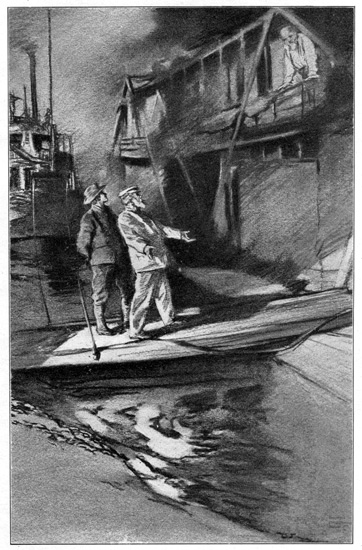
"Wait, Burford. Somebody is coming up the
big ditch. A large gray launch, with a little dark-blue
flag."
"What!"
Burford sprang back. He shaded his eyes and
looked down the canal. Then, to Rod's amazement,
he sat down on a pile of two-by-fours and
rocked to and fro.
"Whatever ails you, Burford?"
"Whatever ails me, indeed!" Burford choked
it out. His ears were scarlet. His eyes were fairly
popping from his head with delight. "Oh, I
reckon I won't bother to send that report to head-quarters,
after all. I'll just let the whole thing
slide."
Rod gaped at him.
"Have you lost your last wit, Ned?"
"Not quite. I'm going to give my report to my
superior officer by word of mouth. That big gray
power-boat is one of our own company's launches.
That small blue flag is the company ensign. And
that big gray man standing 'midships is—Breckenridge!
Breck the Great, his very self."
"Breckenridge!"
"Breckenridge. All there, too—every splendid
inch of him. Talk about luck! Our levee is
saved. Our dredges are all anchored, right yonder,
trim as a gimlet. Our schedule is put through
up to the minute. And here, precisely on the
psychological moment, comes our chief on his tour
of inspection. Can you beat that?"
Roderick merely stared down the canal.
Close behind the launch pilot, scanning the bank
intently as they steamed by, towered a broad-shouldered,
heavily built man, gray-headed, yet
powerful and alert in every movement. He was
well splashed with mud; his broad, heavily featured
face was colorless with fatigue. Yet as he
stood there, with his big tense body, his tired,
eager face, he seemed like some magnificent natural
force imprisoned in human flesh.
"Isn't he sumptuous, though?" said Burford,
under his breath. "Look at those shoulders!
What a half-back he would make!"
"Half-back? Why, he could make the All-American,"
Rod whispered back. His eyes were
glued to that tall approaching figure. His heart
was pounding in his breast. So this was Breckenridge
the Great, his hero! And, marvel of marvels,
he looked the hero of all Rod's farthest dreams.
Breckenridge stepped from the launch and shook
hands heartily with the radiant and stammering
Burford. He looked at Roderick with steady
dark eyes. He hardly spoke in reply to Burford's
introduction. But the grip of his big, muscular
hand was warmly cordial.
He asked a few brief questions. Then he listened,
his heavy head bent, his heavy-lidded eyes
half closed, to Burford's eager account of their
struggles and their triumphs. Almost without
speaking he clambered into the launch again and
motioned the boys to follow.
For four consecutive hours the three went up
and down the rough miry channels. Roderick
steered the launch. Burford answered Breckenridge's
occasional questions. Breckenridge stood,
field-glass in hand, sweeping first one bank, then
another with tireless eyes. He made almost no
comment on Burford's explanations; but the slow
occasional nod of his massive head was eloquent.
Finally they retraced the last lateral and
brought the launch up to the main landing.
"No, I'll not stop to dine with you, much as
I should enjoy it. I must be getting on to the
next contract. They're seeing heavy weather
too." Breckenridge stood up, stretching his big,
cramped body. As he stood there, brushing the
clay from his coat, he seemed to loom.
"I have nothing much to say to you fellows,"
he went on in his quiet, casual voice, "only to
remark that you must have worked like Trojans.
You have made a far larger yardage record than
we had dared to expect. You've put brains into
your work, too. Can't say I'm surprised at your
success, by the way. I was pretty certain from
what Crosby said that you two would swing this
contract, all right. Crosby and I had a talk in
Chicago a week or so ago. We were in Tech
together. Naturally he's quite a pal of mine,
though nowadays we're opponents in a business
way. But his opinion weighs heavily with me.
And now that I have gone over the ground for myself,
I am inclined to think that Crosby rather—well,
that he underestimated your services to the
company." Again his big head bent with that
queer slow nod. For a moment Breck himself,
the real man, alert, just, keenly understanding,
flashed a glance from behind that heavy mask of
splendid, impassive flesh. "Later you will probably
receive a more detailed explanation of my
opinion on your work. Good luck to you both,
and good-by."
He stepped into the launch. The powerful
boat dashed away down the rough yellow canal.
The boys stood and looked after him. Burford
was wildly exultant. But Roderick was silent.
A curious, deep satisfaction lighted his stolid,
boyish face. Every word that Breckenridge had
spoken was tingling in his blood. At last he
had met his hero face to face, man to man. And
his hero had proven all that heart could ask.
"I wish I knew what he meant by saying that
you'd hear further as to his opinion on your
work," pondered Marian.
Just two days later her wish was gratified.
It was a rainy, dreary day. Rod had spent the
morning up the laterals and had come home dripping.
Marian was trying to dry his soaked clothes
before the smoky little oil-stove, but without much
success. Just before noon she heard a welcome
whistle. She ran down the bank to meet the rural
delivery-man in his little spider-launch. The
roads were long since impassable; the mail and
all the camp supplies must come by water.
"Stacks of letters, Rod. A fat official one for
the Burfords and a still fatter, more official one
for you. Do read it and tell me your news."
"All right, Sis." Rod pushed aside his blueprints
and set to opening his mail.
Marian looked over her own letters. They were
all of a sort: pleasant, affectionate notes from her
friends at home. All, with one accord, besought
her to hurry back to college for commencement.
All earnestly pitied her for the tedious weeks that
she was spending "in that rough, dreadful western
country."
Marian's eyes twinkled as she read. At the
bottom of the pile lay a note from her good friend
Isabel, begging her for the twentieth time to
spend August with her in her beautiful home at
Beverly Farms.
Marian read that letter twice. Her dark brows
narrowed.
Before her eyes gleamed Isabel's home, the great
beautiful house, set on a terraced emerald-green
hill. Behind it, dark, cool, mysterious, lay the
pine woods; before it flashed and gleamed the sea.
She could see its wide, stately rooms, its soft-hued,
luxurious furnishings. She could feel the
atmosphere of quiet contentment, of assured ease,
which was to Isabel and her mother the very air
they breathed.
Then she looked around her.
Here she sat in a tiny canvas shack with a
rough board floor. She looked at its mended
chairs, its rag-tag rug, and stringy curtains;
Rod's wet clothes, dripping before the little oil-stove;
Rod's battered desk, heaped with papers
and blue-prints, a mass of accumulated work.
Then she looked through the tent-flap. Neither
blue ocean nor deep, still forest met her eyes.
Only a narrow, muddy ditch; a row of wind-torn
willows; a dark, swollen river, hurrying on beneath
a dark, sinister sky.
An exclamation from Rod startled her. He
stooped to her, his tired face burning. With unsteady
fingers he put a letter into her hand.
"Read that, Sis. No, I'll not read it aloud to
you. Look at it with your own eyes."
The Breckenridge Engineering Company.
office of the superintendent.
Roderick T. Hallowell, C. E.,
c/o Contract Camp, Grafton, Illinois.
Sir: I beg to state that certain changes in the
engineering force of the company have brought
about a change in the position occupied by yourself
with our firm. Beginning upon the first day
of June, 1912, you will be transferred to the post
of assistant superintendent on a large drainage
contract in northern Iowa. While your position
will be second to that of Mr. McPherson, our
supervising engineer, yet you will be given entire
charge of the assembling of the plant and its construction.
Your salary will be two thousand dollars.
Payment quarterly, as is our custom.
Some objections to this promotion have been
raised by members of our company on the score
of your limited experience. Mr. Breckenridge,
however, considers from his observation of your
methods that you will prove fully equal to this
exacting and responsible position.
I am, very respectfully,
The Breckenridge Engineering Company.
Per R. W. Austin, Sec'y.
Silent, wide-eyed, Marian read this amazing
document. Then, with a cry of surprise and delight,
she turned to her brother. But before she
could speak, a storm of eager feet dashed up the
cabin steps. In burst Sally Lou and Ned, headlong.
Ned, breathless with excitement, waved a
long official envelope. But Sally Lou, close at
his heels with Thomas Tucker crowing on her arm,
poured out the wild tale.
"Oh, Marian! Oh, Roderick! Oh, it's too
good and grand and glorious to be true! We're
going home, home, straight back to Virginia!"
"Yes, we're going home, we're fired," puffed
Ned, as Sally Lou paused for breath. He sank
down on the bench with a sigh of ecstasy. "Don't
look so dazed, Hallowell. There is more news
coming. We're ordered off this contract. But
we're not ordered out of the Breckenridge Engineering
Company. Not quite yet. Instead, I'm
directed to report on the Dismal Swamp Canal
the first of the month. My position will be practically
the same as the one that I'm now holding.
But we can live at home. At home, I say! Right
in Norfolk, right in the midst of all Sally Lou's
own home-folks, right around the corner from my
own father's house. Won't we have a glorious
year of it! And won't Edward Junior and Thomas
Tucker be good and spoiled, though!"
"We're so happy we can't even say it to each
other!" Sally Lou sat down suddenly, hiding her
April face in Thomas Tucker's small pinafore.
"It took Mammy Easter to express our feelings
for us. 'Land, honey,' said she, 'I cert'n'y am
thankful that we's goin' back to civilization. I
want to climb on a real street-car again. I want
to ride in an elevator. I don't care if I never sets
foot in one of dem slippery little launches again,
long's I live. But most of all I want to tote dese
lambs out of this swamp and on to de dry land
before dey grows up plumb web-footed.'"
In the midst of the laugh that followed, a launch
whistled from down the canal.
"There's Mulcahy now. Hurry, Ned. Go
down to Grafton and send your telegram to
head-quarters. Good-by, folks! Come over to
the martin-box to-night and we'll hold one last
celebration."
Sally Lou tossed her baby to her shoulder.
Away she sped beside her husband. Marian
looked after the gay, hurrying figures. Then,
still bewildered, she turned to Roderick.
"Well! What will happen next! Ned and
Sally Lou ordered to Virginia; you promoted—it
takes my breath away! But, Rod!" Her
voice rose with a startled note. She looked up
keenly at her brother's grave face. "You—you
dear, cold-blooded old slow-coach! How can you
look so pensive and perplexed? Of all the splendid,
splendid news! How could you keep still
and not tell the Burfords? How can you keep still
now? If I wasn't so tired, I'd dance a jig right
here on your desk!"
"I ought to be dancing jigs myself," Roderick
answered. "I don't half deserve this magnificent
chance, I know that. But I—I don't know what
to say. I'm facing a dead wall."
"Rod, what do you mean? Of course you will
accept this promotion. You must. There can't
be any question!" Marian was on her knees by
his chair now, clasping his cold hands in her own.
Her voice rang sharp with angry affection. "Don't
halt and fumble so, brother! Don't you remember,
three months ago, how you fretted and hesitated
about taking the position that you are holding
to-day? See how you have succeeded in it!
Yet look at you! To-day you are wavering
and boggling and hanging back, just as you did
then."
"I'm hanging back, yes. But not for the same
reason." Roderick looked down at her with dark,
troubled eyes. "That time, I hesitated to accept
on your account. This time, I'm hesitating on my
own."
"Why, Roderick Hallowell! You are not afraid
of hard work, nor of taking chances, either. Rod,
tell me this minute. Are you ill? What is it,
dear?"
"Nonsense. I'm perfectly well. But I am
tired out. I don't know how to tell you what I
mean. So tired that I dread the mere thought of
going on a new contract, and taking charge of a
new crew, and breaking myself in to a new piece
of work. Yes, it does sound cowardly. But I
cannot see my way clear. I don't believe I dare
take it up."
Marian looked at him closely.
"Sleep on this, Rod. A night's rest will give
you a different light on the matter."
"A night's rest won't make any difference in
the facts, Sis. The position is too complicated
for a greenhorn like me. I believe I could assemble
the plant, all right. And I think I could handle
the laborers. But the endless outside detail is
what I'm afraid of. That, and the responsibility,
too. For instance, on a contract like this one in
Iowa, the engineers must act as paymasters, each
for his division. That means, reckon the men's
time daily; make out their checks; handle their
wages for them; and so on. Then there are my
tabulated reports for the head office. Then my
supplies. You have seen with your own eyes
how much time and work just the buying of coal
and machinery can demand. Then there would
be a thousand smaller matters to look after. Taking
it all in all, I don't want to make a try at this
offer, then fail. So the sensible thing to do is,
meekly to ask the company for a less impressive
post."
"All that you would need for the extra work that
you describe would be a competent book-keeper,
Rod."
"Exactly!" Rod laughed shortly. "But a
'competent' book-keeper is the last employé that
one can find for such hard, isolated work as this.
What I need is not just a man to add columns for
me. I need another brain, an extra pair of hands.
I need the sort of first-aid that you have been giving
me all these weeks, Sis. That's the sort of
help that you can't buy for love nor money.
That's all."
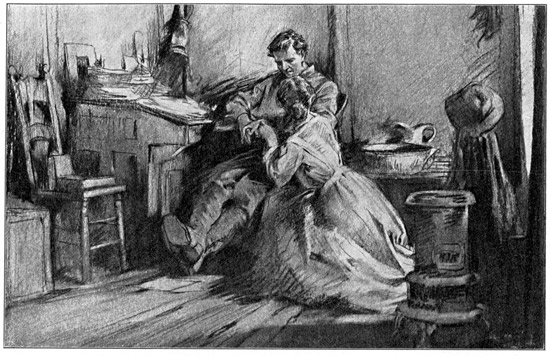
MARIAN WAS ON HER KNEES BY HIS CHAIR, CLASPING HIS COLD HANDS IN HER OWN.
Marian studied her brother's face. When she
spoke, her voice was very gentle and low.
"All right, Rod. Telegraph head-quarters that
you will accept."
"Why?"
"Because—I am going to take that position as
book-keeper. There, now!"
Roderick sat up with some vehemence.
"Marian Hallowell, I think I see myself letting
you do any more of my work. You're going back
to college next week, for commencement. Then
you may come West again, if you're determined to
stay somewhere near me. I'm mighty glad to have
you within reach, I must admit that. But you
are not to live down in the woods any longer.
And not another stroke of my work shall you do."
"Why not? Am I such a poor stenographer?"
Roderick laughed at her injured tone. Pride
and affection mingled in that laugh.
"You have been invaluable, Sis. You know
that perfectly well. I'd never have pulled through
this month without you. You have been of more
real use than any three ordinary stenographers
rolled together. For you have used your own
brains and will and courage. You have not stood
gracefully by and waited for orders. You have
marched right on, and you have done a man's
work straight through. But our long pull is over
now. And you are well and strong again, I'm
thankful to say. So back to the East you go,
old lady. No more contract jobs for you."
Marian's eyes narrowed ominously. Deliberately
she seated herself on the arm of her brother's
chair. Gently but firmly she seized him by both
ears.
"Now, Roderick Hallowell, listen to me. Three
months ago the company offered you this position.
I wanted you to accept it. But, of all
things, I did not want to go West with you. I
teased and coaxed and whined. Much good my
whining did me. For you just set that Rock-o'-Gibraltar
chin of yours, and took me firmly by
the collar and marched me along.
"Now, Roderick Hallowell, look at me!"
Chuckling and shamefaced, Roderick struggled
to turn his face away; but Marian's fingers gripped
mercilessly tight.
"Look at me, I say. Answer. Didn't you
bully me into giving up to your wishes, by threatening
to refuse this position unless I'd come West
with you? Didn't you drag me out here willy-nilly?
Very well. You have had your way. You
have brought me here, and—you can't send me
back. There now."
"Marian, this is not fair." Roderick freed one
ear and looked sternly at his sister. "You must
finish your education. I have no right to keep
you trailing around the country with me, wasting
your time and cutting you off from your friends
and denying you any home comfort. You shall
not sacrifice yourself——"
"Sacrifice myself, indeed!" Marian took a
fresh grip. "All I ask is to stay with you until
next February. Then I'll go back and take up
my college work at the exact point where I laid it
down. I cannot graduate with my class, no matter
how hard I try. My illness last winter took too
much time. So I may as well join the class following,
at mid-years'. In the mean time, we will
have eight splendid months together. No, I have
waked up, Rod. You can't hush me off to my
selfish doze again."
"But, Marian, I can't possibly permit——"
"Yes, you can. And you will. As to home
comforts—isn't it home, wherever we two are together?
As to being cut off from my friends—aren't
you the best chum I ever had? How
do you suppose I like being cut off from you,
brother?"
Rod did not answer. At last he looked up.
The sober gratitude in his eyes brought an answering
radiance to Marian's own.
"I give up, Sis. You shall stay with me for
the summer, anyway. Then we'll see. Now run
away, you blessed old partner!" His big hands
shut on her shoulders with an eloquent grip. "I'm
going to write to head-quarters and accept that
position before I have time to turn coward again
and change my mind."
Marian gave him a vigorous hug of satisfaction,
and ran away. Letter in hand, Roderick went to
his desk.
Carefully he set down his formal, courteous acceptance.
He read the finished letter with critical
care. Something was lacking. Yet he had taken
all possible pains. What more could his reply
need?
Suddenly his face brightened. He took up his
pen. Slowly and carefully he added a final paragraph:
"In accepting this promotion, I wish to do so
with the understanding that my sister, Miss Hallowell,
who has acted as my assistant during the
past month, shall continue to hold that position
under the new contract. As her work is to be
counted as a part of my own, I will request that
my quarterly checks shall be made out, not to
R. T. Hallowell, but to 'Hallowell & Hallowell,'
as the salary is to be drawn by us on a basis of
equal partnership."
He put down the finished sheet. His boyish
face lighted with a slow, triumphant glow. He
looked out across the gray wet country, the fog-banked
river. To his eyes the dull scene was
illumined. For his steady vision could see past
that gray dreariness, far up the broad high-road
of work and success that he had now set foot upon.
These three months of heavy toil had proven him.
He had seized his fighting chance, and he had
made good. And now all the royal chances of his
profession were waiting at his call.
"Though I never could have put it through
without Marian," he said under his breath. "My
splendid, plucky little old Sis! No wonder I made
good, with such a partner. And from now on she
shall be my real partner, bless her heart. 'Hallowell
& Hallowell,' now and forever!