Transcriber’s Note: This is a reprint edition provided by the Negro Universities
Press, New York, 1969. Articles split across pages of the magazine have
been re-joined. Adverts have been moved to the end of the publication.
AUGUST, 1916
10 cents a Copy 75 cents a Year
The HALF-CENTURY MAGAZINE PUBLISHING Company
Chicago, Illinois
The
Half-Century Magazine
K. E. WILLIAMS, Editor E. S. BROWN, Business Mgr.
3708 WABASH AVENUE, CHICAGO
SUBSCRIPTION
75 Cents per Year; 50 Cents for Six Months; 25 Cents for Three Months
Expirations.—Each subscriber
is notified of the expiration
of his subscription by the receipt
of a blue subscription
blank enclosed in the last issue
of the magazine to which he
is entitled.
Change of Address.—In every
case give the old as well
as the new address. We cannot
proceed without this information.
Most Important of All.—In
every letter that you write us
never fail to give your full
address plainly written, name,
post-office, County and State.
We Always Stop the Magazine
at the expiration of the
time paid for unless a renewal
of subscription is received.
Those whose subscriptions
have expired must not expect
to receive the magazine unless
they send the money to pay
for it another year.
Postage.—From subscribers
in Chicago 24 cents extra is
required to cover postage upon
a yearly subscription. In
all other parts of the United
States, Mexico and our Island
possessions we prepay postage.
For foreign countries we
require 36 cents extra to cover
a year’s postage and for Canada
18 cents in addition to the
regular yearly subscription.
Remittances may be made in
ordinary letters if the sum is
small. Where they exceed
one dollar use registered letter,
P. O. Money Order, or Express
Money Order.
As there are already many race publications on the market, it is expected
of a new one that an excuse be offered for its entering
the field and an explanation be made of its object, its purpose
and its policy.
The excuse that it is “to fill a long felt want,” although a stereotyped
expression, is an appropriate one in this case; for notwithstanding
there are already many race publications on the market, none of them
seems to meet the requirements, judging from the general expressions
so repeatedly heard.
There are so many features that we plan to cover, and so many
things that are done by other publications that we think are subject to
criticism, which we propose not to do, that we will make mention of
only a few of them at this time, leaving the balance to be reviewed later.
It will not be our sole ambition to make this magazine a “literary
gem” either for our own gratification or to suit the fancy of the “highbrows,”
but to present facts in plain, commonsense language, so that the
masses may read and understand; or, in the words of Brother Taylor,
we propose to call a “spade a spade” and not an “excavating instrument
for manual manipulation.”
It is our intention to chronicle such doings of the race as may be
of interest to a majority of our readers. Such men and women of
the race as may attain eminence or affluence by perseverance, we shall
be pleased to make mention of in these columns, as we feel assured
that the masses are interested in the same; but we shall refrain from
publishing such articles as “Sister Smith of Bastrop gave a chicken
dinner last Sunday for Brother Jones of Monroe,” as we believe that
of all our readers only four persons would be interested in such an item—Sister
Smith, because it tickled her vanity to see her name in print;
Brother Jones, to the extent that as he had partaken of many similar
dinners under more agreeable surroundings, the recalling to his memory
of this affair reminded him how bored he was; Brother Jones’ wife,
who was in a quandary as to why Sister Smith should go to the expense
to give her husband a dinner, and Mrs. Brown, who lives next
door to Sister Smith, who expresses her interest with these remarks:
“I think it would be better if Sister Smith would pay her debts before
she starts giving big dinners.” As such news items are fully covered
by our leading Colored weeklies, we leave the field to their complete
monopolistic control.
As the Race Problem is ever with us, we shall discuss and shall
entertain discussions of the same from time to time. We appreciate
that we are now living in a commercial era and that the factors of paramount
importance in the solution of this problem are economy, industry—the
making and saving of money—and business development. We also
appreciate that in the upbuilding of the race, unity, co-operation and
race patronage are essential. We believe where other things being
equal, our business enterprises should receive the patronage of our leaders
as well as the masses. There seems to be a well-founded complaint
that some of our leaders, from indifference, selfishness or neglect, fail
to patronize our business enterprises or give them the consideration
they deserve. The Good Book says: “If you are not for us you are
against us.” We shall endeavor to “show up” from time to time which
side our leaders are on.
Unfortunately, we have three classes of leaders. In the first class
we have the men and women who, through thought and sacrifice and
action, are actually doing things for the race’s advancement. We will
take pleasure in mentioning them and their work, as they are entitled
to every praise.
In another class we have leaders that have been selected for us
by the white race, on account of their willingness to advocate inferiority
and practice submission. We have still another class that has
assumed leadership based upon falsification, gall, treachery, bigotry,
egotism and borrowed oratory. These two latter classes are appropriately
designated as “old aces” and it is customary for our race
journals to give publicity to such persons for so much per. When
such persons do something for the advancement of the race we will
be pleased to make note thereof, but we will not use valuable space in
rehashing and gleaming before the public, falsely assumed virtues and
accomplishments to which they are not entitled, but for which they
have been given credit solely for the reason that they have “divied up”
with someone, to falsely represent them before the public.
We should like to send every one of our Subscribers a letter
telling of our plans and ambition to give them the greatest value in
the columns of The Half-Century Magazine that can be obtained
anywhere.
We are very pleased to announce that we have secured the services
of Miss Leona Porter to conduct our Domestic Science Department.
She is, without question, one of the leading cooking authorities
in this country today and needs no introduction. To secure Miss
Porter’s services exclusively for the Half-Century, it cost a great
deal of money, but we wanted to have the “real authority” to conduct
this department. The recipes which will be published each
month should be saved. They are arranged in convenient form, so
that they can be cut out and pasted in your cook book. You are at
liberty to write Miss Porter at any time and she will give you, without
cost, helpful advice on all questions of marketing and cooking,
household economies, recipes, menus, left-overs and problems of
housekeepers.
Miss Evelyn Northington will conduct our Department of Beauty
Hints. Miss Northington needs no introduction, as she is of national
renown as an authority on Beauty Culture. You can rest assured
that when Miss Northington indorses anything, it has had her personal
investigation and her indorsement cannot be purchased for
money. The article itself must come up to the standard or she will
not indorse it. Little aids to beauty and good health—hints on complexion,
hair trouble, skin, etc.—are matters on which you will
receive advice promptly from a source you may trust.
We shall note each month, as the information comes to us, the
latest books by Colored authors or about the Negro. The latest songs
and music by Negroes and the latest talking machine records.
We want short stories with plots and settings dealing with
Negro life and will pay a good price for all such stories as are accepted
for publication in our columns. Stories must not exceed 5,000
words, must be typewritten and written only on one side of paper.
Please understand—manuscripts that are not accepted will not be
returned unless sufficient stamps are inclosed to pay postage on the
same.
Politics! Oh, yes! The Negro is a born politician, and although
we shall try to avoid following our natural instinct to jump into the
Political Pot, at the same time we are going to reserve the right to
discuss fairly and impartially, men and measures as they may come
up to affect the welfare of the race.
We are planning a Special Fashion Number for our September
issue. This will be a unique number in which we have a big surprise
in store for you. We will show the latest fall styles in ladies’ wearing
apparel. A corps of trained fashion experts of our race in Chicago
and New York have been engaged and will especially feature our
people in the latest styles.
The advertisements of a modern publication have become one of
its most important features, as it is the medium by which the manufacturer
or distributor and the consumer are brought together. It is
a fact that many persons are more interested in the advertisements of
a publication than in any other of its features, which is evidenced by
the fact that they often read the advertisements first; for it enables
one not only to keep abreast with the new developments, but also
offers many opportunities for saving in expenses, which is very important
in these days of “high cost of living”!
We believe in truthfulness in advertising, and, therefore, will not
knowingly insert in our columns, false or extremely exaggerated advertisements;
nor will we accept the advertisements of clairvoyants,
fortune tellers, promoters of questionable oil wells or mining stocks
or other get-rich-quick concerns as have fleeced our people in the past.
It is our intention to investigate the responsibility and reliability of
each advertiser before we accept same for publication. We shall aim
to set a standard that if the advertisement appears in this publication,
it is reliable; a policy that should produce such a confidence
between the advertiser and our readers, as to result in a mutual
benefit.
These are only a few of the many things we have planned, to
give you the best value possible for your subscription money.
The Editor.
Making up your mind about people—whether you will like them
or not—the first instant you meet them, is like reading the end of a
book first. You may (though you frequently don’t) secure a fairly
accurate impression, but all the thrill of suspense, the gradual unfolding
of surmise into certainty, is lost forever.
In old Aesop’s fable we read of a frog
Who burst, like a bubble in air,
While trying to show to his friends in the bog
The size of an ox who’d been there.
And the moral was drawn from the homely old tale
That a man should take care what he tries,
And plod on through life, on a nice, modest scale,
Since only contentment is wise.
But my heart goes out to that cocky young frog,
Whose life was so recklessly spent;
Who burst into bits in the midst of his bog
Because on ambition intent.
But tho’ he was highly conceited, I know,
I’m strong for his courage and gall;
For it’s better to burst in attempting to grow
Than to have no ambition at all.
—Berton Braley in Life.
The National Association of Colored Women will hold their biennial
meeting at Baltimore, August 6 to 11.
The National Meeting of Colored Odd Fellows, that is known as
the B. M. C., will be held at Washington, September 11 to 16.
The Boyd faction of the National Baptist Convention will hold
its convention September 6th at the Second Baptist Church of Kansas
City.
The Morris faction of the National Baptist Convention will hold
its convention September 13th at the First African Baptist Church of
Savannah, Ga.
The National Negro Business League, of which the late Dr. Booker
T. Washington was president, will meet at Kansas City, Mo., August
16, 17 and 18.
The National Negro Press Association will also meet at Kansas
City at the same time.
The National Medical Association of Colored Physicians, Surgeons,
Dentists, and Pharmacists meets at Kansas City, Mo., August 22, 23, 24.
Dr. U. G. Dailey, of Chicago, is president of this organization.
An Orator — A Plea for Justice
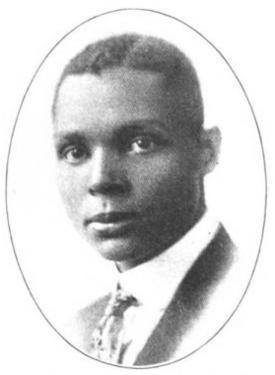
WILLIAM HARRISON HAYNES
Among the four contestants for a prize in oratory at the University
of Chicago was William Harrison Haynes of Nashville,
Tenn. The first prize of $100, which is awarded annually to a
student of this university for excellence in oratory, is given by Mr. Julius
Rosenwald of Chicago.
The contest was held on the evening of June 1st, in Leon Mandel
Assembly Hall. A brown face and such a title—“A Plea for Justice”—without
difficulty attracted for the speaker the keenest attention
of an audience almost entirely white. Confident in his skill and ability
and rejoicing in this marvelous opportunity to speak before such an
audience in behalf of his people, Mr. Haynes delivered his oration in
a style and manner that has never been equaled in previous contests.
It was evident by the heavy waves of applause, that to him belonged
the victory, and when the announcement of the first prize was made,
the colored speaker was hardly able to hold his position because of
the crowd that thronged about him to extend congratulations and to
express lofty words of praise.
Mr. Haynes, an A. B. from Morehouse College of the class of
1915, came to the University of Chicago last fall and shortly after was
made a member of the Varsity Debating team. He debated for
Chicago twice, winning both times, and on the day of his graduation
he was given an elegant gold watch fob by the Delta Sigma Rho debating
fraternity as a token of appreciation of his good fellowship and
excellent scholarship displayed during his short stay at the university.
Recently ex-President Roosevelt in a speech before the Chicago
Bar Association sounded the note for military preparedness. He and
the foremost leaders in political circles in the United States today
are trying to make the American people squarely face the issue of preparedness
from a military point-of-view.
All of this sentiment for preparation may be for future military emergencies,
or it may be to meet the growing responsibility of the nation. In
either case, if the best results are to be realized, it is necessary that in
every section of the country the fundamental principles upon which our
democracy is based shall be properly administered. If we are to be really
prepared for any emergency, then the vital principles of this government
must be understood by every man. Every section of our great country and
every man in it must know that this country stands for justice and equal
opportunities to all, and that each man is to be permitted to work out and
develop himself to his highest powers. Yet there is a section of our country
where every day the basic principles on which our government is founded
are being violated. Every day sees men subjected to injustice and arbitrary
discrimination. Every day sees men deprived of that opportunity and equal
protection of the laws which have been so cherished by the American people.
If preparedness means the development of manhood and womanhood in
order that we shall be able to repel the injustice of a foreign invader, then
we must begin by granting justice to those here at home. Tonight, ladies
and gentlemen, I wish to speak to you on one phase of the great American
problem—the relation of the Negro to the South, and the South to the Nation.
Allow me to present briefly, if you please, an analysis of the most
prevalent forms of injustice that are practiced in the South today. In the
matter of suffrage, six states in the South have in practice laws which
virtually take away the right of the colored man to vote. Politicians are
elected to office not on the basis of their ability, but simply willingness to
design and support legal technicalities which are prolific of this sort of
injustice. These suffrage laws are based upon property ownership, or
ability to read and interpret the Constitution, or payment of taxes; but
the power of decision as to who is qualified under these laws is in the hand
of a few unscrupulous politicians, who decide eligibility purely on the basis
of race. An illustration will serve to show how these laws operate and
the evils resulting from them. Before the disfranchisement act went into
operation in Alabama there were 232,000 white and 181,000 colored
male citizens of voting age, making a total of 413,000. The total number
of qualified voters in the state today will not aggregate more than 200,000.
There are 181,000 colored male citizens of voting age in Alabama today, at
least 8,000 of whom are college graduates, and yet there are only 3,000 of
them permitted to register and vote. Nevertheless, ladies and gentlemen,
these people are counted as a basis of representation, and since they are
denied the ballot they are even misrepresented, and the power of those who
do the injustice is doubled. There are tonight almost 5,000,000 colored
citizens of this country who reside in the purview of these discriminating
laws, who are denied the right of the ballot, despite the fact that more
than 53 per cent of them pay taxes on property owned. Can these states
consistently deny the rights of citizenship to 5,000,000 men, and then in
time of crisis call upon them to support the government which has kept
them down? Can Americans who believe in justice and equal opportunity
to all afford to see these men deprived of their rights? These people have
shown that they can successfully take part in the industrial life of the
South. But what good will that do unless they can protect the fruits of
their labor by means of the ballot—the ballot that elects the representatives
who make the laws—the ballot which elects the judges who enforce them?
We hear so much of ignorance and its attendant evils as a menace in
the South, we would suppose that the funds for public education would
be adequately and justly distributed. But such is not the case.
Forty per cent of the children of school age in eleven states in the
South are of the colored race, and yet they receive only fifteen per cent
of the school fund. In the state of Georgia the population of the two
races is almost equal and millions of dollars of the public fund are annually
spent for high school education, but nowhere in this great state is there
one public high school for members of my race. In the city of Atlanta, last
year, 4,503 colored children applied for admission to the public school, and
these came voluntarily, not forced by a compulsory education law. The
seating capacity of the schools provided for their education was 2,951.
Instead of increasing the seating capacity the board of education abolished
the eighth grade, and even to this night the seventh grade measures the
extent of public education for my race in the city of Atlanta.
A third form of injustice in the South which shows signs of increasing
is segregation of residential sections by city ordinances. These laws are
unconstitutional because they prevent a man from selling or renting his
property to whomsoever he chooses. But, they are also teeming with
evils which do not appear on the surface. Segregation does not simply
mean that the races live apart in separate districts. It means that these
segregated divisions for colored people will be almost automatically converted
into slums. For, in them police improvement and sanitation will
be of the poorest sort, appropriations for street improvement and sanitation
will be few and far between. It means that there will be no escape from
this environment within the city limits for even the most worthy and aspiring
citizens of my race. You can easily see the dilemma which exists in
the South today where segregation is enforced. If we are not thrifty and
have no desire for education and moral uplift, we are depicted to the world
as the most worthless of human beings. On the other hand, if we wish to
develop ourselves and our children into citizens worthy of this great Republic,
in the South we are prevented by the Law. If we ask for those
privileges of the law to which we are entitled, we are told we are not
yet ready for them. If we ask for the opportunity to prepare to exercise
those privileges, we are told we would not make use of them if we had
them—and they are denied to us. The policy of the South is illogical,
inconsistent, indefensible. Unless the South squarely faces the problem
before its doors, unless it seeks to solve the problem instead of repressing
it, and deals with the problem with intelligence and sympathy, then inevitably
there must result, for my people and for yours, stagnation, disease and death!
It is not necessary for me to call your attention this evening to the
widespread practice in the Southern states of denying the right of trial by
jury. Can any state expect to develop law-abiding citizens while the laws
themselves are freely broken in the matter of punishment? To summarize
the situation in the South, life is cheap, property is always in danger, and
lawlessness reigns supreme. As a result of it all, the law of retributive
justice brings it about that the South is the retarding cog in the machinery
of our democracy. World conditions demand that the machine be set in
prime to meet future responsibilities and duties.
The problem is neither local or racial—it is national. It is not a matter
of racial misunderstanding involving only one section of the country. It
is a matter of eleven million citizens of the United States being subjected
to flagrant injustice. Its solution involves not only the welfare of my race,
but the future of the Republic.
A correct and permanent solution of this problem involves the ready
co-operation of the colored race, the South, and the National government.
The colored race, which constitutes one-third of the population of the
South, is such a factor in the life of the South, that no plan of civil and
material welfare can ignore his rights if it hopes to reach the highest success.
We are learning the value of industrial independence and education. Leaders
of my race are coming forward, men of ideals and of vision, who are giving
to millions inspiration, ambition and hope. Given but the opportunity, we
will help to make industrious, intelligent and patriotic citizens of our people.
Today the South is half a century behind the North in the development
of her resources and her industries. It is to the interest of the South
to learn that the time spent in repressing the negro is just that much time
lost from the promotion of its industrial and civic welfare. It is to the
interest of the South to learn that those efforts which tend to curtail the
fullest growth of one-third of this population must inevitably curtail the
fullest growth of the South itself. It is to the interest of the South to
have a spiritual awakening, if it hopes to develop its material and civil
resources.
The National government that poured out its treasures and the blood
of its sons that men might be free, cannot stop short of their full enfranchisement
through the freedom of knowledge and culture. The National
government must give its aid to develop skilled hands, disciplined minds,
and patriotic hearts. For the colored race is the one asset of this country,
especially of the South, which at present shows promise of the greatest
returns in proportion to the money and energy spent in its development.
We, the younger generation of the colored race, realize the gravity of
the situation, and that we are factors in its solution. We are aware of the
fact that we are in the midst of a people that is the product of twenty
centuries of human progress.
At present we have every reason to be hopeful. When, during the
last half of the nineteenth century, the cries of my people were for charitable
help to combat ignorance and poverty, the philanthropists of the North
responded in the form of Morehouse, Fiske, Tuskegee and other institutions
of both higher education and industrial training. These schools today have
thousands of graduates scattered in all parts of the South, giving their lives
in fighting poverty and ignorance. At the beginning of the twentieth century,
the cry from the South is for equal opportunity and a proper
administration of justice. We expect the government to respond. We have
faith in American ideals—in the ultimate triumph of Americanism.
We have faith in the greatness of our country, and in the ability of
its people to meet and overcome all difficulties which may beset it. We
have faith in the determination to realize for all men, both white and black,
the broadest possibilities of life and to seek its highest powers. We have
faith in the Union of knowledge, cheerful co-operation, and broad-minded
sympathy to advance the common good. Let us pray God that the heart
hurting plights of race dislikes, the sectional differences and racial animosities
and suspicions will pass away, and their place be taken by that broader
republic of human attainment which knows no limitations of race, color,
or clime!
The Centennial General A. M. E. Conference
The Centennial General A. M. E. Conference held its twenty-fifth
quadrennial meeting in Mother Bethel Church, Philadelphia, Pa., on
Sixth street below Pine, just two blocks from Old St. George Church,
where Richard Allen and his followers left one hundred years ago and organized
the first A. M. E. Church in a little blacksmith shop on the spot where
Mother Bethel now stands.
Conference was called to order May 3rd, and was presided over by
thirteen Bishops, fifty-one general officers and attended by six hundred
thirty-two delegates, one hundred alternates and two hundred visiting ministers.
These delegates came from all sections of the United States, Africa
and other foreign lands, where the A. M. E. Churches are located.
Senior Bishop Lee presided over the first session and the following
sessions were presided over by the Bishops in their turns of elevation.
It was sad to note the absence of twenty members that met with the
twenty-fourth General Conference who had passed away during the past
four years, three of which were Bishops of the Church and one a very
prominent minister and officer in the Conference, and beloved pastor of
Bethel Church, Chicago. The following were greatly lamented.
Bishop Henry McNeal Turner—Twelfth Bishop of the Church, at Windsor,
Canada, May 8, 1915.
Bishop Moses Buckingham Salter—Twenty-first Bishop of the Church,
at his residence Charleston, S. C., March 21, 1913.
Bishop William Derrick—Twenty-third Bishop of the Church, at his
residence Flushing, N. Y., April 15, 1915.
Rev. James M. Townsend—Ex-Secretary of Missions, at his home, Richmond,
Ind., June 18, 1913.
Rev. T. M. Smith en route to his home in Georgia, June 1, 1913.
Rev. Wm. Conwell Banton—At his home in Montgomery, Ala., June 25,
1913.
Rev. Horace S. Graves—At Asheville, N. C., where he had gone in quest
of health, July 4, 1913.
Rev. W. H. Jones—At Gordon, Ark., March 12, 1915.
Rev. H. W. Bennett—At his home, Charleston, S. C., Oct. 1, 1913.
Rev. Theobald A. Smythe—Beloved pastor of Bethel Church, Chicago,
at his home Jan. 25, 1916.
Rev. J. W. B. Jackson—Florida, Sept. 7, 1913.
Rev. A. J. Bennett—Florida, July 2, 1915.
Rev. James Dean—Florida, Dec. 19, 1914.
Rev. A. Scott—Florida, Dec. 5, 1915.
Rev. R. M. S. Taylor—Georgia Conference, Feb. 19, 1914.
Rev. A. J. Wilkinson—North Georgia Conference, April 10, 1916.
Rev. T. F. Boddie—Macon, Georgia Conference, Feb. 22, 1916.
Rev. Bruce H. Williams—His home, Charleston, April 9, 1916.
Rev. L. W. McMillan—South Georgia Conference, Feb. 22, 1915.
Mrs. Francis E. Booker Watson—Wife of Dr. B. F. Watson, Sec. of
Church Extension, Jan. 10, 1915.
Mrs. Laura Lemon Turner, widow of Bishop H. M. Turner, Oct. 11, 1915.
Two of the lamented Bishops were among the most prominent leaders
the race had. They were born leaders and men with remarkable characters
and abilities. Their loss is keenly felt not only by the A. M. E connection,
but by the race in general.
Mother Bethel should be highly complimented on the arrangements
made for the convenience of the delegates. A telegraph office, post office,
dining room and all other necessary things were located in the church. In
spite of arrangements the throng that filled the church the first few days
of the Conference to pay their respects was so large and the confusion so
great that very little was accomplished until May 7.
On May 7 the ministers listened to what they declared the finest addresses
ever heard, delivered by Dr. Isaac N. Ross of Baltimore, Md., and
Dr. W. H. Mixon, Selma, Ala. It is believed by all present at the time that
Dr. N. Ross’s address had a great influence on the ballots cast in his favor
in the race for Bishop.
On May 8 the big fight started for the election of Bishops. Many ministers
and Bishops did not endorse an elevation of any more clergymen
to the bench, as they felt that their present number could take care of the
business and under the existing unsettled conditions and increasing expenses
that it would not be advisable; but the sentiment among the majority was
so strong for new Bishops that the Episcopal Committee passed on the
election of two.
Fifty-three ministers entered the race. They began a systematical campaign.
Three or four districts had their headquarters together and they
kept a printer busy day and night putting out all manner of cards and
pamphlets explaining why each of the fifty-three individuals would be best
suited for Bishop.
After weeks of campaigning two Bishops were finally elected. Before
the ballots were cast Rev. R. C. Ransom asked for prayer and Bishop Parks
prayed. It would be a hard matter to eradicate from the minds of Bishops,
candidates, delegates, and visitors that fifteen minutes of prayer. All minds
were lifted to higher planes and the two weeks of campaigning were forgotten
along with personal aims and selfish ambitions as they turned their
thoughts to God and voted for the men whom they sincerely believed would
help make his kingdom on earth what he would have it to be.
The ministers elevated to the bench were Revs. I. N. Ross and W.
W. Beckett.
Rev. Dr. Beckett was born in Edisto Island in 1856, and was educated at
Clarke University and Gammon Theological Seminary, Atlanta, Ga. From
1908 he served as missionary secretary of the A. M. E. Missionary Board.
How well his services to his Church were appreciated was shown in his
elevation.
Rev. Dr. Ross comes from a grand old Tennessee family. Four of his
brothers, now deceased, were A. M. E. ministers. He served the Church
since 1880 as pastor. His fame as an orator and his faithful and tender
leadership over the flocks that he was appointed to lead were two chief
factors that stood out in his success.
The National Republican Convention
This issue of the Half-Century was delayed so as to
include a review of the proceedings of the National
Republican Convention which assembled in this city
on June 7th.
From a Racial standpoint the convention was somewhat
a disappointment, as it furnished conclusive proof
that the Negro is gradually, but surely, being eliminated
from National Politics. For notwithstanding practically
all of the “old guards” of the race were here—they were
principally “hangers-on”—members of the “third house,”
or contestants, as but few of them were regular delegates
or even alternates.
Considering, the unfriendly attitude of the Democratic
administration toward our people, it was hoped that the
Convention would go on record by making an expression
by resolution, or through its party platform, of its recognition
of the equal rights of all men without regard to
race or color, but in that there was also a disappointment.
A resolution of similar purport was offered, but failed to
carry.
Concerning Mr. Hughes, the Presidential Nominee,
but little is known as to his attitude toward the race, for
he has held but few official positions in which he has come
into contact with our people. As Governor of the state
of New York he was fair. However, anything to beat the
present Democratic Administration. Let us hope!
The fifteen Bishops were assigned to the following districts:
First District—Bishop Evans Tyree, D. D. Conferences, Philadelphia,
New York, New England and New Jersey.
Second District—Bishop J. Albert Johnson, D. D. Conferences, Baltimore,
Virginia, North Carolina and Western North Carolina.
Third District—Bishop C. T, Shaffer. D. D., M. D. Conferences, Ohio,
North Ohio, Pittsburgh and West Virginia.
Fourth District—Bishop L. J. Coppin, D. D. Conferences, Indiana, Illinois,
Chicago, Kentucky and West Kentucky.
Fifth District—Bishop H. B. Parks, D. D. Conferences, Missouri, North
Missouri, Southwest Missouri, Kansas, Colorado, Puget Sound, California
and Arizona.
Sixth District—Bishop J. S. Flipper, D. D. Conferences, Georgia, Macon,
Georgia; Southwest Georgia; Atlanta, Georgia, and Augusta, Georgia.
Seventh District—Bishop W. D. Chappelle, D. D. Conferences, South
Carolina, Columbia, Northeast South Carolina, Palmetto and Piedmont, South
Carolina.
Eighth District—Bishop W. H. Heard, D. D. Conferences, Mississippi,
North Mississippi, Northeast Mississippi, Central Mississippi, East Mississippi,
Louisiana and North Louisiana.
Ninth District—Bishop B. F. Lee, D. D. Conferences, Alabama, Central
Alabama, North Alabama, East Alabama, Tennessee, West Tennessee, East
Tennessee and Central Tennessee.
Tenth District—Bishop J. H. Jones, D. D. Conferences, Texas, Central
Texas, West Texas, Northeast Texas, Southwest Texas and Mexico.
Eleventh District—John Hurst, D. D. Conferences, Florida,
East Florida, South Florida, Central Florida and West Florida.
Twelfth District—Bishop J. M. Conner, D. D. Conferences, Arkansas,
West Arkansas, East Arkansas, South Arkansas, Oklahoma, North Oklahoma
and Central Oklahoma.
Thirteenth District—Bishop I. N. Ross, D. D. Conferences, Liberia and
Sierra Leone.
Fourteenth District—Bishop W. W. Beckett, D. D. Conferences, Cape
Colony, Transvaal, Orange Free State, Zambesi and Natal.
Fifteenth District—Bishop C. S. Smith, D. D. Conferences, Michigan,
Ontario, Nova Scotia, Bermuda, West India and South America.
There was very little legislation accomplished in the Centennial General
Conference. One hundred and sixty-eight bills were put off to the
next quadrennial.
We all look with admiration on the progress made by the A. M. E.
Church. It shows how a few people with comparatively nothing, started out
one hundred years ago and now own and support hundreds of churches,
ministers, and schools in every section of this country, and are now leading
in missionary work in foreign lands.
The dollar money alone contributed since the last quadrennial amounted
to $850,214.14. A small portion of this total went to needy churches and
foreign missions, widows and families of deceased ministers and Bishops,
annual conference expenses, officers’ and Bishops’ salaries and various other
sources too numerous to mention.
We look with pride upon their accomplishments and when we think
of the basis upon which their denomination is founded, “GOD OUR
FATHER, CHRIST OUR REDEEMER, AND MAN OUR BROTHER,”
we cease to marvel at their success.
G. B. Campbell.
An Act of Charity — A STORY
There were six of us, enough to make a sextette, and
when we thought of the wasted years we spent before
we knew one another, it made us sad. We spent
the greater part of our time at one another’s homes, and
we usually had a great deal to talk about. For this reason,
my mother decided that she would give us the house for
two weeks. She said we could do as we pleased, but we
had to do all the cooking and house cleaning.
Early in April the other five girls came to my house
to have a good time. In all the world there is not another
bunch of girls who can accumulate more experiences to the
square inch than we of the “Sextette.” Helen even brought
her dog with her. He was a beautiful dog, and as we could
observe, had only two faults. One was that he was such
a friendly soul that he would even hobnob with a burglar,
and the other that he sometimes stayed away two weeks
at a time. Thus we called him Dynamite, not because of
any energy or character, but because he was likely to go
off at any time.
One night, when a few callers dropped in, we had a
merry chafing dish supper. When they had gone, we
sat down to talk things over. During the conversation,
Dorothy, a very kind and sympathetic girl, suggested
that we give a dinner, and instead of giving it for our
own pleasure and that of our friends, we would give
it to some of the poor unfortunates, who never had any
pleasures. We all agreed to do this, and each was to invite
a poor unfortunate one as her guest. Helen and I were
to prepare the dinner, and Ruth, Edyth and Dorothy were
to arrange and decorate the other rooms of the house.
The first guest to arrive was Mrs. Craig, a janitress
in the office building where Dorothy’s father had his office.
Next came Helen’s guest, a little newsboy that sold papers
in the block where Helen lived. Then Dr. Lyons, who was
Ruth’s guest, arrived. He explained that as he was lonesome
for warmth and cheer of a real home table, instead
of the cold glitter and ceremonious services of the hotel,
Ruth took pity on him, and invited him to our jolly little
party. I don’t know what we would have done without
him, for he had that tact which comes from knowing and
loving people, and he knew just how to fill in the awkward
pauses, which were bound to occur in such a mixed gathering.
Edyth selected for her guest an old man, whom she
found lying on a bench in Swope Park. His scraggly hair
and beard, and his smoked glasses left a very little of his
face visible, but there was a suggestion of strength and
firmness about his mouth. I selected for my guest a poor
little cripple girl who stayed all alone at home, while her
mother worked hard every day.
Well, the dinner was a success, and we girls felt fully
repaid for the little sacrifice we had made. Everyone responded
to all the fun but Edyth’s little old man, who gave
his name as “just plain Mr. Jones.” Everyone enjoyed
himself, and the party didn’t break up until late in the
afternoon. As we were expecting other company in the
evening, we started to put on our jewelry, which we had
taken off for the dinner, because we didn’t think it looked
well to wear diamonds and other precious stones when
our guests were so poorly clad. I had not thought of
my locket until the first guest had arrived, so I had placed
it in a vase on the dining room mantel. Now I slipped
my hand into the vase, and horrors! It was gone! All
was confusion as we rushed around looking everywhere,
for we could not bear to think that anyone, who had sat
at our table and enjoyed our hospitality, would play the
part of a thief.
As we were excitedly discussing the pros and cons in
the case the bell rang, and Dorothy ushered in a stranger.
He was a man of some thirty-five years, with a frank face
and a firm jaw. He leaned against the wall and said:
“I come to bring a message from an old man, whom
you so kindly befriended this morning. He wishes you to
know the truth about him, for with all his faults and sins,
he finds that he still has a spark of manhood. He is the
great robber, “Desperate Jim,” in his latest disguise. All
the authorities are searching for him. He came to your
home, and while he sat at your table so silently his mind
was torn by conflicting emotions. At one moment he felt
like standing up, taking off his disguise and confessing
everything and see if there was yet a chance for him to be
a man. He noticed that, in passing the mantel, one of the
young ladies glanced in the vase, and he surmised that it
must contain some valuables. He saw what it was, and
took it.”
From his inner pocket he drew out a parcel, saying,
“Desperate Jim” told me to tell you that he regrets that
he returned theft for hospitality and faith, and to express
his gratitude that you have made him feel that he may
yet make something of his life. Take this, and good night,
young ladies, and God bless you.”
As he turned to leave, his hat fell to the floor and
when he reached for it I saw a dark scar on his wrist, a
scar just such as I had noticed on the wrist of the old man
who called himself “just plain Mr. Jones,” and I knew that
the old man and this one were one and the same person.
As soon as the door was closed I told my mother and
the girls what I had discovered and they were quite ready
to call me Sherlock Holmes II. We talked the matter over
wildly and enthusiastically. We knew it was our duty to
’phone to police headquarters and put them on the track
of the outlaw, but in some way we wanted to give him the
opportunity of reforming. Every little while we wondered
what had happened to our reformed burglar. But
a few days later Ruth came in, waving a paper frantically
and calling excitedly, “Come, girls! Listen!” In a minute
we were all there looking over her shoulders and trying
to get a glimpse of the paper with the startling headlines:
“The Capture of Desperate Jim.”
The National Association of Colored Women
One of the interesting meetings for the coming month will be
that of the National Association of Colored Women, which will
be held in Baltimore, Md., August 6th to 11th inclusive, opening
on Sunday, August 6th, with a platform meeting.
The ninth biennial session of the Association was held in Wilberforce,
Ohio, in August, 1914, during which session invitations were
extended to them from four cities for the 1916 session—Washington,
D. C., Tuskegee, Ala., Kansas City, Mo., and Baltimore, Md. Hon.
James Preston, mayor of the latter city, cordially invited them, by long
distance telephone, to meet in his city, and Baltimore was the place
selected for the meeting this year.
The National Association of Colored Women was organized in
Washington, D. C., in July, 1896. It is a consolidation of the National
League and the National Federation of Colored Women. This organization
was incorporated in 1904. The present officers are:
Mrs. Booker T. Washington, Tuskegee, Ala., president.
Mrs. Mary V. Talbert, Buffalo, N. Y., vice-president.
Miss Ida R. Cummings, Baltimore, Md., secretary.
Mrs. Ida Joyce Jackson, Columbus, O., treasurer.
Mrs. Elizabeth Lindsay Davis, Chicago, Ill., national organizer.
These women are working constantly, yet quietly, for the betterment
of the race. They are urging more modesty in dress, especially
among our younger women, because the modern bizarre styles attract
undue attention. It is a well known fact that our men do not always
show as much respect for our women as they should; it is not an uncommon
thing to walk into a crowded car and see all the men seated,
and the women standing; some of them are old women, too. Frequently,
in the larger cities, audible comments are passed upon the
women as they pass down the streets,—all these things show a lack
of respect. Possibly some of it is thoughtlessness, but it is none the
less annoying; that is why the women of the National Association are
urging our men to show more respect for womankind.
A number of resolutions adopted at the last biennial session, held
at Wilberforce in 1914, show that they are trying to live up to their
motto, “Lifting as we climb,” by lifting the moral status of the race.
They endorse National Constitutional Prohibition because it will save
not only our present race, but posterity, from the consequences of
alcohol. Statistics show that more colored people die of tuberculosis
and other filth diseases every year than any other race. These women
are working for better living conditions for colored people, more
sanitary homes and more modern conveniences to prevent the spread
of the White Plague among our people.
For the betterment of conditions in general, and to reach the individual
as well as the masses, this association places the work into
the hands of the women in charge of the various departments, some
of which are: Social Service, Young Women’s Work, Domestic
Science, Suffrage, Mothers’, Rescue, Humane, Kindergarten, Business,
Juvenile Court, Civics and Forestry, Religious Work, Health and
Hygiene, Children, Charities, Temperance, Rural and Railway Conditions,
and Educational. Through these departments they are able to do
very effective work.
The State of Illinois will be well represented at the sessions this
year. There will be fifty or sixty delegates from Chicago alone, and
they will take a special car. The state is to be represented by six delegates
from four leading cities. Mrs. Theresa G. Macon and Mrs. C. M.
West will represent Chicago; Mrs. S. B. Jones and Mrs. Carrie Lee
Hamilton, Peoria; Mrs. Eva Monroe, Springfield, and Mrs. J. C. McClain,
Rock Island. There will be four numbers on the program from
Illinois. Mrs. Joanna Snowden Porter will talk on “The City Child.”
There could hardly have been any one chosen to talk on this subject
who is better able to do so, as this woman’s work as trained nurse takes
her all over Chicago, and she comes in contact with the city child of all
classes. Mrs. Eva Monroe will tell how we can best improve our clubs.
Mrs. Theresa G. Macon, state president, will report on the work accomplished
during the past two years by the clubs in the State of Illinois.
Dr. Mary Fitzbutler-Waring, the national chairman of health and
hygiene, will talk on sanitation.
About two hundred members of the various clubs in Northern
Illinois and Southern Wisconsin attended the joint meeting in Milwaukee,
Wis., on June 9th. Interesting and beneficial talks were given
by Miss Grace Wilson, policewoman at the State Training School for
Girls; Mme. Victoria Clay-Haley of St. Louis, Mo., assistant secretary
of Civic Conditions; Mrs. Goins, chairman of Civic Conditions; Mrs.
Perry Williams of Milwaukee, Wis.; Mrs. Lou Ella Young, the corresponding
secretary, and many others.
Katherine E. Williams.
Musical and Dramatic
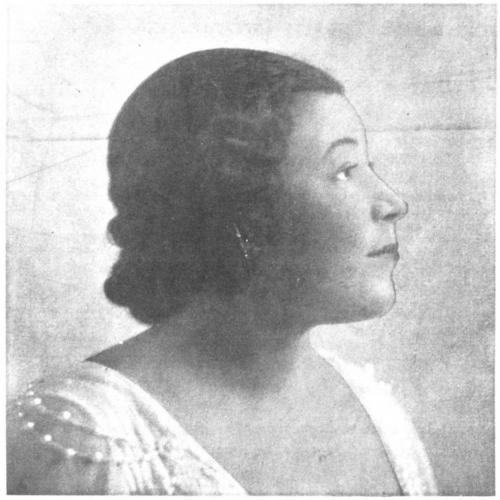
Mme. Florence Cole-Talbert, whose
photograph is reproduced on the cover, one of
Chicago’s favorite sopranos, recently won the Diamond
Medal at the Chicago Musical College, having made
the highest average in the graduating class. She is the
first of her race to take part on the commencement program
at the Chicago Musical College in the Vocal Department.
She sang “Caro No Me” from Rigoletto, in Italian,
accompanied by the Chicago Symphony Orchestra. Her
singing was heartily received and endorsed by the leading
music critics.
The average student spends about four years in the
Chicago Musical College: Mme. Talbert, however, took an
examination that permitted her to enter the graduating
class immediately, and she finished in one year.
Mme. Talbert is the daughter of Mr. and Mrs. Thomas
A. Cole, formerly of Detroit, Michigan, now residents of
Los Angeles, Cal. As a child, she was well known as a
dramatic reader, later, however, she began the study of the
piano and taught instrumental music to help pay for her
vocal instruction. She made her debut as a singer on the
high school commencement program, being the first girl
of her race to take part in a high school commencement
program in the city of Los Angeles. After graduation from
high school she made a thorough study of modern languages.
As a member of the Hahn Concert Company she appeared
on programs in many of the larger cities of the
United States and Canada, and also has made many appearances
in recital and devoted some time to teaching. Mme.
Talbert was soloist at the last May Festival at Hampton
Institute, after which she started on a recital tour of the
country, accompanied by her husband. The latter is the
son of ex-Secretary Talbert of Wilberforce, and is also
well known as a musician.
During the past three years Mr. William Henry
Hackney has brought before the music lovers of Chicago
the very best musical and dramatic talent of the race, in
recital. At these recitals only the compositions of colored
musicians and poets are used, and every participant on the
program is colored.
On May 28th Mr. Hackney presented R. Nathaniel
Dett, head of the Music Department of Hampton Institute,
who played a number of his own compositions, which were
well rendered and received with much enthusiasm. Chicago’s
favorite dramatic reader, Mrs. De Witt Smith, was
at her best on this occasion, rendering twelve numbers
from Dunbar in a manner that held her audience spellbound.
Mr. Hackney, himself, has spent many years in study
under the best of vocal instructors, and possesses a rare
and well trained tenor voice. He sang several of Harry
T. Burleigh’s compositions, and also three numbers by
Miss Nora Lena James, accompanied by Miss James herself.
His rendition of the “Grey Wolf” by Burleigh was
particularly commendable.
The aim of these “All Colored Composers Concerts”
is to exploit the creative talents of the Negro, so that when
the music of this country, known as American Music, has
reached a high plane of development, the Negro can show
that he has had a part in its making, and his startling originality
will be made more manifest.
A Salesmen’s Convention
One of the most novel and unique meetings of the
month was a convention of the traveling salesmen
of the Overton-Hygienic Mfg. Co., of Chicago,
which held a two weeks’ meeting in the company’s office,
June 7th to 21st.
This concern, which is owned and managed exclusively
by our own people, manufactures a line of grocery sundries
and toilet preparations—about 85 or more different articles;
also the celebrated line of toilet requisites known
as “High-Brown.” It is accredited as being the largest
business enterprise in the United States that is owned and
controlled by Colored people, and employs in its office and
factory from thirty to thirty-five people.
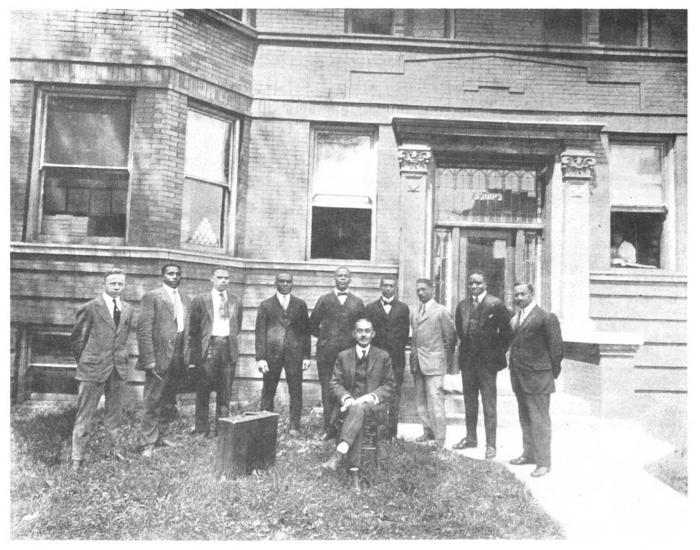
The accompanying picture, which was taken in front
of their office building during the convention, shows the
president, the chemist and the seven traveling salesmen
and their two traveling agents. In the picture they are as
follows:
Seated: Mr. Anthony Overton, president of the company.
Standing (reading from left to right): Mr. Warren Roane, traveling the
North Atlantic Coast States; Mr. Wm. Gales, traveling Oklahoma, Texas,
Arkansas and Louisiana; Mr. Everett Overton, chemist; Mr. K. Johnson,
agent, Portland and Seattle; Mr. Bruce K. Tucker, traveling Mississippi,
Tennessee and Western Alabama; Mr. Wm. S. Bester, traveling District of
Columbia and Maryland; Mr. C. E. Howard, traveling Eastern Alabama,
Georgia, Florida and South Carolina; Mr. T. Champion, agent, San Francisco;
Mr. A. E. Jordan, traveling Illinois, Ohio, Indiana and Kentucky.
In addition to those in the picture the Company also
employs one other salesman, Mr. G. A. White, of Kansas
City. Mr. White unfortunately could not attend the meeting.
This convention is one of the best evidences of the
race’s advancement. Who would have dreamed, fifty years
ago—yes, even twenty years ago, that a manufacturing
concern composed exclusively of Negroes would have
grown to the extent that it would find it necessary to call
their traveling men together at its general office to discuss
the many business problems? We are informed that carefully
prepared papers were read by each salesman from
day to day, which were followed by general discussions.
Some of the subjects covered are as follows:
“Salesmanship.”
“Meeting Competition.”
“How to Finance the Corporation, etc.”
My! My! Just think of it—Negroes assembled and
seriously discussing, “How to Finance a Corporation.”
Surely the world “do” move. Success to you, boys! Come
to Chicago again. You are welcome!
BEAUTY HINTS — “Good Spirits Make Good Looks” — The Care of the Skin — Blackheads: Their Cause and How to Get Rid of Them — Pimples Frequently Caused by Uncleanliness — Forestall Wrinkles—Banish the First Lines — How an Excessively Dry Skin Invites Wrinkles — Know That You Use a Reliable Complexion Powder — How Tanning Injures Your Complexion
Every woman wants to be considered good looking, even though
she is not beautiful. Our features need not be perfect to be beautiful;
it is a rare thing to find a face on which every feature is
perfect, yet there are many beautiful women in the world. It is possible
for every woman to be good looking. Now, just what do we mean
by good looking? Many of us have the idea that good clothes make us
beautiful, but this is a mistake. What is a more disgusting sight than a
woman dressed in fine clothes and in contrast her face showing a
muddy, neglected and abused complexion? A pleasing expression is
requisite to the beautiful face, but it is impossible to have a set rule
for the cultivation of a good disposition, because of the variation in our
individual personalities. However, I will suggest a few things that
will help to make us more beautiful.
Suppose we start with the skin. The knowledge that our skin is
clear and attractive will doubtless help us to wear a smile and give us
the much-desired cheerful countenance.
Our skin is naturally beautiful—what could be more exquisite than
the skin of a baby? And it would remain so if we did not continually
violate the laws of Nature. Sins of diet are so common; overeating,
eating in haste, eating between meals, and we overdress and underventilate,
many of us get little or no exercise and spend too much time in
the confinement of our homes. While it is, of course, impossible to alter
the conditions of modern life, with intelligent care you can counteract
their disastrous effects on your complexion.
Your face, unlike the rest of your body, is continually exposed to
wind and weather, dirt and dust, and demands especial care. In very
few cases, indeed, can the skin be neglected and yet retain its freshness
and purity. The greater the natural beauty and refinement of your
complexion, the more perishable it is and the more faithfully should
you attend to its preservation.
Help your skin to overcome every obstacle, to combat every enemy.
Go to your mirror. Ask yourself these questions: Has the skin a
good, clear coloring, a natural glow? Has it a smooth, soft finish?
Fine, even pores? Is it fresh looking, firm and pliable?
Look upon your skin as an organ, an organ that must continually
perform an important duty in relieving the system of impurities.
Like the rest of your body, the skin requires nutrition and the
utmost cleanliness if it is to be healthy.
It is easy to appreciate the importance of keeping the pores active,
when we stop to think that when the surface skin is destroyed, and
the pore action interrupted, as in cases of severe burns, the danger is
grave and that when as much as one-third of the body is so affected
death is inevitable.
The skin of the face is constantly exposed. In every tiny pore
dust and dirt are bound to accumulate. Unless your skin is kept in
perfect health, with every tiny pore active, these impurities make
themselves evident in the form of blackheads. These little black pests
are frequently found where the circulation is sluggish and the pores
less active—on the forehead, between the eyes, over the nose, about
the chin and sometimes on the ears.
Cleanliness is the principal secret of the clear, blackheadless skin
and nothing will so effectively get down into the pores as a cream. A
good face cream is easy to work into the pores—the skin welcomes it.
And its ingredients are such as to make its results far-reaching and
successful. Use this treatment:
Wring out a soft towel in hot water and apply it to the face.
This will relax the pores. Apply the face cream liberally, rubbing
it in well and allowing it to remain on for five or ten minutes.
Wipe off gently and it will then be easy to remove the blackhead
with a comedone extractor, which may be purchased at any drug
store for ten cents. Take care not to bruise the sensitive skin.
When the face is cleared of blackheads, douche with cold water
or use cold compresses. This is most important after steaming
or massage, for it closes the pores and keeps the flesh firm.
When the pores are allowed to fill with dust, dirt or the impurities
discharged by the system, irritation is quick to start. Inflammation
sets in. Pimples, skin eruptions and kindred ailments, in many cases,
are directly traceable to this cause—uncleanliness. If every pore is
kept immaculately clean, free from all impurities and in good working
order, danger of infection is greatly minimized.
Give a few minutes a day to these simple exercises if you would
forestall the first wrinkle or banish betraying lines. To be beneficial,
massage must be regular, firm and gentle. A rotary motion should be
used on the chin, cheeks and forehead. No rubbing should ever be
done until the face is washed perfectly clean in warm water and soap.
Because of its cleansing, skin-softening properties, a green soap is
well suited to use in preparing the face for massage. Then apply a
good massage cream to the dry skin and rub well into the pores.
Continue massaging the skin until the cream rolls out. The thorough
rubbing out of the cream is important.
Massage one side of the face at a time; otherwise the skin is
drawn in opposite ways, unless one is very adept.
After the massage—and this treatment should never be extended
over more than ten minutes—apply a cold compress to contract the
relaxed pores. This is important if you would retain the fine even
texture of your skin.
Many people have just the opposite of an oily skin—they have a
dry tight skin which often needs oil. As we grow older, also, it is the
tendency with everyone for the natural oils of the skin to decrease
somewhat and for the skin to lose much of its pliancy and suppleness.
This dry, tawny condition is usually accompanied by roughness and is
almost invariably the forerunner of a fine crop of wrinkles. Unless
you supply the deficiency, the skin loses its power of resistance when
its elasticity is gone.
Feed your skin—keep it well lubricated. The famous beauty,
Mme. Patti, said it was impossible to overestimate the importance of
keeping the skin well fed with oils and cream.
Beware of powders that create dryness of the skin. The purity
of a face powder is more important than many realize. The presence
of bismuth, arsenic, white lead and other mineral or alkaline substances
make many powders unfit for use on the skin. A good, pure
complexion powder is beneficial to the skin, in protecting it from dirt,
wind and sun.
The modern fashion of acquiring a rich, heavy coat of tan is to
be heartily decried. The skin can be bleached and cleared after a
summer out of doors, to restore its tone, but it is quite another matter
to recover the fine, even texture of your skin after the summer sun
has toughened and coarsened it. A thick skin is most unlovely to look
upon. And, furthermore, it wrinkles more easily and is far less responsive
to treatment than when in its natural elastic state. In some
cases, heavy tanning results in relaxed tissues and a condition of
general weakness that is most difficult to build up.
A famous dermatologist has recently said: “Oil your skin—oil it
well, or the sun will bake out every bit of natural oil and leave your skin
dry and tawny.” If you would keep your skin so delicate and transparent
as to show its natural coloring, protect it by the generous use of a very
good Cold Cream. Rub it well into your pores before you go out, dust
your face over with a good Face Powder, in the shade that blends best
with your complexion, and, thus safeguarded, you will find that you can
spend a day out of doors, at the beach, without the slightest injury.
Cleanliness, immaculate cleanliness, is the first essential to a healthy
skin. If you would rejoice in a skin that is fresh-looking, clean and
therefore beautiful, never let a day go by without bathing the entire
body with a good, pure Toilet Soap.
Domestic Science — What To Eat and How To Cook It
At the close of the honeymoon, with its “round-up” of travels and
pleasures, comes a realization to the bride that she is soon to
become mistress of the lifelong dream, “her own home.” Questions
of how she is to manage her home and the all-important problem,
“How and what shall she cook for her husband?” are about all that this
ambitious young housewife has time to think of during these days.
Since we are living in the “high-cost-of-living” period, it is most
important that a housewife should know how to buy her groceries and
meats as well as knowing how to prepare other dainty dishes, in order
that her marketing may be economical as well as pleasing to the taste.
When selecting beef, see that it is firm and of a fine-grained texture,
bright red in color, well mottled and coated with fat. The fat should
be firm and of a yellowish color. The less expensive cuts, coming from
those parts of the animal where the juices flow freely, are no less
nutritious than the expensive ones; but they do require longer cooking
at a lower temperature. A side of beef is divided into fore quarter and
hind quarter, but the point of this division varies in different sections
of the country. The hind quarter contains the choicest steaks, which are
cut from the loin and rump and are named porterhouse, sirloin and
rump. Coming from that part of the animal where the muscles are
but little used, the meat is fine grained, and consequently tender. The
tenderloin, protected by the backbone and lying under the loin and rump,
lacks flavor and has but little juice, but is easy of mastication. Round
steak has practically no waste, is very juicy, and the richest in proteid,
but, having coarser fiber, is not as tender. The second and third cuts
from the top of the round are most popular. Among the cheaper cuts
might be mentioned chuck, vein, and flank steaks. A steak should be
cut from an inch to an inch and a half in thickness, and some prefer it
thicker. It should be removed from the paper as soon as it arrives from
the market and put in a cold place. If convenient, allow it to hang rather
than to lie on a plate and never put it in direct contact with the ice.
Tough steaks may be made more tender by pounding with a potato
masher after the steak has been sprinkled with salt, pepper and flour.
BROILED BEEFSTEAK: Wipe entire surface with a cloth
wrung out of cold water and trim off superfluous fat. With some of the
fat, grease a wire broiler (having fat edge next to handle) and broil over
a clear fire, turning every ten seconds for the first minute that surface
may be well seared, thus preventing escape of juices. After the first
minute turn occasionally until well cooked on both sides.
Steak cut one inch thick will take five minutes if liked rare; six
minutes if well done. Remove to a hot platter, and spread with butter
that has been creamed and seasoned with salt and pepper.
SMOTHERED ROUND STEAK: Try out in a hot iron frying
pan three thin slices of fat salt pork, three by four inches, and add one
onion peeled and cut in thin slices. Cook, stirring constantly until brown.
Wipe a two and one-half pound slice of round steak, put in frying pan,
pour over one and one-half cupfuls of cold water and add about one-fourth
teaspoonful of salt. Bring quickly to the boiling point, cover
closely, remove to back of range, and let simmer slowly until tender.
Remove steak to hot platter and strain stock (there should be one cupful).
Melt one tablespoonful of butter, add two tablespoonfuls of flour,
and stir until well blended; then pour on gradually, while stirring constantly,
the hot stock. Bring to the boiling point, let boil two minutes,
season with salt and pepper and pour over and around steak. Garnish
with Baked Stuffed Tomatoes around the edge, and with overlapping
slices of tomatoes and sprigs of parsley in the center.
BAKED STUFFED TOMATOES: Wipe and remove stem end
from six small tomatoes. Take out seeds and most of pulp, sprinkle
inside of tomatoes with salt, invert, and let stand twenty minutes. Cook
three tablespoonfuls of butter with six tablespoonfuls of chopped green
pepper from which seeds have been removed, for five minutes. Add
three-fourths of a cupful of stale bread crumbs, one-half cupful
removed tomato pulp, one-fourth teaspoonful of salt, one-eighth teaspoonful
pepper, and a few drops of onion juice. Fill tomato cases
with mixture, put in buttered pan, sprinkle tops with buttered crumbs,
and bake fifteen minutes in a hot oven.
FILLETS OF BEEF TENDERLOIN: Cut beef tenderloin in
slices one inch thick and trim into six circular shapes. Season with salt
and pepper and pan-broil in a hot buttered frying pan six minutes. Remove
to hot plates for individual service, pour around brown sauce and
garnish top of each with a Stuffed Mushroom Cap.
BROWN SAUCE: Cook three tablespoonfuls of butter with one
slice of onion, stirring constantly until slightly browned. Remove
onion and stir butter constantly until well browned; then add four and
one-half tablespoonfuls of flour and stir until blended. Pour on one
and one-half cupfuls of brown stock gradually, while stirring constantly,
bring to the boiling point and let boil two minutes; then add two-thirds
of a teaspoonful of meat extract, one tablespoonful of lemon juice, one
and one-half tablespoonfuls of finely chopped parsley and one-third of
a cupful of small carrot cubes which have been cooked until soft in
boiling salted water and drained.
STUFFED MUSHROOMS CAPS: Select mushroom caps,
stuff, sprinkle with buttered crumbs, and bake until crumbs are brown.
Garnish each with diamond shapes cut from a red pepper and a sprig of
parsley. For the stuffing, clean and finely chop six mushroom caps.
Add one tablespoonful each of parsley and onion finely chopped and
one tablespoonful of butter. Moisten with a small quantity of the
Brown Sauce.
BAKED STUFFED EGGPLANT: Wipe eggplant and cut in
quarters lengthwise. Remove pulp close to skin, leaving shells. Force
pulp through a meat chopper and drain. There should be two and two-thirds
cupfuls. Put in saucepan, add one and one-half cupfuls of ham
stock, bring to the boiling point and let simmer twenty minutes. Add
three-fourths of a cupful of coarse dried bread crumbs, one-fourth of
a cupful of melted butter, one teaspoonful of lemon juice, one-half a
teaspoonful of salt, and one egg slightly beaten. Fill shells with mixture,
sprinkle with buttered crumbs and bake until brown.
EGG DELIGHT: Cut stale bread in one-fourth-inch slices, remove
crusts, toast, and spread with butter. Arrange on a platter, and
on each slice put a dropped egg and three buttered canned asparagus
tips. Pour over eggs the following sauce: Melt two tablespoonfuls of
butter, add two tablespoonfuls of flour, and stir until well blended; then
pour on gradually, while stirring constantly, one-half cupful of milk.
Bring to the boiling point and season with one-half teaspoonful of salt,
one-eighth teaspoonful of pepper and a few grains of cayenne pepper.
Stir in two egg yolks, one tablespoonful of lemon juice and one-half
cupful of butter, bit by bit. Sprinkle sauce with finely chopped green
pepper. Garnish with sprigs of parsley, and at center of platter with
a small bunch of asparagus tips held in place with a ring cut from a
green pepper.
ORIENTAL SALAD: Wash and pick over one-fourth cupful of
rice and cook in one quart of boiling water (to which has been added
one-fourth teaspoonful of salt) until soft; drain and cool. Add to rice
two chopped hard-boiled eggs, two tablespoonfuls each of finely chopped
red and green peppers, one tablespoonful of scraped onion, one tablespoonful
of finely chopped parsley, one tablespoonful of lemon juice,
and one-half teaspoonful of salt. Force mixture through a potato ricer.
Arrange sardines in center of salad dish, and around edge of dish crisp
lettuce leaves. Between sardines and lettuce arrange prepared rice.
Garnish with sections cut from a lemon. Serve with French dressing.
STUFFED TOMATO SALAD: Select tomatoes that are firm,
round and of good color. Cut a slice from the top of each, and remove
the seeds and the pulp. Mix the pulp of the tomatoes with some ham,
chopped pimentos, olives, and French dressing; divide this mixture into
the tomato shells and chill. At serving time cover the tomatoes with
whipped cream seasoned with salt and paprika to taste, and serve each
in a bed of crisp lettuce leaves.
OLIVE SANDWICHES: Take a large bottle of olives, cut them
free from the pits, slice them and mix with the following dressing: Put
two eggs into a small saucepan, add one-half cupful of sugar, one teaspoonful
of flour, one teaspoonful of butter, one-fourth teaspoonful of
salt, one teaspoonful of prepared mustard, one cupful of cream and
one-half cupful of vinegar. Stir and cook until boiling. Cool and use
with any kind of buttered bread.
EMERGENCY ROLLS: Take two level cupfuls of flour into
which work two heaping tablespoonfuls of butter, a pinch of salt, one
tablespoonful of sugar and two teaspoonfuls of baking powder. Moisten
with milk to a soft dough. Cut into long narrow strips and bake in quick
oven.
STRAWBERRY ICE CREAM: Mix well two cupfuls of mashed
strawberries with two cupfuls of sugar; add one and one-half pints of
milk and one pint of good cream. Freeze. In winter, canned strawberries
may be used.
STRAWBERRY ICE: Take one teaspoonful of granulated gelatine,
one cupful of sugar, one cupful of water, lemon juice, one quart
box of strawberries, one-half tablespoonful of cold water, one-half tablespoonful
of boiling water. Sprinkle berries with sugar, cover, and let
stand for two hours. Mash, squeeze through cheese cloth, and add water
and lemon juice to taste; then add gelatine soaked in cold water five
minutes and dissolved in boiling water. Strain and freeze.
FRUIT SHERBET: Dissolve one and one-half tablespoonfuls of
granulated gelatine in one-half cupful of hot water and keep warm.
Peel and dice three bananas; add the strained juice of three lemons and
three oranges, three cupfuls of sugar, three pints of water and the dissolved
gelatine. Turn into the freezer, and when partly frozen add the
beaten whites of three eggs and a ten-cent can of evaporated milk. Finish
freezing and allow to ripen before serving.
Note: All above recipes have been tested and made with level
measurements.
OPPORTUNITY.
They do me wrong who say I come no more
When once I knock and fail to find you in;
For every day I stand outside your door,
And bid you wake and rise to fight and win.
Wail not for precious chances passed away,
Weep not for golden ages on the wane;
Each night I burn the records of the day,
At sunrise every soul is born again.
Laugh like a boy at splendors that have sped,
To vanished joys be blind and deaf and dumb;
My judgments seal the dead past with its dead,
But never bind a moment yet to come.
Though deep in mire, wring not your hands and weep;
I lend an arm to all who say: “I can.”
No shamefaced outcast ever sank so deep
But he might rise and be again a man.
—Walter Malone.
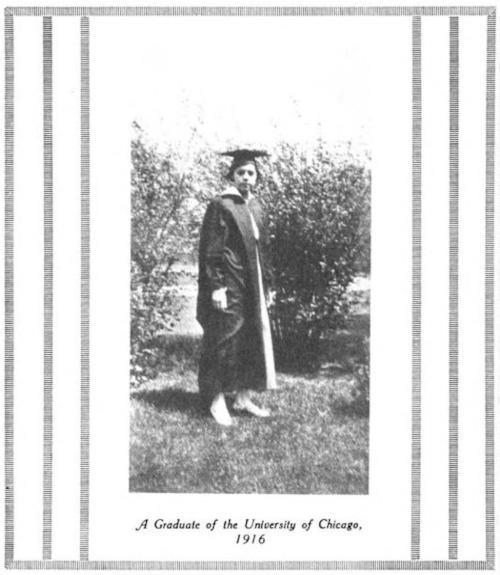
A Graduate of the University of Chicago, 1916
THE MAN WHO WINS.
The man who wins is the average man,
Not built on any particular plan,
Not blessed with any particular luck,
Just steady and earnest, and full of pluck.
When asked a question he does not guess;
He answers the question, “No,” or “Yes.”
When set to a task that the rest can’t do
He buckles down till he’s put it through.
Three things he’s learned: That the man who tries
Finds favor in his employer’s eyes;
That it pays to know more than one thing well;
That it doesn’t pay all he knows to tell.
For the man who wins is the man who works,
Who neither labor nor trouble shirks,
Who uses his hand, his head, his eyes.
The man who wins is the man who tries.
If It’s Funny—Laugh! — A BROTHERHOOD. — THE USUAL CONVERSATION. — WHY IT WAS SAFER. — EASY. — GOT ’EM THE FIRST TIME. — HIS DUTIES DEFINED. — THE SUPREME TEST. — DESIRABLE THOUGHTS. — TRYING THE DOG ON HIM. — PROVING MAW WRONG. — REDUCING THE COSTS. — DO NOTHING BUT BREATHE. — TO THE POINT. — A SHORTAGE SOMEWHERE. — A MATTER OF ARRANGEMENT. — PRECAUTIONARY.
“Would you advise me to get married?”
“I can’t give you any advice on that
subject, my boy.”
“You married men are all alike.
None of you will give a fellow any
advice.”
“Well, marriage is a secret society.”—Louisville
Courier-Journal.
Father—What did you and John
talk about last night, dear?
Daughter—Oh, we talked about our
kith and kin.
Small Brother—Yeth, pop, I heard
’em. He seth, “Kin I hev a kith?”
and she seth, “Yeth, you kin!”—Yale
Record.
A boy was visiting another boy, and
as they were going to bed the little
host knelt to say his prayers.
“I never say my prayers when I am
home,” said the visitor.
“That’s all right,” said the other
boy. “You better say them here. This
is a folding bed.”
“Did that book agent succeed in inveigling
you into buying a set of
Shakespeare’s works?”
“No.”
“How did you get rid of him so
easily?”
“I simply showed him the last dun
I received for a set of books I bought
on the installment plan two years
ago.”—Birmingham Age-Herald.
“Mr. Johnson,” asked the professor
in the freshman class, “what three
words are used most among the college
students?”
“I don’t know,” said the student.
“Correct,” replied the professor.
Boss—“I wanted to speak to you, Mr.
Lovum, about your attentions to Miss
Sweetthynge during office hours. I
hired you as a billing clerk only—no
cooing mentioned. That will be all
for the present.”
“Brudder Jackson,” said the colored
preacher to a parishioner, “yo’ wife
done tell me she got religion and
wants to jine de church.”
“Yas, suh, dat’s so,” replied the husband.
“Well, brudder,” suggested the
preacher, “Ise gwine to put her protestashuns
to a test—de nex’ time it
rains, Brudder Jackson, you let your
dawg get good an’ wet and den let
the dawg in yo’ parlor and den you
tell me what yo’ wife says. Den I
will know whether Sis’ Jackson should
cum into de fold or not.”
Cholly—“Before I met you I thought
of nothing but making money.”
Ethel—“Well, keep right on! Pop
ain’t so rich as folks think!”
“Come right into the yard,” said
the farmer’s wife cordially to the
tramp who had besought something
to eat.
The tramp eyed the bulldog dubiously.
“I dunno ’bout dat,” he said.
“How ’bout dat drog? Will he bite?”
“I don’t know,” said the housewife,
“I just got him today and that’s what
I want to find out.”
Freddy, with a determined look on
his small countenance, marched into
the front room and up to the ardent
suitor of his pretty sister.
“What’s them?” he demanded,
thrusting out a grimy hand full of
small white objects.
“What are those?” said the young
man with an ingratiating smile. “Those
are beans.”
“He does know ’em, maw,” bawled
Freddy triumphantly into the adjoining
room. “You said he didn’t.”
“Tommy,” said the fond mother,
“isn’t it rather an extravagance to eat
both butter and jam on your bread at
the same time?”
“No, mamma, it’s economy,” Tommy
answered. “The same piece of bread
does for both.”—The Christian Herald.
Bachelor—“Before the wedding you
told me that married life would be
one grand sweet song.”
Benedict (gloomily)—“Yes; and
since then I’ve found it one grand
sweet refrain.”
Bachelor—“Refrain?”
Benedict—“Yes. My wife insists
that I refrain from cards, refrain from
smoking, and refrain from the club.”
“Look here, waiter, is this peach or
apple pie?” asked the patron.
“Can’t you tell from the taste, sir?”
asked the waiter.
“No, I can’t,” answered the customer.
“Well, then,” asked the waiter,
“what difference does it make?”
An advertisement of a popular spectacular
play has this to say of two
of its attractions:
5,000 PEOPLE
4,000 COSTUMES
A teamster charged with using loud
and profane language on the street,
was brought before a police magistrate,
and one of the witnesses was
an aged colored man.
“Did this man use improper language?”
inquired the lawyer for the
prosecution.
“Well, sah,” replied Uncle Ans, “he
did tawk mighty loud, sah.”
“And did he indulge in profanity?”
The witness looked puzzled but did
not answer, so the attorney tried
again.
“What I mean, Uncle Ans,” he said,
“is this: did he use words that your
minister could use in a sermon?”
“Oh, yessah, yessah,” answered
Uncle Ans, with a grin; “de ministah
could use dem word, sah, but he suttinly
would hab ter errange dem different.”
Mrs. Bacon—“I see washerwomen
in Alabama are compelled to register
their names with the city health departments.”
Mr. Bacon—“Why don’t they vaccinate
them?”
“What for?”
“So they won’t take it.”
“Take what?”
“The wash.”—Yonker’s Statesman.
Classified Advertisements — WANTED FEMALE HELP — WANTED—MALE HELP — FOR SALE — ROOMS FOR RENT — MISCELLANEOUS
Agents Wanted—To sell household
specialties. Big money, quick sellers;
territory going fast. Write for full
particulars. B. 31, care Half Century
Magazine, Chicago.
Agents Wanted—To secure subscriptions
for the Half Century Magazine.
Liberal commission.
Agents Wanted—Something entirely
new. Sells like “wild fire.” Write for
particulars. C. J. M., care Half Century
Magazine, Chicago.
Wanted—Agents to sell Soaps, Perfumes
and other toilet preparations.
Write for prices and terms. The Overton
Hygienic Co., Chicago.
Stenographer—Between 20 and 30
years of age. One that is capable of
handling a large amount of detail
work. In your reply state age, experience
and salary expected. Address
M. G. H., care Half Century
Magazine.
Stenographers and Bookkeepers—Girls
over 18. Must be graduates of
business department of a high school
or college. Those that have had some
experience preferred. Address C-27,
care Half Century Magazine, Chicago.
Agents Wanted—To sell household
specialties, big money. Write quick.
B-31, care Half Century Magazine,
Chicago.
Stock Salesmen—For high grade,
quick selling proposition. Address T.
S. R., care Half Century Magazine.
A chance to make big money selling
Negro pictures. The best proposition
ever offered. Address Mardell
Co., Chicago.
Typewriter—Monarch, latest model,
in first class condition. Price, $25.00.
A. J. Spears, 5202 Wabash Ave., Chicago,
Ill.
Household Furniture—Beds, Tables,
Chairs, etc. Everything necessary for
housekeeping. A bargain, as I am
breaking up housekeeping. Address
M-19, care Half Century Magazine,
Chicago.
For Sale—Office desk, chair and
Royal typewriter, same as new, at a
bargain for quick sale. Make me an
offer. Banks, Wabash Ave., Chicago.
Rooms to Rent—One large front
room for one or two gentlemen. Reference
required. Nice neighborhood.
M-20, care Half Century Magazine.
Rooms for Rent—Light and airy;
to respectable people; reference furnished
and required. Address M-24,
care Half Century Magazine.
For Rent—Nice room, suitable for
man and wife, or bachelor quarters
for two ladies. Address M-25, care
Half Century.
Notice—I will not be responsible for
any debts contracted by anyone except
myself after this date, June 26,
1916. Henry B. Brayson.
Wanted to Purchase—A set of the
latest edition of Encyclopedia Britannica.
State lowest price you will
take for same. Address M-27, care
Half Century Magazine, Chicago.
WITH OUR EXCHANGES — BERT WILLIAMS AGAIN STAR OF ZIEGFELD’S “FOLLIES.” — INCREASING OPPORTUNITIES. — BUSINESS SENSE. — RIGHT IDEA. — EXPLAINED AT LAST. — MIDNIGHT SPREADS. — TO FRESHEN LEMONS. — SUBSCRIPTION PRICE
Noted Comedian Makes New Yorkers’ Sides Ache With His
“Othello.”
(Louisville News.)
New York, June 18.—Bert Williams, premier comedian of his day,
is again the star of Florence Ziegfeld’s “Follies.” Ziegfeld started his
“Follies” in 1907 and each year he has outdone the preceding year in this
type of show—which consists of elaborate staging, pretty girls and plenty
of them, funny men, all kinds of music and dance, in short his “Follies” have
been hash, a little bit of everything. Shortly after George Walker’s death,
which left Bert Williams to travel alone, Ziegfeld did what no other manager
or producer in this country would have done and that was to take a
Colored performer into a purely white company. He snatched up Bert
Williams, it was a bold thing to do—but it paid. Of course, the “Follies”
can not go into some cities because of Williams, but that loss is over made
up in the other cities. Williams has often saved the “Follies” from being
pure and simple burlesque despite the fact Ziegfeld has most of the high
priced white stars. This year the “Follies” have a Shakesperian travesty
after the tercentenary in honor of the great Shakespeare. Bert Williams plays
“Othello” in the play of that name. Space forbids a rehash of the scene—but
if you’ve ever seen Bert Williams in anything, just shut your eyes and
imagine him as the jealous Moor. You might then get a faint idea of what
makes New Yorkers’ sides ache.
(From Amsterdam News.)
When the present European War was begun we gave it as our opinion
that with the exodus of the foreign reservist and the cessation of immigration
economic opportunities would be on the increase for the colored American.
The results have vindicated our predictions. But has the colored
man seized the opportunities presented? Is he taking the best advantage
of the present situation?
Three times since the outbreak of the European War we have advised
our young men and women to learn Spanish. Today the metropolitan dailies
are filled with advertisements calling for Spanish speaking and enterprising
young people. In many cases the need is so pressing for the expansion in
South America of this country’s commerce that were a colored man to
answer one of these advertisements there is hardly one chance in nine that
he would meet with a rebuff. Little over a year ago the situation would
have been exactly the reverse. But necessity and the Almighty Dollar
work some awful changes. Prejudice usually disappears when it affects the
moneyed interests. Colored men and women are holding down positions
today that only eighteen months ago were tightly closed against them.
And, what’s more, they can continue to hold those jobs even after the war,
if their services are up to the required notch of efficiency. With many hundreds
of them being used at present to fill places of the departed reservists
still the advertising goes more emphatically on for more, yet more. Is the
supply equal to the demand?
And the demand is even more urgent for Spanish speaking men and
women to travel to the South American countries as the trade representatives
of the big American firms. Will our people accept this opportunity,
too? Or, now with opportunity thundering at their doors, will they ignore
Ambition’s call to higher things?
Three times before we have advised them to learn Spanish. For a
fourth time we reiterate the advice: Young man, young woman, learn Spanish!
For behind that easily mastered language is the beckoning hand of
increasing opportunities. Prepare yourself, and do your best on any job
you accept. So when you leave it, another COLORED MAN OR WOMAN
may be employed.
(Chicago Defender.)
Business, generally speaking, is a new thing with most members of the
race, so it is not surprising to find a large percentage of failures among
those who venture in it. There are a great many reasons why success does
not come more often, the first being that hackneyed expression “unpreparedness.”
A railroad man, for instance, may accumulate a little money and
open up a grocery store. Having had no experience, he neither knows how
to buy or to sell. If he prospers, it is simply by sheer luck and not due
to any business knowledge.
As much of the profit lies in buying and keeping down overhead expenses
as it does in the selling. Many large business houses have gone to the wall
simply through poor management. In the identical place one man makes a
failure, another makes a huge success. The first requisite is to have what
the public wants and offer it for sale at an attractive figure—one that will
permit of a fair profit yet meet competition. Make no misrepresentations;
better lose a customer for the time being by telling him you haven’t in
stock just what he wants than by selling him something inferior and claiming
it is just as good. He might be fooled the first time but he will fool
you ever afterward.
Many people open stores in the heart of what is termed “the black belt,”
offer inferior goods, poor service, and ask high prices, and expect because
the skin of those around them happens to be the same as theirs, that they
are in duty bound to “trade with one of their own color.” In other words,
the customer is asked to measure his race pride in dollars and cents. If
he can get a good can of tomatoes across the way for 15 cents, he is expected
to pay the same price or more for an inferior quality from the brother in
mourning. If he refuses to so squander his money he is accused of todying
to the white man.
We have learned the lesson well that as mechanics or any skilled workmen
we must equal the best if we would even get scant recognition. The
color line in the labor field is drawn taut, yet here and there the line is
broken and employment given us. The new business man must realize he
must be fitted for what he undertakes. He wouldn’t attempt to repair a
watch without having gone through an apprenticeship in watch repairing.
Why start a grocery, meat market, haberdashery, etc., before acquainting
yourself with the particular line you wish to engage in?
We differ from other races only in that we are overconfident in our ability.
We believe in starting at the top and sliding to the bottom; it looks so
much easier. Climbing is hard work, but it is worth while, and when the
top is reached, even though you are weary, you hold something tightly in
your grasp that the world cannot take from you—experience. And, after
all, that is the one great thing in life that brings success.
A Portland school teacher asked
this question:
“Now, Johnny, suppose you wanted
to build a $1,000 house and had only
$700; what would you do?”
“I ’spose I’d have to marry a girl
worth $300,” answered the young
financier.
The physician was giving an informal
talk on physiology.
“Also,” he remarked, “it has recently
been found that the human body
contains sulphur.”
“Sulphur!” exclaimed the girl in the
blue-and-white blazer. “And how
much sulphur is there then in a girl’s
body?”
“Oh, the amount varies,” said the
doctor, smiling, “according to the
girl.”
“Ah!” returned the girl. “And is
that why some of us make better
matches than others?”
A darky walked into a restaurant,
sat down to the table, and looking
up, recognized the waiter as an old
friend. “Huh!” he said, “I sees you
is wuking here.” “Yes,” said the
waiter, noting the sarcasm, “I’se
wuking here, but, thank de Lawd. I
ain’t eatin’ here.”
For years it has been dinned into
our ears that we should not eat before
going to sleep, and we have
forgone many a pleasant bite for fear
of sacrificing our good health. And
now along comes a noted physician
and tells us that many morning headaches
were merely the result of hunger.
This does not mean that we can
immediately proceed to gorge ourselves
with all sorts of sweets and not
have to pay the penalty the next
morning. Sweets should be eschewed
during the midnight repast, and one
should substitute some wholesome
sandwiches—cheese sandwiches are
wholesome and nourishing and can be
eaten with impunity even during the
wee small hours.
If lemons are old and dry, place
them in a pan of hot water and keep
the water at an even temperature for
a few hours. As a result the lemons
will become fresh and juicy again.
The subscription price of The Half-Century is 75 cents per year,
or 50 cents for six months. Some time ago we made an offer as a
special inducement to send the publication for one year for fifty cents—to
all who would send us their subscription before the date of
publication. The responses were very flattering, which shows in
what confidence the management is held. As this offer did not reach
many of our friends in time to take advantage of the same, we have
decided to extend the offer until August 10, 1916. The offer will positively
be withdrawn on that date. As a matter of fact, the probabilities
are that the subscription price will have to be advanced to One
Dollar per year, on account of the steady advance in the cost of paper,
printing inks, labor, etc.
Therefore, we suggest that you take the benefit of this extremely
low offer, by filling in the attached coupon and mailing same with
your remittance to us promptly.
[COUPON]
OUR SPECIAL ADVANCE OFFER
Extended to August 10, 1916
The Half-Century Magazine Publishing Company
3708 WABASH AVENUE, CHICAGO, ILL.
Subscription Price, One Year 75 Cents; Six Months 50 Cents;
Three Months 25 Cents
GENTLEMEN:
Enclosed find 50 cents in payment of One Year’s Subscription to
The Half-Century Magazine as per your Reduced Price Advance
Offer.
Name
Street or P. O.
Town
State
Date
Don’t Be A Fossil! Live in the 20th Century
You wouldn’t by preference travel now in an ox wagon, would you?
THEN WHY NOT JOIN
THE INTERNATIONAL Benevolent & Protective Association
An Up-to-Date Fraternal Order that Meets the Requirements of Today
Some of the old-time orders offer you weekly dues when you are sick, burial when you die and endowment
to your beneficiaries. We do that for you, too, and we do more.
WE HELP YOU TO LIVEWE HELP YOU TO PROSPER
We furnish you free medical attendance and pay you for the time you lose while you are sick.
We Help You in Your Business or Daily Vocation
We assist you financially when in need. Each member pledges to deal with other members
in preference to those who are not members (other things being equal), and we use every
legitimate method to require members to truthfully live up to this pledge—even to the
extent of expulsion, where it is conclusively proven that said member continues to violate
this obligation. However, we do not require one member to pay another more for the
same article or service. We have this plan perfected so that it works out harmoniously.
We Oppose Race Discriminations
Such as unequal accommodations on railroads, etc., by persuasion and the influence of
prominent, fair minded white persons, and also by legal process through the courts. We
condemn the practice that many white firms have of advertising their products by
ridiculing the race, and oppose the same by boycotting such firms and their products.
If there is no lodge of ours in your city you can join individually, Chicago Council No. 1,
and live where you are—you will not have to come to Chicago to do so.
Write for application blank and full particulars to
The International Benevolent & Protective Association
OLGA L. PORTER. Cor. Secretary
ORGANIZERS WANTED 5349 Indiana Ave., Chicago, Ill.
Everything Musical
The Azalia Hackley MUSIC
Publishing House
MUSIC PUBLISHERS
AND DEALERS IN
PIANOS
PIANO PLAYERS
BAND INSTRUMENTS
STRING INSTRUMENTS
SHEET MUSIC
MUSIC BOOKS
VICTROLAS
And other Talking Machines
All the Latest Songs and Records
We make a specialty of songs and
music of all kinds—Religious,
Patriotic, Classic or Ragtime
written by our people.
We set your words to music and
publish same on a royalty basis.
Mail Orders Filled
The Azalia Hackley Music Publishing House
5244 State St., Chicago, Ill.
DON’T Take a
Chance
With Your Films
Don’t have them developed
with inferior chemicals. We
use only the best C. P. Mallinckrodt
Chemicals in our
photo finishing laboratory, and
employ only skilled photographers
to FINISH YOUR
WORK. In our printing and
enlarging departments we
produce perfect black and
whites, and use only the best
grades of developing paper.
All prints are masked with
white border and trimmed
with even margin.
Your order receives undivided
attention in our laboratory,
where QUALITY OF FINISH
is the first consideration.
Any size roll of film, 6 or 12
exposures, developed for 10c.
Your Photo finishing may
be sent to us by mail. It
will have prompt attention.
We carry a complete line of Cameras and Kodaks
The Azalia Hackley
Music Publishing House 5244 State St., CHICAGO
WE SELL BOOKS
When you want a
Book of any kind
WRITE US
If we can’t get what you want,
It’s not in print
Books written
By Colored-American Authors
Our Specialty
Lowest Prices Quick, Efficient Service
THE Progressive Book Publishers 3519 State St., Chicago, Ill.
We Publish Books, etc.
IN SUMMER
YOU NEED
PU-RI
To Prevent the Odor
From Perspiration
COMING
READY AUGUST 1st
BLACK’S
BLUE
BOOK
Directory of Chicago’s Active
Colored People and Guide
to Their Activities
On news stands or sent anywhere
on receipt of price 25 cents
FORD S. BLACK, Publisher
6446 St. Lawrence Ave. Chicago, Ill.
USE RO-ZOL
The Face Bleach That Will Bleach
Will Also Positively Remove Tan,
Liver Spots and Freckles
AVOID IMITATIONS
THE OVERTON-HYGIENIC MFG. COMPANY Dept. H. C. Chicago, Ill.
AGENTS WANTED
We are also manufacturers of the Original High-Brown Face Powder,
the first and only face powder made especially for the
complexion of our people.
High-Brown Hair Grower WILL GROW YOUR HAIR
It Is A Straightener As Well As A Grower
Nicely Perfumed—Absolutely Harmless
Gives the hair that live, glossy appearance which is so
much desired. A trial will convince the most skeptical.
PRICE 50 CENTS
MADE ONLY BY
The Overton-Hygienic Manufacturing Co. CHICAGO, ILL.
START A BUSINESS OF YOUR OWN
The Perfumers’ Supply Co.
Importers and Jobbers of Materials for
Manufacturers of Hair Preparations
Toilet Articles and Perfumes
We Carry A Complete Stock at the Lowest Prices
Some of which are as follows
Talcum
Waxes
W Petrolatum
C Petrolatum
A Petrolatum
Jars
Colors
Boxes
Bottles
Labels, etc.
Oil Rose
Oil Lilac
Oil Lemon
Oil Lavender
Oil Bergamot
We will sell you the supplies and teach you Free how to
make Cold Creams, Face Bleaching Creams, Hair Pomades, Hair
Growers, Perfumes, Toilet Waters, etc.; or we will make any of
these articles for you and print your name on the label, ready for
you to sell.
Catalog and terms sent on receipt of 10 cents in postage
THE PERFUMERS’ SUPPLY CO. Dept. J, Monadnock Block CHICAGO, ILL.
Successful baking requires a good baking powder
Hygienic
Pet Baking
Powder
meets that requirement
Economical and Strictly Pure
A LARGE CAN FOR 10c
For sale by all good dealers
Overton-Hygienic Co. CHICAGO
A Marvel! A Revelation!
Magic Furniture Polish
THE POLISH THAT MAKES OLD FURNITURE
LOOK THE SAME AS NEW
Made only by the inventor
THOS. B. BANKS
5163 Wabash Ave. Chicago, Illinois
Agents wanted. Write for prices and terms.
Chew the Good Chew
TWO KINDS
TRIPLEMINT
A Peppermint Flavor
LIMENTO
A Fruity Flavor
Price 5 Cents A Package
The International Gum and Candy
COMPANY
FOR SALE BY ALL LIVE DEALERS
Do you want information of any kind?
THE National Negro Directory
AND REPORTING AGENCY
SPECIALIZES AS FOLLOWS:
If you want information about persons or firms in
other cities we can supply you.
Should your wife or husband, son or daughter
leave home and you want them looked up, we
can do so through our agents throughout the
United States at a small cost.
We furnish other services which we should be
pleased to explain upon application.
Agents and Reporters wanted for every
town where we are not now represented
For further information write to
THE NATIONAL Negro Directory and Reporting Agency
Chicago, Illinois
Do You Like Good Perfumes?
THEN TRY OUR PERFUMES
AND TOILET WATERS
If you wish Lasting Perfumes and Toilet Waters in the true
flower odors, use some of these:
LES FLEURS—A combination of flowers.
HIGH-BROWN—A fragrant, lasting odor, originated by us.
DIANANIS—Something new and original.
LE TREFLE—The true odor of a clover blossom.
VIOLET, ROSE, CRAB APPLE, LILAC, and a number of other popular odors.
We also manufacture a line of Sachet Powders.
MADE BY
The Overton-Hygienic Manufacturing Co.
Dept. H. C., CHICAGO
A BEAUTIFUL SKIN IS YOUR BIRTHRIGHT
THE OVERTON-HYGIENIC
Peroxide Vanishing Cream
Prevents and relieves chapped skin. This vanishing
cream is soothing, healing and antiseptic.
Being greaseless, it is especially good for use in
the daytime; unequaled for oily skins; delightful
after shaving. The peroxide in the cream Bleaches
the skin. Will not injure the most delicate complexion
nor cause hair to grow. Price 25 cents.
MADE ONLY BY
The Overton-Hygienic Manufacturing Co.
HIGH-BROWN SOAP
A Good Soap Is Essential to a Beautiful
Complexion. High-Brown Soap Will Keep
The Pores Clean And Free From Impurities.
Absolutely PureHighly Perfumed
Handsomely Put Up Two Cakes to a Box
PRICE 50c
MADE BY
The Overton-Hygienic Manufacturing Co.
CHICAGO
The Journal of Negro History
PUBLISHED QUARTERLY 100 PAGES
Edited by
CARTER G. WOODSON
THE JOURNAL OF NEGRO HISTORY is the official
organ of the Association for the Study of Negro Life and History,
which is now trying not to promote an isolated research into the
history of the black race but to show how civilization has been
influenced by contact with the people of color. This publication
aims to popularize the movement to save and make available the
scattered historical materials bearing on the Negro. In it
appears scholarly articles and valuable documents giving information
generally unknown. It is concerned with facts, not with
opinions.
Subscription price $1.00 per year. Foreign Subscription 25c extra.
Single numbers, 25 cents; 30 cents by mail.
Checks should be made payable to THE JOURNAL OF
NEGRO HISTORY and addressed to
CARTER G. WOODSON,
2223 12th St., N. W., WASHINGTON, D. C.
WIND AND SUN
Work Havoc With The Skin
The Cool Velvet Touch of Our TALCUM POWDERS
Eases the burning and irritation.
A trial will convince you of their
superiority.
Five Odors:
HIGH-BROWN, CARNATION,
ROSE, DIANANIS, VIOLET
PRICE 25 CENTS
MADE BY The Overton-Hygienic Manufacturing Co.
CHICAGO
AIDA HAIR POMADE
[Aida Overton-Walker]
A Delightfully Perfumed
Hair Dressing
That makes stubborn and
harsh hair soft and pliable
and easy to comb. It is also
prepared especially to be
used in straightening of the
hair with the “irons,” preventing
the evil effects heretofore
resulting from the use of
the “irons” with other similar
preparations.
A large, handsome, lithographed tin box
Only 25c a Box
Agents wanted
The Overton-Hygienic Co. DEPT. H. C., CHICAGO, ILL.
A Live Book for Live People
HOW A NEGRO
SHOULD CONDUCT
A BUSINESS
To Gain the Patronage of His Own People
PRICE $1.50 POST PAID
Now in press. Will be published about Sept. 1, 1916
If you are in business or contemplate entering
business, you should have this book. The book will
contain Fourteen Chapters—not a dead line in it.
SYNOPSIS OF CHAPTERS
1
A Brief Review of Early Negro Business Ventures.
2
Statistics of Negro Business in the United States.
3
Prejudice as it Affects the Negro in Business.
4
The Importance of Business in the Race’s Development.
5
What is Necessary to Secure the Patronage of Our Own People?
6
What is Necessary to Secure the Patronage of White People?
7
How to Buy Goods at the Lowest Price.
8
How to Establish Credit with Wholesale Houses.
9
What Constitutes Good Salesmanship?
10
Whom to Credit.
11
How to Make Collections.
12
How to Advertise.
13
How to Systematize a Business.
14
How to Conduct a Business in General.
The price of the book is $1.50, but as a special
inducement to advance subscriptions we will send it
when published for One Dollar to those who will sign
the attached slip and send to us before Aug. 20, 1916.
Cut out this coupon, sign and
send to us promptly.
Date................... 19....
THE PROGRESSIVE BOOK PUBLISHERS
Chicago, Ill.
Gentlemen:
Kindly enter my subscription for one copy of “How a Negro Should
Conduct a Business,” for which I agree to remit [to you] $1.00 as soon
as you send me notice that the book is ready.