Oatlands Park (between Weybridge and Walton-upon-Thames) was once the
property of the Duke of York, but now the lordly manor-house is a
hotel. The grounds about it are well preserved and very
picturesque. They should look well, for they cover a vast and wasted
fortune. There is, for instance, a grotto which cost forty thousand
pounds. It is one of those wretched and tasteless masses of silly
rock-rococo work which were so much admired at the beginning of the present
century, when sham ruins and sham caverns were preferred to real.
There is, also, close by the grotto, a dogs’ burial-ground, in which
more than a hundred animals, the favorites of the late duchess, lie
buried. Over each is a tombstone, inscribed with a rhyming epitaph,
written by the titled lady herself, and which is in sober sadness in every
instance doggerel, as befits the subject. In order to degrade the
associations of religion and church rites as effectually as possible, there
is attached to these graves the semblance of a ruined chapel, the
stained-glass window of which was taken from a church. [97]
I confess that I could never see either grotto or grave-yard
without sincerely wishing, out of regard to the memory of both duke and
duchess, that these ridiculous relics of vulgar taste and affected
sentimentalism could be completely obliterated. But, apart from them,
the scenes around are very beautiful; for there are grassy slopes and
pleasant lawns, ancient trees and broad gravel walks, over which, as the
dry leaves fall on the crisp sunny morning, the feet are tempted to walk on
and on, all through the merry golden autumn day.
The neighborhood abounds in memories of olden time. Near Oatlands
is a modernized house, in which Henry the Eighth lived in his youth.
It belonged then to Cardinal Wolsey; now it is owned by Mr.
Lindsay,—a sufficient cause for wits calling it Lindsay-Wolsey, that
being also a “fabric.” Within an hour’s walk is the
palace built by Cardinal Wolsey, while over the river, and visible from the
portico, is the little old Gothic church of Shepperton, and in the same
view, to the right, is the old Walton Bridge, by Cowie Stakes, supposed to
cover the exact spot where Cæsar crossed. This has been denied
by many, but I know that the field adjacent to it abounds in ancient
British jars filled with burned bones, the relics of an ancient
battle,—probably that which legend states was fought on the
neighboring Battle Island. Stout-hearted Queen Bessy has also left
her mark on this neighborhood, for within a mile is the old Saxon-towered
church of Walton, in which the royal dame was asked for her opinion of the
sacrament when it was given to her, to which she replied:—
“Christ was the Word who spake it,
He took the bread and brake it;
And what that Word did make it,
That I believe, and take it.”
In
memory of this the lines were inscribed on the massy Norman pillar by which
she stood. From the style and cutting it is evident that the
inscription dates from the reign of Elizabeth. And very near
Oatlands, in fact on the grounds, there are two ancient yew-trees, several
hundred yards apart. The story runs that Queen Elizabeth once drew a
long bow and shot an arrow so far that, to commemorate the deed, one of
these trees was planted where she stood, and the other where the shaft
fell. All England is a museum of touching or quaint relics; to me one
of its most interesting cabinets is this of the neighborhood of Weybridge
and Walton-upon-Thames.
I once lived for eight months at Oatlands Park, and learned to know the
neighborhood well. I had many friends among the families in the
vicinity, and, guided by their advice, wandered to every old church and
manor-house, ruin and haunted rock, fairy-oak, tower, palace, or shrine
within a day’s ramble. But there was one afternoon walk of four
miles, round by the river, which I seldom missed. It led by a spot on
the bank, and an old willow-tree near the bridge, which spot was greatly
haunted by the Romany, so that, excepting during the hopping-season of
autumn, when they were away in Kent, I seldom failed to see from afar a
light rising smoke, and near it a tent and a van, as the evening shadows
blended with the mist from the river in phantom union.
It is a common part of gypsy life that the father shall be away all day,
lounging about the next village, possibly in the kitchema or
ale-house, or trying to trade a horse, while the wife trudges over the
country, from one farm-house or cottage to another, loaded with baskets,
household utensils, toys, or cheap ornaments, which she endeavors, like a
true Autolyca, with wily arts and wheedling tones, to sell to the
rustics. When it can be managed, this hawking is often an
introduction to fortune-telling, and if these fail the gypsy has recourse
to begging. But it is a weary life, and the poor dye is always
glad enough to get home. During the day the children have been left
to look out for themselves or to the care of the eldest, and have tumbled
about the van, rolled around with the dog, and fought or frolicked as they
chose. But though their parents often have a stock of cheap toys,
especially of penny dolls and the like, which they put up as prizes for
games at races and fairs, I have never seen these children with
playthings. The little girls have no dolls; the boys, indeed, affect
whips, as becomes incipient jockeys, but on the whole they never seemed to
me to have the same ideas as to play as ordinary house-children. The
author of “My Indian Garden” has made the same observation of
Hindoo little ones, whose ways are not as our ways were when we were
young. Roman and Egyptian children had their dolls; and there is
something sadly sweet to me in the sight of these barbarous and naïve
facsimiles of miniature humanity, which come up like little spectres out of
the dust of ancient days. They are so rude and queer, these Roman
puppets; and yet they were loved once, and had pet names, and their
owl-like faces were as tenderly kissed as their little mistresses had been
by their mothers. So the Romany girl, unlike the Roman, is generally
doll-less and toy-less. But the affection between mother and child is
as warm among these wanderers as with any other people; and it is a
touching sight to see the gypsy who has been absent all
the weary day returning home. And when she is seen from afar off
there is a race among all the little dark-brown things to run to mother and
get kissed, and cluster and scramble around her, and perhaps receive some
little gift which mother’s thoughtful love has provided.
Knowing these customs, I was wont to fill my pockets with chestnuts or
oranges, and, distributing them among the little ones, talk with them, and
await the sunset return of their parents. The confidence or love of
all children is delightful; but that of gypsy children resembles the
friendship of young foxes, and the study of their artless-artful ways is
indeed attractive. I can remember that one afternoon six small Romany
boys implored me to give them each a penny. I replied,—
“If I had sixpence, how would you divide it?”
“That would be a penny apiece,” said the eldest boy.
“And if threepence?”
“A ha’penny apiece.”
“And three ha’pence?”
“A farden all round. And then it couldn’t go no
furder, unless we bought tobacco an’ diwided it.”
“Well, I have some tobacco. But can any of you
smoke?”
They were from four to ten years of age, and at the word every one
pulled out the stump of a blackened pipe,—such depraved-looking
fragments I never saw,—and holding them all up, and crowding closely
around, like hungry poultry with uplifted bills, they began to clamor for
tūvalo, or tobacco. They were connoisseurs, too, and the
elder boy, as he secured his share, smelled it with intense satisfaction,
and said, “That’s rye’s tūvalo;”
that is, “gentleman’s tobacco,” or best quality.
One evening, as the shadows were darkening the day, I met a little gypsy
boy, dragging along, with incredible labor, a sack full of wood, which one
needed not go far afield to surmise was neither purchased nor begged.
The alarmed and guilty or despairing look which he cast at me was very
touching. Perhaps he thought I was the gentleman upon whose property
he had “found” the wood; or else a magistrate. How he
stared when I spoke to him in Romany, and offered to help him carry
it! As we bore it along I suggested that we had better be careful and
avoid the police, which remark established perfect confidence between
us. But as we came to the tent, what was the amazement of the
boy’s mother to see him returning with a gentleman helping him to
carry his load! And to hear me say in Romany, and in a cheerful tone,
“Mother, here is some wood we’ve been stealing for
you.”
Gypsies have strong nerves and much cheek, but this was beyond her
endowment; she was appalled at the unearthly strangeness of the whole
proceeding, and when she spoke there was a skeleton rattle in her words and
a quaver of startled ghastliness in her laugh. She had been alarmed
for her boy, and when I appeared she thought I was a swell bringing him in
under arrest; but when I announced myself in Romany as an accomplice,
emotion stifled thought. And I lingered not, and spoke no more, but
walked away into the woods and the darkness. However, the legend went
forth on the roads, even unto Kingston, and was told among the rollicking
Romanys of ’Appy Ampton; for there are always a merry, loafing lot
of
them about that festive spot, looking out for excursionists through the
months when the gorse blooms, and kissing is in season—which is
always. And he who seeks them on Sunday may find them camped in Green
Lane.
When I wished for a long ramble on the hedge-lined roads—the sweet
roads of old England—and by the green fields, I was wont to take a
day’s walk to Netley Abbey. Then I could pause, as I went,
before many a quiet, sheltered spot, adorned with arbors and green alleys,
and protected by trees and hawthorn hedges, and again surrender my soul,
while walking, to tender and vague reveries, in which all definite thoughts
swim overpowered, yet happy, in a sea of voluptuous emotions inspired by
clouds lost in the blue sea of heaven and valleys visioned away into the
purple sky. What opium is to one, what hasheesh may be to another,
what kheyf or mere repose concentrated into actuality is to the
Arab, that is Nature to him who has followed her for long years through
poets and mystics and in works of art, until at last he pierces through
dreams and pictures to reality.
The ruins of Netley Abbey, nine or ten miles from Oatlands Park, are
picturesque and lonely, and well fitted for the dream-artist in shadows
among sunshine. The priory was called Newstead or De Novo Loco in
Norman times, when it was founded by Ruald de Calva, in the day of Richard
Cœur de Lion. The ruins rise gray, white, and undressed with
ivy, that they may contrast the more vividly with the deep emerald of the
meadows around. “The surrounding scenery is composed of rivers
and rivulets,”—for seven streams run by it, according to
Aubrey,—“of foot-bridge and fords, plashy pools and
fringed, tangled hollows, trees in groups or alone, and cattle dotted over
the pastures:” an English Cuyp from many points of view, beautiful
and English-home-like from all. Very near it is the quaint,
out-of-the-way, darling little old church of Pirford, up a hill, nestling
among trees, a half-Norman, decorated beauty, out of the age, but
altogether in the heart. As I came near, of a summer afternoon, the
waving of leaves and the buzzing of bees without, and the hum of the voices
of children at school within the adjoining building, the cool shade and the
beautiful view of the ruined Abbey beyond, made an impression which I can
never forget. Among such scenes one learns why the English love so
heartily their rural life, and why every object peculiar to it has brought
forth a picture or a poem. I can imagine how many a man, who has
never known what poetry was at home, has wept with yearning inexpressible,
when sitting among burning sands and under the palms of the East, for such
scenes as these.
But Netley Abbey is close by the river Wey, and the sight of that river
and the thought of the story of the monks of the olden time who dwelt in
the Abbey drive away sentiment as suddenly as a north wind scatters
sea-fogs. For the legend is a merry one, and the reader may have
heard it; but if he has not I will give it in one of the merriest ballads
ever written. By whom I know not,—doubtless many know. I
sing, while walking, songs of olden time.
A TRUE AND IMPORTANT RELATION OF THE WONDERFUL TUNNELL OF NEWARKE ABBEY
AND OF THE UNTIMELY ENDE OF SEVERALL OF YE GHOSTLY BRETH’REN.
The monks of the Wey seldom sung any psalms,
And little they thought of religion or qualms;
Such rollicking, frolicking, ranting, and gay,
And jolly old boys were the monks of the Wey.
To the sweet nuns of Ockham devoting their cares,
They had little time for their beads and their prayers;
For the love of these maidens they sighed night and day,
And neglected devotion, these monks of the Wey.
And happy i’ faith might these brothers have been
If the river had never been rolling between
The abbey so grand and the convent so gray,
That stood on the opposite side of the Wey.
For daily they sighed, and then nightly they pined
But little to anchorite precepts inclined,
So smitten with beauty’s enchantments were they,
These rollicking, frolicking monks of the Wey.
But scandal was rife in the country near,
They dared not row over the river for fear;
And no more could they swim it, so fat were they,
These oily and amorous monks of the Wey.
Loudly they groaned for their fate so hard,
From the love of these beautiful maidens debarred,
Till a brother just hit on a plan which would stay
The woe of these heart-broken monks of the Wey.
“Nothing,” quoth he, “should true love sunder;
Since we cannot go over, then let us go under!
Boats and bridges shall yield to clay,
We’ll dig a long tunnel clean under the Wey.”
So to it they went with right good will,
With spade and shovel and pike and bill;
And from evening’s close till the dawn of day
They worked like miners all under the Wey.
And at vesper hour, as their work begun,
Each sung of the charms of his favorite nun;
“How surprised they will be, and how happy!” said they,
“When we pop in upon them from under the Wey!”
And for months they kept grubbing and making no sound
Like other black moles, darkly under the ground;
And no one suspected such going astray,
So sly were these mischievous monks of the Wey.
At last their fine work was brought near to a close
And early one morn from their pallets they rose,
And met in their tunnel with lights to survey
If they’d scooped a free passage right under the Wey.
But alas for their fate! As they smirked and they smiled.
To think how completely the world was beguiled,
The river broke in, and it grieves me to say
It drowned all the frolicksome monks of the Wey.
* * * * *
O churchmen beware of the lures of the flesh,
The net of the devil has many a mesh!
And remember whenever you’re tempted to stray,
The fate that befell the poor monks of the Wey.
It was all long ago, and now there are neither monks nor nuns; the
convent has been converted, little by little, age by age, into cottages,
even as the friars and nuns themselves may have been organically changed
possibly into violets, but more probably into the festive sparrows which
flit and hop and flirt about the ruins with abrupt startles, like pheasants
sudden bursting on the wing. There is a pretty little Latin epigram,
written by a gay monk, of a pretty little lady, who, being very amorous,
and observing that sparrows were like her as to love, hoped that she might
be turned into one after death; and it is not difficult for a
dreamer in an old abbey, of a golden day to fancy that these merry, saucy
birdies, who dart and dip in and out of the sunshine or shadow, chirping
their shameless ditties pro et con, were once the human dwellers in
the spot, who sang their gaudrioles to pleasant strains.
I became familiar with many such scenes for many miles about Oatlands,
not merely during solitary walks, but by availing myself of the kind
invitations of many friends, and by hunting afoot with the beagles.
In this fashion one has hare and hound, but no horse. It is not
needed, for while going over crisp stubble and velvet turf, climbing fences
and jumping ditches, a man has a keen sense of being his own horse, and
when he accomplishes a good leap of being intrinsically well worth
£200. And indeed, so long as anybody can walk day in and out a
greater distance than would tire a horse, he may well believe he is really
worth one. It may be a good thing for us to reflect on the fact that
if slavery prevailed at the present day as it did among the polished Greeks
the average price of young gentlemen, and even of young ladies, would not
be more than what is paid for a good hunter. Divested of diamonds and
of Worth’s dresses, what would a girl of average charms be worth to a
stranger? Let us reflect!
It was an October morning, and, pausing after a run, I let the pack and
the “course-men” sweep away, while I sat in a pleasant spot to
enjoy the air and scenery. The solemn grandeur of groves and the
quiet dignity of woodland glades, barred with rays of solid-seeming
sunshine, such as the saint of old hung his cloak on, the brook into which
the overhanging chestnuts drop, as if in sport, their creamy golden
little boats of leaves, never seem so beautiful or impressive as
immediately after a rush and cry of many men, succeeded by solitude and
silence. Little by little the bay of the hounds, the shouts of the
hunters, and the occasional sound of the horn grew fainter; the birds once
more appeared, and sent forth short calls to their timid friends. I
began again to notice who my neighbors were, as to daisies and heather
which resided around the stone on which I sat, and the exclusive circle of
a fairy-ring at a little distance, which, like many exclusive circles,
consisted entirely of mushrooms.
As the beagle-sound died away, and while the hounds were “working
around” to the road, I heard footsteps approaching, and looking up
saw before me a gypsy woman and a boy. She was a very gypsy woman, an
ideal witch, nut-brown, tangle-haired, aquiline of nose, and fierce-eyed;
and fiercely did she beg! As amid broken Gothic ruins, overhung with
unkempt ivy, one can trace a vanished and strange beauty, so in this worn
face of the Romany, mantled by neglected tresses, I could see the remains
of what must have been once a wonderful though wild loveliness. As I
looked into those serpent eyes; trained for a long life to fascinate in
fortune-telling simple dove-girls, I could readily understand the implicit
faith with which many writers in the olden time spoke of the
“fascination” peculiar to female glances. “The
multiplication of women,” said the rabbis, “is the increase of
witches,” for the belles in Israel were killing girls, with arrows,
the bows whereof are formed by pairs of jet-black eyebrows joined in
one. And thus it was that these black-eyed beauties, by
mashing [108] men for many generations,
with shafts shot sideways and most wantonly, at last sealed their souls
into the corner of their eyes, as you have heard before. Cotton
Mather tells us that these witches with peaked eye-corners could never weep
but three tears out of their long-tailed eyes. And I have observed
that such tears, as they sweep down the cheeks of the brunette witches, are
also long-tailed, and recall by their shape and glitter the eyes from which
they fell, even as the daughter recalls the mother. For all
love’s witchcraft lurks in flashing eyes,—lontan del occhio
lontan dal’ cuor.
It is a great pity that the pigeon-eye-peaks, so pretty in young
witches, become in the old ones crow’s-feet and crafty. When I
greeted the woman, she answered in Romany, and said she was a Stanley from
the North. She lied bravely, and I told her so. It made no
difference in any way, nor was she hurt. The brown boy, who seemed
like a goblin, umber-colored fungus, growing by a snaky black wild vine,
sat by her and stared at me. I was pleased, when he said
tober, that she corrected him, exclaiming earnestly, “Never
say tober for road; that is canting. Always say
drom; that is good Romanes.” There is always a way of
bringing up a child in the way he should go,—though it be a gypsy
one,—and drom comes from the Greek dromos, which is
elegant and classical. Then she began to beg again, to pass the time,
and I lectured her severely on the sin and meanness of her conduct, and
said, with bitterness, “Do dogs eat dogs, or are all the Gorgios dead
in the land, that you cry for money to me? Oh, you are a fine
Stanley! a nice Beshaley you, to sing mumpin and mongerin, when a
half-blood Matthews has too much decency to trouble the rye!
And how much will you take? Whatever the gentleman pleases, and thank
you, my kind sir, and the blessings of the poor gypsy woman on you.
Yes, I know that, givelli, you mother of all the liars. You
expect a sixpence, and here it is, and may you get drunk on the money, and
be well thrashed by your man for it. And now see what I had in my
hand all the time to give you. A lucky half crown, my deary; but
that’s not for you now. I only give a sixpence to a beggar, but
I stand a pash-korauna to any Romany who’s a pal and
amāl.”
This pleasing discourse made us very good friends, and, as I kept my
eyes sharply fixed on her viper orbs with an air of intense suspicion,
everything like ill-feeling or distrust naturally vanished from her mind;
for it is of the nature of the Romanys and all their kind to like those
whom they respect, and respect those whom they cannot deceive, and to
measure mankind exactly by their capacity of being taken in, especially by
themselves. As is also the case, in good society, with many ladies
and some gentlemen,—and much good may it do them!
There was a brief silence, during which the boy still looked wistfully
into my face, as if wondering what kind of gentleman I might be, until his
mother said,—
“How do you do with them ryas [swells]? What do you
tell ’em—about—what do they think—you
know?”
This was not explicit, but I understood it perfectly. There is a
great deal of such loose, disjointed conversation among gypsies and other
half-thinkers. An educated man requires, or pretends to himself to
require, a most accurately-detailed and form-polished statement of
anything to understand it. The gypsy is less exacting. I have
observed among rural Americans much of this lottery style of conversation,
in which one man invests in a dubious question, not knowing exactly what
sort of a prize or blank answer he may draw. What the gypsy meant
effectively was, “How do you account to the Gorgios for knowing so
much about us, and talking with us? Our life is as different from
yours as possible, and you never acquired such a knowledge of all our
tricky ways as you have just shown without much experience of us and a
double life. You are related to us in some way, and you deceive the
Gorgios about it. What is your little game of life, on general
principles?”
For the gypsy is so little accustomed to having any congenial interest
taken in him that he can clearly explain it only by consanguinity.
And as I was questioned, so I answered,—
“Well, I tell them I like to learn languages, and am trying to
learn yours; and then I’m a foreigner in the country, anyhow, and
they don’t know my droms [ways], and they don’t care
much what I do,—don’t you see?”
This was perfectly satisfactory, and as the hounds came sweeping round
the corner of the wood she rose and went her way, and I saw her growing
less and less along the winding road and up the hill, till she disappeared,
with her boy, in a small ale-house. “Bang went the
sixpence.”
When the last red light was in the west I went down to the river, and as
I paused, and looked alternately at the stars reflected and flickering in
the water and at the lights in the little gypsy camp, I thought that as the
dancing, restless, and broken sparkles were to their serene types above,
such were the wandering and wild Romany to the men of culture in their
settled homes. It is from the house-dweller that the men of the roads
and commons draw the elements of their life, but in that life they are as
shaken and confused as the starlight in the rippling river. But if we
look through our own life we find that it is not the gypsy alone who is
merely a reflection and an imitation of the stars above him, and a creature
of second-hand fashion.
I found in the camp an old acquaintance, named Brown, and also perceived
at the first greeting that the woman Stanley had told Mrs. Brown that I
would not be mongerdo, or begged from, and that the latter, proud of
her power in extortion, and as yet invincible in mendicancy, had boasted
that she would succeed, let others weakly fail. And to lose no time
she went at me with an abruptness and dramatic earnestness which promptly
betrayed the secret. And on the spot I made a vow that nothing should
get a farthing from me, though I should be drawn by wild horses. And
a horse was, indeed, brought into requisition to draw me, or my money, but
without success; for Mr. Brown, as I very well knew,—it being just
then the current topic in the best society on the road,—had very
recently been involved in a tangled trouble with a stolen horse. This
horse had been figuratively laid at his door, even as a
“love-babe” is sometimes placed on the front steps of a
virtuous and grave citizen,—at least, this is what White George
averred,—and his very innocence and purity had, like a shining mark,
attracted the shafts of the wicked. He had come out unscathed, with a
package of papers from a lawyer, which established his character above par;
but all this had cost money, beautiful golden money, and brought him to the
very brink of ruin! Mrs. Brown’s attack was a desperate and
determined effort, and there was more at stake on its success than the
reader may surmise. Among gypsy women skill in begging implies the
possession of every talent which they most esteem, such as artfulness, cool
effrontery, and the power of moving pity or provoking generosity by pique
or humor. A quaint and racy book might be written, should it only set
forth the manner in which the experienced matrons give straight-tips or
suggestions to the maidens as to the manner and lore of begging; and it is
something worth hearing when several sit together and devise dodges, and
tell anecdotes illustrating the noble art of mendicity, and how it should
be properly practiced.
Mrs. Brown knew that to extort alms from me would place her on the
pinnacle as an artist. Among all the Cooper clan, to which she was
allied, there was not one who ever begged from me, they having all found
that the ripest nuts are those which fall from the tree of their own
accord, or are blown earthward by the soft breezes of benevolence, and not
those which are violently beaten down. She began by pitiful appeals;
she was moving, but I did not budge. She grew pathetic; she touched
on the stolen horse; she paused, and gushed almost to tears, as much as to
say, If it must be, you shall know all. Ruin stared them in
the face; poverty was crushing them. It was well acted,—rather
in the Bernhardt style, which, if M. Ondit speaks the truth, is also
employed rather extensively for acquiring “de monish.”
I
looked at the van, of which the Browns are proud, and inquired if it were
true that it had been insured for a hundred pounds, as George had recently
boasted. Persuasion having failed, Mrs. Brown tried bold defiance,
saying that they needed no company who were no good to them, and plainly
said to me I might be gone. It was her last card, thinking that a
threat to dissolve our acquaintance would drive me to capitulate, and it
failed. I laughed, went into the van, sat down, took out my brandy
flask, and then accepted some bread and ale, and, to please them, read
aloud all the papers acquitting George from all guilt as concerned the
stolen horse,—papers which, he declared, had cost him full five
pounds. This was a sad come-down from the story first told.
Then I seriously rated his wife for begging from me. “You know
well enough,” I said, “that I give all I can spare to your
family and your people when they are sick or poor. And here you are,
the richest Romanys on the road between Windsor and the Boro Gav, begging a
friend, who knows all about you, for money! Now, here is a
shilling. Take it. Have half a crown? Two of
’em! No! Oh, you don’t want it here in your own
house. Well, you have some decency left, and to save your credit I
won’t make you take it. And you scandalize me, a gentleman and
a friend, just to show this tramp of a Stanley juva, who
hasn’t even got a drag [wagon], that you can beat her a mongerin
mandy [begging me].”
Mrs. Brown assented volubly to everything, and all the time I saw in her
smiling eyes, ever agreeing to all, and heard from her voluble lips nothing
but the lie,—that lie which is the mental action and inmost grain
of the Romany, and especially of the diddikai, or half-breed.
Anything and everything—trickery, wheedling or bullying, fawning or
threatening, smiles, or rage, or tears—for a sixpence. All day
long flattering and tricking to tell fortunes or sell trifles, and all life
one greasy lie, with ready frowns or smiles: as it was in India in the
beginning, as it is in Europe, and as it will be in America, so long as
there shall be a rambler on the roads, amen!
Sweet peace again established, Mrs. Brown became herself once more, and
acted the hospitable hostess, exactly in the spirit and manner of any woman
who has “a home of her own,” and a spark of decent feeling in
her heart. Like many actors, she was a bad lot on the boards, but a
very nice person off them. Here in her rolling home she was neither a
beggar nor poor, and she issued her orders grandly. “Boil some
tea for the rye—cook some coffee for the rye—wait
a few minutes, my darling gentleman, and I’ll brile you a
steak—or here’s a fish, if you’d like it?”
But I declined everything except the corner of a loaf and some ale; and all
the time a little brown boy, with great black eyes, a perfect Murillo
model, sat condensed in wondrous narrow space by the fire, baking small
apples between the bars of the grate, and rolling up his orbs at me as if
wondering what could have brought me into such a circle,—even as he
had done that morning in the greenwood.
Now if the reader would know what the interior of a gypsy van, or
“drag,” or wardo, is like, he may see it in the
following diagram.
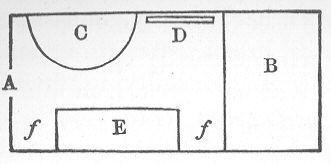
A is the door; B is the bed, or rather two beds,
each six feet long, like berths, with a vacant space below; C is a
grate cooking-stove; D is a table, which hangs by hinges from the
wall; E is a chest of drawers; f and f are two
chairs. The general appearance of a well-kept van is that of a
state-room. Brown’s is a very good van, and quite clean.
They are admirably well adapted for slow traveling, and it was in such
vans, purchased from gypsies, that Sir Samuel Baker and his wife explored
the whole of Cyprus.
Mrs. Brown was proud of her van and of her little treasures. From
the great recess under the bed she raked out as a rare curiosity an old
Dolly Varden or damasked skirt, not at all worn, quite pretty, and
evidently of considerable value to a collector. This had belonged to
Mrs. Brown’s grandmother, an old gypsy queen. And it may be
observed, by the way, that the claims of every Irishman of every degree to
be descended from one of the ancient kings of Ireland fade into nothing
before those of the gypsy women, all of whom, with rare exception, are the
own daughters of royal personages, granddaughterhood being hardly a claim
to true nobility. Then the bed itself was exhibited with pride, and
the princess sang its praises, till she affirmed that the rye
himself did not sleep on a better one, for which George reprimanded
her. But she vigorously defended its excellence, and, to please her,
I felt it and declared it was indeed much softer than the one I slept on,
which was really true,—thank Heaven—and was received as a great
compliment, and afterwards proclaimed on the roads even unto the ends of
Surrey.
“Yes,” said Brown, as I observed some osiers in the
cupboard, “when I feels like it I sometimes makes a pound a day
a-making baskets.”
“I should think,” I said, “that it would be cheaper to
buy French baskets of Bulrose [Bulureaux] in Houndsditch, ready
made.”
“So one would think; but the ranyor [osiers] costs
nothin’, and so it’s all profit, any way.”
Then I urged the greater profit of living in America, but both assured
me that so long as they could make a good living and be very comfortable,
as they considered themselves, in England, it would be nonsense to go to
America.
For all things are relative, and many a gypsy whom the begged-from pity
sincerely, is as proud and happy in a van as any lord in the land. A
very nice, neat young gypsy woman, camped long before just where the Browns
were, once said to me, “It isn’t having everything fine and
stylish that makes you happy. Now we’ve got a van, and have
everything so elegant and comfortable, and sleep warm as anybody; and yet I
often say to my husband that we used to be happier when we used to sleep
under a hedge with, may be, only a thin blanket, and wake up covered with
snow.” Now this woman had only a wretched wagon, and was always
tramping in the rain, or cowering in a smoky, ragged tent and sitting on
the ground, but she had food, fire, and fun, with warm clothes, and
believed herself happy. Truly, she had better reason to
think so than any old maid with a heart run to waste on church gossip, or
the latest engagements and marriages; for it is better to be a street-boy
in a corner with a crust than one who, without it, discusses, in
starvation, with his friend the sausages and turtle-soup in a cook-shop
window, between which and themselves there is a great pane of glass fixed,
never to be penetrated.
I never shall forget the sparkling splendor of that frosty morning in
December when I went with a younger friend from Oatlands Park for a
day’s walk. I may have seen at other times, but I do not
remember, such winter lace-work as then adorned the hedges. The
gossamer spider has within her an inward monitor which tells if the weather
will be fine; but it says nothing about sudden changes to keen cold, and
the artistic result was that the hedges were hung with thousands of Honiton
lamp-mats, instead of the thread fly-catchers which their little artists
had intended. And on twigs and dead leaves, grass and rock and wall,
were such expenditures of Brussels and Spanish point, such a luxury of real
old Venetian run mad, and such deliria of Russian lace as made it evident
that Mrs. Jack Frost is a very extravagant fairy, but one gifted with
exquisite taste. When I reflect how I have in my time spoken of the
taste for lace and diamonds in women as entirely without foundation in
nature, I feel that I sinned deeply. For Nature, in this lace-work,
displays at times a sympathy with humanity,—especially
womanity,—and coquets and flirts with it, as becomes the subject, in
a manner which is merrily awful. There was once in Philadelphia a
shop the windows of which were always filled with different kinds of the
richest and rarest lace, and one cold morning I found that the fairies
had covered the panes with literal frost fac-similes of the exquisite wares
which hung behind. This was no fancy; the copies were as accurate as
photographs. Can it be that in the invisible world there are Female
Fairy Schools of Design, whose scholars combine in this graceful style
Etching on Glass and Art Needlework?
We were going to the village of Hersham to make a call. It was not
at any stylish villa or lordly manor-house,—though I knew of more
than one in the vicinity where we would have been welcome,—but at a
rather disreputable-looking edifice, which bore on its front the sign of
“Lodgings for Travellers.” Now “traveller”
means, below a certain circle of English life, not the occasional, but the
habitual wanderer, or one who dwells upon the roads, and gains his living
thereon. I have in my possession several cards of such a house.
I found them wrapped in a piece of paper, by a deserted gypsy camp, where
they had been lost:—
A NEW HOUSE.
Good Lodging for Travellers.
With a Large Private Kitchen.
THE CROSS KEYS,
West Street . . . maidenhead.
BY J. HARRIS.
The “private kitchen” indicates that the guests will have
facilities for doing their own cooking, as all of them bring their own
victuals in perpetual picnic. In the inclosure of the house in
Hersham, the tops of two or three gypsy vans could always be seen above the
high fence, and there was that general air of mystery about
the entire establishment which is characteristic of all places haunted by
people whose ways are not as our ways, and whose little games are not as
our little games. I had become acquainted with it and its proprietor,
Mr. Hamilton, in that irregular and only way which is usual with such
acquaintances. I was walking by the house one summer day, and stopped
to ask my way. A handsome dark-brown girl was busy at the wash-tub,
two or three older women were clustered at the gate, and in all their faces
was the manner of the diddikai or chureni, or half-blood
gypsy. As I spoke I dropped my voice, and said,
inquiringly,—
“Romanes?”
“Yes,” was the confidential answer.
They were all astonished, and kept quiet till I had gone a few rods on
my way, when the whole party, recovering from their amazement, raised a
gentle cheer, expressive of approbation and sympathy. A few days
after, walking with a lady in Weybridge, she said to me,—
“Who is that man who looked at you so closely?”
“I do not know.”
“That’s very strange. I am quite sure I heard him
utter two words in a strange language, as you passed, as if he only meant
them for you. They sounded like sarshaun baw.”
Which means, “How are you, sir?” or friend. As we came up
the street, I saw the man talking with a well-dressed, sporting-looking
man, not quite a gentleman, who sat cheekily in his own jaunty little
wagon. As I passed, the one of the wagon said to the other, speaking
of me, and in pure Romany, evidently thinking I did not
understand,—
“Dikk’adovo Giorgio, adoi!”
(Look at that Gorgio, there!)
Being a Romany rye, and not accustomed to be spoken of as a Gorgio, I
looked up at him, angrily, when he, seeing that I understood him, smiled,
and bowed politely in apology. I laughed and passed on. But I
thought it a little strange, for neither of the men had the slightest
indication of gypsiness. I met the one who had said sarishān
bā again, soon after. I found that he and the one of the
wagon were not of gypsy blood, but of a class not uncommon in England, who,
be they rich or poor, are affected towards gypsies. The wealthy one
lived with a gypsy mistress; the poorer one had a gypsy wife, and was very
fond of the language. There is a very large class of these mysterious
men everywhere about the country. They haunt fairs; they pop up
unexpectedly as Jack-in-boxes in unsuspected guise; they look out from
under fatherly umbrellas; their name is Legion; their mother is Mystery,
and their uncle is Old Tom,—not of Virginia, but of Gin. Once,
in the old town of Canterbury, I stood in the street, under the Old Woman
with the Clock, one of the quaintest pieces of drollery ever imagined
during the Middle Ages. And by me was a tinker, and as his wheel went
siz-‘z-‘z-‘z, uz-uz-uz-z-z! I talked with
him, and there joined us a fat, little, elderly, spectacled,
shabby-genteel, but well-to-do-looking sort of a punchy, small
tradesman. And, as we spoke, there went by a great, stout, roaring
Romany woman,—a scarlet-runner of Babylon run to seed,—with a
boy and a hand-cart to carry the seed in. And to her I cried,
“Hav akai te mandy’ll del tute a
shāori!” (Come here, and I’ll stand a
sixpence!) But she did not believe in my offer,
but went her way, like a Burning Shame, through the crowd, and was lost
evermore. I looked at the little old gentleman to see what effect my
outcry in a strange language had upon him. But he only remarked,
soberly, “Well, now, I should ’a’ thought a
sixpence would ’a’ brought her to!” And the wheel
said, “Suz-zuz-zuz-z-z I should ’a’ suz-suz
’a’ thought a suz-z-zixpence would ’a’ suz-zuz
’a’ brought her, too-z-z-z!” And I looked at the
Old Woman with the Clock, and she ticked,
“A—six—pence—would—have—brought—me—two—three—four”—and
I began to dream that all Canterbury was Romany.
We came to the house, the landlord was up-stairs, ill in bed, but would
be glad to see us; and he welcomed us warmly, and went deeply into Romany
family matters with my friend, the Oxford scholar. Meanwhile, his
daughter, a nice brunette, received and read a letter; and he tried to
explain to me the mystery of the many men who are not gypsies, yet speak
Romany, but could not do it, though he was one of them. It appeared
from his account that they were “a kind of mixed, you see, and dusted
in, you know, and on it, out of the family, it peppers up; but not exactly,
you understand, and that’s the way it is. And I remember a case
in point, and that was one day, and I had sold a horse, and was with my boy
in a moramengro’s buddika [barber’s shop], and my boy
says to me, in Romanes, ‘Father, I’d like to have my hair
cut.’ ‘It’s too dear here, my son,’ said I,
Romaneskes; ‘for the bill says threepence.’ And then the
barber, he ups and says, in Romany, ‘Since you’re Romanys,
I’ll cut it for twopence, though it’s clear out of all
my rules.’ And he did it; but why that man
rakkered Romanes I don’t know, nor how it comes about; for he
hadn’t no more call to it than a pig has to be a preacher. But
I’ve known men in Sussex to take to diggin’ truffles on the
same principles, and one Gorgio in Hastings that adopted sellin’
fried fish for his livin’, about the town, because he thought it was
kind of romantic. That’s it.”
Over the chimney-piece hung a large engraving of Milton and his
daughters. It was out of place, and our host knew it, and was
proud. He said he had bought it at an auction, and that it was a
picture of Middleton,—a poet, he believed; “anyhow, he was a
writing man.” But, on second thought, he remembered that the
name was not Middleton, but Millerton. And on further reflection, he
was still more convinced that Millerton was a poet.
I once asked old Matthew Cooper the Romany word for a poet. And he
promptly replied that he had generally heard such a man called a
givellengero or gilliengro, which means a song-master, but
that he himself regarded shereskero-mush, or head-man, as more
elegant and deeper; for poets make songs out of their heads, and are also
ahead of all other men in head-work. There is a touching and
unconscious tribute to the art of arts in this definition which is worth
recording. It has been said that, as people grow polite, they cease
to be poetical; it is certain that in the first circles they do not speak
of their poets with such respect as this.
Out again into the fresh air and the frost on the crisp, crackling road
and in the sunshine. At such a time, when cold inspires life, one can
understand why the old poets and mystics believed that there was fire in
ice. Therefore, Saint Sebaldus, coming into the hut of a poor and
pious man who was dying of cold, went out, and, bringing in an armful of
icicles, laid them on the andirons and made a good fire. Now this
fire was the inner glowing glory of God, and worked both ways,—of
course you see the connection,—as was shown in Adelheid von
Sigolsheim, the Holy Nun of Unterlinden, who was so full of it that she
passed the night in a freezing stream, and then stood all the morning,
ice-clad, in the choir, and never caught cold. And the pious
Peroneta, to avoid a sinful suitor, lived all winter, up to her neck, in
ice-water, on the highest Alp in Savoy. [125] These were
saints. But there was a gypsy, named Dighton, encamped near Brighton,
who told me nearly the same story of another gypsy, who was no saint, and
which I repeat merely to show how extremes meet. It was that this
gypsy, who was inspired with anything but the inner glowing glory of God,
but who was, on the contrary, cram full of pure cussedness, being warmed by
the same,—and the devil,—when chased by the constable, took
refuge in a river full of freezing slush and broken ice, where he stood up
to his neck and defied capture; for he verily cared no more for it than did
Saint Peter of Alcantara, who was both ice and fire proof.
“Come out of that, my good man,” said the gentleman, whose hen
he had stolen, “and I’ll let you go.” “No, I
won’t come out,” said the gypsy. “My blood be on
your head!” So the gentleman offered him five pounds, and then
a suit of clothes, to come ashore. The gypsy reflected, and at last
said, “Well, if you’ll add a drink of spirits, I’ll come;
but it’s only to oblige you that I budge.”
Then we walked in the sober evening, with its gray gathering
shadows, as the last western rose light rippled in the river, yet fading in
the sky,—like a good man who, in dying, speaks cheerfully of earthly
things, while his soul is vanishing serenely into heaven. The swans,
looking like snowballs, unconscious of cold were taking their last swim
towards the reedy, brake-tangled islets where they nested, gossiping as
they went. The deepening darkness, at such a time, becomes more
impressive from the twinkling stars, just as the subduing silence is noted
only by the far-borne sounds from the hamlet or farm-house, or the
occasional whispers of the night-breeze. So we went on in the
twilight, along the Thames, till we saw the night-fire of the Romanys and
its gleam on the tan. A tan is, strictly speaking, a
tent, but a tent is a dwelling, or stopping-place; and so from earliest
Aryan time, the word tan is like Alabama, or “here we
rest,” and may be found in tun, the ancestor of town, and in
stan, as in Hindostan,—and if I blunder, so much the better
for the philological gentlemen, who, of all others, most delight in setting
erring brothers right, and never miss a chance to show, through
others’ shame, how much they know.
There was a bark of a dog, and a voice said, “The Romany
rye!” They had not seen us, but the dog knew, and they knew his
language.
“Sarishan ryor!”
“O boro duvel atch’ pa leste!” (The great
Lord be on you!) This is not a common Romany greeting. It is of
ancient days and archaic. Sixty or seventy years ago it was
current. Old Gentilla Cooper, the famous fortune-teller of the
Devil’s Dike, near Brighton, knew it, and when she heard it from me
she was moved,—just as a very old negro in London was, when I
said to him, “Sady, uncle.” I said it because I
had recognized by the dog’s bark that it was Sam Smith’s
tan. Sam likes to be considered as deep Romany. He tries
to learn old gypsy words, and he affects old gypsy ways. He is
pleased to be called Petulengro, which means Smith. Therefore, my
greeting was a compliment.
In a few minutes we were in camp and at home. We talked of many
things, and among others of witches. It is remarkable that while the
current English idea of a witch is that of an old woman who has sold
herself to Satan, and is a distinctly marked character, just like Satan
himself, that of the witch among gypsies is general and Oriental.
There is no Satan in India. Mrs. Smith—since dead—held
that witches were to be found everywhere. “You may know a
natural witch,” she said, “by certain signs. One of these
is straight hair which curls at the ends. Such women have it in
them.”
It was only recently, as I write, that I was at a very elegant art
reception, which was fully reported in the newspapers. And I was very
much astonished when a lady called my attention to another young and very
pretty lady, and expressed intense disgust at the way the latter wore her
hair. It was simply parted in the middle, and fell down on either
side, smooth as a water-fall, and then broke into curls at the ends, just
as water, after falling, breaks into waves and rapids. But as she
spoke, I felt it all, and saw that Mrs. Petulengro was in the right.
The girl with the end-curled hair was uncanny. Her hair curled at the
ends,—so did her eyes; she was a witch.
“But there’s a many witches as knows clever
things,” said Mrs. Petulengro. “And I learned from one of
them how to cure the rheumatiz. Suppose you’ve got the
rheumatiz. Well, just you carry a potato in your pocket. As the
potato dries up, your rheumatiz will go away.”
Sam Smith was always known on the roads as Fighting Sam. Years
have passed, and when I have asked after him I have always heard that he
was either in prison or had just been let out. Once it happened that,
during a fight with a Gorgio, the Gorgio’s watch disappeared, and Sam
was arrested under suspicion of having got up the fight in order that the
watch might disappear. All of his friends declared his
innocence. The next trouble was for chorin a gry, or stealing
a horse, and so was the next, and so on. As horse-stealing is not a
crime, but only “rough gambling,” on the roads, nobody defended
him on these counts. He was, so far as this went, only a sporting
character. When his wife died he married Athalía, the widow of
Joshua Cooper, a gypsy, of whom I shall speak anon. I always liked
Sam. Among the travelers, he was always spoken of as genteel, owing
to the fact, that whatever the state of his wardrobe might be, he always
wore about his neck an immaculate white woolen scarf, and on jours de
fête, such as horse-races, sported a boro stardī, or
chimney-pot hat. O my friend, Colonel Dash, of the club! Change
but the name, this fable is of thee!
“There’s to be a walgoro, kaliko i
sala—a fair to-morrow morning, at Cobham,” said Sam, as he
departed.
“All right. We’ll be there.”
As I went forth by the river into the night, and the stars looked
down like loving eyes, there shot a meteor across the sky, one long trail
of light, out of darkness into darkness, one instant bright, then dead
forever. And I remembered how I once was told that stars, like
mortals, often fall in love. O love, forever in thy glory go!
And that they send their starry angels forth, and that the meteors are
their messengers. O love, forever in thy glory go! For love and
light in heaven, as on earth, were ever one, and planets speak with
light. Light is their language; as they love they speak. O
love, forever in thy glory go!
The walk from Oatlands Park Hotel to Cobham is beautiful with memorials
of Older England. Even on the grounds there is a quaint brick
gateway, which is the only relic of a palace which preceded the present
pile. The grandfather was indeed a stately edifice, built by Henry
VIII., improved and magnified, according to his lights, by Inigo Jones, and
then destroyed during the civil war. The river is here very
beautiful, and the view was once painted by Turner. It abounds in
“short windings and reaches.” Here it is, indeed, the
Olerifera Thamesis, as it was called by Guillaume le Breton in his
“Phillipeis,” in the days of Richard the Lion Heart. Here
the eyots and banks still recall Norman days, for they are “wild and
were;” and there is even yet a wary otter or two, known to the
gypsies and fishermen, which may be seen of moonlight nights plunging or
swimming silently in the haunted water.
Now we pass Walton Church, and look in, that my friend may see the massy
Norman pillars and arches, the fine painted glass, and the brasses.
One of these represents John Selwyn, who was keeper of the royal park of
Oatlands in 1587. Tradition, still current in the village, says that
Selwyn was a man of wondrous strength and of rare skill in
horsemanship. Once, when Queen Elizabeth was present at a
stag hunt, he leaped from his horse upon the back of the stag, while both
were running at full speed, kept his seat gracefully, guided the animal
towards the queen, and stabbed him so deftly that he fell dead at her
majesty’s feet. It was daintily done, and doubtless Queen Bess,
who loved a proper man, was well pleased. The brass plate represents
Selwyn as riding on the stag, and there is in the village a shop where the
neat old dame who presides, or her daughter, will sell you for a penny a
picture of the plate, and tell you the story into the bargain. In it
the valiant ranger sits on the stag, which he is stabbing through the neck
with his couteau de chasse, looking meanwhile as solemn as if he
were sitting in a pew and listening to De profundis. He who is
great in one respect seldom fails in some other, and there is in the church
another and a larger brass, from which it appears that Selwyn not only had
a wife, but also eleven children, who are depicted in successive grandeur
or gradation. There are monuments by Roubiliac and Chantrey in the
church, and on the left side of the altar lies buried William Lilly, the
great astrologer, the Sidrophel of Butler’s
“Hudibras.” And look into the chancel. There is a
tablet to his memory, which was put up by Elias Ashmole, the antiquary, who
has left it in print that this “fair black marble stone” cost
him £6 4s. 6d. When I was a youth, and used to
pore in the old Franklin Library of Philadelphia over Lilly, I never
thought that his grave would be so near my home. But a far greater
literary favorite of mine lies buried in the church-yard without.
This is Dr. Maginn, the author of “Father Tom and the Pope,”
and many another racy, subtle jest. A fellow of infinite
humor,—the truest disciple of Rabelais,—and here he lies
without a monument!
Summon the sexton, and let us ask him to show us the scold’s, or
gossip’s, bridle. This is a rare curiosity, which is kept in
the vestry. It would seem, from all that can be learned, that two
hundred years ago there were in England viragoes so virulent, women so
gifted with gab and so loaded and primed with the devil’s own
gunpowder, that all moral suasion was wasted on them, and simply showed, as
old Reisersberg wrote, that fatue agit qui ignem conatur extinguere
sulphure (’t is all nonsense to try to quench fire with
brimstone). For such diavolas they had made—what the sexton is
just going to show you—a muzzle of thin iron bars, which pass around
the head and are padlocked behind. In front a flat piece of iron
enters the mouth and keeps down the tongue. On it is the date 1633,
and certain lines, no longer legible:—
“Chester presents Walton with a bridle,
To curb women’s tongues that talk too idle.”
A sad story, if we only knew it all! What tradition tells is that
long ago there was a Master Chester, who lost a fine estate through the
idle, malicious clack of a gossiping, lying woman. “What is
good for a bootless bene?” What he did was to endow the church
with this admirable piece of head-gear. And when any woman in the
parish was unanimously adjudged to be deserving of the honor, the bridle
was put on her head and tongue, and she was led about town by the beadle as
an example to all the scolding sisterhood. Truly, if it could only be
applied to the women and men who repeat gossip, rumors reports, on
dits, small slanders, proved or unproved, to all gobe-mouches,
club-gabblers, tea-talkers and tattlers, chatterers, church-twaddlers,
wonderers if-it-be-true-what-they-say; in fine, to the entire sister and
brother hood of tongue-waggers, I for one would subscribe my mite to have
one kept in every church in the world, to be zealously applied to their
vile jaws. For verily the mere Social Evil is an angel of light on
this earth as regards doing evil, compared to the Sociable Evil,—and
thus endeth the first lesson.
We leave the church, so full of friendly memories. In this one
building alone there are twenty things known to me from a boy. For
from boyhood I have held in my memory those lines by Queen Elizabeth which
she uttered here, and have read Lilly and Ashmole and Maginn; and this is
only one corner in merrie England! Am I a stranger here? There
is a father-land of the soul, which has no limits to him who, far sweeping
on the wings of song and history, goes forth over many lands.
We have but a little farther to go on our way before we come to the
quaint old manor-house which was of old the home of President Bradshaw, the
grim old Puritan. There is an old sailor in the village, who owns a
tavern, and he says, and the policeman agrees with him, that it was in this
house that the death-warrant of King Charles the First was signed.
Also, that there is a subterranean passage which leads from it to the
Thames, which was in some way connected with battle, murder, plots,
Puritans, sudden death, and politics; though how this was is more than
legend can clearly explain. Whether his sacred majesty was led to
execution through this cavity, or whether Charles the Second had it
for one of his numerous hiding-places, or returned through it with Nell
Gwynn from his exile, are other obscure points debated among the
villagers. The truth is that the whole country about Walton is
subterrened with strange and winding ways, leading no one knows whither,
dug in the days of the monks or knights, from one long-vanished monastery
or castle to the other. There is the opening to one of these hard by
the hotel, but there was never any gold found in it that ever I heard
of. And all the land is full of legend, and ghosts glide o’
nights along the alleys, and there is an infallible fairy well at hand,
named the Nun, and within a short walk stands the tremendous Crouch oak,
which was known of Saxon days. Whoever gives but a little of its bark
to a lady will win her love. It takes its name from croix (a
cross), according to Mr. Kemble, [134] and it is twenty-four feet
in girth. Its first branch, which is forty-eight feet long, shoots
out horizontally, and is almost as large as the trunk. Under this
tree Wickliffe preached, and Queen Elizabeth dined.
It has been well said by Irving that the English, from the great
prevalence of rural habits throughout every class of society, have been
extremely fond of those festivals and holidays which agreeably interrupt
the stillness of country life. True, the days have gone when
burlesque pageant and splendid procession made even villages
magnificent. Harp and tabor and viol are no longer heard in every inn
when people would be merry, and men have forgotten how to give themselves
up to headlong roaring revelry. The last of this tremendous
frolicking in Europe died out with the last yearly kermess
in Amsterdam, and it was indeed wonderful to see with what utter
abandon the usually stolid Dutch flung themselves into a rushing
tide of frantic gayety. Here and there in England a spark of the old
fire, lit in mediæval times, still flickers, or perhaps flames, as at
Dorking in the annual foot-ball play, which is carried on with such vigor
that two or three thousand people run wild in it, while all the windows and
street lamps are carefully screened for protection. But
notwithstanding the gradually advancing republicanism of the age, which is
dressing all men alike, bodily and mentally, the rollicking democracy of
these old-fashioned festivals, in which the peasant bonneted the peer
without ceremony, and rustic maids ran races en chemise for a pound
of tea, is entirely too leveling for culture. There are still,
however, numbers of village fairs, quietly conducted, in which there is
much that is pleasant and picturesque, and this at Cobham was as pretty a
bit of its kind as I ever saw. These are old-fashioned and gay in
their little retired nooks, and there the plain people show themselves as
they really are. The better class of the neighborhood, having no
sympathy with such sports or scenes, do not visit village fairs. It
is, indeed, a most exceptional thing to see any man who is a
“gentleman,” according to the society standard, in any fair
except Mayfair in London.
Cobham is well built for dramatic display. Its White Lion Inn is
of the old coaching days, and the lion on its front is a very impressive
monster, one of the few relics of the days when signs were signs in spirit
and in truth. In this respect the tavern keeper of to-day is a poor
snob, that he thinks a sign painted or carven is
degenerate and low, and therefore announces, in a line of letters, that his
establishment is the Pig and Whistle, just as his remote predecessor
thought it was low, or slow, or old-fashioned to dedicate his ale-shop to
Pigen Wassail or Hail to the Virgin, and so changed it to a more genteel
and secular form. In the public place were rows of booths arranged in
streets forming imperium in imperio, a town within a town.
There was of course the traditional gilt gingerbread, and the cheering but
not inebriating ginger-beer, dear to the youthful palate, and not less
loved by the tired pedestrian, when, mixed half and half with ale, it foams
before him as shandy gaff. There, too, were the stands,
presided over by jaunty, saucy girls, who would load a rifle for you and
give you a prize or a certain number of shots for a shilling. You may
be a good shot, but the better you shoot the less likely will you be to hit
the bull’s-eye with the rifle which that black-eyed Egyptian minx
gives you; for it is artfully curved and false-sighted, and the rifle was
made only to rifle your pocket, and the damsel to sell you with her smiles,
and the doll is stuffed with sawdust, and life is not worth living for, and
Miching Mallocko says it,—albeit I believe he lives at times as if
there might be moments when it was forgot.
And we had not been long on the ground before we were addressed
furtively and gravely by a man whom it required a second glance to
recognize as Samuel Petulengro, so artfully was he disguised as a
simple-seeming agriculturalist of the better lower-class. But that
there remained in Sam’s black eyes that glint of the Romany which
nothing could disguise, one would have longed to buy a horse of him.
And in the same quiet way there came, one by one, out of the
crowd, six others, all speaking in subdued voices, like conspirators, and
in Romany, as if it were a sin. And all were dressed rustically, and
the same with intent to deceive, and all had the solemn air of very small
farmers, who must sell that horse at any sacrifice. But when I saw
Sam’s horses I marked that his disguise of himself was nothing to the
wondrous skill with which he had converted his five-pound screws into
something comparatively elegant. They had been curried, clipped,
singed, and beautified to the last resource, and the manner in which the
finest straw had been braided into mane and tail was a miracle of
art. This was jour de fête for Sam and his
diddikai, or half-blood pals; his foot was on his native heath in
the horse-fair, where all inside the ring knew the gypsy, and it was with
pride that he invited us to drink ale, and once in the bar-room, where all
assembled were jockeys and sharps, conversed loudly in Romany, in order to
exhibit himself and us to admiring friends. A Romany rye, on such
occasions, is to a Sam Petulengro what a scion of royalty is to minor
aristocracy when it can lure him into its nets. To watch one of these
small horse-dealers at a fair, and to observe the manner in which he
conducts his bargains, is very curious. He lounges about all day,
apparently doing nothing; he is the only idler around. Once in a
while somebody approaches him and mutters something, to which he gives a
brief reply. Then he goes to a tap-room or stable-yard, and is merged
in a mob of his mates. But all the while he is doing sharp clicks of
business. There is somebody talking to another party about that
horse; somebody telling a farmer that he knows a young man as has
got a likely ’oss at ’arf price, the larst of a lot which he
wants to clear out, and it may be ’ad, but if the young man sees
’im [the farmer] he may put it on ’eavy.
Then the agent calls in one of the disguised Romanys to testify to the
good qualities of the horse. They look at it, but the third
deguisé, who has it in charge, avers that it has just been
sold to a gentleman. But they have another. By this time the
farmer wishes he had bought the horse. When any coin slips from
between our fingers, and rolls down through a grating into the sewer, we
are always sure that it was a sovereign, and not a half-penny. Yes,
and the fish which drops back from the line into the river is always the
biggest take—or mistake—of the day. And this horse was a
bargain, and the three in disguise say so, and wish they had a hundred like
it. But there comes a Voice from the depths, a casual remark,
offering to bet that ’ere gent won’t close on that hoss.
“Bet yer ten bob he will.” “Done.”
“How do yer know he don’t take the hoss?” “He
carn’t; he’s too heavy loaded with Bill’s mare.
Says he’ll sell it for a pound better.” The farmer begins
to see his way. He is shrewd; it may be that he sees through all this
myth of “the gentleman.” But his attention has been
attracted to the horse. Perhaps he pays a little more, or “the
pound better;” in greater probability he gets Sam’s horse for
the original price. There are many ways among gypsies of making such
bargains, but the motive power of them all is táderin, or
drawing the eye of the purchaser, a game not unknown to Gorgios. I
have heard of a German yahūd in Philadelphia, whose little boy
Moses would shoot from the door with a pop-gun or squirt at passers-by, or
abuse them vilely, and then run into the shop for shelter. They of
course pursued him and complained to the parent, who immediately whipped
his son, to the great solace of the afflicted ones. And then the
afflicted seldom failed to buy something in that shop, and the corrected
son received ten per cent. of the profit. The attention of the public
had been drawn.
As we went about looking at people and pastimes, a Romany, I think one
of the Ayres, said to me,—
“See the two policemen? They’re following you two
gentlemen. They saw you pallin’ with Bowers. That Bowers
is the biggest blackguard on the roads between London and Windsor. I
don’t want to hurt his charáckter, but it’s no bad
talkin’ nor dusherin of him to say that no decent Romanys care
to go with him. Good at a mill? Yes, he’s that. A
reg’lar wastimengro, I call him. And that’s why it
is.”
Now there was in the fair a vast institution which proclaimed by a
monstrous sign and by an excessive eruption of advertisement that it was
The Sensation of the Age. This was a giant
hand-organ in connection with a forty-bicycle merry-go-round, all propelled
by steam. And as we walked about the fair, the two rural policemen,
who had nothing better to do, shadowed or followed us, their bucolic
features expressing the intensest suspicion allied to the extremest
stupidity; when suddenly the Sensation of the Age struck up the
Gendarme’s chorus, “We’ll run ’em in,” from
Genevieve de Brabant, and the arrangement was complete. Of all airs
ever composed this was the most appropriate to the occasion, and therefore
it played itself. The whole formed quite a little opera-bouffe,
gypsies not being wanting. And as we came round,
in our promenade, the pretty girl, with her rifle in hand, implored us to
take a shot, and the walk wound up by her finally letting fly herself and
ringing the bell.
That pretty girl might or might not have a touch of Romany blood in her
veins, but it is worth noting that among all these show-men and show-women,
acrobats, exhibitors of giants, purse-droppers, gingerbread-wheel gamblers,
shilling knife-throwers, pitch-in-his-mouths, Punches, Cheap-Jacks,
thimble-rigs, and patterers of every kind there is always a leaven and a
suspicion of gypsiness. If there be not descent, there is affinity by
marriage, familiarity, knowledge of words and ways, sweethearting and
trafficking, so that they know the children of the Rom as the house-world
does not know them, and they in some sort belong together. It is a
muddle, perhaps, and a puzzle; I doubt if anybody quite understands
it. No novelist, no writer whatever, has as yet clearly
explained the curious fact that our entire nomadic population, excepting
tramps, is not, as we thought in our childhood, composed of English people
like ourselves. It is leavened with direct Indian blood; it has, more
or less modified, a peculiar morale. It was old before the
Saxon heptarchy.
I was very much impressed at this fair with the extensive and
unsuspected amount of Romany existent in our rural population. We had
to be satisfied, as we came late into the tavern for lunch, with cold
boiled beef and carrots, of which I did not complain, as cold carrots are
much nicer than warm, a fact too little understood in cookery. There
were many men in the common room, mostly well dressed, and decent even if
doubtful looking. I observed that several used
Romany words in casual conversation. I came to the conclusion at last
that all who were present knew something of it. The greatly
reprobated Bowers was not himself a gypsy, but he had a gypsy wife.
He lived in a cottage not far from Walton, and made baskets, while his wife
roamed far and near, selling them; and I have more than once stopped and
sent for a pot of ale, and shared it with Bill, listening meantime to his
memories of the road as he caned chairs or “basketed.” I
think his reputation came rather from a certain Bohemian disregard of
convenances and of appearances than from any deeply-seated
sinfulness. For there are Bohemians even among gypsies; everything in
this life being relative and socially-contractive. When I came to
know the disreputable William well, I found in him the principles of
Panurge, deeply identified with the morale of Falstaff; a wondrous
fund of unbundled humor, which expressed itself more by tones than words; a
wisdom based on the practices of the prize-ring; and a perfectly
sympathetic admiration of my researches into Romany. One day, at
Kingston Fair, as I wished to depart, I asked Bill the way to the
station. “I will go with you and show you,” he
said. But knowing that he had business in the fair I declined his
escort. He looked at me as if hurt.
“Does tute pen mandy’d chore tute?” (Do
you think I would rob you or pick your pockets?) For he
believed I was afraid of it. I knew Bill better. I knew that he
was perfectly aware that I was about the only man in England who had a good
opinion of him in any way, or knew what good there was in him. When a
femme incomprise, a woman not as yet found out, discovers at last
the man who is so much a master of the art of flattery as to
satisfy somewhat her inordinate vanity, she is generally grateful enough to
him who has thus gratified her desires to refrain from speaking ill of him,
and abuse those who do, especially the latter. In like manner, Bill
Bowers, who was every whit as interesting as any femme incomprise in
Belgravia, or even Russell Square, believing that I had a little better
opinion of him than anybody else, would not only have refrained from
robbing me, but have proceeded to lam with his fists anybody else who would
have done so,—the latter proceeding being, from his point of view,
only a light, cheerful, healthy, and invigorating exercise, so that, as he
said, and as I believe truthfully, “I’d rather be walloped than
not fight.” Even as my friend H. had rather lose than not play
“farrer.”
This was a very pretty little country fair at Cobham; pleasant and
purely English. It was very picturesque, with its flags, banners,
gayly bedecked booths, and mammoth placards, there being, as usual, no lack
of color or objects. I wonder that Mr. Frith, who has given with such
idiomatic genius the humors of the Derby, has never painted an
old-fashioned rural fair like this. In a few years the last of them
will have been closed, and the last gypsy will be there to look on.
There was a pleasant sight in the afternoon, when all at once, as it
seemed to me, there came hundreds of pretty, rosy-cheeked children into the
fair. There were twice as many of them as of grown people. I
think that, the schools being over for the day, they had been sent
a-fairing for a treat. They swarmed in like small bee-angels, just
escaped from some upset celestial hive; they crowded around the booths,
buying little toys, chattering, bargaining, and laughing, when my eye
caught theirs, as though to be noticed was the very best joke in the whole
world. They soon found out the Sensation of the Age, and the mammoth
steam bicycle was forthwith crowded with the happy little creatures,
raptured in all the glory of a ride. The cars looked like baskets
full of roses. It was delightful to see them: at first like grave and
stolid little Anglo-Saxons, occupied seriously with the new Sensation; then
here and there beaming with thawing jollity; then smiling like sudden
sun-gleams; and then laughing, until all were in one grand chorus, as the
speed became greater, and the organ roared out its notes as rapidly as a
runaway musical locomotive, and the steam-engine puffed in time, until a
high-pressure scream told that the penn’orth of fun was up.
As we went home in the twilight, and looked back at the trees and roofs
of the village, in dark silhouette against the gold-bronze sky, and heard
from afar and fitfully the music of the Great Sensation mingled with the
beat of a drum and the shouts of the crowd, rising and falling with the
wind, I felt a little sad, that the age, in its advancing refinement, is
setting itself against these old-fashioned merry-makings, and shrinking
like a weakling from all out-of-doors festivals, on the plea of their being
disorderly, but in reality because they are believed to be vulgar.
They come down to us from rough old days; but they are relics of a time
when life, if rough, was at least kind and hearty. We admire that
life on the stage, we ape it in novels, we affect admiration and
appreciation of its rich picturesqueness and vigorous originality, and we
lie in so doing; for there is not an æsthetic prig in London who could
have lived an hour in it. Truly, I should like to know what
François Villon and Chaucer would have thought of some of their
modern adorers, or what the lioness Fair-sinners of the olden time would
have had to say to the nervous weaklings who try to play the genial
blackguard in their praise! It is to me the best joke of the age that
those who now set themselves up for priests of the old faith are the men,
of all others, whom the old gods would have kicked, cum magna
injuria, out of the temple. When I sit by Bill Bowers, as he
baskets, and hear the bees buzz about his marigolds, or in Plato
Buckland’s van, or with a few hearty and true men of London town of
whom I wot, then I know that the old spirit liveth in its ashes; but
there is little of it, I trow, among its penny prig-trumpeters.
“Thus spoke the king to the great Master: ‘Thou didst bless
and ban the people; thou didst give benison and curse, luck and sorrow, to
the evil or the good.’
“And the Master said, ‘It may be so.’
“And the king continued, ‘There came two men, and one was
good and the other bad. And one thou didst bless, thinking he was
good; but he was wicked. And the other thou didst curse, and thought
him bad; but he was good.’
“The Master said, ‘And what came of it?’
“The king answered, ‘All evil came upon the good man, and
all happiness to the bad.’
“And the Master said, ‘I write letters, but I am not the
messenger; I hunt the deer, but I am not the cook; I plant the vine, but I
do not pour the wine to the guests; I ordain war, yet do not fight; I send
ships forth on the sea, but do not sail them. There is many a slip
between cup and lip, as the chief of the rebel spirits said when he was
thrown out of heaven, and I am not greater nor wiser than he was before he
fell. Hast thou any more questions, O son?’
“And the king went his way.”
One afternoon I was walking with three ladies. One was married,
one was a young widow, and one, no longer very young, had not as yet
husbanded her resources. And as we went by the Thames, conversation
turned upon many things, and among them the mystery of the future and
mediums; and the widow at last said she would like to have her fortune
told.
“You need not go far to have it done,” I said.
“There is a gypsy camp not a mile away, and in it one of the
cleverest fortune-tellers in England.”
“I am almost afraid to go,” said the maiden lady. “It seems to me to be really wrong to try to look into the
awful secrets of futurity. One can never be certain as to what a
gypsy may not know. It’s all very well, I dare say, to declare
it’s all rubbish, but then you know you never can tell what may be in
a rubbish-heap, and they may be predicting true things all the time while
they think they’re humbugging you. And they do often foretell
the most wonderful things; I know they do. My aunt was told that she
would marry a man who would cause her trouble, and, sure enough, she did;
and it was such a shame, she was such a sweet-tempered, timid woman, and he
spent half her immense fortune. Now wasn’t that
wonderful?”
It would be a curious matter for those who like studying statistics and
chance to find out what proportion in England of sweet-tempered, timid
women of the medium-middle class, in newly-sprouted families, with immense
fortunes, do not marry men who only want their money. Such
heiresses are the natural food of the noble shark and the swell sucker, and
even a gypsy knows it, and can read them at a glance. I explained
this to the lady; but she knew what she knew, and would not know
otherwise.
So we came along the rippling river, watching the darting swallows and
light water-gnats, as the sun sank afar into the tawny, golden west, and
Night, in ever-nearing circles, wove her shades around us. We saw the
little tents, like bee-hives,—one, indeed, not larger than the hive
in which Tyll Eulenspiegel slept his famous nap, and in which he was
carried away by the thieves who mistook him for honey and found him
vinegar. And the outposts, or advanced pickets of small, brown,
black-eyed elves, were tumbling about as usual, and shouted
their glad greeting; for it was only the day before that I had come down
with two dozen oranges, which by chance proved to be just one apiece for
all to eat except for little Synfie Cooper, who saved hers up for her
father when he should return.
I had just an instant in which to give the gypsy sorceress a
“straight tip,” and this I did, saying in Romany that one of
the ladies was married and one a widow. I was indeed quite sure that
she must know the married lady as such, since she had lived near at hand,
within a mile, for months. And so, with all due solemnity, the
sorceress went to her work.
“You will come first, my lady, if you please,” she said to
the married dame, and led her into a hedge-corner, so as to be remote from
public view, while we waited by the camp.
The hand was inspected, and properly crossed with a shilling, and the
seeress began her prediction.
“It’s a beautiful hand, my lady, and there’s luck in
it. The line o’ life runs lovely and clear, just like a smooth
river from sea to sea, and that means you’ll never be in danger
before you die, nor troubled with much ill. And it’s written
that you’ll have another husband very soon.”
“But I don’t want another,” said the lady.
“Ah, my dear lady, so you’ll say till you get him, but when
he comes you’ll be glad enough; so do you just get the first one out
of your head as soon as you can, for the next will be the better one.
And you’ll cross the sea and travel in a foreign land, and remember
what I told you to the end of your life days.”
Then the widow had her turn.
“This is a lucky hand, and little need you had to have your
fortune told. You’ve been well married once, and once is enough
when it’s all you need. There’s others as is never
satisfied and wants everything, but you’ve had the best, and more you
needn’t want, though there’ll be many a man who’ll be in
love with you. Ay, indeed, there’s fair and dark as will feel
the favor of your beautiful eyes, but little good will it do them, and
barons and lords as would kiss the ground you tread on; and no wonder,
either, for you have the charm which nobody can tell what it is. But
it will do ’em no good, nevermore.”
“Then I’m never to have another husband,” said the
widow.
“No, my lady. He that you married was the best of all, and,
after him, you’ll never need another; and that was written in your
hand when you were born, and it will be your fate, forever and ever: and
that is the gypsy’s production over the future, and what she has
producted will come true. All the stars in the fermentation of heaven
can’t change it. But if you ar’n’t satisfied, I can
set a planet for you, and try the cards, which comes more expensive, for I
never do that under ten shillings.”
There was a comparing of notes among the ladies and much laughter, when
it appeared that the priestess of the hidden spell, in her working, had
mixed up the oracles. Jacob had manifestly got Esau’s
blessing. It was agreed that the bonnes fortunes should be
exchanged, that the shillings might not be regarded as lost, and all this
was explained to the unmarried lady. She said nothing, but in due
time was also dukkered or fortune-told. With the same mystery
she was conducted to the secluded corner of the hedge, and a
very long, low-murmuring colloquy ensued. What it was we never knew,
but the lady had evidently been greatly impressed and awed. All that
she would tell was that she had heard things that were “very
remarkable, which she was sure no person living could have known,”
and in fact that she believed in the gypsy, and even the blunder as to the
married lady and the widow, and all my assurances that chiromancy as
popularly practiced was all humbug, made no impression. There was
once “a disciple in Yabneh” who gave a hundred and fifty
reasons to prove that a reptile was no more unclean than any other
animal. But in those days people had not been converted to the law of
turtle soup and the gospel of Saint Terrapin, so the people said it was a
vain thing. And had I given a hundred and fifty reasons to this lady,
they would have all been vain to her, for she wished to believe; and when
our own wishes are served up unto us on nice brown pieces of the
well-buttered toast of flattery, it is not hard to induce us to devour
them.
It is written that when Ashmedai, or Asmodeus, the chief of all the
devils of mischief, was being led a captive to Solomon, he did several
mysterious things while on the way, among others bursting into extravagant
laughter, when he saw a magician conjuring and predicting. On being
questioned by Benaiah, the son of Jehoiada, why he had seemed so much
amused, Ashmedai answered that it was because the seer was at the very time
sitting on a princely treasure, and he did not, with all his magic and
promising fortune to others, know this. Yet, if this had been told to
all the world, the conjurer’s business would not have
suffered. Not a bit of it. Entre Jean, passe
Jeannot: one comes and goes, another takes his place, and the poor will
disappear from this world before the too credulous shall have departed.
It was on the afternoon of the following day that I, by chance, met the
gypsy with a female friend, each with a basket, by the roadside, in a
lonely, furzy place, beyond Walton.
“You are a nice fortune-teller, aren’t you now?” I
said to her. “After getting a tip, which made it all as clear
as day, you walk straight into the dark. And here you promise a lady
two husbands, and she married already; but you never promised me two wives,
that I might make merry withal. And then to tell a widow that she
would never be married again! You’re a bori chovihani [a
great witch],—indeed, you aren’t.”
“Rye,” said the gypsy, with a droll smile and a
shrug,—I think I can see it now,—“the dukkerin
[prediction] was all right, but I pet the right dukkerins on the
wrong ladies.”
And the Master said, “I write letters, but I am not the
messenger.” His orders, like the gypsy’s, had been all
right, but they had gone to the wrong shop. Thus, in all ages, those
who affect superior wisdom and foreknowledge absolute have found that a
great practical part of the real business consisted in the plausible
explanation of failures. The great Canadian weather prophet is said
to keep two clerks busy, one in recording his predictions, the other in
explaining their failures; which is much the case with the rain-doctors in
Africa, who are as ingenious and fortunate in explaining a miss as a hit,
as, indeed, they need be, since they must, in case of error, submit to be
devoured alive by ants,—insects which in Africa correspond in several
respects to editors and critics, particularly the stinging kind.
“Und ist man bei der Prophezeiung angestellt,” as Heine
says; “when a man has a situation in a prophecy-office,” a
great part of his business is to explain to the customers why it is that so
many of them draw blanks, or why the trains of fate are never on time.
On a summer day, when waking dreams softly wave before the fancy, it is
pleasant to walk in the noon-stillness along the Thames, for then we pass a
series of pictures forming a gallery which I would not exchange for that of
the Louvre, could I impress them as indelibly upon the eye-memory as its
works are fixed on canvas. There exists in all of us a spiritual
photographic apparatus, by means of which we might retain accurately all we
have ever seen, and bring out, at will, the pictures from the pigeon-holes
of the memory, or make new ones as vivid as aught we see in dreams, but the
faculty must be developed in childhood. So surely as I am now writing
this will become, at some future day, a branch of education, to be
developed into results of which the wildest imagination can form no
conception, and I put the prediction on record. As it is, I am sorry
that I was never trained to this half-thinking, half-painting art, since,
if I had been, I should have left for distant days to come some charming
views of Surrey as it appears in this decade.
The reedy eyots and the rising hills; the level meadows and the little
villes, with their antique perpendicular Gothic churches, which form the
points around which they have clustered for centuries, even as groups of
boats in the river are tied around their mooring-posts; the bridges and trim
cottages or elegant mansions with their flower-bordered grounds sweeping
down to the water’s edge, looking like rich carpets with new baize
over the centre, make the pictures of which I speak, varying with every
turn of the Thames; while the river itself is, at this season, like a
continual regatta, with many kinds of boats, propelled by stalwart young
Englishmen or healthy, handsome damsels, of every rank, the better class by
far predominating. There is a disposition among the English to don
quaint holiday attire, to put on the picturesque, and go to the very limits
which custom permits, which would astonish an American. Of late years
this is becoming the case, too, in Trans-Atlantis, but it has always been
usual in England, to mark the fête day with a festive dress, to wear
gay ribbons, and to indulge the very harmless instinct of youth to be
gallant and gay.
I had started one morning on a walk by the Thames, when I met a friend,
who asked,—
“Aren’t you going to-day to the Hampton races?”
“How far is it?”
“Just six miles. On Molesy Hurst.”
Six miles, and I had only six shillings in my pocket. I had some
curiosity to see this race, which is run on the Molesy Hurst, famous as the
great place for prize-fighting in the olden time, and which has never been
able to raise itself to respectability, inasmuch as the local chronicler
says that “the course attracts considerable and not very reputable
gatherings.” In fact, it is generally spoken of as the
Costermonger’s race, at which a mere welsher is a comparatively
respectable character, and every man in a good coat a swell. I was
nicely attired, by chance, for the occasion, for I had come out,
thinking of a ride, in a white hat, new corduroy pantaloons and waistcoat,
and a velveteen coat, which dress is so greatly admired by the gypsies that
it may almost be regarded as their “national costume.”
There was certainly, to say the least, a rather bourgeois tone at
the race, and gentility was conspicuous by its absence; but I did not find
it so outrageously low as I had been led to expect. I confess that I
was not encouraged to attempt to increase my little hoard of silver by
betting, and the certainty that if I lost I could not lunch made me
timid. But the good are never alone in this world, and I found
friends whom I dreamed not of. Leaving the crowd, I sought the gypsy
vans, and by one of these was old Liz Buckland.
“Sarishan rye! And glad I am to see you. Why
didn’t you come down into Kent to see the hoppin’? Many a
time the Romanys says they expected to see their rye there.
Just the other night, your Coopers was a-lyin’ round their fire,
every one of ’em in a new red blanket, lookin’ so beautiful as
the light shone on ’em, and I says, ‘If our rye was to
see you, he’d just have that book of his out, and take all your
pictures.’”
After much gossip over absent friends, I said,—
“Well, dye, I stand a shilling for beer, and that’s
all I can do to-day, for I’ve come out with only shove
trin-grushi.”
Liz took the shilling, looked at it and at me with an earnest air, and
shook her head.
“It’ll never do, rye,—never. A gentleman
wants more than six shillin’s to see a race through, and a
reg’lar Romany rye like you ought to slap down his lovvo with the
best of ’em for the credit of his people. And if you want a
bar [a pound] or two, I’ll lend you the money, and never fear
about your payment.”
It was kind of the old dye, but I thought that I would pull
through on my five shillings, before I would draw on the Romany bank.
To be considered with sincere sympathy, as an object of deserving charity,
on the lowest race-ground in England, and to be offered eleemosynary relief
by a gypsy, was, indeed, touching the hard pan of humiliation. I went
my way, idly strolling about, mingling affably with all orders, for my
watch was at home. Vacuus viator cantabit. As I stood by
a fence, I heard a gentlemanly-looking young man, who was evidently a
superior pickpocket, or “a regular fly gonoff,” say to a
friend,—
“She’s on the ground,—a great woman among the
gypsies. What do they call her?”
“Mrs. Lee.”
“Yes. A swell Romany she is.”
Whenever one hears an Englishman, not a scholar, speak of gypsies as
“Romany,” he may be sure that man is rather more on the loose
than becomes a steady citizen, and that he walks in ways which, if not of
darkness, are at least in a shady demi-jour, with a gentle down
grade. I do not think there was anybody on the race-ground who was
not familiar with the older word.
It began to rain, and before long my new velveteen coat was very
wet. I looked among the booths for one where I might dry myself and
get something to eat, and, entering the largest, was struck by the
appearance of the landlady. She was a young and decidedly pretty
woman, nicely dressed, and was unmistakably gypsy. I had
never seen her before, but I knew who she was by a description I had
heard. So I went up to the bar and spoke:—
“How are you, Agnes?”
“Bloomin’. What will you have, sir?”
“Dui curro levinor, yeck for tute, yeck for
mandy.” (Two glasses for ale,—one for you, one for
me.)
She looked up with a quick glance and a wondering smile, and then
said,—
“You must be the Romany rye of the Coopers. I’m glad
to see you. Bless me, how wet you are. Go to the fire and dry
yourself. Here, Bill, I say! Attend to this
gentleman.”
There was a tremendous roaring fire at the farther end of the booth, at
which were pieces of meat, so enormous as to suggest a giant’s roast
or a political barbecue rather than a kitchen. I glanced with some
interest at Bill, who came to aid me. In all my life I never saw a
man who looked so thoroughly the regular English bull-dog bruiser of the
lowest type, but battered and worn out. His nose, by oft-repeated
pummeling, had gradually subsided almost to a level with his other
features, just as an ancient British grave subsides, under the pelting
storms of centuries, into equality with the plain. His eyes looked
out from under their bristly eaves like sleepy wild-cats from a pig-pen,
and his physique was tremendous. He noticed my look of curiosity.
“Old Bruisin’ Bill, your honor. I was well knowed in
the prize-ring once. Been in the newspapers. Now, you
mus’n’t dry your coat that way! New welweteen ought
always to be wiped afore you dry it. I was a gamekeeper myself for
six years, an’ wore it all that time nice and proper, I did, and know
how may be you’ve got a thrip’ny bit for old Bill.
Thanky.”
I will do Mrs. Agnes Wynn the credit to say that in her booth the best
and most abundant meal that I ever saw for the price in England was given
for eighteen pence. Fed and dried, I was talking with her, when there
came up a pretty boy of ten, so neat and well dressed and altogether so
nice that he might have passed current for a gentleman’s son
anywhere.
“Well, Agnes. You’re Wynn by name and winsome by
nature, and all the best you have has gone into that boy. They say
you gypsies used to steal children. I think it’s time to turn
the tables, and when I take the game up I’ll begin by stealing your
chavo.”
Mrs. Wynn looked pleased. “He is a good boy, as good as he
looks, and he goes to school, and don’t keep low company.”
Here two or three octoroon, duodecaroon, or vigintiroon Romany female
friends of the landlady came up to be introduced to me, and of course to
take something at my expense for the good of the house. This they did
in the manner specially favored by gypsies; that is to say, a quart of ale,
being ordered, was offered first to me, in honor of my social position, and
then passed about from hand to hand. This rite accomplished, I went
forth to view the race. The sun had begun to shine again, the damp
flags and streamers had dried themselves in its cheering rays, even as I
had renewed myself at Dame Wynn’s fire, and I crossed the
race-course. The scene was lively, picturesque, and thoroughly
English. There are certain pleasures and pursuits which, however they
may be perfected in other countries, always seem to belong especially to
England, and chief among these is the turf. As a fresh start was
made, as the spectators rushed to the ropes, roaring with excitement, and
the horses swept by amid hurrahs, I could realize the sympathetic feeling
which had been developed in all present by ancient familiarity and many
associations with such scenes. Whatever the moral value of these may
be, it is certain that anything so racy with local color and so distinctly
fixed in popular affection as the race will always appeal to the
artist and the student of national scenes.
I found Old Liz lounging with Old Dick, her husband, on the other
side. There was a canvas screen, eight feet high, stretched as a
background to stop the sticks hurled by the players at
“coker-nuts,” while the nuts themselves, each resting on a
stick five feet high, looked like disconsolate and starved spectres,
waiting to be cruelly treated. In company with the old couple was a
commanding-looking, eagle-eyed Romany woman, in whom I at once recognized
the remarkable gypsy spoken of by the pickpocket.
“My name is Lee,” she said, in answer to my greeting.
“What is yours?”
“Leland.”
“Yes, you have added land to the lee. You are luckier than I
am. I’m a Lee without land.”
As she spoke she looked like an ideal Meg Merrilies, and I wished I had
her picture. It was very strange that I made the wish at that
instant, for just then she was within an ace of having it taken, and
therefore arose and went away to avoid it. An itinerant photographer,
seeing me talking with the gypsies, was attempting, though I knew it not,
to take the group. But the keen eye of the Romany saw it all, and
she went her way, because she was of the real old kind, who believe it is
unlucky to have their portraits taken. I used to think that this
aversion was of the same kind as that which many good men evince in a
marked manner when requested by the police to sit for their photographs for
the rogues’ gallery. But here I did the gypsies great
injustice; for they will allow their likenesses to be taken if you will
give them a shoe-string. That this old superstition relative to the
binding and loosing of ill-luck by the shoe-string should exist in this
connection is of itself curious. In the earliest times the
shoe-latchet brought luck, just as the shoe itself did, especially when
filled with corn or rice, and thrown after the bride. It is a great
pity that the ignorant Gentiles, who are so careful to do this at every
wedding, do not know that it is all in vain unless they cry aloud in
Hebrew, “Peru urphu!” [159] with all their might when
the shoe is cast, and that the shoe should be filled with rice.
She went away, and in a few minutes the photographer came in great glee
to show a picture which he had taken.
“’Ere you are, sir. An elegant photograph,
surroundin’ sentimental scenery and horiental coker-nuts thrown
in,—all for a diminitive little shillin’.”
“Now that time you missed it,” I said; “for on my
honor as a gentleman, I have only ninepence in all my pockets.”
“A gent like you with only ninepence!” said the artist.
“If he hasn’t got money in his pocket now,”
said Old Liz, speaking up in my defense, “he has plenty at
home. He has given pounds and pounds to us gypsies.”
“Dovo’s a huckaben,” I said to her in
Romany. “Mandy kekker delled tute kūmi’n a
trin-grushi.” (That is untrue. I never gave you more
than a shilling.)
“Anyhow,” said Liz, “ninepence is enough for
it.” And the man, assenting, gave it to me. It was a very
good picture, and I have since had several copies taken of it.
“Yes, rya,” said Old Liz, when I regretted the
absence of my Lady Lee, and talked with her about shoe-strings and old
shoes, and how necessary it was to cry out “Peru urphu!”
when you throw them,—“yes. That’s the way the
Gorgis always half does things. You see ’em get a horse-shoe
off the roads, and what do they do with it! Goes like dinneli
idiots and nails it up with the p’ints down, which, as is well
beknown, brings all the bad luck there is flyin’ in the air into the
house, and taders chovihanees [draws witches] like anise-seed does
rats. Now common sense ought to teach that the shoe ought to be put
like horns, with the p’ints up. For if it’s lucky to put
real horns up, of course the horse-shoe goes the same drom
[road]. And it’s lucky to pick up a red string in the
morning,—yes, or at any time; but it’s sure love from a girl if
you do,—specially silk. And if so be she gives you a red string
or cord, or a strip of red stuff, that means she’ll be bound
to you and loves you.”
London, during hot weather, after the close of the wise season, suggests
to the upper ten thousand, and to the lower twenty thousand who reflect
their ways, and to the lowest millions who minister to them all, a scene of
doleful dullness. I call the time which has passed wise, because that
which succeeds is universally known as the silly season. Then the
editors in town have recourse to the American newspapers for amusing
murders, while their rural brethren invent great gooseberries. Then
the sea-serpent again lifts his awful head. I am always glad when
this sterling inheritance of the Northern races reappears; for while we
have him I know that the capacity for swallowing a big bouncer, or
for inventing one, is not lost. He is characteristic of a fine, bold
race. Long may he wave! It is true that we cannot lie as
gloriously as our ancestors did about him. When the great news-dealer
of Norse times had no home-news he took his lyre, and either spun a yarn
about Vinland such as would smash the “Telegraph,” or else sung
about “that sea-snake tremendous curled, whose girth encircles half
the world.” It is wonderful, it is awful, to consider how true
we remain to the traditions of the older time. The French boast that
they invented the canard. Let them boast. They also
invented the shirt-collar; but hoary legends say that an Englishman invented the shirt for it, as well as the art of washing
it. What the shirt is to the collar, that is the glorious, tough old
Northern saga, or maritime spun yarn, to the canard, or
duck. The yarn will wash; it passes into myth and history; it fits
exactly, because it was made to order; its age and glory illustrate the
survival of the fittest.
I have, during three or four summers, remained a month in London after
the family had taken flight to the sea-side. I stayed to finish books
promised for the autumn. It is true that nearly four million of
people remain in London during the later summer; but it is wonderful what
an influence the absence of a few exerts on them and on the town.
Then you realize by the long lines of idle vehicles in the ranks how few
people in this world can afford a cab; then you find out how scanty is the
number of those who buy goods at the really excellent shops; and then you
may finally find out by satisfactory experience, if you are inclined to
grumble at your lot in life or your fortune, how much better off you are
than ninety-nine in a hundred of your fellow-murmurers at fate.
It was my wont to walk out in the cool of the evening, to smoke my cigar
in Regent’s Park, seated on a bench, watching the children as they
played about the clock-and-bull fountain,—for it embraces these
objects among its adornments,—presented by Cowasie Jehanguire, who
added to these magnificent Persian names the prosaic English postscript of
Ready Money. In this his name sets forth the history of his Parsee
people, who, from being heroic Ghebers, have come down to being bankers,
who can “do” any Jew, and who might possibly tackle a Yankee so
long as they kept out of New Jersey. One evening I walked outside of the
Park, passing by the Gloucester Bridge to a little walk or boulevard, where
there are a few benches. I was in deep moon-shadow, formed by the
trees; only the ends of my boots shone like eyes in the moonlight as I put
them out. After a while I saw a nice-looking young girl, of the
humble-decent class, seated by me, and with her I entered into casual
conversation. On the bench behind us were two young Italians,
conversing in strongly marked Florentine dialect. They evidently
thought that no one could understand them; as they became more interested
they spoke more distinctly, letting out secrets which I by no means wished
to hear.
At that instant I recalled the famous story of Prince Bismarck and the
Esthonian young ladies and the watch-key. I whispered to the
girl,—
“When I say something to you in a language which you do not
understand, answer ‘Si’ as distinctly as you
can.”
The damsel was quick to understand. An instant after I
said,—
“Ha veduto il mio ’havallo la sera?”
“Si.”
There was a dead silence, and then a rise and a rush. My young
friend rolled her eyes up at me, but said nothing. The Italians had
departed with their awful mysteries. Then there came by a man who
looked much worse. He was a truculent, untamable rough, evidently
inspired with gin. At a glance I saw by the manner in which he
carried his coat that he was a traveler, or one who lived on the
roads. Seeing me he stopped, and said, grimly,—“Do you
love your Jesus?” This is certainly a pious question; but it
was uttered in a tone which intimated that if I did not answer it
affirmatively I might expect anything but Christian treatment. I knew
why the man uttered it. He had just come by an open-air preaching in
the Park, and the phrase had, moreover, been recently chalked and stenciled
by numerous zealous and busy nonconformists all over northwestern
London. I smiled, and said, quietly,—
“Pal, mor rakker sā drován.
Jā pukenus on the drum.” (Don’t talk so loud,
brother. Go away quietly.)
The man’s whole manner changed. As if quite sober, he
said,—
“Mang your shunaben, rye. But tute jins
chomany. Kushti ratti!” (Beg your pardon,
sir. But you do know a thing or two. Good-night!)
“I was awfully frightened,” said the young girl, as the
traveler departed. “I’m sure he meant to pitch into
us. But what a wonderful way you have, sir, of sending people
away! I wasn’t so much astonished when you got rid of the
Italians. I suppose ladies and gentlemen know Italian, or else they
wouldn’t go to the opera. But this man was a common, bad
English tramp; yet I’m sure he spoke to you in some kind of strange
language, and you said something to him that changed him into as peaceable
as could be. What was it?”
“It was gypsy, young lady,—what the gypsies talk among
themselves.”
“Do you know, sir, I think you’re the most mysterious
gentleman I ever met.”
“Very likely. Good-night.”
“Good night, sir.”
I was walking with my friend the Palmer, one afternoon in June,
in one of the several squares which lie to the west of the British
Museum. As we went I saw a singular-looking, slightly-built man,
lounging at a corner. He was wretchedly clad, and appeared to be
selling some rudely-made, but curious contrivances of notched sticks,
intended to contain flowerpots. He also had flower-holders made of
twisted copper wire. But the greatest curiosity was the man
himself. He had such a wild, wasted, wistful expression, a face
marked with a life of almost unconscious misery. And most palpable in
it was the unrest, which spoke of an endless struggle with life, and had
ended by goading him into incessant wandering. I cannot imagine what
people can be made of who can look at such men without emotion.
“That is a gypsy,” I said to the Palmer.
“Sarishan, pal!”
The wanderer seemed to be greatly pleased to hear Romany. He
declared that he was in the habit of talking it so much to himself when
alone that his ordinary name was Romany Dick.
“But if you come down to the Potteries, and want to find me, you
mus’n’t ask for Romany Dick, but Divius Dick.”
“That means Wild Dick.” “Yes.”
“And why?” “Because I wander about so, and can
never stay more than a night in any one place. I can’t help
it. I must keep going.” He said this with that wistful,
sad expression, a yearning as for something which he had never
comprehended. Was it rest?
“And so I rakker Romany [talk gypsy to myself], when
I’m alone of a night, when the wind blows. It’s better
company than talkin’ Gorginess. More sociable. He
says—no—I say more sensible things Romaneskas than in
English. You understand me?” he exclaimed suddenly, with the
same wistful stare.
“Perfectly. It’s quite reasonable. It must be
like having two heads instead of one, and being twice as knowing as anybody
else.”
“Yes, that’s it. But everybody don’t know
it.”
“What do you ask for one of those flower-stands, Dick?”
“A shillin’, sir.”
“Well, here is my name and where I live, on an envelope. And
here are two shillings. But if you chore mandy [cheat me] and
don’t leave it at the house, I’ll look you up in the Potteries,
and koor tute [whip you].”
He looked at me very seriously. “Ah, yes. You could
koor me kennā [whip me now]. But you couldn’t have
koored my dadas [whipped my father]. Leastways not
afore he got his leg broken fightin’ Lancaster Sam. You must
have heard of my father,—Single-stick Dick. But if
your’re comin’ down to the Potteries, don’t come next
Sunday. Come Sunday three weeks. My brother is stardo
kennā for chorin a gry [in prison for
horse-stealing]. In three weeks he’ll be let out, and
we’re goin’ to have a great family party to welcome him, and
we’ll be glad to see you. Do come.”
The flower-stand was faithfully delivered, but another engagement
prevented an acceptance of the invitation, and I have never seen Dick
since.
* * * * *
I was walking along Marylebone Road, which always seems to be a worn and
wind-beaten street, very pretty once, and now repenting it; when just
beyond Baker Street station I saw a gypsy van hung all round with
baskets and wooden-ware. Smoke issued from its pipe, and it went
along smoking like any careless pedestrian. It always seems strange
to think of a family being thus conveyed with its dinner cooking, the
children playing about the stove, over rural roads, past common and gorse
and hedge, in and out of villages, and through Great Babylon itself, as if
the family had a pied à terre, and were as secluded all the
time as though they lived in Little Pedlington or Tinnecum. For they
have just the same narrow range of gossip, and just the same set of
friends, though the set are always on the move. Traveling does not
make a cosmopolite.
By the van strolled the lord and master, with his wife. I accosted
him.
“Sarishan?”
“Sarishan rye!”
“Did you ever see me before? Do you know me?”
“No, sir.”
“I’m sorry for that. I have a nice velveteen coat
which I have been keeping for your father. How’s your brother
Frank? Traveling about Kingston, I suppose. As usual. But
I don’t care about trusting the coat to anybody who don’t know
me.”
“I’ll take it to him, safe enough, sir.”
“Yes, I dare say. On your back. And wear it yourself
six months before you see him.”
Up spoke his wife: “That he shan’t. I’ll take
good care that the pooro mush [the old man] gets it all right, in a
week.”
“Well, dye, I can trust you. You remember me.
And, Anselo, here is my address. Come to the house in half an
hour.”
In half an hour the housekeeper, said with a quiet
smile,—
“If you please, sir, there’s a gentleman—a
gypsy gentleman—wishes to see you.”
It is an English theory that the master can have no
“visitors” who are not gentlemen. I must admit that
Anselo’s dress was not what could be called gentlemanly. From
his hat to his stout shoes he looked the impenitent gypsy and sinful
poacher, unaffected and natural. There was a cutaway, sporting look
about his coat which indicated that he had grown to it from boyhood
“in woodis grene.” He held a heavy-handled whip, a
regular Romany tchupni or chūckni, which Mr. Borrow
thinks gave rise to the word “jockey.” I thought the same
once, but have changed my mind, for there were “jockeys” in
England before gypsies. Altogether, Anselo (which comes from
Wenceslas) was a determined and vigorous specimen of an old-fashioned
English gypsy, a type which, with all its faults, is not wanting in sundry
manly virtues.
I knew that Anselo rarely entered any houses save ale-houses, and that
he had probably never before been in a study full of books, arms, and
bric-a-brac. And he knew that I was aware of it. Now, if he had
been more of a fool, like a red Indian or an old-fashioned fop, he would
have affected a stoical indifference, for fear of showing his
ignorance. As it was, he sat down in an arm-chair, glanced about him,
and said just the right thing.
“It must be a pleasant thing, at the end of the day, after one has
been running about, to come home to such a room as this, so full of fine
things, and sit down in such a comfortable chair.” “Will
I have a glass of old ale? Yes, I thank you.”
“That is kushto levinor [good ale]. I never tasted
better.” “Would I rather have wine or spirits? No,
I thank you; such ale as this is fit for a king.”
Here Anselo’s keen eye suddenly rested on something which he
understood.
“What a beautiful little rifle! That’s what I call a
rinkno yāg-engree [pretty gun].”
“Has it been a wafedo wen [hard winter], Anselo?”
“It has been a dreadful winter, sir. We have been hard put
to it sometimes for food. It’s dreadful to think of.
I’ve acti’lly seen the time when I was almost desperated, and
if I’d had such a gun as that I’m afraid, if I’d been
tempted, I could a-found it in my heart to knock over a
pheasant.”
I looked sympathetically at Anselo. The idea of his having been
brought to the very brink of such a terrible temptation and awful crime was
touching. He met the glance with the expression of a good man, who
had done no more than his duty, closed his eyes, and softly shook his
head. Then he took another glass of ale, as if the memory of the
pheasants or something connected with the subject had been too much for
him, and spoke:—
“I came here on my horse. But he’s an ugly old white
punch. So as not to discredit you, I left him standing before a
gentleman’s house, two doors off.”
Here Anselo paused. I acknowledged this touching act of thoughtful
delicacy by raising my glass. He drank again, then
resumed:—
“But I feel uneasy about leaving a horse by himself in the streets
of London. He’ll stand like a driven nail wherever you put
him—but there’s always plenty of claw-hammers to draw such
nails.”
“Don’t be afraid, Anselo. The park-keeper will
not let anybody take him through the gates. I’ll pay for him if
he goes.”
But visions of a stolen horse seemed to haunt Anselo. One would
have thought that something of the kind had been familiar to him. So
I sent for the velveteen coat, and, folding it on his arm, he mounted the
old white horse, while waving an adieu with the heavy-handled whip, rode
away in the mist, and was seen no more.
Farewell, farewell, thou old brown velveteen! I had thee first in
by-gone years, afar, hunting ferocious fox and horrid hare, near Brighton,
on the Downs, and wore thee well on many a sketching tour to churches old
and castles dark or gray, when winter went with all his raines wete.
Farewell, my coat, and benedicite! I bore thee over France unto
Marseilles, and on the steamer where we took aboard two hundred Paynim
pilgrims of Mahound. Farewell, my coat, and benedicite! Thou
wert in Naples by great Virgil’s tomb, and borest dust from
Posilippo’s grot, and hast been wetted by the dainty spray from bays
and shoals of old Etrurian name. Farewell, my coat, and
benedicite! And thou wert in the old Egyptian realm: I had thee on
that morning ’neath the palms when long I lingered where of yore had
stood the rose-red city, half as old as time. Farewell, my coat, and
benedicite! It was a lady called thee into life. She said,
Methinks ye need a velvet coat. It is a seemly guise to ride to
hounds. Another gave me whip and silvered spurs. Now all have
vanished in the darkening past. Ladies and all are gone into the
gloom. Farewell, my coat, and benedicite. Thou’st had a
venturous and traveled life, for thou wert once in Moscow
in the snow. A true Bohemian thou hast ever been, and as a right
Bohemian thou wilt die, the garment of a roving Romany. Fain would I
see and hear what thou’rt to know of reckless riding and the gypsy
tan, of camps in dark green lanes, afar from towns. Farewell,
mine coat, and benedicite!
One morning I was walking with Mr. Thomas Carlyle and Mr. Froude.
We went across Hyde Park, and paused to rest on the bridge. This is a
remarkable place, since there, in the very heart of London, one sees a view
which is perfectly rural. The old oaks rise above each other like
green waves, the houses in the distance are country-like, while over the
trees, and far away, a village-looking spire completes the picture. I
think that it was Mr. Froude who called my attention to the beauty of the
view, and I remarked that it needed only a gypsy tent and the curling smoke
to make it in all respects perfectly English.
“You have paid some attention to gypsies,” said Mr.
Carlyle. “They’re not altogether so bad a people as many
think. In Scotland, we used to see many of them. I’ll not
say that they were not rovers and reivers, but they could be honest at
times. The country folk feared them, but those who made friends
wi’ them had no cause to complain of their conduct. Once there
was a man who was persuaded to lend a gypsy a large sum of money. My
father knew the man. It was to be repaid at a certain time. The
day came; the gypsy did not. And months passed, and still the
creditor had nothing of money but the memory of it; and ye remember ‘nessun maggior dolore,’—that
there’s na greater grief than to remember the siller ye once
had. Weel, one day the man was surprised to hear that his
frien’ the gypsy wanted to see him—interview, ye call it in
America. And the gypsy explained that, having been arrested, and
unfortunately detained, by some little accident, in preeson, he had na been
able to keep his engagement. ‘If ye’ll just gang
wi’ me,’ said the gypsy, ‘aw’ll mak’ it all
right.’ ‘Mon, aw wull,’ said the
creditor,—they were Scotch, ye know, and spoke in deealect. So
the gypsy led the way to the house which he had inhabited, a cottage which
belonged to the man himself to whom he owed the money. And there he
lifted up the hearthstone; the hard-stane they call it in Scotland, and it
is called so in the prophecy of Thomas of Ercildowne. And under the
hard-stane there was an iron pot. It was full of gold, and out of
that gold the gypsy carle paid his creditor. Ye wonder how ’t
was come by? Well, ye’ll have heard it’s best to let
sleeping dogs lie.”
“Yes. And what was said of the Poles who had, during the
Middle Ages, a reputation almost as good as that of gypsies? Ad
secretas Poli, curas extendere noli.” (Never concern
your soul as to the secrets of a Pole.)
Mr. Carlyle’s story reminds me that Walter Simpson, in his history
of them, says that the Scottish gypsies have ever been distinguished for
their gratitude to those who treated them with civility and kindness, anent
which he tells a capital story, while other instances sparkle here and
there with many brilliant touches in his five hundred-and-fifty-page
volume.
I have more than once met with Romanys, when I was in the company
of men who, like Carlyle and Bilderdijk, “were also in the world of
letters known,” or who might say, “We have deserved to
be.” One of the many memories of golden days, all in the merrie
tyme of summer song in England, is of the Thames, and of a pleasure party
in a little steam-launch. It was a weenie affair,—just room for
six forward outside the cubby, which was called the cabin; and of these
six, one was Mr. Roebuck,—“the last Englishman,” as some
one has called him, but as the late Lord Lytton applies the same term to
one of his characters about the time of the Conquest, its accuracy may be
doubted. Say the last type of a certain phase of the Englishman; say
that Roebuck was the last of the old iron and oak men, the triplex
æs et robur chiefs of the Cobbet kind, and the phrase may
pass. But it will only pass over into a new variety of true
manhood. However frequently the last Englishman may die, I hope it
will be ever said of him, Le roi est mort,—vive le
roi! I have had talks with Lord Lytton on gypsies. He, too,
was once a Romany rye in a small way, and in the gay May heyday of his
young manhood once went off with a band of Romanys, and passed weeks in
their tents,—no bad thing, either, for anybody. I was more than
once tempted to tell him the strange fact that, though he had been among
the black people and thought he had learned their language, what they had
imposed upon him for that was not Romany, but cant, or English
thieves’ slang. For what is given, in good faith, as the gypsy
tongue in “Paul Clifford” and the “Disowned,” is
only the same old mumping kennick which was palmed off on Bampfylde
Moore Carew; or which he palmed on his readers, as the secret of the
Roms. But what is the use or humanity of disillusioning an author by
correcting an error forty years old. If one could have corrected it
in the proof, à la bonne heure! Besides, it was of no
particular consequence to anybody whether the characters in “Paul
Clifford” called a clergyman a patter-cove or a
rashai. It is a supreme moment of triumph for a man when he
discovers that his specialty—whatever it be—is not of such
value as to be worth troubling anybody with it. As for Everybody,
he is fair game.
The boat went up the Thames, and I remember that the river was, that
morning, unusually beautiful. It is graceful, as in an outline, even
when leaden with November mists, or iron-gray in the drizzle of December,
but under the golden sunlight of June it is lovely. It becomes every
year, with gay boating parties in semi-fancy dresses, more of a carnival,
in which the carnivalers and their carnivalentines assume a more decided
character. It is very strange to see this tendency of the age to
unfold itself in new festival forms, when those who believe that there can
never be any poetry or picturing in life but in the past are wailing over
the vanishing of May-poles and old English sports. There may be, from
time to time, a pause between the acts; the curtain may be down a little
longer than usual; but in the long run the world-old play of the
Peoples’ Holiday will go on, as it has been going ever since Satan
suggested that little apple-stealing excursion to Eve, which, as explained
by the Talmudists, was manifestly the direct cause of all the flirtations
and other dreadful doings in all little outings down to the present day, in
the drawing-room or “on the leads,” world without end.
And as the boat went along by Weybridge we passed a bank by
which was a small gypsy camp; tents and wagons, donkeys and all, reflected
in the silent stream, as much as were the swans in the fore-water.
And in the camp was a tall, handsome, wild beauty, named Britannia, who
knew me well; a damsel fond of larking, with as much genuine devil’s
gunpowder in her as would have made an entire pack or a Chinese hundred of
sixty-four of the small crackers known as fast girls, in or around
society. She was a splendid creature, long and lithe and lissom, but
well rounded, of a figure suggestive of leaping hedges; and as the sun
shone on her white teeth and burning black eyes, there was a hint of
biting, too, about her. She lay coiled and basking, in feline
fashion, in the sun; but at sight of me on the boat, up she bounded, and
ran along the bank, easily keeping up with the steamer, and crying out to
me in Romanes.
Now it just so happened that I by no means felt certain that all
of the company present were such genial Bohemians as to appreciate anything
like the joyous intimacy which Britannia was manifesting, as she,
Atalanta-like, coursed along. Consequently, I was not delighted with
her attentions.
“What a fine girl!” said Mr. Roebuck. “How well
she would look on the stage! She seems to know you.”
“Certainly,” said one of the ladies, “or she would not
be speaking her language. Why don’t you answer her? Let
us hear a conversation.”
Thus adjured, I answered,—
“Miri pen, miri kushti pen, beng lel tute,
mā rakker sā drován! Or ma rakker
Romaneskas. Mān dikesa te rānia shan akai.
Miri kameli—mān kair mandy
ladge!” (My sister, my nice, sweet sister!—devil take
you! don’t hallo at me like that! Or else don’t talk
Romany. Don’t you see there are ladies here? My dear,
don’t put me to shame!)
“Pen the rani ta wusser mandy a
trin-grushi—who—op,
hallo!” (Tell the lady to shy me a
shilling—whoop!) cried the fast damsel.
“Pa miri duvels kām, pen—o bero se ta
duro. Mandy’ll dé tute a pash-korauna keratti if
tu tevel jā. Gorgie shan i foki kavakoi!”
(For the Lord’s sake, sister!—the boat is too far from
shore. I’ll give you half a crown this evening if you’ll
clear out. These be Gentiles, these here.)
“It seems to be a melodious language,” said Mr. Roebuck,
greatly amused. “What are you saying?”
“I am telling her to hold her tongue, and go.”
“But how on earth does it happen that you speak such a
language?” inquired a lady. “I always thought that the
gypsies only talked a kind of English slang, and this sounds like a foreign
tongue.”
All this time Britannia, like the Cork Leg, never tired, but kept on the
chase, neck and neck, till we reached a lock, when, with a merry laugh like
a child, she turned on her track and left us.
“Mr. L.’s proficiency in Romany,” said Mr. Roebuck,
“is well known to me. I have heard him spoken of as the
successor to George Borrow.”
“That,” I replied, “I do not deserve. There are
other gentlemen in England who are by far my superiors in knowledge of the
people.”
And I spoke very sincerely. Apropos of Mr. George Borrow, I knew
him, and a grand old fellow he was,—a fresh and hearty giant, holding
his six feet two or three inches as uprightly at eighty as he ever had at
eighteen. I believe that was his age, but may be wrong. Borrow
was like one of the old Norse heroes, whom he so much admired, or an
old-fashioned gypsy bruiser, full of craft and merry tricks. One of
these he played on me, and I bear him no malice for it. The manner of
the joke was this: I had written a book on the English gypsies and their
language; but before I announced it, I wrote a letter to Father George,
telling him that I proposed to print it, and asking his permission to
dedicate it to him. He did not answer the letter, but “worked
the tip” promptly enough, for he immediately announced in the
newspapers on the following Monday his “Word-Book of the Romany
Language,” “with many pieces in gypsy, illustrative of the way
of speaking and thinking of the English gypsies, with specimens of their
poetry, and an account of various things relating to gypsy life in
England.” This was exactly what I had told him that my book
would contain; for I intended originally to publish a vocabulary.
Father George covered the track by not answering my letter; but I
subsequently ascertained that it had been faithfully delivered to him by a
gentleman from whom I obtained the information.
It was like the contest between Hildebrand the elder and his
son:—
“A ready trick tried Hildebrand,
That old, gray-bearded man;
For when the younger raised to strike,
Beneath his sword he ran.”
And, like the son, I had no ill feeling about it. My obligations
to him for “Lavengro” and the “Romany Rye” and his
other works are such as I owe to few men. I have enjoyed gypsying
more than any sport in the world, and I owe my love of it
all to George Borrow. I have since heard that a part of Mr.
Borrow’s “Romano Lavo-Lil” had been in manuscript for
thirty years, and that it might never have been published but for my own
work. I hope that this is true; for I am sincerely proud to think
that I may have been in any way, directly or indirectly, the cause of his
giving it to the world. I would gladly enough have burnt my own book,
as I said, with a hearty laugh, when I saw the announcement of the
“Lavo-Lil,” if it would have pleased the old Romany rye, and I
never spoke a truer word. He would not have believed it; but it would
have been true, all the same.
I well remember the first time I met George Borrow. It was in the
British Museum, and I was introduced to him by Mrs. Estelle
Lewis,—now dead,—the well known-friend of Edgar A. Poe.
He was seated at a table, and had a large old German folio open before
him. We talked about gypsies, and I told him that I had
unquestionably found the word for “green,” shelno, in
use among the English Romany. He assented, and said that he knew
it. I mention this as a proof of the manner in which the
“Romano Lavo-Lil” must have been hurried, because he declares
in it that there is no English gypsy word for “green.” In
this work he asserts that the English gypsy speech does not probably amount
to fourteen hundred words. It is a weakness with the Romany rye
fraternity to believe that there are no words in gypsy which they to not
know. I am sure that my own collection contains nearly four thousand
Anglo-Romany terms, many of which I feared were doubtful, but which I am
constantly verifying. America is a far better place in which to
study the language than England. As an old Scotch gypsy said to me
lately, the deepest and cleverest old gypsies all come over here to
America, where they have grown rich, and built the old language up
again.
I knew a gentleman in London who was a man of extraordinary
energy. Having been utterly ruined, at seventy years of age, by a
relative, he left England, was absent two or three years in a foreign
country, during which time he made in business some fifty thousand pounds,
and, returning, settled down in England. He had been in youth for a
long time the most intimate friend of George Borrow, who was, he said, a
very wild and eccentric youth. One night, when skylarking about
London, Borrow was pursued by the police, as he wished to be, even as
Panurge so planned as to be chased by the night-watch. He was very
tall and strong in those days, a trained shoulder-hitter, and could run
like a deer. He was hunted to the Thames, “and there they
thought they had him.” But the Romany rye made for the edge,
and, leaping into the wan water, like the Squyre in the old ballad, swam to
the other side, and escaped.
I have conversed with Mr. Borrow on many subjects,—horses,
gypsies, and Old Irish. Anent which latter subject I have heard him
declare that he doubted whether there was any man living who could really
read an old Irish manuscript. I have seen the same statement made by
another writer. My personal impressions of Mr. Borrow were very
agreeable, and I was pleased to learn afterwards from Mrs. Lewis that he
had expressed himself warmly as regarded myself. As he was not
invariably disposed to like those whom be met, it is a source of great
pleasure to me to reflect that I have nothing but pleasant
memories of the good old Romany rye, the Nestor of gypsy gentlemen.
It is commonly reported among gypsies that Mr. Borrow was one by blood, and
that his real name was Boro, or great. This is not true. He was
of pure English extraction.
When I first met “George Eliot” and G. H. Lewes, at their
house in North Bank, the lady turned the conversation almost at once to
gypsies. They spoke of having visited the Zincali in Spain, and of
several very curious meetings with the Chabos. Mr. Lewes, in
fact, seldom met me—and we met very often about town, and at many
places, especially at the Trübners’—without conversing on
the Romanys. The subject evidently had for him a special
fascination. I believe that I have elsewhere mentioned that after I
returned from Russia, and had given him, by particular request, an account
of my visits to the gypsies of St. Petersburg and Moscow, he was much
struck by the fact that I had chiromanced to the Romany clan of the latter
city. To tell the fortunes of gypsy girls was, he thought, the
refinement of presumption. “There was in this world nothing so
impudent as a gypsy when determined to tell a fortune; and the idea of not
one, but many gypsy girls believing earnestly in my palmistry was like a
righteous retribution.”
The late Tom Taylor had, while a student at Cambridge, been
aficionado, or smitten, with gypsies, and made a manuscript
vocabulary of Romany words, which he allowed me to use, and from which I
obtained several which were new to me. This fact should make all
smart gypsy scholars “take tent” and heed as to believing that
they know everything. I have many Anglo-Romany words—purely
Hindi as to origin—which I have verified again and again, yet which
have never appeared in print. Thus far the Romany vocabulary field
has been merely scratched over.
Who that knows London knoweth not Sir Patrick Colquhoun? I made
his acquaintance in 1848, when, coming over from student-life in Paris and
the Revolution, I was most kindly treated by his family. A glorious,
tough, widely experienced man he was even in early youth. For then he
already bore the enviable reputation of being the first amateur sculler on
the Thames, the first gentleman light-weight boxer in England, a graduate
with honors of Cambridge, a Doctor Ph. of Heidelberg, a diplomat, and a
linguist who knew Arabic, Persian, and Gaelic, Modern Greek and the Omnium
Botherum tongues. They don’t make such men nowadays, or, if
they do, they leave out the genial element.
Years had passed, and I had returned to London in 1870, and found Sir
Patrick living, as of yore, in the Temple, where I once and yet again and
again dined with him. It was in the early days of this new spring of
English life that we found ourselves by chance at a boat-race on the
Thames. It was on the Thames, by his invitation, that I had twenty
years before first seen an English regatta, and had a place in the gayly
decked, superbly luncheoned barge of his club. It is a curious point
in English character that the cleverest people do not realize or understand
how festive and genial they really are, or how gayly and picturesquely they
conduct their sports. It is a generally accepted doctrine with them
that they do this kind of thing better in France; they believe sincerely
that they take their own amusements sadly; it is the tone, the
style, with the wearily-witty, dreary clowns of the weekly press, in their
watery imitations of Thackeray’s worst, to ridicule all English
festivity and merry-making, as though sunshine had faded out of life, and
God and Nature were dead, and in their place a great wind-bag
Jesuit-Mallock were crying, in tones tainted with sulphuretted hydrogen,
“Ah bah!” Reader mine, I have seen many a
fête in my time, all the way from illuminations of Paris to the
Khedive’s fifteen-million-dollar spree in 1873 and the last grand
flash of the Roman-candle carnival of 1846, but for true, hearty enjoyment
and quiet beauty give me a merry party on the Thames. Give me, I say,
its sparkling waters, its green banks, the joyous, beautiful girls, the
hearty, handsome men. Give me the boats, darting like fishes, the gay
cries. And oh—oh!—give me the Alsopp’s ale in a
quart mug, and not a remark save of approbation when I empty it.
I had met Sir Patrick in the crowd, and our conversation turned on
gypsies. When living before-time in Roumania, he had Romany servants,
and learned a little of their language. Yes, he was inclined to be
“affected” into the race, and thereupon we went gypsying.
Truly, we had not far to seek, for just outside the crowd a large and
flourishing community of the black-blood had set itself up in the
pivlioi (cocoa-nut) or kashta (stick) business, and as it was
late in the afternoon, and the entire business-world was about as drunk as
mere beer could make it, the scene was not unlively. At that time I
was new to England, and unknown to every gypsy on the ground. In
after-days I learned to know them well, very well, for they were chiefly
Coopers and their congeners, who came to speak of me as their rye
and own special property or proprietor,—an allegiance which involved
on one side an amount of shillings and beer which concentrated might have
set up a charity, but which was duly reciprocated on the other by jocular
tenures of cocoa-nuts, baskets, and choice and deep words in the language
of Egypt.
As we approached the cock-shy, where sticks were cast at cocoa-nuts, a
young gypsy chai, whom I learned to know in after-days as Athalia
Cooper, asked me to buy some sticks. A penny a throw, all the
cocoa-nuts I could hit to be my own. I declined; she became urgent,
jolly, riotous, insistive. I endured it well, for I held the winning
cards. Qui minus propĕrè, minus
prospĕrè. And then, as her voice rose
crescendo into a bawl, so that all the Romanys around laughed aloud
to see the green Gorgio so chaffed and bothered, I bent me low, and
whispered softly in her ear a single monosyllable.
Why are all those sticks dropped so suddenly? Why does Athalia in
a second become sober, and stand up staring at me, all her chaff and
urgency forgotten. Quite polite and earnest now. But there is
joy behind in her heart. This is a game, a jolly game, and no
mistake. And uplifting her voice again, as the voice of one who
findeth an exceeding great treasure even in the wilderness, she cried
aloud,—“It’s a Romany rye!”
The spiciest and saltest and rosiest of Sir Patrick’s own stories,
told after dinner over his own old port to a special conventicle of
clergymen about town, was never received with such a roar of delight as
that cry of Athalia’s was by the Romany clan. Up went three
sheers at the find; further afield went the shout proclaiming the
discovery of an aristocratic stranger of their race, a rye, who was
to them as wheat,—a gypsy gentleman. Neglecting business, they
threw down their sticks, and left their cocoanuts to grin in solitude; the
dyes turned aside from fortune-telling to see what strange fortune
had sent such a visitor. In ten minutes Sir Patrick and I were
surrounded by such a circle of sudden admirers and vehement applauders, as
it seldom happens to any mortal to acquire—out of Ireland—at
such exceedingly short notice and on such easy terms.
They were not particular as to what sort of a gypsy I was, or where I
came from, or any nonsense of that sort, you know. It was about
cerevisia vincit omnia, or the beery time of day with them, and they
cared not for anything. I was extremely welcome; in short, there was
poetry in me. I had come down on them by a way that was dark and a
trick that was vain, in the path of mystery, and dropped on Athalia and
picked her up. It was gypsily done and very creditable to me, and
even Sir Patrick was regarded as one to be honored as an accomplice.
It is a charming novelty in every life to have the better class of
one’s own kind come into it, and nobody feels so keenly as a jolly
Romany that jucundum nihil est nisi quod rĕf ǐcit
varietas—naught pleases us without variety.
Then and there I drew to me the first threads of what became in
after-days a strange and varied skein of humanity. There was the
Thames upon a holiday. Now I look back to it, I ask, Ubi
sunt? (Where are they all?) Joshua Cooper, as good and
earnest a Rom as ever lived, in his grave, with more than one of those who
made my acquaintance by hurrahing for me. Some in
America, some wandering wide. Yet there by Weybridge still the Thames
runs on.
By that sweet river I made many a song. One of these, to the tune
of “Waves in Sunlight Dancing,” rises and falls in memory like
a fitful fairy coming and going in green shadows, and that it may not
perish utterly I here give it a place:—
AVELLA PARL O PĀNI.
Av’ kushto parl o pāni,
Av’ kushto mir’ akai!
Mi kameli chovihani,
Avel ke tiro rye!
Shan raklia rinkenidiri,
Mukkellan rinkeni se;
Kek rakli ’dré i temia
Se rinkenidiri mi.
Shan dudnidiri yākka,
Mukkelan dudeni;
Kek yākk peshel’ sā kushti
Pā miro kameli zi.
Shan balia longi diri,
Mukk ’lende bori ’pré,
Kek waveri raklia balia,
Te lian man opré.
Yoi lela angūstrini,
I miri tācheni,
Kek wavei mūsh jinella,
Sā dovo covva se.
Adré, adré o doeyav
Patrinia pellelan,
Kennā yek chumer kérdo
O wavero well’ án.
Te wenna būtidiri,
Ke jana sig akoi
Sa
sig sa yeck si gillo
Shan waveri adoi.
Avella parl o pāni,
Avella sig akai!
Mi kamli tāni-rāni
Avell’ ke tiro rye!
* * * * *
COME OVER THE RIVER
O love, come o’er the water,
O love, where’er you be!
My own sweetheart, my darling,
Come over the river to me!
If any girls are fairer,
Then fairer let them be;
No maid in all the country
Is half so fair to me.
If other eyes are brighter,
Then brighter let them shine;
I know that none are lighter
Upon this heart of mine.
If other’s locks are longer,
Then longer let them grow;
Hers are the only fish-lines
Which ever caught me so.
She wears upon her finger
A ring we know so well,
And we and that ring only
Know what the ring can tell.
From trees into the water
Leaves fall and float away,
So kisses come and leave us,
A thousand in a day.
Yet though they come by thousands,
Yet still they show their face;
As
soon as one has left us
Another fills its place.
O love, come o’er the water,
O lore, where’er you be!
My own sweetheart, my darling,
Come over the river to me!
