The Project Gutenberg eBook, The Gun Club Boys of Lakeport, by Edward
Stratemeyer
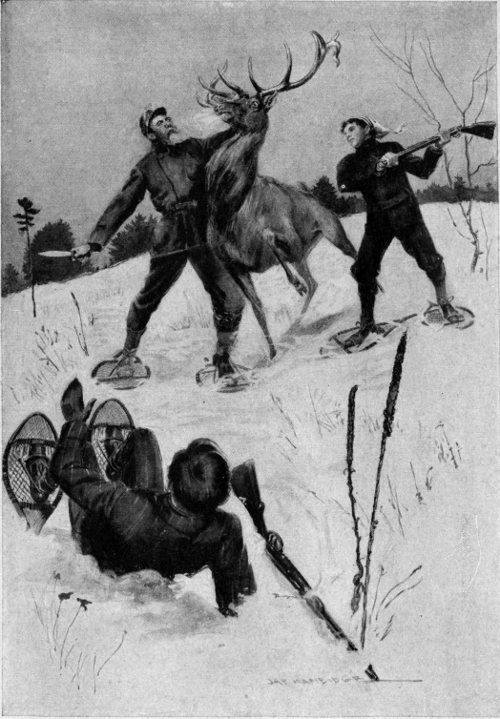
The old hunter was at hand
LAKEPORT SERIES
By EDWARD STRATEMEYER
Author of “The Baseball Boys of Lakeport,” “Dave Porter at Oak Hall,” “Old Glory Series,” “Pan-American Series,” Etc.
ILLUSTRATED
BOSTON
LOTHROP, LEE & SHEPARD CO.
Copyright, 1904, by A. S. Barnes & Co., under the Title
“The Island Camp.” Copyright, 1908, by Lothrop, Lee & Shepard Co.
PREFACE.
This story is a complete tale in itself, and
it also forms the first volume of a series to be
devoted to sport in the forest, on the water,
and on the athletic field.
My object in writing this tale was two-fold:
first, to present to the boys a story which would
please them, and, second, to give my young
readers an insight into Nature as presented
in the depths of the forest during the winter.
The young hunters of Lakeport are no different
from thousands of other youths of to-day.
Although they do some brave deeds,
they are no heroes in the accepted sense of
that term, and at certain times they get scared
just as others might under similar circumstances.
They are light-hearted and full of
fun, and not above playing some odd practical
jokes upon each other. In the old and experienced
hunter, who goes with them on this
never-to-be-forgotten outing, they find a companion
exactly to their liking, and one who
teaches them not a few “points” about hunting
that are worth knowing.
The scene of this tale is laid in one of our
eastern states. A few years ago small game
of all kinds was plentiful there, and deer,
moose, and even bears, could also be laid low.
But some of the larger animals are fast disappearing,
and it is now only a question of time
when they will be wiped out altogether. This
seems a great pity; but the march of the lumberman
and the progress of the farmer cannot
be stayed.
“I think about four,” answered Harry
Westmore, as he looked around him on the
country road he and his brother were traveling.
“I must say, I didn’t think the walk
would be such a long one, did you?”
“No, I thought we’d be back home before
this,” came from Joe Westmore. “I wish we
could find some sort of a signboard. For all
we know, we may be on the wrong road.”
“There used to be signboards on all of these
roads, but I heard Joel Runnell tell that some
tramps had torn them down and used them
for firewood.”
2
“Yes, they did it for that, and I guess they
took ’em down so that folks could miss their
way, too. Those tramps are not above waylaying
folks and making them give up all
they’ve got in their pockets.”
“I believe you there. But since Sheriff
Clowes rounded up about a dozen of ’em last
month they have kept themselves scarce.
Phew! How the wind blows!”
“Yes, and how the snow is coming down!
If we are not careful, we’ll not get home at all.
I hadn’t any idea it was going to snow when
we left home.”
“I’m afraid if we don’t get home by dark
mother will worry about us.”
“Oh, she knows we are old enough to take
care of ourselves. If it snows too hard we can
seek shelter at the next farmhouse we come to
and wait until it clears off.”
3
The two Westmore boys, of whom Joe was
the older by a year and a day, had left their
home at Lakeport early that morning for a
long tramp into the country after some late
fall nuts which a friend had told them were
plentiful at a locality known as Glasby’s Hill.
They knew the Hill was a long way off, but
had not expected such a journey to get to it.
The bridge was down over one of the country
streams and this had necessitated a walk of
over a mile to another bridge, and here the
road was not near as good as that on which
they had been traveling. Then, after the nuts
were found and two fair-sized bags gathered,
it had begun to snow and blow, until now the
wind was sailing by them at a great rate and
the snow was coming down so fast that it
threatened to obliterate the landscape around
them.
4
The Westmore family were six in number,
Mr. Horace Westmore and his wife, the boys
just introduced, and two younger children
named Laura and Bessie. Mr. Westmore was
a flour and feed dealer, and had the principal
establishment of that kind in Lakeport, at the
lower end of Pine Lake. While the merchant
was not rich, he was fairly well-to-do, and the
family moved in the best society that the lake
district afforded. On Mrs. Westmore’s side
there had once been much wealth, but an unexpected
turn of fortune had left her father
almost penniless at his death. There was a
rumor that the dead man had left to his daughter
the rights to a valuable tract of land located
at the head of the lake, but though Mr.
Westmore tried his best he could not establish
any such claim. The land was there, held by
a miserly real estate dealer of Brookside
named Hiram Skeetles; but Skeetles declared
that the property was his own, free and clear,
and that Mrs. Westmore’s father had never
had any right to it whatsoever.
“What’s mine is mine, and don’t ye go for
to forgit it!” Hiram Skeetles had snarled,
during his last interview with Horace Westmore
on the subject. “Ye ain’t got nary a
slip o’ paper to show it ever belonged to
Henry Anderson. I don’t want ye to bother
me no more. If ye do, I’ll have the law on
ye!” And Mr. Westmore had come away
feeling that the case was decidedly a hopeless
one.
5
“It’s a shame mother and father can’t bring
old Skeetles to time,” had been Joe’s comment,
when he heard of the interview. “I
wouldn’t trust that old skinflint to do the
square thing.”
“Nor I,” had come from Harry. “But if
Grandfather Anderson had any deeds or other
papers what did he do with them?”
“I’m sure I don’t know. Mother said she
saw some papers once—years ago, when she
was a young girl—but she never saw them
after that,” had been Joe’s comment; and
there the subject had been dropped.
With their bags of nuts over their shoulders
the two boys continued to trudge along in the
direction of home. The loads had not seemed
heavy at starting, but now each bag was a dead
weight that grew harder to carry at every
step.
“Let us rest for awhile,” said Joe, at length.
“I must have a chance to get my wind.”
“Isn’t there wind enough flying around
loose,” returned his brother, with a faint grin.
“Just open your mouth wide and you’ll gather
in pure, unadulterated ozone by the barrelful.”
6
“It’s the wind that’s taking my wind, Harry.
I feel as if I’d been rowing a two-mile
race, or just made a home run on the baseball
field.”
“Or a touchdown on the gridiron, eh?
Say, but that last game of football with the
Fordhams was great, wasn’t it?”
The two boys had moved on a few steps further,
and now, through the flying snow, caught
sight of a dilapidated barn standing close to
the roadway.
“Hurrah! here’s a shelter, made to order!”
cried Joe. “Let us go in and take a quarter
of an hour’s rest.”
“Yes, and eat a few of the nuts,” added
Harry. “My! but ain’t I hungry. I’m going
to eat all there is on the table when I get
home.”
“Then you wouldn’t refuse a mince pie
right now, would you?”
7
At this question Harry gave a mock groan.
“Please don’t mention it! You’ll give me
palpitation of the heart. If you’ve got a
mince pie tucked away in your vest pocket,
trot it out.”
“Wish I had. But stop talking and come
into the barn. It isn’t a first-class hotel, but
it’s a hundred per cent. better than nothing,
with a fraction added.”
Like many a similar structure, the old barn
had no door or window on the road side, so
they had to go around to the back to get in.
As they turned the corner of the building they
caught sight of two men who stood in the
tumble-down doorway. The men were rough-looking
individuals and shabbily dressed, and
when they saw them the lads came to a halt.
“Hullo, who are you?” demanded one of
the men, who possessed a head of tangled red
hair and an equally tangled red beard.
“We were traveling on the road and came
around here for a little shelter from the
storm,” answered Joe. He did not like the
appearance of the two tramps—for such they
were—and neither did Harry.
8
At the explanation the tramp muttered
something which the two boys did not catch.
At the same time a third tramp came forth
from the barn, wiping his mouth with the back
of his hand.
“Maybe they’re from that farm back here,”
he said, with a jerk of his head over the shoulder.
“I believe there was a couple o’ boys
up there.”
“No, we’re not from any farm,” answered
Harry. “We come from Lakeport.”
“What have ye in them bags?” put in the
tramp who had not yet spoken.
“Nuts. We have been out nutting.”
“Humph! Thought as how nuts was all
gone by this time.”
“We heard of a spot that hadn’t been visited,”
said Joe. He looked at his brother
significantly. “Guess we had better be moving
on.”
“Oh, don’t hurry yourselves, gents,” came
quickly from the tramp with the red and tangled
beard. “Come in an’ rest all yer please.
We’re keepin’ open house to-day,” and he
gave a low laugh.
9
“Thank you, but we haven’t a great deal of
time to spare,” said Harry. “Come, Joe,”
he went on, and started to move toward the
roadway once more.
He had scarcely taken two steps when the
tramp with the red beard caught him by the
shoulder.
“Don’t go,” he said pointedly. “Come in an’
warm up. We’ve got a bit o’ a fire in there.”
“A fire?” queried Harry, not knowing what
else to say. “Aren’t you afraid you’ll burn
the barn down?”
“Not much! Even if she went, the buildin’
ain’t worth much. Come on in.”
The tramp had a firm grip on Harry’s arm
by this time and now the other two got between
Joe and the roadway.
It must be confessed that the two lads were
much dismayed. As already noted, they
knew that folks in that neighborhood had been
waylaid by tramps in the past, and they now
felt that a similar experience was in store for
them. How to get out of such a dilemma was
a serious question.
10
“We don’t want to stop with you,” said
Joe, as sharply as he could, although his heart
beat violently. “Let me pass, please.”
“But we ain’t goin’ to let yer pass just yet,
young feller,” said one of the tramps. “Come
on in an’ be sociable.”
“We don’t mean for to hurt ye!” put in another.
“So don’t git scart. If ye belong
down to Lakeport we’ll treat yer right.”
“We don’t wish to stay, I tell you,” went on
Joe. “Let me pass, do you hear?”
“And let me go, too,” added Harry. He
tried to twist himself loose but could not, for
the tramp was strong and had a good clutch.
“Peppery youngsters,” drawled the tramp
with the red hair. “Got to teach ’em manners,
I guess. Shove ’em into the barn, boys.
There don’t seem to be nobuddy else around,
an’ it looks like we had run up against a real
good thing!”
“Do you mean to say that you intend to rob
us?” cried Joe, as he struggled to free himself
from the man who had him by the collar.
11
“Rob yer? Who said anything ’bout robbin’
yer? We’re honest men, we are! Come
on inside, an’ behave yerself!”
And with this Joe was shoved toward the
barn door. He tried to struggle, but it was
useless. Using brute force the tramps almost
pitched him inside, and Harry followed in a
similar manner. Then the tramp with the red
beard set up the broken-down door before the
opening and stood on guard with a club in his
hand.
12
CHAPTER II THE DUGANS TO THE RESCUE
It was a situation which no boy would care
to confront, and as Joe and Harry looked
from one brutal face to another, their hearts
sank within them. They could see at a glance
that the tramps were among the worst of their
class and would hesitate at little or nothing to
accomplish their ends.
To one side of the barn, where the flooring
had rotted away, a fire was burning, the smoke
drifting forth through a broken-out window
and the numerous holes in the roof. Beside
the fire lay the remains of two chickens, which
the tramps had probably stolen from some
farmer’s hen-roost. Three soda water bottles
were also on the floor, but there was no telling
what they had contained, since all were empty.
But as the breath of each tramp smelt strongly
of liquor, it is safe to say that the bottles had
contained—at least one of them—something
stronger than a temperance drink.
13
“See here, you haven’t any right to treat
us in this fashion,” said Joe, as soon as he
could recover from the attack which had been
made upon him.
“You ain’t got no right to call us thieves,”
was the answer, and the speaker leered in a
knowing manner at his fellows.
“That’s it,” spoke up another of the
tramps. “It’s a downright insult to honest
men like us.”
“Thet’s wot it is,” came from the third
tramp. “Boys, yer ought to ’polergize.”
“I want you to let us go,” went on Joe.
“Right away,” put in Harry. “If you
don’t——”
“If we don’t,—what?” demanded the tramp
who stood guard with the club.
“It may be the worse for you, that’s all.”
At this all three of the tramps set up a low
laugh. Then the fellow at the doorway called
one of the others to his side and whispered
something in his ear.
14
“Dat’s all right, Noxy; but I don’t care to
go until I see wot we strike,” answered the
man addressed.
“Oh, you’ll get your fair share, Stump,”
was the answer, but Stump refused to leave
even when urged a second time.
“Say, just you tell us wot time it is,” put
in the other tramp, who went by the name of
Muley. He had noticed that Joe carried a
watch—a silver affair, given to him by his
father on his last birthday.
“It’s time you let us go,” answered Joe.
He understood perfectly well what the fellow
was after.
He had scarcely spoken when Muley stepped
forward and grabbed the watch chain. The
watch came with it, and despite Joe’s clutch
for his property it was quickly transferred to
the tramp’s possession.
“Give me that watch!”
“They are nothing but robbers!” burst out
Harry. “Joe, let us get out right away!”
15
Unable to pass the tramp at the doorway,
Harry made for one of the barn windows, and
feeling it would be useless to argue just then
about the timepiece, Joe followed his brother.
“Hi, stop ’em!” roared Stump. “Don’t let
’em get away!”
Instantly all three of the tramps went after
the two lads. Muley was the quickest of the
number and in a trice he had placed himself
in front of the window.
“Not so fast!” he sang out. “We want
what you have in your pockets first!”
Cut off from escape by the window, the two
boys turned around. They now saw that the
doorway was unguarded, and ran for the opening
with all speed. Harry reached the door
first and tumbled it aside, and both ran into
the open.
“Stop!” yelled Noxy. “Stop, or we’ll fix
ye!” And then, his foot catching in a loose
board of the flooring, he pitched headlong, and
Stump and Muley came down on top of him.
“Run, Harry, run, or they’ll catch us sure!”
cried Joe.
16
Harry needed no urging, and in a minute
the two lads were on the roadway once again
and running harder than they had ever done
in any footrace. For the moment they forgot
how tired they had been, and fear possibly
gave them additional strength.
“Ar—are the—they coming?” panted Harry,
after quarter of a mile had been covered.
“I don’t—don’t know!” puffed his brother.
“Do—don’t se—see anything of ’em.”
“What mean rascals, Joe!”
“Yes, they ought to be in jail!”
The boys continued to run, but as nobody
appeared to be following they gradually slackened
their pace and at length came to a halt.
“Joe, I’m almost ready to drop.”
“So am I, but we had better not stop here.
Let us keep on until we reach some farmhouse.
I’m going to get back my watch and chain if I
can.”
“And the nuts. Think of losing them after
all the trouble we had in gathering them.”
“Yes, Harry, but the watch and chain are
worth more than the nuts. If you’ll remember,
they were my birthday present from
father.”
17
“Oh, we’ve got to get back the watch and
chain. Come on—the sooner we find a farmhouse
and get assistance the better. More
than likely those tramps won’t stay at the
barn very long.”
Scarcely able to drag one foot after the
other, the two Westmore boys continued on
their way. The snow had now stopped coming
down, yet the keen fall wind was as sharp
as ever. But presently the wind shifted and
then they made better progress.
“I see a farmhouse!” cried Harry, a little
later.
“Not much of a place,” returned his brother.
“Yet we may get help there,—who
knows?”
When the cottage—it was no more than
that—was reached, Joe knocked loudly on the
door.
“Who is there?” came in a shrill voice from
inside.
“Two boys,” answered Joe. “We want
help, for some tramps have robbed us.”
18
“I can’t help you. The tramps robbed me,
too—stole two of my best chickens. I’m an old
man and I must watch my property. You go
to Neighbor Dugan’s—he’ll help you, maybe.”
“Where is Dugan’s place?”
“Down the road a spell. Keep right on an’
you can’t miss it.” And that was all the boys
could get out of the occupant of the cottage.
“He must be a crabbed old chap,” was
Harry’s comment, as they resumed their
weary tramp.
“Well, an old man can’t do much, especially
if he is living all alone. I suppose he’s
afraid to leave his place for fear the tramps
will visit it during his absence,” and in this
surmise Joe was correct.
Fortunately the farm belonging to Andy
Dugan was not far distant. The farmer was
a whole-souled Irishman and both boys had
met him on more than one occasion at Mr.
Westmore’s store.
“Sure, an’ where did you b’ys spring
from?” said Dugan, on opening the door.
“’Tis a likely walk ye are from town.”
19
“We’ve been out for some nuts, over to
Glasby’s Hill,” answered Harry.
“Ah now, so ye’ve got there before me, eh? I
didn’t know ’twas known there was nuts there.”
“Mr. Dugan, we want your help,” put in
Joe, quickly.
“Phat for, Joe—to help carry home the
nuts? Where’s the bags?”
“We met some tramps, and——”
“Tramps? On this road ag’in?” Andy
Dugan was all attention and his face grew
sober. “Tell me about thim at onct!”
The boys entered the farmhouse, where
were collected the Dugan family, consisting
of Mrs. Dugan, who weighed about two hundred
and fifty pounds, and seven children, including
three half-grown sons. All listened
with close attention to what the Westmore boys
had to relate.
“Th’ schamps!” cried Andy Dugan.
“Sure an’ they should be in the town jail!
An’ was the watch an’ chain worth much?”
“Twelve or fifteen dollars. And a birthday
present, too.”
20
“I’ll go after thim, that I will. Pat, git
me gun, and you go an’ take yer own gun, too—an’,
Teddy, git the pistol, an’ see if it’s after
bein’ loaded. We’ll tache thim scallywags a
lisson, so we will!”
“That’s the talk, Mr. Dugan!” said Joe,
brightening. “But you’ll have to hurry, or
they’ll be gone.”
“I’ll hurry all I can, lad. But phat about
you? You’re too tired to walk back, ain’t
ye?”
“Lit thim roide the mare, Andy,” came
from Mrs. Dugan. “Th’ mare wants exercise
annyway.”
“So they shall, Caddy,” answered the husband,
and one of the smaller boys of the family
was sent to bring the mare forth.
In less than ten minutes the party was
ready to set out, Andy Dugan and his son Pat
with guns, Teddy, who boasted of a face that
was nothing but a mass of freckles, with the
pistol, and Joe and Harry, on the mare’s back,
with clubs.
21
The mare was rather a frisky creature, and
both boys had all they could do to make her
walk along as they wished.
“She’s been in the sthable too long,” explained
Andy Dugan. “She wants a run av
a couple o’ miles to take the dancin’ out av
her heels.”
“Well, she mustn’t run now,” said Harry,
who had no desire to reach the old barn before
the others could come up.
The wind was gradually going down, so
journeying along the road was more agreeable
than it had been. When they passed the little
cottage they saw the old man peeping from
behind a window shutter at them.
“He’s a quare sthick, so he is,” said Andy
Dugan. “But, as he is afther lavin’ us alone,
we lave him alone.”
The party advanced upon the barn boldly
and when they were within a hundred yards of
the structure, Joe and Harry urged the mare
ahead. Up flew the rear hoofs of the steed
and away she went pell-mell along the road.
“Whoa! whoa!” roared Joe. “Whoa, I
say!”
22
But the mare did not intend to whoa, and
reaching the barn, she flew by like a meteor,
much to the combined chagrin of the riders.
Joe was in front, holding the reins, and Harry
in the rear, with his arms about his brother’s
waist. Both kept bouncing up and down like
twin rubber balls.
“Do stop her, Joe!”
“Whoa!” repeated Joe. “Whoa! Confound
the mare, she won’t listen to me!”
“She is running away with us!”
“Well, if she is, I can’t help it.”
“Pull in on the reins.”
“That’s what I am doing—just as hard as
I can.”
“Hi! hi!” came in Andy Dugan’s voice.
“Phy don’t ye sthop? Ain’t this the barn ye
was afther spakin’ about?”
“Yes!” yelled back Joe. “But your mare
won’t stop!”
“Hit her on th’ head wid yer fist!” screamed
Pat Dugan.
“I don’t believe that will stop her,” said
Harry.
23
“Perhaps it will, if she’s used to it,” said
his brother, and an instant later landed a blow
straight between the mare’s ears.
Up went the creature’s hind quarters in a
twinkling and over her head shot the two boys,
to land in the snow and brushwood beside the
roadway. Then the mare shied to one side
and pranced down the road, and soon a turn
hid her from view.
24
CHAPTER III A FRUITLESS SEARCH
“B’ys! b’ys! Are ye after bein’ hurted?”
It was Andy Dugan who asked the question,
as he came rushing to Joe and Harry’s assistance
and helped to set them on their feet.
“I—I guess I’m all right, Mr. Dugan,”
panted Harry. “But I—I thought my neck
was broken at first!”
“So did I,” put in Joe. His left hand was
scratched but otherwise he was unharmed.
“Oh, father, the mare’s run away!” chimed
in Teddy Dugan. “We won’t never git her
back anymore!”
“Hould yer tongue!” answered the parent.
“She’ll come back as soon as it’s feedin’ time,
don’t worry.”
“Oh, father, are you sure?”
25
“To be course I am. Didn’t she run away
twice before, an’ come back that same way,
Teddy? Come on after thim tramps an’ let
the mare take care av hersilf.”
“We’ve made noise enough to bring the
tramps out—if they’re still in the barn,” was
Joe’s comment. “I believe they’ve gone.”
“Exactly my opinion,” answered Harry.
Advancing boldly to the doorway of the
barn, Andy Dugan pointed his gun and cried:
“Come out av there, ye rascals! Sure an’
it won’t do ye any good to hide!”
To this demand no answer was returned,
and a moment of painful silence followed.
“Are ye comin’ out or not?” went on Dugan
the elder. “Answer me.”
“How can they answer, father, if they ain’t
there?” put in Teddy Dugan, with a broad
smile on his freckled face.
To this query the father made no reply, but
advancing cautiously, he gazed into the barn
and then stepped inside.
“Are they there, Mr. Dugan?” queried Joe.
“If they are, they’re mighty good at
hidin’.”
26
“Let us make a search,” said Harry.
“Pat, you remain on guard outside.”
“That I will,” answered Pat. “Run ’em
out here till I shoot ’em first, an’ have ’em
arrested afterwards!”
The barn was speedily searched, but the
tramps had taken their departure, and soon
they discovered the track of the rascals, leading
across the fields to another road.
“I believe they left almost as soon as we
did,” said Joe. “They knew we’d come back
with help.”
“Shall we follow?” asked Harry.
“Av course,” replied Andy Dugan.
“It’s getting rather dark,” went on Joe.
“I’m afraid they have given us the slip.”
The matter was talked over, and it was decided
that all of the Dugans should go forward,
and Joe and Harry were to follow if
they could find the mare. If not, they were
to tramp back to the Dugan homestead and
await news.
27
Half an hour was spent by the two
boys in looking for the runaway steed,
and by that time both could hardly walk.
“I wish I was at the Dugan house this instant,”
said Harry.
“Ditto myself, Harry. And I wish I had
my watch and chain back. Did you notice,
the tramps didn’t touch the bags of nuts.”
“I guess they were too excited to remember
them. Maybe they thought we’d come back
quicker than we did.”
The boys rested for awhile at the barn, and
then, with their bags of nuts on their shoulders,
set out on the roadway once again.
“Tired out, are ye,” said Mrs. Dugan, on
seeing them. “Where are the others?”
They told their story, to which she listened
with many a nod of her head.
“The ould b’y take that mare!” she cried.
“Sure an’ didn’t she run away wid me wance
an’ nearly scare me to death, so she did.
Andy must trade her th’ furst chanct he gits.”
She had prepared a hot supper and invited
the boys to sit down, which they did willingly,
for, as Harry expressed it, “they were hollow
clear down to their shoes.”
28
The meal was just finished when one of the
little children, who was at the window gazing
into the oncoming darkness, set up a shout:
“There’s Kitty now!”
“Who’s Kitty?” asked Joe.
“Sure an it’s the mare. She’s walkin’ in
the yard just as if nothin’ had happened at
all!”
The youngster was right, and by the time
the boys were outside the mare was standing
meekly by the barn door, waiting to be put in
her stall.
“Now ain’t she aggravatin’?” came from
Mrs. Dugan. “Ye can’t bate her when she
looks loike that, can ye? Poor Kitty! It’s a
fool thing that ye are entoirely!” And she
hurried out, opened the stable and let the mare
find her proper place inside. “Fer sech a
thrick, ye’ll git only half yer supper this
night,” she added, shaking her fist at the animal.
The boys knew that they would be expected
home, and waited anxiously for news of the
Dugans. Fully an hour and a half passed,
before they came back, worn out and downcast.
29
“They give us the shlip,” said Andy Dugan.
“They came around be the lake road an’ thet’s
the last we could find av thim.”
“And I guess that’s the last of my watch,”
added Joe, soberly.
Andy Dugan had a faithful old horse in his
stable and this animal he harnessed to his
family carriage, an old affair that had seen
far better days.
“Ye can drive yerselves home,” he said.
“An’ leave the turnout at Bennett’s stable.
Tell him I’ll call for it to-morrow.”
“Thank you, Mr. Dugan,” said Joe.
“We’ll settle for the keeping, and get father
to pay you——”
“That’s all right, Joe. I want no pay.
Your father is a fri’nd av mine. I’m sorry
we didn’t catch the thramps, that’s all,” was
Andy Dugan’s reply.
30
It was not until nine o’clock at night that
Joe and Harry drove into the town of Lakeport.
All the stores were closed, but the
livery stable was still open, and there they left
the horse and carriage, as Andy Dugan had
directed. It was but a short walk from the
stable to the house.
“I thought you would be back to supper,”
said Mrs. Westmore, when they entered. “I
kept everything hot for over an hour.”
“We’ve had an adventure, mother,” answered
Joe, and as the family gathered around
he told his story.
“Oh, Joe, weren’t you awfully scared!”
cried Laura.
“I don’t like tramps at all!” piped in little
Bessie.
“This is certainly an outrage,” said Mr.
Westmore. “So the Dugans could find no
trace of them after they got on the lake road?”
“No.”
“I must have one of the constables look into
this, and I’ll notify Sheriff Clowes, too.”
“You can be thankful that the tramps did
not injure you,” said Mrs. Westmore, with a
shudder.
“Yes, I am thankful for that,” said Harry.
31
“So am I, mother,” added Joe. “Just the
same, I’m downright sorry to lose that watch
and chain.”
“Perhaps we’ll get on the track of it. If
not, we’ll have to see what we can do about
getting you another,” added the fond mother.
The fact that Joe and Harry had been held
up by tramps was speedily noised around the
town, and for the next few days the authorities
and several other people did what they
could to locate the evildoers. But the tramps
had made good their escape, and, for the time
being nothing more was heard from them.
But they were destined to turn up again, and
in a most unexpected fashion, as the pages to
follow will testify.
Joe and Harry had many friends in Lakeport,
boys who went to school with them, and
who played with them on the local baseball
and football teams. All of these were interested
in the “hold-up,” as they called it, and
anxious to see the tramps captured.
“Glad it wasn’t me,” said one of the lads.
32
“I’ve got a gold watch—one my uncle left
when he died.”
“Why didn’t you punch their heads?” questioned
another, who had quite a reputation as
an all-around athlete. “That is what I should
have done.”
“Yes, and maybe got killed for doing it,”
came from a third. “Joe and Harry were
sharp enough to escape with whole skins, and
that is where they showed their levelheadedness.”
The adventure had happened on Saturday,
and Monday found the boys at school as usual.
They were so anxious to get news concerning
the tramps that they could scarcely learn their
lessons, but as day after day went by without
news, this feeling wore away; and presently
the incident was almost forgotten.
It was customary at Lakeport to close the
schools for about a month around the winter
holidays and all of the pupils counted the days
to when the vacation would begin. At last
the time came, and with a whoop, Joe, Harry,
and several dozen other lads rushed forth, not
to return until near the end of January.
33
“And now for Christmas!” cried Joe.
Deep down in his heart he was wondering if
he would get another watch and chain.
Ice had already formed on Pine Lake, but
just before Christmas it began to snow and
blow heavily, so that skating was out of the
question. This put something of a damper
on the lads and they went around feeling
somewhat blue.
Christmas morning dawned bright and fair.
The ground was covered with over a foot of
snow, and the merry jingle of sleighbells filled
the air.
As may be surmised the Westmore boys
were up early. There were many presents to
be given and received, and it was a time of
great surprises and not a little joy.
What pleased Joe most of all was the new
watch he received. It was decidedly better
than the first watch had been, and so was the
chain better than the other.
34
“Just what I wanted!” he declared. “It
tops all the presents—not but what I like them,
too,” he added, hastily.
Harry had slipped off without the others
noticing. Now he came back, his face aglow
with enthusiasm.
“Oh, Joe, what do you think?” he cried.
“The wind has swept Pine Lake as clean as a
whistle.”
“If that’s the case, Harry, we can go skating
this morning instead of waiting until after
dinner. But how do you know the ice on the
lake is clear?”
“Didn’t I just come from there?” Harry
held up a shining pair of nickel-plated skates.
“Couldn’t resist trying ’em, you know. Say,
it was just all right of Uncle Maurice to give
each of us a pair, wasn’t it?”
“It certainly was,” returned Joe. “But
I rather think I love that double-barreled
shotgun a little better. I am fairly aching to
give it a trial on a bird or a rabbit, or something
larger.”
35
“Well, as for that, I don’t go back on the
camera Aunt Laura sent up from New York.
Fred Rush was telling me it was a very good
one, and he ought to know, for he has had
four.”
“What did Fred get for Christmas’?”
“A shotgun something like yours, a big bobsled,
some books, and a whole lot of other
things. One book is on camping out, and he
is just crazy to go. He says a fellow could
camp out up at Pine Island, and have a bang-up time.”
“To be sure!” ejaculated Joe, enthusiastically.
“Just the thing! If he goes I’m
going, too!”
“You don’t know yet if father will let you
go. He says no boy should go hunting without
some old hunter with him.”
“I’m seventeen,” answered Joe, drawing
himself up to his full height; he was rather tall
for his age. “And Fred is almost as old. I
reckon we could take care of ourselves.”
36
“If I went I’d like to take my camera,” said
Harry. “I was reading an article in the paper
the other day about how to hunt game with a
snap-shot machine. That would just suit me.
Think of what a famous collection of pictures
I might get—wild turkeys, deer and maybe a
bear——”
“If you met a bear I don’t think you’d stand
to take his photograph. I’ll wager you’d leg
it for all you were worth—or else shoot at him.
But come on. If skating is so good there is no
use of our wasting time here talking,” concluded
Joe, as he moved off.
37
CHAPTER IV SKATING
Lakeport was a thriving town with a large
number of inhabitants. Early as it was many
people were out, and nearly every passer-by
was greeted with a liberal dose of snowballs,
for the lads of this down-East town were as
fun-loving as are boys anywhere, and to leave a
“good mark” slip past unnoticed was considered
nothing short of a crime.
When Joe and Harry reached the lake front
they found a crowd of fully fifty men and boys,
with a fair sprinkling of girls, engaged in
skating and in ice-boating. The majority of
the people were in the vicinity of the steamboat
dock, for this was at the end of the main
street, and a great “hanging-out” spot during
the summer. But others were skating up the
lake shore, and a few were following Dan
Marcy’s new ice yacht, Silver Queen, as she
tacked along on her way to the west shore,
where an arm of the lake encircled the lower
end of Pine Island.
38
“Marcy’s going to try to beat the lake record,”
Joe heard one boy call to another. “He
says his new boat has got to knock the spots
out of anything that ever sailed on the lake, or
he’ll chop her up for firewood.”
“Well, she’ll have to hum along if she beats
the time made by the old Whizzer last winter,”
came from the other boy. “She sailed from
the big pine to Hallett’s Point in exactly four
minutes and ten seconds. My, but didn’t she
scoot along!”
It took but a few minutes for Joe and Harry
to don their skates. As they left the shore
they ran into Fred Rush, who was swinging
along as if his very life depended upon it.
39
“Hello, so you fellows have come down at
last!” sang out Fred, who was short and stout,
and as full of fun as a lad can be. “Thought
you had made up your mind to go to bed again,
or stay home and look for more Christmas
presents. Been having dead loads of fun—had
a race and come in second best, got
knocked down twice, slipped on the ice over
yonder, and got a wet foot in a hole some fellow
cut, and Jerry Little hit me in the shin
with his hockey stick. Say, but you fellows
are positively missing the time of your lives.”
“I want to miss it, if I’m going to have all
those things happen to me,” returned Joe,
dryly. Then he added: “Harry tells me you
got a double-barreled shotgun almost like
mine. How do you like it?”
“Like it? Say, that gun is the greatest
thing that ever happened. I tried it just before
I came down to skate—fired both barrels
at once, because I didn’t have time to fire ’em
separately. It knocked me flat, and a snowbank
was all that saved my life. But she’s a
dandy. I’m going to bring down a bear with
that gun before the winter is over, you see if
I don’t.”
“How are you going to do it?” put in
Harry. “Offer to let the animal shoot off the
gun, and kill him that way?”
40
“Don’t you make fun of me, Harry. You’ll
see the bear sooner or later, mark the remark.”
The three boys skated off, hand in hand,
with Fred in the center. The fun-loving youth
was the only son of the town hardware dealer,
and he and the Westmore lads had grown up
together from childhood. At school Fred had
proved himself far from being a dunce, but
by some manner of means he was almost constantly
in “hot water;” why, nobody could
explain.
“Let Fred Rush pick up a poker, and he’ll
get the hot end in his hand,” said one of the
girls one day, and this remark came close to
hitting the nail squarely on the head. Yet
with all his trials and tribulations Fred rarely
lost his temper, and he was always ready to
promise better things for the future.
The boys skated a good half mile up the lake
shore. At this point they met several girls,
and one of them, Cora Runnell, asked Joe if
he would fix her skate for her.
41
“Certainly I will,” replied the youth, and
on the instant he was kneeling on the ice and
adjusting a clamp that had become wedged
fast to the shoe plate of the skate. Cora was
the daughter of an old hunter and trapper of
that vicinity, and as he worked Joe asked her
what her father was doing.
“He isn’t doing anything just now,” was
the girl’s answer. “He was out acting as a
guide for a party of New York sportsmen, but
they went back to the city last week.”
“Did you hear him say anything about
game?”
“Yes, he said the season was a very good
one. The party got six deer over at Rawson
Hill and a moose at Bender’s, and any quantity
of small game. I think pa’s going out
alone in a day or two—just to see what he can
bring down for the market at Brookside.”
“I wish he’d take me along. I’ve got a new
double-barreled shotgun that I want to try the
worst way.”
“And I’ve got one, too,” broke in Fred.
“I’m sure we could bring down lots of game
between us.”
42
Cora Runnell looked at the stout youth, and
began to giggle. “Oh, dear, if you went along
I guess pa’d have to hide behind a tree when
you took your turn at shooting.”
“Whoop, you’re discovered, Fred!” burst
out Harry. “Cora must have heard how you
shot off both barrels at once, and——”
“Oh, I can shoot straight enough,” came
doggedly from Fred. “Just you give me the
chance and see.”
“Well, you’ll have to see pa about going out
with him,” answered Cora, and then started to
skate after her girl friends, who had moved
off a minute before, and were getting farther
and farther away.
“Hi, there!” came suddenly in a shout from
the lake shore. “Beware of the ice boat!”
“The ice boat?” repeated Harry.
“Where—— Oh!”
He glanced up the lake, and saw the Silver
Queen coming along as swiftly as the stiff
breeze could drive the craft over the glassy
surface. The ice boat was headed directly for
the three boys, but now the course was shifted
slightly, and the craft pointed fairly and
squarely for the spot where Cora Runnell was
skating along, all unconscious of her danger.
43
“By gracious, Dan Marcy will run Cora
down!” ejaculated Fred. He raised his voice
to a yell. “Stop! stop! you crazy fool! Do
you want to kill somebody?”
“Save my girl!” came from the shore.
“Cora! Cora! Look out for the ice boat!”
But the girl did not heed the warning, and
now the ice boat, coming as swiftly as ever,
was almost on top of her. Then the girl happened
to glance back. She gave a scream,
tried to turn, but slipped, and then sank in a
heap directly in the track of the oncoming
danger.
44
CHAPTER V. A QUARREL ON THE ICE
It was a moment of extreme peril, and the
heart of more than one onlooker seemed to stop
beating. The ice boat was a heavy affair, with
runners of steel, and a blow from that bow,
coming at such a speed, would be like a blow
from a rushing locomotive. It looked as if
Cora Runnell was doomed.
But as all of the others stood helpless with
surprise and consternation, Joe Westmore
dashed forward with a speed that astonished
even himself. He fairly flew over the ice,
directly for Cora, and, reaching the fallen girl,
caught her by the left hand.
45
“Quick! we must get out of the way!” he
cried, and without waiting to raise her to her
feet he dragged her over the smooth ice a distance
of four or five yards. Then the Silver
Queen whizzed past, sending a little drift of
snow whirling over them.
“Git out of the way!” came rather indistinctly
from Dan Marcy. “Can’t you see I’m
trying to beat the record?” And then he
passed out of hearing.
“Are you hurt?” questioned Joe, as he assisted
the bewildered girl to her feet.
“I—I guess not, Joe,” she stammered.
“But, oh! what a narrow escape!” And Cora
shuddered.
“Dan Marcy ought to be locked up for such
reckless sailing.”
“I think so myself.” Cora paused for a
moment. “It was awfully good of you to help
me as you did,” she went on, gratefully.
By this time the others were coming up, and
the story of the peril and escape had to be told
many times. Among the first to arrive was
Joel Runnell, Cora’s father, who had shouted
the warning from the shore. He had been out
hunting, and carried an old-fashioned shotgun
and a game bag full of birds.
46
“Not hurt, eh?” he said, anxiously.
“Thank fortune for that! Who was sailing
that boat?” And when told, he said he would
settle with Marcy before the day was done.
“Can’t none of ’em hurt my girl without hearing
from me,” he added.
The excitement soon died down, and the
skaters scattered in various directions. In
the meantime, to avoid being questioned about
the affair, Dan Marcy, who was a burly fellow
of twenty, and a good deal of a bully, turned
his ice boat about, and went sailing up the lake
once more.
Some of the lads on the lake were out for a
game of snap the whip, and Joe, Harry and
Fred readily joined in this sport. At the
third snap, Fred was placed on the end of the
line.
“Oh, but we won’t do a thing to Fred,”
whispered one of the boys, and word was sent
along to make this snap an extra sharp one.
47
“You can’t rattle me!” sang out Fred, as
the skating became faster and faster. “I’m
here every time, I am. Let her go, everybody,
whoop!” And then he had to stop talking,
for he could no longer keep up. The line
broke, and like a flash Fred spun around, lost
his footing, and turned over and over, to bring
up in a big snowbank on the shore.
“Hello, Fred, where are you bound?” sang
out Harry.
“Where—where am I bound?” spluttered
the stout youth, as he emerged and cleaned the
snow from out of his collar and sleeves. “I
don’t know.” He paused to catch his breath.
“Reckon I’m in training for a trip to the
North Pole.”
Half an hour later found the Westmore
boys at home for dinner. There was something
of a family gathering this Christmas
day, mostly elderly people, so neither Joe nor
Harry had a chance to speak to their father
about the hunting trip they had in mind.
Everybody was in the best of humor, and the
table fairly bent beneath the load of good
things placed upon it—turkey with cranberry
sauce, potatoes, onions, squash, celery, and
then followed pumpkin and mince pies, and
nuts and raisins, until neither of the boys
could eat a mouthful more. Both voted that
Christmas dinner “just boss,” and the other
folks agreed with them.
48
The middle of the afternoon found the lads
at the lake again. It had clouded over once
more, and they were afraid that another fall
of snow might stop skating for several weeks,
if not for the balance of the season.
“We want to take the good of it while it
lasts,” said Harry.
Dan Marcy was again out on his ice boat,
and Joe and Harry, accompanied by Fred, followed
the craft to a cove on the west shore.
There seemed to be something the matter with
the sail of the Silver Queen, and Marcy ran
the craft into a snowbank for repairs.
“Say, what do you want around here?” demanded
Dan Marcy, as soon as he caught
sight of the Westmore boys. His face wore
an ugly look, and his tone of voice was far
from pleasant.
“I don’t know as that is any of your business,
Dan Marcy,” returned Joe.
49
“Ain’t it? We’ll see. I understand you’ve
been telling folks that I tried to run into you
and that Runnell girl on purpose.”
“You didn’t take much care to keep your
ice boat out of the way.”
“It was your business to keep out of the
way. You knew I was trying to beat the
record?”
“Do you own the lake?” came from Harry.
“Maybe you’ve got a mortgage on the ice?”
put in Fred.
Now the year before, Dan Marcy had been
in the ice business, and had made a failure of
it, and this remark caused him to look more
ugly than ever.
“See here, for two pins I’d pitch into the lot
of you, and give you a sound thrashing!” he
roared.
“Would you?” came sharply from Joe.
“Sorry I haven’t the pins.”
“I’ll give you an order on our servant girl
for two clothespins, if they’ll do,” put in Fred.
50
“Then you want that thrashing, do you?”
growled Dan Marcy; but as he looked at the
three sturdy lads he made no movement to
begin the encounter.
“If anybody needs a thrashing it is you, for
trying to run down Cora Runnell,” said Joe.
“It was a mean piece of business, and you
know it as well as we do.”
“You shut up, Joe Westmore!” Marcy
picked up a hammer with which he had been
driving one of the blocks of the sail. “Say
another word, and I’ll crack you with this!”
He advanced so threateningly that Joe fell
back a few steps. As he did this, a form appeared
on the lake shore, and an instant later
Dan Marcy felt himself caught by the collar
and hurled flat on his back.
“I reckon as how this is my quarrel,” came
in the high-pitched voice of Joel Runnell.
“I’ve been looking for you for the past hour,
Dan Marcy. I’ll teach you to run down my
girl. If it hadn’t a-been for Joe Westmore
she might have been killed.”
51
“Let go!” roared Marcy, and scrambled to
his feet, red with rage. He rushed at the old
hunter with the hammer raised as if to strike,
but before he could land a blow, Joe caught
hold of the tool and wrenched it from his
grasp.
“Give me that hammer! Do you hear? I
want that hammer!” went on the bully. Then
he found himself on his back a second time,
with his nose bleeding profusely from a blow
Joel Runnell had delivered.
“Have you had enough?” demanded the old
hunter, wrathfully. “Have you? If not, I’ll
give you some more in double-quick order.”
“Don’t—don’t hit me again,” gasped Dan
Marcy. All his courage seemed to desert him.
“It ain’t fair to fight four to one, nohow!”
“I can take care of you alone,” retorted Joel
Runnell, quickly. “I asked you if you had
had enough. Come, what do you say?” And
the old hunter held up his clinched fists.
“I—I don’t want to fight.”
“That means that you back down. All
right. After this you let my girl alone—and
let these lads alone, too. If you don’t, you’ll
hear from me in a way you won’t like.”
52
There was an awkward pause, and Dan
Marcy wiped the blood from his face, and
shoved off on his ice boat.
“We’ll see about this some other time,” he
called out when at a safe distance. “I shan’t
forget it, mind that!”
“He’s a bully if there ever was one,” observed
Harry.
“And a coward into the bargain,” put in
Joel Runnell. “Watch out for him, or he may
play you foul.”
“I certainly shall watch him after this,”
said Joe.
“We’re glad you came along,” came from
Fred. “We want to ask you something about
hunting. I’ve got a new double-barreled shotgun
and so has Joe, and we want to go out
somewhere and try for big game.”
“And I’ve got a new camera, and I want to
get some pictures of live game,” added Harry.
“You can’t get any big game around Lakeport.
If you want anything worth while
you’ll have to go out for several days or a
week.”
53
“We’re willing to go out as long as our folks
will let us,” explained Harry. “We haven’t
said much about it yet, for we wanted to see
you.”
“We thought you might like to take us out,
or rather go with us,” came from Joe. “If
you’d go with us we’d pay the expenses of the
trip, and give you your full share of whatever
game we managed to bring down.”
At this Joel Runnell’s gray eyes twinkled.
He loved boys, and knew the lads before him
very well. All the powder and shot he used
came from Mr. Rush’s hardware establishment,
and his flour from the Westmore mill,
and he was always given his own time in which
to pay for the articles. Moreover, he was not
the one to forget the service Joe had rendered
his daughter.
“I’ll go out with you willingly,” he said.
“I’ll show you all the big game I can, and what
you bring down shall be yours.”
“Hurrah! It’s settled!” cried Fred, throwing
up his cap. “We’ll have just the best time
that ever was!”
“Where do you want to go to?”
54
“I was thinking of camping out up on Pine
Island,” answered Harry. “But of course we
have got to see my father about it first.”
“Pine Island is a nice place. There is an
old lodge up there—put up five years ago by
some hunting men from Boston. It’s a little
out of repair, but we could fix it up, and then
use that as a base of supplies.”
“Just the thing!” said Joe, enthusiastically.
“If we liked it would you stay out with us for
two or three weeks?”
“To be sure. There is a little game on the
island, and we could easily skate to shore when
we wished. When do you want to go?”
“As soon as we get permission,” said Harry.
“We’ll find out about it to-morrow.”
After that the boys could talk of nothing but
the proposed outing and what they hoped to
bring down in the way of game. Harry
wanted pictures worse than he wanted to bring
down game; nevertheless, he said he would
take along a gun and a pistol. “Then I can
snapshot my bear first, and shoot him afterward,”
he said.
55
It was not until the day after Christmas
that the Westmore lads got a chance to speak
to their parents about what was uppermost in
their minds. At first Mrs. Westmore was inclined
to demur, but her husband said the outing
might do their sons some good.
“And they couldn’t go out with a better fellow
than Joel Runnell,” added Mr. Westmore.
“They’ll be as safe with him as they would be
with me.”
As soon as it was settled that they were
really to go, Harry rushed over to Fred’s
house. Fred had already received permission
to go, and now all they had to settle on was the
time for their departure and what was to be
taken along. Christmas had fallen on Thursday,
and it was decided to leave home on the
following Monday morning, weather permitting.
As to the stores to be taken along, that
was to be left largely to the judgment of Joel
Runnell and to Mr. Westmore, who also knew
a good bit about hunting and life in camp.
56
CHAPTER VI ORGANIZING THE CLUB
“Boys, we’ve got to organize a club,” said
Joe, as they were talking the matter over, and
getting one thing and another ready for the
trip.
“Just the thing!” shouted Fred. “Let us
organize by all means.”
“What shall we call ourselves?” queried
Harry. “The Outdoor Trio.”
“Or the Forest Wanderers,” came from
Joe.
“Bosh!” interrupted Fred. “We’re going
out with guns. You’ve got to put a gun in the
name.”
“How will Young Gunners do?”
“Gun Boys of Lakeport.”
“Young Hunters of the Lake.”
“Bull’s-eye Boys.”
57
“Yes, but if we can’t make any bull’s-eyes,
what then?”
There was a general hubbub and then a momentary
silence.
“I’ve got it,” said Joe. “Let us call ourselves
The Gun Club. That’s a neat name.”
“Hurrah for the Lakeport Gun Club!”
shouted Fred. “Three cheers and a tiger!
Sis-boom-ah! Who stole the cheese?”
There was a general laugh, in the midst of
which Laura Westmore came up.
“Gracious sake! what a noise you’re making!
What is it all about?”
“We’ve just organized the Gun Club of
Lakeport,” answered Harry.
“Indeed. And who is president, who is vice
president, who is secretary, and who is treasurer?”
At this the three lads looked glum for a
moment. Then Joe made a profound bow to
his sister.
58
“Madam, we scarcely need so many officers,”
he said, sweetly. “We’ll elect a leader
and a treasurer, and that will be sufficient.
You can be the secretary—to write up our minutes
after we get home and tell you what happened.”
“I move we make Joe leader,” said Fred.
“Second the commotion,” responded Harry,
gravely. “’Tis put and carried instanter.
Mr. Joseph Westmore is elected to the high
and dignified office of president, etc., of the
Gun Club of Lakeport. The president will
kindly deliver his speech of acceptance at the
schoolhouse during next summer’s vacation.
He can treat with doughnuts——”
“Just as soon as his sister consents to bake
them for him,” finished Fred.
At this Laura burst out laughing. “I’ll
treat to doughnuts on one condition,” she said.
“Condition granted,” cried Fred. “What
is it?”
“That you make me an honorary member of
the club.”
“Put and carried, madam, put and carried
before you mentioned it. That makes you the
secretary sure.”
59
And Laura accepted the position, and the
boys got their doughnuts ere the meeting
broke up.
The news soon spread that the Gun Club of
Lakeport had been organized. Many boys
who possessed guns asked if they could join,
and half a dozen were taken in. But of these
none could go on the outing as planned, although
they said they would try to join the
others just as soon as they could get away.
“I’ll tell you one thing I am going to take
along,” said Harry. “That is a pair of snowshoes.”
“Right you are,” returned Fred. “Never
had so much fun in my life as when I first put
on those things. I thought I knew it all, and
went sailing down a slide about a mile a minute,
until one shoe got caught in a bush, and
then I flew through the air for about ’steen
yards and landed on my head kerbang! Oh,
they are heaps of fun—when somebody else
wears ’em.”
60
It was decided that all should take snowshoes.
In addition they were to take their
firearms, plenty of powder and shot, a complete
set of camp cooking utensils and dishes,
some coffee, sugar, condensed milk, flour,
bacon, salt pork, beans and potatoes, salt and
pepper, and half a dozen other things for the
table. Mr. Rush likewise provided a small
case of medicines and a good lantern, and from
the Westmore household came the necessary
blankets. Each lad was warmly dressed, and
carried a change of underwear.
“It is going to be no easy work transporting
that load to Pine Island,” observed Harry,
gazing at the stores as they lay in a heap on the
barn floor at his parents’ place.
“We are to take two low sleds,” answered
Fred. “We have one and Joel Runnell will
furnish the other.”
The sleds were brought around Saturday
morning, and by afternoon everything was
properly loaded. Joel Runnell examined the
new shotguns with care and pronounced each
weapon a very good one.
“And I hope you have lots of sport with
’em,” he added.
61
Late Saturday evening Harry was sent from
home to the mill to bring over a sack of buck-wheat
flour his mother desired. On his way
he passed Fred’s home, and the latter readily
agreed to accompany his chum on the errand.
The promise of more snow had not yet been
fulfilled, and the night was a clear one, with
the sky filled with countless stars.
“I only hope it stays clear,” said Fred.
“That is, until we reach the lodge on the island.
After that I don’t care what happens.”
“It might not be so jolly to be snowed in—if
we run short of provisions, Fred.”
“Oh, old Runnell will be sure to keep the
larder full. He told me that the woods are
full of wild turkeys and rabbits.”
Having procured the sack of flour and
placed it on a hand sled, the lads started on the
return. On the way they had to pass a small
clump of trees, back of which was located the
district schoolhouse. As they paused to rest
in the shadow of the trees they noted two men
standing in the entryway of the schoolhouse
conversing earnestly.
“Wonder who those men are?” said Harry.
62
“It’s queer they should be there at this
hour,” returned Fred. “Perhaps they are up
to no good.”
“They wouldn’t get much if they robbed the
place,” laughed Harry. “A lot of worn-out
books and a stove that isn’t worth two dollars
as old iron.”
“Let’s go a little closer, and see who they
are anyway.”
This was agreed to, and both boys stole
along through the trees, and up to the side of
the entryway. From this point they could not
see the men, but could hear them talking in
earnest tones, now high and then very low.
“It ain’t fair to be askin’ me fer money all
the time,” they heard one man say. “I reckoned
as how I’d settled in full with ye long
ago.”
“It ain’t so, Hiram Skeetles,” was the reply
in Dan Marcy’s voice. “I did you a big service,
and what you’ve paid ain’t half of what
I ought to have.”
“It’s more’n you ought to have. Them
papers wasn’t of no account, anyway.”
63
“Maybe—but you were mighty anxious to
get ’em when——” And the boys did not
catch what followed.
“And that’s the reason,” came presently
from Hiram Skeetles.
“Do you mean to say you lost ’em?” demanded
Dan Marcy.
“Yes.”
“Where?”
“One day when I was sailin’ down the lake
in Jack Lasher’s sloop. We got ketched by a
squall that drove us high and dry on Pine
Island. I jumped to keep from getting hurt
on the rocks, and when we got off after the
storm my big pocketbook with everything in it
was gone.”
“Humph!” came in a sniff from Dan
Marcy. “Do you expect me to believe any
such fish story? Not much! I want fifty dollars,
and I am bound to have it.”
A long wrangle followed, in which the bully
threatened to expose Hiram Skeetles. This
angered the real estate dealer from Brookside
exceedingly.
64
“If you’re a natural born idiot, expose me,”
he cried. “But you’ll have to expose yourself
fust.”
Dan Marcy persisted, and at last obtained
ten dollars. Then the men prepared to separate,
and in a few minutes more each was gone.
“Now what do you make of that?” questioned
Fred.
“I hardly know what to make of it,” replied
Harry. “But I am going to tell my father
about this just as soon as I get home.”
Harry was as good as his word, and Horace
Westmore listened attentively to what his son
had to relate.
“It is certainly very mysterious,” said Mr.
Westmore. “The papers that were mentioned
may have been those which your grandfather
once possessed—those which showed that he
was the owner of the land at the upper end of
the lake which Skeetles declares is his property.
Then again the papers may be something
entirely different.”
“I think we ought to watch Dan Marcy,
father.”
65
“Yes, I’ll certainly watch him after this.”
“You haven’t been able to do much about
the land, have you?”
“I can’t do a thing without the papers—the
lawyers have told me so.”
“If old Skeetles lost them we couldn’t make
him give them up, even on a search warrant.”
“That is true. But they may not have been
lost even though he said so. He may have
them hidden away where nobody can find
them,” concluded Mr. Westmore.
Sunday passed quietly enough, the lads attending
church with their families, and also
going to Sunday school in the afternoon. In
the evening Joel Runnell dropped in on the
Westmores to see that everything was ready
for an early start the next morning.
“Funny thing happened to me,” said the old
hunter. “I was over to the tavern Saturday
night, and met Hiram Skeetles there. He
asked me how matters were going, and I mentioned
that I was to take you fellows up to Pine
Island for a hunt. He got terribly excited,
and said you had no right to go up there.”
66
“Had no right?” questioned Joe. “Why
not?”
“He claims that Pine Island belongs to his
family, being a part of the old Crawley estate.
But I told him that old Crawley didn’t leave
the island to him, and he had better mind his
own business,” went on Joel Runnell. “We
had some hot words, and he flew out of the
tavern madder nor a hornet.”
“Can he stop us, do you think?”
“He shan’t stop me, and I shall protect you
boys. Crawley was only a fourth-handed relation
of his, and the property is in the courts,
and has been for three years. At the most,
Skeetles ain’t got more’n a sixth interest in it.
Sheriff Cowles is taking care of it.”
This news made the boys wonder if Hiram
Skeetles would really try to prevent their
going to the island, but when the time came to
start on the trip the real estate dealer was nowhere
to be seen.
“Gone back to Brookside,” said a neighbor.
“He got word to come at once.”
67
Down at the lake there were a dozen or more
friends to see them off, including Cora Runnell,
who came to say good-by to her father.
The start was made on skates, and it was an
easy matter to drag the two heavily loaded
sleds over the smooth ice.
“Good-by, boys; take good care of yourselves,”
said Mr. Westmore.
“Don’t let a big buck or a bear kill you,”
said Mr. Rush to Fred, and then with a laugh
and a final handshake the hunting tour was
begun.
As the party moved up the lake they noticed
that the Silver Queen was nowhere in sight.
Dan Marcy had failed to break the record with
his new ice boat and had hauled her over to a
carpenter shop for alterations.
“I don’t believe he is doing a stroke of regular
work,” observed Joe. “If he keeps on he
will become a regular town loafer. He has already
gone through all the money, his folks left
him.”
68
There was no sunshine, but otherwise the
atmosphere was clear, and as the wind was at
their backs they made rapid progress in the
direction of Pine Island. The lodge which
Joel Runnell had mentioned was situated near
the upper shore, so that they would have to
skirt the island for over a mile before reaching
the spot.
Inside of an hour they had passed out of
sight of Lakeport, and now came to a small
island called the Triangle, for such was its
general shape. Above the Triangle the lake
narrowed for the distance of half a mile, and
here the snow had drifted in numerous ridges
from a foot to a yard high.
“This isn’t so nice,” observed Harry, as
they tugged at the ropes of the sleds.
“I’ll go ahead and break the way,” said Joel
Runnell, and then he continued, suddenly,
“There is your chance!”
“Chance for what?” asked Harry.
“Chance for wild turkeys. They’ve just
settled in the woods on the upper end of the
Triangle.”
“Hurrah!” shouted Joe. “Where is my
gun?”
69
He had it out in an instant, and Fred and
Harry followed suit—the latter forgetting all
about his precious camera in the excitement.
“You can go it alone this time,” said the old
hunter. “Show me what you can do. I’ll
watch the traps.”
In a moment they were off, and five minutes
of hard skating brought them to the shore of
the Triangle. Here they took off their skates,
and then plunged into the snow-laden thickets.
“Make no noise!” whispered Joe, who was
in advance. “Wild turkeys are hard to get
close to.”
“Oh, I know that,” came from Fred. “I’ve
tried it more than half a dozen times.”
As silently as ghosts the three young hunters
flitted through the woods, each with his gun
before him, ready for instant use.
Presently they saw a little clearing ahead,
and Joe called a halt. They listened intently
and heard the turkeys moving from one tree to
another.
“Now then, watch out—and be careful how
you shoot,” cautioned Joe, and moved out into
the open.
70
A second later he caught sight of a turkey,
and blazed away. The aim was true, and the
game came down with a flutter. Then Harry’s
gun rang out, followed by a shot from Fred.
Two more turkeys had been hit, but neither was
killed.
“They mustn’t get away!” cried Fred, excitedly,
and blazed away once more. But his
aim was wild, and the turkey was soon lost
among the trees in the distance.
Harry was more fortunate, and his second
shot landed the game dead at his feet. Joe
tried for a second turkey, but without success.
“Never mind, two are not so bad,” said
Harry, “It’s a pity you didn’t get yours,”
he went on, to Fred.
“Oh, I’ll get something next time, you see if
I don’t,” replied the stout youth. “I don’t
care for small game, anyway. A deer or a
bear is what I am after.”
“Well, I hope you get all you want of deer
and bear,” put in Joe; and then they hastened
to rejoin Joel Runnell, and resume the journey.
71
CHAPTER VII THE FIRST DAY IN CAMP
“Got two, did you?” came from Joel Runnell,
when the party came up. “That’s a good
deal better than I looked for.”
“I hit a third, but it got away from me,”
said Fred.
“You mustn’t mind that. I’ve seen young
gunners go out more than once and not bring
a thing down,” returned the old hunter.
Once more the journey up the lake was resumed,
and an hour later they came in sight of
Pine Island; a long narrow strip of land, located
half a mile off the western shore. The
island lay low at either end, with a hill about a
hundred feet high in the middle. On the hill
there was a patch of trees that gave to the
place its name, and trees of other varieties
lined the shores, interspersed here and there
with brushwood. There were half a dozen little
coves along the eastern shore, and two small
creeks near the southern extremity.
72
As the party drew closer to the island they
saw that all the trees were heavily laden with
snow, and many of the bushes were covered.
“Pretty well snowed up, isn’t it?” remarked
Joe.
“I’m going to take a picture of the island,”
said Harry, and proceeded to get out his camera,
which was a compact affair, taking film
pictures four by five inches in size.
“Is the light strong enough?” questioned
Joe. “I thought you had to have sunlight for
a snapshot.”
“I’ll give it a time exposure, Joe.”
“Fred, how long do you think it ought to
have?”
“About ten seconds with a medium stop,”
was the reply.
The camera was set on the top of one of the
sleds and properly pointed, and Joe timed the
exposure. Then Harry turned the film roll
around for picture number two.
73
“That’s a good bit easier than a plate camera,”
came from Joel Runnell. “I once went
out with a man who had that sort. His plates
weighed an awful lot, and he was always in
trouble trying to find some dark place where
he could fill his holders.”
“This camera loads in daylight; so I’ll not
have any trouble that way,” said Harry.
“And I can take six pictures before I have to
put in a new roll of films.”
It was high noon when the upper end of
Pine Island was gained. All of the party were
hungry, but it was decided to move on to the
lodge before getting dinner.
The lodge set back about a hundred feet
from the edge of a cove, and ten minutes more
of walking over the ice and through the deep
snow brought them in sight of the building.
It was a rough affair of logs, twenty by thirty
feet in size, with a rude chimney at one end.
There was a door and two windows, and the
ruins of a tiny porch. Over all the snow lay
to a depth of a foot or more.
74
“I’ve got a name for this place,” said Joe.
“I don’t think anything could be more appropriate
than that of Snow Lodge.”
“That fits it exactly!” cried Fred. “Snow
Lodge it is, eh, Harry?”
“Yes, that’s all right,” was the answer; and
Snow Lodge it was from that moment forth.
There had been a padlock on the door, but
this was broken off, so they had no difficulty in
getting inside. They found the lodge divided
into two apartments, one with bunks for
sleeping purposes, and the other, where the
fireplace was, for a living-room. Through an
open window and through several holes in the
roof the snow had sifted, and covered the flooring
as with a carpet of white.
“We’ll have to clean up first of all,” said
Joe. “No use of bringing in our traps until
then.”
“Our first job is to clean off the roof and
mend that,” came from Joe Runnell. “Then
we’ll be ready for the next storm when it
comes. After that we can clean up inside and
cut some firewood.”
“But dinner——” began Fred.
75
“I’ll cook the turkeys and some potatoes
while the others fix the room,” said Harry.
This was agreed to, and soon they had a fire
blazing away in front of the lodge. To dry-pick
the turkeys was not so easy, and all the
small feathers had to be singed off. But
Harry knew his business, and soon there was
an appetizing odor floating to the noses of
those on the roof of the lodge.
The young hunters thought the outing great
sport, and while on the roof Joe and Fred got
to snowballing each other. As a consequence,
Joe received one snowball in his ear, and Fred,
losing his balance, rolled from the roof into a
snowbank behind the lodge.
“Hi! hi! let up there!” roared old Runnell.
“This isn’t the play hour, lads. Work first
and play afterward.”
“It’s no play to go headfirst in that snowbank,”
grumbled Fred. “I’m as cold as an
icicle!”
“All hands to dinner!” shouted Harry.
“Don’t wait—come while everything is hot!”
76
“Right you are!” came from Joe, as he took
a flying leap from the roof to the side of the
fire. “Phew! but that turkey smells good, and
so do the potatoes and coffee!”
They were soon eating with the appetite that
comes only from hours spent in the open air in
winter. Everything tasted “extra good,” as
Fred put it, and they spent a good hour around
the fire, picking the turkey bones clean. The
turkeys had not been large, so that the meat
was extra tender and sweet.
The roof of the lodge had been thoroughly
cleaned, and now the boys were set to work to
clean out the interior, and to start a fire in the
open fireplace. In the meantime Joel Runnell
procured some long strips of bark, and nailed
these over the holes he had discovered. Over
the broken-out window they fastened a flap of
strong, but thin, white canvas in such a manner
that it could be pushed aside when not
wanted, and secured firmly during the night or
when a storm was on.
The roaring fire soon dried out the interior
of the building, and made it exceedingly comfortable.
The boys found several more cracks
in the sides, and nailed bark over these.
77
“Now for some firewood and pine boughs
for the bunks, and then we can consider ourselves
at home,” said Joel Runnell. “I know
cutting firewood isn’t sport, but it’s all a part
of the outing.”
“Oh, I shan’t mind that a bit,” replied Joe,
and the others said the same.
Several small pine trees were handy, and
from these old Runnell cut the softest of the
boughs, and the boys arranged them in the
bunks, after first drying them slightly before
the fire. Over the boughs were spread the
blankets brought along, and this furnished
each with a bed, which, if not as comfortable
as that at home, was still very good.
“It will beat sleeping on a hard board all
hollow,” said Harry.
Next came the firewood; and this was
stacked up close to the door of the lodge, while
a fair portion was piled up in the living-room,
for use when a heavy storm was on. Each of
the boys chopped until his back fairly ached,
but no one complained. It was so different,
chopping wood for an outing instead of in the
back yard at home!
78
“And now for something for supper and for
breakfast,” said Joel Runnell, as the last stick
was flung on the woodpile. “Supposing we
divide our efforts. Joe can go with me into
the woods on a hunt, while Fred and Harry
can chop a hole in the ice on the lake, and try
their luck at fishing.”
“Just the thing!” cried Fred. “Wait and
see the pickerel I haul in.”
“And the fish I catch,” added Harry.
“Will we have to lock up the lodge?” asked
Joe.
“Hardly,” answered the old hunter. “I
don’t believe there is anybody, but ourselves
inside of five miles of this spot.”
The guns were ready, and Joel Runnell and
Joe soon set off, for the short winter day was
drawing to a close, and there was no time to
lose. But the fishing outfits had still to be
unpacked, and the boys had to find bait, so it
was half an hour later before Fred and Harry
could get away.
79
Arriving at the lake shore, the two would-be
fishermen selected a spot that they thought
looked favorable, and began to cut their hole.
As the ice was fully sixteen inches thick this
was no easy task. But at last the sharp ax cut
through, and then it was an easy matter to
make the hole large enough for both to try
their luck.
“I’ll wager a potato that I get the first
bite,” observed Harry, as he threw in.
“What odds are you giving on that bet?”
came from Fred.
“I didn’t think you were such small potatoes
as to ask odds,” was the quick answer; and
then both lads laughed.
Fishing proved to be slow work, and both
boys became very cold before Fred felt something
on his line.
“Hurrah, I’ve got a bite!” he shouted.
“Here is where I win that potato!” And he
hauled in rapidly.
“Be careful that you don’t lose your fish,”
cautioned Harry. “We can’t afford to lose
anything just now.”
80
“Huh! don’t you think I know how to fish?”
grunted Fred, and hauled in as rapidly as before.
But then the game appeared to hold
back, and he hardly knew what to do.
“Coming in hard,” he said, slowly. “I
think——. Ah, I’ve got him now! Here he
comes!” And then the catch did come—a bit
of brushwood, with several dead weeds clinging
to it.
“That’s a real fine fish,” said Harry, dryly.
“What do you suppose he’d weigh, in his own
scales?”
“Oh, give us a rest!”
“The potato is yours, Fred. You can eat it
for supper, along with that fine catch.”
“If you say another word, I’ll pitch you into
the hole!”
“I never saw a fish exactly like that one. Is
it a stickleback, or a hand-warmer?”
Fred did not answer, and Harry said no
more, seeing that his chum did not relish the
joke. Both baited up afresh, and this time
Fred got a real bite, and landed a pickerel
weighing close to a pound.
81
“Now you’re doing something!” cried
Harry, heartily. “I’ll give in, you are the
best fisherman, after all.”
“It was blind luck, Harry. You may——You’ve
got a bite!”
Harry did have a bite, and the strain on the
line told that his catch was a heavy one. He
had to play his catch a little. Then it came
up—a fine lake bass twice the size of the pickerel.
After this the sport continued steadily, until
the young fishermen had fourteen fish to their
credit. In the meantime it had grown quite
dark, and the air was filled with softly falling
snowflakes.
“I wonder if the others have got back to the
lodge yet?” said Fred.
“It is not likely, Fred. That last shot we
heard came from almost on top of the hill.”
“I hope they’ve had good luck. It looks
now as if we wouldn’t be able to do much
to-morrow.”
“Oh, this storm may not last. The wind
isn’t in the right direction. We may—Hark!”
82
The boys stopped short in their talk, and
both listened intently. From a distance they
could hear a faint cry:
“Help! help!”
“It is Joe!” ejaculated Harry. “He is in
trouble. We must go and see what is wrong!”
And throwing down his line and his fish he
bounded in the direction of the cry for assistance,
with Fred at his heels.
83
CHAPTER VIII WHAT HAPPENED AT NIGHT
We must go back to the time when Joe and
old Runnell started away from Snow Lodge to
see what game they could bring down for the
next meal or two.
“We haven’t any time to waste,” said the
old hunter, as they moved along. “In an hour
it will be too dark to shoot at a distance.”
“Shall we take snowshoes along?” asked the
youth.
“Not worth while, lad. We’ll try those in
the big forest over on the mainland later on.”
The lodge was soon left behind, and old Runnell
led the way through some brushwood that
skirted the base of the hill.
“There ought to be some rabbits around
here,” he said, and had scarcely spoken, when
two rabbits popped into view. Bang! went his
gun, and both were brought low by the scattering
shot.
84
“Gracious! but you were quick about that!”
cried Joe, enthusiastically.
“You don’t want to wait in hunting, Joe.
Be sure of what you are shooting at, and then
let drive as quick as you can pull trigger.”
On they went, and a few rods farther scared
up two other rabbits. Joe now tried his luck,
Joel Runnell not firing on purpose. One of
the rabbits fell dead, while the other was so
badly lamed that Joe caught and killed him
with ease.
“Good enough! Now we are even!” exclaimed
the old hunter.
“Do you think we shall find any large game
here?”
“Hardly. If a deer was near by he’d slide
away in jig time as soon as he heard those
shots. The most we can hope for are rabbits
and birds.”
“I see a squirrel!” cried Joe, a little later.
“Watch where he goes,” returned the old
hunter. “Ah, there’s his tree.”
85
Joe took aim, and the squirrel was brought
down just as he was entering his hole. The
tree was not a tall one, and Joel Runnell prepared
to climb it.
“What are you going to do that for?” asked
the youth.
“For the nuts, Joe. They’ll make fine eating
during the evenings around the fire.”
It was an easy matter to clean out the hole
in the tree—after they had made sure that no
other animals were inside. From the place
they obtained several quarts of hickory and
other nuts, all of which Joel Runnell poured
into the game bag he had brought along.
“This is easier than picking ’em from the
trees,” he remarked. “And that squirrel will
never need them now.”
By the time the top of the hill was gained, it
was almost dark, and the snow had begun to
fall. At this point they scared up half a dozen
birds, and brought down four. Joel Runnell
also caught sight of a fox, but the beast got
away before he could fire on it.
86
“We may as well be getting back,” said the
old hunter. “It is too dark to look for more
game.”
“Suppose we separate?” suggested Joe.
“I can take to the right, and you can go to the
left. Perhaps one or the other will spot something
before we get back to the lodge.”
This was agreed to, and soon Joe found
himself alone. As he hurried on as fast as the
deep snow permitted, he heard Joel Runnell
fire his gun twice in succession.
“He has seen something,” thought the
youth. “Hope I have equal luck.”
He was still on high ground when he came
to something of a gully. Here the rocks had
been swept bare by the wind. As he leaped
the gully something sprang up directly in
front of him.
What the animal was Joe could not make
out. But the unexpected appearance of the
beast startled the young hunter, and he leaped
back in astonishment. In doing this he missed
his footing, and the next instant found himself
rolling over the edge of the gully to a snow-covered
shelf ten feet below.
87
“Help! help!” he cried, not once, but half
a dozen times.
He had dropped his gun, and was now trying
his best to cling fast to the slippery shelf.
But his hold was by no means a good one, and
he found himself slipping, slipping, slipping,
until with a yell he went down, and down, into
the darkness and snow far below.
In the meantime, not only Harry and Fred,
but also Joel Runnell were hurrying to his
assistance. But the darkness and the falling
snow made the advance of the three slow.
They came together long before the edge of the
gully was reached.
“Hello!” cried the old hunter. “Was that
Joe calling?”
“It must have been,” answered Harry.
“But where is he?”
“He wasn’t with me. When we started
back to the lodge we separated. I just shot
another brace of squirrels, when I heard him
yell.”
“I think the cry came from that direction,”
said Fred, pointing with his finger.
88
“And I think it came from over there,”
said Harry, pointing in another direction.
“I think Harry is right,” said old Runnell.
“Go slow, boys. There are many pitfalls
among the rocks.”
He led the way, and they came after him,
spreading out a distance of several rods.
Presently they reached the gully, but not at
the point where Joe had taken the fall.
“Hello, Joe? Where are you?” called
Harry.
No answer came back, and the call was repeated
several times. Not a sound broke the
stillness of the evening.
“He’s in trouble, that is certain,” said
Harry, looking more anxious every minute.
“Perhaps he fell over the rocks, and broke
his neck,” put in Fred.
“Oh, Fred, do you think he did?”
“Let us hope for the best, lads,” broke in
Joel Runnell.
“If he wasn’t badly hurt he’d answer us,”
went on Harry. “I wish we had the lantern.”
89
“I’ll go back for it,” said Fred, and hurried
for the lodge without further words.
Joel Runnell had started along the edge of
a ravine, with his face close to the rocks and
snow. Now he came to a halt.
“Here are some footprints,” he declared.
“Wait till I strike a light.”
He lit a match, and with this set fire to a dry
pine bough. The footprints were there plain
enough.
“Joe!” he called, sharply. “Joe, are you
below?”
“Yes,” came faintly to his ears.
“He’s here!” shouted the old hunter.
“Where?” and now Harry came up quickly.
“He’s down below.”
Harry bent over the dark opening.
“Joe, are you badly hurt?” he questioned.
“I—I guess not. But my—my wind is
g-g-gone!”
“We’ll soon have you up.”
“We can’t do it without a rope,” said old
Runnell. “Better go back to the lodge for
one.”
90
Harry caught Fred just coming away with
the lighted lantern. The rope was quickly
procured, and both sped back to the gully.
Then Harry was lowered, taking the light with
him.
He found Joe sitting on a ledge of rocks, his
feet in the snow. One hand was scratched and
bleeding, and there was blood on one of his
cheeks.
“It was a nasty fall, I can tell you that,”
said Joe, when he felt able to talk. “When I
came down I thought it was all up with me.”
“You can be thankful you didn’t break any
bones, Joe,” returned his brother, tenderly.
A sling was made, and Joe was hoisted up
by old Runnell and Fred, and then Harry
came up, carrying the shotgun. By this time
it was pitch-dark on all sides, and the snow
was coming down thickly.
“It’s good we have the lantern,” observed
Harry. “It is going to be no easy job getting
back to the lodge.”
91
Joel Runnell led the way, and the boys followed,
with Joe in the middle leaning on the
others’ shoulders. Progress was slow, and it
took the best part of an hour to reach Snow
Lodge.
“Jumping bullfrogs! if I didn’t leave the
door wide open!” cried Fred, in consternation.
“Well, we’ll forgive you this time,” laughed
Joe Runnell. “But don’t let it happen
again.”
The lodge was cold, but with the door shut
tight and a good fire the temperature soon
arose. Then Fred slipped down to the lake,
and brought in the fish that had been caught.
“Not so bad,” said the old hunter, as he
looked the catch over. “Reckon we’ll have
enough to eat for a day or two.”
Before retiring that night Joe washed his
bruises and bathed them with some arnica that
was in the medicine case. This eased the
wounds a great deal, and in a few days he felt
as well as ever.
92
It snowed steadily the whole of the night,
and toward morning the wind arose and sent
the snow flying against the lodge until it was
piled almost to the top of the door. The thermometer
went down ten degrees, and all
hands were glad enough to hug the fire.
“Phew! but this storm is a corker,” exclaimed
Fred. “I’m glad we haven’t got to
travel in it.”
“We needn’t stir until it clears off,” said
Joel Runnell. “That will give Joe a chance
to mend.”
Breakfast was late, and they took their own
time in eating the fish and potatoes that had
been prepared. After this they gazed out of
the window for a while, and then sat down to
play at dominoes and checkers, both games
having been brought along by Fred for just
such an emergency.
Yet with it all the day passed slowly, and
the boys were not sorry when, at nightfall, the
snowing ceased, and the wind also fell.
“It’s going to be a clear day to-morrow,”
the old hunter predicted. “We ought to have
some fine sport.”
93
It was not yet nine o’clock when the boys
and the old hunter retired for the night. The
fire was fixed with care, so that no sparks
might set fire to the lodge.
It did not take long for the boys to get to
sleep. Each occupied a separate bunk in the
sleeping apartment, while old Runnell
stretched himself on the floor in the living-room.
Fred had been asleep about an hour, when
he awoke with a start. What had aroused him
he could not tell, until a peculiar sensation
along one of his lower limbs attracted his attention.
“What in the world can that be?” he asked
himself. “Am I getting a chill, or is it
rheumatism?”
He caught his breath, and on the instant his
heart almost stopped beating from fright.
Something was in the bunk; something that
was crawling over his lower limbs and up to
his breast!
“It’s a snake!” he thought. “It’s a snake!
If I dare to move it will sting me! Can it be a
rattler?”
94
He was on the point of screaming, but could
not bring himself to do it. The cold beads of
perspiration stood out on his forehead. In
those few seconds he lived an hour of anguish.
Then he made a swift clutch at the object
through the blanket, and leaped out upon the
floor.
“A snake! A snake!” he yelled. “Help
me! Shoot him, somebody! A snake has me
by the leg! He’s stinging me this minute!
I’m a dead boy!”
95
CHAPTER IX AT A DEER HUNT
In a moment there was a wild commotion
throughout the lodge. All of the others
sprang up, and reached for their weapons.
“What is it, a bear?” gasped Harry.
“A snake! a snake!” screamed Fred. “Save
me, before he stings me!”
The lantern had been turned low. Now Joe
turned it up, while Joel Runnell kicked the
fire into a blaze. In the meantime, Fred
pulled both the blanket and the reptile from
him, and cast them upon the floor.
“Let me get at him,” said old Runnell, and
he stepped into the sleeping room as the snake
crawled from under the blanket and started
across the floor for a hole in the corner.
96
Bang! it was a hasty shot, and in that confined
space it made the ears of all the boys
ring. For the time being, the smoke was so
thick nobody could see, and more than one began
to cough.
“Did you—you fetch him?” faltered Fred.
He felt so weak in the lower limbs that he had
to rest on the edge of a bunk for support.
“Think I did,” was the laconic reply of the
old hunter. He held the double-barreled gun
ready for a second shot.
But this was unnecessary, for as the smoke
cleared away it was seen that the snake had
been literally cut to pieces by the dose of shot.
The tail still whipped over the floor, and,
catching it up, the old hunter threw it on the
back of the fire, and a moment later the head
and the bits of body followed.
“Was it a rattler?” questioned Harry.
“No, it was only an ordinary everyday
snake,” answered Joel Runnell. “I reckon
the heat warmed him into life. But he scared
you, didn’t he, Fred?”
“Well-er—it wasn’t very pleasant,” answered
the stout youth. “I don’t want another
such bunkmate.”
97
“I guess none of us do,” came from Joe.
“Ugh! it makes one shiver to think of it.”
“I’m going to search around for more,”
said Harry, and took up the lantern. The
others helped him, but no more snakes were
to be found.
As Joel Runnell had predicted, New Year’s
day proved clear, and the bright sun, shining
on the snow, was fairly dazzling.
“We’ll go out after dinner,” said the old
hunter. “The sun will soon make the top of
the snow right for snow-shoeing,” and so it
proved.
The boys were anxious to try the snowshoes,
or skis, as they are called in certain parts of
the country. They had already tried them
around the yard at home, with varying success.
Joel Runnell was an expert in using them, and
he gave them all the advice he deemed necessary.
“Take your time, and make sure of what
you are doing,” he said. “If you try to hurry
at the start, you’ll surely take a tumble.
Swiftness comes only with practice.”
98
It had been decided that they should cross
to the mainland on a hunt for deer. About
two miles and a half away was a cove to which
the deer came regularly at certain seasons of
the year. This was known, however, to nobody
but Joel Runnell, and he took good care
to keep the fact to himself.
An early dinner was had, and they started
off about midday, after closing up the lodge
and putting a wooden pin through the hasp of
the door. A rough board was nailed over the
open window, so that no wild animal might
leap through to rummage their stores.
“Now for a nice deer apiece!” exclaimed
Joe, as they made their way to the lake shore.
“I must say you don’t want much,” said
Harry. “I guess we’ll be lucky if we get one
or two all told.”
“Nothing like hoping for the best,” grinned
old Runnell. “It might be that we’d get two
each, you know.”
“I want a good picture of a deer as much as
anything,” went on Harry, who had his
camera swung from his shoulder.
99
“Humph! that’s all well enough, but we
can’t live on photos,” grumbled Fred. “A
nice juicy bit of venison will just suit me to
death after such a tramp as this is going to
be.”
As soon as the thick undergrowth was left
behind, they stopped and donned their snowshoes.
Out on the lake the snow lay in an
unbroken mass for miles. Over this they
found snowshoe walking to be comparatively
easy.
“Snowshoes are all right on a level,” old
Runnell explained. “It is going up-hill and
coming down that tests one’s skill.”
“Oh, I think this is lots of fun!” cried
Harry, and started to run. All went well for
fifty yards, when he struck an extra high drift
of snow and pitched into it headlong.
“Oh, for a snap-shot!” sang out Joe, merrily.
“Harry, lend me the camera until I
press the button on you.”
100
“Not much!” spluttered his brother.
“Wuow! But that was a cold plunge!” he
added, as he freed himself of the snow. “Tell
you what, there is more science in using these
things than one imagines.”
The edge of the cove was covered with pines
and spruces, all hanging low with their weight
of snow. Back of this fringe was a small
opening, filled with young saplings.
“The deer have been around here, that’s
certain,” said Joel Runnell, as he pointed to
the saplings. “See how they have been peeling
off the bark.”
He told them to look to their firearms, and
they did so, while Harry made certain that his
camera was ready for use. Then they continued
their journey, with eyes and ears on the
alert for the first appearance of any game.
It was all of an hour before the old hunter
called a halt. He pointed to a track in the
snow just ahead of them.
“Deer!” he said, in a half whisper. “Five
of ’em. Go slow now, and make no noise.”
At this announcement the heart of each of
the youths began to flutter, and they clutched
their guns tightly, while Harry brought his
camera around to the front.
101
There was a slight rise of ground in front of
them, at the top of which was a belt of brushwood.
To the right was a hollow, and to the
left something of a cliff.
The brushwood gained, Joel Runnell, who
was in the lead, motioned for the boys to
crouch low. They did as ordered, and came
up to him as silently as so many ghosts.
The sight that met their gaze thrilled them
to the core. The five deer were just beyond,
feeding on the tender bark of the young trees
in that vicinity. They were knee-deep in the
snow. A magnificent old buck was leader of
the herd.
“Let me take a picture first!” whispered
Harry, and swung his camera into position.
The sun was shining directly on the game, and
the grouping could not have been better.
Click! and the snap-shot was taken. Then, to
make sure of a picture, he took a second shot
from a slightly different position.
As the second click was heard, the old buck
raised his head to look around and listen. The
wind was blowing from the deer toward the
hunters, so the buck scented nothing unusual.
102
“Joe, take the one on the left; Harry, try
for that on the right; Fred, shoot the one near
the big rock. I’ll take the buck,” whispered
Joel Runnell.
All agreed, and the firearms were brought
into position. Fred was trembling as with
“buck fever,” and Harry was equally excited.
“When I count three, fire,” said the old
hunter. “Ready? One, two, three!”
Crack! crack! bang went the rifles and the
shotguns, in a scattering fire. On the instant
the old buck bounded into the air and fell lifeless,
with a bullet through his left eye. The
deer Joe had aimed at was mortally wounded,
and fell where it had stood, kicking and plunging,
and sending the snow and ice flying in all
directions.
Harry and Fred had not been so fortunate,
although each had “nipped” his mark, Fred
landing some shot in the deer’s side, and
Harry striking in the hind quarter. In the
meantime, the fifth deer turned, and sped from
sight with the swiftness of the wind.
103
“Hurrah! we’ve got two at least!” shouted
Joe, and ran forward to finish his prize. This
was an easy matter, and a second shot caused
the deer to stop struggling at once.
“Look out for those other chaps!” yelled
Joel Runnell, suddenly. “They are going to
attack us!”
He was right. The two wounded deer were
hurt enough to turn ugly, and now each came
on with eyes that were full of fight. One
sprang at Joe, and with a well-directed blow
sent that youth sprawling headlong over the
game he had brought low. The second charged
on Fred, knocking the stout youth over likewise
and then preparing to gore him with all
the power of those cruel-looking prongs.
104
CHAPTER X AMONG THE WOLVES
It was a moment of extreme peril, and each
of the party realized it fully. A wounded
deer is an ugly creature to deal with at the best,
and these animals were both wounded and half
starved, for the recent heavy falls of snow had
cut them off from nearly all of their food
supplies.
“Jump, Joe!” screamed Harry, in terror.
“Jump, or you will be killed!”
“Save me!” screamed Fred. “The deer is
going to bore me through!”
The words had scarcely been uttered, when
Joel Runnell’s rifle rang out, and the deer that
had attacked Fred fell over, paralyzed from a
bullet through its backbone. Then Fred
scrambled up, and ran for dear life down the
slope leading to the lake.
105
“Come on!” he yelled. “Come on! I’ve
had enough of deer hunting! Come on, before
all of us are killed!”
Harry could not bear to see Joe in such dire
peril, and leaping up to the side of the deer he
discharged the second barrel of his shotgun
with all possible speed.
The aim was none of the best, but some of
the shot penetrated the animal’s hind leg, and
caused it to start back limping. At this, Joe
tried to scramble up, but found himself too
weak to do so. The deer then turned upon Harry,
and that youth met the onslaught by hitting
the game over the head with his gun-stock.
“That’s the way to do it!” shouted Joel
Runnell, who was coming up as fast as he
could, hunting knife in hand. “Don’t let him
get away to buck you. Crowd him up!” And
Harry crowded the deer that was now inclined
to flee. A moment later the old hunter was at
hand, and, catching the game by one prong,
plunged the keen knife into the upturned
throat; and then the brief but fierce fight came
to an end.
106
“Say, but that was hot!” gasped Joe, when
he at last arose. “I was afraid I was a goner,
sure!”
“Where is Fred?” asked old Runnell, looking
around as he reloaded.
“He ran away,” answered Harry. He
raised his voice: “Fred, where are you?
Come back, the fight is over.”
“Are those deer dead?” came in a trembling
voice from a distance.
“Yes.”
At this news the stout youth came limping
back, one snowshoe on and the other under his
arm. He looked rather sheepish.
“Thought you’d leg it, did you?” said old
Runnell, quizzically. “Can’t say I blame you
much.”
“I—I guess I was looking for that other
deer,” answered Fred, lamely. His companions
could not help but smile, but they did not
let the stout youth see it.
107
“Well, we got one apiece, after all,” said
Joel Runnell, after a pause, during which they
made sure that all of the game were dead.
“Boys, I can tell you that we’ve been lucky.
It isn’t likely that we’ll make a better haul
than this all the time we are out.”
“Excepting we get on the track of a moose,”
said Joe.
“So far as I know, there are no longer any
moose in this vicinity. I haven’t shot one for
four years. As for meat, there is nothing better
than the deer we have just brought down.”
How to get the game to the lodge was the
next problem, and after a conference it was
decided to pile two of the deer on a drag, and
take them over at once. The others were hung
high in a tree, so as to protect them from other
wild animals.
“I reckon we’ve had sport enough for one
day,” said Joel Runnell. “By the time we get
these two deer to the lodge everybody will be
fagged out.”
For drags they cut long sweeps of pine. On
these the deer were tightly bound with ropes,
and while the old hunter and Fred pulled one,
Joe and Harry pulled the other.
108
As they reached the edge of the lake Joe
caught sight of some game in a nearby tree.
They were partridge, and he and old Runnell
brought down six. The others flew away with
a rush that was exceedingly noisy.
“Now we can have a potpie worth eating!”
exclaimed Joe. “I’ll make one just like
Grandma Anderson’s.”
To Harry, who was tired out, the walk over
the lake appeared endless, but just as the sun
was setting they came in sight of the lodge.
“Home again!” sang out Joe. “Home
again, and glad——Hello!”
He stopped short, and looked at the snow before
him. There were prints that filled him
with wonder.
“What is it, Joe?” asked Fred.
“Unless I am mistaken these marks were
made by the hoofs of a horse!”
“They were,” said Joel Runnell, after an
examination. “Somebody has been around
here on horseback.”
“Perhaps we’ve got a visitor,” suggested
Harry. “Let’s hurry up and see.”
109
Increasing their speed they soon reached the
lodge. The hoof prints were there, and they
could plainly see where somebody had leaped
from the horse and entered the building.
“Hope it wasn’t a thief,” said Joe.
The door was fastened just as they had left
it, and inside of the lodge nothing appeared
to be disturbed. But on the table was a note,
pinned down by a fork stuck in the crack of
the boards. The note ran as follows:
“You ain’t wanted here, and you had better clear out
before Hiram Skeetles has the law on you.
“Daniel Marcy.”
“Well, listen to that!” ejaculated Joe.
“What right has Dan Marcy to leave such a
message as this?”
“Evidently Hiram Skeetles got him to do
it,” said Joel Runnell. “Remember, Skeetles
claims to own the island.”
“But he doesn’t own it,” answered Joe,
warmly. “And I, for one, shan’t budge.”
“Nor I,” added Harry.
“So say we all!” sang out Fred. “Just let
Marcy or old Skeetles show himself, and we’ll
give him a piece of our mind, eh, fellows?”
110
“Nobody ever tried to stop my hunting here
before,” said Joel Runnell. “As I told you
before, so far as I know, the island is under
the care of Sheriff Clowes. As to who owns
the island, that is for the courts to decide.”
“Then we’ll quit on notice from the sheriff,
and not before,” said Joe.
“It’s a wonder Dan Marcy didn’t steal
something,” put in Harry. “I don’t think
he’d be above doing such a thing.”
“Oh, don’t paint him any blacker than he
is, Harry,” returned his brother; nevertheless,
all looked around the lodge with interest, to
make sure that nothing was missing.
“I suppose Marcy has gone to old Skeetles
to report,” said Joel Runnell, later on, while
they were broiling a choice cut of deer meat.
“And if that’s so we’ll hear from him again
before long.”
The hunt had given everybody a good appetite,
and they sat over the well-cooked venison
a long time, praising the meal and talking
over the prospects for more sport. There was
a good deal of enthusiasm, and, in the midst
of this, Marcy and Hiram Skeetles were for
the time being forgotten.
111
It being New Year’s night they did not go
to bed as early as usual, but instead sat up
eating nuts and listening to several good hunting
stories old Runnell had to tell. They also
talked of home, until Harry grew just a bit
homesick and changed the subject.
With nothing to make them get up early,
all hands slept the following morning until
after eight o’clock. The old hunter was the
first to arise, and he had the breakfast well
under way before the others rolled out.
“I’ve been a-thinking it over,” said old
Runnell. “Perhaps one of us had better stay
at the lodge while the others go for that other
deer meat. Then, if Marcy comes, or Hiram
Skeetles, there will be somebody here to talk
to him.”
“I’d just as lief stay,” said Fred, who did
not relish hauling the load of meat to Snow
Lodge.
112
“Supposing you and Runnell both stay,”
suggested Joe. “I am sure Harry and I can
get the deer over without much trouble.”
The matter was discussed while they were
eating breakfast, and Joe’s plan was adopted.
A little later he and Harry set off, each with
his gun, and Harry with his ever-present
camera in addition. So far Harry had taken,
besides the game, several pictures of the lodge
and its surroundings, and had already laid
away a strip of six films for development when
he should get home.
“I hope we’re able to bring down something
on this trip,” said Harry, as they trudged
along over the lake.
“We can’t expect to bring in something
every trip we make, Harry. If we did we’d
be the greatest Gun Club in the United States.
Many a hunter goes out all day and doesn’t so
much as see a squirrel.”
“Oh, I know that. I really think that so
far our luck has been remarkably good.”
“It won’t keep up. Our shooting in this
vicinity will scare the game away from the
lodge. As the days go by we’ll have to go
farther and farther away for something worth
bringing down.”
113
The journey across the lake was made without
incident, but scarcely had they struck the
mainland when a distant howl greeted their
ears.
“What is that?” came from Harry.
“It’s the howl of a wolf,” answered his
brother. “I shouldn’t wonder but what he
has scented the deer meat.”
“If he has we may have some trouble in
getting the deer home.”
“Oh, I guess we can easily take care of one
wolf.”
“But there may be more, Joe. Wolves generally
travel in packs, you know.”
“Yes, but I don’t hear any others.”
“He may be calling his mates.”
They moved forward up the rise, and presently
came in sight of the game. Under the
tree where the deer was strung up sat two
wolves, gazing wistfully at the meat.
“Two of them here, and one below!” cried
Joe. “That makes three.”
114
“Wait! let me get a picture!” whispered
Harry, and brought his camera into use without
delay. It certainly made a good scene,
and he got as close as he could ere he pressed
the button. Then he took up his shotgun and
blazed away, and Joe did the same.
Neither of the wolves was much hurt, and
both limped into the woods growling savagely.
The growl was answered from a distance, and
in a very few minutes four other wolves appeared,
ranging themselves in a semicircle at
what they considered a safe distance.
“The impudent beggars!” murmured Joe,
and, bringing his shotgun up, he let drive at
the nearest wolf. This time his aim was true,
and the wolf leaped up, to fall dead. Instantly
the other wolves fell upon their dead companion,
rending the carcass limb from limb.
“I must say I don’t like this,” declared
Harry, in something of a nervous voice. “It
looks as if they meant business. As soon as
that wolf is gone they’ll turn on us again.”
“Here comes a whole pack of wolves!”
shouted Joe.
115
He was right, a distant yelping and howling
proclaimed their approach. Soon they burst
into view, at least twenty strong, and in a
twinkling the two young hunters found themselves
completely surrounded!
116
CHAPTER XI CONFRONTED BY THE ENEMY
Fred had broken one of his snowshoes while
running away from the deer, and Joel Runnell’s
first work after Harry and Joe had left
Snow Lodge was to repair this.
“You want to be more careful in the future,”
said the old hunter, when the job was
finished. “So far you have tumbled into
nothing worse than a snowbank. If you
should slide over a cliff and land upon the
rocks, you might get badly hurt.”
“I intend to be careful in the future,” answered
the youth. “I am sorry I ran away—now,”
he added, regretfully.
117
“Well, lad, as to that, it’s often much safer
to run than to stand your ground. I dodged
an old buck once for half an hour, and then
escaped only by the skin of my teeth. Something
got the matter with my gun, and it
wouldn’t go off.”
“Did you kill him?”
“Yes, two days later. I made up my mind
I’d have him, and I traveled nigh on thirty
miles to lay him low.”
After the necessary work around the lodge
was concluded time hung heavily on Fred’s
hands, and he decided to try his luck once
more at fishing.
“It’s better than doing nothing,” he said.
“Well, it’s all right, only don’t fall into the
hole, and get drowned,” cautioned Joel Runnell.
And then Fred disappeared with his
outfit, whistling merrily.
Left to himself, Joel Runnell proceeded to
split some more wood, and pile it up in a corner
of the living-room. To his experienced
eye he could see that another snowstorm was
not far off, and how long it would last there
was no telling.
“We’ve got meat enough,” he reasoned to
himself. “And so long as we have wood, too,
there will be no cause to worry.”
118
The thermometer had gone down once more,
and he had to work at a lively rate to keep
warm. He wondered how Fred was making
out with his fishing, and grinned to himself.
“Wager he won’t stay there long,” he muttered.
“If he does, he’ll be frozen stiff.”
The old hunter had just carried in his sixth
armful of wood, when a shadow crossed the
open doorway, and looking up he found himself
confronted by Hiram Skeetles.
The real estate dealer was a tall, thin man,
with a leathery face and broken snags of yellowish
teeth. He chewed tobacco constantly,
and the corners of his mouth were much discolored
in consequence.
“So ye hain’t taken my warnin’, I see,”
snarled Skeetles.
“Hello, Skeetles; what brings you?” demanded
Joel Runnell, as cheerily as he could.
“Ye know well enough what brung me, Joel
Runnell. Didn’t I warn ye not to trespass on
my property?”
119
“I’ve told you that I don’t know as it is
your property. So far I think it belongs to
the old Crawley estate, and it’s in the sheriff’s
care.”
“It ain’t so; it’s mine, every foot of it.”
Hiram Skeetles’ eyes blazed. “I want for
you to git out, an’ be quick about it.”
“And I ain’t a-going,” answered Joel Runnell,
doggedly.
“You ain’t?”
“No.” The old hunter sat down by the fire,
with his gun across his knees. “Now, what
are you going to do about it?”
“Did you see the notice I had Dan Marcy
leave?”
“I did; but that counts for nothing with
me.”
“I’ll have the law on ye!”
“Perhaps you will, and perhaps you won’t,
Hiram.”
“Don’t Hiram me, Joel Runnell. I don’t
put myself on a level with a vagabond o’ a
game stealer like you. If——”
“Hold on there, Skeetles. I am no game
stealer, and if you say so——” The old
hunter had leaped up, gun in hand.
120
“Don’t—don’t ye shoot me!” howled the
real estate dealer.
“Then don’t say such things again. Every
bit of game I bring in I come by honestly.”
“Where are those Westmore chaps?” questioned
Hiram Skeetles, deeming it best to shift
the subject.
“They have gone out to bring in some game
we shot yesterday.”
“Did they see the notice?”
“They did, and they care for it as little as
I do.”
“Think they can ride over me, eh?” Hiram
Skeetles took a turn up and down the apartment.
“Must say the lot of ye are carryin’
matters with a high hand.”
“What did you do with Dan Marcy?” asked
Joel Runnell, suddenly.
“That’s my business.”
“If you brought him along to worry us you
did a very foolish thing,” went on the old
hunter. “I haven’t forgotten how he tried to
run down my girl with his ice boat.”
“Your gal had a right to git out o’ the way.”
121
“I won’t argue the point. But if Marcy
worries me any more he’ll get something he
won’t like.”
“We’ll see about this. I’ll call on the
sheriff,” said Hiram Skeetles; and without
another word he passed out of the lodge, and
made his way toward the upper end of the
lake.
Anxious to learn what would be the man’s
next move, Joel Runnell followed. But
Skeetles broke into a run, and soon disappeared
from view among a patch of woods.
In thoughtful mood the old hunter walked
back to the lodge, and then toward where Fred
was fishing. He found the youth safe, and
surprised to learn that the real estate dealer
had showed himself in that out-of-the-way
place.
“He doesn’t like it that Joe and Harry are
here,” said Fred. “I really think he’s afraid
they’ll find that pocketbook he says he once
lost.”
“I hope they do find it—if it’s got those
missing papers in it,” was the answer.
122
Fred had already caught several fish, and
said he intended to catch as many more before
he quit, no matter how cold it grew.
“I’ll show them that I can catch fish even
if I’m no good at deer hunting,” he explained.
“Have you seen anything in the shape of
game since you came down?”
“I saw something that looked like a black
bear. But he didn’t come near here.”
“A bear? Where?”
Fred pointed out the direction, and Joel
Runnell started off to see if the report was
true. But he could find nothing, and in half
an hour he returned.
“You must have been mistaken, Fred. Perhaps
it was nothing but a shadow.”
“Well, I was busy fishing, and didn’t notice
particularly,” returned the boy.
He said he wanted to catch just two fish
more, and would then return to the lodge.
“All right, but don’t get frozen stiff doing
it,” answered Joel Runnell.
“When do you think Joe and Harry will return?”
123
“They ought to be along inside of an hour.
They’ll find that load a pretty heavy one.”
“I heard some shooting over there a while
ago. But it has stopped now.”
To warm himself, the old hunter walked
briskly in the direction of Snow Lodge. He
felt uneasy; why, he could not explain.
“Those boys may have gotten into trouble,”
he thought. “Perhaps I had better slip after
them and find out.”
As he came in sight of the lodge an exclamation
of astonishment burst from his lips.
All of their traps and stores had been tumbled
in a heap on the edge of the clearing, and the
door was tightly closed, and the broken-out
window partly barred.
“This is Skeetles’ work!” he muttered.
“Stop where you are!” came in the real estate
dealer’s voice, as Runnell walked to the
door and tried it, to find it locked. “If you
attempt to come in you’ll get shot.”
“That’s the talk,” was added by Dan Marcy.
“Possession is nine points of the law, and we
want you to take your stuff and be gone!”
124
“But see here——” began Joel Runnell.
“We won’t argy with ye!” snarled Hiram
Skeetles, as he appeared at the window, gun in
hand. “Clear out, an’ be quick about it.”
Joel Runnell was about to say something far
from complimentary to the pair, when a yell
from the lake shore reached his ears. Fred
was running toward him with a face full of
fear.
“The bear! The bear!” he yelled. “He’s
after me!”
125
CHAPTER XII DRIVEN FROM THE LODGE
As soon as he heard Fred’s cry, Joel Runnell
forgot for the time being his trouble with
Hiram Skeetles and Dan Marcy.
“A bear?” he repeated. “Where is he?”
“He’s coming right after me!” yelled the
stout youth. “Shoot him, or we’ll both be
chewed up!”
The old hunter had his rifle in his hands, and
now he ran to meet Fred, who was coming up
with his fishing rod and a string of fish. The
stout youth was tremendously excited, and,
reaching the pile of traps on the ground, he
went sprawling headlong, while his catch scattered
in all directions.
126
“I see him!” exclaimed Joel Runnell, as the
bear came into view, a shaggy black fellow,
weighing several hundred pounds. The animal
was among the trees, and to get a fair shot
at the creature was next to impossible.
Boy and beast had come up to Snow Lodge
on the side upon which the partly barred window
was located, so it was easy for Hiram
Skeetles and Dan Marcy to note what was taking
place without exposing themselves to
danger.
“Is it really a bear?” questioned the real estate
dealer, in a nervous voice.
“It is,” announced Marcy. “And a right
big fellow, too. Like as not he’ll give ’em a
stiff fight. He looks hungry enough to tackle
most anything.”
“Do you—er—think he can get in here?”
“Not unless he comes in by this window, and
we can shoot him if he tries that.”
“Let us try to close up the opening,” came
from Hiram Skeetles, and he hurried to the
pile of wood to get a stick for that purpose.
In the meantime the bear had reached the
edge of the clearing, and there he stood, upright,
viewing the situation. The smell of fish
was tantalizing to his empty stomach, but the
sight of two human beings instead of one made
him hold back.
127
Bringing up his rifle, Joel Runnell took the
best aim possible and fired. When the smoke
cleared away, it was seen that the bear had
been hit in the front leg, but not seriously
wounded. With a growl of pain and rage, the
disappointed beast dropped on all fours,
turned, and sped into the woods with all the
speed at his command.
“Whe—where is he? Did you kill him?”
gasped Fred, as he scrambled to his feet.
“No; I only wounded him,” was the answer,
as the old hunter reloaded the rifle with all
speed. “Wait here until I see if I can’t lay
him low.”
“But supposing he comes back here?”
“I’ll be on his heels. You can take your
shotgun and climb into a tree if you wish.”
Without another word Joel Runnell ran off
in the direction the bear had taken, and soon
the trees, bushes and deep snow hid him completely
from view.
128
“It’s funny he told me to climb a tree,”
mused Fred. “It’s a good deal safer in the
lodge than anywhere else, and a heap sight
warmer, too,” and picking up his fish, he
started to go forward, when he stopped short
and gazed at the traps and stores in astonishment.
“What on earth made Runnell throw
these things out?” he mused.
“Keep back there, Fred Rush!” came in
Dan Marcy’s voice from the lodge window.
“You can’t come in here, nohow!”
“Hello!” ejaculated Fred. “So you are
back. Did you throw out our things in this
fashion?”
“We did,” put in Hiram Skeetles. “And
what is more, they are going to stay out.
We’ve given you warning, and now I want the
whole crowd of ye to clear out.”
“Well, I never!” gasped the stout youth.
“Of all the cheeky things to do——”
“It wasn’t cheeky at all,” interrupted the
real estate dealer. “As I told Runnell, this is
my land, and I won’t have none o’ ye on it.”
“Won’t you let me in to warm myself?”
“No.”
129
“Then all I’ve got to say, Hiram Skeetles,
is that you are a brute.”
“I don’t want none o’ your talk, Fred
Rush.”
“You claim to own this island, but we don’t
think so, any more than we think you own the
old Anderson claim.”
This latter remark appeared to make Hiram
Skeetles furious.
“Bringin’ that up again, eh?” he shouted.
“I reckon as how them Westmore boys set ye
up to it. But I know what’s mine, and I intend
to keep it. Now you clear out, and be
mighty quick about it.”
“What will you do if I don’t go?”
“I’ll make it warm, I can tell ye that!”
Skeetles showed his gun, and Dan Marcy exhibited
a pistol, and, alarmed at the unexpected
show of firearms, Fred dropped back to the
place where the stores had been placed.
130
As he could not get into the lodge, Fred decided
to follow Joel Runnell’s advice and take
to a tree. Armed with several blankets, he
climbed into a pine and made himself as comfortable
as possible. The storm that had
threatened now started, the flakes of snow coming
down softly, and growing thicker and
thicker every minute.
“This will make it bad for Joe and Harry,”
thought Fred. “They’ll have their own
troubles getting back to camp if it snows too
hard.”
From a distance he heard a rifle shot, proving
that Joel Runnell was still following the
bear. But after that all was quiet for a good
hour.
By that time Fred was hungry, and climbing
down to the ground, he procured such things
from the stores as were ready to eat. He was
just finishing a cracker when Joel Runnell
came into view.
“Did you shoot him?” asked the youth,
eagerly.
“No, he got away among the rocks,” was
Joel Runnell’s reply. “I might have tracked
him farther, but I was afraid of falling into
some pit, the snow is that thick. I reckon this
is going to be the banner storm of the season.
How did you make out with Skeetles and
Marcy?”
131
“I made out—and that’s all,” grinned Fred.
“They won’t let me come near the cabin.”
“I thought as much, and as I came along I
picked out a new spot for a shelter—providing
you and the others want to stay on the island.”
“We can’t leave until Joe and Harry come
back. If we do, they won’t know where to look
for us.”
“Just my idee, Fred. We’ll go down close
to the shore. Then they can’t miss us when
they come over.”
“They ought to be here by this time.”
“Perhaps they got on the track of more
game.”
Without delay the stores and traps were
packed on the two sleds, and the pair started
away from Snow Lodge. From the window
Hiram Skeetles and Dan Marcy watched them
with interest.
“Don’t ye dare to stay on the island!”
shouted the real estate dealer after them. “If
ye do, I’ll have the law on ye!”
132
“Oh, give us a rest!” retorted Fred. “Perhaps
we’ll have the law on you before this
affair is finished.”
“I’ve got my rights——”
“And so have we, and the Westmores have
got theirs, too. Some day they’ll find those
missing papers, and then you may hear a thing
or two,” and with this parting shot Fred
moved off with one sled, while old Runnell
moved off with the other.
“Ha! did you hear that?” gasped Hiram
Skeetles, clutching Marcy by the arm. “Do
you think——”
“Oh, don’t get scared,” came from the bully.
“They don’t know any more about those
papers than they know about the man in the
moon.”
“But they might have heard of my loss——”
“No, I think it was only a bluff, Hiram.
They’ll leave to-day or to-morrow, and that
will be the end of it.”
“I hope they do leave,” sighed the real estate
dealer. “I won’t feel safe so long as they
are on the island.”
133
“Do you remember the place where you
dropped your pocketbook?”
“Not the exact spot. I was all shook up by
the storm, and had a splittin’ headache. I
looked around for half a day, but it was no
use.”
“Maybe the pocketbook and the papers went
to the bottom of the lake.”
“I’d rather have that happen than that they
should run across those papers,” answered
Skeetles, with another sigh.
The spot Joel Runnell had chosen for a new
camp was located not far from where Fred
had been fishing. Here a clump of pines overhung
a hollow several yards wide, and sloping
off toward the lake shore. To the north of
the hollow were a series of rocks, that, along
with the pines, cut off a good portion of the
wind and the snow.
“I’ll cut a few saplings, and throw them
over the hollow, and over them we can place
a double blanket and some pine boughs,” said
Joel Runnell. “Then we can clean out the
place and start a fire near the doorway, and
we’ll be almost as comfortable as at the lodge.”
134
“They kept one of the deer on us. I think
that was cheeky.”
“Never mind, we have the other, and we’ll
have two more when Joe and Harry get back.
I don’t think they took anything else.”
But in this the old hunter was mistaken.
Skeetles and Marcy had helped themselves to
a little of almost all the stores, but had not
taken sufficient of any particular article to
make it noticeable.
It took over an hour to get the shelter into
shape. Then the fire was started between two
large rocks, and here they proceeded to broil
several of the fish, and also set a pot of beans
to baking as soon as one of the rocks was hot
enough.
“It’s queer that Joe and Harry don’t show
themselves,” was Fred’s comment, while they
were eating. “In such a storm as this they
ought to know enough to hurry back.”
135
“I’ll wait a little longer and see if they don’t
turn up, Fred. They may have found the load
heavier than they calculated on. Remember,
too, it’s quite a distance to where we left those
deer hanging.”
“What do you think those shots meant?”
“I can’t say, except that they might have
brought down some more small game, maybe a
partridge or some rabbits.”
Having finished the repast, both set to work
to chop firewood, for it was easier to do this
than to drag it from the pile at the lodge.
“It galls me to think they’ll use up what we
cut,” grumbled Fred. “But I’m going to get
square sometime, you see if I don’t!”
“I think, according to law, we could make
’em pay for that venison,” returned Joel Runnell.
“But I reckon it ain’t worth going to
law about. We can decide on what’s best to
do after Joe and Harry get back.”
Slowly the afternoon wore away. In the
meantime the sky grew darker, and the snow
came down so thickly that but little could be
seen in any direction.
136
“I must say I don’t like this,” remarked
the old hunter, with a grave shake of his head.
“Reckon I had best go across the lake and see
what has become of those lads. You won’t
mind staying here alone, will you?”
Fred did mind—not having forgotten about
the bear. But he hesitated to say so, and put
on a bold front.
“Go ahead, but don’t stay away any longer
than is necessary,” he said, and a few minutes
later Joel Runnell departed on his search for
the missing ones.
137
CHAPTER XIII LOST IN A BLIZZARD
To Joe and Harry the sight of so many half-starved
wolves was certainly a dismaying one.
They were vicious-looking creatures, and the
fact that the first arrivals had quickly devoured
the beast they had brought low proved
that they would stop at nothing in order to
satisfy their hunger.
Without wasting words, each of the youths
fired into the pack, and by good luck two more
of the creatures were killed. The others retreated
for a minute, but then came forward
once more, to rend the dead bodies and snarl
and fight over the choicest pieces.
“That was lucky,” said Joe. “But those
dead ones won’t last long.”
“What had we best do?” questioned his
brother. “Run for it, or climb into the tree?”
138
Before an answer could be given to this
query three of the wolves advanced on the
lads, snarling more savagely than ever. Not
wishing to be attacked before he could re-load,
Harry leaped up into the lower branches of
the tree in which the two deer still hung. Joe
followed, and both climbed still higher out of
harm’s way. More wolves came up, until
eight were stationed at the foot of the tree, all
snarling and yelping and leaping, their
polished teeth showing plainly, and their eyes
reflecting the cruelty of their natures.
“We are in a pickle now, and no error!”
groaned Harry. “What in the world are we
to do next?”
“Well, I reckon you can take another snap
shot if you wish,” answered Joe, dryly.
“This is no joking matter, Joe. I feel like
smashing my camera over their heads.”
“The best thing we can do is to stay here.”
“I’m going to kill another wolf or two if I
can.”
139
Harry re-loaded and took careful aim at the
largest wolf in the pack. But the beast was
wary, and just as the young hunter pulled the
trigger it leaped to one side, so that the shot
flew wide of its mark, striking another wolf in
the tail, causing an added howl of pain and
rage, but no serious damage.
After that the wolves seemed inclined to
keep their distance. Occasionally one would
draw closer, with nose uplifted, sniffing the
blood of the deer, but as soon as one or the
other of the lads raised his gun the beast would
slink back behind a tree, bush, or rock.
“I guess they are going to play a waiting
game,” said Joe, after a dreary half hour had
passed.
“Do you think they expect us to come
down?”
“They know we won’t want to remain up
here forever.”
“If we only had something with which to
scare them.”
“Perhaps we can fix up something.”
“What do you mean?”
“I was thinking of those deer. What have
you got in the way of powder and shot?”
140
Harry showed his store, and Joe looked over
what he possessed.
“We’ll fix ’em,” said Joe, getting out his
knife.
With great care he cut a chunk of venison,
and wrapped it in a piece of the deer skin.
Inside of the skin he placed a quantity of powder
and shot, and to this added a fuse, a rude
affair, but one that looked as if it might burn.
Then he cut several other pieces of venison.
“Now feed these to the wolves, one at a
time,” he said to his brother.
Harry understood, and threw one of the bits
far out from the tree. A wolf came and
sniffed at it, and then began to eat. Another
bit brought several other of the beasts up, and
then the whole pack crowded up close.
“Now then, take that, and see how you like
it!” cried Joe, and, lighting the fuse, he threw
the big piece down in the very center of the
pack. “Now use your gun, Harry!” he cried,
and snatched up his own firearm.
141
There was a moment of suspense, and then
bang! went the charge in the venison, causing
several of the wolves to fall back badly wounded.
An instant later crack! crack! went the
two shotguns of the young hunters.
When the smoke cleared away it was found
that three of the wolves were dead, and two
others were seriously, if not mortally, wounded.
The slaughter thoroughly scared those
which remained, and in a twinkling they
turned and disappeared into the forest, some
howling and yelping as they ran.
“That is the time we did it!” cried Joe.
“They’ve learned a lesson they won’t forget.”
“Will they come back?”
“I hardly think so. Runnell told me once
that when a wolf is thoroughly scared he’ll run
for miles before he stops.”
The wounded beasts were drawing away as
fast as their hurts would permit, and in a few
minutes only the dead animals were in sight.
With caution the young hunters descended to
the ground and looked around among the trees.
“They are gone, that’s certain,” announced
Joe. “I don’t believe we’ll see or hear of
them again.”
142
By this time it had begun to snow a little.
Now that the enemy were gone each found
himself hungry.
“We’ll get a hasty meal, and then start for
camp,” said Harry. “I shan’t feel perfectly
safe until I’m back with the others.”
But as the meal progressed they grew
calmer, and even examined the dead wolves
with interest.
“We’ll have a tale to tell when we get back,”
said Joe.
“Let us take the tails to verify our tale,”
laughed Harry, and cut off the wolves’ tails
without further words.
It was not until half an hour later that they
had their drags fixed, ready to start back for
Pine Island. By this time the snow was coming
down heavily.
“We’re up against a regular storm now,
that’s certain,” came from Joe, as he surveyed
the darkening sky.
“Well, I declare, if I haven’t lost my pocket-knife!”
ejaculated Harry, as he searched his
pockets. “It’s the new one, too—the one
Laura and Bessie gave me on my last birthday.”
143
Both, of the youths began a search that
lasted another quarter of an hour, when the
knife was found among the branches of one
of the drags.
“And now don’t let us lose any more time,”
came from Joe. “The wind is rising, and
we’ll have all we can do to get back to the
lodge before night.”
He was right about the wind. It was already
moaning and sighing among the pines,
and causing the snow to swirl in several directions.
The increased cold also affected them,
and caused Harry to shiver.
“I’d give as much as a dollar to be back to
camp,” he announced. “Hauling this load is
going to be no picnic.”
“Follow in my footsteps, Harry,” came
from his brother, and Joe led the way out of
the wood and down to the lake shore. Here it
seemed to snow and blow harder than ever, and
the snow was piling up in drifts that looked
far from inviting.
144
For a moment the boys thought of turning
back and going into a temporary camp until
the storm should subside. But they knew that
Fred and Runnell would worry over their non-appearance,
and so pushed on in as straight a
course as they could lay down.
The farther they got out on the lake the
more the snow swirled around them. The
snow was now as hard as salt, and beat into
their faces and down their necks in spite of
all they could do to protect themselves. Thus
less than half a mile was covered, when Harry
called a halt.
“I—I can’t get my breath,” he gasped.
“Joe, this is fearful.”
“I guess it’s something of a blizzard, Harry.
Come on, we can’t stay here.”
“Hadn’t we better go back?”
“It’s just as bad to go back as it is to go
ahead.”
“I can’t see a dozen yards in any direction.”
“It’s the same with me.”
“Then how do you know that you are going
in the right direction?”
145
“Oh, the island is over there, isn’t it?”
“I should say a little to the left of that.”
“Well, it’s between those two points, and
we can’t miss the shore, even if we don’t strike
the lodge. As soon as we get close enough we
can fire a gun as a signal to Fred and old Runnell.”
Once more they pushed on, in the very teeth
of the blizzard, for such the storm had now become.
The wind roared and shrieked around
them, often tumbling them and the drags over
in the snowdrifts. Soon even Joe was all but
winded, and he willingly enough crouched beside
Harry and the drags for a brief rest.
“This is certainly fierce,” he gasped out.
“I never dreamed it would get so bad.”
“I only hope we can hold out until we reach
some part of the island. If we can’t——”
Harry did not finish, but the sigh he gave
meant a good deal.
“Oh, you don’t want to give up so easily,
Harry,” cried his brother, bracing up.
“We’ve simply got to get over, or else go back
to where we came from. We can’t stay out on
the lake all night. We’d be frozen stiff.”
146
Once more they arose and caught hold of the
drags. But now the loads were much too
heavy for them.
“Let us take one and leave the other,” suggested
Joe.
Feeling that that was the best they could do,
they dropped Harry’s deer, and both caught
hold of the drag Joe had been pulling. With
their burdens thus lightened, they pushed on
several hundred yards farther. But that was
Harry’s limit, and again he sank down, this
time as if ready to faint from exhaustion.
“It’s no—no use,” he sighed. “I can’t go
an—another step!”
“Oh, Harry, you must! We can’t stop
here!”
“I know that, but m—m—my legs feel as if
they weighed a—a ton.”
“Here, give me your hand. We’ll let the
other deer go, too. Perhaps old Runnell can
bring it in in the morning.”
“It’s a shame to leave the game——”
147
“I know, but we have got to think of ourselves
first. I don’t think we’re so very far
from the island. I’ll shoot my gun off as a
signal.”
Joe did so, and listened for fully a minute
for an answering shot. But no sound but the
roaring and shrieking of the wind reached
their ears. He slung his gun over his shoulder
and literally yanked his brother up.
“Courage, Harry, courage!” he whispered.
“You musn’t give in this way. Brace up, old
boy!”
“I’m so—so sleepy,” came back, drowsily.
“I really can’t go on.”
Yet urged by Joe, Harry took a score of
steps or more. But now his teeth were chattering
from the cold, and he could not stand,
try his best. He sank a dead weight on the
ice.
Filled with a new fear, Joe caught his
brother up in his arms.
“If I leave him here he’ll surely die!” he
muttered, hoarsely. “I must get him to the
island somehow! I must!”
148
Throwing the semi-unconscious form over
his shoulder, he staggered on until he came to
a deep ridge of snow. Here he stumbled and
fell. He tried to get up, but his shaking limbs
refused to hold him.
“It’s no use,” he thought. “It’s all over.”
He caught sight of Harry’s gun, and reaching
for it, pulled the trigger. He listened,
and fancied he heard an answering shot. But
he was not sure. It might have been only the
wind.
“If only the others knew!” he murmured,
and then sank down beside Harry, all but unconscious
from the cold and exhaustion.
149
CHAPTER XIV THE ENEMY ASKS A FAVOR
As soon as he reached the lake shore, Joel
Runnell realized that the snowstorm was fast
turning into a blizzard that was likely to last
for several days.
“It’s going to be a hummer,” muttered the
old hunter to himself. And then, as he gazed
out upon the storm-swept ice, he added: “It’s
too bad those boys ain’t back.”
Pulling down his cap and buttoning his coat
up around his ears, he stepped out on the ice
and began the journey to the main shore. The
wind roared and tore all around him, and his
progress was necessarily slow. More than
once he had to stop to catch his breath.
150
It was during one of those resting spells that
he heard a gun shot not many rods away.
Feeling it must be a signal, he fired in return,
and then started in the direction with all the
speed he could command.
The first he knew of the proximity of the
young hunters was when he stumbled over
Joe’s body, half covered with the drifting
snow.
“Joe!” he exclaimed. “And Harry! This
is too bad!”
He bent over Joe, and tried his best to
arouse the young hunter. This was difficult,
but at last Joe opened his eyes and stared vacantly
around him.
“Wha—what do you want? Why can’t you
let me sleep?” he murmured, softly.
“Get up, Joe. You are close to camp.
Rouse yourself, my boy. You can’t stay
here.”
“Oh, Runnell, is it you? I—I——”
“Yes, yes, I know. Get up. I’ll take
Harry.”
The old hunter assisted Joe to his feet.
Then he lifted Harry bodily, and with the
younger lad over his shoulder, and the other by
the arm, he started back whence he had come.
151
How they all reached shore was little short
of a miracle, for the snow and wind whizzed
and shrieked around them more madly than
ever. Once Joel Runnell thought he would
have to give up. But he set his teeth hard and
pushed on, until at last he saw a flash of fire,
and knew he was close to the shelter. He set
up a feeble shout:
“Hello, Fred! Start up that fire, quick!
And make a pot of hot coffee! I’ve found
’em, and they’re half frozen to death!”
At this cry Fred appeared. He was scared,
but realizing that rapid action was necessary,
he piled the wood on the camp fire and set a
pot of water to boiling. Then he helped the
others into the shelter and arranged the
blankets afresh, that all of them might be
made as warm and comfortable as possible.
Joe recovered before long, but they had to
work over Harry a good half hour before old
Runnell pronounced him out of danger. One
of his ears had been nipped by the cold, and so
had his left foot.
152
“It was a close call,” said Harry, when he
could talk. “I sank down just as if I was in
a dream. I felt horrible just before that, but
that feeling passed completely away.”
“Such a sleep is what hunters call the sleep
of death,” answered Joel Runnell, with a
shudder. “I had it once, when I was a young
man. I was half frozen, and it took me weeks
to get over it.”
The hot coffee served to warm all of them
up, and as soon as he felt able, Runnell went
out to cut more wood, assisted by Fred. The
latter wanted to go out on the lake and bring in
the abandoned deer, but the old hunter would
not listen to it.
“We’ll wait until the storm is over,” he
said. “No use of risking your life now.”
The wood was piled on both sides of the
shelter, and this helped to protect them from
the wind. Runnell also placed a big flat rock
over the fire, and when his was very hot, transferred
it to the center of the shelter, and put
another rock to heat.
153
“That will make a footwarmer,” he said.
“And when it is cold, we can exchange it for
the one that is now getting warm,” and this
was done, much to the satisfaction of everybody.
All that night the snow fell as hard as ever,
and toward morning the wind increased to
such a degree that they were afraid the pines
would come down over their heads. Nobody
could sleep, and they crouched near the shelter
entrance, ready to leap out at the first intimation
of danger. At a distance they heard a
large tree come down with the report of a cannon.
The snow sifted in despite all they could
do to keep it out, and they had to work constantly
to keep from being snowed under and
smothered.
“And to think that old Skeetles and Dan
Marcy are having it as comfortable as you
please at the lodge,” said Joe, in deep disgust.
“It’s a shame!”
“Don’t say a word,” put in Fred. “For
two pins I’d go over there and clear them out
at the point of a gun.”
154
“In one way they are worse off than we
are,” came from Harry. “They have nothing
but deer meat, while we have all kinds of
stores. They’ll get mighty sick of venison if
they have to stay at the lodge many days.”
“I hope they do get sick.”
With the coming of daylight the wind went
down a little. But it still snowed as hard as
ever, and old Runnell advised that the young
hunters remain in or near the shelter.
“I’ll go out and bring in that one deer,” he
said. “The other one we’ll let go till later.
We don’t really need it, anyway.”
He waited until nearly noon before starting,
and in the meantime the boys banked up the
snow all around the shelter and the fire, making
a wall six feet and more in height.
“Now we’ve got our house inclosed in a
yard,” came from Fred.
“We’ll get a good deal more of the heat than
we did before,” said Harry, and he was right.
With the wall forcing the heat into the shelter,
the place was at last really comfortable.
155
Joel Runnell was out the best part of two
hours, and the boys waited anxiously for his
return. At last he hove into sight, covered
with snow, and dragging one of the deer behind
him. He had also brought in Harry’s
gun, which had been lost the day before.
“No use of talking, the storm is fearful out
on the lake,” said Runnell. “And down on
the shore there is a ridge of snow all of twelve
feet high. This will block everything for a
while in Lakeport and elsewhere.”
“I suppose our folks will worry about us,”
put in Harry. “It’s too bad they don’t know
we are safe.”
The remainder of the day passed slowly.
Harry had brought along a small measure of
corn for popping, and they amused themselves
by popping this over the fire, salting and eating
it. Joel Runnell also told them a hunting
story, which all enjoyed.
The next day the snow continued, and on the
day following the wind again arose, sending
the drifts higher than ever. Thus a Sunday
was passed in the shelter. It was not until
Tuesday noon that the storm passed away as
if by magic, and the sun came out brightly.
156
“Hurrah! it’s over at last, thank goodness!”
cried Harry, as he leaped outdoors. “My! but
doesn’t it feel good to see the sun once more!”
“That’s all right,” returned Fred. “But
if we aren’t snowed in we are next door to it.”
“The sun will make the snow just right for
snowshoe walking,” said Joe. “And we ought
to be able to track down some sort of game
without half trying.”
They found the pines above the shelter fairly
groaning with their weight of snow. But
back of these the ground was swept almost
bare.
“I’m going to see how the lodge looks,” said
Joe, and started off.
Equally curious, the others followed him.
They found Snow Lodge true to its name.
It was snowed in completely, only a small portion
of the roof, an upper corner of one window,
and the rough chimney being visible.
“Skeetles and Marcy are prisoners of the
storm,” said Harry, with a grin. “Let’s give
’em a salute.”
157
He made a snowball and threw it at the corner
of the window, which was open to admit
the air. His aim was true, and the snow went
through the opening, followed by balls thrown
by Joe and Fred.
An instant later Hiram Skeetles’ face appeared,
full of alarm, which quickly changed
to rage.
“Hi, you, stop that!” he roared. “Stop it,
I say!”
“How are you feeling to-day?” questioned
Joe, coolly. “We thought we’d come over
and give you a call.”
“Don’t throw any more snowballs. One hit
me right in the chin.”
“And one hit me on the top of the head,”
put in Marcy, who stood behind the real estate
dealer.
“What do you mean by staying around this
island after I ordered you away?” went on
Hiram Skeetles, after a pause.
“Did you expect us to do any traveling in
this storm?” asked Joel Runnell, in return.
“How far do you think you could travel, Mr.
Skeetles?” asked Fred. “The snow in some
places is ten and twelve feet deep.”
158
“Say, is it really as deep as that?” came
from Dan Marcy, in deep concern.
“Yes, every bit of it.”
“Then we are booked to stay here for several
days longer,” said the bully to the real
estate dealer. “And I must say I am dog-tired
of nothing but deer meat to eat.”
Marcy said this because all of the stores
taken from the other party were gone, even to
the coffee and salt pork. As Harry had surmised,
they now had nothing but the deer
meat, and the best of this was gone.
“Where are you stopping?” questioned
Hiram Skeetles, after another pause.
“That’s our business,” answered Joe, before
anybody else could speak.
“Have you—er—have you any stores you—er—want
to sell?”
“Don’t be a fool!” whispered Marcy.
“They won’t let us have a thing. If we want
anything we’ll have to take it by force.”
“Thanks, but we are not in business here,”
came from Fred.
159
“You—er—might let us have a few things.
I’ll pay you a fair price for them,” went on
the real estate dealer. It galled him to ask
the favor, but he wanted the goods very much.
“Haven’t you got anything?” asked Runnell.
“We have—er—some deer meat, but that is
all.”
“And that is meat you stole from us,” put in
Harry.
“Don’t say ‘stole,’ my boy. We——”
“Don’t call me your boy, Mr. Skeetles. I
wouldn’t be your boy for a million dollars.”
“Don’t grow abusive, Westmore. I took
the deer because I found it on my property.
If I had wished to be mean I could have kept
all of your stores and traps also.”
“Not without a hot fight,” came from Joe.
“Then you—er—won’t sell me anything?”
said Hiram Skeetles, disappointedly.
“Wait, I’ve got a scheme,” whispered Fred
to his two chums.
“What is it?” both questioned, in return.
He told them, and both grinned and then
laughed outright.
160
“Just the thing!” cried Harry. “That will
make him either eat humble pie or starve.”
“What are you going to do?” questioned
Joel Runnell.
“I’ll show you,” answered Fred, and advanced
a little closer to the lodge window.
“Well, what do you say?” demanded Hiram
Skeetles.
“We’ll let you have some stores on one condition,
Mr. Skeetles.”
“And what is that?”
“That you will start for home as soon as it
is safe to do so, and will leave us in undisputed
possession of this lodge until our hunting
tour comes to an end.”
161
CHAPTER XV A MIDNIGHT VISITOR
Hiram Skeetles’ surprise was great when
Fred made his declaration, and for several seconds
he felt unable to reply.
“You—er—want me to let you use this lodge
after all?” he said, slowly.
“That is what I said, Mr. Skeetles. And
let me add that it will be a good bargain for
you to make with us.”
“I don’t see it. I came here a-purpose to
make ye leave.”
“Well, ‘circumstances alter cases,’ you
know. You didn’t expect to be caught in a
blizzard, did you?”
“No, if I had known it was going to snow
like this I’d stayed home.”
“We will do the lodge no harm,” put in Joe.
“Fact is, we’ve already mended the roof and
the window, as you can see.”
162
“Yes, I know, but——”
“But what?” came from Harry.
“Never mind now.” Hiram Skeetles had
been on the point of mentioning his missing
pocketbook and the papers, but he checked
himself. “How long do you intend to stay?”
“Not over two or three weeks at the most.”
“Hum!” The real estate dealer paused
and scratched his head in perplexity. “What
do you say, Dan?” he questioned of Marcy.
“I reckon we had best make a bargain with
’em,” answered the bully, who thought much
of good eating. “Even if they stay here they
can’t do much in such a fall of snow.”
“Yes, but my pocketbook,” whispered Hiram
Skeetles.
“More than likely, if it’s around, the snow
has covered it completely.”
“I wouldn’t have ’em find that for a—a good
deal.”
“All right, do as you please. But I want
something to eat besides deer meat. You
promised to take good care of me if I came on
the trip with you.”
163
“Do you want to make terms?” shouted Joe.
“I reckon as how I might jest as well,” came
slowly from Skeetles. “What will ye let me
have?” he asked, cautiously.
“Whatever we can spare that you need.”
“Ye ain’t going to charge me for it, are ye?”
“No, we’ll give it to you free and clear, on
the condition we have already named.”
“When do you want to come to the lodge?”
“As soon as you leave it.”
“And that must be inside of a day or two,”
added Fred.
“All right, I’ll agree,” said Hiram Skeetles,
with something like an inward groan. “When
do we git them stores?”
“You can come down to our place now and
get them.”
“We can’t come out by the door; we’ll have
to climb through the window,” put in Dan
Marcy.
“We don’t care how you come,” answered
Joe. “But you must leave your guns behind,”
he added, suddenly.
“What for?”
164
“Because we won’t trust you with them,”
put in Fred, bluntly.
This did not please Hiram Skeetles nor the
bully, but the young hunters were firm, and
were backed up by Joel Runnell, and in the end
the pair in the lodge came forth unarmed.
“Ye ain’t going to play no trick on us, are
ye?” questioned the real estate dealer, suspiciously.
“No, we’ll treat you fair and square,” said
Joe.
They led the way to the shelter under the
pines, and allowed those from Snow Lodge to
come in over the snow wall to the side of the
camp fire. Then all hands looked over the
stores still remaining, and Runnell announced
the articles which he thought might be spared.
“’Tain’t very much,” sniffed Hiram Skeetles.
“It’s the best we can do,” came from Joe.
“Take it or leave it.”
“Oh, we’ll take it,” put in Dan Marcy,
quickly, and gathered up some of the articles
as he spoke.
165
“Hold on!” cried Harry. “Before you
touch a thing you must promise us faithfully
to leave the lodge by this time to-morrow.”
“We will leave—unless another heavy storm
comes up,” answered Hiram Skeetles.
“If you are not out, in case it stays clear, we
shall consider that we have the right to put
you out,” said Joe. “These goods pay for our
lease of Snow Lodge for three weeks, starting
from to-morrow noon.”
“All right,” growled the real estate dealer;
and then he and Dan Marcy were allowed to
depart with the stores which had been allotted
to them.
“I guess we’ve made a pretty good bargain
with them,” said Joe, when they were alone.
“Now we can move into the lodge and fix it up
to suit ourselves.”
“It was like pulling teeth to get old Skeetles
to consent,” came from Fred. “It gives him
a regular fit to have us on the island. I must
say I can’t understand it.”
166
“I’d really like to know if those missing
papers have anything to do with it,” mused
Harry. “If he lost them here I’d give a good
deal to find them.”
“Did you ever hear where that boat
struck?” asked Joe of Joel Runnell.
“It seems to me it struck just south of Needle
Rock,” was the answer. “But I’m not
certain. I might find out, though.”
“Where is Needle Rock?”
“On the other shore of the island, about half
a mile from here.”
“Well, I’m going there some day and have
a look around.”
The rest of the day passed quietly. Some
time later Runnell went off on his snowshoes
to look for the fourth deer—the one Harry had
abandoned. When he came back he said he
had found only the head and a few bones.
“The wolves carried off the rest,” he said.
“And they ate up those dead wolves on the
main shore, too.”
“Well, I don’t want to meet any more of
those critters,” said Harry, grimly.
“Nor do I,” added his brother. “The only
good wolf is a dead one.”
167
“And I don’t know that he is good for
much,” laughed Fred.
Strange to say, with the going down of the
sun the wind came up again, a steady breeze,
gradually increasing to little short of a gale.
“We are going to have another wild night,”
said old Runnell. “We’ll have to watch the
fire.”
“By all means,” cried Fred. “We don’t
want to burn up.”
All hands sat up until after nine o’clock,
listening to the wind as it whistled through
the trees and hurled the snow against the shelter.
Outside the stars shone brightly, but
there was no moon.
“Hark! I hear a bark!” said Fred, presently.
“Can there be a dog around?”
“Marcy owns a dog or two,” answered Joe.
“But I didn’t know he had them here.”
“That was the bark of a fox,” came from
Joel Runnell. “It’s a wonder to me we
haven’t heard them before.”
“Perhaps the wolves have made them keep
quiet,” suggested Harry.
168
“More than likely, or else they have been
snowed up.”
The young hunters were sleepy, and it did
not take any of them very long to sink into
slumber after retiring. Then Runnell fixed
the fire for the night, and laid down close to
the opening of the shelter.
A half hour went by and the fire began to
die down. The wind kept on increasing, and
some of the stars went under a cloud, making
the night quite dark.
From the direction of Snow Lodge a form
crept into view. It was Dan Marcy, with his
coat buttoned up to his ears, and his slouch
hat pulled far down over his brow.
With cautious steps Marcy reached the wall
of snow and peered over into the inclosure.
By the faint firelight he saw the feet and lower
limbs of Joel Runnell, and, listening intently,
heard the old hunter snoring.
“All asleep,” he murmured to himself.
“Good enough. Now we’ll see if we can’t have
the stores we want, and a little more besides.”
169
As silently as a cat he climbed over the snow
wall and approached the fire. Beside the large
shelter was a small one, and here rested the
various traps and stores of our friends.
Dan Marcy had brought with him a large
but thin blanket, and this he now spread on
the ground, and began to place in it such articles
as he wanted, and which the young hunters
and old Runnell had denied him. There was
a tin of coffee and another of sugar, and a
fine, thick slice of bacon that made his mouth
water.
“I’ll have that bacon out of the way before
they get up,” he told himself. “And a cup of
strong coffee will be just the thing for washing
it down with.”
He had these articles and several others in
the blanket, and was on the point of making a
bundle of them, when there came a sudden and
unexpected interruption. From the top of the
wall of snow came a short, sharp bark, that
caused him to jump.
“A dog!” he thought. “I didn’t know they
had one.” And then, as the bark was repeated,
he leaped back in alarm.
170
It was only a fox, but Marcy did not know
this, and felt sure he was on the point of being
discovered.
“Shut up!” he whispered. “Shut up, do
you hear?” And then, as the fox barked
again, he ran for the other side of the wall of
snow and began to climb to the top.
The barking of the fox aroused both Runnell
and Harry, and each leaped up, reaching for
his gun as he did so.
“What is it?” asked the young hunter.
“A fox—and he’s pretty close,” was the
answer. “Reckon as how I had best give him
a shot to scare him off.”
Running outside, Runnell looked around,
but in the semi-darkness could see but little.
Aiming high, he fired his gun. As he did this
he heard a yell some distance away.
“Don’t shoot me! Don’t shoot!”
“Who’s there?” he demanded, but this question
was not answered.
The discharging of the gun aroused the others
of the party, and all came rushing out to
the fireside.
171
“What did you fire at?” asked Joe.
“Well, I thought I fired after a fox,” came
dryly from old Runnell. “But I kind of
reckon he was a two-legged one.”
“Do you mean some person was around
here?”
“Exactly.”
“But I heard a fox bark,” came from
Harry.
“So did I, lad, and after I fired I heard
somebody yell, ‘Don’t shoot me!’ ’Pears to
me it was Dan Marcy’s voice, too.”
“What could have brought him over this
time of night?” asked Fred.
“Here is what brought him over!” ejaculated
Harry, who had stirred up the camp fire.
And he pointed to the blanket and the things
lying in it.
Joe gave a low whistle.
“Going to rob us, eh? It’s lucky we scared
him off.”
172
“Well, that is what I call downright mean,”
said Fred. “And after we let them have those
other things, too! We ought to go over and
have it out with them right now.”
“Don’t do anything hasty,” interposed Joel
Runnell. “I reckon Marcy feels mean enough
at being caught in the act.”
“Oh, he hasn’t any feelings,” growled
Harry. “He’s a wolf in man’s clothing.”
The matter was talked over for some time,
and it was decided to let the affair rest until
morning.
“And then we can all give Marcy and Skeetles
a piece of our mind,” said Joe.
“Do you think they’ll come back?” asked
Fred.
“Not a bit of it,” answered old Runnell.
And satisfied of this, all turned in again to
get what sleep they could ere the sun came up.
173
CHAPTER XVI BACK TO THE LODGE
But the excitement of that night was not yet
at an end.
As mentioned before, the wind had increased
steadily, until it was blowing as fiercely
as it had during the blizzard. It tore through
the tall pines and other trees, swaying them
viciously, and causing them to creak and groan
as if in pain. It hurled the snow in long drifts
and sent every living creature for miles
around into cover.
But the young hunters and old Runnell were
too tired to listen to the wind, and it was not
until an extra heavy blast caused one of the
trees directly back of the shelter to split apart,
that Runnell and Fred awoke.
“What a wind!” cried the stout youth.
“Never heard it blow so in my whole life!”
174
“Thought I heard a tree snap,” returned
the old hunter. “Listen!”
The others were now awake, and all listened
as directed. Then came another gust, and all
felt the back end of the shelter move as the
roots of the biggest of the pines were loosened.
“Creation! I think the tree is coming
down!” ejaculated Joe. “Perhaps we had
better——”
“Run, boys, run!” shouted Runnell, leaping
up. “Run for your lives!”
They needed no second warning, but leaped
from the shelter with all the alacrity of which
they were capable. They did not stop at the
camp fire, but, led by Harry, leaped the wall
of snow and scattered to the right and the left.
They were not an instant too soon, for the
next gust of wind brought down, not one tree,
but two, smashing the shelter flat, and scattering
the burning sticks of the fire. The end of
one limb hit Fred, and hurled him on his breast,
and old Runnell had his left ear badly clipped.
“Oh, my! Sa—save me!” spluttered Fred.
“Take the tree off of me, somebody!”
175
Joe and Harry ran forward, and assisted
him to arise. Then they yelled to old Runnell,
who was in the midst of the pine branches.
“I’m all right,” was the answering cry.
“Got my ear pretty badly scratched, but that
don’t count in such a smash-up as this.” And
then the old hunter joined the others.
The two fallen trees had loosened a third,
so they did not dare to go into the branches to
rescue their traps and stores. The branches
lying over the camp fire soon caught, and then
the trees began to blaze up like huge torches.
“Our traps——” began Joe, when, with a
crash, the third tree came down. This hit the
fire a heavy blow, and for the moment it was
partly extinguished.
“Now it’s safe enough to go in!” came from
old Runnell. “Put out the blaze with snow,
boys, or everything will be burned up.”
They came closer, and began to pile in all
the snow they could, taking huge chunks from
what was left of the wall for that purpose.
By working steadily for five minutes, they
got the fire under control, and then went
in and kicked out what little remained.
176
“Well, this is the worst yet!” groaned Fred,
after the excitement was over. “Here we are,
homeless, in the middle of the night, and with
the thermometer about ten degrees below nothing
at all.”
“We can be thankful that we are to have the
lodge to-morrow,” came from Harry. “It
would be no fun building another shelter in
such a wind as this.”
“And we can be thankful, too, that the fire
didn’t get the best of us. Our stores, traps,
guns and everything might have been burned
up, and then we would have been worse off
than old Skeetles and Dan Marcy.”
“It’s almost morning,” said old Runnell.
“I’ll try to get out a few blankets, and then we
can make ourselves as comfortable as possible
among the tree branches.”
177
This was agreed to, and with an ax that Joe
picked up, they cut out a small shelter, throwing
some of the pine brush down as a flooring,
and placing the rest over their heads. This
made a place not as comfortable as that which
had been wrecked, but something which, as
Harry declared, “was a heap sight better than
nothing at all.”
With the coming up of the sun the wind died
down, and by eight o’clock all of the party felt
quite comfortable once more. A fire was built
in a safe place, and while Harry prepared the
morning meal the others chopped their way
through the tree branches to where their traps
and stores lay, half buried in the snow. Only
a small portion of their things had suffered
injury, which gratified them exceedingly.
Even Harry’s camera remained intact.
“We might as well move over to the lodge at
once,” said Fred, while they were eating.
“There is no sense in staying out in the cold,
and, besides, we want to tell Marcy what we
think of him before he goes away.”
“I think one of us had best stay here and
watch the things,” said Joe.
Lots were cast, and it fell to Harry to remain
at the spot. A little later the others put
on their snowshoes and journeyed to the
vicinity of Snow Lodge, a tiresome walk,
for the snow now lay in all sorts of drifts.
178
“We won’t be able to do much hunting for a
few days,” remarked Joel Runnell. “We’ll
have to wait till the sun puts something of a
crust on the snow. Then snowshoe walking
will be much easier.”
When they came in sight of the lodge they
were surprised to find the door and the one
window wide open. There were tracks around
the doorway, showing that Hiram Skeetles and
Dan Marcy had left not a great while before.
“They are gone!” burst out Harry.
“They were afraid we would kick up a row
over the attempt to steal our stores,” said Joe.
“It was mean of them to let the snow come
in through the door and the window,” was old
Runnell’s comment. “But neither of them
know the meaning of fairness.”
Going inside the lodge they saw that all was
in confusion and very dirty. Skeetles and
Marcy had had an early breakfast, and had left
the bones and other scraps lying where they
dropped. The fire had been put out with snow
and the smoke hung thick under the roof.
179
“It will take us the best part of a day to
straighten out things again,” said Joe. “But
never mind, I am glad they are gone. I hope
they don’t come back.”
“They’ll have a rough journey to Lakeport
or to Brookfield,” said Joel Runnell.
“Do you suppose they’ll walk the whole distance?”
“It isn’t likely. They probably came as far
as Paley’s farm on horseback.”
By noon time they had shifted their traps
and stores once more, and cut some additional
firewood. The sleeping-room of the lodge was
also cleaned out, and fresh boughs placed in
the bunks, and directly after dinner they
cleaned up the living-room, until it looked almost
as tidy as a room at home.
“My daughter Cora ought to see this,” said
old Runnell. “It would please her. She
thinks a hunters’ camp is the dirtiest place on
earth.”
“I wish she was here,” said Joe. “Then
she could keep house for us, and we’d feel quite
at home.”
180
“She can’t come, lad. When I am away she
stays with her Aunt Mary Case, who needs
help. But if she was here, she could do some
fine cooking for us, I can tell you that.”
After the general cleaning up, the whole
party were content to rest. It was pleasant
to sit in front of the genial fire, especially after
the sun had sunk behind the trees on the western
shore of the island.
They had taken account of the stores on
hand, and found they would have to economize
with certain things to make them last even ten
days.
“But we won’t starve,” said old Runnell.
“We have plenty of deer meat, and we can get
a good supply of small game and fish.”
“I feel safer in the lodge,” said Fred, on retiring.
“It would be a hard matter for the
wolves or foxes to get at us here.”
“How about snakes?” laughed Harry.
“Ugh! don’t mention them! I can feel
that thing crawling on me yet!” And the stout
youth gave a shiver.
181
Now, that they had gotten rid of their enemies,
the lads felt particularly light-hearted,
and the mention of the snake set Harry to
thinking. Unknown to Fred, he called Joe to
one side, and both procured a bit of rope from
one of the sleds, and to this tied two long
threads, one at each end.
Fred occupied a bunk between that of Joe
and that of Harry, and the two threads were
run across the stout youth’s resting place in
such a fashion that the bit of heavy rope could
be moved back and forth at will.
Soon Fred was sleeping, and then the two
others threw the bit of rope on his breast and
began to move it back and forth. No sooner
had it touched Fred’s face than he roused up
with a start.
“Oh!” he cried, and tried to sit up, when the
rope glided over his breast and his shoulder.
“A snake! A snake! Oh, I’m a dead boy!”
And he leaped up, yelling like a wild Indian.
Then the rope got twisted between his legs, and
he danced around more madly than ever.
182
“What’s the matter with you?” asked
Harry, sitting up. At a signal Joe had let go
of his thread and his brother had jerked the
rope out of sight.
“A snake! It crawled right over my face!”
“Where is it?” questioned old Runnell, and
grabbed up his gun.
The lantern was lit, and also a torch, and
they looked around; but, of course, no reptile
could be found.
“I guess you were dreaming,” said Joe, innocently.
“You were talking about that other
snake, you know.”
“I—I don’t think so,” answered Fred,
sheepishly.
“There is no snake here,” said Joel Runnell,
after a long examination. “Joe must be right;
you dreamed it, Fred.”
“Well, if I did, that dream was mightly life-like,”
said Fred.
He took the lantern and examined his bunk
closely. But nothing was wrong, and after a
while he followed the others and laid down
again.
183
Harry and Joe waited a reasonable length
of time, and then Harry crawled forth to adjust
the rope and threads once more. Again
the rope slid over Fred’s face, and once more
he set up a howl.
“It’s a snake! I felt it again!” he yelled.
“He’s right here in the bunk!”
“Step on him!” cried old Runnell, and got
his gun a second time.
Harry tried to jerk the rope away, but before
he could do so Fred came down on it with
his bare foot. Then the threads broke, and the
rope remained on the floor in front of the bunk,
while Fred leaped away, as if he had stepped
on a hot plate.
Lantern in one hand and gun in the other,
Joel Runnell ran to kill the snake. But when
he saw the object on the floor he gave a loud
laugh.
“Call that a snake,” he roared. “It’s only
a bit of rope.”
184
“A—a rope?” repeated Fred. He bent forward.
“Well, I never!” Then he caught
sight of the broken threads, and like a flash
realized the joke that had been played on him.
“Oh, you—you rascals!” he cried, and catching
up the rope, he went first for Harry, and
then Joe, and belabored them soundly. Both
were laughing, and this made Fred really
angry.
“All right, laugh all you please!” he burst
out, suddenly. “It was a mean thing to do.
To-morrow I’m going to leave you and go
home.”
And then, without a word more, he retired
for the night.
185
CHAPTER XVII A SEARCH AND A BEAR
“Do you think he’ll really go?” whispered
Harry to Joe.
“I guess not, Harry. But he is mad, no
doubt of that.”
“I didn’t want to make him mad, Joe. And
he hit me a pretty hard one over the shoulders,
too.”
“Fred hates to be fooled. Perhaps we had
better talk to him about it.”
“No; that will make him madder than
ever.”
The two boys retired, but it was a long while
before either of them could get to sleep. They
hated to be on the “outs” with their chum, and
could not bear to think of Fred leaving them.
186
The stout youth was angry, and showed it
even at breakfast, when he scarcely replied to
the questions put to him. The bit of rope still
lay on the floor, and picking it up, he gave it a
vicious toss out of the window.
“There, Fred, let that end it,” said Joe,
kindly. “It wasn’t just the right thing to do,
and Harry and I are ready to acknowledge it.”
“Oh, yes, after it’s all over,” grumbled the
stout youth. “If I had played that joke on
you, what then?”
“We’d have to put up with it,” answered
Harry. “Come, call it off.”
“I will—after I have squared the account,”
replied Fred. But after that he seemed to feel
better.
The weather had moderated considerably,
and where the sun struck the snow the latter
sank rapidly.
“There will be a good crust by to-morrow,”
said Joel Runnell, and so it proved. All put
on snowshoes and found walking excellent.
“What are we going to do to-day?” questioned
Harry.
“I’ve been thinking that I would like to try
for that bear,” answered the old hunter.
“That is, if I can get on his track.”
187
“I’ll tell you what I’d like to do,” put in
Joe. “I’d like to pay a visit to Needle Rock
and take a look around for that missing pocketbook.”
“You won’t find much with the snow as deep
as it is now,” came from Fred.
“We might tramp around that way just for
fun,” said old Runnell. “We may bring down
some game on the way.”
“Will you leave the lodge alone?” asked
Joe. “Is it safe to do so? Skeetles and
Marcy may come back.”
“I’ve got an idea, boys. Let us fasten the
door up from the inside, and then come out
through the window. After that we can nail
that strip over the window, and then the place
will be as tight as a drum.”
This was agreed to, and a little later found
them on their way around the shore of Pine
Island. The weather was all that could be
hoped for, and the boys felt so happy that they
were inclined to whistle, until Joel Runnell
stopped them.
188
“You can’t go on a hunt whistling, unless
you want the game to know you’re coming,”
he said, quizzically.
“Oh, I forgot that,” said Joe, and stopped
at once, and the others did the same.
Harry had his camera with him, and took
several time exposures, using a very small stop
or opening, so that the negatives would be
sharp and clear. Then he took a snap shot of
Joel Runnell shooting at a flock of birds—a
picture which, later on, proved to be all that
could be desired. He also took pictures of
Fred and Joe aiming at an imaginary rabbit,
said rabbit being a fur cap propped up on a bit
of brushwood.
“I’ll have a famous collection by the time I
get home,” he said. “And I’ll print two sets
of pictures, so that Fred can have one set.”
And this promise caused Fred to forget the
last of the ill feeling he had had over the
“snake” joke.
189
On and on they went, occasionally slipping
down an incline with their snowshoes and landing
in a heap at the bottom. Then Fred, who
was a little to the left of the others, suddenly
set up a shout.
“Hi, Joe and Harry, come here, quick! I
want to show you something!”
Both ran forward to see what their chum
had discovered, and a moment later went headlong
into a hollow several yards in diameter
and equally deep. There had been some brushwood
over part of the opening, but this gave
way with them, and let them down so rapidly
that they could not save themselves. Then
Fred pushed on a snowbank and that followed,
all but burying them.
“Great Scott!” spluttered Joe. “What a
tumble!” And he scraped the snow from his
face.
“What did you call us here for?” asked
Harry. “Don’t you think we ever saw a hole
before?”
“I wanted you to see if there were any
snakes down there,” answered Fred, with a
grin.
“Of all things!” gasped Joe. “Just you
wait till I get out.”
190
“We’ll put him down into the hole,” said
Harry, as he scooped some snow from his ear.
“Not much you won’t!” answered Fred, and
ran off to rejoin old Runnell.
Joe and Harry had all they could do to get
out of the hole, and even then the snow got
down their sleeves and collars in a fashion that
was far from comfortable. They ran after
Fred, intending to at least “wash his face,”
but the stout youth took good care to keep out
of their reach.
“Come, boys, you must keep quiet, or else
we won’t bring down a thing,” remonstrated
old Runnell, and after that they followed his
advice and moved on as noiselessly as possible.
A little ahead of them was a tiny brook
which, in the summer time, flowed from the hill
into the lake. Here some of the rocks along
the bank were swept bare of snow.
Without previous warning Joel Runnell
held up his hand for the others to halt. On
some of the rocks, several small weasel-like
creatures were sunning themselves. He
brought his gun up and the others did the same.
191
“Fire!” said old Runnell, and the four firearms
rang out almost simultaneously, and two
of the game fell dead where they sat.
“Hurrah! that’s a haul!” cried Harry, enthusiastically.
“What are they?” questioned Fred. “They
look something like mink.”
“They are what we call mountain brook
mink, Fred,” answered the old hunter. “The
best kind to bring down, too, so far as the fur
is concerned. Those furs are quite valuable,
as you must know.”
“I know mink is valuable,” answered the
stout youth. “My mother has a collar made
of it.”
Having secured the game, they moved on
once more. Joe was now slightly in advance
and brought down a rabbit he saw scooting
over the snow.
After this nothing was sighted for a long
while. Then Fred, who was growing hungry,
proposed that they stop for dinner.
192
The others were willing, and a halt was made
in the shelter of some hemlock trees and elderberry
bushes. Not far away was a hickory
tree, and the wind-swept ground was full of
nuts which even the squirrels had failed to
carry off.
The stop lasted for fully an hour, and then,
thoroughly rested, they pushed on. Only a
few birds were sighted, however, and these
were so far away that to bring any of them
down proved impossible.
“There is Needle Rock,” said Joel Runnell,
at last, and pointed out to where a rock arose
about fifty feet from the lake shore. It was a
tall, sharp-pointed affair, and the wind had
swept it entirely free from snow.
“And where was that boat wrecked, do you
think?” questioned Joe, with interest.
“Just about over yonder, Joe. Of course,
I can’t tell the exact location, but it wasn’t
over fifty yards from that point.”
The young hunters all moved down to the
lake front and tramped up and down, over the
rocks and among the snow-laden bushes. Here
and there they shoved some of the snow aside,
but brought nothing of interest to light.
193
“I guess it’s a wild-goose chase, looking for
that pocketbook or those papers,” said Harry
at length.
“It’s a good deal like looking for a pin in a
haystack,” returned Fred.
“We’ll stand more chance of finding something
after the snow clears away,” put in Joe,
with a sigh. “That is, if it is really here.”
“And if it is here the melting snow may
carry it out into the lake,” said his brother.
They took another look around, Joel Runnell
prying up some old brushwood and dead
tree limbs, and by that time the descending sun
warned them that if they wished to return to
Snow Lodge before nightfall they had better
start without delay.
“Yes, let’s get back,” said Harry, who was
tired out. “And then we can have a bit of
roast rabbit for a change.”
“And I’m going to make some biscuits for
supper,” put in Joe. “We haven’t had fresh
biscuits since we were at the lodge before.”
194
Somewhat downhearted over their failure to
locate the missing pocketbook or papers, they
turned toward home. All had known it was
rather a forlorn hope at the best, yet each had
secretly hoped that something would be
brought to light.
“But I suppose Hiram Skeetles looked high
and low for it before he gave the hunt up,” was
Joe’s comment. “And his eyes are as sharp
as those of a hawk.”
The tramp to the lodge seemed a long one to
the tired young hunters, and Harry felt inclined
to rest half a dozen times. When they
at last came in sight of the snow-clad building,
it was quite dark.
“Now to jump through the window and open
the door!” exclaimed Joe, and, throwing down
his gun, he rushed forward. Then he uttered
an ejaculation of astonishment: “The window
is wide open. Did we leave it that way?”
“Certainly not,” answered Joel Runnell.
“Somebody has been here, after all,” put in
Harry.
“Must have been old Skeetles and Marcy.
What will we do if they have cleaned us out?”
195
“I’ll soon find out,” continued Joe, and
leaped through the window into the living-room
of the cabin.
The fire had died down until there was little
or nothing left of it. Stumbling across the
floor, he kicked it into a blaze and threw on a
few extra sticks of wood. After this he
reached for the lantern and lit it.
“Well, what have you found?” asked
Harry, looking in at the window.
“Nothing, so far,” answered his brother.
“Everything seems to be all right, although the
bench is overturned and—yes—somebody has
carried off that piece of venison I hung up
near the window!”
“That looks as if some wild animal was
around, Joe.”
“Creation! I didn’t think of that. Do you
see anything outside—I mean footprints?”
“No, it’s too dark now to see anything. Better
open the door.”
Joe started to do so. But as he crossed the
floor a sound from the sleeping apartment
caused him to halt.
“Who’s there?” he cried.
196
The only answer was a soft pat-pat of feet,
and a moment later a big, black bear came into
view. The beast stared at Joe in astonishment,
and then arose on its hind legs and came
for him, uttering a low, savage growl as it advanced.
The youth did not know what to do. He was
unarmed, and Harry had left the window, so
he could not obtain immediate assistance. He
leaped close to the fire and as he did so the bear
leaped after him.
197
CHAPTER XVIII A FIRE, AND WHAT FOLLOWED
“Get back there!”
Joe uttered the words mechanically, and as
he did so he crouched close to the fire, and
snatching a burning brand from the side, held
it up in front of him.
As is well known, all wild beasts dread the
fire, and at once the bear paused. Then it
arose again on its hind legs and uttered a roar
that almost shook the lodge.
“Hello! what does that mean?” cried Fred
and Harry, in a breath.
“It means there’s a wild animal in the
lodge,” answered Joel Runnell, and leaped toward
the window, gun in hand.
198
In the meantime the bear continued to stand
in front of Joe, as if meditating an attack in
spite of the fire. Once it raised a fore paw
as if to strike the brand from the young hunter’s
hand, but Joe did not permit this, and now
the boy caught up a second stick, which was
blazing at one end, and threatened the bear.
Again there was a roar of commingled rage
and fear, and the bear leaped back, wrecking
the table as it did so.
It must be confessed that Joe was badly
alarmed. He felt that he was in close quarters,
and unless somebody came to his help
very quickly, the bear would, in some manner,
get the better of him.
Glancing toward the window, he saw a dark
object there. It was the head of Joel Runnell,
and next followed the glistening barrel of the
old hunter’s rifle.
“Hold up the light, Joe,” called old Runnell,
and at the sound of his voice the bear
wheeled around and stared toward the window
with interest.
199
Crack! It was the rifle that rang out. But
just as Joel Runnell pulled upon the trigger
the bear turned to one side, so that the ball
merely grazed its neck and side. Then came
another roar, and, leaping over the wrecked
table, the beast dove through the doorway leading
to the sleeping apartment of the lodge and
disappeared.
“Where did he go to?” cried old Runnell, as
he lost no time in reloading.
“Into the sleeping-room. I don’t think he
is hurt very much.”
The doorway was not far from the chimney,
and with the firebrands still in his hands, Joe
made his way to the door. Then the fastening
was removed and he plunged outside.
“Good!” cried Harry. “Are you hurt?”
“Not a scratch. But it was a close shave,”
and Joe heaved a sigh of relief.
“What is the bear doing?” asked Fred.
“I don’t know.”
“Fasten the door from the outside,” said
Joel Runnell. “We don’t want to lose that
animal.”
A stout stick of wood was handy, and this
was propped up against the door, so that it
could not be budged unless torn from its
hinges.
200
While the young hunters were doing this
Joel Runnell watched the window, with his
rifle ready for use, should the bear make its
appearance.
“You don’t expect to go in there after the
bear, do you?” questioned Fred. “I wouldn’t
do that for a million dollars.”
“I shan’t go in there yet,” answered the old
hunter. “I know a trick worth two of that.”
“What will you do?” asked Harry.
“Let us try smoking him out. While I continue
to watch the window, you get a damp tree
branch and set it on fire. Then chop a small
hole in the side of the lodge close to the
ground, and let the smoke drift inside.”
“That’s a good plan,” said Joe.
The damp branch was procured without difficulty,
and soon it was burning slightly and
smoking thickly. While Fred and Joe held
the branch, Harry cut a small hole as directed.
In answer to the sound of the ax came a growl
from the bear, proving that the beast was on
the alert within.
201
“Now, Joe, come alongside of me with your
shotgun!” called out old Runnell. “We’ll
make sure of him if he does come out.”
Both stood almost facing the window and
about twenty feet from it. Then Fred and
Harry let down the branch in the snow, so that
the thick smoke could drift directly into the
hole that had been cut.
In less than half a minute they could hear
the bear moving around the inside of the lodge.
They heard the beast give a snort, followed by
a sneeze.
“He’s catching it,” whispered Joe, with his
gun raised. “I don’t think he’ll stand it much
longer.”
An instant after there came a savage growl,
and then straight through the window shot the
black bear, landing at the very feet of those
standing to receive it. Crack! went the rifle,
and bang! came from the shotgun, and the
beast tumbled over and began to claw at the
air and the snow, sending the chunks of the latter
flying in all directions.
202
“Hurrah, we’ve got him!” ejaculated Joe,
and discharged the second barrel of his gun
close to the bear’s head. This finished the
beast, and it soon stretched out and lay still.
“What a big fellow,” was Harry’s comment,
as he came forward to inspect the game. “Joe,
you can be glad he didn’t get his paws around
you. He might have hugged you to death.”
“I am thankful,” was the answer. “But,
say, won’t we have fine bear steaks now!
We’ll have all the meat we want, and some to
take home in the bargain.”
“Not to say anything about the skin,” put
in Fred.
“Oh, that is to go to Runnell,” said Joe,
quickly. “I’m sure he deserves it,” and the
others said the same.
All were so interested in looking the big
prize over that the burning tree branch was,
for the time being, forgotten. All had also
forgotten the fire in the lodge and the burning
sticks Joe had dropped on the floor. The
wreck of the table was near the sticks, and in a
few minutes Snow Lodge was blazing inside
and out.
203
“Hello, the place is on fire!” shouted Harry,
who was the first to notice the condition of
affairs.
“So it is!” added old Runnell. He ran to
the door and threw it open. “Quick, boys, or
the lodge will be burnt to the ground!”
With the door and the window open, the fire
obtained a good draught, and of a sudden a
blaze shot up, inside and out, that quickly
mounted to the roof.
“This is worse than I supposed,” said old
Runnell, and ran in to stamp the blaze out.
But the smoke was blinding and he soon had
to retreat. Then Joe went in, but when some
sparks touched him on the cheek he fell back
also.
“The lodge is doomed!” groaned Fred.
“And everything inside will be burnt up!”
“My camera films!” cried Harry. “They
are on the shelf! I don’t want to lose them,”
and before anybody could stop him he had
leaped into the burning structure.
204
“Harry! Harry! come out of there!” yelled
Joe. But the younger brother paid no attention
to the warning. On the shelf were all the
pictures he had taken since coming on the outing,
and he thought more of these than he did
of the traps and stores.
The flames were now curling all over the roof
of the lodge, and with no water at hand it was
easy to see that the structure could not be
saved. Joel Runnell ran in, and in the smoke
felt around for Harry and found him clinging
to the shelf, with the rolls of films clutched
tightly in one hand.
“Come out,” he said, in a choking voice.
“Come,” and he led the half-suffocated boy,
into the open air. The water was running
from Harry’s eyes, and it was fully a minute
before he could get his breath to talk.
Finding they could do nothing to stop the
fire, they set to work to save what stores they
could. This was not an easy task, and they
recovered little more than a couple of blankets,
a tin can of coffee, a bag of salt and a large box
of matches. One of the blankets was burnt
along the edge.
205
Once having gained headway, the flames
roared and crackled merrily, lighting up the
clearing and the forest for a goodly distance
around. As the fire increased, they dragged
their sleds, the bear and other game, and the
saved stores to a safe distance.
“Do you think it will set fire to the trees?”
questioned Fred.
“No, there isn’t wind enough for that,” answered
Joel Runnell.
“I guess I am responsible for that fire,”
came from Joe. “I remember now that I
dropped those burning sticks on the floor when
I opened the door.”
“And we left the branch at the hole,” said
Harry. “Hiram Skeetles will make us pay
for the damage done, I suppose.”
“The lodge wasn’t worth much,” put in
Fred. “Not over twenty or thirty dollars at
the most. The back end was almost ready to
fall down.”
“Well, if the courts decide that this island
and the lodge belong to Skeetles we’ll pay for
the building,” said Joe. “But you can be sure
I won’t pay him any fancy price.”
206
In less than half an hour from the start of
the conflagration the roof of the lodge fell with
a crash, sending the sparks flying in all directions.
Then one side after another followed,
and soon all that remained of the building was
a heap of smoldering timbers and the red-hot
stones of the rude chimney.
“That’s the end of Snow Lodge,” said Joe.
“We didn’t have very much good of the place,
after all.”
“The question is, where are we to go next?”
put in Fred. “The other shelter was wrecked
by the wind. We seem to be unfortunate, no
matter where we stay.”
“Let us have something to eat first,” said
Harry. “I’m as hungry as a—a bear.”
“Then you can dine on bear,” answered
Fred, and this caused a laugh in spite of their
downheartedness over the loss of the lodge.
Supper was cooked over the smoldering
ruins and on the hot rocks, and each ate heartily.
They talked matters over and decided to
remain in that vicinity until morning.
“Then we can rake the ruins and see if we
can find anything of value,” said old Runnell.
207
The night was far from being as cold as
other nights had been, and they easily made
themselves comfortable among the trees close
by the lodge, propping up the sleds and covering
them with branches and bushes and chunks
of snow. Nothing came to disturb them, and
all slept soundly until sunrise.
Immediately after breakfast the ruins were
raked over as the old hunter had advised, and
they found several articles of more or less
value. But everything else had been burned
up clean and clear.
“And now for new quarters,” said Joe. “I
have an idea. Why not camp out near Needle
Rock? We can find a good spot among the
rocks, and that will give us a chance to look for
that pocketbook during our off hours.”
“I’m willing,” answered Fred.
So were the others, and soon preparations
were made for their departure. Inside of an
hour they were off.
“Good-by to Snow Lodge!” cried Harry.
“Perhaps we’ll never see this spot again.”
208
“We can build a new shelter,” said Joe. “It
needn’t be so big, but I’m sure we can make it
just as comfortable.”
And then they moved on, never dreaming of
the surprises that were in store for them.
209
CHAPTER XIX A GATHERING OF YOUNG HUNTERS.
Having the two sleds with them, they did not
tramp through the woods, but took to the lake,
where the wind had swept the ice comparatively
free from snow.
Despite what had happened, all were in a
light-hearted humor, and Joe began to whistle
merrily, and soon Harry and Fred joined in.
“Well, we can’t complain of lack of adventures,”
remarked Harry, as they trudged
along, Joel Runnell in advance, looking for
some signs of possible game.
“I should say not,” returned Fred. “We’re
getting our full share and more.”
“Wonder if any of those other fellows are
going to join us?” put in Joe. “Bart Mason
said he would be sure to come, and Link Darrow
said the same.”
210
“Oh, lots of fellows think they can get away,
but at the last minute their parents say no, and
that’s the end of it.”
They were moving around a small arm of the
island when they saw Joel Runnell come to a
halt.
“Guess he has sighted game,” said Harry.
“Wait; we don’t want to spoil a shot.”
“I’ll go up and see what’s doing,” said Joe,
and hurried forward, with his gun ready for
use, should there be more game ahead than the
old hunter could handle.
“Gun Club ahoy!” suddenly rang through
the clear air. “Hullo, you fellows? Where
are you bound?”
And then, around the bend, appeared the
forms of three youths, dragging a long, low
sled behind them. The trio were dressed for
hunting and each carried a shotgun or a rifle.
The sled was piled high with traps and provisions.
“Whoop! here are some of the other fellows
now!” burst out Fred, and rushed forward.
“Hurrah!” he yelled.
“Hurrah!” came back instantly.
211
“Link Darrow, Bart Mason and—yes, it’s
Teddy Dugan,” came from Harry. “What
can Teddy be doing with those other chaps?”
he went on, for he had not expected to see the
Irish boy anywhere in that vicinity.
“How are you making it?” asked Link Darrow,
as he came closer. He was a youth of
Joe’s size and age.
“First rate,” answered Joe. “When did
you leave Lakeport?”
“Yesterday. We expected to locate you a
couple of hours ago, but Teddy Dugan stopped
us.”
“Sure an’ I have news for you,” put in
Teddy Dugan. “I’ve been up the lake, a-visitin’
me Uncle Michael, and who do you think
I saw?”
“Those tramps,” cried Joe, quickly. “Oh,
Teddy, did you really see them?”
“I saw three tramps, and by the look of ’em
I think—yes, I’m sure—they are the same that
took your watch and chain. I knew you were
over to this island, so I told me uncle I’d come
over and tell you.”
212
“And you ran into Link and Bart?”
“I did—but not until I had lost me way,
and I reckon they had lost theirs too. Ain’t
that so, Bart?”
“Well, I’ll admit we were a little off the
trail,” answered Bart Mason, who was very
large for his years and correspondingly lazy.
“But we weren’t lost like the babes in the
woods.”
“I don’t see how a big fellow like you could
get lost,” put in Fred, slyly. His head hardly
came up to Bart’s shoulder.
“Tell me about those tramps,” said Joe,
impatiently. “Where are they now?”
“The last I saw of them they were walkin’
on the lake.”
“The lake!” came from Joe, Harry, and
Fred simultaneously.
“Yes. That’s why I came over to tell you.”
“Do you think they came over to this
island?” asked Harry.
“Either that or they crossed to the other
shore.”
213
“Tell me exactly how they looked,” went on
Joe. “We don’t want to make any mistake.”
Teddy Dugan had had a good look at all
three of the tramps and he described their
features and dress in detail.
“The very same rascals, beyond a doubt,”
said Harry. “I wish you had had them locked
up, Teddy.”
“Sure and I couldn’t do it when I was all
alone, Harry. I watched them walk to the
lake and out on the ice—heading this way,—and
then I ran back to my uncle’s house and
told him. But the snow was too deep to go to
town, an’ so me uncle did nothing.”
After this Teddy Dugan told the particulars
of the meeting between himself and the three
good-for-nothings.
“I heard through me uncle that a house had
been robbed near where he lives,” added Teddy.
“More than likely they were the thieves.”
“I shouldn’t wonder,” said Fred. “A rascal
who will take a watch and chain will take
more.”
214
Link Darrow and Bart Mason had been
bound for the lodge, thinking that the camp of
the club was located there. Both readily consented
to turn and move toward Needle Rock.
“You must have had a fearful time with old
Skeetles,” said Link, as the whole party moved
off. “Our family know him well, and my
father doesn’t want anything to do with him.”
“What a pity Dan Marcy can’t act like other
fellows do,” was Bart’s comment. “He
might be a real nice fellow if he wasn’t so overbearing.”
“It’s in the breed,” came from Joel Runnell.
“His father and his grandfather were
that way before him. Why, I can remember
his grandfather well. He was a boss on the
railroad, and he hounded the Italian workmen
so much that one night several of them almost
stoned him to death.”
“In that case, Dan is scarcely to blame for
his disposition,” said Harry.
“I think he is. He ought to work to overcome
it,” replied Fred. “But he just makes
himself as ugly as he can. Why, even the little
boys and girls get out of his way when they
see him coming.”
215
The three boys who had been on the island
since the beginning of the outing were anxious
to hear all the news from home and this was
told to them by Bart and Link, who had also
brought along several letters.
“I don’t know what we can do about those
tramps,” said Joe, after thinking the matter
over for some time.
“Let us get settled down in our new place
first,” returned Joel Runnell. “After that
we can go on a still hunt for them.”
At this all of the boys looked at Teddy Dugan,
who blushed through his many freckles.
“Teddy, what had you in mind to do?”
questioned Joe.
“I dunno,” was the slow answer. “I ain’t
got nothing to do for the next few days.
Father said I could go and visit me uncle, or
go huntin’, just as I pleased. I know what
I’d like to do.”
“What’s that?”
“Oh, I reckon I hadn’t better say. You’ve
got your club all made up, an’—an’——”
216
“Would you like to stay with us?” asked
Harry, quickly. There was something in
Teddy’s manner which was very attractive to
him.
“Yes, I would,” was the blunt response.
“But, but——”
“Let’s take Teddy along,” said Joe.
“All right,” came from the others.
“But I ain’t a member of the club?”
“That don’t matter, Teddy. You’re a
member of the ball team, and that’s enough.”
“Especially after that home run you made
in the game with the Silver Stars,” added
Link, who was a great ball player himself.
“Then you really want me along?” And
the Irish lad’s face lit up in a broad grin.
“Yes,—but you have got to do your full
share of camp work,” said Joe.
“I’ll do more than my share.” Teddy did a
few steps of a double shuffle on the ice. “Say,
this just suits me to death! Come on!” And
he began to pull on one of the sled ropes with
great vigor.
217
The breeze on the lake was so keen that nobody
cared to stay out in it longer than necessary.
Where the snow was loose the wind
often caught it up and whirled it into their
faces.
“Only a little further to go,” said old Runnell
at last, and in a few minutes they turned
in and came to a halt not far from where there
was a cliff twenty to twenty-five feet in height.
Against the rocks rested two immense pine
trees which the gales of the previous winter
had partly uprooted.
“Here is where we can fix up a real good
shelter,” said old Runnell. “We can trim off
the under limbs of the trees and use them for
the sides. Then we can roll up some big snow
balls and put ’em right on top of the pine
branches, leaving a hole for a doorway. Back
in the cliff is a split in the rocks, so it will do
for a chimney.”
“Then we can have a fire inside instead of
outside,” said Harry. “That will be jolly.
I was afraid we’d have to put up with a cold
sleeping place.”
“I’m cold now,” came from Link Darrow.
“Guess I’ll have to do a dance to get warm.”
218
“You can get warm chopping some firewood,”
said Joel Runnell. “Don’t waste any
of your strength. There is plenty of work to
do before we can settle down to enjoy ourselves.”
219
CHAPTER XX BUILDING THE NEW SHELTER
The young hunters soon found out that what
Joel Runnell said was true. At first glance
it looked easy enough to put the necessary
shelter into shape, but when it came to clearing
and leveling the ground, cutting off a great
many tree branches and placing them as desired,
and then covering the whole with snow,
the work was hard and long lasting, and it was
not until the evening of the second day that
the task was completed.
Yet all worked with a will, deeming it no
labor at all, since they were doing it for their
own comfort and amusement.
“Say, Fred, if you had to cut wood like this
at home, what would you think of it?” whispered
Harry, while both were doing their best
to trim away an extra heavy limb of one of the
pines.
220
“I’d think it was ha—hard work,” panted
Fred, who was almost out of breath.
“And wouldn’t you like to do it some Saturday
afternoon, when there was a football
match on, or fine skating?”
“My gracious! don’t mention it, Harry. It
would make a fellow’s heart drop to his
shoes.”
“No laying off there!” sang out Joe. “This
gang has got to keep at work until the job’s
finished and I blow the whistle.”
“Better ring the dinner bell,” put in Bart.
“I’m almost hungry enough to chew—oh!”
Bart broke off with an exclamation, for just
then a soft snowball hit him directly in the
back of the neck. He turned swiftly, to catch
sight of Fred working away, with an extra innocent
look on his chubby face.
“Oh, you needn’t play off on me!” he cried.
“I know you did it, Fred.”
“Did what?” asked Fred, continuing his
work. “I’m cutting tree branches. What
are you doing?”
221
“This,” continued Bart, and let drive with
a snowball that took Fred on the shoulder.
“Hi! hi! stop that!” was the cry, and then
Fred aimed another snowball. But it flew
past Bart and hit Link in the left ear.
“Oh, my ear!” came with a roar, and Link
began to dance around. “Fred Rush, I’ll
wash your face for that!”
He made a drive for Fred, but the latter
scrambled to the top of the cliff, where Joe was
at work. In another moment the young hunters
were having a lively snowball fight. By
chance one ball hit Joel Runnell in the
stomach.
“Hi! I’m not in this!” cried the old hunter.
“Stop it, boys, stop it!”
But nobody would listen to him. Fast and
furious flew the snowballs in all directions,
and almost before he knew it Joel Runnell was
hit again. Then he joined in the sport. As
he was at the top of the cliff and used only
huge chunks of loose snow those below had to
steer clear of being buried alive.
222
“Want to snowball me, do ye!” he cried
cheerily. “All right, come along! But take
care or the old man will go ye one better!
Stand from under!” And down came a
chunk of snow as big as a feather bolster. It
struck Link’s head and hurled him flat on his
back. But Link soon rallied and hit old Runnell
in the leg and in the back.
Those at the bottom of the cliff soon sought
to get at the top, while those above did their
best to keep the others down. It became a
battle of three on one side and four on the
other. The excitement made Teddy Dugan
fairly wild and he let out whoops like an Indian,
as he danced around, delivering one
snowball after another as if he was in a baseball
game.
223
“Whoop! There’s one for first, and another
for second!” he shrieked. “There ye
are, shortstop, and, I say, third base, don’t
miss the liner!” And bang! Joe caught the
snowball in the waist, which doubled him up
for the moment. “Here’s fer killin’ the umpire!”
And at this last speech old Runnell
caught a stinger in the ear. But the old hunter
was quick to retaliate, and Teddy went
down with a chunk of snow completely covering
his head and neck. “Wurra!” he spluttered.
“Please don’t throw the whole cliff at
me to onct!”
The fight was growing hotter and hotter and
in the excitement Joe stepped close to the edge
of the cliff. Then, of a sudden his feet slipped,
he made a clutch at the pine branches before
him, and shot out of sight.
“Hurrah! the enemy is capitulating!” came
from below.
“Joe! Joe! where are you?” cried Harry.
“I’ve retired, thank you!” came from under
the pines. “I say, let us call it off!” And
then the snowballing came to an end. Joe was
not hurt, nor had anybody else suffered during
the exciting contest.
The boys worked so hard the first day building
the shelter that in the morning every back
was stiff. When Harry arose it was all he
could do to straighten up.
“I’ll be glad when the job is finished,” he
grumbled. “A little of that sort of thing goes
a great way.”
224
“Think of how our forefathers used to build
their log cabins,” said Bart. “We can be
thankful we don’t live in such days.”
“And don’t have any Indians hanging
around ready to scalp us,” put in Fred.
“Sure, an’ I’d run for me life if I seen an
Indian,” said Teddy, and this caused a laugh.
Bart and Link had brought a fair supply of
provisions with them, but Teddy had brought
nothing, so it was felt by all in the camp that
they must be sparing with their things.
“We’ll have to go out on another hunt to-morrow,”
said old Runnell. “We don’t want
to live on just deer and bear meat.”
The split in the rock had been cleaned out,
and on the evening of the second day a fire was
started in the rear of the new shelter. There
was a fine draught and every bit of the smoke
went up the split without any trouble.
“This looks more like home,” said Harry,
after the fire had begun to warm them up. “A
camp isn’t a camp at all unless one has a good
fire. Even in the summer time a fellow likes
to look at the blaze.”
225
“Right you are, lad,” answered old Runnell.
“I’ve been out many a time all alone, and I
always found a fire the most friendly thing I
could think of to drive away the blues. Even
in the hottest of weather I start up some kind
of a little blaze between the rocks.”
While the others were sitting close to the
fire, Harry drew Link aside.
“Did you hear what Teddy said about Indians,”
he whispered.
“Of course I did,” answered Link. He
gave a knowing wink. “I guess I know what
you are up to.”
“Give him a scare?”
“Exactly, Harry. But how can we do it?
We haven’t any Indian costumes.”
“Haven’t we though? That’s all you know
about it. Haven’t we blankets, and plenty of
birds’ feathers, and some turkey feathers, too,
come to think of it. And we can rub a little
red dirt on our cheeks.”
“Good! That’s worth remembering. But
we can’t do it right away.”
“Not to-night. I’m too tired.”
226
“What are you fellows whispering about?”
demanded Joe.
“I just said I was tired,” answered Link,
innocently. “I’m going to turn in.”
“I’ll wager you are up to some mischief.”
“Say, if anybody plays a trick on me to-night
I’ll—I’ll shoot him,” came from Fred.
“No tricks to-night, boys,” said old Runnell.
“Everybody needs a good sleep after such
work as we’ve had.”
On each side of the shelter inside fresh pine
boughs had been spread. The heat made the
boughs give forth a delicious odor, which was
as healthy as it was pleasing. So far none of
the lads had taken cold and old Runnell sincerely
hoped that all would continue to remain
well.
“Teddy, you want to keep one ear open for
bears,” said Link, just before retiring.
“I don’t want to see any bears to-night.”
“But one may come in, you know, and try
to sample your foot or your hand.”
“Do you think any bears will be around?”
questioned the Irish lad in quick alarm.
227
“Oh, not more than six or seven, Teddy.”
“Then I’ll not go to sleep at all, at all!”
“Teddy, don’t let them fool you,” remonstrated
Joel Runnell. “If a bear comes I’ll
take care of him.”
“I met a bear once,” said Teddy, after a
pause. “I was that close to him,” and he
measured off a distance of but a few feet.
“Oh, Teddy, what did you do?” questioned
Bart.
“I’ll wager you was scared half to death,”
came from one of the others.
“Did he try to bite you, or hug you to
death?” questioned still another.
“Were you armed?”
“Where was this, out around here?”
“No, it wasn’t. It was over to Dackerville.”
“Dackerville?”
“That’s what I said. I can tell you that
bear was a lively one. Me father was along,
but he wasn’t as close to that bear as I was.”
“Well, what did you do to him?” asked
Link, impatiently.
228
“Do? Didn’t do nuthin’.”
“You didn’t! What did the bear do?”
“Rolled over on his head, and walked off.”
“Teddy, are you going crazy? A bear
wouldn’t do that.”
“He did, I tell you.”
“He couldn’t have been very savage.”
“I don’t know about that. He had a leather
muzzle on, and a chain around his neck.”
“A tame bear!” screamed Harry, and began
to laugh. “Oh, that’s the best yet. Link,
I guess you are sold.”
“Was it a tame bear?” asked Link, weakly.
“Sure. He could dance, and roll over on
his head, and do lots of stunts,” went on
Teddy, and now a broad grin crept over his
freckled face.
“Teddy, you’re the worst I ever met,”
groaned Link, and then after the laughter had
subsided he added: “I’ll get square for that.
Just you wait and see!”
229
CHAPTER XXI THE FIGHT OF THE PINE MARTENS
“Now, boys,” said Joel Runnell on the following
morning, after all of the young hunters
had enjoyed a good night’s rest, “I’m going to
get you at something new.”
“What is it?” queried several, in chorus.
“So far all the game we have had has either
been caught by a hook and line or brought
down with a gun. Now I’m going to show you
how to set traps for rabbits and other small
animals, and also how to spear some big fish
through a hole in the ice.”
“That’s the talk!” cried Joe. “I’ve been
wanting to know something about traps for
years.”
“Well, a small trap isn’t much of a thing to
make,” answered the old hunter.
230
“I know how to make one kind of a rabbit
trap,” came from Bart. “My uncle showed
me how to make it.”
“There are a good many kinds of traps,
aren’t there?” asked Fred.
At this Joel Runnell smiled.
“I should say so, my boy. I can make at
least a dozen kinds, and I once knew a hunter
from Canada who boasted of being able to
make forty-six different kinds of traps and
death-falls.”
“Gracious! that man hadn’t much use for a
gun,” was Harry’s comment.
“It’s a good thing to know something about
traps,” went on the old hunter. “There might
come a time when you were out in the woods
and mighty hungry, without a single charge
of powder left. In such a case a trap may
keep you from starving to death.”
The old hunter told them that he would first
set a few rabbit and squirrel traps, and after
that a death-fall for larger animals.
“I think I can locate the run of the rabbits
on this island pretty well,” said he.
231
A good hot breakfast was had, and as soon
as it was over Teddy insisted on washing up
the few dishes which had been used. Then
off they set in a crowd, satisfied that nobody
would come to disturb their new shelter during
an absence of only an hour or two.
Joel Runnell led the way around the cliff
and then into a thicket where the pine trees
fairly touched the ground.
“Here are hundreds of traps fairly waiting
for us,” he said.
“I don’t see any,” said Teddy, gazing
around vacantly.
“You’ll see one in a few minutes.”
Finding a spot that suited him, Joel Runnell
cleared away some of the snow, which was but
a few inches deep. Then, with a hatchet he
had brought along, he cut two short sticks and
near the top of each cut a sharp notch, the
opening pointing downward.
“Now I’ll drive these two sticks into the
ground, about eight inches apart,” said he;
and put them down until the notches he had
cut were less than a foot from the soil. “Joe,”
he added, “you cut a strong, flat stick
that will reach from one notch to the other.”
232
While Joe was doing this, old Runnell put
down another stick, this time with a sharp upper
point. The three sticks in the ground
formed a triangle. Then a stick was cut,
sharp at one end and blunt at the other. This
the old hunter called the catch stick.
Several feet away was a sapling and this
was readily bent down in the direction of the
imperfect trap. To the sapling Joel Runnell
tied a stout cord and to the lower end of the
cord fastened a bit of wire in the form of a
running loop.
“Now we’ll proceed to set our trap,” he said,
and taking the catch stick he placed the blunt
end under the stick Joe had put in the two
notches and balanced the sharp end on the
equally sharp end of the stick in front.
The sapling was now bent over until the
loop, or noose, was low to the ground, between
the two sticks in the ground and that in the
notches. Then the string, just above the noose,
was fastened to the blunt end of the catch stick.
233
“Now all we’ve got to do is to bait our trap
and it will be ready for business,” went on
Joel Runnell, and around the sharp stick in
the ground fastened some extra tender twigs
of brushwood he had found on the way. “You
see, the minute Mr. Rabbit begins to eat the
twigs, he’ll shake the stick. That will make
the catch stick slip down at the sharp end.
Up will fly the blunt end and so will the noose,
with Mr. Rabbit dangling in it by the neck or
by the body.”
“But he may go at the bait from the back,”
said Bart.
“The trap is done, but we’ve got to persuade
Mr. Rabbit to go at the bait from the front,”
said the old hunter, and banked up the snow
and dead brushwood around the three sides,
leaving only the spot by the loop clear.
When the trap was completed they walked
off and at a distance set another. By this time
all the young hunters were at it, and in less
than two hours nine traps, large and small,
had been set and baited in various ways.
234
“If we wanted to, we could make some box
traps for birds,” said old Runnell. “But I
guess you won’t care for them this trip. It’s
better to catch birds in the summer.”
“I’d rather not catch them at all,” said
Fred. “They are not much good for food—that
is, they don’t go aground like rabbits, or
turkeys, or a deer. I don’t believe in killing
them just for the fun of it.”
“What is a death-fall?” questioned Link.
“A death-fall is simply a heavy trap, for
killing big game,” answered the old hunter.
“Some are made simply of a heavy log, so
placed that when the bait is disturbed the log
comes down and crushes the beast. Others are
made with a tough stick and a big rock.”
“Some hunters dig pitfalls for bears, don’t
they?” asked one of the boys.
“Yes, but it’s not likely we’ll catch a bear
in any such hole—they are too scarce around
here. Besides, pitfalls are dangerous. Some
years ago a hunter I knew fairly well fell into
a pitfall dug the season before by some other
hunters, and he broke his leg and two ribs.”
“It was mean to leave the pitfall unmarked,”
said Joe.
235
“When you are in the woods there are several
things worth remembering, lads. One is,
never leave a fire without you’re certain it
won’t do damage.”
“Yes, we’ve learned what fire can do,” said
Fred, grimly.
“Another thing is, don’t fool with your firearms,
and don’t point a gun at the other fellow
just because you think the gun isn’t loaded.
And another thing, never point your gun
at yourself or at anybody else when you are
climbing a fence, or crawling through the
brushwood. The hammer may catch on something
and somebody may be killed.”
“Yes, I knew of a boy who was killed that
way,” said Harry. “He was climbing a rail
fence and the charge nearly took the top of
his head off.”
236
“And finally,” said Joel Runnell, “when
you leave a camp, don’t break up everything
in sight just for the sport of it, thinking you’ll
never come back that way again. You may
want to come back the very next season, or, if
you don’t, somebody else may happen that way
and it will be a pleasure for that party to find
things in shape for use, just as we found Snow
Lodge ready for use.”
By the time the young hunters had returned
to the shelter the wind was rising once more,
and they were glad enough to sit around the
fire and get warm. While they ate their midday
meal Joel Runnel explained many traps
and their workings to the boys, and told of
what animals he had caught from time to time
by such means.
They were just preparing to go out for the
afternoon when Link, who was at the doorway,
called softly to his companions.
“Don’t make any noise,” he said. “I think
there is some kind of an animal around.”
“Is it a bear?” queried Bart.
“I don’t know what it is.”
“Where did you hear it, Link?” asked Joe.
“Down near the lake. It made a very odd
sound.”
By this time all had reached for their guns
and were coming forth from the shelter.
237
“Come with me, Link,” said old Runnell.
“You others hang back a little. We’ll find
out what it is that is prowling around. I don’t
believe it’s a bear.”
With extreme caution Joel Runnell led the
way in the direction Link had pointed out.
The snow covered the rough rocks so that
walking was extremely difficult.
Just as they were to pass from under some
pine trees into the open there came a cat-like
cry from a tree to their right. Wheeling
around, the old hunter caught sight of two animals
facing each other on a sloping tree limb.
Each animal was rather larger than a good
sized house cat and had a long, bushy tail and
short, stout legs.
“What are they, cats?” whispered Link.
“No, pine martens,” returned the old hunter,
in a low voice. “Get back and perhaps
we’ll see some fun.”
He caught Link by the arm, and both drew
back a few paces. Then the others were
motioned to keep silent.
238
The two pine martens soon began to growl
and spit at each other exactly as do two house
cats when on a back fence to settle a long-standing
dispute. They were so much in earnest
that neither noted the approach of the
hunters, although usually a pine marten is
very shy and quick to detect danger.
“What a battle!” remarked Joe, when each
had made a savage claw at the other. “You’d
almost think they were two old Toms, wouldn’t
you?”
“Perhaps you’d better heave a boot-jack at
them,” came dryly from Bart.
“Hush, lads,” put in Joel Runnell. “Be
prepared to fire the minute they try to run
away. Remember, they may disappear like
magic.”
“Let me shoot one,” pleaded Link. “I
haven’t had any chance at game yet.”
“And let me try for the other,” came from
Bart.
“All right. But take careful aim, or the
martens will get away from you.”
239
CHAPTER XXII TEDDY MEETS “THE INDIANS”
In order to get a better view of the pine martens,
who had shifted slightly from where they
were first fighting, Link and Bart moved cautiously
along among several big pine trees.
“I’ll take the lighter one,” said Bart.
“All right, I’ll try for the darker,” said his
chum. Both of the martens were brown, but
there were several shades of difference between
the pair.
“Are you ready?” came a few seconds later.
“Yes.”
“Then fire!”
Crack! crack! went the two guns in rapid
succession and up into the air leaped both of
the animals. Then they came down into the
snow and whirled over and over. One was
mortally wounded and quickly expired, but
the one shot by Bart, tried to crawl away.
240
“He’s going to get away from ye!” cried
Teddy Dugan, in strong excitement. “Let me
give him a shot, won’t ye?”
“Yes,” answered Bart, and no sooner had
he spoken than the Irish boy blazed away, and
over on its back went the pine marten, as dead
as a stone.
All of the young hunters rushed up to inspect
the prizes. They found the pine martens
of a strong odor, but with beautiful furs.
“Those pelts are worth something,” said
Joel Runnell.
“Can we eat the meat?” asked Bart.
“I don’t think you’ll care particularly for
the flavor. But you want to save the furs.”
“We shall certainly do that,” said Link, and
then old Runnell showed them how to skin the
game so that the fur would not be damaged.
Now that they were out with their guns they
continued the hunt until sunset. During that
time they were lucky enough to get three rabbits
and two squirrels and also some more nuts
out of the hole of one of the latter creatures.
241
It was growing colder steadily and by sunset
all of the young hunters were more than
glad to get back to the shelter.
“Oh, but this night is going to be a stinger!”
predicted Joe, and he was right. They
brought in a large quantity of firewood and set
the blaze to going as hard as they dared. The
pine trees leaning against the cliff were getting
dry and they had to be careful that no sparks
should set them ablaze.
“We’ve burnt down one shelter, we don’t
want to burn down another,” said old Runnell,
and Joe, Harry and Fred agreed with him.
By midnight it was so cold that several of
the boys could not sleep. Wrapped up in
their blankets they huddled so close to the fire
that one of them, Bart, had one corner of his
wrap badly singed.
“Look out, you’re on fire!” came from Joe,
in a warning, and Bart leaped up and did a
war dance in an effort to brush away the
sparks which had reached him.
242
Some water had been brought into the shelter
for drinking purposes, but long before
morning this was frozen into a solid chunk,
which Teddy Dugan surveyed with a comical
look on his face.
“Sure an’ nobody will be after drinkin’
that,” he said. “If you want water you’ll
have to chew it!”
“This is the banner cold snap so far,” observed
Harry. “I trust the thermometer
doesn’t go much lower.”
“If it does the bottom will drop out sure,”
added Link, with a grin.
“I don’t feel much like stirring from the
fire,” came from Fred.
“See Fred, doubled up like a squaw,” cried
Bart. “Fred, are you toasted yet?”
“Never mind, I noticed you grumbled as
much as I did, during the night,” returned the
stout youth.
“Did I?”
“Did you? Well, I just guess. You
wanted all the extra blankets, you did.”
“Never mind, boys,” said Joel Runnell.
“We’ll have a good hot breakfast, and that
will warm us all up.”
243
Pancake flour had been brought along by
Link and Bart, and that morning they had
coffee, pancakes, and fried rabbit. They did
full justice to the meal, and as old Runnell had
said, all felt warm and in better humor after
the repast was finished.
It remained cold all day, and the boys spent
the time around the shelter, cutting more firewood,
and fixing the place up so that the wind
could not get in quite so freely. Link started
another snowball fight, but it did not last.
Yet Link was out for some fun, and at supper
time he reminded Harry of the trick to
be played on Teddy.
“I’m willing,” came from Harry, readily.
“But I think we ought to let the others know,
so they can enjoy the fun.”
“I shouldn’t tell Runnell. He might want
to stop us.”
So it was agreed to tell the other boys. All
were much interested and did what they could
to make Harry and Link look like Indians.
244
First some reddish dirt was dug up and
thawed out, after which it was mixed with a
little rabbit grease and smeared on their faces.
Then some feathers were put in bands and
stuck around their heads, and each wrapped
himself in a camp blanket, in true Indian style.
“You’ve got to have weapons,” said Joe.
“Here, each take a hatchet.”
“I brought along a bow and some arrows,”
said Bart. “Link can take that.”
“And I’ll take my gun,” put in Harry.
“See that it is empty first,” said Joe, warningly.
“We don’t want any accident.” And
the weapon was discharged on the spot.
All these preparations were made in secret,
while old Runnell was out looking for game.
The boys had persuaded Teddy to go out, too.
When Joel Runnell and the Irish lad returned
to camp Link and Harry were missing.
“They went up the north shore,” said Joe.
“Teddy, they wanted to know if you wouldn’t
follow them up. I think they have something
they want you to help carry home.”
“All right,” answered the Irish lad, willingly,
and set off at once, whistling merrily as he
trudged along.
245
As luck would have it, Joel Runnell was
busy skinning some rabbits found in the traps.
Consequently he did not notice the actions of
the boys and inside of a minute after Teddy
left the camp they were following him up.
“Don’t let him see you,” whispered Joe to
the others. “If he does the game will be
spoilt.”
“You keep out of sight yourself,” returned
Bart.
“And don’t talk so loud,” came from Fred.
“Remember, it’s so quiet just now a fellow’s
voice carries further than you imagine.”
After that they remained silent and took
good care that Teddy should not see them.
All unconscious of the trick about to be
played upon him, the Irish lad trudged on and
on, until he was quarter of a mile from camp.
“Hello, boys!” he called out. “Where are
you?”
No answer came back, and he continued to
move on, until a sudden stir in some bushes
caused him to halt. It was after sunset and
the woods appeared dim and ghostly.
246
“I say, where are you?” he went on.
“Link! Harry!”
Again there was no answer, but now he saw
two forms moving silently from the bushes to
a spot behind him.
Joe had seen to it that Teddy did not take
his gun along, so the Irish lad was totally unarmed.
He watched the figures in considerable
alarm.
“Sure an’ they can’t be the boys,” he told
himself. “Link! Harry!”
Slowly the figures drew closer and as they
did so Teddy’s hair almost stood on end.
“Indians!” he cried. “Indians! Oh, I’m
a dead b’y now!”
“Pa-wa! Pa-wa!” cried one of the advancing
figures. “Bunk-a-bunk a busta-bust! Pa-wa!”
“Nunk-a-nuck!” came from the other.
“White boy Injun prisoner!”
“Mercy on me!” shrieked poor Teddy.
“Don’t touch me! Don’t touch me, Mr. Indian!”
247
“White boy big chief’s prisoner,” came
from the second figure. “Maybe scalp white
boy!”
At this Teddy clasped his hands in terror.
“Don’t ye do it!” he yelled. “Help! somebody,
help! The Indians have come to murder
us all in our beds! Don’t touch my hair!
I nade it, I do!”
He wanted to run, but one of the wrapped-up
figures caught him by the arm, while the
other raised his hatchet threateningly.
“White boy be silent!” was the command.
“No speak a word.”
“Fer the sake o’ me family!” groaned
Teddy. “Please let me go!”
“White boy good to eat maybe?”
“To eat is it! Oh, my! just to hear o’ that
now! No, I’m no good to eat! I’m tough,
terribul tough! If ye try to eat me ye’ll break
yer teeth!”
At this came a snicker from behind the
trees.
“Say, but he’s scared right enough,” murmured
Bart.
248
“Down on your knees—your Japanese,”
went on Harry, giving his hatchet a wild flourish.
“Oh! oh! Don’t sca—scalp me!” groaned
Teddy, and fell on his knees.
“Injuns let white boy go on one condition,”
said Link, who had a wild desire to burst out
laughing.
“What is that?” was the eager question.
“White boy stand on head and sing big
song.”
249
CHAPTER XXIII PIKE SPEARING THROUGH THE ICE
“Well, did you ever hear the beat of that?”
asked Fred, in a whisper, after Link had made
his outrageous request.
“Hush, we may miss something,” came
from Joe.
“Stand on me head, is it?” asked Teddy,
thinking he had not heard aright.
“Yes. Sing big song.”
“What shall I sing?”
“Sing, De Wacht am Rhine.”
“Eh? I can’t sing a Dutch song.”
“Did you hear that?” came with a suppressed
laugh from Joe. “De Wacht am
Rhine of all things for Teddy!”
“No sing Dutch song, sing Chinese song—Chow
Chow Chippy Chow!” went on Link.
250
“Sure an’ I can’t sing Chinese ayther!” said
poor Teddy. “I’ll sing The Wearin’ o’ the
Green, if ye want me to.”
“White boy sing French song—La Loopa de
Loopa,” came from Link.
“Sing Russian song—Tvitsky Smoultskyitvalitz,”
put in Harry. At this there came
a distinct snicker from behind the nearby
trees.
“What a name for a song!” murmured
Fred. “His teeth will fall out if he don’t take
care!”
“Don’t know Frinch, or Russian,” said
Teddy.
“Too bad, big Injun weep much tears,”
sighed Link. “White boy sing Mary Has a
Little Ox?”
“Eh? Do you mean, Mary Has a Little
Lamb?” queried Teddy, in perplexity.
“No. Injun no like lambs—bad for Injun
complexion. White boy sing What is Home
Without Um Alarm Clock. Sing nine verses
and can go home.”
251
“Sure an’ I niver heard o’ the song,” said
Teddy. “Tell ye what I’ll sing,” he added,
brightening. “I’ll sing ye a song me father
made up.”
“Good!” shouted both “Indians.” “But
must stand on head,” added one.
“Oh, dear,” groaned Teddy. “I never sang
standin’ on me head before. Are ye sure
you’ll let me go if I do it?”
“Yes, white boy run to bosom of family.”
With a great effort Teddy managed to stand
on his head, balancing himself on his hands, a
feat he had learned after visiting a circus
which had once stopped at Lakeport. Then
with even a greater effort he began to sing:
“Me father had an old blind mule,
An’ he was very frisky,
To git upon that muley’s back
He said was very risky.
The mule was swift upon his feet,
Could run a mile a minit!
He beat the hosses at the track—
Not wan of thim was in it!”
“Fine song! Make Injun heap laugh!”
cried Link and began to dance around as if
greatly pleased.
252
“White boy sing more such song,” put in
Harry. “Injun learn ’em.” And almost out
of breath poor Teddy went on, wobbling from
side to side as he did so:
“Me father’s mule he loved to eat
Green grass and ripe pertaters,
But niver cared a single cent
To swallow ripe termaters!
Wan day that mule stood on his head,
A-facin’ two big Injuns,
The Injuns roared to see him there—
“But he got up and walked away, fer he
saw it was all a joke an’ he wasn’t goin’ to
stand fer such nonsense any longer,” concluded
Teddy, and arising to his feet, he
squinted comically first at Link and then
Harry. “Yer fine lads to play such a trick on
me,” he added. “Supposin’ I’d had me gun
an’ shot off both yer heads?”
The end of this speech was lost in a burst of
laughter from behind the trees, and Joe, Bart
and Fred ran into view.
“Hullo, Teddy, how do you like Injuns?”
queried Fred.
“Teddy, your voice is fine when you stand
on your head and sing,” came from Bart.
253
“Oh, stop yer foolin’,” said the Irish boy,
calming down. “Sure, didn’t I know it was
a joke all along.”
“Oh, Teddy, did you know it?” asked Harry.
“To be sure I did.”
“I don’t believe it.”
“All right then,” and the Irish lad tossed
his head into the air. “I wasn’t goin’ to
spoil——”
“Teddy, you’re drawing on your imagination,”
burst in Link. “But we’ll let it pass.”
“Wait till I’m after gettin’ square,” said
Teddy, and put up one finger warningly.
“Never mind, the song was O. K.,” said
Fred. “Did your father really make it up?”
“And what’s the end of the second verse?”
queried Link.
“No, me father had nothin’ to do wid it.
I got it out of an old joke book, an’ I’ve forgotten
the end of it. That’s the reason I made
up an endin’.”
“Three cheers for Teddy, the acrobatic
songster,” cried Fred, and the cheers were
given with a will. The cheers put the Irish
lad in a better humor; but it was a long time
before he forgot how they had played Indian
on him.
254
“What’s all the cheering about?” asked Joel
Runnell, as they came back to camp, Link and
Harry having first wiped the red mud off their
faces and hidden away the feathers and
blankets.
“We’ve been initiating Teddy into a secret
society,” said Link.
“Didn’t know you had a secret society.”
“This is the Forest Wanderers,” put in
Harry. “Teddy is now Head Chief of the
Royal Frying Pan.”
“You’ve been cutting up high jinks,” said
old Runnell, with a smile. “Well, it’s all
right, but don’t none o’ you git hurt, that’s
all,” and there the affair ended.
Joe and Harry had not forgotten about the
three tramps, and were anxious to make a hunt
for the rascals, but the next morning Joel Runnell
asked all hands to go down to the lake
front with him and help erect a shelter on the
ice, from which they might spear some pike
and other fish.
255
“It’s too cold to stay out there without a
shelter,” said he, and directly after breakfast
they set to work.
The fishing-wigwam, as the boys named it,
was a primitive affair, built up of long tree
branches, set in a circle of snow. The
branches were fastened together at the top, like
the poles of an Indian wigwam, and then snow
was packed around on the outside to a point
just above their heads.
“Now this will make a comfortable place to
fish in,” said Joel Runnell, and with a sharp
axe began to chop a hole in the ice about a foot
and a half square. “Of course this hole will
freeze over from time to time, but once we are
through the main ice it will be an easy matter
to cut away whatever forms later.”
The tree branches made the fishing shelter
rather dark inside. On this account they
could look down into the water with ease, for
the latter was lit up by the light on the outside
of the shelter.
“This is great!” cried Joe. “Why the
water is almost as bright as day!”
256
At last the hole was cut and finished off to
old Runnell’s satisfaction. In the meantime
the boys had prepared a fishing bait which the
old hunter approved. The bait was nothing
but a little imitation fish, made of wood and a
bit of tinfoil.
“Now, wait till I have my spear ready,” said
Joel Runnell, and brought out the weapon
mentioned, which was fairly long and with a
razor-like point.
In a few minutes he was ready for the test,
and he showed Joe how to drop the bait into
the hole and jerk it around in the water below.
For quite a while Joe jerked the imitation
fish around in vain. Once a lazy looking fish
came fairly close, but not close enough for old
Runnell to use the spear.
“Perhaps we had better try a line and
hook,” said Harry.
“Be patient,” said the old hunter. “You’ll
never have any success at fishing if you are
not patient. You must—ah, I guess we’ll get
something now.”
257
Joel Runnell bent directly over the hole. A
good-sized pike had shown himself. He
darted off, but soon reappeared. Then, as
Joe gave the bait another jerk, the pike came
directly under the hole and sniffed at it.
It was a splendid chance and old Runnell
was not slow to take advantage of it. His
spear was up, and down it came with force and
directness, taking the pike directly through
the back. There was a twist and a short struggle,
and in a twinkling the pike lay on the floor
of the fishing shelter, breathing its last.
“Oh, but that’s a prize!” cried Bart, enthusiastically.
“He must weigh three
pounds!”
“You’d have a fine time bringing him in on
a line,” was Joe’s comment. “He’d tire you
out sure, or maybe break the line on the edge
of the ice.”
All inspected the pike with great interest,
and then Joel Runnell passed the catch over to
Teddy to be cleaned.
“Can we get another one, do you think?”
asked Bart, who was anxious to try his luck.
258
“Perhaps, although a big pike like this usually
keeps his territory to himself. More than
likely his home was under yonder overhanging
tree.”
This time Bart took the spear and Link the
bait, and nearly half an hour went by. But
then a pike larger than the first appeared.
“Oh, my, what a chance!” murmured Link.
“Now, Bart, don’t miss him!”
“I’ll do my best,” answered Bart, who was
quivering with excitement.
All of the others were interested and drew
around the hole hardly daring to breathe.
Three times the pike came fairly close and
then swam away. Once he passed directly
across the opening, but so swiftly that Bart
did not take the chance to hit him.
“He has gone,” said Fred, after a few minutes
more had passed, but just as he spoke the
pike reappeared and came up directly under
the hole, where he began to turn around.
259
“Now!” cried old Runnell, and down went
the spear, in something of a sideway fashion.
But it passed through the pike near the tail,
and with a whirl and a great splashing, he
came up to the surface and out of the hole.
“Hurrah, you’ve got him!” cried Link, as
he wiped the cold water from his face. “Say,
he gave me a regular shower bath, didn’t he?”
“Oh, you mustn’t mind that,” put in Fred.
“Why such a pike as that is worth a dip into
the lake.”
“Not in this freezing weather,” came from
Joe. “But he’s a beauty and no mistake.
Four inches longer than the other and at least
half a pound heavier.”
“There are a great many kinds of pike,
aren’t there?” asked Link.
“Yes, a great number,” answered old Runnell.
“The big muskalonge, the pike-perch,
the pickerel, the wall-eye or glass-eye pike, and
the gray pike, and half a dozen other varieties.
The pike-perch of the Great Lakes
sometimes grows to three feet and weighs fifteen
or eighteen pounds.”
The fishing was continued for over two
hours longer and one more small pike was
obtained. Then Fred tried his hook and line
and very soon brought in several small fish.
260
“Now, we’ll have fish to last us for awhile,”
said Joel Runnell. “What we don’t use at
once we can let freeze in the ice.” And this
was done by simply throwing the fish in a hollow
and pouring clean water over them.
The party had used up a good share of their
deer meat, but the best part of one of the
halves still remained—or rather, had been left
at the camp when they went fishing. But now,
when they got back, strange to say, the deer
meat was gone.
“Hullo, what does this mean?” cried Joe.
“Have we had another visit from Dan Marcy
and old Skeetles?”
“Somebody has taken the meat, that is certain,”
put in Bart.
Joel made a careful examination. The meat
had been left hanging on one of the pine trees.
“An animal took that meat,” said the old
hunter. “And I am pretty certain I know
what kind of a beast it was.”
261
CHAPTER XXIV A BATTLE WITH A WOLVERENE
All of the young hunters listened to Joel
Runnell’s words with deep interest.
“An animal took the meat?” questioned
Joe. “What sort of an animal?”
“Unless I am greatly mistaken, lad, it was a
wolverene.”
“A wolverene!” cried several in chorus.
“Oh, do you think it was really a wolverene?”
came from Link. “Why, they are very
fierce, aren’t they?”
“About as fierce a beast as you can bring
down in these parts, Link, and just about as
hard to track, too.”
262
“I’ve never seen a live wolverene,” came
from Harry. “I saw a dead one once at my
father’s store—Jerry Daley brought it down.
It was about as long as a wolf, but a good deal
heavier, and was black, with a lightish streak
running around each side toward the tail. It
had a sort of cat head, with the ears laid low,
and an awful savage looking mouth.”
“Yes, and Jerry Daley was almost killed by
the beast, too,” put in Joe. “It ripped up his
arm and gave him a fearful scratch on one
knee. Jerry put two bullets into it and then
cut its throat with his hunting knife.”
“I’ve heard a lot of stories about wolverenes,”
said Fred. “A good many hunters
fight shy of them.”
“And the wolverenes fight shy of the hunters,”
put in old Runnell. “Can’t blame ’em
either.”
“Maybe we had better not go after this
beast,” put in Teddy. “I don’t want to be
chewed up.”
“Oh, yes, let us go after him,” came from
Bart. “I’m not afraid. Remember, he stole
our deer meat.”
“Better let that meat go,” went on Teddy.
“Oh, I don’t want to eat the meat after a
wolverene has chewed on it,” added Bart.
“But we ought to teach the beast a lesson.”
263
“Wolverenes are great for stealing hunters’
meat,” said Joel Runnell. “And not only
that, they soon learn how to get at rabbits and
other animals that have been trapped. I once
heard tell of how a hunter went out to look at
his traps and he discovered a wolverene watching
’em. He kept out of sight, and pretty soon
a rabbit got into one of the traps. As soon as
the rabbit was a prisoner, Mr. Wolverene came
out of hiding and pulled the rabbit out of the
trap, and just then the hunter killed the
beast.”
The matter was talked over, and it was decided
that two of the boys should go with old
Runnell after the wolverene. Lots were cast,
and the choice fell upon Joe and Bart.
“Bart, that ought to suit you,” said Fred.
“And it does,” was the quick answer.
“It suits me, too,” came from Joe. “Sorry
you can’t go, Harry,” he added to his brother.
“Well, such is luck,” was the reply. “Perhaps
next time I’ll go and you’ll have to stay
home.”
264
A hasty lunch was had, and in less than half
an hour old Runnell, Bart, and Joe were on
the way.
The track of the wolverene was plainly to
be seen, and they followed it with ease over
the rocks where the wind had blown a good
deal of the snow away.
“Are your guns ready for use?” questioned
old Runnell. “It may be that we may fall in
with some other kind of game besides the
wolverene.”
The weapons were in proper condition and
both were held in such a fashion that they
could do no harm as the party traveled along.
They had now to enter the woods, with thick
pines on one side and a variety of small hemlocks
and scrub bushes on the other. They
were going uphill, and walking at every step
became more difficult.
“Here are the marks very plainly,” said
Joe. “The wolverene got tired of carrying
the meat and dragged it.”
“Make no more noise,” said Joel Runnell.
“We may be closer to the beast nor you think.”
265
After that they proceeded in utter silence.
The trail led around a number of pointed rocks
and then among the pines.
Suddenly Joel Runnell came to a halt and
motioned for the others to do likewise. Looking
ahead, Joe and Bart saw a spot where the
snow was much disturbed, and there lay the
best part of the deer meat which had been
stolen.
Crouching low, Joel Runnell began to look
in among the pine trees, for he felt certain that
the beast he was after could not be far away.
Evidently the wolverene had been disturbed
while devouring a portion of the game and had
leaped out of sight among the pine branches.
The wolverene is well called the glutton, for
it loves to gorge itself upon any meat which it
can obtain. When it has such meat in its possession
to give it up is almost out of the question,
and it becomes maddened to the last degree.
All this Joel Runnell knew, and he also
knew that if he advanced to where the meat
was lying more than likely the wolverene
would leap upon him.
266
But it was not the old hunter who first
caught sight of the beast. Happening to
glance over his shoulder Bart saw a sight
which filled him with sudden terror. The wolverene
was there, in a high branch, ready to
leap down upon his head!
“Oh!” yelled the boy, and then, more by instinct
than reason, he swung his gun around
and fired. The firearm held a fair charge of
shot, and this took the wolverene partly in the
breast and left foreleg. There was a fierce
snarl, and down came the powerful creature at
Bart’s very feet.
As the wolverene landed both Joe and old
Runnell wheeled around. The latter would
have fired, but Joe was in his way.
“Look out, boys!” yelled the old hunter.
“Back for your lives!”
He spoke none too soon, for the wolverene
was now ready for a second leap. Bart sprang
back, and the beast caught sight of Joe, who
was trying to get a shot.
267
Bang! went Joe’s weapon, but the wolverene
leaped as he fired, and all that was hit of the
creature was the bushy tail, which was
knocked completely to pieces at such close
range.
Dazed and bewildered, the wolverene now
backed to the nearest tree, and leaped out of
sight among the low-hanging branches. The
pain of its wounds made it snarl and growl
viciously, and had it been able to reach one or
another of the hunters it might have done
great damage.
“Look out,” cried Bart. “Guess he’s trying
to come up behind us.”
“I’ve got my eye on him now,” answered
Joel Runnell. “Both of you stay where you
are, and reload.”
Neither had thought of reloading, but now
they did so with all possible speed. In the
meanwhile Joel Runnell was moving down
among the pines. They listened and heard the
wolverene make a leap from one branch to
another, then all became suddenly silent.
“Oh, I hope Runnell don’t get hurt,” muttered
Bart.
268
There followed a short spell of silence, and
then the firearm of the old hunter rang out.
The report was followed by a cat-like screech,
loud and of short duration. Then from one
limb to another tumbled the wolverene, striking
the ground with a whirl and sending the
snow flying in all directions. But the shot was
a fatal one, and in a few minutes the savage
beast gave a shudder, stiffened out, and lay
still.
“Is he—he dead?” asked Bart, almost in a
whisper.
“Dead as a door nail, boys,” answered Joel
Runnell. “He was a fighter right enough,
wasn’t he?”
“I never want to go after another wolverene,”
declared Joe.
“You are right; one is enough,” returned
Bart. For once his face was strangely white.
“What shall we do with the animal?” went
on Joe.
“May as well keep the hide,” answered the
old hunter. “That will pay us back for our
deer meat. You can make a mat of it when
you get home.”
269
“I believe now some of the stories I have
heard about wolverenes,” declared Bart.
“Why, this creature is about as bad to meet
as a bear.”
“Worse than some bears.”
“Do you boys know what the wolverene is
sometimes called?” asked the old hunter.
“I don’t know. What?” asked Joe.
“The skunk bear, on account of its peculiar
colorings. Yes, after this, fight shy of wolverenes
if you can help it.”
270
CHAPTER XXV TEDDY EVENS THE SCORE
“You must have had a close call,” said
Harry, when the others returned to the camp
and told their story. “I am mighty glad that
wolverene didn’t get a chance at me.”
“Sure an’ if I see wan of them bastes I’ll
run for me life,” came from Teddy. “It’s
worse nor a—a tiger they must be.”
“Worse than Injuns, Teddy,” said Link,
dryly.
“Ah! Go run after your own shadow,”
growled Teddy, in deep disgust. And then, as
he turned away there was a merry twinkle in
his eyes. “Sure an’ I’ll fix ’em to-night,” he
murmured to himself.
271
Link and Harry had employed their spare
time in making for themselves two pillows of
pine needles. This was easy, for they had
brought along some bags for nuts and had
merely to fill these and then sew up the open
ends.
Watching his chance, Teddy got hold of the
two pillows and also the box containing pepper.
Into each pillow he poured some pepper
and also sprinkled the outside liberally.
It had been decided that an early start
should be made the next morning in a search
for the three tramps, and Joel Runnell advised
that all hands turn in early.
“I’m willing,” said Fred, and was the first
to lie down and go to sleep. Then the fire was
fixed for the night and the others followed his
example.
The silence in the shelter did not last long.
Suddenly Link gave a terrific sneeze and
Harry followed suit.
“Boys, get out of the draught or you’ll take
cold,” came from Joel Runnell.
“I’m not in any—ker-chew!—draught,” answered
Harry.
272
“I am—ker-chew—I think—ker-chew—”
spluttered Link, and ended with a series of
sneezes that brought all in the shelter to a sitting
position.
“Hullo, what’s the matter?” sang out Bart.
“I-ker-chew! I think I’ve got the—ker-chew!”
spluttered Harry.
“I think so myself,” went on Bart. “Got
’em bad, too.”
“Well, I never,” came from Fred. “Is this
a sneezing match?”
“I’ll bet on the feller that wins,” piped up
Teddy. “Now then, both start together.”
“Ker-chew!” began Link.
“Ker-chew!” came from Harry, directly
afterwards.
“Didn’t start together,” went on Teddy,
calmly. “Try it over again and see——”
“Ker-chew!” came from both.
“Teddy Dugan, did you—ker-chew!” began
Harry.
273
“No, I didn’t ker-chew,” answered the Irish
lad, with a wink at the others. “I don’t chew
at all. My father won’t let me use tobacco,
and so I——”
“Ker-chew!” broke in both of the sufferers.
“This is certainly queer,” said Joel Runnell,
seriously. “What set you to sneezing?”
“Perhaps they tickled their noses wid
straws,” suggested the irrepressible Teddy.
“I—I—ker-chew!—think there is pepper on
my—ker-chew!—pillow,” spluttered Link.
Harry caught up his pillow and smelt of it.
“Sure as you—ker-chew! ker-chew!—are
born,” he cried. “Now, who did this?”
He and Link looked at first one and then
another of the party. All but Teddy looked
perplexed. The twinkle in the Irish lad’s eyes
was brighter than ever.
“Teddy Dugan, you did—ker-chew—this?”
stormed Link, and made a dive for him.
“It’s snazin’ Injuns ye are now,” returned
Teddy.
“Oh, I’ll fix you for this!” roared Harry,
and catching up his pillow he hurled it at the
Irish boy’s head. Link did the same, and
down went Teddy flat on his back.
274
“Oh, stop!” he yelled. “I—ker-chew! Oh!
Oh!”
He threw one of the pillows at Link. It
struck Joe instead, and Joe sent it at Fred.
Then the stout lad hurled it into the crowd.
But it sailed too high, struck the fire, and the
pillow burst open.
“Hi! hi!” called out Joel Runnell. “Take
that out of the fire!”
“Can’t—it’s bursted,” answered Joe. He
bent forward over the blaze. “Oh, what a
smell! Ker-chew!”
The pepper was now burning, and the smell
speedily became so strong that everybody had
to sneeze and rush for the doorway. Into the
open tumbled the boys, one on top of the other.
“Watch out; the shelter may get on fire!”
said Fred.
“Oh, don’t say that,” groaned Teddy, becoming
frightened on the spot. “Sure an’ I
didn’t mane to carry the joke so far.”
“Then you did do it after all?” murmured
Fred. “Well, it was a good joke all right
enough.”
275
From the doorway Joel Runnell watched the
progress of the fire. The pine needles soon
died out, and the camp-fire became as before.
But it was some time before they could stand
the smell of the burnt pepper. The unburnt
pillow was thrown out into the snow.
“It was only to git square for the Indian
trick,” said Teddy. “Won’t you call it off
now?”
“Yes, Teddy,” said Harry, promptly, and
shook hands, and then Link did the same.
All would have overslept on the following
morning had not old Runnell called them up
ere it was daylight. He had already started
the breakfast, and soon some of the others were
helping him.
“Oh, must I get up so soon,” sighed Harry.
“I could sleep three hours more.”
“No lazybones in this camp, young man,”
cried Joe. “Remember, we are going to try to
locate those tramps.”
276
It was a perfect day, with the sun shining
brightly over the long stretches of ice and
snow. There was no wind, and on every side
all was as silent as a tomb, saving for the occasional
cry of a winter bird, or the distant barking
of a fox.
“This is genuine life in the open,” said Joe.
“I tell you what, boys, we couldn’t have a finer
outing.”
“I must try for some more pictures,” said
Harry, and before he left the camp he loaded
his camera with films, so that he would be prepared
to “shoot” whatever struck his fancy.
From Teddy they had obtained all the information
possible concerning the three
tramps, and as soon as they were well on the
road to the shore Joel Runnell allowed Teddy
to go in the lead.
“Mind ye, I don’t say I can spot the rascals,”
said the Irish lad. “But I’ll do me
best.”
“That is all anybody can do, Teddy,” answered
Joe. “Even if we don’t catch ’em it
won’t be such a terrible disappointment, although
I’d like to see the fellows brought to
justice.”
277
“They ought to be brought to justice,” put
in old Runnell. “Nobody in these parts will
be safe with such rascals at large.”
“I wonder what has become of Dan Marcy
and Hiram Skeetles,” mused Harry. “It’s a
wonder they are not watching us, isn’t it?”
“Guess the cold snap was too much for
them,” answered Fred. “I don’t believe old
Skeetles cares much for an outing anyway.
He’d rather stay in town and make money.”
“I’ve heard that he has been very mean to a
great many persons,” said Link. “There was
one old Irish washerwoman that owed him ten
or fifteen dollars and he pestered the life out
of her trying to get it.”
“That’s right,” came from Teddy. “It was
the Widdy O’Rourke, an’ my folks and a lot
of others made up a purse for her, so she could
buy a railroad ticket to Caleville, where her
married daughter lives. The daughter was too
poor to pay for the ticket, but she wrote that
if her mother would come on she would do the
best she could to give her a home.”
“And did old Skeetles get the ten or fifteen
dollars?” asked Bart.
278
“Sure he did. He wouldn’t let her leave
town till she had paid. Oh, he’s a skinflint,
he is,” concluded Teddy.
279
CHAPTER XXVI THE HOUSE IN THE WOODS
They reached the shore at a point where a
long stretch of pines bent down heavily with
their weight of snow. The scene was so beautiful
that Harry stopped long enough to get
two time exposure pictures, using very small
stops, so that the outlines might be extra sharp.
“There must be a whole lot about photography,”
observed old Runnell. “Those men
that are in the business take fine pictures without
half trying, while on the other hand I’ve
been out with amateurs, as they called themselves,
and they’d take picture after picture,
but none of ’em seemed to amount to much.
Some would be crooked, some wouldn’t be
sharp and clear enough, and some would be
printed too light or too dark.”
280
“Well, I just guess there is a good deal about
it,” came from Bart. “I have a cousin who
is learning the business in Boston, and he
writes that I can’t imagine how many details
there are. First one must have the right light
and shade and the proper focus, and then, after
the picture is taken, the plate has got to be developed
just so, to bring out the negative to its
best point, and then one must take great care
in printing the paper. He tells me that sometimes
a single drop of a certain kind of chemical
will spoil everything.”
“Reckon, lad, it’s a good bit like hunting,
after all,” said old Runnell. “Some folks
think they can put a gun over their shoulder,
run to the forest, and shoot down jest what
they want to. Well, they can’t at all—you
know that already. They have got to learn
to shoot straight, and keep cool, and have lots
of patience, and then they have got to learn
about the habits of their game.”
“And some folks never become good hunters
any more than they can become good photographers,”
said Joe. “I guess one has got to
have a strong fancy for it, in the first place.”
281
“Yes, and a strong fancy for anything that
he really wants to succeed in,” said Joel Runnell.
When they went into a temporary camp for
dinner Harry took a picture of the group, and
then Joe took another, with Harry in the middle,
holding a coffee pot in his hand. Nearly
every young hunter had something—a gun, or
a hatchet, or some kitchen utensil, and this
photograph caused a great deal of laughter
when it was shown around after they got home.
By moving slowly along the shore, and making
a close examination of every sheet and
drift of snow, Joel Runnell at last found the
tracks of three persons who had come from the
lake. The tracks were those made by three
pairs of boots or shoes of good size.
“Those must be the tramps’ tracks,” declared
Joe. “Teddy was right; they came almost
directly across from the opposite shore.”
“And now the question is, How far have
they gone since they crossed the lake?” put in
Harry.
282
“That’s the worst of it,” said Fred. “For
all we know, they may be miles and miles away
from here by this time.”
“Tramps are great for stealing rides on
freight trains,” ventured Bart. “How far is
the railroad from this point?”
“At least four miles,” answered Joel Runnell,
“and a very rough road at that. The
nearest station is six miles. They couldn’t
very well board a freight train that was moving.”
“I don’t believe tramps like to ride much in
such freezing weather,” came from Link.
“More than likely they have found some sort
of a hangout around here, and are living off of
what they can pick up, by honest or dishonest
means.”
The matter was discussed for a short while,
and it was concluded to follow up the footprints
until nightfall if no longer.
“We may run across them sooner nor you
expect,” said old Runnell.
283
The tracks led directly through the woods
and then toward a rise of rocks which was
swept almost clear of snow. Beyond the rocks
was level ground, and here was a country road,
connecting two small villages of that vicinity
with Lakeport.
“We’re getting into civilization,” said Joe.
“This feels almost as if we were going home.”
“I don’t want to go home yet,” said Harry.
“Nor I,” came in a chorus from the others.
The tracks led along the roadway for perhaps
half a mile, and then turned still further
from the lake.
“Well, I declare!” cried Joel Runnell.
“Wonder if those chaps went over to Ike Slosson’s
house.”
“Where is that?” asked Fred.
“About half a mile from here.”
“Who is Ike Slosson?” asked Link.
“He is a very peculiar man, who lives by
himself up in yonder woods. Some folks say
he is very rich, while others have it that he is
poor.”
“Do you say he lives all alone?”
284
“Yes, and has for years. He used to have
a son live with him, but the boy died and that
kind of made the old man queer in his head.
But he isn’t a bad sort by any means. Once,
when I was caught in the woods in a blizzard
he took me in and treated me well. But he
don’t care for company.”
“He would be just the sort of man those
tramps would rob,” put in Joe.
The tracks of the feet in the snow were
plainly to be seen, and as they continued on
their way Joel Runnell became more and more
convinced that the three tramps had gone to
Ike Slosson’s house.
“When we come in sight of the house, I want
you to halt,” said the old hunter. “For all we
know it may not be safe to show ourselves.”
On and on they went. In spots the way was
very rough, and they had to help each other
over the rocks. At one point they could see
where the tramps had halted for a meal, and
here in the snow lay an empty liquor flask.
“That is evidence to me that the persons are
the tramps we are after,” said Joe. “They
were all drinking men.”
285
They had now to force their way through
some short undergrowth and then cross a small
stream, which in the summer time flowed into
the lake. The stream was now a solid mass of
ice.
“The house is just beyond yonder belt of
trees,” said Joel Runnell, at last. “You had
better stay here while I investigate.”
“Let us go a little closer and hide behind
the nearest trees,” suggested Joe, and after a
few words this was done.
With his gun over his shoulder Joel Runnell
continued to advance until he was crossing the
small clearing directly in front of the house,
which was an old affair, a story and a half
high, and containing but four rooms. The
place looked to be closed and deserted.
“Hullo, Ike Slosson,” sang out the old
hunter, when within fifty feet of the doorway.
“Hullo, I say!”
Scarcely had he called out when there was a
commotion in the house. He heard a shuffling
of feet and some excited talking.
“Go away!” cried a high-pitched voice.
“Go away, I say! I want no strangers around
my house! Go away!”
286
CHAPTER XXVII A PLAN FOR A CAPTURE
The words used were those which Ike Slosson
had often uttered when folks of that neighborhood
came around his house and he did not
wish to entertain them. As Joel Runnell had
said, the old man was very peculiar and at
times he refused utterly to see even those he
knew to be his friends. For strangers he had
no welcome whatever. He knew old Runnell,
however, and had treated him better than he
had many another man. The hunter had once
given him some fine rabbits and a partridge,
and this had won Ike Slosson’s heart.
Joel Runnell halted, but did not retreat.
The shuffling of several pairs of feet had not
escaped his sharp ears, and now those ears told
him that it was not Ike Slosson who was speaking,
but somebody who was trying, in a crude
manner, to imitate the hermit.
287
“I say, go away!” came in the same voice.
“I want no strangers here.”
“Whose place is this?” asked old Runnell,
calmly.
“It is my place, and I want you to go away,
or I’ll set the dog on you.”
This reply made Joel Runnell smile to himself,
for he knew very well that Ike Slosson
despised dogs and would never have one near
him.
“Who are you?”
“Never mind who I am. I want you to go
away.”
“Won’t you sell me a supper?”
“No. I have hardly enough for myself.”
“I’ll pay you well.”
“Can’t help it. I have nothing to sell.
Now go away, or I’ll put out the dog.”
“Don’t send out your dog; I’ll go,” cried
Joel Runnell, in pretended alarm, and then
turning, he made his way to the shelter of the
trees.
“How did you make out?” whispered Joe.
288
“Hush! don’t speak,” said the old hunter,
warningly. “Crawl back, or somebody may
see you.”
The boys moved to a safe place, and then
clustered around the old hunter for information.
Joel Runnell was chuckling quietly to
himself.
“Thought they’d play a joke on me, didn’t
they?” he said. “But I’ll soon have the boot
on the other leg.”
“What do you mean?” asked Harry.
The old hunter then told of what had been
said. “It wasn’t Ike Slosson who was speaking
at all,” he added. “It was some other
man, and his voice was thick with liquor. I’ve
a notion those fellows have done something to
Slosson and taken possession of his house and
all of his goods and money.”
“Can they have killed the old man?” asked
Link, in quick alarm.
Joel Runnell shrugged his shoulders.
“There is no telling.”
“Let us rush out, surround the house, and
capture the rascals,” came from Bart.
289
“Hurrah!” shouted Teddy, enthusiastically.
“Sure an’ we’ll have a regular Donnybrook
Fair, such as me father often tells about.”
“No! no!” answered old Runnell. “Some
of you would be sure to get shot or hurt in some
way.”
“But we came for the express purpose of
catching those tramps,” cried Joe. “I’m not
afraid to tackle them.”
“We are seven to three,” said Fred. “Perhaps
they’ll surrender, when they see how
many there are of us.”
“Not if they have done something to Ike
Slosson, lad. They’ll fight hard to get away.
I have another plan. Five of us can watch the
house while the other two tramp to the nearest
village and get some officers. Then we can
pounce on ’em while they are asleep.”
This was considered excellent advice, and it
was speedily decided that Harry and Bart
were to go to the village of Bralham, two miles
away. The others were to surround the house
and keep a close watch so that none of those
inside could escape.
290
The sun had now set and it was quite dark
by the time Harry and Bart struck the road
leading to Bralham, a place consisting of half
a dozen houses, a store and a grist mill. What
help they could muster at such a place was still
a question.
“Perhaps nobody will care to take hold with
us,” observed Harry, as they trudged along.
“Some of these country constables are mighty
afraid of their hides, when it comes to catching
a criminal.”
There was no moon, but countless stars
shone in the dear sky, making the path fairly
light. All was very quiet, until directly over
their heads an owl let out a mournful hoot.
“Oh!” cried Bart, and leaped back several
feet. “What was that?”
“An owl,” answered Harry, with a laugh.
“How he scared me.”
They could not see the owl, or Bart might
have taken a shot at the creature. The scare
made the lad nervous, and he trembled a little
as they continued on their journey.
291
“I don’t know as I should care to walk this
road alone at night,” he said. “I am glad we
live in the town and not out in the country or
in the woods.”
“I fancy it is what one gets used to, Bart.
I’ve heard it said a countryman can’t sleep in
the city for the noise, and some city folks can’t
sleep in the country because it’s too quiet.”
“Yes, I’ve heard that, too. But I think—Oh,
my, what was that?”
Both boys halted as some dark object passed
across the road a couple of rods in front of
them. What the object was they could not
discern.
“I guess it was a rabbit or else a fox,” said
Harry, as lightly as he could. “Come on.”
“Could it have been a—a bear?”
“No, it wasn’t large enough for that. Come
on,” and now Harry urged Bart along. A little
while after this they came within sight of
the light in a farmhouse kitchen, and then both
boys felt much relieved.
Going up to the door of the house they
knocked, and a burly farmer answered their
summons.
“Good evening,” said Harry, politely.
292
“Good evening, lad, what can I do for you?”
questioned the farmer, gazing at both boys curiously.
He saw that they had guns, but no
game, and concluded they were hungry and
wanted supper.
“Will you tell us where we can find a constable,
or some other officer?”
“Want a constable, eh? Did somebody steal
your game?” And the farmer smiled, quizzically.
“No, we want the constable to arrest three
tramps who are wanted for stealing.”
“Shoo! You don’t say!” Farmer Libby
was all attention. “Where are the tramps?”
“Over to Ike Slosson’s house. They have
taken full possession.”
“Where is Slosson?”
“We don’t know. The tramps must have
done something to him.”
“I always said somethin’ would happen to
Ike,” put in the farmer’s wife. “It hain’t
human for him to be a-livin’ alone as he does.
Samuel, you must help in this.”
293
“Guess I must,” said Samuel Libby. “But
I’ll have to tell Constable Peabody, and big
Jim Bowman, too. Jim’s a powerful fellow
when there’s trouble to be met.”
The farmer wanted the two boys to tell their
tale, and they did so without delay. While
they talked he put on his overcoat and got
down his shotgun; and five minutes later all
three were on their way to where Constable
Peabody resided, in the center of the village.
294
CHAPTER XXVIII THE LAST OF THE TRAMPS
The constable was found in the village store,
comfortably fixed on a soap box, and narrating
for probably the fiftieth time how he had once
caught two lumber thieves on the lake single-handed.
The crowd had heard the tale many
times, but as the constable always added fresh
particulars at each telling, they were willing to
listen again.
“So you want me, do you?” he said to Samuel
Libby and the two young hunters. “All
right, I’m your man. What is it, fire away?”
When he was told what was desired he
looked grave.
“This ain’t no ordinary case,” he argued.
“Them tramps must be des’prit characters.
I’ll have to take a posse along.”
295
“No posse needed, Peabody,” said Farmer
Libby. “Take Jim Bowman and myself. Remember,
old Joel Runnell is a-watchin’ ’em
with four young fellows. Ten men and boys
ought to be enough to capture three good-for-nothing
tramps.”
“Are you going back with us?” asked the
constable of Bart and Harry.
“Certainly we are,” answered Harry. “My
brother and I want to learn what became of his
watch, if we can.”
It was not long after this that big Jim Bowman
was found, a lumberman reputed to be the
strongest fellow for miles around. He said he
would go willingly, and took with him a stout
club.
“Don’t much need it,” he said to the young
hunters. “When I get in a mix-up I like to
use my fists.”
“Well, it’s a good thing to know how to use
your fists sometimes,” answered Bart.
296
The late moon was now coming up, so the
roadway was lighter than it had been. Both
Bart and Harry were tired because of all the
tramping they had done, yet they did their best
to keep up with the others. Jim Bowman led
the way, taking strides that no one could have
equaled.
“He must know how to handle lumber,”
whispered Harry to Bart. “Just notice how
muscular he is.”
“It is the constant outdoor life that has
made him so strong, Harry.”
On they went until the bypath was gained.
The constable had brought along a lantern, but
this was not lit, for the rising moon was making
it lighter every minute.
At last they halted and Harry gave a low
whistle—a signal which had been agreed upon.
A low whistle came in return, and almost immediately
Joel Runnell came into view. He
knew the constable by sight and Samuel Libby
personally and nodded to them.
“Haven’t heard anything more out of ’em,”
he said. “I’ll guess they think I went away.”
“Any light in the place?” asked the constable.
297
“Yes, a candle light in the kitchen. I
wanted to crawl up and take a peep inside, but
thought I wouldn’t risk it, for fear they’d spot
me and try to dust out.”
After this the others were called up and a
regular council of war ensued. Constable Peabody
took charge, and he asked all to march up
with him and surround the house. Then, taking
Jim Bowman with him, he knocked loudly
on the back door.
“Who’s there?” asked a rough voice, and
then the voice was changed to an imitation of
Ike Slosson’s and the speaker continued: “Go
away! I want no strangers here. Go away!”
“Look here, this Tom-foolery won’t do!”
cried the constable. “Open the door, or I’ll
have it broken down.”
At this there was an added commotion in the
house. Two men came to a window and
peeped out.
“Hullo! there are half a dozen men out
there,” muttered one.
“And they have got guns,” growled the
other. “Muley, I reckon de jig’s up.”
“Who are you?” asked Noxy, the man at the
door.
298
“An officer of the law, and I demand that
you surrender,” shouted Constable Peabody,
pompously.
“Boys, we must skip,” whispered the tramp
called Stump. “If we don’t we’re sure to do
time.”
“Are you going to open up or not?” demanded
the constable.
To this there was no answer.
“Jim, I reckon you had better try your
strength,” went on the officer.
The big lumberman was only too willing.
He put his shoulder to the door and it went in
with a crash.
“Now come out of that, one at a time,” sang
out the constable. “And remember, we are
ten to three, so it won’t do you any good to
fight.”
“Are there ten o’ ’em?” gasped Noxy.
“Shouldn’t wonder,” growled Stump.
“That feller who was here before must have
told the sheriff. Say, wot are we goin’ to do?”
“Hang me if I know.”
299
The three tramps stared blankly at one another.
They were caught like rats in a trap.
They tiptoed their way to the next room, and
looked forth from the windows.
“I see four men and boys,” said one.
“An’ three on this side,” came from another.
“There must be ten o’ ’em after all. Boys, our
goose is cooked.”
“Are you coming out, or have we got to fire
on you?” continued Constable Peabody.
“I’ll give ’em a dose of buckshot,” put in
Joel Runnell, although he had no idea of firing
for the present.
“That’s it,” sang out Joe, who was likewise
fooling.
“No! no! don’t shoot!” howled Stump, who
was the most cowardly of the trio. “Don’t
shoot!”
“Will you come out?”
“Yes.”
“Then come, and put your hands over your
head.”
Looking decidedly sheepish the tramp
marched out of the house, holding both hands
over his head. In a moment Constable Peabody
was behind him and had the rascal handcuffed.
300
“Now you other fellows come out, too,” said
the officer. “One at a time, and with your
hands up. If you try any funny work I’ll order
my men to fire.”
There was a pause for a moment and then
Noxy slouched out. He was quickly followed
by Muley, who looked as if he wanted very
much to run away. But the tramps were
given no chance to escape, and soon all were
tightly handcuffed.
“Well, how do you like the situation?”
asked Joe, as he faced Muley. “Can’t you tell
me what time it is?”
The tramp looked at the young hunter and
then fell back a step.
“You!” he gasped.
“I say, can’t you tell me what time it is?
If you’ll remember, you have my watch and
chain.”
“Say dis beats de nation,” murmured
Muley. “Did youse fellers follow us up?”
“We did.”
301
“What have you done with my brother’s
watch?” asked Harry.
“I ain’t got de watch,” growled the tramp.
But later on, when he was searched, the watch
and chain were found in his pocket, he having
no chance to sell or pawn the articles.
While this talk was going on Constable Peabody
was questioning Stump and Noxy about
what had been done to Ike Slosson. At first
neither of the tramps wanted to talk, but at last
Stump confessed that they had gotten the old
man away from home by delivering to him a
bogus telegram, stating that a rich relative had
died in Springfield and that there was much
money awaiting him. The hermit had been
just simple-minded enough to go away, and as
soon as he was gone they had taken possession
of his house, where they had expected to remain
until it was time for Slosson to get back.
“Well, you’ll not stay here any longer,” said
Constable Peabody, grimly. “You’ll spend a
good part of the future in the lockup, if I know
anything about it.”
302
“I reckon I missed it when I took dat young
man’s watch an’ chain,” said Muley, with a
hitch of his shoulders. “But I never t’ought
he’d follow us like dis, never.”
Another conference was held, and as a result
it was decided that the constable, assisted by
big Jim Bowman and Farmer Libby, should
march the prisoners to a temporary lockup and
later transfer them to the Lakeport jail, there
to await the action of the court. It may be
added here that this was done, and the three
tramps received sentences which kept them
from doing further harm for some time to
come.
“Well, we won out that time,” said Joe, as
the young hunters and Joel Runnell started,
the next day, for the camp on Pine Island. “I
am glad we went after those tramps before
they had a chance to leave Ike Slosson’s
house.”
“We’ll have to give Teddy credit,” said
Harry. “He’s the one who made this capture
possible.” And the Irish lad was warmly
praised, much to his satisfaction.
303
CHAPTER XXIX A GREAT MOOSE CHASE
All were anxious to learn if the shelter on
the island had been disturbed during their absence.
When they arrived at the spot they
found everything as they had left it, much to
their satisfaction.
“I’m going to take it easy for a day,” said
Joe. “I think we all deserve a rest.”
“Second the commotion,” said Fred, and so
they rested.
“I’ve got to go home,” said Teddy. “I’m
sorry to leave you all, but it can’t be helped.”
And he left them that noon, all hands giving
him a rousing cheer as he departed. He carried
with him four rabbits taken from the
traps and also a very fat turkey which Joel
Runnell managed to lay low for him.
304
The boys all felt that their hunting tour
must soon come to an end, and having rested,
they resolved to make the most of the time that
still remained to them.
“We may never get another chance to go out
like this,” said Harry. “One thing I’d like to
bring down before we leave. That is a
moose.”
“I guess a moose would suit all of us,” cried
Link. “But I don’t think we are going to get
any. Moose are mighty scarce around here.”
“Link is right,” put in Joel Runnell. “But
for all that we may spot one before we go.”
“Oh, have you seen any signs of a moose?”
ejaculated Harry.
“I’ve seen some signs that may have been
made by a moose, although a big deer would
leave the same marks.”
The shelter was now a very cozy place, for
all of the boys spent their leisure time in fixing
it up. They had long ago named it Two-Tree
Lodge, and Fred had cut out a sign with his
jackknife and this was hung over the doorway.
“If folks only knew what a fine camping-out
spot this island is, I dare say there would be
many more people here,” declared Bart.
305
It must not be imagined that Joe and Harry
had forgotten about Hiram Skeetles’ missing
pocketbook, that which contained the papers of
so much value.
“We must hunt for those papers, Joe,” said
Harry, and they went out not once but several
times. But, although they hunted high and
low, among the bushes, rocks, and in the snow,
the pocketbook and the valuable papers failed
to come to light. The most they found was the
real estate dealer’s business card, which Joe
picked up late one afternoon.
“Hullo! I’ve found old Skeetles’ card,” he
sang out, and Harry rushed to his side to look
it over.
“Anything else, Joe?”
“No. But this card shows that we are on
the right track.”
“That is true.”
After the card was found they hunted
around until long after dark, but nothing else
was discovered, much to their disappointment.
306
“Perhaps the pocketbook was washed into
the lake after all,” said Fred, who was very
much interested, and who had hunted some on
his own account. “If you’ll remember, we
had some pretty hard rains before winter set
in.”
One day all of the boys went gunning deep
into the woods back of the shelter. They went
on their snowshoes, and managed to scare up
eight rabbits, four squirrels, and seven partridges.
It was a beautiful day for such sport,
and in addition to bringing down his share of
the game, Harry procured several photographs,
one showing Joe in the act of bringing
down two partridges with one shot.
“That will prove that you are an out-and-out
hunter, Joe,” said Harry, after the snap shot
was taken. “They can’t go back on a picture.”
“Oh, you must remember, there are lots of
trick photos,” said Joe, with a laugh. “Don’t
you remember that one we saw of a man shooting
at himself?”
“Yes,” put in Link, “and I once saw a picture
of a man riding himself in a wheelbarrow.
But we can all testify that this is no trick
photo.”
307
Sunday the boys took it easy, and it was a
rest well earned and well needed.
“Now for the last of our outing,” sighed
Harry. “This week will wind it up.”
“Let us look at the traps,” came from Bart,
and he and Link and Fred did so, and found in
them two rabbits and a squirrel. There were
also signs of a wolf around two of the traps,
but they did not catch sight of the beast.
“I fancy that wolf wanted to get one of our
rabbits,” said Link. “Perhaps we scared him
off just in time.”
“I want nothing to do with wolves,” said
Bart. “If they’ll let me alone, I’ll let them
alone.”
A couple of days later old Runnell came in
somewhat excited. “Unless I am greatly mistaken,
I have seen the track of a moose,” he
said. “I am going to follow up the tracks.
Who wants to go along?”
Who? All of them, and they said so in
chorus, while each reached for his gun. Old
Runnell made them put on their snowshoes and
fill their game bags with provisions.
308
“We may be gone until to-morrow,” he said.
“Running down a moose is no easy thing, even
if the snow is deep.”
The route lay along the shore and then across
the lake to the mainland. They struck the
shore at a point where the pines were heavy,
and Joe Runnell showed the young hunters
where the moose had stopped to feed.
“He’s after some tender bark,” said the old
hunter. “See how he nosed around in the
snow for it.”
After a brief rest they continued their journey,
but night found the game still out of sight,
and they had to go into camp in the best shelter
they could find.
“Never mind,” said Harry. “A moose isn’t
to be found here every day.”
“No, nor every week, either,” added old
Runnell. “So far I haven’t heard of a single
one being brought down this winter.”
They were up again before sunrise and following
the tracks as before. These now led up
a rise of ground and Joel Runnell went in advance.
309
“The tracks are getting fresher,” he announced.
“I don’t think he’s a mile off at the
most.”
They went on for a short distance farther,
and then Joe put up his hand.
“Hark!” he said, in a low voice. “What
sort of a noise is that?”
They listened, and from a distance heard a
scraping and sawing that was most unusual.
“We’ve got him!” said old Runnell.
“That’s the moose rubbing himself on a tree.”
He crept forward, with the others close behind.
Soon they came to a little opening in
the forest. Here were several rocks backed up
by a clump of hemlocks. Against one of the
hemlocks stood a tall, magnificent moose, with
wide-spreading antlers. He had been scraping
his back on the rough bark, and now he
proceeded to repeat the operation.
“You boys can all fire at the same time,”
whispered Joel Runnell. “I’ll wait and see
what you can do.” And giving them time to
take aim, he gave the signal.
310
The guns rang out together almost as one
piece, causing a tremendous report to echo
throughout the forest, and filling the little
opening with smoke.
“You’ve got him!” shouted Joel Runnell,
with as much joy in his voice as if he had
brought the game down himself. And when
the smoke lifted they saw the moose totter and
pitch headlong. Once, twice the animal tried
to rise up, then over he went with a thud on the
rocks, gave a kick or two, and lay still.
With loud shouts of triumph the young
hunters rushed in. But old Runnell held them
back.
“Beware,” he cried. “He may give a last
kick that will split some one’s head open.
Wait!” And they waited until they were certain
that life was extinct.
“What a beautiful haul!” came from Bart.
“And see, every one of us hit him in the neck
and breast.”
“I’m glad we didn’t hit him in the face,”
said Joe. “We can mount that head and it
will be something fine.”
“Yes, but who is to keep it?” asked Harry.
311
“We can take turns,” was the answer, and
this caused a laugh.
To get such large game back to the camp at
Needle Rock was not easy, and it took them
until long after nightfall to cover the distance,
and then all were thoroughly exhausted. The
moose was placed in a safe place, and they retired
without taking the trouble to cook a regular
supper.
312
CHAPTER XXX THE FIND—END OF THE OUTING
Noon of the next day found Joe walking
along the lake shore some distance below the
camp. On the outing the day before he had
lost a glove and he was trying to locate it in the
snow.
“I’m pretty sure I dropped it somewhere
along here,” he told himself. “I know I had
it on just before we came to those bushes yonder.”
He was still some distance from the bushes
when he espied a dark object hanging from one
of the branches, among some dried leaves.
Thinking it was either the lost glove or the
remains of an old bird’s nest, he went over to
investigate. The next instant he set up a shout
of joy:
“The pocketbook! The pocketbook at last!”
313
He was right; the pocketbook was there,
hanging down from the long string which had
been wrapped around it—a dingy, brown affair,
well worn at all of the corners and containing
two pockets.
With a heart that thumped wildly in his
breast, Joe took hold of the pocketbook to examine
it. Scarcely had he done so when he
gave a groan and his hopes fell as rapidly as
they had risen.
The pocketbook was empty. It contained
absolutely nothing at all.
“Sold!” he muttered, laconically. “Sold,
and just when I thought I had it!”
“What have you found, Joe?” came in
Harry’s voice, and a moment later his brother
came up.
“Here is Hiram Skeetles’ pocketbook—but
it is empty.”
“You don’t say!” Harry looked at the object
a moment. “Was it hanging like that
when you first saw it?”
“Yes.”
“Then perhaps the contents dropped out, or
was shaken out by the wind.”
314
“To be sure.” Joe went down on his knees
at the roots of the bush and began to scrape
away the snow. “I hope we do find something.”
Harry began to assist, and soon the snow
was gone and they began to dig in among the
dead leaves and sticks. Then Joe hauled up
several cards with Hiram Skeetles’ name on
them and a memorandum of some property located
near the lake.
“Here is something belonging to old Skeetles,”
said he.
“Here is another paper,” said Harry. “It’s
a bill of sale for a town lot,” he added, looking
it over hastily.
An instant later Joe came across a large envelope
containing several legal-looking documents.
He brushed the dirt from the covering
and tried to make out some handwriting on it.
“The papers!” he shouted, joyfully.
“Grandfather Anderson’s papers as sure as
you are born!”
315
“Let me see!” ejaculated Harry, and bent
over the find. They hauled the papers from
the envelope and looked them over. Their
grandfather was mentioned in a number of
places, and also two plots of land they had
heard their parents discuss. Clearly these
were the papers that were so much needed.
“We’ll take them to camp and read them
over carefully,” said Joe. “And if they are
what we want we had best go right home with
them.”
“Won’t mother and father be astonished
when they get the news,” added Harry.
They were soon back to camp, and here sat
down to look over their find. They had just
concluded to their satisfaction when Fred, who
was outside cutting firewood, set up a shout:
“Here comes old Skeetles and Dan Marcy!”
“Quick, Joe, put the papers out of sight,”
whispered Harry, and this was done.
In a few minutes Hiram Skeetles and Dan
Marcy reached the shelter.
“So ye burnt the lodge down!” exclaimed
the real estate dealer. “I’ll have the law on
ye fer that!”
316
“The lodge was burnt down by accident,”
answered Joe. “We are willing to pay a fair
amount for the damage done.”
“Humph! And what made ye come over
here to camp out?” asked Skeetles, anxiously.
“Because we felt like it,” answered Fred.
“I said ye could stay over to the lodge, not
here.”
“Well, we came here,” put in Joe. “But we
are not going to stay very long. I and Harry
are going home, and I guess the rest will go
with us.”
The real estate dealer looked at the Westmore
boys sharply.
“Did ye find—er—anything belongin’ to me
around here?” he asked, suspiciously.
“We did—a pocketbook and these cards and
papers,” answered Joe, boldly, and handed
over what belonged to the miserly man.
“What!” Hiram Skeetles turned first red
and then white. “Did ye—er—find anything
else?”
“Nothing belonging to you, Mr. Skeetles.”
“Nothin’ belongin’ to me, eh? What else
did ye find?”
317
“You’ll learn about that later,” said Harry.
“Ha! you’re keepin’ something back! I can
see it in yer faces! Give it up, I say, give it
up!” And Hiram Skeetles took a savage step
forward.
“Leave the lads alone,” came sternly from
Joel Runnell. “What they’ve got belongs to
them.”
“He’s got them papers!” screamed Skeetles,
losing all self-control. “Take ’em from him,
Dan!” And he pointed at Joe.
Marcy took a step forward as if to catch hold
of Joe, but a well-directed blow from old Runnell’s
hand sent him sprawling in the snow.
“Clear out,” said the old hunter, wrathfully.
“If you don’t——”
He tapped his gun, but it was unnecessary.
The bully staggered to his feet and retreated
without delay. Seeing this, Hiram Skeetles
also fell back, glaring angrily at our friends as
he did so.
“What are ye goin’ to do?” he asked, after
a pause.
318
“I am going to help my folks get back the
property that belongs to them,” answered Joe.
“Hiram Skeetles, you are found out, and the
less fuss you make the better off you’ll be.”
“Those papers ain’t no good.”
“That remains to be seen. What I want to
know is, how did you manage to steal them?”
“Don’t you lay it off on me,” howled the
bully. “Skeetles told me they belonged to
him, and that’s why I got ’em. If I had
known——” He stopped short.
“My opinion of it is, you are both a precious
pair of rascals,” came from Joel Runnell.
“And that being so, I want you to leave these
boys alone.”
A wordy war followed, but old Runnell and
the young hunters were obdurate, and at last
Hiram Skeetles and Dan Marcy withdrew, the
former trembling for what the future might
have in store and the bully like a dog that has
been thoroughly whipped.
319
“I move we start for home at once,” said
Joe, and Harry seconded the motion. The
others were willing, and they started less than
an hour after, dragging their diminished stores
and the balance of the moose after them.
The coming into Lakeport with such big
game attracted considerable attention, and
they were loudly congratulated on the success
of their hunting tour; but the majority of the
people did not know the full extent of their
success until some time later, when the truth
concerning the missing papers was announced.
“They are the real papers,” said Mrs. Westmore.
“It is wonderful how you managed to
locate them.”
“We will start proceedings against Hiram
Skeetles without delay,” said Mr. Westmore,
and this was done. The real estate dealer put
up a feeble fight, but the evidence was all
against him, and in the end the property came
into the Westmore possession. Then it was
also decided that Skeetles had no claim upon
Pine Island. The real estate dealer grew so
unpopular in that neighborhood that soon
he moved to another section of the country and
that was almost the last seen or heard of him.
320
“I guess Dan Marcy feels rather mean,”
said Joe. “He knows he didn’t treat us right.”
“Oh, Marcy has a thick hide and wouldn’t
feel mean over anything,” answered Fred.
“As soon as this affair blows over he’ll go
around bullying folks just as much as ever.”
And this proved true, although Marcy, for a
long while to come, gave the Westmores, Fred,
and old Runnell a wide berth.
The young hunters never tired of talking of
the grand outing they had had.
“It was a dandy,” said Fred. “I declare,
I feel like a regular hunter now.”
“I guess we all do,” said Link. “Although
Bart and I weren’t out as long as you fellows.”
“Never mind—I had my share of the fun,”
put in Bart.
“We had our sports and hardships pretty
well mixed,” came from Joe. “But as everything
came out as it should in the end we
needn’t complain.”
“Complain!” cried Harry. “I’d like to
have another outing just like it next winter.”
321
The others said the same. And here let us
for the present say good-by to the Gun
Club Boys of Lakeport. More good times
were in store for them, and what some of
these were will be told in another volume,
to be called, “The Baseball Boys of Lakeport;
or, The Winning Run.” Baseball is
our great national sport, as all my readers
know, and when clubs play each other the
rivalry is of the keenest.
Transcriber’s Note
Silently corrected obvious typographical errors; non-standard
spellings and dialect not changed.