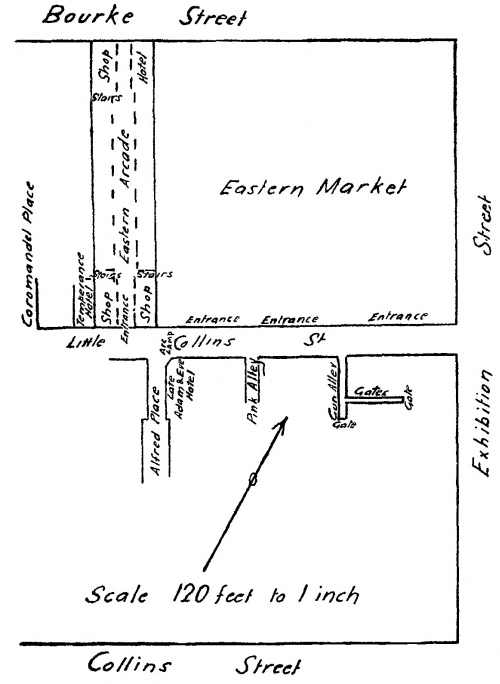
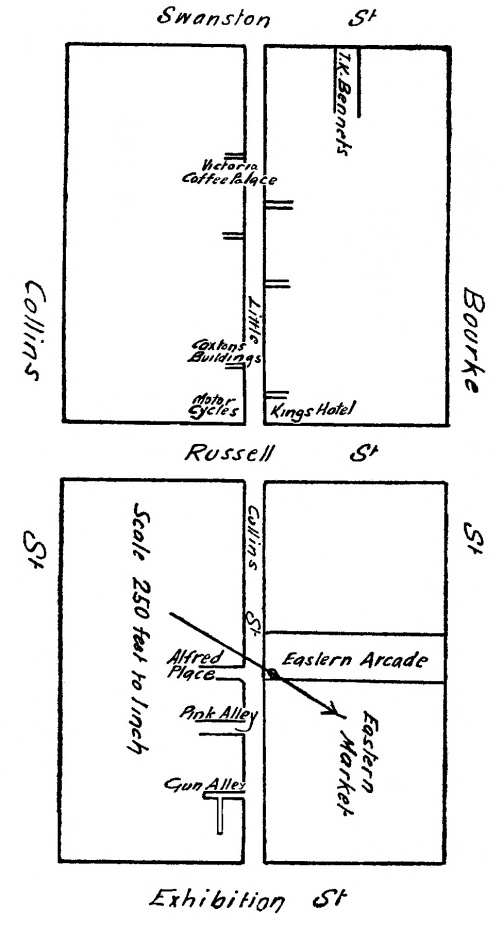
In seeking to show how doubtful it is that
Ross should have been convicted on the evidence, it is not proposed
to go deeply into the case for the defence, and argue that the weight
of testimony lay with the prisoner. It will be shown later that not
one word that Ross said as to his movements was shown to be false, and
that every word he did say was supported by strong evidence, but in
the meantime the Crown evidence will be subjected to analysis, with a
view of showing that from it it was impossible to arrive at a certain
conclusion that Ross was guilty.
Let us take first the evidence of Ivy Matthews. Suppose Ross were
guilty, why should he have made a confession to this woman? They were
at daggers drawn. He had cast her out of his employment with terms of
the deepest insult. They had fought bitterly, through their lawyers,
almost up to the date of the tragedy. They had not seen one another,
much less spoken to one another, between the date she was turned out of
his employment and the 31st of December. Yet on the 31st of December,
according to the Matthews evidence, we have them addressing one another
as “Ive” and “Colin,” and we have Ross handing his life over to the
unsafe keeping of this “woman scorned.”
The strongest appeals were made through the press for anyone who saw
the child to inform the police. But Ivy Matthews, if her evidence is
true, not only saw the child in the saloon on the Friday, but on the
Saturday she had a full confession from Ross. Yet she remained silent,
according to herself and the detectives, until she gave her evidence at
the inquest. She gave no reason for keeping silence, and she gave two
reasons for eventually speaking. At the inquest she said: “I pledged
my word to Ross I would not give evidence against him,” but even if
he had not been arrested, she said: “Perhaps my conscience might have
made me tell.” “If some other man had been put in the dock on this
charge,” she added, “I would have come up and said Ross is the guilty
man.” On the trial, when asked why, if she had given her word, she had
not kept it, she answered: “Would you expect me, a woman, to keep the
secret?” But the fact is that she did keep the “secret” for over three
weeks. At the inquest she said that the circumstance that the £1000
reward was offered should not be put to her, for, she said, “money and
those sort of things hold no interest for me. I do not suppose I will
get anything, and I do not want it.” But, again, the fact is that now
she has been allotted £350 out of the £1000 Government reward offered,
and £87/10/- out of the £250 offered by the “Herald.” This is not a
negligible inducement for a lady who had done no work between November
and the end of February.
But it is the changes in Matthews’s evidence, as between the inquest
and the trial, that cast the most doubt on it. She makes Colin Ross in
his confession, as retailed at the trial, get the girl to come out of
the cubicle in the afternoon, and stay in the beaded room for an hour
or so, while he talks to Gladys Wain; she makes him bring the girl
back to the cubicle when Gladys Wain is gone; she makes him cause the
girl’s death there after 6 o’clock, and then carry the dead body back
to the beaded room, in order that he may make love to Gladys Wain in
the cubicle later on; she makes him come back, after seeing Gladys Wain
home, and carry the dead body back from the beaded room to the cubicle.
There are several features about that narration which are absolutely
incredible. Nothing was said about any of these incidents at the
inquest. In the first place, how did this modest, good, retiring
little girl come to remain for over an hour in the beaded room in the
afternoon, while Ross talked with Gladys Wain in the cubicle? It was
separated from the Arcade only by a sheet of glass, and there were two
doors opening into the Arcade through which the girl could have passed.
Again, it is utterly unbelievable that Ross would have indulged in the
unnecessary perambulations with the dead body, as deposed to, and it is
equally unbelievable that, if he had done so, he would have given those
details to a person to whom he was confessing the simple fact of the murder.
Why, then, were the additions put in? The answer is quite simple.
At the inquest Olive Maddox gave her evidence before Matthews, and
Matthews was out of court. Olive Maddox said that she saw the child in
the beaded room at five minutes to 5. Ivy Matthews followed her into
the witness box, and said that she saw the child in the cubicle at 3
o’clock. How or why did it come about that the child went from the
one room to the other? On the trial Matthews has to be, or thinks she
ought to be, ready with an explanation. So she makes Ross say that he
sent the little girl into the beaded room while he was with Gladys Wain
in the cubicle. According to the stage setting, the death has to take
place in the cubicle, for there is where the only couch was, and there
is where the blankets with the sheen of golden hair came from. So Ross
is made to say that, when Gladys went, he got Alma to come back again
from the beaded room to the cubicle, where she met her death soon after
6. Ross in his statement said that Gladys Wain was with him again in
the cubicle in the evening from 9.15 for over an hour. The police were
satisfied that that was a fact. Matthews has again to reconcile her
story with that position, and again she is equal to it. She makes Ross
say that he carried the dead body from the cubicle to the beaded room
in order that he may make love to Gladys in the cubicle. But before she
gave her evidence on the trial, the hero of the bloody bottle had been
in the box, and his evidence had appeared in print. He is supposed to
have seen and heard certain things which showed that the body was in
the cubicle after midnight. Matthews thinks it desirable to meet that,
so she makes Ross say that he came back to the cafe after seeing Gladys
home, and before he went home himself, and carried the body once more
back from the beaded room to the cubicle. No possible theory can be
advanced why Ross should have done all these things; no possible theory
can be advanced why, if he had done them, he should have given the
details of them to Matthews. But if we assume Matthews’s knowledge of
Maddox’s evidence, and Upton’s evidence, and her knowledge that Gladys
Wain was in the cubicle from 9.15 until after 10.30—all of which we
are entitled to assume—then we are in possession of ample material for
explaining why Matthews should have invented the details.
Then there is the change in the place at which the conversation is
supposed to have taken place. At the inquest it was put as beginning
in Little Collins Street, at the end of the Arcade, and as being
resumed a short distance from the end of the Arcade, but still in the
street. On the trial it was put as beginning, and going on for a little
time, at the door of the saloon, and then as being resumed, when Ross
suggested that people were looking, out in Little Collins Street. The
significance of this change will not be realised unless it is disclosed
that just prior to the trial notice was served on the defence that it
was proposed to call as a witness on the trial Julia Gibson, otherwise
Madame Ghurka, to prove that she saw Ross talking to Matthews on the
Saturday afternoon. Ghurka was not, in fact, called. There may be some
doubt as to whether her evidence would have been admissible. Probably
it would have been admitted in rebuttal, when Ross swore that he did
not have any conversation with Matthews on that afternoon. At any rate,
her evidence was not tendered. The fact remains, however, that Ghurka
must have told the police, or Ivy Matthews must have told the police,
that Ghurka saw the two in conversation, and was prepared to testify to
it. She could not, from her own door, have seen them in conversation in
Little Collins Street.
Matthews, in her evidence, said that she had not told the police that
Madame Ghurka had seem Ross talking to her, and added that, if Madame
Ghurka was to give evidence of having seen them conversing, she did
not know how the police acquired the information. When asked, however,
“Have you discussed with Madame Ghurka at any time anything about this
case?” she answered: “To say I had not would be a lie—I have.”
It has been published in a Sydney paper, which, during and after the
trial, was in the closest touch With the witnesses for the Crown,
that it was Madame Ghurka who induced Matthews to tell all she knew
about the case. It is also a fact that both were well acquainted
with Ross, and both were unfriendly with him, a circumstance which
would make discussion natural; and that Matthews had lived at Madame
Ghurka’s house from November, 1921, up to the date of the trial, a
circumstance which would make discussion easy. It is also a fact that
Madame Ghurka and two of her family have shared in the reward, though
nothing has ever appeared officially to show what services Madame
Ghurka rendered to the police, which entitled her thus to share. We
may assume, further, that the reward was not allocated until the views
of the police had been ascertained. When we know what Madame Ghurka’s
services to the State under this head were, and when we know—what may
appear irrelevant, but what is very germane to the matter in hand—why
nobody was ever prosecuted for the recent theft of Ivy Matthew’s box
of clothing, and when we know why a charge of indecent language laid
against Sydney John Harding was precipitately withdrawn when called on
in the police court, then we shall know something which has a very
close connection with the making of a case against Colin Ross.[3]
And if Madame Ghurka gave information (undisclosed) to the police,
which they felt entitled her to share in the reward, her information
should be considered in the light of the fact that she gave evidence in
a recent divorce suit, and was then described by the presiding judge
as a “bitter, vindictive woman,” and “the sort of woman who would say
anything, whether it was true or false.”
Incidentally, during the trial, a remarkable sidelight was thrown
on Ivy Matthew’s powers of invention, and her unscrupulousness in
exercising them. The Crown Prosecutor cross-examined Mrs. Ross at some
length as to a visit she is supposed to have paid to Ivy Matthews on
February 6, in order to “beseech” her not to give evidence against her
son. The passage is worth transcribing in full.
“Have you ever discussed anything with Ivy Matthews?” asked Mr.
Macindoe, the Crown Prosecutor. “No,” was the answer, “I have only had
one conversation with Ivy Matthews in my life,” and question and answer
proceeded as follow:—
When was that?—That was the time of the shooting affair. That is some
time back.
I am going to remind you of the 6th of February last?—I had no
conversation with Ivy Matthews on February 6.
Do you know what day of the week it was?—No, I could not tell you.
Do you know where you were on February 6?—On February 6 I would be home.
I have not been out of my home very much since this trouble has been on.
You have been into town since this trouble?—I have only been into town
to see my son Colin.
Have you not seen Ivy Matthews since the inquest?—At the inquest, but
not since the inquest.
Do you know where Rathdown Street is?—I know Rathdown Street.
Do you know where Mrs. Julia Gibson (Madame Ghurka) lives?—I do not.
No idea?—I have not the slightest idea where she lives.
Do you know where Ivy Matthews lives?—I do not.
Or was living in February?—I do not.
Did you not go to the house where Ivy Matthews was living in February
of this year?—I did not.
You swear that?—I will swear it.
You know, of course, that Ivy Matthews had given evidence at the
Morgue?—I did; at the Coroner’s inquiry, you mean?
Yes; and that she had given evidence against your son?—Yes; I know that.
Have you ever seen her and talked about that evidence?—I have never
set eyes on Ivy Matthews since the day I saw her at the Coroner’s Court.
Do you say you did not go to the house in Rathdown Street, and were
shown into the parlour by a maid on February 6, and that you asked for
Ivy Matthews, and that Ivy Matthews came down to that parlour?—I did
not; I can swear it.
And that you besought her not to give evidence?—No. I never did.
If you had done it would you say so?—I would. I had no reason to do
so. Ivy Matthews is a woman I would not demean myself to talk to, let
alone to plead to.
Why?—I talked to her once and once only, and that was quite
sufficient for me.
Those who heard Mrs. Ross’s answers to the questions put to her,
saw the look of mystification spreading over her face as they were
developed, heard her solemn declaration that she had never even set
eyes on Ivy Matthews since the day she saw her at the Coroner’s Court,
heard her earnest, low-voiced assertion that “Ivy Matthews is a woman I
would not demean myself to talk to, let alone to plead to,” could not,
for a moment, doubt that she was speaking the truth. A somewhat similar
line of cross-examination was pursued when Stanley and Ronald Ross were
in the witness box, but in their case a different date was alleged.
Stanley Ross was cross-examined on the point as follows:—
Do you remember, on February 3, the Friday night after the inquest,
going to Rathdown Street, Carlton?—No.
Did you know where Ivy Matthews lived?—No.
Will you swear you did not know that Ivy Matthews lived in Rathdown
Street?—I know she lived in Rathdown Street, but I could not take you
to the place.
I did not ask you that, I asked you if you knew where she lived in
Rathdown Street?—No.
Did you and your brother Ronald go to Madame Ghurka’s or Mrs. Gibson’s
house on the night of February 3?—No.
Or at any time in February?—No.
I am going to put this to you that a maid-servant opened the door to
you?—No.
And that you went in and brought Ivy Matthews to the gate to talk to
your brother Ronald?—Never in my life; I could not tell you where
Madame Ghurka, or Mrs. Gibson, lives.
So you say—and did you say to Ivy Matthews: “Are you going on with
this?”—No.
Or did your brother?—No.
And when she said: “I am” did you then, or did your brother, say to
her: “If you give evidence you will have your lights put out”?—No.
Or anything to that effect?—No.
Have you ever spoken to Ivy Matthews since last December?—Yes.
Where?—On the Thursday, January 5, that we were detained at the
detective office.
Since then have you spoken to her?—No.
Never seen her?—No, only at the Morgue. I saw her at the inquest.
You did not speak to her there?—No.
When Ronald Ross was under cross-examination, he was questioned as to
the same alleged interview. A woman was asked to stand up in Court, and
he was asked if he knew her by sight. His answer was: “I never saw her
in my life before.” He was then further interrogated.—
Did you go to Rathdown Street on February 3 last and see that young
woman?—I never saw that woman in my life before.
Did you see Ivy Matthews on February 3?—I did not.
At Rathdown Street, Carlton?—No. I did not.
Did you and your brother go out there to see her?—No.
Were you together on that day?—We might have been.
Were you at Rathdown Street on that day?—I say I do not remember
where I was.
You might have been?—Perhaps I might have been; on that particular day
goodness knows where I might have been.
Did you go with your brother to a house where Ivy Matthews lives?—I
did not.
Did your brother go to the front door and ask Ivy Matthews to come to
the front gate?—I do not know.
In your presence?—He did not.
Did Ivy Matthews come to the front gate and did you tell her if she
went on with this case she would have her lights put out?—No; I did
not.
You would admit it if you had done it?—Yes; I am here to tell the
truth.
One brother was out of Court while the other was giving his evidence.
It was again perfectly clear that neither brother had the slightest
knowledge of any such interview. It would have been competent for the
Crown to have called evidence to prove this conversation if it had
taken place, but no application was made to call the evidence.
There is an importance—indeed a tremendous importance—about this
series of questions which, as they led to nothing, may not be
appreciated by the layman. According to the rules of cross-examination,
Counsel may not ask random questions. His questions must have a
basis of knowledge, or at least of information, to rest upon. Before
the Crown Prosecutor could ask these questions, he must have had
information to the effect indicated by his cross-examination. It is
impossible to conjecture anyone who was in a position to give such
information but Ivy Matthews. If that be so, then Matthews absolutely
invented the stories. There is not a scintilla of truth in either of them.
But in still another way Matthews’ story can be shown to be, if not
false, at least highly improbable. She said that at 3 o’clock on the
Friday she was standing at the door of the wine saloon, talking to
Stanley Ross. “I was at the wine cafe door,” she said, “but not in
the saloon.” She came to the door, she said, because Stanley beckoned
her up from lower down the Arcade, where she was talking to a friend.
Stanley, of course, denies this absolutely. But if it were true, then
Stanley, in order to see her standing down the Arcade, must himself
have been standing flush with the building line of the cafe, and could
not have been in the recess by which the door is entered. When she
came to Stanley, she said she saw Ross come out of the cubicle, and as
he did so she saw the little girl sitting on a chair in it. When Ross
got the drink and went back, she says he must have spoken to the girl
because “she parted the curtains and looked straight out.”
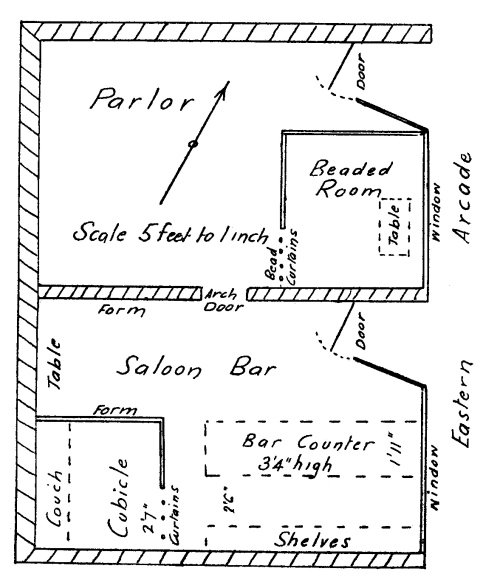
Now if Ross had taken that little girl into the room, one would have
thought that he would have been very anxious not to reveal her presence
unnecessarily. According to Matthews, he seems to have been at pains to
disclose it.
But if the plan of the saloon[4]
(on page 68) is looked at, it will be noticed that before Matthews
could even see the curtains on the cubicle she would have to be
standing right in the doorway of the saloon and not merely flush with
the building line. There are two circumstances which make it improbable
that she would be so standing. One is that if Stanley were standing
clear of, or even flush with, the building line, the conversation, if
any, would be likely to take place where he was standing. The other is
that she was not likely to stand right in the doorway of the saloon,
when she was not on speaking terms with the proprietor of it. But
again, the child, in order to be seen at all, would have to have her
chair almost blocking the 2ft. 7in. doorway of the cubicle. The whole
room is only 6ft. by 5ft. 5in., and Ross must have placed her in the
only portion of it in which she could be seen by a person standing
right in the doorway. Yet Matthews’ glance was sufficient to enable
her to describe the girl as wearing a little mushroom-shaped hat
“coming round her face something like mine”—a white hat with a maroon
sort of band like the one produced, pushed back a little from the face,
but coming down around the face, a white blouse or jumper “with just
straps over the shoulder; her hair was a sort of auburn shade, not
particularly a ginger hair, but that pretty shade of auburn,” while as
to her age “she struck me as being 12 or 13.” An excellent example of
instantaneous mental photography in colours!
There are some further facts about Matthews which help to explain why
she, although, according to the detectives, she made no statement to
them until she gave her evidence in the Coroner’s Court on January 25,
has yet got away with the lion’s share of the reward. That, however,
will be dealt with fully when we come to deal, under the head of the
new evidence, with the extraordinary story of a man named Halliwell.
Olive Maddox’s testimony is also worthy of a few lines of examination.
She said that, having seen the girl in the beaded room, two men also
being in it, she came out and said to Ross: “That is a young kid to
be drinking there.” The room in which the child was alleged to be was
only 7ft. by 6ft. 7in. The girl, therefore, must have been within three
or four feet of the men. Ivy Matthews, in her evidence at the Morgue,
said it was no unusual thing, when respectable women came into the
place for a drink with a child, to show them into the little room.
Olive Maddox, a daily visitor to the place in Matthews’ time, must
have known of this practice. Therefore, even if she did see the child
in the same little room with two men, there was not the slightest thing
about the circumstance to suggest that she was not with one of the men,
and everything to suggest that she was. At the worst, she had an empty
lemonade glass in front of her, and that, combined with the fact that
she was with two men, would never have prompted Maddox to say anything
about “a young kid” drinking.
When it is remembered that Matthews and Maddox were old and close
acquaintances, and that Maddox admitted that it was after consultation
with Matthews that she decided to speak to the police, and when it is
remembered that this consultation was just at the time that Matthews
was trying to enlist the services of Halliwell, which will be referred
to later, and when it is remembered that just at this time the reward
had been increased to £1250 (including £250 offered by the “Herald”),
it does not seem hard to suggest what may have happened. Matthews says
that she saw a drink being brought into the cubicle to the child at
3 o’clock. It was suggested in the Appeal Courts that Maddox was to
say that she saw the child in that room at 5 o’clock, with an empty
glass before her; that Maddox was a stupid girl—according to her own
testimony, barely able to read; that she blundered in the simple task
assigned to her by the master mind, and put the child in the wrong
room. The rooms at that time had no distinguishing names. It was
not until the trial that they became known as the “cubicle” and the
“beaded” room. Matthews did not know at the inquest of this blunder,
but on the trial she tried to repair it by telling the absurd story of
how Ross got the girl to go into the beaded room, and kept her there by
some form of mesmerism for over an hour, while he entertained Gladys
Wain in the cubicle.
Maddox herself says that when she saw the girl in the beaded room there
were three girls and two men in the adjoining parlour, and there were
two men in the little room with her. It was a busy afternoon, the eve
of the closing of the wine saloon, and almost the eve of the New Year.
If that girl were in the wine shop from 3 until 5 or 6 she would
have been seen by anything from fifty to a hundred people. It is
incredible that all these people were degenerates, who would connive
at a dastardly outrage, by whomsoever committed. Yet the simple fact
remains that the only persons who came forward, in response to earnest
and widely-published appeals for information about the girl, were
the prostitute, Olive Maddox, and her mysterious friend, with the
inscrutable past, Ivy Matthews. And neither of them came forward until
a handsome reward was offered for the information. Of this reward,
Ivy Matthews has received £437/10/-, and Olive Maddox £214/5/-. If we
know all the services rendered by each, the positions should have been
reversed, for it was Olive Maddox who first gave the information which
put the police on what they, no doubt, still honestly believe was the
right trail. But do we know all? It will be shown later that, at the
time Colin Ross’s doom was sealed, we did not.
Turning now to the alleged confession to Harding, it will be seen that
it will bear analysis no better than Matthews’s. The questions supposed
to have been put by Harding bear their own refutation.
Take the words near the opening:—“I said: ‘Did you see the girl?’ He
said: ‘Yes!’” What would have happened had the conversation reached
that interesting stage? All eagerness, Harding would have followed it
up by asking what happened. But what does he do? He inquires weakly,
like a lady of fashion: “How was she dressed?” With great minuteness
Ross described her dress, down to her shoes and stockings, and with
great accuracy Harding remembered it all. Then Harding inquired, still
curbing his curiosity: “Did you tell the detectives that you saw her?”
And Ross replied: “Yes; but I told them that she had black boots”—a
little touch not borne out by Ross’s written statement, but clearly
designed to furnish corroboration of Harding’s story that Ross had
confessed. Then a little later on we have Harding interposing with
the unreal inquiry: “What time was this?” as if time were, at that
stage of the inquiry, either important or interesting. There are many
other questions equally unreal. The purpose of all of them is quite
clear. They are plainly detective questions, devised to establish at
the outset, as he had no doubt been instructed to establish, or as
he knew by experience detectives are wont to establish, the identity
of the girl Ross was talking about. There was to be left no room for
misunderstanding, such as Brophy left in his bungled interview of the
16th.
Again, take the question supposed to have been put by Harding when
the conversation was resumed on the second day. It is on a different
footing from the others. “I asked him,” said Harding, “did you always
have a screen up in that cubicle?” and Ross is supposed to have
replied: “No; I used the one in the parlour—the red screen.” The
reference, apparently, was to the screen which hung in the arched
doorway between the two main rooms of the saloon. Can any earthly
reason be suggested why Harding should have put such a question to
Ross? The only possible answer is: “None whatever.” But a reason can be
suggested why, if his story were an invention, he should have invented
that particular part of it. Harding had been in the saloon, and he
could not have missed the conspicuous screen that hung between the two
rooms. He would probably not have remembered clearly whether there
was a curtain over the cubicle door or not. For aught he knew, he
might have been confronted by fifty witnesses who could swear truly
that there never had been a curtain there. He tried to rise to the
occasion, and invented the ludicrous story of Ross having said that he
removed the large curtain and hung it over the cubicle door to hide the
little girl from the public gaze—the same little girl as, according
to Matthews, Ross got deliberately to reveal herself when Matthews
took her hasty glance over Stanley Ross’s shoulder. The idea of Ross
removing the large curtain from between the rooms and hanging it over
the cubicle door (all in the presence of Stanley), in order to prevent
Stanley, amongst others, from seeing the girl, would be laughable if
anything about this terrible case could be laughable.
Being reticent up to a certain stage, Ross, according to Harding, then
determined to speak, for what reason no one can suggest, seeing that
he knew Harding’s reputation as a “shelf,” and seeing that he had been
warned by his solicitor to “keep his mouth closed.” That much Harding
admitted, but in fact Ross was warned that the remand yard would be
full of pimps. The Harding touch was made apparent by another little
incident. He makes Ross throughout speak of the small compartment at
the end of the bar as “the cubicle.” It is a most fitting name, and
it has stuck to the room throughout the trial, but it had never been
called that by the Rosses. They had never even heard the word, and
prior to the trial did not know what it meant. But Harding, during
his inglorious war service, had been employed on a hospital ship,
and that is the expression used in hospitals to denote a little room
with a couch in it such as this. Then Ross is made to say that none
of the customers could see the girl because they were in the parlour,
whereas, according to Matthews, the little girl thrust her head out
as if in order to be seen, and, indeed, thrust it out in pursuance of
Ross’s suggestion, and, according to Maddox, she was in the beaded room
with two of the customers, and was seen by Maddox herself, who was an
excellent customer. But, furthermore, if the Maddox story is true, the
customers would have had to be in the parlour in order to see her, for
the beaded room is part of the parlour. Then Ross offered this quiet,
bashful little girl a glass of wine, and she took three, and fell off
into a stupor in the cubicle, though, according to Matthews, he gave
her a glass of lemonade, and afterwards sent her over to the beaded
room, where she was seen by Olive Maddox, bright and alert, sitting up
with an empty glass before her, at 5 o’clock.
The idea that Stanley should have seen, and been a party to, his
brother’s lust, was too much even for the credibility of a Harding, so
Ross is made to say that Stanley couldn’t see the girl when he went
behind the counter, because the screen was down, “and when the screen
was down no one dared to go into the cubicle.” The absurdity of the
story of the screen in one aspect has already been referred to, but a
glance at the plan will show its absurdity in another aspect. But even
the plan does not show that the cubicle walls were only 6 ft. 4 in. in
height, the lower 3 ft. being thin lining boards, and the upper 3 ft. 4
in. being glass. There was no top or ceiling to it. A girl could
scarcely breathe in that cubicle without its being noticed by a man
squeezing in and out at the end of the bar counter. Everything,
according to Harding, took place in the cubicle, and the girl never
left it from the time she went in at 3 o’clock until she was carried
out, dead and nude, between 1 and 2 o’clock next morning. There are
none of the perambulations by the child when alive, or by Ross when the
child was dead, backwards and forwards with the body to and from the
cubicle of which Matthews speaks.
According to the Harding confession, the crime was consummated soon
after 6, and the girl was dead. The fact that no trace of blood was
ever known to have been seen in the room had to be accounted for, so
Harding makes Ross first wash out the cubicle, and then the whole
bar. The washing of the cubicle would suggest itself to a much cruder
imagination than Harding’s, but the little touch about the rest of
the bar was worthy of him. Even Piggott and Brophy, when they had the
matter so “well in hand” on the morning of the 31st, that they did not
think to go into the cubicle, might be expected to notice that one
part of the bar was cleaner than the other, for Harding would not have
dreamt that the detectives would neglect the elementary step of looking
into the cubicle. And so Harding put in the touch of verisimilitude
about the washing of the whole bar.
If Harding’s story be true, then it was while Ross was engaged in this
labour of scrubbing out the bar, with the dead body of an outraged and
murdered child keeping vigil over him, that he went out into the Arcade
to borrow a lead pencil from the vaudeville artist, Alberts, who just
happened to have reason, at the psychological moment, to walk half-way
through the Arcade and back again, like a famous character in history.
Of course Mr. Alberts may have been mistaken in his identification, but
at least he, too, as has been said, has shared in the reward for the
information he gave.
Having finished his task of scrubbing out the bar, Ross had time on his
hands—still accepting the Harding narrative—to clean himself up and
go for a walk before meeting his girl. Having honoured his appointment,
and met his girl at 9 o’clock—though, as a tragedy had occurred in
the meantime which might have been expected to, and did, in fact, cost
him his life, he would have been excused for breaking it—one would
have thought that he would have suggested a walk in the park, or about
the streets—anywhere but back to where the stark body of the little
girl was awaiting him. Had he walked down Bourke Street the alibi
that he was so anxious, according to Harding, to establish would have
been much better established, for he might have been seen by a dozen
acquaintances, and the risk which even Harding saw he was taking would
have been avoided. But no! Ross must go and sit for an hour and a
half with his lady love a few yards away from the child he had foully
murdered so recently, and whose body he must dispose of within the next
few hours, under pain of death.
Harding, so he says (and Harding “is an honourable man”) puts the
question to him directly: “Could Gladys not see the girl when she
went into the wine cafe?” “No,” said Ross, “we had our drink in the
parlour.” This again is the exact opposite of what Matthews says he
said, for Matthews makes him carry the dead body out of the cubicle
into the beaded room (which is part of the parlour) in order that the
cubicle may be free for his reception of Gladys Wain. It might be
thought that Ross had special reasons for wanting the cubicle, as it
had a couch in it, but any idea that sexual misconduct took place that
night is negatived by the fact that Ross was physically unfit and that
Gladys Wain knew it.
Harding next makes Ross, after seeing Gladys Wain home, himself take
train for Footscray, though he fixes the time at about an hour earlier
than it was in fact shown, by overwhelming independent testimony, to
have been. He also makes Ross say that he created a diversion on the
tram in order to call attention to himself, and have the conductor and
other witnesses to prove an alibi. The closest inquiries by the police,
which it may be assumed were made, failed to disclose the faintest
evidence of this “diversion.” In fact, it was absolutely negatived by
the three men, merely casual acquaintances, who travelled home with
Ross that night. Not only that, but the defence knows exactly how this
story of the row on the tram originated. A witness named Patterson,
on hearing of Ross’s arrest, went voluntarily to the local police
station to say that he had travelled home with Ross that night on the
tram. He was questioned as to the date, to see whether he was making
any mistake; and by way of fixing the actual night he said that he
remembered it because there had been a disturbance in the fish shop
where he was having supper with another man in Footscray, before taking
the tram for Maidstone, on which he saw Ross. The local police appear
to have misunderstood what he said, and reported the disturbance as
taking place on the tram. The Ross brothers, Ronald and Stanley, were
cross-examined as to whether they themselves had not called on the
motorman and conductor of the tram, and themselves indicated that a
disturbance had taken place on it. The cross-examination only served,
once again, to show the honesty of their belief in their brother’s
case, for it revealed that they went to the tram office to find the
names of the conductor and motorman who had charge of the tram Colin
travelled by, to ascertain if they had noticed Colin on the tram, and
to get, if possible, the names of any passengers on it.
Harding next put the question to Ross: “Did you come back by car?” A
motor would naturally suggest itself as the means by which he would
return to town, and it will be remembered that, according to Ivy
Matthews, he said he had come back by car. But that was a matter that
could be tested, and the detectives had no doubt satisfied themselves
by inquiry before this that Ross did not return by a car. So Harding
makes him reply to the query by saying: “No, a bike.” “A motor bike?”
asked Harding. “No, a push bike,” Ross is supposed to have replied.
Harding probably knew that Ross had no bicycle of his own, or at least
he guarded against that contingency by making Ross say that he knew
a man who had a bike and knew where it was kept. The questions and
answers which follow are specially notable as carrying on their face
the mark of falsehood. Harding’s narrative at this point was—“I said,
‘Did you go straight into the Arcade?’ He said, ‘Yes.’ I said, ‘But the
gates are locked there at night?’ He said, ‘Yes, but I have a key.’ I
said, ‘When you went to the Arcade, did you go straight in and remove
the body?’ He said, ‘No, I went in and took the girl’s clothes off
and went out and walked around the block to see if there was anyone
about.’” The stilted nature of the dialogue suggests at once that it
is the invention of a crude fictionist. But it suggests a good deal
more than that. How did Harding know, if he had not been told, that
the gates were locked at that time? How did he know, if he had not
been told, that a tenant in the ordinary course, would not have a key
to the Arcade? That is the first thing that would suggest itself if
Ross said that he went straight back to the Arcade. The walking round
the block to see if there was anybody about is equally incredible,
for there might be nobody about when Ross walked around the block on
one occasion, and several about when he came out with the body two
or three minutes later. The purpose of that unreal inquiry, and the
others that follow was to get answers fitting in with the story told
by the vigilant lodging-house keeper, Ellis. But Ellis, with all his
vigilance, strangely enough never saw Ross enter the Arcade with a
bicycle. How that part of the story not only does not fit in with
Ellis’s, but violently conflicts with it, will be shown in a moment.
Ellis’s story may be taken up here and analysed. He, as has been said,
is a lodging-house keeper, but the sort of lodging-house he keeps is
known by another name among the ribald. He saw Ross, according to his
evidence, “a little after 9, before 10, then at 11, and two or three
times between that and 10 minutes to 1,” when he retired. Strange to
say, he did not see Ross go in with Gladys Wain or come out with her,
though the sight of a young couple near his “lodging-house” is just the
sort of thing that might have been expected to attract his attention.
He did not see Ross come back on the bicycle, as he had been said to
do, though one would have thought he could not have failed to see it,
if it were a fact, and if he did keep constant vigil until nearly 1 o’clock.
It should, however, be noted that Ellis did not say, in so many words,
that he saw Ross at the times mentioned. According to the evidence, he
told the police on the Sunday following the murder that he saw a man
whom he did not know, and had never seen before, walking in and out
of the Arcade, as stated. On the 12th, when Ross was arrested, Ellis
was brought to the Detective Office, and he there and then identified
Ross as being the man whom he had seen. Ellis lives within a few yards
of the Eastern Arcade, and according to his own evidence, knew all
about the wine saloon. Through the Arcade would be his direct way to
Bourke Street. Ross had received great publicity seven or eight weeks
previously in connection with what has been referred to as the Arcade
shooting case. Ellis must have been an extraordinarily unobservant man
if, in spite of that publicity, of his knowledge of the wine saloon,
and of its close proximity to his residence, he had never set eyes
on Ross before. When called upon to identify Ross, he was bound, of
course, to say that he had never seen him before, because, if he knew
Ross, he would have been asked how it was that he did not tell the
detectives that it was Ross he saw walking in and out. It is also
curious if Piggott, as he said, had the case “well in hand” on the
first day, and had Ellis’s statement on the following day, that he
did not confront Ellis with Ross until a fortnight had elapsed. But,
conceding Ellis’s honesty, it is surely risking much to depend on the
fortnight-old observations of a witness who is so unobservant that he
had never observed a man who carried on business within a few yards of
him, and who, a couple of months before, was locally “the cynosure of
every eye, the observed of all observers.”
But if the story told in the confessions is true, then Ellis can
not have seen Ross “at 11, and two or three times between that and
10 minutes to 1,” for Ross was away at Footscray at the time. Apart
altogether from the confessions, it was proved by overwhelming
independent evidence that Ross did catch a train at Spencer Street at
about 11.30, and caught a tram which left him at the terminus, not far
from his home, shortly before midnight.
But here, again, apart from the evidence, the story told by Ellis is so
inherently improbable as to render it incredible, even conceding, as
has been said, that it was honest. The theory put forward for the Crown
was that Ross, in his anxiety and restlessness, was walking in and out
of the Arcade. If Ross were anxious and restless it would be about
the safety of his own neck. The safety of his own neck could be best
assured by keeping his presence at the Arcade, late at night, a secret.
Whatever his uneasiness, he was hardly likely to have let that fact
lapse from before his mind for an instant. It is incredible, on the one
hand, that he should have contemplated disposing of the body before
midnight in such a brilliantly-lighted and well-frequented spot. The
street might be empty while Ross was patrolling it, and yet before he
could go in to the saloon and get the body and carry it to Gun Alley, a
dozen people, including a constable, might be in it. It is incredible,
on the other hand, if he did contemplate disposing of it, and was
waiting for Ellis to disappear, that he should have needlessly exposed
himself to Ellis when, from the darkness of the Arcade (which Ellis
deposed to) he could have seen every movement of Ellis without himself
being seen. Ross must have known Ellis well by sight, and, whatever are
the facts, must have believed that Ellis would know him.
This is one of the points at which the Crown case became not only
absolutely incoherent, but absolutely inconsistent. The evidence of
the Italians about seeing the light in the wine saloon at 10 minutes
to 1, of the caretaker that there was no light twenty minutes later,
of Ellis hearing a mysterious noise after he had retired and coming
out to see what caused it, of the Harding confession that Ross heard
Ellis coming and desisted from putting the body in the sewer, was all
designed to show that Ross chose the moment after the two Italians had
left and Ellis had retired, and before the caretaker closed the gate,
to rush out with the body and carry it to Gun Alley. But the Matthews
confession and the rest of the Harding confession were put forward to
show that after the gates were closed Ross came back, and, with his own
key, opened the gates and disposed of the body. The Matthews confession
makes him return “between 1 and 2,” and Harding’s confession makes
him say, in effect at any rate, that the gates were closed when he
got back, and that he opened them with his own key. A long interval,
according to the Harding confession, occurred between Ross’s return and
the disposal of the body, for in the meantime he took off the girl’s
clothes, and washed the body, and walked around the block. The gates
would be locked long before this, and Ross had no key. The stories,
therefore, fail hopelessly to fit in the one with the other. The mark
of truth is that it must fit in with every other truth, while the mark
of falsehood is that it can only be made, by whatever ingenuity, to fit
in with a limited number of truths. If the Ellis evidence is true, the
Harding and Matthews evidence on this point cannot be true. It may be
true in the limited sense of being a true narration of what Ross said,
but it cannot be true in the important sense of being a true recital of
what Ross did. And unfortunately, in this case the jury was not told
that the vital thing was not what Ross said, if he said anything, but
what he did, and was not asked to consider why he should have said he
was at Footscray if, in fact, he was parading up and down in front of
Ellis.
Then the objection will be raised, as it was raised by no less august
a tribunal than the High Court, that even though the two confessions
disagree in important details, and conflict hopelessly with the direct
evidence of Ellis, they are in agreement in the main fact that they
contain the admission that Ross outraged and killed the child, and
disposed of the body in the alley, and are in agreement in a number
of minor points. It is, however, the points of agreement and of
disagreement that suggest so strongly that the two confessions were
fabricated. Let us look at the facts.
On January 23 the police had no account of the supposed confession from
either Matthews or Harding. By January 25 they had both. Let us see how
they agree. It is essential in testing the confessions to keep in mind
what the police knew on January 23. We can deal afterwards with the
question whether what the police knew Harding and Matthews also knew,
or probably knew. The police knew that the girl was in the vicinity of
the Arcade at about 3 o’clock. They knew that Ross had been talking
to Gladys Wain in the saloon for about an hour after four o’clock in
the afternoon; they knew he was to meet, and did meet, Gladys Wain
at 9 o’clock; that he went home for tea in the meantime; and that he
was with her for over an hour after 9.15; they knew that he went home
late by train to Footscray, and thence by tram to Maidstone. All these
things were in Ross’s statement made on January 5, and the police
had the opportunity of testing them. They interviewed Gladys Wain
and apparently they satisfied themselves as to the truth of Ross’s
statement so far as it concerned her. They knew that the dead girl had
been outraged and had been murdered by strangulation; and they knew
that though at first it was said that the marks around the girl’s neck
pointed to strangulation by a cord or wire, that this was disproved
by the medical examination (see the “Herald” of January 6 and January
10). They knew that the body was not in the alley at 1 o’clock (see the
“Herald” of January 2); and they knew that Ellis had said that he had
seen a man going in and out of the Arcade up to nearly 1 o’clock. They
knew that Ross was suffering from a venereal disease. With these points
settled, there were only five matters to be filled in by conjecture
if Ross was to be saddled with the crime. One was how did the girl
actually get into the saloon, the second was how did Gladys Wain fail
to see anything of the girl when she was there in the afternoon. The
third was the exact manner of the girl’s death. The fourth was how
was Gladys Wain prevented from seeing the body when she came in at 9
o’clock. The fifth was how did Ross get back from Footscray late at
night to dispose of the body. How these matters of conjecture were
filled in in the two alleged confessions can be seen clearly by
the following parallels. (The rooms indicated will be described
in the terms used through the trial, not in the terms used in the
“confessions.”)
| THE MATTHEWS CONFESSION. |
THE HARDING CONFESSION. |
(1) The child came up and asked him for a drink. He gave her
a glass of lemonade and took her into the cubicle. |
When the child got opposite his place he spoke
to her, and she took no notice of him at first.
He said: “You have nothing to be afraid of; I own this
place, and if you are tired you can come in and sit down.”
She went in and he took her into the cubicle and induced
her to take three glasses of sweet wine. |
(2) She stayed there until about four. Stanley could see her too. A girl
named Gladys Wain came to see him, and he told the child to go through to
the beaded room, and he “kept her in there” [how?] until Gladys left, and
then brought her back into the cubicle. |
About this time a woman whom he knew came to the door of the
cafe, and he spoke to her for about three-quarters of an hour,
and when he went back to the cubicle the girl was asleep. A
little later “his own girl” came to the door of the cafe, and
he spoke to her until nearly 6 o’clock. Stanley couldn’t see her
when he was serving, because the screen was down, and when
the screen was down no one dared go into the cubicle.
|
(3) After 6 o’clock, when Stanley left, he got “fooling about with her”
(she being quite alert and knowing what was meant), and it was all
over in a minute. “I strangled her in my passion.” After it was all
over, “I could have taken a knife and slashed her up and myself too,
because she led me on to it.” |
At 6 o’clock the girl was still asleep in the cubicle, and “I could not resist
the temptation.” She moaned a little and seemed to faint. I left
the room, and after a little time she commenced to call out again, and I
went in to stop her, and in endeavouring to stop her I must have choked
her. I got suddenly cool and commenced to think. |
(4) He had to meet a girl friend, so he took the body from the cubicle
and put it in the beaded room off the big room, and brought Gladys Wain
into the cubicle, and when Gladys was gone he brought the body back
into the cubicle. |
“Could Gladys not see the girl when you went into the cafe?” No,
as the body was in the cubicle, we had our drink in the big room. |
(5) I asked him how he got back, and he said he came back by motor car. |
I said: “Did you go back by car?” He said, “No”; he had a bike.
I said: “A motor bike?” He said: “No, a push bike.” |
|
|
It will be seen that on every point about which nothing was known to
the police, the two “confessions” are absolutely at variance. On the
points known to the police, they absolutely agree except that Harding
(rightly) makes Ross speak to another girl at the door before he speaks
to Gladys Wain. This the police knew from Stanley’s statement, though
it is not in Ross’s written statement. Further comment on these
suggestive facts seems unnecessary.
How, it may be asked, could Ivy Matthews and Harding become possessed
of the information the police had? That question is not difficult to
answer. It will be shown later that Ivy Matthews was driving around
with the police on January 9, assisting them to get evidence in the
case, and that she, on her part, was trying to get it manufactured.
If that is so (and a sworn declaration to that effect has gone
unchallenged) then she was not likely to lack any information that the
police thought it might be useful to them for her to have. It has been
stated in the Press that the police employed Chinese spies to see if
evidence could be got against any of the Chinese in the neighbourhood.
The statement, though it ill accords with Piggott’s evidence that
“we had the case well in hand” on December 31, has not been denied.
If Chinese spies were called in to assist in the unravelling of the
crime—and that course of action may have been quite justifiable—the
detectives are not likely to have cried “non tali auxilio” when
Matthews volunteered her services.
As to Sydney Harding, the source of his knowledge can be guessed if
not inferred. Harding was a criminal with a record, like one of the
Arbitration Court disputes, extending beyond the limits of one State.
He was “wanted” in Sydney, when he favoured Melbourne with his society
on January 4. At that time, Detective Walsh, of Sydney, was doing duty
in Melbourne as an exchange officer. He was one of the detectives
engaged on the Ross case and was present at the arrest. On Sunday,
January 22, according to statements since made to Ross’s advisers,
Harding sent for Walsh, whom he knew, and Walsh visited him at the gaol
and had a long interview with him. On Monday, January 23, Ross made the
“confession” to Harding, and that night Harding again sent for Walsh,
as is admitted, and recounted the confession to the Governor in the
presence of the detective.
Neither of these facts—that Ivy Matthews was acting as assistant
detective on January 9, and that Detective Walsh had visited Harding
in the gaol by invitation on January 22—was known at the trial.
Had they been so, they would have provided excellent material for
cross-examination, and would have given the jury something to consider
which was never present to their minds.
It has been suggested that it would be a dreadful thing if the police
had prompted Harding in this matter. It certainly would have been a
dreadful thing if they had prompted him or anybody else to manufacture
a confession, and nobody suggests for a moment that they would do, or
did do, such a thing. But believing Ross guilty, as they no doubt did
believe him guilty, and yet not having sufficient evidence to prove it,
they would have been merely following a commonplace practice if they
had employed Harding to endeavour to get a confession of his guilt. In
one of the daily papers, Mr. Brennan was represented as having said
in argument before the Appeal Court that it would have been a very
dreadful thing for the police so to employ Harding. In fact, he said
the exact opposite. But Harding was a very dangerous agent to employ
on this task. Some at least of the Detective Force knew that he had
volunteered for this kind of duty on a former occasion, and that his
services had been declined. There would have been nothing wrong from the
point of view of anyone engaged in unravelling a mysterious crime for a
detective to have said: “We know this, and that, and the other; see if
you can get from him information on the points we know nothing about.”
And whether that is, or is not, what they did, the simple fact remains
that if they had done so, they would have told him the things in which
the Harding and Matthews “confessions” agree, and would have assigned
to him the duty of filling in the gaps which are filled in by Harding
and Matthews in a manner absolutely at variance the one with the other.
Nothing could point more strongly to the guilt of Ross than
satisfactory proof that hairs from the head of the murdered girl
were found on a blanket in his private room. It becomes necessary,
therefore, to examine Mr. Price’s evidence, to see whether it does
establish this important fact. It will be seen by a reference to that
evidence, that Mr. Price uses very guarded language. He “came to a
conclusion” about certain things and he “formed the conclusion” about
others, but he at no time definitely stated that the hairs taken from
the blankets were from the same head as the hairs in the envelope. None
the less, the fact cannot be blinked that the tendency of Mr. Price’s
evidence was in that direction, or that in that direction lay the bent
of his mind.
A word of caution as to expert evidence generally may, therefore,
appropriately be given, and if a quotation from “Taylor on Evidence” is
selected, no one who knows anything of the subject, will question the
weight of the authority.
“Perhaps the testimony which least deserves credit with a jury,” says
the author, “is that of skilled witnesses. These gentlemen are usually
required to speak, not to facts, but to opinions; and when this is the
case it is often quite surprising to see with what facility, and to
what an extent, their views can be made to correspond with the wishes
or the interests of the parties who call them. They do not, indeed,
wilfully misrepresent what they think, but their judgments become so
warped by regarding the subject in one point of view, that even when
conscientiously disposed, they are incapable of forming an independent
opinion. Being zealous partisans, their Belief becomes synonymous with
Faith as defined by the Apostle, and it too often is but ‘the substance
of things hoped for, the evidence of things not seen.’ To adopt the
language of Lord Campbell, ‘skilled witnesses come with such a bias
on their minds to support the cause in which they are embarked, that
hardly any weight should be given to their evidence.’”
The first criticism of Mr. Price’s evidence is that he is not an
expert on the subject, and indeed he made no pretence of being one.
He knew nothing about the subject beforehand, and his experiments and
reading were principally done after the event. For all he knows to the
contrary, the pith of all hairs may be identical. He made one admission
in the course of his cross-examination which absolutely destroyed the
probative force of his evidence. In his post-factum observations he
had examined hairs from several auburn heads, and he admitted that he
had found some hair as like Alma Tirtschke’s as the hairs from the
blankets. The “proof,” therefore, resulting from Mr. Price’s evidence
may be reduced to an elementary syllogism as follows:—
- This hair is like Alma’s.
- All hair like Alma’s is not Alma’s.
- Therefore, this hair may (or may not) be Alma’s.
It was said earlier that Mr. Price might, on the facts he deposed to,
have been a powerful witness for the defence. Let us show how this
is so. Suppose, having deposed to the examination of the two sets of
hairs, exactly as given previously, he had been examined by Counsel
for the Defence, and had answered in the following way, would not his
answers have been fully justified by what he had already stated?:—
Defendant’s Counsel—Having examined the two sets of hair, are you of
opinion they did not come from the same head?—I am.
Can you give reasons for your opinion?—I can, many.
What are they?—In the first place, the hair was not of the same
average length, that from the head of the girl being, on the average,
six inches longer than that from the blanket. In the next place, the
hair from the blanket was of a light auburn colour, while the hair
from the head was an auburn colour tending to red or a deep red. What
is more important, the hairs from the two sets were not of the same
diameter, and I cannot imagine why hair from the same head should
differ in diameter. In the next place, in hair I have examined since,
the frontal portion was quite red, and that from the back of the head
quite dark, suggesting that where the hair is exposed, it lightens in
colour, while in this case the hairs, which must have come from the
back of the head, were actually lighter than those which came from
nearer the front. In the next place, I found in my investigations hairs
which were quite as like Alma Tirtschke’s as the hairs on the blanket,
and though this does not prove that they were not Alma’s hairs, it
prevents, by an elementary rule in scientific investigations, any
deduction that they were. Lastly, it appears incredible to me, that if
a girl of 13 were lying on a blanket for three hours she should lose 27
hairs—or rather that 27 of her hairs should still be remaining on the
blankets at the expiration of a fortnight, during which the blankets
had been removed to a distant suburb, and constantly handled.
There are other features about this hair examination which call for
comment. When a man is on trial for his life, he himself, his counsel,
and indeed the public generally, are entitled to demand that every
link in the chain connecting him with the murder shall be found in its
place. It was objected on the appeal that a link was missing in the
case of the blankets, since it was not shown where they were during the
night preceding their handing over to the analyst. One of the learned
judges in the High Court asked whether this “sinister suggestion” had
been put to the detectives. With the greatest respect, it is not, in
the first place, a sinister suggestion, but an elementary requirement
in proof; and in the second place, it is no part of the duty of a
defending counsel either to fill up gaps in the Crown evidence, or to
give the Crown witnesses a lead by which they may do it. But a blow
would be struck at the whole administration of justice, if once the
principle were admitted, that evidence, just because it is police
evidence, is not to be subjected to the ordinary tests. The principle
admitted, it would soon come to be known and traded upon, and the
result would be the lowering of the whole morale of the Detective
Force. The logical outcome would be the transfer of the seat of justice
from the Law Courts to the Detective Office. It is the knowledge
that their evidence will have to run the gauntlet of the fiercest
criticism and examination which the skill of the bar can bring to
bear on it which helps to keep the members of the Detective Force up
to their present high standard. On such a question as spiritualistic
manifestations, the sceptics require the exclusion of every opportunity
for fraud, even when the high priest is a man of the reputation of Sir
Conan Doyle; and a prisoner under the shadow of the gallows, who speaks
through his counsel, is entitled to demand the exclusion of every
possibility of fraud, even when a man of the standing of Detective
Piggott is in charge.
It is almost impossible to believe, apart altogether from the question
of Ross’s guilt, or the question of the supposed identity of the hairs,
as deposed to by Mr. Price, that the hairs on the blankets could have
been Alma Tirtschke’s. As was mentioned during the legal argument,
golden hairs do not shine out conspicuously on a reddish brown blanket
when they are well imbedded in the fabric. Yet when Detective Piggott
picked up this reddish brown blanket in the darkness of a vestibule,
a fortnight after it had left the wine saloon, after it had been used
for packing pictures on the day of the removal, after it had been
put out to air on a line, after it had been in use for a fortnight
at Maidstone—all of which was sworn to—his quick eye immediately
detected “the sheen of golden hairs” on it. They must, therefore, have
been lying loosely on it. It would surely have been fair that he and
his men should have immediately started to pick them off—and in the
presence and with the knowledge of Ross. It was hardly in accordance
with the fairness with which the case was investigated throughout,
to defer the picking off until the blankets had been placed, on the
following day, over the screen in the Government Analyst’s room.
Nothing was known by Ross of the discovery of the hairs until the
evidence was given, a fortnight later, at the inquest. It is also
remarkable that Piggott, who, according to his own testimony, had the
case against Ross “well in hand” on December 31, never even went into
the cubicle on that day to see if it would reveal anything, although he
knew the place was to be vacated and dismantled on that very evening.
On the trial, evidence for the defence was given that Mrs. Tom Ross
and her sister, Miss Alice Ballantyne, had gone into the cubicle on
the Wednesday before the murder, and had “done” their hair in it, each
letting her hair down and combing it. Alice Ballantyne’s hair bore
the strongest resemblance to Alma Tirtschke’s, and leaving out the
improbability of the hairs remaining on the blanket for a fortnight, it
was far more likely that 27 hairs would come out under the operation of
combing than that they would come out from a girl simply lying on the
blanket. Something might have been said on this point by Ross had he
been apprised at the time of “the sheen of golden hairs.”
It was not mere thoughtlessness that allowed the examination of the
blankets to be delayed for a fortnight, for, if Ross’s supplementary
statement of January 5 is looked at, it will be seen that he said
on that day, in answer to a question, “I did have two blankets in
the saloon. They were used as a rug or cover to lie down in the
afternoons.” Thus put on his guard, one would have thought that, if
Ross were a guilty man, he would have seen that the blankets did not
rise up a week later to confront him. And one certainly would have
thought that the detectives, if they had the case against Ross “well
in hand” on the 31st, would have seen the desirability, at least on
January 5, of sending out, while they had Ross temporarily in custody,
and getting possession of the blankets.
There was still another fatal weakness in the “reddish brown blanket”
as a link in the chain connecting Ross with the murder. When Ivy
Matthews was shown this blanket, she decisively tossed it aside as not
having been in the saloon in her time. Either it was, or it was not,
in the saloon on December 30. If it was not, the hairs on it could not
have come from Alma Tirtschke’s head. If it was, then how comes it that
not one spot of blood was found on it, when, according to the Harding
“confession,” the place was like a shambles, and, according to the
medical evidence, there would be much bleeding? It may be suggested
that this blanket was under the girl’s head, and another blanket was
under her body, and received the blood stains. If so, it would, if
discovered, have been the most damaging piece of evidence against Ross,
and its disposal must have been a matter of the gravest concern to him.
Yet although he is supposed to have given to Harding the most minute
details of unimportant matters, together with a complete account of
how he disposed of the girl’s dress, he never said one word about this
blanket, or its disposition!
Another of the facts urged as showing that Ross murdered the girl was
the exact description he gave of her clothing on the morning following
the girl’s disappearance. On being asked by Piggott how the girl was
dressed, he described her dress and her hat with the college band on
it, said in answer to a question that she had on a white blouse, and,
on being asked “what else?” said: “Well, she had black stockings,
and boots or shoes—I think boots.” (In the signed statement the
corresponding passage is “she wore dark stockings and boots, or she may
have had shoes on.”) Again, on being asked about her hair, he said it
was golden coloured and hung down her back.
The answer to the suggestion that that was a minute description for a
man to give of a girl’s dress is that, in the first place, it was given
mainly in answer to questions, and it ought not to be difficult for a
man to visualise the girl’s dress after a lapse of 18 hours, especially
as she was dressed in conventional school-girl style. (Her dress was
quite as accurately described by a hotel porter who saw her walking
up Little Collins Street.) Harding’s “confession” credits Ross with
saying that he told the police she wore boots, and with suggesting that
this was an erroneous description designed to mislead. The evidence
does not bear Harding out, and the idea that in any case the trifling
discrepancy was designed to deceive is ridiculous. And while Harding
suggests that Ross was purposely inaccurate in order to deceive, the
Crown Prosecutor used Ross’s accurate description to show that he
was accurate not merely because he had seen the girl in the Arcade,
but because he had taken her clothing off. Since the question of the
disposal of the clothing was supposed to have been raised by Harding
and dealt with by Ross, it is curious, by the way, that nothing was
said to Harding of the underclothing, or of the distinguishing hat, or
of the parcel of meat, for these, too, had to be disposed of. But this
is only another proof that Harding put nothing into Ross’s mouth which
was likely to be falsified by independent testimony.
Here, again, this very matter of hesitation about the boots or shoes
tells entirely in Ross’s favour. Either he gave a description to the
best of his ability, or he gave a description purposely designed to
deceive. The latter alternative may be dismissed at once, because
the description was so nearly accurate that it is absurd to suppose
it was meant to mislead. There remains, then, the alternative that
he described the dress to the best of his ability. A man describing
the appearance of a conventionally-dressed school-girl has not room
to go far astray. The one thing he would not be likely to remember,
or to carry in the mind’s eye, was whether she had on boots or
shoes—especially if her stockings were black. But if Ross had stripped
the body, that is the one thing that he would have been clear about,
for by the hypothesis he took the boots off, and he could hardly have
forgotten the gruesome task of unlacing them.
There is one piece of evidence which causes some difficulty in that it
suggests that someone was in Ross’s saloon after midnight. It is the
evidence of the two Italians who swore that there was a light in the
saloon at 10 minutes to 1. There does not appear to be much room for
mistake in this evidence, for the Italians said they talked with one
another about the unwonted circumstance of the light. There does not
appear to be any reason to doubt their honesty, even though they have
since shared in the reward. During argument before the Appeal Courts,
it was suggested as a possibility that other persons might have gained
access to the saloon. It was proved in evidence by Mr. Clarke, the
Manager of the Arcade, that the door of the saloon nearer Bourke Street
could be opened by inserting a knife or piece of tin between the bolts
of the Yale lock and the part into which it fits, the lock being
loose and the door ill-fitting. Apart from Mr. Clarke’s unchallenged
testimony on this point, the fact may be accepted as being beyond
controversy, for Mr. Clarke, on the eve of the trial, opened the door
in the way mentioned without the slightest difficulty, in the presence
of the counsel and solicitors for Ross.
This being the fact about the door, it was not altogether improbable
that it would be known to some patrons of the wine saloon who were
tenants of the Arcade. The suggestion made in the Appeal Courts was
that other persons with a dead body on their hands, which it was urgent
they should dispose of, might have bethought themselves of the disused
cellars in the wine cafe as a possible hiding place. This would be
the more probable by reason of the fact that it was known that the
following day would be the last on which the wine saloon would be open,
the license expiring with the year. It was known in fact that the
police questioned, and detained for a time, at least one occupier of a
room in the Arcade whose reputation was far from good. In any event,
there is strong evidence that Ross knew nothing about the light in the
saloon if it was, in fact, there. On the day of his arrest, he was
interrogated for the third time by Piggott. Piggott said: “It will be
proved that a light was burning in your wine shop on the early morning
of the 31st.” Ross replied promptly: “That is a lie—a deliberate lie.”
Piggott said: “It will be proved that a little girl was seen in your
wine shop on the afternoon of the 30th.” Ross said: “That’s a lie.” “It
will be proved that she had a glass in front of her and was sitting in
the room,” continued Piggott, and again Ross answered: “That’s a lie.”
And being asked if he had any explanation to give, he added: “You have
got nothing over me.”
If that light had been in the wine saloon at 1 o’clock with Ross’s
knowledge, he must have known, or at least have thought, that the fact
might be proved by a dozen independent and reputable witnesses. If it
had been a fact he would have been ready with an explanation, such as
that they were dismantling the premises. But his emphatic, if not very
polite, answer was: “That’s a lie.” The same remark applies to the
answers in regard to the little girl being seen in the saloon with the
glass in front of her. If she had been there she would, as has already
been said, have been seen probably by a hundred people. But Ross’s
answer to the suggestion that she was there was to brand it as a lie.
And Matthews and Maddox were the only persons called to prove it was
not a lie. That, however, is not the present point. We are dealing with
the light in the saloon.
Since the trial a further fact has been disclosed in connection with
this question which lends a great deal of support to the theory put
forward by counsel on the appeals. A Sydney paper, still in its youth
and advertising stage, has degraded journalism in connection with the
Ross case in a way that is happily rare in the annals of the newspaper
world. As Ross lay in the condemned cell, it gloated over his
impending doom in a manner that showed that it did not appreciate the
cowardice of kicking a man, even a criminal, when he is down. But it
apparently had plenty of money to spend for the work of pushing its
circulation among those who like that kind of literature. Its Melbourne
representative did undoubtedly get well into the secrets connected
with the working up of the case against Ross. In its issue of March
25, it had an article dealing with the preparation of the case which
was clearly inspired. One paragraph referred to “another piece of
unrecorded history,” as follows:
“There is a card school that assembles frequently at the Arcade,
or did prior to the trial. On the night of December 30, the players
dispersed shortly before midnight. They went out of the Arcade by way
of Little Collins Street. Passing the wine shop, they noticed that
it was lit up. But this they also noticed—that Room 33 also showed a
light. The tenant was not in the room. He had lent it to a friend who
was entertaining there a young woman, the daughter of a former officer
of police. Ross, too, had seen the light. He must have noticed it at
intervals during the evening, and watched it with despairing hope
that its users would go away instead of staying on, hour after hour,
spoiling his plans. At last it appeared as though the room was going to
be occupied all night. Some new way had to be found. It was then that
he thought of Gun Alley....”
Ross’s thoughts, it will be seen, are here set down as though the
writer were recording some plain matter of fact. The suggestion is that
Ross had intended putting the body in this room, but was thwarted by
the unfortunate circumstance that someone, not the tenant, had got
the use of it for the night. The allegation about the intention of
Ross to put the body in Room 33 is taken bodily out of the supposed
Matthews confession. It has no other foundation, in fact. How closely
the correspondent was in touch with Ivy Matthews is shown by the fact
that another number of the same paper gave the story of her life. But
again we are face to face with the fact that Harding, to whom Ross is
supposed to have given such minute details of the disposition of the
body, has not a word to say about this unexpected obstacle. A murderer
and a ravisher who was confessing his double crime was hardly likely to
have boggled at admitting, if such were the fact, that he contemplated
disposing of the body by putting it in another man’s room. But at
least, since he gave such details of his plan for disposing of the
body, and his execution of them, it is curious that he said nothing
about the difficulty which the light in Room 33 created.
Again there is the remarkable circumstance that not one of the card
school was produced on the trial to say that in fact there was a light
in the saloon at midnight. But whatever may be the facts about a light
at 10 minutes to 1, it is certain that if there was a light in the
saloon at midnight, Ross was not responsible for it. If the guilt or
innocence of Ross depends upon the question of whether he was, or was
not, in the saloon at midnight, it may be taken to be established, as
clearly and definitely as human testimony can establish any fact, that
Ross is innocent. Those who heard the evidence of Patterson, Studd, and
Bradley, (to be mentioned later) as to Ross going home on the last tram
to Maidstone, the suburb out from Footscray where Ross lived, and had
the advantage of private consultations with these witnesses, cannot
entertain the slightest doubt that Ross was on the tram. Conceivably,
his brother and mother, as deeply interested witnesses, were lying as
to what took place after he got home, though they never wavered, and
were never shaken in the slightest degree in their testimony, but as
to the honesty and accuracy of the three disinterested witnesses named
there can be no doubt whatever. But, even if the confessions are relied
on, it should be noted that both negative the suggestion that Ross was
in the saloon at midnight.
Not a word about the light in room 33 or of the observations of the
card school came out on the trial. Of course, there may be no truth in
the story. But, true or not, no questions concerning either were put
to Ross by the detectives which would have allowed these matters to
get out on the trial. This is not meant as adverse criticism of the
conduct of the case. It merely illustrates what has been said earlier
how events so shaped themselves as to cast all the light on Ross, and
leave others, who at one time or another were suspected, entirely in
the shadow.
The detectives explain the light in the one room by the theory that a
stranger to the room had been given the use of it for the night for
an immoral purpose; they explain the light in Ross’s room, if the
newspaper account is true, by the theory that he is engaged disposing
of a dead body. But if the jury had known that all night a light was
burning, not only in the saloon, but in a room opposite to it, they
might not have been so easily satisfied about either theory, as it is
suggested the detectives were.
No insinuation is made against the fairness with which the detectives
presented the case against Ross. In particular, Piggott’s account
of the conversations with Ross give, with great frankness, Ross’s
answers, when it would have been perfectly easy for the detective, had
he desired to be unfair, to minimise the emphasis Ross put upon his
denials. There are two passages in Taylor’s great work on “Evidence,”
however, which are peculiarly applicable to this case. One deals with
the caution necessary in considering all police evidence.
“With respect to policemen, constables, and
others employed in the detection of crime,” says the learned author,
“their testimony against a prisoner should usually be watched with
care, not because they intentionally pervert the truth, but because
their professional zeal, fed as it is by an habitual intercourse with
the vicious, and by the frequent contemplation of human nature in its
most revolting form, almost necessarily leads them to ascribe actions
to the worst motives, and to give a colouring of guilt to facts and
conversations which are, perhaps, in themselves, consistent with
perfect rectitude. ‘That all men are guilty till they are proved to be
innocent’ is naturally the creed of the police, but it is a creed which
finds no sanction in a court or justice.”
The other passage deals with the dangers which have necessarily to be
guarded against in any case depending on circumstantial evidence. Says
the learned author:—
“It must be remembered that, in a case of
circumstantial evidence, the facts are collected by degrees.
Something occurs to raise a suspicion against a particular party.
Constables and police officers are immediately on the alert, and, with
professional zeal, ransack every place and paper, and examine into
every circumstance which can tend to establish, not his innocence,
but his guilt. Presuming him guilty from the first, they are apt to
consider his acquittal as a tacit reflection on their discrimination or
skill, and, with something like the feeling of a keen sportsman, they
determine, if possible, to bag their game. Innocent actions may thus
be misinterpreted, innocent words misunderstood, and as men readily
believe what they anxiously desire, facts the most harmless may be
construed into strong confirmation of preconceived opinions. It is not
here asserted that this is frequently the case, nor is it intended
to disparage the police. The feelings by which they are actuated are
common to all persons who first assume that a fact or system is true,
and then seek for arguments to support and prove its truth.”
Piggott himself admitted that the press were giving them “a pretty
rough time” about their failure to effect an arrest. How “rough” it
was may be gauged from one editorial in “The Argus” about three days
before Ross’s arrest, which said: “As each day passes the grievous
disappointment of the public at the failure of the police to track down
the murderer of the child, Alma Tirtschke, grows more profound.... Even
among citizens less given to displays of anger the sense of disgust is
acute. The detectives and police force of Melbourne are on their trial,
and no matter how exacting they may find the ordeal they must realise
that the public will not tolerate failure on their part.” Being thus on
their trial, with their reputation at stake, they had a tremendous
incentive to try and sheet the crime home.
But even with what they had before them, the mystery still remains
how any jury of reasonable men, appreciating the evidence properly,
could say that there was no doubt as to Ross’s guilt. Reviewing it
as dispassionately as one may, and without comparing it with the
evidence for the defence, to be adverted to in a moment, the balance of
probability, to say the very least, dips on the side of his innocence.
The inherent weakness of the Crown case would remain though not one
witness were called for the defence. The unfortunate thing for Ross
was that the jury never was told that there was any weakness or
inconsistency in the Crown evidence. On the contrary, the evidence
was left to them, and, indeed, put to them, as though there was a
cumulative force about it. At one stage they were told by the learned
Judge that “the accused in his evidence denies what is attributed to
him by Brophy, denies the statements of Ivy Matthews incriminating
him, denies the statements of Olive Maddox incriminating him, denies
Harding’s and Dunstan’s evidence, and denies also the evidence of
Upton.” The inherent improbability of the supposed admission to
Brophy, or the inherent probability of Ross’s account of it, was
never suggested; the conflict between the Matthews and the Harding
confessions was never hinted at; the fact that Dunstan had read
Harding’s evidence, as given at the Morgue, and had not reported what
he is supposed to have heard until after he had read it, was never
adverted to; and the fact that Olive Maddox’s evidence could not be true
that the girl was awake in the beaded room at 5 o’clock if Harding’s
“confession” was true that she was asleep in the cubicle at that time
was never referred to.
It was never pointed out to the jury that Harding and Matthews were
deposing only to confessions, and that, while it is possible for a man
to say things that are verbally inconsistent, it is not possible for
him to do things that are actually inconsistent, and that what the jury
had to determine was not what Ross said, but what he did.
They were never asked to consider why he should have made two different
confessions to two different people, or why he should have made a
confession at all. They were never told that, in dealing with an
alleged confession, they must approach the consideration of it in
a manner entirely different from that in which they would approach
evidence purporting to deal with substantive facts. Indeed, in the
passage above quoted, Upton’s evidence of supposed facts is put in
exactly the same category as Matthews’s and Harding’s evidence of
supposed confessions. The learned lawyer, Sir Michael Foster, author of
an historic legal work, may have realised that confessional evidence
“is not, in the ordinary course of things, to be disproved by the sort
of negative evidence by which the proof of plain facts may be, and
often is, confronted,” but a Melbourne common jury was hardly likely
to realise that truth by the light of nature. Mr. Justice Cave, in
delivering the judgment of a very full Bench in a trumpery case of
embezzlement not so very long ago, said: “I would add that, for my
part, I always suspect these confessions which are supposed to be
the offspring of penitence and remorse, and which, nevertheless, are
repudiated by the prisoner at the trial. It is remarkable that it is
of very rare occurrence for evidence of a confession to be given when
the proof of the prisoner’s guilt is otherwise clear and satisfactory,
but, when it is not, the prisoner is not infrequently alleged to
have been seized with the desire, born of penitence and remorse, to
supplement it with a confession—a desire which vanishes as soon as he
appears in a court of justice.” How aptly those words applied to this case!
They were never warned that they could take the confessions, if they
were satisfied that they were made, and accept as much of them, or
either of them, as they chose, but that, if they rejected any portion
of them, they could not fill in the gap by conjecture if there was no
other evidence on the point.
They were never reminded of the difficulties of cross-examining
two persons who purport to depose to a confession, for, whatever
inconsistency with the facts is pointed out, the witness merely
replies, “That may be so; I know nothing but what he told me.”
They were told that Ellis’s evidence was important “because it was
so contradictory of the evidence of some of the witnesses for the
defence,” but they were never reminded that, if Ellis’s evidence
was true, they would have to reject a great portion of the supposed
confessions to Matthews and Harding.
It is extremely likely that, in dealing with Matthews’s and Harding’s
evidence, they would reason that “Harding says this” and “Matthews says
this,” and then draw inferences unfavourable to Ross from the supposed
cumulative effects of the two sets of evidence; and extremely unlikely
that they would reason that “Harding says that Ross said this,” and
“Matthews says that Ross said that,” and then go on to draw
inferences favourable to Ross from the fact that they make him say
totally inconsistent things. Yet this is what they should have
done. They probably have not yet realised that they were dealing
with a case absolutely without parallel in the annals of British
criminal jurisprudence, in which they were invited to hang a man
on contradictory confessions, which he is alleged, by thoroughly
disreputable witnesses, to have made, which on his oath he denied
having made, for the making of which no reason could be assigned, and
which were so seriously in conflict as to suggest that they were never
made.
In the nature of things they were likely to put Harding, Matthews,
Maddox, Dunstan, Ellis, and the Italians on one side, and Ross and his
witnesses on the other, and were not likely to recall that the one set
was a contradictory jumble, and the other set a solid mass of unshaken
testimony, much of it disinterested, directed to establishing certain
definite things.
To the writer, these all seem matters that it was of the first
importance the jury should have had in mind. True it is, that many
of them were touched upon in Mr. Maxwell’s eloquent address for the
defence; but the last words, and the weightiest words, must always
come from the presiding judge. It is also true that before two appeal
courts it was urged that these omissions constituted a ground for
saying that the summing-up fell short of what was required, and that
both courts rejected the contention. But that does not preclude the
respectful comment that the jury, overlooking them, may have approached
the evidence from the wrong standpoint. That they did, for some reason,
approach it from the wrong standpoint seems established by their
verdict.